Translating the Aruch HaShulchan with AI: Method and Lessons

Translating the Aruch HaShulchan with AI: Method and Lessons[1]

Joshua Broyde (PhD)

Joshua Broyde is an AI/ML Healthcare & Life Sciences specialist at Google Cloud, where he works from strategy to implementation with enterprise medtech, healthcare, and biopharma companies to design, build, and deploy secure, production-grade AI and Generative AI systems. He has a PhD in the field of Computational Biology.

Abstract

I present a complete AI-written English translation of the Aruch HaShulchan — Rabbi Yechiel Michel Epstein’s comprehensive nineteenth-century code of Jewish law — covering all four sections of the Shulchan Aruch: Orach Chaim, Yoreh De’ah, Even HaEzer, and Choshen Mishpat. The translation was produced using Google’s Gemini 3 Flash model at its MINIMAL thinking level. Translation quality is consistently high for a first-pass working text, although it clearly sometimes makes mistakes. The full translation is freely available online at aruch-hashulchan-transla-53666.web.app, and the translation data and code are available at github.com/JoshB29/Texts_AI_Translations.

Introduction

The Aruch HaShulchan, by Rabbi Yechiel Michel Epstein (1829-1908) of Novardok, is one of the most authoritative and comprehensive codes of Jewish law in the modern era. Written in rabbinic Hebrew, it has remained largely inaccessible to English readers outside of a handful of translated sections.[2]

AI-driven translation represents a qualitative shift in what is possible for rabbinic literature. This does not fully replace careful human translation, but it creates an opportunity to scale massively: human scholars can now function primarily as editors, reviewing and refining AI-generated drafts rather than translating from scratch. A multi-year scholarly translation project can now be approximated in hours for a few dozen dollars.

Corpus

The Aruch HaShulchan comprises four sections (i.e. chelakim) corresponding to the four parts of the Shulchan Aruch: Orach Chaim, Yoreh De’ah, Even HaEzer and Choshen Mishpat. I first obtained the Hebrew source text from Sefaria[3]. In total, this corresponds to 1,507 Simanim (chapters) and comprises 24,161 seifim (subsections) and around 3,400,000 words.

Translation Method

Model and Thinking Level

I used Google’s Gemini 3 Flash (gemini-3-flash-preview) to create the translation[4]. Gemini Flash supports four “thinking levels” — MINIMAL, LOW, MEDIUM, HIGH — which trade computation budget against reasoning depth. I chose to use the MINIMAL setting, which created a good translation at a very low cost.

Each seif was passed as an isolated API call[5] with a fixed system prompt containing[6]:

  • A style guide specifying conventions for rabbinic titles (e.g., Rambam, Rema, Beit Yosef), standard formulaic phrases (e.g., עד כאן לשונו → “Thus far his words”), and transliteration conventions (siman, seif, seif katan).
  • Few-shot examples illustrating the original text and style of translation.
  • An instruction to preserve the paragraph and logical structure of the original.

In order to make the translations more consistent with each other, I applied a post-processing normalization to all translated seifim after translation was complete.

Choosing the Model Thinking Level to Use

In order to understand which model thinking level is best for rabbinic translations, I chose 5 randomly selected seifim from each chelek, and had Gemini Flash translate them at the different thinking levels. Below are the results:
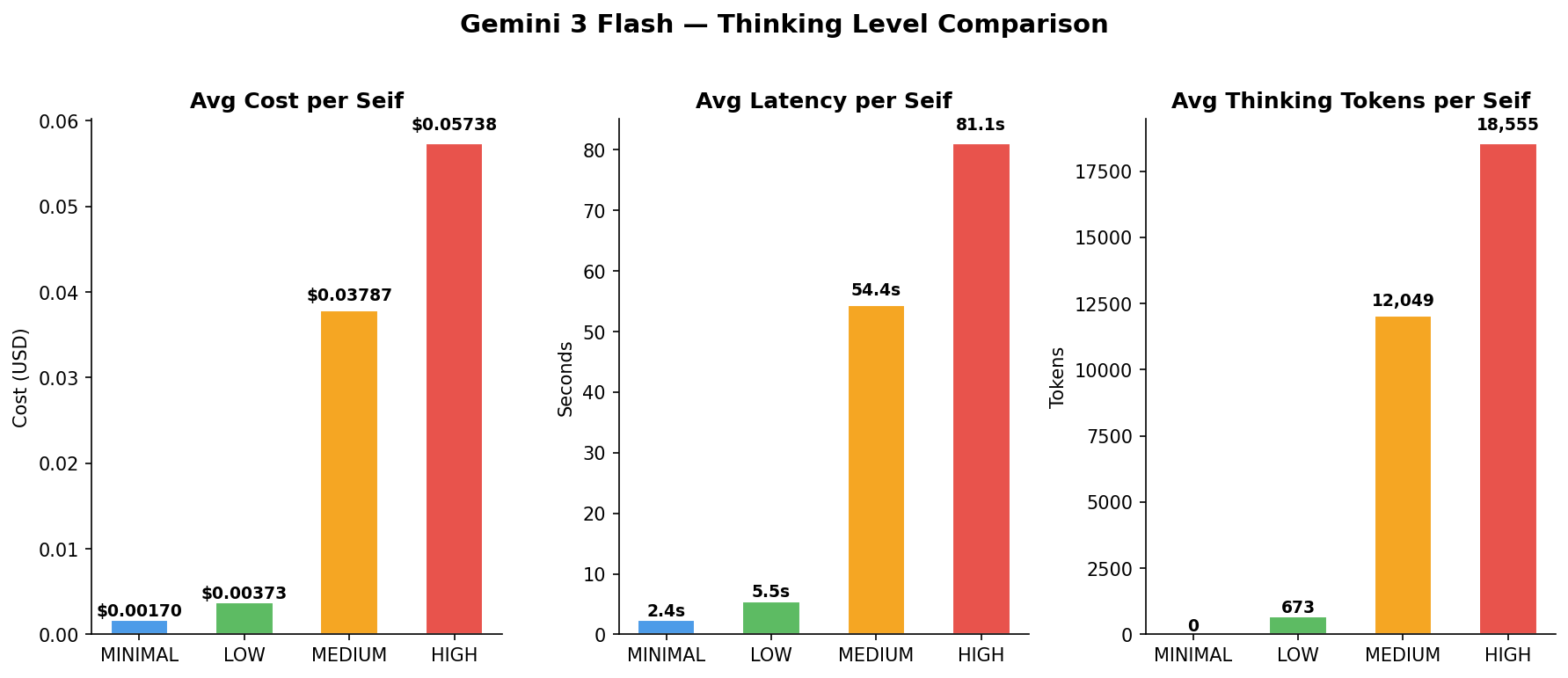
I found the MINIMAL setting to produce translations of roughly equivalent quality[7] compared to the higher thinking models. The additional expense of higher thinking did not seem to create significantly better translations. You can see from the graph that the cost for each seif at the HIGH thinking level is around 5 cents, about 33 times the MINIMAL thinking level[8]. This would represent a total cost of about $1300, as opposed to only $40 I spent using the MINIMAL setting[9]. Most of this cost is due to the significant amount of thinking tokens used by the high model. These results would also suggest that Gemini’s larger model, Gemini-Pro, would be overkill for the project. However, I did not formally test Gemini Pro, or any other model family[10].

Post-Processing Results

One thing I noticed was inconsistency of the word *seif* and the names of certain rabbinic works. Specifically, *seif* was sometimes kept in transliteration and sometimes translated as “section.” To address this, I applied a post-processing step using regular expressions to standardize these renderings: *seif* was normalized to “section” and *seif katan* to “subsection.” I applied the same approach to certain rabbinic names — for example, the *Shach* was sometimes transliterated as “Shakh” — normalizing these to a single canonical spelling throughout the corpus. For future translations, this should be fixed with better prompting.

Despite the fact that each seif is translated separately, my overall impression is that the translations were reasonably good and consistent.

Translation Quality

To more systematically validate the translation quality, I selected 100 random seifim and had a separate model evaluate the translations[11]; specifically, I used OpenAI’s GPT-5.4 model with a low reasoning effort. Each of the 100 seifim was passed to the model together with its original Hebrew, and the model was asked to classify the translation into one of four categories: Good, StyleImprovementNeeded, Mistake, or EgregiousError.

The egregious error category was defined strictly: a translation qualifies as egregious if it fundamentally inverts or distorts the author’s meaning — even if the error itself is subtle. To illustrate this, the following example was included in the evaluation prompt:

Original Hebrew

OC 635:5:

ובוודאי אין זה רק זהירות בעלמא, דאיזה פסול יש בעשיית הגג קודם הדפנות? דאין זה דמיון לחוטט בגדיש, שאין על זה שם גג כלל. אבל הכא גג גמור הוא.

Hypothetical mistranslation:

And certainly this is not only a mere stringency, for what disqualification is there in making the roof before the walls? For this is not comparable to hollowing out a haystack, where it does not have the status of a roof at all. But here, it is a complete roof.

The Aruch HaShulchan is in fact saying the opposite – the Rema’s statement is only a mere stringency. The mistranslation — inserting the words “not only” — is superficially consistent with the Hebrew, but is inconsistent with the actual context of the text and completely inverts the intended meaning.[12]

I had ran the analysis 3 times, and took a majority vote to determine the classification of the seif. If there was a 3 way-tie, the most serious category was taken. Here are the results:

Classification Percentage
Good 29%
StyleImprovementNeeded 54%
Mistake 17%
EgregiousError 0%

You can see that the GPT model thinks that the translations overall need to be improved in style, and found 17% of the translations had a mistake. Importantly though, there were no egregious errors found.

Most of the mistakes were mistranslations of specific words/phrases or incorrect abbreviation expansions; some of the mistakes are a bit humorous. Here are a few examples:

YD 187:63

[עח”ד סק”ה שכתב דדווקא ברואה מ”ת אמרינן כן משום די”ל שמש עכרן אבל בשלא מחמש (sic) תשמיש …]

Translation: [see Chavot Daat subsection 5 who wrote that specifically regarding one who sees from the Torah…]

However, מ”ת means “due to sexual intercourse”. The model seems to have incorrectly expanded this to “מן התורה׳”, despite that making no sense in context.[13]

CM 163:2

כל צרכי ציבור שאינם יכולים להשוות עצמן מפני שינוי דיעות יש להושיב כל הבע”ב הנותנים מס ויקבלו עליהם ברכה שכל אחד יאמר דעתו לש”ש וילכו אחר רוב דיעות

Translation: Regarding all communal needs where they are unable to reach an agreement due to a difference of opinions, they should seat all the householders who pay tax and they shall accept upon themselves a blessing that each one will state his opinion for the sake of Heaven, and they shall follow the majority of opinions.

This is flagged as a mistake by GPT- “blessing” is not the right translation in this context; admonition or a similar word would be better.

OC 471:4

ושתיית יין שרוף מעט – וודאי מגרר גריר.

Translation: And drinking a small amount of burnt wine – certainly stimulates.

“Burnt wine” is a clear mistake for distilled alcohol.

Here’s a few more examples that I found of clear mistakes or stylistic quirks:

  • In OC siman 475, seif 16, the abbreviation “עק”נ” is incorrectly rendered as “see Ketzot HaChoshen” — the correct translation should be “see Korban Netanel”.
  • In YD siman 19, seif 6, the word “poskekim” appears twice — a word that does not exist in Hebrew or in standard transliteration. It appears to be a model-generated corruption of poskim (the standard plural of posek, a halachic decisor). The model occasionally makes up this word a few times in its translation.
  • In EH, Siman 1 seif 2, האשה אינה מצווה על פריה ורביה is translated as “The woman is not commanded regarding pruz u-revu”. This should be “The woman is not commanded regarding pru-urevu” or even better would be “Women are not commanded in pru-urevu”.
  • CM 24:1 “רבותינו ז”ל אמרו [רפ”ה לב”ק] שאין נזקקין אלא לתובע תחלה “ “Our sages, of blessed memory, said [at the beginning of the eighth chapter of Bava Kamma]”. This should be “At the beginning of the fifth chapter”

My overall conclusion is that the translation overall avoided serious errors, but that it does occasionally mistranslate more complex words or phrases, and will sometimes incorrectly expand abbreviations. The model is also no Shakespeare in terms of prose, and is sometimes stylistically awkward. Still, it is mostly correct and I think it is a useful resource. Not bad for $40.73.

Conclusion and Lessons for Future Translations

Based on my experience on using AI to translate the Aruch HaShulchan, I offer the following recommendations for those undertaking similar large-scale AI translation projects in rabbinic or other specialized religious and legal literature.

Invest in the system prompt. The single highest-leverage action is writing a strong system prompt. The prompt should do two distinct things: (1) establish the content guidance — what the model is translating, from what tradition, at what level of expertise; and (2) establish stylistic guidance — how specific terms, titles, phrases, and citation styles should be rendered, consistently and unambiguously. The prompt I used included a style guide with explicit rules for rabbinic titles, standard formulaic phrases, and transliteration conventions.

Few-shot examples are highly effective. I found that including two or three worked examples in the prompt — a Hebrew passage followed by its correct English rendering — substantially improved consistency and register. The model learns from examples what it cannot fully internalize from rules alone, particularly for the tone and sentence structure expected in halachic prose. In the prompt I used, the few shots were not even entire seifim and were actually quasi-synthetic quotes; they were meant simply to show the style of source and target text.

Smaller, lightweight models are sufficient. There is no need to use the largest or most expensive models for this class of task. LLMs have essentially solved the problem of rabbinic Hebrew translation at the level of legal accuracy. Gemini 3 Flash at MINIMAL thinking — the smallest and cheapest configuration I tested — produced translations that were as good as those produced by higher thinking levels at 33 times the cost. The marginal quality improvement from more compute is real but small; the marginal cost increase is enormous.[14]

Prompt Iteration is essential. It took a few tries to get the model to translate in the way I wanted, and running the model on a few seifim, looking at the translation, and adjusting the prompt was very helpful. This was especially helpful for certain expressions I wanted translated consistently.

Context improves consistency, but potentially at significant cost. The primary weakness of this pipeline is that each seif is translated in complete isolation: the model has no memory of the spelling choices, transliteration decisions, or citation delimiter styles it used in prior seifim. Including previous seifim as context — either by passing the already-translated text of the current siman, or through a more dynamic agent-based RAG system — would improve within-siman consistency meaningfully. However, because halachic terminology and cross-references can reach back not just to the previous seif but to earlier simanim and even different sections of the work, the amount of context needed to capture these dependencies could quickly become expensive. For a first-pass translation, I found the isolated-call approach worked remarkably well. For a definitive scholarly edition, context-aware translation is the clear next step.

Conclusion

Translating the complete Aruch HaShulchan — approximately 24,000 seifim across four major sections — is technically feasible, inexpensive ($40.73), and fast (taking a few days on my personal Mac) using current AI technology. The resulting translation is of high quality for a working text, albeit with clear and addressable weaknesses that can be addressed in future iterations of the translation. The full translation is freely available at aruch-hashulchan-transla-53666.web.app.

Appendix A: Example Gemini translations at different thinking levels

# Orach Chaim 475:16 — Thinking Level Comparison

## Hebrew Source

וכתב רבינו הבית יוסף בסעיף ד: אכל מצה בלא כוונה, כגון שאנסוהו אנסים או לסטים לאכול – יצא ידי חובתו, כיון שהוא יודע שהלילה פסח, ושהוא חייב באכילת מצה. אבל אם היה סבור שהוא חול, או שאין זה מצה – לא יצא. עד כאן לשונו. סברא זו כתב כדי לתרץ דברי הרמב”ם, שכאן פסק דיצא ובפרק שני משופר פסק דבלא מתכוין – לא יצא, לחלק בין אכילה לשאר דבר. ומיהו גם באכילה, אם לא ידע שפסח היום או שזהו מצה – וודאי לא יצא, דמצות צריכות כוונה. ובאכילה כשידע, אף שנעשה באונס – הוה ככוונה. וסברא זו הוזכרה בתוספות פסחים (קטו א). אבל מדברי הרא”ש שם, והטור בכאן, לא משמע כן, עיין שם. (עק”נ שם אות ק’, שהאריך בזה.)

## Minimal Thinking

Our teacher, the Beit Yosef, wrote in section 4: If one ate matzah without intent, for example, if oppressors or bandits forced him to eat—he has fulfilled his obligation, since he knows that the night is Pesach and that he is obligated in the eating of matzah. But if he thought it was a weekday, or that this is not matzah—he has not fulfilled it. Thus far his words. He wrote this reasoning in order to reconcile the words of the Rambam, who ruled here that he has fulfilled it, yet in the second chapter of Shofar ruled that without intent—one has not fulfilled it, to distinguish between eating and other matters. However, even regarding eating, if he did not know that today is Pesach or that this is matzah—he certainly has not fulfilled it, for mitzvot require intent. And regarding eating, when he knew, even though it was done under duress—it is like intent. This reasoning was mentioned in the Tosafot in Pesachim (115a). But from the words of the Rosh there, and the Tur here, it does not appear so, see there. (See Ketzot HaChoshen there, letter 100, who elaborated on this.)

## Low Thinking

And our teacher, the Beit Yosef, wrote in section 4: If one ate matzah without intent, such as if oppressors or bandits coerced him to eat—he has fulfilled his obligation, since he knows that tonight is Pesach, and that he is obligated in the eating of matzah. But if he thought it was a weekday, or that this is not matzah—he has not fulfilled [his obligation]. Thus far his words. He wrote this reasoning in order to reconcile the words of the Rambam, for here he ruled that he has fulfilled [his obligation], and in the second chapter of Shofar he ruled that without intent—he has not fulfilled [it], to distinguish between eating and other things. However, even regarding eating, if he did not know that today is Pesach or that this is matzah—certainly he has not fulfilled [it], for mitzvot require intent. And regarding eating, when he knew, even though it was done under duress—it is like intent. And this reasoning was mentioned in Tosafot Pesachim (115a). But from the words of the Rosh there, and the Tur here, it does not appear so; see there. (See Korban Netanel there, letter 100, who elaborated on this.)

## Medium Thinking

Our teacher, the Beit Yosef, wrote in section 4: If one ate matzah without kavanah, such as if coercers or bandits forced him to eat—he has fulfilled his obligation, since he knows that tonight is Pesach and that he is obligated in the eating of matzah. But if he thought it was chol, or that this was not matzah—he has not fulfilled his obligation. Thus far his words. He wrote this reasoning in order to reconcile the words of the Rambam, for here he ruled that he has fulfilled his obligation, and in the second chapter of Shofar he ruled that without kavanah—he has not fulfilled his obligation, to distinguish between eating and other things. However, even regarding eating, if he did not know that today is Pesach or that this is matzah—certainly he has not fulfilled his obligation, for mitzvot require kavanah. And regarding eating, when he knew, even though it was done under coercion—it is like kavanah. And this reasoning was mentioned in Tosafot Pesachim (115a). But from the words of the Rosh, ibid., and the Tur here, it does not appear so; see there. (See Korban Netanel, ibid., letter 100, who elaborated on this.)

## High Thinking

And our teacher, the Beit Yosef, wrote in seif 4: If one ate matzah without intent, for example, if oppressors or bandits forced him to eat—he has fulfilled his obligation, since he knows that tonight is Pesach and that he is obligated in the eating of matzah. But if he thought it was a weekday, or that this is not matzah—he has not fulfilled. Thus far his words. He wrote this reasoning in order to reconcile the words of the Rambam, for here he ruled that he has fulfilled, and in the second chapter of Shofar he ruled that without intent—he has not fulfilled, to distinguish between eating and other matters. However, even regarding eating, if he did not know that today is Pesach or that this is matzah—certainly he has not fulfilled, for mitzvot require intent. And regarding eating, when he knows, even though it was done under duress—it is like intent. And this reasoning was mentioned in Tosafot Pesachim (115a). But from the words of the Rosh ibid., and the Tur here, it does not appear so; see there. (See Korban Netanel ibid., letter 100, who elaborated on this.)

These translations are substantially the same, but have a few differences:

The minimal thinking omits the initial “and”, which is technically an error but does not impact the meaning. The most glaring error is that the minimal translation expands עק”נ as Ketzot HaChoshen there, whereas the more advanced models correctly expand this to Korban Netanel.

Appendix B: Some Sample Translations

# Aruch HaShulchan — Translation Samples

## OC 67:2 — Doubt about Keriat Shema

**Hebrew**

ופשוט הוא דמיירי שיש כאן ספק על הכל: על הקריאת שמע ועל הברכות. אבל אם הספק הוא רק על קריאת שמע, והברכות וודאי קרא – פשיטא שאומר הקריאת שמע ולא הברכות, דהברכות אינם שייכים לקריאת שמע כמו שכתבתי בסימן נ”ט. אך דיש לומר דאם פשיטא ליה דאמר “אמת ויציב” – גם קריאת שמע אינו חוזר וקורא, דוודאי קרא גם קריאת שמע דסירכיה נקיט ואתי. כמו שכתבתי בסימן ס”ד, דכשפתח “למען ירבו” אמרינן דוודאי אמר “והיה אם שמע” דסרכיה נקיט, עיין שם. והכא נמי כן הוא. ואם ברי לו שברכות שלפני קריאת שמע אמר, והספק הוא מקריאת שמע והברכות שלאחריהן – קורא קריאת שמע והברכות שלאחריהן.

**Translation**
And it is simple that this refers to a case where there is a doubt regarding everything: regarding the Keriat Shema and regarding the blessings. But if the doubt is only regarding the Keriat Shema, and the blessings he certainly recited—it is simple that he recites the Keriat Shema and not the blessings, for the blessings are not connected to the Keriat Shema, as I wrote in siman 59. However, one could say that if it is certain to him that he recited “Emet VeYatziv”—he also does not return and recite Keriat Shema, for he certainly also recited Keriat Shema, as he follows his habit. As I wrote in siman 64, that when he began “Lema’an Yirbu” we say that he certainly recited “VeHayah Im Shamoa” because he follows his habit, see there. And here too it is so. And if it is clear to him that he recited the blessings before Keriat Shema, and the doubt is regarding the Keriat Shema and the blessings after them—he recites Keriat Shema and the blessings after them.

<## OC 292:1 — Mincha on Shabbat: Ashrei and Va’ani Tefilati
**Hebrew**

אומרים ‘אשרי’ ‘ובא לציון’, דבכל יום אומרים אותו בשחרית, ובשבת שבלאו הכי יש אריכות בשחרית – הניחוהו למנחה. ואומרים חצי קדיש. ואחר כך אומרים פסוק ‘ואני תפלתי’, על פי המדרש שמקודם כתיב: ‘ישיחו בי יושבי שער ונגינות שותי שכר’, אמר דוד לפני הקב”ה: אף על פי ששתינו – ואני תפלתי לך ד’. כלומר דשארי בני אדם שותים ומשתכרים ועוסקים בהוללות, ואני כשאשתה – עוסק אני אחר כך בתורה ותפ(י)לה. ולכן ביום טוב דליכא קריאת התורה – אין אומרים אותו, ועוד דעת רצון הוא רק בשבת במנחה, ונקרא בזוהר (שמות דף פ”ח:) ‘רעוא דרעוין’, וזהו רק בשבת כידוע. ולכן בשבת אף כשמתפלל ביחידות או במקום שאין ספר תורה – מכל מקום אומרים אותו (עיין מג”א סק”א), וכן הוא בזוהר תרומה.

**Translation**

We say ‘Ashrei’ and ‘Uva LeTziyon’, for on every day we say them in Shacharit, and on Shabbat, since in any case there is length in Shacharit—they left it for Mincha. And we say a half Kaddish. And afterwards we say the verse ‘Va’ani Tefilati’, based on the Midrash that previously it is written: ‘Those who sit in the gate talk about me, and I am the song of drunkards,’ David said before the Holy One, Blessed be He: Even though we have drunk—’as for me, may my prayer be unto You, Hashem.’ That is to say, that other people drink and become intoxicated and engage in revelry, but I, when I drink—I engage afterwards in Torah and prayer. Therefore, on Yom Tov, when there is no reading of the Torah—we do not say it; and furthermore, the time of favor is only on Shabbat at Mincha, and it is called in the Zohar (Shemot page 88b) ‘the favor of favors’, and this is only on Shabbat as is known. Therefore, on Shabbat, even when one prays in private or in a place where there is no Sefer Torah—nevertheless we say it (see Magen Avraham subsection 1), and so it is in Zohar Terumah.

## OC 615:1 — Marital Relations on Yom Kippur

**Hebrew**

יום הכיפורים אסור בתשמיש המטה, וגם זה בכלל “ועניתם”, דמניעת תשמיש מקרי “עינוי”. ובגמרא (עז ב) יליף זה מקרא, עיין שם. ואפילו במקום שאין טובלין לקרי – אסור התשמיש (טור), כלומר: דלא תימא דהאיסור הוא משום הטבילה שאחר כך, מפני איסור רחיצה, אלא התשמיש עצמו אסור. ולכן יתרחק אדם מאשתו כל יום זה כמנידה. והיינו: שלא יישן עמה במיטה אחת, ולא יגע בה בלילה. אבל ביום אין חשש כמובן (ט”ז). ויש שאוסר גם ביום (מגן אברהם), וכמדומה שאין המנהג כן. ולא ירבה לדבר עמה (שם).

**Translation**

Yom Kippur is forbidden for tashmish hamitah, and this too is included in “and you shall afflict yourselves,” for the withholding of tashmish is called “affliction.” And in the Gemara (77b) this is derived from a verse, see there. And even in a place where they do not immerse for keri—tashmish is forbidden (Tur), that is to say: so that you should not say that the prohibition is because of the immersion that follows, due to the prohibition of washing, but rather the tashmish itself is forbidden. Therefore, a man should distance himself from his wife all this day as if she were a niddah. And that is: that he should not sleep with her in one bed, and he should not touch her at night. But during the day there is no concern, of course (Taz). And there is one who forbids even during the day (Magen Avraham), and it seems that the custom is not so. And he should not speak extensively with her (ibid.).

## YD 38:13 — The Appearance of a Lung

**Hebrew**

ולפע”ד היה נראה להשוות הדיעות במקצת דבאמת אמראה בשר קשה מאד הרי זו אדום ולכן כתב אחד מהגדולים שצריך להבחין באדמימות אם אינה נוטה למראה בשר [שמ”ח סעי’ ד’] אבל מי הוא האיש החכם ויבן את זאת ולכן נראה דזה שכתבו כמראה בשר לאו משום המראה של אדמימות אלא גם על המראה העצמיות שלה דידוע דריאה היא חלקה מאד ולהיפך מזה הבשר אינו חלק כלל שהרי נמשכת לחוטים דקים ולכן אם הרואה לעינים לא יאמר עליה שזו היא ריאה אלא בשר היא טרפה ואם יאמר הרואה שזהו כבד כשרה וה”ה אם יאמר עליה שזהו טחול ג”כ כשר ולפ”ז זה שאמרו כמראה בשר טרפה לאו משום המראה אדמומית אלא משום מראה העצם שגשמיותה נראית כבשר [ומתורץ בזה קושית המאור למה לא אמר הש”ס כעין בישרא ע”ש]:

**Translation**

In my humble opinion, it would seem possible to reconcile the opinions somewhat, for indeed, regarding the appearance of meat, it is very difficult, as this is red. Therefore, one of the great authorities wrote that one must discern in the redness if it does not lean toward the appearance of meat [Siman 38, section 4]. But who is the wise man who can understand this? Therefore, it seems that what they wrote, “like the appearance of meat,” is not because of the appearance of redness, but also regarding its essential appearance. For it is known that a lung is very smooth, and conversely, meat is not smooth at all, as it is drawn into thin fibers. Therefore, if the observer would not say of it that this is a lung, but rather that it is meat, it is terefah. But if the observer would say that this is liver, it is kosher; and the same law applies if he would say of it that this is a spleen, it is also kosher. According to this, that which they said, “like the appearance of meat is terefah,” is not because of the appearance of redness, but because of the appearance of the substance, that its physical essence appears like meat [and with this, the difficulty of the Maor is resolved as to why the Shas did not say “like meat,” see there].

## CM 378:13 — Both Parties With or Without Permission

**Hebrew**

ומה נקרא שניהם ברשות כגון חצר השותפים או שנתן הבעה”ב רשות לשניהם ליכנס לחצרו או שהניזק נתן רשות למזיק ליכנס לחצרו או המזיק לניזק וכן כששניהם הלכו ברה”ר או בסימטא מקרי שניהם ברשות דהלא לשניהם יש רשות להלוך אבל כשרצים ברה”ר ובסימטא מקרי שניהם שלא ברשות דאין רשות לאדם לרוץ במקום הילוך רבים ושלא במקום הילוך רבים כמו בשדה ובקעה מקרי ברשות גם כשרצים [נ”ל] וכן בחצר שאינו של שניהם ובעל החצר לא נתן להם רשות מקרי שלא ברשות אבל כשלאחד נתן רשות ולא להשני הוי לזה שנתן רשות כחצרו:

**Translation**

And what is called “both are with permission”? For example, a partners’ courtyard, or where the homeowner gave permission to both of them to enter his courtyard, or where the injured party gave permission to the damager to enter his courtyard, or the damager to the injured party. And similarly, when both were walking in a public domain or in a side-alley, it is called “both are with permission,” for behold, both have permission to walk. But when they are running in a public domain or in a side-alley, it is called “both are without permission,” for a person does not have permission to run in a place where many walk. And in a place that is not a place where many walk, such as in a field or a valley, it is called “with permission” even when they run [it appears to me]. And similarly, in a courtyard that does not belong to both of them and the owner of the courtyard did not give them permission, it is called “without permission.” But when he gave permission to one and not to the other, it is for the one to whom he gave permission like his own courtyard.


  1. Special thanks to Emory University’s Law and Religion Center, which funded the model calls for this project. I want to thank my father, Rabbi Michael Broyde, for his thoughts on this piece and general helpful discussions when engaging in this project. His work on the Aruch Hashulchan is what inspired this project in the first place. I thank him also for all the Torah he has taught me and continues to teach me. Thank you also to Sefaria for publishing the original Hebrew text.
  2. My father, Rabbi Michael Broyde, undertook a scholarly translation of the Hilchos Shabbos chapters of the *Aruch HaShulchan* (*Orach Chaim* 242–292, see here). Aryeh Press is separately producing AI-assisted translations of the Aruch HaShulchan that integrates commentary from the Mishneh Brurah and the Shulchan Aruch HaRav — a more ambitious and editorially intensive project targeting the same text.
  3. For Yoreh Deah, I had to combine two different files from Sefaria: Arukh HaShulchan – he – Arukh HaShulchan, Yoreh De’ah — Wikisource.json and Arukh HaShulchan – he – Aruch HaShulchan, Vilna 1923-29.json
  4. Previously, in September 2024, I used GPT-4o to translate the Aruch HaShulchan, covering Orach Chaim, Yoreh De’ah, and Even HaEzer. You can find that older translation here. I found that it also produced translations of good quality. I have since updated the translation using Gemini 3 Flash, and extended coverage to all four sections of the Shulchan Aruch.
  5. All translation pipeline code — including the API client, the translation script, the thinking-level experiment, the post-processing normalization pass, and the code powering the website — was written with Claude Code (Anthropic’s AI coding assistant). Claude Code also assisted with some qualitative analysis of the translations and assisted drafting this article.
  6. You can find the code for creating the translation, including prompts for the model, here. All model API calls had a temperature of .4.
  7. See appendix for an example. You can see the full results of the experiment here.
  8. In the translation, I found that the MINIMAL setting never did any thinking. However, this is not guaranteed, and the minimal thinking setting sometimes can engage in thinking.
  9. Even this higher rate remains significantly lower than professional human translation, which typically ranges from $0.05 to $0.20 per word. Even at the lower estimate of $0.05 per word, a professional translation of the Aruch HaShulchan would cost approximately $170,000, making the AI-driven alternative a fraction of the market rate.
  10. That being said, my impression with informally testing with Anthropic’s Claude model and OpenAI’s ChatGPT are that they generated similarly reasonable translations. As I stated above, even the older GPT4o model did a solid job of translating sections of the Aruch Hashulchan.
  11. I chose a totally different model to avoid any potential bias of Gemini both creating the translations and also evaluating. However, in principle, LLMs of the same family can be used to evaluate their own responses.
  12. The actual Gemini generated translation correctly translates this phrase as “And certainly this is only a mere stringency”. I want to thank Claude Code for accidentally surfacing this nice example. Claude Code originally flagged this correct translation as being incorrect and I had to fight with it to persuade it that in fact the original translation was correct(!)
  13. My impression is that about a third or a half of all mistakes are incorrectly expanded abbreviations.
  14. For true publication quality translations, I think more work needs to be done to test whether smaller models can be used, especially if those translations will incorporate auto-generated commentaries and cross-references.


R. Moshe Zuriel, the Aderet, Sonya Diskin, and ChatGPT

 R. Moshe Zuriel, the Aderet, Sonya Diskin, and ChatGPT

Marc B. Shapiro

1. It is hard to believe that more than a year and a half has passed since R. Moshe Zuriel was taken from us. At the time of his passing, I intended to write a lengthy appreciation of him, but I was never able to get around to it. Still, I feel compelled to say something about R. Zuriel, if only to express my hakarat ha-tov for all that I learned from him. Although we never met, we exchanged numerous emails. It reached the point where, whenever I had a question about a passage in R. Kook, I would turn to him. I was also happy to arrange for three of his posts to appear on the Seforim Blog—see here.

Although R. Zuriel was my senior both in age and certainly in wisdom, he honored me by treating me like an old friend. Here is just one sample from an email he sent to me.

Your reference to Rabbi Hirsch’s praises for Schiller’s writings is a Godsend for me. I am elated at his words.

I myself was born in Frankfort am-Main, and consider myself an avid follower of his teachings, which strike a chord in my heart. The expressions in this Memorial Speech are something fabulous. Thank you again for bringing this to my attention. Rav Kook too speaks many a time about Universal Values, which are evident here and there in the Gentile Communities. We must have a link to our fellow humans.

Before we started communicating by email, we sent old fashioned letters. Here is one letter from December 2003. R. Zuriel followed Rav Kook’s approach—discussed by me in The Old Will be Renewed, the New Will be Sanctified—that the Sanhedrin will be able to actualize new moral and religious insights that have become apparent. These moral and religious insights should be viewed as Torah truths that were revealed gradually over time, meaning that we have advanced from the morality at the time of the giving of the Torah. The Sanhedrin will have the final say as to when we are dealing with authentic Torah values vs. non-Jewish values that people are trying to insert into Jewish life.


Here are two other letters from R. Zuriel where you can see his strong religious spirit.

Here is the final part of another letter he wrote me.

I first heard of R. Zuriel when I was a student at Beit Midrash le-Torah (BMT) in 1984–1985. I happened to find his sefer, Beit Yehezkel: Hilkhot Deot, on the shelf. I knew nothing about the author but found the book interesting and began to go through it. I never told R. Zuriel that this was the first sefer I ever went through. In school, we studied Chumash and Gemara, but I had never before picked up an independent sefer and tried to work through it on my own.

One day, while I was learning the sefer, someone noticed and mentioned that there was something controversial in it—namely, that R. Zuriel praises kippot serugot. Even then, I was interested in controversial texts, and I carefully combed through the book, unsuccessfully trying to find the page where he offered this praise. I later heard this story on other occasions as well, so I assumed that the volume I had been using had been censored and that the provocative passage had been removed. That was undoubtedly my first experience with what I thought was a censored text. Maybe that moment planted the seeds that would only come to fruition decades later in Changing the Immutable.

It was only many years later that I learned R. Zuriel had published two books under the title Beit Yehezkel, and lo and behold, I eventually found the passage about kippot serugot on p. 194 of the first edition.

Incidentally, I think many will be surprised to learn that R. Zvi Yehudah Kook—whose yeshiva and followers became such an important force in the kippah serugah world—actually preferred a black kippah over a kippah serugah, not just for himself but for everyone. It is true that he did not make a big deal about it, but we need to be honest about his opinion. Even when presented with two students, one wearing a small black kippah and the other a large kippah serugah, he expressed his preference for the black kippah.[1]

In fact, R. Zvi Yehudah would have even preferred that students at Merkaz ha-Rav wear a hat and jacket, though he never made an issue of it. He did, however, tell at least some of his students who became rabbis that they should wear rabbinic garb—which today generally means a black suit and hat. He wasn’t entirely consistent in this regard, and I suppose that explains the varied styles of dress among his rabbinic students: some look no different than haredi rabbis, others wear a kippah serugah along with a hat, and still others wear a kippah serugah without a hat.[2]

For those who want to learn more about R. Zuriel, his website can be found here. It is truly remarkable to see the vast array of books he published, covering so many different areas of Torah.[3] You will also find there the three volumes of writings by Naftali Hirz Wessely, including material from manuscript, which R. Zuriel published. Interestingly, his name does not appear in these volumes as the one who prepared them for publication. Instead, he used pseudonyms—likely to avoid becoming embroiled in controversy. Yet it is worth noting that, in the years before his death, he began writing about Wessely under his own name and openly defended his decision to publish Wessely’s works. See here.

Missing from his website is his first edition of Wessely’s Sefer ha-Midot, which was published in 2002. The site only includes the later edition, which incorporates previously unpublished material. Yet the first edition is extremely valuable and deserves to be uploaded as well. This is because it contains a lengthy introduction that establishes the religious acceptability of Wessely, citing numerous great rabbis who referenced him positively. (For examples of censorship involving Wessely in the reprinted works of R. Moses Schick and R. Samson Raphael Hirsch, see my post here.) This introduction is significantly different from the one that appears in the second edition. While most of it is also found in the introduction to R. Zuriel’s edition of Wessely’s Yein Levanon (written under the pseudonym Yaakov Segal), for some reason, the version of Yein ha-Levanon on the website omits this entire introduction. Also missing is R. Hayyim Druckman’s haskamah and a letter from Wessely that originally appeared in the first publication of Yein Levanon (Berlin, 1775).

What is particularly noteworthy is that the first edition of Sefer ha-Midot includes a haskamah from R. Zuriel himself, in which he seeks to establish the legitimacy of Wessely. I don’t know—and unfortunately never asked R. Zuriel—why, if he was willing to write a haskamah for Wessely’s book, he wasn’t also willing to identify himself as the editor. The haskamah is formally addressed to “Rabbi Hayyim Lifshitz,” the supposed editor of the book—but Lifshitz is a fictional figure, and the lengthy introduction attributed to him was, in fact, written by R. Zuriel.

When it comes to an author providing a haskamah to his own work published anonymously or under a pseudonym, we do have precedent. R. EliyahuDavid Rabinowitz-Teomim (the Aderet) did this with the only two, of his over 120 works, that were published in his lifetime. In 1889 he published Zekher la-Mikdash (on Hakhel). Here is the title page from the first printing (later printings include the Aderet’s name). In his autobiography, the Aderet mentions writing the book.[4]

On the title page, instead of an author’s name, it states: חובר מאת פלאי. This is clearly intended to evoke Judges 13:18, where the angel says to Manoah, “Wherefore askest thou after my name, seeing it is hidden (פלאי)?” What’s puzzling is that the title page spells it as פלאי—with an apostrophe between the last two letters—rather than the more straightforward פלאי. It has been suggested that the final three letters allude to the author’s name, “Elijah” (אלי), and that the פ stands for Pinhas, since Pinhas is traditionally identified with Elijah.[5] But to me, this interpretation feels far-fetched.

Here is the haskamah which is followed by the Aderet’s many notes to the book, as if he is commenting on someone else’s sefer.

In 1893 the Aderet anonymously published Aharit ha-Shanim (on the law of Vidui Ma’aser). Here is the title page of the first printing (subsequent printings include the Aderet’s name).

This book is also mentioned in the Aderet’s autobiography.[6] Unlike in Zekher la-Mikdash, in Aharit ha-Shanim there is a hint in the Aderet’s introduction to his authorship (emphasis added):

עכ העלמתי שמי והליטותי פני באדרתי לבל ישאו פני

Furthermore, anyone who looks up the biblical verse which is the origin of the expression והליטותי פני באדרתי will find that it is in 1 Kings 19:13 and describes Elijah wrapping his face in his mantle. The Aderet’s first name is Elijah, so this is obviously also an allusion to the author’s identity.

Here is the Aderet’s haskamah to this book. As with Zekher la-Mikdash, the haskamah is followed by many pages of notes to the book, under the heading Devar Eliyahu.

I assume the Aderet must have felt somewhat awkward referring to himself as ha-ma’or ha-gadol (המאוהג), yet everyone understands that such honorifics are expected in haskamot. In fact, had he not used this kind of language, he might well have been accused of failing to show proper respect for the author—since people did not know that he himself was the author.

In 2005, Aharit ha-Shanim was reprinted by Ahavat Shalom, and they were fortunate to have access to the Aderet’s own copy, which contains many additional marginal notes. These were included in the new edition.

I found another case where the author wrote a haskamah to his own book, but as you can see, the haskamah is not a typical haskamah.

Here is the title page of R. Yaakov Goldman’s Peret ve-Olelot (Jerusalem, 1930).

Here is the haskamah.

Speaking of the Aderet and haskamot, here is a chance to deal with a report that has assumed legendary status in the Merkaz ha-Rav world. R. Zvi Yehudah Kook claimed that the lengthy haskamah of the Aderet for the Chafetz Chaim’s Likutei Halakhot was actually written by R. Kook.

Here is the haskamah:


The story told by R. Zvi Yehudah and recorded by R. Moshe Zvi Neriah in Sihot ha-Re’iyah, pp. 123-124, is as follows: R. Kook visited his former father-in-law, the Aderet, while the Aderet was serving as the rav of the city of Mir. During this visit, a letter arrived from the Chafetz Chaim requesting a haskamah for his new book, Likutei Halakhot. He wished to have the haskamah sent as soon as possible, even on the very day his letter arrived, and included some portions of the book. The Aderet was very impressed and showed R. Kook what the Chafetz Chaim had sent. Due to his busy schedule, the Aderet was unable to write the haskamah that day, so he asked R. Kook to write it. R. Kook wrote the impressive haskamah that was later printed.

After R. Kook wrote the haskamah, the Aderet read it over and was ready to sign it. However, he stated that he could not take credit for a Torah explanation suggested by R. Kook, so he altered the text of the haskamah, attributing the explanation to R. Kook, the rav of Bausk. This haskamah is the very first one in Haskamot ha-Re’iyah (Jerusalem, 2017).

It is a very nice story, but is it true? Let me present a source that seems to contradict what R. Zvi Yehudah reported. In the Aderet’s autobiography, Seder Eliyahu, p. 100, the Aderet recounts how, due to a dispute in his city, the Chafetz Chaim came there to try to make peace. The Aderet then writes that a couple of weeks later he wrote the haskamah for Likutei Halakhot.

אז נתתי הסכמתי על ס‘ לקוטי הלכות להגהצ בעל חח שליטא

Presumably, it was when the Chafetz Chaim visited the city that he gave the Aderet his work. If R. Kook had written the haskamah, wouldn’t the Aderet have mentioned it in his memoir? Furthermore, in R. Kook’s Eder ha-Yekar, p. 47, he says the following about his father-in-law:

כל הספרים הרבים שנתן עליהם הסכמתועבר עליהם מראשית עד אחרית וברוב העיר עליהם הערות

According to R. Kook, the Aderet would not give a haskamah unless he had read the entire book. However, the story as told by R. Zvi Yehudah suggests that the Aderet gave a haskamah without having gone through the book.

Based on the two points I have mentioned, I think it is legitimate to raise questions about the story told by R. Zvi Yehudah. It would make more sense to assume that the Aderet wrote the haskamah while R. Kook was in Mir and that the Aderet discussed the haskamah with R. Kook (which would explain the mention of R. Kook in the haskamah). But it is hard to reconcile R. Zvi Yehudah’s story with the Aderet’s own testimony in his memoir or with R. Kook’s description of how the Aderet would study a book before giving his haskamah.

A completely different version of the story involving the Aderet, R. Kook, and the haskamah was told by R. Kook’s nephew, R. Refael Kook. In his version, the haskamah was written by R. Kook for another book by the Chafetz Chaim, Nidhei Yisrael. Here is the story as found in Simcha Raz’s An Angel Among Men.[7]

When the Chafetz Chayim zt”l finished writing Nidchei Yisrael, he came to the Aderet (R. Eliyahu David Rabinowitz-Te’omim) to receive a letter of approbation for the book.

The Aderet kept the book’s proof sheets in order to look through them before writing his approbation. Unfortunately, however, he came down with pneumonia and was quite ill for several weeks. During that time, the Chafetz Chaim came back to receive the approbation he so anxiously waited for. The Aderet’s doctor, however, forbade him to exert himself in any way; so he was unable to write the letter.

The Chafetz Chayim was very disappointed, having made the trip just for the approbation. Don’t worry,” said the Aderet. “I just married off my daughter to R. Avraham Yitzchak HaKohen Kook, who is greater than me in many areas. He will write the letter, and I will sign it.”

And so it was: The Rav wrote an approbation for Nidchei Yisrael and the Aderet signed it, thus forging a strong bond of friendship between the Chafetz Chayim and Rav Kook.

In this version, the Aderet says that R. Kook had just married his daughter. This is obviously incorrect as the Aderet’s haskamah to Nidhei Yisrael is dated 1894. Yet R. Kook married his daughter in 1886 and she passed away in 1889. In 1894 R. Kook was married to the niece of the Aderet, the daughter of his twin brother, R. Zvi Yehudah Rabinowitz-Teomim.

Here is the haskamah to Nidhei Yisrael.

In the Torah journal Me-Avnei ha-Makom 15 (2003), pp. 15-17, a section from the Aderet’s still unpublished 1878 work Oznei David appears. The Aderet notes that the Chafetz Chaim spent Shabbat with him and records some of their Torah conversations. One of the points he mentions is that the Chafetz Chaim asked him how one could eat at various Jewish inns, which were places where Jews would stay while traveling. The issue for the Chafetz Chaim wasn’t kashrut. In those days, people trusted other religious Jews, and the notion that an outside hashgachah was required in such circumstances had not yet been introduced.

What concerned the Chafetz Chaim was that most of the owners of these inns did not tovel their utensils. How then could people eat there? The Aderet explained—and he sees this as a novel view—that it is only forbidden for the owner to use utensils that have not been toveled. Yet there is no problem for others to make use of these utensils. What is of particular historical interest here is that we see that laxity regarding the toveling of utensils is not a recent phenomenon, but was even seen among religious Jews in nineteenth-century Lithuania.

Regarding the Chafetz Chaim and the Aderet, the tradition is that when the Chafetz Chaim writes, והעירני א‘ מחכמי הזמן, in his discussion about Birkat Kohanim in the Diaspora[8], the unnamed scholar he refers to the Aderet.[9] With one exception, the Chafetz Chaim never mentions contemporary scholars by name in the Mishnah Berurah. In Orah Hayyim 585, in Beur Halakhah s.v ve-tov, he refers to R. Meir Simhah of Dvinsk. The story here is that they had a dispute at a rabbinic conference and the Chafetz Chaim thought that his language was perhaps too sharp.[10] As an apology of sorts, he broke with his convention and mentioned R. Meir Simhah by name.

It is widely reported how the Chafetz Chaim admired Rav Kook and refused to allow anyone to speak negatively about him.[11] Among the various sources cited in all the discussions I have seen, no one has referred to R. Yosef Zussman, Mi-Behirei Tzadikaya, pp. 168, 176, that when R. Zvi Yehudah Kook was together with the Chafetz Chaim he was afraid to mention who his father was, out of fear that the Chafetz Chaim would express some criticism of Rav Kook. In the end, his fear was unfounded, and the Chafetz Chaim, upon finding out who he was, told R. Zvi Yehudah that R. Kook was a good friend of his.[12] This anecdote was included in two separate letters from R. Zussman to R. Moshe Zvi Neriah. While R. Neriah used other information from these letters in his own writings, he did not include the detail of R. Zvi Yehudah being worried that the Chafetz Chaim would criticize his father.

I know that it is difficult for opponents of R. Kook to deal with the fact that the Chafetz Chaim had such positive feelings for him. I wonder if they would adopt the approach of the Brisker Rav, R. Isaac Zev Soloveitchik. When asked why the Chafetz Chaim showed respect for a certain Zionist rabbi (not R. Kook), the Brisker Rav replied with the following critical comment: “This is what happens when you don’t listen to lashon hara!”[13] In other words, sometimes it is important to be aware of negative reports about certain individuals so you know how to properly relate to them.[14]

2. I recently played around with ChatGPT and found some incredible things. First, its translation ability is at a very high level. I put in some sentences from nineteenth-century Haskalah literature and the translations that came back are excellent. There are times that ChatGPT gets it wrong, and you always need to carefully review its translations. Yet it seems that we have entered a new era when it comes to translations. Going forward, should translators just insert Hebrew texts into ChatGPT and then check for accuracy and edit the translation? Perhaps this is already being done, which would be a major development.

I also became aware that you can put an article, even a PDF, into ChatGPT and it will give you a summary. Look what happened when I put Haym Soloveitchik’s “Rupture and Reconstruction” in and asked for a summary.

Summary of “Rupture and Reconstruction” by Haym Soloveitchik

Thesis & Central Argument:

Soloveitchik examines the transformation of Orthodox Jewish life in the modern era, particularly the shift from a mimetic (lived, experiential) tradition to a text-based halakhic culture. This shift, he argues, resulted from the sociocultural disruptions caused by the Holocaust and modernization.

I. The Loss of Mimetic Tradition

Traditionally, Jewish practice was absorbed through daily life rather than studied in texts. Children learned religious conduct by watching their parents and community rather than through legalistic study. However, this mimetic tradition began to break down due to several historical forces:

Modernity and Migration:

Jews who emigrated from Eastern Europe to America and Israel found themselves in new environments where religious life was no longer reinforced by communal structures.

In America, the pressures of assimilation and middle-class life further eroded informal religious transmission.

The Holocaust’s Impact:

The Holocaust annihilated the communities and individuals who had embodied and passed down the mimetic tradition.

The post-Holocaust Orthodox world was largely composed of religious survivors and their children, who lacked an organic religious upbringing.

As a result, Jews turned increasingly to written texts to reconstruct religious life, rather than continuing a naturally transmitted tradition.

II. The Rise of Text-Based Religious Life

With the breakdown of mimetic tradition, Orthodox Jews sought religious guidance in texts rather than communal precedent. Several key shifts occurred:

Stringency (Chumra) and “Maximum Position Compliance”:

Halakhic observance became more rigid, as Orthodox Jews increasingly sought the “most correct” way to perform rituals based on written sources rather than communal norms.

Practices that had previously been instinctual or lenient were now analyzed and subject to stricter interpretations.

Proliferation of Halakhic Literature:

The 20th century saw an explosion of halakhic texts, guiding every aspect of Jewish observance in meticulous detail.

Religious practice became more standardized and universalized across communities, rather than based on local custom.

The “Ritualization” of Daily Life:

Previously intuitive religious behaviors, like eating matzah at the Passover seder, were now measured and standardized (e.g., precise “shiurim” for halakhic measurements).

This shift emphasized precision and rule-following over natural, community-based observance.

III. Broader Sociological Implications

Soloveitchik argues that this shift reflects a broader pattern in Jewish history:

A Response to Cultural Erosion:

The disappearance of traditional Jewish life and the rise of middle-class acculturation created a need for stricter religious boundaries.

As Jewish life became more indistinguishable from non-Jewish life, Orthodoxy sought to reinforce distinctiveness through increased textual rigor.

The Influence of the Holocaust on Jewish Memory:

The Holocaust left Orthodox Jews without direct cultural transmission from past generations.

In response, they “reconstructed” an idealized version of pre-Holocaust Jewish life, one that was more rigidly text-based and uniform than the reality of Eastern European Judaism.

The Decline of Jewish Asceticism:

Historically, Jewish tradition included a strong ascetic streak, which emphasized self-denial and wariness of physical pleasures.

However, as Orthodox Jews became more integrated into middle-class life, this asceticism waned, replaced by an emphasis on ritual precision rather than self-denial.

Conclusion:

Soloveitchik describes a fundamental transformation in contemporary Orthodox Judaism: the replacement of an organic, mimetic tradition with a text-driven, rule-oriented religious culture. This shift has led to increased religious stringency, a focus on halakhic literature, and a reconstruction of Jewish memory that aligns with contemporary Orthodox practice rather than historical reality.

* * * * * * *

[1] R. Zvi Yehudah Kook, Piskei Rabbenu, ed. Aviner, Orah Hayyim, p. 31. R. Shlomo Aviner recently published a book titled Pesikah ke-Halakhah. It consists of “strange pesakim” by unnamed rabbis, and R. Aviner’s response. On p. 169 the “strange pesak” he records is that someone who goes to movies should do so in another city, not where he lives, and replace his black kippah with a kippah serugah. This “pesak” is obviously based on Moed Katan 17a: “If a person sees that his evil inclination is gaining control over him, then he should go to a place where he is not known. He should wear black, wrap his head in black, and do as his heart desires [in private] and not desecrate the name of Heaven in public.”

There are those, such as R. Chaim Kanievsky, who have ruled that it is preferable to pray by oneself with a jacket and hat, than pray with a minyan without these items. (E.g., if you are in a situation where if you run home to get your jacket and hat you won’t be able to pray with a minyan.) See R. Yair Yanai, Nekiut ve-Kavod bi-Tefillah, p. 208. Yet see ibid., p. 98, that R. Shlomo Zalman Auerbach and R. Yosef Shalom Elyashiv ruled that prayer with a minyan is more important than wearing a jacket and hat. See similarly R. Meir Mazuz, Makor Ne’eman, vol. 3, no. 151 and R. Yitzhak Ratzaby, Olat Yitzhak, vol. 3, Orah Hayyim, no. 36. See also here at minute 18 where R. Reuven Feinstein strongly rejects the idea that it is better to pray by oneself with a hat than pray with a minyan without a hat. The entire video is noteworthy. Following the exchange about praying with a hat, R. Reuven is asked at what age should a boy be taught to wear his tzitzit out. He responds, “at no age”, and elaborates on why there is no reason to wear tzitzit out. See also at 34:55 where the questioner wants to know what to do about students who are brought up with an ideology that leads them to want to join the IDF. R. Reuven replies that if they want to join that is fine, and the army will probably turn them into a mensch.
[2] See R. Zvi Yehudah Kook, Piskei Rabbenu, ed. Aviner, Orah Hayyim, pp. 31-32.
[3] I remember how surprised I was when R. Zuriel published his Masoret Seyag la-Torah. My surprise was due to how R. Zuriel chose to deny that Jacob ben Hayyim Ibn Adonijah, the masoretic scholar and editor of the first Mikraot Gedolot, later apostatized. See my Limits of Orthodox Theology, p. 93 n. 14, where I write that it is remarkable that a book could be published in modern times referring to Jacob ben Hayyim as one of the great scholars of Israel. For R. Mordechai Breuer’s harsh review of the R. Zuriel’s book, see Megadim 20 (Tamuz 5753), pp. 91-96, available here.
[4] Seder Eliyahu (Jerusalem, 1983), p. 82. On p. 106 he mentions it among the books he wrote. Moshe Reines on his own figured out that the Aderet was the author. See his Mivhar Ketavim, ed. Eliezer Brodt (Ramat Beit Shemesh, 2018), pp. 31, 605. I thank R. Eliezer Brodt for calling this to my attention. He also pointed out that R. Yisrael Dandrovitz discusses the Aderet’s haskamot in his book Hayu Devarim Me-Olam, vol. 2, ch. 22. The chapter is titled: מחברי ספרים שהסתתרו כמסכימים
[5] Akivah ben Ezra, Minhagei Hagim (Tel Aviv, 1963), p. 314 n. 7, cited in R. Yehudah Zoldan, Malkhut Yehudah ve-Yisrael, p. 451 n. 17. I write “Akivah” because the author spelled his name עקיבה. The standard way of spelling the name is עקיבא, yet Maimonides always spelled it עקיבה.
[6] Seder Eliyahu, pp. 102, 106 (including it among the books he wrote).
[7] Trans. Moshe D. Lichtman (Jerusalem, 2003), pp. 368-369.
[8] Mishnah BerurahSha’ar ha-TziyunOrah Hayyim 128 (following no. 136).
[9] See e.g., here.
[10] One version of the story is found in R. Elazar Shakh, Shimushah shel Torah, p. 159. In a future post I will discuss this incident.
[11] See e.g., here. Here is a letter from the Chafetz Chaim’s son-in-law, R. Aaron Cohen, which appears in Iggerot la-Re’iyah, pp. 565-566.

[12] More than thirty years ago I spent Shabbat at the home of the late R. Zev Neuman, who was a very close student of R. Zvi Yehudah and involved in the publication of writings of R. Kook and R. Zvi Yehudah. (See here for various articles about Neuman.) At one of the Shabbat meals, Neuman took out a manuscript of one of R. Zvi Yehudah’s talks and read it to us. R. Zvi Yehudah described how he stayed at the Chafetz Chaim’s home and the Chafetz Chaim personally set up the bed for him. This passage, which made such an impression on me that I still remember it vividly so many years later, has unfortunately not yet appeared in print.
[13] Zvi Yavrov, Ma’aseh Ish, vol. 2, p. 85. See R. Michel Zalman Shurkin, Meged Givot Olam, vol. 2, p. 78, who quotes his father that near Radin lived a great talmid hakham who was a member of Mizrachi. The Chafetz Chaim stood up for this rabbi even though he also spoke very strongly against Mizrachi. The city of Radin is close to Lida, so I wonder if the unnamed Mizrachi rabbi was R. Isaac Jacob Reines, who actually founded Mizrachi.

It is of interest that the Chafetz Chaim’s son, R. Aryeh Leib, who assisted him in writing the Mishnah Berurah and later became the rav of Radin, publicly supported the Mizrachi. This fact is never mentioned by Haredi writers. Yet it is also noteworthy that although R. Aryeh Leib was a member of the secret Hovevei Tziyon society in Volozhin, his public identification with Mizrachi only occurred after the death of the Chafetz Chaim. It seems clear that, out of respect for his father, he refrained from publicly identifying with Mizrachi during his father’s lifetime. See Entzyklopedia shel ha-Tziyonut ha-Datit, vol. 4, cols. 273ff.

See R. Michel Zalman Shurkin,, Meged Givot Olam, vol. 1, pp. 48-49, that R. Mendel Zaks, the son-in-law of the Chafetz Chaim, preferred the biography of the Chafetz Chaim written by R. Meir Moshe Yosher over the volume written by R. Zaks brother-in-law, R. Aryeh Leib. He explained that Yosher’s volume just gives the facts, while R. Aryeh Leib also gives reasons for various actions and practices of the Chafetz Chaim, “and we do not have permission to give reasons for the actions of gedolei Yisrael.”
[14] See also Yavrov, Ma’aseh Ish, vol. 7, p. 94, that the Chafetz Chaim wrote that there is no enjoyment from telling lashon hara, and the Hazon Ish commented that apparently the Chafetz Chaim never told lashon hara, or he would have seen that one can indeed get pleasure from this.

Regarding lashon hara, see also Yavrov, Ma’aseh Ish, vol. 5, p. 31, where the Hazon Ish is quoted as saying that it is not lashon hara to say that someone does not know how to learn, as we need to know who is learned and who is not. Since there is a purpose in knowing who is a gadol be-Torah, therefore it is permitted to say that someone is not a gadol. This approach explains how it is not uncommon to hear people saying about various rabbis that they are “not so great in learning”. But I assume that the Hazon Ish was referring to rabbis making these judgments about other rabbis, not that laypeople would offer such comments. See also ibid, vol. 7, p. 94, where it records that on Kol Nidrei night the Hazon Ish told the students that we will now speak “kosher lashon hara.” He proceeded to speak about a rabbi who imagined that the Hebrew University was the Third Temple. He then turned to heaven and declared:

נורבונו של עולםמספיק בשבילו מה שכבר קלקל עד כאן!

This can only refer to R. Kook, but as is well known, the notion that R. Kook compared the Hebrew University to the Temple, or that he applied to it the biblical verse, כי מציון תצא תורה, are complete fabrications by the enemies of R. Kook which misled even many great Torah scholars. See Moshe Alharar, Likhvodah shel Torah (Jerusalem, 1988), which is devoted to the slander directed against R. Kook.


AI Killed the Purim Torah Star

We have previously discussed Jewish literature and the genre of parody, which arguably began with Maseches Purim and inspired many other works that use Purim as a catalyst. The genre further developed, with parody being employed in various contexts, such as the disputes between traditionalist Litvaks and the nascent Hasidic movement, the Haskalah, or during the mass emigration of Jews to the United States, which highlighted the religious laxity of many immigrants. (For some of our previous discussions, see “Purim and Parodies,” “Talmudic Humor and Its Discontents,” and “Purim Roundup.”) In that spirit, we present a contemporary take on the genre.

AI Killed the Purim Torah Star 

by Ari Friedman

As I struggled to write my own opening sentence for this post and the AI had already written three complete article drafts including one in perfect rhyme, I was struck by the Purim-spiel Eseque irony. While they were all limited and far from ready to publish, it was still disheartening to see proof of my thesis – that in an era of AI content generation, Purim Torah is uniquely suited to be replaced by AI, leaving the creativity of idea generation and AI prompt writing as the primary human activity.

After that, my next approach was to refine my prompt[1] to make it the article’s opening paragraph, planning for the remainder of the article to work towards unpacking the prompt in the old-fashioned manual way. That was before the idea of taking the experiment one step further, and asking ChatGPT to write an article in the style of a Seforim Blog post. After the below result, I gave up trying to write and let AI take over (until my concluding thoughts at the end…):

The AI Takeover of Purim Torah: A Loss of Unique Wit and Creativity

For centuries, the art of crafting Purim Torah has been a revered tradition, a true intellectual sport where wit, Torah erudition, and creative parody blend seamlessly. Whether it was an absurd responsum in the style of the Rishonim, an over-the-top pilpul worthy of Brisk, or a parody of modern Halachic discourse, the ability to generate Purim Torah was a rare skill cultivated over years of Torah study and immersion in its many genres. But in the age of AI and large language models (LLMs), this unique genre—perhaps more than any other aspect of Torah—has been particularly susceptible to automation and, in doing so, has lost some of its unique charm.

Why AI is Uniquely Suited for Purim Torah

Unlike serious Halachic analysis, where AI struggles due to its propensity for hallucination and inability to provide accurate citations, Purim Torah operates on an entirely different playing field. In fact, there are at least three major reasons why AI is not just able to generate Purim Torah but can do so with uncanny ease, making it an almost natural fit for the genre.

    1. Purim Torah Doesn’t Require Perfect AccuracyUnlike Halacha L’Maaseh or Torah L’Shma, which demand precision and carefully sourced material, Purim Torah thrives on the absurd. The very essence of the genre is a loose but convincing application of Torah logic, taking an idea and stretching it to its most illogical extreme—all while maintaining an internal consistency. AI-generated text, with its tendency to create plausible-sounding but often fictitious information, naturally mimics the very process that a skilled Purim Torah crafter would engage in.
    2. Freedom from Halachic Precedent and Norms
      Traditional Halachic discourse is bound by precedent, textual integrity, and a commitment to consistency within the Mesorah. AI, by contrast, does not operate within the constraints of normative Halachic methodology—it merely identifies and replicates patterns without concern for authenticity. But in Purim Torah, where the goal is to break free from conventional constraints and push ideas to their most humorous and exaggerated conclusions, this lack of normative boundaries is actually a feature rather than a bug.
    3. Pattern Recognition Over Comprehension—Exactly What Purim Torah Does
      AI models generate text not through true comprehension, but by predicting the most statistically probable next word in a sequence based on vast amounts of prior data. Ironically, this is almost exactly how Purim Torah operates: it mimics classic rabbinic discourse, borrows styles and phrases from well-known sources, and applies them in unexpected and humorous ways. The very fact that AI can seamlessly replicate various Torah genres without true understanding makes it an almost perfect tool for constructing convincing and hilarious Purim Torah pieces.

The Loss of a Unique Intellectual Art

While AI’s ability to generate Purim Torah is impressive, it also represents a loss. What once required deep learning, broad knowledge, and a sharp sense of humor can now be produced at the click of a button. The Purim Torah of past generations was a testament to a scholar’s breadth, creativity, and ability to weave absurdity with authenticity. In contrast, AI-generated Purim Torah, while often funny and convincing, lacks the personal touch, the intellectual effort, and the deep connection to Torah that human-generated satire provides.

As we enter a new era where AI can effortlessly produce all manner of Torah parody, perhaps the challenge now is for human minds to outwit their digital counterparts. Just as Torah study itself requires deep engagement and personal toil, maybe Purim Torah too must evolve—forcing its writers to develop even more sophisticated and nuanced humor that AI cannot easily replicate. After all, if Purim teaches us anything, it is that even in an upside-down world, human ingenuity and creativity will always find a way to shine through.

While maybe not perfect, and sorely lacking a Purim-Torah sense of humor, these were quickly generated upon further request. From specific references to the Seforim Blog,[2] or creating a complete Sugya from Mishna through Gemara[3]

אין יוצאין ידי חובת תורת פורים על ידי חיבור שעשה מעשה מחשב, אבל מתירין בדברים שעשה אדם בסיוע של מעשה מחשב, and Gemara asking  מנא הני מילי? אמר רבא: דאמר קרא “ומשלוח מנות איש לרעהו” (אסתר ט:כב) – איש ולא מעשה מחשב

?מתקיף לה רב פפא: אי הכי, הכותב תורת פורים על ידי קולמוס, נמי לא יצא! דהא לאו “איש” הוא אלא כלי

.אמר ליה אביי: שאני התם, דכלי בטל לגבי אדם, אבל מעשה מחשב לאו בטל לגבי אדם

And even an artscroll style translation and explanation for complex Sugyas not in the Mishna, such as does prompt generation fulfill the minimum requirement? 

They inquired: What about a composition that a computer-device made according to a person’s instruction – where the person directed the computer specifically? What is [the law]? Can this fulfill the obligation? Rav Yosef said: Come and hear, we can resolve this from our Mishna which states: but we permit [the use of] words that a person made with the aid of a computer-device” – does this not refer to such a case? This seems to permit computer-assisted composition.

Rabbah said to him: No, the Mishna is not addressing that case. There [the Mishna] refers to a person who wrote most of his words and the computer-device completed a little – meaning the human contribution was substantial and primary.

Although this content was impressive, the “takeaway messages” concluding the AI-generated Seforim Blog article of a John-Henry-like Torah Scholar who will ultimately defeat the output of LLM, and that being the message of Purim, is severely lacking. 

While the significant limitations in AI’s understanding of Torah are not surprising (and are being extensively studied and compared on an active Substack), it does challenge the prompt writer to re-examine their role, to understand the message this topic delivers, and recognize the evolving role of human creativity for Torah-humor and by extension Torah Lshma in the era of AI.

In Rav Hutner’s Pachad Yitzchak for Purim Maamar 34 he explains why only Purim of all the holidays is the one the Gemara says will continue to be observed in the Messianic age. Using imagery of travelers traversing an unknown forest in the darkest of night, one using a small candle, the other learning new skills of lightless navigation, when the sun rises and “a candle in the face of the sun has no worth”, the candle navigator extinguishes his no longer relevant light . However, the traveler who developed a new skill to navigate in the darkness, maintains that skill even when the sun rises to its full glory, and it is never outshone. Rav Hutner understands the message of the Gemara that the miracles of the messianic era will eclipse the miraculous interventions of the Exodus and the divine interventions the holidays commemorate, leaving them extraneous in the Messianic age. However, the lesson of Purim and seeing God within the hidden framework of political drama and a Megilla that teaches how to find God’s presence specifically when it is hidden, is an ability the miracles of the messianic era will never overshadow. 

Perhaps in the era of AI we face a similar challenge. The ease and speed of AI content generation make human efforts akin to שרגא בטיהרא מאי אהני – a candle in broad daylight.[4] Yet, our challenge remains to find the areas of Torah that are uniquely human, and find the reason Hashem gave imperfect humans the Torah over the objections of the original non-human advanced intelligence, the Malachim.[5]

While the final polished product of Purim Torah may not be the uniquely human role, the skill, and more importantly, desire to create Purim Torah might be. Just as Malachim don’t have parents to respect, they likely also don’t make jokes. A nation so suffused with the love of Torah, that even their humor is expressed in creating Torah themed jokes, is a “Kinyan Nefesh” that remains important even beyond the AI singularity. When the AI sunrise comes and outshines most of human creativity, it may be the desire to make and consume Purim Torah that shows the ביטול מודעא where the Jewish people lovingly accept the Torah in all facets of life, that will continue to light up our hearts in Chodesh Adar.

[1] “Write an article in the style of a Seforim Blog article explaining how AI and LLMs have taken away the unique charm of Purim Torah. The ability to create Torah-based jokes and parody was a hard earned skill that required years of study, broad knowledge, and creativity to generate Purim Torah ideas and deliver them in a style consistent with the desired Halachic or Rabbinic genre. Unlike other areas of Torah or Halacha, AI is particularly suited to be replaced by AI for at least 3 major reasons. 1. Unlike Halacha L’Maseh or Torah L’Shma which require accurate sources where hallucinations are unnacebtabple, making up sources is an integral part of authentic Purim Torah 2. The ideas and conclusions reached do not have to adhere to preexisting Halachic precedents or norms 3. The entire premise of AI content generation based only on pattern matching learned from vast amounts of data, rather than true comprehension, is exactly what good Purim Torah does.[2] ChatGPT: “What makes this particular digital disruption so fitting is that Purim Torah was practically begging to be automated. Unlike serious Torah discourse, where one mistaken citation of the Rambam can lead to a scathing takedown on the Seforim Blog (with seventeen footnotes, three in French, and a digression about a manuscript variant nobody actually asked about), Purim Torah thrives precisely because it doesn’t need to be accurate.”
[3]
Claude Sonnet 3.7 https://claude.ai/share/46d25f56-e24a-4f0c-b6ad-04348408b01e
[4] Chulim 60b
[5] Shabbas 88a


Will the Real Shas Kattan Please Stand Up

Will the Real Shas Kattan Please Stand Up[1]
Shmuel Lubin

Shmuel Lubin is a doctoral candidate in biology and creator of “The Rishonim” podcast.

There is an old tradition commonly referenced in the yeshiva community that Masekhet Ketubot is the “Shas Kattan” of Talmud Bavli, that is, it contains ideas that connect to just about every other area of Shas (short for “Shisha Sidrei,” all six orders of the Mishnah). The source and importance of this idea is the subject of a nice article by R. Tovia Preschel, found here.[2]

Personally, I have long thought that this doesn’t really seem to be the case. While it is true that Ketubot includes lots of discussions of civil law (which connects it to many topics covered in tractates Bava Metzia, Bava Batra, and Shevu’ot), and one does encounter the laws of Shabbat and Yom Tov in the first 10 pages, it doesn’t contain much from Zera’im, Kodshim or Taharot (or Mo’ed really, after the beginning). It seems to me that if one truly considers “Shas,” that is, all six orders of the Mishnah, there are much better candidates for the title of “Shas Kattan,” such as Pesachim, which contains a good deal of material from Kodshim and Taharot.

Some time ago I realized that this question can be answered empirically, depending on how it is defined. Can one computationally determine which tractate is the real “Shas Kattan”; that is, which tractate of the Talmud Bavli is the best representative for the rest of Shas (all six orders)?

A map demonstrating the connections between each tractate of Shas. “Kol ha-Torah kulah ‘inyan ehad” (Tosefta Sanhedrin 7:6)

Approach 1: Unique Tractate Scoring

One simple approach is to count unique citations. For every tractate in Talmud Bavli, we can simply tally up how many unique tractates (whether it is a citation to the Mishnah, Bavli/Yerushalmi, or Tosefta) are cited within that tractate of Talmud, with the highest possible score of 62. Before you scroll down, here’s a challenge: there is only a single tractate of Talmud Bavli that contains at least one reference to every single tractate in Shas. Can you guess which one it is?

The obvious limitation to this approach is that as long as any tractate is cited at all, there is no difference between a single citation and one hundred citations to that same tractate, which is perhaps unfair (After all, should the “Shas Kattan” determination really hinge upon whether the tractate includes a single citation each to Parah, Yadayim, and Uktzin, instead of a hundred citations to Bava Metzia?). On the other hand, we could count up the total number of citations to other tractates, but this approach also suffers from the opposite problem (namely, that the presence of many citations to a single tractate does not demonstrate a representation for all of Shas).

A slightly more complicated way of scoring citations beyond simple counting methods would be to use a points system, whereby additional citations to the same tractate improves the score incrementally but by decreasing amounts. For example, if the first page of a tractate quotes from Shabbat, Eruvin, and Pesachim, that’s three points, and then the second page quotes Shabbat and Gittin, then it will get one more point for Gittin but only another fraction of a point for the additional Shabbat reference, since Shabbat was already cited on the previous page. My thinking is that scoring in such a matter should decrease geometrically: for the second time that tractate is referenced, add 0.5 points, then for the third time, allot 0.25, etc. (So, for example, if a tractate quotes Berakhot once and Shabbat thrice, it will have a score of 1 + (1 + 0.5 + 0.25) = 2.75). In the end, however, none of these alternative counting methods turned out to change the ranking very much.

Below, I used Sefaria’s list of its library connections to collect the number of times any tractate of Shas was quoted by each tractate of Talmud Bavli. Below is a table of how many unique other tractates are cited by each tractate of the Talmud Bavli. In this case, a ‘citation’ counts whether it is a reference to the Mishnah, Tosefta, Talmud Yerushalmi, or Talmud Bavli to any one of the 63 tractates in Shas. With both the highest “geometric decrease score,” the most citations overall, and the only tractate to cite all 62 tractates of Shas, the clear winner is…. Chullin! In all likelihood, this is simply due to the fact that Chullin is one of the largest tractates of Talmud Bavli.[3]

Tractate Unique Tractates Referenced Geometric-Decrease-Score Total References to Elsewhere in Shas
Chullin 62 116.90 1373
Menachot 58 104.11 1335
Eruvin 58 104.12 1104
Berakhot 56 101.77 881
Gittin 55 99.06 1124
Avodah Zarah 55 93.15 720
Bekhorot 55 95.36 711
Bava Metzia 54 96.76 1184
Pesachim 53 98.13 1192
Niddah 52 91.60 494
Chagigah 51 87.71 322
Shabbat 51 93.73 1351
Bava Kamma 51 91.51 1133
Bava Batra 51 93.48 1225
Kiddushin 50 90.78 1174
Ketubot 48 86.27 1086
Beitzah 47 79.65 537
Sukkah 47 84.70 956
Sotah 45 76.47 468
Megillah 45 77.96 382
Arakhin 45 76.91 408
Sanhedrin 44 83.25 1088
Makkot 44 75.13 400
Nazir 44 78.29 350
Keritot 44 71.54 356
Nedarim 43 75.32 372
Temurah 41 70.45 407
Shevuot 41 72.19 591
Rosh Hashanah 40 68.45 312
Moed Katan 37 63.70 204
Horayot 37 56.53 171
Yoma 36 71.15 712
Yevamot 36 69.95 999
Zevachim 36 70.46 991
Meilah 35 54.75 207
Taanit 33 57.52 235
Tamid 20 26.12 61


As an aside, we can use this database to ask of Masekhet Ketubot (or any tractate): does it have the most references to Nashim and Nezikin, compared to any other tractate? If not Shas Kattan, is it at least “Bas Kattan” (for ב סדרים)? The answer to that question is also no; all three “Bava”s beat Ketubot if you sum up citations to both Nashim and Nezikin. Here are some of the heavy-hitters in terms of “Bas Kattan”:


Tractate Citations to Nashim Citations to Nezikin
Ketubot 689 385
Gittin 627 311
Kiddushin 502 284
Bava Kamma 279 854
Bava Metzia 334 775
Bava Batra 401 706


Approach 2: Balance Between “Six Orders” References

There is another possible way of interpreting “shas kattan”-ness, which would refer to how well ‘balanced’ all of the citations are relative to each other in terms of being a fairer representation of the six orders of the Mishnah. A perfectly ‘balanced’ tractate will have 1/6 of its references to tractates in Seder Zera’im, 1/6 of its citations would be to Mo’ed, and so on.[4] If we categorize each citation according to the six orders of the Mishnah, which tractate is closest to this idealized representation of Shas? 

Here too I used the cross-references (“link”) count from Sefaria’s github, and categorized the results based on Seder, which are color-coded differently in the bar graph below (click here for a colorblind friendly version). Although there are ways to put numbers on this dataset to calculate a “balance score,” from the figure below it seems like, once again, Chullin is in the running for the tractate of Talmud Bavli with the most evenly balanced set of references![5] In this case, we cannot simply blame it on the fact that Chullin is one of the longest tractates, since this is normalized to how many citations appear in total. (Numbers in parentheses reflect the fraction of citations to that Seder, if the number fits in the bar).

This dataset might indicate something interesting about Ketubot, which is that once you discount the self-references (that is, citations to other places in Masekhet Ketubot, or to its own Tosefta and Talmud Yerushalmi), Ketubot has more citations to Seder Nezikin than to Nashim. However, Ketubot is not at all unique in having more citations to tractates that are “out of order [seder]” than to its own. Berakhot, Avodah Zarah, Horayot, Arakhin, Keritot and Niddah all have more citations to Mo’ed than to their own order, Pesachim and Yoma both have more citations to Kodshim, and so on. On the other hand, it is worth noting that both Nedarim and Nazir, which might not seem like natural fits for Seder Nashim,[6] do both have more citations to Nashim than any other Seder.  

Approach 3: Diversity of Topics

Another legitimate approach would be to understand the term “shas kattan” as a non-literal reference to “all the topics in the Torah,” and ask the question: which tractate of Talmud Bavli covers the most unique topics? In the past, this question would have been much more difficult to answer simply because there were no tools which identified “topics” as they appear in the Talmud in the same way that people have been identifying talmudic cross-references since R. Nissim Gaon in the 11th century.

But today, we have Sefaria! Included in the Sefaria database and API docs is a way to identify which topics come up in any source which the Sefaria team (and users) culled from few sources to make something rather impressive. Of course, the reality is that the topic ontology is still kind of messy. For one thing, some topics are much broader than others, to the point where smaller topics might even be included in larger ones. (For example “Moses/Moshe” is a topic, but so is “Moshe’s Anger,” and most of the sources belonging to the latter also belong to the former). Additionally, because of how the topics list was built, there is an over-representation of topics belonging to Aggadah and the halakhot that appear in the Shulhan Arukh, as opposed to halakhot dealing with sacrifices and ritual impurity. With all its faults, the topics count still seems like it could be interesting, so I also used Sefaria’s API to count up all the unique topics that show up throughout each tractate of Talmud Bavli.

And the winner of the most unique Sefaria-topics referenced is… Shabbat! This is not so surprising, considering that Shabbat is the largest tractate by word count (Chullin, which won the last two rounds, is third-longest), and its central topic is one that takes up nearly 10% of the Shulhan Arukh, which is responsible for many of these “topic” identifications in Sefaria’s database. Likewise, the second-to-longest tractate by word count (Sanhedrin) takes second place in Sefaria’s topics count. 


Tractate Topics Count Unique Tractates Referenced
Shabbat 1133 51
Sanhedrin 1038 44
Berakhot 954 56
Pesachim 864 53
Bava Batra 781 51
Sotah 708 45
Bava Metzia 680 54
Ketubot 678 48
Eruvin 662 59
Yevamot 634 36
Kiddushin 630 50
Chullin 623 63
Gittin 616 55
Bava Kamma 611 51
Yoma 592 36
Avodah Zarah 577 55
Nedarim 541 43
Megillah 537 45
Taanit 488 33
Menachot 462 59
Chagigah 394 51
Rosh Hashanah 393 40
Niddah 384 52
Sukkah 351 47
Zevachim 313 36
Bekhorot 310 56
Moed Katan 293 37
Arakhin 289 45
Makkot 272 44
Nazir 251 44
Shevuot 242 41
Beitzah 217 47
Keritot 193 44
Horayot 183 37
Temurah 177 41
Meilah 104 35
Tamid 101 20

As mentioned, this Sefaria-based topic count comes with many caveats as to how much it truly represents the number of topics discussed. Therefore, one more attempt in this vein is worth trying, in order to salvage the idea that Ketubot is “Shas Kattan.” After all, what people truly intend when using this term is probably not that Ketubot has quantitatively the most citations to elsewhere in Shas, or even that it has the most topics as would be defined by aggadic encyclopedias such as Aspaklaria or topics found in Tanakh. What they mean, surely, is that Ketubot is the most central location for the most topics frequently encountered in “real” Gemara learning, the study of halakha and its conceptual foundations.[7] Instead of using Sefaria’s topics, then, I tried to use the citations in the popular book Kovets Yesodot ve-Hakirot by R. Ahikam Keshet, which the author has conveniently made available online through a few websites. The version I used, from the “Wikishiva” website hosted on yeshiva.org.il, had 419 unique entries.[8]

Unfortunately, no edition of Kovets Yesodot ve-Hakirot has a clear way to identify the citation to a particular tractate, and so as a shorthand I simply counted up the number of entries containing the name of a tractate (e.g., ‘ברכות’, ‘שבת’, etc.). This is certainly not perfect,[9] but I believe it serves our purposes well enough. Using this tally, we come to the rather surprising conclusion that the tractate cited by the most entries in Kovets Yesodot ve-Hakirot is, once again, Shabbat! In this case, Ketubot at least does well for itself, ranking in fourth place after Shabbat, Kiddushin, and Bava Batra. 


Tractate Kovetz Topics Sefaria Topics
Shabbat 201 1133
Kiddushin 177 630
Bava Batra 167 781
Ketubot 163 678
Bava Metzia 152 680
Bava Kamma 119 611
Gittin 117 616
Pesachim 114 864
Yevamot 102 634
Nedarim 92 541
Sanhedrin 91 1038
Chullin 85 623
Berakhot 84 954
Sukkah 67 351
Eruvin 58 662
Avodah Zarah 58 577
Shevuot 49 242
Makkot 48 272
Yoma 48 592
Beitzah 47 217
Nazir 43 251
Bekhorot 40 310
Temurah 39 177
Megillah 34 537
Chagigah 33 394
Sotah 33 708
Niddah 32 384
Zevachim 29 313
Rosh Hashanah 29 393
Meilah 28 104
Taanit 25 488
Menachot 23 462
Keritot 19 193
Arakhin 17 289
Moed Katan 16 293
Horayot 9 183


As a final note, I’d like to mention an article I saw a few years ago by Daniel Boyarin about Rabbi Haim Zalman Dimitrovsky. Boyarin records how Rabbi Dimitrovsky helped prepare him for his doctoral exam in talmud: 

…he also wanted me to learn several whole mesechtas or sections of the Talmud. Kesubos was one of the mesechtas that he insisted I learn, because as the proverb goes: “Kesubos holds the shlisslokh,” the keys to the entire Talmud. It is sometimes called “Shas Katan” (“the little Talmud”) because it includes virtually all of the halakhic themes that the Talmud explores. He used to say, “In order to be a Talmid hakham, you have to know three massekhtas really well”—Kesubos was one of them, along with Baba Metzia, but now, after nearly 60 years, I can’t remember the third. He said, “If you know those three massekhtas”—and when he said know, he meant know, which included Rashi, the tosafot, all the rishonim, and selected aharonim—“then you will be a talmid hakham.” I never learned the third massekhet.[10]

When I originally read this, I was intrigued by the thought that there was a mysterious ‘third tractate’ that held the keys to becoming a talmid hakham, alongside Ketubot and Bava Metzia. After thinking about it for a little while, I speculated that the third tractate Boyarin couldn’t recall was Shabbat. Considering Rabbi Dimitrovsky’s own publications of Rashba’s commentary to tractates of Mo’ed, he was certainly not one to underestimate the importance of learning a large tractate from that seder, even if many yeshiva curricula today emphasize Nashim and Nezikin over the rest. Whether or not my guess is correct, it seems as though Shabbat and Hullin, in addition to being among the largest tractates, also have good claims to holding the keys to the rest of Shas.

[1] This article was expanded from a post on the website MiYodea, the Judaism StackExchange: https://judaism.stackexchange.com/q/141647/5083
[2] According to the website, the original article was printed in Ha-Tzofeh 21, Tishrei 5729 (1970).
[3] In theory, this can be corrected for by normalization, but because tractates of Talmud Bavli vary so widely in word count, simply using a tractate’s length as a denominator will provide a skewed picture; I believe that the approach taken in the next section is a better method of normalizing to ‘total citation count’.
[4] In reality, each Seder is a different size, and so an “ideal balance” would cite each Seder proportional to its size. I believe that this is not worth correcting for, because we would also need to correct for the fact that some tractates have two Talmuds, while some tractates only have a Talmud Bavli and others only a Talmud Yerushalmi or neither, and so a true correction would have to account for all the possible citation material of each tractate.
[5] Actually, to be precise, Chullin may come in second place to Bekhorot in terms of most balanced tractate. To calculate a “balance score”, I used a chi-square test to determine the extent to which the citation counts to each Seder deviates from an ideal ⅙ of the total citations. According to this calculation, Chullin is narrowly beaten by Bekhorot. However, because the six orders of the Mishnah are not equally large in ways that are not so easily accounted for (see previous footnote), this balance test (of expecting ⅙ of citations to refer to each Seder) is imprecise.
[6] See the discussion in Talmud Bavli Sotah 2a and Rambam’s observation in his Introduction to the Mishnah that the Torah’s presentation of vows is in the context of marriage.
[7] This statement is reflective of an attitude that is not necessarily shared by this author, but this is not the place to discuss the question of what constitutes the “true” or “primary” learning of Shas.
[8] Although there are many more unique titles, nearly a third of these are merely redirect pages to other entries.
[9] Importantly, it is possible that an entry might reference the concept of “Shabbat” without citing Tractate Shabbat. I mostly assume that citations to either the concept or the tractate of the same name will overlap, with one major exception: my guess is that the word תמיד likely appears in more contexts as a concept and not as a citation to a particular tractate. Since the tractate of Tamid is obviously not in the running for “Shas Kattan,” however, I believe it is safe to ignore.
[10] Walking and Learning on Shabbos with Prof. Haim Zalman Dimitrovsky – Tablet Magazine


From Print to Pixel: Digital Editions of the Talmud Bavli

From Print to Pixel: Digital Editions of the Talmud Bavli

Ezra Brand

Ezra Brand is an independent researcher who resides in Tel Aviv. He has an MA from Revel Graduate School at Yeshiva University in Medieval Jewish History, and has studied in the Talmud Department of Bar-Ilan University. He has contributed a number of times previously to the Seforim Blog (tag), and a selection of his research can be found at his Substack blog. His most recent major work is a “Guide to Online Resources for Scholarly Jewish Study and Research”. He is currently working on an overview of names and naming in early Jewish literature. He can be reached at ezrabrand@gmail.com; any and all feedback is greatly appreciated.

Intro – the tzurat hadaf[1]

It is a surprising fact that despite incredible advancements in technology, the layout of the Talmud has remained the same for centuries. The Bomberg edition from the 16th century, a groundbreaking achievement, still sets the standard. Yoel Finkelman writes in his recent, impressive overview of the layout of the printed Talmudic page:[2] “What is remarkable about the Gemara’s mise-en-page (the term for tzurat ha-daf in the academy) is not its invention, but its staying power as the normative way to produce texts of the Talmud.”[3] Finkelman then delves into the “history of the tzurat ha-daf of the Gemara.”

For an illustration of the lengths to which traditional publishers have gone to preserve the traditional tzurat hadaf, even in the 21st century, see Elli Fischer and Shai Secunda’s 2012 review article of the then-just-released “Artscroll Digital Library Schottenstein Talmud (English) App”, for the iPad:[4]

Since this elucidation is significantly longer than (and, in fact, already includes the actual text of) the Hebrew/Aramaic original, each Vilna page ends up being reproduced two to five times for every English page (a grey bar shows the reader which segment of the Vilna corresponds to the facing elucidation). This decision, both brilliant and perverse, added well over 10,000 pages, bringing the entire series to 73 volumes. The perversity of adding 10,000 apparently superfluous pages is obvious, but the brilliance of the decision was that it always kept the “original” page before the reader.

The digital daf

At the outset, Finkelman (in the above-mentioned article) highlights that the material manifestation of the written word can be broadly attributed to three factors: 1) The technological and material resources that are utilized to create and disseminate texts, 2) The economic and market forces that influence the demand for knowledge and education, and 3) The cultural perceptions of the role and function of language.[5] The ongoing decline in printing costs during the 20th and 21st centuries, coupled with the increasing accessibility of education, have led to significant advancements in all these factors.[6]

The advent of the internet has opened up entirely new avenues for publishing and designing the daf. Furthermore, for the very first time, readers have the opportunity to customize their reading experience, tailoring it to their unique preferences.

One popular author writes:[7]

“After more than a thousand years as the world’s most important form of written record, the book as we know it faces an unknown future. Just as paper superseded parchment, movable type put scribes out of a job, and the codex, or paged book, overtook the papyrus scroll, so computers and electronic books threaten the very existence of the physical book.”

However, one could plausibly say that the claim of the death of books has been greatly exaggerated. Physical books continue to be highly popular, and their sale has only continued to grow. And Orthodox Jews have yet an additional incentive to continue to buy physical books, as they can’t use ebooks on Shabbat and Chag. Regardless, there’s no question that we are in the middle of a decades-long revolution in how we have the ability to consume text, if one so chooses.

Despite the vast technological advancements that have revolutionized publishing, the digital daf is a peculiar return to pre-printing press methods in at least one regard: nowadays, the Talmud can be studied in isolation, without the surrounding commentaries. Most of the layouts that will be examined below diverge from the traditional tzurat hadaf that has been preserved for more than four centuries. In this way, they resemble the medieval Talmudic manuscripts, which include only the Talmud itself (sometimes accompanied by Rashi’s commentary).[8]

Let’s turn our attention to another aspect that Finkelman highlights: the groundbreaking nature of implementing a universal pagination system. Bomberg himself astutely utilized pagination and indexing as a key selling point.[9] Similarly, one of the numerous revolutionary features of digital editions such as Sefaria and Al-HaTorah is the capacity to reference not only the daf and amud, but also the section number. (I’ll explain the specific details of this later in this piece.) One can cite using section number, and hyperlink directly to that section. Every amud has around 10-15 sections, so this narrowing down is considerable. Even without reference to a specific section, checking a reference is far easier in a digital edition: with a simple “control + f”, one can search for a word from the quote. Gone are the frustrating days of scanning a giant wall of text in an amud to find a quote.

What will be discussed in this review

My focus here will be on modern editions that are available open-access digitally, online.[10] Therefore, I won’t review modern print editions.[11] I will also not review digital editions that, in my opinion, are inferior in every way to the editions discussed here.[12] And I won’t discuss editions targeted towards beginner students.[13]

As one of the resources exclusively pertains to Kiddushin (Katz’s Mahberot Menahmiyot), my sample will be from Tractate Kiddushin, specifically Kid. 2b, which solely features the Gemara without the Mishnah. Images will only be of Gemara, Rashi, and Tosafot, meaning that, I will exclude the surrounding glosses (Mesoret HaShas, etc). I will not be discussing supplementary texts and commentaries, and hyperlinks to outside sources that each has.[14] I will be discussing different customization and viewing options.

Another caveat: This piece is focused on layout, and so it will not discuss the textual accuracy of the editions.[15]

An interesting element of modern editions is the typography; specifically the choices of font. However, this will not be discussed here.[16]

Outline

Intro – the tzurat hadaf 1
The digital daf 2
What will be discussed in this review 4
Outline 5
Tzurat hadaf AND customizable 6
Mercava 6
Shitufta 7
Static PDF 9
Mahberot Menahmiyot (=MM) 9
Gemara Sedura HaMeir 10
Talmud HaIgud – Society for the Interpretation of the Talmud (האיגוד לפרשנות התלמוד) 12
Digital, not customizable 14
Wikisource 14
Pirkei Talmud Me’utzavim – R’ Dan Be’eri 15
Talmud Or Meir 18
Dicta 19
Digital and customizable 20
Sefaria 20
Al-Hatorah 22
Speculation on the future 24
Concluding Thought 27

Tzurat hadaf AND customizable

Mercava

At present, Mercava contains only Tractate Berachot. It includes a menu option that enables users to toggle punctuation and nikud. It is also worth noting that Mercava is presently in beta version, as stated explicitly by the page header. Many of the menu options are grayed out or non-functional, resulting in a suboptimal user experience. Often, it seems that two features cannot be employed simultaneously, without any discernible explanation.

Shitufta

Quite basic. It has section splits, which are the same as those of Sefaria and Al-Hatorah.[17] Like them, it enables linking to a specific section. However, it diverges from the section numbering in Sefaria and Al-Hatorah by commencing from 0 instead of 1, resulting in all section numbers in Shitufta being one less from those of Sefaria and Al-Hatorah.

Static PDF

Mahberot Menahmiyot (=MM)[18]

By Prof. Menachem Katz.

Image of Talmud text, from p. 3, line # 7:

MM is a static PDF. It divides every sentence into a separate line, as opposed to splitting into larger blocks of sections. The lines are numbered. It offers complete punctuation, without nikud.[19] MM displays citations for biblical verses, Mishnah, and Tosefta, as well as additional features discussed in the introduction.

Gemara Sedura HaMeir [20]

With punctuation, and split by line.

Talmud HaIgud – Society for the Interpretation of the Talmud (האיגוד לפרשנות התלמוד) [21]

The text is split into lines and numbered, similar to MM. Due to the nature of the work, the primary purpose of the Talmudic text in the Talmud HaIgud is not for its own sake, but to serve as a basis for subsequent commentary.

Digital, not customizable

Wikisource[22]

The crowd-sourced Wikisource is a sister-project of Wikipedia. It is replete with hyperlinks to primary sources, and to external secondary sources. Like MM, the text contains punctuation but not nikud. Instead of using numbered sections (like Sefaria and Al-Hatorah) or lines (like MM), the text is divided into unnumbered paragraphs. Moreover, these paragraphs are longer than those found in Sefaria and Al-Hatorah.

Pirkei Talmud Me’utzavim – R’ Dan Be’eri[23] [24]

Available as downloaded Word docs, from the Da’at website, for a few chapters. I consider this to be not customizable.[25] Has nikud, punctuation, and is split into numbered lines.

Talmud Or Meir

Has nikud, punctuation, and is split into numbered lines. While there are technically some customization options available, they are limited in scope.[26]

Dicta

Dicta has a suite of powerful tools, which combined could make for an incredible studying experience. These include automated tools for nikud and for Biblical sources.[27] Unfortunately, at this time it appears that the only way to view a passage of Talmud is via search results. There, a link is offered to the page in Sefaria. There is a section called Library, with powerful tools for reading rabbinic works, but only 300 works are currently offered there.[28]

Here’s a screenshot, of what appears after searching the first words of Kidushin 2b (“אי נמי שדות בכסף יקנו”), opening the first result, and scrolling to 2b:

Digital and customizable

Sefaria[29]

Image of customization options:

Splits into numbered sections. In our example, there are 15 sections. The default Hebrew doesn’t split these into paragraphs, but there is an option to split into paragraphs. Many tractates have nikud, some have punctuation. Our example page doesn’t have punctuation, even though it shows that option. Sefaria gives the option to remove nikud. As mentioned, as with Shitufta and Al-Hatorah, one can hyperlink to a specific section.

Al-Hatorah[30]

The section numbers in circles on the right side of the page are hyperlinked, which is a convenient feature. In the example page we are looking at, there is no nikud, unlike Sefaria. However, there is a period after each section, which provides a slight advantage over Sefaria‘s lack of punctuation, as it helps to break up the passages when viewing with no section breaks.

While Al-Hatorah also includes hyperlinked sections, it does not explicitly label which section is which, unlike Sefaria. Therefore, finding a specific section requires trial and error. As with Shitufta and Sefaria, it is possible to hyperlink to a particular section in Al-Hatorah.

One notable difference is that Al-Hatorah does not expand acronyms, as Sefaria does. For instance, מט is not expanded to מאי טעמא, and אבא is not expanded to איבעית אימא.

Speculation on the future

Secunda and Fischer, in the faraway land of 2012 (cited at the beginning of this piece), envision a future Talmud app:

“First of all, it would be a virtually borderless intertextual web. Talmudic passages that shed light upon one another would be linked in intricate overlapping networks. Passages citing earlier texts—biblical verses, the Mishnah, other rabbinic texts, the apocrypha—would be hyperlinked to the collection in which the cited text originally appears. Passages would also link to later commentaries, super-commentaries, relevant excerpts from legal codes and responsa, manuscript variants, monographs, homiletic interpretations, and, indeed, translations and elucidations. Discussions of Akkadian medicine would call forth images of Babylonian tablets. People, places, historical events, concepts, practices, and all sorts of other realia mentioned in the text would link to relevant explanatory pages, pictures, recordings, and video clips. […] [T]wo new Jewish text websites, themercava.com and sefaria.org, offer promising platforms for crowd-sourced translation, commentary, and discussion of the Bavli and other Jewish texts. […]”[31]

While some aspects of this idealistic vision have been realized, many others have not, at least not yet. Moreover, it remains unclear whether a more crowdsourced and social-media-oriented approach, (suggested in an un-cited part of Secunda and Fischer’s article), would even be desirable. In retrospect, the year 2012 was marked by somewhat utopian thinking, with Wikipedia and Facebook having recently achieved great success in spreading knowledge and connecting people worldwide. It seemed only natural to aspire to something similar in the realm of literature. However, today, with greater awareness of the unpredictable dynamics of such systems (such as misinformation), it is far from clear that such a goal is attainable or even desirable.

In my view, Sefaria, Al-Hatorah, and Dicta are the most promising candidates for realizing the immersive and highly hyperlinked experience envisioned by Fischer and Secunda. Once this is achieved, the resulting research tools are likely to be extremely powerful as well. However, the idea of leveraging comparative sources, as described by the authors, still seems quite far off, particularly with the current set of available tools.

Regarding the social and chavruta aspect discussed by Fischer and Secunda, a new possibility has emerged that was not even envisioned a year ago: an artificial intelligence-powered chavruta. I recently experimented with ChatGPT by providing it with the first paragraph of Kidushin 2b.[32]

As usual, ChatGPT demonstrated impressive coherence and confidence. However, it provided laughably incorrect interpretations. In fact, in some cases, it provided interpretations that were the exact opposite of the correct one.

I conducted a comparable test by inputting a paragraph of Ramban’s commentary on that sugya, requesting an explanation from ChatGPT. To my surprise, ChatGPT provided a reasonably good rephrasing in English. Although some of it was correct and some of it was incorrect, even the incorrect part was not entirely off. However, ChatGPT still requires further yeshiva study before being able to serve as a teacher.[33]

Given the rapid advancements in artificial intelligence and large language models, it appears highly likely that AI will continue to improve its ability to interpret the Talmud, along with all other sources, including digitized manuscripts. It may not be long before we turn to AI to obtain the ultimate p’shat in the Talmud.[34] Furthermore, there is a possibility that AI could eventually bring comparative sources to bear, as previously mentioned.

To update the speculative future envisioned by Fischer and Secunda, my ideal Talmud study experience would be an app with a GPT plug-in acting as a virtual chavruta/Rebbe, to interpret text and answer questions. In fact, something like this is already being tested by Khan Academy.[35]

With current tools, it will even be possible to create a virtual shiur.[36] In the future, it could even be live and interactive, happening in real time.

Another interesting idea that is ripe to be explored is visualization of the Talmudic text. This was put to the test by Yael Jaffe, in a 2015 Columbia dissertation.[37] Jaffe writes in her abstract (bolding is mine):

“This study investigates the effect of access to a visual outline of the text structure of a Talmudic passage on comprehension of that passage. A system for defining the text structure of Talmudic passages was designed by merging and simplifying earlier text structure systems described for Talmudic passages, following principles taken from research on text structure. Comprehension of two passages were compared for students who did traditional reading of a Talmudic passage (the passages had punctuation added, and a list of difficult words and their meanings was appended) (the control condition), and students who read the passage with these same materials as well as with an outline of the text structure of that passage (the experimental condition) […]

The results provide evidence that awareness of the text structure of a Talmudic passage helps readers when the passage is concrete and somewhat well organized. ”[38]

It is interesting to note that Jaffe’s control group had punctuation added. There is, in fact, no good reason why the punctuation should not be added to all the standard Vilna-Romm editions. This is something that I did as a matter of course in my gemaras in my yeshiva days, and I presume that I was not the only one.[39]

Concluding Thought

Will there ever be a single Talmud application to rule them all, similar to how the Bomberg layout remained the standard for 500 years, and continues to do so? Such a scenario is improbable and perhaps even unwanted in today’s rapidly changing and complex digital landscape. It would suggest a lack of progress. We may have to wait for the arrival of the Messiah or, at the very least, the AI singularity to provide the ultimate Talmud super-app.

[1] This piece was written as part of preparation for the workshop “Editions of Classical Jewish Literature in the Digital Era”, to be held at University of Haifa, June 18-20, 2023, at which I’ll be presenting. I want to express my gratitude to Menachem Katz for his efforts in organizing that workshop, and for inviting me to speak there. I’d also like to thank Eliezer Brodt for his helpful comments on an earlier draft of this piece. I would also like to thank my father, my brother, and S. Licht for reviewing, making suggestions, and helping clarify in conversation some of the ideas discussed.
[2] 
Finkelman, ”From Bomberg to the Beit Midrash: A Cultural and Material History of Talmudic Page Layout”, Tradition (Winter 2023), Issue 55.1, p. 14. I’d like to thank Eliezer Brodt for bringing this article to my attention.
[3] Immediately before, he writes (my bolding): “[T]he famous and ubiquitous tzurat ha-daf (page layout) of the Gemara was never exclusively by Talmudists for Talmudists. It was a common practice for producing non-Jewish European glossed texts in manuscript and later print from the high middle-ages though the sixteenth century. Some copyists and later printers of the Gemara—whether those printers were Jews or not—adopted it from contemporary Christian textual production.” This point is also made by Michele Chesner, in her interview on the Seforim Chatter podcast: “With Michelle Chesner discussing old books, Seforim, and more” (April 29, 2020).
[4] “Brave New Bavli: Talmud in the Age of the iPad”, Jewish Review of Books (Fall 2012). Archived here.
[5] Finkelman, pp. 16-17.
[6] Relatedly, I have heard the theory a few times from Prof. Meir Bar-Ilan that the writing down of the Talmud may have occurred due to the spread of the Chinese invention of paper to the West in the early medieval period. For some work on when the Mishnah and Talmud were first written, with previous scholarship cited, see: Yaakov Elman, “Orality and the Redaction of the Babylonian Talmud”, Oral Tradition, 14/1 (1999): 52-99 ; Shamma Friedman, “The Transmission of the Talmud and the Computer Age”, in Sharon Liberman Mintz and Gabriel M. Goldstein, eds., Printing the Talmud: From Bomberg to Schottenstein (2005), pp. 143-154 (esp. pp. 146-148) ;

יעקב זוסמן, “‘תורה שבעל פהפשוטה כמשמעה: כוחו של קוצו של יוד“, מחקרי תלמוד ג, א (תשסה), עמ‘ 209-384 (נדפס שוב כספר ב– 2019) ; נחמן דנציג, “מתלמוד על פה לתלמוד בכתב: על דרך מסירת התלמוד הבבלי ולימודו בימי הביניים“, בראילן ללא (תשסו), עמ‘ 49-112.

[7] Keith Houston, The Book: A Cover-to-Cover Exploration of the Most Powerful Object of Our Time (2016), introduction (available via Amazon Kindle sample). He adds in a footnote: “It is worth introducing “codex” as a technical term: it means specifically a paged book, as opposed to a papyrus scroll, clay tablet, or any of the myriad other forms the book has taken over the millennia.”
[8]
Recently pointed out by Ari Zivotofsky in a Seforim Blog post (“The Longest Masechta is …”, March 31, 2023): “[I]t is worth noting that ambiguity regarding sizes of masechtot only arose when commentaries began to be put on the same page as the text of the gemara. In other words, until the era of the printing press there was no ambiguity as to which masechta was the longest.” See also Finkelman, pp. 18-19 ; Friedman, “Printing”, p. 148. The early Soncino editions also only contained the Gemara and Rashi, see Finkelman, pp. 22-24. And see the recent statement of Yehuda Galinsky (bolding is mine): “The end of the thirteenth century witnessed a discernable growth in the composition of glossed works in Ashkenaz. It was from this time onwards that authors penned influential talmudic and halakhic works from France and Germany with the intention that they be accompanied by a supplementary gloss, which was to be copied alongside the text […] Instead, we find stand-alone commentaries that were copied separately from the text it was interpreting. In contrast to the well-known layout of the printed Talmud page, the writings of Rashi and Tosafot were written and usually copied as stand-alone commentaries and not as actual glosses to be copied on the same page.” (Judah Galinsky, “The Original Layout of the Semak”, Diné Israel, Volume 37 (2023), pp. 1*-26*, pp. 1-2.) A commenter to Zivotofsky’s blogpost pointed out that there is a print edition that contains only the Talmud (with supplementary indexes). It was printed 25 years ago. Here’s bibliographic info according to the National Library of Israel catalog entry:

תלמוד בבלי: כולל כל המשנה והמסכתות הקטנות : נערכו, סודרו והודפסו מחדש בכרך אחד, עם חלוקה לפסקאות, איזכורים מהמקרא, מלווים בשבעה מפתחות בסגנון אנציקלופדי, כולל מפתח ערכים אלפבתי, בעריכת צבי הפרייזלר הרב שמואל הבלין הרב חנוך הבלין (1998).

As an aside, Finkelman states (p. 18) that “The earliest [Talmudic manuscripts] are Geniza fragments from the ninth century”. However, see Friedman, pp. 147-148, that the earliest Talmudic manuscript is a scroll that can be dated to the 7th century.
[9] Finkelman, pp. 25-28. See also the interesting point by Finkelman, p. 41 (based on Jordan Penkower), that Bomberg was also the one to establish the standard method of citation for Tanach in the Jewish world: “In his first Mikraot Gedolot, Bomberg made a significant addition by adding chapter numbers and (in the second edition) verse numbers, features with little Jewish precedent which were based on thirteenth-century Catholic developments.”
[10] See my recent “Guide to Online Resources for Scholarly Jewish Study and Research – 2022”, where I discuss many of the resources discussed in this piece with more breadth. There I also discuss many of the resources excluded from this review for the reasons enumerated further. Bar-Ilan Responsa Project’s Talmud is online, but is not open-access. Bar-Ilan Responsa Project’s Talmud is linked from Yeshiva.org.il’s Talmud pages, top right of page. (See on Yeshiva.org.il in a later footnote.) That version of Bar-Ilan Responsa Project’s Talmud has punctuation, but no nikud, and is not split into sections/paragraphs, and is inferior in every way than the editions discussed here.

For the same reason (not open-access), I have not reviewed any editions on Otzar HaHochma, or other digital libraries which require a subscription.
[11]
Such as Vagshal, Oz VeHadar, Shas Vilna HeChadash, Gemara Sedura. See image here of layout of Gemara Sedura. (See Shimon Steinmetz’s interesting piece here on self-censorship in the Vagshal edition: “Vagshal’s revision of the history of the Vilna Talmud, or, One of the most egregious examples of censorship I have ever seen”.) The best completely static tzurat hadaf edition that I could find available online as open-access is the Moznaim edition, available at Daf-yomi and HebrewBooks. It is a PDF, simply re-typeset. There are also printed editions with punctuation, such as Steinsaltz-Koren; Oz VeHadar; and Tuvia’s. See these news articles from 2016 on Oz VeHadar’s (ongoing?) Talmud edition with nikud and punctuation: here and here. And see the National Library of Israel (=NLI) catalog entry here. See also the NLI catalog entry on Yosef Amar’s 1980 Talmud edition (17 vols.) with nikud based on Yemenite pronunciation, here. And see NLI catalog entries of Koren’s (ongoing?) Talmud edition with nikud and punctuation: Sanhedrin (2014) ; Bava Metzia (2015) ; Sukkah (2016) ; Bava Batra (2017) ; Kidushin (2018).
[12] So I won’t discuss the following: Kodesh.snunit ; Mechon Mamre ; Daf-yomi.com > “Text”. Daf-yomi.com’s “Chavruta commentary” and “tzurat hadaf” are indeed worthwhile. See previous note on Daf-yomi.com’s Moznaim tzurat hadaf edition. The Friedberg Project website Hachi Garsinan technically has a few digital editions of Talmud on their website, but they are all for the purpose of presenting the manuscript variants. So I won’t be reviewing that, since this piece is focused on layout and UX/UI, and in that regard, the edition is sub-par. (Again, this is not necessarily a critique, as this isn’t the point of those editions.) As I say further, in this piece I will not discuss the editions’ textual accuracy. For this reason, I also won’t discuss The Academy of the Hebrew Language’s Ma’agarim edition. Tashma.jewishoffice.co.ils Talmud shows promise, but for now seems to be inferior in every way than the editions discussed here. The website Yeshiva.org.il (פרשני ויקישיבה) has the Chavruta commentary of the Talmud. However, as mentioned, the original PDFs of Chavruta commentary are available on the Daf-yomi.com website, so in my opinion it’s clearly best to use that. There’s no advantage to the text version (except for the ability to copy-paste). Yeshiva.org.il’s Chavruta is fully editable, wiki-style. But I see that as a negative, as you don’t know what you’ll be getting.
[13] Such as Gemara Brura and The People’s Talmud. See more at R’ Josh Waxman’s blogpost, “Some excellent Talmud projects out there” (March 5, 2020).
[14] For example, Sefaria and Al-Hatorah have the Steinsaltz translation and commentary, and Wikisource has extensive links to other resources.
[15] Many of the textual elements of the Vilna-Romm edition have been superseded by better editions (though many are still incomplete). Some examples:

תלמוד: דקדוקי סופרים (השלם); הכי גרסינן

רשי: מהדורות פרופאהרן אהרנד

תוספות ; תוספות ישנים; רבינו חננאל : מהדורות רב קוק

עין משפט: עינים למשפט של ריצחק אריאלי (כל שבעה כרכים זמינים בהיברובוקס, לדוגמא, כאן)

מסורת השס: דקדוקי סופרים השלם; תלמוד האיגוד

ריף: מהדורת שבט

[16] For now, see Yakov Mayer in his recent ground-breaking book on the first edition of Talmud Yerushalmi (which was also printed by Bomberg’s press), who cites previous studies on typefaces used by Bomberg: Yakov Z. Mayer, Editio Princeps: The 1523 Venice Edition of the Palestinian Talmud and the Beginning of Hebrew Printing (2022, Hebrew).

See also the recent book by Simon Garfield, Just My Type: A Book About Fonts (2011 ) for a fascinating, well-written, popular overview of typesetting and fonts. On medieval handwriting styles of Hebrew, see the monumental 3-volume series, under Malachi Beit-Aryeh’s editorship (each area is a different volume):

מפעל הפליאוגראפיה העברית, אסופות כתבים עבריים מימיהביניים (1987-2017)

On second temple era styles, see the various works by Ada Yardeni, especially:

עדה ירדניספר הכתב העברי: תולדות, יסודות, סגנונות, עיצוב (1991).

[17] It is unclear to me who first made these section splits. It’s a question I’d be quite interested in knowing the answer to.
[18] Links to all of parts of MM:

  1. אקדמות למהדורה של התלמוד הבבלימסכת קידושיןמחברות מנחמיות

  2. מסכת קידושין ב עא יד עב

  3. מסכת קידושין יד עבכה עב

  4. מסכת קידושין כה עבכט עא

  5. מסכת קידושין כט עאמא עא

  6. מסכת קידושין מא עאנח עב

  7. מסכת קידושין נח עבסט עא

  8. מסכת קידושין סט עא פב עב

Compare Katz’s similar work on Yerushalmi (which also includes textual variant apparatus, and short commentary, unlike his work on Bavli), available at his Academia.edu site: “פסחן ומצתן של נשים Women on Passover and Matzah”.
[19]
 I personally prefer this style (punctuation, without nikud). See my discussion later.
[20] Tractate Sukka, p. 2 (ב). Not to be confused with Gemara Sedura (no HaMeir). Currently available online: Tractate Sukka (2013, here) and Tractate Avoda Zara (2015, here). See more on the project here.
[21] From the latest volume available online:

נתנאל בעדני, סנהדרין פרק חמישי (תשעב), עמ‘ 4.

See more on the project here.
[22]
See more on the project here.
[23] See also some of R’ Be’eri’s other editions, available on Da’at website, here and here. On R’ Be’eri, see the Hebrew Wikipedia entry on him: דן באריויקיפדיה
[24] Screenshot of downloaded Word document.
[25] To explain: Even though everything in the Word doc can be customized, this isn’t built into the website. Any of the editions in this “Digital” section can be pasted into a Word document and customized.
[26] Notably, the text itself is actually an image, which makes copying it impossible.
[27] Dicta was started by Prof. Moshe Koppel of Bar-Ilan University. He has contributed to Seforim Blog.
[28] As of 15-Apr-23.
[29] See more on the project here.
[30] See more on the project here.
[31] Compare also, at length, Friedman, “Printing”, pp. 150-154 ; Shai Secunda, “Resources for the Critical Study of Rabbinic Literature in the Twenty-First Century” in Compendia Rerum Iudaicarum ad Novum Testamentum (CRINT) 16, Christine Hayes (ed.), (2022), pp. 621-632.
[32] On 15-Apr-23, at https://chat.openai.com/.
[33] I should point out that I did not have access to GPT-4, which is the latest version of GPT. So I could not test whether GPT-4 is more capable at interpreting Talmud. For a discussion of some sources of the Yeshivish dialect of English possibly used as datasets for training ChatGPT-4, see my “From the Shtetl to the Chatbot: Some contemporary sources of Yeshivish content, in light of ChatGPT-4”.
[34] For some preliminary algorithmic research on the Talmud, see, for example, Satlow M., Sperling M. (2017). “Naming Rabbis: A Digital List”; Satlow M., Sperling M. (2020), “The Rabbinic Citation Network”; Satlow M., Sperling M. (2020). “The Rabbinic citation network”, AJS Review ; Zhitomirsky-Geffet M., Prebor G. (2019), “SageBook: toward a cross-generational social network for the Jewish sages’ prosopography”, Digital Scholarship in the Humanities, 34(3), pp. 676–695 ; “A graph database of scholastic relationships in the Babylonian Talmud”, Digital Scholarship in the Humanities, Volume 36, Issue Supplement_2, October 2021, Pages ii277–ii289, https://doi.org/10.1093/llc/fqab015, Published: 22 February 2021. See also Shira Shmidman, “Self-Evident Questions and Their Role in Talmudic Dialectic”, AJS Review (2023), p. 128: “Recently, I analyzed talmudic questions (that open with the phrase baʿei or beʿah minei) and discovered that by charting the questions by the generation in which they were asked, one can identify chronological trends of question asking in the Babylonian Talmud.”
[35] See Sal Khan, “Harnessing GPT-4 so that all students benefit. A nonprofit approach for equal access”, Khan Academy Blog (March 14, 2023). See especially this description: “Khanmigo [=the AI tool] engages students in back-and-forth conversation peppered with questions. It’s like a virtual Socrates, guiding students through their educational journey. Like any great tutor, Khanmigo encourages productive struggle in a supportive and engaging way.” For fun, I asked ChatGPT for a clever name for an AI chavruta/Rebbe. It gave me ten options. One of them is a great one (ChavrutAI), while three of them were hilarious ( AIvrumi; AIsh Torah; RoboRabbi). RoboRabbi could provide many of the intellectual aspects of being a rabbi: psak, eitza, questions in learning, and divrei torah.
[36] With tools like ChatGPT (content), ElevenAI (voice), D-ID (video), one can create any style of shiur. See my “Heimish High-Tech: Video in Yeshivish dialect using Generative artificial intelligence”. For training sources for the Yeshivish dialect, see my article: “From the Shtetl to the Chatbot: Some contemporary sources of Yeshivish content, in light of ChatGPT-4”.
[37] Jaffe, The Relevance of Text Structure Strategy Instruction for Talmud Study: The Effects of Reading a Talmudic Passage with a Road-Map of its Text Structure (2015). See especially ibid. Appendix E (pp. 103-104).
[38] On visualizations, see also this article, and the bibliography cited there:

יעקב אמיד, “עיצוב ייצוגים גרפיים של דיון תלמודי: תחום דעת מתחדש בהכשרת מורים להוראת תלמוד

See also the lengthy intro of Menachem Katz to his Mahberot Menahmiyot (discussed earlier), with relevant bibliography. One good existing resource for outlines and charts for Talmud is Daf Yomi Advancement Forum – Kollel Iyun HaDaf. See Josh Waxman, “Some excellent Talmud projects out there” (cited earlier), #2. A fascinating related project is that of R’ Dr. Michael Avraham on mapping out the logic of the Talmudic sugya, using the tools and notation of modern logic. See his massive series Studies in Talmudic Logic, currently at 15 volumes. Note the surprising claim made in the abstract of vol. 14 of the series (Andrew Schumann, ed., Philosophy and History of Talmudic Logic, bolding is mine): “The Talmud introduces a specific logical hermeneutics, completely different from the Ancient Greek logic. This hermeneutics first appeared within the Babylonian legal tradition established by the Sumerians and Akkadians to interpret the first legal codes in the world and to deduce trial decisions from the codes by logical inference rules. The purpose of this book is (i) to examine the Talmudic hermeneutics from the point of view of its meaning for contemporary philosophy and logic as well as (ii) to evaluate the genesis of Talmudic hermeneutics which began with the Sumerian/Akkadian legal tradition. The logical hermeneutics of the Talmud is a part of the Oral Torah that was well expressed by the Tannaim, the first Judaic commentators of the Bible, for inferring Judaic laws from the Holy Book.”
[39]
My suggestion for breaking the tzurat hadaf into sections: the pilcrow (¶). On the pilcrow, see the entertaining popular book, Shady Characters: The Secret Life of Punctuation, Symbols, and Other Typographical Marks (2013) by Keith Houston, chapter 1. (Available from Amazon for free as a Kindle sample.)

It should be pointed out that trop is an early medieval Hebrew form of punctuating the Biblical text. A few alternatives of punctuating the Torah arose in Geonic times.

On early nikud of Mishnah and Talmud, especially nikud bavli (we use nikud tavrani), see Yeivin:

ישראל ייבין, מסורת הלשון העברית המשתקפת בניקוד הבבלי (תשמה), פרקים בו.

I will point out the following: Tuvia’s edition adds nikud. But once one is past the beginner stage, nikud does little to enhance the reading experience, and in fact many readers find it a distraction. Modern Hebrew rarely uses nikud. Exceptions are for literature geared towards children and beginners (as noted), as well as instances where decoding is especially difficult, such as poetry, transliterated foreign words, and ambiguous words. In contrast, punctuation is a huge boost to faster comprehension, as Jaffe notes. Modern Hebrew texts use standard punctuation, like all modern languages.


Guide and Review of Online Resources – 2022 – Part III

Guide and Review of Online Resources – 2022 – Part III

By Ezra Brand

Ezra Brand is an independent researcher based in Tel Aviv. He has an MA from Revel Graduate School at Yeshiva University in Medieval Jewish History, where he focused his research on 13th and 14th century sefirotic Kabbalah. He is interested in using digital and computational tools in historical research. He has contributed a number of times previously to the Seforim Blog (tag), and a selection of his research can be found at his Academia.edu profile. He can be reached at ezrabrand-at-gmail.com; any and all feedback is greatly appreciated. This post is a continuation. The first part of this post is here, the second here, and this is the third and final part.

21.Articles for popular audience

Websites with open-access articles, written for a popular audience, with relatively high scholarly standards.

General

  1. Academy of Hebrew Language .
    1. See above. Besides for a selection of scholarly articles from journals, has many articles specifically written for the website.
    2. Recommended. Focuses on Hebrew linguistics. Great resource, at a high level of scholarship, with lots of interesting articles on all topics related to Hebrew language, throughout history.
    3. Wikipedia: “The Academy of the Hebrew Language was established by the Israeli government in 1953 as the “supreme institution for scholarship on the Hebrew language in the Hebrew University of Jerusalem of Givat Ram campus.” Its stated aims are to assemble and research the Hebrew language in all its layers throughout the ages; to investigate the origin and development of the Hebrew tongue; and to direct the course of development of Hebrew, in all areas, including vocabulary, grammar, writing, spelling, and transliteration.”
  2. TheGemara.com.
    1. In English.
    2. Focuses on Talmud Bavli. Recommended. From the About Us: “We solicit original essays that are reviewed and edited by our in-house scholars, to ensure the highest academic standards as well as maximum readability for the general audience.”
  3. My Jewish Learning.
    1. Lots of good articles. However, it mostly focuses on Bible and Modern Jewish history, which are out of the scope of this guide.
  4. 929- Tanach B’yachad (929 – תנך ביחד).
    1. In Modern Hebrew. Lots of articles on Hebrew linguistics (for example: on the phraseעומד על הפרק). However, mostly focuses on Bible, which is out of the scope of this guide. And not so simple to filter for articles on Hebrew linguistics.

Newspapers and magazines

Newspapers and magazines can be a great source of scholarship, and they’re often available online. They are especially good for reviews of scholarly books, and interviews with scholars.[1] Israeli publications often have high-quality articles on Hebrew linguistics. Mostly behind paywall, with some articles not behind paywall.

Some of the best:

  1. Makor Rishon (מקור ראשון).
    1. In Modern Hebrew. Their Mussaf Shabbat (מוסף שבת) is especially good on scholarly topics.
    2. Wikipedia:
      1. “Makor Rishon is a semi-major Israeli newspaper […] Shabbat (Sabbath) – a supplement for Jewish philosophy, Judaism and literature, with an intellectual bent.”
  2. Haaretz (הארץ).
    1. In Modern Hebrew and English.[2]
    2. Available online: 4 April 1918 – 31 December 1997 (22,721 issues; 394,984 pages), at Israel National Library’s Jpress archive. However, not all pages in this date range are in fact available there.
    3. Wikipedia:
      1. “Haaretz is an Israeli newspaper. It was founded in 1918, making it the longest running newspaper currently in print in Israel, and is now published in both Hebrew and English […]”
  3. Segula (סגולה).
    1. In Modern Hebrew and English.
    2. Wikipedia – Hebrew:
      1. “Segula is an Israeli monthly dedicated to history, published since April 2010. The magazine deals with the history of the people of Israel and general history, from the perspective that the people of Israel play an important part in world history and the historical processes leading humanity. The magazine is published monthly. An equivalent edition in English is published once every two months.”
  4. Tablet
    1. Wikipedia:
      1. “Tablet is an online religious magazine of news, ideas, and Jewish culture. Founded in 2009 […]”.
  5. Jewish Review of Books
    1. Wikipedia:
      1. “The Jewish Review of Books is a quarterly magazine with articles on literature, culture and current affairs from a Jewish perspective. […] The magazine was launched in 2010 […]”

Blogs

Blogs are generally not formally peer-reviewed and are generally written more informally and conversationally, but are often a great resource. With the shift from blogs to social media, many blogs have shifted to Facebook, and to a lesser extent Twitter and Reddit. (E.g., Mississippi Fred McDowel no longer posts on “On the Main Line”, but does on Facebook..) Blogs are far less active than they were. There are a lot of Facebook groups, which I’m less familiar with, and technically have to be added to and aren’t indexed by Google unfortunately (“walled gardens“, vs. “open platforms”).

  1. The Seforim Blog
  2. The Talmud Blog. Focuses on Talmud.
  3. Rationalist Judaism. Focuses on relationship of science and Judaism, besides for contemporary politics and hashkafa.
  4. Kavvanah.blog- The Book of Doctrines and Opinions
  5. Jewish Studies @ CUL . A blog affiliated with Columbia University, focused on Hebrew Bibliography.
  6. Footprints Blog – Tracing Jewish Books Through Time and Place . A blog affiliated with Columbia University, focused on Hebrew Bibliography.
  7. Safranim .
  8. Am Hasefer (עם הספר). The blog of Rambam Library of Tel Aviv, focused on Hebrew Bibliography.
  9. Hagahot. Active 2005 – 2013.
  10. Giluy Milta B’alma (גילוי מילתא בעלמא). Masthead: “We present here new and interesting findings in Hebrew Manuscripts, and Genizah- We welcome posts in Hebrew or English.”
  11. On the Main Line. Blog of “Shimon Steinmetz/ Mississippi Fred MacDowell”.
  12. English Hebraica . Another blog of “Mississippi Fred MacDowell”. Masthead: “Chronicling Jewish and Jewish themed writing in the English language prior to the 19th century. interesting biographies, diagrams, translations, transliterations and descriptions of Jewish learning and theology from primary sources.” Active 2006 – 2007. Since then posts on Facebook and Twitter.
  13. What’s Bothering Artscroll? . Another blog of “Mississippi Fred MacDowell”.  Active 2006 – 2008.
  14. Hollander Books Blog. Masthead: “A bookseller and his books, his very many books. And a few ideas.”
  15. Kol Safran. Masthead: “A librarian’s comments on books, copyright, management, librarianship, and libraries that don’t get the full article treatment.” Many posts on topics in Jewish bibliography, as well as visits to Jewish libraries.
  16. Musings of a Jewish Bookseller. Masthead: “On Jewish Books, Jewish Bookselling and Jewish Booksellers”
  17. Notrikon (נוטריקון). In Modern Hebrew. Masthead: ”A journey through the space of the written word, between books, periods and people … stops at different stations, who knows where we will end up.”
  18. Oneg Shabbat (עונג שבת). Blog of Prof. David Assaf. Many interesting posts on modern Jewish history, and on history of Hasidut.
  19. HaSafranim – Blog of Israel National Library (הספרנים – בלוג הספרייה הלאומית). In Modern Hebrew. Focuses on Hebrew bibliography, and topics related to Modern Israel.
  20. 7minim (מינים). Masthead: “This blog is intended to allow me, Tomer Persico, to comment briefly on this and that”. Has a number of posts on recent scholarly books on history of Kabbalah (though the blog mostly focuses on contemporary issues).
  21. HaZirah HaLeshonit – Ruvik Rozental (הזירה הלשונית – רוביק רוזנטל). Many posts on history of individual Hebew words, by a well-known and popular Hebrew linguist.
  22. Leshoniada (לשוניאדה). In Modern Hebrew. Focuses on Hebrew linguistics.
  23. Safa Ivrit (השפה העברית). In Modern Hebrew. Focuses on Hebrew linguistics. Not quite a blog, rather a wide range of short articles on sources of sayings and words.

22.Videos and Podcasts

YouTube has a lot of academic lectures. With the covid restrictions over the past two years, it has become especially common to live stream scholarly lectures (whether there’s a live component or not), and often the videos are then permanently publicly available on YouTube.[3]

Some channels:

  1. Academic lectures. Hundreds of lectures available. The YouTube channels seem to often be used now for live streaming of scholarly lectures:
    1. National Library of Israel.
    2. The Israel Academy of Sciences and Humanities.[4]
    3. Israeli university channels. For example, Hebrew University ; Bar-Ilan University.
    4. Scholarly organizations, such as Yad Ben-Zvi.
  2. Torah in Motion. A large number of lecture series. However, it mostly focuses on more modern history, contemporary theology, and on the Bible, so outside the scope of this guide. For lecture series within the scope of this guide, see for example the series with Dr. William Gewirtz, The Changing Nature of Time in Halakha, which is a four-part series that, according to the description, includes a lot of discussion of the history of the Jewish calendar.
  3. Seforim Chatter. Podcast hosted by Nachi Weinsten of Lakewood, NJ.[5] Has interviews with top scholars discussing their most interesting research. For example, some previous guests include: Seforim Blog’s Prof. Marc Shapiro; Jacob J. Schacter, and many more. Recommended. Also has an associated Twitter feed.
  4. Misfit Torah. Podcast hosted by Akiva Weisinger.
  5. Channeling Jewish History. Podcast hosted by my friend Joel Davidi.[6] Interviews many scholars, such as Seforim Blog contributor Prof. Marc Shapiro.
  6. AllDaf. A number of discussions featuring Seforim Blog’s own Rabbi Dr. Eliezer Brodt “to briefly highlight some of the Rishonim and Acharonim ‘out there’ on this masechta”, see the latest Seforim Blog post here, with links to previous.
  7. Tradition Podcast. Hosted by the editor of Tradition. Available on their YouTube channel. For example, one episode is an interview with Prof. Eric Lawee on a new book of his on Rashi’s Commentary.
  8. Am HaSefer – Rambam Library – Beit Ariela (עם הספר – ספריית הרמב”ם בית אריאלה).
  9. Endless videos and podcasts, each of which must be judged on its own. One genre is well-edited videos with graphics by unknown hosts. Another type is podcast-type interviews with well-known personalities. A majority of all of these are focused on Bible, which as mentioned in the introduction, are outside the scope of this guide. Also, many of them are focused more on drawing lessons, in the “self-help” genre, and less on pure scholarship.[7]

23.Twitter

Now requires registration (free) to view most content.

Essentially every organization focused on Jewish scholarship has a Twitter feed and a Facebook page. Most Twitter feeds and Facebook pages affiliated with organizations are focused on academic events, book launches, awards, etc., and so are less interesting for our purposes here. Here are the ones that especially caught my eye as having content relevant to this guide, especially bibliographical content.

  1. Michelle Margolis (@hchesner) / Twitter .
    1. “Judaica @Columbia @Footprints_Heb #dhjewish, VP @jewishlibraries, Jewish book history, Hebrew incunabula”
  2. Footprints Project (@Footprints_Heb) / Twitter .
    1. “Tracing Jewish books through time and place.”
  3. National Library of Israel (@NLIsrael) / Twitter .
    1. “Collecting & preserving the cultural treasures of #Israel & the #Jewish People. Opening access to millions of books, photos, recordings, maps, archives + more.”
  4. נתן הירש Nathan Hirsch (@NLITorani) / Twitter.
    1. “Contemporary Rabbinic literature”.
    2. Also on Telegram: https://t.me/s/NLITorani
    3. And on Facebook: Nathan Hirsch | Facebook
  5. DayenuPal
  6. #dhjewish – Twitter Search / Twitter

24.Facebook

  1. Norman E. Alexander Library for Jewish Studies – Home | Facebook .
    1. “The Norman E. Alexander Library for Jewish Studies at Columbia University collects Judaica and Hebraica in all formats and supports research.”

25.Forums

There are some great forums dedicated to academic Jewish Studies.

  1. Otzar HaChochma’s forum (פורום אוצר החכמה). In Modern Hebrew. Lots of really interesting discussions.
  2. Behadrei Haredim – Forum: Seforim and Sofrim (בחדרי חרדים – פורום: ספרים וסופרים). In Modern Hebrew.
  3. Judaism.stackexchange.com (Mi Yodea). In English.

26.Summary

It’s truly an exciting time to be a reader and producer of scholarship. Let me know what I’ve missed!

27.Appendix – Halacha Brura’s Indexes

28.Intro

Halach Brura’s index is broken down by topic, such as works of Hazal, commentaries on Mishnah, commentaries on Talmud, etc. With links to other websites (mentioned above in section “Primary Texts”) where PDFs can be found.

Halacha Brura has an intro on their index’s main page, worth quoting in full, as it makes a lot of points very relevant to this guide.

As throughout, the translation is mine, and I have translated loosely. The breakdown into numbered paragraphs and bolding is mine as well:

  1. “As a service to visitors to the site, the Halacha Brura Institute centralizes here links to seforim that are on the Internet at various sites, in full text, some as text and some as scans, to save the viewer the need to visit libraries.
  2. Naturally, the status and location of websites change from time to time, so some of the links may not work, and we apologize for that. Anyone who finds a link that does not work – please contact us, and we may be able to tell him what the correct link is.
  3. Warning: We have not checked the “kosherness” of the sites to which we have created links, and the user must check this himself.[8]
  4. Heads up: Many of the books here are from older editions; in the meantime better editions have appeared, which are not available as open-access online because of copyright law.
  5. We would like to thank users who know of other seforim that are online in full text to please let us know, so that we can add them to this list.
  6. The seforim appear in different formats, and we have dedicated symbols to each format, as follows […]
  7. Scans of additional books can be obtained from the Rambam Library (ספריית הרמב”ם – בית אריאלה) in Tel-Aviv – email rambaml1@gmail.com.”

29.Statistics of Halacha Brura’s index

Halacha Brura indexes seforim on the following websites, in order of number of seforim linked:[9]

  1. HebrewBooks
  2. Israel National Library
  3. Seforim Online
  4. Grimoar
  5. Sefaria
  6. Google Drive
  7. Torat Emet
  8. Wikitext
  9. Goethe University Frankfurt Library
  10. Daat
  11. JTS Library.

Based on my analysis, at least 45% of Halacha Brura’s links are to HebrewBooks. In fact, one can view Halacha Brura’s index as essentially a kind of index of HebrewBooks.

As for the links to open-access books in Israel National Library, I mentioned earlier that all these links are now broken. I described earlier best way to now find these open-access books on the website.

As of 15-Feb-22, Halacha Brura has 36 webpages of indexes,[10] and based on my rough estimate over 40,000 open-access seforim have been categorized.

30.Halacha Brura’s symbols

Halacha Brura’s system of symbols is not especially user-friendly. I have therefore rearranged their symbols in a more logical arrangement, see below.

I organized the order of the symbols based on the frequency of times the symbol appears in Halacha Brura’s index. I have also supplemented the symbols, based on other intros in the website:

  1. Major symbols:
    1. § HebrewBooks , PDF format.
    2. Israel National Library , DJVU format.
    3. Israel National Library, METS format.
    4. Daat or Israel613, PDF format.
    5. ♔ text format (=transcribed). Can be Daat, Wikitext, Sefaria, or Chabad Library, among others.
  2. Resources especially relevant for manuscripts and early printed editions of Hazal, see Halacha Brura’s index here::
    1. University library :Goethe University Frankfurt Library; Russian National Library ; Jewish Theological Seminary Library ; New York Public Library.
    2. Google Books.
    3. The Center for Jewish History.
  3. Other miscellaneous symbols, rare, only a handful of each:
    1. ⋇ – PDF format; Ξ – Seforim Online, PDF format; ਊ – Seforim Online, TIFF format; ↂ – Daat, PDF format.

31.Meta-index of Halacha Brura’s indexes

Page names are mostly taken from the webpage “headers”, with some changes.

The number after the page name refers to the number in the URL, that differentiates pages. So, for example, the number for תנ”ך וחז”ל is 0: http://www.halachabrura.org/library/library0.htm. , and for ראשונים על התורה it’s 3a: http://www.halachabrura.org/library/library3a.htm.

The names of the categories and sub-categories are generally taken directly from the webpages, with small changes where deemed to be helpful. The ordering of the webpages is mine.[11]

  1. תנך וחזל – 0

    1. תנ”ך

    2. משנה

    3. תוספתא ומסכתות קטנות

    4. תלמוד

    5. מדרשים כסדר התנ”ך

    6. מדרשים שונים

    7. זוהר

    8. ספרים חיצוניים

  2. מפרשים על התורה ראשונים – 3a

    1. ראשונים על התורה

    2. ביאורים על רש”י

  3. מפרשים על התורה אחרונים כללי – 3g

  4. מפרשים על התורה אחרונים לפי חומש ועל התרגומים – 3n

  5. מפרשים על נך – 3h

    1. נ”ך כללי

    2. לפי ספר

    3. הפטרות

  6. מפרשי המשנה ; מפרשי תלמוד בבלי ראשונים – 8

    1. מפרשי המשנה

    2. מפרשי תלמוד בבלי – ראשונים

  7. מפרשי אגדות התלמוד, ירושלמי, תוספתא, מדרשים ופרקי אבות – 8l

    1. מפרשי אגדות התלמוד

    2. מפרשי הירושלמי

    3. מפרשי תוספתא

    4. מפרשי מדרשים

    5. מפרשי מסכתות קטנות

    6. מפרשים על פרקי אבות

  8. מפרשי תלמוד בבלי אחרונים ספרים שמפרשים כמה מסכתות – 8f

  9. מפרשי תלמוד בבלי אחרונים לפי מסכתא – 8h

  10. מפרשי תלמוד בבלי אחרונים שונים – 8m

    1. חידושי סוגיות

    2. כללי התלמוד

    3. הדרנים

    4. ריאליה

    5. הלכה למשה מסיני

  11. הלכה ראשונים – 8b

    1. גאונים

    2. ספרי רש”י

    3. ספרי הלכה של שאר ראשונים

    4. ארבעה טורים

    5. שולחן ערוך

    6. מוני המצוות

  12. הלכה אחרונים כללי – 8k

  13. הלכה אחרונים על שלחן ערוך אורח חיים – 8c

  14. הלכה אחרונים על שלחן ערוך יורה דעה – 8j

  15. הלכה אחרונים על שלחן ערוך אבן העזר, חושן משפט, ונושאים שונים – 8d

    1. על אבן העזר

    2. על חושן משפט

    3. על קדשים וטהרות

    4. סת”ם

    5. הלכה ורפואה

    6. מנהגים ותקנות

    7. כהנים ולויים

    8. כללי פסיקה

    9. שיעורים וזמנים

    10. הולכי דרכים

    11. צבא

    12. ספק

    13. חזקה

    14. נשים

    15. גוים

    16. תוכחה

    17. שמירת הלשון

  16. מניין המצוות אחרונים – 8g

  17. רמבם ומפרשיו ; ושאלות ותשובות – 8a

    1. רמב”ם ומפרשיו

      1. משנה תורה

      2. ספר המצוות

      3. מורה נבוכים

      4. פירוש המשנה

      5. תשובות ואגרות

      6. חיבורים אחרים

      7. מפרשים על משנה תורה

      8. מפרשים על מורה נבוכים

      9. מפרשים על חיבורים אחרים

        1. ספר המצוות

        2. פירוש המשנה

        3. מלות הגיון

      10. דרכו של הרמב”ם

    2. שאלות ותשובות

      1. גאונים

      2. ראשונים

      3. שו”ת אחרונים ששמם כשם המחבר – לפי סדר שמו הפרטי של המחבר

  18. מחשבה ראשונים – 3

  19. מחשבה אחרונים כללי – 3j

  20. דרשות כללי – 3f

  21. דרשות לפי נושא – 3e

    1. הספדים

    2. מועדים – אגדה

    3. מועדים בהלכה ובאגדה

    4. שבת

    5. גאולה ומשיח

    6. לימוד תורה

    7. שמירת הברית והעיניים

    8. טעמי המצוות

    9. צוואות

    10. סגולות

    11. י”ג עיקרים

    12. לבר מצוה

    13. חינוך

    14. חלומות

    15. צדקה וחסד

    16. נישואין

    17. ברית מילה

    18. שמחה

    19. תפילה

    20. שמירת הלשון

    21. נגד לא-אורתודוקסים (רפורמים, משכילים, ציונים, מתבוללים, כופרים, משיחי שקר)

    22. נגד שבתאי צבי ונגד נצרות

  22. קבלה – 6

    1. כללי

    2. פירושים על הזוהר

    3. ספר יצירה ופירושים עליו

  23. שירה, סידורים, ומחזורים – 3b

    1. שירה

    2. סידורים ותפילות ופירושיהם

    3. סידורים עם שמות

    4. סידורים בלי שמות – לפי סדר שנות הדפסה

    5. מחזורים לר”ה וליו”כ ושלשה רגלים

    6. מחזורים בלי שמות לפי סדר שנות ההדפסה

    7. תפילות מיוחדות

    8. סליחות

    9. ברכת החמה – לפי סדר השנים

    10. פירושים על התפלה

    11. סידורי מקובלים

  24. חסידות כללי וברסלב – 1

    1. כללי

    2. ברסלב

    3. ר’ אשר שיק

    4. ר’ שלום ארוש

  25. חבד ספרים – 1a

    1. בעל התניא

    2. ר’ דובער

    3. הצמח צדק

    4. מהר”ש

    5. ר’ שלום דובער

    6. ריי”צ

    7. ר’ מנחם מנדל

    8. חיבורים שונים

  26. חבד כתבי עת – 1b

  27. מונקאטש וויזניץ – 2

    1. מונקאטש

    2. ויז’ניץ

  28. הגדות – 3c

    1. עם פירושים

    2. בלי פירושים

    3. לקט מקורות בעניין פסח ועוד

  29. ביוגרפיות , היסטוריה – 3d

    1. ביוגרפיות

    2. היסטוריה

    3. ביבליוגרפיה

    4. ארץ ישראל בהלכה ובאגדה

  30. נושאים שונים – 3m

    1. דקדוק ולשון

    2. טעמי נגינה

    3. המסורה בתנ”ך

    4. אסטרונומיה וחכמת העיבור

    5. לוחות שנים

    6. ספרי יובל וזכרון

    7. אנציקלופדיות וספרים המסודרים בסדר א””ב

    8. רפואה ומדע

    9. גיאוגרפיה

    10. שיעורים וזמנים

    11. גמטריא וראשי תיבות

    12. גורלות

    13. חידות

  31. כתבי עת לפי אב אד – 5

  32. כתבי עת לפי אב ה – 5a

  33. כתבי עת לפי אב ומ– 5b

  34. כתבי עת לפי אב נת – 5c

  35. שונים – 4 (“מדור זה כולל ספרים שלא היה אפשר להכניס לאחד המדורים האחרים, מפני שנושא הספר הוא ייחודי“)

  36. שפות זרות (לאעברית) ; לאאורתודוקס ; סיפורים ; כתבי יד ; הומור – 4w

    1. שפות זרות

      1. אידיש

      2. אנגלית

      3. גרמנית

      4. ספרדית

      5. צרפתית

      6. לאדינו

      7. ערבית-יהודית

      8. פרסית

      9. רוסית

      10. לטינית

      11. הונגרית

    2. לא-אורתודוקס

      1. משכילים

      2. רפורמים

      3. שבתאים

      4. קראים

      5. שומרונים

    3. סיפורים

    4. כתבי יד

    5. הומור

[1] For an interesting example of newspaper interviews and lectures on YouTube being used as evidence in scholarly discussion, see Prof. Bezalel Bar-Kochva’s critique of Prof. Rachel Elior: https://www.tau.ac.il/sites/tau.ac.il.en/files/media_server/imported/508/files/2014/10/elior-25.11.2013.pdf. However, it must be admitted that that’s an unusual case.

[2] Example of article on Hebrew linguistics, on the word “שחצן”: המילה שַׁחְצָן: מה הקשר בין אריות לנחשים וביניהם לבין יוהרה?: https://www.haaretz.co.il/magazine/the-edge/mehasafa/.premium-1.2853618

[3] As for podcasts, many podcasts are also available on YouTube. For example, see below for the podcast “Channeling Jewish History”.

[4] See here: The Israel Academy of Sciences and Humanities – YouTube > “Past live streams”. Recent example that showed in my email inbox of youtube being used for live streaming of a scholarly lecture:

(PDF) ‘Three Lectures on Habad Hasidism’, Schocken Institute, Jerusalem, November 8, 15, 22, 2021 (Poser + Video) | Jonatan Meir – Academia.edu

When I was sent this link, Gmail even knew to attach the YouTube preview in the email.

[5] Introduction Show, Seforimchatter, https://seforimchatter.buzzsprout.com/1218638/4587641-introduction-show, July 15, 2020, Season 1 Episode 18. (Accessed 13-Feb-22).

[6] Admin of the Facebook group “Channeling Jewish History Group”.

[7] A few examples: R’ Dr. Ari Lamm’s podcast called “Good Faith Effort”; Michael Eisenberg’s YouTube channel.

[8] The Halacha Brura indexes indeed link to a nice amount of non-Orthodox works. A dedicated sub-category for non-Orthodox writings appears at the webpage indexing eclectic works (“ספרי קודש שונים”), together with “Foreign-language”, “Stories”, “Manuscripts”, and “Humor”. It should be pointed out that many of these non-Orthodox books have been removed from HebrewBooks, and are no longer available there.

[9] My analysis. I “scraped” a few webpages of Halacha Brura via relatively simple copy-paste and text manipulation in Google Sheets, to use as a sample.

[10] The number of webpages is always going up. When I started my research, there were 33 pages. They then split the page on “Journals” into 4 pages, due to indexing hundreds of additional links.

[11] As I’ve mentioned before, this index by Halacha Brura is a work-in-progress. They are still actively spinning off new pages. Therefore, this meta-index is likely to have some out-of-date info as time goes on.