S.Z. Havlin – Additional Notes on the New Encyclopeadia Judaica

הערות על אנ”י
מאת: ש”ז הבלין

הרב הנקין הזכיר מכשול בערך מערכי האנצ”י, ואולי ראו להוסיף, כי אכן נכון הדבר, ואף הרב הנקין שליט”א בעצמו, נכשל בעבר בהסתמכו על מידע שלקח מאצ”י. באחת מחוברות ‘קושט’, עלון רבני שעורך הרב הנקין (לצערי איני זוכר את מס’ חוברת, ואף אני עכשיו רחוק מביתי ומארצי), ציין הרב כמקור ראשון ל’אני מאמין’ שבסידורים, את הגדת ונציה שכ”ו. פרט זה לקוח מהערך על י”ג העיקרים שבאנציקלופדיה יודאיקה (שכתב פרופ’ אלטמן מברנדייס). והנה לא זו בלבד שאין שם ה’אני מאמין’, אלא שככל הנראה אף אין הגדה שנדפסה בונציה בשנה זו!

ציון זה הכשיל גם את עורך הסידור היפה מאוד, הן בתוכנו ובמקורותיו והן בצורתו הנאה מאוד, ‘עליות אליהו’,[1] שציין פרט זה כמקור ל’אני מאמין’.

מקורו של ‘אני מאמין’ לענ”ד עדיין נעלם. אמנם רבים חושבים שהוא הוא על פי דעת הרמב”ם, אך מי שיעיין וישוה ימצא ניגודים לא מעטים ואף חשובים בין דברי הרמב”ם ובין נוסח ה’אני מאמין’. בסידורים שבדפוס, דומני שהקדום מהם שראיתי בו את השיר הזה הוא סידור פראג רצ”ו (אני כותב כנ”ל מרחוק ומחוסר ספרים[אני בדקתי וזה אמת ד.ר.]), וכנראה הוא מצוי גם בכתבי יד של הסידור, אך מסופקני אם יימצא בהם קדום יותר מאשר המאה הט”ז.

במיוחד חשוב פרט אחד, שנאמר בשם הגאון מבריסק ר’ וולוולע זצ”ל, ואשר רבי מ”מ שולזינגר בספריו הפך אותו לאחד מעיקרי הדת ופלפל בו הרבה מאוד, והוא שהצורה הנכונה של האמונה בביאת המשיח, היא כמו שנאמר בסידור: ‘בכל יום שיבוא’, והיינו לפי פירושו שיש להאמין שמשיח יבוא בכל יום, היינו היום הזה, וכך יש להאמין בכל יום. ידוע ששאלוהו על דברי הגמרא בעירובין שאין משיח בא בשבתות או בערבי שבתות, והשיב, קודם כל יבוא, ואנו כבר נמצא תירוץ מתאים!

על כל פנים יש לעיין, מיהו מחבר ה’אני מאמין’ ומה סמכותו כפוסק בענין זה, והלוא ברמב”ם לא נאמר שיש להאמין שמשיח יבוא בכל יום! (פרט לכך אפשר לדחוק ולומר שגם ב’אני מאמין’ הפירוש להאמין בכל יום, שיבוא, ולא שיבוא בכל יום. . .)

וגם ברצוני להגיב על מאמרו היפה של פרופ’ ש”ז ליימן, על האנציקלופדיה יודאיקה החדשה. חשוב מאוד לדון כך, באנציקלופדיה שמהווה מקור עיקרי למידע, ובעיקר לחשוף מגמות ונטיות לא ענייניות ולא אובייקטיביות. כמובן שיש לבקר גם את הרמה ואת המקצועיות.

מסקנתו של פרופ’ ליימן, שרמתה של המהדורה הישנה גבוהה יותר מהחדשה. וזה פרדוכס שכמדומני מאפיין במידה רבה את המצב במדעי היהדות בכלל, לרבות התחומים הטכניים והאינפורמטיביים. בנהוג בעולם, בעיקר במדעי הטבע והרפואה,שמקיימים את צו התורה, וישן מפני חדש תוציאו. לא אחת ראיתי בספריות, שהגיעו מהדורות חדשות, ואף של סדרות גדולות,ומיד השליכו החוצה את הישן, כאבן שאין לה הופכים. אין הדבר כך לא ביהדות, לא במדעי היהדות, ואף לא בביבליוגרפיה שעדיין עלינו למשמש ולהשתמש בספרים הישנים, כגון ספרי הרחיד”א, חיים מיכל ועוד, ומוצאים בהם לעתים, גילויים שחוזרים ומתגלים כעת מחדש, ואין מחסור בדוגמאות.

כדי לשבר את האוזן, הרי אירוע שאירע לי בערך שכתבתי למהדורה הישנה (כתבתי בה למעלה מחמישים ערכים). הזמינו ממני ערך ‘הגהות’. נושא זה היה חדש, ולא מצאתיו בספרים קודמים (ראה למשל אצל יעקב שפיגל, עמודים בתולדות וכו’. הע’ 1, שלא מצא שכתבו על נושא ההגהות פרט ל’ערך’ זה באנצ”י), הסתפקתי אם הכוונה היא לתופעת ההגהות, או לתולדות ספרות ההגהות והשתלשלותה. פניתי למערכת ומתשובת העורך הבנתי שהשאלה לא הובנה, ואי לכך כתבתי על שניהן (ובמיוחד שנוכחתי שיש כנראה קו ישר והתפתחותי מהתופעה אל הספרות).

לאחר הכתיבה, לאחר העריכה, התרגום, הבדיקה וההגהה, לקראת סגירת העבודה, קבלתי קריאה בהולה מן המערכת, שקרתה תקלה, וכלל לא התכוונו לערך זה. אמנם מאחר שכבר נכתב ונערך וכו’ הם ישמחו להדפיסו, אך בגלל הטעות נמצא שעכשיו חסר להם הערך ‘הגהות מיימוניות’ שאותו התכוונו להזמין בשעתו. בקשוני אפוא להכין להם בדחיפות ובמהירות ערך כזה . . .

זוכר אני את הרעש ואת המהומה שהתחוללה בארץ, כאשר נודע שפרופ’ י’ לייבוביץ שהיה אז אחד מעורכי האנציקלופדיה העברית, מתעתד לכתוב בעצמו את הערך על דוד בן גוריון באנציקלופדיה. היו צעקות רמות, שלא יתכן שאדם בעל דעות כשלו, ושעמדותיו הפוליטיות והערכותיו לראשי המדינה היו ידועות ברבים, יקח על עצמו כתיבת ערך חשוב זה.

ברור שיש להבליט בכל מקרה כזה כמו לפנינו, את המגמות המעוותות, חוץ מהכשלונות האובייקטיביים, והשקפות מסוימות של חוגים מסוימים, שמשתמשים בהזדמנויות להשליט את דעותיהם על הצבור.

הערות [1]סידור ‘עליות אליהו’ הוא גם סידור הגר”א, היינו שאמנם אינו סידור שעשה הגר”א, שכידוע אין סידור כזה, אלא סידור על פי מה שמשוער להיות נוסחת הגר”א ודעתו בהלכות הנוגעות לסידור, כמו שנהגו בסידורי הגר”א כולם.
והנה לאחרונה הופיעה מהדורה חדשה של סידור, זה, על ידי המחבר והמהדיר של ‘עליות אליהו’ ובהשתתפות האדמו”ר מנוואומינסק שליט”א, בשם ‘קרני הוד’, ובנוסח ספרד. הרי לנו אפוא, סידור הגר”א בנוסח ספרד! ת


Marc B. Shapiro: Obituary for Prof. Mordechai Breuer zt”l

Obituary: Professor Mordechai Breuer zt”l
By Marc B. Shapiro
Professsor Mordechai Breuer passed away on the twelfth of Sivan, 5767. It is a great loss for the world of Jewish scholarship as well as that of Orthodox Jewry. Breuer, born in Frankfurt in 1918, was the great-grandson of R. Samson Raphael Hirsch, the grandson of R. Shlomo Zalman Breuer, who succeeded Hirsch as Rav of the Frankfurt separatist community, and the son of Dr. Isaac Breuer, the leading theoretician of the Agudah (although the latter’s philosophy would later diverge from what came to be known as the Agudah Daas Torah).

Breuer came to the world of academic Jewish studies rather late, earning his PhD in 1967 for a study of the Ashkenazic yeshiva in the late Middle Ages. (He had previously earned an MA at the Hebrew University, writing on David Gans.) At that time, he was principal of the Horeb school in Jerusalem. He later became professor of Jewish history at Bar Ilan. It is more than a little ironic that a great-grandson of Hirsch would devote himself academic Jewish studies.[1]

Returning to Prof. Breuer, it is hard to do justice to such a productive scholar in a short post. One can be sure that the next issue of Ha-Maayan, with which Breuer was associated since its founding, will have an important obituary.

As one who has worked a great deal in the field of German Orthodoxy, I can state that my work would be much the poorer if not for Breuer’s many writings. His classic Modernity Within Tradition is a marvelous study of the German Orthodox community and a model for how to write the history of American Orthodoxy. For those who read German, I recommend the original version, published by the Leo Baeck Institute. While containing the same text as the English, the German version has additional information in the footnotes.

For those interested in the full range of his scholarship (up until eight years ago) the volume Asif (Jerusalem, 1999) contains a number of his best articles, including his classic study of Hirsch’s Torah im Derekh Eretz principle. (This article was translated into English and published as a booklet, but has been out of print for many years.) The volume also contains a bibliography of his many writings.[2]

Of particular interest to readers of this blog is his final work, Oholei Torah, on the history of the yeshivot.[3] The only criticism I can give of this work is that it tries to do too much, and throws too much information at the reader. Yet it is an enormously helpful volume. I leave aside for now his contributions in a number of other areas of Jewish studies, as well as in general German Jewish history.

As I was in touch with him for many years, allow me to offer some personal comments, and excerpts from letters and e-mails I received, as I think they will be of interest to the readers.

My first contact with Breuer was actually not the most pleasant for me. I was a graduate student and had just published an article in Ha-Maayan (Tishrei, 5754), in which I included a strong attack on R. Esriel Hildesheimer’s Eisenstadt yeshiva by an anonymous nineteenth-century critic.[4] Breuer wrote to me expressing his unhappiness that I had chosen to publicize what, in his mind, were the ignorant ravings of a benighted yeshiva bachur. I thought then, and still think, that — to paraphrase someone else — while ignorant ravings remain ignorant ravings, the history they illuminate is scholarship. The editor, the late, lamented Yonah Emanuel, took my side in this dispute, and I was happy to have his support when confronted by the man who had become one of my idols in scholarship. (Emanuel actually censored my article, taking out a reference to an attack on the Ketav Sofer, an attack that was already in print and which I found helpful in illuminating the dispute taking place in Hungary. The Ketav Sofer was actually a great friend of Hildesheimer, and even invited him to come to Pressburg to serve with him in the rabbinate.)

Following this, our relationship improved, and I often turned to him with my questions. This became much easier when he too acquired e-mail access. Two months ago, in what was one of my last e-mails to him, I wrote:

I take this opportunity to encourage you to think about writing your autobiography. Your great father did so, and all of kelal Yisrael benefited from it. The same would apply to you.

Unfortunately, this was not to be. Already I feel a great loss at not having someone to turn to with all my questions. He was a veritable Urim ve-Tumim when it came to anything dealing with the lost, wonderful world of German Orthodoxy.

A couple of months ago, someone contacted me and wanted information about Hirsch’s visits to the opera. I looked around the internet a bit, and apparently it is “common knowledge” that Hirsch attended the opera. There have even been online discussions about what the halakhic justification of this was. Despite my extensive reading in German Orthodox literature, I had never heard that Hirsch went to the opera. Therefore, I was very skeptical of this piece of “common knowledge.” I was also aware that very often “common knowledge” turns out to be incorrect. But rather than offer my opinion, I did what I always did at times like this. I turned to Professor Breuer, the man who had read everything written by and about Hirsch, and who had painstakingly gone through every page of the German Orthodox newspapers and magazines of the nineteenth century. I also asked him about the general German Orthodox practice of going to the opera.

He replied:

Here and there you can find hints in German printed sermons disapproving going to the opera. When I went to the opera as a boy of 13-14 years my father did not express his dissatisfaction. I don’t know if Hirsch was an opera lover, but I know that he went to concerts when he was at a holiday resort.

All I can say is that if Breuer had never heard that Hirsch went to the opera, how is it that others seem to know this as a fact, and if asked for a source, will reply that it is “common knowledge”?

In another e-mail he wrote similarly:

I know of no Orthodox rabbi in Germany who regularly visited the opera. This applies also to Rav S.R. Hirsch. Very musical as he was, he sometimes visited a concert, especially while on holidays, but never, to the best of my knowledge, the opera.

I also asked Breuer, who attended the Hirschian school in Frankfurt, what the situation was with regard to boys covering their heads (we all know the teshuvah of R. David Zvi Hoffmann testifying as to how they did not do so in the nineteenth century). He replied:

None of the pupils covered their heads all day. I know there were nominally orthodox homes where heads were covered only for prayers and the like. One such case is documented not in Frankfurt, but in Munich. See Adolph Fraenkel’s biography of his father Sigmund Fraenkel, one of the leading members of Bavarian Orthodoxy.

He also pointed out to me that when Hirsch was Chief Rabbi of Moravia, he protested against a rule that Jewish children were forbidden to cover their heads during class. In other words, only in Germany, where that was the common practice, did children sit with uncovered heads. It was not a “shitah” of Hirsch that they do so.

I told Breuer that some people understand Hoffmann’s teshuvah as referring to him taking off his hat when he went into Hirsch’s office, but still having a kippah underneath. He replied that Hoffmann

is obviously dealing with cases which, when the hat was removed, left the head without any cover. Carrying a kippah underneath the hat was very unusual in Germany. If that had been the case, Hoffmann would certainly have mentioned it. By the way, I remember that the principal of the school had his head always covered with a kippah, as did other teachers who carried the title of rabbi.

In another e-mail he wrote:

I left the Hirsch school in Frankfurt in 1934. The rule of uncovered heads while studying “secular” subjects (a concept which should not have actually been used at a school adhering to the principle of Torah im Derech Eretz) was enforced without exception (it was not enforced upon teachers who served as rabbis in one of the local synagogues). However, during the last years of the school’s functioning, when the impact of the Nazi regime became increasingly palpable, pupils and teachers reacted by covering their heads in “secular” subjects as well.

I wrote to Breuer:

In Binyamin Shlomo Hamburger’s new biography of Rabbi Merzbach, pp. 17-18,[5] he says that German rabbis were obligated by law to receive a university degree. As a blanket statement this is false. Yet I believe that there were some times and places when the government did require this. Do you know any particulars about this, i.e., where and when this was required? Also, was Hirsch’s school co-educational (i.e., boys and girls). If so, were the classes mixed or only the school?

He replied:

There was certainly no German law requiring rabbis to have a university degree. In mattters of religion the many German states (“Laender”) were autonomous. At the beginning of emancipation there were states which passed administrative rules concerning the qualifications of rabbis. There were no such regulations anywhere in the Weimar period.There were no mixed classes in S.R. Hirsch’s school except in the very first years when enrol which is present [!] and also in the very last years when students and teachers were continually disappearing. However, throughout its existence the girls’ school (“Lyceum”) and the boys’ school were in separate wings under one roof and one principal and adminstration. Co-education was very rare in Germany before WWI.

I asked him about congregational singing in Germany. He replied:

There was some congregational singing in Orthodox synagogues, but usually the choir sang those portions, with the congregation singing or humming with the choir.

I asked him if his great father was a rabbi (since he is usually referred to as Dr.). He replied:

My father z.l. had two semichot morenu. In Germany no one was titled “Rabbi” unless he was an officiating rabbi, which my father was not. Here in Israel the title of rabbi, gaon, etc. has undergone a process of inflation and my father is regularly referred to as rabbi, which in his case is more justified than in many others.

On another occasion he wrote a bit more about the Hirschian school in Frankfurt and the relationship between his grandfather and Rabbi Marcus Horovitz:

I cannot vouch that my grandfather never accidentally found himself in the presence of Rabbi Horovitz. He certainly tried hard to avoid this. The social rift in Frankfurt between the two orthodox congregations was proverbial. It existed even between different branches of the same family. There were quite a few members of the IRG, even such that were not also members of the other community, who transgressed the tabu [against entering the Gemeinde synagogue] and their number probably increased after World War I. There was no Austritt indoctrination in the IRG school, probably out of consideration for the students whose parents were non-members. There were also members of the faculty who were less than enthusiastic Austritt fanatics.

After reading my dissertation he wrote to me:

Leaving aside your study a certain affinity occurred to me between Rav Weinberg and R. Jacob Emden.

To what you write about R. Weinberg’s responsum about co-education in the Yeshurun organization, I might add that in the late fifties I wrote to R. Weinberg asking him whether his p’sak was applicable to the Esra movement in Israel in which I was active. He never replied, but sent word by a messenger encouraging me to continue my educational activity without swerving to the right After his death I discovered that he had asked two of his students in Montreux to draft a response to my letter. The drafts are in my possession. They contradict each other. One of the two authors now teaches at a yeshiva in Bene Berak.

In his German volume on the history of German Orthodoxy, Breuer mentions that in R. Seligman Baer Bamberger’s synagogue there was no Frauengitter. I assumed that this meant that there was no mehitzah in the famed Wuerzberger Rav’s shul, and I wrote to him to inquire. He replied:

The “Frauengitter” mentioned in my note on p. 375 is the common German translation of mechitzah. It signifies some sort of lattice which was put on top of the parapet which surrounded the women’s gallery (or balcony). The parapet was low enough to allow the women to watch what was going on in the men’s hall downstairs. The lattice (“Gitter”) did not quite conceal the women from the men’s eyes; its significance was mainly symbolical. The lack of this lattice was one of the compromises made here and there with the Reform synagogues where women sat on the balcony, yet in full view of the men since there was no lattice.

This was very helpful to me since in the next issue of Milin Havivin I am publishing something relating to the great controversy in Frankfurt over who would succeed Rabbi Shlomo Zalman Breuer as rabbi of the Hirschian kehillah. Prof. Breuer’s uncle, Rabbi Raphael Breuer, was the rabbi of Aschaffenburg, and the family obviously wanted him to step into his father’s position. However, the members of the community refused to give him their support. One of the issues brought up against Rabbi Raphael was that his synagogue did not a proper mehitzah. I was unable to find any description of exactly what the problem was. Prof. Breuer could not recall either, although as a child he had been to the synagogue on a couple of occasions. He did, however, remind me that his uncle’s predecessor was R. Simcha Bamberger, a son of the Wuerzburger Rav. I therefore assume that the “problem” with the Aschaffenburg mehitzah was the lack of latticework on top of the partition.

After gaining so much from Professor Breuer, I was happy that I was able to give him a present — a copy of a manuscript letter from Hirsch. I didn’t even know what it said, as I found it impossible to read the old handwriting. He wrote to me as follows:

The letter is quite important. R. Hirsch was asked about the relative significance of the Sabbath in Jewish law. I guess the question arose through some discussion with German authorities. They compared the Sabbath to the Christian Sunday. R. Hirsch showed by citing biblical and rabbinical sources that in Jewish law and practice the Sabbath ranked much higher than any other day of rest or festival.

I had hoped that Breuer would be able to publish the letter himself, complete with an introduction. But alas, it was not meant to be. Beli neder, I shall do so.
Despite his age, Prof. Breuer was always prompt in answering all of my questions, and I will be forever grateful. I am also in his debt for another reason. No doubt realizing that he would not be able to write about everything in his files, he offered to give me unpublished material relating to the controversy over the talmudic commentaries of R. Joseph Zvi Duenner, chief rabbi of Amsterdam. Needless to say, I was thrilled, and I thank my friend, Aharon Wexler, who went to his house, picked up the material, and mailed it to me. I hope to be able to publish it before too long.

For those who don’t know, Duenner’s approach anticipated that of Halivni in some respects, primarily in the assumption that the answers given by the amoraim, while binding for halakhic purposes, are not necessarily the best explanation of the Mishnah. Duenner also pointed to a couple of passages in the Talmud — both of which are in the current daf yomi tractate — which he believed are interpolations from the heretics, intended to mock the rabbis. He claimed that the rabbis would never have discussed the case of one who falls off a roof and while landing on a woman has sex with her (a highly improbable scenario, to put it mildly), or that a holy sage would come into a new town and announce that he was looking for a wife for the night (Yevamot 37b, 54a). According to Duenner, these texts are the product of those intending to mock the rabbis, and were unfortunately taken by later scholars as authentic.

Breuer’s grandfather, Rabbi S. Z. Breuer, was one of the leading opponents of Duenner, going so far as to threaten to place him into herem if he didn’t stop publishing his hiddushim, and put the ones already in print into genizah. Duenner refused, and the threat of a herem was never carried out. His hiddushim were later reprinted by Mossad ha-Rav Kook, and some unpublished material was also included in this new edition.

Dr. Marc B. Shapiro holds the Weinberg Chair in Judaic Studies, Department of Theology and Religious Studies, University of Scranton. He is the author of Between the Yeshiva World and Modern Orthodoxy: The Life and Works of Rabbi Jehiel Jacob Weinberg, 1884-1966 (London: Littman Library, 1999) previous posts at the Seforim blog include “Uncensored Books” and an obituary for Rabbi Yosef Buxbaum zt”l, founder and publisher of Machon Yerushalayim.

Notes:
[1] It is even more ironic that the bête noire of Hirsch and S. Z. Breuer, R. Mordechai Horovitz (the Matteh Levi), has a descendant, R. Baruch Horovitz, who runs the fairly haredi Dvar Yerushalayim Yeshiva. In fact, when Rabbi Horovitz reprinted the Matteh Levi in 1979, he received a haskamah from R. Yitzhak Yaakov Weiss, Av Beit Din of the Edah Haredit and a man far removed from the cultured and tolerant Orthodoxy of the Matteh Levi. (Of course, what some would call “tolerant Orthodoxy,” Hirsch and S.Z. Breuer regarded as fraudelent Orthodoxy.)

[2] See Mordechai Breuer, The “Torah-im-derekh-eretz” of Samson Raphael Hirsch (Jerusalem, New York, Feldheim, 1970)
[3] See Mordechai Breuer, Oholei Torah: The Yeshiva, Its Structure and History (Merkaz Zalman Shazar 2003)
[4] See my “A Letter of Criticism Directed Against the Yeshivah of Eisenstadt,” Ha-Maayan 34 (Tishrei, 5754 [1993]), 15-25 (in Hebrew).
[5] Ha-Rav Yonah Merzbach: Pirkei Hayyim, Darko U-Fe’alav (Bnei Brak, 2004)


Shnayer Leiman – The New Encyclopaedia Judaica: Some Preliminary Observations

The New Encyclopaedia Judaica: Some Preliminary Observations

by

Shnayer Leiman 1. In 1972, the first edition of the Encyclopaedia Judaica appeared in print. With 25,000 entries, it moved well beyond its distinguished predecessors, such as the Jewish Encyclopedia (New York, 1906), the Universal Jewish Encyclopedia (New York, 1939-43), and the short-lived German language Encyclopaedia Judaica (Berlin, 1928-34). Its special focus on the Holocaust and its aftermath, on the State of Israel, and on the centrality of the Jewish community in the United States, rendered it the most current and useful of all the Jewish encyclopedias. But 35 years have passed since its publication, and there was a felt need for a new version that would update many of the entries in the light of scholarly advance. Also, new entries had to be provided for all that was new in Jewish life during the past 35 years. Early in 2007, the 22-volume second edition of the Encyclopaedia Judaica appeared in print – in hard copy and electronic versions – and it was heralded as yet another milestone in the history of Jewish encyclopedias.

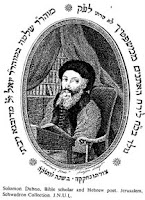
2. A striking difference between the first edition of the Encyclopaedia Judaica (henceforth: EJ) and the second edition of the Encyclopaedia Judaica (henceforth: NEJ [= new Encyclopaedia Judaica]) is the almost complete lack of visual images in NEJ. Whereas EJ contained some 8000 photographs and portraits (judiciously selected from a larger pool of 25,000), NEJ has only 8 pages of photographs in the center of each volume. Thus, for example, the entry on Solomon Dubno (d. 1813) in EJ is accompanied by a striking portrait of him [reproduced below]. The portrait is lacking in NEJ. Similarly, the entry on Vilna in EJ is accompanied by some 9 photographs that make the city come to life; none appear in the NEJ entry on Vilna. The almost complete lack of visual images in NEJ is a fatal flaw that renders it the least attractive (and arguably, the least informative, for often pictures inform even more than words) of all the Jewish encyclopedias listed above in paragraph 1.
3. One of the key selling points of NEJ is that it updates – and allegedly supersedes – the 1972 edition of EJ. In the general introduction to NEJ, we are informed that more than 2,650 new entries were incorporated into NEJ, and that over half of the original entries (in EJ) were revised and updated for NEJ. Indeed, it is a delight to see entries in NEJ for Dina Abramowicz, Zvi Ankori, Gerson Cohen, Lucy Dawidovich, Marvin Fox, Ismar Schorsch, Yosef Yerushalmi and the like – none of whom were accorded entries in EJ. But upon inspection, it turns out that many key entries that needed to be revised and updated were neither revised nor updated. And regarding the new entries, there are serious errors of commission and omission.

Samples of entries that should have been updated, but were not, include:

a) Abraham b. Elijah of Vilna (d. 1808). NEJ reprints EJ, apparently unaware that some 130 printed pages of Abraham b. Elijah of Vilna’s writings on Bible, Talmud, Midrash, and Jewish bibliography were published for the first time, from manuscripts, in 1998 (see Yeshurun 4[1998], pp. 123-254). EJ and NEJ list Abraham b. Elijah of Vilna’s date of birth as 1750. Recent historical studies indicate otherwise and suggest he was born in 1766 (see, e.g., Yeshurun 14 [2004], pp. 982-996). These and other post-1972 studies on Abraham b. Elijah of Vilna surely merited mention in a revised and updated entry. In this instance, NEJ does not reflect the present state of modern scholarship.

b) Adam Ba’al Shem. NEJ reprints the EJ entry by Gershom Scholem, who – in one of the most controversial passages he ever wrote – identified the writings of the Sabbatean prophet Heshel Zoref (d. 1700) with the writings ascribed by Hasidic lore to the legendary Adam Ba’al Shem. The latter’s writings, according to Hasidic legend, formed the basis for the uniquely Hasidic teachings of R. Israel Ba’al Shem Tov. Scholars were quick to challenge Scholem’s identification during his lifetime and after his death. None are cited in the NEJ entry. An entire literature has grown around this particular issue. Much (but not all) of the relevant bibliography appeared in Y. Liebes, ed., גרשם שלום: מחקרי שבתאות, Tel Aviv, 1991, pp. 597-599. None of this appears in the NEJ entry. Once again, NEJ does not reflect the present state of modern scholarship.

c) Chajes, Zevi Hirsch (d. 1855). NEJ reprints the EJ entry. In the intervening years, numerous studies and two major books were published on Chajes, none of which is mentioned in NEJ. Here it will suffice to mention the titles of the two books:

Bruria Hutner David, The Dual Role of Rabbi Zvi Hirsch Chajes: Traditionalist and Maskil, Columbia University Ph.D., University Microfilms, 1971.

Mayer Herskovicz, רבי צבי הירש חיות, Jerusalem, 1972 (reissued: Jerusalem, 2007).

Here too, NEJ does not reflect the present state of modern scholarship.

d) Kalmanovitch, Zelig (d. 1944). NEJ reprints the entry in EJ. The diary (mostly in Yiddish and partly in Hebrew) of this Yiddish scholar — and victim of the Holocaust – is one of the most poignant of the Holocaust diaries. In 1977, Kalmanovitch’s son, Shalom Luria, publish an annotated Hebrew translation of the diary, together with a 50 page introduction that reveals much about Kalmanovitch that was not previously known. See Z. Kalmanovitch, יומן בגיטו וילנה, Tel Aviv, 1977, pp. 9-59. A sizeable and significant fragment of the diary, entirely in Hebrew, was discovered in the Lithuanian Central Archive in Vilna, and published in 1997. See Yivo Bleter 3(1997), pp. 43-113. None of this information appears in the NEJ entry. Regarding the Kalmanovitch entry, then, NEJ does not reflect the present state of modern scholarship.

e) Luria, David b. Judah (d. 1855). NEJ reprints the entry in EJ. No mention is made in either EJ or NEJ that a portrait of Luria is extant (in Vilna) and has been frequently published. See, e.g., Yahadut Lita,Tel Aviv, 1967, vol. 3, p. 62. More importantly, some 230 printed pages of Luria’s hiddushim on Bible, Mishnah, the Jerusalem Talmud, and Midrash Mishle, as well as responsa, were published for the first time, from manuscripts, in 1998-9. See Yeshurun 4(1998), pp. 489-647 and 6(1999), pp. 285-359. NEJ does not reflect the present state of modern scholarship regarding this entry as well.


4. Sins of commission are inevitable in any encyclopedia. The name of the game is to keep them at a minimum, and it is largely the responsibility of the editors to check and recheck possible misspellings, mistaken dates and facts, discrepancies, imaginary references, exaggerated claims, and the like. NEJ is not lacking in sins of commission in all of the above categories. One amusing instance will have to suffice for our purposes.

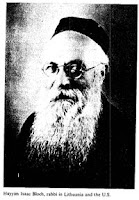
NEJ contains two entries of interest that appear several pages apart in volume 3. The first entry is entitled: Bloch, Chaim Isaac. The second entry is entitled: Bloch, Hayyim Isaac ben Hanokh Zundel Ha-Kohen. Innocent readers will assume, as they have every right to assume, that these represent two different persons. Alas, they are one and the same person. The first entry is a new one, designed especially for NEJ. The second entry is the old one, reprinted from EJ (minus the handsome photograph [reproduced below] that accompanied the original EJ entry). There are some interesting differences between the two entries. In the first entry, the reader is informed that Rabbi Bloch was born in 1867. Several pages later, however, Rabbi Bloch aged some 3 years, as we are informed that he was born in 1864. In the first entry, we are told mostly about essays he contributed to a variety of Torah journals – though mention is made of the fact that he published books as well. None of their titles are listed. In the second entry, not a word is said about his contribution to Torah journals. Instead, the titles of all his published works are listed. In the bibliographies appended to the two entries, each lists an item not in the other. The primary blame here hardly rests with the authors of the entries; presumably, they performed their assigned tasks as best they knew how. It is the sloppiness of the editors that allowed for the publication of two (sometimes contradictory) entries for one and the same person. Given the premium placed on space in any encyclopedia, this is a sin of no small import.
5. Sins of omission are inevitable in any encyclopedia. As the editors indicate in the general introduction to NEJ: “An obvious problem in the compilation of any encyclopedia is the decision as to which entries are to be included and which excluded …there is always a body of “borderline” entries which potentially could fall in either category. This problem becomes particularly sensitive when dealing with biographies of contemporaries. Which scholars receive entries and which do not? Where is the line to be drawn for rabbis or businessmen or lawyers or scientists? In some subjects, it was possible to fix objective criteria. For example when it came to U.S. Jewish communities, it was decided to include only those numbering more than 4,500.”

One can only sympathize with the impossible task before the editors. It was a no-win situation for them; whatever their decision, they would surely be open to criticism. If nonetheless I join the chorus of critics, it is not because of “borderline” entries. My own sense is that serious sins of omission occurred throughout NEJ, and in a broad range of categories. I shall attempt to illustrate this by selecting at random 5 categories of Jewish life that were of sufficient interest to me that I was even willing to leaf through the pages of NEJ in order to see how they were treated. I am well aware that others may consider unimportant what I consider important. What follows is no more than the personal opinion of one observer. The names listed below have no independent entry in NEJ and, at best, are mentioned in passing in other, often thematic entries.

a) Women. In the publicity relating to NEJ, it was stated openly that in earlier encyclopedias, including EJ, Jewish women were marginalized. They accounted for no more than 1.25% of the entries in EJ. This was a matter that would be rectified in NEJ. I do not know whether, in fact, this has been rectified in NEJ. But here are some omissions that seem striking to me.


1. Adele Berlin. A noted Bible scholar in the Department of Hebrew and East Asian Languages at the University of Maryland, her published books include:

Biblical Poetry Through Medieval Jewish Eyes; Dynamics of Biblical Parallelism; Poetics and Interpretation of Biblical Narrative; JPS Bible Commentary: Esther; Lamentations: A Commentary; Zephaniah: A New Translation with Introduction and Commentary; and more.

2. Esther Rubinstein (1883-1924). An early advocate of religious Zionism, she was a leading Hebraist, Zionist, educator, and social activist in Vilna. Her learned essays on women’s suffrage paved the way for a change in rabbinic attitudes toward this issue. She founded the first religious day school for Jewish women in Lithuania. See the entry in אנציקלופדיה של הציונות הדתית, Jerusalem, 1983, vol. 5, columns 582-585.

3. Rivka Schatz-Uffenheimer (d. 1992) served as Edmonton Professor of Jewish Mysticism at the Hebrew University. Her many books on Kabbalah and Hasidut (e.g., Hasidism as Mysticism; The Thought of R. Moshe Hayyim Luzzatto [Hebrew]; The Messianic Idea from the Spanish Exile On [Hebrew]; R. Dov Baer of Mezhirech’s Maggid Devarav Le-Yaakov: An Annotated Edition [Hebrew] ) are landmarks in the history of Jewish mysticism.

4. Sara Schenierer (1883-1935), educator and author, founded the first Beth Jacob school in Cracow in 1917. In 1923, she founded the first Beth Jacob teacher’s seminary, also in Cracow. By 1927, there were 87 Beth Jacob schools, with over 10,900 students, in Poland alone. The movement spread throughout Europe, and ultimately to the United States and Israel, where it continues to thrive – with well over 50,000 students – to this very day. She also spearheaded a Jewish youth movement for young girls in Poland, wrote children’s literature and plays. Her collected writings were published in 4 volumes in Hebrew in Tel Aviv, 1955-60.

b) Rabbis.


1. R. Shneur Kotler (1918-1982) succeeded his father, R. Aharon Kotler, as Rosh Yeshiva of the Lakewood Yeshiva. He served in that capacity from 1962 until his death. Under his watch, the Lakewood Yeshiva grew from a student body of 200 students to a student body of over 1000 students. He established a system of Kollels throughout the larger Jewish communities in the United States. He was active in Agudat Israel, Chinuch Atzma’i, Torah U-Mesorah and other educational organizations. It was largely due to his leadership that the Lakewood yeshiva and its affiliate institutions number today well over 4000 students.

2. R. Eleazar Menachem Shach (1898-2001) was Rosh Yeshiva of the Ponevezh Yeshiva in Bnei Brak. From 1970 until his death, he was generally recognized by the Yeshiva world and by much of the Haredi world as the Gadol Ha-Dor. He was an occasional supporter of the Shas party, and was the founder of the Degel ha-Torah party. As such, he wielded enormous power in Israeli politics and the world over. He was the author of a monumental commentary on Maimonides’ Code, entitled Avi Ezri.

3. R. Yosef Shalom Elyashiv (b. 1910) succeeded Rabbi Shach as Gadol Ha-Dor. He is, arguably, the single, most powerful figure in the Yeshiva world and in much of the Haredi world. An expert in Jewish law, he has published some 26 volumes of hiddushim on the Talmud and Shulhan Arukh, as well as collections of responsa.

c) Academic Scholars. Two of the women listed above, Adele Berlin and Rivka Schatz-Uffenheimer, could just as easily have been listed under this rubric, with absolutely no bending of the rules. They were listed above only because of the claim that a special effort was made to include as many women as possible in the new entries for NEJ. Despite the claim, they were not accorded entries in NEJ.

1. Gerald Blidstein holds the Miriam Martha Hubert Chair in Jewish Law at Ben-Gurion University. His publications are simply too numerous to be listed here. Suffice to say that he was awarded the Israel Prize in Jewish Thought in 2006.

2. Menachem Cohen, Professor of Bible at Bar-Ilan University, is the head of the Mikra’ot Gedolot Ha-Keter Project – a project that is preparing for publication the Aleppo Codex and its Masorah, the Aramaic Targums, and critical editions of medieval Jewish commentaries on the Bible. Some 10 volumes have already appeared in print under his aegis. They represent the finest edition of Mikra’ot Gedolot ever produced.

3. Yehuda Liebes holds the Gershom Scholem Chair in Kabbalah at the Hebrew University. His many publications include: Studies in the Zohar; Studies in Jewish Myth and Jewish Messianism; and Elisha’s Sin (Hebrew). His annotated versions of Scholem’s studies are indispensable for scholarly research.

4. Haym Soloveitchik, University Professor at Yeshiva University, taught for many years at the Bernard Revel Graduate School of Yeshiva University. His published books include: Halakhah, Economics, and Communal Self Image (Hebrew); Pawnbroking in the Middle Ages (Hebrew); Wine of Non-Jews (Hebrew); Responsa as Historical Sources (Hebrew). Some of his shorter essays (e.g.“Three Themes in Sefer Hasidim”; “Rupture and Reconstruction”) have stimulated more discussion than books by others on the same topics. He was a recipient of the prestigious National Foundation for Jewish Culture Jewish Cultural Achievement Award in Jewish scholarship.

5. Yaakov Sussman is a world class Talmudic scholar who was awarded the Israel Prize for Talmudic Research in 1997. His many publications on the manuscripts, editions, and the history of the publication of the Mishnah, the Jerusalem Talmud, and the Babylonian Talmud; his edition of the “Miqsat Ma’aseh Torah” fragments of the Dead Sea Scrolls; and his edition of the Rechov inscription are the point of departure for all scholarly discussion of those topics.


d) Jewish Communities. As noted above, NEJ allows for an entry on any Jewish community in the United States with 4,500 Jewish residents or more. Thus, e.g., there is an entry on Wilkes-Barre, Pennsylvania which, perhaps, once had that many Jewish residents. According to the entry in NEJ, there were only 3000 Jewish residents in Wilkes-Barre in 2005. It is therefore somewhat surprising that there are no separate entries in NEJ on:

1. Monsey, N.Y.

2. Teaneck, N.J.

3. Far Rockaway, N.Y.

4. Lawrence, N.Y.

5. Cedarhurst, N.Y.

6. Woodmere, N.Y.

7. Kew Gardens Hills, N.Y.

I do not know the exact Jewish population of any of the towns listed above, but I suspect that each has at least 3000, and in all likelihood more than 4500, Jewish residents. In all fairness, NEJ presents a somewhat detailed discussion of Monsey and Teaneck under other rubrics (Rockland County and Bergen County). But I could not locate any discussion of Far Rockaway, the Five Towns, or Kew Gardens Hills. Each of these communities has a rich history, with many
synagogues, schools, and often institutions of national and international repute. They surely merit entries in NEJ.

6. The previous paragraph presents a rather long list of sins of omission relating to women, rabbis, academic scholars, and Jewish communities. One could easily add more names to each of the categories; and certainly so if yet other categories are examined. Doubtless, some will argue that there is simply no room in a 22-volume encyclopedia for so many “borderline” entries. In order to counter such an argument, I will list here four entries – exactly as they appear on the printed page – that found their way into NEJ.

1. Calwer, Richard (1868-1927). German socialist, economist, and politician. He belonged to the reformist wing inspired by Ferdinand Lasalle within the German Social Democratic Party (SPD). Calwer harbored a strong anti-Jewish bias. In a brochure published in 1894, he attacked the SPD’s radical wing as having been “incited by a few Jews who make slander their business,” and deplored that such “specific” Jewish characteristics as “zealousness, contentiousness, and commercial craftiness” had found their way into the party press and literature. He also criticized the SPD for combating anti-Semitism to the extent of creating the impression that Social Democracy had been “Judaized” (verjudet). Calwer left the SPD in 1909. He was a pioneer in Western socialist non-Marxian economics, which he taught until his suicide in Berlin.

2. Cohen, Philip Melvin (1808-1879), pharmacist and civic leader in Charleston, South Carolina. Cohen, born in Charleston, was the son of Philip Cohen, lieutenant in the War of 1812. During the Second Seminole War Cohen served as surgeon to a detachment of troops in Charleston Harbor (1836). In 1838 he became city apothecary. He was a member of the city board of health (1843-49). Cohen was a director of the Bank of the State of South Carolina (1849-55). He was one of the citizens who served as honorary guard at the funeral of John C. Calhoun in 1850.

3. Nagin, Harry S. (1890- ), U.S. civil engineer. Born in Romny, Russia, Nagin went to the U.S. in 1906. From 1924 he was executive vice president of a large steel products company in Pennsylvania. He took out over a hundred patents on steel structures, bridge floors, gratings, concrete, and plastics.

4. Abrams, “Cal” (Calvin Ross; 1924-1997), U.S. baseball player, lifetime .269 hitter over eight seasons, with 433 hits, 32 home runs, 257 runs, and 138 RBIS. Born in Philadelphia to Russian immigrant parents, he moved with his family to Brooklyn when he was a child. Having grown up in Brooklyn in the shadow of Ebbets field, Abrams fulfilled a life-long dream when he signed with the Brooklyn Dodgers after graduating from James Madison High School. But after two weeks in the minor leagues he was drafted into the army., where he served four years. Abrams spent three years in the minor leagues, winning the Southern Association championship with Mobile in 1947 while hitting .336. Abrams, who batted and threw left-handed, played for the Brooklyn Dodgers (1949-52), Cincinnati Reds (1952), Pittsburgh Pirates (1953-4), Baltimore Orioles (1954-55), and Chicago White Sox (1956), and had a perfect fielding percentage in three different seasons, 1950, 1952, and 1956. Abrams is best remembered for one of the most famous plays in Dodger franchise history. In the final game of the 1950 season, with the Dodgers one game behind the Philadelphia Phillies in the pennant race, Abrams tried to score from second with two out in the bottom of the ninth of a 1-1 game on a hit by Duke Snider, but Abrams, who had been waved home by third base coach Milt Stock, was thrown out by the Phillies’ Richie Ashburn. Had Cal scored, the Dodgers would have won the game and forced a playoff with the Phillies for the pennant. Dick Sisler hit a three-run home run in the top of the tenth to win the game – and the pennant – for Philadelphia. It was the closest Abrams ever got to the post-season. Dodgers fans vilified Abrams for years but he was defended by both Ashburn and Phillies pitcher Robin Roberts for the play, who agreed with many others who said that Abrams should not have been sent home by Stock.

————————–

Far be it from me to deny Richard Calwer (a non-Jew), Philip Melvin Cohen, Harry S. Nagin , and Cal Abrams – not exactly household names – their rightful place in Jewish history. But at the expense of Professor Haym Soloveitchik? NEJ inherited the Calwer and Cohen entries from EJ. But the Nagin and Abrams entries are original with NEJ. In the case of Abrams, whose baseball career ended in 1956, this is somewhat surprising, for he obviously didn’t make the cut with EJ in 1972 (in contrast to Hank Greenberg and Sandy Koufax). Now I am well aware that Rav Shach could not hit major league pitching to save his life, and that his lifetime batting average would have paled in significance to Cal Abrams .269 lifetime batting average. But, really, does Cal Abrams take precedence over Rav Shach in a Jewish encyclopedia?


7. In sum, the returns are hardly in. Not for nothing did we label these comments “preliminary observations.” Much more needs to be investigated before one can judge how well NEJ has captured the totality of past Jewish life, and the pulse of present Jewish life, as reflected in the 2007 edition. But until all the returns are in, hold on to your 1972 edition of EJ for dear life! It is not at all clear that NEJ has superseded, or that it will ever supersede, EJ. All public libraries and private collectors will do well to retain their 1972 editions of EJ and keep them precisely on the same shelves they have now occupied for some 35 years.


Second Annual Dr. Asher Siev Memorial Lecture at YU

The Second Annual Dr. Asher Siev Memorial Lecture will be delivered by
A Non-Orthodox Traditional Approach:
Reflections on the Authority
of the Moroccan Rabbinate
Dr. Marc B. Shapiro (University of Scranton)

Tuesday, March 20th 8:00 PM
Rubin Shul – Yeshiva University Wilf Campus
Refreshments will be served

Sponsored by the Torah u-Madda Lecture Series,
Center for Jewish Future

For more information, please contact mbutler@yu.edu

Dr. Marc B. Shapiro is the Harry and Jeannette Weinberg Chair in Judaic Studies and director of the Weinberg Judaic Studies Institute at the University of Scranton and author of “Between the Yeshiva World and Modern Orthodoxy: The Life and Works of Rabbi Jehiel Jacob Weinberg, 1884-1966” (Littman, 1999), “The Limits of Orthodox Theology: Maimonides’ Thirteen Principles Reappraised” (Littman, 2004) and “Saul Lieberman and the Orthodox” (University of Scranton, 2006).


To Adolf, from Cecil

To Adolf, from Cecil

by Menachem Butler

During a Sunday afternoon trip to Biegeleisen in Boro Park, I came across 650-page collection of rare letters from the personal collection of R. David Solomon Sassoon (of Jerusalem, Israel) that has just been published in Israel,[1] I hope to discuss this new publication in some detail in the following weeks, however, I did want to first make mention of the 1941 biography of the Sassoon family, written by British scholar and Oxford-trained historian Prof. Cecil Roth.

In the short official obituary for Dr. Cecil Roth in the London Jewish Chronicle following his passing in Jerusalem in June 1970, there is a short and peculiar reference to Roth’s study of the famed Sassoon merchant family. The brief mention within the obituary refers not to the contents of his “comprehensive history” of the renown Bombay-born and London-based Jewish family, [2] where he dispels the notion that the Sassoon family were simply to be considered “the Rothschilds of the East,”[3] but rather to his unfathomable inscription of the work to Adolf Hitler.[4]

The following is Cecil Roth’s inscription to The Sassoon Family:[5]


To Adolf Hitler
Fuehrer of the German Reich

For two reasons I desire to inscribe your name at the beginning of this book. The first is, that I consider its topic to be a useful object-lesson to the unfortunate people whom you have misled into thinking themselves a pure and superior “race” (whatever that may mean). The most rudimentary political commonsense should make it obvious that the absorption of gifted foreign families cannot be other than an advantage for a civilized state. England and English life have in particular been enriched for centuries past by receiving fresh elements from other sources, and there can surely be no reason to regret a liberality that has endowed her with soldiers, philanthropists and poets such as the Sassoon family and many life it have produced. Germany under you guidance has deliberately set herself on the path not merely of self-destruction (which while her present temper lasts would be a peculiar book to humanity at large) but of self-dementation.

In the second place, I am happy to have this opportunity to express once again, as publicly as I may, my profound execration and abhorrence, not merely as a Jew and an Englishman but as a human being, of you, your ideals, your ideas, your methods and all that you stand for. Should God punish the sins of the world by allowing you a momentary victory, I trust that this declaration will bring upon me the honour of the most drastic attention of your nauseous tools, for life in such circumstances would not be worth the having.

Cecil Roth

Sources:
[1] Nahalat Avot: Teshuvot, Michtavim, Tefillot, Minhagim (Yad Samuel Franco, 2007); published on the occasion of Chanah Sassoon’s recent wedding to R. Yehuda Michel Nissel.
[2] In 1968, a later work on the Sassoon family [Stanley Jackson, The Sassoons (London, 1968)] appeared and “superseded” the earlier work by Roth, as the author of this later work “had a clear advantage” as he had access to the personal papers of many Sassoon family members. See London Jewish Chronicle (May 3, 1968), 25. Notwithstanding this criticism, it was already noted in a 1941 review of Roth’s book that he had “not been granted access to ‘family’ records… [and] gathered a vast amount of authentic information, including many delightful stories, that has enabled him to present a comprehensive history of the Sassoon clan with his customary literary skill and thoroughness.” See London Jewish Chronicle(May 30, 1941), 22.
[3] For early uses of this phrase, see, for example, London Jewish Chronicle (April 19, 1907), 21; ibid, (March 22, 1912), 16.
[4] “Obituary: Dr. Cecil Roth,” London Jewish Chronicle (June 26, 1970), 38.
[5] The dedication appears in Cecil Roth, The Sassoon Family (London, 1941) and I thank Joshua Lovinger for kindly directing me towards this fascinating and little-known source.


“Research Refutes Thesis of Unified Diaspora in Ancient Jewry”

Hagahot notes the appearance of a new study by two Tel Aviv University scholars, Arye Edrei and Doron Mendels, “A Split Jewish Diaspora: Its Dramatic Consequences,” Journal for the Study of the Pseudepigrapha 16:2 (2007): 91-137, wherein the authors demonstrate

that the Jewish diaspora in Europe basically disappeared after the destruction of the Second Temple. Probably, they felt cut off from the spiritual center in Jerusalem, and eventually melded into their host culture.

This is very significant for medieval Jewish history, especially those interested in the roots of Ashkenazic halakhah. The Jewish settlement along the Rhine identified itself as being rooted in Northern Italy, and when it first surfaces in literary form, the Ashkenazic halakhah is already a hoary tradition. On the other hand, while we have extensive epigraphical remains from the Jews of Roman Italy, they don’t reflect what we know about rabbinic Judaism. So this theory suggests that there was a break between Roman Italy and early medieval Italy, with the later Jewish population coming from a totally different, more rabbinic culture.

For those interested, the abstract of this article reads:

This article proposes that a language divide and two systems of communication have brought to a serious gap between the western Jewish Diaspora and the eastern one. Thus the western Greek-speaking Jews lost touch with the Halakhah and the Rabbis, a condition that had far-reaching consequences on Jewish history thereafter. The Rabbis paid a high price for keeping their Halakhah in oral form, losing in consequence half of their constituency. An oral law did not develop in the western diaspora, whereas the existing eastern one was not translated into Greek. Hence it is not surprising that western Jews contributed nothing to the development of the oral law in the east. The Jewish communities that were isolated from the Rabbinic network served as a receptive basis for the development of an alternative Christian network by Paul and the apostles, which enabled it to spread throughout the Mediterranean basin. The Jews that remained ‘biblical’ surfaced in Europe in the Middle Ages.


Review: Jay Berkovitz’s”Rites and Passages: The Making of Jewish Culture in Modern France” (Hebrew)

Merkaz Zalman Shazar has published Jay Berkovitz’s book מסורת ומהפיכה-תרבות יהודית בצרפת בראשית העת החדשה discussing French Jewry and specifically the changes and challenges of modernity. This book is an expanded version of the English Rites and Passages: The Beginnings of Modern Jewish Culture in France, 1650-1860 (UPenn Press) which is available at the previous link and here. Both versions are invaluable for viewing French Jewry and France gernally, a county typically neglected in milieu of Jewish history which tends to focus on Central or Eastern Europe. But, as France experienced emancipation in the late 18th century it is important to see how French Jews dealt with their new found freedom. As Berkovitz correctly points out to understand the impact of emancipation, one needs to examine the history beforehand as well – thus he begins in the 17th century.

Additionally, this book is important in some of the persons it discusses. For instance, there is an extensive discussion of R. Aaron Worms the author of the Me’ori Or. The Me’ori Or – a seven volume work which some may be familiar due to his suggestion that one should recite the blessings of “thank God for not making me a woman or a non-Jew” silently. (See Tradition 29:4 and the articles by Joel B. Wolowelsky and Emanuel Feldman and Shu”t Beni Banim 4:1).

While this is perhaps his most well known opinion, this work contains a treasure trove of information. As is evident from R. Yosef Zechariah Stern, a rather erudite person in his own respect, who cites the Me’ori Or extensively. As one can tell from R. Aaron Worm’s opinion for the blessings, he was a sort of iconoclast. While there have been a handful of articles discussing R. Aaron, this book now places him in his full historical context. Berkovitz fleshes out how R. Aaron fits with French change generally and further develops the thought and impact of R. Aaron. Aside from his Me’ori Or, R. Aaron was also part of the Sanhedrin which Napoleon convened, and Berkovitz includes R. Aaron’s address to that body. And while Rabbi David Sintzheim is perhaps the most well known, Berkovitz discusses the (important) impact R. Aaron had on this body. This impact is not limited to the Sanhedrin, but a deeper understanding of what R. Aaron was advocating places him in the forefront of modernity.

All in all, Berkovitz’s book is a worthwhile contribution to understanding modernity and some of the methods that prior generations have adopted in dealing with its challenges.


Tussle Over Horowitz’s Book

As I mentioned before, Elliott Horowitz wrote an excellent book on Purim and its connection with violence. But, as some are wont to do, instead of reading a book objectively they come into a book with all sorts of preconceived notions. This was typified by Hillel Halkin’s review of Horowitz’s book. In the June 2006 issue of Commentary Magazine, Halkin reviewed Horowitz’s book. I did not bother to mention this, solely because it was painfully obvious Halkin did not read the first half of the book, or chose to ignore it (as Horowitz points out in his response), and that Halkin was only interested in finding fault. Halkin takes issue with the very notion that Jews could be violent and thus can not believe (or address) most of Horwitz’s points. In fact, much of Horowitz’s thesis had already been published years ago in his articles on the topics. (Perhaps Halkin doesn’t read academic journals? Although he feels it fine to review an academic work).

Well in the October 2006 issue of Commentary Magazine, Elliott Horowitz responses as does Halkin. Halkin’s response, however, is so juvenile and void of content, he does more to undermine his position than anything Horowitz could have done. Halkin to buttress his position resorts to name calling and a general ad hominem attack. So, for example, Halkin starts by noting

As I stated in my review, Elliot Horowitz wrote an interesting but not entirely honest book. How he has written an uninteresting and thoroughly dishonest letter.

Setting aside Halkin’s vitriolics, Horowitz, as he is wont to do, uses the terrific image of the Godfather movies to prove his point. He notes that there is a distinction between the Godfather and Bonnie and Clyde, one which just has violence and the other which explores it. Horowitz, thus illuminates his purpose of exploring the sources and theological underpinnings of his thesis. [Now, there are not that many Jewish academics who cite to movies (or as he does in another of his articles compares the imagery in a haggadah to Bugs Bunny) so this somewhat is refreshing.] Halkin, of course, fails to note this (apparently he is not one for subtleties) and instead turns the movie quote into a childish retort of

If Horowitz wanted to write a Jewish version of The Godfather . . . he should have done a movie script.

Additionally, Halkin fails to address most of Horowitz’s most salient points. So, Halkin still ignores the entire first half of Howowitz’s book and fails to explain the rampent use of the term Amalek to this day. It is disappointing that Commentary publishes such drivel, but does demonstrate that one should not judge a book by its cover nor a review (or reviewer) by its inclusion in Commentary.

You can read the full exchange here for yourself until the end of October 2006.


Moshe Samet and Manuscripts vs. Books

Manuscriptboy has two very nice posts today. One discusses a new book and various talks connected to the book. The book is a collection of articles by Moshe Samet. Moshe Samet has written some of the best pieces most notably on the Besamim Rosh, the teshuvot that were atributed to R. Asher b. Yehiel (Rosh) but are most likely a forgery and the product of the publisher, R. Saul Berlin. Samet has also written on the R. Moshe Sofer (Hatam Sofer) and more generally on the clash between the Reform movement and the Orthodox movement.

The second post discusses the conference held in honor of Benjamin Richler, the head of the manuscript department at the Jewish National University Library at Hebrew University. There was, what appears to have been, a facinating talk on the “evils” or more correctly the effect of printing on the preservation of manuscripts.


Book on Yeshivot

Shaul Stampfer has republished a revised and expanded edition of his HaYeshiva haLita’ot b’Hitavato. The book which is devoted to three yeshivot, Volozhin, Slobodka, and Telz, as well as the Kovno kollel. The book tracks the Volozhin yeshiva from its inception to its closure and the Slobodka and Telz yeshivot until the turn of the twenteenth century.

This book was originally Stampfer’s dissertation, Shlosh Yeshivot Litayot b’Meah haTisha Asarah (1981) and was published in book format in 1995. This edition includes numerous updates as well as much new information, especially regarding the closure of Volozhin. Stampfer now argues, based upon new Russian governmental documents, which he includes Hebrew translation of, that the Yeshiva was closed due to the its own internal upheaval. This internal strife was caused by R. Naftali Tzvi Yehuda Berlin (Netziv) attempting to install his son as Rosh haYeshiva. At Telz a similar fight broke out also regarding succession, as well as in Volozhin itself, on two separate occasion. However, the last fight caused such a rapid decline in the internal going ons of the Yeshiva, the government had it shut. The closure did not have to do with the haskala, the Russian government wanting to meddle into Jewish education or any of the other reasons offered. Instead, as has been borne out throughout Jewish history, the Jews brought it upon themselves. For example, the burning of the Talmud in France after the controversy regarding Rambam’s writings as well as the banning of the Talmud in the 16th century were caused or at least the catalyst was internal fighting amongst the Jews.

The book also debunks other theories regarding the opening of Volozhin. Some claim the R. Hayyim Volozhin ask R. Eliyahu of Vilna (Gra) and received his blessing to open the what was the first Yeshiva. Stampfer, however, questions this and notes that in the initial Kol Koreh R. Hayyim Volozhin makes no mention of this, something that would have bolstered his fundraising efforts. Second, Stampfer also proves that the opening of Volozhin was not in response to the Hassidic movement.

Aside from the above, the book is full of first hand accounts of the Yeshivot. These include, Volozhin started praying in the morning at 9 am and the prayers only ran 15-20 minutes. Stampfer qualifies this by noting haNetz haHama in Vilna (just north west of Volozhin) during the winter is 9:17 and also notes the 15-20 minutes is probably slightly exaggerated. Telz yeshiva was the first to institute grade levels in a yeshiva. Also, according to Simcha Assaf’s account, R. Lazer Gorden encouraged him to learn Russian and had his son teach Assaf in his own home. Stampfer includes much about the influence of Zionism and the haskalah on the yeshivot. All you ever wanted to know about all the infighting in the Yeshivot. The first to move to establish a kollel was R. Yitzhak Ya’akov Reines, who was highly controversial with the establishment of his yeshiva in Lida – arguably a precursor to Yeshiva University. These are only a tiny portion of the terrrific nuggets that can be found in this book.

I purchased this book at Beigeleisen in Boro Park (718-436-1165)