Translating the Aruch HaShulchan with AI: Method and Lessons
Translating the Aruch HaShulchan with AI: Method and Lessons[1]
Joshua Broyde (PhD)
Joshua Broyde is an AI/ML Healthcare & Life Sciences specialist at Google Cloud, where he works from strategy to implementation with enterprise medtech, healthcare, and biopharma companies to design, build, and deploy secure, production-grade AI and Generative AI systems. He has a PhD in the field of Computational Biology.
Abstract
I present a complete AI-written English translation of the Aruch HaShulchan — Rabbi Yechiel Michel Epstein’s comprehensive nineteenth-century code of Jewish law — covering all four sections of the Shulchan Aruch: Orach Chaim, Yoreh De’ah, Even HaEzer, and Choshen Mishpat. The translation was produced using Google’s Gemini 3 Flash model at its MINIMAL thinking level. Translation quality is consistently high for a first-pass working text, although it clearly sometimes makes mistakes. The full translation is freely available online at aruch-hashulchan-transla-53666.web.app, and the translation data and code are available at github.com/JoshB29/Texts_AI_Translations.
Introduction
The Aruch HaShulchan, by Rabbi Yechiel Michel Epstein (1829-1908) of Novardok, is one of the most authoritative and comprehensive codes of Jewish law in the modern era. Written in rabbinic Hebrew, it has remained largely inaccessible to English readers outside of a handful of translated sections.[2]
AI-driven translation represents a qualitative shift in what is possible for rabbinic literature. This does not fully replace careful human translation, but it creates an opportunity to scale massively: human scholars can now function primarily as editors, reviewing and refining AI-generated drafts rather than translating from scratch. A multi-year scholarly translation project can now be approximated in hours for a few dozen dollars.
Corpus
The Aruch HaShulchan comprises four sections (i.e. chelakim) corresponding to the four parts of the Shulchan Aruch: Orach Chaim, Yoreh De’ah, Even HaEzer and Choshen Mishpat. I first obtained the Hebrew source text from Sefaria[3]. In total, this corresponds to 1,507 Simanim (chapters) and comprises 24,161 seifim (subsections) and around 3,400,000 words.
Translation Method
Model and Thinking Level
I used Google’s Gemini 3 Flash (gemini-3-flash-preview) to create the translation[4]. Gemini Flash supports four “thinking levels” — MINIMAL, LOW, MEDIUM, HIGH — which trade computation budget against reasoning depth. I chose to use the MINIMAL setting, which created a good translation at a very low cost.
Each seif was passed as an isolated API call[5] with a fixed system prompt containing[6]:
A style guide specifying conventions for rabbinic titles (e.g., Rambam, Rema, Beit Yosef), standard formulaic phrases (e.g., עד כאן לשונו → “Thus far his words”), and transliteration conventions (siman, seif, seif katan).
Few-shot examples illustrating the original text and style of translation.
An instruction to preserve the paragraph and logical structure of the original.
In order to make the translations more consistent with each other, I applied a post-processing normalization to all translated seifim after translation was complete.
Choosing the Model Thinking Level to Use
In order to understand which model thinking level is best for rabbinic translations, I chose 5 randomly selected seifim from each chelek, and had Gemini Flash translate them at the different thinking levels. Below are the results:
I found the MINIMAL setting to produce translations of roughly equivalent quality[7] compared to the higher thinking models. The additional expense of higher thinking did not seem to create significantly better translations. You can see from the graph that the cost for each seif at the HIGH thinking level is around 5 cents, about 33 times the MINIMAL thinking level[8]. This would represent a total cost of about $1300, as opposed to only $40 I spent using the MINIMAL setting[9]. Most of this cost is due to the significant amount of thinking tokens used by the high model. These results would also suggest that Gemini’s larger model, Gemini-Pro, would be overkill for the project. However, I did not formally test Gemini Pro, or any other model family[10].
Post-Processing Results
One thing I noticed was inconsistency of the word *seif* and the names of certain rabbinic works. Specifically, *seif* was sometimes kept in transliteration and sometimes translated as “section.” To address this, I applied a post-processing step using regular expressions to standardize these renderings: *seif* was normalized to “section” and *seif katan* to “subsection.” I applied the same approach to certain rabbinic names — for example, the *Shach* was sometimes transliterated as “Shakh” — normalizing these to a single canonical spelling throughout the corpus. For future translations, this should be fixed with better prompting.
Despite the fact that each seif is translated separately, my overall impression is that the translations were reasonably good and consistent.
Translation Quality
To more systematically validate the translation quality, I selected 100 random seifim and had a separate model evaluate the translations[11]; specifically, I used OpenAI’s GPT-5.4 model with a low reasoning effort. Each of the 100 seifim was passed to the model together with its original Hebrew, and the model was asked to classify the translation into one of four categories: Good, StyleImprovementNeeded, Mistake, or EgregiousError.
The egregious error category was defined strictly: a translation qualifies as egregious if it fundamentally inverts or distorts the author’s meaning — even if the error itself is subtle. To illustrate this, the following example was included in the evaluation prompt:
Original Hebrew
OC 635:5:
ובוודאי אין זה רק זהירות בעלמא, דאיזה פסול יש בעשיית הגג קודם הדפנות? דאין זה דמיון לחוטט בגדיש, שאין על זה שם גג כלל. אבל הכא גג גמור הוא.
Hypothetical mistranslation:
And certainly this is not only a mere stringency, for what disqualification is there in making the roof before the walls? For this is not comparable to hollowing out a haystack, where it does not have the status of a roof at all. But here, it is a complete roof.
The Aruch HaShulchan is in fact saying the opposite – the Rema’s statement is only a mere stringency. The mistranslation — inserting the words “not only” — is superficially consistent with the Hebrew, but is inconsistent with the actual context of the text and completely inverts the intended meaning.[12]
I had ran the analysis 3 times, and took a majority vote to determine the classification of the seif. If there was a 3 way-tie, the most serious category was taken. Here are the results:
Classification
Percentage
Good
29%
StyleImprovementNeeded
54%
Mistake
17%
EgregiousError
0%
You can see that the GPT model thinks that the translations overall need to be improved in style, and found 17% of the translations had a mistake. Importantly though, there were no egregious errors found.
Most of the mistakes were mistranslations of specific words/phrases or incorrect abbreviation expansions; some of the mistakes are a bit humorous. Here are a few examples:
[עח”ד סק”ה שכתב דדווקא ברואה מ”ת אמרינן כן משום די”ל שמש עכרן אבל בשלא מחמש (sic) תשמיש …]
Translation: [see Chavot Daat subsection 5 who wrote that specifically regarding one who sees from the Torah…]
However, מ”ת means “due to sexual intercourse”. The model seems to have incorrectly expanded this to “מן התורה׳”, despite that making no sense in context.[13]
כל צרכי ציבור שאינם יכולים להשוות עצמן מפני שינוי דיעות יש להושיב כל הבע”ב הנותנים מס ויקבלו עליהם ברכה שכל אחד יאמר דעתו לש”ש וילכו אחר רוב דיעות
Translation: Regarding all communal needs where they are unable to reach an agreement due to a difference of opinions, they should seat all the householders who pay tax and they shall accept upon themselves a blessing that each one will state his opinion for the sake of Heaven, and they shall follow the majority of opinions.
This is flagged as a mistake by GPT- “blessing” is not the right translation in this context; admonition or a similar word would be better.
Translation: And drinking a small amount of burnt wine – certainly stimulates.
“Burnt wine” is a clear mistake for distilled alcohol.
Here’s a few more examples that I found of clear mistakes or stylistic quirks:
In OC siman 475, seif 16, the abbreviation “עק”נ” is incorrectly rendered as “see Ketzot HaChoshen” — the correct translation should be “see Korban Netanel”.
In YD siman 19, seif 6, the word “poskekim” appears twice — a word that does not exist in Hebrew or in standard transliteration. It appears to be a model-generated corruption of poskim (the standard plural of posek, a halachic decisor). The model occasionally makes up this word a few times in its translation.
In EH, Siman 1 seif 2, האשה אינה מצווה על פריה ורביה is translated as “The woman is not commanded regarding pruz u-revu”. This should be “The woman is not commanded regarding pru-urevu” or even better would be “Women are not commanded in pru-urevu”.
CM 24:1 “רבותינו ז”ל אמרו [רפ”ה לב”ק] שאין נזקקין אלא לתובע תחלה “ “Our sages, of blessed memory, said [at the beginning of the eighth chapter of Bava Kamma]”. This should be “At the beginning of the fifth chapter”
My overall conclusion is that the translation overall avoided serious errors, but that it does occasionally mistranslate more complex words or phrases, and will sometimes incorrectly expand abbreviations. The model is also no Shakespeare in terms of prose, and is sometimes stylistically awkward. Still, it is mostly correct and I think it is a useful resource. Not bad for $40.73.
Conclusion and Lessons for Future Translations
Based on my experience on using AI to translate the Aruch HaShulchan, I offer the following recommendations for those undertaking similar large-scale AI translation projects in rabbinic or other specialized religious and legal literature.
Invest in the system prompt. The single highest-leverage action is writing a strong system prompt. The prompt should do two distinct things: (1) establish the content guidance — what the model is translating, from what tradition, at what level of expertise; and (2) establish stylistic guidance — how specific terms, titles, phrases, and citation styles should be rendered, consistently and unambiguously. The prompt I used included a style guide with explicit rules for rabbinic titles, standard formulaic phrases, and transliteration conventions.
Few-shot examples are highly effective. I found that including two or three worked examples in the prompt — a Hebrew passage followed by its correct English rendering — substantially improved consistency and register. The model learns from examples what it cannot fully internalize from rules alone, particularly for the tone and sentence structure expected in halachic prose. In the prompt I used, the few shots were not even entire seifim and were actually quasi-synthetic quotes; they were meant simply to show the style of source and target text.
Smaller, lightweight models are sufficient. There is no need to use the largest or most expensive models for this class of task. LLMs have essentially solved the problem of rabbinic Hebrew translation at the level of legal accuracy. Gemini 3 Flash at MINIMAL thinking — the smallest and cheapest configuration I tested — produced translations that were as good as those produced by higher thinking levels at 33 times the cost. The marginal quality improvement from more compute is real but small; the marginal cost increase is enormous.[14]
Prompt Iteration is essential. It took a few tries to get the model to translate in the way I wanted, and running the model on a few seifim, looking at the translation, and adjusting the prompt was very helpful. This was especially helpful for certain expressions I wanted translated consistently.
Context improves consistency, but potentially at significant cost. The primary weakness of this pipeline is that each seif is translated in complete isolation: the model has no memory of the spelling choices, transliteration decisions, or citation delimiter styles it used in prior seifim. Including previous seifim as context — either by passing the already-translated text of the current siman, or through a more dynamic agent-based RAG system — would improve within-siman consistency meaningfully. However, because halachic terminology and cross-references can reach back not just to the previous seif but to earlier simanim and even different sections of the work, the amount of context needed to capture these dependencies could quickly become expensive. For a first-pass translation, I found the isolated-call approach worked remarkably well. For a definitive scholarly edition, context-aware translation is the clear next step.
Conclusion
Translating the complete Aruch HaShulchan — approximately 24,000 seifim across four major sections — is technically feasible, inexpensive ($40.73), and fast (taking a few days on my personal Mac) using current AI technology. The resulting translation is of high quality for a working text, albeit with clear and addressable weaknesses that can be addressed in future iterations of the translation. The full translation is freely available at aruch-hashulchan-transla-53666.web.app.
Appendix A: Example Gemini translations at different thinking levels
# Orach Chaim 475:16 — Thinking Level Comparison
## Hebrew Source
וכתב רבינו הבית יוסף בסעיף ד: אכל מצה בלא כוונה, כגון שאנסוהו אנסים או לסטים לאכול – יצא ידי חובתו, כיון שהוא יודע שהלילה פסח, ושהוא חייב באכילת מצה. אבל אם היה סבור שהוא חול, או שאין זה מצה – לא יצא. עד כאן לשונו. סברא זו כתב כדי לתרץ דברי הרמב”ם, שכאן פסק דיצא ובפרק שני משופר פסק דבלא מתכוין – לא יצא, לחלק בין אכילה לשאר דבר. ומיהו גם באכילה, אם לא ידע שפסח היום או שזהו מצה – וודאי לא יצא, דמצות צריכות כוונה. ובאכילה כשידע, אף שנעשה באונס – הוה ככוונה. וסברא זו הוזכרה בתוספות פסחים (קטו א). אבל מדברי הרא”ש שם, והטור בכאן, לא משמע כן, עיין שם. (עק”נ שם אות ק’, שהאריך בזה.)
—
## Minimal Thinking
Our teacher, the Beit Yosef, wrote in section 4: If one ate matzah without intent, for example, if oppressors or bandits forced him to eat—he has fulfilled his obligation, since he knows that the night is Pesach and that he is obligated in the eating of matzah. But if he thought it was a weekday, or that this is not matzah—he has not fulfilled it. Thus far his words. He wrote this reasoning in order to reconcile the words of the Rambam, who ruled here that he has fulfilled it, yet in the second chapter of Shofar ruled that without intent—one has not fulfilled it, to distinguish between eating and other matters. However, even regarding eating, if he did not know that today is Pesach or that this is matzah—he certainly has not fulfilled it, for mitzvot require intent. And regarding eating, when he knew, even though it was done under duress—it is like intent. This reasoning was mentioned in the Tosafot in Pesachim (115a). But from the words of the Rosh there, and the Tur here, it does not appear so, see there. (See Ketzot HaChoshen there, letter 100, who elaborated on this.)
—
## Low Thinking
And our teacher, the Beit Yosef, wrote in section 4: If one ate matzah without intent, such as if oppressors or bandits coerced him to eat—he has fulfilled his obligation, since he knows that tonight is Pesach, and that he is obligated in the eating of matzah. But if he thought it was a weekday, or that this is not matzah—he has not fulfilled [his obligation]. Thus far his words. He wrote this reasoning in order to reconcile the words of the Rambam, for here he ruled that he has fulfilled [his obligation], and in the second chapter of Shofar he ruled that without intent—he has not fulfilled [it], to distinguish between eating and other things. However, even regarding eating, if he did not know that today is Pesach or that this is matzah—certainly he has not fulfilled [it], for mitzvot require intent. And regarding eating, when he knew, even though it was done under duress—it is like intent. And this reasoning was mentioned in Tosafot Pesachim (115a). But from the words of the Rosh there, and the Tur here, it does not appear so; see there. (See Korban Netanel there, letter 100, who elaborated on this.)
—
## Medium Thinking
Our teacher, the Beit Yosef, wrote in section 4: If one ate matzah without kavanah, such as if coercers or bandits forced him to eat—he has fulfilled his obligation, since he knows that tonight is Pesach and that he is obligated in the eating of matzah. But if he thought it was chol, or that this was not matzah—he has not fulfilled his obligation. Thus far his words. He wrote this reasoning in order to reconcile the words of the Rambam, for here he ruled that he has fulfilled his obligation, and in the second chapter of Shofar he ruled that without kavanah—he has not fulfilled his obligation, to distinguish between eating and other things. However, even regarding eating, if he did not know that today is Pesach or that this is matzah—certainly he has not fulfilled his obligation, for mitzvot require kavanah. And regarding eating, when he knew, even though it was done under coercion—it is like kavanah. And this reasoning was mentioned in Tosafot Pesachim (115a). But from the words of the Rosh, ibid., and the Tur here, it does not appear so; see there. (See Korban Netanel, ibid., letter 100, who elaborated on this.)
—
## High Thinking
And our teacher, the Beit Yosef, wrote in seif 4: If one ate matzah without intent, for example, if oppressors or bandits forced him to eat—he has fulfilled his obligation, since he knows that tonight is Pesach and that he is obligated in the eating of matzah. But if he thought it was a weekday, or that this is not matzah—he has not fulfilled. Thus far his words. He wrote this reasoning in order to reconcile the words of the Rambam, for here he ruled that he has fulfilled, and in the second chapter of Shofar he ruled that without intent—he has not fulfilled, to distinguish between eating and other matters. However, even regarding eating, if he did not know that today is Pesach or that this is matzah—certainly he has not fulfilled, for mitzvot require intent. And regarding eating, when he knows, even though it was done under duress—it is like intent. And this reasoning was mentioned in Tosafot Pesachim (115a). But from the words of the Rosh ibid., and the Tur here, it does not appear so; see there. (See Korban Netanel ibid., letter 100, who elaborated on this.)
These translations are substantially the same, but have a few differences:
The minimal thinking omits the initial “and”, which is technically an error but does not impact the meaning. The most glaring error is that the minimal translation expands עק”נ as Ketzot HaChoshen there, whereas the more advanced models correctly expand this to Korban Netanel.
Appendix B: Some Sample Translations
# Aruch HaShulchan — Translation Samples
## OC 67:2 — Doubt about Keriat Shema
**Hebrew**
ופשוט הוא דמיירי שיש כאן ספק על הכל: על הקריאת שמע ועל הברכות. אבל אם הספק הוא רק על קריאת שמע, והברכות וודאי קרא – פשיטא שאומר הקריאת שמע ולא הברכות, דהברכות אינם שייכים לקריאת שמע כמו שכתבתי בסימן נ”ט. אך דיש לומר דאם פשיטא ליה דאמר “אמת ויציב” – גם קריאת שמע אינו חוזר וקורא, דוודאי קרא גם קריאת שמע דסירכיה נקיט ואתי. כמו שכתבתי בסימן ס”ד, דכשפתח “למען ירבו” אמרינן דוודאי אמר “והיה אם שמע” דסרכיה נקיט, עיין שם. והכא נמי כן הוא. ואם ברי לו שברכות שלפני קריאת שמע אמר, והספק הוא מקריאת שמע והברכות שלאחריהן – קורא קריאת שמע והברכות שלאחריהן.
**Translation**
And it is simple that this refers to a case where there is a doubt regarding everything: regarding the Keriat Shema and regarding the blessings. But if the doubt is only regarding the Keriat Shema, and the blessings he certainly recited—it is simple that he recites the Keriat Shema and not the blessings, for the blessings are not connected to the Keriat Shema, as I wrote in siman 59. However, one could say that if it is certain to him that he recited “Emet VeYatziv”—he also does not return and recite Keriat Shema, for he certainly also recited Keriat Shema, as he follows his habit. As I wrote in siman 64, that when he began “Lema’an Yirbu” we say that he certainly recited “VeHayah Im Shamoa” because he follows his habit, see there. And here too it is so. And if it is clear to him that he recited the blessings before Keriat Shema, and the doubt is regarding the Keriat Shema and the blessings after them—he recites Keriat Shema and the blessings after them.
<## OC 292:1 — Mincha on Shabbat: Ashrei and Va’ani Tefilati **Hebrew**
אומרים ‘אשרי’ ‘ובא לציון’, דבכל יום אומרים אותו בשחרית, ובשבת שבלאו הכי יש אריכות בשחרית – הניחוהו למנחה. ואומרים חצי קדיש. ואחר כך אומרים פסוק ‘ואני תפלתי’, על פי המדרש שמקודם כתיב: ‘ישיחו בי יושבי שער ונגינות שותי שכר’, אמר דוד לפני הקב”ה: אף על פי ששתינו – ואני תפלתי לך ד’. כלומר דשארי בני אדם שותים ומשתכרים ועוסקים בהוללות, ואני כשאשתה – עוסק אני אחר כך בתורה ותפ(י)לה. ולכן ביום טוב דליכא קריאת התורה – אין אומרים אותו, ועוד דעת רצון הוא רק בשבת במנחה, ונקרא בזוהר (שמות דף פ”ח:) ‘רעוא דרעוין’, וזהו רק בשבת כידוע. ולכן בשבת אף כשמתפלל ביחידות או במקום שאין ספר תורה – מכל מקום אומרים אותו (עיין מג”א סק”א), וכן הוא בזוהר תרומה.
**Translation**
We say ‘Ashrei’ and ‘Uva LeTziyon’, for on every day we say them in Shacharit, and on Shabbat, since in any case there is length in Shacharit—they left it for Mincha. And we say a half Kaddish. And afterwards we say the verse ‘Va’ani Tefilati’, based on the Midrash that previously it is written: ‘Those who sit in the gate talk about me, and I am the song of drunkards,’ David said before the Holy One, Blessed be He: Even though we have drunk—’as for me, may my prayer be unto You, Hashem.’ That is to say, that other people drink and become intoxicated and engage in revelry, but I, when I drink—I engage afterwards in Torah and prayer. Therefore, on Yom Tov, when there is no reading of the Torah—we do not say it; and furthermore, the time of favor is only on Shabbat at Mincha, and it is called in the Zohar (Shemot page 88b) ‘the favor of favors’, and this is only on Shabbat as is known. Therefore, on Shabbat, even when one prays in private or in a place where there is no Sefer Torah—nevertheless we say it (see Magen Avraham subsection 1), and so it is in Zohar Terumah.
—
## OC 615:1 — Marital Relations on Yom Kippur
**Hebrew**
יום הכיפורים אסור בתשמיש המטה, וגם זה בכלל “ועניתם”, דמניעת תשמיש מקרי “עינוי”. ובגמרא (עז ב) יליף זה מקרא, עיין שם. ואפילו במקום שאין טובלין לקרי – אסור התשמיש (טור), כלומר: דלא תימא דהאיסור הוא משום הטבילה שאחר כך, מפני איסור רחיצה, אלא התשמיש עצמו אסור. ולכן יתרחק אדם מאשתו כל יום זה כמנידה. והיינו: שלא יישן עמה במיטה אחת, ולא יגע בה בלילה. אבל ביום אין חשש כמובן (ט”ז). ויש שאוסר גם ביום (מגן אברהם), וכמדומה שאין המנהג כן. ולא ירבה לדבר עמה (שם).
**Translation**
Yom Kippur is forbidden for tashmish hamitah, and this too is included in “and you shall afflict yourselves,” for the withholding of tashmish is called “affliction.” And in the Gemara (77b) this is derived from a verse, see there. And even in a place where they do not immerse for keri—tashmish is forbidden (Tur), that is to say: so that you should not say that the prohibition is because of the immersion that follows, due to the prohibition of washing, but rather the tashmish itself is forbidden. Therefore, a man should distance himself from his wife all this day as if she were a niddah. And that is: that he should not sleep with her in one bed, and he should not touch her at night. But during the day there is no concern, of course (Taz). And there is one who forbids even during the day (Magen Avraham), and it seems that the custom is not so. And he should not speak extensively with her (ibid.).
—
## YD 38:13 — The Appearance of a Lung
**Hebrew**
ולפע”ד היה נראה להשוות הדיעות במקצת דבאמת אמראה בשר קשה מאד הרי זו אדום ולכן כתב אחד מהגדולים שצריך להבחין באדמימות אם אינה נוטה למראה בשר [שמ”ח סעי’ ד’] אבל מי הוא האיש החכם ויבן את זאת ולכן נראה דזה שכתבו כמראה בשר לאו משום המראה של אדמימות אלא גם על המראה העצמיות שלה דידוע דריאה היא חלקה מאד ולהיפך מזה הבשר אינו חלק כלל שהרי נמשכת לחוטים דקים ולכן אם הרואה לעינים לא יאמר עליה שזו היא ריאה אלא בשר היא טרפה ואם יאמר הרואה שזהו כבד כשרה וה”ה אם יאמר עליה שזהו טחול ג”כ כשר ולפ”ז זה שאמרו כמראה בשר טרפה לאו משום המראה אדמומית אלא משום מראה העצם שגשמיותה נראית כבשר [ומתורץ בזה קושית המאור למה לא אמר הש”ס כעין בישרא ע”ש]:
**Translation**
In my humble opinion, it would seem possible to reconcile the opinions somewhat, for indeed, regarding the appearance of meat, it is very difficult, as this is red. Therefore, one of the great authorities wrote that one must discern in the redness if it does not lean toward the appearance of meat [Siman 38, section 4]. But who is the wise man who can understand this? Therefore, it seems that what they wrote, “like the appearance of meat,” is not because of the appearance of redness, but also regarding its essential appearance. For it is known that a lung is very smooth, and conversely, meat is not smooth at all, as it is drawn into thin fibers. Therefore, if the observer would not say of it that this is a lung, but rather that it is meat, it is terefah. But if the observer would say that this is liver, it is kosher; and the same law applies if he would say of it that this is a spleen, it is also kosher. According to this, that which they said, “like the appearance of meat is terefah,” is not because of the appearance of redness, but because of the appearance of the substance, that its physical essence appears like meat [and with this, the difficulty of the Maor is resolved as to why the Shas did not say “like meat,” see there].
—
## CM 378:13 — Both Parties With or Without Permission
**Hebrew**
ומה נקרא שניהם ברשות כגון חצר השותפים או שנתן הבעה”ב רשות לשניהם ליכנס לחצרו או שהניזק נתן רשות למזיק ליכנס לחצרו או המזיק לניזק וכן כששניהם הלכו ברה”ר או בסימטא מקרי שניהם ברשות דהלא לשניהם יש רשות להלוך אבל כשרצים ברה”ר ובסימטא מקרי שניהם שלא ברשות דאין רשות לאדם לרוץ במקום הילוך רבים ושלא במקום הילוך רבים כמו בשדה ובקעה מקרי ברשות גם כשרצים [נ”ל] וכן בחצר שאינו של שניהם ובעל החצר לא נתן להם רשות מקרי שלא ברשות אבל כשלאחד נתן רשות ולא להשני הוי לזה שנתן רשות כחצרו:
**Translation**
And what is called “both are with permission”? For example, a partners’ courtyard, or where the homeowner gave permission to both of them to enter his courtyard, or where the injured party gave permission to the damager to enter his courtyard, or the damager to the injured party. And similarly, when both were walking in a public domain or in a side-alley, it is called “both are with permission,” for behold, both have permission to walk. But when they are running in a public domain or in a side-alley, it is called “both are without permission,” for a person does not have permission to run in a place where many walk. And in a place that is not a place where many walk, such as in a field or a valley, it is called “with permission” even when they run [it appears to me]. And similarly, in a courtyard that does not belong to both of them and the owner of the courtyard did not give them permission, it is called “without permission.” But when he gave permission to one and not to the other, it is for the one to whom he gave permission like his own courtyard.
Special thanks to Emory University’s Law and Religion Center, which funded the model calls for this project. I want to thank my father, Rabbi Michael Broyde, for his thoughts on this piece and general helpful discussions when engaging in this project. His work on the Aruch Hashulchan is what inspired this project in the first place. I thank him also for all the Torah he has taught me and continues to teach me. Thank you also to Sefaria for publishing the original Hebrew text. ↑
My father, Rabbi Michael Broyde, undertook a scholarly translation of the Hilchos Shabbos chapters of the *Aruch HaShulchan* (*Orach Chaim* 242–292, see here). Aryeh Press is separately producing AI-assisted translations of the Aruch HaShulchan that integrates commentary from the Mishneh Brurah and the Shulchan Aruch HaRav — a more ambitious and editorially intensive project targeting the same text. ↑
For Yoreh Deah, I had to combine two different files from Sefaria: Arukh HaShulchan – he – Arukh HaShulchan, Yoreh De’ah — Wikisource.json and Arukh HaShulchan – he – Aruch HaShulchan, Vilna 1923-29.json ↑
Previously, in September 2024, I used GPT-4o to translate the Aruch HaShulchan, covering Orach Chaim, Yoreh De’ah, and Even HaEzer. You can find that older translation here. I found that it also produced translations of good quality. I have since updated the translation using Gemini 3 Flash, and extended coverage to all four sections of the Shulchan Aruch. ↑
All translation pipeline code — including the API client, the translation script, the thinking-level experiment, the post-processing normalization pass, and the code powering the website — was written with Claude Code (Anthropic’s AI coding assistant). Claude Code also assisted with some qualitative analysis of the translations and assisted drafting this article. ↑
You can find the code for creating the translation, including prompts for the model, here. All model API calls had a temperature of .4. ↑
See appendix for an example. You can see the full results of the experiment here. ↑
In the translation, I found that the MINIMAL setting never did any thinking. However, this is not guaranteed, and the minimal thinking setting sometimes can engage in thinking. ↑
Even this higher rate remains significantly lower than professional human translation, which typically ranges from $0.05 to $0.20 per word. Even at the lower estimate of $0.05 per word, a professional translation of the Aruch HaShulchan would cost approximately $170,000, making the AI-driven alternative a fraction of the market rate. ↑
That being said, my impression with informally testing with Anthropic’s Claude model and OpenAI’s ChatGPT are that they generated similarly reasonable translations. As I stated above, even the older GPT4o model did a solid job of translating sections of the Aruch Hashulchan. ↑
I chose a totally different model to avoid any potential bias of Gemini both creating the translations and also evaluating. However, in principle, LLMs of the same family can be used to evaluate their own responses. ↑
The actual Gemini generated translation correctly translates this phrase as “And certainly this is only a mere stringency”. I want to thank Claude Code for accidentally surfacing this nice example. Claude Code originally flagged this correct translation as being incorrect and I had to fight with it to persuade it that in fact the original translation was correct(!) ↑
My impression is that about a third or a half of all mistakes are incorrectly expanded abbreviations. ↑
For true publication quality translations, I think more work needs to be done to test whether smaller models can be used, especially if those translations will incorporate auto-generated commentaries and cross-references. ↑
Beyond the Masthead of the Beys Yaakov Journal, 1923-1980 – Part 2: ‘Abomination’ or Scandal? Mistranslation, Journalism, and the Halivni Controversy
Beyond the Masthead of the Beys Yaakov Journal, 1923-1980 – Part 2:
‘Abomination’ or Scandal? Mistranslation, Journalism, and the Halivni Controversy
By Dan Rabinowitz and Menachem Butler
In Part 1 of this study, it was argued[1] that the Beys Yaakov Journal cannot be understood simply as an ideological mouthpiece of Agudath Israel, nor as an instrument of Orthodox withdrawal. Across decades, its editors repeatedly confronted intellectual challenges in public, publishing voices and materials that lay beyond the formal boundaries of Agudah authority and resisting the impulse toward protective silence. That does not mean it adopted liberal positions; rather, its conclusions fit squarely within the traditions of Ultra-Orthodox theology. The journal’s Orthodox commitments were genuine, but they were not understood to require insulation from controversy or the suppression of methodological dispute. In this second installment of “Beyond the Masthead of the Beys Yaakov Journal, 1923-1980,” the controversy surrounding Rabbi Professor David Weiss Halivni serves as an especially revealing test case for these dynamics.
Rabbi Professor David Weiss Halivni passed away on June 28, 2022. On July 17, the New York Times published a lengthy obituary under the headline and subheadline:
“David Weiss Halivni, Controversial Talmudic Scholar, Dies at 94. He was considered too radical by many Orthodox rabbis and too regressive by many Conservative Jewish leaders. But his work was widely praised.”[2]
NY Times July 17, 2022 Obituary
The framing is revealing. Halivni is positioned between two opposing camps, too radical for one and too regressive for the other. This symmetrical construction reduces a complex methodological dispute to a narrative of ideological extremity and obscures the substantive nature of Orthodox objections. The obituary further characterized Halivni’s scholarship as grounded in the “controversial idea” that the Talmud is “riddled with inconsistencies and incongruities” resulting from the vulnerabilities of largely oral transmission, “subject to the flaws resulting from fallible memories.” It reproduced Agudath Israel’s denunciation of his work as an “abomination,” accusing him of daring “to enter the domain of the holy” and to suggest that the transmitters of the Talmud altered the text unknowingly. At the same time, Halivni was quoted defending his position: “divine origin does not preclude critical study, since critical study seeks to purge the text of human error.”
Beyond this polemical exchange, the obituary devoted substantial attention to Halivni’s innovative approach to Talmudic study, illustrating it through an extended discussion of a sugya in Mo’ed Katan. What was “pioneering” about Halivni’s work, the obituary explained, was his effort to “burrow[…] deeply into the history of how the Talmud … came to be compiled,” and to argue that its transmission, “for generations, largely oral,” was inevitably “subject to the flaws resulting from fallible memories.” Halivni therefore sought to “restore the pristine state of the Talmud,” in one student’s formulation, by identifying “incorrect editorial surmises” and exposing moments in which later transmitters resorted to “forced readings” in order to reconcile contradictions. As the obituary emphasized, Halivni’s method aimed to “iron out the inconsistencies and gaps and restore logical coherence” by tracing a concept’s provenance and, where necessary, reconstructing earlier textual strata. This methodological claim entailed a far-reaching reassessment of traditional assumptions about the formation and internal coherence of the Talmud.[3]
David Weiss Halivni (1927-2022) was born in Poljana Kobilecka in interwar Czechoslovakia and received rabbinic ordination in Sighet at the age of fifteen. Deported to Auschwitz in 1944, he survived the camps as the sole remaining member of his family.[4] After immigrating to the United States in 1947, he combined advanced yeshiva learning with formal academic study, ultimately joining the faculty of the Jewish Theological Seminary and later Columbia University.[5] In his later years he made aliyah and taught at Bar-Ilan University. Beginning in 1969, he published the first volume of his monumental Mekorot u-Mesorot,[6] which developed a sustained program of source-critical Talmudic interpretation,[7] aimed at distinguishing between tannaitic dicta and later amoraic and editorial strata.[8] It was this methodological ambition, more than questions of biography or institutional affiliation, that made Halivni a focal point of Orthodox critique.
Such sustained engagement with technical Talmudic scholarship is unusual for The New York Times. Yet this was not the paper’s first encounter with Halivni’s work. On the eve of Rosh Hashanah in 1977, The New York Times Magazine published a lengthy profile of Halivni by Israel Shenker under the title “A Life in the Talmud.”[9] There, Shenker described Halivni as “a respected public enemy at the pinnacle of modern scholarship” and reported that “The ultra-Orthodox Israeli political party Agudath Israel called it an ‘abomination,’” citing an editorial in Beys Yaakov Journal. The juxtaposition of scholarly daring and religious denunciation supplied the dramatic architecture that the 2022 obituary would later reprise.
The New York Times narrative, however, is fundamentally flawed. It misidentifies the institutional character and editorial posture of the Beys Yaakov Journal, misconstrues the nature of its engagement with contested scholarship, and rests on a tendentious, if not deliberate, mistranslation of a pivotal passage. More importantly, it mislocates the center of Orthodox resistance to Halivni’s work. The critique in that article in Beys Yaakov Journal, and the journalistic distortions surrounding it, should not be mistaken for the principal arena of Orthodox opposition. The more consequential controversy unfolded within the American Modern Orthodox world, particularly at Yeshiva University and among its associated intellectual networks, circles far more familiar to the Times readership and far more central to the internal struggles of American Judaism during the period under review. As we will demonstrate in a subsequent installment of this series, it was there, rather than in Israeli party politics, that the most sustained and institutionally significant resistance to Halivni took shape.
Israel Shenker: A Scholar “Trapped in a Newsman’s Body”
To grasp the significance of Israel Shenker’s mischaracterization of the Beys Yaakov Journal, one must first understand Shenker himself. He was no ignorant sensationalist, no journalist stumbling blindly into a world he did not understand. On the contrary, he was widely (and aptly) described as “a scholar trapped in a newsman’s body.”[10] Fluent in Hebrew and Yiddish and possessed of formidable erudition, Shenker moved comfortably among texts, languages, and learned worlds that lay beyond the reach of most reporters.
That independence was visible early. While enrolled at the University of Pennsylvania, Shenker reportedly completed his degree without attending classes, preferring to work alone in the library and appearing only for examinations. As his niece later recalled, he “did not attend classes because he did not need to,” a habit that remained a defining feature of his intellectual life: self-directed, book-centered, and impatient with institutional mediation.[11]
Across several decades at The New York Times, Shenker profiled an extraordinary range of cultural and intellectual figures. Yet the range was not random. He gravitated toward individuals who combined mastery with eccentricity, authority with paradox: Groucho Marx,[12] whose comic persona masked a sharp literary intelligence; Jorge Luis Borges,[13] blind yet hyper-lucid; Noam Chomsky,[14] the dissident linguist who destabilized both politics and grammar; Vladimir Nabokov,[15] the aristocratic stylist and relentless classifier; Pablo Picasso,[16] whose genius lay in permanent disruption. Alongside them appeared scientists and system-builders such as Isaac Asimov, polymaths of prodigious output and explanatory ambition.[17]
Shenker brought the same sensibility to Jewish intellectual life. He wrote about scholars such as Uriel Simon,[18] Salo Wittmayer Baron,[19] and Solomon Zeitlin,[20] figures whose authority derived not from popular appeal but from textual mastery and historical depth. He became one of the Times’ principal correspondents on Jewish culture, though with telling selectivity: the Jewish Theological Seminary consistently dominated his institutional coverage,[21] while nearly every other yeshiva or rabbinical seminary in New York went largely unremarked[22]; the Second Avenue Deli became his emblem of Jewish urban life,[23] while nearly every other Jewish restaurant remained invisible.[24] Shenker’s choices reveal a consistent pattern: he favored sites and figures that condensed Jewish meaning into legible symbols.[25]
Much of his Jewish writing was light in tone but not trivial. He reported on a snobbish kosher hotel in England[26]; obscure and declining Jewish communities[27]; the phenomenon of “miraculous” pareve cheesecake[28]; the Twerski rabbinic dynasty[29] and other Hasidic groups[30]; itinerant soferim repairing pesul Torah scrolls[31]; Hebrew book publishing[32]; dreydl manufacturers[33]; the economics of yarmulkes and skullcaps[34]; the professional culture of kosher certification and supervision[35]; and prayer groups on El Al flights so numerous they gathered at the rear of the plane and disrupted its altitude.[36] These were not throwaway curiosities. They were chosen because they dramatized ingenuity, adaptation, and excess.
Other pieces were more substantial. Shenker produced one of the most comprehensive journalistic profiles of Isaac Bashevis Singer,[37] wrote with open admiration about Harry Austryn Wolfson, the legendary Harvard scholar of Jewish philosophy,[38] and reported sympathetically on the Lubavitcher Rebbe’s public call for kindness on the occasion of his seventieth birthday.[39] He covered Holocaust conferences, theological debates, Jewish cultural institutions, and scholarly gatherings with genuine seriousness.[40] Many of these essays were later revised and collected in his 1985 volume Coat of Many Colors, a book that stands as the fullest expression of his intellectual commitments.[41]
Shenker’s first sustained engagement with talmudic scholarship came in 1971, with a profile of Rabbi Adin Steinsaltz,[42] then deeply immersed in producing a new edition of the Talmud.[43] The article was largely respectful, yet it included a pointed dismissal attributed to Rabbi Louis Finkelstein, chancellor of the Jewish Theological Seminary, belittling Steinsaltz’s achievement.[44] The move is revealing. Even where admiration was warranted, Shenker could not resist inserting institutional tension, foregrounding controversy where extended methodological explanation might have sufficed.
That instinct became even more pronounced in Shenker’s 1975 feature, “Responsa: The Law as Seen by Rabbis for 1,000 Years,” based on interviews with Rabbi Moshe and Rabbi Solomon B. Freehof.[45] The pairing itself was astute, recognizing responsa as a transdenominational genre spanning Orthodox and Reform authority. Yet the article in The New York Times was framed by a prominent callout box – “A Responsum Sampler” – that juxtaposed grave contemporary questions, such as homosexuality and women wearing pants, with deliberately quirky cases,[46] including ritual slaughter under hypnosis[47] and a woman who swallowed a fly.[48] Responsa appeared less as a discipline of burdened responsibility than as a theater of ingenuity and oddity. The irony is that Rabbi Feinstein explicitly rejected such a portrayal. “You can’t wake up in the morning and decide you’re an expert on answers,” he insisted, stressing that authority emerges only through long recognition of sound judgment. More pointedly, he framed pesak as religious accountability: “A rabbi who replies to people’s questions works harder than a doctor dealing with a case of life and death. The doctor is responsible only to his patient, but the rabbi is responsible to God.” This ethic of burdened responsibility, articulated in the interview itself, stands in tension with the broader journalistic framing. Rabbi Feinstein articulated the same conception programmatically in the introduction to the first volume of Iggerot Moshe,[49] where he repeatedly describes his rulings not as demonstrations of mastery but as obligations imposed by circumstance. His responsa, he writes, emerge from “darkness,” composed only because he felt compelled to give instruction; the decisor must rule according to “what his eyes see and what appears true to him,” even amid doubt and fear of error. Authority, in this account, lies not in brilliance or certainty but in the willingness to assume responsibility for guidance. This was an ethic that closely parallels his insistence in the Times interview that “the rabbi is responsible to God,” not to ingenuity or acclaim. [50]
Shenker was plainly fascinated by the genre; he devoted nearly thirty pages to responsa literature in Coat of Many Colors. Whether the emphasis on eccentricity reflected his own priorities or editorial intervention is difficult to determine. Shenker’s own reflections offer some guidance. In a 1986 profile, he described himself as writing “as a reporter more than anything else,” insisting that he was “not interested in arguing any ideas of [his] own.”[51] Baruch Halpern’s account is especially suggestive. A leading scholar of the Hebrew Bible and ancient Israel, he explains that when Shenker worked for Time in postwar Europe, managing its Paris bureau, Shenker deliberately forwent by-lines out of a “corporatist sense of mission,” valuing collective authorship over individual credit.[52] Only later, at The New York Times, did Shenker embrace what Halpern memorably termed “that sacred by-line,” situating his career within a broader shift toward intellectual individuation.[53]
Shenker openly admired religious intellect even while identifying as a nonbeliever. He spoke candidly of his fascination with rabbinic literature – not for its piety, but for what he called “the determination to find excuses for impossible things.” Talmud and responsa were, in his words, “endlessly fascinating.” This posture, respectful yet detached, drawn to paradox rather than normativity, helps explain both his genuine engagement with Jewish learning and his recurrent tendency to foreground eccentricity or scandal at the expense of internal meaning.[54]
That stance was reflected not only in Shenker’s writing but also in the manner in which he chose to live. In his later years he withdrew from institutional journalism altogether and settled in rural Scotland, where his wife Mary, born into the Sagman family of Glasgow, had familial roots. There he described himself as a solitary reader moving from library to library, drawn to places that functioned as what he called “intellectual hospices.”[55] Writing in 1985 about a residential library in Wales founded by William Gladstone, Shenker offered an implicit self-portrait: a scholar without a pulpit, a journalist without a platform, committed less to intervention than to observation, and to books rather than communities. From that deliberately marginal and proudly nonconfessional vantage point, Judaism appeared not as a living system governed by internal norms, but as a repository of endlessly fascinating textual ingenuity. This orientation is also visible in Shenker’s books. Beyond Coat of Many Colors, Shenker published a series of substantial monographs that further attest to the breadth and seriousness of his intellectual interests, including studies of lexicography and the history of language,[56] literary travel[57] and eighteenth-century intellectual culture,[58] and contemporary Jewish and Israeli public life.[59]
Seen against this background, Shenker’s treatment of David Weiss Halivni cannot plausibly be dismissed as a product of ignorance or linguistic incapacity. He possessed the philological competence to read the Hebrew of the Beys Yaakov Journal accurately and the cultural literacy to recognize the specifically Orthodox stakes of Halivni’s project. The resulting mischaracterization was therefore interpretive rather than inadvertent: a reframing of a bounded intramural methodological dispute in the idiom of public scandal. In this instance, Shenker’s erudition did not guard against distortion but conferred authority upon it.
To see why this reframing proved so consequential requires closer attention to the article itself and to the broader Orthodox debate over the academic study of the Talmud in which it intervened. Only within that broader context does the inadequacy of the binary framework later imposed upon Halivni come into focus. In a subsequent installment of this series, we will examine specific episodes in his life, consider his distinctive approach to Talmudic study, and then turn to the controversy it provoked. His trajectory across worlds often presumed to be mutually exclusive, including the traditional yeshiva culture of Eastern Europe, the postwar Orthodox institutions of America, and the emerging academic study of rabbinic literature, forms an essential backdrop to that debate.
The 1969 Beys Yaakov Journal Article: Engaging the Challenge
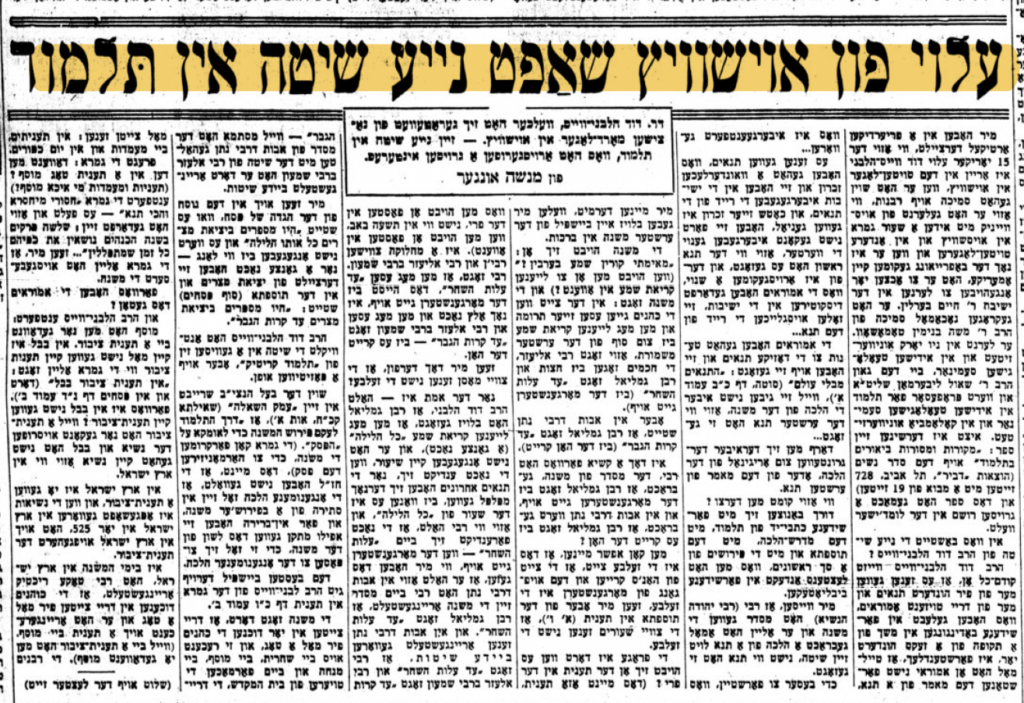
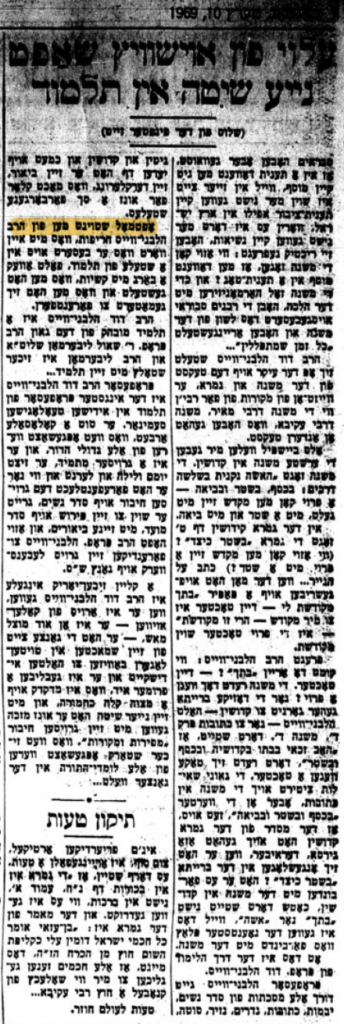
In early 1969, the Beys Yaakov Journal published “A Cry of Alarm Concerning the New School of ‘Talmud Critics’!”[60] by “Harav Yitzhak M. Shmueli” (almost certainly a pseudonym).[61] The article appeared in issue no. 116, shortly after the publication of the first volume of Halivni’s Mekorot u-Mesorot (1969).[62] It was not a reflexive polemic or an immediate rebuttal, but a considered response to a scholarly methodology that had already begun to exert influence within academic and semi-academic Jewish discourse.[63] Shmueli’s article reflects the Journal’s longstanding editorial posture: the intellectual challenges of modernity, particularly those circulating in print and academic venues, cannot be met with silence or denial. Rather than ignoring them, the Beys Yaakov Journal insisted on direct and public engagement.[64]
The article offers a sweeping critique of the Jewish Theological Seminary (JTS) and its Talmudic scholarship, with Halivni serving as the central exemplar. After briefly dismissing academic biblical criticism as a spent and methodologically compromised enterprise, Shmueli turns to what he presents as a more urgent danger: the emergence of academic Talmudic criticism within the Jewish Theological Seminary. He notes that Mekorot u-Mesorot bears the subtitle Biʾurim Talmudiyim and explicitly links this nomenclature to the Biʾur associated with Moses Mendelssohn, whom he identifies, in conventional Orthodox polemic, as a progenitor of German Reform Judaism.[65] The terminological parallel is presented as symptomatic rather than incidental.
Shmueli’s extended polemic against biblical criticism should be read less as his operative argument than as a genealogical warning. By tracing “Ḥokhmat Yisrael” back to German biblical criticism and Wissenschaft des Judentums, he establishes a historical cautionary tale rather than mounting a detailed refutation.[66] Once the discussion turns to Talmud, however, the tone shifts markedly: denunciatory generalizations give way to named books, cited introductions, concrete methodological claims, and extended quotation of traditional authorities. The rhetorical genealogy sets the stage; the argument itself unfolds as a focused dispute over the limits of legitimate Talmudic method.
Beyond an Internal Scholarly Debate
Shmueli’s concern, however, was not confined to an intramural scholarly dispute that might otherwise have remained limited to a narrow academic readership. The urgency, he argued, arose from Halivni’s entry into the broader intellectual public. In 1963, Halivni authored the Encyclopaedia Britannica entry “Source Criticism,” appended to the encyclopedia’s discussion of the “Talmud.” There he did not merely note philological problems in passing, but presented “source criticism” as a discrete scholarly method whose central task was to distinguish between the original statements of rabbinic authorities and the forms those statements assumed through oral transmission. A paragraph from that Britannica entry was later reprinted on the inside cover of Mekorot u-Mesorot: Seder Nashim (1969) under the heading, “From the author’s statement in the Encyclopaedia Britannica.” It reads:
“Source criticism seeks to differentiate between the original statements as they were enunciated by their authors and the forms they took as a consequence of being orally transmitted; that is, between the sources and their later traditions. It is not to be confused with the kind of analysis – frequently carried out by the rabbis or the Talmud – which merely traces the historical sources of a given passage without judging whether or not the passage faithfully reflects these sources. Source criticism claims that the transmission of the Talmud was not, and perhaps could not have been, verbatim, and that the text became altered in transmission, with the result that many statements in the Talmud have not come down in their original form. Instead, what survives is the form assumed in the last phase of transmissional development. While such a study is pertinent to most ancient texts, it is particularly relevant to the Talmud, which primarily consists of quotations and their interpretations.”[67]
On Halivni’s account, talmudic transmission “was not, and perhaps could not have been, verbatim,” with the result that many passages survive only in the form assumed in the final phase of transmissional development. The Talmud, he argued in that encyclopedia entry, is therefore particularly susceptible to such analysis, since it largely consists of quotations and interpretive strata. By articulating this claim in the idiom of general textual criticism and situating it within a major English-language reference work addressed to a broad, non-confessional readership, Halivni effectively relocated questions of talmudic authority from the internal norms of the beit midrash to the evaluative jurisdiction of modern academic scholarship. What might otherwise have remained an internal scholarly controversy was thus recast as a public representation of the Talmud within a wider intellectual culture.
It is precisely this public and methodological self-positioning that made the volume contentious. By placing the critical premise at the threshold of the book, Halivni indicated that the issue at stake was not merely philological refinement but the conceptual framework within which the Talmud itself would be understood. The decision to reproduce this paragraph prominently on the inside cover of Mekorot u-Mesorot was therefore more than bibliographic notice. It framed the book from the outset as an intervention in the academic discourse of textual criticism and positioned its central thesis as a methodological claim rather than an incidental observation. Before encountering Halivni’s detailed readings, the reader is confronted with a declaration about the nature of talmudic transmission and the legitimacy of critical reconstruction. In this sense, the reprinted Britannica passage functions as a programmatic preface, signaling that the project’s claims about the Talmud’s layered development are not ancillary but foundational.
This concern about public legitimation was not new. Long before the appearance of Halivni’s Mekorot u-Mesorot, Orthodox critics had already accused JTS, particularly under Finkelstein, of attempting to translate rabbinic tradition into a civic idiom aimed at American elites, a trajectory that would later culminate in highly visible episodes such as the Seminary’s 1957 convocation attended by Chief Justice Earl Warren.[68] This dynamic can already be seen by the early 1930s, such critiques had evolved from responses to discrete initiatives into a sustained indictment of Finkelstein’s leadership. In a widely circulated Yiddish pamphlet responding to the accumulated controversy surrounding the Seminary,[69] Dr. Aaron Rosmarin retrospectively gathered earlier charges, first voiced in The Jewish Forum,[70] Der Tog,[71] and The Jewish Spectator ,[72] into a comprehensive critique of what he presented as a coherent institutional strategy: the deliberate public repositioning of JTS through interfaith initiatives and universalist ethical rhetoric, designed to render Judaism intelligible and respectable to Christian and civic authorities while eroding the internal boundaries of rabbinic tradition.[73] Read in this longer perspective, the anxieties later articulated by Shmueli in the late 1960s appear not as episodic reactions to a single event, but as the continuation of an established polemical grammar through which the Seminary had long been contested within Haredi and Orthodox circles.
Yet the controversy did not unfold solely in the register of political denunciation or institutional suspicion. It also took the form of an internal methodological dispute over the norms of Talmudic scholarship.
Substantive Scholarship, Not Political Condemnation
Shmueli did not confine his critique to rhetorical denunciation. The article prominently featured, in a separate callout box at the top center of the page, the complete four-paragraph letter of the Ḥazon Ish addressing the use of manuscripts and textual emendation in Talmudic interpretation.[74] Given the Ḥazon Ish’s stature as one of the most authoritative scholars of his generation, his methodological positions were widely regarded as normative and were adopted, explicitly or implicitly, by many traditional Orthodox rabbis and scholars. Crucially, the Ḥazon Ish does not reject manuscript evidence as such; rather, he rejects its elevation into a corrective authority over the received text as transmitted and interpreted through the classical rabbinic canon. By foregrounding the Ḥazon Ish’s objections instead of invoking partisan rhetoric or institutional polemic, Shmueli cast the controversy as a serious methodological dispute internal to the discipline of Talmud study.
The letter reads in full:
“To interpret a sugya and to emend the Gemara on the basis of the ‘Munich’ manuscript – does this mean that all the sages of the generation, from the time of the Rishonim until now, all failed to apprehend the truth, because a single scribe erred and added material to the Gemara of his own accord, thereby causing all the sages to stumble?
I am not of them nor of their multitude. The manuscripts that were in the hands of the early authorities of blessed memory – they gave their lives for them, and the providence of the Blessed One, that the Torah not be forgotten from Israel, hovered over them. And when they began to print the Gemara, the sages of the generation gave their lives for its refinement and correction. And even if, at times, one may benefit from manuscripts to cleanse corruptions that arise over the course of time, with regard to a matter that issued from the hands of all our masters without any hesitation – Heaven forbid to disturb it.
Consider this yourself. When there are three manuscripts before us and two agree, we follow the two and set aside the one. And who can say to us that the ‘Munich’ manuscript is not from that one that was nullified by the majority in its own time? And who can say that it was not known to those lacking precision? In any case, it is null and void, like a broken potsherd, in the face of the received version.
And because a scribe erred and omitted a few words, as scribes are wont to err – shall we build towers? Perhaps indeed it is so, that the scribe omitted them and it is not from the sages, but when we rely on the tradition, the Torah of Rashi and Tosafot and all the sages – certainly this is the Torah. And I have almost never seen any benefit in arriving at the truth through variant readings uncovered from the genizot. Rather, they are all a benefit for distorting judgment and perverting the truth. It would have been fitting to consign them to burial, for the loss outweighs the gain.”
By reproducing this letter in full, Shmueli makes clear that his opposition to Halivni’s methodology rests on principled epistemological and methodological grounds rather than on ideological reflex. The Ḥazon Ish’s critique does not deny the existence of manuscript variation or the occasional value of textual witnesses; rather, it rejects the privileging of isolated manuscripts over the cumulative authority of the received tradition as transmitted and interpreted through generations of rabbinic scholarship.[75]
Crucially, Shmueli explicitly acknowledges that multiplicity, difficulty, and textual variation are intrinsic features of Torah she-baʿal peʿh. He concedes that variant readings and unresolved tensions have always belonged to the tradition, and he invokes major figures such as the Ḥatam Sofer and R. Israel Salanter to underscore that truth in Torah does not reside in surface simplicity. This concession sharply distinguishes his position from any naïve textual absolutism. What he rejects is not complexity itself, but the elevation of conjectural reconstruction into a corrective authority over the received text and its interpretive canon. In this way, Shmueli situates his argument squarely within a substantive Talmudic debate. He contends that even academically rigorous methods, supported by extensive philological evidence, remain subject to serious internal critique from within the Orthodox scholarly tradition itself. The article therefore represents intellectual engagement rather than political denunciation or fundamentalist rejection.
A full reading of Shmueli’s article makes clear that his deepest concern is not the existence of critical hypotheses as such, but their translation into public authority. Again and again, the danger he identifies lies in institutional legitimation: a book published by a major Israeli press, authored by a faculty member of the Jewish Theological Seminary, and disseminated to a broad readership through venues such as the Encyclopaedia Britannica. For Shmueli, the methodological question becomes urgent precisely at the point where speculative reconstruction threatens to become normative representation. The issue, in other words, is not academic experimentation behind closed doors, but the public pedagogy of Judaism to Jews and non-Jews alike.
Acknowledging Lieberman’s Authenticity
One of the most revealing features of Shmueli’s polemic is his careful distinction between Halivni and Saul Lieberman. Despite the breadth and intensity of his critique of the JTS approach, he is markedly restrained in his treatment of Lieberman. This restraint is deliberate. Lieberman’s Orthodox credentials were exceptionally strong and widely recognized across multiple sectors of the Orthodox world.[76] Upon his arrival in Palestine in 1928, he was appointed director of Machon Harry Fischel, a flagship Orthodox research institute devoted to advanced talmudic and halakhic scholarship, an appointment facilitated by leading rabbinic figures, including R. Isser Zalman Meltzer and R. Avraham Yitzhak Hacohen Kook.[77] At the same time, Lieberman pursued rigorous academic training at the Hebrew University under Prof. Jacob Nahum Epstein, the foremost architect of modern academic Talmud. Far from disqualifying him, this dual formation reflects the still-open willingness of segments of the Orthodox rabbinic elite in the interwar period to recognize exceptional Torah mastery even when pursued through unconventional scholarly frameworks.[78]
This standing remained intact even as Lieberman later contemplated accepting a position at the Jewish Theological Seminary. Before doing so, he consulted major Orthodox authorities, among them R. Isser Zalman Meltzer and R. Yaakov Moshe Charlap. Their responses ranged from principled refusal to issue a ruling to cautious, conditional acquiescence, but none denied Lieberman’s stature as a preeminent talmid ḥakham.[79] As Marc B. Shapiro has shown, Lieberman’s move to JTS did not erase his reputation within elite Orthodox circles; rather, it exposed unresolved tensions within Orthodoxy itself concerning the boundaries between institutional affiliation, scholarly method, and personal halakhic authority.[80] Lieberman thus occupied a liminal position: fully embedded in the Lithuanian rabbinic elite, deeply shaped by its intellectual ethos, yet operating at the outer limits of what Orthodoxy could comfortably accommodate.
It is precisely this status that explains Shmueli’s careful tone. To indict Lieberman directly would have required confronting not a marginal figure but a scholar whose legitimacy had been affirmed – explicitly or tacitly – by many of Orthodoxy’s leading authorities. Shmueli’s restraint therefore reflects less an endorsement of Lieberman’s methodology than an acknowledgment of the exceptional difficulty of dislodging a figure whose authority derived not from institutional politics alone, but from recognized and formidable Torah greatness. Shmueli’s own rhetoric reflects this distinction with care. He refers to Lieberman explicitly as a “renowned scholar, erudite in Torah she-baʿal peh,” even as he directs his most sustained and forceful criticism toward Halivni and the methodological program embodied in Mekorot u-Mesorot. This differentiation is significant. It underscores the Beys Yaakov Journal’s capacity for discriminating judgment rather than indiscriminate rejection of academic scholarship.
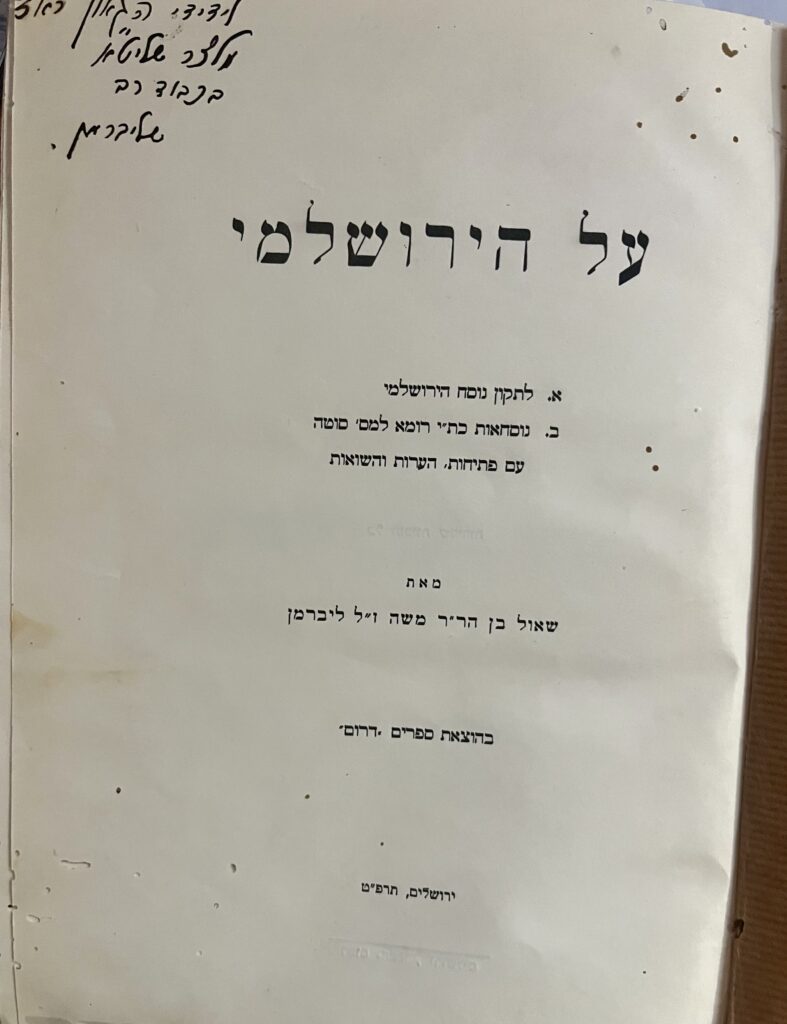
This, despite the fact that Lieberman’s earliest major work, Al ha-Yerushalmi, had already exemplified a disciplined form of textual criticism, drawing on manuscripts, parallel traditions, and internal philological analysis to clarify and correct the text of the Jerusalem Talmud. This could easily have provided fodder for Shmueli, yet he remained silent regarding Lieberman’s method. Recently published letters show that even the Ḥazon Ish engaged Lieberman seriously on these questions. Their correspondence reveals a principled disagreement over method, particularly regarding emendations grounded in manuscript evidence, while also demonstrating that such philological argumentation could be treated as a legitimate subject of rabbinic dispute rather than dismissed outright as heresy. Of course, since this correspondence had not yet been published, it cannot explain Shmueli’s silence on Lieberman’s approach.[81]
Copy of Al ha-Yerushalmi Gifted to R. I.Z. Meltzer from Lieberman
This nuance is essential for understanding the Beys Yaakov article’s invocation of the Ḥazon Ish. Lieberman is not cast as a theological threat or ideological provocateur, but as a formidable talmid ḥakham whose methods, though troubling to some, remained bounded within an elite scholarly discourse. Halivni, by contrast, is portrayed as extending those methods in a more expansive and publicly consequential direction, one that, in Shmueli’s view, exceeded the implicit safeguards that had contained earlier forms of academic intervention. The result is a portrait of Orthodox engagement with academic Talmud that is internally differentiated, historically self-aware, and intellectually serious, far removed from caricatures of reflexive or indiscriminate rejection.
That differentiation, however, depended upon the boundaries of scholarly containment. It held only so long as the debate remained internal to a learned community. Nowhere does Shmueli’s anxiety emerge more sharply than in his discussion of Halivni’s contribution to the Encyclopaedia Britannica.[82] Written in English for a general readership unfamiliar with the internal conventions of Talmudic study, Halivni’s article marks, in Shmueli’s view, the point at which an intramural scholarly debate enters the public register. At that point, silence becomes irresponsible. What is at stake is no longer a disputed method within a learned guild, but the public representation of the Talmud itself: its authority, coherence, and standing before a wider audience.
Yet the subsequent reception of the controversy would hinge less on Shmueli’s carefully drawn distinctions than on the interpretation of a single line in the Beys Yaakov article itself.
The Mistranslation That Changed Everything
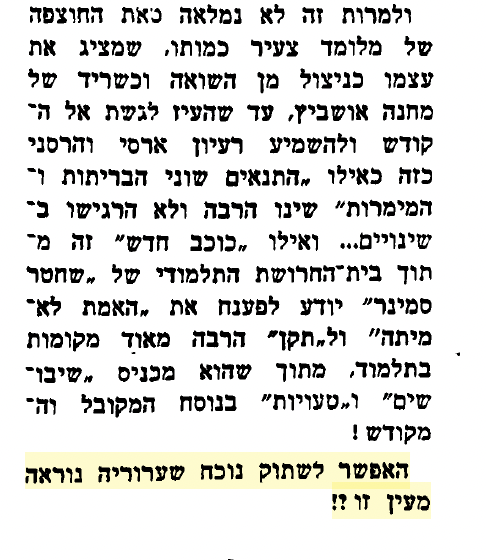
After developing its substantive critique, the Beys Yaakov article closes with a pointed rhetorical question:
!?האפשר לשתוק נוכח שערוריה נוראה מעין זו
The phrase is best rendered: “Is it possible to remain silent in the face of such a terrible scandal?”
Here we arrive at Shenker’s most consequential error. Shenker isolated the noun שערוריה (sha’aruriyah) and translated it as “abomination.” This was not a neutral lexical choice, but a serious mistranslation with far-reaching interpretive consequences.
In classical and rabbinic Hebrew, as well as in modern Hebrew, שערוריה denotes a scandal or public outrage, an event or claim that provokes alarm, indignation, and moral disquiet. Rooted in the semantic field of סער and סערה, it evokes turbulence and upheaval, suggesting commotion and protest rather than ritual pollution or theological deviance.[83] The term therefore belongs to the register of public scandal and polemical critique, not to the technical vocabulary of halakhic or theological condemnation. It conveys gravity, even urgency, but it does not imply that the object in question lies beyond the bounds of religious legitimacy. By contrast, Biblical and rabbinic Hebrew possess precise and well-established terms for “abomination,” most prominently תועבה (toʿevah) and the ש־ק־ץ family (שקץ, sheqets; שיקץ, shiqets). These terms function as technical markers of religious repugnance and exclusion.[84] תועבה denotes what is abhorrent before God, a term reserved for practices that are religiously intolerable, most prominently idolatry and acts explicitly proscribed as violations of the divine order. שקץ, by contrast, marks what is ritually defiling and categorically repugnant, designating objects or acts that are not merely objectionable but intrinsically contaminating within the cultic and halakhic system. In such usage, these terms do not merely register protest or indignation. They function as categorical markers of religious illegitimacy, designating acts or objects as intrinsically defiling and wholly intolerable within the normative order of divine law.
An Orthodox polemicist seeking to convey that level of categorical condemnation would almost certainly have employed one of these terms. Shmueli does not. His diction is emphatic but restrained, signaling moral alarm and scholarly urgency rather than theological excommunication. Translating שערוריה as “abomination” imputes to the article a category of judgment absent from the Hebrew. The difference is not rhetorical but semantic: the mistranslation shifts the text from protest to proscription, from scandal to heresy. One is reminded of the rabbinic topos of qotzo shel yod, the barely perceptible stroke of the yod (understood by Rashi as its right leg and by Rabbeinu Tam as its curved crown) whose alteration can overturn an entire halakhic construction.[85] Shenker’s substitution performed precisely such a transformation. There is no plausible pathway by which the language of “abomination” could have entered the public narrative surrounding Halivni other than through this mistranslation. In doing so, it recast an argument urging engagement with a grave scholarly challenge as a declaration of religious intolerance and obscured the article’s actual posture, which was not to brand Halivni’s work as heretical but to insist that a development of profound intellectual and communal consequence cannot responsibly be met with silence.
The consequences of this lexical substitution extended far beyond Shenker’s 1977 profile. Once “abomination” entered the New York Times archive as the purported Orthodox verdict on Halivni, it became available for repetition as journalistic fact. Thus, when the Times published its 2022 obituary of Halivni, it reproduced Shenker’s framing and relied on the same source. The obituary’s headline, casting Halivni as a “controversial” scholar rejected by “many Orthodox rabbis,” thus rested in part on a mistranslation that had already transformed a bounded Hebrew critique of scholarly method into a sweeping theological denunciation. In this way, a single erroneous word became the pivot of a durable public narrative.
The Effect of Sensationalism
Israel Shenker’s mistranslation did not merely distort a phrase; it altered the character of the intellectual activity in which the Beys Yaakov Journal was engaged. The original article undertook a demanding and careful task: it presented a sophisticated academic methodology to an Orthodox readership, explained why that methodology posed serious difficulties within the traditional epistemology of Talmudic study, marshaled substantive scholarly objections, above all the position of the Ḥazon Ish, acknowledged internal differentiation within Orthodoxy, and articulated strong disagreement grounded in textual and methodological analysis. By rendering the article’s culminating language as invoking an “abomination,” Shenker recast sustained scholarly critique as fundamentalist denunciation, collapsing methodological dispute into theological outrage and substituting caricature for argument.
This inversion is especially consequential in light of the documented record of the Beys Yaakov Journal of reflective engagement with modernity, both in its prewar Polish incarnation[86] and in its postwar Israeli continuation.[87] Beys Yaakov was not a polemical broadsheet but an educational and intellectual forum that repeatedly confronted modern scholarship rather than retreating from it. Shenker’s portrayal effaced that history and compounded the distortion by mischaracterizing the journal as “an official publication” of Agudath Israel. It was not. Published by the “Central Beys Yaakov of Israel” and later by the “Bais Yaakov Women’s College,” the journal functioned as an educational organ aligned with Agudah but not as a party instrument. The distinction is substantive. Educational journals cultivate explanation and debate; party organs enforce discipline.
The encounter with Rabbi Professor David Weiss Halivni was therefore neither a reflexive ban nor an eruption of obscurantism, but a serious internal reckoning with a scholarly development understood to carry public and pedagogical consequences. The episode demonstrates how readily Orthodox intellectual life in the mid-twentieth century has been recast through external narratives that confuse methodological dispute with theological denunciation. To understand the controversy properly requires moving beyond journalistic distortion to the jurisprudential problem Halivni’s scholarship forced into view. The debate was not about temperament or piety, but about first principles: whether historical reconstruction can be insulated from normativity; whether halakhic authority rests on procedural continuity or on claims of historical transparency; and whether Orthodox institutions possess mechanisms capable of absorbing critical candor without destabilizing the structures of authority they seek to preserve. It is to that institutional and conceptual terrain that we now turn.
[to be continued…]
Appendix 1: Yitzhak M. Shmueli, “A Cry of Alarm Concerning the New School of ‘Talmud Critics’!” Beys Yaakov, vol. 10, no. 4 [#116] (1969): 4-5 (Hebrew), available here:
Yitzhak M. Shmueli,
“A Cry of Alarm Concerning the New School of “Talmud Critics”!
“Ḥokhmat Yisrael” – that enterprise which was founded and ardently desired at the initiative of the various exponents of “Reform,” in all its forms – there is no falsehood and distortion more dreadful than it. This “root that bears gall and wormwood” – its earliest growth began in Germany, and there it affixed to itself the flattering yet deceptive name: “Wissenschaft des Judentums” (“the Science of Judaism,” in a literal translation from German). Within the bosom of this poisoned “science” arose all the movements of assimilation and derision away from Judaism. Generations of upright Jews fell into this trap. Many – far, far too many – this very “Ḥokhmat Yisrael” led all the way to the gates of apostasy, Heaven forfend.
All the venomous “wisdom” of the founders and disseminators of this “science” concerning “Judaism” in fact drew its sustenance from the sources of malice inherent in German, gentile “Biblical Criticism.” There were German scholars who regarded themselves as immense experts in the knowledge of the “East” (“Orientalistics,” in the foreign tongue), and, being afflicted with hatred of Israel, jealousy and the impulse of enmity toward the Book of Books burned within them. From this was born their aspiration “to criticize the Bible” in the most bizarre forms. And the matter is well known to the discerning. Several of the Christian researchers in Germany, foremost among them the orientalist Wellhausen – notorious for his attacks and his arrogant “discoveries” against the integrity and originality of the Bible – in fact founded the modern school of “Biblical Criticism.” And to our shame, even a few scholars from among our brethren, the Children of Israel, adhered to this path, taking hold of the seeds of self-directed malice, and lent their hand and their strength to the expansion and dissemination of this poisonous “science,” whose very point of departure was permeated with hatred of Israel.
This is neither the place nor the proper hour to display publicly all the falsehoods and malicious distortions that have accumulated around this discipline of “Biblical Criticism,” which, from the moment Jews too began to engage in it, cloaked itself in the new guise of “Ḥokhmat Yisrael.”
The historical truth is that this entire “science” known as “Biblical Criticism” has long since been exposed as false – and of all the mountains of nonsense and all the towers of lies that were heaped up and constructed by the celebrated “Biblical critics,” there remains no longer one stone upon another, one brick upon another, most evidently so. Indeed, it is precisely the scientific discoveries of the most recent period – and first and foremost the discovery of the “hidden scrolls” – that have decisively demolished the foundations of this deceptive “science.”
From time to time, modern Israeli archaeologists burst forth in cries of astonishment: Behold and see, to what degree everything found in the Holy Scriptures is precise!
And the historical truth is being clarified from every perspective. For these “Biblical critics,” not a few of whom are in fact complete ignoramuses regarding the Torah of Israel as a Torah of life and as the Torah of eternity, are accustomed to “correcting” the books of the Bible in accordance with whatever arises from their most confused and wildly unrestrained imagination. And suddenly, from ancient caves, hidden scrolls are found dating from nearly two thousand years ago, and everything written within those original and authentic scrolls – which renowned scholars examine and scrutinize – contradicts and refutes those sophistic vapidities and heaps of nonsense that were crowned with the title “Biblical science.”
And beyond this, the archaeologists engaged in excavations at historical sites in the Land also have something to say. And they demonstrate – as, for example, the Israeli archaeologist Dr. Moshe Kochavi recently demonstrated, who organized and directed the excavations in the Negev and in the Judean Mountains:
“The geographical record in Scripture has been proven by the discoveries in our excavations to be an exceptionally precise and reliable measure! In the Book of Joshua, chapter 15, there is found a detailed delineation of the boundaries of the tribe of the sons of Judah, their cities and their settlements, and all the discoveries made by our archaeological unit, which encompassed approximately twenty-five sites from the period of the kings of Judah, definitively confirmed that the entire division into districts – in the wilderness, in the hill-country, in the lowland, and in the Negev – is completely accurate; it accords with the standards demanded by every rigorous modern geographer!”
Ḥazal already said: “Yehudah ve-‘od la-qera” – that is, is there any further need whatsoever to confirm what is written in the Torah? In this generation, therefore, the whole-hearted faithful of Israel – loyal to the Torah and continuers of the heritage of Judaism – can, for their part, dispense with all those “authoritative confirmations” as well as the “scientific corroborations” of those “rigorous modern geographers.” But those great “sages” of Biblical Criticism – what answer can they possibly offer in the face of all the archaeological discoveries?
II.
And behold, there has emerged the newest fashion of “Talmud Criticism,” as a link integrated into the chain of distortions of “Ḥokhmat Yisrael” – which contains no “wisdom,” and whose association with “Israel” is exceedingly dubious.
It is a sacred obligation to raise a mighty voice of protest against the new “school” of the pretentious “Talmud critics,” who are liable to mislead pure souls among the Children of Israel. It is a double obligation to sound the alarm and to warn, since the dangerous initiative to harm – Heaven forbid – the foundational sources of the Oral Torah has now issued forth from a group of scholars concentrated around the “Schechter Seminary” in New York, whose official name is the “Jewish Theological Seminary,” and which is known as the “spiritual center” of the Conservative (“traditionalist”) movement in America.
As the first swallow heralding the emergence of the new method, there has now appeared, published by “Dvir” in Tel Aviv, a book entitled Sources and Traditions – Explanations in the Talmud. Its author, David Halivni, presents himself as an “expert in Talmudic research” who grew up within the walls of the “Schechter Seminary” in New York, in the company of Professor Louis Finkelstein, head of the Seminary, and Professor Saul Lieberman, the Seminary’s chief scholarly authority.
A public alarm must be sounded regarding the dangerous and destructive tendency of these “Talmudic explanations,” for of itself there surfaces the characteristic comparison with that famous “commentary” on the Torah by Moses Mendelssohn, the founding father of Reform in Germany! And if one extends this historical comparison further, the author of this “Talmudic research” likewise employs an innocent formulation and continually lifts his eyes heavenward…
“‘Blessed is the Omnipresent’ – thus opens the book’s ‘Preface’ – ‘who has merited me to see in print my explanations… May it be His will that just as He has merited me to see in print my explanations on the Order of Nashim, so may He merit me to see in print my explanations on the other orders and other books.’”
As it appears, the destructive hand is raised openly, and the plan is rather broad: to attack all the orders of the Shas and the other sources of Ḥazal, by means of that rusted and poison-saturated weapon called “Sources and Traditions”…
In the author’s scientific idiom this is called “textual truth,” since he strives to demonstrate that the Talmud is supposedly filled and replete with “inaccuracies,” “changes in sources,” “deviations from the simple interpretation,” and the like – claims and arguments that were habitual upon the tongues of all the “Biblical critics.”
From the words of the “Introduction” it is plainly evident that the author knows the truth, and merely intends to rebel against it! He himself writes that variations in textual versions, together with the difficulties bound up with them, have long since become part of the traditions… and indeed, one who has grown accustomed to this – precisely in this he perceives the distinctiveness of the Torah, and that its very diversity is its superior virtue…
The author even knows how to cite the words and opinions of the great Torah authorities, the giants of spirit of the later generations, such as the Ḥatam Sofer or Rabbi Israel Salanter, who explained that the essence of the distinctiveness of the Oral Torah lies precisely in this: that not everything appears revealed and simple at first glance…
This was the considered view of the author of the Ḥatam Sofer (in his novellae to tractate Ketubbot):
“The forced explanations (the resolutions offered to account for the difficulties arising in the comparison of the words of Ḥazal) – most of them are true… however, the rationalizations and inventions – most of them are false, and they are what cover over the face of truth.”
And Rabbi Israel Salanter, founder of the Mussar movement, stated this explicitly (in the introduction to his work Tevunah):
“What is truth? Truth does not live by simplicity alone, for simplicity is but one branch among the ways of proof; and for the most part the cherished difficulties stand ready to wage war against simplicity and to dislodge it…”
And despite all this, the arrogant audacity of a young scholar such as he has not been satisfied – a man who presents himself as a survivor of the Holocaust and as a remnant of the Auschwitz camp – to the point that he dared to approach the holy and to voice such a venomous and destructive notion, as though “the tannaim who transmitted the baraitot and dicta” altered much and did not even sense the alterations… whereas this “new star” from the Talmudic factory of the “Schechter Seminary” knows how to decipher “the truth in its truest sense” and to “correct” very many passages in the Talmud, by inserting “corruptions” and “errors” into the accepted and sanctified text!
Is it possible to remain silent in the face of such a terrible scandal?
III.
The source of a great danger has been exposed – one that is public-spiritual in character, and not merely literary-scholarly. We have no dispute with the author of this “collection of explanations,” who, notwithstanding everything, is himself compelled to concede that this is in essence not a new invention of his own, and that there have already been such researchers within the domain of “Ḥokhmat Yisrael” who attempted to “explicate” the sugyot of the Shas by a textual “critical method”…
The gravity of the danger is inherent in this fact: that it is an “official product” of the “Schechter Seminary,” and consequently it will be recognized and accepted as a “scientific discovery,” and perhaps even as a “scientific challenge” on the part of the Conservative movement in America.
Several years ago, the heads of the “Schechter Seminary” in America made numerous efforts to confer upon themselves a name and standing as a “Talmudic” research institution. Above all, they relied upon the personality of Professor Saul Lieberman, a renowned scholar and master of knowledge in the disciplines of the Oral Torah. It was not difficult to grasp that the spiritual leadership of the Conservative movement could not remain indifferent to the mighty historical phenomenon that became apparent in America with the establishment and flourishing of several advanced yeshivot for Torah study and rabbinic instruction. The “rabbis” of the Conservatives were truly alarmed by the rise of the power and influence of Haredi Judaism (Orthodox Judaism) in America, and they sought to demonstrate that among them too a “spiritual revival” was taking place, and that they too intended to return and to revivify the connection with the heritage of Judaism.
In accordance with the manner of the Conservatives and of all varieties of Reform, who are oriented primarily outward and whose chief concern is to find favor in the eyes of the gentiles, so they then arranged (some years ago) a grand celebration “in honor of the Talmud,” to which the Chief Justice of the Supreme Federal Court in Washington, Earl Warren, was invited. And the great surprise of the celebration was that the Chief Justice of the highest judges in America delivered an enthusiastic address concerning “the ethics of the Talmud,” and set forth several of the principles of Talmudic ethics as a model and exemplar of justice and uprightness!
The speech of the Chief Justice was not an isolated occurrence in America, where in recent times interest in the sources of Judaism has grown. Thanks to authoritative English translations, Christian scholars obtained some access to the treasures of the Talmud. One scholar, an expert in international law, a gentile from birth, published in the pages of an important scholarly journal a special study on the “spirit of true democracy” which he discovered in the Talmud.
And it is an interesting matter that the scholar paid attention there to that foundational principle in halakhic clarification in the Talmud: that “these and those are the words of the Living God.” The expert in international law translated this into his own terms, as an expression of democracy and freedom of expression – that one does not silence the “minority opinion” and does not disregard the rational arguments of the “opposing side,” but rather grants (as is done in the Talmud!) full right even to the minority opinion to explain its outlook. Even after the ruling has been decided on the basis of the majority view – which precisely accords with formal democracy – the “Talmudic sage” continues to voice and present his opinion upon the pages of the Talmud!
In various forms and through various channels, some of the perspectives of the Talmud began to penetrate American society. The growth in the number of yeshiva students in America – many of whom are regarded as authoritative experts in the domains of modern science – transmitted many of the moral principles of the Oral Torah into the broader world.
Until there arose a young “Talmudic researcher,” among the trainees of the “Schechter Seminary,” and proclaimed from every possible platform that fidelity to the text of the Talmud is doubtful, and that one must begin “Talmudic criticism”…
This matter did not suffice with the preparation of the anthology of “Sources and Traditions,” whose entire purpose is to obscure the sources and to undermine the traditions, but he even offered his “merchandise” (apparently upon the recommendation of the heads of the “Schechter Seminary”) to the editorial board of the world-renowned Encyclopaedia Britannica.
From his pen emerged the article “Source Criticism,” appended to the entry “Talmud” in volume 21 of the Encyclopaedia Britannica. What is the entire tendency of this article – particularly when it appears in English and is directed to the general public and to scholars for whom both the sources of the Talmud and the spirit of the Talmud are foreign – what can it lead to? Destructive views such as these: “that one should not lose one’s reason because of the analyses of the sages of the Talmud, who were not precise in the historical sources.” Both absolute ignorance is embedded in them, and an evil spirit of slander and self-degradation drips from them!
IV.
This figure did not emerge merely to testify concerning himself; rather, he also serves to testify concerning the entire “Schechter Seminary.” And the matter exceeds the limited framework of “literary activity” in the domain of “Talmud Criticism.” The “Schechter Seminary” embodies the “fortress of spirit” of the Conservative movement in America – and not only in America.
In recent years, the “Conservative” leaders have revealed an aspiration for “conquest,” and they seek precisely to transform themselves into a “global spiritual movement.” Concurrently, part of their leadership issues “public declarations,” as though their entire purpose is “to preserve and to draw from the sources of Judaism.”
It is indeed true that the great Torah authorities in America, foremost among them the Gaon Rabbi Aharon Kotler, of blessed memory, related from the outset with great suspicion to all “signs of rapprochement” on the part of the Conservatives, since, according to da‘at Torah, even their “tendencies” bear a pronounced character of Reform. The great Torah authorities in America therefore warned that rabbinic organizations in the United States should not blur the “dividing line” between the Jewish communities and the Conservative associations. A fierce spiritual campaign was waged on this matter in the public consciousness of American Jewry. And now one sees plainly what may be expected even from the learned “masters of sources” within the Schechter Seminary.
Appendix 2: Menashe Unger, “A Survivor of Auschwitz Creates a New Method in Talmudic Interpretation,” Der Tog (10 March 1969): 5-8 (Yiddish)
Menashe Unger,
“A Survivor of Auschwitz Creates a New Method in Talmudic Interpretation”
Der Tog (10 March 1969): 5-8 (Yiddish)
Dr. David Halivni Weiss, a survivor of the Nazi extermination camp at Auschwitz, has developed a new method in the study of the Talmud, a method that has aroused wide and serious interest.
In an earlier article we described how the fifteen-year-old Eliyahu David Weiss Halivni was sent to the death camp at Auschwitz already possessing rabbinic ordination; how, under conditions of mortal danger, he studied Gemara together with fellow Jews in Auschwitz and in other death camps; and how, after liberation, he arrived in America. At the age of eighteen he began studying at the Rabbi Chaim Berlin Yeshiva, where he again received rabbinic ordination, this time from Rabbi Moshe Binyamin Tomashov. He later pursued studies at New York University and at the Jewish Theological Seminary, under the guidance of the eminent scholar Rabbi Professor Saul Lieberman. He ultimately became professor of Talmud at the Jewish Theological Seminary and at Columbia University.
His book has now appeared: Mekorot u-Mesorot: Biʾurim ba-Talmud (Sources and Traditions: Explanations in the Talmud), on the Order Nashim, published by Dvir in Tel Aviv. The volume comprises 728 pages, with an introduction of nineteen pages. The book has made a powerful impression in the world of Talmudic scholarship.
What constitutes the new method of Rabbi David Halivni Weiss?
Rabbi Halivni Weiss first emphasizes that more than four hundred Tannaim and more than three thousand Amoraim lived under widely differing historical and social conditions over a period of approximately six hundred years. It is therefore understandable that at times an Amora did not fully comprehend a teaching of a Tanna transmitted to him. There were Tannaim who possessed extraordinary memories and transmitted the teachings of earlier authorities in the academies. Yet even when their memory was exceptional, they were not always able to convey the precise wording exactly as the original Tanna had formulated it. As a result, discrepancies arose, and the Amoraim were compelled to discuss these matters in the academies in order to reconcile the transmitted teachings.
The Amoraim even leveled accusations against such Tannaim, declaring: “The Tannaim are destroyers of the world” (Sotah 22a), because they failed to transmit the halakhah of the Mishnah exactly as the earliest Tanna had stated it. Accordingly, one must strive to return to the original formulation of the halakhah, or to the original statement of the earliest Tanna.
How is this accomplished? By making systematic use of variant manuscripts of the Talmud, Midrash Halakhah, the Tosefta, and the interpretations of many early authorities that have been discovered in recent times in various libraries. We know that Rabbi Judah the Prince, the redactor of the Mishnah, himself sometimes transmitted a halakhah according to his own conceptual framework, and not exactly as the Tanna had originally stated it, in order to render it more intelligible.
To clarify this approach, we will offer one example, drawn from the first Mishnah in Tractate Berakhot. The Mishnah opens: “From when does one recite the Shema in the evening?” It states that from the time the priests enter to eat their terumah one may recite the Shema until the end of the first watch, according to Rabbi Eliezer. The Sages say until midnight, and Rabban Gamliel says “until the rise of dawn.” However, in Avot de-Rabbi Natan it is stated that Rabban Gamliel says “until the rooster crows.”
This raises a difficulty: why did Rabbi, the redactor of the Mishnah, transmit Rabban Gamliel’s opinion as “until the rise of dawn,” whereas Avot de-Rabbi Natan reports it as “until the rooster crows”? One might assume that these refer to the same point in time, that the crowing of the rooster coincides with the appearance of the morning star. Yet from the Tosefta in Tractate Taʿanit (1:6) we see that these two temporal markers are not identical.
The discussion there concerns a fast that begins in the morning, as distinct from fasts such as the Ninth of Av, which begin in the evening. A dispute is recorded between Rabbi and Rabbi Eliezer ben Rabbi Shimon. Rabbi maintains that one may eat “until the rise of dawn,” meaning until the appearance of the morning star, which is still considered night, whereas Rabbi Eliezer ben Rabbi Shimon rules “until the rooster crows.” From this it is evident that the two times are not the same.
Rabbi Halivni Weiss therefore concludes that Rabban Gamliel originally stated only that one may recite the Shema “throughout the entire night,” without specifying any precise endpoint. The later Tannaim then debated how long the measure of “the entire night” extended. Since Rabbi held that night ends with the rise of dawn, and since Avot de-Rabbi Natan indicates that he indeed held this position, Rabbi incorporated into the Mishnah the formulation that Rabban Gamliel says “until the rise of dawn.” In Avot de-Rabbi Natan, however, both views were preserved: Rabbi’s position, “until the rise of dawn,” and that of Rabbi Eliezer ben Rabbi Shimon, “until the rooster crows,” because the redactor of Avot de-Rabbi Natan apparently accepted the latter view and therefore recorded both.
A similar phenomenon appears in the text of the Passover Haggadah, where it states: “They would recount the exodus from Egypt all that night,” without specifying an endpoint. By contrast, the Tosefta at the end of Tractate Pesahim states: “They recount the exodus from Egypt until the rooster crows.”
Rabbi David Halivni Weiss has thus developed a method that may be described, in a certain sense, as Talmudic textual criticism, but in a positive and constructive manner. Already the Netziv writes in his Haʿamek Sheʾelah (Sheʾiltah 136, section 1) that “it is the way of the Talmud to reinterpret the Mishnah so as not to uproot the halakhic ruling.” That is, the Sages did not wish the accepted halakhah to stand in contradiction to an explicit Mishnah, and where necessary they even corrected the wording of the Mishnah so that it would conform to the accepted halakhah.
Rabbi Halivni Weiss presents a striking illustration from Tractate Taʿanit (26b). The Mishnah there states that on three occasions during the year the priests raise their hands in blessing four times a day, and it enumerates Shaharit, Musaf, Minhah, and the closing of the Temple gates. These occasions are fast days, Maʿamadot, and Yom Kippur. The Gemara asks: is there a Musaf prayer on a fast day? It answers: “Something is missing, and this is how it should read: On three occasions during the year the priests raise their hands whenever they pray.” We thus see that the Gemara itself emended the Mishnah.
Why did the Amoraim do this? Rabbi Halivni Weiss explains that Musaf was recited only on a communal fast. In Babylonia there was never a communal fast, as the Gemara itself notes, because only the Nasi could proclaim such a fast, and Babylonia lacked a Nasi, unlike the Land of Israel. In the Land of Israel, communal fasts did exist, but after the abolition of the Nasiate in the year 425 they ceased there as well. In the Mishnaic period, however, Rabbi correctly included Musaf among the prayers recited on such days.
Later Amoraim, who lived in Babylonia and knew no communal fasts even in the Land of Israel, were perplexed by the Mishnah’s implication that Musaf was recited on a fast day. In order to harmonize the Mishnah with the accepted halakhah, they therefore emended its wording and inserted the phrase “whenever they pray.”
Rabbi David Halivni Weiss places primary emphasis on the textual foundations of the Mishnah and the Gemara. He demonstrates, on the basis of early sources, that there existed variant versions of the Mishnah, such as the Mishnah of Rabbi Meir and the Mishnah of Rabbi Akiva, which differed in wording.
As an example, he points to the opening Mishnah in Tractate Kiddushin: “A woman is acquired in three ways: by money, by document, and by intercourse.” The Gemara in Kiddushin (9a) asks: “By document, how?” and answers that if a man writes, “You are betrothed to me,” the woman is betrothed. Rabbi Halivni Weiss asks how the formulation “your daughter” enters the discussion, when the Mishnah speaks of a woman. He explains that this baraita originally referred not to Kiddushin but to Ketubbot, chapter four, where the Mishnah states that a father has rights over his daughter’s betrothal by money or by document. The redactor of the Gemara in Kiddushin apparently possessed such a version and connected the baraita to the Mishnah in Kiddushin because it was the closest relevant context.
This, then, is the path of study of Professor David Halivni Weiss. He proceeds through all the tractates of the Order Nashim, Yevamot, Ketubbot, Nedarim, Nazir, Sotah, Gittin, and Kiddushin, offering on every folio his elucidations and explanations, thereby clarifying many passages that have long remained obscure. At times a single incisive observation resolves a complex Talmudic difficulty and causes an entire accumulation of questions, which scholars had struggled to answer, to fall away.
Rabbi David Halivni Weiss is an outstanding disciple of the eminent Rabbi Professor Saul Lieberman, who takes great pride in his student. Professor Rabbi David Halivni Weiss is the youngest professor of Talmud at the Jewish Theological Seminary. He is engaged in a monumental scholarly undertaking that will be appreciated by all the leading Torah scholars of the generation. Having published his major work on the Order Nashim, he is already preparing a commentary on the Order Moʿed, with the aim of completing a comprehensive work on the entire Talmud.
Rabbi David Halivni Weiss emerged from the valley of death as a fragile child, a living remnant who endured the years of torment in the death camps while preserving his Jewish identity. He has remained a deeply observant Jew, meticulous in every detail of halakhic observance. Through his new method he has conferred a great benefit upon the world of Torah scholarship with his work Mekorot u-Mesorot, which will surely be highly esteemed by all students of Torah throughout the world.
Appendix 3: The 1957 Warren Convocation and the Circulation of Talmudic Self-Incrimination Discourse
Shmueli notes in his article in the Beys Yaakov Journal the wider efforts of JTS to translate talmudic discourse into a public idiom of modern legal and ethical relevance, and specifically a visit by Chief Justice Earl Warren.[88] During the 1950s, under the leadership of JTS Chancellor Louis Finkelstein, the Seminary promoted what it termed an “ethics of the Talmud,” presented as a normative program rather than antiquarian scholarship. Finkelstein described this enterprise as a kind of “fifth Shulḥan Arukh,” positioning the Talmud as a source of authoritative guidance for contemporary life.
The scope and aims of this project are documented in a substantial exchange between Finkelstein and Saul Lieberman in the mid-1950s.[89] In a detailed letter dated July 22, 1955, Finkelstein outlined his ambition to develop what he explicitly termed a “fifth Shulḥan Arukh,” by which he meant a systematic exposition of rabbinic ethics derived from the talmudic corpus. The letter makes clear that the two had discussed the matter repeatedly and that Finkelstein regarded Lieberman as indispensable to its realization. He credited Lieberman not only for scholarly guidance but for shaping his understanding of the ethical dimensions of rabbinic literature, remarking that he sought to render “Professor Lieberman as an institution” into a durable intellectual framework. Lieberman’s reply articulates a distinctive conception of legal-ethical obligation. Jewish law, he argued, establishes only the minimal standards necessary for social existence; genuine ethical responsibility begins beyond that threshold. Ethical expectations vary according to intellectual and moral stature. Conduct that might be considered blameless in an ordinary individual could be ethically culpable in a scholar. Rabbinic literature, he maintained, preserves numerous episodes illustrating such graduated responsibility, and only a sustained analytical study of the entire corpus could yield a systematic code of rabbinic ethics. He wrote:
“I might have stated to you my position on Jewish law and legal ethics. I believe that they are only the minimum without which no society can exist. The real legal ethics begin beyond this minimum. Each individual is legally bound by an ethical system conditioned to his individual character, temperament and general stature. A certain behavior on the part of an ordinary man may rightly be considered blameless under the circumstances, but the same behavior on the part of a learned man should be considered ethically criminal. In between the ignorant small man and the learned great man there are numerous gradations of ethical principles which correspondingly should guide the individual according to his status. Rabbinic literature abounds in episodes which highly illuminate the particular ethical principles with which we are concerned. The general idea is that none is exempt from the moral duty to aspire for perfection, thus raising the standards of the ethical principles required by the law for the particular individual.”[90]
This initiative took institutional form in September 1957 with the inauguration of the Lehman Institute of Ethics,[91] marked by a scholarly convocation on “Law as a Moral Force,”[92] attended by Chief Justice Earl Warren and described by one speaker as graced by the presence of “the most beloved citizen of our land.”[93]
Contemporary coverage makes clear that the convocation was designed not only as an internal scholarly gathering but as a publicized civic event. Reporting on the occasion, The New York Times noted that Warren had “enrolled” at the Seminary for a three-day convocation held over the weekend of September 13-14, 1957, devoted to Jewish law and its relevance to contemporary legal problems, and described both his participation in scholarly discussions and his attendance at Sabbath eve services. Finkelstein was quoted as framing the event as a gesture of civic-cultural deference: the Seminary, he declared, sought to honor Warren by sharing with him “our most treasured possession – the Talmud and its teaching.”[94] The report further translated rabbinic jurisprudence into American legal idiom, describing the Mishnah’s interpretive authority as “analogous to a Supreme Court decision,” and noting that Saul Lieberman’s Friday night lecture addressed procedural doctrines, especially self-incrimination and double jeopardy, that resonated directly with American constitutional discourse.[95] A contemporaneous Jewish Telegraphic Agency report similarly quoted Warren as remarking that several American constitutional safeguards, including those against self-incrimination and double jeopardy, appeared to derive from talmudic law. While noting that protection against self-incrimination was “perhaps not as sacred now as in ancient times,” Warren nonetheless affirmed its continuing place within American jurisprudence.[96] The episode illustrates the dynamic that Shmueli sought to resist: talmudic law presented as a moral-jurisprudential resource whose public legitimacy is ratified through elite American recognition.
According to Louis Finkelstein’s later recollection, Warren was so struck by Lieberman’s lecture that, despite an understanding that he would not speak publicly, he insisted on addressing the assembled audience. Warren reportedly expressed astonishment that such teachings were “almost a secret,” asking how it was that “nobody knows about it.” Public attention followed quickly. Finkelstein recalled that former President Harry S. Truman, then visiting New York, read the New York Times account of the event and declared, “If it is good enough for him, it is good enough for me,” before arriving at the Seminary together with Judge Samuel Rosenman, himself not merely a jurist but a leading Democratic insider and former presidential adviser closely associated with Roosevelt and Truman. Shmueli’s polemic thus draws upon a real and widely publicized episode in which the Talmud was presented to prominent representatives of the American political and legal establishment as a jurisprudential and ethical resource.[97]
Although the text of Lieberman’s lecture, “Law as a Moral Force in Rabbinic Literature,”[98] has not been preserved (and no recording was made, as it was delivered on the Sabbath eve), the intellectual aims of the convocation inaugurating the Herbert H. Lehman Institute of Ethics are articulated with unusual clarity in the published preface to Professor Shalom Spiegel’s address, Amos versus Amaziah.[99]
The conclave was explicitly convened to explore the moral dimensions of law as articulated in ancient Hebrew sources and to assess their relevance to contemporary legal and civic problems. Chief Justice Earl Warren and former President Harry S. Truman were among the featured participants, and Warren was quoted as remarking on the “sense of humility” that follows from recognizing that “most of the good things that we find in our law and in our own institutions come from the wisdom of men of other ages.” Spiegel’s address, identified in the prefatory material as one of the principal lectures of the weekend, framed prophetic confrontation and biblical justice through the idiom of constitutional adjudication and judicial review; Truman reportedly described it as “one of the best [lectures] I have ever heard in my life.”[100] In this respect, Spiegel’s published address offers a reliable index of the conceptual register within which Lieberman’s now-lost lecture was heard.
The episode circulated widely beyond the English-language press. Coverage in the Yiddish press highlighted the unusual image of the Chief Justice of the United States Supreme Court sitting in the Seminary, wearing a yarmulke and studying Talmud together with Finkelstein and Lieberman.[101] It was largely through this reportage that the episode entered the retrospective memory of circles associated with Yeshiva University. Decades later, Rabbi Hershel Schachter recalled in writing that R. Joseph B. Soloveitchik reacted sharply to Yiddish newspaper accounts of Lieberman’s talmudic exposition, particularly the suggestion that repentance could nullify liability to punishment in an earthly court, a claim difficult to reconcile with Makkot 13b. He reportedly dismissed such reports as devarim betelim (‘idle talk’) and invoked the Ra’avad’s critique of Maimonides.[102]
Samuel J. Levine has recently suggested that Chief Justice Warren’s later invocation of Jewish law in Miranda v. Arizona (1966) may be traced to his widely reported 1957 visit to the Jewish Theological Seminary. According to Levine, the JTS encounter helped prepare the conceptual ground for Miranda, as contemporary accounts of the visit already portrayed Jewish law as an antecedent to Anglo-American constitutional protections, particularly in the area of self-incrimination.[103] That framework, however, was already in circulation at least a year earlier and cannot be attributed solely to the 1957 Seminary visit.
Newly available correspondence complicates any linear account of influence running from Warren’s 1957 visit to the Seminary to Miranda (1966). In early 1956, Rabbi Norman Lamm, then a pulpit rabbi in Springfield, Massachusetts, published in Judaism a substantial essay written at the height of public controversy over the Fifth Amendment, explicitly framing ein adam mesim atzmo rasha (“no man can render himself legally wicked”) as the halakhic analogue of the constitutional privilege against self-incrimination.[104] Far from offering a casual comparison, Lamm argued that halakhah went beyond the Fifth Amendment by rendering all criminal confessions inadmissible, even if voluntarily offered.[105] This was the argument Warren would later cite in his majority opinion.
On March 19, 1956, more than a year before Warren’s appearance at the Seminary, Justice William O. Douglas wrote to Lamm that he had read the essay and found it “uncommonly suggestive,” praising its “penetrating analysis.”[106] The letter demonstrates that Lamm’s comparative formulation had already circulated within the Court at the moment of its publication, independently of the later public staging of the JTS symposium. Although the precise circumstances under which Warren first encountered the essay remain unknown, Douglas’s correspondence establishes that the argument had entered the Court’s intellectual orbit well before the 1957 visit.[107]
Contemporary Jewish press coverage of Miranda indicates that Warren’s footnote was promptly read in genealogical terms. An editorial in the Wisconsin Jewish Chronicle, titled “Grandpappy of the Fifth Amendment,” presented the decision as evidence that “the ancient Talmudic law” lay at the root of modern constitutional protections. Citing Lamm’s formulation of ein adam mesim atzmo rasha, it described the Talmud as the “great, great, great grandpappy” of the Fifth Amendment and treated the Court’s ruling as a contemporary reaffirmation of an ancient legal principle.[108] Similarly, the St. Louis Jewish Light interpreted Warren’s reference to “ancient times” as an acknowledgment of Lamm’s 1956 formulation, stressing that halakhah not only anticipated but surpassed the Fifth Amendment in stringency.[109] In both instances, a comparative footnote was taken as evidence of a historical lineage linking Jewish jurisprudence to American constitutional doctrine.
The JTS episode should therefore be understood not as the origin of Warren’s engagement with Jewish law, but as a conspicuous public moment that consolidated and legitimated a line of juridical reflection already underway.
This pattern of influence and circulation is also visible, albeit indirectly, in the later secondary literature produced within the Seminary’s own intellectual milieu. Aaron Kirschenbaum, whose Self-Incrimination in Jewish Law emerged from the JTS faculty orbit,[110] neither mentions Warren’s widely publicized 1957 visit to the Seminary nor notes Warren’s later reliance on Norman Lamm’s 1956 essay in his majority opinion in Miranda v. Arizona. He does, however, call attention to Warren’s use of other secondary legal scholarship.[111] The omission is striking, since Enker and Elsen themselves cite Lamm’s essay on the halakhic analogue to the Fifth Amendment,[112] thereby situating Lamm’s argument squarely within the very body of legal literature on which Warren drew.
Indeed, Kirschenbaum explicitly situates his own engagement with self-incrimination in the political and legal climate of the early 1950s. Reflecting on his years at JTS, he recalls how he and his fellow students felt an almost compulsive need to render Moses, Hazal, and Maimonides “relevant,” reading classical sources through the selective lens of modern rights discourse. Under the pressures of the McCarthy era, he writes, congressional investigations and compelled testimony rendered the constitutional privilege of silence a matter of urgent moral significance. The formula “I refuse to answer… because my response would constitute self-incrimination” became, for him, not merely a legalism but a moral idiom. It was precisely this Fifth Amendment protection, he explains, that “captivated” him and first drew him into the surrounding legal literature.[113]
Whatever the precise channels through which Jewish legal analogies entered American constitutional discourse, the Lehman Institute convocation represented a highly visible attempt to stage talmudic law as a public moral resource within elite American civic culture, and it was precisely this institutional posture that drew Orthodox critique. Yet the controversy surrounding the Lehman Institute and the 1957 Warren convocation was not without precedent. From the mid-1930s onward, Louis Finkelstein’s efforts to reposition the Jewish Theological Seminary as a locus of public moral and cultural authority had already provoked sustained criticism from Orthodox and right-wing observers, who viewed such initiatives as compromising rabbinic integrity in pursuit of external validation. Programs aimed at engaging Christian intellectuals or framing Judaism in universal ethical terms were repeatedly denounced in the Orthodox and Yiddish press as apologetic accommodation, and at times as missionary entanglement. Figures such as Aaron Rosmarin cast these projects as oriented less toward the cultivation of internal rabbinic tradition than toward securing legitimacy before non-Jewish audiences and American cultural elites.
Notes
Throughout this article, individuals are occasionally referred to by surname alone, in keeping with established scholarly convention. This practice is adopted solely for stylistic consistency and carries no implication of disrespect. ↑
Joseph Berger, “Rabbi David Weiss Halivni, Scholar Devoted to the Talmud, Dies at 94,” The New York Times (18 July 2022): A17. ↑
See David Weiss Halivni, The Book and The Sword: A Life of Learning In The Shadow of Destruction (New York: Farrar Straus and Giroux, 1996); and Netiʻot Ledavid: Jubilee Volume for David Weiss Halivni, eds. Yaakov Elman, Ephraim Bezalel Halivni, and Zvi Arie Steinfeld (Jerusalem: Orhot Press, 2004). ↑
For the fullest methodological exposition of his theory of Talmudic redaction, see David Weiss Halivni, The Formation of the Babylonian Talmud, trans. Jeffrey L. Rubenstein (Oxford: Oxford University Press, 2013). See also H.A. Alexander, “David Halivni and Shamma Friedman: Conflicting Trends in Talmud Criticism,” Conservative Judaism, vol. 39, no. 3 (Spring 1987): 45-57; Ari Bergmann, Halevy, Halivni and the Oral Formation of the Babylonian Talmud (PhD diss., Columbia University, 2014) and Ari Bergmann, The Formation of the Talmud: Scholarship and Politics in Yitzhak Isaac Halevy’s Dorot Harishonim (Berlin: de Gruyter, 2021); and earlier in Irwin H. Haut, The Talmud as Law or Literature: An Analysis of David W. Halivni’s ‘Mekorot Umasorot’ (New York, Bet Sha’ar Press, 1982). A fuller treatment of Halivni’s method and its reception will be presented in subsequent essays in this series. ↑
For the subsequent editions in this series, see David Weiss Halivni, Mekorot u-Masorot: Seder Nashim (Tel-Aviv: Devir, 1969; Hebrew); David Weiss Halivni, Mekorot u-Masorot: Seder Moed, from Yoma to Hagiga (Jerusalem: Jewish Theological Seminary, 1975; Hebrew); David Weiss Halivni, Mekorot u-Masorot: Shabbat (Jerusalem: Jewish Theological Seminary, 1982; Hebrew); David Weiss Halivni, Mekorot u-Masorot: Eruvin-Pesahim (Jerusalem: Jewish Theological Seminary, 1982; Hebrew); David Weiss Halivni, Mekorot u-Masorot: Seder Nashim, second edition (Toronto: Otsereinu, 1992; Hebrew); David Weiss Halivni, Mekorot u-Masorot: Bava Kamma (Toronto: Otsereinu, 1993; Hebrew); David Weiss Halivni, Mekorot u-Masorot: Bava Metzia (Jerusalem: Magnes, 2002; Hebrew); David Weiss Halivni, Introduction to ‘Mekorot u-Masorot’, first edition (Jerusalem: Magnes Press, 2009; Hebrew); David Weiss Halivni, Introduction to ‘Mekorot u-Masorot’, second edition (Jerusalem: Magnes Press, 2012; Hebrew); David Weiss Halivni, Mekorot u-Masorot: Sanhedrin, Shavu’ot, Makot, Avodah Zarah, Horayot (Jerusalem: Magnes, 2012; Hebrew); David Weiss Halivni, Mekorot u-Masorot: Zevahim-Menahot (Jerusalem: Magnes Press, 2023; Hebrew); and see David Weiss Halivni, The Formation of the Babylonian Talmud, ed. and trans. Jeffrey L. Rubenstein (Oxford: Oxford University Press, 2013). ↑
A comprehensive bibliographical listing of Halivni’s writings, including digitized scans, is available on the Academia.edu page (here) curated by Menachem Butler in collaboration with Professor Halivni’s family. ↑
Israel Shenker, “A Life in the Talmud,” The New York Times Magazine (11 September 1977): 44-45, 74-82, available here. ↑
Margalit Fox, “Israel Shenker, 82, a Reporter With the Instincts of a Scholar,” The New York Times (17 June 2007): 23. ↑
Israel Shenker, “Groucho, at 81, Discusses Favorite Topic- Women,” The New York Times (4 May 1972): 50; Israel Shenker, “Groucho Marx Uses Room Service to Press Suit,” The New York Times (5 June 1975): 40. ↑
Israel Shenker, “Borges, a Blind Writer With Insight,” The New York Times (6 April 1971): 48. ↑
Israel Shenker, “Former Chomsky Disciples Hurl Harsh Words at the Master,” The New York Times (10 September 1972): 70. ↑
Israel Shenker, “The Old Magician at Home,” The New York Times Book Review (9 January 1972): 2. ↑
Israel Shenker, “Picasso, 90 Today, Assayed By Critic, Curator, 3 Artists,” The New York Times (25 October 1971): 42. ↑
Israel Shenker, “Asimov, ‘on Fire to Explain,’ Writes 100th Book – About Himself,” The New York Times (18 October 1969): 35; Israel Shenker, “I.B. Singer As Traveler,” The New York Times (13 March 1983): 66-70. ↑
Israel Shenker, “A Religious Zionist Urges Compromise on Occupied Lands,” The New York Times (15 June 1978): 12. For contemporaneous coverage of the Oz V’Shalom movement – founded in response to Gush Emunim – see “Orthodox Group in Israel Forming Peace Movement to Oppose Gush Emunim,” The Jewish Week (11 June 1978): 24. ↑
Israel Shenker, “Professor, 80, Looks to Volume 18 of Jewish History,” The New York Times (26 May 1975): 31. ↑
Israel Shenker, “Solomon Zeitlin, Long a Professor of History and Rabbinics, Dies,” The New York Times (30 December 1976): 26. ↑
Israel Shenker, “Shabuoth Group Sifts Gossamer Threads of Torah, Particularly the Ten Commandments,” The New York Times (24 May 1969): 25; Israel Shenker, “Rabbi Gives Views on Birth Control: Cites Jewish Law and Bible on Marital Ethics,” The New York Times (30 November 1969): 50; Israel Shenker, “Rabbi Finkelstein to Retire; Joy of Study Undiminished,” The New York Times (28 September 1971): 41; Israel Shenker, “Two Are Named as Heads of the Jewish Theological Seminary,” The New York Times (28 October 1971): 43; Israel Shenker, “Rabbi to Give Nixon a Kingly Blessing,” The New York Times (19 January 1973): 16; Israel Shenker, “Adele Ginzberg, at 90, Says, ‘So What?’,” The New York Times (16 May 1976): 50; Israel Shenker, “Japanese Christian Is Awarded A Doctorate by Jewish Seminary,” The New York Times (31 May 1977): 33. ↑
See also Shenker’s profile of Rabbi Benjamin Kamenetzky, son of the renowned Torah scholar Rabbi Yaakov Kamenetsky, who fielded religious inquiries through a public telephone ‘Hot Line to the Rabbi’, in Israel Shenker, “On Wednesday, the Rabbis Answered the Phones,” The New York Times (19 May 1978): B1. ↑
See also Israel Shenker, “Deli Waiters Turn Polite for the 4th,” The New York Times (5 July 1969): 38; Israel Shenker, “Delicatessen Puts Clock Back 20 Years,” The New York Times (12 March 1974): 41; Israel Shenker, “For Customers Over 65, The Food Is Half-Price,” The New York Times (25 September 1974): 46; and Israel Shenker, “In Delis, 2d Ave. Is a Palace,” The New York Times (22 April 1977): C19. ↑
There were, of course, rare exceptions. See, for example, Israel Shenker, “Knishes and Latkes, Yes! But Chicken Wellington?” The New York Times (10 March 1971): 45; Israel Shenker, “Taste for Business Builds Brooklyn Knish Empire,” The New York Times (9 May 1971): 80; and Israel Shenker, “They Sing in Praise of Matzoh Brei,” The New York Times (19 November 1973): 44. ↑
Including, for example, Israel Shenker, “Ideological Labels Changing Along With the Label-Makers,” The New York Times (12 November 1970): 45,48; Israel Shenker, “Man and Machine Match Minds at M.I.T.: 5th Conference on Artificial Intelligence Seeks Ways to Smarter Computers,” The New York Times (27 August 1977): 8; Israel Shenker, “Lowell’s Sacco-Vanzetti Papers Are Opened After 50 Years,” The New York Times (10 December 1977): 12; Israel Shenker, “Freiheit Editor’s 75th Birthday Party Is in a Class by Itself: ‘Preserving the Language’,” The New York Times (12 February 1978), 48; Israel Shenker, “Webster, Noah (1758-1843): A Clearly Defined Reputation,” The New York Times (14 April 1978): B1, B5. ↑
Israel Shenker, “Behind the Scenes at the Savoy,” The New York Times (23 June 1985): 19, 36. ↑
Israel Shenker, “Lonely Sea Gate’s Streets Still Belong to Its People,” The New York Times (2 January 1972): A6; Israel Shenker, “Despair Fills Lower East Side Synagogues,” The New York Times (19 March 1974): 4; Israel Shenker, “What’s Nu? Bagel-and-Bus Tours of Jewish New York,” The New York Times (5 May 1976): 89. ↑
Israel Shenker, “The Miraculous Cheeseless Cheesecake: The Cheesecake Without Cheese,” The New York Times (5 July 1978): C1, C7. ↑
Israel Shenker, “The Twerski Tradition: 10 Generations of Rabbis in the Family,” The New York Times (23 July 1978): 38. See also Edward Reichman and Menachem Butler, “The Medical Training and Yet Another (Previously Unknown) Legacy of Rabbi Dr. Abraham J. Twerski, zt”l,” The Seforim Blog (2 February 2021), available here. ↑
Israel Shenker, “Hasidic Group Marks Its 100th Year,” The New York Times (2 June 1971): 46; Israel Shenker, “Hasidic Feat: Simple as Aleph, Beth, Gimel,” The New York Times (3 November 1977): A18. ↑
Israel Shenker, “Brooklyn Brothers Use Scribes’ Ancient Art in Torah Repairs,” The New York Times (27 July 1977): B1. ↑
Israel Shenker, “It’s Onward and Uptown For Hebrew Publishing,” The New York Times (1 August 1976): 40. ↑
Israel Shenker, “Dreydl Makers in City Preparing for What’s a Dreydl? You Shouldn’t Ask,” The New York Times (28 September 1970): 45; and Israel Shenker, “C.C.N.Y’s President Loses Dreydl Crown in Spin-Off,” The New York Times (7 December 1972): 106. ↑
Israel Shenker, “Brides and Bar Mitzvahs Bring a Rush on Yarmulkes,” The New York Times (20 June 1977): 31 ↑
Israel Shenker, “The Day the Waldorf Went Kosher,” The New York Times (23 Dec 1977); 20; and Israel Shenker, “With Them, It’s Always Strictly Kosher,” The New York Times (15 April 1979): 32-33, 36-38, 40, 42. ↑
Israel Shenker, “On El Al, They’d Rather Walk: It’s Up and Down the Aisles, Even at Meal Times,” The New York Times (15 November 1968): 93. ↑
Israel Shenker, “Isaac Singer’s Perspective on God and Man,” The New York Times (23 October 1968): 49, 94; Israel Shenker, “A Bit of Reality by I.B. Singer and Son,” The New York Times (17 April 1970): 44; and Israel Shenker, “The Man Who Talked Back to God: Isaac Bashevis Singer, 1904-91,” The New York Times Book Review (11 August 1991): 11. ↑
Israel Shenker, “Harvard’s Resident Sage Marks 85th Birthday Today,” The New York Times (2 November 1972): 45, 86, available here. He later wrote Wolfson’s obituary in Israel Shenker, “Harry Wolfson, 86, Philosopher of Religion at Harvard, is Dead,” TheNew York Times (21 September 1974): 32, available here. For another contemporaneous tribute, see Mark Jay Mirsky, “Our Greatest Sage: Elegy for Harry Wolfson,” The Village Voice (13 January 1975): 39-41, available here. ↑
Israel Shenker, “Lubavitch Rabbi Marks His 70th Year With Call for ‘Kindness’,” The New York Times (27 March 1972): 39. ↑
Israel Shenker, “Israeli Historian Denies Jews Yielded to the Nazis ‘Like Sheep’,” The New York Times (6 May 1970): 2; Israel Shenker, “How Yiddish Survives At 2 New York Schools,” The New York Times (16 January 1974): 68; Israel Shenker, “An Awesome Reliving of Auschwitz Unfolds at St. John’s,” The New York Times (4 June 1974): 39; Israel Shenker, “The Holocaust: Did God Want It?” The New York Times (6 June 1974): 38; Israel Shenker, “The Holocaust Was ‘Radical Counter-Testimony’ to Religion,” The New York Times (9 June 1974): E5; Israel Shenker, “Scholars at Holocaust Conference Here Seek Answers to the Unanswerable,” The New York Times (4 March 1975): 13; Israel Shenker, “Jewish Cultural Arts: The Big Debate,” The New York Times (13 January 1976): 42; Israel Shenker, “Diverse Views Given on U.S. Jewish Experience,” The New York Times (22 March 1976): 55; and Israel Shenker, “Conference Ponders Who’s a Jew and Why,” The New York Times (26 May 1976): 18; ↑
Israel Shenker, Coat of Many Colors: Pages from Jewish Life (Garden City, NY: Doubleday, 1985). ↑
Israel Shenker, “Israeli Scholar Preparing New Edition of Talmud,” The New York Times (19 September 1971): 78. ↑
And on the controversy two decades later on Rabbi Adin Steinsaltz’ edition of the Talmud, see Haim Shapiro, “Talmudist Continues Down Path of Peace,” The Jewish Week (25 August 1989): 2, 31; Leon Wieseltier, “Unlocking the Rabbis’ Secrets: Review of ‘The Talmud’, by Adin Steinsaltz,” The New York Times Book Review (17 December 1989): 3, 31; Haim Shapiro, “Moving Up The Charts: Rabbi Adin Steinsaltz’s English Translation of the Talmud is Becoming A Surprisingly Hot Seller Abroad,” The Jerusalem Post Magazine (9 March 1990): 7-8; Jonathan Sacks, “Steinsaltz the Polymath,” The London Jewish Chronicle (2 March 1990): 27; Jacob Neusner, “Letter – Steinsaltz’s Say-So,” The Forward (7 December 1990): 6; Jacob Neusner, “Along with the Sizzle, Plenty of Beef: Review of ‘The Talmud: The Steinsaltz Edition, vol. 1: Tractate Bava Metzia. Part 1’, by Adin Steinsaltz,” in Jacob Neusner, ed., Approaches to Ancient Judaism: New Series, vol. 2 (Atlanta: Scholars Press, 1990), 57-65; Emanuel Rackman, “Carved in Stone: Some Powerful Rabbis Won’t Accept New Talmud Interpretations,” The Jewish Week (22 February 1991): 31; and Chaim Rapoport, “On Publishing the Talmud in Translation and With New Commentaries,” Ohr Yisroel, vol. 13, no. 2 (December 2007): 53-88 (Hebrew). ↑
Israel Shenker, “Israeli Scholar Preparing New Edition of Talmud,” TheNew York Times (19 September 1971): 78. Professor Louis Finkelstein held a very different view on another aid to Talmudic study, a concordance of the Talmud. In that instance, he praised the work describing it as “important as the Dead Sea Scrolls,” because “except for the rare scholar” it was nearly impossible to identify parallel, and potentially related, Talmudic terms. Perhaps JTS sponsorship of the concordance may account for the different treatments of the two works. See Harry Gilroy, “Index to Talmud is Reported Half Finished,” TheNew York Times (1 April 1968): 42. As well, JTS was involved in the publication of the El Am Talmud. See Moses Eskolosky, “New Key to Talmud’s Treasure Trove,” The United Synagogue Review, vol. 18, no. 1 (July 1965): 14-17; and Elie Wiesel, “A Proposal on How to Learn Talmud with Children,” Forverts (22 September 1967): 2, 5 (Yiddish). ↑
Israel Shenker, “Responsa: The Law as Seen by Rabbis for 1,000 Years,” The New York Times (5 May 1975): 33, 61. ↑
Israel Shenker, “Hats Are Off to Kremlinologists, an Endangered Species in Era of Détente,” The New York Times (20 September 1974): 41, 77. ↑
Israel Shenker, “When a Patient’s Dreams Put Him to Sleep, He May Defy Analysis,” The New York Times (17 December 1976): 29. ↑
Israel Shenker, Coat of Many Colors: Pages from Jewish Life (Garden City, NY: Doubleday, 1985), 74. ↑
Moshe Feinstein, “Introduction,” in Iggerot Moshe, vol. 1 (New York: New York: Noble Book Press Corp., 1959), 3-4 (Hebrew).↑
See also Tovia Preschel, “Profile of Rav Moshe Feinstein,” The Jewish Press (27 July 1962): 3; Emanuel Rackman, “Halachic Progress: Rabbi Moshe Feinstein’s Igrot Moshe on Even ha-Ezer,” Judaism: A Quarterly Journal, vol. 13, no. 3 (Summer 1964): 365-373; Aaron Kirschenbaum, “Rabbi Moshe Feinstein’s Responsa: A Major Halachic Event,” Judaism: A Quarterly Journal, vol. 15, no. 3 (Summer 1966): 364-373, available here; “Orthodox Jewish Leader Points To A Remedy For Today’s Many Problems,” The American Examiner (16 April 1970): 1-2; Marvin Schick, “Rabbi Moshe Feinstein: A Genius in Learning, Service and Loving Kindness,” The Long Island Jewish World (17 April 1986): 6-7; Harel Gordin, “Torah Sage of America: Rabbi Moses Feinstein,” in Benjamin Brown and Nissim Leon, eds., The Gedolim: Leaders Who Shaped the Israeli Haredi Jewry (Jerusalem: Magnes Press, 2017), 430-455 (Hebrew); and Aviad Hacohen, “Everything Is according to the American Custom: A New Custom for a New Country,” in Joseph Isaac Lifshitz, Naomi Feuchtwanger-Sarig, Simha Goldin, Jean Baumgarten, and Hasia Diner, eds., Minhagim: Custom and Practice in Jewish Life (Berlin: de Gruyter, 2019), 235-324, available here. ↑
Ira Wolfman, “Israel Shenker, A Jewish Writer, Sweet and Sour,” The Long Island Jewish World (24 July 1986): 16. ↑
Baruch Halpern, From Gods to God: The Dynamics of Iron Age Cosmologies (Tübingen: Mohr Siebeck, 2009), 7. ↑
Margalit Fox, “Israel Shenker, 82, a Reporter With the Instincts of a Scholar,” The New York Times (17 June 2007): 23. ↑
Ira Wolfman, “Israel Shenker, A Jewish Writer, Sweet and Sour,” The Long Island Jewish World (24 July 1986): 16. ↑
Israel Shenker, “In Wales, A Bookworm’s Holiday,” The New York Times (2 June 1985): 32. ↑
Israel Shenker, Words and Their Masters (Garden City, NY: Doubleday, 1974); Israel Shenker, Harmless Drudges: Wizards of Language: Ancient, Medieval, and Modern (Bronxville: Barnhardt, 1979). ↑
Israel Shenker, Following Tocqueville through Joyce’s Dublin (New York: Random House, 1972). ↑
Israel Shenker, In the Footsteps of Johnson and Boswell (Boston: Houghton Mifflin, 1984). ↑
Israel Shenker and Mary Shenker, As Good as Golda: The Warmth and Wisdom of Israel’s Prime Minister (New York: Random House, 1970). ↑
Yitzhak M. Shmueli, “A Cry of Alarm Concerning the New School of ‘Talmud Critics’!” Beys Yaakov, vol. 10, no. 4 [#116] (1969): 4-5 (Hebrew), available here, with translation in Appendix 1 below. ↑
See Shmuel Ashkenazi, Iggeret Shmuel, vol. 1 (Jerusalem, 2021), 404 (Hebrew), who subjects another article by “Rabbi Yitzhak M. Shmueli” to sustained critique, describing it as a conspiratorial construction lacking evidentiary support. Through close examination of manuscripts, historical context, and philological detail, Ashkenazi argues that Shmueli’s claim of deliberate textual manipulation for anti-Hasidic purposes is unsupported and rests on conjecture rather than demonstrable proof; see ibid., 401–404. The episode is instructive insofar as it illustrates a broader feature of Shmueli’s polemical style. Apart from this case, Shmueli published only a small number of additional essays on the same figure, most of which are similarly rhetorical and accusatory in tone rather than analytically substantiated; see Beys Yaakov, nos. 113–114 (September 1968): 28-30, 36 (Hebrew); and Beys Yaakov, nos. 160–161 (May 1973): 4-6 (Hebrew). ↑
Yitzhak M. Shmueli’s article against Halivni in Beys Yaakov constitutes an explicit counter-intervention to the laudatory presentation of David Weiss Halivni’s work published days earlier in Menashe Unger, “A Survivor of Auschwitz Creates a New Method in Talmudic Interpretation,” Der Tog (10 March 1969): 5-8 (Yiddish), translated below in Appendix 2. Unger’s review introduced Mekorot u-Mesorot to a broad Yiddish-reading public, highlighting Halivni’s Holocaust biography, his punctilious Orthodox observance, and, above all, his standing as a distinguished disciple of Professor Saul Lieberman. Framed in these terms, the article suggested that Halivni’s method warranted acceptance within Orthodox circles, treating Lieberman’s imprimatur and Halivni’s personal piety as sufficient markers of legitimacy. It is precisely this public strategy of legitimation, rather than the mere circulation of a scholarly monograph, that the Beys Yaakov article appears designed to contest. ↑
See, for example, the Dan Rabinowitz, “Between Authority and Inquiry: Beyond the Masthead of the Beys Yaakov Journal, 1923-1980 – Part 1,” The Seforim Blog (22 December 2025), available here. ↑
On this motif, see Zev Eleff and Menachem Butler, “Moses Mendelssohn and the Orthodox Mind,” The Lehrhaus (9 January 2017), available here; see, now, Yoav Schaefer, “Haskalah in Berlin: Moses Mendelssohn, Immanuel Kant, and the Foundations of Reform Judaism,” in Stanley M. Davids and Leah Hochman, eds., Re-forming Judaism: Moments of Disruption in Jewish Thought (New York: CCAR Press, 2023), 147-164. ↑
For a more differentiated historical account of Wissenschaft des Judentums and its complex relationship to modern biblical criticism, see Edward Breuer and Hanan Gafni, “Jewish Biblical Scholarship between Tradition and Innovation,” in Magne Sæbø, ed., Hebrew Bible-Old Testament, The History of Its Interpretation, vol. 3: From Modernism to Post-Modernism (The Nineteenth and Twentieth Centuries) (Göttingen: Vandenhoeck & Ruprecht, 2013), 262-303.These studies present a more differentiated genealogy than the schematic lineage invoked by Shmueli. ↑
David Weiss Halivni, “Talmud: Source Criticism,” Encyclopedia Britannica, vol. 21 (1963): 645, available here. ↑
For documentation of the 1957 Lehman Institute convocation inaugurating the Lehman Institute of Ethics, including Chief Justice Warren’s participation, contemporaneous press coverage, later recollections, and the subsequent circulation of talmudic self-incrimination discourse within Supreme Court circles, see Appendix 3 (“The 1957 Warren Convocation and the Circulation of Talmudic Self-Incrimination Discourse”). ↑
Aaron Rosmarin, An Answer (To the Polemic surrounding the Jewish Theological Seminary) (New York: 1943; Yiddish). ↑
Aaron Rosmarin, “Whither the Jewish Theological Seminary?” The Jewish Forum, vol. 17, no. 8 (September 1934): 239-246; Aaron Rosmarin, “Whither the Jewish Theological Seminary?” The Jewish Forum, vol. 17, no. 10 (November 1934): 315-319; Aaron Rosmarin, “Whither the Jewish Theological Seminary?” The Jewish Forum, vol. 18, no. 1 (January 1935): 6-8. ↑
Aaron Rosmarin, “‘Hold-up’ on Sukkot,” Der Tog (28 September 1934): 9 (Yiddish). ↑
Aaron Rosmarin, “American Jewry Awake,” The Jewish Spectator, vol. 4, no. 1 (November 1938): 18-21; Aaron Rosmarin, “Editorial: Missionaries in a Rabbinical Seminary,” The Jewish Spectator, vol. 7, no. 2 (December 1941): 4-5; Aaron Rosmarin, “Is The Jewish Theological Seminary of America Becoming A Den of Missionaries?” The Jewish Spectator, vol. 7, no. 3 (January 1942): 13-16; Aaron Rosmarin, “Editorial: ‘Honors’ for Dr. Finkelstein,” The Jewish Spectator, vol. 13, no. 2 (December 1947): 5; Louis Feinberg and Aaron Rosmarin, “Post-Scripts to the Finkelstein Controversy,” The Jewish Spectator, vol. 13, no. 4 (February 1948): 29-30. ↑
Dr. Aaron Rosmarin’s polemical posture is further complicated by the later fact that he refused to grant his wife a gett, a biographical episode that bears directly on the themes of halakhic coercion and moral accountability that animate his broader critique of rabbinic authority. See Marc B. Shapiro, “Saul Lieberman and his Ketubah, Driving on Shabbat, an Unusual Marriage Practice, Girls born on Friday, and More,” The Seforim Blog (28 January 2026), available here, and the forthcoming essay by Aviad Hacohen and Menachem Butler, “Trude Weiss-Rosmarin as a Philosopher of Halakhic Accountability: The Agunah Crisis and the Lieberman Clause in Postwar America,” which situates Weiss-Rosmarin’s polemic against rabbinic institutional impotence within the longer history of Orthodox–Conservative conflict over authority, jurisdiction, and moral responsibility in Jewish divorce law. Although Rosmarin’s anti-JTS campaign spanned more than a decade and generated a substantial polemical corpus across Yiddish and English venues, it has not yet been reconstructed systematically as an object of intellectual or institutional history; a full study of his sustained polemic against the Seminary remains a scholarly desideratum. ↑
For extended discussion of the Ḥazon Ish’s approach to manuscripts and textual emendation, see Moshe Bleich, “The Role of Manuscripts in Halakhic Decision-Making: Hazon Ish, His Precursors and Contemporaries,” Tradition: A Journal of Orthodox Jewish Thought, vol. 27, no. 2 (Winter 1993): 22-55; Benjamin Brown, “The Method of Study of the Ḥazon Ish in Contrast to the Approach of Critical Scholarship,” in The Ḥazon Ish: Halakhist, Believer and Leader of the Haredi Revolution (Jerusalem: Magnes Press, 2011), 384-397 (Hebrew); and Hannah Kehat, “Fortifying the Status of Torah in the Thought of the Ḥazon Ish,” in Aviad Hacohen, Yitzchak Avi Roness, and Menachem Butler, eds., Milḥemet Mitzvah, vol. 2: Religious Leadership and Halakhic Responsibility in the Military Service Debate (Cambridge, MA: The Institute for Jewish Research and Publications, 2025), 157-241. ↑
The Ḥazon Ish’s position will be analyzed in greater detail in our forthcoming article at The Seforim Blog. ↑
See David Golinkin, “Was Professor Saul Lieberman ‘Orthodox’ or ‘Conservative’?” The Seforim Blog (2 December 2014), available here; and Tuvia Preschel, “R. Saul Lieberman and His Scholarly Work,” in Ma’amarei Tuvia: Reshimot u-Ma’amarim, vol. 2 (Jerusalem: Mossad HaRav Kook, 2017), 155-56. Preschel’s study remains, to date, the most reliable biographical treatment of Lieberman, albeit partial. By contrast, Elijah J. Schochet and Solomon J. Spiro, Saul Lieberman: The Man and His Work (New York: Jewish Theological Seminary of America, 2005), authored by two of Lieberman’s students, fails to do justice to either the man or his scholarship. Despite its publication by an academic press, the volume is largely hagiographic in character, relying heavily on unverified anecdotes and making little effort to reconcile these with the historical record. The authors’ uncritical devotion to Lieberman results in significant apologetic distortion, aimed at rehabilitating his standing among his students and within segments of the Orthodox world. For a more balanced and methodologically rigorous analysis of Lieberman’s complex relationship with Orthodox Judaism, see Marc B. Shapiro, Saul Lieberman and the Orthodox (Scranton: University of Scranton Press, 2007).A comprehensive critical biography of Lieberman and a full assessment of his scholarly legacy remain a desideratum. For now, see the Festschriften for Saul Lieberman in ha-Doar, vol. 43, no. 23 (5 April 1963; Hebrew); Researches in Talmudic Literature in Honor of the Eightieth Birthday of Saul Lieberman (Jerusalem: Israel Academy of Sciences and Humanities, 1983), (Hebrew); Saul Lieberman Memorial Volume (Jerusalem: Israel Academy of Sciences, 1983; Hebrew); Saul Lieberman Memorial Volume, ed. Shamma Friedman (New York and Jerusalem: The Jewish Theological Seminary of America, 2005; Hebrew); Saul Lieberman (1898-1983): Talmudic Scholar, ed. Meir Lubetski (Lewiston: The Edwin Mellen Press, 2002), and see also Elijah J. Schochet and Solomon Spiro, Saul Lieberman: The Man and His Work (New York: The Jewish Theological Seminary of America, 2005), and Marc B. Shapiro, Saul Lieberman and the Orthodox (Scranton: University of Scranton Press, 2007).Professor Aviad Hacohen is at work on a biography of Professor Saul Lieberman; for now, see Aviad Hacohen, “Two Scholars Who Were in Our City: Correspondence between Saul Lieberman and Jacob David Abramsky,” ha-Tsofeh Literary Supplement (21 April 1984): 5 (Hebrew), available here; Aviad Hacohen, “Schlemiel, Schlimazel, and Nebbich: Letters from Saul Lieberman to Gershom and Fania Scholem,” Haaretz Literary Supplement (25 April 2000): H1 (Hebrew) , available here; Aviad Hacohen, “The Tannah from New York: A Selection of Professor Saul Lieberman’s Letters,” Jewish Studies, no. 42 (2003): 289-301 (Hebrew), available here; Aviad Hacohen, “Six Days and Seven Gates: Between Israeli President Izhak Navon and Professor Rabbi Saul Lieberman,” Oneg Shabbat (9 June 2023), available here; Aviad Hacohen, “Lieberman Kifshuto: Personal Letters Revealing the Sensitive and Playful Side of a Talmudic Genius, On the 40th Yahrzeit of Professor Saul Lieberman,” Makor Rishon, Sabbath Supplement, no. 1338: Parashat Tzav (31 March 2023): 8-11 (Hebrew), available here; Aviad Hacohen, “The Generation Did Not Appropriately and Duly Appreciate Mr. Schocken [Eulogy by Rabbi Prof. Saul Lieberman for Shlomo Zalman Schocken, March 1960],” Haaretz Literary Supplement (28 April 2024): 1 (Hebrew), available here; Aviad Hacohen, “The Story of the Rabbi Who Rejected the Maxim: ‘Torah Scholars Increase Peace in the World’,” Haaretz Literary Supplement (25 May 2023): 8 (Hebrew), available here; and Aviad Hacohen, “‘A Lithuanian Mind in Its Lithuanian Essence, From Volozhin to Jerusalem’: R. Shaul Lieberman’s Intellectual Kinship with the Legacy of Lithuanian Torah & Its Bearers,” in Martin S. Cohen, ed., Essays in Jewish Studies in Honor of Rabbi Prof. David Golinkin (Jerusalem: Schechter, 2025), 101-139 (Hebrew), available here. ↑
See Ari (Yitzchak) Chwat, “‘Hokhmat Yisrael in Its Holiness’: Rav Kook’s Vision for True Critical-Scientific Study,” Talelei Orot, vol. 13 (2007): 943-976 (Hebrew); and Ari (Yitzchak) Chwat, “Rabbi Kook’s Connections with Prof. Rabbi Saul Lieberman as a Model for His Attitude Towards Critical Torah Research,” Tzohar, vol. 35 (2009): 59-66 (Hebrew), among other sources. ↑
Aviad Hacohen, “‘A Lithuanian Mind in Its Lithuanian Essence, From Volozhin to Jerusalem’: Rabbi Shaul Lieberman’s Intellectual Kinship with the Legacy of Lithuanian Torah and Its Bearers,” in Martin S. Cohen, ed., Shir Ha-Ma’alot L’David: Essays in Jewish Studies in Honor of Rabbi Prof. David Golinkin (Jerusalem: Machon Schechter, 2025), 101-139, available here. ↑
Saul Lieberman, “Letter to S.A. HaLevi and the editors of ha-Pardes,” in Jehiel Jacob Weinberg, Kitvei ha-Gaon Rabbi Yehiel Ya’akov Weinberg, vol. 2, ed. Marc B. Shapiro (Scranton: University of Scranton Press, 2003), 449-450 (Hebrew). ↑
Marc B. Shapiro, Saul Lieberman and the Orthodox (Scranton: University of Scranton Press, 2006), esp. chs. 2-4. ↑
See Shmuel Glick and Menachem Katz, “‘A Threefold Cord’: On Saul Lieberman and His Relationship with the Hazon Ish and Jacob Nahum Epstein,” in Shmuel Glick, Evelyn M. Cohen, Angelo M. Piattelli, et al., eds., Meḥevah le-Menaḥem: Studies in Honor of Menahem Hayyim Schmelzer (Jerusalem: Schocken, 2019), 269-289 (Hebrew). ↑
David Weiss Halivni, “Talmud: Source Criticism,” Encyclopedia Britannica, vol. 21 (1963): 645, available here. ↑
See Ludwig Koehler and Walter Baumgartner, The Hebrew and Aramaic Lexicon of the Old Testament (Leiden: Brill, 1994), s.v. סער, סערה; cf. modern Hebrew dictionaries, s.v. שערוריה, which define the term as scandal, public outrage, or moral tumult. ↑
Koehler and Baumgartner, Hebrew and Aramaic Lexicon, s.v. תועבה (denoting what is religiously abhorrent, especially in contexts of idolatry or forbidden practice); s.v. שקץ (a detestable or ritually impure object, frequently in cultic contexts). ↑
See b. Menahot 29a, Rashi and Tosafot ad loc., s.v. Qotzo shel yod. For the modern afterlife of this rabbinic proverb, see Ben-Ami Feingold, “Kotzo Shel Yod: The Anatomy of a Satire,” Jerusalem Studies in Hebrew Literature, vol. 2 (1983): 73-103 (Hebrew); and Michael Stanislawski, For Whom Do I Toil? Judah Leib Gordon and the Crisis of Russian Jewry (New York: Oxford University Press, 1988), 125-128. ↑
See Yossef Fund, A Banner for Youngsters: The Agudat Israel Children’s Press (Jerusalem: Carmel, 2021), 67-71 (Hebrew). ↑
See Yossef Fund, Separation or Participation? Agudat Israel Confronting Zionism and the State of Israel (Jerusalem: Magnes, 2009; Hebrew); and Yossef Fund, Assemble Youngsters of Yehuda!: The Youth Movements of Agudat Israel (Jerusalem: Carmel, 2023; Hebrew). ↑
For a foundational analysis of the internal intellectual dialectic at JTS, between an elite philological-textual tradition and a more publicly engaged mode of scholarship oriented toward translating rabbinic learning into contemporary civic and ethical discourse, and for an account that explicitly situates Finkelstein’s mid-century initiatives within that institutional tension, see Jonathan D. Sarna, “Two Traditions of Seminary Scholarship,” in Jack Wertheimer, ed., Tradition Renewed: A History of the Jewish Theological Seminary, vol. 2: Beyond the Academy (New York: Jewish Theological Seminary of America, 1997), 54-80. ↑
See Elijah J. Schochet and Solomon Spiro, Saul Lieberman: The Man and His Work (New York: The Jewish Theological Seminary of America, 2005), 197-199. ↑
Harvey E. Goldberg, “Becoming History: Perspectives on the Seminary Faculty at Mid‑Century,” in Jack Wertheimer, ed., Tradition Renewed: A History of the Jewish Theological Seminary, vol. 1: The Making of an Institution of Jewish Higher Learning (New York: The Jewish Theological Seminary of America, 1997), 355-437, esp. 371. ↑
Louis Finkelstein, “Earl Warren’s Inquiry into Talmudic Law,” in Earl Warren: The Chief Justiceship (Berkeley: The Regents of the University of California, 1977), 1-24, esp. 4-5, recalling Warren’s weekend at JTS and describing Saul Lieberman’s lecture on the talmudic prohibition of self-incrimination and its relevance to Anglo-American constitutional protections. ↑
For the address delivered by the event’s principal patron, emphasizing the civic and moral framing of the convocation, see Simon H. Rifkind, “The Law as a Moral Force,” The Reconstructionist, vol. 23, no. 13 (1 November 1957): 8-12; reprinted in full, including the complete opening remarks, in Simon H. Rifkind, One Man’s Word: Selected Works of Simon H. Rifkind, vol. 1, eds. Adam Bellow and William Keens (New York: Keens Co., 1986), 367-374. Rifkind opened: “The annual convocations of this institution of higher learning are always grand occasions. To this convocation, however, I should like to attribute special virtues. First, because it is graced by the presence of the Chief Justice of the United States, who is also the most beloved citizen of our land. Second, because of its theme, since it is dedicated to the concept of the ‘law as a moral force.’ I feel obliged to recite the traditional prayer of gratitude. She-heḥeyanu ve-kiyyemanu ve-higgiʿanu la-zeman ha-zeh.” ↑
Richard Amper, “Warren Studies Talmudic Law Here,” The New York Times (14 September 1957): 1, 10, reporting that Chief Justice Earl Warren “enrolled” at the Jewish Theological Seminary for a three-day program on Jewish law and its contemporary relevance, including lectures by Louis Finkelstein and Saul Lieberman and Warren’s attendance at Sabbath services. ↑
Ibid.; and see Harvey E. Goldberg, “Becoming History: Perspectives on the Seminary Faculty at Mid‑Century,” in Jack Wertheimer, ed., Tradition Renewed: A History of the Jewish Theological Seminary, vol. 1: The Making of an Institution of Jewish Higher Learning (New York: The Jewish Theological Seminary of America, 1997), 355-437, esp. 371-372. ↑
For contextual discussion of the Warren-JTS episode as part of a broader mid-century encounter between American legal culture and Jewish studies, see Shira Billet, “Harry S. Truman’s Bible and Earl Warren’s Talmud: A Forgotten Story in the Encounter between American Law and Jewish Studies,” Dine Israel, vol. 38 (2024): 11*-36*, available here. ↑
The title of this lecture was noted in “To Discuss Moral Force,” New Jersey Jewish News (13 September 1957): 2, available here. ↑
Shalom Spiegel, Amos versus Amaziah: Address Delivered at the Jewish Theological Seminary of America Weekend Convocation on “Law as a Moral Force,” September 14, 1957 (New York: Jewish Theological Seminary of America, 1957). ↑
See also Harry S. Truman’s letter to Louis Finkelstein, Sept. 17, 1957, as found in the Library of the Jewish Theological Seminary of America, in which Truman wrote that he had long known Amos 7 “word for word” and added: “I wish you would tell that able and distinguished rabbi [Shalom Spiegel] that I have never had a more pleasant experience than listening to his lecture.” This letter is quoted in Shira Billet, “Harry S. Truman’s Bible and Earl Warren’s Talmud: A Forgotten Story in the Encounter between American Law and Jewish Studies,” Dine Israel, vol. 38 (2024): 11*-36*, esp. 12*n9, available here. ↑
“Earl Warren, Chief Justice of the Supreme Court, Studies Gemara at the Jewish Theological Seminary,” Der Tog (15 September 1957): 1-2 (Yiddish). ↑
See Hershel Schachter, MiPninei HaRav (Jerusalem: Flatbush Beth Hamedrosh, 2001), 223 (Hebrew), and then further in Hershel Schachter, “In a Court of Law, a Person Cannot Render Himself an Evildoer,” in Eretz ha-Tzvi (New York: The Michael Scharf Publication Trust of Yeshiva University Press, 1992), 237-240 (Hebrew). In an essay at The Seforim Blog, Yaacov Sasson notes that Lieberman’s reported explanation is difficult to square with Makkot 13b, which states explicitly that repentance does not absolve one from liability to capital punishment administered by an earthly court. He suggests a possible distinction between repentance prior to gmar din and repentance after sentencing, but stresses that such a harmonization is strained, departs from the plain sense of the sugya, and sits uneasily with the dominant trajectory of later halakhic interpretation. See Yaacov Sasson, “Gems from Rav Herzog’s Archive (Part 1 of 2): Giyus, Professor Lieberman and More,” The Seforim Blog (23 May 2018), available here. ↑
Newton M. Roemer, “Chief Justice Warren Studies Talmud,” New Jersey State Bar Journal, vol. 1, no. 1 (Fall 1957): 15. ↑
Norman Lamm, “The Fifth Amendment and Its Equivalent in the Halakha,” Judaism: A Quarterly Journal, vol. 5, no. 1 (Winter 1956): 53-59. ↑
Rabbi Norman Lamm’s engagement with Fifth Amendment discourse predates his 1956 essay and can already be traced in his public sermonic rhetoric during the height of McCarthy-era investigations. In 1954, the Springfield Union reported on a Sabbath sermon delivered by Lamm on the occasion of Albert Einstein’s seventy-fifth birthday, in which he praised Einstein’s resistance to Senator Joseph McCarthy and explicitly invoked the Fifth Amendment as a constitutional idiom of principled restraint under political pressure. The report describes Lamm’s interpretation of Einstein’s guarded response to congressional inquiry (“probably he was wrong”) as a lesson in the moral and civic meaning of the privilege against self-incrimination. See “Einstein’s Courage in Challenge to ‘Demagogue’ McCarthy Hailed,” Springfield Union (13 March 1954): 23. ↑
William O. Douglas to Norman Lamm, “Letter from Justice Douglas about Article on the Fifth Amendment and Halacha,” (19 March 1956), The Lamm Legacy, available here. ↑
Alan M. Dershowitz, Chutzpah (Boston: Little, Brown, 1991), 365 n.4, points that both Miranda v. Arizona, 86 S. Ct. 1602, 1619 n.27 (1966), and Garrity v. New Jersey, 87 S. Ct. 616, 627 n.5 (1967), cited Rabbi Norman Lamm’s article. In each instance the reference appears in a comparative-law footnote and serves an illustrative rather than doctrinal function. The citations demonstrate that Lamm’s argument was known to members of the Court and regarded as jurisprudentially suggestive, but they do not, standing alone, establish that halakhic doctrine exerted a determinative influence on the Court’s constitutional analysis. ↑
“Editorial: Grandpappy of the Fifth Amendment,” Wisconsin Jewish Chronicle (5 August 1966): 6. ↑
“Editorial: Jewish Law Revisited,” St. Louis Jewish Light (3 August 1966): 4. ↑
Aaron Kirschenbaum, Self-Incrimination in Jewish Law (New York: The Burning Bush Press, 1970). ↑
Specifically, to Arnold N. Enker and Sheldon H. Elsen, “Counsel for the Suspect: Massiah v. United States and Escobedo v. Illinois,” Minnesota Law Review, vol. 49, no. 1 (November 1964): 47-91. ↑
Ibid., 67n66, they cite Norman Lamm, “The Fifth Amendment and Its Equivalent in the Halakha,” Judaism: A Quarterly Journal, vol. 5, no. 1 (Winter 1956): 53-59. See the retrospective in Samuel J. Levine, “Rabbi Lamm, the Fifth Amendment, and Comparative Jewish Law,” Tradition: A Journal of Orthodox Jewish Thought, vol. 53, no. 3 (Summer 2021): 146-154. ↑
Yet his autobiographical account of those same years, when he was at JTS, makes no reference to Earl Warren’s 1957 visit, an omission that bears directly on the interpretive frame through which his work might otherwise plausibly be read. Aaron Kirschenbaum, Self-Incrimination in Jewish Law (New York: The Burning Bush Press, 1970), which emerged from the Seminary’s intellectual orbit, could easily be situated within the narrative of Warren’s celebrated encounter with rabbinic jurisprudence. Kirschenbaum himself, however, locates the origins of his interest elsewhere: in the political and legal pressures of the McCarthy era and in the contemporaneous moral salience of the Fifth Amendment privilege against self-incrimination. See Aaron Kirschenbaum, Autobiography (Tel Aviv: Olam Hadash, 2014), esp. 92 (Hebrew). ↑
Mikra Pashut: A New Reading of the Tanakh
Mikra Pashut: A New Reading of the Tanakh
David Curwin
David Curwin is an independent scholar, who has researched and published widely on Bible, Jewish thought and philosophy, and Hebrew language. His first book, “Kohelet – A Map to Eden” was published by Koren/Maggid in 2023. Other writings, both academic and popular, have appeared in Lehrhaus, Tradition, Hakirah, and Jewish Bible Quarterly. He blogs about Hebrew language topics at www.balashon.com. A technical writer in the software industry, David resides in Efrat with his wife and family.
I have read the Tanakh in many translations. In my youth, I began with the Koren Jerusalem Bible, continued with the 1985 JPS edition, and came to appreciate R. Aryeh Kaplan’s The Living Torah. More recently, I have enjoyed the literary translations produced by Robert Alter, Everett Fox, and the new Koren edition, among others. Each edition, in its own way, makes the Bible a book to be read.
In Hebrew, the situation is different. There is no shortage of Chumash and Tanakh editions – ranging from traditional to modern – each offering layers of commentary and interpretation. Hebrew speakers have countless tools to learn the Bible, to chant it ritually, to analyze it verse by verse. Even modern commentaries such as Daat Mikra, while aiming to elucidate the peshat, are constructed as learning tools, not as continuous reading experiences. By contrast, readers of translations in other languages can pick up a Bible and read it as a flowing narrative, aided by paragraphs and punctuation that match modern literary conventions.
Mikra Pashut, edited by biblical researcher Dr. Avi Shveka with the guidance of an editorial committee and published by Koren under its Maggid imprint in 2024, seeks to change this. The Hebrew-only edition spans four hardcover volumes- Torah, Prophets I, Prophets II, and Writings – and remains faithful to the Masoretic text while using modern punctuation and layout to create a seamless reading experience. It strips away the tools that have shaped the text for centuries – verse numbers, chapter breaks, parashah divisions, and cantillation marks. That absence may startle traditional readers at first, but once that surprise fades, they may discover how enjoyable and revealing it is to read the Tanakh continuously, uncovering new dimensions in a text they thought they knew.
Opening any volume immediately shows how different this edition is. The layout transforms the Tanakh into something that can be read fluently, without commentary mediating every line. Shveka and his team provide a substantial Hebrew introduction that explains the project’s history and the reasoning behind its editorial decisions. In addition to this general introduction, each biblical book comes with a brief preface focusing on issues specific to its punctuation and layout. While the introduction does not detail every individual punctuation and design choice, it sets out the principles that guided the work. This review draws on the editorial principles outlined in the introduction and how they are reflected in the edition’s design. While Mikra Pashut is entirely in Hebrew, understanding how it was designed and why these choices were made is of interest to anyone concerned with how we encounter the biblical text.
The editor and his context
Avi Shveka’s project continues a family tradition of innovation in access to Jewish texts. His father, Prof. Yaacov Choueka (1936–2020), played a central role in the development of the Bar-Ilan Responsa Project, which transformed rabbinic scholarship by making classical sources digitally searchable. (Mikra Pashut is dedicated to his memory.) Just as Choueka removed technological barriers – developing tools that made rabbinic literature digitally searchable – so his son Avi removes barriers of format, the conventions that have kept Hebrew readers from simply reading the Bible.
To carry out this vision, Shveka assembled an editorial committee representing diverse perspectives and backgrounds. Members included Rabbi Chaim Sabato (Rosh Yeshivat Yeshivat Birkat Moshe, Ma’aleh Adumim), Rabbi Yuval Cherlow (Rosh Yeshivat Yeshivat Orot Shaul, Tel Aviv), Prof. Haggai Misgav (Hebrew University), Prof. Noam Mizrahi (Head of the Bible Department, Hebrew University), Dr. Hillel Gershuni (researcher, editor, translator), Ayal Fishler (director of Machon Maaliyot), and Avishai Magence (Koren Publishers). This collaboration ensured that the edition drew on rabbinic tradition, literary analysis, and academic scholarship, while keeping the biblical text itself untouched.
This edition is deeply rooted in Jewish tradition. It preserves the sanctity of the biblical text and builds on the insights of generations of commentators. At the same time, it reflects that tradition’s awareness that every era must find its own ways to make the text accessible, and it responds to that need with a format that speaks to contemporary Hebrew readers.
A reader’s edition
Mikra Pashut is explicitly a reader’s edition. Its title, meaning “Plain Scripture” (and implying a “simple reading”), reflects its ambition to present the biblical text in a clear, straightforward manner focused on the peshat. Shveka notes that it was designed in a format as similar as possible to a regular modern Hebrew book. It is not a study Bible and not a tool for ritual chanting; it is a text meant to be read from start to finish.
The visual presentation makes this clear. Mikra Pashut begins from the austere model of a Torah scroll, which contains only the unpunctuated, unvocalized words of the text with no divisions between verses. The scroll’s starkness preserves the primacy of the words themselves. Building on that foundation, this edition introduces only what is necessary for modern readability: the traditional vowels are included to make the sometimes archaic or confusing Hebrew words more accessible, but the page remains free of commentary, Targum, and Masoretic notes. Verse numbers are absent from the body of the text. The words appear in justified paragraphs, with clear indentations. Each page header combines two elements: the traditional chapters and verses covered on that page, along with a brief title summarizing the section’s content. These headings function like chapter titles in a modern book, guiding the reader through the narrative without offering commentary.
The re-division of chapters is particularly significant. Shveka chose not to retain the breaks of the weekly Torah portions (parashat hashavua), which were set according to a variety of considerations and not always primarily to separate distinct topics. Nor did he follow the Christian chapter divisions, introduced in the 13th century by Archbishop Stephen Langton, which are often based on thematic reasoning but in many cases are debatable and, in some places, clearly mistaken. Instead, he created a new chapter division based on literary units. This is, as he notes, the first time in roughly eight centuries that a Hebrew Bible has introduced a new division of chapters.
For example, the traditional Christian division ends Genesis 1 with the sixth day of creation and oddly begins chapter 2 with the description of the seventh day. The Masoretic division, followed in standard Hebrew Bibles, keeps the seventh day together with the other six in the first chapter and starts the second with the verse, “Such is the story of heaven and earth when they were created. On the day that the LORD God made earth and heaven” (Genesis 2:4), which then continues into the Adam narrative. Shveka’s edition instead splits Genesis 2:4 itself: “Such is the story of heaven and earth when they were created” closes the creation account, while “On the day that the LORD God made earth and heaven” opens the story of Adam.
Within these larger sections, the text is further divided into passages and paragraphs that follow shifts in narrative, dialogue, or thematic focus. Lists, such as genealogies or censuses, are arranged with each item on its own line. Poetry – including Psalms, prophetic oracles, and the Song of Songs – is laid out in parallel lines, often in two columns, highlighting the symmetry of biblical verse. Unlike most editions, where all text appears in a uniform block style, this formatting reflects the different genres within the Tanakh and makes their structure immediately visible to the reader.
The decision to omit chapter and verse numbers also follows this logic. These markers were historically created to aid study, allowing readers to locate verses quickly, but they were never intended to serve the experience of reading. Since this edition encourages smooth, uninterrupted reading, such references would only disrupt the flow. For those who still desire them, the chapter and verse ranges are provided discreetly in the page headers without breaking the continuity of the text.
Modern punctuation as parshanut
Shveka’s most radical innovation is the use of modern punctuation. This edition adds all the marks familiar to contemporary readers: commas, periods, colons, question marks, exclamation points, quotation marks, and parentheses. Dialogue appears in quotes, with long speeches indented as block text. Lists begin with colons. Parentheses, never before used in a printed Tanakh, enclose digressions or editorial asides embedded in the text. Unlike in academic editions, their use here does not indicate that the enclosed passage is uncertain or suspected of being a later addition; rather, it highlights material that functions as an aside within the narrative. The aside in Genesis 2:12 about the gold of Havilah – “(And the gold of that land is good; bdellium and onyx stone are there)” – is enclosed in parentheses, signaling its role as a tangential note.
These choices highlight the narrative’s structure and dramatic flow. This edition also makes distinctive use of semicolons, more frequent than in most modern Hebrew texts, because biblical clauses are often only loosely connected to the main sentence. A comma would obscure their near-independence, while a period would separate them too sharply; the semicolon preserves their intermediate status. Exclamation marks, also used more liberally than modern literary norms, reflect the dramatic tone of prophecy and biblical poetry. Shveka notes that he is not editing Isaiah as a modern literary editor might, but seeks to convey the intensity of the original voice. When a sentence functions as a dramatic declaration or impassioned cry, it receives an exclamation point – even if many appear close together on the same page. The prophet or poet, he insists, has the right to cry out, and the punctuation mirrors that urgency.
The omission of ta’amei hamikra (cantillation marks) also reflects this philosophy. Cantillation is invaluable for liturgy, but it was never intended as a full guide to syntax. The accents do not always follow the peshat, and the considerations of those who set them were not purely grammatical; they also reflected musical needs, patterns of symmetry, and even halakhic factors. Moreover, even if the original motives were grammatical, we cannot simply reverse-engineer them to determine how modern punctuation should match their intent.
For similar reasons, the edition could not rely on a single commentary, such as Rashi, to determine punctuation. Rashi does not always adhere to the peshat, and his commentary only addresses select passages and phrases, leaving vast portions of the text without guidance. No commentary answers all the grammatical and structural questions required for punctuating the entire Tanakh. Shveka and his committee therefore made independent editorial decisions, informed by a broad range of traditional and modern interpretations.
Every translation of the Tanakh uses full, modern punctuation. No one would expect a modern reader to engage with a translation that lacks these aids, since punctuation dramatically improves the reading experience. Translations, by their nature, must address every question of grammar and syntax because every word and phrase must be interpreted. This made them a particularly valuable resource for Mikra Pashut: unlike commentaries, translations cover the entire text consistently and reveal how meaning can be clarified through structure. Shveka consulted translations, especially into English, as an important reference point, though never following them mechanically.
Ultimately, this punctuation is not neutral. It is, as Shveka acknowledges, a form of parshanut – interpretation. Every comma, every period is a decision. Genesis 4:8 illustrates this: the Masoretic text leaves Cain’s words hanging – “And Cain said to Abel his brother” – without reporting what he said. Shveka’s punctuation must choose whether to treat this as a complete sentence or as an introduction to dialogue. This edition chose the former. Such decisions inevitably align with some interpretations and exclude others. While all these editorial choices carry interpretive weight, Shveka presents them as aids to reading, not as claims of authority.
Faithfulness to the Masoretic text
While the layout and punctuation are new, the words themselves remain exactly as the Masoretic tradition preserves them. The editors never considered modernizing spelling or grammar. The sacred text itself is untouched; only its framing has changed. This includes the treatment of ketiv/qere – the traditional system in which a word is written one way (ketiv) but read differently (qere). Unlike in a traditional Tanakh, in this edition, the qere appears in the main body of the text, in a lighter font to indicate its status as the read form, while the key is placed at the bottom of the page. This subtle change emphasizes how the text is encountered in actual reading, while still preserving the integrity of the written tradition.
Taken together, these choices highlight that Mikra Pashut’s only “commentary” is the formatting itself. Its headings, paragraphs, and punctuation serve to guide the reader without adding explanation.
Reading Instead of learning
As Shveka notes in the introduction, “the Mikra, as its name implies, was intended for kri’ah – reading.” The editorial choices all serve the edition’s central purpose: to make the Tanakh readable in Hebrew. While commentaries can be valuable, they inevitably create a barrier to continuous reading, breaking the flow of the text and steering attention toward interpretation rather than the words themselves. Mikra Pashut removes that barrier by presenting the text in clear, uninterrupted form, with layout and punctuation that guide the reading without reliance on additional commentary. It is not an edition for traditional study, liturgical use, or verse-by-verse analysis with commentary. Instead, it invites readers to experience the Tanakh as narrative and poetry – an experience long available through translations in other languages but now offered to Hebrew readers in the original.
In this sense, the project parallels Rabbi Adin Steinsaltz’s Talmud edition, which made the text’s language and structure accessible while still demanding intellectual engagement. Shveka’s formatting likewise enables comprehension and contemplation, freeing readers to think about the content.
The distinction is not between Mikra Pashut and any single edition such as Mikra’ot Gedolot. It is between editions for learning – which dominate in Hebrew – and editions for reading, which Hebrew readers have lacked. As Shveka argues, in every other language the Bible can be read as a book; Hebrew readers should not be denied that.
Impact of format
The format itself shapes meaning. Traditional printings – with their verses, chapters, and commentaries – frame the Bible as a text to be dissected. Mikra Pashut frames it as a text to be absorbed. Its use of white space between textual units recalls the Torah’s gaps between sections, giving the reader room to pause and reflect. The layout draws attention to patterns, structures, and nuances that might otherwise be lost.
For serious students, this edition will not replace traditional formats. In practice, many will use both: a standard Tanakh for learning and Mikra Pashut for reading. The two serve different, complementary purposes.
Reception
So far, the edition has been met with curiosity and praise. Educators value how it allows students to read without technical distractions. Readers report discovering new details in familiar passages. Some have expressed discomfort with the removal of verse numbers or the interpretive nature of punctuation. Yet no major public condemnation has emerged. One online commenter quipped that “until a sharp pashkevil is issued – either by the Eidah Chareidis or by Har Hamor – the book won’t get the proper publicity.”
The lack of controversy may be because, despite its innovations, this edition does not threaten the sanctity of the text. The Tanakh Ram project, edited by biblical scholar Avraham Ahuvya and first published in 2010, translated the Bible into Modern Hebrew and quickly became the subject of heated debate. Many critics argued that replacing the biblical language with contemporary phrasing undermined the sacred character of the text. Mikra Pashut, by contrast, leaves the Masoretic text entirely unchanged. It does not translate or paraphrase the Bible but merely reframes it typographically, preserving its language while making it easier to read.
Conclusion
Mikra Pashut offers something unprecedented: a Tanakh that Hebrew readers can read with the same ease that others experience through translation. It preserves the Masoretic text unchanged while reimagining its form through modern punctuation, literary divisions, and thoughtful design.
This edition does not aim to replace traditional bibles for study. It stands alongside them, offering a complementary way to engage with Scripture. By lowering the barriers to reading, it allows the biblical text to speak for itself – clearly, directly, and continuously.
In doing so, Avi Shveka and his team have created more than a new edition: they have opened a new path to encountering the words of the Tanakh, one that begins with reading and only afterward moves to interpretation.
From Kitzingen to London, From Berlin to Boston Charting the Pathways of an Intriguing Siddur Translation
From Kitzingen to London, From Berlin to Boston Charting the Pathways of an Intriguing Siddur Translation
Yaakov Jaffe
The vast library of Koren English-language Siddurim generally follow the same translation of the prayers, authored by the late Rabbi Jonathan Sacks, including “The Koren Siddur” (Sacks, 2009),” The Koren Soloveitchik Siddur (2011), “The Magerman Edition” (Goldmintz, 2014), “Zimrat Ha-Aretz Birkon” (2015), ”Birkon Mesorat Harav” (Hellman, 2016), “Rav Kook Siddur” (2017), and others. Of note is their translation of Psalm 37:25, the penultimate verse of the Grace After Meals: “Once I was young, and now I am old, yet I have never watched a righteous man forsaken or his children begging for bread.” This translation followed an interesting path from its original formulation to the siddur, and simultaneously addresses Hebrew lexicography, theology, and poetics. This essay will investigate the impact and origins of this translation, within the context of the original verse, Psalm 37.
Psalm 37 and the Pursuit of Wisdom
The 37th Psalm is one of the 8-9 acrostic Psalms (9-10, 25, 34, 37, 119, 111, 112, 119, 145); in this Psalm every letter of the Hebrew alphabet begins one long verse or two average-size verses. The acrostic Psalms have much in common besides just their format or structure as they share common themes and also common phrases.[1] Many of the acrostic Psalms contain basic principles of Jewish thought, a basic, foundational outlook on Judaism, without some of the deeper theological musings of some of the other, non-acrostic Psalms.[2] They provide basic guidance and encouragement on how to live one’s life, without considering deeply or in any detail the outcomes of living the religious life.
For that reason, it is common to find broad, overarching promises of good for the righteous in these chapters. Not intended philosophically but intended educationally, they paint in broad strokes that good things befall the righteous. Guarding one’s tongue yields life (34:12-15), Hashem saves the righteous and none of their bones are broken (34:18-23, 37:39-40, 145:19-20), the righteous person is wealthy (112:3), the righteous will inherit land (“Yirshu Aretz” 37:9, 11, 22, 29, 34), will merit peace (37:37), will be full at a time of famine (37:19), will lack nothing (34:10-11, which also appears at the end of the Grace After Meals).
Thus, the key verse in question, 37:25, “Once I was young, and now I am old, yet I have never seen/watched a righteous person forsaken or his children seeking for bread” is consistent with the wider tone of this Psalm and this type of Psalm; it speaks in simple absolutes about the benefits of religious experience without attending to the details of theodicy and the real world, practical experiences of the righteous individual. The words “le-olam,” and “La-ad,” “forever” appear four times in the chapter (37:18, 27, 28, 29). The chapter paints a picture for the righteous to strive for; it doesn’t describe factual realities experienced by the author and Psalmist.
Talmudic Solutions to the Problem of Psalm 37
The student of literature and poetry would, thus, not be bothered by 37:25 and its implication that no righteous person ever went hungry. The genre and tone of the Psalm indicate that the verse isn’t meant to be understood as literally describing the goings-on of the world. It is aspirational and hortatory more than it is descriptive.
Still, the simple reading of the verse is troubling to many, especially when read out of its originally literary context. The simple translation appears to state that the Psalmist has never seen righteous never go hungry, something we know to not actually be the case. Numerous answers have been given and can be given to this question; one appears to be given in the Talmud even. Before turning to Rabbi Sacks’s approach to the verse, we survey these earlier approaches.
Psalm 37:25 finds many parallels with 37:32-33, and it is helpful to look at these two verses side by side, with shared words in bold:
Once I was young, and now I am old, yet I have never seen/watched a righteous person forsaken or his children seeking bread.
The wicked watches for the righteous person and seeks to kill him. Hashem does not forsake him into his hands and will not cause him to be incriminated in his judgment.
The two verses share three words in common, and also convey the same idea in unequivocal terms – the righteous faces nothing bad, and is always protected by G-d. Though the Talmud never discusses any theological problems with 37:25, it has a lengthy discussion of the parallel problem in 37:32-33, and the same Talmudic solution for the latter verse can also solve the problem with the former.
The Talmud reads (Brachot 7b):
Rav Hunah said, what is the meaning of the verse [in Habakuk’s theodicy] ‘Why do You look at treacherous ones, are you silent when a wicked person swallows someone more righteous than him’? Does a wicked person swallow a righteous person? But does it not say: ‘Hashem does not forsake him into his hands’…?” Rather, he swallows someone ‘more righteous than him,’ but he does not swallow someone who is fully righteous (Tzadik Gamur).
The Talmud provides a solution to understanding why the blessings to the righteous person of Psalm 37 are not entirely fulfilled today. The Psalm refers to someone fully righteous, with no sins or faults, a rare individual; perhaps everyone to reach this lofty status does, indeed, never lack from bed. The Talmud uses the same phrase “fully righteous” (Tzadik Gamur) on the previous page to solve the general problem of theodicy; when there is a righteous person who faces difficult times, our interpretation is that this righteous person is not “fully righteous.”[3] This argument can apply to the entire chapter, and surely also to 37:25, the verse which shares so much which 37:32-33. The word “Tzadik,” righteous, appears nine times in the chapter (37:12, 16, 17, 21, 25, 29, 30, 32, 39), and once the Talmud limits one of the nine to someone fully righteous, it would follow that all nine occurrences, and thus the entire chapter, only speaks of the rare, special, fully righteous Tzadik Gamur. The word Rasha, which Brachot 7a says can similarly be limited to someone totally wicked also appears frequently in the Psalm (13 times -37:10, 12, 14, 16, 17, 20, 21, 28, 32, 34, 35, 38, 40).[4]
I have never “seen a truly righteous person forsaken,” because this unique, singular, generational figure is never forsaken by G-d, never goes starving and never lacks anything.
Other Solutions to 37:25
The literary solution to 37:25 and the Talmudic solution to 37:25 should suffice to explain the verse fully, and no additional solutions to the problem are necessary. Still, traditional commentaries have offered many more solutions to the problem, listed below:
Ibn Ezra and Radak explain that the righteous are never totally forsaken, lacking bread and clothing (based on Bereishit 28:15), even if they sometimes face poverty, lack, or destitution.
Malbim explains that the speaker has never seen the righteous and his children forsaken, for any setback is temporary, and success always follows for the righteous in the next generation. This view was also offered by Kli Yakar to Devarim 15:10.[5]
Rabbi Sampson Raphael Hirsch explains that the righteous are never forsaken by G-d, such that even if they are impoverished, G-d sends agents, sometimes other charitable human beings, to provide for the needs of the righteous. They are not forsaken, because other people performing the Mitzvah of Tzedakah take care of them.
Maharam Shik to Yevamot (16b) says that the verse means to say that the righteous never feel forsaken. Even when facing difficulty, even when starving for bread, the righteous always feel Hashem is with them, and are never emotionally, spiritually alone.[6]
Others take the descriptions of physical want as being mere metaphors of spiritual want. Perhaps the righteous go starving, but they never lack from the real, true spiritual “bread.”[7]
Still others offer different translations for “seen”: I never “mocked” (Riva Bereishit 28:15), or never “understood” (Pnei Shlomoh Brachot 7a)
The Preferred Translation of Rabbi Jonathan Sacks
With many possible interpretations and solutions for the line, each reader can choose the interpretation and translation that resonates best for them, and Rabbi Jonathan Sacks already expressed his preferred translation in 2005, before the publishing of his siddur translation. In To Heal a fractured World: The Ethics of Responsibility (New York: Schocken Books, 2005), Rabbi Sacks wrote (57):
I cherished an interpretation Mo Feuerstein offered (he had heard it, I think, from Rabbi Joseph Soleveitchik) of one of the most difficult lines in the Bible: ‘I was young and now am old, yet I have never seen the righteous forsaken or their children begging for bread’… The verb ‘seen’ [ra’iti] in this verse, said Feuerstein, is to be understood in the same sense as in the book of Esther: ‘How can I bear to see [ra’iti] disaster fall on my people?’ (Esth. 8:6). ‘To see’ here means ‘to stand still and watch’. The verse should thus be translated, ‘I was young and now am old, but I never merely stood still and watched while the righteous was forsaken or his children begged for bread.’ (pp. 57-58, italics in the original)
This solution is different from all the other ones, because it turns the narrator of the chapter from a passive reporter of events to an active participant in the conversation of moral action and righteousness. Instead of passively narrating that the righteous never lack food, he makes an active statement about his own righteous action, saying that as a good person, he would never allow the righteous to go hungry. This answer provides a wonderful interpretation for the verse, albeit one that does not exactly conform with the role of the narrator over the course of the chapter. Out of context, however, the translation works and create a resounding charge for how we should ask.
There is no reason to doubt that Rabbi Sacks preferred this explanation, or that he heard it from Mo Feurstein, a leader of the Jewish community in Brookline, Mass. when Rabbi Sacks visited in the late 1970s.[8] There is also no reason to doubt that Mr. Feurstein had heard this explanation from one of the leading rabbis of the Brookline community at the time. However, there is some reason to question whether this view was indeed the translation preferred by Rabbi Joseph B. Soloveitchik, the Rav z”l.
Beiurei Ha-Tefillah and the Rabbis of Maimonides School
There are three reasons to doubt whether the Sacks translation should be associated with the Rav z”l. First, it seeks to solve a theological or Biblical-exegetical problem using Biblical lexicography – which was not the conventional way Rabbi Soloveitchik generally addressed Biblical or theological problems in his other writings.[9] Second, when considering Turkel’s extensive index of the Rav’s writing, one finds no entry for Psalms 37:25.[10] Though this index does not include every last one of the Rav’s writings, and surely also doesn’t include his oral addresses and personal conversations, its absence from the list is telling. Ironically, the idea that the Bible asks us to respond to the experience with poverty through action and not idle speculation is an idea that finds resonance in the Rav’s writings,[11] but the author has not found this particular reading of Psalms 37:25 yet in the Rav’s writings.
The best reason to doubt the attributions can be found in the writings of Rabbi Isaiah Wohlgemuth, another leading Rabbi in Brookline at the time. A holocaust survivor, Rabbi Wohlgemuth taught at Maimonides for decades, later focusing his attention on a course on the prayers, affectionately titled “Beiuri Ha-Tefillah.” The course notes were later published as a book, which has since been republished a number of times.[12] and Rabbi Sacks’s preferred translation does, indeed, appear on the 231st page of that book, without attribution to any earlier scholar by name. Rabbi Wohlgemuth often quotes the Rav z”l in the volume, his colleague and neighbor for decades. Why would this explanation be introduced cryptically with the words “I have seen it interpreted the following way” instead of being directly attributed to the Rav? Given how many times the Rav is mentioned by name in the volume,[13] one imagines Rabbi Wohlgemuth heard this translation for someone else, or better still read it in the name of someone else, and not from the Rav, otherwise it would have been attributed to Rabbi Soloveitchik.
To review the provenance of the translation, we now see that Rabbi Isaiah Wohlgemuth heard or read the translation from a hitherto unidentified commentator, and that he communicated this translation to his students in Maimonides, and to other residents of the Brookline community, including Mo Feurstein or a third party who then shared the translation with Mr. Feurstein. Mr. Feurstein shared the explanation with Rabbi Sachs, with the slight error that the view was associated with Rabbi Wohlgemuth and his teachers, and not specifically with Rabbi Soloveitchik. But who originated the translation? We must look back earlier to the start of the 20th century to discover who first offered this translation.
The Hildesheimer Rabbinical Seminary
Before moving to Boston, Rabbi Isaiah Wohlgemuth’s (1915-2008) first position was in Kitzingen, Germany, a Rabbinical post he began after concluding the Hildesheimer Rabbinical Seminary in Berlin in 1937, shortly before the school was closed upon the eve of the Holocaust.[14] One of the teachers in the Seminary who died shortly before Rabbi Wohlgemuth attended, was Dr. Abraham Berliner, best known for his critical edition of Rashi’s Bible Commentary and his work behind the Mekitzei Nirdamim publishing society.[15] Berliner also wrote a short work on prayer, later translated into Hebrew and published by Mossad Ha-Rav Kook.
In a short paragraph at the end of a chapter of collected short notes on the siddur, Berliner suggests the same very reading found in the Sacks translation, noting that it goes against the exegetical tradition found in the Book of Psalms, and nevertheless offers the idea as his own, with the proof text from Esther cited above.[16] Berliner is the first and the only translator to offer this interpretation and not to cite it in the name of any other source, and so it is fair to say that he is the original author of this translation.[17] Thus, even if the Rav was part of the chain of the transmission of the insight, it ought not be attributed to him, given that Berliner had already began to circulate the insight when the Rav z”l was only nine years old.
Though Berliner had passed away before Rabbi Wohlgemuth arrived at the seminary, there were less than 20 years in between the two, and so the insight was either passed down orally in Berlin and possibly also accessible through Berliner’s book in the seminary. Given that Berliner was essentially unknown to his students at Maimonides – in noted contradistinction to the Rav – Rabbi Wohlgemuth intentionally chose not to provide his name when sharing the idea with his students. But he had read the idea in the name of Berliner, not in the name of the Rav.
Chains of Transmission
The Siddur is one of the biggest repositories of the Jewish tradition – recited daily in synagogues and in homes, with a safely guarded set of customs for each Jewish community. So much of what we say today can be traced back to a specific historical moment of time, and each generation adds a new element or aspect to the siddur. Users of the Koren siddur now can appreciate the lengthy and somewhat circuitous history of their translation. Birthed by Dr. Abraham Berliner in Berlin in the early 20th century, a young Rabbi Isaiah Wohlgemuth learned the idea in the late 1930s and brough the insight out of the destruction of the holocaust to Brookline and Boston by way of a small synagogue in Kitzingen. A major community leader, Moses Feurstein heard the insight in Boston in the 1960s, internalized its message, and then shared it with a young Rabbi Jonathan Sacks upon his visit to Brookline in the late 1970s. Rabbi Sacks treasured the idea for decades, returning to it in his writings and his siddur translation, back in Europe although now in London, publishing it in the Koren siddur roughly one century after the idea was first formed. London and Berlin are less than 600 miles apart as the crow flies, but ideas sometimes take a somewhat more complicated route to get from one place to another. And anyone using said siddur now continues the path of insight, from Europe to your own home, wherever it may be.
[1] “Turn from bad and do good” appears in 37:27 and 34:15; the word “Someich” appears only three times in the Psalms, all in acrostics 37:17, 37:24, and 145:14, and the word “Samuch” appears twice in acrostics 111:8 and 112:8; “Hashem is close” appears at 34:19 and 145:18; the question “who is the man” appears at 25:12 and 34:13; the phrase “gracious and merciful” appears only three times in Psalms at 111:4, 112:4 and 145:8, the importance of lending appears in 37:26 and 112:5 (only times “malveh” appears in Psalms), etc. These parallels do not even include the many parallels between 111 and 112 which are clearly designed as a pair, capturing the parallels between a righteous G-d and the righteous person (see 111:2, 3, 10 and 112:1,3).
[2] Psalms that consider deep philosophical questions in more detail include 49 (humanity after death), 73 (theodicy), 74 (theology of defeat), 92 (divine justice), etc. [3] Rav Chaim Paltiel to Bereishit 28:15 gives a similar interpretation. Do not be astonished when a righteous person or his children seek bread, because perhaps they have sinned. [4] Though we translate Tzadik and Rasha as righteous and wicked, the words occasionally mean acquitted party and guilty party in judgment, disconnected from whether they are more globally righteous or wicked (see Devarim 25:1 et al.). Many of the descriptions of the righteous and wicked person in this Psalm (paying loans, attempted murder) are disconnected from court judgments, and so we translate righteous and wicked.
Still, 37:33 is best translated “will not cause him to be incriminated (yarshi-enu) in his judgment,” despite the fact that this verb in noun form is translated as “wicked’ in the rest of the Psalm, and 37:6 is best translated “And take out your triumph (Tzidkecha), and your judgment like noon,” despite the fact that the same root in noun form is translated “righteous” in the rest of the Psalm. See also 37:30 the other verse where “Tzadik” could conceivably also be translated as triumphant in court and not as righteous. [5] This is also the translation found in the David de Sola Pool Siddur, page 624. [6] Maharam continues and offers an additional, related view. If the travails are the righteous are for the good, then even in those darkest moments he isn’t forsaken because those moments are actually signs of the righteous person is supported by the Divine. This approach is also taken by the Anaf Yosef commentary, published beneath the Siddur Otzar Ha-Tefilot, and is similar to the view that appears in the Medieval Hashkafic work, “Emunah U-Bitachon.” [17] This view is cited by Shiarei Korban at the end of the 1st chapter of Yevamot and seems to be the simple reading of Yevamot 16a. “Lechem” can refer to Torah (Mishlei 9:5), or marriage (Rashi Bereishit 39:6, Shemot 2:20). See also Meshech Chachmah Devarim 31:9 who also seems to be reading the Talmud in Yavamot in this manner, but contrast Maharsha (Aggadot) to Yevamot. [8] See Julius Berman, “Moses I. Feuerstein: An Appreciation” Jewish Action (2009). [9] Contrast, for example, the opening pages of The Lonely Man of Faith, 7-11, and its discussion of Biblical Criticism. [10] Eli Turkel and Chaim Turkel Mekorot Ha-Rav (Jerusalem, 2001), 49. [11] See David Shatz, From the Depths I have Called to You (New York: Yeshiva University, 2002), 17-22 and Reuven Zeigler, Majesty and Humility: The Thought of Rabbi Joseph B. Soloveitchik (Brookline, MA: Maimonides School, 2012), 249-258. [12] Isaiah Wohlgemuth, Guide to Jewish Prayer (Maimonides School, 2014). The book was recently reprinted by OUPress, with a number of posthumous expansions and changes to the original course notes. We therefore cite from the 2014 version, which is closer to the original than the reprinting. [13] In the index, page 272, one sees that Rabbi Soloveitchik’s name is mentioned by Rabbi Wohlgemuth more than 60 times.| [14] Obituary of Isaiah Wohlgemuth, Boston Globe (Boston, MA), January 27, 2008. Emma Stickgold “Isaiah Wohlgemuth, Rabbi Guided Generations” Boston Globe January 27, 2008 [15]. Isidore Singer, Gotthard Deutsch, “Abraham Berliner” The Jewish Encyclopedia (1906) Vol. 3, 74-85. [16] Avraham Berliner “He’arot Al Ha-Siddur” (1912) Ketavim Nivcharim (Mossad Harav Kook 1969, Vol. 1), 128. This idea is also cited in the name of Berliner in Yisachar Yaakovson, Netiv Binah (Tel Aviv: Sinai, 1973). Vol. 3, 96-97. [17] Thus, the footnote in the Sacks siddur (993-994) that the translation is a “Fine insight, author unknown” should be amended to say, “Fine insight of Dr. Abraham Berliner.”
New Book Announcement
New Book Announcement
Eliezer Brodt
The Minchas Chinuch on Pesach Volume One, A deeper perspective on the Mitzvos of Leil Haseder (31+268 pp.)
The Minchas Chinuch on Pesach volume Two, A deeper perspective on the Mitzvos of Chametz(34+283 pp.)
I would like to announce the release of two new volumes from Rabbi Moshe Hubner series devoted to the the Minchas Chinuch, in English.
The first volume, released right before Pesach last year, is devoted to the mitzvos of leil haseder, including the mitzvah of matzah and sippur yetzias Mitzrayim.
The second volume which was just published is devoted to the mitzvos of chametz. Topics include eliminating chametz; the prohibition of finding and/or seeing chametz in our domain (bal yira’eh, bal yimatzeh); the prohibition of eating chametz; the prohibition of eating chametz erev Pesach; the prohibition of chametz-mixtures; and the brachah of Shehechiyanu upon the arrival of Pesach.
One of the most famous and popular sefarim of the Torah world is R’ Yoseph Babad’s Minchas Chinuch, first published in 1869. Since then, numerous editions were published, including annotations of many Gedolei Yisrael alongside full-length works on the sefer. It is famous for bringing a whole level of depth to the sugya at hand.
Now, for the first time ever, the English-reading audience can appreciate the greatness and uniqueness of the Minchas Chinuch!
This new work is not a simple translation of the Minchas Chinuch, but rather an in-depth presentation. It incorporates all the background information necessary to understand the Minchas Chinuch in a clear, concise manner. It also includes numerous, beautifully designed charts (produced by Mechon Aleh Zayis) to help one follow the deep, “lamdushe” discussions.
In addition, many of the commentaries who analyze the Minchas Chinuch’s words (at times offering rebuttals or proofs) have been quoted, (collected from a few hundred sefarim, listed in a detailed bibliography) and scrutinized carefully.
It’s a crash course in lomdus within each page!
Currently, there is nothing similar available for the English-reading audience. High school students to post-kollel yungeleit can all enjoy the Yom Tov on another level with these groundbreaking new volumes.
One can listen to a podcast interview with Nachi Weinstein on Seforim Chatter with R’ Moshe Hubner discussing his English adaptions of Minchas Chinuch on Pesach [here].
Copies of the work can be purchased at Mizrachi books via these links (here and here) or by sending him an email at bluebirds15@yahoo.com
Here is a Table contents of each work.
Volume 1:
Volume II:
When Rabbi Meir Kahane’s Father Translated the Torah
When Rabbi Meir Kahane’s Father Translated the Torah
By Yosef Lindell
Yosef Lindell is a lawyer, writer, and lecturer living in Silver Spring, MD. He has a JD from NYU Law and an MA in Jewish history from Yeshiva University. He is one of the editors of the Lehrhaus and has published more than 30 articles on Jewish history and thought in a variety of venues. His website is yoseflindell.wordpress.com.
In 1962, the Jewish Publication Society published a new translation of the Torah. The product of nearly a decade of work, the new edition was the first major English translation to cast off the shackles of the 1611 King James Bible. Dr. Harry Orlinsky, the primary force behind the new translation and a professor of Bible at the merged Reform Hebrew Union College and Jewish Institute of Religion, explained that even JPS’ celebrated 1917 translation was merely a King James lookalike, a modest revision of the Revised Standard Version that “did not exceed more than a very few percent of the whole.”[1] This new edition was different. As the editors wrote in the preface, the King James not only “had an archaic flavor,” but it rendered the Hebrew “word for word rather than idiomatically,” resulting in “quaintness or awkwardness and not infrequently in obscurity.”[2] Now, for the first time, the editors translated wholly anew, jettisoning literalism for maximum intelligibility. More than sixty years later, JPS’ work remains one of the definitive English translations of the Torah.
The new JPS may have left the King James behind, but it didn’t satisfy everyone. In addition to making the Torah more intelligible, the editors incorporated the insights of modern biblical scholarship, both from “biblical archeology and in the recovery of the languages and civilizations of the peoples among whom the Israelites lived and whose modes of living and thinking they largely shared.”[3] So when asked by Rabbi Theodore Adams, the president of the Rabbinical Council of America, whether the RCA could accept an invitation from Dr. Solomon Grayzel, JPS’ publisher, to participate in the new translation, Rabbi Joseph B. Soloveitchik demurred. He wrote in a 1953 letter to Adams, “I am afraid that the purpose of this undertaking is not to infuse the spirit of Torah she-be-al peh into the new English version but, on the contrary, … to satisfy the so-called modern ‘scientific’ demands for a more exact rendition in accordance with the latest archeological and philological discoveries.”[4]
Just one year after JPS released its volume, in 1963, R. Soloveitchik’s wish for a more “Torah-true” translation was answered, but likely not in the way he expected. The two-volume Torah Yesharah published by Rabbi Charles Kahane (1905-1978) relies heavily on traditional Jewish commentary in its translation.[5] But as we’ll explore, because of its lack of fidelity to the Hebrew text, it can hardly be called a translation at all.
The strategically placed dots on the title page indicate that Yesharah is an acronym for the author’s Hebrew name—Yechezkel Shraga Hakohen. R. Charles Kahane was born in Safed and received semichah from the Pressburg Yeshiva in Hungary. After immigrating to the United States in 1925 and receiving a second semichah from Yeshiva University’s Rabbi Isaac Elchanan Theological Seminary, he served as rabbi of Congregation Shaarei Tefiloh in Brooklyn for most of his professional career, a shul which drew over 2,000 worshippers for the High Holidays.[6] He was a founding member of the Vaad Harabbanim of Flatbush and helped Rabbi Avraham Kalmanowitz re-establish the Mir Yeshiva in Brooklyn. Today, however, he is known as the father of Meir Kahane, the radical and controversial Jewish power activist and politician who needs no further introduction. The father does not seem to have been directly involved in his son’s activities, but he took pride in Meir’s accomplishments and was a staunch supporter of the Irgun in Palestine, Ze’ev Jabotinsky’s Revisionist Zionist movement, and Jabotinsky’s youth group, Betar.[7]
R. Kahane told the New York Times that Torah Yesharah was inspired by Bible classes he gave to his adult congregants where many people did not understand the text even in translation.[8] (Recall that the new JPS translation was not yet available, and other English translations relied on the archaic King James.) He wanted to rectify this problem; indeed, the title page states that the work is a “traditional interpretive translation,” suggesting that it was intended to be more user-friendly. But calling it user-friendly does not do justice to what Kahane did. Here is most of Bereishit 22—the passage of Akedat Yitzchak:
Most translators try to approximate the meaning of the Hebrew. Not so R. Kahane. Nearly every single English verse here contains significant additions not found in the original. The first verse, for example, which states that the Akedah was meant to punish Avraham for making a treaty with Avimelech, follows the opinion of the medieval commentator Rashbam, who, notes that the words “and it was after these things” connect the Akedah to the previous episode—the treaty with Avimelech (Rashbam, Bereishit 22:1). But it’s hard to imagine that Rashbam, famous for his devotion to peshat—plain meaning—would have been comfortable with his explanation being substituted for the translation itself. Many other verses on this page provide additions from Rashi and other commentators.
Pretty much every page of R. Kahane’s translation looks similar: Hebrew on one side and an expansive interpretive translation drawn from the classical commentators on the other. Kahane makes no effort to distinguish between the literal meaning of the Hebrew and his interpretive gloss.[9] Dr. Philip Birnbaum, the famed siddur and machzor translator, criticizes this aspect of the work in his (Hebrew) review, noting that Kahane’s interpretations are written “as if they are an inseparable part of the Hebrew source, and the simple reader who doesn’t know the Holy Tongue will end up mistakenly thinking that everything written in ‘Torah Yesharah’ is written in ‘Torat Moshe.’”[10]
To be fair, R. Kahane cites sources for his interpretations, but only at the back of each book of the Torah and only in Hebrew shorthand:
Thus, a reader not already fluent in Hebrew and the traditional commentaries would have little idea where Kahane was drawing his “translation” from and might not grasp how much the translation departed from the Hebrew original.[11]
Yet perhaps this was the point. R. Kahane considered literal translation to be illegitimate. In the preface to Torah Yesharah, Kahane contrasts Targum Onkelos, which is celebrated by the Sages, with the Septuagint translation of the Torah into Greek, which the Sages mourned. Kahane suggests that a Targum, which is an interpretation or commentary, is superior to a direct translation. Targum Onkelos, he writes, was composed under the guidance of the Sages and based on the Oral Law, and therefore it was “sanctified.” According to Kahane, “The Torah cannot and must never be translated literally, without following the Oral interpretation as given to Moses on Sinai. … It is in this spirit that the present translation-interpretation has been written.”[12]
Kahane was not the only Orthodox rabbi of his time to criticize translation unfaithful to rabbinic interpretation. We’ve already noted R. Soloveitchik’s concerns about the new JPS.[13] Similarly, the encyclopedist Rabbi Judah David Eisenstein reported that in 1913, when JPS was preparing its initial translation, Rabbi Chaim Hirschenson of Hoboken, NJ, convinced the Agudath Harabbanim to protest JPS’ efforts so the new work should not become the “official” translation of English-speaking Jewry the way the King James had become the official translation of the Church of England. The Agudath Harabbanim noted the Sages’ disapproval of the Septuagint and explained that only Targum Onkelos and traditional commentators that based themselves on the Talmud were officially sanctioned.[14]
R. Kahane’s approach also harks back to a series of articles in Jewish Forum composed in 1928 by Rabbi Samuel Gerstenfeld, a rosh yeshiva at RIETS (a young Rabbi Gerstenfeld is pictured below), attacking the original 1917 JPS translation. Gerstenfeld labeled the JPS translation Conservative and sought to demonstrate its departure from Orthodoxy by comprehensively cataloging all the places where the translation departed from the halakhic understanding of the verse. So, for example, he criticizes JPS for translating the tachash skins used in the construction of the Mishkan as “seal skins,” because according to halachic authorities, non-kosher animal hides cannot be used for a sacred purpose.[15] He believed that the word tachash should be transliterated, but not translated.[16] Gerstenfeld concludes that the JPS translators “missed a Moses—a Rabbi well versed in Talmud and Posekim, who would have been vigilant against violence to the Oral Law.”[17]
Still, R. Kahane’s interpretive translation with additions goes far beyond what R. Gerstenfeld was suggesting. To give one example: Gerstenfeld quibbles with JPS’ translation of the words ve-yarka befanav in the chalitzah ceremony (Devarim 25:9). The 1917 JPS translates that the woman should “spit in his face” (referring to the man who refuses to perform yibbum). Gerstenfeld notes that rabbinic tradition unanimously holds that the woman spits on the ground. He suggests that “and spit in his presence” would be a better translation.[18] Gerstenfeld’s suggestion is reasonably elegant—it gives space for the rabbinic reading without negating the meaning of the Hebrew. Kahane makes no such attempt to be literal, instead translating that she will “spit on the ground in front of his face.”[19] As we’ve seen, Kahane had no compunctions about adding words.
Thus, there is no English-language precedent for Torah Yesharah of which I am aware. As the preface suggests, R. Kahane was inspired by the Aramaic targumim, but it would seem more by Targum Yonatan Ben Uziel than Targum Onkelos. Onkelos translates word-for-word in most circumstances, typically departing from the Hebrew’s literal meaning to address theological concerns, such as a discomfort with anthropomorphism. Targum Yonatan, on the other hand, seamlessly weaves many midrashic additions into its translation and looks more like Torah Yesharah. For example, at the beginning of the Akedah passage, Targum Yonatan goes on a lengthy excursus suggesting that God’s command to sacrifice Yitzchak was in response to a debate between Yitzchak and Yishmael where Yitzchak boasted that he would be willing to offer himself to God. This digression is akin to Kahane’s addition of the Rashbam into his translation. If anything, Targum Yonatan is more expansive than Torah Yesharah.
Torah Yesharah received a fair amount of press upon its publication. It was even reviewed by the New York Times, which called it “[a] new and unusual translation” that was intended to make the Torah “more meaningful to Americans.” The article quoted Rabbi Dr. Immanuel Jakobovits, then the rabbi of the Fifth Avenue Synagogue in Manhattan (before he became Chief Rabbi of the United Kingdom), as calling it “an original enterprise” and “a most specifically Jewish rendering of the Torah.” While the Times was noncommittal about the work, a critical review in the Detroit Jewish News found Kahane’s language confusing and inferior to the new JPS translation published the prior year.[20] As for Dr. Birnbaum, he praised Torah Yesharah’s reliance on traditional Jewish interpretations and lamented the fact that most other biblical translations “were borrowed from the Christians from the time of Shakespeare,” but criticized the format (as noted above) and some of Kahane’s more tendentious translations.[21]
Despite the interest Torah Yesharah generated, its unique approach was not replicated. One might see echoes of R. Kahane in a better known translation—ArtScroll’s 1993 Stone Edition Chumash. As its editors explained in its preface, the “volume attempts to render the text as our Sages understood it.”[22] To this end, ArtScroll famously follows Rashi when translating “because the study of Chumash has been synonymous with Chumash-Rashi for nine centuries,”[23] even when Rashi is at variance with more straightforward readings of the text. Thus, for example, ArtScroll translates az huchal likro be-shem hashem (Genesis 4:26) based on Rashi as, “Then to call in the name of Hashem became profaned”—a reference to the beginnings of idol worship.[24] However, a more literal translation would run, “Then people began to call in the name of God,” which sounds like a reference to sincere prayer—the opposite of idolatry. It’s also well-known that ArtScroll declines to translate Shir Ha-Shirim literally, adapting Rashi’s allegorical commentary in place of translation.
On the other hand, ArtScroll’s overall approach is different than Torah Yesharah’s. ArtScroll is typically quite literal, translating word-for-word even when the syntax of the verse suffers as a result. An example from the Akedah is again relevant: va-yar ve-hinei ayil achar ne’echaz ba-sevach be-karnav (Genesis 22:13). ArtScroll’s translation, that Abraham “saw—behold, a ram!—afterwards, caught in the thicket,”[25] is awkward, but it preserves the word achar in the precise location that it appears in the Hebrew. When ArtScroll wants to highlight more traditional interpretations of the text in line with Chazal and others, it does so in the commentary, not in the translation itself.[26]
Two recent works—the Koren Steinsaltz Humash (2018) and the Chabad Kehot Chumash (2015)—are much closer to Torah Yesharah in that they insert commentary directly into the English translation. But they still differ in an important respect. Both the Steinsaltz—which is a translation of a Hebrew Humash based on the classes of Rabbi Adin Steinsaltz—and the Kehot “interpolate” a good deal of commentary into the translation (the former is more peshat based and the latter leans more on Rashi and Midrash). Nevertheless, they distinguish between what’s literal and what’s added by using bold font for the literal translation. This approach still has its downsides, as it can still be hard to read the English cleanly without the added gloss getting in the way of the literal meaning.[27] But it’s preferable to Torah Yesharah, where R. Kahane did not provide the reader any means of distinguishing between the text and his additions.
Today, Torah Yesharah is but a historical curiosity. Yet its existence highlights the fact that some mid-20th century Orthodox Jews felt a real need for a translation that followed in the footsteps of Chazal and other traditional commentators. To them, JPS’ translation did not embrace an authentic Torah approach. Before ArtScroll came on the scene, Torah Yesharah filled that niche for a time, but its unusual format blurred the line between the Word of God and the words of His interpreters.
Yosef Lindell is a lawyer, writer, and lecturer living in Silver Spring, MD. He has a JD from NYU Law and an MA in Jewish history from Yeshiva University. He is one of the editors of the Lehrhaus and has published more than 30 articles on Jewish history and thought in a variety of venues. His website is yoseflindell.wordpress.com.
[1] Harry M. Orlinsky, “The New Jewish Version of the Torah: Toward a New Philosophy of Bible Translation,” Journal of Biblical Literature 82:3 (1963): 251.
[2] The Torah: The Five Books of Moses (The Jewish Publication Society, 1962), Preface.
[3] Ibid.
[4] Joseph B. Soloveitchik, Community, Covenant, and Commitment: Selected Letters and Communications (Nathaniel Helfgot, ed., KTAV, 2005), 110.
[5] Charles Kahane, ed., Torah Yesharah (Torah Yesharah Publication: Solomon Rabinowitz Book Concern, NY, 1963).
[6] To the New York Times, Kahane described the shul as “progressive Orthodox,” and it likely lacked a mechitzah. See Robert I. Friedman, The False Prophet: Rabbi Meir Kahane (Lawrence Hill Books, 1990), 20. That, however, was not unusual for those times.
[7] The biographical information in this paragraph is drawn from Friedman (see previous note) and Libby Kahane, Rabbi Meir Kahane: His Life and Thought (Institute for the Publication of the Writings of Rabbi Meir Kahane, 2008).
[8] Richard F. Shepard, “Rabbi Publishes New Bible Study; Works on Early Scholars Are Reinterpreted,” New York Times (June 21, 1964), 88.
[9] Here is another example of a large interpretive insertion concerning God’s decision that Moshe and Aharon would not lead the people into Israel because of their sin regarding the rock (Bamidbar 20:12):
That’s quite a few more words than are found in the Hebrew!
[10] Paltiel Birnbaum, “Targum Angli be-Ruah ha-Masoret,” in Pleitat Sofrim: Iyyunim ve-Ha’arakhot be-Hakhmat Yisrael ve-Safrutah (Mossad Harav Kook, 1971), 75.
[11] Of note, Kahane’s translation is available on Sefaria, but with modifications that obscure its radicalness. For one, the format is different: the Hebrew and English are not juxtaposed in the same way. Second, the sources for each verse are cited directly below the translation in parentheses. This is not the way Kahane presented his sources in the original.
[12] Torah Yesharah, xviii-ix.
[13] Among the most intriguing critics of the new JPS was Avram Davidson, who wrote in Jewish Life in 1957 that because the translation was being prepared by non-Orthodox scholars who intended to depart occasionally from the Masoretic text in light of new archaeological discoveries, it was not “being prepared on the Torah’s terms” and was unacceptable. A.A. Davidson, “A ‘Modern’ Bible Translation,” Orthodox Jewish Life 24:5 (1957): 7-11. Davidson later became a science fiction writer of some renown but by the end of his life had become enamored with a modern Japanese religion called Tenrikyo.
[14] J.D. Eisenstein, ed., Otzar Yisrael vol. 10 (New York, 1913), 309. See also the criticism of the 1962 JPS translation and the discussion of Eisenstein and R. Gerstenfeld’s article in Sidney B. Hoenig, “Notes on the New Translation of the Torah – A Preliminary Inquiry,” Tradition 5:2 (1963): 172-205.
[15] Samuel Gerstenfeld, “The Conservative Halacha,” The Jewish Forum 11:10 (Oct. 1928): 533.
[16] Indeed, ArtScroll’s Stone Chumash leaves tachash untranslated. Interestingly, R. Kahane just translates “sealskins” like JPS.
[17] Samuel Gerstenfeld, “The Conservative Halacha,” The Jewish Forum 11:11 (Nov. 1928): 576.
[18] Ibid., 575-76.
[19] Torah Yesharah, 331.
[20] Philip Slomovitz, “Purely Commentary,” Detroit Jewish News (Aug. 21, 1964), 2.
[21] Birnbaum, 76. It’s interesting that Birnbaum was far more critical of non-literal translations of the siddur. When the RCA incorporated the poetic translations of the British novelist Israel Zangwill into its 1960 siddur edited by Rabbi Dr. David de Sola Pool, Birnbaum wrote a scathing review in Hadoar, accusing Zangwill’s efforts as being “free imitations,” not translations, and of having Christian influence. Paltiel Birnbaum, “Siddur Chadash Ba le-Medinah,” Hadoar 40:6 (Dec. 9, 1960): 85. Birnbaum may have been jealous of the RCA’s siddur, which was a direct competitor to his 1949 edition. Also, he was unimpressed with Zangwill in particular, who had married a non-Jew and was not halakhically observant. For more about this, see my article in Lehrhaushere.
[22] Nosson Scherman, ed., The Stone Edition Chumash (Mesorah Publications, 1993), xvi.
[23] Ibid.
[24] Ibid., 23.
[25] Ibid., 103.
[26] Rabbi Aryeh Kaplan’s 1981 Living Torah translation also bears some resemblance to Torah Yesharah in its tendency to follow Chazal, but it too, despite its exceedingly colloquial approach to translation, does not insert large interpretive glosses into the text.
[27] R. Steinsaltz calls the commentary “transparent” and “one whose explanations should go almost unnoticed and serve only to give the reader and student the sense that there is no barrier between him or her and the text,” but I am not sure I agree. See The Steinsaltz Humash (Koren Publishers, 2015), ix.
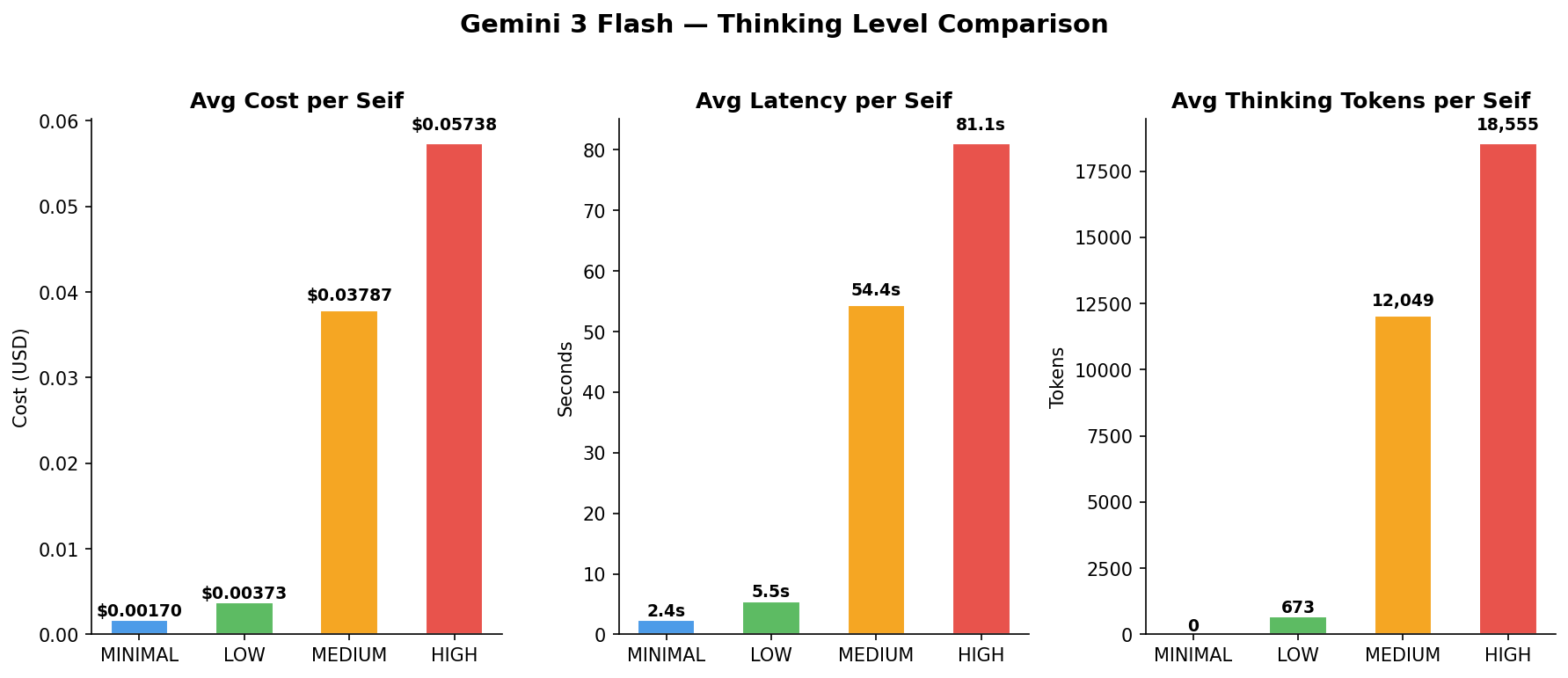
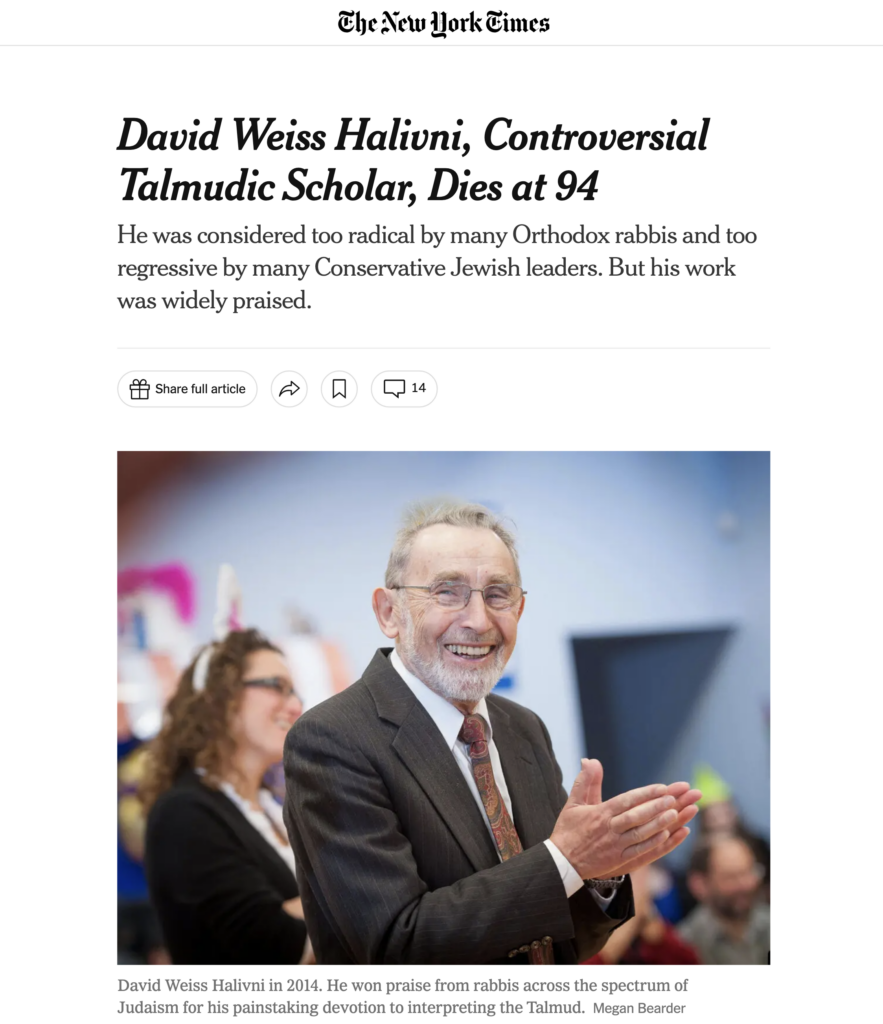
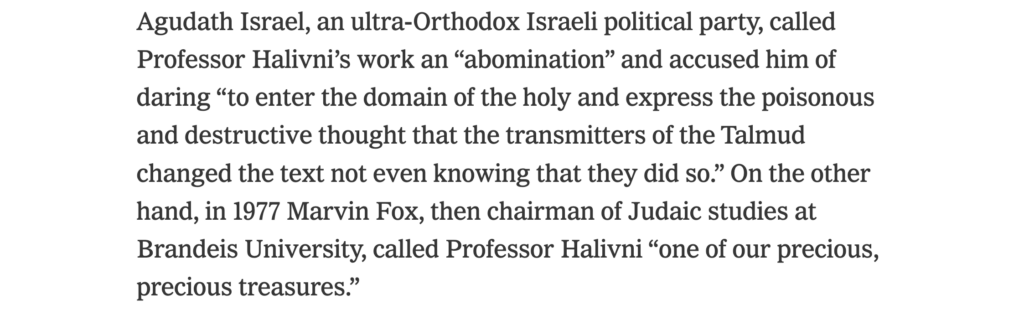
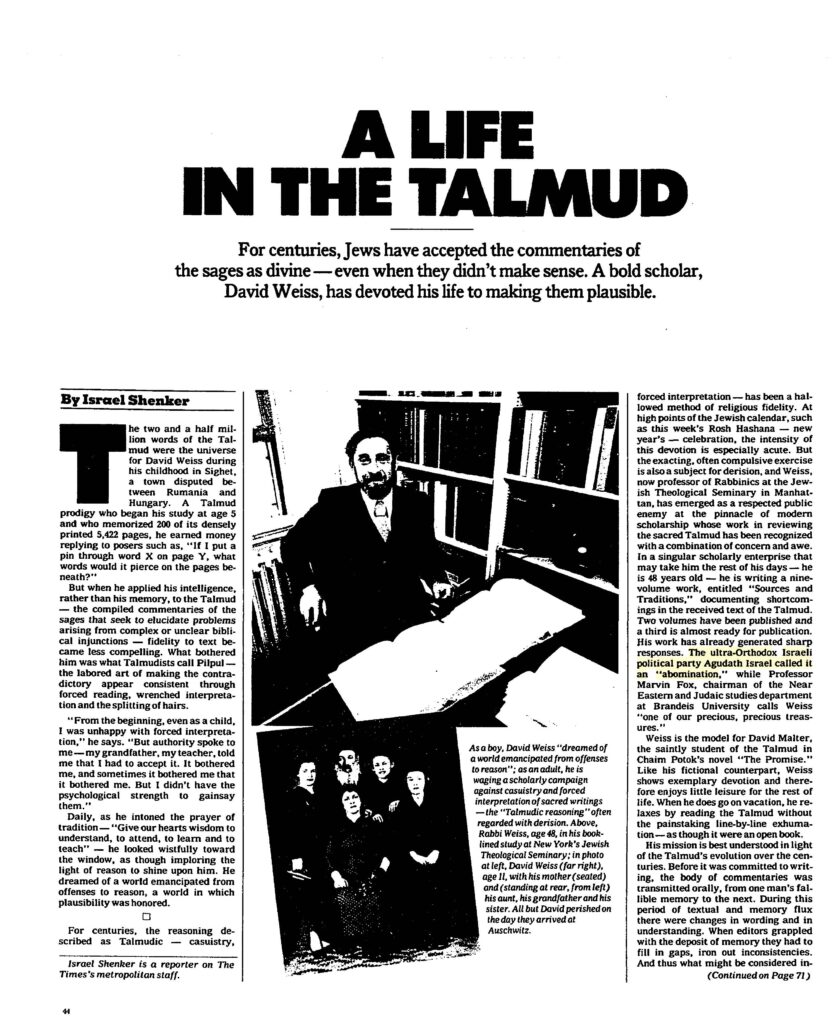
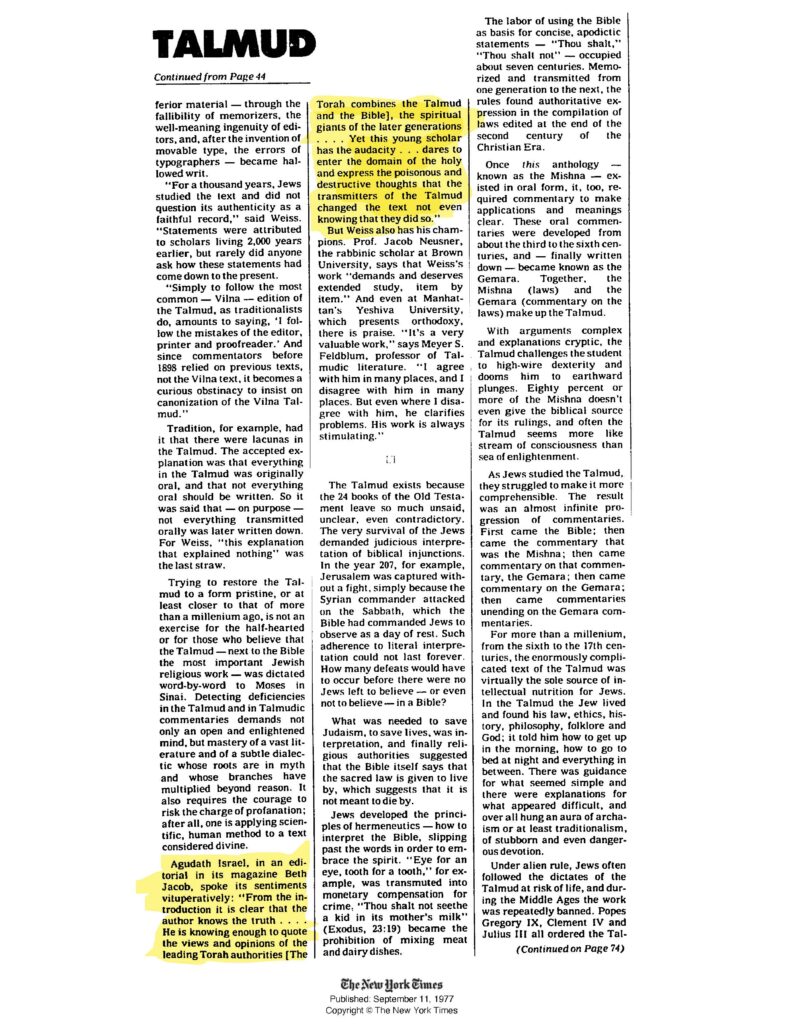
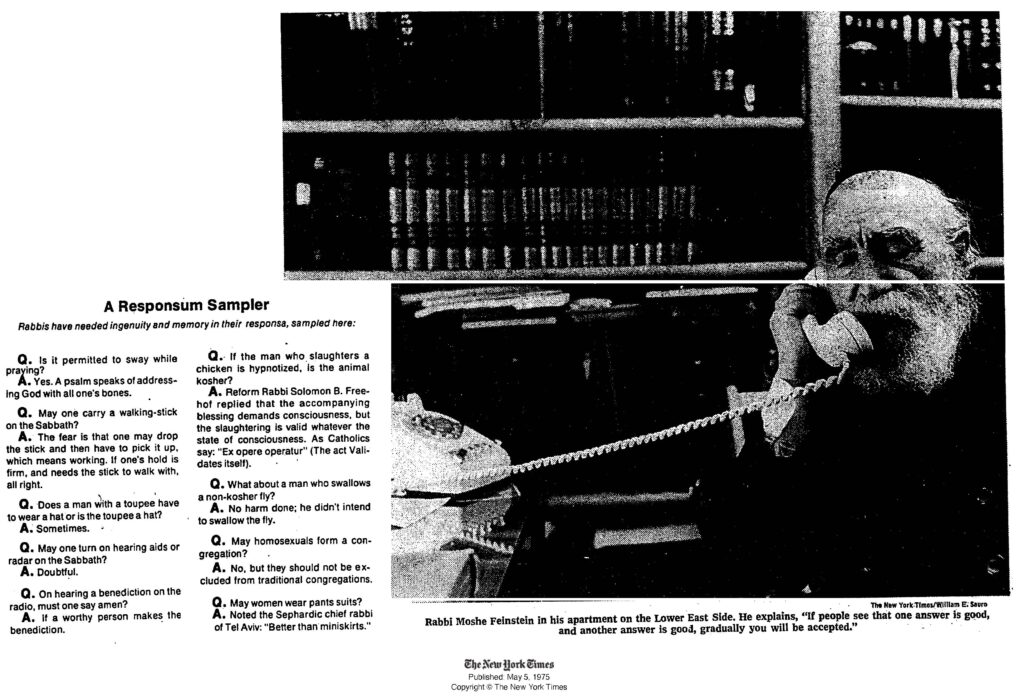
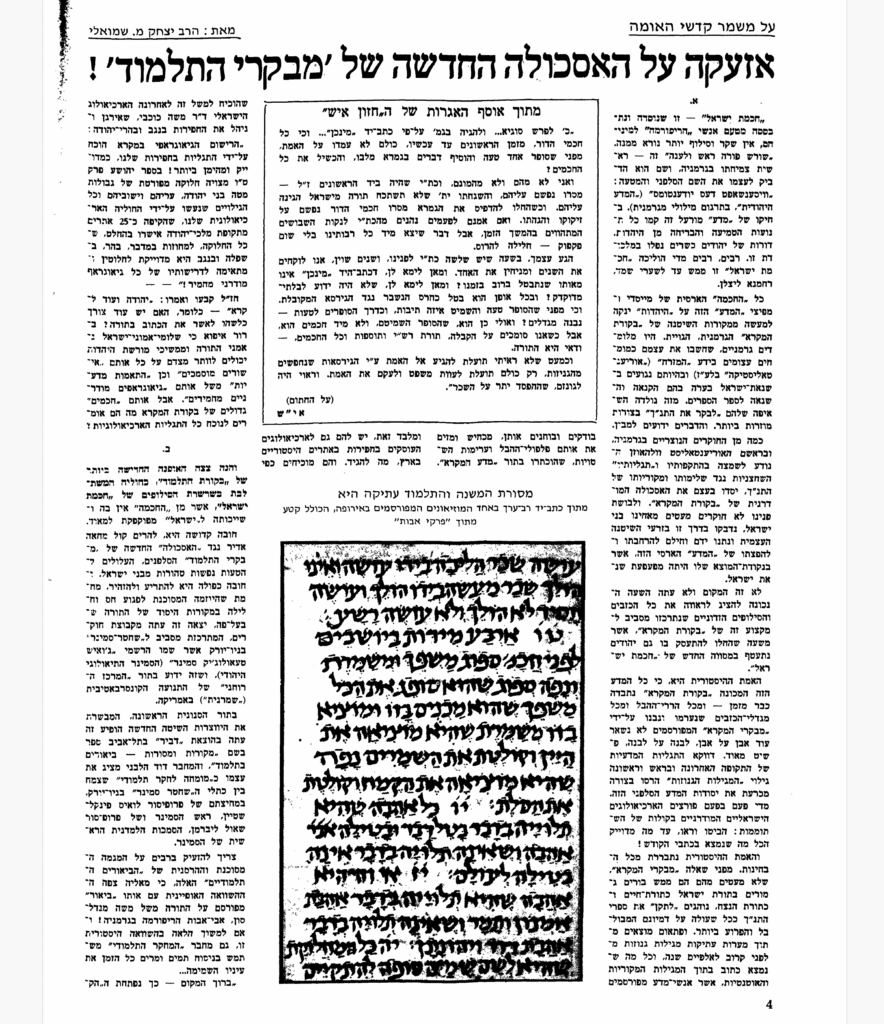
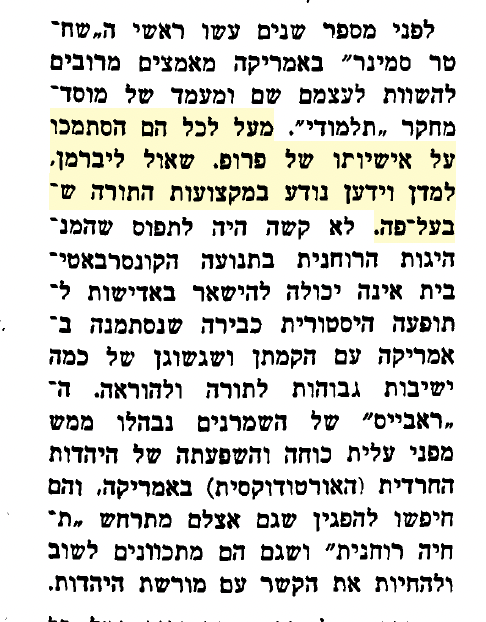 This, despite the fact that Lieberman’s earliest major work, Al ha-Yerushalmi, had already exemplified a disciplined form of textual criticism, drawing on manuscripts, parallel traditions, and internal philological analysis to clarify and correct the text of the Jerusalem Talmud. This could easily have provided fodder for Shmueli, yet he remained silent regarding Lieberman’s method. Recently published letters show that even the Ḥazon Ish engaged Lieberman seriously on these questions. Their correspondence reveals a principled disagreement over method, particularly regarding emendations grounded in manuscript evidence, while also demonstrating that such philological argumentation could be treated as a legitimate subject of rabbinic dispute rather than dismissed outright as heresy. Of course, since this correspondence had not yet been published, it cannot explain Shmueli’s silence on Lieberman’s approach.