Altering of Rabbinic Texts?, Shlomo Rechnitz and the Eighth Principle of Faith, R. Yair Hayyim Bacharach, the Ridbaz and “Chemistry,” and R. Yitzhak Barda
Altering of Rabbinic Texts?, Shlomo Rechnitz and the Eighth Principle of Faith, R. Yair Hayyim Bacharach, the Ridbaz and “Chemistry,” and R. Yitzhak Barda
Marc B. Shapiro
1. People continue to send me examples of censorship and altering of texts. If I would discuss all of them, I would have no time for other matters, but I do intend to get to some of these examples. Let me also share an “updating” of a classic rabbinic text that I discovered on my own in the old fashioned way. This is one of those examples that I wish I knew about when I wrote my book. It is not a case of someone in the Orthodox world altering a text, as this example goes back many centuries. Bereshit Rabbah 36:1 states:
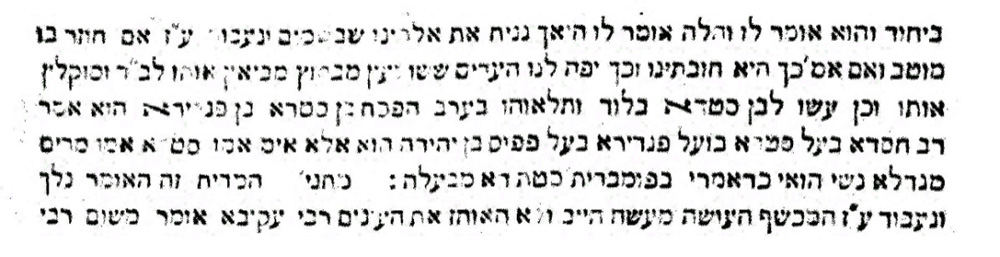
ויהיו בני נח היוצאים וגו’: והוא ישקיט ומי ירשיע וגו’ (איוב לד, כט) דרש ר’ מאיר “והוא ישקיט” מעולמו “יסתר פנים” לעולמו כדיין שמותחין כילה על פניו ואין יודע מה נעשה מבחוץ ]כך אמרו דור המבול (שם כב) “עבים סתר לו ולא יראה [“.א”ל דייך מאיר. אמר להון ומה הוא דכתיב “והוא ישקיט ומי ירשיע” וגו’. אמרו נתן שלוה לדור המבול ומי בא וחייבן.
And the Sons of Noah, that went forth: It is written, When he giveth quietness, who then can condemn, etc. (Job 34:29)? R. Meir interpreted it: He quieteneth Himself from His world, And He hideth His face (ibid.) from His world, like a judge before whom a curtain is spread, so that he does not know what is happening without. [So said the generation of the flood, Thick clouds are a covering to Him, that he seeth not (Job 22:14)] Let that suffice thee, Meir, said they to him. [Soncino: You have said more than enough – heaven forfend that this teaching should be true!] Then what is meant by, When He giveth quietness, who can condemn? he demanded. They replied: Was not ease given to the generation of the flood; who then can condemn them?
The words that I have included in the first brackets are not found in most manuscripts of Bereshit Rabbah consulted by J. Theodor for his critical edition. However, they do appear in Va-Yikra Rabbah 5:1. The words “So said the generation of the flood” are problematic, since if they said the prior sentence, why is Rabbi Meir being rebuked? If you remove those words then the text makes perfect sense, as we see that R. Meir is saying (or is attributing to Job[1]) the notion that God chooses to remove himself from knowledge of and guidance of the world.[2] This is a very radical statement and it is understandable why a later copyist would prefer to attribute such a statement to the generation of the flood, rather than R. Meir. In other words, it appears that the original text of the midrash was altered for theological reasons.
In its note on the Bereshit Rabbah text, the Soncino translation explains:
He [God] is unconcerned by what is done in the world and is not incensed by the deeds of the wicked – a remarkable teaching of God’s trancendence. Cur. edd. alter the meaning by adding: so said that generation of the Flood (according to this R. Meir merely puts these words into the mouth of the wicked), Thick clouds are a covering to Him, that He seeth not (Job xxii, 14). But in that case it is difficult to see why his colleagues so sharply rejected this interpretation.
Louis Finkelstein takes note of this midrashic passage and writes:
Even in the school of R. Akiba, we find R. Meir, the sage who so frequently expresses patrician ideas, denying Providence in individual human life. “God,” he says, “is like a judge who spreads a curtain before him and knows not what proceeds without.” The earnest protest of R. Meir’s colleagues against this heresy shows that it was meant seriously, and that R. Meir, in the second century of the Common Era, actually held views akin to those defended by the patricians for six centuries before him.[3]
It is also worth noting that the medieval R. Asher ben Gershom, as part of his defense of the medieval followers of Maimonides, refers to the Bereshit Rabbah passage and his text did not have any reference to the Generation of the Flood. He therefore understands the passage to mean that R. Meir indeed denied God’s providence. He also adds that it appears that R. Meir later rejected this view, although he doesn’t provide any evidence for this assertion. R. Asher contrasts the vehemence of the attacks on the followers of Maimonides with the calmer way the talmudic sages reacted when their colleagues put forth radical views.[4]
ראו מה בין רבותינו וביניכם. הנה להלל באמרו אין משיח לישראל. לא אמרו עליו אלא מריה שרא ליה [!]. ולר’ מאיר בדרשו בבראשית רבה הוא ישקיט בעולמו ויסתר פנים מעולמו כדיין וכו’. והוא דבר גדול בענין השגחת הבורא ית’ עד שנראה שחזר בו. לא אמרו חבריו אלא דייך מאיר.
2. In a previous post I referred to R. Menahem Navarra’s book Issur Kedushah. This book was published together with another book by R. Navarra called Kero Mikra which deals with grammatical points in the liturgy. On pp. 24a-24b he quotes Maimonides’ Eighth Principle of Faith and a passage by Abarbanel in order to reject the notion that the text of the Torah was ever in a confused state and that Ezra corrected the Torah in any way. He understands Maimonides’ principle to be teaching that the Torah text we have today is the exact same that was given to Moses.
שיחוייב כל בעל דת להאמין והוא שהתורה שבידינו היום היא הנתונ’ למשה בהר סיני מבלי חלוף ושנוי כלל . . . ומלתא אגב אורחין קמ”לן כמה יש להחמיר בענין הספרי’ וקריאתם.
The assumption of R. Navarra is also found in, of all places, Shlomo Rechnitz’s famous (or infamous, depending your perspective) speech on the Lakewood school situation.
In this incredibly courageous speech, delivered, as it were, in the lion’s den itself, Rechnitz strongly attacked the phenomenon whereby, he claims, many children in Lakewood are not allowed into the schools that their parents would like them to attend, as their families are not of the right sort. Since he is a major philanthropist, in general Rechnitz is given some leeway in what he says, but in this speech he went over the line and the powers that be responded very strongly, forcing Rechnitz to issue an apology and declare that he will no longer speak about this matter. It was interesting to see all the comments on the different haredi news sites that reported on the Rechnitz speech. The people were overwhelmingly in favor of what Rechnitz said. However, this creates an enormous problem for haredi society, since laypeople, even important wealthy philanthropists, are not the ones to be making communal policy, and certainly not to be criticizing this policy in public. By the leadership’s strong response, and seeing how quickly Rechnitz folded, it sent a clear signal who the bosses really are.
The entire video is of great interest in terms of the sociology of the American haredi community, but I want to call attention to a tangential point made by Rechnitz. At minute 21 he says that he has a difficulty with a formulation of Maimonides in his eighth principle of faith. He also states that he never saw anyone who discusses this difficulty (which I assume means he never read The Limits of Orthodox Theology).
He begins by saying that Maimonides’ principles of faith are eternal, applying for all time. Thus, the principle that God created the world or that the Messiah will come are things that one must believe in all times. He then says that the eighth principle of faith is difficult since it requires belief that our Torah scrolls are the exact same as the one given to Moses. Rechnitz asks, how can this be a principle of faith? How can there be a guarantee that the text never changed? This is not a question of theology but of historical reality, and how could Maimonides know what would happen in the future? Maybe after recording his principle there would be confusion in the Jewish people, and it would lead to a mistake in the text. Rechnitz quotes the Ani Ma’amin version of the eighth principle and wonders, “How could Chazal [!] possibly make such a statement?” He then says that in the “last few thousand [!] years since that Ani Ma’amin was written” much has happened with the Jewish people, wars, pogroms, ghettoes, etc. So how can we know that there haven’t been any changes in the text? “How can we say with a straight face that the Torah we have in our hands today is letter by letter the exact Torah we received at Har Sinai. And more importantly, how did Chazal know that the Torah would never even slightly deviate ad sof kol ha-doros?” He then says that this is based on a promise from God that the Torah would never be forgotten.[5]
All this is of course incorrect, and I don’t mean to criticize Rechnitz on this account. He is not a scholar and isn’t expected to know these things. Yet what he says is illustrative of the common view of many who have no idea about masoretic matters, and it was precisely this sort of perception that Maimonides created with his formulation of the eighth principle. (In The Limits of Orthodox Theology I offer a suggestion as to why Maimonides put forth a formulation that he knew was inaccurate.)
In response to Rechnitz, and I hope someone shows him this post, let me go over what I wrote here where I cited R. Yosef Reinman who has the same basic misconception as Rechnitz (although unlike Rechnitz, he knows that Yemenite Torah scrolls are not identical to Ashkenazic and Sephardic Torah scrolls).
Reinman writes as follows in One People, Two Worlds, p. 119:
[A]n examination of Torah scrolls from all over the world, from Ireland to Siberia to isolated Yemen, all handwritten by scribes, yielded just nine instances of one-letter spelling discrepancies. Nine! And none of them affect the meaning of the text. Why is this so? Because every week we take out the scrolls and read them in public. The people follow the reading closely and if something is wrong, they are quick to point it out.
Unfortunately, Reinman [and Rechnitz] doesn’t realize that it was the invention of printing that unified Torah texts by creating a standard version that soferim could have access to and be guided from (and those who review the parashah each week with Rashi will know that Rashi’s Torah text was not identical to the one we currently have[6]). Printed humashim also enabled people listening to the reading to point out errors. Yet let us not forget that most of the differences in Torah scrolls have concerned male and haser. Contrary to Reinman’s implication in his last sentence, there is no way for the people following the reading to catch such an error.
I must also point out that Reinman’s first sentence is an egregious error, and one doesn’t need to go to Ireland or Siberia to prove this (and contrary to what he states no one has ever performed such an examination). If one simply takes fifty Torah scrolls from Lakewood one will find all sorts of discrepancies. I know this because the people who check sifrei Torah by computer claim that the overwhelming majority of scrolls they check, including those that have been in use for decades, have contained at least one error.[7] In other words, contrary to what Reinman has stated, the truth of Torah does not rise or fall because of scribal errors. If it did, then we would be in big trouble because as I just mentioned, almost every Torah scroll in the world has discrepancies. What Reinman doesn’t seem to get is that while contemporary halakhic authorities are in dispute about only nine letters, this has nothing to do with the quality of actual Torah scrolls, which are obviously subject to human errors by scribes.
3. In my post here I discussed a possibly fictional responsum by the fascinating figure R. Yair Hayyim Bacharach.[8] There is so much of interest in his responsa, but I want to offer one further example. In Havot Yair, no. 136, he mentions that some wicked Jews have become accustomed to bribing non-Jewish judges when they have a case before them, and even brag about this. He also mentions that his brother-in-law, R. Isaac, the rav of Mannheim, had a discussion about this issue with Karl Ludwig I, the Elector Palatine. R. Bacharach actually puts ז”ל after Karl Ludwig’s name. ז”ל is almost never added to the name of a non-Jew and thus shows the positive feelings R. Bacharach had for Karl Ludwig.[9]
והיה הדוכס קאריל לודוויג ז”ל המופלג בחכמה משתעשע לפרקים בגיסי הנזכר בדברי שכליים.
R. Bacharach records that Karl Ludwig once told R. Isaac that has a complaint about the Jews whose cases often come to the government courts. He says that they bribe the judges, an action “which is against all religion, and certainly against what is written in your Torah.” He also told R. Isaac that it was his responsibility to fix this problem.
R. Isaac agreed with Karl Ludwig that bribery of judges is a terrible thing, and he doesn’t deny that Jews have been guilty of this. He adds that even if there is no Torah prohibition to bribe a (non-Jewish) judge, it still needs to be forbidden in order for there to be a properly functioning society.
דאפילו לא נאמר איסורו בתורה ראוי לאסרו מצד השכל וישוב העולם ותיקון המדינה כמו רציחה וגזילה וגניבה ואונאה וזנות ועול מידות, וכלם דברים שהשכל מחייב, ודין ודת חק ומשפט עולה על כלנה שאם יקולקל המשפט איש הישר בעיניו יעזה.
R. Bacharach was not in the room when R. Isaac spoke to Karl Ludwig. It is possible that he is recording the gist of what R. Isaac told him he said, but is it also possible that what are seeing is R. Bacharch’s invention of a conversation, and that R. Bacharach is using the opportunity to put forth his own ideas about the matter?
R. Bacharach then records that R. Isaac told Karl Ludwig that if a Jew is owed money by a non-Jew and the non-Jew denies this, while there can be no permission for the Jew to offer the judge a bribe, from God’s perspective if a bribe was given it is not wrong since the Jew is entitled to the money and the only way he can get it was by bribing the judge. He also said that perhaps the bribe can be seen as evening the scales, since the Jew is afraid that his adversary has also bribed the judge. This argument is intended to show that the Jews of R. Bacharach’s time who bribed non-Jewish judges were really not doing something so bad.
R. Bacharach then says the following (again, supposedly in the name of his brother-in-law), which is just as true today as when he said it: והנה ידוע שאין שנאה כשנאת הדת. He explains that when the Jew and non-Jew come before the judge, the judge naturally inclines to favor his co-religionist. The Jew therefore assumes that the only way he can get a fair trial is by bribing the judge. In other words, he is not bribing him to have the case thrown his way, but only to get a fair trial. R. Bacharach concludes that what he has said should not be seen as a justification of bribery, but as a limud zekhut which explains the circumstances that lead Torah observant people to behave this way.
R. Bacharach tells us that Karl Ludwig liked what R. Isaac said but asked him what about when two Jews are having a court case and they still bribe the judge. In that circumstance there is no reason to think that the judge will favor one side, as neither side shares his religion. R. Bacharach reports how R. Isaac was able to respond properly to this question, but again, is it possible that this is an invention of R. Bacharach in order to enable him to get his ideas across?
After recording the supposed conversation between R. Isaac and Karl Ludwig, R. Bacharach elaborates on the matter of bribery and why there is no explicit Torah prohibition on giving a bribe, only on taking a bribe (Deut. 16:19). In this discussion he notes that he does not think that there is a prohibition to bribe a non-Jewish judge if do not know that you are in the wrong, and thus you are not asking the judge to award you something that doesn’t belong to you by right. He also says that one who offers such a bribe does not make it a quid pro quo that he gives the money and the judge rules in his favor. All he intends by the money is that the judge look carefully at his case and listen to his claims, and then render a just decision. In his description of R. Isaac’s conversation with Karl Ludwig, Bacharach reports that R. Isaac said that he was only offering a limud zekhut for those who bribe judges, but “halilah” to say that this is proper behavior. Here, however, R. Bacharach is saying that there is no prohibition. In other words, in the very same responsum R. Bacharach is showing the difference between an answer motivated by apologetics and one that needn’t be concerned with this.
ולכן בשוחד לשופטיהם אין בו חשש דלפני עיור אם הוא מדיני ממונות, שלא נתברר לבעלי דבר עצמן שחבירו עושה עול רק כל אחד סובר שהדין עמו, וגם השופט דעתו לשפוט צדק, וגם נותן השוחד אינו מתנה שיזכהו רק שיחפש זכותו וישים דברי טענתו אל לבו.
Examining what halakhic authorities say about the matter of bribing non-Jewish judges shows very clearly how at least some Jews regarded themselves as living in a parallel universe from non-Jewish society, and did not feel bound by the rules of the latter society, only by internal Jewish rules. Even though most halakhic authorities assume that it is forbidden to bribe non-Jewish judges,[10] the fact that some think it is permitted is also of great significance in showing that this was not regarded as an obvious matter. Thus, R. Jonathan Eybeschuetz[11] raises the question if one can bribe a non-Jewish judge. He refers to R. Bacharach’s responsum and tells us that R. Bacharach did not come to a conclusion in this matter. He then adds that the “world” has long been accustomed to be lenient in this matter, and R. Eybeschuetz provides a halakhic justification for the bribery, which would only be in a case when the Jew was in the right.
והעולם נוהגין היתר משנים קדמוניות . . . וצ”ל דס”ל דכל הטעם של שוחד דהוא חד דמקרביה דעתיה גביה וזהו בישראל דקרובים אסורים לדון אבל בבן נח שכל הקרובים מותרים לדון אין לך קירוב יותר מזה והכל יודעין שדעת האב קרוב לבן יותר מאדם אחר שנותנים לו אלף דינרים ומכל מקום האב כשר לדון בנו הבן נח, אף ליתן שוחד להצדיק הצדיק וכו’ מותר דמ”ש מקרובים.
I think it is very likely that despite the halakhic justification provided, the real motivation for any Jewish bribery of non-Jewish judges was the assumption that the judge would not be fair when dealing with Jews as well as a fear that the non-Jewish litigant was also bribing the judge.
R. Abraham Zvi Eisenstadt, Pithei Teshuvah, Yoreh Deah 151:1, states that any bribery is only permissible באופן שאין בו חשש גזל, and even for this permissible bribery, it is only OK if the money is not given directly to the judge but to one of his assistants who will then give it to the judge. See also Pithei Teshuvah, Hoshen Mishpat 9:2, who after citing authorities who disagree with R. Eybeschuetz nevertheless justifies offering bribes when it is obvious that the non-Jewish judge is not going to render a just verdict.
R. Simeon Anolik, in a book published in 1907, states that there is no prohibition of lifnei iver if one bribes a non-Jewish judge, as the non-Jewish legal system is not in accord with Torah law. However, this is only permitted if the intent of the bribe is to arrive at the correct, Torah mandated result .[12]
לא שייך בזה לפני עור מה שנותן שוחד לזכות את הזכאי ולחייב את החייב אם דנו עפ”י חק שלהם. ומש”כ רמב”ן בפ’ וישלח בשם הירושלמי דב”נ מוזהר בלא תקח שוחד היינו בדין שהוא כדיננו. או דמרא דירושלמי הוא ר’ יוחנן ולדידיה מבואר ברמ”א שם [שו”ת הרמ”א סי’ י] דב”נ מחוייב בדינים שחקקו להם כרצונם. אבל לדידן דקי”ל דמצווים על הדינים היינו דינים שלנו שפיר פשט ההיתר מטעם זה.
The words that I have underlined would appear to show that Anolik’s position was widely accepted.
Regarding bribery, in Between the Yeshiva World and Modern Orthodoxy, p. 35 n. 93, I mention a forthcoming article which will deal with paying off community leaders in order for someone to be given a town rabbinate. After completing the just-mentioned book, my interests moved in different directions, but I do still hope to write that article which will have a lot of material that has never been discussed in scholarly literature. Here is one interesting source from R. Elhanan Wasserman that I only recently found. In Kovetz Shiurim: Bava Batra no. 71, R. Elhanan suggests that if you are the most qualified to serve as a dayan in the community, then there is no prohibition to pay the community leaders to appoint you to the position, and no prohibition for the community leaders to accept this money. I don’t know of anyone else who holds this position which, needless to say, would open up a can of worms, since lots of people think that they are the most qualified. We obviously can’t have a situation where all such people feel that they can pay off the community leaders in order to be appointed to a position. Furthermore, the Rambam makes no distinction of the sort R. Elhanan does, but states flatly that it forbidden for a dayan to give money in order to be appointed. See Mishneh Torah, Hilkhot Sanhedrin 3:9
כל דיין שנתן ממון כדי שיתמנה אסור לעמוד מפניו וציוו חכמים להקל אותו ולזלזל בו. ואמרו חכמים שהטלית שמתעטף בה תהי בעיניך כמרדעת של חמור.
4. In my post here I wrote:
The Ridbaz’s attack on the Brisker method is well known. In the introduction to his responsa, Beit Ridbaz (Jerusalem, 1908), Ridbaz writes as follows:
A certain rabbi invented the “chemical” method of study. Those in the know now refer to it as “chemistry,” but many speak of it as “logic.” This proved to be of great harm to us for it is a foreign spirit from without that they have brought in to the Oral Torah. This is not the Torah delivered to us by Moses from the mouth of the Omnipresent. This method of study has spread among the yeshivah students who still hold a gemara in their hands. In no way does this type of Torah study bring men to purity. From the day this method spread abroad this kind of Torah has had no power to protect its students. . . . It is better to have no rosh yeshivah than to have one who studies with the “chemical” method.
In his ethical will, printed at the end of his responsa, Ridbaz returns to this criticism and directs his sons: “Be careful, and keep far away from the new method of study that has in recent years spread through Lithuania and Zamut. Those knowledgeable in Torah refer to it as ‘chemistry.'” (Just before this post appeared, R. Eliezer Katzman sent word that in his opinion, Ridbaz is not referring to R. Hayyim and the Brisker approach, but rather to Telz and its method of talmudic analysis. I don’t believe this is correct, and hope to return to this subject in a future post.)
In the first edition of Shaul Stampfer’s Ha-Yeshivah ha-Lita’it be-Hithavutah, p. 113 n. 29, he quotes Saul Lieberman’s opinion that Ridbaz’ words were directed against R. Isaac Jacob Reines. This is clearly incorrect. Reines’ method had no influence whatsoever, and Ridbaz is speaking about a method of study that was widespread in the yeshivot. It is obvious that he can only be referring to the method of R. Hayyim. Lieberman’s incorrect speculation was removed in the second edition of Stampfer’s book. . . .[13]
Needless to say, because of his attacks on R. Hayyim, Ridbaz did not endear himself to the Soloveitchik family. Once when a student referred to Ridbaz, R. Joseph B. Soloveitchik became very angry and told the student never to mention his name again. He also said that some gedolim are always right, some are sometimes right, and some are never right, and the Ridbaz falls into the latter category![14]
Thus far what I wrote in my prior post. It is worth noting that Benjamin Brown defends Lieberman’s suggestion that the Ridbaz’s words were directed against Reines.[15] However, as I have written, I see no justification for this. Daniel Price called my attention to Shai Akiva Wosner’s recently published a book on R. Shimon Shkop, Hashivah Mishpatit bi-Yeshivot Lita: Iyunim be-Mishnato shel ha-Rav Shimon Shkop. On p. 32 he refers to my post and rejects my assumption that the Ridbaz was referring to R. Hayyim Soloveitchik. He claims that his negative comments were directed against Telz and its method, a view that as mentioned is also shared by Katzman.
I don’t deny that the Ridbaz could also have had Telz in mind, but this doesn’t change my assumption that the main target of his words was R. Hayyim Soloveitchik. Is there a source that can settle this argument conclusively? I believe there is, but I was not aware of it when I wrote my previous post. In 1935 Moshe Aharon Perlman published his Mi-Pi Dodi. Here is the title page.

This volume records things he heard from his uncle, R. Moses Kliers, the rav of Tiberias. R. Kliers knew the Ridbaz personally, and the information that appears on p. 35 is obviously of great importance to what we have been discussing:
מסדר למוד הבריסקאי לא היתה דעתו נוחה וקרא לו חימיא
In other words, R. Kliers told Pearlman that the Ridbaz opposed the Brisker approach and referred to it as “chemistry”. This source is more significant than any speculation by contemporary scholars.
There is a good deal in Mi-Pi Dodi that I think readers will find of interest, but for now I will just mention one example.
P. 25. R. Kliers said that all manner of dress worn by the Slobodka students can be justified, but what can’t be justified is the forelock of hair that the students had.
(In Changing the Immutable, p. 268 n. 156, I cited a fascinating passage from Mi-Pi Dodi, pp. 9-10, showing that R. Kliers thought that it was better for people to carry on a particular Shabbat and violate a rabbinic commandment rather than learning that a rabbi had made a mistake in setting up the eruv, and thus come to lose respect for him which would violate a Torah commandment. The eruv could be fixed after Shabbat, but the negative effect on the rabbi’s reputation would remain.[16])
5. In my last post I referred to R. Yitzhak Barda and his book Kinyan Torah which argues that Maimonides’ view is binding, even if this means rejecting the Shulhan Arukh. Here is the title page of Kinyan Torah, vol. 3.

At least one reader was wondering if R. Barda is Yemenite. He is not, and his view granting final authority to the Mishneh Torah is unique among Sephardic authorities. R. Barda is in charge of a group of Torah institutions in Ashkelon called Yitzhak Yeranen. He is also the brother-in-law of R. Meir Mazuz and often appears together with him at events. Here is a picture of them during the last Israeli elections.

Halakhic authorities have had different perspectives on how to relate to newly discovered manuscripts that contain halakhic rulings. The Hazon Ish did not pay these texts much mind, not regarding them as having been part of the halakhic tradition. Most halakhic authorities, on the other hand, had a more positive opinion of such newly published texts. However, even those who welcomed the newly published texts and integrated them into the halakhic system generally agreed that halakhot that that were recorded in the Shulhan Arukh and were thus generally accepted could not be rejected based on a newly published text.[17] That is one reason why the 2014 appearance of R. Yitzhak Barda’s tenth volume of responsa Yitzhak Yeranen is of interest, as in this volume one finds that the author indeed rejects a universally accepted halakhah.[18]
The question R. Barda deals with is whether one can bake or cook on the first day of Yom Tov for the second day (and his conclusion would apply to other relevant matters, such as setting the table on one day for the next). This would appear to be an easy question to answer, as the Talmud, Betzah 17a, states: “Our Rabbis taught: One may not bake on the first day of a festival for the second.” This halakhah is recorded in Shulhan Arukh, Orah Hayyim 503:1. One might think that this would be the end of the matter, and for centuries it was. However, R. Barda has reopened the discussion. According to him, it is permitted to bake or cook on the first day of Yom Tov for the next day. How does he arrive at such a decision, one at odds with the Shulhan Arukh?
R. Barda begins by pointing out that R. Hananel records a different version of the talmudic text. In his version, the Talmud states that it is forbidden to bake on Yom Tov for Shabbat or for after the holiday, but it says nothing about baking from the first day of Yom Tov for the next next day. R. Isaac Alfasi, R. Asher ben Jehiel, and other geonic and medieval sources also have the version recorded by R. Hananel.[19] Not noted by R. Barda, but certainly a support for his position, is that the Tosefta and Jerusalem Talmud also have nothing about baking on the first day of Yom Tov for the next day.[20]
R. Barda further points out that Maimonides must also not have had our version of the talmudic text, since in the Mishneh Torah all he says is that on Yom Tov one may not bake or cook anything that will be eaten after the holiday.[21] He says nothing about not baking or cooking on the first day of Yom Tov for the next day. Also important for R. Barda’s case is that Maimonides, Mishneh Torah, Hilkhot Shevitat Yom Tov 6:14, states that the observance of the second day of Yom Tov is not on account of doubt, but is a minhag. What this means is that it is not a question of maybe the second day not really being a Yom Tov, in which case one could understand the prohibition of baking or cooking on the first day for the second. I would only add that R. Barda’s point also works if you adopt Maimonides’ other formulation that Yom Tov Sheni is an actual decree of the Sages.[22] In either case, the second day is treated like Yom Tov no different than the first day, and thus R. Barda states that there is no reason why one cannot bake or cook on the first day for the second. As for Rosh ha-Shanah, he tells us that the two days of this holiday are regarded by the Talmud as one long day,[23] and therefore there is even more reason for it to be permitted to bake on the first day for the second.
R. Joseph Karo, in the introduction to the Beit Yosef of which the Shulhan Arukh is an abridgment, tells us that he is going to decide the halakhah based on the three central authorities, R. Isaac Alfasi, Maimonides, and R. Asher ben Jehiel. As R. Barda points out, in the case we have been discussing, none of these three authorities state that it is forbidden to bake or cook from one day of Yom Tov to the next, and yet the Shulhan Arukh does forbid this.
R. Barda notes that there are medieval authorities who record the prohibition, most prominently R. Jacob ben Asher, Tur, Orah Hayyim 503. Prior to this, Halakhot Pesukot[24] and Halakhot Gedolot[25] also record this prohibition, even though according to R. Barda their version of the Talmud did not state that it is forbidden to bake on the first day of Yom Tov for the next day, only that it is forbidden to bake on Yom Tov for after the holiday. In other words, even though baking or cooking on the first day of Yom Tov for the next day is forbidden by Halakhot Pesukot and Halakhot Gedolot, this is an original deduction made by these authorities, not a recording of earlier talmudic halakhah. (Actually, it would have made more sense for R. Barda to say that the rulings in Halakhot Pesukot and Halakhot Gedolot originated in an earlier source.) Yet the stringent position codified by these two sources and later by R. Jacob ben Asher and other rishonim is not determinative for R. Barda, since as mentioned this halakhah does not appear in the more important sources, namely, R. Isaac Alfasi, Maimonides, and R. Asher ben Jehiel (R. Jacob ben Asher’s father).
Readers might be convinced by R. Barda’s argument that R. Isaac Alfasi, Maimonides, and R. Asher ben Jehiel did not view it as forbidden to bake or cook on the first day of Yom Tov for the next day. But this still does not mean that it should be permitted today, for as we have seen the Shulhan Arukh forbids this action. R. Barda’s assumption is that R. Joseph Karo’s text of the Talmud was not pristine, but as with our version had incorporated the addition of the Halakhot Pesukot and Halakhot Gedolot, forbidding baking on the first day of Yom Tov for the next day. Since the Shulhan Arukh’s ruling is based on an error, namely, R. Karo’s false assumption that the Talmud forbids baking or cooking on the first day of Tom Tov for the next day, R. Barda declares that one need not accept the Shulhan Arukh’s ruling. (This statement is directed towards the Sephardic community as a whole, which follows the Shulhan Arukh. R. Barda personally follows Rambam, and since the Rambam does not record the prohibition, that alone is enough for him to permit baking and cooking on the first day of Yom Tov for the second day.)
R. Barda further states that had R. Joseph Karo known what has been mentioned so far, he, too, would have decided differently. He adds that to refrain from baking or cooking on the first day of Yom Tov for the next day takes away from some of the joy of Yom Tov, as it makes it more difficult to prepare food for the second day of the holiday.[26] He also calls attention to a responsum of R. Isaac Bar Sheshet from which we see that there were people who indeed baked and cooked on the first day of Yom Tov for the second day. (R. Isaac Bar Sheshet himself states that this is forbidden.[27])
After many pages of justification of his ruling, R. Barda publishes two letters he received from R. Serayah Deblitzky in which the latter takes issue with what R. Barda wrote. R. Deblitzky begins by stating that it is an absolute principle that a halakhah that has been accepted among all of Jewry cannot be overturned due to the discovery of new manuscripts or based on the fact that important earlier authorities did not record this particular halakhah. He further notes that R. Jacob ben Asher did forbid baking and cooking on the first day of Yom Tov for the next day, even though his father, R. Asher ben Jehiel, did not mention this prohibition. R. Deblitzsky does not think it is reasonable that R. Judah would disagree with his father in this matter, and assumes that R. Asher ben Jehiel’s omission of the halakhah does not imply that he had a more liberal perspective.
[1] See Mordechai Margaliyot’s note in his edition of Va-Yikra Rabbah, ad loc.
[2] Malbim, Deut. 13:7 (p. 87a) cites the Midrash without the words כך אמרו דור המבול. Yet as far as I can determine, every printed edition of the Midrash has these words. Does this mean that the Malbim independently concluded that the words should be deleted?
[3] The Pharisees (Philadelphia, 1938), p. 260.
[4] The text is published in Joseph Shatzmiller, “Les tossafistes et la premiere controverse maïmonidienne: le témoignage du rabbin Asher ben Gershom,” in Gilbert Dahan, et al., eds., Rashi et la culture juive en France du Nord au moyen âge (Paris, 1997), p. 67.
[5] Rechnitz also says that the Torah cannot be changed, “no Reform, no Modern Orthodoxy.” Does Rechnitz really feel that Modern Orthodoxy is akin to Reform? Or was this comment strategic? In other words, since he is attacking a widespread practice in Lakewood, he has to show them that despite the attack he is still on the “right” side, and the way to do this is by slandering Modern Orthodoxy.
[6] See Rashi to Ex. 25:22. Even the ArtScroll-Sapirstein Rashi translation is forced to admit: “Rashi’s Sefer Torah evidently had a ו where ours does not.” Siftei Hakhamim writes:
אע”פ שאין כתיב ואת בוא”ו בס”ת של רש”י היה כתוב בוא”ו.
See also Rashi to Gen. 25:6. Artscroll writes: “Rashi’s text of the Torah had the spelling פילגשים, without the letter י of the ים suffix which indicates the plural.”
[7] For the information on errors in Torah scrolls, including eye-opening pictures, see Kolmos, Elul 5748. Here is part of R. Shmuel Wosner’s letter quoted on p. 7:
עכשיו שנכנס עבודת הקאמפיוטער בזה למסלולו, ונתברר על ידו לתמהון לבב כולנו, שמבערך ששים ספרים, ס”ת שהיו בחזקת בדוקים יצאו רק תשע ספרים נקיים מכל שגיאה וברובא דמינכר מאד נמצאו שגיאות פוסלות לרוב. וכן בדידן הוי עובדא בס”ת שנכתב ע”ש תלמידים גדולים וצדיקים שנספו בעו”ה, נמצאו ה’ טעיות ממש בחסר ויתר.
[8] I am inclined to see the responsum’s description of a storybook romance as fictional, and I think there might be other fictional responsa in Havot Yair. None of this can be proven, and it is just a sense I have that some of the questions were created by R. Bacharach in order to establish halakhic principles. I think this might be the case with no. 183 where he discusses a man confronted with a choice to drink non-kosher wine or have his ear cut off. See also no. 79 regarding a convert to Judaism, if he needs to return money he stole from Jews and non-Jews before he converted.
[9] In no. 139 R. Bacharach mentions the hillul ha-shem that results when a Jew is a thief, as the non-Jews blame the entire Jewish community for his actions. Yet R. Bacharach adds that it is only the masses who have this feeling, while the wise people and the government leaders don’t engage in such stereotyping.
ואף כי יש חילול השם באשר הגוים מרשיעים על כלל יהדות בשביל כך, אין אלו רק דברי המון עם ולא חכמים שבהם ושלטונים.
[10] See R. Asher Weiss, Minhat Asher, vol. 1, no. 92.
[11] Urim ve-Tumim, Hilkhot Dayanim 9:1.
[12] Orah Mishpat (Petrokov, 1907), p. 17a.
[13] [See p. 124, n. 30, where Stampfer quotes Prof. Chimen Abramsky, a descendant of the Ridbaz, that in the family it is accepted that the Ridbaz was referring to R. Hayyim.]
[14] I heard this from an eyewitness. The event took place in the 1950s.
[15] Ha-Hazon Ish (Jerusalem, 2011), p. 321 n. 44.
[16] See also Shabbetai Dov Rosenthal, Geon ha-Hora’ah (Jerusalem, 2011), vol. 2, pp. 186-187, for two similar cases with R. Samuel Salant and R. Zvi Pesah Frank.
[17] However, what should a posek do if it is clear that a halakhah in the Shulhan Arukh is based on a mistaken text? R. Jehiel Jacob Weinberg was unsure. See Kitvei ha-Gaon Rabbi Yehiel Yaakov Weinberg, vol. 2, p. 433:
הוכחתי שהב”י השתמש בכת”י מקולקלים וע”י נדחק לפרש ולהסיק הלכה מנוסחאות של ספרי ראשונים שהי’ בהם השמטות בשגיאת סופרים – השאלה היא אם להניח הכל כמו שהוא ורק להסביר ולנסח בלשון ובהגיון מתקבלים על הלב, או לשוב למקורות הראשונים ולחקור ולבדוק הכל מחדש.
[18] We will be focusing on nos. 20-24, where R. Barda explains his position and defends it against criticism. Here is the title page of Yitzhak Yeranen, vol. 11, R. Barda’s most recent volume of responsa.

[19] R. Barda mistakenly states that the Munich manuscript of the Talmud is also missing the words מיו”ט לחברו. This error does not affect his argument, as the Munich manuscript is from the 14th century and R. Barda acknowledges, p. 262, that there were medieval texts of the Talmud that had מיו”ט לחברו. Yet he believes that these words are not original but were inserted based on what appears in the Halakhot Gedolot (which I will soon discuss).
[20] See Saul Lieberman, Tosefta ki-Feshutah, Beitzah, p. 947.
[21] See Mishneh Torah, Hilkhot Shevitat Yom Tov, ch. 6.
[22] See my Studies in Maimonides and His Interpreters (Scranton, 2008), p. 59.
[23] See Beitzah 4b-5a.
[24] Halakhot Pesukot (Versailles, 1886), p. 8. Since I am sure some will be skeptical that a sefer was ever printed in Versailles, here is the title page.

[25] Halakhot Gedolot, Makhon Yerushalayim ed. (Jerusalem, 1992), Hilkhot Yom Tov, p. 215.
[26] See Yitzhak Yeranen, p. 263.
[27] She’elot u-Teshuvot ha-Rivash, no. 254. See also ibid., no. 16.