R. Hayyim Soloveitchik’s Attitude Towards Girsaot: A Response to Dr. Marc Shapiro

R. Hayyim Soloveitchik’s Attitude Towards Girsaot

A Response to Dr. Marc Shapiro

Elisha Friedman

R. Hayyim Soloveitchik earned his towering stature in Jewish intellectual history for his revolutionary methodology of Talmudic analysis, but scholars have also noted another aspect of his insights, which is a disinterest, bordering on disregard, for textual veracity. In general, traditional Talmudists were not overly concerned with bibliographic issues and girsaot (textual variants), but even within this tradition R. Hayyim stands out as extreme. One of the most glaring, and by extension often quoted, examples of R. Hayyim using a faulty text is his analysis of the passage in Mishneh Torah, Hilkhot Nizkei Mamon 4:4.

In a recent post, Dr. Marc Shapiro responded to my objection to this example. Dr. Shapiro’s clarification was helpful in elaborating on the proof from Nizkei Mamon, as well as documenting a number of scholars who have used it. The basic outlook of this school is that R. Hayyim is entirely removed from girsah considerations. In this post I will articulate an alternative approach to this issue, arguing that R. Hayyim does take girsah factors into consideration. In section one, I sketch Shapiro’s perspective (in my understanding) and the proof from Nizkei Mamon. In section two, I present an alternative reading. In section three, I conclude with some broader reflections on R. Hayyim’s attitude towards girsaot.

  1. R. Hayyim’s Aversion to Girsaot

Traditional Talmudists, with some notable exceptions, generally ignored issues of girsah, preferring to focus on the content and logical flow of classical texts. In many ways this is the defining hallmark of traditional Talmudic scholarship, as opposed to other methods of study which concentrate on textual issues. One of the notable exceptions to this overall trend was Vilna Gaon. As an example, the mishna towards the end of tractate Avot (5:20) reads,

יהודה בן תימא אומר, הוי עז כנמר, וקל כנשר, ורץ כצבי, וגבור כארי, לעשות רצון אביך שבשמים. הוא היה אומר, עז פנים לגיהנם, ובשת פנים לגן עדן. יהי רצון מלפניך יי אלהינו שתבנה עירך במהרה בימינו ותן חלקנו בתורתך.

Yehuda ben Tema said: Be strong as a leopard, light as an eagle, swift as a deer, and brave as a lion, to do the will of your Father in Heaven. He would say: the brazen-faced [is destined] to Gehinom; the shame-faced to Gan Eden. May it be Your will, O Lord our God, that Your city be rebuilt speedily in our days and set our portion in the study of Your Torah

After two statements reflecting on the proper role of aggression in religious life, the mishna suddenly includes an out-of-place prayer for the rebuilding of Jerusalem. It seems clear there is a textual problem with this mishna, and surveying how traditional commentators approached it is illustrative.

Vilna Gaon offered an obvious textual emendation – that this prayer was erroneously copied here, but properly belongs four mishnayot later at the end of the tractate.[1] Meiri offers another textual solution, that originally this mishna was the conclusion of the tractate, so it ended with a prayer, and then subsequently additional statements were added on, but the prayer remained where it had been originally.[2]

Yet the majority of commentators, including Rambam, Bartenura and Tiferet Yisrael, avoid a textual solution. Some suggest a homiletical reason for the insertion of this prayer, based on the notion that God blessed the Jewish people with a lack of aggression. R. Akiva Eger in his commentary cites an interpretation from Radach (R. Dovid Hacohen of Corfu), who explains that since this mishna discusses the proper religious uses of aggression, therefore the mishna prays for the messianic times when we will no longer require any aggression.

This example illustrates the general reluctance of traditional commentators, with some exceptions such as Vilna Gaon, to resolve questions through textual solutions. It also points towards a possible reason for this: avoiding textual solutions generates greater religious and homiletical creativity. Since, in this instance, commentators avoided the textual solution, they were enabled to formulate homiletical insights.

There is no question that R. Hayyim Soloveitchik reflects this traditional hesitancy regarding textual solutions. When R. Hayyim confronts a difficulty, he prefers a conceptual answer over a textual resolution, even when the latter seems evidently correct. As an example, in Hilkhot Hametz u’Matzah 1:3, Rambam ruled that one who did not burn his hametz before Passover does not receive the punishment of lashes because it is a passive violation not active, “for he did not perform a deed” (מפני שלא עשה מעשה). R. Hayyim asks that this statement contradicts the Talmudic rationale exempting lashes (Pesachim 95a), which is that this is a prohibition which is attached to a positive mitzvah to destroy the hametz (לאו הניתק לעשה).

This question is problematic, since there is a seemingly obvious textual answer, namely, that Rambam had a well-attested variant girsah of that Talmudic passage, which omits the entire לאו הניתק לעשה rationale. In fact, in the standard Vilna Shas, this line appears in parentheses to indicate the alternative girsah! Yet instead of offering this obvious girsah solution, R. Hayyim prefers to develop his conceptual insight, which illustrates his general aversion to girsah answers.[3]

When studying R. Hayyim’s insights one can intuit that his avoidance of girsaot goes further than other leading Talmudists, his relentless focus on conceptual analysis seemingly leaves no room for girsaot (or other) concerns. But it can be difficult to express this insight in more precise language. It is particularly challenging because we have no programmatic statement from R. Hayyim as to his outlook on textual issues, as such scholars must try to recreate his attitude from his hiddushim.[4]

There is a scholarly formulation of this which contends that R. Hayyim avoids girsaot to the extent that he is even willing to cite and analyze faulty texts which were retracted by their very own authors. The explanation for this is that when it comes to religious texts R. Hayyim maintains an extreme theory of textual autonomy, that religious texts transcend the author who wrote it. I will cite Shapiro’s formulation of this idea,

On occasion, [traditionalists] even ignored the explanations Maimonides himself later gave for his halakhot… A different justification, with a more modern appeal, is quoted in the name of R. Naphtali Zvi Judah Berlin: “All the works of our teachers, the rishonim, until the era of Pnei Yehoshua, were written with ruah ha-kodesh, and obviously Maimonides’ Code is in this category. What Maimonides wrote in a responsum is Maimonides’ explanation of what he wrote in his Code, but there is still room for other explanations, for there are 70 facets to the Torah.” In fact, even after Maimonides wrote to the sages of Lunel – who had asked about a difficulty in the Mishneh Torah (Nizkei Mamon 4:4) – informing them that their text of this halakhah was mistaken, we still find R. Hayyim Soloveitchik and others offering analyses of the mistaken text!
Marc Shapiro, Studies in Maimonides and His Interpreters, (University of Scranton, 2008), 54-5.

The primary evidence for this formulation derives from R. Hayyim’s comments in Hilkhot Nizkei Mamon, to which we proceed now. The printed editions of Mishneh Torah read,

When a person entrusts his animal to an unpaid watchman, a paid watchman, a renter or a borrower, these individuals assume the owner’s responsibilities. If the animal causes damages, the watchman is held liable. When does the above apply? When they did not guard the animal at all. If, however, they guarded the animal in an excellent manner, as they should, and it got loose and caused damage, the watchmen are not liable, and the owners are liable.

This was a problematic halakha because if the watchmen guarded it excellently no one should be liable. Rambam himself was asked this question as part of a series of questions posed to him on Mishneh Torah by the sages of Lunel. Rambam responded explicitly that this version was an error and instead it should read that the owners are liable in a case of inferior protection,

If, however, they guarded the animal in an excellent manner, as they should, and it got loose and caused damage, the watchmen are not liable. If the watchmen guarded the animal in an inferior manner, they are not liable if they are unpaid. Instead, the owners are liable, even if the animal kills a person. The watchman is liable if he is paid, a renter, or a borrower.

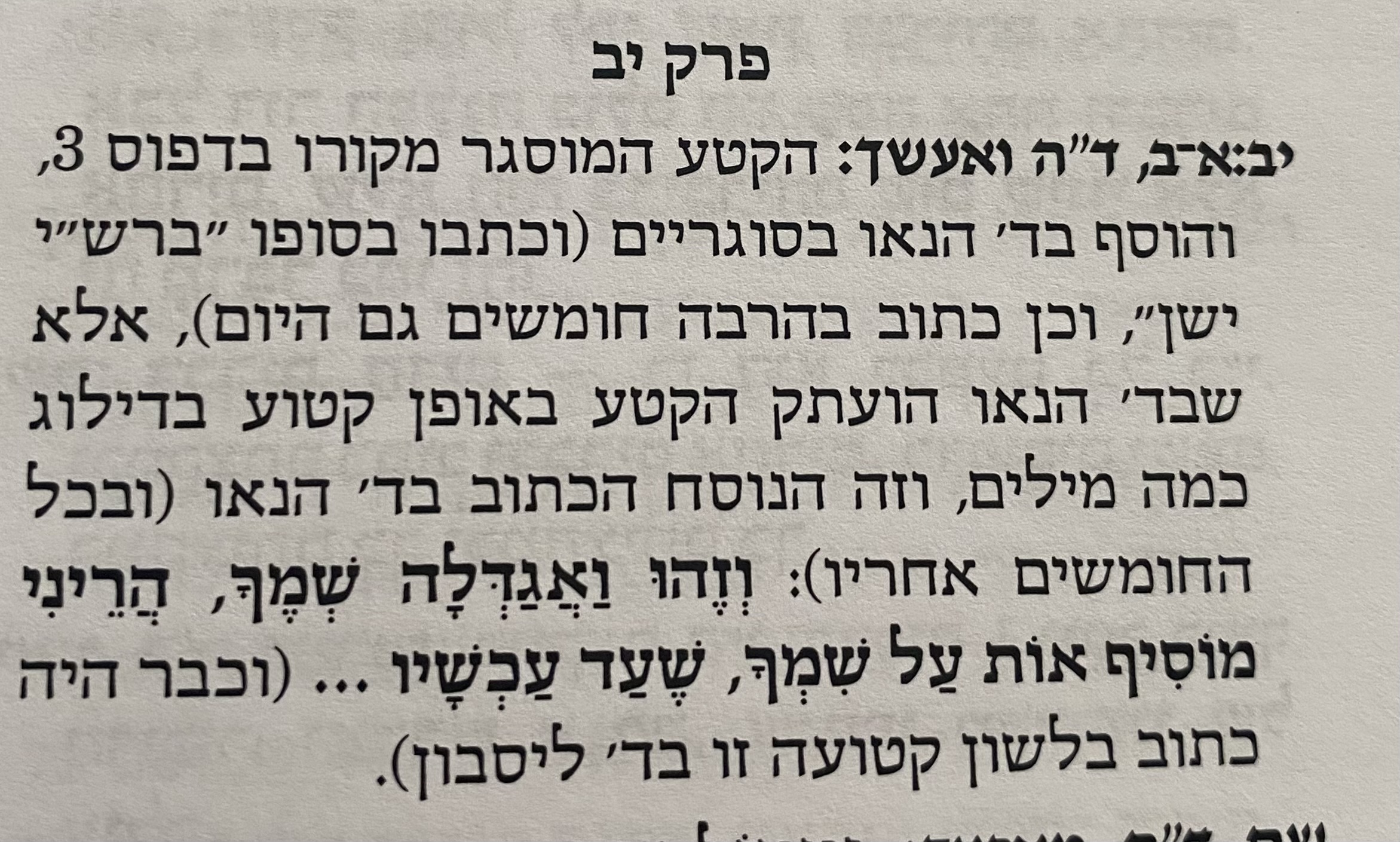
Rambam’s response was cited in Kesef Mishnah, which is printed on the side of the standard editions of Mishneh Torah, such that no reader could miss this retraction. Yet, R. Hayyim wrote two lengthy pieces on Nizkei Mamon, and in both he analyzes this passage using the erroneous text, without ever noting Rambam’s own emendation! This seems to be clear evidence that R. Hayyim disregards textual emendation, even when the text in question is clearly mistaken.

In his recent post Shapiro documents a scholarly consensus which has coalesced around this reading, including rabbis Eliyahu Soloveitchik, Yehoshua Inbal, Norman Solomon and most prominently, Baruch Shmuel Deutsch. This reading of R. Hayyim has widespread support because it is so striking that he is knowingly using a faulty text in his lengthy analysis of this topic. In fact, when I explained this essay in May 2023 as part of a series explaining Hiddushe Rabbenu Hayyim Halevi, I enthusiastically made the same point, influenced by the earlier scholarship, which you can hear at the beginning here.

But after processing the piece, I came to believe that a more careful reading of R. Hayyim shows that in fact he deftly avoids ascribing ideas to Rambam based on the faulty text, in recognition of Rambam’s own emendation. I then found that this view had already been exhaustively presented in 2007 by R. Avraham Lipschitz.[6] In the following section I will present Lipschitz’s approach, that R. Hayyim does not dismiss Rambam’s own emendation of his text, and more broadly that R. Hayyim is not as impervious to textual matters as the prevailing scholarship would indicate.

  1. Re-Reading R. Hayyim

Twice in his comments, R. Hayyim refers to the erroneous version. First, in the opening paragraph in Nizkei Mamon 4:4, where R. Hayyim sets up the piece. In order to explain why R. Hayyim is not in fact basing his insights on the faulty text, let me sketch the broad purpose of this piece. The conceptual insight at the heart of this piece is the idea that when an animal damages something, while being watched by a watchman, the watchman’s financial liability is inherent to his responsibilities as a watchman, and not derivative from the owner’s liability.[7] In R. Hayyim’s framework, the paradigmatic case for this is when the damaging animal was a tam (new damager). When a tam damages, as opposed to a mu’ad (habitual damager), the owner does not pay from their own estate, only from the value of the animal itself. This creates a litmus test for R. Hayyim to explore the watchman’s liability, since there is no financial restitution outside the animal itself.

If we now work backwards to the opening paragraph, we can see that this insight is not dependent on the faulty girsah. In order for the piece to work R. Hayyim needs to establish two things: first, that this halakha is referring to a tam, as Maggid Mishneh in his commentary suggests, second, he needs to introduce the issue of a watchman’s liability, which Raavad in his glosses touches on. Now both Raavad and Maggid Mishneh had the faulty version of Mishneh Torah, so it seems reasonable that when presenting their approaches R. Hayyim sticks with the faulty version, which is a historically accurate reflection of these two commentators.

But as R. Hayyim progresses to his own analysis of this issue, it is no longer relevant which version of Mishneh Torah one uses. In both versions – the mistaken one and the corrected one – Rambam is discussing a tam, and rules that in some cases the owner is liable, while in others the watchman is. The juxtaposition of these two rulings sets up the premise of R. Hayyim’s piece, and it makes no difference whether owners are liable for excellent protection (erroneous version) or inferior protection (corrected version). Rambam’s girsah is incidental to R. Hayyim’s discussion, and as such this piece does not provide evidence for R. Hayyim’s attitude towards girsaot.

Let us move on to the second instance where R. Hayyim analyzes Rambam’s problematic text, in Nizkei Mamon 4:11. This is a much stronger proof than the first instance, since in this piece R. Hayyim cites the erroneous version to prove the point that Rambam sees the owner’s and watchman’s liability as mutually exclusive. R. Hayyim deduces this from the erroneous text, which states the watchman is exempt and the owner is liable, indicating that it is an either-or issue, i.e. only one party will be liable in any given case. He then proceeds to explain the faulty text further, and he does all this without acknowledging Rambam’s own retraction.

From this passage then we do seem to have proof for the extreme formulation of R. Hayyim’s approach to textual autonomy, and Hazon Ish in his glosses (as Shapiro notes in his post) certainly understands it this way. But I would note two counter points. First, Lipschitz counters that R. Hayyim is still not really relying on a faulty text, since his overall discussion is not dependent on this point. The conceptual idea in this piece is whether in a case where the first watchman gave the animal over to a second watchman, the first watchman is entirely removed from the situation, or even though he’s exempt he remains a relevant party. As part of this discussion, R. Hayyim is attempting to explain the related issue of the owner’s role in the situation, which brings him to the faulty text. But even without this digression, the overall piece can stand on its own. According to Lipschitz, this minimizes the implication of R. Hayyim using the faulty text.[8]

Second, I would add that if you follow the contours of R. Hayyim’s discussion, this step is deep into a discussion of Raavad’s glosses. One could argue that in this step he is explaining the debate from the viewpoint of Raavad, who never knew about Rambam’s retraction and had to try and make consistent sense of Rambam’s rulings. Although R. Hayyim does ascribe these ideas to Rambam, it is really Raavad’s strawman version of Rambam. Put differently, had the faulty text not been used by Raavad, R. Hayyim would not defend it.

Lipschitz’s approach (slightly) modifies the prevailing scholarly view that R. Hayyim is entirely impervious to textual emendations.[9] While it is clear that R. Hayyim is largely dismissive of textual issues, even he has his red lines, such as using a faulty text which the author himself corrected. Though, I will note, the broader difficulty of formulating precisely R. Hayyim’s attitude towards girsaot remains.

  1. R. Hayyim’s Attitude Towards Texts

We have explored the debate between Shapiro and Lipschitz, over the extent of R. Hayyim’s disregard for girsaot, namely, whether he would build a hiddush on a retracted girsah. In this conclusion I reflect on the religious motivation for R. Hayyim’s cavalier attitude towards girsaot.

It is important to clarify that R. Hayyim’s opposition to emendations is not rooted in a reverence for the printed text, but rather in a reverence for texts which were used by Torah giants. In other words, if a mistaken girsah can be attributed to a Torah giant, R. Hayyim considers it valid, but if it has no traditional support amongst Torah sages, it is invalidated. For example, if someone were to discover an unknown girsah in the Cairo geniza, it would have little relevance for R. Hayyim. Likewise, a printed version, which was not endorsed by Torah giants, does not have standing in R. Hayyim’s outlook.

For this reason, R. Hayyim is willing to change the girsah at the end of his essay on Hilkhot Edut 21:9, because as he notes none of the commentators on Rambam are bothered by this question (אשר כן משמע מזה שלא העירו בזה המפרשים כלל), which seemingly indicates they had a different girsah. Since no leading Torah scholar can be said to endorse the printed version, R. Hayyim does not need to defend it.

But R. Hayyim is not entirely consistent in this approach, and in another parallel case he does not apply this logic. In Hilkhot Korban Pesah 6:2, Rambam rules that one who slaughters the Korban Pesah for the correct group, but intends to sprinkle the blood for the wrong group, the sacrifice is valid but this group does not fulfill their Pesah obligation. Not only does this ruling seem logically inconsistent – if it is a valid offering why does the group not fulfill their Pesah obligation? – it also seems to blatantly contradict the explicit Talmudic ruling that the group does fulfill their obligation. R. Hayyim’s opening paragraph suggests all sorts of girsah based solutions, except the most obvious one: that there is a misprint in Mishneh Torah.

Here too, the misprint theory could be supported by the fact that none of the classical commentators on Rambam address this question, indicating they had a corrected version. In fact, in a letter critiquing R. Hayyim’s approach, R. Chaim Mordechai Roller, cites this exact consideration as proof that it must be a misprint in Mishneh Torah, since none of the classical commentators raise the question.[10] R. Hayyim’s refusal to accept this girsah change seems to contradict his own logic in Hilkhot Edut.

Be that as it may, R. Hayyim’s attitude seems to be that we must defend any version of a text which was used by Torah giants. Presumably, and this is my own words, it is hard to accept that Torah giants use nonsensical texts, such that any problematic girsah they used must have a good explanation. There may be an additional element of Divine Providence, that we must assume God would not allow Torah giants to get tripped up by worthless texts, so there must be a profound meaning to explain it.

* * * * * *

Notes

[1] Vilna Gaon in his commentary to Avot (on mishna 20 and mishna 24):

טעות סופר כאן, וצריך לומר בסוף הפרק, כמו שכתבתי למטה

[2] This is one option Meiri proposes (in his commentary to mishna 20):

או אפשר שיהיה זה סיום המסכת אלא שנתוספו בה אח”כ דברים אחרים

See also R. Shmuel de Uceda’s related discussion in Midrash Shmuel (end of mishna 21 and beginning of mishna 22), and Tosafot Yom Tov (beginning of mishna 21), about the order of these ending mishnayot. Chanoch Albeck in his edition of the Mishna (Mossad Bialik, 1952) endorses Meiri’s suggestion.

[3] Elsewhere I have documented the nuances of R. Hayyim’s attitude towards girsaot in further detail, see כללי הגר”ח מבריסק בביאור הרמב”ם – ספריית אסיף, pp. 388-92.

[4] Avraham Lipschitz, “יחסם של אחרונים לתגליות נוסח”, סיני, גליון קמא, תשס”ח, עמ’ קג

suggests a possible formulation, pointing to one instance (which will be discussed below) where other traditional commentators explain Rambam’s faulty girsah, but at least pay homage to the girsah issue and note the corrected version, whereas R. Hayyim’s omission of any acknowledgement of the whole issue is more extreme:

לכאורה לפנינו מקרה ראשון של התעלמות גורפת מהמישור הפילולוגי ללא כל צורך בהצדקתה

[5] Marc Shapiro, Studies in Maimonides and His Interpreters, (University of Scranton, 2008), 54-5.

[6] Avraham Lipschitz,

“יחסם של אחרונים לתגליות נוסח”, סיני, גליון קמא, תשס”ח, עמ’ פא-קו

which takes this halakha in Mishneh Torah as a test case for traditionalist attitudes towards girsaot. Lipschitz’s son, R. Uri Lipschitz, is a Rosh Yeshiva at Yeshivat Siach Yitzchak, founded by Rav Shagar.

[7] See R. Baruch Ber Lebowitz’s formulation of this in Birkat Shmuel, Bava Kamma, #7 & 8

[8] Ibid, pp. 103-4.

[9] Lipschitz sums up his conclusion (p. 103):

קיצור הדברים, טענתי היא שאין לגר”ח התנגדות עקרונית להשתמש בנוסחים חדשים, וודאי לא כאלה המוזכרים בכסף משנה, אלא שהקו המנחה אותו הוא הרעיון המרכזי אותו הוא בא לחדש, או הקושי המרכזי בו הוא עוסק

[10] Teshuvot Be’er Chaim Mordechai (3:12).



Vayikra Perek 23 Rashi on Pasuk 35 or 27 A “Misplaced” Comment of Rashi

Vayikra Perek 23 Rashi on Pasuk 35 or 27

A “Misplaced” Comment of Rashi

Eli Genauer

The 23rd Perek of Sefer Vayikra speaks about the festivals, and ends with the discussion of Yom Kippur (Pesukim 27-32) and Succot (Pesukim 33-43). In Pasuk 27 Yom Kippur is called a “מִקְרָא־קֹ֑דֶשׁ” (a holy convocation/assembly)
ויקרא כ”ג:כ”ז

(כז) אַ֡ךְ בֶּעָשׂ֣וֹר לַחֹ֩דֶשׁ֩ הַשְּׁבִיעִ֨י הַזֶּ֜ה י֧וֹם הַכִּפֻּרִ֣ים ה֗וּא מִֽקְרָא־קֹ֙דֶשׁ֙ יִהְיֶ֣ה לָכֶ֔ם וְעִנִּיתֶ֖ם אֶת־נַפְשֹׁתֵיכֶ֑ם וְהִקְרַבְתֶּ֥ם אִשֶּׁ֖ה לַיהֹוָֽה׃

In Pasuk 35 Succot is also called a ִ מִקְרָא־קֹ֑דֶש

ויקרא כ”ג:ל”ה

(לה) בַּיּ֥וֹם הָרִאשׁ֖וֹן מִקְרָא־קֹ֑דֶשׁ כׇּל־מְלֶ֥אכֶת עֲבֹדָ֖ה לֹ֥א תַעֲשֽׂוּ

Rashi comments as follows on the words מִקְרָא־קֹ֑דֶש

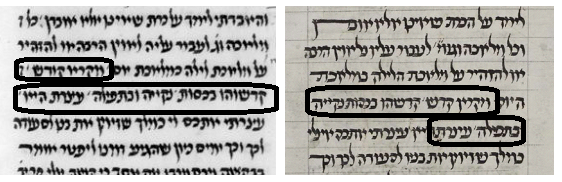
מקרא קדש – קדשיהו בכסות נקייה ובתפילה. וכל שאר ימים טובים, במאכל ובמשתה וכסות נקייה ותפילה
“Sanctify it with clean clothing and prayer, and on other festivals, with food and drink, with clean clothing and with prayer”

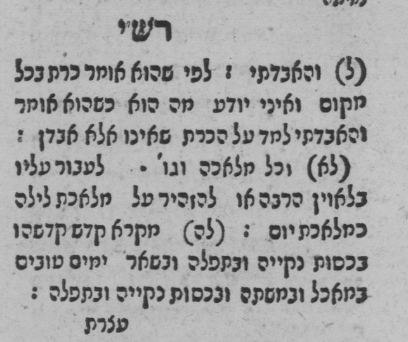
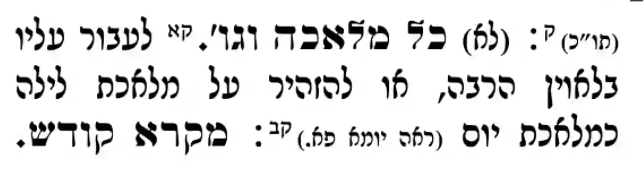
There is a disagreement among various editions of Chumash and Rashi on which מקרא קדש Rashi writes his comment. Logically, it belongs on Pasuk 27 which speaks about Yom Kippur. Rashi is telling us that the way you make Yom Kippur into a מקרא קדש is by wearing fine clothes and saying special prayers, and on other festivals, you observe them with food and drink, with clean clothing and with prayer.

This is the Artscroll Stone Chumash (Brooklyn 1993) which place the comment in Pasuk 27

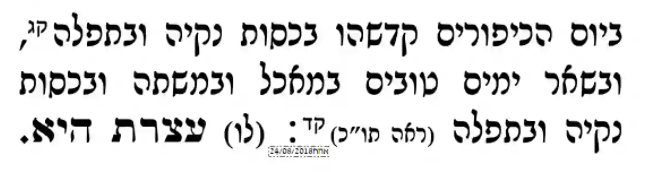
However, there are other Chumashim which do not place the comment in Pasuk 27, and wait until Pasuk 35 to record it. This means that Rashi is telling us that on Succot, we sanctify the day with nice clothing and prayer, and on other festivals, we add in food and drink. It seems to be quite illogical.

This is Chumash Habahir (Jerusalem 2005)

What is the source for recording Rashi’s comment on Pasuk 35?

It turns out that most Rashi manuscripts and early printed editions have it that way.

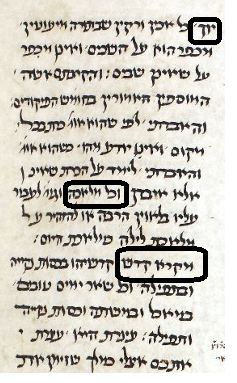
A good example is the authoritative manuscript Leipzig 1 which looks like this:[1]

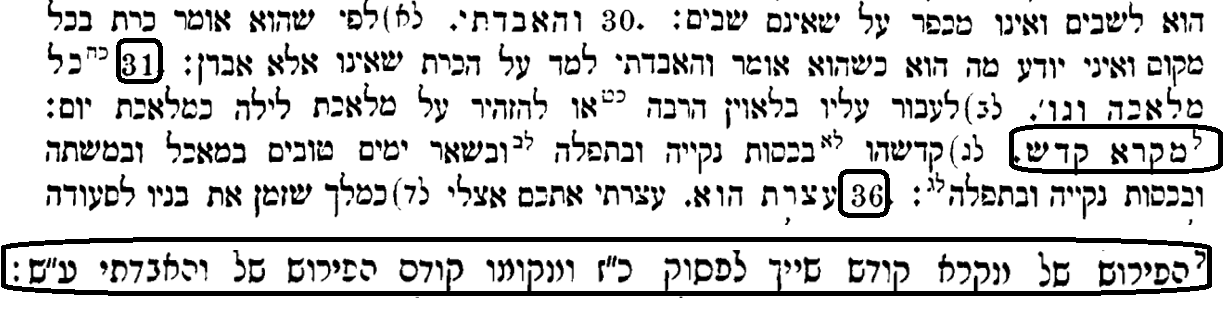
The manuscript has the comment on the word “אַ֡ךְ” in Pasuk 27, followed by a few more comments continuing on to Pasuk 31, where a comment on the words “וכל מלאכה וגומ’” appears. This is followed by the comment on “מקרא קדש”. Those words only appear afterwards in Pasuk 35 meaning that Rashi wrote his words of “קדשיהו בכסות נקייה ובתפילה” as a comment on the festival of Sukkot.

The website Al Hatorah uses Leipzig 1 as its base text for Rashi, yet it positions this Rashi as a comment on Pasuk 27 which speaks of Yom Kippur. It notes though that this Dibur Hamatchil appears in Leipzig 1 and in other Eidei Nusach after the comment in Pasuk 31

דבור המתחיל זה מופיע בכ”י לייפציג 1 ובעדי נוסח אחרים לאחר הביאור על פסוק ל”א

I looked at many other manuscripts and found it to be true in the following 34 cases. I did not find one manuscript which had the comment on Pasuk 27

Oxford CCC 165 (Neubauer 2440), Munich 5, Hamburg 13, London 26917 (Neubauer 168) (1272), Paris 155, Berlin 121, Vatican ebr. 4, Vatican ebr.18, Vatican ebr.33, Vatican ebr. Vatican ebr. 94, Vatican ebr. 480, London 19665 (Margoliouth 174), London 22122 (Margoliouth 178) Oxford-Bodley Opp. 34 (Neubauer 186), Casanatense 2848 (1284), Berlin Qu 514 (1289), Florence Plut.III.03, Oxford Bodleian 69, Hamburg 32, Vatican urb. Ebr 1, Vienna codex Hebr. 220, Vienna Codex Hebr.3, London Harley 5708, Bavarian State Library, Cod.hebr. 148, HUC JCF 1(called Cincinnati 51), Paris 49, Paris 154, Parma 2708, Parma 3204 (DeRossi 181), Cambridge University Library, Ms. Add. 1828, Casantense 2988, and Sassoon 369.[2]

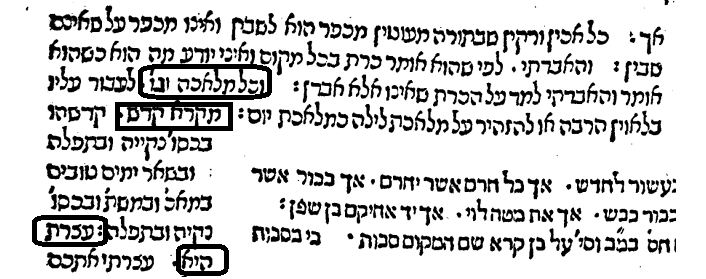
Most of the early printed editions of Rashi also have this comment on Pasuk 35. A good example is Rome 1470 where the comments on “וְהַֽאֲבַדְתִּ֛י” (pasuk 30) and “כׇּל־מְלָאכָ֖ה” (pasuk 31) precede that of “מקרא קדש” (presumably Pasuk 35)

The rest of the incunabula ( the 9 editions printed before 1500) present it that way except for Napoli 1492 where it is presented as part of Pasuk 27[3].

The most influential edition of the 16th century was the Bomberg Mikraot Gedolot Venice edition 1524-26 and it was recorded in the same manner. The comment on מקרא קדש comes after the comment on כָּל־מְלָאכָ֖ה of Pasuk 31, and before עֲצֶ֣רֶת on Pasuk 36. It is clearly assigned to מקרא קדש of Pasuk 35.

Many who analyzed Rashi’s work struggled with the issue of the manuscripts placing the comment on Pasuk 35, and logic dictating that it belonged on Pasuk 27. Chief amongst that group was the dean of supercommentators Rav Eliyahu Mizrachi (רא״ם)

He writes at first that logically Rashi is commenting on the words “מקרא קדש” which are written describing Yom Kippur (Pasuk 27)

שאין פירוש מקרא קדש האמור ביום הכפורי’ כפירוש מקרא קדש האמור בשאר ימים טובים כי פירוש מקרא קדש האמור ביום הכפורים הוא שתקדשהו בכסות נקייה ובתפלה לבד מאחר שאין בו אכילה ושתייה ופירוש מקרא קדש האמור בשאר ימים טובים הוא שתקדשהו באכילה ובשתייה ובכסות נקייה ובתפלה

“The interpretation of מקרא קדש on Yom Kippur is not the same as the interpretation of מקרא קדש on the other ימים טובים, because the interpretation of מקרא קדש on Yom Kippur is that you sanctify it with a nice clothing and prayer alone, since there is no eating or drinking on it, and the interpretation of the מקרא קדש on the other ימים טובים is that you sanctify it with eating and drinking, with nice clothing and prayer”

But Rav Eliyahi ran into the roadblock of the Girsa of all the manuscripts he had seen and it really bothered him

וגם בזה לבי נוקפי שהרי בכל הנוסחאות שראיתי בכולן כתוב הפירוש של מקרא קדש אחר הפירוש של והאבדתי ואחר הפירו’ של כל מלאכה

“But that makes my heart pound, because in all the Nuschaot I have seen, the interpretation of מקרא קדש is written after the interpretation of ” וְהַֽאֲבַדְתִּ֛י” (Pasuk 30) and after the interpretation of כָּל־מְלָאכָ֖ה ( Pasuk 31) .”

He nevertheless concludes that the comment belongs on Pasuk 27

אלא ע”כ לומר דהאי מקרא קדש שפיר’ בו הוא הכתוב ביום הכפורים שהוא משונה מכולם

“but rather one must say that this מקרא קדש, which is the one written on Yom Kippur, is the one which is different.”

Notice how he emphasizes that all the Nuschaot he has seen have it as the Dibur HaMatchil after “והאבדתי” (Pasuk 31) making “מקרא קדש” Pasuk 35. (regarding Succot)

However, there are a number of Rashi supercommentators who try to explain why this comment of Rashi does belongs after Rashi’s comments on Pasuk 30 and 31 (seemingly when it talks about Succot), such as Gur Aryeh( Maharal MiPrague 1512-1609).[4] The Yeriot Shlomo, which is a commentary on the Mizrachi by Maharshal (1510-1573), also addresses the issue.[5] Rav Shabtai Meshorer Bass places Rashi’s comment in Pasuk 35, and in his commentary Siftei Chachamim (Amsterdam 1680) advances this resolution:

 בכסות נקיה. והא דמהפך רש”י הקרא דמקרא קדש דהיה לו לפרש לעיל קודם פירוש והאבדתי וקודם כל מלאכה לא תעשו. וי”ל דלעיל לא יכול לפרש קדשהו בכסות נקיה וכו’ דלמא הא דכתיב מקרא קדש לאסור הלילה כיום לעניין עשיית מלאכה וכרת, אבל עכשיו דכתיב כל מלאכה לא תעשו שהוא מיותר ובא ללמד ולהזהיר על מלאכת לילה כיום ע”כ האי מקרא קודש בא ללמד על קדשהו בכסות נקיה וכו’

“Fine clothing. That which Rashi turned around the verse “מקרא קדש “? He should have explained it [where it first appears in verse 27] before explaining “והאבדתי ” and before ” כל מלאכה לא תעשו?” The answer is: He could not explain above” קדשהו בכסות נקיה,” because perhaps when it wrote ” מקרא קדש ” this was to make the night forbidden like the day regarding work and “.כרת”. But now that it is written ” כל מלאכה לא תעשו ” which is superfluous, it is to teach and warn that work is forbidden by at night as well as by during the day, therefore this ” מקרא קדש ” must be teaching that we ” קדשהו בכסות נקיה.”

How did Rashi’s comment on “מקרא קדש” fare throughout printing history?

As mentioned, 8 out of 9 incunabula placed the comment on Pasuk 35, as did Bomberg’s Mikraot Gedolot of 1524-26. Going forward, the same was true for Augsburg 1533, Bomberg 1548, Sabionetta 1557, Riva di Trento 1561, Cracow 1587, and Mantua 1589

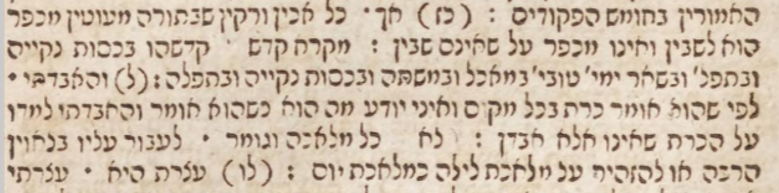
In fact, most editions through the 19th century continued to place the comment in Pasuk 35. Clearly, they were following the manuscripts and the earlier printed editions. Examples of these were Hanau 1611-14‬‬‬‬, Amsterdam 1670, Amsterdam 1701, Venice 1702, Berlin 1703, Amsterdam Proops 1721, Livorno 1807, Ostroh 1827, Warsaw 1854, Vienna 186, Zhitomir 1867, and Vienna 1875

Here is Berlin 1703

The earliest more modern edition I could find the comment placed in Pasuk 27 was the 1787 Devek Tov Hamburg edition.

Another example is Furth 1812

Avraham Berliner in Zechor L’Avraham (Berlin 1867) does not assign a Pasuk number to it but records it after Pasuk 31. In note 30 he writes that it belongs in Pasuk 27, before the comment of והאבדתי which appears in Pasuk 30.

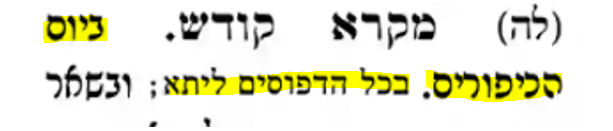
More recently, Oz Vehadar Rashi Mevuar of 2016 does not assign מקרא קדשׁ to Pasuk 35 but just to somewhere after Pasuk 31 but before Pasuk 36. It also adds the words ביום הכפורים to emphasize that the comment is made about Yom Kippur

However it admits that ביום הכפורים is not found in any early edition

Here is an example of the words “ביום הכפורים” appearing in parentheses

Malkah Shel Torah (Jerusalem 1990)

Chumash Torat Chaim (Jerusalem 1993) published by Mosad HaRav Kook maintains that it should be in the Yom Kippur section and places it in Pasuk 27, but admits that the manuscripts and early printed editions do not support this placement.

The Artscroll Elucidated Rashi, Siftei Yeshainim section (Rahway, NJ 2025) writes on this matter

שם: ד”ה מִקְרָא קֹדֶשׁ. בכמעט כל הנוסחאות (כ”י ודפוס, חדשים גם ישנים), דיבור זה כתוב להלן אחרי ד”ה “וכל מלאכה”, וא”כ לפי הסדר נראה שמוסב על פסוק לה (גבי סוכות). אבל לפי הענין נראה ברור שדברי רש”י מוסבים על יוה”כ, וכן כתב הרא”ם כאן, לכן כתבנו אותו כאן. וע’ בדברי המפרשים בפסוק לה.

Rashi Hashalem Mechon Ariel 2019) places it in Pasuk 35 but blames the incorrect placement on the mistake of printers.

Note: I believe it is difficult to assign blame to the printers after looking at all the manuscripts which placed the comment on Pasuk 35.

To summarize:

  1. Rashi made a comment regarding Yom Kippur that one sanctified it as a מקרא קדש through fine clothing and prayer, whereas other ימים טובים are sanctified additionally with food and drink.
  2. The comment of Rashi on מקרא קדש is clearly focused on Yom Kippur
  3. For some reason, all the manuscripts and early printed editions of the Chumash (except for one) place the comment of Rashi in the section dealing with Succot (Pasuk 35)
  4. Rav Eliyah Mizrachi says that logically the comment belongs in the Yom Kippur section (Pasuk 27) but notes that all the manuscripts have it in the Succot section ( Pasuk 35)
  5. Printers chose between three courses of action in terms of where they placed the comment.
  6. Place the comment in Pasuk 35 as it appears in all the manuscripts and rely on supercommentaries to explain why it is there.
  7. Place it in Pasuk 27 which speaks about Yom Kippur and where the comment seemingly belongs
  8. Place it in Pasuk 35 and, even though they appear in no manuscript, add the words ביום הכפורים with or without parentheses

The final word on this perhaps belongs to the Rashi scholar Dr. Aharon Ahrend, who wrote me

“I agree that once you examine many manuscripts, it strengthens the hypothesis that the original text was like the manuscripts. But we must always remember that we do not have Rashi’s own manuscript, and therefore when there is something strange, it can still be attributed to an error by an ancient copyist, from whom others copied.”

Notes

  1.  

    The website Al Hatorah includes this information on the manuscript named Leipzig 1

    “The popularity of Rashi’s Torah commentary and the tendency of medieval scholars and copyists to add to it their marginal glosses combined to create enormous variation between different manuscripts and editions of the commentary. As a result, it is often difficult to determine how Rashi’s original text read, and whether words, sentences, and even entire passages from the commentary, were written by Rashi himself or are merely later accretions… On this backdrop, the importance of the Leipzig 1 (Universitätsbibliothek Leipzig, B.H.1) manuscript of Rashi can hardly be overstated. This manuscript was written in the 13th century by R. Makhir b. Karshavyah, who states that he produced it from a copy of the commentary transcribed and annotated by Rashi’s own secretary, R. Shemayah. R. Makhir not only copied Rashi’s base commentary from R. Shemayah’s manuscript, but he also reproduced many of the marginal glosses contained in R. Shemayah’s text, a good number of which R. Shemayah explicitly attributes to Rashi himself. MS Leipzig 1 is, thus, an extremely valuable textual witness which comes tantalizingly close to the original source. In addition, its glosses shed significant light on Rashi’s thought processes and the development of his commentary.”

  2.  

    There were two manuscripts which had the comment after Pasuk 31, but left out the last part of it which is “וכל שאר ימים טובים”

    Paris 154 Berlin 1221

  3.  

    This is Napoli 1492. It perhaps indicates that there were manuscripts from which it took this Girsa which had it this way

  4.  

    גור אריה ויקרא כ”ג:ל”ו (Maharal Mi’Prague 1512-1609)

    https://hebrewbooks.org/pdfpager.aspx?req=42846&st=&pgnum=193

    קדשהו בכסות נקייה כו’. פירש רש”י דבר זה שלא במקומו אחר “כל מלאכה”, ועוד, דהוי ליה לפרש זה למעלה בחג המצות (פסוק ז). ויראה טעמו, דלמעלה לעולם כתיב איסור המלאכה אצל “מקרא קדש”, ויש לפרש “מקרא קדש” לקדש אותו שלא לעשות בו מלאכה, ובזה הוא מקודש, ו”מלאכת עבודה לא תעשו” פירושו ד”מקרא קדש”, שרוצה לומר בזה הוא קדש – “כל מלאכת עבודה לא תעשו”. אבל ביום הכפורים לא כתיב (בפסוק כז) “מקרא קדש” אצל המלאכה, על כרחך האי “מקרא קדש” מילתא אחריתי הוא, דלא איירי במלאכה, לכך פירש “מקרא קדש” ‘קדשהו כו’. לכך כאשר פירש כאן “וכל המלאכה וכו’ ”, הוקשה לו דלא כתיב “וכל מלאכה” גבי “מקרא קדש”, לכך פירש ד”מקרא קדש” אין פירושו שהוא קדוש ממלאכה, רק ‘קדשהו בכסות נקיה וכו”. אף על גב דהוי מצי לפרש זה על “וכל מלאכה” דלעיל (פסוק כח), אין זה קשיא, דלא פירש עליו מידי, אבל כאן (פסוק לא) פירש על “כל מלאכה” ‘לרבות כו”, פירש אחריו “מקרא קדש” ‘קדשהו כו”

  5.  

    יריעות שלמה ויקרא כ”ג:כ”ז -בד”ה מקרא קדש וכו’ דמה נשתנה וכו’ (רא”ם).

    https://hebrewbooks.org/pdfpager.aspx?req=67451&st=&pgnum=142&hilite=

    ולא הוצרך לומר זה, דבלאו הכי אי אפשר לומר שה’מקרא קדש’ הזה שפירש בו, הוא הכתוב בחג הסוכות (פסוק לה), דאם כן למה נחלק חג הסוכות משאר ימים טובים לענין מאכל ומשתה.

    ואפשר דלכך פירש”י מקרא קדש (פסוק לה) אחר שפירש קרא דכל מלאכה וגו’ (פסוק לא), משום דבזולת זה אפשר לפרש מקרא קדש האמור ביום הכיפורים (כאן) לענין איסור עשיית מלאכה אפילו אוכל נפש, מה שאין כן בשאר ימים טובים דמותרין במלאכת אוכל נפש לכן מפרש זה אחר קרא דכל מלאכה וגו’. כן נראה לי


KEDUSHAH, KEDOSHAH, OR B’K’DUSHAH in KEDUSHAH D’YESHIVAH?

KEDUSHAH, KEDOSHAH, OR B’K’DUSHAH in KEDUSHAH D’YESHIVAH?

Wayne Allen

In his classic study of the content and evolution of Jewish prayer, Abraham Millgram (Jewish Worship, p. 134) asserts that “the most significant addition to the liturgy after its redaction at Yavneh was that of the Kedushah, a prayer in which the community of Israel together with the heavenly host proclaim God’s holiness.” Yavneh was the town in which rabbinic Judaism retrenched after the destruction of the Second Temple in the year 70 C.E. Millgram further contends that the Kedushah prayer “is obviously mystic in nature” and Babylonian in origin (ibid.). It was during the early Rabbinic period that Babylonian mystics “were engrossed in speculations regarding the nature, appearance, and functions of the…angelic sanctification of God” as described in Isaiah 6:3 and Ezekiel 3:12 which, along with Psalm 146:10 make up the central elements of the Kedushah prayer, surrounded by appropriate introductions and connecting phrases.

In his commentary on the Bible, Rabbi Meir Leib ben Yehiel Mikhel Malbim (1809 – 1897) explains that when, as described by the prophet Isaiah, the angels on high proclaim God’s holiness (kedushah, in Hebrew), they are, in essence, attesting that “God is separated from earth in that He is immaterial; He is separated from time in that He is everlasting or eternal; and He is also separated from the heavens in that He is insubstantial.” This threefold separation is what characterizes holiness. Rabbi Hayim Halevi Donin (To Pray as a Jew, p. 126–7) adds that “not only is God above and beyond man and his world, but the angels proclaim God to be above and beyond their world as well” leading to the inevitable question: “if the angels so proclaim, can mortal man say less?”

When the Babylonians introduced the inclusion of the Kedushah, it was fittingly placed immediately before the third blessing of the Amidah which concludes with an affirmation of God’s holiness. It quickly became the apotheosis of the public prayer service. After some initial resistance, the Kedushah gained currency among Palestinian Jews as well. Millgram (Jewish Worship, p. 136) surmises that Jews unable to attend synagogue services daily felt deprived of the privilege to recite Kedushah so the rabbis inserted an abbreviated form of Kedushah in the text leading up to the first blessing before the recital of the morning Shema as well as incorporating the key verses of the Kedushah in the paragraph near the end of the morning service, perhaps for late-comers. This form of the Kedushah did not require a quorum of worshippers, thus enabling all worshippers – whether or not in synagogue – to declare God’s holiness in the mystical words of the prophets Isaiah and Ezekiel. To distinguish the standing, public recital of the Kedushah during the reader’s repetition of the Amidah, the early recital of the Kedushah was termed Kedushah D’ Yeshivah (the “sitting” Kedushah or Kedushah D’Yotzer, referring to the blessing it precedes, cf. Resp. Otzar HaGe’onim, Berakhot No. 46) and the later recital of the kedushah was called Kedushah D’Sidra (See Babylonian Talmud, Sotah 49a; Shabbat 116b; Resp. Otzar HaGe’onim No. 320).

It is the Kedushah D’Yotzer that is the subject of a wording dispute. Four Hebrew words describe the manner in which the angels proclaim God’s holiness. The dispute centers on whether these four words constitute two pairs of phrases with each phrase consisting of a noun and a modifying adjective, or one phrase consisting of a noun followed by two modifying adjectives and then a proper noun. The first view would read this phrase as בְּשָׂפָה בְרוּרָה, meaning “with clear speech,” followed by וּבִנְעִימָה קְדשָּׁה, meaning “and in sacred melody.” The readers would treat the four-word phrase as if there were a comma between the two pairs of words even if a comma did not appear in the text. According to the second view, the phrase should read בְּשָׂפָה בְרוּרָה וּבִנְעִימָה. קְדֻשָּׁה, meaning “in clear and melodious speech. [They proclaim] the Kedushah.” On the first view, the phrase is simply descriptive of the way the angels would proclaim God’s holiness, without indicating the nature of the proclamation. On the second view, the phrase describes the way the angels recite the Kedushah. A survey of various prayerbooks demonstrates how this dispute plays out.

Prior to the publication of the Artscroll prayerbook in 1984, the most popular siddurim used in Orthodox synagogues were the De Sola Pool prayerbook and the Birnbaum prayerbook. The Traditional Prayer Book for Sabbath and Festivals was edited by Rabbi David De Sola Pool who served Congregation Shearith Yisrael, the Spanish and Portuguese Synagogue in New York City for more than forty years. His acknowledged erudition led to the official adoption by the Rabbinical Council of America of this prayerbook for all Orthodox congregations in the United States in 1961. Both the 1940 and 1960 edition (p. 53) translated the disputed phrase as:

Mutually accepting for themselves His heavenly rule, in unison they all give one another the word to hallow their Creator in serene, pure utterance of sacred harmony…

That De Sola Pool considered the first view as the correct one is confirmed by the punctuation in the Hebrew text which puts a period after the word Kedoshah which is vocalized with a holom, that is, a dotted vav, making it an “o” as in “so” sound, and rendering it as the modifier of “ne’imah.” Likewise, Ha-Siddur Ha-Shalem edited by Philip Birnbaum and mass distributed by Hebrew Publishing Company adopts the same view. The 1949 edition reads (p. 73):

In serene spirit, with pure speech and sacred melody, they all exclaim in unison and with reverence…

The Hebrew is vocalized the same way as De Sola Pool.

The series of prayer books published for or by the Conservative movement follows suit. The Prayer Book, edited by Rabbi Ben-Zion Bokser, long-serving rabbi of the Forest Hills Jewish Center in Queens, New York, and published by Hebrew Publishing Company in 1961 reads (p. 47):

They sing a hymn of allegiance to the Divine power, each bidding the other go be first in acclaiming their Creator, With soft and clear tones, they chant in unison a sacred melody declaring…

Bokser took the editorial liberty of interpolating the action taken by the angels, i.e. chanting in unison, to make the word flow smoother but he obviously holds that the text is composed of two pairs of phrases with a noun (“tones” in the first phrase and “melody” in the second) and a modifier (“soft and clear” in the first phrase and “sacred” in the second).

The Sim Shalom prayerbook, based on the work of the eminent liturgist Rabbi Jules Harlow, was published by the Rabbinical AHssembly in 1998. Here, the disputed phrase is rendered (p. 97):

One to another they vow loyalty to God’s sovereignty; one with another they join to hallow their Creator with serenity, pure speech, and sacred song, in unison, chanting with reverence…

With his talent for a more poetic rendering of Hebrew, Harlow matches the phrase “one to another” to “one with another” in describing the angelic choir. Notably, Harlow also give his nod to the first view, supported again by the Hebrew text with a comma between the two phrases and the vocalization of K’doshah.

Interestingly, the Jewish Welfare Board, tasked with unenviable mission of producing a prayer book that would serve Jewish troops of all affiliations, translated the disputed phrase in its 1969 High Holiday Prayer Book for Jewish Personnel in the Armed Forces as follows (p. 101):

All of them act with harmonious accord, with purity of purpose and with united strength to perform reverently the will of their Creator. They all break forth into song of pure and holy praise, while they bless, glorify, and proclaim…

The “song of pure and holy praise” conforms with the first view of the disputed phrase. Also of note, the description of the angelic proclamation as a “song” conforms to the Talmudic text as will be noted below.

In contrast, since 1984 and in line with siddurim published in Israel, the second view has ascended in prominence. The Complete Artscroll Siddur (1992 edition, p. 87), translated by Rabbi Nosson Scherman, is paradigmatic:

Then they all accept upon themselves the yoke of heavenly sovereignty from one another and grant permission from one another to sanctify the One Who formed them, with tranquility, with clear articulation, and with sweetness. All of them as one proclaim His holiness and say with awe…

While the identification of the name of the angelic proclamation as the Kedushah is not explicit, this translation accepts the notion that “clear articulation and sweetness” go together in describing it, clearly evident in the Hebrew and its punctuation with a period after the word u-v’ne’imah. This is a pattern followed by Siddur Rinat Yisrael, the mainstream Israeli prayerbook and the popular Koren Siddur under the guidance of Rabbi Jonathan Sacks.

The question of which view is correct or which version is the more authentic is not easily resolved. One of the earliest Jewish prayerbooks, the ninth century Seder Rav Amram (Goldschmidt ed., p. 13), is ambiguous. Lacking any punctuation or explication, the four-word Hebrew phrase in question can be read either way. The same is true with Mahzor Vitry, an enhanced prayerbook produced by the twelfth century school of Rabbi Shlomo Yitzhaqi of Troyes (Horowitz ed., Part I, p. 65). However, the Frumkin edition of Seder Rav Amram published in 1912 notes (p. 188) that a British Museum manuscript vocalized the text to read “k’doshah” in reference to the angelic melody, supporting the first view, while RaShI’s commentary on Isaiah 6:3 (“Holy, holy, holy! God of Hosts—Whose presence fills all the earth!”) includes the observation: “This is the basis for the prayer in Yotzer Ohr, Kedushah: all together proclaim,” that supports the second view. It seems like the Tosafists agree (Babylonian Talmud, Hagigah 13b, s.v. mi-zei-atan).

Fourteenth century Spanish Rabbi David Abudraham, aware of the dispute, seeks to resolve it in his authoritative compendium on Jewish prayer. In the 1963 edition of Sefer Abudraham (p. 73), he explains the parallelism in the text. “Because the author called the language of the angels ‘clear,’ by extension, he also called the melody ‘sacred.’” In other words, the phrase in question consists of two pairs of words, each pair with a noun and a modifying adjective, implying that the text ought to be read as safah berurah and ne’imah kedoshah. He goes on to acknowledge that “some read ‘Kedushah,’ but the first version is correct.” In his multi-volume study of Jewish prayer, Netiv Binah (Vol. I, p. 235, n. 8), Rabbi Y. Jacobson cites Abudraham’s opinion as decisive. He also includes as support the Yemenite prayerbook that reads u-v’ne’imah t’horah, that is, “and with pure melody.” Even though the wording differs from the Ashkenazi prayerbook (t’horah instead of k’doshah), Yemeni Jews agree that the word that follows after “ne’imah” is an adjective. Hence, “Kedushah” would be incorrect.

But all is not settled. Complicating matters, thirteenth century authority on Jewish law, Rabbi Tzedekiah ben Abraham Anaw (Shibbolei Ha-Leket, Sec 13) reports that he had found a text ascribed to eighth century Rabbi Natronai Gaon that reads: “with clear speech, melodiously, and devoutly.” On this version, the phrase in question uses three terms to describe the manner in which the angels proclaim God’s holiness: clearly, melodiously, and devoutly. It certainly does not comport well with the second view that specifies that the angels recite Kedushah, but neither does it support the first. Likewise, the prayerbook of Italian Jews, Mahzor Italiani (Luzatto, ed., Vol. I, p. 14) reads: b’safah berurah, b’ne’imah, u’vik’dushah, best translated as “with clear speech, melodiously, and with sacred devotion.”

To sum up, there are actually three views on the proper reading of the phrase in question. The first view would stipulate reading: b’safah berurah, u-v’ne’imah k’doshah. This view is supported by Natronai Gaon, the British Museum manuscript of Seder Rav Amram, the Yemenite Siddur, and Abudraham. The second view would stipulate reading: b’safah berurah u-v’ne’imah, Kedushah. This view is supported by RaShI and the Tosafists. And the third view would stipulate reading: b’safah berurah, b’ne’imah, u’vik’dushah. This view is supported by the opinion of Natronai Gaon and the Mahzor Italiani. Jewish worshippers, then, are left with a conundrum. Each view has its defenders.

However, three further considerations make a better case for the first view. First, the preponderance of authorities favors this view. Late thirteenth century Spanish Rabbi Yom Tov Ishbili (Hiddushei Ha-RITVA, Meg. 23b, s.v. u-midivrei rabbotai) mentions the tradition of his teachers reciting b’safa berurah u-v’ne’imah kedoshah kulam k’ehad onim b’eimah v’omrim b’yir’ah Kedushah, meaning with clear speech and in sacred melody, together as one, the angels say the Kedushah with trepidation. The RITVA acknowledges that the angels recite the Kedushah. But they do so with clear speech and sacred melody (ne’imah k’doshah) which is the reading of the first view. In fact, reading k’doshah as Kedushah would make no sense since Kedushah here would be redundant, being mentioned at the end. Fifteenth century Spanish Rabbi Abraham Saba (Tzror Ha-Mor, Bereshit, s.v. v’od) identifies two kinds of speech: what comes from the mouth and what comes from the heart. The latter is the superior and is endemic to the angels. He implies that the distinction is embedded in the phrase in question: safah berurah and ne’imah k’doshah. Sixteenth century Turkish Rabbi Moses Alshikh (Commentary on Exodus 28, s.v. v’hayya) also seems to follow b’safah berurah, u-v’ne’imah k’doshah.

Further, Rabbi Joseph Karo (Bet Yosef on Tur, Orah Hayyim 59, s.v. katuv) cites the Orhot Hayyim who accepts the first view and adds “I heard that the leading authorities of the generation follow this version.” Likewise, Rabbi Moses Isserles, agrees (Darkhei Moshe HaKatzar, Orah Hayyim 59:2) and, in Tur, Orah Hayyim 59, n. 2 states that “this is how it is arranged in our prayerbooks.” Eighteenth century Rabbi Jacob Emden (Siddur Bet Ya’akov, Warsaw ed. 1910, p. 120) acknowledges that while some versions have the word “Kedushah” vocalized with the shuruk (vowel sound “oo”) treating it as a noun, the preferred version is to read the phrase in question as b’safah berurah u-v’nei’mah k’doshah with a pause after “berurah,” and a holom after the letter “daled,” because the word “k’doshah” is an adjective modifying “ne’imah.” And Siddur Ha–Ya’avetz, Amudei Shamayim (ed. Deutsch [2016] p. 86) has Emden punctuating the phrase in question with a comma after the word “berurah”(indicating in his notes a need for a pause) and vocalizing the noun in the ensuing phrase as “k’doshah.” Tellingly, the standard reference work for the Ashkenazi nusah, Seder Avodat Yisrael, arranged and annotated by Isaac Seligman Baer (see Robert Scheinberg, “Seligmann Baer’s Seder Avodat Yisrael (1868): Liturgy, Ideology, and the Standardization of Nusah Ashkenaz”), adopts the first view. Moreover, in his notes (ed. Rödelheim [1868], p. 78), Baer relies on Abudraham as authoritative and claims that ne’imah k’doshah was Abarbanel’s version as well. He also claims that he had a manuscript reading of RaShI on Isaiah 6:3 which does not include “Kedushah.” The Siddur Rav Shabbetai Sofer of Przemysl (or Premslow), an authoritative compendium of prayers for Polish Jewry, includes both views, with ne’imah kedushah followed by ne’imah k‘doshah in parentheses, identified as “another version.” In his notes, Sofer indicates that the parenthesized version is that of Abudraham. And, like nineteenth century Rabbi Yehiel Mikhel Epstein (Arukh HaShulhan, Orah Hayyim 59:10), former Chief Rabbi of Israel Ovadiah Yosef (Resp. Yabi’a Omer, Pt. 8, Orah Hayyim, No. 11, Sec. 15) acknowledges that there is support for both the first and second view, it seems that the latter gives greater credence to the first view.

Second, the Babylonian Talmud refers to the angelic proclamation as a “shirah” (song) and not Kedushah, as assumed by the second view. Rav Hananel cites the opinion of third century Rav (Hullin 91b) who said:

Three groups of ministering angels recite a song (shirah) every day from the verse “Holy, holy, holy is the Lord”; one says: “Holy,” and another one says: “Holy,” and another one says: “Holy is the Lord of hosts; the whole earth is full of His glory.”

There is no mention of this “song” as the Kedushah prayer. Avot D’Rabbi Natan (Version A, Chapter 12) explicitly refers to this proclamation as “shirah” as well.

Third, Hebrew grammar makes the second view problematic. If the phrase in question was intended to convey the idea that the angels above recite Kedushah clearly and melodiously, then the grammatically correct way to express that idea would be: b’safah berurah u-v’ne’imah, kulam k’ehad, onim v’omrim Kedushah b’yir’ah. Thus, the translation would be: “with clear speech and melodiously, all the angels together would respond and say the Kedushah in trepidation.” The extant word order does not support this reading. In simpler terms, Kedushah is the object of the sentence and must follow after subject and verb. Saying “Kedushah: all together they respond and say,” as the proponents of the second view would have readers do, is both awkward and ungrammatical. Indeed, this is precisely what Baer (op. cit.) states, describing it as “dohak ha-lashon,” difficult language.

Solomonically, Rabbi Ovadiah Yosef (op. cit.) concludes that either way, the first view or the second view, is acceptable. But which is “correct?” Ideally, worshippers should adopt the first view and follow the text as was printed in the Birnbaum and De Sola Pool prayerbooks as well as those published by or for the Conservative movement. (Why the Rabbinical Council of America pivoted away from the original De Sola Pool prayerbook is a mystery.) However, it is entirely proper to follow the text of the synagogue where one is worshipping. Maimonides (Resp. RaMBaM, No. 181) rules that congregational unity is more important than loyalty to the established text. The view of Rabbi Moses Schreiber is also apropos. Asked which mode of prayer is preferred, Ashkenazic or Sephardic, he answers that the Sephardic is preferred but “what we pray according to the formulations of Ashkenazi prayer is heard [by God] as well” (Resp. Hatam Sofer, Orah Hayyim, No. 15). Here, too, we may have the assurance that whichever way the disputed phrase is articulated, God will accept it in the spirit it is offered.


Eli Genauer: The Evolution of a “רש״י ישן” as Presented by Artscroll Rashi Breishit 12:2 – “ואעשך לגוי גדול”

The Evolution of a “רש״י ישן” as Presented by Artscroll

Rashi Breishit 12:2 – “ואעשך לגוי גדול”

Eli Genauer

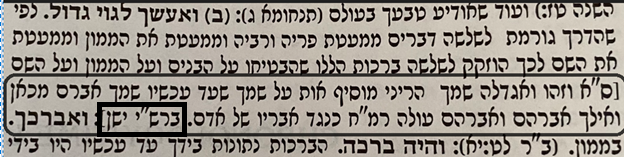
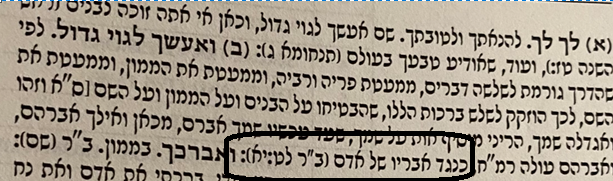
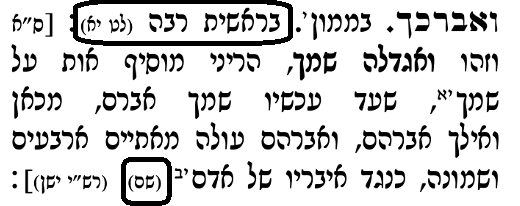
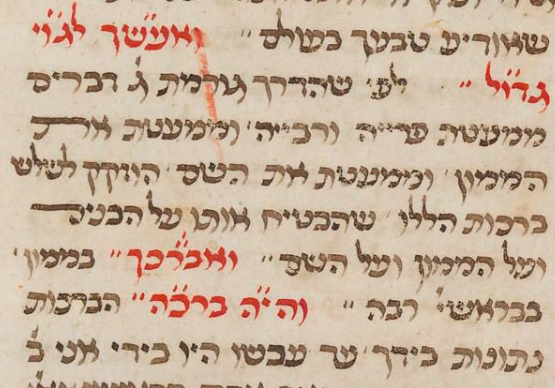
The term “רש״י ישן” in printed editions often appears after a comment recorded in parentheses. An example of this is Rashi in Breishit 12:2. Here is how it looks in the first edition of the Artscroll Stone Chumash printed in November 1993

Rashi’s comments are recorded as follows

Comment #1

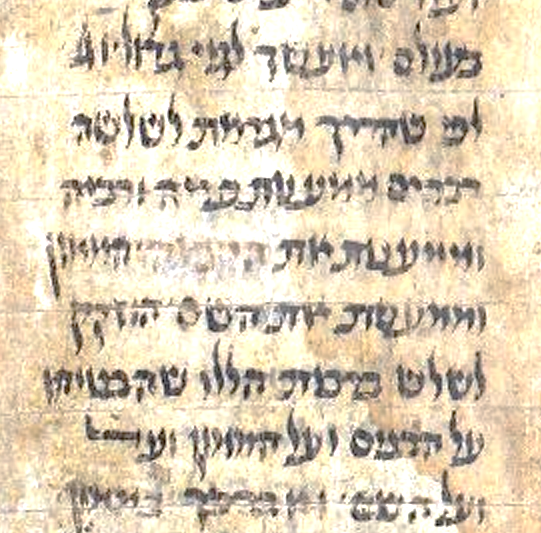
ואעשך לגוי גדול. לְפִי שֶׁהַדֶּרֶךְ גּוֹרֶמֶת לִשְׁלֹשָׁה דְבָרִים, מְמַעֶטֶת פְּרִיָּה וּרְבִיָּה וּמְמַעֶטֶת אֶת הַמָּמוֹן וּמְמַעֶטֶת אֶת הַשֵּׁם, לְכָךְ הֻזְקַק לִשְׁלֹשָׁה בְּרָכוֹת הַלָּלוּ, שֶׁהִבְטִיחוֹ עַל הַבָּנִים וְעַל הַמָּמוֹן וְעַל הַשֵּׁם:

Comment #2 is attributed to ס״א (ספרים אחרים) and found in what is termed a “רש״י ישן”

]ס״א (ספרים אחרים) ואגדלה שמך הריני מוסיף אות על שמך שעד עכשׁיו שמך אברם מכאן ואילך אברהם, ואברהם עולה רמ״ח כנגד איבריו של אדם. ברש״י ישן[

One gets the impression that this comment might be more authentic than those comments normally attributed to Rashi because it was found in a “רש״י ישן”.[1]

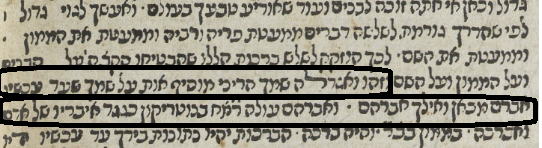
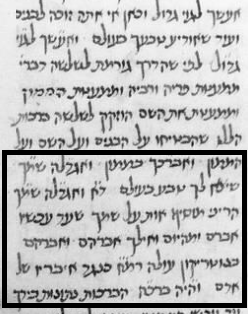
To understand why this comment is recorded as being from a “רש״י ישן’ one must go back to the first time it appeared as such. In this case it is an edition of Chumash and Rashi printed in Hanau 1611-1614.[2]

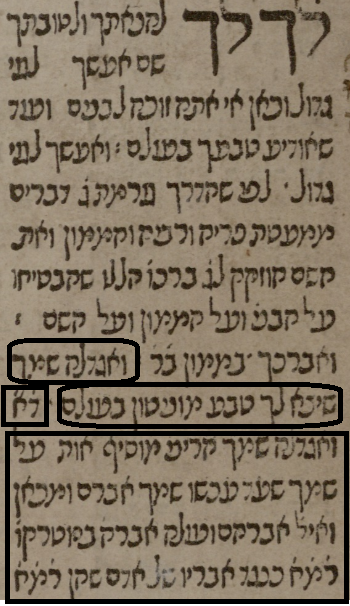
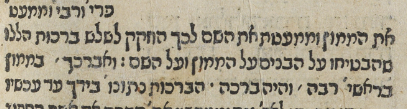
The most probable source for the text as recorded in the Hanau 1611-14 edition is an edition of Chumash and Rashi printed in Lisbon in 1491. As you can see, it is recorded almost word for word the same as the Hanau edition, without the words ס״א (ספרים אחרים) at the beginning of the comment and without the words ברש״י ישן at the end.[3]

It later appeared in an edition printed in Constantinople in 1522, also without the words ס״א (ספרים אחרים) at the beginning of the comment and without the words ברש״י ישן at the end.

And still yet in an edition in Constantinople of 1546

Why did the editors of the Hanau edition include this comment in parentheses and attribute it to a “רש״י ישן’?” Simply put because it had rarely appeared in print from 1491 until 1611 despite the fact that many other editions of Rashi had been printed. The editors most likely felt it was important to attribute the comment to something “new” they had found in old ספרים אחרים, what they called “רש״י ישן’.”[4]

Here are some examples of texts printed between 1491 and 1611 where the comment does not appear. (Some of these editions are of Rashi alone, and others have the text of the Chumash along with Rashi)

1.Napoli 1492 7. Sabionetta 1557

2. Bomberg Venice 1518 8. Juan Di Gara Venice 1567

3. Bomberg Venice 1524-26 9. Cristoforo Zanetti Venice 1567

4. Augsburg 1534 10. Cracow 1587

5. Giustiani Venice 1548 11. Juan di Gara Venice 1590[5]

6. Bomberg Venice 1548

After the comment was included in the Hanau edition of 1611-14, it was identified as a “רש״י ישן” from then on. Examples are:

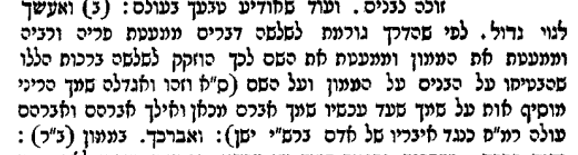
Amsterdam 1635 (Manasseh ben Israel), Amsterdam 1680 (first edition of Siftai Chachamim), Berlin 1703, and Vienna (Netter) 1859[6] where it appears like this

As mentioned, it appeared this way all the way up to 1993 in the Artscroll Chumash. Though important to the Hanau editors, it did not make much sense 400 years later. It might have been more helpful to tell us the source in Chazal for the comment and that is precisely what Artscroll did.

In the Enhanced Edition of 2015 – (7th Impression 2020) it looked like this

The same was true of Rashi Sapirstein Student Edition 20th Impression -2019[7]

Gone was the information that the comment in parentheses came from a “רש״י ישן’”, to be replaced with the helpful information that the Midrashic source for the entire comment was Breishit Rabbah 39:11. The first part of this Rashi “לְפִי שֶׁהַדֶּרֶךְ גּוֹרֶמֶת לִשְׁלֹשָׁה דְבָרִים” clearly appears there as does the idea of הריני מוסיף אות על שמך. However, though it includes the Gematria of 248, it is not the total of the name אברהם, rather it is the total of the word אֲבָרֶכְכָה. It is clear that Breishit Rabah 39:11 is not the source for the idea that new spelling of the name אברהם now equals 248.

Here is the relevant text of Breishis Rabah 39:11

אָמַר רַבִּי חִיָּא לְפִי שֶׁהַדֶּרֶךְ מַגְרֶמֶת לִשְׁלשָׁה דְבָרִים, מְמַעֶטֶת פְּרִיָּה וּרְבִיָּה, וּמְמַעֶטֶת אֶת הַיְצִיאָה, וּמְמַעֶטֶת אֶת הַשֵּׁם. מְמַעֶטֶת פְּרִיָּה וּרְבִיָּה, וְאֶעֶשְׂךָ לְגוֹי גָדוֹל. מְמַעֶטֶת אֶת הַיְצִיאָה, וַאֲבָרֶכְךָ. מְמַעֶטֶת אֶת הַשֵּׁם, וַאֲגַדְלָה שְׁמֶךָ. וּלְפוּם דְּאָמְרִין אִינְשֵׁי מִבַּיִת לְבַיִת, חֲלוּק, מֵאֲתַר לַאֲתַר, נָפֶשׁ. בְּרַם אַתְּ לֹא נֶפֶשׁ אַתְּ חָסֵר וְלֹא מָמוֹן. רַבִּי בֶּרֶכְיָה בְּשֵׁם רַבִּי חֶלְבּוֹ אָמַר, שֶׁיָּצָא מוֹנִיטִין שֶׁלּוֹ בָּעוֹלָם. אַרְבָּעָה הֵם שֶׁיָּצָא לָהֶם מוֹנִיטִין בָּעוֹלָם, אַבְרָהָם, וְאֶעֶשְׂךָ לְגוֹי גָּדוֹל, יָצָא לוֹ מוֹנִיטִין, וּמַהוּ מוֹנִיטִין שֶׁלּוֹ, זָקֵן וּזְקֵנָה מִכָּאן בָּחוּר וּבְתוּלָה מִכָּאן. יְהוֹשֻׁעַ: וַיְהִי ה’ אֶת יְהוֹשֻׁעַ וַיְהִי שָׁמְעוֹ בְּכָל הָאָרֶץ (יהושע ו’:כ”ז), יָצָא לוֹ מוֹנִיטִין בָּעוֹלָם, מַהוּ, שׁוֹר מִכָּאן וּרְאֵם מִכָּאן, עַל שֵׁם: בְּכוֹר שׁוֹרוֹ הָדָר לוֹ וְקַרְנֵי רְאֵם קַרְנָיו (דברים ל”ג:י”ז). דָּוִד: וַיֵּצֵא שֵׁם דָּוִיד בְּכָל הָאֲרָצוֹת (דברי הימים א י”ד:י”ז), יָצָא לוֹ מוֹנִיטִין בָּעוֹלָם, וּמָה הָיָה מוֹנִיטִין שֶׁלּוֹ מַקֵּל וְתַרְמִיל מִכָּאן וּמִגְדָּל מִכָּאן, עַל שֵׁם: כְּמִגְדַּל דָּוִיד צַוָּארֵךְ (שיר השירים ד’:ד’). מָרְדְּכַי: כִּי גָּדוֹל מָרְדְּכַי בְּבֵית הַמֶּלֶךְ וְשָׁמְעוֹ הוֹלֵךְ בְּכָל הַמְדִינוֹת (אסתר ט’:ד’), יָצָא לוֹ מוֹנִיטִין, וּמַה מּוֹנִיטִין שֶׁלּוֹ שַׂק וָאֵפֶר מִכָּאן וַעֲטֶרֶת זָהָב מִכָּאן.

אָמַר רַבִּי יוּדָן קוֹבֵעַ אֲנִי לְךָ בְּרָכָה בִּשְׁמוֹנֶה עֶשְׂרֵה, אֲבָל אֵין אַתְּ יוֹדֵעַ אִם שֶׁלִּי קוֹדֶמֶת אִם שֶׁלְּךָ קוֹדֶמֶת, אָמַר רַבִּי אֲחוּיָה בְּשֵׁם רַבִּי זְעֵירָא שֶׁלְּךָ קוֹדֶמֶת לְשֶׁלִּי, בְּשָׁעָה שֶׁהוּא אוֹמֵר מָגֵן אַבְרָהָם אַחַר כָּךְ מְחַיֵּה הַמֵּתִים. רַבִּי אַבָּהוּ אָמַר הַבֶּט נָא שָׁמַיִם אֵין כְּתִיב כָּאן אֶלָּא הַשָּׁמַיְמָה (בראשית ט”ו:ה’), אָמַר הַקָּדוֹשׁ בָּרוּךְ הוּא בְּהֵ”א בָּרָאתִי אֶת הָעוֹלָם הֲרֵינִי מוֹסִיף הֵ”א עַל שִׁמְךָ וְאַתְּ פָּרֶה וְרָבֶה. וְאָמַר רַבִּי יוּדָן וְהָיוּ אוֹתוֹתֶיךָ מִנְיַן אֲבָרֶכְכָה, מָאתַיִם וְאַרְבָּעִים וּשְׁמוֹנֶה

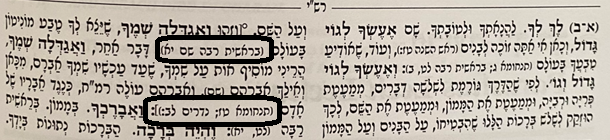
The rest of the Ma’amar “ואברהם עולה רמ״ח כנגד איבריו של אדם” is found in Medrash Tanchuma 16[8] and in Nedarim 32b[9]. This is reflected in the Artscroll Rashi Elucidated Edition of 2023

T

The section called שפתי ישינים in the back of this edition informs us that the first time these comments (הריני מוסיף אות על שמך) appeared in print was the Alkabetz Guadalajara, Spain edition of 1476, (דפוס 3) though in a slightly elongated form where the words “שיצא לך טבע מוניטין בעולם ד״א” preceded it.

Here is the Alkabetz text which includes this other idea from Breishit Rabah 39:1.

Here is Hijar, 1490 which generally copied from Alkabetz

It appeared in a shortened form in Lisbon 1491, and it is clear that this was the basis for the Hanau edition because Hanau deviates appreciably from Alkbatez. It was added to the text of Rashi in parentheses by Hanau, and it is recorded that way even today by many Chumashim.[10]

Were these comments included by Rashi in his original commentary?

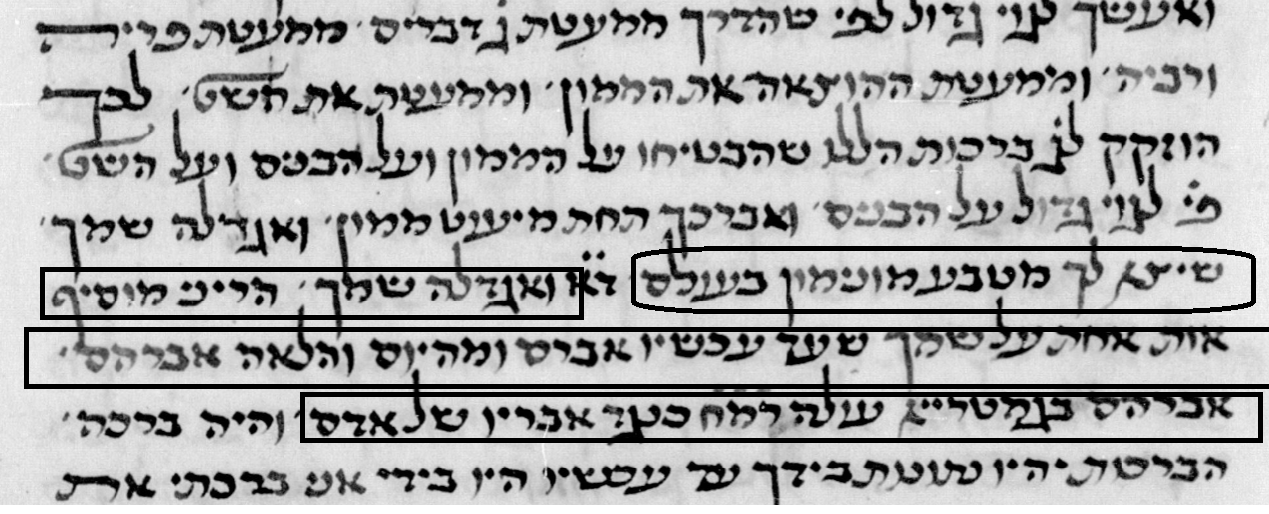
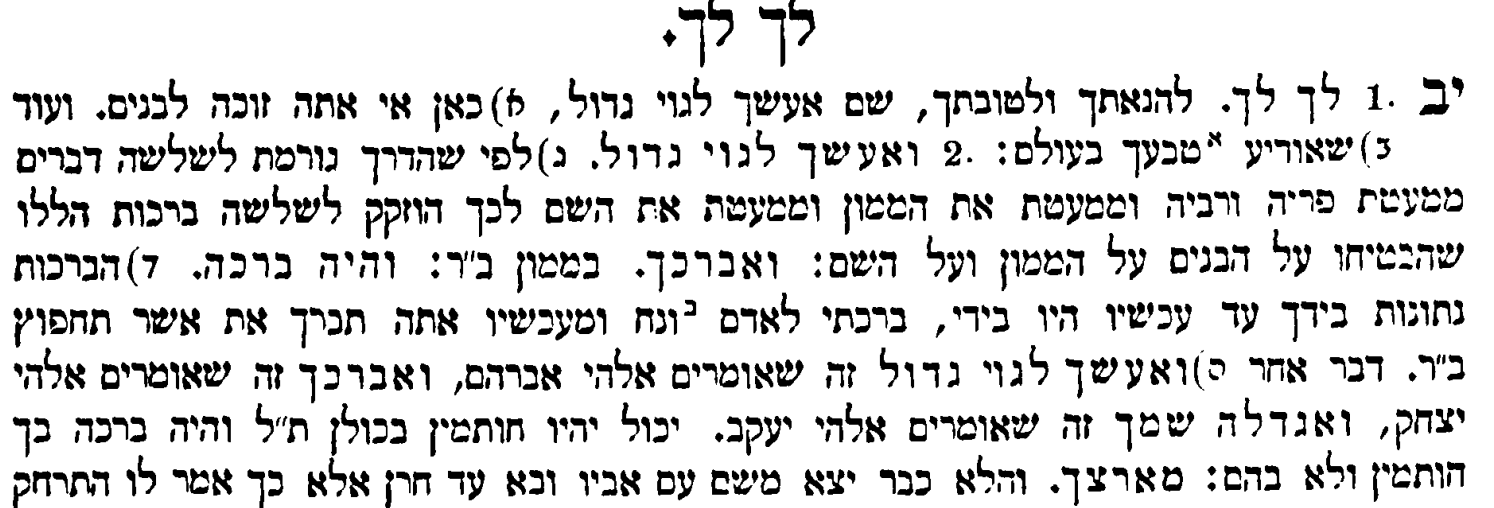
The respected website Al HaTorah notes on this additional comment that it is found in one manuscript[11] and in the Alkabetz edition, but that it does not appear in any other manuscript that it checked[12]

אעשך לגוי גדול וגו’ – לפי שהדרך מגרמתד לשלשה דברים: ממעטת פריה ורביה, וממעטת את הממון, וממעטת את השם, הוזקק לשלש ברכות הללו: שהבטיחו על הבנים, ועל הממון, ועל השם.

בכ״י פריס 157 ובדפוס אלקבץ נוסף כאן: ״וזהו ואגדלה שמך שיצא לך טבע מוניטון בעולם. דבר אחר: ואגדלה שמך – הריני מוסיף אות על שמך, שעד עכשיו שמך אברם ומכאן ואילך אברהם, ועולה אברהם בנוטריקון רמ״ח כנגד איבריו של אדם שהן רמ״ח.״ הביאורים חסרים בכל כ״י האחרים שבדקנו

(“these explanations are missing in all the manuscripts we checked”)

I found this to be most likely correct in that I checked the following 13 manuscripts from the 13-14th centuries and did not find the extra comment in one of them.

Oxford CCC 165/Neubauer 2440(1194), Munich 5 (1233), Hamburg 13 (1265), London 26917 (Neubauer 168) (1272), Berlin 1221, Berlin Qu. 514 (1289), Vatican Urbanati 1 (1294), Nurenberg 5 (1297), Parma 3115 (1305)[13], Paris 155, Parma 2868, Cincinnati HUC 7, and Paris 156

Neither did I find the extra comment in these nine manuscripts copied over in the 15th century, close to the time of the printing of the Alkabetz edition of 1476

Oxford-Bodley Opp. 35 (Neubauer 188) (1408), Vatican ebr.47 (1413), Breslau 102 (Saraval 12) (1421), Parma 2979 (1432)[14], Parma 2989 (1454), Jerusalem Ms. Heb. 2009=38 (1462), Frankfurt Oct 24 (1472), Hamburg 103 (1474)[15], and Parma 2707 (1480)

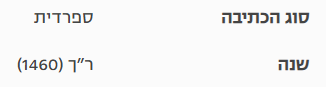
I did find it in one other manuscript known as Casanatense 2924 (1460). It is described as a Sephardic manuscript and therefore aligns with the textual transmission available to Alkabetz[16]

As mentioned, it is absent from most printed editions of the late 1400’s and the 1500’s. Yosef Da’at does not include it. Avraham Berliner did not include it in either of his editions of Zechor L’Avraham (1867 and 1905)[17]. It is not included in Mikraot Gedolot HaKeter, and in Torat Chaim of Mosad Harav Kook (1993), nor in Rashi Hashalem (Mechon Arial 1987)[18], and it is not included in the text of Rashi in Al HaTorah. Clearly the comment existed in some manuscripts as evidenced by its appearance in the Alkabetz edition. But the weight of evidence is that it did not originate with Rashi.


Finally, I feel that Artscroll should be acknowledged for continuing to “upgrade” its presentation of the Rashi text as it has clearly done in this case.

  1.  

    It also doesn’t indicate the source in Chazal for this comment as is done so often in Rashi editions. A good example of this is the Oz VeHadar Chumash Rashi Hamevuar of 2015 which indicates that it is a “רש״י ישן” but also tells you that the source of the comment in Chazal is בראשית רבה ל״ט:י״א (by saying ״שם״ which refers back to the citation immediately preceding it, בראשית רבה ל״ט:י״א)

  2.  

    The comment is word for word the same as the Stone Chumash of 1993 except for the fact that it has the word ״וזהו״ before the words “ואגדלה שמך”

  3.  

    The three very similar “versions” of this added comment are then as follows

    Artscroll Stone Chumash 1993

    ואגדלה שמך הריני מוסיף אות על שמך שעד עכשׁיו שמך אברם מכאן ואילך אברהם ואברהם עולה רמ״ח כנגד איבריו של אדם

    Hanau 1611-14 -only adds the word “וזהו”

    וזהו ואגדלה שמך הריני מוסיף אות על שמך שעד עכשׁיו שמך אברם מכאן ואילך אברהם ואברהם עולה רמ״ח כנגד איבריו של אדם

    Lisbon 1491 – leaves out the word שמך and adds the word בנוטריקון

    וזהו ואגדלה שמך הריני מוסיף אות על שמך שעד עכשׁיו אברם מכאן ואילך אברהם ואברהם עולה רמ״ח בנוטריקון כנגד איבריו של אדם

  4.  

    I do not think they had access to manuscripts, as they do not mention it at all in their description of the book

  5.  

    Here are two examples where the comment beginning with “ואגדלה שמך הריני מוסיף” does not appear

    Rashi Sabionetta 1557

    Venice Juan Di Gara 1567

  6.  

    This edition was quite influential in that it served as the model for many subsequent printings of Mikraot Gedolot

  7.  

    This source of Bereishit Rabbah 39:11 was also noted in the Oz Vehadar Mikraot Gedolot of 2012, although the Rashi Yashan designation remained.

  8.  

    Tanchuma Lech Lecha 16

    אָמַר לוֹ הַקָּדוֹשׁ בָּרוּךְ הוּא: מָה אַתָּה סָבוּר שֶׁאַתָּה תָמִים שָׁלֵם, אַתָּה חָסֵר מֵחֲמִשָּׁה אֵבָרִים. אָמַר לוֹ הַקָּדוֹשׁ בָּרוּךְ הוּא: עַד שֶׁלֹּא תָמוּל, הָיָה שִׁמְךָ אַבְרָם, א’ אֶחָד, ב’ שְׁנַיִם, ר’ מָאתַיִם, מ’ אַרְבָּעִים, הֲרֵי מָאתַיִם וְאַרְבָּעִים וּשְׁלֹשָׁה. וּמִנְיַן אֵבָרִים שֶׁבָּאָדָם מָאתַיִם וְאַרְבָּעִים וּשְׁמוֹנָה, מוּל וֶהְיֵה תָמִים. כְּשֶׁמָּל, אָמַר לוֹ הַקָּדוֹשׁ בָּרוּךְ הוּא: לֹא יִקָּרֵא עוֹד שִׁמְךָ אַבְרָם וְהָיָה שִׁמְךָ אַבְרָהָם. הוֹסִיף לוֹ ה’, חֲמִשָּׁה, מִנְיַן רַמַ״‎ח אֵבָרִים. לְפִיכָךְ וֶהְיֵה תָמִים.

  9. Nedarim 32b

    וְאָמַר רָמֵי בַּר אַבָּא: כְּתִיב ״אַבְרָם״, וּכְתִיב ״אַבְרָהָם״. בַּתְּחִלָּה הִמְלִיכוֹ הַקָּדוֹשׁ בָּרוּךְ הוּא עַל מָאתַיִם וְאַרְבָּעִים וּשְׁלֹשָׁה אֵבָרִים, וּלְבַסּוֹף הִמְלִיכוֹ עַל מָאתַיִם וְאַרְבָּעִים וּשְׁמוֹנֶה אֵבָרִים, אֵלּוּ הֵן: שְׁתֵּי עֵינַיִם, וּשְׁתֵּי אׇזְנַיִם, וְרֹאשׁ הַגְּוִיָּיה.

  10.  

    This is the comment of Siftai Yeshainim

  11.  

    This is how Paris 157 (13th-14th century) appears. Both extra comments of Alkabetz are included.

  12.  

    Leipzig 1 is considered to be one of the most important Rashi manuscripts and the comment is absent from it

  13.  

    Parma 3115 is known as a Sephardic Mahadura and much of the Alkabetz edition came from there or a similar manuscript, but it is not there

  14.  

    This is a particularly beautiful manuscript

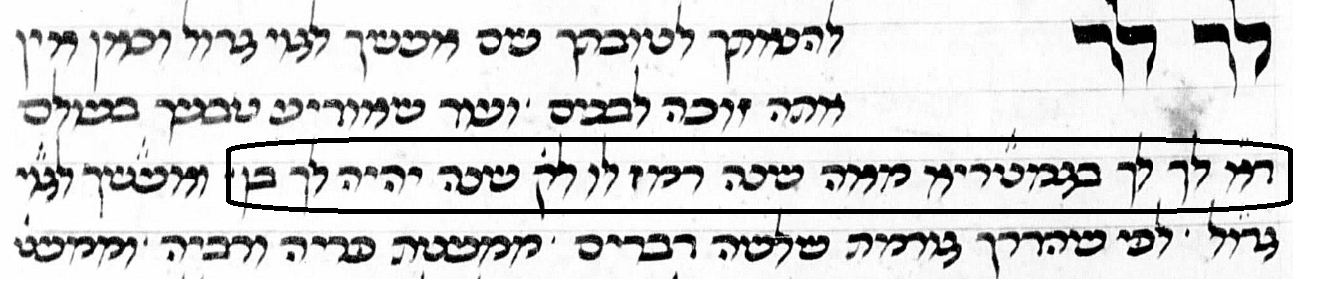
  15.  

    This manuscript has this interesting addition to the text of Rashi

    לך לך בגימטריא מאה שנה, רמז לו לק׳ שנה יהיה לך בן

    The source seems to be Medrash Tanchuma, Parshat לֶךְ לְךָ 3

    לֶךְ לְךָ – מַהוּ לֶךְ לְךָ, ל’ שְׁלֹשִים, כ’ עֶשְׂרִים, הֲרֵי עוֹלֶה בְּגִימַטְרִיָּא מֵאָה. רָמַז לוֹ, כְּשֶׁתִּהְיֶה בֶּן מֵאָה, תּוֹלִיד בֵּן כָּשֵׁר, הֲדָא הוּא דִכְתִיב, וְאַבְרָהָם בֶּן מְאַת שָׁנָה וְגוֹ’

    It is not in any other manuscript which I accessed

  16.  

    NLI Listing

    Casanatense Library Rome Italy Ms. 2921

  17.  

    Zechor L’Avraham, Avraham Berliner (Berlin) 1867

  18.  

    Rashi Hashalem notes below the line the Girsa of the Alkabetz edition and the sources for it.


Eli Genauer: Breishit 9:18 – Noach’s Family or Noach’s Drunkenness?

Breishit 9:18 – Noach’s Family or Noach’s Drunkenness?

Eli Genauer


וַיִּֽהְי֣וּ בְנֵי־נֹ֗חַ הַיֹּֽצְאִים֙ מִן־הַתֵּבָ֔ה שֵׁ֖ם וְחָ֣ם וָיָ֑פֶת וְחָ֕ם ה֖וּא אֲבִ֥י כְנָֽעַן׃

“The sons of Noach who came out of the ark were Shem, Cham, and Yefet; and Cham was the father of Canaan.”

Rashi:

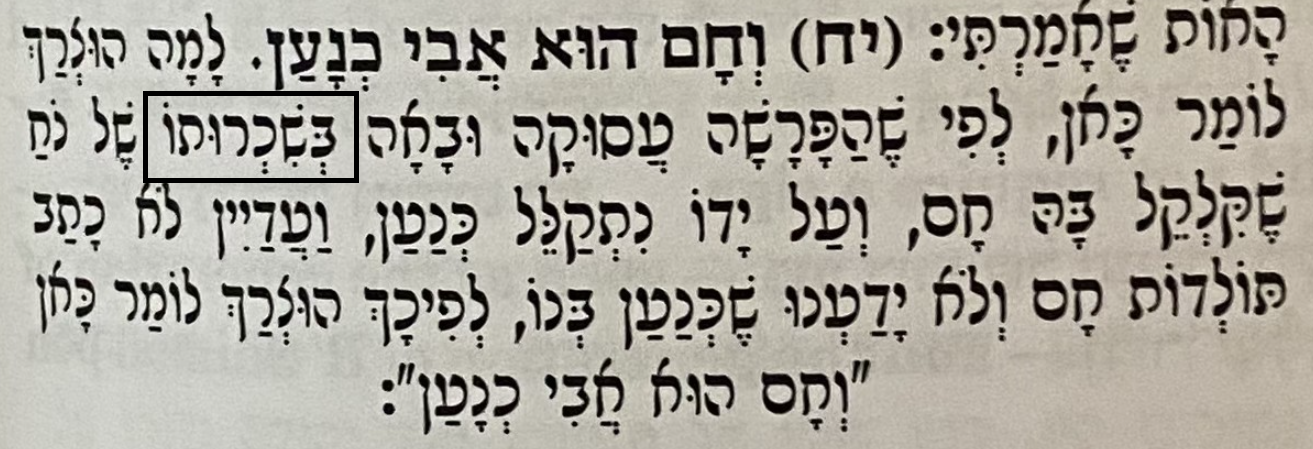
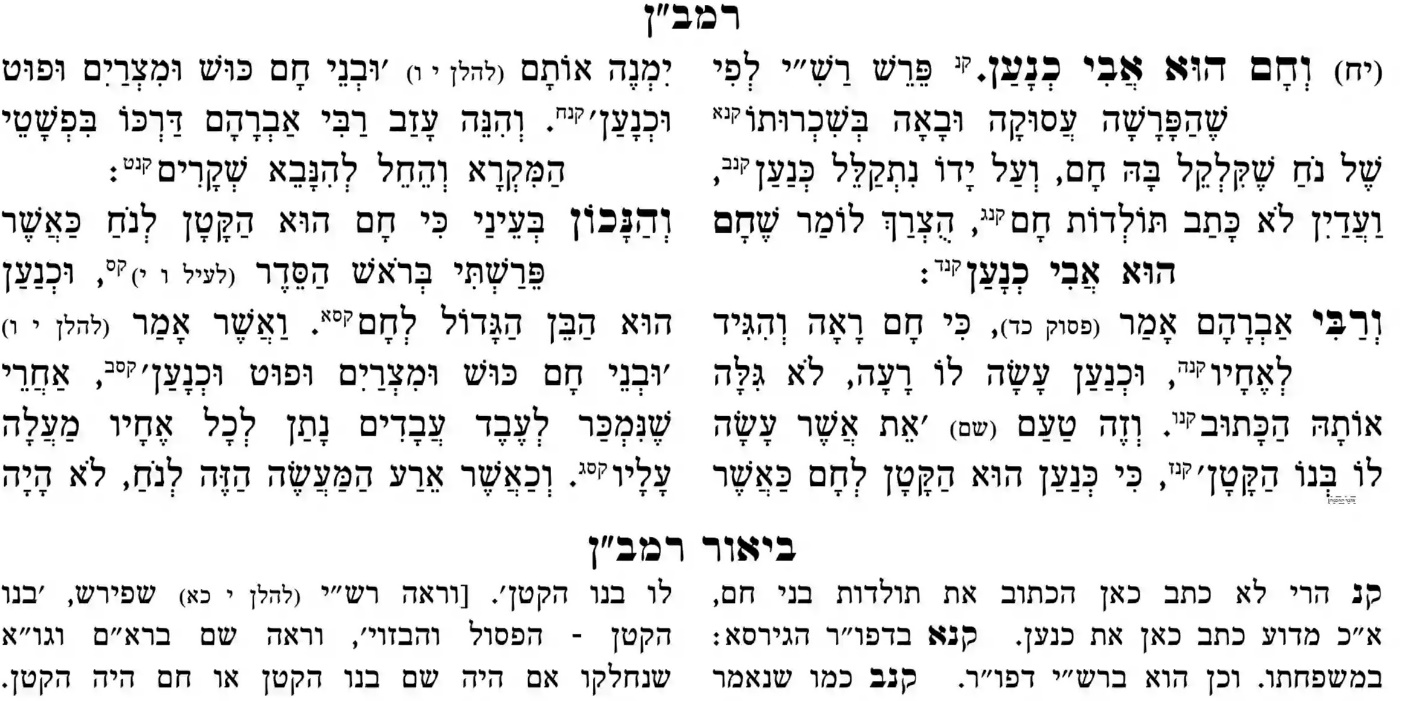
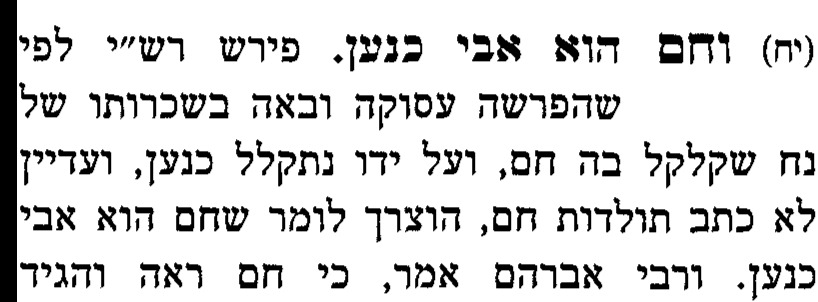
וחם הוא אבי כנען. לָמָּה הֻצְרַךְ לוֹמַר כָּאן? לְפִי שֶׁהַפָּרָשָׁה עֲסוּקָה וּבָאָה בְּשִׁכְרוּתוֹ שֶׁל נֹחַ שֶׁקִּלְקֵל בָּה חָם וְעַל יָדוֹ נִתְקַלֵּל כְּנַעַן, וַעֲדַיִן לֹא כָתַב תּוֹלְדוֹת חָם, וְלֹא יָדַעְנוּ שֶׁכְּנַעַן בְּנוֹ – לְפִיכָךְ הֻצְרַךְ לוֹמַר כָּאן וְחָם הוּא אֲבִי כְנָעַן:

AND CHAM IS THE FATHER OF CANAAN – Why is it necessary to mention this here? Because this section goes on to deal with the account of Noah’s drunkenness when Cham sinned, and through him, Canaan was cursed. Now, as the generations of Cham have not yet been mentioned, we therefore would not know that Canaan was his son. Therefore, it was necessary to state here that “Cham is the father of Canaan”.

This is how it appears in the Artscroll Elucidated Rashi[1]:

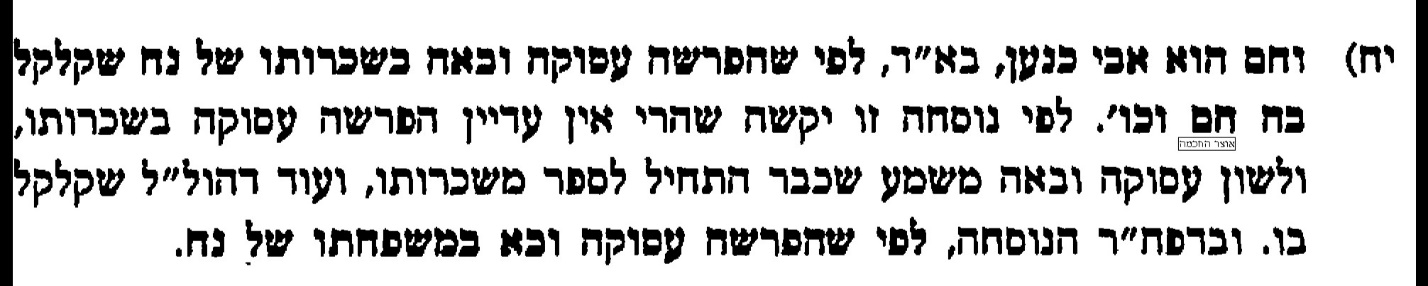
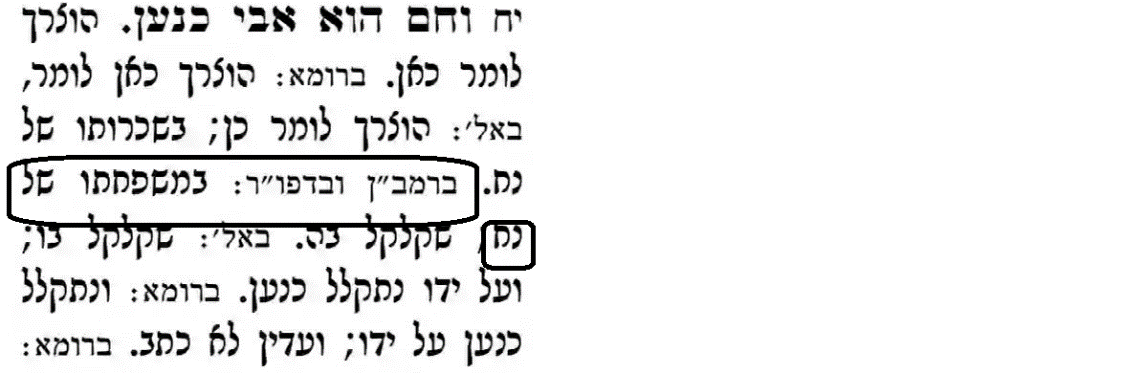
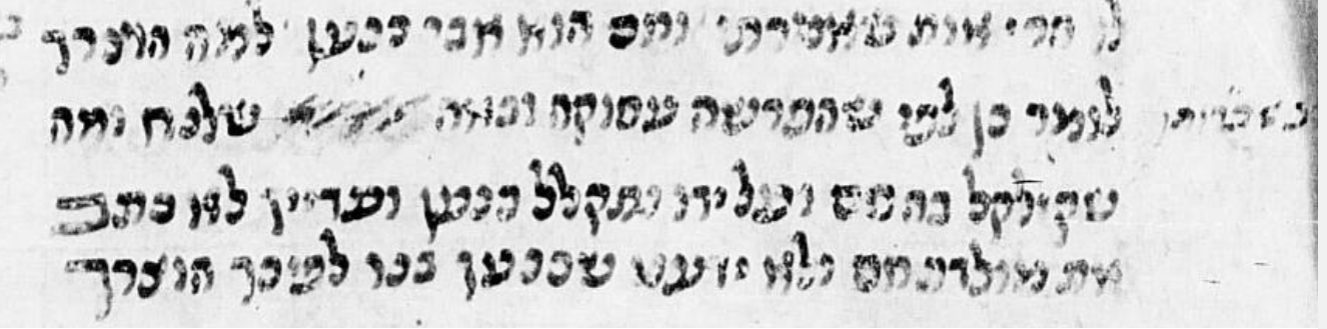
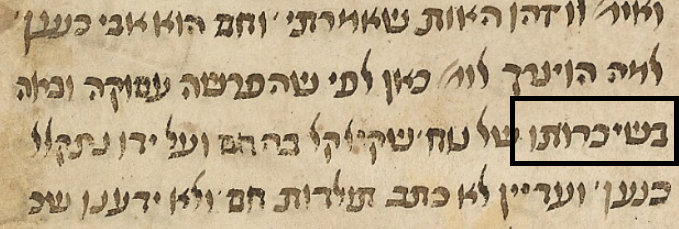
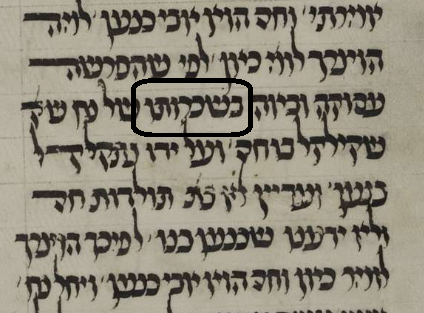
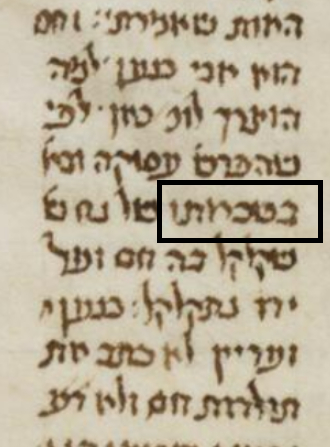
Yet the author of the Sefer Yosef Da’at (Prague 1609) writes that he had a Rashi manuscript and other Sefarim which substituted the word “במשפחתו “for the word” בְּשִׁכְרוּתוֹ”. He also writes that it was the Nusach of Ramban ( when quoting this Rashi).

בדבור המתחיל וחם הוא אבי כו׳, נכתב בצדו על מלת ״בשכרותו״ שבפנינו, וברש״י קלף בס״א (בספרים אחרים) במשפחתו של נח. והיא נוסחאות הרמב״ן ז״ל.

The text of Rashi would then read:

וחם הוא אבי כנען. לָמָּה הֻצְרַךְ לוֹמַר כָּאן? לְפִי שֶׁהַפָּרָשָׁה עֲסוּקָה וּבָאָה במשפחתו שֶׁל נֹחַ שֶׁקִּלְקֵל בָּה חָם וְעַל יָדוֹ נִתְקַלֵּל כְּנַעַן…..

Why is it necessary to mention this here? Because this section goes on to deal with the account of Noah’s family when Cham sinned, and through him, Canaan was cursed…

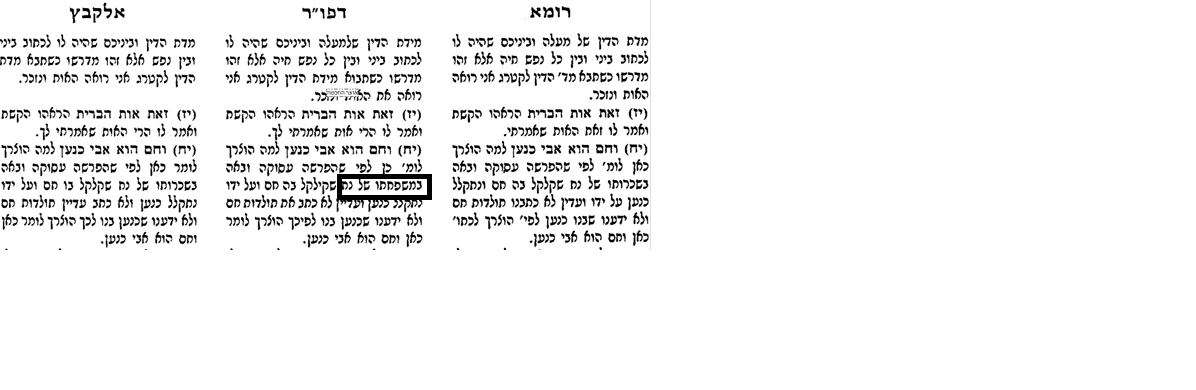
As mentioned by Yosef Da’at, one of the Eidei Nusach for having the word במשפחתו is Ramban, who quotes Rashi’s comment. The website Al Hatorah notes, that this Nusach appears in the following Ramban manuscripts: Parma 3255, Munich 138, Fulda 2, Paris 222, and Paris 223. It also appears that way in the first printed edition of Ramban, that of Rome (printed before 1490).

This is the Ramban manuscript known as Munich 138 where Ramban quotes Rashi:

Here is the text of Ramban in the Rome edition where he writes(פ׳(רוש) ר״ש (למה:

Al Hatorah also notes that the word במשפחתו, appears in the text of a Rashi manuscript, Parma 3115, (which it seems was close to the text with which the Ramban worked) before it was “corrected”.

וכן בכ”י פרמא 3115 של פירוש רש”י (שהוא כנראה קרוב לנוסח שעמד בפני רמב”ן) לפני שתוקן בין השיטין

Ktav Yad Parma 3115, for Rashi:

Al Hatorah then notes that most Rashi manuscripts have בְּשִׁכְרוּתוֹ

בכ”י רומא 44, פרמא 2978, דפוס ליסבון: “בשכרותו”, וכן ברוב כ”י של רש”י.

Parma 2978 is the Ramban on Noach which has “בשכרותו”:

For Rashi on this Pasuk ,Al HaTorah records that most Rashi manuscripts have בְּשִׁכְרוּתוֹ, but Regio di Calabria, as quoted by Ramban and the Rashi manuscript Parma 3115, have it as במשפחתו.

וחם הוא אבי כנען – למה הוצרך לומר כאן. לפי שהפרשה עסוקה בשכרותו של נח שקלקל בה חם, ועל ידו נתקלל כנען, ועדיין לא כתב תולדות חם, ולא ידענו שכנען בנו. לפיכך הוצרך לומר כאן: וחם הוא אבי כנען.

ב. כן בכ״י אוקספורד 165, מינכן 5, אוקספורד 34, לונדון 26917, ברלין 1221, דפוס רומא.

דפוס ריגייו: ״במשפחתו״, וכן מופיע בפירוש רמב״ן כאן ברוב עדי הנוסח, בכ״י פרמא 3115

. אפשר שכך היה הנוסח גם בכ״י המבורג 13.

In Zechor L’Avraham (Berlin 1867 and Frankfurt am Main 1905), there is no indication of alternative Nusach. Avraham Berliner does not mention the alternative Nusach of Yosef Daat, the Dfus Rishon or the Girsa of Ramban:

In Yosef Hallel (Brooklyn 1987), Rabbi Brachfeld notes that the Dfus Rishon of Regio Callabrio (1475) has the word במשפּחתו. He does not note that it is the Lashon of the Ramban but seems to think that במשפחתו is a better reading because of his questions on the use of בְּשִׁכְרוּתוֹ:

In Rashi HaShalem Mechon Ariel ( Jerusalem 1987), there is no indication of another Girsa but in the back of the Sefer, it does have it as part of Defusim Rishonim:

Defusim Rishonim:

Guadalajara (1476) Reggio di Calabrio (1475) Rome (1470)

It is interesting to note that the Alkbetz edition is what is known as the Mahadura Sefardit ( according to Professor Yeshayahu Sonne and Dr Yitzchak Penkower), and yet it has בשכרותו. The same goes with Hijar(1490), which generally copies Alkabetz.

Oz Vehadar Rashi HaMevuar 2008, has במשפחתו in the back in Chilufai Girsaot, noting that it is the Girsa of Ramban and the Dfus Rishon:


Rabbi Isaac Chavel in his edition of Rashi ( Mosad HaRav Kook – 2007 edition) notes that Defus Rishon of Rashi (Regio di Calabria) has ,במשפחתו and this Lashon also appears in the text of Ramban as he quotes Rashi. He also says about the use of the word “במשפחתו” that is more correct (“וכן נראה”) based on the Lashon of the Midrash Agadah which places the emphasis on familial relationships of Noach:

What do the manuscripts indicate:

Oxford CCC 165 (Neubauer 2440) – 12th century

Hamburg 13 (1265), has the word in question rubbed out and changed to בְּשִׁכְרוּתו on the side. It might have originally said במשפחתו:

Oxford-Bodley Opp. 34 (Neubauer 186):

London 26917 (Neubauer 168) (1272):

Berlin 1221:

Vatican Urbinati 1 (1294):

Nuernberg 5 (1297):

How did the text of Rashi in printed editions evolve over time?

The Dfus Rishon of Regio di Calabrio recorded it as במשפחתו. As mentioned, Yosef Da’at noted במשפחתו as a variant reading in a Rashi Klaf and in ,ספרים אחרים and bolstered it with it being the Nusach of Ramban:

בדבור המתחיל וחם הוא אבי כו׳, נכתב בצדו על מלת ״בשכרותו״ שבפנינו, וברש״י קלף בס״א (בספרים אחרים) במשפחתו של נח. והיא נוסחאות הרמב״ן ז״ל.

Hanau 1611-1614, regularly included the Girsaot of Yosef Da’at so we would have expected it to have had בְּשִׁכְרוּתוֹ and then in parentheses have Sefarim Achairim as במשפחתו. But is doesn’t, and that sealed the fate of that Nusach in terms of it becoming a mainstream Girsa of Sefarim Achairim:

The Netziv in Shemot 40:23 cites a comment of the Ramban in which he quotes Rashi and says that our text of Rashi is different. He proposes that there were two Mahdurot of Rashi, of which Ramban had the first Mahadura and we have the second one. In that second Mahadura, Rashi reversed himself from what he said in the first Mahadura. It is possible that this occurred here- in the first Mahadura, Rashi wrote במשפחתו and that is the Mahadura which Ramban had. Later on, Rashi changed it to בְּשִׁכְרוּתו and that has become the standard Girsa:
Conclusion:

There is a lot of ammunition for the Girsa being במשפחתו:

  1. It is in Dfus Rishon, (indicating either inclusion in a manuscript or taken from Ramban)
  2. It is the Lashon of the Ramban, (this is the main argument)
  3. It has logic behind it (Rabbi Chavel’s and Yosef Hallel’s comments)
  4. It is attested to by Yosef Da’at as being in a manuscript
  5. Parma 3115 originally had “במשפחתו”
  6. Hamburg 13 was altered and could have said במשפחתו

But it did not survive as an alternative Girsa of ספרים אחרים today mainly because the influential edition of Hanau (1611-1614) did not include it.

Sidenote:

Many editions of the Ramban today still attribute the word בְּשִׁכְרוּתוֹ to Rashi even though it is clear that the original Ramban had במשפחתו. This was most likely done to make it conform with the accepted Nusach of Rashi.

Here is Oz Vehadar Jerusalem on Ramban 2015 which has בְּשִׁכְרוּתוֹ but says it is במשפחתו in Defus Rishon:

Here is Peirush HaRamban with Peirush Menachem Tziyon printed in 2019 which also has בְּשִׁכְרוּתוֹ:

  1. There is no comment on this Rashi in the Siftei Yeshainim section


Stet in the Beit Yosef: Fish and Milk, from Typographical Error to Typological Exemplar

Stet in the Beit Yosef: Fish and Milk, from Typographical Error to Typological Exemplar
Aton M. Holzer

Rabbi Dr. Holzer is Director of the Mohs Surgery Clinic in the Department of Dermatology, Tel Aviv Sourasky Medical Center, and is an assistant editor of the recent RCA Siddur Avodat HaLev. ORCID ID: 0000-0001-9852-3958/ 28 Binyamin, Beit Shemesh, Israel 9952200/ Aton.holzer@gmail.com

A passage in the magnum opus of R. Joseph Karo (Maran, or the Mehaber, 1488-1575), the Beit Yosef (YD 87:5) tends to be reckoned among the more consequential scribal errors in Jewish legal texts.

[ה] ”דגים וחגבים מותר לאכלן בחלב“. ריש פרק כל הבשר (קג:) ”(כל הבשר) אסור לבשל בחלב, חוץ מבשר דגים וחגבים“. וכתב הר”ן דכיון דלבשלן שרי משמע דלאכלן בחלב נמי שרי, דאיסור בשר בחלב בלשון בישול אפקיה רחמנא, וכן כתב הרמב”ם והרשב”א דלאכלן בחלב נמי שרי. ומכל מקום אין לאכול דגים בחלב מפני הסכנה, כמו שנתבאר בספר אורח חיים סימן קע”ג.

“Fish and locusts, it is permitted to eat them in milk.” In the beginning of the chapter kol basar (bHullin 103b) [it is written]: “(all flesh) it is prohibited to cook in milk, except for the flesh of fish and locusts.” And R. Nissim wrote that since cooking them is permitted, it implies that to eat them in milk is also permitted, for the prohibition of meat in milk was set out by the Torah in the semantics of cooking, and likewise did Maimonides and R. Shlomo ibn Adret write, that to eat them in milk is also permitted. And in any event, one should not eat fish in milk because of the danger, similar to what was elucidated in Orah Hayyim 173.

In his 2014 “A Guide to the Complex,”[1] Shlomo Brody highlights this passage – which invokes a heretofore ostensibly unknown ‘danger’ regarding consumption of fish in milk, and which makes reference to a chapter that deals with measures that must be taken with regard to the ‘dangerous mixture’ of fish and meat[2] – as a banner example of the ‘impact of inaccurate texts on Jewish law.’ He adds that ‘Ancient manuscripts regularly suffered from poor penmanship, slipping of the eyes, and misunderstandings by unlearned or confused copyists.’ The first to make this sort of observation regarding this passage was none other than R. Karo’s younger contemporary and interlocutory commentator R. Moses Isserles (Rama, 1530-1572), who puts it humorously (Darkei Moshe, Tur YD 87:4):

.ולא ראיתי מימי נזהרין בזה וגם בא”ח סימן קע”ג אינו אלא שלא לאכלו בבשר משום סכנה אבל בחלב שרי ועי”ל סימן קי”ו ולכן נראה שנתערב להרב בשר בחלב

And in all my days I have never seen [anyone] take care with regard to this, and also in Orah Hayyim 173 there is not but not to eat [fish cooked] in meat because of danger, but in milk it is permitted, and see earlier in chapter 116, and therefore it appears that the Rabbi has confused (mixed) meat and milk.

As neat as this solution appears, there remain some problems. For one thing, in context, the Beit Yosef discusses the consumption of various forms of flesh – fish and locust – in milk, not meat; replacing the word ‘milk’ for ‘meat’ would render the ultimate sentence a nonsequitur with regard to the full passage.

For another, the idea of danger attendant to mixtures of fish and dairy is not entirely unprecedented. R. Bahye b. Asher (1255-1340), who hailed from R. Karo’s native Christian Spain two centuries earlier (but from Zaragoza, quite a ways from Toledo), seems to make reference to such a practice in his commentary to Exodus 23:19:

.וכן דעת הרופאים בתערובת דג וגבינה שנתבשלו כאחד שמוליד תכונה רעה וחולי הצרעת

And so is the view of the physicians regarding the mixture of fish and cheese that were cooked together, that they beget a bad character and the illness of tsara’at (biblical ‘leprosy’).

To be sure, this is a lone statement, found in a decidedly non-Halakhic work, at a distance of two centuries and one continent from R. Karo’s work, which was completed in Ottoman Safed.

A third is that it is difficult to ascribe scribal error to the Mehaber’s project, if only because Beit Yosef was not transmitted in manuscript, and does not exist in manuscript – at least not beyond the author’s autograph. The four volumes of Tur with Beit Yosef were printed in different Italian publishing houses over the course of the 1550’s, in the author’s own lifetime, and he lived to see several printings of the Beit Yosef and Shulhan Arukh, the precis of the conclusions of halakhic discussions in the Beit Yosef. In fact, printing, and particularly choosing to do so in Renaissance Italy – where there was a Christian censor but superior presses to what was available in Ottoman Turkey, but more importantly, where (Jewish exile) cultures met and wide dissemination was guaranteed[3] – was central to R. Karo’s stated mission, a messianic objective of a piece with his participation in reconstituting the Sanhedrin to administer corporal punishment.[4] Taking a page from the messianic project of Sultan Suleiman, Kanuni or “the lawgiver,”[5] his project would complete Maimonides’ project[6] to unify the Jewish people under a uniform system of law in anticipation of redemption. And indeed, in his own lifetime, Beit Yosef and Shulhan Arukh enjoyed wide dissemination and readership, if not universal acceptance.[7] 


Figure 1: 87:5 in its first printing (Venice, 1551)

Given this, if “milk” is an error, it is much more likely typographical than scribal, and not the best example of the phenomenon R. Brody describes. But more importantly: given that the printed versions were available to the author, and were widely read and used, in his presence, for more than twenty years, the possibility that a typographical error of such consequence would go unnoticed by the author or his immediate milieu is at least somewhat diminished. The author himself issued a work called Bedek ha-Bayit with corrigenda and addenda, and there is a gloss on siman 86, but not 87.

Muhammad ‘Abd al-Ra’ūf al-Munāwī (1545-1621), a renowned scholar in Ottoman Cairo whose hadith commentary is still popular in Sunni Islam, also composed a compendium of fundamental, practical scholarly-spiritual knowledge related to a number of everyday issues[8] – a sort of Islamic Orah Hayyim, as it were – known as Tadhkirat ūlī al-albāb bi-maʻrifat al-ādāb. This work is significant as a snapshot of the cultural climate in Early Ottoman Cairo, and has traces of persistent Mamluk attitudes, reconfigured in light of Ottoman sensibilities and cutting-edge intellectual trends in his time in Cairo, which, under the Mamluks, had long been a hub of science and the occult (which, at the time, were also deemed ‘sciences’) in the Islamicate world.[9]

In his compendium,[10] there is a fascinating discussion of food mixtures, launching off a discussion of Galenic medicine and the inadvisability of combining food that relate to different humors/elements (moisture/water, dryness/air, coldness/earth and hotness/fire). In pertinent part:

يعسر علينا اثبات كثير من ذلك بالقياس فمن ذالك انه لا يجمع بين سمك و لبن فإنه يولد أمراضا مزمنة كالجدام والبرص والفالج

It is difficult for us to prove much of this by (syllogistic) reason. For example, that combining fish and milk causes chronic diseases such as leprosy, vitiligo, and paralysis.


Figure 2: Tadhkirat ūlī al-albāb bi-maʻrifat al-ādāb,folio 14a (Yale, Landberg MSS 163)

Paulina Lewicka, a Polish scholar who studied foodways in Mamluk and Ottoman Cairo,[11] highlights this passage and notes that it represents a novelty on the Egyptian scene.

In fact, there seems to be no evidence that avoidance of mixing fish and milk products had been observed in Egypt of the Mamluk period, or in the medieval Middle East in general. This combination, which is considered unhealthy today, appeared in a number of old Arabic-Islamic recipes where fish and yoghurt were put together. Al-Munāwī’s remarks may have reflected, then, a new trend in medico-culinary thinking.[12]

Lewicka also notes in al-Munāwī’s treatment of Galenic medicine an interesting development: even though Galen’s theory of humors had formed the basis of Islamicate medicine for centuries, in the Muslim-Sufi environment of early Ottoman Cairo there was discomfort with use of pagan theories and concepts. Instead, al-Munāwī traces the theory of humors to Kitāb al-Tawrāt, the Torah,[13]  where, according to him, Adam was created with dry soil, wet water, heat (nefesh/nafs) and cold (ru’ah/rūḥ).

R. Yosef Karo, living in the same territorial-ideological expanse as al-Munāwī – with frequent interchange between Safed and Cairo by figures no less than R. David abi ibn Zimra, R. Bezalel Ashkenazi, and R. Isaac Luria – had ample access to the developments in Cairene medicine that inspired the Tadhkirat passage.

His relationship with classical philosophy – the ostensible basis for Galenic (as opposed to prophetic) Cairene medicine – is complicated. In his mystical diary Maggid Meisharim (80a-b), he cites his angelic guide who allows that, pace the view of other Kabbalists of his day, Maimonides was not condemned to reincarnate as a worm because of his philosophical views – but only because he was saved from this fate by his Torah and good deeds, and thus was allowed to reincarnate in a usual way before ascending to join the souls of the righteous. However, there is evidence that he himself was more accepting and even dabbled in philosophy – but assigned it a decidedly secondary or tertiary position to the study of Talmud and Halakhah, either behind or on par with Kabbalah, which also took a backseat to Halakhic sources in terms of study and Halakhic decision/pesak.[14]

The case of milk and fish may serve as something of an acid test for medical science. R. Karo includes it in his Beit Yosef, but as an ayn le-ekhol – it should not be eaten – rather than ‘it is forbidden.’ Clearly R. Karo prohibits it, as perhaps a contemporary posek (if not for the Igrot Moshe) might prohibit smoking, but does not share al-Munāwī’s view that humoral medicine is a de’orayta. And while cutting edge Galenic knowledge merits mention in Beit Yosef, the Mehaber omits it from the Shulhan Arukh (87:3), the repository of pesak, regarding which, just as for Kabbalah,[15] the Talmudic sources – which explicitly permit such a mixture (kutah, e.g. Pesahim 76b) – trump all.

Thanks to Prof. Tzvi Langermann and Prof. Daniel Lasker for their erudite comments and corrections. Thanks to Prof. Markham Geller, R. Judah Kerbel, and R. Noam Horowitz for insights and source materials, and R. Jonathan Duker and R. Dr. Ari Zivotofsky for being a sounding board for these ideas.

[1] Shlomo Brody, A guide to the complex: contemporary halakhic debates (Maggid, 2014), 297-299.
[2] The origin of the prohibition of consuming meat with fish is Pesahim 76b, where fish cooked with meat is said to pose a risk for ‘odor’ and “something else,” davar aher. Commentators uniformly understand the referent of the latter to be tzara’at, biblical leprosy, and thus the Talmudic statement is medical in nature. Fred Rosner notes that this danger is absent from Hippocratic or Galenic medicine – se his “Eating Fish and Meat Together: Is there a Danger?.” Tradition: A Journal of Orthodox Jewish Thought 35.2 (2001): 36-44. On the other hand, medical teachings in the Talmud often preserve ancient Babylonian medicine, a more empiricist approach than the Hellenistic humor theory that replaced it. Even so, Markham Geller, a specialist in Babylonian medicine, suggests that the Talmudic passage is not health-related at all but aesthetic, and the ‘davar aher’ is more properly understood as pig in its original context – to wit, perhaps, that fish-infused meat is forbidden because of its odor and its possible close resemblance to pork (personal communication). In any event, by R. Karo’s time, the medical understanding of fish-meat mixture prohibition was universal and in that regard it was a fitting analog to fish-milk mixtures.
[3] Mor Altshuler, The Life of Rabbi Yoseph Karo (Tel Aviv University Press, 2016), 323.
[4] Amnon Raz-Krakotzkin, “From Safed to Venice: the” Shulhan ‘Arukh” and the censor.” In Chanita Goodblatt and Howard Kreisel, eds., Tradition, Heterodoxy and Religious Culture: Judaism and Christianity in the Early Modern Period (Ben Gurion University, 2006), 91-115; Roni Weinstein, “Jewish Modern Law and Legalism in a Global Age: the Case of Rabbi Joseph Karo.” Modern Intellectual History 17:2 (2020), 561-578.‏
[5] See Weinstein, ibid.
[6] Israel Jacob Yuval, “Moses redivivus — Maimonides as a ‘Helper to the King’ Messiah” [Hebrew], Zion 72 (2007) 161-188.
[7] Yaron Ben-Naeh, Hagai Pely and Moshe Idel, Rabbi Joseph Karo: History, Halakhah, Kabbalah (The Zalman Shazar Center, 2021), 234.
[8] Paulina B. Lewicka, “Challenges of Daily Life in Early-Ottoman Cairo: a Learned Sufi’s Perspective. Preliminary Remarks on al-Munawı’s Memorandum on Decent Behavior,” in Stephan Conermann and Gül Şen, eds., The Mamluk-Ottoman Transition (V&R Academic, 2017): 59-85.
[9] Matthew Melvin-Koushki, “Taḥqīq vs. Taqlīd in the renaissances of western early modernity.” Philological Encounters 3.1-2 (2018): 193-249.‏
[10] Folio 14a in the Yale MS; it also exists in at least two other manuscripts in Cairo where the passage is identical (folios 22b and 16a, respectively).
[11] Paulina Lewicka, Food and foodways of medieval Cairenes: Aspects of life in an Islamic metropolis of the eastern Mediterranean. (Brill, 2011).
[12] Lewicka, “Challenges of Daily Life,” 71-72.
[13] Or, more usually, collections of unusual hadiths that Islamic scholars mistook for the Torah. I am indebted to Prof. Langermann for this insight.
[14] See Ben-Naeh et al., Rabbi Joseph Karo, 136-140.
[15] Jacob Katz, “Post-Zoharic Relations between Halakhah and Kabbalah,” in Bernard Dov Cooperman, ed., Jewish Thought in the Sixteenth Century (Harvard University Center for Jewish Studies, 1980), 283-307.‏