Stolen Title Pages: The Case of An Unknown Contemporary Plagiarist

“Stolen Title Pages”:
The Case of An Unknown Contemporary Plagiarist*

The title of this post – “Stolen Title Pages” – is not mine, instead, I have borrowed it from Chaim Lieberman.[1] I have used this title because there are many forms of plagiarism – some, totally innocent – others involving lack of citation, borrowing a sentence here or there, but the plagiarism under discussion in this post is much worse than all of the above.[2] The plagiarism discussed in this post is limited to just changing the title page – that is, the entire book is the same with the only alteration being the name of the author and, at times, the title of the book. For example, if I republished Shakespeare’s Romeo and Juliet but instead of putting Shakespeare’s name I substituted mine.

The kabbalistic work on the holidays of the year, by R. Yitzhak Isaac ben Yoel HaKohen, Brit Kehunat Olam, was recently republished. This work was first published in 1796 in Lvov, and has been reprinted many times since then. In the introduction of this new edition, the publishers list the various printings of this work. But, they neglected to mention one reprint of this work. One can’t really fault them as this reprint was not published under the name Brit Kehunat Olam, nor did R. Yitzhak Isaac’s name appear anywhere in this reprint. Instead, although the book is word for word the same as Brit Kehunat Olam, a totally different title and a totally different author is given. As we shall see this is not the only time this person has taken someone else book for his own. This reprint which was done sometime around 2000 is instead titled Pardes haMo’adim ‘al Moadi Yisrael. The author is הצב”ר which, according to the many approbations he has received, is an abbreviation of R. Tzyion ben Ratson Lahat.

The Pardes haMo’adim contains approbations from R. Shimon Sherabi, the Rabbis of Kiryat Melachi – R. Hayyim Pinto and R. Yisrael Areyeh Gerstenkorn, R. Meshumar Tzubri, and R. Yisrael Sherabi. Some of these praise Lahat for his erudition in writing this work, others note his “great fear of sin,” but none of these haskamot note that every word in this book is plagiarized.

For purposes of accuracy, I must note, that Lahat did alter one thing aside from the title page. Perhaps in an effort to avoid detection he shifted the sections around. So, one can’t take page one and match it up, instead, you just need to find the section. This is not as hard as it would seem as Lahat used the same chapter headings as the original. So, for instance, the scan below you have the chapter titled מאמר מצות משוחים בשמן from both works. The newer type (on the right), without the commentary of the Sha’ar Shimon, is Lahat’s edition while the other (on the left) is the original.

Lest one think it is just that section or just the Brit Kehunat Olam that Lahat copied, I have provided another section – מאמר סכת שלם. Again you can see it is copied word for word. But, I also want to point out it is not just the Brit Kehunat Olam he copied but the commentary, Shem miShimon by R. Shimon Englander as well. As one can see, the notes on the bottom provide citations as well as further elucidations of the Brit Kehunat Olam. Although Lahat did not use footnotes – he used endnotes – they are the same as well.

I have provided below the pages from both Brit Kehunat Olam (on the left) which includes the Shem miShimon at the bottom. The other pages (to the right and bottom) are Lahat’s page from this section and the final page is Lahat’s notes which match up perfectly with the Shem miShimon.

As I mentioned above this is not the first time Lahat has stolen a prior work and substituted his name for that of the author. Instead, I have found at least two other times, where he did the same thing. In fact, one of the approbations for Pardes haMo’adim actually makes mention of this prior plagiarized work. This other work is Lahat’s book Minhagei haAriza”l. This work was published sometime after 1996. It contains four parts. Again, הצב”ר appears on the title page and all the approbations are written to R. Tzyion ben Ratson Lahat (as an aside his last name may actually be רווה [Ravah] as he dedicates this book to his brother Naftali bar Ratson Ravah). This work, with one slight change which I will discuss in a moment, is word for word from the book Minhagei haArizal haNikrah Petura d’Abba by R. Uri ben Asher Strizinitzer [3] first published in Jerusalem 1905.

This work takes fifth and the sixth sha’ar from R. Chaim Vital’s Shemonah She’arim which contain the bulk of the customs of R. Yitzhak Luria(Ari”ZaL). R. Strizinitzer, then includes his commentary, titled Beni Abba, which explains and offers sources for the customs of R. Yitzhak Luria. This work contains the approbation of R. Shalom Mordechi haKohen (the Braziner Rebbi). When he originally published this work, R. Strizinitzer did so anonymously. When he published a similar work Me’ori Tzion he revealed himself based upon an acrostic on the title page. The Meori Tzion was the fourth and final part of R. Strizinitzer’s work on the customs of R. Yitzhak Luria – as we shall see this was also copied. So R. Strizinitzer has three titles – Petura d’Abba, Beni Abba, and Meori Tzyion. The Petura d’Abba contains the portion from Shemonah She’arim and Beni Abba is Strizinitzer’s notes.

Now, we go to sometime after 1996, and a new book, again re-typeset, comes out with the title Minhagei HaAri”Zal with the three works Darkei Tzyion, Sha’ari Tzyion, and Me’ori Tzyion with הצב”ר’s name as the author.

The only thing Lahat did, however, was alter the titles of the first two sections, he didn’t even bother moving things around to avoid detection. In Lahat’s edition the Darkei Tzyion contains the portion from Shemonah She’arim and Sha’ari Tzyion contains the notes. Below, I have provided two pages, one from each book, to demonstrate the plagiarism.

In fact, in Strizinitzer’s book at the end he has “השמטות” – things he left out. Lahat, also has at the end things he left out – and coincidentally, they are the same as well. There is one other small change aside from the title page, and that is in the introduction. In Strizinitzer’s introduction at the end he explains why he decided to title his books as he did. Now, Lahat’s titles are different, so Lahat (left) removed that one line from the original introduction (right). The relevant passages are below.

Now, we return to the third title – Me’ori Tzyion, which Strizinitzer published separately in 1911,[4] and Lahat has included in this book. For this one, Lahat couldn’t be bothered with coming up with a new title so he uses the same title – perhaps to finally be able to say he really did copy everything perfectly. Both pages are below (Lahat, left; original, right).

Finally, we get to the at least the third example of Lahat’s stolen title pages. In this case it was fairly easy to locate the original. Lahat titled this work Pirush ‘al Birkat Kohanim, which as the title implies is a commentary and discussion about Birkat Kohanim. But, Lahat was kind and at the top of each page he has כה תברכו. This title כה תברכו is the same as a book published in 1881 in Solenika by R. Chaim Hemzi. And, it turns out not only is the title the same but the content is as well.


Lahat is by no means the first to merely switch the title pages – as I noted at the beginning of this post, Lieberman has examples of this phenomenon and there are other articles which discuss other instances of plagiarism as well.[5] What is perhaps unique about Lahat is that he seems to have done it more than once, in fact, I can not say for sure the rest of Lahat’s 13 (!) other books [6] are not merely copies as well. Additionally, many have assumed that in the digital age, when from the comfort of one’s home they can call up the card catalogs of almost every major library in the world and thousands books are available online or on one of hard drives – some of which are even searchable, this would have been detected. In fact not a single catalog entry in any library notes that these are copied – even when Lahat did not change the title of the book.

Further, aside from the approbation to Lahat’s Pardes haMo’adim, in his Minhagei haAriZal, Lahat includes approbations from his other works. Some of these are leading Rabbis who also have failed to detect their approbations are on stolen works. These Rabbis include (aside from those already mentioned above): R. Ovadia Yosef, R. Mayer Getz, R. Shalom Messas, R. Yosef Tzubeyri, and R. Tzion Tzubeyri.

Perhaps, now, this can be corrected and Lahat will cease stealing the works of others.

* Prior to posting I have attempted to locate Lahat without success. His books generally provide none of the standard information such as publisher/printer or any contact information.

Notes:
[1] Chaim Lieberman, Ohel Roch”el, vol. 1 (New York, 1980), 477-480, 529-531.

[2] There are no lack of examples, both real and imagined in this category. For one example of lack of proper citation, see R. Natan Neta Leiter, Tzyion l’Nefesh Hayyai (Jerusalem, 1964), no. 109.

[3] His surname comes from a town outside of Lvov.

[4] In some reprints of Strizinitzer’s Minhagi AriZal, Me’ori Tzyion is included.

[5] See Lieberman supra n. 1. Lieberman notes [p. 477] the case of Hemdat Tzvi, where the original was printed in 1876 and the stolen version with the same title was printed in 1879. However, he leaves out one worthwhile point. Although in the stolen version he knew enough to remove the original authors name, apparently he didn’t even read through the whole book as on p. 72b, the original author quotes his grandfather by name, and this same passage appears in the stolen version. Further, on p. 87, the original author includes a teshuva which he signs by name. In the stolen version it appears without change signed by the original author!). See also Kitvei Pinchas Turburg, ed. A. R. Malachi, 24-36; C. Leshem, Shabbat u’Mo’adi Yisrael (Tel Aviv, 1969), 379-409; Y. Sternhill, Kochavi Yitzhak (Brooklyn, 1969), Introductions to volumes I & II; Marc B. Shapiro, Saul Lieberman and the Orthodox (Scranton, 2006), 5 n. 9, discussing the example of Rabbi Nosson Dovid Rabinowich which was also discussed in a previous post at the Seforim blog; Shraga Abramson, “Chasad b’Ameirat Daver shelo b’Shem ‘Omro,” Sinai 112 (Nissan-Iyyar 1993): 1-24; Alei Sefer 16 (1990): 177-79; Moriah 83-84 (Adar I,1978) 79-80; A. Perls, “Das Plagium,” in Monatsschrift für Geschichte und Wissenschaft des Judentums / MGWJ 28 (1879): 305-322; R. Margolis, Shem Olam, Jerusalem, 1989, introduction.

Regarding the halakhic permissibility of plagiarism, see Nahum Visfish, Mishnat Zechuot haYotser (Jerusalem, 2002), esp. 95-115; Nahum Rakover, Zechut haYotsrim beMekorot haYehudim (Jerusalem, 1991), 17-72, a portion of which appeared as “Plagiarism of Torah Teachings,” Areshet 6 (1980): 222-226; and idem., “Plagiarism and the Obligation to Cite Sources: Aspects of Copyright Law in the Halakhah,” Dinei Yisrael 6 (1975): 93-120;

[6] There is one book which is particularly suspect, as Lahat’s book is titled מאיר לארץ and it is kabbalistic interpretations on ברכת המזון and there is another book with the same name on the same topic. Thus far, however, I have been unable to secure a copy to compare the two.


Pesach Journals, Had Gadyah, Plagiarism & Bibliographical Errors

Two journals have put out special collections devoted to Pesach. The first, Moriah, has continued their holiday specific journals and collected their third volume of articles devoted to Pesach. Yeshurun, for the first time has also collected choice articles related to a specific holiday and published a volume devoted to Pesach as well.

Yeshurun’s effort, being their first, is the focus of this post. This volume is much smaller than their typical volumes. Usually, each volume of Yeshurun is huge – over 700+ pages – with this volume, however, the articles comprise a “mere” 300+ pages. Aside from articles related to Pesach, this volume contains an index to the first 10 volumes of Yeshurun. [1] The index contains indexes of persons, books, topics, and sources (Bible verse, Mishna, Talmud etc.). Although any index is most welcome (especially in light of how large the volumes are) and this index is pretty comprehensive but I am unsure why they decided to leave out an index of authors. That is, the index of persons is limited to persons discussed in articles, not those who actually wrote the articles. So if one wants to look up all the articles written by person X, they are out of luck for now.

Aside from the issue of lack of an author index I found a much more glaring problem in this volume. The volume includes an article discussing the song Had Gadyah. This article has numerous flaws. First, the author of the article is Tuvia Fruend. Tuvia Fruend has authored a series of books on the holidays “Mo’adim l’Simcha.” These books contain articles related to the holidays. Fruend’s modus operandi for Mo’adim l’Simcha is to find a good article on the topic and then repackage it – or at times – just plagiarize it. What is particularly surprising in this context is that one article he is clearly guilty of plagiarizing is one which appeared in Yeshurun – by one of the editors of Yeshurun! As I have previously shown, Fruend copied it verbatim, without citation, and even repeated typographical errors. Why then, Yeshurun would give Fruend a forum is difficult to understand.

Second, the article itself is problematic. This article appears in Fruend’s Mo’adim l’Simcha and this is a reprint of that article. [2] This time, however, all the footnotes are removed. Additionally, even though there are no footnotes, there are also almost no citations in this article. Instead, we have statements such as this “according to many scholars” [3] – without saying who those scholars are or where they can be found. Further, Fruend, in one of the few actual citations, says “in the journal Machnim issue 54, 1961 there appears” where he notes the article in Machnim records a different version of this song. Fruend doesn’t tell us who the author of the article was – A. M. Habermann. Additionally, Fruend makes it appear that the only value of this article is the alternative language. But, if one looks up the article, the article discusses not only the alternative reading but includes other sources which shed light on Had Gadyah, sources which Fruend uses in his article.

Further, Fruend’s reliance on Habermann’s article are apparent in the last part of Fruend’s article. Fruend lists (and discusses some) of the books devoted to explaining Had Gadyah. Fruend, although never notes that Habermann had complied a list previously – in an article that Fruend had already noted he had seen.

Finally, there are some bibliographical errors which appear in the article. First, while minor, Fruend, for the number of Haggadah published uses Ya’ari’s bibliography. Although Ya’ari’s bibliography of the Haggadah is a fine bibliography it is significantly incomplete. Yudlov’s, more recent, bibliography (“The Haggadah Thesaurus“) contains almost double the amount of Haggadahs. Second, the bibliographical information Fruend provides for some of the books devoted to Had Gadyah are in error. The first book on the list is Mogen David by R. David b. Meshulam. Fruend gives the date 1745, this, however, is incorrect. The actual printing date is 1755. [4] The second bibliographical error is according to Fruend the commentary on Had Gadyah, Pesach Tikvah, was published in Frankfort in 1785. Again this is incorrect. The London edition was published in 1785, however, this was not the first edition. Instead, the first edition, which was published in Frankfort, was published in 1727. [5] All of these errors could have been easily corrected by looking in Yudlov or even Ya’ari, or even copying from Habermann correctly. Finally, if Fruend had actually used Yudlov he would have found an additional commentary on Had Gadyah unlisted by Habermann. Although Yudolov did not see it, he records a commentary Milas Even, Fuerth, 1730. [6]

[1] The editors note that the index to the balance of the volumes is in process and will be published in due time.

[2] It may be that Fruend also previously published this article in Yeshurun as well, but as they have no author index I was unable to confirm that this article appeared in Yeshurun before. Even if this the first time he published in Yeshurun, I don’t understand why some of the errors below were not corrected by any of the editors of Yeshurun.

[3] This statement also appears in the original article in Mo’adim l’Simcha without citation there either.

[4] In order to figure out the date one must add up the bold letters which appear in the legend בשנת ליל שמורים הוא לה’ which adds up to 515 i.e. the year 5, 515 which converts to 1755. Perhaps Fruend’s date was due to a mathematical error.

[5] The date of publication may not actually be this date. This is so as included on the title page is a legend which reads “to know the week and the year [of the printing of this book] when it was finished completely.” Yudolov admits that he is unable to figure out what the publisher meant by this line. Yudolov, however, bases his dating on C.D. Friedberg. Although there may be some question about the exact date, the date offered by Freund is impossible. This is so, as the printer was Johann Kelner. Kelner printed between the years 1708-1730. Thus, Fruend’s date of 1785 is impossible – at least if Kelner printed this book.

[6] In truth there is a more troubling error to the whole article. Fruend fails to discuss the significant evidence that Had Gadyah is merely a popular folksong which was borrowed and converted for use at the Seder. While Fruend does discuss those who downplay this assertion, he doesn’t discuss any of the counter-evidence or fully explain the issue.


R. Avraham ben haGra: A Victim of Plagiarism?

R. Avraham ben haGra: A Victim of Plagiarism?

In several previous posts at the Seforim blog, I have discussed instances of plagiarism and, in this post, I would like to mention one of the more famous instances of plagiarism within Jewish literature. To be clear, the issues of plagiarism under discussion lack any ambiguity, these discussed are limited to when the entire book is republished with the only difference being the authors name at the beginning.

One of the smaller and lesser known Midrashim is one titled Midrash Aggadat Bereishit. This Midrash was originally published in a collection of other small works by R. Menachem de Lonzano titled Shetei Yadot (Venice, 1618).[1]

This Midrash languished in obscurity until 1802, until it was brought to light by R. Avraham, the son of R. Elijah, the Gaon of Vilna.[2] R. Avraham had an intense interest in Midrashic literature and published a bibliography on the topic, entitling the work Rav Pealim.[3] R. Avraham decided to reprint this Midrash in its own edition, although he included other small Midrashim at the end, the focus is on the Aggadat Bereishit. R. Avraham includes an extensive introduction – the subject of a minor critique by R. Matityahu Strashun of Vilna[4] — where R. Avraham also quotes from his father, R. Elijah, the Gaon of Vilna.

It appears that R. Avraham did too good of a job. Not two years later, in 1804, R. Yaakov b. Naftali Hertz published Midrash Aggadat Bereishit. Now, obviously, the Midrash itself was not copyrighted and both note that they are merely republishing what originally appeared in Lonzano’s work, but Hertz’s work did not only republish the text of this obscure Midrash, as was common within Vilna rabbinic circles at that time,[5] but Hertz also included with small exception (discussed below) the entirety of R. Avraham’s introduction.

There are, to be sure, several additional problems with Hertz’s 1804 reprint. On the most basic of levels, the title page is the same as that of R. Avraham’s 1802 edition [reprinted below], including the sentence which implies that this is but the second printing and that it hasn’t been republished since Lonzano. The title page (in both edition) reads:

נדפס פעם ראשון בעיר ויניציא שנת שע”ח וברוב הימים נתמעטו זו אבידה שאין לה שיעור וחליפין לכן קוי ה’ יחליפו כח בהתחדש העטרה ליושנה ונדפס עוד הפעם

This book was first printed in Venice in 1618 and over time this has been lost, a loss which is difficult to quantify, therefore with the help of God who gives strength to the weak, I have renewed this old crown [to its glory] and reprinted it once more.

Obviously, this assertion would be applicable to the first publication after close to two hundred years, not to a volume republishing something which had been published just two years prior.

The second issue of plagiarism, however, is a much bigger one. As mentioned above, R. Avraham didn’t just republish the text of Aggadat Bereishit itself; instead, he included an introduction quoting his father, R. Elijah, the Gaon of Vilna. In Hertz’s edition the same introduction similarly appears, but with several differences. Instead of ending with R. Avraham’s signature, as it does in the 1802 edition, Hertz’s is unsigned although the introduction is the same. Additionally, R. Avraham, as mentioned above, quotes from his father noting “ושמעתי ממר אבא הגאון,” (I have heard from my father the Gaon); as Hertz’s father wasn’t the Gaon, he needed to change this or otherwise reveal his plagiarism and thus his only says “ושמעתי” (“I have heard”).[6]

Finally, there is one additional distinction that is most indicative of the two personalities. R. Avraham finishes his introduction by minimizing his contribution he states

כי לא עשיתי פה מאומה רק קבצתי ברייתות איידי דזוטרא מרכסי’ וחברתי לאחד בכרך הזאת

I did not do all that much, rather all I did was gather the small berisot and placed them together in this book.

In Hertz’s edition, however, he decided to edit this sentence – this sentence which implies humbleness – out. Perhaps one can suggest that as Hertz’s intention in plagiarizing from R. Avraham was to make it appear he had done something worthwhile, including such a statement would undermine his plan.

To conclude, although one may assume that a plagiarizer would typically steal from someone lesser known to minimize his chances of being found out. This instance demonstrates that no one, even the son of the Vilna Gaon, is immune from this type of behavior.

Sources:
[1] On R. Menachem de Lonzano, see the bibliography collected in David Loewinger, “Lonzano, Menahem ben Judah de,” Encyclopaedia Judaica 13 (2007): 187-188; On his recovery of obscure Midrashic texts, see Isidore Epstein, “Books and Bookmen: A Lost Midrash,” London Jewish Chronicle (March 9, 1934), 24.
[2] On R. Avraham, the son of R. Elijah, the Gaon of Vilna, see R. S.Y. Finn, Kiryah Neemanah (Vilna, 1905), 210-221; and, more recently, see R Shlomo Gottesman, “Kuntres Chomat Avraham,” Yeshurun 4 (1998): 123-154.
[3] Published posthumously in Warsaw, 1894.
[4] See R. Matityahu Strashun, Mivchar Ketavim (Mossad ha-Rav Kook, 1969), 229-230. On the famed Strashun family of Vilna, see here and, earlier, Zvi Harkavy, “Rabbi Matityahu Strashun,” Areshet: An Annual of Hebrew Booklore 3 (1961): 426; and Rabbi Shmuel Strashun mi-Vilna (Jerusalem, 1957).
[5] For an excellent and significant survey of nineteenth century rabbinic scholars who researched and published the Midrashic literature, see Gil S. Perl, “Emek ha-Neziv: A Window into the Intellectual Universe of Rabbi Naftali Zvi Yehudah Berlin,” (PhD dissertation, Harvard University, 2006), 145-146.
[6] As is too often the case, the individuals who republish works are unaware of the bibliographic history, this case is no exception. In the Warsaw 1866 reprint and photomechanical reproduction (Jerusalem, 2000[!]) with numerous commentaries on this Midrash, the editors reprinted Hertz’s 1804 introduction with just the שמעתי with the proper attribution that in fact this comment is from the Vilna Gaon. For a listing of the various editions of this Midrash and commentaries composed on it, see R. Menachem Mendel Kasher, Sari ha-Elef (Jerusalem, 1984), 22-23.

Appendix:

Title page 1802 edition (of R. Avraham)

Title page 1804 edition (R. Yaakov b. Naftali Hertz)

Introduction, 1802 edition (of R. Avraham)

Introduction, 1804 edition (of R. Yaakov b. Naftali Hertz)


Who Wrote the Mekore Minhagim?

As I have previously discussed, there is a well known work on the sources and rationale for various customs titled Mekore Minhagim. Indeed, there are two works with that very same title – by two different authors – that cover the same material. The question is which author stole from the other? I hope that I can clear this up as there still appears to be a misconception about who is the plagiarizer.

First, a brief history about prior attempts to decipher who is the real author of Mekore Minhagim is in order. As I noted in my original post, the first edition of the sefer to come out was published in Berlin in 1846 with the author listed as R. Avrohom Lewysohn (1805-1861). That edition contained 100 questions and explanation about various customs. Then, in 1851, R. Yosef Finkelstein published under the same title a work with the very same information, but that contained only 41 of the 100 questions and explanations from the work published in 1846. Almost immediately, it was claimed that Finkelstein had plagiarized his work from Lewysohn. And if one had to guess – absent any additional information –it would appear that this is the case simply because Lewysohn’s work came out first; that is, unless Lewysohn could have read Finkelstein’s mind, the latter must be the plagiarizer.

But, this is not a simple case. Instead, the appearance of the plagiarism claims in a German periodical did not settle the issue. Thus, R. Lewysohn’s brother, Yehudah Leib Lewysohn, a Rabbi in Stockholm, after seeing Finkelstein’s name mentioned in a different capacity in the journal ha-Maggid, again pointed out that Finkelstein had plagiarized Mekore Minhagim from Lewysohn. R. Y.L. Lewysohn gave a run down of the controversy and included the fact that, eventually, the dispute was taken to court, which ultimately concluded that Finkelstein had plagiarized from Lewysohn. But, it seems that Finkelstein had someone swear on his behalf that he was indeed the author.

After R. Y.L. Lewysohn published that account, including the court case coverage, Finkelstein himself answered the charge in a later issue of ha-Maggid. Finkelstein claimed that he was indeed the author and Lewysohn had stolen from him. But, how to account for the fact his sefer came out later? Finkelstein claimed that as he was traveling through Germany, he stayed with Lewysohn and eventually showed him his (Finkelstein’s) manuscript of Mekore Minhagim. Lewysohn was extremely taken by this book. According to Finkelstein, Lewysohn must have copied his version and published it before Finkelstein was able to.

R. Y.L. Lewysohn responded – with a point by point rebuttal – that Finkelstein’s account was all untrue and challenged Finkelstein to go in front of a court again – but this never happened.

That is more or less a summary of the written record with respect to the controversy. So it seems there remains the possibility that Lewysohn did copy Finkelstein’s manuscript when they met in Berlin. And, in fact, many have come to Finkelstein’s defense. For instance, R. Tzvi Efraim Babad in Der Yid has an article where he uses the ha-Maggid article to show that Finkelstein was indeed the author. In particular, it seems that R. Babad didn’t like Lewysohn, as he was a German Rabbi and university educated, while Finkelstein was from a distinguished rabbinic Hungarian family. There is also an article in the latest Or Yisrael about this incident of plagiarism.

I think, however, that I can prove who the real author is. I can do so by using Finkelstein’s own defense from ha-Maggid to demonstrate that he, in fact, is the plagiarizer. As is many times the case, he created the noose by which to hang himself.

Finkelstein, in his defense, states as follows:

When I was in Prague I wrote the work “Rivid ha-Zahav” which discusses the laws of ritual slaughter and checking for imperfection of the lungs. Many great Rabbis praised this work amongst them the famous Gaon R. [Shlomo] Yehuda Leib Rapoport and, because so many people liked it, the book sold out and I had to publish it again. After this I published another book “Tzafnas Panach” on blemishes in the lungs [of an animal].

He then continues and discusses the “Mekore Minhagim” and how Lewysohn got it:

When I traveled to Germany to sell my book I stayed with [R. Lewysohn] . . . when he saw my work the ‘Mekore Minhagim,’ which I wrote in 1839, he asked to look at it.

From there Finkelstein posits that Lewysohn eventually copied it and printed it as his own.

So, now, in order to see who is actually right, we need to see if R. Finkelstein’s story works. The way to do this is to check the books that Finkelstein actually was selling. First, it is important to know that Finkelstein published three books aside from Mekore Minhagim. As mentioned above, he wrote Rivid ha-Zahav and Tzofnas Panach. In addition he published a book his father- in–law, R. Meir Avraham Csaba, wrote – Pri Tzadik. Pri Tzadik was published in 1839, Finkelstein’s first published work. Now, according to Finkelstein, in his response in ha-Maggid, he published Tzofnas Panach after he published Rivid ha-Zahav for the second time. So, that would make Tzofnas Panach the last book published. Also, according to Finkelstein there were two editions of Rivid ha-Zahav (these are the only editions of Rivid ha-Zahav) but when was Rivid ha-Zahav published? According to the title pages, one was published in Prague (1846) and the other in Ofen (1845). But, according to Finkelstein’s own testimony, these dates must be wrong — or at least one. The reason being, if you recall, is that Finkelstein said Rivid ha-Zahav was written in Prague and was praised by R. Rapoport -which you can see as there is an approbation from R. Rapoport. In particular, the first edition of Rivid ha-Zahav has this approbation according to Finkelstein’s own words. But, the only edition which has this approbation is the one with 1846 on the title page and the approbation itself is even dated the 6th of Av 5606 (1846). That means that, although the other edition of Rivid ha-Zahav states was published in 1845, in fact, it was published after the 6th of Av 5606. Which also means that Tzofnas Panach was also published sometime after the second edition of Rivid ha-Zahav was published.[1]

Now, for Finkelstein’s story to be true, he states that he was selling “his books” -“ספרי” that means his personal books. That means we can rule out Pri Tzadik as that was his father-in-law’s book and Finkelstein wouldn’t have called it “his.” So when did he travel to Germany to sell his books and to which books did he refer? Well, let’s take the earliest of his books – which according to what we have figured out – is the first edition of his Rivid ha-Zahav. That edition of the Rivid ha-Zahav had to have been published sometime after the 6th of Av, the time of the approbation. That doesn’t leave that much time in the year 5606, being that Av is the second to last month in the Jewish calendar. But, let’s say he had Rivid ha-Zahav published really fast and during the month of Av he was able to publish it and was already in Germany meeting up with Lewysohn. Well, and here comes the funny part, Lewysohn’s introduction to Mekore Minhagim (which is copied in Finkelstein’s as well) is dated 16th of Kislev 5606, which would be around December 1845. This, of course, means that if our calculations are correct and we take all of Finkelstein’s story as true, Lewysohn wrote the introduction at least ten months before Finkelstein ever came to town to sell his then, unpublished, Rivid ha-Zahav. Which means Finkelstein is a liar.

Thus, it would appear that we can now conclude who is the plagiarizer – Finkelstein. And, the fact is that Lewysohn is the real author of Mekore Minhagim.

Note:
[1] There is another reason the Tzafnas Panach must be the final book published although again according to the title page there is an earlier date. According to the title page it was printed in 1845, but now that we know the 1845 edition of Rivid ha-Zahav was in fact published after 1846 the Tzafnas Panach must also be published after that. This is so, because in the Rivid ha-Zahav with the title page which claims 1845 it also says the approbations for this will be published in my future work Tzafnas Panach (which in fact Tzafnas Panach includes). Thus, Tzafnas Panach must be after this second edition and thus must be after 1846 even though it claims an earlier date.

Sources: ha-Maggid No. 24 June 17, 1863 p. 192; No. 27, July 8, 1863, pp. 211-12; No. 36, September 9, 1863 pp. 283-84; No. 40, October 14, 1863, p. 316 (which are all available online here); R. Tzvi Ephraim Babad, “Printers, Copiers, Shasin, and Censor,” Der Yid 25 (Friday, September 22, 2000), section 2.


Artscroll = Pornography?!

I recently received a sample of the new Artscroll work “A Daily Dose of Torah.” This work, which is more or less a modern-day Hok l’Yisrael, parcels out 18 minute learning sections covering Gemara, Siddur, Mussur, etc. But setting aside the content, in the introduction there is a very curious quote.

In the introduction the editors thank Reb Sheah Brander for his “graphics genius.” They explain “As someone once said in a different context, ‘I can’t put it into words, but I know it when I see it.'” They then apply the quote as “It is hard to define good taste and graphics beauty in words, but when one sees Reb Sheah’s work, one knows it.”

Now, the quote they have “I can’t put it into words, but I know it when I see it” doesn’t actually appear anywhere exactly as that. It is obvious, however, this quote is most likely taken from a well known Supreme Court concurrence authored by Justice Potter Stewart. The case, Jacobellis v. Ohio, 378 U.S. 184 (1964), is about whether a movie was pornographic, or more correctly obscene. Justice Stewart said that although it was difficult to define or articulate what exactly fit the definition of pornography “I know it when I see it.” (Id. at 197.)

So, they are absolutely correct that “someone once said in a different context” but I am unsure if they knew exactly what context that was.


R. Akiva Yosef Schlesinger, Tikkat Shofar on Shabbat & plagiarism (of course)

Menachem Mendel has a very good post discussing the issues and the history regarding the propriety of blowing the shofar on Rosh HaShana when it falls on Shabbat. A central figure in this discussion is R. Akiva Yosef Schlesinger. R. Schlesinger is perhaps best known for his book Lev haIvri a commentary on the last will and testament of the Hatam Sofer. In this book, which perhaps can be used to trace much of Haredi ideology today, the bulk is devoted to putting down the “reformers.” He discusses Mendelssohn’s Biur, speaking in the vernacular and a host of other issues. There is no doubt he held what many would consider extremists views. R. Schlesinger has a less well known side – his love of Israel and dislike or almost vehement hatred of inertia.

R. Schlesinger who was born and raised in Hungry emigrated to Israel. When he got to Israel, at the time, most people were supported by the various kollelim. These kollelim would be set up by country, Hungarian Kollel etc. (the American Kollel was controversial). These kollelim in turn wielded tremendous power – they had the money. R. Schlesinger took a very dim view of these kollelim. First, he felt the money was not given out based upon need and merit, rather it was given based upon status and connections. Additionally, this system only ensured that people would never actually try and make money themselves. To be clear, these kollelim did not only support people learning full time, rather, almost everyone was supported by them.

R. Schlesinger came out strongly against the kollelim and decided to set up his own system. This system he outlined his book Kollel HaIvirim. First, he explains his system would be democratic. He explains that the Torah requires one to follow the majority. This is so, even when a Godol or the like holds different views. He proves this by pointing to the system of the Sanhedrin. There, they did not just go with greatest Rabbi on the Sanhedrin, rather, they started polling the views of the lowest one. (p. 7).

According to R. Schlesinger’s system the Kollel or Board would be in charge of almost everything. They would oversee the education of the children. He advocated for marriage at 18 and then a 3 year period to devote to study. However, R. Schlesinger notes, not too many people are successful at just studying Torah full time, therefore, the Kollel should see who is not or who does not have an interest and they should learn a proper profession. This study should not be half hazard. Instead, they should study from a expert and devote a significant amount of time to this endeavor. He includes agriculture among these professions. (p. 9-10)

R. Schlesinger did not shy away from accountability. Even today many religious organizations do not have open books. R. Schlesinger, however, advocated for a yearly accounting which would be sent to all where they could view all the expenses and the accounting of the Kollel. (p.11).

He also seems to have taken what today would be considered a religious Zionist view of the then current status of Israel. Although at the time, Israel was under the rule of the Turkish government, due to the fact, they were fairly benevolent he understood that it was already then – long before the founding of the State of Israel – the messianic era. Specifically, he points to the Talmudic passage which explains the only change during the messianic era will be the removal of government oppression (אין בין עולם הזה לימות המשיח אלא שעבוד מלכיות בלבד). (p. 19) Additionally, he chides his former countrymen on their aversion to move to Israel. He says R. Isaiah Horowitz in the 16th century moved to Israel although it took a year to do. Today, he says, it is easy. The government gives anyone who wants a pass and it on the fast ships and rail it takes a mere 10 days. (p. 16).

Although it was fairly safe, R. Schlesinger was aware there still should be a security force. Thus, he advocated for a month long rotation for everyone. These watchers would serve for a month and then others would take their place. He says they should do so even on Shabbat. (p. 26b).

He wanted everyone to have a flag. There would be a general Kollel haIvrim flag with white, green, purple and turquoise. Then each shevet would have their own as well. (p. 27).

All of these plans met with serious resentment from the established Kollelim. They viewed him as undermining their system and way of life. So, as anyone who wants to get someone in trouble does – they searched his books to find something they could ban. Sure enough, they were successful. In his book Bet Yosef Hadash, which is on the Bet Yosef, he discusses a terrible problem and attempts to find a satisfactory answer. In Russia at the time there was forced conscription for a 25 year period. This was a Jewish death sentence – some people, were taken as young as 8. So, some would flee Russia and move to Israel to avoid this. At times, their wives refused to come. R. Schlesinger, therefore, discusses the possibility of getting around the Herem of Rabbenu Gershon on two wives. R. Schlesinger’s enemies, however, accused him of doing away with and not respecting the Herem.

They consigned his books to the fire and put a ban on them.

In the end, however, his students (and he had many) were successful in setting up the city of Petach Tikvah (see here for more). They wanted R. Schlesinger to join them, and he did. He purchased land, but to honor his father in law, purchased it in his father in laws name.

Unfortunately, this had terrible ramifications. When R. Schlesinger returned to Hungary to gain support for his movement, his enemies went to his father in law. His father in law was old and could not take this. His father in law signed over the land he owned in Petach Tikvah, the land which was the culmination of R. Schlesinger’s dream to his enemies, the Hungarian Kollel. R. Schlesinger then attempted to get it back. He did win some court victories. His opponents, however, used his own means against him. They ignored the pronouncements of the Bet Din, knowing that R. Schlesinger would never go to a non-Jewish court.

It seems that not only was R. Schlesinger a tragic figure, but other things he touched as well. Shmuel Weingarten was an avid Zionist. He published, among other things, a book demonstrating the collection of anti-Zionist letters in Dovev Siftei Yeshanim were forgeries. At the end of his life he obtained letters sent to R. Schlesinger’s group (although they don’t mention it, Weingarten shows they in fact were)and published them in a volume titled B’Shevach Yishuv Ha’aretz. These letters were from many Rabbis, some who were not that well known. Weingarten, as he notes, had to spend considerable effort tracking down and providing biographical information about these persons. He also transcribed the letters. He, unfortunately, did not live to see this book published.

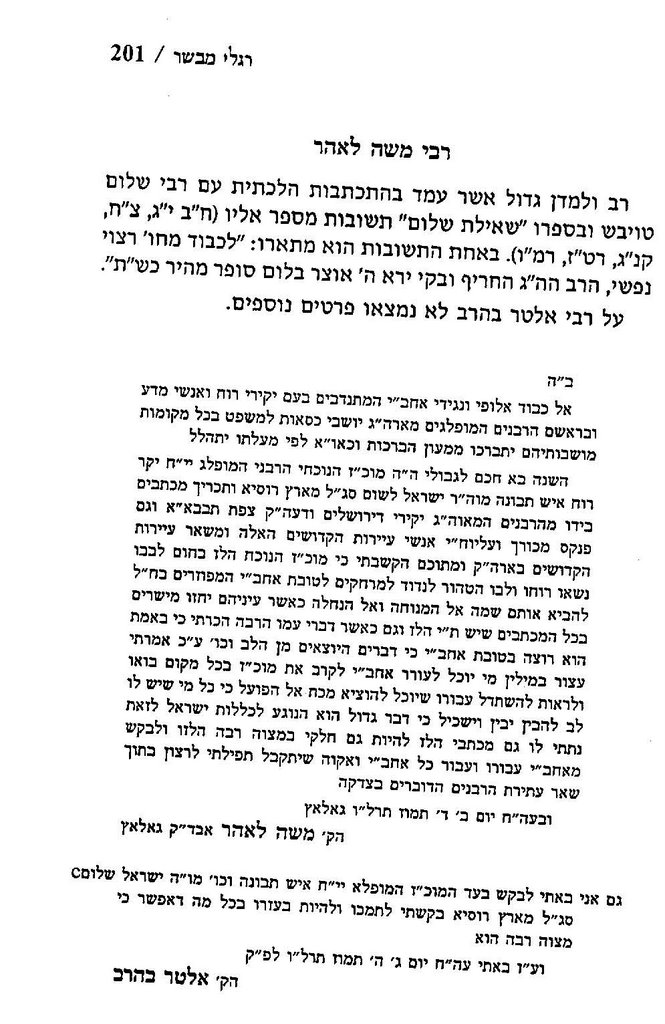
In 1999/2000 some in Beni Brak B. Margolius (most likely a woman due to the lack of first name), published a book, Ragli Mevasar. This book is divided into three parts. The first two are biographies of R. Schlesinger and his father in law. The last part are the very same letters originally published by Weingarten. Additionally, they include the very same biographies that Weingarten did. There is absolutely no attribution at all! I have included a page from each were the reader can see how they are the same. The top page is from Weingarten and the bottom from Ragli Mevasar. None of the library catalogs I have seen note that this is plagiarized.