The Golem of Prague in Recent Rabbinic Literature

The Golem of Prague in Recent Rabbinic Literature
by: Shnayer Leiman
In a recent issue of המאור – a rabbinic journal of repute – an anonymous notice appeared on the Golem of Prague.1 Apparently, a rabbi in Brooklyn had publicly denied the authenticity of the Maharal’s Golem, claiming that R. Yudel Rosenberg (d. 1935) – in his נפלאות מהר”ל (Piotrkow, 1909) – was the first to suggest  that the Maharal had created a Golem. According to the account in המאור, the rabbi based his claim, in part, on the fact that no early Jewish book records that the Maharal had created a Golem. In response to the denial, the anonymous notice lists 6 “proofs” that the Maharal of Prague, in fact, created a Golem. Here, we list the 6 “proofs” in translation (in bold font) and briefly discuss  the weight they should be accorded in the ongoing discussion of whether or not the Maharal created a Golem.
   1. How could anyone imagine that a [Jewish] book written then [i.e., in the 16th century] could include a description of how Jews brought about the deaths of numerous Christians? At that time, the notorious censors censored even more fundamental Jewish teachings. Fear of the Christian authorities characterized every move the Jews made, from the youngest to the oldest.
The argument is presented as a justification for the lack of an early account of the Maharal and the Golem. Only in the 20th century could the full story appear in print, as it appears in נפלאות מהר”ל.  Apparently, the author of the anonymous notice has never read נפלאות מהר”ל. The volume does not depict how “Jews brought about the deaths of numerous Christians.” If the reference here is to the punishment meted out by the Golem to the Christian perpetrators of the blood libel,  נפלאות מהר”ל never depicts the Golem as bringing about the death of anyone, whether Christian or Jew. If the reference here is to the blood libel itself, נפלאות מהר”ל describes only how Christian criminals plotted against Jews (by means of the blood libel) and subsequently needed to be brought to justice by the Christians themselves. Nowhere are Jews described as bringing about the deaths of numerous Christians.
This argument, of course, does not prove that the Maharal created a Golem in the 16th century.
    2. The Maharal’s creation of the Golem is alluded to on his epitaph, in the line that reads: “It is not possible to relate.” More proof than this in not necessary.
The full line on the epitaph reads as follows: “For him, praise best remains silent, for in any event it is not possible to relate the full impact of his many good deeds.”2 See Psalm 65:2 and cf. Rashi to b. Megillah 18a, ד”ה סמא דכולא משתוקא. Nothing is said – or hinted – here about a Golem. Alas, more proof than this is necessary indeed.
    3. If this was an invention of the author of נפלאות מהר”ל, how come a storm was not raised up against him when he published his book a century ago? Although one solitary voice was raised up against him, the majority of Gedolei Yisrael greeted his book with esteem, especially since its author was the noted and respected Gaon, author of numerous works, Rabbi Yehudah Yudel Rosenberg.
First, it should be noted that R. Yudel Rosenberg did not invent the notion that the Maharal of Prague had created a Golem. Evidence for the Maharal’s Golem dates back to 1836 (before R. Yudel Rosenberg was born).3 If the rabbi in Brooklyn claimed otherwise, he was mistaken. Thus, the claim in 1909 that the Maharal of Prague had created a Golem occasioned little or no surprise.
Second, R. Yudel Rosenberg ascribed the book to R. Yitzchok b. R. Shimshon Katz, the son-in-law and contemporary of the Maharal. R. Yudel described in great detail how he had managed to come into possession of this rare manuscript.4 There was no immediate reason to suspect that this was a literary hoax, especially coming from the hand of R. Yudel Rosenberg.
Third, had the book contained pejorative material about the Maharal, a storm would surely have been raised against it. Instead, the book presented the Maharal as a master kabbalist, who created the Golem in order to stave off the notorious blood libel accusations against the Jews. Why should anyone have protested against this heroic image of the Maharal?
In any event, even if one concedes that “the majority of Gedolei Yisrael greeted his book with esteem” (a dubious claim that cannot be proven), it surely does not “prove” that the Maharal created a Golem. A book published in 1909 is hardly proof that the Maharal created a Golem in the 16th century.
    4. Chabad Hasidim relate in detail how R. Yosef Yitzchok Schneersohn visited the attic of the Altneu shul in Prague and saw what he saw. He wasn’t the first to do so – as reported by various elders – in the last 400 years.
Indeed, a long list of the names of the famous and not-so-famous who visited the attic of the Altneu shul can easily be drawn up. That the sainted Rebbe, R. Yosef Yitzchok Schneersohn, visited the attic of the Altneu shul is established fact. It is recorded in contemporary documents, i.e, in the Sichos and Letters of his successor, the Rebbe, R. Menachem Mendel Schneerson.5 Exactly what the Rebbe saw in the attic is less certain. According to one account, when asked, R. Yosef Yitzchok chose not to respond.6 According to another account, he reported that he saw ”what remained of him,” i.e., of the Golem.7 For Lubavitchers, this may be unassailable proof that the Maharal created a Golem, and perhaps that is as it should be. But for historians, dust – or even a bodily form – seen in an attic early in the 20th century hardly constitutes proof that the Maharal created a Golem in the 16th century. As a matter of fact, it should be noted that extensive renovation took place in the attic of the Altneu shul in 1883. No evidence of the Golem was discovered then.8 A film crew visited and filmed the attic in 1984. No evidence of the Golem was discovered then.9
    5. No one disputes the fact that the Maharal put an end to the blood libel accusations that the Jews had suffered for generations. And even this was not fully spelled out in the book [i.e., נפלאות מהר”ל]. Can someone explain how the Maharal accomplished this?
The rhetorical question at the end of the fifth “proof” presupposes the existence of the Golem. Only by means of the Golem was the Maharal able to counter the blood libel accusations. No one disputes that the Maharal put an end to the blood libel accusations? Quite the contrary, no one has ever discovered a shred of evidence that links the Maharal to staving off a blood libel accusation! Nowhere in his writings, nowhere in the writings of his contemporaries (Jewish and non-Jewish) and disciples, is there a word about the Maharal’s involvement in staving off a blood libel accusation. That he put an end to the blood libel accusation is historically untrue. While the blood libel charge became less frequent in the Hapsburg lands after the 16th century, it hardly disappeared.10 From the 16th through the 18th centuries, the blood libel accusation largely shifted to Eastern Europe. In Poland alone, between 1547 and 1787, there were 81 recorded cases of blood libel accusation against the Jews.11 The Beilis case is a sad reminder that the blood libel accusation continued into the 20th century as well.12
Needless to say, this argument hardly proves that the Maharal created a Golem in the 16th century.
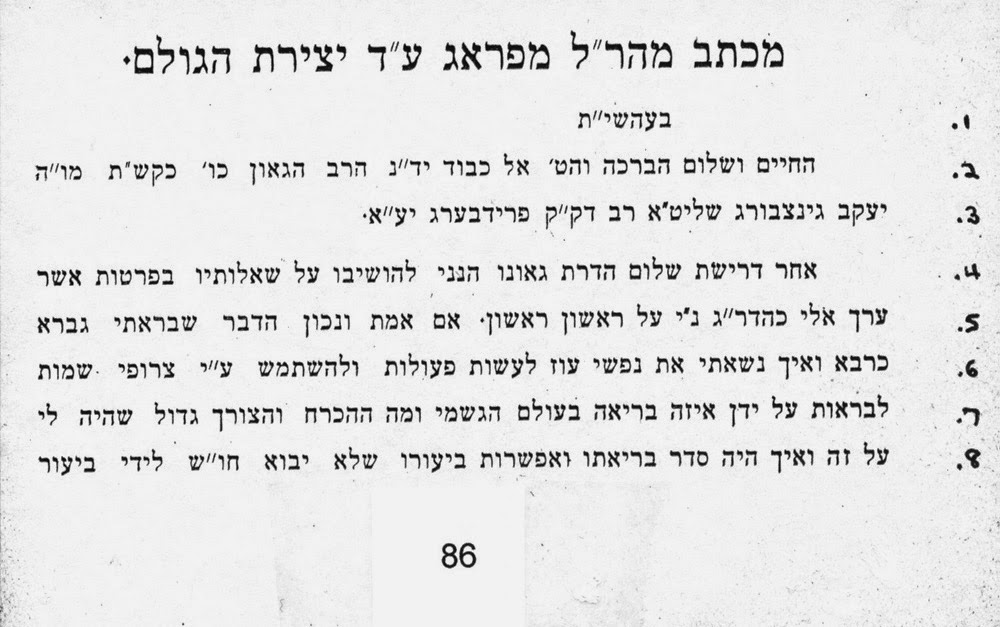
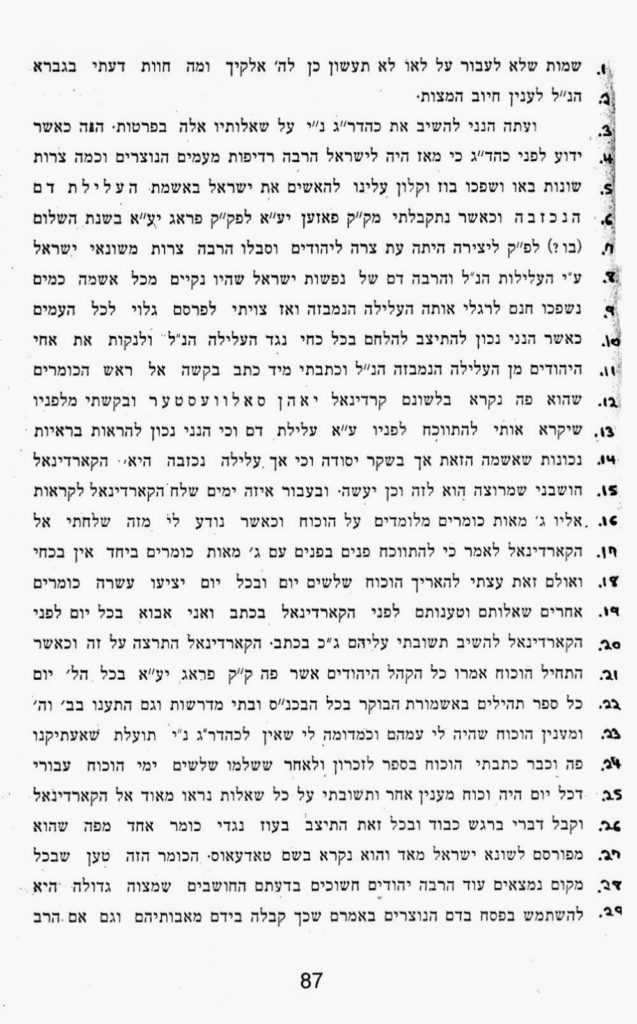
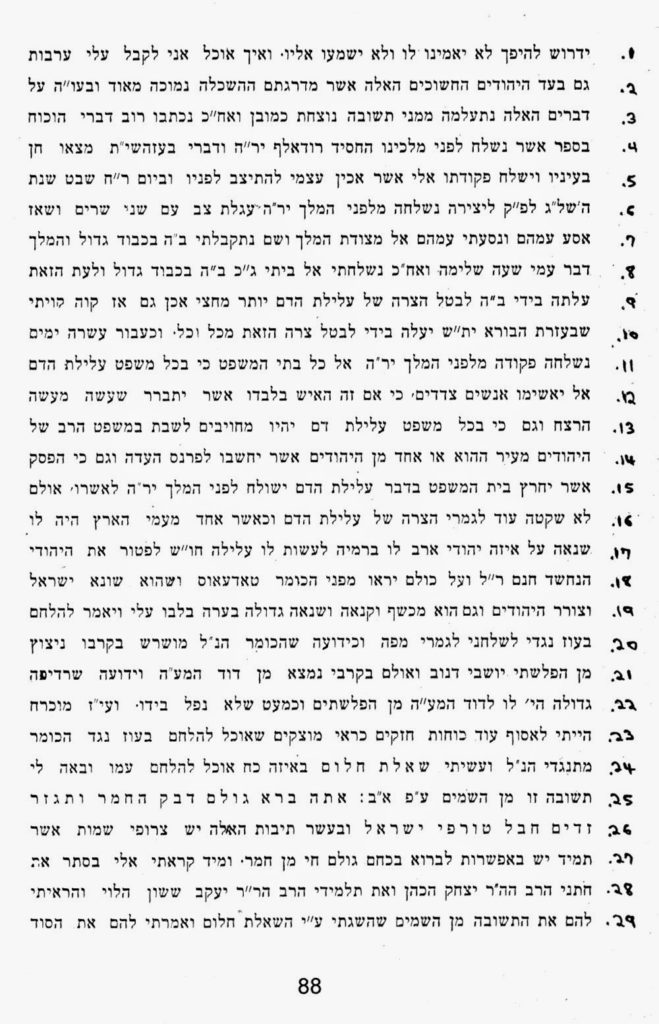
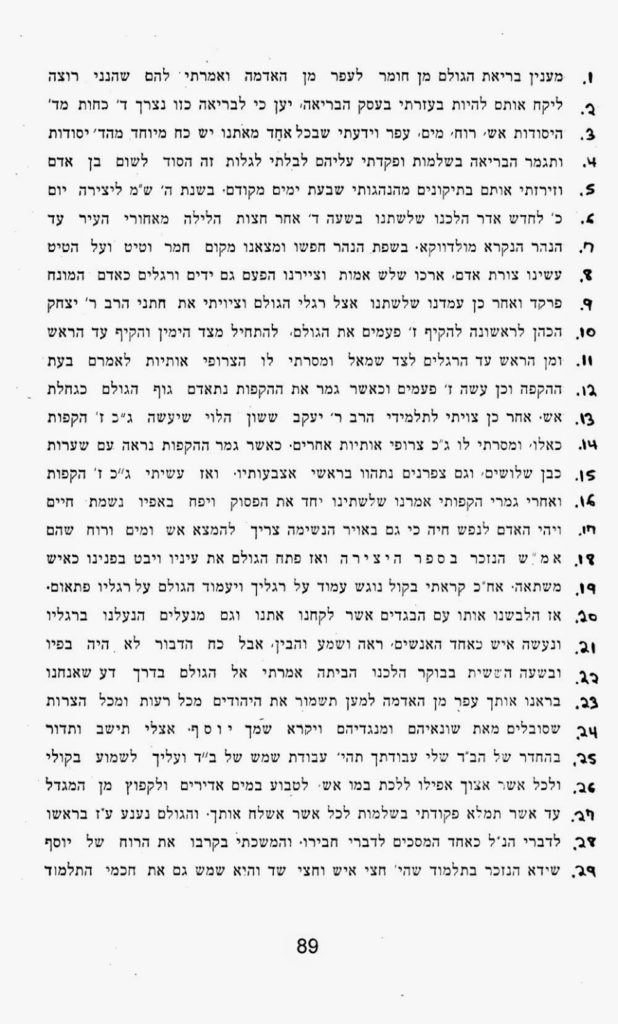
    6. I saw in מליצי אש  to 18 Elul,13 a citation from a manuscript copy of a letter by the Maharal from the year 5343 [=1583] addressed to R. Yaakov Ginzburg, describing how he [the Maharal] was directed by Heaven to create a Golem in order to save the Jewish people. See there for details.
The manuscript referred to here is a notorious 20th century forgery of a letter ascribed to the Maharal, itself based upon R. Yudel Rosenberg’s נפלאות מהר”ל. The Munkatcher Rebbe, R. Hayyim  Eleazar Shapira (d. 1937), apparently was the first of many to expose this forgery.14
II
 In a subsequent issue of המאור, R. Hayyim Levi added 4 new “proofs” that the Maharal created a Golem.15  A brief summary of each of the new “proofs” is followed by an even briefer discussion of the weight they should be accorded in the ongoing discussion of whether or not the Maharal created a Golem.
    1. The חיד”א in his שם הגדולים16 cites a responsum from the חכם צבי,17 who in turn cites a letter by R. Naftoli Ha-Kohen of Frankfurt,18 who mentions his ancestor the Maharal “who made use of the Holy Spirit.” The חיד”א adds that he heard an awesome story about the Maharal and a revelation he had which led to a private conversation between the Maharal and the King of Bohemia.
Not a word about the Golem of Prague appears in any of these sources. Indeed, where we can examine the available evidence (in the case of the awesome story heard by the חיד”א), it apparently had nothing to do with a Golem.19
    2. R. Shimon of Zelikhov, משגיח of Yeshivat Hakhmei Lublin, said: “Everyone knows that the Maharal made use of the Sefer Yetzirah and created a Golem. I don’t claim that one needs to believe the tales in the storybooks about the Maharal. But it is clear that the Maharal used the book of Yetzirah and created a Golem.”20
R. Shimon of Zelikhov, a great gaon and zaddik, died as a martyr in 1943.21 His claim in the 20th century, however weighty, does not prove that the Maharal created a Golem in the 16th century.
    3. In the book אלף כתב,22 the author writes that he heard from the Spinka Rebbe23 in 1922 that he saw an original letter of the Maharal that described how and why he created the Golem.
This is the same notorious 20th century forgery listed as a “proof” above, section I, §6. For the refutation of this proof, see the reference cited in note 14.
    4. See סיפורים נחמדים,24 which records a story in the name of R. Yitzchok of Skvere25 about the Maharal, the Golem, and the double recitation of מזמור שיר ליום השבת at the קבלת שבת service.
This story, first published in 1837,26 is one of the oldest of the Maharal and the Golem stories. It was retold by R. Yitzchok of Skvere, and published in Yiddish (in 1890) and Hebrew (in 1903). Wonderful as the story may be, it cannot be adduced as “proof” for an alleged event that occurred some 300 years earlier.
—————————
Even aside from the dictates of rationalism, what militates against the notion that the Maharal created a Golem is the fact that nowhere in his voluminous writings is there any indication that he created one. More importantly, no contemporary of the Maharal – neither Jew nor Gentile in Prague – seems to have been aware that the Maharal created a Golem. Even when eulogized, whether in David Gans’ צמח דוד 27 or on his epitaph (see above), not a word is said about the creation of a Golem. No Hebrew work published in the 16th, 17th, and 18th centuries (even in Prague) is aware that the Maharal created a Golem.28
In this context, it is worth noting that R. Yedidiah Tiah Weil (1721-1805),29 a distinguished Talmudist who was born in Prague and resided there for many years – and who was a disciple of his father R. Nathaniel Weil (author of the קרבן נתנאל) and of R. Jonathan Eibeschuetz, both of them long time residents of Prague – makes no mention of the Maharal’s Golem.
R. Yedidiah Tiah Weil
R. Nathaniel Weil
This, despite the fact that he discusses golems in general, and offers proof that even “close to his time” golems existed. The proof is a listing of famous golems, such as the golems created by R. Avigdor Kara (d. 1439) of Prague30 and R. Eliyahu Ba’al Shem (d. 1583) of Chelm.31 Noticeably absent is any mention of the Golem of the Maharal of Prague.32
Note too that the first sustained biographical account of the Maharal – by a distinguished rabbinic scholar from Prague – was published in 1745.33 It knows nothing about a Golem of Prague. The deafening silence of the evidence from the 16th, 17th, and 18th centuries needs to be addressed by those who are persuaded that the Maharal created a Golem.
The cumulative yield of the “proofs” put forward in המאור in support of the claim that the Maharal created a Golem is perhaps best described as an embarrassment of poverty. In the light of what passes for historical “proof” in המאור, it would seem that המאור – a reputable rabbinic journal – would probably do well to focus more on halakhah and less on Jewish history.
III
Whereas המאור commemorated the 400th anniversary of the Maharal’s death by focusing on the imaginary accounts of the Maharal and the Golem, scholars in the Czech Republic are to be congratulated for commemorating the 400th anniversary by designing a magnificent exhibition of the Maharal’s life and works and displaying it at the Prague Castle. The exhibition was accompanied by an even more magnificent printed volume edited by Alexandr Putik and entitled Path of life (and referred to several times in the notes to this posting). Despite the many excellent studies in the book devoted to the Maharal’s life and thought, much space – some will argue too much space – is devoted to the history of the Golem in art, sculpture, film, and theater. In contrast to המאור, the essays in Path of Life assume that the Golem of Prague was legendary, not a fact. Here, we reproduce one of the many imaginary paintings of the Maharal and the Golem displayed at the exhibition and included in the volume. It was done by Karel Dvorak in 1951.33


Not to be outdone, the Czech post office issued a commemorative  stamp to mark the 400th anniversary of the death of the Maharal. It features an imaginary portrait of the Maharal wearing a European casquette, reminiscent of the one the חפץ חיים used to wear in Radun. The first day cover includes an imaginary portrait of the Golem as well.
One wonders if the Maharal, prescient as he was, ever imagined that this is how he would be remembered on the 400th anniversary of his death!
Notes
1.  Anonymous, “הילולא קדישא הארבע מאה של המהר”ל מפראג זי”ע: יצירת הגולם” Ha-Ma’or  62:4 (2009), p. 95.
2.  The Hebrew original reads:
לו דומיה תהלה כי אין מספרים לרוב כח מעשי[ו] הישרים . See O. Muneles, כתובות מבית-העלמין היהודי העתיק בפראג, Jerusalem, 1988, p. 273. Cf. K. Lieben, גל עד, Prague, 1856, Hebrew section, p. 3.
3.   See S. [the author asked that I not reveal his name], “An Earlier Written Source for the Golem of the Maharal from 1836,” at On the Main Line, November 4, 2009. Cf. S. Leiman, “The Adventure of the Maharal of Prague in London,” Judaic Studies 3(2004), p. 20, n. 34; and see below, n. 32, for evidence from 1835 that may link the Maharal and the Golem.
4.  נפלאות מהר”ל , Piotrkow, 1909, pp. 3-4.
5.  See, e.g., R. Menachem Mendel Schneerson, תורת מנחם: התוועדויות, Brooklyn, 1992, vol. 1, p. 6.
6.  See previous note.
7.  Copy of a hand-written note by R. Menachem Mendel Schneerson published in the periodical כפר חב”ד, issue 798, 1998. The Hebrew reads in part:
בנוגע לעיקר הענין (שהמהר”ל עשה את הגולם), בעצמי שמעתי מכ”ק מו”ח אדמו”ר שראה הנשאר ממנו בעליית בית הכנסת דמהר”ל פראג.
 The full text of the letter is also available online at http://theantitzemach.blogspot.com, entry “למה נקרא שמו ברוך דוב“, Tuesday, April 27, 2010, in a comment by Anonymous posted on Wednesday, April 28, 2010 at 12:28 A.M. I am indebted to Zalman Alpert, reference librarian at the Mendel Gottesman Library of Yeshiva University, for calling my attention to the online version (and to many other important references over the many years we have known each other).
Yet a third account, drawn from a conversation with Rebbetzin Chana Gurary, a daughter of R. Yosef Yitzchok Schneersohn, provides even more detail. Rebbetzin Gurary reported:

I then asked him [her father, the Rebbe] to tell me what he had seen there. My father paused for a moment and said: “When I came up there, the room was filled with dust and shemus. In the center of the room I could see the form of a man wrapped up and covered. The body was lying on its side. I was very frightened by this sight. I looked around at some of the shemus that were there and left frightened by what I had seen.

Special thanks to Rabbi Shimon Deutsch for providing me with a copy of Rebbetzin Gurary’s testimony, as reported to Rabbi Berel Junik.

8.  See N. Gruen, Der hohe Rabbi Loew, Prague, 1885, p. 39.
9.  See I. Mackerle, Tajemstvi prazskeho Golema, Prague, 1992. Cf. his “The Mystery of Prague’s Golem,” December 12, 2009, at http://en.mackerle.cz.
10.  See, e.g., R. Po-chia Hsia, The Myth of Ritual Murder, New Haven, 1988, pp. 203-209.
11.  See Z. Guldon and J. Wijaczka, “The Accusation of Ritual Murder in Poland 1500-1800,” Polin 10(1997), pp. 99-140.
12.  For basic bibliography on the Beilis case, See S. Leiman, “Benzion Katz: Mrs. Baba Bathra,” Tradition 42:4 (2009), pp. 51-52, n. 1.
13.  Rabbi A. Stern, מליצי אש, Vranov, 1932. In the three volume Jerusalem, 1975 photomechanical reproduction of מליצי אש, the passage appears in vol. 2, p. 87.
14.  For discussion and references, see S. Leiman, “The Letter of the Maharal on the Creation of the Golem: A Modern Forgery,” Seforim Blog,  January 3, 2010.
15.  R. Hayyim Levi, “המהר”ל זי”ע” Ha-Ma’or 63:1 (2009), p. 84.
16.  R. Hayyim Yosef David Azulai (d. 1806), שם הגדולים השלם , Jerusalem, 1979, vol. 1, p. 124.
17.  R. Zvi Ashkenazi (d. 1718), שו”ת חכם צבי, סימן ע”ו, ed. Jerusalem, 1998, pp. 183-4.
18.  Loc. cit. R. Naftoli Ha-Kohen Katz of Frankfurt died in 1719. Cf. below, n. 32.
19.  See Rabbi A.S. Michelson, שמן הטוב, Piotrkow, 1905, pp. 118-120.
20.  R. Avraham Shimon of Zelikhov, נהרי א”ש, Jerusalem, 1993, p. 173.
21.  See M. Wunder, מאורי גליציה, Jerusalem, 1978, vol. 1, cols. 238-243; Jerusalem, 2005, vol. 6, cols. 105-106.
22.  Rabbi Y. Weiss (d. 1942), אלף כתב, Bnei Brak, 1997, vol. 2, pp. 47-48.
23.  R. Yitzchok Eizik Weiss (d. 1944). On him, see T.Z. Rabinowicz, The Encyclopedia of Hasidism, London, 1996, pp. 534-5.
24.  Y. W. Tzikernik, ספורים נחמדים, Zhitomir, 1903, pp. 13-14. Tzikernik’s hasidic tales were reissued by G. Nigal in סיפורי חסידות צירנוביל, Jerusalem, 1994.  In Nigal’s edition, the story about the Maharal and the Golem appears on pp. 128-130.  Tzikernik, who died circa 1908, was a follower of R. Yitzchok Twersky of Skvere (see next note) and recorded his stories for posterity.
25.  On R. Yitzchok Twersky of Skvere (d. 1885), see Y. Alfasi, אנציקלופדיה לחסידות: אישים, Jerusalem, 2000, vol. 2, cols. 339-40.
26.  The 1837 version appears in B. Auerbach, Spinoza, Stuttgart, 1837, vol. 2, pp. 2-3. See above, note 3, for a similar version of the story published in 1836. But the 1836 version makes no mention of the double recitation of מזמור שיר ליום השבת at the קבלת שבת  service.
27.  See David Gans, צמח דוד, Prague, 1592, entry for the year 5352 (= 1592). In M. Breuer’s edition (Jerusalem, 1983), the passage appears on pp. 145-6.
28.  It is noteworthy that in 1615, Zalman Zvi Aufhausen, a Jew residing in Germany, published a defense of Judaism against a vicious attack by the apostate Samuel Brenz. In the introduction to his defense, Aufhausen writes that he was encouraged by the great Jewish scholars in Prague and Germany to undertake his defense of Judaism. In the list of accusations, Brenz accused the Jews of engaging in magical rites and creating golems out of clay. Aufhausen admitted that Jews created golems out of clay in the talmudic period (see b. Sanhedrin 65b), but only by means of Sefer Yetzirah and the Divine Name, and not by engaging in magical rites. After the talmudic period, according to Aufhausen, Jews no longer had the ability to create golems out of clay, especially in the German lands. Aufhausen concludes:
 אביר אונזרי גולמיים אין דיזן לאנדן מכין מיר ניט אויש ליימן זונדר
אויש מוטר לייב ווערין זיא גיבורן.
    In these lands, however, our Golems are not made from clay, but
rather they are born from the bodies of their mothers.
See Zalman Zvi Aufhausen, יודישר טירייאק [second edition], Altdorf, 1680, pp. 7a-b. Given the apologetic nature of Aufhausen’s defense, it is difficult to assess how much stock should be put in his claim. But, surely, if the Maharal’s Golem had been strolling the streets of Prague a decade or two earlier than the appearance of the first edition of Aufhausen’s work, he could hardly claim openly that Jews no longer had the ability the create Golems out of clay after the Talmudic period.
29.  See L. Loewenstein, Nathaniel Weil Oberlandrabbiner in Karlsruhe und seine Familie, Frankfurt, 1898, pp. 23-85.
30.  See the entry on him in Encyclopaedia Judaica, Jerusalem, 1971, vol. 10, cols. 758-759. In the 17th and 18th centuries, it was widely believed that he was the author of ספר הפליאה, a kabbalistic work that describes the creation of a Golem. Prof. Moshe Idel (in a private communication) suggests that this may have led to the belief that R. Avigdor Kara of Prague created a Golem. In any event, the fact that a distinguished Talmudist in 18th century Prague was persuaded that R. Avigdor Kara had created a Golem, suggests the possibility of a transfer in Prague of the Golem legend from R. Avigdor Kara (who by the end of the 18th century was relatively unknown) to the Maharal (who by the end of the 18th century resurfaced as a major Jewish figure whose works were being reprinted for the first time in almost 250 years).  For other suggestions regarding the linkage between the Maharal and the Golem, see V. Sadek, “Stories of the Golem and their Relation to the Work of Rabbi Loew of Prague,” Judaica Bohemiae 23(1987), pp. 85-91; H. J. Kieval, “Pursuing the Golem of Prague: Jewish Culture and the Invention of a Tradition,” Modern Judaism 17(1997), pp. 1-23; Kieval’s updated version in his Languages of Community: The Jewish Experience in the Czech Lands, Berkeley, 2000, pp. 95-113;  B. L. Sherwin, “The Golem of Prague and his Ancestors,” in A. Putik, ed., Path of Life: Rabbi Judah Loew ben Bezalel, Prague, 2009, pp. 273-291; and J. Davis, “The Legend of  Maharal before the Golem,” Judaica Bohemiae 45(2009), pp. 41-59.
31.  On R. Eliyahu Ba’al Shem of Chelm, see J. Guenzig, Die Wundermaenner in juedischen Volke, Antwerpen, 1921, pp. 24-26; G. Scholem, “The Idea of the Golem,” in his On the Kabbalah and its Symbolism, New York, 1969, pp. 199-204; M. Idel, “R. Eliyahu, the Master of the Name, in Helm,” in his Golem, Albany, 1990, pp. 207-212; and idem, גולם, Tel Aviv, 1996, pp. 181-184.
32.  R. Yedidiah Tiah Weil, לבושי בדים, Jerusalem, 1988, p. 37. The passage comes from a sermon delivered in 1780.
Yet another 18th century witness, R. Saul Berlin (d. 1794), was apparently ignorant of the Maharal’s Golem. In his כתב יושר (written in 1784 but published posthumously in Berlin, 1794), p. 3b, Berlin writes:
ואולי דבר סרה על הנסים הידועים לכל בני הגולה, כאותם שעשה מוהר”ר לוי [קרי: ליוא] בהזמינו את הקיסר רודאלפוס למשתה, וע”י שם הוריד בירה מן השמים, או בגולם שעשה מוהר”ר נפתלי זצ”ל אשר עפרו עודנו טמון וגנוז.
              Did [Wessely] speak disparagingly about the miracles known throughout the Jewish Diaspora? [Did he speak disparagingly] about those miracles performed by Rabbi Liva when he invited Emperor Rudolph to his party, and when by means of a Divine name he caused the Prague Castle to descend from heaven? Or regarding the Golem created by Rabbi Naftoli of blessed memory, whose dust still remains stored away?
Clearly, R. Saul Berlin knew legends about the Maharal. But when he needed to adduce a sample of the Golem legend, he had to turn elsewhere! Interestingly, the legend about the Prague Castle descending from heaven onto the Jewish quarter of Prague was first told about R. Adam Baal Shem, and not about the Maharal.  It first appeared in print in Prague in the 17th century. By the 19th century, the very same story was told in Prague circles with the Maharal as its hero. Once again (see above, note 30) it would appear that we have a sample of the transfer in Prague of a legend from one hero to another, with the Maharal as the recipient. In general, see C. Shmeruk, ספרות יידש בפולין, Jerusalem, 1981, pp. 119-139.
Even more interesting is the reference to the Golem of R. Naftoli, otherwise unrecorded in Jewish literature. The reference is almost certainly to R. Naftoli Ha-Kohen Katz (1645-1719), distinguished halakhist and master of the practical kabbalah, whose amulets – apparently — didn’t always work. From 1690 to 1704 he served as Chief Rabbi of Posen. (Note too that the Maharal served as a Chief Rabbi of Posen!) Recorded in Jewish literature (though I have never seen it cited in any discussion of the Golem of Prague) is an oral tradition from 1835 that the Maharal’s Golem was created in Posen and that the remains of the Golem could still be seen in the 19th century in the old synagogue of Posen “under the eaves, lifeless, and inactive like a piece of clay.” See S. M. Gollancz, Biographical Sketches and Selected Verses, London, 1930, pp. v and 50-55, and especially p. 54. It is at least possible that R. Saul Berlin heard about the legend of the Golem of Posen and assumed (wrongly) that the Golem was created by the famed practical kabbalist and rabbi of Posen, R. Naftoli.
I am indebted to S. of the On the Main Line Blogspot (see above, note 3) for calling my attention to the כתב יושר passage.
Apparently, reports about the remains of Golems in attics were a rather widespread phenomenon in the early modern period. Aside from the reports about Prague and Posen, see the report about the Great Synagogue in Vilna  (where the Vilna Gaon’s Golem rested in peace) in H.L. Gordon, The Maggid of Caro, New York, 1949, p. 176. A similar report about a Golem in Beshtian circles is recorded in R. Yosef of Tcherin, דרכי החיים, Piotrkow, 1884, Introduction, pp. 14-15.
33.  R. Meir Perels (d. 1739), מגילת יוחסין , appended to R. Moshe Katz, מטה משה, Zolkiev, 1745. It was reissued separately in Warsaw, 1864, and is available in L. Honig, ed., חדושי אגדות מהר”ל מפראג, London, 1962, vol. 1, pp. 17-32. Perels’ מגילת יוחסין is riddled with inaccuracies and needs to be used with caution. See A. Putik and D. Polakovic, “Judah Loew ben Bezalel, called Maharal: A Study of His Genealogy and Biography,” in A. Putik, ed., Path of Life: Rabbi Judah ben Bezalel, Prague, 2009, pp. 29-83. Putik and Polakovic cite significant earlier studies by Y. Yudlov, D.N. Rotner, S. Sprecher, and others. See also N.A. Vekstein ‘s important analysis of Perels’ מגילת יוחסין, entitled “המהר”ל מפראג,” in המודיע, September 4, 2009.

In the light of the discussion in notes 30-33 — and until new evidence is forthcoming — it seems evident that the linkage between the Maharal and the Golem originated after 1780 and before 1835, almost certainly in Prague but perhaps in Posen.

34.  See A. Putik, ed., Path of Life, pp. 398-399.


Benefits of the Internet: Besamim Rosh and its History

Benefits of the Internet: Besamim Rosh and its History
By: Dan Rabinowitz & Eliezer Brodt
    In a new series we wanted to highlight how much important material is now available online.  This, first post, illustrates the proliferation of online materials with regard to the controversy surrounding the work Besamim Rosh (“BR”). 

[We must note at the outset that recently a program has been designed by Moshe Koppel which enables one, via various mathematical algorithims, to identify documents authored by the same author. We hope, using this program, to provide a future update that will show what this program can demonstrate regarding the authorship of the BR and if indeed the Rosh authored these responsa.]

Background

    Before turning to the BR and discussing its history we need to first discuss another work.  R. Raphael Cohen the chief rabbi of triple community, Altona-Hamburg-Wansbeck (“AH”W”), [1] published a book, Torat Yekuseil, Amsterdam, 1772 regarding the laws of Yoreh DeahTorat Yekuseil is a standard commentary and is unremarkable when compared to other works of this genre.  While the book is unremarkable in and of itself, what followed is rather remarkable. 

    Some years later, in 1789, a work with the putative author listed listed as Ovadiah bar Barukh and titled Mitzpeh Yokteil [2] was published to counter R. Raphael Cohen’s Torat Yekuseil (“TY”)Mitzpeh Yokteil (“MY”), was a vicious attack both against the work TY as well as its author, R. Raphael Cohen.  R. Raphael Cohen was a well-known and well-respected Rabbi. In fact, he was the Chief Rabbi of the triple community of AH”W.  The attack against him and his work did not go unanswered.  Indeed, the beit din of Altona-Wansbeck placed the putative author, Ovadiah, and his work, under a ban.

    The Altona-Wansbeck beit din could not limit the ban to just Altona-Wansbeck as the attack in the MY was intended to embarrass R. Raphael Cohen across Europe.  Indeed, the end of the introduction to MY indicates that copies were sent to a list of thirteen prominent rabbis across Europe.  Specifically, copies were sent to the Chief Rabbis of Prague, Amsterdam, Frankfort A.M., Hanover, Bresslau, Gloga, Lissa, etc., “as well as The Universally Know Goan haHassid  R. Eliyahu from Vilna.”  Thus, the intent of the book was to diminish R. Raphael Cohen’s standing amongst his peers. 

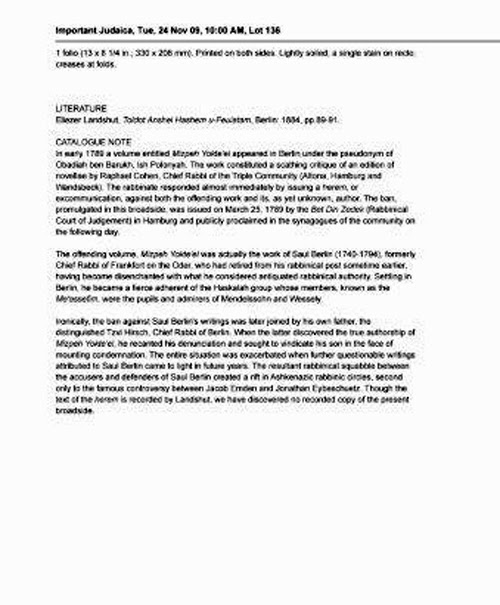
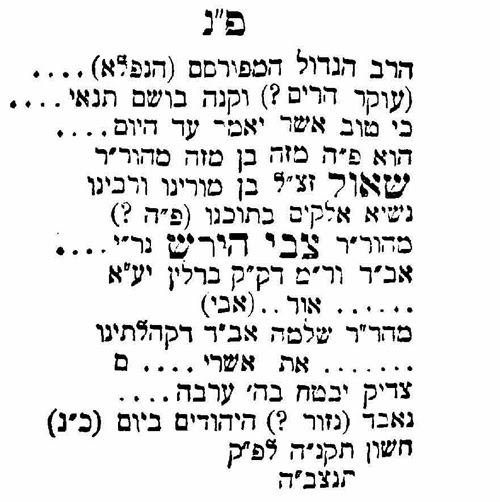
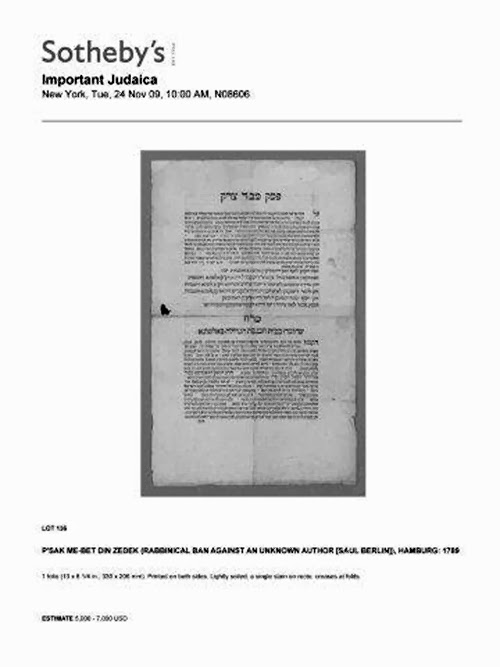
    The Altona-Wansbeck beit din, recognizing the intent of the book, appealed to other cities courts to similarly ban the author and book MY – the ban, entitled, Pesak mi-Beit Din Tzedek, the only known extant copy was recently sold at Sotheby’s (Important Judaica, Nov. 24, 2009, lot 136).[3]


These concerns lead the ban’s proponents to the Chief Rabbi of Berlin, R. Tzvi Hirsch Berlin, and to solicit him to join the ban. Initially, it appeared that R. Tzvi Hirsch would go along with the ban.  But, as he was nearing deciding in favor of signing the ban, someone whispered in his ear the verse in Kings 2, 6:5, אהה אדני והוא שאול – which R. Tzvi Hirsch understood to be a play on the word “שאול” in the context of the verse meaning borrow, but, in this case, to be a reference to his son, Saul. That is, the real author of MY was Saul Berlin, Tzvi Hirsch’s son.  Needless to say, R. Tzvi Hirsch did not sign the ban. [4]

    Not only did he not sign the ban, he also came to his son’s defense.  Aside from the various bans that were issued, a small pamphlet of ten pages, lacking a title page, was printed against MY and Saul. [5]  Saul decided that he must respond to these attacks.  He published Teshuvot ha-Rav. . . Saul le-haRav [] Moshe  Yetz,[6] which also includes a responsum from R. Tzvi Hirsch, Saul’s father.  Saul defends himself arguing that rabbinic disagreement, in very strong terms, has a long history.  Thus, a ban is wholly inappropriate in the present case. 

    R. Tzvi Hirsch explained that while MY disagreed with R. Cohen, there is nothing wrong with doing so.  The author of MY, as a rabbi – Saul was, at the time, Chief Rabbi of Frankfort – Saul is entitled to disagree with other rabbis.  Of course, Saul’s name is never explicitly mentioned. Moreover, in the course of R. Tzvi Hirsch’s defense he solicits the opinions of other rabbis, including R. Ezekiel Landau.  R. Landau, as well as others, noted that aside from the propriety of disagreement within Judaism, the power of any one particular beit din is limited by geography.  Thus, the Altona-Wansbeck’s beit din‘s power is limited to placing residents of Hamburg under a ban but not residents of Berlin, including R. Saul Berlin, the author of MY.[7]

    The controversy surrounding the MY was not limited to Jewish audiences. The theater critic, H.W. Seyfried, published in his German newspaper, Chronik von Berlin, translations of the relevant documents and provided updates on the controversy.  Seyfried agitated on behalf of the maskilim and editorlized that the Danish government should take actions against R. Cohen. It appears, however, that Seyfried’s pleas were not acted upon.[8] 

The Publication of Besamim Rosh


    With this background in mind, we can now turn to the Besamim Rosh.  Prior to publishing the full BR, in 1792, Saul Berlin published examples of the responsa and commentary found in the BR – a prospectus, Arugat ha-Bosem.  This small work whose purpose was to solicit subscribers for the ultimate publication of BR. It appears that while Saul may have been trying for significant rabbinic support, the majority of his sponsors were householders. 

    In 1793, the BR was published.  The BR contains 392 responsa (besamim equals 392) from either R. Asher b. Yeheil (Rosh) (1259-1327) or his contemporaries.  This manuscript belonged to R. Yitzhak di Molina who lived during the same time period as R. Yosef Karo, the author of Shulchan Orakh.  Additionally, Saul appended a commentary of his own to these responsa, Kasa de-Harshana

    The BR contains two approbations, one from R. Tzvi Hirsch Berlin and the other from R. Yehezkel Landau.  R. Landau’s approbation first explains that Rosh’s responsa need no approbation.  With regard to R. Saul Berlin’s commentary, he too doesn’t need an approbation according to R. Landau.  This is so because R. Saul’s reputation is well-known.  R. Landau’s rationale, R. Saul’s fame, appears a bit odd in light of the fact that among some (many?) R. Saul’s reputation was very poor due to the MY. 

    R. Tzvi Hirsch’s approbation also contains an interesting assertion. Saul’s father explains that this book should put to rest any lingering question regarding his son.    

    In addition to the approbations there are two introductions, one from di Molina and the other from Saul. Di Molina explained the tortured journey of the manuscript. He explains that, while in Alexandria, he saw a pile of manuscripts that contained many responsa from Rosh that had never before been published. He culled the unpublished ones and copied and collected them in this collection.  What is worthy of noting is that throughout the introduction di Molina repeatedly asks “how does the reader know these responsa are genuinely from Rosh.” 

    R. Saul, in his introduction, first notes that the concept of including introductions is an invention long after Rosh, and is not found amongst any of the Rishonim. 

    As mentioned previously, the BR is a collection of 392 responsa mostly from Rosh or his contemporaries.  Additionally, R. Saul wrote his own commentary on these responsa, Kasa diHarshena. [9]  This commentary would contain the first problem for Saul and the BR.  In responsum 40, Rosh discusses the position of Rabbenu Tam with regard to shaving during the intermediate days (ho ha-moad).  While Rosh ultimately concludes that one is prohibited from shaving on hol ha-moad, R. Saul, in his commentary, however, concludes that shaving on hol ha-moad is permissible.  In so holding, R. Saul recognized that this position disagreed with that of his father.  Almost immediately after publication, R. Saul printed a retraction regarding this position allowing for shaving on hol ha-mo’ad.  This retraction, Mo’dah Rabba, explains that Saul failed to apprise his father of this position and, as Saul’s father still stands behind his negative position, Saul therefore retracts his lenient position. [Historically, this is not the only time a father and son disagreed about shaving on hol ha-moad.  R. Yitzhak Shmuel Reggio (YaSHaR)and his father, Abraham, disagreed on the topic as well.  As was the case with Saul and his father, the son, YaSHaR took the lenient position and his father the stringent.  Not only did they disagree, after YaSHaR published his book explaining his theory, his father attacked him in an anonymous response.  For more on this controversy see Meir Benayahu, Shaving on the Intermediary Days of the Festival, Jerusalem, 1995.] 

    This retraction, while may be interperated as evidence of Saul humbleness in his willingness to admit error and not stand on ceremony, others used this retraction against him.  The first work published that questioned the legitimacy of BR is Ze’ev Yetrof, Frankfort d’Oder, 1793, by R. Ze’ev Wolf son of Shlomo Zalman.  (This book is very rare and, to my knowledge, is not online.  Although not online, a copy is available in microfiche as part of the collection of books from the JTS Library, and on Otzar Hachomah see below)  The author explains that eight responsa in BR are problematic because they reach conclusion that appear to run counter to accepted halahik norms. In addition, the author states in his introduction, “that already we see that there is something fishy as it is known that the author [Saul Berlin] has retracted his position regarding shaving.” It should be noted that no where does R. Ze’ev Wolf challenge the authenticity of the manuscript for internal reasons – it is incorrectly dated, incorrectly attributed etc.  Apparently, Ze’ev Yetrof, was not well-known as it is not cited by other contemporaries who too doubted the authenticity of BR.  Samat theorizes that either wasn’t printed until later or, was destroyed.[10]  

    The second person to question the legitimacy of BR was R. Rafael Hamburg’s mechutan, R. Ya’akov Katzenellenbogen.  In particular, he wrote to R. Cohen’s student, R. Mordechai Benat. As was the case with Wolf, R. Katzenellenbogen located 13 responsa where he disagreed with the conclusions.  R. Katzenellenbogen indicated that R. Benet shold review the BR himself and apprise R. Katzenellenbogen regarding R. Benet’s conclusions. 

    R. Katzenellenbogen also wrote to Saul’s father, Tzvi Hirsch, and Tzvi Hirsch eventually responded in a small pamphlet.  R. Tzvi Hirsch first deals with the predicate question, is the manuscript legitimate. That is, prior to discussing the conclusions of particular responsum, regarding the manuscript, R. Tzvi Hirsch testifies that he is intimately familiar with this manuscript. He explains that for 11 years, the manuscript was in his house.  In fact, R. Tzvi Hirsch created the index that appears in BR from this manuscript.  Additionally, he had his other son Hirschel (eventual Chief Rabbi of London) copy the manuscript for publication.  Thus, R. Tzvi Hirsch argues that should put to rest any doubt regarding the authenticity of the manuscript.

    R. Tzvi Hirsch then turns to the issue regarding conclusions of some of the responsa. He first notes, that at most, there are a but a small number of questionable responsa.  Indeed, it is at most approximately 5% of the total responsa in BR.  That is, no one questions 95% of the responsa (at least not then).  Second, with regard to the conclusions themselves, that some conclusions are different than the halahik norms, that can be found in numerous books, none of which anyone questions their authenticity.  Thus, conclusions prove nothing.

Leaving the history and turning to the content of BR.  One of the more controversial responsa is the one discussing suicide.  In particular, according to the responsum attributed to Rosh, the historic practices that were applied to a suicide – lack of Jewish burial, no mourning customs – are not applicable any longer.  This is so, because suicides can be attributed to the poor conditions of the Jews and not philosophical reasons.  Thus, we can attribute the motivations of a suicide to depression and remove the restrictions that applied to suicides. 

    This responsum was what lead some, including R. Moshe Sofer (Hatam Sofer), to conclude that the entire BR was a forgery.  Indeed, this responsum was one of the two that were removed in the second edition.  Others, however, point out this responsum and its conclusions are not in any conflict with any accepted halakhic norms.  And, instead, while providing new insight into the current motivations of a suicide, the ultimate conclusion can be reconciled with all relevant laws.  [11]  

This particular example illustrates the problematic nature of merely relying upon a particular conclusion to demonstrate the authenticity or lack thereof of a work. Although R. Sofer was certain this responsum ran counter to a statement of the Talmud, others were easily able to reconcile the Talmudic statement with the conclusion of the responsum.

    Another controversial responsa deals with someone who is stuck on the highway as the Shabbat is fast approaching.  The traveler is thus faced with the following dilemma, stop in a city where he will require the charity of strangers or continue on and get home.  The BR rules that the traveller can continue and is not required to resort to charity.  This, like the responum above, was similarly removed from the second edition. These are the only two responsa removed from the second edition.  Of course, this removal isn’t noted anywhere except that the numbers skip over those two.  In fact, the index retains the listing for the two responsa. 

    Other controversial responsa include one dealing with belief in the afterlife and messianic era, kitnoyot – BR would abolish the custom, and issues relating to mikvah. 

Today, common practice regarding suicide appears, for the most part, to conform with the position of BR.

Status Today

    After its publication in 1793, it would be almost one hundred years before the BR would be reprinted.  In 1881, the BR was reprinted in Cracow.  This edition was published by “the well-known Rabbi Yosef Lazer from Tarnow'” R. Lazer’s was part of a well-known Hassidic family.  His grandfather, R. Menachem Mendel Lazer was the author of Sova Semochot, Zolkiov, 1845.[12] It appears that the BR was the only controversial book that R. Yosef Lazer published.  Although he published approximately 30 books, the are mainly run-of-the mill works, Machzorim, haggadot, as well as some standard rabbinic works. It is unclear what prompted R. Lazer to republish the BR.  Lazer provides no explanation.  Although Lazer’s publishing activities are difficult to reconcile with his publication of the BR, the printers, Yosef Fischer and Saul Deutscher, other publications indicate that they were more open to printing all types of books. For example, the same year they published BR, they published a translation of Kant, Me-Ko’ach ha-Nefesh, Cracow, 1881.  In all events, it appears that Lazer (or perhaps the printers) was aware of the controversy surrounding the BR as he removed Saul Berlin’s introduction as well as two of the more controversial responsa, one discussing suicide and the other allowing one to continue to travel home after sunset on Friday to avoid having to rely upon the charity of strangers.  In addition, one responsa was accidentally placed at the end of the volume, not in its proper order.[13]  Although the two responsa were removed in the text, they still appear in the index. A photo-mechanical reproduction of this edition was published in New York in 1970, and a copy is available on Hebrewbooks. 

    In 1984, the BR was reprinted for only the third time.  This edition, edited by R. Reuven Amar and includes an extensive introduction, Kuntres Yafe le-Besamim, about BR.  Additionally, commentary on the BR by various rabbis is included.  The text of this edition is a photo-mechanical reproduction of the first edition.  This edition contains two approbations, one from R. Ovadiah Yosef, who in his responsa accepts that BR is a product of R. Saul Berlin, but R. Yosef holds that doesn’t diminish the BR’s value.  The second approbation is from R. Benyamin Silber.  But, R. Silber provides notes in the back of this edition and explains that he holds the BR is a forgery and that he remains unconvinced of Amar’s arguments to the contrary.

    In his introduction, Amar attempts to rehabilitate the BR.  Initially, it should be noted that Amar relies heavily upon Samet’s articles on BR, but never once cites him.  Samet had complied a bibliography of works about BR as well as where the BR is cited, Amar also provides the latter in a sixty four page Kuntres, ריח בשבמים, in the back of his edition. In his introduction Amar relates the history of the BR and attempts to demonstrate that many accepted the BR and those that did not, Amar argues that many really did accept BR.  This introduction contains some very basic errors, many of which have been pointed out by Shmuel Ashkenazi in his notes that appear after the introduction.  

Difficulties in Authentication   

    Today, various theories have been put forth to demonstrate that the BR is a forgery.  Specifically, some have pointed to “hints” or “clues” that R. Saul left for the careful reader which would indicate that BR is a carefully created forgery.  For example, some note that the number of responsa, 392, the Hebrew representation of that number is שצ”ב which can be read to be an abbreviation of Saul’s name – Saul ben Tzvi.  Others take this one step further and point to the was R. Asher (Rosh) is referenced – רא”ש – which again can be read R. Saul.  Obviously, these clues are by no means conclusive.  In the academic world, the BR is written off as a “trojan horse” intended to surreptitiously get R. Saul’s masklik positions out in the masses or something similar.  All of these positions, however, rely upon a handful of responsa at best and no one has been able to conclusively demonstrate that the entirety of BR is a forgery. At best, we are still left with the original criticisms – that a few of the responsa’s conclusions espouse positions that appear to be more 18th century in nature than 13th century. [14]   

 R. Yeruchum Fischel Perlow aptly sums up much of what has been written regarding the question of authenticity of BR:

Just about all who have examined [the question of the authenticity of BR] walk around like the blind in the dark, and even after all their long-winded essays, they are left with only their personal feelings about the BR without ever adducing any substantive proofs in support of their position. And, on the rare occasions that they actual do provide proofs for their positions, it only takes a cursory examination to determine that their is nothing behind those proofs. [R. Yeruchum Fischel Perlow, “Regarding the book ‘Besamim Rosh,'” Noam 2 (1959), p. 317. For some reason this article is lacking in some editions of Noam]

    Assuming that one discounts the testimony of Saul and his father regarding the manuscript, it is not easy to determine if the BR is authentic or not.  For example, responsum 192, according to R. Moshe Hazan, one of the defenders of BR, this responsum “is clear to anyone who is familiar with the language and style of the Rishonim, from the Rishonim.” Responsum 192, is attributed to R. Shlomo ben Aderet (Rashba), and discusses the opinion of Rosh that allowed for capital punishment for pregnancy out of wedlock.  Thus, according to R. Hazan, 192 is conclusive proof that BR is authentic. 

    Simcha Assaf, however, has shown that responsum 192 is a forgery – or there is a misattribution.  Assaf explains that if one looks at the date of this incident, responsum 192 could not have been written by Rashba.  Rashba died 10 years prior to this event.  Simcha Assaf, Ha-Onshim Ahrei Hatemat ha-Talmud, Jerusalem, 1928, pp. 69-70.  Thus, the very same responsum whose “language and style” demonstrated that it was from the times of the rishonim has attribution problems.  To be sure, Assaf isn’t saying this responsum isn’t necessarily from the rishonim period, however, it surely isn’t from Rashba.[15]

    Or, to take another example. Talya Fishman argues that “[halakhic literature of the seventeenth and eighteenth centuries . . . climbed to new (and fantastic) heights of theoretical speculation, creating, in effect, a body of non applied law.”  Talya Fishman, “Forging Jewish Memory: BR and the Invention of Pre-emancipation Jewish Culture,” in Jewish History and Jewish Memory, ed. Carlbach et al., Hanover and London: 1998, pp. 70-88.  Based on this understanding of seventeenth and eighteenth century literature, as contrasted with literature from the period of Rosh, she turns to the BR and finds such speculative responsa.  This, according to Fishman, implicitly demonstrates that BR is a product of the seventeenth or eighteenth century. Indeed, Fishman concludes “[i]n short, [BR], has an unusually high concentration of eyebrow-raising cases.”  Id. at 76. 

    But, if one subjects Fishman’s argument to even a minimal amount of scrutiny, her argument, as presented, is unconvincing.  First, in support of Fishman’s “high concentration” of odd responsa, Fishman provides three examples.  That is, Fishman points to three out of 392 responsa that contain “eyebrow-raising cases” and concludes this represents “an unusually high concentration.”  I think that most would agree that less than 1% does not represents an unusually high concentration.  Second, of the three examples Fishman does provide, one is from Kasa deHarshena, which everyone agrees is a product of the eighteenth century.  Third, one of the examples, no. 100, it appears that Fishman misread the responsa.  Fishman provides that responsa 100 is a “bizarre question about whether a one-armed man should don tefilin shel yad on his forehead alongside tefilin shel rosh.”  Id. at 76.  Indeed,  responsa 100 is about a one-armed man and whether because he cannot fulfill the arm portion of tefilin if that absolves him of the head portion.  Nowhere, however, not in BR or Kasa de-harshena, does it mention the possibility of putting the tefilin shel yad on one’s forehead.  Thus, if we discount these two responsa, Fishman is left with a single responsum to prove her generalization about BR.[16]   

    Regarding the manuscript, that too is an unsolved mystery.  We know that a manuscript that may have been the copy which R. Hirschel made is extant but the manuscript from di Molena is unknown.  Additionally, although we know that the Leningrad/St. Petersberg library had Tzvi Hirsch’s copy with his annotations, the current location of that book is unknown. See Benjamin Richler’s post regarding the manuscript here.

    The BR’s most lasting effect may be in that this was to be the first of many newly discovered manuscripts to be accused of forgery because of the conclusions reached.  Subsequent to the BR, responsa or works in other areas of Jewish literature were tarred with cry of forgery because of their conclusions. [See Yaakov Shmuel Spiegel, Chapters in the History of the Jewish Book, Writing and Transmission, Ramat-Gan, 2005, 244-75, (“until the publication of BR, there were no questions raised regarding the authenticity of a book”) Spiegel also demonstrates that we now know that in many instances that the charge of forgery was wholly without basis and today there is no question that some of the books that are alleged forgeries are legitimate.]

Other Works by Saul Berlin

    One final point.  While we discussed Saul’s work prior to BR, there was another book that he wrote, that was published posthumously.  This work, Ketav Yosher, defended Naftail Wessley and his changes to the Jewish educational system.  Indeed, Ketav Yosher, is a scathing attack on many traditional sacred cows. [17]  Ketav Yosher, like MY, was published without Saul’s name, but again, we have testimony that Saul was in fact the author.  In light of the position Ketav Yosher takes, it is no surprise that this book doesn’t help Saul’s standing among traditionalists.  

    Saul may have written additional works as well, however, like the BR itself, there is some controversy surrounding those additional works.  R. Saul’s son, R. Areyeh Leib records an additional 11 works that Saul left behind after he died.  The problem is these very same works – although all remaining in manuscript – have been attributed to someone else.  But, before one jumps to conclusions, it should be pointed out that this story gets even more complicated.  The book which attributes these works to another is itself problematic.  Indeed, whether this list attributing the books to another even exists is a matter debate.  And, while that sounds implausible, that, indeed is the case.  Ben Yaakov, Otzar ha-Seforim (p. 599 entry 994) says there is a 1779 Frankfort Order edition of Sha’ar ha-Yihud/Hovot ha-Levovot that includes an introduction (and other material) that lists various manuscripts which the editor, according to Ben Ya’akov, was a grandson of Yitzhak Yosef Toemim, ascribes to his grandfather – and not Saul. Weiner, in his bibliography, Kohelet Moshe, (p. 478, no. 3922) says that Ben Ya’akov is wrong – not about the edition, Weiner agrees there was a 1779 Frankfort Oder edition, just Weiner says there is no introduction and Toemim wasn’t the editor (and other material is missing). Vinograd, Otzar Sefer ha-Ivri lists such a book – 1779 Frankfort Oder, Hovot ha-Levovot/Sha’ar ha-Yichud, but there is no such edition listed in any catalog that we have seen including JNUL, JTS, Harvard, British Library etc. It appears that Samat couldn’t locate a copy either as although he records the dispute between Weiner and Ben Yaakov, he doesn’t offer anything more.  Thus, Saul’s other writings, for now, remains an enigma.

    It is worthwhile to conclude with the words of R. Matisyahu Strashun regarding Saul and the BR:

“After all these analyses, even if we were able to prove that the entire BR from the begininning to end is the product of R. Saul, one cannot brush the work aside . . . as the work is full of Torah like a pomegranate, and the smell of besamim is apparent, it is a work full of insight and displays great breadth, the author delves into the intricacies of the Talmud and the Rishonim, the author is one of the greats of his generation.”  Shmuel Yosef Finn, Kiryah Ne’amanah, notes of R. Strashun, p. 93.

The Internet


    As hopefully should be apparent, most of the books discussed above or referenced below are available online.  These include the rare retraction that R. Saul published regarding his position on shaving on hol ha-ma’od, Ketav Yosher, the prospectus for BR, as well as the BR itself.  Indeed, not only is the BR online but both editions are online. And, the BR exemplifies why one should be aware of multiple internet sources.  Hebrewbooks has a copy of BR which they indicate is the first edition “Berlin, 1793,” however, in reality it is the later, 1881 Warsaw edition of the BR.  As noted above, that edition, however, is lacking two responsa.  This highlights an issue with Hebrewbooks, the bibliographical data is not necessarily correct.  The JNUL, has the first edition. Indeed, in the case of the JNUL, the bibliographical information is much more reliable than Hebrewbooks. Thus, one needs to use both the JNUL as well as Hebrewbooks if one wants to get a full picture of the BR. Or, another example.  Both the JNUL site as well as Hebrewbooks has MY online; but, the JNUL version was bound with two rare letters at the end and those appear online as well.  Additionally, when it comes to Hebrewbooks, one must be aware that they have removed books that someone presumably finds objectionable so although MY and KY are there now, there is no guarantee it will be in the future.  Similarly, although not online, and unlike the MY the JNUL has, Otzar haChomah has the Ze’ev Yitrof with additional material bound in the back. Besides for all these rare seforim mentioned, many of the other seforim quoted in this post, as is apparent from the links, can now be found on the web in a matter of seconds instead of what just a few short years ago would have taken a nice long trip to an excellent library.

Saul’s Epithet, he was buried in the Alderney Road Cemetery in London, next to his brother, Hirschel, Chief Rabbi 
Notes

[1] For more on R. Raphael Cohen see the amazingly comprehensive and insightful bibliography by the bibliophile R. Eliezer Katzman, “A Book’s Luck,” Yeshurun 1 (1996), p. 469-471 n.2. See also R. Moshe Shaprio, R Moshe Shmuel ve-Doro pp.103-110 especially on the BR see 108-09. C. Dembinzer, Klielas Yoffee, 1:134b, 2:78b writes that the work on TY caused R. Saul to lose his position as Chief-Rabbi of Frankfort and his wife divorced him because of it. See also, S. Agnon, Sefer Sofer Vesipur, p.337. On R. Raphael Cohen and his connection with the Gra and Chasidus see D. Kamenetsky, Yeshurun, 21, p. 840-56. As an aside this article generated much controversy for example see the recent issue of Heichal Habesht, 29, p.202-216 and here.
[2] Regarding the correct pronunciation of this title see Moshe Pelli, “The Religious Reforms of ‘Traditionalist’ Rabbi Saul Berlin,” HUCA (1971) p. 11.  See also R. Shmuel Ashkenzi’s notes in the BR, Jerusalem, 1983 ed., introduction, n.p., “Notes of R. Shmuel Ashkenzi on Kuntres Yefe le-Besamim, note 6.  
Additionally, MY was not Saul’s first literary production, nor was it his first that was critical of another’s book.  Instead, while he was in Italy in 1784, he authored a kunteres of criticisms of R. Hayyim Yosef David Azulai’s Birkei Yosef.  See R. R. Margolis, Arshet pp. 411-417; Moshe Samat, “Saul Berlin and his Works,” Kiryat Sefer 43 (1968) 429-441, esp. pp. 429-30, 438 n.62.  On Chida’s opinion of the BR see for example Shem Hagedolim:

עתה מקרוב נדפס ספר זה בברלין… ועוד יש הגהות כסא דהרסנא. ואשמע אחרי קול רעש כי יש בספר זה קצת דברים זרים ואמרו שהמעתיק הראשון בארץ תורגמה מכ”י הרב יצחק די מולינא ז”ל יש לחוש שהוסיף וגרע. ולכן הקורא בסי’ זה לא יסמוך עליו דאפשר דתלי בוקי סריקי בגדולים עד אשר יחקור ויברר הדברים ודברי אמת ניכירים ודי בזה… (שם הגדולים, ערך בשמים ראש, וראה שם, ערך מר רב אברהם גאון)

See also the important comments of R.Yakov Chaim Sofer, Menuchas Sholom, 8, pp. 227-230 about the Chida.
[3]  Eliezer Landshut, Toldot Anshei Shem u-Puolotum be-Adat Berlin, Berlin: 1884, 89-90 for the text of the ban as well as its history.  Additionally, for the proclamation read in the main synagogue of Altona see id. at 90-1. This proclomation has been described as “one of the harshest condemnations” of the time.  See Shmuel Feiner, The Jewish Enlightenment in the Eighteenth-Century, Jerusalem: 2002, p. 310. 
[4]  Id. at 91. Samat, however, notes that neither Saul nor his father ever admitted Saul’s authorship of MY.  Samat, “Saul Berlin and his Works,” p. 432, 4.  
[5] According to A. Berliner, the author of this pamphlet is R. Eliezer Heilbot. See Samat, id. Saul and MY were not the only ones attacked. The publisher of MY, Hinukh Ne’arim, was also attacked and, not only MY but all the books they published were prohibited by some. The publishers, however, defended their decision to publish MY.  They argued that the whole point of MY was to ascertain if R. Raphael Cohen’s book was riddled with errors or, the author of MY was mistaken.  The publishers pointed to the above mentioned introduction to MY wherein the MY’s author explains that he has sent copies of the book to leading rabbis to determine the question regarding R. Cohen’s book. Thus, MY is either right or wrong, but there can be nothing wrong with merely publishing it.  See id. at 92-3.
Additionally, it should be noted that according to some, Saul authored a second attack on R. Raphael.  R. Raphael published Marpeh Lashon, Altona, 1790, and was soon after attacked in the journal Ha-Meassef by someone writing under the pen-name EM”T.  Many posit that this is none other than Saul.  Katzman, Yeshurun 1, 471 n.3, disagrees and points to internal evidence that it is unlikly that Saul is the author of this critique. 
According to Feiner, these attacks were not one-sided.  Feiner argues that R. Cohen criticizes Saul, albeit in a veiled manner, in Marpeh Lashon.  See Feiner, Jewish Enlightenment, op. cit., 314-15.  
[6] Landshuth, id., suggests that Moshe is a non-existent figure like MY’s putative author Ovadiah. See also, Samet, “Saul Berlin and his Works,” 432 n.4 who similarly questions the existence of Moshe.  Carmilly-Weinberg makes the incredible statement that his Moshe is none other than Moses Mendelssohn.  Carmilly-Weinberg, Sefer ve-Seiyif,  New York, 1967, p. 215, (Carmilly-Weinberg’s discussion about both MY and BR are riddled with errors).  As Pelli notes this is impossible as the letter is signed 1789, the same year MY was printed, and Mendelssohn died three years prior. Pelli resurrects Moshe and links him with a known person from Amsterdam, Saul brother-in-law. See Pelli, HUCA (1971) p. 13 n.75.  Ultimately, however, Pelli rejects this and demonstrates that Moshe is indeed a pseudonym but a well-selected one.  See id.  
[7]  See Landshuth, 93-9; Pelli, 13-15.  See also R. Alexander Sender Margolioth, Shu”t ha-RA”M, Lemberg, 1897, no. 9.    
[8] See Feiner, The Jewish Enlightenment, op. cit., 312-13.  This newspaper is online here, and Feiner provides the relevant issues which are 1789 pp. 484-88, 520-24, 574-81, 680-82, 768-74, 791-802, 867-92, 932-72.   
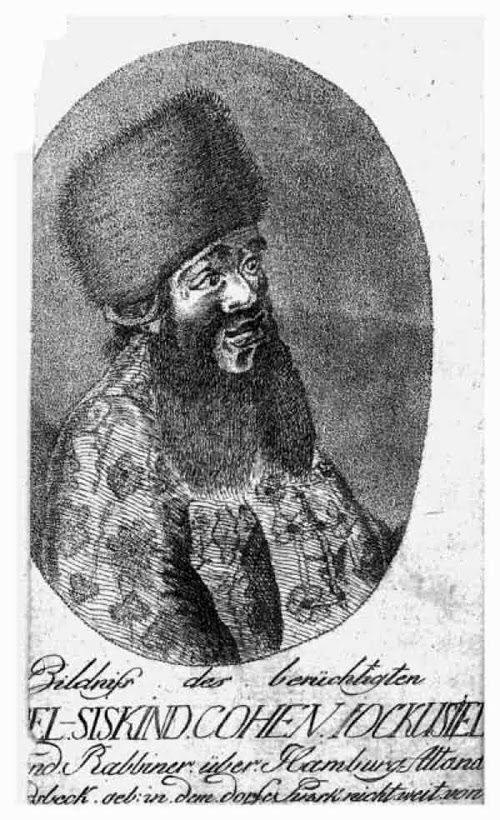
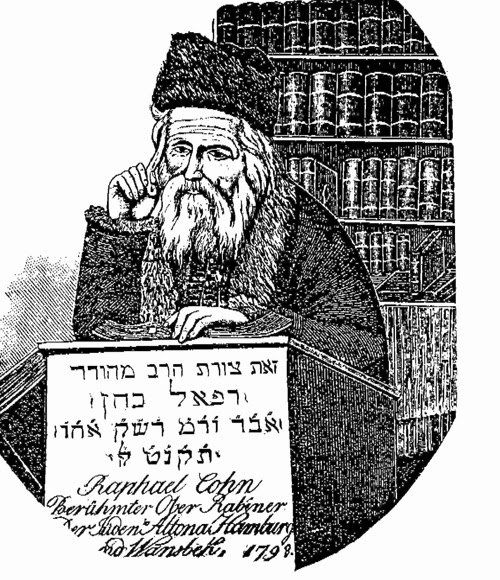
One of which includes this portrait of R. Cohen.
Which is a very different portrait, both in time and look, to the one appearing in E. Duckesz, Ivoh le-Moshav, Cracow, 1903.

[9] For the deeper meaning of the title Kasa de-Harshena, see Moshe Pelli, The Age of Haskalah, University Press of America, 2006, 183 n.51.
[10] See Samat, who discusses the exact progression of the ban.

[11] See Yechezkel Shrage Lichtenstein, Suicide: Halakhic, Historical, and Theological Aspects, Tel-Aviv, 2008, pp. 438-44. See also,Yeshurun 13:570-587 especially pp.578-581; Marc B. Shapiro, “Suicide and the World-To-Come,” AJS Review, 18/2 (1993), 245-63. 
On the issue of suicide there are others who similarly reach the same holding as the BR see Strashun in his מתת-יה pp. 72a-72b (this source is not quoted by Samet or Amar).
[12] Biographical information on R. Yosef Lazer is scant.  For information on his father and grandfather, see Meir Wunder, Me’orei Galicia, Israel, 1986, vol. III, pp. 456, 462-3. See also T.I. Abramsky, “‘Besamim Rosh’ in the Hassidic Milieu,” Taggim, (3-4), 56-58.   
[13] Samat only notes the removal of one responsum, he fails to note that exclusion of the second.  He does, however, note the misplaced responsum.  Additionally, Kuntres ha-Teshuvot ha-Hadash, fails to record that any are missing or that one responsum was moved to the end. 
[14] See Pelli, Age of Haskalah, pp. 185-89, comparing a few responsa with 18th century haskalah literature.
[15] Assaf was not the first to use this responsa and note its historical anacronisms.  Leopold Zunz, also highlights the issues with this responsum (as well as others).  Leopold Zunz, Die Ritus des Synagogalen Gottesdienstes, Geschichtlich Entwickelt, Berlin: 1859, 226-28.  Zunz’s critique is quoted, almost in its entirety by Schrijver, but Schrijver appears to be unaware of Assaf’s additional criticisms of the responsum (and others).
Assaf provides one other example where he shows through internal data that there is a misattribution.  Assaf concludes that he has other examples of historical anacronisms in BR but doesn’t provide them here or, to our knowledge, anywhere else.
[16] For another critique of Fishman’s position see Emile G.L. Schrijver, “Saul Berlin’s Besamim Rosh: The Maskilic Appreciation of Medieval Knowledge,” in Sepharad in Ashkenaz, Netherlands: 2007, pp. 249-259, esp. pp. 253-54. 
[17] Regarding Ketav Yoshor see Pelli, Age, 176-79. See also here and here.

Additional Bibliography:
M. Samet has two articles on the topic, R. Saul Berlin and his Writings, Kiryat Sefer, 43 (1969) 429-41; “Besamim Rosh” of Saul Berlin, Kiryat Sefer 48 (1973) 509-23, neither of which are included in the recent book of Samet’s articles.

To add to Samet’s and Amar’s very comprehensive lists of Achronim who quote BR: (I am sure searches on the various search engines will show even more): Malbim in Artzos Hachaim, 9:41 (in Hameir Learetz); Shut Zecher Yosef,1:32b; Keter Kehunah p. 30; Matzav Hayashar 1:2a; Pischei Olam 2:218,228; Birchat Yitchcak (Eiskson), pp. 6,14,24; Maznei Tzedek, p.26,45,254; R.Yakov Shor, Birchat Yakov, pp.212  Sefer Segulos Yisroel pp.116b; R. Rabinowitz, Afekei Yam 2:14; R. Leiter, Zion Lenefesh Chayah# 43; Shut Sefas Hayam, OC siman 14; R Meir Soleiveitck, Hameir Laretz 45a, 45b, 54b, 55a; Emrei Chaim p.26; R. Sholom Zalman Auerbach, Meorei Eish p. 108 b

In general on BR see: R.Yakov Shor,Eytaim Lebinah (on Sefer Haeytim) p. 256; Pardes Yosef, Vayikrah 220b Pardes Yosef, Shelach p. 517; R.Yakov Chaim Sofer, Menuchas Sholom, 8, pp. 222- 230; Shar Reven p. 54; A. Freimann, HaRosh ; Y. Rafel, Rishonim Veachronim, pp. 123-130; B. Lau, MeMaran Ad Maran, pp.133; S. Agnon, Sefer Sofer Vesipur, pp.337-339.

R. Pinhas Eliyahu Horowitz writes:

ולפעמים תולים דבריהם באילן גדול וכותבים מה שרוצים בשם איזה קדמון אשר לא עלה על לבו… כספר בשמים ראש שחיבר בעל כסא דהרנסא לא הרא”ש וזקני ישראל תופסי התורה יעלו על ראשם… (ספר הברית, עמ’ 232).

The Steipler was of the opinion in regard to the BR that:
שבאמת ניכר מהרבה תשובות שהם מהרא”ש ז”ל רק כנראה שיש שם הרבה תשובות מזויפות שהמעתיק הכניס מעצמו כי ישנם שם דברים מאד מזורים ואיומים  (ארחות רבנו, א, עמ’ רפה)

R Zevin writes in Sofrim Veseforim (Chabad) p.354 :
אלא שבתשובות בשמים ראש המיחוס להרא”ש ושכידוע נמנו וגמרו שמזוייף הוא

R. Yakov Kamenetsky said: “Do you think Just we (he meant people of his own caliber) were fooled? Even R. Akiva Eiger was fooled.” (Making of a Godol, pp.183-184)

About Rav Kook and the BR see: http://www.biu.ac.il/JS/JSIJ/5-2006/Gutel.pdf

R. Avigdor Nebensal writes:

כשמביאם את הבשמים ראש ראוי להזכיר שיש מסתייגים חריפות מהספר הזה (השתנות הטבעים, עמ’ 16).
R Zalman Nechemiah Goldberg writes:
אכן בעיקר הענין אם להביא דברי בשמים ראש בודאי צדק הג”א נבנצל שליט”א שיש להביאו בהסתייגות, ובפרט בענינים אלו שהוחזק למזייף ולמביא עקומות וכוזבות (השתנות הטבעים, עמ’ רסד).


More on Chaim Bloch

More on Chaim Bloch
By Marc B. Shapiro
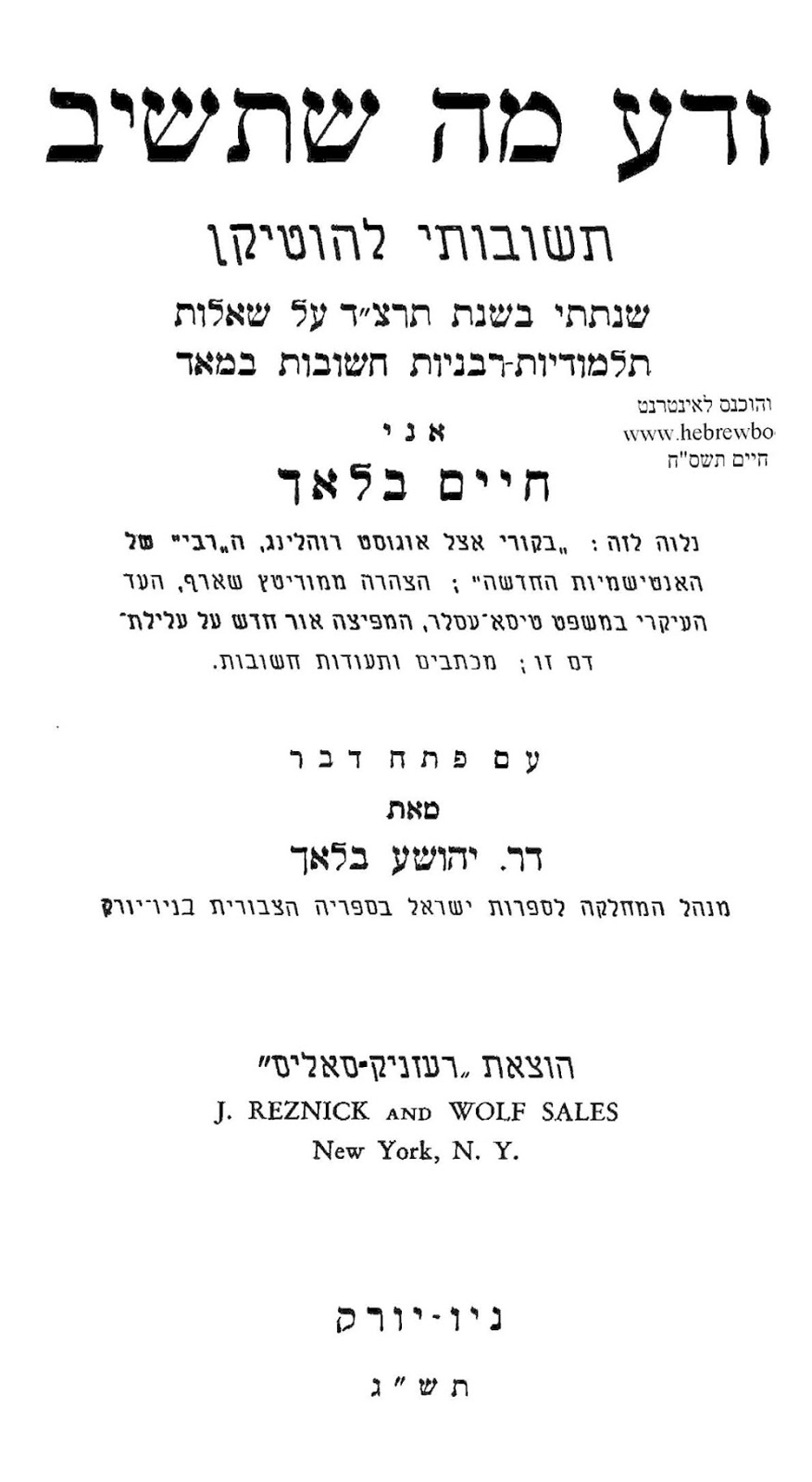
In a previous post I mentioned how the non-Jewish Austrian minister Leon Bilinski was descended from the rav of Posen, R. Samuel ben Moses Falkenfeld, the Beit Shmuel Aharon. More information about Bilinski’s Jewish roots is found in Chaim Bloch’s Ve-Da Mah she-Tashiv (New York, 1943), p. 74 n. 1. In general, I have found that when Bloch is reporting about other people’s biographies and history in general, he is very reliable. It is only when he is somehow involved in the story that he is full of lies.1 His Ve-Da Mah she-Tashiv is a good example. Here is the title page.
In this book he makes up an entire story that he was asked by an important Catholic figure to answer questions from the Vatican dealing with Judaism. The whole story is a fiction, as is so much else he writes about himself. As for Bilinski, Bloch tells us that he is in possession of Bilinski’s 1146 page (!) unpublished diary. As Bloch himself notes, he provided various scholars (e.g.., N. M. Gelber) with selections of this diary which they then used in their own works, thus misleading the world. In these selections, Bilinski comes off as a strong anti-Zionist, who even warns Herzl about how the Arabs will never accept a Jewish state in Palestine.2 In an article in the Herzl Year Book, Bloch published what he claimed was an 1893 letter from Herzl and uses this to prove that Herzl was interested in the Jewish problem already in 1893, a year before the 1894 Dreyfus trial which is usually cited as having turned Herzl to Jewish matters.3 Various scholars have cited this letter, as they understandably regard it as significant in understanding Herzl, but of course it is a forgery. Another way Bloch misled scholars, in particular Gelber, is with regard to an anonymous booklet that speaks of a return of the Jews to the Land of Israel and the establishment of a state.4 According to Billinski’s diary, so Bloch tells us, the author of this booklet was Benjamin Disraeli. Bilinski would certainly have been in a position to know this information, and therefore a number of people have been misled by this, thinking the diary authentic
Look how Bloch’s forgeries were able to have such an impact. I think, in the end, this is what gives the forger satisfaction, watching everyone taken in by his creation. In 1948 no one would have believed that Bloch was capable of this. In fact, if not for his blatant forgeries in Dovev Siftei Yeshenim, some people today would still assume that he is reliable. As the Talmud tells us, tafasta merubah lo tafasta! Bloch should have stuck with his smaller forgeries, because when he decided to publish complete volumes of forged material, that’s when people really began to take notice. It is therefore very surprising that no less a scholar than Robert S. Wistrich, who is aware of the accusations of forgery against Bloch, nevertheless cites material from Bloch’s Mi Natan li-Meshisah and states that in his opinion at least some of the material must be considered authentic. Why he thinks this he doesn’t tell us. The truth is that this book, like Dovev Siftei Yeshenim, is full of Bloch’s forgeries, and not only of rabbis but also of political leaders (including summaries of supposed letters from Bismark about Zionism!)5

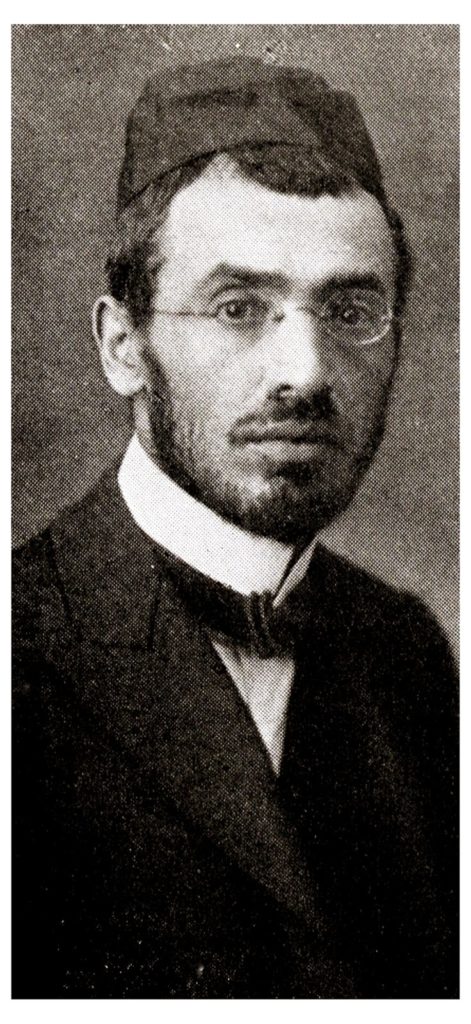
Just to illustrate that you can’t judge people by appearances, here is a picture of Bloch, which previously appeared in Dr. Shnayer Leiman’s post on the Seforim Blog.6

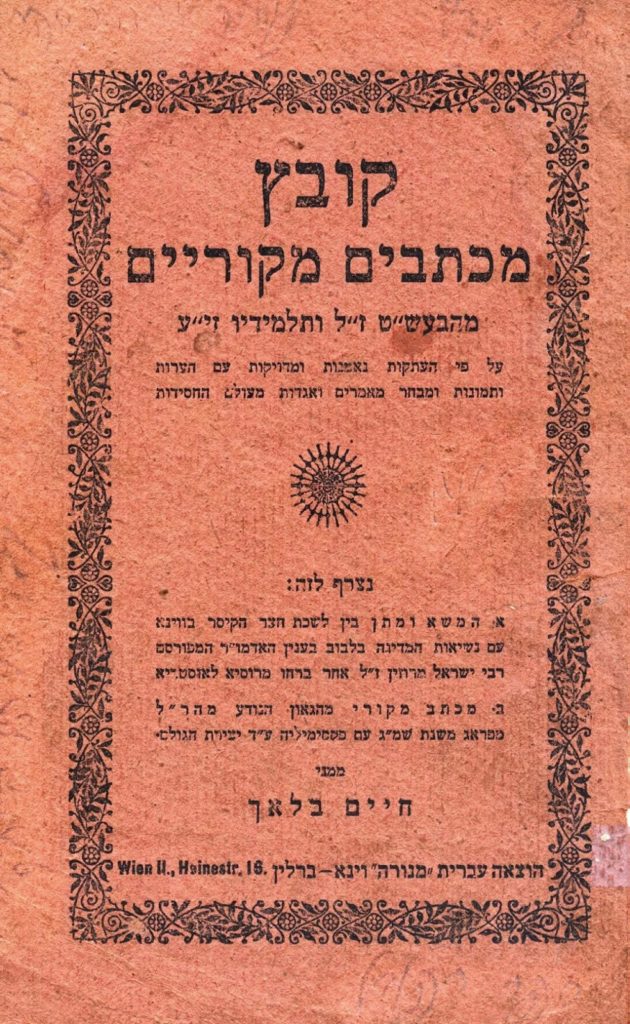
Throughout Bloch’s various books, he quotes numerous letters from gedolim who were no longer alive, and none of these letters are found in his archives, currently kept at YIVO and the Leo Baeck Institute. In other words, he simply made up these letters, as he did with the entire volumes of anti-Zionist letters of gedolim that he published. The rule is that whenever Bloch cites a previously unpublished letter from someone, either addressed to himself or to another, and the author of the letter is no longer alive, you can assume that the letter is forged. We know this now, after Shmuel Weingarten’s exposé of Dovev Siftei Yeshenim.7 Yet the evidence was there all along, had people paid attention. But people had no reason to assumed that Bloch was not reliable. R. Joseph Elijah Henkin, however, who was involved in a terrible dispute with Bloch, did accuse Bloch of dishonesty, and pointed out that he would attribute quotes to rabbis who were no longer alive so that he couldn’t be contradicted. In the late 1930’s Bloch published a letter from R. Kook. R. Zvi Yehudah Kook was very skeptical of its authenticity and requested that Bloch send him a copy of it. Bloch replied that he was unable to do so since he had lost the original.8 This was Bloch’s pattern, and I assume that all of the many letters he published from leading rabbis and hasidic leaders, beginning in the early part of the twentieth century, are forgeries.9

Here is another example of Bloch’s tendency to fabricate things. It comes from his Heikhal le-Divrei Chazal u-Fitgameihem (New York, 1948), p. 9. Everything he reports here is a fantasy. As with some of his other forgeries, Bloch is obviously motivated here by good intentions, but it is all complete nonsense.

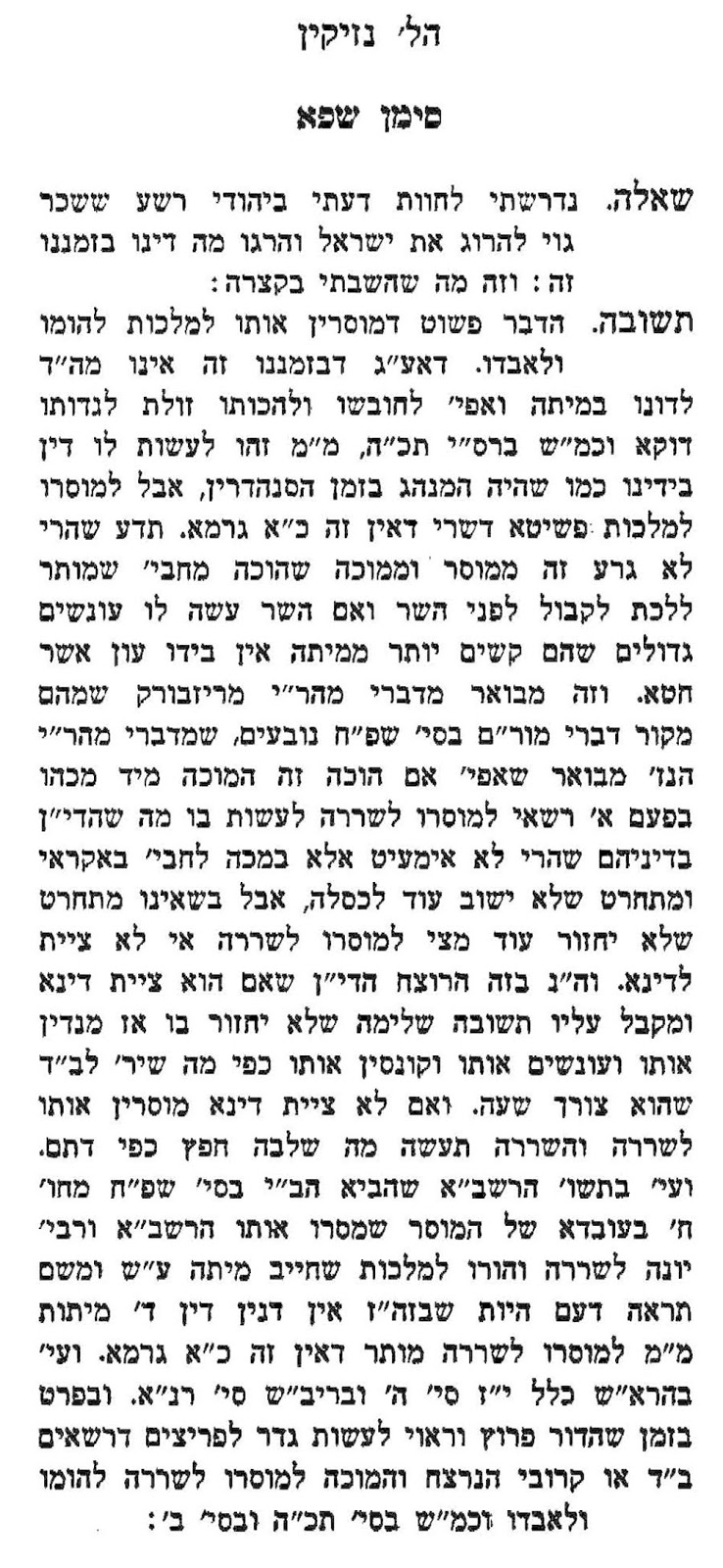
Ve-Da Ma she-Tashiv also contains forged letters. I am certain that the letter of R. Chaim Ozer Grodzinski on pp. 52-53 is an example of this. Anyone can look at the style of R. Chaim Ozer’s many letters and see how he consistently used certain formulas in concluding his letters. Nowhere does R. Chaim Ozer conclude a letter with
ונזכה כולנו לראות בישועת עמנו במהרה
He does use the expression
ועיניהם תחזינה בישועת עמנו במהרה

and this is found in a letter that Bloch would have had access to, the letter of R. Chaim Ozer to Agudat ha-Rabbanim about the Louis Epstein proposal.10 I assume he used the concluding portion of this letter to help him create his forgery. But in other areas he wasn’t so careful. For example, in the supposed letter of R. Chaim Ozer to Bloch, he refers to the latter as a צנא מלא ספרא , yet this expression does not appear in R. Chaim Ozer’s other letters (based on Otzar ha-Hokhmah’s database, which only has the first edition of R. Chaim Ozer’s letters, not the expanded Iggerot R. Chaim Ozer.)
We should assume the same for all of the other letters in this book from people who were not alive when the book was written. It is fascinating that on p. 44 n. 1 Bloch refers to the anti-Zionist letters he would later publish in Dovev Siftei Yeshenim. Ve-Da Mah she-Tashiv was published in 1943 and the first volume of Dovev Siftei Yeshenim didn’t appear until 1959, meaning that this forgery was very long in the making, and Bloch was setting the stage for it many years prior.
There is more to say about this book, in particular his argument that there are passages in the Talmud that were inserted by heretics – a viewpoint earlier mentioned by R. Joseph Zvi Duenner, as I have pointed out elsewhere, see here.

I will leave that for another time, but to give you an example of what I am referring to, here is a passage from p. 39 (emphasis in the original):
אופינית היא “המעשיה” בר’ שמעון בן גמליאל “שהיה על גב מעלה בהר הבית וראה נכרית אחת נאה ביותר. אמר: מה רבו מעשיך ד'” (ע”ז כ ע”א) המאמר הזה זיוף  . . . לא יעלה בדעתנו, שר’ שמעון בן גמליאל הביט על אשה, היינו הך, נכרית או ישראלי – לשם יפיה. ומצאתי עוד מאמר בשם רב, שזיופו עומד מחוץ לכל ספק: “בשעה שבקש נבוכדנצר לעשות לאותו צדיק (צדקיהו) כך, נמשכה ערלתו ש’ אמה והיתה מחזרת על כל המסבה כולה שנאמר: שבעת קלון מכבוד, שתה גם אתה והערל” (שבת קמט ע”ב). מלבד הנבול שבמאמר זה, הוא חסר טעם, ולא יתכן, שמפי רב יצאו הדברים.
I don’t know which position is “frummer”? To defend the honor of the sages and therefore deny that these “obscene” passages are authentic, or to defend the Talmud as we have it and thus have to deal with these passages.
Yet whatever the answer to this is, if Bloch were alive today, the haredi world would put him in herem for another reason. Here is what he writes on p. 38, with regard to how to view Aggadah in contrast to the halakhic sections of the Talmud. (What he says is nothing other than the Geonic and Spanish tradition, which is largely unknown in today’s yeshiva world.):
היא אינה נחשבת ליסוד קיומה של היהדות ויש לה אופי של ספר עם . . . לחלק האגדה נכנסו דברי מוסר ודרך ארץ, מליצות ובדיחות, סגולות ורפואות, אזהרות ועצות, פתרון חלומות ואגדות, שלהרבה מהם יש ערך גם מחוץ להיהדות. יתכן שהרבה הושפעו בעלי התלמוד בזה מהעמים שכניהם.
Also interesting is that in Ve-Da Mah she-Tashiv, p. 44 n. 1,  he refers very positively to R. Henkin, something that would later change when their great battle began.
Bloch claimed that he had a close relationship with the great R. Judah Leib Zirelson of Kishinev (Speaking for myself, Zirelson’s greatest achievement had to have been standing up to the extreme anti-Zionist elements in Agudat Israel, led by R. Elhanan Wasserman and R. Aaron Kotler. They wanted the Agudah to officially oppose the creation of a Jewish state. Zirelson, as president of the 1937 Kenesiah Ha-Gedolah in Marienbad, was able to convince the Moetzet Gedolei ha-Torah to agree with his own position, which was not to oppose a state but to attempt to bring Torah values into it. See Ha-Pardes, Oct. 1937, p. 8). In this book, Bloch cites a number of things from Zirelson of which, again, I have no doubt that he has made them up. For example, can anyone imagine that Zirelson would offer the following Haskalah-Reformist interpretation that Bloch puts in his mouth (p. 34)?
יתכן שהיתה כוונתו של ר’ שמעון בן יוחאי, בחפשו יסוד במקרא שהנכרים אינם מטמאים באוהל, כדי שלא ימצאו הרומיים תואנות ואמתלאות חדשות על ישראל, ומאימת המלכות הורה כן.
Although I can’t go into it in any detail now, the truth is that we do on occasion find Haskalah-Reformist types of interpretation even in traditional sources,11 but since these are very rare and we have no evidence that Zirelson ever said what is attributed to him, I assume it is another of Bloch’s forgeries. In other words, as he did so often, Bloch attributed his own understanding to one of the great Torah sages.
In chapter fourteen of Ve-Da Mah She-Tashiv, where he stresses the need for honesty in one’s dealings with non-Jews, he claims that Zirelson told him about a Zoharic passage in parashat Lekh Lekha that states:
כל מאן דמשקר בהאי עלמא בערל כמאן דמשקר בשמיה דקוב”ה
This is a beautiful thought. The only problem is that it doesn’t exist anywhere in the Zohar. I am certain that Zirelson would never have misquoted the Zohar and that the mistake is Bloch’s. I assume that the mistake is unintentional, perhaps quoting from memory, since a great forger like Bloch would never have dared falsely attribute anything to the Zohar, the accuracy of which could easily be checked.
Here is the actual Zohar text (vol. 1, p. 93a):
דכל מאן דמשקר בהאי כמאן דמשקר בשמיה דקב”ה
If you examine the entire passage you will find that it has nothing to do with being honest, and the word משקר here does not mean “to lie”, but “to betray”. The text is actually speaking about berit milah and how one is obligated to treat it properly, especially דלא עייל ליה ברשותא אחרא, which certainly refers to refraining from having sex with non-Jewish women. What the text is saying is that if you have illicit sex you betray the mark of the circumcision, and this is like betraying God’s name.
Since I mentioned Haskalah-Reformist interpretations in traditional texts, let me note one of the most famous of these. In Shabbat 140b, R. Papa’s states that if one can drink beer but instead drinks wine, he violates the prohibition on baal tashchit. Maharsha explains that R. Papa said this because he was a beer salesman! What this apparently means is that R. Papa lied about the halakhah in order to drum up more business for himself. How else to interpret Maharsha’s explanation?
ורב פפא לטובת עצמו אמרה שהוא הי’ עושה שכר.
This explanation is, to be sure, quite shocking. If you want to stretch things a bit you can say that according to Maharsha, R. Papa didn’t consciously alter the halakhah to benefit himself, but since he was a beer maker he was unconsciously led to this position, as it would benefit him. This explanation – which could easily have been offered by Jacob Katz – is suggested by the noted Yemenite posek, R. Yitzhak Ratsaby12:
והנה כל העובר ישום וישרוק, היתכן כדבר הזה שרב פפא יפסוק הלכה משום ריוח ממונו?! . . . ובודאי גם לדעת מהרש”א לא יתכן שרב פפא יאמר פסקי הלכה רק מתוך נגיעה, חלילה לו. אלא היה זה כעין “שוחד סמוי”, שלא הרגיש בו הוא עצמו, שמתוך כך בא לידי טעות בהלכה זו. כמו שהכתוב צווח ואומר (שמות כג, ח): “כי השוחד יעוור פקחים ויסלף דברי צדיקים”, ועל דרך שמצינו בכתובות (קט, ב) בגדולי עולם שאמרו על עצמם שהשוחד היטה את ליבם.
I think most people will tell you that this sort of explanation, which points to unconscious factors influencing halakhic decisions, was not how people thought in the days of the Maharsha. I myself do not see this as an anachronistic explanation, as the Talmud, Ketubot 105b, already discusses precisely this sort of unconscious influence.13  I believe that this is also how we are to understand all the discussions about נוגע בדבר, and how it applies even to the greatest tzadikim. It is not that these people will consciously twist the truth, but that unconsciously this is what can happen. Presumably, this is also the meaning of Hullin 49a:  ישמעאל כהנא מסייע כהני

I think this is also how we are to understand R. Moses Isserles, Yoreh Deah 242:36:
תלמיד חכם שאמר דבר הלכה בדבר השייך לדידיה . . . אין שומעין לדידיה דלמא מדמי דברים להדדי שאינן דומים
See also Ritva, Yevamot 77a:
דחיישינן שמא מתוך שנושא ונותן בהלכה כדי לקיים את דבריו אמר בדדמי כסבור שקיבל מרבו
I am not going to analyze the Maharsha in any depth, because either way you explain him, this is the exact sort of explanation that according to the Rav is heretical as it falls under the Rambam’s category of מכחיש מגידה.14 And it is not just the Rav who would be shocked by what Maharsha wrote. R. Yehoshua Heschel of Monistritch15 states:
ועל מאמר המהרש”א הזה צווחי קמאי 
R. Abraham Vengrober16 says concerning the standard explanation of Maharsha (before offering a different understanding of his words):
ופריצי עמנו מצאנו בקעה לדבר סרה על רז”ל . . . גם רבינו המהרש”א ז”ל לא כיוון בזה ח”ו להכוונה אשר העולם סוברים שבשביל זה שהי’ מסחרו שבח את הדבר לטובת עצמו.
R. Samuel Strashun in his commentary to the passage takes strong issue with Maharsha, and R. Hayyim Hezekiah Medini17 is astounded by what Maharsha wrote:
הדבר תמוה לפרש דנחשד רב פפא לדבר שקר חלילה לטובת עצמו.
I assume it is only a matter of time before this explanation of Maharsha is deleted from a future printing.
Here is another example (Taanit 14a-14b):
In the time of R. Judah the Prince there was distress. He ordained thirteen fast days and their prayer was not answered. He thought of ordaining additional fasts but R. Ammi said to him, “Did not [the Sages] declare we should not trouble the community unduly.” Said R. Abba the son of R. Hiyya b. Abba, “R. Ammi [in saying this] was studying his own interests.”
  
Rashi explains R. Abba’s declaration:
לעצמו דרש: דלא אמר אלא לפי שהוא לא היה רוצה להתענות
If anyone other than Rashi wrote this, wouldn’t it be regarded as an example of מכחיש מגידה?
Here is another example, from the Jerusalem Talmud, Shabbat 6:1:
R. Abbahu in the name of R. Yohanan, “It is permitted for a man to teach Greek to his daughter, because such learning is an ornament for her” Simeon bar Ba heard and said, “It is because R. Abbahu wants to teach his daughter such that he has assigned the teaching to R. Yohanan.”
R. Abbahu responded quite sharply to Simeon bar Ba, proclaiming: “May a curse come upon me, if I did not hear it from R Yohanan.” But I am more interested in Simeon bar Ba’s accusation. He assumed that the great R. Abbahu would falsely attribute a halakhic ruling to an earlier sage in order that his daughter would benefit. When Geiger and Graetz said things like this, no one was surprised, and the Orthodox condemned them for these type of interpretations. Yet here you have a Haskalah-Reformist type of interpretation offered by one of the Sages.
Returning to Bloch, another example where he deceived the world is found in his Heikhal le-Divrei Hazal u-Fitgemeihem, pp. 591-592. In line with his apologetic approach to Jewish sources, he claims that he saw an old version of the Passover prayer Shefokh Hamotkha, that went as follows:

שפוך אהבתך על הגוים אשר ידעוך

Even a great scholar such as Naftali Ben-Menachem was taken in by Bloch (and if you search online you will find a number of others who assume that Shefokh Ahavatkha is a real text, rather than another Bloch forgery18). Ben Menachem’s article appears in Mahanayim 80 (1963), and here is the page where he refers to Bloch’s version.

Incidentally, in Heikhal le-Divrei Hazal Bloch claims that he wrote about this version at length in his 1935 book Der Judenhass im Spiegel der Jahrtausende, and also printed a copy of the manuscript there. (In 1935 Bloch was living in Vienna.) Although he mentions this book in a couple of his other writings, there is no evidence that any such book ever appeared. Now we have the internet which allows us to check all the greatest libraries in a minute, yet in a prior era, simply mentioning that he had published such a book and that it contained a copy of the manuscript would have been enough to convince everyone. After all, it was not like people in the United States, England, or Palestine/Israel could easily check the holdings of libraries in Austria and Germany.
Meir Hershkovitz, in his fine book on R. Zvi Hirsch Chajes, also quotes Bloch a number of times. Bloch claimed to have seen unpublished material from Chajes and he included some of it in his Heikhal, but everything he mentions is fraudulent, and some of the comments are really outrageous. For example, on p. 565 he quotes Chajes as saying as follows about Rabbi Akiva19:

ר”ע מבני בניו של סיסרא היה ולמרות קדושת התורה ששלטה בו נשאר בו משהו מאופיו של סיסרא
(Some are probably wondering why I didn’t underline the first part as well, which states that R. Akiva was descended from Sisera. After all, in a few weeks Daf Yomi will reach Sanhedrin 96b and there you find the following, with no mention of R. Akiva: “Descendants of Sisera studied20 Torah in Jerusalem; descendants of Sennacherib taught Torah to the multitude. Who were these? Shemaya and Avtalion. Descendants of Haman studied Torah in Bnei Brak.” Yet numerous texts21 record a version of this passage that identifies R. Akiva as among the descendants of Sisera.)

What motivated Bloch to invent this negative comment about R. Akiva? I think that this too can be attributed to anti-Zionist motivations (an anonymous commenter on Soferim u-Seforim offered a similar explanation; see the link in n. 1). R. Akiva was associated with Bar Kokhba’s rebellion, and in the popular mind at least, this was a matter of pride for twentieth-century Jews. The thrust of the comment attributed to Chajes is to see this “warlike” aspect of R. Akiva as a throwback to Sisera. In other words, this is not something good. We see another example of Bloch’s anti-Zionism in his attempts to argue that a passage in Maimonides’ Letter on Astrology is not authentic. In this passage, Maimonides states that the Temple was destroyed and the Jews exiled because instead of focusing on “the art of military training and conquering lands,” they involved themselves with astrology, thinking it would help them. (Iggerot ha-Rambam, ed. Sheilat, vol. 2, p. 480) This passage was too “Zionistic” for Bloch, and not surprisingly he argues that it is a forged interpolation. See his article in Ha-Pardes 34 (April 1960), pp. 39-42, where once again it is Bloch who is the forger, citing a supposed letter from a Christian scholar to Dr. [Daviid?] Kaufmann and also telling us about the support he supposedly received from the Tchortkover Rebbe. (This Rebbe, incidentally, happened to be a one of the leading Agudah supporters of settlement in the Land of Israel.) One of Bloch’s major proofs that Maimonides could not have written this passage is his assumption that Maimonides was not impressed with R. Akiva’s support of Bar Kokhba. He bases this argument on Mishneh Torah, Hilkhot Melakhim 11:3. Yet Maimonides’ viewpoint in this matter is not enough for Bloch, and to achieve his purpose he has to actually find fault with R. Akiva’s character, something Maimonides would never do. Bloch even attacks some modern writers (such as Aaron Zeitlin and Hillel Seidman) who had stressed the contemporary significance of Maimonides’ words. In Bloch’s mind, by doing so they were showing the non-Jews that the Protocols of Elders of Zion were correct, namely, that Jews really did want to conquer the world! Bloch’s Neturei Karta side comes out very well in this article.

As a way of covering himself, so that people will believe the manuscripts of Chajes are authentic, Bloch states that he assumes that the material he is quoting from has survived in Israel, either with the family or at the National Library (Heikhal, pp. 520, 560). Yet in Hershkovitz, this supposition is stated as fact (Rabbi Zvi Hirsch Chajes, p. 438). It is quite surprising that Hershkowitz, who wrote such a comprehensive biography of Chajes, didn’t attempt to track down these manuscripts. Had he done so, he would have realized that they don’t exist.
*    *    *
This is a blog about seforim, but with Dan’s permission, in a future post I am going to write about the various blogs and news sites, both haredi and Modern Orthodox, that focus on Jewish matters (halakhah, hashkafah, etc.). In the last six months I have visited them a good deal, left a number of comments (some quite provocative and opposed to my own outlook [e.g., dealing with sexual abuse, Zionism, Daas Torah, Torah mi-Sinai, etc.], and always under a pseudonym) and gathered the reactions. I also corresponded with people I met on the sites and with various anonymous baalei ha-blogs. I tried to be a bit of a reporter, gathering information, and just like a reporter sometimes has to hide his identify, I felt that in this circumstance it was permissible, especially as almost everyone I was dealing with was also anonymous. We all know that the ability to be anonymous is basic to the internet (and there has been a good deal of discussion recently about whether this is a good idea). I also felt that if I got involved in a debate on a haredi or Modern Orthodox site, my name would be recognizable to some of the people and they might respond differently than if I was some anonymous person.

Most of the information is publicly available (as are my comments), but I won’t cite any names, as I am not interested in individuals but in some of the thought processes that I observed. As always, I will tie this in with seforim, especially the phenomenon of anonymous and pseudonymous (as opposed to pseudepigraphal) seforim and articles, and also discuss the modern anonymous halakhic questions that R. Yuval Sherlow has written about. (He has also published a couple of volumes of his answers to these questions.) How is Judaism perceived and portrayed when people can live in two worlds, the public one and the private anonymous world of the internet? What does it mean when most people who comment about controversial topics choose to do so under a pseudonym? I think that what I found also has implications to an issue I have been concerned with for a long time, namely, the value of private letters and conversations vs. published word in seeking to evaluate the personality of an individual. This directly relates to David Holzer’s book on the Rav and was also a topic that became a dispute between the late Prof. Twersky and myself when writing my dissertation on R. Weinberg–more on that to come.

I mention all this because I have a request: If anyone is aware of a similar study with regard to Christian or political blogs and websites, please let me know. As a friend commented to me when I told him about my project, “we all know that there are registered Democrats on the Upper West Side who secretly vote Republican, but in order not to scandalize their friends, will only post their true opinions anonymously.” Yet has anyone written about this? There are serious methodological issues that must be dealt with in any such inquiry.
*    *    *

My new Torah in Motion class begins this Monday. I invite all who are free on Monday nights at 9PM Eastern to join us. This semester we are covering R. Eliezer Berkovits, R. Chaim Ozer Grodzinski, R. Elijah Benamozegh and R. Joseph Messas. You can sign up for it here
If you want to watch or listen to previous classes, to get a sense of how they work, you can download them here.
Notes
1 For a recent discussion of Bloch, see here which contains a number of informative comments.
2 See Bloch, Mi Natan li-Meshisah Yaakov ve-Yisrael le-Vozezim (Bronx, n.d.), pp. 54ff.
3 “Herzl’s First Years of Struggle: Unknown Episodes and Personal Recollections” Herzl Year Book 3 (1960), pp. 77-90.
4 The booklet is found in N. M. Gelber, Tokhnit ha-Medinah ha-Yehudit le-Lord Beaconsfield (Tel Aviv, 1947),  pp. 35ff. Gelber’s book is devoted to this booklet.
5 “Zionism and its Religious Critics in Fin-de-Siècle Vienna,” in S. Almog, et al., eds., Zionism and Religion (Hanover, 1998), pp. 150, 157 n. 45.
6 See here.
7 Mikhtavim Mezuyafim Neged ha-Tziyonut (Jerusalem, 1981).
8 See Weingarten, Mikhtavim, pp. 164-165. In Ha-Posek 11 (1950), p. 802, Bloch published another letter from R. Kook. It is also found in Heikhal le-Divrei Hazal u-Fitgamehem, p. 614. Again he tells us that he only has a copy of the letter, as the original was lost, and here too the letter in unquestionably a forgery. Bloch had R. Kook sign the letter עבד לעם קדוש , which he knew is found in numerous authentic letters. But the letter also contains the phrase כל יקר ראתה עיני , and this does not appear in any of the almost 2000 letters and responsa of R. Kook, as can be determined from the new database of R. Kook’s writings
9 I don’t know whether this also applies to halakhic writings, e.g., the supposed manuscript from R. Shalom Schwadron that came from Bloch and is published in R. Isaac Liebes, Beit Avi, vol. 3 no. 157. Incidentally, a few responsa after this, in no. 161, Liebes discusses whether a rabbinic organization could publicly advocate the institution of the death penalty, since it might happen that a Jew would also be sentenced to death (sound familiar?). Liebes begins his reply:
לא רק שמותר להתריע בכיוון זה רק מצוה לעורר את דעת העם את חומר הסכנה המרחפת על תושבי הארץ.
During the discussions about the Grossman execution, I looked at some of the haredi websites (until the comments made me sick). What I found interesting was the incredible level of ignorance of most of the writers, all of whom had been in yeshiva and many of whom had studied there for years. They were able to declare that a murderer can’t be executed unless he was observed by two kosher witnesses and was given warning, which they thought settled matters. Had these people known a bit of responsa literature, there would have understood how things worked in the real world, and especially what was done in the days of the rishonim. Do these people think that if a guy stood up in shul and opened fire with a machine gun, killing 20 people, that a Jewish court couldn’t execute him because he was never given a warning? Let’s continue with R. Liebes:
יש כח להבי”ד בזמן שרואין צורך השעה לענוש עונש מות אפילו בכל יום אפילו אם מן התורה פטורין הם כדי שעל ידי זה כל העם ישמעו וייראו ולא יזידון עוד.
As for the possibility that a Jewish man will be executed:
מצוה וחיוב לעורר את דעת הקהל להתריע את בתי המשפט שיראו להעביר בכל המדינה משפט מות ולענוש בכל החומר הרוצחים והפושעים ואת מדינתינו ארצות הברית אשר מאמינה בתנ”ך יכולים לשכנע אותה ולהראות לה עד היכן תוה”ק מקפידה לבער את רשעי הארץ בתור חיוב ומצוה. ומש”כ כת”ר לחשוש דלפעמים ימצא רוצח יהודי א”כ אנחנו נהיה אשמים במיתתו זה אינו כלום . . . מוכח מזה דהמחוייב מיתה עפי דין המלכות מותר למסרו להם מטעם דינא דמלכותא. מובן ממילא שכל דברינו מוסבים רק על המדינות שיש להם שוויון הזכויות לכל אזרחיה בלי שום אנטישמיות ושנאת ישראל ולכן אם ח”ו יהודי נתפס באיזה עון ופשע הרי הוא נידון כמו כל אזרחי המדינה.
Many who commented on the various sites were people who never opposed the death penalty before and do not oppose it now, yet they were anti-death penalty in this case because, quite simply, they think the death penalty is just fine except when it is a Jew being executed. They vote for all the right wing candidates and then have the chutzpah to complain when their man actually follows through on his support of capital punishment and doesn’t share their view that a supposed baal teshuvah (whose last meal on earth was a non-kosher chicken sandwich bought from the prison canteen) should not be executed. Some of them cited Sanhedrin 17a, סנהדרי שראו כולן לחובה פוטרין אותו , as if this had any relevance. First of all, this passage only means that he is not executed in the normal fashion, but he can certainly be executed as an emergency measure. In addition, some understand this passage to mean that if on the first day of deliberations all conclude that he is guilty, he is not condemned to death immediately but the case is revisited on the next day. If then, all find him guilty, he is executed. None of the commenters who mentioned this law quoted the view of R. Meir ha-Levi Abulafia (cited in many sources) and the Tosafot Hakhmei Anglia that the meaning of פוטרין אותו is ממהרין אותו להורגו .  This understanding is praised by the Reisher Rav, R. Aharon Lewin, Ha-Derash ve-ha-Iyun, Deut. no. 119:5, and R. Baruch Epstein, Torah Temimah, Ex. 23:2. Epstein is convinced that this understanding is correct because otherwise היש לך חוטא גדול ונשכר מזה .  For more on the subject, see Zorach Warhaftig, “Rov u-Miut be-Veit ha-Din,” in Itamar Warhaftig, ed., Minhah le-Ish (Jerusalem, 2001), pp. 100ff. See also R. Reuven Margaliot, Margaliyot ha-Yam, Sanhedrin 17a, no. 19, who cites the Tashbetz:
שהם ז”ל לא אמרו ב”ד שהסכימו כולם לחובה פטור, חלילה להם שיאמרו ככה, ואם על פי הרוב הורגים כל שכן ע”פ כולם ויותר טוב ויותר משובח הוא שיהיה הפסק דין מוסכם מהכל ולא שיהיה שום חולק.
There is a good deal more to say on this topic, but in the interests of space I will leave it for another time. Suffice it to say that as in all such matters one can find a variety of viewpoints. See e.g., R. Yair Hayyim Bacharach, Havot Yair, no. 146. Some poskim have even ruled that when a murderer has been sentenced to death it is forbidden to try and save him. See R. Nathan Leiter, Tziyun le-Nefesh Hayah, no. 121. (Others disagree, see e.g., Teshuvot Hatam Sofer, vol. 6, no. 14.) Obviously, such a ruling has no relevance to people who oppose the death penalty on principle, but it does speak directly to those who normally support it—as I daresay includes most, if not virtually all of the people who were commenting so outrageously on the haredi sites. Let me close by citing a responsum of R. Meir Zak in Teshuvot Eitan ha-Ezrahi, no. 45. What he said in the seventeenth century, in a case involving a Jewish murderer, is just as relevant today, and it is incredible how this responsum speaks to the Grossman case (he even uses the term “hillul ha-shem”!). Notice how he also includes the manhigei ha-dor in his criticism.
מאחר שניתן ביד גוים ערכאות הם יעשו בו משפט וידינו לא תהיה בו . . . ואפשר שעל נדון דידן נאמר מורידין מאחר שכתב הרב מהר”ד ה”ל האב”ד דק”ק ה”ל שדעתו לעשות כפרה והיה כל ימיו חוטא גדול ופושע, נאמר לישרי’ ביה גודא רבא ואף אם יאמר שרוצה לעשות תשובה ולפי דעתי על אלו אמרו חז”ל אין נחת רוח בתשובתן של רשעים להקב”ה כי ראה עצמו ביד גוים רוצה לרמות אותנו, אבל להפריז ממון לפדות אותו בשביל שאומר שרוצה לעשות תשובה זה הוא חילול השם שיאמרו אין עונש שפיכות דמים אצל יהודים נחשב חטא והיה אם גוי יהרוג ח”ו ליהודי ג”כ לא ידונו לעשות נקמה. ותמיד אני צועק ככרוכיא על מנהיגי הדור שכל גנב או חוטא שבא למאסר עושין השתדלות לפדות אותו ע”י שחדים דבר זה בעו”ה מרבה פשעים וגניבות כל א’ עושה מה שלבו חפץ ורבו פריצי הדור כאלו אנחנו רואים בעו”ה רוב גנבי ישראל ע”כ שלא לתת פרוטה לפוטרו ממות.
Isn’t it amazing that hundreds of years ago he was condemning the leaders who think that every thief or sinner who goes to jail should be the focus of pidyon shevuyim? From this responsum we learn that the warped values we have seen these last few years go back a long time. And what is one to make about his statement that the majority of thieves are Jewish? (using the language of Avodah Zarah 70a). I pray we never reach this point, although we probably have to do keriah over the fact that the Agudah spokesmen have been insistent in letters to the editor and in interviews that Orthodox Jews are not more dishonest than anyone else. In other words, no one, neither Jew nor non-Jew, even assumes anymore that being an Orthodox Jew means that you hold yourself to a high ethical standard. Their goal now is to convince the public that when it comes to obeying the law, Orthodox Jews (and their institutions) are simply no worse than everyone else. If that is not an indictment of our entire educational system, I don’t know what is.
For those interested in pursuing further the topic of Jewish murderers, here is a nineteenth-century responsum by the Moroccan R. Joseph Berdugo (Divrei Yosef no. 381).

10 Le-Dor Aharon (Brooklyn, 1937), p. 36. In this letter R. Chaim Ozer uses the expression והנני חותם בברכה , and this also appears in his supposed letter to Bloch.
11 In my Studies in Maimonides, I tried to show that “academic” interpretations of Maimonides can also be found in the most traditional sources. The same thing can be done with regard to the Talmud, and Prof. Halivni has cited many examples of traditionalists who offered explanations of the sort he focuses on (Higher Criticism). When “academic” explanations are found in rishonim, even the most conservative will be hesitant to attack them. But that was not always the case a few hundred years ago. For example, R. Nissim writes as follows in his commentary on the Rif, Megillah 26a, s.v. zo divrei R. Menahem:
ודאמרינן במעמדות לאו דוקא ומשום אשגרת לישן נקטיה
(This same view is actually advocated by Ramban, as noted in Gilyon ha-Shas, Megillah 26a.) This was too much for R. David Pardo, Mikhtam le-David, Orah Hayyim no. 14:
מלבד הלחץ זה הדחק שסובל הדבר בעצמו לומר דהש”ס וכל הפוס’ מעתיקי הש”ס נקטו באשגרת לישן מלתא דשקרא ממש דבר זר ורחוק.
12 Paamei Yaakov, Adar II 5768, p. 108.
13 The Talmud deals there with how even the desire of one of the parties in a dispute to give a gift to a rabbi who will rule on the case impairs his objectivity. This talmudic passage provides all the explanation one needs to understand how so many learned rabbis remained silent as the Tropper scandal played out. If amoraim admitted that they couldn’t properly judge a matter if they had only been offered a gift, certainly one in our day who actually received such a gift is not capable of judging the case of his benefactor. The Steipler refused to take as much as a cigarette from one of his admirers whose case he was to judge, and continued to refuse gifts from this person even after the case was concluded. See Avraham Yeshayahu Kanievsky, Toldot Yaakov (Bnei Brak, 1995), p. 208.
With regard to the more troubling (and I believe rare) circumstance of rabbis who will actually lie to benefit themselves, I have a number of sources on this. For now, let me just cite the words of the Shulhan Arukh, Yoreh Deah 314:1:
הכהנים חשודים להטיל מום בבכור אפילו אם הוא חכם ויושב בישיבה
As for the sordid details of the Tropper scandal itself, and those who refused at first to believe what they heard with their own ears (not to mention the Elon scandal as well as others), here is what the hasidic master, R. Meshulam Feivish Heller (died 1794), had to say in an earlier era, a presumably holier era as yet uncontaminated by television and the internet (Yosher Divrei Emet [Jerusalem, 1974]), p. 113:
והלא ידוע ומפורסם שיש בעוה”ר כמה לומדים שהם בעלי ניאוף רח”ל, ובעלי עבירות ידועים.
R. Hayyim Eleazar Shapira, Divrei Torah 5:82, writes about
הרבנים ובפרט האדמורי”ם הגונבים דעת ולבות הבריות, וכל כונתם אך לטובתם, בעצמם בגופם ובשרם וממונם ותאותם.
This is what the Ropshitzer is reported to have said:
דעו כי קודם ביאת המשיח יתרבה כ”כ השקר בעולם עד שרב העיר יסע יחדו עם אשה נכריה בעגלה אחת, ורבים מבני העיר יאמרו אחריו אין קדוש כמוהו.
R. Isaiah Asher Zelig Margulies, Ashrei ha-Ish (Jerusalem, 1927), p. 49, who records the saying, assumes that the Gentile woman spoken of really means “heresy”, but I don’t know why it should not be understood literally. It is not like the Ropshitzer was confronted with many secularly educated rabbis that he would need to make such a statement. (I assume that Margulies was led to his assumption by Maimonides’ famous letter to R. Jonathan of Lunel, where he speaks of non-Torah studies—which for Margulies equals heresy—as being נשים נכריות . See Iggerot ha-Rambam, ed. Sheilat, vol. 2, p. 502.)
Since a concern with kavod is also so often present in the various scandals, the following comment by R. Elimelech of Lizhensk is noteworthy (quoted in Or Elimelekh [Jerusalem, 2003], no. 75):
מצוה עם כבוד גרוע יותר מעבירות ניאוף רח”ל.
14 See the text of the Rav’s lecture here.
15 See R. Aharon Perlow, Margaliyot ha-Shas al Masekhet Shabbat (Jerusalem, 2005), p. 471.
16 Likutei Avraham (Jerusalem, 1976), p. 319.
17 Sedei Hemed, maarekhet lamed, kelal 108.
18 See also Alan Brill’s recent post here.
19 For an example of genealogy in the reverse direction – i.e., from righteous to wicked, see Rashi to I Kings 10:1, where it very strangely states that Nebuchanezar was the son of Solomon and the Queen of Sheba. This only appears in the later printed editions of Rashi, and is cited in the name of R. Isaac Luria. It is difficult to know what to make of this. I find it hard to believe that the passage ever could have been meant literally, since Solomon lived some three hundred years before Nebuchadnezar. Even legends, if understood literally, have to make chronological sense. Perhaps it means that the origin of the later disaster involving Nebuchadnezar can be traced to Solomon involving himself with foreign women such as the Queen of Sheba. In other words, not that Solomon is the literal father of Nebuchadnezar, but rather he is his “ultimate cause”.
As for the ultimate origin of the notion that Solomon was Nebuchadnezar’s father, I have been unable to find any other source that records that this was stated by R. Isaac Luria. R. Menahem Azariah de Fano (1548-1620), Asarah Maamarot (Jerusalem, 2005), pp. 412-413 (Maamar Eim Kol Hai 2:23), states that Nebuchadnezar descended from Solomon. Two points are significant here. First, he does not say that Solomon is his father, and second, he does not attribute this to any source, which presumably means that it was a well-known kabbalistic idea. R. Jehiel ben Solomon Heilprin, Seder ha-Dorot, year 2935, states that according to a Midrash, Solomon fathered a daughter with the Queen, and Nebuchadnezar was her son. R. Hayyim Joseph David Azulai, Midbar Kedemot, maarekhet yod, no. 47, claims that Nebuchadnezar was descended from this daughter. See also R. Joseph Palache, Yosef et Ehav (n.p., 2005), maarekhet bet, no. 17.
20 למדו תורה . This should probably be read as לימדו תורה , “taught Torah”, since in the parallel text in Gittin 57b it has למדו תינוקות, which means “taught children”. See also Dikdukei Soferim, Sanhedrin 96b.
21 To give just one, here is a page from R. Nissim Gaon’s Sefer ha-Mafteah to Berakhot 27b.


Note how Jacob Goldenthal, the editor, assumes that it is actually Haman from whom R. Akiva is descended! Jacob Reifman agreed with this. See Iggeret Bikoret, ed. Ben Menahem (Jerusalem, 1969), p. 17. Louis Finkelstein, Akiba, p. 321 speaks of the R. Akiva-Sisera connection as a “legend widely repeated in medieval works.” He doesn’t seem to realize that the medieval works were citing from their texts of the Talmud. See also Dikdukei Soferim, Sanhedrin 96b, which cites one such manuscript.


The Letter of the Maharal on the Creation of the Golem

The Letter of the Maharal on the Creation of the Golem: A Modern Forgery
By: Shnayer Leiman
For a related post by Dr. Leiman see “Did a Disciple of the Maharal Create a Golem.”


I. Introduction
    In 1923, Chaim Bloch (1881-1973), noted author and polemicist,1published a letter of the Maharal (d. 1609) that was previously unknown to all of Jewish literature.2 The letter, dated 1582 (or more precisely: Tuesday of parshat va-yera, [5]343), was addressed to R. Jacob Günzberg (d. 1615), Chief Rabbi of Friedberg in Hesse.3 Rich in content, the letter provides a lengthy and detailed account of why it was necessary for the Maharal to create a Golem, how he went about doing it, and the precise spiritual, psychological, and halakhic status of the created Golem. Bloch assured his readers that the letter was published from an original copy in his possession. In order to quell any doubts, he reproduced a facsimile of the Maharal’s autograph, as it appeared on the original letter.4
    Bloch did not provide much detail about the letter’s whereabouts for the more than 300 years it apparently had been withdrawn from circulation and unknown. He thanks Rabbi Samuel Neuwirth of Vienna for his efforts in acquiring the letter and handing it over to Bloch for publication. Given that it was published together with a series of hasidic documents (including letters of the Baal Shem Tov), allegedly recovered from East European archives that had been plundered during World War I and its aftermath, the impression one has is that the Maharal letter belonged to these archives as well – though this is never explicitly stated by Bloch.5

    In 1931, R. Yitzchok Eizik Weiss (d. 1944), the Spinka Rebbe,6 published the very same letter of the Maharal (without any mention of the prior Bloch publication) based upon — what he believed to be — an original manuscript in his possession. He appended it to the posthumous publication of his father’s אמרי יוסף על המועדים7 .  Although he gave no indication as to when or how the letter came into his hands, two witnesses provide us with some interesting detail.


    The first witness, R. Yitzchok Weiss (d. 1942), Chief Rabbi of Kadelburg,8 in his אלף כתב, a book written primarily between 1927 and 1939 but published posthumously in 1997, includes the following entry:
The Gaon and Zaddik of Spinka informed me on Monday of [parshat] Hukkat-Balak, 7 Tammuz, 5682 [= 1922], that a manuscript written by the hand of the Maharal of Prague came into his possession. In it, he responded to R. Jacob Günzberg about the making of the Golem, how and why it was done, and whether the Golem will be included in the resurrection of the dead.9

Thus, we know that the letter reached the Spinka Rebbe no later than the beginning of July in 1922.

    The second witness, R. Samuel Weingarten (d. 1987), noted scholar of Hungarian Jewry and religious Zionist,10 reported that he was present at the home of R. Hayyim Eleazar Shapira (d. 1937), the Munkatcher Rebbe, circa 1922-23, when two of the sons of the Spinka Rebbe [R. Yitzchok Eizik Weiss], R. Naftoli and R. Yisrael Hayyim, approached  the Munkatcher Rebbe with a query. They carefully removed a manuscript from a large envelope and asked the Rebbe to examine it. It was a handwritten letter signed by the Maharal of Prague and it dealt with the creation of the Golem. They explained that a soldier who had been taken captive at the Russian front during the World War, and who had participated in the looting of government archives during the Russian revolution, had brought the letter to their father and was prepared to sell it to him for a stiff price. Since the Spinka Rebbe was not expert in Hebrew manuscripts, he sought the advice of the Munkatcher Rebbe. The latter examined the manuscript carefully for some fifteen minutes. He then asked that a magnifying glass be brought and he re-examined the manuscript. He concluded that it was worthless; it was a forgery. The sons thanked the rabbi and went on their way with the manuscript.11


    In 1969, the very same letter of the Maharal was published once again by R. Zvi Elimelech Kalush of Bnei Brak.12 The title page of the volume assures the reader that the text of the letter was copied from the “original handwritten holy manuscript” penned by the Maharal of Prague himself. Kalush admits that he is simply reprinting the text published by the Spinka Rebbe in his father’s אמרי יוסף. Indeed, Kalush’s text incorporates all the misreadings and printers’ errors of the text as it appeared in the אמרי יוסף and, as often happens when type is reset, adds several new printers’ errors as well.13


              Since the letter is often reprinted and quoted as an authentic letter of the Maharal, it is probably useful to list some of the reasons that led the Munkatcher Rebbe and others14 to declare that it is a forgery. In order to facilitate discussion of the evidence, the full text of the letter is printed below, with each line identified by number.


II. Letter of the Maharal15


III. Evidence of Forgery16


p. 86, l. 2:  ושלום     The 1931 edition reads correctly: והשלום. As an epistolary formula, the phrase חיים שלום וברכה (and its variations) does not appear in Jewish literature prior to the eighteenth century.
 אל כבוד יד”נ   As an epistolary formula, the phrase  אל כבוד יד”נ does not occur in Jewish literature prior to the eighteenth century.


כקש”ת  This abbreviation for כבוד קדושת שם תפארתו first appears in Jewish literature in the eighteenth century.


p. 87, l. 6:   בשנת השלום (בו?) לפ”ק The 1931 edition reads correctly: בשנת ה’ של”ב לפ”ג. Thus, according to the Letter, Maharal was appointed Rabbi of Prague in 1572.  According to the historical sources, the Maharal was appointed Rosh Yeshiva of Prague in 1573.  His appointment as Rabbi of Prague came many years later.


p. 87, l. 8:    The Maharal is depicted throughout the letter as devoting all his energies to countering the blood libel in Prague. There is no historical evidence – Jewish or Christian – of a charge of blood libel in Prague during the lifetime of the Maharal.


p. 87, l. 12:  Cardinal Johann Sylvester is described here as the leading Christian authority in Prague. No cardinal by that name served in Prague or, for that matter, anywhere else in Christian Europe. For a list of the cardinals who functioned in Prague, see Hierarchia Catholica Medii Aevi 3(1920), pp. 297-354; 4(1935), p. 288; and 5(1952), p. 323; and cf. A. Frind, Die Geschichte der Bischoefe und Erzbischoefe von Prag, Prague, 1873, pp. 178-249.


p. 87, l. 27:  An anti-Semitic priest and rogue in sixteenth century Prague by the name of Thaddeus is unknown to all of Jewish and Christian literature prior to the twentieth century.


p. 87, l. 28:  יהודים חשוכים בדעתם, used here in the sense of “unenlightened Jews,” is a usage found only in modern Hebrew literature. 


p. 88, l. 4: Rudolph II is described here as serving as King of Bohemia in 1572-3. In fact, Maximilian II served as King of Bohemia and Holy Roman Emperor in 1572-3. It is surprising that the Maharal confused these two kings with each other.


p. 88, l. 6: The Maharal reports that he was summoned for an audience with King Rudolph in 1573. Aside from the fact that Rudolph was not in office at the time, the Maharal met with Rudolph only once – in 1592. See the testimony of the Maharal’s disciple, R. David Gans, צמח דוד, ed. M. Breuer, Jerusalem, 1983, p. 145. Since this letter was allegedly written and sent to R. Jacob Günzberg in 1583, the confusion here is astonishing.


p. 89, l. 7:    מולדווקא refers to the Moldau River, today the Vltava River. It is surprising that the Maharal was unaware of the correct spelling for this river in Hebrew – an essential ingredient for the writing of legally valid divorce documents. In the commentaries to the standard editions of the שלחן ערוך it is always spelled מולטא17. It is even more surprising that the Maharal was unaware of the fact that the Moldau flows through the center of the city of Prague, and not on the “outskirts of the city” (see line 6).
p. 90, I. 21-22: Maharal here refers to the permutations and combinations of the Hebrew letters that enable one to create a Golem, as they appear in the printed editions of Sefer Yetzirah. Alas, no such permutations and combinations appeared in any of the printed editions of Sefer Yetzirah until 1883 (פירוש הר”א גרמיזא על ספר יצירה, Przemysl, 1883).18


p. 91, l. 20:   כלי המ”ש = כלי המורה שעות, a watch or clock. This term first entered  Hebrew in the nineteenth century.
p. 91, l. 25:  מכונה  in the sense of “machine” entered Hebrew in the modern period.


p. 94, l. 9: The signature reads: Judah, dubbed Leib, son of R. Bezalel. In fact, the Maharal never signed his name in this manner. See A. Gottesdiener, המהר”ל מפראג: חייו תקופתו ותורתו, Jerusalem, 1976, pp. 19 and 29. 


IV.  Comments
    We have hardly exhausted the evidence – historical and linguistic – that can be adduced in order to prove that Bloch’s Letter of the Maharal is a forgery. The cumulative evidence is sufficiently overwhelming that there is really no point in adducing more of the same. Suffice to say that anyone familiar with the syntax and vocabulary of the authentic, published writings of the Maharal will recognize instantly that the Letter of the Maharal is a crude forgery. What remains to be investigated is the identity of the forger. Who forged the letter of the Maharal? When was it forged? Why was it forged? While we cannot provide answers to these questions (due to our ignorance), the following comments may prove useful for others who wish to do so.
1. Much of the material in the Letter of the Maharal was borrowed directly from R. Yudel Rosenberg’s נפלאות מהר”ל, Piotrkow, 1909.19 Clearly, the Letter of the Maharal is dependent upon נפלאות מהר”ל. It is unclear whether both documents came from the same hand, or whether the Letter of Maharal was an independent work. Either way, the Letter of the Maharal may have been a forgery done in order to “prove” the authenticity of נפלאות מהר”ל by providing the original manuscript of the Letter, together with the signature of the Maharal. It would have been much too cumbersome to provide a forged manuscript of the entire text of Rosenberg’s נפלאות מהר”ל 20.
2. It is noteworthy that the Letter of the Maharal was not included in, or even mentioned by, Chaim Bloch in his reworking and expansion of R. Yudel Rosenberg’s נפלאות מהר”ל18 This suggests that the Letter first reached Bloch sometime after 1919, i.e. after he had published his final version of the Golem stories.
3. I am not aware of any evidence that either suggests or proves that Bloch – despite his predilection for forgery21 – forged the Letter of the Maharal. It is perhaps more likely that the forger of the Kherson Geniza (see note 5) was responsible for the forged Letter of the Maharal.


One matter, however, deserves further attention. Bloch, after all, published a facsimile of the Maharal’s signature. Precisely for that reason the publishers of the later editions, misled by the signature, stress the fact that the Letter of the Maharal was written בכתב יד קדשו. In 2009, the four hundredth yahrzeit of the Maharal was commemorated throughout the world. Those commemorations have yielded a remarkable volume, recently published in Prague. Entitled Path of Life: Rabbi Judah Loew ben Bezalel, the opening pages include a genuine facsimile of the Maharal’s signature.22
Here is the Maharal’s signature as published by Bloch:


Here is the Maharal’s signature in the recently published Path of Life:23

Quod erat demonstrandum!


In sum, the Letter of the Maharal is a modern forgery. It should not and cannot be cited as evidence relating to the Maharal, the Golem, or any of the events that occurred in the sixteenth century. It is a twentieth century document that was probably forged sometime between 1909 and 1922. At best, it sheds light (or: darkness) on what Jewish forgers were thinking and doing during the first quarter of the twentieth century.
NOTES


 See the entries on Bloch in G. Bader, מדינה וחכמיה, Vienna-New York, 1934, p. 40; I. Landman, ed., Universal Jewish Encyclopedia, New York, 1940, vol. 2, p. 396; and M. Wunder, מאורי גליציה, Jerusalem, 1978, vol. 1, cols. 502-506 (and vol. 6, col. 213). It is unconscionable that no entry on Bloch appears in either edition of the Encyclopaedia Judaica. Bloch was a prolific author and an astute polemicist who contributed significantly to a variety of Jewish topics, including folklore, apologetics, and anti-Zionist sentiment. A biography and intellectual history of Bloch remains a scholarly desideratum.
2 קובץ מכתבים מקוריים מהבעש”ט ותלמידיו זי”ע, Vienna, 1923, pp. 86-94.
On R. Jacob Günzberg, see D. Maggid, תולדות משפחות גינצבורג, St. Petersburg, 1899, pp. 12-13. It is unclear when Günzberg was appointed Rabbi of Friedberg. R. Man Todros Spira served as Rabbi of Friedberg until circa 1582. He was succeeded by R. Samuel b. Eliezer, who was succeeded by Günzberg. See A. Kober, “Documents Selected From the Pinkas of Friedberg, a Former City in Western Germany,” PAAJR 17(1947), pp. 28-29.
See below for the facsimile of the signature. In fairness to Bloch, it should be noted that he equivocated somewhat as to whether the document was an original or a copy. On the title page of the volume, and under the facsimile of the signature itself, he clearly implied that the letter and the signature were originals, not copies. Toward the end of the Introduction to the volume, however, Bloch describes the manuscript as ancient, difficult to read, and “ascribed to the Maharal.” Indeed, he invites his scholarly audience to determine whether or not the autograph is authentic.
5  The hasidic documents allegedly recovered from East European archives are known in scholarly circles as the Kherson Geniza. The Kherson Geniza has generated a rich literature, too cumbersome to be listed here. Some of the more important discussions are: D.Z. Hilman, אגרות בעל התניא ובני דורו, Jerusalem, 1953, pp. 240-272; Y. Raphael, “גניזת חרסון,” Sinai 81(1977), pp. 129-150; B. Schwartz, “די כערסאנער גניזה,” Der Yid , November 2 – December 28, 1984; A. Rapoport-Albert, “Hagiography with Footnotes,” History and Theory 27(1988), pp. 119-159; H. Liberman, “הוי גוי חוטא,” in ספר הזכרון לרבי משה ליפשיץ, New York, 1996, pp. 139-140; and M. Rosman, Founder of Hasidism, Berkeley, 1996, pp. 123-125.
6  See Tzvi M. Rabinowicz, Encyclopedia of Hasidism, Northvale, 1996, pp. 534-535.
7 אמרי יוסף על המועדים, חלק ב׳, Vranov, 1931 (reissued: New York, 1969 and 1990).
8  Kadelburg, also known as Karlburg, Oroszvar, and Rusovce, was some 11 kilometers southeast of Pressburg (= Bratislava). On Weiss, see Y.Y. Cohen, חכמי הונגריה, Jerusalem, 1997, pp. 460-461.
9  אלף כתב, Bnei Brak, 1997, vol. 2, p. 47.
10  See the entry on him in אנציקלופדיה של הציונות הדתית, Jerusalem, 2000, vol. 6, columns 391-393.
11 Samuel Weingarten, “האדמו”ר ממונקטש רבי חיים אלעזר שפירא: בעל תחושה בקרתית” Shanah be-Shanah, 1980, pp. 447-449.
12 שלוש קדושות, Bnei Brak, 1969, pp. 127-135.
13 See, e.g., the last line of the letter, where Kalush (p. 135) mistakenly reads מתפורר, whereas Bloch and the Spinka Rebbe read correctly מתגורר.
 14  See below, note 16.
15 The text is taken from קובץ מכתבים מקוריים, pp. 86-94.
16  The evidence of forgery is culled from G. Scholem’s review of Bloch’s קובץ מכתבים מקוריים in Kiyrat Sefer 1 (1924-5), pp. 104-106; the Munkatcher Rebbe’s comments as recorded by Weingarten (see above, note 11); and my own reading of the text.
17 See also R. Ephraim Zalman Margolioth, טיב גיטין, Lemberg, 1859, p. 52a,  section on the spellings of towns and rivers.
18 For the correct year of publication of R. Eleazar of Worms commentary on Sefer Yetzirah, see S. Ashkenazi’s note in Tzefunot 1(1989), n. 4, p. 122.
19  נפלאות מהר”ל, ascribed to Maharal’s son-in-law, is itself a literary hoax. See S.Z. Leiman, “The Adventure of the Maharal of Prague in London,” Judaic Studies 3(2004), pp. 1-43.
20 Chaim Bloch, Der Prager Golem: von seiner Geburt bis zu seinem Tod, Vienna, 1919. An English version, The Golem: Legends of the Ghetto of Prague, Vienna, 1925, became a best seller, and is often reprinted. Bloch’s version of the Golem stories first appeared in serial form in 1917 in the Viennese periodical Oesterreichen Wochenschrift. For a comparative study of the Bloch and Rosenberg versions of the Golem stories, see A. L. Goldsmith, The Golem Remembered, 1909-1080, Detroit, 1981, pp. 51-72. Unfortunately, much of Goldsmith’s analysis is flawed due to the fact that he read Bloch and Rosenberg in translation, rather than consulting the original texts.
21 See S. Weingarten, מכתבים מזוייפים נגד הציונות, Jerusalem, 1981. Cf. G. Elkoshi, “ספיחי פולמוס,” Moznayim 42(1976), pp. 212-215.
22 A. Putik, ed., Path of Life: Rabbi Judah Loew ben Bezalel, Prague, 2009. The signature, recorded in 1597, appears on the frontispiece and at p. 37. Cf. pp. 73-74. 
23 The ז”ל ה”ה at the end of the signature stands for: זכרונו לחיי העולם הבא .  Cf. the Maharal’s signatures with the very same endings in his הסכמה to R. Samuel b. Joseph’s לחם רב, Prague, 1609 (reissued: Jerusalem, 2003), p. 5, and in the document cited by Gottesdiener, op. cit., p. 29.


Some Assorted Comments and a Selection from my Memoir. part 1

Some Assorted Comments and a Selection from my Memoir, part 1
By  Marc B. Shapiro
1. Fifty years ago R. Jehiel Jacob Weinberg spoke about the fraudulence that was found in the Orthodox world. Unfortunately, matters have gotten much worse since his time. I am not referring to the phony pesakim in the names of great rabbis that appear plastered all over Jerusalem, and from there to the internet. Often the damage has been done before the news comes out that the supposed pesak was not actually approved by the rav, but was instead put up by an “askan” or by a member of the rabbi’s “court”. I am also not referring to the fraudulent stories that routinely appear in the hagiographies published by Artscroll and the like, and were also a feature in the late Jewish Observer. These are pretty harmless, and it is hard to imagine anyone with sophistication being taken in. Finally, I am also not referring to the falsehoods that constantly appear in the Yated Neeman. I think everyone knows that this newspaper is full of lies and in its despicable fashion thinks nothing of attempting to destroy people’s reputations, all because their outlooks are not in accord with whatever Daas Torah Yated is pushing that week.[1]
I am referring to something much more pernicious, because the falsehoods are directed towards the intellectuals of the community, and are intended to mislead them. There was a time when in the haredi world a distinction was made between the masses, whom it was permitted to mislead with falsehoods, and the intellectuals who knew the truth and who were part of the “club” that didn’t have to bother with the censorship that is ubiquitous in haredi world.
Yet I have recently seen many examples that show that even in the world of the intellectuals, fraudulence has begun to surface. Let me note an example that was recently called to my attention by Rabbi Yitzchak Oratz, and it is most distressing precisely because it is a son who is responsible for the lie. In an issue of the popular journal Or Yisrael, R. Yehudah Heller from London mentioned that the late R. Yerucham Gorelik, a well-known student of R. Velvel of Brisk, had taught Talmud at Yeshiva University.[2] Heller used this example to show that one can teach Torah in an institution even if the students’ devotion to Torah study leaves something to be desired.
 In the latest issue of Or Yisrael (Tishrei, 5770), p. 255, Heller publishes a letter in which he corrects what he had earlier written. He was contacted by Gorelik’s son, R. Mordechai Leib Gorelik. The only thing I know about the younger Gorelik is that he appears to be quite extreme. He published an essay in Or Yisrael attacking the Artscroll Talmud and his reason was simply incredible. He claimed that anything that tries to make the study of Talmud easier is to be condemned. He also argued that Talmud study is not for the masses, but only for the elite. Obviously, the latter don’t need translations. According to Gorelik, if the masses want to study Torah, they can study halakhah or Aggadah and Mussar. If they want to study Talmud, then they must do it the way it used to be studied, with sweat, but they have no place in the beit midrash with their Artscroll crutches.[3]
Apparently it bothers Gorelik that his colleagues might think that his father actually taught Talmud at YU. So he told Heller the following, and this is what appears in Or Yisrael: R. Yerucham Gorelik never taught Talmud at YU, and on the contrary, he thought that there was a severe prohibition (issur hamur) in both studying and teaching Talmud at this institution, even on a temporary basis, and even in order “to save” the young people in attendance there. The only subject he ever taught at YU was “hashkafah”.
The Sages tell us that “people are not presumed to tell a lie which is likely to be found out” (Bekhorot 36b). I don’t think that they would have made this statement if they knew the era we currently live in.[4] Here you have a case where literally thousands of people can testify as to how R. Gorelik served as a Rosh Yeshiva at YU for forty years, where you can go back to the old issues of the YU newspapers, the yearbooks, Torah journals etc. and see the truth. Yet because of how this will look in certain extremist circles, especially with regard to people who are far removed from New York and are thus gullible in this matter, R. Gorelik’s son decides to create a fiction.
I understand that in his circle the younger Gorelik is embarrassed that his father taught Talmud at YU. I also assume that he found a good heter to lie in this case. After all, it is kavod ha-Torah and the honor of his father’s memory, because God forbid that it be known that R. Gorelik was a Rosh Yeshiva at YU. However, I would only ask, what happened to hakarat ha-tov? YU gave R. Gorelik the opportunity to teach Torah at a high level. It also offered him a parnasah. Without this he, like so many of his colleagues, would have been forced into the hashgachah business, and when this wasn’t enough, to schnorr for money, all in order to put food on the table.
This denial of any connection to YU is part of a larger pattern. In my last post I mentioned how R. Poleyeff’s association with the school was erased. Another example is how R. Soloveitchik appears on the title page of one sefer as “Av Beit Din of Boston.” And now R. Gorelik’s biography is outrageously distorted.[5] Yet in the end, it is distressing to realize that the rewriting of history might actually work. In fifty years, when there are no more eyewitnesses alive to testify to R. Gorelik’s shiurim, how many people will deny that he ever taught at YU? Any written record will be rejected as a YU-Haskalah forgery, or something that God miraculously created to test our faith, all in order to avoid the conclusion that an authentic Torah scholar taught at YU.[6] I have no doubt that the editor of Or Yisrael, coming from a world far removed from YU, is unaware of the facts and that is why he permitted this letter to appear. I am certain that he would not knowingly permit a blatant falsehood like this to sully his fine journal.
2. Since I spoke so much about R. Hayyim Soloveitchik in the last two posts, let me add the following: The anonymous Halikhot ha-Grah (Jerusalem, [1996]), p. 4, mentions the famous story recorded by R. Zevin, that in a difficult case of Agunah R. Hayyim asked R. Yitzhak Elhanan’s opinion, but all he wanted was a yes or no answer. As R. Zevin explained, quoting those who were close to R. Hayyim, if R. Yitzhak Elhanan gave his reasoning then R. Hayyim would certainly have found things with which he disagreed, but he knew that in terms of practical halakhah he could rely on R. Yitzhak Elhanan.[7] Halikhot ha-Grah rejects R. Zevin’s explanation. Yet the same story, and explanation, were repeated by R. Joseph B. Soloveitchik.[8] In addition, a similar story, this time involving R. Hayyim and R. Simcha Zelig, is found in Uvdot ve-Hangagot le-Veit Brisk, vol. 4, pp. 35-36. Thus, there is no reason to doubt what R. Zevin reports.[9] Mention of Halikhot ha-Grah would not be complete without noting that it takes a good deal of material, without acknowledgment and sometimes word for word, from R. Schachter’s Nefesh ha-Raf. Of course, this too is done in the name of kavod ha-Torah.
3. Many posts on this blog have discussed how we now have entire books on topics concerning which until recent years a few lines sufficed. Haym Soloveitchik also made this point in “Rupture and Reconstruction.” Here is another example, the book Birkat Eitan by R. Eitan Shoshan.


This is a 648 page (!) book devoted to the blessing Asher Yatzar, recited after going to the bathroom. Shoshan has an even larger book devoted to the Shema recited before going to sleep.
4. In a previous post[10] I mentioned that R. Moshe Bick’s brother was the Judaic scholar and communist Abraham Bick (Shauli). Before writing this I confirmed the information, but as we all know, oftentimes such “confirmations” are themselves incorrect. I thank R. Ezra Bick for providing me with the correct information, and the original post has been corrected.
R. Moshe and Abraham were actually somewhat distant cousins.[11] Abraham was the son of R. Shaul Bick (and hence the hebraicized last name, Shauli), who was the son of R. Yitzchak Bick, who was the chief rabbi of Providence, RI, in the early 1930’s. R. Yitzchak was the son of R. Simcha Bick, who was rav in Mohiliv, Podolia. R. Simcha Bick had a brother, R. Zvi Aryeh Bick, who was rav in Medzhibush. His son was R. Hayyim Yechiel Mikhel Bick, was also rav in Medzhibush (d. 1889). His son was also named Hayyim Yechiel Mikhel Bick (born a few months after his father’s premature death), and he was rav in Medzhibush from 1910 until 1925, when he came to America. His son was R. Moshe Bick.
R. Ezra Bick also reports that after the Second World War, when Abraham Bick was in the U.S. working as an organizer for communist front organizations, he was more or less cut off by his Orthodox cousins in Brooklyn.
R. Moshe Bick’s brother, Yeshayah (R. Ezra’s father), was a well-known Mizrachi figure. In his obituary for R. Hayyim Yechiel Mikhel Bick, R. Meir Amsel, the editor of Ha-Maor, mentioned how Yeshayah caused his father much heartache with his Zionist activities.[12] This article greatly hurt R. Moshe Bick and he insisted that Amsel never again mention him or his family in Ha-Maor. In fact, as R. Ezra Bick has pointed out to me, rather than causing his father heartache, R. Hayyim Yechiel actually encouraged Yeshayah in his Zionist activities.


R. Bick’s letter is actually quite fascinating and I give the Amsel family a lot of credit for including it in a recent volume dedicated to R. Meir Amsel. I have never seen this sort of letter included in a memorial volume, as all the material in such works is supposed to honor the subject of the volume. Yet here is a letter that blasts Amsel, and they still included it.[13] They also included a letter from R. Jehiel Jacob Weinberg in which he too criticizes Amsel for allowing personal attacks to be published in his journal. It takes a lot of strength for children to publish such letters and they have earned my admiration for doing so.
When I first mentioned R. Moshe Bick, I also noted that he was opposed to young people getting married too quickly. He therefore urged that boys and girls go out on a number of dates before deciding to get engaged. Needless to say, the haredi world was furious at this advice. R. Dovid Solomon reported to me the following anecdote: When the Klausenberger Rebbe told R. Bick how opposed he was to the latter’s advice, R. Bick responded: “That’s because you are mesader kidushin at all the marriages. But I am the one who is mesader all the gittin!”
5. In previous postings I gave three examples of errors in R. Charles B. Chavel’s notes to his edition of Nahmanides’ writings. For each of these examples my points were challenged and Chavel was defended. Here is one more example that I don’t think anyone will dispute. In Kitvei ha-Ramban, vol. 1, p. 148, Nahmanides writes:


 ובזה אין אנו מודים לספר המדע שאמר שהבורא מנבא בני אדם.
In his note Chavel explains ספר המדע to mean:
לדבר הידוע, יעללינעק מגיה פה שצ”ל: לרב הידוע.
Yet the meaning is obvious that Nahmanides is referring to Maimonides’ Sefer ha-Mada, where he explains the nature of prophecy.[14]
5. In 2008 a Torah commentary from R. Joshua Leib Diskin was published. Here is the title page.

The book even comes with a super-commentary of sorts. This is completely unnecessary but shows how greatly the editor/publisher values the work. Diskin is a legendary figure and was identified with the more extreme elements of the Jerusalem Ashkenazic community. For this reason he often did not see eye to eye with R. Samuel Salant.
Here is a page from this new commentary.

In his comment to Num. 23:22-23, Diskin quotes a book called Ha-Korem. This is a commentary on the Torah and some other books of the Bible by Naphtali Herz Homberg, a leading Maskil who worked for the Austrian government as superintendent of Jewish schools and censor of Jewish books. This is what the Encyclopedia Judaica says about him:

Homberg threatened the rabbis that if they did not adapt themselves to his principles the government would force them to do so. . . . Homberg was ruthless in denouncing to the authorities religious Jews who refused to comply with his requirements, and in applying pressure against them. In his official memoranda he blamed both the rabbis and the Talmud for preventing Jews from fulfilling their civic duties toward the Christian state. . . . Homberg recommended to the authorities that they disband most traditional educational institutions, prohibit use of the Hebrew language, and force the communal bodies to employ only modern teachers. . . In his book Homberg denied the belief in Israel as the chosen people, the Messiah, and the return to Zion, and tried to show the existence of an essential identity between Judaism and Christianity. . . . Homberg incurred the nearly universal hatred of his Jewish contemporaries.
Incredibly, it is from his commentary that Diskin quoted. The editor didn’t know what Ha-Korem was, but almost immediately after publication someone let him in on the secret. All copies in Israeli seforim stores were then recalled in order that the offending page be “corrected”. I am told that the first printing is now impossible to find in Israel. When I was informed of this story by R. Moshe Tsuriel, I contacted Biegeleisen who fortunately had just received a shipment from Israel, sent out before the books were embargoed. Presumably, my copy will one day be a collector’s item.
The one positive thing to be said about Homberg is that he wrote a very good Haskalah Hebrew. I was therefore surprised when I saw the following in David Nimmer’s otherwise fantastic article in Hakirah 8 (2009): “We begin with Herz Homberg, a minor functionary who wrote in German since his Hebrew skills were poor” (p. 73). Since German was the last language Homberg learnt, I was curious as to how Nimmer was misled. He references Wilma Abeles Iggers, The Jews of Bohemia and Moravia (Detroit, 1992), p. 14. Yet Nimmer misunderstood this source. Iggers writes as follows, in speaking of the mid-eighteenth century: “Use of Hebrew steadily decreased, even in learned discussions. Naftali Herz Homberg, for example, asked his friend Moses Mendelssohn to correspond with him in German rather than in Hebrew.” All that this means is that Homberg wanted to practice his German, and become a “cultured” member of Mendelssohn’s circle, and that is why he wanted to correspond in this language. In this he is little different than so many others like him who arrived in Berlin knowing only Hebrew and Yiddish. Each one of them had a different story as to how they learnt German. According to the Encyclopedia Judaica, in 1767, when he was nineteen years old, Homberg “began to learn German secretly.”
6. In a previous post I noted the yeshiva joke that R. Menasheh Klein’s books should be called Meshaneh Halakhot, instead of Mishneh Halakhot. Strangely enough, if you google “meshaneh halakhot” you will find that the books are actually referred to this way by a few different people, including, in what are apparently Freudian slips, B. Barry Levy and Daniel Sperber. In fact, Klein’s books are not the first to be referred to in this sort of way. In his polemic against Maimonides, R. Meir Abulafia writes (Kitab al Rasail [Paris, 1871), p. 13):
הוא הספר הנקרא משנה תורה, ואיני יודע אם יש אם למסורת ואם יש אם למקרא.

Abulafia is mocking Maimonides’ greatest work, and wondering if perhaps it should be called Meshaneh Torah! As for Klein, there is a good deal that can be said about his prolific writings, and they await a comprehensive analysis. When thinking about Meshaneh Halakhot, I often recall following responsum, which appears in Mishneh Halakhot, vol. 5, no. 141, and which I am too embarrassed to translate.

A well-known talmid hakham pointed out to me something very interesting. Normally we understand hillul ha-shem to mean that a non-Jew will see how Jews behave and draw the wrong conclusions of what Torah teachings are all about. However, in this responsum we see the exact opposite. The hillul ha-shem is that the non-Jew will draw the right conclusion! Yet the truth is that this understanding of hillul ha-shem is also very popular and is used by R. Moses Isserles, as we will soon see..
Here is another responsum that will blow you off your seats, from Mishneh Halakhot, New Series, vol. 12, Hoshen Mishpat no. 445.


If you want to understand why three hasidic kids are sitting in a Japanese jail, this responsum provides all you need to know. Can anyone deny that it is this mentality that explains so much of the illegal activity we have seen in recent year? Will Agudat Israel, which has publicly called for adherence to high ethical standards in such matters, condemn Klein? Will they declare a ban on R Yaakov Yeshayah Blau’s popular Pithei Hoshen, which explains all the halakhically permissible ways one can cheat non-Jews? You can’t have it both ways. You can’t declare that members of your community strive for the ethical high ground while at the same time regard Mishneh Halakhot, Pithei Hoshen, and similar books as valid texts, since these works offer justifications for all sorts of unethical monetary behavior. The average Orthodox Jew has no idea what is found in these works and how dangerous they are. Do I need to start quoting chapter and verse of contemporary halakhic texts that state explicitly that there is no prohibition to cheat on one’s taxes?[15] Pray tell, Agudah, are we supposed to regard these authors as legitimate halakhic authorities?
I have no doubt that there was a time that the approach found here was acceptable. In an era when Jews were being terribly persecuted and their money was being taken, the non-Jewish world was regarded as the enemy, and rightfully so. Yet the fact that pesakim reflecting this mindset are published today is simply incredible. Also incredible is that R. David Zvi Hoffmann’s Der Schulchan-Aruch und die Rabbinen über das Verhältniss der Juden zu Andersgläubigen, a classic text designed to show that Jewish law does not discriminate monetarily against contemporary Gentiles, has not yet been translated. Hoffmann’s approach was shared by all other poskim in Germany, who believed that any discriminatory laws were simply no longer applicable.[16] R. Jehiel Jacob Weinberg stated that we must formally declare that this is what we believe. Can Agudah in good conscience make such a declaration, and mean it?
The truth is that there is an interesting sociological divide on these matters between the Modern Orthodox and the haredi world. Here is an example that will illustrate this. If a Modern Orthodox rabbi would advocate the following halakhah, quoted by R. Moses Isserles, Hoshen Mishpat 348:2,[17] he would be fired.[18]
טעות עכו”ם כגון להטעותו בחשבון או להפקיע הלואתו מותר ובלבד שלא יודע לו דליכא חילול השם.
If I am wrong about this, please let me know, but I don’t believe that any Modern Orthodox synagogue in the country would keep a rabbi who publicly advocated this position.[19] Indeed, R. Moses Rivkes in his Be’er ha-Golah on this halakhah wants people to know that they shouldn’t follow this ruling.[20] See also Rivkes, Be’er ha-Golah, Hoshen Mishpat 266:1, 383:1, and his strong words in Hoshen Mishpat 388:12 where he states that the communal leaders would let the non-Jews know if any Jews were intent on cheating them. Today, people would call Rivkes a moser.
I believe that if people in the Modern Orthodox world were convinced that Rama’s ruling is what Jewish ethics is about, very few of them would remain in Orthodoxy. In line with what Rivkes states, this halakhah has been rejected by Modern Orthodoxy and its sages, as have similar halakhot. As mentioned, Hoffmann’s Der Schulchan-Aruch is the most important work in this area. Yet today, most people will simply cite the Meiri who takes care of all of these issues, by distinguishing between the wicked Gentiles of old and the good Gentiles among whom we live. Thus, whoever feels that he is living in a tolerant environment can adopt the Meiri’s position and confidently assert that Rama is not referring to the contemporary world.
Yet what is the position of the American haredi world? If they accept Rama’s ruling, and don’t temper it with Meiri, then in what sense can the Agudah claim that they are educating their people to behave ethically in money matters? Would they claim that Rama’s halakhah satisfies what we mean by “ethical” in the year 2009? Will they say, as they do in so many other cases, that halakhah cannot be compared to the man-made laws of society and cannot be judged by humans? If that is their position, I can understand it, but then let Aish Hatorah and Ohr Sameach try explaining this to the potential baalei teshuvah and see how many people join the fold. If this is their position, then all the gatherings and talks about how one needs to follow dina de-malchuta are meaningless, for reasons I need not elaborate on. Furthermore, isn’t all the stress on following dina de-malchuta revealing? Why can’t people simply be told to do the right thing because it is the right thing? Why does it have to be anchored in halakhah, and especially in dina de-malchuta? Once this sort of thing becomes a requirement because of halakhah, instead of arising from basic ethics, then there are 101 loopholes that people can find, and all sorts of heterim as we saw in Klein’s responsum. I would even argue that the fact that one needs to point to a halakhic text to show that it is wrong to steal is itself a sign of our society’s moral bankruptcy.[21]
7. In Studies in Maimonides and His Interpreters I stated that Maimonides nowhere explicitly denies the existence of demons, yet this denial is clearly implied throughout his writings. It was because Maimonides never explicitly denied them that so many great sages refused to accept this, and assumed that Maimonides really did believe in demons. (In my book I cited many who held this position.) I first asserted that Maimonides never explicitly denied demons in my 2000 article on Maimonides and superstition, of which the second chapter in my new book is an expanded treatment. While working on the original article I was convinced that Maimonides indeed denied demons in his Commentary to Avodah Zarah 4:7. However, I had a problem in that so many who knew this text did not see it as an explicit rejection. In fact, I was unaware of anyone actually citing this text to prove that Maimonides denied the existence of demons. (Only a couple of months ago did R. Chaim Rapoport call my attention to R. Eliezer Simhah Rabinowitz, She’elot u-Teshuvot ve-Hiddushei Rabbi Eliezer Simhah [Jerusalem, 1998], no. 11, who does cite this text as an explicit rejection of the existence of demons. I also recently found that R. Avraham Noah Klein, et. el., Daf al ha-Daf [Jerusalem, 2006), Pesahim 110a, quotes the work Nofet Tzufim as saying the same thing. Unfortunately, as far as I can tell, Klein doesn’t have a list of sources, so I don’t know who the author of this work is.)
Seeing that R. Zvi Yehudah Kook was quite adamant that Maimonides believed in demons,[22] I turned to R. Shlomo Aviner, who published R. Zvi Yehudah’s work, and asked him about Maimonides’ words in his Commentary to Avodah Zarah. Aviner convinced me that Maimonides should be understood as only denying that occult communication with demons is impossible, not the existence of demons per se. He wrote to me as follows:
הרמב”ם לא כתב שם בפירוש שאין שדים, אלא ששאלה בשדים היא הבל, וכך אנו רואים מן ההקשר שהוא מגנה שיטת שונות להשיג דברים או ידיעות, כגון “כשוף וההשבעות והמזלות הרוחניות, ודבר הכובכים והשדים והגדת עתידות ומעונן ומנחש על רוב מיניהם ושאלת המתים.”


I was still not 100 percent sure, but the fact that so many great scholars who knew the Commentary to Avodah Zarah assumed that Maimonides indeed believed in demons gave me confidence that Aviner was correct.[23] Even R. Kafih, in speaking of Maimonides denial of demons, does not cite the Commentary,[24] and this sealed the matter for me. I therefore assumed that all Maimonides was denying in his Commentary to Avodah Zarah 4:7 was the possibility of conversation with demons, and not demons per se. (R. Aviner doesn’t speak of simple conversation, but this was my assumption.)
Following publication of the article in 2000 no one contacted me to tell me that I was incorrect in my view of Maimonides and demons. So once again I was strengthened in my assumption, and repeated my assertion in Studies in Maimonides. Not too long ago I received an e-mail from Dr. Dror Fixler. Fixler is one of the people from Yeshivat Birkat Moshe in Maaleh Adumim who is working on new editions of Maimonides’ Commentary on the Mishnah. I will return to his work in a future post when I deal with the newly published translation of the Commentary. For now, suffice it to say that he knows Arabic very well, and he asserts that there is no doubt whatsoever that in the Commentary to Avodah Zarah 4:7 Maimonides is denying the existence of demons. So this brings me back to my original assumption many years ago, that Maimonides indeed is explicit in his denial. If there are any Arabists who choose to disagree, I would love to hear it.
8. I recently sent a copy of the reprint of Kitvei R. Yehiel Yaakov Weinberg (2 vols.) to a famous and outstanding Rosh Yeshiva. In my letter to him I mentioned that the books were a donation to the yeshiva library. He wrote back to me as follows:
מאשר בתודה קבלת כתבי הגאון רבי יחיאל יעקב וויינברג זצ”ל בשני כרכים. מלאים חכמה ודעת בקיאות וחריפות ישרה, ולפעמים “הליכה בין הטיפות” מתוך חכמת חיים רבה. אולם בכרך השני יש דברים שקשה לעכל אותם, כגון לימוד זכות על מתבוללים ממש (הרצל ואחה”ע [אחד העם] בגרון ועוד) למצוא בהם “ניצוצות קדושה”. ומי שיראה יחשוב כי מותר לומר לרשע צדיק אתה. לכן כרך ב’ נשאר אצלי וכרך א’ לעיון התלמידים הי”ו.


I don’t think that any Rosh Yeshiva in a Hesder yeshiva would say that we should shield the students from the words of a great Torah scholar, but maybe I am wrong. I would be curious to hear reactions. In response to his letter, I sent this Rosh Yeshiva R. Abraham Elijah Kaplan’s essay on Herzl, to show him that Weinberg’s views in this regard were not unique.
Interestingly, in his letter to me the Rosh Yeshiva also wrote:


מה מאד נפלא מ”ש בסוף עמוד ריט על שיטת הגר”ח מבריסק לעומת שיטת הגר”א. מבחינה זו אנו לומדים בישיבה בשיטת הגר”א.


He was referring to this amazing letter from Weinberg:
קראתי את מאמרו של הגרי”ד סולובייציק על דודו הגרי”ז זצ”ל. השפה היא נהדרה ונאדרה והסגנון הוא מקסים. אבל התוכן הוא מוגזם ומופרז מאד. כך כותבים אנשים בעלי כת, כמו אנשי חב”ד ובעלי המוסר. מתוך מאמרו מתקבל הרושם כאלו התורה לא נתנה ע”י מרע”ה חלילה כי אם ע”י ר’ חיים מבריסק זצ”ל. אמת הדברים כי ר’ חיים הזרים זרם חדש של פלפול ע”ד ההגיון לישיבות. בהגיון יש לכל אדם חלק, ולפיכך יכולים כל בני הישיבה לחדש חידושים בסגנון זה, משא”כ בדרך הש”ך ורעק”א צריך להיות בקי גדול בשביל להיות קצת חריף ולכן משכל אנשי הישיבות מתאוים להיות “מחדשים” הם מעדיפים את ר’ חיים על כל הגאונים שקדמו לו. שאלתי פעם אחת את הגרי”ד בהיותו בברלין: מי גדול ממי: הגר”א מווילנא או ר’ חיים מבריסק? והוא ענני: כי בנוגע להבנה ר’ חיים גדול אף מהגר”א. אבל לא כן הדבר. הגר”א מבקש את האמת הפשוטה לאמתתה, ולא כן ר’ חיים. הגיונו וסברותי’ אינם משתלבים לא בלשון הגמ’ ולא בלשון הרמב”ם. ר’ חיים הי’ לכשלעצמו רמב”ם חדש אבל לא מפרש הרמב”ם. כך אמרתי להגאון ר’ משה ז”ל אבי’ של הגר”יד שליט”א.


9. My last two posts focused on R. Hayyim Dov Ber Gulevsky. With that in mind, I want to call everyone’s attention to a lecture by R. Aharon Rakefet in which he tells a great story that he himself witnessed, of how students in the Lakewood yeshiva were so angry at Gulevsky that they actually planned to cut his beard off. It is found here  [25] beginning at 65 minutes. The clip has an added treat as we get to hear the Indefatigable One, who mentions travelling to Brooklyn together with a certain “Maylech” in order to visit Gulevsky.
10. And finally, apropos of nothing, here is a picture that I think everyone will get a kick out of. The bride is Gladys Reiss. It shows the Rav in his hasidic side. (Thanks to David Eisen and R. Aharon Rakefet for providing the picture.)

[1] Some of the lies of this paper have been dealt with by R. Moshe Alharar, Li-Khvodah shel Torah (Jerusalem, 1988). Here are two condemnations of Yated printed in Alharar’s book.


For examples of the paper’s most recent outrages, take a look at two articles from the issue that appeared during the Ten Days of Penitence (!). The articles are available here and here.


The first is a vicious attack on the Shas MK R. Hayyim Amsellem for his authorship of a halakhic study arguing that those non-Jews who serve in the Israeli army should be converted using a less strict approach than is currently in practice. Amsellem, who is a student of R. Meir Mazuz and an outstanding talmid hakham, wrote this piece and sent it to some leading poskim to get their opinions. Amselem also discussed his approach in an interview.


What did Yated do? It attacked the “nonsensical, heretical remarks” of Amsellem, knowing full well that his article was not a practical halakhic ruling, but a work of Torah scholarship sent out for comment. And why is what he wrote “nonsensical” and “heretical”? Because it contradicts the viewpoint of “Maranan ve-Rabbanan Gedolei Yisrael,” the papacy that Yated has created.  As with every papacy, no one is permitted to have a different viewpoint. We see that clearly in the next article I linked to. Here the paper deals with the great sages who have permitted brain death. Obviously, Yated has started to believe its own papal rhetoric, since rather than offer any substantive comments, all it can do is refer to R. Elyashiv and unnamed former and current gedolei Yisrael. From Yated’s papal perspective, this is supposed to silence all debate, as if Judaism is a religious dictatorship. Yet it is not, and although Yated will never admit it, there are also former and current gedolei Yisrael who do accept brain death.
[2] “Be-Inyan ha-Gemarot ha-Mevuarot ha-Hadashim,” Or Yisrael 50 (Tevet, 5768), p. 42.
[3] “Be-Inyan Hadpasat ha-Gemara im Targumim u-Ferushim Hadashim,” Or Yisrael 50 (Tevet, 5768), pp. 39-40. Gorelik even claims that the only reason the Hafetz Hayyim agreed to support the Daf Yomi program was as a defense against the Haskalah and Reform. R. Chaim Rapoport responded to Gorelik, ibid., pp. 57ff.
[4] For the Lubavitcher Rebbe’s take on this, see here beginning at 8 minutes (called to my attention by a friend who wishes to remain anonymous). The Rebbe’s words are very strong: Since we know that “people” do not tell a lie that is likely to be found out, it must be that the liars are not in the category of “people” i.e., human beings!
[5] The phenomenon of children distorting their father’s legacy is also something that deserves a post of its own. One thinks of the efforts of the children and grandchildren of R. Gedaliah Nadel and R. Eliezer Waldenberg in opposition to the publication of Be-Torato shel R. Gedaliah and the reprinting of Hilkhot ha-Medinah. R. Nadel’s children were even successful in having Be-Torato removed from Hebrewbooks.org. There are many other such examples, some of which relate to the Rabbinical Seminary of Berlin, which like Yeshiva University was sometimes a place to be forgotten after one left the world of German Orthodoxy. For example, see R. Shmuel Munk’s biographical introduction to the work of his father, R. Shaul Munk, Bigdei Shesh (Jerusalem, 1973). There is no mention that R. Shaul studied at the Rabbinical Seminary. If that wasn’t enough, R. Shmuel, in the introduction, p 19, even attacks the German Orthodox practice of reading German poetry, going so far as to say that no one [!] has permitted this. As with the Yated, “no one” means “no one we regard as significant.” For an earlier post that deals with a posthumous removal of the Rabbinical Seminary from one graduate’s biography, see here.


None of the obituaries of R. Shlomo Wolbe mentioned that he studied at the Rabbinical Seminary of Berlin for a short while, but in this case I assume that the writers were unaware of this. The entry on Wolbe in Wikipedia does mention it, and I was the source for this information. My source is Weinberg’s letter to Samuel Atlas, dated June 10, 1965:


כך סיפר בן אחיו של וולפסון, מר אביעזר וולפסון, תלמיד מונטרה לפנים, ואח”כ תלמיד ישיבת באר יעקב, שבה משמש המנהל רוחני מר וולבה, יליד ברלין, בנו של סופר חילוני וכופר גמור. למד בכתות הנמוכות של בית מדרשנו, ואח”כ הלך לישיבת מיר ונעשה לחניכו של ר’ ירוחם ז”ל, המשפיע המוסרי הגדול.


The point mentioned by Weinberg, that Wolbe was raised in a non-Orthodox home, was never a secret. Some additional details of his turn to Orthodoxy were related by Anne Ruth Cohn, Dayan Grunfeld’s daughter. See here


Yet, as we have come to expect, the Yated cannot be honest with its readers. Thus, in its obituary here. It writes: “Shlomo Wolbe was born in Berlin to R’ Moshe in Tammuz 5674,” making it seem that he was from an Orthodox home. The obituary continues with more falsehoods: “As a child he studied in his home city and at a young age was sent to Yeshivas Frankfurt.” Needless to say, there is also no mention of Wolbe’s university studies.


Another example worth mentioning is the following: Those who read Making of a Godol will recall the description of R. Aaron Kotler’s irreligious sister who tried to convince him to leave the world of the yeshiva. Yet in Yitzchok Dershowitz’ hagiography of R. Aaron, The Legacy of Maran Rav Aharon Kotler (Lakewood, 2005), p. 63, this communist sister is described as “religious, but ‘secular education’ oriented.” See Zev Lev, “Al ‘Gidulo shel Gadol,’” Ha-Ma’ayan 50 (Tishrei, 5770), p. 104.


The absolute best example of this phenomenon relates to the Lubavitcher Rebbe’s brother, Yisrael Aryeh Leib. He was completely irreligious. There are people alive today who can testify to his public Sabbath violation. He even kept his store open on Shabbat. See Shaul Shimon Deutsch, Larger than Life (New York, 1997), vol. 2, ch. 7. Deutsch was even able to speak to his widow. Yisrael Aryeh Leib also has a daughter who presumably would be willing to describe what her father’s attitude towards religion was, if anyone is really interested in knowing the truth. I think it is very nice that Chabad in England commemorates his yahrzeit, see here, and this is very much in line with Chabad’s ideology that every Jew is precious. Yet what is one to make of this “institute”?


Here Yisrael Aryeh Leib, “the youngest brother of the Rebbe, Melech HaMoshiach, who lives forever,” is turned into a rabbi and devoted chasid. I actually contacted the person who runs the “institute” and asked him how he can so blatantly distort the historical record. Communicating with him was one of the most depressing experiences I have had in a long time. It is one thing for a person to believe foolish things, but here was a guy who had drunk an extra dose of the Kool Aid, and with whom normal modes of conversation were impossible. This is actually a good limud zekhut for him: unlike many other cases where the people distorting the historical record are intentionally creating falsehoods, in this case the distorter really believes what he is saying.
[6] R. Mark Urkowitz, who was a student of R. Gorelik, told me that at the end of his life Gorelik commented to him that he was very happy he taught at YU, since this was the only yeshiva whose graduates were bringing Torah to all corners of the United States. When Urkowitz later told this story to another of Gorelik’s son, he denied that his father could ever have said this. Urkowitz and one other person recalled to me how at Gorelik’s funeral YU was never mentioned in any of the eulogies. It was as if the major part of Gorelik’s life for forty years had never existed.
[7] Ishim ve-Shitot (Tel Aviv, 1952), pp. 58-59.
[8] Aaron Rakeffet-Rothkoff, The Rav, vol. 1, p. 227.
[9] This is Zevin’s preface to the story (translation in Louis Jacobs, A Tree of Life [London, 2000], pp. 54-55, n. 49):


Why did R. Hayyim refuse to write responsa? Some think that his remoteness from the area of practical decisions stemmed from the fact that he belonged to the ranks of “those who fear to render decision,” being afraid of the responsibility that it entails. But this is not so. The real reason was a different one. R. Hayyim was aware that he was incapable of simply following convention and that he would be obliged, consequently, to render decisions contrary to the norm and the traditionally accepted whenever his clear intellect and fine mind would show him that the law was really otherwise than as formulated by the great codifiers. The pure conscience of a truthful man would not allow him to ignore his own opinions and submit, but he would have felt himself bound to override their decisions and this he could not bring himself to do.
[10] See here.
[11] For more on Abraham Bick the communist, and his relationship with R. Moshe Bick, see here for the following report:


אברהם ביק הכרתי בפעם הראשונה כהרה”ר של רוסי’ בא לבקר לארה”ב בשנת תשכ”ח ביזמת הרב טייץ מאליזאבעט נוא דזשערזי. וכבוד גדול עשו לו וכל גדולי ארצינו באו לבקר אותו ולחלוק לו כבוד — הוא למד בסלאבאדקא והי’ ממלא מקומו של הרב שלייפער, וניהל בחכמה ובתבונה את רבנתו ועמד על משמרתו הוא בא ביחד עם החזושל לענינגראד -השומר- בבארא-פארק עשו פאראד גדול וכל הישיבות והבית-יעקב יצאו לרחובה של עיר לחוק כבוד להעומד על משמרת היהדות ברוסי’ משם נסעו לישיבת תורה-ודעת שכל הגדולים דברו וחיזקו את הרב לעווין .משם נסעו לאליזאבעט מקום הרב טייץ — שחלקו רב בענייני יהדות רוסי’ —  וגם שם הי’ פאראד גדול. והרב לעווין הי’ מאוד מרוגש .ודמעות נזלו מעיניו. נחזור לביק-הוא הי’ קאמאניסט. והי’ מכונה הרב של הקאמאניסטים. הוא כתב מאמרים בשבועון שלהם ותמיד המליץ טוב על הקאמאניסטים שהם לא רודפים את הדת. וכשהרב לעווין הי’ כאן הוא הי’ מראשי המחותנים שם. ואז דברתי איתו בפעם הראשונה. אח”כ הוא עלה לארה”ק ועבד במוסד הרב קוק ומצאתיו שם אך לא רציתי להכאיבו ולא דברנו על העבר. אז נתן לי שני ספרים א] זהרי-חמה הגהות על הזוה”ק מהיעב”ץ. ועוד ספר למוסרו לש”ב הרה”ג רמצ”א זצ”ל ביק — הוא פשוט רצה להתפייס איתו כי הם לא היו שוה בשוה-וכשהבאתי את הספרים להרב ביק דברתי איתו על אברהם ביק ואביו הרה”ג שהי’ חתן המשמרת שלום מקאדינאוו, והי’ בעל הוראה מובהק. בקיצור לאחר זמן חזר לארה”ב בגין אישתו וביתו שלא היו בקו הבריאות — הוא הי’ דמות טראגית — אביו שלחו מארה”ב ללמוד לארה”ק. אך הי’ תמיד שומר תורה ומצוות הי’ אידאליסט ולא הי’ בן יחיד במחשבתו שהקאמאניזום יציל את האנושות והיהדות .הוא לא עשה זאת מטעם כסף .הוא לא הי’ מאטראליסט. והשם הטוב יכפר בעדו.


[12] Ha-Maor, Tamuz 5726, p. 18.
[13] Ha-Gaon ha-Rav Meir Amsel (Monsey, 2008), p. 262.
[14] See R. Yaakov Hayyim Sofer in Moriah, Nisan 5769, p. 150.
[15] R. Chaim Rapoport provides some of these sources in his article in Or Yisrael, Tishrei 5770.
[16] For R. Abraham Elijah Kaplan’s view, see his Mivhar Ketavim (Jerusalem, 2006), pp. 287-288.
[17] After quoting this halakhah, Rama cites an opposing view, but this is cited as יש אומרים, meaning that the first ruling is the one Rama accepts. Even this view is not something that would go over well in the Modern Orthodox world: וי”א דאסור להטעותו אלא אם טעה מעצמו שרי
[18] Although he might not be fired, any Modern Orthodox rabbi who stated as follows would also be in hot water, as the congregation would be outraged: “One is not allowed to admire gentiles or praise them.” The writer of these words goes on to say that collecting baseball cards is also forbidden. “While it may be that some people trade them only for financial gain, the reason for collecting the cards is more likely because of an appreciation and admiration for the personalities depicted on them. This is forbidden.” Quite apart from the terrible lack of judgment in putting the first sentence (“One is not allowed to admire gentiles or praise them”) into an English language book (for obvious reasons), should we be surprised that a halakhist who thinks baseball cards are forbidden is one of the poskim of the formerly Modern Orthodox OU? See R. Yisrael Belsky, Shulchan Halevi (Kiryat Sefer, 2008), pp. 132, 133. (For another ruling against baseball cards, see R. Yitzhak Abadi, Or Yitzhak, Yoreh Deah no. 26.) In discussing the issue of praising Gentiles and the prohibition of le tehanem, Meiri writes as follows, in words that have become basic to the Modern Orthodox ethos (Beit ha-Behirah: Avodah Zarah 20a):


כל שהוא מן האומות הגדורות בדרכי הדתות ושמודות בא-להות אין ספק שאף בשאין מכירו מותר וראוי.


[19] Samuel Cohon discusses Rama’s ruling in Faithfully Yours (Jersey City, 2008), pp. 87-88.
[20] See similarly R. Shneur Zalman of Lyady, Shulhan Arukh, Hilkhot Ona’ah, no. 11.
[21] Along these lines, see here for a recent article by R Binyamin Lau dealing with a husband who wanted to know if he was halakhically permitted to hit his wife.
[22] Sihot ha-Rav Tzvi Yehudah: Bereishit, ed. Aviner (Jerusalem, 1993), pp. 295-297, 310-312.
[23] In Studies in Maimonides I cite numerous examples. Here is one more to add to the list. R. Tzefanyah Arusi, “’Lo ba-Shamayim Hi’ be-Mishnat ha-Rambam,” Mesorah le-Yosef 6 (2009), p. 396:


מה שהשיג הגר”א בעניין השדים והכשפים, יש להשיב על כל דבריו: וכי מניין לו שלדברי רבנו אין מציאות לשדים ולמכשפים וכיו”ב.


[24] See his Ketavim (Jerusalem, 1989),  vol. 2, pp. 600-601.
[25] “The Bracha for Kidush Ha-Shem,” Sep. 21, 2008.


A Gemeinde Gemeinheit

A Gemeinde Gemeinheit
by Shlomo and Mati Sprecher
We are delighted that the occasion of our son’s wedding (Uri Sprecher to Rivi Zand, 4 Kislev 5769) solved a 150-year-old bibliographic mystery. When we chose to provide our guests with the opportunity to engage in limmud Torah during the course of the wedding by reprinting and distributing “Tshuvah Be’Inyan Kriat HaKetubah,” we assumed that, just as the title page and the publisher’s introduction indicated, it represented an actual Halakhic Responsum issued in 1835 by the Chief Rabbi of Bialystok, Rabbi Nechemiah, to a query submitted to him by Rabbi Shalom, the Chief Rabbi of Novgorod. The Responsum had been brought to print, some 2 ½ decades later, by Rabbi Nechemiah’s devoted disciple, Nehorai Zechnech-Lefavitch, who had just taken up residence in Vienna, a city in which the necessity of the public reading of the Ketubah was coming under question.
Nehorai Zechnech-Lefavitch, informs us that he had long sought to share his teacher’s wisdom with the world at large, and so he seized this opportunity to enlighten his Viennese hosts with his Rebbi’s lengthy and learned psak, which after closely examining all the arguments ruled that such a public recitation of the Ketubah was entirely and appropriately dispensable. This Tshuvah (aside from its scarcity as an example of ephemera,[1] i.e., a solitary Responsum appearing in print) was taken at face value and duly registered as such in all the standard bibliographies of Hebrew printing and Responsa literature. Even A.H. Freimann, in his authoritative work, Seder Kiddushin VeNissu’in (Jerusalem, 1964) cites this work (on page 41) and Daniel Sperber, in his magisterial Minhagei Yisrael (Jerusalem 1995), 4:89, follows Freimann’s lead in referencing this Teshuvah. Further attestation of its acceptance as an authentic Responsum is its inclusion in an anthology of rare Halakhic material bearing on Kiddushin and Nissu’in issued by Rabbi Yitzchok Herskovitz, Mili deVei Hillulah, (Brooklyn, 1998), adorned with the Haskamah of his illustrious father, Rabbi Ephraim Fishel Herskovitz, the noted Hasidic Posek of the Klausenberger Kehillah (who is also an acclaimed expert on Seforim).
However, our close reading of this Tshuvah led us in an entirely different direction. To us, the work’s style manifested clear Maskilic echoes, and its arguments rejecting the binding nature of centuries-old Minhagim were clearly not in accord with 19th –century Halakhic thought. Our reaction was that the work must certainly be pseudepigraphical and could not have arisen from the pen of the Chief Rabbi of Bialystok. In fact, a quick perusal of the reference literature demonstrated that there never was any Chief Rabbi of Bialystok named Nechemiah, nor, for that matter, was there any Chief Rabbi Shalom of Novgorod. As for Nechemiah’s disciple, Nehorai Zechnech-Lefavitch, well, one didn’t need to do much research in order to recognize the pseudonymous nature of this publisher’s name.[2] But who was really behind this masterful forgery, which deceived so many discerning readers for a century and a half?[3] Our initial thought was to place the blame on the notorious Abraham Krochmal or his erstwhile partner in literary crime, Yehoshua Heschel Schorr. They certainly had the requisite Talmudic knowledge to perpetrate a learned forgery.[4] But the tone of the work did not reflect their slashing, acerbic style. Our Tshuvah evinced a genuine love for Talmudic learning, albeit with a clear intent to utilize earlier sources to eliminate the prevailing Minhag of Kriat HaKetubah and replace it with an edifying sermon.
At an impasse, we reached out to Professor Shnayer Z. Leiman, who suggested that the scholar most likely to solve the mystery would be the doyen of Israeli bibliographers, Rabbi Shmuel Ashkenazi.[5] We were rewarded thanks to the tireless efforts of Eliezer Brodt who, on our behalf, pestered the aged Jerusalem sage until he successfully unmasked the name, but not quite the identity, of the author. Rabbi Ashkenazi concluded that the first line of the introductory poem that prefaced the Halakhic query contained the acrostic – “Meir Ish-Shalom.” (His initial contention was that this could not be the noted 19th –century Viennese scholar, Meir Ish-Shalom, because his heretofore known literary output began only some five years later, with his publication of the Sifre in 1864.)
Once Rabbi Ashkenazi had provided the key to the author’s name via the acrostic, it became apparent that all along the title page had been proclaiming that very same message. Let us recall the passage in Bavli Eruvin 13b where it is recorded that the celebrated Tanna, known to us as Rabbi Meir, was actually named Nehorai, according to one opinion; or alternatively, that both Meir and Nehorai were laudatory appellations reflecting his enlightening wisdom, whereas his actual name was Nechemiah. Recall also that the query first originated with Rabbi “Shalom” of Novgorod, and the word “shalom” appears twice more on the title page and is highlighted by the placement of a circle above one of its appearances.
Although none of the biographies[6] and bibliographies[7] devoted to the life and works of Meir Ish-Shalom attributes the Tshuvah Be’Inyan Kriat HaKetubah to him, we believe that a re-examination of Meir Ish-Shalom’s life supplies overwhelming confirmation that he is indeed the actual author of this Tshuvah. Born, as Meir Friedmann, in 1831, to a simple village couple in Krasna, his formative years were strained by extreme material and spiritual deprivation. At the age of Bar Mitzvah, his great desire to study Torah was realized by his acceptance to the Yeshiva in Ungvar, which was led by a distant relative of his mother, Rabbi Meir Asch-Eisenstadter, a noted disciple of the Hatam Sofer. Meir’s brilliance was soon recognized by his teachers, and he made great strides in Torah scholarship and adopted many stringent ascetic practices such as prolonged fasting, ritual immersion in ice-covered rivers and hours of un-interrupted Torah study and prayer. At the age of 19, he was granted Rabbinic ordination. Unfortunately, this phase of his life was cut short by a spiritual crisis induced by his exposure to Mendelssohn’s Biur and Wessely’s Hebrew poetry.[8] After a decade of hardship and wandering through Hungary and Slovakia, his wanderlust brought him fortuitously to Vienna in late 1857. That summer, the newly hired assistant to Vienna’s Chief Rabbi Mannheimer, Adolf Jellinek, began officiating at marriages. Claiming that sitting through the recitation of the Ketubah was too burdensome for the assembled guests, Rabbi Jellinek substituted in its stead an edifying sermon in the German language.[9] This reform of the Chuppah ritual was not endorsed by his employers, the leadership of the Gemeinde, who at that time still favored the classical Viennese approach of caution and consensus in religious reform,[10] and letters of reprimand directed at Rabbi Jellinek for this innovation are extant.[11] Rabbi Jellinek’s angry retort to Josef von Wertheimer, the Gemeinde’s President is also preserved:
Tatsache ist es; dass kaum eine kleine Zahl unserer grossen Gemeinde sich mehr um die Ketuba kummert, da die Vorlesung derselben fur jeden Sachverstandigen, der niche in Zogling der Pressburger Rabbinatsschule ist, als nutzlos und storend erscheint. Tatsache ist es, dass man hier mit mir umspringt, als ware ich der unfahigste, geistloseste, taktloseste und unbrauchbarste Mensch. In Berlin sitzen Manner wie Fr. Veit, Magnus, Dr. Oesterreicher, Geheimrat Joel Meyer im Vorstande; aber wahrlich diese Manner werden es nich wagen, ihre Prediger so zu tyrannisieren, wie es hier in Wien beliebt wird, wo alle Urteile nach Horensagen under Einflusterungen gatallt warden.[12]
Apparently, the ex-Yeshiva prodigy, newly arrived from Hungary, aided Rabbi Jellinek in resisting his Governing Board’s demands to re-institute the recitation of the Ketubah by fabricating a learned Responsum from a distant (and fictional) Rabbi proving that reading the Ketubah was a practice that had no sound Halakhic basis. This fabricated Responsum relied heavily on the reasoning advanced by Rabbeinu Meshulam in his celebrated correspondence with Rabbeinu Tam, which had recently appeared in print when the Sefer HaYashar was published for the first time.[13] Meir Ish-Shalom was thus able to demonstrate that Rabbi Jellinek’s innovation, far from being a deviation from correct Halakhic practice predicated on a reformist basis, was in reality a restoration of the authentic ritual promoted by Rabbeinu Meshulam, whose arguments, in the opinion of the Responsum, clearly bested the counter-arguments of Rabbeinu Tam.[14] 
After surviving this rocky beginning, Rabbi Jellinek enjoyed a productive career that spanned the remaining four decades of the 19th Century. In 1864, Rabbi Jellinek established the Beth Midrash, an adult-education program, and Meir Ish-Shalom, our Hungarian prodigy, finally secured a steady income as a teacher at that institution. In 1893, the program was expanded to include a seminary for the training of Rabbis, and Meir Ish-Shalom was appointed Professor of Rabbinics, a job he held until his death in 1908. Among his students was a fellow Eastern European expatriate and ex-prodigy – Solomon Schechter.
Although he remained a devoted student of Torah and Rabbinics, Meir Ish-Shalom did display intentions to abrogate other time-honored practices as well. For example, he argued that it was entirely correct to accede to the expressed desires of a non-Jewish husband to be allowed to purchase a burial plot alongside that of his Jewish wife, who had been interred in the Gemeinde’s cemetery. This ruling proved too radical even for his colleague, Isaac Hirsch Weiss, who strongly protested this breach of Jewish law and custom.[15] One of the ironies of history is that Isaac Hirsch Weiss has high name recognition as a foe of traditional Orthodoxy, because of his authorship of the controversial Dor Dor VeDorshav, whereas Meir Ish-Shalom’s Midrashic editions enjoy a respected position in the typical Yeshiva library. This anomaly was first noted by an actual Bialystoker Talmid Chakham, Rabbi Eliezer HaBavli, writing in HaLevanon 8 (1872): 372, who considered Meir Ish-Shalom to be firmly in the camp of the Maskilim and thus deserving of opprobrium and censure.[16] Imagine what Rabbi Bavli would have said had he known the true iniquity of Meir Ish-Shalom – creating a forged Tshuvah that justified discarding an ancient and hallowed Ashkenazi Minhag and attributing it to the “chief rabbi” of his beloved Bialystok.[17]
[1] Attesting to its ephemeral nature is the fate of my own personal copy. Since purchasing it at the renowned liquidation sale of Feldheim’s Lower East Side bookstore in 1988, I haven’t been able to extract it from whichever book I placed it in (for safe-keeping!). My fellow Feldheim shopper, Dr. Benny Ogorek, was kind enough to lend me his copy to produce the facsimiles that were distributed at the wedding. On these forgotten Hebrew booksellers of the Lower East Side (and especially Philipp Feldheim’s bookstores), see Shnayer Z. Leiman, “Montague Lawrence Marks: In a Jewish Bookstore,” Tradition 25:1 (Fall 1989): 59-69, and esp. 60, 68n5.
[2] Saul Chajes, who assembled all known Hebraic pseudonymy in his Otzar Beduyei HaShem (Vienna, 1933) also overlooked Tshuvah Be’Inyan Kriat HaKetubah, as it does not appear in the what he considered to be the comprehensive repository of all such literature. What is especially surprising is that Chajes spent the last two decades of his life in Vienna (1914-1933) and he was employed as the primary assistant to Bernard Dov Wachstein, the librarian and archivist of the Gemeinde’s magnificent library and communal archives, and therefore was no doubt aware of this pamphlet.
[3] With the possible exception of Benjacob who places a question mark after listing Rabbi Nechemiah of Bialystok as the author of the Tshuvah; see his Otzar HaSefarim (Vilna, 1880), 675, item #1013.
[4] See Allan Nadler, “The Besht as Spinozist: Abraham Krochmal’s Preface to Ha-Ketav ve-ha-Mikhtav,” in Daniel Frank & Matt Goldish, eds., Rabbinic Culture and Its Critics: Jewish Authority, Dissent, and Heresy in Medieval and Early Modern Times (Detroit: Wayne State University Press, 2008), 359-389, for examples of Krochmal’s not very successful pseudepigraphical attempts. See also Daniel B. Schwartz, “The Spinoza Image in Jewish Culture, 1656–1956,” (PhD dissertation, Columbia University, 2007), who discusses how Abraham Krochmal (son of Nachman Krochmal) “became a leading advocate for religious reform in the Hebrew press and served briefly as [Yehoshua Heschel] Schorr’s co-editor of He-Haluts” (page 207).
[5] For more information regarding this semi-mythic figure see S.A. Tefilinsky, Alpha Beta Kadmaita D’Shmuel Ze’ira (Jerusalem, 2000) which lists 289 publications that Rabbi Ashkenazi either wrote under various guises or had a significant role in editing (i.e., ghost-writing).
[6] The earliest complete biography of Meir Ish-Shalom was authored by his son, Joab Freidmann, Lector M. Friedmann (Wien, 1931). The noted Rabbinic scholar, Binyamin Ze’ev Benedikt, a native of Vienna and the son of Rabbi Lemel Benedikt, the Rabbi of the Adath Jeshurin Synagogue located in the Ninth District (Neunte Bezirk), had intended to write a full-length book devoted to the life and works of Meir Ish-Shalom, but settled instead for a fifteen-page essay that appeared in the Mosad ha-Rav Kook Bibliographical Yearbook, Areshet 2 (1960): 269-284. Benedikt had earlier compiled what he considered to be a complete bibliography of all Meir Ish-Shalom’s works, which appeared in Kiryat Sefer 24 (1948): 263-275. The attribution of the Tshuvah Be’Inyan Kriat HaKetubah to Meir Ish-Shalom eluded both Joab Friedmann as well as Binyamin Ze’ev Benedikt.
[7] See B.Z. Benedikt’s two bibliographies referenced above. Tuvia Preschel supplemented Benedikt’s bibliographies in Areshet 3 (1961): 468, but he too failed to include the Tshuvah Be’Inyan Kriat HaKetubah in the list of works authored by Meir Ish-Shalom.
[8] See Solomon Schechter’s obituary entitled “Lector Meir Freidmann” that was reprinted in Seminary Addresses and Other Papers (Cincinnati, 1915), 136.
[9] See Marsha L. Rozenblitt, “Jewish Identity and the Modern Rabbi: The Cases of Isak Noa Mannheimer, Adolf Jellinek, and Moritz Güdemann in Nineteenth-Century Vienna,” Leo Baeck Institute Yearbook 35 (1990): 111. According to Rav Moshe Leiter, “HaPulmus Hildesheimer – Yellinek,” HaDarom 17 (Nisan 1963): 105-133, Rabbi Leib Schwab, the lapsed disciple of the Hatam Sofer, was the Mesader Kiddushin at Rabbi Jellinek’s own Chuppah, in Budapest (May 1850) and he was the one who initiated this practice of skipping the reading of the Ketubah. He was also responsible for moving the Chuppah from the synagogue’s courtyard to the interior. Rabbi Leiter, however, provides no citation for these claims (which can be found on page 108 of his article).
[10] See Marsha Rozenblitt, “The Struggle over Religious Reform in Nineteenth-Century Vienna,” AJS Review 14:2 (Fall 1989): 179–221.
[11] Moses Rosenmann, Dr. Adolf Jellinek: Sein Leben und Schaffe (Wien, 1931), 83.
[12] Ibid, p. 84. For those whose German is somewhat weak (and I include myself in that category, Rabbi Jellinek’s response is as follows: “only a small number of our large community trouble themselves regarding reading the Ketubah, since the vast majority (besides those graduates of the Pressburg Yeshiva) consider it a useless and disturbing ritual.” The remainder of the letter voices a complaint which many a pulpit rabbi must feel regarding the tyrannical oppression perpetrated by the lay leadership on the hired clergy.
[13] (Vienna, 1811).
[14] For a comprehensive essay on this fascinating conflict between these two noted antagonists, see Dr. Avraham (Rami) Reiner’s article, “Parshanut VeHalakhah BePulmus Rabbeinu Tam VeRabbeinu Meshulam,” Shnaton HaMishpat HaIvri 21 (1998-2000): 207-239. The section that relates to our Responsum is found on pages 228-230.
[15] See the biographical essay by Yehudah Bergmann entitled “Meir Ish-Shalom” that appeared in Sefer HaZikaron LeBait HaMidrash LeRabbanim BeVinah (Jerusalem, 1946), 43.
[16] Cited by Rabbi Eliezer Katzman, “Chalutzei Tzava: Sefer HaTzava U’Mechabro- LeDmut HaRav HaGaon Rav Eliezer HaBavli ZT”L M’Bialystok,” Yeshurun 2 (1997): 666-679. 
[17] We wish to thank all those who helped us on this project: Rabbis Shmuel Ashkenazi, Eliezer Brodt, Menachem Butler, Eliezer Katzman, and Menahem Silber, as well as Drs. Shnayer Z. Leiman, Benny Ogorek, and Avraham (Rami) Reiner. And Achronim Achronim Chavivim – Uri and Rivi!