The Illusory Portrait of R. Yom Tov Lipmann Heller: Deceptive Art and Jewish Images in Vienna

The Illusory Portrait of R. Yom Tov Lipmann Heller: Deceptive Art and Jewish Images in Vienna

By: Dan Rabinowitz

For if I am deceived, I am.
for he who is not, cannot be deceived;
and if I am deceived,
by this same token I am.

Wolfgang Kemp after St Augustine of Hippo
(Epigraph to Rembrandt Hoogstraten: Colour and Illusion)

On October 8, 2024, Vienna’s Museum of Fine Arts, the Kunsthistorisches Museum, opened the exhibit “Rembrandt – Hoogstraten Colour and Illusion.” The museum’s permanent collection features remarkable works by Rembrandt, including a self-portrait and a now-confirmed portrait of his son, Titus van Rijn. This exhibit showcased many more items from its collection and loans from other museums. The term “illusion” in the exhibition’s title primarily refers to Samuel van Hoogstraten, a student of Rembrandt, and his exceptional use of the trompe-l’oeil technique. Trompe-l’oeil, from French, “fools the eye,” is an art that typically uses architectural elements, light, and perspective to trick the viewer into seeing a three-dimensional image, even when rendered on a single plane. Hoogstraten was one of the most skilled practitioners of this technique. It remains among the canonical approaches to art. Most recently, the Metropolitan Museum of Art recently held an exhibition, “Cubism and the Trompe-l’oeil Tradition,” featuring works by Picasso and his contemporaries.

In the lead-up to the Vienna museum’s exhibit, the city’s Morris columns were adorned with posters, and large billboards were scattered throughout the city announcing the exhibit. There were three variations of these advertisements: one featuring a Rembrandt self-portrait and two “illusory” portraits, Rembrandt’s “Girl in the Window” and Hoogstraten’s “Old Man at a Window.” In Rembrandt’s painting, the girl gazes directly at the viewer, gripping the exterior window frame, with her fingers extending beyond it. Combined with Rembrandt’s unparalleled usage of light and color, the image is unsettlingly realistic, even when reproduced in books.

Hoogstraten’s painting, “Old Man at a Window,” depicts an old, wizened, bearded man, crowned with a round fur hat, seemingly poking his head out of the window like a gargoyle protruding from the building. While the exhibit’s advertisements are silent about the man’s identity, many Orthodox Jews might recognize him as R. Yom Tov Lipman Heller, the author of, among other works, the Tosefos Yom Tov commentary on the Mishna. Heller is associated with Vienna, having served as its Chief Rabbi in the early 17th century; however, art historians and Jewish scholars have conclusively shown the impossibility of this being an authentic representation of Heller. Nonetheless, much like the trompe l’oeil technique, the Old Man at a Window continues to deceive, and many still believe it is Heller.

Figure 1 Samuel Von Hoogstraten, Old Man at a Window, Kunsthistorisches Museum, Vienna

Rabbi Heller’s Chronicle of Imprisonment & Redemption

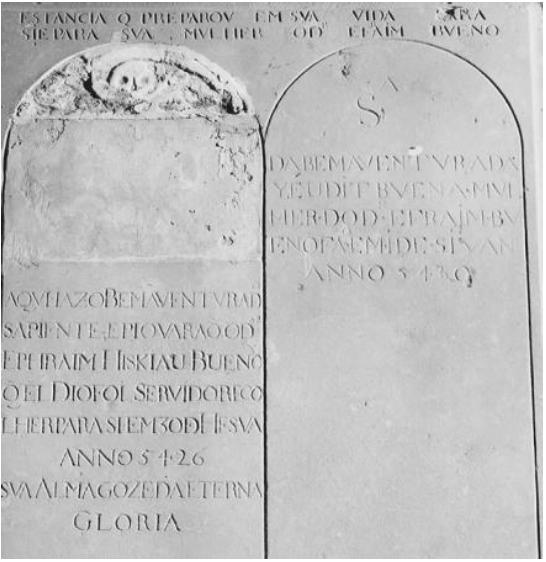
Rabbi Yom Tov Lipman Heller was born in 1578 in Wallerstein, a small village in Southern Germany, home to around twenty Jewish families (Davis 21). As a teenager, he married into a prominent family in Prague. His perspicacity and deep knowledge were quickly recognized, and at 19, he was appointed to serve on the Prague Beis Din, overseeing the largest Jewish community in Christian Europe (Davis 25-33). A year later, he published his first book, a somewhat unusual choice for a traditional rabbinic scholar, a commentary on the philosophical work Behinas Olam. He subsequently authored dozens of books across varied genres, completing his magnum opus, Tosefos Yom Tov in Heshvan 1616 (Davis 225-231). His identity quickly became bound up with this work, and even on the epitaph of his daughters’ headstone from 1639, he is referred to by the book and not his given name (Muneles 321). (The book’s original title is Tosefes Yom Tov, and later Tosefos Yom Tov. While some posit that this change was first documented in 1653, it already appears on the epitaph. (cf. Haberman 125n1)). He also “left ample records of himself… books, letters, archival documents, responsa, poems, prayers, sermons, commentaries, and even a memoir” (Davis 1). Nevertheless, there are no surviving portraits or other images.

Rabbi Heller spent time in Vienna on two occasions. The first, in 1625, he was induced to leave Prague for Vienna’s chief rabbi position. Despite his short tenure of only two years, he scored a significant victory for the Viennese Jewish community. Until then, it was dispersed throughout the city, and Heller secured the right for the community to reside in a single area and strengthen its ties. That cohesion was shattered in 1670 when Emperor Leopold I expelled them (one of the many expulsions Viennese Jews suffered), and the area was renamed after its extirpator, Leopoldstadt. Prague, however, drew him back, and in 1627, he took on the role of chief rabbi there.

Just two years later, some of the city’s Jewish community bristled at his involvement in tax collection, accusing him of determining tax rates unfairly. In June 1629, they denounced him to the government, which resulted in his arrest and summons to Vienna. He recounts the events in his autobiographical work, Megilas Eivah—an allusion to the first letters of the first four words of Megilas Eicha, written between 1644 and 1648. Initially placed under house arrest, he was imprisoned on the 17th of Tammuz and confined in a common jail with prisoners awaiting execution. He was denied visitors and remained isolated, “no one could speak with him, even via the window.” Two days later, following appeals from the Jewish community, he was transferred to a special prison and granted visitation rights. After forty days, the community agreed to pay a substantial fine, and he was released, almost immediately departing for Prague, never to return to Vienna. By 1643, he arrived in Krakow, where he served as chief Rabbi until his death in 1654. 

Megilas Eivah circulated in various manuscripts but was published only in 1836 (Davis 228 n31). While its authenticity is beyond doubt, the additional section that first appeared in the Hebrew 1880 edition is considered a forgery. Allegedly written by Heller’s son Samuel, it “has a quality reminiscent of Dumas and The Three Musketeers: [Heller] saves a young woman from a bull, and her husband, the French ambassador, intercedes on behalf of Rabbi Yom-Tov.” In 1905, “Moritz Steinschneider identified the source as based on a short story written by Ludwig Philippson (1811‒89), a rabbi and journalist, and the author of a series of Jewish historical novelettes and stories for young readers” (Davis 146 n36).

Samuel van Hoogstraten, Master of Illusion

Samuel van Hoogstraten was born in Dordrecht, one of the oldest cities in the Netherlands, on August 2, 1627. He was the eldest child of the artist Dirk van Hoogstraten and Maeiken de Coninck. Samuel started his art studies with his father, continuing until his father passed away in 1640. Around 1642, Samuel moved to Amsterdam and began studying under Rembrandt. He rapidly proved himself to be a standout student, leading classes, reviewing his classmates’ work, and so effectively absorbing his teachers’ lessons, that some of his works were mistakenly attributed to Rembrandt (Brusati 16-31). As part of the preparation for the current exhibit, “Young Woman at an Open Half-Door” (1645) has been reassigned to Hoogstraten (Illes; Van Sloten 125).

In 1651, Samuel traveled to Vienna, the epicenter of power and prestige within the Hapsburg Empire, seeking to enhance his reputation and standing among elite society. He succeeded almost immediately. Samuel’s student, Arnold Houbraken, recounted how, on August 6, 1651, Samuel presented three of his paintings to the emperor. The first two were well received, but “the third piece,” in the trompe l’oeil style, was a still life that captivated the Emperor, who appeared to be completely taken by it. He looked at it for a long time and, finding himself still deceived, said, ‘This is the first painter who has deceived me.’ And he went on to say that he would not get the picture back as a punishment for that deception, for the Emperor wished to keep it forever.” (Houbraken 2:157-58). However, Samuel did not leave empty-handed. The Emperor awarded him an imperial medallion and a gold chain, which he took immense pride in; this would become a standard element in his subsequent self-portraits and among the items he viewed as symbolic of successful artists (Hoogstraten 371-72; Brusati 54).

Hoogstraten broadly characterized art as a form of deception. In his magnum opus on the theory of painting and color, Inleyding tot de hooge schoole der schilderkonst: anders de zichtbaere werelt (Introduction to the Academy of Painting; or, The Visible World), he describes what he considers the “perfect painting.” It “is like a mirror of nature; it makes things that are not there appear to exist and deceives in a permissible, pleasurable, and praiseworthy way” (Hoogstraten 79). One way to achieve this effect is by combining architectural elements such as open doors or windows and adding “some figures” to the composition, “by which many have been artfully deceived” (Hoogstraten 304). He takes pride in having accomplished this with his paintings completed in Vienna. One is “Old Man at a Window,” painted in 1653. (Brusati 65).

The Religious Conversion and Reversion of the Old Man at a Window 

The earliest catalogs describing the painting Old Man at a Window do not mention the man’s religious affiliation. It was not until the 19th century that two scholars suggested a Jewish connection, and even then, there was no mention of Heller. Nonetheless, this association never gained traction, and the painting continued to be described without any reference to Jews. We must wait until the 1950s for Heller’s connection to emerge. However, that link lacked any supporting evidence, leaving us in the dark about what prompted the change from an Old Man to Heller. Even that association was quickly dismissed due to the significant gap between when Heller was imprisoned and when Hoogstraten painted Old Man at a Window.

The 1653 painting is one of the first works by Hoogstraten that Emperor Charles II acquired for his castle in Prague, possibly commissioned specifically for him. The painting is described in detail in an early catalog:

No. 4. By Samuel van Hoogstraten. A lifelike, grey-bearded old man looks out of a window. His fur hat, the furrows on his face from his age, and his grey beard are so well painted that one believes one can see nature itself in each one. Hoogstraten, who did not only paint as a mere colorist, showed his deep insight into the subject and reflected light in the chiaroscuro and the deep and penetrating shadows. Just look at the head . . ., and you will find that in it, the master’s hand, which . . . expresses itself quite magnificently. The lead on the round window pane, the wooden frame, that is the glass frame, is also very well painted, but the window’s stone frame makes you believe entirely that it is the work of a mason, almost as if you can see the mason’s hand on it. The straw stalk lying on the window stone, the feather, and the bottle standing there are no less well-painted and serve to prove the excellence of the whole. This picture is painted on canvas, 3 feet 6 inches high, 2 feet and 9 inches wide. The head is life-size. The artist has engraved his monogram and the year 1653 on the window stone of this painting” (Rigler 163-164).

During the 17th century, two inventories were created for the collection. In both, the painting is described as “a man sticking his head out of the window through the shutter,” without any reference to the man’s religious affiliation or any connection to Rabbi Heller (Köpl clvnn330; Brusati 361n76). Hoogstraten’s Old Man at a Window was relocated to Vienna after the Habsburgs acquired the Belvedere Palace in the 1730s. The Palace is perhaps best known today for Gustav Klimt’s “The Kiss” and other notable Viennese Expressionists. In one of the earliest catalogs of the Belvedere by Christian van Mechel from 1783, the subject is referred to simply as a “grey-bearded man with a round fur hat on his head, looking out curiously from a window” (Mechel 84n4). That is how the description remained, unadorned with any religious identity until the 19th century.

In the 19th century, two descriptions of the Old Man at a Window added his religion: he was a Jew. In 1839, German art historian Georg Rathgeber, in his study of Netherlandish art, asserts that “this picture’s title is “Böhmischen Juden,” “Bohemian Jew.’” Rathgeber disputes the identification not for its lack of historicity but because “the character of the facial features does not seem to correspond very well to” his antisemitic views on Jewish physiognomy (Rathgeber 147). Similarly, in 1861, French art critic Charles Blanc, in his encyclopedic work Histoire des Peintres de Toutes les Écoles, asserts that the Belvedere catalog now refers to the painting as “Un vieux juif (dit le Catalogue)” or “an old Jew (as it appears in the Catalog)” (Blanc 4). This portrait impressed Blanc and is among the few he reproduced in his discussion of Hoogstraten (Blanc 1). However, Blanc is notorious for identifying Jews in Rembrandt’s and his school’s works without any supporting evidence (Knotter and Schwartz 7-9). Contrary to the “catalog’s identification,” Blanc, like Rathgeber, asserts that the face “is not Israelite” (Blanc 2). Neither Blanc nor Rathgeber mentions Rabbi Heller.


Figure 2 Charles Blanc, Histoire des Peintres de Toutes les Écoles

Blanc’s and Rathgeber’s Jewish association did not take hold. For example, G.H. Veth, in his 1889 article discussing artists from Dordrecht, including Hoogstraten, cites Blanc and notes his reproduction of Old Man. However, Veth describes it without mentioning any Jewish connections (Veth 145). Similarly, a 1903 tour guidebook of Vienna confirms that at the Belvedere, the painting’s title remains unchanged as “Old Man at a Window” (Baedeker 73; cf. Gerson, 282).

Despite the absence of objective evidence and the dismissal of Blanc’s and Rathgeber’s 19th-century Semitic connection, one scholar in the 1950s cryptically associated Rabbi Heller with Hoogstraten’s painting. Margarethe Poch-Kalous, the head of the Academy of Fine Arts in Vienna (Akademie der bildenden Künste in Wien), in her 1959 survey of Dutch art in Vienna, refers to the figure as “ein bärtiger alter Mann (Rabbi Heller),” “a bearded old man (Rabbi Heller)” (Poch-Kalous 198). The basis for her identification is opaque. Poch-Kalous’ two citations offer no support; neither mentions Heller nor suggests that the figure is even Jewish, nor does she reference Blanc or Rathgeber (Poch-Kalous 198 citing Engerth 207n928 and Köpl clvnn330).

Oddly, unlike other personalities, artists, and subjects discussed in her article, which consistently include personal names and birth and death dates, Poch-Kalous provides nothing beyond “Rabbi Heller.” This is especially puzzling for an article in the Jahrbuch der Kunsthistorische Sammlungen, whose readership is unlikely to be sufficiently familiar with the history of 17th-century Bohemian rabbis to provide the missing details.

Whatever the basis for Poch-Kalous’s connection between Hoogstraten’s painting and Heller, it was swiftly dismissed. In 1972, Klaus Demus, the art historian and curator at the Kunsthistorisches Museum, demonstrated that it was impossible for Heller to be the model. He explains that Heller was imprisoned in 1629, and by 1644, he was serving as a rabbi in Krakow, where he remained until his death in 1654. Hoogstraten, who was only two years old when Heller was imprisoned in Vienna, painted Old Man at a Window in 1653, long after Heller had left Vienna (Demus 47-48). Today, the Kunsthistorisches Museum’s website alludes to Poch-Kalous’ attribution and rejection: “According to a tradition that is now presumed to be mistaken, the man is Rabbi Yom Tov Lipmann Heller.” Hoogstraten’s “deception” and “illusion” did not extend to rendering persons he never saw.

Illustrious Jews and Illusionary Jewish Sources

Jewish sources similarly are not more persuasive in linking Heller to Hoogstraten’s painting. Generally, rabbinic portraits prior to the 19th century lack authenticity (Cohen), and Heller is no exception. Most of the few early verifiable images exist as frontispieces in books rather than as paintings, and none depict Eastern European rabbis. Heller’s image first appears in Jewish sources in the early twentieth century. It depicts an old man, yet he is completely different from Hoogstraten’s version. The first instance of Heller masquerading as the Old Man at a Window is over a decade after Demus debunks that theory!

Figure 3 Bader, Drasig Doyres, 175

The first Jewish source of an alleged portrait of Rabbi Heller appears in a Yiddish collection of stories and hagiographies of rabbis in Gerson Bader’s Drasig Doyres Yiden in Poylen, published in 1927 (Bader 175). Bader’s depiction of Rabbi Heller does not resemble the individual shown in Hoogstraten. Bader claims that his source is an “old drawing,” yet he does not provide any further details, such as where or when it was published.

Bader’s book features other alleged rabbinic images from “old drawings” that are demonstratably false. For example, Bader’s portrait of R. Aaron Shmuel Kaidanover, author of the Birkas ha-Zevach on Kodshim, is of the Karaite and forger Avraham Firkovich (1787-1875) (Bader 185). It is undoubtedly Firkovich, as it appears in his Avnei Zikaron, published in 1872, during his lifetime. Similarly, Bader misattributes Joseph Delmedigo’s (1591-1655) portrait from the frontispiece of his Sefer Elim (Amsterdam, 1629), and the photo of R. Shmuel Salant by Zadok Bassan, assigning them to alternative rabbinic figures (Bader 204, 321). Nonetheless, Bader’s depiction of Heller was often reproduced, to the extent that in a 2000 biography of Heller, it is referred to as “iyur amimi nafuts shel ha-Tosefos Yom Tov,” “the widespread folk image of the Tosefos Yom Tov” (Herskovics 32).

Figure 4 Bader, Drasig Doyres Yiden in Poylen, 175.

Figure 5 Firkovich, Avnei Zikhron, From the Gross Family Collection, The Center for Jewish Art

It was only in 1984 that a Jewish source connected the Hoogstraten painting to Rabbi Heller. The cover of the book The Feast and the Fast: The Dramatic Personal Story of Yom Tov Lipman Heller, a translation of Megilas Eivah, depicts Rabbi Heller in prison and is modeled on the figure in the Hoogstraten painting. To eliminate any doubt about the source of the cover art, the back of the book features reproductions of title pages from Heller’s works and his gravestone, along with a photo “of the drawing in the Kunsthistorisches Museum in Vienna, Austria, entitled ‘Man at the Window’ (1653) by Samuel Van Hoogstraten (1627-1678)” (Lipschitz and Rosenstein). A similar image was used for the cover illustration of another translation of Megilas Eivah published in 1991 (Heller). The English section of the 2000 biography of Heller reproduces the cover of The Feast and the Fast, describing it as “featuring a picture of the Tosefot Yom Tov” (Herskovics 101). However, it does not attempt to reconcile this image with the clearly different “widespread folk image” presented in the Hebrew section of the biography. Although not mentioned in any of these sources, they were presumably misled by the bars on the window. However, those are not prison bars; rather, as was common in that era, the windows were supported by these architectural elements (Hermans 249).

Figure 6 Cover, Feast and the Fast, 1984

By 1999, however, Jewish sources also recognized the impossibility of associating Heller with the painting. R Ya’akov Yeruchum Wreschner republished Megilas Eivah based on four editions and two manuscripts and includes a comprehensive introduction regarding Heller. In two footnotes within the introduction, Wreschner briefly addresses Heller’s connection, or lack thereof, to Old Man at a Window. Like Demas, Wreschner contends that the nearly twenty-five-year gap between Heller’s departure from Vienna and Hoogstraten’s painting of Old Man renders it impossible for Heller to have been the model. Wreschner asks rhetorically, how could Hoogstraten “paint Rabbenu [Heller] when he never set eyes on him?” (Wreschner Megilas 48n3). Wreschner also contacted the Kunsthistorisches Museum and received a response confirming that “not only is it not the Rabbi, but it is not even a Jew” (Wreschner Megilas 17n4). As a result, Wreschner refused to reproduce that portrait in his book. Similarly, despite being titled Portrait of a Seventeenth-Century Rabbi, the most recent academic biography of Heller by Joseph Davis includes neither the Hoogstraten portrait nor any other image of Heller (Davis).

In 2024, Wreschner published a significantly revised and retitled edition of his book. Despite discrediting Heller’s connection to the painting over twenty years ago, various Jewish books, newspapers, and other ephemera continue to publish Old Man at a Window and link it to Heller (e.g., Alfasi 137; Stern 184-86; Berman). Wreschner was, therefore, compelled to revisit the painting, presenting additional arguments and greater detail regarding his discussions with the Kunsthistorisches Museum.

Wreschner, in 1999, first spoke telephonically with the Director of the Kunsthistorisches Museum, Dr. Karl Schütz, who confirmed that the painting was not connected to Heller. Schütz followed up with a letter detailing the sources for his rejection. Schütz stated that, with one exception, from the earliest catalogs to contemporary analyses of the painting, it was never associated with any specific individual, Jewish or otherwise. This is consistent with Hoogstraten’s intent, showcasing the trompe l’oeil technique rather than portraiture. The only time it appears – in Demus’s “detailed catalog of Dutch painters from 1972”—is solely to repudiate Poch-Kalous’s chronologically impossible and otherwise undocumented connection to Heller. Schütz also discredited the claim that following the Anschluss, the painting was categorized as Jewish art and consigned to the museum’s basement. On the contrary, a coterminous catalog lists the painting among those on display.

Despite Wreschner’s certitude about Schütz’s rejection, for unclear reasons, Wreschner attributes an otherwise unrecorded episode to Schütz. This alleged event appears to offer some support for linking Heller to the painting, but it is completely absent from the letter. According to Wreschner, the letter references an event in 1972 when an unidentified Jew approached the museum and claimed there was “a tradition that it was Tosefos Yom Tov” (Wreschner 2024, 24-26). The museum expressed skepticism about that tradition but did not completely dismiss it. In Wreschner’s retelling, it suggested the possibility that “a Jew conjured up Heller’s image and Hoogstraten copied it.” The actual text of the letter directly contradicts Wreschner’s account. Schütz references 1972 not as the date of an important meeting that supports the “legend” but as the first substantial discussion – by Demus – and his definitive rebuttal without mentioning a meeting with the Jew.

Beyond Schütz’s letter, Wreschner adds internal reasons why the painting cannot depict Heller in jail. The window is large enough for the man to stick his head out and features high-quality glass, an uncommon design for a prison. Furthermore, the expensive fur hat worn by the Man at a Window is an unlikely accessory in a prison housing hardened criminals sentenced to death and an incongruous headpiece for the July heat when Heller was imprisoned. Wreschner could have included another element in the painting that contrasts with a prison – the wall behind the Old Man has patterned wallpaper.

Following his earlier edition, Wreschner learned of an earlier source linking Heller to the painting, which is summarily dismissed. R. Shimon Fuerst, who lived in Vienna before 1940, in his book, Shem mi-Shimon, published in 1967, recalls visiting the museum where he saw firsthand “the painting made during the imprisonment” (Fuerst 426). Wreschner is unmoved by Fuerst’s identification. First, Fuerst was not an expert on Heller. Fuerst writes that Heller left Vienna to assume the Chief Rabbi position in Krakow, which is false. After his release, Heller returned to Prague, only leaving for Krakow fifteen years later. Aside from this obvious mistake, Fuerst’s opinion is irrelevant. Wreschner does not dispute Fuerst’s rabbinic bona fides, yet he is not an art historian. When faced with questions of rabbinic law, we defer to rabbis, but, according to Wreschner, “when it comes to questions of attribution of art, we look to experts in that field” (Wreschner 2024, 26). Regardless of the reliability of Fuerst’s claim, the mystery of Poche-Kalous’ source remains unsolved as her work predates Fuerst’s by four years.

Going Once, Twice, Three Times – Sold!

The identification of Heller with the Old Man at a Window is not the first, nor likely the last portrait erroneously attributed to a well-known Jew. One such example is the “traditional” portrait of the founder of the Hassidic movement, R Yisrael Ba’al Shem Tov. This portrait depicts a Ba’al Shem, a Wonderworker, but not Yisrael; rather, it is of Ya’akov Falk of London (Oron). He was an alchemist and an eccentric, and according to R Ya’akov Emden, a crypto-Sabbatian. However, evidence does not always prevail. Books and numerous sukkah decorations continue to utilize this portrait.

There is even another Hoogstraten portrait that falls into this category. A 1670 Hoogstraten portrait now in the Jewish Museum in New York was previously associated with Baruch (Bento, Benedictus) Spinoza. This is just one of many alleged portraits of Spinoza. Yet, most, if not all, lack independent verification or directly contradict the existing evidence (Ekkart). Indeed, “It is the same with the portraits as with so many other aspects of Spinoza’s life: little can be said with any certainty” (qtd. in Ekkart 25). This portrait was first linked to Spinoza in 1929, partly based on “a slip of paper on the back bearing the scholar’s name” (Ekkart 5). It is unclear who made that determination or even when the paper was inserted into the back of the painting. Consequently, the Jewish Museum now describes the painting as “Portrait of a Man (previously thought to be Baruch Spinoza).”

Similarly, despite art historians and Jewish sources resoundingly rejecting Heller’s connection to the Old Man at a Window, it seems unlikely that the idea of Hoogstraten depicting Heller will be dislodged in the collective Jewish consciousness. The attribution is so deeply ingrained that someone spent a staggering $120,000 before fees on a late 19th-century reproduction of Hoogstraten’s painting.

Figure 7 Lot 318, Kestenbaum Auctions, March 12, 2014

In 2014, the American Judaica auction house Kestenbaum & Company listed an 1887 painting described as “Yom Tov Lipman Heller, Portrait: Imprisoned in Vienna,” with a $12,000-$18,000 estimate. The portrait also served as the front cover image of the catalog. It is described as “the celebrated portrait of the Tosefos Yom Tov” and claims that Hoogstraten “painted Rabbi Heller in 1653 and entitled it ‘Old Man in the Window.’” The catalog warns that “it is not known if van Hoogstraten ever met or saw [Heller]; however, it is likely that he was aware of the Rembrandt (School) painting of 1643 entitled ‘Portrait of an Old Jew’ (today in the National Gallery of Denmark) – where a similar, bearded Jewish man, with head cocked, looks emotively at the viewer.” Scholars acknowledge that elements of Man at a Window and other Hoogstraten paintings evoke “the face studies of costumed figures routinely produced in Rembrandt’s studio,” but this does not transform the man into a Jew, let alone Rabbi Heller. The Jewish identification of the painting in the National Gallery of Denmark is also of questionable relevance. Some aspects of that painting, most notably the chain around the man’s neck, make it highly unlikely that it depicts a Jew (Alexander-Knotter 80-81). The catalog’s only citation for attributing the subject to Heller is the 1984 book, The Fast and the Feast, mentioned earlier. It does not reference Demus’ or Wreschner’s discussions that challenge that attribution. 

The significance assigned to the artistic rendition of the original is also debatable. The 1887 reproduction bears the signature of the artist “Paul Krüger.” However, Krüger was not a recognized artist; instead, it was a commercial reproduction company in Vienna that commonly attached its labels to the works. Its full name is “Paul Krüger Atelier für Porträtmalerei in Wien” (Paul Krüger Studio for Portrait Painting in Vienna). The studio functioned in the late 19th century and reproduced numerous paintings from the Kunsthistorisches Museum. Today, for those wanting to display a similar commercial reproduction of the painting on their wall, it is available through many websites that specialize in creating highly accurate copies of famous artworks. One such site offers a hand-painted version, almost the exact size of the original, with a similar frame, for about $1,400.


If the buyer had waited a year, they could have acquired an earlier reproduction by a recognized and significant artist. On May 18, 2015, Ferdinand Waldmüller’s (1793-1865) painting “Old Man at the Window,” modeled after Hoogstraten and executed in 1819, was auctioned with an estimate of €22,400 to €28,000. Unlike Krüger’s shop, which served as a commercial entity, Waldmüller is regarded as one of “the most important Austrian painters of the Biedermeier period.” Nevertheless, the lot remained unsold.

The Krüger copy may not be the best reproduction, but the auction catalog description proved worthwhile for reproduction. Rabbi Moshe Bamberger is the author of a series of books on “Great Jewish” items published by Artscroll. One book focuses on letters, another on important Jewish books, and another titled Great Jewish Treasures, is “A Collection of Precious Judaica, Associated with Torah Leaders.” This work contains a chapter dedicated to “Artwork” that discusses some well-known examples of rabbinic images. He ably covers several of these topics and discusses the traditional portrayal of Yisrael Ba’al Shem Tov, accurately aligning it with London’s Ba’al Shem, Jacob Falk.

Bamberger also includes a section focused on the “famous depiction of Rabbi Yom Tov Lipmann Heller (1579-1654) peering through the window of his prison cell” and reproduces a version of the Hoogstraten painting. Bamberger tries to reconcile the inconsistency between the dates of imprisonment and the time when Hoogstraten painted Old Man. Bamberger’s source is the auction catalog, yet he seems to disagree with one item: which of Rembrandt’s “Jews” Hoogstraten supposedly used as a model for Heller. Rather than the 1643 “Portrait of an Old Jew” attributed to Rembrandt’s school and currently housed in the National Gallery of Denmark; according to Bamberger, the model was the subject of a painting by Rembrandt, also titled “Portrait of an Old Jew,” now held in the Hermitage Museum in Leningrad. Bamberger does not provide a rationale for selecting the Hermitage painting over the one in the National Gallery. Nevertheless, the Hermitage painting is equally unlikely to depict a Jew and is now referred to generically as “Man in an Armchair.” (Schwartz 371-373). Ironically, Bamberger’s use of the Hermitage painting only reinforces the unlikelihood that Heller served as a model for Hoogstraten. The Hermitage Rembrandt originates from 1654, one year after “Old Man in a Window.” Hoogstraten certainly did not use a nonexistent painting to model his artistic expression.

Whether we will ever fully explicate to our satisfaction the enigmatic history of Hoogstraten’s 1653 painting Old Man at a Window, Hoogstraten’s masterful execution of the Trompe l’oeil technique makes the painting worth seeking out on its own. The exhibition closed in Vienna on January 12, 2025, but relocated to Rembrandt House in Amsterdam, “The Illusionist. Samuel van Hoogstraten,” from February 1 to May 4, 2025. The Amsterdam exhibition is entirely dedicated to Hoogstraten. To accompany the Vienna exhibit, the Kunsthistorisches Museum published a collection of articles titled Rembrandt Hoogstraten: Colour and Illusion, edited by Dr. Sabine Pénot, the Curator of Netherlandish and Dutch Paintings at the museum. This book is of excellent quality, beautifully reproducing many of the exhibit’s paintings and etchings. One article is a detailed study of Hoogstraten’s process and technique in Old Man at a Window (Hermens). While it employs various infrared and other technologies to uncover what lies beneath the surface, no rabbi is lurking behind the layers of paint.

* I want to thank Dr. Shnayer Leiman for bringing to my attention Gershom Bader as the earliest source of Heller’s representation within Jewish sources. I also wish to thank Professor Marc Michael Epstein, Professor Marc Shapiro, Dr. Lara Lempertienė, and Menachem Butler for their thorough review of the draft and invaluable feedback, Dr. Sabine Pénot for scouring the Kunsthistorisches Museum’s collection for information regarding Heller’s link to the painting, and Shaul Seidler-Feller for his expertise in translating Yiddish. Additionally, I am grateful to Rabbi Yaakov Yeruchum Wreschner for sharing his correspondence with the Kunsthistorisches Museum, and, as always, Eliezer Brodt, whose enviable encyclopedic knowledge, which he freely shares, ensured I did not overlook crucial materials.

Sources:

Alexander-Knotter, Mirjam, et al. The ‘Jewish’ Rembrandt, The Myth Unraveled. Waanders Publishers/Jewish Historical Museum, [2006].

Bader, Gershom. Drasyig Doyres Yiden in Poylen. Oriom Press, 1927.

Bamberger, Moshe. Great Jewish Treasures. Artscroll, 2015.

Blanc, Charles. Histoire des Peintres de Toutes les Écoles, vol. 2, “Samuel van Hoogstraten”. Paris, 1861.

Brusati, Celeste. Artifice and Illusion: The Art and Writing of Samuel Van Hoogstraten. University of Chicago Press, 1995.

Cohen, Richard I. Jewish Icons: Art and Society in Modern Europe. California UP, 1998.

Davis, Joseph M. Yom-Tov Lipmann Heller: Portrait of a Seventeenth-Century Rabbi. Littman Library of Civilization, 2004.

Demus, Klaus. Friderike. Katalog der Gemäldegalerie: Holländische Meister des 15., 16., und 17. Jahrhunderts. Kunsthistorisches Museum, 1972.

Ekkart, Rudi. Spinoza in Beeld: Het onbekende gezicht/Spinoza in Portrait: The Unknown Face. Amsterdam Vereniging het Spinozahuis, 1999.

Engerth, Eduard van. Gemälde Beschreibendes Verzeirchness, vol. 2. 1884.

Gerson, Horst. Ausbreitung und Nachwirkung der holländischen Malerei des 17. Jahrhunderts. De erven F. Bohn n. v, 1942.

Haberman, A.M. “Piyutav ve-shirav shel R. Yom Tov Lipman Heller.” Le-Kovod Yom Tov, edited by Judah Leib Maimon. Mosad HaRav Kook, 1956, pp. 125-145.

Heller, Yom Tov Lipmann. A Chronicle of Hardship and Hope. Translated by Avraham Yaakov Finkel, C.I.S. Publishers, 1991.

Hermens, Erma, et al. “Samuel van Hoogstraten’s Illusionistic Paintings for Emperor Ferdinand III – Two Case Studies.” Rembrandt Hoogstraten: Colour and Illusion, edited by Sabine Pénot. Hannibal, 2025, pp. 232-51.

Herskovics, Mayer. Two Guardians of the Faith: The History and Distinguished Lineage of Rabbi Yom Tov Lipman Heller and Rabbi Areyeh Leib Heller. Graphit Press, 2000.

Hoogstraten, Samuel Van. Introduction to the Academy of Painting; or, The Visible World. Edited by Celeste Brusati and Translation by Jaap Jacobs. Getty Research Institute, 2021.

Illes, Angelina. “List of Works.” Rembrandt Hoogstraten: Colour and Illusion, edited by Sabine Pénot. Hannibal, 2025, 258.

Knotter, Mirjam, and Gary Schwartz, editors. Rembrandt Seen Through Jewish Eyes: The Artist’s Meaning to Jews from His Time to Ours. Amsterdam UP, 2024.

Lipschitz Chaim Uri, and Neil Rosenstein, The Feast and the Fast: The Dramatic Personal Story of Yom Tov Lipman Heller. Moriah, 1984.

Mechel, Christian van. Verzeichniß der Gemälde der Kaiserlich Königlichen Bilder-Gallerie in Wien, Vienna, 1783.

Oron, Michal. Rabbi, Mystic, or Imposter. Translated by Edward Levin. Littman Library of Jewish Civilization, 2020.

Poch-Kalous, Margarethe. “Das Legat Wolfgang van Wurzbach-Tannenberg an die Gemäldegalerie der Akademie der bildenden Künste in Wien,” in Jahrbuch der kunsthistorischen Sammlungen in Wien vol. 55, 1959.

Rathgerber, Georg. Annalen der Niederländischen Malerei und Kupferstecherkunst: Van Rubens Abreise nach Italien bis auf Rembrandt’s Tod. Gotha, 1839.

Rigler, Hieronumus. “Beschreibung und Beurtheilung verschiedener Gemälde der S.S. Bildergalerie in Belvedere van Hieronymus Rigler aus dessen 1783 herausgegebenen, ausser Wien wenig bekannten und bereits geendigten mächentlichen Anzeigen van Künstlern und Kunstsachen,” in Miscellaneen artistischen Innhalts, 21, 1784, pp. 158-177.

Schwartz, Gary. The Rembrandt Book. Abrams, 2006.

Stern, Yechiel Michel. Gedoli Ha-Doros. Minchas Yisrael, 1996.

Van Sloten, Leonore and David de Witt. “Challenged by Rembrandt,” in Samuel van Hoogstraten, The Illusionist. Edited by Nathalie Maciesza and Epco Runia. WBOOKS, 2025.

Wreschner, J. Megilat Eivah le-Ba’al Ha-TY”T.  [], Jerusalem, 1999.

Wreschner, J. Ha-Tosefos Yom Tov u-Megilaso. [], Beni Brak, 2024.

Appendix:

Hoogstraten’s painting was copied and reinterpreted multiple times, with variations in style and even gender. (See Brusati 361, which discusses two copies in royal collections.)

A few more examples:

A more compact version with a whiter and shaped bear is attributed to a Dutch painter of Hoogstraten’s school and possibly one of the versions mentioned by Brusati.

Described as 18th Century Flemish School, without identification of a specific artist, sold for CHF 800.

Two versions: a man that is a crude likeness of Old Man in a Window and a woman wearing a linen cap sold for $2,000.

An alternative version of a woman was painted by Josef Hauzinger, (1726-1787), currently at the Pushkin Museum in Moscow. A later version of this rendering appeared at auction in 2022.
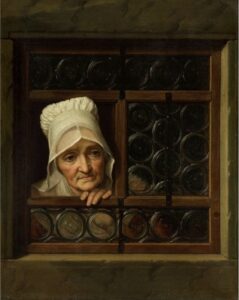
Old Woman in a Window

Another example of a woman at the window is a 1936 Picasso painting.


The Enigma of Abraham Rosenberg, R. Yitzchak Scheiner, Mordecai Kaplan, and Prof. Marvin Fox

The Enigma of Abraham Rosenberg, R. Yitzchak Scheiner, Mordecai Kaplan, and Prof. Marvin Fox


Marc B. Shapiro

Abraham Rosenberg made his first appearance during the dispute over Solomon Friedlaender’s forged Yerushalmi Kodashim. He portrayed himself as a student of Friedlaender. Here is the title page of his booklet Aneh Khesil in which he defends Friedlaender from the attacks of his critics.


Rosenberg also wrote some other things in defense of Friedlaender, including an article in the Frankfurt Orthodox paper Der Israelit and letters to various figures who were involved in the dispute over the Yerushalmi Kodashim.

Who was Rosenberg? Discussion of this will be found in R. Baruch Oberlander’s forthcoming book on the forged Yerushalmi Kodashim, a work which is sure to be a tour de force of scholarship. (The Hungarian version of the book has already appeared.) Based on what R. Oberlander documents, I don’t think there can be any doubt that Rosenberg was not a real person but was a creation of Friedlaender. Even the city that Rosenberg claimed to be rabbi of does not exist. In the meantime, for those who want to learn about this fascinating story, I recommend this video from R. Oberlander.

The story becomes even stranger, as beginning some fifteen years after Rosenberg’s first appearance in the Yerushalmi Kodashim controversy, a few articles written by an otherwise unknown “A. Rosenberg” appeared in 1923 and 1924. Friedlaender died in January 1924, so in theory it is possible to argue that he is the author of these articles that appeared in the Hebrew section of the German Orthodox journal Jeschurun.[1] Yet it is much more likely that the articles were written by someone else who took the pseudonym. Two of the articles in Jeschurun focus on the Jerusalem Talmud. The other article deals with how biblical verses are cited with variations in the Babylonian and Jerusalem Talmuds, and Rosenberg argues against the notion that these quotations are evidence of biblical readings at variance with what is found in the so-called Masoretic text. In addition to these articles, Oberlander also refers to A. Rosenberg’s Al Devar Tikunei Nushaot bi-Yerushalmi, which was published in Lodz, 1928 (so at least it says on the book’s title page). This is four years after Friedlaender’s death, so he could not have been the author.


If you look at Rosenberg’s book, you can’t help but be impressed that the author knows the Jerusalem Talmud and rishonim, and he is also on top of modern scholarship. At first glance, it seems that were very few people in the world at that time who were able to write such a work, which has led to speculation about who the author could be. Oberlander, in his forthcoming book, writes as follows:

מהרב פרופ’ ש”ז הבלין שמעתי את ההשערה ש”א. רוזנברג” מירושלים אינו אלא פרופ’ שאול ליברמן (1898-1983), שידוע כמי שאהב מעשה קונדס כאלו (ראה גם י”ש שפיגל: ’עמודים בתולדות הספר העברי – בשערי הדפוס ‘עמ’ 46 הערה 151, 48 הערה 161). אמנם פרופ’ מלך (מרק) שפירא במכתבו אלי דוחה השערה זו, שהרי עד שנת 1928, כשהתחיל ללמוד באוניברסיטה העברית בירושלים, לא היה לו לליברמן שום ידע מדעי ולא השתמש בשיטות מדעיות בלימודים שלו. ראה Elijah J. Schochet and Solomon Spiro, Saul Lieberman – The Man and His Work, New York, 2005, p. 7-8

Oberlander cites Prof. Shlomo Zalman Havlin who speculates that A. Rosenberg is none other than Saul Lieberman. Indeed, a cursory examination of Rosenberg’s book shows great similarity with Lieberman’s works on the Yerushalmi and Tosefta. Yet when R. Oberlander asked me about this, I told him that Lieberman could not have written Al Devar Tikunei Nushaot bi-Yerushalmi. On p. 106 we see that the book, which shows great awareness of modern scholarship, was completed erev Yom Kippur 1926. Rosenberg’s articles in Jeschurun from a few years before also show an awareness of modern scholarship. Yet until Lieberman began studying at the Hebrew University in 1928, he had not been introduced to academic scholarship on the Talmud,[2] and he certainly was not writing anything about this in the early 1920s.

If Lieberman is the author of Al Devar Tikunei Nushaot bi-Yerushalmi we must assume that there are three A. Rosenbergs. 1. Friedlaender, 2. the author of the Jeschurun articles, 3. Lieberman. Even if Lieberman has nothing to do with the book, it is still possible that the author of Al Devar Tikunei Nushaot bi-Yerushalmi took the name “A. Rosenberg” in imitation of the earlier author in Jeschurun, but they are not the same person.

I asked Havlin what led him to conclude that Lieberman is the author. He replied by noting that we cannot learn anything from the name “A. Rosenberg”, and he added that even the year and place of publication (Lodz) are not certain. In other words, it is possible that the book actually appeared after 1928 and was published in Palestine.

Havlin noted a few other considerations that led him to his conclusion: The book appeared at the same general time as Lieberman’s Al ha-Yerushalmi (Jerusalem, 1929), the improbability of attributing such a work to anyone else during this period, Lieberman’s relationship with J.N. Epstein (see below), and that Lieberman had a mischievous streak that could have led him to publish the book anonymously. Havlin also noted that he heard the following from Prof. Yaakov Sussman. Sussman asked Lieberman about Al Devar Tikunei Nushaot bi-Yerushalmi, and Lieberman responded: “Sheigetz, how did you come to this book?” By refusing to discuss the book with Sussman, or even to comment about who authored it, it is obvious that Lieberman was hiding something. Furthermore, I would add, isn’t it strange that Lieberman never refers to this book in any of his writings on the Yerushalmi? Here is a book with the exact sort of research that Lieberman was doing and yet he doesn’t mention it. דבר זה אומר דרשני.

Havlin also noted the following: On p. 19 n. 31 the author refers to a book of his in manuscript with the title המדע התלמודי וצרכיו. This is actually the title of a 1925 lecture delivered by J.N. Epstein upon assuming his position at the Hebrew University. The lecture was later published in Yediot ha-Makhon le-Madaei ha-Yahadut 2 (1925), pp. 5-22. Clearly the author was having some fun here, and we know that Lieberman had an interesting relationship with Epstein. Another personal comment is found on p. 91 where the author refers to R. Chaim Heller as “my friend”.

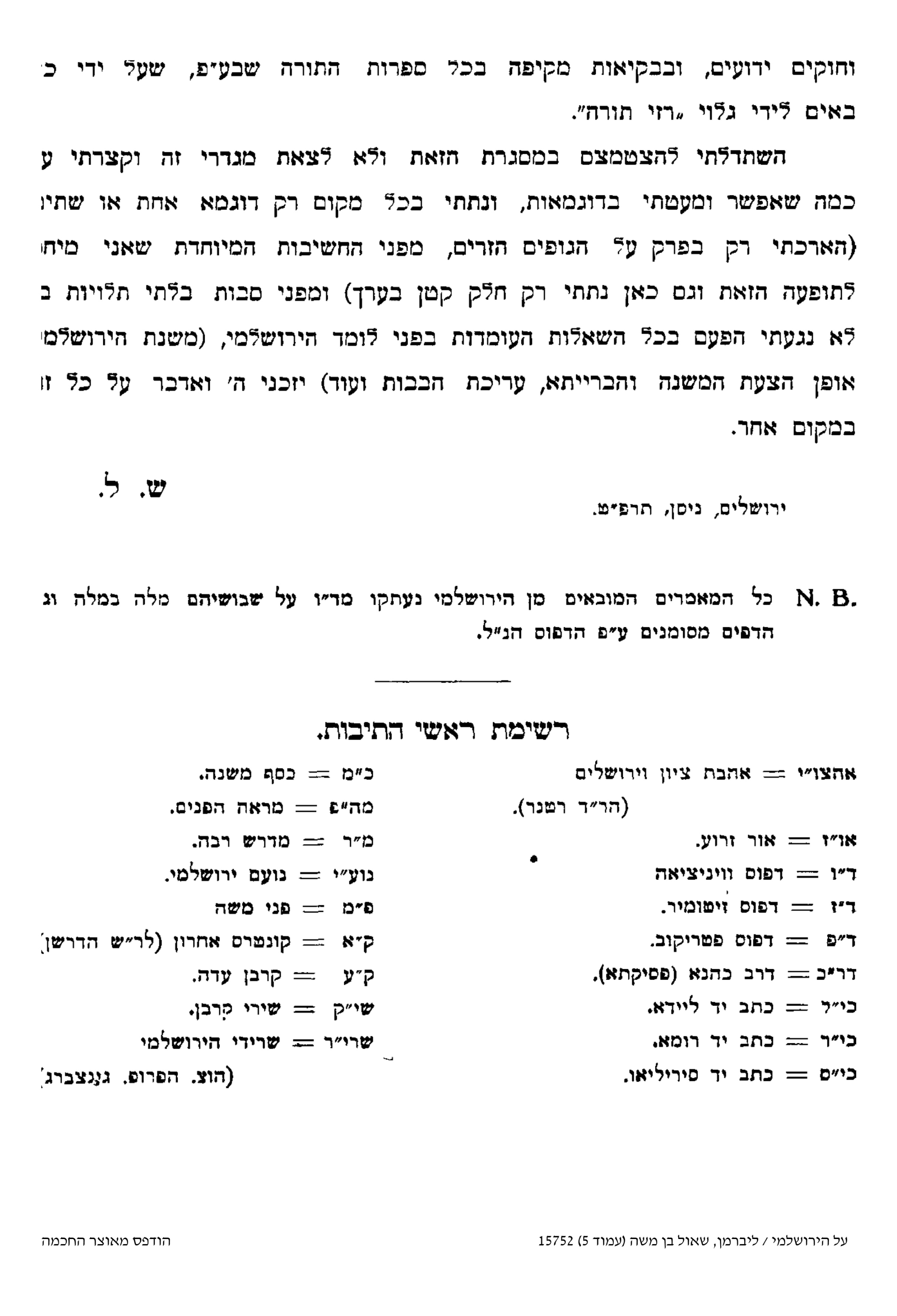
Returning to the quote above from R. Oberlander, he cites Yaakov Spiegel who gives two examples of Lieberman being a bit unconventional in some of his writings. In his book Amudim be-Toldot ha-Sefer ha-Ivri: Be-Sha’arei ha-Defus,[3] Spiegel notes that in the preface to the 1970 publication of the first volume of R. David Pardo’s Hasdei David on Taharot, which was edited by Lieberman (as were the next two volumes on Taharot), Lieberman signs his name in the preface as .ש.ל. Spiegel adds:

יש אומרים שחתם את שמו בראשי תיבות ולא בשמו המלא, מפני שרצה שהספר יכנס לבית המדרש, והמבין יבין

Yet this is incorrect, as Lieberman always ended the prefaces to his books with his initials. We see this beginning with his first book, Al ha-Yerushalmi, published in Jerusalem, 1929, long before he ever thought of joining the JTS faculty.


So his use of initials has nothing to do with covering up who he was, and on the very first page of the preface to Hasdei David he refers to what he wrote in Tosefta ki-Feshutah. However, it is noteworthy that Lieberman’s name does not appear on the title page of the book as you can see here.

This, perhaps, was due to a desire to have the book accepted in yeshivot. It is one thing to have references to Tosefta ki-Feshutah inside the book, and something else entirely to have Lieberman’s name on the title page, which might have prevented yeshivot from purchasing Hasdei David.

Spiegel also notes that Louis Finkelstein is referred to in the preface to Hasdei David as ר’ אליעזר אריה נר”ו בהרב ר’ שמעון הלוי ז”ל, without his last name. Spiegel sees this as a way of hiding Finkelstein’s identity, just as Lieberman did with the others mentioned in the preface. One of the people Lieberman refers to is הרב ר’ יהושע נר”ו בהרב ר’ יהודה ליב who discovered the manuscript of R. Pardo. (This is R. Yehoshua Hutner.) Lieberman also mentions two other people, one who transcribed the manuscript and another who proofread the book. It is possible that one or more of these individuals did not want to be mentioned by name as helping Lieberman, and this explains why Lieberman abridged all the names, including Finkelstein’s. But I repeat, Lieberman’s name in the preface is not in code, as .ש.ל is how he always signed the end of the prefaces of his books.

Spiegel[4] also notes that in Sinai 85 (1979), p. 199, the following short piece is signed בלי שם.

It is known, Spiegel tells us, that this was written by Lieberman. He also mentions that there is a hint to Lieberman’s authorship in that all the letters in בלי שם are found in Saul Lieberman’s name. This is indeed significant, as it shows us that for whatever reason, Lieberman was not averse to writing anonymously. In fact, in 1932 Lieberman used the pseudonym .ל.ל when he published a note in Tarbiz.[5] In 1936 he again published a note with this pseudonym.[6]

When I first examined Al Devar Tikunei Nushaot bi-Yerushalmi, I too thought that Lieberman must have written it, for the reasons already mentioned. What stood out most to me, as I have mentioned already, is that Lieberman in his many writings, including those that focus on the Jerusalem Talmud, never referred to the book even though it does the same thing what he was doing in Ha-Yerushalmi ki-Feshuto. I assumed that had anyone other than Lieberman written the book he certainly would have mentioned it, at least in the introduction to Ha-Yerushalmi ki-Feshuto, even if only to express his disagreement about certain matters. Obviously, Lieberman had a reason for not referring to this book, and I assumed it was because he did not want to associate his later scholarship with it.

Yet when I looked carefully at Al Devar Tikunei Nushaot bi-Yerushalmi and compared it to other writings of Lieberman on the very same sugyot, I was not able to find any parallels. This is so even though the book is written in the same style as Lieberman’s writings. Just when you would have expected some repetition from Al Devar Tikunei Nushaot bi-Yerushalmi in Yerushalmi ki-Feshuto and Tosefta ki-Feshutah, you find nothing.

I also noticed that there is a good deal of fraudulence in Al Devar Tikunei Nushaot bi-Yerushalmi, and it is impossible to imagine that Lieberman, in his alter ego “Rosenberg,” would have been a part of this. For example, on p. 5 in the note he cites Solomon Buber from Ha-Levanon, Sep. 18, 1872, as stating that there is a Yerushalmi Kodashim in the Vatican. Yet if you look at Buber’s article you find that he says the exact opposite, that there is no such manuscript there. Buber further states that he doesn’t believe that there ever was a Yerushalmi Kodashim. What is the point of “Rosenberg” providing such misinformation other than to play games with the readers? On p. 30 n. 37, “Rosenberg” actually states that he thinks that portions of the Yerushalmi Kodashim published by Friedlaender are authentic. This makes no sense, as there was no manuscript to which Friedlaender could have added his own material.[7] All academic scholars in the 1920s knew this, so what kind of fraudulence is “Rosenberg” peddling here? Interestingly, on pages 3 and 8 “Rosenberg” also refers to the earlier work by the other Rosenberg (i.e., Friedlaender), the booklet Aneh Khesil. This must be seen as an inside joke, especially since the page number given is 36 but the booklet doesn’t have this many pages.

Only after I had gone through Al Devar Tikunei Nushaot bi-Yerushalmi did I learn that the entire book is a series of plagiarisms from earlier authors, as has been noted by Elyashiv Cherlow[8] and an anonymous commenter here. Cherlow also points out that “Rosenberg” quotes a Geniza text that he invented from thin air. I too found an example of the author’s plagiarism that is not noted by Cherlow or the anonymous commenter: The lengthy passage, with numerous sources, found on pp. 71-72 n. 57, is lifted word for word from Avigdor Aptowitzer’s article in Ha-Tzofeh le-Hokhmat Yisrael 1 (1911), pp. 87-88.

There are some other strange things in Al Devar Tikunei Nushaot bi-Yerushalmi. For example, what is one to make of the dedication to the Jewish communal leader Louis Marshall?

Since this post has dealt with Lieberman, even if only to reject the notion that he is the author of Al Devar Tikunei Nushaot bi-Yerushalmi, let me add a couple of more points about him. From 1918-1962 there was an Orthodox publication called the Jewish Forum.[9] In the January 1961 issue there appeared an article by “Dayyan al-Yahud” sharply criticizing Conservative Judaism. In this article the author also took aim at Lieberman, referring to him as a “careerist”. He writes:

We ask, in all sincerity, where is the steadfastness of principle and consistent loyalty to Torah-Tradition on the part of the same Professor? This “guiding spirit” of the new kethubah, who only a few years ago, when the Agudath Harabbanim of the United States and Canada had declared Dr. Mordecai M. Kaplan under “herem” (anathema), himself recognized the “herem” as binding upon all Traditional Jews and refused to be in Kaplan’s company, as evidenced, in our presence, by his demonstrably stepping out of the Seminary elevator at the very entrance to the main building of the Seminary, no sooner than Dr. Kaplan had stepped in.

Such incongruous and compromising practices on the part of the Seminary’s present “scion” of Halakhah must of necessity lead to lack of reverence for time-honored traditions by its student body and graduates. No wonder that the latter, with few exceptions, are now groping in darkness and exhibit vacillation and uncertainty in their respective ministries.

Quite apart from the criticism of Lieberman, the passage is significant because the author testifies to having personally seen that Lieberman had previously observed the herem against Kaplan and refused to be in his presence.[10]

Who is Dayyan al Yahud? If you google the name, you will find that he also wrote articles critical of Kaplan and Heschel, yet none of the American authors who refer to Dayyan al Yahud identify who he is. He also wrote a number of articles under this pseudonym in Or ha-Mizrah. Yet his identity was never really a secret and is none other than the noted scholar Israel Elfenbein (1891-1964). The author of many works, Elfenbein is most known for his scholarly edition of Teshuvot Rashi (New York, 1943), which incidentally also includes notes from Louis Ginzberg. Elfenbein became a significant figure in American Orthodoxy, serving as editor of Or ha-Mizrah and education director of Religious Zionists of America. He was also honored with a Jubilee Volume (Jerusalem, 1963), which in addition to articles from various academic scholars, also has contributions from R. Eliezer Silver, R. Yehudah Gershuni, R. Nissan Telushkin, R. Leo Jung, and R. Menahem M. Kasher. Elfenbein also engaged in polemics against Conservative leaders. Yet one would not have expected his prominence in Orthodoxy, as in his early years Elfenbein received semikhah from the Jewish Theological Seminary and served as rabbi of the Conservative congregation Adath Israel in Nashville from 1915-1916.[11] 

In truth, Elfenbein’s identification with Orthodoxy was a return to his youth, as before he came to America he had studied in Pressburg and had received semikhah from R. Shalom Mordechai Schwadron. That at least is the story told by his relative, Y. N. Adler,[[12] but being that Elfenbein came to America when he was fifteen years old, is it really possible that he received semikhah at such a young age?[13] Upon arriving in New York in 1906 he entered Yeshivas Rabbeinu Yitzchok Elchonon (where his classmate was Bernard Revel, who himself had received semikhah at age 16).[14] With such a background in traditional Torah learning, how did Elfenbein end up at JTS?

Adler tells a fascinating story, different versions of which we know from other sources as well, although as far as I can tell, only the Rabinowitz article (see note 15) mention Elfenbein’s name. During Elfenbein’s time at RIETS—from other sources we know that the year was 1908—he and some friends wanted to study at a university (Yeshiva College did not yet exist). They therefore took the regents exam which allowed them to apply to institutes of higher learning. According to Adler, among the students who were part of this group, and who later became quite distinguished, were Rabbi Baruch Shapiro, who later served as rav in Seattle, Rabbi Louis Epstein, Rabbi Yehiel Kaplan, Dr. Israel Efros, Rabbi Solomon Goldman of Chicago, and Dr. Abraham Neuman.

This action, Adler tells us, greatly upset the rabbinic leadership of RIETS. In response to this, Elfenbein and his friends stopped learning at RIETS and set up a beit midrash, which they called Beit ha-Midrash ha-Elyon, in the Adass Bnei Yisrael synagogue of R. Solomon Elhanan Jaffe. (Other sources record the name as “Yeshivah le-Rabbanim”.) This beit midrash did not last long, and most of the students, including Elfenbein, transferred to JTS.[15]

Returning to Lieberman, there is another interesting comment in R. Dov Cohen’s Va-Yelkhu Shneiheim Yahdav, p. 168. He mentions how in Jerusalem Lieberman was treated with great respect at the Chevron Yeshiva, even after he had gone to the university. As for his going to JTS, Cohen recalls a biting hasidic comment about mitnagdim, that for Torah study a Litvak would even enter a church!

האיש היוה דוגמא למה שהיו החסידים טוענים על המתנגדים, כי התורה בליטא התקדשה עד כדי כך שעבורה היה מוכן הליטאי להכנס לכנסיה. . . [הנקודות במקור] אחר שהתגורר כמה שנים בירושלים, נמלך בדעתו כי מוטב שילמד באין מפריע. מאחר שהציעו לו משרה חשובה בסמינר קונסרבטיבי באמריקה, נסע שם וקיבלה. הוא לא שיתף עמם פעולה בסיוע לדרכיהם הנלוזות, חלילה. גם שם היה יושב בחדרו ועוסק בגמרא וכן בחיבור ספריו על התוספתא. זכורני שבכינוס של אגודת הרבנים באמריקה, בו השתתפתי, התייחסו אליו כאל “אחד משלנו” שיכול לעזור ולסייע, אף שהוא “אצלם”. גם הרב אברמסקי, התקיף והלוחם, קיבלו בכבוד גדול. שמעתי גם כן, שהוא החזיק מכספו כמה וכמה בני תורה בירושלים.

Regarding Lieberman, I have one final point to make. In Saul Lieberman and the Orthodox, p. 7, I mentioned a November 1930 letter from Lieberman to Louis Ginzberg in which Lieberman writes that he began working on a great project on the Jerusalem Talmud, but had to stop because one cannot work on Berakhot without knowing all of the Yerushalmi. Only when he finished the entire Jerusalem Talmud did he pick up the project again. I added that the project Lieberman refers to must be Ha-Yerushalmi ki-Feshuto, which appeared in 1935.

Here is the relevant section of Lieberman’s letter:

 התחלתי ג”כ בעבודה גדולה על שדה הירושלמי אבל הוכרחתי לעזוב אותה מפני שאי איפשר [!] לעבוד ב”ברכות” כל זמן שאינם יודעים [!] את כל הירושלמי עד “נדה” ורק בקיץ זה אחרי גמר הירושלמי שבתי עוד הפעם לברכות

The problem with my assumption that Lieberman’s project was Ha-Yerushalmi ki-Feshuto is that this book includes his commentary on ShabbatEruvin, and Pesahim, and in his letter he speaks of returning to Berakhot. Yet I didn’t know of anything else that could fit the description of a great project on the Yerushalmi during this time period. 

Dan Rabinowitz has, I think, provided the answer. He called my attention to Tovia Preschel’s article in Ma’amrei Tuviah, vol. 2, pp. 155-156. Preschel recounts that not long after Lieberman settled in Jerusalem in 1928, he was asked by R. Michel Rabinowitz to assist him in translating the Yerushalmi into Hebrew. Lieberman replied that he had never studied the Yerushalmi and he can’t translate a work that he doesn’t know. He asked for time to immerse himself in it, and for the next year and a half he completed the Yerushalmi a few times. In the end, the Hebrew translation did not appear, but I have to agree with Dan that it is this project that Lieberman is referring to in his letter to Ginzberg, not Ha-Yerushalmi ki-Feshuto.

2. Since I mentioned RIETS earlier in this post, let me add the following. In 2022 the ArtScroll biography of R. Yitzchok Scheiner appeared, authored by Nachman Seltzer.[16] This book tells how R. Scheiner was living in Pittsburgh and was intending to attend a local university. However, a fundraiser for RIETS (i.e., Yeshiva College) was in Pittsburgh and convinced R. Scheiner’s parents to send him there. Seltzer, p. 30, includes all of one paragraph dealing with R. Scheiner’s time at Yeshiva College. I quote it here, followed by the two subsequent paragraphs.

The winter that Yitzchok Scheiner enrolled at Yeshivas Rabbeinu Yitzchok Elchonon was cold, dark, and dreary. Though he had been raised in Pittsburgh and was no stranger to the grayness and never-ending winter months, the young man came down with the kind of cold that turned into something more serious and that he couldn’t seem to shake.

The illness that plagued him for so many months would turn out to be a blessing in disguise, because it forced him to find a place to convalesce.

In those early years, Jewish camps suitable for yeshivah bachurim were few and far between, which is why, come summertime, Yitzchok Scheiner found himself on a bus headed up to the mountains, to the one and only Camp Mesivta, founded by the legendary R. Shraga Feivel Mendlowitz. It was a summer that would change his life.

Seltzer continues by describing how at camp R. Scheiner was influenced to enroll in Torah Vodaath at the end of the summer. Interestingly, the book never refers to Yeshiva College, only Yeshivas Rabbeinu Yitzchok Elchonon, but R. Scheiner was enrolled in the college, in addition to studying in the yeshiva.

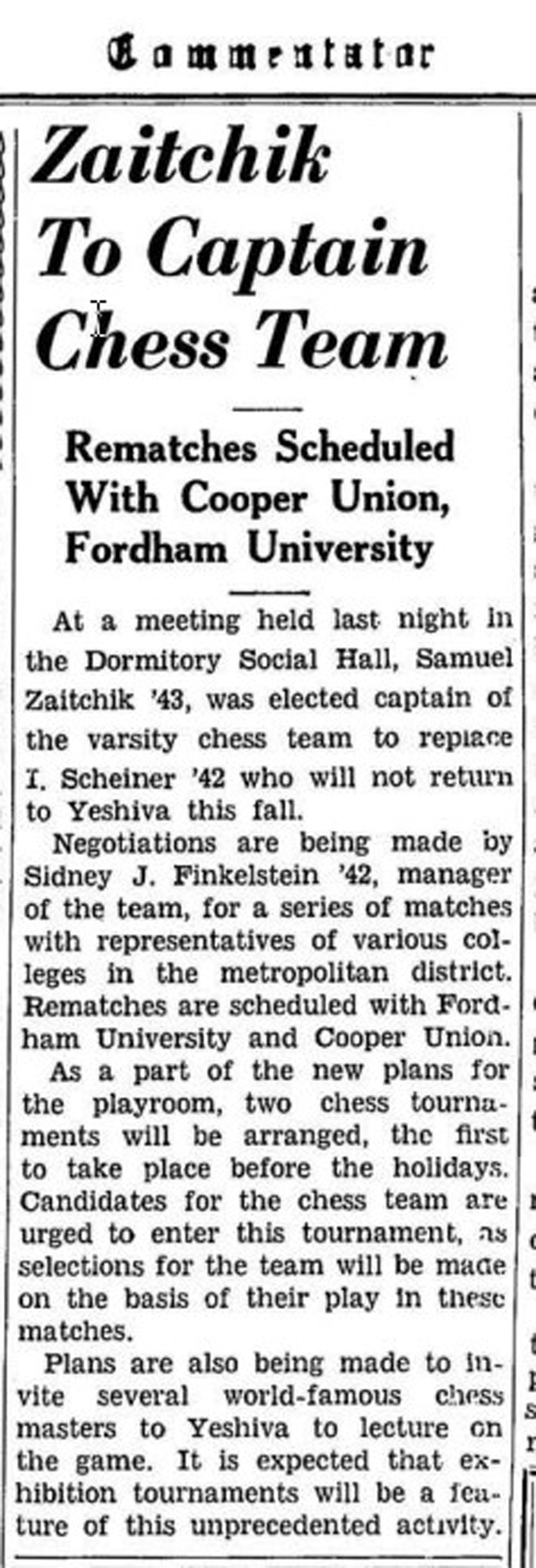
According to Seltzer, R. Scheiner was only at Yeshiva College for less than one academic year, for he tells us that he enrolled in the winter. As far as I know, this is incorrect, and he was at Yeshiva College the entire academic year 1939-1940. In fact, he was on the chess team and was even chosen as the captain.

This page from the Yeshiva College yearbook, Masmid 1940, can be seen here.

What complicates matters is that R. Scheiner himself said that he was at Yeshiva College for two years (and this was after a semester at the University of Pittsburgh, a point which is not mentioned by Seltzer).[17] According to the records of the University of Pittsburgh, Office of the University Registrar, Isadore Leon Scheiner attended the University of Pittsburgh for a semester in 1938-1939, during which time he took seven classes (I presume that the semester ended in January.) Even if R. Scheiner entered Yeshiva College for the spring 1939 semester, his time there would have been three semesters, not two years, so presumably when he said “two years” he was not being exact. By fall 1940 R. Scheiner – who was on track to graduate in 1942 – had left Yeshiva College. We know this because the Sep. 18, 1940 issue of the Yeshiva College Commentator mentions that he is no longer there.[18]

In discussing his time at Yeshiva College, R. Scheiner states: “When I got there, I discovered that the other students did not take Torah learning as seriously as I wanted to or as seriously as some of the rabbeim wanted them to, so I left.”[19]

Interestingly, in an interview that appeared on Matzav.com here, R. Scheiner does not mention that he attended Yeshiva College, or perhaps this was censored by Matzav.com:

Where did the Rosh Yeshiva learn in his youth?

HaRav Scheiner: I learned in the United States, in Yeshivas Torah Vodaas, from Rav Reuven Grozovsky zt’l, Rav Boruch Ber’s son-in-law and from Rav Shlomo Heiman zt’l. There was a group of students who would go to Lakewood to hear Rav Aharon Kotler’s shiurim and I sometimes joined them. Some of them stayed on afterwards to learn there permanently, among them HaRav Elya Svei. The Rosh Yeshiva, Rav Reuven Grozovsky, made my shidduch.

R. Scheiner would later teach at the Etz Chaim Yeshiva in Montreux, Switzerland, where he developed a close relationship with R. Jehiel Jacob Weinberg who lived in the town. For R. Scheiner, it was a great privilege to be in such close proximity to one of the gedolei Yisrael, and they spent much time together “talking in learning.” When R. Scheiner moved to Jerusalem, they continued their relationship by mail, with many Torah letters going from one to the other.

Here is a never-before publicized picture of R. Weinberg, together with R. Scheiner. The man in the middle who is speaking is R. Meir Just of Amsterdam. I thank Israel Bollag for sending it to me. (In a future post I will include more unknown pictures of R. Weinberg, including some in color.)

Unfortunately, the only mention of R. Weinberg in Seltzer’s book is in the following paragraph (p. 81).

There were other great Torah scholars teaching at the yeshivah in Montreux alongside Rav Yitzchok. One of them was R’ Betzalal Rakow, who would later be appointed rav of Gatesehad, England. R’ Yechiel Yaakov Weinberg, also known as the Seridei Eish, also spent time in the yeshivah.

R. Weinberg never officially taught at the yeshiva, although he would sometimes give the opening shiur of the semester. I assume this is what Seltzer means by “spent time in the yeshivah.” The real problem with the paragraph is that it makes it seem as if these three figures were colleagues, and at the same level. The truth is that both R. Scheiner and R. Rakow regarded R. Weinberg as a rebbe of sorts, which is understandable, especially as he was decades older than them.

3. In my last post here, I linked to a lecture from Professor Isadore Twersky that I found at the University of Scranton. Dr. Marc Herman called my attention to another video here in which Prof. Twersky appears. Unlike the video I posted, in this video you can hear Prof. Twersky very clearly. I was at Harvard when this presentation took place, yet I had no idea that Twersky was ever on this panel.[20] I think people will find it interesting that the moderator is none other than Alvin Bragg, the current Manhattan District Attorney. Prof. Harvey Mansfield also appears and is provocative as always (this time saying that grade inflation came about because of Affirmative Action).

4. Earlier in the post I mentioned Mordecai Kaplan, so here is a good place to add another point about him. Kaplan’s father, R. Israel, was close to R. Isaac Jacob Reines. (Mordecai Kaplan was actually born in Svencionys, where R. Reines had served as rav.) This explains why Kaplan, who had already been ordained by the Jewish Theological Seminary, turned to R. Reines when he wished to acquire a semikhah from a well-known rabbi. Everyone who writes on this matter refers to Kaplan traveling to Europe on his honeymoon after his June 2, 1908 wedding, at which time he also received semikhah from R. Reines who was then serving as rav in Lida.[21] People have generally assumed that he traveled to Lida to receive the semikhah.

In 1994 Jacob J. Schacter published a picture of R. Reines’ semikhah, dated 28 Elul, 5668 (Sep. 24, 1908). From this document we see that Kaplan actually met R. Reines in Frankfurt, and that is where they “spoke” in learning, following which R. Reines gave him semikhah. Schacter writes: “While traveling through Frankfurt he met his father’s old friend, Rabbi Yizhak Reines, spent some time with him, and received rabbinic ordination from him.”[22] This is based on Kaplan’s own recollection where he writes: “I had the opportunity to meet the late Rav Yitzhak Reines in Frankfort-on-the-Main and to obtain the requisite Hatarat Hora’ah from him.”[23]

Did Kaplan just happen to be passing through Frankfurt while on his honeymoon? The answer is no, and I’m happy to share something that is completely unknown: Kaplan was actually in attendance, together with R. Reines, at the 1908 Frankfurt Mizrachi conference. Here is the report of the conference in the Sep. 4, 1908 issue of the Cracow newspaper Ha-Mitzpeh. Kaplan is mentioned in the first paragraph.

5. In Hakirah 32 (2022), I published a number of letters from R. Joseph B. Soloveitchik. One of them was sent to Professor Marvin Fox who had asked the Rav about the synagogue he attended, Agudas Achim of Columbus, Ohio. The synagogue had recently built a new building and instituted mixed seating.[25] Fox also turned to R. Mordechai Gifter. Here is R. Gifter’s letter to Fox.

Here is a draft of a Hebrew letter from Fox to the Rav.

It is not known if Fox ever sent the Hebrew letter, or if he sent an English one. I would presume the latter, as the Rav’s reply, that appears in Hakirah, is in English. 

Fox’s archive also contains the following English letter. In the Rav’s June 1955 letter in Hakirah, he is responding to Fox’s 1955 question about praying in a synagogue without a mechitzah (i.e., Agudas Achim). The letter below is from a later period and asks about praying in the synagogue’s beit midrash, in which no women are present. (As Fox’s son Avi informed me, Fox was at Harvard during much of 1956; this letter to the Rav is from when he returned to Columbus after his time in Boston.)  Fox’s archive does not contain a reply to this letter.

Here is the letter that Fox sent to Rabbi Samuel Rubenstein, the rabbi of Agudas Achim.


Fox’s reference in the Hebrew letter concerning the synagogue of R. Leopold Greenwald—of Kol Bo al Avelut fame—as not having a regular mehitzah is of interest. R. Greenwald was a strong opponent of anything smacking of reform. He himself spoke strongly against mixed seating in the synagogue and would never enter a synagogue with such an arrangement. Yet his own synagogue, Beth Jacob, against his wishes also decided to remove the mehitzah. Since it still kept separate seating, R. Greenwald felt that he could remain as rabbi even though he was not happy with the situation.[25]

While Beth Jacob remained in the Orthodox fold, and would later reinstall a regular mehitzah, in 2004 Agudas Achim decided to affiliate with the Conservative movement.

All the letters published above are found in the Marvin Fox Papers, Box 11 and Box 29, Brandeis University, and appear here courtesy of the Robert D. Farber University Archives and Special Collections Department, Brandeis University.

Since in this post I mention both R. Bernard Revel and R. Mordechai Gifter, let me add one more point regarding them. In 2011 Milei de-Igrot, vol. 2, appeared. This contains the letters between R. Gifter and his rebbe at RIETS, R. Moshe Aharon Poleyeff.

In addition to all the Torah the volume contains, it also offers us insights regarding both of these rabbis’ personalities and the history of Orthodoxy in the U.S. and Lithuania. Here is p. 168.


In addition to describing the incredible effect that Telz had upon him, R. Gifter also levels strong criticism against the אדמון running Yeshiva College who is destroying young people by exposing them to heresy. This refers to R. Revel who had a red beard. In fact, R. Aharon Rakeffet informed me that the opponents of R. Revel used to refer to him in a disgusting way as the “reiter hunt”.

6. In my last post I had the following quiz questions:

1. Which Hebrew book was the first one to use footnotes (and the footnotes even used Arabic numerals)?

2. Point to a halakhah on Pesach that the Shulhan Arukh decides in accord with the Rosh, while the Rama records the practice in accord with the Rif and the Rambam.

The answer to no. 1 is R. Noah Hayyim Zvi Hirsch Berlin, Ma’yan ha-Hokhmah (Rodelheim, 1804).[26] No one answered this question.


The answer to no. 2, which a few people answered correctly, is found in Shulhan Arukh, Orah Hayyim 474. Here R. Joseph Karo rules like R. Asher ben Jehiel, cited in Arba’ah Turim, Orah Hayyim 474, that there is no blessing on the second and fourth cups of wine at the Passover seder. R. Moses Isserles rules like the Rif, Pesahim 24a in the Alfasi pages, and the Rambam, Mishneh Torah, Hilkhot Hametz u-Matzah 8:5, 10, that one recites the blessing on all four cups.

*********

[1] “Pesukei Mikra she-be-Talmud,” Jeschurun 4 (1923), pp. 43-47, available here,“Le-Heker ha-Talmud ha-Yerushalmi,” ibid., pp. 109-112, available here, ibid., 5 (1924), pp. 18-20, available here.

[2] See Elijah J. Schochet and Solomon Spiro, Saul Lieberman: The Man and His Work (New York, 2005), p. 8.

[3] (Jerusalem, 2014), p. 46 n. 151.

[4] Amudim be-Toldot ha-Sefer ha-Ivri: Be-Sha’arei ha-Defus, p. 48, n. 161.

[5] “Od ‘le-Tikunei Girsaot be-Sifrei,’” Tarbiz 3 (1932), p. 466.

[6] See B. M. Lewin, ed., Alumah (1936), p. 156. This source and the prior one are listed in Tovia Preschel’s bibliography of Lieberman’s writings here. While this is a very complete bibliography, it omits one source that is completely unknown, and which fans of Lieberman will certainly want to examine. Here is a short article by Lieberman that appeared in Otzar ha-Hayyim 10 (1934), pp. 83-84.


[7] In the article in Jeschurun, “Le-Heker ha-Talmud ha-Yerushalmi,” p. 110, “A. Rosenberg”  states that the Jerusalem Talmud to Kodashim is lost, and he does not mention Friedlaender. Regarding the Yerushalmi Kodashim, I recently found that R. Mordechai Vorhand, Be’er Mordechai, p. 152, states that he is not going to take a stand regarding its authenticity. This is quite strange as Be’er Mordechai appeared in 1927 and the forgery had already been established for a number of years. Even stranger is that R. Menahem Mendel Kirschbaum, Menahem Meshiv, vol. 2, p. 8, also cites the Yerushalmi Kodashim. His responsum is from 1933 and Menahem Meshiv, vol. 2, was published in 1938. How could anyone at this late date still cite the Yerushalmi Kodashim? Interestingly enough, R. Kirschbaum disputes “the commentator’s” (i.e., Friedlander’s) understanding of the passage he is dealing with. Of course, “the commentator” is none other than the author (forger) of this passage, who presumably knows what he himself intended. This point is made by R. Shlomo Yosef Zevin, Soferim u-Sefarim, vol. 1, p. 307. In Menahem Meshiv, vol. 1, p. 163 (published in 1936), R. Kirschbaum shows that he is aware of the forgery, so he must have assumed that despite the forgery, some of the Yerushalmi Kodashim published by Friedlander is authentic. This explains how in Menahem Meshiv, vol. 1, pp. 70, 234, he cites Yerushalmi Bekhorot as authentic. R. Yeruham Fishel Perla states that portions of the Yerushalmi Kodashim are indeed authentic, while Friedlander forged the rest. See his edition of R. Eshtori ha-Parhi, Kaftor va-Ferah, p. 145b.

[8] “Toldot ha-Nusah shel ha-Talmud ha-Yerushalmi: Iyunim be-Kit’ei ha-Genizah,” Tarbiz 87 (2020), p. 610 n. 70.

[9] See Ira Robinson and Maxine Jacobson, “When Orthodoxy was not as Chic as it is Today”: The Jewish Forum and American Modern Orthodoxy,” Modern Judaism 31 (Oct. 2011), pp. 285-313.

[10] Regarding Lieberman and the herem against Kaplan, see my Saul Lieberman and the Orthodox, pp. 19-20. See my post here for the text of the herem against Kaplan. Here is a tidbit that is not generally known: As late as 1945, when Kaplan’s theological views were public knowledge, he was still a member of the Rabbinical Assembly’s Committee on Jewish Law. See David Golinkin, ed., Proceedings of the Committee on Jewish Law and Standards of the Conservative Movement 1927-1970 (Jerusalem, 1997), vol. 1, p. 155.


[11] See herehere, and here.

[12] See Adler’s article in the Elfenbein Jubilee Volume, pp. 9-14. Adler twice says that Elfenbein studied nine years at RIETS, but this is an obvious mistake, and is contradicted by the dates in Adler’s own article.

[13] For an earlier post in which I deal with young rabbis, see here. R. Ovadya Hoffman called my attention to another young rabbi (I also mention Hoffman in the post just linked as he noted an additional young rabbi): It is reported R. Yitzhak Isaac Katz (1753-1787) was thirteen years old at his marriage and was also appointed rabbi of Koretz at this time. His Wikipedia entry is here. The information about him becoming rav at age thirteen in found here in the biographical introduction to his Zikhron Kehunah (Lvov, 1863). I don’t know of any other examples of a thirteen-year-old who served as the official rav of a community. In the Encyclopaedia Judaica entry on R. Meshullam Roth (called “Rath” in the EJ), written by R. Mordechai Hacohen, it states that he was ordained at the age of 12 by R. Isaac Shmelkes and R. Jacob Teomim. This detail is not found in any of the sources listed in the bibliography so it is hard to know where R. Hacohen came to this information. One of the descendants of R. Roth told me that he never heard that R. Meshullam received semikhah at age 12.

[14] Aaron Rakeffet-Rothkoff, Bernard Revel: Builder of American Jewish Orthodoxy (Jerusalem/New York, 1981), p. 30.

[15] For more on student restlessness at RIETS and the 1908 student strike, see Gilbert Klaperman, The Story of Yeshiva University (London, 1969), chs. 5-7 (on pp. 115ff. he discusses the Elfenbein group); Hayyim Reuven Rabinowitz, “60 Shanah li-Shevitot bi-Yeshivat R. Yitzhak Elhanan,” Ha-Doar, June 14, 1968, pp. 552-554. See also Eli Genauer’s Seforim Blog post here which includes R. Baruch Shapiro’s recollections of the 1908 student strike.

[16] Nachman Seltzer, Rav Yitzchok Scheiner: The Life and Leadership of the Kamenitzer Rosh Yeshivah (Brooklyn, 2022).

[17] See the Pittsburgh Post-Gazette, May 1, 1998, p. A-14; Samuel Heilman, Defenders of the Faith (Berkeley and Los Angeles, 1992), p. 262. Chapter 17 in Heilman’s book is an interview with R. Scheiner, and as Heilman informed me, R. Scheiner told him that was at Yeshiva College for two years. He must have also provided this information to the Pittsburgh Post-Gazette. See also here.

[18] This page from the Commentator was posted by Dovi Safier here.

[19] Heilman, Defenders of the Faith, p. 262. I have corrected Heilman’s spelling of “rabbaim” to “rabbeim”.

[20] Regarding Twersky, I found it interesting that in a recent article Levi Cooper refers to him as a “noted academic and hasidic master.” See Cooper, “Jewish Law in the Beit Midrash of Hasidism,” Dine Israel 34 (2020), p. 63.

[21] See e.g., Mel Scult, Judaism Faces the Twentieth Century: A Biography of Mordecai Kaplan (Detroit, 1993), pp. 26, 96.

[22] Jacob J. Schacter, “Mordecai M. Kaplan’s Orthodox Ordination,” American Jewish Archives 56 (1994), p. 6.

[23] Ibid., p. 7. Schacter , ibid., also writes that R. Reines did not rigorously examine Kaplan, and therefore the semikhah should not be “considered an indication of any advanced talmudic scholarship on Kaplan’s part.” This reminded me of something interesting regarding the name “Mordechai”. According to Tosafot, Menahot 46b, s.v. amar, the name Mordechai was a second name given to those who showed great intellect and knowledge: בקיאים בעלי שכל ומדע. See also Tosafot, Bava Kamma 82b, s.v. ve-al:

דכל אותן שהיו בקיאים ברמזים ובלשונות היו נקראים על שם מרדכי לפי שהוא היה ראש וחכם להכיר

In Italy, people with the Hebrew name Mordechai were often named Angelo in Italian. This is likely because of the rabbinic identification of the biblical Mordechai with the prophet Malachi (and Malachi is akin to מלאך, i.e., “angel”). See Megillah 15a; Moshe David Cassuto, Ha-Yehudim be-Firentzi bi-Tekufat ha-Renesans, trans. Menahem Hartom (Jerusalem, 1967). p. 183.


[24] According to Marc Lee Raphael, Jews and Judaism in a Midwestern Community: Columbus Ohio, 1840-1975 (Columbus, 1979), p. 348, the synagogue also had mixed seating even before the new building, but as we see from Fox’s letter this was not the case.

[25] See Raphael, Jews and Judaism in a Midwestern Community, p. 348; Adam S. Ferziger, Beyond Sectarianism: The Realignment of American Orthodox Judaism (Detroit, 2015), p. 26; Rivka Schiller’s article on Greenwald here.

[26] This is noted by R. Binyamin Shlomo Hamburger, Ha-Yeshivah ha-Ramah be-Fiorda (Bnei Brak, 2010), vol. 2, p. 115. How is the first word of the sefer, מעין, to be pronounced? It has become common in modern Hebrew to pronounce it as “ma’ayan”. Yet this is not how it appears in the Bible. There the word has a shewa under the ayin, מַעְיׇן, so the word is to be pronounced ma’yan. The change in pronunciation of this word is noted by Joshua Blau, “Al ha-Mivneh ha-Murkav shel ha-Ivrit ha-Hadashah le-Umat ha-Ivrit she-ba-Mikra,” Leshonenu 54 (1990), p. 106. The plural of מעין is מַעְיָנוֺת, as seen in Is. 41:18, Prov. 8:24, II Chron. 32:4 (Ps. 104:10 has מַעְיָנִים). Therefore, it is unfortunate that the popular Bergen County, N.J. girls’ school has as its name “Ma’ayanot,” instead of the correct word, “Ma’yanot”. Yet in conversation, it appears that pretty much everyone seems to pronounce it correctly as Ma’yanot.


“Ha’Rotzeh Lichanek, Hitaleh B’Ilan Gadol”: Notes on some Literary forgeries of Jewish works in the the Late Modern Period (1756-1965)

Ha’Rotzeh Lichanek, Hitaleh B’Ilan Gadol”: Notes on some Literary forgeries of Jewish works in the the Late Modern Period (1756-1965)

By Ezra Brand

Ezra Brand is an independent researcher based in Tel Aviv. He has an MA from Revel Graduate School at Yeshiva University in Medieval Jewish History, where he focused his research on 13th and 14th century sefirotic Kabbalah. He is interested in using digital and computational tools in historical research. He has contributed a number of times previously to the Seforim Blog (tag), and a selection of his research can be found at his Academia.edu profile. He can be reached at ezrabrand-at-gmail.com; any and all feedback is greatly appreciated.

Introduction

Jewish literary forgeries are a topic often discussed on the Seforim Blog, especially in the postings of Dr. Marc Shapiro (see the tag “Literary Forgery” for some of the relevant posts).[1] A “literary forgery” refers to a writing which claims to have been written by a certain, usually respected, figure, while in fact written by a later, usually much lesser known, writer.

A recent collection of articles on forgeries states: “There has been a growth in the number of publications dedicated to fakes and forgeries for around thirty years now, many of which have focused on books and literary works.”[2]

The classic source regarding literary forgeries in Jewish writing is that of the Talmud Bavli, Pesachim 112a:

חמשה דברים צוה ר”ע את רבי שמעון בן יוחי כשהיה חבוש בבית האסורין […] אמר לו אם בקשת ליחנק היתלה באילן גדול.

Translation by Koren-Steinzaltz, as appears in Sefaria website (bold in the original translation):

Rabbi Akiva commanded Rabbi Shimon ben Yoḥai to do five matters when Rabbi Akiva was imprisoned […] if you wish to strangle yourself, hang yourself on a tall tree.

Koren-Steinzaltz translation adds the explanation:

“This proverb means that if one wants others to accept what he has to say, he should attribute his statement to a great man.”

This interpretation is based on Rashi’s explanation:

אם בקשת ליחנק – לומר דבר שיהיה נשמע לבריות ויקבלו ממך. היתלה באילן גדול – אמור בשם אדם גדול.”

According to Rashi’s interpretation, this source permits fabricating a quote from an authority in order to be believed.[3] 

Based on this interpretation, the term often used in rabbinic writing for “forging” in someone else’s name is “תלה ב”, literally “hung on X”, meaning “ascribed (falsely) to X”.

The great scholar of Mishpat Ivri, Nahum Rakover, devotes a portion of his book on intellectual property in halacha, to a discussion of the sources that permit fabricating a quote from an authority in order to be believed.[4]

Some recent historians seem to imply that the 19th century saw a relative uptick in Jewish literary forgeries. Golda Akhiezer, in a 2018 article on Jewish historical forgeries in the 19th century, writes:[5]

One of the paradoxes of European cultural life of the nineteenth century, especially in the Russian Empire, was a combination of two parallel yet apparently conflicting processes: the emergence and increasing importance of modern science and the rise of multifarious forgeries of historical documents.”[6]

It should be pointed out that this isn’t truly paradoxical. Anthony Grafton famously noted the deep relationship between critical scholarship and forgeries.[7]

Ira Robinson also implies an uptick in Jewish literary forgeries in the 19th century, and gives a somewhat different theory as to why this time period gave rise to so many forgeries:

By the end of the nineteenth and the beginning of the twentieth centuries, the highly charged ideological atmosphere, as well as an ever-growing demand for Jewish books, engendered a situation in which there was great temptation to manufacture documents.[8]

However, it is remains speculative whether in fact there were a relatively larger number of Jewish literary forgeries in the 19th century. This question awaits a more quantitative study of the topic.[9]

Table of Notable Forgeries

It’s important to note that this list is not to be comprehensive. Rather, it’s a collection of especially notable forgeries, and some notes on them. I hope to update this list at a later date, and of course happy to hear suggestions.

Title Editor Earliest date (terminus post quem) Previous posts and bibliography
Divrei Gad Ha’Chozeh Leopold Immanuel Jacob van Dort 1756 10
Mishle Asaf (haskamot) Isaac Satanov 1783-1791 11
Besamim Rosh Saul Berlin 1793 12
Ramschak Chronicle Marcus Fischer 1828 13
Zekher Tzaddikim Mordecai Sultansky 1841 14
Sefer Avnei Zikaron Abraham Firkovich 1845-1872 15
The Roads of Jerusalem Eliakim Carmoly 1847 16
Sefer Ha’Eshkol R’ Zvi Binyamin Auerbach 1863 17
Baraita de-Ma’aseh Bereshit Lazarus Goldschmidt 1894 18
The Protocols of the Elders of Zion series of articles in Russian newspaper 1903
Goral HaAsiriyot (1904); Seder Hagada Le’Maharal (1905); Nifla’ot Maharal (1909); Refa’el HaMalach (1911); Tiferet Maharal MiShpoli (1912); Hoshen Mishpat (1913); Divrei HaYamim Asher LiShelomo HaMelech (1914); and more R’ Yehudah Yudel Rosenberg 1904-1914 19
Yerushalmi on Kodshim Solomon Judah Friedlander 1907–1909 20
Genizat Kherson 1922 21
Der Prager Golem (1917); Kovetz Michtavim Mekori’im MiHaBesht VeTalmidav (1923); Heichal LeDivrei Chazal (1948); Sefer Dovev Siftei Yeshenim (1959-1965) Chaim Bloch 1917-1965 22
Kol Hator R’ Shlomo Zalman Rivlin 1939 23

Forgers

There are two works whose genre can be described as “halachic”: Saul Berlin’s Besamim Rosh (1793) and R’ Zvi Binyamin Auerbach’s Sefer Ha’Eshkol (1863).

It is quite noticeable that perpetrators of literary forgery of Jewish texts were especially prominent outside of mainstream Orthodox Judaism, and created their forgeries for polemical reasons: Karaites (forgeries of Sultan and Firkovich), Maskilim, and anti-Semites (Protocols of the Elders of Zion).

Forgery of tendentious works relating to history are especially common:[24]

  1. Forged tombstone inscriptions and manuscript colophons (Firkovich)
  2. Forged chronicles (Sultanski ; Ramschak Chronicle)
  3. Forged travelogue (The Roads of Jerusalem of R’ Isaac Hilu)
  4. Forged protocols of meetings (Protocols of Elders of Zion)
  5. Forged letters (Genizat Kherson ; Bloch’s Kovetz Michtavim and more)[25]
  6. Fake stories (Rosenberg ; Bloch)

Bloch and Rosenberg, who create forgeries for popular entertainment purposes, are closer to the end of the date range, and both made prominent forgeries about the golem of the Maharal: Bloch’s The Letter of the Maharal on the Creation of the Golem (1923) and Rosenberg’s Nifla’ot Maharal. For Bloch, the polemical motivation of anti-Zionism played a role in other forgeries.

Isaac Satanow is the most playful, self-aware forger of them all. He even added fake “haskamot” to his Zohar Chibura Tinyana from well-known late 18th-century rabbinic figures (R’ Yosef Teomim and R’ Chaim Halberstam of Sanz), having the haskamot point out the possibility that Satanov himself wrote the works, but giving halachic justification for the permissibility of forgery.[26]

Rakover, in his book Zekhuyot Yotzrim (cited above), was misled by Satanow. In his discussion of permissibility in halacha of false quotation and literary forgery,[27] Rakover quotes the “haskamot” to Satanov’s as showing that forging is halachically permitted. It appears that Rakover wasn’t aware that the haskamot themselves are most likely forged.

Two of the first forgers discussed here, Saul Berlin and Isaac Satanow, had similar ideologies, and. Satanow may have assisted in fabricating Besamim Rosh.[28]

Conclusion

The issue of Jewish literary forgeries has received further prominence recently in the scholarship of R’ Moshe Hillel. R’ Hillel has written a number of works exposing forgeries. His most famous work is on Divrei Gad HaHozeh, a work purporting to be from the times of King David, published from an 18th century manuscript by Professor Meir Bar-Ilan in 2015. R’ Hillel argues that it is in fact an 18th century forgery.[29]

Hillel also wrote a book earlier this year called Hazon Tavrimon devoted to R’ Yakov Moshe Toledano (1880-1960), dealing with various historical documents that Toledano “discovered”, demonstrating that they are fake.[30]

Computer algorithms have also played a role in detecting forgeries, or refuting allegations of forgery, most prominently in the work of Professor Moshe Koppel. Some of this work has been featured in the Seforim Blog.[31] Hopefully, this software will be further refined to shed light on additional works that have been accused of being forged, to supplement the traditional tools used for proving authenticity on the one hand, and uncovering forgeries on the other.

[1] Thanks to Eliezer Brodt for reviewing and providing very helpful comments on this piece. I’d also like to thank my father for looking over a previous version of this blog post.

[2] Cécile Michel, Michael Friedrich (eds.), Fakes and Forgeries of Written Artefacts from Ancient Mesopotamia to Modern China (De Gruyter 2020), p. 1. See further bibliography in footnote there.

[3] However, Rashbam there gives a different explanation of the passage. He interprets that it’s not saying anything about deception. Rather, it’s simply giving advice that if you want people to listen to what you have to say, you should study from a master, so that you can then (correctly) quote him. The term “choke” is used simply because the term “high tree” is used.

For a wide-ranging discussion of sources discussing the interpretation of this passage, see Marc Shapiro, Changing the Immutable, pp. 259-261.

[4] See נחום רקובר, זכות היוצרים במקורות היהודיים, תשנ”א, עמ’ 25-36.

See also Shapiro, Changing the Immutable, and bibliography there.

[5] “Historical Research and Forgeries in the Age of Nationalism: The Case of the Russian Empire Between Jews and Russians”, East European Jewish Affairs 48. 2 (2018): 101 – 102.

For a general article on Jewish forgeries, see Cecil Roth, “Forgeries”, Encyclopedia Judaica, 1st edition (1972), pp. 125-126.

[6] In general, Ahiezer ibid. states on p. 110: “Due to the vastness of the topic, it is impossible to provide an exhaustive treatment of Jewish ahistorical writing and forgeries in this article.”

[7] Grafton, Forgers and Critics: Creativity and Duplicity in Western Scholarship, 2019 (2nd edition).

[8] Robinson, “Literary Forgery and Hasidic Judaism: The Case of Rabbi Yudel Rosenberg”, Judaism, 40 (1991), pp. 61-62.

[9] I’d like to thank Eliezer Brodt for raising this point in private communication.
[10] See Hillel, משה הלל, מגילות קוצין: בין דברי גד החוזהלאגרת רבן יוחנן בן זכאי“, על עמנואל יעקב ואן דורט וחיבוריו הבדויים (תשע”ח).
[11] See משה פלאי, “יצחק סאטאנוב ושאלת הזיוף בספרות“, קרית ספר נד תש”ם, עמ’ 817-824 ; בנימין ש’ המבורגר, “האם ניתן לסמוך על יצחק סאטאנוב?“, המעין, גליון טבת תשס”ט, עמ’ 86-91. here
[12] Previous Seforim Blog posts: 2006 ; Rabinowitz and Brodt 2010 ; Shaprio 2007 ; Brodt 2019 ; Maimon 2020. See bibliographies here נריה גוטל, ‏יחסו של הראיה קוק לספר בשמים ראש” “, JSIJ‏ 5, 2006, הערה 4 ; ר’ אליעזר יהודה בראדט, “ציונים ומילואים למדור נטעי סופרים“, ישורון כד (ניסן תשע”א), עמ’ תכה, והערה 5 (עמ’ תכה-תכז).

To those bibliographies can be added: Talya Fishman, “Forging Jewish Memory: Besamim Rosh and the Invention of Pre-Emancipation Jewish Culture,” in Jewish History and Jewish Memory, ed. by Elisheva Carlebach et. al (1998), pp. 70-88; Emile G. L. Schrijver, “Saul Of Berlin’s “Besamim Rosh” : The Maskilic Appreciation Of Medieval Knowledge”, Sepharad in Ashkenaz, Ed. by Resianne Fontaine et. al (2007), pp. 249-259.
[13]  Meir Lamed, “Fischer”, Encyclopedia Judaica, 2nd edition (2007); Meir Lamed, “Lieben, Salomon Hugo”, Encyclopedia Judaica, 2nd edition (2007); Iveta Cermanová, “The Ramschak Chronicle: New Findings about the Genesis, Reception and Impacts of the Forgery”, Judaica Bohemiae 52/2 (2017), pp. 33-67 ; Ahiezer (2018), p. 111 ; E. Randol Schoenberg, Who was the first Ramschak? | Schoenblog.com (February 5, 2021).
[14] Golda Akhiezer, Encyclopedia Judaica, 2nd ed. (2007), “Sultansky, Mordecai Ben Joseph”; גולדה אחיעזר, “מרדכי סולטנסקיקווים לדמותו וכתיבתו ההיסטורית“, קראי מזרח אירופה בדורות האחרונים: ד’ שפירא, ד’ לסקר (עורכים), מכון בן-צבי, ירושלים 2011, עמ’ 170–196; Akhiezer (2018), p. 105.
[15] See the many articles by Dan Shapira, most recently Michael Nosonovsky, Dan Shapira, and Daria Vasyutinsky-Shapira, “Not by Firkowicz’s Fault: Daniel Chwolson’s Comic Blunders in Research of Hebrew Epigraphy of the Crimea and Caucasus, and their Impact on Jewish Studies in Russia,” Acta Orientalia Hung., vol. 73, no. 4 (2020): 633-668, footnote 1, and his two-part popular article in Tablet Magazine in June 2021: “Inventing the Karaites” and “Forging History”. See also: Roth (1972); Haggai Ben-Shammai, “Abraham Firkovich”, Encyclopedia Judaica 2nd ed. (2007); Artem Fedorchuk, “New findings relating to hebrew epigraphic sources from the Crimea,with an appendix on the readings in king Joseph’s letter”, The World of the Khazars: New Perspectives (2007) pp. 109-122; Ahiezer (2018), p. 110 and footnote 40; Malachi Beit-Arié, Supplement: The Forgery of Colophons and Ownership of Hebrew Codices and Scrolls by Abraham Firkowicz, Fakes and Forgeries of Written Artefacts from Ancient Mesopotamia to Modern China (2020), pp.195-206; Yosef Ofer, “Two dedicatory inscriptions in manuscripts of Scripture and the question of their authenticity”, Journal of Jewish Studies (2020).
[16] See here, גרשם שלום, “סשבילי דירושלם המיוחס לריצחק חילומזוייף“, ציון ט, תרצ”ד, עמ’ לט–נג; מיכאל איש-שלום, “על שבילי דירושליםלריצחק בריוסף חילו“, תרביץ כרך ו’, טבת תרצ”ה, עמ’ 197–209; Roth 1972.
[17] Previous Seforim Blog posts: Shapiro 2007a ; Shapiro 2007b ; Shapiro 2008 ; Shapiro 2010. Roth 1972.
[18] Roth 1972; מאיר בר-אילן, “נפלאות ריהודה יודיל רוזנברג“, עלי ספר, יט, תשס”א, עמ’ 178-176, הערה 20.
[19] Previous Seforim Blog posts: 2006 ; Leiman 2010 ; Shapiro 2012 ; Brodt 2013 ; Shapiro 2022. Ira Robinson, “Literary Forgery and Hasidic Judaism: The Case of Rabbi Yudel Rosenberg”, Judaism, 40 (1991), pp. 61-78; Shnayer Leiman, “The Adventure of the Maharal Of Prague in London: R. Yudl Rosenberg and the Golem Of Prague” in Tradition 36:1 (2002), pp. 26-58; א. בנדיקט , “הגדת מהר”ל או אגדת מהר”ל”, מוריה, יד, גליון ג-ד, תשמ”ה, עמ’ קב-קיג; הרב שלמה פישר, “אל תשכן באלהיך עולה“, צפונות ג ניסן תשמ”ד, עמ’ סט; מאיר בר-אילן, “נפלאות ריהודה יודיל רוזנברג“, עלי ספר, יט, תשס”א, עמ’ 178-176; “זיופים וזייפנים” (2013) – פורום אוצר החכמה. ere
[20] Previous Seforim Blog post: 2007 . See bibliography here, ר’ אליעזר יהודה בראדט, “ציונים ומילואים למדור ‘נטעי סופרים’ “, ישורון כד (ניסן תשעא), עמ’ תנד-תנה. See especially R’ Boruch Oberlander’s series of articles in the journal Or Yisra’el . And see also this 2016 article on an unpublished manuscript of Yerushalmi Menahot that should be ascribed to Friedlander, אביעד ברטוב, “ליקוטים מאוחרים לירושלמימסדר קדשים“, נטועים כ (תשע”ו), עמ’ 221. here
[21] Previous Seforim blog posts: Leiman 2010 ; Koppel 2011. Ahiezer (2018), p. 110 and footnote 5.
[22] Previous Seforim Blog posts: Shapiro 2007b ; Leiman 2010 ; Shapiro 2010. See גרשם שלום, “קובץ מכתבים מקוריים”, קרית ספר א, i (1924-5), pp. 104-106; הרב יוסף תבורי, “שפוך חמתך: משמעותו וניסיונות לשנותו”, כרמי של, בעריכת נחם אילן ועוד, (2012), עמ’ 213-221; “שפוך אהבתך על הגויים‘… – זיוף משונה“, פורום אוצר החכמה (2012); “משמת הגרדצ הילמן זצל בטלו אשכולות“, פורום אוצר החכמה (2011) ; Alan Brill, Pour out thy Love Upon the Nations and Miriam at the Seder-Updated”, The Book of Doctrines and Opinions (March 23, 2010); “Fifty Shades of Greatness: The Archive of Rabbi Chaim Bloch (1881-1973) and his colorful personality”, Musings of a Jewish Bookseller (October 17, 2018); R’ David Golinkin, “Dressing as Elijah & Pouring Out Love”, My Jewish Learning.
[23] עמונאל אטקס, “הגאון מווילנה ותלמידיו כציונים הראשונים‘ – גלגוליו של מיתוס“, ציון פ,א (תשע”ה), ע’ 69-114; הנ”ל, הציונות המשיחית של הגאון מווילנה: המצאתה של מסורת (תשע”ט); יוסף אביב”י, “קול התור – דור אחר דור”, מכילתא א (תש”פ), עמ’ 159–336.

Summary at Avivi’s blog קול התור דור אחר דור.

See also the lengthy and detailed thread on Avivi’s article in Otzar HaChochma forum, עליית תלמידי הגרא גירסת רשז ריבלין עמוד 42 – פורום אוצר החכמה: and המאמר על קול התור תשובות והוספות פורום אוצר החכמה.

And see Allan Nadler’s review of Etkes’s and Avivi’s work, “Like Dreamers”, in Jewish Review of Books, Winter 2021, pp. 15-18 (thanks to Eliezer Brodt for pointing out this article).

[25] Compare also Yosef Perl’s famous Megaleh Temirin. This a collection letters ostensibly written by Hasidim, and which is clearly a satire. Wikipedia describes it as follows: “Megalleh Temirin is an anti-Hasidic satirical composition written by Yosef Perl in 1819 as a parodic novel of letters between Hasidim, which became a symbol of the battles of the Jewish Enlightenment movement against the Hasidic movement.” This work was put out in a scientific edition by Jonathan Meir, available on Kotar, with additional volumes of appendices and studies.

[26] Moshe Pelli (משה פלאי, “יצחק סאטאנוב ושאלת הזיוף בספרות“, קרית ספר נד תש”ם, עמ’ 817-824) p. 822, footnote 31 who agrees with Zinberg that the haskamot themselves are most likely written by Satanow. Haskamot being forged by Satanov is also mentioned by Hamburger in his article on Satanow (בנימין ש’ המבורגר, “האם ניתן לסמוך על יצחק סאטאנוב?“, המעין, גליון טבת תשס”ט, עמ’ 86-91), p. 87 footnote 11, citing Encyclopedia Hebraica.

[27] Rakover, pp. 29-31.

[28] Pelli, p. 817 footnote 2.

[29]  ר’ משה הלל, מגילות קוצין.

See also Otzar Hahochma forum (July 2021 and on), חדש מאת רמ הלל מגילות קוצין | גד החוזה או פלוני ההוזה? – עמוד 2 – פורום אוצר החכמה.

See there the attached PDF of Bar-Ilan’s response (March 2022), with a discussion.

[30] ר‘ משה הלל, חזון טברימון: תעודות מזויפות מבית היוצר של האחים טולידאנו מטבריה (תשפ”ב).

See Eliezer Brodt’s Seforim Blog post (March 2, 2022): Book Announcements: Five recent works – the Seforim Blog.

[31] For example, see Moshe Schorr, Who Wrote the Late Volumes of Igrot Moshe? – The Seforim Blog (January 20, 2019).See also his work on Genizat Herson (cited in Koppel’s Seforim Blog blogpost, footnote 7):

מ. קופל, “זיהוי מחברים בשיטות ממוחשבות: “גניזת חרסון””, ישורון כג (אלול ה’תש”ע), תקנט-תקסו.

Koppel’s program has also been used to indicate that Ben Ish Hai is the author of Shu”t Torah LiShmah, see Brodt here, item #33.

Not directly related, but see the announcement of exciting progress on Dicta, a suite of digital tools for traditional Hebrew texts spearheaded by Koppel, reported recently in the Jerusalem Post (August 4, 2022) : New AI technology hopes to change everything we know about Jewish texts – The Jerusalem Post


Some Notes on Verifying the Authenticity of the Alleged Rav Yisrael Salanter Photographs

Some Notes on Verifying the Authenticity of the Alleged Rav Yisrael Salanter Photographs

By Shnayer Leiman

There are some who claim that the photographs of R. Yisrael Salanter’s sons can be  used for the likeness of their father, since we have testimony that the sons looked almost exactly like their father. Let us examine the evidence.

1. Aside from the 3 published photographs of R. Yisrael’s son R. Yitzchak (see “The Recently Published Photographs of R. Yisrael Salanter”), the only other extant sketch of a son of R. Yisrael Salanter is the portrait of Lipman Lipkin (1846-1876).[1]

Indeed, Menahem G. Glenn would claim:[2]

The portrait of Dr. Lipkin reproduced in the Ha’asiph shows physical  features undoubtedly inherited from his father, a high, broad forehead, lively keen eyes, a prominent aquiline, sensitive nose, a short shorn beard encircling his face, making an impressive appearance. He must have borne a more striking resemblance to his father than any of his brothers. We thus have some idea of what his father, who never allowed himself to be photographed, looked like.

For our purposes, what needs to be noticed is that the likenesses of Lipman Lipkin and his brother R. Yitzchak are mutually exclusive. They are hardly interchangeable. And so, if the one is a replica of R. Yisrael Salanter, the other is not. But there is an even greater flaw in Glenn’s “testimony.” The sine qua non for testimony regarding any likenesses of R. Yisrael Salanter and a son of his – with the son shedding light on the image of the father — is: the witness must have seen both! But, Glenn, in all likelihood, never saw any of R. Yisrael Salanter’s sons. And I can say with absolute certainty that Glenn (1896-1978) never set eyes on R. Yisrael Salanter, who died in 1883.

2. In 1954, the earliest of the 3 extant photographs of R. Yitzchak Lipkin was published by his grandson, R. Hayyim Yitzchak Lipkin (1911-1988).[3] It appeared as follows:

At the right of the photo, the legend reads (in part):

According to eye-witness testimony, his likeness
[literally: his facial features] resembled that of his
father R. Yisrael.

Now this is more serious evidence. At least two issues, however, came to mind when I first saw this.

Issue 1: I suspect that almost every reader of this note has been told, at some point in his life, that he/she looks like his/her father, mother, or both. I have been told by some that I look “exactly” like my father, and by others that I look “exactly’ like my mother. In fact, I look “exactly” like neither, but inherited traits of both. In brief, this is hardly an exact science. So whenever someone testifies that A looks like B, it may well be more a personal opinion than a statement of fact.

Issue 2: I noticed that the “eye-witness” was not identified. Who was the witness? Is he a reliable witness? Did he actually see R. Yisrael and R. Yitzchak? Nothing in the 1954 volume sheds light on these questions.

In 2003, a fuller and much expanded edition of the 1954 R. Hayyim Lipkin volume appeared in print.[4] The photo and its legend were conspicuously absent! אין זה אומר אלא דרשני.

3. In 2017, R. Menahem Mendel Plato published a massive 445 page biography of R. Yisrael Salanter.[5] It included the following photograph of R. Yitzchak and the legend under it.[6]

The legend reads in part: “According to the testimony of his [i.e. R. Yisrael Salanter’s] descendant, Rav Dessler, his [R. Yitzchak’s] image is like that of his father.”

At last, the witness is identified. It is none other than Rav Eliyahu Dessler, a great-grandson of R. Yisrael Salanter, who is prominently featured elsewhere in the Plato volume.[7] He is surely a trustworthy witness for what he may have heard from others. But he cannot be an “eye-witness” for what R. Yisrael Salanter looked like. Rav Eliyahu Dessler (1892-1953) was born almost 10 years after R. Yisrael Salanter died in 1883.

In sum, until we have the testimony of an unequivocal witness who saw both R. Yisrael and R. Yitzchak, and testifies that indeed they looked almost exactly alike, we do not know what R. Yisrael looked like, other than by the vivid descriptions by those who actually saw him.[8] It is thus injudicious, to say the least, when a publisher recently reissued the classic anthology of R. Yisrael Salanter’s writings, אור ישראל, with an unidentified photograph of R. Yisrael’s son, R. Yitzchak, on the cover![9]

It honors neither R. Yisrael nor R. Yitzchak, who devoted their lives to teaching and telling the truth.[10]

NOTES

[1] Published in האסיף (Warsaw, 1884-85), part 2, p. 259.
[2] M.G. Glenn, Israel Salanter: Religious-Ethical Thinker, (New York, 1953), pp. 65-66.
[3] תורת רבי ישראל מסלנט (Tel-Aviv, 1954), part 2, p. 126.
[4] תורת רבי ישראל מסלנט (Jerusalem, 2003).
[5] אור ישראל מסלנט (n.p., 2017).
[6] Op. cit., p. 119.
[7] Op. cit., pp. 239-240. On Rav Dessler, see Y. Rosenblum, Rav Dessler (New York, 2000).
[8] Aside from the sources cited in “The Recently Published Photographs of Rav Yisrael Salanter,” see the description by R. Yitzchak Blazer, אור ישראל (Vilna, 1900), p. 120, דה עליו נתקיים.
[9] אור ישראל (North Haven, Conn., 2020).
[10] I am indebted to my colleague, Zalman Alpert, who insisted that I address this issue; and to my son, R. Akiva, who provided the closing image of what the cover of a R. Yisrael Salanter anthology looks like when members of the family become interchangeable parts.

——————-

APPENDIX

Having devoted several postings to true and false claims (regarding photographs), we attach a brief, seasonal דבר תורה about true and false claims embedded in a commentary on the הגדה של פסח .

One of my favorite hasidic stories is about אמת. It reads as follows:

R. Pinchas of Koretz (1726-1791) was a man of truth. He devoted seven years to researching the definition of אמת. He spent another seven years researching the definition of שקר. He spent yet another seven years researching how one goes about acquiring truth and distancing himself from falsehood. In order to appreciate what R. Pinchas of Koretz accomplished, one need only examine the case of R. Shem of Kalshitz.

R. Shem of Kalshitz  used to go the mikvah in the darkness of the night, just prior to his fixed hours for Torah study after midnight. He ordinarily went to the mikvah together with an aide. One night, R. Shem noticed that the aide was sound asleep and he didn’t want to disturb him. He went by himself to the mikvah, deep in holy thought. Unfortunately, he stumbled and fell into a pit in the ground, breaking a rib in the process. The next morning, upon entering the  בית המדרש  for the morning prayers, the Hasidim were shocked not to see the Rebbe, R. Shem, sitting and learning in his usual seat. They made search, found him unconscious in the pit,  and brought him to his house. There, he spent many weeks in recovery, wrapped in bandages and barely able to move. During the entire recovery period, he never complained, indeed, he never even groaned!  His Hasidim asked him: “Rebbe, how is it possible that you haven’t groaned even once?” R. Shem answered: “I try to follow the teachings of R. Pinchas of Koretz, who taught that groaning — more often than is warranted by the pain —  is a subcategory of שקר. So, just to be on the safe side, I don’t groan at all.”   

                                           ———————————–

Since many are groaning about the arduous task of preparing for Passover, I thought the above story may prove useful. The story was translated (with minor modification) from the Hebrew version that appears in R. Shalom Meir Wallach’s  באהלי צדיקים   הגדה של פסח  (Bnei Brak, 1989, p. 159; Bnei Brak, 2007, p. 210). An English version of the Wallach Haggadah, entitled Haggadah of the Chassidic Masters, was published by ArtScroll in 1990 (and in many later editions; I saw the Fifth Impression published in 2020, where our passage occurs at  p. 115). Wallach’s Haggadah is a treasure trove of hasidic Torah, thought, and folklore.

The story itself teaches us how difficult it is to discover the truth, and how painful it sometimes can be when we strive to implement the truth. And it teaches these themes in more ways than one. Thus, for example, there never was a Rebbe named R. Shem of Kalshitz. I know this because there never was a town populated with Hasidim called Kalshitz. And a Rebbe without Hasidim will not long remain a Rebbe. (Kalshitz should not be confused with Kaloshitz, a small town in Galicia that did have a Rebbe, but never one whose name was R. Shem.) It is relatively easy, however, to identify the R. Shem of our story, since almost no Rebbe (or Rabbi, for that matter) bore the name Shem. The reference is clearly to R. Shem Klingberg (1870-1943), who was an outstanding rabbinic scholar  and Rebbe, known as R. Shem of Zaloshitz (also spelled: Zaloczyce and Dzialoshitz). Zaloshitz was a town some 44 kilometers northeast of Krakow, where R. Shem’s father, R. Avraham Mordechai served as Rebbe. R. Avraham Mordechai later moved to Krakow, and upon his death, was succeeded, as Rebbe, by his son R. Shem. R. Shem is properly known as מזאלושיץ בקראקא  האדמו”ר. Sadly, R. Shem died a martyr’s death in the Plaszow concentration camp in 1943.

The various accounts in the Wallach Haggadah give as the source for the story:  הקדמת אהל שם. No book by the name of  אהל שם   presents in its introduction the story of R. Shem of Zaloshitz. The reference should read: R. Shem Klingberg,אהלי שם על התורה ועל המועדים  (Jerusalem, 1961), הקדמה, p. 15. There, in a biography of R. Shem by one of his surviving sons (at the time), R. Moshe Klingberg, the story appeared in print for the first time.

The errors listed above appear in all the editions of the Wallach Haggadah, whether in Hebrew or in English. None of the editions even attempted to identify “R. Shem of Kalshitz.” Truth is elusive indeed. In general, see the essays on R. Shem of Zaloshitz in M. Unger, אדמו”רים שנספו בשואה  (Jerusalem, 1969), pp. 287-289; and in I. Lewin, ed., אלה אזכרה   (New York, 1972), vol. 7, pp. 266-270. R. Shem died על קידוש השם   on 28 Nisan 1943. 


R. Yudel Rosenberg, R. Mordechai Elefant, and Sexual

R. Yudel Rosenberg, R. Mordechai Elefant, and Sexual Abuse

Marc B. Shapiro

1. Many readers of the Seforim Blog are aware of R. Yudel Rosenberg, the fascinating talmid chacham and posek who for some reason was also drawn to forgeries. Ira Robinson has recently authored a complete biography of Rosenberg, A Kabbalist in Montreal: The Life and Times of Rabbi Yudel Rosenberg. This wonderful book is certainly deserving of a complete review on the Seforim Blog, but here I would just like to comment on a criticism of me.

On p. 219 Robinson discusses the letter of R. Hayyim Hezekiah Medini that Rosenberg included in his Sha’arei Zohar Torah.

The letter of Rabbi Medini as published by Yudel Rosenberg has been challenged as a forgery by Rabbi Yaakov Hayyim Sofer, David Zvi Hillman, and Marc B. Shapiro on the grounds that some linguistic elements of the letter are foreign to Rabbi Medini’s style and may well have come from the pen of Rabbi Rosenberg.

In the note to this passage, Robinson refers to my Seforim Blog post here, where in addition to mentioning the points made by R. Sofer,[1] I write:

Let me also add that the way Medini (=Rosenberg) concludes the forged haskamah is not like any of his other letters, which are included in Iggerot Sedei Hemed (Bnei Brak, 2006). In the authentic letters, before his name Medini always adds הצב”י or הצעיר, which he does not do in the forged haskamah. In his authentic letters, he also never closes them by adding to his name רב ומו”ץ בעיר הקדש חברון. Therefore, there can be no doubt that the letter of approbation sent by Medini to Rosenberg is simply another one of the latter’s forgeries.

Robinson states (p. 219 n. 25):

On one of his points Shapiro is mistaken. He wrote in his blog: “In the authentic letters, before his name Medini always adds ha-tsa’ir, which he does not do in the forged haskamah.” In Yudel Rosenberg’s work, the Medini letter does close with yedido ha-tsair.

Here is the haskamah, and indeed Robinson is correct that הצעיר appears. I can’t explain why I wrote otherwise.[2]

Since we are discussing the forged haskamah, let me add two additional points relating to the final lines. I looked through all the letters in Iggerot Sedei Hemed and in none of them does this expression appear:

כנפשו הטהורה וכנפש ידידו

Furthermore, R. Medini always adds היו or less commonly סט after his name. Both of these are missing here.

While on the topic of forgeries, let me mention something else. In my post here I deal with the notorious forger, Chaim Bloch. One of the forgeries I mention is his creation of an alternate version of שפוך חמתך in the Passover Haggadah. In Bloch’s forgery, instead of “Pour out Your rage upon the nations that do not know You,” followed by more lines beseeching God to destroy the wicked ones, a more universalist formulation is found that begins with שפוך אהבתך. This forgery, which Bloch claims is from a 1561 Worms manuscript, reads as follows:

Pour out Your love on the nations who have known You and on the kingdoms who call upon Your name. For they show loving-kindness to the seed of Jacob, and they defend Your people Israel from those Who would devour them alive. May they live to see the sukkah of peace spread over Your chosen ones, and to participate in the joy of Your nations.

This translation is taken from R. Jonathan Sacks’ Haggadah (The Applebaum Edition), p. 120. Unfortunately, Sacks did not know about the history of Bloch and thought he was dealing with an authentic text. Sacks introduces the phony prayer as follows:

In one manuscript from Worms, 1521, there is a unique addition to the Haggada alongside “Pour out Your rage.” It is a prayer of thanks for the righteous gentiles throughout history who, rather than persecuting Jews, befriended them and protected them at times of danger.

3. Readers of the Seforim Blog might recall that on a few occasions I cited passages from the memoir of the late R. Mordechai Elefant, Rosh Yeshiva of Itri and builder of a vast Torah empire. These were the first times that passages from the memoir that he dictated appeared in print. I was then one of the few people who had a copy of the memoir, and a number of readers can attest that I did not agree to share it with them because I did not have permission from the person who gave it to me. Subsequently, Mishpacha got a copy of it and published some selected (and “touched up”) portions.[3]

In September 2019, R. Pini Dunner[4] published the memoir and you can view it here (Although this site says May 1, 2013, in reality Dunner only uploaded it in 2019.)

Dunner writes:

Rabbi Elefant’s candid memoirs are startling, not just because they reveal much that one would hardly have expected from a top-tier Rosh Yeshiva, but even more because of the very frank revelations he willingly shared regarding the background to his extraordinary life.

I distinctly recall his many sardonic observations about life and people; he was a true iconoclast who had clearly never read the memo about how senior public servants should express themselves, and particularly rabbis. At the same time, he was an extraordinary scholar, who could lecture on any Talmudic topic, without prior warning, to discerning peers and students, dazzling them with both his vast knowledge and his keen intellect.

Those who examine the Elefant memoir will come away shocked that the author was a leading rosh yeshiva. R. Aharon Rakeffet’s response after completing the memoir was that R. Elefant was “fifty percent gadol, fifty percent gangster.”[5] One thing is sure: R. Elefant was one of the most fascinating Torah scholars in recent memory, and there really was no one like him.

Anyone who reads the memoir must wonder why R. Elefant would have wanted himself to be remembered in the way the memoir describes. Certainly, no one whose only exposure to R. Elefant is through his Torah works could imagine the author’s colorful life. In fact, in R. Elefant’s posthumously published Mi-Zahav Mordechai he is described on the title page as שר התורה הגאון האמיתי.

R. Elefant was obviously an unusual person, and as with other writers of memoirs in rabbinic history (e.g., R. Leon Modena, R. Jacob Emden, R. Elijah David Rabinowitz-Teomim), he was an independent thinker who did not believe in following the herd. R. Elefant, as with all memoir writers, wanted us to learn about his experiences and views, things we would not know about if we only looked at his yeshiva persona.

I asked R. Nathan Kamenetsky about R. Elefant after I read the memoir, and I gave R. Kamenetsky a copy of it. (R. Kamenetsky worked closely with R. Elefant in Itri). But I did not know R. Elefant, so anything I suggest will be speculation.

When I finished reading the memoir, and was wondering why R. Elefant would want all this unusual information made public, I thought of two possible reasons. The first is pride, to show that one can be a talmudic scholar—and R. Elefant was an authentically great one—and at the same time be “with it”, that is, to be able to travel around the world and have relationships with all sorts of unusual people. Looking at matters this way, the memoir can perhaps be seen as subversive, in that although R. Elefant lived in one world, and had great respect for the rabbis of that world, he also happily lived in another world and wanted to show people how he did it.

The other possibility I thought of is that R. Elefant actually felt guilty about how he lived his life, and the memoir was his way of making matters right, as it were. He was a rosh yeshiva and was therefore given great respect. He was also close to a number of gedolei Yisrael. Perhaps R. Elefant felt uncomfortable in his role, where he was regarded as a שר התורה and a גאון אמיתי, since unlike the other roshei yeshiva and gedolim, his life was not one of “only Torah.” Is it possible that R. Elefant was putting it all out there to set the record straight, that is, to let people know who he really was, because in the end he felt guilty that he was placed in the same category as other roshei yeshiva? Could it be that R. Elefant, who had so many interests and couldn’t be happy spending his life entirely in the beit midrash, felt guilty being compared to the roshei yeshiva and gedolim whose entire lives were focused only on Torah study and spiritual improvement? I can’t help but think that if R. Elefant had children, and was busy raising them, he wouldn’t have had his wanderlust and need for adventure.

R. Elefant himself tells us that in addition to his “lamdan side,” he also has a “shaygetz (irreligious) side” (p. 40). I cannot imagine any other rosh yeshiva saying such a thing about himself. R. Elefant’s “shaygetz side” was not something that most would have known about had he not revealed it, and it is this side of him that people have found shocking. Obviously, R. Elefant knew they would find it shocking, yet he still wished to make it public. My sense is that he was a man of truth, and did not want to pretend. He wanted people to know what he was about, with all of his complexity.

I think it is very telling that after mentioning his “shaygetz side,” R. Elefant adds, “Thank G-d that side of me didn’t manifest itself in my students.” This line shows that, at the end of the day, R. Elefant was not very proud of this side of him, which I think lends credence to my suggestion that the memoir was his way of setting the record straight so that the world not think of him as someone he was not. (A close student of R. Elefant told me he liked this suggestion.) Also noteworthy is that right at the beginning of the memoir, R. Elefant states: “But I don’t kid myself. I know I’m not a spiritual model for my students, nor do I ever make out that I am.” 

Even if I am wrong in discerning R. Elefant’s ultimate motivation, memoirs by their nature provoke thoughts in the reader, and the two suggestions I mention are what the memoir brought to my mind.

There are those who knew R. Elefant who believe that one must distinguish between his younger days, when he was completely engrossed in Torah study, and later in life when he realized that he had a knack for raising money. It was then that he started traveling the world and hanging out with celebrities, politicians, and other colorful characters. Some will regard this as a limud zekhut for the entire bizarre and eye-opening memoir. Others will probably say that while R. Elefant raised a lot of money and built a Torah empire, the toll it took on him, as seen in how he chose to portray himself in his own memoir, shows that it was not worth it.

The copy of the memoir that Dunner placed online has become internationally famous, and you have to love the title he gave it: “An Elephant Never Forgets”. Yet Dunner’s copy is missing the first page, so let me provide it now.

In Dunner’s copy the handwriting on p. 59 can’t be read. Here are pages 58-59 from my copy so you can see the passage in its entirety.

The first thing to note is that R. Elefant’s claim that Saul Lieberman felt that he should have been made chief rabbi, and because he didn’t get this he went to JTS, is completely mistaken (as is much else in the memoir). R. Kook died in 1935 when Lieberman was 37 years old. At that young age he certainly never had any thoughts of becoming chief rabbi. The language “first chief rabbi of Israel” also doesn’t make any sense, as Lieberman left Israel for JTS when it was still Palestine.

Lieberman was actually a big supporter of his friend R. Isaac Herzog’s candidacy for the Chief Rabbinate. (Even when he was in Ireland, R. Herzog was a member of the advisory board of the Harry Fischel Institute which Lieberman headed at the time of R. Kook’s death.[6]) Chaim Herzog writes that his grandfather, R. Samuel Isaac Hillman, and Lieberman “organized a small campaign staff” to support R. Herzog’s election.[7] When R. Herzog was chosen, Lieberman was one of the signatories on the document proclaiming him Chief Rabbi. (I thank the late R. Eitam Henkin for sending me this.)[8]

R. Elefant then refers to R. Avraham Yisrael Moshe Solomon as a noted talmid chacham. Yet he was never a rav in Shanghai and he was not the father of Rabbi Baruch Shimon Solomon of Petah Tikvah. The story dealing with R. Kook, which is a famous one, is also mixed up. What was said to the Brisker Rav—and there are different versions concerning who said it—is that in R. Kook’s eyes all Jews are like family, and that is why he is so friendly with them. The version R. Elefant offers makes no sense, as R. Solomon’s comment to the Brisker Rav does not follow from what the Brisker Rav told him. In the note on the left side of the page, someone added [9]: “By R’ Kook every Yid is מבשרך אל תשעלם.

The story at the bottom of the second page is unfortunate and does not make R. Elefant look good, as we see that he did not know of the view that one can cook in a keli sheni. This was obviously what Lieberman held, and this was also the view of R. Chaim Soloveitchik and R. Joseph B. Soloveitchik. R. Hershel Schachter writes as follows in Nefesh ha-Rav, p. 170:

במשנה ברורה (סי‘ שיח סק לטהביא דעת כמה מן האחרונים להחמיר שלא לעשות תהאפילו בכלי שניורבנו אמר בזה הלשון – שהסבא שלו היה מדקדק במצוותוהיה משתמש בשקיות תה בכלי שניואף הוא היה נוהג אחריו להקל בזה גכ

The story is also unfortunate as all R. Elefant had to do was ask Lieberman why he was using the tea bag in a keli sheni, and he would have been given the answer. Although one can criticize Lieberman’s association with the Jewish Theological Seminary, it is not every day that one is in the presence of someone with indescribable knowledge of Bavli, Yerushalmi, Tosefta, and Midrash. I would have assumed that R. Elefant would have taken advantage of the time he was with Lieberman for something more constructive than rebuking him.

4. In his recent Seforim Blog post here, Edward Reichman mentions R. Judah Messer Leon and his book Nofet Tzufim which was published in 1475. He also mentions that Nofet Tzufim was the answer to one of my earlier quizzes, where I asked what was the first Hebrew book published in the lifetime of its author. See here. In his post, Reichman discusses another fascinating book, R. Abraham Portaleone’s Shiltei ha-Giborim (Mantua, 1612 [Reichman mistakenly gives the date as 1607]). This book also has the honor of being “a first,” for it was the first Hebrew book to use European punctuation, including the question mark.[10]

5. The Chaim Walder affair has once again brought the issue of sexual abuse to the limelight. It also looks like the fallout from this event, unlike earlier scandals, will have a real impact in the haredi world, as many rabbis really are taking the issue seriously. What is needed is a scholarly study of how rabbis over the years have responded to the issue of sexual abuse. I am not referring to a work designed to condemn the rabbis for not doing enough, but to an academic study that would show how responses have changed over the years, how some rabbis took the matter seriously and other did not, and how with more understanding of the effects of sexual abuse rabbinic attitudes began to change.

One example of the sort of sources that would be used in such a study is R. Elijah Rabinowitz-Teomim (Aderet), Ma’aneh Eliyahu, no. 32. The Aderet deals with a case where a girl was raped by two young Jewish men. Her family wanted to report this to the police so that the rapists would receive a fitting punishment. However, the Aderet tells us that he convinced the family not to make a public issue of the matter, so as to prevent a hillul ha-shem, and to avoid confrontation with dangerous people.

דברתי אל לבם להשקיט הדברלבל יתחלל שם ישראל בעמים מהפקרות ופריצות צעירי הנעריםלאנוס ולנאוף ולחלל שבת ולרצוחוגם יש סכנה בדבר לריב עם עזי פנים כמותםושמעו אלי

The first reason, avoidance of hillul ha-shem, certainly remains a significant factor today in the desire to keep matters of sexual abuse from being publicly aired.

Another relevant ruling, which shows how matters were handled in the past by a truly great figure, is found in R. Menachem Mendel Schneersohn (the third Lubavitcher Rebbe), Tzemah Tzedek, Yoreh Deah, no. 237. R. Schneersohn was asked the following question: A rabbi was playing with a נער on Purim and stuck his hands into the pants of the youth. The rabbi claimed that he did so because he (the rabbi) was unable to perform sexually. He thought that this was due to his small testicles, and he wanted to see if he was unusual in this regard. In other words, the rabbi was conducting a medical examination on the youth, and one can only wonder how many other boys were also subjected to this rabbi’s examinations. R. Schneersohn decided that the rabbi should not be removed from his position, as he provided a good explanation for his behavior.

What we see from these responsa (and others can be mentioned) is how much attitudes have changed in modern times. Our response would be very different than that of the Tzemach Tzedek, and I think we all would find the “justification” the abusive rabbi offered to be ludicrous, but that is only because we have been exposed to many things, including crimes perpetrated by trusted religious figures, that people in the Tzemach Tzedek’s day could never have imagined.[10]

6. As this post has discussed forgeries, I must call attention to a bombshell new book with wide-ranging implications by R. Moshe Hillel. It is titled חזון טברימון and makes a strong case that R. Yaakov Moshe Toledano created many forged documents. Often we think of forgers as shady characters, however R. Toledano was a respected rav who held a number of important positions, including Chief Rabbi of Tel Aviv. In the election for Sephardic Chief Rabbi of the State of Israel, he lost to R. Isaac Nissim. R. Toledano was also a posek who authored the responsa volume Yam ha-Gadol.

It is beyond depressing to think that such a distinguished person could have been responsible for numerous forgeries. If Hillel’s claim is found to be accurate, a good of deal of scholarship, which relies on documents published by Toledano, has to be thrown out. This is every scholar’s nightmare, that the conclusions he or she reaches are based on fraudulent information.

Hillel also argues that the location of R. Moses Hayyim Luzzatto’s grave in Tiberias, which has become a popular pilgrimage site, is an invention of R. Toledano who created a phony “tradition”. For some initial discussion of Hillel’s book, see here where you can also download the book. Those interesting in purchasing a copy should contact Eliezer Brodt.

7. This summer my Torah in Motion trips resume. You can find information about them here.

8. For those interested in my Iggerot Malkhei Rabbanan, copies are still available at Mizrahi Book Store here.

9. Some years ago, I discovered at the University of Scranton a VHS tape of a 1985 lecture from Prof. Isadore Twersky. (I had already known of this lecture, as when I arrived in Scranton one of my colleagues mentioned to me how unusual it was that Twersky sat for his presentation.) I turned the VHS into a DVD, and a few weeks ago I had the tech people at Scranton turn it into a digital file and upload it to the University of Scranton’s YouTube channel. You can see the video here. This is the only video of a Twersky lecture to be found on the internet, and I am sorry that the sound is not so good. I don’t know whose idea it was to set up an Israeli flag next to Twersky as he spoke. If you look at the beginning of the video you can see that Twersky was actually sitting right in front of a cross, so maybe someone thought that a Jewish star was also needed. I know of only one other video where you can hear Twersky speaking, and that is found here where he introduces Chaim Grade.

Quiz

1. In section 4 I mentioned some bibliographical firsts, so for a quiz question I ask the following: Which Hebrew book was the first one to use footnotes (and the footnotes even used Arabic numerals)?

2. For those who would like a different sort of quiz question: Soon it will be Pesach, so please point to a halakhah on Pesach that the Shulhan Arukh decides in accord with the Rosh, while the Rama records the practice in accord with the Rambam and the Rif.

Answers should be sent to me at shapirom2 at scranton.edu 

***********

[1] I did not refer to R. David Zvi Hillman’s letter which appears in Etz Hayyim 10 (5770), p. 379.
[2] As mentioned, Robinson’s book deserves an extensive review, but here is one bibliographical point. On pp. 134ff., Robinson discusses R. Shlomo Zalman Auerbach’s correspondence with Rosenberg concerning the halakhic status of electricity. Robinson states that R. Auerbach’s Jan. 8, 1935 letter that strongly criticizes Rosenberg’s approach is unpublished. Yet the letter actually appears in R. Auerbach’s Meorei Esh ha-Shalem (Jerusalem, 5770), pp. 368ff.
[3] Mishpacha, Dec. 18, 2013.
[4] See here. Even before Dunner published the memoir, his copy was circulating and was placed online in June 2019. See here.
[5] Listen here at minute 72.
[6] See Sefer ha-Yovel for Harry Fischel (Jerusalem, 1935), Hebrew section, pp. 11, 20, English section, p. 8.
[7] Chaim Herzog, Living History (New York, 1996), p. 28 (called to my attention by Rabbi Jacob Yellin). According to Chaim Herzog, Lieberman would become his parents’ closest friend. See Elijah J. Schochet and Solomon Spiro, Saul Lieberman: The Man and His Work (New York, 2005), p. 52.
[8] In 1935 R. Herzog was a candidate for the chief rabbinate of Tel Aviv. The other candidates were R. Joseph B. Soloveitchik and R. Moshe Avigdor Amiel. It is of interest that the Hazon Ish supported R. Herzog’s candidacy. See Dov Eliach, Be-Sod Siah (Jerusalem, 2018), pp. 258-259. One might have expected R. Meir Berlin (Bar-Ilan), the great Mizrachi leader (and Lieberman’s father-in-law), to have supported R. Herzog or R. Amiel as they were both leading figures in Mizrachi, while R. Soloveitchik had no Mizrachi connections at this time. Yet because of his familial connection to R. Soloveitchik, Berlin put his support behind him. In a Nov. 10, 1935, letter from R. Herzog to Lieberman, R. Herzog writes as follows regarding the lack of support from Berlin, whom he calls מנהיגנו הנערץ והאהוב:


אין בלבי שום תרעומות עליו כי סוף סוף הרב הנל הוא קרובו ובל תדין את חבירך וכו‘, ועוד כי בודאי עשה מה שעשה בלב שלם וטהור מתוך הכרתו הפנימית

You can see the letter here where a number of letters from the Lieberman archive have been uploaded. The source of these letters is not indicated, which means that they were not uploaded in accordance with the regulations of the Jewish Theological Seminary Library.
[9] תשעלם should be written תתעלם, and the passage comes from Isaiah 58:7. The verse actually has לא instead of אל. Yet a number of early rabbinic sources cite the verse with the word אל, so this was probably found in their texts. Indeed, critical editions of the book of Isaiah (Kittel, C.D. Ginsburg) report that many manuscripts have אל. Yet it is interesting that even though the verse appears with לא in every Tanakh printed today, rabbinic authors continue to cite the verse with אל. In fact, the Tolna Rebbe makes a big deal about how the first letters of מבשרך אל תתעלם spell אמת. See Tanḥumekha Yesha’ash’u Nafshi: Tolna (Jerusalem, 2004), pp. 235, 405, 506, 698.
[10] See Cecil Roth, The Jews in the Renaissance (Philadelphia, 1959), p. 315.
[11] R. Solomon ben Adret, She’elot u-Teshuvot ha-Rashba, vol. 1, no. 571(b), deals with a case where a woman accused her husband, who was also a rabbi, of: 1. sexually abusing their son, 2. having sexual relations with his slave, 3. being a heretic. However, in this case it is not clear that the woman was to be believed, as she made the accusations as part of her dispute with her husband. Things got so bad that she hired a non-Jew to bring her accusations before the government, knowing that if she was believed her husband would be burned. (She clearly wanted to get rid of him for good.) This case is discussed by Norman Roth, Jews, Visigoths and Muslims in Medieval Spain (Leiden, 1994), pp. 195-196.


The “Doctored” Medical Diploma of Samuel, the Son of Menasseh Ben Israel: Forgery or “For Jewry”?

The “Doctored” Medical Diploma of Samuel, the Son of Menasseh Ben Israel:[1] Forgery or “For Jewry”?

Rabbi Edward Reichman, MD

Menasseh ben Israel is a prominent figure in Jewish history known for his role in the return of the Jews to England in the time of Oliver Cromwell, as well being the first to establish a Hebrew printing press in Holland.[2] Menasseh had two sons and a daughter. His son Samuel, born in 1625, was a Hebrew printer,[3] publishing a number of his father’s works, and also assisting his father with his diplomatic endeavors in England. Here we focus on another aspect of Samuel’s life- his medical career.

In a correspondence dating from the mid seventeenth century, we find information about Samuel’s medical training and degree. The letter, dated Tammuz, 5416 (1655), is from Yehuda Heller Wallerstein to Samuel Ben Israel. Yehuda writes from Salonica and reports how he encountered Jan Nicholas, the brother of Sir Edward Nicholas, British politician and advocate for the resettlement of the Jews in England, who enlightened him as to Samuel’s recent activities: “He informed me that in a short period of time you achieved great success in your study of the sciences and merited, with the assistance of Edward his brother, to present for examination before the professors of the University of Oxford, and to obtain the distinction, ‘Doctor of Medicine and Philosophy’.”[4]

There would appear to be no reason to doubt this account. Menasseh was certainly connected to the influential Sir Edward Nicholas, whose work advocating for the Jews return to England he translated. Samuel is in fact known to have been a physician. However, this account is found in the writings of Abraham Shalom Friedberg, master of historical fiction. While Samuel is an historical figure, Heller Wallerstein is a likely a figment of the author’s imagination and the letters are primarily a vehicle to explore the historical chapter of Shabbetai Zevi, the false messiah, for which this account of the diploma is only peripheral.

The only historical source, upon which the remainder of this fanciful account revolves, is a medical diploma from the University of Oxford granted to Samuel ben Israel on May 6, 1655,[5] and even the veracity of this document is suspect. A number of historians have discussed this diploma, primarily through the lens of Samuel’s famous father Menasseh, and have concluded that it is a forgery. Here we introduce a new perspective to this discussion and view the diploma from the vantage point of Jewish medical history, an aspect strikingly absent from previous discussions. It is only through this lens that we can gain an accurate assessment of its content and context. Was it really a forgery, or merely a product of the historical realities of its age?

A Word on the Medical Training of Menasseh ben Israel, Samuel’s Father

As a backdrop to our discussion about Samuel’s medical training, it is instructive to analyze the medical qualifications and practice of his father. Aside from his activities as a rabbi, statesman and author, Menasseh was also a physician.[6] The medical face of Menasseh has received scant treatment by historians, and perhaps for good reason. It was clearly not a major aspect of his daily life or contribution to Jewish history. His medical personality was manifest only peripherally or secondarily, and inconsistently as well. Nonetheless, understanding Menasseh’s medical identity sheds light not only on Jewish medical history in general, but also on his son’s medical training.

In a number of published works Menasseh refers to himself as a physician. In his letter to the Lord Protector of the Commonwealth, published in 1655, the very same year as Samuel’s diploma, he is identified as a “Doctor of Physick.”

In the work below from 1656 he is called a physician:

Menasseh also referred to himself as “Medicus Hebraeus.”[7] This title was also used to describe Ephraim Bueno, a prominent Amsterdam physician, as well as a friend and supporter of Menasseh.[8] Furthermore, his connection to medicine is reflected in his translation of the aphorisms of Hippocrates into Hebrew [9] and his relationships with a number of physicians.[10]

To my knowledge there is no record of Menasseh obtaining a medical diploma or graduating from a university. One scholar writes, without reference, that he attended medical school at the University of Groningen for a short time, though apparently did not complete his degree.[11] I have seen no evidence to corroborate this assertion and the university has no record of his matriculation in their archives.[12]

Menasseh’s identification as a physician was not consistent. In some works, the medical title is omitted:

Another curious fact is that Menasseh’s Hebrew writings make no mention whatsoever of his role or title as a physician, nor have I seen him identified as a rofeh in any Hebrew literature. Roth suggests that he may have practiced, though evidence is lacking, and that he included his address when he identified as a physician in his English works as a form of advertising.[13] The tombstone of Menasseh in the Ouderkerk Cemetery does not bear the title doctor or physician.[14]

While historians are wont to call Samuel’s diploma a forgery, his own father considered himself a physician without obtaining a degree or diploma. Should we not, to be consistent, consider Menasseh an imposter physician?

Essential to our assessment of the medical titles and careers of both Menasseh and his son is an understanding of the training of Jewish physicians at this period in history. While today the notion of a physician without formal university training culminating in a diploma is anathema, not to mention criminal, this was simply not the case in the Middle Ages and Renaissance, particularly for the Jew. In fact, Jews were universally barred from attending or graduating universities, which were invariably under the auspices of the Catholic Church. Graduation from universities, such as Oxford, included and required statements or oaths avowing one’s belief in Christianity.

This did not prevent Jews from becoming physicians. They pursued an alternate medical educational pathway comprised of independent learning and clinical training through apprenticeship.[15] This enabled them to take licensing exams and earn the title doctor. Some simply self-identified as a physician or rofeh by virtue of their extensive training. The overwhelming majority of Jewish physicians trained through this alternate pathway, and it is likely that Menasseh is counted amongst them. Once universities began to open their doors to Jewish students,[16] a number of academically motivated students chose this conventional pathway. These university-trained physicians initially accounted for only a small percentage of the health professionals in the Jewish community. Thus, the title “rofeh” or “doctor” in this period was not specifically associated with a university degree.[17]

The Medical Diploma of Samuel ben Israel

The full text of Samuel’s medical diploma was first printed by Koenen in 1843.[18] Koenen raises no doubts whatsoever as to the veracity of the document and publishes it, without discussion, comment or context, as part of a collection of important documents in Dutch Jewish history. Through what training or means Samuel attained this diploma is entirely omitted.

After its publication, the diploma was initially accepted by historians and scholars without question. For example, G. I. Polak wrote that Samuel, through extraordinary skill and acumen, was able to obtain his degree in medicine and philosophy from Oxford.[19] Some even took the liberty to provide additional details. For example, Graetz writes in his classic History of the Jews:[20]

Samuel ben Israel … was presented by the University of Oxford, in consideration of his knowledge and natural gifts, with the degree of Doctor of Philosophy and Medicine, and according to custom, received the gold ring, the biretta, and the kiss of peace.[21]

Where could Graetz have derived this detailed information? It actually appears in the Latin text of Samuel’s diploma, which describes the features of the classic graduation ceremony for European universities during this period. The biretta, often called the Oxford Cap, is the ancestor of our contemporary four-cornered graduation cap.

The scholar Adolph Neubauer appears to have been the first person to suspect something was not kosher with Samuel’s credentials, and at his behest, in 1876, Richard Griffith, the Keeper of the Archive at the University of Oxford reviewed the text of the diploma.[22] The following are the summary points of his analysis:[23]

  • Samuel is not mentioned in the Registers of the university as having ever attended or received a degree.
  • Degrees from Oxford were not issued in the month of May, the date of the diploma.
  • The diploma is signed by two specific people, while the typical Oxford degree is conferred by the university and bears a seal, without the signature of any specific person.
  • The degree is granted in both philosophy and medicine, and Oxford never granted degrees in philosophy, either alone or combined with medicine.
  • There are multiple phrases not used in the Oxford diploma and multiple procedural aspects referred to that simply were not part of Oxford’s protocols.

Griffith’s inescapable conclusion is that this is unequivocally not a genuine Oxford diploma. His analysis is unassailable. Griffiths was certainly familiar with the text of the medical degrees from Oxford during Samuel’s time; indeed, he literally wrote the book on the subject.[24]

Based on Griffith’s analysis, Samuel’s diploma is so fundamentally different than the standard Oxford diploma, there would seem to be no reason to obtain an actual Oxford diploma from that time to further compare the two. Even if one were to consider such a comparison, it would be challenging if not impossible to find an extant diploma from Oxford contemporary with Samuel. In response to my query, the Oxford Archives today responded that they do not possess any diplomas from this period, nor, for that matter, are they aware of any held elsewhere. The archivist added that they cannot be sure that diplomas or degree certificates, in the sense we understand the term, were even created or issued at Oxford from the 15th to the 17th centuries. As mentioned, there was however a specific template and wording associated with the granting of degrees at Oxford,[25] and the graduate would receive some confirmation of their degree, albeit perhaps not a formal diploma in the classic sense. The document did however bear the university seal. It is upon this Oxford template that Griffith based his analysis.

After negating any connection to Oxford, Griffith adds that the diploma was rather an adaptation of a form then used by the University of Padua, “with alterations willfully and insufficiently made.” Griffith was familiar with the Padua diploma template from his Oxford position for a curious reason. In the seventeenth century many graduates in medicine desiring to practice in England obtained their degrees outside of the United Kingdom, often at the University of Padua. In order to practice in England, the graduate had to be “incorporated” into either the University of Oxford or Cambridge. As a prerequisite to incorporation the students were required to present their diplomas/degrees from the granting institution.[26]

The Location of the “Original” Diploma

While Koenen published the full text of Samuel’s diploma, he makes no reference as to the location of the original document. Roth notes that he received a photo of the diploma from the Montezinos Library (known today as Ets Haim- Livraria Montezinos) in Amsterdam. A catalogue of the library holdings from 1927[27] states that the library possessed copies of the first and last pages of the diploma, though not the original.[28] The Ets Haim Library today does not have a record of the diploma photographs.[29] I reached out as well to the Bibliotheca Rosenthaliana, the other major Jewish historical collection in Amsterdam, to see if perhaps the diploma ended up there, which it did not.[30] I also contacted the Roth Collection at the University of Leeds to see if perhaps Roth’s copies of the diploma are kept there, and to my dismay, they likewise have no record of Samuel’s diploma.[31]

Without the actual document, it is impossible to definitively comment on its veracity. Access to the original would allow analysis of the ink and paper for dating. Even access to the copies would be useful. For example, the diploma contains signatures of two faculty members of the University of Oxford. A comparative graphological analysis with known signatures of these men could easily confirm the document’s origin. Regretfully, I have access to neither the “original,” nor the copies. I nonetheless offer additional information and analysis in defense of a Jewish physician accused of forgery in the hopes of restoring his reputation. Absent such essential material information for my case, you may feel free to conclude that my diploma (analysis) is a forgery of sorts. I hope to nonetheless persuade you to drop the charges of forgery, though definitive proof beyond a shadow of a doubt awaits the discovery of the “original” diploma.

Was the diploma a forgery?[32]

Samuel’s diploma was beyond doubt not an official Oxford-issued document, as Griffith details, but was it necessarily a forgery? All historians to date familiar with Griffith’s analysis assume the answer to be a resounding yes, some even labelling it a “brazen” forgery.[33] There is no evidence of any suspicion of the document’s veracity during the lifetime of its bearer. As to when the document was supposedly forged, while the theoretical possibility exists that the diploma was a product of the nineteenth century, Roth convincingly dismisses this theory. He concludes, “The hypothesis of a nineteenth-century fabrication may thus be definitely ruled out.”[34] We are thus left with the universally accepted belief that Samuel forged his own diploma.

Kayserling notes that Menasseh, and thus Samuel, had not yet visited England in May of 1655, the date of the document. This would seemingly conclude the case for forgery and leave little room for discussion. Roth however subsequently rejected this assertion upon finding record in the Calendar of State Papers of the period (documents not accessible to his predecessors and only then recently made available) that Samuel had been sent ahead to England prior to his father and was indeed there at that time.[35] 

The accumulated evidence is certainly suggestive of forgery, but is it dispositive? Could there be another plausible explanation behind this diploma? I would like to suggest that its rejection as an official Oxford diploma does not inexorably lead to a verdict of forgery. By placing this diploma into the larger context of Jewish medical training and diplomas, as well as comparing Samuel’s diploma to other known medical diploma forgeries of the time, specifically for the universities of Padua and Oxford, we may be able to offer another alternative to criminality for one not known to be inclined to such behavior, not to mention being the son of a prominent Jewish rabbi and statesman. I endeavor at minimum, to prove reasonable doubt regarding the accusation of forgery.

Griffith’s Omission and the “Jewish” Diploma

Griffith correctly asserts that Samuel’s diploma is modeled after that of Padua. There is however, a key aspect of this supposed forgery that has previously gone unnoticed. What Griffith did not mention, nor was he likely aware, is that the diplomas issued to Jewish students in Padua often differed in a number of ways from the standard university issue. While there was no specific Jewish diploma template per se, as the standard diploma contained a number of Christian references, the diplomas of Jewish graduates invariably contain some combination of omissions or emendations to the standard text.

As part of our investigation into the diploma’s possible forgery, it is important to ascertain whether Samuel’s diploma is a copy of a standard Padua diploma or one of the Jewish variety. Below we list a few of the typical changes found in Padua diplomas of Jewish medical graduates of Samuel’s period, providing examples of each. We then compare them to Samuel’s diploma.

  1. The Headline of the Diploma

The most obvious change to the Jewish diploma meets the eye of the reader immediately upon viewing the document. The headline of the typical diploma reads, “In Christi Nomine Amen” (in the name of Christ, Amen), and it usually appears in larger decorative font, occasionally occupying an entire page.

William Harvey’s Medical Diploma (Padua 1602)

This would clearly have been objectionable to the Jewish student. The diplomas of the Jewish students were therefore usually emended to read, “In Dei Aeterni Nomine” (in the name of the eternal God), or some variation thereof.

Below are a number of emended diplomas of Jewish students:

Diploma of Isaac Hellen (Padua, 1649)[36]

Diploma of Emanuel Colli (Padua, 1682)[37]

  1. The Date

There are number of ways the year of the degree could appear on the typical diploma, and all of them include Christian reference. Examples include Anno Domini, Anno a Christi Nativitate, and Anno Christiano. Two typical examples are below.

Diploma of Giulio Antonio (1679)[38]

Diploma of John Wallace (around 1618)[39]

The date was unaltered for many Jewish diplomas

Diploma of Jacob Levi (Padua, 1684)[40]

Diploma of Isaac Hellen (Padua, 1649)

In some Jewish diplomas however, the Christian reference is omitted, and the date is listed as “currente anno,” current year.

Diploma of Moise Tilche (Padua, 1687)[41]

Diploma of Lazzaro De Mordis (Padua, 1699)[42]

The date alone is not a reliable indicator of the “Jewishness” of the diploma.

  1. The Location of the Graduation Ceremony

The graduation ceremony for the Catholic medical students was held in the Episcopal Palace and this was recorded in the diploma:

Diploma of Giulio Antonio (Padua, 1679)

The degrees of the Jewish students were not granted in the Episcopal Palace, but rather in non-ecclesiastical venues. As such, the words “Episcopali Palatio” are omitted, leaving the phrase “in loco solito examinu,” (in the usual place of examination).[43]

Diploma of Isaac Hellen (Padua, 1649)

This is the case in virtually all Jewish diplomas.

  1. Hebreus or Iudeus

There is one feature of the typical Jewish diploma that is not an emendation or omission, but rather an addition. With few exceptions, the Jewish students were identified as Hebreus or Iudeus. This was the convention in Padua for centuries and was found in other Italian universities as well.[43]

Diploma of Isaac Hellen (Padua, 1649)

Diploma of Emanuel Colli (Padua, 1682)

Diploma of Moise Tilche (Padua, 1687)

There are a few exceptions:

Diploma of Moysis Crespino (Padua, 1647)[45]

Notarized Copy of Diploma of Abraham Wallich (Padua, 1655)[46]

Abraham Wallich graduated Padua in 1655, the same year as Samuel’s diploma. His original diploma is not extant, though we have a notarized copy that he presented to the Jewish community of Frankfurt as proof of his credentials. In this copy, the identifiers of Hebreus or Iudeus do not appear. I suggest that “Iudeus” could have in fact appeared in his original diploma and was possibly omitted here by the copyist. As Wallich was a religious Jew applying to a Jewish institution, it would have been superfluous to add “Hebreus.”

  1. The Details of the Graduation Ceremony.

The standard Padua diploma also included a description of the graduation ceremony. This was not altered in the Jewish diplomas as the Jewish students participated in this ceremony, albeit with some changes. While the location may have been different, and perhaps the oath would have been tailored for the Jewish student, the core of the ceremony for the Jewish student otherwise remained the same. A remarkable pictorial testimony to this fact is the diploma of Moise di Pellegrino (AKA Moshe ben Gershon) Tilche, who graduated Padua in 1687.[47]

Underneath the portrait of the graduate is the illustration, represented with putti, of the features of the graduation ceremony of Padua.

This ceremony involved a golden ring, a wreath and a hat, known as a biretta (though not the four-cornered variety). The opening and closing of books as a representation of the transmission of knowledge was also a part of the ceremony.

Was Samuel’s Diploma modeled after a standard or “Jewish” Diploma from Padua?

In review of the Jewish diplomas from Padua of Samuel’s day, the headline was consistently altered, as was the location of the graduation. The typical Christian recording of the year of graduation was occasionally, though not uniformly altered. The majority of the Jewish graduates, with few exceptions, were identified as either Iudeus or Hebreus.

Which of these additions, omissions or alterations appear in Samuel’s diploma?

  1. The Headline

In his article republishing the existing material on Samuel’s diploma, Neubauer writes, “in order to make the documents concerning this degree accessible to the Anglo-Jewish public, I shall reproduce here the Latin diploma line by line (Neubauer’s emphasis) as given by Koenen.” The text of the diploma he provides begins as follows:

In the original publication by Koenen however, the diploma begins with a short phrase:

Neubauer omitted the introductory words, “In Nomine Dei, Amen,” perhaps assuming they were not part of the diploma, or simply noncontributory to the text. In fact, these four words are crucial in identifying the nature of Samuel’s diploma and reflect one of the major differences found virtually ubiquitously in the Jewish diplomas of Padua.

  1. Date

A typical Christian date is used.

  1. Location of Graduation

The location of the ceremony is given as the Academy of Oxford.

  1. Hebreus or Iudeus

The identifier Hebreus or Iudeus is not found in Samuel’s diploma.

The headline in Samuel’s diploma is clearly consistent with the Jewish form of diploma. The date is of a Christian format, Anno Christiano, and the location is listed simply as Oxford with no reference to an ecclesiastical venue.

The identifier “Hebreus” is conspicuously absent. To be sure, there were certainly other examples where this was true. However, the omission in Samuel’s case is noteworthy, as his own father, Menasseh, self-identified as Medicus Hebreus, as did other Jewish physicians in Amsterdam, such as Ephraim Bueno. Surely the son would have adopted the title of the father.

In sum, the headline of Samuel’s diploma, a crucial element in determining its style, conforms to the Jewish Padua diploma, as does the venue for the degree, which is non-ecclesiastic. While the date retains the Christian reference, this is non-contributory. Samuel’s diploma does however omit the typical Jewish identifier of Hebreus, a title specifically used by his own father, a fact that begs explanation.

Other Medical Diploma Forgeries of the Seventeenth Century

If Samuel’s diploma were indeed a forgery, it would be the only known case of a forged medical diploma by a Jewish physician in the pre-Modern era. To be sure, there have been numerous forgeries of diplomas, including the medical variety, throughout history. Below we discuss two forgeries of the same historical period as Samuel and purported to be from the two very institutions with which Samuel’s diploma is associated. These may shed light on our forgery discussion.

A Forged Medical Diploma from Padua 1628

The diploma of John Wallace sat in the Royal College of Physicians for centuries, assumed to be genuine. It was only recently that Dr. Fabrizio Bigotti took a closer look at the diploma, revealing that it was a clear forgery.[48] Below you see the latinized name of Wallace clearly written in a different pen and different hand than that of the original diploma.

The year of graduation, 1628, was also altered.

The date was proven to be fake, as the authentic signatures at the end of the diploma include Fabrici d’Acquapendente and Adrian van de Spiegel, both of whom had died by 1628. The true date is assumed to be around 1618.

In this case of forgery, Wallace procured an existing diploma and replaced the name and date with his own. There is apparently no record of his medical practice, so it is unclear if his forgery was successful. Perhaps he forged this diploma with intent to present to Oxford for incorporation. I do not know if the RCP checked the Oxford Register of Congregation for the relevant years.[49]

The Frankland Forgery of an Oxford Diploma[50]

In the diary entry for Anthony Wood, Oxford antiquary, for November 15, 1677, we find the following:[51]

Frankland first presented his false credentials in 1667.[52] He was apparently a haughty and disagreeable man disliked by his colleagues at the college. It was his juniors who raised suspicion about his credentials and privately inquired of Dr. Hyde, King’s Professor of Physic, as well as the registrar, to verify his documents. The forgery was confirmed by Oxford in November 1677,[53] when it was determined that Frankland was not listed in the Medical School Register and that he had forged the university seal.[54] Furthermore, Frankland defrauded Cambridge University, which granted him a medical degree solely on the basis of his previously obtained Oxford diploma. Frankland not only forged the university seal of Oxford, which was an integral part of the official document, he seems to have added an element to the diploma which was a tip off as to its forgery. Dr. Brady of Cambridge reported:[55]

This exact issue was also identified by Griffith as one of the elements of Samuel’s diploma that deviated from Oxford protocols. Of course, with Samuel’s diploma, this was one of many deviations from Oxford’s template; for Frankland, this was more essential in identifying the forgery.

These two forgeries from Samuel’s period, and from the very institutions associated with his diploma are instructive. If Samuel was truly a forger, could or should he have pursued the methods of Wallace or Frankland?

A Padua Diploma Forgery ala Wallace

Forging a genuine Padua diploma would have been more challenging than one from Oxford for a number of reasons, both technical and cultural. While objectively few Jewish students attended the University of Padua Medical School,[56] it was the main address for Jewish students wishing to obtain a university medical degree. While far from Amsterdam, the Jews of Europe were all connected. In addition, Amsterdam was a hub of Jewish printing and a number of works by Italian authors were printed there. A forged medical diploma could possibly have been detected by Italian visitors. It would have been risky.

From a technical perspective, the Padua diploma, in Italian Renaissance fashion, was copiously illustrated and meticulously calligraphed, often including a portrait of the graduate. A number of these diplomas are extant in libraries and private collections.[57] It would have been exceedingly difficult to replicate the diploma itself, not to mention that it was typically bound in a gilded leather binding with official wax seals attached by thread.

Picture Courtesy of Professor Fabrizio Bigotti

All these accoutrements would have made the endeavor of forgery prohibitive from the outset.

There could have been another option for a Padua diploma forgery. Abraham Wallach had a notarized copy of his 1655 Padua diploma made for his job application as a community physician in Frankfurt.[58]

Beginning of the copy of the diploma:

Notarization of the diploma:

Perhaps Samuel could have created a similar “notarized” copy, which would not have required the artistry or associated binding and seals. This option would likely not have sufficed for Samuel, who as the “graduate,” would have been expected to possess and present the original.

Could Samuel have obtained an existing Padua diploma and simply replaced the name of the graduate with his own, as Wallace had done? This would certainly have been easier than forging the diploma de novo. However, recall that the Padua diplomas of the Jewish students had some alterations, the most obvious one being the headline change from In Christi Nomine to In Dei Aeterne Nomine, not to mention other more subtle, less noticeable changes. Samuel would have had to procure an old diploma that previously belonged to a Jewish student, an impossible task.

An Oxford Diploma ala Frankland

Should Samuel have created a diploma more in line with the actual Oxford model, as Frankland, whose forged university seal and diploma were sufficient to fool even the Royal College of Physicians and Cambridge University? Had he produced a Frankland-esque diploma no one would have suspected otherwise, as no Jew had ever obtained or presented an Oxford diploma before. While this could have been an ideal forgery,[59] I suggest below why this may not have served Samuel’s needs.

The Medical Training and Practice of Samuel ben Menasseh

Irrespective of the veracity of his diploma, Samuel appears to have been a practicing physician. Samuel is listed as a physician by both Steinschneider[60] and Koren,[61] each of whom provides additional references. He is also listed in an early twentieth century work among a group of exceptionally prominent Jewish physicians across the ages.[62] Moreover, his tombstone identifies him as a physician. To my knowledge we do not have any specific account of his clinical practice.

As we have no direct evidence as to how Samuel trained in medicine, we can only surmise based on the general climate of Jewish medical training at the time, coupled with whatever fragmentary evidence we have of Samuel’s personal medical exposure.

Samuel had personal exposure to both the apprenticeship and university pathways of medical training. His father most likely obtained his education through the apprenticeship pathway. Samuel certainly could have learned the medical art from his father Menasseh, though the biographies of Menasseh reveal that he had little time, if any, for the practice of medicine. It would have been difficult for Samuel to acquire comprehensive medical knowledge without prolonged extensive clinical exposure, something his father could not provide.

Though Menasseh himself may not have had the time to mentor his son, he could have delegated the task to one of his physician colleagues.[63] Ephraim Bueno, for example, was a prominent physician in Amsterdam with whom Menasseh had a relationship.[64] Bueno supported Menasseh’s first publication.[65] They also both shared the distinction of having their portraits drawn by Rembrandt.[66] Perhaps Samuel apprenticed with, or at the very least, was inspired by Bueno.

Had he desired, Samuel could have obtained a formal university medical degree. In the early part of the seventeenth century, this would only have been possible in Italy, and primarily at the University of Padua. Traveling to Padua, however, would entail leaving the family and other potential hardships, such as the language barrier. Fortunately, beginning in the mid-century universities in the Netherlands (primarily Leiden), following in the footsteps of Padua, began opening their doors to Jewish medical students for the first time.[67] In fact, Samuel’s cousin Josephus Abarbanel, who also lived in Amsterdam, graduated from the University of Leiden on June 2, 1655, just a few weeks after Samuel received his Oxford diploma.[68]

Which option/pathway did Samuel choose? Though his diploma is Padua-esque, there is no record of Samuel attending the University of Padua. There is also no record of his attendance or graduation from any school in the Netherlands.

Samuel certainly would not have attended the University of Oxford as a student. Professing Jews were not allowed there. Moreover, it would also have required his presence in England for a prolonged period, which, by all accounts was not the case. Roth writes regarding the likelihood of Samuel obtaining an Oxford degree, “it was as difficult for a Jew to be graduated from it (Oxford) as it would have been for an anthropoid ape.”[69] This unwelcoming climate for the Jews persisted even long after the return of the Jews to England.[70] In fact, in Herman Adler’s lecture on the Jews of England in the late nineteenth century, he comments on the medical degree of Samuel, which he assumed to be authentic: “This fact (granting a medical diploma to the Jew Samuel ben Israel) would seem to show that the university was more enlightened in the year 1655 than it is in 1870.”[71]

Samuel’s “For Jewry” Diploma

I suggest that Samuel trained primarily through the apprenticeship pathway but requested and received university acknowledgement or imprimatur of his medical education and knowledge. The diploma was thus an affirmation of Samuel’s expertise attested to by members of the Oxford faculty. As opposed to today, when a student must attend a certain number of years in a university as a prerequisite to obtaining a degree, universities often gave exams and imprimatur to those who studied elsewhere, either formally or not, but passed the required examination demonstrating the required knowledge and competence. This could explain the unusual nature of the diploma he procured from Oxford.

While many Jewish physicians in this period practiced freely without university education or diplomas, there may have been an additional impetus for Samuel to procure this affirmation from Oxford. The Dutch were generally known for their tolerance, but this apparently did not extend to the Jews and the practice of medicine. According to historians, “Although Jews with foreign degrees were permitted to engage in medicine as general practitioners, tolerance was not extended to tertiary education.”[72] Thus, even though Samuel may have been qualified to practice by virtue of his apprenticeship, and could have practiced freely in other European countries, his practice in the Netherlands would have been limited without a foreign degree.[73]

Do the existing facts and diploma support this theory?

The Signatories

The two signatories on Samuel’s diploma were Dr. John Owen and Dr. Clayton at Oxford. Owen was a friend of Cromwell and Vice Chancellor of the University at that time. Thomas Clayton was Regius Professor of Medicine at Oxford from 1647 to 1665. These were not fictional characters, and if one were to obtain an affirmation of medical knowledge or education, these would be the perfectly appropriate people to attest to such a document. Given Menasseh’s connections, it is not inconceivable that he utilized his influence to arrange for his son’s exams, or that they acceded to Samuel’s request out of deference to Menasseh.

The Absence from the Oxford Register

Griffith highlights the fact that Samuel’s degree is not found in the Oxford Register. Indeed, no professing Jews were listed in the register at Oxford at that time. According to our theory, this absence from the Register is no proof of forgery. There was not the slightest thought of entering this exchange into the official university Register, as not only did it not meet the standard protocols, the recipient was also of the Jewish faith and expressly precluded from such a privilege. Samuel may have assured the examiners that he had no intention of practicing in the United Kingdom, a fact that would have made it easier for them to feel comfortable affixing their names to the document.

Likelihood of Exposure

If indeed Samuel were prone to deceit, what is the likelihood his rouse would have been discovered? His father would certainly have realized.[74] The very purpose of Samuel’s trip was to pave the path for his father’s visit. Samuel was thus expecting his father to later visit England and likely interact with the very same people he did. Indeed, Menasseh appears to have visited Oxford.[75] Surely Samuel’s diploma would have come up in conversation, if only peripherally. This alone could have served as a deterrent for forgery. Additionally, John Owen, a signatory on the diploma, was a close friend of Cromwell’s, and a forgery could have been revealed through this avenue. If one were to arbitrarily choose Oxford faculty for a fake diploma, better not to choose someone whose trail could ultimately lead to disclosure.

A forgery would have been suspected, if not revealed, from another source. Samuel’s cousin Joseph Abarbanel completed his medical training in Leiden at the very same time as Samuel’s diploma was issued, and also lived in Amsterdam. He surely would have been suspicious if Samuel suddenly started practicing medicine after a forged Oxford diploma emerged de novo and appeared, metaphorically, framed on Samuel’s office wall.

The Text of the Diploma- An Oxford-Padua Synthesis ala Samuel ben Menasseh

Working with our new theory, which type of diploma would Samuel have procured or designed had he genuinely presented to Oxford and successfully passed oral exams from the university faculty? This would not have been an official, formal process, but rather a unique private opportunity to confirm his medical expertise with the Oxford faculty. As this was a personalized, non-institutional diploma, the examiners would not have much cared or paid attention as to the diploma’s format and could have left the document particulars to Samuel.

I suggest, therefore, that Samuel designed the document in a way that would best serve his needs and would be well-received by his Jewish clientele in the Netherlands. A brief informal text with attestation from the Oxford professors would have been unfamiliar and unimpressive to his Jewish patients.[76] Virtually the only diploma a Jewish university-trained physician would have possessed in this period is a diploma from the University of Padua.[77] He therefore utilized the familiar Padua template, as awkward and inconsistent with Oxford’s typical diploma it may have been. Furthermore, he made sure to use the emended headline and non-ecclesiastic venue consistent with the “Jewish” diploma.

Why did Samuel not include the term “Hebreus,” which would surely have been familiar to the Jewish viewers of the diploma, not to mention following in the path of his father, who was known as “Medicus Hebraeus?” It is possible that Samuel would have specifically omitted this title given the history of the degree-granting institution. Professing Jews were categorically precluded from attending or graduating Oxford. While the signators may not have paid close attention to the details of the diploma, the word Hebreus after Samuel’s name would likely have caught their eye, especially as it appears adjacent to the graduate’s name.

There are numerous elements in the diploma that were simply untrue. For example, included is a description of the graduation, as cited by Graetz. Did Samuel actually participate in a formal graduation from Oxford? Whether Samuel obtained a genuine diploma of some sort from Oxford can be debated, but there is no doubt that as a professing Jew in England at this time he would never have participated in any formal graduation ceremony. Samuel may have disregarded these details favoring style over substance in order to achieve his objective. The signators would likely not have bothered to analyze the text.

Not a single Jew would have known the difference, let alone read the Latin document, nor would they have questioned further.[78] They would have seen a document that appeared in style and largely in substance similar to the diplomas they had seen previously. Samuel’s father would have been proud of his son’s accomplishment, as would his cousin Josephus Abrabanel, who later graduated from Leiden. Menasseh could also have personally thanked Drs. Owens and Clayton for their kindness when he visited Oxford a short time later. If this construct is true then Samuel’s diploma would not have been a forgery, but rather “for Jewry,” being designed intentionally with the Jewish community in mind, and in the context of Jewish medical history.

Postscript

Whether forged on not, Samuel sadly had but little time to utilize the Oxford diploma dated May 1655. Later that month he returned to Amsterdam, diploma in hand, to persuade his father to go to England and personally lay his case before Cromwell. Two years later, Manasseh ben Israel arrived in London, accompanied by Samuel. Samuel tragically died during their stay. In accordance with Samuel’s dying wish, Manasseh ben Israel conveyed his son’s corpse back to Holland where he was buried on 2 Tishrei, 5418. Below is a picture of the grave of Samuel ben Israel in the Middleburg Cemetery, 1912, shortly after it was renovated.[79]

Here is a picture of the grave and tombstone today:[80]

His medical identity is forever enshrined on his tombstone, where he is referred to as “Doctor Semuel.”[81]

Roth writes, “It seems obvious that the honorific description (on the tombstone) has its basis the supposed Oxford degree.”[82] I beg to differ. Many Jewish physicians were trained through apprenticeship and never obtained university degrees, Samuel’s own father being a case in point, and they were nonetheless known as physicians. I believe Samuel could have been such a physician.

Menasseh himself died shortly thereafter on Nov. 20, 1657, before reaching his home at Middelburg, Zealand.

Which account is closer to the truth? Was Samuel an ambitious and accomplished student of medicine, honestly earning some form of an Oxford diploma, perhaps not unlike Friedberg’s description at the beginning of this article; or was he an unabashed imposter possessing no medical training, brazenly forging a medical diploma, and practicing medicine without proper training? Historians have been quick to condemn Samuel, though they have neglected to incorporate the history of Jewish medical training into their analyses. Ultimately, I suggest that the truth lies in the chasm between these two polar extremes. Closer to which one? I leave to the reader to decide. At the very minimum I believe we have provided enough evidence to at least create reasonable doubt as to whether Samuel the son of the right honorable Menasseh ben Israel committed willful forgery of his medical diploma.

[1] Also known as Samuel Abravanel Soeyro. See Moritz Steinschneider “Judische Aertze,” Zeitschrift fur Hebraeische Bibliographie 18: 1-3 (January-June, 1915), p. 45, n. 1923. Abravanel is taken from his mother’s family and Soeyro from his father’s family. Both names have multiple variant spellings.
[2] Cecil Roth, A Life of Menasseh Ben Israel: Rabbi, Printer, and Diplomat (Jewish Publication Society, 1945); Jeremy Nadler, Menasseh ben Israel: Rabbi of Amsterdam (Yale University Press, 2018). See also the wonderful online exhibit, “Menasseh ben Israel, rabbi, scholar, philosopher, diplomat and Hebrew printer, 1604-1657,” curated by Dr. Eva Frojmovic of the University of Leeds.
[3] For a history of Jewish physicians as printers, see J. O. Leibowitz, “Jewish Physicians Active as Printers,” (Hebrew) Harofe Haivri Hebrew Medical Journal 1 (1952), 112-120; Hindle Hes, “The Van Embden Family as Physicians and Printers in Amsterdam,” (Hebrew) Koroth 6:11-12 (August, 1975), 719-723.
[4] https://benyehuda.org/read/3230#fn:173, Zichronot LiBeit David vol 4 (Achiasaf Publications, Warsaw, 1897).
[5] Friedberg himself references the mention of the diploma in Meyer Kayserling’s The Life and Labours of Menasseh Ben Israel (London, 1877). 63 and 92, n. 241.
[6] Friedenwald mentions Menasseh, but as opposed to his other entries, adds justification for his inclusion in his work: “He is included in this list because several of his works bear his name with the title Medicus Hebraeus,” as well as his identifying as a Doctor of Physick in his letter to the Lord Protector. See Harry Friedenwald, The Jews and Medicine vol. 2 (Johns Hopkins Press: Baltimore, 1944), 739. Menassah is also is listed in Koren under the spelling Manasseh ben Israel. See Nathan Koren, Jewish Physicians: A Biographical Index (Israel Universities Press: Jerusalem, 1973), 89.
[7] Roth, op. cit., Menasseh, 109.
[8] While Bueno is famous for his portrait drawn by Rembrandt, his portrait was also drawn later in life by another Dutch artist, Jan Lievens. The description underneath the painting, Dor Ephraim Bonus Medicus Hebraeus, found in the collection of Joods Historisch Museum Amsterdam, can be seen below:

[9] This work is not extant. See Roth, op. cit., Menasseh, 314, n. 17.
[10] I. M. Librach, “Medicine and Menasseh Ben Israel,” Medical History 4:3 (July, 1960), 256-258 discusses Menasseh’s connection to physicians. Librach suggests that the close relationship between religion and medicine among the Jews has led some historians, notably Henry Milman (1863) to regard Menasseh as a physician as well as a rabbi. For further reference to Menasseh’s physician friends see Ernestine G.E. Van Der Wall, “Petrus Serrarius and Menasseh ben Israel: Christian Millenarianism and Jewish Messianism in Seventeenth Century Amsterdam,” in Yosef Kaplan, et. al., eds., Menasseh Ben Israel and His World (E. J. Brill: Leiden, 1989), 172; George M. Weisz and William Albury, “Rembrandt’s Jewish Physician- Dr. Ephraim Beuno (1599-1665): A Brief Medical History,” Rambam Maimonides Medical Journal 4:2 (April, 2013).
[11] Van Der Wall, op. cit., 165.
[12] Personal communication with Hans Froon of the Central Medical Library in Groningen (December, 2020).
[13] Roth, op. cit., Menasseh, 42, 109, 314, 341
[14] This picture of the epitaph appears in Cecil Roth, “New Light on the Resettlement,” Transactions of the Jewish Historical Society 11 (1924-1927), facing p. 118.
[15] For articles on the training of Jewish medical students, see Harry Friedenwald, “The Jewish Medical Student of Former Days,” Menorah Journal 7:1 (February, 1921), 52-62; Cecil Roth, “The Medieval University and the Jew,” Menorah Journal 19:2 (November-December, 1930), 128-141; Idem, “The Qualification of Jewish Physicians in the Middle Ages,” Speculum 28 (1953), 834-843; Joseph Shatzmiller, “On Becoming a Jewish Doctor in the High Middle Ages,” Sefarad 43 (1983), 239-249. Idem, Jews, Medicine and Medieval Society (University of California Press: Berkeley, 1994), esp. 14-27; John Efron, “The Emergence of the Medieval Jewish Physician,” in his Medicine and the German Jews: A History (Yale University Press: New Haven, 2001), 13-33; Edward Reichman,  “From Maimonides the Physician to the Physician at Maimonides Medical Center: The Training of the Jewish Medical Student throughout the Ages,” Verapo Yerape: The Journal of Torah and Medicine of the Albert Einstein College of Medicine 3 (2011), 1-25; Nimrod Zinger, Ba’alei haShem vihaRofeh (Haifa University, 2017), 242-251.
[16] The University of Padua was the first to formally allow admission of Jews to its medical school.
[17] It is possible that there were titles that distinguished between university and non-university trained physicians, such as rofeh mumheh, but this requires further study.
[18] H. J. Koenen, Geschiedenis der Joden in Nederland (Utrecht, 1843), 440-444.
[19] Gabriel Isaac Polak, Seerith Jisrael: Lotgevallen der Joden in alle werelddeelen van af de verwoesting des tweeden tempels tot het jaar 1770 (Amsterdam, 1855), 549.
[20] Heinrich Graetz, History of the Jews vol. 5 (Jewish Publication Society: Philadelphia, 1956), 38.
[21] Herman Nathan Adler clearly follows Graetz in his, The Jews of England A Lecture (Longmans, Green and Co.: London, 1870), 23.
[22] Since the initial publication of Griffith’s letter was in an obscure inaccessible journal, both the transcription of the diploma as well as Griffith’s letter were later republished. All the documents and articles are reproduced in Rev. Dr. Adler, “A Homage to Menasseh ben Israel,” Transactions of the Jewish Historical Society of England 1 (1893-1894), 25-54, esp. 48-54. This explains why some scholars were unaware of Griffith’s conclusions until years later. For additional comments and analysis, see Cecil Roth, A Life of Menasseh Ben Israel (Jewish Publication Society: Philadelphia, 1934), 221-222 and 337-339; Idem, “The Jews in English Universities,” Miscellanies of the Jewish Historical Society of England 4 (1942), 102-115, esp. 105, n. 14.
[23] Griffith lists fifteen differences in the form of the diploma from that of Oxford.
[24] Statutes of the University of Oxford codified in the year 1636, under the authority of Archbp. Laud, Chancellor of the University, with an introduction on the history of the Laudian Code by C.L. Shadwell, ed. by John Griffiths, 1888. See p. 126. For the study of medicine at Oxford in the seventeenth century see chapter by Robert G Frank Jr. entitled “Medicine” in The History of the University of Oxford, volume IV: Seventeenth Century Oxford (ed. N Tyacke, Clarendon Press, 1997). For a more general study of the period, see Phyllis Allen, “Medical Education in 17th Century England” Journal of the History of Medicine and Allied Sciences 1:1 (January 1, 1946), 115-143.
[25] G. R. M. Ward, Oxford University Statutes (1845), 53-54, 117-118, 128-131.
[26] Oxford’s Register of Congregation during this period contains numerous examples of Padua students applying for incorporation.
[27] Alphei Menasheh Catologus of J. S. Da Silva Rosa (Portugeesch Israelietische Seminarium: Amsterdam, 1927), 25, no. V. lists a picture of the first and last pages of the diploma in the possession of the Montezinos Library.
[28] Roth did not mention if he possessed copies of the entire text of the diploma.
[29] I thank Heide Warncke, Curator of the Ets Haim Library for her assistance.
[30] I thank Rachel Boertjens, Curator of the Bibliotheca Rosenthaliana for her assistance.
[31] I thank Eva Frojmovic and the staff of the Roth Collection at University of Leeds for their assistance. The cataloguing of the Roth Collection is an ongoing process and there is a fair amount of material still uncatalogued. I am hopeful the copies of the diploma will one day surface there.
[32] In the interest of full disclosure, I recently wrote an article entitled, “Confessions of a Would-be Forger: The Medical Diploma of Tobias Cohn (Tuvia Ha-Rofeh) and Other Jewish Medical Graduates of the University of Padua.” I am not however personally inclined to forgery. I would be happy to send the reader a copy of my medical diploma upon request, once I am able to locate it.
[33] David S. Katz, Philo-Semitism and the Readmission of the Jews to England, 1603-1655 (Oxford University Press, 1982), 197.
[34] Roth, op. cit., Menasseh, 338-339
[35] Roth, op. cit., Menasseh, 338-339.
[36] Germanisches Nationalmuseum, reference no. HA, Pergamenturkunden, Or. Perg. 1649 Juli 09.
[37] A copy of the full diploma is accessible through the Magnes Online Collection, http://magnesalm.org (accessed January 5, 2021).
[38] See G. Baldissin Molli, L. Sitran Rea, and E. Veronese Ceseracciu, Diplomi di Laurea all’Università di Padova (15041806) (Padova: Università degli studi di Padova, 1998), diploma C21, p. 151.
[39] See below for further discussion of this diploma, which is a forgery. The body of the diploma, including the relevant phrase cited here, is original and dates to around 1618.
[40] This diploma is housed in the Umberto Nahon Museum of Italian Jewish Art in Jerusalem. See http://www.museumsinisrael.gov.il/en/items/Pages/ItemCard.aspx?IdItem=ICMS-EIT-0076. The museum website provides a description of the diploma and a picture of the outer cover. I thank Dr. Andreina Contessa, former Chief Curator of the U. Nahon Museum, for kindly furnishing me with pictures of the entire diploma. I thank Sharon Liberman Mintz for bringing this diploma to my attention.
[41] The diploma is in the William Gross Collection and is available for viewing at the website of the National Library of Israel, system number 990036743400205171 (accessed January 3, 2021). I thank Sharon Liberman Mintz for bringing this diploma to my attention.
[42] NLI, system number 990035370060205171.
[43] Of course it was not “the usual place of examination,” but this text allowed for the least amount of deviation from the diploma template.
[44] See, for example, the diploma of Chananya Modigliani from Siena, 1628 in the Jewish Theological Seminary Library, MS 8519.
[45] NLI, system number 990034232880205171.
[46] Stadt Frankfurt am Main, Altes Archiv – Städtische Überlieferung bis 1868, Medicinalia, Akten, Nr. 250 (fol. 51-52v).
[47] For an expansive discussion on the diplomas of Jewish medical students from the University of Padua, see Edward Reichman, “Confessions of a Would-be Forger: The Medical Diploma of Tobias Cohn (Tuvia Ha-Rofeh) and Other Jewish Medical Graduates of the University of Padua,” in Kenneth Collins and Samuel Kottek, eds., Ma’ase Tuviya (Venice, 1708): Tuviya Cohen on Medicine and Science (Jerusalem: Muriel and Philip Berman Medical Library of the Hebrew University of Jerusalem, 2019), in press.
[48] Pamela Forde, “Power and Beauty: Fakes and Forgeries,” (December 11, 2015) Royal College of Physicians Museum. I thank Dr. Bigotti of Centre for the Study of Medicine and the Body in the Renaissance, Domus Comeliana Pisa (Italy) for providing me the images of this diploma.
[49] I do not have access to the relevant years.
[50] For the most expansive discussion of the Frankland affair see William Munk, The Roll of the Royal College of Physicians of London vol 1, 1518-1700 (Longman: London, 1861), 358ff.
[51] Andrew Clark, The Life and Times of Anthony Wood, Antiquary, of Oxford, 1632-1695, Described by Himself vol. 2 (Clarendon Press: Oxford, 1892), 392-393.
[52]  Munk, op. cit., 359.
[53] Munk, op. cit., 360.
[54] Munk, op. cit., 363.
[55] Munk, op. cit., 362.
[56] For a list of the Jewish students attending the University of Padua during Samuel’s time, see Abdelkader Modena and Edgardo Morpurgo, Medici E Chirurghi Ebrei Dottorati E Licenziati Nell Universita Di Padova dal 1617 al 1816 (Bologna, 1967). This list has been supplemented over the years, but the overall numbers are not significantly different.
[57] For a collection of diplomas from the University of Padua, see G. Baldissin Molli, L. Sitran Rea, and E. Veronese Ceseracciu, Diplomi di Laurea all’Università di Padova (15041806) (Padova: Università degli studi di Padova, 1998). Only a very small percentage of the diplomas in this book are from the medical school. For examples of diplomas from other Italian universities, see Honor et Meritus: Diplomi di Laurea dal XV al XX Secolo, ed. F. Farina and S. Pivato (Rimini: Panozzo Editore, 2005), a catalogue of an exhibition held in 2006 to mark the 500th anniversary of the founding of the University of Urbino.
[58] For more on Abraham Wallich and other physician family members of the Wallich family, see, Edward Reichman, “The Medical Training of Dr. Isaac Wallich: A Thrice-Told Tale in Leiden (1675), Padua (1683) and Halle (1703),Hakirah, in press.
[59] It is possible that Samuel was simply unaware of the composition and protocols of the Oxford degree, as he would not have had occasion to see one. Perhaps he was attempting to mimic a genuine Oxford diploma, but just erroneously assumed it was similar to that of Padua.
[60] Moritz Steinschneider “Judische Aertze,” Zeitschrift fur Hebraeische Bibliographie 18: 1-3 (January-June, 1915), p. 45, n. 1923. He is listed as “Samuel (b. Menasseh) b. Israel Abravanel-Soeyro (Suerus).”
[61] Nathan Koren, Jewish Physicians: A Biographical Index (Israel Universities Press: Jerusalem, 1973), 126. He is listed as “Soeiro Samuel Abrabanel of Amsterdam, son of Menasseh ben Israel, grad. in Oxford.”
[62] Dov Bear Turis, Shiva Kokhvei Lekhet (Warsaw, 5687), 16. Menasseh is not mentioned in this list.
[63] I thank Heidi Warncke for this suggestion.
[64] On Bueno, see, for example, George Weisz and William Albury, “Rembrandt’s Jewish Physician Dr. Ephraim Beuno (1599-1665): A Brief Medical History,” Rambam Maimonides Medical Journal 4:2 (April 2013), 1-4.
[65] Sefer Penei Rabah (Amsterdam, 1628)
[66] See Steven Nadler, Rembrandt’s Jews (University of Chicago, 2003). Nadler discusses the debate as to whether Rembrandt actually painted a portrait of Menasseh ben Israel. In either case, both Bueno and Menasseh were well acquainted with Rembrandt, who lived in the Jewish quarter of Amsterdam.
[67] Hindle S. Hes, Jewish Physicians in the Netherlands (Van Gorcum, Assen, 1980); Kenneth Collins, “Jewish Medical Students and Graduates at the Universities of Padua and Leiden: 1617-1740,” Rambam Maimonides Medical Journal 4:1 (January, 2013), 1-8; M. Komorowski, Bio-bibliographisches Verzeichnis jüdischer Doktoren im 17. und 18. Jahrhundert (K. G. Saur Verlag: Munchen, 1991). Komorowski, p. 33, lists the dissertations of a handful of Jewish graduates of Netherland universities prior to 1650.
[68] Hes, op. cit., 3, Komorowski, op. cit., 33. Josephus was Menasseh’s first cousin. His dissertation was entitled “De Phthisi.” Joseph’s father, Jonah, joined Bueno in supporting Menasseh ben Israel’s book, Penei Rabah. Joseph Abarbanel was later excommunicated by the Sephardic community for rejecting the prohibition against buying poultry from Ashkenazi Jews. See Yosef Kaplan, An Alternative Path to Modernity: The Sephardic Diaspora in Western Europe (Brill, 2000), 136.
[69] Roth, op. cit., Menasseh, 221. The only Jews who would have attended Oxcam at this time would have been converts to Christianity, though Jews from birth. See Cecil Roth, “The Jews in English Universities,” Miscellanies of the Jewish Historical Society of England 4 (1942), 102-115. This is why Roth comments that the diploma is a “not too skillful forgery of an inherently improbable doctorate.” Roth adds that into the eighteenth century the climate for Jews at the universities in England was so unwelcoming that even native English Jews travelled abroad to Germany, Netherlands, Scotland, or Italy to obtain their medical degrees.
[70] Until the 1800’s Jews could not graduate Oxford or Cambridge unless they professed their belief in Christianity. See Joseph L. Cohen, “The Jewish Student at Oxford and Cambridge,” Menora Journal 3 (1917), 16-23.
[71] Graetz, op. cit., also wrote, “It was no insignificant circumstance that this honor should be conferred upon a Jew by a university strictly Christian in conduct.”
[72] Weisz and Albury, op. cit.
[73] Admittedly, this is also a strong motivation for forgery, but I shall leave this line of argument for the prosecution.
[74] Roth comments that, “it is impossible to believe that Menasseh ben Israel can have been a party to the deception. One can only imagine that he was a victim of it.”
[75] Roth, op. cit., Menasseh, 251-252.
[76] It likely would not have sufficed for the Dutch government either.
[77] While the universities of the Netherlands had begun issuing diplomas to Jewish students, the Padua diploma would still have been far more common.
[78] Would the Dutch government have accepted such a document? The record is silent on this question.
[79] https://www.zeeuwseankers.nl/verhaal/portugese-joden-in-zeeland. In 1911/1912 English Jews visited Middelburg and found the grave in decay. They told the city that a very important person is buried there who played a vital role (together with his father of course) in the readmission of the Jews in England. The gravestone was renovated, and possibly raised at that stage, and a chain was put around it. I thank Heide Warncke, Curator of the Ets Haim Library in Amsterdam for the information and references.
[80] https://www.omroepzeeland.nl/nieuws/100031/Joodse-begraafplaatsen-verstopt-in-Middelburg.
[81] Ephraim Bueno is also identified as a physician on his tombstone. Picture in Weisz and Albury, op. cit.

On the tombstone on the left, the end of the second line reads, Dor (doctor).

Joseph Abarbanel, while identified in the Ouderkerk Cemetery record as a physician, is not identified as such on his tombstone (inscription at the bottom of the document).

I thank Heide Warnicke for her assistance with the translation of these tombstones.

[83] Roth, op. cit., Menasseh, 139. Nadler echoes the same sentiment, adding that no one suspected the ruse in his lifetime as his gravestone identifies him as a doctor. See Nadler, op. cit., 263.