In my post here here I mentioned that R. Kook argued that there is good reason to observe mitzvot even if one does not have a traditional view of the Torah’s authorship. On the one hand, there is nothing surprising in this. After all, would anyone tell a non-Orthodox Jew that it is OK if he eats on Yom Kippur?[1] R. Kook’s originality is therefore not seen in the bottom line, but in the argument he uses.[2] He notes that Maimonides and other medieval greats used arguments that they themselves did not accept in order to make religious points. For example, Maimonides used an argument that assumed the eternity of matter in order to prove the existence of God.[3] This was valuable in that those who accepted the former point would also be forced to acknowledge the latter point, i.e., God’s existence. Only then could he attempt to weaken the belief in eternity. Similarly, R. Kook is prepared to argue for the binding nature of Torah law even on the assumption that it was not given to Moses. This is valuable since, in his day at least, it was the acceptance of biblical criticism that encouraged people to give up the observance of mitzvot. If R. Kook can therefore show that even an acceptance of biblical criticism does not mean that there is no place for mitzvot, it will be a great achievement.[4]
R. Kook notes that traditional Jews observe rabbinic laws and even customs. His point is that these are regarded as valuable and help form the religious personality Yet no one believes that they were given to Moses by God. Why, then, should believers in biblical criticism not feel bound to other laws, which while traditionally seen as from Sinai, can also be regarded as rabbinic or even as customs (“folkways” in Mordecai Kaplan’s language). In other words, the mitzvot should be seen as having value regardless of their origin.
I have to say, however, that the weakness in R. Kook’s argument should be apparent. For those who accept the entire system, it makes sense that on top of the divinely revealed Torah laws, that rabbinic laws and customs are also added. But if one rejects the basis of Torah law, then the other two components simply fall away.
R. Kook picks up with his theme in a later passage.[5] Before dealing with the matter of biblical criticism, he briefly discusses the so-called dispute between science and Torah that caused so much difficulty in his day. In a passage that is very similar to one that appears in his letter to Moshe Seidel,[6] R. Kook explains that the Torah makes use of the “science” of its day, and writes about such matters in a simple and understandable fashion. The Torah makes no attempt at scientific accuracy (which would not have been understandable in earlier days). As R. Uri Sharki, a follower of R. Kook, puts it, the creation story (which contains great secrets) is presented in the language of myth בסגנון המיתי.[7] Most people today who have examined the matter accept this approach, but since the average person does not understand what myth is (seeing it as synonymous with fairy tale or legend), you don’t have a typical Orthodox rabbi using this language in his sermon on parashat Bereshit.
I have discussed this matter in detail in an earlier post here so there is no need to repeat what I have already said. Let me only add that the use of the term “science” in this context is not really accurate. What R. Kook is discussing is the early history of the universe, knowledge of which we have arrived at by means of science. R. Kook is saying that we should not treat the Torah’s descriptions as “history”, as that is not the Torah’s purpose. As I have pointed out in the post mentioned above, I believe that R. Kook’s approach was not only intended to answer problems dealing with the first chapters of Genesis but with any problems that might arise between what historians conclude and what appears to be the peshat in the Torah, e.g., the lifespans recorded in Scripture, the description of the Flood, and the huge number of people who took part in the Exodus, to mention just a few that are often discussed.[8]
Following this matter, R. Kook returns to the issue of Torah mi-Sinai. He states that even if one believes that the Torah was written after Moses or that the text has been corrupted, this does not affect his obligation to observe the mitzvot, since the acceptance of the Torah was dependent on its acceptance by the nation. Therefore, an individual cannot remove himself from this group. This is no different than a host of other matters where we say that an individual cannot choose a separate path from that which was decided by the group.[9]
Regarding the revelation of the Torah, it is important to also cite R. Kook’s words in Shemonah Kevatzim 1:633, about which an entire post could be written. I ask readers to focus carefully on the implications of what he says.
There is denial that is like an affirmation of faith, and an affirmation of faith akin to denial. A person can affirm the doctrine of the Torah coming from “heaven”, but with the meaning of “heaven” so strange that nothing of true faith remains. And a person can deny Torah coming from “heaven” where the denial is based on what the person has absorbed of the meaning of “heaven” from people full of ludicrous thoughts. Such a person believes that the Torah comes from a source higher than that! . . . Although that person may not have reached the point of truth, nonetheless this denial is to be considered akin to an affirmation of faith. . . . “Torah from Heaven” is but an example for all affirmations of faith, regarding the relationship between their expression in language and their inner essence, the latter being the main desideratum of faith.[10]
Since we are speaking about R. Kook, let me also call attention to a few more significant passages in the newly published Li-Nevokhei ha-Dor. I previously referred to this text which a few years ago was somehow illegally placed online. In 2014 R. Shahar Rahmani published the work with notes, and it is to this edition that everyone should now refer. In studying Li-Nevokhei ha-Dor, readers should remember that it was written before R. Kook came to the Land of Israel.
In chapter 13 R. Kook acknowledges that in a future era, when we will have a Sanhedrin, there will be a need for new derashot in halakhah, which will respond to the then current circumstances, something we at present cannot do. In this future era people will no longer be able to complain, as they do now, that the rabbinic obligations are not suitable for the current time. This is an acknowledgment that there are indeed aspects of rabbinic law that should, and will, be changed. But R. Kook falls back on the procedural problem of doing this prematurely, before the mechanism to do so exists (i.e., the Sanhedrin).
I have no reason to assume that R. Kook is speaking about the messianic era, since he does not mention this, instead writing about the “far off future”. Had he intended the messianic era, he would have said so. What this means is that when the Jews are once again dwelling in their land there is a possibility for the revival of a living halakhah, by means of a Sanhedrin which would create derashot. See, e.g., these two sentences, where he responds to suggestions by those living in Europe to alter halakhah. He insists that no changes in halakhah can take place at present, but it is significant that he does not mention the messianic era (and note the positive way he describes the רגש of the advocates of halakhic change). In other words, while haredim push off all such talk to the messianic era, R. Kook is not bound by such conservatism and could imagine halakhic change via a Sanhedrin in the pre-messianic era as well.
אבל הרוצה לדחוק את הקץ, ולהתנהג בדרישות שאנו חייבים ויכולים לקיימן רק בהיותינו בבית חיינו, גם לעת פזורינו ודלדולינו, ופורץ גדר של המרכז הלאומי הנשגב, התלמוד וחתימתו, בשביל קורת רוח של חיי שעה ודרישת אסתתיקא זמנית, הוא מחליף עולם קיים בעולם עובר בכלל האומה ומביא אנדרולומוסיא לעולם
ידעתי אמנם שהדעה הנשאה הזאת תוכל להיות למפגע לקלי דעת החפצים לדחוק את הקץ ורודפים את העתיד הרחוק בלא זמנו, אלה הם השועלים המחבלים, שאף שהרגשתם היא הרגשה רוממה ונעלה, אבל רוחם אינו רוח שוקט הראוי לכל איש ישר היודע את אשר לפניו
The future Sanhedrin will be able not only to overturn talmudic halakhot, but it will also be able uproot Torah laws if it finds it necessary. R. Kook further tells us that if the Sanhedrin is able to change our understanding of a biblical law by means of a derashah, it is not even to be regarded as an “uprooting.” It is by means of derashot that the Sanhedrin would be able to permanently alter the way of Torah observance. Consider for example the matter of women not being accepted as witnesses for certain matters. Rather than using apologetics to explain this to contemporary women, R. Kook’s approach allows people to say that indeed, this can be changed by a future Sanhedrin by means of a new derashah, but that today there can be no change since we do not have the mechanism to do so. The matter is thus turned into a technical problem rather than an ideological one.[11]
R. Kook also elaborates on the idea that the closing of the Talmud was a historical phenomenon brought on by the difficulties of the galut. But the Jewish people only accepted such a closure until the time that they returned to their land and the nation was once again rejuvenated.
Chapter 13 of Li-Nevokhei ha-Dor can stand alone as an essay. It is a very important statement of how R. Kook understood Jewish law, and I hope someone will translate it into English. I think what R. Kook was talking about is the same thing later advocated by R. Eliezer Berkovits, although I am not claiming that R. Kook would have supported Berkovits’ ideas as practical in our time. However, the concept that Berkovits was speaking about, of an Eretz Yisrael halakhah, is exactly what R. Kook had in mind.[12]
If this wasn’t enough, R. Kook has more to say in chapter 13. He discusses how the great stress on Talmud study in recent centuries has brought much that is positive to the Jewish people. However, he also notes the downside of this single-minded focus on Talmud study, a criticism that (for those who accept it) would be even more applicable in our day. He says that this focus on Talmud study has led to a weakness of the body for many students, a point already known from Orot. He also states that the Talmud-only curriculum has led people to be unaware of those secular studies that are indeed essential.[13]
חסרון המדעים הנחוצים לאדם באשר הוא אדם
Most interesting, however, is the additional problem R. Kook sees with the exclusive focus on Talmud study. He says that it has led to ethical problems, problems that arise when people spend their time focused only on halakhic details without seeing the broader picture, that of the heart which cannot be encompassed in halakhic details but only in a broad ethical vision.
וגם חסרונות מוסריים שבאו לרגלי התיחדות העסק השכלי רק בפרטי ודקדוקי הלכות מאין שם לב לרגשי לב והגיוני מוסר כלליים
R. Kook is quick to point out that it is not the study of Talmud per se that is responsible for the problem he mentions, but rather the single-minded focus on Talmud to the exclusion of all else, meaning that there is no room for secular studies, physical exercise, and exposure to the larger ethical teachings of the Torah.
אמנם כל המגרעות האלה לא באו לנו מצד השקידה על למוד התלמוד וקיומו, כי אם מצד ההפרזה הקיצונית על שלא הנחנו מקום לחלקי החינוך האחרים להכשרת החכמות והמדעים, לחוזק הגוף, להרחבת הדעה וההגיון המוסרי שבתורה, שעל זה כבר צוחו גם כן גדולי הדורות, ומקוצר רוח לא היה להם שומע
For good measure R. Kook adds that extremism, be it in actions or beliefs, is always bad for us.
והנטיה הקיצונית היא לעולם מכאבת בנו כל חלקה טובה, הקיצוניות בחינוך ובמעשים וכמו כן הקיצוניות בדעות
I will continue with more from Li-Nevokhei ha-Dor in future posts, but for now I would like to add one more comment about R. Kook. At least one reader is upset that I haven’t focused on R. Kook’s halakhic and talmudic writings, as he thinks that this is the main aspect of R. Kook, while his philosophical writings were only done on the side, as it were. This exact same point has been made with regard to R. Soloveitchik. That is, people have criticized certain academics for portraying the Rav as primarily a philosopher for whom his talmudic studies were a secondary element. In this case the criticism is certainly correct, as when it came to the Rav his talmudic studies were the main focus and it was his philosophical writings that were secondary.
Yet this is not the case when it comes to R. Kook. It is true that he was a great posek, however this was not where his heart was. In his inner essence he was a thinker and kabbalist, not a talmudist or halakhist. This is not just my own speculation. R. Kook himself said as much to both R. Reuven Margaliyot and R. Moshe Zvi Neriyah. Here is what he told R. Neriyah:[14]
שעה שחפץ היה הפילוסוף קנט להנפש מקצת ממחקריו הפילוסיפיים, עסק בגיאוגרפיה. וכך היה אומר: “מחמת שאני איש האבסטרקים, חש אני הרגשת-נופש וחילוף כחות כשאני מעיין בדברים מוצקים כגון: הר, נחל, עיר כפר וכדומה,” אף אני כך – ציין הרב – הרי אני מטבעי איש המחשבה והרגש, אולם בבואי להנפש, אני עוסק בהלכה ואני חש שרגלי עומדות על קרקע מוצק.
R. Kook told R. Margaliyot the same thing:[15]
מטבעי “בעל מחשבות” אנכי ושורש נשמתי היא “המחשבה”, וכשאני זקוק למנוחה והחלפת כוח הנני מתעסק בהלכה.
See also my post here where I discuss R. Kook’s belief that the nitty-gritty of halakhic study can have a negative effect on great people’s spiritual life.
All that I have just mentioned is far removed from R. Soloveitchik’s understanding of the role of halakhic study and its place in his own spiritual personality.[16]
Based on what I have cited, we can also reject what Hillel Goldberg has written in a generally very positive review of Yehudah Mirsky’s new book on R. Kook.
R. Kook’s status as a major halakhic decisor was not just something added onto an already impressive resume. It was not just one more remarkable thing he did. It was of his essence. And the elevation and illumination it entailed were of a piece with, perhaps even a spur to – certainly not in opposition to – the strivings of his soul.[17]
These are very nice words by Goldberg, but the problem is that they are contradicted by none other than R. Kook himself who denies that halakhic study is “of his essence” and confesses that halakhic study was at times indeed in opposition to “the strivings of his soul.”
In previous posts I have quoted all sorts of amazing passages from R. Kook, and here is another one. It appears in Shemonah Kevatzim 2:34.
At the beginning of the passage R. Kook refers to those special tzaddikim who do not need to learn Torah or pray on a regular basis. (When he speaks of learning Torah he is referring to traditional talmudic learning.) That there are some individuals who are so close to God that they don’t need to learn is not that surprising, as one can find the idea in certain hasidic texts that learning Talmud removes one from devekut with God. Some hasidic texts also state that the tzaddik does not need to heed the proper times of prayer, as he is above time. Yet I don’t know if there are any hasidic texts that go as far as R. Kook in assuming that that since the tzaddik is so closely connected to God that he can go for weeks without praying. I assume all this was only theoretical for R. Kook. I stress this since when one studies the totality of his writings it is obvious that R. Kook includes himself among the special tzaddikim he speaks of.
Now look at how this passage appears in Arpilei Tohar,[18] p. 16.
The words לפי מדרגתם have been added to the original. This entirely alters the passage’s meaning, turning it on its head. R. Kook is now saying that there are tzaddikim who only rarely need to learn or pray at their special level (meaning that on a daily basis they learn and pray at a lower level, like everyone else). This alteration completely removes the antinomian sense of the passage, since one reading Arpilei Tohar will have no way of knowing that in the original text R. Kook’s point was that the tzaddikim only rarely need to learn or pray at all.
There has been a great deal of discussion about the changes made in Arpilei Tohar, and how they subverted R. Kook’s original intent. In this example, however, it was R. Kook himself who made the change,[19] obviously because he regarded his initial formulation as too provocative to appear in print.
Returning to the matter of Torah mi-Sinai, I was recently asked the following question. In Genesis 46:23 it says ובני דן חושים. “And the sons of Dan: Hushim.”[20] Many commentators discuss why it says “the sons” and not “the son”, since only one son is mentioned.[21] We find the same issue in 1 Chronicles 2:7-8 where it states ובני כרמי and ובני איתן but in each case only one son is listed. The Malbim wrote a commentary on Chronicles entitled Yemei Kedem. In this commentary, ibid., he explains that Carmi and Eitan had more sons, but Ezra, the author of Chronicles, was simply copying this information from an earlier source and only gave the name of the son that was important for his purposes. However, he kept the earlier part of the sentence, which mentions “sons”, and in the original source from which he was quoting other sons’ names also appeared.
Say what you will about this explanation, there is nothing radical in it. However, following this the Malbim says that the phenomenon he just described also explains the verse in Gen. 46:23: ובני דן חושים as well as the verse in Num. 26:8: ובני פלוא אליאב. That is, there were other sons but “he” only included the names that were important for his purpose.[22]
The questioner wondered, who is the “he” that the Malbim is referring to? Is it possible that he has Ezra in mind? I find this most unlikely, as everything that I know about the Malbim argues against the notion that he could have thought that Ezra had a role in the writing of the Torah. This leads me to assume that when the Malbim writes ולא חשיב רק הצריך לו לענינו that he is referring to Moses, and saying that just like Ezra only included the information that he needed, so too Moses chose to leave off the additional names since it wasn’t important for the story he was telling. This preserves complete Mosaic authorship, which I believe the Malbim genuinely affirmed (i.e., I don’t think he is hinting to a more radical view here).
Some will still see the Malbim’s explanation as problematic in that it assumes that Moses independently made choices about what to include in the Torah. But in truth, even from a traditional perspective this is not problematic, and no different from the many other sources that speak of Moses formulating passages in the Torah on his own. As I pointed out in Limits, p. 113, the traditional view has always been that God’s imprimatur, as it were, was later given to those words originally stated by Moses on his own. So too the Malbim would say that while Moses originally chose what to include here, when the Torah was later given to the Children of Israel this was done at God’s direction, and this is what sanctified the text. So there is really nothing radical about what the Malbim is saying.[23]
Regarding the Malbim, R. Mordechai E. Feuerstein shares the following from R. Soloveitchik.[24]
He told me about the Malbim, the great Torah commentator, who in 1834 paid a visit to the Chasam Sofer in Pressburg. The Malbim was a younger person, about twenty-five years old at that time, while the Chasam Sofer was at the zenith of his career, one of the greatest rabbanim of the 19th century and of the whole period of the Acharonim. The Chasam Sofer accorded much honor to the Malbim, seating him on his right side at the Shabbos table, enabling them to speak together at greater length.
Apparently, after the Shabbos-day meal, the Malbim was so engrossed in what he had heard from the Chasam Sofer that he wandered back to the shul, lost in thought. It was quite dark inside the empty shul, and the Malbim found a place to stand near what seemed to be a wall, and remained there in profound contemplation.
Later when the congregants began returning to shul for Mincha, they were stunned to see the Malbim standing near the aron, still deep in thought, right in the makom kavua of the Chasam Sofer! An angry murmur swept through the crowd; people were about to step forward to rebuke the Malbim when the Chasam Sofer walked in. Quickly sizing up the situation, he stopped them and said: Zol ehr blaiben shtayn (“Let him remain standing there”). The Malbim awoke from his trance and, horror-struck to discover that he had inadvertently been standing in the Chasam Sofer’s place, offered the Chasam Sofer profuse apologies, which were accepted.
For the rest of his life, the Rov told me, the Malbim used to sequester himself in a room for a period of time, right after Shabbos Mincha. Afterwards, he would emerge red-eyed from weeping. With the passage of years, he gradually came to interpret the Chasam Sofer’s words, Zol ehr blaiben shtayn as a punitive decree: Let him remain standing where he is now—his qualitative advance in Torah knowledge is over. Where he is now is where he will stay. The Malbim sensed that the divine gift of creative inspiration which he had experienced before his inadvertent slight to the honor of the Chasam Sofer, had been irrevocably taken away.
R. Hershel Schachter, Nefesh ha-Rav, pp. 251-252, also tells the story, as he heard it from R. Soloveitchik, and in his version there are some differences. To begin with, he records that the Malbim came to Pressburg to request a haskamah on his halakhic work Artzot ha-Hayyim, which the Hatam Sofer provided. According to R. Schachter’s version, the mistake happened not when the Malbim returned to the synagogue before minhah, but when he returned for maariv. Furthermore, the Malbim was not standing in the Hatam Sofer’s place, but actually sat in his seat. As he explains, this was an understandable mistake as it was dark and throughout Shabbat he has been sitting in the seat next to that of the Hatam Sofer. When one of the laypeople tried to point out to the Malbim that he was in the Hatam Sofer’s seat, the latter was so involved in his learning that he did not even realize that someone was speaking to him. It was then that the Hatam Sofer said to leave him be. From that time on the Malbim’s main area of hiddush was in the study of Tanakh but not in halakhah[25]:
וכאילו לשונו של הח”ס שאמר לו “שישאר שמה” היה מוסבת על דרגת הלימוד שלו, שלא יעלה עוד הלאה בהלכה
* * * *
I was hoping to discuss the recent political developments that revolve around R. Meir Mazuz, but I see that the post is already quite long as it is. I will therefore postpone this discussion until a future post.
[1] R. Elhanan Wasserman suggests that it makes no difference if a non-believer fulfills a mitzvah since he does not believe in the concept of mitzvot. See R. Elhanan’s Kovetz Ma’amarim ve-Iggerot (Jerusalem, 2000), vol. 1, p. 96. However, this does not mean that R. Elhanan would actually tell a non-believer that he can violate the Torah, and I am certain that he would encourage him to fulfill mitzvot, as a means of kiruv.
[2] See Kevatzim mi-Ketav Yad Kodsho, pp. 125-12.6
[3] See his addition to the Fourth Principle, found in the Kafih edition of Perush ha-Mishnah, Sanhedrin, introduction to ch. 10 (p. 142), Guide 1:71.
[4] In Yehudah Mirsky’s fantastic new book (which deserves all the accolades it has received), Rav Kook: Mystic in a Time of Revolution (New Haven, 2014), p. 38, he writes: “He [R. Kook] suggests that one may accept the findings of biblical criticism and still keep faith with tradition.” This sentence is poorly formulated as it implies that R. Kook thought that biblical criticism was acceptable. Yet this is not true, as all R. Kook was saying is that even if one unfortunately does accept the falsehoods of biblical criticism, this does not mean that he should then discard Torah observance.
[5] Kevatzim mi-Ketav Yad Kodsho, p. 133.
[6] See Iggerot ha-Re’iyah, vol. 2, no. 478.
[7] See here. R. Chaim Navon apparently approves of Cassutto’s contention that the Torah incorporates pagan mythological conceptions, such as the taninim referred to in Genesis 1:21. See Navon, “The Torah and Ancient Near Eastern Culture,” available here.
[8] Regarding non-historical understandings of the Torah, let me call attention to an unpublished medieval work, falsely attributed to Ramban, entitled Zekhut Adam ha-Rishon. A selection of it is published in Adolf Jellinek’s edition of Ramban’s Torat ha-Shem Temimah (Leipzig, 1853), pp. 39-40. (This text I print below is not included in the second edition of Torat ha-Shem Temimah that Jellinek published in Vienna in 1873.)
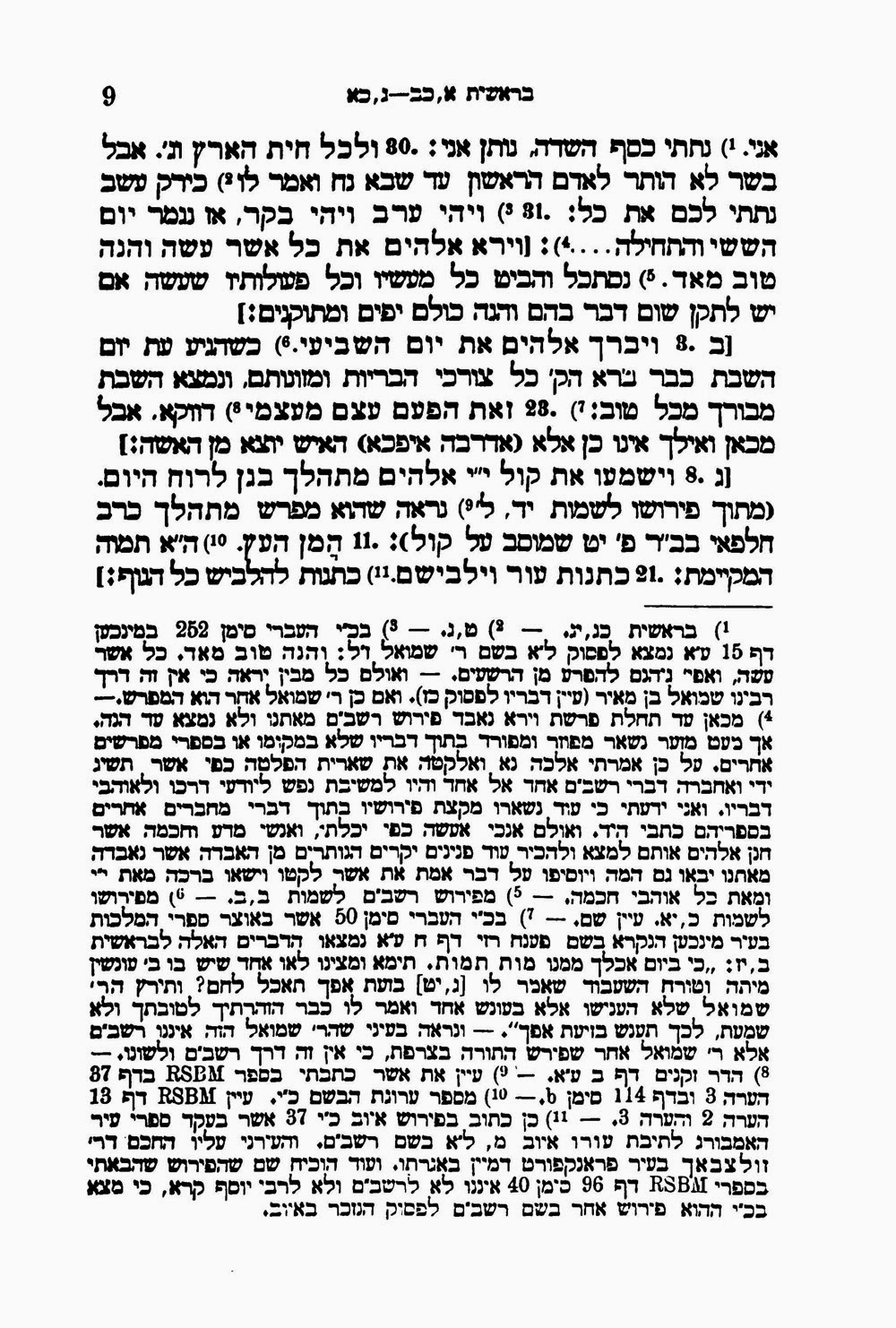
I have not seen any discussion of Zekhut Adam ha-Rishon among modern scholars. This work advocates taking the narrative sections of the Torah literally, including the Cain and Abel episode. However, when סברא האנושית הישרה tells us that the text is not to be taken literally, then it is time to offer a non-literal interpretation, for the Torah does not require us to believe things that are impossible or מהתלות which I would translate as “absurdities”:
חובה עלינו שנבין ונקבל כל תרי”ג מצות על פשוטיהם כמו שעשו אבותינו כאמרו כל אשר דבר ה’ נעשה, לכן כל הנביאים כולם היו שומרים מצות התורה ועושים אותן לפי דרך המצווה, הם עשיית הפסח בימי חזקיהו וככה בימי עזרא, ועל כולם היו מזהירים באמרו זכרו תורת משה עבדי ובזה אין חולק ואין מדחה חלילה, אבל הספורים הרומזים או הנבואיים אשר אין מצוה תלויה בהם דין אחר, וזה כי אם סברא האנושית הישרה לא תבגוד [צ”ל תנגוד] ותקביל לספור ההוא אין ראוי לנו שנתן לו ציון וחקוי דמוי או המשל אבל ראוי שנבינהו על פשוטו כמדרגת ספור עניני האבות, כמו נצחון אברהם את המלכים וספור הריגת משה רבינו ע”ה את המצרי, כי הספורים האלם [צ”ל האלה] יגידו הענינים אשר קרו בימים ההם ומה לנו לתור אחריהם חקוי ודמוי, ומזה המין הוא אצלי הפירקין והכל [צ”ל בפ’ קין והבל], אבל כאשר ימצא ספור מה בתורה אשר הסברא האנושית הישרה תחלוק עליו, ותספק בו בצדדים ודרכים עיוניים אמיתיים, ראוי שנעזב הפשט מהספור ההוא ונתן לו ציור או דוגמה מה, כי לא בא התורה להכריחנו להאמין נמנעות או מהתלות חלילה, כי תורת ה’ תמימה מחכימת פתי
[9] See also R. Kook, Eder ha-Yekar, pp. 38-39. Regarding Torah mi-Sinai, and how some segments of the Modern Orthodox world have begun to accept aspects of Higher Criticism, see my post here.
In that post I wrote: “In the next installment of this series I will present further evidence that in some parts of the Modern Orthodox world the old taboo against Higher Criticism has begun to fade.” I have decided to incorporate this further material into an academic article. Once this appears, I will summarize matters on the Seforim Blog. But in the meantime, let me offer the following interesting example relevant to the wider subject (called to my attention by a reader). Ba’al ha-Turim to Lev. 1:1 states that because Moses was so modest, he did not want to write the word ויקרא, but instead ויקר which implies happenstance. God however told him that that he should also include the aleph at the end of the word, so Moses wrote this letter smaller than the other letters. In other words, this was done independently by Moses, without being told to do so by God. (The comment of Ba’al ha-Turim in the standard Mikraot Gedolot humashim is abridged. The entire comment can be seen in R. Yaakov Koppel Reinitz’s edition [Jerusalem, 1996]).
R. Akiva Eger, Teshuvot, Mahadura Kamma, Orah Hayyim no. 75, summarizes the Ba’al ha-Turim as follows:
שמשה רבינו ברוב ענותנותו לא רצה לכתוב אלא ויקר ואמר לו הקב”ה לכתוב בא’ זעירא
R. Akiva Eger summarizes Ba’al ha-Turim as saying that when Moses did not want to write the word ויקרא, God told him to write the word with a small aleph. Yet this is not what Ba’al ha-Turim says. According to Ba’al ha-Turim, Moses made this decision on his own. The abridged version of the commentary available to R. Eger reads:
ואמר לו הקב”ה לכתוב גם באל”ף וכתבה קטנה
The complete version printed by Reinitz reads
ואמר לו הקב”ה לכתוב גם האל”ף ושוב אמר לו משה מחמת רוב ענוה שלא יכתבנה אלא קטנה יותר משאר אלפי”ן שבתורה וכתבה
The person who alerted me to this assumes that this is a form of censorship, i.e., for dogmatic reasons R. Akiva Eger altered what Ba’al ha-Turim wrote. I think it is more likely that when he wrote his responsum he did not bother to check the actual words of Ba’al ha-Turim and simply misremembered, and thus unintentionally altered Ba’al ha-Turim’s explanation so that the provocative element was removed.
In the forthcoming article I will deal not merely with biblical criticism, but also with those who assume that the Torah is not necessarily teaching historical truths. One such example is R. Shlomo Riskin’s Oct. 14, 2014 devar Torah, available here After telling us that the Torah is “not interested in conveying literal and chronological facts in its story of creation,” R. Riskin writes:
Maimonides, in his Guide for the Perplexed, interprets all of the early biblical stories until the advent of Abraham as allegories, whose purpose is to convey moral lessons rather than historical fact.
What R. Riskin says about Maimonides is simply incorrect, as Maimonides does not say what he attributes to him. However, R. Riskin does reflect a common sentiment in the Modern Orthodox world that the first eleven chapters of Genesis (i.e., up until Abraham) are not to be understood as “history” in the way we think of it today. (Yet contrary to his point, other than the Garden of Eden story, I don’t think that there are many who would regard any of the other stories in the early Genesis chapters as allegories.)
It will be the task of Modern Orthodox theologians to explain why it not problematic to regard Gen. 1-11 as (prophetic) myth, and at the same time to insist that the events dealing with the Patriarchs are to be regarded as historical. Why the distinction?
R. Kook already stated that when it comes to determining which portions of the Torah’s narrative section should be taken literally, this is something that is left to the “clear feeling of the nation”. He also acknowledges, as I have mentioned already, that the Torah’s descriptions could be in line with how matters were understood in ancient times, which need not be historically or scientifically accurate. See Iggerot ha-Re’iyah, vol. 2, p. 119:
ואם אין כל יחיד יכול להציב גבול מדויק בין מה שהוא בדרך משל בתורה ובין מה שהוא ממשי, —בא החוש הבהיר של האומה בכללה ומוצא לו את נתיבותיו לא בראיות בודדות כי-אם בטביעות-עין כללית. ואם נמצא בתורה כמה דברים, שחושבים אחרים שהם לפי המפורסם מאז, שאינו מתאים עם החקירה של עכשו, הלא אין אנו יודעים כלל אם יש אמת מוחלטת בחקירה הזמנית, ואם יש בה אמת, ודאי יש גם מטרה חשובה וקדושה שלצרכה הוצרכו הדברים לבא בתיאור המפורסם ולא המדויק.
As with the matter of biblical criticism, R. Kook believed that there could be a source of spiritual growth and value even in the mistaken view that none of the stories recorded in the Torah are historical. See Iggerot ha-Re’iyah, vol. 1, pp. 48-49:
שמא כל החלק הספורי שבתורה, אומרים הם, איננו כ”א דברי אגדה ולא דברים שבפועל . . . ונאמר להם: אחים, אם כדבריכם, —דברי אגדה, שכ”כ הם יכולים לפעול לטובה ולברכה, לתקות עולמים ולמוסר השכל, הם כ”כ יקרים ונכבדים עד שהנם ממש דברי אלקים חיים, והם ראויים שכל מה שנעוץ בזכרונם יהי נשמר בכבוד ואהבה רבה. זה לא יספיק להחיות לגמרי בכל המילוי, אבל יספיק לפתח פתח, להסיר את הבוז והשנאה, את המאיסה והבחילה, מכל אשר ליהדות, ג”כ בלבם של הבנים הרחוקים.
Both of these sources from R. Kook have been cited by Tamar Ross in various publications, and I will deal with her position in my forthcoming article.
[10] Translation in Jerome (Yehuda) Gellman, “Judaism and Buddhism”, in Alon Goshen-Gottstein and Eugene Korn, eds. Jewish Theology and World Religions (Oxford, 2012), p. 315.
[11] See here where I discussed R. Kook’s suggestion that the future Sanhedrin could come up with new derashot to put an end to the practice of animal sacrifice.
[12] See my “Rabbi Eliezer Berkovits’s Halakic Vision for the Modern Age,” Shofar 31 (Summer 2013), pp. 16-36.
[13] R. Zvi Yehudah Kook stated that working the Land of Israel was the equivalent kiddush ha-shem as studying in yeshiva. See Hilah Wolberstein, Mashmia Yeshuvah (Merkaz Shapira, 2010), p. 248.
[14] Neriyah, Likutei ha-Re’iyah, vol. 1, p. 427.
[15] Quoted in R. Ze’ev Aryeh Rabiner, Or Mufla (Tel Aviv, 1972), p. 80.
[16] In my post here I wrote: “There are, of course, many other differences between R. Soloveitchik and R. Kook. From the excerpt printed in The Rav Thinking Aloud, pp. 155-156, we see that the Rav regarded R. Kook as a saintly figure, but not as an intellectual great. Yet this impression was derived from one short conversation. All the gedolim who knew R. Kook had the exact opposite impression. They correctly saw that R. Kook was a master of the entire Torah, in all of its facets. I think you have to go back to Maharal, or perhaps even Nahmanides, to find such a wide-ranging Torah scholar as R. Kook.”
In addition to what I wrote, readers should be aware that R. Kook was quite ill when R. Soloveitchik spoke to him.
Here are the pages from R. David Holzer, The Rav Thinking Aloud.
When The Rav Thinking Aloud was reprinted, what I refer to was deleted. Here is how it looks in the currently available edition.
Regarding how R. Soloveitchik viewed R. Kook, R. Ezra Bick called my attention to his important comments from 1959 available here beginning at minute 10.
While R. Soloveitchik might not have been intellectually impressed by R. Kook after his one meeting with him, R. Kook saw in R. Soloveitchik the continuation of his grandfather, R. Hayyim. Because of this, R. Zvi Yehudah Kook made a point of attending all of the shiurim delivered by R. Soloveitchik when he was in Eretz Yisrael. Here is the recollection of R. Avraham Shapira, from Siah Ish (published with his Hag ha-Sukot [Jerusalem, 2012), p. 123.
In my previously mentioned post I wrote, “I think you have to go back to Maharal, or perhaps even Nahmanides, to find such a wide-ranging Torah scholar as R. Kook.” Subsequent to writing this I saw that R. Simhah Assaf, in his eulogy at R. Kook’s funeral, stated as follows (Zohar Elyon [Jerusalem, 2011], pp. 25-26):
ממהר”ל מפראג לא קם כמוך, איש המוח והלב הגדול והרגיש. איש הרגש והמחשבה, יושב אוהל ושקוע בתורה ויחד עם זה איש המעשה, שידע ללכת לפני העם.
Since I mentioned R. Ezra Bick, let me also note the following. In an earlier post from March 11, 2013, available here, the following appears:
In my post of January 13, 2013, I wrote: “R. Meir Schiff (Maharam Schiff) is unique in believing that one without arms should put the tefillin shel yad on the head, together with the tefillin shel rosh. This is the upshot of his comment to Gittin 58a.” I saw this comment of Maharam Schiff many years ago, and unfortunately did not examine it carefully before adding this note. As R. Ezra Bick has correctly pointed out, Maharam Schiff is not speaking about wearing tefillin shel yad on the head to fulfill the mitzvah, but only stating that this is a respectful way to carry the tefillin shel yad if you have to remove it from your arm. This has no relevance to what I wrote about someone without arms (unless he has to carry the tefillin shel yad).
Yet I have now seen the following responsum of R. Jacob Meskin in his Even Yaakov: Rosh ha-Shanah (New York, 1954), no. 55 (p. 101a), who indeed derives from the Maharam Schiff that one can fulfill the mitzvah of the tefillin shel yad by putting it on one’s head.
[17] “Rav Kook: Mystic in a Time of a Revolution,” Tradition 47:3 (2014), p. 71.
[18] The title of R. Kook’s work is ערפלי טהר. How is one to pronounce the first word? I write Arpilei since in my experience this is how it is pronounced in Religious Zionist circles. It also appears this way in some machzorim (mussaf of Rosh ha-Shanah, at the beginning of Shofarot, in the paragraph (אתה נגלית. Most importantly (to me at least) is that R. Meir Mazuz states that the word is pronounced this way. See Ha-Mahzor Ha-Meduyak: Rosh ha-Shanah, at the end of לאוקמי גירסא which is found at the beginning of the volume. He sees ערפל (segol under the peh) as parallel to כרמל (segol under the mem). In Isaiah 1:18 the latter word appears as וכרמלו, with a hirik under the mem.
Others write Arpelei, with a sheva under the peh, and intuitively this is what most would assume. This is also how the word is vocalized by R. Seraya Deblitzky, Tikun Tefilah (Bnei Brak, 2010), vol. 2, p. 27, and by the ArtScroll machzor. Wolf Heidenheim, Philip Birnbaum, and Daniel Goldschmidt, in their editions of the machzor, place a patah under the ayin and under the peh. They also do not put a dagesh in the peh, so ערפלי is pronounced Arfalei. Heidenheim explains some of his reasoning in the Rodelheim Machzor (1872), p. 63b, and says that his vocalization is “without any doubt the correct version”.
Regarding the words ערפלי טהר, it is also worth noting that in Bereshit Rabbah 99:3 the following words appear: ערפלא טורא. When I first saw this I thought that there must be some connection to the Rosh ha-Shanah prayer, and this is indeed noted by Matenot Kehunah, ad loc. Yet the truth is that none of the commentaries really know what to make of these words, and it would appear to be a corrupt text. See Albeck’s note in his edition of Bereshit Rabbah, vol. 3, p. 1275.
[19] See Omer Silber, ‘Ha’arafel be-Taharato,” Ma’galim, 5 (2007), p. 311.
[20] חושים is written defective in the Torah.
[21] In Bereshit Rabbah 46:26 it states:
בתורתו של ר’ מאיר מצאו כתוב ובן דן חשים
This apparently means that R. Meir’s Torah scroll differered from the current Masoretic text. However, many traditional commentators assume that it is only referring to a note that R. Meir added to his personal copy of the Torah or to a book of his commentaries on the Torah.
[22] The book of Jubilees must have also been troubled by the plural ובני דן, as it provides us with the names of Dan’s other sons and tells us that they died in the year that they entered Egypt. See Jubilees 44:28-30.
According to Sotah 10a Hushim killed Esau. However, the Jerusalem Talmud, Ketubot 1:5 and other rabbinic sources state that that Judah killed him. See S. Buber’s note to Aggadat Bereshit (Cracow, 1903), p. 160 n. 14. Tosafot, Gittin 55a s.v. bihudah, tries to reconcile the conflicting sources, but there are difficulties with this reconciliation. See Buber’s note referred to above. Regarding this matter, R. Samuel Jaffe, in his classic commentary on the Jerusalem Talmud, Yefeh Mar’eh (Venice, 1590), to Ketubot 1:7 (p. 264a), has quite a strange passage. In commenting on the text in the Jerusalem Talmud that Judah killed Esau, rather than note that this is disputed by the Babylonian Talmud, Jaffe writes:
וליתא דחושים בן דן הרגו ביום קבורת יעקב אבי’ ע”ה כדאי’ בפ”ק דסוטה
Has anyone ever seen this type of language – וליתא – used with reference to a talmudic source? It is one thing to use the term וליתא when rejecting a view put forward by one’s contemporary, but here Jaffe is rejecting a passage in the Jerusalem Talmud.
In Limits of Orthodox Theology, I did not discuss the commentary of Ibn Ezra (Ex 20:1) referred to by Schonblum. That is because I assumed that he agreed with the standard medieval view that even though Moses may have written things on his own accord, when these texts were later included as part of the Torah given to the Children of Israel, this was done at God’s direction and that is what sanctified the text. I am no longer convinced of this. All Ibn Ezra says in his commentary to Ex. 20:1 is that minor variations in wording are due to Moses changing God’s original words. Nowhere in his commentary does Ibn Ezra state that Moses’ changes were ever given divine sanction.
[24] “The Rov zt”l: The Nigleh and the Nistar,” in Zev Eleff, ed., Mentor of Generations (Jersey City, N.J., 2008), pp. 262-263.
[25] For other versions of the story, see Nathan Kamenetsky, Making of a Godol (Jerusalem, 2002), vol. 2, pp. 1118ff. See also Otzrot ha-Sofer 14 (5764), for a story (really a fairy tale) about how the Malbim came to the Hatam Sofer to request a haskamah. He falsely told the Hatam Sofer that the haskamah was for a book of his teacher when it was actually for a book the Malbim wrote. When the Hatam Sofer learnt of this deception, he declared that the Malbim’s life would bring him no peace, which is indeed what would later happen.
ArtScroll’s Response and My Comments
by Marc B. Shapiro
My recent post here was more popular than my typical post. I base this statement on the fact that I received more emails from readers than usual and the post was picked up by a variety of different websites. The part dealing with the censorship of Rashbam was translated into Hebrew here (with one of the commenters calling for a herem to be placed on ArtScroll)[ and see also here.
ArtScroll has now issued its response. The following has been sent out to those who wrote to ArtScroll about the censorship.
Let us make clear at the outset, ArtScroll has total and uncompromising respect for Chazal and the classic commentators. We do not censor them. Every one of their words is holy, and we have never deigned to tamper with their sacred texts.
For an understanding of the matter under discussion, it is important to present the background of the published versions of Rashbam’s commentary on the Torah.
· Rashbam’s commentary was first printed in 1705, based on the only existing manuscript of his virtually complete commentary on the Chumash. That manuscript began with Parashas Vayeira.
· Subsequent editions were based on that 1705 printing.
· In 1882, David Rosin published a new annotated edition of Rashbam’s commentary.
· The new edition also included a commentary on the Parshiyos Bereishis, Noach, and Lech-Lecha based on comments culled by Rosin from Rashbam’s other writings as well as selections from other works that cite Rashbam. Additionally, this 1882 edition included materialtaken from a newly-discovered manuscript containing one page of commentary ascribed to Rashbam, on only the first chapter of Bereishis ending in the middle of verse 1:31.
· This manuscript fragment includes an exegesis that appears several times – an exegesis that Ibn Ezra, in his famous Iggeres HaShabbos, vehemently condemns, stating, that it had been put forth by “minim” (heretics). Furthermore, a later exegesis in the same manuscript page (on verse 14) directly contradicts that earlier exegesis.
In our Czuker edition of Mikraos Gedolos, we wished to provide the Torah public with the fullest version of the Rashbam’s commentary, so rather than beginning with Parashas Vayeira, we incorporated additional material from the 1882 Rosin edition, from the beginning of Bereishis. However, given Ibn Ezra’s attribution of this exegesis to “minim,” coupled with a completely contradictory exegesis in verse 14, it is questionable whether Rashbam actually proposed the exegesis attributed to him. Because of these factors we added only those writings attributed to Rashbam whose authenticity have not been questioned. Far from “censorship,” we have added to the older, standard Mikraos Gedolos editions.
Nevertheless, for the sake of clarity, we should have indicated that the basis for our text of Rashbam was the standard Vilna edition of 1898, with emendations from the Rosin edition of 1882. Indeed, this is what we have indicated in our just-published Sefer Shemos volume, and which will be reflected in future reprints of Sefer Bereishis.
* * * *
In my response I will only deal with the matter at hand, that is, the censorship of Rashbam’s commentary, not with the larger matter of whether ArtScroll really has “total and uncompromising respect for . . . the classic commentators.” I have dealt with this latter point in previous posts and offered evidence that contradicts ArtScroll’s assertion.
Let me begin by saying that the one word that best describes ArtScroll’s statement is “chutzpah”. Here we have an explanation from Rashbam that has been discussed and dealt with by some of the greatest Torah scholars for well over a century, yet ArtScroll feels that it knows better than all of them and thus has the authority to simply delete passages from the commentary. If that isn’t chutzpah, I don’t know what is.
Rashbam’s brother, Rabbenu Tam, famously attacked those who deleted or emended passages in the Talmud based on their own understanding.[1] Rabbenu Tam realized that if everyone had the freedom to do with the text as he wished, it wouldn’t be long before the Talmud was irrevocably damaged. As such, anyone who has a suggestion about a mistake in the text is free to add it in the form of a note or in a commentary, but he is not permitted to alter the text itself. The only honest thing would have been for ArtScroll to have included the “objectionable” passages and then explain why they feel that these texts are not authentic.
The fact that ArtScroll sees the passages that it deleted as heretical is irrelevant. Great people have regarded texts of the Rambam, of R. Kook, and of many others as heretical. Does that mean that we can start deleting these texts? There are aharonim and at least one rishon who believe that there are passages in the Talmud that were inserted by people intent on mocking the Sages (details will be in a future post). Does that mean that if ArtScroll shares this opinion it is entitled to delete these passages as well?
As I mentioned, the chutzpah is seen in the fact that ArtScroll feels that it knows better than such great figures as R. David Zvi Hoffmann[2] and R. Yaakov Kamenetsky.[3] Both of these men were not simply great talmudists but were also great biblical scholars, and they expound Rashbam’s view. It never occurred to them to delete the passages or to claim that they aren’t authentic. Cassuto was another great biblical scholar and he believed that Rashbam’s understanding of the verse is correct.[4]
Every student of Torah is taught the virtue of humility. What this means is that if you don’t understand something you seek out people greater than yourself to hear their perspective. How come ArtScroll didn’t follow this route before taking the drastic step of deleting the comments of Rashbam?
Unfortunately, if ArtScroll’s mikraot gedolot becomes the standard, anyone who uses the commentaries of R. Hoffmann, R. Kamenetsky, Cassuto and so many others will be very confused. These commentaries will cite Rashbam and explain his words, but the reader who opens up his ArtScroll mikraot gedolot to see what Rashbam says “inside” won’t be able to find it. If he doesn’t read the Seforim Blog, he won’t know what is going on.
For over a hundred years people studied Rashbam’s commentary without any problem. Different interpretations were offered, all in order to make sense of Rashbam’s words. Around fifteen years ago a few people, none of whom have any scholarly or religious standing, started making noise that there is heresy in Rashbam’s commentary on Genesis chapter 1.[5] This led a couple of haredi publishers to delete some or all of the “problematic” comments (different editions have different deletions).[6]
ArtScroll has chosen to follow this regrettable path. When this nonsense first began with the haredim in Israel, the great R. Yehoshua Mondshine, whose recent passing is an enormous loss for all, published the following letter in Kovetz Beit Aharon ve-Yisrael.[7]
The disdain he shows in this letter would be magnified if he were writing about ArtScroll, as one would expect ArtScroll to know better. It is unfortunate that ArtScroll did not heed his final words directed towards publishers inclined to censorship.
יש להתרות במו”לים שלא יהיו נחפזים “לצנזר” את פירוש הרשב”ם מכח סברות תמוהות וקלושות, ויחרדו לנפשם מאזהרות הקדמונים דלייטי ליד המגיה בספרים.
Following R. Mondshine’s letter, there appears a very lengthy letter by R. Menahem ben Shimon[8] explaining that Rashbam’s comments at the beginning of Genesis should not be controversial at all. He concludes by comparing censorship of Rashbam to the burning of Maimonides’ Guide of the Perplexed, and adds
יש בזה עזות מצח, וביזוי דברי הקדמונים, והתייחסות לדבריהם כאילו חלילה מדובר בתקליטור עם משחקים חינוכיים “בהכשר הרבנים”, וכיו”ב, וכבר הזהירונו חז”ל להיזהר בכבוד תלמידי חכמים שכל דבריהם כגחלי אש.
I have to acknowledge that some people are having a good chuckle right now at my expense. Call it naiveté, but I was convinced that the response of ArtScroll would be to admit the mistake, blame it on an error in “editing” or something like that, and correct matters in the next printing. That would have been a great outcome. I, more than many others, was shocked by ArtScroll’s response.
In its response ArtScroll states: “[G]iven Ibn Ezra’s attribution of this exegesis to “minim,” coupled with a completely contradictory exegesis in verse 14, it is questionable whether Rashbam actually proposed the exegesis attributed to him.”
The first thing to note is that in the preface to the Iggeret ha-Shabbat, where Ibn Ezra explains what led him to write the work, he does not attribute this exegesis to “minim”. ArtScroll would have you believe that Ibn Ezra stated that the passages they have deleted are heretical interpolations. Even if this was the case, it would only be Ibn Ezra’s opinion. This would not entitle ArtScroll to delete the passages, just like they don’t have the right to delete other passages that some commentator thought were not authentic. But in this case ArtScroll is simply wrong, and I hope that they are not intentionally misleading people. (I also hope that they informed the sponsor of the new mikraot gedolot that they intended to delete passages from Rashbam.[9])
Here is the text from Ibn Ezra.[10]
As you can see, Ibn Ezra responds very sharply to the interpretation mentioned by Rashbam. Although Rashbam is not mentioned by name, the standard view in traditional and scholarly circles is that Ibn Ezra was indeed directing his words at Rashbam and not at others who shared this perspective. This would explain his use of the words ולא תשא פני איש which would only be used with reference to an outstanding scholar.[11] David Kahana suggests that, as a sign of respect, Ibn Ezra does not mention Rashbam by name and he also does not curse the author of the explanation he is attacking.[12] He only curses the one who reads it aloud and the scribe who writes it. If Ibn Ezra was directing his comment against some heretic, we would expect him to curse this person, so the fact that he does not do so is quite significant and indeed points to Rashbam as the “addressee” of Ibn Ezra’s Iggeret ha-Shabbat.
Ibn Ezra never denies the authenticity of the interpretation he is responding to; he just attacks it. His attack on Rashbam’s view is just like Nahmanides’ attack on Maimonides’ view that the angels who came to Abraham were really just part of a prophetic vision. Nahmanides does not deny that Maimonides said this, but he does say that it is forbidden to accept what Maimonides says. It is the exact same thing here. Ibn Ezra is not denying that Rashbam offered the interpretation. He is simply saying that it is forbidden to accept this approach. (I should also add, since we are discussing a dispute between Ibn Ezra and Rashbam, that by any traditional measure Rashbam must be regarded as a more significant and authoritative figure than Ibn Ezra.)
ArtScroll also states that since Rashbam’s commentary to Genesis 1:14 contradicts what he says in the passages deleted by ArtScroll, this gives weight to their assumption that the other passages were not written by Rashbam but were instead inserted by some heretic. To begin with, since there are five[13] “problematic” comments and one “non-problematic” comment, perhaps it is the “non-problematic” comment to Genesis 1:14 that is to be regarded as inauthentic and should be removed. I say this only tongue and cheek, since ArtScroll should have realized two pretty basic things.
1. Rashbam often offers explanations, even in matters of halakhah, that are in line with the peshat of the text but diverge from the talmudic understanding. I understand that in some contemporary circles this would be regarded as heretical, since they assume that the meaning of the verse, especially in halakhic matters, can only be what the sages of the Talmud declare. Yet Rashbam had a different perspective, and he allowed for a peshat that diverges from what the Talmud states.
2. If you have contradictory explanations in the same chapter, the proper thing to do is to see if they can be reconciled before deciding that some of the comments are not authentic and can therefore be deleted. This was the approach of the great scholars of the last century who discussed Rashbam’s commentary. If ArtScroll had “uncompromising respect” for these figures, who devoted great time to understanding what Rashbam was saying, they would not have dared delete Rashbam’s comments, since by doing so they are in effect claiming that they know better than R. Hoffmann, R. Kamenetsky, and so many others.
Let me cite some other writers, including outstanding Torah scholars, who discussed Rashbam’s comments on when the day begins. In ArtScroll’s eyes this was all a big waste of time, since Rashbam never could have said what appears in his commentary. I guess we should all feel sorry for these Torah scholars that when they wrote they didn’t have ArtScroll around to set them straight. The more important question is why didn’t ArtScroll think that any of the explanations offered by these scholars were enough to save Rashbam’s comments from being deleted? (My own sense is that the individual who made the choice to censor Rashbam did not begin to understand the issue and was unaware of the sources referred to in this post.)
1. R. Menahem M. Kasher discusses Ibn Ezra’s attack on Rashbam and offers an explanation for Rashbam’s position, distinguishing between how the days were structured in the first six days of creation and what occurred afterwards.[14] R. Kasher also cites R. Pinhas Horowitz, Ha-Makneh to Kiddushin 37b, that before the giving of the Torah night came after day, and this can also be an explanation for Rashbam’s approach. In support of his assumption, R. Horowitz cites a verse not mentioned by Rashbam, Genesis 8:22: ויום ולילה לא ישבתו. As you can see, in this verse night comes after day. (R. Horowitz repeats this explanation in his Panim Yafot to Genesis 8:22.) R. Moses Sofer cites this point from R. Horowitz and notes that even today it is only with regard to Jews that night precedes day, but for non-Jews the halakhah remains that day precedes night.[15]
R. Ezekiel Landau agrees with R. Horowitz that before the giving of the Torah the day did not start at night.[16] In support of this approach, R. Samuel Mirsky refers to Ugaritic literature which he regards as real evidence for Rashbam’s position.[17]
R. Moshe Malka also takes note of R. Horowitz’s position.[18] Based on it he claims that
נחה שקטה תמיהתו של הראב”ע על הרשב”ם, כי הוא דבר על מעשה בראשית לפני מת”ת
R. Catriel David Kaplin also refers to R. Horowitz’ perspective and explains that Rashbam agrees with it.[19]
R. Kasher further cites R. Isaac Israeli (14th century) as agreeing with R. Horowitz. In his Yesod Olam[20] R. Israeli writes
וכן נהגו כל ישראל ממתן תורה ועד עתה להתחיל קדושת השבת ושאר ימי מקראי קודש מתחילת הלילה . . . ועל העיקר הנכון הזה יסדו לנו קדמונינו וקבעו בחשבון מולדות הלבנה ותקופת החמה.
R. Kasher calls attention to the words ממתן תורה ועד עתה and concludes that R Israeli is telling us that before the giving of the Torah the day began in the morning.
Finally, R. Kasher points to two separate rabbinic texts, one talmudic and one midrashic, that he feels can support Rashbam’s approach.
2. Da’at Mikra to Genesis 1:5 (p. 10 n. 168) explains that Rashbam’s understanding of when the day begins only refers to the six days of creation.
3. A different approach in explaining Rashbam is taken by R. Moshe Schwerd in a recent article in Or Yisrael.[21]
4. The Lubavitcher Rebbe refers to Rashbam’s explanation of when the day begins in order to illustrate how explanations in accord with peshat can contradict the accepted halakhah.[22]
5. R. Chaim Leib Zaks calls attention to the fact that two medieval authorities explain Genesis 1:5: ויהי ערב ויהי בקר, just as Rashbam did, that is, that day comes before night.[23] The first is the commentary attributed to Rashi, Ta’anit 11b, s.v. למחר.[24] The second is the commentary attributed to Rashi, Nazir 7a s.v. התם.[25]
6. R. Eliyahu Katz, who served as rav of Bratislava under the Communists and later as chief rabbi of Be’er Sheva, published a number of interesting books which appear to be completely unknown. In his Emor ve-Amarta[26] he states that R. Judah ha-Nasi might also have held that according to the peshat night comes after day, and that Rashbam might have based his explanation on R. Judah’s opinion. He also points out that Rashi, Genesis 1:14 writes
שמוש החמה חצי יום ושמוש הלבנה חציו הרי יום שלם
This is a strange formulation since Rashi appears to be agreeing with Rashbam that the day – שמוש החמה – comes before the night – שמוש הלבנה.
7. R. Jacob of Vienna, in his commentary to Genesis 1:5, writes[27]:
וא”ת אימא הלילה הולך אחר היום והכי קאמר ויהי ערב של יום הראשון ויהי בקר של יום שני אז נשלם יום שלם
In his note to this passage R. Zvi Rotberg understandably refers to Rashbam, as R. Jacob might indeed be alluding to him here.[28] The editor of R. Jacob’s volume, R. Menasheh Grossberg, refers to R. Pinhas Horowitz’s view mentioned above.
8. R. Shlomo Fisher, without question one of the top Torah scholars in the world, elaborates on the implication of Rashbam’s view that it is only through Torah she-Ba’al Peh, not the peshat of the verses, that we know that day comes after night.[29] A student of R. Fisher asked him about the censorship of Rashbam, and not surprisingly he expressed strong opposition to any such tampering with the writings of rishonim. He also told this student about a contemporary “scholar” who claims that Rashbam was influenced by evil people who caused him to go astray! Talk about chutzpah![30]
10. Michael Landy called my attention to the fact that Abarbanel cites the interpretation mentioned by Rashbam in the name of יש מהמפרשים.[31]
All of these sources that I have quoted, and believe me when I tell you that there are many more, are simply designed to show that the view of Rashbam expressed in his commentary to the first chapter of Genesis is part and parcel of Torah history and literature. Many of our great minds have discussed Rashbam’s view in a variety of contexts. Yet ArtScroll, on its own, has decided that it knows best and chose to remove the words of Rashbam from the public eye. They have no right or authority to do this. Their action is a betrayal of Rashbam and of those who want to study the writings of Rashbam. It is also an incredible display of disrespect to those great Torah scholars who have devoted time to the matter and explained the comments of Rashbam that ArtScroll prefers to view as heretical.
After all we have seen, let us return to the issue of Ibn Ezra’s attack on Rashbam and ask why it was so harsh. After all, what is so terrible about explaining the peshat of the Torah even if it diverges from the accepted halakhah, an approach that is found in numerous commentators?
The significance of the example we have been discussing is that there were indeed sectarians who observed Shabbat from Saturday morning until Sunday morning. Rashbam’s interpretation was thus dangerous as it could have had real world implications by giving support to the anti-halakhic behavior just mentioned.
In his commentary to Exodus 16:25 Ibn Ezra refers to “many people, lacking in faith” who erred in this matter and did not start Shabbat on Friday night. He tells us that they based their mistaken approach on Genesis 1:5: ויהי ערב ויהי בקר. In other words, they interpreted the verse in the same way that Rashbam did. Towards the end of Iggeret Shabbat, p. 171, he also mentions these “minim” who do not observe Shabbat beginning Friday night. It is thus easy to see why Ibn Ezra reacted so strongly and set out to uproot Rashbam’s interpretation.
Who were these sectarians Ibn Ezra refers to? Presumably the Mishawites, a group that we know started Shabbat on Saturday morning.[32] Benjamin of Tudela records meeting sectarians in Cyprus, again presumably Mishawites, who indeed observed the Shabbat in this fashion.[33]
In the last paragraph of the ArtScroll letter it states that from now on they will note that their text of Rashbam is the standard Vilna edition of 1898 with “emendations from the Rosin edition of 1882”. This is clearly obfuscation as we are not dealing here with any “emendations” suggested by Rosin. To repeat what the issue is: Rosin printed from manuscript Rashbam’s commentary to Genesis chapter 1. This section of the commentary does not appear in the standard Vilna edition. ArtScroll chose to include Rashbam’s commentary to Genesis chapter 1 in its recently published mikraot gedolot. However, ArtScroll also chose to delete those sections of the commentary it didn’t like, assuming (without any evidence) that these sections were written by heretics. This is censorship of Rashbam. That is all people need to know.[34]
ArtScroll has done some great things. They have also done some pretty disappointing things. But as I said in the prior post, nothing comes close to this. Deleting comments of one of the greatest rishonim is simply outrageous. Some have said that what ArtScroll did is unforgivable. I think this is going too far. If ArtScroll acknowledges its error and reinserts that which has been removed, I think that we all would be very happy to put this behind us. One of the most important aspects of a Torah personality is the ability to recognize when one has made a mistake and rectify it. If ArtScroll is able to do this, it would lead to great admiration.
On the other hand, if ArtScroll refuses to acknowledge that it has made a terrible error, even after seeing the evidence presented in this post, then one must conclude that ArtScroll is knowingly suppressing the words of a great rishon. One can only hope that ArtScroll does not wish to have this blemish permanently attached to its name.
[1] ArtScroll and other publishers should pay close attention to the words of Rabbenu Tam, which I would have thought would be enough to scare off the censors. Sefer ha-Yashar, ed. Rosenthal (Berlin, 1898), p. 75:
ומגיהי חנם, בעיני דינם, למדורי גהינם
P. 105:
כי כאשר לא יודעים, העולם מטעים, וכאשר תוהים, הספרים מגיהים. ואתם הרעות מהם, כי הם כותבים ה”ג בהגהותיהם, ולכן ניכר מעבדיהם. ואתה לא כן, אך סותם הגהותיך וסומכים עליך וטועים . . . אין עצה ואין תבונה, רק להעמיד על האמת ולזרוק מרה במגיהי הספרים
Even if they are not scared of מדורי גהינם, one would have thought that they would have seen the wisdom of what Rabbenu Tam writes in the introduction to Sefer ha-Yashar, ed. Schlesinger (Jerusalem, 1985), p. 9:
והדין נותן אם לא ידע אדם הלכה יכתוב פתרונו לפי ראות עיניו אם ירצה אך בספרים אל ימחק שדברי תורה עניים במקומן ועשירים במקום אחר ואם דבר רק הוא ממנו הוא [רק]
[2] Sefer Bereshit, trans. Asher Wasserteil(Bnei Brak, 1969), pp. 26-27. Hoffmann writes as follows:
כמו גם פרשנים חדשים רבים הוא [רשב”ם] סבר, שבימי מעשה בראשית נמנו הימים באופן שונה מדרך מנייתם לאחר מכן, בימי מתן תורה, כשם שגם תחילת השנה לפני מתן תורה שונה – לדעת ר’ אליעזר – מזו שלאחריו.
[3] Emet le-Yaakov (Cleveland Heights, 2007), p. 17.
[4] Umberto Cassuto, A Commentary on the Book of Genesis, trans. Israel Abrahams (Jerusalem, 1998), p. 28.
[5] As far as I know, the first one to assert that Rashbam’s comments are heretical interpolations was R. Yehudah Nachshoni, Hagut be-Farashiyot ha-Torah (Bnei Brak, 1981), vol. 1, p. 262, but this had no impact on the haredi world. Here is the page from Nachshoni.
He writes:
לדעתו יש לחשוש שמא חלו ידי קראים בדברי הרשב”ם
What this means is that Ibn Ezra thought that perhaps Rashbam’s metaphorical interpretation of the commandment of tefillin in Ex. 13:9 is a Karaite interpolation. This is complete nonsense as Ibn Ezra says nothing of the sort. I think, therefore, that there is a typo and the first word should read לדעתי. It is still nonsense but at least now the sentence is understandable. Following this, Nachshoni adds another absurdity, stating that Rashbam’s interpretation of when the day starts is also a Karaite interpolation. (Prof. Daniel Lasker has confirmed to me that all Karaites began the Sabbath on Friday night.)
Now comes the real irony. ArtScroll published a posthumous translation of Nachshoni’s book in 1988. Apparently ArtScroll was embarrassed by what Nachshoni wrote so ArtScroll censored it! Here is the English version, Studies in the Weekly Parashah, vol. 2, pp. 414-415.
In 1988 ArtScroll censored the writings of Nachshoni because he said that Rashbam’s comments were heretical interpolations, but in 2014 ArtScroll accepted this very position and instead censored Rashbam! Can it get any crazier than this?
As an aside, let me also note that I find it strange that ArtScroll does not give Nachshoni the title “Rabbi” on the title page of its translation of his book, even though he is referred to as such in the preface.
[6] It is possible that the haredi publishers who censored Rashbam did so purely for financial reasons. After putting a lot of money into their editions, a pashkevil directed against them, incited by some extremist, could be financially devastating. In the haredi world it is often enough to say that there is a “problem” with a book for people not to buy it. The masses won’t have a clue about the issue, but if there is a choice between two competing mikraot gedolots, they will feel safer buying the one which has not had any questions raised about it.
[7] (Kislev-Tevet 5760), p. 150.
[8] Ibid., pp. 151-155.
[9] I don’t have the newly published ArtScroll mikraot gedolot on Exodus (and will refuse to buy it until Rashbam’s commentary is fixed). I was curious if Rashbam on Ex. 13:9 appears in full or if it too was censored. Here Rashbam states that the commandment of tefillin in this verse: והיה לך לאות על ידך ולזכרון בין עיניך, is to be understood metaphorically. Ibn Ezra, in his commentary on Ex.13:9, harshly criticizes the metaphorical interpretation. A friend sent me a copy of this page of Rashbam and the commentary appears in full. I did notice, however, that in the following verse in Rashbam, Ex. 13:10, it reads חוקת הפסח with a dagesh in the kuf. This is a mistake, and in the next printing the dagesh should be removed.
If ArtScroll is looking for something to censor in the newly released volume, Or ha-Hayyim to Ex. 31:16 probably fits the bill. In this controversial passage Or ha-Hayyim states that we don’t violate Shabbat to save the life of someone who will not live until the next Shabbat. This contradicts an explict talmudic passage, Yoma 85a, that one violates Shabbat even for hayyei sha’ah. See R. Ovadiah Yosef, Hazon Ovadiah: Shabbat, vol. 3, pp. 296ff. R. Judah Aryeh Leib Alter, Sefat Emet: Likutim (New York, 1957), p. 77a (Ki Tisa), already suggested that an “erring student” wrote these words in Or ha-Hayyim.
[10] It appears in Kerem Hemed 4 (1839), pp. 160-161.
[11] See Aharon Mondshine, “Li-She’elat ha-Yahas she-Bein Perusheihem shel R. Avraham Ibn Ezra ve-Rashbam la-Torah: Behinah Mehudeshet,” Teudah 16-17 (2010), p. 17.
[12] Rabbi Avraham Ibn Ezra (Warsaw, 1894), vol. 1, part 2, p. 45 n. 4.
[13] In the previous post I noted four examples of ArtScroll’s censorship with regard to Rashbam’s peshat understanding of when the day begins: Gen. 1:4, 5, 8, 31. I neglected to mention Rashbam’s commentary to Gen. 1:6 which is also censored by Artscroll. Regarding why Rashbam’s commentary to the first three parashiyot of Genesis were missing from the manuscript, see Itamar Kislev in Tarbiz 73 (2004), p. 229 n. 12.
[14] Torah Shelemah, vol. 10-11, pp. 276-279.
[15] Hiddushei Hatam Sofer to Shabbat 87a. R. Akiva Eger points out that R. Horowitz’s position leads to a very interesting conclusion. Here is the summary in R. Yaakov Moshe Shurkin’s commentary to Teshuvot Rabbi Akiva Eger (Lakewood, 2003), vol. 2, p. 769 (Pesakim, no. 121):
וכתב רבינו דלפי חידושו של הפנים יפות הנ”ל, דדין עכו”ם ששבת חייב מיתה הוא ביום ולילה שלאחריו, יש להמליץ זכות על אלו שבאו להתגייר ומרגילים את עצמם לשמור את השבת גם קודם שנתגיירו כנ”ל, די”ל שאינם עוברים בזה באיסור דעכו”ם ששבת, דסגי להו אם יעשו מלאכה במוצאי שבת, וכדברי הפנים יפות הנ”ל. ואין צריך למחות בשפחות הנ”ל מלשבות בשבת.
[16] Tziyun le-Nefesh Hayah to Pesahim 116b.
[17] “Midot ha-Parshanut ha-Mikrait,” Sura 1 (1954), p. 396.
[18] Be’er Moshe (Lod, 1994), p. 14. He also questions R. Horowitz’s position by citing Mishnah, Hullin 5:5:
מה יום אחד האמור במעשה בראשית היום הולך אחר הלילה
Rashbam could easily reply that the Mishnah is not speaking in terms of peshat. However, I am surprised that neither R. Horowitz nor R. Landau discuss this text which would appear to contradict their approach, as they assume that the Talmud agrees that before the giving of the Torah night came after day.
[19] Keter Nehora (Jerusalem, 2004), p. 114.
[20] (Berlin, 1848), vol. 1, p. 35 (2:17).
[21] “Hagdarat Zemanei ha-Yom ve-ha-Laylah al pi Halakhah u-Mahashavah” Or Yisrael (Nisan 5770), pp. 226ff.
[22] Sihot Kodesh (1967), part 2, sihah from 12 Tamuz 5727, p. 284.
[24] This source was also noted by R. Abraham Elijah Kaplan. See Divrei Talmud (Jerusalem, 1958), vol. 1, p. 42 n. 97:
וזה מזכיר דברי רשב”ם שנלחם בם ראב”ע במחברתו אגרת השבת
[25] Kaplin, Keter Nehora, p. 115, also refers to this commentary to Nazir.
[26] (Be’er Sheva, 1994), vol. 1, pp. 26-27.
[27] Peshatim u-Ferushim (Mainz, 1888), pp. 9-10
[28] Le-Misbar Kera’e (Bnei Brak, 2005), p. 49.
[29] Derashot Beit Yishai (n.p., 2004), p. 48 n. 11.
[30] E-mail of this student to me.
[31] Commentary to Genesis, p. 33 in the standard edition.
[32] Regarding the Mishawites, see Zvi Ankori, Karaites in Byzantium (Jerusalem, 1968), pp. 372-416. Regarding whether the Dead Sea Sect started the Sabbath on Saturday morning, see Lawrence Schiffman, The Halakhah at Qumran (Leiden, 1975), pp. 84-85. See also Jacob Z. Lauterbach, Rabbinic Essays (Cincinnati, 1951), pp. 446ff.
[33] See The Itinerary of Benjamin of Tudela, ed. Adler (London, 1907), pp. 17-18 (Hebrew), p. 15 (English).
[34] Here is the page listing the texts used in preparation of the ArtScroll mikraot gedolot for the Book of Genesis.
There is no mention of the Mossad ha-Rav Kook editions, perhaps because of copyright concerns. But there is no doubt that in preparing its text of the mikraot gedolot, an important source for ArtScroll for the commentaries of Ibn Ezra, Ramban, Hizkuni, R. Bahya ben Asher, and Sforno were the Mossad ha-Rav Kook editions (and perhaps also Bar Ilan’s Mikraot Gedolot ha-Keter).
For instance, look at the description of Hizkuni. The page from ArtScroll states that its text is based on the first printing and the manuscript thought to be from the author. This is exactly what one finds in Chavel’s edition of Hizkuni published by Mossad ha-Rav Kook. Does anyone really think that ArtScroll compared, line by line, the first printed edition to the manuscript? This work was already done by Chavel. All ArtScroll had to do was use the text provided by Mossad ha-Rav Kook. So how come ArtScroll can’t tell us this, and instead puts on this charade?
ArtScroll does not mention consulting manuscripts with any of the other texts included in its mikraot gedolot, only with the ones already published by Mossad ha-Rav Kook. ArtScroll also says that its edition of Hizkuni is based on the first printing, Cremona 1559. Yet the first printing was in Venice 1524. ArtScroll simply repeated Chavel’s mistake. See Chavel’s introduction to his edition, p. 11.
The title Hizkuni (which I don’t italicize since it is now used as a personal name) comes from the author’s introductory poem to the work. Here is the relevant page from the Chavel edition and on line 7 you can see the word vocalized.
Louis Jacobs, Jewish Biblical Exegesis (New York, 1973), p. 69, claims that the word should be vocalized as Hazekuni, which is the piel plural imperative (“strengthen me”; dagesh in zayin, sheva under zayin). R. Chaim Mordechai Brecher made the same point. See G. Kressel, ed., Ha-Ahim Shulsinger (Jerusalem, 1986), p. 119. I don’t see why this is preferable as Hizkuni is also correct, as the kal plural imperative, and the kal imperative is actually much more common in the Bible than the piel imperative. Furthermore, Hizkuni rhymes better with yizkeruni, the parallel word in the poem. Finally, look at the sentence in its entirety
ויקרא שמו בישראל חזקוני, למען קוראיו בשמו יזכרוני
This means that one who pronounces the title of the book, Hizkuni, will be reminded of the name of the author, Hizkiyah. This mnemonic only works if the title of the book has a hirik under the het, like in the author’s name. See A. Ben Ezra in Kressel, ed. Ha-Ahim Shulsinger, p. 119.
Here is the introductory poem from ArtScroll’s edition. The word חזקוני is missing a dagesh in the zayin which means that ArtScroll understood it as an imperative. (Chavel places a dagesh in the zayin, meaning that he understood it as piel plural perfect.)
Look at the third line from the bottom on p. 8 where ArtScroll has
ומבואר [נ”א: ומכוער]
Anyone who understands Hebrew can see that ומבואר is incorrect (and this error also appears in the Venice 1524 edition). When ArtScroll prepared its mikraot gedolot it had Chavel’s edition in front of it. Chavel’s edition is based on what appears to be the manuscript of the author. In this manuscript (which ArtScroll claims to have consulted) one finds the reading ומכוער. So how come this is not the word that appears in the text published by ArtScroll? This is the original reading, not a נוסח אחר. (At best, ArtScroll could have put ומבואר in brackets, but why would this even be necessary in a non-critical edition?) If ArtScroll thinks that it is important to cite the Cremona reading, then how come immediately following this it doesn’t have כי מי ימצא בו דבר חכמה מפואר. As you can see, this is what appears in the Cremona text, and again, one who knows Hebrew will realize that it doesn’t make much sense.
In the manuscript, which is the basis of Chavel’s version, the text reads אשר ימצא בו דבר חכמה מפואר. This is what appears in ArtScroll, with no indication that there is an alternative text. So why did ArtScroll feel the need to add [נ”א: ומכוער] in the previous part of the sentence? Is this just a way of showing the reader that ArtScroll is “scientific” and has examined the different versions?
If you compare ArtScroll’s version of the introductory poem to that which appears in Chavel’s edition, which is based on the manuscript, you will find that other than the example just mentioned, ArtScroll relies entirely on the mistaken text from the Cremona edition instead of using the correct version from the manuscript. Just skimming through the commentary I found other examples where ArtScroll ignores the manuscript reading in favor of the Cremona edition. I don’t know why ArtScroll did this, but it again shows that ArtScroll’s new edition of mikraot gedolot was not properly edited.
I also found what I think is a punctuation mistake in ArtScroll’s edition of the poem. See the page from Chavel printed above, the second column, second to last line: ובעיני א-להים יישר. Chavel punctuates יישר as a pual imperfect. ArtScroll punctuates it as a kal imperfect. Because of the rhyming, I think Chavel is correct.
The issue of how ArtScroll uses works of prior scholarship requires a more detailed study than I can provide here. I would, however, like to point to one problematic aspect. Let us look briefly at ArtScroll’s Five Megillos, the earliest ArtScroll publication. ArtScroll is very proud of the fact that it only uses traditional rabbinic sources. On the first page of the commentary to each of the five megillot, we are informed that all material in square brackets is a comment from the author, which we are to assume is an original insight.
Here is ArtScroll’s commentary to Ruth 4:10.
Now read what appears in the Soncino commentary to Ruth 4:10.
ArtScroll’s entire comment is lifted from Soncino. Quite apart from the plagiarism, I find it troubling that ArtScroll feels that Soncino is good enough to be used, just not good enough to be mentioned by name. (When ArtScroll changed some of Soncino’s wording, a mistake crept in. Soncino has “sacred duty of building a home.” ArtScroll intended to change this to “sacred task of building a home,” but instead of “task” it reads “text”.)
After David Farkas called this example to my attention, it did not take me long to find other examples, of which I offer two. Here is Soncino’s commentary to Ruth 4:1.
Now look at ArtScroll on this same verse.
It is obvious that Soncino is the basis for what is found in ArtScroll. (Note the words “fairly large edifice” in both Soncino and ArtScroll.)
Here is Soncino’s commentary to Esther 2:20.
Now look at ArtScroll on this same verse
Again, it is obvious that Soncino is the basis for what is found in ArtScroll. (Note the words “filial piety” in both Soncino and ArtScroll.)
Self-Censorship in the Arukh ha-Shulhan, ArtScroll’s Latest Betrayal, and Other Assorted Comments
Marc B. Shapiro
1. R. Mordechai Rabinovitch has recently published the second volume of his commentary on the Arukh ha-Shulhan, dealing with the laws of Hanukkah. I strongly encourage anyone who prepares for the holiday by studying the halakhot in the Arukh ha-Shulhan to use R. Rabinovitch’s valuable work.
Interestingly, R. Rabinovitch vocalizes the work as Arokh ha-Shulhan. This is based on the fact that these words, with this vocalization, appear in Isaiah 21:5. Yet this is incorrect. As R. Eitam Henkin has pointed out, when the work was published by R. Epstein himself, the title in Russian also appeared on the binding. R. Epstein knew Russian very well, and the Russian reads “Arukh”. Henkin also notes that in the edition published in Vilna by his daughter, the title appeared in Latin letters. Once again we see that it was pronounced “Arukh”.[1] This latter point might have been known to some long-time readers of the Seforim Blog, as this page with the Latin letters was reproduced in this post from 2007. Here it is again.
The Arukh ha-Shulhan was the subject of a dispute between R. Shaul Yisraeli, a member of the Supreme Rabbinic Court (Beit Din ha-Gadol) and Menachem Elon, of the Israeli Supreme Court. The context was that France had requested that Israel extradite a criminal. Elon argued that this was permitted according to Jewish law. In support of this he cited Arukh ha-Shulhan 388:7, which states that there is no law of mesirah when dealing with a civilized government and legal system, such as in Czarist Russia[!] and England. Here is the text.
When challenged by R. Shaul Yisraeli that the text in the Arukh ha-Shulhan was written with an eye to the anti-Semitic government, Elon defended his position that the text is R. Epstein’s authentic opinion.[2] I don’t wish to get into this dispute at present,[3] and readers interested in the topic can consult R. Michael Broyde’s article “Informing on Others for Violating American Law: A Jewish Law View”, available here.
R. Rabinovitch’s new commentary is also relevant to this debate, since he identifies examples of what he regards as self-censorship in the Arukh ha-Shulhan, and these are in areas not as potentially problematic as the halakhot dealing with mesirah. In his discussion of the Hanukkah story, Arukh ha-Shulhan 670:3, R. Epstein writes: שכשנכנסו אנשי אנטיוכס להיכל. Yet in the Talmud it states שכשנכנסו יוונים להיכל. R. Rabinovitch suggests that this is an example of self-censorship.[4] At first I thought that this was somewhat far fetched. I didn’t think that there was any reason to fear that government officials would be offended by a simple historical description that mentions the ancient Greeks. However, S. wrote to me as follows.
Yevanim was a particularly loaded term in Russia (for historical purposes this includes regions outside of Russia proper, like Ukraine), because Jews called the non-Jews Yevanim. They did so because many Ukrainians were of the Ukrainian Greek Catholic Church (the Russian Orthodox Church is an Eastern Orthodox Church and in that way ‘related’ to Greece as well). It is for this reason that Hanover called his account of the Khmelnitzky massacres Yeven Metzula, and refers to the Cossacks as yevanim – but we can see it from other sources, too. For example, see attached for a horrifying account of a massacre on the second day of Pesach 1655. You can see he calls the Cossacks yevanim (from here).
Supposedly it was also a play on the name Ivan, but I’m not sure if that’s just folk etymology. But more importantly, we can see that some works took it seriously and changed yevanim to something else, to avoid offending the censor. See here where changing yevanim to “yehirim” in Maoz Tzur was a somewhat common change.
And see here where it documents in the 1840s that Jews called the Russians yevanim – and doubtless you can show it from many Yiddish sources, too. See here where I discuss how the Slavuta Talmud actually changes a gemara; “Rabbi said, why speak Syriac in Eretz Yisrael? Speak Hebrew or Greek!” to “Speak Hebrew or Akum!”
So in my view the Arukh Ha-Shulchan definitely deliberately wrote Antiochos.
We can argue about whether this or that particular halakhah in the Arukh ha-Shulhan is an example of self-censorship, but there can be no doubt about the basic fact that R. Epstein did indeed censor himself for fear of the Czar. All one needs to do is see his fawning essay “Kevod Melekh”, at the beginning of Arukh ha-Shulhan, Hoshen Mishpat, to get a sense of the environment he had to operate in. In this essay he tells the reader how much the Jews love the Czar, and that is why they pray for him and his family every Shabbat and Yom Tov.
R. Eliyahu Zini,[5] whose books I hope to discuss in a future post, points to a clear example of the Arukh ha-Shulhan’s self-censorship in Orah Hayyim 329:9. There he writes:
לסטים שצרו על בתי ישראל אם באו על עסקי ממון . . . אבל אם באו על עסקי נפשות להרוג ולאבד או אפילו באו סתם והיינו שאין ידוע לנו על מה באו הוה ג”כ כבבירור על עסקי נפשות דסתם לסטים הם הורגי נפשות יוצאים עליהם בכלי זיין ומחללין עליהם את השבת ובזמן הקדמון בזמן שבהמ”ק היה קיים ובאו לעיר העומדת על הגבול. . . .
This halakhah is derived from Eruvin 45a, but in this text there is no mention of bandits – לסטים. Rather, the Talmud is speaking of non-Jews – נכרים (an alternate reading cited by Dikdukei Soferim is גוים). Secondly, there is nothing in the Talmud about the last halakhah I quoted only applying in the era when the Temple stood. These changes made by R. Epstein were due of fear of creating problems with the government. I think this is as clear as it can be, which makes it very surprising that R. Ovadiah Yosef took the Arukh ha-Shulhan at face value that the latter halakhah only applied in the days of the Temple. R. Ovadiah then points out that the Shulhan Arukh disagrees, seeing the halakhah as also applying in contemporary times.[6]
R. Zini cannot contain himself at this (mis)understanding of R. Ovadiah, and as he often does, he rejects R. Ovadiah’s point very strongly.[7]
ומי פתי הוא זה שלא יבין שבעל ערוך השלחן “צינזר את עצמו” מפחד הצאר, כפי שעשה בעשרות מקומות בספרו זה . . . ופלא נשגבה ממני איך הגר”ע יוסף שליט”א לא הבחין בכך?!
As mentioned already, the Talmud, Eruvin 45a, uses the word נכרים. This means non-Jews, and only non-Jews. Imagine my surprise, therefore, when I saw that the Soncino translation has the following: “If foreigners besieged Israelite towns.” Since there is no way that the translator, who was a learned man, could have made such a mistake, I can only assume that this translation was also designed to avoid any non-Jewish ill will.
Since the author of the Arukh ha-Shulhan, R. Jehiel Michel Epstein, was the brother-in-law of R. Naftali Zvi Judah Berlin, now is a good place to note the problem with one of the titles of R. Berlin’s works. His commentary to R. Ahai Gaon’s She’iltot is העמק שאלה. How should these words be pronounced? Some scholars write Ha-Amek She’alah, basing themselves on Isaiah 7:11. However, Gil S. Perl argues that the correct pronunciation is Ha-Amek She’elah. As he puts it, if the pronunciation in Isaiah was intended, “the title would mean ‘sink to the depths,’ the ‘depths’ (from the word she’ol) being a reference to the netherworld or Hell—a rather strange title for a work of halakhic commentary.” Perl therefore suggest that the Netziv “intended his title as a play on those words from Isaiah pronounced Ha’amek She’alah, meaning ‘delve into the question” or perhaps ‘delve into the She’ilta.’”[8]
Speaking of proper pronunciation of titles, ArtScroll might play a positive role in this. Since today so many people studying Talmud are using ArtScroll, they will see that the tractates are pronounced “Arachin”, not “Eruchin”, and “Horayos”, not “Horiyos”. So I hope that these yeshivish pronunciations will soon be a thing of the past, at least among English speakers, and if so this will be thanks to ArtScroll. Furthermore, since their edition of the Midrash Rabbah has started to appear people in yeshiva circles will begin to use it, and slowly the pronunciation “Medrish” may go by the wayside (at least we can hope so). Now if we could only rid people of the pronunciation “ikrim” instead of “ikarim”.
Having said all this, it is also the case that general convention can sometimes trump proper grammatical pronunciation. For example, take the words נודע ביהודה which appear Psalms 76:2. These words are pronounced Noda Bihudah, yet when referring to the book by this title the convention is to write Noda bi-Yehudah, even though this is not the correct pronunciation.
For those who want to see a bit of “Sephardic supremacy” when it comes to pronunciation, see this video where R. Ovadiah really lets the Ashkenazim have it.
Returning to the Arukh ha-Shulhan, its significance has declined in the last two generations. While figures such as R. Joseph Elijah Henkin, R. Moses Feinstein, and R. Yaakov Kamenetsky regarded the Arukh ha-Shulhan as more authoritative than the Mishnah Berurah,[9] not many poskim still have this perspective. Whereas the Arukh ha-Shulhan used to stand on its own, in our day we have seen the publication of an edition of the Arukh ha-Shulhan accompanied by the pesakim of the Mishnah Berurah, the point of which is to let the reader know that while one can study the Arukh ha-Shulhan as a theoretical work, when it comes to practical halakhah one must follow the Mishnah Berurah.[10]
The truth is that one can use the Arukh ha-Shulhan as a work of practical halakhah just like one can use the Mishnah Berurah. This reminds me of an experience I had many years ago when I believe I was still in high school. I was at a shiur where the rabbi was learning Mishnah Berurah. After reading one halakhah in the Mishnah Berurah he pointed out that “we don’t hold like this”. A member of the audience asked how one who learns the Mishnah Berurah by himself is supposed to know when that is the case, that is, when “we don’t hold” like it. The rabbi replied that this is why it is important to have a rav, so that you will know when we follow the Mishnah Berurah and when we don’t.
Even though I was quite young I thought that this was a mistaken reply, and the many years subsequent have not changed my mind. It is of course important to have a rav, but not for the reason the rabbi said. There is absolutely nothing wrong with someone learning the Mishnah Berurah (or Arukh ha-Shulhan) and following everything in it. One doesn’t need, and it would be an impossible task, to ask his rabbi about each and every halakhah if this is what “we follow”. One who lives in an Orthodox community will learn that sometimes the community practice is more lenient than what appears in these works, and sometimes it is more strict. It is in those circumstances that I think that one should consult one’s rav, and ask him if despite common practice it makes sense to be lenient in accord with either of these texts, or if one should be strict as recommended by either the Mishnah Berurah or Arukh ha-Shulhan even though the common practice is not like this. But as a general rule, and I have never had a teacher who thought otherwise, one can rely on either of these classic halakhic texts.
2. Many people were distressed to see the sources from great pre-modern poskim that spoke about all sorts of physical mutilation, including R. Asher ben Jehiel agreeing that an adulteress’ nose could be cut off. I have mentioned in the past, but it bears repeating here, that the various punishments seen were also found in the contemporary non-Jewish society.[11] I know this may be troubling to some readers, to see that leading rabbis had an approach to punishment that today people regard as barbaric. Yet there really is no alternative, as to a certain extent, every generation reflects the general values of society at large. Halakhah and Jewish thought are often likewise affected in this way. I have provided numerous examples of this throughout the years, so there is no need to go through it again.[12]
3. In a question “ripped from the headlines”, I was asked if I know of any past examples of someone secretly observing women in the mikveh. I don’t of any such cases, although in the anti-hasidic text Shever Posh’im[13] it quotes a hasidic author as follows:
ואני אומר דראוי לעמוד בשעת טבילה. ויאמין לי שפעם אחת עמדתי בעת שטבלה אשה אחת וראיתי באותו מקום ודי עלי כאוות ולא כלום. ולאחר שהלכתי משם שרי עלי קדושה גדולה.
I have never heard of such a mikveh, where men would bathe on one side and women immerse on the other. In fact, I wouldn’t pay this text any mind, since I find it hard to believe that anyone who examines the citations from the work, which are supposedly notes on the Tur, will not conclude that it is a forgery designed to make the Hasidim look bad.[14] There are so many outrageous things said in the text that nothing else makes sense. Did any hasid, even the most extreme, ever say that one who prays properly need not fast on Yom Kippur ?[15]
כתב הטור: יוה”כ אסור באכילה ושתי’. וכתב המין: ומי שיוכל לכוין בתפלה כתיקונה מותר בכל, ואין אכילה רק שיהא עם רוחניות ולא עם גשמיות כידוע ליודעי חן.
It is difficult even to record the following shocking text,[16] but we are not in the business of censorship here, and as mentioned, I have no doubt that this is a forgery.
כתב הטור: דבעל קרי מותר האידנא בתפילה . . . וה”ה אף להוציא זרע מחמת גודל החימום הק”ש והתפילה כי זהו העיקר לכבוד השי”ת, כידוע לחכמים השלימים.
Speaking of authentic texts, however, R. Joseph Hayyim does deal with a case of voyeurism and prescribes a teshuvah for this. I don’t want to get any more explicit, so for those who read Hebrew here is the text from Od Yosef Hai: Halakhot, parashat Shofetim, no. 51[17].
I am aware of only two times that a woman (other than one’s wife) can be seen without her clothes. One is the sotah, when her top is removed.[18] R. Judah states that if her breasts are attractive, they are not exposed,[19] but his opinion is not accepted. The other time is that the kohen must examine both men and women for tzara’at, and in both cases they are to be naked.[20]
As for the current controversy about whether dayanim need to see a female convert immerse, no one has yet referred to the following responsum from Kitvei R. Weinberg, vol. 1, no. 10. When I published this book I decided to have this short responsum translated from German, although I wasn’t sure if it was worth the trouble since all R. Weinberg was doing was repeating the halakhah as it appears in the Shulhan Arukh. Recent attempts to alter the traditional method of womens’ conversion, by arguing that the dayanim should not see the actual tevilah, show that even a simple responsum like this one can have value. I am very happy that it was translated and included in the sefer, so that it can now be part of the public conversation.
Regarding the sources that have been cited in support of changing the traditional practice, no one has yet referred to a responsum by R. Isaac Herzog in which in the specific case he discusses (and I don’t think it can be used le-khathilah for other cases) he allows that only women see the tevilah.[21]
Also worth noting, even though in my opinion it has no halakhic significance, is Masekhet Gerim 1:4 which states:
האיש מטביל את האיש והאשה מטבלת את האשה
R. Hayyim Kanievsky points out, in his commentary ad loc., that this implies that men did not see any part of the immersion (unlike the current practice).
משמע שהאנשים לא יראוה כשהיא טובלת . . . משמע שאין רואין טבילתה רק הנשים.
R. Aryeh Leib Grossnass, Lev Aryeh, vol. 2, no. 11, argues that the beit din does not actually have to see the immersion in order for the conversion to be valid. It is this responsum that R. Moses Feinstein is responding to in Iggerot Moshe, Yoreh Deah vol. 2, no. 127.
S. also called my attention to this document from 1844 signed by Isaac Leeser and currently on auction at Sotheby’s (link). It records how the conversion of a girl was only witnessed by two women, not by the beit din.
4. Simcha Goldstein was kind enough to send me these pictures from a Passover Haggadah sent out to donors by Yeshiva Torah Vodaath. It hardly needs to be said that such pictures (check out how the women are dressed), not to mention the Zionist theme as a whole, would never appear today in anything sent out by this yeshiva.
Regarding Yeshiva Torah Vodaath, in the book Mi-Pihem shel Rabbotenu (Bnei Brak, 2008), p. 49, there in an interview with R. Don Ungarischer who states that when R. Reuven Grozovsky came to the United States during World War II, Torah Vodaath was the only yeshiva in America. This is incorrect and I am not just referring to the existence of Yeshivat R. Yitzchak Elhanan or Beit ha-Midrash le-Torah in Chicago, as Yeshivat R. Chaim Berlin also existed during this period.
5. The second volume of Haym Soloveitchik’s collected essays has just been published. This is a very important work, especially since nine of the essays have never before appeared in print. Among these newly published essays are those that put forth a new thesis about the origins of Ashkenazic religious culture. There is so much learning in this book, and it is written in such an engaging style, that anyone with an appreciation for the history of halakhah will be spellbound.
The essay “The ‘Third Yeshivah of Bavel’”, where Soloveitchik elaborates on his new thesis, is a particular favorite of mine. It could be that in the end the scholarly community will reject his position. Yet just to read how he develops his argument, and attempts to create an entirely new paradigm, is a treat. Here is one lengthy paragraph from the essay that I found quite significant (p. 161).
Shift back now to the mid-tenth century and the original characteristics of Ashkenaz. I have noted that the new settlers saw no difference between the aggadic sections of the Talmud and the halakhic ones and exegeted both in equal detail. We take this, too, for granted because we find a commentary on both sections on every printed page of the Talmud that we have seen since early youth. Think, however, what this entails lexically. The halakhic portions of the Talmud are strongly formulaic, as is any unpunctuated text. If one knows some thirty to forty idiomatic phrases in Jewish Babylonian Aramaic, most halakhic passages will pose few linguistic problems. (Understanding their legal content is a different matter.) However, the aggadic narratives entail a wide-ranging and detailed knowledge of the Aramaic language—all the terms of different household utensils, farm equipment, agricultural practices, domestic animals, flora and fauna, to mention just a few areas of life that are reflected in the narratives of the aggadeta. We are talking about a vocabulary of some 10,000-12000 words, if not more. (Actually, much more, as one should count meanings rather than words or roots [shorashim]. Most words have multiple meanings, and commanding a language means precisely controlling the numerous meanings of its words, as well as its idioms.) Unless these settlers had a vast dictionary, alongside which the Sefer he-Arukh would seem a Berlitz phrase book, and unless this enormous dictionary and even the memory of it got lost in the Mainz academy within one generation, we must conclude that these immigrant founders of Ashkenazic culture were Aramaic speakers. Precisely because Aramaic was their native tongue, they could readily undertake what the scholars of Kairouan, Fez, and Lucena (all native Arabic speakers) could only attempt with trepidation, namely, to exegete the entire Talmud, leaving no phrase, halakhic or aggadic, unexplained.
6. The most recent issue of Milin Havivin has appeared. My article “Torah im Derekh Eretz as a Means of Last Resort” can be seen here.
I also published a letter from R. Jehiel Jacob Weinberg and part of another letter he wrote.
These are important letters as they show R. Weinberg’s strong belief that in the modern world rabbis need to have a secular education in order to be effective. Those who read Hebrew will see very clearly where R. Weinberg stood on this issue, and that for all his love and respect for the haredi roshei yeshiva, intellectually and spiritually he was not part of their world.
7 Finally, we come to what I have termed ArtScroll’s latest betrayal. These are harsh words, but I believe them to be entirely justified. It is one thing to censor R. Zevin, or to cut out passages from other recent works. But to do this with rishonim is a completely different matter. After my book appears, I will discuss a number of examples of censorship that for one reason or another I did not include in the book, as well as examples that I only became aware of after the book was in press. However, this is such an important example that I did not want to wait. Its importance is such that I have no doubt that according to halakhah, anyone who demands a refund from ArtScroll is entitled to his money back, as what I will show you is nothing less than a betrayal not only of the reader, who paid good money to get what he thought was a complete mikraot gedolot chumash, but also of one of the greatest rishonim, R. Samuel ben Meir (Rashbam).
Soon after Rosh ha-Shanah 2014, ArtScroll released the first volume of its mikraot gedolot chumash. It is a beautifully typeset edition, completely punctuated. The response was so positive that within a month the volume was reprinted, and it would not be a surprise if the ArtScroll mikraot gedolot became the new standard.
One of the new elements of this edition is that Rashbam to Genesis chapter 1 is included, which is not the case with the old mikraot gedolot chumashim. (It is found in the Mossad ha-Rav Kook Torat Hayyim mikraot gedolot). As you can see on this page, the Rashbam’s commentary is taken from the Rosin edition (which is where the commentary to Gen. ch. 1 first appeared).
In his commentary to chapter 1 Rashbam advances the notion that according to the peshat of the Torah, the day does not start in the evening, but in the morning. This is only one of many examples where Rashbam’s commentary explains biblical verses in accordance with the peshat, and in opposition to the rabbinic understanding. He even states that according to the peshat the commandment of tefillin in Exodus 13:9 is not to be understood literally.[22] Of course, Rashbam put on tefillin, but in this case he was only explaining what he thought the peshat was. Similarly, he began Shabbat in the evening, not in the morning, but this did not stop him from offering a peshat that differed from the halakhah.
For some reason, ArtScroll finds this difficult to take, and therefore decided to delete all of Rashbam’s “problematic” comments regarding the beginning and end of the day. I repeat, since I know this will be hard for people to believe: ArtScroll omitted portions of Rashbam’s commentary from its mikraot gedolot.
Here is Rashbam’s commentary on Gen. 1:4 and 1:5 in the Rosin edition.
Now look at ArtScroll’s version of Rashbam’s commentary to Gen. 1:4 and 1:5. Entire sections of his commentary to each of the verses have been omitted!
Here is Rashbam’s commentary to Gen. 1:8 in the Rosin edition.
Here is how the commentary to Gen. 1:8 appears in ArtScroll.
Again you can see that a section of the commentary has been deleted.
Here is Rashbam’s commentary to Gen. 1:31 in the Rosin edition.
ArtScroll completely omits this short comment.
It is not only in Genesis chapter 1 that Rashbam’s that has been tampered with. I only skimmed a few other places and I found the following problem with Gen. 49:16. The first words in ArtScroll’s version of Rashbam commentary are המפרש על שמשון.
Yet look at the Rosin edition where the first word is המפרשו.
Small emendations such as this are obviously not acceptable, but they are in an entirely different category than the censorship in Genesis chapter 1.
I also found problems with ArtScroll’s punctuation of Rashbam. For example, in his commentary to Gen. 37:2, which is one of his most famous passages, Rashbam states that he heard from his grandfather (Rashi) that if he had time he would write new commentaries לפי הפשטות המתחדשים בכל יום. The word הפשטות is to be vocalized as ha-peshatot, i.e., the plural of peshat. ArtScroll has the mistaken vocalization ha-pashtut. Later in this verse Rashbam writes (in the Rosin version) לפי דרך ארץ קורא אחיו. ArtScroll has קרא, changing the verb from participle to perfect. I have not gone through even one chapter of the book, comparing Rosin’s edition to ArtScroll (not to mention other commentaries). If I were to do so, I am sure many more such examples would be revealed.
This post does not need any long conclusion, as the evidence speaks for itself. I would only add that when modern publishers feel that they can start deleting commentaries of rishonim, then we have reached a new low. Will students of Torah, those who treasure the words of Rashbam, tolerate this betrayal? I think (hope) not, which is why it is imperative that in the next printing ArtScroll reinsert the words of Rashbam.
[2] See Elon, “Dinei Hasgarah be-Mishpat Ivri,” Tehumin 8 (1987), pp. 263-286, id. “Bisus ha-Ma’arekhet ha-Mishpatit al Dinei ha-Torah,” ibid., pp. 304-309; R. Yisraeli, “Hasgarat Avaryan le-Shiput Zar,” ibid., pp. 386-297. (also found in Yisraeli, Havot Binyamin, no. 23). R. Eliezer Waldenberg agreed with Elon. See Tzitz Eliezer, vol. 19, no. 52 (end).
[3] Among those who agree with R. Yisraeli is R. Menasheh Klein, Mishneh Halakhot, vol. 17, no. 108. (Look who this responsum is addressed to.)
Since I just mentioned R. Klein, let me present another responsum of his, from 1987, which unlike the others he sent me was not included in Mishneh Halakhot. It is published here for the first time.
The reason he did not include it in his responsa was undoubtedly because the “letter” he disputes is by none other than R. Kook, and R. Klein did not want to be associated with R. Kook even if he disputes with him. That explains why he won’t even mention his name here. In fact, when R. Klein cites a book published by Mossad ha-Rav Kook, he simply writes הוצאת קוק. See Mishneh Halakhot, vol. 10, p. 382. See also vol. 8, p. 78 where he writes הוצאת רמב”ן קוק.
Here is the letter from R. Kook to which R. Klein is responding (Iggerot ha-Re’iyah, vol. 1, pp. 99-100).
[4] See also p. 20 n. 13, where R. Rabinovitch points to another example where he thinks that R. Epstein’s formulation was influenced by fear of the government.
[5] Eretz Hemdatenu (Haifa, n.d.), p. 139.
[6] Masa Ovadiah (Jerusalem, 2007), p. 341.
[7] Eretz Hemdatenu, p. 139.
[8] The Pillar of Volozhin (Boston, 2012), pp. 17-18, n. 37. This too is perhaps not the best transliteration, as in most texts the ayin in העמק has a sheva. In a minority of texts it has a hataf patah.
After that post appeared a member of R. Moshe Feinstein’s family wrote to me as follows:
I spent a great deal of time learning with and talking to Reb Moshe, both on the East Side and in the mountains. He unambiguously told me exactly what you quote from Rav Henkin. He explained that the Aruch Hashulchan was a Rav, while the Mishna Berura was a Rosh Yeshiva, and the psak of a Rav is better authority. Therefore, when he was unwilling to make his own determination, he would follow the AH over the MB. I mentioned this story to Rabbi Dovid Zucker, Rosh Kollel of Kollel Zichron Shneur in Chicago, and he told me that he heard precisely the same thing from his Rebbi, Rav Yaakov Kaminetzki.
R. Yehudah Herzl Henkin wrote to me as follows:
I notice in Seforimblog from Jan. 26 ’08 that you quote R’ Ratzabi, concerning the superiority of MB [Mishnah Berurah] over AH [Arukh ha-Shulhan], as stating that the CI [Chazon Ish] wrote that MB is ‘like the Sanhedrin.’ He is undoubtedly referring to Igrot CI pt. 2 no. 41 which is widely misquoted in this regard. The CI says only that a ruling of the Bet Yosef and MA and MB all together– and that no one disagrees with– is like a ruling of the Sanhedrin, ayen sham. (The CI could hardly have thought that MB alone is like the Sanhedrin, as he disagrees with him in practice dozens of times.) By coincidence, I wrote this in Hatzofeh on Feb. 8 ’08. Incidentally, R’ Menashe Klein, in comments in BB [Bnei Banim] vol.1 p. 225, attributed the popularity of MB almost to a bat kol. I expressed my surprise. Later when he reprinted his comments in Mishne Halachot he omitted the term.
[10] See R. Eitam Henkin’s (unsigned) review of this edition in Alonei Mamre 120 (2007), pp. 119-124. The Hafetz Hayyim was aware of the fact that the popularity of the Mishnah Berurah led to a decline in study of the Magen Avraham. See Meir Einei Yisrael (Bnei Brak, 2004), vol. 5, p. 403.
[11] One reader called my attention to Tory Vandeventer Pearman, Women and Disability in Medieval Literature (New York, 2010), p. 80, who discusses how cutting off the nose of an adulterous woman was a common punishment and parallel to male castration. R. Menachem Sheinkopf reminded me of Hut ha-Meshulash (Munkacs, 1984), p. 38a, which records how the Hatam Sofer in his youth witnessed the sentencing to death of an informer. This text was deleted from the next edition of Hut ha-Meshulash. See Meir Hildesheimer, “The Attitude of the Hatam Sofer toward Moses Mendelssohn,” PAAJR 60 (1994), p. 155 n. 50. It is also reported that as a youth, the Hatam Sofer personally killed an anti-Semite. See Siah Sarfei Kodesh (Bnei Brak, 1989), vol. 4, p. 154. (I don’t think that this report has any substance).
[12] One example I have often given to illustrate this was that today every rabbi will be happy to speak about how Judaism opposes slavery, and that the slavery mentioned in the Torah was far removed from the slavery in pre-Civil War days. Yet two hundred years ago, plenty of rabbis would have found nothing objectionable with Southern slavery. (When I write “every rabbi” in the first sentence of this note, it is an exaggeration. See my post here. See also R. Avigdor Miller, Q&A, vol. 2, p. 12, that it was a mistake for Lincoln to free the slaves, as they could have used another 50 or 100 years of slavery in order to “civilize” them.)
[13] Published in Mordechai Wilensky, ed., Hasidim u-Mitnagdim (Jerusalem, 1970), vol.. 2 p. 117. This strange passage is mentioned by David Biale, Eros and the Jews (Berkeley, 1997), p. 125.
[14] Wilensky leaned in this direction, see ibid., p. 112.
[19] Ibid. Although the Mishnah states אם היה לבה נאה this is obviously a euphemism for breasts. As is to be expected, R. Jacob Emden, Lehem Shamayim, ad loc., has something to say on this passage. How does the kohen know that she has attractive breasts, to know whether or not they can be revealed? Emden states that he heard as much from her husband. But this answer does not satisfy him, for סתם אשה כל יופי שלה שם הוא. As support for this notion, he cites Berakhot 10b שאחזה בהוד יפיה, which Rashi explains to mean “breasts” If he was more of a fan of the Zohar perhaps he would have cited Zohar, Bereshit 45a: ושפירו דאתתא באינון שדים . Zohar, Shemot 80b, states
ר’ אבא פתח (שיר השירים, ח,ח) אחות לנו קטנה ושדים אין לה מה נעשה לאחותנו ביום שידובר בה. אחות לנו קטנה דא כנסת ישראל דאקרי אחות לקב”ה. ושדים אין לה היינו דתנינן בשעתא דקריבו ישראל לטורא דסיני לא הוה בהון זכוון ועובדין טבין לאגנא עלייהו דכתיב ושדים אין לה דהא אינון תקונא ושפירו דאתתא ולית שפירו דאתתא אלא אינון
See also R. Yitzhak Ratsaby, Olat Yitzhak, vol. 2, p. 390. The second quote from the Zohar shows the importance of understanding the literal meaning of Song of Songs in order to appreciate the allegory.
[20] See Mishneh Torah, Tum’at Tzara’at 9:12.
[21] Pesakim u-Khetavim, Yoreh Deah no. 99 (p. 327). On this page R. Herzog also states we should require all ba’alei teshuvah, especially public Sabbath violators, to immerse themselves in the mikveh. This is the upshot of the Vilna Gaon’s comment to Shulhan Arukh, Yoreh Deah 268:30.
[22] Commentary to Ex. 13:9.
Assorted Comments
Assorted Comments
Marc B. Shapiro
1. In this post I mentioned the strange comment of R. Shabbetai Bass in his Siftei Hakhamim, Exodus 33:13, Moses thought that God was joking with him.[1] A few readers emailed me that in the new Mikraot Gedolot Ha-Maor this passage has been deleted, i.e., censored. Here is how the passage looks in the first edition of Siftei Hakhamim, published in R. Bass’ lifetime..
Here is the passage as it appears in the censored Mikraot Gedolot Ha-Maor.
Fortunately, the new English translation of Siftei Hakhamim published by Metsudah includes the passage in its entirety.
2. In a recent post I referred to the Yemenite Rabbi Shlomo Korah and his experience in Lakewood. R. Korah has also published a commentary on Maimonides’ Mishneh Torah entitled Sefat Melekh. Although R. Korah presumably knows Arabic, for some reason he didn’t know what to make of the word שָם found throughout the Mishneh Torah, including right at the beginning:
יסוד היסודות ועמוד החכמות לידע שים שם מצוי ראשון
Numerous commentaries struggle with the word, and R. Korah offers his own interpretation, stating that it should be vocalized with a tzereh under the shin, not a kamatz.[2] Yet R. Samuel Ibn Tibbon, in the introduction to his translation of the Guide, already explained what the word means.
שבערבי כשירצו החכמים לומר שיש בעולם דבר או בנמצא דבר אחד, יאמרו שיש שם דבר אחד, רומזים במלת “שם” אל המציאות.
See also R. Joseph Kafih’s commentary to Hilkhot Yesodei ha-Torah 1:1. Confusion about the word שם goes back to medieval times, and in a recently published text of the Provencal sage R. Meir ha-Meili we see that he too did not know its meaning.[3]
R. Shlomo Korah should not be confused with R. Ezra Korah who is the translator of a new edition of Maimonides’ Commentary on the Mishnah that was published in 2009. The new translation is not very different than R. Kafih’s translation and is obviously based on the latter. It is also not an improvement on what R. Kafih provided us with. What makes this edition valuable is that each page is full of helpful notes compiled by a team of scholars. In fact, I don’t think anyone can seriously study Maimonides’ Commentary on the Mishnah without making use of this new edition.
Yet there is something deeply problematic about this edition. As is well known, R. Kafih’s translation of Maimonides’ Commentary sparked a new interest in study of this work, and for decades was the text that everyone used.[4] R. Korah’s new edition, which as already indicated is based on that of R. Kafih, only mentions R. Kafih once in the lengthy introduction.[5] Throughout the notes to the Commentary, R. Kafih is not mentioned, but is referred to as יש מי שכתב or יש מי שתרגם.
When will these people ever grow up and realize that just because you don’t agree with someone’s outlook doesn’t mean you can’t be a mensch and give him the scholarly credit he deserves? To give an idea of who R. Kafih was, R. Mordechai Eliyahu went so far as to state that was greater than R. Abraham Maimonides![6]
אנו, שאנו מכירים את הרב יוסף קאפח, הוא יותר טוב מבנו של הרמב”ם, איזה בקיאות יש לו בדברי הרמב”ם, הבן שלו לא ידע והוא ידע.
Here is the English dedication page of the new translation and the Hebrew title page.
Look at what it says in the dedication page. Is it possible that they told the donor that the translation that he was funding would be the first time that the Commentary on the Mishnah would be translated into Hebrew?
3. I have many unpublished rabbinic letters that readers will find interesting. Some of them need to be published in a journal, complete with an introduction and footnotes, as I have done in Milin Havivin, Or Yisrael, and elsewhere. (Discerning readers will note the incongruity of the two journals just mentioned.) For others, I don’t need to do anything but post them, as they are easy to read and self-explanatory.
Here is one such example. It is a 1950 letter from Chief Rabbi Isaac Herzog to R. Isser Yehudah Unterman, chief rabbi of Tel Aviv. I found it in the R. Herzog archive in Jerusalem and I thank the archive for allowing me to reproduce the letter. It is significant in that we see how impressed R. Herzog was with R. Elyashiv, and he hopes that R. Elyashiv will agree to move to Tel Aviv to serve as a dayan.[7]
Recently there was talk that if the Israeli draft bill was passed that the Belzer Rebbe would leave the State of Israel. Here is a February 14, 1948 letter from R. Herzog to a previous Belzer Rebbe. As you can see, R. Herzog was very upset when he heard that the Rebbe was thinking of leaving Eretz Yisrael due to the deteriorating security situation. He thought that this would create a hillul ha-shem and break the spirits of some of the Rebbe’s followers.
According to the Steipler, R. Isaac Zev Soloveitchik (the Brisker Rav) also wanted to leave Israel during the 1948 war, and even traveled to Haifa to receive his exit permit. In the end, he was prevented from leaving for reasons beyond his control, and didn’t continue his efforts in this regard. The Steipler explained that his desire to leave Israel was not because he was afraid but because he thought that the halakhah requires one to leave a place of danger to life.[8] I have difficulty understanding this view, as it would mean that all the Jews in Israel would have been required to leave. Presumably, R. Velvel’s point was that one who has no civilian or military role has to leave, since there is no justification for such a person to put his life in danger as he is not in any way contributing to the military cause.
4. In his latest article criticizing the haredi mentality, R. Berel Wein writes:
The great struggle of most of Orthodoxy in the nineteenth and early twentieth centuries against Zionism influenced all Orthodox thought and behavior. As late as 1937, with German Jewry already prostrate before Hitler’s madness and Germany already threatening Poland, the mainstream Orthodox rabbinate in Poland publicly objected to the formation of a Jewish state in the Land of Israel on the grounds that the heads of that state would undoubtedly be secular if not even anti-religious.
A number of people wanted details about this rejection of a Jewish state by the Polish rabbinate in 1937. Let me begin by saying that there is no truth to what Wein reports. The mainstream Polish rabbinate, represented by the Agudat ha-Rabbanim of Poland, never publicly objected to the creation of a Jewish state. The Agudat ha-Rabbanim included many rabbis who were Zionist and thus would never act in the way Wein describes. In fact, R. Yehezkel Lifshitz, author of the respected work Ha-Midrash ve-ha-Ma’aseh, was the head of the Agudat Rabbanim until his death in 1932. He was also a great lover of Zion who supported the creation of a Jewish state.[9]
In 1937, not only did Agudat ha-Rabbanim of Poland not reject the idea of a Jewish state, but it issued a public letter affirming the Jewish right to the Land of Israel. This letter also stated that under no circumstances could Agudat ha-Rabbanim agree with the removal of any part of the Land of Israel from future Jewish sovereignty.[10] Here is part of this letter, containing the Agudat ha-Rabbanim’s strong endorsement of a Jewish state.
ישמעו העמים הנאורים שהצהירו בסן-רימו על זכותנו הישנה והמוחלטת על נחלתנו הקדושה בגבולותיה שהציב בורא עולם ית’ את העוולה הנוראה שרוצים לעשות לנו. מחאתנו הכבירה צריכה להגיע לועדת המנדטים, למלך אנגליא, לנשיא ארצות הברית של אמריקה ולבישוף מקנטרבורי
Even Agudat Yisrael at its 1937 international convention in Marienbad (the third Kenesiyah Gedolah) did not reject a Jewish state, even though it was urged to do so by R. Elchanan Wasserman and R. Aaron Kotler. Neither R. Wasserman nor R. Kotler reflected the outlook of the mainstream Lithuanian or Polish rabbinate in this matter. In fact, according to the report of R. Samuel Aaron Pardes who attended the convention, R. Kotler agreed with R. Wasserman that acceptance of a Jewish state before the coming of the Messiah, even a State that would be completely Torah observant, is a denial of the messianic belief.[11] In other words, they both shared what would later be identified as the Satmar philosophy.
5. The internet is an amazing thing. Yechezkel Moskowitz, who listened to my Torah in Motion classes on R. Hayyim Hirschensohn, asked me where he was buried. I didn’t know but after only a couple of minutes online I found the answer: Riverside Cemetery in Saddlebook, N.J. The cemetery was very helpful and sent both me and Yechezkel a picture of the grave. Seeing that it needed to be cleaned up, Yechezkel took the opportunity to do this mitzvah, and here is how the grave currently looks.
Yechezkel also sent the picture to Kevarim.com and it can be found here here.
Here is a picture of R. Hirschensohn.
There is so much to be said about R. Hirschensohn and his enormous literary output and fascinating ideas in all areas of Torah. (I also have a number of unpublished responsa of his.) I have never seen anyone refer to the many short musings of R. Hirschensohn that appear in the Budapest journal Apiryon. I could have a lengthy post discussing any number of his short comments, that remind me both of R. Kook’s Shemonah Kevatzim and also of Nietzsche. Here is musing no. 46, which appears in Apiryon 3 (1926) p. 183:
יש עיקרי אמונה לישראל אשר אינם בספר רק בדם ובמורשה, ואם הספר מתנגד להם ישבקו לקראי דאינהו דחוקים ואוקמי אנפשייהו
The final words of the sentence are derived from Pesahim 59b, and the translation is (based on Artscroll) “Leave the verses alone, for they force themselves to be interpreted this way.”
What R. Hirschensohn is saying in the first part of the sentence is that there are Jewish principles of faith that are not to be found in a book, but are intuitive, i.e., part of our heritage and our blood. We can each come up with our own examples. One which comes to my mind is that it is a principle of faith not to try to settle Jewish problems by involving the non-Jewish authorities. Over thousands of years we have learnt that such an approach leads to all sorts of negative consequences, both foreseeable and unintended.
The second half of the sentence tells us that when a “book truth” contradicts the principle of faith we know intuitively, then the “book truth” is to be understood (reinterpreted if necessary) to conform to our intuitive faith. One can find similarities to this idea in the writings of R. Kook (see here and here where I discussed the observant Jewish masses’ innate natural morality and how according to R. Kook it is superior to the book-learning-based morality of the scholars).
The significance of R. Hirschensohn’s words is in 1) the denial that basic principles of faith are all found in books, and 2) the assertion that intuitive truths can effectively trump what appears in the canonical books. It is obvious that what when R. Hirschensohn writes of דם ומורשה he is speaking about the experience of the Jewish people as a whole, not about the Torah scholars. The Torah scholars are to be viewed as part of this experience of דם ומורשה , not something apart.[12]
In previous posts I have commented that one of the novelties of haredi ideology is the notion that the “Gedolim” are the carriers of all truth. See here where I quote R. Itzele of Ponovezh’s assertion that it is the people, עמך, not the Gedolim, who represent what today is referred to as Daas Torah.[13] This idea can be found in the Talmud and later rabbinic literature as well. When the Talmud and post-Talmudic authorities state
אם אינם נביאים בני נביאים הם or
פוק חזי מאי עמא דבר or
קול המון כקול ש-די or
מנהג ישראל תורה they are not referring to the Gedolim but to the masses of pious Jews, the ones who make up the kehillah kedoshah.
Earlier in this post I referred to R. Kook and Nietzsche. Some readers might be thinking that I should write “R. Kook and Nietzsche lehavdil.” Yet R. Hirschensohn rejects the notion that this word should be used to distinguish Jews from non-Jews. See his commentary to Horayot (Jerusalem, 1926), part 3, p.6a.
וזה אין לנו לומר כי הלא אב אחד לכלנו א-ל אחד בראנו
For those who do want to use the word, R. Hirschensohn says that it is wrong to say הגוי להבדיל since it is precisely the Jews whom God chose to separate as his special people. Therefore, one should say (if he want to use the word), “Nietzsche and R. Kook lehavdil.” Yet as mentioned already, R. Hirschensohn rejects the usage of this word when it comes to Jews and non-Jews. In addition to what I already quoted, he writes:
כונת האומר “להבדיל” הוא כמו להבדיל בין הקדש ובין החול, ואין הבדלה כזאת בין ישראל לעמים, כי כל בני תמותה נבראו בצלם אלקים וחייבים בשבע מצות רק אותנו הבדיל אלקים לו לחייבנו בתרי”ג מצות
R. Hirschensohn is assumed by everyone to be very liberal, in both his outlook as well as in his halakhic decisions. Yet this is not the entire truth, as we can see from his comment in Apiryon 3 (1926), p. 101, where he describes the “New Orthodoxy”, also known as “Conservative”, as akin to Christianity!
היהדות היא פעולת המוח על הלב הנצרות היא פעולת הלב על המוח, אך רבים מחליפים המושגים, לזאת נמצאים יהודים כשרים רבים אשר הם באמת לדאבון לבבינו נוצרים במסוה יהודית אשר קוראים בשם אורטודוקסיה חדשה או קאנסירוואטיף.
He states that in traditional Judaism the mind is the center, and the heart is influenced by it, while in Christianity it is the reverse, with the heart influencing the mind. The problem with the “New Orthodox” is that they too put the stress on the heart over the mind. As we all know, when the heart is the determining factor, then Jewish law must be constantly updated in accord with people’s changing feelings.
His very next musing (ibid.) is undoubtedly directed against Hasidism, which he sees as mixing up the heart and mind.
עוד כת אחת יש בישראל אשר אם שהם שומרי תורה, אבל יש בהם עירבוב המושגים והתנגשות הלב והמוח
And finally, what is one to make of the following statement (ibid.) that removes Christian belief (as opposed to worship) from the status of avodah zarah?
אין בהנצרות ע”ז רק אולת ושגעון, אבל ההשתחויה מול התמונות הקדושות להם היא עבודה זרה גמורה ע”כ אמרו יום נצרי לעולם אסור.
Does this mean that a belief alone can never rise to the level of avodah zarah?
There is a lot more I want to say about R. Hirschensohn. In the Limits of Orthodox Theology I mentioned his view that even in Messianic days animal sacrifices would not be reinstated. He also has some significant comments about sacrifices in the introduction to his Nimukei Rashi, vol. 3. (This four volume commentary on Rashi is an outstanding work of scholarship.)
In discussing the origins of sacrifices, R. Hirschensohn sees no reason to assume that Cain and Abel actually brought sacrifices in the sense we think of. While for us, a sacrifice means placing something on an altar and burning it, R. Hirschensohn states that there is no evidence that this is what Cain and Abel did. It is possible that all Cain did was bring his vegetable offering to the top of a mountain where he would commune with God, and left it there. With Cain’s “meager religious philosophical knowledge” he perhaps thought that after he left it there, God would take it. This is how R. Hirschensohn explains that Cain concluded that his sacrifice was not accepted. He reascended the mountain after a few days and lo and behold, the sacrifice had not been taken by God. For Cain, this meant that God didn’t accept it. And what about Abel’s sacrifice? Here, too, R. Hirschensohn says that there is no reason to think that it was burnt on an altar. Rather, it was a gift to God, and what Abel did was send his offering away, so that it would wander freely. This was the gift to God, not that he killed an animal. If you look at Genesis ch. 4, all it mentions is that Cain and Abel brought their offerings to God, not that they were ever burnt as a sacrifice.
How then did the idea of offering animal sacrifices come to be? The first example we have in the Bible is that of Noah when he leaves the ark. At this time he was not yet permitted to eat meat and yet he concluded that it would be proper to kill animals and birds for God. Where did he get this notion? The question is especially sharp as one would have assumed that Noah would be more interested in ensuring that the species multiply, rather than killing members of them. After Noah offers his sacrifices, we are told (Gen. 8:21), “And the Lord smelled the sweet savour; and the Lord said in His heart: ‘I will not again curse the ground any more for man’s sake; for the imagination of man’s heart is evil from his youth; neither will I again smite any more every thing living, as I have done.” This would seem to imply God’s approval of Noah’s sacrifices. R. Hirschensohn’s suggested understanding of this episode is, I think, shocking in its boldness:
ואם שלא רחוק לפרש פסוק זה כמו שהקב”ה צחק בלבו ורחם על קטון דעת האדם החושב להודות לו על ידי עולה וזבח עולת הבהמה ועולת העוף לשורפם ולכלותם בעת אשר הם כל כך מעט בעולם וחושב זה לטובתו, שזה בכלל יצר לב האדם רע מנעוריו שגם מנחה לאל עושה בדרך אכזריות, אמנם צריכים לעמוד על מחשבת האדם ודעתו בהתפלספותו בפליסופיא [!] אלקות איך יוכל לחשוב שבזה יתרצה אל אדוניו?
R. Hirschensohn’s suggested explanation assumes that part of man’s heart being “evil” from his youth was the thought that he should serve God is such a cruel fashion as killing an animal, and God accepting this sacrifice was an example of God being kind to the simpleton Noah who didn’t know any better.
R. Hirschensohn continues by saying that he in no way rejects the sacrificial system. His explanation is only applicable to an era when eating meat was not allowed. However, once the Torah makes clear that killing an animal to eat it is not cruel, we cannot say otherwise. Furthermore, he says, it makes no sense for people who eat meat to object to sacrifices on philosophical grounds.
R. Hirschensohn still has to explain the origin of sacrifices, and his position is quite original. He states that in ancient days people showed their loyalty to one another by a ceremony in which blood was drawn from each of them and mixed together. Later it developed that instead of using human blood to seal covenants, animal blood was used. The next natural development was the notion that sacrifices to the deity should also involve blood, and this is why the nations began to offer sacrifices to their gods, including sacrifices for all the good the god did.
R. Hirschensohn adds that sacrifices represent instinctual religious feelings, and no one who believes in God can degrade such a sign of faith.[14]
Let me now return to what I wrote here concerning R. Hirschensohn’s discussion of the comment of Rashi to Genesis 26:8. The verse states that Abimelech looked out his window and saw that Isaac “was amusing himself with Rebekah.” Upon this verse, Rashi, based on a Midrash, states that Abimelech saw them having marital relations. In the earlier post I expressed surprise that some commentators thought it was appropriate for them to discuss the Patriarch’s sexual life. One reader called my attention to R. Levi ben Hayyim, Livyat Hen: Eikhut ha-Nevuah ve-Sodot ha-Torah, ed. Kreisel (Beer Sheva, 2007), p. 672, which is another example of what occasioned my surprise.
R. Levi contrasts Isaac negatively to both Abraham and Jacob. He regards the latter two as on a higher spiritual level, and thus closer to God, than Isaac, and brings a number of biblical proofs to support this contention. In a really outrageous comment, much more objectionable than R. Levi’s allegorical passages that R. Solomon ben Adret was so upset with (and which don’t appear at all problematic when seen in context), R. Levi suggests that Isaac’s blindness was brought on by the fact that he was so attracted to Rebekah’s beauty[15] that it led to him having too much sex! (Although R. Levi reflects an old superstition, there is actually a medically documented phenomenon of temporary blindness following sex.)
גם תראה היותו נמשך לתענוגים, עד שאהב עשו בעבורם ואמר (בר’ כז, ג): “ועשה לי מטעמים כאשר אהבתי”. ואפשר שזה סבב לו להרבות המשגל עד שכהו עיניו מראות, כי נמשך אחרי יפי רבקה, שהעיד עליה הכתוב שהיתה יפת תואר מאד, הלא אבימלך ראהו מן החלון מצחק עם רבקה אשתו
Finally, let me make one more point about sexual matters in the Torah. Genesis 35:22 states that “Reuben lay with Bilhah.” The Artscroll multi-volume commentary on Bereshit (i.e., not the Stone Chumash), p. 1522, states that in Shabbat 55b “the Sages emphatically declare that Reuben did not commit the sin of adultery. They proclaim that מי שאמר ראובן חטא אינו אלא טועה.”
I believe this to be a conscious distortion of what appears in the Talmud, in the name of “frumkeit”, of course. If you open up the Talmud to Shabbat 55b you find that, first of all, it is not the “Sages” who proclaim מי שאמר ראובן וכו’ but one of the Sages, R. Samuel Bar Nahmani in the name of R. Jonathan. This is a very minor point, since following this statement in the Talmud we find other Sages who agree with this statement, i.e., they also assume that Reuben never actually had sexual relations with Bilhah (and they are quoted in the Artscroll commentary to Bereshit). However, from the Talmud we also learn that there were Sages who disagreed with R. Jonathan and took the biblical text literally. It is none other than the Artscroll Talmud that, quoting Maharsha, explains that according to R. Eliezer, Reuben did have sexual relations with Bilhah.
The Artscroll commentary on Bereshit is a very long work (2232 pages), providing numerous perspectives on every verse. Yet in this case they chose not to include the view of R. Eliezer and R. Joshua that Genesis 35:22 is to be taken literally, and Reuben indeed had sexual relations with Bilhah. A conscious choice had to be made to exclude this view, and I think we all understand why. But doesn’t Artscroll’s choice in this regard show a real lack of respect for R. Eliezer and R. Joshua? Maybe others see things differently, but it appears to me that Artscroll stood in judgment, as it were, over R. Eliezer and R. Joshua, and decided that their view was not worthy of being included since Artscroll did not like what they said. This is hardly the sort of kevod ha-Torah that Artscroll is supposed to represent.
[1] In a comment to my post, Cyril Fotheringay-Phipps noted that Siftei Hakhamim’s interpretation is actually based on a misreading of what appears in R. Elijah Mizrachi’s commentary on Rashi.
[2] See similarly R. Menahem Krakowski, Avodat ha-Melekh, ad loc. R. Hayyim Kanievsky, Kiryat Melekh, ad loc., also apparently has this view, as both he and R. Krakowski refer to Pirkei de-Rabbi Eliezer, ch. 3:
עד שלא נברא העולם היה הקב”ה ושמו הגדול לבד
See Va-Ya’an Shmuel 1, pp. 63-64, where R. Meir Mazuz writes to R. Korah to correct his error.
[3] See Yehudah Hershkovitz, “Ma’amar Meshiv Nefesh le-R. Meir ben R. Shimon ha-Meili,” Yeshurun 27 (2012), p. 78.
[4] I should say “almost everyone”. See Mesorat Moshe, p. 612, that R. Moshe Feinstein only used the old translation because he (mistakenly) assumed that the translators were “geonim” and thus superior to any modern translator. In Iggerot Moshe, Yoreh Deah, vol. 1, no. 63, R. Moshe assumes that the word “wine” in Maimonides’ Commentary on the Mishnah is a later insertion. Yet examination of R. Kafih’s edition shows that Maimonides indeed wrote this word. According to R. Yisrael Genos, R. Velvel Soloveitchik used to consult with R. Kafih as to the correct translation of Maimonides’ Commentary. See his haskamah to R. Kafih’s She’elot u-Teshuvot ha-Rivad (Jerusalem, 2009). See also R. Joseph Karo, Beit Yosef, Orah Hayyim 26, who assumes that a passage in the Commentary on the Mishnah was put in by an “erring student”. Yet this is incorrect. See R. Kafih’s note to Commentary on the Mishnah, Menahot 4:1.
[5] See p. 32 n. 162.
[6] “Ma’alat Beuro shel Mahar”i Kafih al ha-Rambam,” Masorah le-Yosef 8 (2014), p. 16.
[7] See the similar letter R. Herzog sent to R. Judah Leib Maimon in Ha-Shakdan, vol. 3, pp. 20-22.
[8] A. Horowitz, Orhot Rabbenu, vol. 5, p. 74.
[9] See Moshe Tzinovitz, Ishim u-Kehilot (Tel Aviv, 1990), p. 209. See also Geula Bat Yehudah, Ish ha-Hegyonot (Jerusalem, 2001), p. 19.
[10] Ha-Hed, Elul 5697 (1937), p. 13.
[11] See Ha-Pardes, October 1937, p. 8. The October and November 1937 issues of Ha-Pardes contain a detailed report from the convention. See also Zvi Weinman, Mi-Katowitz ad Heh be-Iyar (Jerusalem, 1995), ch. 21
[12] R. Kook offers a different perspective (which does not seem to be in line with the passages I earlier referred to that focus on the masses’ natural morality). See Ma’amrei ha-Re’iyah, p. 91:
שמא תאמר ליישב ע”פ הנוסח הרגיל מיסודו של מר אחד-העם: הספר הוא ספר, והלב עושה את החיים, וכיון שהלב נלחם בספר – הראשון הוא המנצח. במטותא מנך חביבי, אל נא תרפא שבר גדול על נקלה. הספר וכל אגפיו – גילוייו של הלב הם, ואיזה לב – לב האומה, הלב של נשמתה, הלב של תמצית כל הוייתה, של מעמק חייה, זה הלב דוקא בספר הוא מונח וגנוז, ותוך כל גרגיר המתגלה מאוצר הספר המון רב של לב ושל חיים מונחים.
[13] Those who are interested in R. Itzele should read R. M. S. Shapiro’s article on him in Ha-Mesilah 2 (Shevat, 5697), pp. 2ff. Among other things, Shapiro discusses how R. Itzele went from a supporter of Zionism to a strong opponent. One of the reasons he offers was the influence of Jacob Lifshitz, the askan par excellence. As Shapiro notes, the great rabbis were afraid of Lifshitz, for anyone who didn’t follow his orders was in danger of having Lifshitz destroy his reputation. The other reason Shapiro gives for R. Itzele’s rejection of Zionism was the fact that R. Chaim Soloveitchik was such a strong opponent of it
[14] For another comment of R. Hirschensohn on sacrifices, see Malki ba-Kodesh, vol. 1, p. 37:
זה פשוט שבימי דעה אלו [ימות המשיח] לא יהיה בהם המושג לרצות פני א-ל ברבבות נחלי שמן
See also Nimukei Rashi, vol. 3, parashat Va-Yikra, nos. 10-12. I think many will be surprised to see Rashi’s somewhat negative view of sacrifices. See his commentary to Psalms 40:7 (called to my attention by R. Moshe Shamah) and Amos 5:25. R. Isaac Sassoon refers to this latter passage in his Destination Torah (Hoboken, 2001), p. 202. Sassoon regards it as unlikely that the sacrificial system will ever again be reinstituted.
For Ibn Caspi’s negative view of sacrifices, see his Mishneh Kesef, vol. 2, p. 229, translated here.
[15] Speaking of physical beauty, in R. Yaakov Fink’s recently published Tiferet Yaakov, Introduction, p. 20, we are told that when his future wife was described to him by the shadchan as not being too good-looking, he replied: נו – אתרוג צריך להיות יפה. As a result of this, R. Fink’s wife made sure every year to find a beautiful etrog for him! (R. Fink was a student of R. Jehiel Jacob Weinberg.)
See also Hokhmat Manoah to Ketubot 16b (found in the back of the Vilna Shas) who discusses Ketubot 17a, which states that according to Beit Hillel (and this is the halakhah) even regarding a bride who is not attractive one says that she is “beautiful and graceful,” נאה וחסודה. Hokhmat Manoah suggests that the two words, נאה and חסודה, mean two separate things. He explains that one says to the groom כלה נאה. However, to everyone else one says חסודה, which means חרפה, just like we find with the word חיסודא in Aramaic (see Onkelos, Genesis 30:23, 34:14, and Jastrow. This is also one of the meanings ofחסד in Hebrew). In other words, while one tells the groom that his bride is beautiful, to everyone else at the wedding one says that she is repulsive! This is done, Hokhmat Manoah tells us, so that the men at the wedding don’t desire her:
שלא יתאוו ולא יחמדו לה שלא יעברו על לא תחמוד אשת רעך
Even in our age of increasing humrot, I can’t imagine HokhmatManoah’s suggestion being adopted anytime soon.
Regarding the matter of desiring other men’s wives, the following is also relevant. When someone gets married, Ketubot 7b tells us that the following words appear in one of the blessings recited:
והתיר לנו את הנשואות על ידי חופה וקידושין [נ”א בקידושין]
These are the words recorded by Maimonides, Hilkhot Ishut 3:24, and are found in almost all early sources from the Sephardic world, as well as in many from the Ashkenazic world. However, at Ashkenazic weddings (and I believe at all Sephardic weddings as well, see R. Ovadiah Yosef, Yabia Omer, vol. 5, Even ha-Ezer no. 6) the following is recited:
והתיר לנו את הנשואות לנו על ידי חופה וקדושין
Why do we repeat the word לנו as it is not part of the original blessing? R. Nissim, in his commentary on the Rif to Ketubot (p. 2b in the Alfasi pages), writes:
ורבינו תם ז”ל הגיה והתיר לנו את הנשואות לנו
What this means is that R. Tam altered the text of a blessing that had been in use for probably a thousand years. This is obviously a very radical step, so what led him to do it? As R. Meir Mazuz, Or Torah, Av 5772, p. 1012, points out, the original formulation is somewhat ambiguous. It states והתיר לנו את הנשואות, which could be understood to mean that through this blessing one can now have sexual relations with all married women. (This reason for R. Tam’s emendation is also noted by the Taz, Even ha-Ezer 34:3, R. Samuel ha-Levi, Nahalat Shiv’ah [Bnei Brak, 2006], 12:6, and many others.) Ritva, Ketubot 7b, wonders why the blessing is so ambiguous:
ותימה גדולה למה תקנו לשון סתום בזה הברכה הנאמרת ברבים
Not noted by R. Mazuz is that Rashi is cognizant of the problem and on the words והתיר לנו explains:
את נשותינו הנשואות לנו על ידי חופה וקידושין
What R. Tam did was take the explanation of Rashi and insert it into the blessing by his addition of the word לנו. It is, of course, difficult to imagine that anyone would have really assumed that the blessing allowed him to sleep with other married women. Yet according to R. Tam, the fact that the words could be understood in an improper way was reason enough to alter them. R. Abraham ben Nathan notes that R. Tam’s emendation was directed towards the stupid people. See his commentary to Kallah Rabbati (Tiberias, 1906), p. 7:
ומנהג צרפת בברכה לומר והתיר לנו את הנשואות לנו, לרווחא דמילתא שלא להטעות הפתיים
Although by now R. Tam’s emendation is the standard version recited by Ashkenazim and Sephardim, neither R. Joseph Karo nor R. Moses Isserles, Shulhan Arukh, Even ha-Ezer 34:1, refer to it.
Tobacco and the Hasidim and a Comment on Artscroll
Pursuing the Quest: Selected Writings of Louis Jacobs has just appeared. The Seforim Blog is happy to present the following excerpts from the book. (The Note on Artscroll is part of a longer article.)
Tobacco and the Hasidim and a Comment on Artscroll
Louis Jacobs
References in literature to the use of tobacco by hasidic Jews are numerous [1]. Although there is little direct evidence to indicate how widespread it was, the references suggest it was fairly extensive. Let us examine some of these. In his autobiography Solomon Maimon (d. 1800) describes a youthful visit to the court of Dov Ber of Mezhirech, the founder of the hasidic movement. Maimon remarks:
‘Some simple men of this sect, who saunter about
idly the entire day, pipe in mouth, when asked what they were thinking about,
replied, “We are thinking about God”.’ [2]
There is no reason to doubt the accuracy of Maimon’s report, which is substantiated by other early sources. For example, Shivhei Habesht, [3] the legendary biography of the Baal Shem Tov, refers to the famous lulke [4] which the founder of the hasidic movement used to smoke. While recent scholarship [5] tends to treat this work with less scepticism than did earlier scholars, even if all references to the Baal Shem Tov smoking tobacco [6] are fabrications, it is true that hasidim were known to smoke, for their early opponents, the mitnagedim, repeatedly castigated them for wasting time on smoking, which the hasidim believed prepared them for prayer.
One characteristic example in an anti-hasidic polemic is the statement in Zemir aritzim veharvot terurim (published in Alexnitz near Brody in 1772). This work criticizes the hasidim for delaying their prayers in the morning so that they can ‘place incense in their nostrils’. [7] In a letter written from Vilna in 1772, the mitnagedim say of hasidim: ‘They wait many hours before reciting their prayers . . . and they spend all their days in the smoke which proceeds from their mouth.’ [8] In all these early sources smoking as an aid to prayer does not have any special hasidic significance: it is only a means to contemplation. This is probably also true for the hasidic tradition, [9] which holds: ‘When the Baal Shem Tov wished to proceed to the upper worlds he would inhale tobacco and at each puff he would proceed from world to world.’ [10]
There do not seem to be any references to tobacco in the classical hasidic works of doctrine, the hasidic Torah. Their absence from these sources may be because aids to contemplation (such as tobacco) were considered irrelevant to the ideal itself, although contemplation was clearly important in hasidic thought. Rabbi Phinehas of Koretz (Korzec) (1725-91), an associate of the Baal Shem Tov, reportedly observed:
With regard to imbibing tobacco, anything the body requires for it to be healthy is the same for all men. Therefore, since not everyone imbibes tobacco, it follows that it is not a permanent feature in
creation, but only has healing powers for some. It has no healing power, and can do harm, to the majority of men, since it dries up the [bodily] fluid. [11]
Similarly, another reliable source records that Jacob Isaac Horowitz, the Seer of Lublin (1745-1825), used to take snuff during his prayers as an aid to concentration [12] It was not until the middle of the nineteenth century that various mystical and specifically hasidic ideas were imputed to smoking tobacco. While the mitnagedim state that hasidim ‘place incense in their nostrils’, the reference to this is no more than an extrapolation on the verse ‘They shall put incense before Thee’ (Deut. 33: 10). It is not itself conclusive evidence that early hasidim associated smoking with offering incense in the Temple. [13] In Sperling’s Ta’amei haminhagim (a very late work), [14] however, we find that the disciples of the Baal Shem Tov believe that ‘the weed known as tobacco is considered by the zaddikim to be like incense’. Moreover, following from the mystical idea of ‘raising the sparks’ that had fallen to the realms of the demonic powers [15] smoking was thought to be necessary to elevate the very subtle sparks that reside in tobacco. Unlike the sparks in food, which can be elevated when someone who is in a spirit of holiness eats the food [16] tobacco sparks cannot rise that way. Those subtle sparks can only be rescued for the holy by smoking or taking snuff.
A passage from the Talmud (Keritot 6a) states that a minute quantity of ‘smoke-raiser’ (a herb that causes smoke from the incense to rise) was added to the incense in the Temple. This passage is interpreted to mean that smoking tobacco raises the very small holy sparks which cannot be raised any other way. Sperling also refers to the healing properties of tobacco, which he calls segulah, a quasi-magical method. [17] If a woman finds it difficult to give birth, she should be given a pinch of snuff and this will help ease the birth. Nevertheless, Sperling was unable to discover a single reference to tobacco in classical hasidic works.
Rabbi Abraham Judah Schwartz (1827-83), a prominent non-hasidic Hungarian rabbi, was eventually won over to Hasidism. In the biography written by Dov Beer Spitzer (Schwartz’s grandson), [18] we read:
My grandfather, of blessed memory, used to smoke tobacco (including cigars) to the extent that, occasionally, when he was engrossed in his studies and also when he taught his pupils in the beit midrash, it was as if he stood in the midst of a cloud so that it was impossible to come near to him. His son Naphtali Hakohen, of blessed memory, repeated in his name that the zaddikim intend great tikunim [19] and have the following in mind. [20] The pipe is made of clay, which is a mineral. The wood stem represents the plant. The bone mouthpiece comes from an animal. The smoker is a speaking creature [medaber, a human being, and fourth among the categories of mineral, plant, animal, and human] and he elevates all the stages beneath him (mineral, plant, and animal) to the stage of the speaking creature. For the zaddikim never carry out any empty act, Heaven forbid, but have their hearts concentrated on Heaven.
It is also reported that Rabbi Henikh of Olesko (1800-84), son-in-law of Rabbi Shalom Roke’ah of Belz (1779-1855), would take his snuff-box in his hand and inhale the snuff on Friday nights when he recited ‘Kegavna’, the kabbalistic prayer. [21] He would sing certain tones as he inhaled, and if any people were present who were ill or possessed by a dybbuk, a wandering soul which enters the body of a human being as a refuge from the demons which pursue it, they would begin to dance and move while the rabbi inhaled the snuff [22]. Those close to him realized that it was an especially propitious time. Further, Rabbi Eliezer Zevi of Komarno (d. 1898) was reported to have said that the letters of the word tabak have the same numerical value (112) as those of the word yabok, which stands for yihud, berakhah, kedushah (‘unification’, ‘blessing`, and ‘holiness’) and also ya’anenu beyom korenu (‘He will answer us on the day we call’). [23] Thus, he believed that tobacco helped the zaddik to achieve union, bestow blessings on his followers, and raise himself to greater heights of holiness, as well as predispose God to answer his prayers.
Although the hasidic master Rabbi Solomon Shapira (1832-93) is reported to have smoked only at the close of Simhat Torah, on Purim, and on Shushan Purim, [24] on those occasions he would smoke heavily.
In his later years he was also reported to have smoked at the festive meal to celebrate the completion of a talmudic tractate and during Hanukah. At the celebratory meal following a circumcision he was also known to have smoked. Besides the reports of smoking on religious holy days, when Shapira was under severe stress he would smoke cigars in moderation to calm him and keep him from having a nervous breakdown. On the other hand, he was known to have smoked heavily when he travelled: on those occasions he never took a book with him to read and would seldom speak. As he smoked he appeared to be lost in contemplation.
A hasid who knew that Shapira had smoked heavily in his youth once asked him why he gave up the habit when he grew older. The hasid added that since Rabbi Hayim Halberstam of Sanz (1793-1876) used to smoke very heavily, he wondered why Shapira did not follow his example. [25] Shapira replied that Halberstam was reputed to have been ‘one of the serafim’ (Isaiah 6: 6); he was a seraf (fiery angel) and none could match him. But the real reason for giving up smoking, Shapira said, was that it wasted time; it
was better to achieve union through study of the Torah and follow its precepts, engaging in practices essential for bodily strength rather than in luxuries like smoking, which one can live without.
There is a tendency among hasidic masters and hasidim generally to minimize the importance of smoking. In Rahamei ha’av, [26] a short work that first appeared in Lvov in 1868, the author, Jacob Klein (d. 1890), states that young men should not smoke cigars because such a practice is only vanity. [27] Klein also refers to the suggestion ‘in the holy books of the disciples of the Baal Shem Tov’ that tobacco is like incense, even
though that motif cannot be found in the classical hasidic works. He adds that although Rabbi Shalom Roke’ah of Belz used to smoke as a young man, he gave it up when he noticed that a colleague in the beit midrash spent a great deal of time cleaning his pipe, while he (Shalom) could study an entire page of Talmud in the time his colleague took to clean his pipe. Klein also reports that the hasidic master Rabbi Moses ben Zvi Teitelbaum of Ujhely (1759-1841) never smoked.
Rabbi Israel of Ruzhin (1797-1850) was known to have been a heavy smoker. [28] When Rabbi Moses ben Israel Polier of Kobrin visited the rebbe of Ruzhin on the eve of the Sabbath, he found him with a pipe in his hand in a smoke-filled room. Noticing his guest’s surprise, the rebbe of Ruzhin told the following story. A pious Jew lost his way just as the Sabbath was about to begin. Seeing a house in front of him, he went inside. To his alarm he saw there a notorious bandit sitting at a table upon which there rested a frightening blunderbuss. The man thought: if I try to run away, the bandit will shoot me in the back, but if I stay here he will probably kill me. The only way out seemed to be to seize the gun and fire at the bandit. If I succeed in killing him, he thought, well and good. But, even if I miss, the room will be filled with smoke and I will be able to escape in the confusion. Then the rebbe of Ruzhin laid his pipe aside and said: now it is the Sabbath. Thus, for the rebbe of Ruzhin the pipe was a smoke-screen against the blandishments of the yetzer hara (the evil inclination). Smoking is a diversion, a risky indulgence through which the zaddik can gain the upper hand over his enemy, the yetzer hara.
The early hasidim undoubtedly used tobacco as an aid to concentration; their smoking was only unusual in the amount of time they allotted for it. Although tobacco was brought to Europe from the New World, where it had been used as part of the American Indian religious ceremonies, [29] the hasidim (and Western smokers in general) did not use it in this sense. Rather, the early hasidim smoked tobacco as an aid to concentration. It was only much later that the incense motif and the idea of raising holy sparks were
introduced. Zaddikim such as Hayim Halberstam of Sanz and Rabbi Israel of Ruzhin were heavy smokers, while others such as Rabbi Shalom Roke’ah of Belz and Rabbi Moses ben Zvi Teitelbaum either gave up smoking or had never smoked at all.Today, despite the acknowledged health dangers of smoking, there is no evidence that the hasidim have given up the habit, and it is too early to say if they will (a speculation equally valid for those who are not hasidim). In any event, smoking tobacco was always peripheral for the hasidim; in the hasidic literature it had no special significance.
A Note on Artscroll’s Commentary to Psalms ch. 137
On verse 1: “By the rivers of Babylon”, the Artscroll refers to the Midrash Pesikta Rabbati (28) where R. Johanan says that the Jewish people, accustomed to the pure water of their homeland, were now forced to drink the insanitary waters of the Euphrates from which many of them died. Here again the Artscroll fails to see the historical background to R. Johanan’s saying. To anyone with an historical sense it is obvious that R. Johanan, a Palestinian, was reading homiletically into the Biblical text the superiority, even in matters of health, of the Holy Land over Babylonia, the land of the rival Babylonian Rabbis. There are numerous instances of the Rabbis applying the Biblical texts to conditions of their own day. R. Johanan’s comment tells the historian nothing about what the Psalmist meant by “the rivers of Babylon” but everything about R. Johanan’s views, in the third century CE, regarding the desirability for Jews not to leave the Holy Land to reside in the apparently more salubrious Babylonia. It is not so, declares R. Johanan, the Holy Land is superior not only with regard to the study of the Torah but also with regard to its health-giving properties. R. Johanan’s comment has its place in a study of third-century Jewry. It has no place at all in a commentary to the Bible.
Notes1. On the halakhic problems connected with
smoking, see I. Z. Kahana, ‘Hatabak besifrut hahalakhah’, in his Mehkarim
besifrut hahalakhah (Jerusalem, 1973). The earliest discussion of these
questions is found in the works of the Turkish rabbi Hayim Benveniste
(1603-73), and Mordecai Halevy (d. 1684), who was dayan and a halakhic
authority in Cairo for more than forty years. They discuss the issue as part of
their treatment of the Turkish narghile, or hookah, in which the smoke
passes through water, hence the expression (later used for smoking a pipe and
taking snuff) ‘drinking titon’ (the Turkish (and Polish) name for
tobacco).
2. See Gershon David Hundert (ed.), Essential
Papers an Hasidism: Origins to the Present (New York, 1991), which contains
an Eng. trans. of Maimon’s account, pp. 11-24. The reference to the pipe-smoker
is on p. 17.
3. On this discussion, see the less than
adequate Eng. trans. of the Shivhei Habesht in In Praise of the Baal
Shem, trans. Dan Ben-Amos and Jerome R. Mintz (Bloomington, Ind., l970).
4. Ibid. where the Persian word is
transliterated incorrectly as lolkeh. On p. xxvi, puzzled by the
reference to ‘one lulke’ in the story related on p. 105 (no. 80), Mintz
interprets lulke to mean ‘a hand-rolled cigarette’. The lulke is really
a pipe with a long stem-a churchwarden’s pipe-and ‘one lulke’ simply
stands for a single pipeful or a single turn at the pipe. See ibid., index,
s.v. lolkeh for a list of all references to the pipe of the Besht and
others.
5. Murray J. Rosman, ‘Miedzyboz and Rabbi Israel
Baal Shem Tov’, in Hundert (ed.), Essential Papers on Hasidism.
6. Yaffa Eliach, ‘The Russian Dissenting Sects
and their Influence on Israel Baal Shem, Founder of Hasidism’, Proceedings
of the American Academy for Jewish Research, 36 (1968), 57-88, suggests
that the Baal Shem Tov’s lulke was a kind of tube filled with a far less
innocent substance than tobacco (pp. 80-1). There is no foundation for implying
that the Baal Shem Tov took drugs.
7. Mordecai Wilensky, Hasidim umitnagedim
(Jerusalem, 1970), i. 54. In the first letter quoted in Joseph Perl’s Megaleh
temirin (Vienna, 1819), 3a, an imaginary hasid tells how he handed the
zaddik his lulke but did not have the merit to light it for him.
8. Wilensky, Hasidim umitnagedim, i.
36-9. Cf. Wilensky’s index, s.v. ishun bemikteret, and his note on
hasidim and smoking on p. 39 n. 20.
9. Simeon Ze’ev of Meyenchov, ‘Doresh Tov’,
in Sefarim hakedoshim mikol talmidei habesht hakadosh, i (Brooklyn,
1980), no. 17, p. 111.
10. On the ascent of the Baal Shem Tov’s soul,
see the letter at the end of Jacob Joseph of Polonoye, Ben porat yosef
(Korzec, 1871). There is a translation of this in Louis Jacobs, Jewish
Mystical Testimonies (New York, 1977), 148-55. There is, however, no
mention that the ascent was achieved through smoking a pipe. On the ascent of
soul, see Moshe Idel, Hasidism: Between Ecstasy and Magic (Albany, NY,
1995), 104-5.
11. M. Spiegel (ed.), Tosefta lemidrash
pinhas (Lvov, 1896), no. 167, p. 16a.
12. Samuel of Shinov (Sieniawa) (ed.), Ramatayim
tsofim (Jerusalem, 1970), 51a n. 13.
13. That Jews have not used incense in the
synagogue is probably intended to distinguish worship in the synagogue from
worship in the Temple. Nevertheless, the later hasidic identification of
smoking with incense suggests that some hasidim did see smoking as similar to
the incense of the Temple. I knew a hasidic rabbi who would regularly smoke a
Turkish cigarette before reciting the afternoon prayer, in which in hasidic
practice the biblical and talmudic passages about incense are recited.
14. Abraham Isaac Sperling (ed.), Ta’amei
haminhagim umekorei hadinim (Jerusalem, n.d.), 102. Cf. Aaron Wertheim, Halakhot
vehalikhot behasidut (Jerusalem, 1960), 224-5. Wertheim, like Sperling, can
produce only very few references to smoking among hasidim.
15. On the Lurianic doctrine of the sacred
sparks, see I. Tishby, Torat hara vehakelipah bekabalat ha’ari
(Jerusalem, 1965).
16. Louis Jacobs, ‘Eating as an Act of Worship
in Hasidic Thought’, in Siegfried Stein and Raphael Loewe (eds.), Studies in
Jewish Religious and Intellectual History Presented to Alexander Altmann
(Tuscaloosa, Ala., 1979).
17. Sperling (ed.), Ta’amei haminhagim,
581.
18. Eliezer Ehrenreich (ed.), Toledot kol
aryeh (2nd edn. Brooklyn, 1976), no. 36, pp. 27-8.
19. As in kabbalistic thought generally, the
doctrine of tikun, that human activities have a cosmic effect and can
‘put right’ the flaws on high, looms large in Hasidism.
20. This is probably the meaning of the
expression po’el bedimyono.
21. Zvi Moskovitch, Otzar hasipurim, xiv
(Jerusalem, 1955), no. 6, pp. 70-1.
22.
See Gershon Winkler, Dybbuk (New York, 1981), on the dybbuk and
exorcism.
23. Moskovitch, Otzar hasipurim.
24.
Ibid. p. 32, nos. 8 and 9.
25. On Hayim Halberstam as a heavy smoker, see
Yosef David Weisbert, Rabenu hakadosh mizantz (Jerusalem, 1976), 197,
211, and Yosef David Weisbert, Otzar hahayim (Jerusalem, 1978), 20. In
Isaac Landau’s account in Zikaron tov (Piotrkow, 1882), 16-17, no. 17,
Isaac of Neskhiv was another hasidic rebbe who smoked in his youth but gave it
up later. This account contains a puzzling statement that when Isaac did smoke in
his youth he was advised not to use Turkish tobacco by Levi Isaac of Berdichev,
possibly because of the association with the Turkish pretender Shabbatai Zvi.
26. (Jerusalem, 1977), no. 11, pp. 8b-9a, under ga’avah.
27. Although the book was first published
anonymously, it later became known that the author was Klein, a Hungarian rabbi
with hasidic leanings, though not himself a follower of any particular zaddik.
The passage is also quoted by Moskovitch, Otzar hasipurim, no. 7, p. 31.
28. Reuben ben Zvi David (ed.), Keneset
yisra’el (Warsaw, 1905), 16.
29. See Mircea Eliade (ed.), Encyclopedia of
Religion (New York, 1987), s.v. ‘smoking’, vol. xiii, pp. 365-70, and
‘tobacco’, vol. xiv, pp. 544-6.
The Netziv, Reading Newspapers on Shabbos, in general & Censorship (part one)*
By: Eliezer Brodt
Previously, I have touched on the topic of the Netziv reading newspapers on weekdays and on Shabbos [here and here]. In this post I would like to revisit the subject, and also deal with some cases of censorship in the Netziv’s seforim.[1] I would like to stress at the outset that this is a work in progress[2] and not intended L’Halacha; each person should consult his own Rav.
In 1928, R’ Baruch Halevei Epstein described in his Mekor Baruch how on Shabbos his uncle, the Netziv, would read the Hebrew newspaper:
ואחר שקידש דודי על היין וטעמו מיני מאפה קלה, ואחר שקרא מעט בעתונים שנתקבלו מחדש… [מקור ברוך, חלק ד, עמ’ 1790].Further he adds:
וזוכר אני, כי “המגיד” הי’ דרכו להתקבל בכל ערב שבת לפנות ערב, ובלילה לא קרא אותו, מפני שליל שבת הי’ קודש לו לחזור בעל פה על המשניות ממסכתות שבת ועירובין… וקרא בו (בהמגיד) במשך היום.
וכאשר נקרה, שנתאחר “המגיד” לבא בזמנו בערב שבת, הי’ אומר, כי באותה השבת חש הוא כאלו חסר לו דבר מה, כמו שמרגיש “בשבת חזון”. זה הרגיל ללכת למרחץ בכל ערב שבת, ובערב שבת חזון נמנעים מזה; וכן הי’ אומר כי העתונים יחשבו לו כמביאי אליו ברכת שלום מכל העולם ועל כן יוקירם וייחל להם [מקור ברוך שם, עמ’ 1794].
In 1988, Artscroll published part of this book in English called ‘My Uncle the Netziv‘. Lakewood Cheder distributed it as a fundraiser. A few months later, the Cheder sent out a letter apologizing for having sent the book and recommended not reading it. The Cheder explained that there were statements in the book which did not represent the Hashkofos of the Netziv. Jacob J. Schacter, in his frequently quoted article “Haskalah, Secular Studies and the Close of the Yeshiva in Volozhin in 1892,[3] speculates as to which aspects of the book this letter was referring; was it the author’s description of the Netziv reading of newspapers on Shabbos?
There have been many articles written in the past about the Mekor Baruch, alleging plagiarism and the errors he made in his historical narrative.[4] Some have shown that quotes in his father’s name about Chabad are unreliable. In the present article, I do not wish to add to that. It seems unlikely that that Rabbi Epstein would publish fabrications regarding his uncle’s practices that were common knowledge.[5] His work received a glowing haskamah from Rav Kook; had R. Epstein penned outright lies about the Netziv, Rav Kook’s rebbe, it is doubtful that he would have given such an approbation.
This assumption aside, we may adduce more concrete evidence as to the veracity of R. Epstein’s report. In 1888, when Rav Kook he was 23 years old, he published the first issue of a periodical entitled ‘Ittur Sofrim’.[6] This sefer had many impressive Haskomot from Gedolei Yisroel, among them the Netziv. The volume included a Teshuvah from the Netziv, where he writes:
במכה”ע… ולי נראה דודאי לעיין מותר בפשיטות
Here is a copy of the actual Teshuvah of the Netziv:
Later on in the same year (1888) Rav Zev Turbavitz in a letter to the Aderet, writes:[7]
כאשר הגיע לידי סי’ עיטור סופרים חלק ראשון נבהלתי מראות הלכה הראשונה בראשית הפעלים לתורה מהרב הנצי”ב מוואלאזין שחולק על הש”ע שאוסר גם העיון בשטרי הדיוטות בשבת… והארכתי בזה ובודאי נחוץ הוא להדפיסה כי בודאי רבים יפלו על המציאה הגדולה הזאת, ויתלה עצמן באילן גדול ויתפארו בעצמן שכתורה יעשו…
He also wrote a letter to Rav Kook, where he says:
עיטור סופרים… והנה בפתחי אותו ראיתי ראשית אומרים בד”ת פסק הג’ הנצי”ב מוואלאזין, ונשתוממתי מאד ושלח דברים ע”פ חוצות לחלוק על הש”ע וכן הראשונים והאחרונים בדברים של מה בכך, ובפרט להקל באיסורי שבת… והאמת אגיד לכת”ר כי אם לא היה שמו של הנצי”ב חתום על דבריו לא הייתי מאמין שיצאו דברים אלו מפי בן תורה ומה גם מפי גדול. ונפלאתי על כבודו שנתן להם מקום עוד בראש דבריו…”.
R’ Chaim Berlin writes this about his father’s Heter in 1893:[8]
ועל דבר לעיין בשבת בהרהורא בעלמא בלי קריאה בפה באגרות רשות ובמכתבי העתים לא הי’ כלל דעת מר אבא הגאון שליט”א, לקבוע מסמרים בהלכה זו ככל דבריו שבעטור סופרים, ולא בא אלא ליישב מנהג העולם שקוראים במכתבי העתים בשבת שסומכים בזה על משמעות תלמודא דידן עפ”י דעתם, שמפרשים דתלמודא דידן פליג בזה על תלמוד ירושלמי, אבל להלכה גם הוא יודה דקיי”ל כהירושלמי, וכה”ג מצינו בהרבה מקומות שכתבו הפוסקים ליישב מנהג העולם, שסומכים על דעה יחידית אף שלא כהלכה.
Without going into his reasoning, it seems clear that the Netziv, permitted reading newspapers on Shabbos.
In 1894, The Shut Bikurei Shlomo was printed (with a Haskamah of the Netziv). The first Teshuvah is a letter the author wrote to the Netziv in 1890, commenting on his Heter to read newspapers on Shabbos, which was printed in ‘Ittur Sofrim’. The second Teshuvah is the Netziv’s response clarifying his heter. He did not back down from it.[9] Even more interesting is that the letter of Rabbi Chaim Berlin, previously mentioned, is also to the author of the Shut Bikurei Shlomo.
Worth pointing out is, in the Netziv’s Meromei Sadeh to Shabbos [116 b, p. 94] he writes exactly as he does in Ittur Sofrim, he just does not add in the words ‘newspapers’. This clearly shows that he understood that this was the correct way to learn the Sugyah.
R. Meir Bar-Ilan also writes that his father, the Netziv permitted reading newspapers on Shabbos (Me-Volozhin LeYerushalayim 1:138). Apparently he did not agree with his brother, R’ Chaim Berlin.
The Shut Meishiv Davar
R. Meir Bar-Ilan writes about his father’s Teshuvot:
ולא עלה על דעתו לפרסם חידושיו הרבים על הש”ס ותשובותיו שהגיעו לאלפים. רק בסוף ימיו, כאשר הפצירו בו מאות ואלפי תלמידיו שיפרסם את תשובותיו, הסכים בקושי גדול להדפיסן בשם ‘משיב דבר’, ומפני שלא היה בידו העתקות מתשובותיו, כשם שלא נשארו העתקות משאר מכתביו, מוכרחים היו לקבצם משואלים שונים ולאספם ממקומות רבים. מתוך כך התשובות שנדפסו במשיב דבר אינן אלא חלק קטן מאוד ממה שהשיב… [מוולוזין עד ירושלים, א, עמ’ 138][10].
It is interesting to note that these two Teshuvot [from Ittur Sofrim and Bikurei Shlomo] about reading newspapers were not printed in this 1894 collection.
In 1993, a new edition of the Shut Meishiv Davar was printed with a fifth section, which includes a collection of 109 Teshuvot and articles by Netziv from various places, including manuscripts. Noticeably absent are both of the Netziv’s Teshuvot regarding reading Newspapers, from the Ittur Sofrim and Bikurei Shlomo.
In 2004, Eyal Mishulash was printed on the subject of reading Shtarei Hedyotot on Shabbos. At the end of the work [p. 240], he quotes a response from Shut Bikurei Shlomo and dismisses the opinion, based upon a Mordechai. The author does not bother telling you exactly who he is dismissing, namely the Netziv, which I believe is a problematic way to present facts; at the very least, mention that the author of the Heter is the Netziv. I feel certain that if the Netziv had forbidden it, his Teshuvah would have been printed prominently in the book.
It is worth noting that none of the various compilations dealing with this topic mention the Netziv’s Teshuvot. Even Rabbi Ovadiah Yosef, who discusses reading newspapers on Shabbos in Chazon Ovadiah, 6:70-73 [one of the last things he wrote], does not quote these Teshuvot.
Reading newspapers during the week[11]
Rabbi Epstein writes:
כל מערכות העתונים העברים כמעט, מאלה אשר במדינה ואשר בחו”ל היו שולחים עליו את העתוניהם השבועיים והירחונים… חנם אין כסף, והיו מעתירים אליו כי יחוננם בספורתו מן איזה מין שהוא… והיו עתים ומקרים שנענה להם; ולקריאה תמידית וסדורית היו לו העתנוים “המגיד” ו”הלבנון”… [מקור ברוך, ד, עמ’ 1794].
R Meir Bar-Ilan also writes the same (Me-Volozhin LeYerushalayim 1:138[12]):
כשהתחילו הצפירה והמליץ לצאת בכל יום והדואר בוולוז’ין היה מתקבל פעמיים בשבוע, וכל פעם באה חבילה שלימה של עתונים, היה אבא ז”ל מקפיד על כך, שאיש לא יקח ממנו גליון עתון, קודם שעבר על הכל.
He repeats this in his work Raban Shel Yisroel (p. 112).
Micha Yosef Berdyczewski writes in an article first published in 1886:
נצי”ב… אוהב תורה וחכמה, ומכתבי העתים שלא יקצצו בנטיעות ימצאו מהלכים בביתו… [מיכה יוסף ברדיצ’בסקי, כתבים, א, עמ’ 72]
Another student of Volozhin writes in his memoirs about the Netziv:
היה חותם על כל מכתב עת עברי וקרא בהם כמו ה’מליץ’, ה’צפירה’, ‘היום’, ‘המגיד’ ‘הלבנון’ ועוד [פרקי זכרונות, עמ’ 127].
In his memoirs about the Netziv, yet another student of Volozhin writes:
הגר”הל [הגאון ר’ הירש ליב] כידוע לא היה קנאי, היה גם מקוראי המליץ ואף ליודעי חן היה ביתו פתוח לקרות אותו.[13]
Similarly, Rabbi Moshe Shmuel Shapiro writes:
הנצי”ב עצמו היה מקבל בכל יום את הצפירה והמליץ [ר’ משה שמואל ודורו, עמ’ 62].
Censorship in the Meishiv Davar
Shaul Stampfer writes in his excellent book ‘Lithuanian Yeshivas of the Nineteenth Century‘ (p. 163) “Both R. Berlin and R. Hayim Soloveitchik read newspapers”.
In a footnote he records the following:
“Rabbi Boruch Oberlander pointed out that, in the latest edition of R. Berlin’s Responsa Meshiv Davar there is a curious omission. The original reads ‘as published in Hamelits, 137 in 5687′ but in the new edition reads simply ‘as published in 5687’ (… Meshiv Davar ii. [p.]71 (responsum 8). Despite the omission in the current edition, it is clear that R. Berlin read newspapers.”[14]
My good friend Mr. Israel, upon reading this passage, consulted a copy of the first edition of Meishiv Davar, printed in 1894, and confirmed what Rabbi Oberlander said is indeed correct, the words ‘Hameilits etc.’ appear. However, when he checked another copy of Meishiv Davar, also printed in 1894, he saw that the words ‘Hameilits etc.’ had been removed! Thus proving that this censorship took place already in 1894!
It appears that the Meishiv Davar was printed twice in 1894 and already there are differences between the two editions.
The Mifal Bibliography Haivrit notes:
קיימות הדפסות סטיריאוטיפיות אחדות של ספר זה, ובכולן התאריך תרנ”ד. יש השמטות אחדות שונות בין הדפסה להדפסה.
However, they do not write what the differences are, exactly. It seems we have uncovered one of them.[15]
Shmuel Glick, in his first volume of Kuntres Hateshuvot Hachadoshot, s.v. Meishiv Davar [p. 686 # 2498], does not make any mention of there being two versions of the 1894 edition. However, in volume three [p. 1505], Glick notes that there are different editions of Meishiv Davar and while he does mention one difference between the two editions, he does not note this particular discrepancy. [See the end of the post.]
The story does not end here. When Mr. Israel turned the page to the very next siman in the Meishiv Davar, he again noticed the same occurrence. In one edition of the 1894 Meishiv Davar [p. 73, responsum 9] it says ‘Hameliits etc.’ and in the other edition, also printed in 1894, the word ‘Hameilits‘ had been removed!
Even more interesting is that these two Teshuvot originally appeared as articles in the Hameilits newspaper!!
Additionally worth pointing out, is another mention of Hameilits newspaper in the same siman [no. 9], which was not edited out from either 1894 edition:
אבל אם בעל נפש הוא עליו לבקש תחלה מחילה ברבים באותו מקום הוא המליץ…
[Presumably, those responsible for censoring the edition mistook the word to mean ‘advocated’, not the title of the newspaper]
Images five
In 1968, the Meishiv Davar was reprinted based on the 1894 edition that included the words ‘Hameilits etc.’.
In 2003, a volume called Igrot HaNetziv Me-Volozhin was printed in Bnei Brak, including some letters on this same controversy [pp. 168- 174] [without saying where they are from[16]] with the words ‘Hameilits etc.’
Netziv and his Emek Ha-Netziv
Surprisingly, the story does not end here.
In an article written in 1887 by Rav Kook about the Netziv[17], he writes:
ובהיותו בן עשרים ושלש שנים כבר ראה לבו הרבה חכמה ודעת בכל מקצועות תורה שבעל פה ואז החל לכתוב ספרו הגדול על הספרי חמדה גנוזה עמו עד היום… הננו מעוררים בזה את כבוד הגאון שליט”א לזכות את הרבים מתופשי התורה בהוצאת הספר היקר הזה לאור עולם ולהאיר עיני רבים ממבקשי הדעת [כנסת ישראל, בעריכת ש’ ראבינוויץ, ווארשא תרמ”ח, עמ’ 140(=מאמרי הראי”ה, עמ’ 124)].
However, the Netziv’s Pirush on Sifrei,[18] entitled Emek Ha-Netziv was first printed from manuscript only in 1959-1969. In the first volume the Netziv quotes the “Zofeh Le-hamagid Year ten, issue 28″. Gil Perl already notes that this is the edition of the Ha -Maggid printed on July 17, 1867.[19] Although Perl noted other cases of censorship in the Emek Ha-Netziv, this source was not censored.[20] We see here clearly that the Netziv read newspapers and even referenced them in his work.
Netziv and his Ha’amek Davar
In 1879, the Netziv printed his classic work on chumash, Ha’amek Davar,[21] based on the Shiurim he gave after Davening.[22] In his Pirush to Parshat Bereishis (2:9), he quotes a manuscript of R’ Maimon (father of the Rambam) which he had seen printed in Ha-Levonon.
In 1937, Rabbi Meir Bar-Ilan printed a collection of almost one thousand and five hundred addenda by the Netziv to his Ha’amek Davar[23] [available here]. On page seven, Netziv quotes the newspaper Ha-tzefirah. Furthermore, Gil Perl points to some additional passages in Ha’amek Davar that seem to be based on material from the newspapers of the time.[24] From all the above, we see him reading newspapers.[25]
Censorship and theHa’amek Davar
In 1999, a new edition of the Ha’amek Davar was printed incorporating many more corrections.[26] They inserted the numerous addenda published by Rabbi Meir Bar-Ilan into their proper places in the chumash. However two pieces were censored out – both of the aforementioned quotes by the Netziv,[27] citing these newspapers!
In 2005, Rabbi Mordechai Cooperman reprinted the Ha’amek Davar; with annotations, his edition does contain both newspaper references.
More on the Netziv and newspapers
In 2003, a volume called Igrot HaNetziv Me-Volozhin was printed in Bnei Brak this volume is full of references and articles by the Netziv from different newspapers of the time.[28]
In Meishiv Davar 1:44 there is a piece titled: “Al Yamin vsmal’.[29] This siman was actually first printed in the newspaper Machzike Hadat[30] and as can be seen from the introductory paragraphs, it was a response to an earlier article that the Netziv had read in that newspaper.
Appendix: Some other Gedolim who read Newspapers
Yitzchak Wetzlar writes in the introduction to his Libes Briv (written in the early 1700’s) about his work: “think of it as a Newspaper. Nowadays the finest and most important people, scholars and Rabbis read them or have them read to them”.[31]
For other Poskim who were known to have read newspapers, see: Rabbi Yakov Emden[32]; Rabbi Yosef Zechariah Stern [as anyone familiar with his writings knows][33]; Yakov Mark, BeMechitzosom Shel Gedolei Hador, p. 34; Roni Beer Marx, ibid, pp. 40-41 [about the Malbim and others]; Rabbi Yitzchak Nissenbaum, Alei Cheldi,[34]; Jacob Katz, With My Own Eyes, pp. 30-31; Pinchas Sirkis, Ish HaEmunah, 1979, p. 82, 86; Jacob J. Schacter, ‘Facing the Truths of History’, Torah U’maddah Journal, 8 (1998), p. 225, 263-264 [about Rav Moshe Feinstein Zatzal]; Benny Brown, Hachazon Ish, 2011, p. 21 [about the Chazon Ish; who even quotes Ha-Tzefirah in his work on Orach Chaim 141:9].
A student of the forgotten gaon,[34b] Rabbi Moshe Nechemia Kahanov (1817-1887) [Rosh Yeshiva of Eitz Chaim[34c]] writes:
ר’ משה נחמיה כהנא או ה’רבה’ מחסלביץ, ראש הישיבה, ידע את נטיתי להשכלה וקרבני על כך, שכן אף הוא היה נוטה בצנעה להשכלה ולמשכילים. בימים ההם אסרו על ה’חבצלת’ לבוא בקהל והרב מחסלביץ היה מקבל אותה מדי שבת בשבת מידי אני. בכל שבת אחר הצהרים הייתי סר אל הישיבה כש’החבצלת’ טמונה בחיקי, מוסר אותה לידיו והוא פורש לחדר קטן הנשען אל הישיבה וקורא בה. כפעם בפעם היה מוסר על ידי שלום לרי”ד פרומקין ומביע לו את ידידותו והוקרתו על השקפתיו של העורך. אוסר אני בכבלים היה מצדיק את הדין על עצמו חולני אני ואין בכחי לעמוד בפני התקיפים ממני [אפרים כהן רייס, מזכרונות איש ירושלים, עמ’ 54].
Worth pointing out is Binyomin Goldberg’s claim that even Rabbi Chaim Soloveitchik secretly read the Hameilits.[35]
Rabbi Moshe Bernstein,[36] Son in law of Rabbi Baruch Ber Leibowitz records the following story about Reb Baruch Ber:
משביקר הגאון ר’ משה סולוביציק, שהיה אז ראש ישיבת תחכמוני בוילנה, כיבדו בהגדת שיעור בישיבה, תלמידי הישיבה שהיו ברובם קנאים התנגדו לזה בכל תקף ובאו לומר לרבם כי הם ילכו מהשיעור הזה, הוא אמר להם כדברים האלה, ת”ל חוננתי בכח מיוחד שלא להאמין בדבר שאינו רוצה, לדידי אין הדבר אמת כלל, ידיד נפשו הגאון ר’ משה אינו כלל בישיבת המזרחי תחכמוני[37], אינו קורא עתונים ואינו מאמין להם, וככה אני יועץ גם לכם, התלמידים שמעו לקולו והקשיבו אל השיעור בנחת ובשלוה [הגיונות, עמ’ עב].
Another Great Gaon who read newspapers was Rabbi Eliyahu Klatzkin. According to his son Yakov, he subscribed to and read several papers in different languages.[38] In an incredible Teshuva of his regarding Tzar Balei Chaim Rabbi Klatzkin quotes numerous medical works in different languages and even newspapers, including The London Times and others papers in Russian and Yiddish.[39]
While Rabbi Moshe Zeirah, Yeshurun 15 (2005), pp. 753-776, refers to the Teshuva on Tzar Balei Chaim and Rabbi Eliyahu Klatzkin’s expert knowledge of science, he does not mention this point.[40]
Another person who read newspapers was Rabbi Shneur Zalman Me’Lublin,[41] author of the Shut Toras Chessed:
רבי ישראל דוד פרומקין שהיה ממעריצי הרב שלח להרב בכל יום ששי העתון חבצלת שהוציא לאור. לקח הרב סכין וחתך למעלה, שיהא נוח לקרות, הביט שניה אחת על העמוד הראשון וכן על השני וכן להלן רק איזה שניות, אחר כך לקח את העתון ופרש על המפה שעל השלחן, ועליו היתה הרבנית מעמדת המנרות של שבת שלא יטפטף מן החלב על המפה. חשבתי שאינו קורא כל הכותב בעתון, המכיל 8 עמודים שלמים, רק מעט בצד זה ומעט מצד שני, וכן הלאה. פעם בין מנחה למעריב, כאשר שכב על מטתו ושמע חדשות (כשאר הבאתי לעיל), ספר אחד חדשות מענינות, אמר הרב זה מדפוס בעתון חבצלת של שבוע זה, ואמר לי להביא את העתון שהיה מונח על האיצטבא. מסרתי לו, ותוך כדי דיבר פתח העתון והראה בעמוד פלוני שורה פלונית כתוב זאת. נשתוממתי שבמהירות כל כך קורא את כל העתון ובשניה אחת הראה איפה מודפס [שלשה עולמות, ב, עמ’ קמז-קמח].
Another person who read newspapers was Rabbi Elchanon Wasserman. The following passage appears on Rabbi Aron Sorasky’s book Or Elchonon [1: 27-28 and the second passage appears in the same book pp. 282-283]. In the English version adaption of this book printed by Artscroll called Reb Elchonon both passage appear uncensored [pp. 28-29, 216] [Thanks to my friend Eli Markin for this source].
Another additional point in all this is there were great Gedolim who wrote articles in some of these newspapers[41b] such as Rabbi Alexander Moshe Lapidus,[42] Rabbi Tzvi Hirsch Kalisher,[43] Rabbi Eliyahu Gutmacher,[44] Rabbi Shmuel Moholiver, [45]Rabbi Mordechai Eliasberg[46] and Rabbi Yechiel Yakov Weinberg.[47]
Just to conclude with one last story related to reading newspaper:
*Special thanks goes to my good friend Yisroel Israel for all his time and help in preparing this article. I would also like to thank my friend Rabbi Yosaif M. Dubovick for editing this article.
[1] For general sources on censorship in Shut [Responsa] Literature see S. Glick, Kuntres Hateshuvot Hachadoshot, vol. 1, introduction, pp. 58-67; ibid, E-Shnev leSafrut HaTeshuvot, pp. 259-290.
[2] In the future, I hope to return to exploring other Heterim for reading newspapers on Shabbos. For now see: Herman Pollack, Jewish Folkways in Germanic lands (1648-1806), Cambridge 1971, pp. 168-169, 235, Daniel Sperber, Darka Shel Halacha, pp. 238-241. I also hope to return to the Netziv and his writings in a special series of articles devoted to him. It must be noted that “newspapers” in this context do not only refer to newspapers like the New York Times. The periodical literature read by the Netziv was not the Times and was not Hamodia. These were in many cases ideologically maskilic papers, and while they contained typical Torah articles, they *also* contained editorials and “academic Jewish” type stuff, and this is what the Netziv read and these are what he is talking about, quoting, etc.
[3] Torah u-Madda Journal 2 (1990), pp. 76-133
[4] See Rabbi Kirshbaum, HY”d, Zion Le-Menachem, New York 1965, pp. 251-265.
[5] Many years ago I discussed the work Mekor Baruch with my Rosh Yeshiva, Rabbi Zelig Epstein Zatzal. He told me he that he had no problem believing this story by Rabbi Epstein or others that people had issues with. He mentioned that when he was learning in the Mir in Europe, he chipped in together with a few friends to purchase a set of Mekor Baruch. When I asked him specifically about this passage of the Netziv reading newspapers on Shabbos, he reiterated that he had no problem accepting its truth. He then told me that he once spent a Shabbos at Rav Dovid Tevil Dynovsky’s home whose daughter would read to him from a Yiddish newspaper. See Rabbi Nosson Kamenetsky, Making of a Godol, 2, p. 1178 who quotes the same anecdote regarding Rav Dynovsky, citing Rabbi Zelig Epstein.
Rav Dynovsky’s anonymously published sefer, Maamar Likrat Tzamei,[which is an attack on Zionism, Hertzl and the Mizrachi movement], is full of quotes from the various Hebrew and Yiddish newspapers of the time [see for example pp. 5, 6, 20, 26, 29, 30, 31, 35, 37, 40, 45, 46 49, 50].
Saul Leiberman considered Rav Dynovsky his main Rebbe [Making of a Godol, 2, p. 1189, based on an interview with Shraga Abramson]. Shraga Abramson who also learnt by Rav Dynovsky writes about Leiberman and Rav Dynovsky the following:
לא רחוק מעיירת מולדתו, מוטלה, היתה ישיבה קטנה שידועה היתה בשעתה, לפני מלחמת העולם הראשונה, זו ישיבת מאלטש, בראשה עמד אדם מיוחד: רב העיירה וראש הישיבה ר’ דוד טעבל דיינובסקי, הי”ד, מבעלי ההגיון שבלימוד התלמוד ומבעלי המוסר מן יסד ר’ ישראל סאלאנטר. היסוד שהונח לו לליברמן בישיבה זאת היינו, לימוד התורה ולימוד המוסר נשאר אצלו חזק בכל ימי חייו. וליברמן ידע את ההשפעה שהושפע בישיבה זאת, וזכר לה חסד נעוריו כל ימיו [לזכרו של שואל ליברמן, האקדמיה הלאומית הישראלית למדעים, ירושלים תשמ”ד, עמ’ 24-25].
For more information on this unknown Gaon see Rabbi Nosson Kamenetsky, Making of a Godol, 2, pp. 1174-1181.
Of course, it bears mentioning (as already noted On the Main Line [here]), Chief Rabbi Herzog’s words, The Jewish Chronicle, February 25, 1927: “On Sabbath morning, while turning the pages of my copy of the Jewish Chronicle, my eye caught under the caption Obituary notices the name of Rabbi Meir Simcha of Dvinsk…”.
See also Rabbi Yechiel Yaakov Weinberg, Kisvei Hagaon Rabbi Yechiel Yaakov Weinberg, 2, p. 396:
אחד מבני המשפחה הזאת הלעיז על הרב שהוא קורא עתונים בשבת.
[6] I hope to return to this journal in a future article. Meanwhile, see Yehudah Mirsky, An Intellectual and Spiritual Biography of Rabbi Avraham Yitzhaq Ha-Cohen Kook from 1865-1904, PhD dissertation, Harvard University 2007, pp. 85-99. I am not sure why this volume [as far as I can see] did not make it to the Kuntres Hateshuvot Hachadoshot of Shmuel Glick.
[7] These letters were printed from manuscript in Moriah 23 (3-4) (1999), pp. 54-60 and more recently in a new edition of the ‘Ittur Sofrim’ printed in 2011, pp. 97-102.
[9] Rav Kook already commented about this Heter at the end of the first issue of the Ittur Sofrim. See also Shut Bikurei Shlomo siman, 3-4 for more on this topic. The Chasdei Dovid, 2, Jerusalem 1994, p. 149, on the related passage in Tosefta, is extremely important for this topic.
[10] See also Rabbi Shlomo Yosef Zevin, Ishim Veshitos, (2007), pp. 17-18; Rabbi Moshe Shmuel Shapiro, R. Moshe Shmuel Ve-doro, p. 54.
[11] Of course, there were many Poskim who were against reading newspapers even during the week. See, for example, the Chofetz Chaim’s son, who writes:
מר אבא לא קרא עיתונים מעולם אף באותם שלא היה בהם מינות, ועגבים וליצנות ולא היה ניחא דעתו מקריאתי אני והיה אומר מה תמצא בעתונים רק צרות וצרות מבלי שאין בידינו להושיע, וידע אנכי זאת גם מבלעדי העתונים כי אין העולם הזה מקום של נחת וקורת רוח וכמו שאמר הכתוב… [דוגמא מדרכי אבי זצ”ל, עמ’ מג.]
See also the Michtavei Chofetz Chaim #42:
See also this passage:
And this passage:
See most recently: Divrei Chachomim, Bnei Brak 1975; Rabbi Kalman Krohn, Harchek Mei’aleha Darcheka, Lakewood 2012. See Rabbi Fuerst, Ir Hagoleh, 1, p. 476. See also Mi’pihem, p. 375.
[12] This passage appears in the original Yiddish version of the book Fun Volozhin Biz Yerushalayim, Chapter 12. See also Me-Volozhin LeYerushalayim p. 163.
[13] Moshe Yuft, Reshumot V’zichronot, 1924, p. 10. This memoir is not found in Pirkei Zichronot, nor was it used by S. Stampfer in Lithuanian Yeshivas of the Nineteenth Century.
[14] This passage appears on page 179 of the Hebrew edition of Stampfer’s book.
[15] See also Rabbi S. Gershuni, Hama’yan, 52:4 [202] (2012), p. 54 note, 22 who mentions this censorship about the Hameilits, but not that there were two editions of the 1894 printing.
[16] It appears that there are additional letters about this same subject. See ibid, pp.163-168. For more on the controversy related to these Teshuvot, see Y. Mondshine, Zechor L’Avraham, (1999) pp. 374- 444 [also available here]. See also Igrot R. Yitzchak Elchanan, 1 (2004), pp. 266-267. See also S. Glick, E-Shnev leSafrut HaTeshuvot, pp.150-154.
[17] On this essay see Yehudah Mirsky, An Intellectual and Spiritual Biography of Rabbi Avraham Yitzhaq Ha-Cohen Kook from 1865-1904, PhD dissertation, Harvard University 2007, pp. 84-85. See also Rabbi Yitzchak Nissenbaum who wrote about this essay:
את… רבי אברהם יצחק הכהן קוק שמעתי זה כבר. בעודני צעיר קראתי את מאמרו ב’כנסת ישראל’ לשפ”ר על הנצי”ב מוואלוזין, וכתלמיד הישיבה, המחבב את רבו הזקן, נהניתי מאד מדבריו [עלי חלדי, עמ’ 188].
[18] I hope to return to this incredible work in the future for now see the beautiful book of Gil Perl, The Pillar of Volozhin, Boston 2012.
[19] Gil Perl, The Pillar of Volozhin, Boston 2012, p. 32.
[21] On this work see: Jay Harris, How Do We Know This?, pp. 239-244; Channah Katz, Mishnat Hanetziv, pp. 93-98; idem, Machanayim 4 (1993), pp. 380-387; Nissim Eliakim, Haamek Davar la-Netziv, Moreshet Yaakov 2003; Gil Perl, The Pillar of Volozhin, pp. 168-237; Rabbi Dov Leor, Aloni Mamrei, 121 (2008), pp. 73-85. For the dating of this work see: Gil Perl, ibid, pp. 169-171; Rabbi S. Gershuni, Hama’yan, 52:4 [202]. (2012), pp. 50-56.
On the Ha’amek Davar, see the article (quoted above) written in 1887 by Rav Kook about the Netziv where he writes:
בעת ההיא כתב גם כן ביאורו על התורה, אשר גם בו היתה לו האמת לקו והבקרת הנאמנה למשקלת יישר דברי חז”ל עפ”י הדקדוק בסגנון מליצת הכתוב…
In a letter to Dr. Eliyahu Harkavi the Netziv writes [I will hopefully return to the nature of their relationship in the future]:
וידעתי כי איני כדאי והגון להדפסה רחבה כזו, ומה אני ומה כחי להוציא לאור ביאור פרוס על חמשה חומשי תורה, וגם בפעלת ההדפסה רבה אשר הגיע עד חמשת אלפים רו”כ, ובחיי ראשי כי לא הי’ מכן בידי גם מאה רו”כ, אך יד ה’ והשגחתו הפרטית הי’ עמדי בזכות הישיבה הק’ שאני מוסר נפשי עליה, והטה דעת המדפסים להדפיס בהקפה יותר משלש אלפים רו”כ… [שנות דור ודור, ב, עמ’ קפג-קפד (=אגרות הנצי”ב, עמ’ לא)].
See also Igrot HaNetziv Me-Volozhin, p. 214.
[22] The subject of these shiurim was not dealt with in the excellent book of S. Stampfer, Lithuanian Yeshivas of the Nineteenth Century or in the volume Toldot Beis Hashem B’Volozhin,.
On these shiurim See the Netziv who writes:
וזכות הרבים עמדה לי שפירשתי בכל יום הפרשה לפני היושבים לפני ה’ בית התלמוד עץ החיים אשר נטע אביר הרועים הגאון מהור”ח זצ”ל [קדמת העמק, אות ה].
In the article (quoted above) written in 1887, by Rav Kook about the Netziv he writes:
בהנהגת הישיבה… גם הרגיל אותם לשנן פרשה אחת בכל יום מפרשת השבוע ויער אזנם למוסר לדעת איך ללכת נגד החיים…”.
See also Pinchas Turberg’s picturesque description of the scene when at age fourteen he first walked in to the Volzhiner Yeshiva on a Friday morning:
בבוקר,… השכמתי לקום וברוח סוערת מהרים לבית הישיבה., הרושם שעשה עלי הבית הגדול… כל זה אי אפשר לתאר באומר ודברים. הרגשתי את עצמי כאלו נכנסתי לתוך עולם אחר… ביחוד משך אליו את העין איש זקן בעל פנים מאירות ועינים טובות ומלטפות, שישב מעוטף בטלית ומעוטר בתפלין ולמד לפני תלמידים פרשת השבוע. הזקן הזה היה ראש הישיבה, הנצי”ב שלמד את שעוריו בחומש לאחרי תפלת שחרית [כתבי פינחס טורברג, ניו יורק תשי”ג, עמ’ קלא (= פרקי זכרונות, עמ’ 195)].
Rabbi Yitzchak Nissenbaum writes in his beautiful memoirs:
זמן מה הייתי שומע גם את שעורי הנצי”ב בחומש, שהיה מטיף אחרי תפילת השחרית [עלי חלדי, עמ’ 45 (=פרקי זכרונות, עמ’ 103].
In an article comparing the Netziv and Rabbi Chaim Soloveitchik, Rabbi Yitzchak Nissenbaum writes a bit more:
הסבא יושב בכל יום ויום אחר התפילה ומטיף לפני התלמידים פרשה בתורה מסדר השבוע, וכה הוא לומד ומלמד במשך השנה את כל חמשת חומשי תורה, עד שנולד לו באורו הידוע ‘העמק דבר’. והנכד חושב כי תורה שבכתב ניתנה רק לתינקות של בית רבן טרם שהגיע זמנם ללוד את תורה שבעל פה” [הצפירה, ו’ תשרי תרע”ט גלי’ 37 עמוד 9].
Micha Yosef Berdyczewski writes:
תפילת שחרית בציבור בשעה 8 בבוקר… ורבים יישארו לשמוע פרשת השבוע מבוארת מפי הרב הגאון ר’ נצי”ב שליט”א על פי דרכו ביאורו הנפלא, הנוטע בקרב לב השומעים רגשות יקרות ואהבת אלקים ואדם. [מיכה יוסף ברדיצ’בסקי, כתבים, א, עמ’ 73 וראה שם, עמ’ 71, 196]
See also Rabbi Meir Bar-Ilan, Me-Volozhin LeYerushalayim pp. 112-113; Pirkei Zichronot, p. 127, 172; Rabbi Moshe Neryah, Toldot HaNetziv, pp. 13-14; Rabbi Moshe Shmuel Shapiro, R. Moshe Shmuel Ve-doro, p. 41, 72; Moshe Tzinovitz, Etz Chaim, p. 235. See also Binyomin Goldberg’s peculiar claim that the general consensus towards the Netziv’s Chumash Shiur was indifference, at best. This passage can be found in Zichron LeAchronim, 1924, p. 21. This book is extremely rare and there is no copy of it in Jewish National Library. Special thanks to Professor Shaul Stampfer for providing me with a photo-copy.
Chumash was learned in Volozhin in the times of Rabbi Chaim Volozhiner and Reb Itzeleh Volozhiner. See: Rabbi Yechiel Yaakov Weinberg, Kisvei Hagaon Rabbi Yechiel Yaakov Weinberg Zal, 2, p. 217; Dov Eliach, Avi Hayeshivot, 2012, pp. 460-462; S. Stampfer, Lithuanian Yeshivas of the Nineteenth Century, p. 42; Toldot Beis Hashem B’Volozhin, p. 63;M. Breuer, Ohalei Torah, pp. 122-123; Shlomo Tikochinski, Darchei Halimud Beyeshivot Lita Bimeah Hatesha Esreh, MA Thesis (Hebrew University, Jerusalem, 2004), p. 34.
In Pirkei Zichronot [p.84] we find a claim from Shmuel Zitron that R. Yehoshua Levin gave a chumash shiur using Mendelsohn’s Biur. However, S. Stampfer [ibid, p. 68] already notes that Zitron’s memoirs are not always accurate.
On Chumash being part of curricula in Yeshivot, see M. Breuer, Ohalei Torah, pp. 118-123. I hope to return to this subject in the future.
[23] The Netziv was always working on adding to this work, In a letter, he writes:
ויאמין לי מעלתו כי נכספתי מאוד לשוב ולהדפיס החומשים עם העמק דבר, כי רבים מבקשים אותם ממני, וגם יש לי הוספות הרבה, אבל אין לי עצה להשיג הוצאות הדפסה… [פרשגן, תרנ”ט ראש הספר].
This letter is also printed in Igrot HaNetziv Me-Volozhin (p. 41) without citing its source.
See also the following interesting letter from the Netziv to Rabbi Eliezer Lipman Prins:
ובכלל אענה על תרעומת מע”כ שקצרתי בלשוני כ”כ כי טוב הוא להתחוקק בראש למי שחפץ להבין ולהשכיל. ובכ”ז מודה אני שיש מקומות שקצרתי יותר מהנדרש וכשאר יזכני ה’ ברחמיו לשוב ולהדפיס החומשים עם באור העמק דבר אי”ה אראה לתקן הלשון באיזה מקומות. לבד אשר אשית נוספות הרבה אשר זכני ד’ לדקדק בלשון המקרא. אך עתה קצרה ידי לשוב ולהדפיס משום חוסר מעות. [פרנס לדורו, עמ’ 208-209].
Worth noting is that the 1999 edition quotes this letter in the beginning of their edition, without giving the source. They also print the whole letter in the back of the volume of Ha’amek Davar on Shemos (p. 21), without referencing the source. This letter is also printed in Igrot HaNetziv Me-Volozhin (pp. 34-35) without citing its source.
The Aderet writes when he first met the Netziv:
העירותיו כמה דברים בביאורו על התורה שהיה מגיהו אז להדפיסו מחדש (סדר אליהו, עמ’ 85).
See also Rabbi Eliezer Lipman Prins’ notes on the Ha’amek Davar, printed in his Parnas Ledoro, pp.241-256.
[24] Gil Perl, ibid, p.81, 176-177. Rabbi S. Gershuni, Hama’yan, 52:4 [202], (2012), p. 54 points to further evidence in the Ha’amek Davar that the Netziv read newspapers.
[25] On this work see the excellent introduction by Rabbi Meir Bar-Ilan [of course it’s not included in the newer editions]; Rabbi Shlomo Yosef Zevin, Ishim Veshitos, (2007), pp. 23-26.
[26] See what they write in the back of the first volume of Ha’amek Davar.
מהדורה מתוקנת המופיעה לראשונה, אשר בו אלפי תיקונים והוספות שהגיהם והוסיפם מרן הגהמ”ח זיע”א בכתב יד קדשו על גליוני החומש עם פירוש העמק דבר שהו”ל בחייו בשנות תרל”ט תר”מ. חלק גדול מההספות כבר נדפס בשנת תרח”ץ בסוף החומש, ועתה זכינו בס”ד להשלים את כל ההוספות וההגהות שנמצאו על גליוני החומש בכתי”ק, וכן לעוד הרבה תוספות מהעתקה אחרת שנערכה גם על מנת לשלב את ההוספות והתיקונים להפירוש.
I just started to compare the editions and noticed many new pieces. For example in the Introduction of the Netziv to the Ha’amek Davar called KadmusHa’amek there are over 20 new lines of text added in different places. In the famous introduction of Netziv to Chumash Bereishis over 6 new lines of text were added. I will hopefully return to all this in the future.
My problem with this edition is that although it’s amazing to have all these new pieces it would have been helpful for one to be able to see what’s new and what’s old. I would have suggested that they use different fonts, one for the original work, one for the 1500 additions from Rabbi Meir Bar Ilan and one for the new material that they added. Similar to the style found in the Eshkol edition of the Siddur of Rabbi Yakov Emden which allows the reader to see easily what is being added. For a different criticism see what Rabbi Mordechai Cooperman writes in the introduction to his edition of the Ha’amek Davar.
For an interesting discussion relating to this edition, see the back and forth which took place in some recent editions of the journal Hamay’an: RabbiAvraham Glanzer, Hama’yan, 52:3 [201], (2012), pp. 94-95; Rabbi S. Gershuni, Hama’yan, 52:4 [202], (2012), pp. 50-56; Rabbi Dovid Shapiro, Hama’yan, 52:4 [203]. (2013), p. 103, Although, Rabbi Shapiro deals with an issue of the editing of the new Ha’amek Davar, he does not talk about the censorship of the Netziv’s newspaper reading.
[27] Rabbi S. Gershuni, Hama’yan, 52:4 [202]. (2012), p. 53 also points to the censorship.
[28] Hacarmel: p. 21; Ha’maggid: p. 54, 198; Hameilits: p. 60, 113, 114, 140, 147, 168, 170; Ha-Tzefirah: p. 112, 120, 133, 134, 140,141. See also Mekor Baruch, 4, pp.1795-1796 what he brings from the Netziv about the fighting between the Ha’maggid and Ha-Levanon.
However in regard to the Newspaper Ha’Shachar he writes to Dr. Eliyahu Harkavi:
עוד בקשתי.. וכן ראיתי באיזה עלה עת שמעכ”ה מעריך דברים בעלה השחר, מבוקשי אם אפשר לשלחם לי כל היוצא, בלי עלה השחר, המשחיר את כבוד התורה וכל קדושיה עמה, וכי יבוא דברי מע”כ אלי וכבדתים להביט בדבריו [שנות דור ודור, ב, עמ’ קפד (=אגרות הנצי”ב, עמ’ לב)].
On these newspapers in general see: E.R. Malachi, Mineged Tir’eh, pp. 17-121; Gideon Kouts, Chadushot V’korot HaYamim, Tel Aviv 2013; Dovid Tal, Yehuda Leib Kantor, Tel Aviv 2011, pp. 367-370; Roni Beer Marx, Between Seclusion and Adaption; The Newspaper Halevanon and East European Orthodox Society’s Facing Up to Modern Challenges,(Heb.), PhD. Dissertation, Hebrew University, 2011.
[29] On this essay see Y. Rivkin, HaNetziv Viyichuso L’Chibbat Tzion, 1919, pp. 7-9; Rabbi Moshe Shmuel Shapiro, R. Moshe Shmuel Ve-doro, p. 63; Moshe Tzinovitz, Etz Chaim, p. 236; Gil Perl, ‘No Two Minds are Alike: Tolerance and Pluralism in the Work of Netziv’, Torah U-Maddah Journal, vol. 12, pp. 74-98.
[30] On this newspaper see: Joseph Margoshes, A world apart, A memoir of Jewish Life in Nineteenth Century Galicia, p. 14, 25-27; Rachel Manekin, The Growth and Development of Jewish orthodoxy in Galicia, The “machsike hadas” Society 1867-1883, PHD, Hebrew University 2000.
[31] [(English translation of Yiddish) The Libes Briv of Isaac Wetzlar, edited and translated by Morris Faierstein, p.43 (see also p. 13)].
For some sources of regular people reading Newspapers see Yakov Mark, BeMechitzosom Shel Gedolei Hador, p. 28; Pirkei Zichronot, p. 256 [In Telz]; Joseph Margoshes, A world apart, A memoir of Jewish Life in Nineteenth Century Galicia, p. 45, 47; Mah Shera’Iti [Zichronotav shel Yechezkel Kotik], p. 184, 297; Chaim Hamberger, Sheloshah Olamot, 2, pp. 40-41; Mi’pihem, p.273. See also M. Zalkin, Be’alot Hashachar, pp. 255-261.
[32] Rabbi J.J. Schachter, Rabbi Jacob Emden: Life and Major Works, PhD. Dissertation, Harvard University, 1988, p. 614; Maoz Kahana, ‘An Esoteric path to Modernity Rabbi Jacob Emden’s Alchemical Quest’, Journal of Modern Jewish Study (2013) 12:2, p. 271 note 70.
[33] See also Rabbi Zev Rabiner, Harav Yosef Zechariah Stern, 1943, p. 24.
[34] pp. 56, 73-74, 76, 78, 87, 128, 132, 137, 165, 167, 196, 318.
[34b] The Mishna Berurah quotes his work Netivot Sholom numerous times in Hilchot Bishul, Sharei Tzion (318: 55, 57, 58, 61, 62).
[34c] About him see Avraham Lunz, Netivot Zion VeYerushlayim, pp. 208-209 [who was a talmid of his]; Rabbi Betzalel Landau, in the back of Sifsei Yeshainyim, pp. 35-58; Pinchas Grievsky, Zichron Lechovvim Harishonim, 8, pp. 391-413; Rabbi Yechiel Michel Tycosinski, Luach Eretz Yisroel, 1, pp. 163-167 [=Chatzer Churvos Rebbe Yehudah Hachassid, pp. 48-53] Yosef Salamon, ‘The Etz Chaim Yeshiva in Jerusalem at the time of Moshe Nechemiah Cahaniu (1866-1887)’, Yeshivot Ubatei Midroshot, pp.187-197. I will hopefully return to this Gaon in the second part of this post.
[35] See his work Zichron LeAchronim, 1924, p. 6. This passage is quoted in Shaul Stampfer ‘Lithuanian Yeshivas of the Nineteenth Century‘, p. 163. See also Rabbi Nosson Kamenetsky, Making of a Godol, 1, p.459 & vol. 2, p. 917 for a possible explanation as to why Rabbi Soloveitchik read the paper.
[36] About him see Li’frakim, pp. 156-157.
[37] However see Rabbi Yitzchak Nissenbaum who was one of the people who ran this Yeshiva who writes:
תכחמוני… כאשר נמנה אחר כך הרב רבי משה סולוביייציק לדירקטור הערכה כבר תכנית ללמוד גפ”ת ובתוכם כבר הובא איזה סדר… [עלי חלדי, עמ’ 344] [וראה: אגרות הרב ניסנבוים, עמ’ 243].
[38] Notrei Morshet, pp.157-169, for a more complete version of this article see Yaakov Klatzkin, Kesavim, pp. 304-320.
[39]Imrei Shefer, Siman 34, pp. 72-73. See also Shnayer Z. Leiman, Rabbinic Responses to Modernity, Judaic Studies 5, 2007 pp. 116-118.
[40] For more on Rabbi Eliyahu Klatzkin, see Rabbi Amram Blau, Heichal Habesht 34, (2013), pp. 159-160.
[41] About him see: Chaim Hamberger, Sheloshah Olamot, 2, pp. 141-158; Yitzchak Shirion, Zichronot , pp. 43-45; Chachmei Polin, pp. 350-353; Igrot Baal Ha’Toras Chesed edited by Y. Mondshine; Y. Chananel, Ha’Gaon Me’Lublin.
[41b] See: Yakov Lipshitz, Zichron Yakov, 2, pp. 15-19, 99-116; Roni Beer Marx, Between Seclusion and Adaption; The Newspaper Halevanon and East European Orthodox Society’s Facing Up to Modern Challenges,(Heb.), PhD. Dissertation, Hebrew University, 2011; Marc Shapiro, Between the Yeshiva World and Modern Orthodoxy, pp. 38-41.
[42] See Toras Ha’Goan Rebbe Alexander Moshe, pp. 583-592. See also Yakov Lipshitz, Zichron Yakov, 2, p. 99.
[43] Many of them are collected in Y. Klausner, Ketavim Tzioni’im, Jerusalem 1947.
[44] Many of them are collected in Succos Shalom, Jerusalem 1990; see for example pp. 31-33, 43, 49, 60, 61, 65, 75, 91, 95, 96, 101, 151, 159, 168, 172.
[45] Yakov Mark, BeMechitzosom Shel Gedolei Hador, pp. 197-198
[46] Shevl Ha’zahav, p. 17; Yakov Mark, BeMechitzosom Shel Gedolei Hador, p. 141, 146; Rabbi Bezalel Naor, The limit of Intellectual freedom, the Letters of Rav Kook, pp. 179-180.
[47] See Marc Shapiro, Between the Yeshiva World and Modern Orthodoxy, pp. 23-26.