A Letter Concerning Prof. Marc Shapiro’s book “Changing the Immutable”

A Letter Concerning Prof. Marc Shapiro’s book Changing the Immutable
By Eli Meyer Cohen
כבוד…
אחדשה”ט, ברצוני להעיר
כמה הערות בנוגע למש”כ מרק שפירא אודות הדברים המובאים בפי’ ר’ יהודה החסיד. שלדעת
גדולי פוסקי הדור ההוא הגר”מ פיינשטיין, הגרש”ז אויערבאך, הגרי”ש אלישיב
והגרי”י ווייס בעל מנחת יצחק ז”ל, נדפסו שם דברי כפירה  והיות שיודע אני שבטח כבודו יערוך ביקורת כללית על
ספרו, חושבני שדברים אלו יהיו לתועלת עבודתו.
ראשית אציג רקע היסטורי
לסיפור. הדבר קרה בשנת תשל”ו, כפי שמפורש בשני התשובות שכ’ הגרמ”פ באג”מ
יו”ד ח”ג סימנים קי”ד – קט”ו. התשובה הראשונה נכתבה לר’ דניאל
לוי בסוף אדר ראשון, והשניה נכתבה להגרש”ז אויערבאך בח”י תמוז. אני למדתי
אז בארץ וידידי ר’ בערל פיינשטיין נכדו של הגרמ”פ הגיע ארצה ואמר לי שהראש ישיבה
נתן לו שליחות להוליך מכתב בענין זה להגרשז”א ולרב אלישיב, ואכן כן עשה. כעת לאחר
ט”ל שנים שאלתי אותו אם עדיין הפרטים בזכרונו, ומסרם לי כאילו הדבר קרה היום.
הוא נכנס אצל הגרשז”א
וקרא את המכתב [שנדפס אח”כ סי’ קט”ו] לאיטו מלה במלה, ואמר שמלשון המדפיס,
ניתן לשמוע שדעתו היא, שלפי “מחשבת זמננו” לא מתאימים הדברים להדפסה, ומשמע
שכאילו לא יאות הדבר לקיצוני זמננו כהנטורי קרתא [כך אמר], אך הוא טועה בזה כי הדברים
הינם כפירה לחלוטין לכל אדם ולכל הדורות. גם הר’ אלישיב ראה את המכתב ולאחר קריאת המכתב
אמר לר’ בערל שיחזור לרשז”א וימסור לו שיצוה לבנו שהיה מיודעו של המדפיס שיעצרו
את ההדפסה.
וממילא מה שמשתמע מדברי
מרק שפירא שהקטעים הבעייתיים הפריעו להגרמ”פ בלבד וכאילו היתה זו מלחמת יחיד
– אין זה הדבר. אלא שאלו את פוסקי הדור של אז וכולם פסקו שזוהי כפירה, ומוכרחים להוציאם
ולעשות halachic censorship.  אלא שהפוסקים
ביניהם החליטו לא לפרסם את הדברים, משום שהם סברו להשקיט את הדבר, עד שהגיע ר’ בערל
ומכתבו בידו שדעת הגרמ”פ לפרסם את הענין כמפורש בדבריו בסוף התשובה לרש”ז,
[כ”ז מבוסס על עדותו של ר’ בערל הנ”ל שכלל גם את בעל המנח”י ביחד עם
רש”ז והרב אלישיב המוזכרים בתחילת התשובה הנ”ל.]
ומעניין מאוד איך לא הביא
שפירא את ה’מחקר’ של הגרמ”פ ד”ה ‘וכן מש”כ בדבר’. והביא ראי’ מהאב”ע
שלא היה יכול לסבול את הפירוש המופיע בר”י החסיד בענין עציון גבר – שכן מצא את
אותו פירוש בשם א’ יצחקי ועל זה אמר האב”ע “‘חלילה חלילה … וספרו ראוי
להישרף’. וא”כ נמצא שכבר הוא דין פסוק מהאב”ע שצריך לשרוף ספר כזה”.
ומש”כ אודות האב”ע
שגם בספריו יש דברים בעייתיים – ע’ בס’ הכתב והקבלה בראשית כז,יט עה”פ אנוכי עשו
בכורך,  וז”ל: ומה שהוזכר בפי’ האב”ע
לחשבו למשקר ולמכזב, איננו מלשון החכם ראב”ע, כי ידענו מכמה מקומות כי יד אחרים
שלטה בפירושיו”. וע’ גם בתו”ש פרשת שמות עמ’ רנ”ד (לא הובא ע”י
שפירא) שהרבה דברים מהקראים הוכנסו בספר אב”ע ובפרט בחומש שמות.
ועי’ גם בפירושים ופסקים
לרבנו אביגדור הצרפתי בענין המבוכה הידועה בביאור דברי רש”י בשמות ט,י”ד
שכתב רש”י “מכות בכורות”, ויש שגרסו “בְּכוּרוֹת”
– שפי’ זה הגיע מהמלמדים והקראים וטעות בידם, פי’ משום דלקו התבואות והפירות,
וטעות הוא בידם כי לא מצאו ידיהם ורגליהם בבית המדרש”. [ואגב ניתן ללמוד משם חידוש
היסטורי – שהקראים עסקו גם בלימוד פירוש רש”י ולא רק במקרא עצמו].
עוד דבר שראוי לפרסם – וכנראה
נעלם ממרק שפירא – שהגרמ”פ תפס אומנות זו גם בכתבי הרמב”ן – הלא ידוע דברי
הרמב”ן בפ’ לך לך פי”ב פסוק י’ ודע כי אברהם אבינו חטא חטא גדול בשגגה שהביא
אשתו הצדקת במכשול עון מפני פחדו פן יהרגוהו, והי”ל לבטוח בשם שיציל אותו….
גם יציאתו מן הארץ שנצטוה עליה בתחילה מפני הרעה עון אשר חטא… ועל המעשה הזה נגזר
על זרעו הגלות… עכ”ל.
והנה אני רשמתי לעצמו מהכת”י
של הגרמ”פ של ספרו דרש משה עה”ת [שנדפס לאח”ז ע”י ארטסקרול בשנת
תש”נ ושם הושמט הענין! וז”ל: טעות גדול טעה לדבר סרה על אברהם ועל דבר שנהג
כן כל ימיו כמפורש בקרא בכ”מ אשר יבוא אמרי אחי הוא, וכן עשה יצחק, ולכן הוא דין
פסוק שכן צריכים כ”מ להתנהג, ומצוה גדולה למחוק דבר זה מספרי הרמב”ן, ע”כ.
[שוב מצאתי בלשון כעי”ז בדרש משה ח”ב עמ’ י.]
והדבר מובא בס’ קול רם לתלמידו
המקורב לו ר’ אברהם פישעליס ז”ל [שהעתיק דברי רבו בדקדוק עצום] ח”ב ע’ כ”ב,
ושם כ’ שמש”כ הרמב”ן על שרה שחטאה אמנו בענוי זה שעינתה הגר-  “א”א לנו לומר איזה חטא על האבות והאמהות
אם זה לא נאמר מחז”ל הקדושים, ומצינו שהרמב”ן נמי כתב על אברהם אבינו שחטא
חטא גדול…. וגם זה א”א לומר על אברהם אבינו, ויותר טוב לומר שזה טעות סופרים”
עכ”ל.
[אגב ראוי להעיר שרש”ר
הירש ז”ל בבראשית יב, ב בונה עלדברי הרמב”ן, (ועוד) הגם שאין דרכו להביא
הרמב”ן בפירושיו, שמטרת התורה היא להודיענו גם “חסרונותיהם” של האבות
וזהו חלק מהתורת אמת שקיבלנו אנו, ע”ש. ולהגרמ”פ הבנין נופל, כי הרמב”ן
הלזה אינו אמת אלא מזוייף].
ומדי דברי בענין ה’אמת’
אציע לשונו של בעל משנה הלכות בתשובתו (חלק יב, סי’ ריד) על ענין ר”י החסיד הנ”ל,
וזה לשונו: “אבל האמת כי לא אאמין אשר דברים אלו יצאו מפי הגרמ”פ
אלא נלפענ”ד שאיזה תלמיד טועה כתבו והכניסם בין מכתביו… וכמובן גיחוך
זה רחוק מהאמת וקרוב לעניות בדעת וחוצפה נוראה לדבר סרה על דבר שיצא מעטו של הגרמ”פ
זצוק”ל, הלא אם היה מבקש האמת היה יכול בקלות להרים את הטלפון ולברר אצל ר’ דניאל
לוי השואל או אצל מקורביו או אצל רשז”א ואצל הר’ אלישיב המוזכרים בתשובה השניה
שם.
אסיים בהערה אישית שהרגשתי
בקראי ענין זה בספרו של מרק שפירא. בעי’ 59 כשכותב אודות “a recent edition of the
Mikraot Gedolot Pentateuch simply removes one of the Rashbam’s comments…”
ואני מתפלא עליו האם חסר
דיו בקולמוסו מלהזכיר שם המו”ל? ולמה מפחד מלגלות האמת כדרכו וכשיטתו בכל ספרו?
וכעת מוטל עלינו עול המחקר וחיפוש המקור, כיאות למבקשי האמת והחכמה.
בכבוד רב
קטון שבחוקרים
אלי’ מאיר

:Editors note
. For more disscussion about Rashi and makkat bekhorot, see here and here 


Some New Seforim, Books, R’ Eleazar Fleckeles, R’ Naftali Herz Weisel, Frankism and (of course) Censorship, Pt. I

Some New Seforim, Books, R’ Eleazar Fleckeles, R’ Naftali Herz Weisel, Frankism and (of course) Censorship*
By Eliezer Brodt
It’s been awhile since I posted a list of new seforim. I hope to post an updated list of a few hundred titles within the next few weeks. In this post I want to focus on a few new titles that, aside for being new, all have a connection to one topic. This is also an update to some earlier posts relating to this topic.
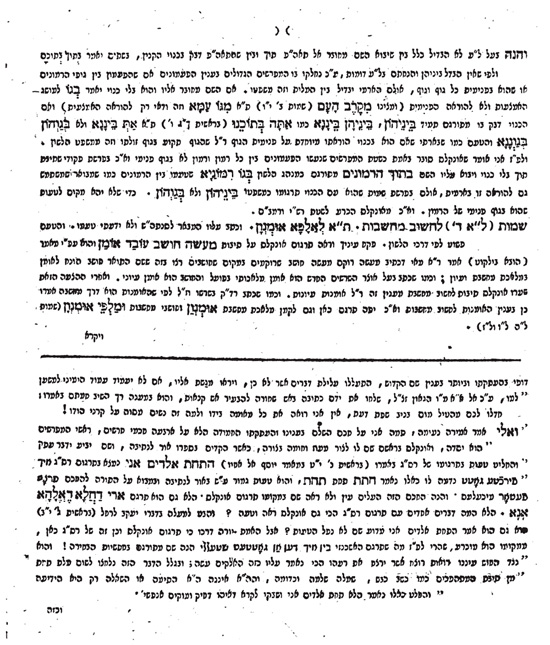
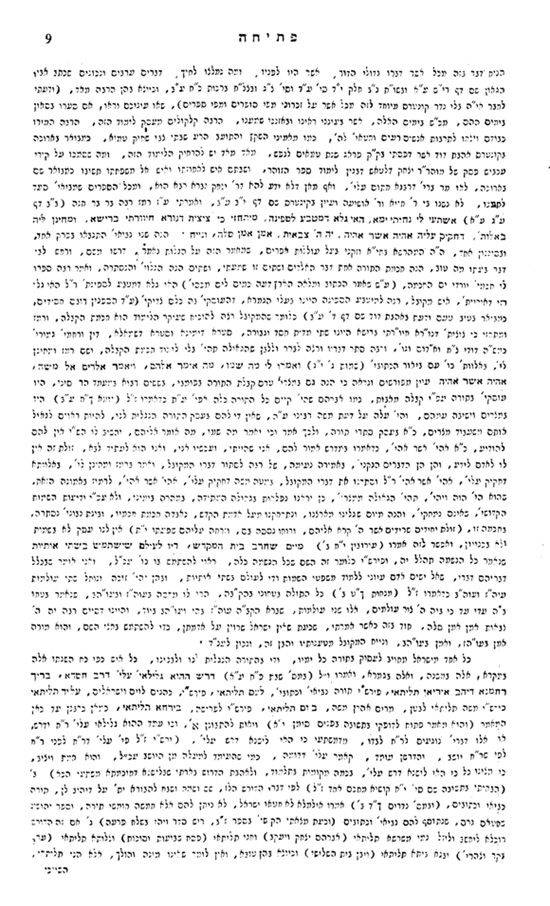
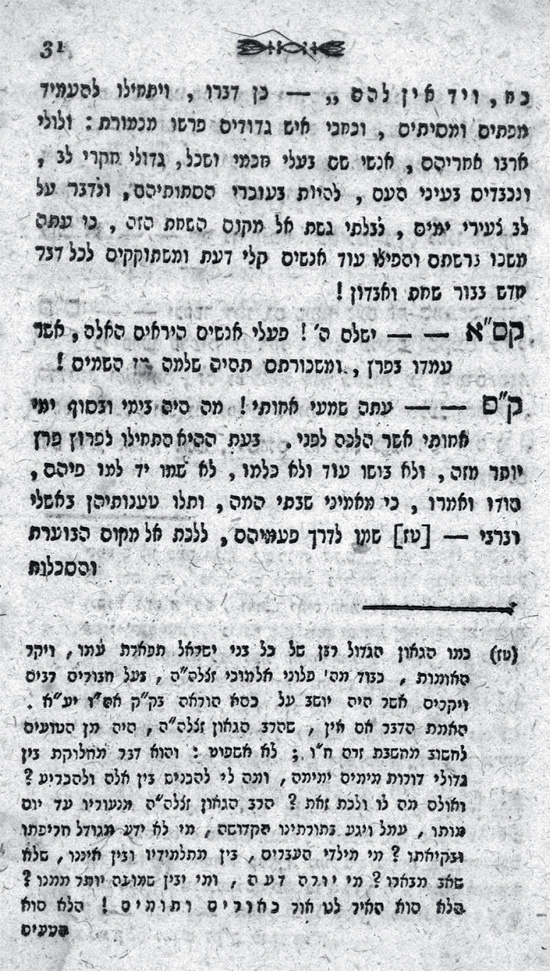
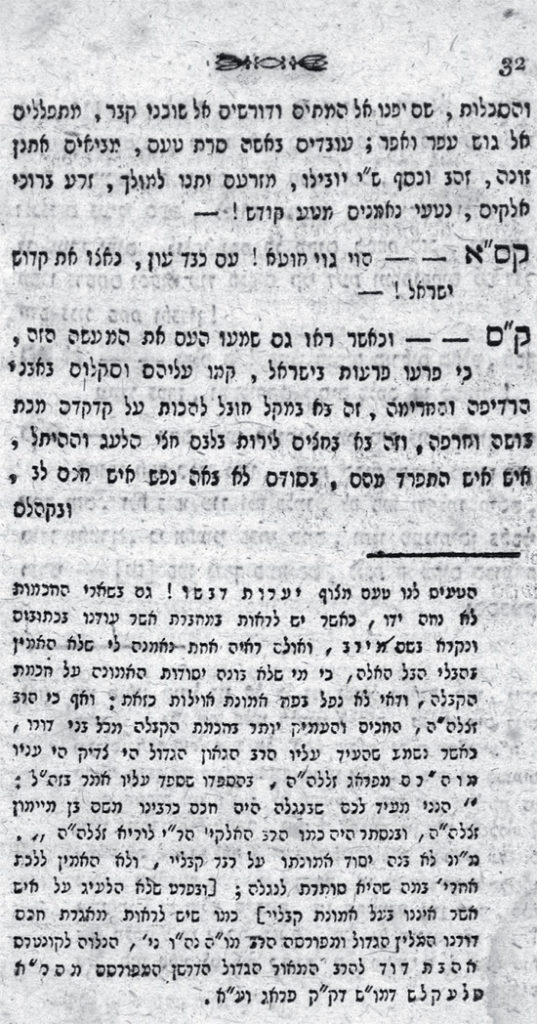
As a bochur about twenty years ago, I came across a small sefer called Olas Chodesh by R’ Eleazar Fleckeles during one of my daily shopping trips in seforim stores in Meah Shearim. Until then I had only been familiar with his Shu”t Teshuva m’Ahava. Besides the excellent price ($3), I also enjoy derush so I was happy with my purchase. Going through the sefer I was not let down, as it was especially interesting and even included some nice pieces from his rebbe, the Noda Bi-Yehudah. A few years later, while in Monsey, I made a short, enjoyable visit to Tuvia’s Bookstore. There I came across another small sefer by R’ Eleazar Fleckeles, Meleches haKodesh. After going through this sefer, I was once again blown away with how never ending Torah is (this is a daily occurrence!) . A bit later I was in a special library in Lakewood where I came across yet another obscure sefer by R’ Eleazar Fleckeles called Ahavat David, devoted to attacking Frankism. I immediately photocopied the sefer and went through it, marking off some interesting pieces. (Here is a link to a complete version of the work from the Reich collection, and here is a link to it on Google Books.)
In 2007 I wrote a review of the Meleches haKodesh [here] called ‘god or God: A Review of Two Works on the Names of God’. In that post I mentioned a letter found in the beginning of the Ahavat Dovid quoting a letter from R. Naftali Hertz Wesseley which says;
כי שמעתי מפי הגאון המקובל הגדול שהי’ ידוע הזוהר וכל ספרי האר”י ז”ל בעל פה הוא הרב ר’ יהונתן אייבשיטץ זצ”ל שהיה אומר לשומעי דבריו בעיני הקבלה כשראה שהם מפקפקים בהם ואמר אם לא תאמינו אין בכך כלום כי אין אלו מעיקרי אמונתנו, וכן היה אומר לאלו המביאים הקדמות מדברי קבלה לישב איזה גמרא או מדרש לא חפצתי בזאת ומה חדוש על פי קבלה תוכל ליישב מה שתרצה אמור לי הפשט הברור על ידי נגלה ואז אודך וכל זה אמת עי”ש עוד.
A bit after writing that post, I received an e-mail from Marc Shapiro asking me where I saw that letter, as the edition of Ahavat Dovid that he checked did not have it. I told him I had photocopied the whole sefer from an original. Some time after that, in February 2010, On The Main Line wrote about this censorship:
The book included a 1796 letter from Wessely, which Fleckeles offered… I will just note that I examined the pdf of Ahavas David twice, and I was unable to find the letter. I couldn’t understand why I couldn’t find it, so I asked several friends (literary men) if they knew what page it was on. Dr. Marc Shapiro replied that this edition — a Copy Corner reprint — is censored; it doesn’t include the letter! I suppose it’s theoretically possible that the censorship, ie, removal of the letter occurred long before the scanning of the book. That is to say, there’s no way at the moment to tell who removed it and when, but we can probably guess why. In any case, at the same time I asked Shapiro for clarification, Rabbi Brodt told me that his copy of Ahavas David includes the letter, and he sent it to me.
This censorship was later included and discussed by Marc Shapiro in an article[1] and then again in his work Changing the Immutable, (p.220). 
In 2007 I already noted some of the significance of this letter; i.e. it is notable that R’ Fleckeles quotes R’ Wesseley at all[2], as Wesseley was one of the early leaders of the haskalah movement, was close to Mendelssohn and was the author of the Biur on Vayikrah. R’ Fleckeles, like R’ Landau was firmly against the Biur.[3]
The significance of this letter in relationship to all this was already pointed out by Meir Hildesheimer, in a footnote in his excellent article “Moses Mendelssohn in Nineteenth Century Rabbinical Literature,” (Proceedings of the American Academy for Jewish Research (PAAJR) 55 (1988), p. 87 n. 23).
As an aside, all this is yet another example why scanned copies of seforim are not enough, as at times the scanner deletes pages on purpose (or even by accident). Examining originals are therefore important.
Both Meir Hildesheimer and On the Main Line[4] already noted that a copy of this letter was printed again in HaMelitz (#48, p. 750) in 1886.

In 1930, Dovid Zinz, in his extensive biography on R’ Yonasan Eibeschuetz, Gadlut Yonasan, lists R’ Wesseley as a talmid of R’ Yonasan (p.280), and also reprints this letter without claiming it’s a forgery (pp.245-246).
In November 2011 I wrote a two part post on the incredible work Parshegen by Rabbi Dr. Rafael Posen. In the second post, titled Using the works of Shadal and R. N. H. Wessely, I wrote:
A few years ago in the pages of the excellent journal Ha-maayan, a controversy took place (here) in relationship to how to cite various works of questionable people, in the course of the controversy it turned to quoting Mendelson and Wessely and their stories. Rabbi Posen mentioned that there was nothing wrong with Wessely which others argued. This controversy in regard to Wessely was not a new one[5], a few years back in the Kovetz Beis Aron VeYisroel there was a series of articles based on various manuscripts showing how the Gedolim at the time were very against Wessely. Towards the end of the Series of articles the author did a strange thing, he collected many citations of big name gedolim who did use Wessely’s work even after the controversy (herehere and here). Almost all of these gedolim were well aware of the controversy of Haskalah and came after the early gedolim obviously disagreeing with them. To me this was strange as he undermined his research – he showed that there was a big controversy with many big people on both sides so how in the world did he reach his conclusion that Wessely was bad according to everyone.
The controversy about Wessely did not end there as a few years later two works of Wessely were reprinted, his Sefer Hamidos (2002), and his Yeyn Halevonon (2003). In the introduction of both works there are lists of great people who used Wessely’s works. To be sure the kanoyim did not remain quiet about this, that same year (2003) in the introduction to the Tomer Devorah reprinted by the Mishor publishing house an introduction was printed about the evil works of Wessely that were reprinted. A few months ago the Kovetz Eitz Chaim (15, 2011, pp. 13-30) printed another manuscript on this controversy against Wessely including some letters of various gedolim of today against the evil Wessely.  In the recent work on R. Elyashiv Shlita, Hashakdon (2, pp. 136-137) they also mention how he was against the reprinting of the works of Wessely. The problem to me is how do they explain all the great Gedolim who did use his works? [In that post I included a list of Gedolim who used the works of Wessely, or quoted him in a positive light.[6] I then concluded with the following:]
“I would like to conclude with the following dream just as R. Shlomo Dubno was vindicated in the past few years by R’ Dovid Kamenetsky. It is my hope that Wessely will too be vindicated from all false charges against him and people will realize there is nothing wrong with his writings.”
Fast Forward to 2014

A few years ago I mentioned a sefer called Rabbenu written by R’ Eliyhua Starrit about R’ Ovadiah Yosef. This work is very valuable, as the author printed numerous conversations he had with R’ Ovadiah Yosef while learning with him and we get a rare, authentic glimpse into his study habits and private learning sessions. Among the numerous interesting pieces in this work we “hear” R’ Ovadiah’s opinion on different seforim and their authors. However, at times a juicy tidbit or name is censored out and we are left in the dark with just a tease of a conversation.

Here are two such pieces. The first refers to the reprinting of the Chemdas Yamim (hopefully I will return to that in the future). The second refers to the reprint of R. N. H. Wessely’s work by Yerid Haseforim a few years ago. As you can see, part is edited out.

We see that R’ Ovadiah Yosef was also against the reprinting of R’ Wessely’s works.

And 2016

In April this year, a complete edition of Ahavat Dovid was put up for auction by Legacy Judaica as was mentioned here, with a signature of it having been owned by R’ Binyomin Lowe, author of Sha’arei Torah.
A few months ago a few more volumes of R’ Wessely were printed, some for the first time from manuscript, by R’ Moshe Tzuriel. One volume includes three new seforim. 1) Sefer HaMidos which includes an additional one hundred and twenty five new pages from manuscript, printed for the first time. 2) Sefer Migdol HaLevonon, about one hundred and fifty new pages from manuscript, printed for the first time. This work focuses on Shemos Nirdafim (synonyms). 3) Chikur Hadin, a thirty page article on Sechar VeOnesh. The second volume is a reprint of Gan Na’ul (934 pp.) with notes and indexes. There is a whole section of this work printed here from manuscript for the first time, numbering about 250 pages!
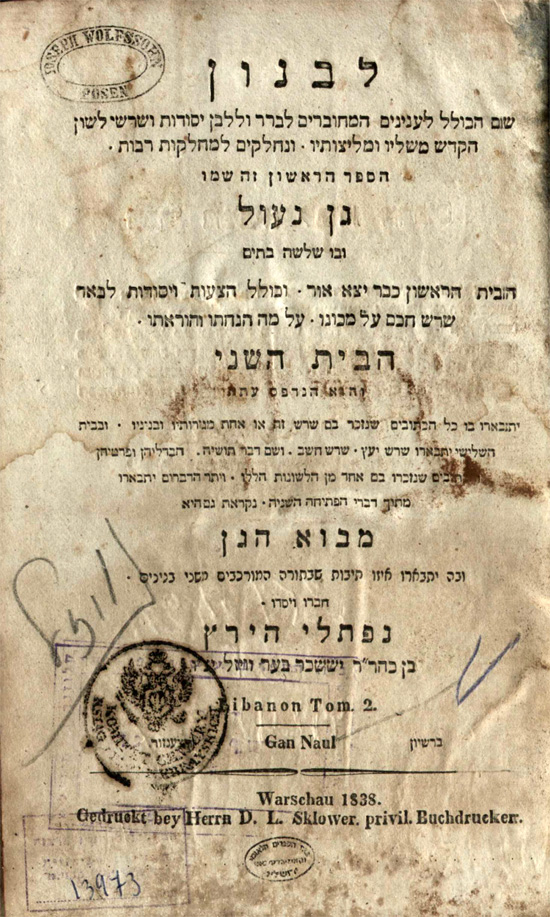
Here are two samples of pieces from this beautiful work.


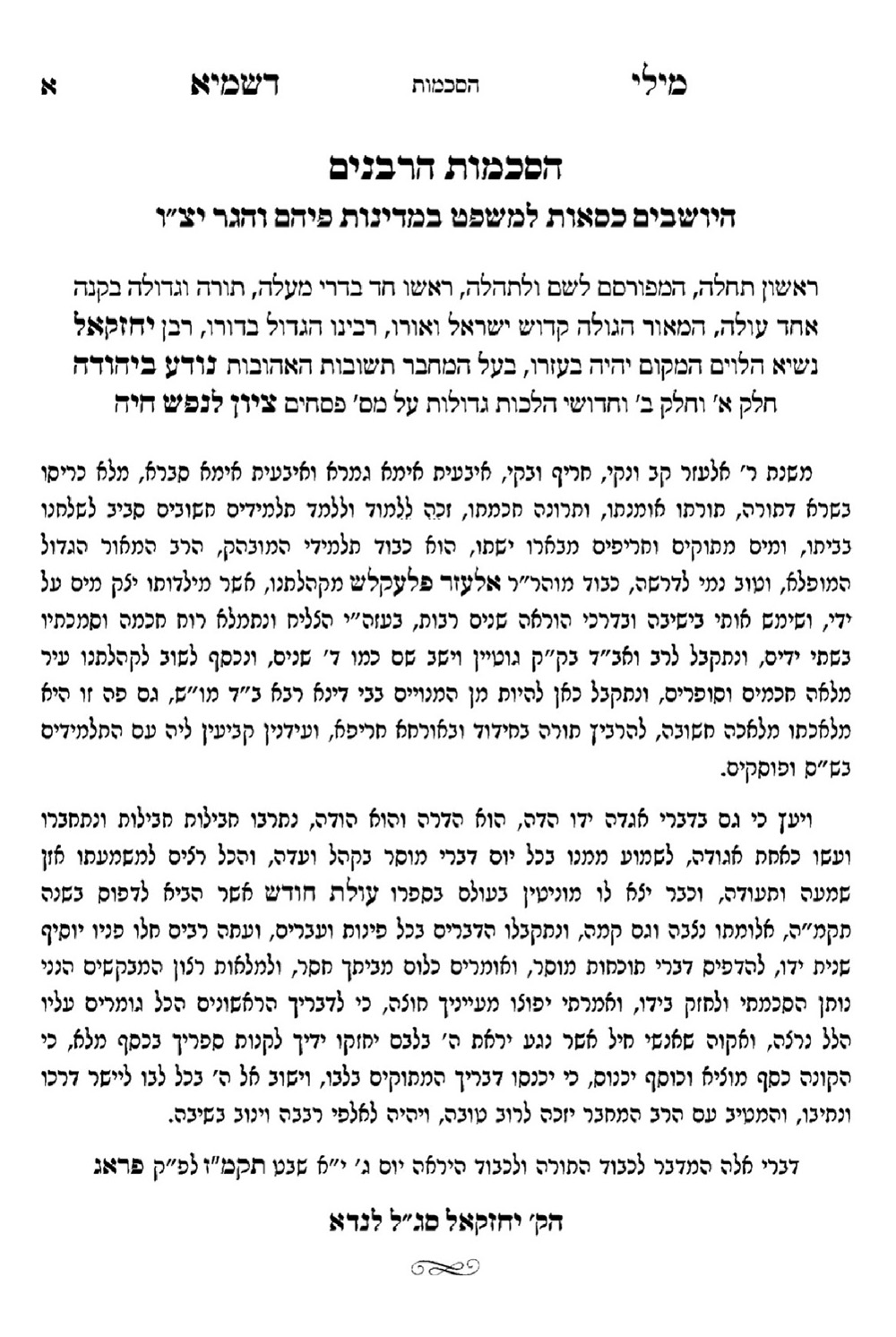
It is worth seeing this haskamah of the Noda Bi Yehuda to Gan Na’ul:
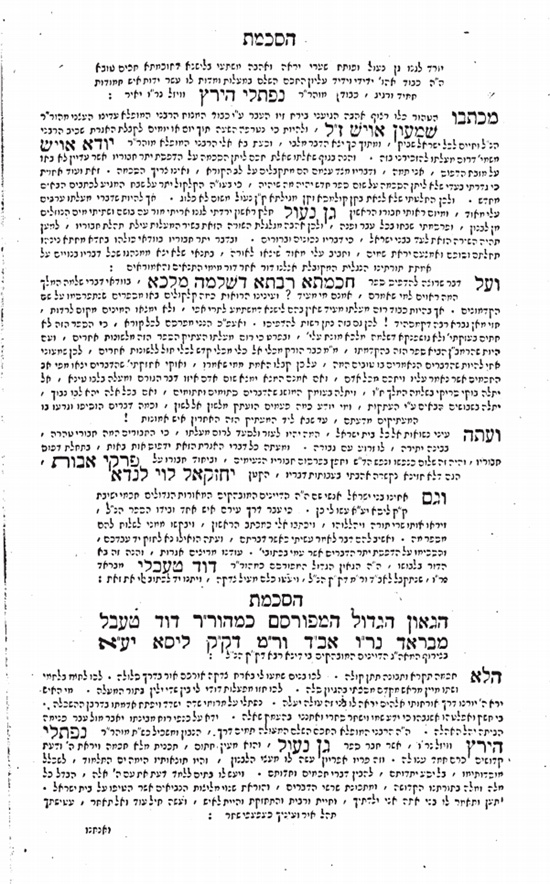
In the introduction to this new work, the editor notes (p. 6) that R’ Fleckeles quotes a letter from R’ Naftali Hertz Wesseley in his Ahavat David and mentions that it has been censored out of some versions, referring to his introduction of the Yeyin Levonon that he printed in 2003 (p. 26).

A few months ago R’ Eleazar Fleckeles’ Ahavat Dovid was reprinted by Mechon Netzach Yakov together with his Olas Chodesh Hasheni (more on this further on). 
However when reprinting the Ahavat Dovid, they censored R’ Naftali Hertz Wesseley’s letter and removed it. They write (p.251) their reasoning for doing so as follows:

בראות רבינו זצ”ל גדול המכשלה שנגרם ע”י לימוד תורת הנסתר ואיך שנמשכו כמה אנשים פשוטים עם ללימוד זה, ומתוך כך נאחזו בסבך כת הפראנקיסטן וירדו להתום, ביקש רבינו לעשות כל פעולה ותחבולה לעוררם ולמונעם מלימוד זה לשם כך יצא מן הקו, ובבחינת עת לעשות ל’ וגו’ העתיק בתחילת הספר מכתב מהמשכיל הנודע לשמצה נ”ה ויצל, מה שכתב בשנת תקנב לאחד מתובי העיר פראג, הגדת עדות מה ששמע בנעוריו מפי אחד מגדולי ישראל המפורסמים מדור הקודש, ליזהר מלימוד בספרי קבלה, ולעסוק אך ורק בנגלות התורה. במשך השנים נשמט מכתב זה מדפוסי ספר ‘אהבת דוד’ וכן ראינו לנכון שלא להעתיקו, כי לפי הנראה לא היתה אלא בתורת הוראת שעה, לעורר ההמון והמתחדשים בעם לבל יומשכו אחר כת הארורה הזאת. וראה עוד בענין זה בקובץ בית אהרן וישראל…”.

Aside from deleting the letter and claiming that R’ Eleazar Fleckeles did not really agree with its contents, they also complete misquote it.

Emes LeYakov

A few weeks ago a work called Emes LeYakov (696 pp.) from R’ Yakov Emden[7] was released by R’ Goldstein of Monroe.[8] It includes all of R’ Emden’s notes and novella on the Zohar[9] from a manuscript in Oxford (R’ Goldstein has shown a while ago that Bick’s edition (printed by Mossad HaRav Kook) of R’ Emden’s notes on the Zohar is worthless).[10] The volume begins with a 140 page introduction of the significance of these notes on the Zohar and the general history of the Zohar and various works and editions.[11]

In passing, R’ Goldstein (p. 20) writes regarding of R’ Naftali Hertz Wesseley’s letter printed by R’ Eleazar Fleckeles.

 בספר אהבת דוד… הביא מכתב מאחד ממשוררי הזמן (שלימים נודע שהוא מראשוני וראשי המשכילים, ואף רבו של רבי אלעזר ה”ה בעל נודע ביהודה זצ”ל, לחם נגדו ונגד דעותיו, והדברים ידועים ואכמ”ל), שכתב שם חי נפשי, כי שמעתי בנעורי מפי הגאון המקובל… הרב מוהר”ר יונתן… כי אין אלו מעיקירי אמונתנו ע”ש ובלי ספק מי שאינו מאמין לו, כי יצאו הדברים האלו מפי הגאון רבי יונתן בוודאי אין בכך כלום, אמנם ראינו חובה להעיר על אלו הדברים מדברי רבנו כאן כי המכחיש קבלת חכמת האמת הוא מין ואפיקורוס גמור’ ודי בזה”.

Basically he claims it’s false and what follows is that R’ Eleazar Fleckeles was mistaken to print this letter.
Shu”t Zecher Yehosef

Another recent work that has a connection to this post is the new two volumes of Shu”t Zecher Yehosef on Yoreh Deah by R’ Yosef Zechariah Stern. Many years ago Mechon Yerushalayim announced that they would be printing R’ Yosef Zechariah Stern’s works still in manuscript. In 1994, they printed the shut on Even Haezer. In 2014 they reprinted his shu”t on Orach Chaim, which had been impossible to find, while also adding in some new material. This summer they released two completely new volumes on Yoreh Deah from manuscript (380+413 pp.) (of course it’s amazing). R’ Yosef Zechariah is the subject of a future post; for now it’s worth mentioning Siman 173, his teshuvah connected to this topic.[12] It’s a slightly different version that the one that appears in the Sdei Chemed:


The editor writes in a footnote: 

ראה קובץ בית אהרן וישראל… ועי’ במבוא לספר יין לבנון מהדורת תשס”ג שהביאו הרבה גדולי עולם שדעתם כדעת רבינו, ויש לפקפק על הערעורים כנגד. אבל אינו ברור מה ידעו עליו בדור שאחר הפולמוס, ועי’ קובץ עץ חיים גליון טו…

I am not sure what that is supposed to mean? That later on we found out he is evil?

Olos Chodesh Sheini

We now return to the new edition of R’ Eleazar Fleckeles’ work. This is the third volume of R’ Eleazar Fleckeles works printed by a Boro Park-based Machon called Netzach Yaakov. When writing about the last volume they printed, I remarked: “I really hope they continue to print the rest of R’ Fleckeles’ works”. B”H, they are doing good job continuing with reissuing his works. This beautifully produced edition includes an introduction about R’ Fleckeles, sources to his words, at times quoting R’ Fleckeles references from his other works, and a detailed index of topics and seforim quoted by R’ Fleckeles at the end of the volume. 

The first part of the sefer is R’ Eleazar Fleckeles Olos Chodesh Sheini.

I would just like to quote a few passages from this beautiful work.

The first point to note about this sefer is the beautiful Haskamah that the Noda Bi-Yehudah wrote:


Elsewhere in the sefer he writes about himself: 

כך אני אומר, אני אחד מסוחרי הקטנים אין לי כל בבית כי את אשר ראיתי במראה יחזקא”ל, מראה נאוה קודש, פנים מאירות להלכה ופנים שוחקות לאגדה, מעט הון תמורת העבודה אשר יגעתי מנעורי ושמשתי מילדותי עד היום הזה, את רבינו גדול הדור רבן של ישראל [מילי דשמיא, עמ’ קעב]. 

The sefer is full of references to material from the Noda Bi-Yehudah, both oral and written.

What apparently was relevant in our day was in his day too:

כאשר בעונינו עד היום, אם המוכיח הוא בעל מעשה, אזן וחקר ותקן משלים, הכל רצין אחריו והכסילים יצאו מבוהלים, אך שהוא למשל ולשנינה, ודבריו לא היה ולא נבראו אלא למשל, ואין מחשבתו כלל לשם שמים, כי מחשבתו ניכרת מתוך המעשה, שמאריך מאד מאד, וחוד חידה, וממשל משל, במעשה הבל, ומעה תעועים, ואינו חפץ כלל להדריכם  בדרך ישרה שיבור לו האדם, להמשל משל אל בית מרי, כי אם תחלת המחשבה על סוף המעשה, לסרס הלכה למעשה, להיות חביב בעיני הבריות, שממשל משלים הוא, משלי שועלים ושעלים הלכו בו, ואמרים קדוש וברוך ומבורך בפי כל משבחים ומפארים מהמעשים אשר לא יעשו ושמו אותו לאדון על כל המעשים. ואיש האלקים אשר מעיו מוכיחין, תוכחות מוסר הכל, גדולים מעי ה’, צדק משפט ומישרים דברים אינם נמעים, וחכמתו בזויה, אפילו אם יושב ודורש כמשה מפי הגבורה [מילי דשמיא, עמ’ לו].

In another derasha he writes:

ולא כן השורים המשוררים. אין כוונתם לשיר ה’ כי אם לשיר חדש. ואינם מדקדקים אם יושר שיר הזה בארץ יהודים. או אם יהיה לצור מכשול כשירת הזונה…. כי אין יראת אלקים במקום הזה ולא אימת רבן… הנה בכל השנה החזנות חזיונות ושעיפי לילה חזון שוא ותפל. מכל שכן בראש השנה ויום הכיפור השתא הלל לא אמרינן. משום שמלך יושב על כסא הדין וספרי חיים וספרי מתים פתוחים כדאמרו ז”ל… וז”ל הרמב”ם בפירוש המשניות שלא היו קורין הלל לא בראש השנה ולא ביום כיפור. לפי שהם ימי עבודה והכנעה ופחד ומורא… ואיך נשיר את שיר הכסילים. כשמסתכל אדם יום המיתה… ואיך להעלות על הדעת שתפלות הללו יעשה רושם למעלה ויעלו חן ויהיו לרצון על מזבח ה’ [עמ’ קיג].

Of course there are numerous parallels[13] to this in other sources; to cite just one, R’ Shabesai Sofer writes in his Siddur:
ויותר מזה צריכים להזהר החזנים בתפלותיהם, הממונים להוציא רבים ידי חובותיהם  … כי על הרוב אינם מקפידים רק על קול נעים… ולא זו בלבד אלא שהם מנגים נגוני נכרים… [הקדמה פרטית סי’ כז].

In another derasha he writes:

לא בשליחי ציבור בלבד רעה זה חולה ראיתי, אלא אף בהתמניות הרבנים יושבי על מדין, מתוועדים בעלי בתים יחד יושבי קרנות, אשר לא יצאו מבית הספר מעולם, ואין להם ידיעות בית רב, ומעידין באיש פלוני שהוא איש האלקים גבר בגוברין, וכדי הוא לסתכל במראה קשת גבורים ללמד בני יהודה קשת, ולאחוז פני כסא הוראה כבוד חכמים מחוכמים, ומקבלים אותו לרב ומורה גדול בזזרוע נטויה וביד חזקה, בלי ידיעות תופשי התורה אשר להם משפט הבחירה, ולא כאשר נהגו אבותינו הקדושים ז”ל שבחורי ישראל הכריעו [עמ’ קטז].

Another derasha, dated during Aseret Yemi Teshuvah 1784, is devoted in part to attacking Mendelsohn’s Biur.[14] In addition, he quotes a piece from the Noda Bi-Yehudah related to this.
Interestingly enough the great bibliographer Ben Yaakov when writing about this work notes:

דרושים שונים נחלק למאמרים ובו דברי ריבות על העתקת התורה להרמבמ”ן [אוצר הספרים, עמ’ 432].


While an examination of all the statements of the Noda Bi-Yehudah about this need to be properly analyzed, it’s worth pointing out to a censorship on this subject. 

In the beginning of his new book, Maoz Kahana[15] writes as follows:

ראשון הביוגרפים של ר’ יחזקאל לנדא היה בנו יעקב. הקונטרס “דברי ידידות”, ששלח לאחיו שמואל לקראת הדפסת ספר נודע ביהודה תנינא בשנת 1810, שבע עשרה שנים אחר פטירת האב, מהווה עד היום אוסף ידיעות ומסורות ראשון ורב ערך. חלק מסוים של דברי ידידות נערך ונדפס בראש הספר הנזכר, וחלקים אחרים שלו נדחו וצונזרו, אותם אפשר להעלות מכתב היד הארוך המקורי של יעקב, מלווה בהערות העריכה של שמואל שנשמר בספריית קרלין סטולין בירושלים. [מהנודע ביהודה לחתם סופר, עמ’ 23].

Further on in his book he writes:

בשנת 1813 הדפיס ייטליס בהערה צדדית בספרו ‘מבוא הלשון ארמית’ דיון אוהד מאוד של הנודע ביהודה בתרגום המנדלנסוני ובהכרעותיו הפרשניות. את הדיון הזה לקח ייטליס ממכתב יעקבקא לנדא שהיה בידי אחיו שמואל בפראג. המכתב המדובר הוא ‘דברי ידידות’…  שכתב ר’ יעקבקא בברודי בשנת 1810, ובו תיעד ביקורו אצל אביו בפראג בשנת תקמ (1780). תארוך העדות האוהדת לשנה זו, סמוך להדפסת ‘עלים לתרופה’ של ה’ביאור’ (1778), אך לפני פרשת וויזל (1782) מאיר יפה את יחסו החיובי של הנוב”י למנדלסון ב’תקופת הביניים’ הקצרה הזו, בין 1778 לבין 1782. כתב היד המדובר נדד לבסוף אל גנזי חסידות קרלין סטולין, ומשם צולם לבית הספרים הלאומי בירושלים בשנות התשעים. אך אותה הסיבה שגרמה למשכיל יהודה ייטליס בשנת 1813 לצטט דווקא את הפסקה הזו מתוך כתב היד הארוך, גרמה למי מהעוסקים במלאכת הצילום כעבור כמאה ושמונים שנים לצנזר בעזרת דף נייר חלק את… אותה הפסקה ממש. ראה י’ ייטליס, מבוא הלשון ארמית, פראג תקע”ג, הקדמה והשווה לכתב יד קרלין-סטולין ירושלים (F49262) מספר 435… הפיסקה לא נכללה גם בדברי ידידות הנדפס… [מהנודע ביהודה לחתם סופר, עמ’ 190-191 הערה 80].

It’s worth mentioning this passage from R’ Ber Oppenheimer describing his reaction to reading the דברי ידידות about the Noda Bi-yehuda, whom he knew:
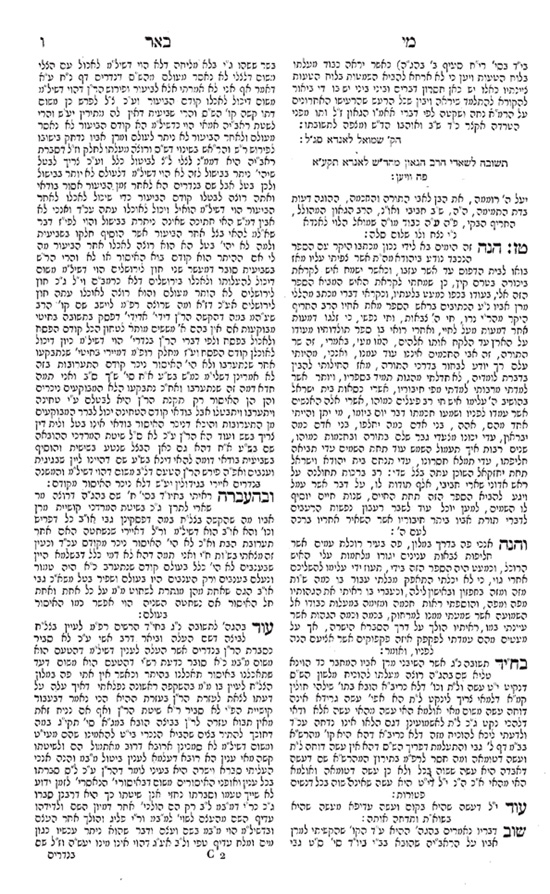


When examining the manuscript in Hebrew University the first page states:

קונטרס בן ל”ב עמודים שכתב הגאון ר’ יעקבקא סגל לנדא לאחיו הגאון ר’ שמואל סגל לנדא לפני הדפסתו ספר נודע ביהודה מהדורא תנינא והגאון מהר”ש הוציא מכאן את דברי ידידות… יש כאן כמה וכמה דברים שנשמטו בדפוס וכמובן שבכוונה מכוונת השמיטם הגר”ש ביניהם הוא ענין הביאור של רמ”ד.

This following passage is already quoted by Sandler in 1941,[16] and Moshe Samet in 1970.[17] In 1911 this letter was mentioned in the Encyclopedia Otzar Yisroel (p. 62), where the author writes:

 כי כל דברי האגרת הזאת הם מזויפים, כי סגנון הלשון ושבחו של מנדלסון יעידון כי יצא מפי משכיל ולא מפי רב בימים האלה.
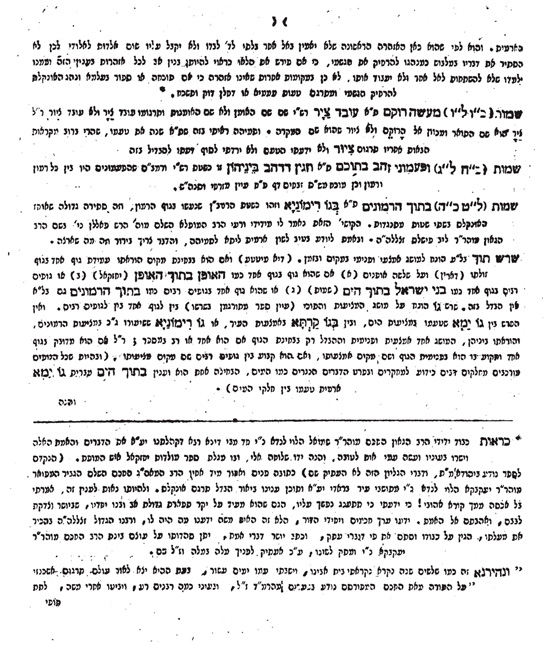

It’s silly to say that it was a forgery, as the work has a haskamah from both R’ Shmuel Landau and R’ Eleazar Fleckeles and was printed in their lifetime in their city and there is not a single trace of any protest or opposition on their part.

Now this is even more interesting; R’ Fleckeles, in his work Meleches haKodesh (first printed in 1812), uses Mendelssohn’s Biur for halachic purposes.[18] He also quotes R. Shlomo Dubno in his Tikun Sofrim many times.[19] Most printings of this work are in various editions of Mendelssohn’s Biur. It’s unlikely that he was quoting it from the rare standalone version when it was printed itself without the Biur, if we already know that he used the Biur.[20]
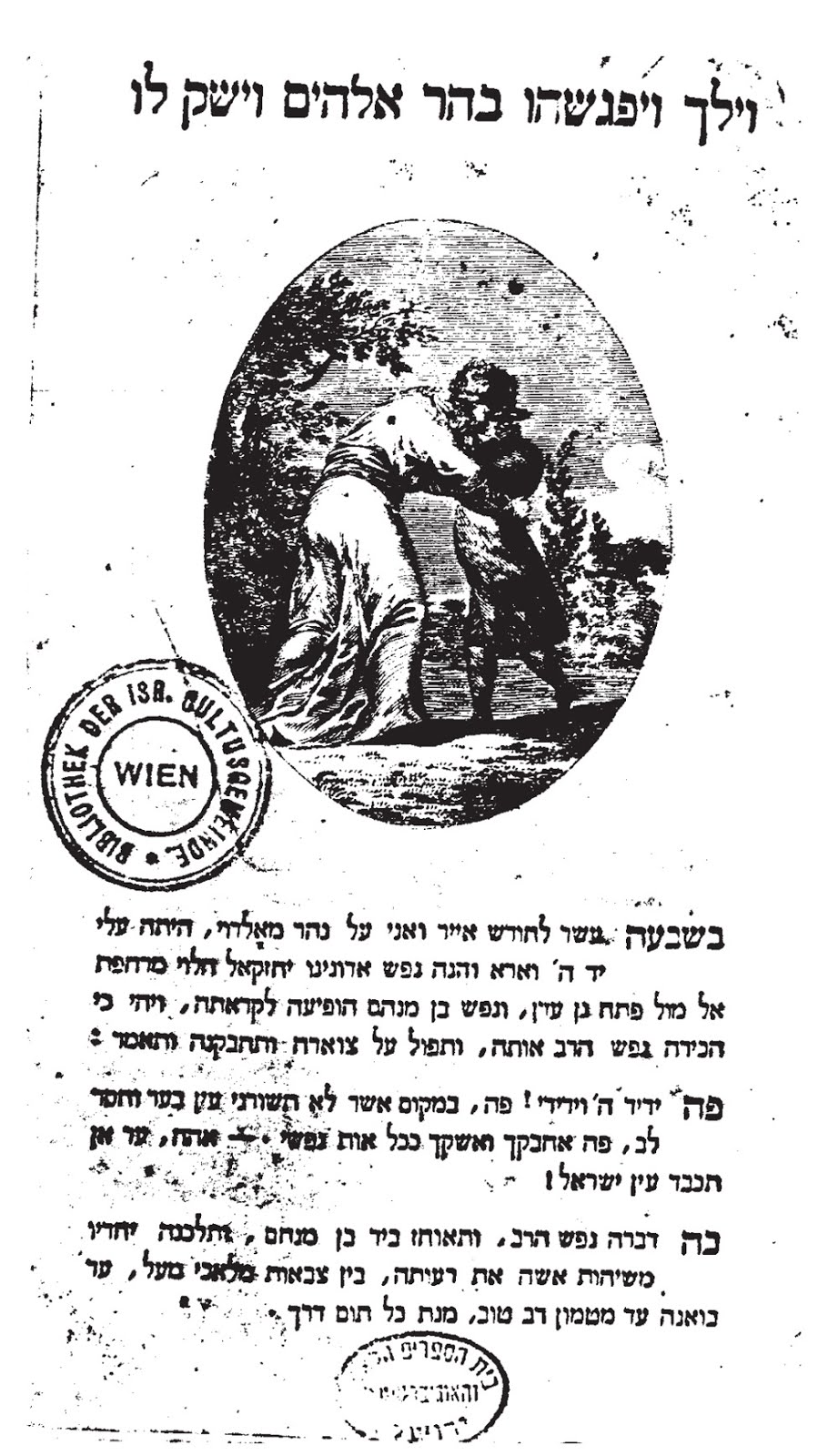
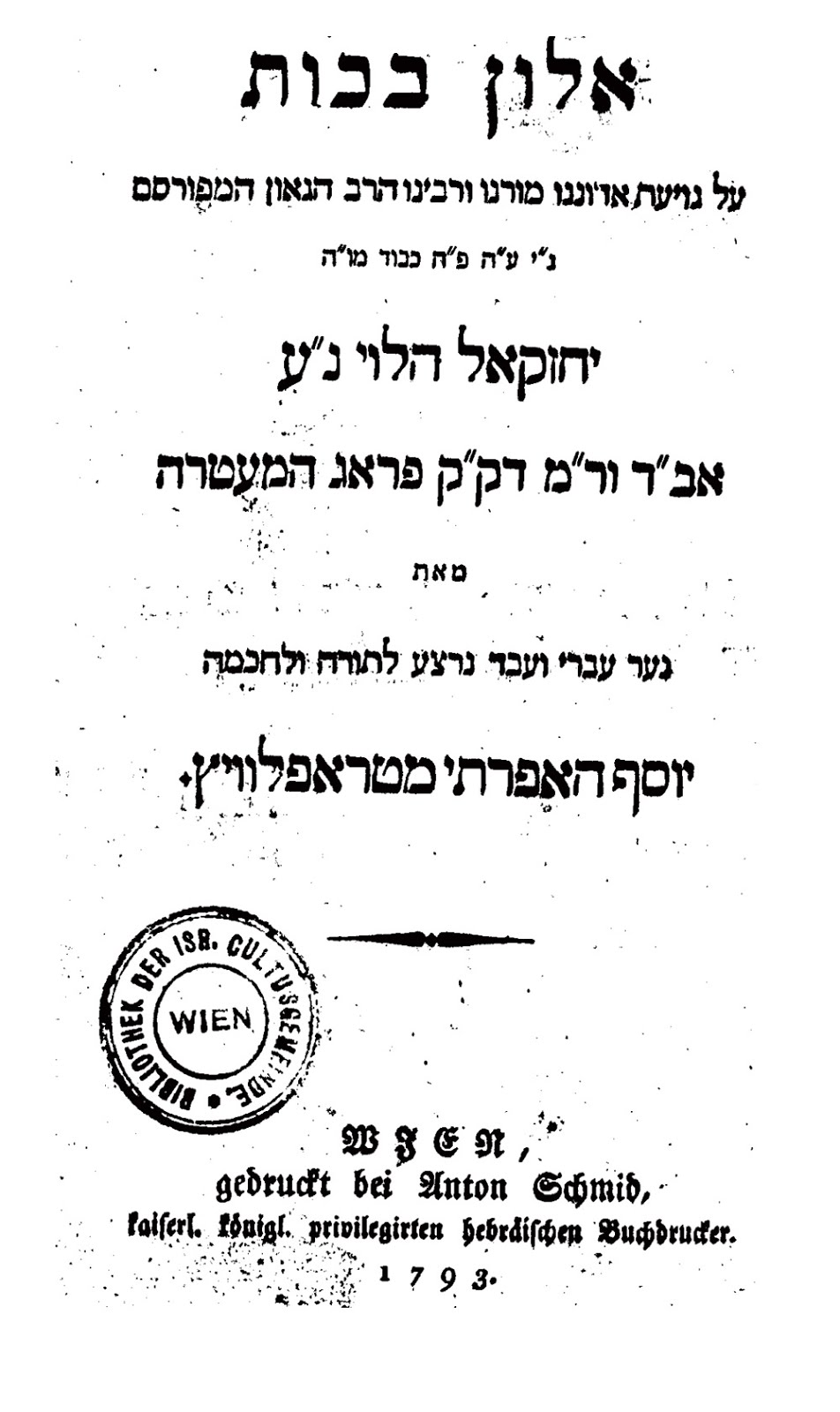
In a work that was printed in 1793, a Hesped on the Noda Bi-Yehudah, we find on the cover it has a picture of Mendelssohn and the Noda Bi-Yehudah embracing. It’s already mentioned here by On the Main Line and more recently by Maoz Kahana (ibid, pp. 192-193).


The truth is, a proper analysis of the primary sources (such as the derasha quoted above) shows that the Noda Bi-Yehudah‘s and R’ Fleckeles’ main issue with Mendelssohn’s Biur was not on the Biur portion[21]; it was on the German translation written by Mendelssohn.
Here are two rare sources[22] which are very important for understanding this subject. The first is an Haskamah signed by both Noda Bi-Yehudah and R’ Fleckeles to a Chumash printed in 1785; as one can see on the Sha’ar there is a direct influence of Mendelssohn on this work. However in the Haskamah they explain why they are giving one – it could compete with Mendelssohn’s edition, as it also translates for the convenience of the reader, but without Mendelssohn’s literary German to which they are opposed.


The second source is a haskamah written by R’ Fleckeles to a Chumash printed Prague in 1824 with a German Translation! Here too, R’ Fleckeles outlines why he is giving it a Haskamah. 

This Haskamah is printed at the end of Silber and Kahana’s above quoted article. They print the Haskamah as it appears in Bereshis, this is the one for the Shemos volume. In the National Library and Mifal Bibliography they only record the volume on Vayikra. But more importantly, they do not note R’ Fleckeles’ Haskamah. This is an uncatalogued haskamah of R’ Fleckeles which helps understand his take on Mendelsohn.[23]

Coffee

Returning to the Olas Chodesh, like other volumes of Derush, this one is rich in giving one a sense of the people and their sins. R’ Y. Greenwald already writes:

פה ושם הזכירו גם בדרשותיהם שדרשו והוכיחו את בני עדתם ולא עצרו מלהגיד את פשעם אשר ראו בהם… הרבה יש ללמוד מהדרשות שדרשו גדולי הדור ממעמד המוסרי של ישראל בימיהם בהדרשות של הגאון רבנו יונתן אייבשיטץ ב’יערות דבש’… וכן תמצא כדברים הללו בספר דורש לציון להג”ר יחזקאל לאנדא… [לפני שתי מאות שנה, עמ’ 26].

Just to list two samples both of which are related to coffee:[24]

בעינינו ראינו ובאזנינו שמענו כמה פעמים שאומרים לגוי להסיק את התנור וכיריים בשבת אפילו אם אין קור כל, כי אם כדי להחם הקאפע [מילי דשמיא, עמ’ קסד]. 

יש כמה אנשים בני בלי שם שאינם עוסקים לא באומנות בורסקי… כי אם יושבים אגודות אגודות מאור הבוקר עד צאת הכוכבים בפונדקאות של גויים, בקאפע הייזר וביר הייזר… ודוברים עתק בגאוה ובוז על מנהיגי עיר ולומדיה, על רבנן ותלמידיהון… [מילי דשמיא, עמ’ קט].

 In another passage he describes Yom Kippur at night:

הרי אפילו בשעה הראוי לכל משכיל לעמוד באימה וביראה בזיע ורחת מפני פחד ה’ ומהדר גאונו, כל אחד מתנשא לומר אני אמלוך ואני אלך בראש אני תהלה, וגברה הקנאה והשנאה הנקימה והטירה וגסות הרוח יתירה, עד שכבתה אש הראשונה שניה ממהרת לבא, כל אחד רודף אחר הכבוד, לכבדו בשיר הכבוד שיר היחוד,[25] להיות מבעלי השיר היוצאים בשיר, ואם אין הגבאי מכבד לאומר שיר היחוד, מחרחר ריב ומדון בשאט נפש וזדון, ומלקין על היחוד, כל אחד נכבד בעיניו ומעשיו גדולים משל חבירו, זה בתורה הנקראית קנין, וזה בחלום ברוב ענין, זה ברוב בנין, וזה ברוב מנין, וכמה קטטת ומריבות רבות מסתעפות עד שנהפוך השיר היחוד לשיר של פגעים, כשיר כסילים פגיעתן רעים, וכה מחלוקות שלא לשם שמים שמענו בליל כל נדרי [מילי דשמיא, עמ’ קמט].

Ahavat David

Turning to the Ahavat David; as mentioned, this work was also just reprinted. In 1799, R’ Eleazar Fleckeles gave a series of three derashos devoted to blasting Sabbateanism and Frankism. In 1800, he printed one of them. He learned much from his Rebbe, the Noda Bi-Yehudah, regarding battling them;[26] in his introduction he writes:

גאון הגאונים בעל שו”ת נודע ביהודה… גם הוא ספר לי מעשים רבים משפטים התועבים מכת ש”צ הרשעה פגיעתן רעה… [אהבת דוד, עמ’ רנז]. 

רבנו גדול העולם. נודע ביהודה, איך היה מוסר נפשו על קדושת השם יתברך לבער הרשעים אשר בחייהם מטמאין טומאת רקב… זכרו נא לימים מה עשה… רבינו… בליל הושענא רבה תקי”ט… כאשר החל השרץ הטמא… והחרים בארור חרם נוי שמתא בתקיעת שופר ובכבוי נרות את יעקב רמאה… וברוב הדרשות אשר דרש במקהלות הזכיר מכת הרשעה הארורה הזאת [אהבת דוד, עמ’ שיז].

The Noda Bi-Yehudah writes:

וצריך אני להראות כי שכלם כוזב.. ותשמע הארץ אם כת הכופרים שבתי צבי שכל דבריהם כפירות ומינות מלא דברי שטות, להפוך דברי אלקים חיים, ולהפוך עבירות למצות עפרא לפומייה… נגד אלו השוטים בעלי ש”ץ ימח שמם נגד טענותיהם המזויפות… [דאיסטים שבתאים ומקובלים בקהלת פראג דרשה מצונזרת של הרב יחזקאל לנדא, תק”ל[27], עמ’ 357].וכת הארורה והגרועה מאוד שבתי צבי [שם, עמ’ 362].

Frankism, in the Derashos Beis Peretz

One more passage related to Frankism, from the Derashot Beis Peretz, a contemporary of the Noda Bi-Yehudah, just printed[28] from manuscript states as follows:

זה רמז גדול אשר קרה לנו באחרית הימים בשנת תקי”ט לפ”ק על ידי המינים האפקורסים ש”ץ ימח זכרם, שהיו עומדין עלינו לכלותינו בפני האומות, שהי’ להם וויכוח גדול בק”ק לבוב עם כל הרבנים של מדינות פולין, יותר מן מאתים של אפקורסים ש”ץ ונעו כולם משומדים עם נשיהם ובניהם, והי’ להם וויכוח בשאלות ותשובות לפני שרים רבים ונכבדים מאומות העולם, ולפני כומרים ובישופים הרבה, והי’ להם ראש אחד ביניהם והי’ ספרדי מכשף גדול בשמות הטומאה… שרצו לבטל תורה שבעל פה, וכבר נשרף על ידם מן האומות הכומרים כל הש”ס ורמב”ם וטורים באמצע בעיר בפני כל עם ועדה, וגזרו שמד בכל הקהלות ישרפו תורה… ומפורסם בכל מידנות פולין שהי’ אז נס גדול ומפורסם, שהכומר השר הגדול שצוה לשרוף הספרים הנ”ל הי’ לו מפלה גדולה תיכף מיד אחר מעשה זאת, ומת מיתה משונה, והי’ מכין אותו ביסורין קשים מן השמים, והי’ צועק קודם מותו שהספרים הנ”ל הם שורפין אותו. ואח”כ כל רשעים הנ”ל נשתמדו, ויצאו מכלל ישראל וכתבתי זאת שיהי’ זכרון בספר כמו מחיית עמלק, למען תספר באזני בנך ובן בנך את הנס שנעשה השי”ת בעתים הללו [בית פרץ, עמ’ תו-תז].

Broadside

R’ Fleckeles writes;

גם פה עיר הגדולה לאלקים, נדפס התפ”ו קול כרוז מגדולי הדור ופרנסי העדה, ונדפס פעם שנית שנה זו ממני ומאחי הרבנים המובהקים המאורות הגדולים בית דין מורה שוה [אהבת דוד, עמ’ רפט].

Here is a facsimile of this actual broadside[29]:

In the beginning of the Drasha, R’ Fleckeles quotes from Frankist literature:

כל השומע ורואה יכול לקרות, את דברי האגרות, יצחק וישחק… בלעגי שפה… כלו מגומגום לא עברי ולא תרגום, לא ספרד ולא צרפת לא אשכנז וריפת ולא מפני יפת לשונם אשר הגו בגרונם, כאחד המונם, במלות מזויפות וטרופות כדבר אחר המבשלות והאופות… ואראה דוגמא ראשית האגרת,… וכן יתר דברי האגרת מהומה ומגערת, מאיימים ומפחידים… [אהבת דוד, עמ’ רנח].

What letter he is referring to? Paweł Maciejko writes that he is referring to the Red Letters.[30] This document was written around 1800. It was printed in Hebrew and English from manuscript by Ben Zion Wacholder, ‘Jacob Frank and the Frankists Hebrew Zoharic Letters’, Hebrew Union College Annual, Vol. 53 (1982), pp. 265-293.[31] Examining this document we see that this is the letter that R’ Fleckeles was quoting as the exact passages appear there. The reason they were called Red documents, writes Maciejko, is “because of the color of the ink that they were written and the symbolic association between the biblical kingdom of Edom and the Hebrew word adom, red”.[32] In one place in the Derasha R’ Fleckeles even writes:

 וכל מה שכותבים הוא בצבע אדום [אהבת דוד, עמ’ שה].[33]

What was the result of this Derasha? Paweł Maciejko writes: 
Shortly after the sermons were delivered, riots erupted in the city, and although Fleckeles did not mention any names, the mob apparently knew very well whom to assault. During the Funeral of a known Sabbatian, a crowd attacked the procession and the body was profaned. It seems that woman were especially targeted: there was turbulence in the female section of one of the Prague synagogues and many of the wives and daughters of known Sabbatians were insulted or attacked on the city’s streets.[34]
When discussing this group he writes:

גם אלה אשר הנשים יושבות ועוסקות אף עמהם, כי שב”י כלהו איתנהו בהו הכל ממירין אחד אנשים ואחד נשים הכל סר יחדו נאלחו בדברי שוא [אהבת דוד, עמ’ רפג]. 

יעקב איש רע מעללים… טף ונשים באים לשמוע קבלת יעקב רמאה, ועוסקים יחדיו במעשה מרכבה טמאה למען ספות הרוחה את הצמאה [שם, עמ’ שכ].[35]

Oral Derasha Versus a Printed One

In this Derasha we find several times that R’ Fleckeles was very graphic while describing the Frankists’s depravities (pp. 257,290, 323-324). I would like to suggest the following: In general, there is a known issue when learning derush seforim; are printed Derashos exact translated versions of the oral original, or were they edited for print? For the most part, I would say this was an actual version of what he said in the oral Derasha he gave. However, orally he was not as explicit, thus the reason why he rushed to print this Drasha almost immediately after he gave it was that it’s easier to write certain things and he wanted to immediately expose how awful they were.[36]
In a similar context (in relation to the word graphic), in 1936 R’ Avrohom DovBer Kahana Shapiro, author of the classic work Dvar Avrohom, gave an incredible Derasha[37] in Yiddish to thousands of woman on the subject of Taharas Hamishpacha. It was then printed in Yiddish with some notes in Hebrew and in 1940 was printed in Hebrew with more notes. A few years ago it was reprinted. In the introduction the editor writes:

כאמור החוברת הזאת היא הרשמה סטינוגרפית, המוסרת בעינם את הדברים הנפלאים כפי שיצאו מפי הנואם הגדול, רק מפני שבמקומות אחדים שבשעת הרצאתו קיצר הרב שליט”א כבר יותר מדי מפני טעמי צניעות מובנים בנוכחותן של אלפי נשים, בקשנוהו למלאות כפי האפשר בהמסר החוברת לדפוס… 

מטעמי צניעות מובנים ומחמת נוכחותו של קהל הנשים הגדול קיצר הרב שליט”א בדבריו שהיו מרומזים מדי. אמנם באשר לכתיבה, המתאפשרת להימסר בהרחבה, נענה לבקשתנו לפרט ולהרחיב…

In the beginning of the Drasha he said:

נושא הרצאתי מעלה בזכרוני את המשנה על הדברים שנקראים ולא מתרגמים נקראים במקורם ולא מתרגמים בשפה המדוברת. בעקב זה נאלץ אני באי אלו מקומות להיות מוגבל בלשוני, לקצר בדברי, לחפש ולברור מלים נאותות ביותר ולהמנע מכמה ביטוים השייכים ישר לענין בכדי לא לפגוע ברגשות ידועים… אמנם כמאור אאלץ באי אלו מקומות לקצר בתכלית ולהסתפק ברמיזה [7-8].

Related to this he writes in the introduction:

החוברת הזאת שלדה ועיקרה הוא הנאום שנשאתי לפני בית יעקב בשפה המדוברת אולם בצאתה פעמיים בדפוס נוספו כמה דברים ובעיקר הערות בפ”ע מתחת לקו עד כי נסבה ורחבה ותשלח בדים וענפים מעל לגבולות נאום עד כי מדת ספר קטן. לזאת יש ממכרי שיעצוני לשנות קצת את סדרה ופניה, פני נאום, לעבדה ולהקציעה ולתת לה פני ספר לאוהבי ומוקירי אלא אענית הבדל עיקרי יש בין ספר לנואם הספר מושגו לשימות איכותית בענין שהוא דן עליו היקף ועיבוד, והנואם הוא בחינת קטע או קטעים מענין הנידון בחינת מקופיא. ובהיות שלא עיבדתי את הדברים עיבוד גמור ובהיות שרובם אינם ממקצועי, לא הייתי חושב להרימם למעלת ספר במובן האמור, לחשבו לדבר שלם ומקיף…


Sefer HaBris

One bibliographical point related to the Drasha can be found where R’ Fleckeles writes:

מצות בטלות לעתיד לבוא[38]… ובעל הברית אשר נאמן בבריתו[39] וקים מאמרי רז”ל נעלם ממנו דברי הרשב”א [אהבת דוד, עמ’ שב]

The new edition does not reference to what he is referring to, but it’s to a passage in R’ Pinchas Hurwitz’s Sefer HaBris, a work which he quotes two more times further on[40] (also not noted in the sources). Here is the passage:


What is more interesting is that he quotes R’ Pinchas Hurowitz’s Sefer Habris three times in a drasha which was delivered in 1799, less than two years after the Sefer Habris was first printed (1797); this shows us that he went through parts of the work right away.[41] This is yet an additional source demonstrating the great popularity Sefer Habris enjoyed even right after it was printed. 

Learning Kabbalah

The cause for this evil movement, writes R’ Fleckeles, was because:

ושורש כל הקלקול הוא בעבור שאינם עוסקים בגמרא ושלחן ערוך רק במדרשי האגדות ובמאמרי זוהר, לחזק בנינים של שוא ותהו [אהבת דוד, עמ’ שו].

In this Derasha he writes out very clearly that one should not learn Kabbalah if one did not yet master other areas of Torah first.

וזה העיקר שיעשה האדם וחי לעולם אם הוא שונה הלכות כדתנא דבי אליהו והובא מגילה… כל השונה הלכות בכל יום מובטח לו שהוא בן עולם הבא, ופירש”י, משנה ברייתא… לא מצינו לא בבבלי, לא בירושלמי, ולא בתנא דבי אליהו, ולא בספרי וספרא ומכילתא, ומדרש רבות, שאליהו בא לבשר כל העוסק בסודי תורה בכל יום הוא בן עולם הבא [אהבת דוד, עמ’ רצב] 

אחי ורעי הנאמנים בבריתי, שמעו ותחי נפשכם, די לנו ולבנינו בתוך הגולה, אם אנו עוסקים לילות כימים, בתלמוד בבלי עם הרי”ף והרמב”ם ותוספות והרא”ש והטור והשלחן ערוך, עם האחרונים הוא תלמוד הקדוש, והעוסקים בו קדושים. וקבלה בידינו מאת גאונים הקדמונים הקדושים אשר בארץ המה, אם משיח ה’ אשר יתגלה כבודו ימינו בקרב, לא יהיה בקי בכל הש”ס עם כל הראשונים והאחרונים, אף שיהיה שלם בכל החכמות הרמות ונשגבות, ברור כשמש שאין זה משיח ה’, אלא מלבד כל המעלות ומדות שמנו חכמים ונביאים, צריך להיות גם כן גדול שבגדולים בגמרא ובפוסקים, וכלל גדול הזה הוא בכל דברי הנביאים והחכמים, והמשכיל יבין [אהבת דוד, עמ’ שח].

This is why the content of the letter from R’ Wesseley quoting R’ Yonasan Eibeschuetz was very important for him to quote at the outset; this is one of the main themes of the work.

Elsewhere in the drasha he writes:

ידעתי שיביאו ראיות, מספרים אשר לא נשנו בי רבי חייא ורבי אועיה, ואף הרי”ף והרמב”ם ורש”י ותוס’ ור”ן והרא”ש לא ידעו מהם, ולאו בעיזקתא דשלמה מלכא, ואף לאו מר בריה רבנא חתים עלייהו, ובפרט כאשר שמענו כן ראינו, הקלקול יותר על השבח המגיע לכתבים, הרבה עסקו בספרים האלה ומצאו מקומות לטעות, ואמרו דיין האמת על שמועות רעות, וקצצו בנטיעות, והמירו טוב ברע, ושמו חשך לאור. אבל מלימוד גמרא ופוסקים, לא יצאה מעולם שום תקלה, ולא מקום לטעות, רק דרכיה דרכי נועם… [אהבת דוד עמ’ רצד].

 A parallel to this might be what the Noda Bi-Yehudah wrote:

אם במה שמקובל בידינו אמרו כלל גדול, כל ברייתא דלא מתניי’ בי’ ר’ חייא ור’ אושעיא לא מתבינן מינה, הרי שחששו שלא נמלטו מן הטעות והשיבוש… וכן בכתבי האר”י לאו האר”י חתים וגם לא תלמידו מהרח”ו רק בחליו של הרח”ו גנבו הכתובים ממנו ונעתקו בלילה א’ כמה מאות ניירות ע”י כמה סופרים הלא קרוב הדבר שנפלו בהם שגיאות רבות ועצומות [דאיסטים שבתאים ומקובלים בקהלת פראג דרשה מצונזרת של הרב יחזקאל לנדא, תק”ל, עמ’ 355].

This topic was very important to him. In the introduction to his shu”t he writes:
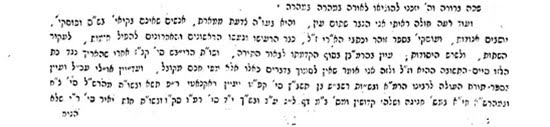


About Kabbalistic Kavanos

Related to all this he writes:

ואחרי אשר דיבר בתקיעה של מצוה, אמר תסתירני מסו”ד מרעים, מאנשים המתנשאים בסוד שיח שרפי קודש, ועושין כוונות שוא בתקיעות, וקוצצים בנטיעות, כאשר הארכתי ובארתי קדש זה עשרים שנה, והוא בחיבור עולת ציבור ונכון להביא הדברים פה שניות, והוא כתפוחי זהב במשכיות, אמנם אמרי אחר שהוצאת הדפוס רבה היא, תמכתי עליך אתה ידידי ורעי הקורא, שתשא עיניך שמה, ומצאת את אהבה נפשך [אהבת דוד, עמ’ רעא].[42]

In the Derasha, he referred to what he wrote some twenty years earlier in Olas Chodesh Hashenei, at great length:

אני הגבר ראה ראיתי רבים מתיהדים בסודי סודות הנטועות בתקיעות, בכונות שונות ולשער הפנימית פונות, ונבעו מצפונות. אמנם עקרת הכוונה הנכונה התיכונה, לעשות המצוה כתיקונה על מכונה, שצריך לכוון עליה התוקע והשומע, זו היא לקיים מצות המלך הקדוש, אשר קדשנו במצותיו הקדושות, וצונו זה היום קדוש, תקעו לפני בשופר כי קדוש היום לאדונינו, ושארי כוונות הידועות בסוד התקיעות כולם כלולות בכונה זו, ומינה לא תזוע [מילי דשמיא, עמ’ פב].

Then he continues:

He repeats this again elsewhere in his writings:

אין רצונו לומר כוונות הספירות אלא הכונה נאמנה שלא כתב לשם קדושת השם, אלא כשאר דברים בעלמא והוא פשט פשוט בדעת כל הפוסקים ועם נעמים לא אבוא, ומעולם לא עלה על דעת קדושים הראשונים חכמים וסופרים, לחשוב מחשבות ספירות, כי בימיהם לא ידעו מאומה, מספירות בלי מה, ולדעתי העניה בלב ים הקבלה, קרוב אליך הדבר מאד בפיך ובלבך להטעות, ומה לי ולך אצל דברים הן כבשונו של עולם, ובהדי כבשי רחמנא למה לך מה דמפקדת על פי הגמרא והרי”ף והרמב”ם והרא”ש איבעי לך למיעבד… [מלאכת הקודש, עמ’ קלג].

He concludes this Drasha by bringing the famous Teshuvah of the Maharshal about Kabbalah and some other famous sources and finally two Teshuvos of his Rebbe, the Noda Bi-Yehudah, one of them the famous Teshuvah related to saying Leshem Yichud.  

In my previous post I wrote a bit about Leshem Yichud and I quoted a passage from Sharon Flatto who writes in her ‘The Kabbalistic Culture of Eighteenth Century Prague’: 

Notably a Haggadah was recently discovered that was owned during the late 1780s by Fleckeles…. The margins of this Haggadah contain leshem yihud formulas to be recited before the blessing on the four cups of wine penned in Fleckeles’ hand. 
In the footnote she writes they seem to have been written between 1784-1790. (pp. 225-226). While I wish I had more clearer sources about this discovery. She does not note that the Haggadah that R’ Fleckeles himself printed in Prague in 1818 nor in the manuscript updates of R’ Fleckeles to his own Haggadah does he write to say Leshem Yichud or any such Tefilah in the Haggadah.

I recently received a copy of those margins from the owner of this rare Haggadah.


From the Ari Bergmann Collection (Lawrence, NY) 

I am not sure what R’ Fleckeles held in his younger years but it appears from his later writings that he “held” strongly of this Responsa of the Noda Bi-Yehudah, as he quotes it often – in this Drasha and in his Meleches haKodesh (p. 132). 

Baruch Linda

 At the end of the work R’ Fleckeles writes: 

יעקב הסרחן ועיין ראשית למודים שער ששי מבע”ח הנושכים כו’ סדר הששי סימן כה [אהבת דוד, עמ’ שכט].

 The editors of the new edition do not elaborate which work and passage, are being quoted.

 Here is the sha’ar of the work and the relevant section being referenced.


One source about the author, Baruch Linda, is R’ Matisyahu Strashun, who writes:

וכתב על החכם ברוך לינדא תואר ירא ה’ אשר אמנם כפי הנודע בברלין עיר מגורתו עד יום מותו, חלף חוק ודת ישראל (אף כי לא המיר), שכח מועד ושבת, ובימי זקנותו לא יכול אף קרוא עברית כמעט [מבחר כתבים, עמ’ רמ].[43]

This is yet another source showing how popular this work was at the time. As an aside, this quote shows that R’ Fleckeles was into “interesting seforim,” and I will deal with this in a future post. Another such sefer which he gave a haskamah to and his name is in the Prenumeranten in the 1793 issue of the Igrot Orchos Olam.

Calculating when Moshiach is coming[44]

Worth mention is one final issue that R’ Fleckeles writes a lot against, namely attempting to calculate when Moshiach will come. In the beginning of the derasha he writes that this is one of the purposes of why he wrote it: 

לכן כתבתי דרשות האל לחק ולזכרון בקהל עדת ישורון, למען ידעו עד דור אחרון, ואל ישעו אתכם דברי הרמזים, אף שהם מחורזים בדברי הנביאים והחוזים, ואל תאמינו באומר רזי לי רזי לי ואני חכם הרזים, כי סתומים וחתומים הדברים עד עת קץ הפלאות, אז המשכילים יבינו כל היעודים וכל הנביאות, ועיין רבינו סעדיה גאון ור”י ורבינו אברהם ן’ עזרא סוף דניאל ואחרי ששוטים האלו מביאים ראיות מן הזוהר, ומחשבים קץ הפלאות בנוטריקון וגימטריאות, אף אני אביא ראיות מן הזוהר, כי תועים ומתעתעים ומוגעים, בכל חשבונות ודמיונות וחזיונות, חלומות המדומות [אהבת דוד, עמ’ רנט-רס].

Later on he writes about it at length here is the fascinating section.

R’ Elazar Fleckeles and R’ Yonasan Eibeschuetz

One final point, returning to the letter that R’ Eleazar Fleckeles printed from R’ Wessely quoting R’ Yonasan Eibeschuetz which was discussed in the beginning of this post.
I think that one point that is of some significance is not only that he is quoting a letter from R’ Wessely but that it quotes R’ Yonasan Eibeschuetz. As is well known, the relationship between R’ Yonasan Eibeschuetz and R’ Eleazar Fleckeles’ Rebbe the Noda Bi-Yehudah was “interesting”, as fully documented in Sid Leiman’s special essay When a Rabbi is Accused of Heresy; R. Ezekiel Landau’s Attitude Toward R. Jonathan Eibeschuetz in the Emden Eibeschuetz Controversy. He also refers to his various works in this volume (the Olas Chodesh Hashenei and Ahavat Dovid) with great respect.
ותמה הגאון האמיתי בספרו יערות דבש [מילי שמיא עמ’ קכט]. עיין באורים ותומים סי’ צז [שם, עמ’ קמא]; ומביאו הגאון אהבת יהונתן [שם, עמ’ נב]; וקרוב לזה מצאתי באהבת יהונתן [אהבת דוד, עמ’ רעח].
One last source on this topic is from the work Sicha bein Shnat 5560 UVein 5561 printed in Prague in 1800 written by R’ Baruch Jeiteless[45] another talmid of the Noda Bi-Yehudah which is also a work devoted to fighting Frankisim. 
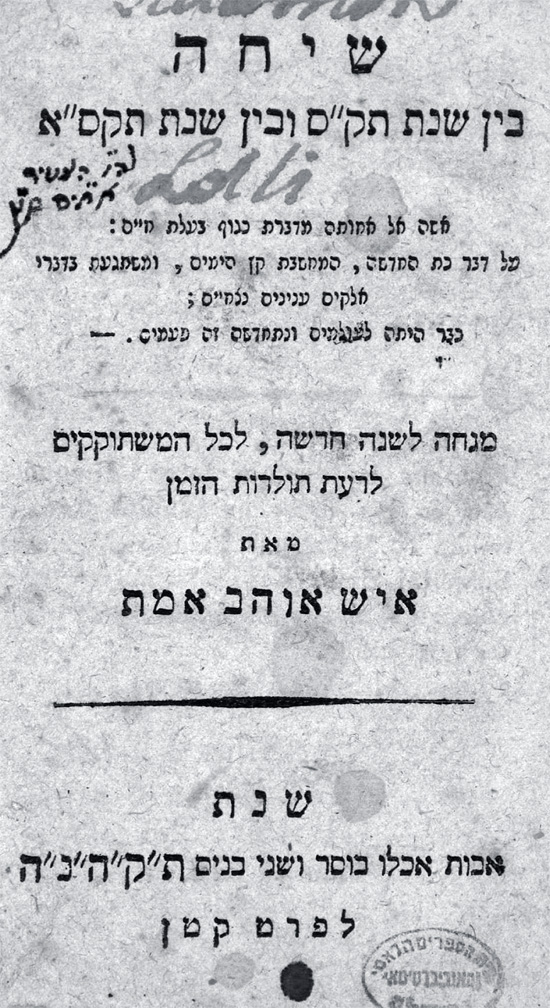
 

*Many thanks to Shimon Steinmetz for his help with tracking down some of the Rare sources.
[1] In Milin Havivin volume 5 (available here), p.6.
[2] In Teshuva m’Ahava 1:10 he writes וביאור החכם ר”ה וויזל
[3] On R’ Wesseley see overview from Professor Chaim Shapiro (son of the Dvar Avraham), Safrut Haskalah BeMerkaz Germany (1784-1829), pp.194-246.
[4] There is a typo about the exact source in On the Main line’s post. 
[5] Much has been written on this controversy see M. Samet, Chodosh Assur Min Hatorah, pp. 67-92. But a full scale dissertation on the topic is still lacking.
[6] One other point of interest related to all this: the great Galicianer posek, R. Meshulam Roth, at the request of R. Meir Shapiro towards a new school system, penned a list of works for students to learn. Among the many interesting things he wanted talmidim to read was the Shirei Tiferes! [Printed in back of his R’ M. Roth, Mevaser Ezra on Ibn Ezra p. 176 [=Mevaser VeOmer, p. 120]. This is referring to a poetic work by Wesseley.
[7] All this is part of the recent welcomed flood (by book lovers) of his material, including his Shu”t Sheilos Yaavetz (3 volumes) including a volume of new material, (with some mysterious din torah around it), Meturgeman by R’ Eliyahu Bachur with R’ Emden’s extensive glosses (printed by Mechon Zichron Aharon) and Emunas Chachamim with his notes taken from Mitpachas Sofrim (also printed by Mechon Zichron Aharon). This is aside from various marginalia of his printed in some of the recent volumes of Yeshurun. 
[8] It also includes a new edition of ציצים ופרחים, based upon manuscript (the third edition to come out within the past year). In addition it has the R’ Emden’s marginalia to a few seforim, including: the Meor Eynayim which was printed earlier by him in a journal from Tosh (based on the copy in JTS); Rabbenu Bachaya; Paneach Raza; Marshah Al HaTorah. Worth pointing to is the lengthy discussion about R’ Moshe Kunitz (pp.126-140). To this, see what I wrote in Yeshurun 24, p. 466 and here I hope to return to this in the future.
[9] For an understanding of this work see Moaz Kahana’s forthcoming study. 
[10] Related to this it’s worth pointing to the newest sefer of R’ Meir Mazuz called, MeGedolei Yisrael (534 pp.). This work is a collection of his articles about different Rishonim and Achronim written over the years. There is supposed to be 2 more volumes to this set coming out. In his chapter devoted to R’ Yaakov Emden, he concludes (pp. 149-150) with some comments on the notes of R’ Emden printed by Mossad HaRav Kook and shows that Bick could not read the manuscript, as he already noticed many mistakes while comparing Bick’s transcription to the page of the manuscript Bick included in the beginning of his edition. 
[11] Although this introduction is very useful and brings new material etc. it is very weak on naming the sources that helped him, citing academic sources very infrequently and only by title of book not by name (a common occurrence in such works). 
[12] For recent discussion on this see Yaakov Spiegel, Amudim BeToldos HaSefer HaIvri: BiSharei Hadefus, pp. 164-199.
[13] See Leo Landman, The Cantor: An Historic Perspective.
[14] Parts of this dersaha are quoted in the excellent series of R’ Dovid Kamentsky on R’ Shlomo Dubno in Yeshurun 8 (2001) pp. 740-741; however it appears that a small typo crept in, he writes the drasha is in Olas Chodesh volume one when it’s in volume two.
[15] I hope to return, more in depth, to this special work in the near future. But for now a few words on this work, (full disclosure: the author is a good friend). There are two Gedolim in particular who are considered giants in the world of Halacha and their words carry great weight until today in all circles, the Noda Bi-Yehudah and the Chasam Sofer. This book analyzes many aspects of their rich lives (tying many controversies together and showing how both of them wrote and dealt with them). It’s well written and researched; it includes a fresh look and in-depth analysis of many famous topics and plenty of discussion about new subjects. The author shows a tremendous command of the primary Torah sources, relevant manuscripts and puts down his thoughts clearly and very chronologically. Some fascinating and unknown people are discussed throughout the book. The author did not attempt to deal with everything both of these Gedolim wrote about as that would require a few volumes. He has already completed a few more articles related to these giants. The first edition already sold out, a second edition is due out shortly.

[16] HaBiur LeTorah, p. 204.
[17] HaChadash Asur Min Hatorah,p. 75.
[18] See pp. 4, 52, 88, 91.
[19] See pp. 3,23,25,26,49,56,61,62,66,92,104,111,115,116. These sources are not noted by R’ Dovid Kamenetsky when he writes about the Tikun Sofrim of R’ Dubno in Yeshurun 10, pp. 758-761.
[20] In the actual drasha against the Biur (p. 46) he quotes a discussion about a shem Hashem in HaAzeinu. In his Meleches haKodesh (p. 111) when he talks about this pasuk, he quotes Dubno. See also what R’ Fleckless writes in תשובה מאהבה, א, סי’ א: 

“עיין בהערה לשירת הים מן השלם המפורסים מוה’ שלמה מד”ו רבתי בבאורו לבאר המתורגמן החכם השלם מוהר”ם דאסע”
 The “מתורגמן החכם השלם מוהר”ם דאסע,” is of course Mendelssohn. 

[21] As an aside in a forthcoming auction by Jerusalem of Gold, Auction 11 they are auctioning off numerous editions of the Biur.
[22] Many thanks to Shimon Steinmetz for tracking down copies of these works.
[23] This is not the only item related to R’ Fleckeles that I could not find mention of it in the National Library and Mifal Bibliography. Ben Yaakov records :
יקר החיים, ה”ר אלעזר פלעקיל דרוש הספד על מות שר וגדול ר’ חיים עדלער פאן פאפר פראג תקנ”ה 80 [אוצר הספרים, עמ’ 229].
 However, on Google books (here) one can find this small work.


[24] It’s worth reading the excellent article by Maoz Kahana who puts this in context with a much bigger picture called שבת בבית הקפה של קהילת קודש פראג, ציון, עח:א (תשע”ג) עמ’ 5-50. See also Robert Liberles’ recent book, HaCoffee VeHayihudim.
[25] For recent work on Shir HaYichud, see Chitzei Giborim 9 (2016), pp. 258-277.
[26] For more on this see Maoz Kahana, MeHaNodeh Beyehudah Le Chasam Sofer , pp. 37-60 and his article “The Allure of Forbidden knowledge: The Temptation of Sabbatean Literature for Mainstream Rabbis in the Frankist Moment, 1756-1761”, Jewish Quartely Review 102:4 (2012), pp. 589-616 [available here].
[27] Printed in Kabbalah 21 (2011), available here. See ibid, p. 365.
[28] This work was first printed in 1759 with the author receiving many haskamos, including one from the Noda Bi-Yehudah (although one has to be careful how much to read into it, see Sharon Flatto ‘The Kabbalistic Culture of Eighteenth Century Prague‘, pp. 105-106, 110, 144). In 2014 this work was reprinted with some drashos added from manuscript, one of which contains the passage quoted above. They also added extensive useful notes just focusing on tracking down his sources and included a very through index. They did not mention (or they were not aware) that Avraham Yaari printed this passage I quoted about the Frankist from the manuscript in 1958 in his Mechkarei Sefer (pp. 455-457). This work is disused in the important work of M. Piekarz, BiYemei Zemicha Hachasidus, pp. 86-88.
[29] Jahrbuch der Gesellschaft für Geschichte der Juden in der Čechoslovakischen Republik 9, 1938, after p. 374.
[30] The most recent, updated, academic work on Frankism was written in English by Paweł Maciejko called The Mixed Multitude: Jacob Frank and the Frankist Movement, 1755-1816, Pennsylvania 2011, based on his Ph.D dissertation, The Development of the Frankist Movement in Poland, the Czech Lands and Germany (1755-1816) (Ph.D.), Oxford University, 2003. The work is excellent, well-researched and written, based upon a rereading of all the previously known documents in their original languages and upon many new discoveries. This book has a few pages devoted to of R’ Eleazar Fleckeles’ Ahavat David (pp. 249-251). The book was just translated into Hebrew called Eruv Rav and published by Zalman Shazar. I am not sure why, but some of the material found in his Ph.D about Prague and Frankism (pp. 241-242) does not appear in his book.
[31] See also The Mixed Multitude: Jacob Frank and the Frankist Movement, 1755-1816, pp. 239-241.
[32] Ibid, p. 184.
[33] Moshe Viener notes this passage in Koheles Moshe (p.31) but does not write what it’s referring to. However Eliezer Rosenthal in his Bibliographishes verzeichniss eines grossen theiles, Yodeh Sefer, (p. 293), when writing about this work, does point to a journal where the letter was printed in German. 
[34] Ibid, pp. 250-251.
[35] For discussion of these passages see:  Boaz Huss, KeZohar Harakiah, pp. 275-276; Ada Rapoport-Albert, Chasidim, Shabtos Anoshyim Vnashim, pp. 356-357,359-360.
[36] See Marc Saperstein, Jewish Preaching, pp.  Zev Gries, Hasefer HaIvri Perakyim Letoldosov, pp. 122-165.
[37] I first heard about it when I was 15, when I heard a tape of a derasha by R’ Mordechai Gifter who praised it highly. At the time, I tried tracking it down but had no luck. Later, as a Bochur learning in Eretz Yisroel, I located it in the (then-named) Hebrew University and National Library. It was extremely rare and I had to get special permission to look at it. I was always able to see from reading parts then that it was indeed special and that R’ Gifter was certainly not exaggerating. A few years later I found an original copy of the rare Yiddish version (available here) for next to nothing in a used bookstore. I always dreamed of finding the Hebrew one and reprinting it. However a few years ago someone beat me to it. (See here for a fascinating post related to this). Instead I hope to return to discuss this special work in a future article. 
[38] On this passage of Mitzvos LeAsid see Saul Lieberman, Shekiyin, pp. 80-81.
[39] This is not the only pun on the Sefer HaBris’s title. R’ Moshe Koerner writes:

בעסקי… ברלין… הצדיק התמים הרב המחבר סי’ הברית לפני נגלה כי הוא חברו היו אז מימינים ומשמאלים, והגאון מהרצ”ה זצ”ל אמר בשחוק הוא המכניס והמוציא הברית (בל”א קוואטר כמ”ש בא”ח סי’ תקנא במג”א ס”ק ג ובי”ד ברמ”א סי’ רסה סעי’ יא) [אגרת רשפי קשת, עמ’ 8].

Eliezer Rosenthal in his Bibliographishes verzeichniss eines grossen theiles, Yodeh Sefer, (p.284) quotes this story but does not site his source.
[40] p. 288, 320.
[41] See also David Ruderman, A Best-Selling Hebrew Book of the Modern era: The Book of the Covenant of Pinhas Hurwitz and its Remarkable Legacy, Washington 2104, p. 153.
[42] This new edition is kind enough to bring this piece of the derasha in the footnote. One nitpick; although in the rest of the volume, when he references his other writings or the like this is very useful, here however it is silly to copy five pages that are found earlier in this volume (pp.82-86) – just refer the reader to there. There is a limit to how lazy one would have to be not to turn back and this is a waste of space.
[43] For more about this author and his work see Tal Kogman, HaMaskilim HaMadayim (2013) Magnes Press.
[44] One source on this topic can be found in the Work of R’ Ephrayim Yaboroer, BaKoshrot, printed in Cracow 1607. This fascinating work was extremely rare until a few weeks ago when Mechon Zichron Aharon reprinted it in their massive two volume set called אוצר ממעונות אריות. The passage I am referring to is in volume one, pp. 58-59. These two volumes collect much of the Zemiros, Piutyim and historical works written about Tach Vetat by early Polish and Ashkenazi Rabbonim. It’s full of many rare works and they deserve special thanks for printing these volumes. One correction; in volume one (pp.539-546) they reprinted the rare work Shirei Yehudah, (not presently found on Hebrew Books or Otzar Ha-hochmah] first printed in Amsterdam 1696. However either they used an incomplete edition or something else went wrong as its missing most of this small rare sefer. On this work, see Elisheva Carlebach, ‘Two Amens That Delayed the Redemption: Jewish Messianism and Popular Spirituality in the Post-Sabbatian Century’, Jewish Quarterly Review, New Series, Vol. 82:3/4 (1992), pp.241-261.  
[45] For the updated discussion regarding the authorship of this book, see Paweł Maciejko, The Development of the Frankist Movement in Poland, the Czech Lands and Germany (1755-1816) (Ph.D.), Oxford University, 2003, pp. 241-242. Gershom Scholem wrote on the front page of his copy that the author was R’ Yehudah Jeiteless.  


Altering of Rabbinic Texts?, Shlomo Rechnitz and the Eighth Principle of Faith, R. Yair Hayyim Bacharach, the Ridbaz and “Chemistry,” and R. Yitzhak Barda

Altering of Rabbinic Texts?, Shlomo Rechnitz and the Eighth Principle of Faith, R. Yair Hayyim Bacharach, the Ridbaz and “Chemistry,” and R. Yitzhak Barda
Marc B. Shapiro
1. People continue to send me examples of censorship and altering of texts. If I would discuss all of them, I would have no time for other matters, but I do intend to get to some of these examples. Let me also share an “updating” of a classic rabbinic text that I discovered on my own in the old fashioned way. This is one of those examples that I wish I knew about when I wrote my book. It is not a case of someone in the Orthodox world altering a text, as this example goes back many centuries. Bereshit Rabbah 36:1 states:
ויהיו בני נח היוצאים וגו’: והוא ישקיט ומי ירשיע וגו’ (איוב לד, כט)  דרש ר’ מאיר “והוא ישקיט” מעולמו “יסתר פנים” לעולמו כדיין שמותחין כילה על פניו ואין יודע מה נעשה מבחוץ ]כך אמרו דור המבול (שם כב) “עבים סתר לו ולא יראה [“.א”ל דייך מאיר. אמר להון ומה הוא דכתיב “והוא ישקיט ומי ירשיע” וגו’. אמרו נתן שלוה לדור המבול ומי בא וחייבן.
And the Sons of Noah, that went forth: It is written, When he giveth quietness, who then can condemn, etc. (Job 34:29)? R. Meir interpreted it: He quieteneth Himself from His world, And He hideth His face (ibid.) from His world, like a judge before whom a curtain is spread, so that he does not know what is happening without. [So said the generation of the flood, Thick clouds are a covering to Him, that he seeth not (Job 22:14)] Let that suffice thee, Meir, said they to him. [Soncino: You have said more than enough – heaven forfend that this teaching should be true!] Then what is meant by, When He giveth quietness, who can condemn? he demanded. They replied: Was not ease given to the generation of the flood; who then can condemn them?
The words that I have included in the first brackets are not found in most manuscripts of Bereshit Rabbah consulted by J. Theodor for his critical edition. However, they do appear in Va-Yikra Rabbah 5:1. The words “So said the generation of the flood” are problematic, since if they said the prior sentence, why is Rabbi Meir being rebuked? If you remove those words then the text makes perfect sense, as we see that R. Meir is saying (or is attributing to Job[1]) the notion that God chooses to remove himself from knowledge of and guidance of the world.[2] This is a very radical statement and it is understandable why a later copyist would prefer to attribute such a statement to the generation of the flood, rather than R. Meir. In other words, it appears that the original text of the midrash was altered for theological reasons. 
In its note on the Bereshit Rabbah text, the Soncino translation explains: 
He [God] is unconcerned by what is done in the world and is not incensed by the deeds of the wicked – a remarkable teaching of God’s trancendence. Cur. edd. alter the meaning by adding: so said that generation of the Flood (according to this R. Meir merely puts these words into the mouth of the wicked), Thick clouds are a covering to Him, that He seeth not (Job xxii, 14). But in that case it is difficult to see why his colleagues so sharply rejected this interpretation.
Louis Finkelstein takes note of this midrashic passage and writes:
Even in the school of R. Akiba, we find R. Meir, the sage who so frequently expresses patrician ideas, denying Providence in individual human life. “God,” he says, “is like a judge who spreads a curtain before him and knows not what proceeds without.” The earnest protest of R. Meir’s colleagues against this heresy shows that it was meant seriously, and that R. Meir, in the second century of the Common Era, actually held views akin to those defended by the patricians for six centuries before him.[3]
It is also worth noting that the medieval R. Asher ben Gershom, as part of his defense of the medieval followers of Maimonides, refers to the Bereshit Rabbah passage and his text did not have any reference to the Generation of the Flood. He therefore understands the passage to mean that R. Meir indeed denied God’s providence. He also adds that it appears that R. Meir later rejected this view, although he doesn’t provide any evidence for this assertion. R. Asher contrasts the vehemence of the attacks on the followers of Maimonides with the calmer way the talmudic sages reacted when their colleagues put forth radical views.[4]
ראו מה בין רבותינו וביניכם. הנה להלל באמרו אין משיח לישראל. לא אמרו עליו אלא מריה שרא ליה [!]. ולר’ מאיר בדרשו בבראשית רבה הוא ישקיט בעולמו ויסתר פנים מעולמו כדיין וכו’. והוא דבר גדול בענין השגחת הבורא ית’ עד שנראה שחזר בו. לא אמרו חבריו אלא דייך מאיר.
2. In a previous post I referred to R. Menahem Navarra’s book Issur Kedushah. This book was published together with another book by R. Navarra called Kero Mikra which deals with grammatical points in the liturgy. On pp. 24a-24b he quotes Maimonides’ Eighth Principle of Faith and a passage by Abarbanel in order to reject the notion that the text of the Torah was ever in a confused state and that Ezra corrected the Torah in any way. He understands Maimonides’ principle to be teaching that the Torah text we have today is the exact same that was given to Moses.
שיחוייב כל בעל דת להאמין והוא שהתורה שבידינו היום היא הנתונ’ למשה בהר סיני מבלי חלוף ושנוי כלל . . . ומלתא אגב אורחין קמ”לן כמה יש להחמיר בענין הספרי’ וקריאתם.
The assumption of R. Navarra is also found in, of all places, Shlomo Rechnitz’s famous (or infamous, depending your perspective) speech on the Lakewood school situation.
In this incredibly courageous speech, delivered, as it were, in the lion’s den itself, Rechnitz strongly attacked the phenomenon whereby, he claims, many children in Lakewood are not allowed into the schools that their parents would like them to attend, as their families are not of the right sort. Since he is a major philanthropist, in general Rechnitz is given some leeway in what he says, but in this speech he went over the line and the powers that be responded very strongly, forcing Rechnitz to issue an apology and declare that he will no longer speak about this matter. It was interesting to see all the comments on the different haredi news sites that reported on the Rechnitz speech. The people were overwhelmingly in favor of what Rechnitz said. However, this creates an enormous problem for haredi society, since laypeople, even important wealthy philanthropists, are not the ones to be making communal policy, and certainly not to be criticizing this policy in public. By the leadership’s strong response, and seeing how quickly Rechnitz folded, it sent a clear signal who the bosses really are.
The entire video is of great interest in terms of the sociology of the American haredi community, but I want to call attention to a tangential point made by Rechnitz. At minute 21 he says that he has a difficulty with a formulation of Maimonides in his eighth principle of faith. He also states that he never saw anyone who discusses this difficulty (which I assume means he never read The Limits of Orthodox Theology). 
He begins by saying that Maimonides’ principles of faith are eternal, applying for all time. Thus, the principle that God created the world or that the Messiah will come are things that one must believe in all times. He then says that the eighth principle of faith is difficult since it requires belief that our Torah scrolls are the exact same as the one given to Moses. Rechnitz asks, how can this be a principle of faith? How can there be a guarantee that the text never changed? This is not a question of theology but of historical reality, and how could Maimonides know what would happen in the future? Maybe after recording his principle there would be confusion in the Jewish people, and it would lead to a mistake in the text. Rechnitz quotes the Ani Ma’amin version of the eighth principle and wonders, “How could Chazal [!] possibly make such a statement?” He then says that in the “last few thousand [!] years since that Ani Ma’amin was written” much has happened with the Jewish people, wars, pogroms, ghettoes, etc. So how can we know that there haven’t been any changes in the text? “How can we say with a straight face that the Torah we have in our hands today is letter by letter the exact Torah we received at Har Sinai. And more importantly, how did Chazal know that the Torah would never even slightly deviate ad sof kol ha-doros?” He then says that this is based on a promise from God that the Torah would never be forgotten.[5]
All this is of course incorrect, and I don’t mean to criticize Rechnitz on this account. He is not a scholar and isn’t expected to know these things. Yet what he says is illustrative of the common view of many who have no idea about masoretic matters, and it was precisely this sort of perception that Maimonides created with his formulation of the eighth principle. (In The Limits of Orthodox Theology I offer a suggestion as to why Maimonides put forth a formulation that he knew was inaccurate.)
In response to Rechnitz, and I hope someone shows him this post, let me go over what I wrote here where I cited R. Yosef Reinman who has the same basic misconception as Rechnitz (although unlike Rechnitz, he knows that Yemenite Torah scrolls are not identical to Ashkenazic and Sephardic Torah scrolls). 
Reinman writes as follows in One People, Two Worlds, p. 119:
[A]n examination of Torah scrolls from all over the world, from Ireland to Siberia to isolated Yemen, all handwritten by scribes, yielded just nine instances of one-letter spelling discrepancies. Nine! And none of them affect the meaning of the text. Why is this so? Because every week we take out the scrolls and read them in public. The people follow the reading closely and if something is wrong, they are quick to point it out.
Unfortunately, Reinman  [and Rechnitz] doesn’t realize that it was the invention of printing that unified Torah texts by creating a standard version that soferim could have access to and be guided from (and those who review the parashah each week with Rashi will know that Rashi’s Torah text was not identical to the one we currently have[6]). Printed humashim also enabled people listening to the reading to point out errors. Yet let us not forget that most of the differences in Torah scrolls have concerned male and haser. Contrary to Reinman’s implication in his last sentence, there is no way for the people following the reading to catch such an error.
I must also point out that Reinman’s first sentence is an egregious error, and one doesn’t need to go to Ireland or Siberia to prove this (and contrary to what he states no one has ever performed such an examination). If one simply takes fifty Torah scrolls from Lakewood one will find all sorts of discrepancies. I know this because the people who check sifrei Torah by computer claim that the overwhelming majority of scrolls they check, including those that have been in use for decades, have contained at least one error.[7] In other words, contrary to what Reinman has stated, the truth of Torah does not rise or fall because of scribal errors. If it did, then we would be in big trouble because as I just mentioned, almost every Torah scroll in the world has discrepancies. What Reinman doesn’t seem to get is that while contemporary halakhic authorities are in dispute about only nine letters, this has nothing to do with the quality of actual Torah scrolls, which are obviously subject to human errors by scribes.
3. In my post here I discussed a possibly fictional responsum by the fascinating figure R. Yair Hayyim Bacharach.[8] There is so much of interest in his responsa, but I want to offer one further example. In Havot Yair, no. 136, he mentions that some wicked Jews have become accustomed to bribing non-Jewish judges when they have a case before them, and even brag about this. He also mentions that his brother-in-law, R. Isaac, the rav of Mannheim, had a discussion about this issue with Karl Ludwig I, the Elector Palatine. R. Bacharach actually puts ז”ל after Karl Ludwig’s name. ז”ל is almost never added to the name of a non-Jew and thus shows the positive feelings R. Bacharach had for Karl Ludwig.[9]
והיה הדוכס קאריל לודוויג ז”ל המופלג בחכמה משתעשע לפרקים בגיסי הנזכר בדברי שכליים.
R. Bacharach records that Karl Ludwig once told R. Isaac that has a complaint about the Jews whose cases often come to the government courts. He says that they bribe the judges, an action “which is against all religion, and certainly against what is written in your Torah.” He also told R. Isaac that it was his responsibility to fix this problem.
R. Isaac agreed with Karl Ludwig that bribery of judges is a terrible thing, and he doesn’t deny that Jews have been guilty of this. He adds that even if there is no Torah prohibition to bribe a (non-Jewish) judge, it still needs to be forbidden in order for there to be a properly functioning society.
דאפילו לא נאמר איסורו בתורה ראוי לאסרו מצד השכל וישוב העולם ותיקון המדינה כמו רציחה וגזילה וגניבה ואונאה וזנות ועול מידות, וכלם דברים שהשכל מחייב, ודין ודת חק ומשפט עולה על כלנה שאם יקולקל המשפט איש הישר בעיניו יעזה.
R. Bacharach was not in the room when R. Isaac spoke to Karl Ludwig. It is possible that he is recording the gist of what R. Isaac told him he said, but is it also possible that what are seeing is R. Bacharch’s invention of a conversation, and that R. Bacharach is using the opportunity to put forth his own ideas about the matter?
R. Bacharach then records that R. Isaac told Karl Ludwig that if a Jew is owed money by a non-Jew and the non-Jew denies this, while there can be no permission for the Jew to offer the judge a bribe, from God’s perspective if a bribe was given it is not wrong since the Jew is entitled to the money and the only way he can get it was by bribing the judge. He also said that perhaps the bribe can be seen as evening the scales, since the Jew is afraid that his adversary has also bribed the judge. This argument is intended to show that the Jews of R. Bacharach’s time who bribed non-Jewish judges were really not doing something so bad.
R. Bacharach then says the following (again, supposedly in the name of his brother-in-law), which is just as true today as when he said it: והנה ידוע שאין שנאה כשנאת הדת. He explains that when the Jew and non-Jew come before the judge, the judge naturally inclines to favor his co-religionist. The Jew therefore assumes that the only way he can get a fair trial is by bribing the judge. In other words, he is not bribing him to have the case thrown his way, but only to get a fair trial. R. Bacharach concludes that what he has said should not be seen as a justification of bribery, but as a limud zekhut which explains the circumstances that lead Torah observant people to behave this way.
R. Bacharach tells us that Karl Ludwig liked what R. Isaac said but asked him what about when two Jews are having a court case and they still bribe the judge. In that circumstance there is no reason to think that the judge will favor one side, as neither side shares his religion. R. Bacharach reports how R. Isaac was able to respond properly to this question, but again, is it possible that this is an invention of R. Bacharach in order to enable him to get his ideas across?
After recording the supposed conversation between R. Isaac and Karl Ludwig, R. Bacharach elaborates on the matter of bribery and why there is no explicit Torah prohibition on giving a bribe, only on taking a bribe (Deut. 16:19). In this discussion he notes that he does not think that there is a prohibition to bribe a non-Jewish judge if do not know that you are in the wrong, and thus you are not asking the judge to award you something that doesn’t belong to you by right. He also says that one who offers such a bribe does not make it a quid pro quo that he gives the money and the judge rules in his favor. All he intends by the money is that the judge look carefully at his case and listen to his claims, and then render a just decision. In his description of R. Isaac’s conversation with Karl Ludwig, Bacharach reports that R. Isaac said that he was only offering a limud zekhut for those who bribe judges, but “halilah” to say that this is proper behavior. Here, however, R. Bacharach is saying that there is no prohibition. In other words, in the very same responsum R. Bacharach is showing the difference between an answer motivated by apologetics and one that needn’t be concerned with this.
ולכן בשוחד לשופטיהם אין בו חשש דלפני עיור אם הוא מדיני ממונות, שלא נתברר לבעלי דבר עצמן שחבירו עושה עול רק כל אחד סובר שהדין עמו, וגם השופט דעתו לשפוט צדק, וגם נותן השוחד אינו מתנה שיזכהו רק שיחפש זכותו וישים דברי טענתו אל לבו.
Examining what halakhic authorities say about the matter of bribing non-Jewish judges shows very clearly how at least some Jews regarded themselves as living in a parallel universe from non-Jewish society, and did not feel bound by the rules of the latter society, only by internal Jewish rules. Even though most halakhic authorities assume that it is forbidden to bribe non-Jewish judges,[10] the fact that some think it is permitted is also of great significance in showing that this was not regarded as an obvious matter. Thus, R. Jonathan Eybeschuetz[11] raises the question if one can bribe a non-Jewish judge. He refers to R. Bacharach’s responsum and tells us that R. Bacharach did not come to a conclusion in this matter. He then adds that the “world” has long been accustomed to be lenient in this matter, and R. Eybeschuetz provides a halakhic justification for the bribery, which would only be in a case when the Jew was in the right. 
והעולם נוהגין היתר משנים קדמוניות . . . וצ”ל דס”ל דכל הטעם של שוחד דהוא חד דמקרביה דעתיה גביה וזהו בישראל דקרובים אסורים לדון אבל בבן נח שכל הקרובים מותרים לדון אין לך קירוב יותר מזה והכל יודעין שדעת האב קרוב לבן יותר מאדם אחר שנותנים לו אלף דינרים ומכל מקום האב כשר לדון בנו הבן נח, אף ליתן שוחד להצדיק הצדיק וכו’ מותר דמ”ש מקרובים.
I think it is very likely that despite the halakhic justification provided, the real motivation for any Jewish bribery of non-Jewish judges was the assumption that the judge would not be fair when dealing with Jews as well as a fear that the non-Jewish litigant was also bribing the judge.
R. Abraham Zvi Eisenstadt, Pithei Teshuvah, Yoreh Deah 151:1, states that any bribery is only permissible באופן שאין בו חשש גזל, and even for this permissible bribery, it is only OK if the money is not given directly to the judge but to one of his assistants who will then give it to the judge. See also Pithei Teshuvah, Hoshen Mishpat 9:2, who after citing authorities who disagree with R. Eybeschuetz nevertheless justifies offering bribes when it is obvious that the non-Jewish judge is not going to render a just verdict.
R. Simeon Anolik, in a book published in 1907, states that there is no prohibition of lifnei iver if one bribes a non-Jewish judge, as the non-Jewish legal system is not in accord with Torah law. However, this is only permitted if the intent of the bribe is to arrive at the correct, Torah mandated result .[12]
לא שייך בזה לפני עור מה שנותן שוחד לזכות את הזכאי ולחייב את החייב אם דנו עפ”י חק שלהם. ומש”כ רמב”ן בפ’ וישלח בשם הירושלמי דב”נ מוזהר בלא תקח שוחד היינו בדין שהוא כדיננו. או דמרא דירושלמי הוא ר’ יוחנן ולדידיה מבואר ברמ”א שם [שו”ת הרמ”א סי’ י] דב”נ מחוייב בדינים שחקקו להם כרצונם. אבל לדידן דקי”ל דמצווים על הדינים היינו דינים שלנו שפיר פשט ההיתר מטעם זה.
The words that I have underlined would appear to show that Anolik’s position was widely accepted. 
Regarding bribery, in Between the Yeshiva World and Modern Orthodoxy, p. 35 n. 93, I mention a forthcoming article which will deal with paying off community leaders in order for someone to be given a town rabbinate. After completing the just-mentioned book, my interests moved in different directions, but I do still hope to write that article which will have a lot of material that has never been discussed in scholarly literature. Here is one interesting source from R. Elhanan Wasserman that I only recently found. In Kovetz Shiurim: Bava Batra no. 71, R. Elhanan suggests that if you are the most qualified to serve as a dayan in the community, then there is no prohibition to pay the community leaders to appoint you to the position, and no prohibition for the community leaders to accept this money. I don’t know of anyone else who holds this position which, needless to say, would open up a can of worms, since lots of people think that they are the most qualified. We obviously can’t have a situation where all such people feel that they can pay off the community leaders in order to be appointed to a position. Furthermore, the Rambam makes no distinction of the sort R. Elhanan does, but states flatly that it forbidden for a dayan to give money in order to be appointed. See Mishneh Torah, Hilkhot Sanhedrin 3:9
כל דיין שנתן ממון כדי שיתמנה אסור לעמוד מפניו וציוו חכמים להקל אותו ולזלזל בו. ואמרו חכמים שהטלית שמתעטף בה תהי בעיניך כמרדעת של חמור.
4. In my post here I wrote:
The Ridbaz’s attack on the Brisker method is well known. In the introduction to his responsa, Beit Ridbaz (Jerusalem, 1908), Ridbaz writes as follows:
A certain rabbi invented the “chemical” method of study. Those in the know now refer to it as “chemistry,” but many speak of it as “logic.” This proved to be of great harm to us for it is a foreign spirit from without that they have brought in to the Oral Torah. This is not the Torah delivered to us by Moses from the mouth of the Omnipresent. This method of study has spread among the yeshivah students who still hold a gemara in their hands. In no way does this type of Torah study bring men to purity. From the day this method spread abroad this kind of Torah has had no power to protect its students. . . . It is better to have no rosh yeshivah than to have one who studies with the “chemical” method.
In his ethical will, printed at the end of his responsa, Ridbaz returns to this criticism and directs his sons: “Be careful, and keep far away from the new method of study that has in recent years spread through Lithuania and Zamut. Those knowledgeable in Torah refer to it as ‘chemistry.'” (Just before this post appeared, R. Eliezer Katzman sent word that in his opinion, Ridbaz is not referring to R. Hayyim and the Brisker approach, but rather to Telz and its method of talmudic analysis. I don’t believe this is correct, and hope to return to this subject in a future post.)
In the first edition of Shaul Stampfer’s Ha-Yeshivah ha-Lita’it be-Hithavutah, p. 113 n. 29, he quotes Saul Lieberman’s opinion that Ridbaz’ words were directed against R. Isaac Jacob Reines. This is clearly incorrect. Reines’ method had no influence whatsoever, and Ridbaz is speaking about a method of study that was widespread in the yeshivot. It is obvious that he can only be referring to the method of R. Hayyim. Lieberman’s incorrect speculation was removed in the second edition of Stampfer’s book. . . .[13]
Needless to say, because of his attacks on R. Hayyim, Ridbaz did not endear himself to the Soloveitchik family. Once when a student referred to Ridbaz, R. Joseph B. Soloveitchik became very angry and told the student never to mention his name again. He also said that some gedolim are always right, some are sometimes right, and some are never right, and the Ridbaz falls into the latter category![14]
Thus far what I wrote in my prior post. It is worth noting that Benjamin Brown defends Lieberman’s suggestion that the Ridbaz’s words were directed against Reines.[15] However, as I have written, I see no justification for this. Daniel Price called my attention to Shai Akiva Wosner’s recently published a book on R. Shimon Shkop, Hashivah Mishpatit bi-Yeshivot Lita: Iyunim be-Mishnato shel ha-Rav Shimon Shkop. On p. 32 he refers to my post and rejects my assumption that the Ridbaz was referring to R. Hayyim Soloveitchik. He claims that his negative comments were directed against Telz and its method, a view that as mentioned is also shared by Katzman.
I don’t deny that the Ridbaz could also have had Telz in mind, but this doesn’t change my assumption that the main target of his words was R. Hayyim Soloveitchik. Is there a source that can settle this argument conclusively? I believe there is, but I was not aware of it when I wrote my previous post. In 1935 Moshe Aharon Perlman published his Mi-Pi Dodi. Here is the title page.
This volume records things he heard from his uncle, R. Moses Kliers, the rav of Tiberias. R. Kliers knew the Ridbaz personally, and the information that appears on p. 35 is obviously of great importance to what we have been discussing: 
מסדר למוד הבריסקאי לא היתה דעתו נוחה וקרא לו חימיא
In other words, R. Kliers told Pearlman that the Ridbaz opposed the Brisker approach and referred to it as “chemistry”. This source is more significant than any speculation by contemporary scholars.
There is a good deal in Mi-Pi Dodi that I think readers will find of interest, but for now I will just mention one example.
P. 25. R. Kliers said that all manner of dress worn by the Slobodka students can be justified, but what can’t be justified is the forelock of hair that the students had. 
(In Changing the Immutable, p. 268 n. 156, I cited a fascinating passage from Mi-Pi Dodi, pp. 9-10, showing that R. Kliers thought that it was better for people to carry on a particular Shabbat and violate a rabbinic commandment rather than learning that a rabbi had made a mistake in setting up the eruv, and thus come to lose respect for him which would violate a Torah commandment. The eruv could be fixed after Shabbat, but the negative effect on the rabbi’s reputation would remain.[16])
5. In my last post I referred to R. Yitzhak Barda and his book Kinyan Torah which argues that Maimonides’ view is binding, even if this means rejecting the Shulhan Arukh. Here is the title page of Kinyan Torah, vol. 3. 

At least one reader was wondering if R. Barda is Yemenite. He is not, and his view granting final authority to the Mishneh Torah is unique among Sephardic authorities. R. Barda is in charge of a group of Torah institutions in Ashkelon called Yitzhak Yeranen. He is also the brother-in-law of R. Meir Mazuz and often appears together with him at events. Here is a picture of them during the last Israeli elections.

Halakhic authorities have had different perspectives on how to relate to newly discovered manuscripts that contain halakhic rulings. The Hazon Ish did not pay these texts much mind, not regarding them as having been part of the halakhic tradition. Most halakhic authorities, on the other hand, had a more positive opinion of such newly published texts. However, even those who welcomed the newly published texts and integrated them into the halakhic system generally agreed that halakhot that that were recorded in the Shulhan Arukh and were thus generally accepted could not be rejected based on a newly published text.[17] That is one reason why the 2014 appearance of R. Yitzhak Barda’s tenth volume of responsa Yitzhak Yeranen is of interest, as in this volume one finds that the author indeed rejects a universally accepted halakhah.[18]

The question R. Barda deals with is whether one can bake or cook on the first day of Yom Tov for the second day (and his conclusion would apply to other relevant matters, such as setting the table on one day for the next). This would appear to be an easy question to answer, as the Talmud, Betzah 17a, states: “Our Rabbis taught: One may not bake on the first day of a festival for the second.” This halakhah is recorded in Shulhan Arukh, Orah Hayyim 503:1. One might think that this would be the end of the matter, and for centuries it was. However, R. Barda has reopened the discussion. According to him, it is permitted to bake or cook on the first day of Yom Tov for the next day. How does he arrive at such a decision, one at odds with the Shulhan Arukh?
R. Barda begins by pointing out that R. Hananel records a different version of the talmudic text. In his version, the Talmud states that it is forbidden to bake on Yom Tov for Shabbat or for after the holiday, but it says nothing about baking from the first day of Yom Tov for the next next day. R. Isaac Alfasi, R. Asher ben Jehiel, and other geonic and medieval sources also have the version recorded by R. Hananel.[19] Not noted by R. Barda, but certainly a support for his position, is that the Tosefta and Jerusalem Talmud also have nothing about baking on the first day of Yom Tov for the next day.[20]
R. Barda further points out that Maimonides must also not have had our version of the talmudic text, since in the Mishneh Torah all he says is that on Yom Tov one may not bake or cook anything that will be eaten after the holiday.[21] He says nothing about not baking or cooking on the first day of Yom Tov for the next day. Also important for R. Barda’s case is that Maimonides, Mishneh TorahHilkhot Shevitat Yom Tov 6:14, states that the observance of the second day of Yom Tov is not on account of doubt, but is a minhag. What this means is that it is not a question of maybe the second day not really being a Yom Tov, in which case one could understand the prohibition of baking or cooking on the first day for the second. I would only add that R. Barda’s point also works if you adopt Maimonides’ other formulation that Yom Tov Sheni is an actual decree of the Sages.[22] In either case, the second day is treated like Yom Tov no different than the first day, and thus R. Barda states that there is no reason why one cannot bake or cook on the first day for the second. As for Rosh ha-Shanah, he tells us that the two days of this holiday are regarded by the Talmud as one long day,[23] and therefore there is even more reason for it to be permitted to bake on the first day for the second.
R. Joseph Karo, in the introduction to the Beit Yosef of which the Shulhan Arukh is an abridgment, tells us that he is going to decide the halakhah based on the three central authorities, R. Isaac Alfasi, Maimonides, and R. Asher ben Jehiel. As R. Barda points out, in the case we have been discussing, none of these three authorities state that it is forbidden to bake or cook from one day of Yom Tov to the next, and yet the Shulhan Arukh does forbid this. 
R. Barda notes that there are medieval authorities who record the prohibition, most prominently R. Jacob ben Asher, Tur, Orah Hayyim 503. Prior to this, Halakhot Pesukot[24] and Halakhot Gedolot[25] also record this prohibition, even though according to R. Barda their version of the Talmud did not state that it is forbidden to bake on the first day of Yom Tov for the next day, only that it is forbidden to bake on Yom Tov for after the holiday. In other words, even though baking or cooking on the first day of Yom Tov for the next day is forbidden by Halakhot Pesukot and Halakhot Gedolot, this is an original deduction made by these authorities, not a recording of earlier talmudic halakhah. (Actually, it would have made more sense for R. Barda to say that the rulings in Halakhot Pesukot and Halakhot Gedolot originated in an earlier source.) Yet the stringent position codified by these two sources and later by R. Jacob ben Asher and other rishonim is not determinative for R. Barda, since as mentioned this halakhah does not appear in the more important sources, namely, R. Isaac Alfasi, Maimonides, and R. Asher ben Jehiel (R. Jacob ben Asher’s father).
Readers might be convinced by R. Barda’s argument that R. Isaac Alfasi, Maimonides, and R. Asher ben Jehiel did not view it as forbidden to bake or cook on the first day of Yom Tov for the next day. But this still does not mean that it should be permitted today, for as we have seen the Shulhan Arukh forbids this action. R. Barda’s assumption is that R. Joseph Karo’s text of the Talmud was not pristine, but as with our version had incorporated the addition of the Halakhot Pesukot and Halakhot Gedolot, forbidding baking on the first day of Yom Tov for the next day. Since the Shulhan Arukh’s ruling is based on an error, namely, R. Karo’s false assumption that the Talmud forbids baking or cooking on the first day of Tom Tov for the next day, R. Barda declares that one need not accept the Shulhan Arukh’s ruling. (This statement is directed towards the Sephardic community as a whole, which follows the Shulhan Arukh. R. Barda personally follows Rambam, and since the Rambam does not record the prohibition, that alone is enough for him to permit baking and cooking on the first day of Yom Tov for the second day.)
R. Barda further states that had R. Joseph Karo known what has been mentioned so far, he, too, would have decided differently. He adds that to refrain from baking or cooking on the first day of Yom Tov for the next day takes away from some of the joy of Yom Tov, as it makes it more difficult to prepare food for the second day of the holiday.[26] He also calls attention to a responsum of R. Isaac Bar Sheshet from which we see that there were people who indeed baked and cooked on the first day of Yom Tov for the second day. (R. Isaac Bar Sheshet himself states that this is forbidden.[27])
After many pages of justification of his ruling, R. Barda publishes two letters he received from R. Serayah Deblitzky in which the latter takes issue with what R. Barda wrote. R. Deblitzky begins by stating that it is an absolute principle that a halakhah that has been accepted among all of Jewry cannot be overturned due to the discovery of new manuscripts or based on the fact that important earlier authorities did not record this particular halakhah. He further notes that R. Jacob ben Asher did forbid baking and cooking on the first day of Yom Tov for the next day, even though his father, R. Asher ben Jehiel, did not mention this prohibition. R. Deblitzsky does not think it is reasonable that R. Judah would disagree with his father in this matter, and assumes that R. Asher ben Jehiel’s omission of the halakhah does not imply that he had a more liberal perspective.

[1] See Mordechai Margaliyot’s note in his edition of Va-Yikra Rabbah, ad loc.
[2] Malbim, Deut. 13:7 (p. 87a) cites the Midrash without the words כך אמרו דור המבול. Yet as far as I can determine, every printed edition of the Midrash has these words. Does this mean that the Malbim independently concluded that the words should be deleted?
[3] The Pharisees (Philadelphia, 1938), p. 260.
[4] The text is published in Joseph Shatzmiller, “Les tossafistes et la premiere controverse maïmonidienne: le témoignage du rabbin Asher ben Gershom,” in Gilbert Dahan, et al., eds., Rashi et la culture juive en France du Nord au moyen âge (Paris, 1997), p. 67.
[5] Rechnitz also says that the Torah cannot be changed, “no Reform, no Modern Orthodoxy.” Does Rechnitz really feel that Modern Orthodoxy is akin to Reform? Or was this comment strategic? In other words, since he is attacking a widespread practice in Lakewood, he has to show them that despite the attack he is still on the “right” side, and the way to do this is by slandering Modern Orthodoxy.
[6] See Rashi to Ex. 25:22. Even the ArtScroll-Sapirstein Rashi translation is forced to admit: “Rashi’s Sefer Torah evidently had a ו where ours does not.” Siftei Hakhamim writes:
 אע”פ שאין כתיב ואת בוא”ו בס”ת של רש”י היה כתוב בוא”ו.
See also Rashi to Gen. 25:6. Artscroll writes: “Rashi’s text of the Torah had the spelling פילגשים, without the letter י of the ים suffix which indicates the plural.”
[7] For the information on errors in Torah scrolls, including eye-opening pictures, see Kolmos, Elul 5748. Here is part of R. Shmuel Wosner’s letter quoted on p. 7:

עכשיו שנכנס עבודת הקאמפיוטער בזה למסלולו, ונתברר על ידו לתמהון לבב כולנו, שמבערך ששים ספרים, ס”ת שהיו בחזקת בדוקים יצאו רק תשע ספרים נקיים מכל שגיאה וברובא דמינכר מאד נמצאו שגיאות פוסלות לרוב. וכן בדידן הוי עובדא בס”ת שנכתב ע”ש תלמידים גדולים וצדיקים שנספו בעו”ה, נמצאו ה’ טעיות ממש בחסר ויתר.

[8] I am inclined to see the responsum’s description of a storybook romance as fictional, and I think there might be other fictional responsa in Havot Yair. None of this can be proven, and it is just a sense I have that some of the questions were created by R. Bacharach in order to establish halakhic principles. I think this might be the case with no. 183 where he discusses a man confronted with a choice to drink non-kosher wine or have his ear cut off. See also no. 79 regarding a convert to Judaism, if he needs to return money he stole from Jews and non-Jews before he converted.
[9] In no. 139 R. Bacharach mentions the hillul ha-shem that results when a Jew is a thief, as the non-Jews blame the entire Jewish community for his actions. Yet R. Bacharach adds that it is only the masses who have this feeling, while the wise people and the government leaders don’t engage in such stereotyping.
ואף כי יש חילול השם באשר הגוים מרשיעים על כלל יהדות בשביל כך, אין אלו רק דברי המון עם ולא חכמים שבהם ושלטונים.

[10] See R. Asher Weiss, Minhat Asher, vol. 1, no. 92.
[11] Urim ve-Tumim, Hilkhot Dayanim 9:1.
[12] Orah Mishpat (Petrokov, 1907), p. 17a.
[13] [See p. 124, n. 30, where Stampfer quotes Prof. Chimen Abramsky, a descendant of the Ridbaz, that in the family it is accepted that the Ridbaz was referring to R. Hayyim.]
[14] I heard this from an eyewitness. The event took place in the 1950s.
[15] Ha-Hazon Ish  (Jerusalem, 2011), p. 321 n. 44.
[16] See also Shabbetai Dov Rosenthal, Geon ha-Hora’ah (Jerusalem, 2011), vol. 2, pp. 186-187, for two similar cases with R. Samuel Salant and R. Zvi Pesah Frank.
[17] However, what should a posek do if it is clear that a halakhah in the Shulhan Arukh is based on a mistaken text? R. Jehiel Jacob Weinberg was unsure. See Kitvei ha-Gaon Rabbi Yehiel Yaakov Weinberg, vol. 2, p. 433:
הוכחתי שהב”י השתמש בכת”י מקולקלים וע”י נדחק לפרש ולהסיק הלכה מנוסחאות של ספרי ראשונים שהי’ בהם השמטות בשגיאת סופרים – השאלה היא אם להניח הכל כמו שהוא ורק להסביר ולנסח בלשון ובהגיון מתקבלים על הלב, או לשוב למקורות הראשונים ולחקור ולבדוק הכל מחדש.
[18] We will be focusing on nos. 20-24, where R. Barda explains his position and defends it against criticism. Here is the title page of Yitzhak Yeranen, vol. 11, R. Barda’s most recent volume of responsa.

[19] R. Barda mistakenly states that the Munich manuscript of the Talmud is also missing the words מיו”ט לחברו. This error does not affect his argument, as the Munich manuscript is from the 14th century and R. Barda acknowledges, p. 262, that there were medieval texts of the Talmud that had מיו”ט לחברו. Yet he believes that these words are not original but were inserted based on what appears in the Halakhot Gedolot (which I will soon discuss).
[20] See Saul Lieberman, Tosefta ki-Feshutah, Beitzah, p. 947.
[21] See Mishneh Torah, Hilkhot Shevitat Yom Tov, ch. 6.
[22] See my Studies in Maimonides and His Interpreters (Scranton, 2008), p. 59.
[23] See Beitzah 4b-5a.
[24] Halakhot Pesukot (Versailles, 1886), p. 8. Since I am sure some will be skeptical that a sefer was ever printed in Versailles, here is the title page.

[25] Halakhot Gedolot, Makhon Yerushalayim ed. (Jerusalem, 1992), Hilkhot Yom Tov, p. 215.
[26] See Yitzhak Yeranen, p. 263.
[27] She’elot u-Teshuvot ha-Rivash, no. 254. See also ibid., no. 16.


Text Manipulation on the Left – A Recent Incident

Text Manipulation on the Left – A Recent Incident
by Yisrael Kashkin
We have seen on this blog several posts that cite examples of censorship and text manipulation in literature within the Orthodox community. Generally, the practitioners of this tendentious editing have been described here as being among our brethren from the right wing of the community. However, the act of text manipulation happens as well among our brethren from the left wing.
One notable example occurred recently in an article that discussed the theory of evolution. The article, Nathan Aviezer’s “The Origin of Mankind – A Torah Perspective” (Hakirah, Vol. 18), lists Rav Samson Raphael Hirsch (1808-1888) as one of “many Torah authorities” whose writings indicate that “the Torah and evolution are completely compatible.” Aviezer asserts that “Darwin, Rav Hirsch, Yehuda HaLevi, and Rav Kook all viewed evolution as the mechanism used by G-d to produce the animal kingdom.” In its conclusion, the article reasserts its claim with the words “Theologians refer to the idea of evolution being orchestrated by G-d as ‘theistic evolution.’ This concept is accepted by many Torah luminaries, including Yehuda HaLevi, Rav Kook, and Rav Hirsch (as quoted above).”
What is this quote from Rav Hirsch? The article offers the following statement and purports it to be a quote from an essay in Hirsch’s Collected Writings:
If the notion of evolution were to gain complete acceptance by the scientific world, Judaism would call upon its adherents to give even greater reverence to God, Who in His boundless creative wisdom, needed to bring into existence only one amorphous nucleus and one law of ‘adaptation and heredity’ in order to bring forth the infinite variety of species that we know today.
Those words, which actually are not an accurate quote of Rav Hirsch as I will show, do not constitute agreement with the theory of evolution. They say only that if the theory is accepted universally by the scientific community that one could look at it as describing a Divine wisdom utilized during the creation of animal species. This does not mean that Rav Hirsch looked at it that way.
How did Rav Hirsch regard the theory of evolution? In the same essay that the article cites as a source for its statement, Rav Hirsch explicitly expresses his view on the veracity of the theory. After asserting that man’s attempts to explain natural laws “does not alter his moral calling,” Rav Hirsch tells us the following:
This will never change, not even if the latest scientific notion that that genesis of all the multitude of organic forms on earth can be traced back to one single, most primitive, primeval form of life should ever appear to be anything more than what it is today, a vague hypothesis still unsupported by fact. (“The Educational Value of Judaism,” written in 1873, in Collected Writings of Rabbi Samson Raphael Hirsch, Volume VII, pp. 263-4)
The theory is a “notion” and a “vague hypothesis still unsupported by fact.” Rav Hirsch’s skepticism is unequivocal.
Rav Hirsch embraced science, writing “Judaism does not fear the advances of science; in fact, it rejoices in them and hails them with high hopes for the future.” However, he required that we “distinguish between facts and hypotheses, between premises that have stood the test of time and hasty conclusions often based on half-truths ….” (p. 257)  Charles Darwin’s book On the Origin of Species was first published in 1859.
However, there is another problem with the article. Aviezer states that Rav Hirsch’s words can be found in the Collected Writings of Rabbi Samson Raphael Hirsch, Volume VII, p. 264 and even presents them as a verbatim statement within quotation marks. However, these words do not appear verbatim on page 264 (in either the 1992 or 1997 editions), but rather they appear to be drawn from different parts of the page and to be sown together without the customary ellipses (i.e., …) to indicate omitted material. The actual text from page 264 is as follows:
Even if this notion were ever to gain complete acceptance by the scientific world, Jewish thought, unlike the reasoning of the high priest of that notion, would nonetheless never summon us to revere a still extant representative of this primal form as the supposed ancestor of us all. Rather, Judaism in that case would call upon its adherents to give even greater reverence than ever before to the one, sole God Who, in His boundless creative wisdom and eternal omnipotence, needed to bring into existence no more than one single, amorphous nucleus and one single law of “adaptation and heredity” in order to bring forth, from what seemed chaos but was in fact a very definite order, the infinite variety of species we know today, each with its unique characteristics that sets it apart from all other creatures.
Rav Hirsch adds that “This would be nothing else but the actualization of the law of le-mino, the ‘law of species’ with which God began His work of creation. This law of le-mino, upon which Judaism places such great emphasis in order to impress upon its adherents that all of organic life is subject to Divine laws, can accommodate even this ‘theory of the origin of species.’” [1]
If written with the customary ellipses, the passage as quoted in the article becomes unusable for a citation:
if … [the] notion [of evolution] were … to gain complete acceptance by the scientific world, …. Judaism … would call upon its adherents to give even greater reverence … to … God[,] Who … in His boundless creative wisdom[,] … needed to bring into existence … [only] one … amorphous nucleus and one … law of ‘adaptation and heredity’ in order to bring forth … the infinite variety of species [that] we know today ….[2]
With fourteen gaps within two sentences, albeit long sentences, the passage would be suspect as a proof text even if it seemed to concur with the theory of evolution.[3]
The lacunae are significant. Missing is Rav Hirsch’s biting allusion to Darwin as “the high priest of that notion,” suggesting that Darwin’s theory is more mythological than scientific. Rav Hirsch also contrasts Darwin’s reasoning from Jewish thought by saying that Judaism would never conclude as Darwin did that man descends from a “still extant representative of this primal form,” an apparent reference to the ape.
Missing also are the words “Even if,” words that contribute to the tenor of the relevant portion of Rav Hirsch’s essay, which is that this new theory along with other increasingly popular ones in the 19th century, does not uproot the Torah. Rav Hirsch is not proposing that the theory of evolution is true but is asserting the truth of Torah “Even if” the theory of evolution is accepted. His entire statement hinges on the words “Even if.”
To ignore that is to ignore Rav Hirsch’s main point. He was writing as a defender of Torah who was battling assimilation not as a scientist who was evaluating a newly proposed theory.  He had preceded his comments on Darwin’s theory with some comments on astronomy and an assertion that the “purely moral objectives of Judaism” are indifferent as to whether we assume a Ptolemaic or Copernican view of the universe (p. 263). Later in the essay, Rav Hirsch references theories on the age of the earth about which he writes “Judaism is not frightened.” (p. 265)
Also missing from the redacted quotation is the word “ever” which Rav Hirsch seems to use to cast doubt that such a questionable theory will be universally accepted. “Even if this notion were ever to gain complete acceptance” becomes “If the notion of evolution were to gain complete acceptance….” The latter version assumes more confidence in the theory.
Also missing is Rav Hirsch’s depiction of God’s “eternal omnipotence” while the reference to “His boundless creative wisdom,” a phrase more palatable to the contemporary scientist, is kept intact. Similarly, the phrase “from what seemed chaos but was in fact a very definite order” is eliminated, leaving us with an image of the first days of creation more in line with the standard evolutionist’s depiction of primordial soup. Along the same lines, Rav Hirsch’s reference to “the one, sole God” is rendered simply as “God.”
The result of all these redactions is an alteration of the meaning of the original material. When you read Rav Hirsch’s essay from start to finish you see a defender of Torah observance trying to find a way to give supporters of new theories about highly esoteric matters of nature a way to stay Torah observant, even as Rav Hirsch himself did not buy into the theories. However, the misquote strips Rav Hirsch’s words of all caveats and doubts and leaves us with the one positive thought that Rav Hirsch could muster about the theory of evolution.
This is problematic. Sometime in the future, a reader may recall hearing that Rav Hirsch supported the theory and seeing some kind of quotation from him indicating as much. However, we see from Rav Hirsch’s actual words that he was highly skeptical of it, and perhaps more importantly, considered the matter ultimately unknowable and irrelevant to the true purpose of Jewish scholarship. Referring to cosmogony and eschatology, Rav Hirsch wrote that Jewish scholars through the ages “were generally averse to speculations about what was in the past and what will be in the future, because, in their view, such questions transgressed the limits of that which is knowable to man, or, at best, they did not enhance man’s understanding of his moral function.” (p. 265) In general, Rav Hirsch advised our reading the Torah “Not for the purpose of making philological or antiquarian investigations, nor to find support and corroboration for antediluvian or geological hypotheses, nor either in the expectation of unveiling supermundane mysteries, but as Jews we must read it – that is to say, looking upon it as a book given to us by God that we may learn from it to know ourselves – what we are, and what we should be in this our earthly existence.” (The Nineteen Letters, “Letter Two”, published in 1836).[4]


[1] Here is how it appears:
[2] Here it is in Aviezer:
[3] As Rav Joseph Breuer’s introduction to Rav Hirsch’s essay in the Collected Writings tells us, the original essay in German does not appear in Gesammelte Schriften, the original German language collection of his writings published in 1911. Written originally for a school graduation exercise, the essay was published in 1937 in the journal Nachalath Z’wi, Vol. VII. One will not find it in the local Judaica shop.
Here is the title page:
[4] For other discussion of Aviezer, see Marc Shapiro’s Seforim Blog post here.


The Agunah Problem, part 2; Wearing a Kippah; More Censorship by ArtScroll

The Agunah Problem, part 2; Wearing a Kippah; More Censorship by ArtScroll
Marc B. Shapiro
1. Continued from here.
There is even an opinion, which as far as I know is accepted by many, that if a man apostatizes the beit din can still not force him to issue a divorce. This is first mentioned by R. Meir of Rothenburg and his reason is quite surprising. He says that a woman would rather be married to an apostate than not married at all.[1]
כתב מורי רבינו עובר על דת או אפילו משומד אין כופין אותו להוציא ותדע מדלא מנה רשע עם שכופין אותן להוציא וטעמא דטב למיתב טן דו מלמיתב ארמלו אם לא שעבר על דת שקיבל עליו חרם שהוא כלפי דידה כגון שלא להכותה או שלא להקניטה.
This position, and the opposing one that we do force a meshumad to give a get: משומד כופין אותו על ידי גוים, is mentioned by R. Moses Isserles, Even ha-Ezer 154:1.
Today, there is no way in the world that a religious woman would wish remain married to an apostate, so how could the hazakah טב למיתב טן דו מלמיתב ארמלו be applicable in such a case? I therefore don’t see how any beit din could tell a woman whose husband apostatized that they are not able to compel him to divorce her. Incidentally, R. Solomon Luria couldn’t believe that R. Meir of Rothenburg really meant what he said. According to R. Luria, the word משומד here does not mean “apostate” but a משומד לכל התורה, that is, a complete sinner who is still in the Jewish community and can be brought back to Torah observance, perhaps even by his wife.[2]
כל זמן שלא נטמע ביניהם אפי’ הוא משומד לכל התורה כולה אין כופין אותו מאחר שיכול לקיים שאירה כסותה ועונתה כראוי וגם אולי על ידה יתחרט ויחזור למוטב ובזה יתיישבו דברי מהר”ם שכתב שאין כופין כלל אפילו משומד.
This is not the standard position as pretty much everyone assumes that R. Meir of Rothenburg was talking about an actual meshumad. Yet it must be noted that as with R. Luria, R. Jehiel Jacob Weinberg also found R. Meir of Rothenburg’s language strange, since how can you say טב למיתב טן דו מלמיתב ארמלו about a woman living with an apostate? R. Weinberg therefore suggested that perhaps R. Meir just meant a sinner.[3] Elsewhere, R. Weinberg sees it as obvious that a Jewish woman would not want to marry an apostate, even one who has repented from his apostasy.[4]
והנה זה דבר ברור שהמומר מאוס בעיני כל אחד מישראל, ואפילו אם חזר בתשובה שלמה הוא מאוס כשזוכרים שהמיר את דתו, וק”ו ב”ב של ק”ו אם לא עשה תשובה שלמה אלא הרהר תשובה בלבו ואח”כ חזר לסורו שהוא מאוס ואין שום בת ישראל מתפייסת עם אדם כזה.

הכל יודעים ששום בת ישראל לא תנשא לאיש שהמיר דתו אפילו אם עשה אח”כ תשובה בלבו ואפילו אם ימיר את דתו החדשה בדת ישראל.

Just as with the case of a real meshumad, it is hard to imagine that today a woman who wants to divorce her husband because he has become completely non-observant, and the husband refuses to give the get, that this woman would not be regarded as an agunah. I am speaking about the more modern communities. What about in the haredi world? I was shocked to read the following in a recent work by R. Judah Itah explaining why it is that even today a woman would rather be married to an apostate than be alone, something that is obviously factually incorrect and is a terrible indictment of Jewish women.[5]
והנה בדין זה אם כופין המומר לכאורה איירי דבאה האשה ומבקשת מהבי”ד שיעזרו לה לצאת מרשות המומר כי לא טוב לה להיות בחברת המומר. א”כ היאך אתה דוחה את רצונה בנימוק דטוב לה כיון דטב למיתב תן [!] דו וכו’ הרי היא זועקת דאין זה טובה בשבילה. וצ”ל דקים לחז”ל דכל אשה רוצה להיות בחברת איש מלהיות בודדה, ומה שאומרת שרצונה לצאת מהמומר לא זה סיבה בגלל המומר אלא אפשר מפני שעיניה נתנה באחר ולכן אין כופין המומר, דלא מאמינים למה שאו’ שכל רצונה לא להיות בחברת המומר.
Can R. Itah really believe that a Bais Yaakov girl could live with an apostate and the only reason she would scream to get out of the marriage is because she has her eye on someone else? If there was a haredi woman who chose to remain with an apostate rather than demand a divorce, wouldn’t the haredi world regard her as a traitor?
In the previous post I discussed R. Weinberg’s responsum dealing with a man accused of sexual abuse. In that case, R. Weinberg refused to force him to give a get. This responsum is mentioned in a 2013 decision by the Jerusalem Beit Din available here. In a 2-1 decision the beit din refused to order a convicted sexual abuser to give his wife a get. The majority recommended that the husband give a get, but as far as compelling the husband, or even telling him that he was obligated to give a get, the beit din felt that its hands were tied.
We are taught that the ways of Torah are pleasant. Can it really be that a woman who wants to be divorced from a sexual abuser has no recourse? Must it be the case that the beit din’s hands are tied and the husband can keep his wife a prisoner? 
This brings me to a suggestion which can perhaps solve some of the problems at least in the State of Israel. I am not naive enough to think that it will ever be implemented, but I do think that it is a good approach. As I just mentioned, the Jerusalem Beit Din case of the convicted sexual abuser was decided by a 2-1 majority. One of the dayanim thought that the husband could be compelled to give the divorce, but unfortunately for the wife he was in the minority. If you examine the decisions of the various batei din you find that some dayanim are more liberal than others when it comes to ordering the husband to issue a divorce. This doesn’t mean that the other dayanim are “bad guys”, as some feminists like to portray them. They just feel bound by certain halakhic restrictions. The more liberal dayanim, however, follow a halakhic tradition that assumes that if the husband and wife have been separated for a long time, or if there are good reasons for the woman to want a divorce, even if these reasons are not mentioned in the Talmud, then the husband can be forced to issue the get.
Since I think we all agree that freeing women from dead marriages is a positive goal, would it violate any halakhic procedure for certain communities to have batei din composed exclusively of those rabbis who accept the halakhic position that a husband can be obligated to divorce his wife even in cases not specified in the Talmud? This would not be an example of deciding the halakhah before the case was heard, but only of creating a beit din of dayanim who are at least open to a more liberal understanding of when divorce is to be required.
This would no different than the conversion courts set up in Israel recently under the direction of R. Nachum Rabinovitch. Only dayanim who have a liberal perspective on conversion are on this court. This doesn’t mean they will always agree on all points, but they will agree on certain baseline positions. This might be a solution to the sort of case that appeared before the Jerusalem Beit Din, discussed above. Had the make-up of the beit din been different, rather than a 2-1 decision leaving the wife in a miserable marriage perhaps for the rest of her life, the decision could have been 2-1 or 3-0 in her favor.
I don’t think anyone would object if a community said, for example, that they will only hire a rabbi who supports, or opposes, the heter mekhirah. That is the community’s prerogative. So why should it be problematic to say that for certain communities only dayanim who have a liberal perspective on when a husband is obligated to give a get should be seated on batei din dealing with these issues? I think that some dayanim will be fine with this. While their interpretation of halakhah does not generally permit them to obligate a husband to give a get, they recognize that others have a different perspective. It is not uncommon for a posek to tell a questioner that he should inquire of another posek who will probably give him a more lenient answer. For example, both R. Shlomo Zalman Auerbach and R. Ovadiah Yosef, when confronted with questions about abortion, rather then reply that it was forbidden they advised the questioners to ask R. Eliezer Waldenberg, as he had a more lenient opinion in this matter.[6] Many more such examples could be cited dealing with a whole host of issues.[7]
Here is what appears in R. Eliyahu Sheetrit’s Rabbenu, p. 137. 

It describes how R. Ovadiah Yosef did exactly what I am suggesting. He purposely arranged to have a dayan join the beit din on a certain day, knowing how this dayan held in a halakhic matter. In other words, R. Ovadiah was “stacking the deck” to get a decision he believed to be correct. If R. Ovadiah felt comfortable in doing this, then I don’t think there is a problem with picking dayanim who are known to accept the view that men can be required to issue a get in a wide range of cases.
Another way to solve the problems I have written about in the last two posts would be if the batei din accepted the view of R. Moshe Feinstein that when the husband and wife are living separately, and there is no chance of reconciliation, then halakhah requires the husband to give a get. I realize that R. Moshe’s position is not in line with the sources I have previously referred to, but since so much is at stake, perhaps the dayanim could agree that R. Moshe’s position is sufficient to rely on. This is what he states in Iggerot Moshe, Yoreh Deah 4, no. 15:2 (emphasis added):
ובדבר איש ואשה שזה הרבה שנים שליכא שלום בית, וכבר שנה וחצי דרים במקומות מופרדים, וכבר ישבו ב”ד חשוב ולא עלה בידם לעשות שלום ביניהם. וראינו גילוי דעת חתום מהב”ד שלא הועיל כל השתדלותם לעשות שום. וכנראה מזה שהב”ד סובר שא”א לעשות שלום ביניהם. אז מדין התורה באופן כזה מוכרחין להתגרש ואין רשות לשום צד לעגן, לא הבעל את אשתו ולא האשה את הבעל, בשום עיכוב מצד תביעת ממון. אלא צריכים לילך לפני ב”ד לסדר התביעות בענייני ממון ולסדר נתינת וקבלת הגט.
R. Moshe’s approach was anticipated by R. Hayyim Palache in the 19th century. Therefore, if some poskim feel that R. Moshe’s authority isn’t enough to rely on, R. Palache words might be sufficient for them (and indeed, in recent years some dayanim have relied on R. Palache).[8] R. Palache actually sounds like he is describing the contemporary scene when he says that if either husband or wife refuses to allow the divorce to go through in order to take revenge on a spouse, that the heavenly punishment for such an action is very great. He then says that if it has been eighteen months and the couple still can’t get along, then the husband is forced to give a divorce.[9]
וידעו נאמנה כי כל הבא לעכב מלתת גט בענין זה כדי להנקם זה מזה מחמת קינאה ושינאה ותחרות כאשר יהיה האופן פעמים שהאיש רוצה לגרש והאשה אינה רוצה וכדי להנקם מהאיש מעכבים הדבר שלא לש”ש עתידין ליתן את הדין . . . וכמו כן להפך כשהאשה רוצה להתגרש והאיש איו רוצה וכדי להנקם מהאשה מעכבים מלתת גט שלא לש”ש כם בזה לא בחר ה’ ויש עונש מן השמים . . . והנני נותן קצבה וזמן לדבר הזה דאם יארע איזה מחלוקת בין איש לאשתו וכבר נלאו לתווך השלום ואין להם תקנה ימתינו עד זמן ח”י חדשים ואם בינם לשמים נראה לב”ד שלא יש תקנה לשום שלום ביניהם, יפרידו הזווג ולכופם לתת גט עד שיאמרו רוצה אני.                     
As I mentioned, some dayanim will be very content not to sit on cases where their stringent approach will lead to a situation where the husband is not obligated to give his wife a get. They will recognize the problems women are sometimes placed in because of their approach and be happy that other dayanim have a different perspective, even though they themselves cannot agree. What then to do about the dayanim with a stringent perspective who will not agree to recuse themselves? I don’t see any reason why communities cannot declare that they do not wish to accept a situation where women are locked in dead marriages if there are valid halakhic options. As such, they will only hire dayanim who adopt a liberal perspective as to when a husband can be obligated to issue a divorce. This does not mean that these communities would be deciding cases in place of the dayanim, and every case is obviously different. However, there is nothing wrong with inquiring of a dayan what his halakhic philosophy is before seating him on the bench. This has nothing to do with deciding specific cases, as anyone who has ever watched a Supreme Court nominee hearing understands.[10] You are permitted to ask a question of a posek whom you assume will offer a lenient decision, as long as you are prepared to follow the decision even if in the end it is not what you expected. By the same token, one can appoint as a rav or a dayan someone whose halakhic philosophy is in line with the values of the community he will serve. That is all that I am suggesting
As mentioned in the last post, R. Jehiel Jacob Weinberg states that if there is a dispute among halakhic authorities, we must reject the view that will bring the Torah into disrepute in people’s eyes (Kitvei ha-Gaon Rabbi Jehiel Jacob Weinberg, vol. 1, p. 60):
ואגלה להדר”ג [הגרא”י אונטרמן] מה שבלבי: שמקום שיש מחלוקת הראשונים צריכים הרבנים להכריע נגד אותה הדעה, שהיא רחוקה מדעת הבריות וגורמת לזלזול וללעג נגד תוה”ק.

This formulation of R. Weinberg can provide justification for the approach I am suggesting. Interested readers should also examine R. Eliezer Waldenberg, Tzitz Eliezer, vol. 5, no. 26, where he writes to R. Elyashiv and justifies his liberal perspective. He sums up his position with these important words

ואחרי זאת בקחתנו גם בחשבון חומר השעה המיוחד שאנו חיים בה בתקופתנו אשר רבו שוטני התורה וכן בראותינו פירצת הדור הצעיר המנוער מתורה ויראת שמים וכשלא מוצא אוזן קשבת לדבריו עושה במחשך מעשיו, וכמה פעמים הרי אזנינו שומעות ולא זר מהמכשולים הגדולים שהנשים נכשלות ומכשילות את הרבים באיסור א”א ואנו עומדים רפה אונים באין בידינו להעמיד הדת על תלה, נדמה לי ששפיר ישנו במה שכתבתי בספרי שם כר נרחב לתת מקום לדון בכובד ראש בהערכת כל מקרה ומקרה שלטענת מאוס עלי ולהשתמש לפי הצורך בכפיה . . . ולכן לפענ”ד נאמנים המה דבריו של המהר”א טוואה בחוט המשולש שכותב שאפי’ לדעת הסוברים שלא לכוף אם יש צורך שעה בכפייה יכופו דאין לדיין אלא מה שעיניו רואות, ובלבד שתהא כוונת הדיין לש”ש ויחקור על הדבר כראוי.

I quoted R. Waldenberg at length as there are some people who thought that my previous post sounded “reformist”, because I argued that divorce halakhah should not be decided in a vacuum but should take into account the contemporary reality. As you can see, this is exactly what R. Waldenberg says.

R. Waldenberg concludes that the final decision on this matter should come from all the rabbinic courts in Israel. He does not want to have a situation like we have today, where different courts have entirely different approaches when it comes to how to deal with divorce law. 

There is another point that is important to make. I have heard people say that the problem of the agunah that we have today, where a man refuses to give his wife a get, is a new phenomenon. This is completely incorrect, as this phenomenon is already seen in the medieval responsa. However, you won’t generally find it discussed among the responsa that deal with agunah. The matter is discussed when dealing with whether one can be forced to give a divorce. From medieval times until the present, women in unhappy marriages have demanded divorces. As we have seen, in situations that many people today would consider cases of agunah, in prior generations the rabbis ruled that the woman was not entitled to a get

Even in earlier years, however, we do find examples of agunot where the husband refused to give a get, even after being told to so by a beit din, and the community tried to help. The 19th century Hebrew newspapers have a number of such cases. Here is one example that appeared in Ha-Magid, Feb. 13, 1861, pp. 27-28.
It is interesting that when they caught up with the man they imprisoned him in the rabbi’s house. They also took his money and used it as leverage.
Let me make one final point. In matters of divorce my feeling is that when either husband or wife wants a get, and it is obvious that there is no future in the marriage, then neither party should prevent the divorce from taking place. There shouldn’t be any reason to go to a beit din to force a divorce. Adults should be able to see that the marriage isn’t working out and come to a conclusion that it is time to end it. Any husband who chooses to withhold a get when he knows that the marriage is over is acting in a very cruel way, and the full weight of halakhically acceptable communal pressure should be brought on him. Nothing should scandalize us more than a so-called religious person keeping his wife captive as a means of revenge. I would even suggest reading the names of some agunot during the Shabbat prayers, in order to sensitize people to the issue.
I know that many people will regard what I have just written as obvious. What I will now say might anger some, but I think that it too should be obvious. I have often heard it said that a get should never be withheld, and that the get should be given immediately. For example, on ORA’s website it states: “[I]t is never acceptable to refuse to issue a get once the marriage is irreconcilable.” On JOFA’s website it states: “As soon as it becomes clear that there will be no reconciliation, the Get should be written and delivered to the woman so that it cannot be used as a bargaining tool in financial or custody negotiations.” 

While in general both these statements are correct, it is not correct that this is always the case. For instance, let’s say the wife runs away to Europe with the kids. Does anyone seriously think that the husband is still obligated to give her a get? In such a circumstance it is entirely appropriate for the husband to insist that she come back to the United States and settle all custody issues before a get is issued. Or let’s say a husband and wife separated, and the wife refuses to let the husband see his children. It could be many months before the secular court rules on the matter of visitation. Why would anyone think that in the meantime the husband is obligated to give his wife a get if she refuses to allow him to see his children? I don’t think that there is any reputable beit din in the world that would side with the woman in these two cases. These are obviously extreme examples, and have nothing to do with the typical agunah case we hear about. Yet we should be aware that there are nuances that sometimes come into play, and every case must be investigated by a reputable beit din before judgments are made.

Finally, those who want to learn more about the matters we have been discussing should consult R. Shmuel Gartner’s detailed book, Kefiyah be-Get (Jerusalem, 1998). A 2000 page book with the title Mishpat ha-Get has just appeared. I have not yet seen it but it must have important material as well. There is also another book that is worth noting, R. Raphael Aaron Ben-Shimon’s Bat Na’avat ha-Mardut (Jerusalem, 1917). R. Ben-Shimon (died 1928) was a leading Egyptian rabbi and author of a number of significant works. What makes Bat Na’avat ha-Mardut of particular interest is that he has a number of formulations that if written today would lead certain people to claim that he was a feminist or an adherent of Open Orthodoxy. For example:

P. 4:

ואמנם בזמנינו זה הנה מתלאה, כי הוסב דין המורדת לאכזריות נוראה כי בתי דינין בזמנינו האחרונים, לסיבת כי לא מצאו כל הדין מפורש מה יעשה לה להמורדת בטענת מאיס עלי ואחרי אשר אין לנו עתה דין הכפיה לכוף את הבעל לגרש בשום אופן אחזו בשיטת החומרא עד דיוטא התחתונה, ושמו להם לקו כי המורדת היא כאשה מפרת באמונה וכל חמירא דאיכא ברשותייהו נתנו אותה על ראש המורדת האומללה, כאלו הוא דין דאיסור והיתר אשר המחמיר בה בטוח הוא ממכשול יותר מהמתיר, וע”כ העמידוה על גחליה ריקה. חופשה לא ניתן לה, הפסידה נדוניתה וכ”ש כתובתה, ואף אם חזרה בה לא יקבלו תשובתה
P. 8:
דהרמב”ם ז”ל נתמלא חמלה וחנינה על בנות ישראל
P. 154:
 ואמינא ולא מסתפינא שאם היה הרמב”ם ז”ל חי אתנו היום, היה מרעיש העולם, על אחרוני זמננו אשר דנין את המורדת דמאיס עלי במשפט מר וקשה ואכזרי כנ”ל, ואומר בקול רם הלא תבושו הלא תכלמו לתלות בי קלון אכזריות כזאת אשר לא דמיתי, ולא עלתה על לבי, הן אנכי חסתי על נפשות בנות ישראל, שיחיו חיי צער ויהיו כשפחות וכשבויות חרב להבעל לאיש שנוי [שנאוי] נפשם
2. In the previous post I referred to a couple of Supreme Rabbinic Court decisions. In these cases R. Elyashiv was a member of the court and the decisions were published in the Piskei Din shel Batei Din ha-Rabaniyim be-Yisrael. In both of the cases I cited the decision was unanimous and no individual dayan is recorded as having authored the published decision. Nevertheless, the rulings are reprinted in R. Elyashiv’s Kovetz Teshuvot, vol. 1, as if they were written by him alone (and maybe they were, but no evidence for this is provided). This volume was not published by R. Elyashiv but by one of his followers, and is a collection of previously published court rulings and responsa. There are 253 sections and the table of contents at the beginning of the volume provides the original sources of all the material.
When you look at the list of sources you find something unusual. While the names of the various books and journals are given one also finds some abbreviations. This is strange since these abbreviations are nowhere explained, and abbreviations are only used for a very small number of the many different sources. I was unable to figure out what all of the abbreviations mean but I did figure out the following:
פ”ד = פסקי דין של בתי הדין הרבניים בישראל
י”א = יביע אומר
ד”י = דרך ישרה
מ”ש = משפטי שאול

When reprinting rulings from R. Elyashiv that appeared in the Israeli government Beit Din publication, rather than telling the reader where they are taken from, all we get is פ”ד. Similarly, the typical reader will have no way of knowing that material has been taken from R. Ovadiah Yosef’s Yabia Omer, R. Yitzhak Yedidyah Frankel’s Derekh Yesharah, and R. Shaul Yisraeli’s Mishpetei Shaul. Obviously, for the individual who published the Kovetz Teshuvot, there is something problematic with all of these individuals, and with the government beit din, and he therefore wouldn’t even mention the name of their publications.
If you look at Yabia Omer, vol. 3, Orah Hayyim no. 33, and Mishpetei Shaul, no. 34 you can see the original letters from R. Elyashiv. Needless to say, in these letters he relates to R. Ovadiah and R. Yisraeli as valued rabbinic colleagues. However, in Kovetz Teshuvot the beginning of the letters has been deleted, and the reader therefore has no idea who R. Elyashiv was corresponding with. Elsewhere in Kovetz Teshuvot, when the recipient of a letter is “kosher” in the eyes of the publisher, the beginning of the letter is indeed included.[11] For some reason, in the list of sources the publisher does not abbreviate the titles of R. Isaac Herzog’s Heikhal Yitzhak and R. Yitzhak Nissim’s Yein ha-Tov. Yet he still deletes the beginning of R. Elyashiv’s letters taken from these books, so the reader does not see the very respectful way he refers to R. Herzog and R. Nissim. Here, for example, is how R. Elyashiv’s letter appears in Heikhal Yitzhak, vol. 2, no. 24.

As you can see from the titles R. Elyashiv gives to R. Herzog, he has the utmost reverence for him.

Here is how the page appears in Kovetz Teshuvot, where all this is deleted.

Also, notice how at the beginning of the letter in the original it says אני מודה לכ”ג מרן, yet the wordמרן  is deleted from Kovetz Teshuvot. In the second paragraph R. Elyashiv writes
ואנכי לא באתי בשורות אלה אלא להשיב על מה שהעיר מרן שליט”א

In Kovetz Teshuvot מרן has been removed, leaving us with להשיב על מה שהעיר שליט”א, which doesn’t make sense since שליט”א does not follow a verb.[12]
For those who have read my new book, this example will not be surprising and illustrates once again the lack of basic intellectual integrity that we find in some segments of the haredi world. From the response to my book, I can tell you that the ones most upset about this sort of thing are none other than haredim. They really believe in the haredi outlook and can’t understand why some members of their society, such as the publisher of Kovetz Teshuvot, feel that the haredi position is so weak that it can only survive by misleading people. How could a haredi not be upset when seeing how a publisher feels that he knows better than R. Elyashiv which rabbis are deserving of respect, and therefore takes upon himself to “correct” R. Elyashiv’s “mistakes”? If this is not a complete undermining of Daas Torah, then I don’t know what is.
3. In this post I referred to the German Orthodox practice of men not wearing a kippah. R. Yoel Catane informed me on the authority of his mother, a native of Frankfurt and a relative of the Breuer family, that even R. Joseph Breuer when he taught secular subjects at the Hirsch school in Frankfurt did so without a kippah. R. Catane also points out that many German Orthodox Jews continued the practice of going bareheaded even when they came to Israel. R. Catane gives as an example of this Yitzhak Ernst Nebenzahl, who served as State Comptroller in Israel and was punctilious in his Torah observance. His son is the famous Rabbi Avigdor Nebenzahl. Even in his old age in Jerusalem, the elder Nebenzahl continued his practice of going bareheaded, which when it came to the German Orthodox was not a reflection about their level of piety. Here is a picture of him without a kippah.
Dr. Aharon Barth, a grandson of R. Azriel Hildesheimer, was also a well-known German Orthodox Jew. He served as the director of Bank Leumi and was one of the two people whose signature was on the first currency of the State of Israel. He also wrote the Orthodox philosophical work Dorenu Mul She’elot Netzah, which has been reprinted a number of times and has also been translated into English, French, and German. You can read about Barth here. Here is his picture showing him bareheaded.

R. Catane mentioned the following anecdote. Once Barth was giving a lecture to bankers in Israel and he heard some thunder. He stopped the talk, took a kippah out of his pocket and put it on his head, made the blessing on the thunder, then put the kippah back into his pocket and continued with the lecture.
4. In Saul Lieberman and the Orthodox I wrote about how in its English translation of R. Zevin’s Ha-Moadim ba-Halakhah, ArtScroll censored references to Saul Lieberman, removing his rabbinic title. Leon Well pointed out to me that ArtScroll didn’t just remove the “R.”, but in one case removed Lieberman’s name entirely. In Ha-Moadim ba-Halakhah (Tel Aviv, 1955), p. 133, in the article on Shemini Atzeret, R. Zevin writes:

בנוגע לתוספתא משער ר”ש ליברמאן [!] ב”תוספת ראשונים” השערה חריפה

In the Festivals in Halachah, vol. 1, p. 346, the following “translation” appears: “As regards the passage from Tosefta on which Rashi’s interpretation is based, Tosefes Rishonim ventures a daring speculation.”

On the topic of Saul Lieberman’s name being censored, Professor Yaakov Spiegel called my attention to the following. Here is R. Dov Berish Zuckerman’s Beit Aharon: Beurei ha-Rambam al pi ha-Meiri (Jerusalem, 1984) p. 311.

This volume appeared posthumously, published by Machon Yerushalayim. If you look at the second column, 6 lines from the bottom, it says שוב הראני חכם אחד. Who is the anonymous scholar? What appears in this book had earlier been printed in Talpiot 4 (1949), p. 139. In the original we find הר”ש ליברמן שליט”א.[13]

David Farkas called my attention to another case of ArtScroll censorship, this time in its new Midrash Rabbah. Here is a page from Bereshit Rabbah, Miketz, Parashah 90.

In the Etz Yosef commentary there are three dots, showing that something is missing. This is the only time I am aware of that when ArtScroll engaged in censorship they let the reader know that something was removed, so I guess we have to be thankful for this.

What was so terrible in the Etz Yosef that ArtScroll had to delete it? Here is the uncensored version of the commentary, and as you can see, Etz Yosef cited Mendelssohn. That is why it had to be removed.

While on the topic of censorship, let me share another example of censorship of R. Kook. This time R. Kook’s name is removed from R. Meir Abovitz’s commentary on the Jerusalem Talmud.

5. I want to call readers’ attention to a new book recently sent to me by R. Yaakov Shapiro. Its title is Halachic Positions: What Judaism Really Says About Passion in the Marital Bed, available here. This is the most detailed book there is on halakhah and marital sexuality. In many ways it is designed to counter a lot of the stringencies that have arisen over time and which the author feels are non-halakhic and also psychologically unhealthy, thus making a happy, balanced marriage much more difficult. You can also watch the author herehere and here. I think readers will be surprised, and perhaps upset, when they learn that some of what they have been told is forbidden is actually permitted according to the standard halakhic authorities. See also what I wrote here in note 26.

I also should add that this book is not for the prudish, as it is very explicit in what it discusses. This in fact relates to one of the themes of the book, that halakhah itself is not prudish as sex is an important part of life and is discussed in halakhic works just like everything else. Having said that, I must note that there is a difference between being prudish and refraining from inappropriate slang when discussing halakhic matters. While the author is careful in this matter, he does refer to another recent book that makes this mistake. I am uncomfortable in even recording the title of this other new halakhic work by Rabbi S. Even-Shoshan, but readers can see it here.

I don’t think I am being overly fastidious if I say that in my opinion any halakhic work with a title like that should not be regarded as a legitimate text. My yardstick in this regard is if one would feel comfortable using a word when speaking with a great rabbi or when giving a lecture. Thus, while the term “oral sex” is fine (and I was even present when a well-known rav was asked a question using these words), for the life of me I can’t understand how a rabbi discussing a halakhic topic can use a slang word.[14] In fact, I don’t think that even an acceptable term like “oral sex” should be used in the title of a book, as it is needlessly provocative. This sort of provocative title is also found with another book published by Rabbi Even-Shoshan. One who wants to write about these matters should use a title like “Jewish Sexual Ethics” or “Marital Intimacy in Halakhah”, with all the details discussed in the book.[15]

6. In the last post I wrote about a dispute in understanding a text between Rabbis Israel Brodie and Shlomo Yosef Zevin on one side, and Profs. Shlomo Zalman Havlin and Israel Moshe Ta-Shma on the other. I was incorrect in this, as R. Zevin actually agrees with Havlin and Ta-Shma. Thanks to Rabbi Dovid Solomon for noting this.

[1] Hagahot Maimoniyot, Hilkhot Ishut 25:4.
[2] She’elot u-Teshuvot Maharshal, no. 41. Cf. Yam Shel Shelomo, Yevamot 4:22.
[3] Seridei Esh, vol. 3, p. 75.
[4] Kitvei ha-Gaon Rabbi Yehiel Yaakov Weinberg, vol. 2, pp. 443, 447.
[5] Even Sapir (Jerusalem, 2013),  pp. 358-359.                     
[6] See R. Ovadiah Yosef, Ma’yan Omer, vol. 8, p. 173; R Nahum Stepansky, Ve-Alehu Lo Yibol, vol. 3, p. 296.
[7] Since I referred to Ve-Alehu Lo Yibol in the last note, see also in this book, vol. 3, p. 191, for another example, this time dealing with a kashrut issue. R. Auerbach thought that the matter was forbidden, but stated that if the questioner wished he could also ask R. Waldenberg for his opinion. See also ibid., p. 212, where the author asked a question of R. Waldenberg and he replied, “Do not ask me. I am stringent in this matter. Go to R. Ovadiah and ask him.”
[8] Hayyim ve-Shalom, vol. 2, no. 112. Another important source is R. Shlomo Moshe Amar, Shema Shelomo, vol. 3, Even ha-Ezer no. 19. In an email to me, Prof. Amichai Radzyner noted that in recent years many dayanim have been adopting a more liberal position regarding when a husband can be forced to give a get, and also when he is told that he is obligated to give a get even if the court cannot force him. Much important material in this regard is found in the many issues of the journal Ha-Din ve-ha-Dayan, found here
[9] R. Palache’s responsum is cited by many and is an important source for those who have argued for a more liberal approach to Jewish divorce law. I don’t think anyone will be surprised that R. Abraham Samuel Judah Gestetner, who in his Megilat Plaster [Monsey, 2014] makes the ridiculous argument that R. Jacob Emden’s Megilat Sefer is a Haskalah forgery, also says that this responsum of R. Palache was inserted into the volume by an unknown heretic. See ibid., p. 85.
[10] My own opinion is that no one should be appointed a dayan in the State of Israel unless he has served in the army. After all, how can a dayan understand the people appearing before him without having had such an experience? Yet I realize that this is a pipe dream.
[11] Strangely enough, he includes the beginning of the letter to R. Yitzhak Yedidyah Frankel even though, as I have mentioned, he doesn’t tell us where the letter comes from.
[12] The censorship in Kovetz Teshuvot was also noted by Avraham (Rami) Reiner in his fine article, “Kavim Rishoni’im le-Darko ha-Hikhatit shel ha-Rav Yosef Shalom Elyashiv,” Netuim 17 (2011), p. 78 n. 12.
[13] R. Zuckerman also mentions Lieberman’s point, and refers to him by name, in Kol Torah 12 (Adar 5718), p. 22.
[14] It is worth noting that there are some passages in rabbinic literature that if said by anyone today would be regarded as nibul peh (this is the correct transliteration, not “nivul”). See Changing the Immutable, ch. 6, for some examples. See also Megillah 25b: “R. Huna b. Manoah said in the name of R. Aha the son of R. Ika: It is permitted to an Israelite to say to a Cuthean, Take your idol and put it in your שי”ן תי”ו (buttocks).” Tanna de-Vei Eliyahu: Eliyahu Zuta, ch. 22 (end), is very explicit: ‘בני אותו מקום שאתה אוהב וכו
[15] An example of what I am talking about is Jennie Rosenfeld and David Ribner, The Newlywed Guide to Physical Intimacy. This book is explicit in its discussion, but the title is an appropriate one.


Maimonides and Prophecy, R. Pinhas Lintop, R. José Faur, and More Examples of Censorship

Maimonides and Prophecy, R. Pinhas LintopR. José Faur,  and More Examples of Censorship

by Marc B. Shapiro

1. In my last post here I discussed whether Maimonides believed that the entire people of Israel experienced prophecy at Mt. Sinai. I neglected to refer to Hilkhot Yesodei ha-Torah 8:3, which states:
לפי שנבואת משה רבנו אינה על פי האותות כדי שנערוך אותות זה לאותות זה, אלא בעינינו ראינוה ובאזנינו שמענוה כמו ששמע הוא
This is one of those passages that presents problems for the interpreter, since what Maimonides says in the Mishneh Torah, that all Israel experienced prophecy as Moses did, is contradicted by what he says in the Guide. As is to be expected, R. Kafih takes note of this problem in his commentary to Yesodei ha-Torah 8:3 (p. 165 n. 13), and what he says is fascinating. Commenting on the passage I quoted above, R. Kafih writes:
הדברים אמורים כאן על דרך ההטפה, אבל ברור בדעת רבנו שכל אחד שמע כפי רמתו, וכמשפט כל חזון, ועיין מו”נ ח”ב סוף פ’ לב, ופ’ לג, שם הביא לשון חז”ל במכילתא שמות יט כט משה מחיצה בפני עצמה ואהרן מחיצה בפני עצמה.
What R. Kafih is saying is that Maimonides’ words in the Mishneh Torah, that all Israel “saw and heard[1] with [its] own eyes and ears as he did,” should be understood as rhetoric, designed to have an effect on the reader, but they do not reflect Maimonides’ actual view which is that all of Israel did not see and hear as Moses did.

Regarding this issue, see also R. Kafih’s commentary to Guide 2:33, n. 5, where he writes:

לאו לדיוקא נקטה לא למין ההשראה באופן כללי, ולא לסוגיה

Further discussion of this matter, where R. Kafih elaborates on what he only hinted at elsewhere, can be found in his She’elot u-Teshuvot ha-Rivad (Jerusalem, 2009), nos. 24-26, where he explains to R. Mazuz what Maimonides had in mind.

In previous writings (books, articles, and posts), I have called attention to many examples where Maimonides writes things that he does not actually believe, so what we have just seen is nothing new. The significance of the example I have mentioned is that R. Kafih accepts this approach as a valid method of explaining a formulation of Maimonides in the Mishneh Torah. For another example from R. Kafih, see his note to Guide 2:45 (p. 268), where he writes:

וברור כי רבנו אמר את הדברים כאן על דרך הדרש וההטפה שדרך המטיף לגדיל ולהפריז בענין.
In Ketavim, vol. 2, p. 619, R. Kafih writes:
אמנם כתב הרמב”ם מה שכתב באיגרת תימן כדי להרתיע את מאמיני משיח השוא, וכדי להשקיט לבות החוככים אם להימין ואם להשמאיל. אבל באמת לא כן עמו.
2. R. Bezalel Naor’s translation of Orot is back in print. This time it is published with the Hebrew text as well. For those who don’t know this work, it is a masterpiece of translation. The introduction and notes are also fantastic. When people ask me what to read to get a sense of R. Kook’s thought and the conflicts it created, one of the things I always recommend is Naor’s introduction to Orot.
On the subject of Naor, I would like to call attention to another work of his which did not get the exposure it deserves. In 2013 he published Kana’uteh de-Pinhas, which focuses on the interesting figure R. Pinhas Lintop, rav of the hasidic (Habad) community of Birzh, Lithuania. R. Lintop was unusual among Lithuanian rabbis in that he intensively studied Kabbalah. He was also a supporter of the Mizrachi movement.[2]
Here is his picture.

                                                                                                             
Those who want to see a picture of his recently discovered tombstone can go here.
Anyone interested in Lithuanian rabbinic thought should examine Kana’uteh de-Pinhas. Among other things, it includes previously unknown letters from R. Lintop to the Chafetz Chaim and R. Kook. It also includes chapters by Naor on aspects of the philosophy of Habad, R. Tzadok, and R. Solomon Elyashiv. 

Naor calls attention to R. Lintop’s view of Maimonides’ Thirteen Principles. Unfortunately, I did not know of this when I wrote my book on the subject. R. Lintop is no fan of Maimonides’ concept of dogma or of Maimonides’ intellectualism in general. He rejects the notion that otherwise pious Jews can be condemned as heretics merely because they don’t accept Maimonides’ principles. He even makes the incredible statement that of the great rabbis, virtually all of them have, at the very least, been in doubt about one fundamental principle.

הנה לא הניח בן לאברהם . . . כמעט אין אחד מראשי חכמינו, החכמים הצדיקים כו’ כו’, אשר לא יטעה או יסתפק באחד משרשי הדת

Are we to regard them all as heretics? Obviously not, which in R. Lintop’s mind shows the futility of Maimonides’ theological exercise, which not only turned Judaism into a religion of catechism, but also indoctrinated people to believe that one who does not affirm certain dogmas is to be persecuted. According to R. Lintop, this is a complete divergence from the talmudic perspective.[3]

R. Lintop further states that there is no point in dealing with supposed principles of faith that are not explicit in the Talmud.[4]

הגידה נא, אחי, בלא משוא פנים, היש לנו עוד פנים לדון על דבר עקרים ויסודות את אשר לא נזכרו לנו בהדיא במשנה וגמרא?

As for Maimonides’ view that one who is mistaken when it comes to principles of faith is worse than one who actually commits even the worst sins, R. Lintop declares that “this view is very foreign to the spirit of the sages of the Talmud, who did not know philosophy.” As is to be expected, he also cites Rabad’s comment that people greater than Maimonides were mistaken when it came to the matter of God’s incorporeality.[5]

As part of his criticism of Maimonides and the Jewish philosophers in general, R. Lintop writes, in words similar to those earlier used by Samuel David Luzzatto:[6]

קרבו לנו דעות רבות נכריות וגיירו אותם עד כי היו לאמהות בישראל וגרשו את אמנו האמיתית

In his Pithei Shearim[7] R. Lintop criticizes Maimonides’ view, Hilkhot Melakhim 8:10, that given the power Jews must force non-Jews to adopt the Noahide laws. According to R. Lintop, this command only applied to the seven nations that inhabited ancient Canaan, but does not apply to any other non-Jew, even those living in the Land of Israel. Throughout his discussion, R. Lintop shows a strong moral sense and it is this which leads him to disagree with Maimonides. As he states:

  אין הקב”ה מקפח שכר כל בריה

As for those non-Jews who don’t observe the Noahide laws (referring in particular to the commandment against avodah zarah), R. Lintop sees them as blameless as they don’t know any better, having been born into their cultures.[8]

Among other things, I was surprised to see R. Lintop write:[9]

 הגאון המשכיל הנפלא בספרו בשמים ראש רנ”ב בשם אחד מהראשונים

He assumes that Besamim Rosh preserves authentic medieval responsa and yet he also recognizes that the publisher Saul Berlin was a maskil. This is significant since as far as I know, everyone else who believes Besamim Rosh to be authentic has no idea who Saul Berlin was.

Many who have heard of R. Lintop know of his correspondence with R. Kook and assume that they shared the same outlook. This is actually not the case, and in a letter to R. Yaakov Moshe Harlap R. Lintop said as much himself.[10]

כבודו הולך בזה ממש בדרך התחי’ שהולך ידי”נ הגאון מוהרא”י קוק במאמריו וספריו, והנה אמנם יש לי הרבה לדבר בזה כי אינני מהמסכימים לדרכיו, ורבות פלפלתי עמו בזה. הוא חושב כי אהבתינו הגדולה היא מפני השתוות דעותינו, ואני השבתיו כי להיפך מפני אי השתוות דעותינו אנו שואפים אחד להתמלאות מחבירו.

In 2013 the fourth volume of Reuven Dessler’s Shenot Dor va-Dor appeared. This volume contains two lengthy letters from R. Lintop to R. Kook (pp. 414-437). R. Lintop does not hesitate to criticize R. Kook’s understanding of hasidut. One of his criticisms is particularly noteworthy (pp. 435-436). R. Kook had written about how Hasidism is based on the idea of ahavat Yisrael for both the collective and the individual. R. Lintop replies that this is incorrect, as hasidut is not based on ahavat Yisrael but on ahavat avodat Yisrael and ahavat avodat ha-hasidut.

Then comes the following incredible passage, incredible since R. Lintop was at the time serving as rav of a Habad community and was generally quite connected to Habad philosophy, although he himself was not a Habad hasid. Some readers might see this as a purely academic type of statement, but anyone who knows the thought of R. Lintop will realize that this is, if not actually criticism, certainly disappointment with some of R. Shneur Zalman of Lyady’s statements.

הכי נוכל לחשוב את חסידות מורנו ורבנו אדמו”ר הזקן לחסידות אהבת ישראל אחרי הניח ליסוד מוסד באגרת הקודש (בתניא ח”ב) וז”ל לא זו הדרך ישכן אור להיות חפץ בחיי בשרים ובני ומזוני כו’ וראשית הכל שישמח האדם ויגל בכל עת ובכל שעה ויחיה ממש באמונתו כו’ ומי שעצב ומתאונן מראה בעצמו שיש לו רע ויסורין וחסר לו איזה טובה והרי זה ככופר ח”ו כו’ ומי שאין שוין לו מראה בעצמו שהוא מערב רב דלגרמייהו עבדין כו’ וע”כ הוא חפץ בחיי בשרים ובני ומזוני . . . בפ’ כ”ד מספר התניא משריש כי האדם העובר על רצון ה’ אפי’ עבירה קלה מד”ס הוא בהתכלית הפירוד מיחודו ואחדותו ית’ יותר מס”א וקליפה הנקראה אלהים אחרים ויותר מבהמה טמאה שקצים ורמשים (ובאגרת הקודש מג פוסק שכל העובר על ד”ס אפי’ באיסור קל של דבריהם חייב מיתה כעובר על חמורות שבתורה והדברים נוראים. גם בא ופוסק להלכה בספרי [!] אורח חיים [צ”ל חושן משפט] חלק ו’ הלכות נזקי גוף ונפש ט’ ישראל שעומד ברשעו תמיד כגון רועה בהמה דקה כו’ וכן כל כיוצא בהם אין כישראל דתם הוציאם מכלל ישראל ורחוק הדבר מאהבת ישראל הכללי.

There are many Habad adherents who read this blog and maybe some of them will want to weigh in on this.

Since, in the passage just quoted, R. Lintop cites the Tanya, let me share something interesting that appears in R. Mazuz’s recently published Asaf ha-Mazkir, p. 558. He mentions having heard that mitnagdim made fun of the Tanya since it begins as follows:

תניא משביעים אותו תהי צדיק ואל תהי רשע ואפילו כל העולם כולו אומרים לך צדיק אתה היה בעיניך כרשע

This comes from Niddah 30b and is stated by R. Simlai. The reason for the mitnagdim’s mocking is that R. Simlai was an amora so therefore the term תניא, which begins R. Shneur Zalman’s work, is inappropriate, as this term is used to introduce a baraita. (R. Mazuz argues that contrary to popular belief R. Simlai was a tanna, yet this is impossible.)

Finally, R. Isaac Nissenbaum tells us that R. Lintop was not a fan of R. Samson Raphael Hirsch.[11] (I wish I knew of this source earlier so I could have included it in my forthcoming article – already with the publisher – on Orthodox responses to Hirsch):

[הוא] הניא אותי מלהמשך אחרי “החורב” של רבי שמשון רפאל הירש, באמרו: “היהדות האמתית היא יהדות התורה ולא יהדות הרגש. היהדות תתקיים בתלמידי חכמים ולא ברגשנים דתיים. . .”

Just as I was finishing this post, a new book by Naor appeared entitled Mahol la-Tzaddikim. It focuses on the controversy between R. Moses Hayyim Luzzatto and R. Eizik of Homel regarding the purpose of creation.
3. In my new book I give examples of passages that were not translated properly, or not translated at all. After reading the book, Joel Wolowelsky sent me an edition of Birkat ha-Mazon, first published in 1946 (i.e., right after the Holocaust). The translation is by Rabbi Chaim Brecher, who is mentioned in my book in another context. Brecher’s edition of Birkat ha-Mazon actually became quite popular and was reprinted many times. In fact, the bentchers handed out at my own bar mitzvah were reprints of this edition.
At the beginning of Birkat ha-Mazon for weekdays, Psalm 137 (Al Naharot Bavel) appears (although almost no one says this). The final verse of this psalm reads:
 אשרי שיאחז ונפץ את עלליך אל הסלע
A proper translation of this verse is: “Happy shall he be, that taketh and dasheth thy [the Babylonians’] little ones against the rocks.”
I think it is fair to say that in modern times most people would be uncomfortable with the feeling expressed here. That explains the false translation of the verse provided by Brecher: “He will be as joyous as were you when you dashed our little ones against the stones.”

Was it a general humanistic feeling that impelled this false translation or was it the impact of the Holocaust that was responsible? In other words, with the then recent murder of so many Jewish children, perhaps it was not thought proper to give publicity to a verse that spoke of killing children of another people. Whatever the reason, it is obvious that this is an intentionally false rendering of the verse.
Regarding my book, let me also note the following:
Pp. 38-39. I wrote that there are no Ashkenazic siddurim, even those published in the State of Israel, that have an uncensored version of Birkat ha-Minim in the Amidah. As people know, I was working on this book for many years, and when I originally wrote this sentence it was correct (or so I believe). However, by the time the book appeared it was no longer correct. Rabbi Barry Gelman called my attention to the fact that in 2012 a nusach Ashkenaz siddur appeared without the censored text. Here it is.

Over the summer I was in Vienna and learnt that a couple of years ago Rabbi Schlomo Hofmeister, one of the community rabbis of Vienna, published Siddur Tefilat Yeshurun, and this siddur also includes an uncensored text of Birkat ha-Minim. I had never before seen this siddur, and what led me look at its version of Birkat ha-Minim were the following words that appear on the title page:
כמנהג בני אשכנז ללא שיבושי הצנזורה ושינויי המשכילים והמדקדקים המאוחרים
P. 55 n. 34: I somehow missed the fact that Esther Farbstein, Be-Seter Ra’am, pp. 614-616 n. 92, indeed discusses the story of the 93 Bais Yaakov girls committing suicide in Cracow. She also shows the fictional character of the story. (Thanks to R. Yaakov Taubes for calling this to my attention.)
P. 83: I refer to a responsum by R. Samuel Aboab who states that the words minhag shel shetut regarding kapparot were added by the printer. My language was not precise as this comment is not found in a responsum of Aboab but is quoted in Aboab’s name in a responsum of his student, R. Samson Morpurgo, referred to on p. 83 n. 11.
p. 131 n. 45: I report Derek Taylor’s claim that Chief Rabbi Joseph Hertz once attended a non-Jewish event without a head covering. I also note that Taylor does not provide documentation of this claim. Rabbi Dr. Benjamin Elton, who has recently been appointed rabbi of the prestigious Great Synagogue of Sydney, called my attention to this photograph in which Hertz is not wearing a kippah (source).
This was not even a non-Jewish event, but a lunch sponsored by the Polish-Jewish Refugee Fund. Hertz is also wearing a clerical collar.
Here is another picture of Hertz without a kippah (source).
Here he is wearing a kippah (source).

The men sitting behind him with the clerical collars are not Anglican priests. As you can see they too are wearing kippot. This is how Jewish “men of the cloth” used to dress in England. In this picture Hertz also has a clerical collar.
On p. 138 n. 64 I write that this photo from the Lubavitcher Rebbe’s student file at the University of Berlin[12] recently had a kippah placed on it.

The picture I referred to is the following, from R. Abraham Weingort, ed., Haggadah Shel Pesah al Pi Ba’al ha-Seridei Esh (Jerusalem, 2014), p. 53.

Regarding my discussion of the German Orthodox practice of not wearing a kippah, only after my book was in press did I read the memoir of the rabbinic scholar R. Shmuel Weingarten.[13] Weingarten describes coming to the Berlin home of R. Meier Hildesheimer and finding him and two other men drinking coffee with uncovered heads. Only when the Hungarian Weingarten entered the room did they pull their kippot out of their pockets and place them on their heads.
There is one more interesting text I would like to call people’s attention to. In R. Judah ben R. Asher, Zikhron Yehudah, no. 20, we see that R. Judah was asked if it is permitted to learn Torah with an uncovered head. R. Judah replied that it is not proper to do so, but his language makes it clear that there is no prohibition in this. He also adds that sometimes the heat will be such that one may feel unable to keep his head covered.
וטוב הוא שלא לישב בגילוי הראש בשעת הלימוד למי שיוכל לסבול לפי שילמוד יותר באימה ולפעמים מפני כובד החום אינו יכול לסבול
In R. Judah’s day they did not have small kippot like we have. It is obvious that the head covering was a significant item and when removed the man would be bareheaded.

In R. Azriel Hildesheimer’s responsa[14] the publisher included a note from Hildesheimer that informs us that in a copy of R. Judah ben R. Asher’s responsa (from the edition published in Berlin, 1846), there is a handwritten comment to the responsum just discussed. The author of the comment is described as הגאב”ד but it is not known whom this refers to. Alongside the words quoted above, that one who can bear the heat should cover his head, the unknown גאב”ד wrote:

לשון זה הוסיפו המגלים ראש ובכ”י כתוב בזה”ל: וטוב שלא לישב בגלוי הראש בשעת הלימוד כדי שישב באימה יותר ולפעמים מפני כובד החום נראה להקל. כבר נהגתי בעצמי לישב בכובע של פשתן דק כקופוצא בעתות החום לצאת ידי כולם

The Hebrew passage just quoted begins by stating that the comment in Zikhron Yehudah that one can take off one’s head covering if it is hot was added by “those who are bareheaded”.[15] This is followed by a quotation from the manuscript in which R. Judah says that on hot days he would sit with a lighter head-covering than normal. However, even this version has the language וטוב שלא לישב בגלוי ראש which also implies that there is no prohibition to be bareheaded during Torah study. This manuscript also has ולפעמים מפני כובד החום נראה להקל, which implies that one can be completely bareheaded if it is hot, to which it then adds that R. Judah himself did not sit bareheaded but wore a lighter head-covering. I therefore don’t see any substantial difference between the two versions of the responsum, yet the unnamed גאב”ד did see a problem with the first version and assumed that the text had been tampered with by a heretic.

In many prior posts I have discussed the assumption that heretics altered manuscripts (most recently in my posts regarding ArtScroll’s censorship of Rashbam). The example I have just given is one of the first where a rabbinic figure makes this argument about a halakhic text.[16] I have to say that in all of the numerous cases where modern rabbis claim that medieval texts written by great rabbinic figures have been altered by heretics, there is not even one instance where they make a compelling argument. Their approach is always along the line of, “This position goes against what we know to be true, so Rabbi X couldn’t have said it.” In this case there are actually two manuscripts in existence, and the words of one are exactly what we find it in the printed version of Zikhron Yehudah, while the other has the text mentioned by the גאב”ד.[17]

P. 218: I wrote that even a circumcised non-Jew is referred to as an arel. I was asked what my source for this is. I did not need to provide a source for my statement in the book, as it is a basic fact, and can be confirmed by looking in dictionaries. However, for those who want a rabbinic source see Mishnah Nedarim 3:11:

קונם שאיני נהנה לערלים מותר בערלי ישראל ואסור במולי עובדי כוכבים. קונם שאיני נהנה למולים אסור בערלי ישראל ומותר במולי עובדי כוכבים שלא היתה הערלה קרויה אלא לשמם שנאמר כי כל הגוים ערלים וכל בית ישראל ערלי לב

This Mishnah is explicit that even circumcised non-Jews are referred to as arelim.[18]

I would like to thank all those who have sent comments about my book. Only a small amount can be posted but I do try respond to all emails. I believe that I have mentioned all of the corrections. I hope that R. Menahem Lonzano would regard me as one of the ישרים בלבותם, for he wrote:[19]

הישרים בלבותם יאהבו החולק עליהם בדעת וישנאו העוזרם בלי דעת

4. In Saul Lieberman and the Orthodox I discussed the dispute over R. José Faur. I also published a letter in support of Faur by R. Jacob Kassin (who would later retract this support). It is well known that R. Faur’s greatest backer was R. Matloub Abadi, an important figure in the Syrian community and author of the halakhic work Magen Ba’adi. R. Abadi is mentioned in this regard by R. Kassin, in the letter of R. Kassin that I published in Saul Lieberman and the Orthodox. Here are two additional documents relevant to this matter. The first one is a 1966 letter from R. Abadi in praise of R. Faur.[20] I transcribed the document but was unable to make out some of the words.

The second document is a 1969 letter from R. Abadi to Chief Rabbi Yitzhak Nissim defending R. Faur. I found this document in the R. Nissim archive at Yad ha-Rav Nissim in Jerusalem. Together with the letter is a note that provides the following identifications.

ר”פ נ”י = R. José Faur
אויבו ורודפו = Rabbi Abraham Hecht
יוסף בן א’ = R. Yosef Harari-Raful (יוסף בן אהרן)

One more point about R. Faur that is worth noting is that he was such a close student of R. Aaron Kotler that he was one of the people chosen to carry R. Kotler’s coffin at his funeral.[21]
I have many more interesting documents that have never before appeared in print. I hope to publish some of them in future posts.
5. Let me share another example of censorship. It comes from a recently published book (too recent to be included in Changing the Immutable).
R. Joseph Messas has a passage, now famous among the Orthodox feminists, in which he refers to an unnamed book that mentions that in Spain there were places with women’s prayer groups at which each woman wore a tallit and some wore tefillin. It appears in his Nahalat Avot (Haifa, 1980), vol. 5:2, p. 268.

In 2015 the multi-volume set of Nahalat Avot was reprinted in Jerusalem. Take a look at the following page and you will see that the passage dealing with the women’s prayer groups has been deleted in its entirety.

Unlike Ashkenazic internal censorship of this sort, Sephardic censorship is a relatively new phenomenon (only a few decades old). Here is another example. R. Isaac Abraham Solomon’s book Akim et Yitzhak was published in Baghdad in 1910. On pages 112b-113a he rejects a position of the recently deceased R. Joseph Hayyim, the Ben Ish Hai.

R. Solomon appears to even cast doubt on R. Joseph Hayyim’s integrity when he writes:

וקי”ל ת”ח שאמר מילתא לאחר מעשה אין שומעים לו להחזיק דבריו

This book was reprinted in 1971, and here is how the pages look.

R. Eliyahu Sheetrit reports that R. Ovadiah Yosef was upset with this censorship and annoyed that the publisher thought that he could do as he wished with someone else’s book.[22]

6. There has been a lot written about the murder of Eitam and Na’ama Henkin הי”ד. There has even been a song dedicated to them. See here. Quite apart from the incredible family and personal tragedy, the murder of Eitam is a tragedy for the world of Torah and scholarship. I was planning on writing about this, but people who knew Eitam much better than I have already spoken and I don’t have much I could add to their moving words. I would only note that the amount of significant material published by Eitam is astounding, and I learnt so much from him, both from his printed work and from the many emails we exchanged. It is hard to think of anyone who accomplished so much in so short a period of time. I encourage all who can read Hebrew to examine his website here where many of his writings are found.

In my post here I posted this picture of the grave of R. Joseph Elijah Henkin’s son, Hayyim Shimi, which Eitam kindly sent me.

Someone asked me about the name שימי. We all know this as a nickname for שמעון but this is not something that you would put on a tombstone. I inquired about this from Eitam and here is his reply

אכן השם שלו היה חיים שימי, ואין זה קיצור חיבה של ‘שמעון’ (כמובן לא היו עושים כן על מצבה). הוא נקרא כך, למיטב ידיעתי, על שם סבתו (אם-אמו, חותנתו של הרב הענקין) שימא קריינדל, שנפטרה כשנה וחצי לפני הולדתו.

פעם שאל אותי חסיד אחד, מילא לקרוא לבן ע”ש בת אינו חידוש ומצאנו כן במעלה הדורות, אבל להמציא בשביל זה שם חדש, היכן מצאנו דבר כזה אצל שלומי אמוני ישראל?! והשבתי לו, אולי הגמרא לא מלאה ברב שימי בר אבין [צ”ל אשי] וכיו”ב?

In the post I wrote: “It is noteworthy that R. Henkin saw fit to mention on the tombstone that Hayyim was a student at Yeshiva College (= Yeshivat R. Yitzhak Elhanan).” R. Elazar Meir Teitz correctly pointed out that when Hayyim Shimi (or did they pronounce it “Simi”?) died in 1927, there wasn’t yet a Yeshiva College. This was only established in 1928.[23] However, R. Henkin’s other two sons did attend Yeshiva College.

Eitam also called the following to my attention. In R. Yitzhak Dadon’s Athalta Hi, vol. 2 (Jerusalem, 2008), p. 339,[24] this picture appears.

The rabbi on the right is identified as R. Shlomo Goren and the one on the left as R. Dovid Lifshitz. While the one on the right does look like R. Goren, it is actually R. Lifshitz (a fact confirmed to me by Dr. Chaim Waxman, R. Lifshitz’s son-in-law). Eitam informed me that the one on the left is R. Moshe Margolin, the secretary of Ezras Torah. Why did Dadon assume that the rabbi on the left was R. Dovid Lifshitz? He must have seen this photo somewhere with R. Lifshitz identified as appearing in it, and since he assumed that the man on the right was R. Goren, he concluded that the one on the left must be R. Lifshitz.

7. In recent weeks there has been a good deal of outrage after the appearance of an article in Mishpachah that appealed to the Palestinians not to kill haredim since they don’t go on the Temple Mount.[25] There is also an effort underway, supposedly authorized by the Edah Haredit, to publicize the same message in Arabic newspapers. See here. With this in mind, readers should examine the following document, which is found in the Central Zionist Archives S25/4752.[26]

It is a copy of a letter sent to the Supreme Muslim Council in Jerusalem from Aryeh Leib Weissfish. Weissfish was later to become famous as one of the leaders of the Neturei Karta, and strangely enough he was also a great fan of Nietzsche. You can read about his colorful career here, where it mentions how he illegally entered Jordan in 1951 to bring a message from the Neturei Karta that Jordan should invade Jerusalem and the Neturei Karta would be its ally in this. When he was deported to Israel he was put on trial and sentenced to six months in prison.

In view of the fact that there was a fear that Germany would invade the Land of Israel and that this would also lead to the Arabs persecuting Jews, Weissfish wrote to let the Muslim leaders know that the Old Yishuv type of Jews that he is speaking about are not involved in politics and oppose the Zionists. They have always treated the Arabs with respect and he therefore requests that these Jews be protected. He also offers to provide the names of the families who should be given this special treatment. As you can see from Yitzhak Ben-Zvi’s handwritten note at the bottom of the letter, Ben-Zvi copied this from the original letter which he found in the Supreme Muslim Council’s archives.

8. Information about my summer 2016 tours to Central Europe, Italy, Spain, and Germany will soon be available on the Torah in Motion website here.

9. For those who do not own Between the Yeshiva World and Modern Orthodoxy, you might be interested in knowing that Amazon is now offering it at a 36% discount ($15.92). See here

[1] This refers to the revelation at Sinai. The Touger translation of the Mishneh Torah mistakenly explains that these words refer to Moses’ “appointment as a prophet.”
[2] See Y. L. Fishman, Sefer ha-Mizrachi (Jerusalem, 1946), p. 120.
[3] Kana’uteh de-Pinhas, p. 75. When an earlier work of Lintop is quoted in Naor, Kana’uteh de-Pinhas, I have referred to the latter.
[4] Kana’uteh de-Pinhas, p. 75.
[5] Yalkut Avnei Emunat Yisrael, pp. 66-67.
[6] Yalkut Avnei Emunat Yisrael, p. 99
[7] (Vilna, 1881), pp. 14a-b.
[8] Pithei Shearim, p. 14b.
[9] Kana’uteh de-Pinhas, p. 78.
[10] Hed Harim (Jerusalem, 1953), pp. 30-31.
[11] Iggerot ha-Rav Nissenbaum (Jerusalem, 1956), p. 260 n. 7.
[12] The picture first appeared in Shaul Shimon Deutsch, Larger than Life (New York, 1997), vol. 2, p. 204.
[13] Perurim mi-Shulhanam shel Gedolei Yisrael (Jerusalem, 2004). The passage referred to is on p. 95.
[14] She’elot u-Teshuvot Rabbi Azriel: Even ha-Ezer, Hoshen Mishpat (Tel Aviv, 1976), no. 253.
[15] Eric Zimmer refers to this comment in his “Men’s Headcovering: The Metamorphosis of This Practice,” in J. J. Schacter, ed., Reverence, Righteousness, and Rahamanut (Northvale, N.J., 1992), p. 331 n. 28: “Hildesheimer claims that Reform Jews who advocated bareheadedness tampered with the original text in order to justify their own.” There are a couple of problems with Zimmer’s formulation. First, Hildesheimer does not make any claim. He simply reports what the גאב”ד wrote. Second, there is no mention of Reform Jews. The reference might be to them but it could also refer to maskilim. I assume that the quotation from Zimmer is missing a final word and what it means to say is that they “tampered with the original text in order to justify their own behavior”? 
[16] Regarding aggadic texts, we find a number of earlier examples. One well-known instance is R. Samuel Jaffe’s comment about the “Midrash” that in the future pig will become permitted:
למה נקרא שמו חזיר מפני שעתיד להחזירו לישראל
R. Jaffe writes (Yefeh Toar: Va-Yikra Rabbah 13:3, p. 78b):
לפי דעתי לא היה ולא נברא . . . היה מי שהיה רוצה להתחכם ממציא איזה מאמ’ [מאמר] שיפור’ [שיפורש] בו פי’ הלציי והיה תולה אותו מאיזה מהמדרשי’ הרחוקים להמצא ביד כל אדם
[17]  See R. Avraham Yosef Havatzelet, “Limud be-Rosh Meguleh – Ha-Omnam Ziyuf bi-Ketav Yad?” Yeshurun 7 (2000), pp. 735-738, and the note in the Makhon Yerushalayim edition of Zikhron Yehudah, no. 20.
[18] See also Da’at Mikra: Yirmiyahu, to Jeremiah 9:25, and R. Ratzon Arusi, Ha-Torah ve-Halikhot Ameinu (Kiryat Ono, 1998), vol. 1, p. 27 (second pagination).
[19] Shetei Yadot (Venice, 1618 ), p. 81.
[20] I thank R. Moshe Shamah for providing me with this document.
[21] After having heard this report, I confirmed its accuracy with R. Faur.
[22] Sheetrit, Rabbenu (Jerusalem, 2014), p. 203.
[23] See Jeffrey S. Gurock, The Men and Women of Yeshiva (New York, 1988), p. 94.
[24] In volume 1 there is a chapter on R. Jehiel Jacob Weinberg in which the author makes great use of Kitvei ha-Gaon Rabbi Yehiel Yaakob Weinberg. I jokingly tell people that I like Athalta Hi because the author refers to me as המו”ל שליט”א. See ibid., vol. 1, p. 259.
[25] See here for R. Eliyahu Zini’s statement that the editors of Mishpachah have lost their share in the World to Come. Regarding the Temple Mount, there is a shocking statement in the geonic era Pitron Torah, ed. Urbach (Jerusalem, 1978), p. 339. 

שגם היום הזה אותם האנשים שהבית בידם עשו אותו בית עבודה ומובחר ומעולה ומכובד, ואותה העבודה כך אמר שנעבד לא-ל אחד, שברא שמים וארץ ולו בריות, לכך אמ’ כל היום, עד ביאת מורה צדק ויום העתיד ואותו היום תתחדש בו עבודת הצדקה ותהיה מקובלת לפני ש-די
Rather than being upset at seeing the Muslims in charge of the Temple Mount, Pitron Torah seems to see this as a good thing that will last until the messianic era..This passage was noted by Daniel J. Lasker, “Tradition and Innovation in Maimonides’ Attitude toward Other Religions,” in Jay Harris, ed., Maimonides After 800 Years (Cambridge, MA., 2007), p. 182. As I noted in Studies in Maimonides and His Interpreters, p. 151, Pitron Torah, p. 241, contains the earliest recorded Jewish use of the term משוגע with regard to Muhammad. 

Ron C. Kiener claims that the following passage in Zohar Hadash 27d is referring to Muslim control of the Temple Mount. Its view is exactly the opposite of what we saw in Pitron Torah:

אבנא אבנא אבנא קדישא עילאה על כל עלמא בקדושתא דמארך זמיני בני עממיא לאתזלזלא בך ולאותבא גולמי מסאבין עלך לסאבא אתרך קדישא וכל מסאבין יקרבון בך ווי לעלמא בההוא זמנא

Oh stone, oh stone! Oh holy stone, greater in the world in the holiness of your Master. In future times the nations will humiliate you and place upon you defiled objects, defiling your holy place. And all the defiled ones will come unto you. Woe to the world at that time!

Translation by Kiener, “The Image of Islam in the Zohar,” Mehkerei Yerushalayim be-Mahashevet Yisrael 8 (1989), p. 51.

[26] Many years ago I saw a reference to this letter in a book, but I can no longer remember where.