Can Orthodoxy Decide Its Own History?

Can Orthodoxy Decide Its Own History?

Rabbi Shmuel Lesher 

The Making of a Godol

In his 2004 review of Rabbi Nosson Kamenetsky’s controversy-sparking Making of a Godol,[1] Professor Mordechai Breuer notes a marked change happening within haredi culture, specifically book culture:

The contents of the traditional Haredi bookshelf have expanded and transformed beyond recognition in recent generations. Alongside … the rabbinic classics … the shelves are now filled with books of types our ancestors could not have imagined.[2]

Breuer is referring to the proliferation of a new form of biography, or hagiography, of gedolim, or “Torah scholars” sometimes referred to as “Shivhei Tzaddikim” (Praises of the Righteous).

To be sure, historically, the practice of telling stories of praise and piety about gedolim is not new. Records of this literature can be found as early as the 19th century.[3] However, the recent proliferation and high demand for these works within contemporary haredi society is a fairly recent phenomenon.

It is against this backdrop that, in his review, Breuer celebrates R. Kamenetsky’s publication of Making of a Godol. He correctly notes that this book is not just another routine addition to the existing genre of hagiography. Quite the contrary, employing the rigorous research of an academic, the book makes a serious effort to depict the lives of Lithuanian yeshiva personalities as they truly were, without embellishment or distortion. In stark contrast to those who advocate for the idealized and sanitized portrayal of gedolim as saintly individuals devoid of human flaws or weakness, R. Kamenetsky authored a book whose content was subject to a single test: the test of truth.[4]

It is for this very reason that others did not celebrate the publication of Making of a Godol. In fact, shortly after the book was published in 2002, it was subject to a ban and removed from bookstores.

Breuer has his own critiques of the book. In addition to a number of serious methodological issues he raises with the book from an academic historical perspective, Breuer takes issue with a number of passages from a religious perspective, some of which may have been the reasons why it was banned within parts of the haredi community:

It is unfortunate that the author did not refrain from delving into minutiae that lack historical significance, including the personal weaknesses of Torah scholars… Yet, the author makes no effort to reconcile this phenomenon with the ideal of shemirat halashon (guarding one’s speech) …. The extensive treatment of such topics, without any attempt to analyze or integrate them into a cohesive picture of the “Making of a Godol” borders on gossip for its own sake. It would have been better to omit such material altogether.[5]

Jewish History: Lashon Harah?

Although Breuer categorizes the inclusion of some trivial and negative descriptions of gedolim in R. Kamenetsky’s book as “bordering on gossip for its own sake,” someone who levels the claim of actual lashon harah (prohibited negative speech) against any and all accurate history-keeping is Rabbi Shimon Schwab.

R. Schwab correctly notes that history must be accurate:

History must be truthful, otherwise it does not deserve its name. A book of history must report the bad with the good, the ugly with the beautiful, the difficulties and the victories, the guilt and the virtue. Since it is supposed to be truthful, it cannot spare the righteous if he fails, and it cannot skip the virtues of the villain. For such is truth, all is told the way it happened.[6]

Clearly, there is little use for inaccurate history books. 

R. Schwab further notes that since the canonization of Tanakh, no works of Jewish history were composed by our Sages. It appears that when prophecy ceased, the recording of Jewish history stopped at the same time.[7]

This phenomenon was noted by historian Yosef Hayim Yerushalmi. He writes that after the canonization of the Bible, it appears that Jewish historiography abruptly stopped:

After the close of the biblical canon the Jews virtually stopped writing history…. It is as though, abruptly, the impulse to historiography had ceased.[8]

This, Yerushalmi writes, is remarkable. Biblical Jewry and subsequent generations of Jews drew deep meaning from history. Their people’s history was deeply wedded to their sacred scripture. They came together weekly to read aloud from these passages in synagogues for thousands of years. Generation of scribes would copy and transmit these texts to the next generation with the utmost care and concern for their sacred task.[9]

Moreover, the Torah itself commands the Jewish people to remember “the days of old and to contemplate the years of every generation”:

זכר ימות עולם בינו שנות דור ודור שאל אביך ויגדך זקניך ויאמרו לך

Remember world history, study the generational epochs. Ask your father and he will relate to you, your elders and they will tell you (Devarim 32:7).

Therefore, R. Schwab asks: Why did our great Torah leaders not deem it necessary to register in detail all the events of their period just as the Torah and the prophets had done before them? 

R. Schwab’s answer will likely be shocking to all those who love history:

Only a prophet mandated by his Divine calling has the ability to report history as it really happened, unbiased and without prejudice….An historian has no right to take sides. He must report the stark truth and nothing but the truth…if an historian would report truthfully what he witnessed…He would violate the prohibition against spreading loshon harah which does not only apply to the living, but also to those who sleep in the dust and cannot defend themselves any more. What ethical purpose is served by preserving a realistic historic picture? Nothing but the satisfaction of curiosity. [10]

Using the imagery of Shem and Yefet who covered the nakedness of their father Noah when he became intoxicated, preserving their saintly memory of their father (Bereishit 9:23), R. Schwab argues for a more synthetic and sterilized version of Jewish history:

We should tell ourselves and our children the good memories of the good people, their unshakeable faith, their staunch defense of tradition, their life of truth, their impeccable honesty, their boundless charity and their great reverence for Torah and Torah sages. What is gained by pointing out their inadequacies and their contradictions? We want to be inspired by their example and learn from their experience. Rather than write the history of our forebears, every generation has to put a veil over the human failings of its elders and glorify all the rest which is great and beautiful. That means we have to do without a real history book….We do not need realism, we need inspiration from our forefathers in order to pass it on to posterity. 

Because a historian must record the facts, and the facts remain lashon harah and therefore forbidden, R. Schwab argues that Torah-true “historians” should engage in the genre of “story-telling” rather than truthful history focusing on telling the stories that will inspire, leaving out the truth if unflattering.

Is R. Schwab correct in asserting that the reading or writing of all accurate history is in violation of the formal prohibition(s) of lashon harah and therefore renders the field of Jewish history decidedly quite “un-Jewish”? Any serious student of history must respond to this question.[11]

It appears from the literature that the standard prohibition of lashon harah only applies to the living. The Gemara in Berakhot (19a) cites Rabbi Yitzhak who states, “Anyone who speaks negatively about the deceased is as if he speaks about a stone. Some say this is because the dead do not know, and some say that they know, but they do not care [about such speech].

Simply understood, R. Yitzhak’s statement means that just as there is no formal prohibition of lashon harah for slandering inanimate objects, there is no lashon harah when speaking negatively about the dead.[12]

Although the Raavya[13] and the Mordekhai[14] quote an ancient heirem (ban) against falsely libeling the deceased which is codified in Shulhan Arukh,[15] this would not constitute formal lashon harah.[16]

Interestingly, the father of the aforementioned R. Nosson Kamenetsky, Rabbi Yaakov Kamenetsky, writes that even this ban, which reaches beyond the scope of normative lashon harah, only forbids false libel. Whereas lashon harah is forbidden when speaking about living persons even when true,[17] one is permitted, according to the elder R. Kamenetsky, to tell negative stories about people from the past as long as they are true. R. Gil Student notes that when applied to history, this principle would provide a heter (allowance) for the accurate, albeit occasionally negative, recording of facts.[18]

On the other hand, R. Binyamin Yehoshua Zilber argues, contrary to the simple reading of the Gemara cited above, the dead do, in fact, know about and are affected by what is said about them. Therefore, he rules that one may not say anything bad about the dead, false or true.[19]

The Allowance of “Toelet

Either approach one takes to lashon harah about the dead, the allowances to permitted lashon harah would seem to apply to the dead just as it applies to the living. Regarding history, two allowances outlined by the Hafetz Haim seem particularly relevant: one permitting the “sharing of public knowledge”[20] and another based on “toelet” — having a legitimate or constructive purpose.[21] If something is already public knowledge, its inclusion in history books is permitted under the category of “sharing public knowledge.” If it is not already known, I would argue that documenting it for posterity, when it serves a constructive purpose for the historical record, should also be allowed.

Returning to Making of a Godol, R. Kamenetsky was aware of the potential for Breuer’s critique of lashon harah. In defense of his choice to include some less than savory passages in his book apparently for the sake of the historical record, R. Kamenetsky appears to utilize the “toelet argument”:

It goes without saying that R. Mordekhai Schwab [brother of R. Shimon Schwab who supported the study of accurate Jewish history] did not approve of revealing faults in any man without constructive purpose; and neither do I.[22]

R. Kamenetsky makes another argument to support disclosing even unsavory information. He claims there is some form of halakhic statute of limitations on people’s embarrassment. Things that transpired over a century ago are no longer subject to the rules of lashon harah:

I did not give much consideration to concealing then-sensitive matters for the reason that when my father talked about these long-past episodes he specifically applied the verse גם שנאתם גם קנאתם כבר אבדה (Both their [the principals’] enmity and their envy are already bygone)[23]…. In fact, my father considered the passage of only 50 years – a יובל (which the Torah labels ” לעולם [forever]”) – to have enough of a cumulative effect to erase one world and bring a new society in its stead.[24]

This rationale goes well beyond the toelet allowance or limiting lashon harah to the living. If one accepts this contention, any information that is at least 50 years old can be written even if the individual would not want this information shared.

Whatever the assumed allowance is, in recent years, it appears that many, even within the haredi community, have taken a more open approach to the study of Jewish history. 

Although Making of a Godol was banned, this did not impede the public’s interest in historical scholarship. Over twenty years after the Making of a Godol ban, interest in the academic study of Jewish history has only grown. Today, there is a new wave of Jewish historians, writers, and podcast hosts who are engaged in rigorous study and writing of Jewish history. In their weekly column in Mishpacha magazine “For the Record,” Yehuda Geberer and Dovi Safier cite directly from historical documents and materials from Jewish history. Geberer hosts a popular podcast entitled “Jewish History Soundbites (here).”Nachi Weinstein of Lakewood, New Jersey, the host of the Seforim Chatter podcast (here), routinely interviews academic historians and professors well outside the typical sources found in the more insulated Yeshiva community.

Although there is still a strong presence of the typical biographical or hagiographical, any careful observer of the Jewish community can discern a largely different approach being taken to the study of Jewish history.

The Ethical Imperative of Accurate Historiography

I have shown that, although debated, there is a halakhic basis for the study of accurate and truthful Jewish history. However, is there a moral imperative to study Jewish history? It may be permitted halakhically, but is there inherent value in the recording of history?

According to Rabbi Samson Raphael Hirsch, we can derive from the Torah itself that there is an ethical value in preserving history. R. Hirsch notes that the Torah “does not hide from us the faults, errors, and weaknesses of our great men” and narrates events simply “because they took place”:

The Torah never hides from us the faults, errors, and weaknesses of our great men. Just by that it gives a stamp of veracity to what it relates . . . The Torah never presents our great men as being perfect, it deifies no man, says of none ‘here you have the ideal, in this man the divine became human’ . . . The Torah is no collection of examples of saints. It relates what occurred, not because it was exemplary, but because it did occur.[25]

In fact, recording the mistakes of our biblical heroes provides more credibility to the Torah.

R.Yehuda Leib Bloch, the Rosh Yeshiva of Telshe, Lithuania makes a similar point:

At the very moment it describes the greatness and holiness of the Patriarchs, [the Torah] does not remain silent about their shortcomings. It does not conceal their flaws, nor does it portray them as divine beings possessing every virtue without defects or shortcomings….Our Torah is a Torah of truth, a Torah of life. It teaches us that a person, by virtue of being human, cannot be divine.[26]

Aside from the lesson of our Patriarchs’ and Matriarchs’ humanity and the credibility gained by the Torah, the fact that the Torah records events simply “because they took place” is significant for R. Hirsch. The very notion that something occurred, in and of itself merits being recorded in the Torah because the Torah values the truth of history. Throughout many of his works, R. Hirsch emphasizes the importance of historical awareness and the necessity of the study of history.[27] One citation will suffice:

To obtain knowledge of Nature and History…is not only something permitted but something which is desirable to the fullest extent, for only a mind armed with such a wide panoramic view on all matters can draw the right conclusions of the Jewish position in the world, in the whole of its speciality.[28]

Censoring the “Inconvenient Truths” of History 

Rabbi Dr. Jacob J. Schacter has argued in a number of important essays that there is an ethical imperative to preserving historical truth about our past and “facing the truths of history.”[29]

In support of his position, which he notes has historically been the minority one, R. Schacter draws from R. Yaakov Emden,[30] R. Hirsch,[31] and the Hazon Ish.[32] Critical of hagiographic works that censor or remove “inconvenient truths” about gedolim, R. Schacter writes:

Is overlooking part of the truth, in fact, any less of a lie than actively distorting it? Do not both result in a less than true—let us call it what it really is, i. e., false—picture of the facts or figure being presented? W. E. B. Du Bois wrote: “One is astonished in the study of history at the recurrence of the idea that evil must be forgotten, distorted, skimmed over.”[33]

R. Schacter also responds to R. Schwab’s rationalization for omitting parts of history:

It is interesting that Rabbi Schwab does not deny that “important people” and “good people” have failings and inadequacies. Rather, he suggests that they are best overlooked and forgotten. However, even this…explains only the neglect and disregard of history; it does not justify the distorting of history. While it may explain why one should not write about the past, it does not justify distorting the past when one does write about it. Inventing the past is as foolish as foretelling the future, but more scandalous.[34]

Suffice it to say, although “facing the truths of history” may be difficult, even prohibitive according to some, according to R. Schacter and those of his school, it is imperative.

The Miracle of Jewish Survival 

There may be yet another reason to study Jewish history from a religious perspective. In an often-cited passage, R. Yaakov Emden writes that Jewish history very well may be the repository of the greatest miracle known to man:

Who is so blind as to not see the divine providence?… We the exiled nation, a dispersed sheep. After all the troubles and shifts for two thousand years. No nation in the world is as pursued as us….[Our enemies] have brought on us great sufferings but were never able to triumph over us…All these ancient, powerful nations have gone by, their strength has withered, their protection has eroded. But we who cling to G-d are all alive today…Can the hand of chance do all this? I swear by my soul that…these ideas are greater [miracles] in my eyes than all the great open miracles G-d has performed for our forefathers in Egypt, the Sinai Desert, and in the land of Israel. The longer the exile lasts, the more the miracle is confirmed…[35]

If, as R. Emden argues, the story of Jewish people’s survival is even more miraculous and contributes more to our faith than the Exodus, it would follow that the study of the Jewish people’s history and its survival would be a critical part of Jewish education and faith-building.

In fact, R. Emden’s theory of the significance of the Jewish story of survival and its place within history, was felt by Catholic historian Paul Johnson. In the prologue to his A History of the Jews, Johnson gives his fourth and final reason why he chose to write this book and to study the Jewish people:

The book gave me the chance to reconsider objectively…the most intractable of all human questions: what are we on earth for? Is history merely a series of events whose sum is meaningless?….No people has ever insisted more firmly than the Jews that history has a purpose and humanity a destiny. At a very early stage in their collective existence they believed they had detected a divine scheme for the human race, of which their own society was to be a pilot. They worked out their role in immense detail. They clung to it with heroic persistence in the face of savage suffering. Many of them believe it still….The Jews, therefore, stand right at the centre of the perennial attempt to give human life the dignity of a purpose.[36]

For Johnson, the Jews stand at the centre of the very question of history and of human existence itself. Believing and arguing, by their very existence, that mankind does matter, and that there is moral significance to the history of the human race. 

In sum, the value of the rigorous and accurate study of Jewish history has been the subject of debate. From the standpoint of halakhah, I have argued that even negative information that can provide a greater understanding of our history is permitted to be recorded if it serves a constructive purpose for the historical record. However, more fundamentally, I believe that the proper study of Jewish history is not only a moral imperative ensuring an accurate picture of the past, it provides us with a deep sense of memory and Jewish identity. 

Rabbi Jonathan Sacks notes that although Jews were the first people to write history, biblical Hebrew has no word for “history.” Instead it uses the root zakhor, meaning “memory.”[37] History and memory are not the same thing. History is about facts, memory is about identity. History is about something that happened to someone else. It is “his story.” Memory is my story, the past that made me who I am, of whose legacy I am the guardian for the sake of generations yet to come. While, as I have argued, the study of history is crucial, without memory, there is no identity, and without identity, we are “mere dust on the surface of infinity.”[38]

[1] R. Nosson Kameneksty, Making of a Godol: A Study of Episodes in the Lives of Great Torah Personalities (Mesorah, 2002).
[2]
 Mordechai Breuer, “Gidulo Shel Gadol (Making of a Godol)” Hamayan 44:2 Teves 5764, pp. 81-82. For more reviews of Making of a Godol see Zev Lev, “Al Gidulo shel Gadol,” Hamayan 50:1 (Tishrei 5770) , pp. 100-104; “Teguvah le-divrei Prof. Lev z”l al ha-sefer Gidulo shel GadolHamayan 50:7 (Tishrei 5770), pp. 77-104.
[3]
See Immanuel Etkes, “On Shaping the Image of ‘the Gedolim’ in Ultra-Orthodox Lithuanian Hagiographic Literature,” in Benjamin Brown and Nissim Leon, eds., The Gedolim: Leaders Who Shaped the Israeli Haredi Jewry (Magnes, 2017), p. 26 (Hebrew). I was introduced to this and several other sources referenced in this article through R. Dovid Bashevkin. See his “Is Jewish History Lashon Harah,” Reading Jewish History in the Parsha (April 10, 2024) (available here).
[4]
 Breuer, “Gidulo Shel Gadol,” p. 81.
[5]
 Breuer, “Gidulo Shel Gadol,” pp. 83-84. For more on Making of a Godol and the ban on it see R. Nosson Kameneksty, “Anatomy of a Ban: the Story of the Ban on the Book Making of a Godol; R. Nosson Kamenetsky, “Making of a Ban: A Look At the Banning of Making of A Godol,” YUTorah.org (March 12, 2005) (available here); Marc B. Shapiro, “Of Books and Bans,” The Edah Journal 3:2 (2003) (available here) and his “On Re-Reading a Banned Book: Nathan Kamenetsky’s Making of a Godol,” Jewish Review of Books (Spring 2022); Dovid Lichtenstein, “Supermen or Super Men: Acknowledging the Faults and Mistakes of Gedolim,” Headlines 3: Halachic Debates of Current Events (Mekor, 2021), pp. 385-413 and his Halacha Headlines podcast on the topic.
[6] R.
Shimon Schwab, Selected Writings, (1988), p. 233.
[7] Ibid.
[8]
 Yosef Hayim Yerushalmi, Zakhor: Jewish History and Jewish Memory (Seattle and London, 1982), 15-16.
[9]
 Yerushalmi’s thesis has been the subject of much debate in academic circles. See perhaps most notably,  Robert Bonfil, “How Golden was the ‘Golden Age’ of Jewish Historiography?” History and Theory, Vol. 27, No. 4, Beiheft 27: Essays in Jewish Historiography (Dec., 1988), pp. 78-102. Also see Amos Funkenstein’s Perceptions of Jewish History (University of California Press, Berkeley, 1993); David N. Myers and Amos Funkenstein, “Remembering “Zakhor”: A Super-Commentary [with Response], History and Memory, Vol. 4, No. 2 (Fall – Winter, 1992), pp. 129-148; David Berger, “Identity, Ideology and Faith: Some Personal Reflections on the Social, Cultural and Spiritual Value of the Academic Study of Judaism,” in Howard Kreisel (ed.), Study and Knowledge in Jewish Thought (Ben-Gurion University, 2006), pp. 15-16. Thanks to Dr. Marc Herman and Dr. Tamar Ron Marvin for these sources.
[10] R.
Schwab, p. 234.
[11]
 For a discussion of the position of the Rambam on this question see R. Zev Eleff, “The Intersection of Halakhah and History,” Beit Yitzhak, Vol. 42 (5770), p. 425n4.
[12]
It should be noted that R. Yosef Shalom Elyashiv is cited as reading this Gemara differently and thereby prohibits lashon harah spoken of the dead the same as the living. See R. Benzion Kook (ed.), Shiurei Maran HaGrish Elyashiv, Berakhot 19a, with nn. 53-54.
[13]
Yoma, no. 531.
[14]
Yoma, no. 724.
[15]
 Orah Hayim 606:4.
[16]
 Mishnah Berurah 606:16.
[17]
Emet Liyaakov al Hatorah, Vayeishev, p. 194.
[18] R.
Gil Student, “Toward a Halakhic Philosophy of History,” Torah Musings (March 15, 2011).
[19]
 Shu”t Az Nidberu 14:68. For more see R. Daniel Feldman, False Facts and True Rumors: Lashon Hara in Contemporary Society, (2015), pp. 228-230 and R. Eleff, pp. 422-431.
[20]
 Hafetz Hayim 1:2:2.
[21]
 Ibid. 1:10:2.
[22] R.
Nathan Kamenetsky, Making of a Godol, Vol. 1 (Improved Edition, 2004), p. xxv.
[23]
Kohelet 9:6.
[24] R.
Kamenetsky, Making of a Godol, pp. xxiii-xxiv.
[25] R.
Samson Raphael Hirsch, The Pentateuch, Genesis 12:10-13.
[26] R.
Yosef Yehuda Leib Bloch, Shiurei Daat, Vayikra Bishem Hashem, p. 157.
[27]
 See R. Hirsch, “On Hebrew Instruction As Part of General Education,” Judaism Eternal, Vol. 1 (Soncino, 1956), p. 199; The Nineteen Letters, Letter Eighteen (Feldheim, 1995), p. 273; Pentateuch, Devarim 4:32, 6:4, and 16:1. I am indebted to Professor Yehuda (Leo) Levi for many of these citations. See his “Rabbi Samson Raphael Hirsch: Myth and Fact,” Tradition (Spring 1997), 31.3, p. 7 and 18.
[28]
 Pentateuch, Devarim 4:32.
[29]
See his “Haskalah, Secular Studies and the Close of the Yeshiva in Volozhin in 1892,” The Torah u-Madda Journal, vol. 2 (1990), pp. 76-133 (available here) and “Facing the Truths of History,” The Torah u-Madda Journal, vol. 8 (1998-1999), pp. 200-276 (available here).
[30]
 “Facing the Truths of History,” pp. 203-204.
[31] R.
Jacob J. Schacter, “On the Morality of the Patriarchs: Must Biblical Heroes be Perfect?” in Zvi Grumet, ed., Jewish Education in Transition (2007), p. 5.
[32] Koveitz Iggerot Meiet Hahazon Ish, Vol. 2, no. 133.
[33]
 “Facing the Truths of History,” pp. 230-231.
[34] “Haskalah, Secular Studies,” pp. 111-112.
[35]
Siddur Yavetz, Vol. 1, Introduction.
[36]
 Paul Johnson, A History of the Jews (1988), p. 2.
[37] R.
Jonathan Sacks, “A Nation of Storytellers,” (Ki Tavo), Lessons in Leadership (2015), p. 278.
[38] R.
Sacks, Morality (2020), p. 15.


Rav Gorelick, the Rav, and Revision by Omission

Rav Gorelick, the Rav, and Revision by Omission

By: Yaacov Sasson

Many readers of the Seforim Blog no doubt remember Dr. Shapiro’s post from 2009, in which he documented a back-and-forth from the pages of the journal Or Yisrael, regarding whether Rav Yerucham Gorelick zt”l taught Gemara at Yeshiva University.[1] As a refresher, Or Yisrael (Num. 50, Tevet 5768, p. 39) published a summary of a shiur given by Rav Mordechai Leib Gorelick (son of Rav Yerucham), regarding the publication of the Talmud with translation and elucidation (presumably referring to Artscroll). Rav Gorelick argued that such translations are inappropriate, as they make learning Gemara too easy, and learning Gemara requires hard work and toil (ameilus). Furthermore, Talmud study had always been reserved for the elite, not the masses, who studied other topics like Mishnayos and Ein Yaakov; daf yomi study for the masses was only approved reluctantly by the Chafetz Chaim. But it is inappropriate to print these crutches to enable the masses to study the Talmud, which they are incapable of studying on their own.[2]

In a follow up in that same issue of Or Yisrael (p. 42), Rav Yehuda Heller of London raised some doubt about whether Rav Leib Gorelick really said what was attributed to him in Or Yisrael. In the course of attempting to show that Rav Leib never made these claims against English translations and daf yomi, Rav Heller mentioned that Rav Leib’s father, Rav Yerucham, taught Gemara in YU for many years, even though the students there did not meet the very rigorous conditions that Rav Leib required to qualify for learning Gemara. From this, Rav Heller attempted to demonstrate that Rav Leib did not actually say what was attributed to him.[3]

Rav Heller wrote a further follow-up in a later volume of Or Yisrael (Num. 57, Tishrei 5770, p. 255), in which he said that Rav Leib Gorelick told him that his father did not teach Gemara in YU, and he only taught hashkafa there.[4] This statement understandably prompted quite a response, as Dr. Shapiro criticized Rav Leib and these revisionist comments rather harshly. A number of other websites also made note of this episode and added their own criticisms.[5] A follow-up letter written by a former student of Rav Yerucham was also published in Or Yisrael (Num. 58, Tevet 5770, p. 248), titled איך החי יכול להכחיש את החי , in which the writer states that he studied Gemara, Rishonim and Acharonim with Rav Yerucham, as did thousands of other students.

The claim that Rav Yerucham never taught Gemara at YU/RIETS is clearly false. Yet, it would appear that no one followed up with Rav Leib to clarify his statement, or to confirm that he actually made the seemingly impossible statement that had been attributed to him. In a conversation I had with Rav Leib Gorelick this past summer, I took the opportunity to ask him about this claim that his father never taught Gemara there, and only taught hashkafa. Rav Leib immediately informed me that he was misquoted, and his father certainly taught Gemara at YU/RIETS. What he said was that his father’s goal in teaching Gemara at YU was not to teach Gemara per se, but was to impart hashkafa, mussar, and emuna to the talmidim; in Rav Leib’s own words, “He wasn’t teaching them daf yomi.” Recall that the original context of these statements was regarding the propriety of Artscroll English translations enabling the masses to study daf yomi. It was in this context that Rabbi Heller brought Rav Yerucham’s position in YU as a proof, and Rav Leib was responding to this argument, all in the context of English translations and daf yomi. Regarding this point, he was arguing that his father’s position at YU is not relevant to teaching daf yomi to the masses, because his father was using the Gemara as a vehicle to impart mussar and hashkafa.

Interestingly, Rav Hershel Schachter has expressed similar sentiments, but from the perspective of a student (academic year 1957-1958) of Rav Yerucham Gorelick[6]:

Rabbi Gorelick used to give a shiur in the yeshiva, a regular shiur in Gemara, and he used to pepper his shiur with a lot of hashkafa, and a lot of mussar, emunah, he would say over a lot from the Nefesh Hachaim…The year that I was in Rabbi Gorelick’s shiur we learned Sanhedrin, I don’t remember anything that Rabbi Gorelick said about Sanhedrin, but I do remember all the Nefesh Hachaim’s that he said in the course of the year…I remember vertlach that he said from Rav Velvele on chumash…That’s what I remember from the year of learning by him. What he said on Gemara Sanhedrin I don’t remember. I remember what Rav Soloveitchik said, I don’t remember what Rabbi Gorelick said. But I remember all the Nefesh Hachaim’s that he said, and all the vertlach from Rav Velvele on the hagada, and all the vertlach on chumash that he said, and the stories that he told about Rav Velvele, that I remember, he used to tell over stories…”

If we could generalize from Rav Schachter’s experience, it would appear that Rav Yerucham Gorelick’s lasting impact on talmidim was mostly in line with how Rav Leib presented Rav Yerucham’s goals in teaching Gemara in YU.

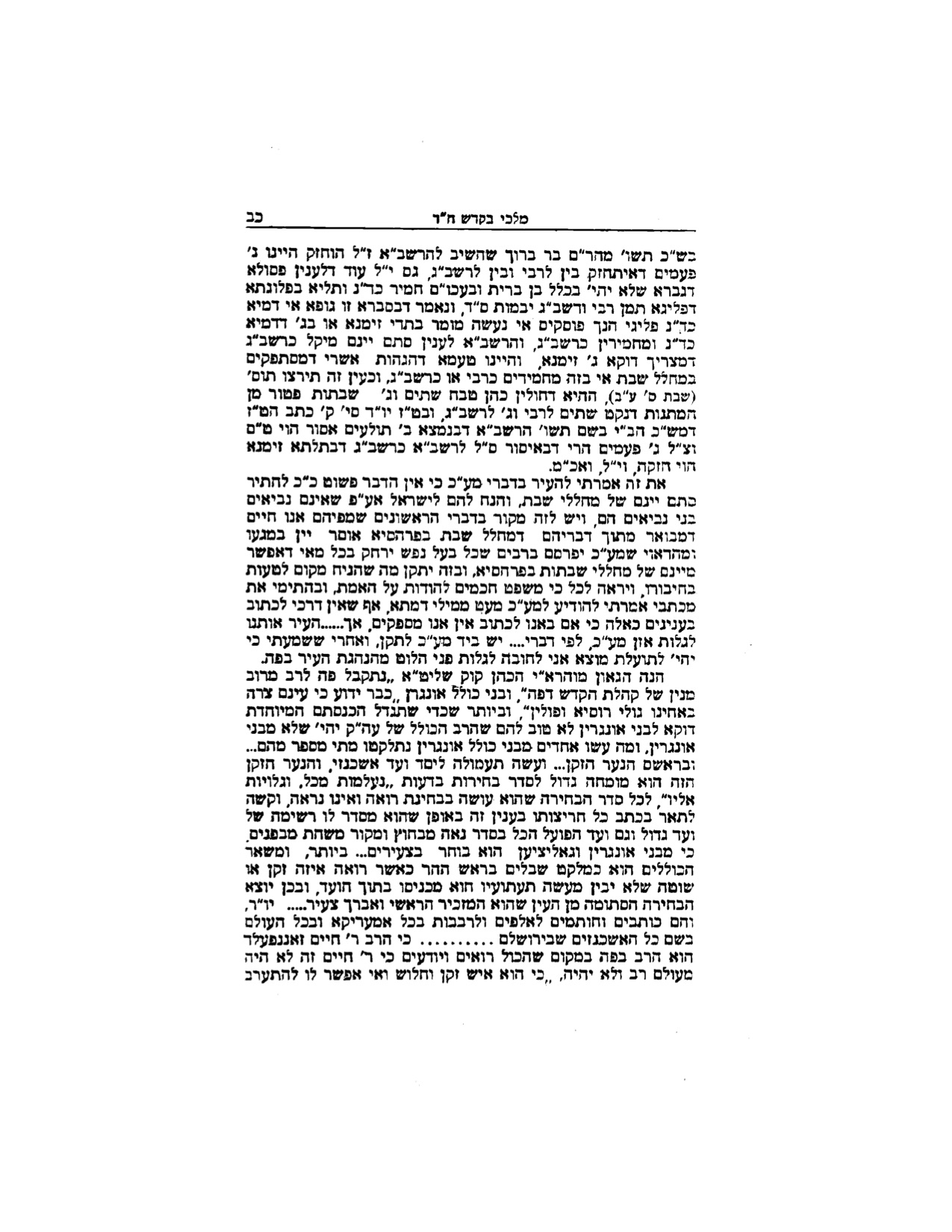
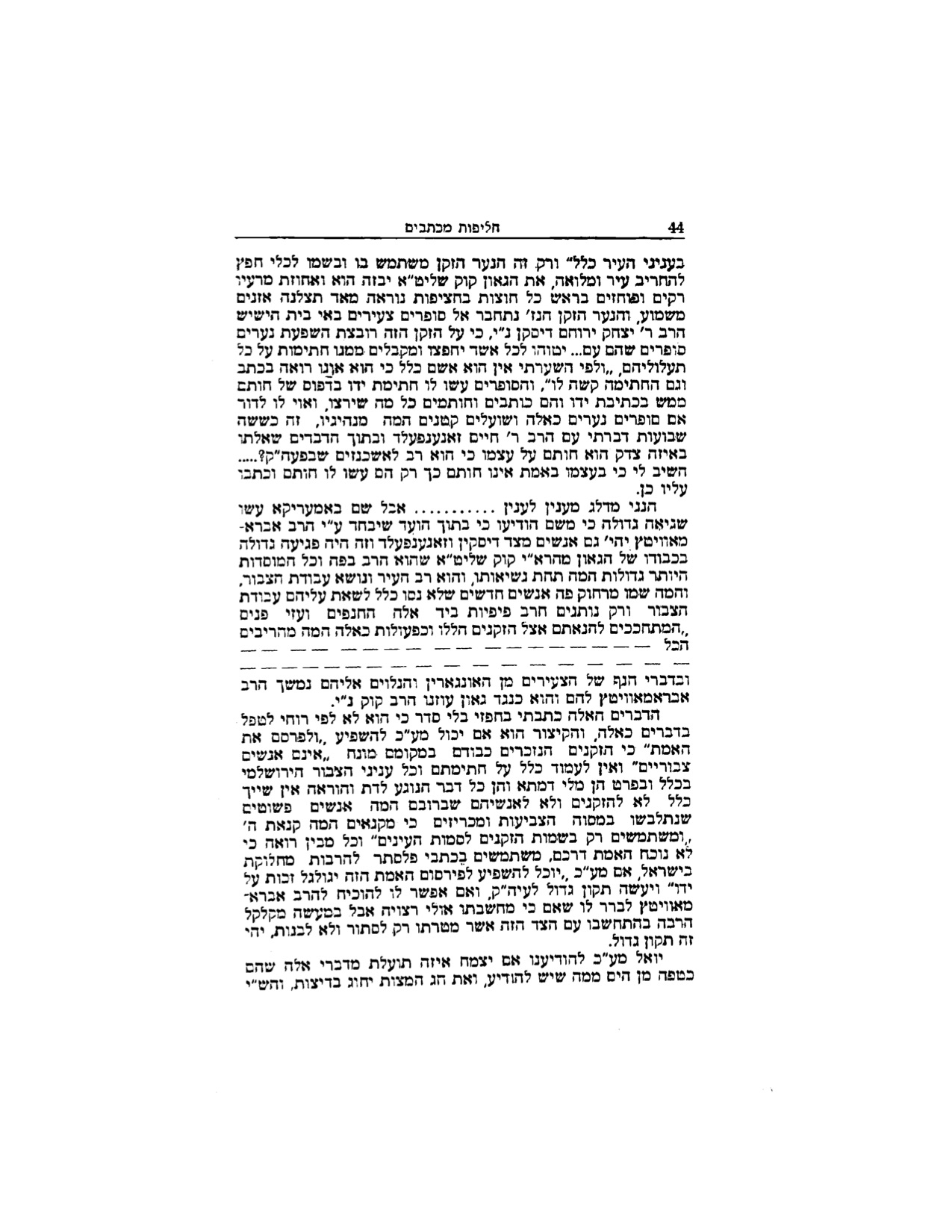
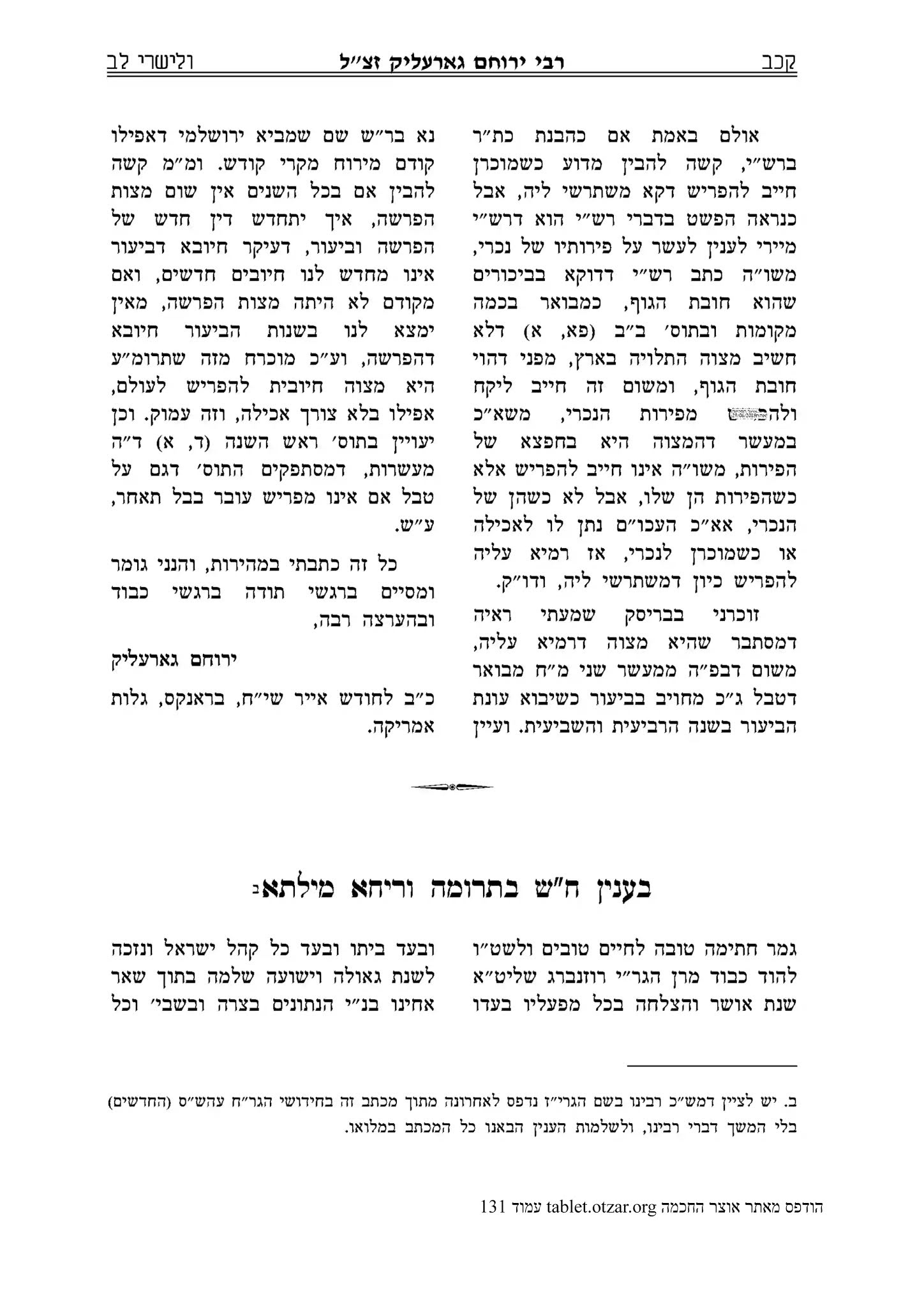
There have been instances, however, in which Rav Gorelick’s association with YU has been omitted or glossed over. As an example, see the journal U’lYishrei Lev, volume 11, published in honor of the marriage of a son of Rav Shmuel Yeshaya Keller (son of the late Rav Chaim Dov Keller), to a granddaughter of Rav Chaim Ozer Gorelick, a great-granddaughter of Rav Yerucham.[7] This journal contains two letters from Rav Gorelick, which originally appeared in YU/RIETS Torah journals. One of them, shown below, בענין חש בתרומה וריחא מילתא , was originally printed in Beis Yitzchak volume 25 p. 241, and was discovered and arranged for publication by the late Rabbi Joshua (posthumously known as The Hoffer) Hoffman.[8]

There is no mention in U’lYishrei Lev that this letter was found and published in Beis Yitzchak. Similarly, the other letter in U’lYishrei Lev, במצות הפרשת תרומות ומעשרות, was originally published in Kol Zvi volume 2 page 107. It is noteworthy that, in addition to the more recent family connection by marriage, Rav Yerucham Gorelick was Rav Chaim Dov Keller’s rebbe in YU. It was Rav Gorelick who encouraged Rav Keller to go to Telz, and arranged for Rav Keller to learn b’chavrusa with Rav Mordechai Gifter.[9]

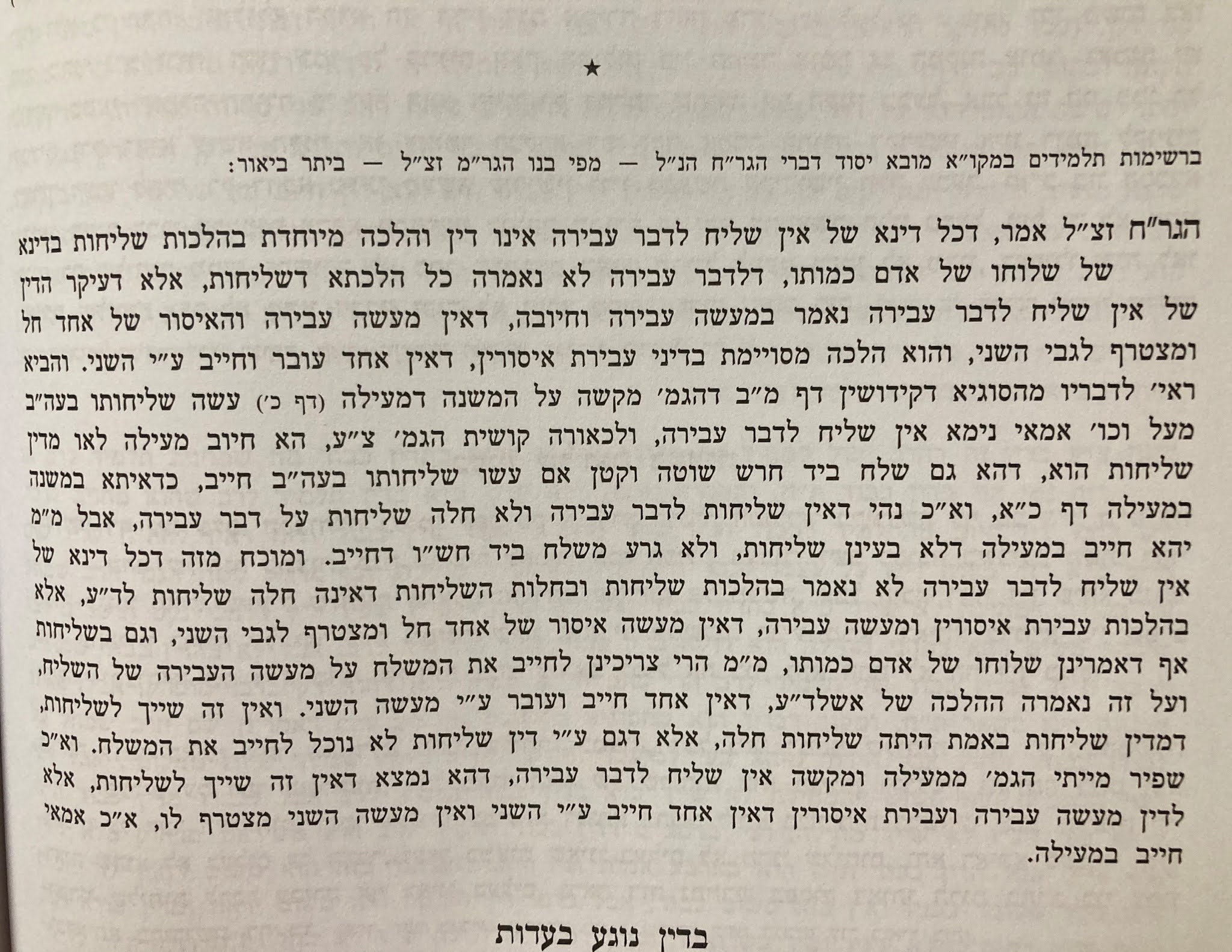
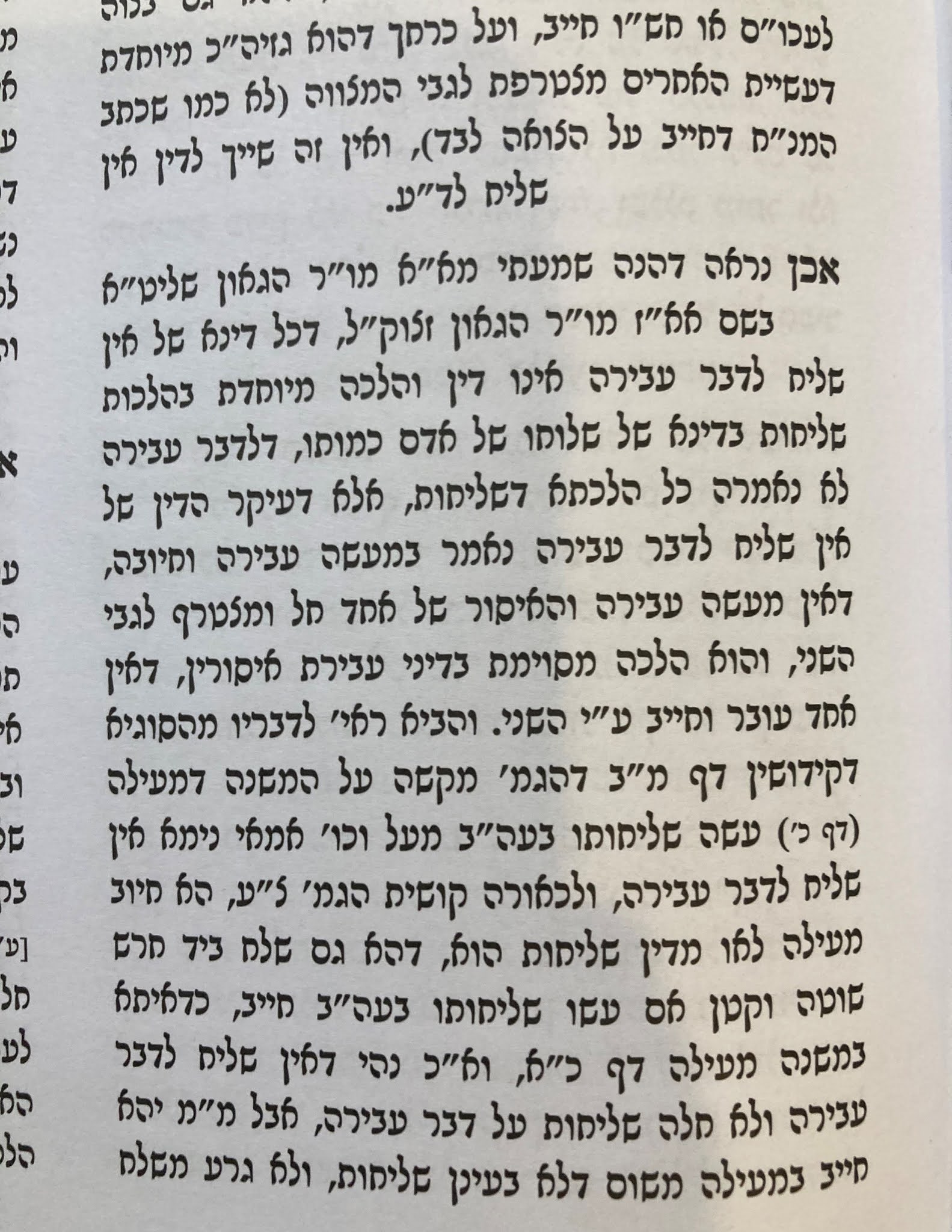
The aforementioned letter בענין חש בתרומה וריחא מילתא also appears in Mishor’s 5768 printing of חידושי הגרח על השס on page 32, surprisingly with the disclosure that the piece is taken from Beis Yitzchak.[10] I say surprisingly, because this volume does engage in revision by omission in other cases, specifically those having to do with the Rav, Rav Yosef Dov Soloveitchik. Here is a piece from that volume (page 302) on the topic of אין שליח לדבר עבירה, which is attributed to the very nebulous “Reshimos Talmidim”, but is copied word-for-word from Igros Ha-Grid Halevi, page 9, דה אכן, shown below.

Similarly, the piece in the Mishor volume (page 97) on מצות תקיעת שופר is once again attributed to the nebulous “Kisvei Talmidim”, yet is taken from Igros Ha-Grid Halevi, this time an amalgam of the pieces on page 33-34 and page 91, shown below. Most of the verbiage is taken from pages 33-34, while the phrases “אינו חל לגביה“ and “בכלל מתעסק“ are taken from page 91.

Another recent example of revision by omission as relates to Rav Soloveitchik appears in Yishurun, volume 41 (Elul 5779), in a biographical article on Rav Elya Baruch Finkel, on p. 388. There we are told of Rav Elya Baruch’s safek regarding Erev Shabbos Chanuka. The halacha (Rambam Chanuka 4:12) is that someone who does not have candles must even sell his garment in order to purchase Ner Chanuka. Rav Elya Baruch understood that there is no such requirement for Ner Shabbos according to the Rambam (see Yishurun volume 18 p. 675.[11] The article in Yishurun volume 18 also appears in Mishulchan Rabi Eliyahu Baruch- Moadim, volume 2, p. 283, where a note mentions that it was prepared for print by Rav Elya Baruch’s son.) The halacha (Rambam Chanuka 4:14) also states that someone with one candle on Erev Shabbos Chanuka should use it for Ner Shabbos, as Ner Shabbos takes precedence to Ner Chanuka. In the event that someone has no candles or money on Erev Shabbos Chanuka, he is obligated to sell his garment to buy a Ner Chanuka, but once he has the candle, he is supposed to give precedence to Ner Shabbos over Ner Chanuka, even though he is not obligated to sell his garment for Ner Shabbos. Rav Elya Baruch raised the question – should he use the candle for Ner Chanuka or for Ner Shabbos?

We are told in Yishurun that Rav Elya Baruch presented this question to גאון אחד who was נודע בכשרונותיו העילויים. This Gaon stated that there are three logical possibilities, and these possibilities are laid out in Yishurun volume 18 p. 677.[12] 1) He need not sell his garment, because even if he does he will be unable to fulfill Ner Chanuka, and it is as if he knows that if he buys the Ner Chanuka a lion will eat it, in which case he certainly need not sell his garment. 2) He should sell his garment and use the candle for Ner Chanuka 3) He should sell his garment and buy a candle for Ner Chanuka, but then use it for Ner Shabbos. This Gaon rejected the third possibility out of hand, and he was unsure how to decide between the first two possibilities.

This anonymous Gaon is none other than Rav Soloveitchik. I know this because the same story appears in the name of Rav Elya Baruch Finkel in the book “Read and Remember” by Rabbi Yirmiyahu Cohen, and there it names Rav Soloveitchik as the Gaon who laid out the three possibilities and rejected the third possibility.[13]

Ironically, “Read and Remember” has itself been the object of revision by omission. On p. 161, Rabbi Cohen relates that Rav Nochum Partzovitz was asked if a resident of chutz laaretz who is in Israel for the second night of Pesach could fulfill his mitzva by telling the story of Yetzias Mitzrayim to a resident of Israel, for whom it is not the seder night.

It seems to me that this piece from “Read and Remember” is obliquely referenced in Kuntres B’lev Yam Siman 41 number 2, page 629[14], by the current-day Rav Yaacov Moshe Shurkin, which is appended to the Shiurei Rabi Yaacov Moshe Shurkin of his grandfather (the magid shiur from Chaim Berlin); although this question is attributed to אחד מספרי מחברי זמנינו, with no more precise reference.

In this case, I imagine the omission of a specific reference is not due to hashkafic concerns, nor to the author cited being too modern, as R. Cohen is quite a kanai who is affiliated with Satmar and Natruna, and has written several books espousing anti-Zionism. I think it’s more likely in this case that the reference is obscured because it doesn’t “pas” to quote halachic material in a sefer from an English book.

Another example of revision by omission as relates to Rav Soloveitchik appears in R. Shimon Yosef Meller’s Harav MiBrisk volume 4, p. 17. The story about the Brisker Rav refusing to speak to a Rav who had helped Solomon Freehof is clearly taken without attribution from Rav Schachter’s Mipninei Harav, and Echad Mibnei Mishpachas Maran is obviously the Rav.

Rav Schachter’s omission of this particular Rav’s name is a different kind of omission, as that omission is because the story is rather critical of him. Rav Schachter often omits the names of Rabbanim towards whom Rav Soloveitchik expressed criticism. (This is in contrast to the prior examples of omission, where the omission is meant to prevent someone else from looking bad due to their association with the person or institution whose name is omitted, or because it doesn’t “pas” to cite that person or give him publicity.) I will follow suit and not mention the name of the Rav who helped Freehof, although his identity was first pointed out to me by my good friend Rabbi Dovid Bashevkin, and should be known to those who have thoroughly read through Dr. Shapiro’s “Saul Lieberman and the Orthodox.”

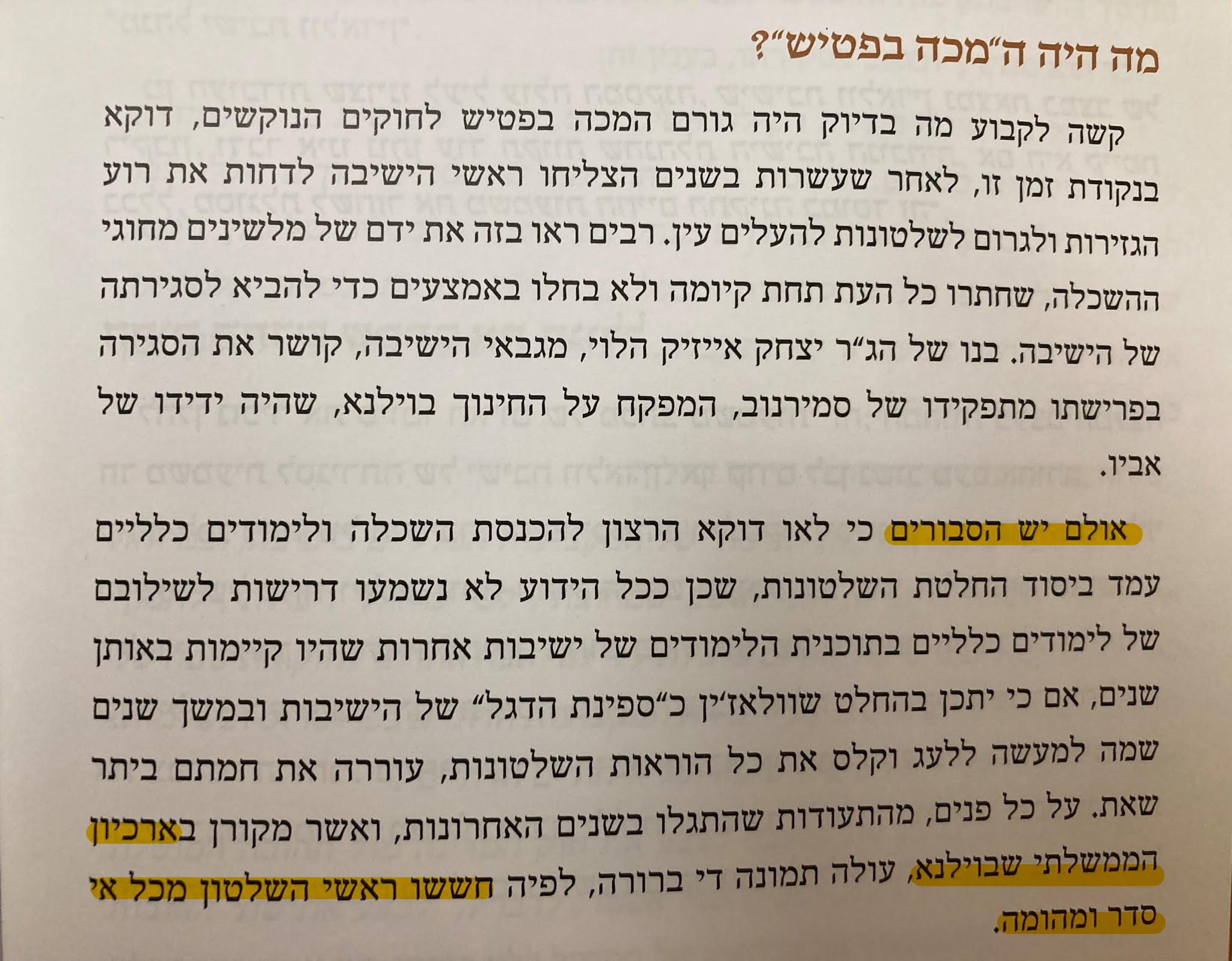
In R. Meller’s new biography of Rav Chaim Soloveitchik, Raban Shel Kol B’nei HaGolah (volumes 1 and 2), he appears to have reversed course somewhat, and does cite many times from Rav Schachter’s Nefesh Harav series, as well as from Ish Hahalacha, and other sources from Rav Soloveitchik. However, some sources still appear be out of bounds for citation. For example, the material from the government archive cited in Raban Shel Kol B’nei HaGolah volume 1 p. 396-399 appears to be taken without attribution from the updated version of Dr. Shaul Stampfer’s Hayeshiva Ha-Litait Be-Hithavuta. The Yesh HaSvurim mentioned on p. 400 who attribute the closing of Volozhin to the government’s concern about the chaos and machlokes in the yeshiva, rather than the government’s desire for secular education, would appear to be referring to Dr. Stampfer.

Another recent example of omission was brought to my attention by my father-in-law, R. Dovid Grosser, and is found in a recent appreciation of Rav Moshe Bick that appeared in Hamodia on September 9, 2020. “Immediately upon his arrival in New York, the young Rav Moshe spent his days in the “Poilishe shtiebel,” learning diligently. Eventually, he joined a suitable yeshivah, led by outstanding Gedolei haTorah… At that time, the renowned Gaon, Harav Shimon Shkop, zt”l, Rosh Yeshivah of Grodno, was in America for a fundraising visit and briefly served as a Rosh Yeshivah there… Subsequently, Harav Moshe Halevi Soloveitchik, zt”l, son of Harav Chaim of Brisk, zt”l, served as Rosh Yeshivah.”

I admit that I am perplexed by the purpose of this omission, as the references to Rav Shimon Shkop and Rav Moshe Soloveitchik make clear that this is referring to Yeshivas Rabeinu Yitzchak Elchanan. I don’t know what is gained by not mentioning the name, when it is clear which yeshiva Rav Bick attended. More misleading, however, is an Editor’s note about Rav Bick that appeared in the Jewish Observer (January 1991).

While it may be true that Rav Bick initially enrolled in Yeshivas Rabeinu Yitzchak Elchanan on the Lower East side before there was a college program, he certainly continued to learn there in Washington Heights, after the college was already operating. The move uptown occurred in January 1929, and Yeshiva College was founded in March of 1928, and graduated its first class in June of 1932.[15] Rav Moshe Soloveitchik only departed from Europe for America on September 18, 1929.[16] For Rav Bick to have learned under Rav Moshe, as the Jewish Observer mentions, he had to have been learning in RIETS in the uptown campus, and after the establishment of the college program. (I am not claiming that Rav Bick himself attended the college program, only that he learned in RIETS after the establishment of the college program, contra to the implication of the Jewish Observer.)

Returning to Rav Soloveitchik, one of the more well-known examples of revision by omission as relates to Rav Soloveitchik is Rav Chaim Dov Altusky’s Chiddushei Basra Al Chiddushei HaMasbir. As is well known, the “Masbir” refers to Rav Soloveitchik. (This has been documented previously on the Seforim Blog by Rav Nosson Kamenetsky.[17] See also Rav Shlomo Pick’s “The Rav: Biography and Bibliography” fn. 6, in BDD volume 6, where Rav Pick sharply criticizes Rav Altusky’s behavior.) As mentioned earlier in this post, Rav Schachter says he does not remember anything that Rav Gorelick said about Sanhedrin from his time in Rav Gorelick’s shiur. However, he did preserve many interesting haaros from Rav Gorelick at the time in his notes, and these have been published in the footnotes of my Shiurei Harav on Sanhedrin. Rav Schachter told me that Rav Gorelick would often ask him what the Rav said about a certain topic, and would then comment on what the Rav said, and these are the comments that Rav Schachter recorded at that time. Some of these comments are also reproduced in Rav Altusky’s Chiddushei Basra Al Chiddushei HaMasbir on Sanhedrin, which is based on Rav Schachter’s notes from the Rav’s shiur, without attribution to either. Rav Altusky, however, misunderstood some of Rav Schachter’s citations of Rav Gorelick. For example, on Sanhedrin 3a (p. 11), he cites an explanation in the name of “Rabeinu Yerucham”, but this is actually Rav Yerucham Gorelick’s explanation.

Rav Schachter attributed the explanation to רירוחם in his notes, and Rav Altusky misunderstood the reference.[18] By Sanhedrin 5b (p. 18), Rav Altusky apparently realized that these references were to Rav Gorelick, and he cites דודי הרהג רירוחם זל. (Rav Altusky’s mother was Rav Gorelick’s sister.)

For more on Rav Gorelick and his family, Rav Simcha Elberg wrote a beautiful appreciation of Rav Gorelick in his Einei Ha-eida. On p. 119, Rav Elberg writes that Rav Gorelick’s home was not an apartment with rooms; his home was a beis medrash. And the crowning achievement of Rav Gorelick’s life’s work was his home, in which he raised all of his sons to be Gedolei Torah Ve-yirah, as well as great marbitzei torah.

I would add that the aforementioned Rav Leib Gorelick is a great talmid chacham and lamdan. In my interactions with him, I have been astonished at his wide-ranging knowledge of even obscure rishonim and other seforim, as well as his analytic abilities. Listen here at approximately 1:35:15 to 1:38:13 where Rav Schachter cites a lomdish explanation from Rav Leib to explain the Rama in 472:4 who says that only women rely on the opinion of the Ravyah that heseiba is no longer required.[19] (Rav Leib has been suffering from some health problems lately and readers are asked to daven for Mordechai Leib ben Chana.[20])

Besides for Rav Leib, another son, Rav Tzvi Abba Gorelick was a Rosh Yeshiva at the Yeshiva Gedolah Zichron Moshe in South Fallsburg. Another son, Rav Chaim Ozer Gorelick, is author of sefer Otzar Chaim, and is currently Rosh Yeshiva of Yeshiva Gedolah of Spring Valley. I think the blog readers will find interesting this excerpt about Rav Chaim Ozer Gorelick, and the continuation about Rav Aharon Lichtenstein, from Alt un Nay in Yisrael, by Nissan Gordon, in 1964.

I will translate the excerpt for those readers who don’t read Yiddish:

The young bochurim and yungeleit who learn by Rav Berel, as Rav Velvel’s bechor is called in the Yerushalmi yeshiva world, sit and learn b’kvius in the Achva neighborhood shul, and to shiur they come to the Rosh Yeshiva’s house. And indeed here, in the illuy’ish chabura, who learn by Rav Soloveitchik, a cousin of our American Rav Soloveitchik from Boston and New York, I found a bochur’l from the Bronx, on whom the Yerushalmi lomdim testified, that he is among the best, if not the very best, student in the Brisker chabura. The bochur’l is called Chaim Ozer Gorelick, a name after the great Rav of Vilna, and a son of Rav Yerucham Gorelick from the Bronx, a Rosh Yeshiva in Yeshivas Rabeinu Yitzchak Elchanan and himself one of the b’nei aliyah in the world of lomdus and actions for Torah in America.”

It seems the original “best bochur in Brisk” was Rav Chaim Ozer Gorelick, who indeed became a great talmid chacham. The following is a translation of the ensuing conversation with Rav Berel about Rav Aharon Lichtenstein:

Do you correspond with your famous cousin in America?”, I asked a quick question to Rav Soloveitchik of Yerushalayim.

In Brisk we don’t write letters[21]”, came a fast answer with an addition, that he did meet with his cousin’s son-in-law, Rav Dr. Aharon Lichtenstein, when the young Rosh Yeshiva and scholar was on a visit in Israel. “We spoke in learning and he is a great lamdan”, did the Yerushalmi Soloveitchik notice about his cousin’s son-in-law, who is an assistant Rosh Yeshiva to his father-in-law in Yeshivas Rabeinu Yitzchak Elchanan, and a professor in Stern College.

Meaning that there is room for both, for Torah and worldly knowledge”, I tried asking Rav Berel, knowing the strong speaking out of the house of Brisk in Yerushalayim against learning anything other than Torah.

Sometimes succeeds…an exception…and from an exception we don’t bring a raya”, he didn’t leave me to wait long for his answer.

One final recent example of revision by omission that I want to call attention to, is from the journal Hamaor (Nissan-Iyar 5779, p.5). A piece from Rav Chaim Soloveitchik’s chiddushim is published there, which was written down in 1932 by his nephew Rav Yisrael Soloveitchik. The piece is an alternate version of the piece that was eventually published in Rav Chaim’s sefer, on Hilchos Chametz U’Matza Perek 6 about greira. We are told that Rav Yisrael attached the divrei torah to a letter from Erev Pesach 1932, and that he wrote to the recipient that it would be an Oneg Yom Tov for him to read.

What we are not told, however, is that this letter and accompanying divrei torah were sent to Rav Herzog, and are found in Rav Herzog’s archive.[22] (I had not yet come across this letter when I wrote my Seforim Blog posts on Rav Herzog’s archive.) Here is the first page of the letter, addressed to Rav Herzog, with the mention of the divrei torah from Rav Chaim, and then the first page of the divrei torah.

Additionally, the transcription in Hamaor contains numerous errors. I plan to publish an accurate transcription in my forthcoming sefer שש אנכי.

These are some examples of revision by omission that I have come across recently. I am certain that there are many more waiting to be discovered.

Regarding Rav Herzog, here are a few photos that the blog readers will enjoy, of Rav Herzog being mesader kiddushin at the wedding of a young Shlomo Gorenczik. The entire photo album is available in Rav Goren’s archive.[23] It is also noteworthy that the wedding seudah was separate seating.

Appendix: The Rav and Professor Saul Lieberman on the Langer Case

Related to Rav Goren’s archive, I know that the blog readers are especially interested in the Rav and Professor Saul Lieberman, so I thought I would make note of their positions on the Langer case, which to the best of my knowledge have not been noted yet.

The Rav addressed the Langer case in his well-known speech in 1975 on the topic of the Rabbi Rackman’s aguna plan.[24]

However, if you think that the solution lies in the reformist philosophy, or in an extraneous interpretation of the Halacha, you are badly mistaken. It is self-evident; many problems are unsolvable, you can’t help it. For instance, the problem of these two mamzerim in Eretz Yisrael – you can’t help it. All we have is the institution of mamzer. No one can abandon it – neither the Rav HaRoshi, nor the Rosh HaGola. It cannot be abandoned. It is a pasuk in Chumash: “לא יבא ממזר בקהל ה‘”. It is very tragic; the midrash already spoke about it, “והנה דמעת העשוקים“, but it’s a reality, it’s a religious reality. If we say to our opponents or to the dissident Jews, “That is our stand” – they will dislike us, they will say that we are inflexible, we are ruthless, we are cruel, but they will respect us. But however, if you try to cooperate with them or even if certain halachic schemes are introduced from within, I don’t know, you would not command love, you would not get their love, and you will certainly lose their respect. That is exactly what happened in Eretz Yisrael! What can we do? This is Toras Moshe and this is surrender. This is קבלת עול מלכות שמים. We surrender.[25]

The Rav is clearly referring to the Langer case, and he considered Rav Goren’s heter to be illegitimate. He refers to the Langers as two mamzerim, and he uses the Langer case as an example of something “unsolvable” and that “you can’t help it.” He seems to be using Rav Goren’s heter as an example of “an extraneous interpretation of the Halacha.” And according to the Rav, the more appropriate response would have been to surrender to halacha; that the attempted heter was a futile attempt to coax love out of dissident Jews. I have not seen this speech of the Rav mentioned in the context of the Langer case and I thought it appropriate to mention here.

It appears that Professor Lieberman felt differently. This is a heretofore unknown, and very fascinating letter that he wrote to Rav Goren supporting the heter, found in Rav Goren’s archive, with my transcription below.[26] (Rav Goren’s response to this letter is printed in “Saul Lieberman and the Orthodox, Hebrew section p. 9.) Lieberman’s cynicism in this letter is biting, and he seems to be rather hurt and bitter. The advice and observations that he shares with Rav Goren are obviously informed by his own experiences. I would ask if any readers (or Dr. Shapiro) have any idea which Gedolei Torah asked Lieberman to review Rav Goren’s psak. I am also not entirely clear on Lieberman’s explanation at the beginning of the letter as to why he is not offering a bracha. I think it is related to what he writes in his postscript from his wife, and that he viewed Rav Goren’s appointment with ambivalence because of the difficulty in the position, but any further suggestions from readers would be appreciated.

בעהי אור ליום גפרוישלח תשלג

לידינ הגאון הגדול וכווכומוהרר שלמה נרו

לא כתבתי לך ברכה מפני שלא היה לבי שלם אתי, אבל התפללתי בלב שלם שהיצליח את דרכך. היום קראו לי מרדיו ירושלים ובקשו ממני לחוות את דעתי על הפסק שלך ולמרות הלחץ עמדתי בשלי ואמרתי שלא חקרתי את הדבר ואין לי מה לומר. אבל לך אכתוב את האמת: יברך אותך הויישר כוחך. אני מכיר גם את תורתך ואת יראת שמים שלך, ובטוח אני שצדקת. לא אמרתי להם כן, מפני שחששתי שאגרום לך רעה. יאמרו הקנאים נמצא עוד רב קונסרבטיבי שמסכים להרב הראש—[27], מצא מין את מינו.

בהיותי בקיץ בירושלים לחצו עלי גדולי תורה מן הרבנים שאקרא את תשובתך בענין, וסרבתי בהחלט. אמרתי: אין לי פנאי. הבינותי את כוונתם. דע לך שבמקום שיש קנאה ושנאה שום דבר אינו מועיל. אף פעם לא תפייס את הקנאים, ובעיקר את המקנאים. אם תכנע להם תאבד את עולמך. אני מכיר יפה מה שעשית בצבא, ולוא נוצרת רק לשם זה כבר קנית את עולמך. אדם ירא שמים אמיתי יחשוב עשר פעמים לצאת נגדך אפילו אם יהיבטוח שלא כיוונת לאמת. עליך להחזיק בידידים שלך יפה, יפה, מפני שקל מאד לאבד ידיד (בפרט אם הוא איננו גדול בתורה ואינו בר דעת), ושונא מקנא לעולם לא תהפוך לידיד, וכל מה שתעשה בשבילו אינו אלא לשעה קלה. יבטל את תורתך ויכפור ביראתך. לך והצלח וישמור שומר ישראל עליך.

בכבוד ובאהבה,

שאול ליברמן

הגבשלי מבקשת למסור דרש להרבנית שתחי‘. רצתה גם היא לכתוב אלא שעדיין אינה מרגישה את עצמה בטוב. היא באמת שמחה על בחירתך, שהרי היא אינה יודעת מהו להיות רב בירושלים.

[1] https://seforimblog.com/2009/10/some-assorted-comments-and-selection-2/
[2] https://www.hebrewbooks.org/pdfpager.aspx?req=50519&st=&pgnum=39
[3] https://www.hebrewbooks.org/pdfpager.aspx?req=50519&st=&pgnum=42
[4] https://www.hebrewbooks.org/pdfpager.aspx?req=50521&st=&pgnum=255
[5] See R. Gil Student’s criticism here: https://www.torahmusings.com/2009/10/reb-yerucham-and-yu/. See also: http://theantitzemach.blogspot.com/2008/01/blog-post_13.html and https://machshavos.wordpress.com/2013/01/02/r-yerucham-gorelick-and-talmud-vs-hashkafa/.
[6] https://www.yutorah.org/lectures/lecture.cfm/741763/rabbi-hershel-schachter/remembering-rav-yeruchim-gorelik/ at approximately 5:08, 11:57 and 18:09
[7] https://matzav.com/engagement-of-grandchildren-of-rav-chaim-dov-keller-and-rav-yitzchok-sorotzkin/
[8] For a full collection of Rabbi Hoffman’s own divrei torah, see http://yeshivasbrisk.freeservers.com/netvort.html. For Rabbi Hoffman’s thesis on Rav Gavriel Zev Margolis, see http://repository.yu.edu/handle/20.500.12202/4899
[9] See Yated Ne’eman (English), August 21,2020, page 46-47
[10] My thanks to Rabbi Menashe Mazurek and Rabbi Avi Harari for bringing this reference to my attention
[11] https://hebrewbooks.org/pdfpager.aspx?req=46424&st=&pgnum=672
[12] https://hebrewbooks.org/pdfpager.aspx?req=46424&st=&pgnum=674. Here, the three possibilities, as well as the rejection of the third possibility, are attributed to “Gedolei Torah”.
[13] My thanks to my good friend Rabbi Nosson Rich for providing the scans from “Read and Remember”.
[14] https://www.hebrewbooks.org/pdfpager.aspx?req=50479&st=&pgnum=629
[15] https://www.yu.edu/about/history
[16] The Rav, volume 1, p. 9
[17] https://seforimblog.com/2012/12/a-letter-from-r-nathan-kamenetsky/
[18] Another error is on 7b (p.30), where Rav Altusky has a discussion about whether דינו לבקר משפט applies to ”אומות העולם”. This entire section is mistaken, because the Rav spoke about “איסור והיתר”, not ”אומות העולם”. Rav Schachter had written אוה in his notes and Rav Altusky opened the abbreviation incorrectly.
[19] See here.
[20] https://www.thelakewoodscoop.com/news/2020/12/tehllim-reb-leib-gorelick-to-undergo-emergency-surgery.html
[21] I assume he was referring specifically to social correspondence that they don’t write in Brisk, not torah correspondence.[22] https://www.archives.gov.il/archives/Archive/0b07170680024756/File/0b071706806d9fc7 on p. 49-53.[23] https://www.archives.gov.il/archives/Archive/0b07170684e17c68/File/0b07170687520f3c
[24] https://www.yutorah.org/sidebar/lecture.cfm/767722/rabbi-joseph-b-soloveitchik/gerus-mesorah-part-1/ at approximately 39:00 to 40:53.
[25] Transcription from https://www.torahweb.org/torah/special/2019/ryds_rietsalumni.html
[26] https://www.archives.gov.il/archives/Archive/0b07170684e17c68/File/0b07170685459764 on p. 281.
[27] I was expecting this word to be הראשי but there appear to be two hyphens at the end. Does it say הראשיי with two yud’s? I don’t believe that is a common spelling. I would be indebted to any reader who can explain what this means.


To Censor or Not to Censor, that is the Question

To Censor or Not to Censor:  Electricity on Yom Tov, Illustrations and Other Items of Interest at Legacy Judaica’s March 2020 Auction

By:  Eliezer Brodt & Dan Rabinowitz

Legacy Auction’s latest auction will take place on March 26, 2020.  Their catalog provides us the opportunity to discuss a few items of interest to bibliophiles.

There are many examples of the phenomenon of censoring or declaring forgeries of teshuvot and other halakhic rulings especially when those rulings are contrary to contemporary practices. Nonetheless, there is at least one example where the urge to suppress contrary halakhic rulings was rejected.[1]

R. Yehiel Mikhel Halevi Epstein of Novogrudok is most well-known for his pseudo commentary on the Shulkhan Orakh, Orakh ha-Shulhan. [2] In addition to that work, he also wrote teshuvot and other important material, some of which was recently reprinted (see our post here) in Kitvei ha-Orukh ha-Shulkhan.  One was controversial responsum regarding turning on and off electric lights on Shabbat.

R. Dov Baer Abramowitz was born in 1860 in Lithuania but left at age 10 for Jerusalem.  He received ordination from R. Shmuel Salant and in 1894 emigrated to the United States.  He held a handful of rabbinic positions, eventually, in 1906 becoming the chief rabbi of St. Louis.  Abramowitz sought to reverse the trend of American Jews abandoning the faith and issued a variety of publications that sought to accomplish the goal of strengthening American Orthodoxy.  He was involved in the establishment of REITS, the Agudath Harabbonim, and the first branch of Mizrachi in America. [3] In 1903, Abramowitz, as part of his educational program, began issuing his journal, Bet Vaad le-Hakhamim, “the first rabbinic journal in America, to address the waning of religious observance and the lack of unity among religious authorities in America.” [4].  The annual subscription was $2, a fairly substantial sum when the average weekly wage in 1905 was approximately $11.  The journal lasted one year with six issues.

The first issue begins with an important announcement regarding the “new technology in the new land” that is a hot water heater and using it on Shabbat.  (Bet Va’ad vol. 1, 4).   Many important American (in addition to a few international) rabbis participated in the journal.  For example, R. Chaim Ozer Gordzinsky’s older cousin and with whom he studied, Zevi Hirsch the rabbi of Omaha, Nebraska, wrote a lengthy responsa regarding riding a bicycle on Shabbat.  He argues that the issue is carrying an object on Shabbat in a public space or even in a karmelit, but he identifies no other prohibition. (Bet Va’ad no. 5, Sivan 5663 [1903], 3-7).   Thus, it is unclear whether where there is eruv whether he would have permitted riding a bicycle.     The journal also includes a letter detailing the revolutionary production process of Manischewitz machine matzot and the various benefits of that process.  (Bet Va’ad, vol. 1 25-27). The letter is from the Chief Rabbi of Cincinnati because Manischewitz was originally founded in Cincinnati and only began production in the New York area in 1932 and shuttered its Cincinnati operations in 1958.[5]

The first issue includes four letters discussing the use of electricity on Yom Tov and whether one can turn on and off electrical switches, R. Epstein’s is the first.  (Bet Va’ad, vol. 1, 1). Therein he argues that one can turn on electrical switches on Yom Tov.  He identifies the issue of nolad or creating something as potentially prohibiting the action but concludes that one is merely connecting the circuits and nothing new is created.  But he caveats his responsum with the disclaimer that electricity is uncommon in Novogrudok and his opinion is based upon his best efforts to understand electricity. Indeed, R. Shlomo Zalman Aurbach refers to R. Epstein’s responsum as containing “devarim tmuhim” and explained that they are a product of a faulty understanding of the technology.(Shlomo Zalman Aurbach, Me’orei Or (Jerusalem, 1980), appendix). Lot 85, includes this volume as well as the second issue.

R. Epstein was not alone in permitting electricity on Yom Tov, indeed, the other three letters in Bet Vaad similarly permit electricity. Other contemporary rabbis also rule in favor of electricity.

Nonetheless, those are minority views and today the common Orthodox practice is to refrain from turning on and off electrical switches.  When the publishers of R. Epstein’s writings were deciding what to include in Kol Kitvei, they approached R. Chaim Kanievsky and asked whether they should exclude R. Epstein’s responsum regarding electricity.  Presumably, they were concerned that one of the greatest halkhic authorities of the late 19th and early 20th centuries permitted what is “established” law to the contrary (despite the other opinions). But R. Kanievsky rejected that position and held that the responsum should be reprinted.[6]

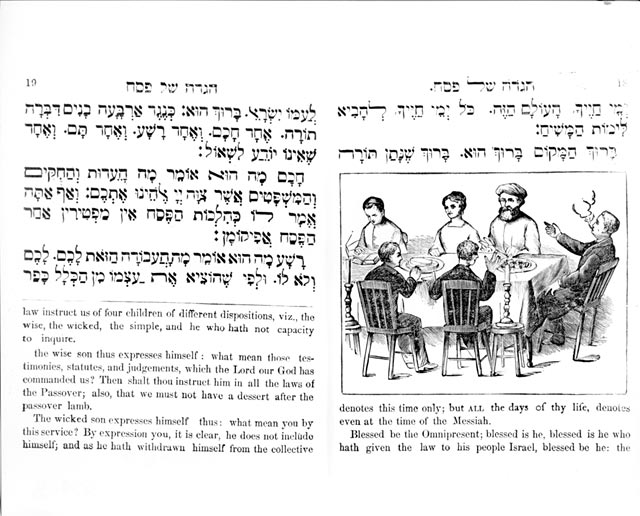
Another example of Americana and the use of fire on Yom Tov appears in one of the first haggadot printed in the United States.  The 1886 illustrated Haggadah contains a depiction of the four sons.  Depicting the four sons is very common in the illustrated manuscripts and printed haggadot. In this instance, the wicked son’s disdain for the seder proceedings shows him leaning back on his chair and smoking a cigarette. According to many halakhic authorities, smoking is permitted on Yom Tov, nonetheless, the illustration demonstrates that at least in the late 19th-century smoking was not an acceptable practice in formal settings. (For a discussion of smoking on Yom Tov, see R. Shlomo Yosef Zevin, Mo’adim be-Halakha (Jerusalem:  Mechon Talmud Hayisraeli, 1983), 7-8).


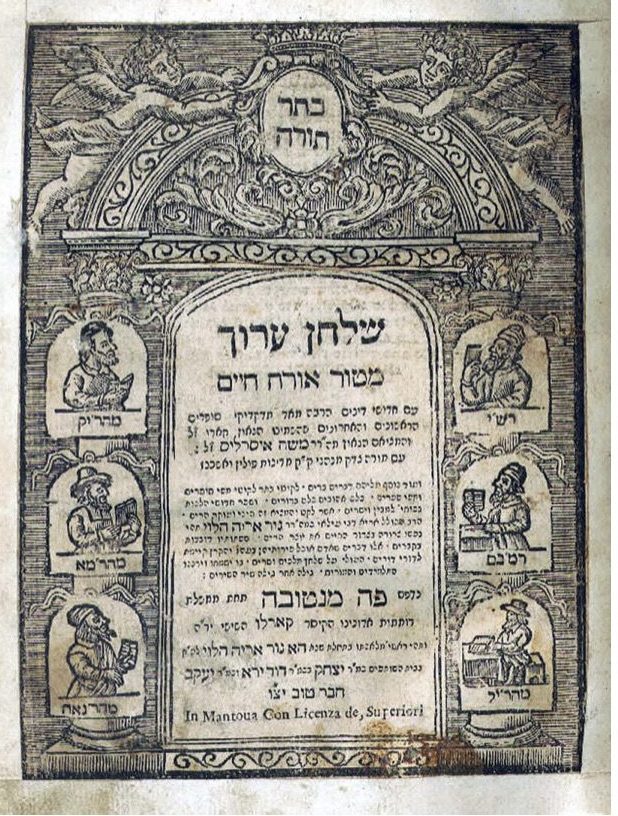
One of the other lots that also implicates illustration is lot 94, Shulhan Orakh im Pirush Gur Areyeh, Mantua, 1722, that contains the commentary of R. Yosef ben Ephraim Gur Areyeh Halevi.  As we have previously discussed at the end of this post, the Gur Areyeh’s title page to the first volume depicts six relevant personalities, Rashi, Rambam, MahaRIL, R Yosef Karo, R. Moshe Isserles, and R. Gur Areyeh.  According to some accounts, this illustration roused the ire of some rabbis because they felt the depictions were crude, and in some instances seem to show at least one rabbi in violation of Jewish law.  Allegedly, they claim that the Rambam is shown with insufficient peyot (sidelocks) in addition to long hair (as do others).  Thus in the remaining volumes of this edition, the illustrations were removed and they no longer appear (although at least in one preserved copy the illustration is repeated in the Yoreh De’ah volume).


One lot, # 161, is an incredible discovery: R. Yosef Dov Halevi Soloveitchik’s (Bet Halevi) copy of the Halakhot Gedolot (BeHaG).  This copy contains hundreds of unpublished glosses, citations, and cross-references. This copy establishes that the Netziv was not the only Rosh Yeshivah of Volozhin who was involved in the works of the Geonim. One only can hope that whoever purchases this copy will publish the notes.

Another such item is # 87 is a presentation copy of Derishat Tzion that contains the commentary of R’ Tzvi Pesach Frank. Although not noted in the description R. Frank presented this copy to R’ Chaim Hirschenson.  In his Shut Malkei Bakodesh,(4:10) R’ Hirschsenson prints a very interesting letter from R Frank after he received a copy of one of R. Hirschenshon’s book. R Frank took issue with some of R. Hirschenshon’s conclusions and to his credit, he prints it without censoring it. The book being auctioned might have been a gift from R Frank in return for the gift he received. R. Frank’s letter is full of fascinating contemporary descriptions of Jerusalem.

Finally, for a discussion regarding lot 93, Menukha ve-Kedusha and censorship see our post here.
[1] See, for example, Yakkov Shmuel Speigel, Amudim be-Tolodot Sefer ha-Ivri:  Ketivah veha-Atakah (Ramat Gan:  Bar Ilan University Press, 2005), 241-97; Marc Shapiro, Changing the Immutable:  How Orthodox Judaism Rewrites History (Oxford:  Littman Library of Jewish Civilization, 2015), 81-118.

[2] For a biography see R. Eitam Henkin, Tarokh le-fani Shulkhan (Jerusalem:  Maggid, 2019).  Regarding this book see our discussion here.

[3] Yosef Goldman, Hebrew Printing in America 1735-1926:  A History and Annotated Bibliography (Brooklyn:  [YG Books], 2006), vol. 1, no. 584, 514. See our reviews of Goldman’s bibliography here and here.

[4] Goldman, Hebrew Printing, no. 591, vol. 1, 521.

[5] See generally, Yossi Goldman, vol. 1, no. 591, 520-21.  Bet Vaad contains materials beyond responsa and halakhic discussions, including poetry, discussions regarding Jewish life in America such as yeshivot, restaurants, and a fable written in verse.

For a discussion of Manischewitz, see Jonathan D. Sarna, “How Matzah Became Square: Manischewitz and the Development of Machine-Made Matzah in the United States,” in Rebecca Kobrin, ed., Chosen Capital: The Jewish Encounter with American Capitalism (New Brunswick: Rutgers University Press, 2012), 272-288; Jonathan D. Sarna, How Matzah Became Square: Manischewitz and the Development of Machine-Made Matzah in the United States (New York: Touro College, 2005).

[6] Regarding the position that seeks to portray Orthodox Judaism a monolithic halakhic process and view as legitimate only certain opinions see Adiel Schremer, Ma’ase Rav: Shekul ha-Da’at ha-Halakhati ve-Eytsuv ha-Zehut ha-Yahadut (Ramat Gan:  Bar Ilan University Press, 2019), 191-97.


For the Sake of Radin! The Sugar Magnate’s Missing Yarmulke and a Zionist Revision

For the Sake of Radin!  The Sugar Magnate’s Missing Yarmulke and a Zionist Revision

Israel Brodsky (1823-1888), built an empire on the sugar trade. After inheriting a substantial fortune, in 1843, he became a partner in a sugar refinery.[1] Eventually, he vertically integrated his business, and he controlled sugar beet lands, processing plants, refineries, marketing agencies, and warehouses throughout the Russian Empire. At its height, Brodsky controlled a quarter of all sugar production in the Empire and employed 10,000 people.[2] Brodsky sugar “was a household name from Tiflis to Bukhara to Vladivostok.”[3] Brodsky was a significant philanthropist, donating to Jewish and non-Jewish causes. In Kyiv, he and his sons virtually single-handedly founded the Jewish hospital, Jewish trade school, a free Jewish school, mikveh, and communal kitchen besides substantial individual donations, amounting to 1,000 rubles monthly, and donated to St. Vladimir University. Many of these institutions would bear the Brodsky name. Leading Shalom Aleichem to remark that the “the bible starts with the letter beyes and [Kyiv], you should excuse the comparison, also starts with beyes – for the Brodskys.” [4]

In addition to supporting local causes, he also helped other institutions outside of Kyiv. One was providing an endowment for a kolel at the Volozhin Yeshiva. The institution of the kolel, a communally subsidized institution that supported men after marriage, was originated by R. Yitzhak Yaakov Reines (1839-1915). Reines was a student of the Volozhin Yeshiva and would go on to establish the Mizrachi movement and the Lida Yeshiva, both of which were attacked by some in the Orthodox establishment.[5] Invoking the Talmudic passage Rehaim al Tsaverum ve-Yasku be-Torah?!, in 1875, he proposed an institution where “men of intellect . . . will gather to engage in God’s Torah until they are worthy and trained to be adorned with the crown of the rabbinate, that will match the glory of their community, to guide the holy flock in the ways of Torah and the fear of Heaven.” Without the communal funds, these “men of intellect” would “be torn away from the breasts of Torah because of the poverty and lack that oppresses them and their families.”[6] Reines intended that the kolel be associated with Volozhin. And, in 1878, an attempt to create such an institution began taking shape, with the idea to approach the Brodskys for funding. For reasons unknown, this never happened. Instead, through the generosity of Ovadiah Lachman of Berlin, the first kolel was established in 1880. The kolel opened not in Volozhin but Kovno. It would be another six years before Volozhin established its kolel.[7]

In 1886, Brodsky donated a substantial sum to create a kolel in Volozhin. He created an endowment fund that yielded 2,000 rubles annually. But unlike the Kovno kolel that produced some of the greatest rabbis and leaders of the next generation, according to one assessment the Volozhin kolel “had little influence on the yeshiva’s history” nor the general public.[8]

Comparing Brodsky’s donation to the kolel to that of his other contributions demonstrates that this donation was similar to his most significant gifts. His donation was in the form of stock, and while we don’t have an exact estimate of the value of those shares, we can extrapolate the total amount of Brodsky’s donations. Brodsky donated 60 shares of the Kyiv Land Bank, which was intended to produce 2,000 rubles per annum.[9] But the amount of the principle, the 60 stocks, is not provided in the source materials. In 1890, a  similar endowment by the Brodskys produced 3,000 rubles annually from a principle of 50,000 rubles, a 6 percent rate of return. Assuming a similar rate of return, his initial donation to the Volozhin kolel nearly 35,000 rubles. That is the similar amount that he donated to the Kyiv free Jewish school, the St. Vladimir’s University, and Kyiv’s mikve and communal kitchen that all received 40,000-ruble bequests.[10] Consequently, Brodsky’s gift of 60 shares of stock to the Volozhin kolel is comparable to Brodsky’s other institutional donations.

The Brodskys aligned with the Russian Haskalah movement that today we would likely characterize as Modern Orthodox, although admittedly, the definitions of sects are amorphous. The Russian haskalah was notable for embracing modernity while maintaining punctilious observance of halakha. One example that involved both the intersection of society at large and religious practice was that when the Governor-General invited two of Israel’s sons to a prestigious gala at his home, the Governor-General also provided the sons with kosher food.[11] Another example of the Brodskys’ Jewish outlook was their involvement in Kyiv’s Choral Synagogue. Choral synagogues were already established in other cities throughout the Russian Empire, including Warsaw, Vilna, and St. Petersburg. The synagogue, known as the Brodsky Synagogue, was built in 1898 by Israel’s son, Lazer. Modern practices were introduced to the Kyiv Choral Synagogue, but even those are within the bounds of accepted Jewish law.[12] Indeed, those new practices are today unremarkable, hiring a hazan, incorporating a choir into the service, delivering the sermon in Russian, and enforcing decorum during the prayers.[13]

The Haredi histories of Volozhin discuss Brodsky’s contributions to the kolel. But one publication decided that his reputation needed some creative airbrushing to (presumably) make his involvement more palatable to the modern Haredi audience. Despite the fact that other Haredi publications provide an unvarnished version.

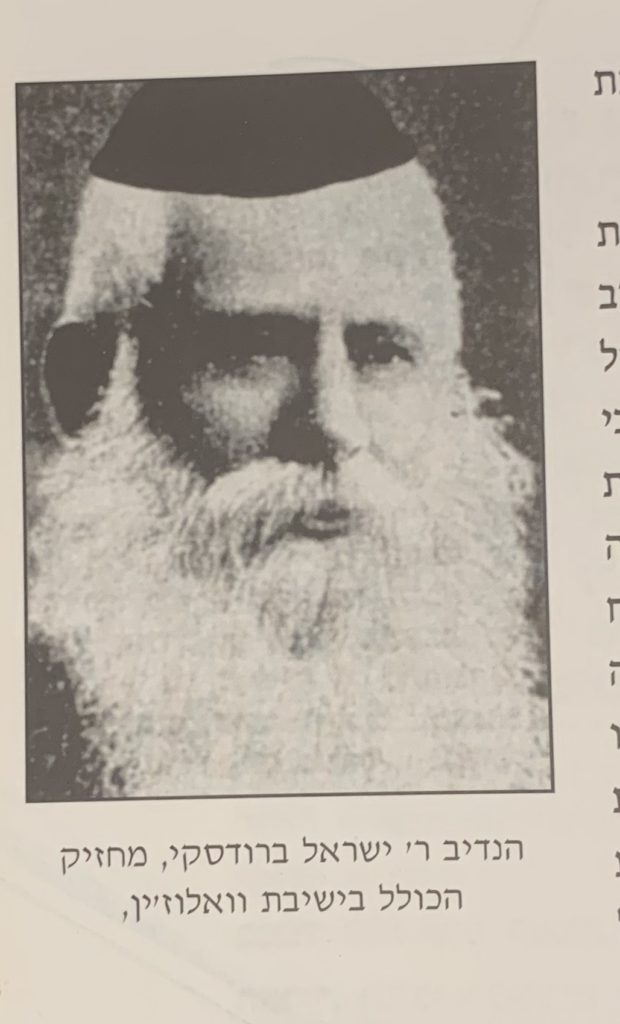
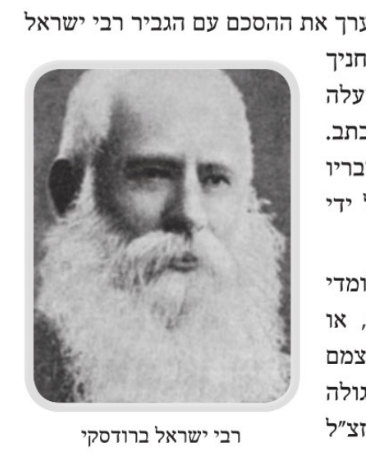
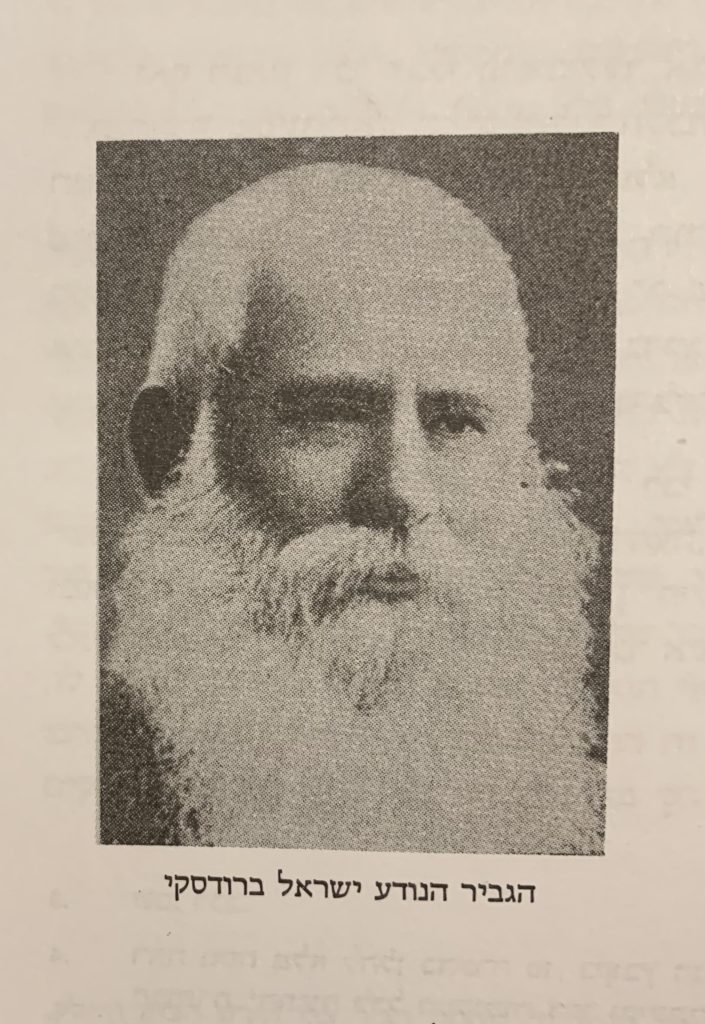
One person who met Brodsky described him as resembling that of a biblical patriarch in appearance, yet at the same time non-Jewish.[14] Indeed a photo from 1880, this biblical patriarch appears bareheaded. This lack of head-covering was not an issue for some Haredi authors. For example, Dov Eliach includes this photograph in his history of the Volozhin Yeshiva.[15] In 2001, not ten years after Eliach’s book another Haredi author decided that the photo required adjustment despite sharing the same publisher as Eliach.


Menahem Mendel Flato’s book, Besheveli Radin (Radin’s Paths), devotes an entire chapter to Brodsky’s kolel, with his photograph accompanying the text. Yet, in this instance, rather than a bareheaded Brodsky, a crudely drawn yarmulke now appears on his head.[16] This is not the first time that images were doctored to depict a yarmulke where there is none.[17] Those types of alterations occur decades after the original, by different publishing houses, in different cities, and for a different audience.[18] Here, however, Avi ha-Yeshivot and Besheveli Radin share the same audience and are only separated by ten years. [19]


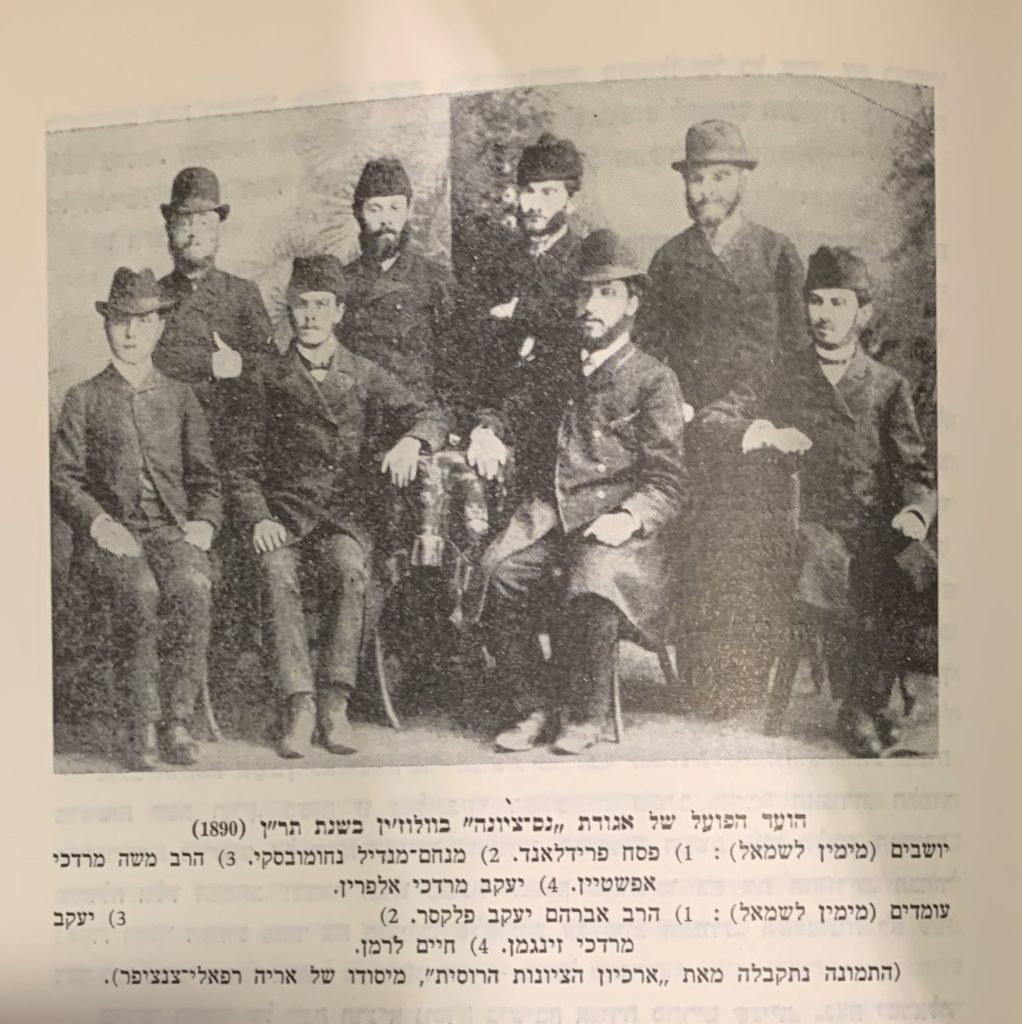
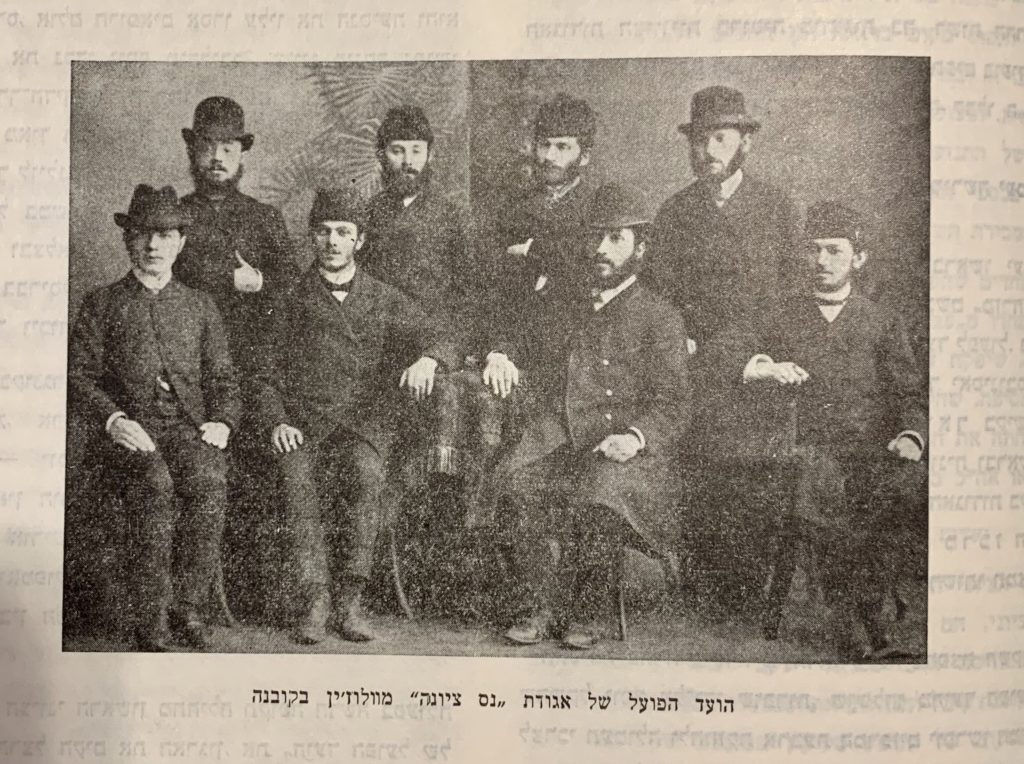
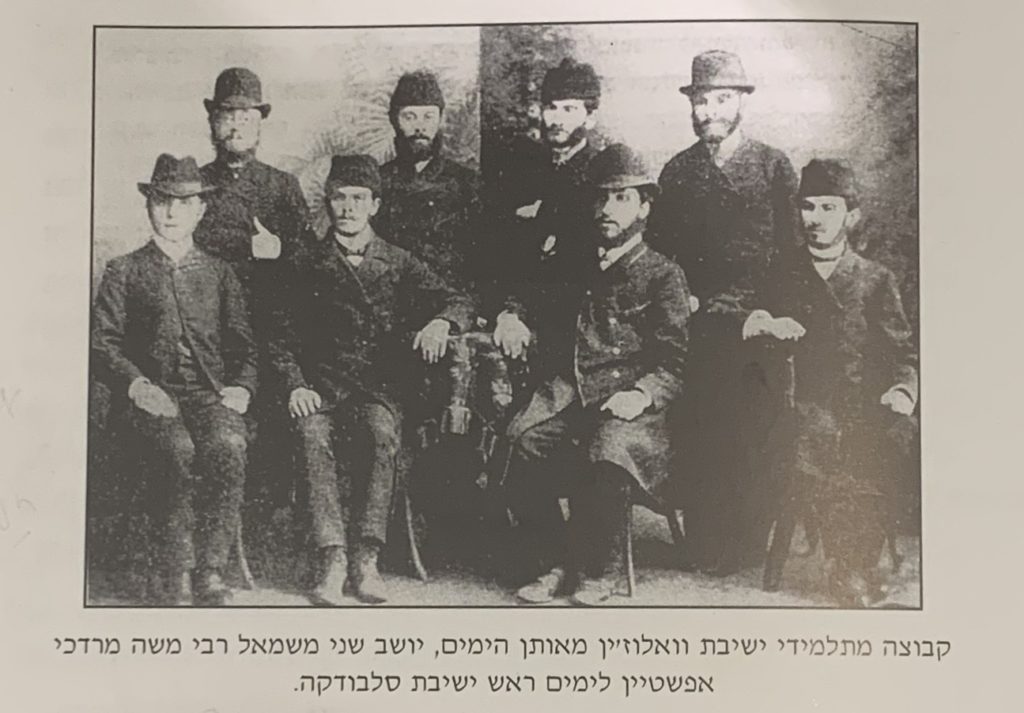
The alternation of Brodsky’s photo is not the only example of such censorship in Besheveli Radin. R. Moshe Mordechai Epstein studied in Volozhin and eventually went on to lead the Yeshivas Kenneset Yisrael in Slabodka. While he was in Volozhin, he was among those who established a proto-Zionist organization, Nes Tsiona. A photograph of the executive members appears in at least three places, yet only in Besheveli Radin is the connection to Nes Tsiona omitted.

In 1960 and 1970, two books published the photo from a copy in Russian Zionist Archives.[20] The 1960s’ version includes a legend that correctly identifies the photo as “the executive committee of the ‘Nes Tsiona’ in Volozhin in 1890.[21] The legend in the 1970 book contains the same language as before, indicating that it is a photograph of the Nes Tsiona executive committee and also identifies each of the men in the picture.[22] Yet, when the same photo appears in Beshvili Radin it is accompanied by an entirely different legend.[23] Instead, Beshvili Radin describes the photograph as depicting “a group of students from Volozhin from those days, R. Moshe Mordechai Epstein who eventually became the rosh yeshiva of Slaboka is sitting second from the right.” The purpose of the group photograph remains a mystery to Beshvili Radin‘s readers.


The history of Volozhin is complex and especially among Haredi writers raised issues that are uncomfortable truths.  Some of these authors responded by obscuring or entirely omitting these including the inclusion of secular studies in the curriculum, establishment and membership in non-traditional religious organizations, and the religiosity of some of its students.[24] Beshvilie Radin is but one example.  In his introduction, Flato discusses the purpose of Beshvilie Radin describing it as “providing the reader an entirely new perspective of that era.” We can now say that the “new perspective” is one that at times deviates from the historical record.

[1] Wikipedia, The Free Encyclopedia, s.v. “Israel Markovich Brodsky,” (accessed November 20, 2019), https://ru.wikipedia.org/wiki/Бродский,_Израиль_Маркович (Russian).

[2] Id.; Nathan M. Meyer, Kiev: Jewish Metropolis a History, 1859-1914 (Bloomington: University of Indiana Press, 2010), 39.

[3] Meyer, Kiev, 39.

[4] Meyer, Kiev, 39, 40, 71.

[5] For a biography of Reines see Geulah Bat Yehuda, Ish ha-Meorot: Rebi Yizhak Yaakov Reines (Jerusalem: Mossad HaRav Kook, 1985)

[6] Shaul Stampfer, Lithuanian Yeshivas of the Nineteenth Century: Creating a Tradition of Learning, trans. Lindsey Taylor-Guthartz (Oxford, 2015) (original work published 1995 (Hebrew)), 338 (quoting Yitzhak Yaakov Reines, Hotam Tokhnit, vol. 1 (1880), 17n4). For sources regarding the Lida Yeshiva see Eliezer Brodt, “Introduction,” in Mevhar Ketavim m’et R. Moshe Reines ben HaGoan Rebi Yitzhak Yaakov (2018), 12n42. See id. 354-61 for correspondence between the Netziv to R. Yitzhak Yaakov Reines regarding the establishment of a kolel.

[7] Stampfer, Lithuanian Yeshivas, 337-40. One possibility regarding the failure to start the kolel at that time in Volozhin might be attributable to Reines’ recognition that governmental approval was necessary to establish the kolel.  Volozhin had a difficult relationship with the Tsarist authorities.  See id. at 191-98. Adding a new institution might have been seen as a risk to the operation of the Volozhin yeshiva itself.

[8] Stampfer, Lithuanian Yeshivas, 358-59.  Among the conditions of the donation was that during the first year after his death ten men were selected and were required to visit the grave R. Hayim Volozhin’s and leading the prayers, and the recitation of the mourner’s kaddish, in addition to daily study of the mishnayot with the commentary of the Vilna Gaon, and leading the services.  The same was done on the yahrzeit of Brodsky’s wife, “ha-Tzkaniyot ha-Meforsemet, Haya.”  Dov Eliach, Avi ha-Yeshivot: MaRan Rabbenu Hayim Volozhin (Jerusalem, Machon Moreshet Ashkenaz, 2011) (second revised edition), 600-01.  (Thanks to Eliezer Brodt for calling this source to my attention).  The manuscript recording the conditions of Brodsky’s gift is currently in the possession of R. Meshulam Dovid Soloveitchik and portions are reproduced by Eliach.  See id. 601,634-35.

[9] The Land Bank was created in 1877. Michael H. Hamm, Kiev: A Portrait, 1800-1917 (Princeton: Princeton University Press, 1996), 10-11. The influence of the Brodskys was such that six members of the family were on the board of an earlier established bank, the Kiev Industrial Bank, (1871). This led some to remark that the bank should be referred to as the “Brodsky Family Bank.” Meyer, Kiev, 40. It is unclear if Israel also sat on the Land Bank board or was just an investor.

[10] Meyer, Kiev, 71.

[11] Meyer, Kiev, 40.

[12] Meyer, Kiev, 171-72. For a discussion of Vilna’s Choral Synagogue and its influence on Vilna’s maskilim see Mordechai Zalkin, “The Synagogue as Social Arena:  The Maskilic Synagogue Taharat ha-Kodesh in Vilna,” (Hebrew), in Yashan me-Peni Hadash: Shai le-Emmanuel Etkes, vol. 2, 385-403; see also D. Rabinowitz, “Kol Nidrei, Choirs, and Beethoven:  The Eternity of the Jewish Musical Tradition,” Seforimblog, Sept. 18, 2018.

[13] While today, these practices are unremarkable; at that time, there were some who opposed these changes. See generally Moshe Samet, Ha-Hadah Asur min ha-Torah: Perakim be-Toldot ha-Orthodoxiah (Jerusalem: Karmel, 2005). For an earlier discussion of the propriety of choirs and incorporating music in Jewish religious practices see R. Leon Modena, She’lot ve-Teshuvot Ziknei Yehuda, Shlomo Simonson ed. (Jerusalem: Mossad HaRav Kook, 1957, 15-20.

[14] Sergey Yulievich Vitte, Childhood During the Reigns of Alexander II and Alexander III (Russian) at 160.

[15] Dov Eliach, Avi ha-Yeshivot: MaRan Rabbenu Hayim mi-Volozhin (Jerusalem: Machon Moreshet HaYeshivot, 1991), 269. This photograph remains in Eliach’s second and updated version of Avi ha-Yeshivot printed in 2011.  See Eliach, Avi ha-Yeshivot: MaRan Rabbenu Hayim me-Volozhin (Jerusalem: Machon HaYeshivot, 2011), 292.  Although there are two changes in this version.  First, the “well-known philanthropist” becomes a “Rebi” and conveniently the top of the Rebi’s head is cut off so that one can’t tell if the Rebi is wearing a yarmulke.


[16] Menahem Mendel Flato, Besheveli Radin… ([Petach Tikvah]:  Machon beSheveli haYeshivos, 2001), 31; Marc Shapiro, Changing the Immutable: How Orthodox Judaism Rewrites Its History (Oxford: Littman Library, 2015), 136. Flato combines both of Eliach’s honorifics into “the philanthropist Rebi Yisrael Brodsky.”

[17] See Dan Rabinowitz, “Yarlmuke: A Historic Coverup?,” Hakirah vol. 4 (2007), 229-38.

[18] For examples see Shapiro, Changing the Immutable.

[19] Another Haredi history of Volozhin published the same year as Beshvili Radin also includes the unaltered photograph.  Tanhum Frank, Toledot Beit HaShem be-Volozhin (Jerusalem, 2001), 254.

[20] Yahadut Lita vol. 1 (Tel Aviv: 1960), 507; Eliezer Leone, Volozhin: Sefrah shel ha-Ir ve-shel Yeshivat Ets Hayim (Tel Aviv: Naot, 1970), 121. Despite the attribution to the Russian Jewish Archive there is no other information regarding this archive.

[21] Yahadut Lita, 507. Regarding Nes Tsiona see Stampfer, Lithuanian Yeshivas, 170-72

[22] Leone, Volozhin, 121.

[23] Another Haredi history of Volozhin also uses the same photograph but crops out all but just Epstein. See Frank, Toledot, 256. But in that instance the photo is used as part of a collage of rabbinic figures and explains why the other people are missing.

[24] Stampfer, Lithuanain Yeshivas, 43, 206-07, (secular studies), 167-178 (societies), Abba Bolsher, “Yeshivas Volozhin be-Tukufat Bialik,” in Yeshivas Lita: Perkei Zikronot, eds. Emmanuel Etkes and Shlomo Tikochinski (Jerusalem:  Zalman Shazer Center, 2004, Menahem Mendel Zlotkin, “Yeshivas Volozhin be-Tekufat Bialik,” in Etkes, Perkei, 182-92 (histories of Volozhin’s perhaps most well-known black sheep during his time there).


Another “Translation” by Artscroll, the Rogochover and the Radichkover

Another “Translation” by Artscroll, the Rogochover and the Radichkover
Marc B. Shapiro
1. As I discuss in Changing the Immutable, sometimes a choice of translation serves as a means of censorship. In other words, one does not need to delete a text. Simply mistranslating it will accomplish one’s goal. Jay Shapiro called my attention to an example of this in the recent ArtScroll translation of Sefer ha-Hinukh, no. 467.  
In discussing the prohibition to gash one’s body as idol-worshippers so, Sefer ha-Hinukh states:

אבל שנשחית גופנו ונקלקל עצמנו כשוטים, לא טוב לנו ולא דרך חכמים ואנשי בינה היא, רק מעשה המון הנשים הפחותות וחסרי הדעת שלא הבינו דבר במעשה הא-ל ונפלאותיו.

The Feldheim edition of Sefer ha-Hinnukh, with Charles Wengrov’s translation, reads as follows:

But that we should be be destructive to our body and injure ourselves like witless fools—this is not good for us, and is not the way of the wise and the people of understanding. It is solely the activity of the mass of low, inferior women lacking in sense, who have understood nothing of God’s handiwork and his wonders.

This is a correct translation. However, Artscroll “translates” the words המון הנשים הפחותות וחסרי הדעת as “masses of small-minded and unintelligent people.” This is clearly a politically correct translation designed to avoid dealing with Sefer ha-Hinukh’s negative comment about the female masses. I will only add that Sefer ha-Hinukh’s statement is indeed troubling. Why did he need to throw in “the women”? His point would have been the exact same leaving this out, as we can see from ArtScroll’s “translation.” Knowing what we know about the “small-minded unintelligent” men in medieval times, it is hard to see why he had to pick on women in this comment, as the masses of ignorant men would have also been a good target for his put-down.

2. In my post here I wrote:

One final point I would like to make about the Rogochover relates to his view of secular studies. . . . Among the significant points he makes is that, following Maimonides, a father must teach his son “wisdom.” He derives this from Maimonides’ ruling in Mishneh Torah, Hilkhot Rotzeah 5:5:

הבן שהרג את אביו בשגגה, גולה. וכן האב שהרג את בנו בשגגה, גולה על ידו, במה דברים אמורים. כשהרגו שלא בשעת לימוד, או שהיה מלמדו אומנות אחרת שאינו צריך לה. אבל אם ייסר את בנו כדי ללמדו תורה או חכמה או אומנות ומת פטור

He adds, however, that instruction in “secular” subjects is not something that the community should be involved in, with the exception of medicine, astronomy, and the skills which allow one to take proper measurements, since all these matters have halakhic relevance. In other words, according to the Rogochover, while Jewish schools should teach these subjects, no other secular subjects (“wisdom”) should be taught by the schools, but the father should arrange private instruction for his son.

 רואים דהרמב”ם ס”ל דגם חכמה מותר וצריך אב ללמוד [!] לבנו אבל ציבור ודאי אסורים בשאר חכמות חוץ מן רפואה ותקפות [!] דשיך [!] לעבובר [צ”ל לעבור] וגמטרא [!] השייך למדידה דזה ג”כ בגדר דין

He then refers to the Mekhilta, parashat Bo (ch. 18), which cites R. Judah ha-Nasi as saying that a father must teach his son ישוב המדינה. The Rogochover does not explain what yishuv ha-medinah means, just as he earlier does not explain what is meant by “wisdom,” but these terms obviously include the secular studies that are necessary to function properly in society.

Dr. Dianna Roberts-Zauderer takes issue with my assumption that “wisdom” (חכמה), the word used by Maimonides, includes what I have termed “secular studies”. (The Touger translation also has “secular knowledge”). She correctly points out that when the medievals used the word חכמה it means philosophy. She adds: “Does it not make sense that Maimonides would advocate the learning of philosophy? Or that the Rogochover would forbid the learning of philosophy in yeshivot, but only permit it at home with a teacher hired by the father?”
Although the term חכמה often means philosophy, I do not think we must assume that this is its meaning in Hilkhot Rotzeah 5:5. Based on parallel passages in Maimonides’ writings where the same halakhah is mentioned, R. Nachum Eliezer Rabinovitch claims that the word חכמה in this case actually means good character traits.[1] He sums up his discussion as follows:
כוונת רבינו אחת היא בכל המקומות, דהיינו לימוד מדות הנקרא חכמה
Quite apart from this, in my discussion I was dealing with how the Rogochover understood the passage in Maimonides. We have to remember the context of the Rogochover’s letter. He was asked about the study of secular subjects, as was the practice among the German Orthodox. He was not asked about the study of philosophy per se. Furthermore, in the passage cited from manuscript by R. Judah Aryeh Wohlgemuth,[2] which I referred to in the previous post, the Rogochover specifically understands Maimonides’ term חכמה in Hilkhot Rotzeah 5:5 as meaning שאר החכמות, which he identifies with what R. Judah ha-Nasi calls ישוב המדינה. 
Regarding the Rogochover, there are a few things people mentioned to me after seeing my post which I think are worthwhile to record. Dr. Rivka Blau, the daughter of R. Pinchas Teitz, told me that her uncle, R. Elchanan Teitz, would on occasion cut the Rogochover’s hair.
In the post I mentioned how the Rogochover acknowledged that his learning Torah while sitting shiva was a sin, but he did so anyway as the Torah was worth it. R. Yissachar Dov Hoffman called my attention to the following comment about this by R. Ovadiah Yosef, Meor Yisrael, Berakhot 24b:
לפע”ד לא יאומן כי יסופר שת”ח יעבור על הלכה פסוקה בטענה כזו. והעיקר דס”ל כמ”ש הירושלמי פ”ג דמ”ק שאם היה להוט אחר ד”ת מותר לעסוק בתורה בימי אבלו, דהו”ל כדין אסטניס שלא גזרו בו איסור רחיצה מפני צערו.
In the post I mentioned that the Shibolei ha-Leket appears to be the only rishon who adopts the position of the Yerushalmi referred to by R. Ovadiah. R. Yissachar Dov Hoffman called my attention to R. Yehudah Azulai, Simhat Yehudah, vol. 1, Yoreh Deah no. 40, which is a comprehensive responsum on the topic of a mourner studying Torah. R. Azulai notes that a few recently published texts of rishonim record the position of the Yerushalmi. He also mentions that according to some rishonim the prohibition is only to study on the first day of mourning. In studying R. Azulai’s responsum, I found another source that could be used to defend the Rogochover’s learning Torah during shiva. R. Meir ben Shimon ha-Meili writes:[3]
ונראה לומר דלדברי כל פוסקים העיון מבלי הקריאה מותר, שאינו אלא הרהור בעלמא, ולא חמיר אבלות משבת דאמרינן דבור אסור הרהור מותר, וכל שכן הרהור בדברי תורה לאבל שהוא מותר . . . והלכך מותר לו לאבל לעיין בספר, ובלבד שלא יקרא בו בפיו.
R. Meir ben Shimon adds that despite what he wrote, the common practice is for a mourner not to read any Torah books. Yet as we can see, he believes that this is halakhically permitted as long as one does not read out loud.
R. Chaim Rapoport called my attention to the following passage in a new book about the late rav of Kefar Habad, Ha-Rav Mordechai Shmuel Ashkenazi (Kefar Habad, 2017), p. 546:
יצוין בהקשר זה למעשה משעשע, ששח הרב אשכנזי בשם הרה”ח ר’ אליהו חיים אלטהויז הי”ד, אודות אסיפה שכינס הרבי הריי”ץ עם הגיעו לריגה שבלטביה. הרוגצ’ובר נכח באותה ישיבה, ומשנמשכו הנאומים, התקשה הגאון לשבת במנוחה, והוא הסיר את כובעו והשליכו על הבקבוקים שניצבו על השולחן, תוך שערם כוסות שורה על שורה בפירמידה, וכן שפך מים מכוס אחת לשנייה וכדומה.
הרב ד”ר מאיר הילדסיימר [!] ע”ה מברלין, שהיה יקה מובהק, תהה לפשר התופעה והתקשה להכילה. הרבי הריי”ץ חש בפליאתו וציין באוזניו, כי הרוגצ’ובר הינו “שר התורה, וכל רז לא אניס ליה”. השיב הרב הילדסהיימר: “הכול טוב ויפה, אולם נורמאלי זה לא”.
I am surprised that such a passage, using the words “not normal” about behavior of the Rogochover, was published, especially in a Habad work. As is well known, there is a special closeness in Habad to the Rogochover, as he himself was from a Habad family (although it was not Lubavitch but from the Kopust branch of Habad).[4]
Ha-Rav Mordechai Shmuel Ashkenazi also has a number of other stories about the Rogochover. The following appears on p. 211: Once R. Jacob David Wilovsky of Slutzk visited R. Meir Simhah of Dvinsk and told him that he wanted to also visit the Rogochover. R. Meir Simhah attempted to dissuade him, saying that the Rogochover would put him down like he puts everyone down. Yet R. Wilovsky visited him and the Rogochover did not put him down. He said to the Rogochover, “I heard that you put down everyone, but I see that you treat me with respect.” The Rogochover replied, “I put down gedolim, not ketanim.”
In my post on the Rogochover, I showed this page from R. Menahem Kasher’s Mefaneah Tzefunot (Jerusalem, 1976), p. 2.

I wrote:
Look at the end of the first paragraph of the note on p. 2. The “problematic” quotation of the Rogochover, saying that he will happily be punished for his sin in studying Torah, as the Torah is worth it, has been deleted. Instead, the Rogochover is portrayed as explaining his behavior as due to the passage in the Yerushalmi. While all the other authors who discuss this matter and want to “defend” the Rogochover claim that his real reason for studying Torah was based on the Yerushalmi, in R. Kasher’s work this defense is not needed as now we have the Rogochover himself giving this explanation!
Yet the Rogochover never said this. R. Zevin’s text has been altered and a spurious comment put in the mouth of the Rogochover. By looking carefully at the text you can see that originally R. Zevin was quoted correctly. Notice how there is a space between the first and second paragraphs and how the false addition is a different size than the rest of the words. What appears to have happened is that the original continuation of the paragraph was whited out and the fraudulent words were substituted in its place. Yet this was done after everything was typeset so the evidence of the altering remains.
I had forgotten that the 1976 edition of Mefaneah Tzefunot, which is the one found on Otzar ha-Hokhmah and hebrewbooks.org, was the second publication of the book. I thank David Scharf for reminding me of this and for sending me copies of the following pages. Here are the Hebrew and English title pages of the first edition.

Notice how the two title pages have different publication dates. At that time, Yeshiva University was helping to fund R. Kasher’s work on the Rogochover.[5]
Here is page 2 of the preface.

As you can see, in the original publication the text from R. Zevin appears in its entirety. It is only in the second edition that R. Kasher altered what R. Zevin wrote.
There is a good deal more to say about the Rogochover, so let me add another point. In 1892 R. Dov Baer Judah Leib Ginzberg published his Emunat Hakhamim. Included in it, on pages 23b-24b, is a report of how the Rogochover understood the time of death. I believe that what he states can be used to support the argument that brain death is equal to halakhic death. Here are the pages.

The matter of antinomianism, and in particular the Rogochover violating halakhah in the name of a higher purpose, is of interest to many people. In a future post I will cite an example concerning which I think everyone (or most everyone) will agree that even though the halakhah is clear, nevertheless, even the most pious will not hesitate to violate the halakhah in this particular case, again, because of a larger concern.
For now, I want to call attention to another who, like the Rogochover, was very unusual. R. Shlomo Aviner writes as follows:[6]

בישיבת “מרכז הרב” היה גאון אחד בשם הרדיצ’קובר, שהיה מתנהג בצורה משונה. הוא היה נכנס לשירותים עם ספר הרמב”ם. אמרו לו: אסור! ותשובותו: “הרי גם הרמב”ם עצמו היה נכנס לשרותים!”כשנפטר, היו האנשים נבוכים בהספד שלו, שהרי היה תלמיד חכם, אך התנהג בצורה מוזרה מאד. הרב נתן רענן, חתנו של מרן הרב, הספיד אותו ואמר, שגדולתו היתה אהבת התורה, ומרוב אהבת התורה עשה דברים שלא יעשו. הוא חטא חטאים שנבעו מאהבת התורה.

R. Aviner speaks about a gaon known as the Radichkover who was quite strange. He would go into the restroom holding a copy of the Mishneh Torah. When he was told that this is forbidden, he replied that Maimonides himself went to the restroom! In other words, if Maimonides could go into the restroom then certainly his book can be brought into it. The Radichkover actually tells this story himself about bringing R. Reuven Katz’s book, Degel Reuven, into the restroom.[7]
When he died, people did not know how to eulogize him, because on the one hand he was a great talmid hakham, but on the other hand he acted in a very strange manner. R. Aviner tells us that R. Natan Ra’anan, the son-in-law of R. Kook, delivered the eulogy and said that his greatness was his love of Torah, and due to this great love he did things that were improper. “He sinned yet these sins arose from his love of Torah.”
It is obviously not very common that a eulogy mentions improper things done by the deceased. It is also understandable why, due to his unconventionality, the Radichkover reminds people of the Rogochover. For those who have never heard of him, his name was R. Yaakov Robinson (1889-1966), and before coming to Eretz Yisrael he studied with R. Baruch Ber Leibowitz. You can read more about him here and here. Two responsa in R. Moshe Feinstein’s Iggerot Moshe were sent to the Radichkover. Both of these responsa are from 1933, when R. Moshe was still in Russia.[8]
If you look at the Wikishiva page on the Radichkover here, it says that he died in 1977. So how do I know that this is incorrect and that he died in 1966? Because he died at the same time as R. Jehiel Jacob Weinberg. Here is a page from Beit Yaakov, Shevat 5726, p. 31, and you can see the announcement of both of their funerals.

It is typical of an Agudah publication like Beit Yaakov that it would falsely state that R. Weinberg was connected for many years with Agudat Israel. This is as false as the newspaper’s statement that he served as rosh yeshiva in Montreux.
A number of sharp comments of the Radichkover became well known in the Jerusalem yeshiva world and are mentioned in the two sites I linked to above. See also here for more of his sayings. Here is one I liked, which was written by the Radichkover in one of his works (mentioned here).[9]
הבוקר אחרי התפילה ניגש אלי יהודי ושאל אותי למה אני יושב ב”ויברך דוד”. חשבתי לעצמי, זה שאני יושב בלי אשה, זה לא מפריע לו, זה שאני יושב בלי פרנסה, זה לא מפריע לו, מה כן מפריע לו, שאני יושב בויברך דוד . . .
Here is another great story dealing with the Hazon Ish (mentioned here)
ר’ יענקל היה נתון תדיר בתחושת רדיפה. מעולם לא אכל אוכל שלא הכין בעצמו ועוד שאר דברים ע”ז הדרך. פעם נזעק לביתו של החזון אי”ש בטענה כי אחדים מבני הישיבה ניסו להרעילו. מה עליו לעשות. שאלו החזון אי”ש: “מה שמו בכוס קודם – את התה או את הסם”. הרהר ר’ יענקל קלות וענה: “קודם את התה ואח”כ את הסם”. נענה החזו”א: “אנחנו הרי פוסקים שתתאה גבר”. ונח דעתיה.
In the recently published conversations of the late R. Meir Soloveitchik, Da-Haziteih le-Rabbi Meir, vol. 1, p. 159, the Hazon Ish’s wife is quoted as saying as follows about the Radichkover: 

מה”שברי לוחות”, אפשר לראות ולשער מה היו הלוחות השלמות, כאשר היה בריא

While the Radichkover never published any full-length books, he published a number of short pieces. Here is the first page of his Masa Dumah.

Here is the first page of his Olam Gadol Oleh ve-Olam Katan Shokea.

A short glance at either of these works should suffice to show that we are not dealing with a “normal” talmid hakham. In Olam Gadol, p. 10, he reports that the Rogochover said about him that he was the greatest Torah scholar alive! Here is page 15 of Olam Gadol. It hardly needs to be said that what he includes here about the locked rest rooms is not the typical material found in seforim.

In Masa Dumah, p. 8, he makes the following sharp comment about R. Joseph Kahaneman. “They asked me in the Ponovezh yeshiva, what I have to say about the Ponovezher Rav. I said to them that he is greater than the Maharal of Prague. The Maharal created one golem and he created three hundred golems. The Ponovezh Yeshiva is a factory for am ha’aratzut.”
Excursus
The people who saw the Radichkover sitting during Vayvarekh David were bothered since everyone knows that this is recited standing. The ArtScroll siddur states: “One must stand from ויברך דויד until after the phrase אתה הוא ה’ הא-להים, however there is a generally accepted custom to remain standing until after ברכו.” I don’t like this formulation. On what basis can ArtScroll state that “one must stand”? The word “must” means that we are dealing with a halakhah, i.e., an obligation. But that is not the case at all. Standing in Vayvarekh David is only a minhag, like much else we do in the prayers.[10] As such, I think it would have been proper for ArtScroll to write, “The generally accepted practice is to stand from ויברך דויד” etc.
R. Moses Isserles, Shulhan ArukhOrah Hayyim 51:7, refers to standing in Vayvarekh David, and his language is as follows:[11]
ונהגו לעמוד כשאומרים ברוך שאמר ויברך דוד וישתבח

On this passage, the Vilna Gaon writes: לחומרא בעלמא, “it is only a stringency”. R. Jehiel Michel Epstein, Arukh ha-Shulhan, Orah Hayyim 51:8, also writes that there is no halakhah to stand for Vayvarekh David.
ומצד הדין אין שום קפידא לבד בשמ”ע ומחויבים לעמוד וקדושה וקדיש וברכו.
R. Epstein returns to this matter in Arukh ha-Shulhan, Yoreh Deah 214:23. This passage is not well known as this volume of Arukh ha-Shulhan was only printed in 1991 and is not included in the standard sets of Arukh ha-Shulhan that people buy. R. Epstein writes:
מדינא דגמ’ מותר לישב בכל התפלה לבד שמונה עשרה דצריך בעמידה ושיש הרבה נוהגים ע”פ מה שנדפס בסידורים לעמוד כמו בויברך דוד וישתבח ושירת הים וכיוצא בהם גם זה אינו מנהג לקרא למי שאינו עושה כן משנה ממנהג וראיה שהרי יש מן הגדולים שחולקים בזה.
According to R. Epstein, one does not even violate a minhag by sitting for Vayvarekh David and the rest of the prayers through Yishtabah.
So we see that when it comes to standing, Vayvvarekh David has the same status as Yishtabah, i.e., standing for both is minhag. Yet ArtScroll mistakenly separates the two, regarding the standing for Vayvarekh David as halakhah and the standing for Yishtabah (and everything in between) as “a generally accepted custom.” It is worth noting that the Mishnah Berurah, Orah Hayyim 51:19, only mentions the custom of standing in Vayvarekh David, not the current practice of standing until after Yishtabah. I must note, however, that the Kaf ha-Hayyim, Orah Hayyim 51:43, quotes R. Isaac Luria that one has to stand, צריך לעמוד, during Vayevarekh David. This is similar to ArtScroll’s formulation, but I find it hard to believe that ArtScroll’s instructions are based on kabbalistic ideas.
R. Jacob Moelin (the Maharil) did not stand for Vayvarekh David. See Sefer Maharil, Makhon Yerushalayim ed., Hilkhot Tefilah, no. 1, p. 435, and R. Yair Hayyim Bacharach, Mekor Hayyim 51:7. See also R. Jacob Sasportas, Ohel Yaakov, no. 74, for a report that in Hamburg they did not stand for Vayvarekh David.
R. Samuel Garmizon (seventeenth century), Mishpetei Tzedek, no. 70, was asked about someone who was accustomed to stand in Vayvarekh David (and also in Barukh She-Amar) but now wishes to sit. Is he allowed to? R. Garmizon states that if he mistakenly thought that it was an obligation to stand and has now learned that it is only a pious practice (minhag hasidim), then he is permitted to sit and it is not regarded as if he took on a stringency as an obligation. The Yemenite practice is also not to stand for Vayvarekh David. See R. Yihye Salih, Piskei Maharitz, ed. Ratsaby, vol. 1, p. 118.
While readers might find this all interesting, they might also be wondering what it has to do with the Radichkover, since hasn’t Ashkenazic practice in the last few generations been universally to stand? Actually, this has not been the case. R. Israel Zev Gustman stated that in the Lithuanian yeshivot the practice was to sit for Vayvarekh David, and also for Yishtabah. They only stood for Barukh She-Amar and the kaddish after Yishtabah. See Halikhot Yisrael, ed. Taplin (Lakewood, 2004), p. 117.
R. Shlomo Zalman Auerbach said that the general practice is to sit for Vayvarekh David. See R. Nahum Stepansky, Ve-Alehu Lo Yibol, vol. 1, p. 61:
יש הרבה דברים שכתוב שנהגו לעמוד בהם, ואנחנו רואים שנוהגים שלא לעמוד בהם. ב”ויברך דוד” כותב הרמ”א שנהגו לעמוד – ולא עומדים.
I find this astounding. I have been to Ashkenazic synagogues all over the word and I have never seen people sit for Vayvarekh David. Yet R. Shlomo Zalman says that this is what people do. This passage comes from a discussion of how R. Shlomo Zalman dealt with a young yeshiva student who pressed him that people in the synagogue should stand when someone gets an aliyah and recites Barkhu. R. Shlomo Zalman replied that the minhag is to sit, adding, “You don’t see what people do?!” In other words, the fact that people sit when someone gets an aliyah shows us that this is the minhag and it should not be changed, despite what might appear in various halakhic texts.
Regarding standing during prayers, I have noticed something else. When I was young many of the old timers would sit for the various kaddishes. Today, in the Ashkenazic world, it seems that everyone stands for every kaddish, and this is in line with what R. Moses Isserles writes in Shulhan Arukh, Orah Hayyim 56:1. Also, it seems that for the communal mi-sheberakh for sick people everyone also stands, and in some shuls they announce that everyone should stand. Why is this done? I cannot think of any reason to stand for this mi-sheberakh unless it is a way to get people to stop talking. 

Michael Feldstein recently commented to me that in the last ten years or so he has seen something that did not exist in earlier years, namely, people standing for Parashat Zakhor. I, too, noticed this in my shul, but it has only been going on for a year or two. This year, no one announced that people should stand. Some just stood up on their own and pretty much the entire shul then joined in. Unless the rabbis start announcing that people can sit down, in a few years it will probably become obligatory to stand for Parashat Zakhor, much like it now seems to be obligatory to repeat the entire verse, whereas when I was young the only words to be repeated were תמחה את זכר עמלך. (I always paid attention to this as Ki Tetze is my bar mitzva parashah.) Today, if the Torah reader tries to repeat only these words, they will tell him to go back and repeat the entire verse. What we see from all of this is that customs are constantly being created, and they often arise from the “ritual instinct” of the people, without any rabbinic guidance.

Two final points: 1. In the word ויברך the yud is a sheva nah (silent shewa). 2. The accent is on the second to last (penultimate) syllable, the ב, not on the final syllable, the ר. This word also appears in Friday night kiddush, and it is very common to hear people, including rabbis, make the mistake of treating the yud as a sheva na (vocal shewa) and also putting the accent on the last syllable. Many people also make a mistake at the beginning of kiddush by pronouncing the word ויכלו with the accent on the second to last syllable, the כ, when it should be on the last syllable, the ל. Another common pronunciation mistake is found in the Shabbat morning kiddush. וינח has the accent on the second to last syllable, the י, not on the final syllable, the נ.

Regarding the instructions in the ArtScroll siddur, another example of confusion is found in the commentary on Av Ha-Rahamim, pp. 454-455. ArtScroll writes:
As a general rule, the memorial prayer [Av ha-Rahamim] is omitted on occasions when Tachanun would not be said on weekdays, but there are any numbers of varying customs in this matter and each congregation should follow its own practice. During Sefirah, however, all agree that אב הרחמים is recited even on Sabbaths when it would ordinarily be omitted, because many bloody massacres took place during that period at the time of the Crusades. Here, too, there are varying customs, and each congregation should follow its own.
In the second-to-last sentence, ArtScroll says that “all agree”, but in the very next sentence it states that “there are varying customs.” If there are varying customs, then obviously not “all agree”. Incidentally, R. Zvi Yehudah Kook said Av ha-Rahamim every Shabbat, i.e., even when the accepted minhag is to omit it, since he felt that after the Holocaust this was the appropriate thing to do. See Va-Ani be-Golat Sibir (Jerusalem, 1992), p. 298.
Finally, since I have been speaking about different customs in prayer, I should mention something that I forgot to include in my post here, dealing with China. I believe that, outside of Israel, there is only one Ashkenazic synagogue in the world that has birkat kohanim every day.[12] This is Ohel Leah in Hong Kong. (R. Mordechai Grunberg, who has traveled all over the world as an OU mashgiach and currently works in China, told me that as far as he knows this statement is correct. I had the pleasure to spend Shabbat with him and three mashgichim from the Star-K at the wonderful Chabad House in Shanghai in June 2018.)  
I have no doubt that the reason for the Ohel Leah minhag is because its nineteenth-century community was Sephardic. At some time in the twentieth century (no one was able to tell me when) the liturgy became Ashkenazic, but the daily birkat kohanim was kept. Interestingly, although the liturgy is Ashkenazic, it is nusah sefard. I assume the reason for this is that when they decided to adopt the Ashkenazic liturgy they wanted it to still have a Sephardic flavor, and that is why they chose nusah sefard.
* * * * * * *
2. Simcha Goldstein called my attention to how earlier this year the 5 Towns Jewish Times “touched up” a picture of Ivanka Trump.

3. Here is a painting of the Rav, R. Joseph B. Soloveitchik. It was commissioned by his wife when he was fifty years old. The Rav later gave this painting to Rabbi Julius Berman, and it is currently hanging in his home. I thank Rabbi Berman who graciously allowed me to publish a picture of the painting.

4. Tzvi H. Adams contributed three fascinating and thought-provoking posts to the Seforim Blog dealing with the impact of Karaism on rabbinic literature. He has now published a comprehensive article on this matter in Oqimta, available here. Its title is “The Development of a Waiting Period Between Meat and Dairy: 9th-14th Centuries.” There is a good deal to say about this article, but let me just make a couple of comments. On p. 4 he writes:

Even many minhagim extant today were arguably initiated as a response to the Karaite movement. For example, many historians agree that the recital of the 3rd chapter from Mishnat Shabbat, “Bamme Madlikin,” on Friday evenings following the prayer service was introduced during the time of the geonim with the intent of reinforcing the rabbinic stance on having fire prepared before Shabbat, in opposition to the Karaite view that no fire may be present in one’s home on Shabbat.[13] Similar arguments have been made for the origins of the custom of reading Pirkei Avot, the introduction of which traces rabbinic teachings to Sinai, on Shabbat afternoons. Recent scholarship has demonstrated that the creation of Ta’anit Esther in geonic times was likely a reaction to Karaite practices. 
Later in the article, p. 57 n. 141, Adams mentions what might be the most prominent example of a response to Karaite practices, namely, reciting a blessing on the Shabbat candle. This blessing does not appear in the Talmud.[14] It is a geonic innovation, and according to R. Kafih it was instituted in opposition to the Karaite view that no fire should be burning in one’s home on the Sabbath.[15] He argues that by adding a blessing to the candle lighting, the geonim created an anti-Karaite ritual. While the Karaites would sit in the dark every Friday night, not only would the Jews have light, but they would recite a blessing before lighting the candle,[16] thus showing their rejection of the Karaite position.[17] R. Meir Mazuz makes the exact same point,[18] as does R. Abraham Eliezer Hirschowitz,[19] Isaac Hirsch Weiss,[20] Jacob Z. Lauterbach,[21] and Naphtali Wieder.[22]
In fact, some have argued that not only the blessing but the candle lighting itself was instituted in response to heretics who did not use fire on the Sabbath. As Lauterbach states, “It was as a protest against the Samaritans and the Sadducees.”[23] R. Kafih sees R. Joseph Karo as sharing this opinion. He writes as follows, quoting Maggid Meisharim (and assuming that what the Maggid says represents R. Karo’s view).[24]
וכתב מרן בספרו מגיד מישרים ר”פ ויקהל ואמר ביום השבת, למימר דדוקא ביום השבת גופיה הוא דאסור לאדלקא, אבל מבעוד יום לאדלקה ליה ויהא מדליק ומבעיר ביומא דשבתא שרי. ולאפוקי מקראים דלית להו בוצינא דדליק ביומא דשבתא ע”ש. נראה שגם מרן ראה בחובת הדלקת נר בשבת גם פעולה נגד דעות הכופרים בתורה שבע”פ שעליהם נאמר ורשעים בחשך ידמו.
Regarding the Shabbat candle, it is also worth noting that R. Judah Leib Landsberg actually stated that the practice of candle lighting was adopted from the Persians. Since the Jews were so attached to what was a pagan practice, Ezra and Nehemiah directed this practice towards a holy purpose, much like the origin of sacrifices was explained by Maimonides.[25]
ואפילו היה דומה למנהגי הפרסיים, לא היה ביד עזרא ונחמיה הכח והרצון לעקור המנהג הנשתרש באומה משנים קדמוניות, ולכבה האש זר “החברים” מבית ישראל. ובכל זאת למען תת לו איזה חינוך קדושה קדשוהו ותקנוהו להדליק האש של חול לנר קודש לקדושת השבת, כסברת הרמב”ם ז”ל בענין קרבנות כנודע.
He later acknowledged that this was not a serious explanation and claimed that the practice of candle lighting went back to Moses.[26]
One final comment about Karaites: Rashi, Sukkah 35b, s.v. הרי יש, has a strange formulation. In discussing the prohibition to redeem terumah so that an Israelite could eat it, Rashi writes:

הרי יש בה היתר אכילה לכהן, וישראל נמי נפיק בה, או לקחה מכהן הואיל ויכול להאכילה לבן בתו כהן, אבל פדיון אין לה להיות ניתרת לאכילת ישראל, והאומר כן רשע הוא


How is it that Rashi refers to one who makes a mistake in this matter as a רשע? Many people have attempted to explain this passage. R. Isaac Zev Soloveitchik noted that there must have been a sect that believed that it was permitted to redeem terumah, and that is why Rashi responded so sharply.[27] Regarding this suggestion of R. Soloveitchik we can say, חכם עדיף מנביא.

R. Tuvya Preschel’s Ma’amrei Tuvyah, volume 3, recently appeared. On p. 67 it reprints an article that appeared in Sinai in 1966. Preschel points out that the notion that terumah can be redeemed is stated by none other than Anan ben David in his Sefer ha-Mitzvot. It appears that Rashi knew of this Karaite opinion and this explains his harsh reaction. This was a great insight by Preschel, Unfortunately, while this insight has been cited by many in the last fifty years, Preschel is almost never given credit.
5. Many countries in Europe have Stolpersteins. These are brass plates, created by the artist Gunter Demnig, commemorating martyrs of the Holocaust. They are put in the pavement in front of buildings where the martyrs lived. A few years ago Demnig also started doing this for survivors of the Holocaust. I arranged to have one made for R. Jehiel Jacob Weinberg.
After almost two years of waiting, I am happy to report that on June 18, 2018, a Stolperstein was placed at Wilmersdorfer Strasse 106, in Berlin. There was a little ceremony when the Stolperstein was inserted. Here is a picture of Demnig installing it as well as some other pictures that I think people will find moving.

[1] Yad Peshutah, Hilkhot Rotzeah 5:5.
[2] Yesodot Hinukh ha-Dat le-Dor (Riga, 1937), p. 250.
[3] Sefer ha-Meorot, Moed Katan, ed. Blau (New York, 1964), pp. 73-74 (to Moed Katan 20a).
[4] For a great story about the Rogochover told by R. Menahem Mendel Schneerson, see Likutei Sihot, vol. 16, pp.  374-375.
[5] Yeshiva University’s Gottesman Library also has a large archive of over 2500 letters and postcards sent to the Rogochover. This material was sent to the United States before World War II by the Rogochover’s daughter. I published a lengthy letter from this collection in my article on the dispute over the Frankfurt rabbinate. See Milin Havivin 3 (2007), pp 26-33.
The Zaphnath Paneah Institute at YU no longer exists. When I look at old material from YU, I often come across things that are now only a memory. Here is something I think people might find interesting.

(Unfortunately, the picture I took is not so clear.) The Beit Midrash li-Gedolei Torah was the name of a kollel at YU in the 1940s and 1950s headed by R. Avigdor Cyperstein. I thank his daughter, Mrs. Naomi Gordon, for allowing me to go through his papers where I found the stationery with the name of the kollel. R. Gedaliah Dov Schwartz was actually a member of this kollel. See Ha-Pardes, Tevet 5751, p. 58 and Kislev 5752, p. 1. Today YU has a number of kollels, see here, but none with this name. Does anyone know when this kollel stopped functioning?

[6] Mi-Shibud li-Geulah mi-Pesah ad Shavuot (n.p., 1996), p. 87.
[7] See his Masa Dumah, p. 4.
[8] Iggerot Moshe, Yoreh Deah, vol. 1, nos. 4, 74. The first responsum mistakenly has the place of authorship as London, when it should say Luban. The city name appears correctly in the second responsum, which was written on the same day as the first. See here.
[9] See the Excursus where I discuss standing for Vayvarekh David.
[10] Saying Vayvarekh David is itself only a minhag. See Tur, Orah Hayyim 51:7:
ובתקון הגאונים כתוב יש נוהגים לומר ויברך דוד את ה’

[11] In Darkhei Moshe, Orah Hayyim 51 he writes:

המנהג עכשיו לעמוד מויברך דוד עד תפראתך
From his words we see that people only stood for the first half of Vayvarekh David.
[12] There is a lot of confusion as to how to pronounce the word ברכה in both the singular and plural construct: ברכת and ברכות. The first is pronounced birkat, as there is a dagesh in the כ. The second is pronounced birkhot, as there is no dagesh in the כ, and is parallel to the word הלכות – hilkhot. Interestingly, ברכתי (“my blessing”) does not have a dagesh in the כ even though ברכת does. I don’t think that there is any grammatical rule that can adequately explain all this. We know how the words related to ברכה are pronounced because they are attested to numerous times in Tanakh.

The word הלכות does not appear in Tanakh, and the Yemenite tradition is actually to pronounce it as hilkot, with a dagesh in the כ. See here. When not quoting from Tanakh, the Yemenite tradition is also to pronounce ברכת as birkhat, as in birkhat ha-mazon. See here.
[13] It is not only historians who say this. See R. Yitzhak Yeshaya Weiss, Birkat Elisha (Bnei Brak, 2016), vol. 3, p. 37, and see also R. Shimon Szimonowitz, Meor Eifatekha, p. 4, who cites R. Jacob Schorr and R. Serayah Deblitsky.
[14] A number of Ashkenazic rishonim quote a passage from the Jerusalem Talmud that speaks of a blessing on the Sabbath light, yet this is not found in any extant text and scholars agree that it is not an authentic Yerushalmi text. See the comprehensive discussion in R. Ratzon Arusi, “Birkat Hadlakat Ner shel Yom Tov,” Sinai 85 (1979), pp. 63ff. See also Jacob Z. Lauterbach, Rabbinic Essays (Cincinatti, 1951), p. 459 n. 98 and Sefer Ra’avyah, ed. Aptowitzer, vol. 1, p. 263 n. 10.
[15] See Teshuvot ha-Rav Kafih le-Talmido Tamir Ratzon, ed. Itamar Cohen (Kiryat Ono, 2016), pp. 162-163, and R. Kafih’s commentary to Mishneh Torah, Hilkhot Shabbat 5:1, n. 1.
[16] I use the word “candle”, rather than the plural, “candles”, as the practice of lighting two candles only originated later, in medieval Ashkenaz. See R. Gedaliah Oberlander, Minhag Avoteinu Be-Yadenu: Shabbat Kodesh (Monsey, 2010), pp. 11ff. I was surprised to learn that R. Meir Soloveitchik’s daughters each lit a Shabbat candle and recited the blessing from the time they were three years old. See Da-Haziteih le-Rabbi Meir, vol. 1, p. 323.
[17] In later years we find that some Karaites adopted the practice of lighting candles on Friday night. Se Dov Lipetz, “Ha-Karaim be-Lita,” in Yahadut Lita (Tel Aviv, 1959), vol. 1, p. 142
[18] Bayit Ne’eman 38 (25 Heshvan 5777), p. 3, Bayit Ne’eman 118 (10 Tamuz 5778), p. 2 n. 9. In She’elot u-Teshuvot Bayit Ne’eman, p. 190, he does not present this approach as absolute fact, but states that it is “nearly certain”.

וקרוב לודאי שברכת נר שבת נתקנה בימי הגאונים להוציא מדעת הקראים

[19] Otzar Kol Minhagei Yeshurun (St. Louis, 1917), p. 232.
[20] Dor Dor ve-Doreshav (Vilna, 1904), vol. 4, p. 97. Weiss points to other examples of practices that he suggests were a response to Karaites, such as counting the omer at night, betrothing a woman with a ring, and reciting רבי ישמעאל אומר in the morning prayers. R. Judah Leib Maimon claims that the practice of a Saturday night melaveh malka was instituted by the geonim in opposition to the Karaites, who saw the Sabbath as a difficult and depressing day, in contrast to traditional Jews who find it difficult to part with the Sabbath. See Sefer ha-Gra, ed. Maimon (Jerusalem, 1954), vol. 1, p. 80.
[21] Rabbinic Essays, p. 460. He writes that the blessing was “probably intended as a more emphatic protest against the Karaites.”
[22] “Berakhah Bilti Yeduah al Keriat Perek ‘Bameh Madlikin,’” Sinai 82 (1978), p. 217.
[23] Rabbinic Essays, p. 459. See also Yehudah Muriel, Iyunim ba-Mikra (Tel Aviv, 1960), vol. 2, p. 131.
[24] Commentary to Mishneh Torah, Hilkhot Shabbat 5:1, n. 1.
[25] Hikrei Lev (Satmar, 1908), vol. 4, p. 84.
[26] Ibid, pp. 84, 86ff.
[27] Shimon Yosef Meler, Uvdot ve-Hanhagot mi-Beit Brisk (Jerusalem, 2000), vol. 4, p. 310.


The Satmar Rebbe and a Censored Mishnah Berurah, and R. Baruch Rabinovich of Munkács

The Satmar Rebbe and a Censored Mishnah Berurah, and R. Baruch Rabinovich of Munkács

Marc B. Shapiro

1. In my recent interview in Der Veker, available here, I said that I hope to discuss how the Satmar Rebbe was mistaken in identifying a Zionist censorship in the Mishnah Berurah.

In Ha-Maor, Elul 5716, p. 30, M. Abramson tells the following story that appears under the heading על זיוף המשנה ברורה. The Satmar Rebbe was away from home and asked his assistant, R. Joseph Ashkenazi (who is the source of the story), to bring him a book. Ashkenazi brought the first book that came to his hand. It was a Mishnah Berurah printed in Israel. After investigating the history of the printing of the Mishnah Berurah at the National Library of Israel, I concluded that the copy the Satmar Rebbe was given was published by Pardes in 1955 (one year before the event described). Here is the title page.

Later the Rebbe returned the book to Ashkenazi and said that as far as he remembers, the language in section 156 of this copy of the Mishnah Berurah differs from what appears in other editions. Ashkenazi checked an older edition of the Mishnah Berurah and discovered that the Israeli edition had altered the original text.

The original Mishnah Berurah 156:4 reads:

מצוה על כל אדם לאהוב את כ”א מישראל כגופו שנא’ ואהבת לרעך כמוך וכו’ ודוקא רעך בתורה ומצוות אבל אדם רשע שראה אותו שעבר עבירה המפורסמת בישראל ולא קיבל תוכחה מצוה לשנאתו.

I have underlined the words that Abramson calls attention to. While the original text reads: לאהוב את כ”א מישראל, the Pardes edition has לאהוב את עמיתו. Abramson notes, “In this they wanted to show their support for democracy, that one needs to love not just the Jews but also the Arabs.” The Pardes edition also omits the second series of words that I have underlined, which express sentiments that are not very tolerant of the irreligious,[1] as well as some other words.

Here is the uncensored page in the Mishnah Berurah.

Here is the censored page in the Pardes edition.

Upon looking again at the Abramson article, I see that I misremembered, as it does not actually say that the Satmar Rebbe attributed this censorship to the Zionist publisher. He simply noticed the problem in the Israeli edition and said that this Mishnah Berurah is not like the others he has seen. It is Abramson who explicitly blames the Zionists (although perhaps the Rebbe agreed with Abramson). Abramson sarcastically writes that apparently they also provide copies of the Mishnah Berurah “to the children of Mapai and Mapam,” and this explains why they altered and censored the text.

Yet the truth is that what we have just seen has nothing to do with the Israeli publisher, Pardes. I found the same censorship in a Mishnah Berurah that appeared in Warsaw in 1895, and interestingly, it is this very edition that is found on hebrewbooks.org here. In other words, the changes we have seen were inserted under Czarist rule, and the Israeli publisher simply reprinted a copy of the Mishnah Berurah without realizing that it was a censored version.[2]

I know of another example where the altering of a text was blamed on the Zionists, and this time the one doing the blaming was a Mizrachi rabbi, R. Avigdor Cyperstein. In the Mossad ha-Rav Kook Archive of Religious Zionism there is a letter from R. Cyperstein to Dr. Yitzhak Rafael dated May 14, 1967. The relevant section reads as follows:

ידידי היקר – אני רוצה לזכות אותך בזכות הרבים, ובטח לא תחמיץ את המצווה הזו: כעת בכל העולם נפוצים הסידורים תוצרת הארץ הוצאת “בית רפאל”, ת”א – “סדור התפלה השלם” – והנה מצאתי בסידור זה דבר נורא: במעמדות של יום הששי מובא הגמ’ מנחות מד. המעשה באדם אחד שהי’ זהיר במצוות ציצית וכו’ ושם כתוב “באה לבית מדרשו של ר’ חייא, אמרה לו רבי צוה עלי ויעשוני גיורת וכו’, – והמולי”ם הללו העיזו לשלוח יד בגירסת הגמ’, ובמקום ויעשוני גיורת – השליכו את הגיורת החוצה, והכניסו במקומה “עברית” . . . והמרחק-התהום בין גיורת לעברית – אין צורך לבאר, וגם כוונתם הטרופה, בוקעה מזה, ומעלה סרחון, בכי’ לדורות. דומני שאין מי שהוא שהעיז לכבוש את המלכה בבית וכל ישראל – מתפללים מסידור זה, וע”כ מצווה לפרסם זה ברבים, ולתקן בהוצאות החדשות.

It is hard to know whether what R. Cyperstein refers to was indeed a Zionist inspired alteration. I say this because the version ויעשוני עברית is also attested to in a few sources that pre-date Zionism. I think it is more likely that the publisher just assumed that this is a more authentic reading.

Since I have been discussing the Satmar Rebbe, here is as good a place as any to note that contrary to popular belief, the name Satmar does not come from St. Mary. The original meaning seems to be a personal name, and in popular etymology the word came to mean “great village.”[3] Yet even in the Satmar community some believe that the word comes from St. Mary, and because of this they pronounce it as “Sakmar”. In pre-war Hungary this pronunciation was common among many Orthodox Jews, not only Satmar hasidim.[4] For one example of this, here is Samuel Noah Gottlieb’s entry on Satmar in his rabbinic encyclopedia, Ohalei Shem (Pinsk, 1912), p. 425. As you can see, while “Szatmar” appears in the vernacular, in the Hebrew the city is spelled “Sakmar”. There are many more such examples.

This avoidance of saying the word “Satmar” is similar to the way Jews referred in Hebrew and Yiddish to the Austrian town Deutschkreutz. Unlike the case with Satmar, when it came to Deutschkreutz the universal Jewish name was Tzeilem (Kreutz=cross=tzelem). On the other hand, there was a significant Jewish community in the Lithuanian city of Mariampole, whose name comes from Mary. Yet I am not aware of anyone who avoided saying the name of this city. Shimon Steinmetz emailed me as follows:

We might also note other cities with Christian-y names, like Kristianpol. Kristianpoler was a name used even by rabbis, cf. Rabbi Yechiel Kristianpoler, and his son Rabbi Meir. In addition, the Lithuanian town Kalvarija, which has a very Christian association, Jews used it without any issue. On the other hand, the Jews called St Petersburg, “Petersburg,” without the “St.”

One other point about Satmar: In a lecture I mentioned that one of the old-time American rabbis met with the Satmar Rebbe and concluded that when it came to the State of Israel, you simply could not speak to him about it. He was like a shoteh le-davar ehad when it came to this in that no matter how much you tried to convince him otherwise, he refused to listen to reason. Someone asked me which rabbi said this. It was R. Ephraim Jolles of Philadelphia (as I heard from a family member). I don’t think his formulation is too harsh, as anyone who has read the Satmar Rebbe’s writings can attest. It does not bother me if he or anyone else wants to be an anti-Zionist. However, the anti-Zionist rhetoric found in the Satmar Rebbe’s writings, and those of his successors, is often more extreme than what we find among the pro-Palestinian groups. Take a look at this passage from Va-Yoel Moshe, p. 11.

אם נקח כל פירצות הדור והעבירות המרובות הנעשות בכל העולם וישימו אותם בכף מאזנים אחת, ומדינה הציונית בכף מאזנים השני’, [המדינה הציונית] תכריע את הכל, שהוא השורש פורה ראש ולענה של אבי אבות הטומאה שבכל אבות הנזיקין שבכל העולם כולו, והן המה המטמאים את כל העולם כולו.

By what logic can one claim that such an outrageous passage would be anti-Semitic if said by Mahmoud Abbas, Linda Sarsour, Tamika Mallory, or Max Blumenthal, but not so if the very same thing is said in Satmar?

If anyone wants to see the results of this rhetoric, here are two videos with kids from Satmar. In this one the children are being taught that the Zionists started World War II and to hope for the destruction of the State of Israel.


In this video children were told that Netanyahu was in the car and they were to throw eggs at it.

It is very painful to see how children are being indoctrinated with such hatred. Again I ask, if such a video surfaced from a leftist camp, there would be no hesitation in labeling it anti-Semitic. So why are people hesitant to conclude that Satmar is also involved in spreading anti-Semitism?

The general assumption is that the Satmar Rebbe hated Zionism and the State of Israel so much, that he was inclined to believe even the most far-out anti-Semitic canards against the State. I have always found this difficult to believe. Say what you will about the Rebbe, there is no denying that he was very intelligent. Thus, I have a hard time accepting that he could have really believed in Zionist control of the media and other anti-Semitic tropes found in his polemical writings. In other words, I think it is more likely that he did not believe in any of these things but said them anyway in order to convince his followers not to give up the fight against Zionism, a fight that had been abandoned by so many former anti-Zionists after the Holocaust and the creation of the State of Israel in 1948. In such a battle it was necessary to turn Israel not only into something bad, but actually the worst sin imaginable.

R. Nahum Abraham, a Satmar hasid and prolific author, has recently written that the Satmar Rebbe would deny things that he knew were true. He regarded his denials as “necessary lies,” in order to prevent people from being led in the wrong direction.[5] If the Rebbe thought that it was permissible to deny the truth of certain hasidic stories in order to prevent his followers from being influenced by them, isn’t it possible that he would exaggerate the evils of the State of Israel in order to best indoctrinate his followers with an anti-Zionist perspective?

This approach also would explain a big problem that no one has been able to adequately account for. How was the Satmar Rebbe able to have friendly and respectful relationships with people who, based on what he writes, he should have regarded as completely out of the fold due to their involvement with the State of Israel? This includes even men like R. Aharon Kotler who supported voting in the Israeli elections, which the Satmar Rebbe claimed is “the most severe prohibition in the entire Torah.”[6] Yet we know that the Satmar Rebbe respected R. Aharon and others who had a very different perspective.[7] Can’t this be seen as evidence that there is a good deal of ideologically-driven exaggeration in the Satmar Rebbe’s writings, and that not everything he says really reflects his actual views? After all, if he really thought that voting in the elections was the most severe prohibition in the Torah and the State of Israel was completely destroying Judaism, would he still be able to be on good terms with rabbis who instructed their followers to vote and be part of the State?

2. Since I mentioned Munkács in this post, let me return to another recent post here where I discussed R. Baruch Rabinovich, the son-in-law of R. Hayyim Eleazar Shapira and his successor as Munkácser Rebbe. When I wrote the post I was unaware of the fact that R. Baruch’s grandson, R. Yosef Rabinovich, recently published Ner Baruch, which is a collection of Torah writings and letters from R. Baruch. He includes in the volume the haskamot written by R. Baruch. I examined new printings of the volumes with haskamot that I was unaware of and found that R. Baruch’s haskamah to the first edition of R. Yitzhak Adler, Seder Shanah ha-Aharonah (Munkács, 1937) was deleted in subsequent printings. The same thing happened with R. Baruch’s haskamah to R. Judah Zvi Lustig’s Yedei Sofer (Debrecen, 1938). Here is how the page with the haskamot looks in the original printing.

Here is how the page with the haskamot looks in the reprint, where R. Baruch’s haskamah has been deleted.

Another point about R. Baruch: In 1946 he tried to become chief rabbi of Tel Aviv but lost out to R. Isser Yehudah Unterman. This is discussed in Samuel Heilman’s Who Will Lead Us? From a letter that appears in the archive of R. Isaac Herzog, and was sent to an unknown rabbi, we see that in 1950 R. Baruch was also interested in becoming av beit din in Tel Aviv.

This information is, to the best of my knowledge, not recorded anywhere else. In this letter, which I found here (a site that contains more interesting information and pictures about R. Baruch) we that R. Herzog, R. Unterman, and R. Yaakov Moshe Toledano were strongly opposed to R. Baruch receiving this appointment. Although the reason for this opposition is not mentioned, it is perhaps because they felt it was an abomination that someone from the anti-Zionist Munkács dynasty should have such a position in the State of Israel. However, as I have mentioned in my previous post, it is doubtful that R. Baruch ever really shared his father-in-law’s strong anti-Zionism. It is possible that the anti-Zionist statements he made in the pre-war years might not have reflected his actual beliefs but were due to his position as rebbe. That is, as the successor of R. Hayyim Eleazar Shapira he felt that he had to make such statements. It is also the case that had he not continued his father-in-law’s anti-Zionist stance he would not have retained much of a following in Munkács.

When R. Baruch wanted to become chief rabbi of Tel Aviv, a letter in opposition to this was published by Chaim Kugel, head of the Holon Municipal Council:

Is it conceivable that this man . . . who hounded Zionism and Zionists . . . who loyally continued the line of the Munkács court, which cursed and banned any Jew who pronounced the word Zion on his lips . . . is it conceivable that this man will appear as a representative and moral leader in the first Hebrew city, and be a guide to its residents and Zionists?[8]

In those days it was obvious that positions of chief rabbis of important cities would go to Zionist rabbis. Here, for example, is a letter to R. Unterman from David Zvi Pinkas, an important Mizrachi figure and signatory of Israel’s Declaration of Independence.[9] Note how Pinkas tells R. Unterman that the Mizrachi expects him to follow the Mizrachi approach in everything he does. If R. Unterman could not commit to this, then Pinkas would have found another rabbi who could.

In my earlier post I neglected to mention R. Baruch’s Hashav Nevonim that appeared in 2016. This book is full of interesting material, and the more I read from R. Baruch, the more impressed I am. He really was a fascinating figure in so many ways.

There is a good deal I can say about Hashav Nevonim, but let me just call attention to the first essay that appears in the book, focused on conversion. Conversion is a matter often in the news. I have said on numerous occasions that what currently passes as the standard approach to conversion was not the case at all in previous years. To begin with, among the rabbis there were different understandings of what kabbalat ha-mitzvot entailed, and the currently accepted view that a prospective convert must commit to become fully halakhically observant, as practiced today in Orthodox communities, was not the view of many, and perhaps not even the view of most. The notion that a conversion could be annulled after the fact was hardly ever put into practice, although even this is found on occasion and R. Baruch cites some authorities who speak about this very point. Thus, it is not, as has often been alleged, a modern haredi idea with no historical basis although, as mentioned, it was very rare.

After going through the various views on conversion, R. Baruch concludes as follows (p. 47).

מנהג העולם נראה כמקבל דיעה זו, וכל מי שנתגייר, בין ששומר מצוות, ובין שחוזר ועובר עבירות, דינו כישראל, כל שקיבל עצמו עול מצות עם גירותו.

I have underlined the words which are not currently accepted by many (most?) conversion courts and which are at the heart of the controversy regarding voiding conversions. Today, the assumption of many conversion courts is that if someone who converts is later seen violating halakhah in a serious way, we can assume that this person never really accepted the mitzvot at the conversion, and the conversion is therefore not valid. It is this argument which was hardly ever put into practice in previous years and now appears to be quite common, so much so that converts claim to feel that their conversions are always “on condition,” namely, that even many years after converting there is the possibility that the conversion will be declared invalid because of a lack of proper kabbalat ha-mitzvot.

On pp. 27-28, R. Baruch calls attention to the novel view of R. Isaac Benjamin Wolf, author of Nahalat Binyamin (Amsterdam, 1682), a book reprinted a number of times and which carries the haskamah by R. Jacob Sasportas. Here is the title page.

R. Isaac is described as rabbi of מדינת מרק. This refers to the German county of Mark, about which see here.

Here is page 89a in Nahalat Binyanim

According to R. Isaac, in places such as Spain and Portugal, where one could not practice Judaism openly, if a Jewish man marries a non-Jewish woman, and the woman chooses to practice Judaism, both she and her children are regarded as Jewish. How can she be Jewish when she never immersed in the mikveh and there was no beit din to preside over the conversion? R. Isaac says that there is no obligation to immerse in the mikveh when there is danger (as there would be in a place with the Inquisition looking to find Crypto-Jews). Although he does not elaborate, it is obvious that according to R. Isaac kabbalat ha-mitzvot in front of a beit din is not an absolute requirement. In other words, he holds that in a she’at ha-dehak one can convert on one’s own, without a beit din.

This is a fascinating position that is at odds with accepted halakhah, so much so that most people won’t even believe that such a position is possible. R. Baruch is not able to cite anyone who agrees with it. The position of Nahalat Binyamim is discussed by R. Eliezer Waldenberg, who not surprisingly completely rejects it.[10] However, he does cite a medieval view that has some similarity to Nahalat Binyamim:

היה מקום להביא סמוכין לזה משיטת האביאסף שהובא במרדכי ביבמות סו”פ החולץ שמפרש דברי הגמ’ שם שאומרת מי לא טבלה לנדותה שמשמע דבדיעבד הוי גר גמור גם בטבילה בלי ג’.

Unlike R. Waldenberg, R. Hayyim Amsalem, Zera Yisrael, p. 290, does not reject Nahalat Binyamin out of hand. Instead he writes:

חזו דברי גאון קדמון זה לאיצטרופי, ולדון להקל בבני האנוסים ובבני יהודים לענין גיורם וחזרתם לדת, שכל שימולו ויטבלו לשם יהדות בהודעת מקצת מצוות כהלכה, סגי להו אף לכתחילה, אע”פ שאנחנו לא יודעים מה שהיה אח”כ לענין קיום המצוות, וזה אתי אפי’ למ”ד קבלת מצוות מעכבת.

See also Jacob Sofer, Sipurei Yaakov (Lvov, 1913), vol. 2, pp. 7ff. (no. 42), for a lengthy story starring the Maharal. The tale is obviously fictional, but of importance for our purposes is that the story, reported in a hasidic text, tells of a woman who ran away from her non-Jewish husband and married a Jewish man, had children, and was a righteous woman. However, this woman never converted with a beit din, and yet on p. 8a it specifically states that she and her children are to be regarded as Jewish. R. Nahum Abraham points to this as an example of an anti-halakhic hasidic story that cannot be true.[11]

Finally, Nahmanides in his commentary to Yevamot 45b has an interesting view and I do not know if it is accepted.

ואיפשר לומר דגבי קבלת מצוות צריך שלשה אפילו בדיעבד דמשפט כתיב ביה מה התם שנים שדנו אין דיניהן דין אף כאן אינו גר אפילו בדיעבד, אבל מי שהודיעוהו מקצת ענשן של מצות ומתן שכרן של מצות וקיבל עליו בב”ד לטבול ולמול, אם הלך ומל וטבל שלא בפני ב”ד הרי זה כשר ולא פסלינן לזרעיה

3. There are many new books to speak about. One of them is Chaim I. Waxman, Social Change and Halakhic Evolution in American Orthodoxy. The content of the book can be seen from the title. I will be reviewing this book in an academic journal, so I do not need to speak about it here. I would, however, like to call attention to one point that will not be mentioned in my review. Chapter 5 is titled “Tensions Within Modern Orthodoxy.” Not surprisingly, it deals with women rabbis. On pp. 109-110, Waxman refers to R. Jeremy Wieder’s view on the matter (the name is misspelled “Weider”). He quotes from an article in the Yeshiva University Commentator, which summarizes R. Wieder’s position as follows: “[I]n light of the success of the yoetzet halacha program in increasing overall observance in the communities that he has observed, it may be very beneficial to have women rabbis.”

I was quite surprised to see such a liberal position expressed by a YU Rosh Yeshiva, and I checked the source which appears here. R. Wieder is indeed quoted saying, among other things, that there is no binding tradition on the matter of women rabbis since the issue of women in leadership positions is a new question, thus preventing the development of a “stream of Jewish tradition.” However, when I read the article I did not find anything about how it may be “beneficial to have women rabbis.” I then noticed the following at the beginning of the article. “Editor’s Note: This article has been edited to more precisely convey the opinions represented.” In this case, I think the meaning of “more precisely convey” is that what originally appeared was altered (presumably at R. Wieder’s request) in order to prevent controversy. Yet even with the removal of R. Wieder’s view that it may be “beneficial to have women rabbis,” the current text of the article does not alter the substance of R. Wieder’s opinion. Thus, we find the following:

Lastly, Rabbi Wieder talked about the issue from a philosophical standpoint. He argued that expanding the pool of rabbinic students could lead to an increase in qualified rabbinic candidates. Rabbi Wieder added that he has observed the yoetzet halacha program increase overall halachic observance in the communities it serves and he expressed his optimism that women rabbis could generate similar improvement.

These words are certainly in opposition to the OU’s recent statement on women and religious leadership which is available here.

The question I have been asked a few times is if in the current political climate it is possible for a rabbi at a mainstream Modern Orthodox synagogue, or a teacher at a mainstream Modern Orthodox school, to feel free to express support for the ordination of women. Would such a rabbi or teacher risk censure from his colleagues or even the possibility of losing his job? The answer to these questions will determine if we are dealing with a real wedge issue (as I think we are).

Another new book is R. Bezalel Naor’s Shod Melakhim. R. Naor is well known as an outstanding interpreter of R. Kook. His great knowledge of the entire scope of Jewish thought (not just R. Kook) is apparent to anyone who examines his writings. Yet I do not know how many are aware of R. Naor’s achievements when it comes to rabbinic literature. This latest book is a collection of R. Naor’s studies on various halakhot in the Mishneh Torah. As part of R. Naor’s explication of these halakhot, he offers the reader wide-ranging enlightening discussions using numerous sources, both traditional and academic. For those who can appreciate the synthesis of the traditional and the academic approaches to the study of Maimonides, R. Naor’s new book is a real treat.

In the past I have spoken about the late R. Mordechai Spielman’s great work on the Zohar, Tiferet Zvi. The seventh volume of Tiferet Zvi has recently appeared, and can even be purchased on Amazon. Anyone who is interested in how the Zohar has been interpreted, and the impact of the Zohar on later rabbinic literature, will benefit greatly from of R. Spielman’s writings.

A new book (over 600 pages) by Benjamin Brown has appeared. It focuses on the Karlin hasidic dynasty. When I received the book in the mail, the first thought that came to my head is that Brown is a phenomenon. There is no other way to put it. It is not just the quantity of his literary output that is astounding, but also the quality, as everything he writes is worth reading.

____________

[1] Regarding the Hafetz Hayyim’s view of the non-religious, which is very much at odds with current approaches in the Lithuanian yeshiva world (at least in America), see Benjamin Brown, “Ha-‘Ba’al Bayit’: R. Yisrael Meir ha-Kohen, he-‘Hafetz Hayyim,’” in Brown and Nissim Leon, eds., Ha-Gedolim (Jerusalem, 2017), pp. 127ff. Brown also shows that in a few letters the Hafetz Hayyim adopts a more moderate perspective.
[2] In future posts I hope to say a good deal more about the Satmar Rebbe’s writings. For now, let me just respond to someone who emailed me and compared R. Hayyim Eleazar Shapira, the Munkácser Rebbe, to the Satmar Rebbe. It is true that they are similar in terms of their strong opposition to Zionism, and the Satmar Rebbe can be seen as the Munkácser Rebbe’s successor in this matter. However, in terms of their scholarly approach, they are quite different, as the Satmar Rebbe did not have the Munkácser’s critical sense. In fact, I was quite surprised to learn that the Satmar Rebbe accepted as authentic the forged anti-Zionist letters published by Chaim Bloch in his three volume Dovev Siftei Yeshenim. See R. Dov Schwartz, Meshiv Devarim (New York, 2011), pp. 140-141.
[3] See here.
[4] Shimon Steinmetz called my attention to סאקמאר appearing as the name of the city as early as 1859 in R. Hayyim Meir Ze’ev ha-Kohen, Sha’arei Hayyim (Pressburg 1859), in the list of subscribers at the beginning of the book. (You can find this on Google books, but the version of the book on hebrewbooks.org is missing these pages, as well as other pages.) This shows that referring to the city as “Sakmar” was already common. Steinmetz also called my attention to the same thing in the list of subscribers found at the end of R. Hayyim Joseph David Azulai, Kise Rahamim (Ungvar, 1870). In this case, you can see the subscribers in the copy on hebrewbooks.org, but it has been removed from the copy on Otzar ha-Chochmah. If this was removed intentionally, on the assumption that it is not really part of the sefer, it is a big problem, as the subscriber information can be of great historical importance. It is vital that both hebrewbooks.org and Otzar ha-Chochmah scan books in their entirety, without making any changes whatsoever.

R. Yoel Teitelbaum used the term Satmar all the time, and it was on his stationery, but I did find a number of places where he wrote Sakmar, spelled סאקמער and סאקמיר. See e.g., his approbations to R. Abraham Hayyim Reinman, Va-Yetze Perah (Satmar, 1940), R. Asher Steinmetz, Mikveh Yisrael ha-Shem (Jerusalem, 1961), and his letter in Divrei Yoel: Mikhtavim (Brooklyn, 1981), vol. 2, p. 81. See also Esther Farbstein, Be-Seter ha-Madregah (Jerusalem, 2013), p. 862, for a 1949 letter from Budapest to R. Yoel in which the word Sakmar is used. Shimon Steinmetz wrote to me as follows:

I think you can see by his [R. Yoel’s] correct spelling in Latin letters that he didn’t take it seriously, and perhaps not too many Jews did. After all, R. Joel Teitelbaum himself, who I think most people would consider fairly zealous, did not insist or use it very much. . . . This tells me that when people did call it Sakmar, most of them were probably just calling it that because it was already what Jews called it. Perhaps it was even a sly joke to begin with.

[5] Peti Ya’amin le-Khol Davar (n.p., 2017), p. 31
[6] Divrei Yoel, Mikhtavim, no. 90.
[7] In a future post I will publish a letter I received from Moshe Beck dealing with this point. Beck is the chief rabbi of the U.S. Neturei Karta.
[8] Translation in Heilman, Who Will Lead Us?, p. 45.
[9] The letter is found in the Israel State Archives, David Zvi Pinkas collection, 3070/15-פ.
[10] Tzitz Eliezer, vol. 17, no. 42:11.
[11] Heikhal ha-Besht 18 (Nisan 5767), p. 18. For an Arabic version of this story, see Bayit Neeman 96 (26 Tevet 5776), pp. 4-5.