Review of Mada Toratekha: Studying Gemara in Broad-based Depth 

Review of Mada Toratekha Rav Yehuda ZoldanStudying Gemara in Broad-based Depth

ר’ יהודה ברנדס מדע תורתך מסכת ברכות, מכללת הרצוג, אלון שבות תשעט 

The Following post is a short review on a new work from Rabbi Professor Yehuda Brandes on Berakhot.
For another recent article of Rabbi Brandes about Learning Gemara see this issue of Hakirah.
For a sample chapter of this new work or to purchase this work email Eliezerbrodt@gmail.com 

Over the years, a variety of different styles and approaches have been developed and applied by people who devote themselves to the study of Gemara in a serious manner. Popular genres include: iyun, pilpul, emphasis on the halakhic outcome, ethical and value-based insights, academic studies, linguistic content and literary structures, historical aspects and Talmudic realia, among others. Few individuals can successfully apply all – or even most – of the styles in their own learning, as it would require the ability to understand and master different approaches and “languages” of learning. 

Most people who sit down to learn and teach Gemara look at each issue on its own, using the approach with which they are most comfortable. They comment and suggest novel approaches on one specific matter or another, noting an interesting ruling of Maimonides or of one of the other commentaries on the issue, and so forth. In the commentaries of the aharonim (later commentaries), even after analyzing a topic in the Gemara and delving into its many details, we almost never find the presentation of a broad perspective containing insights that reflect on our place in the contemporary world. 

Rabbi Professor Yehuda Brandes, who serves today as head of Herzog College in Alon Shvut, is one of the few individuals who is conversant in the almost all of the abovementioned areas. He has succeeded in weaving all of this together in an impressive whole in his newly published book Mada Toratekha on Tractate Berakhot, the tractate that is currently being studied in the new daf yomi cycle. His yeshiva background – at Yeshivat Netiv Meir and Yeshivat HaKotel – the academic track in the Talmud that he has pursued, his rich experience as a high school teacher and lecturer in academic settings and in his community, his experience with different types of learners of different ages, his personal skills including an impressive ability to analyze different “languages” in depth, and the broad perspective that he offers, create a new and unique mix that is manifest in the book. [A previous book in this series, on Tractate Ketubot, was published in 2007.] 

There are 23 presentations in the book, each of which deals with topics appearing in Tractate Berakhot. Each one of the presentations contains material from the Jerusalem Talmud and from Midrash Halakha, together with the approaches of rishonim and aharonim (early and later commentaries), classic Yeshiva-style exegesis, references in footnotes to academic research, together with Hassidic and theological works that relate to the topic under discussion. All of this is presented succinctly, with grace and sensitivity, using modern language. The writing is both challenging and thought provoking. 

One place where this broad sweep can be seen is in the list of books and articles that appears in the bibliographic section at the end of the book – something that you rarely find in traditional commentaries. Under “alef,” for example, we find Rabbi Moshe Alashkar, Professor Hanoch Albeck, Rabbi Yosef Shalom Eliashiv, Professor Yaakov Nahum Epstein, Rabbi Yechiel Michel Epstein, and more – unusual neighbors to find sharing space on a bookshelfThis work represents a unique composite of different worlds. 

Structural analysis and existential insights 

Here is an example of one of the presentations in the book: “Praying with intent (Chapter 13). The presentation opens with the well-known Mishnah that appears at the beginning of the fifth chapter: 

One may only stand and begin to pray from an approach of gravity and submission (koved rosh). There is a tradition that the early generations of pious men would wait one hour, in order to reach the solemn frame of mind appropriate for prayer, and then pray, so that they would focus their hearts toward their Father in Heaven. Standing in prayer is standing before God and, as such, even if the king greets him, he should not respond to him; and even if a snake is wrapped on his heel, he should not interrupt his prayer. 

(b. Berakhot 30b) 

Rav Brandes gets right to the point, noting that the Mishnah contains three distinct messages:  

– One must pray from an approach of gravity and submission (koved rosh) 

– Serious preparation for prayer is an indication of piety;  

– It is forbidden to interrupt one’s prayers. This is emphasized by the Mishnah by presenting extreme situations, e.g., when greeted by a king or challenged by a snake. 

These three messages touch on different points. Submissive prayer describes the behavior and mental state of the worshiper. Preparation and focus in prayer concentrates on the content, the interpretations of the words, and the very consciousness of standing before God. The prohibition against interrupting one’s prayers is a practical issue emphasizing the need to maintain continuity in prayer even in the face of imminent danger. 

From here Rabbi Brandes moves to the Gemara’s discussion, analyzing the four Amoraitic opinions offered, interpreting the concept of koved rosh. Although only one opinion will be accepted as law, Rabbi Brandes examines each of the four opinions – and the verses that they quote – deriving how we are to approach prayer, how we can connect awe and fear, joy and trembling. From here we are treated to a close reading of the baraitot that are brought by the Gemara that parallel the structure of the Mishnah:  

One may neither stand to pray from an atmosphere of sorrow nor from an atmosphere of laziness, nor from an atmosphere of laughter, nor from an atmosphere of conversation, nor from an atmosphere of frivolity, nor from an atmosphere of purposeless matters. Rather, one should approach prayer from an atmosphere imbued with the joy of a mitzva. 

We continue with the flow of the Gemaraas the author deals with such issues as how we can focus our hearts towards heaven in prayer, or how to train ourselves in “the art of restraint” by emulating Rabbi Akiva who prayed privately in an enthusiastic manner, in contrast with his restrained prayer when praying in public. 

In the context of prayer, the Gemara brings a number of aggadic statements about Hannah, the prophet Shmuel’s mother, whose prayer (see 1 Sam. Chapter 2) serves as an archetype for Jewish prayer generally. These statements are analyzed and recorded under a series of headings, like: “Midrash Hannah – Characteristics of an eminent worshiper,” “Intoxicated prayer,” “The expanse of the worshiper.”  

Having gathered the many sources appearing in the Gemara together with those that he introduced in his presentations, Rabbi Brandes sums them up with insights that are practical, yet existential, and applicable to the here and now. He writes: “Every individual, whether young or old, has his or her role in prayer. The Talmudic discussions, both halakhah and aggadah, can serve as a guide and a compass, directing us towards the study and experience needed for meaningful prayer. Still, the unique characteristics and personal meaning of prayer can only be attained through the efforts of the individual and the community in every generation. They must shape their experiences according to their own image and principles, based on the guidance of the prophets of Israel, its sages and its founders” (p. 217). In concluding his lesson on birkat hamazon (the Grace After Meals), Rabbi Brandes writes: “When reading the Shema and its blessings, the worshipper accepts the Yoke of Heaven when you sit at home and when you travel on the way, with eyes closed and focused intent, disengaged from the surrounding environment. When going to pray in the synagogueone stands before God in the midst of one’s community. It is at the dinner table at home when we have the opportunity to bring Godliness into the very heart of the physical world. This is the responsibility of the Jewish people living in God’s land, enjoying the sweetness of its fruit and enjoying God’s presence (p. 243). 

The lessons on other topics that appear in this book are treated in a similar fashionThese include, for example: “Times of the evening recitation of the Shema,” “Women’s exemptions from the commandments of Shema, Tefillin and prayer,” “Sources of blessings and their significance,” “Bread,” “Points of difference between Bet Shammai and Bet Hillel in regard to a meal,” “Dreams,” and more. 

Calling for a New Approach 

The format of the book is also unusual. There are two columns on each page, with a different font for the sources quoted from the Talmudic works and the commentaries, and with rich footnotes for referenceThe book is written in a literary Hebrew and is well edited. This design is reminiscent of the layout in traditional commentaries on the Talmud, which often appear in two columns, albeit usually in “Rashi script,” with no subheadings, no footnotes, no language editing and many abbreviations. One can assume that the choice of this format is meant to suggest that what is found in this book is “new wine in a venerable container. 

In his introduction to the book, Rabbi Brandes notes the context in which these lectures were presented over the years: in the Himmelfarb school in Jerusalem, in Beit Morasha and in community lectures. Each group contributed their part, and the unique structure of these lessons drew from their participation. The variety of students and their different ages reinforces the argument that a high quality and challenging Gemara class speaks to everyone. The tempo may be different, the emphasis might change – there are bound to be other differences, as well – but if a broad and in-depth presentation is offered, everyone becomes a partner in thinking and suggesting solutions. The outcome will be fresh insights and understandings with no limitations based on age or place. 

Many of the Talmudic tractates – and Berakhot is among them – have a myriad of recent commentaries on them that have been publishedTo that list of books on Tractate Berakhot we now have a new – and unique – addition. This work offers a new approach that can speak to contemporary students.  We are a generation that collects everything that has been written throughout the ages. The challenge taken up by Rabbi Brandes is to gather all those styles of learning in a respectful and harmonious fashion, and to use them to build additional layers, in a manner that both inspires and challenges. 


New Notes Added in the Koren Talmud Bavli

New Notes Added in the Koren Talmud Bavli
Shalom Z. Berger

I would like to thank Chaim Katz for his close reading of the Koren Talmud Bavli, focusing on the new notes that were added in Tractate Berakhot, which he shared in a recent post on the Seforim Blog. His post offers an opportunity to share some of the background to the changes in the new English edition as compared to the original Steinsaltz Talmud Hebrew edition.

Perhaps the most important thing to clarify is the thinking that went into the decision to produce a new translation of the Talmud in English. What has driven much of Rav Steinsaltz’ publishing is his belief that basic Jewish texts should not be confined to a specific group in the Jewish world. Jewish texts belong to all Jews, and all Jews should be given access to the wisdom of Jewish thinkers and writers. This was the idea behind the original Steinsaltz translation of the Talmud Bavli into modern Hebrew, and it is what led to the decision to develop an English translation that would be based on it. From the current chatter on social media, it appears that the combination of the availability of this English edition of the Talmud Bavli and the publicity given to Daf Yomi study following the recent Siyum HaShas has confirmed the wisdom of this undertaking.

When the team involved in the translation first gathered to discuss what changes – if any – would be made to the English edition, many possibilities were discussed. First and foremost, was the layout itself. It would have been impossible to fit a side-by-side translation next to the tzurat hadaf of the traditional Vilna Shas, yet there was a strong feeling that the tzurat hadaf was essential. Was an interlinear translation important – following the tradition of the Steinsaltz Hebrew (and competing English) translation – or were there other, perhaps even better, ways of presenting a translation that matched the original Aramaic text? Without going into details (perhaps that is for another Seforim blog post), the decision was made to create a volume that could serve as a pedagogic tool, with the original text facing an English translation that highlights the literal translation, while interspersing language that helped with transition and clarification. A separate section had the tzurat hadaf with full punctuation and vowelization for both Gemara and Rashi, and light punctuation for Tosafot. The idea was that someone with little background in Talmud study would start with the translation, following it to learn terminology and cadence, and work their way up to the “Hebrew” side of the Gemara while having the English translation as a reference.

Beyond the standard contents, the Hebrew Steinsaltz Gemara includes a number of additions that appear on virtually every page. The bottom of the page contains iyunim and halakha, while the side bars have girsa’ot, lashon and a number of different categories, e.g., hahayyim, ha’olam, ishim, etc. Another addition that is not nearly as obvious to the reader is the replacement of censored lines, like the addition of כגון ישו הנוצרי (Berakhot 17b). I do not believe that the idea behind these additions was to produce an “academic” edition of the Talmud, rather the point was to make the Talmud as accessible as possible – to introduce the personalities of the participants in the Talmudic discussions, to clarify the realia that often leaves the reader confused by means of maps, charts and images, to show how the discussions on the Talmud page lead to a conclusion in the codes, and so forth.

Many hours were spent deciding which of these to include and whether the English edition required changes or updates. For example, there was talk of adding contemporary responsa to the halakha category (a suggestion that was ultimately rejected). The final decision was to leave out girsa’ot, to update lashon with an advisory group of academic scholars, to review the iyunim, adding new ones or removing old ones as necessary, to update the “personalities” biographies and to combine most of the different additional categories into a single “background” category. Perhaps the most obvious changes apparent to anyone who opens the Koren Talmud Bavli are the image upgrades that appear throughout the different volumes. Far from the simple sketches that appear in the original, the new images are clear, full-color (in the standard edition) representations that make these volumes aesthetically appealing and offer greater clarification of the issue at hand.

When making changes in the notes, it was essential that the Talmud being produced in English remain the “Steinsaltz Gemara” in that the new material would reflect Rav Steinsaltz’ approach to teaching and learning. As such, it was necessary for someone familiar with Rav Steinsaltz’ somewhat eclectic approach to compiling notes in his Gemara to spearhead that effort. I had just finished a multi-year project reviewing Rav Steinslatz’ notes on the entire Shas, producing a daily essay based on his teachings (see here), and I was tasked with heading up the team that was to work on the English notes in the new edition.

Our assumption was that the audience for the new English Talmud would be less familiar with concepts and personalities appearing in the Gemara than Hebrew speakers, so we aimed to make sure that when new concepts or personalities appeared, they would receive a background or personality note.

The most obvious method of adding relevant material was to “borrow” from Rav Steinsaltz’ own work – from other tractates in the Hebrew Talmud Bavli, from his Reference Guide to the Talmud and from his other published works. To assist in this, a database was created of all the notes that appeared in the original Steinsaltz Hebrew Gemara, from which notes could be readily accessed and inserted, as appropriate. Beyond that, decisions would have to be made about where to insert new notes (or change existing ones), and research would need to be done to ensure the quality and consistency of those notes.

The new audience presented other challenges, as well. Translating holy texts is a weighty matter, indeed (see b. Megillah 3a). It is well-known that select quotes from the Talmud have been used as the basis for anti-Semitic screeds since medieval times.[1] Making the Talmud available in English exposes it to an impossibly broad populace, and we believed that it would be necessary to offer background explanations to sections that could be viewed in a negative or questionable light. Heated online discussions that included the Editor-in Chief, Rav Tzvi Hersh Weinreb, other members of the editorial team, and outside experts, led to the creation of new notes that were inserted in the volumes.

What kind of notes would be added? Here are some examples:

– Notes were inserted to offer explanations for Talmudic statements that cast Gentiles in a bad light. Here we repeatedly turned to the well-known Meiri, “who explains that the Sages in the Talmud were referring to pagans whose way of life was completely lacking in ethical or moral constraints, and who for many centuries cruelly persecuted and murdered the Jews. The Meiri claims that by his time in the thirteenth century, all of humanity had adopted the moral and ethical codes of the major monotheistic religions. Therefore, statements like the one in the mishna do not apply to contemporary gentiles.”[2]

– Another example is how to deal with statements in the Gemara that appear to present beliefs that are contradicted by modern science. The following note appears in Sanhedrin 91a:

Akhbar that today is half flesh and half earth: Post-talmudic sages, ranging from Maimonides to Rabbi Samson Raphael Hirsch, have asserted that Talmudic beliefs about the natural world were an outgrowth of the prevailing views of the wider society in Talmudic times. The Sages of the Talmud lived many centuries before the development of modern science and were influenced by contemporaneous scientific theories. Therefore, their notions of the natural world, some with halakhic implication, are at times inconsistent with modern science. In the case of the creature discussed here, the Sages may have heard reports of a creature of this kind, or may even themselves have observed a creature emerging from the earth that superficially appeared to be half-flesh and half-earth. It is apparent that some commentaries (Rashi, Meiri) hold that it is a product of spontaneous generation, a phenomenon that was universally accepted well in the nineteenth century but is rejected by modern science.

On the one hand, this type of note is typical of the Steinsaltz realia background notes that attempt to make the Gemara explicable to contemporary understanding. At the same time, it does depart from the usual approach by recognizing the fact that scientific beliefs appearing in the Talmud may be incorrect.

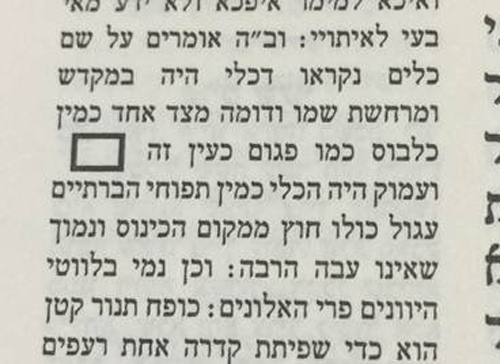
– We also added notes to explain passages in the Gemara that are hard to understand from the perspective of the natural world. As an example, the Gemara in Shevuot 23a quotes a Baraita that teaches: “A priest who ate pressed figs from Ke’ila or drank honey or milk and then entered the Temple and performed the sacrificial rites is liable for violating the prohibition against conducting the Temple service while intoxicated.” An existing Hebrew language Steinsaltz note suggests that the figs from Ke’ila may have caused intoxication because their high sugar levels could lead to fermentation that produced alcohol. No mention is made about how honey or milk might lead to intoxication. In this case, the new note was based on a suggestion made by Rav Menachem Kasher in his Torah Shelemah,[3] leading to the following:

Milk can also ferment, and in some cultures it is common to drink fermented alcoholic milk beverages known as Kefir. In the Bible there are references to the intoxicating powers of milk (see Judges 4:19). Another possibility is that the word halav here, rather than denoting milk, is referring to white date wine. This usage appears a number of times in rabbinic literature. The Jerusalem Talmud (Shabbat 19:5) discusses halav in the context of teruma, which can consist only of produce. Similarly, the Targum translates the word halav in the Song of Songs (5:1) as referring to white wine (Torah Shelema).

– As noted above, perhaps the most attractive additions were the enhanced images. Accompanying the above-mentioned note were new images of figs, together with a map of Israel showing the location of Ke’ila. On more than one occasion, I received a request from editors asking for suggestions of images that could be added to tractates that were lacking visual enhancements to the text.

Tractate Berakhot, which is what Chaim Katz focused on in his review, posed a problem of a different order. Simply put, Berakhot has a lot of words on each page.4 This led to a situation where the original Hebrew Steinsaltz, which limited to a single amud to a two page spread, had little room for explanatory notes, given that the text of the Gemara, Rashi and the Hebrew translation took up almost all the room on the page. This was especially true on pages of aggada, where the Gemara text took up even more room on the page, so that on pages where Rav Steinsaltz’ commentary would have been especially helpful, there was little to be found. The English translation pages did not have these limitations – indeed, English translation guaranteed that there would be quite a bit of “white space” – and it became necessary to add material that matched Rav Steinsaltz’ writings, which include Jewish philosophy, kabbalah and hassidut. Most of the new notes in the tractate have their roots in this perceived need.

As Chaim Katz writes, many of the new notes are from classical commentaries on the aggadic portions of Gemara. While it is correct that the vast majority of the original Hebrew notes in Berakhot are from classical sources, there are some contemporary scholars referred to in those notes (e.g., 28b, where Rav Isaac HaLevi Herzog is brought alongside Rav Sa’adia Ga’on and others in explaining why Rabban Yohanan ben Zakkai perceived that King Hezekiah was coming to escort him to the next world).

In consultation with Rav Steinsaltz – who was involved in several other projects and was unable to turn his attention to writing a new commentary on these sections of Berakhot – I suggested Rav Kook’s Ein Aya as an approach that would dovetail nicely with Rav Steinsaltz’ own writings and an ideal source for the kind of ideas that would enhance the study of the tractate, both on their own merits and by introducing an important thinker to the English reading public. Previously, the Ein Aya had changed my personal experience when I taught Berakhot, inasmuch as contemporary questions on aggadic portions of the Gemara that go undiscussed by the classic commentaries are given voice by Rav Kook. Studying this work, choosing which pieces would engage the contemporary English reader, and distilling them into concise prose for inclusion in the new volume, was a challenging labor of love. As Chaim Katz notes, the Ein Aya is considerably longer than standard commentaries. Furthermore, Rav Kook’s language is difficult and often obscure. I will leave it to the reader to decide whether I succeeded in capturing and conveying Rav Kook’s ideas accurately in the limited space available.

After almost 20 years of working on various Steinsaltz-related Talmud projects efforts, this is a fitting time for me to express my appreciation to Rav Adin Steinsaltz and to Rav Meni Even-Yisrael for having been given the opportunity to play a role in fulfilling Rav Steinsaltz’ vision of spreading Torah to as wide a spectrum of Jews as possible.

Rabbi Dr. Shalom Berger szberger@gmail.com served as Senior Content Editor for the Koren Talmud Bavli project. He is now involved in developing English language educational programming for Herzog College’s Tanakh department.

[1] Some readers may recall that there was a time not long ago when the only place one could find the Soncino translation of the Talmud online was on a notorious anti-Semitic website, which highlighted sections that were thought to “prove” a variety of accusations against “rabbinic” Jews.
[2] This note appears in Avoda Zara 22a. Inserting the Meiri in cases like this has solid precedent, see b. Bava Kama 113a in the standard Vilna edition.
[3] See Vol. 27 in the supplements (Miluim) pp. 273-274. Rav Kasher opens by expressing surprise that he has never seen this question raised elsewhere.
[4] According to this calculation – https://judaism.stackexchange.com/questions/2672/what-is-the-longest-masechta – significantly more than any other tractate.


Berakhot Koren Talmud Bavli and Ein Aya

Berakhot Koren Talmud Bavli and Ein Aya

by Chaim Katz

Berakhot Koren Talmud Bavli (KE) is a translation (into English) of Rav Adin Even-Yisrael Steinsaltz’s Hebrew edition of tractate Berakhot. It comprises the text of the Talmud, the in-line commentary, the explanation of foreign words, the mini-studies (iyunim), the biographies of selected sages, the description of cultural objects (hahayim), descriptions of fauna and flora and more. As far as I’ve noticed, they never mention in the front matter nor in the advertising blurbs that they added informational notes that don’t appear in the original edition, but there are more than 100 new notes in Berakhot KE.

In this paper, I’d like to present an overview of the new notes, and specifically examine the notes based on Ein Aya [1] – Rav Kook’s commentary to Ein Yaakov. [2]

I had a few questions about the notes based on Ein Ayah:

  1. In the Hebrew edition, Rav Adin created a bibliography of all the sources he used to compile his explanations. The list contains about 100 entries that stretch from Baal Halakhot Gedolot and Sheiltot (8th century) to Rabbi Akiba Eger (died 1837), the Hatam Sofer (died 1839), and  commentaries printed in the Vilna Shas and the Vilna Ein Yaakov, e.g., Maharatz Chajes (died 1855), Rav Samuel Strashun (died 1872), Rav Hanokh Zundel the author of Etz Yosef (died 1867).  Rav Adin did not incorporate any 20th century authors in his commentary. KE made an exception and included Rav Kook. What is the reason?
  2. Ein Aya is not really an explanation of Ein Yaakov. Rav Kook points out in its introduction that his work uses Ein Yaakov as a starting point. However, his goal was to expand the literature of Aggadah and produce a new type of reading material based upon ethical ideas in Jewish philosophy, kabbalah, musar and hassidut. Does KE realize that Ein Aya is not a commentary like the others?
  3.  Ein Aya is very long. A haggadic statement that Maharsha devotes 15 lines of explanation to, is discussed by Rav Kook in about 60 lines (30 lines of double column text). How will KE summarize all that material? [3]

First, I’ll briefly review some of the new notes in KE and then examine a few passages quoted from Ein Aya. The following are new:

1 KE Daf 16b (page 112) has a biography of Rav Safra which is copied from the Hebrew edition Moed Kattan 25a

2 KE Daf 57b (page 371) has a biography of Rabbi Yishmael ben Elisha copied from Gittin 58a

3 KE Daf 64a (page 409) has a note about the Chaldean astrologers, which is copied from the Hebrew Shabbat 156b. 

4 KE Daf 17b (page 115) has a note about Jesus the Nazarene copied from the Hebrew Edition Sotah 47a.

5 KE Daf 9b, (page 59) there is a note about tekhelet, similar but different from the notes in Menahot 38a  .

6 KE Daf 12b, (page 82) has a long note about tzizit – ritual fringes

7 KE Daf 13b, (page 91) there’s a definition of kavanah – intent

8 KE Daf 13b, (page 92) has a diagram of the placement of the tefillin on the arm and hand. 

9 KE Daf 56b, (page 365) has a note describing a lion. 

10 KE Daf 56b, (page 367) has a note describing an elephant. 

11 KE Daf 41a, (page 270) has notes for: radish, olive, wheat, barley, and fig. The following page has a definition of a date. 

12 KE Daf 59a (page 382) has a note about a rainbow.

13 KE Daf 7a, (page 42) has an unattributed explanation based on the words: “When I wanted you did not want . . . “.  The explanation is from Maharsha. 

14 KE Daf 10a, (page 64) has a comment concerning the relationship of the Holy One Blessed is He and the world. This explanation comes from Etz Yosef.

15 KE Daf 11b, (page 74) has an unattributed very long note about abounding love אהבה רבה and eternal love אהבת עולם. The note is taken verbatim from The Long Shorter Way (Chapter 4 – Two Ways of Loving G-d) [4].

16 KE Daf 51a, (page 323) has a clarification of a statement made by the angel Suriel. This is from the Maharsha. 

17 KE Daf 58a, (page 374) has an explanation concerning the statement: “When Samaria was cursed, its neighbors were blessed”. The explanation comes from Anaf Yosef.

18 KE Daf 17a (page 114) There is a short note about the “Divine Presence” (although it’s not the first time that the word שכינה appears in the tractate.)

My sense is that the Steinsaltz Hebrew edition only introduces a note when there is a problem (on the page) that the additional note might solve. KE relaxes this constraint. I’ll illustrate this difference using the first example in the above list. We read in our Gemara:

 After his prayer, Rav Safra would add: “May it be Your will, G-d our G-d, that You make peace among the members of the heavenly court…”

Rav Safra is one of many sages quoted. There is no problem that needs to be solved. The KE has a biography of Rav Safra that ends this way:

Since Rav Safra was an itinerant merchant, he never established his own yeshiva and did not spend much time in the study hall. Therefore, there were those among the Sages who held that he was unlike other Rabbis, that all are required to mourn their passing. 

This is a strange piece of information which doesn’t look like it belongs in a biography. However, the Talmud Moed Kattan 25a, records the following discussion:

When R. Safra died, the students did not rend their clothes for him, since, they said, we have not learned from him. Abaye argued with them: Does the baraita say: ‘When a teacher dies’? Rather it says ‘when a scholar dies’.  Moreover, every day in the study hall we discuss his interpretations of the halakha. 

KE’s biography was copied from Rav Adin’s biography in Moed Katan. 

There are many other examples of notes in KE that were copied from one location to another. They usually don’t fit very well in the destination location. In general, the notes regarding the religious objects add value. The notes describing the obvious (e.g., lion and elephant) are probably included for their esthetics.

Concerning Ein Aya: First, I’ll present the note, my translation and the Hebrew text of Ein Aya side by side and then I’ll discuss the note briefly. 

1 KE Daf 9a (Page 57), Ain Aya Berakhot 1 112 

When the children of Israel were redeemed from Egypt, they were redeemed only in the evening. And when they left, they left only during the day:

There are two separate elements to the transition from slavery to freedom. First, the slave acquires a personal sense of freedom and becomes master of his own fate. Second, he becomes free in the eyes of others, i.e., he is perceived by those surrounding him as a free man and has the potential to influence them. With regard to the children of Israel, the first element enabled them to receive the Torah and elevate themselves with the fulfillment of G-d’s commandments. The second element provided Israel with the opportunity to become a “light unto the nations.” Therefore, the redemption was divided into two stages. The first stage, in which they acquired private, personal freedom, took placed at night; the second stage, which drew the attention of the world to the miracle of the Exodus, took place during the day.

R. Aba said: All agree that when Israel was redeemed from Egypt, they were redeemed specifically during the night, and when they left Egypt, they left specifically during the daytime.

Redemption from slavery to freedom in general has two effects on an entire nation: 1) An inner liberation and exaltedness that it senses when it exchanges the submissiveness of slavery for autonomy and self-determination. 2) A freedom to perform actions that impact the world. 

In Israel these two effects are more pronounced. For the inner freedom is the beginning of their own perfection – developing holy behaviors in Torah, its mitzvot and its wisdom. While the outer public freedom allows Israel to be a light to the nations. A great part of the latter mission has already been accomplished even in our time and will be fully completed when G-d has compassion on His nation. For from Zion will the Torah go forth (Is. 2:3), Even the people in the far-way lands will wait to hear Torah of Israel (Is. 42:4)

Therefore, the redemptions are divided into two parts. When Israel was redeemed from Egypt – the inner redemption – this occurred during the nighttime. For the main point is not publicity or exposure to others, but a strong sense of their inner liberation. When they left, they specifically left during the daytime, publicly and openly for all the nations of the world to see, to demonstrate their worldly mission of instructing, benefiting and illuminating all of mankind with the light of G-d as it is written: Nations will walk in your light, kings in your glorious light. (Is. 60 3)

א”ר אבא הכל מודים כשנגאלו ישראל ממצרים לא נגאלו אלא בערב, וכשיצאו לא יצאו אלא ביום .

הגאולה מעבדות לחירות בכלל, פועלת בכלל עם-שלם שני עניינים. האחד הוא החופש שירגיש בנפשו התרוממות שיצא מכלל שפלות העבדות ונעשה בן חורין ואדון לעצמו. והשני הוא הפעולה הנגלית בעולם, בהיותו עם חפשי חי ופועל.

ובישראל עוד יתר שאת לשני אלה, כי החופש הפנימי הוא התחלה לשלמות עצמם, בקדושת המדות בתורה ומצותי’ וחכמתה. והחופש הגלוי החיצוני, הוא עומד בישראל להיות לאור גויים, כאשר כבר נעשה חלק גדול מזה גם לעת כזאת, ויגמר בתכליתו לעת ירחם ד’ את עמו, כי מציון תורה תצא ולתורת ישראל איים ייחלון.

 ע”כ נחלקו הגאולות לשני חלקים, כשנגאלו ישראל ממצרים הגאולה הפנימית, היינו מבערב, שע”ז אין העיקר הידיעה והפרסום של זולתם, כי אם ההרגשה הטובה בחופשתם הפנימית. וכשיצאו לא יצאו אלא ביום, ביד רמה גלוי לכל יושבי תבל, להורות על פעולתם הגלויה בעולם, להשכיל להיטיב לכל ברואי בצלם להאיר באור ד’, כדבר שנאמר “וְהָלְכוּ גוֹיִם לְאוֹרֵךְ וּמְלָכִים לְנֹגַהּ זַרְחֵךְ

KE skipped the nuance that Rav Kook was speaking about nations and not individuals. It also decided that redemption occurs in two stages, while Rav Kook only said that redemption has two components to it. They stopped short and didn’t capture the emphasis that Rav Kook placed on enlightening the nations (probably with the Noachide laws), but on the whole, it’s a fairly accurate summary.

2 KE Daf 10b, (page 65), Ain Aya Berakhot 1 141

From the chambers [kirot] of his heart – Often prayer is viewed as an act that combines the spiritual and the intellectual. There is a cognitive awareness of the necessity to turn to G-d in our time of need. When there is a pressing need, calling for a higher level of prayer, there can be an authentic call emanating from a person’s very heart, as the Psalmist declares: “My heart and my flesh sing for joy unto the living G-d” (Psalms 84:3) Hezekiah turned his face to the wall and prayed. Why wall? Rabbi Shimon b Lakish said: From the walls of his heart.

There is a prayer that accompanies emotions that are intellectual, when the intellect perceives the value of the necessity of praying and recognizes the great worth of prayer. For the intellect is associated with the spirit of the heart, which resides in the chamber of the heart. 

However, when one fortifies oneself in prayer so much so that the body’s powers are aroused by the feelings generated by prayer, then the prayer affects the body, not just the soul. This is called praying from the walls of the heart. Namely, not just with the spirit, which is in the chamber of the heart, but also with physical vitality as it written: my heart and my flesh sing to the living G-d (Psalms 84:3)

ויסב חזקי’ את פניו אל הקיר ויתפלל. מאי קיר ארשב”ל מקירות לבו

יש תפילה שבאה ברגש שכלי, שהשכל משקיף על ערך הנחיצות להתפלל ומכיר גדולת ערך התפילה. והנה השכל מיוחס לרוח הלב השורה בחלל הלב.

אבל כשמגביר ברחמים עד שגם כוחות הגופניים מתפעלים מרגשי התפילה, ונמצא שהתפילה פועלת על הגוף לא על הנפש לבדה, נקרא שמתפלל מקירות הלב. כלומר לא מהרוח לבדו שהוא בחלל הלב, כ”א גם בהתפעלות בשרית, כמו שכתוב “לבי ובשרי ירננו אל אל חי”.

This is a more difficult piece, particularly because we don’t relate to the view that (one side of) the heart is filled with spirit. We don’t identify with the description of the heart as a source of emotion and we no longer think of intellect affecting the flesh of the heart (but that’s another discussion).

The main problem with KE’s translation, is that Rav Kook is speaking here about the influence that prayer has on the person. He’s not speaking about “a higher level of prayer . . . an authentic call emanating from a person’s very heart”. He’s saying that a person can change himself through prayer.  He can change his thoughts (chamber of the heart) and he can even change his character (walls of the heart). KE’s translation misses all of this. It misses the distinction between walls and chamber, and it misses the connection to the verse from Psalms that Rav Kook cites.

(It’s not the right place now to trace the history of the idea that the person refines and elevates himself through prayer. See maybe Rav Shimshon Raphael Hirsch on Devarim 11:13, or Rabbi Soloveitchik’s Shiurim l’Zecher Aba Mori z”l  volume 2, page 29 and other places there.)

3 KE Daf 63b, (page 408), Ain Aya Berakhot 9 344

Matters of Torah are only retained by one who kills himself over it [5]

While educators often try to make Torah study easier because they believe that doing so will lead students to accumulate more information and Torah knowledge, their approach is fundamentally flawed. The significance of Torah education is qualitative, not quantitative. It is not the sheer volume of knowledge amassed; it is the quality of the Torah wisdom that is attained. Simplistic, facile methods of study do not facilitate deep understanding. That can only be achieved through hard work and serious effort

The school of R. Yannai taught: What is the meaning of (Mishle 30:33) The culturing of milk produces fermented milk (yogurt) …  In whom do you find fermented milk of Torah, in the one who spits out the milk he nursed from his mother.


There are many educators who pride themselves for introducing methods that make learning simpler. They imagine they’ll benefit the world by transmitting lessons and knowledge of Torah in an undemanding way, eliminating the need to for a person to work. 

This assistance is misguided. Knowledge isn’t measured by quantity but by quality, according to depth and perceptiveness that enable the student to apply the knowledge to any situation. More so regarding Torah knowledge, which is measured by the profound impression on the student in his ethical personality, virtuous behavior, and pure fear of Heaven.

Success will come when the studies do not follow an easy and undemanding curriculum. For through exertion and mental effort, a person is elevated to ethical behaviors, and turns with love and longing toward wisdom and holiness. The learning affects him such that he’s entirely dedicated and devoted to his lessons. Learning specifically with great effort produces a deep understanding, clarity in knowledge, and the pleasing way of serving G-d, fearing Him, and purifying one’s character. 

Studies that are acquired easily, without exertion and tremendous struggle will always be superficial, frozen and detached from the person’s inner soul. They will have minimal impact on his behavior and personality. 

Therefore, the fermented milk of Torah, the choice purified portion of Torah, the key aspect, clarified by deep thought and profound understanding that strengthens the soul in the fear G-d, and in the ways of holiness in whom will it be found? Only in one who was raised laboring in Torah and acquired Torah by following the beaten paths of strenuous effort and great toil; who distances himself from his childhood pleasures so that his Torah was not acquired though childish games.  He spits out the sweet milk he nursed from his mother

אמרי דבי ר”י: מאי דכתיב (משלי ל לג): “כי מיץ חלב יוציא חמאה במי אתה מוצא חמאה של תורה? – במי שמקיא חלב שינק משדי אמו עליה”

רבים הם הפדגוגים המתנשאים להביא דרכים להקל את עול הלימוד, וחושבים שיביאו ברכה לעולם בהקנותם את הידיעות והלימודים התורניים באופן קל, שלא יצטרך האדם להיות עמל בהם.

תועלת הדבר אינה אמנם אלא מתעה, כי הידיעות לא תימדדנה על פי כמותם כי אם על פי איכותם, על פי עומק ההבנה וחריפות השימוש בהם לכל חפץ.ביותר לימודי התורה, על פי גודל הרושם שפועלים על הלומד, לענין התכונה של המוסר המעשים הטובים ויראת ה’ הטהורה. 

ובזאת יהיה מועיל רק הלימוד שאינו בא בדרכים קלים ונוחים לקלוט, כי על-ידי היגיעה ועבודה שכלית מתעלה האדם למידות נעלות, ולהיות נוטה אל השכל ואל כל דברי קודש באהבה וחפץ לב, והלימוד פועל עליו להיות כולו נתון ומסור ללימודיו. על-כן יצא מהלמוד שעל-ידי היגיעה דווקא, עומק ההבנה והידיעה הברורה עם הפעולה הרצויה לעבודת ה’ ויראתו וכל טהרת המדות. 

אבל הלימודים הנכנסים באופן קל, בלא יגיעה ועבודה כבירה, ישארו לעולם שטחיים וקפויים, עומדים מחוץ לנפשו של אדם הפנימית, ופועלים מעט על מעשיו ועל יצרי לבבו.

ע”כ חמאה של תורה, הברור והמובחר שבה, העיקרי, המחוור בעומק רעיון ושום שכל והמרבה אומץ הנפש ביראת ה’ ודרכי קודש במי תמצא? רק במי שנתגדל על עבודת התורה בעמל, וקנה אותה בדרכים כבושים שע”י יגיעה ועבודה רבה, שעמדו לו להתרחק מן הילדות וכל געגועיה, לבלתי קנותם בדרך שעשועי ילדים, כ”א מקיא חלב שינק משדי אמו עליה

KE, missed the point here as well. Rav Kook isn’t speaking about education or Torah education. It’s not about “deep understanding that can only be achieved through hard work and serious effort” 

He’s speaking about love of G-d. The fermented milk of Torah represents the Torah studies that, under the proper conditions, lead the person to the love of G-d. Knowledge isn’t sufficient; one must labor and exert himself in these Torah studies and only then will they succeed in leading him to holiness.  

(The basis of Rav Kook’s idea might be in the Sifre Devarim (on Deut. 6 6) quoted by Maimonides Book of Commandments, Positive #3, “You shall love G-d your G-d with all your heart’, can I know how to love G-d? The Torah therefore says: These words which I command you today shall be upon your heart. Thus, you will come to recognize the One who spoke and the world was created and you’ll cling to His ways.)

4 KE Daf 10a, (page 62), Ain Aya Berakhot 1 128  

David… resided in five worlds and said a song of praise corresponding to each of them:

There is a tremendous difference between looking upon an experience in a superficial manner and reflecting upon it and contemplating it. An individual who merely sees the external will not come to understand the deeper, spiritual significance of a given experience or encounter. Natural events like pregnancy, birth and nursing may seem to be mundane events experienced by humans and animals alike. However, one with a higher level of spiritual discernment will appreciate the vast difference between man and animal. King David’s songs of praise, uttered at every stage of life, attest to the magnitude of his sensitivity to G-d’s beneficence and to his appreciation of His role in the world.

He lived inside his mother’s womb and offered songs of thanksgiving; he went out into the air of the world…

One who looks at the real world superficially cannot recognize the grandeur and beauty of the majesty of G-d nor the splendour of the human soul, as his perception of the real world is based exclusively on obvious visible traces of wisdom. In the words of the Duties of the Heart, (Hovot HaLevavot by Bahya ibn Pakuda Spain 11th century): based on the obvious visible traces of wisdom in the real world, both the intelligent man and the fool are equivalent. 

On the other hand, the truly gifted person will find hidden insights in the very things that didn’t inspire or elevate the person who looks at the world superficially. The truly gifted person will recognize the line of kindness that extends through all creations from their beginnings to their ultimate purpose. He will appreciate G-d’s wonders and thank Him. With happiness he will sing for G-d and for His goodness. He will recognize the majesty of his own soul that perceives the grandeur of the glorious King. Therefore, David (peace to him), who combined in himself depth of knowledge with sweet Divine song, sang about things that are discerned only with wisdom and deep contemplation. 

He lived inside his mother’s womb…  

Seemingly, there is no reason to be amazed. The experience is similar for a human or any other animal that doesn’t speak. In the womb, the human embryo is just like an amphibian or a lizard, the lowest rungs in the animal hierarchy.

 But when he reflects deeply, that in this lowly state all organs and limbs, which will serve the loftiest powers of the soul, are being completed. Not one is missing. If so, how great is the work taking place in the womb for the design of a person. Then, being so far from perfection, all the material and spiritual abilities he will later need are developing so that he’ll develop into a refined ethical person, who embraces in his brain and mind, the foundations of the world and its infinite expanses.

דר במעי אמו ואמר שירה, יצא לאויר העולם  . . . 

הבדל יש בין המסתכל רק בהשקפה שטחית על המציאות, הוא לא יוכל להכיר רוממות ה’ והדר גאונו ועם זה הוד נפש האדם, רק מהדברים הגלויים בסימני החכמה שבמציאות. כדברי חוה”ל, שבסימני החכמה הגלויים המשכיל והכסיל שוין בהם. 

אבל החכם האמיתי, הוא יחדור אל סימני החכמה הצפונים, שלעין הרואה רק חיצוניות הדברים לא יולד מהנה שום רוממות נפש. אבל החכם האמיתי, יכיר החוט של חסד ההולך בכל המעשים כולם מהתחלתם עד מטרתם, ויכיר נפלאות השם ית’ ויודה לשמו. ומטוב לב ישיר על ד’ ועל טובו, ויכיר הוד נפשו המכרת את הדרת מלך הכבוד. ע”כ דוד ע”ה שבו חובר עומק הדעת עם נועם השירה האלהית, אמר שירה על הדברים שרק בחכמה והשקפה רבה יוכר הודם ופלאם.

 דר במעי אמו, לפי החיצוניות אין להפליא כ”כ, מקרה האדם בזה כמו שאר החיים הבלתי מדברים, אז הוא במדרגת השרצים ג”כ שהם במדרגה הנמוכה של מערכת החי. 

אבל כשהתבונן, כי בהיותו במצב הנמוך הזה אז נגמרו ונוצרו כל יצוריו כולם, וכל האיברים המשמשים לכוחות הנפש היותר נשגבות אחד מהם לא נעדר. א”כ מה רבה התכונה הנעשה בבטן המלאה ביצירת האדם, שאז במצב רחוק משלמות והתפתחות כזה, צריכים שיוכנו לו כל הכוחות וכל הכלים הרוחניים והגשמיים שיצטרכו לו בהיותו אדם המעלה, המחבק זרועות עולם ומרחבי אין קץ בדעו ושכלו.

Here too, I think, KE missed the point. It’s not about “the vast difference between man and animal”, which Rav Kook never mentioned. Rav Kook picks the theory of recapitulation to explain David’s song. According to the theory (which was immensely popular in the second half of the 19th century), the stages of embryonic development correspond to adult stages in the evolution of the species (ontogeny recapitulates phylogeny). That’s why Rav Kook writes: the human embryo is then like an amphibian.  But the theory is based on superficial similarities. The truly wise man looks beyond the superficiality and sees that each embryonic phase is not an evolutionary ancestor, but a point on a line extending from the person’s beginning to his birth. Each point on the line contains a hidden potential that will unfold and finally develop into a moral and ethical man. The insight (probably disproves the theory and) results in a greater appreciation of the Creator’s kindness, which is the song of praise that David sings.

We can now come back and answer the three questions that I posed earlier. 1) KE is not looking at Ein Aya as a typical commentary; that’s why they had no problem including Rav Kook’s words in the Berakhot volume.  Additionally, I guess, the writers or editors have an admiration and affinity for Rav Kook and wanted to include some writings of his. 2) KE knows that in quoting a section from Ein Aya they are not explaining the text of the Talmud. Instead, they are attempting to follow the path of Ein Aya; to add thoughts and reading material of an ethical nature to KE. 3) It looks (at least in these few examples) that KE translated only the first few sentences of the Ein Aya section and then wrote up their own conclusions. They probably didn’t read to the end of the Ein Aya section(?), or if they did, they decided to “keep it simple”. I guess this can be excused too. In one of these notes they did write “see Ein Aya” instead of just attributing the section to Ein Aya.

Maybe the new notes in KE Berakhot aren’t of the same calibre as the original notes in the Hebrew edition. Still, they make the learning more interesting and more attractive. For this we should be thankful.

[1] Ein Aya is a work by Rav Kook on the Aggadah in Ein Yaakov, published by Makhon HaRav Tzvi Yehuda, Jerusalem. It consists of 4 volumes covering Berakhot and most of Shabbat. Though it was written over 100 years ago it was only published recently (approximately between 1995 and 2005). The text is also available at https://he.wikisource.org/wiki/
[2] Ein Yaakov is a collection of aggada from the Talmud Babli, by Rabbi Yaakov Ibn Habib (died 1516)
[3] I’m using as my example: Daf 3a “Rabbi Eliezer said: The night consists of three watches… during the first watch a donkey brays, during the second the dogs howl, during the third the infant nurses from its mother and a wife speaks with her husband”
[4] The Long Shorter Way, Discourses on Chasidic Thought, by Adin Even-Israel Steinsaltz, edited and translated by Yehuda Hanegbi, Koren/Maggid Publishers. Based on a series of lectures delivered by Rabbi Adin Even-Israel Steinsaltz on Rabbi Schneur Zalman of Liadi’s classic Chasidic work, the Tanya.
[5] There is a printing mistake here. They mixed up the passage’s key words (דיבור המתחיל) with another comment.  I’m not sure if this mistake affected the subsequent translation. 


A Compromise in Halacha – On Menachot 33a

A Compromise in Halacha – On Menachot 33a
By Eli Genauer
A common D’var Torah delivered at a wedding goes something like this: “Dear Chatan and Kallah. You are standing beneath a Chupah which is representative of the home you will build within the Jewish people. When you walk into your home, you will notice that that Mezuzah is placed in a diagonal position on the doorpost. There is a disagreement between Rashi and his grandson Rabbeinu Tam as to whether the Mezuzah should be affixed in a vertical or horizontal position. Later decisors ruled that a compromise between those two opinions was in order and therefore prescribed that the Mezuzah be affixed diagonally. This lesson of compromise is an important one as you embark upon you marriage and the Mezuzah on your door is an important reminder of this principle. Mazal Tov!”
This wedding Dvar Torah is based on a Gemara in Menachot 33a
אמר רב יהודה אמר רב, עשאה כמין נגר פסולה.
איני? והא כי אתא רב יצחק בר יוסף אמר כולהו מזוזתא דבי רבי כמין נגר הוו עביד……. ?
לא קשיא, הא דעבידא כסיכתא, הא דעבידא כאיסתוירא. 
Rav Yehuda says that Rav says: If one affixes a Mezuzah like a bolt, it is invalid. Is this so? But when Rav Yitzchak bar Yosef came ( from Eretz Yisroel ) he said that all Mezuzot in the house of Rebbe ( Yehuda HaNasi) were affixed like a bolt……? This is not difficult. This ruling (where it is ruled as being unfit) is where it was prepared like a peg; that ruling (in the house of Rebbe where it is ruled as being fit) is where it is prepared like an ankle. [1] 
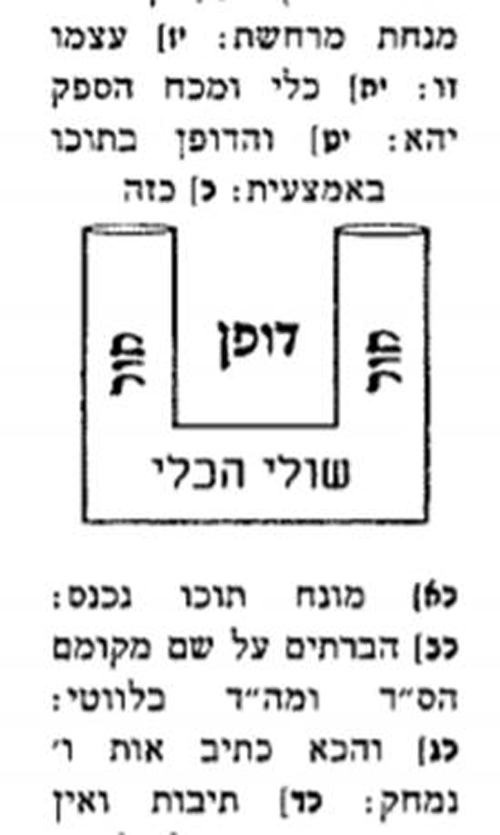
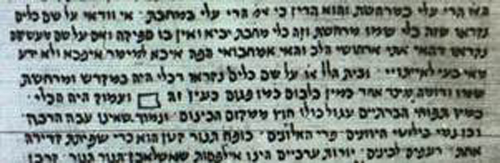
Rashi explains that a “נגר” is something that is embedded in a wall “שתוחבין הנגרין בכותל”[2] 2. He then writes the word “כזה” and illustrates this with a drawing showing a horizontally placed Mezuzah. This is one of many times here that Rashi tells us something and then uses the word “כזה” which is then followed by a diagram. In this case, the illustration shows a horizontally affixed Mezuzah and it is a mezuzah affixed in this direction that is improper.
Rabbeinu Tam (תוס’ ד״ה “הא דעבידא כסיכתא) is bothered by the explanation of Rashi because he feels that it is more honorable to have the Mezuzah affixed in a horizontal position just as it is more honorable to have a Sefer Torah lying horizontally than standing vertically. He therefore translates the word “נגר” as a “peg” and says that the disqualification of a Mezuzah affixed כמין נגר is that it is affixed vertically, like a peg. He also translates the word כסיכתא as a peg and therefore disqualified because it is vertical, and the word איסתוירא, which is considered to be proper, as the part of the foot below the ankle which is horizontal.
The idea that affixing the Mezuzah diagonally is a compromise between the positions of Rashi and Rabbeinu Tam is based on the Shulchan Aruch, Yoreh Deah 289:6

צְרִיכָה לִהְיוֹת זְקוּפָה, אָרְכָּהּ לְאֹרֶךְ מְזוּזַת הַפֶּתַח….. הַגָּה: וְכֵן נָהֲגוּ. (בֵּית יוֹסֵף) אֲבָל יֵשׁ אוֹמְרִים שֶׁפְּסוּלָה בִּזְקוּפָה, אֶלָּא צְרִיכָה לִהְיוֹת שְׁכוּבָה, אָרְכָּהּ לְרֹחַב מְזוּזַת הַפֶּתַח (טוּר וְהַפּוֹסְקִים בְּשֵׁם רַבֵּנוּ תָּם). וְהַמְּדַקְדְּקִין, יוֹצְאִין יְדֵי שְׁנֵיהֶם, וּמַנִּיחִים אוֹתָהּ בְּשִׁפּוּעַ וּבַאֲלַכְסוֹן (טוּר וְהַגָּהוֹת מַיְמוֹנִי ומהרי”ל ות”ה סי’ נ”ב), וְכֵן רָאוּי לִנְהֹג, וְכֵן נוֹהֲגִין בִּמְדִינוֹת אֵלּוּ.

In truth, it is not really a compromise but rather an effort to affix the Mezuzah in a way in which both Rashi and Rabbeinu Tam would approve. Rashi says that vertical is the proper way, horizontal is Pasul, but bent ( or diagonal) is also Kosher. Rabbeinu Tam says that horizontal is the proper way, vertical is Pasul, but bent is also Kosher. Some Meforshim take this idea even further by saying that since in the house of Rebbe the Mezuzot were affixed כאיסתוירא, this was some sort of Hidur and therefore something to be emulated.
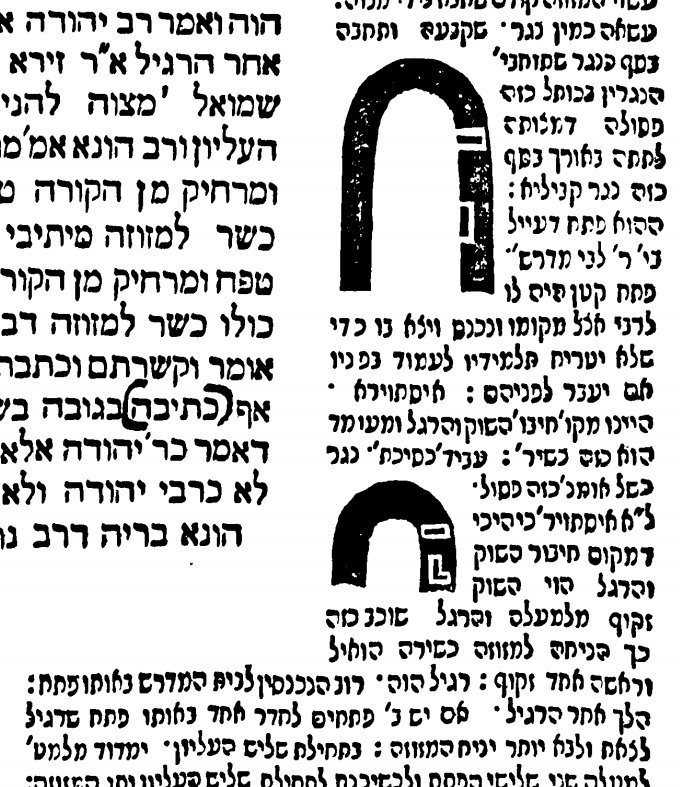
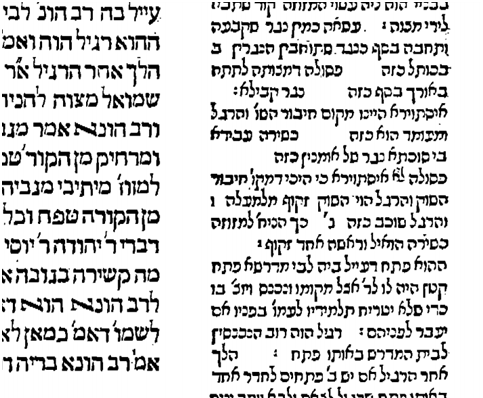
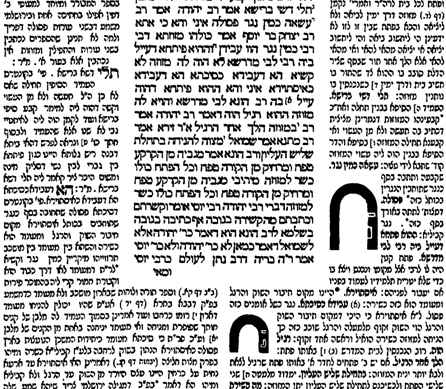
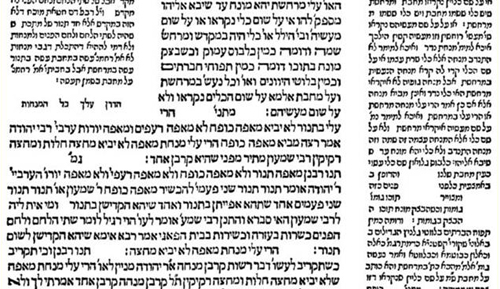
The classic edition of the Vilna Shas (Vilna 1885) renders this Sugya and the accompanying diagrams as such
Here are the words of Rashi which correspond to these two diagrams which show the positioning of four Mezuzot
  1. עשאה כמין נגר – שקבעה ותחבה בסף כנגר, שתוחבין הנגרין בכותל כזה.
  2. פסולה – דמצותה לתתה באורך בסף כזה …. נגר, קביליא
  3. עבידא כסיכתא – נגר כשל אומנים כזה פסולה
  4. איסתוירא – היינו מקום חיבור השוק והרגל ומעומד הוא כזה, כשירה:
  5. ל”א איסתוירא, כי היכי דמקום חיבור השוק והרגל הוי השוק זקוף מלמעלה והרגל שוכב כזה כך הניחה למזוזה כשירה הואיל וראשה אחד זקוף:
The doorframe in the top illustration shows the position of two Mezuzot.
The one on top is horizontal which is improper, and the one on the bottom is vertical which is Kosher.
  1. עשאה כמין נגר – שקבעה ותחבה בסף כנגר, שתוחבין הנגרין בכותל כזה.
He affixed and inserted it in the doorpost like a bolt, for workmen who work with bolts insert it in the walls like this[3] 
  1. פסולה – דמצותה לתתה באורך בסף כזה ….
It is improper- Because the Mitzvah is to affix it vertically in the doorpost like this….
The doorframe in the lower illustration also shows two Mezuzot.
The one on top is horizontal and therefore improper and the one on the bottom is bent (it looks like the Hebrew letter Nun), and therefore Kosher. Here are the words of Rashi which correspond to these two Mezuzot.
עבידא כסיכתא – נגר כשל אומנים כזה פסולה
A bolt as fashioned by workmen like this is disqualified
ל”א איסתוירא. כי היכי דמקום חיבור השוק והרגל הוי השוק זקוף מלמעלה והרגל שוכב כזה כך הניחה למזוזה כשירה הואיל וראשה אחד זקוף
Another explanation of איסתוירא – like the point at which the “Shok” joins the ”Regel”, where the “Shok” is upright and the “Regel” rests, like this, so too if he affixes the Mezuzah like this it is Kosher because the top part is upright.
There is no diagram associated directly with this comment of Rashi
איסתוירא – היינו מקום חיבור השוק והרגל ומעומד הוא כזה, כשירה:
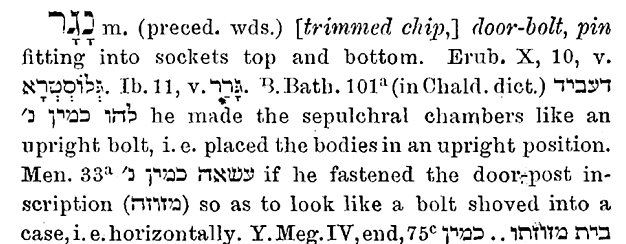
Whether a נגר is normally inserted horizontally or vertically is also “illustrated” in Jastrow’s explanation of the word
In Bava Batra 101a he describes it “like an upright bolt” and in our Gemara he describes it as “like a bolt shoved into a case, i.e. horizontally
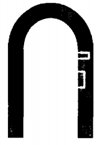
There are two issues with the standard depiction of the two diagrams in the Vilna Shas. Rashi uses the word כזה five times and there are only four “illustrations” (2 in each diagram) Also, we would expect that there would be a diagram after each time it says כזה.
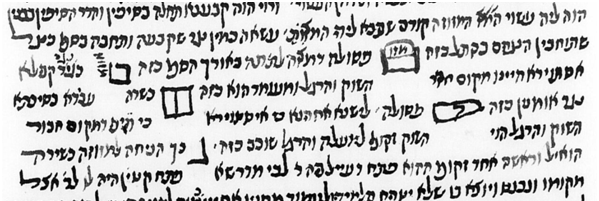
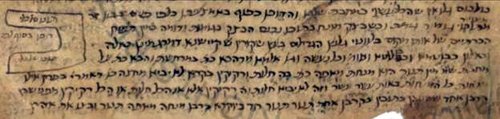
This problem is solved when we look at the only handwritten manuscript we have of Rashi on this part of Menachot.
The National Library of Russia, St. Petersburg, Russia Ms. EVR IV 25:

http://aleph.nli.org.il:80/F/?func=direct&doc_number=000159163&local_base=NNLMSS
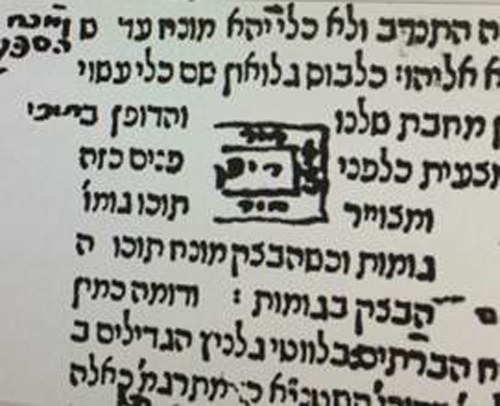
It contains five depictions of the placement of the Mezuzot and each כזה is followed by a depiction.
The problem is also solved when we look at the first printed edition of Menachot ( Bomberg 1522) whose source had to be a manuscript. [4] 
This printed edition leaves space after every כזה. It even includes a rudimentary depiction of the last כזה looking like a “Nun” which is supposed to depict where the ankle meets the leg.
It looks very much like the Nun in the National Library of Russia manuscript and may have emanated from the same source.
It was very exciting for me personally to discover this “diagram” which clearly was added to illustrate the כזה. In his Maamar ‘al hadpasat ha-Talmud with Additions, (ed. A.M. Habermann, Mossad ha-Rav Kook, Jerusalem: 2006, p.41)  Rav Natan Nata Rabbinowicz, writing about the first Bomberg edition, states as follows:

״ובכל התלמוד (וכן בכל הדפוסים הישנים עד דפוס בערמן) נשמטו הציורים בגמרא, רש״י ותוספות,ונשאר מקומם חלקמלבד בסוטה מגשישנו הציור ברש״י
“In all of the Talmud (and in all other older printed editions of the Talmud until the Berman edition ( Frankfurt an Der Oder 1697-99) the diagrams were not included in the Talmud, Rashi and Tosfot, and their space remained empty, except for Sotah 43A, where we find a diagram in Rashi.”

It turns out there was a diagram included in the second Bomberg edition of Zevachim( 1528) on 53b, which Rabbinowicz probably never saw. See my article here.
He may have also missed this one because it does not look much like a diagram, but just a letter, or perhaps he felt it was of no significance.
This depiction of the last כזה looking like a “Nun” was maintained by subsequent editions of the Talmud printed in Basel 1580, Cracow 1605, Amsterdam 1644, and Frankfurt an der Oder in 1699.
It was only dropped and replaced with the two larger diagrams we have today in the Frankfurt am Main edition of 1720.
Since many people follow the advice of the Rema and affix the Mezuzah diagonally, it is important to understand the source. This is the word in the Gemara which state that in the house of Rebbe, the Mezuzot were affixed כאיסתוירא. This word is etymologically related to the Latin word astragalus which is described as “the bone in the ankle that articulates with the leg bones to form the ankle joint”. It is more commonly known today as the Talus and looks like this:[5] 
As used in the Gemara, it probably meant the entire area where the bottom of the foot ( which is horizontal) met the bottom of the leg ( which is vertical) at the ankle, thereby looking like something that was bent.
Finally, there is a fascinating story about the Talus bone related by Rav Yisroel Shachor in the Sefer “Dovair Yesharim”.[6] In discussing the איסתוירא, he writes that he was in a terrible automobile accident and בחסדי ה׳ escaped death by climbing out of the rear of the car only seconds before it burst into flames. The only injury he sustained was a broken bone in his foot, which he identified as the Talus. He had many opportunities to view x-rays of his broken foot and concludes “I see this as a source of amazement that the only bone of all 248 bones in my body which was broken, allowed me to understand the words of Torah, and to understand that this was the איסתוירא which is mentioned in Gemarot.”[7]

[1] Translation courtesy of Sefaria.org and follows the interpretation of Rashi.
[2] There is discussion on whether what is shown as Rashi in our editions of Menachot was actually written by Rashi. Rav Natan Nata Rabbinowicz ( author of Dikdukei Sofrim) writes that our “Rashi” was written by a student of Rabbeinu Gershom. ( Dikdukei Sofrim on Menachot 86a note 6 where he writes …מפני שהפרוש הזה המיוחס לרש״י הוא כנראה מתלמיד הרבינו גרשום מאור הגולה והעתיק ברובו לשון הרבינו גרשום מאור הגולה) Rav Betzalel Ashkenazi (the author of the Shita Mekubetzet) writes that for chapters 7-10, the “Rashi” in the standard editions was not written by Rashi and he substitutes his own version which is indicated by the words “Rashi Ktiv Yad” in the Vilna Shas. The editors of the Vilna Shas record this opinion at the beginning of the 7th chapter ( Menachot 72a) as follows: וזה לשונו “זה הפּרוש אשר הוא בדפוס מפרק אלו המנחות עד שתי הלחם אינו מפי׳ רש״י ז״ל והוא של פרשן אחר, וזה לשון רש״י כּ״י”.But Rav Ashkenazi seems to indicate that the Rashi of other chapters was in fact written by Rashi. ( see his note to the beginning of Menachot chapter 11 where he writes מכאן ואליך הוא פירוש רש״י ז״ל).
[3] We only know that it is affixed in a horizontal direction from the picture, not from Rashi’s words.
[4] The Soncino family printed many tractates of the Talmud from 1483-1519 before Bomberg printed the complete Talmud in 1520-1522, and those Soncino editions often formed the basis for the text of the Bomberg edition. But the Soncino family did not print tractate Menachot meaning the Bomberg edition was based solely on manuscripts.
[5] My source for this information is Dr. Carol Teitz who is a member of my Shul. Dr. Teitz is an orthopedic surgeon and most recently, the dean of admissions at the University of Washington Medical School
[6] Doveir Yesharim, Sefer Shemot, Jerusalem. 2014, page 128

[7] This source was brought to my attention by a Torah scholar named Aharon who has helped me immensely in my research on diagrams.


Approbations and Restrictions: Printing the Talmud in Eighteenth Century Amsterdam and Two Frankfurts

Approbations and Restrictions:
Printing the Talmud in Eighteenth Century Amsterdam and Two Frankfurts
by Marvin J. Heller
Approbations designed to protect the investment of printers and their sponsors when publishing a large work such as the Talmud were well intentioned. Unfortunately, the results were counter-productive, resulting in acrimonious disputes between publishers within and between cities. This article discusses the first approbations, issued for the Frankfurt on the Oder Talmud (1697-99), and the resulting dispute with printers in Amsterdam in 1714-17. The background of the presses and the pressmarks utilized by the printers are discussed, giving a fuller picture of the printing of the Talmud in the subject period, as well as addressing antecedent (Benveniste) and subsequent editions.
Approbations for books have multiple purposes, among them commendations, indicating approval or praise for the subject work, confirming that a book’s contents do not contain forbidden or prohibited matter, and to protect a publisher’s investment from competitive editions for a fixed period of time. This article is concerned with the last purpose, here rabbinic approbations (hascoma, pl. hascomot) limiting or preventing rival editions of the Talmud published in the last decade of the seventeenth century into the first half of the eighteenth century.
The restrictive approbations discussed here are unlike those issued previously, such as the first approbations for a Hebrew book, R. Jacob Barukh ben Judah Landau’s (15th cent.) concise halakhic compendium, Sefer Ha-Agur (Naples, 1487), one of seven approbations, that of R. Judah ben Jehiel Rofe (Messer Leone, 15th cent.) stating he has examined ha-Agur, and, “it is a work that gives forth pleasant words. . . . I have, therefore, set my signature unto these nectars of the honeycomb, these words of beauty,” or those in Italy or in Basle, which assured the authorities that nothing untoward or offensive to Christianity was included in the book, or to current approbations, which assure the reader that a work’s contents are in conformity with the community’s religious standards. In contrast, the approbation issued for the Frankfurt on the Oder Berman Talmud, and to subsequent editions, was a license for a fixed number of years, prohibiting other publishers from printing competitive editions that would prevent the printer and his sponsor(s), who would otherwise be reluctant to make the substantial investment required to print such a large multi-volume work as the Talmud, from realizing a return on their investment.
The discord arising from restrictive approbations for printing the Talmud were not the first such disputes. In Amsterdam, disputes between printers arose over editions of the Bible. Johannes Georgius Nisselius and Joseph Athias competed in the mid-seventeenth century over a Sacra Biblia (Hebrew Bible) for the use of students and several years later Athias and Uri Phoebus were involved in controversy over their translations of the Bible into Yiddish, competing for the Jewish market in Poland. Arguing over the right to publish for and sell to that market, they sought to reinforce their positions by seeking approbations from the Polish, as well as the Amsterdam rabbinate.[1] Nevertheless, their competition pales in contrast to the recurring altercations over the right to print the Talmud, which spanned several centuries and much of the European continent.
Raphael Natan Nuta Rabbinovicz writes that the intent in granting this and subsequent approbations was for the good of the community, to insure investors a reasonable return on their investment. The result, however, was that the Talmud was printed only eight times in the century from 1697 to 1797, and the price of a set of the Talmud was dear. Prior to that the Talmud had been printed several times in Italy and Poland within a relatively short period of time, the primary impediment then being the opposition of the Church and local authorities. Rabbinovicz concludes that after 1797 the use of restrictive approbations declined, with the consequence that within four decades, to 1835, the Talmud was printed nine times.[2]
During last decade of the seventeenth century into the first half of the eighteenth century several rival editions of the Talmud appeared, beginning with the Frankfurt on the Oder Talmud (1697-99) followed by two incomplete editions in Amsterdam (1714-17 and 1714), the Frankfurt on the Main Talmud (1720–22), again in Amsterdam (1752–1765), and finally the Sulzbach Red (1755-63) and Black (1766-70). We are concerned with and focus on the early editions, that is, on the dispute between the Frankfurt on the Oder and Amsterdam printers, their dispute resulting from restrictive approbations issued to presses printing the Talmud. This article discusses the background of the Hebrew presses that published these Talmud editions in the seventeenth and eighteenth century; its primary focus, being the disputes resulting from the restrictive approbations.
I Amsterdam – Benveniste Talmud
Amsterdam has a distinguished place in Jewish history. Among the notable features of that city’s Jewish community are its printing-houses, among the foremost in Europe for centuries. Highly regarded, Amsterdam imprints were distributed and sold throughout all of Europe. The preeminence of Amsterdam as a European book center is evident, for it is estimated that the output of the Dutch presses in the seventeenth century exceeded the combined production of all the presses of all other European countries. The number of book-printers totaled 273 at its peak in 1675-99, employing at its height in excess of 30,000 people supported through some facet of the book trade.[3] The important works published by its presses include editions of the Talmud, beginning with the Benveniste Talmud of 1644-47, through the much praised Proops’ Talmud of 1752-65. In addition to complete editions of the Talmud individual treatises, frequently in a smaller format, were also published for students and individuals who did not require or who could not afford a complete Talmud.[4]
The printing of Hebrew books in Amsterdam by Jews begins in 1627, when two printers published books, Manasseh (Menasseh) Ben Israel (1604-57) and Daniel de Fonesca. The former’s press was the first to publish with a Sephardic rite prayer-book, completed on January 1, 1627. Manasseh Ben Israel would achieve acclaim that, together with its founder’s many other achievements, is still recalled today. Manasseh did not publish Talmudic tractates but his press did issue three critical editions of Mishnayot (1632, 1643, and 1646). He also intended to publish an edition of the Talmud but that did not come to pass.
The next printer of Hebrew books of import in Amsterdam was Immanuel (Imanoel) Benveniste. Benveniste is believed to have been among the Jewish refugees from Spain or Portugal, and that he was descended from the illustrious Sephardic family of that name.[5] Beneveniste relocated to Amsterdam because, by the mid-seventeenth century that city offered better opportunities for the distribution of Hebrew books than any city in Italy.[6] Beneveniste was the publisher of the first Amsterdam Talmud, printed from 1644-47. The Benveniste Talmud is in a smaller (c. 260:195 cm.) quarto format than the usual large folio editions.[7]

Fig. 1
Although not subject to restrictive approbations it is included here due to its relevance to the history of the printing the Talmud in Amsterdam and because the title-pages of Benveniste’s publications are distinguished by his escutcheon, an upright lion facing inward towards a tower; a star is above the lion and the tower. The lion is on the viewer’s right, the tower on the left. At least six forms of Benveniste’s device have been identified. In all cases, excepting his Talmudic treatises, Benveniste’s insignia is set in a crest above an architectural frame surrounding the text of the title page. On the title-pages of the Benveniste tractates his mark appears at the bottom of the page in an ornamental shield, with a helmet in the crest (fig. 1). Given the high regard of most Benveniste imprints this device was subsequently used by several printers in Amsterdam, including two of the following subject editions, as well as by other presses in various locations.[8]
This Talmud has been has been praised for restoring expurgated material. Unlike Benveniste’s other publications, however, the Beneveniste Talmud is not highly regarded. Raphael Natan Nuta Rabbinovicz quotes from an approbation given by R. Moses Judah ha-Cohen, Av Bet Din, of the Ashkenazi community in Amsterdam, for the Berman Talmud (Frankfurt on the Oder, 1697-99) which states that Benveniste, due to his concern over expenses, printed a Talmud edition which was, due to its small size, difficult to learn from. Furthermore, Benveniste used letters that were “the smallest of the small and blurred so that the users eyes become heavy and his sight wanders as if from old age.”[9] This notwithstanding, no less a personage than the Vilna Gaon (R. Elijah ben Soloman Zalman, Gr”a, 1720-70) made use of the Benveniste Talmud, Rabbinovicz writing that “he had heard from a great Talmudic scholar who related that he had seen a Talmud from which the Gr”a had learned by R. Judah Bachrach (1775-1846) av bet din Seiny with his (Gr”a’s) handwritten annotations, brief and varied from his printed annotations, and that it was a Benveniste Talmud.”[10]
II – Frankfurt on the Oder – Michael Gottschalk
Printing with Hebrew letters in Frankfurt on the Oder begins when the Christian printers Joachim and Friedreich Hartmann (1594-1631), who, using new Hebrew fonts and vowels cast by Zechariah Crato (?) of Wittenberg, published a Hebrew Bible in 1595-96. While there are references to an even earlier Bible, half a century earlier, that is uncertain. More than a century later, Johann Christoph Beckmann (1641-1711), professor of Greek language history, and theology at the University of Frankfurt on the Oder, operated a printing-press in Frankfurt on the Oder from 1673 to 1717, which he acquired from his brother Friedreich on June 1, 1673 for 400 Thaler; Friedreich, in turn, had purchased the press for a like amount. Beckmann obtained a travel scholarship from the Brandenburg Elector and, during his travels in Europe came to Amsterdam. In 1663, in that city, Beckmann met Jewish students, the renowned R. Jacob Abendana (1630-85), and studied Talmud. In 1666, Beckmann returned to Frankfurt, where he obtained a position at the university (Viadrina), teaching there until his death in 1717 and serving as rector eight times. Because of the admission of Jewish students, the Viadrina became the “Amsterdam of the East,” both Hebrew and oriental studies being of importance.[11]
Beckmann was granted, initially, on May 1, 1675, a license to employ two Jewish workers, under the direct protection of the university, to print a Hebrew Bible, this despite of the protests of Frankfurt city. By 1693, however, Beckmann found that his responsibilities at the university left him with insufficient time to manage the press. Therefore, he contracted with Michael Gottschalk, a local bookbinder and book-dealer to manage the printing-house, transferring all of the typographical equipment and material to Gottschalk. Their arrangement was noted on the title-pages of the books issued by the press, which stated “with the letters of Lord Johann Christoph Beckmann, Doctor and Professor . . . at the press of Michael Gottschalk.” Gottschalk became the moving spirit of the press for almost four decades.
After printing several varied Hebrew titles Gottschalk approached Beckmann, requesting that he obtain permission to reprint the Talmud. Beckmann petitioned Friedreich III, Elector of Brandenburg (1657-1713, reigned 1688-1713, from 1701 King of Prussia), requesting a license to print the Talmud. Friedreich, in turn, sought the counsel of the Berlin professor Dr. Daniel Ernest Jablonski (1660-1741), from 1691, court preacher at Königsberg for the elector of Brandenburg, Friederick III. Jablonski, a Christian German theologian of Czech origin, an orientalist, had been associated with universities in Holland and England, settling in Lissa in 1686, and from there moving to Berlin. In 1700, Jablonski became a member of the Academy of Sciences in Berlin. Jablonski established a Hebrew press in Berlin, publishing a scholarly edition of the Hebrew Bible based on the Leusden edition (Amsterdam, 1667, Atthias) and a translation of Richard Bentley’s A Confutation of Atheism into Latin (Berlin, 1696). Jablonski, was to become personally involved with Hebrew printing in Berlin, and would be participate in the publishing of two later editions of the Talmud.
When a sponsor was sought for the Frankfurt on the Oder Talmud, Beckmann found one in the Court Jew Issachar (Ber Segal) ha-Levi Bermann (1661-1730) of Halberstadt, known as Bermann Halberstadt or, in his commercial dealings with the non-Jewish world, as Behrend Lehmann. It was Bermann who bore the cost of this Talmud, and whose name is associated with it. Selma Stern observes that Bermann was a pious and observant Jew throughout his life. He was held in high regard by his fellow Jews; and was described as “a second Joseph of Egypt” and “the chosen of the Lord, who warns him about the machinations of his enemies and miraculously rescues him when he is in dire straits.” Bermann was known among his people as “the founder of the Klaus in Halberstadt, the publisher of the Talmud, the man who defeated the first Prussian king at chess and who even in the glittering world of the Court never forgot Eternal Truth, corresponded to the ideal which Jews have had of their great men leaders.”[12]
Beckmann and Bermann entered into an agreement to publish the Talmud, Beckmann transferring his rights to Bermann, and the latter accepting responsibility for publishing the entire edition, making an initial payment of three hundred reichsthalers at the time of the agreement.[13] The printer was to be the Christian, Michael Gottschalk. Approximately half of the sets of this Talmud, known as the Berman Talmud, were distributed by Bermann to yeshivot and penurious scholars who could not otherwise have acquired a complete Talmud. Not only did he spend fifty thousand reichthalers of his own money to publish the Talmud, from which he apparently saw no financial gain, distributing copies to Talmudic students, but afterwards granted permission to the Amsterdam and Frankfurt on the Main printers to publish a complete Talmud, this in spite of the fact that he had approbations preventing republication of competitive editions.[14]
Fig. 2
Each volume of this Talmud has two title-pages. The first, a volume header page, has an engraved copper plate title-page (fig. 2) by the craftsman Martin Bernigeroth (1670-1733), Dt. Kupferstecher u. Zeichner (engraver and illustrator).[15] This initial title-page consists of an upright lamb with a pitcher on top of a portico. Below it, on the sides of the page, are Moses to the right and Aaron to the left. Beneath them, similarly situated, are King David with a harp, and King Solomon. Above each figure is that individuals’ name. Avraham Habermann and Avraham Yaari both write that the sheep and laver represent Bermann, who was a Levi. Yaari adds that the sheep further represents Bermann’s “mazel” or constellation, for Bermann was born on the 24th of Nissan (April 23), 1661, the astrological symbol for that month being a sheep.[16]
The second textual tractate title-page follows immediately after the volume title-page. The tractate title-pages are basically copied, with several modifications, from the Benveniste Talmud; but also includes some features characteristic of the Basel Talmud, which is supposed to be the source of this edition. The text concludes in Latin, informing that it is “in accordance with expurgations of the Council of Trent. . . .” and that it was printed in conformity with the Basle edition (1578 – 1581). Between the Hebrew and Latin text is Michael Gottschalk’s printer’s mark (fig. 3), which appears on the title-pages of this Talmud. It is a mirror-image monogram (cipher) of his name, the first usage of such a monogram in a Hebrew book.[17]

Fig. 3
Printed with this Talmud are approbations for the edition. When Johann Christoph Beckmann secured permission in 1695 from the Kaiser, Leopold, and from Friedreich Augustus, Elector of Saxony and King of Poland, to print the Talmud, he was given not only authorization to print the Talmud, but was also granted the sole and exclusive right to do so for twelve years. Leading rabbinic figures, according to Rabbinovicz, issued restrictive approbations, the first instance in which such rabbinic licenses were granted. The rabbis who signed the approbations were R. Naftali ben Isaac ha-Kohen Katz, av bet din (head of the rabbinical court) of Pozna, R. Joseph Samuel of Cracow, av bet din of Frankfurt on the Main, R. David ben Abraham Oppenheim, av bet din of Nikolsburg, and R. Moses Judah ha Kohen and R. Jacob Sasportas of Amsterdam concurred in granting this monopoly, issuing approbations (hascomas) for twenty years.
These approbations were unlike those issued previously in Italy, which assured the authorities that nothing untoward or offensive to them was included in the book, or current approbations, which assure the reader that a work’s contents are in conformity with the community’s religious standards. The approbation issued for this Talmud, and to subsequent editions, was a license for a fixed number of years, prohibiting other publishers from printing competitive editions that would prevent the printer and his sponsor(s), who would otherwise be reluctant to make the substantial investment required to print the Talmud, from realizing a return on their investment.
Oppenheim refers to the burning of the Talmud and other Hebrew books in the Chnielnicki massacres tah ve-tat (1648–49), fires that resulted in the loss of many Hebrew books, resulting in a dire need for Talmudic tractates. Indeed, he writes that the entire Jewish educational system was endangered due to insufficient copies of the Talmud. He praises Lehmann, noting his benevolence in distributing half of the copies to needy students free of charge.[18] Towards the end of his long and flowery approbation Oppenheim forbids the printing of the Talmud by anyone without the permission of Issachar Bermann SG”L, from the day that printing commences until twenty years have elapsed from its completion. This prohibition is “whether for all or for part, even for one tractate only, whether for oneself or for others, and is not to be done by means of guile or ruse.” To enforce his decree R. Oppenheim states that “this decree falls equally upon the purchaser as well as the seller, for that which a rabbinic court declares ownerless is ownerless. Any [such tractate] found in a person’s possession without license, is to be taken forcibly, without payment or deed . . .”[20]
Similarly, R. Joseph Samuel of Cracow begins by praising Berman, noting that all realize that these many days many thought to print the Talmud due to its being unavailable, not to be found, except one to a city and two to a family. He notes, however, that although many wanted to print the Talmud it was to no avail, for it is a large project of much work and difficult to complete, until the Lord aroused the spirit of R. Berman of Halberstadt for the public benefit and the honor of the Torah, to print an entire Talmud on good paper, with fine ink, and diligent workers, well edited. Lest there be many who “bear gall and wormwood” (Deuteronomy 29:17) who also wish to print the Talmud and therefore cause great harm R. Berman’s interests, and “lock the door before him” (cf. Bekhorot 10b) who performs a great mitzvah to benefit the public, for “such is such theTorah, and such is its reward” (Berakhot 21b, Menahot 21b)? He therefore, concurs with the other leading rabbis to decree,
Excommunication and a ban on each and every person who should take it upon himself to print the Talmud in its entirety or in whole or in part without the agreement and knowledge of the noble R. Berman, except for a section needed to learn in yehivot, which is not included in the ban. It is permitted to print only that section and not a complete tractate in order to “magnify the Torah, and make it glorious” (Isaiah 42:21). A blessing should come upon he who hearkens to our words, may blessings of good come upon him and may he receive good from God Who is good. But “he who breaches through a fence, shall be bitten by a serpent” (Avodah Zara 27b) . . . and all the curses written in the Torah shall come upon him. . . .
Even before the privilege for this Talmud had expired the need for a new edition became apparent, numerous appeals being made to Issachar Bermann to republish the Talmud. Gottschalk, who had the rights granted to Beckmann, was also favorable to reprinting the Talmud. The Talmud had sold well and Gottschalk, as a result, had become a wealthy man.[20] Frederick William I of Prussia acceded to their request on May 23, and a new privilege, dated October 13, 1710, was granted to Gottschalk by Joseph I, successor to Leopold, in 1705, to print the Talmud and sell it throughout his domain, albeit with the customary restrictions and with the provision, as with all Hebrew books, that five copies be brought to the Imperial court. Similarly, on January 11, 1711, Frederick Augustus I (Augustus II), Elector of Saxony and King of Poland, also granted such a privilege. Nevertheless, these privileges were not immediately acted upon by Gottschalk and it would be several years before he printed the second of his three editions of the Talmud.[21]
III – Marches and de Palasios and Solomon Proops
Individual tractates were frequently published in Amsterdam, to address the continuing communal need for treatises for study purposes. The printers of these tractates include Moses Mendes Coutinho, Asher Anshel and Issachar Ber, Issac de Cordova, Joseph Dayyan and Moses Frankfurter, the latter two dayyanim (judges) of the Ashkenaz religious court. During the interval between the Benveniste and the Frankfurt on the Oder editions of the Talmud no complete Talmud had been printed. It must have appeared unseemly, however, that in Amsterdam, the center of Hebrew printing, with the greatest number of, and the largest, Hebrew printing-presses, that no Talmud edition had been issued for over six decades.
An attempt to correct this, even if that was not the printers’ primary intent, occurred during the interval between the first and second Frankfurt on the Oder editions of the Talmud. two independent editions of the Talmud were begun in Amsterdam in 1714. The first was published by the partners Samuel ben Solomon Marcheses and Raphael ben Joshua de Palasios, the second by Solomon Proops. Both publishers began to print in 1714; both editions are in attractive large folio format; the title-pages of both Talmuds have, as a printer’s device, copies of the Benveniste escutcheon (figs. 4, 5). Most importantly, neither Talmud edition was completed.
Except for a Sephardic rite prayer-book, printed by Samuel Marcheses at the press of Joseph Athias, neither partner, prominent members of the Amsterdam Sephardic community, had previously published any works. Their motivation in establishing a press was for the specific purpose of printing the Talmud. Furthermore, they intended to do so in such a manner as to produce an especially fine and accurate edition. The workers would not be hurried, so that they could work with care, reducing errors, supervised by R. Moses Frankfurter, who would help establish the correct text.[22] Marcheses and de Palasios did so under the influence of R. Judah Aryeh Loeb ben Joseph Samuel Schotten ha-Kohen (1644-1719), av bet din of Frankfurt on the Main, and his father-in-law R. Samuel Settin of Frankfurt n Main. Judah Aryeh Loeb had previously attempted to have a Talmud printed in Frankfurt in 1710 but, due to the prior approbations granted to the Frankfurt on the Oder Talmud his efforts were to no avail, and he was unable to get authorization from the emperor to print the Talmud. In 1713, Judah Aryeh Loeb explored the possibility of obtaining permission to print in Frankfurt from the Kaiser in Vienna, but did not even receive a response to his inquiries. Judah Aryeh Loeb next turned to Amsterdam where, with the assistance of his father-in-law and the agreement of R. Issachar (Ber Segal) ha-Levi Bermann who had the prior approbation he commenced to print the Talmud.[23] Subsequently Samuel Settin arranged for Samuel Marches and Joshua de Palasios to undertake this venture, arranging for R. Zvi Hirsh of Sharbishin, at the time a resident of Amsterdam, to visit various Jewish communities, seeking subscribers to defray the cost of publication.[24]
Printing began with tractate Berakhot in 1714; the following tractates are recorded by Rabbinovicz as having been printed: 1715 – Shabbat and Seder Zera’im: 1716 – EruvinPesahimHagigahMo’ed KatanYomaShekalimMegillah, and Ketubbot: 1717 – BezahRosh Ha-ShanahSukkahTa’anit, and Yevamot.[25] Printing was discontinued in 1717 due to the approbations issued to the Frankfurt on the Oder printer for the Berman Talmud.
The approbations for this edition appear in tractate Shabbat. They are from R. Solomon ben Jacob Ayllon, R. Gabriel ben Judah Loeb of Cracow, R. Samuel ben Joseph Schotten ha-Kohen, R. Baruch ben Moses Meir Rappaport, R. Ezekiel ben Abraham of the house of Katzenellenbogen, R. Menahem Mendel Ashkenazi, R. Isaac Aaron ben Joseph Israel of Metz, and R. Phineas ben Simeon Wolff Auerbach of Cracow. The approbation of R. Menahem Mendel Ashkenazi, at the time Landesrabbiner in Bamberg and Baiersdorf, subjected anyone who violated the copyright to excommunication, placing a
ban, and anathema, and death on anyone who would reprint the Talmud during twenty years from the completion of this edition without the knowledge or permission of the above [Judah Aryeh Loeb] in any manner, whether in its entirety or in part, even a single tractate, excepting a section needed for learning in the yeshivot according to the requirements of the times, whether by himself or by his agent or his agent’s agent, directly or indirectly, whether a member of his household or not a member of his household . . . and he who heeds our words shall be blessed . . .
Marcheses and de Palasios acknowledge the existence of the prior restrictive approbation for the Berman Talmud on the title-pages of their tractates, which note that most of its benefits can be attributed to the Talmud of R. Issachar Bermann of Halberstadt, and also state
[And even though] most of the qualities to be found in this Talmud were acceded to me by the noble, the eminent, the distinguished R. Issachar Bermann Segal of Halberstadt even though the time restricting publication established by the geonim of the land for the above noble (Berman) for printing his Talmud has not yet elapsed. An palanquin to the above eminent noble for this. Now “My eyes and my heart are always toward the Lord” (cf. Psalms 25:15) . . .

Fig. 4. 1714, Berakhot, Marches and de Palasios 

Fig. 5. 1714, Berakhot, Solomon Proops
In the same year, 1714, that Berakhot was published a second Talmud was begun in Amsterdam. The publisher of that edition was Solomon ben Joseph Proops, then a book dealer, Maecenas to numerous Amsterdam publishers, and the founder of the famous Proops press. He had been a book-dealer and financed and partnered in a number of works published at other presses before establishing his own press in 1704. The printing-house founded by Solomon Proops would become one of the most illustrious in the history of Amsterdam Hebrew printing. It issued, almost simultaneously with the Marches and de Palasios edition, a copy of Berakhot with Seder Zera’im, possibly followed by Bezah.
Proops was unable to continue with his proposed Talmud edition, publishing one (two) volume(s) only. Judah Aryeh Loeb, relying on the approbations given his Talmud prior to the Proops edition, objected to the publication of a rival Talmud, and brought the matter before a rabbinic court. The court’s enjoined Proops from printing additional tractates, and trespassing on Judah Aryeh Loeb’s rights as a printer. To avoid further difficulties of this sort, Marques and de Palasios secured approbations from leading rabbinic authorities for their Talmud, prohibiting other printers from publishing a Talmud.
Rabbinovicz observes that Proop’s defense, that he was unaware that Samuel Marches and Joshua de Palasios were already engaged in the publication of the Talmud, was untenable. Proops had to know that R. Judah Aryeh Loeb was publishing tractates in Amsterdam. Proops might argue that he had begun Berakhot prior to the other press, was unaware of their approbations, and having begun, should be allowed to complete his work.
This was not the last law suit concerning the Talmud that Judah Aryeh Loeb had to contest. Although we can sympathize with Judah Aryeh Leib’s difficulties with Solomon Proops, there is a certain poetic justice to his situation, for just as he protested the Proops Talmud in Amsterdam, so too did he face objections from the Frankfurt on the Oder printer. As noted above, Michael Gottschalk, the Berlin and Frankfurt on the Oder printer, who had printed his first Talmud (1697-99) and would subsequently print two additional two editions of the Talmud (1715-22, 1734-39), brought a suit to force Judah Aryeh Loeb and the partners to cease printing their Talmud. In addition to his prior approbations Gottschalk claimed that he had obtained the sole authorization to print his second Talmud, again for twenty years, from Kaiser Joseph I of Germany in 1710, King Frederick Augusta of Poland and Saxony in 1711, Kaiser Karl VI and King Frederick Wilheim in 1715. Gottschalk filed his complaint in mid-1717.
Rabbinovicz writes that he does not know why Gottschalk waited so long to exercise his rights to stop the printing of this edition. Gottschalk had obtained royal permission, as well as rabbinic approbations, as early as 1715. Instead, he permitted Judah Aryeh Loeb to print a number of tractates over a period of several years before he acted. According to Friedberg, in that year, Samuel Schotten took tractates from the Amsterdam Talmud to the book fair in Lippsia (Leipzig).
There were several book fairs of importance in Germany, among the most important being those of Frankfurt on the Main from as early as 1240 and the Leipzig (Lippsia) fair, which predates it, from 1170. Both locations were centers of the printing industry, Frankfurt midway between north and south, Lippsia in the north. Although Frankfurt initially overshadow Leipzig, it later “was forced to yield to the Saxon city. . . . which became . . . the centre of German book publishing.” Leipzig’s importance can be further credited, “not in its number of presses but in its number of shops, its number of book dealers, and publishing houses.” Furthermore, although many German cities had book fairs, “Leipzig was one of the most important fairs eastern and south Eastern Europe and soon utilized the advantage of her connections for the development of the book trade.”[26] It is not surprising then, that Moses Schotten, the son of Samuel Schotten, attended the book fair.[27]
Returning to Friedberg’s account of events, Moses Schotten attended the Leipzig book fair, bringing samples of the tractates printed in Amsterdam. Gottschalk “waited for him and then ambushed him in secret.” Immediately after Schotten arrived in Leipzig Gottschalk contacted the fair officials, that the tractates brought by Schotten should be confiscated. The fair officials did not act, however, instead awaiting instructions from the prince of the district capital, Dresden, who delayed until the conclusion of the fair. In the interim, Schotten was able to sell the tractates that he had brought without hindrance.
Gottschalk returned home, bitter, and submitted a complaint on January 3, 1716 to the king. In it Gottschalk related what had occurred at the fair and petitioned the king for recourse against those who had trampled “with their feet” on his legal rights. The king responded to affirmatively to Gottschalk on February 12, 1716, prohibiting the sale of the Talmud at the fair by anyone except Gottschalk. Several additional tractates were printed in Amsterdam and Schotten returned, in October 3, 1717, to the fair. Gottschalk, when he became aware of this, informed the officials of their obligations and this occasion all the books (tractates) that Schotten brought with him were seized. Moses Schotten justified his actions, stating that he had come only as an agent of his father, Samuel Schotten, from Frankfurt on the Main. If the fair officials had complaints they should bring them to that city. Although Gottschalk was successful in preventing the sale at the fair and the further publication of tractates from this Talmud in Amsterdam ceased in 1717, his victory was short lived. Soon after Judah Aryeh Loeb was able to resume printing in Frankfurt on the Main, publishing a fine and complete Talmud.[28]
III
Frankfurt on the Main Talmud
Printing was relatively late in coming to Frankfurt on the Main, partly due to its proximity to Mainz, an early center of printing. The first Frankfurt printer was Beatus Murner, who printed nine books in 1511-12. Among those nine titles are the first books printed in Frankfurt with Hebrew letters, a 1512 editions of a Birkat ha-Mazon Benedicite Judeorum’ (Hebrew in woodcut) and Hukat ha-Pesach Ritus et celebrate phase judeorum’ by Beatus Murner’s better known brother, Thomas Murner, a Maronite brother and enemy of Martin Luther.
The printing of a significant number of Hebrew books begins in the last decades of the seventeenth century, in about 1675. Four hundred ninety titles, albeit some questionable, are ascribed to Frankfurt in the hundred-year period from 1640 to 1739.[29] Johann Koelner (1708–28), who published a complete Talmud (1720-22) is credited with more than one hundred titles, although that number includes each of the tractates in his edition of the Talmud.[30] This Talmud was initially the completion of the Talmud begun in Amsterdam in 1714 by R. Judah Aryeh Loeb together with Samuel Marches and Joshua de Palasios interrupted by the suit, based on approbations for his edition, brought by Michael Gottschalk
Judah Aryeh Loeb now attempted, successfully, to complete the Talmud he had begun in Amsterdam in Frankfurt on the Main. Given that Gottschalk, based on the approbations he had received for his second Talmud, was able to prevent publication of Judah Aryeh Loeb’s Talmud in Amsterdam, only three years earlier, how was Judah Aryeh Loeb able to publish a complete Talmud only three years later in Frankfurt? Friedberg writes, tersely, that “the eminent, the prominent R. Samson Wertheimer from Vilna, court Jew of Karl VI, influenced him to give Aryeh Loeb ben Joseph Samuel av bet din Frankfurt on the Main authorization to print a new edition of the Talmud. The sovereign acceded to his request and authorized publication of the Talmud in Frankfurt from 1720.”[31] Rabbinovicz remarks that the interruption in the work on the Amsterdam edition and the ensuing great expense, as well as the bribes in the courts until Aryeh Leib succeeded, left him in reduced financial condition, until Samson Wertheimer, became involved, making it possible to continue and publish this fine edition.[32]
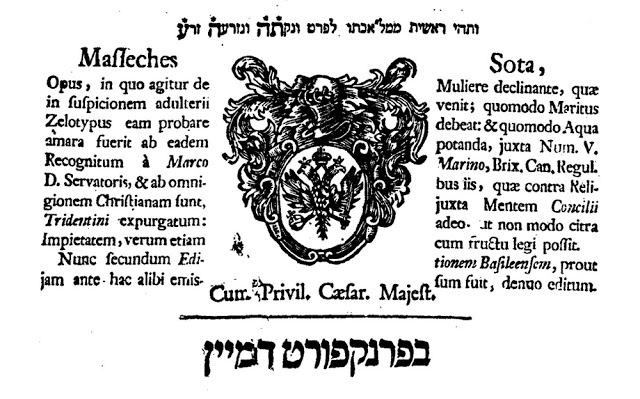
Fig. 6
Approbations were also published with this Talmud, primarily reprints from the Amsterdam edition and with one new approbation, from R. Jacob ben Benjamin Katz (Poppers, Shav Ya’akov) (1719). Another example of the continuity of the two editions is that the volumes issued in both cities are alike, the title pages showing minor textual variations only, such as the new place of publication, and on some but not all of the Frankfurt tractates, the inclusion of accompanying Latin text, confirming that it was printed in accordance with the text of the censor Marco Marino (Basle Talmud, 1578-81) and variations of the printer’s mark. Whereas the treatises printed in Amsterdam have a new woodcut of the Benveniste printer’s mark, the Frankfurt volumes, although retaining the outer crest with helmet, replace the lion and tower with the double headed eagle of the Hapsburgs (fig. 6).
Printing began in Frankfurt on the Main in 1720 with tractate Kiddushin, it having been anticipated that they would be allowed to bring the tractates printed previously in Amsterdam to Frankfurt. However, this was not permitted, so that they began to print the remainder of the Talmud, beginning with Berakhot completing the Talmud until Kiddushin that year, except for Seder Zera’im and tractate Ta’anit which were printed in 1722. Another possibility, suggested by Rabbinovicz, is that they were allowed to publicly sell the tractates printed in Amsterdam in Germany, but the market for the tractates printed in Frankfurt exceeded expectations, so that, to complete sets of the Talmud it was necessary to reprint those tractates printed earlier in Amsterdam.[33]
IV Aftermath
The next controversy over rival editions of the Talmud occurred with the second printing of the Talmud by the Proops’ press in 1752 – 1765. This edition, published by Solomon Proop’s sons, Joseph, Jacob, and Abraham, is a large, very fine folio edition. Publication was interrupted for several reasons, but primarily due to the publication of rival editions of the Talmud in Sulzbach by Meshullam Zalman Frankel and afterwards by his sons, Aaron and Naphtali, that is, the Sulzbach Red (1755-63) and the Sulzbach Black (1766-70). The first Sulzbach Talmud is known as Sulzbach red because the first title-page in the volume was printed with red ink, in contrast to Sulzbach black, in which the first title-page in the volume is printed entirely in black ink. Both the red and the black are smaller folio and not highly regarded.
Resolution of the dispute between the two publishing houses was settled by a rabbinic court that determined, among its findings, that despite Proops’ prior approbations the Sulzbach printer did not have to desist from publishing, for the Sulzbach Talmud was less expensive and therefore available to individuals who could not afford the larger and finer Amsterdam Talmud, the latter marketed to a more affluent market.
One other dispute of significance, that embroiled leading rabbis in Europe, was over the rival editions of the Talmud printed by the Shapira press in Slavuta and the Romm press in Vilna of their respective editions of the Talmud in 1835. Both the Amsterdam-Sulzbach and Slavuta-Vilna disputes are beyond the scope of this article. However, they, as well as the controversy surrounding the Frankfurt on the Oder and Amsterdam editions of the Talmud, the subject of this article, confirm Raphael Natan Nuta Rabbinovicz’s observation as to the negative and disruptive results of restrictive approbations.
Even though the intent in granting approbations was for the good of the community, to insure investors a reasonable return on their investment, the result, as noted above, was detrimental. The Talmud was printed only eight times in the century from 1697 to 1797, and the price of a set of the Talmud was dear. Prior to that the Talmud had been printed several times in Italy and Poland within a relatively short period of time, the primary impediment then being the opposition of the Church and local authorities. After 1797 the use of restrictive approbations declined, with the consequence that within four decades the Talmud was printed nine times, this notwithstanding the Slavuta-Vilna rivalry. Given these controversies and their negative outcomes, perhaps a better course for all would have been to apply Hillel’s admonition in Avot.
Be of the disciples of Aaron, loving peace and pursuing peace.
(Avot 1:12)
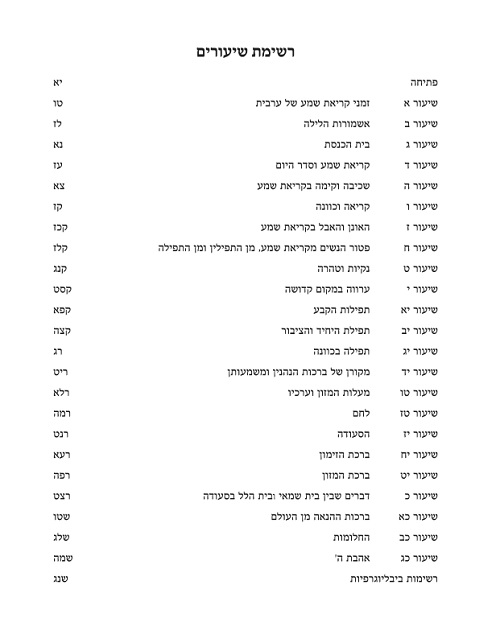
[1] L. Fuks and R. G. FuksMansfeld, Hebrew Typography in the Northern Netherlands 1585-1815, (Leiden, 1984-87), I pp. 45-48, II pp. 237-40, 297.
[2] Raphael Natan Nuta Rabbinovicz, Ma’amar al Hadpasat ha-Talmud with Additions, ed. A. M. Habermann pp. 100, 155-56 (Jerusalem, 1952) [Hebrew].
[3] H. I. Bloom, The Economic Activities of the Jews of Amsterdam (Port Washington, 1969), p. 45.
[4] Concerning individual tractates not printed as part of a Talmud in this period see Marvin J. Heller, Printing the Talmud: A History of the Individual Treatises Printed from 1700 to 1750 (Leiden, 1999).
[5] The Benveniste family, distinguished and widespread in Spain and Provence, is mentioned as early as 1079 in documents from Barcelona. After the expulsion of the Jews from Spain in 1492 the family was widely dispersed, but primarily throughout the Ottoman Empire where many eminent rabbis were named Benvensite. (“Benveniste,” Encyclopaedia Judaica. Ed. Michael Berenbaum and Fred Skolnik. 2nd ed. Vol. 3 (Detroit, 2007. 382. Gale Virtual Reference Library. Web. 4 Jan. 2012).
[6] A. M. Habermann, The History of the Hebrew Book. From Marks to Letters; From Scroll to Book (Jerusalem, 1968), p. 155 [Hebrew].
[7] In addition to the well-known commercial edition, there was also a deluxe edition, measuring 310 x 225 mm. This was brought to my attention by of Daniel Kestenbaum of Kestenbaum and Company.
[8] Concerning the widespread use of the Benveniste device see my “The Printer’s Mark of Immanuel Benveniste and its Later Influence,” Studies in Bibliography and Booklore XVIII (Cincinnati, 1993), pp. 3-14, reprinted in Studies in the Making of the Early Hebrew Book (Brill, Leiden/Boston, 2008), pp. 54-71. Parenthetically, among the first to employ the Benveniste escutcheon on a tractate title-page was the press of Asher Anshel ben Eliezer Chazzen and Issachar Ber ben Abraham Eliezer of Minden in their edition of Bava Batra (1702). Their other tractate, Bava Mezia (1699) does not have the Benveniste escutcheon.
[9] Rabbinovicz, pp. 95-6.
[10] Rabbinovicz, p. 129 no. 1. Yaakov Shmuel Spiegel, Amudim be-Toldot ha-Sefer ha-Ivri: Hagahot u-Megihim (Ramat-Gan, 1996), pp. 404-05 [Hebrew] adds that the Vilna Gaon learned from and made annotations on the Berlin – Frankfurt on the Oder Talmud of 1715-23. 
[12] Selma Stern, The Court Jew. A Contribution to the History of Absolutism in Central Europe (Philadelphia, 1950), pp. 55-59.
[13] Friedberg. History of Hebrew Typography of the following Cities in Central Europe: Altona, Augsberg, Berlin, Cologne, Frankfort M., Frankfort O., Fürth, Hamberg, Hanau, Heddernheim, Homberg, Ichenhausen, Neuwied, Wandsbeck, and Wilhermsdorf. Offenbach, Prague, Sulzbach, Thannhausen from its beginning in the year 1513 (Antwerp, 1935), p. 37 [Hebrew].
[14] Manfred R. Lehmann, “Behrend Lehmann: The King of the Court Jews” In: Sages and Saints, ed. Leo Jung (Hoboken, 1987), p. 205; Ya’akov Loyfer, Mi-Shontsino ve-ad Ṿilna (Jerusalem: ha-Modia, 2012), p. 139 [Hebrew].
[15] A highly regarded engraver, Martin Bernigeroth is known to have done as many as 1600 engravings, many portraits. His sons, John Martin (1713-1767) and Johann Benedict (1716-1764), were also worked noted engravers. Concerning the former see, Joseph Strutt, A Biographical Dictionary, containing an historical account of all the engravers, from the earliest period of the art of engraving to the present time, and a short list of their most esteemed works . . . I (London, 1785), p. 88.
[16] Avraham Habermann, Title Pages of Hebrew Books, (Tel Aviv, 1969), pp. 63, 130 no. 47 [Hebrew]; Yaari, Printers’ Marks, pp. 49, 152 no. 78.
[17] Avraham Yaari, Hebrew Printers’ Marks (Jerusalem, 1943), pp. 50, 152 no. 79 [Hebrew]; Marvin J. Heller, “Mirror-image Monograms as Printers’ Devices on the Title Pages of Hebrew Books Printed in the Seventeenth and Eighteenth Centuries,” Printing History 40. Rochester, N. Y., 2000, pp. 2-11, reprinted in Studies, pp. 36-38, 363, figs. 21-23.
[18]  Menahem Schmelzer, “Hebrew Printing and Publishing in Germany, 1650-1750,” in Leo Baeck Institute Year Book XXXIII (London, Jerusalem, New York, 1988), p. 375.
[19] “That which a rabbinic court declares ownerless is ownerless’ is discussed in Yevamot 89b, Gittin 36b and Jerusalem Talmud Shekalim 3a. The source for this concept is Ezra 10:8 “And anyone who will not come within three days, as according to the counsel of the princes and the elders, all his property will be forfeited and he will be separated from the congregation of the captivity.”
[20] Institut für angewandte Geschichte – Gessellschaft und Wissenschaft im Dialog e. V. http://www.juedischesfrankfurtvirtuell.de/en/en_C.php
[21] Friedberg, Central Europe, pp. 40-41; William Popper, The Censorship of Hebrew Books (New York, 1899, reprint New York: Burt Franklin, 1968), pp. 111-12.
[22] Ch. B. Friedberg, History of Hebrew Typography of the following Cities in Europe: Amsterdam, Antwerp, Avignon, Basle, Carlsruhe, Cleve, Coethen, Constance, Dessau, Deyhernfurt, Halle, Isny, Jessnitz, Leyden, London, Metz, Strasbourg, Thiengen, Vienna, Zurich. From its beginning in the year 1516, (Antwerp, 1937), p. 43[Hebrew].
[23] Friedberg, Central Europe, pp 44-45; William Popper, The Censorship of Hebrew Books (New York, 1899, reprint New York: Burt Franklin, 1968), p. 115.
[24] Friedberg, Amsterdam, p. 43.
[25] Rabbinovicz, p. 101.
[26] James Westfall Thompson, The Frankfort Book Fair. The Francofordiense Emporium of Henri Estiene: Edited with Historical Introduction Original Latin Text with English Translation on Opposite Pages and Notes (Chicago, 1911, republished New York, 1968), pp. 10-11, 15, 42.
[27] Jewish attendance at book fairs appears to have been common place. It was at the Frankfurt on the Main book fair in 1577 that Ambrosius Froben met R. Simon Guenzburg (Simon zur Gemze) of Frankfurt, a meeting that eventually culminated in the Basle Talmud (1578-81). Concerning this see my Printing the Talmud: A History of the Earliest Printed Editions of the Talmud (Brooklyn, 1992), p. 244-45.
[28] Friedberg, Central Europe, p. 46.
[29] Yeshayahu Vinograd, Thesaurus of the Hebrew Book. Listing of Books Printed in Hebrew Letters Since the Beginning of Printing circa 1469 through 1863 II (Jerusalem, 1993-95), pp. 579-90 [Hebrew].
[30] Vinograd, I p. 459.
[31] Friedberg, Central Europe, p. 67.
[32] Rabbinovicz, p. 111.
[33] Rabbinovicz, pp. 109-10.


The Strange Shape of the Marcheshet Pan

                             The Strange Shape
of the Marcheshet Pan
                                                            
By Eli Genauer
“The underlying basis of our work is that
pictures are an organic part of the commentary, and it possible that Rashi even
allowed himself to limit his explanatory words when a picture was available to
the reader. This is in the sense of “a picture is worth a thousand
words”. The picture is an integral part of the written book, no less
important than the words.” 
                                                              
Dr Ezra Chwat
                                                    
Department of Manuscripts, National Library of Israel
                                                     
Giluy Milta B’Almah Blog
                                                          
January 15, 2017
There were many vessels
used in the Beit HaMikdash. Nevertheless, without pictures or diagrams drawn
contemporaneous to their existence, there remains some doubt as to exactly what
they looked like. I would like to discuss one vessel used quite often in the
Temple and see what the diagrams of the Rishonim can tell us about its makeup.
I would also like to analyze a diagram in Rashi’s commentary to Talmud Bavli
and see how it fits into our discussion.

Massechet Menachot 63a
האומר הרי עלי במחבת, לא יביא במרחשת; במרחשת, לא יביא במחבת.  מה בין מחבת למרחשת–אלא שהמרחשת יש לה כסוי, ולמחבת אין לה כסוי, דברי רבי יוסי הגלילי; רבי חנניה בן גמליאל אומר, מרחשת עמוקה ומעשיה רוחשין, ומחבת צפה ומעשיה קשין
One who says, “I take upon myself [to offer a grain offering prepared]
on a griddle, he must not bring [one baked] in a pan. If [he says “I take upon
myself to offer a grain offering prepared] in a pan,” he must not bring [one
prepared] on a griddle. What is the difference between a griddle and a pan? The
pan has a lid to it, but the griddle has no lid – [these are ] the words of
Rabbi Yose Hagili; Rabbi Hanina ben Gamliel says : a pan is deep and what is
prepared is spongy, a griddle is flat and what is prepared is hard.[1]

Leaving  aside the opinion of Rabbi Yossi Haglili, let us concentrate on the statement of Rabi Chanina ben Gamliel
We would imagine that the Marcheshet is a deep vessel, and the Machvat
is flat, as it is described as a griddle. 
Perhaps like this:
                                   
The Gemara then cites a Braita which deals with the following
situation.  If a person takes a vow
saying “I take upon myself a Marcheshet”, it remains unclear whether he meant
he will bring the vessel called a Marcheshet, or the normal Korban Mincha that
is brought in a Marcheshet. Beit Hillel is of the opinion that since there was
a specific vessel in the Beit Hamikdash called a Marcheshet, we understand that
he is talking about that vessel and we require him to donate it to the Beit
HaMikdash.[2] Here are the words of the Braita which describe in some detail
the appearance of this Marcheshet pan:
כלי היה במקדש ומרחשת שמה ודומה כמין כלבוס עמוק וכשבצק מונח
בתוכם דומה כמין תפוחי הברתים וכמין בלוטי היוונים

There was a vessel in
the Temple called Marhesheth, resembling a deep mould, which gave the dough
that was put into it the shape of Cretan apples and Grecian nuts. (The Soncino
Hebrew/English Babylonian Talmud)

Rashi goes to great
lengths to explain this uncertain statement and includes a diagram in his commentary.
This diagram first appeared in printed form in the early 18th
century but unfortunately, it does not align with the words Rashi uses to
describe the overall shape of the pan. 
Additionally, It does not match the diagram we have in a manuscript of
Rashi nor diagrams in manuscripts of other Rishonim.
But first some
background
The diagrams we have
today in the Vilna Shas in Rashi and other Rishonim come from earlier printed
editions. The first printed edition of the entire Talmud to contain diagrams
was the Behrmann Shas printed in Frankfurt on Oder, 1696-98.[3] Raphael Natan
Nata Rabinowitz posits that by the time diagrams were included in the printed
text, there were very few manuscripts around because most had been placed in
Genizah.[4]  He therefore concludes that manuscripts were not used in the early
18th century as a source for diagrams. What was the source of those
diagrams for the Behrmann Shas ? According to the editors of the Behrmann Shas,
they mostly came from the Chochmat Shlomo of 1582.[5] It’s an extremely
reliable source because it was written by Rav Shlomo Luria who specifically
wrote it to correct the text of the Bomberg Shas and to insert the relevant
diagrams. Rav Shlomo Luria lived at a time when there were still many
manuscripts around, so either he used those manuscripts for his textual
emendations and as a source for his diagrams, or he used his own capabilities
to come up with his changes and additions. Since most of our present day
diagrams follow from the Behrmann edition, they have an aura of authenticity
attached to them.[6]
The problem arises when
we discover that Chochmat Shlomo does not include all the diagrams we have
today. For example, in our case, there is no Chochmat Shlomo on Menachot.
Let us now take a look
at the diagram in Rashi on Menachot 63a.
The first time it
appeared in print was in the Frankfurt am Main edition of 1722, exactly 200
years after the diagramless Bomberg edition. We know its source was not a
manuscript of Rashi nor was it the product of the Maharshal.
Putting aside the
diagram for a moment, let us concentrate on the words of Rashi as he tries to
describe the Marcheshet:
כלבוס
– גלואו”ן שם כלי עשוי כעין מחבת שלנו והדופן באמצעות כלפי פנים
כזה  ומצוייר תוכו גומות גומות וכשהבצק מונח בתוכו [נכנס] הבצק
בגומות:
Rashi concentrates on
the word כלבוס as the Gemara itself says that a Marcheshet is shaped like a
deep כלבוס. Rashi first gives us an old French word
which is normally translated as “tongs”.[7] He says that the Marcheshet is like
his present day Machvat pan and that the “wall in the middle faces the inside,
like this”. The problem is that the diagram does not seem to show a wall in the
middle facing the inside. Additionally, if a כלבוס is a pair of tongs, and the shape of the
vessel looked somewhat like a pair of tongs, how does that align with the
diagram which is circular?
The Shita Mekubetzet
which is included on the standard page of the Vilna Shas has a completely
different diagram.
Notice that the word
Dofen is in the middle of the diagram just as Rashi says והדופן באמצעות כלפי פנים
The
volume of the Bomberg edition that belonged to Rav Betzalel Ashkenazi the
author of the Shita Mekubetzet contains the exact same diagram inserted in the
blank space of the Rashi.
Jerusalem – The National Library of Israel Ms. Heb. 4°79 (link).
In his book Dikdukei
Sofrim on Menachot (Munich, 1886) R.N.N. Rabinowitz writes about the
importance of the comments of the Shita Mekubetzet as they were addressed to
the Bomberg edition of 1522 and relied heavily on manuscripts which included a Rashi
manuscript.[8] The Acharit Davar printed at the end of the Vilna Shas also
extols the importance of the Shita Mekubetzet on Kodshim as it came from a
manuscript and was based in part on a manuscript misidentified but actually of
Peirush Rashi.[9]
Going back in history,
we can get an idea if a diagram did in fact exist in Rashi manuscripts by
looking at the first printed edition of Menachot which was Bomberg 1522. Its
source had to be from manuscripts because no printed edition preceded it.
You can see that the
Bomberg editors included the word “כזה” in the text of the Rashi and left 2
spaces indicating that their manuscript included 2 diagrams. This may explain
why our present diagram does not reflect the shape of the overall pan as there
may have been one diagram depicting its shape and a second one depicting the
apple like insets. In fact, a notation in the Oz Vehadar edition states quite
clearly that our diagram just illustrates the words “גומות
גומות”.
As mentioned before,
the words of Rashi seem to support the idea that the Marcheshet pan was
semicircular in nature. In addition, the shape of the vessel is likened to a כלבוס which is an
item dealt with a number of times by Rashi
For example this Rashi
on Shabbat 59b:
Rashi states that an
item worn by women called a “מנקתא פארי” ( starting with the letters “וי״מ” for ויש מפרשים) is “כּמין חצי עגול עשוי כמין כלבוס” and then draws your attention to a
diagram of a semi circle.
Fortunately I was able
to find a manuscript of Rashi on Menachot which is identified as Vatican
487  and is from the 13th
century. (Made available by the Polonsky Digitization Project) It pictures the
Marchseshet pan in a semicircular shape and thus fits in more with the words of
Rashi.
It’s clear that the
diagram included only deals with the semicircular nature of the vessel and not
the little depressions inside the “Tocho Shel Kli”. This diagram is very
similar to the one in the Shita Mekubetzet and it is possible it served as a source
for the Shita Mekubetzet.[10]
We are confronted with
another diagram of the Marcheshet pan in what is known as the Peirush Rabbeinu
Gershom first printed in the Vilna Shas. This Peirush describes the vessel
being shaped like a כלבוס and then says it is “כמו פגום”, which means incomplete. One would expect
to see a vessel like in the Shita Mekubetzet and in the Rashi manuscript which
is not either completely circular or square in nature. Nevertheless, the diagram
in the Vilna Shas depicts this vessel as being square like this
In the Achrit Davar the
editors of the Vilna Shas state that they had a manuscript of this Peirush
Rabbeinu Gershom however the following manuscript shows the pan as having an
indentation and not being square.
Roma – Biblioteca Angelica Or. 1 (link):
It could be they that
had a manuscript depicting a square pan, or it is possible that their
manuscript had a pan with an indentation and this was not transferred
successfully to the printed page. Certainly the words of the Rabbeinu Gershom
indicate the latter.
Conclusion:
Nowadays it is easy for us to transfer an image from a
manuscript to a printed or electronic page. All we have to do is point, shoot,
copy and paste. The result is an exact duplicate of what is on the manuscript,
and it is even easier to work with than the original. But hundreds of years ago
it was not so simple. A woodcut or an engraving of the image could be made and
then transferred to the printed page, but that was time consuming and
expensive. Because of this, images such as diagrams were just left out, and
when they were added, they were often misleading and sometimes even incorrect.
The printing revolution was a giant step forward for the dissemination of
Jewish knowledge, but, at least at its beginning, played havoc with many important
diagrams.
[1] English translation
from Sefaria.org.
[2] The Rambam Paskens
according to Beit Hillel. Since Beit Hillel speaks about the Marcheshet being
different than a Machvat,  and not just having a cover) it is clear that the
Rambam holds like Rav Chananya ben Gamliel
[3] Maamar ‘al hadpasat ha-Talmud with Additions, ed. A.M. Habermann, Mossad ha-Rav Kook, Jerusalem: 2006, p.41. The Soncino family printed individual editions of the Talmud between 1483- 1518, but not an entire set. Some of those editions such as Eiruvin did contain diagrams and some did not. The first complete set of the Talmud was the Bomberg edition 1519-1522. That edition did not contain diagrams, only empty spaces which were to indicate where diagrams were to go (the only exception was Sotah 43a). There were numerous full editions of the Talmud printed between 1522-1697, but these also did not contain diagrams. 
[4] Printing
the Talmud: A History of the Earliest Printed Editions of the Talmud
, Marvin J. Heller, Im Hasefer 1993 p.6 states as follows: “Rabbinovicz attributes the dearth of Talmud codices to
the manner in which they, and many other manuscripts, had been written; without
any commentaries, with errors and erasures, and lacking even lines. Rashi and
Tosafot (additions by Ashkenazic luminaries after Rashi) were separate
manuscripts, suffering from the same conditions. As a result, learning must
have been difficult, with the reader having to continuously peruse three different
works, assuming that he owned them. Therefore, when the Talmud was printed with
Rashi and Tosafot, “men no longer learned from their manuscripts, but
considered them as utensils without further value, placing them in genizahs, so
that they no longer exist.”
[5] Other sources mentioned by the editors of the Behrmann Shas are Maharsha and Maharam Lublin. Neither of those sources contain diagram for our Rashi.
[6] A good summary of
the subject of where our present day diagrams came from can be found in the
introduction to the Shas Nehardea, under the heading of “המקור לציורי הש”ס”. (Vagshal Publishing Ltd,
Jerusalem, 2008, p.5 of the introduction. The overall section on diagrams
starts on page 4 of the introduction under the heading “מבוא לציורי הש״ס”.)There are a few diagrams that are
not in the Berman Shas but first appear in the Frankfurt am Main edition of
1720-1722. Here too, the editors of that edition say that the source of their
diagrams was the Chochmat Shlomo.
[7] All the Meforshim
understand that Beit Hillel is saying that the Marcheshet pan is shaped like
a כלבוס,
meaning the pan is shaped like a pair of tongs. 
I would imagine tongs to look like this, with the top part being
semicircular especially in the open position
Jastrow renders our
Braita saying that a Marcheshet is “a baking form in the shape of forceps with
cavities”
[8] Rabbinowitz writes
on page 1 of his introduction that when he wrote his emendations on Menachot
that “I had in my hand a handwritten manuscript of the Shita Mekubetzet by Rav
Betzalel Ashkenazi…..And he wrote his comments on the 1522 Venetian edition
including Gemara, Rashi and Tosafot with the help of handwritten manuscripts he
( Betzalel Ashekenazi) had in his hands”
[9] Achrit Davar at the
end of Masechet Nidah, p.6
[10] The Oz VeHadar edition of the Talmud
actually changes the diagram inside the Rashi to the diagram of the Shita
Mekubetzet