R. Eliezer Waldenberg’s Hilkhot HaMedinah

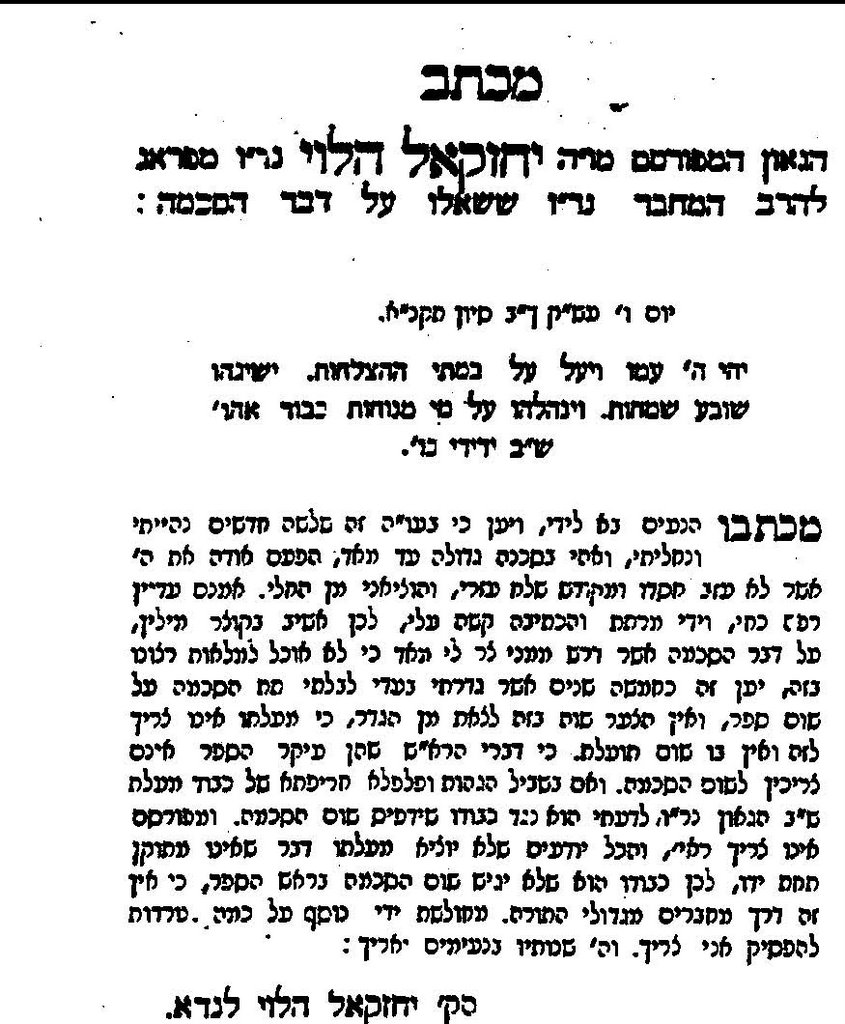
In light of the previous post regarding the Hilkhot HaMedinah, I have been able to obtain further information of the ban. The BaDaTz issued an Issur (reproduced below) noting that Hilkhot HaMedinah was published without the permission of the descendants of R. Waldenberg and the descendants object to its publication. Although Hilkhot HaMedinah is not mentioned by name – instead only “the books printed after his [R. Waldenberg’s] death” – to my knowledge the only book published after his death has been Hilkhot HaMedinah.

What is ironic is R. Waldenberg appears to have addressed this very issue – people printing books of those who have died without the permission of the descendants. R. Waldenberg (in Tzitz Eliezer, vol. 20, no. 51, pp. 129-130) was asked about books published where the author reserved the right to publication and is now dead and his descendants are not going to publish it can it be published without their permission? R. Waldenberg responded that in such a case one is allowed to republish such a book. R. Waldenberg marshals the case of the where the author of the Kitzur Shulhan Orach, R. Ganzfried, was asked to republish his own work with the commentary of the Mesgeret haShulhan. R. Ganzfried declined. But, when R. Ganzfried died the author of the Mesgeret haShulhan did exactly that – he republished the Kitzur with his own commentary. The Mesgeret haShulhan obtained haskamot to justify what he did, one from the author of the Shaul u-Mashiv who explicitly permitted the republication even though the author objected during his lifetime.

Thus, R. Waldenberg argued that in cases where the author objected to the republication of his work, such objections are insufficient to stop publication after his death. Consequently, it would appear that if R. Waldenberg’s descendants are not otherwise intending on republishing Hilkhot HaMedinah, at least according to R. Waldenberg, one would be permitted to republish the work, even without their permission, even if they object.


The Enigma of the Besamim Rosh – Solved by an Amateur – Not!

It seems that my recent posts on the Besamim Rosh have been placed into the wilds of the internet. Someone, however, took issue with the very notion that the Besamim Rosh was a forgery. He claimed he could demonstrate that the Besamim Rosh was legitimate and solve this problem which has vexed people for the last three hundred years. Not only could he do so, he could do so in under a minute by executing a search on the Bar-Ilan responsa CD.

This person did so and he came up with hits mentioning the Besamim Rosh prior to its publication in 1793. One of these luminaries includes R. Tzvi Hirsch Ashkenazi (Hakham Tzvi). Additionally, he found R. Yehezkiel Landau (according to the CD) quotes the Besamim Rosh and the person points out this should be impossible as R. Landau died the very year the Besamim Rosh was published – 1793. These together, according to this person, demonstrates that people were aware of the existence of the Besamim Rosh prior to R. Saul Berlin’s discovery and thus it is a legitimate work.

Of course, anyone with the most basic familiarity with the Besamim Rosh realize this is a ludicrous claim. Let’s first deal with the Noda B’Yehuda “issue.” First, the year 1793, or more exactly 5553, was a full 12 months and the Noda B’Yehuda died in April some 6 months into the year. Second, there is absolutely no doubt the Noda B’Yehuda was aware of the Besamim Rosh – he in fact gave an approbation to the work! The second approbation given to Besamim Rosh came from R. Saul Berlin’s father, R. Tzvi Hirsch Levin, Chief Rabbi of Berlin.

Second, the supposed earlier sources that quote the Besamim Rosh. This claim on its face is astounding as well. The name “Besamim Rosh” was not the actual name which appeared on the manuscript. Instead, this was the name R. Saul Berlin picked. He decided on the name due to the numerical value of Besamim = 392 the same number of responsa which appear in the work (Rosh is self evident). Thus, unless these earlier citation were mind-readers as well, there is no way they could be citing this Besamim Rosh. So, who in fact are they citing? The answer is no one. Instead, this person was unaware the Bar Ilan CD includes notes which appear in the text of the responsa from the editors of the Bar Ilan project! These notes are set off by + signs so that people don’t make this very mistake and think these are part of the text. Thus, for instance, in the case of the Hakham Tzvi the passage in question looks like this:

שו”ת חכם צבי סימן א ד”ה וראיתי להרב
+/רצ”ה לוין/ נ”ב. מיהו גם הרא”ם ז”ל בסי’ כ”ד התיר מטעמים אחרים וכן מצאתי בתשו’ כ”ו דאתי לידי נקרא בשמים ראש (סי’ רע”ו) ועם היות שאין דבריהם מוכרחים מ”מ הא חזינן דנסבי אפי’ שלא במקום מצוה ואין מוחה בידם+

As I mentioned previously, there is no dearth of literature discussing the Besamim Rosh after its publication (see Samet and the sources cited therein) but it is 100% erroneous to claim anyone beforehand was citing to this work.

Appendix:
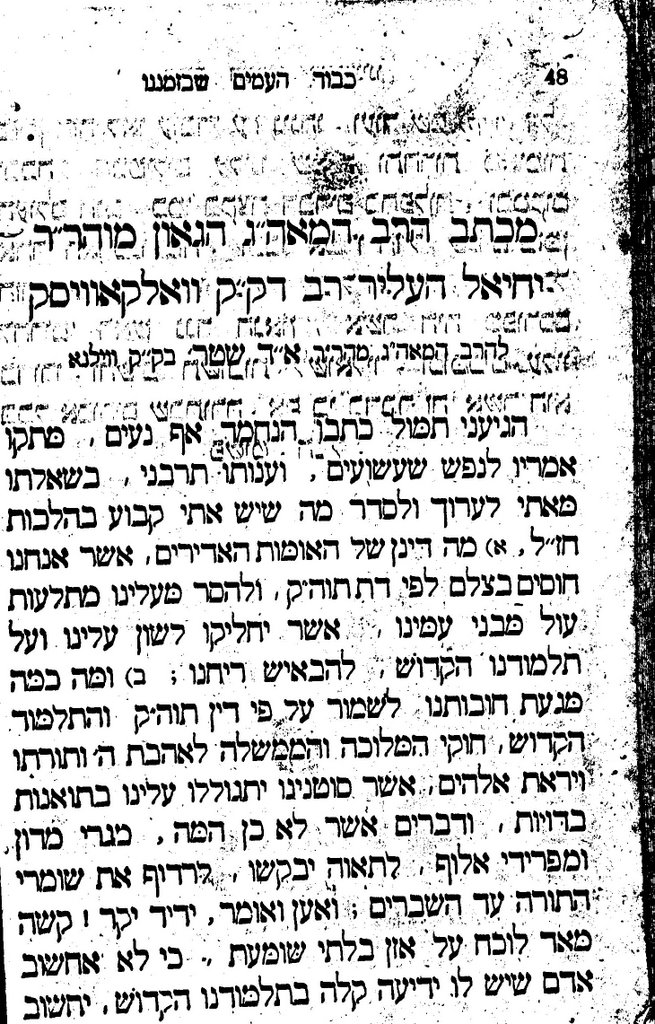
R. Yehezkiel Landau haskamah to the Besamim Rosh (1793)


R. Yechiel Heller and the Status of Non-Jews

Some have recently posted regarding the status of non-Jews vis-à-vis Jews. Although, they are more focused upon the medieval time period, I though it would be instructive to discuss a more contemporary view. This view, is striking in its breath as well in its authorship.
R. Yechiel Heller, author of the teshuvot Amudi Ohr, is well-known in Yeshiva circles. While respona literature is generally not studied as one of the commentary on Talmud, there are at least two of R. Heller’s responsa which are standard fare in Yeshivot when studying Talmud. (One is a discussion regarding toch k’edi dibur k’dibur and the second deals with misasek). However, R. Heller has a lesser known responsum, which does not appear in his Amudi Ohr but in a different and rare work. This work, Sheni Perakim’al Davar haHov l’Ohev haKazar (Two Chapters on the Obligation to Love the Czar) printed in St. Petersburg in 1852. One of these chapters is authored by R. Heller. In this chapter he makes a very novel and very important arguement regarding the status of non-Jews.

R. Heller argues that non-Jews today, have the status of Geri Toshav. This is so even without any formal acceptance of that status. R. Heller explains that such formal acceptance is necessary only for individuals, but when an entire nation (he focuses on Christians) falls into the category there is no need for any formal acceptance. Today, he argues, the nations of the world more or less follow the seven Noahide laws (he explains idolatry for this catogry allows for shituf) and therefore automatically considered geri toshav.

This position has tremendous ramifications which R. Heller himself notes. Specifically, all the laws in the Talmud regarding non-Jews are not applicable to geri toshav. Thus, R. Heller explains, that yayin nesach is not applicable with a ger toshav. Nor is the special prohibition against selling weapons, returning a lost object, or yihud (seclusion). Additionally, one can lend with usery to a ger toshav. All of this, R. Heller explains, is applicable to the non-Jewish people we find our self living with.

This stunning opinion did not go unchallenged. There are those who question whether, without a formal acceptance one can be considered a ger toshav. In fact, there is an entire work written to refute R. Heller’s position, however, this work is still in manuscript form and has never been printed. (If someone is willing, I would like to get a copy of this from the JNUL- you can email me).

However, it is important to note, that irrespective of whether this position is the correct one, at the very least it is an important historic position, one that bears further dissemination and study.

Sources: For more on R. Heller see R. E. Katzman’s biography, “Mofet haDor, HaGoan R. Yechiel Heller ZT”L – Ba’al Amudi Ohr” in Yeshurun 4 (1998) 648-681; 682-695 (reprint of the eulogy of R. David Luria for R. Heller); R. A. Mandelstamm, Sheni Perakim, St. Petersburg, 1852; Peli [R. Pinchas M. Heilprin] Iggeret Cheil Bet HaElyi, The Jewish National and University Library Ms. Heb. 8°5224, [1855].


Kuntress Ha-Teshuvot Review

I have previously briefly mentioned a couple of problems with the new work Kuntress Ha-Teshuvot haHadash, now I would like to give a full review. First, I am no expert in the teshuva literature, that being said I was somewhat disappointed with this book.

The book first contains a long introduction into the teshuva literature in general. It discusses such topics as the importance of the literature, the pervasiveness or lack there of, as well as censorship in the teshuvot and different bibliographic topics. On this last point, the introduction discusses how, at the advent of printing, teshuvot do not seem to have been that important. They come do this conclusion by comparing amounts of other types of books printed during the same period with that of teshuvot. Books on other topics were printed in mass, while teshuvot made up only a very small portion of the books printed.

The introduction is fairly informative, although for much of this ground there are far better works out there (documented in the extensive footnotes), this does provide a basic understanding. Finally, there is a discussion about the book itself and what Boaz Cohen’s work (the predecessor to this one) is out to accomplish. This last topic is also covered in an English translation of the introduction, however, all the rest of the introduction is not translated.

The bulk of the book is devoted to the actual bibliographical entries of the teshuva books. This volume covers books with titles between aleph and lamed. But it is far from clear what exactly the standard for these entries are. If I had to categorize my main complaint with this, it would unevenness. That is, for some entries there is a significant amount of information such as some important teshuvot from that book, what other books discuss this one, and other points of interest. For other books with equally important and interesting teshuvot there is nothing.

So for Luach Eres by R. Jacob Emden (no. 1950) there is a long entry dealing with all the content of the work as well as others who he discusses and those who discuss the work as well. They also include articles on the book as well. This runs over three densely packed columns. The same is true for Eleh Divrei HaBrit (no. 222) as well as many, many others.

But for the book Har Tabor (no. 1129) which discusses the proper place of the bimah in the center of the synagogue there is no mention of any other books which discuss this topic, or any other books which disagree with this book either.

Another example, the book Be’ar Esek (no. 406) contains a teshuva about the R. Menacham of Fano and whether he had a beard. This teshuva was highly controversial and R. Yosef Erges, R. Moshe Sofer, and R. Eliazer of Munkatz all wrote about it. There is no mention of this teshuva in the entry nor is there any mention of the literature this teshuva spawned.

This last point, that at times they fail to reference other books about the one entered happens time and time again. Perhaps the most egregious example of this is the Divrei Iggeret by R. Menhem Steinhardt (no. 759). Although the entry does note this book contains a teshuva on kitnyot (he permits it) it doesn’t mention any of the books discussing this topic, e.g. Ashro Hametz (which has no entry at all), nor does it mention the teshuva from R. Moses Sofer against R. Steinhardt’s permitting kitnyot. Additionally, it doesn’t mention an article devoted to the book itself. Professor Judith Bleich wrote an article titled “Menahem Mendel Steinhardt’s “Divrei Iggeret”, Harbinger of reform” in the Proceedings for the World Congress of Jewish Studies 10 (1990): 207-214.

The next problem with the work is incompleteness. This is apparent in the entries as well as the bibliography provided. So some of the problems mentioned above are the worst, in that they don’t list anything about the book, at times even when they do they do a shoddy job. Already in my previous post I mentioned the poor entry on the organ. But there are numerous others. For instance, they have a fairly comprehensive entry on the book Hayi Olam (no. 1456) which deals with the issue of cremation. They discuss the content of the book as well as others who disagree with the author. They list other books dealing with the same subject matter as well. However, they fail to mention Michael Higger’s coverage (perhaps the most comprehensive) on this topic. (This appears in his Halakhot ve’Aggadot, 1933).

Or we have the entry for Modena’s works. Perhaps it is worthwhile to compare this entry with another. We first have the entry for the Zakan Ahron by R. Ahron Walken. As each entry includes biographical information and sources this entry reads “על המחבר ראה: דור רבניו וסופריו, ו, עמ’ 31-32; אהלי שם, עמ’ 201; אנציקלופדיה של הציונות הדתית, ב, עמ’ 175-177. וראה לאחרונה, אליעזר הכהן כ”צמאן, “נעימות התורה- הג”ר אהרן וואלקין אב”ד פינסק בעל בית אהרן, זקן אהרן, וכו'”, ישורון יא (תשס”ב), עמ’ תתצא-תתקד; יב (תשם”ג) עמ’ תשכז-תשלט.” So, for this we have three entries plus a recent article discussing the biographical details. Now we turn to Modena. For Modena we have the following: “על המחבר ראה “אריה ישאג – ר’ יהודה אריה מודינה ועולמו” and then provides the detail for that book. So we have one entry for Modena biography. So was Modena unknown? No, far from it, he wrote his own autobiography. There have been numerous articles on him as well as a full lengthy doctoral dissertation by Adelman. His autobiography is available in both Hebrew and English. The English version contain articles on him as well. But none of these are mentioned.

Now we get to omissions. The book Avot ‘Atrarah L’Banin (no. 4) contains, as the entry notes, an extensive teshuva on the permissibility of being photographed. It includes a list of Rabbis who had their photograph or more likely, their portrait done. This is all well and good. However, the entry leaves out perhaps the most interesting part, the author of Avot included a photograph (loose) of himself in the first edition. Thus, his teshuva was in a sense to justify his own practice.

There is no entry for the book Hadrat Panin Zakan which is a collection of teshuvot on beards. Nor is there an entry for the book Da’as HaRabanim which is two long teshuvot from R. Menachem Mendal Kasher and R. D. Polonski (Kli Hemdah) discussing women’s suffrage.

The editors claim this list only goes up to the year 2000. However, for some entries they include editions even after the year 2000. For R. Yehudah Herzl Henkin’s Beni Banim (no. 555) they include his fourth volume printed in 2004. However, for R. Teichtel’s Em HaBanim Semacha (no. 239) where there have been two recent translations which are different they do not include this. But again for R. Menachem Kasher’s Hatekufa haGedolah (no. 1144) (how this even qualifies as a teshuvah book is left unanswered) they include his 2001 edition.

Or we have the entry for the Helkat Ya’akov (no. 1496) where they note the first edition date and then the rest they claim are photo-offsets of the original. This is wrong. In the subsequent editions R. Herzog’s approbation was removed and thus they are not just copies of the original.

However, perhaps the answer to some of these shortcomings comes from the introduction itself. The editors explain how this work came to be. They explain that this was initially an “auxiliary tool for another project” a project on “Jewish education in the halakhic literature.” This is perhaps most telling. They are explaining to the reader that (a) they are not bilbiographers; (b) they did not initially set out to do this; (c) they are not experts in teshuvot. These shortcomings are apparent. This being said, it is important to recognize that this is a vast improvement over Cohen’s work and a welcome entry for Jewish biliography.


Errors in New Kuntras HaTeshuvot

As some have already noted, there is a completely new edition of Boaz Cohen’s Kuntras HaTeshuvot. This edition edited by Shmuel Glick totally reworks Cohen’s work. Supposedly this new work benefited from many subsequent bibliographies as well as the Institute for Jewish Bibliography.

While this is an vast improvement in my quick read (I only received it today) I was amazed at what this lacked and in my mind errors.

The first is for the entry for the Besamim Rosh the famed possible forgery attributed to R. Asher b. Yecheil. In their entry they first note that examined the Krakow 1881 edition. Now aside from not looking at the first edition which is not hard to come by there is a greater error here. Specifically, they do not note that this edition is missing two teshuvot. So while they provide a bibliography listing articles discussing the Besamim Rosh they fail to mention the most important thing that if one gets the wrong edition they will not have the full text. Even though they comment there are 392 teshuvot they did not bother to count or to even read the articles they cite (which note this absence). This are not minor teshuvot either, in fact, the one on suicide which this edition leaves out is perhaps the most well-known and cited one from the entire volume.

The next error is in regards to the Hatam Sofer. Again they have a long entry about the various editions and then list the various editions. But here they totally missed out on the first edition of this work. The first time teshuvot from the Hatam Sofer appeared was not as a separate work but as part of another work. In Prague 1826 edition of the Ri Megash from pages 31b until 42a there is Kuntras Hiddushi Torah v’Gam She’alot v’Teshuvot m’admu HaRav HaGaon . . . R. Moshe Sofer. In fact, on the title pages it even notes that this includes teshuvot from Hatam Sofer. This is listed in the Bibliography of the Hebrew Book and a simple computer search would have revealed this information.

Additionally, the sources which are provided are rather uneven. Again, this is only from my limited viewing of it and I may revise but if one looks at the entry for Eleh Divrei HaBrit which deals with, among other things, the controversy regarding placing an organ in shul. In that entry they provide Haberman’s article on the topic but not Binayahu’s article or Samet’s which both appeared in Asuphot vol. 1 and 5 respectively. In fact, the book Ohr Nogeh which is Liberman’s book on the topic does not have an entry. While perhaps they considered this part of the work Nogeah HaTzedek there doesn’t seem to be a reason to do so. Also, they do not include the book Tzror Hayyim which was published a year after Eleh and is devote to the very same topics in their list of books and articles discussing the organ. This is so eventhough the first teshuva discussed the organ exclusively.


Besamim Rosh

In the previous post, I mentioned a new book which is a collection of articles by Moshe Samet, who is well-known for his studies of the Besamim Rosh. In the comments section it appeared that some wanted more information regarding the Besamim Rosh. I hope this will answer some of the questions raised and give a more comprehensive background.

The Besamim Rosh is a book of reponsa first published in Berlin in 1793. It contained two parts, the teshuvot and a commentary titled kasa d’harsena. The person who published it, R. Saul Berlin was the Berlin Chief Rabbi’s son. R. Saul claimed the teshuvot were from a manuscript which he attributed to the Rosh, R. Asher ben Yehiel. The commentary, kasa d’harsena, was from R. Saul. Right after it appeared there were some that doubted the authenticity of atleast some of the teshuvot. They claimed that those teshuvot were not from the Rosh.

There were many novel teshovot. Among these was one permitting shaving on Hol haMo’ad, permitting kitneyot and claiming kitneyot was actually a Karite custom, and relaxing the restrictions on a suicide.

The first book to come out against the Besamim Rosh was written by R. Ze’ev Wolf, titled Ze’av Y’trof and was published that same year, 1793. In it he takes issue with some of the teshuvot that are in the Besamim Rosh. He also, claims that R. Saul retracted one, the teshuva permitting shaving on hol haMo’ad. However, it is unclear whether R. Saul admitted it was a forgery or he retracted in a less sensational manner.

After this book, there were numerous others who doubted either the entirety or at least portions of the book. However, R. Saul’s father, R. Tzvi Hirsch Levin (Berlin) defended the work of his son and vouched for the authenticity of it. He claimed to have seen the actual manuscript, something that no one else had seen. There were others who also supported the book. It appears that R. Yosef Hayyim David Azulai, Hida, also vouched for it, based upon the testimony of R. Tzvi Hirsch.

R. Saul, actually had a history that may explain why some were suspect of him. He published under a pseudonym a book title Mitzpeh Yekutel which attacked R. Rafeal Hamburg, the chief Rabbi of Altona, Hamburg, Wansbeck (AH”U). This book was put in herem and burned in some cities. [As an aside after he was unmasked there were at least two teshovot published by different authors dealing with jurisdiction in herems. That is, whether the herem of one city, namely AH”U, can be enforced in another, namely Berlin. Obviously, this has many modern day implications, but it appears that many are not aware of such jurisdictional limitation of herems.]

Thus, it appears that some people already had rather negative opinions of R. Saul and this may have influenced their opinion of the authenticity of the Besamim Rosh.

As mentioned above, the Besamim Rosh was first published in 1793, however, it was not republished until 1881, nearly 100 years later. In this edition, two teshuvot were removed. The teshuva relaxing the rules for a suicide as well as one that permitted one riding on a horse on Shabbat. This second teshuva dealt with a case where one was riding on a horse and the Shabbat was approaching. The rider was faced with a dilemma, should he stop and thus have to scourge and rely on the hospitality of others or continue on to avoid that type of “embarrassment.” The teshuva permits him to continue based upon the rule kovod habreiot dokhe l’o s’ashe. That is, for respect one can violate certain prohibitions.

Finally, the Besamim Rosh was republished from the original edition in 1984. This edition has an extensive introduction that attempts to rehabilitate the Besamim Rosh. However, there are numerous flaws with the introduction. The publisher twists and in some instances perverts statements of those that question the authenticity of Besamim Rosh. He also make absurd arguments in support of his goal.

For example, one of the people that doubted the authenticity of the Besamim Rosh was R. Moshe Sofer, Hatam Sofer. Hatam Sofer calls the Besamim Rosh the Ketzvi haRosh -the lies of the Rosh. (Orakh Ha’ayim no. 154) However, the publisher claims this is an error. He explains that the Vienna edition (1895) of the Teshvot Hatam Sofer don’t read kitzvi haRosh, rather it reads kitvei haRosh- the writings of the Rosh. Thus, according to the publisher, all the editions of the Hatam Sofer that people relied upon were incorrect.

This, of course, is silly. The first edition of the Teshvot Hatam Sofer of this volume, was NOT the Vienna edition, rather it was Presburg, 1855. In that edition, which the publisher conveniently ignores, it says “kitzvei haRosh” the lies of the Rosh. This is but one of the numerous examples that can be found in this 1984 reprint.

In conclusion, there is a long running debate about the authenticity of this work, which has not been fully resolved, although at least one blogger may have a method to do so.