Stet in the Beit Yosef: Fish and Milk, from Typographical Error to Typological Exemplar

Stet in the Beit Yosef: Fish and Milk, from Typographical Error to Typological Exemplar
Aton M. Holzer

Rabbi Dr. Holzer is Director of the Mohs Surgery Clinic in the Department of Dermatology, Tel Aviv Sourasky Medical Center, and is an assistant editor of the recent RCA Siddur Avodat HaLev. ORCID ID: 0000-0001-9852-3958/ 28 Binyamin, Beit Shemesh, Israel 9952200/ Aton.holzer@gmail.com

A passage in the magnum opus of R. Joseph Karo (Maran, or the Mehaber, 1488-1575), the Beit Yosef (YD 87:5) tends to be reckoned among the more consequential scribal errors in Jewish legal texts.

[ה] ”דגים וחגבים מותר לאכלן בחלב“. ריש פרק כל הבשר (קג:) ”(כל הבשר) אסור לבשל בחלב, חוץ מבשר דגים וחגבים“. וכתב הר”ן דכיון דלבשלן שרי משמע דלאכלן בחלב נמי שרי, דאיסור בשר בחלב בלשון בישול אפקיה רחמנא, וכן כתב הרמב”ם והרשב”א דלאכלן בחלב נמי שרי. ומכל מקום אין לאכול דגים בחלב מפני הסכנה, כמו שנתבאר בספר אורח חיים סימן קע”ג.

“Fish and locusts, it is permitted to eat them in milk.” In the beginning of the chapter kol basar (bHullin 103b) [it is written]: “(all flesh) it is prohibited to cook in milk, except for the flesh of fish and locusts.” And R. Nissim wrote that since cooking them is permitted, it implies that to eat them in milk is also permitted, for the prohibition of meat in milk was set out by the Torah in the semantics of cooking, and likewise did Maimonides and R. Shlomo ibn Adret write, that to eat them in milk is also permitted. And in any event, one should not eat fish in milk because of the danger, similar to what was elucidated in Orah Hayyim 173.

In his 2014 “A Guide to the Complex,”[1] Shlomo Brody highlights this passage – which invokes a heretofore ostensibly unknown ‘danger’ regarding consumption of fish in milk, and which makes reference to a chapter that deals with measures that must be taken with regard to the ‘dangerous mixture’ of fish and meat[2] – as a banner example of the ‘impact of inaccurate texts on Jewish law.’ He adds that ‘Ancient manuscripts regularly suffered from poor penmanship, slipping of the eyes, and misunderstandings by unlearned or confused copyists.’ The first to make this sort of observation regarding this passage was none other than R. Karo’s younger contemporary and interlocutory commentator R. Moses Isserles (Rama, 1530-1572), who puts it humorously (Darkei Moshe, Tur YD 87:4):

.ולא ראיתי מימי נזהרין בזה וגם בא”ח סימן קע”ג אינו אלא שלא לאכלו בבשר משום סכנה אבל בחלב שרי ועי”ל סימן קי”ו ולכן נראה שנתערב להרב בשר בחלב

And in all my days I have never seen [anyone] take care with regard to this, and also in Orah Hayyim 173 there is not but not to eat [fish cooked] in meat because of danger, but in milk it is permitted, and see earlier in chapter 116, and therefore it appears that the Rabbi has confused (mixed) meat and milk.

As neat as this solution appears, there remain some problems. For one thing, in context, the Beit Yosef discusses the consumption of various forms of flesh – fish and locust – in milk, not meat; replacing the word ‘milk’ for ‘meat’ would render the ultimate sentence a nonsequitur with regard to the full passage.

For another, the idea of danger attendant to mixtures of fish and dairy is not entirely unprecedented. R. Bahye b. Asher (1255-1340), who hailed from R. Karo’s native Christian Spain two centuries earlier (but from Zaragoza, quite a ways from Toledo), seems to make reference to such a practice in his commentary to Exodus 23:19:

.וכן דעת הרופאים בתערובת דג וגבינה שנתבשלו כאחד שמוליד תכונה רעה וחולי הצרעת

And so is the view of the physicians regarding the mixture of fish and cheese that were cooked together, that they beget a bad character and the illness of tsara’at (biblical ‘leprosy’).

To be sure, this is a lone statement, found in a decidedly non-Halakhic work, at a distance of two centuries and one continent from R. Karo’s work, which was completed in Ottoman Safed.

A third is that it is difficult to ascribe scribal error to the Mehaber’s project, if only because Beit Yosef was not transmitted in manuscript, and does not exist in manuscript – at least not beyond the author’s autograph. The four volumes of Tur with Beit Yosef were printed in different Italian publishing houses over the course of the 1550’s, in the author’s own lifetime, and he lived to see several printings of the Beit Yosef and Shulhan Arukh, the precis of the conclusions of halakhic discussions in the Beit Yosef. In fact, printing, and particularly choosing to do so in Renaissance Italy – where there was a Christian censor but superior presses to what was available in Ottoman Turkey, but more importantly, where (Jewish exile) cultures met and wide dissemination was guaranteed[3] – was central to R. Karo’s stated mission, a messianic objective of a piece with his participation in reconstituting the Sanhedrin to administer corporal punishment.[4] Taking a page from the messianic project of Sultan Suleiman, Kanuni or “the lawgiver,”[5] his project would complete Maimonides’ project[6] to unify the Jewish people under a uniform system of law in anticipation of redemption. And indeed, in his own lifetime, Beit Yosef and Shulhan Arukh enjoyed wide dissemination and readership, if not universal acceptance.[7] 


Figure 1: 87:5 in its first printing (Venice, 1551)

Given this, if “milk” is an error, it is much more likely typographical than scribal, and not the best example of the phenomenon R. Brody describes. But more importantly: given that the printed versions were available to the author, and were widely read and used, in his presence, for more than twenty years, the possibility that a typographical error of such consequence would go unnoticed by the author or his immediate milieu is at least somewhat diminished. The author himself issued a work called Bedek ha-Bayit with corrigenda and addenda, and there is a gloss on siman 86, but not 87.

Muhammad ‘Abd al-Ra’ūf al-Munāwī (1545-1621), a renowned scholar in Ottoman Cairo whose hadith commentary is still popular in Sunni Islam, also composed a compendium of fundamental, practical scholarly-spiritual knowledge related to a number of everyday issues[8] – a sort of Islamic Orah Hayyim, as it were – known as Tadhkirat ūlī al-albāb bi-maʻrifat al-ādāb. This work is significant as a snapshot of the cultural climate in Early Ottoman Cairo, and has traces of persistent Mamluk attitudes, reconfigured in light of Ottoman sensibilities and cutting-edge intellectual trends in his time in Cairo, which, under the Mamluks, had long been a hub of science and the occult (which, at the time, were also deemed ‘sciences’) in the Islamicate world.[9]

In his compendium,[10] there is a fascinating discussion of food mixtures, launching off a discussion of Galenic medicine and the inadvisability of combining food that relate to different humors/elements (moisture/water, dryness/air, coldness/earth and hotness/fire). In pertinent part:

يعسر علينا اثبات كثير من ذلك بالقياس فمن ذالك انه لا يجمع بين سمك و لبن فإنه يولد أمراضا مزمنة كالجدام والبرص والفالج

It is difficult for us to prove much of this by (syllogistic) reason. For example, that combining fish and milk causes chronic diseases such as leprosy, vitiligo, and paralysis.


Figure 2: Tadhkirat ūlī al-albāb bi-maʻrifat al-ādāb,folio 14a (Yale, Landberg MSS 163)

Paulina Lewicka, a Polish scholar who studied foodways in Mamluk and Ottoman Cairo,[11] highlights this passage and notes that it represents a novelty on the Egyptian scene.

In fact, there seems to be no evidence that avoidance of mixing fish and milk products had been observed in Egypt of the Mamluk period, or in the medieval Middle East in general. This combination, which is considered unhealthy today, appeared in a number of old Arabic-Islamic recipes where fish and yoghurt were put together. Al-Munāwī’s remarks may have reflected, then, a new trend in medico-culinary thinking.[12]

Lewicka also notes in al-Munāwī’s treatment of Galenic medicine an interesting development: even though Galen’s theory of humors had formed the basis of Islamicate medicine for centuries, in the Muslim-Sufi environment of early Ottoman Cairo there was discomfort with use of pagan theories and concepts. Instead, al-Munāwī traces the theory of humors to Kitāb al-Tawrāt, the Torah,[13]  where, according to him, Adam was created with dry soil, wet water, heat (nefesh/nafs) and cold (ru’ah/rūḥ).

R. Yosef Karo, living in the same territorial-ideological expanse as al-Munāwī – with frequent interchange between Safed and Cairo by figures no less than R. David abi ibn Zimra, R. Bezalel Ashkenazi, and R. Isaac Luria – had ample access to the developments in Cairene medicine that inspired the Tadhkirat passage.

His relationship with classical philosophy – the ostensible basis for Galenic (as opposed to prophetic) Cairene medicine – is complicated. In his mystical diary Maggid Meisharim (80a-b), he cites his angelic guide who allows that, pace the view of other Kabbalists of his day, Maimonides was not condemned to reincarnate as a worm because of his philosophical views – but only because he was saved from this fate by his Torah and good deeds, and thus was allowed to reincarnate in a usual way before ascending to join the souls of the righteous. However, there is evidence that he himself was more accepting and even dabbled in philosophy – but assigned it a decidedly secondary or tertiary position to the study of Talmud and Halakhah, either behind or on par with Kabbalah, which also took a backseat to Halakhic sources in terms of study and Halakhic decision/pesak.[14]

The case of milk and fish may serve as something of an acid test for medical science. R. Karo includes it in his Beit Yosef, but as an ayn le-ekhol – it should not be eaten – rather than ‘it is forbidden.’ Clearly R. Karo prohibits it, as perhaps a contemporary posek (if not for the Igrot Moshe) might prohibit smoking, but does not share al-Munāwī’s view that humoral medicine is a de’orayta. And while cutting edge Galenic knowledge merits mention in Beit Yosef, the Mehaber omits it from the Shulhan Arukh (87:3), the repository of pesak, regarding which, just as for Kabbalah,[15] the Talmudic sources – which explicitly permit such a mixture (kutah, e.g. Pesahim 76b) – trump all.

Thanks to Prof. Tzvi Langermann and Prof. Daniel Lasker for their erudite comments and corrections. Thanks to Prof. Markham Geller, R. Judah Kerbel, and R. Noam Horowitz for insights and source materials, and R. Jonathan Duker and R. Dr. Ari Zivotofsky for being a sounding board for these ideas.

[1] Shlomo Brody, A guide to the complex: contemporary halakhic debates (Maggid, 2014), 297-299.
[2] The origin of the prohibition of consuming meat with fish is Pesahim 76b, where fish cooked with meat is said to pose a risk for ‘odor’ and “something else,” davar aher. Commentators uniformly understand the referent of the latter to be tzara’at, biblical leprosy, and thus the Talmudic statement is medical in nature. Fred Rosner notes that this danger is absent from Hippocratic or Galenic medicine – se his “Eating Fish and Meat Together: Is there a Danger?.” Tradition: A Journal of Orthodox Jewish Thought 35.2 (2001): 36-44. On the other hand, medical teachings in the Talmud often preserve ancient Babylonian medicine, a more empiricist approach than the Hellenistic humor theory that replaced it. Even so, Markham Geller, a specialist in Babylonian medicine, suggests that the Talmudic passage is not health-related at all but aesthetic, and the ‘davar aher’ is more properly understood as pig in its original context – to wit, perhaps, that fish-infused meat is forbidden because of its odor and its possible close resemblance to pork (personal communication). In any event, by R. Karo’s time, the medical understanding of fish-meat mixture prohibition was universal and in that regard it was a fitting analog to fish-milk mixtures.
[3] Mor Altshuler, The Life of Rabbi Yoseph Karo (Tel Aviv University Press, 2016), 323.
[4] Amnon Raz-Krakotzkin, “From Safed to Venice: the” Shulhan ‘Arukh” and the censor.” In Chanita Goodblatt and Howard Kreisel, eds., Tradition, Heterodoxy and Religious Culture: Judaism and Christianity in the Early Modern Period (Ben Gurion University, 2006), 91-115; Roni Weinstein, “Jewish Modern Law and Legalism in a Global Age: the Case of Rabbi Joseph Karo.” Modern Intellectual History 17:2 (2020), 561-578.‏
[5] See Weinstein, ibid.
[6] Israel Jacob Yuval, “Moses redivivus — Maimonides as a ‘Helper to the King’ Messiah” [Hebrew], Zion 72 (2007) 161-188.
[7] Yaron Ben-Naeh, Hagai Pely and Moshe Idel, Rabbi Joseph Karo: History, Halakhah, Kabbalah (The Zalman Shazar Center, 2021), 234.
[8] Paulina B. Lewicka, “Challenges of Daily Life in Early-Ottoman Cairo: a Learned Sufi’s Perspective. Preliminary Remarks on al-Munawı’s Memorandum on Decent Behavior,” in Stephan Conermann and Gül Şen, eds., The Mamluk-Ottoman Transition (V&R Academic, 2017): 59-85.
[9] Matthew Melvin-Koushki, “Taḥqīq vs. Taqlīd in the renaissances of western early modernity.” Philological Encounters 3.1-2 (2018): 193-249.‏
[10] Folio 14a in the Yale MS; it also exists in at least two other manuscripts in Cairo where the passage is identical (folios 22b and 16a, respectively).
[11] Paulina Lewicka, Food and foodways of medieval Cairenes: Aspects of life in an Islamic metropolis of the eastern Mediterranean. (Brill, 2011).
[12] Lewicka, “Challenges of Daily Life,” 71-72.
[13] Or, more usually, collections of unusual hadiths that Islamic scholars mistook for the Torah. I am indebted to Prof. Langermann for this insight.
[14] See Ben-Naeh et al., Rabbi Joseph Karo, 136-140.
[15] Jacob Katz, “Post-Zoharic Relations between Halakhah and Kabbalah,” in Bernard Dov Cooperman, ed., Jewish Thought in the Sixteenth Century (Harvard University Center for Jewish Studies, 1980), 283-307.‏


Review of Ha-Sefer ha-Kollel (Kitāb al-Ḥāwī) by Rabbi David ben Saʿadya al-Ger

Review of Ha-Sefer ha-Kollel (Kitāb al-Ḥāwī) by Rabbi David ben Saʿadya al-Ger

Marc Herman

Marc Herman is an assistant professor in the Department of Humanities and a core member of the Centre for Jewish Studies at York University. His research focuses on Jewish and Islamic intellectual history in the medieval Mediterranean. He is the coeditor of Accounting for the Commandments in Medieval Judaism: Studies in Law, Philosophy, Pietism, and Kabbalah (Brill, 2021) and his monograph, titled After Revelation: The Rabbinic Past in the Islamic World, is under contract with the University of Pennsylvania Press.

The study of medieval halakhah was recently enriched by the long-awaited publication of The Comprehensive Book (Kitāb al-Ḥāwī) by David ben Saʿadya al-Ger,[1] one of the earliest legal compendia that survives from Sefarad. Pieced together from Genizah fragments, other manuscripts, and citations in later medieval works, and comprising much of the original text, this new edition of Kitāb al-Ḥāwī recovers a once-prominent halakhist who fell into obscurity in the centuries after his death. Its publication is a landmark in the study of Jewish al-Andalus and Judeo-Arabic law. Not only does this volume recover a mostly lost, early rishon, it also bears witness to the reception of the last geonim in the Islamic West and it provides a new window into the beginnings of Iberian halakhic culture.

Next to nothing is known with certainty about the life of David ben Saʿadya, author of the Kitāb al-Ḥāwī and other halakhic works. David’s period of activity can be fixed sometime after the death of Hayya Gaon (d. 1038), who David cited with some frequency, and before the death of Isaac Ibn al-Bālīya (d. 1094), who mentioned David as deceased.[2] This might place David in the circle of Samuel ha-Nagid. In fact, the twentieth-century scholar, Mordecai Margaliot (1909-1968), suggested that David was the subject of a laudatory poem in the Dīwān of the Nagid, where a certain “Rabbi David” is praised for his persuasive knowledge and keen abilities.[3] But what about the uncommon appellation אלגר? Some historians have understood that David descended from converts, but others have connected this word to the Arabic muhājir, i.e., migrant. (The latter would imply that David’s father, or an earlier family member, was not native to al-Andalus.) David Sklare noticed that one Genizah fragment vocalizes this word as אלגֵר (al-ger, i.e., the convert), supporting the view that David ben Saʿadya was the descendant of proselytes.[4]

ENA 2859.7v, Courtesy of the Library of the Jewish Theological Seminary, The National Library of Israel. “Ktiv” Project, The National Library of Israel.

This reading coincides with the sole appearance of David’s name in the writings of Abraham Ibn Ezra, who called David “Rabbi David the judge, son of the convert (ha-dayyan ben ha-ger), Sefardi, from the city of Granada.”[5] The editor of this new edition, Y. Zvi Stampfer, who is a lecturer and researcher in the Department of Talmud and Halakha at Hebrew University of Jerusalem, accepts this interpretation of אלגֵר, noting that Jews in the medieval Islamic world had few qualms about such ancestry. Stampfer even proposes that David proudly announced his forebearer’s conversion (as did other converts).[6]

David ben Saʿadya composed several works. In addition to the Kitāb al-Ḥāwī, written in a mixture of Judeo-Arabic and Aramaic, they include Judeo-Arabic volumes on the laws of oaths and on the laws of bequests, as well as commentaries on the Talmud and, according to Ibn Ezra, a work on Hebrew grammar. Of these additional writings, only the one on the laws of oaths survives. This work was translated into Hebrew by Isaac ben Reuven of Barcelona and printed, since 1521, in standard editions of tractate Shavuot bearing the title שערי שבועות. Unfortunately for David’s legacy, it has long been incorrectly ascribed to Isaac al-Fāsī.[7]

The ascription of this last work to al-Fāsī is something of an irony, as al-Fāsī was wont to criticize David ben Saʿadya.[8] In a responsum about the distinctions between biblically and rabbinically mandated oaths, al-Fāsī declared that David was wrong and would have been better off following the view of Hayya Gaon.[9] This may have been more than a straightforward halakhic disagreement. If David did travel in the circle of Samuel ha-Nagid, the charge that Hayya was correct would have had particular potency, as the Nagid and his faction sought to downplay—and thereby surpass—geonic expertise and hegemony, and they were especially wary of Hayya. Solomon Ibn Gabirol, whom the Nagid supported, praised his patron with the phrase וְַרב הָאיָי כְּלֺא הָיָה לְפָנָיו—it was as if Hayya was nothing compared to him![10] Al-Fāsī might have been hinting, then, that a whole generation of Andalusi scholars were betraying their shortcomings when they veered too far from the geonim. Stampfer himself suggests that al-Fāsī’s attacks on David may have been part of a larger program to disparage earlier Sefardic tamludists.[11] Indeed, Abraham Ibn Dāʾūd reported that al-Fāsī entered into debates with both Isaac al-Bālīya and Isaac Ibn Ghiyāth, two of the leading figures in eleventh-century Sefarad.[12]

Did al-Fāsī’s criticisms play a role in consigning David and his works to obscurity? It is hard to know. But before the advent of critical scholarship, David’s writings were mostly known only through brief citations by later rishonim, mostly of Sefardic extraction. These include al-Fāsī, Maimonides, and Abraham Maimonides. The last figures to have been familiar with texts by David ben Saʿadya were David ben ʿAmram ha-ʿAdani (fourteenth century), in his Midrash ha-Gadol, and Bezalel Ashkenazi (sixteenth century), who probably knew of David’s writings indirectly, in his Shittah mequbeset.[13] Most of the manuscripts of the Kitāb al-Ḥāwī are no later than the thirteenth century, apparently when this work fell out of circulation. A single manuscript is later, from seventeenth-century Yemen.[14]

David’s Kitāb al-Ḥāwī and other writings were first noticed by Samuel Poznański, B.M. Lewin, and Simḥa Assaf, scholars who pioneered the recovery of geonim and rishonim, especially from Arabic-speaking lands. As a student at the Jewish Theological Seminary of America in the early 1950s, Shraga Abramson submitted a doctoral thesis, written for Saul Lieberman,[15] on David ben Saʿadya,[16] though this project did not see the light of day until now.[17] Stampfer has helpfully included the first five chapters of Abramson’s thesis as an appendix in this volume (pp. 363-399); the remaining six will hopefully be published alongside a new edition of David’s work on the laws of oaths. Sklare was the next scholar to identify major pieces of David’s work, dedicating an important article to David’s identity, corpus, and thought, and Stampfer added many previously unidentified manuscripts to reconstruct a large portion of the Kitāb al-Ḥāwī.

The Kitāb al-Ḥāwī follows a unique arrangement, perhaps unparalleled in the writings of the rishonim.[18] Its structure is worth reviewing. David ben Saʿadya began this book with a sizeable consideration of jurisprudential topics. He followed this with three sections dedicated to practical law: section two treats holidays and the calendar; section three treats the laws of marriage (this is the only section that survives only in a medieval Hebrew translation, not in the Judeo-Arabic original); and section four treats monetary law. The fifth section provides perhaps the longest early medieval analysis of the thirteen hermeneutical middot. And the sixth section presents a series of challenges to Halakhot Gedolot. (Was this part of eleventh-century Sefardic attempts to move away from geonic-era works? Al-Fāsī, in another responsum, defended Halakhot Gedolot from one of David’s attacks.[19]) Stampfer shows that at least some of these sections were originally independent works.[20]

The sections on applied law suggest that, in part, David intended the Kitāb al-Ḥāwī to be a practical manual. Sklare proposed that this work was meant to be a handbook for judges or for second-tier rabbinic leadership who offered rulings in smaller Jewish communities.[21] This might even explain why some of this book was written in Aramaic, a curious feature that is shared by Samuel ha-Nagid’s mostly lost Hilkheta Gavratta.[22] Sklare suggested that some Sefardic readership may have been more comfortable with Aramaic than Judeo-Arabic—a fascinating possibility in light of the usual emphasis on the Arabization of Jewish elites in al-Andalus.[23]

The other parts of Kitāb al-Ḥāwī, however, clearly had other goals in mind. David’s decision to open with a discussion of the sources of the law was undoubtedly stimulated by the attention that this topic received among both Jewish and Muslim writers of his day. David was an innovative theorist regarding the sources of halakhic authority. The geonim, especially Saʿadya, generally portrayed revelation as all-encompassing, and they tended to downplay or even deny that the talmudic-era rabbis created new law. (This is usually, though not always, understood as a defense of the Oral Torah from Qaraite criticisms.[24]) David, on the other hand, expressed no qualms with the rabbinic innovation of norms. He even took many of the Arabic terms that Saadia had associated with the accursed jurisprudence of the Qaraites and applied them to the late antique rabbis.

David’s consideration of the thirteen hermeneutical middot might be thought of in this vein as well. In the tenth century, Saʿadya Gaon rejected the idea that the rabbis had created new law using the middot. He instead insisted that they just matched up received oral traditions with the text of the Torah.[25] David, by contrast, saw the middot as tools for generative and novel interpretations. Thus, when the Torah does not explicate the law, David asserted that the rabbis created it through legal reasoning (using the Arabic term qiyās).

David ben Saʿadya, of course, was only the first of many figures to break with the geonim on the question of how Jewish law developed. Among Andalusi Jews, Maimonides proposed the most powerful alternative to the ideas of Saʿadya Gaon. Even if Maimonides did not know much of the Kitāb al-Ḥāwī directly, there are distinct parallels between the Maimonidean picture of the Oral Torah and David’s. Maimonides, like David, fiercely rejected the Saadianic approach to the rabbis. Both Andalusis instead celebrated rabbinic legal creativity, and both did so by way of similar Arabic concepts.[26]

Stampfer’s edition of the Kitāb al-Ḥāwī is handsomely produced. It begins with a detailed introduction to David ben Saʿadya and presents the text in the Judeo-Arabic original with facing Hebrew translation. Stampfer provides learned notes with detailed references to relevant passages in the writings of the geonim and rishonim. He cites many unpublished geonic texts, suggesting that this is the first of many such books in the works. Anybody interested in medieval Jewish law should await further contributions with much anticipation.

Notes:

[1] Ha-Sefer ha-Kollel (Kitāb al-Ḥāwī) by Rabbi David ben Saʿadya al-Ger, ed. and trans. Y. Zvi Stampfer, incorporating work by David E. Sklare, Nissim Sabato, and Eliezer Reif (Jerusalem: The Ben-Zvi Institute for the Study of Jewish Communities in the East and The Rabbi Moses and Amalia Rosen Foundation, 2024; Hebrew), available here.
[2] For the latter, see Yaakov Miller, “Responsa of Our Rabbi Isaac son of Rabbi Baruch on the Matter of Collecting Debts from Orphaned Estates,” Kovetz Hitzei Giborim, vol. 7 (2014): 18-34, esp. 30 (Hebrew), available here.
[3] Mordecai Margaliot, ed., Hilkhot ha-Nagid (Jerusalem: American Academy for Jewish Research, 1962), 63 (Hebrew); see David Sklare, “R. David Ben Seʿadya al-Ger and His Work al-Ḥāwī,” in Joshua Blau, Haggai Ben-Shammai, Mordecai A. Friedman, and Joel L. Kraemer, eds., Encounters in Medieval Judaeo-Arabic Culture [=Teʿuda, no. 14] (Tel-Aviv: Tel-Aviv University, 1998), 103-123, esp. 115n40 (Hebrew), available here; for the poem, see Dov Yarden, ed., Dīwān Shmuel ha-Nagid: Ben Tehillim (Jerusalem, 1985), 151-53 (Hebrew), available here.
[4] David Sklare, “R. David Ben Seʿadya,” 111-12.
[5] Abraham Ibn ‘Ezra’, Sefer Moznayim, ed. Ángel Sáenz-Badillos (Madrid: Ediciones El Almendro, 2000), 6* (the editio princeps is available here. As Stampfer notes (32n85), some manuscripts of this passage read “Rabbi Judah,” however.
[6] David ben Saʿadya, Ha-Sefer ha-Kollel (Kitāb al-Ḥāwī), 21-24.
[7] David ben Saʿadya, Ha-Sefer ha-Kollel (Kitāb al-Ḥāwī), 27-32.
[8] David ben Saʿadya, Ha-Sefer ha-Kollel (Kitāb al-Ḥāwī), 79-82.
[9] Isaac Rothstein, ed., Shut ha-Rif (New York, 1977), 156-57 (#51); noted in Shraga Abramson, “Two Chapters from a Study on the Book ‘Sha‘are Shevuot’,” Sinai, vol. 104, no. 3-4 (1989): 122 (Hebrew).
[10] Ḥayim Brody and Ḥayim Schirmann, eds., Shelomoh Ibn Gabirol: Shire Ḥol (Jerusalem: Schocken, 1975), 47 (#85) line 53.
[11] David ben Saʿadya, Ha-Sefer ha-Kollel (Kitāb al-Ḥāwī), 82.
[12] Gerson D. Cohen, A Critical Edition with a translation and Notes of ‘The Book of Tradition (Sefer ha-qabbalah) by Abraham Ibn Daud (Philadelphia: Jewish Publication Society of America, 1967), 86 (English), 64 (Hebrew).
[13] David ben Saʿadya, Ha-Sefer ha-Kollel (Kitāb al-Ḥāwī), 68-90.
[14] The one seventeenth-century manuscript is described in David ben Saʿadya, Ha-Sefer ha-Kollel (Kitāb al-Ḥāwī), 107.
[15] For Abramson on Lieberman, see his “R. Saul Lieberman’s Method of Investigating Talmudic Literature,” in Researches in Memory of Saul Lieberman (Jerusalem: The Israel Academy of Sciences and Humanities, 1983), 23-33 (Hebrew).
[16] Y. Zvi Stampfer, “Introduction,” in David ben Saʿadya, Ha-Sefer ha-Kollel (Kitāb al-Ḥāwī), 100-101 (Hebrew):

“In the years 1950 or 1951, the student (later Professor) Shraga Abramson, at the Jewish Theological Seminary of America in New York, submitted a doctoral dissertation to Professor Saul Lieberman titled “Rabbi David ben Saadia ben ha-Ger: His Works and Times.” In his research, Abramson examined references to Rabbi David’s works in Talmudic and halakhic literature, along with various Genizah fragments, and discussed the question of Rabbi David’s era, location, and writings.”

[17] Y. Zvi Stampfer, “Introduction,” in David ben Saʿadya, Ha-Sefer ha-Kollel (Kitāb al-Ḥāwī), 9-10 (Hebrew):

“Professor Shraga Abramson z”l laid a broad foundation for research into Rabbi David ben Saadia and his works in his doctoral dissertation on the book Sha‘are Shevuot, its author, its era, and its location. He submitted this research to Rabbi Professor Saul Lieberman in the early 1950s as a doctoral thesis. However, this work was never published, except for two brief articles derived from it. Mrs. Araleh Abramson z”l transferred a typed copy of the dissertation to Professor Haggai Ben-Shammai when he headed the Ben-Zvi Institute and co-directed of the Center for the Study of Judaeo-Arabic Culture and Literature, who then forwarded it to me.

The first part of the dissertation, which deals with the figure of Rabbi David and his writings, is included as an appendix at the end of this edition. The second part, which involves the study of Sha‘are Shevuot, I hope to publish along with an annotated edition of that work. Abramson’s research was not prepared for publication, and the primary challenge in preparing it for publication was identifying the references he alluded to. Since his writing was essentially directed at Lieberman, a scholar of unparalleled expertise, Abramson often sufficed with general references or vague hints to sources in rabbinic literature or scholarly works, mostly published in Hebrew and German. I have endeavored to locate the sources mentioned in his research as far as I could. To remain faithful to Abramson’s original manuscript and his research style, when he referred to editions published up to his time, I indicated, as much as possible, the editions that were in his library. However, in cases where he referred to rabbinic literature sources that have more accessible editions published after his death, I noted the newer editions. I also expanded the abbreviations and corrected typographical errors and incorrect references.”
[18] Another somewhat later, but still pre-Maimonidean, Andalusi work is even more diverse in its contents; see Y. Tzvi Langermann, “The Topic of Rosh Chodesh—Chapter 18 from the Composition ‘Issur ve-Heter’,” Kobez al yad 24 (34) (2016): 161-180, esp. 165-166 (Hebrew).
[19] See Abraham Harkavy, Teshuvot ha-Geonim (Berlin, 1887), 301 (Hebrew), available here.
[20] Y. Zvi Stampfer, “Introduction,” in David ben Saʿadya, Ha-Sefer ha-Kollel (Kitāb al-Ḥāwī), 32-37 (Hebrew).
[21] David Sklare, “R. David Ben Seʿadya,” 119, 123.
[22] See Shraga Abramson, “From the Teaching of R. Samuel ha-Nagid of Spain,” in Yitzhak Rafael, ed., Sinai Centenary Volume [=Sinai, vol. 100] (Jerusalem: Mosad ha-Rav Kook, 1987), 7-73, esp. 13 (Hebrew), available here, and Shraga Abramson, Perush Rabbenu Ḥananel la-Talmud (Jerusalem: Wagshal, 1995), 55-56.
[23] David Sklare, “R. David Ben Seʿadya,” 116-122.
[24] See Marc Herman, “Prophetic Authority in the Legal Thought of Saadia Gaon,” Jewish Quarterly Review, vol. 108, no. 3 (Summer 2018): 271-294, available here.
[25] See most recently Y. Zvi Stampfer, “Saʿadia Gaon’s Interpretation of the Thirteen Hermeneutical Principles according to the Arabic Source Commentary, Tendencies, and Unknown Sources,” Tarbiz, vol. 87, no. 4 (July – September 2020): 655-660 (Hebrew), available here.
[26] See Marc Herman, “Situating Maimonides’s Approach to the Oral Torah in Its Andalusian Context,” Jewish History, vol. 31, no. 1-2 [=Special Issue: New Perspectives on Jewish Legal History] (December 2017): 31-46.


Organizing the Mitzvot and the Sefer Ha-Chinukh

Organizing the Mitzvot and the Sefer Ha-Chinukh
Yaakov Taubes

Yaakov Taubes is the rabbi at Mount Sinai Jewish Center in Washington Heights, New York. He also serves as an assistant director at the Rabbi Isaac Elchanan Theological Seminary at Yeshiva University, and is a PhD candidate in Medieval Jewish History at the Bernard Revel Graduate School for Jewish Studies. He can be reached at rabbi@mtsinaishul.com.

This article follows from the excellent piece by Eli Genauer about the printing and reorganization of the Sefer ha-Chinukh. To review, Genauer described how the Sefer ha-Chinukh’s original order, reflected in both manuscripts and early printed editions, listed the positive commandments followed by the negative commandments in each parasha, but later editions did away with this division and instead listed the mitzvot in strict order of the Biblical  verses. He noted further that, contrary to what is printed in Chavel’s semi-critical edition of the Sefer ha-Chinukh, the first edition to alter the organization was a Chumash with commentaries printed in Amsterdam in 1767 that included the Chinukh. In the first half of this article, I will explain the Chinukh’s original organization, as well as the reasoning behind and impact of the later editions that changed it. In the second half, I will analyze the earliest published mitzvah lists  that enumerated the mitzvot according to the Torah’s order.

Part I
Reorganizing the Chinukh

At its core, the Chinukh is a Sefer Ha-Mitzvot, an enumeration and explication of 613 mitzvot of the Torah. It primarily follows in the footsteps of the Maimonides’s Sefer Ha-Mitzvot, while also regularly citing Nahmanides when he disagrees with Maimonides. In the anonymous author’s opening missive (to which he adjured later copyists by oath to include), he noted that the work of clarifying the mitzvot and halakhot had already been accomplished by R Isaac Alfasi (Rif), Maimonides, and Nahmanides. Indeed, the Sefer Ha-Chinukh did not innovate in in terms of mitzvah enumeration, i.e. in listing what constitutes the 613 commandments, but rather loyally followed the enumeration of Maimonides, even when he found the opinions of Nahmanides more compelling.[1] Instead, the stated goal was to organize the mitzvot based on the parshiyot of the Torah, so that the youth will be inspired to study them on Sabbaths and festivals and “they will be accustomed to inquire as to how many mitzvot appear in a given parasha.”[2] The division into parshiyot was thus for pedagogical purposes (as the title Sefer ha-Chinukh, or Book of Education, implies), namely, to create a separate unit for a student to study each week.

This didactic concern is also evident from the places where the author informs us that a given parasha does not have any mitzvot. By contrast, when Rashi, for example, has nothing to say on a given verse, he does not comment that there is nothing to say on the verse. But as a work based on the parshiyot, to be studied according to the parshiyot, the Chinukh needed to inform the reader that there are no mitzvot on a given week. In addition to its noteworthy contributions to particularly topics, it was the organization that set the Chinukh aside and contributed to its great popularity.

The gemara in Makkot (23b), which serves as the primary source for the idea that there are 613 mitzvot, also notes that there are 248 positive commandments and 365 negative commandments. Maimonides, the Sefer Mitzvot Gadol of R. Moses of Coucy and most other Sifrei Mitzvot divided the mitzvot this way in their respective works, by first listing one category and then the other. The Chinukh maintained this division, but only within each Parasha, first listing all the positive commandments, followed by the negative commandments, and then starting again in the next Parasha.

This division can be found in the original manuscripts of the Chinukh and in the first published editions from the 16th century. In the 18th century, however, publishers began to print the mitzvot of Chinukh in strict order of the verses of the Torah, erasing the division between positive and negative commandments. In Genauer’s article, he noted an error in Chaim D. Chavel’s scholarly introduction to his edition of the Chinukh, where Chavel writes that the first edition to make this change was the edition printed in Frankfurt an der Oder in 1783.[3] In fact, as Genauer notes, the first published book to reorganize the work was the Chumash Tikkun Soferim, published by Yosef, Yaakov and Avraham Proops in Amsterdam in 1767, which included the Chinukh as well as other commentaries on the Torah. This edition printed the Chinukh on the page alongside the Torah text, adjacent to the Biblical verse that are the source for the commandment, and by extension, recorded the mitzvot according to the strict order of the verses, thereby abandoning the original organization. Virtually all later editions of the Chinukh followed this structure such that, apart from Chavel’s edition, the Chinukh was never again printed using the order in which it was originally written.   

This Proops edition did more than change the order of the mitzvot. The reordering also required a modification of the mitzvah list in the introduction to the Chinukh so that that the numbering there accurately reflected the placement of the mitzvot contained within the work. But, confusingly, many internal cross-references to other mitzvot were left intact. For example, at Lev. 19:9, the Chinukh records the prohibition of not leaving over part of the corner of the field (peah). This is Mitzvah 228 in the original work but appears as 217 in the reorganized (now standard) versions. The Chinukh there references what he wrote previously in “Positive Mitzvah 2” of the Parasha, a somewhat less helpful reference to locate if the mitzvot are not divided between the positive and negative commandments.

More generally, this reordering has pros and cons. Putting the mitzvot in the order of the Torah allows related positive and negative commandments to be listed adjacent to one another, which is useful as they may have many aspects in common, including what the author called their shoresh (perhaps meaning “cause”). For example, in the discussion of the holidays in Parashat Emor, the new arrangement places the positive commandment to refrain from labor on a given holiday adjacent to the related negative commandment against working on that holiday.[4] On the other hand, in a number of instances, the reorganization clearly disrupts the disrupts the flow of the work. For example, In Lev. 22:32, the Torah presents the prohibition of profaning God’s name before the obligation to sanctify it. This is how the Proops edition (and subsequent editions) list them, matching the order of the verses. In the original, however, the commandment to sanctify, a positive commandment, is listed first, and it is there that the root and essence of the mitzvot related to sanctifying and profaning God’s name are explained. In the negative commandment, i.e. the prohibition to profane God’s name, the reader is referred to what the author already wrote regarding the positive commandment, which the new editions place afterward. Similar examples can be found throughout the work and modern editions of the Chinukh, including those published by Feldheim, Machon Yerushalayim and Artscroll, will typically provide the appropriate page number or mitzvah reference in their edition. This is helpful, but the need to do so highlights the disparity the reorganization of the work created.          

When the Chinukh was next printed in Frankfurt an der Oder in 1783-4, also part of a Chumash, all of the mitzvot that come from a given book of the Chumash are printed in the back of the relevant volume, divided by parasha with a separate title page introducing them.[5] As in the earlier Proops edition, the mitzvot are listed in strict order of the verses without a division between the positive and negative ones.

The decision to print the Chinukh in strict verse order was significant, even though it had been done previously. As Genauer notes, the Proops edition editors justified their decision to reorganize the Chinukh by saying that it allowed the reader to follow the weekly Parasha more easily. Placing the verse on the page according to the verses facilitated studying the Chinukh almost like a commentary on those verses. Printing the Chinukh in the back of the Chumash on the other hand, meant that a reorganization was no longer necessary; since the Chinukh was no longer alongside the text of the Chumash, it was no longer technically bound to its order. Despite this, the editors still chose to align the Chinukh with the verses, forgoing the original order, presumably to allow easily reference between the Biblical verses and the Chinukh.

In 1783, this same Frankfurt edition of the Chinukh was published as a standalone volume, without the text of the Chumash at all.[6] Printing it as a separate volume would seem to remove any connection to the order of the text of the Torah, yet this edition still follows the strict verse order. It lacks a publisher’s introduction, but the title page includes the following subtitle:

The Sefer Ha-Chinukh with the 613 Commandments to quench the thirsts of the soul. Presented now, newly organized and built upon the order of the Parshiot as they appear written in the Torah, and to not bring the earlier one before the later one, but only in the spot where they are to be found.

As explained, this was not technically new (as Chavel thought) as it had been already been done in 1767 in the Proops/Tikkun Soferim Chumash.[7] But this edition was the first to alter the order when the form did not require it, meaning, it was the first standalone edition to alter the order.[8] As opposed to the Proops edition, where such a edit was more required to integrate the Chinukh into a Chumash, this edition included the change because it was perceived as a better, more intuitive order. That no explanation for the reorganization was provided may be because the publishers thought it was obvious. Indeed, the reorganization certainly makes mitzvot easier to find than if they were divided between positive and negative commandments within each Parasha. Thus, while the Frankfurt edition was preceded in its choice to reorganize the Chinukh, it set the standard for future editions because it was the first to do so as a standalone edition. 

There is no evidence that the publishers of the Frankfurt edition were working off the earlier Proops edition and even if they were, they may have still seen their edition to be innovative by changing the order in a standalone edition. There is, however, a change in the introduction that both editions exhibit that would seem to indicate some level of borrowing. The Chinukh’s introduction can be divided into three parts: (i) an Iggeret (epistle) about the nature, goals and influences of the work; (ii) a list and accounting of the mitzvot contained therein, listed according to the parshiot, with positive commandments listed before the negative ones (this is followed by an overview of the commandments that are applicable and no longer applicable[9]); and (iii) a  longer essay discussing key ideas in Jewish thought and faith.

The Proops/Tikkun Soferim edition maintains this sequence of the introduction but preceding the second part is a title, “Luach HaMitzvot, and then the words “The 613 commandments which were said to Moses, peace be upon him, at Sinai, in the order as they are written in the Torah and according to how they were said by the Rabbi, the author of the Chinukh.” As noted above, the printers also altered the order of the Mitzvot to accord with the verses in the Torah. These added words, “as they are written in the Torah and according to how they were said by the Rabbi, the author of the Chinukh” seems to mean that they have presented a reorganized version of the Chinukh’s enumeration.

Following the list, the publishers added a list of seven rabbinic commandments, followed by the words “the total amount of commandments is the amount of KeTeR [the numerical value of 620, that is 613 biblical commandments plus the seven rabbinic ones] and the way to remember it is KeTeR Torah (the crown of Torah).”[10] In the Frankfurt edition, the mitzvah list (section ii) is moved to the end of the introduction, after the longer essay (section iii).[11] Preceding the list are the same title and introductory lines as the Proops edition. The Frankfurt edition’s use of these words would seem to indicate that they borrowed from the earlier one and made still more changes.

In any event, by the time the Chinukh was printed next in 1799, the reorganization of the mitzvot had already become standard. The publishers, who reference the 1783 edition of the Chumash as well as the standalone edition in their introduction, make no mention that they have altered the original order.[12] The reorganization was the new organization for the Chinukh.

Part II
Early Listing of Mitzvot in the Order of the Torah

While the editions described above were the first to reorganize the Chinukh’s list, neither the Tikkun Soferim/Proops edition nor the Frankfurt edition were the first to organize the 613 mitzvot according to the order of the Torah, either as a separate work or alongside the verses in a Chumash. These particular achievements were already earned by publishers in the early sixteenth century.[13] In Venice in 1517, the famed printer Daniel Bomberg published what is commonly known as the first Rabbinic Bible, a complete Tanakh with commentaries, titled Arba’ah Ve-esrim, namely, the Twenty-Four books of the Hebrew Bible. In the back of the third volume (after the books comprising Ketuvim), the text of Maimonides’s 13 principles of faith from his commentary on Mishnah Sanhedrin are followed by a list of the 613 mitzvot divided by Parasha, but in strict order of the verses, i.e., not divided between positive and negative commandments.         

This listing was originally created by Abraham ibn Hassan HaLevi, an otherwise unknown figure who seems to have thrived in the 15th century.[14] It includes the commandments, the relevant source verse, and a cross-reference to the pertinent discussion in Maimonides’s Mishneh Torah. The version included in the 1517 Bible was a version of ibn Hassan’s that was expanded by R. Yehuda ben Sasson, who added further cross-references to the Talmud and Midrashe Halacha (Sifra and Sifrei etc.).[15]

The brief introduction included before the list explains that the mitzvot enumeration will be based on that of Maimonides but will be organized according to the parshiyot and verses, claiming that this structure is an idea that every child understands and will assist with study and understand of the Parasha. The introduction expresses surprise that such a straightforward system of organization had not been before attempted. Interestingly, he makes no mention of the Chinukh, which had already organized the mitzvot according to the parshiyot. He was either unaware of the work (which, although written in the late 13th century, was not published until 1523) or ‘disqualified’ it, since it was not organized according to strict order of the verses.   

Of the various enumerations of the 613 commandments, that of Maimonides was certainly the most famous and influential of them, and it is thus unsurprising that both the Chinukh and Ibn Hassan made use of it for their own respective works. Additionally, Maimonides’s insistence that each mitzvah be connected to a specific verse meant that reorganizing them according to Torah was a more straightforward endeavor.

Still, even utilizing Maimonides’s enumeration presented difficulties. In his Sefer HaMitzvot, Maimonides often cites multiple verses in the context of a given mitzvah, and it is not always clear which verse is the primary one or if one is to be given precedence over the other. The discussion of the relevant law in his Mishneh Torah did not necessary clarify matters.

Although he followed Maimonides’s enumeration, the Chinukh made his own judgment on the most relevant verse for each commandment. In general, the Chinukh places the commandment in conjunction with the verse where it first appears in the Torah. For example, regarding the mitzva forbidding  labor on the Sabbath, a prohibition that appears many times in the Torah, the Chinukh counts in Exod. 20:9, the first time it appears. But there are exceptions. The mitzvah of Tefillin appears in Exod. 13:9 and 13:16, but the Chinukh does not count it until its appearance in Deut. 6:8,.[[16] When it comes to negative commandments, the Chinukh usually utilizes the azhara, the verse containing the warning, rather than the verse that lays out the punishment. For example, the prohibition to curse a judge is counted at Exod. 22:27 (Mishpatim) instead of Lev. 24:16 since the former is the warning while the latter is the punishment. But again, there are some exceptions. The prohibition to eat slaughter sacrifices outside the Temple, for example, is counted at Lev. 17:3-4 (Acharei Mot) despite the azhara being derived from Deut. 12:14.[17] Ultimately, however, the Chinukh is an independent work with full entries for each mitzvah. The author was thus able explain his choice of placement as he does in the some of the above examples, while also citing any other relevant verses. The verse serves as a positional mechanism and one that structures the entire work, but it was not the complete story for any given mitzvah.

A shorthand list, on the other hand, enjoyed no such luxury, as there was not usually room for further explanation; the mitzvot in such a count follow the order of the verses and the author only provides limited, if any, elucidation. The Mitzvah List originally prepared by Ibn Hassan and printed in the 1517 Rabbinic Bible, solved these issues by basing itself on what is known as the Minyan HaKatzar found in the introduction to the Mishneh Torah. Maimonides there included a shorter enumeration of the commandments almost always listing only the commandment and an accompanying verse, assumed to be the one that most explicitly laid out the commandment. The 1517 Rabbinic Bible list used both the language and verses from this list, reorganized according to Parasha and in strict verse order. In the few places where the Minyan HaKatzar adds a few words of clarification, this language is used in the Chumash list as well.[18]

Although the Chinukh is based on Maimonides, there are discrepancies between the verses utilized by the Chinukh and those of the list based on Maimonides’s Minyan HaKatzar. For example, while the Chinukh (Mitzvah 2) and Maimonides in the Sefer HaMitzvot (P 215) cite the verse Gen. 17:7 (in Lech Lecha) as the source for the commandment of circumcision, the Minyan HaKatzar cites Lev. 12:3, where the commandment is repeated. The 1517 Rabbinic Bible Mitzvah List follows suit placing it in Tazria. Likewise, while the Chinukh places prayer (Mitzvah 433) in Eikev (Deut. 10:20), the 1517 Rabbinic Bible list puts it in Mishpatim (Ex. 23:25), again following the Minyan HaKatzar.

There is an additional (albeit more limited) difficulty with relying on Maimonides enumeration. The second of Maimonides’s 14 shorashim, or principles, used to devise his list was that any mitzvah learned from one of the thirteen exegetical principles would not be counted as part of the 613.[19] There were, however, a few exceptions. For example, Maimonides himself noted that there is no explicit verse prohibiting incest between a father and daughter, and that the Talmud derives it from both a kal vachomer (an a fortiori argument), and a gezerah shavah, two of the 13 exegetical principles by which rabbinic law is derived, about which Maimonides specifically states he will not derive commandments from. Maimonides (Neg. 336) counts the prohibition against father-daughter incest despite this, for reasons he explains at length and need not concern us now. Similarly, the Torah does not explicitly forbid an uncircumcised kohen from partaking of Terumah, but the Talmud (Keritot 5a) derives it from a gezerah shavah (referring to it as gufei torah) and Maimonides counts this as well and once again provides a justification. In the Minyan HaKatzar, when it comes to prohibitions against a father revealing the nakedness of his daughter, and an uncircumcised kohein eating terumah, he writes (following the commandments listing) “that it is not explicit in the Torah“ but insists it still Biblical. If one is placing the mitzvot according to their verse, there might be some question as to where to place these two commandments.

  Perhaps unsurprisingly, the Chinukh places the incest prohibition in Acharei Mot in the context of the other forbidden sexual relationships immediately following the prohibition against sexual relationship with a granddaughter, the source of the kal vachomer. The prohibition for an uncircumcised kohein to eat terumah (282) is placed in Emor immediately following the prohibition for a kohein who is a toshav or sachir to eat terumah, as that verse is part of the gezera shava from which the Talmud derives that prohibition. This too makes sense, although one could have placed it near the prohibition against an uncircumcised person from eating the Passover sacrifice, the other part of the gezarah shavah.

After the mitzvah list printed in the 1517 Rabbinic Bible, there appears an epilogue that provides a tally of the weekly Torah parshiot (and notes that Zot HaBracha is excluded because lacks its own Shabbat to be read on), and that 15 of those parshiot lack any mitzvah, leaving 38 that do contain mitzvot. Gematriot (mnemonics) are provided to remember the totals. The epilogue then notes how 611 commandments were said in explicit verses (followed by another gematria), leaving two which lack an explicit verse and were learned out from tradition at Mount Sinai. The two commandments are, not surprisingly, the aforementioned prohibitions on incest and the uncircumcised priest eating terumah. These can be found, the author tells us, in the Parasha of arayot (in Acharei Mot) and in Emor, the same places where the Chinukh puts them. Again, this is unsurprising as it places them adjacent to the verses from which they are derived from, even if not explicitly. Additionally, Maimonides’s Sefer HaMitzvot and the corresponding Minyan HaKatzar, while not organized according to the order of the verses, also lists them adjacent to the commandment from which they are derived from.

Interestingly, the author felt it important to point this out to the reader, even instructing the reader not to go looking for them. The issue of Maimonides’s statement that some commandments lack underlying verses has attracted attention by modern scholars, who generally find more than two such cases.[20 It would seem that the effort to reorganize Maimonides’s enumeration according to the verses highlighted this issue as well, since the editor had to decide where to place it, something he did not need to do for the other commandments. 

This edition seems to be the first time the mitzvot (of any order) were printed strictly in order of the verses, while also including the Parasha breakdown.[21] The list would prove popular and was included in many future editions. It was even translated into Latin in 1597 by  Phillip Ferdinand, a Jewish convert to Christianity![22]

 There is, however, another possible contender for the first published work to list the mitzvot in the order as they appear in the Torah: the Avodat HaLevi of Solomon b. Eliezer HaLevi.[23] This work is a listing of the commandments which provided references to where the a given commandment was discussed in the Talmud, Midrashe Halacha (Sifra, Sifrei and Mekhilta), Mishneh Torah (spelling out the book, halacha and chapter), Sefer Mitzvot Gadol, Sefer Mitzvot Koton (known as Amudei Golah), the location in the Arba’a Turim of R. Jacob b. Asher (including “column “and siman), Sefer Toldos Adam V’Chava of R. Yerucham ben Meshullam (including exact location), the Kol Bo, the Rokeach, Sefer HaAgur of R. Jacob ben Judah Landau, and the Sefer Halakhot of the Rif. As the author informs us, this list too is based on Maimonides, and the verses and order are based on that of the Minyan HaKatzar (although the language is abbreviated in a few places). This is an incredibly impressive collection of sources and is a good example of the increase of indices with the advent of print.[24] While we know this work was published in Constantinople, it is not evident in what year. The National Library of Israel’s Bibliography of the Hebrew Book catalogue lists it at around 1515, but also cites Morris Steinschneider who suggested that it was published after the end of 1516 when the Sefer Toldos Adam V’Chava (which is one of the works referenced) was printed. In his study of Hebrew printing in Constantinople, Avraham Yaari writes that it was printed between 1515 and 1520.[25] Since the Rabbinic Bible was printed in 1517, the correct year between that range would determine which was the first to list the mitzvot in order of the Torah. Both works predate the printing of the first edition of Chinukh, which was not published until 1523.

In 1547, another Chumash was printed in Venice by the Giustiniani publishing house and included targumim, commentaries, as well as a listing of the 613 commandments in the margins next to the appropriate verse, the first time a list structured this way appeared in print. The title page states that the list will include each mitzvah placed by its appropriate verse, according to the enumeration of Maimonides and according to the opinion of Nahmanides in his calculation of the accounting and listing of the commandments. The inclusion of Nahmanides on the title page would seem to be a mistake, as the Chumash’s introduction, penned by Jehiel ben Jekuthiel, who edited this edition, makes no mention of Nahmanides in his explanation of the work, nor is Nahmanides’ counting of the mitzvot incorporated into the body of the work in any apparent way.[26]

The title plage also write that the work includes a cross reference to the appropriate place in the Talmud, Maimonides, R. Moses of Coucy (in his Sefer Mitzvot Gadol) and R. Jacob, the author of the Tur, “as is explained on the next page in the editor’s introduction.” Indeed, the introduction explains this system in greater depth and then proceeds to include an example from the listing regarding the mitzvah of circumcision.[27]  Students of the Talmud will recognize the list of sources as the very same included in the Ein Mishpat and Ner Mitzvah of R. Joshua Boaz b. Shimon Baruch, which essentially footnotes the Talmud and provides cross-references for where the Talmudic ruling is codified in those works. The Ein Mishpat was incorporated onto the page of the Talmud in the 1546-51 edition of the Talmud, printed in Venice by Marco Antonio Giustiniani, the same publisher as the Chumash under discussion, and is thus not surprising that there is overlap between the referenced works.[28] The mitzvot and references themselves are included in the margins adjacent to the relevant source verse, but as there was not always sufficient space for the full listing of the relevant sources, many mitzvot are instead listed at the end of each Parasha

It is not immediately evident which enumeration Jehiel used to create this list. It certainly does not match the list from the 1517 Rabbinic Bible. While there is no explicit mention of the Chinukh, there is evidence that he relied upon its enumeration and not that of Maimonides or anyone else. In Maimonides’ Sefer HaMitzvot, the prohibition of Yayin Nesekh, wine used for idol worship, is sourced from Deut. 32:38 (in Haazinu).[29] Nahmanides (in his Hasagot to the Sefer HaMitzvot), however, writes that the source of the prohibition is really from Exod. 34:12 (in Ki Tisa). The Chinukh (Mitzvah 111) follows Nahmanides in this instance and explains that while he usually follows the path of Maimonides, he prefers the verse in Exodus due to the specific negative language used there. He also writes that one of the “great Mitzva enumerators,” probably a reference to the Sefer Mitzvot Gadol (SMaG, Neg. 148), cited this as the source verse as well.[30] The 1547 Chumash maintains this order and indeed lists the prohibition of Yayin Nesekh in Exodus instead of Deuteronomy.[31]

Clearer evidence comes from a more direct divergence from Maimonides’s enumeration in the Chinukh. The Chinukh writes in his introduction that his listing will be based on that of Maimonides, even in situations where he finds Maimonides’s inclusion of a mitzvah difficult. There are cases throughout the work where the Chinukh indicates that he finds the view of Nahmanides more compelling but follows Maimonides nonetheless, as per his introduction.[32] Indeed, the Chinukh’s enumeration is identical to that of Maimonides for 612 of the 613 commandments. The discrepancy is the inclusion of the prohibition to bring a Pesach offering on a private altar (Mitzvah 487), which is not counted by Maimonides, and the omission of the prohibition for a non-kohein to eat kodshim kalim, which is counted by Maimonides (Sefer HaMitzvot, Neg. 102). It is likely that both of these changes reflect an alternate text or version of Maimonides’s Sefer HaMitzvot that the Chinukh was utilizing.[33] In the 1547 Chumash, the enumeration of the commandments is identical to that of the Chinukh, including the addition of the prohibition of bringing the Korban Pesach on private altars (in Re’eh) and the omission of the prohibition for a non-kohein to eat kodshim kalim. While there are other Mitzvah enumerators who include the prohibition regarding the Korban Pesach, that the enumeration of Chumash matches the Chinukh identically including for most of the order would seem to belie the latter’s influence.[34]

One more indication of the Chinukh’s influence comes at the end of the Chumash. Following the last mitzvah (in Vayelech), we find the same text as in 1517 Chumash, which describes the number of parshiot and how many lack mitzvot, and the accompanying gematriot. The lines that follow note that not all mitzvot are relevant nowadays, and that among those that are, some are in the category of Mitzvot that a person may never come to be obligated in. After this, there is an accounting of the total number of mitzvot that are relevant nowadays and not situationally dependent, followed by an enumeration of the six commandments that apply at every moment (mitzvot tamidiot). This paragraph is lifted almost verbatim from the Chinukh, with the additional of mnemonics. This Chumash was especially popular and was reprinted multiple times with some minor alterations of the page format. Thus, while it would be another 200 years before the Chinukh was actually reorganized according to the strict order of the verses as described in the first half of this article, it was already influencing other Chumashim that did indeed place the mitzvot in that order.[35]

Once the Chinukh itself was reprinted and reorganized in the 18th century it would reclaim its crown as the primary order of the mitzvot, a role it plays until this day. While one can find lists of the mitzvot organized according to the strict order of the verses based on Maimonides (often printed in the back the Sefer HaMitzvot), as we indexes that reorganize the listing of other mitzvah enumerators to allow for easy reference to the Biblical verses, it is the reorganized Chinukh’s listing that remains the most widely cited and used.    

[1] See Mitzvah 138 and 153. All references to the mitzvot in the Chinukh are to the Mechon Yerushalayim edition unless otherwise specified.
[2] See the Chinukh’s Iggeret HaMechaber.
[3] This mistake is likewise repeated in the Machon Yerushalayim Edition.
[4] I.e. Mitzvot 297-298 are the positive and negative commandments related to rest on the first day of Pesach; 300-30 are the same for the Last Day of Passover; and so on for each holiday.
[5] The Chinukh’s introductions appears in the first volume. The Mossad HaRav Kook Torat Chaim edition, printed in the 20th century, also follows places the corresponding mitzvot from the Chinukh in the back of each volume. The publisher utilized Chavel’s edition for the text and thus the order follows the original division between positive and negative commandments.
[6] It is not clear to me which, if any, volumes from the Chumash, had already come out since they were published over the course of the years 1783-1784. The separate title page for the Chinukh in the Genesis volume has a different appearance than the title page for the standalone volume but the text on it is identical.
[7] It is possible that the publishers’ language here is what led Chavel to mistakenly think this was the first edition to make the change.
[8] I am not aware of any other edition of the Chinukh printed on the page of the Chumash, although the Milstein Edition Chumash with the Teachings of the Talmud printed by Artscroll includes very brief writeups for each mitzvah as they appear in the Chumash based on the Chinukh.
[9] These comments are heavily based on Maimonides’s own overview, placed at the end of the listing of the positive mitzvot in his Sefer HaMitzvot.
[10] The seven rabbinic commandments are not mentioned In original Chinukh, although later editions would enumerate and explicate them further.
[11] Other editions also moved around the different pieces of the introduction. Even the first edition of the Chinukh, published in 1523 in Venice, placed the overview of the mitzvot after section iii. Some variances can be found in a few of the manuscripts as well. See Chavel’s edition, pp. 18-24, where he notes some of the changes to the introduction in the published editions. Interestingly, in the Artscroll edition, the Mitzvah list is likewise placed at the very end of the introduction. They also place the overview paragraph before the mitzvah list instead of following it where it appears it originally appeared. A footnote points out the change and adds “Since in this edition, the list of mitzvos cover many pages, possibly leading many to overlook Chinukh’s concluding remarks, we have followed the precedent of some printed editions which place these remarks before the list of mitzvos.” While this is technically true, it is misleading, as they fail to mention that moving the entire list to the end of the introduction following the longer essay, which is arguably a much larger change.
[12] They also moved around the parts of the introductions and include the Mitzvah list title and the paragraph describing the mitzvot. See Chavel ibid.
[13] The remainder of this essay will focus on published editions of the mitzvot list only. There are several works medieval works that organize the mitzvot according to the verses of the Torah, including of course the Chinukh, but also lesser-known authors. I explore these further in a forthcoming article.
[14] The list is extant in several manuscripts which dated from this time. To be clear, there are other versions of the list of mitzvot according to Maimonides, organized in order of the verses which exist only in manuscript, but the first published one was based on Hassan’s list.
[15] The Jewish Encyclopedia “Abraham Ibn Hassan Ha-Levi” writes that Yehuda Ben Sasson translated the text from Arabic. This seems to be an error, reading ma’atik for “translator” instead of “copyist.” Ben Sasson does mention he had translated other texts, but he is not referring to the Mitzvah list, which was originally in Hebrew.
[16] Although this may be because the command is more explicit in the later source. To pick a prominent (although admittedly less representative) exception, the prohibition of eating a live animal is not counted in Noach (Gen. 9:4), despite its appearing there, and instead listed in Re’eh at Detu 12:23. See Minchat Chinukh after Mitzvah 1
[17] As before, the azhara is far from explicit which is likely the reason the Chinukh used the earlier source.
[18] For example, in the Minyan HaKatzar (N 236), Maimonides clarifies that we derive from tradition that the prohibition referenced in Deut. 23:20 is on the borrower to pay back with interest. This language appears in the Chumash as well.
[19] See Maimonides’s second shoresh in his Sefer HaMitzvot.
[20] See Marc Herman, “What is the Subject of Principle Two in Maimonides’s Book of the Commandments? Towards a New Understanding of Maimonides’s Approach to Extrascriptural Law,” Association for Jewish Studies Review 44:2 (2020), 345-367.
[21] Modern publishers would later reorganize Maimonides’s list according to the verses as well. See Dienstag Jacob I. Dienstag, “Ein ha-Mizvot: A Bio-bibliography of Scholars and Commentators on Maimonides’ Book of Commandments” (Hebrew), Talpioth, vol. 9, no. 3-4 (September 1970): 676-677, 703, 709-710, 738.
[22] This was not the first Latin version of a Sefer HaMitzvot although it seems to have been the first to organize the mitzvot according to the order of the Torah. See Siegfried Stein, “Phillipus Ferdinandus Polonus“ in Essays in honour of the Very Rev. Dr. J. H. Hertz, chief rabbi of the United Hebrew Congregations of the British Empire, on the occasion of his seventieth birthday, September 25, 1942 (5703) ed. I. Epstein, E. Levine et al. (London, 1944), 397–412.
[23]  The work is sometimes called the Moreh Tzedek. The author mentions that he was only 20 years old when he composed although the wandering has made him feel like he was 70. He also writes that he had intended to write out the halakhot as well but did not complete such a work.
[24] See Bella Hass Weinberg, “The Earliest Hebrew Citation Indexes,” Journal of the American Society for Information Science 48.4 (1997): 318–30.
[25] See Abraham Yaari, Hebrew printing at Constantinople: Its History and Bibliography, (Jerusalem, 1967).pp 82.
[26] Thus, the mitzvot which Nahmanides argues are part of the 613, e.g., the mitzvah to live in the Land of Israel, remembering Miriam etc., are not noted.
[27] The introduction mentions a mafteach, or index at the beginning of each book “according to this way.” It is not clear to me what this refers to, as the edition I examined contained no such mafteach. Perhaps it refers to this extended listing at the end of each parasha. The cover page and introduction also mention an index to be included at the end of the twenty-four books listing all the places with references to the page of the Talmud where a verse is explicated.
[28] See Weinberg, ibid., 320 who suggests that the compiler of the Ein Mishpat may have been inspired by Avodat HaLevi. The genesis of the Ein Mishpat itself and how it ended up on the page of the Talmud is beyond the scope of this article.
[29] This verse appears in the Minyan HaKatzar as well as the Mishneh Torah.
[30] It is also likely that the Chinukh diverged from Maimonides on this issue because he wished to have the final mitzvah in the Torah to be the commandment for each person to write a Sefer Torah, a far more dramatic ending. Had he followed Maimonides, Yayin Nesekh would have been the final commandment instead.
[31] It is of course possible that this Chumash was following Nahmanides in this instance or the Sefer Mitzvot Gadol which, as noted, counts the verse from here. This is unlikely, however, since, as noted above, Nachmanides’ enumeration is not incorporated into the Chumash, nor is the SMaG followed in any other instance.
[32] See, for example, Mitzvot 138 and 151.
[33] R. Daniel HaBavli questioned R. Abraham b. HaRambam as to why his father included a prohibition to bring the Korban Pesach on a private altar if the prohibition was no longer relevant once the Temple had been built and all sacrifices on private altars were permanently banned. R. Avraham responded that his father had counted no such prohibition and that R. Daniel HaBavli’s text was inaccurate. See Chavel’s edition of the Chinukh, 8n5 . The author of the Chinukh presumably had a different version or translation of the Sefer HaMitzvot and that this would accounts for the other discrepancies between the two works.
[34] The only differences between the Chinukh’s placement of the mitzvot and this edition are as follows. (1) Chinukh counts the prohibition to curse a parent in Leviticus 20:9 (Kedoshim, 260) but notes that this is really the source for the punishment, not the prohibition. He notes further that Maimonides counts it at Ex. 21:17 but the same problem is present in that verse, so he will count it here. The 1547 Chumash list the prohibition at Ex. 21:17, which means all the following commandments (until Lev. 20:9) are one mitzvah off from the count of the Chinukh (like the later additions discussed above, which reorganized the Chinukh based on the strict verse order, as opposed to the original). (2) The other discrepancy concerns the mussaf sacrifices. The Chinukh counts the mitzvot to bring a korban musaf on Passover, Rosh HaShanah, Yom Kippur, Sukkot and Shemini Atzeret respectively, in Emor (Lev. 23), as they are alluded to there (through the word olah), even though he admits that the full explication of these sacrifices is really in Pinchas (Num. 28). This diverges from Maimonides, who cites the source verses from Pinchas, but the Chinukh explains that he is counting them from their first appearance in the Torah (see Mitzvah 320). This decision forces the Chinukh to divide the commandments relating to the musaf sacrifice with the aforementioned mitzvot counted in Emor, while the Musaf of Shabbat, Rosh Chodesh and Shavuot (which are not mentioned in Emor) are counted in Pinchas. This is somewhat counterintuitive, and perhaps this is why the 1547 Chumash places them all in Pinchas. Following Pinchas, the list and numbering is identical to that of the Chinukh.
[35] In 1590–1591, a different edition of the Chumash was printed by the famed Bragadini publishing house. This edition also included marginal notes which pointed out the placement of each mitzvah near the relevant verse. The title page simply says “…the order of the laws of the TaRYaG mitzvot, each one set in its place” and does not match any of the known lists.


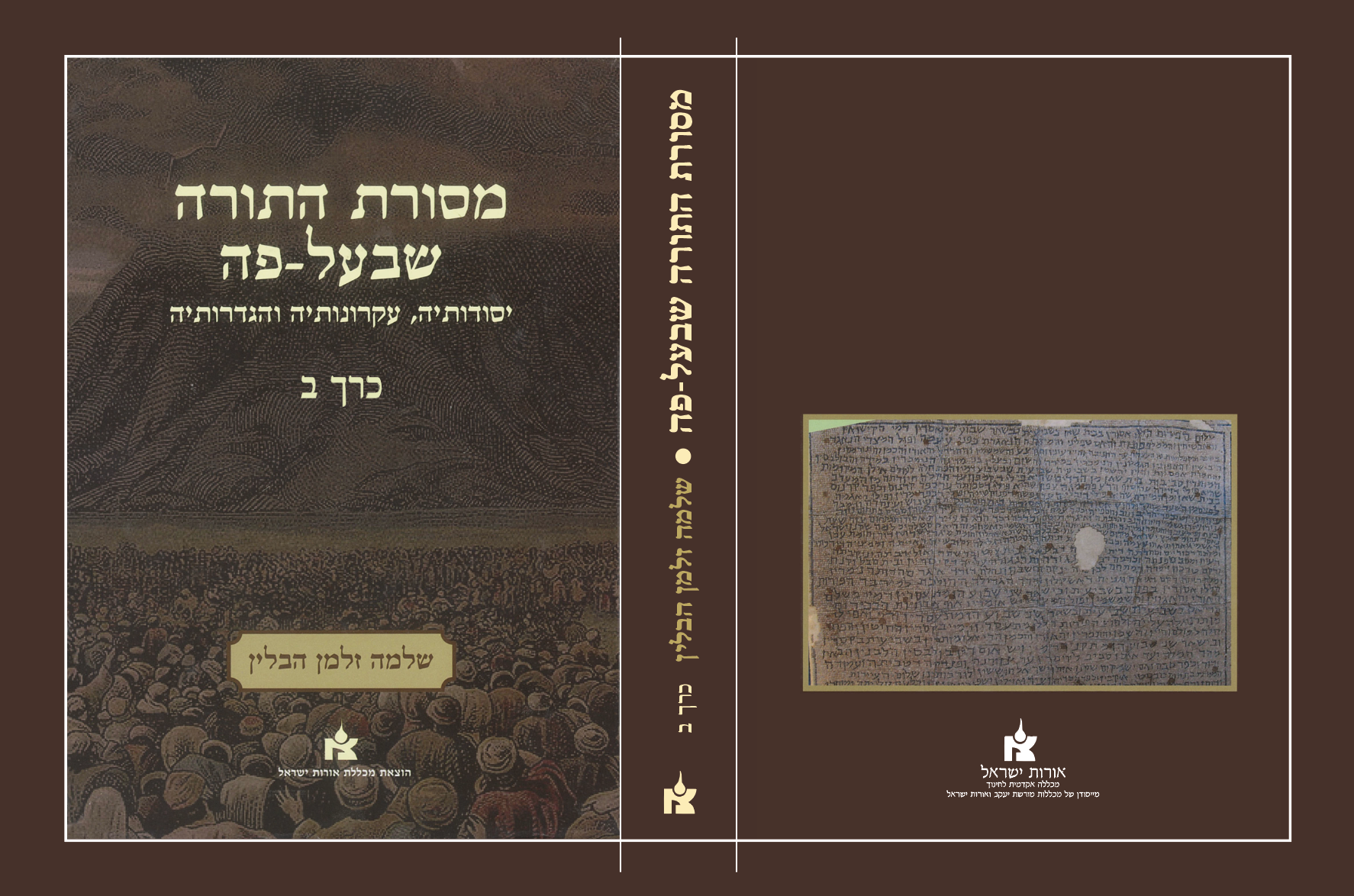
New Book Announcement: Mesoras Torah Sheba’al Peh by Harav Professor Shlomo Zalman Havlin

New Book Announcement: Mesoras Torah Sheba’al Peh by Harav Professor Shlomo Zalman Havlin

By Eliezer Brodt

רשלמה זלמן הבלין, מסורת התורה שבעל פה, יסודותיה, עקרונותיה והגדרותיה בג [בחלקים], 1048 עמודים

I am very happy to announce the recent publication of an important two-volume work, which will be of great interest to readers of the Seforim Blog. Mesoras Torah Sheba’al Peh by Harav Professor Shlomo Zalman Havlin, of Bar-Ilan University’s Talmud department.

There are various “agendas” in the following post:

The first: to further the Seforim Blog’s mission to inform its readership of new works and furnish them with a descriptive review; case in point these two incredible new volumes recently published.

Second: making some of the seforim mentioned and reviewed here available for sale; the proceeds help support the Seforim Blog.

Professor Havlin is one of the more prolific writers in the Jewish academic scene, having authored hundreds of articles and edited and published numerous seforim.

His articles cover an incredibly wide range of subjects in many areas of Jewish Studies; Geonim, Rishonim and Achronim as well as Bibliography, to name but a few. It is hard to define his area of expertise, as in every area he writes about he appears to be an expert!

He also served as chief editor of Bar Ilan University’s bibliographical journal, Alei Sefer for many years; in this capacity he also wrote numerous short but immensely insightful book reviews.

Over his career, RSZ Havlin devoted a lot of time and energy studying and analyzing various important Rishonim. Of note is the Rashba, he expended immense energy in publishing numerous manuscripts alongside his own in-depth essays regarding them. These were collected a few years back and published in two volumes by Mechon Even Yisroel.

He has edited and printed from manuscript works of Rishonim and Achronim, being firmly of the opinion, contrary to that of some other academics, that there is nothing non-academic about publishing critical editions of important manuscript texts.

His uniqueness lies not only in the topics he has taken up, but also in that his work has appeared in all types of publications running the gamut from academic journals such as Kiryat Sefer, Sidra, Alei Sefer as well as many prominent Charedi rabbinic journals such a Yeshurun, Moriah and others.

Another point unique to Havlin’s writings, besides his familiarity with all the academic sources, is that he shows prodigious familiarity with all the classic sources from Chazal, Geonim, Rishonim and Achronim, to even the most recent discussions in Charedi literature – this bekius was apparent well before the advent of search engines such as Bar-Ilan’s Responsa Project, Hebrew Books and Otzar Ha-hochmah. Alongside all this is his penetrating analysis and ability to raise interesting points.

A few years ago, my dear friend Menachem Butler made available dozens of RSZ Havlin’s publications online at his academia page available here.

About ten years ago, he published volume one of his writings, which contained fifteen chapters spanning from Chazal all the way until the Chazon Ish.

At the time, Professor Havlin mentioned to me that he hopes that he will find the strength and funding to publish the rest of his material. Over the years I reached out to him about it and he said he had no luck finding funding. To my great surprise, a few months ago he reached out to me and sent me the Table of Contents, saying the work has been finally published.

As one can see from the Table below, lots of material is devoted to the Rambam – to whom Havlin has devoted years researching all aspects of his writings from the manuscript to early printings. At one point, he published under Mechon Ofek the “Sefer Mugah (Authorized Copy) of the Rambam’s Yad and included an incredible introduction. This classic essay is included in this new collection alongside numerous essays of his on the Rambam many of which have also become classics.

These volumes have other important essays on Rishonim; included are his lengthy introductions to the Meiri’s Seder Kabbalah and his work on Avos, both of which he published critical, annotated editions through Mechon Ofek a few years back.

Some other essays in these volumes worth pointing out are his excellent introduction to the set Torasan Shel Geonim (published by Vagshal), and his essay on the authorship of the Kol Bo and Orchos Chaim.

There are also very important essays starting with the earliest Achronim to various essays on the Chazon Ish; sandwiched between are important essays on the Gra and others. One essay I enjoyed learning through a few times is his material on R’ Yechiel Ashkenazi from the time of the Rama. Another important essay of his which I enjoyed and use often is on Pilpul which was based on a talk in Harvard he gave many years ago.

There are also various book reviews of editions of seforim (some are rather sharp) all worth learning through carefully.

There is much more to say about the materials and essays in these two volumes but time is short.

Some of the essays were updated with new material or corrections from when they were published the first time.

Two minor complaints I would like to voice, one is there is no index to these works which makes it impossible to maximize all the nuggets all over in his various tangents. I imagine the reason for this is because indices costs lots of money to produce and the raising of funds for the publication was long, tedious and painful as it is so no index was included.

Another complaint which I have not come up with a good defense for is not every article has the original publication information included in the beginning of the chapter or at the end of the volumes. I imagine this too had to do with the budget.

Be that as it may, these two small complaints are negligible; these incredible volumes are worth owning and learning through carefully to gain from the research and discoveries of Havlin of over fifty years of learning.

I am the distributor of this work and I am selling copies of this work (currently it is not for sale anywhere else), so for more information about ordering\purchasing this work, contact me at Eliezerbrodt@gmail.com

Here are the Table of Contents of the book:

Vol. I:

Vol. II:


The Unusual Word Tzafufim in Pirkei Avos

The Unusual Word Tzafufim in Pirkei Avos|
עומדים צפופים ומשתחווים רווחים

David S. Farkas*

On a recent Shabbos afternoon I was learning the Yerushalmi to Peah when my thoughts turned – for reasons described below – to the famous passage in Pirkei Avos (5:5) עומדים צפופים ומשתחווים רווחים.

Every schoolboy is familiar with the phrase. The Mishna sets forth ten miracles regularly experienced in the times of the Temple. The eighth of these, as set forth above, is that though the people stood crowded in the Temple courtyard, they were nevertheless able to bow with sufficient space around them. The word צפופים, accordingly, means crowded.

This much is evident from the Mishna itself. But where does this word צפוף come from? Thinking about it further, I could recall no similar examples of the word elsewhere. Indeed, a check of the Concordance (Even-Shoshan) confirmed that no such word exists in all of Tanach.

No matter. There are many words in the Mishna that do not exist in Tanach. Perhaps the word is Mishnaic Hebrew, rather than Biblical. Yet here too, investigation showed no other examples of the word צפוף appearing in the Mishna. At this point we had the makings of a problem. It seems strange for such a familiar word to appear neither in Tanach, nor anywhere else in the Mishna. And yet it does not appear to be a foreign loan word either, with none of the hallmarks of Greek or Roman influence, or that of any other language. Where did it come from?

This is why I mentioned what I had been learning when my thoughts were turned in this direction. For in Peah (3:1, 26a in the excellent Oz Vi-Hadar edition) we find a debate among the two schools of Shammai and Hillel, in a case where numerous small patches of grain were planted between the trees of an orchard. The question is whether, for purposes of leaving Peah, they are to be treated as a single field or as many. The Gemara narrows the inquiry: אם במורווחין אף בש מודים שהוא נותן פיאה אחת על הכל. אם ברצופין אף בה מודים שהוא נותן פיאה מכל אחד ואחד.. If the trees are spread out, even B. Shammai would agree that the patches are treated as single field (i.e., the trees are not seen as intervening) and a single Peah should suffice. If the trees are close together, they are treated as an intervening separation, and even B. Hillel would agree that Peah should be taken from every patch. The Gemara concludes, אלא כי אנן קיימין בנטועין מטע עשר לבית סאה בש עובדי להון כרצופין ובה עובדי להון כמורווחין.. The case must be of trees planted in a certain density (ten per beis se’ah), and the point at issue is whether or not this density is enough to cause the fields to be considered spread out.

Of course, what jumps out to the reader, just as did to me that Shabbos afternoon, is the contrast between רווחין and רצופין. This is the exact same contrast employed in the Mishna in Avos, yet here the word used is רצופין, not צפופים.

Nor is this the only case where such a contrast is used with this exact same pair of words. In Yerushalmi Moed Kattan 1:3 4a (also found in Sheviis 2:7 18a) R. Eliezer ben Yaakov permits diverting pooled water via a channel from tree to tree on Yom Tov, but does not allow an entire field to be irrigated. The Rabbis disagree, and the Gemara again narrows the field of inquiry, observing that if the trees were “spread apart”, all would agree irrigation is prohibited because one is watering more than he needs. If the trees were packed close together, on the other hand, all would agree watering is necessary to keep them from drying out. Thus, the Gemara concludes that the field in question was planted with the standard density mentioned above, ten trees per beis se’ah, and the point at issue between R. Eliezer ben Yaakov and the Rabbis is only whether this density is considered “spaced” or “packed”. מה אנן קיימין? אם במרווחין, דברי הכל אסור. אם ברצופין, דברי הכל מותר. אלא כי נן קיימין בנטועין מטע עשר לבית סאה: רבי ליעזר בן יעקב עבד לון כמרווחין, ורבנן עבדין לון כרצופין. Once again, we see the word רווחין contrasted with רצופין.

Finally, for a third example, see Yerushalmi Nazir 9:3 51b (also found in Kilayim 5:2 48a) We find there a debate as to whether vines planted at 4-cubit intervals are considered a vineyard, or merely a group of individual vines. R. Shimon bar Ba posits that the same question applies to a group of corpses found closely together, and whether or not they constitute a שכונת קברים, a burial ground. (Both questions have halachic import not relevant here.) R. Yose, however, says the two are not comparable: אמר רבי יוסי ולא דמייא. תמן מרווחין ורצפן במחלוקת, רצופין וריווחן דברי הכל. ברם הכא מהו פליגין בשבא ומצאן רצופין. In the case of the vines, even if they were properly spaced when planted and later crowded by adding vines, it would still be a matter of debate. And if they were initially crowded but later spaced by uprooting vines, all would agree it is a vineyard. But with respect to a burial ground, the whole question is when they were found close together, and one does not know how they were originally buried. (See Artscroll translation.) Again, for our purposes, the key point is only the wording. Here again, we see the word רווחין contrasted with רצופין.

All these three examples are from the Yerushalmi – that is to say, from Eretz Yisrael, where the Mishna was written. I have cited them because they show a clear contrast between רצופים and רווחים. These are clearly two parallel technical terms, one the opposite of the other. Thus, while we have not yet formally laid out a case, the reader can already anticipate the closing arguments: Can the real reading of the celebrated Mishna in Avos actually be רצופים, rather than צפופים?

Before pronouncing judgment, let us return to צפופים. We have already stated that no such word appears either in Tanach or anywhere else in the Mishna. If so, where does it come from?

Rashi, in Yoma 21a, where the Mishna in Avos is quoted, says it comes from the word צף, floating. As he explains, it was so tightly packed that people’s feet would actually come off the ground. Bartenura adds, in following Rashi, that their feet remained suspended in mid-air. However, we might wish to interpret Rashi to mean that their feet would rest on their neighbors’ feet packed in next to them. צף in the sense of both floating or being elevated upon something does appear in rabbinic literature, see Sotah 45a (and arguably in Tanach as well, see Eicha 3:54). However understood though, one gets the sense that Rashi was forced to devise this picturesque understanding of צפופים only because of the absence of any comparable words elsewhere. In Zevachim 15b, for example, the Mishna discusses the law of one Kohen standing on the foot of another (and whether it constitutes an interposition) and neither there nor in the ensuing Gemara is there any reference to צף. Further, if this was the true source of the word, shouldn’t the phrase, in fact, simply be צף, as in Sotah 44b צף על פני מים (cited by Bartenura) or צפים, as used in Mikvaos 2:8 אם היו המים צפים על גביו כל שהוא ישבר? This does not explain how we get the unusual word צפופים.

Aruch says it simply means “crowded” (דחוקים) as we translated it above. He brings two other examples in Rabbinic literature of the word צפוף in this sense, which, if not exactly a verse or a Mishna, would still be supportive. Yet neither of these examples are actually extant. The first is from Menachos 85b פעם אחת נצטפצפו אנשי לדקיא לשמן which we are apparently to read as, “it once happened that the people of Laodicea were hard-pressed for oil.” But this would only be a borrowed sense of the term, using “hard-pressed” for “pressed”, and from thence to “crowded”. Further, this too, is not the word צפוף for which we are looking, but only a variation thereof. And more fundamentally, none of our editions today even have such a word, instead reading פעם אחת נצרכו להן אנשי לודקיא לשמן

The Aruch’s other example is from Midrash Yelamdenu, which he quotes in connection with the second set of tablets, ראו האיך עומדין המלאכים צפופין ומרתתין לפני See how the angels are crowded and tremble before me. Yet we do not have the Midrash Yelamdenu, and Midrash Tanchuma – which is sometimes said to be identical with Yelamdenu – also does not have any such phrase.1 We therefore cannot examine this Midrash closely, because it has been lost to us. Indeed, the use of the word “crowded” in the context of this snippet seems strange and out of place. In fact, simply by reading this solitary citation, one wonders if the word really should be כפופין (“bent in submission”) rather than צפופין. We cannot tell.2

A. Kohut, in Aruch Ha-Shalem, fares no better, simply citing other cases where theעומדים צפופים phrase is cited. He also cites possibilities where words similar to צפוף might theoretically be interpreted to mean דחוקים. However, all these examples are rather דוחק. For example, he cites Rosh Hashana 16b, where Jews in the middle category of merits and demerits are described descending to hell. Afterwards, they are מצפצפין ועולין. Rashi explains “they cry out”, and the Aruch says it means “they float out”, but Kohut conjectures it to mean “they are pushed out”, thus a kind of doubtful proof to the usage of צפוף in the sense of “crowded”. A few other similarly doubtful possibilities are put forward, none of which actually use the word צפוף in this form. (Interestingly, Kohut precedes these examples with the curious word אתפלפל – by which, I interpret it to mean, he intended to engage in pilpul for etymologists.)

The case is far different when we come to רצופין. The meaning of the word is “connected” or “contiguous”, and appears in the Bible on multiple occasions in the context of the flooring in the Temple (or in Esther 1:6, the King’s court). These floors – the source of the common word רצפה – were made out of hundreds of connected stones or tiles, from whence the word is easily applied to a large grouping of anything close together, be it people, graves, trees, or anything else.

Three different examples of the word רצופים used specifically in contrast with the word רווחים were cited above from the Yerushalmi. However, when used by itself a crowded field of examples can be shown in the Bavli as well. See Moed Kattan 9a מה יום כולו רצוף אף עשתי עשר כולן רצופין (Rashi – מה יום רצוף שאין בו הפסק אף כולהו יא יום רצוף דליכא הפסק בינתיים); Bava Basra 37b אכלן רצופין אין לו חזקה (Rashi – כגון שנטועין יותר מיבבית סאה); Negaim 11:9 רבי שמעון אומר, השתי אם היה רצוף, מיטמא. (Rash שהחוטים רצופים זה אצל זה כעין רצפה שסמוכים זה אצל זה) The word is also found in the closely related meaning of “consecutive”, as in the requirement for adverse possession of land to be שלוש שנים רצופות three consecutive years, see Bava Basra 29b and Gittin 82a. Many more examples are cited both in the Aruch itself and by Kohut.

Thus, we arrive at the conclusion. In answer to the question posed above, there is good reason to suspect the original phrase was actually עומדים רצופים ומשתחווים רווחים. These two technical terms were often used in parallel contrast with each other in Eretz Yisrael. (That the two words together appear only in the relatively little-known Yerushalmi may, in part, be a reason why this point appears to have escaped notice thus far.) The word רצוף in the sense of crowded or contiguous is well documented throughout chazal, in both the Mishna and the Gemara, and even has a Biblical pedigree. The word צפוף, on the other hand, does not appear anywhere else that we can verify, is not found in Tanach or the Mishna, and can only be explained via questionable or creative etymology. The two words sound very similar and use essentially the same letters, and by a simple metathesis צפוף could easily and early on have arisen from רצוף.

Whether the jury is convinced or not, I am very far from “campaigning” to change a well-known word that Rashi and the Aruch were comfortable using. There is certainly no absolute proof that the reading I suggest is correct, and no manuscript evidence I am aware of to suggest there ever was a different reading. As I have had occasion to write in this space before, there is a perennial balancing act between the freedom of inquiry afforded by the principle of מקום הניחו לנו להתגדר, and actually suggesting change to established rule and precedent. Our thoughts must thus remain within the realm of conjecture. Only this, and nothing more.

* Mr. Farkas is a practicing labor attorney in Cleveland, Ohio, and received his rabbinic ordination from Ner Israel Rabbinical College in 1999. He can be reached at davidsfarkas at gmail.com

[1] Indeed, it is precisely through examples like this that the great 19th century scholars – titans like Zunz, Buber, and others – made their case as to whether or not these two midrashim were identical with each other. The literature on the Yelamednu/Tanchuma topic is extensive, and not the subject of this brief note.
[2]
The word also appears in Midrash Shmuel 9:2 האילה הזו אבריה צפופים והיא מתקשה לילד, ומה הקבה עושה, ממציא לה נחש והוא נושכה ואבריה מתרפים The limbs of the deer are dense and it has difficulty giving birth, so the Lord causes a snake to bite it and loosen the limbs. However, Midrash Shmuel is a late work, and cannot be a source for a word appearing in a Mishna. In fact, it is more likely the opposite is true, that Midrash Shmuel took the word from Avos. Indeed, variations of the theme it mentions (concerning the difficult birth of the deer) appear in the older Beraishis Rabbah (12:9) and Bava Basra (16a), and neither use the expression found in Midrash Shmuel.


A Review of Parashas Hamelech – Al Mitzvas Hakhel, by Rabbi Moshe Parnes

A Review of Parashas Hamelech – Al Mitzvas Hakhel, by Rabbi Moshe Parnes

Reviewed by: Rabbi Moshe Maimon, Jackson, NJ

Sefer Parashas Hamelech on the mitzvah of Hakhel offers a unique and illuminating contribution on one of the lesser-studied mitzvos of the Torah. It fits the modern genre of encyclopedias on arcane subjects, while also combining elements of older and more established trends in Torah publications, weaving it all together in deft scholarly fashion. It is both an exhaustive accumulation of sources primary and secondary on its topic as well as a lively sefer iyun, providing fresh and penetrating perspectives on everything it touches.

The little explored, but very timely mitzvah of Hakhel which in the Temple era entailed a mass gathering at the Beis Hamikdash in the post-sabbatical year, where the assemblage would hear the Jewish King perform a special Torah reading, has been largely uncharted by the major halachic compendiums. A noteworthy exception is the Rambam who included it in his Hilchos Chagigah; the section of Mishneh Torah pertaining to the tri-annual Temple pilgrimage. The obvious reason for its exclusion from the codes is that this mitzvah was not of practical relevance for the Jewish Diaspora, and thus became a topic for theoretical discussion by experts only.

Interest in this mitzvah, however, was generated in scholarly circles with the return to the Land of Israel by large segments of World Jewry. Late in the 19th century, the illustrious R. Eliyahu David Rabinowitz-Teumim (“the Aderes”) published (anonymously) what to this point has been considered the most exhaustive treatment of the topic, his Zecher Lemikdash. (A major focus of the Aderes has been the possibility of reestablishing this mitzvah in modern times, even if only as a testimonial—an idea elaborated upon by R. Shmuel Kalman Mirsky in his article in Talpiyot vol. 6 pp. 92-118).

Additionally, besides for being virgin halachic ground, this topic also leads into fascinating discussions on more classical halachic topics such as laws the pertaining to daily prayer, the reverential treatment of Torah scrolls, and the specific requirements for the weekly Torah reading. Naturally, an incisive treatment of the unique Hakhel service in the Beis Hamikdash is of necessity accompanied by deep dives into the broader context of other mitzvos that were specifically pertinent in the Temple era, as well as close examinations of various elements of the Temple services and the qualifications necessary for Jewish royalty along with other such related topics.

With every passing shmittah cycle, interest in Hakhel seems to swell and this year is no different. Our author, Reb Moshe Parnes, a self-described businessman living in Boro Park but clearly a gifted scholar who devotes a good portion of his day to intense Torah study, timed the launch of Parashas Hamelech perfectly. His magnum opus was primed and perfected just in time for the culmination of the current shmittah cycle.

The volume begins with a thorough introduction devoted to the “aggadic” aspects of Hakhel and presents various different perspectives on the unique mitzvah, all culled from a wide variety of classical sources, such as the following:

  • A mass Torah-study session.

  • A demonstration geared for enhancing fear of Heaven among the masses.

  • An outgrowth of the mitzvah to make pilgrimage to the Beis Hamikdash during the shalosh regalim (a perspective enhanced by the Rambam’s placement of this mitzvah in Mishneh Torah as mentioned previously).

  • A reenactment of kabbalas haTorah.

The main body of the sefer is divided into three parts: The primary text is written in the style of a Shulchan Aruch with short, anonymous pronouncements given in the form of chapters (simanim) and paragraphs (se’ifim), which cover all the halachos of Hakhel divided into three main categories:

A] The section on the general aspects of the mitzvah covers the exact time and place for the mitzvah; the technical aspects of how the platform is constructed and the Torah scroll that is to be used for the reading.

This section ends with a spirited discussion of the sources regarding the fulfillment of this mitzvah in contemporary times. It concludes that since the mitzvah is dependent on mitzvas r’iyah (the Temple pilgrimage) which cannot be practically fulfilled without the Beis Hamikdash, the mitzvah of Hakhel cannot either be fulfilled at this time. To counter the suggestion of the Aderes that we at least make a remembrance for this mitzvah, the author points out that a zecher is not enacted when the mitzvah itself was never performed outside of the Beis Hamikdash. (The Aderes himself, following the Yaavetz, adopted the view that the custom of reading Sefer Devarim on Hashanah Rabbah evolved out of a zecher for Hakhel. If this were true, the author’s point would be considerably weakened, but it should be noted that this idea is purely speculative and does not account for the fact that the custom is practiced every year, whereas Hakhel was only relevant once in seven years).

B] The second section is devoted to the unique Torah reading that constitutes the actual mitzvah of Hakhel, and encompasses all aspects of this reading. At the end of this section, the author shows how many sources understood that this Torah reading was intended to lead into a practical mussar shmooze by the king, who would even exhort the people to be more pious in their religious observance. One prominent Italian sage, R. Shmuel Yehuda Katzenellenbogen (d. Padua, 1597), illustrates this point with a sampling of a schmooze targeting the ills of his own time—married women who did not cover their hair, or who wore wigs!

C] Section three covers all the rules regarding who is obligated by this mitzvah and who is exempt. No scenario is left unexplored, from children to converts to people with physical disabilities and much more. It is here that we can find detailed discussions pertaining to all aspects of life, even one as seemingly mundane as whether someone with impaired vision necessitating eyeglasses is considered “blind” and thereby exempted from Hakhel.

The main text is rather comprehensive and treats pretty much every aspect of the halachos of Hakhel, but it is in the two subtexts where we are treated to full blown halachic expositions of a great array of topics. The section titles “biurim” deals primarily with the material treated in the main text, providing the sources for the cited opinions with a good deal of breadth and thorough analysis—sure to delight those with a lomdishe bent.

The “iyunim” section, on the other hand, branches off the “biurim” section and includes in its scope interesting dives into topics which may be tangential to the main discussion but are compelling on their own. A sampling: What are the halachic prerequisites for determining who is a shoteh (insane)? Did the Israelite kings of the ten tribes have the halachic status of Jewish kings? What are the parameters of the mourner status conferred on one who has been placed in niddui (excommunication)? What is the reason for reading the Aseres Hadibros with the taam elyon? These and many more discussions are listed in the detailed topical index included at the end of the sefer.

The source material used for this work is exceptionally rich. When we read in the introduction the passionate dedication to the author’s late father, who possessed a tremendous library and knew how to utilize it well in his scholarly pursuits, we get the sense that the son is likewise in possession of these blessings. The fifteen-page bibliography at the end of the volume provides the authors’ names and dates of publication for the roughly 500 titles cited in the text.

A section at the end of the sefer includes a lively back and forth between the author and other scholars pertaining to their comments on his work, in which Rabbi Parnes credits his colleagues generously for their insights.

Recent years have seen a flurry of new sefarim which seem, more and more, to deal exclusively with highly specialized topics. This may just be an expression of the development of new directions in Torah scholarship in the contemporary “Torah world.” As celebrated masters of kol hatorah kulah become ever more scarce, their places are taken by localized experts who specialize in specific areas of Torah.

Perhaps, however, this trend is merely symptomatic of the nature of supply and demand in the sefarim market; a sort of Torah capitalism if you will. Consumers, sensing that previous generations have already sowed all that are worthwhile in the field of rabbinic scholarship, trend towards the encyclopedic, targeting sefarim that will reap all the fruits of the generations of labor and serve as a repository of all the information generated by scholars–both ancient and recent–on a given topic. Contemporary authors are simply aiming to meet that demand.

Whether indicative of new trends in Torah study or simply of changing patterns in the marketplace, sefarim focusing exclusively on issues that previously took up a few simanim (or, in some cases, no simanim) in Shulchan Aruch have become commonplace of late. Typically, these works excel more in their bekiyus than in their iyun. While these sefarim can be very effective for research purposes, one who still wishes to revel in that old time iyun is often better served looking for a title authored by one of the greats of the past.

Yet, as evidenced by the sterling example of Parashas Hamelech, the sources that have supplied countless generations with grist for the iyun mills are still capable of inspiring further significant halachic developments when utilized properly by capable baalei iyun. Rabbi Parnes should thus be commended for his wonderful and singular offering to the world of Torah scholarship that combines both of the aforementioned trends.

May the merit of the additional Torah study spurred on by this engaging work contribute to the tipping of the Heavenly scales and hasten us to that long-awaited moment where we can once again practice this monumental mitzvah.