Wrestling with the Ketsot – Review of ‘New Heavens: The Ketsot ha-Hoshen and the Rise of Lamdanut’, by Noam Samet
Wrestling with the Ketsot –
Review of ‘New Heavens: The Ketsot ha-Hoshen and the Rise of Lamdanut’, by Noam Samet
By Moshe Shochat
“…We also studied the Ketsot ha-Hoshen… The book was expensive, and my brother obtained a copy for consultation and decided to transcribe it in his fine handwriting. Only after prolonged arguments with me did my brother agree that we should first study it, and after each sugya and topic decide what was worth copying. We maintained this method throughout the two years we spent at Telz. Day after day we worked through the Ketsot ha-Hoshen, the Netivot ha-Mishpat, the novellae of R. Akiva Eiger, and several other books… My brother preserved the manuscript for many years; it was always for him a source of inner satisfaction and spiritual renewal, an occasion to resume his Talmud study…”[1]
— Ben-Zion Dinur (1884-1973)
“All the devotion of a Telz alumnus to the Gemara and its sharp nosei kelim – the Shita Mekubbetset, the Penei Yehoshua, the Ketsot ha-Hoshen, the Shev Shma’ateta, and works of that kind – a devotion that persisted even after he had turned to heresy and Haskalah – derived from the wisdom residing in the act of study itself, from the logic that bores down to the roots of things, dismantling and rebuilding. The capacity to hold one’s own in learned discourse (kennen redn in lernen) – that is the entire Torah. Where that is present, everything is present. The person who possesses it faces nothing beyond his reach, since everything else is acquired through labor, and it is of no consequence whether it has yet been acquired or not.”[2]
– Meir Shely (1893-1983)
These two descriptions fix the spirit of the Lithuanian yeshiva as it stood more than a century ago. But ask a yeshiva student today, and he will tell you that the hunger for the Ketsot ha-Hoshen – “Ketsoys” or “Ketseys” in Lithuanian-yeshiva pronunciation – has not abated, save for the fact that present-day students are no longer required to copy the book by hand, and copies circulate in abundance. But “why speak of others,” as the Simple Son asks in the Haggadah. Last Shabbat I found myself opening the Ketsot and paging through old notebooks from my yeshiva years – something I had not done in more than twenty years. I returned in my mind to the hours we spent wrestling with the lamdanut arguments of the Ketsot and the Netivot alongside the other commentators, and felt a sharp longing for an experience I have not had since. What accounts for the Ketsot’s hold? What historical and cultural situation produced it? What does it contain that has absorbed thousands of Torah students since it was first printed in Lvov some two hundred and thirty years ago?
It is this question that Rabbi Dr. Noam Samet sets out to answer in his newly-published book, New Heavens: The Ketsot ha-Hoshen and the Rise of Lamdanut.[3] Samet is a rare combination of research scholar and rosh yeshiva, a pairing that serves him exceptionally well in the analysis of the Ketsot’s lamdanut character. Throughout the book his deep investment in the Ketsot’s teachings is evident – a product of serious yeshiva study – alongside the scholarly discipline to organize and properly conceptualize both the novelty of the Ketsot’s work and the intensity of engagement it has drawn from successive generations of students. He addresses this openly in explaining his chosen appellations for his subject: “Choosing the family name or an acronym-based designation (such as ‘Ra’al’ or ‘Heller’) immediately situates the writing in a somewhat distancing register, one I feel is inappropriate to my relationship with the material. I shall therefore permit myself, with the reader’s indulgence, to employ various designations freely – Ra’al, ‘baal Ketsot ha-Hoshen,’ or ‘the Ketsot’ – in the hope that the learned reader will understand that in all cases the reference is to R. Aryeh Leib ha-Kohen Heller and his work Ketsot ha-Hoshen…”[4] For the same reason, I shall follow suit in the review below.
R. Aryeh Leib ha-Kohen Heller (1745-1812) was born and raised in Galicia. He served in the rabbinate of the small community of Rozhnyatov before moving to Stryi. In the year of that move, 1788, the first part of Ketsot ha-Hoshen was printed, accompanied by the Kuntres ha-Sefeikot composed by his elder brother R. Yehuda, later rabbi of Sighet. The second part appeared in 1796. Before going to press the book underwent extensive revision, with numerous passages excised for two principal reasons. First, upon discovering that R. Yonatan Eybeschütz had anticipated him in the Urim ve-Tummim, Heller deleted his own parallel formulations to avoid redundancy. Second, his brother R. Yehuda, who served as his editor, removed passages too heavily marked by the methods of pilpul and thus perhaps not qualifying as davar emet – a true statement. The accumulation of these revisions produced a curious phenomenon: a large proportion of the internal cross-references in the earliest editions are incorrect, reflecting the deletion of entire sections and the consequent displacement of section numbers.
According to Samet, these two editorial interventions together trace the intellectual coordinates within which the work positions itself. On one hand, the Ketsot regards itself as belonging to the nosei kelim literature of the Shulhan Arukh and thus as a natural successor to the Urim ve-Tummim. On the other hand, the removal of pilpul passages registers a methodological tension – between pilpul and halakhic ruling – that runs beneath the surface of the book.
A dedicated chapter in Samet’s study is devoted to the Ketsot’s celebrated introduction. “R. Aryeh Leib did us a service,” Samet writes, “by attaching to his work a searching introduction – a brief theological composition treating the hermeneutical tension, and in particular the gap between man’s finite capacity and the infinite divine Torah,”[5] The introduction centers on a passage from the Zohar according to which, when a person originates a hiddush in Torah, that word of innovation ascends before God, who kisses it, and the one who originated it becomes a partner in the act of Creation. These words elevate the creative act of Torah scholarship despite the tension between innovation and received tradition. The Ketsot proceeds, drawing on rabbinic teaching, to show that the Torah scholar does not merely transmit tradition but acts creatively within it – “and this is the covenant and the wondrous love that He gave us the Oral Torah as an outright gift, and ‘from the wilderness, a gift’ – in accordance with the rulings of the sages.” This wondrous love finds abundant expression in the Ketsot itself, through repeated registers of pleasure and satisfaction, particularly when the author notes that his reasoning coincides with a position of the Rishonim.
The Ketsot adds a further observation: God’s Creation is perfect; human beings are limited and deficient, and their engagement with divine truth is, from an absolute standpoint, error. Yet it is precisely this “error” that is accepted before God, and that even sustains Creation at every moment – and this is what is new in the descent of the Torah to human beings. Samet reads in these words a polemic against the Haskalah critique then being directed at pilpul and hiddush for their supposed falsity. But a competing tendency was also at work within the beit midrash itself – one that placed the recovery of original truth at the top of its agenda and admitted no other pursuit. This was the approach of the Vilna Gaon, as described by his disciple R. Hayyim of Volozhin: the Gaon worked to strip away corruptions and recover “original” truth through philological and critical methods. Samet connects the Brisker school to this same tendency, with its use of abstract conceptual analysis to locate the foundational source of a law. In this view, the quality of a hiddush is expressed not in its formal elegance but in its clarity and internal truth. The Ketsot took the opposing position: hiddush is a distinctive power and a central purpose of Torah study. This does not license falsity or remove all constraints – the indispensable condition for legitimate Torah innovation is mastery of the Torah’s proper methods. The scholar who recognizes that his innovations continue, rather than sever, the interpretive tradition of the Rishonim is the one whose Torah qualifies as truth.
Certain sections of the Ketsot have won particular standing in the batei midrash and are studied and cited repeatedly – it is not unusual to hear scholars say, “this is the Ketsots in lamed-dalet” or “the well-known Ketsot in resh-mem-alef.” In most sections the Ketsot follows the interpretive path of the nosei kelim without distinctive departure; but the sections that secured the book’s authority in the batei midrash are those in which he broke from his predecessors and proposed new insights and conceptualizations that opened fresh avenues of halakhic thought. The author devotes one chapter to the Ketsot’s treatment of the laws of testimony (hilkhot edut) and another to five examples drawn from different areas. To avoid leaving this review guilty of bittul Torah, I will select one of the shorter and more accessible examples from the book, through which some of the aspects the author wishes to illuminate can be seen at work.
In Bava Batra 149a, the Talmud recounts the case of Issur the proselyte, who transferred his assets to his son – who does not inherit him under halakha, owing to Issur’s conversion – by means of an odita, that is, a declaration of acknowledgment (hoda’a). The Rishonim debated the legal character of this mode of acquisition at length. The Ketsot addresses it in sections 40 and 194, and takes the position that odita is a fully independent mode of acquisition operating on the same footing as any other: “It is a complete act of acquisition, in no way inferior to any other mode of acquisition, whether for monetary matters or for ritual prohibitions” (194:4). The acquisition takes effect when a person declares before witnesses that a certain object belongs not to him but to another – the intended transferee. That declaration itself transfers the object, even if both parties know that the admission does not correspond to fact. The Ketsot’s engagement with this mode of acquisition grows out of a discussion of transfer of ownership to a gentile – for example, the sale of a firstborn animal (bekhor) to exempt it from the relevant sanctity, or the sale of hametz. Under halakha, a gentile cannot acquire through all the modes available to a Jew; he cannot, for instance, acquire movables (metaltelin) through the payment of money alone. Some proposed kinyan agav (acquisition incidental to real property), but the Ketsot was not satisfied that this mode applies to a gentile – nor does every seller possess land, and meshikha (formal pulling) is impractical for large quantities of hametz. His proposed solution was kinyan odita, but the mechanics of this mode had not been adequately worked out by the Aharonim; some had in fact restricted it to deathbed declarations (shekiv mera), or confined it to monetary matters and excluded ritual prohibitions – making it very difficult to press into service for hametz sales. This practical problem drove the Ketsot to undertake a lamdanut analysis aimed at clarifying and sharpening the mechanisms through which the acquisition operates.
The analytical discussion of those mechanics is found in section 40. Its foundation is the sugya of Ketubot 101b, concerning one who says to his fellow “I am indebted to you for a maneh.” In R. Yohanan’s ruling – which was accepted as normative – that statement binds him. Rashi and Tosafot understood the case to involve a written document, which they took to be the source of the obligation. The Rif and Maimonides, however, held that the admission itself creates the obligation. The Ketsot explains that kinyan odita is operative here and functions even for movables and in the absence of a written document. In this he also resolves a contradiction in the Shulhan Arukh that I will not pursue here; what matters is that the nosei kelim who addressed the Shulhan Arukh’s ruling kept their discussion within the sugya at hand, while the Ketsot alone saw fit to move outward to the sugya of odita and establish its halakhic principles from the ground up. The principle he extracts is that odita operates specifically through having witnesses attest to a declaration of prior obligation – not through a present-tense act of transfer. A declaration formulated in those terms is itself the act of acquisition. From this he draws a further ruling: kinyan odita requires witnesses; an admission made privately, or even before witnesses without the declarant’s having said to them “atem edai” – “you are my witnesses” – produces no acquisition. This holds despite the general principle that “la ivre sahade ela le-shakkarei” – witnesses exist only for the dishonest – meaning that where there is no suspicion of falsehood, witnesses are ordinarily unnecessary. That principle governs modes of acquisition in which witnesses serve only to document a transaction that has already occurred independently; in kinyan odita, by contrast, the presence of witnesses is constitutive of the transaction itself.
The discussion then turns to the Ketsot’s standing relative to the Rishonim and the pilpul tradition. The Ketsot presents his innovation as a resolution of a difficulty raised by the Tosafists in Bava Metsia 46a: why money cannot be transferred by odita. His answer is the absence of witnesses. R. Yaakov of Lisa, author of the Netivot ha-Mishpat, objects sharply: if Tosafot themselves did not resolve the difficulty in this way, by what right does the Ketsot depart from them? The Ketsot responds in his Meshovev Netivot, holding his ground: in kinyan odita, “as long as one has not said ‘atem edai’ before witnesses, there is no odita here, and if there is no odita there is no acquisition.” He further supports his position with a proof from Ramban, then returns to Tosafot. Committed as he is to the literature of the Rishonim, he insists that his position does not necessarily contradict Tosafot: the reason Tosafot did not themselves answer that witnesses were absent is that the case involves a threshing floor – a place where people are routinely present – but as regards his underlying account of the odita mechanism, Tosafot would, he maintains, concur.
As Samet summarizes, the Ketsot ruled by independent reasoning (sevara) that kinyan odita operates only before witnesses, and was prepared to legislate accordingly even against the surface implication of Tosafot’s words. The Netivot’s objection exposes the substantive disagreement between them over the role of reasoned argument and the degree of independence the lamdan may exercise against the rulings of the Rishonim. The Ketsot is prepared to follow sevara even when doing so forces strained readings of earlier authorities. The lamdanut sequence illustrates a dense interplay of practical necessity and conceptual ambition: the need to solve the hametz sale problem drives the Ketsot to define and conceptualize odita as a fully independent mode of acquisition, reconstructing that category through a series of earlier sources that he rereads and renegotiates in lamdanut terms.
This is a brief and compressed sampling of the work the author unfolds in a substantial book. My review has concentrated on the beit-midrash dimensions, but the book also engages the historical and legal context in which Heller operated – the dissolution of Jewish communal self-governance and the transfer of juridical authority to the state – and a dedicated chapter treats “Naturalism, Nominalism, and Lamdanut,” examining legal theories that may have shaped the development of study methods within the beit midrash. The book is not easy reading; it demands sustained intellectual effort. Yeshiva students and alumni will find a rigorous new account of a work they know well, while the book is structured to be accessible also to readers outside that world who want a serious introduction to the tradition of lamdanut. No copyeditor’s name appears on the book, and professional language editing would have broadened its reach. That aside, I owe the author an acknowledgment of genuine debt for returning me, if only for a few hours, to a part of my life I had set down a long time ago.
This article presents an English translation of a Hebrew review published by Moshe Shochat at his blog, Sefarim ve-Kitvei Yad, which originally appeared May 20, 2026, and available here.
Ben-Zion Dinur, “Two Years at the Telz Yeshiva,” in Immanuel Etkes and Shlomo Tikochinski, eds., Yeshivot Lita: Pirkei Zikhronot (Jerusalem: Shazar, 2004), 250-251 (Hebrew). ↑
Meir Shely, “Shards of Telz,” in Immanuel Etkes and Shlomo Tikochinski, eds., Yeshivot Lita: Pirkei Zikhronot (Jerusalem: Shazar, 2004), 266 (Hebrew). ↑
Noam Samet, New Heavens: The Ketsot ha-Hoshen and the Rise of Lamdanut (Ramat-Gan: Bar-Ilan University Press, 2026; Hebrew). ↑
Quiz Answers; Response to Criticism; Rav Schwab Writes to the Rogochover
Quiz Answers; Response to Criticism; Rav Schwab Writes to the Rogochover
Marc B. Shapiro
1. Let me begin with the riddles from my last post here.
A. Where do we find that Shammai not only disagrees with Beit Shammai, but also agrees with Beit Hillel?
B. In the days of the tannaim a certain item was unquestionably muktzeh. However, in the post-talmudic period, some hold that this item is no longer muktzeh. What item am I referring to? Provide the actual source in the Talmud and later authorities to justify your answer.
The answer for number 1 that I intended is found in Orlah 2:4-5. Mike Wiessenberg, David, Shimi, and Sam got this right.
Yet Moshe Schwartz offered a different answer which I think is also correct. He wrote:
From the baraisa brought down in Beitzah 20a, it could be suggested that only Beis Shammai held that one can’t bring an olah on Yom Tov, but from the fact that Bava Ben Buta said the halacha is in accordance with Hillel, it can be inferred that he is testifying to Shammai’s opinion as well. Especially since the Gemara in Shabbos 15a doesn’t ask from the machlokes of olah on Yom Yov when it says that there was only three times that Hillel and Shammai argued. So, all this suggests to me that here Shammai was in agreement with Beis Hillel and Hillel himself that you can bring an olah on Yom Tov. See also Tosafos in Chagigah 7b.
For number 2, no one gave the answer I intended: In the days of the tannaim a get was muktzeh. That was because you could not do anything with it on Shabbat. You could not even use it to learn the halakhot of writing a get since Torah learning was to be entirely oral. Yet after the Oral Law was written, R Moshe Isserles states, Even ha-Ezer 136:7, that according to some it is now permitted to handle a get on Shabbat as it is not muktzeh. In other words, since you can learn various halakhot by examining the get, one is now permitted to do so on Shabbat. That this is what R. Isserles means is made clear by his comment in Darkhei Moshe, ibid.:
בזמן הזה שנתנה תורה שבע”פ לכתוב לכ”ע מותר לטלטל גט שהרי אדם יכול ללמוד ממנו כמה הלכות גטין
It is interesting to note that while in Darkhei Moshe R. Isserles says that everyone agrees with this opinion, in the Shulhan Arukh he writes “some say”.
The Beit Yosef, Even ha-Ezer 136, also says that everyone agrees that today it is permitted to carry a get, but in the Bedek ha-Bayit he questions this permission.
As mentioned, during the era when the Oral Law was not written all agree that a get was muktzeh (and the same law would apply to a ketubah) since all learning had to be oral. What I don’t understand, and maybe some of our learned readers can enlighten me, is what are we to make of what the Talmud refers to as megilat setarim. These were private notebooks that the Sages had during the period when the Oral Law could not be written down for the public. In order not to forget what they were taught, the Sages wrote things down. Rashi, Shabbat 6b and Bava Metzia 92a, tells us that these notebooks had to be hidden. However, Maimonides, in his introduction to the Mishneh Torah, also notes that the Sages recorded both what they were taught and their own independent Torah insights. Yet, unlike Rashi, he does not mention that they hid their notebooks. Furthermore, unlike Rashi, Maimonides does not view the permission to write down Torah thoughts as intended solely to prevent forgetting. For him, Torah she-be-al Peh signifies that Torah is transmitted orally rather than through written means. Nevertheless, it was never forbidden to write down the Oral Torah for personal use; it was kept hidden only to prevent its use for public teaching.[1]
According to Rashi, in the era of Torah she-be-al Peh one was not allowed to study the Oral Law from a written text. Writing it down was permitted only as an emergency measure, to prevent forgetting, but under normal circumstances it was forbidden. On this view, it makes sense that a get would be considered muktzeh. However, according to Maimonides, it was never forbidden to write down the Oral Law for private use. Since, in his opinion, one could study the Oral Law privately from written texts, why should a get be muktzeh? How is it different from a private notebook used for study? If anyone has an answer to this, I would be interested to hear it.
R. Meir Mazuz offers another interesting example of how halakhah has evolved in response to changing realities. Shulhan Arukh, Orah Hayyim 320:6, states: “One is permitted to squeeze lemons [on Shabbat].” R. Mazuz explains that this ruling is not mentioned by the Geonim or by Maimonides because, in their time, lemons were only primarily for medicinal purposes rather than as a food. Consequently, squeezing them for drinking would have been considered forbidden on Shabbat. This is in line with the halakhah recorded in Shulhan Arukh, Orah Hayyim 328:37: “Anything that is not eaten or drunk by healthy people is forbidden to be eaten or drunk for medicinal purposes [on Shabbat].”
2. In my article “The Brisker Method Reconsidered” and also in my book Studies in Maimonides and His Interpreters, I refer to how R. Hayyim Soloveitchik ignored Maimonides’ own explanation to the sages of Lunel of Mishneh Torah, Hilkhot Nizkei Mamon 4:4.[2] Maimonides informed them that their text of the Mishneh Torah was incorrect and supplied the proper reading. However, R. Hayyim, in his commentary, disregarded Maimonides’ correction, illustrating how the Mishneh Torah had taken on a life of its own such that there was no perceived need to follow even Maimonides’ own assertion that the text was mistaken.[3]
In a recent article, Rabbi Elisha Friedman takes issue with my point:[4]
To correct the record it is worth pointing out one error in Shapiro’s overall excellent discussion of this subject. One of his central proofs for his approach, which he repeats in his Studies in Maimonides and His Interpreters (University of Scranton Press, 2008), 55, refers to R. Hayyim’s explanation in Hilkhot Nizkei Mamon 4:4. The problem is that Rambam, in a letter, revised the text of this halakha, as R. Yosef Karo in his commentary Kesef Mishneh, ad loc., cites. R. Hayyim completely omits any mention of this revision in his discussion, which leads Shapiro into a reflection of how to view halakhic works which are based on faulty texts. This point is made even more emphatically in the book he is reviewing, Norman Solomon, The Analytic Movement: Hayyim Soloveitchik and His Circle (Scholars Press, 1993), 219. While the overall point—that R. Hayyim is impervious to such textual matters—is undoubtedly correct and can be proven from other explanations in his work,[5] Solomon and Shapiro’s example is in fact not one of them. The piece is unrelated to the words Rambam changed in his letter; it works according to all versions. R. Hayyim proves that Rambam must be referring to an animal which pays damages from its own value and then wonders why this halakha appears in the context of the watchman’s larger responsibility for damages. Quoting Rambam’s responsum might have been proper scholarly etiquette for the sake of accuracy, but it would not have changed the overall trajectory.
Let us examine this case. Maimonides writes as follows in Hilkhot Nizkei Mamon 4:4:
When a person entrusts his animal to an unpaid watchman, a paid watchman, a renter or a borrower, these individuals assume the owner’s responsibilities. If the animal causes damages, the watchman is held liable. When does the above apply? When they did not guard the animal at all. If, however, they guarded the animal in an excellent manner, as they should, and it got loose and caused damage, the watchmen are not liable, and the owners are liable.
The problem with this halakhah is that if the watchman guarded the animal properly, and it still got out, why should the owner be liable? Maimonides was asked about this by the Sages of Lunel and he told them that they should correct their texts to read: “If, however, they guarded the animal in an excellent manner, as they should, and it got loose and caused damage, the watchmen are not liable. If the watchmen guarded the animal in an inferior manner, they are not liable if they are unpaid. Instead, the owners are liable, even if the animal kills a person. The watchman is liable if he is paid, a renter, or a borrower.”
What I said—and what Friedman criticizes—is that R. Hayyim offered an analysis of the mistaken text. Looking again at R. Hayyim, I see no reason to retract what I wrote, and I don’t understand how Friedman can criticize me. The issue isn’t whether one of R. Hayyim’s hiddushim works with both the mistaken text and the corrected text. The issue is, as I said, that R. Hayyim analyzes and explains the mistaken text. He does not pay attention to Maimonides’ correction, which he knew as it is mentioned in the Kesef Mishneh. Thus, right at the beginning of R. Hayyim’s commentary to Nizkei Mamon 4:4 he writes:
וא”כ הא קשה רישא שכתב הרמב”ם שבשמירה מעולה הבעלים חייבין, ואמאי חייבין כיון דעיקר הנגיחה הויא נגיחה של פטור
Yet in the corrected text of the Mishneh Torah, it never states that the owners are liable. R. Hayyim continues discussing the uncorrected text, leading the Hazon Ish in his comment on this passage to write: וכבר כתב הכ”מ בשם הר”מ בעצמו שהוא ט”ס
In R. Hayyim’s commentary to Nizkei Mamon 4:11, which I additionally mention in Studies in Maimonides and His Interpreters, his analysis also ignores the corrected text. He cites the uncorrected text and states:
הרי דדעת הרמב”ם דרק בזמן שהשומרין פטורין הוא דהבעלים חייבין
He also writes:
ולפ”ז הרי לכאורה יש למידק מדנקט הכא הרמב”ם הך דינא דהבעלים חייבין
Yet as we have seen, in his responsum to the sages of Lunel, Maimonides says that the underlined words are a mistake, meaning that R. Hayyim’s presentation of Maimonides’ view is not in accord with his corrected text.
In response to what we have just seen from R. Hayyim, the Hazon Ish writes:
צ”ע למה לא נקבל מש”כ הכ”מ בשם רבו בתשובתו לחכמי לוניל
In other words, the Hazon Ish calls attention to the fact that R. Hayyim, in his explanation, operates on the assumption that the printed text is correct, while ignoring Maimonides’ responsum in which he states that the text is mistaken.
In Studies in Maimonides and His Interpreters, p. 55 n. 232, I refer to R. Eliyahu Soloveitchik’s note to an article by Prof. Shlomo Zalman Havlin.[6] Let me cite his words, stated with regard to Nizkei Mamon 4:4, as I think they explain well the phenomenon we are discussing and are in line with my approach.
אמנם עיון בספר חידושי רבנו חיים הלוי מראה (וזוהי גם רוח הדברים בבית מדרשו) שכשהוא נפגש עם שינויי גירסה מסוימים בגמרא או ברמב”ם, אין הוא דן בשאלה “מה יצא מתחת קולמוסו של מר בר רב אשי או של רבנו משה בן מימון”, הוא גם לא דן בשאלה הכללית יותר “מהו הנוסח הנכון”. רבי חיים מתייחס לשינויי גירסה אצל הקדמונים כאל כל מחלוקת אחרת בפשט הסוגיה, שלומדים את שתי הדעות בשווה ואלו ואלו דברי אלקים חיים. מבחינה פרשנית אפשר לומר שרבי חיים קידש את אשר היה לפניו והרחיק את עצמו מכל דיון בשאלות עובדתיות היסטוריות, ובמקומו עסק בחקר התבונה הטהורה של תורתינו הקדושה . . . ומאחר שאין ענייננו “בירור הנוסח” אלא לומדים אנו את הנוסחאות השונות, לכן גם כשהרמב”ם בתשובה מגיה את דברי עצמו, ומנמק את הנוסח הנפוץ בטעות מעתיקים, העובדה שלפני המגיד משנה היה נוסח מסויים ברמב”ם (הנוסח הנפוץ) דיה היא כדי לקבוע שהנוסח הזה תורה הוא, ויש להתייגע על פירושו.
The very point I made, and which Friedman criticizes, is also made by R. Yehoshua Inbal.[7] He writes:
והרי הגר”ח קיצוני בדבר עוד הרבה יותר מהחזו”א, וכנודע גם במקום שהרמב”ם עצמו הסביר את דבריו, והובאו הדברים בנו”כ, וגם במקום שהרמב”ם שלפנינו ט”ס לפי עדות הרמב”ם עצמו המובאת בנו”כ, התעלם מכך הגר”ח.
In his note to this passage, he refers to Nizkei Mamon 4:4 and Maimonides’ correction of the text, and then states:
אבל הגר”ח לא קיבל גילוי זה ומיישב הג’ הישנה ובסו”ד כותב שזה גם ד’ הרמב”ם
I realize that Friedman can criticize Inbal just as he criticized me, but I feel comfortable knowing that I am in such good company.[8]
Turning to a related issue, the Hazon Ish is often cited as one who was opposed to the Brisker approach. However, the most famous opponent was R. Jacob David Wilovsky, the Ridbaz. I have discussed his opposition to what he called “chemistry” (which includes the Brisker method) in earlier posts here, and here. In my earlier writing about the Ridbaz, I was unaware of another example of his criticism of the analytic approach. This appears in his Nimukei Ridbaz, Parashat Terumah, p. 24a:
שבעו”ה נתפרצה במדינות ליטא וביחוד בזאמוט ע”י איזה רבנים לימוד בדרך הכאמי או הגיון והוא לא רוח התורה אך רוח זרה באה מבחוץ והכניסו בעו”ה להתורה שבע”פ ונתפשטה לימוד הזה אצל בחורים בעו”ה עד שהתורה לבשה צורה אחרת בעו”ה והמבינים מועטים והוא רחום יכפר עון
Regarding the Hazon Ish’s critique of R. Hayyim’s hiddushim, R. Elyakim Schlesinger reports that this was not intended for public consumption, meaning that it never should have been published.[9]
R. Hayyim Dov Ber Gulevsky, the grandson of R. Simcha Zelig Reguer, also claimed that the critique of the Hazon Ish was published against the wishes of the Hazon Ish’s family.[10]
והנה בשלהי קיץ שנת תשל”ה, שמוע שמעתי שיצאו אנשים בלתי הגונים, ולא שמעו לקול הורים ומורים, ולמשפחת הגאון החסיד צדיק יסוד עולם בעל החזון איש. והוציאו במרמה נגד רצונם את ההשגות שהחסיד הנ”ל רשם על ספר חדושי רבינו חיים הלוי. והדפיסו את זה יחד עם הספר חדושי רבינו חיים הלוי
R. Hayyim Kanievsky also reported that his father, the Steipler, was unhappy that the Hazon Ish’s critique had been printed, though not because he feared it would be seen as disrespectful. Rather, his concern was that among the Hazon Ish’s comments were some weak proofs. Readers might mistakenly assume that these weak arguments formed the basis of the Hazon Ish’s position, when in fact they were merely supplementary points that did not affect his fundamental argument.[11]
3. In Renewing the Old, Sanctifying the New, I discuss R. Kook’s view about the substitution of vegetarian sacrifices in place of animals. I also refer to what the Nazir—who unlike R. Kook was a vegetarian—says about this. Unfortunately, I overlooked an important passage from the Nazir that appears in Elchanan Shilo, Yahadut Kiyumit (Tel Aviv, 2017), p. 199. This text, written after the Six Day war, was published by Shilo from manuscript:
כל רוחי מתקומם לזביחת זבחים ולהזאת דמם. הן אנו מנוזרים מבשר בהמות ועופות, אני בערך ששים שנה, ובני ביתנו כל ימי חייהם. וכיצד תהי עבודת הקודש והמקדש בזביחת בעלי חיים והזאת דמם
אמנם זה רוח טהור, כמו רוח הקודש, המתקומם נגד זה. אבל זאת היא חוקת התורה, חוקה חקקתי, גזרת התורה, ואין לנו רשות להרהר אחריה
אמנם כבר קדמו חכמינו ז”ל ואמרו בגלוי, עתידים כל הקורבנות שיתבטלו, חוץ מתודה. וכן בשערי אורה. ואולי מתקרב ובא העתיד לבא. ומשום זה מן השמים המניעות והמכשולים, לעכב שלא תתחדש עבודת המקדש בזבחים, כמו קרבן פסח. אמנם יכולה להתחדש העבודה במקדש, בהקרבת המנחות
The Nazir wonders if the future time when there will be no animal sacrifices is almost upon us. This would explain why we are precluded from rebuilding the Temple at present, so as to prevent us from having to offer animal sacrifices. In other words, the Temple will only be rebuilt after we have forsaken animal sacrifices and have moved into the era when only vegetarian sacrifices will be acceptable to God.
4. In a nice post on the Seforim Blog here, R. Shmuel Lesher dealt with aspects of R. Shimon Schwab’s approach to R. Samson Raphael Hirsch. I would like to add a few points.
Lesher deals with the famous letter from R. Schwab to the East European gedolim asking about the validity of the Hirschian approach. Lesher writes: “There seems to be some discrepancies among those who record the story. Marc B. Shapiro dates the letter to 1933, whereas Jacob J. Schacter says it was 1934. Most surprising is R. Dr. Norman Lamm’s assertion that the question was posed from America.”
The letter was sent in 1933. I know this because R. Joseph Rozin’s reply has been published in Leo Levi’s Sha’arei Talmud Torah, p. 348. It is dated 25 Adar, 5693 which corresponds to March 23, 1933. In fact, a copy of R. Schwab’s original letter, which identifies him as assistant rabbi in Darmstadt— the senior rabbi was R. Yonah Merzbach—survives in the R. Joseph Rozin archives at Yeshiva University. It is dated Erev Shabbat, Parashat Ki Tisa, 5693. This corresponds to March 17, 1933. Based on the replies that R. Schwab received, I believe that the identical letter was sent to all the rabbis R. Schwab turned to in 1933.
Leo Levi at one time mistakenly assumed that R. Schwab wrote the letters when he was a yeshiva student in Lithuania.[12] Lesher correctly writes: “Contrary to what Dr. Levi writes that R. Schwab was still a student in a Lithuanian yeshiva when he posed the question, R. Schwab had already left the Mir Yeshiva by 1931.”
But then, Lesher also writes:
Nevertheless, there is reason to believe that Dr. Levi’s record of the story should be the most accurate. In addition to publishing the four responses to R. Schwab, Dr. Levi writes in his Torah Study: A Survey of Classic Sources on Timely Issues (New York: Feldheim, 2002), 363n13, available here, that R. Schwab himself shared R. Yosef Rozen’s response with him personally. It is unlikely that Dr. Levi would not have gotten the context of the letters accurately from R. Schwab. Perhaps one can suggest in Dr. Levi’s defense, that R. Schwab may have posed the question at least twice. Once when he was a yeshiva student in Lithuania and then again in writing later when opening a yeshiva in Bavaria.
Yet this is needless speculation, as there is no question that in the text referred to in note 12 Levi was mistaken about the context of the letters. (As we shall soon see, Levi would get something wrong much more significant than this). In fact, in a later article, Levi correctly writes that R. Schwab sent the letter to the gedolim when he was a young rabbi in Germany, but he was wrong is stating that R. Schwab wrote it when it was rabbi in Ichenhausen.[13] As mentioned, he actually sent it before this, when he was assistant rabbi in Darmstadt.
In Ha-Pardes, December 1939, R. Schwab published what he later said was the letter he sent to the gedolim.[14] Yet this is not correct. The article in Ha-Pardes only includes his halakhic discussion about secular studies, which was the main part of the letter.[15] Missing from Ha-Pardes is the introduction to the letter, which is itself a fascinating historical document that illustrates R. Schwab’s disillusionment with the German Orthodox Torah im Derekh Eretz approach. It is published here for the first time, and in the transcription I have added paragraphs for ease of reading:[16]
מו”צ דק”ק דארמשטאדט והגליל
Rabbin. Ass. S. Schwab
Darmstadt
בעה”י דארמשטאדט עש”ק פ’ כי תשא תרצ”ג לפ”ק
החיים הברכה והשלו’ יחולו על מרום פסגת ראש הר קדש ה”ה עטרת תפארת גאון יעקב מחמד עינינו נשיא ישראל שר התורה קדוש וטהור יאמר להוכקשת”ר רשכבה”ג אדמו”ר מרן הגאון האדיר מו”ר הג”ר יוסף ראזין שליט”א ראב”ד דק”ק דווינסק יע”א
אחרי קידה והשתחוי’ מול הדרת קדשו ופ”ש כנכון!
בזה אגיש נגד פני כקשת”ר שליט”א שאלה חשובה למעשה בבקשה שטוחה שכשת”ר ימחל נא בטובו להשיבני דבר ולהודיעני שמעתתא אליבא דהלכתא בענין דלקמן וכוונתי ללבן ולברר האמת לאמיתו בשאלה זו ואציעה שאלתי ובקשתי בזה רק לידע הלכתא בקושטא ותורה היא וללמוד אני צריך ומעומק מקור חכמת תורתו ידלה נא כשת”ר לי מים חיים ויורני דרך הישר ואורח מישור אלך בה בס”ד
הנה בודאי ידוע להוכקשת”ר שיטת רוב יהודי אשכנז החרידים [!] על דבר ד’ ומקורם הטהור הוא הגרש”ר הירש זצ”ל בענין התחברות חכמת התורה עם חכמות אומות העולם וסברתם היא שכך פירוש המשנה באבות: “יפה תלמוד תורה עם דרך ארץ”, כלומר ללמוד חכמת התורה ביחד עם חכמות חצוניות ויסדו מכאן שיטתם שכל מה שרוח האדם פועל טוב בעולם – ר”ל כל מה שקוראין בלשון אשכנז קולטור ה”ה התרבות האנושית וכל מה שסופריהם וחכמיהם של האומות מפרסמים ומודיעים ומלמדים בעולם – שכל זה נובע ממקור חכמתו של הקבה”ו החונן לאדם דעת ולכן ראוי להגות בכל החכמות ולהתעסק עמן ובכלל להיות “געבילדעט” ככל הגוים אשר סביבותינו ואומרים שגם בדורות הראשונים היתה השיטה הזאת מקובלת בקרב עם ישראל כמו במדינות ספרד שגם שם היו לאנשים היותר חשובים שבכלל ישראל עסק עם כל חלקי החכמה והיתה להם יד בפילוסופיא, ברפואה, בתבונה, ובהנדסה ובשאר המדעות ומציאות זו משמשה לאחבנ”י כאן במדינותינו לראי’ חזקה לתמוך שיטתם. (ובפרט שחושבים הם שע”י התגשמותה של השיטה הזאת תהא להם אפשרות להראות לאפקורסים שיכול אדם להיות בעל תורה ויראה וגם בעל תרבות ומדע. ואין אחת מפרעת חברתה אלא אדרבא יחדיו תהיינה תואמות בשלמות.)
כך שיטתו של הגרש”ר הירש זצ”ל והבאים אחריו המשיכו מזה להתיר לעצמם כל מיני עניני החיצוניות, ועל פי שיטתם הזאת מותר בעיניהם ללמוד כל מיני ספרים חצונים בין ספרי טבע ופילוסופיא בין ספרי אפיקורסים ומינים וכופרים וגם ספרי משוררים שונים ואף ספרי “ראָמאַנעֶן” שבהן נכרכו דברי חכמה ומדע עם דברי חשק וספורי אהבת נשים – ושבר אל שבר יחדיו ידובקו – וגם מותר לגמרי בעיניהם לבקר באוניברסיטאות ששם מתעסקים בקביעות בכל מיני חכמה ומדע ואף הרבה פעמים בתוכן עניני מינות ממש, וגם הבקור בבתי טיאטראות כהיתר גמור נחשב להם שאומרים שבל ישגיחו בדברי עגבים שבהן אך ורק ימצאו ענין בחכמת אומנות – הבימה ובחכמת מעשה הציורים והתוארים שישנם שם – ולא אדבר עוד לא על אדות ענין לימודי החול שילמדו את בניהם עפ”י חוקי הממשלה וגזירת המלכות ואפשר שג”כ יש קצת היתר משום אומנות שכמעט א”א למצא פרוטה מספקה במדינות אלו מבלי איזה ידיעות באותן החכמות וגם בזה לא אדע בעניי עד עתה יסוד חזק של היתר ודאין. אולם לא על זאת עיקר שאלתי שכעת לפ[עמים] אפשר נדונים כמוכרחים עפ”י דינא דמלכותא ללמוד קצת חכמות כלליות בבתי ספר עממיים של כל אתר ואתר אך בראש וראשון אדאג איך למצא היתר לאותם שלומדים בלי הכרח רק מחפץ לבם חכמות אחרות מלבד תלמוד תורה בפרט בבתי הגימנסיות וכדומה
וגם אבקש לידע בבירור פירוש המשנה “יפה ת”ת עם ד”א” אם אפשר בעולם לפרשה על אופן שפרשו תלמידי הג’ רש”ר הירש זצ”ל להתאם תורה וחכמות אחרות יחד, כי כמדומה שהיתה בזמנם אז הוראת שעה אך אין להביא ראי’ מש”ס ופוסקים ליסד הוראת שעה שאין הלכה כמותה בשאר העתים ולפי כל הנ”ל לא היתה מעולם לבי שלמה עם בעלי השטה הנזכרת
R. Schwab lays out the case as follows: Most German Orthodox follow the path of R. Samson Raphael Hirsch regarding joining Torah with worldly wisdom, and they think that this is the meaning of the passage in Avot, “Yafeh Torah im Derekh Eretz”. They believe that culture and literature arise from the wisdom that God grants to humanity, and therefore one should engage in these pursuits in order to become cultured, just like non-Jews. They also maintain that this reflects how Jews lived in medieval Spain, where they were involved in philosophy, medicine, astronomy, and other sciences. Furthermore, they argue that this approach best demonstrates to heretics that one can be a pious and learned Jew while also being cultured and educated. In this way, the different aspects of one’s personality coexist harmoniously rather than creating tension.
R. Schwab states forthrightly that this was the approach of Hirsch, and that those who followed him continued in this path, permitting for themselves all sorts of “external things.” Thus, they studied all kinds of books in science and philosophy, including works written by heretics, as well as poetry and novels in which insights of wisdom and science were interwoven with erotic themes. In their view, it is entirely permissible to attend universities, even though one may encounter heretical ideas. They likewise regard going to the theatre as permissible, advising that any erotic elements simply be ignored.
R. Schwab explains that his question does not concern young people who study secular subjects, since this may be considered obligatory due to government requirements. Moreover, such study may be permitted because it is virtually impossible to earn a livelihood without some secular education. His concern, rather, is with those who engage in secular studies not out of necessity, but out of a desire to immerse themselves in Western culture. He also wants to know if the Mishnah’s expression, “Yafeh Talmud Torah im Derekh Eretz,” can really be understood in accord with the approach of Hirsch’s students, that one should join Torah together with secular studies. He assumes that Hirsch’s approach was a hora’at sha’ah but you cannot apply a hora’at sha’ah to other times. R. Schwab confesses that because of the considerations he lays out, he was never comfortable with the German Orthodox approach to Torah im Derekh Eretz. (In his 1966 work, These and Those, R. Schwab recognized that his earlier understanding, that Torah im Derekh Eretz was intended by Hirsch as a hora’at sha’ah, was a mistake.)
This is the introduction to his letter which is followed by the halakhic section of the letter, and it is this section which was published in Ha-Pardes.
Interestingly, a year after R. Schwab sent his letter to the gedolim of Europe, he sent a shorter but similar letter to R. Kook, together with the halakhic section that had been sent to the other gedolim and would later appear in Ha-Pardes. This letter to R. Kook was first published by Levi.[17] It is striking that R. Schwab, who is identified with the Hirschian separatist ideology, nevertheless included R. Kook among the gedolim he consulted. He also addressed R. Kook with exalted titles:
הגאון הנפלא בצדקתו ובחכמת תורתו מרן הגרא”י הכהן קוק
There is no record of Rav Kook replying to R. Schwab.
One point that Levi does not note is that in the halakhic section sent to R. Kook, R. Schwab added a paragraph that is not found in the original article sent to the gedolim, in which he again expresses his view that Hirsch’s approach was a hora’at sha’ah.
האף למ”ד כי שיטת הגרש”ר הירש זצוק”ל שיש חיוב בלימוד כל חכמות האומות בכדי להתאים התרבות האנושית עם חכמת התורה, בתכלית להיות “געבילדעט” ככל הגוים אשר סביבותנו, כי שיטה זאת שאינה מורה היתר בתנאים המובאים הנ”ל רק מלמד גם חיוב – זו היתה רק ואך הוראת שעה בזמנו ועתו, ויש לחקור אם ההוראה חלה ג”כ בזמננו אנו. עיין געזאמעלטע שריפטען צד 449, 456 חוברת ב’ ועוד מקומות [ועי’ בעל חתם סופר בספרו “תורת משה” פרשת שמות ופרשת בשלח]
Let us now return to Levi, who is cited in Lesher’s post. Although Levi considered himself an advocate of Hirschian Torah im Derekh Eretz, his understanding represents a very restricted version of Hirsch’s ideas. Indeed, his conception of the content of Torah im Derekh Eretz appears to be largely identical to that of R. Schwab. If you examine Levi’s Sha’arei Talmud Torah or his article “Torah im Derekh Erets in Our Time”,[18] the advocacy of secular studies is in order that one is able to make a living—Torah im Parnasah—as through work we join with God in perfecting the world. Levi also regards knowledge of science as an integral part of Derekh Eretz, and he further maintains that art and music, when used in the service of God, are also included within Derekh Eretz.
Yet the humanities, the bedrock of Western Civilization, are completely absent from Levi’s understanding of Torah im Derekh Eretz. Despite the fact that he writes that according to Hirsch, “the Torah affirms all that is true in modern culture,”[19] his presentation of Hirsch’s views completely ignores what modern culture means. He even claims that “it may be argued that it [Hirsch’s Torah im Derekh Eretz educational system] was a hora-at sha’ah, a temporary measure.”[20] Since the notion of Torah im Derekh Eretz as a temporary measure stands in fundamental opposition to Hirsch’s own understanding, Levi’s acknowledgment that this might indeed reflect Hirsch’s view highlights the problematic nature of his approach. I say this even though, after mentioning the point about hora’at sha’ah, Levi adds: “though even if we grant this [that the Torah im Derekh Eretz educational system was a hora’at sha’ah], there may be good reason to maintain that its time has not yet passed.”[21] His footnote to this last sentence is itself enlightening as to how Levi understood Torah im Derekh Eretz.
Today science and technology play an increasingly pervasive role, as we rely more and more on technological devices for our daily needs. Hence all that our sages have said about the importance of scientific knowledge applies today with even greater force.
It would therefore seem that R. Hirsch’s hora-at sha’ah, issued 150 years ago, is no less applicable now. However, any decision on this issue must be made by those rabbinic leaders who are shouldering the responsibility for the community’s spiritual welfare.
Here we see that the Torah im Derekh Eretz educational system is unequivocally regarded as a hora’at sha’ah, unlike in the earlier text, where he presents this as a debatable point.[22] He portrays Torah im Derekh Eretz as focused on science and technology. Finally, Hirsch’s imprimatur is not reason enough for it to be regarded as a valid approach, but contemporary rabbinic leaders must decide on the matter.
In a later article, Levi also notes how Hirsch not only advocated the study of science but also history. He then states:[23]
He encourages the study of nature, of the nature of man (through psychology and anthropology), and of history—but not the study of the humanities, which deal with the meaning of the world, man’s place in the world, aspirations and values, goals and ideas. Even when, on one occasion, dictates of good manners compelled him to eulogize a gentile poet, he praised that poet for having absorbed many lofty Jewish teachings, and for having enriched the gentile world by clothing those teachings in an inspiring form. Nowhere, however, in an address of fourteen pages, did he imply that we, as Jews, should—or need to—absorb ideas from a Gentile.
Levi is referring to Hirsch’s famous speech on Schiller, delivered on the hundredth anniversary of his birth. He is saying that Hirsch felt forced to deliver his speech in order that his school not be seen as departing from what was proper. Elsewhere, he makes the outlandish assertion that Hirsch only “permitted” reading German literature in order to learn the language, but not in order to know the content! [23b]
Contrary to Levi, the issue for Hirsch was not whether Jews need to absorb ideas from non-Jews, but if there is value in non-Jewish wisdom. The notion that Hirsch did not encourage the study of humanities is completely false. He, and his followers, believed strongly that great works of literature can often teach lessons fully compatible with authentic Torah teachings, and these writings are therefore to be included in “Derekh Eretz”. In his Schiller speech he explicitly states that “our forefathers in their wisdom have taught us to look among the ‘wise men of all nations’ for the ‘spirit of wisdom imparted by God to mortals.’”[24] Will anyone be surprised to learn that the study of German literature was included in the curriculum of Hirsch’s school. This was to remain a distinctive feature of Hirschian philosophy. I discuss this at greater length in my article “Rabbi Samson Raphael Hirsch and Friedrich von Schiller,” available here.
Naomi Schwab Schendowich has recently written that Hirsch’s intention in instituting Torah im Derekh Eretz in his school “was that the pupils should have intensive Torah studies as well as a wide secular education in preparation for earning a livelihood.”[25] Yet listen to what Hirsch himself says, completely rejecting the notion that Torah im Derekh Eretz is exclusively about earning a livelihood.
A good secular education can give our young people substantial new insights, added dimensions that will enrich their religious training. . . . Any supporter of education and culture should deplore the fact that when these secular studies are evaluated in terms of their usefulness to the young, too much stress is often placed on so-called practical utility and necessity. Under such circumstances the young are in danger of losing the pure joy of acquiring knowledge for its own sake, so that they will no longer take pleasure in the moral and spiritual benefits to be obtained from study.[26]
* * * * * * * *
[1] See R. Bezalel Zolty, Mishnat Yaavetz, Orah Hayyim, p. 95.
[2] For a recent academic article that deals with R. Hayyim, see Sergey Dolgopolski, “Constructed and Denied: ‘The Talmud’ from the Brisker Rav to the Mishneh Torah” in James A. Diamond and Aaron W. Hughes, eds., Encountering the Medieval in Modern Jewish Thought (Leiden, 2012), pp. 177-200. Despite the title referring to the Brisker Rav, the article is about R. Hayyim. This reminded me of something interesting. I know someone who delivered a Daf Yomi shiur to a Hasidic audience. Unsure how they would react if he quoted Joseph B. Soloveitchik by name, he instead referred to him as the Brisker Rav.
[3] Here are two other points of note regarding R. Hayyim’s commentary.
1. At the end of the introduction the sons include a four-line remembrance of their mother.
2. It is reported that when R. Hayyim’s commentary was published in 1936, R. Baruch Ber Leibowitz had a ceremony whereby the book was brought into the beit midrash together with music, just as if it were a new Sefer Torah. Students even danced with the book from R. Baruch Ber’s house until the yeshiva. See R. Dov Eliakh, Be-Sod Siah, p. 212.
[4] “Rambam of Brisk: R. Hayyim Soloveitchik’s Relationship with Mishneh Torah,” Tradition 5 (Summer, 2024), p. 2 n. 2.
[5] Friedman, however, points to one example where R. Hayyim suggests that the text of the Mishneh Torah is in error. See Hiddushei R. Hayyim Halevi, Edut 21:9. R. Hayyim supports his suggestion by claiming that his preferred reading appears in an old manuscript. However, this raises the question of where he obtained this information, since the Frankel edition of the Mishneh Torah reports that no manuscripts preserve an alternate reading. See Hiddushei R. Hayyim Halevi, Edut 21:9 and Friedman, “Kelalei Ha-Gaon Rabbi Hayyim mi-Brisk be-Veur ha-Rambam,” Alumot 1 (2026), pp. 390-391.
[6] “Ha-Yahas li-She’elat Nusah be-Sifrei Hazal,” in Yoel Catane and Eliyahu Soloveitchik, eds., Beit ha-Va’ad (Jerusalem, 2003), pp. 27-28, n. 28.
[8] See also R. Raphael Amihai Hadad in the recently published Ha-Mashbir, vol. 12 (2026), p. 126:
ושמעתי בשם הגרב”ש דויטש זצ”ל שאף שהגר”ח בחידושו הידוע על “שומר שמסר לשומר” (הלכות נזקי ממון פ”ד ה”ד), בונה מערכת שלמה ליישב ולהסביר דברי הרמב”ם בעוד שהרמב”ם עצמו בתשובתו לחכמי לוניל (הובא במעשה רוקח שם) תולה את זה בטעות סופר, “דומה, כי גם אילו היה הגר”ח יודע את תשובת הרמב”ם, לה היה חוזר בו”
This volume of Ha-Mashbir, edited by the indefatigable Rabbis Yissachar Dov Hoffman and Ovadya Hoffman, is as usual a fascinating publication. It includes a previously unpublished commentary by R. Ovadiah Yosef on Tehillim. It also includes letters I received from R. Meir Mazuz in the years after the publication of Iggerot Malkhei Rabbanan. You can see the letters here.
[9] Ha-Dor ve-ha-Tekufah, p. 48. Truth be told, I am hesitant to quote anything from this book. I say this because the following passage (p. 32), citing R. Isaac Zev Soloveitchik in explaining why R. Kook came to London, is so historically uninformed that it raises questions about the reliability of the entire book. There is no way that R. Isaac Zev could have said what he is quoted as saying.
פעם שאל אותי אם יודע אני איך הגיע רב קוק ללונדון, וסיפר לי כי הוא הורחק מישיבת וואלוז’ין לפי שהי’ קייליקער, ועסק בלימודי השכלה, ואח”כ התחתן וחפש רבנות, כשמוע הגר”ח ז”ל שהוא מחפש רבנות, חרה לו ז”ל מאוד, אמרו לו הלא כבר עשה תשובה, אמר להם וכי ממנים בעל תשובה להיות רב, וכתב הגר”ח לכל העירות שבליטא שלא יקבלוהו לרב, ולכן הוכרח לברוח ללונדון
The statement that we would not appoint a baal teshuvah as rav of a community, which was widely accepted throughout the generations, refers to the classic baal teshuvah, namely, someone who “went off the derekh” and then repented. It does not refer to a “tinok she-nishbah,” i.e., someone born into a non-religious family—either a Converso family or a modern non-Orthodox family—who later in life became religious. The same can be said about a hazzan, concerning which Ta’anit 16b states that he must not have had a bad reputation in his youth. See R. Moshe Sternbuch, Teshuvot ve-Hanhagot, vol. 1, no. 99; R. Netanel Meoded, Mizrah Shemesh, vol. 4, no. 1. See also R. Sternbuch, Teshuvot ve-Hanhagot, vol. 2, no. 462, who sees value in having a baal teshuvah as a darshan. R. Avraham Shapiro has a different perspective; see his Rosh Devarkha (Jerusalem, 2010), p. 565:
כאשר ראה הסבא מסלובודקה זצ”ל שכל הישיבה שלו הלכה לשמוע את הרצאתו של החוזר בתשובה – הרב בירנבוים זצ”ל – הוא אמר: אני הייתי רגיל שבעל תשובה יושב בפינה ובוכה, והיום, יושב על במה ונותן הרצאות
I would only make two points about this passage. The first is that Nathan Birnbaum was a classic baal teshuvah in that he abandoned Orthodoxy before later returning, so his situation is not comparable to current baalei teshuvah who grew up irreligious. Second, Birnbaum was not a rabbi, a mistake that can be attributed to the editor of the book, as R. Shapiro would never have referred to him with the rabbinic title. In R. Shapiro’s Siah Ish, attached to his Hag ha-Sukkot (Jerusalem, 2012), p. 96, R. Shapiro’s comment about Birnbaum also appears. Yet here he refers to “Dr. Nathan Birnbaum,” which is what R. Shapiro would have said.
[10] Gulevsky, Lahat ha-Herev ha-Mithapehet, pp. 5-6.
[11] Kanievsky, Orhot Rabbenu (new ed.), vol. 4, p. 169.
[12] See Levi, “Rabbi Samson Raphael Hirsch – Myth and Fact,” Tradition 31 (Spring 1997), p. 11, called to my attention by Lesher.
[13] Ha-Ma’yan 48 (Nisan 5768), p. 37.
[14] See Jacob J. Schacter, “Torah u-Madda Revisited: The Editor’s Introduction,” Torah u-Madda Journal 1 (1989), p. 15, n. 1.
[15] There are also a few minor differences between the original letter and what appears in Ha-Pardes. The following sentence is only found in Ha-Pardes.
ואם אסור מן הדין בודאי גם כן משום פרנסה אסור ובפרט אם יכול האדם למצא אומנות אחרת נקיה וקלה אף גם שאינו מרויח כך כך
[16] The letter is found in the R. Joseph Rozin Collection, Yeshiva University Archives, MS. no. 1142. I thank Yeshiva University for permission to publish the letter. You can see the original letter here.
[17] Ha-Ma’yan 48 (Nisan 5768), pp. 38-39.
[18] Tradition 28 (Fall 1993), pp. 46-81.
[19] “Torah im Derekh Eretz in Our Time,” p. 68.
[20] Ibid.
[21] Ibid.
[22] When Levi reprinted R. Schwab’s article on Torah im Derekh Eretz in Ha-Ma’yan 48 (Nisan 5768), pp. 38-39, he is clear that Hirsch did not regard Torah im Derekh Eretz as a hora’at sha’ah. See ibid., p. 37.
[23] “Rabbi Samson Raphael Hirsch – Myth and Fact,” pp. 7-8.
[23b] Ha-Ma’yan 48 (Nisan 5768), p. 38 n. 12.
[24] Hirsch, Collected Writings, vol. 9, p. 146.
[25] Schendowich, Hermann Schwab:Historian of German Jewry, His Life and Shorter Works (Jerusalem, 2022), p. 79 n. 24.
[26] Hirsch, Collected Writings, vol. 7, p. 88.
Translating the Aruch HaShulchan with AI: Method and Lessons
Translating the Aruch HaShulchan with AI: Method and Lessons[1]
Joshua Broyde (PhD)
Joshua Broyde is an AI/ML Healthcare & Life Sciences specialist at Google Cloud, where he works from strategy to implementation with enterprise medtech, healthcare, and biopharma companies to design, build, and deploy secure, production-grade AI and Generative AI systems. He has a PhD in the field of Computational Biology.
Abstract
I present a complete AI-written English translation of the Aruch HaShulchan — Rabbi Yechiel Michel Epstein’s comprehensive nineteenth-century code of Jewish law — covering all four sections of the Shulchan Aruch: Orach Chaim, Yoreh De’ah, Even HaEzer, and Choshen Mishpat. The translation was produced using Google’s Gemini 3 Flash model at its MINIMAL thinking level. Translation quality is consistently high for a first-pass working text, although it clearly sometimes makes mistakes. The full translation is freely available online at aruch-hashulchan-transla-53666.web.app, and the translation data and code are available at github.com/JoshB29/Texts_AI_Translations.
Introduction
The Aruch HaShulchan, by Rabbi Yechiel Michel Epstein (1829-1908) of Novardok, is one of the most authoritative and comprehensive codes of Jewish law in the modern era. Written in rabbinic Hebrew, it has remained largely inaccessible to English readers outside of a handful of translated sections.[2]
AI-driven translation represents a qualitative shift in what is possible for rabbinic literature. This does not fully replace careful human translation, but it creates an opportunity to scale massively: human scholars can now function primarily as editors, reviewing and refining AI-generated drafts rather than translating from scratch. A multi-year scholarly translation project can now be approximated in hours for a few dozen dollars.
Corpus
The Aruch HaShulchan comprises four sections (i.e. chelakim) corresponding to the four parts of the Shulchan Aruch: Orach Chaim, Yoreh De’ah, Even HaEzer and Choshen Mishpat. I first obtained the Hebrew source text from Sefaria[3]. In total, this corresponds to 1,507 Simanim (chapters) and comprises 24,161 seifim (subsections) and around 3,400,000 words.
Translation Method
Model and Thinking Level
I used Google’s Gemini 3 Flash (gemini-3-flash-preview) to create the translation[4]. Gemini Flash supports four “thinking levels” — MINIMAL, LOW, MEDIUM, HIGH — which trade computation budget against reasoning depth. I chose to use the MINIMAL setting, which created a good translation at a very low cost.
Each seif was passed as an isolated API call[5] with a fixed system prompt containing[6]:
A style guide specifying conventions for rabbinic titles (e.g., Rambam, Rema, Beit Yosef), standard formulaic phrases (e.g., עד כאן לשונו → “Thus far his words”), and transliteration conventions (siman, seif, seif katan).
Few-shot examples illustrating the original text and style of translation.
An instruction to preserve the paragraph and logical structure of the original.
In order to make the translations more consistent with each other, I applied a post-processing normalization to all translated seifim after translation was complete.
Choosing the Model Thinking Level to Use
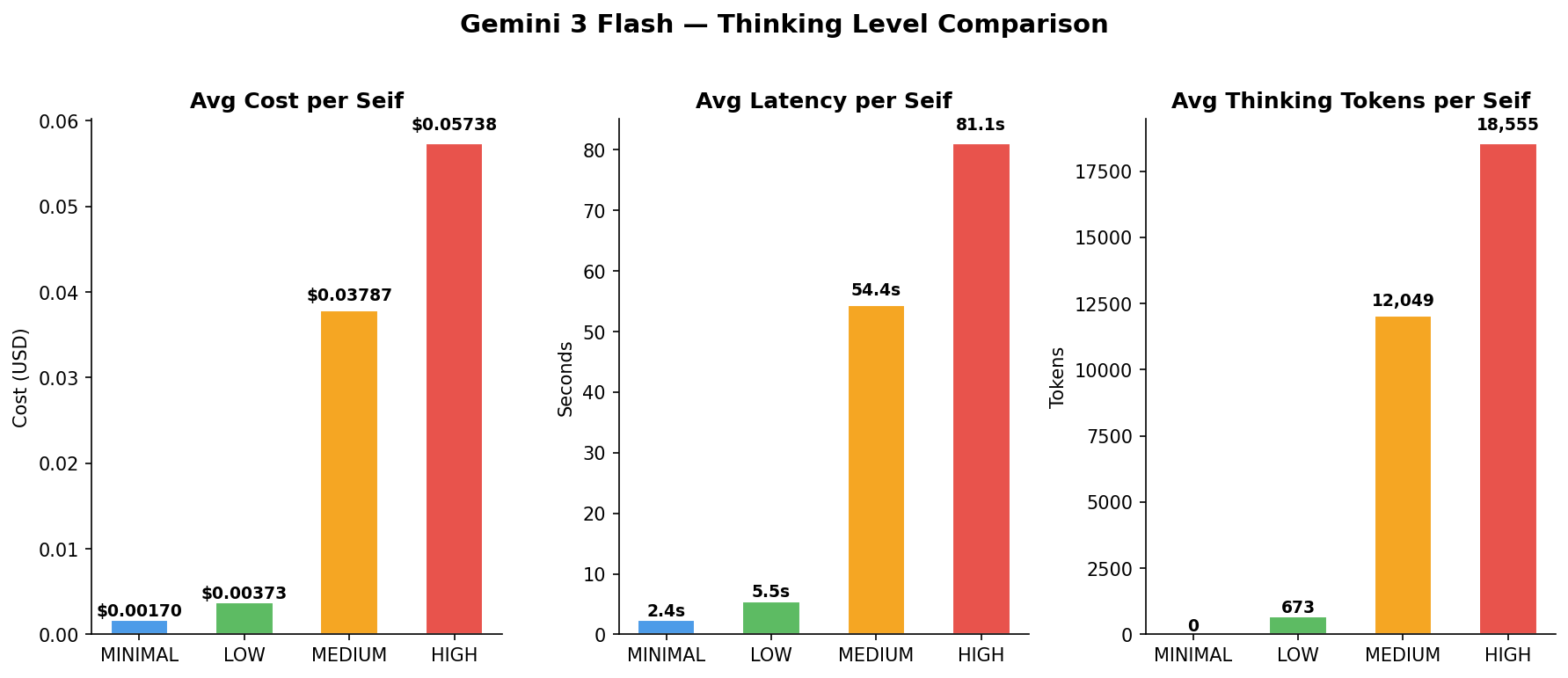
In order to understand which model thinking level is best for rabbinic translations, I chose 5 randomly selected seifim from each chelek, and had Gemini Flash translate them at the different thinking levels. Below are the results:
I found the MINIMAL setting to produce translations of roughly equivalent quality[7] compared to the higher thinking models. The additional expense of higher thinking did not seem to create significantly better translations. You can see from the graph that the cost for each seif at the HIGH thinking level is around 5 cents, about 33 times the MINIMAL thinking level[8]. This would represent a total cost of about $1300, as opposed to only $40 I spent using the MINIMAL setting[9]. Most of this cost is due to the significant amount of thinking tokens used by the high model. These results would also suggest that Gemini’s larger model, Gemini-Pro, would be overkill for the project. However, I did not formally test Gemini Pro, or any other model family[10].
Post-Processing Results
One thing I noticed was inconsistency of the word *seif* and the names of certain rabbinic works. Specifically, *seif* was sometimes kept in transliteration and sometimes translated as “section.” To address this, I applied a post-processing step using regular expressions to standardize these renderings: *seif* was normalized to “section” and *seif katan* to “subsection.” I applied the same approach to certain rabbinic names — for example, the *Shach* was sometimes transliterated as “Shakh” — normalizing these to a single canonical spelling throughout the corpus. For future translations, this should be fixed with better prompting.
Despite the fact that each seif is translated separately, my overall impression is that the translations were reasonably good and consistent.
Translation Quality
To more systematically validate the translation quality, I selected 100 random seifim and had a separate model evaluate the translations[11]; specifically, I used OpenAI’s GPT-5.4 model with a low reasoning effort. Each of the 100 seifim was passed to the model together with its original Hebrew, and the model was asked to classify the translation into one of four categories: Good, StyleImprovementNeeded, Mistake, or EgregiousError.
The egregious error category was defined strictly: a translation qualifies as egregious if it fundamentally inverts or distorts the author’s meaning — even if the error itself is subtle. To illustrate this, the following example was included in the evaluation prompt:
Original Hebrew
OC 635:5:
ובוודאי אין זה רק זהירות בעלמא, דאיזה פסול יש בעשיית הגג קודם הדפנות? דאין זה דמיון לחוטט בגדיש, שאין על זה שם גג כלל. אבל הכא גג גמור הוא.
Hypothetical mistranslation:
And certainly this is not only a mere stringency, for what disqualification is there in making the roof before the walls? For this is not comparable to hollowing out a haystack, where it does not have the status of a roof at all. But here, it is a complete roof.
The Aruch HaShulchan is in fact saying the opposite – the Rema’s statement is only a mere stringency. The mistranslation — inserting the words “not only” — is superficially consistent with the Hebrew, but is inconsistent with the actual context of the text and completely inverts the intended meaning.[12]
I had ran the analysis 3 times, and took a majority vote to determine the classification of the seif. If there was a 3 way-tie, the most serious category was taken. Here are the results:
Classification
Percentage
Good
29%
StyleImprovementNeeded
54%
Mistake
17%
EgregiousError
0%
You can see that the GPT model thinks that the translations overall need to be improved in style, and found 17% of the translations had a mistake. Importantly though, there were no egregious errors found.
Most of the mistakes were mistranslations of specific words/phrases or incorrect abbreviation expansions; some of the mistakes are a bit humorous. Here are a few examples:
[עח”ד סק”ה שכתב דדווקא ברואה מ”ת אמרינן כן משום די”ל שמש עכרן אבל בשלא מחמש (sic) תשמיש …]
Translation: [see Chavot Daat subsection 5 who wrote that specifically regarding one who sees from the Torah…]
However, מ”ת means “due to sexual intercourse”. The model seems to have incorrectly expanded this to “מן התורה׳”, despite that making no sense in context.[13]
כל צרכי ציבור שאינם יכולים להשוות עצמן מפני שינוי דיעות יש להושיב כל הבע”ב הנותנים מס ויקבלו עליהם ברכה שכל אחד יאמר דעתו לש”ש וילכו אחר רוב דיעות
Translation: Regarding all communal needs where they are unable to reach an agreement due to a difference of opinions, they should seat all the householders who pay tax and they shall accept upon themselves a blessing that each one will state his opinion for the sake of Heaven, and they shall follow the majority of opinions.
This is flagged as a mistake by GPT- “blessing” is not the right translation in this context; admonition or a similar word would be better.
Translation: And drinking a small amount of burnt wine – certainly stimulates.
“Burnt wine” is a clear mistake for distilled alcohol.
Here’s a few more examples that I found of clear mistakes or stylistic quirks:
In OC siman 475, seif 16, the abbreviation “עק”נ” is incorrectly rendered as “see Ketzot HaChoshen” — the correct translation should be “see Korban Netanel”.
In YD siman 19, seif 6, the word “poskekim” appears twice — a word that does not exist in Hebrew or in standard transliteration. It appears to be a model-generated corruption of poskim (the standard plural of posek, a halachic decisor). The model occasionally makes up this word a few times in its translation.
In EH, Siman 1 seif 2, האשה אינה מצווה על פריה ורביה is translated as “The woman is not commanded regarding pruz u-revu”. This should be “The woman is not commanded regarding pru-urevu” or even better would be “Women are not commanded in pru-urevu”.
CM 24:1 “רבותינו ז”ל אמרו [רפ”ה לב”ק] שאין נזקקין אלא לתובע תחלה “ “Our sages, of blessed memory, said [at the beginning of the eighth chapter of Bava Kamma]”. This should be “At the beginning of the fifth chapter”
My overall conclusion is that the translation overall avoided serious errors, but that it does occasionally mistranslate more complex words or phrases, and will sometimes incorrectly expand abbreviations. The model is also no Shakespeare in terms of prose, and is sometimes stylistically awkward. Still, it is mostly correct and I think it is a useful resource. Not bad for $40.73.
Conclusion and Lessons for Future Translations
Based on my experience on using AI to translate the Aruch HaShulchan, I offer the following recommendations for those undertaking similar large-scale AI translation projects in rabbinic or other specialized religious and legal literature.
Invest in the system prompt. The single highest-leverage action is writing a strong system prompt. The prompt should do two distinct things: (1) establish the content guidance — what the model is translating, from what tradition, at what level of expertise; and (2) establish stylistic guidance — how specific terms, titles, phrases, and citation styles should be rendered, consistently and unambiguously. The prompt I used included a style guide with explicit rules for rabbinic titles, standard formulaic phrases, and transliteration conventions.
Few-shot examples are highly effective. I found that including two or three worked examples in the prompt — a Hebrew passage followed by its correct English rendering — substantially improved consistency and register. The model learns from examples what it cannot fully internalize from rules alone, particularly for the tone and sentence structure expected in halachic prose. In the prompt I used, the few shots were not even entire seifim and were actually quasi-synthetic quotes; they were meant simply to show the style of source and target text.
Smaller, lightweight models are sufficient. There is no need to use the largest or most expensive models for this class of task. LLMs have essentially solved the problem of rabbinic Hebrew translation at the level of legal accuracy. Gemini 3 Flash at MINIMAL thinking — the smallest and cheapest configuration I tested — produced translations that were as good as those produced by higher thinking levels at 33 times the cost. The marginal quality improvement from more compute is real but small; the marginal cost increase is enormous.[14]
Prompt Iteration is essential. It took a few tries to get the model to translate in the way I wanted, and running the model on a few seifim, looking at the translation, and adjusting the prompt was very helpful. This was especially helpful for certain expressions I wanted translated consistently.
Context improves consistency, but potentially at significant cost. The primary weakness of this pipeline is that each seif is translated in complete isolation: the model has no memory of the spelling choices, transliteration decisions, or citation delimiter styles it used in prior seifim. Including previous seifim as context — either by passing the already-translated text of the current siman, or through a more dynamic agent-based RAG system — would improve within-siman consistency meaningfully. However, because halachic terminology and cross-references can reach back not just to the previous seif but to earlier simanim and even different sections of the work, the amount of context needed to capture these dependencies could quickly become expensive. For a first-pass translation, I found the isolated-call approach worked remarkably well. For a definitive scholarly edition, context-aware translation is the clear next step.
Conclusion
Translating the complete Aruch HaShulchan — approximately 24,000 seifim across four major sections — is technically feasible, inexpensive ($40.73), and fast (taking a few days on my personal Mac) using current AI technology. The resulting translation is of high quality for a working text, albeit with clear and addressable weaknesses that can be addressed in future iterations of the translation. The full translation is freely available at aruch-hashulchan-transla-53666.web.app.
Appendix A: Example Gemini translations at different thinking levels
# Orach Chaim 475:16 — Thinking Level Comparison
## Hebrew Source
וכתב רבינו הבית יוסף בסעיף ד: אכל מצה בלא כוונה, כגון שאנסוהו אנסים או לסטים לאכול – יצא ידי חובתו, כיון שהוא יודע שהלילה פסח, ושהוא חייב באכילת מצה. אבל אם היה סבור שהוא חול, או שאין זה מצה – לא יצא. עד כאן לשונו. סברא זו כתב כדי לתרץ דברי הרמב”ם, שכאן פסק דיצא ובפרק שני משופר פסק דבלא מתכוין – לא יצא, לחלק בין אכילה לשאר דבר. ומיהו גם באכילה, אם לא ידע שפסח היום או שזהו מצה – וודאי לא יצא, דמצות צריכות כוונה. ובאכילה כשידע, אף שנעשה באונס – הוה ככוונה. וסברא זו הוזכרה בתוספות פסחים (קטו א). אבל מדברי הרא”ש שם, והטור בכאן, לא משמע כן, עיין שם. (עק”נ שם אות ק’, שהאריך בזה.)
—
## Minimal Thinking
Our teacher, the Beit Yosef, wrote in section 4: If one ate matzah without intent, for example, if oppressors or bandits forced him to eat—he has fulfilled his obligation, since he knows that the night is Pesach and that he is obligated in the eating of matzah. But if he thought it was a weekday, or that this is not matzah—he has not fulfilled it. Thus far his words. He wrote this reasoning in order to reconcile the words of the Rambam, who ruled here that he has fulfilled it, yet in the second chapter of Shofar ruled that without intent—one has not fulfilled it, to distinguish between eating and other matters. However, even regarding eating, if he did not know that today is Pesach or that this is matzah—he certainly has not fulfilled it, for mitzvot require intent. And regarding eating, when he knew, even though it was done under duress—it is like intent. This reasoning was mentioned in the Tosafot in Pesachim (115a). But from the words of the Rosh there, and the Tur here, it does not appear so, see there. (See Ketzot HaChoshen there, letter 100, who elaborated on this.)
—
## Low Thinking
And our teacher, the Beit Yosef, wrote in section 4: If one ate matzah without intent, such as if oppressors or bandits coerced him to eat—he has fulfilled his obligation, since he knows that tonight is Pesach, and that he is obligated in the eating of matzah. But if he thought it was a weekday, or that this is not matzah—he has not fulfilled [his obligation]. Thus far his words. He wrote this reasoning in order to reconcile the words of the Rambam, for here he ruled that he has fulfilled [his obligation], and in the second chapter of Shofar he ruled that without intent—he has not fulfilled [it], to distinguish between eating and other things. However, even regarding eating, if he did not know that today is Pesach or that this is matzah—certainly he has not fulfilled [it], for mitzvot require intent. And regarding eating, when he knew, even though it was done under duress—it is like intent. And this reasoning was mentioned in Tosafot Pesachim (115a). But from the words of the Rosh there, and the Tur here, it does not appear so; see there. (See Korban Netanel there, letter 100, who elaborated on this.)
—
## Medium Thinking
Our teacher, the Beit Yosef, wrote in section 4: If one ate matzah without kavanah, such as if coercers or bandits forced him to eat—he has fulfilled his obligation, since he knows that tonight is Pesach and that he is obligated in the eating of matzah. But if he thought it was chol, or that this was not matzah—he has not fulfilled his obligation. Thus far his words. He wrote this reasoning in order to reconcile the words of the Rambam, for here he ruled that he has fulfilled his obligation, and in the second chapter of Shofar he ruled that without kavanah—he has not fulfilled his obligation, to distinguish between eating and other things. However, even regarding eating, if he did not know that today is Pesach or that this is matzah—certainly he has not fulfilled his obligation, for mitzvot require kavanah. And regarding eating, when he knew, even though it was done under coercion—it is like kavanah. And this reasoning was mentioned in Tosafot Pesachim (115a). But from the words of the Rosh, ibid., and the Tur here, it does not appear so; see there. (See Korban Netanel, ibid., letter 100, who elaborated on this.)
—
## High Thinking
And our teacher, the Beit Yosef, wrote in seif 4: If one ate matzah without intent, for example, if oppressors or bandits forced him to eat—he has fulfilled his obligation, since he knows that tonight is Pesach and that he is obligated in the eating of matzah. But if he thought it was a weekday, or that this is not matzah—he has not fulfilled. Thus far his words. He wrote this reasoning in order to reconcile the words of the Rambam, for here he ruled that he has fulfilled, and in the second chapter of Shofar he ruled that without intent—he has not fulfilled, to distinguish between eating and other matters. However, even regarding eating, if he did not know that today is Pesach or that this is matzah—certainly he has not fulfilled, for mitzvot require intent. And regarding eating, when he knows, even though it was done under duress—it is like intent. And this reasoning was mentioned in Tosafot Pesachim (115a). But from the words of the Rosh ibid., and the Tur here, it does not appear so; see there. (See Korban Netanel ibid., letter 100, who elaborated on this.)
These translations are substantially the same, but have a few differences:
The minimal thinking omits the initial “and”, which is technically an error but does not impact the meaning. The most glaring error is that the minimal translation expands עק”נ as Ketzot HaChoshen there, whereas the more advanced models correctly expand this to Korban Netanel.
Appendix B: Some Sample Translations
# Aruch HaShulchan — Translation Samples
## OC 67:2 — Doubt about Keriat Shema
**Hebrew**
ופשוט הוא דמיירי שיש כאן ספק על הכל: על הקריאת שמע ועל הברכות. אבל אם הספק הוא רק על קריאת שמע, והברכות וודאי קרא – פשיטא שאומר הקריאת שמע ולא הברכות, דהברכות אינם שייכים לקריאת שמע כמו שכתבתי בסימן נ”ט. אך דיש לומר דאם פשיטא ליה דאמר “אמת ויציב” – גם קריאת שמע אינו חוזר וקורא, דוודאי קרא גם קריאת שמע דסירכיה נקיט ואתי. כמו שכתבתי בסימן ס”ד, דכשפתח “למען ירבו” אמרינן דוודאי אמר “והיה אם שמע” דסרכיה נקיט, עיין שם. והכא נמי כן הוא. ואם ברי לו שברכות שלפני קריאת שמע אמר, והספק הוא מקריאת שמע והברכות שלאחריהן – קורא קריאת שמע והברכות שלאחריהן.
**Translation**
And it is simple that this refers to a case where there is a doubt regarding everything: regarding the Keriat Shema and regarding the blessings. But if the doubt is only regarding the Keriat Shema, and the blessings he certainly recited—it is simple that he recites the Keriat Shema and not the blessings, for the blessings are not connected to the Keriat Shema, as I wrote in siman 59. However, one could say that if it is certain to him that he recited “Emet VeYatziv”—he also does not return and recite Keriat Shema, for he certainly also recited Keriat Shema, as he follows his habit. As I wrote in siman 64, that when he began “Lema’an Yirbu” we say that he certainly recited “VeHayah Im Shamoa” because he follows his habit, see there. And here too it is so. And if it is clear to him that he recited the blessings before Keriat Shema, and the doubt is regarding the Keriat Shema and the blessings after them—he recites Keriat Shema and the blessings after them.
<## OC 292:1 — Mincha on Shabbat: Ashrei and Va’ani Tefilati **Hebrew**
אומרים ‘אשרי’ ‘ובא לציון’, דבכל יום אומרים אותו בשחרית, ובשבת שבלאו הכי יש אריכות בשחרית – הניחוהו למנחה. ואומרים חצי קדיש. ואחר כך אומרים פסוק ‘ואני תפלתי’, על פי המדרש שמקודם כתיב: ‘ישיחו בי יושבי שער ונגינות שותי שכר’, אמר דוד לפני הקב”ה: אף על פי ששתינו – ואני תפלתי לך ד’. כלומר דשארי בני אדם שותים ומשתכרים ועוסקים בהוללות, ואני כשאשתה – עוסק אני אחר כך בתורה ותפ(י)לה. ולכן ביום טוב דליכא קריאת התורה – אין אומרים אותו, ועוד דעת רצון הוא רק בשבת במנחה, ונקרא בזוהר (שמות דף פ”ח:) ‘רעוא דרעוין’, וזהו רק בשבת כידוע. ולכן בשבת אף כשמתפלל ביחידות או במקום שאין ספר תורה – מכל מקום אומרים אותו (עיין מג”א סק”א), וכן הוא בזוהר תרומה.
**Translation**
We say ‘Ashrei’ and ‘Uva LeTziyon’, for on every day we say them in Shacharit, and on Shabbat, since in any case there is length in Shacharit—they left it for Mincha. And we say a half Kaddish. And afterwards we say the verse ‘Va’ani Tefilati’, based on the Midrash that previously it is written: ‘Those who sit in the gate talk about me, and I am the song of drunkards,’ David said before the Holy One, Blessed be He: Even though we have drunk—’as for me, may my prayer be unto You, Hashem.’ That is to say, that other people drink and become intoxicated and engage in revelry, but I, when I drink—I engage afterwards in Torah and prayer. Therefore, on Yom Tov, when there is no reading of the Torah—we do not say it; and furthermore, the time of favor is only on Shabbat at Mincha, and it is called in the Zohar (Shemot page 88b) ‘the favor of favors’, and this is only on Shabbat as is known. Therefore, on Shabbat, even when one prays in private or in a place where there is no Sefer Torah—nevertheless we say it (see Magen Avraham subsection 1), and so it is in Zohar Terumah.
—
## OC 615:1 — Marital Relations on Yom Kippur
**Hebrew**
יום הכיפורים אסור בתשמיש המטה, וגם זה בכלל “ועניתם”, דמניעת תשמיש מקרי “עינוי”. ובגמרא (עז ב) יליף זה מקרא, עיין שם. ואפילו במקום שאין טובלין לקרי – אסור התשמיש (טור), כלומר: דלא תימא דהאיסור הוא משום הטבילה שאחר כך, מפני איסור רחיצה, אלא התשמיש עצמו אסור. ולכן יתרחק אדם מאשתו כל יום זה כמנידה. והיינו: שלא יישן עמה במיטה אחת, ולא יגע בה בלילה. אבל ביום אין חשש כמובן (ט”ז). ויש שאוסר גם ביום (מגן אברהם), וכמדומה שאין המנהג כן. ולא ירבה לדבר עמה (שם).
**Translation**
Yom Kippur is forbidden for tashmish hamitah, and this too is included in “and you shall afflict yourselves,” for the withholding of tashmish is called “affliction.” And in the Gemara (77b) this is derived from a verse, see there. And even in a place where they do not immerse for keri—tashmish is forbidden (Tur), that is to say: so that you should not say that the prohibition is because of the immersion that follows, due to the prohibition of washing, but rather the tashmish itself is forbidden. Therefore, a man should distance himself from his wife all this day as if she were a niddah. And that is: that he should not sleep with her in one bed, and he should not touch her at night. But during the day there is no concern, of course (Taz). And there is one who forbids even during the day (Magen Avraham), and it seems that the custom is not so. And he should not speak extensively with her (ibid.).
—
## YD 38:13 — The Appearance of a Lung
**Hebrew**
ולפע”ד היה נראה להשוות הדיעות במקצת דבאמת אמראה בשר קשה מאד הרי זו אדום ולכן כתב אחד מהגדולים שצריך להבחין באדמימות אם אינה נוטה למראה בשר [שמ”ח סעי’ ד’] אבל מי הוא האיש החכם ויבן את זאת ולכן נראה דזה שכתבו כמראה בשר לאו משום המראה של אדמימות אלא גם על המראה העצמיות שלה דידוע דריאה היא חלקה מאד ולהיפך מזה הבשר אינו חלק כלל שהרי נמשכת לחוטים דקים ולכן אם הרואה לעינים לא יאמר עליה שזו היא ריאה אלא בשר היא טרפה ואם יאמר הרואה שזהו כבד כשרה וה”ה אם יאמר עליה שזהו טחול ג”כ כשר ולפ”ז זה שאמרו כמראה בשר טרפה לאו משום המראה אדמומית אלא משום מראה העצם שגשמיותה נראית כבשר [ומתורץ בזה קושית המאור למה לא אמר הש”ס כעין בישרא ע”ש]:
**Translation**
In my humble opinion, it would seem possible to reconcile the opinions somewhat, for indeed, regarding the appearance of meat, it is very difficult, as this is red. Therefore, one of the great authorities wrote that one must discern in the redness if it does not lean toward the appearance of meat [Siman 38, section 4]. But who is the wise man who can understand this? Therefore, it seems that what they wrote, “like the appearance of meat,” is not because of the appearance of redness, but also regarding its essential appearance. For it is known that a lung is very smooth, and conversely, meat is not smooth at all, as it is drawn into thin fibers. Therefore, if the observer would not say of it that this is a lung, but rather that it is meat, it is terefah. But if the observer would say that this is liver, it is kosher; and the same law applies if he would say of it that this is a spleen, it is also kosher. According to this, that which they said, “like the appearance of meat is terefah,” is not because of the appearance of redness, but because of the appearance of the substance, that its physical essence appears like meat [and with this, the difficulty of the Maor is resolved as to why the Shas did not say “like meat,” see there].
—
## CM 378:13 — Both Parties With or Without Permission
**Hebrew**
ומה נקרא שניהם ברשות כגון חצר השותפים או שנתן הבעה”ב רשות לשניהם ליכנס לחצרו או שהניזק נתן רשות למזיק ליכנס לחצרו או המזיק לניזק וכן כששניהם הלכו ברה”ר או בסימטא מקרי שניהם ברשות דהלא לשניהם יש רשות להלוך אבל כשרצים ברה”ר ובסימטא מקרי שניהם שלא ברשות דאין רשות לאדם לרוץ במקום הילוך רבים ושלא במקום הילוך רבים כמו בשדה ובקעה מקרי ברשות גם כשרצים [נ”ל] וכן בחצר שאינו של שניהם ובעל החצר לא נתן להם רשות מקרי שלא ברשות אבל כשלאחד נתן רשות ולא להשני הוי לזה שנתן רשות כחצרו:
**Translation**
And what is called “both are with permission”? For example, a partners’ courtyard, or where the homeowner gave permission to both of them to enter his courtyard, or where the injured party gave permission to the damager to enter his courtyard, or the damager to the injured party. And similarly, when both were walking in a public domain or in a side-alley, it is called “both are with permission,” for behold, both have permission to walk. But when they are running in a public domain or in a side-alley, it is called “both are without permission,” for a person does not have permission to run in a place where many walk. And in a place that is not a place where many walk, such as in a field or a valley, it is called “with permission” even when they run [it appears to me]. And similarly, in a courtyard that does not belong to both of them and the owner of the courtyard did not give them permission, it is called “without permission.” But when he gave permission to one and not to the other, it is for the one to whom he gave permission like his own courtyard.
Special thanks to Emory University’s Law and Religion Center, which funded the model calls for this project. I want to thank my father, Rabbi Michael Broyde, for his thoughts on this piece and general helpful discussions when engaging in this project. His work on the Aruch Hashulchan is what inspired this project in the first place. I thank him also for all the Torah he has taught me and continues to teach me. Thank you also to Sefaria for publishing the original Hebrew text. ↑
My father, Rabbi Michael Broyde, undertook a scholarly translation of the Hilchos Shabbos chapters of the *Aruch HaShulchan* (*Orach Chaim* 242–292, see here). Aryeh Press is separately producing AI-assisted translations of the Aruch HaShulchan that integrates commentary from the Mishneh Brurah and the Shulchan Aruch HaRav — a more ambitious and editorially intensive project targeting the same text. ↑
For Yoreh Deah, I had to combine two different files from Sefaria: Arukh HaShulchan – he – Arukh HaShulchan, Yoreh De’ah — Wikisource.json and Arukh HaShulchan – he – Aruch HaShulchan, Vilna 1923-29.json ↑
Previously, in September 2024, I used GPT-4o to translate the Aruch HaShulchan, covering Orach Chaim, Yoreh De’ah, and Even HaEzer. You can find that older translation here. I found that it also produced translations of good quality. I have since updated the translation using Gemini 3 Flash, and extended coverage to all four sections of the Shulchan Aruch. ↑
All translation pipeline code — including the API client, the translation script, the thinking-level experiment, the post-processing normalization pass, and the code powering the website — was written with Claude Code (Anthropic’s AI coding assistant). Claude Code also assisted with some qualitative analysis of the translations and assisted drafting this article. ↑
You can find the code for creating the translation, including prompts for the model, here. All model API calls had a temperature of .4. ↑
See appendix for an example. You can see the full results of the experiment here. ↑
In the translation, I found that the MINIMAL setting never did any thinking. However, this is not guaranteed, and the minimal thinking setting sometimes can engage in thinking. ↑
Even this higher rate remains significantly lower than professional human translation, which typically ranges from $0.05 to $0.20 per word. Even at the lower estimate of $0.05 per word, a professional translation of the Aruch HaShulchan would cost approximately $170,000, making the AI-driven alternative a fraction of the market rate. ↑
That being said, my impression with informally testing with Anthropic’s Claude model and OpenAI’s ChatGPT are that they generated similarly reasonable translations. As I stated above, even the older GPT4o model did a solid job of translating sections of the Aruch Hashulchan. ↑
I chose a totally different model to avoid any potential bias of Gemini both creating the translations and also evaluating. However, in principle, LLMs of the same family can be used to evaluate their own responses. ↑
The actual Gemini generated translation correctly translates this phrase as “And certainly this is only a mere stringency”. I want to thank Claude Code for accidentally surfacing this nice example. Claude Code originally flagged this correct translation as being incorrect and I had to fight with it to persuade it that in fact the original translation was correct(!) ↑
My impression is that about a third or a half of all mistakes are incorrectly expanded abbreviations. ↑
For true publication quality translations, I think more work needs to be done to test whether smaller models can be used, especially if those translations will incorporate auto-generated commentaries and cross-references. ↑
תיובתות דחפץ חיים תיובתות – עלומות בשולי ההדפסה הראשונה של המשנה ברורה חלק א
תיובתות דחפץ חיים תיובתות – עלומות בשולי ההדפסה הראשונה של המשנה ברורה חלק א
מנשה קפלן, רחובות
Copies of the 1884 of the Mishnah Berurah first printing aren’t identical. Working from several surviving exemplars, Menashe Caplan documents the variants: Rav Chaim Elazar Wacks’s haskama appears in some copies but not others; the last line of the introduction comes in three versions (blank, a halakhic gloss, or thanks to three specific donors); a printing warning appears sporadically; three different subscriber lists circulate in different combinations. Nothing is accidental. The Chafetz Chaim sat in the Warsaw press daily for months, and had to personally orchestrate which bundle of haskamot, acknowledgments, and subscriber lists went to which community.
Along the way Caplan raises questions the Chafetz Chaim never addressed: why isn’t financing print runs listed among forms of Torah support in Shem Olam? Why is ribbit devarim absent from Ahavat Chessed? Which edition of the Shulchan Arukh did he copy the base text from? Each puzzle gets the Talmudic refrain teyuvta de-Chafetz Chaim teyuvta — an unanswered challenge.
The piece is dedicated to Rabbi Eitam Henkin הי”ד, (see here and here) who was planning to write a doctorate about the Chafetz Chaim (see here), and would have probably addressed these questions. R’ Eitam HYD was cruelly murdered with his wife Na’ama on the third day of Chol Ha-Mo’ed Sukkos (1 October 2015).
לזכר הרב איתם הנקין הי”ד. חסרונו חי עימנו. אנקדוטות דפוס, ומסביבן, שבאופן טבעי, אותו היינו משתפים, עימו היינו מתייעצים, וממנו היינו לומדים. “ספר משנה ברורה – תהליכי כתיבתו, הדפסתו והפצתו” היה פרק מתוכנן בהצעת הדוקטורט שהרב איתם תכנן לכתוב על הח”ח ואין שום ספק, שכדרכו, היה נכנס לפרטים ולפרטי הפרטים. חבל על דאבדין. המקום ימהר עמידתו בקרוב, יחד עם כל נשמות חללי הטרור האזרחים, חללי צה”ל ומערכות הבטחון – ההרוגים על, ובשביל, עם ישראל ומלכות ישראל – המעלים את חימת המקום, במחיצת פפוס ולולינוס. הרחמן יקום נקמת דמיהם בקרוב.
את ספר משנה ברורה, והמקום המרכזי שתפש ותופש בחיי היהודים שומרי תורה ומצוות אין צריך להציג. מהדורות המשנה ברורה נסקרו היטב ע”י גב’ ברמה (ראו בהמשך) אך עדיין יש פרטים ביבליוגרפים הטעונים בירור ורישום (ולהעיר, אף מקור נוסח המחבר והרמ”א שבספר מ”ב טעון בירור, וכן כמה הערות מתודה1 ).
למען ירוץ בו הקורא נא ראו ראשי תיבות עותקי המ”ב המוזכרים במאמר2.
בתשמ”ד יצא ספרון: כתבי “החפץ חיים”: הרב ישראל מאיר הכהן מראדין: רשימה ביבליוגרפית, הרב משה גליס ואביעד הכהן, בצירוף תעודות ומסמכים לתולדות “החפץ חיים” (המשנה ברורה בעמ’ 76) – אך הוא קצר, ואין בו תיאורים או הערות.
בעבודת המ”א החשובה של גב’ מרב ברמה3: לדרכו של ה”חפץ חיים” בספר “משנה ברורה”, עבודת גמר (מ”א) – אוניברסיטת בר אילן, תשס”ח 2008 – המחברת רשמה, בנספח ו’ (עמ’ 119 ואילך) את מהדורות המשנה ברורה, באופן די מפורט, והוסיפה הערות כהנה וכהנה. הרשימה כוללת את המהדורות הרגילות (מה שקרוי הסטריאוטיפיות) שהן הקשות לרישום. המחברת לא נכנסה לפרטי ההדפסה של חלק א’ – נשוא רשימתנו.
המחברת מציינת (עמ’ 122, הערות למהדורות השונות, הערה 1) שההדפסה הראשונה נדירה ביותר, ומן הסתם, ההדפסה הראשונה אינה מצויה, נכון לאז. אך משנת 2008 נוסף מקור לא אכזב בדמות המכירות האינטרנטיות הפומביות, בעיקר באתר בידספיריט. בציון המהדורות הסטריאוטופיות נפלו שגיאות רישום, כפי שהמחברת ציינה, בצדק, שם בהערה, וגם בבידספיריט יש מוכרים ששוגים ברישום. להלן, בעזרת מפעל הביבליוגרפיה של הספריה הלאומית, יובהר מהי ההדפסה הראשונה ומה סימניה, ובעז”ה נעמוד על וואריאנטים נוספים.
עיקר עבודתה החשובה של הגב’ ברמה עוסקת במתודיקה של החפץ חיים בחיבורו המשנה ברורה, ולא בהיבטים – הצדדיים לתוכן החיבור – שאנחנו מעלים כאן. אגב אורחא, ובשולי עבודתה, בעמ’ 15, המחברת התייחסה להיעדר הסכמת ר’ ישראל סלנטר לספר חפץ חיים, והיא משערת, שההסכמה ניתנה – למרות הסתייגות הרב סלנטר ממתן הסכמות – אך בשל ריבוי שבחי הח”ח, הח”ח הוא זה שנמנע מלהדפיסה (ראה המקור לזה שם בהערה 43). המעיין בהסכמות הקיימות במ”ב יראה די שבחים. סיבה אחרת, ומרתקת, שההסכמה כלל לא ניתנה, הביא הרב אהרן סולוביציק, מהרב הוטנר (פרח מטה אהרן, ספר המדע, תשנ”ז, עמ’ 88, ועמ’ 187)4.
מכיוון שמן השמיים זימנו לנו עותק מההדפסה הראשונה של המשנה ברורה חלק א’ (אמנם לא עותק יפה – תן עיניך למהדורה), וחלק ב’ הראשון שיצא, הלכות שבת (ראו בהמשך), הזדמן לנו לבחון מקרוב, ומשם רשימתנו צמחה. כמעט שלא מדובר על התוכן ההלכתי של החיבור עצמו, אלא על עניינים בדפים שלפני גוף החלק ההלכתי שבספר, ולאחריו, שאף בהם, הלכה, הנהגה, ותלמוד מעורבבים.
מלבד גאונותו ומידותיו, החפץ חיים היה אינדיבידואליסט ו”קנאי” של ממש בכל הנוגע להכנת ספריו לדפוס, מכירתם והפצתם. הערותינו הביו-ביבליוגרפיות נוגעות, איפוא, בו, ובאישיותו הגדולה.
ולהערה שמקומה כאן: בתחילת הדרך כשכבר ידעתי לאן פניי מועדות, החלפתי דברים עם ביבליוגרף מוערך מאוד. הוא העירני שחלק מהשאלות שלי על הח”ח מוגזמות וכי אני מדייק בו, ומפלפל בו, בהגזמה רבתי – משל היה הלכה סתומה ברמב”ם – הרי מדובר בסך הכל בהליכי הדפסה, ובחלק מהמקרים, פכים קטנים, ושוליים, וזה “לא כ”כ מקצועי”. הביקורת במקומה, ממקומה. האומנם שאני הקטן, בע”ב פשוט – איני מסכים לה. הח”ח היה דייקן בכל דבר שכתב ועשה, כתפיים רחבות לו להכרעות פסיקה, קפדן גדול בכל הליכותיו, קפדן טקסטים, קפדן בפרטים, שישב פיזית בבית הדפוס, מדי יום, זמן ממושך, על חשבון לימודיו הקבועים. כל זיז ורז דפוס לא אניס ליה, והיה איכפת לו. איש גדול, שאופיו אופי פרטים – גם בפרטים קטנים וגם בפרטים “קטנים”, וזה חותמו. ברור לנו לגמרי שהח”ח חשב על הכל. אין כאן “פרומקייט”, ואף לא “האדרה” מלאכותית. כי זה האיש הגדול הזה, וזה אופיו. הקורא החושש שהמאמר יעסוק במופלג, שולי ומוגזם, יוכל לפרוש עכשיו.
יובל מאה וחמישים שנה להתחלת הדפסת המשנה ברורה יארע בעז”ה בעוד שנים ספורות (תשצ”ג-ד, 2033-4). היובל צפוי לעורר הד גדול בעולם היהודי, למשוך תשומת לב מכל גווני העולם היהודי, בכתב ובע”פ. כולם יכנסו לטרקלין ההשפעה העצומה של החיבור, ולשיטת עבודתו. רשימתנו אינה אלא סנונית קטנה ב”עטיפה” וב”פרוזדור” של החיבור. משגיאות ושגגות נקני.
סימני ההדפסה ראשונה
נקודת התחלה ראויה, תהיה במפעל הביבליוגרפי של הספריה הלאומית, על מנת לדעת שהיו שתי הדפסות של המשנה ברורה חלק א באותה שנה לועזית – 1884. באשר להדפסה הראשונה נרשם כך:
המדפיסים שבלועזית – במקור באותיות קיריליות.
5 הסכמות5: ר’ יצחק אלחנן [ספקטור], קאוונא, כב שבט תרמ”ד, ר’ מרדכי קלאצקי לידא, רבני ווילנא: ר’ יוסף ב”ר רפאל [סאקוביץ] ור’ שלמה בר”י [ב”ר ישראל] משה הכהן, יב ניסן תרמ”ג , ר’ בן ציון ב”ר אריה ליב [שטרנפלד], קאלוואריע, כ סיון תר”ם, ו- ר’ שמואל זנוויל במוהרי”ז [יעקב זאב קלפפיש], ווארשא, כא אדר א תרמ”ג
משה מאיר ישר בספרו “החפץ חיים, חייו ופועלו”, כרך א, בני ברק תשנ”ז, עמ’ 222, כותב: ’בקיץ של שנת תרמ”ג הופיע הראשון לששת חלקי ה”משנהברורה“’. אך בנו של המחבר, ר’ אריה ליב פופקא, כותב “בשנת תרמ”ד הדפיס אבי את חיבורו משנהברורה ח”א” (מכתבי הרב חפץ חיים, וורשה תרצ”ז, עמ’ 30(
1 דף בסוף: “שמות החתומים”
שער משנה ברורה חלק א’ מהדורה ראשונה הדפסה ראשונה– עותק מ”קהדפסה ראשונה עמודים 2-3 – אישור הצנזור 23 לדצמבר 1882הדפסה ראשונה עמודים 4-5.הדפסה ראשונה, עמ’ 6, העמוד השני של ההקדמה, בתחתית, ההודאה לתורמים – עותק מ”קהדפסה ראשונה העמוד השני של ההקדמה, בתחתית, הערה הלכתית – עותק ס”ל
ובאשר להדפסה השניה נרשם כך:
בשער: 1884. הפרט משנת תרמ”ג. מעבר לשער צנזורה מתאריך 1 למאי 1884 וכן שם הספר, שמו של המחבר ברוסית, ושוב התאריך 1884.
לעומת הוצאת 1884 המקורית, יש כאן השינויים הבאים: אין כאן שמו של המדפיס, לא בשער ולא מעבר לשער; תאריך רשיון הצנזורה שונה; בהוצאה המקורית אין שם הספר והמחבר ברוסית, ועוד. כמו כן נשמט כאן הדף האחרון עם רשימת החותמים. בשולי העמוד האחרון נוספה אזהרה מאת המחבר שלא להדפיס הספר ללא רשותו.
בעמ’ 192 יש שינויים בתוכן (ב”ביאור הלכה”): נוספה הערת-כוכב בשולי העמוד; באמצע דבור-המתחיל ’יצא’, במקום “בלבדו שלא הוציא בשפתיו”, תוקן ונדפס : “בלבו שלא השמיע לאזנו משמע”. [להעיר שבטופס ההדפסה הראשונה שתח”י כתוב “בלבו שלא הוציא בשפתיו”, לא “בלבדו” – שמא זו ט”ד של המפעל?]
עם הסכמות ר’ יצחק אלחנן ספקטור, ר’ מרדכי קלאצקי, ר’ יוסף סאקוביץ, ר’ שלמה ב”ר ישראל משה הכהן, ר’ בן-ציון שטרנפלד ור’ שמואל זנוויל קלפפיש, מההוצאה הקודמת (אף היא משנת 1884).
הסכמת הרב וואקס אינה רשומה במפעל הביבליוגרפיה בשתי ההדפסות. בעותק ה”ב ההסכמה מופיעה. בעותק ההדפסה השניה של 1884 היא מופיעה בעותק לג/2 (מכירה 3.11.24 פריט 45). עכ”פ יש לנו כמה סימנים להדפסה הראשונה: תאריך הצנזור 23 לדצמבר 1882, שם המדפיס נמצא, והפרטים האחרים. כנראה שעורכי מפעל הביבליוגרפיה ראו רק דף חותמים אחד, בעותק שלפניהם, ולא ידעו שיש עוד שניים.
צילומי עותק ה”ב ביחס להסכמת הרב וואקס הבאנו בהערה 5. אמנם הוספה או גריעה של הסכמה היא שינוי, אך לא מסוג עלומות הדפוס שנצביע עליהם. זה לעיתים תלוי-מקום, או תלוי שוק, ודבר טבעי. לעניין אחד השינוי הזה מתווסף: הצורך לסדר ולנתב את העותקים לאנשים וקהילות, באופן שההסכמה “תתאים”, או היעדרה.
מעורבותו העמוקה של הח”ח בהדפסת ספריו
פרטים על מעורבותו של הח”ח, בהדפסת ספריו, מצויים בספר של בן הח”ח, הרב אריה ליב הכהן: תולדות וקורות חייו של החפץ חיים שיצא בשנת 1927 והדפסה חוזרת 1952. חזר ונדפס בראש ספרו האחר של הרב אריה: מכתבי הרב חפץ חיים זצ”ל, מהדורה שניה ניו יורק תשי”ג, אך המדפיס לא שמר על העימוד המקורי, צופף את הדפוס, ועימד מחדש. התיחסותנו תהיה, איפוא, למהדורה המקורית שנמצאת באתר היברובוקס.
ליקטנו כמה פרטים מתוך הספר – בסוגריים עגולות מספר העמוד, והערותינו בסוגריים מרובעות באותיות קטנות יותר. בסוף המאמר הבאנו נספח צילומי הדפים הרלבנטים.
הח”ח נסע בעצמו לגייס חותמים – פרענומערנטן – לספרו החפץ חיים (עמ’ י”א), [כנראה בשנת 1872 שכן הספר יצא בתרל”ג], הוא גייס כמה אלפי ! חותמים (י”ב), [בסוף הספר הדפיס 8 עמודים עם כ- 1,200 שמות], ובשנת תרל”ח הדפיס בווילנה 4,000 עותקים ונסע לחלק לחותמים (י”ב) [זו המהדורה השניה ולא ראינו שיש בה רשימות חותמים].
הנה הקישור למהדורת תרל”ג שבסופה נמצאים 8 עמודי הפרענומערנטן – עמ’ 161-168 לפי עמודי היברובוקס:
על המשנה ברורה הח”ח עבד 28 שנים (י”ז). בשנת תרמ”ד הדפיס חיבורו משנה ברורה חלק א’ (כט) [רישום האותיות בשער הוא תרמ”ג. יתכן שהשער הוכן עוד בתרמ”ג אך ההדפסה גלשה לתרמ”ד – עדיין 1983 – והלאה לשנת 1884 ככתוב בתחתית השער. האם יתכן שכתבו את השנה הלועזית מראש? באופן שהספר אכן יצא בקיץ תרמ”ג – 1883 – כפי שהרב ישר כתב בספרו: החפץ חיים חייו ופועלו, הוצאת נצח, תל אביב, תשי”ח – 1958, כרך ראשון, עמ’ ריד? וכמצוטט במפעל הביבליוגרפיה? איננו יודעים6].
בעת ההדפסה ישב בוורשה ונכנס יום יום לבית הדפוס להשגיח שלא יצא קלקול, לא בטח בשום אדם, ביטל בשביל זה כמה חודשים מלימודיו התמידיים, וכך נהג בכל חלק וחלק בעת הדפסתו (ל).
מקום תפילתו בורשה היה בבית המדרש של הליטאים שעזרו לו בקיבוץ הפרענומערנטן (ל), ונקבצו חתימות הרבה והדפיסם בדפים האחרונים בספרו (לא) [“דפים” גרסינן ולא דף אחד. הגבירים שעזרו לח”ח באופן מיוחד אינם מוזכרים אצל הרב אריה. לכאורה, נעדר אצלו פרט משמעותי, שמא לא מקרי, כי ההודאה לתורמים הללו אינה מופיעה בכל ספרי המהדורה, ועל כך בהמשך דברינו].
אחרי צאת ספר משנה ברורה, הח”ח חילק למנויים בוורשה, ונסיעותיו הראשונות היו למעזריץ ולובלין. נסיעותיו עם ספריו היו כמעט רק בפלכי ליטא. לפלכי פולין הרחוקים שרוב הקהילות חסידים לא נסע מעולם עם ספריו (ל”ג) [“מעולם” ! זו קביעה קטגורית די מפתיעה ומעוררת השתאות. וכי למה לא? הלוא גם חסידים רכשו ולמדו את המ”ב. מ- 1883 ועד 1933, שנת פטירת הח”ח, יחלפו חמישים שנה, וכי לא נסע עם ספריו ל”כרכי פולין הרחוקים” בכל חמישים השנים הללו? טעון בדיקה]
החלק הבא של משנה ברורה דילג להלכות שבת, מפני שראה דחיפות לעורר את הדור על השבת, ורק לאחר הדפסת הלכות שבת התפנה לחזור להלכות נ”כ וברכות הנהנין, לפיכך נדפס על השער של הלכות שבת, בהדפסה הראשונה, “חלק שני”, אם כי כבר בהדפסה הבאה, ועד היום, הוא חלק ג’ (ל”ח). כותרת “חלק שני” היא איפוא סימנה המובהק של ההדפסה הראשונה של הלכות שבת.
מהדורה ראשונה ויחידאה – תרנ”א – שהלכות שבת הוא חלק שני (מהמהדורה הבאה הלכות שבת הוא חלק שלישי)
ממה שאנחנו יכולים להתרשם, הח”ח לא בטח באיש והשגיח יום יום בבית הדפוס על מלאכת ההדפסה, ביטל מלימודו הרוטיני חודשים רבים, בכל חלק וחלק מהמשנה ברורה שהדפיס. אין ספק שהיה “קנאי” וקפדן גדול בכל הנוגע לתהליכי ההדפסה, והמכירה. לאור מעורבותו המלאה של הח”ח בהדפסה ובהגהה, פשיטא שלא ניתן לייחס מקריות בשינויים שנציג, ואין לנו שום ספק שחותמו של הח”ח, טבוע, על כל שינוי ושינוי, ועל הכל חשב.
“מוגה”
הח”ח הוציא הרבה הוצאות למגיהים ועל כל ספר היה כתוב מוגה, והקפיד על זה מאוד (אצל בנו, עמ’ ל”א)7.
בתי המכירות מציינים בהבלטה, כאשר המלה “מוגה” כתובה, בעט או עיפרון, כי כולי עלמא מאמינים שזה סימן מובהק שהספר יצא מידיו של הח”ח בכבודו ובעצמו, וכי המלה “מוגה” נכתבה על ידו. למרות שהשוואה אקראית של המילה “מוגה” נראית אולי דומה לעין רגילה, לא מקצועית, אך, ככל הנראה, על זה אין לסמוך כלל.
היות והרב אריה היה דייקן גדול והשתתף בכתיבת המשנה ברורה – ברא כרעא דאבוה – הוא מציין שאביו שכר מגיהים, וכי אביו הקפיד שעל כל ספר – “היה כתוב מוגה” גרסינן – ולא “היה כותב”. מדובר, כנראה, באלפי ספרים, ולכאורה, אם הח”ח היה כותב, אישית, על כל ספר “מוגה”, היינו מצפים שטרחה כזו, שלוקחת הרבה זמן ומאמץ, תהיה די חשובה, מרעישה ובולטת, שבנו יציין זאת.
לאחר העלאת הספיקות בשורות הללו, ראינו שגב’ ברמה, הוסיפה בעבודתה החשובה, מקור מפורש יותר (פסקה 3 בעמ’ 122), מבת הח”ח, פייגע זקס, שהמלה “מוגה” נכתבה ע”י הח”ח, או בני משפחתו או המגיהים ששכר. על פי שני ילדי הח”ח, יקום דבר.
בעותקים שבידינו (מ”ק) של הדפסה הראשונה של חלק א’, ובחלק שני המקורי – הלכות שבת תרנ”א – המלה “מוגה” איננה. אין לנו הסבר להיעדר “מוגה” בחלק שני-הלכות שבת (אם נכתב בעיפרון אולי נמחק?). ביחס להיעדר “מוגה” בחלק א’ אולי חסר עמוד חוצץ ששם היה כתוב, או שמא ההיעדר מכוון? איננו יודעים. עיון אקראי בבידספיריט יראה שלא תמיד נמצא את המלה “מוגה”. כנראה שההקפדה לא הייתה מאה אחוז, על אף עדות ילדי הח”ח.
בכל אופן, ולאור ורסיות הדפוס של ההסכמות, ההודאה המיוחדת לתורמים, ודפי החותמים שנעסוק בהמשך – האם “מוגה”, והיעדרו, הם יד המקרה? לאור דברינו צריך להניח שאין מקריות אצל הח”ח. מה הטעם? לא נדע. על כן גם זו תיובתא דח”ח תיובתא, מדוע לא נרשם “מוגה” בכל העותקים, במיוחד שהיה צוות שעסק בזה. על רקע הווריאציות השונות של עמודי הפתיחה של הספר, ודפי החותמים בסוף – “מוגה” מקבל משנה חשיבות. האם “מוגה” שימש אות: הרכב ספר זה דווקא לפלוני? או לקהילה פלונית? אין לנו אפשרות היום לראות כמות גדולה ומייצגת של ספרי ההדפסה הראשונה, ולא נוכל לבדוק ולהיווכח מה היה ה-“כלל ופרט” של הח”ח, או בלשון העידן שלנו, מה היה “תו התקן” של הח”ח.
בתי המכירות והקונים ישימו לב כאשר רואים את המלה “מוגה”. אך אדרבה, יזהר הקונה שרואה את המלה “מוגה”. ממש לא בטוח שזה כתב ידו של הח”ח, והסיכוי הסטטיסטי שכתב ידו הוא זה, הוא, נניח, אחד לעשר בערך, במקרה הטוב, בלקיחה בחשבון את בני המשפחה והמגיהים. תשע כתיבות “מוגה”, ו”מוגה” אחד כת”י הח”ח בעצמו, כמחצה על מחצה דמי?
צילומים של המשנה ברורה ח”א
הספר מצולם במספר אתרים, ונחזור על הסימונים.
עותק הספריה הלאומית סימנו ס”ל, יש לחפש לפי הרשומה:
990011055150205171 , השלישי ברשימה (דרך הקטלוג מגיעים לטופס ה”ב שלהלן ולא לטופס המצולם של הספריה הלאומית).
עותק בית המכירות Legacy Judaica עם צילומים בודדים סימנו ל”ג/1 – מכירת 13.9.20 פריט 64.
עותק נוסף ממכירה אחרת של Legacy Judaica עם צילומים בודדים ל”ג/2 – מכירת 3.11.24 פריט 45.
העותק ברשותנו סימנו מ”ק.
השינויים בשורות לאחר ההקדמה
אנחנו רוצים להצביע על שינוי מעניין. בטופס ה”ב לאחר סוף ההקדמה המשך העמוד ריק. בעותק מ”ק מופיע הודאה לתורמים. בעותק ס”ל בסוף ההקדמה מודפסות שתי שורות של הערה הלכתית בנוגע לסימן ס”ו:
“א”ה [אמר המחבר מ.ק.] בבה”ל סי’ ס”ו כתבתי דבין ויאמר לאמת ואמונה דינו כבין הפרקים, ולאחר העיון נ”ל דדינו כמו בין ויאמר לאו”י עיין ברכות י”ד חייא בר רב אמר אמר אני ה’ אלהיכם צ”ל אמת וע’ ברש”י שם”.
גירסה קמא מופיעה בביאור הלכה בסימן ס”ו, בד”ה *ואלו הן בין הפרקים וכו’, עמ’ 200, פיסקה שניה.
לפחות בעותק מ”ק נוכל להעיד שמדובר באותו קטע קמא ללא השינוי. ואכתי קשיא מדוע ההערה ההלכתית אינה מופיעה בכל ההדפסה ראשונה? תיובתא דחפץ חיים תיובתא.
ועוד שינוי. בעותק מ”ק, לאחר ההקדמה, מודפס קטע של כמה שורות הודאה, לשלושה תורמים שעזרו בהדפסה: דוב ב”ר זאב זעלדאוויץ, בן אחיו ברוך דוד זעלדאוויץ ו- יעקב אהרן ב”ר דוד ראגאווין. השניים הראשונים “הלוו לי סך מסויים”, והשלישי “נתן לי סך מסויים”. לא מצויין מהיכן הם. הקטע הזה אינו נמצא בעותקים האחרים שראינו. זה מעורר תמיהה. וכי מדוע יישמט נדבתם בעותקים אחרים? ותמיהה כפולה – הכיצד בעל ספר החפץ חיים (שקדם למשנה ברורה) – לא יוקיר להם תודה בכל מהדורת ההדפסה? גם זה תיובתא דחפץ חיים תיובתא.
ההודאה לתורמים – עותק מ”ק
אי אזכור מקום מושבם מושך תשומת לב, במיוחד על רקע ציון ערי חותמי הפרענומערנטן. בגוגל לא מצאנו עליהם פרטים, אבל באתר המצויין עיתונות יהודית היסטורית, נמצאו, כפי הנראה, קצת פרטים על שניים מהם, ונקווה שקלענו, ואכן הם המה. הג’ [הגביר] דוב זעלדאוויץ מוזכר ב”הצפירה” 7.7.1885 כתושב מינסק, וב”המליץ” 8.7.1894 הוא עדיין תושב מינסק. ב- 1896 הוא תושב אודיסה, וב- 1900 כתורם לספריה שיסד ד”ר חזנוביץ (לימים הספריה הלאומית), והוא מהעיר יליסובטגרד (כיום קרופיבניצקי) דרום מזרח לקייב. ז”א שבזמן הקרוב להדפסת הספר, דוב זעלדאוויץ הוא תושב מינסק. המרחק בין מינסק לראדין הוא 192 ק”מ, והמרחק בין מינסק לוורשה הוא 557 ק”מ. גם אם המרחק לא כ”כ רחוק מראדין – הוא מספיק רחוק מוורשה.
הצפירה 7.7.1885
בהמליץ 9.3.1899 מופיעה ידיעה על פטירת [יעקב] אהרן ב”ר דוד ראגאווין, במינסק. “זה כשנה שב מטאמסק”, ז”א 1898. הוא היה כנראה נדבן גדול, וצויין שישב בטומסק חמש עשרה שנה. זה מביא אותנו לשנת 1883, כך שכנראה היה בעיר טומסק בזמן הדפסת חלק א’ של המשנה ברורה. העיר טומסק היא בירת מחוז טומסק, המחוז הפדרלי בסיביר, במערב סיביר. המרחק בין טומסק לראדין הוא 4,581 ק”מ, והמרחק בין טומסק לוורשה הוא 4,938 ק”מ ! רחוק ממש.
המליץ 9.3.1899
אם כנים דברינו, והאנשים הם המה, הנדבנים רחוקים מוורשה, ומקהילתה, והרבה. לפי הדברים היפים שהח”ח כתב עליהם, הם הלוו לו, והרימו תרומה משמעותית, שכנראה הייתה נחוצה מאוד לח”ח בהדפסת הספר, על כן בדין יזכירם לטובה. ולמה לא יזכירם בכל עותקי ההדפסה הראשונה? מוכרח להיות לזה סיבה, וסיבה כזו שתעמוד במבחן מחבר ספר החפץ חיים. האם יכול להיות שהח”ח לא רצה לציין את תרומתם כדי לא לבייש אחרים, או את אנשי וורשה? הנה נדבנים רחוקים מוורשה, האחד במרחק 557 ק”מ, והשני במרחק 4,938 ק”מ, הם שעזרו, ומתוך שבחם יבוא לגנות את אנשי וורשה חותמי הפרענומערנטן שלא הרימו די? מצד שני, בעותק מ”ק (ראה להלן) מצורף דף חותמי וורשה, ובתחילת העותק ההודאה לתורמים. תיובתא דחפץ חיים תיובתא.
עם סגירת הגליון, ראינו שבית המכירות Winner`s במכירה 148, פריט 174, מיום 30.3.25, מכר עותק של חלק א’ הדפסה ראשונה הכוללת את ההודאה לתורמים, ובסופה עמוד פרענומערנטן מסוג לג/2.
הוצאות הדפסת ספרי לימוד – בכלל החזקת התורה?
הח”ח כתב ספר בשם: שם עולם [חלק ראשון] 1895, וחלק שני 1897. על פי שער הספר, תעודתו, בין היתר, לעודד את החזקת התורה. בחלק ראשון, פרק ט”ו, שכותרתו היא: “בו יבואר גודל חיוב החזקת התורה וגודל שכרה”. בעמ’ 40, עמודה ראשונה, מונה הח”ח את סוגי החזקת התורה: לשלם שכר לימוד התורה של עניים, החזקת ישיבות ות”ת שלא יתמוטטו, החזקת תלמידים ורבנים הלומדים תורה, נתינת סחורה לת”ח להשתכר, ולהשיא בתו לת”ח. בחלק שני, עמ’ 14, בהערה השניה בעמוד, שנמשכת לעמוד 15, הח”ח מרחיב על תמיכת זבולון ביששכר, באופן שסוחר יקח מופלג בתורה ויתן לו כל צרכי חיותו בשלמות, והאופן השני של החזקת תורה, להחזיק ישיבות.
על פי שניים עדים יקום דבר, ועל פי שניים עדים יעדר דבר. די מפתיע, לכאורה, שמימון להדפסת ספרים אינו ברשימה. בשנת 1895, הח”ח הרי כבר אחרי הדפסת שמירת הלשון, ואחרי הדפסת שתי הדפסות מ”ב חלק א’, וגם חלק שני הלכות שבת – בודאי בשנת 1897. קשיי המימון – הרי חש היטב. על כן גם זו – תיובתא דחפץ חיים תיובתא. ודו”ק: אמנם אולי אפשר להסתפק האם סיוע במימון הדפסת ספר היא צדקה במובנו הממוני, אך כאן ההדגשה היא על החזקת התורה, ולכאורה עזרה במימון הדפסת ספר – בודאי ספר יסוד הלכתי – היא החזקת תורה במובן הכי קלסי, ללמוד ולקיים, בין בהלוואה ובין בתרומה. וגם זו – תיובתא דח”ח תיובתא. ומה זה אומר על הנדיבים? מה המצווה שהם קיימו? חסד ודיו?
מחיר הספר לחותמים מראש
הרב ישר (בספרו: החפץ חיים חחיו ופועלו, הוצאת נצח, תל אביב, תשי”ח-1958, כרך ראשון, עמ’ ריג) מצטט מכתב שהח”ח כתב לר’ חיים ליב הכהן מטיקטין, מיום ד בשלח תרמ”ג (ט’ שבט – 17.1.1883) , ובו בקש ממנו להשיג פרענומערנטן לספרו החדש המשנה ברורה. הח”ח צרף דפים לדוגמה של הספר, וכמו בספרו “חפץ חיים” שהיו לו יותר מאלף חותמים, התשלום יהיה כשיקבלו את הספר, במחיר רובל כסף, ושמותיהם יודפסו. אין אנו יודעים מה היה מחיר הספר לקונה הרגיל שלא חתם מראש – אותו מחיר? תמצאו את שמו של ר’ חיים הכהן רשום בעמוד הראשון של דף החותמים השני (טיקטין) – עותקים ס”ל, ה”ב ו- ל”ג/1, עמודה ימנית שורה 17 למטה, ראו להלן התמונה.
באשר למחיר הספר לחותמים מראש, יש אי בהירות. במכתב המצוטט המחיר רובל כסף אחד. הרב אריה, בנו, כותב בעמ’ ל”א (ראה בנספח) שהמחיר היה 1 רובל כסף ו-15 קופייקות (עם כריכה?). עכ”פ בנו מציין שם בעמ’ ל”א שהוצאות ההדפסה היו כאלף וחמש מאות רובל (לשתי הדפסות שנת 1884? לא נראה – רק להדפסה הראשונה). לפי שלושה דפי החותמים הידועים לנו, היו כאלף חותמים. אזי למחיר הפרענומערנטן יש משמעות כלכלית גדולה. לאלף חותמים, ההפרש משמעותי: אלף רובל או רק חמש מאות רובל. אפילו תאמר אלף רובל עדיין השלמת חמש מאות רובל זה סכום נכבד, וההודאה המיוחדת לשלושה מתבררת כמשמעותית ביותר. עכ”פ התיובתא – באשר להיעדר תמיכה בהדפסת ספר בגדר החזקת התורה – ממקומה, לא יצאה.
אין כאן ריבית דברים
דבר אחד ניתן להגיד בבטחה: ציון שם חותם מראש (למרות שמשלם רק עם קבלת הספר), ציון שם המלווה, וציון שם תורם – כולם אינם בכלל ריבית דברים לדעת הח”ח. על רקע ההלכות של ריבית דברים, היה מעניין לדעת מה דעת הח”ח מתי מותר לשבח בדברי ברכה החמים למי שהלווה לו, ולמי שתרם לו8. אגב אורחא, חיפשתי אצל הח”ח בספר אהבת חסד התייחסות לריבית דברים. לא מצאתי, ופניתי לצאט איי אי (בתשלום). בתחילה מסרו קטעים עם ציון לספר. בבדיקות במהדורות שונות שהם ציינו, לא נמצאו הקטעים. חזרתי לצאט, הם בדקו בדיקה חוזרת, חזרו בהם והתנצלו (ומכאן משנה זהירות בשימוש בצאט. אך אדרבה, שימוש מושכל והעמדת הצאט על התיקון מועילה לכלל המשתמשים, וחשובה, כי הצאט מתגבש, למעשה, לסטנדרד עולמי. יש להקפיד לרשום לצאט בצורה ברורה שהציטוט אינו נכון ולבקש, בנימוס, שיתקנו על אתר. הצאט מודה בטעות, מודה לתיקון, ומתקן על אתר. במקרה אחר ביקשנו מאדם אחר שיבדוק אחרי כמה ימים, וראינו שתיקנו הכל. והרי הכל במהירות “תוך כדי דיבור”). אכן אין באהבת חסד התיחסות לריבית דברים, וזה, לכאורה, המקום הטבעי להתייחס לזה. מכיוון שאין מקריות אצל הח”ח, ההשמטה, גם היא תיובתא דח”ח תיובתא.
דפי הפרענומערנטן
חותמים מראש על ספרים – פרענומערנטן – היא תופעה די מוכרת9. יש בזה עזרה כלכלית בקבלת תשלום מראש, אולי גם הנחה מהמחיר המלא לאחר ההדפסה וההפצה, ושוברו בצדו – הוקרה מודפסת. הח”ח, דווקא הקפיד שלא לקבל שום תשלום מראש אלא רק עם קבלת הספר. יש בזה הכרה שהספר ראוי, ומעלין בקודש אם משיגים גם שמות ת”ח חשובים, דבר העוזר לקונה להחליט לקנות. מלבד ההיבטים הללו, אגב אורחא, יש עיסוק גדול סביב עצם רשימות השמות למקצוע הגניאולוגיה, וזיהוי מקומם של אנשים. ספר יסודי הוא ספרו של בערל כהן: פרענומערנטן (1975), שיש בו הקבלת שמות, ערים, וספרים. הוא הקיף הרבה ספרים, ויש לקוות שיום אחד הספר יושלם בספרים שכהן לא רשם.
חשבנו שאנחנו יודעים על שני דפי רשימות חותמים – ארבעה עמודים של שמות. בית המכירות ל”ג/1 ציין בהגינות, בתארו את העותק שהעמיד למכירה – שבעותק הנמכר יש דף אחד משני דפים, וצילם את הדף. מדובר בדף אחד שבראשו אנשי העיר טיקטין (וכן נובוגרד, סטוויסק ו-קאלנע). דף טיקטין מופיע גם בעותק ס”ל וגם בעותק ה”ב. בשני העמודים של דף טיקטין מופיעים 325 שמות בשבעה טורים.
בעותק מ”ק יש רק את הדף השני. בסוף העמודה הימנית בעמוד הראשון מנויי וורשה (והעיר שציצין), 8 עמודות עם 322 שמות. 5.5 עמודות לאנשי ורשה, ועמודה וחצי לאנשי שציצין. הדפים הם בסדר אל”ף בי”ת “כדי שלא לנגוע בכבוד שום אדם” ככתוב בכותרת דף טיקטין. השם החותם בסוף עמ’ 2 בדף טיקטין הוא: ר’ דוב ב”ר מאיר מארקעוויץ, ושם החותם הבא בעמודה הראשונה בדף השני הוא: הר”ר יצחק ב”ר שמואל חונה בוואנסעס (לא איתרנו). אומנם קפיצה מאות דל”ת-דוב, לאות יו”ד-יצחק, אבל הרצף, אפשרי.
עם סגירת המאמר, מצאנו שבית המכירות ל”ג העמיד למכירה עותק מההדפסה הראשונה עם דף שמות חותמים שלישי, השונה משני הדפים שהכירונו. על רקע הערת הרב אריה ליב בן הח”ח (עמ’ ל”ג) שהבאנו לעיל, על כך שהח”ח לא נסע לקהילות החסידים הרחוקות בפולין לחלק את ספריו – היה מעניין לראות שבצילום עמוד החותמים שבאתר בידספיריט ל”ג/2 – עמודה רביעית, שורה 18 מלמטה מופיע: ר’ חיים יצחק לוריא בעד בהמ”ד חסידים. הערים המנויות בדף שלישי זה הם (העתקנו ככתבם): נאיישטאט, גרעאייעוי (גריבה), מייאגוסטאוו, זעלווע, ו-דערעטשין.
האם מותר להעלות השערה שהח”ח הפריד את דפי החותמים, במכוון? באופן שדף חותמי וורשה יהיה צמוד לעותקים שחילק בוורשה ושציצין, דף טיקטין צמוד לעותקי חותמי טיקטין והערים שנמנו, ובשאר המקומות לא צרף את דפי החותמים האחרים10? מדוע לא יצרף את כל שלושה הדפים לכל עותק? מטעמי חיסכון? לא מסתבר. אולי זה נעשה כדי שלא לבייש מי שלא היה בין החותמים? אולי טפסים שנמכרו אחרי ההדפסה לקונים שלא חתמו מראש, לא כללו שום רשימת חותמים? ולמי הלכו ספרים שכללו את התודה לנדבנים בסוף ההקדמה? מצד שני, על המשקל, תודה לחותמים מראש מראש! דבר אחד ברור לנו: היות ואין מקריות אצל הח”ח, על כן תיובתא דחפץ חיים תיובתא.
העמוד הראשון של דף החותמים – עותק מ”קהעמוד השני של דף החותמים – עותק מ”קעמוד ראשון של דף החותמים השני (טיקטין) – עותקים ס”ל, ה”ב ו- ל”ג/1עמוד שני של דף החותמים השני (טיקטין) – עותקים ס”ל, ה”ב ו- ל”ג/1עמוד ראשון של דף החותמים – באדיבותLegacy Judaica–לג/2עמוד שני של דף החותמים – באדיבותLegacy Judaica–לג/2
ביחד, בששת העמודים, מופיעים כאלף שמות. היות ואין לנו ידיעה על דפי חותמים נוספים (אולי עוד נגלה!) מעניין ומוצדק לתהות מדוע הח”ח ציין, פחות חותמים למשנה ברורה מספר חפץ חיים? האם מפני שהיו, יחסית, פחות חותמים למשנה ברורה? האם ששת העמודים משקפים את כל החותמים? הזכרנו לעיל שבספר חפץ חיים, מהדורה ראשונה, תרל”ג, הודפסו כ-1,200 שמות של חותמים. מדוע מוצאים פחות במשנה ברורה? האם היו יותר חותמים מהמודפס? ואם היו מדוע נפקד מקומם? אם נכונה השערתינו שהח”ח בחר בקפידה את דף החותמים המסויים, להפצה אישית, באזור או קהילה, ובכלל זה את התודה המיוחדת לשלושה התורמים שבסוף ההקדמה – אין מנוס, וכל השאלות מוצדקות. אם איכשהוא יישבנו בדוחק את התמיהה על השמטת קטע התודה לנדבנים – מה נאמר כאן? ועל כולנה מרחפת התיובתא הגדולה – מדוע הח”ח לא כלל בכל עותקי ההדפסה גם את ההערה ההלכתית, גם את התודה לשלושה התורמים וגם את ששת עמודי החותמים? תיובתא דחפץ חיים תיובתא. ותיובתא בתוך תיובתא: ראינו לעיל שהרב אריה ציין שהנסיעות הראשונות של הח”ח לאחר הדפסת המשנה ברורה חלק א’, היו למעזריץ ולובלין – ולפלא ששתי הערים אינן ברשימת חותמי הספר (אולי אכן עוד יתגלו דפי חותמים?).
גליונות הדפוס
כדאי להתעכב על פרט טכני של הדפוס. בתי דפוס משתמשים בגליונות דפוס בגדלים שונים כדי שקיפולם, וחיתוכם יביא לכמות דפים הדרושים, ולגודל הפיזי של ספר. איש הדפוס, היה מקפל ומסדר את הקונטרסים המודפסים זה אחר זה. כדי למנוע בלבול ושיבוש מקום הגליון כסדרו, בטעות, לעיתים הודפס בצד התחתון של העמוד הראשון בקונטרס, בצד, סימון מספר הקונטרס והדף, למען יקופל, ויונח במקומו הרץ, הנכון. לאחר מכן הספר מוכן לחיתוך, שיפריד את הדפים, ומשם לכריכה. כשהוצאות דפוס ונייר יקרים, עושים חשבון בבחירת גודל הגליון ע”מ להתאימו לגודל הדפים הרצוי, ומשתדלים שהגליונות ינוצלו באופן מלא ללא עודפים, במיוחד כשמקבלים תרומות להדפסה.
גודל הדף של המ”ב הדפסה ראשונה שבידינו הוא: 21.8 על 18 ס”מ. בתחתית העמוד בצד ימין (ראה בתמונה הבאה), בעמוד האחרון של ההלכות, מסומן “לח 6” – עמוד שישי בגליון 38. נוצר עודף לא מנוצל של דף אחד (שני עמודים). כך בשני העותקים (לג/2 לא ראיתי). יש סימונים לגליון לכל החלק ההלכתי מסימן א’ ואילך, אך לא בעמודים הפותחים או בדפי החותמים. בדיקה בדפי הספר תראה שמכל גליון יוצאים 4 דפים, יחד 8 עמודים. היוצא הוא, שלהשלמת הגליון, נשאר דף אחד ריק (2 עמודים), שהיה יכול להתאים, בהנחה שצורף רק דף חותמים אחד. אך דף אחד לא יספיק, שכן דף השער וההקדמה גם הם מחוץ לחשבון, וממילא יש שלושה דפי חותמים. את החשבון ננסה לערוך בהמשך.
העמוד האחרון של ההלכות ולידו העמוד הראשון של החותמים – עותק מ”ק ללא שורת האזהרה שלא להדפיס ללא רשות. ראה סימון גליון הדפוס בעמ’ 302 צד ימין למטה “לח 6”.
לפעמים רואים ספרים, שנייר דפי ההפרדה, בתחילה וסוף, הם אותם דפי הדפסה, ולפעמים רואים דפי הפרדה מאיכות שונה של דפי הספר, שכנראה באים מנייר זול, או משאריות נייר של בית הדפוס, ולא מגליונות הדפוס של הספר.
לאור שלוש וורסיות של תחתית העמוד האחרון של ההקדמה, ורסיית הסכמת הרב וואקס, ושלושה דפים שונים של חותמים, תכף ננסה לעשות חשבון לגליון הדפוס. היות ובכל הדפים הללו אין סימן גליון, מתחזקת מאוד הנחתנו שהח”ח ברר את כל הדפים הללו בנפרד, וסדר להם צירופים שונים, כנראה בהתאם למקומות, לאנשים ולקהילות ששלח את עותקי ההדפסה הראשונה, או שנסע לשם בעצמו. ושוב, אין מקריות אצל הח”ח. מאי טעמא? איננו יודעים – תיובתא דח”ח תיובתא.
בטרם ניכנס לחשבון, נכון לציין כי בחלק שני (הלכות שבת), שתחת ידינו, דפי הספר קצת יותר גדולים – 22.4 על 18.3 ס”מ, וכל גליון דפוס הכיל 8 דפים-16 עמודים, כאשר הגליונות מסומנים החל מהשער. הגליון האחרון היה רק 3 דפים-6 עמודים. כאן רואים שנייר, כנראה, בוזבז, אך סימון הגליון הוא, על הסדר, מתחילה ועד סוף.
שורת האזהרה שלא להדפיס ללא רשות
בטרם ניכנס לחשבון הגליונות, עלינו להתייחס לואריאציה נוספת. בחלק מעותקי ההדפסה הראשונה מופיעה אזהרה בסוף ההלכות:
“אזהרה בל יזיד איש לחזור ולהדפיס את הספר משנה ברורה בלתי רשותי או רשות ב”ב, המחבר”
אצל כמה מוכרים בבידספיריט מודגשת ההערה הנכונה, שהשורה הזו לא חזרה ונדפסה אח”כ. בעותקי ס”ל, ה”ב, ו- מ”ק היא לא נדפסה. יתכן שהשורה הושמטה בטעות ממטריצת הדפוס הראשונה, וכשהח”ח גילה, הוסיפה. על כן יימצאו טפסים ללא האזהרה, עד ששמו לב, הוסיפוה, והח”ח לא רצה לחזור ולהדפיס את הגליון האחרון של ההלכות – גליון לח – מחדש, בכל הטפסים, כדי לא להטריח ולהכביד על ההוצאות. בהנחה זו, לא מדובר בהשמטה מכוונת. או דילמא שלכתחילה דווקא סבר שלא להגביל, ולא הדפיס את האזהרה, ואח”כ חזר בו והוסיף את השורה למטריצת הדפוס. או איפכא שבמטריצת הדפוס הראשונה ההגבלה הודפסה, והח”ח חשב שנית, והחליט שלא תודפס משם ואילך, ומחק את השורה ממטריצת הדפוס. תיובתא דח”ח תיובתא.
כך או כך, שוברו בצידו. הסכמות כוללות לעיתים איסור הדפסה ללא רשות המחבר, ובדר”כ הגבלה למספר שנים. ההסכמות, לרבות הסכמת הרב וואקס, אינן כוללות הגנה כזו, וכאן, לאו מקרה הוא. מותר לנו להניח שהמסכימים שאלו את הח”ח אם הוא חפץ בהגנה כזו, והח”ח, כנראה השיב בשלילה. אם כך הוא, והרי הח”ח הדפיס את האזהרה – מדוע לא בקש גם מהמסכימים שיציינו את האזהרה? יתכן להסביר שההגנה בהסכמות בדרך כלל נקובה בזמן של כמה שנים, והגבלת הח”ח, ללא הגבלת זמן, לא הייתה נוחה למסכימים.
אפשר והח”ח חשב קדימה (על יסוד הצלחת הספר חפץ חיים?), ודעתו הייתה, שלמחבר, מותר באופן כזה להגביל את ההדפסה, ללא הגבלת זמן, שתהיה רק “בלתי רשותי או רשות ב”ב”. אך נוסח ההגבלה, מעומעם למדי, דבר, שלא היינו מצפים שיצא תחת הח”ח, המדקדק הגדול. “ברשותי” – ניחא שהתכוון לחייו הוא, אך “בני ביתי”? גם אחרי לכתו מהעולם? או במקביל לחייו? מיהם? הכוונה לכל ילדיו? או שמא כל צאצאיו החיים כאן היום, או אף לאחריהם? ניתן להניח שלא נחה דעתם של המסכימים, והם לא חשבו שזה ראוי, וחששם בידם. כשמדקדק בשיעור קומה של הח”ח משאיר הוראה מעומעמת – תיובתא דח”ח תיובתא, בדינא היא.
באופן כללי, הגבלה שלא להדפיס למספר שנים, תסתיים במועדה, כי תלמוד תורה ולימוד תורה חייבים להמשיך, וללא ספרים קשה. אולי רבנים-מסכימים לא ימהרו להטיל הגבלה שיתכן ותמנע תלמוד תורה בעתיד, כי לך תערוב מה יחשבו “בני ביתו” בעוד דור – ובכלל, כמה שני תקופת “בני ביתו”? – הן לעצם הרשות להדפיס והן לשמירת מחירו העממי (ובדומה, אף בימינו, למרות עושר הספרות במאגרים, עדיין יש ספרים שבעלי-זכויות או יורשיהם אינם מרשים להעלות לרשת). גם כך הייתה, אז, מצוקת ספרים קשה11 – מצוקה שאינה קיימת היום כלל.
סוגיית ההסכמות לספרים נדונה הרבה ואכמ”ל. אך הערתנו צריכה תלמוד של הח”ח, לרבות משמעות השמטת השורה במהדורות הבאות. לכתחילה מאי קסבר? ולבסוף מאי קסבר? ולמה חזר בו? ההגבלה הרי יצאה מהח”ח (לא בדקנו את מכתבי הח”ח המרשים להדפיס את הספרים). תהא מסקנת הדין איך שתהא, זה יכול, אולי להתאים, לתשובה שהח”ח נתן, כששאלוהו מדוע אינו ממשיך לחבר את המשנה ברורה על חו”מ (הרב ישר: החפץ חיים, כרך ראשון, הוצאת נצח, תל אביב תשי”ח -1958, עמ’ רח’ הערה 4), והוא ענה: בנוגע לחו”מ אי אפשר לסדר הלכה ברורה מיוסדת על רוב הפוסקים, יען כי כידוע, המוחזק יכול לטעון קים לי כמיעוט פוסקים, ולפיכך הדבר תלוי בהכרעת דיין, לכן לא שייך לכתוב ספר הלכות על כך. מה היה איפוא ה”קים לי” קמא של הח”ח? אפשר והסתמך על “תקנת הקדמונים”12 אם כי לא ראינו ש”בני ביתו” בכלל התקנה.
כך או כך, בין אם שורת ההגבלה הודפסה בתחילה והושמטה, או איפכא, לא הודפסה ונוספה, במכוון, ואף אם נשמטה בטעות והוספה, תיובתא דח”ח תיובתא.
גליונות הדפוס של תחילת הספר וסופו
כעת נחזור לתחתית עמוד מספר 6 בחלק א’ שיש בו שלוש ורסיות: ריק (עותק ה”ב), עם הערה הלכתית קצרה לאחת ההלכות (עותק ס”ל), ו- ההודאה לתורמים (עותק מ”ק). נזכור שגם הייתה ורסיה של תוספת הסכמה של הרב וואקס בעמוד 4, אם כי ניתן לשער שזו הייתה בכל ההדפסה השניה של חלק א’ באותה שנה, אך רק בחלק מההדפסה הראשונה, לפי שמצאונה רק בעותק ה”ב.
הממצאים זהים בעותקים (מלבד לג/2 שלא ראיתי). גיליון א מתחיל בדף ראשון של ההלכות, הוא דף ד’, הרביעי לספר, ובצדו השני עמ’ 8 (2 עמודים). מהדף הבא, עמ’ ה’ לספר, מתחיל גליון ב’ 4 דפים-8 עמודים, במתכונתו, עד סוף ההלכות בספר. זה ממצא מעניין. הרי יש 4 דפים מהשער ועד דף ההלכות הראשון (כולל), וזו הרי מתכונת הגליון של הספר. ולא היא. גליון א הוא של שני עמודים, והוא מתחיל לאחר שלושה הדפים ראשונים (6 עמודים) ללא ציון גליון. זה מתאים מאוד, כאמור, למי שעושה שינויים, ומתכוון לעשות צירופי דפים שונים. בנוסף, לא ברור מדוע גליון א’ הוא 2 עמודים, והספר מסתיים בעמ’ 6 לגליון לח. הרי 2 עמודים זה בדיוק מה שחסר לניצול מלא של גליונות הדפוס, של פנים הספר.
העמוד הראשון של גליון א – דף ד’ התחלת ההלכותעמ’ 8 העמוד השני של גליון א. דף ה’ מתחיל גליון ב כסדרו
בואו חשבון לגיליון:
דף ראשון – 2 עמודים: עמוד שער ועמוד אישור הצנזורה. העותקים שווים בזה = דף אחד (ושני העמודים הללו אפשר להדפיס 4 פעמים בכל גיליון דפוס).
דף שני – הסכמות. היות והסכמת הרב וואקס נמצאת בהדפסה הראשונה בעותק ה”ב, לזה צריך 2 דפים שונים = 4 עמודים.
דף שלישי – העמוד הראשון של ההקדמה שווה בכולם. אך בעמוד הבא, לאחר ההקדמה יש שלוש ורסיות: ריק, הערה הלכתית, ו- הודאה לתורמים. לזה צריך 3 דפים = 6 עמודים (כדי להדפיס דף אחד עם כל ואריאציה).
עד כאן מנינו 6 דפי דפוס שהם גליון וחצי של דפוס.
לו הח”ח היה מדפיס את ההסכמות באופן אחיד, ובסוף ההקדמה היה מאחד את ההערה ההלכתית ואת ההודאה לתורמים היה לו 4 דפים, שהוא גליון אחד שלם, והיה חוסך חצי גליון דפוס. על רקע זה תמיהתנו מתחזקת, וכי מה הפריע לח”ח שלכל הקונים תודפס ההערה ההלכתית וגם ההודאה לתורמים. התיובתא, איפוא, חוזרת וניעורה.
3 דפי החותמים – 6 עמודים. לזה צריך להדפיס 3 דפים שונים.
לו הח”ח היה מפרסם את כל 6 עמודי הפרנומערנטן יכול היה לצמצם לגליון אחד. ואם היה מדפיס את העמודים הראשונים בשלמותם כאמור לעיל, היה יוצא עם שארית של דף אחד בלבד. מה היו שיקוליו בהפרדת דפי התורמים ולמה לא יזכיר את כולם לכל עותק? התיובתא חוזרת וניעורה מהכיוון הזה.
ומכיון שלא עשה כך, הפיזור יצא לו 9 דפים שהם 18 עמ’. על כן במתכונת הרגילה של גליונות הדפוס המסומנים – 4 דפים שהם 8 עמודים – 9 דפים הם 2.25 גליונות, נוצר “בזבוז” של 3 דפים. מכיוון שאיננו יודעים את כלל הרכבת הואריאציות, תמיד קיימת אפשרות של הכנת סוגי גליונות שונים, באופן שלא יהיה בזבוז. חזקה על הח”ח שחסך ולא בזבז את כספי התורמים. לפי השערתנו לעיל לא נצרכו לשתי מאטריצות דפוס בשל השמטת אזהרת הדפוס של הח”ח, אלא הוסיפו או החסירו שורה למאטריצה, אחרת היה בזבוז נוסף.
נראה לנו שניתן להסיק מכל הממצאים, שליטה וגמישות מלאה של הח”ח בתהליך הדפוס, ושליטה מלאה של הח”ח בסידור הדפים הראשונים והאחרונים של הספר, הדפים שיש בהם שינויים, וצירופיהם. את סידורם לא ניתן להניח ליד המקרה של עובדי בית הדפוס, או עובדי הכריכה. בסבירות גבוהה מאוד, נדרשה השגחה צמודה לסידור הדפים בספרים, לפי הואריאציות השונות, לאחר חיתוך הגליונות והכנסת הדפים, עובר לכריכה, וסידור כל סוג בנפרד.
כל החשבון שעשינו לדפים הוואריאנטים הוא על בסיס ההנחה שצריכת הדפים הוואריאנטים שווה. הנחה זו, כמובן אינה מבוססת, כי איננו יודעים מה הייתה הכמות המדוייקת של הצריכה, ויכול מאוד להיות שהיא הייתה לא שווה. אולי טפסים עם הסכמת הרב וואקס היו רק 20%, או טפסים עם ההודאה לנדבנים היו רק 18%, או טפסים עם דף חותמים פלוני היו רק 15%, וכן הלאה. זאת אומרת שהיה ויסות. יכול מאוד להיות שעבור 9 הדפים הווארינטים, הח”ח השתמש בכל 3 גליונות הדפוס ללא שאריות וללא בזבוז, כי הכפילו דף בגליון, שהיה צריך יותר.
כך או כך, הח”ח היה צריך לדעת ולתכנן מראש כמה טפסים יהיו בהרכב דפים כזה או אחר, ולהתאים את החשבון, מראש, על מנת לעשות שימוש יעיל בגליונות. זו אופרציה מהותית, ארגונית וטכנית גדולה, שבודאי דרשה זמן ומאמץ. זאת אומרת שהנוכחות של הח”ח בבית הדפוס הייתה לא רק להשגחה על ההגהה, אלא, גם, לתכנן, עד הפרט האחרון, את הרכב הטפסים, והכמויות. מכיוון שמלכתחילה הח”ח תכנן שיהיו הרכבי טפסים שונים, היה עליו גם להקפיד להימנע מטעויות. היה צריך לסמן את הערימות הממוינות, ולהשגיח שהם ילכו לחיתוך הדפים ואח”כ לכריכה, ויישארו מסומנים, גם אחרי הכריכה (או ללא כריכה שכן ראינו שמכר טפסים ללא כריכה). מכיוון שהיה חשוב לח”ח הרכב הדפים הוואריאנטים, הייתה צריכה להיות השגחה קפדנית על המיון והסימון של החבילות, ע”מ שלא תהיינה טעויות. אין ספק שהוא ידע היטב שזה מחייב הרבה זמן ומאמץ, שאינו דומה לשום ספר “אחיד” אחר. לא פלא שהיה יום-יום בבית הדפוס. הח”ח היה איפוא איש פנטסטי גם בארגון וסדר.
לא קשה איפוא לדמיין את הח”ח, בני ביתו ומגיהיו, עומדים טרודים ודרוכים בבית הדפוס ביום סידור הטפסים, מול ערימות של גליונות מקופלים ולא חתוכים, של כל החלק ההלכתי, ולפניהם 9 דפים שונים מופרדים וחתוכים לבודדים, בשורה על השלחן, כשהח”ח נותן הוראות: כך וכך עותקים לסדר כאשר דף אחרון של ההקדמה ריק, כך וכך עותקים עם דף חותמים מסויים בסופו, וכך וכך עותקים עם ההודאה לתורמים ודף חותמים כזה או אחר בסופו, וכך וכך עותקים עם סיום ההערה ההלכתית עם דף חותמים מסויים, הסכמת הרב וואקס, וכן הלאה כל האפשרויות השונות שהח”ח תכנן, לפי תוכנית סדורה מראש. הארגון הקפדני הזה המשיך למסעותיו למכירת הספרים, שהיו צריכות להיות מתוכננות עד הפרט האחרון, לאן נוסעים, איזה הרכבי טפסים לוקחים, וכמה. הצורך הארגוני הקפדני הזה כנראה הצריך שהח”ח יסע, אישית, לחלק את הטפסים למנויים, ולמכור את היתר לאחרים. זה מסביר למה הוא טרח לנסוע ולא שלח שליחים. יכול להיות ששלח אחרים לקהילות שהחלוקה הייתה פשוטה – של טופס מסויים, או שניים, אבל לא במקומות המורכבים. איננו יודעים אם יש עלומות הדפסה מסוג זה גם במהדורות הבאות של המ”ב חלק א’, וכן בחלקים הבאים. אם יש תיעוד מסודר של כל הנסיעות של הח”ח להפצת ספריו, בשנים הראשונות, אולי יהיה אפשר לנסות לבנות “תוכנית התאמה” של הרכבי טפסים למקומות. עכ”פ מ- 1884 ועד 1891, השנה בו הוציא את “חלק שני” הלכות שבת – במשך 7 שנים של מכירת חלק א’, לכאורה היה צריך לנדוד למכור את הספר, אישית, כדי להימנע מטעויות, על פי ההרכב ה”מתאים” שהח”ח החליט, די בכל אתר ואתר.
נדמה (דל”ת קמוצה) לעצמנו: מה נכבד המעמד הזה. שולחן ארוך, מעברו, או מאחור, כמה אנשים מסדרים את הדפים הוואריאנטים לפי הוראות הח”ח, זה לכאן וזה לכאן, מעל ומתחת לחלק ההלכתי הלא כרוך. מצרפים את הדפים, כל אחד לפי יעדו או יעודו הוא, מסדרים בערימות, מסמנים, הלאה לכריכה, ומשם בחבילות מסומנות. מחזה גדול ומרשים. מן הסתם בני ביתו ומגיהיו שאלוהו באותו מעמד: רבינו החפץ חיים על מה ולמה צרפתם כך? ועל מה ולמה צרפתם אחרת? והח”ח השיב להם אחת לאחת. ואולי לבסוף, היה גם מי ששאל, לתדהמת כל הסובבים – שמא נער קטון בבית הדפוס או בכריכיה – רבינו הגדול, ולמה לא כל העותקים יהיו מלאים ושווים? והח”ח נשקו על מצחו, נצחתני בני נצחתני. מי יתננו.
כמות ההדפסה הראשונה
בכמה עותקים הח”ח הדפיס את חלק א של המשנה ברורה? איננו יודעים. אפשר לשער שמדובר באלפים – דבר שחייב את הח”ח להתכונן ולהיערך, כלכלית, והפצתית (ובודאי כשהוא מקפיד למי הספרים יגיעו לפי הדפים הוואריאנטים!), ולאותה כמות היה עליו להיערך לחלקים הבאים של המ”ב. כנראה שלא נדפסו די עותקים בהדפסה הראשונה והיה ביקוש גדול להדפסה שניה או שהח”ח חיכה לקבל את ההכנסות מההדפסה הראשונה כדי לממן את ההדפסה השניה. הזכרנו לעיל את דברי הרב אריה בן הח”ח שספר חפץ חיים מהדורה שניה, 1878, הודפס בארבעת אלפים עותקים, בנקל, אפשר לשער שהודפסו אלפים רבים של ספרי משנה ברורה בשנת 1884, בשתי ההדפסות. הח”ח הרי כבר היה ידוע, והיה פעיל במכירת ספריו.
אין לדעת כמה עותקים מההדפסה הראשונה של חלק א’ נמצאים כיום בעולם. אף אם יימצאון חמישים, מאה, מאתיים או אפילו ארבע מאות עותקים, ונדע בכמה מהם מופיעה ההסכמה הנוספת, בכמה ההודאה לתורמים, ההערה ההלכתית או היעדרה, שורת ההגבלה, ובכמה דפי חותמים, או דף חותמים אחד – לא יהיה בזה די כדי לבסס ממצא כללי, אלא רק ממצא מדגמי. לעניינינו, אם מעט ואם הרבה, תיובתות דח”ח תיובתות, במקומן עומדות.
אגב אורחא, מעניין לציין שבערל כהן בספרו פרענומערנטן (1975), שהזכרנו, רשם את המשנה ברורה ורשה 1884 ומציין את אנשי ורשה (עמ’ 88-89, 316), ז”א שדווקא ראה את דף חותמי ורשה, אך את דף טיקטין לא ציין, ולא ראהו, כמו גם את דף החותמים ל”ג/2.
סיכום הוואריאנטים
נסכם את הוואריאנטים:
עם או בלי הסכמת הרב וואקס
בסוף ההקדמה, אחת מאלה:
ריק
ההערה ההלכתית
ההודאה לתורמים
בסוף ההלכות, עם או בלי, ההערה על קבלת רשות
אחרי ההלכות: 3 דפים (6 עמודים) של שמות חותמים
נסכם את הוואריאנטים (מלבד דפי החותמים שסוקרו במאמר) בעותקים הפתוחים לציבור (לא של בתי המכירת):
עותק ס”ל – ללא הסכמת הרב וואקס, בסוף ההקדמה ההערה ההלכתית, אין אזהרת הדפסה
עותק מ”ק – ללא הסכמת הרב וואקס, בסוף ההקדמה הודאה לתורמים, בסוף ההלכות אין אזהרת הדפסה
עותק ה”ב – הסכמת הרב וורקס קיימת, בסוף ההקדמה ריק, בסוף ההלכות אין אין אזהרת הדפסה
סוף דבר
דבר אחד אי אפשר להגיד על הח”ח והדפסת ספריו – מקריות. כל רז הדפסה לא אניס ליה. העולם התורני מתנהל על פי המשנה ברורה מזה 140 שנה באורח החיים. ער, מודע, ומנסה להיזהר בשמירת הלשון מזה 150 שנה. הח”ח כתב עוד חיבורים. את כולם הדפיס תחת השגחתו הקפדנית. כדאי וראוי הח”ח שנדקדק בדרכי הדפוס שלו, כי הוא היה איש גדול גם בזה.
תיובתות דחפץ חיים תיובתות, ואידך זיל גמור. הרב איתם, אייכה?
תודה להרב יוני וידר, הרב הראשי של יהודי אירלנד, העסוק, גם, בכתיבת דוקטורט על החפץ חיים, שהתפנה לקרוא את המאמר, האיר והעיר.
לא היה באפשרותי לעיין בסדרה מאיר עיני ישראל.
1. א. אגב אורחא למאמר, לעת עתה לא מצאנו התייחסות הח”ח מאיזה מהדורה, או מהדורות הש”ע, העתיק הח”ח את טקסט המחבר והרמ”א לספר מ”ב. אין ספק שהח”ח היה חייב להחליט על כך, ולהחזיק בידיו את מהדורת הש”ע או מהדורות הש”ע, שממנו ציווה להדפיס. מה היו כל המהדורות שהיו לפניו לבחירה? אף זו איננו יודעים. מדוע הח”ח לא ידבר על זה? האין זה טבעי ובסיסי? הרי בסוף ההקדמה (תשע שורות מהסוף) יכתוב הח”ח “כי ב”ה יש לי הרבה ספרי ראשונים” והוסיף כמה חשוב להעתיק במדוייק כל ספר שציטט. הלוא, לכאורה, ק”ו, עאכ”ו היה מצופה שיפרש מהיכן העתיק את נוסח השו”ע והרמ”א?! לא כן? תעלומה, ותיובתא דח”ח תיובתא.
ב. באשר לדפוסי השולחן ערוך, ראו בקובץ החשוב: רבי יוסף קארו, בעריכת יצחק רפאל, מוסד הרב קוק, תשכ”ט-1969, במאמרים של הרב ראובן מרגליות (עמ’ פ”ט), של נפתלי בן מנחם (עמ’ ק”א), ובמיוחד במאמר של הרב יצחק ניסים: ההגהות על שולחן ערוך (עמ’ ס”ד). נוסח המחבר והרמ”א מחייבת בחירת מקור, ק”ו ההגהות והמקורות שבסוגריים, שכולם נכנסו למהדורות לאחר פטירת המחבר והרמ”א.
ג. אציג הלכה מאתגרת מהרמ”א שנקרתה בדרכנו, המראה, עד כמה צריך עיון מתודי בנוסח הח”ח במ”ב: או”ח סימן נ”ג סעיף כ”ה עוסק בהעברת חזן ממקומו עקב התנהגות לא הולמת. המחבר כותב: “אין מסלקין חזן מאומנותו אלא אם נמצא בו פסול“. הרמ”א הרחיב גם לחזן המזמר מוסיקה או שירה מסויימים, וכך זה מנוסח במהדורה הראשונה של הרמ”א, קראקא ש”ל-1570, שיצאה בחיי הרמ”א: מרנן בשירי הגויים עובדי עבודה זרה. במהדורת קראקא 1646 כשבעים שנים אחרי פטירת הרמ”א: מרנן בשירי עכו”ם (ז”א מה שאינו ע”ז מותר). בדומה, בהגהת הרמ”א בשולחן ערוך שתילי זיתים של התימנים – מרנן בשירי אלילים (זו מהדורה סלקטיבית של הגהות הרמ”א. המחבר, הרב דוד משרקי, הביא נוסח השולחן ערוך ללא הגהות הרמ”א, ונהג להוסיף את הגהות הרמ”א רק במקום שבו הן מסכימות לשיטת השולחן ערוך ולמנהגי תימן על מנת להקל על הלומד!). בגוף השולחן ערוך שבספר משנה ברורה: מרנן בשירי עגבים. ועכשיו לאתגר: בדבור המתחיל של המשנה ברורה (ס”ק פ”ב): מרנן בשירי הנכרים. רואים כאן דבר די פנטסטי. הח”ח שינה את נוסח הגהת הרמ”א באופן שאיננו מתאים לטכסט הרמ”א למעלה. כמה פעמים במ”ב יש כזה? אם הרבה ואם מעט, מכל האמור, המתודה של הח”ח בקביעת נוסח המחבר והרמ”א – היא משימה בפני עצמה.
ד. ראה דיון אקראי: https://forum.otzar.org/viewtopic.php?t=33844, המביא, מקור, שלח”ח היה עותק המהדורה הראשונה של הש”ע שיצאה בחיי רבי יוסף קארו, שכ”ה – 1565. העורך ר’ אליעזר בראדט – ותודה לו – הפנה אותי למכתב הח”ח לר’ אליעזר פרינץ המזכיר שהיה לח”ח עותק דפוס ראשון שנדפס בחיי המחבר (פרנס לדורו, התכתבות אליעזר ליפמן פרינץ עם חכמי דורו. הוצאת כתב, תשנ”ב, עמ’ 310). ומכאן, נראה שהמהדורה הראשונה של הרמ”א קראקא ש”ל-1570 לא הייתה לפניו. היות ולח”ח היה עותק דפוס ראשון של הש”ע הנ”ל, בודאי שם לב שאין שם שום הערות למקורות בסוגריים וברוך שכיווננו לדעת הרב איתם הי”ד להלן (וכנ”ל אין הערות מקורות במהדורה הראשונה של הרמ”א).
ה. בכתבי הרב איתם הי”ד נמצאה ההערה הבאה – ברשות הרבנית חנה הנקין באמצעות העורך ר’ אליעזר בראדט – תודה לשניהם:
“המשנ”ב השתדל והשיג שולחן ערוך דפוס ראשון, והשתמש בו כמה וכמה פעמים כדי לתקן את הגירסאות: במשנ”ב סי’ תנ”א שעה”צ ס”ק ע”א הוא כותב: “וכן ראיתי בספר השולחן ערוך שהדפיס המחבר ז”ל בחייו, שזכני השם יתברך להשיגו”, ובדומה לזה בסי’ שפ”א שעה”צ ס”ק ה’, “וכן מצאתי הגירסא בשו”ע הראשון שהודפס בחיי המחבר”, ובמשנ”ב סי’ תצ”א ס”ק א’, “וכן מצאתי בשו”ע הראשון שהדפיס המחבר בחייו”, ובסי’ תמ”ז ס”ק כ’, “וכן מצאתי הגירסא בשו”ע הנדפס עם נחלת צבי ובשו”ע הראשון שהדפיס המחבר בעצמו (ובדפוסים האחרונים נשתבש הגירסא)”. ושוב הזכיר בקצרה דפו”ר זה בסי’ תקל”ה במשנ”ב ס”ק ג’, ובסי’ תקל”ג בביה”ל ד”ה ואם לקטן, ובסי’ תקל”ו במשנ”ב ס”ק ג’, ובסי’ תקנ”א ס”ק כ”ח. הכל בחלקים ד’-ו’ של משנ”ב. ובקצת מקומות בדק את הגירסה מול “דפוס ישן”, בביה”ל בסי’ תרנ”ו ד”ה אפילו, וראה גם בסי’ תכ”ז ביה”ל ד”ה כשראש – מעניין שגם דוגמאות אלה הם בחלקים ד’-ו’. ואגב את מה שהציונים ברמ”א אינם ממנו, למד המשנ”ב ממה שהם חסרים בשו”ע במהדורות הראשונות – עיין ביה”ל סי’ ת”ח ד”ה ויש לו. — במקום אחד ציין המשנ”ב כראיה את גירסת השו”ע שנדפס בספר עולת שבת, “במחבר שבעולת שבת” (סי’ שנ”ח ס”ק כ’)”.
עד כאן הערת הרב איתם הי”ד. העורך ר’ אליעזר בראדט העירני גם לאזכור כללי לדפוסים אחרים בסימן תכ”ח, שער הציון ס”ק ב’ “ויש ספרי שו”ע ישנים שכתוב בהן…”.
ו. כאמור, נחוץ יהיה לזהות את הדפוסים שהח”ח השתמש בהם להגהות הרמ”א, והדפוסים שהשתמש בהם למקורות שבסוגריים הן במחבר והן ברמ”א (עיין היטב במאמר הרב ניסים בקובץ רבי יוסף קארו שהזכרנו לעיל). לכאורה, לא פחות חשובה השאלה, האם יש משמעות לכך ביחס לפוסק מובהק כמו הח”ח, שלא היה לפניו דפוס ראשון של הגהות הרמ”א, קראקא ש”ל-1570, שנדפס בחיי הרמ”א. וגבוה מעל גבוה, מה, אם בכלל, יש להסיק, היום, הלכה למעשה, בעקבות דיון-המהדורות. האם יתכן בזה נ”מ לדינא? בין לחלוק, ובין השערה שאם המ”ב היה יודע על שינוי אולי היה פוסק אחרת? או דילמא, זה לא משנה כלום, כי המ”ב חוק חקק לנו, על כן אין שום משמעות לדיון-מהדורות. השאלה נכונה בין אם נמצא מעט מקרים של שינוי, ק”ו אם יש מקרים הרבה. קשה לקבל שהח”ח לא היה מוטרד מנוסחים, ומדפוסים, ומי שטוען כך, עליו, להבנתנו, להביא ראיות מובהקות. ושתיקתו, תיובתא דח”ח תיובתא.
ז. פן נוסף שיש להבין במתודיקה של המ”ב: מתי, ומה המשמעות, כאשר הח”ח לא התייחס לדין של פוסק מובהק, במקום מובהק. בביאור הלכה ובשער הציון יש התייחסויות לדעות אחרות בשפע. הנה הלכה שנקרתה בדרכנו. הח”ח מזכיר את שלחן ערוך הרב בעל התניא (“הגר”ז”) לעיתים קרובות, וגם בסימן תמ”ח, “דין חמץ שעבר עליו הפסח” (ובערוה”ש הוסיף לכותרת: “ודיני מכירת חמץ”), הגר”ז מוזכר. הח”ח בביאור הלכה (ד”ה דבר מועט – עמ’ 63) כתב שלאחר תשלום מקדמה במכירת חמץ, היתרה היא בזקיפת מלווה, אך הח”ח נמנע מכל התייחסות לשיטה המיוחדת של בעל התניא, שהקדיש לה פרק מיוחד וסוער בשו”ע הרב (יחד עם דין מכירת בהמה מבכרת), שיתרת התשלום במכירת חמץ אינה יכולה להיות בצורת זקיפת מלווה על החוב (דין חוב-מכר ולא זקיפת הלוואה ויש נ”מ ביניהם). בעל התניא כתב קונטרס על שיטתו, שאבד בשריפה. נכתב ספר מקיף על הנושא ע”י הרב יצחק יוסף בעלינאוו: ספר מכירת חמץ בערב קבלן, תשמ”ה – ואין להשיגו. לשיטת שו”ע הרב, מחוייבים למכור חמץ (וצריך להשאיר חמץ למכירה). ובדווקא מכירת החמץ חייבת להתבצע באמצעות ערב קבלן יהודי, שיהיה ערב לחוב הלא-יהודי שקנה את החמץ, ולנתק את הקשר בין מוכר החמץ לגוי. במהדורת משנה ברורה דרשו (תשפ”ב) חשו בזה, והעירו: “ומשמע מדברי הביה”ל [יותר נכון משתיקת הביה”ל! מ.ק.] שאין לחוש לדברי השו”ע הרב”. זו הנמקה לא מוצלחת, שהרי יכול היה ללא קושי להזכירו ולחלוק או לציין בעצמו “ואין לחוש”. זה דין מובהק של פוסק מובהק במקום מובהק. נחוץ לברר, איפוא, מה משמעות ההתעלמות, וכמה פעמים זה קורה בחיבור כולו. לטעמנו, אין מקריות אצל הח”ח, והוא היה איש גדול שירד היטב לפרטים. ואגב הלכת בעל התניא, מוזר ומפתיע לראות שטופסי הרשאה למכירת חמץ של חב”ד שראינו, לא מצאנו תנאי, שהמכירה תיערך בשיטת ערב קבלן. שאלתי מומחה גדול ומובהק של חב”ד, והוא לא חשב שהשאלה רצינית. הקשיתי עליו: הרי שטרי הרשאת מכירת חמץ מתגלגלים עד שמגיעים לאחרון שמבצע את המכירה, ומי יודע אם יתגלגל לידי למדן משנה ברורה, שאינו ער לשיטת בעל התניא וימכור בזקיפת מלווה – והרי שיטת בעל התניא היא, שאין בלתה, ומכירה בזקיפת מלווה אינה תקפה?! הלה ענה: אכן אם יארע כזה, כל החמץ הזה הוא חמץ שעבר עליו הפסח! הדרא קושיא לדוכתא. מה יותר פשוט מלציין תנאי שיהיה בערב קבלן? כמו כל תנאי אחר? לבעל בית פשוט כמוני, התשובה אינה מתיישבת.
ח. בערוך השלחן (תמ”ח ס”ק כ”ב) לאחר שכתב שהיתרה, מעבר למקדמה, זוקף עליו במלווה, הזכיר את דינו של שו”ע הרב ללא ציון שמו, ובאופן טבעי יישם: “ויש מהגדולים שאמר דמקצת מעות לא מהני ותיקן שהקונה יעמיד ערב קבלן בעד המעות וכבר בארנו שם סעיף ג’ [חו”מ סימן ק”צ] דאין שום חשש בזה וכל רבותינו הראשונים והאחרונים סוברים דמקצת כסף קונה ע”ש ומ”מ טוב גם לעשות ערב קבלן וכן אנו נוהגים”. זה דינו של שו”ע הרב, שמיושם אצל ערוה”ש ללא קושי, למרות שלדעתו אין שום חשש בזה. א”כ התחזקה הקושיה על הח”ח שהתעלם – וגם זו תיובתא דח”ח תיובתא. אמרנו שמיושם באופן טבעי, כי רבנותו של ערוך השולחן הייתה בתחילת דרכו בנוביזיבקוב – עיירה של חסידי צ’רנוביל וחב”ד, והייתה קירבה וכבוד בינו לאדמו”ר חב”ד הצמח צדק. ראה ספרו המונומנטלי של הרב איתם הנקין הי”ד: תערך לפני שלחן, תשע”ט, שעורך האתר, ר”א בראדט התקין, בעמ’ 51-58. פרשת נסיעת הרב אפשטיין ללובביץ’ לפגישה המפורסמת עם הצמח צדק, טופלה לכל פרטיה ודקדוקיה שם בנספח א’, עמ’ 321-348.
ט. העבודה המצויינת של הגב’ ברמה שנציין בהערה 3, טיפלה, ביסודיות, בשיטת הליקוט והעיבוד של הח”ח במשנה ברורה. כאן הוספנו כמה פירורים, שהרב איתם הי”ד היה בודאי מעלה ומפצח אחד לאחד. ↩
2. העותקים שהמאמר מתייחס אליהם: עותק הספריה הלאומית – ס”ל, עותק היברו בוקס – ה”ב, עותק בית המכירות Legacy Judaica – ל”ג/1, עותק נוסף של Legacy Judaica – ל”ג/2, ועותק המחבר – מ”ק. ↩
3. תודה גדולה לעורך ר’ אליעזר בראדט שהפנה אותי לעבודה. הנה הלינק לעבודה המצויינת של גב’ ברמה – וממש כדאי לקרוא ולעיין בה: ↩
4. הח”ח פסק (ח”ח חלק א’ כלל ד’ סעיף י”ב) שצריך לפייס אדם שדבר לשון הרע נגד חבירו, אפילו אם האיש שדבר נגדו אינו יודע מזה. כשגמר הח”ח לכתוב את ספר ח”ח, נסע לרבי ישראל סלנטר לבקש הסכמה. רי”ס אמר לו שלא יוכל לתת הסכמה אלא אם יקרא את כל הספר. הח”ח השאיר את הספר לכמה ימים וחזר לרי”ס. רי”ס אמר לו שעבר על כל הספר בעיון גדול והכל נכון מלבד פסק הח”ח על האיש שאינו יודע שדברו עליו לה”ר שהמדבר חייב לפייסו, ולדעת רי”ס זה אינו נכון, ואם לא יוציא את ההלכה מהספר לא יתן הסכמתו. הח”ח ענה לו שכך הוא הבין את רבינו יונה בשערי תשובה סעיף ר”ז. רי”ס טען שמוכרחים להניח שרבינו יונה מדבר על איש שדברו נגדו, היודע שדברו עליו, אך אינו יודע מה דברו, ולא מדובר על איש שאינו יודע מאומה על כך שדברו עליו, כי אז המפייס רק יצער אותו לחינם. האחד לא הצליח לשכנע את השני. הח”ח הציע, איפוא, שרי”ס יכתוב הסכמה ויסתייג מההלכה הזו. רי”ס השיב שאינו יכול לעשות זאת משום שיש הרבה אנשים שקוראים את הספר, לא מסתכלים בהסכמות, או לא יקראו את ההסכמה היטב, ואז הוא עובר על “לפני עוור”. ההסכמה, איפוא, לא ניתנה. ↩
5. בעותק ה”ב קיימת ההסכמה הנוספת של הרב חיים אלעזר וואקס (זה איות שמו בהסכמה) של ההדפסה הראשונה (צנזור 23 לדצמבר 1882 ושם המדפיס מופיע). כדי שהקורא יראה שמלבד עמוד ההסכמות יתר הדפים זהים להדפסה הראשונה, הבאנו כאן את צילומי ארבעת העמודים הראשונים, ואת עמוד ההדפסה ללא הסכמת הרב וואקס מעותק מ”ק, וסליחה על איכות הצילום. רואים בבירור שהעמוד – ובמלאכת הדפוס הדף משני צדדיו – סודר מחדש. ↩
עותק ה”ב עמוד השער – זהה להדפסה ראשונהעותק ה”ב העמוד מעבר לשער – זהה להדפסה ראשונה (צנזור 1882)עותק ה”ב עמ’ 3 – הסכמות, זהה להדפסה ראשונהעותק ה”ב עמ’ 4 – הסכמות,כולל הסכמת הרב וואקסאותו עמ’ 4 בהדפסה ראשונה ללא הסכמת הרב וואקס – מעותק מ”ק (סליחה על איכותו, צילמתי מהמקור הגם שכך הנראה העמוד בהוצאות המשוכפלות). רואים בבירור שהעמוד נסדר מחדש
ההסכמה והיעדרה היא פרשה בפני עצמה. הרב וקס היה בעל רקע חסידי מובהק, וישב בוורשה, ובאופן טבעי עולה מחשבה שההסכמה כוונה לעודד את הציבור החסידי לרכוש את הספר. נקדים במעט את המאוחר, בשולי הדיון על דפי החותמים בהמשך המאמר בפרק דפי הפרענומערנטן. מעניין לציין, שלעותק הזה, היינו אולי מצפים לראות את דף החותמים מוורשה מצורף, אך לא היא, ודווקא דף חותמי טיקטין נמצא בעותק זה. לכאורה, הציפייה אינה במקומה, שכן ההנחה היא שהחותמים מוורשה הם הליטאים הקשורים לח”ח, ואכן בנו של הח”ח העיד שמקום תפילתו בוורשה היה בבית המדרש של הליטאים שעזרו לו בקיבוץ הפרענומערנטן (ראו בהמשך בפרק: מעורבותו העמוקה של הח”ח בהדפסת ספריו). שמא, ע”מ שזה לא ייראה מוזר שהרב החסידי נותן הסכמה והחותמים הם מתנגדים, צורף דף חותמי טיקטין הרחוקה 180 ק”מ מוורשה ע”מ לעודד לקנות? לאור דברינו במאמר, קשה לשלול את האפשרות. עכ”פ אין באפשרותנו לערוך בירור, ולא בירור על השמות ולוודא את היותם כולם או רובם מתנגדים. אומנם, הרוצה קצת לחדד, יוכל לעורר ספק-ספיקא שמא תמיד צורפו שני דפי החותמים ודף אחד או שניהם נשרו, אך על החידוד להתאים לממצאים ולהערות להלן בדיון סביב גליונות הדפוס, וסביב דף החותמים השלישי. לבסוף נעיר שהסכמת הרב וואקס אינה רשומה במפעל הביבליוגרפיה. גם כאן עשה הח”ח שימוש בשתי ואריאציות – עם ובלי ההסכמה.
6. אגב אורחא, ראינו דבר קצת דומה בעוד ספר: מסכת סנהדרין דפוס וילנה המפורסם שהיה במחלוקת (עותק ת”י). בשער הראשון: תר”ד, בתחתית השער 1844, ומעבר לעמוד השער (מתחת לאישור הצנזור לב בורובסקי מיום 18 לפברואר 1835!), מודפסת הערה על דינא דמלכותא, של חיים דוד זאהן מוורשה (הוא הרב דוידזון אב”ד והרב הראשי של וורשה) מיום כ”ז תמוז תר”ה! הוא יום 1.8.1845, כשנה אחר כך! ובמסכת עבודת כוכבים שת”י (בספר מאמר על הדפסת התלמוד, עמ’ קל”ו, רשם הכותרת “עבודת כוכבים ומזלות”) לאותו דפוס וילנה, בשער: תר”ד (ובספר הנ”ל עמ’ קל”ד רשם תר”ג). בתחתית השער 1843, ומעבר לעמוד השער מודפסת אותה מודעה הנ”ל של הרב דוידזון מאותו תאריך (מתחת לאישור הצנזור פרופ’ איבן אשקביץ מיום 31 למרץ 1843). זה לשונה: ↩
“הנני מודיע לאחי בני ישראל, כי פסקי התלמוד לענין דיני ממונות, עונש בידי אדם וכדומה, אין להם בזמן הזה כח בפועל, כי לפי התלמוד בעצמו דינא דמלכותא דינא, בלי שום שינוי והתנגדות. ווארשוי יום ה’ כ”ז תמוז תר”ה לפ”ק הק’ חיים דוד זאהן חונה פה ק”ק ווארשויא” [ההגדלות במקור – מ.ק.]
מה גרם למדפיסי וילנה להוסיף את המודעה של הרב דוידזון? לא ברור על רקע איזה חשש. שמא כדי להשקיט את קוני ש”ס וילנה בוורשה שהכל כשר וישר? אולי זו הייתה דרישת הצנזורה? או שזו הייתה מעין “הסכמה נסתרת”? איננו בקיאים בכל פרטי הפרשה הסוערת. עכ”פ רנ”נ רבינוביץ: מאמר על הדפסת התלמוד, מוסד הרב קוק, תשי”ב, עמ’ קלו (והברמן לא העיר על כך), כתב:
“…בחודש אדר שנת ת”ר נשרף בית הדפוס בווילנא, ועל ידי כך ירדו המדפיסים ממצבם ולא עצרו כוח להדפיס עוד אלא רק לאט לאט. ובראשית שנת תר”ג השתתפו עמהם בהדפסה הגביר מו”ה יוסף עלישבערג וחתנו הרה”ג מו”ה מתתיהו שטראשון מווילנא, וקיבלו עליהם שישלימו הדפסת התלמוד על הוצאותיהם. אבל הצענזור מווארשא היה בעוכרם, שלא הניח להביא את הכרכים הנדפסים בכל ממלכת פולין, ושם היו להם שמונה מאות חותמים, ועל כן התנהגה המלאכה גם אצלם בכבדות עד שנשבתה ההדפסה לגמרי בשנת תר”ה, אחרי שהיה חסר להם עוד כל סדר קדשים. וקרוב לאותו הזמן מת המדפיס ר’ מנחם מן, ונשאר הדפוס בידי בנו ר’ יוסף ראובן, והוא שכר מן הממשלה את הזכות להדפיס ספרים עברים לבדו בלי שותף, ובזמן קצר התעשר מזה, והתחיל בשנת תרי”א להשלים את התלמוד אשר לא זכה אביו לגומרו”.
האם יתכן שהדפסת ההערה של הרב דוידזון הייתה מעין הסכמה נסתרת, או אות לאנשי וורשה ופולין, שהגבלת הצענזור מוורשה – “שהיה בעוכרם” – הוסרה או הסתיימה? וכי ניתן לרכוש את הכרכים שכבר נדפסו, לפני תר”ה, ללא חשש? על הבקיאים בפרשה הסוערת, המלאכה לגמור.
בחזרה לשינויי הזמנים, יש כאן קצת “אין מוקדם ומאוחר” שיכול לנבוע מחישובי המדפיס או הצנזורה, או הגבלות שיווק וכיוצ”ב. בעותקי אוסף ליובאוויטש, המצולמים בקטלוג המאוחד, הערת הרב דוידזון איננה מודפסת בשתי המסכתות, ולא ראינום בשום מסכת אחרת המצולמת שם. לעת עתה לא מצאנו מי שהעיר בזה. מעניין שהן בטופס לובביץ’ והן בטופסים שת”י, ספירת הגליונות מתחילה בדפי התלמוד, ולא מהשערים. זה מעורר את האפשרות ששערים הודפסו בנפרד וכך התאפשר לצרף דף אחר, שונה או “מעודכן” יותר, מאוחר יותר. נרחיב את הדיבור בהמשך המאמר בנוגע לתופעה דומה בהדפסת המ”ב. מרחק הזמן מאישור הצנזורה הוא ג”כ פרט מעניין, בכלל, ובמסכת סנהדרין הנזכר 9 שנים! בהדפסה הראשונה של המ”ב האישור הוא מדצמבר 1882, ז”א לפחות שנה וחצי עד להתחלת ההדפסה, ובהדפסה שניה של 1884 האישור הוא ממאי 1884, ז”א קרוב להדפסה. מדוע היה נחוץ אישור חדש? איננו יודעים.
7. גם בזה הח”ח היה יוצא דופן שהקפיד שיהיה כתוב “מוגה” – תופעה לא כל כך מוכרת אצל מחברים (למרות שלא רואים “מוגה” בכל עותקי המ”ב). מחברים השאירו את ההפצה לבית הדפוס או למו”ל, שלעיתים היה רחוק מהמחבר (למשל ר”י קארו היושב בצפת וספריו יוצאים בויניציאה). ואילו הח”ח עסק בהפצה ובמכירה בעצמו, וגם משפחתו. לפעמים נמצא מדפיס שמציין שאם ספר אינו חתום בחתימה או חותמת, הוא נגנב מבית הדפוס, אך זה לא מקרה הח”ח. ↩
8. תיתי לו להרב דוד גוטפרב מח”ס אהבת חסד עם ביאור תורת חסד, תשע”ד. העליתי בפניו את השאלה היאך השבחים שהח”ח העטיר על אלה שהלוו לו, מתיישב עם ריבית דברים, ומה דעתו על השמטת ריבית דברים בספר אהבת חסד, שלכאורה זה מקומו הטבעי. הרי התופעה של שבחים נפוצה והיינו מצפים שהח”ח יעיר. שאלת ריבית הדברים נמצאה ראויה על ידו ומאתגרת. הרב גוטפרב שיתף ת”ח ופוסקים אחרים, והם הציעו כמה כיוונים, אלא שלבעל בית פשוט כמוני, מסופקני: א. נפסק דריבית דברים היא באיסור דרבנן ומבואר ביו”ד קס ס”י דהותרה לצורך תלמוד תורה (מסופקני, כי העירונו במאמר שהוצאות דפוס אינן בגדר החזקת תורה לדעת הח”ח). ב. בספר דרכי אבי מבן המחבר שהח”ח לא היה לו רווחים מספריו ולכן כולו קודש ללמד דעת את העם ולכן הותר לו בזה ריבית דברים (זה צריך חיזוק. ראו במאמר, בדיון סביב ההערה, בסוף ההלכות של ההדפסה הראשונה, שנותן רשות לבני ביתו להדפיס, וכי ההגנה הזו, או כל הגנה אחרת, אינה מופיעה בהסכמות. הח”ח לא סייג את עניין הרווחים. אמנם ההערה לא חזרה על עצמה בהדפסות הבאות, וממ”נ לא ברור מה הייתה כוונתו כפי הדיון שעוררנו, שהרי במחשבה קמא, איך ישלוט בדורות אחריו? על כן צריך חיזוק מפורש). ג. דברי המרדכי, והרמב”ם פ”ה הי”ב דריבית דברים אחר הפירעון מותרת ויתכן שהספר הודפס אחר שח”ח פרע כבר חובו (מסופקני מאוד. הרי הח”ח נסע לחלק הספרים, ומהחותמים קבל, רק אז, את התשלום. כל המכירה התנהלה אחרי ההדפסה. כדי שההשערה תתפוס נצטרך ראייה ברורה שאכן החוב נפרע, ואיך ייפרע לפני ההדפסה? מהלוואה אחרת? מתרומה?). ד. יתכן שלא ניתן כהלוואה ממש אלא כפיקדון עד שיקבל תמורת הספר מהקונים שבזה אין איסור ריבית כלל (אינו נראה, שכן הח”ח קבל תשלום מהחותמים רק עם מסירת הספר, ופשיטא שמי שהלווה לו לא לקח ספרים תחת ההלוואה, ואם מדובר על שני המלווים שהזכירם, היה מציין זאת…). ה. המציאות היתה אז, כנראה, שהח”ח קיבל את ההלוואה כעיסקא, דהיינו שאם לא יהיו רווחים ההלוואה תהיה כתרומה ואם יהיו רווחים ישולם רק מכספי הריווח (כנ”ל אינו נראה. וכי לא חזקה על הח”ח שהיה כותב כך במפורש? הרי אם יש ספק הלכתי, וכי הח”ח לא יהיה הראשון להגיד: עשיתי על פי הכללים?). קיצורו של דבר איני רואה כיצד “הוברח” הח”ח מהבעיה, מקום בו היינו מצפים להתייחסות מפורשת. אולי מוטב להישאר ב”תיובתא”. גם היעדר התייחסות לריבית דברים, צמוד להערות על ריבית, בספר אהבת חסד, תיובתא היא. הרב גוטפרב לא מצא מקום אחר בו דבר הח”ח על ריבית דברים. היות וברור לנו שאין מקריות אצל הח”ח, התיובתות במקומן. לאחר הדברים האלה נתוודענו לקונטרס שפת תמים של הח”ח שהוא מדריך ליושר בעסקים, ואזהרות גזל. כאן גם היה, לכאורה, מקום טבעי לעסוק בריבית, אך לא מצאנו שם התייחסות לריבית. תיובתא דח”ח תיובתא. ↩
9. סביב חותמים מראש, ומסכימים, יש אנקדוטות מעניינות. העירונו על שניים, ברשימה בבלוג הספרנים – הערות על ספרים – גיליון כ”ג, שיצא ע”י הספרן, הביבליוגרף, והידען הגדול רבי אבישי אלבוים (ובהזדמנות זו נודה לו על עזרתו בכל עניין, תמיד, ותכף לבקשה, מענה). בקצרה, הראשון – בספר אבן משה, ווארשא תרי”ט – 1859, כותרתו “הסכמה”, היחידה שיצאה מהרבי מקוצק, שנעשתה ע”י שמשו, בשמו, ובחייו, שיקח ספר אחרי שיודפס (ואין לך הסכמה גדולה מזו!). עד שהספר יצא, הרבי מקוצק נפטר, וברשימת הפרנומערנטן מופיע שמו ולצידו ז”ל. השני – ספר נחלה לישראל, נא אמון (אלכסנדריה), מצרים תרכ”ב – 1862 (ובמקרה הספר הראשון שיצא בעיר זו ראה A Gazetteer of Hebrew Printing, Aron Freimann, New York 1946) – שתי הסכמות שניתנו ע”י שני כמרים (!) נוצרים לספר תורני מובהק. ביבליוגרפים ואספנים יכולים בודאי להוסיף כהנה וכהנה אנקדוטות לרוב. ↩
11. ראו, אקראית, הערה 14 במאמרו של יצחק ריבקינד: ראש ישיבה אלמוני בוולוזין ר’ יחיאל-מיכל מנשויז, עמ’ 236 בספר טורוב, בוסטון, 1938 – שכאשר המחבר למד בישיבת וולוזין סחו לו סבי-וולוזין, שמלמדים בעיירות הסמוכות היו באים מדי שבוע בשבוע לישיבה כדי להעתיק לעצמם דף או שני דפי גמרא ע”מ ללמד לתלמידיהם. ↩
12. לאחרונה ראיתי הסכמה מעניינת שיכולה, אולי, ללמד על דעת הח”ח. הספר הוא: “קיצור שלחן ערוך מהדורא חדשה וסביב לו ספר מסגרת השלחן והפירוש החדש הנקרא בשם לחם הפנים”, לובלין תרמ”ח – 1888. זו המהדורה השניה של מסגרת השלחן והמהדורה הראשונה של לחם הפנים (ראה הרב יהודה רובינשטיין: תולדות הגאון רבי שלמה גאנצפריד זצ”ל וביבליוגרפיה של ספריו, המעין, ניסן-תמוז תשל”א. בעמ’ 20 ציין שלא ראה מהדורה זו, לובלין תרמ”ח). שם במאמר, הביא את ציטוט הרב גאנצפריד בהסכמתו לספר מסגרת השלחן תר”מ – 1880 שיצא ללא טקסט הקש”ע: ↩
“אך את אשר עלה בדעתו להדפיסו אצל ספרי קצור שו”ע לא ניחא לי מכמה טעמים, אם יש את נפשו הטובה להדפיס חיבור בפני עצמו יהי ה’ עמו, יגדיל תורה ויאדיר”.
שניים מהמסכימים למהדורת לובלין 1888, הוטרדו מכך שהרב גאנצפריד (שנפטר 1886), לא הסכים, בחייו, שהמחבר ידפיס את התוספות הללו יחד עם גוף הספר. ואכן יש לשאול שתיים: א. מדוע לא רצה? ב. אם הרב גאנצפריד לא רצה בחייו אזי למה אחרי מותו הצירוף נכון? השניים – הרב אברהם רויטנברג מתלמיד הרב יוסף שאול נתנזון, והרב יהודא ליביש ליכט – העירו על כך. הרב ליכט כתב:
“אמנם כן כי עתה אשר הרב ר’ שלמה ז”ל הוא בעולם האמת ודאי ניחא ליה למלאות רצונו” (!).
הרב רויטנברג כתב:
“והאומנם כי לא אדע טעמו מדוע אז לא חפץ בזה להיותם נצמדים יחד ספר מסגרת השלחן עם הקיצור שלחן ערוך ויכול להיות יען כי יש להמחבר זכות בהדפסת חיבוריו לכן לא רצה לאבד זכותו אם יבואו פנים חדשות על ספרו.”
רושם פרשת מחלוקת הדפסת הש”ס סלאוויטא-וילנה, עודנו פועם אצלו. הרב רויטנברג, בכנות רבה יש לומר, הוטרד והתלבט מאוד באשר לעצם הלגטימיות להסכים להגבלה על הדפסת הספר מסגרת השלחן שהודפס עכשיו – 1888 – פעם שניה תוך זמן יחסית קצר, והוא די נדחק. נעתיק את דבריו:
“אמנם אודה ולא אבוש כי לפע”ד לא אדע על פי הדין למה יש להמחבר הספר הכח הזה לעצור בעד הרוצה להדפיס חיבורו עוד הפעם אחרי אשר מכר חיבוריו אשר הדפיס המחבר בפעם הראשון. ולא יבוא לידי הפסד. ועיין בחו”מ סימן רצ”ב סעיף כ’ ובסמ”ע ובש”ך שם לענין העתקת ספרים שלא מדעת בעלים דשרי מטעם לא יבוזו כו’. ובאמת יש לדון בזה אם המחבר ספרים לזכות הרבים הוא בכלל לימוד תורה לרבים ויהיה מחויב להיות בחנם משום מה אני בחנם וכו’. אמנם עיקר מה שיכול להנות הוא משום שכר בטילה בעד העת שעוסק בהדפסת החיבור. והדברים ארוכים. וגם לענין פסק דין מבואר בש”ע חו”מ סימן כ”ג דאחרי אשר יצא הפסק דין מתחת יד הדיין הרי הוא כאיש אחר [?-מ.ק.]. וכבר נודע תשובות הגאונים המפורסמים דק”ק ווילנא להדפיס ש”ס בשם טרם כלות הזמן מהסכמות על הש”ס סלאוויטא. אמנם הש”ס סלאוויטא היה נמכר. ולא באו לידי הפסד. רק רצו להדפיס ש”ס עוד הפעם עם הסכמות הראשונים. והאריכו הגאונים בתשובותיהם שהכח שיש בזה ביד הרבנים לעצור בעד המדפיסים עוד הפעם הוא רק תקנת הקדמונים להרבות תורה בישראל. ולא יהיו נמנעים המדפיסים לעשות הוצאות על הדפסת ספרים פן יסיגו גבולם. ועיין בליקוטי שו”ת חתם סופר סימן נ”ז. ולפע”ד גם הזכות שיש להמחבר הספר שלא להדפיס בלתי רשותו הוא ג”כ תקנת הקדמונים מטעם הנ”ל”.
כאן רואים גישה מאוד דומה לאזהרת החפץ חיים, אם כי הח”ח הוסיף את בני ביתו. ז”א, לכאורה, תקנת הקדמונים, אינה מוגבלת בזמן, אלא לאדם. אפשר שזה מקור אזהרת ההדפסה של הח”ח, שאולי לא הייתה מוסכמת על דעת המסכימים. לא ראינו דיון על הגבלת זמן בתשובה הנ”ל של החתם סופר, ואף לא בתשובתו, הוא, שהפנה אליו בליקוטי שו”ת סימן נ”ז: חו”מ מ”א, אם כי עסק שם גם בהגבלת הגבול הגאוגרפי. בין השורות של ההתלבטות של הרב רויטנברג, יוצא, לכאורה – דבר מתוך דבר – שכשם שפטירת הרב גאנצפריד עשתה שינוי, כך תנאי מתן הרשות הוא לחיי המחבר בלבד, ולזה אין הגבלת זמן מוגדרת – כל ימי חייו. זה יתאים לאזהרת הח”ח על קבלת רשות ממנו, אך לא בקבלת רשות מבני ביתו. אם כן בני ביתו מנין? תיובתא דח”ח תיובתא.
נספח – העמודים הרלבנטים מהספר: תולדות וקורות חייו של החפץ חיים, 1927
A New Halakhic Compendium of Jewish Belief
A New Halakhic Compendium of Jewish Belief
Y. Tzvi Langermann
Professor Y. Tzvi Langermann is Professor Emeritus of Arabic at Bar Ilan University in Ramat Gan, Israel. He has published widely on science, religion, and philosophy in medieval Jewish and Islamic cultures.
Over the past thirty-plus years Rabbi Eliezer Melammed (b. 1961) has been issuing volumes of up-to-date rulings on halakhah. The series, called Peninei Halakha (“Pearls of Halakhah”) is very popular; on sale in most Israeli bookstores, it is also now freely available online, translated (in part at least) into English, French, Spanish and Russian. There is also a children’s version in comic book form. The series covers the usual topics, such as laws pertaining to the Sabbath or the kosher kitchen, but also complete volumes on topics that were little studied, such as conversion, or that have come to prominence only recently, such as women’s prayer gatherings.
The volume I am speaking of is not a philosophy of Judaism but a halakhic (legal, normative) compendium, following the example (but in a very different format, not to mention content) of the first section of Maimonides’ great legal code Mishneh Torah. In this connection, perhaps the most striking observation is the following. Rabbi Melammed’s approach is non-dogmatic. It is usual in formulations of normative religious belief for the author to present his personal opinion as the one and only correct one. (Maimonides mollified this attitude in the presentation of his famous set of thirteen foundational doctrines…) In his preface Rabbi Melammed relates that he consulted with the staff at his yeshiva and, on occasion, modified his position in response to feedback which he received.
He also is willing to acknowledge that his position differs from what he and/or his staff understands to be the current consensus, and to make some effort to accommodate opposing views. For example, in the chapters on magic, clairvoyance, augury and “practical kabbalah,” the Rabbi explicates the “spiritual roots” that enable such practices, both from the features of holiness and the features of impurity that may be involved. However, his draft was strongly criticized for two main reasons: his staff alerted him to the fact (if only this were true!) that the current consensus concurs with Maimonides’ denial of occult powers. Moreover, those who believe in occult powers have a tendency to fall into serious error “in the fundamentals of belief and morality.”
The rabbi was not convinced by their arguments. However, he decided to present the position of Maimonides and the Maimonideans “respectfully” for a number of reasons, most notably “so that anyone who tends toward their position may feel comfortable even though they patently reject the position of Nahmanides and the kabbalists” – the latter, needless to say, accept occult powers as true features of our world, and Rabbi Melammed relies upon their authority. Dogmatic theology, intentionally or not, alienates those who cannot accept its precepts. Rabbi Melammed is aware of this danger and does his best to avoid doing so.
Just as his series includes volumes on new or neglected topics, so do the two volumes on belief extend their range beyond what one finds in the earlier (in fact, it is much earlier) literature. For example, there are sections on how Judaism looks upon Christianity and Islam; Jewish thinkers have engaged with those two religions since their inception. However, there is also an independent section on “eastern religions,” most of it devoted to Hinduism. Though Jews have visited India, and lived there, for quite some time, it is only in the twentieth century that Jews in significant numbers (and some influential individuals) began to take a serious, personal and spiritual interest in eastern religions – mostly Buddhism, which receives less attention. It should not come as a surprise that Rabbi Melammed is not all that well informed about these religions, but that is not the point. His engagement is far removed from religious polemic following that is a section on “The Future of Religions” which is strongly influenced by the views of Rabbi Avraham Kook (1865-1935). Rabbi Melammed acknowledges that his book is based by and large on the teachings of Rav Kook, which he absorbed from his youth from his father, who was a devoted disciple of Rav’s Kook son, Tzvi Yehudah Kook, who published his father’s writings, interpreting or rather re-interpreting them – some would say misinterpreting them. However, in “The Future of Religions” he re-emphasizes that what he writes is based on the writings of Rabbi Avraham Yitzhak Hacohen Kook –perhaps because they do not square with views held by “Kookists” of various sorts, students of students of the great rabbi? Rav Kook was of the opinion that there is an innate sense of, and quest, for God in all humans. (This reminds me of the Islamic notion of fiṭra; but that is a story for another day.) However, some humans are unable to refine their quest so as to divest their conception of God of any and all materiality. Hence, the proliferation of idol worship in ancient times, and the continual employment of icons and other images into our own day. Significantly, this perspective detects a positive element in idol worship – the idolaters are trying to worship the one and true God, but they don’t know how to do it. (Shades of the Khazar king in Halevi’s seminal Kuzari – but this point too cannot detain us here.) One of the main tasks of the people of Israel is to guide all nations towards the “light” of the true conception.
This section accordingly carries many footnotes, some quite lengthy, with liberal quotations from Rabbi Avraham Kook. Rabbi Melammed masses additional support for this approach to religion from a range of earlier Jewish thinkers: passages from the medieval philosopher Joseph Albo (c. 1380 – c. 1444), the nineteenth-century Italian rabbis Marco Mortara (1815-1894) and Elia Benamozegh (1823-1900), as well as short, surprising (for me at least) quotations from the Vilna Gaon (1720-1797) and Jacob Emden (1697-1776).
This post is nothing more than a small Vorspeise. It will be interesting to see what if any interest this volume stimulates.
Review of Rav Zvi Hirsch Grodzinsky’s Taharas Yisroel
Review of Rav Zvi Hirsch Grodzinsky’s Taharas Yisroel
By Shmuel Lubin
Shmuel Lubin is a doctoral candidate in biology and creator of “The Rishonim” podcast.
ר‘ צבי הירש גראדזענסקי טהרת ישראל, הלכות נדה, לראשונה מכתב יד, ע“י מכון תפארת צבי, [נדפס ע“י מכון עלה זית], תקסח עמודים
The publication of a new sefer on Hilchos Niddah is not necessarily cause for celebration in the often-saturated world of halachic literature.[1] But when such a publication is based on an early 20th century manuscript from the American heartland, it at least merits a glance; if the author happens to also have a rather famous rabbinic last name, talmidei chachamim may take interest even without knowing anything about the sefer’s content. All this can be said about Sefer Taharas Yisrael on the laws of Niddah, written by Rav Zvi Hirsch Grodzinsky zt”l. Born c. 1857 in Lithuania, where he learned be-chavrusa with his more famous second-cousin, Rav Chaim Ozer Grodzinsky zt”l, he then spent most of his adult life serving as the chief rabbi of Omaha, Nebraska for almost 60 years (1891-1947). [2] As intriguing as his biography is, once one begins studying Rav Grodzinsky’s Sefer Taharas Yisrael, such details quickly fade into insignificance, washed away by a torrent of Torah brilliance. This review will therefore focus first on judging the newly published work for what it is: a book on the laws of Hilchos Niddah (Family Purity).
Photo of Rabbi Zvi Hirsch Grodzinsky from approximately the time he arrived in America. (From Rosenbaum and Wakschlag, 1994)
Probably the most succinct way to describe the style of the Sefer Taharas Yisrael is to say that it does for Hilchos Niddah what R. Avraham Bornstein’s (the “Sochatchover”) Eglei Tal does for Hilchos Shabbos: it is a book of halacha that also provides the background for the laws through detailed conceptual analysis of its sources. In the center of the page is the halacha, which is usually a direct quotation from Shulchan Aruch, Rama, or similarly standard halachic works. This main text is flanked by two sets of notes: “Mekoros,” or citations, and “Biurim,” elaborations.
Because the main body of the text is often an exact citation from a standard halachic authority such as the Shulchan Aruch or Rama, sometimes these formulations do not precisely reflect the halachic consensus as Rav Grodzinsky understands it. Despite its name, therefore, the “Mekoros” section not only provides citations for the main text, but also serves more generally as ‘footnotes’, including brief but important clarifications or qualifications of the cited halacha. Together, this allows for the Sefer Taharas Yisrael to be useful as a work of practical guidance, like so many other summary works on Hilchos Niddah available today, but at the same maintain the voice of the classic authorities such as the Shulchan Aruch.
The vast majority of the sefer’s text, however, is comprised of the Biurim, wherein Rav Grodzinsky engages in classical rabbinic interpretation of halachic texts, analyzing their language and logic, raising questions, proposing interpretations, and refining his (and his readers’) understanding of the earlier textual sources. These sources used in the Biurim focus primarily on the Gemara and Rishonim, as well as the major poskim throughout the generations both “on the page” of the Shulchan Aruch and in other classic (and sometimes not-so-classic) works of She’eilos u-Teshuvos and halacha. Despite his remote location, especially relative to the Torah centers of Europe and America, Rav Grodzinsky amassed an extraordinary library of seforim, as attested to by the roughly 200 books of She’eilos u-Teshuvos that he lists in the introductory pages of the reference work that he published during his lifetime, “Likutei Zvi.”
Part of Rav Grodzinsky’s library which was housed by Otzar ha-Poskim in Jerusalem. (From Rosenbaum and Wakschlag, 1994)
Nevertheless, in Sefer Taharas Yisrael, Rav Grodzinsky focuses more narrowly on the classical commentaries printed in now-standard editions of the Gemara, Rambam, Tur and Shulchan Aruch.[3] Of course, not all of these were always so “standard”; for example, Rav Grodzinsky makes use of the Tosafos ha-Rosh that had been “newly printed on the side of the Gemara” (p. 42), referring to the now ubiquitous Vilna Shas published by Mrs. Deborah Romm and her sons during Rav Grodzinsky’s lifetime (while he was still living in Eastern Europe).
A few other observations are worth noting about Rav Grodzinsky’s use of sources. Although he does reference the responsa literature, aside from references to the Noda BiYehudah and Chasam Sofer, the total number of those citations is probably only a few dozen (which is certainly impressive, but does not reflect the more extraordinary breadth of his reference work, Likutei Zvi). Rav Grodzinsky also quotes heavily from both the Chochmas Adam of R. Avraham Danzig, and from the Shulchan Aruch “HaRav” of R. Shneur Zalman of Liadi, whom Rav Grodzinsky invariably – and uniquely – cites as the “the Rav, the Gaon, the Chassid.” These seforim have become standard works of halacha that are frequently cited in the literature of the past century, but in several places, Rav Grodzinsky also quotes from another book of halacha that is rarely if ever cited today, the “Ikkarei ha-Dat” of R. Daniel Tirani (18th century Italy), which is noteworthy for also including what would be considered “medical” information along with the halacha (see p. 38).
Among Rav Grodzinsky’s many sources are also non-halachic texts, such as the Midrash Vayikra Rabbah or R. Eliyahu Mizrachi’s supercommentary to Rashi on the Torah. Another noteworthy reference is Rav Grodzinsky’s discussion of a comment by the “Besamim Rosh,” (p. 215) attributed to R. Asher b. Yechiel (“the Rosh”) but now widely accepted to have been forged by Saul Berlin.[4] This is especially interesting because among Rav Grodzinsky’s unpublished manuscripts is an expansive 11-volume work on the (authentic) responsa of R. Asher b. Yechiel. Given his expertise in the works of this particular medieval authority, it would be very valuable to know whether (or to what extent) he believed that positions expressed in the Besamim Rosh fit with other known statements of the Rosh. In an important responsum on the topic of annulling a marriage, published by Rav Grodzinsky at the end of his commentary to Maseches Berachos (published in 1923), he briefly mentions a “sevara meshubeshes” [distorted reasoning] quoted in the name of the Besamim Rosh, and says that the book was not available to him at the time. In Sefer Taharas Yisrael though, Rav Grodzinsky raises no objections to the book per se.[5]
Sometimes the “Biurim” are merely quotes from earlier compendiums, such as the Beis Yosef, or summaries of some of the major discussions of later commentaries such as the Chavos Daas and Sidrei Taharah (and those who have read through extensive comments of the Sidrei Taharah will acknowledge that extracting the main points from his lengthy pilpulim is itself a great service). In what may be the most difficult topic of Hilchos Niddah, Rav Grodzinsky excuses himself for deviating from his usual brevity to enumerate the various rabbinic positions and their halachic consequences for the benefit of someone struggling through the dense halachic details in question (p. 114-117).
Usually, though, Rav Grodzinsky goes far beyond mere quotations or summaries of earlier commentaries. Whether he is discussing the Gemara, the Rishonim, the Shulchan Aruch, or later commentators, Rav Grodzinsky’s novel elaborations upon these sources of the halacha are extraordinary in their clarity, profundity, and creativity. Most of these biurim are brief, consisting of a single question-and-answer, an additional proof to the position cited in the main text, or the like, but written in a lucid style that stands in stark contrast to other ‘short’ halachic commentaries such as the Shach and Taz.
The vast majority of Rav Grodzinsky’s novel contributions are in explicating a single, very precise detail of a halachic discussion. He does not engage in the type of high-level conceptual categorization (inventing ‘lomdishe chakiras’) that is common in contemporary yeshiva study.[6] Instead, his approach involves a close examination of the original sources, on occasion proposing alternative readings or explanations to resolve questions or demonstrate proofs to the halacha in the Gemara, Rishonim and early Acharonim.
Rav Grodzinsky’s creativity is especially evident in defending positions of Rishonim (and sometimes Acharonim) from the challenges of later commentators. As he writes (p. 257 and 343), “it is a mitzvah to resolve the words of the Beis Yosef from whose waters we drink constantly.” This tendency is not at all limited to R. Yosef Caro who, as the author of the Beis Yosef and Shulchan Aruch, is one of the main pillars of halachic decision-making. Rav Grodzinsky writes similarly regarding the authors of Knesses Yechezkel (R. Yechezkel Katzenellenbogen, p. 68-69), the Perisha (R. Yehoshua Falk Katz, p. 260), the Panim Meiros (R. Meir Poznan/Eisenstadt, p. 318), and many others. In fact, Rav Grodzinsky appears to be especially motivated to defend opinions that are rejected as erroneous by the majority of other commentators, saving them from potential dishonor.
As Eliezer Brodt discussed in his review of Sefer Beis ha-Yayin, Rav Grodzinsky is at times willing to attribute difficult passages to printers’ errors, but is wary of making such suggestions too frequently.[7] However, he sometimes solves difficult positions of Rishonim or explains why groups of Rishonim will disagree with each other by noting that they likely had different versions of the Gemara’s text.[8] In a similar vein, Rav Grodzinsky is adept at demonstrating how a dispute among Rishonim or Acharonim is dependent upon a dispute found in the Gemara (or at least earlier sources; e.g. on p. 185). He is particularly sensitive to rabbinic authors of differing opinions and has a keen eye towards finding a “le-shitaso,” explaining how deciding one particular halacha is dependent upon understanding a different halacha. He applies this method to many Amoraim, Rishonim, and Acharonim. These types of explanations demonstrate how Rav Grodzinsky was deeply attuned not just to nuances of the Talmudic sources, but also to the specific personalities behind each opinion voiced by the various commentators and authorities. Relatedly, Rav Grodzinsky will sometimes remark upon the general tendency or style of a Rishon, noting, for instance, “it is surprising to me that the Rosh did not mention that the position of the Tosafists diverges [from his own view] and dispute their words, as is his custom in every place” (p. 211).
Within the context of halachic discussion, Rav Grodzinsky is not averse to suggesting fresh and often creative interpretations of the Gemara that appear to be at odds with the major commentaries. Usually, his reinterpretations of primary sources are in response to some problem raised by the commentators, but this is not always the case. To take one relatively simple example, the Gemara (Niddah 9b) states:
וכמה עונה אמר ריש לקיש משום רבי יהודה נשיאה עונה בינונית שלשים יום ורבא אמר רב חסדא עשרים יום ולא פליגי מר קחשיב ימי טומאה וימי טהרה ומר לא חשיב ימי טומאה.
And how long is a typical cycle? Reish Lakish says in the name of Rabbi Yehuda Nesia: the average cycle is thirty days. And Rava says that Rav Ḥisda says: It is twenty days. [The Gemara clarifies:] And they do not disagree. One counts [i.e., includes] days of impurity and days of purity. And the other does not count the days of impurity [i.e., the seven days of niddah plus the three days of possible ziva sightings]
The Gemara is fairly explicit in saying that the two rabbis cited as opining upon the average woman’s cycle do not disagree with each other. Yet, Rav Grodzinsky (p. 130) believes that the Gemara would not have expressed their opinions in different ways if their positions were truly identical, and so he suggests that they do, in fact, disagree, but the Gemara simply means that they both hold that the average cycle is approximately 30 days, not that their opinions vary so widely as to differ by ten whole days.
Notwithstanding his frequently bold and creative suggestions, Rav Grodzinsky is very hesitant to utilize those innovations in practice. Instead, he writes, “I will permit the audacity of boldly writing what has come into my net [arhiv be-nafshi oz lichtov mah she-alah be-metzudasi], but I am writing only for the purposes of study and not le-halacha, considering only as a student considers before his master” (p. 20), or “for even if this [novel explanation] answers many questions, it is against many Rishonim and Acharonim who are so much greater than I” (p. 389). When it comes to the practical implementation of halacha, Rav Grodzinsky’s humility prevents him from issuing a pesak that is against what he views as the mainstream position of the earlier poskim.[9] His determination of this “mainstream” is complex; Rav Grodzinsky does not appear to be working within a rule-based system such that, for example, if there is a dispute between the Shach and Taz he would always decide in favor of the Shach.[10] Instead, Rav Grodzinsky takes all the commentaries into consideration and appears to decide according to his considered majority, but many times both opinions will appear in the main body of the halacha in the center of the page, as yesh omrim [some say] one way or the other.
Even without consciously pushing the boundaries of pesak halacha, however, sometimes Rav Grodzinsky’s assessment of the halachic consensus is nevertheless important where later or contemporary rabbinic authorities continue to dispute certain halachos. Hilchos Niddah may be a “well-trodden path” (much more so than, for example, the laws of yayin nesech, the subject of Rav Grodzinsky’s book published in 2011), but there are numerous issues where contemporary poskim differ, and Rav Grodzinsky can thus serve as an important source for deciding halacha. To take just one example out of many, Rav Grodzinsky believes that there is no reason to follow the stricter opinion of the Or Zaru’a in considering a veses [expected period] to last for 24 (instead of 12) hours.[11]
Most of Rav Grodzinsky’s responsa remain unpublished, but from the few that are available it is clear that he did not shy away from tackling even the most complex of modern issues. In an undated manuscript that was probably written around 1941, for example, Rav Grodzinsky wrote what may be the first full-length discussion of the halachic implications of artificial insemination.[12] Some of Rav Grodzinsky’s previously published works also include fascinating asides or observations pertaining to his role and experiences as a rabbi in early twentieth century America.[13] However, there is almost no topic in Sefer Taharas Yisrael that was not discussed in the older, classical works of halacha. As far as I could tell, there is no hint to the fact that the sefer was written in 20th century Nebraska instead of 18th century Prague, even though there are many instances where one would think that the different American context might have an impact upon halacha. Perhaps this is because Sefer Taharas Yisrael was written earlier in Rav Grodzinsky’s lifetime, or maybe he simply wanted to maintain its classical style without discussing new questions in this context.
If Sefer Taharas Yisrael were published in pre-war Eastern Europe, it would have undoubtedly been popular among rabbinic students who recognized Rav Grodzinsky as a fantastic talmid chacham.[14] In (nearly) all of his writings, Rav Grodzinsky’s intended audience was certainly his rabbinic colleagues in Europe and Israel (then British Palestine), not his own congregants in the city of Omaha, Nebraska. In terms of his vast Torah knowledge, Rav Grodzinsky must have been worlds away from his neighbors and community. It is hard to imagine what he knew or thought about the city of Omaha when he was 33 years old, living in Vilna, when he accepted the invitation to become its rabbi in 1891. By the time Rav Grodzinsky arrived, there were (at least) two main Orthodox synagogues – a “Litvishe Shul” (Congregation B’nai Israel, founded 1883) and a “Russishe Shul” (Chevra B’nai Israel Adas Russia, founded 1884), with a third Hungarian Shul dedicated a few years after. As Omaha’s Orthodox rabbi, Rav Grodzinsky gave weekly sermons, led daily Mishnah studies, counseled congregants, answered halachic questions, and supervised kosher slaughter, but it seems inevitable that a great chasm would have existed between him and his community. He refused to speak English, even to his children, and seems to have avoided participating in the committees and social obligations that were becoming typical of American rabbis (although he did participate in the founding of Agudas ha-Rabbanim in 1902).
The majority of even Rav Grodzinsky’s most devoted congregants who may have purchased their rabbi’s books as a mark of respect could probably hardly read them, and his neighbors surely had little appreciation of the talmudic genius living among them. The salary provided by the shuls of Omaha, initially a modest honorarium of $25 per month from each synagogue, was hardly enough to make ends meet. When the two larger Omaha shuls hired Rabbi Yechiel Michel Charlop in 1923 (who stayed for two years before moving to the Bronx), he was offered an annual salary of $3,500. Meanwhile, Rav Grodzinsky at the time earned about $200-400 and was forced to supplement his income by providing various other functions such as selling Matzah for Passover and traveling annually to Sacramento, California to certify kosher wines. A few decades after his death, nobody in the community even remembered where he was buried.[15]
Instead, Rav Grodzinsky poured unimaginably superhuman efforts into producing scholarly Torah writings. His first book, “Mikveh Yisrael,” a commentary on the laws of ritual baths, appeared in 1898 with the approbation of his rebbe R. Yitzchak Elchonon Spektor zt”l. Starting in 1896, he contributed numerous articles to respected Torah journals, engaging in scholarly debates on a wide range of halachic issues with the rabbis of Europe, Israel, and elsewhere in America. The vast majority of Rav Grodzinsky’s prolific output, however, remained in manuscript form at the time of his death (at about 90) in 1947. Shortly afterwards, his personal library and unpublished writings were shipped off to the Otzar ha-Poskim institute in Jerusalem, as per his instructions prior to his passing.
A newspaper article from 1945 reported that Rav Grodzinsky (then at the age of about 87) was “planning the publication of additional works in the field of Rabbinics,”[16] but the word “planning” is a woefully inadequate description of the amount of effort and care that Rav Grodzinsky put into preparing his writings for publication. Many seforim aficionados will be aware of R. Akiva Eiger’s directions to his sons that they should publish his responsa using large clear lettering on the finest paper available. Rabbi Zvi Hirsch Grodzinsky went quite a bit further, taking an unusual, perhaps even unique step towards ensuring that his halachic works would be published as beautifully as he imagined them to be: with his clear handwriting, he would copy over his ready-to-publish manuscript into bound notebooks in the precise page layout that he intended for it to be printed, with the main halacha in the center flanked by citations on one side and elaborations on the other.
Despite the incredible lengths Rav Grodzinsky went to in preparing his manuscripts, they languished in their boxes (and were even tied up in their original ropes) for many decades before any of these previously unpublished works were actually printed. The saga of their publication is the subject of a 2015 Mishpacha magazine article[17] with additional updates included in the Introduction sections of more recent publications. In 2011, R. Shalom Jacob zt”l published Rav Grodzinsky’s work on Yayin Nesech, and a few years later published a collection of his writings on the holidays under the title Mo’adei Zvi vol. 1 (2016). This newly published work, Sefer Taharas Yisrael on Hilchos Niddah, the third in the series of Rav Grodzinsky’s works published from manuscripts, marks a bittersweet occasion, coinciding with the first yahrzeit of R. Shalom Jacob, whose dedicated efforts in publishing Rav Grodzinsky’s seforim have been continued by Rabbi Myron Wakschlag through Machon Tiferes Zvi, a nonprofit organization dedicated to publishing Rav Grodzinsky’s works. This new volume includes tributes to R. Shalom Jacob by Rabbi Yisroel Dovid Schlesinger of Monsey, by R. Shalom’s father, and by R. Shalom’s friend and partner-in-publication, Rabbi Wakschlag.
The publishers have lived up to Rav Grodzinsky’s high expectations admirably; Sefer Taharas Yisrael is handsomely bound, typeset in large lettering, and with the sections clearly laid out and formatted according to the author’s handwritten notebooks (even if maintaining the exact pagination would have been impractical, if not impossible). As expected for a work of this size and complexity, it is not entirely without typographical errors, although these rarely impede understanding.[18]
Particularly helpful is the Source Index, which contributes to making Sefer Taharas Yisrael more user-friendly for someone studying either Maseches Niddah or Shulchan Aruch (although Rav Grodzinsky’s own sefer does mostly follow the organization of the Tur). Without this index, the sefer would be much more difficult to be studied by someone following a classic yeshiva or kollel curriculum. However, it should be noted that the index, while useful, is not entirely comprehensive, especially for sources beyond the Gemara and Shulchan Aruch commentaries. For instance, there is no reference to “Ra’ah” (R. Ahron ha-Levi of Lunel) or his work, Bedek ha-Bayis despite being quoted several times.[19] However, as it currently stands the index is already 49 pages long(!), and these minor deficiencies do not substantially detract from its overall utility (and certainly do not impinge upon the quality of the sefer as a whole).
There is no question in my mind that this work will be an invaluable resource for anyone engaged in serious study of Hilchos Niddah, as Rav Grodzinsky’s scholarship deserves a place on the shelf of every kollel beis medrash. Hopefully, this publication will serve as a catalyst for the financing of more publications from Rav Grodzinsky’s writings; a list of manuscripts being considered for future publication and other information about this projectcan be found on the publisher’s website. Aside from the benefit that this serves “le-hagdil Torah u-le-ha’adirah,” publication of his responsa and sermons in particular will likely provide fascinating insights into the rabbinic engagement with new technologies and social realities of early 20th century America.
Moreover, the quality and depth of Sefer Taharas Yisrael should further solidify Rav Grodzinsky’s place among the gedolim of his generation, and the sefer is a fitting tribute to this giant who was largely under-appreciated by his own congregants of Omaha, Nebraska. In the commentary to Maseches Berachos that Rav Grodzinsky published in his lifetime, he explained the rabbinic ‘blessing’ that “you should see your world in your life, your end in the World to Come, and your hope will be for generations” (Berachos 17a):
“That you should be recognized and desired in people’s eyes in this world… that is “your end in the World to Come,” and “your hope,” meaning, your hope that your lips will speak from the grave through others speaking your sayings in this world, as the Gemara says in Yevamos (97a), “will be for generations,” meaning, for many generations after you, people will continue to cite your teachings in this world. (Milei de-Berachos p. 187)
May this blessing be applied posthumously to Rav Grodzinsky as fulfilled through the further study and publication of his works.
For sample pages of this work Email Eliezerbrodt@gmail.com
Note: The author of this review is closely related to a director of the sefer’s publisher, Machon Tiferes Zvi.
[1] This phenomenon was already discussed by Rav Grodzinsky in his introduction to Likutei Zvi on Even HaEzer, where he complains about the fact that too many seforim have already been published, saying that he therefore eschewed publishing his own writings except for his most unique contributions.
[2] All biographical details provided in this review, unless otherwise noted, are from Jonathan Rosenbaum and Myron Wakschlag. “Maintaining Tradition: A Survey of the Life and Writings of Rabbi Zvi Hirsch Grodzinsky.” American Jewish History 82, 1994, pp. 263-288. [3] In Sefer Taharas Yisrael, Rav Grodzinsky rarely cites Rishonim that are not either printed in the Vilna Shas or quoted by the Beis Yosef besides for Rambam (and commentaries) and Rashba. On p. 184, Rav Grodzinsky mentions that “after the time when I had written all this, the Hilchos Niddah of the Ramban came into my possession, and it says there…” On p. 190, Rav Grodzinsky corrects what he perceives to be a mistake in the Beis Yosef based on his edition of the Rashba. [4] This topic has been discussed extensively on the Seforim Blog (and elsewhere). See references cited here: ‘Yikar Sahaduta Dipum Bidatta’ R. Tzvi Hirsch Levin, the Besamim Rosh and the Chida. [5] His reference to the Besamim Rosh in Sefer Taharas Yisrael p. 215 is itself a reference from Sha’arei Teshuvah and does not necessarily indicate that Rav Grodzinsky had later obtained a copy of the original book. [6] One of the most well-known Lithuanian critiques of the new methods of Talmud study can be found in the introduction to Sefer Marcheshes (published in 1931) by R. Henoch Eiges HY”D (1864-1941), who is referred to by Rav Grodzinsky as “my beloved friend from my youth,” in Rav Grodzinsky’s Mikraei Kodesh (New York, 1941) vol. 3, p. 168. [7] In this newly published Sefer Taharas Yisrael, see p. 200 where he remarks that there is a mistake in his edition of Rambam’s Mishneh Torah and similarly on p. 357, but on p. 209 he rejects the suggestion of the Sidrei Taharah that there is a printer’s error in the Rashba. [8] One interesting example can be found on p. 262-263, where Rav Grodzinsky demonstrates the consequences of two variant texts of the Gemara even though earlier commentators believed these variations to be of no halachic significance. Sefer Taharas Yisrael is replete with such examples. [9] For just one out of dozens of examples, see p. 40, “but who can go against the Shach and Taz.” [10] Specifically, in this example, Rav Grodzinsky sometimes decides like the Shach (e.g., p. 27, 81, 117, 140-141, 226) and sometimes against him (e.g. p. 97, 174). [11] Unlike R. Moshe Feinstein (Igros Moshe 3:48) and Badei Hashulchan 189:7 quoting others who recommend following this stringency. Rav Grodzinsky, after discussing this position for several pages, concludes (on p. 48) by quoting from the Sidrei Taharah,אין לנו אלא דברי השו”ע [12] “Be-‘Inyan Hazra’ah Melachutit.” Halacha u-Refuah vol. 5, edited by R. Moshe Hershler, Jerusalem, 1988, pp. 139-184. Additional responsa of Rav Grodzinsky are quoted in Otzar Ha-Poskim, Even ha-Ezer vol. 8, 17:58, p. 164, and vol. 9, 22:8, p. 66. [13] For some examples, see the biographical introductions (“Toldos Rabbeinu HaMechaber”) to Sefer Beis ha-Yayin (2011), which was later expanded and enhanced in the version included in the front of Mo’adei Zvi (2016) and this new Sefer Taharas Yisrael (2024) [14] Numerous references from Rav Grodzinsky’s rabbinic colleagues can be found in the article by Rosenbaum and Wakschlag as well as in the aforementioned biographical introductions to the newly published books. [15] As discussed in the Mishpacha magazine article (see footnote 17). Today, Omaha does have an active Orthodox shul with a page dedicated to Rav Grodzinsky on its website. [16] Jewish Press of Omaha (19 October 1945), cited in Rosenbaum and Wakschlag, p. 285 n. 61 [17] Kobre, Eytan. “Omaha’s Forgotten Sage.” Mishpacha Aug. 12, 2015. pp. 54-61. This was later republished by the author in Greatness: Portraits of Torah Personalities Past and Present (Mosaica Press, 2022), pp. 70-80. [18] In a few instances, there are confusing errors regarding the name of an author; for example, on p. 24 (Biurim no. 2), “Ran” should be “Ram” (twice), and on p. 37 (Mekoros no. 5), “Rama” should say “Rambam”. [19] Cited by Rav Grodzinsky, either directly or second-hand from the Beis Yosef, on pages 30, 54, 132, 167, 223, 227, and 253 (this last reference is especially important as Rav Grodzinsky clarifies a mix-up between Rashba and Ra’ah).