Rav Shmuel ben Hofni Gaon

Rav Shmuel ben Hofni Gaon
by Rabbi Yosaif Mordechai Dubovick
The 25th of Av of this year marks 1000 years since the passing of Rav Shmuel ben Hofni, Gaon Sura in Baghdad. R. Avraham Ibn Daud writes of him: “he too composed many books”.[1] It is thus fitting that the Seforim Blog dedicated a page presenting a brief biographical sketch in his memory.[2]
Rav Shmuel ben Hofni HaKohen, was born into an aristocratic family among the hierarchy of the Pumbadithan Yeshiva in Baghdad. His grandfather, Rav Kohen Zedek ben Yosef was appointed Gaon of Pumbaditha by the Resh Galuta, David b. Zakkai in 926. Rav Sherira, in his
renowned epistle to Rav Yaakov b. Nissim of Kairouan states: “there was a disagreement between the Yeshiva’s Rabbis and Rav Mevasser HaKohen ben Rav Kimoi Gaon was appointed Gaon, with David Nasi appointing Rav Kohen Zedek b. Rav Yosef HaKohen. This split lasted until Elul 921, at which point a peace was brokered between David Nasi and Rav Mevasser Gaon, [with the elite students remaining with Rav Mevasser, while Rav Kohen Zedek had his own students. In Kislev 924 Rav Mevasser passed away] with his students joining Rav Kohen
[Zedek], who in turn passed away in 934”.[3]
Despite Rav Sherira’s report that the elite students remained with Rav Mevasser, we are informed that Rav Saadiah arrived in Baghdad at the time of the split, and joined Rav Kohen Zedek’s yeshivah, attaining the honorific ‘Alluf’.[4] Hence, Rav Sherira’s words should be taken within the context of the author’s views.
Upon Rav Mevasser’s passing in 942, the two yeshivot were reunited under Rav Shmuel’s grandfather, Rav Kohen Zedek. However, the peace was not a lasting one; in 943, with the passing of Rav Hananiah ben Yehudah Gaon (father of Rav Sherira), Rav Aharon Sarjado appointed himself Gaon of the yeshiva, causing yet another split. Rav Shmuel’s uncle, Rav Nehemiah, rejected Sarjado’s appointment, and formed a break-away yeshiva, himself serving as Gaon and his brother, Rav Hofni (Rav Shmuel’s father) serving as Av Beit Din. We have very scanty information regarding Rav Shmuel’s father, only his appointment as Av Beit Din as well as a list of works he authored: commentary on Devarim, Commentary on Bamidbar, as well as a work of the Laws of Testimony.[5] In 960, upon Rav Aharon Sarjado’s passing, Rav Nehemiah was installed as Gaon of the newly reunited yeshiva. However, upon his passing in 968, with the installation of Rav Sherira as Gaon (taking his father’s place), Rav Nehemiah’s faction again broke away, forming a concurrent yeshiva, with Rav Shmuel assuming a position as its head.
In a effort to broker a peace between the factions within Pumbaditha, sometime after 987 it was decided to re-open the Suran Yeshiva, which had closed with Rav Saadiah’s passing in 944.[6] The first Rosh Yeshiva of the newly reopened Sura was Rav Zemah Zedek ben Yitzchak. Rav Zemah Zedek’s son, Rav Paltoi passed away during his father’s lifetime, leaving him no heir to the Gaonate. Presumably, Rav Shmuel held the position of Av Beit Din, and upon Rav Zemah Zedek’s passing sometime before the turn of the century, Rav Shmuel was appointed Gaon of Sura. Along with the reopening of Sura, a further effort to broker peace between Rav Shmuel’s faction and Rav Sherira’s was advanced; a political marriage between one of Rav Shmuel’s daughters and Rav Sherira’s son, Rav Hayya. However, despite all these efforts, the two Gaonim were engaged in lively dispute over the donations sent by the Diaspora. This is witnessed by the letters both sent to the Diaspora, informing them of each Yeshiva’s superiority over the other, and entreating them to send their queries as well as support to their respective Yeshiva.
Rav Shmuel passed away on Monday, the 25th of Av, 1013.[7] Upon his passing the Gaonate of Sura passed to Rav Dosa, Rav Saadiah’s son, and upon his passing to Rav Shmuel’s son, Rav Yisrael.[8]
As mentioned, Rav Shmuel was noted for his literary oeuvre. Through several booklists of his writings preserved in the Genizah, we can estimate his literary output at close to sixty five works.[9] However, despite this prolific volume of accomplishment, almost none of his works have survived outside the Genizah.[10] The most likely explanation for this is the language he wrote in, Judeo-Arabic, which, while having been the lingua-franca of the Mediterranean, was unknown in European lands. This lack of translation most likely prevented his many halachic and exegetic works from being disseminated in European lands.[11] With the discovery of the Genizah, many Torah Scholars as well as researchers expended great effort to restore Rav Shmuel’s former glory to the bookshelves, and were successful in locating many
fragments of his works and publishing them. The great many of these articles were collected in one volume,[12] and recently of his several works have been published as critical editions.[13]
1) Sefer HaBagrut, ed. T. Meacham, Yerushalayim 1999[14]
2) Sefer HaGerushin, ed. Z.Y. Shtampfer, Yerushalayim 2009[15]
Additionally, G. Libson published a second article containing further chapters of Sefer HaMitzranut: ‘Additional Chapters from Sefer HaMitzranut (Kitab al-Shuf`a) by Rav Shmuel ben Hofni Gaon’ (Hebrew), Kabetz al Yad 13 (1996), pp. 43-89.[16]
It bears noting that a new edition of Rav Shmuel’s Introduction to the Study of the Mishnah and Talmud is currently in preparation.[17]
Scholars of the Geonim era are aware of Rav Shmuel’s rationalistic approach to Torah and Mitzvot. With the publication of D.E. Sklare’s groundbreaking volume on Rav Shmuel,[18] his cultural background in M`utazilite Kalaam (Philosophy), has become more readily understood. Rav Shmuel’s approach was already noted by his son in law, Rav Hayya in a teshuvah,[19] who takes his father in-law to task for delving too deeply into Arabic Philosophy.[20] Perhaps the most well known comment by Rav Shmuel expressing his rationalistic viewpoint is his commentary to the ‘witch of `Ein Dor’ episode (1 Sam. 28:3-25). His view is cited by Radak ad loc as well as in the fragmentary
commentary of R. Yehudah ibn Bala’am, and in a responsa preserved in a Genizah fragment.[21] In short, King Shaul seeks out a witch to raise the spirit of Shmuel HaNavi, who in turn informs him that he will perish tomorrow in battle.
As a rationalist, Rav Shmuel does not accept that there are evil forces in the world (Ruach HaTumah) and as such, sorcery can not conjure up the dead, but rather is nothing more than slight of hand. While Rav Saadiah and Rav Haaya are in agreement with this basic premise, they see the episode as factually having occurred, declaring that HaShem created a miraculous event whereby allowing the witch to raise Shmuel HaNavi’s spirit, and allow for Shaul to converse with him. Thus, while Chazal view the entire episode as factual, based upon their acceptance of evil forces as a reality, and so expounded upon the event, Rav Saadiah and Rav Hayya accept only part of the event as fact, and so accept only part of the midrashim, while rejecting those which are based upon evil forces existing.
In contrast, Rav Shmuel rejects the entire episode, and explains that the witch had concealed someone to speak on ‘behalf’ of the spirit, while she merely acted as if she saw a ‘ghost’. When Shaul arrived, she recognized him as the King, but only pretended not to, so as to strengthen the effect of the ‘spirit’s’ visit. She discerned from his demeanor that he was apprehensive of the upcoming battle, a battle which the nation was already aware would take place in the morning, and she knew of his guilt for executing the Kohanim of Nov, as well as his transgression in not eradicating Amalek along with his punishment for this, and had her accomplice use this knowledge to speak in the name of Shmuel.
Rav Shmuel proposes this explanation because, in his words: ‘the rational mind rejects any other explanation’. In other words, a complex explanation with little textual grounding trumps the literal reading of the text, because in Rav Shmuel’s belief system, evil forces, or even a miracle to raise the dead, is untenable. It is interesting to note the ‘reversal’ of roles in the following issue. Regarding Balaam’s ass, the commentaries[22] cite Rav Saadiah as rejecting the ass as having possessed actual speech, but rather an angel was created and tasked with speaking in the proximity of the ass so as to mislead Balaam.[23] The commentaries inform us that Rav Shmuel opposed Rav Saadiah’s view and accepted the text at face value.[24]
It is our hopes that this biographic sketch, as well as this additional vignette of Rav Shmuel’s Torah commentary[25] serves to promote further discussion both in Rav Shmuel’s works and views, and in the cultural world of the Geonim as well.
[1] Abraham Ibn Daud, Sefer Ha-Qabbalah, ed. G.D. Cohen, Philadelphia 1967, p. 60.
[2] The above is based primarily upon the recent work in this field by D.E. Sklare, Samuel ben Hofni Gaon and His Cultural World; Texts and Studies, Leiden 1996 (herein: Sklare, RSbH); M. Gil, In the Kingdom of Yishmael During the Geonic Era (Hebrew), Tel Aviv 1997 (herein: Gil, Kingdom).
[3] Ed. B.M. Lewin, Haifa 1921, p. 119.
[4] Sklare, RSbH, p. 3.
[5] Gil, Kingdom, p. 355, 357. See idem for the possibility that Rav Shmuel’s mother was of the royal Davidic lineage.
[6] The date 987 is based upon Rav Sherira’s Epistle, where he states (p. 118) that: ‘and there is still no Yeshiva in Mehasia (Sura)’, the letter itself dated as written in 987. It should be noted that this comment is cited as proof-text to the originality of the ‘French’ version of the Epistle, while the ‘Spanish’ version contains ‘corrections’ to ‘update’ the later text. See J.N. Epstein, Prolegomena to the Amoraitic Literature (Hebrew), Yerushalayim 1962, p. 612. See further M. Ber, The Sages of the Mishnah and the Talmud (Hebrew), Ramat Gan 2011, pp. 172-187; N.D. Rabinowich, The Iggeres of Rav Sherira Gaon, [Brooklyn,N.Y.] 1988. Contra D. Metzger, Iggeres Rav Sherira Gaon, [Yerushalayim 1997], pp. 7-9
[7] This date is arrived upon by combining the data in two sources; a manuscript published by A. Neubauer, Mediaeval Jewish Chronicles, Oxford 1887 (2nd ed. Jerusalem 1967), p. 189: ‘Our Master Shmuel passed away in the month of Av, 324 Sel. (= 1013)’, and a Genizah fragment T-S 6K2 2r: ‘Our Teacher Shmuel [passed away] Monday the 25th of A[v]. While the 25th of Av, fell out on a Tuesday that year, Rav Shmuel most likely passed away Monday night, thus we read ‘Monday, the 25th by night’. This proposal remains true to the manuscripts cited, contra Gil, Kingdom, p. 358 who proposes emending the Neubauer text to ‘Elul 323 (1012)’, as 25 Elul 2012 was indeed a Monday.
[8] It is possible that the succeeding Gaon, Rav Ezariah, was the son of Rav Yisrael. See Gil, Kingdom, p. 372 and p. 403. We note here that Rav Yisrael composed a siddur tefillah, the fragments of which are currently being edited for publication. See now Sklare, RSbH, p. 25 note 107.
[9] Sklare, RSbH, pp. 11-36.
[10] It seems that three works, 1) Shaarei Shechitah ve-Bedikah ve-Shaarei Treifot 2) Shaarei Berachot and 3) Shaarei Eidut were translations of works originally written in Arabic. At some point they were translated in to Hebrew and were thus known by Rishonim outside the Mediterranean basin. See Sklare, RSbH, pp. 24-26. Sklare, ibid, p. 25 note 107 mentions the possibility that the Shaarei Berachot is really a part of Rav Yirsrael’s suddur (above, note 8). R. Brody, however, sees no reason for this. See R. Brody, The Geonim of Babylonia and the Shaping Medieval Jewish Culture, New Haven and London 1998, p, 261 note 48.
[11] Compare the works of his son in law Rav Hayya. While Sefer HaMekach and Mispatei Shavuot were translated and remained extant in manuscript, and were even printed, other works by Rav Hayya, such as ‘Ethics of Jurisprudence (Mussar HaDayanim)’ and Kitab Al-Hawaya (Compendium), were lost to the annals of time, until their partial reconstruction from Genizah Fragments. Sefer HaMekach was translated 39 years after Rav Hayya’s passing, in 1078 by R. Yitzchak b. Reuven of Barcelona. See S. Assaf, ‘Rav Hayya Gaon’s Halachic Works (Hebrew), in: Toratan Shel Geonim (herein: TSG), vol. 5, Yerushalayim 1992, pp. 2-11. See also S. Abramson, ibid, pp. 12-99. Regarding Mishpatei Shavuot, see D. Domb (ed.), Mishpatei Shavuot, Bnei Brak 2002; S. Abramson (ed.), Mishpatei Shavuot, Yerushalayim 2012. [see the review by YB Soloveitchik, HaMaayan 53 (2013), pp. 78-85 (http://www.shaalvim.co.il/uploads/files/13-C-11%2078-85.pdf)].
[12] TSG, vol. 4, ed. S.Z.
Havlin and Y. Yudlov, Yerushalayim 1992. While the value of this compilation for any library or scholar of the period can not be exaggerated, not every article published prior to 1992 was included. We hope that the scholarly editors will prevail upon the publishing house to resume their worthy undertaking and publish supplementary volumes of those articles which were not published, as well as new material published after 1992.
[13] The list here isintended to update the list published by Sklare, ibid.
[14] See Sklare, RSbH, p. 19 note 69.
[15] See Sklare, RSbH, p. 20 note 74.
[16] See Sklare, RSbH, p. 22 note 84.
[17] See Sklare, RSbH, p. 16-19.
[18] Above, note 2.
[19] Published lately by Y.M. Dubovick, “Rav Hayya Gaon’s Response Regarding Four Who Entered ‘The Orchard'”, Yeshurun 25 (2011), pp. 15-23.
[20] This, contra to A. Greenbaum, The Biblical Commentary of Rav Samuel Ben Hofni Gaon (Hebrew), Yerushalayim 1978, p. 316 note 34, who understood Rav Hayya’s comment to refer to Rav Shmuel’s use of the Peshitta.
[21] Genizah Studies in Memory of Dr. Solomon Schechter, vol. 1, New York 1928, pp. 298-309. See also Gil, Kingdom, pp. 360-361.
[22] See the sources cited by HaRav Y. Kafih, Rabbeinu Saadiah Gaon’s Torah Commentary (Hebrew), Yerushalayim 1963, p. 126 note 8. I might note that in his translation, Rav Saadiah does not say the ass spoke, rather ‘HaShem opened her mouth and she spoke’. However, this might merely reflect the standards of translation, and not an implied intent that the ass did not actually speak.
[23] It would seem that this would also be Rav Saadiah’s explanation of the Mishnah in Avot 5:6, as opposed to him rejecting the Mishnah’s authenticity.
[24] Rav Hayya as well authored a responsa dealing with this and cites the words of the pasuk as proof-text of the factuality of the episode. See S. Assaf, Gaonica, Rabbinic Texts and Documents, Yerushalayim 1933, pp. 152-159.
[25] This note is not mentioned in Greenbaum’s edition. The above sources are mentioned in part by R Brody, The Geonim of Babylonia and the Shaping Medieval Jewish Culture, New Haven and London 1998, p. 297. Brody does not mention Rav Shmuel’s opinion regarding Balaam’s ass, rather the similarity of opinion between Rav Saadiah regarding the ass and Rav Shmuel regarding the witch.


Rashbam the Talmudist, Reconsidered

Rashbam the Talmudist, Reconsidered
by David S. Farkas*
Abstract
Rashbam (Rabbi Samuel ben Meir of Troyes) is known today primarily for his Biblical commentary, which is often seen as a forerunner to modern academic study of the Bible. Rashbam’s Talmudic commentary, by contrast, is often dismissed as merely a more “prolix” version of his grandfather Rashi, devoid of the critical methods that make his Biblical commentary unique.  While a proper study of Rashbam’s Talmudic exegesis has yet to be written, this exploratory essay seeks to demonstrate that many of the hallmarks of modern academic study are all featured regularly in Rashbam’s Talmudic commentary.  Several examples are cited for each of a wide variety of academic fundamentals, including Rashbam’s awareness of the development of the Talmudic text; appreciation of general Talmudic methodology; distinctions made between the stama d’gmara editors and the actual statements of chazal they edit; and the Rashbam’s preference for critical editions of the Talmud.
Likewise, examples are shown highlighting Rashbam’s use of field research, and his aversion to wild or exaggerated statements of
fact.  In brief, the essay takes some initial steps towards dispelling the prevailing notion of a “split personality” Rashbam when it comes to his commentaries to the Torah and the Talmud, and seeks to show the uniformity and consistency shown throughout his entire corpus.
*Mr. Farkas, an attorney practicing as in-house labor counsel for FirstEnergy Corporation, received his rabbinic ordination from Ner Israel Rabbinical College in 1999. He lives with his family in Cleveland, Ohio.
Rashbam the Talmudist, Reconsidered
David S. Farkas
Professors of academic Talmud are not known for their practical social experiments, but here’s one that would be interesting to try:
Take two men, each unknown to each other, and each reasonably knowledgeable in both traditional learning and modern methods of study. Put each of them in separate rooms, one with a Rabbinic Bible (Mikraos Gedolos) on the complete Torah, and one with the tractates of Bava Basra and Pesachim of a standard edition of the Babylonian Talmud.  Tell each individual he can take as long as he needs to study the commentary of Rashbam upon each [perhaps this is why the experiment remains only a hypothetical] and report back when he’s done. When the subjects return, ask each of them independently: Is Rashbam a traditional commentator, or is he a modern academic? As a corollary, the professor should ask his students a follow-up question: What do you think the two subjects will answer?
No hard data exists for a definitive answer, but I suspect most students would answer that subject #1, holding the Bible, would think Rashbam an academic, while subject #2, with the Talmud, would think him a traditional commentator.  However, and paradoxically, I also think the subjects themselves, having just studied the material in isolation, would both provide the identical answer, and would find the Rashbam thoroughly modern in both.
To be sure, the question in the experiment above is somewhat misleading, as obviously Rashbam was a traditionalist through and through, and no one would ever seriously claim otherwise. Rabbi Samuel ben Meir of Troyes (c. 1085-1158), the grandson of Rashi, was clearly well grounded in the learning of his times and fellow Ballei Tosafos. But his commentary to the Torah has long stood out for its eye-opening and often daring interpretations of scripture.  Rashbam does not hesitate to state what he believes to be the straightforward meaning of the verse, the peshat, even when it conflicts with the opinion of chazal before him.  In this way Rashbam is often seen as something of a forerunner to academic students of the Torah, who use modern methods of study to arrive at what they believe to be the original meaning of the text.[1]
Despite this, Rashbam’s commentary to the Talmud is often entirely ignored by academics, not to say disdained. In her book concerning Rashbam’s commentary to Job, Sara Japhet notes that a proper study of the characteristics of Rashbam’s Talmudic exegesis has yet to be written.[2] In its entry on Rashbam, the Jewish Encyclopedia devotes considerable space towards analyzing his biblical commentary, but dispenses with his Talmudic commentary with little more than a single sentence, and that only to dismiss it as “much weaker than Rashi.”[3]  And in his review of Elazar Touitou’s Rashbam Scholarship in Perpetual Motion, Mordechai Cohen concludes with three suggestions to augment existing scholarship on Rashbam, one of which urges a greater focus upon Rashbam’s biblical commentaries beyond the Pentateuch.[4] Nowhere, however, is any suggestion made to consider Rashbam’s Talmudic output.
This neglect shows no sign of change anytime soon.  Typical are the comments of one knowledgeable blogger, who writes, concerning a major conference organized by Bar Ilan University in 2011 devoted to the study of Rashbam:
 “It amazes me, the amount of attention that scholars of medieval biblical exegesis lavish on a fairly limited corpus. I must admit that it also frustrates me that despite all this enthusiasm for studying Rashbam’s biblical exegesis, his Talmudic commentaries and, to an even greater degree, his Halakhic writings have received virtually no attention whatsoever.”[5]
Indeed, the conference referenced by the writer focused exclusively on Rashbam as a pashtan on Torah and Kesuvim – with not a single session devoted to his writings on shas.
We do not have Rashbam’s commentary to shas. Although there is evidence that he wrote much more, we are left essentially with his commentary to most of Bava Basra (“BB”) and the last chapter of Pesachim.[6]  Still, this amounts to nearly 370 pages of commentary, more than enough to get a firm sense of his methods. “Prolix” is a word often used to describe his Talmudic commentary. “Peshat”, however, is not. This seems strange. Why would one man’s commentary be so markedly different from one arena to the next? If Rashbam’s commentary displays all the signs of modern methods of study in his commentary to the Torah, why, then, does his commentary to the Talmud seem so devoid of the same?
The purpose of this brief essay is to show that, contrary to the common misconception, Rashbam’s Talmudic commentary displays precisely the same hallmarks of intellectual honesty and modern methods as he displays in his work on the Torah. Below I cite concrete examples to prove the point.  However, there needs to be a framework for this type of study. Nearly every single Tosafos in shas probes into the text, yet few would mistake their methods for that of a modern critical approach.  What, then, are the hallmarks of the modern method in which we can test the hypothesis we began with?
There is certainly no definitive answer to this question. One writer identifies no less than six different aspects of what he calls the “scientific-academic” approach to the Talmud, and in passing notes that “the approaches termed “academic” or “scientific” today are actually closer to the approaches of classical Talmudic scholars than those in use by traditional religious institutions today.”[7]  Many others have written about the academic study of the Talmud without any attempt to reduce the approach down to a specific list of methods.[8]  Accordingly, with no pretenses to believing the following to be exhaustive, this author will follow in the footsteps of at least one of his forebears in identifying the following six prerequisites necessary for a proper academic approach to the study of Talmud:[9]
1)    An understanding of how the Talmudic text developed over time; a recognition of the layers within each sugya and how the existence of such layers can help us better understand the text;
2)    A recognition of the stama d’gmara; an appreciation of the fact that the anonymous editors of the Talmud sometimes paraphrased or
otherwise edited the actual statements of the tannaim and amoraim;
3)   An attempt to use the best critical editions available;
4)   A feeling for the overall methodology of the Talmud as an organic whole, to aid with understanding the immediate text at hand;
5)   A general sense of rationalism, or an aversion to wild or exaggerated notions;
6)   A willingness to use field research beyond the bare text to clarify the meaning of difficult or obscure terminology.
No doubt others could add or subtract from this list, or refine it in some other way.  However, the foregoing represents at least a decent summary of some of the more fundamental elements of a modern critical approach to the study of Talmud.  And with that in mind, let us see if these methods are employed by Rashbam in his commentary to Bava Basra and Pesachim.[10]
*   *
*
Development of the Text
In the following examples Rashbam demonstrates a keen understanding of how the development of the Talmud affects the understanding of the passage in front of him.
1)   אמר רבא א”ר נחמן מחאה בפני שנים ואין ואין צריך לומר כתובו מודעא בפני שנים ואין צריך לומר כתובו הודאה בפני שנים וצריך לומר כתובו קנין בפני שנים ואינו צריך לומר כתובו וקיום שטרות בשלשה
ואין צריך לומר כתובו. שטר מודעא כללא דמילתא כל מידי דזכות הוא לו אין העדים צריכין ליטול הימנו רשות והא דלא כייל ותני להו ולימא מחאה ומודעא וקנין בפני ב’ ואין צריך לומר כתובו היינו משום דרבא קאמר להו משמיה דר”נ ולאו בחד יומא שמעינהו אלא כל מילתא שמעה באפי נפשיה והדר חברינהו רבא כחדא כסדר כמו ששמען .  . . .
2)   וכדרבא דאמר רבא כל האומר אי אפשי בתקנת חכמים כגון זאת שומעין לו מאי כגון זאת כדרב הונא אמר רב דאמר רב הונא אמר רב יכולה אשה שתאמר לבעלה איני ניזונת ואיניA עושה
מאי כגון זאת. באיזו תקנת חכמים היו מדברים בבהמ”ד שעליה אמר רבא כל האומר אי אפשי בתקנת חכמים כגון זאת התקנה שאנו מדברים בה שומעין לו:
3)    תנן התם אמר רבן שמעון בן גמליאל לא היו ימים טובים לישראל כחמשה עשר באב וכיום הכפורים שבהן בנות ירושלים יוצאות בכלי לבן שאולין שלא לבייש את מי שאין לו בשלמא יום הכפורים יום סליחה ומחילה יום שנתנו בו לוחות אחרונות אלא חמשה עשר באב מאי היא אמר רב יהודה אמר שמואל יום שהותרו שבטים לבא זה בזה מאי דרוש זה הדבר דבר זה לא יהא נוהג אלא בדור זה רבה בר בר חנה אמר רבי יוחנן יום שהותר שבט בנימן לבא בקהל דכתיב ואיש ישראל נשבע במצפה לאמר איש ממנו לא יתן בתו לבנימן לאשה מאי דרוש ממנו ולא מבנינו רב דימי בר יוסף אמר רב נחמן יום שכלו בו מתי מדבר דאמר מר עד שלא כלו מתי מדבר לא היה דיבור עם משה שנאמר ויהי כאשר תמו כל אנשי המלחמה למות מקרב העם וסמיך ליה וידבר ה’ אלי לאמר אלי היה הדיבור עולא אמר יום שביטל בו הושע בן אלה פרדסאות שהושיב ירבעם על הדרכים שלא יעלו ישראל לרגל רב מתנה אמר יום שנתנו הרוגי ביתר לקבורה דאמר רב מתנה אותו היום שנתנו הרוגי ביתר לקבורה תקנו ביבנה הטוב והמטיב הטוב שלא הסריחו והמטיב שנתנו לקבורה רבה ורב יוסף דאמרי תרוייהו יום שפוסקין בו מלכרות עצים למערכה
יום שהותר שבט בנימן. כל הנך אמוראי לא פליגי אלא מר גמיר האי מרביה ומר גמיר האי מרביה
In the first example (BB 40a), Rava records a series of halachic rulings he heard in the name of Rav Nachman, concerning the amount
of witnesses various transactions had to be conducted in front of, and which transactions, if they were to be recorded, required explicit verbal instructions from the parties. Rashbam wonders why all the like instructions were not presented as one simple rule, rather than stating each separately.  He explains that what appears to be one statement in the name of Rav Nachman, actually took place over many separate occasions. Rav Nachman, at various times, taught about the various types of transactions, and Rava himself wove them together into a single statement.  Thus, while it might appear verbose in our text, Rava would have misquoted his teacher were he to have quoted him as though Rav Nachman had given a general rule. Instead, Rashbam explains, Rava quoted him accurately, one statement at a time.
In the second example (BB 49b), Rava pronounced a ruling that when one declines a rabbinic ordinance designed as an aid, “in such a situation” we accept his decision. The Gemara asks what exactly “such a situation” is.  Rashbam clarifies that Rava issues his ruling in the context of a live discussion in the beis midrash.  Thus, he explains, what the Gemara really wants to know is, “what subject were they studying that day, when Rava made his pronouncement?” In so stating, Rashbam demonstrates an awareness that the give-and-take on any page of the Talmud did not take place in a vacuum (as we read it today), but rather, in the context of a lively study hall.  This awareness leads to a clearer understanding of the text.
In the third example (BB 121a), we read a long series of explanations from amoraim, explaining why the 15th day of Av is considered a day of celebration. On the surface of the cold page of the Talmud it appears to be a great debate.  Rashbam explains that it is no debate;
rather, each amora is merely registering what he heard from his teacher in an isolated setting. In other words, the amoraim might indeed differ in their explanations, but it was not in the context of an actual argument.  The difference is significant, because an actual debate implies that one does not agree with the reason advanced by the other.  As Rashbam explains it, there is reason to suspect that the amoraim would have disagreed with the other explanations.  They may well have agreed with these other explanations, they simply never heard them offered.
Here, then, are several examples where Rashbam shows a keen understanding of the development and background of the Talmudic passage. These examples, and others like it provide vivid illustrations of how knowing the background of a Talmudic passage gives one a clearer picture of the text being studied.[11]
Editors (Stama D’Gemara) of the Text
In recent years an approach to the study of Talmud known as Revadim (“layers”) has gained some degree of traction.  The approach seeks to uncover the various historical layers, or strata, often present in the Talmud, as a means to achieving clarity. In the following two, Rashbam provides us with the kernel of this idea, by showing the importance of knowing when an amora or tanna is speaking, and when the
anonymous editors of the Gemara are speaking.  It is not often easy to pick up where the one ends and the other begins.
4)     איתמר רב הונא אמר רב הלכה הלכה כדברי חכמים ורב ירמיה בר אבא אמר שמואל הלכה כרבי עקיבא אמר ליה רב ירמיה בר אבא לרב הונא והא זמנין סגיאין אמריתה קמיה דרב הלכתא כרבי עקיבא ולא אמר לי ולא מידי א”ל היכי תניתה א”ל איפכא תנינא משום הכי לא אמר לך ולא מידי
אמר ליה איפכא. לר’ עקיבא בעין רעה ולרבנן בעין יפה וגמרא הוא דקמפרש דאיפכא הוה תני רב ירמיה ומיהו איהו לא אמר לרב הונא לשון זה איפכא תנינא שאם היה יודע שאין רב הונא שונה כמותו לא היה לו לתמוה דהיינו הך דבין לרב הונא בין לרב ירמיה הלכתא דבעין רעה מוכר
 (5
    אמר רב הלכה כדייני גולה אמרו ליה רב כהנא ורב אסי לרב הדר ביה מר משמעתיה אמר להו מסתברא אמרי כדרב יוס 
כדרב יוסף. גמרא הוא שקיצר דברי רב אבל רב לא הזכיר רב יוסף שהרי קדם לו רב הרבה דורות
Example # 4 (BB 65a) is cited by Professor Ta-Shma, in his survey of the literary history of European and North African Talmudic commentary, as a “particularly interesting” example of Rashbam’s focus on Talmudic methodology.[12]  The passage concerns a debate between R. Akiva and the Sages over an easement in a particular piece of property, and whether or not it is automatically included in a bill of sale. Rav Huna said in the name of Rav that the halacha follows the Sages, rather than R. Akiva. Rav Yirmiyahu then told Rav Huna that he often said “the opposite” to Rav, and wondered why Rav never said anything to him.
 Rashbam explains that Rav Yirmiyahu himself did not actually use the words “the opposite”, because it would then have been obvious to him why Rav never said anything.  Rather, says Rashbam, when the discussion between the two men occurred, Rav Yirmiyahu actually detailed how he had heard the halacha reported.  The report was – as the stama d’gemara tells us in a paraphrase – the opposite of how Rav himself reported the halacha. In other words, the discussion between Rav Yirmiyahu and Rav Huna never transpired in the way one would think from reading the text of the Gemara alone.
In the fifth example (BB 51a) the Gemara discusses whether one can obtain adverse possession (chazaka) in the property of a married woman. Rav held one could not, while the “Judges of the Exile” [Shmuel and Karna] held one could. When two of his students later heard a contrary ruling from Rav and asked about it, Rav said he was referring to the case mentioned by Rav Yosef.  Rashbam explains that Rav could not possibly have mentioned Rav Yosef by name, since the latter lived several generations later. Rather, he continues, the stama d’gemara is abridging Rav’s statement. In actuality, Rav proceeded to describe a case similar to a case described earlier by Rav Yosef, in which case Rav would agree that one could have chazaka.  In this way, the text of the Gemara makes perfect sense.
Here, then, are two examples where Rashbam demonstrates how knowing when the first person is speaking, and when the editor
is speaking, helps us with our grasp of the Gemara.
Use of Critical Editions
Although “critical editions” as we know them did not exist in his time, Rashbam’s frequent citations to the “precise editions” or his usage of comparative texts is based upon the very same principles of scholarship used in preparing today’s critical editions.  In a famous statement, Rashbam’s brother Rabbeinu Tam remarked that for every statement amended by Rashi, his brother Shmuel, basing himself upon older texts, would amend twenty.[13]  The following are some examples.
6)                      וכדברי ר”ע בית רובע מאי לאו דזבין ליה סאה לא דזבין ליה חצי סאה
ה”ג וכדברי ר”ע בית רובע מאי לאו דזבין ליה סאה לא דזבין ליה חצי סאה. והכי קפריך מאי לאו דזבין ליה סאה ואפ”ה לא אמרי’ נותן חצי רובע לכל חצי סאה דהוי מחילה אלא כיון דהוי ליה בין כל המותרות שיעור גנה הדרי כרב הונא חצי רובע הוי מחילה לחצי סאה כי היכי דרובע הוי מחילה לסאה ומשני דזבין ליה חצי סאה הלכך חצי רובע הוי מחילה וטפי מחצי רובע יעשה חשבון רובע דהוי שיעור גנה יחזיר כן נראה בעיני ועיקר וכן מצאתי כתוב בספרים מדויקים
7)        אמר רבא בלע מצה יצא בלע מרור לא יצא בלע מצה ומרור ידי מצה יצא ידי מרור לא יצא כרכן בסיב ובלען אף ידי מצה נמי לא יצא
בלע מרור לא יצא. דבעינן טעם מרור וליכא דמשום הכי קפיד רחמנא למרר את פיו של אוכל זכר לוימררו את חייהם (שם א) כך מצאתי כתוב בכל הספרים ובפי’ ר”ח ורבינו פי’ בלע מרור יצא א”א שלא יהא בו טעם מרור בלע מצה ומרור יחד ולא אכל עדיין לא מזה ולא מזה ידי מצה יצא ידי מרור לא יצא הואיל ולא לעסו ואכל מצה עמו אין לו שום טעם ולפי הכתוב בספרים צריך לפרש בלע מצה ומרור ידי מצה מיהו יצא דלא תימא אף ידי מצה לא יצא דאיכא תרתי לריעותא שלא טעם טעם מצה וגם לא נגע בגרונו שהמרור חוצץ בינתיים
In these two examples (BB 104b) and (Pesachim 115b) Rashbam shows how he uses the best available texts.  In the first example Rashbam recites the explanations of the text, stating that it (the explanation) is based upon what he found in the most “precise” texts. Similarly, in the second example he gives an explanation from what he found in “all the books”, implying that he used more than one edition in preparing his commentaries.
These examples can also be multiplied, see Pesachim 108b (Ketani Mihas) and BB 85b (bein pesak) (in some editions) for similar usages. On other occasions Rashbam tells us he consulted “older texts” (e.g., BB 87a and 87b.)   In general, Rashbam frequently employs language telling us how the proper text should read.  As noted by R. Ephraim Urbach, “Rashbam devoted great attention to clarifying the Talmudic text.”[14]
Talmudic Methodology
In his Biblical commentary, Rashbam devoted great attention to uncovering the conventions and methodology of scripture.[15]  In the following examples, we shall see that Rashbam devoted no less attention to the general principles and postulates used by the Talmud.
8)     איידי דתנא רישא כו’. לא גרסינן ושיבוש הוא ויש מפרשים דאשובר קאי ולמימרא דאיהי יהבה השכר ולא הבעל ואיידי דתנא רישא בדידיה משום גט שהבעל נותן שכר תנא נמי בדידיה גבי שובר ולאו דוקא ואין זה שיטת גמרא למיתניה בדידיה שיקרא משום רישא
9)     יתיב רב אידי בר אבין קמיה דרב חסדא ויתיב רב חסדא וקאמר משמיה דרב הונא הא דאמרת שינוי מקום צריך לברך לא שנו אלא מבית לבית אבל ממקום למקום לא א”ל רב אידי בר אבין הכי תנינא לי’ במתניתא דבי רב הינק ואמרי ליה במתניתא דבי בר הינק כוותיך ואלא רב הונא מתניתא קמ”ל רב הונא מתניתא לא שמיע ליה ותו יתיב רב חסדא וקאמר משמיה דנפשיה הא דאמרת שינוי מקום צריך לברך לא אמרן אלא בדברים שאין טעונין ברכה לאחריהן במקומן אבל דברים הטעונין ברכה לאחריהן במקומן אין צריך לברך מאי טעמא לקיבעא קמא הדר
ה”ג במתני’ דבי רב הינק כוותיך ותו יתיב רב חסדא וקאמר משמיה דנפשיה ולא גרסי’ מתני’ אתא לאשמועי’ ושיבוש גמור היא שכן הוא שיטת הגמרא להשמיענו האמורא דבר המפורש בברייתא דזימנין שאין הכל בקיאין בברייתא וגם האמורא עצמו זימנין דלא ידע לה לההיא ברייתא עד דמייתי ליה סייעתא מיני’ ולפי שראו דיתיב רב חסדא וקאמר משמיה דנפשיה וטעו לומר מכלל שחזר בו ממה שאמר למעלה משמיה דרב הונא והגיהו בספרים קושיא זו ואינה אלא שני דברים אמר רב חסדא בההיא ברייתא חדא משמיה דרב הונא וחדא משמיה דנפשיה
In example #8, cited above with no Talmudic text, Rashbam tell us (BB 168a) that a certain proposed text should be deleted or otherwise not included in the Talmudic passage.  The particulars need not concern us, but Rashbam dispenses with the proposed text by calling it mistaken, and observing that is not the method of the Talmud to teach us a mistaken ruling, simply in order to bring us to a different conclusion.
In example #9 (Pesachim 101b), Rashbam employs nearly identical language, again in deleting the existing text, which had questioned why an amora (Rav Chisda, in this case) would teach us a halacha if it was already known from an earlier baraisa.  Rashbam rejects the text, explaining that it is indeed the way of the Talmud for an amora to teach us something, even thought that “something” might be found explicitly in an earlier baraisa, because not all amoraim were familiar with all the baraisos.  In the particular case in front of us, Rashbam proceeds to explain, someone had thought to amend the text because Rav Chisda appeared to be retracting from a statement he made earlier.  Rashbam explains that there was no retraction, and it was a mistake to amend the text.
Thus, here again are two examples where Rashbam’s knowledge of what Talmudic methodology consists of, and what it does not consist of, not only clarifies the meaning of the Talmudic passage, but actually helps us with establishing the correct text itself. Other examples are adduced by Professor Ta-Shma.[16]  In this regard, Rashbam was simply employing the same methods and methodology he had already established in his Biblical commentary.
Aversion to Exaggeration
As it is important for students of any discipline to separate fact from fiction, it is likewise important to distinguish the literal from the exaggerated. Understanding the difference, Rashbam demonstrates, can bring meaning to otherwise incomprehensible Talmudic passages.
10)      א”ר לוי משאוי שלש מאות פרדות לבנות היו מפתחות בית גנזיו של קרח וכולהו אקלידי וקליפי דגלדא
משוי שלש מאות. לאו דוקא וכן כל שלש מאות שבש”ס
11)      אמר רב זביד האי יומא קמא דריש שתא אי חמים כולה שתא חמימא אי קריר כולה שתא קרירא
כולה שתא חמימא. כלומר רוב השנה
12)      ארבעה דברים צוה רבינו הקדוש את בניו אל תדור בשכנציב משום דליצני הוו ומשכו לך בליצנותא ואל תשב על מטת ארמית איכא דאמרי דלא תיגני בלא קרית שמע ואיכא דאמרי דלא תינסב גיורתא ואיכא דאמרי ארמאית ממש ומשום מעשה דרב פפא ואל תבריח עצמך מן המכס דילמא משכחו לך ושקלי מנך כל דאית לך ואל תעמוד בפני השור בשעה שעולה מן האגם מפני שהשטן מרקד בין קרניו
שהשטן מרקד. לאו דווקא אלא משוגע כדמפרש לקמן
In example #10 (Pesachim 119a) R. Levi informs us it took three hundred mules to carry the keys of Korach’s treasure houses. Rashbam, in a typically understated way, tells us the number 300 is an exaggerated number, “and so too are all uses of the number 300 in shas”.  Presumably Rashbam would say the same of other such common numbers in shas, such as 400 or 13. They are mere exaggerations, and not to be taken literally.[17]
In example #11 (Bava Basra 147a), R. Zvid posits a sort of “Groundhog Day” rule for predicting the weather: If the first day of the New Year is warm, all the rest of year will be warm. If it is cold, all the rest of year will be cold. Rashbam is sensitive to the overstatement, and explains that “all” merely means “most”, thus removing the hyperbole from R. Zvid’s statement.
In example #12, Rabbeinu Hakodesh [R. Yehuda Ha-Nasi] gave four bits of advice to his children.  The fourth directive is to avoid standing in the path of an ox when it comes out of the swamp, because at that time “the accuser (satan) is to be found between its horns.”  Here again, Rashbam informs us that the statement is not intended to be literal, and merely means that an ox at that time will be found in a state of agitation.
Thus, in these cases and others like it, the Rashbam displays a marked tendency towards the rationalist point of view, and away from
the hyperbolic or exaggerated.
In one important way, however, the sense of rationalism found within Rashbam’s commentary must be qualified, and that is when it comes to matter of halacha.  In his commentary to the Torah, Rashbam focused simply on explaining the meaning of the text, with no attempt to grapple with or address the halacha.  Thus, Rashbam felt no constraints in explaining the plain meaning of the verse as he saw it.  In his Talmudic commentary, however, Rashbam has an entirely different goal. This does not mean Rashbam was a “halachically
responsive, but anti-peshat Talmudic exegete”, as one notable authority has argued.[18]  Rather, it simply means Rashbam allowed himself more freedom in his works on the Torah than he did on shas. To refer to Rashbam as “anti-peshat”, seems to this writer an unfair characterization of Rashbam’s Talmudic commentary.
Field Research
A charming old tale, whose origins are lost in time, speaks of a heated debate among scholars debating the number of teeth in a horse’s mouth. After many days and nights of arguing, a novel solution is proposed: head to the nearest stable and count! The outrageous proposal is met with frowns and disgust, and thus the scholars are doomed to continue the debate forever more.
The moral, of course, is that “book-learning” alone is insufficient; it must be accompanied by actual field research into the realia of the subjects being studied.  In our times, this issue has often been characterized as the debate over knowing what Rashi wore as opposed to what he said.[19]  The truth is that both are important, as demonstrated by Rashbam in the following examples.
13)       אמר רב יהודה אחד אומר אכלה חטים ואחד אומר אכלה שעורים הרי זו חזקה מתקיף לה ר”נ אלא מעתה אחד אומר אכלה ראשונה שלישית וחמישית ואחד אומר אכלה שניה רביעית וששית הכי נמי דהויא חזקה
מתקיף לה ר”נ אלא מעתה כו’. ר”נ לא היה יודע טעמו של רב יהודה המפורש לפנינו דבין חטין ושעורין טעו אינשי אלא ס”ל דהא דקאמר רב יהודה אחד אומר אכלה חטין ואחד אומר אכלה שעורין כו’ לאו באותן ג’ שנים דקמסהיד האי מסהיד האי דא”כ עדות מוכחשת היא ותיבטל אלא ס”ל לר”נ דה”ק רב יהודה אחד אומר אכלה חטין ג’ שנים כפי מנהג עובדי אדמה ואחד אומר אכלה שעורים שלש שנים כפי מנהג עובדי אדמה והיינו שש שנים בדילוג ושאלתי לעובדי האדמה ואמרו לי שלעולם כך הוא המנהג שנה אחת חטין ושנה אחת שעורין כן כל הימים ואינה צריכה שביתה כלום ה”ז חזקה שהרי אין מכחישים זה את זה כלל וממ”נ כל אחד מעיד שאכלה שני חזקה והלכך הויא חזקה דדמיא להא דר’ יהושע בן קרחה דאמרי’ בפירקין לעיל (דף לב.) אין עדותם מצטרפת עד שיראו שניהם כאחד ר’ יהושע בן קרחה אומר אפי’ בזה אחר זה וטעמא דר’ יהושע מפורש בסנהדרין בפ’ זה בורר דאע”ג דאמנה דקמסהיד האי לא מסהיד האי מיהו תרוייהו אמנה קמסהדי והכא נמי תרוייהו אחזקה קמסהדי
14)     אמרו עליו על רבי עקיבא שהיה מחלק קליות ואגוזין לתינוקות בערב פסח כדי שלא ישנו וישאלו
קליות. קלי מחטים ישנים דחדש אסור עדיין בלילה הראשון של פסח ומקומות יש בספרד שמייבשין חטים ישנים במחבת על גבי האור ואוכלין אותם עם אגוזים בקינוח סעודה מפי רבינו שמואל החסיד
In example #13 (BB 56b), the issue at hand concerns adverse possession. If one witness sees the occupier taking wheat, and the other says he observed him taking barley, this is sufficient to take possession. R. Nachman demurred, observing that were this to be the case, if one witness observed the occupier taking crops in the first, third, and firth years, while another witness reported it in the second, fourth, and sixth years, it would also be sufficient.  In explaining why this troubled R. Nachman, Rashbam asserts that the passage is dealing with the method of crop farming.  In passing, Rashbam tells us “I asked the farmers, and they told me this was their custom, to plant wheat one year, and barley the next year, without any need to leave the ground fallow.”  The Rashbam thus approached the experts – farmers, in this case – to know their precise methods, so that it would help him understand the sugya.
In the 14th and final example (Pesachim 109a), Rashbam wishes to explain the word “keliyos”, which are to be distributed to children on Passover eve, as a mean to keep the children up.  Rashbam explains (citing another source) that such “keliyos” are actually made from the old grain (yoshon), and reports that there are places in Spain where such “Keliyos” are eaten regularly as a sort of dessert.
Thus, in these examples we see how Rashbam would cite others or speak to others to ascertain technical terms or practices.  Rashbam would not hesitate to use field research or go “outside the page”, if it helped him understand the text.
*
*   *
      We have shown, I hope, that the impression some have of a Rashbam whose greatness shines through only in his Biblical works is profoundly mistaken. The examples above show the Rashbam using the full range of modern research tools to examine the Talmudic text in front of him.  Far from using dual approaches to the Torah and the Talmud, Rashbam employs a single, unified method throughout his
commentary.
 Though unquestionably lengthier than that of his illustrious grandfather, Rashbam’s Talmudic commentary displays all the hallmarks of intellectual rigor that have endeared him to so many moderns.  If the academic community, or indeed, anyone wishes to see a complete picture of the man and his methods, it would do well to look again, for the first time, at Rashbam’s commentary to shas.


[1] See, e.g., Oxford Dictionary of the Jewish Religion (Oxford University Press, 2011) “Since its emergence in the Middle Ages, Peshat has remained an important focus of Jewish Bible Study (and in modern times has been viewed as a forerunner of the historical critical method) (etc.)” (Entry on Peshat); Cf. also the remarks of Professor Martin Lockshin upon the publication of his two-volume edition of Rashbam’s commentary to the Torah, referring to Rashbam as the most prominent among the Northern French scholars whose style “closely resembles the work of modern academic Bible scholars today.” (Cited in York University YFile, 9/11/09.)
[2] Sara Japhet, The Commentary of Rabbi Shmuel ben Meir (Rashbam) on the Book of Job (Jerusalem, Magnes Press, 2000) p 9-10, cited by Mayer Gruber, Rashi’s Commentary to Psalms, (JPS, 2004) at 43.
[3] Entry on Samuel ben Meir (Rashbam). The entry found in Encyclopedia Judaica (Jerusalem 1972) is no different substantially.
[4] Rashbam Scholarship in Perpetual Motion (Mordechai Cohen) JQR 98:3 Summer 2008, 388-408.
[5] http://manuscriptboy.blogspot.com/2011/05/peering-through-conferenceshttpwwwblogg.html.
[6] Ephraim Urbach, Ballei Ha-Tosafot, Volume I, p.53. As Urbach explains, two different editions of Rashbam’s commentary on Bava Basra exist. In this essay I have used the (lengthier) edition found in the standard volumes of the Vilna shas.
[7]Pinchas Hayman, Implications of Academic Approaches to the Study of the Babylonian Talmud for the Beliefs and Religious Attitudes of the Student, printed in Abiding Challenges: Research Perspectives on Jewish Education (Freund Publishing House, Bar Ilan University 1999) pp 375 ff.  See also the (negative) review of Dr. Hayman’s article by Rabbi Gil Student on the popular Torah Musings (formerly Hirhurim) website, May 24, 2004.
[8] Shamma Friedman, Five Sugyot From the Babylonia Talmud: The Society for the Interpretation of the Talmud (Jerusalem 2002) English Introduction; idem, “The Talmud Today” appearing in Jewish Book Annual, www.atranet.co.il/sf.talmud_today.pdf.
and the extensive bibliography and websites listed therein.
[9] Some (but not all) of these points overlap with the six points listed by Hayman, supra.
[10] Of note, in Rashi’s Methodology in his Exegesis of the Babylonian Talmud (Jerusalem, Magnes Press 1980), the late Dr. Yona Frankel writes only that Rashbam “occasionally followed the approach of Rashi in Bava Basra, and occasionally did not follow him.” (p. 201.) It is beyond the scope of this exploratory essay to examine the influences upon Rashbam’s Talmudic commentary, and the ways in which he contributed to the Tosafos (“Tosafos shelanu”) that appear in standard texts of the Talmud. The academic nature of Rashbam’s Talmudic commentary is evident there as well. (See e.g., Zevachim 102b s.v. Parich, where Rashbam deduces from the unusual language of R. Achai that the passage must date from Geonic times.) However, our limited inquiry must be limited to an examination of Rashbam’s sustained running commentary, rather than selected statements as they appear in Tosafos.
[11] See also Rashbam to BB 141a (D’tanya) for a similar example.
[12] Yisrael Ta-Shma, Ha-Safrut Ha-Parshanit La-Talmud (Jerusalem 1999) at 63. Ta-Shma devotes several pages to Rashbam’s commentary, but not specifically to the more academic features of it.
[13] Sefer Hayashar, Introduction (Zhitomir 1869)
[14] Ballei Ha-Tosafot,supra, at 47.
[15] See The Torah Commentary of Rabbi Samuel Ben Meir (1982, unpublished doctoral dissertation for Harvard University) by מורי Rabbi Moshe Berger, at 77. (“A major characteristic of both Rashi and Rashbam’s Torah exegesis is their search for darkei hamikraot . . . . Indeed, it is probably this element more than any other that has won for these exegetes the admiration of modern scholars . . . (etc.)”
[16]Ta-Shma, supra, citing Rashbam to BB 39a amar rava; 43a yihu; 51a kidirav Yosef, and several others.
[17] See Rashi to Shabbos 119a s.v. treisar, stating the number 13 is an exaggerated number. (תריסר עיליתי דדינרי. עליות מלאות דינרי זהב וגוזמא בעלמא הוא כלומר הון עתק מאד כך פירש רבינו הלוי וכן בכל מקום כגון תליסר גמלי ספיקי טריפתא (חולין דף צה:) וכן תליסר טבחי דלעיל)
[18] David Weiss Halivni, Peshat and Derash: Plain and Applied Meaning in Rabbinic Exegesis (Oxford University Press 1991) at 170
[19] See Shamma Friedman, Five Sugyot, supra.


The Book of Disputes between East and West

The Book of Disputes between East
and West
 
or 
A Treasury of Alternate Customs from the Land of Israel and from Babylon 
Translated and Annotated by Leor Jacobi 
Based primarily on the Margulies Edition
with additions from the Appendices of the Miller and Lewin Editions

Menahem Av, 5772
Jerusalem
After the translation of the text itself, various
additional items are added, some of them never before published. Also included
is a translated summary of major sections of Margaliot’s introduction, along
with comments and updates.
Round brackets reflect text found in only certain
Hebrew manuscripts as indicated by Margulies in his
Hebrew edition
.
Square brackets contain English insertions of this
translator.
1.                   
People of the East sit while reading the Sh’ma. The
residents of the Land of Israel stand.
2.                   
People of the East do not mourn for a baby [who has died]
unless he has reached 30 days [of life]. The residents of the Land of Israel
[mourn] even if he is only a day old. (He is like a fully-grown groom
[=man]) 
3.                   
People of the East will allow a nursing mother to marry within
twenty-four months of the death of her baby. Residents of the Land of Israel
require her to wait twenty-four months, lest she come to kill her son.
4.                   
People of the East redeem the
firstborn with twenty-eight (and a half) royal pieces of silver. Residents of
the Land of Israel use five shekels, which are equivalent to seven (and a
third) royal pieces of silver.
5.     
 People of the East exempt a mourner [from observing laws and
customs of mourning, if the relation expired just] before a festival, even a
moment [before]. Residents of the Land of Israel only exempt a mourner from the
decree of seven days [of mourning] if at least three days have elapsed before
the festival.
6.                   
People of the East forbid a bride
from [having relations with] her husband for the full seven [days] for she is
considered to be a menstruating as a result of the relations. The residents of
the Land of Israel (say) that since his removing of her hymen is painful [it is
an external wound and] she is permitted immediately.
7.                   
The marriage contract of the
People of the East consists of twenty-five pieces of silver (and their dowry).
The residents of the Land of Israel (say) that anyone who [obligates himself]
to less than two hundred for a maiden or one hundred for a widow, is effecting
a promiscuous relationship.
8.                   
People of the East permit [the
use of] an oven (during Passover), based on the source: “[We may] roll the
Passover [lamb] in the oven at sundown.” (Mishnah Shabbat 1:11) Residents of
the Land of Israel (say): “Disregard the Passover [lamb] since it is a
sacrifice, and we [even] desecrate the Sabbath on account of it.”
9.                   
People of the East do not wash [=
ritual immersion] after experiencing a seminal emission or after relations
(since they reason that “we are in an impure land”). Residents of the Land of
Israel (do wash after a seminal emission or relations, and) even on the Day of
Atonement (for they maintain that those who have seen emissions should wash in
secret on the Sabbath and on the Day of Atonement) as a matter of course,
[which they learn] from the example of Rabbi Yosi bar Halafta, who was seen
immersing himself on the Day of Atonement.
10.               
People of the East permit gentile
butter [alternatively: cheese], (saying) that it cannot become impure.
Residents of the Land of Israel forbid it on account of (three things: because
of) milk which was expressed by a gentile (without a Jew observing him, because
of gentile cooking) and because of impure fat (which it might be mixed
with).
11.               
People of the East say that a
menstruating woman may perform all types of household duties except for three
things: mixing drinks, making the bed, and washing his face, hands, and legs.
According to the residents of the land of Israel, she may not touch anything
moist or household utensils. Only reluctantly was she permitted to even nurse
her child.
12.               
People of the East do not say
recite eulogies [alternatively: the prayer “tsidduk ha-din”] in
the presence of the dead (during the in-between days of the festival).
Residents of the Land of Israel do recite these before him.
13.               
People of the East do not rip up
a divorce contract. Residents of the Land of Israel rip it up. [Acc. to Lewin,
this may have originally referred to whether a mourner rips his garment during
the intermediate days of a festival.]
14.               
People of the East have mourners
come to the synagogue each day. Residents of the Land of Israel do not allow
him to enter, with the sole exception of the Sabbath.
15.               
People of the East do not clean
their posteriors with water. Residents of the Land of Israel do cleanse
themselves [with water], (based on the source:) A generation which considers
itself pure … [but has not cleaned itself from its excrement.] (Proverbs
30:12)
16.               
People of the East [permit one
to] weigh meat on intermediate days of the festival. Residents of the Land of
Israel forbid hanging it on a scale, even just to keep it away from rodents,
(based on the source: “One may not operate a scale at all.” – Mishna Beitza 6,
3) 
17.               
People of the East circumcise
[babies] over water and then dab [the water] onto their faces, (from here: “and
I will wash you with water, [rinse your blood off of you, and anoint you with
oil]” – Ezekiel 16:9)  Residents of the
Land of Israel circumcise over dust, from here: “Also, due to the blood of your
covenant have I sent your prisoners free from a pit with no water in it.”
(Zechariah 9:11)
18.               
People of the East (only) check
the lungs. Residents of the Land of Israel (check) eighteen types of disqualifications.
19.               
People of the East only recite a
blessing [= grace
after meals] over [a cup of] diluted wine.
Residents of the Land of Israel (will recite a blessing) when it is fully
potent.
20.               
When thurmusin [beans] and
tree-fruit are served to People of the East simultaneously, they recite the
blessing for fruit of the tree and set aside the beans. Residents of the Land
of Israel recite a blessing on the thurmusin, since everything is
included in “[the fruits of] the earth.” 
21.               
On the Sabbath, people of the
East break bread on two loaves, for they expound: “a double portion of bread”
(Exodous 16:21) [which fell on the Eve of the Sabbath]. Residents of the Land
of Israel break bread exclusively on a single loaf, so that the [lesser] honor
of the Eve of the Sabbath will not intrude upon [the honor of] the Sabbath. 
22.               
People of the East spread their
hands [= recite the priestly blessing] during fasts and on the on the ninth of
Av as part of the evening benedictions. Residents of the Land of Israel only
spread their hands during the morning services, with the sole exception of the
Day of Atonement. 
23.               
People of the East will not
slaughter a newly-born animal until the eighth day. Residents of the Land of
Israel will slaughter even a newborn, for [they maintain that] the prohibition
of the eighth day applies only to sacrifices.
24.               
People of the East do mention the
word mazon [=nourishment] in the blessings of grace after dining.
Residents of the Land of Israel consider mazon to be [the] central
[component of the blessings] (for everything else is peripheral to mazon]. 
25.               
A ring does not sanctify marriage
according to people of the East. Residents of the Land of Israel consider it
[sufficient to] fully sanctify a marriage. 
26.               
People of the East individually
redeem the second tithe and the planting of the fourth year. Residents of the
Land of Israel only redeem them in [the presence of] three [men]. 
27.               
The divorce contracts of people
of the East contain two ten-letter words [‘dytyhwyyyn’ and ‘ditibyyyn’]. Those of the residents of the Land of Israel contain
three ten-letter words [the third is not known].
28.               
People of the East bless the
[bride and] groom with seven blessing. Residents of the Land of Israel recite
three [blessings, which have been forgotten].
29.               
According to people of the East,
the prayer leader recites the priestly blessing (before the congregation) [in
the absence of Kohanim]. Residents of the Land of Israel do not (allow the
prayer leader to recite the priestly blessing, for they expound [from the
verse]: “So they shall put my name” (Numbers 6:27) that it is strictly
forbidden for anyone to “put” the holy name), unless they are Kohanim. 
30.               
People of the East forbid bread
baked by a gentile, but will consume gentile bread if a Jew threw a piece of
wood into the fire. Residents of the Land of Israel forbid it (even with the
wood, for the wood neither forbids nor permits. When are they lenient? In cases
when there is nothing [else] to eat, and already a day or two have passed
without consuming anything. It was thus permitted to revive his soul so that
his soul should be maintained, but only from a [gentile] baker who has never
brought meat into his bakery, even though it considered a [separate] cooked
dish.) 
31.               
People of the East carry coins
from place to place on the Sabbath. Residents of the Land of Israel (say) that
it is forbidden to even touch them. Why? Because all types of work are done
with them.
32.               
People of the East recite: “meqadesh
ha-shabbat,”
[who sanctifies the Sabbath]. Residents of the Land of Israel
recite: “meqadesh Yisrael v’yom ha-shabbat” [who sanctifies Israel and
the Sabbath day].
33.               
Among people of the East, a
disciple does not greet his master with: “shalom”. Among residents of
the Land of Israel a disciple greets his master [by saying]: “shalom
unto you, rabbi.” 
34.               
According to People of the East,
if a yevama [=a woman automatically betrothed to the brother of her
deceased husband] should marry [another man] without halitza [=a legal
procedure which frees her from this betrothal] and her yavam [=the
brother] should return from overseas, he performs the halitza (to her)
and she remains with her (second) husband. Residents of the Land of Israel
remove [=forbid] her from both of them. 
35.               
People of the East exempt a yevama
from halitza [only] once the baby is thirty days old. According to
residents of the Land of Israel, even if only the head and most of the body
emerged alive, and even for only a moment (before the father died), she is
fully exempt from halitza and from yivum [and may remarry
freely], (for they expound: “If he has left seed, she is exempt.”) 
36.               
People of the East turn their
faces (towards the congregation) and their backs towards the aron
[=closet containing the Torah scroll]. Residents of the Land of Israel [are
positioned with] their faces towards the aron.
37.               
According to people of the East,
one [scribe] writes the divorce contract and another signs along with the
writer. Among residents of the Land of Israel, one writes and two [others]
sign.
38.               
People of the East marry the
[bride and] groom on Thursday. Residents of the Land of Israel [marry] on
Wednesday, (according to the law: “a maiden marries on Wednesday.” – Mishnah
Ketubot 1:1)
39.               
People of the East perform labors
on the intermediate days of the festivals. Residents of the Land of Israel do
not do them at all. Rather, they eat and drink and exert their [energies in
learning] Torah, (for the sages have taught that: “it is forbidden to perform
labors on the intermediate days of the festivals.”) 
40.               
People of the East begin [the
initial act of] intercourse with genital insertion in the natural manner.
Residents of the Land of Israel use a finger [to break the hymen and enable
conception through the first act of intercourse. Alternatively, to verify
virginity.] 
41.               
People of the East observe two
festival days. Residents of the Land of Israel observe one, (as per the
commandment of the Torah.) 
42.               
People of the East forbid the
Kohanim from blessing the congregation if they have long, unkempt hair.
[Alternatively: with their heads uncovered]. Among residents of the Land of
Israel Kohanim do () [in fact bless the congregation with long, unkempt hair.] 
43.               
People of the East whisper the
eighteen benedictions while praying. Residents of the Land of Israel [pray] out
loud, in order that people should become familiar with them. 
44.               
People of the East count the Omer
only at night. Residents of the Land of Israel count during the day and at
night. 
45.               
People of the East circumcise
with a razor. Residents of the Land of Israel use a knife. 
46.               
(People of the East mix a remedy
for circumcision from donkey dung and cumin. The residents of the Land of
Israel do not do this.) 
47.               
According to people of the East,
the prayer leader and the congregation read the weekly [Torah] portion [of the
annual cycle] together. Among residents of the Land of Israel, the congregation
reads the weekly portion and the prayer leader [reads] the weekly [triennial]
orders.
48.               
People of the East celebrate Simhat
Torah
[the festival of the completion of the Pentateuch] every year.
Residents of the Land of Israel celebrate it once every three-and-a-half years.
49.               
People of the East bless the
Torah while it is being [re-]inserted [into the Aron]. Residents of the
Land of Israel bless both while it is being inserted and while being removed,
(according to scripture and law, as per the verse: “and upon its opening the
entire nation stood.” – Nehemia 8:5)
50.               
(According to people of the East,
a Kohen may not bless the congregation until he has married. Residents of the
Land of Israel [allow him to] bless even before he has married a woman.)
51.               
People of the East do not carry a
palm branch [when the first day of the festival of Tabernacles falls] on the
Sabbath. Rather they take a myrtle branch. Residents of the Land of Israel
(carry both the palm and the myrtle on the first day of the festival which
falls on the Sabbath, according to the verse:) “And you should take for
yourselves” (Leviticus 23:40) [which is expounded to include:] “on the
Sabbath.” (Bavli Sukkah 43a) 
52.               
(Residents of the Land of Israel
permit the consumption of daytra fats. Residents of Babylon forbid it.) 
53.               
People of the East permit [the
consumption of] broad beans which a gentile has boiled, and also locusts.
Residents of the Land of Israel forbid it, (since they mix their boiled meat
with their boiled fruits [= produce].)
54.               
People of the East do not blow
sirens before the onset of the Sabbath. Residents of the Land of Israel sound
three sirens. 
55.               
According to people of the East,
Kohanim lift their hands [to bless the people] three times on the Day of
Atonement. Residents of the Land of Israel [bless] four times on that day: shaharit,
musaf, minha, and neila.
 
56.               
(*). Residents of Babylon permit
[the consumption of] milk [from a cow] which a gentile has milked, [even]
without a Jew having watched him, provided that there are no unclean animals in
his flock. Residents of the Land of Israel forbid its’ consumption. (This item
is found in only one manuscript. Thus, Margulies doubts whether it is included
in the original collection; however, he maintains that it is historically authentic
and thus included it in the commentary section.)
Margulies’ running commentary has not been translated.
[Translator’s note on additional items:
There are four different types of items and it is
important to distinguish between them.
A. Items which appear in multiple versions of the Geonic
list collections, the main body of the present work.
B. Items which appear to have been added to certain
manuscript versions of the list after its “publication,” during the Geonic
period or shortly thereafter. This includes items 46, 50, and 56, and possibly
others. Since they may actually be remnants of the original list and do appear
in the manuscripts, Margulies and Lewin did include them in attempting to
produce a critical version of this text itself. [Elkin’s 1998 Tarbiz article
hints that the original work may have been smaller than Margulies supposed and
hence more of the text translated above would fall into this category.]
C. Items which are culled from external Geonic literature
and provide direct testimonial evidence for the historical validity of these
distinctions. They could conceivably have been included in the original list,
but for one reason or another were not. This describes Lewin’s additions, and
the first section of Miller’s additions.
D. Items which were deduced from prior Talmudic
literature. Kaftor w’Ferah seems to have pioneered this field, picked up
and extended by Miller and others. It should be noted that these items should
all be evaluated separately, as they do not necessarily constitute testimonial
evidence and rather, in some cases, may be merely theoretical.]
Additional items collected by R. Yoel HaKohen Miller
(1878)
From
Masekhet Sofrim:
56.               
People of the East recite kaddish and borkhu
with ten men. People of the Land of Israel [recite] with seven (10:7)
57.               
 People of the East
respond “Steadfast are you” after the reading of the prophets while sitting.
Residents of the Land of Israel [respond] while standing. (13:10)
58.               
 People of the East
fast before Purim. People of the Land of Israel [fast] after Purim, based on
Nikanor. (17:4, from Tosefta)
59.               
People of the East recite Kedusha each day. People of
the Land of Israel only recite it on the Sabbath and Festival days. (Tosafot
Sanhedrin 37b ad. Loc. Mknp, citing Geonim
Compiled
by Miller from Kaftor w’Ferah of Rabbi Ashtori HaParḥi (Isaac HaKohen ben
Moses, 1280-1366), deduced from talmudic sources:
60.               
People of the East do not ordain judges. People of the Land of
Israel do ordain. (Sanhedrin Chapter 1)
61.               
People of the East conclude [the threefold benediction]: “for
the land and the fruit.” People of the Land of Israel [conclude]: “for the land
and its fruit” (Berakhot, 6th chapter)
62.               
People of the East first plow and then sow seeds. People of
the Land of Israel first sow and then plow. (Sabbath, 7th chapter)
63.               
People of the East do not chase after idol worship [in order
to destroy it]. People of the Land of Israel do chase after it. (Sifre Devarim
Re’eh 61)
64.               
People of the East do not collect fines. People of the Land of
Israel do collect in court. (end of Ketuvot ch. 3…)
65.               
People of the East permit a brown citron [for use among the
four species]. People of the Land of Israel forbid it. (Sukkah, ch. 3)
66.               
People of the East grind with a small mortar on a
festival day. People of the Land of Israel forbid it (Beitza, ch. 1)
67.               
People of the East [formally] begin the meal [and apply its laws]
once the belt has been released. People of the Land of Israel [begin] once the
hands have been washed. (Shabbat, ch. 1)
68.               
People of the East maintain that one who purchases a slave from a
gentile, who does not wish to become circumcised [immediately], may postpone
and continue deliberations up to twelve months. People of the Land of Israel do
not allow any delay lest sanctified food become defiled through contact with
him. (Yevamot 48b)
69.               
People of the East do not transfer bones of the dead from little
caves to small holes in caves [where presumably whole cadavers could not fit,]
in order to bury other dead. People of the Land of Israel do transfer [bones].
(Rav Hai Gaon, as cited by Ramban, in Torat
ha-adam
)
70.               
People of the East first marry and then learn Torah. People of the
Land of Israel learn Torah first and then marry. (Kiddushin 29b)
71.               
People of the East recite nineteen blessings. People of the Land
of Israel recite eighteen blessings. (Rabbenu Yeshaya ha-Zaqen,
RID
, in
his commentary to Ta’anit, cited here)
72.               
People of the East do not mention “dew” during the summer. People
of the Land of Israel do mention it. (PT Ta’anit ch. 1, Berakhot ch. 5)
73.               
People of the East are not concerned with “pairs.” People of the
Land of Israel are concerned. (Pesahim 110) [in all manuscript and printed
versions of the Talmud known to me it appears in reverse and was apparently
copied by mistake here.]
    I would now
like to present some very special additions of Rabbi Benjamin Wolf Singer
(1855-1930). R. Daniel Sperber published a
volume of his hiddushim/novella
. See his biography of the author
here and here. Much more about him later. I hope to devote a future
post to Rabbi Singer and his brother.
      These notes
have never before been published, and were found in the form of his handwritten
notes in the back of his personal copy of Miller’s edition of the work, now
housed in the Bar Ilan University central library. The notes follow the extra
hiluqim of Kaftor v’Ferah, ShIR, and Miller which we have just translated
above. Apparently, they inspired Rabbi Singer to continue their work on the
very same page! His notes look like this:
(Click for large, high-resolution images)
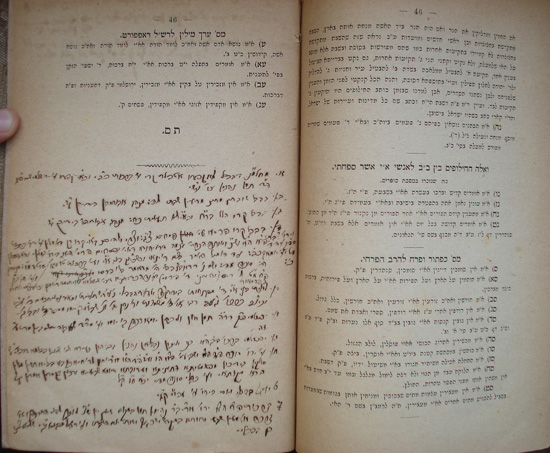
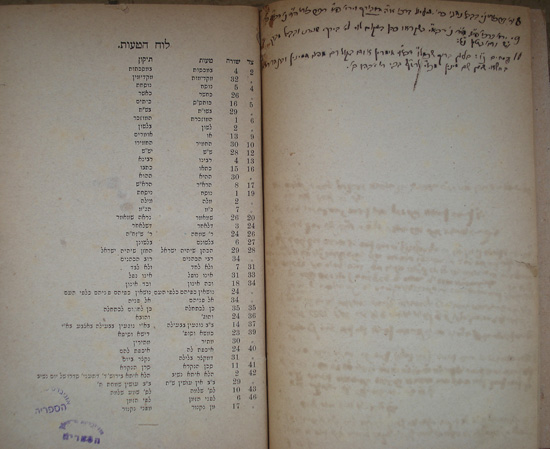
 

What follows is the best I
could do for a transcription. All of the main points are clear, but not all of
the references. Even this I couldn’t have done without a lot of assistance from
my friend R. Yehezkel Druk, who is responsible in no small part for the many
corrections and additions in Moreshet L’Hanhil’s volumes of the new Friedman
Shulhan Arukh.

Hopefully, some of the
readers viewing at home can decipher some more of this. If you can, please
comment! A translation and more follows.
תוספות חלופי מנהגים
של ר’ בנימין זאב זינגער
א. מחלמ”נ [=מחלפי
מנהגים?] דבבבל לא קפדו אטבילת קרי עיין ברכות כ”ב. ובא”י קפדו. ע’ ירושלמי
שם פ”ג ה”ב, תמן נהגין כו’ ע”ש.
ב. בבבל שובתין מתוך
מריעין, שבת לד: מנהג אבותיהן בידיהן. ע”ש.
ג. בבבל קרו הלל בר”ח
ובא”י לא. תענית כח: מנהג אבותיהן בידיהן. ע”ש.
ד. בבבל קרו פרסא עי’
(חולין) פסחים צג: וצ. ולהיפך בא”י קרו רק ד’ מילין. עי’ ירושלמי ברכות פ”א
ה”א ושם נסמן [וירושלמי שבת סוף פרק קמא עד ד’ מיל ועיין יומא כ:] ואותה ?הכחיי?
עצמה דרבי יהודה דאיתא בפסחים פרסא היא בירושלמי במילין. והא דבחולין קכב: עד ד’ מיל
דאמר בשם רבי ינאי ורשל”ק [ריש לקיש] בני ארץ ישראל. ועי’ ברכות טו ע”א [אבל
לאחוריה אפילו מיל אינו חוזר [ומינה] מיל הוא דאינו חוזר הא פחות ממיל חוזר] סוטה
מו: [וכמה א”ר ששת עד פרסה ולא אמרן אלא רבו שאינו מובהק אבל רבו מובהק שלשה
פרסאות] סנה’ ה: [ותניא תלמיד אל יורה הלכה במקום רבו אלא אם כן היה רחוק ממנו שלש
פרסאות כנגד מחנה ישראל] סוכה מד: [אמר אייבו משום רבי אלעזר בר צדוק אל יהלך אדם
בערבי שבתות יותר משלש פרסאות] ושם נראה דראב”ץ [=רבי אלעזר בר צדוק] בבלי
היה מדאמר בלשון פרסי ועי’ תו'[ספתא] ב”ק פ”ח מ”ט [אין פורסין
נשבין ליונין אלא אם כן היה רחוק מן היישוב שלשים ריס]  ל’ ריס (והיינו ד’ פרסי) ועי’ נדה כד: תניא אבא שאול אומר ואי תימא
רבי יוחנן כו’ ורצתי אחריו ג’ פרסאות
ה. לדעת בני א”י
ד’ מפתחות ביד הקב”ו ולדעת הבבלי ג’ עיין ריש תענית ומאיר עיני חכמים דף מב: וכיוצא
בזה ברכו’ ג’ ע”ב רבי אומר ד’ משמרות רבי נתן ג’ ונראה שבא”י קיימו מספר
ד’ ובבל ג’
ו. ירושלמי פ”ק
דראש השנה תמן חשן [תמן חשין לצומא רבה תרין יומין]  ? יומא רבה ב’ יומי’ ועי’ סה”ד [סוף הלכה ד’] שאבוה… בשמת ע”י
זה [פני משה מסכת ראש השנה פרק א: “תמן חשין לצומא רבא תרין יומין. בבבל היו
אנשים שחששו לעשות מספק ב’ ימים יה”כ ולהתענות ואמר להן רב חסדא למה לכם
להכניס עצמיכם למספק הזה שתוכלו להסתכן מחמת כך הלא חזקה היא שאין הב”ד
מתעצלין בו מלשלוח שלוחים להודיע לכל הגולה אם עיברו אלול ואם אין שלוחין באין
תסמכו על הרוב שאין אלול מעובר. ומייתי להאי עובדא דאבוה דר’ שמואל בר רב יצחק
והוא רב יצחק גופיה שחשש ע”ע וצם תרין יומין ואפסק כרוכה ודמיך. כשהפסיק מן
התענית ורצה לכרוך ולאכול נתחלש ונפטר. ועל שהכניס עצמו לסכנה מספק לא הזכירו שמו
להדיא ואמרו אבוה דר’ שמואל בר רב יצחק”.]
ז. ירושלמי ברכות פ”ב
ה”א כך אינון (בבלאי) נהגין גביהון זעירא לא שאל בשלמיה דרבה
ח. עי’ ירושלמי סוכה
פ”ד ה”א ושביעית פ”א ה”ז ועיין שם פ”ד ה”א או’ רבי
יוחנן לרבי חייה בר בא בבלייא תרין מילין סלקון בידיכון מפשיטותא דתעניתא וערובתא
דיומא שביעייא. ורבנן דקיסרין אמרין אף הדא מקזתה ועי’ בבלי סוכה מד. ??
ט. יוסף בבבלי יוסי
בירושלמי עי’ ?יבמות? קג ע”א
7. ברכות פ”ח ה”א
ירו’ אמר אר”י ב”ר נהיגין תמן במקום שאין יין ש”צ עובר לפני התיבה
ואומר ברכה אחת מעין שבע וחותם במקדש ישראל ואת יום השבת. ועי’ ?רא”ש? ?? י”ב
שלא מצאנו כן בבבלי
8. עיין ברכות נ. בבבל
נהגי כרבי ישמעאל ברכו א”ה המבורך – וירושלמי פ”ז דברכות ה”ד [נדצ”ל:
ה”ג] נראה דבא”י כר”ע

9. ירושלמי ברכות פ”ז
ה”ד [נדצ”ל: ה”ג] נראה דבא”י כשקראו כהן במקום לוי לא בירך
שנית ובבבל מברך. עיין שם. תוס’ גיטין נט: [ד”ה כי קאמרינן באותו כהן, והשווה
תוספת לוין סו’ י”ג וי”ד]
10. פסחים
נו: בענין ברוך שכמל”ו [שם כבוד מלכותו לעולם ועד] דבא”י אומרין אותו
בקול רם מפני המינין ובנהרדעא בחשאי שאין שם מינין מב.. לר.. גבי ר’ אבהו ב’. [אולי
הכוונה לצטט ויכוח של מין עם ר’ אבהו.]
Here is a loose translation without the references:
  1. In Babylon they were lax regarding the requirement
    for one who experienced seminal emissions [Ba’al Qeri] to immerse
    himself in a mikva. In the Land of Israel they were stringent.
  2. In Babylonia they commence the Sabbath in the midst
    of the blowing of the shofar teru’ah — They retain their fathers’
    practice. (Sabbath 35b)
  3. In Babylon, they read the hallel on the day of
    the New Moon. In the land of Israel they did not (Ta’anit 28b, “They
    retain their fathers’ practice”).
  4. In Babylon [a large unit of length] is referred to as
    a “parsa.” On the other hand, in the land of Israel, it is referred
    to as “four mil.” [miles]
  5. According to the understanding of the sages of the
    Land of Israel there are four keys in the hands of the holy one, blessed
    be he. According to the understanding of the sages of Babylon, there are
    three.
  6. In Babylon there were sages who fasted two Days of
    Atonement due to uncertainty as to on which day the new month begins.
  7. The Babylonians do not greet [rabbinic authorities],
    so Z’eira [respected their custom and] did not greet Rabbah when he
    visited.
  8. Rabbi Yohanan said to Rav Hiyya bar Bo: “The
    Babylonians have brought two [customs] up with them: full prostration on
    the fast days and the taking of the willow on the seventh day [of Sukkot].
    The Rabbis of Caesarea added bloodletting [to the list] as well.
  9. In the Babylonian Talmud we find: “Yosef.” In
    the Jerusalem Talmud: “Yosi.”
  10. (7) “There, in Babylon, when there is no wine, the
    prayer leader descends to the bima and recites the one blessing in
    place of seven and concludes with meqadesh Israel v’et yom hashabbat.”
    However, in the Babylonian Talmud we do not find this.
  11. (8) In Babylon the custom followed Rabbi Ishmael in
    reciting “borkhu et hashem hamevorakh.” It appears that in the Land
    of Israel they followed Rabbi Akiva [instead].
  12. (9) Is seems that in the Land of Israel, when a Kohen
    was called to the Torah reading in the absence of a Levite, he would not
    recite a second blessing. In Babylon he recites the benediction.
  13. (10) In the Land of Israel they recite “Barukh
    shem kavod malkhuto l’olam va’ed”
    out loud because of the heretics. In
    Nehardea they whisper it since there are no heretics there.
As you can see, the numbering switches from Hebrew to
Latin after tet. This is probably because the tet resembles a
six, so he followed it up with seven. Remember, these were just personal notes,
not intended for publication, obviously. Rabbi Singer’s mind was on more
important things, as the erudition of his notes speaks for itself. Anyway, who was Rabbi Singer? We’ll return to that at the end of
this post. Here in the middle of the work there is a citation apparently to a
Yalkut in Parshat VaYeshev, but I can’t make heads or tails of it.

Appendix to
Lewin’s edition. The articles originally appeared in Sinai 10 and 11.

Like
Zinger, Lewin also noted the additional Hiluqim in Miller’s volume and
decided to add more. Instead of adding exclusively from Talmudic sources, Lewin
leaned more on Geonic sources, of which he was the great master.  Some of these additions are quotations, and
some Lewin formulated himself.
1.                   
After completion [of the section from the public reading], the
reader blesses: “Blessed are you … ruler of the world, rock of ages, righteous
of all generations, the steadfast deity …” Then the congregation promptly
rise and say: “Steadfast are you, he, the Lord, our G-d, and steadfast is your
word. Steadfast, living, and lasting is your name and it’s utterance. Always
will you rule over us forever and ever.” This is one of the disputes between
the sons of the East and the sons of the West, for the sons of the East respond
while sitting whereas the sons of the West [respond] while standing.
2.                   
In Zoan, Egypt, which is called Fustat [today part of old
Cairo], there are two synagogues: one for the people of the Land of Israel, the
al-Shamiyin congregation [=the “Yerushalmi”, this name is
still used today to refer to a Jewish Yemenite branch] (It is named after
Elijah, of blessed memory [?, see below]). The other is the congregation of the
people of Babylon, the al-Iraqiyn congregation. They do not observe the
same customs. (Selections from Yosef Sambari, Seder HaHakhamim, Neubauer
I, p. 118. On page 137 it states that the congregational synagogue then still
in use was built before the destruction of the second temple in Jerusalem.)
One, (the people of the Land of Israel) stands during kedusha, while the
other, (that of the residents of Babylon) sit during kedusha. (Rabbi Avraham
ben HaGra, Maspiq l’ovdei hashem. In
the 1989 edition published by Nissim Dana, page 180,
the opinions appear in
reverse order)
3.                   
It is written in the responsa of the Geonim that the residents
of the Land of Israel recite kedusha only on the Sabbath, since it is written
[in Isaiah 6:2] that the Hayot have six wings. Each wing sings praises
corresponding to the days of the week. When the Sabbath arrives, the Hayot say
to the holy one, blessed be he: “We do not have another wing!” He replies to
them: “I have another wing which sings praises to me, as in (Isaiah 24:16):
“From the end [literally: wing] of the world we have heard song.” (Tosafot
Sanhedrin 37b, ad. loc. Mikanap, Miller 59)
4.                   
We do not recite kadish or borkhu with
any less than ten [men]. Our sages in the west recite it [in the presence] of
[even] seven [men]. They explain themselves according to the verse: “bifroa
p’raot …
” (Judges 5:2) according to the number of words [in the verse = seven.
See also verse 5:9.] Some recite it with even six [men] since [the word] borkhu
is the sixth [word in the verse]. (Some base this opinion on Psalms 68:27,
which contains six words – Avudraham)
5.                   
R.
Joseph said: How fine was the statement which was brought by R. Samuel b. Judah
when he reported that in the West [Israel] they say [in the evening], “Speak
unto the children of Israel and thou shalt say unto them, I am the Lord your
God, True.” (Berakhot 14b, Soncino translation). Still now, several cities [alternatively:
regions] in the Land of Israel observe this custon in the evening. They reason
that shema and v’haya im shamoa, [the first two paragraphs], are
observed both day and night, whereas va’yomer is only observed during
the day [as per Mishna Berakhot 2:2]. (Hilkhot Gedolot 1, Hilkhot Berakhot 2,
p. 37, second Hildesheimer edition)
6.                   
The
sages of the Land of Israel behave as follows: they recite the evening prayers
and later they read the Shema in its proper time. They are not concerned
about connecting [the blessing ending with] geula to the evening
prayers. (Sha’arei Teshuva 76, See Otzar HaGeonim for a list of numerous
rishonim and collections who cite this responsum.)
7.                   
Conserving
a festival which begins after the Sabbath, it is still maintained in the Land
of Israel that a fourth blessing is recited separately… but as for us, Rab
and Samuel instituted for us a precious pearl in Babylon: “Just judgements and
true Torah.” (attributed to Rav Hai Gaon, Otzar HaGeonim Berakhot, Perushim p.
46)
8.                   
On
the final day of the festival miṣwot
u’ḥuqim
and bekhor are read (Megilah 31a, acc. to mss.
Munich and rishonim). Rav Hai Gaon explains this passage as a mnemonic sign: 1.
There are those who read “for this miwa” (Deut. 30:11) and this is
still read in the Land of Israel. 2. There are those who read from “im be’ḥuqotai
until “qomemiut.” (Lev. 26:3-13) 3. There are those who read: “kol
ha’bekhor
” (Deut 15:19). We read “kol ha’bekhor.” (various
sources, Otzar HaGeonim Megillah, p. 62, no. 230)
9.                   
Upon
the conclusion of the Day of Atonement, residents of the Land of Israel blow qashraq
[=tashrat, a serious of various tones]. Residents of Babylon only
sound one plain blow in remembrance of the jubilee. [From here until the end,
Lewin composed most of the statements himself based on the sources he
provides.]
10.               
The
three fast days – Ta’anit Esther – are not observed consecutively, but
rather, separately: Monday, Thursday, and Monday. Our sages in the Land of
Israel were accustomed to fast after the days of Purim, on account of Nicanor
and his company. Also, we delay [unpleasant] payment and do not predicate it.
(Masekhet Sofrim 17)
11.               
Residents
of the Land of Israel would not actually fully prostrate themselves on fast
days. Residents of Babylon would actually fully prostrate themselves.
12.               
Residents
of the Land of Israel did not read Hallel at all on the day of the New
Moon. Residents of Babylon read it while skipping sections [an abbreviated
version].
13.               
Among
residents of the Land of Israel, the first reader from the Torah recites the
beginning blessing, and the last reader recites the final blessing. According
to the residents of Babylonian, each and every reader blesses before and after
the reading, since [members of the congregation may be] coming and going
[during the readings and thus miss one or the other].
14.               
In
the absence of a Levite, residents of the Land of Israel would call a second
Kohen to read from the Torah in his place. Residents of Babylon would call up
the very same Kohen again who just read the first portion.
15.               
Residents
of the Land of Israel permitted writing [Torah] scrolls on the skins of pure
animals even if they were not slaughtered according to specifications of
dietary laws. Residents of Babylon forbade this since they were not
slaughtered.
Translated summary of selected sections of Margaliot’s
introduction
Margulies’ Table of Contents
[The entire Table of Contents of Margulies has been
translated. However, only a summary of chapter 2 and the text of the original
work itself have been translated here.]
Chapter 1
Relations between Babylon and the Land of Israel from the
close of the Talmudic period until the close of the Geonic period
1.                   
The end of the Talmudic Period
2.                   
The Geonic period
3.                   
Attitudes towards divergent
customs until the Geonic period
4.                   
Attitudes of Babylonian Geonim to
the customs of the Land of Israel
Chapter 2
The Book of Disputes between East and West, the nature of
the work and its use by Rabbinic and Karaite Jews.
1.                   
The name of the work
2.                   
The author, his period, and
locale
3.                   
Purpose of the work
4.                   
Characteristics and scope of the
book
5.                   
Language and sources
6.                   
Legal sources and historical
development of the disputes
7.                   
Use of the book by Geonim
8.                   
Use of the book by Rabbinic legal
authorities
9.                   
Use of the book by Karaites
10.               
Scholars who have studied the
work
Chapter 3
Textual sources of
the Book of Disputes, Printed Editions and Manuscripts
1.                   
Text versions, families and
formation
2.                   
The first group
3.                   
The second group
4.                   
The third group
5.                   
This edition’s presentation and
stemmatic diagram of source       relationships
6.                   
The varying order of the disputes
in all of the versions
7.                   
The text
Presentation of the actual text with variant apparatus
Sources, History, and Development of the Disputes
[Systematic Commentary]
Chapter 1 is a general introduction to the context of the
work and is not translated at this time
Chapter 2 Summarized in translation
1.                   
The name of the work
The work appears in numerous manuscript versions and
cited by various Rishonim. Virtually every single one has a different title for
the work – all variations on the same descriptive theme. [Both the variation in
titles and the descriptive nature suggest that the work may have been not only
anonymous, but also untitled. It was simply a list drawn up by a sage, copied
and possibly added to.]
The majority of sources contain a variation of the root ḥlq
in the title, including the
first printed edition
(1616, starts at middle of page)
included at the end of Bava Kamma in Yam shel Shelomo, by the
great Ashkenazi sage Rabbi
Solomon Luria, better known as
Maharshal (1510-1573).

I don’t know who decided to include the work in
Maharshal’s edition, it led some to believe that the Maharshal himself
collected it, a point justly disputed by Rav Avraham ben HaGra [see below].
Margulies is perplexed as to why Miller chose a title
based on the root ḥlp, which only appears in a few secondary sources like
Ravya, Rosh, and Tur.
[Lewin also followed Miller on this point. It seems that
the selection of this root was designed to minimize the controversial nature of
the work. As Lewin stresses in his introduction, this is a work of divergent
customs, not disputes regarding actual Torah law. The reader can evaluate both
titles, which have themselves both been translated here as “alternates”. In
this writer’s opinion, both of the roots may be “alternate” variations of one
original word (probably from the root ḥlq) as the letters peh
and qof are graphically similar. A supporting example of variation
between these very same words is found in The Epistle of Rav Sherira Gaon in
the “French” manuscript branch. See Lewin’s
edition, page 22,
left column, note 19.  There you will find a manuscript with
precisely such an alternate reading.
Also of note is that certain Islamic literature which
records divergent legal opinions is referred to as kḥilaf. See
here
, beginning of intro. On the other hand, an 11th
century Karaite work is entitled Ḥilluq ha-qara’im we-ha-rabbanim]
2. The author, his period, and locale
The author is anonymous, and we have no clue as to his
identity.
The first serious recorded attempt to date the work is by
Rabbi
Abraham ben Elijah of Vilna
, the son of the famous GRA, in
his work Rav
P’alim, p. 126
. He was uncertain as to whether
the work was authored by amoraim or in a later period. [His chief concern here
is disproving the erroneous theory that the Maharshal himself collected
the work from various rabbinic sources.] Miller was able to hone in closer,
from the savoraim at the close of the Talmudic period to the beginning
of the Geonic period. Margulies provides considerable evidence that the work
was composed around the year 700. That is, after the Arab conquest and before Rav Yehudai Gaon.

According to Miller, our author was a native of the Land of Israel and familiar
with Babylonian customs through travel to Babylon. Western Aramaic and Western Hebrew forms abound. In fact, the very
composition in Hebrew suggests composition in the land of Israel, the language
of the “Minor”
Talmudic tractates
produced there during the Geonic
period, as well as Hebrew translations of Eastern Aramaic Babylonian Geonic works themselves. Margulies points out
that since Miller’s publication, new evidence has emerged from the Cairo geniza
which shows that after the Arab conquest, Babylonian Jews migrated to the Land
of Israel and formed their own separate congregations in Tiberias, Ramla, and Mivtzar Dan (Panias-Banias), with the most likely speculative location for our
author being Tiberias, which was a native Torah center that may have already
boasted a Babylonian community during the Talmudic period.
3. Purpose of the work
According to Miller, the work was designed to oppose the
Babylonian side in the dispute between the two great Torah centers. He points
out that many more explanations are offered in support of the
“Yerushalmi” side than the Babylonian. Later, Miller appears to
backtrack and seems to conclude that the work is simply meant to impartially
catalog the various discrepancies.

Margulies accepts the claims regarding the basic “Yerushalmi”
orientation, but understands the purpose more subtly. Rather than taking a
confrontational stance, the work merely seeks to explain and rationalize the
local customs and decisions to the new Babylonian immigrants who were not aware
or respectful of the locals. No attempt is made per se to reject the validity
of the Babylonian customs themselves and at times the author troubles himself
to explain them only.
          4. Characteristics and scope of
the book


The items in the work are haphazardly arranged with only occasional grouping according to topic. It is nowhere near complete
in cataloging all of the items of dispute. According to Miller, the complete
version of the work has not yet been transmitted to us. [This understanding may
underly many efforts to expand on this list, discussed in the Appendix.]
Margulies disagrees, on the basis of the numerous manuscript examples at his
disposal. According to him, the author never meant to compile an exhaustive
list.
          5. Language and sources
It has already been pointed out that the work was
composed in “Yerushalmi” Hebrew. A list of words and phrases is
provided by Margulies along with parallel examples from Talmudic and Geonic
“Yerushalmi” literature. He supposes that many more parallels would
be found in halakhic works from the period and region which are no longer
extant.
[This section is of
considerable philological interest especially regarding Geonic material in
Hebrew which may be of uncertain provenance.]
          6. Legal sources and historical
development of the disputes

          Most of the items can be
documented partially in other Talmudic and Geonic literature. As would be
expected, there is a high level of correspondence between the
“Yerushalmi” side and the Jerusalem Talmud; also, between the
Babylonian side and the Babylonian Talmud.
Most of the items appear to predate the collection and stem from the Talmudic period, many probably earlier, from the  Tannaitic period.
In some cases, a Tannaitic dispute may have been
transmitted unresolved to both regions and eventually decided differently in
each locale in a purely internal manner. Conversely, sometimes entirely
external factors may drive the discrepancies in later periods as well.
Of special interest is following the disputes from the
Geonic period until the end of the period of the Rishomin signified by the publication of the Shulhan Arukh. In
general, the Babylonian side prevailed as their hegemony increased, but in a
number of cases, the position native to the Land of Israel in fact dominated,
especially when it did not contradict any explicit statements in the Babylonian
Talmud. This tradition was especially strong in Tsarfat and Ashkenaz (France
and Germany) as opposed to Sepharad (Spain), which historically remained tied
to the Babylonian Geonim. The influence of the Land of Israel side is
especially noticed in the house of study of the great Rashi and his students (items 2, 3, 6, 7, 10, 13, 14, 18, 19, 25, and more).
The period following the publication of the Shulhan Arukh is not discussed systematically in Margulies’ commentary
since to a large extent geographic boundaries were erased by the free transfer
of books from one region to another and a great amount of cross-fertilization
occurred. Nevertheless, it is noted that a number of disputes remain with us to
this very day between Ashkenazi and Sepharadi communities.
          7. Use of the book by Geonim
In Babylonian Geonic responsa literature, a number of
disputes are addressed, but apparently not through direct exposure to the work.
It is more likely that the inquirers from the Land of Israel or North Africa
might have been motivated in their queries by exposure to concepts from the
work.
However, the later European collections of Geonic material did see fit to
gather material from this work into their nets. The collection known as Sha’are Tsedeq includes no fewer than eleven items culled from the
disputes.
In a few cases, items from the collection are attributed
to Babylonain Geonim themselves, but it is difficult to rely on any of these
attributions and most were clearly added by the later compiler.
          8. Use of the book
by Rabbinic legal authorities

Many of the great authorities were most probably unaware of the work as they
never cite it or it’s contents. Others who do cite it generally cite only
sections known to them through second or third-hand rabbinic sources.

Geographic location was clearly a major factor. In France and Provence use was
much more pronounced than in Spain. The work seems to have reached different
locations at different times. By the 14th century the work seems to
have been lost for the most part, as only citations from by previous
authorities are ever quoted.
One reason for the neglect of this work may have been
it’s brevity. [For example, the usual explanation for the grouping of the
twelve prophets in one scroll, and today in one volume, is so that the small
books would not become lost.] However, a more compelling reason appears to be
the negative impression that the work made on certain authorities, most
notably, Nahmanides, Ramban (Avodah Zara 35b). It was (correctly) perceived
that the work contains material which contradicts the Babylonian Talmud,
already considered supremely authoritative. Methods of study which stressed a
proper historical understanding of all legal points of view would become common
in rabbinic circles well before the modern period, but at the time they were
not yet developed. If an opinion could not be utilized for determining the
halakha, it was not deemed worthy of further inquiry. Nahmanides is the only
early Spanish sage who even mentions the work, so it is not at all surprising
that he considers it outside the pale of legal precedent.

Possibly, the Spanish Sages resisted the work as a result of the utility that
Karaites received from it and quoted from it. They may have suspected the work
of being a Karaite forgery.

In contrast, early Provencal authorities made ample use of the work. They
include: Rabbi Abraham ben Isaac of Narbonne (Eshkol), Rabbi Isaac ben
Abba Mari of Marseilles (Ittur), and Rabbi Abraham ben Nathan of Lunel (Manhig).
The textual versions cited by the Provencal sages are similar to those
found in the Geonic Responsa collections which appear to be most original.

Ashkenazi sages also utilized the work widely, but the stylized textual
citations indicate that they were generally quoting secondary and tertiary
rabbinic sources rather than the work directly. The sages include: Rabbi
Eliezer bar Nathan of Mainz (Ra’avan, Even Ha-Ezer), Ravya, Tosafot, Rabbi
Eliezer of Metz (Yereim), Sha’arei Dura, Machzor Vitry.

From the fourteenth century on mention and discussion of the work seems to
virtually disappear. A most notable exception is Rabbi Ashtori HaParḥi (Isaac
HaKohen ben Moses, 1280-1366) in his Kaftor w-Ferah, who traveled from
France to the Land of Israel, on which his work focuses. He cites the work
according to versions not attested to otherwise among French sages.
[Furthermore, he took an interest in expanding upon the principle of the work
as seen in the additions which Miller culled from it. See below after the main
body of the translation.]

Students of the Maharam of Rottenberg, such as Hagahot Maimoniot, Mordechai,
and Rabbenu Asher ben Yehiel (Rosh) mention the work haphazardly.
Other sages who cite the work include Rikanati, Tashbatz, Agur, Or Zarua, and
Shiltei Giborim. None of the early or later sages undertook an
elucidation of the entire work – they left this important work for us to do!
9. Use of the book by Karaites
Karaites took a much keener interest in the disputes than
Rabbanites. This is not at all surprising. The 
Rabbanites claimed to possess an
authoritative Talmudic tradition handed down from the earlier sages. Every
known dispute amongst the Talmudic sages themselves was utilized in order to
argue against these claims. From Beit Hillel and Beit Shammai to disputes
amongst the Babylonian Geonim themselves, the Karaites seized upon the disputes
between East and West eagerly.

The first Karaite sage to quote the work is Jacob Qirqisani (10th century). Since he cites the work in
an overtly apologetic manner (read: missionary), he was wont to exaggerate and
even forge sections of the work. Thus, it goes without saying that his work
cannot be utilized uncritically. Nevertheless, despite this cautionary note,
his early explanations can at times be very useful in understanding the nature
of the disputes themselves.
He explains his interest in the disputes very clearly.
According to him, the disputes between East and West were more extensive than
the disputes between the 
Rabbanites and the Karaites, but nevertheless, claims
of heresy were never leveled and a spirit of tolerance reigned between the
communities. So too, the Karaites should be accepted by the 
Rabbanites . This
stance led him to exaggerate at times the extent of the disputes which were
considered normative. Thus, even though the majority of the disputes concern
extra-legal customs, he would attempt to thrust them into the body of the legal
arena as exemplars of radical opinions. If at times he may have honestly
misunderstood the disputes, in some of them it appears that he was making a
cynical attempt misrepresent them and create confusion to advance his
rhetorical purposes.

One example which stands out is a dispute which Qirqisani appears to have
invented out of whole cloth, an out and our forgery not attested to in any
other versions of the work:
“People of Babylon do not permit one to betrothe a woman
with [the fruit of] the seventh year. People of the Land of Israel permit this.
Therefore, the betrothals of that year in the Land of Israel are not considered
by the Babylonians to effect marriage, and their children are not valid.”

[According to Mordekhai Akiva Friedman (Madaei HaYahadut 31), a maculation of taba’at
to shevi’it resulting from graphic similarity between the letters tet
and shin led item 25 to be misconstrued by Qirqisani in this manner. If
Lewin did not mention this possibility, at the very least, he noticed the
similarities and listed them together in his collection.]
From Qiqisani’s time on, Karaites have continued to
utilize the work in their own disputations with Rabbanites. As we saw earlier,
this may have led to the work’s falling out of favor among Rabbanites in
regions where Karaites were active.
          10. Scholars who have studied
the work

1.                   
Rabbi Abraham
ben Elijah of Vilna
, the son of the  GRA, in Rav
Pe’alim
2.     Dr. P. P. Frankl in Monatscrifft,
1871 (Heft 8), p. 352-363 (available through compactmemory)
3.                   
R. Yoel HaCohen
Miller, 1878
4.                   
A.
H. Weiss
, Dor
Dor v’Dorshav,
Additions to vol. 3, p.
285-
, 1883
5.                   
Rabbi Gershon Hanoch
Leiner, the Admor of Radzin
,
in his commentary to Orchot Hayyim, mentions that he has composed commentaries
on 50 disputes from the work. This has not been published and according to
Margulies may no longer be extant.
6.                   
R.
Yehudah Meshil HaKohen, Kneset
Hokhmei Israel 1, 60

and 91, 1893
7.                   
R.
Ezra Altshuler, Tosefta, 1899. According to Lewin and
Margulies, he plagiarized Miller (3 above) without mentioning him at all, even
copying his printing errors. Someone should do a study on this work and figure
out if the accusations are justified. Both Eliezer Brodt and I suspect that R.
Ezra did, in fact, add plenty of his own material and didn’t see anything wrong
with copying transcriptions from a previous edition. This version of the Hiluqim
has
been republished

with additional notes from the Aderes.
8.                   
R.
Hayyim Stahon, Eretz Hayyim, 1908
9.                   
R.
Ya’akov Shor, Ner
Ma’aravi  in HaMe’asef, 1910
[for a complete listing of
all issues containing this serial column, see Simha Emanuel’s index, entry 98]. These were
reprinted in כתבי וחדושי הגאון רבי יעקב שור זצ”ל.
10.               
R.
Dr. Benjamin Menashe Lewin, Otzar HaGeonim, [Otzar Hiluf Minhagim, 1942. Lewin’s edition was prepared
more or less simultaneously as Margulies’ edition. Forthcoming from R. Yosaif
Mordechai Dubovick

is a study on the various versions of Lewin’s publication.]
11.               
Dr.
Dov Revel, Horev
1,1
.
12.               
[After
over a Jubilee of reliance on the two critical editions of Marulies and Lewin,
without further critical study, Ze’ev Elkin re-opened the field with his
1997 Tarbiz article focusing on the earliest
manuscripts of the work, which are all of Karaite origin. He questioned several
of Margulies conjectures. Elkin later became a member of the Knesset.
13.               
R.
Dr. Uzi Fuchs, Netuim
2003
. An
examination of the Rothschild manuscript and its role in the development of the
various textual variants.]
Hillel Neuman in Ha-Ma’asim 2011 discusses several items from
this related work in passing. This is a new revised version of his 1987
master’s thesis

(Hebrew University).
Chapter 3          Textual
sources of the Book of Disputes, Printed Editions and Manuscripts
[This technical section has not been translated, except
for the last section, the text itself, found at the beginning of this article.
According to Elkin’s 1997 article the textual analysis may be in need of an
update and revision.]
Now that we are finished duscussing the Hiluqim, we can
return to the question about who Rabbi Benjamin Zev Singer was. Rabbi Singer
published Hamadrich, a Talmudic anthology, in collaboration with his brother, Rabbi Abraham Singer
of Varpalota in 1882 and Das Buch der Jubiläen (Die Leptogenesis) in 1898
as “Wilhelm Singer.” Also, Neue Lehrmethode
für den hebräischen Lese- und Sprachunerricht in der ersten Klas
in 1867, with an additional Hebrew subtitle, אור חדש. This is a slim German Sefer Mesores
for learning the Hebrew alphabet, davvening, handwriting, and selected phrases
in Judeo-German.Singer is identified as a hauptschullehrer, a
schoolteacher.
R. Daniel Sperber published a volume of Rabbi Singer’s
novella/hiddushim on Tractate Shabbat in 1986 and included a biography of him:
That biography is incorporated in a list
of his many unpublished Hebrew works
still in
manuscript which are housed in boxes at Bar Ilan. Apparently University of
Toronto houses manuscripts of his writing in German (maybe Hungarian, too, but
he wrote both of his books in German. I noticed that at least one of the items
Singer listed above (four mil) is apparently given fuller treatment in these
manuscripts. Given the sheer quantity of his output, I suspect that many more
items in the list are as well.
On the title page of the book, Singer lists a couple of
learned review articles in German of the Miller volume.  See it here:

One review appears in Graetz’s Monatsschrift,
1879, pp. 87-91 (Heinrich Graetz took over as editor after Zecharias Frankel);
the other is in Brüll’s Jahrbuecher,
vol. 4, pp. 169-173. (Both are available at www.compactmemory.de.)  A couple of
other articles are listed here as well, after the fact. At the top, the
aforementioned 1871 Monatsschrift article of Dr. P. P. Frankl (listed by
Marguleis), p. 357. At the bottom, an additional Brüll Jahrbuecher article
from the first volume of the series, p. 44, where Talmudic customs of the Galil
and Judah are discussed.

It is quite
interesting to see that the Rabbi Singer brothers, the authors of HaMadrich,
featuring haskamot of R. Yitzchak Elchanan Spector, the Netziv, and (over a
hundred!) gedolim, had an openness to modern scholarship which accommodated
Graetz and even Brüll, a reform rabbi who for a time headed the congregation in
Frankfurt opposite R. Shimshon Raphael Hirsch. This openness is also manifest
in the very existence of R. Singer’s volume on the book of Jubilees, Seforim
Hitzoni’im
.
Another point worth
mentioning is that HaMadrich is essentially a collection of chapters to
be learned by beginning and intermediate students all in one volume with an
eclectic running commentary. That work was briefly touched on in
this forum
previously, but it would be more
interesting to explore in greater detail exactly how eclectic it was once we
have a clearer picture of the depth of lomdus and of academic scholarship
displayed by the authors of this first “Artscroll.”
This “openness” of the Singer brothers did not appeal to
everyone. R.
Yehoshua Monsdhein’s article on HaMadrich
details the controversy surrounding the work. It is difficult
to piece together exactly to what extent the opposition was to any change
whatsoever in the education process, and to what extent it was towards
entrusting the enlightened Singer brothers to this task.
If it can be compared
were these haskamot procured (many of them probably after the controversy
already developed!) any more successful than the ones in Rabinowitz’s Dikdukei
Sofrim?
How many lomdim actually learned with HaMadrich? It was only
reprinted once and then again twenty years ago.
Back to the Hiluqim notes, It seems to me
that except for the first Monatsschrift 
review, the additional three references were added in pencil by
another hand, perhaps R. Singer’s brother R. Abraham, who worked closely with
him on HaMadrich.  But probably
not the other way around. I consulted with R.
Yechiel Goldhaber
– he thinks that these notes are
in the same style as the published hiddushim on Shabbat, and that seems quite
reasonable.
Thanks to Lucia
Raspe
for deciphering these journal references, and to Sara
Zfatman
for the assist.
Translator’s
note: Thanks to Avi Kessner for suggesting and sponsoring this project, also
for proofreading and valuable comments. I am indebted to Sander Kolatch and the
Kolatch Foundation for general assistance during the year. Eliezer Brodt
provided several useful references, without which this post would have been
much poorer. The Guetta, Jacobi, and Peled families who continue with their
unfailing support, especially my wife Dana, who makes it all possible. This translation
is dedicated to my father, Nathan ben Tzipporah, in the hope that he should
enjoy a complete and speedy recovery.


The Pesach Drasha of the Rokeach

The Pesach Drasha of the Rokeach
by Eliezer Brodt
By way of introduction, in the Shulchan Aruch it is written that thirty days before Pesach one should learn the halachos of Pesach. As Pesach is fast approaching, it is appropriate to discuss anew a post from five years ago, of which this is an update.
Every once in a while we are privileged to have the venerable printing house Mekizei Nirdamim release something special from the great rishonim (aside from their great journal Kovetz Al Yad).[1] Five years ago they published a critical edition of a Pesach Drasha of R. Eliezer Rokeach of Worms for the first time, edited by Professor Simcha Emanuel. In this post I would like to discuss some of the many things of interest in the work and also comment in general on the great job of Simcha Emanuel did with this work.
One of the reasons why I am updating this post is I was just told by Mekezei Nirdamim that they only have a few remaining copies and it will not be reprinted. I am selling copies for $16, while supplies last. For more information feel free to contact me at eliezerbrodt@gmail.com.
Part of the proceeds of this sale will be going to help support the efforts of the Seforim Blog.
This drasha seems to have been an actual drasha that the Rokeach delivered, although it is pretty obvious from the length that it was not said at one time but probably a compilation of a few derashos recited at different times. The style is mostly halacha, with a bit of aggadah in the beginning and also scattered throughout. He goes through many halachos of Pesach starting with kashering the utensils, getting rid of the chametz, and baking the matzos. He then continues on at great length to discuss all the aspects of the Seder. Then he deals with what to do if one finds chametz on Pesach and he ends with some halachos of Yom Tov in general.
I would like to mention some of the interesting points found in the actual drasha. First, the Rokeach records that his family custom was when they burned the chametz they would do so with the lulavim and hoshanos which they had saved from Sukkos (p.79). [2] While talking about the minhag to bake matzos Erev Yom Tov he writes that one should not bake the matzos for the second night until the second night itself, because of chavivah mitzvah bi’shaatah (p. 92). [3] He states that one should go to the Mikvah before Yom Tov. [4]
The Rokeach writes that if the Yom Tov falls out on Shabbos we do not smell hadassim for besamim on Motzei Shabbos, because there is no loss of the extra soul, as the soul remains for the duration of Yom Tov. (p. 93).[4a] In a note Professor Emanuel points out that others disagree with this point and hold that one does in fact make a blessing on the besamim when Saturday night is still Yom Tov. While talking about the washing for karpas he writes that one should make ‘al nitelas yadaim (p. 96), whereas today we do not. [5] He then goes on to say that we eat a full kezayis for karpas, which is something we also do not do – we purposely eat less than a kezayis. [6] (p. 97, 152). He notes his family minhag was to hold the cup of wine during the recitation of vehi she’amdah (p. 99 and p. 126) [7], the common custom today.
He describes how his family poured out the wine when they said the ten Makkot (p. 101, see also, p. 127). The importance of this last custom is that until the publication of this drasha, although many have recorded this custom in the name of the Rokeach, it appeared in none of his writings (as I plan on discussing at length in a forthcoming article). In regard to washing mayim acharonim at the seder, although others argue he writes one should wash (p. 106). [8]
In addition to all this Professor Emanuel has included extensive notes and comments throughout the drasha, which are excellent. These provide additional sources for various things mentioned in the drasha, also including interesting sources from unpublished manuscripts.
To list some of the topics that he deals with in the notes: Making matzos with pictures on them (pp. 129-134), about the nussach of the Haggdaah that some said רבון עלומים וכו after ביד חזקה (pp. 53- 57) [9], and reasons for the prohibition of kitniyos (p. 51).[10]
One very interesting thing which Emanuel points out is the difference about how a name is spelled in various manuscripts. Specifically, whether the Rokeach’s father-in-law was Eliezer or Elazar. If it was Elazar than it turns out that the Rokeach, whose first name was also Elazar, apparently ignored the will of his teacher, Rebbi Yehuda ha-Hassid – who disallows such marriages in his famous Tzavaah. Although, most likely, the Rokeach was married even prior to coming in contact with Rebbi Yehuda ha-Hassid, his practice demonstrates that people, prior to Rebbi Yehuda ha-Hassid’s pronouncement did not observe or even know of this custom. (pp. 57- 59). Emanuel than brings early evidence that part of the Tzavaah were strictly for the family.[11]
In this work we find an early source not related to Pesach but to Shavous – such as to eat Milchigs (p. 39, 110). [12]
Aside from this small work (152 pp.) containing this very important drasha of the Rokeach it also includes many important pieces of information in regard to the Rokeach in general and especially to two works of his that were unknown. There is a lengthy discussion about a sefer of the Rokeach on shechitah and treifos as well as another sefer – Sefer Ma’aseh Rokeach.
[1] For more information on this special, 150-year old publishing house, see the pamphlet printed by them in 1964, called Chevrat Mekizei Nirdamim.
[2] For further on this custom see Sefer HaMaskil pp. 33-34; the important comment of R. Honig in Yerushaseinu 1 (2007), pp. 208-209; Sefer Kushiyos pp. 168-169 and the notes therein; D. Sperber, Minhagei Yisrael, vol. 2 p. 193. See also what I wrote in Yerushaseinu 2 (2008), p. 219.
[3] For general sources on baking Matzos on Erev Pesach see Rabbi. G. Oberlander, Minhag Avoseinu Beyadeinu, pp. 327-255.
[4] For a very detailed discussion of this topic see my Bein Kesseh Le-assur, pp.48-96.
[4a] See; Shmuel and Zev Safrai, Haggadas Chazal, pp.54-55.
[5] See; Haggadah Shevivei Eish, p. 152; Y. Tabory, Pesach Dorot, pp. 216- 244. See also what I wrote in my Bein Kesseh Le-assur, p. 152.
[6] See; Y. Tabory, Pesach Dorot, pp. 264-265.
[7] See; Haggadah Shevivei Eish p. 109.
[8] See; Tabory, ibid, p. 244-249.
[9] See; Pirush Meyuchas le-Rashi in the Torat Hayyim Haggadah, p. 110; Shmuel and Zev Safrai, Haggadas Chazal, pp. 84-85; Simcha Emanuel, “‘When God Descended to Egypt’: The Story of a Passage in the Passover Haggadah,” Tarbiz 77:1 (2008): 109-132 (Hebrew).
[10] See; Y. Ta-Shma, “Prohibition of Kitniyot on Pesach,” Early Franco-German Ritual and Custom (Jerusalem: Hebrew University Magnes Press, 1992), pp.271-282 (Hebrew); Rabbi. G. Oberlander, Minhag Avoseinu Beyadeinu, pp. 410-438.
[11] On all this see also my Likutei Eliezer, pp. 51-53.
[12] See; Rabbi. G. Oberlander, Minhag Avoseinu Beyadeinu, pp.623-647. I hope to return to this topic shortly.


Sefer HaNer on Mesechet Bava Kamma

Sefer HaNer on Mesechet Bava Kamma: A Review
by:Rabbi Yosaif Mordechai Dubovick

Not every important work written by a Rishon is blessed with popularity.[1] While many texts were available throughout the generations and utilized to their utmost; others were relegated to obscurity, being published as recently as this century, or even this year. Nearly a month doesn’t pass without a “new” Rishon being made available to the public, and often enough in a critical edition. While each work must be evaluated on its own merit, as a whole, every commentary, every volume of Halachic rulings adds to our knowledge and Torah study.[2]          From the Geonic era through the Rishonim, North Africa was blessed with flourishing Torah centers, Kairouan in Tunisia (800-1057),[3] Fostat (Old Cairo) in Egypt, and many smaller cities as well. Perhaps the crown jewel of “pre-Rambam” Torah study was the sefer Hilchot Alfasi by R’ Yitchock Alfasi (the Rif).[4] Many Rishonim focused their novella around the study of Rif,[5] the Rambam taught Rif in lieu of Talmud,[6] and a pseudo-Rashi and Tosefot were developed to encompass the texts used and accompany its study.[7]

In Aghmat, a little known city in Morocco, circa the Rambam’s lifetime, rose up a little known Chacham whose work is invaluable in studying Rif, and by correlation, the Talmud Bavli as a whole. Yet, this Chacham was unheard of, for the most part, until the past half century. R’ Zechariya b. Yehuda of Aghmat, authored a compendium of Geonim, Rishonim, and personal exegesis on Rif. Spanning a period of 200 years of Talmud commentary of the first order, this work was also unique in its approach. Various editors have justly compared it to a work of similar nature and provenance, Shittah Mikubetzet by R. Betzalel Ashkenazi.

However, this source of Talmudic material from an almost blank period remained unknown until HaRav Prof. Simha Assaf published several leaves on Mesechet Berachot.[8] This followed by a semi-critical edition of a complete manuscript, by Meir David Ben-Shem bearing its rightful title, Sefer HaNer.[9] Later, J. Leveen published a facsimile version of a manuscript in the British Museum[10] on the three “Bavot” along with an English preface, indexes and a brief critique of Ben-Shem’s edition of Berachot. Since, many articles have been written about the work[11] and the Torah world has been blessed to see several volumes in print.

To date we are in possession of Sefer HaNer on Berachot,[12] Shabbat,[13] Eruvin, Moed Katan[14] and Mesechet Nezikin; namely the three Bavot.[15] In general, R’ Zechariah complied his work from the following sources, most of which were unknown as a work, and sometimes even the author was unknown. These Pirushim include Geonim; Rav Hai in particular, Rabbeinu Chananel,[16] R’ Yosef ibn Migash, R’ Baruch Sefardi (RB”S),[17] R’ Yitzchok Ghiyyat, Rav Natan author of Sefer ha Aruch, Rashi,[18] Rambam,[19] as well as material of unknown authorship.[20] Further, a notable portion of the material is in Judeo-Arabic of that period, including Geonic response and commentary, citations from R”Y ibn Migash, the Rambam’s commentary on Mishnah, and even short remarks within other commentaries as well. Accurately translating the material is a handicap, limiting the sefer’s use, and perhaps played a part in its falling into disuse at the decline of a Judeo-Arabic speaking Talmudist audience. [Much like the loss of many (non-translated) Judeo-Arabic Geonic works over time].          Recently, a new edition of HaNer on Mesechet Bava Kamma has been published; this article will attempt a comparison between the two printed editions, focus remaining upon the newer edition. While parts of the material of the manuscript (British Museum OR 10013) have been utilized in the past,[21] never has the manuscript been published as a whole, with critical notes. In 5761, as a part of Ohel Yeshayahu, a compilation of works on B”K, R. Hillel Mann published the relevant portion of Sefer HaNer from this manuscript. While this edition was surprisingly accurate to the mss. (the facsimile published by Leveen is available on Otzar HaChochmah), his notes are exceptionally lacking, with only the barest citation to what could be best described as “yeshivishe reid“; the common knowledge on the topic as discussed in the Yeshivot of today. Certainly not the optimal choice when editing and annotating a work based on Geonic and early Rishonic material, with many variant readings in the Talmud, as well novel commentaries hitherto unutilized.

Upon perusal of this edition, one cannot help but notice that in sharp contrast to the remaining nine chapters, the first chapter seems well edited, and the material in the footnotes is richer. The answer to this oddity is found in Mann’s preface; in 5752, an article containing a critical edition of the first perek was published by R’ Yehoshua Hutner of Machon Talmud Yisraeli[22]. This material had been meticulously edited by R’ Dov Havlin shlit”a and R’ Yosef haKohen Klien ob”m. Mann made use of the extensive notes, gleaned what he felt valuable, and ignored what he deemed he could.[23] According to Mann, R’ Tzvi Rotstein[24] copied the mss., and R’ Yosef Kafich translated the Arabic text.

Several months ago, a new edition of this work graced our tables. R’ Dov Havlin, the editor of the Talmud Yisraeli article, and his family[25] received permission to publish the work in its entirety.[26] Using the material previously assembled, and R’ Kafich’s translations, a preface was added, and the book printed. A mere glance at the first footnote to the preface shows the thoroughness and care taken when approaching a Rishon. As opposed to an “on-the-job training” attitude displayed by some authors, here the appropriate material was gathered and made use of in order to assess the task at hand.

The preface offers the uninitiated a précis of the academic papers written on R’ Zechariah, and deals with the author, his era and his works. Alongside, a chapter is devoted to R’ Baruch Sefardi, if only for the sake of providing the public exposure to Abramson’s pamphlet.[27] In one paragraph, the editor explains his decision to title the work “Shitta MiKubetzet Kadmon” although the author R’ Zechariah named it “HaNer”. I must confess I was not persuaded to concede to the change, and regret the license taken.[28]

Another liberty taken is the exclusion of the abbreviation “Pir'”, short for “Pirush”. This nomenclature has been edited out and replaced with a dash, although no mention was made of this in the preface.[29] This is not the case in the original article, and it would appear that this was done solely by the new editor(s). In addition, Arabic pieces, be they ever so brief, are replaced with the translation, and while the replacement is noted the original text is lacking. Mann’s edition reproduces the original, and relegates the translation to a footnote as the original article. By way of comparison, the original sports 261 footnotes on the first perek, the newer model, 98, and Mann’s version contains 102. Clearly, editing has been done, and while citations previously footnoted are now in the body of the text (parenthesized and font size lowered), one wonders what else has been omitted, and at what cost.[30]Diacritics found in the mss. are sorely lacking in all three editions, and HaShem’s name, typically written as three letters “yud”, is modernized to two.[31] Further, abbreviations have been expanded; Mann remained true to the text. Many of Mann’s mistaken readings are especially accurate in the new edition, yet typographical errors (as is wont) remain.As the work is based upon Rif, and collates many authorities, attempts to correlate the work to the Talmud’s present pagination is daunting. Many times R’ Zechariah will continue to copy a commentator, covering material spanning several folios, only to backtrack in order to begin a parallel commentary. Special attention need be given to this, and often Mann has rearranged material to fit within the parameters of one page; Havlin et al reproduce the original order.[32] The mss, while largely legible, has many additions, in different hands. Some addenda are written perpendicular to the text as marginal glossa, in a smaller hand. Mann has lost text in this fashion, as opposed to the Havlin edition wherein they are preserved. Publishing any edition of a manuscript reverts at some point to become eclectic. The editor is forced to decide on punctuation placement, and sentence/paragraph breaks, causing differing interpretations. While I cannot agree to the many changes made in the new edition,[33] this treasure trove of valuable material has now been made available to the public, and our thanks due. The text is highly accurate to the manuscript, the notes offer useful information, cross references and variant readings. This new addition to the Talmudic bookcase is most welcome, and while the implication given by the publisher that the next two meschtot are not on the agenda, may any continuation of so worthy a project be expediently brought to light.


[1] See Zohar, Bamidbar (3:134a) “everything is dependant upon fate, even the Sefer Torah in the Heichal”.

[2] See E. Soloveitchik, ‘Al Pirush Kadmon lMesechet Sukkah’, Tzfunot 18 (5752), pp 9-13. See also Prof. R’ S. Z. Havlin, Sefer Vaad lChachomim, Yerushalayim 5763, p 13-35/

[3] Home of the Yeshiva of R’ Chananel and R’ Nissim Gaon, among others. See M. Ben-Sasson, Tzemichat haKehillah haYihudit bArtzot haIslam, Yerushalayim 5757.

[4] See Ta-Shma, Sifrut Ha-parshanit le-Talmud vol. 1, Yerushalayim 5760, pg 156-159.

[5] See E. Chwat, Doctoral Dissertation, Bar-Ilan University, Ramat Gan 5750. See also S. Gottesman, Yeshurun 9 (5761) and Nitzutzei Aish, Memorial Volume, (Newhouse) Israel 2004.

[6] See E. Chwat, Yeshrun 20 (5768); M.A. Friedman, Tarbiz 62 (4) (5752).

[7] Chwat ibid. see also TaShma, ‘Klitatam shel Sifrei haRif, Rach, vHalachot Gedolot bTzarfat ubAshkenaz bMaot 11 v12’ (Knesset Mechkarim 1, Yerushalayim 5764, previously, Kiryat Sefer 54 (a)). See also Prof. Shamma Yehuda Freidman, ‘MiTosefot Rashbam lRif’, Kovetz al Yad 8 (5736).

[8] S. Assaf, ‘Chelek miPirush Kadmon liMesechet Brachot liEchad miBnei Zemani shel haRambam’, in ‘L’Zichron R’ Z’ P’ Chayyes, Yerushalayim 5693.

[9] Yerushalayim, 5718 [available here at hebrewbooks]

[10] A digest of commentaries on the tractates Babah kamma, Babha mesi’a and Babha bhathera of the Babylonian Talmud, compiled by Zachariah Ben Judah Aghmati; reproduced in facsimile from the unique manuscript in the British Museum OR. 10013; edited, with an introduction by Jacob Leveen, London 1961.

[11] C. Z. Hirschburg, Tarbiz 42 (5733); Ta Shma ‘Sifrut Haparshanit’ pg 156-159.

[12] Ben-Shem ibid.

[13] S. Eidison, Yerushalayim 5770.

[14] N. Sachs, Harry Fischel Institute, Yerushalayim 5726.

[15] B”M in Kovetz Sakosah lRoshi, Bnei Brak 5763. B”B (ch. 1-3), R’ Yekutiel Cohen, Yerushalayim 5748

[16] One of the more problematic references in HaNer is to “Miktzat”, see Abramson, ‘Pirush Rav Baruch b”r Shmuel haSefardi lTalmud’, who offers a possible theory that Miktzat means R’ Chananel’s pirush “brought in part”, as opposed to “some [commentators]”, at least in some instances.

[17] See S Abramson ‘Pirush Rav Baruch b”r Shmuel haSefardi lTalmud’, Bar Ilan Annual 26-27 (YD Gilat Jubilee volume) 5754.

[18] See Y. Malchi, ‘R, Zechariah Aghmati, haIsh, Yitzirato, haParshanit, vYachasah lPirushei Rashi’, Shanan 14 (5769) pg 65-73.

[19] See Abramson, Mechkarei Talmud 3.

[20] See Abramson ‘Pirush Rav Baruch b”r Shmuel haSefardi lTalmud’.

[21] R. M.Y. Blau, Shittas HaKadmonim B”M, B”B (2 volumes) and Three Bavot. See also TaShma, Kovetz al Yad, 10.

[22] Sefer Zikaron le R’ Yitzchok Yedidyah Frankel, Tel Aviv 5752.

[23] This explains the unintelligible note no. 81, citing Rav Nissim Gaon on B”K. After searching through Prof. Abramson’s work on RN”G, the passage (then) existed only in a re-creation of RN”G based upon Prof. Abramson’s hypothesis. Comparison to the article in the Frankel volume revels not only the true source material (Abramson), but also an additional citation to Abramson’s work Inyanut (Yerushalayim 5734, p 300), wherein a fragment of RN”G is published, verifying Abramson’s earlier thesis. All this is lacking in Mann’s note, leaving the reader at a loss.

[24] Of Rif reknown. It was Rotstein who brought the fragment mentioned in the above note to Abramson, under the impression the material was Rif. Additionally, R’ Rotstein is listed translator of the Arabic material in HaNer Bava Metziea (Sakosa lRoshi). R’ Eliezer Brodt once mentioned to me in the name of R’ Shmuel Ashkenazi that R’ Rotstein was not fluent in the language and had others translate the Rif material for him. Assumedly, one can rely on the accuracy.

[25] I am not clear as to the involvement and responsibility of each party. The preface is unsigned, R’ Havlin’s daughters are credited with copying the mss. and notes, and at the close of the preface, one R’ Bunim Shwartz’s passing is lamented, being cited as with the acronymic usage of “father”. One tends to understand that R’ Havlin’s son in law was instrumental in the ultimate publishing. This is corroborated by the disclaimer on the inside of the title page.

[26] The publication was done privately, and mention of the Machon is due to having used material penned under their auspices and ownership. However, the volume does not bear the logo nor name of the Machon and carries a private publisher (HaMesorah) on the title page’s reverse.

[27] While the original publication was in the Gilat volume [see above note no.[17], Abramson re-published the article (privately?) as a pamphlet, with corrections and additional material. I have only a photocopy of it, and welcome any information towards procuring an original.

[28] Similarly is “Chochmat Betzalel“, R’ Betzalel of Rensburg, Mossad HaRav Kook. The author had titled the book “Pitchay Niddah” and the manuscript owner and publisher, R’ Maimon took the liberty of changing the name.

[29] The dash has been implemented as a punctuation tool as well; I am unclear why this was done at all.

[30] From the outset, it seems notes detailing textual emendations based on the text of the Talmud have been omitted, and the reader is required to infer from the standard “[…]” that the text has been altered with some “self-evident” basis. It is noteworthy that the editors chose to revise the text of R’ Chananel in this fashion, by use of parentheses. Even in the case where the mss. (Add. 27194) used by the Vilna Shas is identical with the print, variant readings of Rach are common between mss, and may be based upon provenance. See J. Rovner ‘An Introduction to the Commentary of Rav Hananel ben Hushiel of Kairawan of Tractate Bava Metzia, Accompanied by a Reconstruction of the Lost Commentary to the Second Part of the Tractate based upon Cairo Genizah Fragments and Citations in the Rishonim’ (1993) Ph.D.

[31] See Y. S. Spiegel, Amudim bToldot Hasefer HaIvri, vol. 2 pg 565-632.

[32] C.f. 42b. However, on 94b, Havlin transfers text as well.

[33] It escapes me the need for semi-colon usage in Talmudic text, especially enmass.


R. Shmuel Ashkenazi: "Gaon" Equals 60?

                                                  "Gaon" Equals 60?                     

(Another chapter of R. Shmuel Ashkenazi's Latest Work)

Unfortunately, the amount of responses regarding assisting the publication of R. Ashkenazi's was underwhelming (a total of one contribution) so it is still uncertain when the seforim will actually be published. Until then – here is another chapter. For more information to contribute (any amount is extremly helpful) contact me at eliezerbrodt-at-gmail.com.

גאון בגימטריא ששים

א. גאון = 60 כתב ר' זכריה סימנר בספר זכירה, שהדפיס בשנת תסט בהמבורג (במהדורת ר' שלמה אבא שאול, ירושלים תשנט, סוף עמ' 277): מצאתי כתוב הטעם שקורין בשם גאון מי שבקי בכל ששים מסכתות, כמנין גאון.ואנא שמואל זעירא לא ידענא היכן מצא כתוב כן. אך הדברים כבר נאמרו ע"י ר' מנחם בר' שלמה המאירי [ה'ט-עה]: מהם בתלמוד תלתא סדרי, ר"ל מועד נשים נזיקין, והוא היה נקרא אצלם חכם. ומהם בתלמוד ד סדרי, ר"ל בתוספת סדר קדשים, והוא היה נקרא אצלם רב. ומהם בתלמוד שתא סדרי, ר"ל בתוספת סדר זרעים וטהרות, ואז היה ראוי להקרא גאון. רמז לששים מסכתות שבששה סדרי, כמנין גאון. אלא שאף על פי כן לא היו קורין אותו כן אלא אם כן נסמך מפי גאון בהסכמת הישיבה (סדר הקבלה, הוצאת מכון אופק, ירושלים תשנה, עמ' 124-123).וכן מצאנו אצל בן דורו, המקובל ר' יצחק דמן עכו, בספרו מאירת עינים, ראש פרשת חקת, שהוא מונה כל מסכתות הש"ס ומסכם: סך כל המסכתות סג. חשוב ג בבי אחת וסנהדרין ומכות אחת, נמצאו ששים, כמנין גאון. וכל מי שיודע כולם נקרא גאון.אחריהם מצינו לר' דוד אבן-זמרא [רדב"ז; רלט-שלג]: בדרך כלל אומר לך, שאין דרכנו לקרא גאון אלא לאותם שהיו אחר רבנן סבוראי, קודם הריא"ף ז"ל. ושמעתי אומרים, שתנאי הגאון היה, שיהיה יודע שיתא סדרי על פה, גמרא ומשניות. אבל מה נעשה לדורות אחרונים, שכבר נהגו[1] (שו"ת הרדב"ז, ליוורנו תיב, סימן קז; במהדורת ר' אהרן וואלדן, ח"ד, סוף סימן אלף קעח).שמועה זו ששמע רדב"ז שמע גם בן דורו ר' אליהו בחור [רכט-שט], שכתב בספרו תשבי, ערך גאון: קצת החכמים שהיו אחרי האמוראים נקראו גאונים, כגון רבי שרירא גאון, רבי סעדיה גאון[2]. ושמעתי, שנקראו כן, בעבור שהיו בקיאים בכל התלמוד, שהם ששים מסכתות. גאון בגימטריא ששים.אחריהם מצאנו לר' דוד קונפורטי, בספרו קורא הדורות (פרק ה, ויניציאה תקו, דף ה ע"ב; פיעטרקוב תרנה, דף ה רע"ג): ומצאתי כתוב, שיש אומרים כי הגאונים נקרא כל אחד מהם בלשון גאון, על שם שהיה יודע ס מסכתות, כמנין תיבת גאון.אחריו כותב ר' חיים יוסף דוד אזולאי [חיד"א; תפד-תקסו], בספרו ועד לחכמים (עי' להלן): גאון. אמרו קדמונינו, שבחרו בשם זה, שהוא גימטריא ששים, לרמוז, שהוא בקי בששים מסכתות.ואחרון אחרון הוא ר' מנחם מנדל משקלוב [נפ' תקפז], הכותב בהקדמתו למסכת אבות עם פירוש הגר"א, שקלאוו תקסד: ושמעתי מפה קדוש של אדומ"ר גאון העולם רבינו הגדול והקדוש החסיד זלה"ה, טעם למה שקראו לכל ראשי הדור שאחר זמן התלמוד בשם גאון, ע"פ מ"ש במדרש שיר השירים [ראה להלן]: ששים המה מלכות, אלו ששים מסכתות של הלכות כו'. ע"ש. ובדורות הראשונים שאחר זמן חיבור התלמוד לא סמכוהו לאחד שינהיג כל דורו, עד שהיו סדורים לו כל הששים מסכתות בע"פ … ולכן קראו לראש הדור שלהם בשם גאון, שעולה במספרו ששים, לרמז על ששים מסכתות הנ"ל. עכ"ל תלמיד הגר"א מפי רבו.ולא שמע השומע שהגאון אמר זאת בשם התשבי, אלא שהוא הוסיף והביא מן המדרש אסמכתא למנין המסכתות. עי' עליות אליהו, שטטין תרכא, עמ' 86, הערה קיא.והנה על דברי התשבי העיר ר' ישעיה ברלין פיק [תפה-תקנט], בהקדמת ספרו שאילת שלום על השאילתות (דיהרנפורט תקמו): מספר המסכתות ידוע שהם ששים ושלש, והסמ"ג נתן סימן ולבך יהי גס בהן. ואפילו לדעת הרמב"ם, בהקדמתו לסדר זרעים, דקחשיב תלתא בבי לחדא מסכתא – – –[3], עכ"פ הוו ששים ואחת מסכתות – – – [4]וכן הוא כותב בהקדמת ספרו יש סדר למשנה (נדפס מתוך כ"י אוקספורד, בסוף הכרך הראשון של משניות, דפוס ראם בוילנה): דע. בסוף ספר הסמ"ג והבאור למהר"א שטיין, כתב בזה"ל: סימן לשית סדרי משנה זמ"ן נק"ט: זרעים. מועד. נשים. נזיקין. קדשים. טהרות. וחלקם לס"ג מסכתות. וסימנך כללא נקוט בידך: ולבך יהא גס בהן. והמסכתות חלק לתקכד פרקים. וסימנך על קדשך ותפארתך. עכ"ל. ועכ"ל הגרי"ב[5].עשר שנים לאחר שספר שאילת שלום ראה אור, הדפיס חיד"א את ספרו ועד לחכמים, חלק א ליוורנו תקנו, ובראשו, סימן א[6], הוא מתרץ: ומה שהעיר [הגרי"ב] על מנין המסכתות, הנה ברעיא מהימנא והתקונים, כמה זמני[7] אמרו, שתין מסכתות. ונראה, דמעשרות ומעשר שני נחשבות לאחת. והכי מוכח ממה שכתב מז"ה ז"ל בחסד לאברהם, בדפוס ובכ"י, במטתו של שלמה, שהיו ששים דפין ובכל דף כתוב מסכתא. ובכ"י מפורש, שסדר זרעים הם עשרה מסכתות. ובהכי אתי שפיר.מנין אחר מצאתי בפירוש מהרז"ו: ושמעתי, שגם שבת עירובין נחשבים גם כן למסכת אחת. ראה להלן, פרק ב.מנין שונה הובא בחדושי הרש"ש מתוך ספר ערוגת הבושם: ויהיו הששה סדרים נחלקים לששים מסכתות, מלבד אבות אשר היא משלים ודרך ארץ. עי' להלן, פרק ב.ועל כל אלה הנִחושים עולה המנין היצוק ביציקה איתנה והוא המחבר סנהדרין מכות למסכת אחת, כאשר הובא לעיל מספר מאירת עינים. כן במשניות, כ"י קופמן ובכ"י פרמה ובקטעי הגניזה בקמברידג'. לדוגמא, ראה: גנזי משנה של ר' אברהם יצחק כץ (ירושלים תשל, דף פז ע"ב), קטע ממסכת מכות, שנמצא בגניזה הקהירית והוא שמור באוסף אנטונין בלנינגרד, ובראש פ"ג רשום: פרק יד [של סנהדרין]!וכן העיד ר' שלמה עדני [שכב-שצב?], בפירושו מלאכת שלמה, סוף מכות: כתב הר"ר יהוסף [אשכנזי] ז"ל: וברוב הספרים כתוב בסוף זו המסכתא: נגמרה סנהדרין פרק יד!וכן כותב בן דורו, ר' אברהם אזולאי [של?-תד], בספרו אהבה בתענוגים על משנת נזיקין, בפתיחה למסכת מכות (ירושלים תשמו, ראש דף קנו): בספר א'[חד] כ"י קדמון מצאתי כתוב. פרק י"ב, כיצד העדים נעשים זוממין. וקאי אמנין פרקי מסכת סנהדרין. וכתב פרק י"ג במקום פרק ב. וכן על זה [ה]דרך בכל הפרקים[8]. ובסוף זו המסכתא כתוב נגמרה מסכת סנהדרין י"ד פרקים. משמע דמכות שייכא עם סנהדרין. וכן כתב הרמב"ם ז"ל. מסכת מכות היא נקשרת בנוסח א'[9] עם סנהדרין, ובכללה היא מנויה – – -וזה לשון ר' שלמה עדני, בספרו מלאכת שלמה, למסכת מכות א א: וכתב הר"ר יהוסף [אשכנזי] ז"ל: בכל הספרים גרסינן מכות אחר סנהדרין, ובס"א [ובספרים אחרים]: פ'[רק] שנים עשר וקאי אסנהדרין. ע"ש.והוסיף לכתוב בסוף המסכת: כתב הר"ר יהוסף ז"ל: ברוב הספרים כתוב בסוף זו המסכתא נגמרה סנהדרין פרק יד. משמע, שמסכת מכות שייכא גם היא לסנהדרין. כמו הבבות. עכ"ל. כלומר: כמו ששלוש הבבות מסכת אחת הן, כן סנהדרין ומכות!גם בראש פרק ב: ס"א פרק יג. וקאי אסנהדרין.ובראש פרק ג: ס"א פרק ארבעה עשר. וקאי אסנהדרין.וכן במתניתא דבי מערבא סנהדרין ומכות חדא מסכתא ובה ארבעה עשר פרקים! וזה מוכח מגוף דברי הירושלמי בפרק (א) [יב], סוף הלכה יד: תנינן הכא מה דלא תנינן בכל סנהדרין!אף בקטע ירושלמי מבין כתבי הגניזה בבודאפשט, שפרסם שלמה וידר בתרביץ, יז (תשו), עמ' 129 ואילך, פרק כיצד העדים (פ"א של מכות) הוא פרק יב של סנהדרין!עי' גם: גנזי שכטר, ב, עמ' 395, ומבוא לנוסח המשנה, לרי"נ אפשטיין, עמ' 983.וכחמש מאות שנה קודם ר' שלמה עדני כבר כתב הרמב"ם, בהקדמה לפירוש המשנה, ד"ה והחלק הששי: אבל מסכת מכות היא נקשרת בנוסחאות עם מסכת סנהדרין ובכללה היא מנויה! עכ"ל. ברם הרמב"ם עצמו סבור, כי מסכת מכות "היא מסכת בפני עצמה, ונסמכה לסנהדרין".גם הר"ן (חידושי סנהדרין, דף מד ע"ב) לומד מדברי הגמרא בריש מכות, שסנהדרין ומכות "הכל מסכתא אחת"! ב. מנין המסכתותאנחנו אמנם מונים ששים ושלוש מסכתות, אבל למנין הקדמונים אינן אלא ששים.וכן דרש ר' יצחק: ששים המה מלכות [שה"ש ו ח], אלו ששים מסכתיות של הלכות (שהש"ר, ו ט ב). והכוונה לשלול מסכת אבות, שאינה מדברת מהלכות [- – -]. וזה לשון [ר' שמואל ארקיוולטי, בספרו] ערוג(ו)ת הבשם [ויניציאה שסב], בפ"ט: ויהיה הש"ס נחלקים לששים מסכתות, מלבד אבות אשר היא משלים ודרך ארץ (חדושי הרש"ש לבמדבר רבה, פרשה יג, הערה כג).ובפירוש מהרז"ו (כאן): הכוונה על ששים מסכתות של ששה סדרי משנה: זרעים יב [צ"ל: יא], מועד יב, נשים ז, נזיקין יוד, קדשים יוד [צ"ל: יא], טהרות יב – הרי ששים ושלש(ה) מסכתות. מסכתות ב"ק ב"מ וב"ב נחשבים למסכת אחת. ושמעתי, שגם שבת עירובין נחשבים גם כן למסכת אחת. הרי סמך מסכתות בש"ס[10].וכן דרשו בתנחומא (קרח, יב), ומשם בבמדבר רבה (יח כא): ששים המה מלכות. ששים מסכתות.כן מצאנו מנין ששים מסכתות ברעיא מהימנא (פינחס, רטז סע"א): לקבל ששים מסכתות. ובתקוני הזוהר (תקונא תליסר, דף כט רע"ב): לקבל שתין מסכתות; (תקונא חד ועשרין, מד ע"א): אורייתא דבע"פ דאיהי סלע – על ס, דאינון שתין מסכתות. ובתקונים נוספים (תקונא שתיתאה, עמ' 288): ששים המה מלכות, דאינון שיתין סדרי משנה וסלקין לשית מאה ולששים רבוא. והגיה הגר"א: שתין מסכתות; (תקונא עשיראה, עמ' 294): שתין הלכות, דאינון ששים המה מלכות. ובתקוני זוהר חדש (קח ע"א = השמטות לזוהר, ח"א, רנג ע"א): שתין מסכתות ושית סדרי משנה.אמנם לדברי רב הונא בבא קמא ובבא מציעא דינם כתרי מסכתי[11] אך הקדמונים קבלו דעתו של רב יוסף האומר: כולה נזיקין חדא מסכתא היא[12]. ופירש רש"י[13]: נזיקין כולהו. תלתא בבי. עכ"ל. וכן מפורש באגרת רב שרירא גאון (מהדורת הימאן, לונדון תרעא, עמ' 36): ורב יוסף … אומר בבבי דנזיקין, דכולהו חדא מסכתא נינהו.וכן צוין בכ"י קמברידג' ובכ"י קופמן, בתחילת בבא קמא: מס' נזיקין. ובסוף בבא בתרא: חסלת נזיקים. פרקים ל.וכבר אמרו חז"ל: נזיקין ל פרקים, כלים ל פרקים (ויקרא רבה, יט ב. עי' שם בחדושי הרד"ל, הערה ה). ואנא לא ידענא מאי שנא מסכת נזיקין ממסכת כלים? אמנם בתוספתא מחולקת מסכת כלים לשלוש בבות, בדומה למסכת נזיקין!  
[1] כלומר, שכבר נהגו לכתוב תואר הגאון גם על מי שאינו בקי בש"ס…[2] הפך את סדרם הכרונולוגי. רב שרירא גאון נפ' בשנת ד'תשסו, ורב סעדיה גאון – בשנת ד'תשב![3] אגב אעיר, כי בעקבות הרמב"ם הלך בעל ספר הפליאה והוא מונה כל מסכתות הש"ס: זרעים … יא מסכתות. מועד … משקין והוא מועד קטן … יב מסכתות. נשים … גיטין, סוטה … ז מסכתות. נזיקין בבא קמא בבא מציעא בבא בתרא מסכת אחת … ח מסכתות. קדשים … יא מסכתות. טהרות … פרה אדומהמכשירין, ידים, זבים, טבול יום, עוקצים, יב מסכתות. והנה הם סא מסכתות ותקכג פרקים (ספר הפליאה, פשמישל תרמד, דף כה ע"ב).[4] מספר המסכתות והסימן ולבך יהי גס בהן לא נדפס בסוף סמ"ג, לר' משה מקוצי, אלא בסוף ביאורי רי"א שטיין לסמ"ג (ויניציאה שז, דף שיד ע"א): ויען כי בספר הנכבד הזה ובמורה מקום שנתוסף בו, לרוב פעמים, לא הוזכרו בו כי אם שמות הפרקים לבד, ובאולי יש בתלמידים אחד מני אלף שלא ידע מקום תחנות איזו פרק באיזה מסכתא הוא, אמרנו להדפיס בסוף הספר מספר צבא כל המסכתות ולקרא בשם כל פרקיהם, למען יהיה הספר הזה שלם בכל תועלתיו / והיו בו אותות אותתיו / וכל דורשיו לא יחסרו מכל טובותיו. ותפסנו בהם הדרך איש איש על דגלו באותות אשר סידר ומסר לנו ראש החכמים וסוף התנאים רבינו הקדוש ע"ה, בהעלותו על ספר ענן הכבוד ספיר ספירי / אמרי משנה בשית סדרי, זכר לדבר והיה אמונת, עת"ך, חוס"ן, ישועו"ת, חכמ"ה, ודע"ת, והם זרעים, ומועד, נשים, נזיקים, קדשים, וטהרות, וסימניך זמ"ן נק"ט. וחלקם לסג מסכתות. וסימניך. כללא נקוט בידך ולבך יהא ג"ס בהן. והמסכתות חלק לתקכד פרקים, וסימניך ע"ל קדש"ך ותפארתך. עכ"ל.בדפוס-צלום של ביאורי רי"א שטיין, שנדפס בשנת תשכא בירושלים, השאירו המדפיסים הרשלנים את הכותרת בראש הדף [המסומן: סד!]: רמזי פרקי שיתא סדרי משנה, ואִלו את הרמזים עצמם השמיטו![5] כאן הוא דייק בהעתקתו וביחוס הדברים למי שאמרם! עי' הערה קודמת.[6] =שם הגדולים, מהדורת בן-יעקב, מערכת גדולים, אות א, סוף סימן קמה.[7] ראה להלן, פרק ב.[8] דבריו בכל הפרקים (שבלשון רבים) מתייחס לפרק אחד בלבד, לפרק ג![9] צ"ל: בנוסחא'. כלומר: בנוסחאות.[10] ור' ברוך אפשטין [תרכ-תשא], בתורה תמימה, הערה יג, העתיק דברי מהרז"ו מבלי להזכירו, וכדרכו בקודש![11] ראה: בבא קמא קב סע"א; עבודה זרה ז ע"א.[12] שם ושם.[13] במסכת עבודה זרה שם.