Reply from Haym Soloveitchik to the JQR Interview with Robert Brody

Reply from Haym Soloveitchik to the JQR Interview with Robert Brody

By Haym Soloveitchik

Editor’s Note: As a recap of a recent exchange between two scholars on a nuanced debate within medieval Jewish history (see the first footnote), we present this final note by Professor Haym Soloveitchik.

Part One

Dr. Robert Brody advances no new arguments against my thesis in his recent interview at the blog of the Jewish Quarterly Review (https://katz.sas.upenn.edu/blog/jewish-quarterly-review/jqr-contributor-conversation-robert-brody-origins-talmud-study). I have addressed all his points in my original essay and my reply in the Jewish Quarterly Review and online on my personal website.[1] The reader can judge for himself or herself whether my arguments are persuasive.

Basically, the issue between us boils down to two points. Brody does not believe in historical implication. Two facts, to him, imply nothing. If so, all the scholar can ever have is a large pile of inert facts. For example, he denies the notion that Sura and Pumpeditha would never have surrendered their monopoly on the “Vox Talmudica,” for that “would have been institutional suicide.”[2] If that’s the case, all we can know of the past is what is explicitly stated in the sources of the past. Brody equally does not believe in probabilities (not even cumulative probabilities [3]). In the absence of probability (or improbability), all theories are equal. If one can believe that scores of scribes both educated and ignorant, with good or bad memories can inscribe a text of a million and a half words without any change in that text’s meaning,[4] then one can believe almost anything. If so, no inference is better than another. The result is that it isn’t worth pondering the implications of the data of the past; one should concentrate on simply knowing them.

This is my last reply to Dr. Brody’s critiques. I believe the exchange has reached the point of diminishing returns.

Part Two

Dr. Brody has just published in the Bar-Ilan Internet Journal a critique of my remarks of Rashi’s emendations (haggahot) on the Talmud, online here (https://jewish-faculty.biu.ac.il/files/jewish-faculty/shared/JSIJ16/brody.pdf). As this point is irrelevant to my argument, I forgo answering it now. Allow me to explain.

The crucial point in my argument is that there existed ongoing contact between Bavel and the Rhineland in the ninth and tenth centuries. This would have enabled the leaders (he-{h.}ashuvim) of the Rhineland to make inquiries of the state of talmud torah in Bavel, the economic situation of the yeshivot and the level of scholarship in the various institutions in Bavel. Conversely, it would have enabled the men of the Third Yeshivah to make inquiries of the nature of the Jewish settlement in the Rhineland, the seriousness of any offer and the financial abilities of the Rhineland leaders to support such a migration and the enterprise upon which it would embark. This ongoing contact would also have enabled manuscripts from Bavel to reach Ashkenaz in those centuries. Such a continuance of contact is proven by the trade and communication routes of the time. With goods brought regularly from the Near and Far East came manuscripts of sifrei kodesh. Jews in the Rhineland would pay handsomely for manuscripts, just as the Christian prelates and monasteries paid for reliquia. There is no reason not to conclude that manuscripts of the widest variety were available the Rhineland the great emporium of Western Europe in the closing centuries of the first millennium. Whether or not Rashi took a copy of some of these manuscripts back to Troyes is irrelevant to my contention. I introduced this issue simply because Noam’s article treated both the diffusion of such manuscripts in Early Ashkenaz and the nature of Rashi’s haggahot on the tractate of Sukkah. I believe Noam to be correct about Sukkah, but this is simply frosting on my cake. Rashi’s haggahot are at least a century after the migration of the Third Yeshivah, and their nature is of no matter to my argument.

I have long pondered the nature of these emendations well before the idea of any Third Yeshivah occurred to me, and should I come to some conclusion, I will include it in the fourth volume of my collected essays. As of now, I have spent enough time replying to Dr. Brody and must return to my own research.

Footnotes:

[1] Haym Soloveitchik, Collected Essays, vol. 2 (Oxford: Littman Library, 2014), 150-201; Haym Soloveitchik, “On the Third Yeshivah of Bavel: A Response to Robert Brody,” Jewish Quarterly Review 109:2 (Spring 2019): 289-320; Haym Soloveitchik, “Reply to Brody–Part II,” at HaymSoloveitchik.org, available here (https://haymsoloveitchik.org/downloads/Reply%20to%20Brody%20II.pdf). The only new point that he adds here is the documentation of his statement of the difference between significant and trivial variants. However, I never challenged this principal; I simply argued that there are also other principles in textual criticism, and the mark of a good editor is his or her ability to use the one most appropriate for the case at hand. See “Reply to Brody—Part II,” pp. 39-40.

[2] Collected Essays, pp. 171-172; “Reply to Brody–Part II,” pp. 9, 20.

[3] “Reply to Brody—Part II,” pp. 38-41.

 [4] Ibid. pp. 21-22.


Message from Professor Haym Soloveitchik

In the newly-published issue of the Jewish Quartlerly Review (Spring 109:2), there is an exchange between Robert Brody and Haym Soloveitchik on the “Third Yeshivah of Bavel” (https://muse.jhu.edu/issue/40354). Professor Soloveitchik’s reply is in two parts: Part I in JQR and the continuation–Part II– on his website.<haymsoloveitchik.org>. At the conclusion of  his reply in JQR, he refers the readers to Part II on his website: “Those interested in my replies to all of Brody’s other objections can turn to my website, haym.soloveitchik.org, and click on Reply to Brody, Part II.” There is a typographical error in the name of the website. There is no period between <haym> and<soloveitchik>. The correct address is: <haymsoloveitchik.org>.


The Babylonian Geonim’s Attitude to the Talmudic Text

The Attitude of the Babylonian Geonim to the
Talmudic text
By Dr. Uzy Fuchs
A few weeks ago
we mentioned here
that the Seventeenth World Congress
of Jewish Studies
took
place at the Mount Scopus Campus of the Hebrew University of Jerusalem.
Over the next few months we will be
posting written transcriptions of some of the various presentations
(we hope to receive additional ones).
The first in this series is from Dr. Uzy Fuchs dealing with the
Babylonian Geonim’s attitude to the Talmudic text, the subject of his recently
released excellent book.  To purchase
this work contact me at
Eliezerbrodt-at-gmail.com. Part of
the proceeds will be used to support the efforts of the Seforim Blog.
Here is the cover:
יחסם של גאוני בבל לטקסט התלמודי
הרצאה בקונגרס השבע-עשרה למדעי היהדות, ירושלים, אב
תשע”ז
מאת: עוזיאל פוקס
(קטעים מתוך המצגת משולבים בתוך לשון ההרצאה)
שאלת
יחסם של גאוני בבל לעניינים טקסטואליים במשנה ובתלמוד הבבלי היא שאלה רחבה
ומורכבת, מכיוון שמדובר על תקופה של למעלה משלוש מאות שנה, שפעלו בה חכמים שונים
בכמה מרכזים.
אפתח
בכמה נתונים מספריים שיאפשרו לנו למקד את הדיון.
בידינו
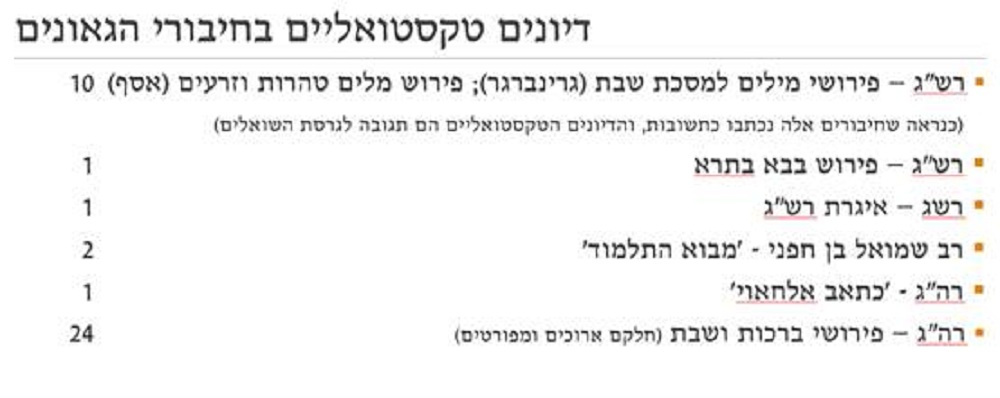
השתמרו בערך 260 התייחסויות של הגאונים לעניינים טקסטואליים במשנה ובתלמוד. חלקם
ארוכים ומפורטים וחלקם כוללים הערה קצרה; מהם שהגיעו בשלימות ומהם מקוטעים וקשים
לפיענוח; הרבה מהם נכתבו כמענה לשאלות טקסטואליות אך לא מעט נכתבו ביוזמתם של
הגאונים עצמם.
בנקודה
אחת הממצאים חד משמעיים – המקום המרכזי של רש”ג ורה”ג בתחום הטקסטואלי.
מניתוח
של המקורות שבהם רב שרירא גאון ורב האיי גאון עסקו בעניינים טקסטואליים אנו למדים
על המניעים שלהם לעסוק בגרסאות התלמוד. הרבה מהם נכתבו כתשובות לשואלים, בין
בעניינים טקסטואליים ובין בתשובות הלכתיות ופרשניות. באופן מיוחד מעניינות אותן
התשובות שבהן העניין הטקסטואלי הוא שולי, ואין הוא חיוני כלל ועיקר כדי לענות
לשאלה שנשאלו הגאונים, ואף על פי כן טרחו הגאונים להוסיף הערה ארוכה או קצרה
בעניין גרסאות התלמוד.
חשיבות
מיוחדת יש לכמה עשרות דיונים טקסטואליים שנכתבו בחיבורי הגאונים ולא בתשובותיהם.
במיוחד
מעניין פירושי רב האי גאון למסכתות ברכות ושבת, שבשרידים הלא רבים שהגיעו אלינו יש
עשרים וארבעה דיונים טקסטואליים. חלקם ארוכים, מורכבים ומפורטים. דיונים אלה
מלמדים אותנו שבעיני גאוני בבל האחרונים – רש”ג ובעיקר רה”ג – העיסוק
בגרסאות התלמוד הפך להיות חלק בלתי נפרד מסדר יומו של לומד ומפרש התלמוד.
מכל
מקום, העיסוק הטקסטואלי האינטנסיבי המרובה של שני גאוני פומבדיתא המאוחרים – רב
שרירא ורב האי רב שרירא – מלמד שאת כותרת ההרצאה ‘יחסם של גאוני בבל לטקסט
התלמודי’ יש לסייג הרבה. על שאר הגאונים אנחנו יודעים מעט מאוד, ועל יחסם של רוב
רובם של גאוני בבל לעניינים טקסטואליים אי אפשר לומר מאומה.
אפשר
להאריך במחשבות ובהשערות בעניין זה – מה המשמעות של מיעוט הדיונים הטקסטואליים של
רוב הגאונים: האם מדובר על עניין מקרי – הדיונים שלהם לא הגיעו לידינו, או שמא
באמת עסקו פחות בעניינים טקסטואליים. אך בשל קוצר הזמן לא אכנס לכך. 
*
הישג
בולט של אחרוני הגאונים הוא יצירת הגדרות או שימוש ב’כלי עבודה’ כדי לדון בגרסאות
השונות. לא רק קביעות בסגנון של ‘גרסה נכונה’ או ‘גרסה לא נכונה’ אלא ניסיון ליצור
קני מידה על מנת לשקול בין הגרסאות השונות, ולהכריע איזו מהן נכונה יותר. כמו כן,
הגאונים המאוחרים תייגו גרסאות שונות באיפיונים: מדוייק, לא מדוייק.
איפיונים
אלה חשובים עד מאוד, והם מלמדים הרבה על החשיבה הביקורתית של אחרוני הגאונים, על
השימוש שלהם בכלים שהיינו מכנים ‘מחקריים’ או ‘ביקורתיים’. אף על פי כן, יש להדגיש
כי קני המידה והאפיונים השונים באים בראש ובראשונה בשירות הפרשנות.
אדגים
את הקביעה הזו בשתי דוגמאות הבאות בדברי הגאונים רב שרירא ורב האיי.
אחת
השאיפות של חקר מסורות בכלל וחקר גרסאות התלמוד בפרט היא מציאת המסורות והגרסאות
המדויקות והמהימנות. ואכן, אחרוני הגאונים קבעו לגבי לא מעט גרסאות שהן מדויקות,
או שהן של חכמים דייקנים.
וכאן
יש לברר – מה הופך חכמים אלה להיות חכמים דייקנים בעיניהם של אחרוני הגאונים? האם
המסורות שעליהם הסתמכו או שמא דרך כזו או אחרת שבה הצליחו לשמר את גרסאות התלמוד?
ושמא היה להם קריטריון אחר?
בשתי
תשובות אנו מוצאים רמז לעניין, ושתיהן נוגעות לסוגיה הטעונה של הפער שבין נוסחי
הפסוקים שבמקראות לבין נוסחם בגרסאות התלמוד.
וכך
כתב רב האיי גאון:
‘וודאי
אילו היה הפסוק כטעותם… אלא שאינו כן, דרבנן דווקני ומי שמעיינין בשמועה
ואינן גורסין והולכין שיטפא בעלמא…’.
בתשובה
זו כרך רה”ג כרך את הדיוק של אותם ‘רבנן דווקני’ ב’מי שמעיינין בשמועה’,
כלומר, הם אינם גרסנים מכניים, אלא הם מבינים את המתרחש בסוגיה. ה’דיוק’ של המסורת
קשור ל’עיון בסוגיה’, להבנתה ולהתאמתה למסורת ה’נכונה’ במרכאות, כלומר זו שאינה
יוצרת קשיים פרשניים. ה’דיוק’ מוגדר ככזה בזמן שהוא משרת את הפרשנות הנכונה.
נשוב
לעניין החכמים הדייקנים עוד מעט. ונעבור לפני כן לקנה מידה אחר לבחינת גרסאות
התלמוד.
בכמה
תשובות הגאונים – שוב רב שרירא ורב האיי גאון – קבעו שגרסה מסוימת היא גרסת ‘כל
החכמים’. הקביעה הזו, המסתמכת על ‘כל החכמים’ היא בוודאי שיקול נכבד בעד גרסה
מסוימת. רה”ג השתמש בקביעה הזו גם בתשובתו הידועה בעניין מנהגי תקיעת שופר
בראש השנה: ‘והלכה הולכת ופשוטה היא בכל ישראל… ודברי הרבים הוא המוכיח
על כל משנה ועל כל גמרא, ויותר מכל ראיה מזה פוק חזי מה עמא דבר, זה העיקר והסמך’.
התפיסה הזו, או כפי שכונתה בערבית ‘אג’מאע’ היא גם אחד מארבעת היסודות של פסיקה
ההלכה המוסלמית. כאמור, קביעות כעין אלה באו כשיקול טקסטואלי בדברי הגאונים. ברוב
הפעמים הקביעה שגרסה היא ‘גרסת כל החכמים’ באה להכריע כמו גרסת הגאונים בתלמוד
הבבלי בניגוד למקור אחר – גרסה בתוספתא, גרסת ספרי משנה וגרסה הבאה בהלכות פסוקות
והלכות גדולות.
גם
בתשובה בעניין נוסח פסוק בספר דברי הימים, המובא בגרסה שונה בסוגיה בתחילת מסכת
ברכות, קבעו רב שרירא ורב האיי גאון באופן נחרץ: ‘וחס ושלום דהאוי שיבוש בקראיי,
דכולהון ישראל קריין להון פה אחד והאכין גארסין רבנן כולהון בלא שיבושא
ובלא פלוגתא ובלא חילופא
‘.
בסופה
של אותה תשובה הוא גם הזהיר לתקן גרסה זו, וגם כאן הזהיר את כל החכמים – ‘ואזהר
לתיקוני לנוסחי… ולאיומי על כולהו רבנן ותלמידי למגרס הכי דלא תהוי חס
ושלום תקלה במילתא’. קביעות נחרצות אלה הן מאוד חד משמעיות – יש גרסה אחת ויחידה
בתלמוד שהיא גרסת כל החכמים, והיא מתאימה לנוסח הפסוק בדברי ימים. אלא שהמציאות
אינה כל כך חד משמעית, ובמהלכה של אותה תשובה ציין רב האיי גאון לנוסח נוסף בסוגיה
– וכאן אנחנו חוזרים גם להגדרת ‘דוקאני’ שעליה עמדנו לעיל:
‘ורבנן דוקאני הכין גרסין וכן
הוא אומ'[ר] באֿבֿיֿוֿ בלישנֿאֿ רויחאֿ, ומאןֿ [ד]גֿאריס לישאנא קיטא
ולא דאייק למיגרס וכן הוא אומר באביו
הכין מפריש דגאמרֿין מן אבא לברא אבל קרא
כולי עלמא פה אחד קארו ליה וגרסין ליה וכיון דהכין היא שמעתא איסתלק ליה
<ספיקא>’. כלומר, על אף שבעיקרו של דבר הגאונים לא נסוגו מן הקביעה שכל
החכמים גורסים את הפסוק בסוגיה כמו נוסחו בספר דברי הימים – כלומר ‘יהוידע בן
בניהו’, הרי שהוא מוסיף שיש הגורסים גרסה מרווחת יותר, שבה נוספה לשון פירוש ‘וכן
הוא אומר באביו’ המבהירה שהפסוק בעניין ‘יהוידע בן בניהו’ מתייחסת לאביו של ‘בניהו
בן יהוידע’ המוזכר בהקשר אחר בסוגיה.
זאת
אומרת, שהקביעה שגרסת הסוגיה היא גרסת ‘כל החכמים’ אינה קביעה מוחלטת. היא מתייחסת
לנושא המרכזי בעיני הגאון – נוסח הפסוקים המצוטט בסוגיה – אך בעניין אחר הוא מבהיר
שיש גרסה יותר מדויקת של ‘רבנן דוקאני’ הגורסים ‘לישנא רויחא’ ובה הסבר נוסף
המסביר באופן מוצלח יותר את הסוגיה, ומדגישה ‘וכן הוא אומר באביו’, וכך אפשר להבין
את רצף הפסוקים המלמדים על בניהו בן יהוידע מפסוק העוסק ב’יהוידע בן בניהו’.
נמצאנו
למדים ששלושת הקריטריונים – אזכור ‘רבנן דוקאני’, הקביעה שגרסה היא גרסת כלל
החכמים, וההבחנה בין ‘לישנא קיטא’ ל’לישנא רויחא’ – מובאים על מנת לפרש את הסוגיה,
ולצנן את ‘תפוח האדמה הלוהט’ שעליו העמידו השואלים. הדיון איננו דיון טקסטואלי
טהור, אלא דיון טקסטואלי שנועד לפתור בעיה פרשנית – במקרה זה אי ההתאמה בין
המקורות.
קביעה
זו מצטרפת לעובדה שגם במקומות אחרים קנה המידה המרכזי של גאוני בבל לדיון בגרסאות
התלמוד הוא ההתאמה לפרשנות ולעניין.
בלשון
מעט מופרזת אפשר לקבוע שדרכם של אחרוני הגאונים הפוכה מסדר הפעולות הפילולוגי
שעליו המליץ פרופ’ אליעזר שמשון רוזנטל המנוח. בעוד שהוא קבע ש’על שלושה דברים כל
פרשנות פילולוגית-היסטורית עומדת: ‘על הנוסח, על הלשון, על הקונטקסט הספרותי
וההיסטורי-ריאלי כאחד… ובסדר הזה דווקא’, הרי שרב שרירא ורב האיי העדיפו דווקא
את הפרשנות, את העניין, ואת הקונטקסט הספרותי על פני הגרסה והנוסח.
למשמעותה
של קביעה זו נשוב לקראת סוף הדברים.
*
ממה
נובע העיסוק המרובה של גאוני בבל בגרסאות התלמוד? מה גרם לגאוני בסוף המאה העשירית
ותחילת המאה האחרת עשרה להקדיש מאמץ לימודי ליצירת הגדרות וקני מידה לדיון בגרסאות
הללו?
ההסבר
הסביר, שכבר הובא בספרות המחקר, הוא ריבוי הגרסאות בסוף התקופה. סביר להניח
שהגרסאות הללו באו מתוך שתי ישיבות הגאונים, אולי מחוגים אחרים בבבל, ואולי אף
גרסאות שהגיעו אליהם מן התפוצות.
ואכן,
לא פעם הדיון של הגאונים מתייחס במפורש לגרסאות של חכמי התפוצת שפנו אליהם
בשאלותיהם.
אדגים
כאן דוגמה אחת לדיון ייחודי של אחד הגאונים בתגובה לגרסה שהגיעה אליו מן התפוצות,
או ליתר דיוק לתגובה של הגאון להצעה להגיה גרסה של סוגיה ביבמות.
וסיימת
להקשות ואמרתה
אלא סופה דקאתני עמד אחד מן האחין וקדשה אין לה עליו כלום היכי
מתריץ לה רב אשי עמד אחד בין מן הילודין בין מן הנולדין וקדשה אין לה עליו כלום
והלא ר’ שמ'[עון] לא היה חלוק אלא בנולדין בלבד אבל הילודין לא היה צריך להזכיר
אותם בכלל, ואמרת כי עלה על לבבך לשנות עמד אחד מן הילודין שכבר נולדו
וקידשה אין לה עליו כלום ולעקור מן האמצע… אבל אמרת כי לא מלאך לבך לסמוך על
דעתך
[…] שקיימתה […]                        הספרים
אשר בֿמק[ו]מ[כם כ]אשר אמרת […]מתחילה ועד סוף, כי זה שאתם שנים כתוב גם
עדיכם עמד אחיו בין מן הילודין וֿבין מן ה[נו]לדים
[…] אין לה עליו כלום, כך
אנו שונין…
על
הצעות הגהה של אחרוני הגאונים שמענו, ולרה”ג יש מעט הצעות להגיה גרסאות של
התלמוד, אך זו הדוגמה היחידה הידועה לי שבה השואלים הציעו בפני הגאון להגיה
את סוגיית התלמוד.
דוגמה
יחידה זו מצטרפת לשאלות של חכמי התפוצות מן הגאונים. בעוד שהרבה מן השאלות
בעניינים טקסטואליים הן שאלות מאוד פשוטות, חלק מן השאלות לאחרוני הגאונים הן
שאלות מורכבות ובהם קושיות מפורטות על גרסאות התלמוד, והן כוללות השוואה בין
מקורות שונים. שאלות אלה נשאלו על ידי גדולי החכמים בתפוצות: ר’ משולם בר’
קלונימוס, רב יעקב מקיירואן, ור’ שמריה בר’ אלחנן במצרים.
אפשר
שריבוי הגרסאות בישיבות, והאתגר שהשואלים, חכמי התפוצות, הציבו לגאוני בבל – חידדו
את הצורך שלהם להתמודד עם הגרסאות השונות, להפוך אותם לחלק מסדר היום הלימודי
שלהם, וליצור קני מידה לדיון והכרעה בין גרסאות וכן אפיונים שבהם כינו את הגרסאות
השונות. אפשרות זו היא השערה סבירה, אך היא נותרת בגדר השערה.
*
ריבוי
הגרסאות לא היה רק מניע משוער לפעילותם של הגאונים בעניינים טקסטואליים. הוא הפך
להיות חלק מן הדיון עצמו. אבהיר את הדברים – אך אאלץ לומר בעניין דבר והיפוכו.
כלומר הגאונים כתבו דברים בגנות ריבוי הגרסאות, אבל הם גם השתמשו באותו ריבוי
גרסאות – גם לעניינים פרשניים והלכתיים. 
וזה
ביאור הדברים.
בכמה
מקורות, אחרוני הגאונים טענו שגרסה מסוימת היא ‘שיבוש’ אך ברור שאין הכוונה לכך
שהגרסה מוטעית או לא נכונה, אלא לכך שיש לסוגיה כמה גרסאות.
<מצגת> הדוגמה הבולטת
ביותר באה בתשובה של רב האיי גאון, שבה התבקש לפרש בהרחבה סוגיה במסכת סוטה:
והא
דתנו רבנן… לרוח לן גאון בפירושיה

ולא זה מקום הספק אלא הספק בשינוי לשונות
דאמ'[ר] רב
משרשיא איכא ביניהו עראבא ועראבא דעראבא. ושינוי לשונות דגראסי הוא שבוש וכולן
טעם אחד הן. יש שונין כך
…….
ויש
שגורסין
מדברי
רב האיי ברור שאין מדובר על שיבוש במובן של טעות שהרי ‘כולן טעם אחד הן’ ומכיוון
שבהמשך דבריו הוא מבאר את שתי הגרסאות – אלא שעצם העובדה שיש ‘שינוי לשונות
דגראסי’ הוא הוא השיבוש. בדומה לכך, יש עוד כמה מקורות שכאלה, ומהם אנו למדים על
אי הנחת של אחרונים הגאונים מריבוי הגרסאות.
מצד
שני, יש מקומות שבהם הגאונים ציינו כמה גרסאות ונראה שהדבר לא נראה מוזר או קשה
בעיניהם. במקומות שבהם מדובר על עניין פרשני או לשוני גרידא אין בכך כל תמיהה. אך
הגאונים אך השתמשו לעתים בגרסאות כאילו הן דעה הלכתית לגיטימית.
הדוגמה
הבולטת ביותר היא תשובה אנונימית, <מצגת< שבה השואלים והגאון המשיב
ציינו שיש לסוגיה שתי גרסאות, וכיוון שאי אפשר להכריע מתייחסים לכך כאל ‘תיקו’
תלמודי:
ונשאל
גאון, דאיכא נו<סח>י דכתיב בהו מבני חרי ואיכא דכתיב בהו ממשעבדי.
והשיב:
חייכון אחינו שגם אצלינו כך הוא, איכא דגרסי מבני חרי ואיכא דגרסי ממשעבדי. מיהו
רובא דרבנן דעליהון סמכא דגרסי מפום רבוותא דעליהון סמכא דשמעתא גרסי ומגבי ביה
ממשעבדי,

ואעפ”כ <כיון> דאיפליגו בהא גרסאי דהוו מעיקרא, ליכא כח בהא
מילת'[א] <למיזל> בתר רובה ולקולא עבדינן ולא מגבינן ביה ממשעבדי.
ברור
שלגאון הייתה גרסה שהוא העדיף אותה – זו של רובא דרבנן – ואף על פי כן התייחס
לגרסה השנייה כאל אופציה ממשית, המשפיעה על פסיקת ההלכה בסוגיה.
אציין
דוגמה נוספת בתחום שאינו הלכתי. כאשר רש”ג ביקש באיגרתו להבהיר שגם בתקופת
קדומות היה ‘תלמוד’ הוא הגדיר:
ותלמוד
הוא חכמה דראשונים,
וסברין <ביה> טעמי משנה דתנו רבנן
רבו לא רבו שלימדו משנה ולא רבו <שלימדו> מקרא אלא רבו שלימדו תלמוד.
ואיכא דתאני שלימדו חכמה ותרויהו חד טעמא אינון
דברי ר’ מאיר, ר’ יהודה אומר
כל שרוב חכמתו ממנו…
ברור
שגרסתו בתלמוד היתה ‘רבו שלימדו תלמוד’ אך רב שרירא ‘ניצל’ את הגרסה האחרת, והשתמש
בגרסה ‘רבו שלימדו חכמה’ כדי ללמדנו ששתי הגרסאות מקבילות, ושאין ‘תלמוד’ אלא
חכמה, חכמת הראשונים.
נמצאנו
למדים – כפי שכבר אמרתי לעיל – שביחס לריבוי הגרסאות אנו מוצאים שימוש בשתי גישות
הפוכות. רצון למצוא גרסה אחת ויחידה, ואי נחת מריבוי הגרסאות והגדרתן כ’שיבוש’
מזה, אך גם הצגת כמה גרסאות, ואף שימוש פרשני והלכתי בגרסאות האלטרנטיביות מזה.
תופעה
זו לא ללמד על עצמה יצאה.    גם בנקודות
אחרות אפשר להראות שהגאונים השתמשו בגישה טקסטואלית אחת, אך גם בגישה ההפוכה. כך
למשל בנוגע להגהת התלמוד.
רב
האיי גאון קבע במילים נרגשות:
ודאי
ששמועה זו למשמע אוזן נוח מן הראשון אלא שלא כך גרסתנו ולא כך גרסו הראשונים, ואין
לנו לתקן את המשניות ואת התלמוד בעבור קושיא שקשה לנו
.
אך
במקום אחר הציע לשנות את גרסת הסוגיה בשל קושי פרשני:
וטובא
עייננא בהדין [גירסא] ולא סליק ליה פירושא אליבא דפש[אטא דהי]לכתא.
…וכל
אימת דאתית לשוויה להא מותיבי להאי שמעתא לר’ יוחנן ולמימר הוא מפריק לא קא
סלקא שמעתא לדילנא כל עיקר
.
וכד
משוית ליה לקושיא ולפירוקא לרב הונא סליקא ליה שמעתא ולא קאיים בה מידעם.
והכין
חזינא דמבעי למגרס:
בשלמא ללישנא קמא רב הונא כר’ מאיר ור’
יוחנן כר’ יהודה.
העובדה
שאותו חכם אומר דבר והיפוכו באותו עניין ובהקשרים שונים אינה מפתיעה כל מי שמצוי
בספרות הרבנית, אך היא מבלבלת את החוקר שמנסה לעשות סדר, ולהטיל שיטה בדברי
הקדמונים.
.
סוף
דבר. בהרצאה זו ביקשתי לטעון שלוש טענות. ביקשתי לטעון שבסוף תקופת הגאונים הפך
הדיון בגרסות התלמוד להיות חלק אינטגרלי מאופן הלימוד והכתיבה של הגאונים – הם
עסקו בגרסאות התלמוד פעמים רבות, הן כאשר השיבו לשואליהם הן בשעה שכתבו את
פירושיהם. לא זו בלבד – וזו הנקודה השנייה – הם אף יצרו כללים והבחנות חשובות
הנוגעות להיבטים הטקסטואליים של ספרות חז”ל.
אף
על פי כן – וזו הטענה השלישית – ביקשתי לטעון שבמידה רבה כלים פילולוגיים אלה היו
משועבדים בראש ובראשונה לפרשנות התלמוד. כיוון שכך הם היו עשויים להתמקד בפרשנות
סוגיה מסוימת או בפסיקת הלכה בעניין מסוים, תוך שימוש בכלים טקסטואליים שונים או
הפוכים מאלה שהם קבעו בהקשרים אחרים.
מאות
הפעמים שבהם גאוני בבל עסקו בטקסט התלמודי – לעתים תוך רגישות טקסטואלית והבנה
יוצאת מן הכלל של דרכי המסירה ותהליכי שיבוש ושינוי בטקסטים הנמסרים בעל פה או
בכתב – אינה הופכת את פעולתם לשיטה או למדע במובן המודרני, וכאמור, הבנה זו מאפשרת
לנו להבין סתירות בדרך שימושם של הגאונים בקני המידה שקבעו.
אם
לחזור לכותרת ההרצאה: ‘יחסם של גאוני בבל לגרסאות התלמוד’ – הרי שיחס זה היה
משועבד בראש ובראשונה לשימור המסורת שלהם, לפרשנות של סוגיות התלמוד ולפסיקת הלכה,
ולא כל כך לקביעת כללים ועקרונות מוצקים.
אני
מקווה שלא אפגע בפרופ’ רמי ריינר שנתן למושב את הכותרת היפה שלו – ‘ראשונים
כחוקרים’ – אם אטען שהראשונים – לפחות בתחום שבו עסקתי  – לא היו באמת חוקרים. הם ידעו שיש בתלמוד
גרסאות קצרות ולשונות פירוש, הם ידעו לקבוע שגרסה השתבשה כתוצאה מגיליון שחדר
לפנים הטקסט, הם הבינו כיצד גרסאות השתבשו כתוצאה מן ההגייה השגויה של מילים. אך
הם היו בראש ובראשונה לומדי תורה, מפרשי תלמוד ופוסקי הלכה.


A Half Slave, Ber Oppenheimer, the Reliability of R’ Shlomo Sofer, and Other Comments

A Half Slave, Ber Oppenheimer, the Reliability of R’ Shlomo Sofer, and Other Comments
By Brian Schwartz
When I was in my early yeshiva years studying tractate Shabbos, I came across a Rashba which I found to be most intriguing.  During its discussion of the first mishna, the gemara in Shabbos 4a makes the statement, “וכי אומרים לו לאדם חטא כדי שיזכה חבירך,” which means, “do we really say to a person, ‘sin in order that your friend should merit?’” A notion which suggests that a person should not sin in order that others can fulfill a mitzvah. Tosafos[1] has a long discussion addressing the multiple places in the Talmud which seem to contradict this concept.  One of the sources discussed, is the mishna in the fourth chapter of Gittin. The mishna states that if one owns a חצי עבד חצי בן חורין, (a half slave half free man, a phenomenon which happens when two partners own a slave and one partner frees him of his share), one must free him on the account that as a half slave he cannot fulfill the mitzvah of procreating, as a half slave cannot marry a slave or a free woman.  Tosafos also notes that freeing a slave is a transgression of the positive commandment of לעולם בהם תעבודו, as expressly stated previously in Gittin 38b.  Tosafos asks, how can a master be obligated to free his half slave so that the half slave can fulfill his mitzvah of procreating, does that not contradict the above statement in Shabbos of וכי אומרים לו לאדם חטא כדי שיזכה חבירך by violating a positive commandment? 
The Rashba[2] answers this question with the novel idea that the commandment of לעולם בהם תעבודו doesn’t apply to a half slave. Therefore, in this situation one isn’t transgressing any commandments when enabling someone else fulfill a mitzva. The problem with this approach is that there seems to be a gemara in Gittin 38a which suggests otherwise:

“ההיא אמתא דהות בפומבדיתא דהוו קא מעבדי בה אינשי איסורא אמר אביי אי לאו דאמר רב יהודה אמר שמואל דכל המשחרר עבדו עובר בעשה הוה כייפנא ליה למרה וכתיב לה גיטא דחירותא רבינא אמר כי הא מודה רב יהודה משום מילתא דאיסורא ואביי משום איסורא לא האמר רב חנינא בר רב קטינא אמר ר’ יצחק מעשה באשה אחת שחציה שפחה וחציה בת חורין וכפו את רבה ועשאה בת חורין ואמר רב נחמן בר יצחק מנהג הפקר נהגו בה .”
“There was a slave-woman in Pumpedisa, with whom men did sinful acts.  Abaye said: Were it not that Rav Yehuda has said in the name of Shmuel, that anyone who frees his slave transgresses a positive commandment, I would force her master, and he would write her a contract of freedom.  Ravina said:  In such a case Rav Yehuda would agree because of the sinful acts.  And Abaye, would not agree due to sinful acts?  Did not Rav Chanina Bar Rav Ketina say in the name of R’ Yitzchak:  There was once an incident involving a woman who was a half slave-woman and half free-woman, and they forced her master, and he made her a free woman; And Rav Nachman Bar Yitzchak said, men acted with her in a promiscuous manner.”

The gemara clearly suggests that if it wasn’t for the promiscuity of the half-slave woman, freeing her would be forbidden under the positive commandment of לעולם בהם תעבודו, clearly contradicting the Rashba.  This question bothered me very much, so I began a search through the acharonim[3] to see if anyone dealt with this problem.  While I was perusing through the yeshiva’s library, I happened upon an old torn up copy of the Chiddushei Maharam Barby by R’ Meir Barby, the Av Beis Din of Pressburg before the Chasam Sofer and R’ Meshullam Igra.  R’ Barby asks the question in the name of one of his students and attempts to give an answer[4].  At the time, I gave no specific significance to this source, other than the fact it was the earliest mention of this question that I could find.  I continued to gather sources until I found this question asked in the sefer Mei Be’er.  The Mei Be’er was authored by Ber Oppenheimer, a resident of Pressburg and a talmid chacham.  What is so interesting about this sefer is that Oppenheimer corresponds with many of the gedolim of his time.  Examples include; R’ Shmuel Landau, R’ Baruch Frankel Teomim, R’ Moshe Mintz, R’ Mordechai Banet, R’ Yaakov Orenstein, and many others[5].  All these personalities do not hold back on writing titles and honorifics to Oppenheimer that would suit any other great rabbi of their time. 
After a response to the above question from the author of the Ketzos Hachoshen[6], Oppenheimer writes that he found this question in the name of one of R’ Meir Barby’s students,  in the newly printed Chidushei Maharam Barby, and that student happened to be Oppenheimer himself.[7]  From there he proceeds with his own answer.  Here is the title page of the Mei Be’er:
While I was discussing this question with one of my rebbeim in yeshiva, I brought up the topic of the Mei Be’er and how the sefer impressed me with all the correspondence with the gedolim of the time.  To my surprise, my rebbe told me that R’ Moshe Sofer, known as the Chasam Sofer after the seforim he authored, supposedly quipped about the sefer, “מי באר לא נשתה” (a pun of the verse in Bamidbar 21:22).  This tidbit of information intrigued me to learn more about Ber Oppenheimer, and to find out if there was any truth to the hearsay of what the Chasam Sofer allegedly said. 
Ber Oppenheimer

            Ber Oppenheimer, a descendant of the famous R’ Dovid Oppenheim, was born in 1760 to his father Yitzchak in Pressburg.  Together with his brother Chaim, young Ber went to study in the Yeshiva of Fürth.  Sometime later, Oppenheimer left Fürth for Berlin so that he could fulfill his desire to learn secular knowledge.  When he completed his studies in Berlin, he returned to Pressburg where he would become one of the leaders of the community.
            In 1829, Oppenheimer published his seferMei Be’er.  Besides for the Mei Be’er, Oppenheimer published material in the Bikkurei Haitim and Kerem Chemed journals, and in 1825 he printed a prayer service in Honor of the ascension of Caroline Augusta of Bavaria to the Austrian throne[8].  Oppenheimer certainly was a maskil, though it seems he was traditional enough for all the gedolei hador he corresponded with.  The question is, what exactly did the Chasam Sofer think of him?  Did he know something the other gedolim did not, being that he lived in the same community as him?  In the Mei Be’er, there are a few teshuvos from the Chasam Sofer to Oppenheimer[9]. Devoid of of any titles and praise for Oppenheimer, the Chasam Sofer’s teshuvos to him leave off an impression of a seemingly cold relationship compared to his other correspondents; however, from this alone one can hardly gauge exactly what the Chasam Sofer really thought of Oppenheimer. 
            The start of the trail begins with the line “מי באר לא נשתה” that the Chasam Sofer allegedly said.  I found several sources which report the Chasam Sofer as the originator of the line[10], but without any context.  One source, R’ Shimon Fuerst in the preface to his Shem MiShimon,[11] does make a story out of it.  He tells of a story where once Oppenheimer came to speak to the Chasam Sofer in the latter’s house.  Sofer’s sons, R’ Shimon and R’ Avraham Shmuel Binyomin (the Ksav Sofer), noticed that their father made him wait a very long time.  They objected to their father’s treatment of Oppenheimer; protesting that it was not right to keep a talmid chacham such as Oppenheimer waiting so long.  Their father replied that every time Oppenheimer comes to speak to him in learning, it causes him bittul torah, since afterwards he must learn for a half hour in a musar sefer – since Oppenheimer’s head is full of heretical books.  Fuerst continues with another anecdote: once a talmid in his yeshiva asked a question to the Chasam Sofer, and when Sofer realized it was taken from the Mei Be’er, he then told the talmid, “מי באר לא נשתה”. 
            There are other reports of similar reactions and encounters of the Chasam Sofer with an anonymous talmid chacham from Pressburg who happened to also author a sefer.  I think we can safely assume that the intended person is Oppenheimer. 
            R’ Yitzchak Weiss of Varbó, writes to R’ Yosef Schwartz in the latter’s biographical anthology of the Chasam Sofer, Zichron L’Moshe[12], of a story he heard from his uncle, R’ Yaakov Prager.  In 1828, the Ra’vad of Pressburg, R’ Mordechai Tausk, was making a siyum hashas.  Tausk never liked making long pshetlach, so he prepared his dvar torah on just the last page of tractate Niddah.  However, the Chasam Sofer was present, and he started himself to say a large pilpul, explaining Tausk’s thesis, based on the references Tausk prepared.  Also present at the time, was a great talmid chacham who wrote a sefer, though a heretic.  In middle of his pshetle, the Chasam Sofer turbulently cried out, “ מה מועילים כל החידושים וחילוקים, העיקר הוא ליראה את השם הנככד והנורא ית״ש להיות על כל אדם מורא שמים מפחד הי״ת והדר  גאונו,” ואמר תוכחה נוראה בזה.
            
Though here Weiss chose to keep this talmid chacham anonymous, in his Alef Kasav[13] he identifies him as Oppenheimer.
            R’ Akiva Yosef Schlesinger in his Lev Ha’Ivri[14]tells of a story where the Chasam Sofer gave a eulogy. In attendance was “an important person, who was also a great talmid chacham and a great apikores.” During the eulogy, the Chasam Sofer quoted a gemara.  This talmid chacham proceeded to comment to his friends that there is no such gemara.  When someone by the name of Sender Leib happened to hear what the talmid chacham said, he quickly ran home to get a gemara.  With his gemara in hand, Sender Leib waited outside the shul for the Chasam Sofer to finish the eulogy. “When this important talmid chacham and apikores, author of the sefer…” came out, Sender Leib called out to him in public, “you said it wasn’t a gemara, here is the gemara,” and before he could even look at the gemara, Sender Leib slapped him on the face. He says that he received a public humiliation for publicly humiliating the Chasam Sofer – and he never opened up his mouth like that again.
            R’ Schlesinger was from the extreme factions of Hungarian Jewry, and was not without controversy to say the least.  Before taking this story at face value, we should certainly recall that he has been accused of fabrications in his Lev Ha’Ivri by the kehillah of Pressburg, in the polemical Ktav Yosher V’Divrei Emes[15]; written against him and his father in law R’ Hillel Lichtenstein. 
            Another anecdote can be found in R’ Shlomo Sofer’s biography of his grandfather the Chasam Sofer, Chut Hameshulash[16].  Sofer recalls his father, R’ Avraham Shmuel Binyomen Sofer (the Ksav Sofer), telling him about a wealthy talmid chacham in Pressburg, who also wrote a sefer.  This talmid chacham would frequently visit his father the Chasam Sofer. Once, the Chasam Sofer told his son, “every time that man leaves the house I immediately learn mussar, for what comes out of that man’s mouth is impure.” 
            There is no doubt that Sofer is referring to Oppenheimer.  Besides for dropping the clues about the man that he was a wealthy talmid chacham who wrote a sefer, Sofer also divulges a few more clues in his footnotes[17] with another two stories he writes about this man. 
The first story is about a student of the Chasam Sofer from Moravia.  Before travelling home to visit, the student went to the Chasam Sofer, to ask him permission to leave and for a dvar torah, so he would be able to share with the rabbi of his hometown something he heard from his rebbe.  The student also stopped by the anonymous person’s house to see if he wanted him to get regards from the rabbi, who happened to also be the person’s relative.  When the student came to the man’s house, the man asked him for a dvar torah that he heard from his rebbi the Chasam Sofer.  The student told him what he just heard.  Shlomo Sofer goes on to tell the story of how this man stole the dvar torah from the Chasam Sofer and said it over as if it was his own.[18]
            Sofer revealed in this story that this man had a relative who was a rabbi of a town in Moravia.  Oppenheimer had two relatives that served as the rabbi of Dresnitz in Moravia, Chaim his brother, and his nephew, Chaim’s son whose name was also Ber.
            Sofer recalls a second anecdote about this man that he heard from his uncle R’ Shimon Sofer.  R’ Shimon heard from his father the Chasam Sofer, that while he was still a student of R’ Nosson Adler, this man was still a bachur who was learning close to Frankfurt.  R’ Adler warned his young protégé to stay away from the bachur, as he was from the “Avi Avos Hatumah.”
            As stated before, Oppenheimer was a student of the yeshiva of Fürth in his youth.  Fürth is not too far from Frankfurt, about 70km.  All these clues, certainly point to identifying Sofer’s subject as Oppenheimer.  However, the reliability of the Chut Hameshulash has been called into question many times before, and I will return to this issue later.
            Should we assume that the Chasam Sofer’s supposed contempt for Oppenheimer was a result of the latter’s knowledge and interest in secular subjects and haskalah?  The Chasam Sofer was on cordial terms with many learned maskilim such as, Wolf Heidenheim[19], Tzvi Hirsch Chajes[20], Shlomo Yehuda Rappaport[21], and Zachariah Jolles[22].  So, what was behind this perceived animosity, and is there any truth to it? 
            The most definitive biography of Oppenheimer was written by Isaac Hirsch Weiss in his memoirs, Zichronosai.  The relevant pages were not included in the original edition, and were later printed in the compilation, Genazim (Tel-Aviv,1961).  Weiss was the son-in-law of Ber Oppenheimer, the nephew of our subject who happened to bear the same name as him.  In his memoirs, Weiss gives a detailed monograph of Oppenheimer, which includes very interesting material about his relationship with the Chasam Sofer.
            Weiss confirms the existence of the disparaging remark against Oppenheimer’s sefer, and attributes it not to the Chasam Sofer, but to people who didn’t like him; while describing it in its original form of the verse, “לא נשתה מי באר”.  However, also according to Weiss, the Chasam Sofer wasn’t exactly Oppenheimer’s best friend either. 
Weiss describes a cold relationship between the Chasam Sofer and Oppenheimer. To Oppenheimer’s face he was pleasant and cordial, but behind his back he would badmouth him.  Weiss is baffled by the Chasam Sofer’s conduct towards a talmid chacham like Oppenheimer, especially since Oppenheimer was one of the original supporters of the Chasam Sofer, and his son the Ksav Sofer after him, for the position of rabbi of Pressburg.
What was their point of contention?  Weiss heard from Oppenheimer himself that though the Chasam Sofer did not approve of his affinity towards secular subjects, the main reason the Chasam Sofer held a grudge against him was because he supported educational reforms; mainly by being involved in establishing a school in Pressburg, the Primaerschule, which taught secular subjects.  There were two attempts to establish the Primaerschule during the Chasam Sofer’s tenure in Pressburg.  The first attempt in 1811 was met with failure, however the proponents of the Primaerschule succeeded with their second attempt in 1820[23]. 
One interesting remark about Oppenheimer was made by Leopold Greenwald in correspondence with Meir Herschkowitz in Hadarom[24].  There, Greenwald writes to Herschkowitz that Oppenheimer was known as an informer.  Though Greenwald gives no basis for this accusation, what he is probably referring to is the attempt of the maskilim to shut down the Yeshiva of Pressburg.  In 1826, the Rosh Hakahal Wolf Breizach and his fellow maskilim, protested to the government authorities that the education offered by the Pressburg Yeshiva was insufficient, leaving its students uneducated and boorish.   This accusation prompted the government to ask a series of questions on the nature of the studies which took place in the yeshiva.  The Chasam Sofer gave a written reply, answering each question point by point.  The maskilim then followed up with a rebuttal to the Chasam Sofer’s answers[25].  By just reading the content of the rebuttal, one realizes how radical these maskilim really were and what the Chasam Sofer had to deal with.  The government authorities then proceeded with an ultimatum; the yeshiva was to shut down within two weeks. Ultimately, the decree was rescinded through the efforts of one of the members of the Pressburg community.    
What was Oppenheimer’s role in all of this?  Though he was involved in opening the Primaerschule, to my knowledge there is no evidence that he was also involved in the effort to close the yeshiva.  As stated before, Oppenheimer certainly was a maskil.  Nonetheless, I find it difficult to classify Oppenheimer as a radical maskil who would have had such a rabid disposition against the yeshiva as to try to close its doors, like the maskilim who almost succeeded in doing so.   One need only to point to his Mei Be’er which shows his great love for learning in the traditional sense, and the fond relationships he shared with the premier rabbis and talmudists of his time.  Another episode which reveals his true predilections, was his involvement with the selection of a replacement for R’ Moshe Mintz, the previous rabbi of Obuda, who passed away in 1831.  Two of the candidates for the position were R’ Tzvi Hirsch Chajes and R’ Aharon Moshe Taubes, author of the Karnei Re’aim[26].  
One would think that if Oppenheimer were such an ardent maskil he would support someone like Chajes, who not only was a friend of Oppenheimer[27], but was also a maskil himself.    However, in a letter to Shlomo Rosenthal, Shlomo Yehuda Rappaport writes much to his surprise and chagrin, that Oppenheimer supported Taubes[28].  Taubes was a traditionalist rabbi of the old school, and Oppenheimer’s support for his candidacy shows he was far from the radical maskilim of his day who wanted to totally remove the old guard of rabbis and replace them with new enlightened ones.
Another reason I find it hard to believe that Oppenheimer wanted to shut down the Yeshiva of Pressburg, is the fact that there is a Michtav Bracha from Oppenheimer printed in Ber Frank’s Ohr Ha’Emunah Part II, which was printed in 1845, almost 20 years later.  Ber Frank was a close confidante of the Chasam Sofer and an integral part of the Pressburg community.  Frank was the shamashsofer, and shochet, of Pressburg, and wrote sefarim on practical halacha and hashkafah in German for the masses[29].  If Oppenheimer was involved in closing the Pressburg Yeshiva, I find it very hard to believe that Frank would oblige himself with a letter from Oppenheimer in one of his sefarim
            However, the most convincing piece of evidence to me, is a teshuva from the Ksav Sofer filled with respect and praise for Oppenheimer[30].  It is unthinkable to me that the Ksav Sofer would have anything pleasant to say about someone who would have shut down the great institution which he inherited from his father[31]. 
So, what prompted Greenwald to accuse Oppenheimer of being an informer?  The main source for Greenwald in his account of the Primaerschule controversy and the attempt to close the Pressburg Yeshiva, is R’ Yechezkel Faivel Plaut’s Likutei Chever ben Chaim[32].  As stated earlier, there were two attempts to establish the Primaerschule in Pressburg; in 1811 which failed, and in 1820 which was successful, and thereafter in 1826 was the effort to close the yeshiva.  Plaut correctly dates the first attempt to 1811.  However, he mistakenly writes that the second attempt to open the Primaerschule took place in 1826, the same time as the effort to close the yeshiva. This chronological mistake, which was also repeated in Shlomo Sofer’s Chut Hameshulash[33], probably led to the conflation of the two events by Plaut and subsequently by Greenwald[34], leading Greenwald to think that the same people that were involved in establishing the Primaerschule, were also involved in the effort to close the yeshiva.  Thus, concluding that just as Oppenheimer supported the Primaerschule, he must have also supported closing the yeshiva. 
Another proof that Plaut and Sofer’s version of events is inaccurate, is apparent from their recounting of what happened to all the supporters of the Primaerschule.  Both Plaut[35] and Sofer[36] tell us that in reaction to the events of 1826, which according to them included the opening of the Primaerschule, the Chasam Sofer gave a sermon whereby he preached that sinners who lead others astray do not deserve G-d’s mercy in this world; finishing off the sermon with a prayer that all the evildoers should be destroyed[37].  The Chasam Sofer’s words made a profound impression on his audience and in heaven, as all those who were involved in the Primaerschule did not live out the year. 
We have already mentioned that Oppenheimer was a supporter of the Primaerschule, yet he certainly continued to live on, as is evident from the printing of his Mei Be’er in 1829.  In fact, Oppenheimer died in 1850 at the ripe old age of ninety, outliving the Chasam Sofer by eleven years.  Thus, we must conclude that the sermon the Chasam Sofer gave in 1826 was not a response to the Primaerschule[38], but to the attempt at shutting the doors of his yeshiva.  Indeed, Wolf Breizach died in August of 1827, within a year of the Chasam sofer’s sermon.
The reliability of R’ Shlomo Sofer

Shlomo Sofer continues the story, by telling us that one of the people that opposed the Chasam Sofer realized his mistake; as he saw how all those who antagonized the latter started dying off one by one.  In fear and remorse, this person fled to Vienna from where he sent a letter to the Chasam Sofer, begging him for forgiveness and to pray for him so he shouldn’t meet an untimely demise like the rest of his friends.  The Chasam Sofer replied, “I have you in mind when I say ולמלשינים אל תהי תקוה,” and it wasn’t long until this person died like the rest of his friends.
Isaac Hirsch Weiss[39] takes issue with this part of the story, saying that only a fool would believe that someone as righteous as the Chasam Sofer would reject so cruelly someone who was trying to do teshuva.  He goes so far as to say that even if the story were true, it would be an egregious sin to publicize it, giving him cause to lament over the character and temperament of Shlomo Sofer who wrote the biography of his grandfather.  Earlier, Weiss derides the Chut Hameshulash as being filled with silly stories that no rational person would believe. 
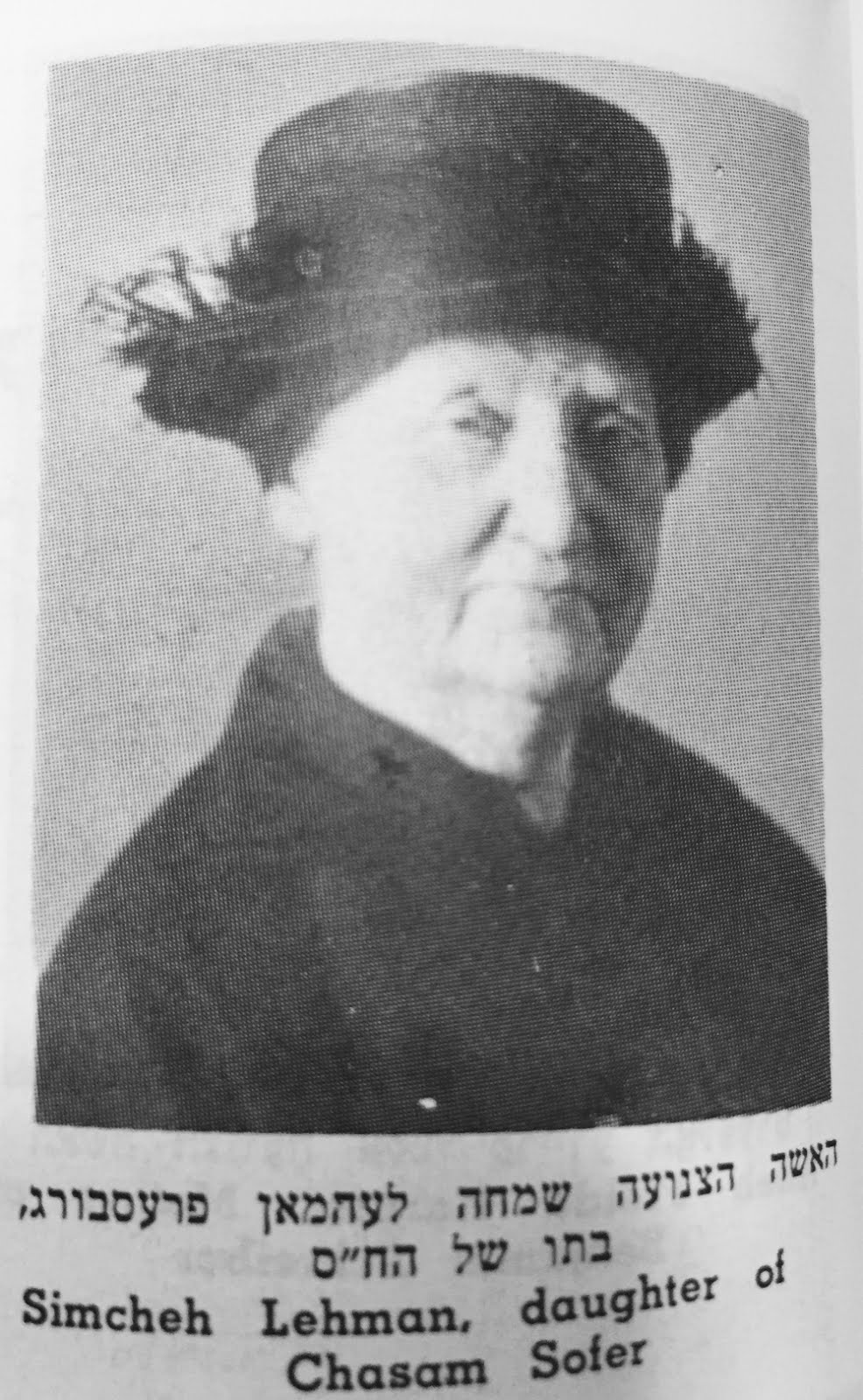
Isaac Hirsch Weiss was not the only one to criticize Shlomo Sofer and his works.  No one less than Simcha Lehman, daughter of the Chasam Sofer, was reported to have said that her nephew’s biography of her father is filled with exaggerations[40].  
R’ Shlomo Zalman Ehrenreich claims[41 ]that Sofer intentionally left out his grandfather R’ Avraham Yehuda Schwartz, author of the Kol Aryeh, from a list of students of the Chasam Sofer that Sofer made in his Iggerot Soferim[42].  Ehrenreich attributes this omission to a familial dispute between Sofer and descendants of the elder Schwartz.  Shlomo Sofer was rabbi of the town of Beregszász, where some of the Schwartz family also resided.  Apparently, they did not get along.[43]
Leopold Greenwald[44] not only accuses Sofer of deliberate omissions by the latter in his works, but also of intentional distortions, exaggerations, and fallacious story telling[45].  He specifically takes issue with Sofer’s portrayal of a strained relationship between R’ Azriel Hildesheimer and the Ksav Sofer, when not only was Hildesheimer chosen from a plethora of many other rabbis to eulogize the Ksav Sofer upon his death, the kehillah of Pressburg even postponed the Ksav Sofer’s burial for two days, awaiting Hildesheimer’s arrival[46]. Hardly something that would be done for someone supposedly in a strained relationship with the deceased[47].  Sofer makes no mention of any this when he describes his father’s funeral in his Chut Hameshulash
I couldn’t verify that the reason that Ksav Sofer’s burial was postponed was to wait for R’ Hildesheimer to arrive; however, it is true that Shlomo Sofer only specifically mentions his brother Yaakov Akiva as giving the first eulogy and leaves the rest of the eulogizers anonymous.  Nonetheless, in my opinion I don’t think the omission of Hildesheimer is so problematic.  R’ Azriel Hildesheimer himself described the levayah[48], and he reports that there were five eulogizers; R’ Feish Fishman, R’ Yaakov Akiva Sofer, R’ Shlomo Zalman Spitzer the brother-in-law of the Ksav Sofer, Hildesheimer himself, and R’ Yosef Guggenheimer.  If we were to accuse Shlomo Sofer of intentionally leaving out Hildesheimer, then we would have to say the same about him leaving out his uncle, Shlomo Spitzer who he held in high esteem.  Though I’m not sure what Shlomo Sofer thought of Feish Fishman, who was a controversial figure among the more radical Hungarian rabbis for his German-language sermons, perhaps one could speculate that Sofer only mentions the first person that gave a eulogy and not the rest, so as not to make any mention of Hildesheimer or Guggenheimer.  But again, this is entirely speculation. 
Still, Sofer specifically says that his brother Yaakov Akiva gave the first eulogy[49].  If we were to read Hildesheimer’s list of the eulogizers as happening in the specific order in which he reported them, it would seem that in actuality the first eulogy was given not by Yaakov Akiva Sofer, but by Feish Fishman.  This would not be hard to believe, as there were many in the community that wanted R’ Feish Fishman to succeed the Ksav Sofer as rabbi of Pressburg over R’ Simcha Bunim Sofer, who eventually did succeed his father.  Hildesheimer was known to be a very meticulous person, but at the end of the day, he doesn’t specifically point out if he meant the list of eulogizers to be in the order that they actually happened.
            An allegation of forgery against Sofer was made by Shimon Zusman[50], grandson of R’ Yaakov Koppel Reich who was chief rabbi of Budapest from 1889-1929.  In the Igros Soferim, there is a letter of rebuke from the Ksav Sofer to his student R’ Reich, warning him not to pander too much to secular elements in his new position as Rabbi of Verbó[51].  Indeed, R’ Reich was known to be an educated and openminded person.  Shimon Zusman reports that when the Igros Sofrim first came out, R’ Reich commented about this letter to his other grandson R’ Dovid Tzvi Zusman, “I never received this letter, and I don’t believe that my master and teacher wrote me this letter.”
            Another charge of forgery against Sofer was made by R’ Chaim Elazar Shapiro of Munkacs, in his Nimmukei Orach Chaim[52].  I won’t get into the details of Shapiro’s accusations, as they have already been debunked by extant manuscripts of the letters he claims must be forged.  It should also be noted, that Shapiro got into a dispute with Sofer over certain charity funds and their appropriation[53].  
            So, are R’ Shlomo Sofer and his works, Chut Hameshulash and Igros Soferim reliable[54]?  Though there certainly is no proof of forgery on Shlomo Sofer’s part, can we still rely on his historical accounts?  Specifically, for our purposes, how are we to take the disparaging remarks about Ber Oppenheimer he claimed to hear from his father the Ksav Sofer in the name of his grandfather the Chasam Sofer, despite there being a responsum from the Ksav Sofer to Oppenheimer conferring upon Oppenheimer praise and respectable titles?
            In my mind, there are three ways to explain the seemingly contradictory remarks of the Ksav Sofer.
            The first possible approach is to consider Shlomo Sofer’s accounts as reliable.  Therefore, we must assume that just as the Chasam Sofer did not like Oppenheimer, though he showed no overt animosity toward him, as confirmed by Isaac Hirsch Weiss, so too the Ksav Sofer also shared his father’s opinion of Oppenheimer, and dealt with him in the same manner; overtly cordial with hidden contempt.
            There are other examples in history of rabbinical correspondence contradicting what the letter writer really thought of his recipient.  And though this seemingly goes against the dictum of chazal, “אל תהי אחד [55]בפה ואחד בלב”, I assume these people felt that this was overridden by another statement of Chazal, “תעלא [56]בעידניה סגיד ליה”, given the specific circumstances in which they had to address the correspondent.
            Two such examples come to my mind.  One is the correspondence between R’ Moshe Chaim Luzzato, the Ramchal, and R’ Moshe Chagiz, where Luzzato writes to Chagiz with utmost respect[57].  Yet when Luzzato writes to his rebbi R’ Yeshaya Bassan, his opinion of Chagiz is revealed to be that of extreme contempt[58].  This is understandable, given that Luzzato was being persecuted by Chagiz, for what Chagiz felt was Neo-Sabbateanism. 
            However, the second example really sticks out to me, as it is of the Chasam Sofer himself.  There is a famous teshuva from the Chasam Sofer to R’ Moshe Teitelbaum, where the Chasam Sofer tries to alleviate some perceived strife between them which he heard of from the town of Potok, due to their differences; as Teitlebaum was a chassid and the Chasam Sofer a misnaged[59].  The Chasam Sofer is filled with praise and admiration for Teitelbaum, even as he acknowledges their differences, as you can see for yourself here:
            This letter is dated the 28th of Sivan 5578, or July 2, 1818.  The explanation to what prompted the Chasam Sofer to write to Teitelbaum, can be found in an earlier letter that he sent to the community of Potock, on the 12th of Elul of that year, or September 13th.  It can be found in the Shu”t Chasam Sofer Hachadashos, #54:
            Sometime after the Chasam Sofer wrote to Teitelbaum, on the 13th of Shevat 5579, or February 9th, 1819, he wrote another letter to two of his students who lived in Ujhely, the same town that Teitelbaum was rabbi.  In the letter, the Chasam Sofer reveals to his students what he really thought of Teitelbaum, and the true intentions behind his laudations.  The letter can be found in the Kovetz Tshuvos Chasam Sofer, #36:
            So perhaps we can suggest that the Ksav Sofer’s opinion of Oppenheimer differed from what he put in writing, just like his father before him.  However, I think that though the Chasam Sofer didn’t show any contempt for Oppenheimer in his letters to him, he was still cold, as pointed out before.  The Ksav Sofer on the other hand is overtly warm and respectful with Oppenheimer.  Consequently, I still find it hard to believe that the Ksav Sofer held Oppenheimer in contempt. 
            A second possible approach to this dilemma, is to again take Shlomo Sofer’s account at face value.  However, although the Ksav Sofer relayed to him the disparaging remarks of the Chasam Sofer against Oppenheimer, we must conclude that his opinion of Oppenheimer was different from that of his father’s contemptuous view.  Especially considering that the Ksav Sofer’s teshuva to Oppenheimer was written a few months after he was elected to succeed his father as rabbi of Pressburg.  As we earlier noted from Isaac Hirsch Weiss, Oppenheimer was a supporter of the succession of the Ksav Sofer.  Perhaps because of his support, the Ksav Sofer felt particularly grateful to him at the time. 
            The third viable approach would be to consider Shlomo Sofer’s remarks regarding Oppenheimer as unreliable, and his report in the name of his father fabricated.  What pushes me more to this approach than any other, is the combination of the teshuva of the Ksav Sofer to Oppenheimer and one other peculiarity which I found in the Chut Hameshulash
            In his biography of the Chasam Sofer, Shlomo Sofer copies for us the original Shtar Rabbanus that the Chasam Sofer received at the start of his tenure as rabbi of Pressburg.  Accordingly, at the end of the document, all the names of the signatories are present, or so it seems.  Comparing the version found in the Chut Hameshulash with the one in Likutei Teshuvos Chasam Sofer, reveals a glaring omission. Here is how Shlomo Sofer presents the Shtar:
Here it is in Likutei Teshuvos Chasam Sofer:
As you can see in the bottom of the middle column, Ber Oppenheimer was one of the signatories.  This also verifies Isaac Hirsch Weiss’s report I mentioned earlier, that Oppenheimer was a supporter of the Chasam Sofer taking the position of Rabbi of Pressburg.
            Here is a picture of the actual manuscript where you can still make out Oppenheimer’s signature:
             With a reputation for purposely omitting facts already preceding him, it does not surprise me that Sofer would also omit Oppenheimer’s name from the Shtar Rabbanus of his grandfather, given that it does not follow the narrative he wishes to portray, as evident from negative reports he gives of Oppenheimer.
            Whatever the truth may be, one thing is for sure; Ber Oppenheimer was a talmid chacham who was respected by most of the gedolei hador of his time, who had his differences with the Chasam Sofer.
Miscellaneous Ha’aros

I’d like to end off with a few divrei torah.  While I was busy with this post, Shavuos past, and like every year I read the relevant Mishna Berurah which I could never understand. Regarding the custom of eating dairy on Shavuos, the Mishna Berurah at the end of siman 494 gives a reason in the name of an anonymous gadol.  Since klal yisroel recieved the Torah on Shavuos, by default they also excepted all 613 commandments, for according to R’ Sa’adya Gaon[60] all 613 mitzvos are included in the ten commandments.  Along with that came the commandments of kosher food; shechitanikur, no blood, salting, and the need to have kosher utensils.  Thus, it was much easier at the time to forgo cooking and just eat dairy, as none of the above laws really apply.
This reason makes absolutely no sense to me.  Without getting too involved in the topic, I think that any person who’s learned through shas and chumash, even in just a cursory manner, knows that the whole torah and everything in it was not given all at once at Sinai; there is a chronology to the giving of taryag mitzvos.  I will just quote the Ramban in his hasagos to the Sefer Hamitzvos[61]:
“והנה, שתי פרשיות בתורה ובהן מצות רבות ולא נאמרו למשה בסיני, אלא לאהרן נאמרו ולא בסיני, פרשת שתויי יין ופרשת משמרות כהונה ולוייה ומתנות כהונה ולא חשש להוציאם מן החשבון הזה. ומצות רבות לא נאמרו בסיני אלא בשעת מעשה, כגון דין מקושש ובנות צלפחד ולא חששו לכך, וכו’.”
The Chazon Ish also has a discussion on the chronology of the mitzvos, in Orach Chaim #125.  So, needless to say, suggesting that bnei yisrael by matan torah were concerned with all the laws of kashrus, is simply anachronistic.  Those laws were only given afterwards. 
Also, when Sa’adya Gaon suggests that all the mitzvos are included in the ten commandments, that’s not in a literal sense, but taxonomical; all the mitzvos can be divided under ten categories under the rubric of the ten commandments.
I found another interesting tidbit in the Alfei Menashe part I, from R’ Menashe Ben Poras of Ilya, where he rails against a pshat which suggests that עם קשה עורף is a good character trait:
What I find most interesting is that after condemning this notion by saying it only comes from the koach hadimyoni[62], he brings himself support by quoting the Vilna Gaon who said that the koach hadimyoni is a part of the evil inclination.  However, the Vilna Gaon himself in his commentary to Mishlei 10:20, explains עם קשה עורף as a good character trait!  See here:


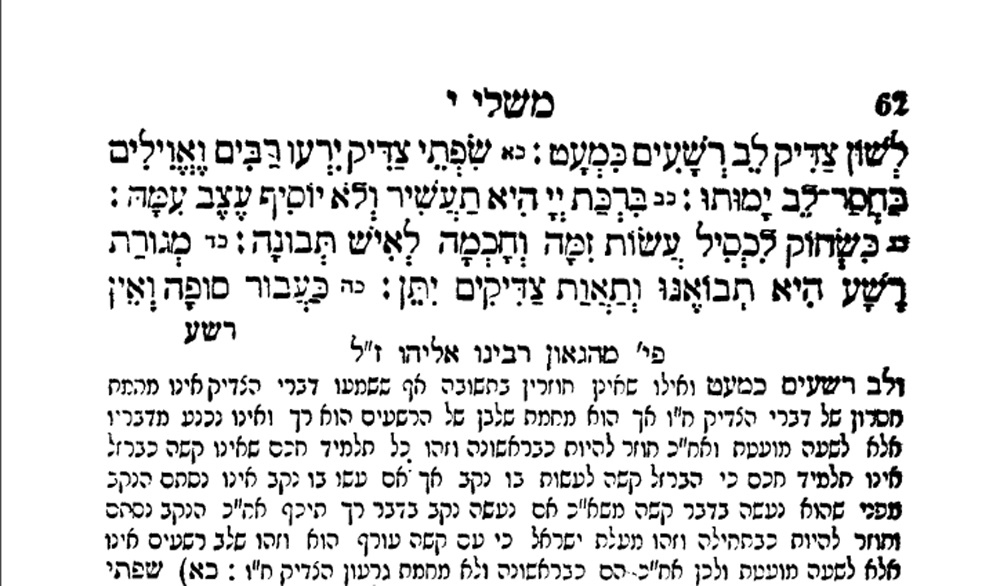
[1] ד”ה וכי אומרים.
[2] ד”ה הא דאמרינן וכי אומרים.
[3] Here are the sources that I found at the time:  שו”ת עטרת חכמים אה”ע סי’ ל”א, שו”ת טוב טעם ודעת מהדו”ק סי’ רכ”ו, חידושי חת”ס פה ובגיטין ל”ח ע”ב, שו”ת באר יצחק אה”ע סי’ א’ ענף ח’, שו”ת עונג יו”ט ס”ס נ”א, שיח יצחק חגיגה ב’ ע”ב, נחלת יעקב להגאון מליסא פה, שו”ת כתב סופר יו”ד סי’ קכ”ה, שו”ת בנין ציון השלם כרך ב’ סי’ קי”ט, שו”ת שואל ומשיב מהדורה תליתאה ח”ג סי’ ל”ד, שו”ת מהר”ש ענגל ח”א סי’ צ”ה, אור גדול סי’ ח’ אות ז’ ד”ה ויתישב בזה, שו”ת משיבת נפש אה”ע סי’ י”א, שו”ת ר”ש איגרת יו”ד סי’ ל”ד,שו”ת הרי בשמים מהדו”ק ח”א סי’ ל”ח, יד שאול יו”ד סי’ רס”ז ס”ק נ’, חידושי מהר”ם בנעט פה, שו”ת תירוש ויצהר סי’ ל”ב.
[4] Gittin 41b, Tosafos ד”ה כופין , here.
[5] Correspondence with Oppenheimer can also be found in Shu”t Noda Beyehuda Yoreh, De’ah Mahadura Tinyana here, #64, Shu”t Meshivas NefeshYoreh De’ah #67 here, Shu”t Yehudah Ya’aleh, Orach Chayim #147 HereShu”t Toafos Re’eim, Orach Chayim #9 here,  See also Shu”t Ein Habdolach #4 here where R’ Chaim Tzvi Manheimer gets sharp about Oppenheimer, though he still prefaces his name with Moreinu Harav.
[6] P. 8b here.
[7] P. 9b here.
[8] Hochgefühle bey der glorreichen Feyer der Krönung Ihrer Majestät, (Vienna 1825).
[9] #13, #39, and #103.
[10] See Leopold Greenwald, Otzar Nechmad, p.73 fn. 1, Arim V’Amahos B’Yisraelpart VII, p.74, Shlomo Zonnenfeld, Ha’Ish Al Hachoma, p.109, Shmuel Eliezer Stern, Sneh Bo’er B’Aish, p.66 fn.20.
[11] Vol. 2, P.18.
[12] P.96, here.
[13] P.25 #43.  Weiss also changes the year the story happened in to 1833.
[14] (Jerusalem 1924), part I, p.75b here.
[15] Printed by Efraim Deinard in Shibolim Bodidos, p.49 here.
[16] P.23a in the Munkacz edition here.  There were three editions of the Chut Hameshulash printed by Sofer, with the final edition being called Chut Hameshulash Hachadash due to the additional material not found in the previous editions.
[17] Ibid p.23b, here.
[18] Michael K. Silber, in his dissertation, Roots of the Schism in Hungarian Jewry, chapter2 p.26, writes similarly that there was tension between the Chasam Sofer and Oppenheimer, because of the latter supposedly stole from the former’s chidushim.  Though in his notes Silber references the Chut Hameshulash here, in the actual body of his text he brings proof from the language the Chasam Sofer uses in a short teshuva to Oppenheimer in the Mei Be’er #39, where he seemingly hints to this when he says, “גם אני אמרתי כן בחידושי לב”מ” .  Yet, I see no reason to believe the Chasam Sofer was suggesting anything of the sort by using this language, which is just a way of approving the other’s thoughts. See Shu”t Chasam Sofer Choshen Mishpat at the end of #118, where he uses the same language to R’ Meir Ash, here.  See also ibid. Even Haezer part I, #152 here, where R’ Akiva Eiger also says as such.
[19] See Shu”t Chasam Sofer, Orach Chayim #9, and ibid., Choshen MIshpat #79
[20] See ibid., Orach Chaim #54, 79, 140, and 208, and ibid., Yoreh De’ah, #6
[22] See Shu”t Chasam Sofer, Choshen Mishpat, #205, Kovetz Teshuvos Chasam Sofer, #44 and 64, Teshuvos Chasam Sofer Hachadashos #33
[23] For a thorough treatment of the events surrounding the Primaerschule, see Michael K. SilberRoots of the Schism in Hungarian Jewry, (Hebrew University, 1985) ch.2
[24] Hadarom, no.5-6, pp. 122-123
[25] See Leopold Greenwald, Otzar Nechmad, pp.72-77 here.
[26] See Meir Hischkowitz, Rebbi Tzvi Hirsch Chayos (Mossad Harav Kook, 2007), pp.91-92
[27] See Shu”t Moharatz #47, Here
[28] Leopold Greenwald, Toldos Mishpachas Rosenthal, pp. 38-39 here.  Rappaport accuses Taubes of joining the ranks of the chasidim, and for this he can’t fathom Oppenheimer’s support of Taubes, “אכן אשר אתפלא קצת הוא כפי ששמעתי גם החכם ר’ בער אפענהיימער מפר”ב הוא מתומכי ר’ משה טויבערש ומבלי דבר על תכונת הדוב הזה, הלא מדבר זה לבד יודע דרכו, כי מה מצא הוא באיש לחשבהו ראוי לעזרו וסעדו לעלות במעלה כזאת? ” I find Rappaport’s remarks about Oppenheimer particularly interesting, given the fact that a little over a year before in 1830,  there was a rumor that Oppenheimer advocated for Rappaport to take over the recently vacated position of chief rabbi of Moravia after R’ Mordechai Banet passed away.  See the letter from R’ Yaakov Orenstein to the Chasam Sofer in Igros Sofrim, letter #50, where he asks if there was any truth to this, here.
[29] Here is his picture:
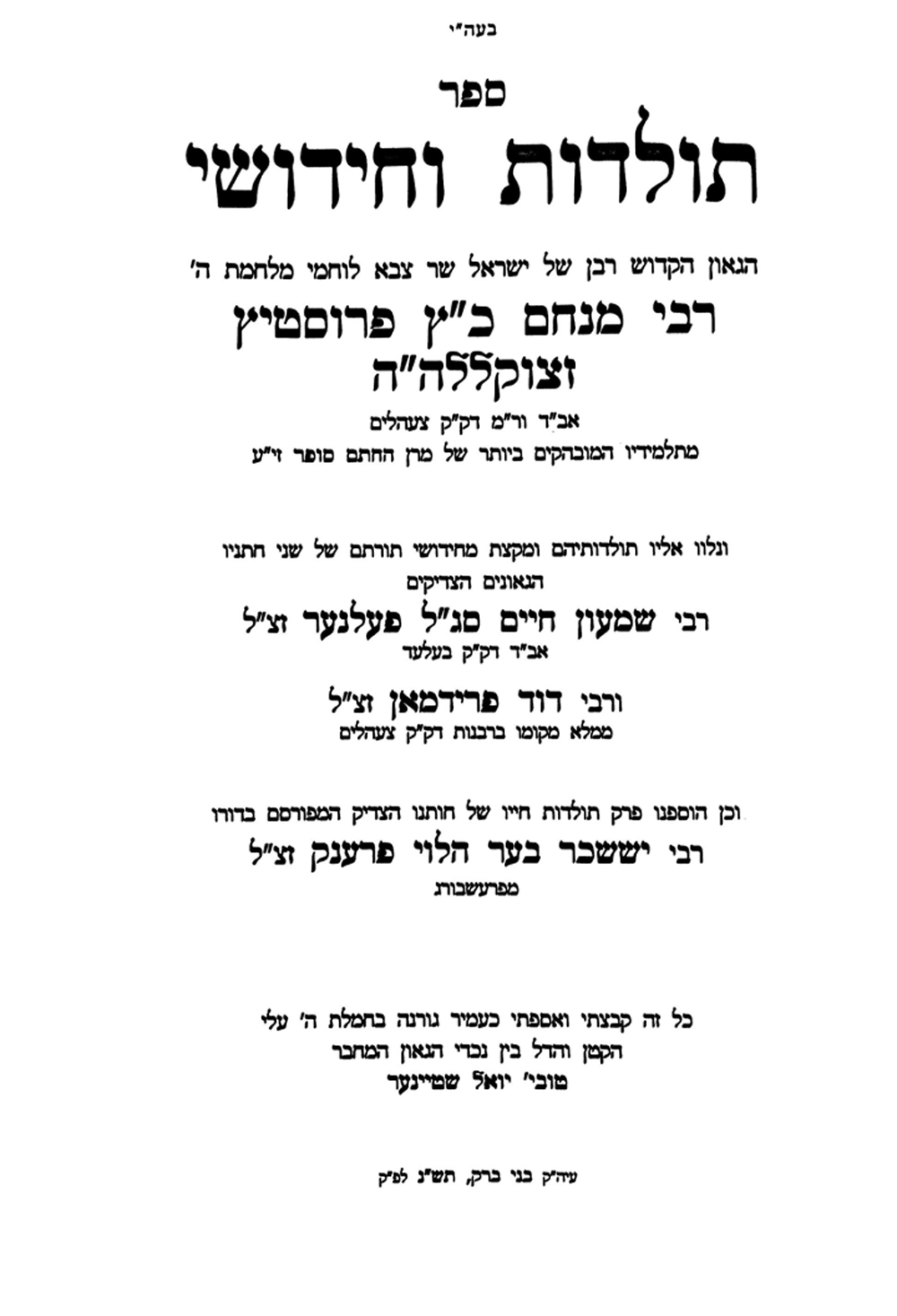
In the Toldos V’Chidushei Rebbi Menachem Katz Prostitz (Bnei Brak, 1990), there is also a biography of Ber Frank, who was the father-in-law of Prostitz.  Here is the title page:  
Not surprisingly, this picture was not printed in this sefer, probably because it does not fit the standard Bnei Brak narrative of what a Jew is supposed to look like.  And though the biographer is meticulous enough to list all of Ber Frank’s publications, whether extant or not, and to list and print the text of all the haskamos and michtivei bracha, he conveniently leaves out two; the michtav from the reformer Leib Schwab printed in Frank’s Ohr Haemunah part Ihere, and the michtav from the maskil and poet Meir Letteris, in his Ohr Haemunah part IIhere.  Frank is also famous for producing the picture of the Chasam Sofer and disseminating it to support the marriage of his daughter to Prostitz. For the story behind the picture, see Igros Sofrim pp. 27-28 here.  
[30] Shu”t Ksav SoferOrach chaim #115, Here.
[31] Hirschkowitz makes the same point, ibid. note 157.
[32] Hakdamah of Part II
[33] Pp.128-131 in the Jerusalem edition from Machon Daas Sofer
[34] In Otzar Nechmad ibid.
[35] Ibid.
[36] Ibid.
[37] See the version of this sermon presented in Drashos Chasam Sofer Part II, pp.648-652, here, and Yosef Naftali Stern’s footnote on p.650.  In his footnote, Stern asks the obvious question; how could the Chasam Sofer pray for the destruction of evildoers when this seemingly contradicts the gemara in Brachos 10a, where the gemara concludes that one should not pray for their death, rather one should pray that they should repent?  I would also add to that this contradicts the gemara in Brachos 7a, where R’ Yehoshua ben Levi concludes that it isn’t proper to curse evil people either, see Tosafos there too.  Though Stern answers this by concluding that the gemara’s dictum does not apply to those that lead others astray and cause others to sin, I’m surprised he doesn’t mention that the Chasam Sofer explicitly comes to this conclusion himself in reference to the gemara in Brachos, in an earlier sermon from 1806, found in the Drashos Chasam Sofer Part I, pp.275-276, here.  I also found that the Alshich in parshas Korach 16:28, also comes to the same conclusion.  Accordingly, this would also explain why birchas haminim which we say in shmona esrei doesn’t also contradict this gemara, as one could say that it was meant only for those minim that were חוטא ומחטיא את הרבים.  See also the Diyukim B’nuschei Hatefilah V’habrachos from the Vilna Gaon, printed in the back of the Shulchan Aruch, where he says that one should say וכל הרשעה and not עושי רשעה, as he references the gemara in Brachos.
[38] Yosef Naphtali Stern makes the same chronological mistake as Plaut in his footnote, ibid.
[39] Ibid.
[40] Olamo Shel Abba, (Jerusalem, 1983) p.67.  Here is her picture:
[41] Zichron L’Moshe P.5, here.
[42] Pp.89-95, here.
[43] See Naphtali Ben Menachem, B’Shaarei Sefer (Mossad Harav Kook) p.115.
[44] L’toldos Hareformatzian Hadatis B’Germania U’bUngaria (1948), p.73 fn.30, here.  Earlier on p.19 fn.38, he also takes issue with Shlomo Sofer writing that the Chasam Sofer allegedly said his son the Ksav Sofer knows how to learn better than himself.  Elsewhere, Sofer writes that the Ksav Sofer said that he learns how to learn from his son R’ Simcha Bunim, author of the Shevet Sofer.  Thus, one may conclude the obvious absurdity, the Shevet Sofer was a greater talmid chacham than the Chasam Sofer!
[45] Though not intentional, I found an example of Sofer telling an untrue story in his final edition (see above, fn.16), Chu”t Hameshulash Hachadash p.8a in the footnotes, or in the modern edition printed in Jerusalem, p.27.  Sofer tells a story he heard about R’ Zelmeleh of Volozhin, one of the prime students of the Vilna Gaon:  When the Vilna Gaon and hs talmidim were gathering signatures for the excommunication against the chasidim, they went to R’ Zelmeleh to ask him to sign on the document.  Much to their surprise, R’ Zelmeleh declined.  R’ Zelmeleh then proceeded to explain his refusal with a dvar torah; we find that Avraham stopped himself from slaughtering his son Isaac, when he heard the angel tell him to do so.  How could Avraham listen to the angel who said not to slaughter Isaac, when he heard directly from G-d himself that he must slaughter him?  R’ Zelmeleh concluded, “for one to not kill someone, a command from an angel suffices, but a command to go ahead and slaughter someone must be heard from G-d himself.”  R’ Zelmeleh continued, “though our master, Rabbeinu Eliyahu, is like an angel of G-d, in order to slaughter someone, we must hear it from G-d himself.”
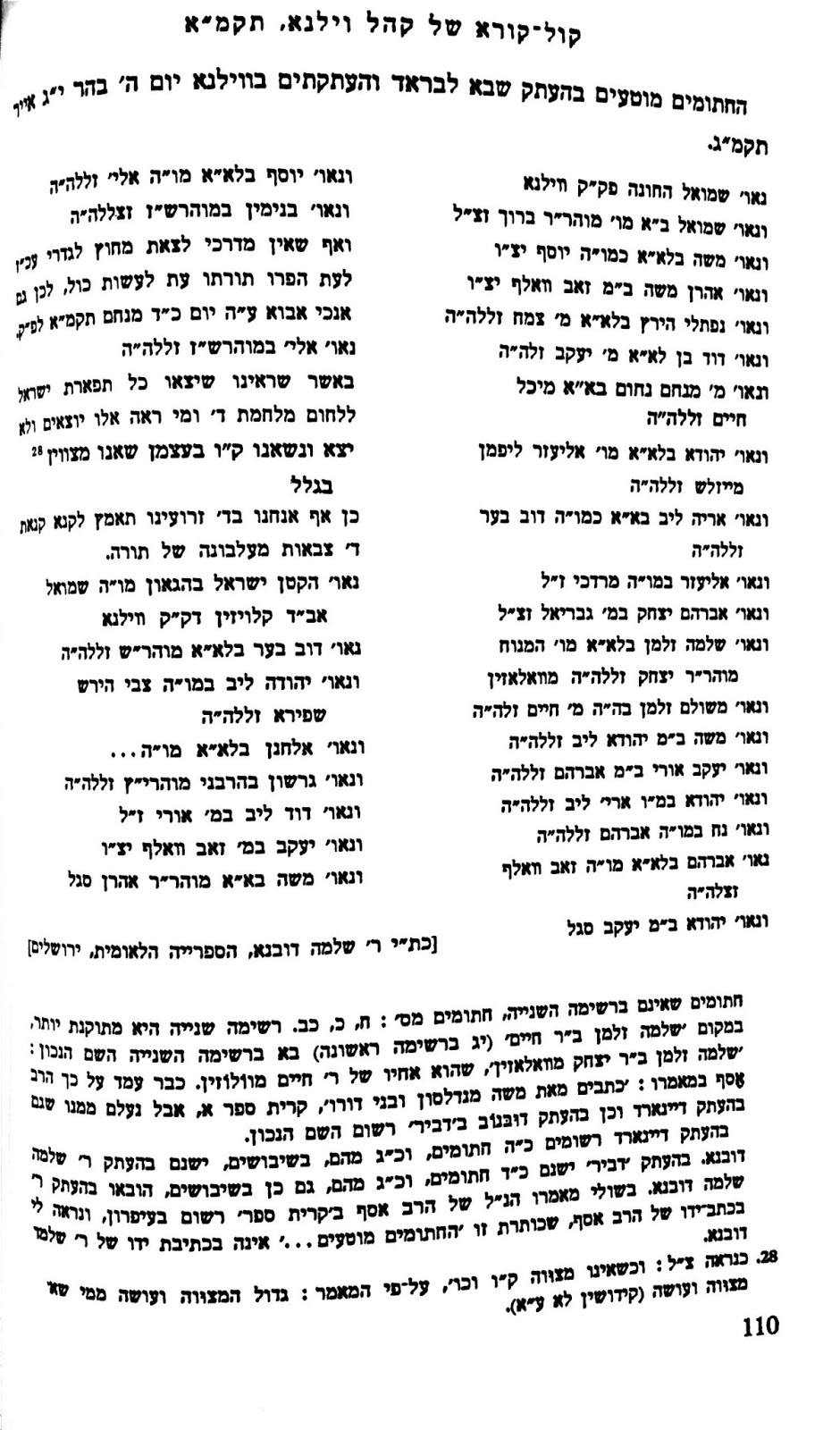
When I first read this story, I gave a little chuckle.  Here’s why: You can clearly see on the right-hand column the signature of R’ Zelmeleh on the kol koreh of the cherem of 1781.

The main character of this story was originally told as being R’ Refoel Hamburger, not R’ Zelmeleh of Volozhin.  Even so, in the torah journal Sharei Torah, part X, kunteres 1, #5, R’ Meir Dan Plotzky, while explaining that R’ Refoel Hamburger was no lover of chasidim, says he doubts the authenticity of this story.

[46] Interestingly, Greenwald criticizes this practice of postponing the burial to wait for eulogizers, in his Kol Bo Al Aveilus p.12, here.  Greenwald writes that it pained him to read in Der Morgan Journal Dec. 2, 1941, that after the death of a famous rabbi and gaon from Brooklyn early Friday morning, the burial was postponed until Sunday so more eulogizers and people could attend.  I assume Greenwald is talking about the levayah of R’ Moshe Soloveitchik which you can read about here.  Though, I don’t know why he would read about it almost a year later (R’ Moshe died in January).  R’ Simcha Soloveitchick died a few weeks prior to that issue of Morgan Journal, on November 16.  However, R’ Simcha died on a Sunday, not a Friday.
[47] Meir Hildesheimer makes the same point in Sefer Hazikaron L’Yechiel Yaakov Weinberg, p.18 fn.72.  He also adds that the Ksav Sofer pressured R’ Azriel Hildesheimer to become rabbi of Pressburg in a joint capacity with him.
[48] Tzefunos no.6, pp.63-66, Here.
[49] Ibid. p.338.
[50] See Shmuel Weingarten, Sinai no.74, p.92 fn.17.
[51] P.51-52, here.  Another interesting example of a rabbi giving rebuke to one of his peers, is the teshuva of R’ Yosef Shaul Nathanson to the son of R’ Shmuel Waldberg of Yaroslav, in Shu”t Shoel U’Mashiv, Mahadura Telisa’ah, part I #264, here.  Nathanson as an exception responds to the generic talmudic query of Yoel Waldberg even though it is not a pressing question of halacha.  Nathanson explains that he made this exception in order to foster a love for learning in Waldberg, so that he would leave his secular ways; simultaneously criticizing his father, R’ Shmuel, for being too involved in secular studies.  Indeed, R’ Shmuel Waldberg succeeded R’ Hirsch Chajes as Rabbi of Zolkiew, a city with very modern leanings, before his tenure at Yaroslav. Unfortunatley, Waldberg’s children became mechalelei shabbos (I don’t know if that includes the above mentioned Yoel), and in his later years Waldberg was filled with regret about his secular studies, railing against them in his sermons.  Waldberg authored many seforim on a plethora of subjects.  Here is his picture:
[52] Siman 243, here.
[53] See Yehuda Spiegel, Toldos Hayehudim B’Rusia Hakarpatis, pp.86-88.
[54] See Binyomin Shlomo Hamburger, Zichronos Umesoros Al Hachasam Sofer (Bnei Brak, 2013), pp.12-26 for a defence of Shlomo Sofer’s reliability.
[55] See Pesachim 113b.
[56] Literally, “Bow to the fox in its time.” Advice from chazal to act in a subordinate manner towards a person who is in an advantageous position.  See Megillah 16b.
[57] See Igros Ramchal, #10, “לגבר חכם בעוז נודע בשערים, לו שם בגבורים, גבור חיל במלחמתה של תורה עשיר מארי חיטיא קולע ולא יחטיא השערה, בר אורין ובר אבהן יאי ויאי כבוד מורנו ורבנו הרב משה חאגיש נר”ו “.
[58] Ibid. #12, “והשוטה הזה החאגיש, כאשר איש מדנים הוא, הודיע ביום כעסו גם בלא דעת ובלא השכל “
[59] See Drashos Chasam Sofer Part II, p.745, “אך מי שהגיע לכלל תכלית החסידות והפרישות ולא כחסידי הזמן ח”ו  ” , here.
[60] This is apparent from the Azharos of Saadya Gaon, where he explains each mitzva, and under which commandment it falls.  See Rashi to Exodus 24:12 and Perushei Rabbeinu Sa’adya GaonMishpatim fn.2.
[61] Soresh Rishon
[62] lit. imaginary faculty, imagination


Translations of Rabbi Judah Halevi’s Kuzari

Translations of
Rabbi Judah Halevi’s Kuzari
by Daniel J. Lasker
Daniel J. Lasker is Norbert Blechner Professor of Jewish Values at Ben-Gurion University of the Negev, Beer Sheva, in the Goldstein-Goren Department of Jewish Thought. He has published widely in the fields of medieval Jewish philosophy, the Jewish-Christian debate, and Karaism.
This is Professor Lasker’s third essay at the Seforim
blog.
On the occasion
of the publication of:
ספר הכוזרי. הוא ספר הטענה והראָיה לדת
המושפלת לרבי יהודה הלוי
תרגם מערבית-יהודית לעברית בת זמננו
מיכאל שוַרץ
הוצאת הספרים של אוניברסיטת בן-גוריון
בנגב, באר-שבע, תשע”ז
R. Judah Halevi,
The Book of Kuzari. The Book of Rejoinder and Proof of the Despised Religion,
translated by Michael Schwarz
Beer Sheva, 2017
The
publication of Prof. Michael Schwarz z”l’s new modern Hebrew translation of
Rabbi Judah Halevi’s Judaeo-Arabic Book of Kuzari provides a good
opportunity to discuss previous versions of this seminal book of Jewish thought
and to evaluate the advantages that Prof. Schwarz’s translation has over other
renditions. Prof. Schwarz (1929-2011), who completed a draft translation before
he died over five years ago, was a scholar of Jewish and Islamic philosophy
whose best-known publication has been his translation of Maimonides’ Guide
of the Perplexed
. After an unfortunate delay, the Kuzari has now been
published by the International Goldstein-Goren Center for Jewish Thought at
Ben-Gurion University of the Negev, in its series “Library of Jewish Thought,”
under the editorship of Prof. Haim Kreisel.[1]
Less
than thirty years after R. Judah ben Samuel Halevi completed his Book of
Kuzari
[2] in approximately
1140, it became one of the first Judaeo-Arabic compositions to be translated
into Hebrew. This pioneering translation marked part of the cultural transfer
of Andalusian Jewish culture, written in Judaeo-Arabic, into Hebrew, and was accomplished
in 1167 by R. Judah ben Saul Ibn Tibbon, “the father of the translators.” As
the centers of Jewish intellectual life moved to Christian areas where Hebrew
was the predominant Jewish literary language, it was only through this
translation that the Kuzari was known to generations upon generations of
Jews. The Kuzari’s readers were moved by its unwavering defense of
Judaism, its description of Jewish singular chosenness, and its love of Zion.
Halevi’s life story, including his departure from Iberia and, according to
legend, his martyrdom at the gates of Jerusalem, only strengthened the
resonance of the book (on this legend, see here). Extensive commentaries were written on the basis of the
Ibn Tibbon translation by authors who neither understand Arabic nor were able
to appreciate the Islamic context in which the Kuzari was written. Judah
Halevi’s defense of Judaism made a great impact on Jewish thought and achieved
canonical status.[3]
With
the birth of Jewish studies in the nineteenth century, scholars began
publishing original texts in academic editions. Thus, Hartwig Hirschfeld
(1854-1934), working with Oxford-Bodleian Ms. Pococke 284, the only complete,
or almost complete, version of the work, produced a first edition of the
original Judaeo-Arabic text of the Kuzari.[4] He published with it a
version of the Ibn Tibbon translation which was partially corrected to
correspond to the Judaeo-Arabic version, but not in a consistent manner. Thus,
Hirschfeld changed some passages in the Hebrew despite their being attested in
all the Ibn Tibbon manuscripts and editions, but left other problematic
passages untouched.[5] The Hirschfeld Ibn Tibbon text achieved wide
distribution when it was used by Avraham Zifroni as the basis of his edition of
the Kuzari, and many contemporary editions of the Hebrew Kuzari
are based on Zifroni’s work.[6] Meanwhile, Hirschfeld’s Judaeo-Arabic publication
has been supplanted by the superior edition of David Zvi Baneth and Haggai
Ben-Shammai.[7]
The
Judah Ibn Tibbon translation of the Kuzari is an adequate translation, despite
some misunderstandings. It follows the Tibbonide practice of maintaining the
syntax and word order of the original Arabic to the extent possible and often
translating the same underlying Arabic term with one Hebrew equivalent. It may also
be a better witness to the original text of the Kuzari than the unique Judaeo-Arabic
manuscript which was copied in Damascus over 300 years after the composition of
the original book. For professional students of medieval Jewish philosophy, or
those with close familiarity with medieval Hebrew, it is readable and achieves
its goal of making the work accessible to non-Arabic readers. Yet, there is
still no acceptable edition based on the best manuscripts of this translation.
In addition, as a means of communicating the extent of Judah Halevi’s thought
to the contemporary reader of modern Hebrew, it is less than ideal. Thus, since
the 1970’s, a number of new Hebrew translations of the Kuzari have
appeared.
The
first of these translations was presented by Dr. Yehudah Even Shmuel (1886-1976)
in 1973.[8] The first edition included a long introduction, a vocalized and
punctuated text, short notes and many extensive indices, and was praised for
the clarity of its Hebrew and its accessibility to contemporary readers.
Subsequently it was published in paperback with just the text and short notes,
an edition which has sold well and is used as a textbook for high schools and
universities. At first, the novelty of a medieval philosophical work in
readable modern Hebrew seems to have compensated for the imprecision of the
translation.[9] Oftentimes, the translator offered more of a creative
paraphrase than an exact translation, and there were sections where Even Shmuel
attempted to tone down considerably Judah Halevi’s view of Jewish essentialism.[10]
Many key terms were translated by different Hebrew words, making it impossible
for the reader to note the importance of these words, most of which have
resonances from the Islamic and Arabic realms. Thus, Halevi’s great debt to his
non-Jewish cultural context was effectively hidden by this translation.
Scholars soon realized that this edition of the Kuzari could not be used
for academic purposes.
Despite
its drawbacks, or perhaps because of its advantages, the Even Shmuel
translation went unchallenged for over 20 years. In the mid-1990’s, I heard
Rabbi Yosef Kafiḥ (1917-2000), the well-known editor and translator of
Judaeo-Arabic texts, reply to a question as to why he did not translate the Kuzari
as he had translated so many other classics. He responded that he had prepared
such a translation many years previously but had decided not to publish it
because he did not want to appear as competing with Even Shmuel. Nonetheless, Kafiḥ
finally did publish his own translation in 1997,[11] following his custom of
presenting the original Judaeo-Arabic and the Hebrew translation in parallel
columns.[12] This translation has neither the clarity nor the extensive
notation of Kafiḥ’s earlier translations; most of his comments are devoted to
attacking Even Shmuel’s translation. In his introduction, Kafiḥ explains that
he had begun translating the Kuzari when he was a student in a class led
by Rabbi David Cohen (the Nazir, 1887-1972) at Merkaz Harav Yeshiva in 1947-48,
where he was made responsible for comparing Ibn Tibbon’s Hebrew with the
Judaeo-Arabic in the Hirschfeld edition.[13] Repeating what he had said in
public, namely that he had waited so long to publish this translation because
of his desire not to appear as a competitor with Even Shmuel, he then goes on
to attack Even Shmuel’s translation mercilessly. He even states that Rabbi
Judah Halevi composed one of his dirges when he realized that his Kuzari
would be translated by Even Shmuel.
Despite
Rabbi Kafiḥ’s great erudition in Judaeo-Arabic, and the general readability of
his other translations, the Kuzari does not match his previous work.
Whether this was a result of the fact that the translation was, indeed, a
product of his youth before he had perfected his Hebrew style, or was the work
of an aged man who did not review his earlier drafts, it did not succeed in replacing
the Even Shmuel translation as the generally accepted Hebrew version of the Kuzari.
My own experience with Israeli students has been that Kafiḥ’s Hebrew is not
much more understandable than that of Judah Ibn Tibbon, and, despite the
convenience of having the original Judaeo-Arabic text available, it was not a
very good pedagogical tool. Sometimes I preferred using the Ibn Tibbon text
which is available in a number of formats, such as in Yediot Aharonot’s Am
ha-sefer
project[14] and on-line.
There
exists one more contemporary translation of the Kuzari into Hebrew and
that is the one produced by Rabbi Itzhak Shailat (b. 1946).[15] Shailat is
known for his editions and translations of medieval Judaeo-Arabic texts, such
as Maimonides’ Epistles. Although Shailat’s introduction and notes to
his editions demonstrate a conservative, harmonistic and pietistic approach to
his authors, his translations are generally accurate. His methodology, however,
is to reproduce Tibbonide Hebrew as much as possible, giving his translations a
classical, rather than modern, feel. Hence, his Kuzari should be seen as
an update of Ibn Tibbon rather than as an independent creation.
Before
discussing the new Hebrew translation, it might be useful to refer to
translations into other languages. In addition to editing the Judaeo-Arabic
text of the Kuzari, and producing an edition of Ibn Tibbon’s Hebrew
translation, Hartwig Hirschfeld also translated the book into English.[16] This
work was reissued many times, often with minimal attribution to Hirschfeld.[17]
The abridged translation of the Kuzari by Prof. Isaac Heinemann
(1876-1957) which appeared independently in Oxford, 1947, and was later
incorporated in the widely distributed Three Jewish Philosophers,[18] is
greatly dependent upon Hirschfeld. In addition to questions of accuracy, the
language of these translations is difficult for the contemporary English
reader.
In
an attempt to present a clearly written English version of the Kuzari
which could be used by laypeople, Rabbi N. Daniel Korobkin (b. 1964) published
a translation on the basis of the Ibn Tibbon version, relying on the
interpretations of the classical commentators Judah Moscatto and Israel of
Zamosc.[19] Although achieving its goal of readability, the author’s ignorance
of Arabic and the scholarly literature on the Kuzari are the cause of
multiple errors of translation and annotation. Ibn Tibbon’s Hebrew translation
of the Kuzari is included in the book, but since it is based on the
Hirschfeld/Zifroni edition (the exact source is not noted in the book), and the
English translation is based on older editions, there are inconsistencies
between the Hebrew and the English. Subsequent to the Korobkin translation, other
English editions of the Kuzari have appeared, but apparently none of them
is based on the Judaeo-Arabic original.[20]
A
scholarly, readable English translation of the Kuzari from the original
has long been a desideratum. In fact, Prof. Lawrence V. Berman (1929-1988)
began the work on such a translation before his untimely death. The project was
inherited by Prof. Barry S. Kogan (b. 1944) and is scheduled to appear as part
of the Yale Judaica Series. This project has been long delayed, but Prof. Kogan
has been very generous with sharing drafts of this translation with colleagues,
a number of whom have used its clear and accurate renditions in their own
publications. One can only hope that there will not be much further delay until
the translation appears in print.[21]
This
leads us to the recently published Hebrew translation of the Kuzari by
Prof. Michael Schwarz. Following the pattern established in his translation of
Maimonides’ Guide, Schwarz presents an eminently readable rendition of
the book. As in the case of his other translations, the work combines accuracy
with readability. His language is elegant, eschewing the many foreign words
which have entered contemporary Hebrew. He highlights words which appear in
Hebrew in the Judaeo-Arabic original by using a bold font so the reader knows
that this is Halevi’s Hebrew, not Schwarz’s.
As
noted above, one of the challenges with a translation of the Kuzari is
how to capture the Islamic/Arabic flavor of the work. Despite its reputation as
the most Jewish of the medieval Jewish philosophical treatises, recent research
has demonstrated the extent to which the Kuzari is steeped in Islamic concepts.[22]
This can be seen by its use of a number of key terms which are repeated
throughout the book, such as ṣafwa (the choicest, translated as segulah,
as found in other translations, despite Prof. Schwarz’s reservations); al-amr
al-ilāhī
(divine order, translated ha-davar ha-‘elohi, as per Kafiḥ,
in contrast to Ibn Tibbon’s ha-ʿinyan ha-‘elohi); ijtihād (fervent
striving or innovating new laws, translated as hit’amẓut, hishtadlut, or ḥiddush
halakhah
), or qiyās (analogous reasoning or general rationalism,
translated heqesh or higgayon). Since it is not always possible
to use the exact same translation in every context, the translator must find a
way of informing the reader of the underlying key term. Schwarz solves this
problem by drawing up a list of recurring Arabic concepts and noting each time
one of them is used. He then explains these terms in a special glossary devoted
to their explication. Some important Arabic words which are used less often are
explained in the textual notes. In addition, the notes provide references to
Halevi’s sources or further explications.
Scholarly
analyses of the Kuzari are extensive, and as in the case of Schwarz’s
translation of the Guide, the notes are full of references to this
secondary literature. Although he does not say so in his very short preface,
one can assume that as was the case in the Guide, the reference to a
particular article or book does not necessarily imply endorsement of the
material found therein. The annotations are there for comprehensiveness, and
the alert reader is enjoined to examine them carefully. The bibliography
occupies 36 pages. In addition, there are indices of sources and a general
index of topics and places.[23]
When
Part One of Prof. Michael Schwarz’s translation of the Guide was first published
by Tel-Aviv University Press in 1997, I offered the opinion that despite the
fact that it was the best available Hebrew version of Maimonides’ masterpiece,
I was not sure it would replace the other available translations, partially
since traditional Jewish readers might be wary of a university provenance and
the reliance on non-Jewish sources.[24] I believe that my estimation has been
proven wrong, since the translation’s clear superiority to the competition has
made it indispensible.[25] It is to be hoped that the same widespread
acceptance of the Schwarz translation of the Guide will be repeated in
the case of the Schwarz translation of the Kuzari, since it is, without
doubt, the best Hebrew Kuzari available.
Notes:
[1]
Books from this series are produced by the Mosad Bialik Publishing House. The
Schwarz Kuzari can be ordered here.
The translation is preceded by an introduction which Prof. Schwarz asked me to
write and which he approved a few weeks before his death. [Editor’s Note:
Professor Schwarz’ edition of the Kuzari can be purchased via Bialik or by
contacting (Eliezerbrodt@gmail.com) — where the book will be available at the
same  Book Week price. Portions of the proceeds of this sale help support the efforts of the Seforim Blog.]
[2] The title, The
Book of Rejoinder and Proof of the Despised Religion
, is in accordance with
a Geniza fragment; a slightly different title appears in the one full Judaeo-Arabic
manuscript mentioned below. The title of Ibn Tibbon’s translation, Sefer
ha-kuzari
, was that which was known to centuries of Hebrew readers, and it corresponds
to the title, al-kitāb al-khazarī (“The Book of the Khazar”), found in
Halevi’s famous autograph letter from the Geniza.
[3] See Adam
Shear, The Kuzari and the Shaping of Jewish Identity, 1167–1900,
Cambridge 2008. Another medieval translation, by Judah ben Isaac Cardenal, has
not survived.
[4] Das Buch
al-Chazarî des Abû-l-Hasan Jehuda Hallewi
; im arabischen urtext sowie in
der hebräischen übersetzung des Jehuda Ibn Tibbon, herausgegeben von Hartwig
Hirschfeld, Leipzig, 1887. The manuscript is now classified as Neubauer
Catalogue Oxford ms. 1228, and it is freely available on-line (here).
[5] See Daniel
J. Lasker, “Adam and Eve or Adam and Noah? Judaeo-Arabic and Hebrew
Versions of the Same Books,” Pesher Nahum. Texts and Studies in Jewish
History and Literature from Antiquity Through the Middle Ages Presented to
Norman (Naḥum) Golb
, ed. Joel L. Kraemer and Michael G. Wechsler et al.,
Chicago, 2012, pp.141-148.
[6] The Zifroni
edition, Warsaw, 1911, published under his original name Zifrinowitsch,
included many valuable notes. Subsequent editions generally omitted these
notes.
[7] Judah
ha-Levi, Kitāb al-radd wa-ʾl-dalīl fi ʾl-dīn al-dhalīl (Al-kitāb al-khazarī),
ed. David H. (Zvi) Baneth and Haggai Ben-Shammai, Jerusalem, 1977.
[8] The
Kosari of R. Yehuda Halevi
, Translated Annotated and Introduced by Yehuda
Even Shmuel, Tel Aviv, 1972. On Even Shmuel, né Kaufman, see Ira Robinson, “The
Canadian years of Yehuda Kaufman (Even Shmuel): Educator, Journalist, and
Intellectual,” Canadian Jewish Studies, 15 (2007), pp. 129-142.
[9] See, e.g.,
Michael Schwarz’s effusive review in Kiryat Sefer, 49 (5734), pp.
198-202. Many years later, Prof. Schwarz told me that he no longer held the
views he expressed in that review.
[10] For
instance, the term ṣarīḥ/ ṣuraḥa’, meaning “native-born,” and indicative
of Halevi’s essentialist view of the Jewish chosenness, is glossed over in
1:115; 2:1; and 5:23; see Daniel J. Lasker, “Proselyte Judaism, Christianity
and Islam in the Thought of Judah Halevi,” Jewish
Quarterly Review,
81:1-2 (July-October, 1990): 75-91 (Hebrew version: in Ephraim Hazan and Dov Schwartz, eds., The
Poetry of Philosophy. Studies on the Thought of R. Yehuda Halevi
,
Ramat-Gan, 2016, pp. 207-220).
[11] Sefer
ha-kuzari le-rabbeinu Yehuda Halevi zẓ”l
, Kiryat Ono, 5757.
[12] Kafiḥ states
that he used the text published by Hirschfeld, correcting it according to the
Baneth-Ben-Shammai edition. A comparison of texts indicates that he did not
always follow Hirschfeld and Ben-Shammai. In fact, in the edition and Hebrew
translation, he accepted certain emendations in the order of the text and the
re-assignment of sections from the King to the Sage, and vice versa, e.g.,
3:25-31. These departures from the original are very similar to ones made by
Even Shmuel (both mention the opinion of Rabbi Ben-Zion Hai Uziel).
[13] Cohen’s
class notes were published many years later as a commentary on the Kuzari
under the title Ha-kuzari ha-mevu’ar, edited by Dov Schwartz, Jerusalem,
1997.
[14] Judah
Halevi, Sefer ha-kuzari, Tel Aviv, 2008 (with my introduction). The text
is vocalized and section headings have been added (not by me), but it is not a
scientific edition.
[15] Jerusalem,
2010. In his introduction (p. 5), Shailat writes that he was aware that Prof.
Schwarz was working on a translation, but he decided to go ahead with his own
project because it was unclear when the Schwarz translation would be ready and
unlike Schwarz’s rendition into modern Hebrew, Shailat was translating it into
medieval Hebrew.
[16] Judah
Hallevi’s Kitab al Khazari
, translated from the Arabic with an introd. by
Hartwig Hirschfeld, London, 1905.
[17] E.g., the
edition by Schocken Publishing House, The Kuzari: An Argument for the Faith
of Israel
(various editions), which mentions H. Slonimsky as the author of the
introduction on the cover of the book, but requires one to search well to find
out that it was Hirschfeld’s translation.
[18] Cleveland,
1960, with many reprints.
[19] Yehuda
HaLevi, The Kuzari. In defense of the Despised Faith, translated and
annotated by N. Daniel Korobkin, Northvale, N.J., 1998.
[20] Amazon.com
lists many editions of the Kuzari. I have been unable to check them
personally. As far as I know, they are all dependent upon the Hebrew.
[21]
Reference should be made as well to the excellent French translation by Prof. Charles
Touati (1925-2003), executed on the basis of the Judaeo-Arabic original: Juda
Hallevi, Le Kuzari. Apologie de la religion méprisé, traduit sur le
texte original arabe confronté avec la version hébraïque et accompagné d’une
introduction et de notes par Charles Touati, Louvain, 1994.
[22] My student
Ehud Krinis discusses Shi’ite influence; see his God’s Chosen People: Judah
Halevi’s Kuzari and the Shīcī Imām Doctrine
, Turnhout 2014. For Sufi influence, see Diana Lobel, Between
Mysticism and Philosophy: Sufi Language of Religious Experience in Judah
Halevi’s Kuzari
. Albany, NY 2000.
[23] The indices
were produced by Prof. Schwarz’s son, David Zori, who took upon himself the
responsibility of transforming his father’s draft into publishable form.
Editorial work on the text was done by Ayal Fishler.
[24] Jewish Studies, 37 (1997): 267-271
(Hebrew).

[25] An edition
of Schwarz’s Guide, without the notes and with some corrections, was
issued by Yediot Aharonot in the Am ha-sefer series, Tel-Aviv, 2008. The
translation was also at one time freely available on-line until Tel-Aviv
University Press removed its site. Accessing it on-line is still possible, but
it is not as easy as it once was.


Announcement of new works of Rishonim

Announcement of new works of Rishonim
By Eliezer Brodt
מגנזי אירופה,
כרך ראשון, ההדיר והוסיף מבואות: שמחה עמנואל, הוצאת מקיצי נרדמים, 512 עמודים.
I am very happy to announce the publication of an important work which I have been eagerly waiting for, Professor Simcha Emanuel of the Hebrew University’s Talmud department’s volume of texts from the “European Genizah” (volume one). This volume was just printed by Mekitzei Nirdamim and is being sold by Magnes Press.

New texts from Rishonim are high up on my list of favorite publications, all the more so when they are edited by Professor Simcha Emanuel. Professor Emanuel is considered one of the today’s greatest experts in Rishonic literature. He has produced numerous special works [such as this recent work, this, this and my favorite] and articles of both texts and material about them for quite some time. [Many of which are available here] All of which are of very high quality, showing an incredible breadth and depth in the material at hand. One area of specialty of his is finding long lost works; this new volume continues this trend. Starting with an important introduction to the background and importance of the Genizah, it includes numerous newly discovered texts of Rishonim, with introductions and background of their importance and proof of identification.
Here are the Table of Contents of this special work:

For a sample e mail me at
Eliezerbrodtatgmail.com.
The book can be purchased via Magnes
Press
or through me at: Eliezerbrodtatgmail.com.
Also take note of a special sale of numerous
titles at Magnes Press.
Copies of this work will be arriving
at Biegeleisen shortly.