Were the Ba’alei Tosafos Familiar with Aesop or Buddhism?

Were the Ba’alei Tosafos Familiar with Aesop or Buddhism?

By Rabbi Akiva Males

I – The European Cheder Rebbi and the Ba’alei Tosafos[1]

While completing my Kollel studies in the early 2000’s, I took part in a well-run teacher’s training program. During one session, a noted Jewish educator shared the following first-hand experience: In speaking with an old-school European cheder rebbi years earlier, he asked that rebbi how he shared positive reinforcement with his young charges. The rebbi was confused by the question, so our instructor re-phrased it. This time, he asked the older rebbi how he dealt with students who misbehaved. With a heavily-accented Yiddish he responded matter-of-factly, “I give patsh”. A bit taken aback, our instructor followed up by asking that rebbi what he did when his students had done something right. Surprised by the question, the older man responded, “I don’t give patsh.”[2]

The lesson conveyed to our group of aspiring young educators was that a lack of punishment should never be seen as a replacement for rewarding good behavior. I fondly recalled that humorous incident as I prepared my Shabbos Derasha for Parshas Toldos 5786 / 2025. While looking over that week’s Torah portion, I chanced upon a remarkable explanation offered by the Da’as Zekeinim mi-Ba’alei Tosafos[3] which seemed to mirror the remarks of that old-school cheder rebbi.

In Bereishis 26:26, we find that not long after having expelled Yitzchak Avinu from his locale (Ibid. 26:16-17), Avimelech – king of the Pelishtim – had a change of heart. Together with his military leadership, he approached Yitzchak interested in entering into a peace treaty. Taken aback by Avimelech’s offer, Yitzchak expressed his surprise. In explaining himself, Avimelech commented (Ibid. 26:29) on how nicely he and his people had previously treated Yitzchak: “וכאשר עשינו עמך רק טוב ונשלחך בשלום – and as we have done with you only good, and we sent you away in peace”.

Avimelech’s words are startling. By all measures, Yitzchak had been terribly mistreated by Avimelech and the Pelishtim. After his people destroyed the vital wells which had been previously dug by Yitzchak’s father Avraham, Avimelech himself ordered the expulsion of Yitzchak and his family from his lands (Ibid. 26:15-16). How could such actions be described as, “we have done with you only good, and we sent you away in peace”?!

In order to explain Avimelech’s seemingly bizarre statement, the Da’as Zekeinim mi-Ba’alei Tosafos (Ibid. 26:29) offers a wonderful parable:

משל לארי שהיה לו עצם בגרונו. אמר כל מי שיבא ויטלנו יעשרנו המלך עושר גדול. בא עוף אחד ששמו אגרון שצוארו ארוך. אמר, אני אטלנו. הכניס העוף ראשו בגרון הארי והוציא העצם. לאחר שהוציאו שאל שכרו. אמר לו הארי, לא דייך ששלחתיך בשלום ולא אכלתיך כשהכנסת ראשך בגרוני, אלא שעדיין אתה שואל שכר?! כך אמר לו אבימלך ליצחק, חסד גדול עשינו ממה ששלחנוך בשלום, כי דרכנו להזיק כל הבא.

A parable can be made to a lion who had a bone stuck in his throat. He proclaimed, “Anyone who comes and removes it will be greatly enriched by the king!” Along came a bird named Agron[4] that had a long neck and said, “I will extract it.” The bird inserted its head into the throat of the lion and removed the bone. After he extracted it he asked for his reward. The lion responded, ‘Is it not enough that I sent you off in peace, and I did not eat you when you placed your head in my throat? Now you still ask for a reward?!’ This is what Avimelech said to Yitzchak, “We behaved with great kindness by sending you away in peace – as we normally harm all who enter our locale.”

According to the Ba’alei Tosafos, Avimelech truly felt that he had behaved compassionately with Yitzchak. How so? He normally treated foreign visitors in a more brutal fashion. Thus, in Avimelech‘s mind expelling Yitzchak – in a way which did not hurt him – qualified as having acted in a manner that was “only good”, and that he had in fact sent Yitzchak away in peace. I grinned as I thought of the old-school cheder rebbi who confused his “not giving patsh” with actively rewarding his students for their good behavior.

II – Aesop’s Fables and Buddhist Texts

It soon hit me that there was something about the Ba’alei Tosafos’ parable which I recognized. The more I thought about it, the story of a long-necked bird who plucked a bone out of the throat of an ungrateful predator seemed familiar to me. Where had I seen / heard this story before?

After conducting some online research, I was shocked to discover a tale in Aesop’s Fables[5] entitled, “The Wolf and the Crane.” Here is that short story as translated by George Fyler Townsend:[6]

A Wolf who had a bone stuck in his throat hired a Crane, for a large sum, to put her head into his mouth and draw out the bone. When the Crane had extracted the bone and demanded the promised payment, the Wolf, grinning and grinding his teeth, exclaimed: “Why, you have surely already had a sufficient recompense, in having been permitted to draw out your head in safety from the mouth and jaws of a wolf.”

The moral of the story according to Townsend: “In serving the wicked, expect no reward, and be thankful if you escape injury for your pains.”[7]

The striking similarities between the parable of the medieval Baalei Tosafos and that of Aesop left me quite confused. After all, Aesop told his stories in ancient Greece nearly 1,800 years earlier than the Ba’alei Tosafos had flourished in France. In order to explain a difficult passage in Parshas Toldos, had the Ba’alei Tosafos borrowed this tale from Aesop?

I paused to better understand what troubled me. After all, Jewish tradition encourages us to accept wisdom from outside sources. For example, our Sages taught in Pirkei Avos (4:1): “איזהו חכם? הלומד מכל אדם – Who is wise? One who learns from all men.” The Sages again taught in Midrash Eicha Rabbah (2:13): אם יאמר לך אדם יש חכמה בגוים תאמין” – Should someone say to you that there is wisdom among the nations, believe him.” Finally, in his introduction to his Shemoneh Perakim, Rambam – who was well known for his openness to Greek wisdom – famously expressed: “שמע האמת ממי שאמרה – Listen to the truth from whoever said it.”

Nonetheless, I had a hard time believing that the Ba’alei Tosafos had applied those aphorisms to use one of Aesop’s parables in their commentary to Parshas Toldos. After all, were the Ba’alei Tosafos known to be as comfortable as Rambam in employing ancient Greek wisdom in service of their Torah learning? Even if they were, to my knowledge, Aesop the storyteller was never grouped together with the famous philosophers, scientists, and naturalists of classical Greece. Is there any indication that Aesop’s Fables were viewed by our Rishonim as an important font of wisdom?

While I considered all this, my research soon revealed that a nearly analogous version of this same parable exists in Far Eastern traditions. I learned of a work in Buddhist literature known as the Jataka Tales. That text is a collection of stories – each containing a moral lesson – of what the Buddha said he experienced in previous lives. I was surprised to discover one of those stories known as the ‘Javasakuna Jataka’. In that tale, the Bodhisatta (i.e. the one who would eventually become the Buddha) was a woodpecker. It reads as follows:[8]

The Bodhisatta was once a woodpecker. One day he saw a lion suffering and asked what ailed it. The lion answered that a bone was stuck in his throat, causing him pain and preventing him from eating anything. After the lion promised not to eat him, the Bodhisatta agreed to help. But not entirely trusting the lion, he propped his mouth open with a stick for added safety before poking his head in to dislodge the bone. Then he kicked out the stick and flew away into a tree without a word of thanks from the lion.

Sometime later, the Bodhisatta saw the lion eating a wild buffalo. He flew onto a tree branch nearby and asked if he could get something for saving the lion’s life. The lion told him that not eating him when he had the chance was sufficient reward.

I now felt completely flummoxed. How was one to make sense of the Ba’alei Tosafos proposing a parable to explain a difficult verse in Parshas Toldos – when that parable was nearly identical to a much earlier Buddhist teaching? (After all, Buddhism can be traced back to the sixth or fifth century BCE[9] – which would make Aesop and the Buddah almost contemporaries.) Putting aside the question of using Aesop’s Fables, it seemed entirely unreasonable to imagine that the medieval French Ba’alei Tosafos had any familiarity with Far Eastern Buddhist texts.

Additionally, I had discovered three nearly identical versions of the same parable. Considering the numerous startling similarities they each shared, it seemed too unlikely for them to be unrelated. However, considering the vast distances in geography, culture, and time which separated all three, how could their commonality be explained?

III – The Jewish Origins of the Ba’alei Tosafos’ Parable: Two Possibilities

After some more research I became confident that the source of the Ba’alei Tosafos’ parable was found on the shelves of their own Beis Medrash. At least two Jewish texts contain the same parable employed by the Ba’alei Tosafos. Of those two sources, one was contemporaneous and the other was of much older vintage.

Berechiah ben Natronai ha-Nakdan[10] (Hebrew: ברכיה בן נטרונאי הנקדן) was an acclaimed Jewish writer, grammarian, translator, poet, and philosopher. Scholars believe he lived in 12th or 13th century England or France (or both). He is best-known for his work entitled Mishlei Shu’alim (“Fox Fables”).[11]

Although it is now little-known, Mishlei Shua’lim was once quite popular. According to Dr. Anchi Ho (a program specialist in the African and Middle Eastern Division of the Library of Congress):

Fox fables were a popular genre in his day, and scholars have noted that Berechiah could have drawn his fables from any number of existing collections, including the Aesop’s Fables then circulating in various vernaculars or the French fox fables written closer to his own time by Marie de France. Berechiah did not so much make up his stories as render them in Hebrew for a Jewish audience.[12]

In his introduction, Berachiah readily states that he collected many valuable parables from other cultures and languages. After adding Jewish themes, rhymes, and poems to those parables he produced a unique work filled with ethical and moral lessons. Though the makeup of his book seems rather unusual for his era and locale, until modern times, Berachiah’s Mishlei Shua’lim was readily found in Jewish libraries and homes throughout Europe.

Parable number eight in Mishlei Shu’alim is entitled: זאב ועגור / The Wolf and the Crane – the exact same appellation used by Aesop for his fable involving identical creatures. While Berachiah’s version of that parable is far more verbose than Aesop’s (it is nearly four times longer), it shares the very same story and moral lesson. As such, it seems clear that Aesop – who preceded Berachiah by over 1,500 years, was the source for the eighth parable found in Mishlei Shu’alim.

One could posit that when commenting on Avimelech’s strange choice of words in Parshas Toldos, the Ba’alei Toasafos readily recalled the parable of the wolf and the crane found in Mishlei Shu’alim. Realizing that story could beautifully explain the verses in question, they employed Berechiah ha-Nakdan’s parable. Unfamiliar as they may have been with Aesop’s Fables, by making use of Mishlei Shu’alim, the Ba’alei Toasafos unknowingly enshrined one of Aesop’s tales into their commentary to the Torah.

However, there is a second – and much older – authentically Jewish text where the Ba’alei Toasafos’ parable can be found. See Midrash Bereishis Rabbah (64:10), where it is recorded that the Sages – living over a thousand years earlier than the Ba’alei Tosafos – utilized that very story, and even connected it to the same Biblical verses in Parshas Toldos.

Before we see the parable as recorded in the Midrash, the context in which it was taught is crucial for our discussion. According to that Midrash, at some point following their destruction of the second Beis HaMikdash, the Roman Empire had a change of heart, and granted the Jews permission to rebuild their temple in Jerusalem. Upon hearing this news, our ancestors in the Holy Land were ecstatic. They quickly began making great preparations to accommodate the anticipated return of their exiled brethren.

Soon, however, the Samaritans – who had long caused problems for their Jewish neighbors – strongly petitioned the Roman government to cancel their earlier allowance. The Romans sided with the Samaritans and reneged on their short-lived permissive proclamation.

With their hopes now dashed, the Jewish people were understandably devastated. In their frustration, some began talking of rebelling against the Romans once again. Knowing what the terrible outcome of such an effort would certainly be, the Sages sought to calm the Jewish zealots who were considering this uprising.

The Midrash reports that the Sages felt that the great Rav Yehoshua ben Chananya was capable of speaking to and calming his aggrieved countrymen before it was too late. He was dispatched on this crucial mission, and he shared the perfect message with the people who most needed to hear it. Rav Yehoshua succeeded by means of the following parable:

ארי טרף טרף ועמד עצם בגרונו. אמר כל דאתי מפיק ליה אנא יהיב ליה אגריה. אתא הדין קורא מצראה דמוקרה אריך, יהיב מוקריה ואפקיה. אמר ליה הב לי אגרי. אמר לו זיל תהא מלגלג ואומר דעלת לפומא דאריה בשלם ונפקת בשלם. כך דינו שנכנסנו לאמה זו בשלום ויצאנו בשלום.

A lion tore its prey and a bone became stuck in its throat. He said: “Anyone who extracts it, I will give him a payment.” An Egyptian koray [bird] with a long neck[13] came, inserted its neck, and removed it. It said to him [the lion]: “Give me my payment.” He [the lion] said to it: “Go, boast, and say that you entered the mouth of a lion in peace and emerged in peace.” Likewise, it is sufficient that we entered into dealings with this nation in peace, and departed in peace.[14]

Using this parable, Rav Yehoshua ben Chananya successfully calmed his kinsmen. He validated their feelings of immense frustration and expressed his agreement that they were in fact owed recompense by the Roman Empire. At the same time, he reminded them of their opponent’s brutal nature. Considering that track record, it would be wise to take note of their well-being and view that as compensation of sorts.

The Midrash states that this parable can be used to explain Avimelech’s seemingly strange statement in Bereishis 26:29. Based on his normally violent behavior, in a sense, he really had done good for Yitzchak when he sent him away in peace.

One could argue that after taking note of Avimelech’s odd choice of words in Parshas Toldos, the Ba’alei Toasafos recalled the Midrash’s parable of the lion and the long-necked bird. Realizing that tale could perfectly explain the verses in question, they made use of it as well. If Rav Yehoshua ben Chananya’s teaching from the Midrash was the source of the Ba’alei Toasafos’ parable, it follows that nothing from Aesop’s Fables was inadvertently included in their Torah commentary.

IV – Which Jewish Text Was the Most Likely Candidate?

We have seen two Jewish texts from which the Ba’alei Tosafos could have sourced of their parable. For the following four reasons, I believe that the Ba’alei Tosafos’ parable was based on the Midrash Rabbah and not on Mishlei Shu’alim:

  1. Length and style of the parable: The Midrash’s version of this parable is only forty-nine words long. It is concise and to the point. Similarly, the length of the story recorded by the Ba’alei Tosafos is just sixty-nine words. Like the tale found in the Midrash, the Ba’alei Tosafos’ parable is also written in a straightforward fashion. In stark contrast, with a word count of two hundred and ninety-four (not including an additional poetic moral lesson), the parable found in Mishlei Shu’alim is extremely verbose. Furthermore, unlike the Ba’alei Tosafos’ parable, Berachiah’s tale is a winding elaborately rhyming poem.
  2. The animals involved: The parable taught by Rav Yehoshua ben Chananya in the Midrash Rabbah involved a lion and a long-necked bird. It was precisely those same two animals which were the key figures in the Ba’alei Tosafos’ version of the story.However, the predatory animal in Mishlei Shu’alim’s parable was a wolf – not a lion. In fact, the two animals involved in Berachiah’s tale were a wolf and a crane – the very same creatures in Aesop’s version of the story.
  3. Use as Biblical commentary: Midrash Rabbah serves as a running commentary on the Torah. Rav Yehoshua ben Chananya‘s parable of the lion and the long-necked bird was specifically cited by the Midrash to explain Shemos 26:29. In order to make sense of Avimelech’s strange choice of words, the Ba’alei Tosafos used that same tale in their commentary to that very verse. Mishlei Shu’alim, however, shares that parable completely unconnected to any Biblical narrative. It is not used in the context of offering any commentary on the Torah.
  4. Likelihood of familiarity: Mishlei Shu’alim was penned by a contemporary of the Ba’alei Tosafos. With the advent of the printing press still a few hundred years away[15], that work was only available in manuscript form. Copying such texts by hand was a laborious process. As such, it would take time for handwritten editions of Mishlei Shu’alim to spread across Europe. One can imagine that during the period of the Ba’alei Tosafos, they were far more familiar with a classical Jewish text – such as the Midrash Rabbah – than they were with an unusual new work like Mishlei Shu’alim.

Thus, the Ba’alei Tosafos’ parable seems to have been based on a lesson they knew from the Midrash Rabbah rather than on a tale in Mishlei Shu’alim. As such, it was Rav Yehoshua ben Chananya’s teaching in the Midrash – and not Aesop or a Buddhist text – that was the basis of the Ba’alei Tosafos’ parable.

V – The Need for Further Clarity

I now felt confident that the Ba’alei Tosafos had drawn their parable from a much earlier – and authentically – Jewish source. I realized, however, that I had only kicked the proverbial can down the road. After all, Rav Yehoshua ben Chananya’s parable – as found in the Midrash Rabbah – was taught to quell a would-be-rebellion against Rome after the destruction of the second Beis HaMikdash. That places his teaching of this parable at some point after the year 70 CE.

However, as we have seen, that same parable was shared by both Aesop and Buddhism some 500-600 years before the incident recorded in our Midrash. That being the case, I wondered about the originality of what Rav Yehoshua ben Chananya taught. In the spirit of the Sages’ earlier cited teachings in Pirkei Avos and Midrash Eicha Rabbah about being open to foreign wisdom, might he have borrowed his parable from the works of Aesop or Buddhism? On the other hand, based on what I shared in Part II regarding the Ba’alei Tosafos, it seems just as unreasonable to claim that Rav Yehoshua ben Chananya had based his parable on either of those earlier sources.

VI – The Spread of Jewish Teachings in the Ancient World – Approach A

I would like to present two approaches which can explain how this parable is of authentic Jewish vintage.

In 1995, I had the good fortune of spending close to six months furthering my Yeshiva studies in Jerusalem. While there, I discovered that Ohr Somayach – a nearby Yeshiva catering to English speaking men beginning their Jewish journeys – had an extensive Torah tape cassette lending library. While looking through their offerings, I was pleasantly surprised to find several tapes of question-and-answer sessions that had been led by Rabbi Simcha Wasserman, zt”l.[16] I borrowed them and quickly discovered that they contained a treasure trove of information.[17]

During one of those recorded sessions, a recent arrival to the Yeshiva posed the following question to Rabbi Wasserman: Prior to exploring his Jewish identity and finding his way to Israel, he had spent a significant amount of time in the Far East. While there, he immersed himself in the culture and study of various Eastern religions. The young man expressed his surprise at the similarity between several of the moral lessons he had imbibed in the Far East and some of the ancient Jewish wisdom he was now studying in Jerusalem. He found this occasional confluence of ideas confusing, and he asked Rabbi Wasserman for help making sense of those unexpected commonalities.

I remember being struck by Rabbi Wasserman’s response, and how I rewound the tape to listen to it a few times. Rabbi Wasserman began by validating that sincere student’s query. He stated that he too had thought about that question and then shared an approach that he had found helpful.

Rabbi Wasserman referred to the end of Parshas Chayei Sarah (Bereishis 25:6), which states:

ולבני הפילגשים אשר לאברהם נתן אברהם מתנת וישלחם מעל יצחק בנו בעודנו חי קדמה אל ארץ קדם.

“And to the sons of Avraham’s concubines, Avraham gave gifts, and he sent them away from his son Yitzchak while he [Avraham] was still alive, eastward to the land of the East.”

The Torah clearly states that Avraham had children other than Yitzchak whom he had raised and (one can assume) educated. In order to ensure that there would be no doubts as to Yitzchak being the sole heir to his legacy, Avraham sent those other children away before his passing. Where were those children sent? The Torah tells us they were sent “קדמה אל ארץ קדם – eastward to the land of the East.” That double expression, suggested Rabbi Wasserman, may indicate that they were sent not just east of Israel, but very east – i.e. the Far East.

It would make sense that those children of Avraham took many of his teachings with them to their new locales. With time, those children – and the Abrahamic teachings they had brought with them – fully assimilated into their new societies. Rabbi Wasserman posited that this could explain why some ideas contained in ancient Far Eastern cultures / religions bore strong similarities to several of Judaism’s ancient teachings. Those particular Far Eastern concepts may have originated with Avraham. However, due to the vast number of miles and years, their Jewish origins had been forgotten.

In the years since hearing Rabbi Wasserman’s novel (and ever so practical) theory, I thought of an additional way to support and expand on it. The Torah tells us that accompanying Avraham and Sarah to the land of Canaan were the “נפש אשר עשו בחרן – the souls whom they had made in Charan” (Bereishis 12:5). Rashi quotes the Midrash which explains that the verse refers to the students whom Avraham and Sarah had shared their unique monotheistic teachings with. According to Rambam (Mishneh Torah, Hilchos Avodas Kochavim 1:3), Avraham amassed a following of tens of thousands of students – and composed texts of religious instructions for them as well (see also tractate Avoda Zarah 14b). Rambam adds that both Yitzchak and Yaakov continued teaching others – outside of their immediate family.

As such, there were thousands of people who had been exposed to – and learned directly from Avraham, Yitzchak, and Yaakov. In time, those multitudes of devotees parted ways with the Jewish people and charted their own destinies. Despite the eventual assimilation of those one-time-students of the Jewish patriarchs (and matriarchs), some of what they had learned surely stuck with them, and would align with what would eventually become known as Jewish teachings.

VII – The Spread of Jewish Teachings in the Ancient World – Approach B

Tanach provides us with another clear avenue to explain how Jewish teachings spread throughout the ancient world. In I Melachim 3 we find that Shlomo HaMelech asked Hashem to bless him with wisdom – and that his wish was granted. In I Melachim 5:11-12 we read that Shlomo’s wisdom exceeded that of all other men, and that he composed thousands of parables and songs. As word of his incredible wisdom gained renown, many traveled from around the world to meet Shlomo and bask in his wisdom (Ibid. 5:14).

It follows that after spending time learning from Shlomo HaMelech in Jerusalem, those visitors returned to their homelands and shared some of what they had learned with their countrymen. As such, much of Shlomo’s teachings (including his parables) would have been introduced to many ancient nations and religions quite distant from Israel and Judaism. With time, and a lack of recorded history, the origins of that imported wisdom were forgotten as it was subsumed by the nations whose ancestors had imported it.

VIII – The Jewish Origin of Lion and Bird Parable

Based on either of the above-mentioned approaches, it makes perfect sense why occasional similarities are found between the age-old teachings of Judaism and those of other ancient cultures / religions. One can argue that those ideas from extraneous sources which mirror Jewish teachings may have originated with the earlier teachings of either Avraham Avinu or Shlomo HaMelech. As we have seen, each of those foundational pillars of the Jewish people shared their knowledge and wisdom with a vast number of foreign pupils eager to learn from them. Those students, in turn, took what they had learned with them when they returned to their home countries – both near and far.

We can propose that the Midrash’s parable of the ungrateful lion that required a bird to dislodge a bone from its throat was absolutely Jewish in origin. It was a creative lesson first taught by either Avraham or Shlomo to those who had gathered around them to partake of their knowledge. Those who appreciated the lesson of that parable brought it back home (along with other teachings) and shared it with their students, families, and friends. Thus, a teaching which had originated with either Avraham Avinu or Shlomo HaMelech was later taught and recorded with a few minor tweaks (which perhaps reflect the wildlife found in each locale) by both Aesop and Buddhist scribes.[18] [19]

IX – Rav Yehoshua ben Chananya’s Role

In order for this theory to function, there is one final detail which must be ironed out. As pointed out in Parts III and V, Rav Yehoshua ben Chananya’s taught this parable in order to quell a would-be-rebellion against Rome. This incident occurred in the aftermath of the destruction of the second Beis HaMikdash.

However, we proposed that this parable was authentically Jewish, and originated with either Avraham Avinu or Shlomo HaMelech. That being the case, how are we to make sense of the Midrash attributing this parable to Rav Yehoshua ben Chananya – who lived after 70 CE?

I would posit that the Midrash never stated that Rav Yehoshua ben Chananya created this parable. Instead, the Midrash taught us that he transmitted that parable. I would further suggest that this was an ancient Jewish parable – developed by either Avraham Avinu or Shlomo HaMelech – that Rav Yehoshua shared with an audience who needed to hear it.

At a time when Torah she-Ba’al Peh – Judaism’s oral teachings – was not yet written down, only the great Sages and their students were knowledgeable of the full corpus of Jewish wisdom. The Sages saw Rav Yehoshua ben Chananya as a walking repository of the Torah she-Ba’al Peh. They felt confident he could recall the perfect homiletic teaching that would convince the zealots to end their saber rattling.

This understanding fits perfectly with the words of the Midrash. In selecting Rav Yehoshua ben Chananya for this role, the Midrash stated: “אמרין יעול חד בר נש חכימא וישדך צבורא. אמרין יעול רבי יהושע בן חנניא דהוא אסכולסטקיא דאורייתא. – They [the Sages] said, ‘One wise man should go and pacify the community.’ They said, ‘Rabbi Yeshoshua ben Chananya should go, for he is the master scholar of the Torah.’”[20] The commentaries[21] to the Midrash suggest the term “אסכולסטקיא דאורייתא – the master scholar of the Torah”, connotes one who is fully proficient in the traditional Jewish homiletic teachings which calm the hearts of those who know them.[22]

According to the Midrash, our Sages acted wisely in selecting Rav Yehoshua ben Chananya for this task. At that fateful moment in Jewish history, he was able to recall the perfect ancient parable – first taught by either Avraham Avinu or Shlomo HaMelech. That parable contained the precise lesson which successfully averted a disastrous rebellion against Rome.[23]

X – Conclusion

Not all of us will spend time immersed in the cultures of the Far East. Nonetheless, it is quite likely that we will one day find ourselves just as perplexed as that sincere young man in Jerusalem who turned to Rabbi Simcha Wasserman for a lifeline. While studying Torah, we are bound to stumble upon instances where age-old Jewish wisdom and a teaching or two from ancient foreign cultures seem to mirror one another. Being able to point to Avraham Avinu or Shlomo HaMelech to explain how some of our people’s venerable teachings may have spread far beyond Israel is an extremely useful tool to have in our toolkits. One never knows when it might even prove invaluable.
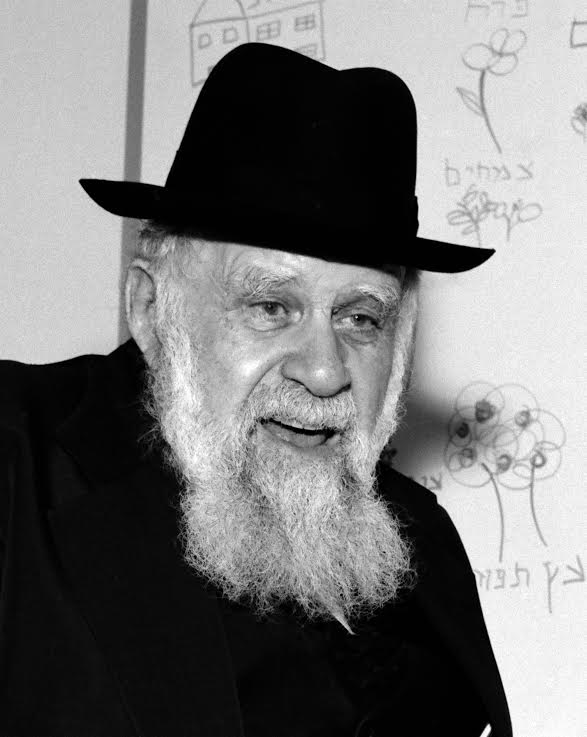
Photo of Rabbi Simcha Wasserman by Harry Green, c. 1986, South Bend, IN harrygreenphoto@gmail.com

  1. I thank Rabbi Yitzchok Shapiro (Boca Raton, Florida) and Rabbi Dr. Eliezer Brodt (Ramat Beit Shemesh, Israel) for their important comments to an earlier version of this article. I thank my father, Mr. U. Harold Males (Jerusalem, Israel) for his editorial assistance.
  2. In a humorous Forward article linked below, the author turned to an expert who proposed these definitions for the following Yiddish words: “A zets is a strong punch. A patsh is a common slap, whereas a frask is a sharp, stinging one, given with a vengeance.” See: https://forward.com/news/547/martial-arts-in-yiddish/ . After reading this, I felt relieved that the older cheder rebbi had only made use of a patsh – and not a zets or a frask.
  3. The Da’as Zekeinim mi-Ba’alei Tosafos is a Torah commentary compiled from the writings of French and German Tosafists who lived in the 12th and 13th centuries.
  4. I was unable to find information about a bird named אגרון / Agron. However, the Hebrew word for the crane is עגור / Agur (see Isaiah 38:14 and Jeremiah 8:7). A crane is a long-necked bird which certainly matches the winged creature in the Ba’alei Tosafos‘ parable.
  5. Aesop (c. 620–564 BCE) was a Greek storyteller credited with a number of tales which are collectively known as ‘Aesop’s Fables’. See: https://en.wikipedia.org/wiki/Aesop
  6. See: https://classics.mit.edu/Aesop/fab.1.1.html
  7. I have no recollection of ever reading Aesop’s Fables as an adult. Did my parents or older siblings read a children’s book of Aesop’s Fables to me when I was young? Had I read such a book to my nieces / nephews when they were little?
  8. See: https://thejatakatales.com/javasakuna-jataka-308/
  9. See: https://en.wikipedia.org/wiki/Buddhism
  10. See: https://en.wikipedia.org/wiki/Berechiah_ha-Nakdan and https://en.wikipedia.org/wiki/Mishl%C3%A8_Shu%27alim
  11. The term Mishlei Shua’lim is clearly taken from Sanhedrin 38b where we learn ג’ מאות משלות שועלים היו לו לרבי מאיר ואנו אין לנו אלא שלש – Rabbi Meir had composed 300 fox fables (i.e. parables involving animals – the fox being chief among them), but we are only left with three of them.
  12. https://blogs.loc.gov/international-collections/2021/09/a-fox-fable-goes-digital-bialiks-classic-hebrew-story-for-children-finds-new-life-at-the-library-of-congress/
  13. Eitz Yosef quotes Aruch who translates מוקרה as ‘its neck.’ It should be noted, however, that Rashi translates מוקרה as ‘its beak.’
  14. I initially wondered if this Midrash might also be the basis for the lyrics “פרוק ית ענך מפום אריותא – save Your flock from the mouths of the lions” in the Shabbos song ‘Kah Ribon’. However, a little research revealed that the term “פום אריותא – the mouths of the lions” is a clear reference to Daniel 6:23.
  15. See: https://en.wikipedia.org/wiki/Printing_press
  16. Rabbi Elazar Simcha Wasserman (1898 – 1992) was a son of the storied Rabbi Elchonon Wasserman, zt”l (1874 – 1941) – head of the pre-WWII Yeshiva in Baranovich, Poland. Prior to the Holocaust, Rabbi Wasserman (the son) immigrated to the United States where he played important roles in Jewish education and outreach (particularly in California). He and his wife moved to Israel in 1979, where they spent the final and ever-productive chapters of their lives in Jerusalem. I vividly recall attending the funerals of both Rabbi Simcha and Rebbetzin Faiga Rochel Wasserman (sadly, she passed away just after observing Shiva for her late husband) while first studying in Jerusalem in 1992. On November 5, 1992, the Los Angeles Times published an obituary for Rabbi Wasserman. See: https://www.latimes.com/archives/la-xpm-1992-11-05-we-1397-story.html . For a book-length biography, see: Fox, Dovid (1995) Greatness in Our Midst: The Life of Rav Simcha Wasserman. Jerusalem: Feldheim Publishers. For a more recent article on Rabbi Wasserman, see Eytan Kobre, “Building Worlds.”, Mishpacha, November 14, 2023. https://mishpacha.com/building-worlds/.
  17. Some of Rabbi Wasserman’s presentations have been digitized and are posted on Ohr Somayach’s website. However, among those that are available, I was unable to find the question-and-answer session cited in this article. See: https://audio.ohr.edu/showperson/id=20
  18. At this point, I believe an important disclaimer is in order. By suggesting that this parable is of ancient Jewish vintage, I am not claiming that that it was stolen from Jewish sources and plagiarized by foreigners. (Neither was that what Rabbi Wasserman had suggested.) A long tradition of such claims seems to go back to Philo (c. 20 BCE – 50 CE), and Josephus (c. 37 CE – 100 CE). For a scholarly treatment of such assertions, see Norman Roth, “The ‛Theft of Philosophy’ by the Greeks from the Jews,” Classical Folia, vol. 32, no. 1 (1978): 52-6. For some important rabbinic sources on such claims, see Rabbi Moshe Isserless’ Toras Ha’olah 1:11 (end of the chapter) and Metzudos Dovid to I Melachim 5:12. For a more recent rabbinic source see Rabbi Joseph B. Soloveitchik’s commentary to Tisha B’Av Kina 37 on page 574 in Posner, Simon. 2010. The Koren Mesorat Harav Kinot: The Lookstein Edition: Tefilla for Tisha B’Av, Kinot, Eikha. New York: OU Press; Jerusalem. (See footnote 19 for additional sources on this theme.)
  19. See the link below for a series of five thorough articles (with extensive footnotes) published in the Ohr Yisroel journal (Monsey, NY) by Rabbi Yaakov Yisroel Stahl: (10) מקור חכמת אומות העולם מעם ישראל In these articles, Rabbi Stahl cites an incredible amount of material on the theme of ancient Jewish wisdom making its way into the teachings of the nations of the world. I thank Rabbi Dr. Eliezer Brodt for bringing these articles to my attention.
  20. I credit Artscroll / Mesorah’s Kleinman Edition of Midrash Rabbah (2010) for the translation of this passage.
  21. See Matnos Kehuna, and Eitz Yosef Ibid.
  22. Both Rashi and the Eitz Yosef (Ibid.) note the clearly Latin roots (i.e. scholastic) of the word אסכולסטקיא.
  23. As demonstrated above in Part IV, this Midrash was the source of the parable shared by the Ba’alei Tosafos.


Book Review: ‘After Revelation: The Rabbinic Past in the Medieval Islamic World’, by Marc D. Herman

Review of ‘After Revelation: The Rabbinic Past in the Medieval Islamic World’, by Marc D. Herman

Reviewed by Eliyahu Krakowski


Dr. Marc Herman’s After Revelation: The Rabbinic Past in the Medieval Islamic World (University of Pennsylvania Press, 2025) examines shifting conceptions of Torah she-beʿal peh within the Judeo-Islamic world from the geonic period through the time of Maimonides.[1] Beginning with Rav Saadya Gaon and concluding with the Rambam, Herman traces a gradual reorientation away from the geonic understanding of Torah she-beʿal peh as wholly revealed toward the Maimonidean position, in which human interpretation plays a constitutive role in the formation of rabbinic law. Alongside his analysis of Jewish legal sources, Herman situates these developments within their broader intellectual environment, drawing careful parallels to contemporaneous trends in Islamic jurisprudence and legal theory. In tracing this shift, the book clarifies how medieval Jewish thinkers conceptualized the authority of Torah she-beʿal peh, and how those conceptions correspond to broader jurisprudential models current in the Islamic world.

But beyond its central thesis, the book assembles a substantial body of sources bearing on a range of foundational questions, including rabbinic authority, legal innovation, and the historical development of Torah she-beʿal peh. Many of the texts Herman discusses are drawn from recently published fragments or from manuscripts that remain unpublished, and several appear to have received little or no attention in prior scholarship. Rather than offering a comprehensive or conventional review, I will focus here on a selection of sources that I found particularly significant and that contribute to a more precise understanding of several of the issues under discussion. Because Herman’s treatment of these materials is often brief, expanding upon certain sources and arguments in greater detail is worthwhile.

  1. Adding to Torah Prohibitions and the Tree of Knowledge 

The story of Adam and Eve contains an interesting example of what, depending on one’s perspective, can either be seen as a (very early) model of rabbinic legislation or as a problematic example of proto-bal tosif, the prohibition of adding to the Torah. When repeating God’s command not to eat from the Tree of Knowledge, Eve apparently adds to the prohibition (Gen. 3:3): “But from the fruit of the tree which is in the middle of the garden, God has said, ‘You may not eat from it and you may not touch it, lest you die.’” Every yeshiva student is familiar with Rashi’s interpretation:

“‘And you shall not touch it’ – she added to the command; therefore she came to detraction, as it is said: “Do not add to His words” (Proverbs 30:6).”

This, in turn, is based on the Gemara (Sanhedrin 29a):

“Hizkiyah said: From where is it derived that whoever adds, detracts? As it is stated: ‘God said: You shall not eat from it and you shall not touch it.’”

However, according to Avot de-Rabbi Natan (version 1, 1:5), it appears that the added prohibition was in fact a prototypical seyag, a protective fence of the sort we are instructed to erect in order to safeguard the Torah:

“And make a fence for your words, just as the Holy One, blessed be He, made a fence for His words; and Adam the First made a fence for his words … What was the fence that Adam the First made for his words? As it says: ‘And the Lord God commanded … for on the day that you eat of it you shall surely die’ (Genesis 2:17). Adam the First did not wish to say to Eve exactly as the Holy One, blessed be He, had said to him; rather, he said to her thus, and he made a fence for his words beyond what the Holy One, blessed be He, had said to him: ‘But from the fruit of the tree that is in the midst of the garden God said: You shall not eat from it and you shall not touch it, lest you die,’ for he wished to guard himself and Eve from the tree even through mere touching.”

In the context of Karaite critiques of rabbinic authority, this question took on heightened urgency. Herman (39-40) refers to Rav Saadya Gaon’s commentary on Genesis 3:1, which elaborates the positive reading found in Avot de-Rabbi Natan:

“The fifth question: On what basis did Eve say, ‘and you shall not touch it,’ when God did not say this to Adam?

The answer: After God said to Adam not to eat from the Tree of Knowledge, he instituted a safeguard for the matter and refrained even from touching it, so that if some mishap should occur in this regard, it would fall upon what he himself had added and not upon the essence of the prohibition. This is like an expert physician who wishes to distance a patient from eating meat and therefore also warns him against poultry, so that if he should treat the command lightly he will stumble with poultry and not with actual meat. On this basis our predecessors instructed us: ‘Make a fence for the Torah’ … and in all these cases, and others like them, we rely upon what the Torah itself prohibited as a matter of protection and fencing, as it is written: ‘He shall not multiply wives for himself, lest his heart turn astray’; and ‘silver and gold he shall not multiply for himself exceedingly, lest his heart grow haughty,’ and the like.”

Rav Saadya likens Adam’s added prohibition to the case of a patient who is forbidden to eat meat and whose physician therefore also prohibits poultry. As Herman observes, the analogy closely recalls the rabbinic prohibition of poultry with milk. Notably, in this instance Rav Saadya is prepared to treat the added restriction as Adam’s own enactment, a position that sits uneasily with his more general tendency to ground even rabbinic legislation in divine authority.

Elsewhere (80), Herman cites the eleventh century Andalusian commentator R. Yehuda Ibn Balaam who went a step further and “described the addition of a prohibition against touching the forbidden tree in the Garden of Eden (Genesis 3:3) as the sound exertion of legal thinking (ijtihād).”[2] It seems that according to Ibn Balaam, in contrast to Rav Saadya, this is not merely a discretionary seyag but a logical extension of the law. In other words, according to Rav Saadya, the prohibition of touching the Tree of Knowledge would have been classified under the Rambam’s first shoresh in Sefer ha-Mitzvot, namely rabbinic enactments, whereas according to Ibn Balaam it would fall under the second shoresh, that of rabbinic derashot or derivations.[3]

  1. Rabbinic Legislation and Adding to the Torah

Another obscure yet significant source cited by Herman bears on a question raised forcefully in Karaite polemics, namely, why rabbinic legislation does not itself constitute a violation of the biblical prohibition against adding to the Torah. Herman (27) points to Rav Saadya Gaon’s discussion in his work on the calendar, the Kitāb al-Tamyīz (Book of Distinction), where Saadya emphasizes that the prohibition of adding to revelation applies to “all that I have commanded you” (Deut. 4:2; 13:1), and not to “all that I have written for you.” On this view, rabbinic enactments cannot be considered impermissible additions, since they themselves form part of the revealed command structure. The relevant text survives only in an Arabic fragment published by Hartwig Hirschfeld in 1903.[4]

Herman (90) also cites R. Yehudah ha-Levi’s response to this challenge in the Kuzari (3:41). Ha-Levi explains that the biblical prohibition was directed at the masses, in order to prevent them from conjecturing, theorizing, and legislating on the basis of their own reasoning, as the Karaites did. Laws instituted by the Sanhedrin or by prophets, according to ha-Levi, are categorically excluded from the scope of this prohibition. Notably, Maimonides appears to adopt the opposite position. In his view, it is precisely authoritative figures such as prophets or the Sanhedrin who are capable of violating the prohibition of bal tosif.[5] But Maimonides’ formulation in Hilkhot Mamrim 2:9 (cited above, note 3) represents an even sharper rejection of Rav Saadya’s approach. According to the Rambam, bal tosif is violated precisely by collapsing the distinction between rabbinic legislation and divine command, thereby presenting the former as if it were itself part of the Torah. This could serve as a description of Rav Saadya’s enterprise. 

It is also noteworthy that figures operating within the Karaite orbit accepted the premise underlying the question, namely, that there exists a general prohibition against adding new laws to the Torah. By contrast, rabbinic authorities more distant from anti-Karaite polemics, such as Rashi, R. Yosef Albo, and the Maharal, rejected this premise altogether. On their account, bal tosif does not prohibit the introduction of new mitzvot, but rather the alteration of an existing mitzvah’s internal structure, such as adding a fifth passage to the tefillin. From this perspective, rabbinic legislation bears no relation to the prohibition of bal tosif at all.[6]

  1. Hanukkah from Where in the Torah?

Rav Saadya Gaon’s discussion of Hanukkah provides a clear illustration of a broader geonic tendency: to anchor what might otherwise appear to be rabbinic innovations or postbiblical developments in biblical revelation itself. As Herman (29) notes:

“Saadia was anxious to uphold divine authority for Hanukkah, the formulations and structures of many prayers, court oaths, communal bans, the second day of festivals observed in the diaspora, and even one passage in a lament by Eliezer Qillir… Saadia adopted a variety of strategies to depict these practices as supported by divine revelation. Written revelation, he claimed, actually refers indirectly to legal institutions that might be considered postbiblical, such as the festival of Hanukkah, the observance of two days to mark some new lunar months, or the rules of the Jewish calendar.”

One of the sources Herman adduces in this context is a passage from the the recently recovered complete Sefer ha-Mitzvot of Rav Saadya, in which Rav Saadya seeks to ground the festival of Hanukkah in biblical prophecy:

“The tradition has established that there will be a day on which He will deliver us from the descendant of Amalek … and that when the Lord grants victory to the sons of Levi in their war against those who rise against them, that time shall be honored, as it is said: “Bless, O Lord, his valor, and accept the work of his hands; crush the loins of those who rise against him, and of those who hate him, that they rise no more” (Deut. 33:11). And we do not find that they fought anyone other than the Greeks.”[7]

This passage is particularly illuminating when read alongside Maimonides’ remarks in the first shoresh of his own Sefer ha-Mitzvot, where he sharply criticizes those who would count Hanukkah among the 613 commandments:

“I do not suppose that anyone would imagine, or that it would even occur to anyone’s mind, that it was said to Moses at Sinai that he should command us that, if at the end of our kingdom such-and-such should occur with the Greeks, we would then be obligated to light the Hanukkah lamp.”[8]

The position that Maimonides declares inconceivable is, in fact, precisely the one advanced by Rav Saadya. Because Maimonides elsewhere explicitly objects to the Behag’s enumeration, and because the Behag does count ner Hanukkah as a mitzvah, it has generally been assumed that Maimonides’ polemic here is directed against the Behag. The discovery of this passage, however, together with another like it in Rav Saadya’s writings, reveals that Maimonides’ criticism is not aimed at a merely theoretical justification for counting Hanukkah, but at Rav Saadya’s concrete attempt to ground the obligation in biblical revelation.[9] Herman (104) himself emphasizes this point, noting that:

“This was something of a pattern for Maimonides, who was reluctant to name Saadia even when strongly disagreeing with him. But it is hard, in fact, not to read Maimonides’s presentations of the Oral Torah as a pointed rebuttal of the views of the Egyptian-born gaon.”[10]

The same geonic impulse to locate Hanukkah within the orbit of biblical revelation appears elsewhere as well. In his discussion of the Torah center of Kairouan, Herman (67) observes that R. Nissim Gaon likewise adopted Rav Saadya’s position regarding the divine authority of Hanukkah, repeating a midrash according to which the festival had already been foretold to the biblical Aaron. This refers to the well-known passage cited by Nahmanides in his commentary on Behaʿalotekha (Num. 8:2):

“Why is the section of the Menorah juxtaposed with the dedication of the princes? When Aaron saw the dedication of the princes, his spirit sank, for neither he nor his tribe had participated in the dedication. The Holy One, blessed be He, said to him: ‘By your life, yours is greater than theirs, for you kindle and prepare the lamps morning and evening’this is the language of Rashi, citing an aggadic midrash… The intent of this aggadah is to expound a hint from the passage concerning the dedication of the lamps that would take place in the Second Temple through Aaron and his sonsthat is, the Hasmonean High Priest and his sons. I found it stated in this very language in the Megillat Setarim of Rabbeinu Nissim, who cites this aggadah and says: ‘I saw in a midrash: once the twelve tribes had brought offerings and the tribe of Levi had not brought [any]… the Holy One, blessed be He, said to Moses: ‘Speak to Aaron and say to him’there will be another dedication [hanukkah] involving the lighting of lamps in which I will perform miracles and deliverance for Israel, through your descendants. [This] dedication will be named for them, namely the Hanukkah of the sons of the Hasmoneans. Therefore this section was juxtaposed to the section of the dedication of the altar’.”

This is a celebrated passage in Nahmanides’ commentary, but when read against the background of geonic polemics and the geonic impulse to locate later rabbinic enactments within biblical revelation, it takes on a new significance. Herman draws attention in this connection to the landmark work of Yosef Ofer and Jonathan Jacobs on Nahmanides, which reconstructs the layered development of Nahmanides’ Torah commentary on the basis of authorial update lists and a comprehensive comparison of manuscript traditions. Ofer and Jacobs demonstrate that the passage attributing Hanukkah to Aaron through R. Nissim Gaon’s Megillat Setarim belongs to Nahmanides’ later additions, composed after his arrival in Eretz Yisrael, and that in earlier recensions of his commentary Nahmanides struggled to resolve the difficulties posed by this midrash.[11]

  1. A Sage is Superior to a Prophet

Interpretations of the talmudic dictum hakham adif mi-navi, “a sage is superior to a prophet” (Bava Batra 12a), offer a revealing lens through which to assess medieval attitudes toward the relative status of divine revelation and human juridical creativity. In a substantial study published two decades ago, Alon Goshen-Gottstein traces the reception history of this dictum and concludes that it was largely ignored prior to the emergence of the Book of the Zohar.[12] Herman (81-82), however, draws attention to a significant pre-Zohar interpretation that appears to have gone largely unnoticed in this discussion, preserved in the commentary of R. Isaac Ibn Ghiyath, commonly known by his acronym רי״ץ גיאת, to Kohelet:

“Upon proper reflection, I have found that the sages of the Torah possess a superiority over the prophets. For the former draw forth [insights] from their intellectual inquiry and the illuminations of their intellect: they innovate new teachings from foundational principles and derive consequences from root concepts. The latter, by contrast, are guided only by prophecy and directed by prophetic vision alone. You already know what occurred with respect to what the prophet Nathan said to David, ‘Do all that is in your heart, for the Lord is with you’ (II Sam. 7:3) – and he was mistaken; whereas Solomon’s ruling in the case of the two women was successful. It is to this distinction that the saying refers: ‘A sage is superior to a prophet.’”[13]

As Herman observes, Ibn Ghiyath’s interpretation is “closer to that of the Qaraite Qirqisaniwho had cited it to show that the ancient rabbis themselves admitted to ‘extracting’ new lawthan to geonic-era apologetics.” In other words, this interpretation stands in contrast to the geonic claim that Torah she-beʿal peh is all revealed law, instead seeing the active process of building upon revelation by means of human wisdom as a higher achievement than the passive process of receiving prophetic instruction. This helps explain why this dictum received little attention in certain eras. In the context of anti-Karaite polemics, openly conceding the primacy of human legal creativity over prophecy was potentially destabilizing. Yet Herman does not emphasize the significance of Ibn Ghiyath’s comment in the history of the interpretation of this saying, noteworthy in its own right.[14]

  1. Increasing Andalusian Independence

A recurring theme throughout Herman’s work is the growing independence of non-Iraqi scholars, such as R. Hananel, R. Shmuel ha-Nagid, the Rif, and R. Joseph Ibn Migash, from the authority of the Babylonian geonim. This is the intellectual world into which Maimonides was born. Herman (104-105) highlights one particularly telling instance in which Maimonides explicitly defends his Andalusian tradition against claims of Babylonian hegemony:

“[I]n a polemic against against Samuel ben ‘Eli…who claimed the title gaon, Maimonides provided a list of Andalusi “geonim” to support his view: Ibn Ghiyath, al-Baliya, al-Fasi, and Maimonides’s own father’s teacher, Ibn Migash. Maimonides asked: ‘Should one not heed the words of our geonim because they are not Babylonian [i.e., Iraqi]? Is it possible that locale is determinative [she-maqom gorem]?’ While these examples show a sense of continuity with the Andalusi tradition, Maimonidean innovations nevertheless abounded…”

Herman offers a nuanced account of the gradual emergence of Andalusian scholarly independence from geonic authority, culminating in Maimonides’ own complex stance toward the inherited geonic tradition.[15]

These few examples from this densely referenced work should suffice to illustrate the wealth of material contained within. Dr. Marc Herman’s After Revelation: The Rabbinic Past in the Medieval Islamic World is distinguished by its meticulous research and careful presentation of sources, a quality that is especially welcome in the current scholarly landscape. In addition, by focusing on a specific historical era which has received relatively little scrutiny, Herman has brought to light a rich array of material which deserves the attention of anyone interested in the development of the concept of Torah sheb’eal peh.

[1] Full disclosure: the author of the book under review, Dr. Marc Herman, is a longtime friend to whom I often turn with questions regarding Maimonides’ Sefer ha-Mitzvot. References to his pages are given parenthetically in the text. Readers of The Seforim Blog may already be familiar with his work through his review in Marc Herman,  “Review of ‘Ha-Sefer ha-Kollel (Kitāb al-Hāwī)’, by Rabbi David ben Saʿadya al-Ger,” The Seforim Blog (4 September 2024), available here. My thanks to Seforim Blog editor Menachem Butler for his editorial review and comments.
[2]
Herman cites Ibn Balaam’s comment from Maaravi Perez, “Another fragment from Kitāb al-Tarjīḥ by R. Yehuda Ibn Balaam: Genesis 2:11-4:9; 8:10-20,” Proceedings of the American Academy for Jewish Research, vol. 57 (1990-1991): 8 (Hebrew), available here; the fragment is also available via the remarkable alhatorah.org.
[3]
 For a discussion of the tension between seyag and bal tosif as it arises from the narrative of Adam and Eve, see R. Bezalel Naor, “Mitzvat Hashem Barah,” printed at the conclusion of his edition of the Rashba’s Maʾamar ʿal Yishmael, ed. Bezalel Naor (Spring Valley, NY: Orot, 2008), 87-91 (Hebrew). His discussion displays his characteristic breadth of learning, though he does not cite the sources later adduced by Herman; conversely, Herman does not refer to Naor’s treatment. Notably, the Hida (Ahavat David, derush 13) explicitly confronts the apparent contradiction between the position of the Gemara with that of Avot de-Rabbi Natan and proposes a reconciliation:

“The matter is straightforward: Adam the First certainly acted properly in making a fence. However, he should have said, “This is the command of the Lord, and I am making a fence with respect to touching,’ and in that case Eve would not have erred. It was from this aspect that the mishap emerged, and this is what is meant by the conclusion, ‘A person should not add to the words he hears’; that is, one should not attribute the addition to the original speaker.”

See also R. David Zvi Hoffmann’s commentary to Genesis 3:1, and R. Yaakov Kamenetsky, Emet le-Yaʿakov, Genesis 3:3, who develop the same distinction—between legitimate protective legislation and its improper attribution to divine command. R. Yaakov Kamenetsky articulates this concept pointedly in his commentary to Avot 2:5:

“The essential point is that one know that he is keeping this only as a fence, and not as an essential matter in its own right … for if this is not known, one may come to great stumbling blocks. It appears that Adam the First himself stumbled precisely in this matter in the sin of the Tree of Knowledge, and from this grew and developed the entire notion of sin and iniquity in the world, with the resulting consequence death.”

Against this backdrop, R. Bezalel Naor draws attention to a difficult comment of the Moshav Zekenim. The Moshav Zekenim cites the following question of the tosafist R. Isaac [presumably Riʾ of Dampierre]:

“You shall not eat and you shall not touch”—from here [we learn that] whoever adds, detracts, for the Holy One, blessed be He, commanded only with respect to eating. And R. Isaac finds this difficult: perhaps she acted by way of distancing, as we find with respect to the nazirite… and this requires further investigation.”

Why, R. Naor asks, did the Moshav Zekenim not explain that the difficulty with this seyag lay specifically in its attribution to God Himself, as is made explicit in the aforementioned sources? One possible answer emerges from the Maharil’s account of asmakhta. See Maharil, Likkutim, no. 70 (quoted by R. Asher Weiss, Minhat Asher, Devarim, p. 37):

“Wherever it is stated [that something is] rabbinic and the verse is merely an asmakhta, this is its meaning: it is certainly a rabbinic enactment, and they went and examined and found for themselves a scriptural support, and they anchored their words to it in order to strengthen them—so that people would think it is of Torah origin and be stringent with it, and not come to treat the words of the Sages lightly and leniently. (In the Mekhon Yerushalayim edition there is another version: ‘in order to mislead them.’)”

According to the Maharil, the purpose of an asmakhta is precisely to cause people to attribute divine authority to a rabbinic enactment. This would also appear to be the most straightforward explanation of the Raʾavad’s gloss to Hilkhot Mamrim 2:9. Maimonides explains that the difference between prescribed rabbinic enactments and proscribed bal tosif lies in their attribution: 

“Since a court has authority to decree and prohibit something permitted, and its prohibition may stand for generations … what, then, is the meaning of the Torah’s warning ‘You shall not add to it nor detract from it’? That one should not add to the words of the Torah nor detract from them, and establish the matter permanently as Torah law.”

On this, Raʾavad comments: 

“All of this is mere wind, for anything they decreed and prohibited as a fence and safeguard for the Torah does not constitute adding, even if they established it for generations, treated it as Torah law, and anchored it to Scripture, as we find in many places where something is rabbinic and the verse is merely an asmakhta.”

Raʾavad apparently sees the existence of asmakhta as a refutation of Maimonides’ position. Cf. the Vilna Gaon’s comment in Aderet Eliyahu, Genesis 3:3, which offers another defense of Eve’s “fence.”
[4]
Hartwig Hirschfeld, “The Arabic Portion of the Cairo Genizah at Cambridge (Third Article): Saadyah Fragments,” Jewish Quarterly Review, vol. 16, no. 1 [old series] (October 1903): 103, available here.
[5]
See my article in Eliyahu Krakowski, “Is a Prophet Authorized to Institute a Rabbinic Commandment? A Halakhic Clarification and Its Implications for Maimonidean Thought,” Hakirah: The Flatbush Journal of Jewish Law and Thought, vol. 12 (Fall 2011): 26-28 (Hebrew), available here, for a detailed analysis of Rambam’s position that the prohibition of bal tosif applies precisely to prophetic or judicial claims of divine authority. R. Asher Weiss formulates this point as a matter of halakhah le-maʿaseh in response to a question posed by his teacher, the Divrei Yatziv:

“My teacher and master, the holy rabbi, our master [Rabbi Yekusiel Yehudah Halberstam], wrote in Responsa Divrei Yatziv (Orah Hayyim §214) to comment on the formula le-shem yihud customarily recited by Hasidim prior to the counting of the ʿomer, in which it is said: “to fulfill the positive commandment of the counting of the ʿomer, as written in the Torah, etc.” This formulation implies that the obligation in question is a de-oraita commandment, and thus constitutes an addition to the commandments and a violation of bal tosif according to the view of Maimonides. For this reason, he adopted the practice of saying instead: “to fulfill the commandment of the counting of the ʿomer, and it is written in the Torah, etc.,” so that it should not be understood as a de-oraita commandment, but rather in a formulation that is also compatible with a rabbinic commandment… In my view, however, even though this observation has merit, as a matter of strict law there is no objection here, for several reasons. First, there is no prohibition involved except in the context of formal legal instruction issued by a court or by a sage rendering authoritative rulings to others; this has no application to a devotional prayer recited informally by each individual person…”

This represents the distinctively Maimonidean understanding of bal tosif, in marked contrast to the approach articulated by R. Yehuda ha-Levi.
[6]
 See Rashi to Deut. 4:2 and 13:1; Sefer ha-Ikkarim 3:14; Maharal, Beʾer ha-Golah, beʾer 1; cf. Nahmanides to Deut. 4:2. Notably, both sides in the Karaite-rabbinic controversy presupposed that bal tosif prohibits the introduction of new laws as such, even though this assumption was rejected by a number of rabbinic authorities operating at some remove from the immediate polemical context. A structurally analogous phenomenon, in which opposing camps converge upon a shared but historically secondary interpretation of a source, can be observed in the medieval debates over hokhmat yevanit. See Eliyahu Krakowski, “How Much Greek in ‘Greek Wisdom’? On the Meaning of Hokhmat Yevanit,” The Seforim Blog (27 December 2011), available here, where I argue that the identification of hokhmat yevanit with Greek philosophy represents a thirteenth-century polemical development rather than the original talmudic meaning, even though both sides in the controversy itself accepted this understanding.
[7]
 Rav Saadya Gaon, Sefer ha-Mitzvot (Kitāb al-Sharāʾiʿ), ed. and trans. Nissim Sabato (Jerusalem: The Ben-Zvi Institute, 2019), 199 (Hebrew). My thanks to Rabbi Dr. Eliezer Brodt for obtaining a copy of this important work for me. The text is also available on alhatorah.org, and should not be confused with R. Yeruham Fishel Perla’s monumental commentary on Rav Saadya’s poetic Azharot.
[8]
 See, now, the newly-published edition of Maimonides, Sefer ha-Mitzvot, ed. R. Yitzhak Sheilat (Jerusalem, 2025), 39-40 (Hebrew). It is surprising that R. Sheilat, who serves as rosh yeshiva of Yeshivat Birkat Moshe alongside R. Sabato, does not reference in this context Rav Saadya’s Sefer ha-Mitzvot.
[9]
 For an otherwise insightful discussion of this passage, see Moshe Halbertal, Maimonides: Life and Thought (Princeton: Princeton University Press, 2014), 111-116, who perceptively analyzes Maimonides’ objection to the enumeration of rabbinic enactments but does not identify Rav Saadya Gaon as the concrete target of the critique.
[10]
In his notes to this passage in Rav Saadya Gaon’s Sefer ha-Mitzvot, R. Haim Sabato expresses caution as to whether Maimonides had Rav Saadya specifically in mind. However, Herman’s view is compelling. For a fuller treatment of whether Maimonides’ critique in Sefer ha-Mitzvot is aimed specifically at Rav Saadya Gaon, see R. Haim Sabato, “Did Maimonides Know Rav Saadya Gaon’s Complete Sefer ha-Mitzvot?” in Zvi Heber and Carmiel Cohen, eds., MiBirkat Moshe: Maimonidean Studies in Honor of Rabbi Nahum Eliezer Rabinovitch, vol. 2 (Maʿale-Adumim: Maʿaliyot, 2012), 757-763 (Hebrew), available here, and Marc D. Herman, “Systematizing God’s Law: Rabbanite Jurisprudence in the Islamic World from the Tenth to the Thirteenth Centuries,” (PhD Dissertation, University of Pennsylvania, 2016), 167-168, 301, available here.
[11]
 See Nahmanides’ Torah Commentary Addenda Written in the Land of Israel, eds. Yosef Ofer and Jonathan Jacobs (Jerusalem: Herzog Academic College and the World Union of Jewish Studies, 2013), 430-432 (Hebrew).
[12]
 See Alon Goshen-Gottstein, “The Sage is Superior to the Prophet: The Conception of Torah through the Prism of this Proverb through the Ages,” in Howard Kreisel, ed., Study and Knowledge in Jewish Thought (Beer Sheva: Ben Gurion University of the Negev, 2006), 37-78 (Hebrew), available here, who identifies two citations of this dictum in sources that predate the Sefer ha-Zohar, one in Hovot ha-Levavot and one in a work attributed to R. Avraham b. ha-Rambam, possibly by R. Nissim Gaon. The interpretations of R. Isaac Ibn Ghiyath and R. Joseph Ibn Migash discussed here, however, suggest that the paucity of earlier citations reflects not simple neglect but a reluctance to highlight texts that openly privilege human juridical creativity over prophetic transmission.
[13]
 This commentary is printed in R. Yosef Qafih, Hamesh Megillot, ed. Shimon Najar (Israel, 1970), 162-163 (Hebrew), where it is attributed to Rav Saadya Gaon; it is now also available online at alhatorah.org in R. Qafih’s translation. Another text overlooked by Goshen-Gottstein and cited by Herman (87) is the commentary of R. Joseph Ibn Migash (Riʾ Migash) preserved in Shitah Mekubetzet to Bava Batra 12a:

“‘Amemar said: A sage is superior to a prophet. Rav Ashi said: You may know this from the fact that a great scholar states a matter and it is then said that the law accords with [a tradition] given to Moses at Sinai’— and even though this scholar never heard this matter at all. Thus, [we see that] ‘the sage is superior to the prophet’: for the prophet says only what he has heard and what is placed in his mouth to say, whereas the sage can articulate what was said to Moses at Sinai even though he never heard it.”

[14] Elsewhere, however, Herman does highlight the significance of Ibn Ghiyath’s comment more explicitly. See Marc Herman, “Situating Maimonides’s Approach to the Oral Torah in Its Andalusian Context,” Jewish History, vol. 31, no. 1 (December 2017): 31-46, available here.
[15]
 This analysis bears indirectly on a debate I conducted in the pages of Hakirah: The Flatbush Journal of Jewish Law and Thought with R. Shmuel Phillips concerning whether Maimonides adhered to a rigid, geonically derived methodology of talmudic interpretation that would have sharply limited the scope for post-talmudic harmonization or innovation. My contention in that exchange was that Maimonides engages in implicit synthesis and interpretive reconciliation of talmudic sources, even when such activity is not explicitly signaled in his formulations. The historical picture reconstructed by Herman strengthens the view of Maimonides as an independent thinker who was not constrained by geonic precedent, nor, in fact, by the precedent of his immediate Andalusian predecessors, making it difficult to sustain an account of Maimonides as merely transmitting talmudic conclusions through the mechanical application of geonic rules. See my article in Eliyahu Krakowski, “Talmud Oversimplified? A Partial Review of Talmud Reclaimed: An Ancient Text in the Modern Era by Shmuel Phillips,” Hakirah: The Flatbush Journal of Jewish Law and Thought, vol. 35 (Summer 2024): 129-145, available here, as well as the continued exchange in Shmuel Phillips, “Talmud Reclaimed and a Battle Over Methodologies of the Rishonim,” Hakirah: The Flatbush Journal of Jewish Law and Thought, vol. 36 (Winter 2025): 193-216, available here, and Eliyahu Krakowski, “Rejoinder: Reclaiming Talmudic Complexity,” Hakirah: The Flatbush Journal of Jewish Law and Thought, vol. 36 (Winter 2025): 217-229, available here.


Review of Ha-Sefer ha-Kollel (Kitāb al-Ḥāwī) by Rabbi David ben Saʿadya al-Ger

Review of Ha-Sefer ha-Kollel (Kitāb al-Ḥāwī) by Rabbi David ben Saʿadya al-Ger

Marc Herman

Marc Herman is an assistant professor in the Department of Humanities and a core member of the Centre for Jewish Studies at York University. His research focuses on Jewish and Islamic intellectual history in the medieval Mediterranean. He is the coeditor of Accounting for the Commandments in Medieval Judaism: Studies in Law, Philosophy, Pietism, and Kabbalah (Brill, 2021) and his monograph, titled After Revelation: The Rabbinic Past in the Islamic World, is under contract with the University of Pennsylvania Press.

The study of medieval halakhah was recently enriched by the long-awaited publication of The Comprehensive Book (Kitāb al-Ḥāwī) by David ben Saʿadya al-Ger,[1] one of the earliest legal compendia that survives from Sefarad. Pieced together from Genizah fragments, other manuscripts, and citations in later medieval works, and comprising much of the original text, this new edition of Kitāb al-Ḥāwī recovers a once-prominent halakhist who fell into obscurity in the centuries after his death. Its publication is a landmark in the study of Jewish al-Andalus and Judeo-Arabic law. Not only does this volume recover a mostly lost, early rishon, it also bears witness to the reception of the last geonim in the Islamic West and it provides a new window into the beginnings of Iberian halakhic culture.

Next to nothing is known with certainty about the life of David ben Saʿadya, author of the Kitāb al-Ḥāwī and other halakhic works. David’s period of activity can be fixed sometime after the death of Hayya Gaon (d. 1038), who David cited with some frequency, and before the death of Isaac Ibn al-Bālīya (d. 1094), who mentioned David as deceased.[2] This might place David in the circle of Samuel ha-Nagid. In fact, the twentieth-century scholar, Mordecai Margaliot (1909-1968), suggested that David was the subject of a laudatory poem in the Dīwān of the Nagid, where a certain “Rabbi David” is praised for his persuasive knowledge and keen abilities.[3] But what about the uncommon appellation אלגר? Some historians have understood that David descended from converts, but others have connected this word to the Arabic muhājir, i.e., migrant. (The latter would imply that David’s father, or an earlier family member, was not native to al-Andalus.) David Sklare noticed that one Genizah fragment vocalizes this word as אלגֵר (al-ger, i.e., the convert), supporting the view that David ben Saʿadya was the descendant of proselytes.[4]

ENA 2859.7v, Courtesy of the Library of the Jewish Theological Seminary, The National Library of Israel. “Ktiv” Project, The National Library of Israel.

This reading coincides with the sole appearance of David’s name in the writings of Abraham Ibn Ezra, who called David “Rabbi David the judge, son of the convert (ha-dayyan ben ha-ger), Sefardi, from the city of Granada.”[5] The editor of this new edition, Y. Zvi Stampfer, who is a lecturer and researcher in the Department of Talmud and Halakha at Hebrew University of Jerusalem, accepts this interpretation of אלגֵר, noting that Jews in the medieval Islamic world had few qualms about such ancestry. Stampfer even proposes that David proudly announced his forebearer’s conversion (as did other converts).[6]

David ben Saʿadya composed several works. In addition to the Kitāb al-Ḥāwī, written in a mixture of Judeo-Arabic and Aramaic, they include Judeo-Arabic volumes on the laws of oaths and on the laws of bequests, as well as commentaries on the Talmud and, according to Ibn Ezra, a work on Hebrew grammar. Of these additional writings, only the one on the laws of oaths survives. This work was translated into Hebrew by Isaac ben Reuven of Barcelona and printed, since 1521, in standard editions of tractate Shavuot bearing the title שערי שבועות. Unfortunately for David’s legacy, it has long been incorrectly ascribed to Isaac al-Fāsī.[7]

The ascription of this last work to al-Fāsī is something of an irony, as al-Fāsī was wont to criticize David ben Saʿadya.[8] In a responsum about the distinctions between biblically and rabbinically mandated oaths, al-Fāsī declared that David was wrong and would have been better off following the view of Hayya Gaon.[9] This may have been more than a straightforward halakhic disagreement. If David did travel in the circle of Samuel ha-Nagid, the charge that Hayya was correct would have had particular potency, as the Nagid and his faction sought to downplay—and thereby surpass—geonic expertise and hegemony, and they were especially wary of Hayya. Solomon Ibn Gabirol, whom the Nagid supported, praised his patron with the phrase וְַרב הָאיָי כְּלֺא הָיָה לְפָנָיו—it was as if Hayya was nothing compared to him![10] Al-Fāsī might have been hinting, then, that a whole generation of Andalusi scholars were betraying their shortcomings when they veered too far from the geonim. Stampfer himself suggests that al-Fāsī’s attacks on David may have been part of a larger program to disparage earlier Sefardic tamludists.[11] Indeed, Abraham Ibn Dāʾūd reported that al-Fāsī entered into debates with both Isaac al-Bālīya and Isaac Ibn Ghiyāth, two of the leading figures in eleventh-century Sefarad.[12]

Did al-Fāsī’s criticisms play a role in consigning David and his works to obscurity? It is hard to know. But before the advent of critical scholarship, David’s writings were mostly known only through brief citations by later rishonim, mostly of Sefardic extraction. These include al-Fāsī, Maimonides, and Abraham Maimonides. The last figures to have been familiar with texts by David ben Saʿadya were David ben ʿAmram ha-ʿAdani (fourteenth century), in his Midrash ha-Gadol, and Bezalel Ashkenazi (sixteenth century), who probably knew of David’s writings indirectly, in his Shittah mequbeset.[13] Most of the manuscripts of the Kitāb al-Ḥāwī are no later than the thirteenth century, apparently when this work fell out of circulation. A single manuscript is later, from seventeenth-century Yemen.[14]

David’s Kitāb al-Ḥāwī and other writings were first noticed by Samuel Poznański, B.M. Lewin, and Simḥa Assaf, scholars who pioneered the recovery of geonim and rishonim, especially from Arabic-speaking lands. As a student at the Jewish Theological Seminary of America in the early 1950s, Shraga Abramson submitted a doctoral thesis, written for Saul Lieberman,[15] on David ben Saʿadya,[16] though this project did not see the light of day until now.[17] Stampfer has helpfully included the first five chapters of Abramson’s thesis as an appendix in this volume (pp. 363-399); the remaining six will hopefully be published alongside a new edition of David’s work on the laws of oaths. Sklare was the next scholar to identify major pieces of David’s work, dedicating an important article to David’s identity, corpus, and thought, and Stampfer added many previously unidentified manuscripts to reconstruct a large portion of the Kitāb al-Ḥāwī.

The Kitāb al-Ḥāwī follows a unique arrangement, perhaps unparalleled in the writings of the rishonim.[18] Its structure is worth reviewing. David ben Saʿadya began this book with a sizeable consideration of jurisprudential topics. He followed this with three sections dedicated to practical law: section two treats holidays and the calendar; section three treats the laws of marriage (this is the only section that survives only in a medieval Hebrew translation, not in the Judeo-Arabic original); and section four treats monetary law. The fifth section provides perhaps the longest early medieval analysis of the thirteen hermeneutical middot. And the sixth section presents a series of challenges to Halakhot Gedolot. (Was this part of eleventh-century Sefardic attempts to move away from geonic-era works? Al-Fāsī, in another responsum, defended Halakhot Gedolot from one of David’s attacks.[19]) Stampfer shows that at least some of these sections were originally independent works.[20]

The sections on applied law suggest that, in part, David intended the Kitāb al-Ḥāwī to be a practical manual. Sklare proposed that this work was meant to be a handbook for judges or for second-tier rabbinic leadership who offered rulings in smaller Jewish communities.[21] This might even explain why some of this book was written in Aramaic, a curious feature that is shared by Samuel ha-Nagid’s mostly lost Hilkheta Gavratta.[22] Sklare suggested that some Sefardic readership may have been more comfortable with Aramaic than Judeo-Arabic—a fascinating possibility in light of the usual emphasis on the Arabization of Jewish elites in al-Andalus.[23]

The other parts of Kitāb al-Ḥāwī, however, clearly had other goals in mind. David’s decision to open with a discussion of the sources of the law was undoubtedly stimulated by the attention that this topic received among both Jewish and Muslim writers of his day. David was an innovative theorist regarding the sources of halakhic authority. The geonim, especially Saʿadya, generally portrayed revelation as all-encompassing, and they tended to downplay or even deny that the talmudic-era rabbis created new law. (This is usually, though not always, understood as a defense of the Oral Torah from Qaraite criticisms.[24]) David, on the other hand, expressed no qualms with the rabbinic innovation of norms. He even took many of the Arabic terms that Saadia had associated with the accursed jurisprudence of the Qaraites and applied them to the late antique rabbis.

David’s consideration of the thirteen hermeneutical middot might be thought of in this vein as well. In the tenth century, Saʿadya Gaon rejected the idea that the rabbis had created new law using the middot. He instead insisted that they just matched up received oral traditions with the text of the Torah.[25] David, by contrast, saw the middot as tools for generative and novel interpretations. Thus, when the Torah does not explicate the law, David asserted that the rabbis created it through legal reasoning (using the Arabic term qiyās).

David ben Saʿadya, of course, was only the first of many figures to break with the geonim on the question of how Jewish law developed. Among Andalusi Jews, Maimonides proposed the most powerful alternative to the ideas of Saʿadya Gaon. Even if Maimonides did not know much of the Kitāb al-Ḥāwī directly, there are distinct parallels between the Maimonidean picture of the Oral Torah and David’s. Maimonides, like David, fiercely rejected the Saadianic approach to the rabbis. Both Andalusis instead celebrated rabbinic legal creativity, and both did so by way of similar Arabic concepts.[26]

Stampfer’s edition of the Kitāb al-Ḥāwī is handsomely produced. It begins with a detailed introduction to David ben Saʿadya and presents the text in the Judeo-Arabic original with facing Hebrew translation. Stampfer provides learned notes with detailed references to relevant passages in the writings of the geonim and rishonim. He cites many unpublished geonic texts, suggesting that this is the first of many such books in the works. Anybody interested in medieval Jewish law should await further contributions with much anticipation.

Notes:

[1] Ha-Sefer ha-Kollel (Kitāb al-Ḥāwī) by Rabbi David ben Saʿadya al-Ger, ed. and trans. Y. Zvi Stampfer, incorporating work by David E. Sklare, Nissim Sabato, and Eliezer Reif (Jerusalem: The Ben-Zvi Institute for the Study of Jewish Communities in the East and The Rabbi Moses and Amalia Rosen Foundation, 2024; Hebrew), available here.
[2] For the latter, see Yaakov Miller, “Responsa of Our Rabbi Isaac son of Rabbi Baruch on the Matter of Collecting Debts from Orphaned Estates,” Kovetz Hitzei Giborim, vol. 7 (2014): 18-34, esp. 30 (Hebrew), available here.
[3] Mordecai Margaliot, ed., Hilkhot ha-Nagid (Jerusalem: American Academy for Jewish Research, 1962), 63 (Hebrew); see David Sklare, “R. David Ben Seʿadya al-Ger and His Work al-Ḥāwī,” in Joshua Blau, Haggai Ben-Shammai, Mordecai A. Friedman, and Joel L. Kraemer, eds., Encounters in Medieval Judaeo-Arabic Culture [=Teʿuda, no. 14] (Tel-Aviv: Tel-Aviv University, 1998), 103-123, esp. 115n40 (Hebrew), available here; for the poem, see Dov Yarden, ed., Dīwān Shmuel ha-Nagid: Ben Tehillim (Jerusalem, 1985), 151-53 (Hebrew), available here.
[4] David Sklare, “R. David Ben Seʿadya,” 111-12.
[5] Abraham Ibn ‘Ezra’, Sefer Moznayim, ed. Ángel Sáenz-Badillos (Madrid: Ediciones El Almendro, 2000), 6* (the editio princeps is available here. As Stampfer notes (32n85), some manuscripts of this passage read “Rabbi Judah,” however.
[6] David ben Saʿadya, Ha-Sefer ha-Kollel (Kitāb al-Ḥāwī), 21-24.
[7] David ben Saʿadya, Ha-Sefer ha-Kollel (Kitāb al-Ḥāwī), 27-32.
[8] David ben Saʿadya, Ha-Sefer ha-Kollel (Kitāb al-Ḥāwī), 79-82.
[9] Isaac Rothstein, ed., Shut ha-Rif (New York, 1977), 156-57 (#51); noted in Shraga Abramson, “Two Chapters from a Study on the Book ‘Sha‘are Shevuot’,” Sinai, vol. 104, no. 3-4 (1989): 122 (Hebrew).
[10] Ḥayim Brody and Ḥayim Schirmann, eds., Shelomoh Ibn Gabirol: Shire Ḥol (Jerusalem: Schocken, 1975), 47 (#85) line 53.
[11] David ben Saʿadya, Ha-Sefer ha-Kollel (Kitāb al-Ḥāwī), 82.
[12] Gerson D. Cohen, A Critical Edition with a translation and Notes of ‘The Book of Tradition (Sefer ha-qabbalah) by Abraham Ibn Daud (Philadelphia: Jewish Publication Society of America, 1967), 86 (English), 64 (Hebrew).
[13] David ben Saʿadya, Ha-Sefer ha-Kollel (Kitāb al-Ḥāwī), 68-90.
[14] The one seventeenth-century manuscript is described in David ben Saʿadya, Ha-Sefer ha-Kollel (Kitāb al-Ḥāwī), 107.
[15] For Abramson on Lieberman, see his “R. Saul Lieberman’s Method of Investigating Talmudic Literature,” in Researches in Memory of Saul Lieberman (Jerusalem: The Israel Academy of Sciences and Humanities, 1983), 23-33 (Hebrew).
[16] Y. Zvi Stampfer, “Introduction,” in David ben Saʿadya, Ha-Sefer ha-Kollel (Kitāb al-Ḥāwī), 100-101 (Hebrew):

“In the years 1950 or 1951, the student (later Professor) Shraga Abramson, at the Jewish Theological Seminary of America in New York, submitted a doctoral dissertation to Professor Saul Lieberman titled “Rabbi David ben Saadia ben ha-Ger: His Works and Times.” In his research, Abramson examined references to Rabbi David’s works in Talmudic and halakhic literature, along with various Genizah fragments, and discussed the question of Rabbi David’s era, location, and writings.”

[17] Y. Zvi Stampfer, “Introduction,” in David ben Saʿadya, Ha-Sefer ha-Kollel (Kitāb al-Ḥāwī), 9-10 (Hebrew):

“Professor Shraga Abramson z”l laid a broad foundation for research into Rabbi David ben Saadia and his works in his doctoral dissertation on the book Sha‘are Shevuot, its author, its era, and its location. He submitted this research to Rabbi Professor Saul Lieberman in the early 1950s as a doctoral thesis. However, this work was never published, except for two brief articles derived from it. Mrs. Araleh Abramson z”l transferred a typed copy of the dissertation to Professor Haggai Ben-Shammai when he headed the Ben-Zvi Institute and co-directed of the Center for the Study of Judaeo-Arabic Culture and Literature, who then forwarded it to me.

The first part of the dissertation, which deals with the figure of Rabbi David and his writings, is included as an appendix at the end of this edition. The second part, which involves the study of Sha‘are Shevuot, I hope to publish along with an annotated edition of that work. Abramson’s research was not prepared for publication, and the primary challenge in preparing it for publication was identifying the references he alluded to. Since his writing was essentially directed at Lieberman, a scholar of unparalleled expertise, Abramson often sufficed with general references or vague hints to sources in rabbinic literature or scholarly works, mostly published in Hebrew and German. I have endeavored to locate the sources mentioned in his research as far as I could. To remain faithful to Abramson’s original manuscript and his research style, when he referred to editions published up to his time, I indicated, as much as possible, the editions that were in his library. However, in cases where he referred to rabbinic literature sources that have more accessible editions published after his death, I noted the newer editions. I also expanded the abbreviations and corrected typographical errors and incorrect references.”
[18] Another somewhat later, but still pre-Maimonidean, Andalusi work is even more diverse in its contents; see Y. Tzvi Langermann, “The Topic of Rosh Chodesh—Chapter 18 from the Composition ‘Issur ve-Heter’,” Kobez al yad 24 (34) (2016): 161-180, esp. 165-166 (Hebrew).
[19] See Abraham Harkavy, Teshuvot ha-Geonim (Berlin, 1887), 301 (Hebrew), available here.
[20] Y. Zvi Stampfer, “Introduction,” in David ben Saʿadya, Ha-Sefer ha-Kollel (Kitāb al-Ḥāwī), 32-37 (Hebrew).
[21] David Sklare, “R. David Ben Seʿadya,” 119, 123.
[22] See Shraga Abramson, “From the Teaching of R. Samuel ha-Nagid of Spain,” in Yitzhak Rafael, ed., Sinai Centenary Volume [=Sinai, vol. 100] (Jerusalem: Mosad ha-Rav Kook, 1987), 7-73, esp. 13 (Hebrew), available here, and Shraga Abramson, Perush Rabbenu Ḥananel la-Talmud (Jerusalem: Wagshal, 1995), 55-56.
[23] David Sklare, “R. David Ben Seʿadya,” 116-122.
[24] See Marc Herman, “Prophetic Authority in the Legal Thought of Saadia Gaon,” Jewish Quarterly Review, vol. 108, no. 3 (Summer 2018): 271-294, available here.
[25] See most recently Y. Zvi Stampfer, “Saʿadia Gaon’s Interpretation of the Thirteen Hermeneutical Principles according to the Arabic Source Commentary, Tendencies, and Unknown Sources,” Tarbiz, vol. 87, no. 4 (July – September 2020): 655-660 (Hebrew), available here.
[26] See Marc Herman, “Situating Maimonides’s Approach to the Oral Torah in Its Andalusian Context,” Jewish History, vol. 31, no. 1-2 [=Special Issue: New Perspectives on Jewish Legal History] (December 2017): 31-46.


Organizing the Mitzvot and the Sefer Ha-Chinukh

Organizing the Mitzvot and the Sefer Ha-Chinukh
Yaakov Taubes

Yaakov Taubes is the rabbi at Mount Sinai Jewish Center in Washington Heights, New York. He also serves as an assistant director at the Rabbi Isaac Elchanan Theological Seminary at Yeshiva University, and is a PhD candidate in Medieval Jewish History at the Bernard Revel Graduate School for Jewish Studies. He can be reached at rabbi@mtsinaishul.com.

This article follows from the excellent piece by Eli Genauer about the printing and reorganization of the Sefer ha-Chinukh. To review, Genauer described how the Sefer ha-Chinukh’s original order, reflected in both manuscripts and early printed editions, listed the positive commandments followed by the negative commandments in each parasha, but later editions did away with this division and instead listed the mitzvot in strict order of the Biblical  verses. He noted further that, contrary to what is printed in Chavel’s semi-critical edition of the Sefer ha-Chinukh, the first edition to alter the organization was a Chumash with commentaries printed in Amsterdam in 1767 that included the Chinukh. In the first half of this article, I will explain the Chinukh’s original organization, as well as the reasoning behind and impact of the later editions that changed it. In the second half, I will analyze the earliest published mitzvah lists  that enumerated the mitzvot according to the Torah’s order.

Part I
Reorganizing the Chinukh

At its core, the Chinukh is a Sefer Ha-Mitzvot, an enumeration and explication of 613 mitzvot of the Torah. It primarily follows in the footsteps of the Maimonides’s Sefer Ha-Mitzvot, while also regularly citing Nahmanides when he disagrees with Maimonides. In the anonymous author’s opening missive (to which he adjured later copyists by oath to include), he noted that the work of clarifying the mitzvot and halakhot had already been accomplished by R Isaac Alfasi (Rif), Maimonides, and Nahmanides. Indeed, the Sefer Ha-Chinukh did not innovate in in terms of mitzvah enumeration, i.e. in listing what constitutes the 613 commandments, but rather loyally followed the enumeration of Maimonides, even when he found the opinions of Nahmanides more compelling.[1] Instead, the stated goal was to organize the mitzvot based on the parshiyot of the Torah, so that the youth will be inspired to study them on Sabbaths and festivals and “they will be accustomed to inquire as to how many mitzvot appear in a given parasha.”[2] The division into parshiyot was thus for pedagogical purposes (as the title Sefer ha-Chinukh, or Book of Education, implies), namely, to create a separate unit for a student to study each week.

This didactic concern is also evident from the places where the author informs us that a given parasha does not have any mitzvot. By contrast, when Rashi, for example, has nothing to say on a given verse, he does not comment that there is nothing to say on the verse. But as a work based on the parshiyot, to be studied according to the parshiyot, the Chinukh needed to inform the reader that there are no mitzvot on a given week. In addition to its noteworthy contributions to particularly topics, it was the organization that set the Chinukh aside and contributed to its great popularity.

The gemara in Makkot (23b), which serves as the primary source for the idea that there are 613 mitzvot, also notes that there are 248 positive commandments and 365 negative commandments. Maimonides, the Sefer Mitzvot Gadol of R. Moses of Coucy and most other Sifrei Mitzvot divided the mitzvot this way in their respective works, by first listing one category and then the other. The Chinukh maintained this division, but only within each Parasha, first listing all the positive commandments, followed by the negative commandments, and then starting again in the next Parasha.

This division can be found in the original manuscripts of the Chinukh and in the first published editions from the 16th century. In the 18th century, however, publishers began to print the mitzvot of Chinukh in strict order of the verses of the Torah, erasing the division between positive and negative commandments. In Genauer’s article, he noted an error in Chaim D. Chavel’s scholarly introduction to his edition of the Chinukh, where Chavel writes that the first edition to make this change was the edition printed in Frankfurt an der Oder in 1783.[3] In fact, as Genauer notes, the first published book to reorganize the work was the Chumash Tikkun Soferim, published by Yosef, Yaakov and Avraham Proops in Amsterdam in 1767, which included the Chinukh as well as other commentaries on the Torah. This edition printed the Chinukh on the page alongside the Torah text, adjacent to the Biblical verse that are the source for the commandment, and by extension, recorded the mitzvot according to the strict order of the verses, thereby abandoning the original organization. Virtually all later editions of the Chinukh followed this structure such that, apart from Chavel’s edition, the Chinukh was never again printed using the order in which it was originally written.   

This Proops edition did more than change the order of the mitzvot. The reordering also required a modification of the mitzvah list in the introduction to the Chinukh so that that the numbering there accurately reflected the placement of the mitzvot contained within the work. But, confusingly, many internal cross-references to other mitzvot were left intact. For example, at Lev. 19:9, the Chinukh records the prohibition of not leaving over part of the corner of the field (peah). This is Mitzvah 228 in the original work but appears as 217 in the reorganized (now standard) versions. The Chinukh there references what he wrote previously in “Positive Mitzvah 2” of the Parasha, a somewhat less helpful reference to locate if the mitzvot are not divided between the positive and negative commandments.

More generally, this reordering has pros and cons. Putting the mitzvot in the order of the Torah allows related positive and negative commandments to be listed adjacent to one another, which is useful as they may have many aspects in common, including what the author called their shoresh (perhaps meaning “cause”). For example, in the discussion of the holidays in Parashat Emor, the new arrangement places the positive commandment to refrain from labor on a given holiday adjacent to the related negative commandment against working on that holiday.[4] On the other hand, in a number of instances, the reorganization clearly disrupts the disrupts the flow of the work. For example, In Lev. 22:32, the Torah presents the prohibition of profaning God’s name before the obligation to sanctify it. This is how the Proops edition (and subsequent editions) list them, matching the order of the verses. In the original, however, the commandment to sanctify, a positive commandment, is listed first, and it is there that the root and essence of the mitzvot related to sanctifying and profaning God’s name are explained. In the negative commandment, i.e. the prohibition to profane God’s name, the reader is referred to what the author already wrote regarding the positive commandment, which the new editions place afterward. Similar examples can be found throughout the work and modern editions of the Chinukh, including those published by Feldheim, Machon Yerushalayim and Artscroll, will typically provide the appropriate page number or mitzvah reference in their edition. This is helpful, but the need to do so highlights the disparity the reorganization of the work created.          

When the Chinukh was next printed in Frankfurt an der Oder in 1783-4, also part of a Chumash, all of the mitzvot that come from a given book of the Chumash are printed in the back of the relevant volume, divided by parasha with a separate title page introducing them.[5] As in the earlier Proops edition, the mitzvot are listed in strict order of the verses without a division between the positive and negative ones.

The decision to print the Chinukh in strict verse order was significant, even though it had been done previously. As Genauer notes, the Proops edition editors justified their decision to reorganize the Chinukh by saying that it allowed the reader to follow the weekly Parasha more easily. Placing the verse on the page according to the verses facilitated studying the Chinukh almost like a commentary on those verses. Printing the Chinukh in the back of the Chumash on the other hand, meant that a reorganization was no longer necessary; since the Chinukh was no longer alongside the text of the Chumash, it was no longer technically bound to its order. Despite this, the editors still chose to align the Chinukh with the verses, forgoing the original order, presumably to allow easily reference between the Biblical verses and the Chinukh.

In 1783, this same Frankfurt edition of the Chinukh was published as a standalone volume, without the text of the Chumash at all.[6] Printing it as a separate volume would seem to remove any connection to the order of the text of the Torah, yet this edition still follows the strict verse order. It lacks a publisher’s introduction, but the title page includes the following subtitle:

The Sefer Ha-Chinukh with the 613 Commandments to quench the thirsts of the soul. Presented now, newly organized and built upon the order of the Parshiot as they appear written in the Torah, and to not bring the earlier one before the later one, but only in the spot where they are to be found.

As explained, this was not technically new (as Chavel thought) as it had been already been done in 1767 in the Proops/Tikkun Soferim Chumash.[7] But this edition was the first to alter the order when the form did not require it, meaning, it was the first standalone edition to alter the order.[8] As opposed to the Proops edition, where such a edit was more required to integrate the Chinukh into a Chumash, this edition included the change because it was perceived as a better, more intuitive order. That no explanation for the reorganization was provided may be because the publishers thought it was obvious. Indeed, the reorganization certainly makes mitzvot easier to find than if they were divided between positive and negative commandments within each Parasha. Thus, while the Frankfurt edition was preceded in its choice to reorganize the Chinukh, it set the standard for future editions because it was the first to do so as a standalone edition. 

There is no evidence that the publishers of the Frankfurt edition were working off the earlier Proops edition and even if they were, they may have still seen their edition to be innovative by changing the order in a standalone edition. There is, however, a change in the introduction that both editions exhibit that would seem to indicate some level of borrowing. The Chinukh’s introduction can be divided into three parts: (i) an Iggeret (epistle) about the nature, goals and influences of the work; (ii) a list and accounting of the mitzvot contained therein, listed according to the parshiot, with positive commandments listed before the negative ones (this is followed by an overview of the commandments that are applicable and no longer applicable[9]); and (iii) a  longer essay discussing key ideas in Jewish thought and faith.

The Proops/Tikkun Soferim edition maintains this sequence of the introduction but preceding the second part is a title, “Luach HaMitzvot, and then the words “The 613 commandments which were said to Moses, peace be upon him, at Sinai, in the order as they are written in the Torah and according to how they were said by the Rabbi, the author of the Chinukh.” As noted above, the printers also altered the order of the Mitzvot to accord with the verses in the Torah. These added words, “as they are written in the Torah and according to how they were said by the Rabbi, the author of the Chinukh” seems to mean that they have presented a reorganized version of the Chinukh’s enumeration.

Following the list, the publishers added a list of seven rabbinic commandments, followed by the words “the total amount of commandments is the amount of KeTeR [the numerical value of 620, that is 613 biblical commandments plus the seven rabbinic ones] and the way to remember it is KeTeR Torah (the crown of Torah).”[10] In the Frankfurt edition, the mitzvah list (section ii) is moved to the end of the introduction, after the longer essay (section iii).[11] Preceding the list are the same title and introductory lines as the Proops edition. The Frankfurt edition’s use of these words would seem to indicate that they borrowed from the earlier one and made still more changes.

In any event, by the time the Chinukh was printed next in 1799, the reorganization of the mitzvot had already become standard. The publishers, who reference the 1783 edition of the Chumash as well as the standalone edition in their introduction, make no mention that they have altered the original order.[12] The reorganization was the new organization for the Chinukh.

Part II
Early Listing of Mitzvot in the Order of the Torah

While the editions described above were the first to reorganize the Chinukh’s list, neither the Tikkun Soferim/Proops edition nor the Frankfurt edition were the first to organize the 613 mitzvot according to the order of the Torah, either as a separate work or alongside the verses in a Chumash. These particular achievements were already earned by publishers in the early sixteenth century.[13] In Venice in 1517, the famed printer Daniel Bomberg published what is commonly known as the first Rabbinic Bible, a complete Tanakh with commentaries, titled Arba’ah Ve-esrim, namely, the Twenty-Four books of the Hebrew Bible. In the back of the third volume (after the books comprising Ketuvim), the text of Maimonides’s 13 principles of faith from his commentary on Mishnah Sanhedrin are followed by a list of the 613 mitzvot divided by Parasha, but in strict order of the verses, i.e., not divided between positive and negative commandments.         

This listing was originally created by Abraham ibn Hassan HaLevi, an otherwise unknown figure who seems to have thrived in the 15th century.[14] It includes the commandments, the relevant source verse, and a cross-reference to the pertinent discussion in Maimonides’s Mishneh Torah. The version included in the 1517 Bible was a version of ibn Hassan’s that was expanded by R. Yehuda ben Sasson, who added further cross-references to the Talmud and Midrashe Halacha (Sifra and Sifrei etc.).[15]

The brief introduction included before the list explains that the mitzvot enumeration will be based on that of Maimonides but will be organized according to the parshiyot and verses, claiming that this structure is an idea that every child understands and will assist with study and understand of the Parasha. The introduction expresses surprise that such a straightforward system of organization had not been before attempted. Interestingly, he makes no mention of the Chinukh, which had already organized the mitzvot according to the parshiyot. He was either unaware of the work (which, although written in the late 13th century, was not published until 1523) or ‘disqualified’ it, since it was not organized according to strict order of the verses.   

Of the various enumerations of the 613 commandments, that of Maimonides was certainly the most famous and influential of them, and it is thus unsurprising that both the Chinukh and Ibn Hassan made use of it for their own respective works. Additionally, Maimonides’s insistence that each mitzvah be connected to a specific verse meant that reorganizing them according to Torah was a more straightforward endeavor.

Still, even utilizing Maimonides’s enumeration presented difficulties. In his Sefer HaMitzvot, Maimonides often cites multiple verses in the context of a given mitzvah, and it is not always clear which verse is the primary one or if one is to be given precedence over the other. The discussion of the relevant law in his Mishneh Torah did not necessary clarify matters.

Although he followed Maimonides’s enumeration, the Chinukh made his own judgment on the most relevant verse for each commandment. In general, the Chinukh places the commandment in conjunction with the verse where it first appears in the Torah. For example, regarding the mitzva forbidding  labor on the Sabbath, a prohibition that appears many times in the Torah, the Chinukh counts in Exod. 20:9, the first time it appears. But there are exceptions. The mitzvah of Tefillin appears in Exod. 13:9 and 13:16, but the Chinukh does not count it until its appearance in Deut. 6:8,.[[16] When it comes to negative commandments, the Chinukh usually utilizes the azhara, the verse containing the warning, rather than the verse that lays out the punishment. For example, the prohibition to curse a judge is counted at Exod. 22:27 (Mishpatim) instead of Lev. 24:16 since the former is the warning while the latter is the punishment. But again, there are some exceptions. The prohibition to eat slaughter sacrifices outside the Temple, for example, is counted at Lev. 17:3-4 (Acharei Mot) despite the azhara being derived from Deut. 12:14.[17] Ultimately, however, the Chinukh is an independent work with full entries for each mitzvah. The author was thus able explain his choice of placement as he does in the some of the above examples, while also citing any other relevant verses. The verse serves as a positional mechanism and one that structures the entire work, but it was not the complete story for any given mitzvah.

A shorthand list, on the other hand, enjoyed no such luxury, as there was not usually room for further explanation; the mitzvot in such a count follow the order of the verses and the author only provides limited, if any, elucidation. The Mitzvah List originally prepared by Ibn Hassan and printed in the 1517 Rabbinic Bible, solved these issues by basing itself on what is known as the Minyan HaKatzar found in the introduction to the Mishneh Torah. Maimonides there included a shorter enumeration of the commandments almost always listing only the commandment and an accompanying verse, assumed to be the one that most explicitly laid out the commandment. The 1517 Rabbinic Bible list used both the language and verses from this list, reorganized according to Parasha and in strict verse order. In the few places where the Minyan HaKatzar adds a few words of clarification, this language is used in the Chumash list as well.[18]

Although the Chinukh is based on Maimonides, there are discrepancies between the verses utilized by the Chinukh and those of the list based on Maimonides’s Minyan HaKatzar. For example, while the Chinukh (Mitzvah 2) and Maimonides in the Sefer HaMitzvot (P 215) cite the verse Gen. 17:7 (in Lech Lecha) as the source for the commandment of circumcision, the Minyan HaKatzar cites Lev. 12:3, where the commandment is repeated. The 1517 Rabbinic Bible Mitzvah List follows suit placing it in Tazria. Likewise, while the Chinukh places prayer (Mitzvah 433) in Eikev (Deut. 10:20), the 1517 Rabbinic Bible list puts it in Mishpatim (Ex. 23:25), again following the Minyan HaKatzar.

There is an additional (albeit more limited) difficulty with relying on Maimonides enumeration. The second of Maimonides’s 14 shorashim, or principles, used to devise his list was that any mitzvah learned from one of the thirteen exegetical principles would not be counted as part of the 613.[19] There were, however, a few exceptions. For example, Maimonides himself noted that there is no explicit verse prohibiting incest between a father and daughter, and that the Talmud derives it from both a kal vachomer (an a fortiori argument), and a gezerah shavah, two of the 13 exegetical principles by which rabbinic law is derived, about which Maimonides specifically states he will not derive commandments from. Maimonides (Neg. 336) counts the prohibition against father-daughter incest despite this, for reasons he explains at length and need not concern us now. Similarly, the Torah does not explicitly forbid an uncircumcised kohen from partaking of Terumah, but the Talmud (Keritot 5a) derives it from a gezerah shavah (referring to it as gufei torah) and Maimonides counts this as well and once again provides a justification. In the Minyan HaKatzar, when it comes to prohibitions against a father revealing the nakedness of his daughter, and an uncircumcised kohein eating terumah, he writes (following the commandments listing) “that it is not explicit in the Torah“ but insists it still Biblical. If one is placing the mitzvot according to their verse, there might be some question as to where to place these two commandments.

  Perhaps unsurprisingly, the Chinukh places the incest prohibition in Acharei Mot in the context of the other forbidden sexual relationships immediately following the prohibition against sexual relationship with a granddaughter, the source of the kal vachomer. The prohibition for an uncircumcised kohein to eat terumah (282) is placed in Emor immediately following the prohibition for a kohein who is a toshav or sachir to eat terumah, as that verse is part of the gezera shava from which the Talmud derives that prohibition. This too makes sense, although one could have placed it near the prohibition against an uncircumcised person from eating the Passover sacrifice, the other part of the gezarah shavah.

After the mitzvah list printed in the 1517 Rabbinic Bible, there appears an epilogue that provides a tally of the weekly Torah parshiot (and notes that Zot HaBracha is excluded because lacks its own Shabbat to be read on), and that 15 of those parshiot lack any mitzvah, leaving 38 that do contain mitzvot. Gematriot (mnemonics) are provided to remember the totals. The epilogue then notes how 611 commandments were said in explicit verses (followed by another gematria), leaving two which lack an explicit verse and were learned out from tradition at Mount Sinai. The two commandments are, not surprisingly, the aforementioned prohibitions on incest and the uncircumcised priest eating terumah. These can be found, the author tells us, in the Parasha of arayot (in Acharei Mot) and in Emor, the same places where the Chinukh puts them. Again, this is unsurprising as it places them adjacent to the verses from which they are derived from, even if not explicitly. Additionally, Maimonides’s Sefer HaMitzvot and the corresponding Minyan HaKatzar, while not organized according to the order of the verses, also lists them adjacent to the commandment from which they are derived from.

Interestingly, the author felt it important to point this out to the reader, even instructing the reader not to go looking for them. The issue of Maimonides’s statement that some commandments lack underlying verses has attracted attention by modern scholars, who generally find more than two such cases.[20 It would seem that the effort to reorganize Maimonides’s enumeration according to the verses highlighted this issue as well, since the editor had to decide where to place it, something he did not need to do for the other commandments. 

This edition seems to be the first time the mitzvot (of any order) were printed strictly in order of the verses, while also including the Parasha breakdown.[21] The list would prove popular and was included in many future editions. It was even translated into Latin in 1597 by  Phillip Ferdinand, a Jewish convert to Christianity![22]

 There is, however, another possible contender for the first published work to list the mitzvot in the order as they appear in the Torah: the Avodat HaLevi of Solomon b. Eliezer HaLevi.[23] This work is a listing of the commandments which provided references to where the a given commandment was discussed in the Talmud, Midrashe Halacha (Sifra, Sifrei and Mekhilta), Mishneh Torah (spelling out the book, halacha and chapter), Sefer Mitzvot Gadol, Sefer Mitzvot Koton (known as Amudei Golah), the location in the Arba’a Turim of R. Jacob b. Asher (including “column “and siman), Sefer Toldos Adam V’Chava of R. Yerucham ben Meshullam (including exact location), the Kol Bo, the Rokeach, Sefer HaAgur of R. Jacob ben Judah Landau, and the Sefer Halakhot of the Rif. As the author informs us, this list too is based on Maimonides, and the verses and order are based on that of the Minyan HaKatzar (although the language is abbreviated in a few places). This is an incredibly impressive collection of sources and is a good example of the increase of indices with the advent of print.[24] While we know this work was published in Constantinople, it is not evident in what year. The National Library of Israel’s Bibliography of the Hebrew Book catalogue lists it at around 1515, but also cites Morris Steinschneider who suggested that it was published after the end of 1516 when the Sefer Toldos Adam V’Chava (which is one of the works referenced) was printed. In his study of Hebrew printing in Constantinople, Avraham Yaari writes that it was printed between 1515 and 1520.[25] Since the Rabbinic Bible was printed in 1517, the correct year between that range would determine which was the first to list the mitzvot in order of the Torah. Both works predate the printing of the first edition of Chinukh, which was not published until 1523.

In 1547, another Chumash was printed in Venice by the Giustiniani publishing house and included targumim, commentaries, as well as a listing of the 613 commandments in the margins next to the appropriate verse, the first time a list structured this way appeared in print. The title page states that the list will include each mitzvah placed by its appropriate verse, according to the enumeration of Maimonides and according to the opinion of Nahmanides in his calculation of the accounting and listing of the commandments. The inclusion of Nahmanides on the title page would seem to be a mistake, as the Chumash’s introduction, penned by Jehiel ben Jekuthiel, who edited this edition, makes no mention of Nahmanides in his explanation of the work, nor is Nahmanides’ counting of the mitzvot incorporated into the body of the work in any apparent way.[26]

The title plage also write that the work includes a cross reference to the appropriate place in the Talmud, Maimonides, R. Moses of Coucy (in his Sefer Mitzvot Gadol) and R. Jacob, the author of the Tur, “as is explained on the next page in the editor’s introduction.” Indeed, the introduction explains this system in greater depth and then proceeds to include an example from the listing regarding the mitzvah of circumcision.[27]  Students of the Talmud will recognize the list of sources as the very same included in the Ein Mishpat and Ner Mitzvah of R. Joshua Boaz b. Shimon Baruch, which essentially footnotes the Talmud and provides cross-references for where the Talmudic ruling is codified in those works. The Ein Mishpat was incorporated onto the page of the Talmud in the 1546-51 edition of the Talmud, printed in Venice by Marco Antonio Giustiniani, the same publisher as the Chumash under discussion, and is thus not surprising that there is overlap between the referenced works.[28] The mitzvot and references themselves are included in the margins adjacent to the relevant source verse, but as there was not always sufficient space for the full listing of the relevant sources, many mitzvot are instead listed at the end of each Parasha

It is not immediately evident which enumeration Jehiel used to create this list. It certainly does not match the list from the 1517 Rabbinic Bible. While there is no explicit mention of the Chinukh, there is evidence that he relied upon its enumeration and not that of Maimonides or anyone else. In Maimonides’ Sefer HaMitzvot, the prohibition of Yayin Nesekh, wine used for idol worship, is sourced from Deut. 32:38 (in Haazinu).[29] Nahmanides (in his Hasagot to the Sefer HaMitzvot), however, writes that the source of the prohibition is really from Exod. 34:12 (in Ki Tisa). The Chinukh (Mitzvah 111) follows Nahmanides in this instance and explains that while he usually follows the path of Maimonides, he prefers the verse in Exodus due to the specific negative language used there. He also writes that one of the “great Mitzva enumerators,” probably a reference to the Sefer Mitzvot Gadol (SMaG, Neg. 148), cited this as the source verse as well.[30] The 1547 Chumash maintains this order and indeed lists the prohibition of Yayin Nesekh in Exodus instead of Deuteronomy.[31]

Clearer evidence comes from a more direct divergence from Maimonides’s enumeration in the Chinukh. The Chinukh writes in his introduction that his listing will be based on that of Maimonides, even in situations where he finds Maimonides’s inclusion of a mitzvah difficult. There are cases throughout the work where the Chinukh indicates that he finds the view of Nahmanides more compelling but follows Maimonides nonetheless, as per his introduction.[32] Indeed, the Chinukh’s enumeration is identical to that of Maimonides for 612 of the 613 commandments. The discrepancy is the inclusion of the prohibition to bring a Pesach offering on a private altar (Mitzvah 487), which is not counted by Maimonides, and the omission of the prohibition for a non-kohein to eat kodshim kalim, which is counted by Maimonides (Sefer HaMitzvot, Neg. 102). It is likely that both of these changes reflect an alternate text or version of Maimonides’s Sefer HaMitzvot that the Chinukh was utilizing.[33] In the 1547 Chumash, the enumeration of the commandments is identical to that of the Chinukh, including the addition of the prohibition of bringing the Korban Pesach on private altars (in Re’eh) and the omission of the prohibition for a non-kohein to eat kodshim kalim. While there are other Mitzvah enumerators who include the prohibition regarding the Korban Pesach, that the enumeration of Chumash matches the Chinukh identically including for most of the order would seem to belie the latter’s influence.[34]

One more indication of the Chinukh’s influence comes at the end of the Chumash. Following the last mitzvah (in Vayelech), we find the same text as in 1517 Chumash, which describes the number of parshiot and how many lack mitzvot, and the accompanying gematriot. The lines that follow note that not all mitzvot are relevant nowadays, and that among those that are, some are in the category of Mitzvot that a person may never come to be obligated in. After this, there is an accounting of the total number of mitzvot that are relevant nowadays and not situationally dependent, followed by an enumeration of the six commandments that apply at every moment (mitzvot tamidiot). This paragraph is lifted almost verbatim from the Chinukh, with the additional of mnemonics. This Chumash was especially popular and was reprinted multiple times with some minor alterations of the page format. Thus, while it would be another 200 years before the Chinukh was actually reorganized according to the strict order of the verses as described in the first half of this article, it was already influencing other Chumashim that did indeed place the mitzvot in that order.[35]

Once the Chinukh itself was reprinted and reorganized in the 18th century it would reclaim its crown as the primary order of the mitzvot, a role it plays until this day. While one can find lists of the mitzvot organized according to the strict order of the verses based on Maimonides (often printed in the back the Sefer HaMitzvot), as we indexes that reorganize the listing of other mitzvah enumerators to allow for easy reference to the Biblical verses, it is the reorganized Chinukh’s listing that remains the most widely cited and used.    

[1] See Mitzvah 138 and 153. All references to the mitzvot in the Chinukh are to the Mechon Yerushalayim edition unless otherwise specified.
[2] See the Chinukh’s Iggeret HaMechaber.
[3] This mistake is likewise repeated in the Machon Yerushalayim Edition.
[4] I.e. Mitzvot 297-298 are the positive and negative commandments related to rest on the first day of Pesach; 300-30 are the same for the Last Day of Passover; and so on for each holiday.
[5] The Chinukh’s introductions appears in the first volume. The Mossad HaRav Kook Torat Chaim edition, printed in the 20th century, also follows places the corresponding mitzvot from the Chinukh in the back of each volume. The publisher utilized Chavel’s edition for the text and thus the order follows the original division between positive and negative commandments.
[6] It is not clear to me which, if any, volumes from the Chumash, had already come out since they were published over the course of the years 1783-1784. The separate title page for the Chinukh in the Genesis volume has a different appearance than the title page for the standalone volume but the text on it is identical.
[7] It is possible that the publishers’ language here is what led Chavel to mistakenly think this was the first edition to make the change.
[8] I am not aware of any other edition of the Chinukh printed on the page of the Chumash, although the Milstein Edition Chumash with the Teachings of the Talmud printed by Artscroll includes very brief writeups for each mitzvah as they appear in the Chumash based on the Chinukh.
[9] These comments are heavily based on Maimonides’s own overview, placed at the end of the listing of the positive mitzvot in his Sefer HaMitzvot.
[10] The seven rabbinic commandments are not mentioned In original Chinukh, although later editions would enumerate and explicate them further.
[11] Other editions also moved around the different pieces of the introduction. Even the first edition of the Chinukh, published in 1523 in Venice, placed the overview of the mitzvot after section iii. Some variances can be found in a few of the manuscripts as well. See Chavel’s edition, pp. 18-24, where he notes some of the changes to the introduction in the published editions. Interestingly, in the Artscroll edition, the Mitzvah list is likewise placed at the very end of the introduction. They also place the overview paragraph before the mitzvah list instead of following it where it appears it originally appeared. A footnote points out the change and adds “Since in this edition, the list of mitzvos cover many pages, possibly leading many to overlook Chinukh’s concluding remarks, we have followed the precedent of some printed editions which place these remarks before the list of mitzvos.” While this is technically true, it is misleading, as they fail to mention that moving the entire list to the end of the introduction following the longer essay, which is arguably a much larger change.
[12] They also moved around the parts of the introductions and include the Mitzvah list title and the paragraph describing the mitzvot. See Chavel ibid.
[13] The remainder of this essay will focus on published editions of the mitzvot list only. There are several works medieval works that organize the mitzvot according to the verses of the Torah, including of course the Chinukh, but also lesser-known authors. I explore these further in a forthcoming article.
[14] The list is extant in several manuscripts which dated from this time. To be clear, there are other versions of the list of mitzvot according to Maimonides, organized in order of the verses which exist only in manuscript, but the first published one was based on Hassan’s list.
[15] The Jewish Encyclopedia “Abraham Ibn Hassan Ha-Levi” writes that Yehuda Ben Sasson translated the text from Arabic. This seems to be an error, reading ma’atik for “translator” instead of “copyist.” Ben Sasson does mention he had translated other texts, but he is not referring to the Mitzvah list, which was originally in Hebrew.
[16] Although this may be because the command is more explicit in the later source. To pick a prominent (although admittedly less representative) exception, the prohibition of eating a live animal is not counted in Noach (Gen. 9:4), despite its appearing there, and instead listed in Re’eh at Detu 12:23. See Minchat Chinukh after Mitzvah 1
[17] As before, the azhara is far from explicit which is likely the reason the Chinukh used the earlier source.
[18] For example, in the Minyan HaKatzar (N 236), Maimonides clarifies that we derive from tradition that the prohibition referenced in Deut. 23:20 is on the borrower to pay back with interest. This language appears in the Chumash as well.
[19] See Maimonides’s second shoresh in his Sefer HaMitzvot.
[20] See Marc Herman, “What is the Subject of Principle Two in Maimonides’s Book of the Commandments? Towards a New Understanding of Maimonides’s Approach to Extrascriptural Law,” Association for Jewish Studies Review 44:2 (2020), 345-367.
[21] Modern publishers would later reorganize Maimonides’s list according to the verses as well. See Dienstag Jacob I. Dienstag, “Ein ha-Mizvot: A Bio-bibliography of Scholars and Commentators on Maimonides’ Book of Commandments” (Hebrew), Talpioth, vol. 9, no. 3-4 (September 1970): 676-677, 703, 709-710, 738.
[22] This was not the first Latin version of a Sefer HaMitzvot although it seems to have been the first to organize the mitzvot according to the order of the Torah. See Siegfried Stein, “Phillipus Ferdinandus Polonus“ in Essays in honour of the Very Rev. Dr. J. H. Hertz, chief rabbi of the United Hebrew Congregations of the British Empire, on the occasion of his seventieth birthday, September 25, 1942 (5703) ed. I. Epstein, E. Levine et al. (London, 1944), 397–412.
[23]  The work is sometimes called the Moreh Tzedek. The author mentions that he was only 20 years old when he composed although the wandering has made him feel like he was 70. He also writes that he had intended to write out the halakhot as well but did not complete such a work.
[24] See Bella Hass Weinberg, “The Earliest Hebrew Citation Indexes,” Journal of the American Society for Information Science 48.4 (1997): 318–30.
[25] See Abraham Yaari, Hebrew printing at Constantinople: Its History and Bibliography, (Jerusalem, 1967).pp 82.
[26] Thus, the mitzvot which Nahmanides argues are part of the 613, e.g., the mitzvah to live in the Land of Israel, remembering Miriam etc., are not noted.
[27] The introduction mentions a mafteach, or index at the beginning of each book “according to this way.” It is not clear to me what this refers to, as the edition I examined contained no such mafteach. Perhaps it refers to this extended listing at the end of each parasha. The cover page and introduction also mention an index to be included at the end of the twenty-four books listing all the places with references to the page of the Talmud where a verse is explicated.
[28] See Weinberg, ibid., 320 who suggests that the compiler of the Ein Mishpat may have been inspired by Avodat HaLevi. The genesis of the Ein Mishpat itself and how it ended up on the page of the Talmud is beyond the scope of this article.
[29] This verse appears in the Minyan HaKatzar as well as the Mishneh Torah.
[30] It is also likely that the Chinukh diverged from Maimonides on this issue because he wished to have the final mitzvah in the Torah to be the commandment for each person to write a Sefer Torah, a far more dramatic ending. Had he followed Maimonides, Yayin Nesekh would have been the final commandment instead.
[31] It is of course possible that this Chumash was following Nahmanides in this instance or the Sefer Mitzvot Gadol which, as noted, counts the verse from here. This is unlikely, however, since, as noted above, Nachmanides’ enumeration is not incorporated into the Chumash, nor is the SMaG followed in any other instance.
[32] See, for example, Mitzvot 138 and 151.
[33] R. Daniel HaBavli questioned R. Abraham b. HaRambam as to why his father included a prohibition to bring the Korban Pesach on a private altar if the prohibition was no longer relevant once the Temple had been built and all sacrifices on private altars were permanently banned. R. Avraham responded that his father had counted no such prohibition and that R. Daniel HaBavli’s text was inaccurate. See Chavel’s edition of the Chinukh, 8n5 . The author of the Chinukh presumably had a different version or translation of the Sefer HaMitzvot and that this would accounts for the other discrepancies between the two works.
[34] The only differences between the Chinukh’s placement of the mitzvot and this edition are as follows. (1) Chinukh counts the prohibition to curse a parent in Leviticus 20:9 (Kedoshim, 260) but notes that this is really the source for the punishment, not the prohibition. He notes further that Maimonides counts it at Ex. 21:17 but the same problem is present in that verse, so he will count it here. The 1547 Chumash list the prohibition at Ex. 21:17, which means all the following commandments (until Lev. 20:9) are one mitzvah off from the count of the Chinukh (like the later additions discussed above, which reorganized the Chinukh based on the strict verse order, as opposed to the original). (2) The other discrepancy concerns the mussaf sacrifices. The Chinukh counts the mitzvot to bring a korban musaf on Passover, Rosh HaShanah, Yom Kippur, Sukkot and Shemini Atzeret respectively, in Emor (Lev. 23), as they are alluded to there (through the word olah), even though he admits that the full explication of these sacrifices is really in Pinchas (Num. 28). This diverges from Maimonides, who cites the source verses from Pinchas, but the Chinukh explains that he is counting them from their first appearance in the Torah (see Mitzvah 320). This decision forces the Chinukh to divide the commandments relating to the musaf sacrifice with the aforementioned mitzvot counted in Emor, while the Musaf of Shabbat, Rosh Chodesh and Shavuot (which are not mentioned in Emor) are counted in Pinchas. This is somewhat counterintuitive, and perhaps this is why the 1547 Chumash places them all in Pinchas. Following Pinchas, the list and numbering is identical to that of the Chinukh.
[35] In 1590–1591, a different edition of the Chumash was printed by the famed Bragadini publishing house. This edition also included marginal notes which pointed out the placement of each mitzvah near the relevant verse. The title page simply says “…the order of the laws of the TaRYaG mitzvot, each one set in its place” and does not match any of the known lists.


Book Announcement: New Work on the Kabbalah of the Ramban

Book Announcement: New Work on the Kabbalah of the Ramban

By Eliezer Brodt

פירושי וחיבורי תלמידי הרשבא על קבלת הרמבן, תשט עמודים, מוסד הרב קוק

One of the most important classical commentaries on the Torah is that of R. Moses Nachmanides, Ramban (See here). In addition to his more straightforward comments, the commentary contains significant kabbalisitic ones as well.  Usually, these will be introduced by ועל דרך האמת. Many skip these parts when learning the work. Almost immediately after the composition of the commentary, students of kabbalah, most notably those of the school of the Rashba, devoted entire works to explain those sections of the Ramban. A new volume collects all of these works.  This volume, edited by Joshua Sternbuch, Rabbi Dovid Kamenetsky and others, are republished from manuscripts with notes, in one beautifully printed volume, by Mossad Ha-Rav Kook. (Previously most of these works were printed in various places, but not easy to find or use).

The volume includes a very useful introduction about the works in the volume (A PDF of it is available upon request) and includes numerous indexes.

Here is the Table of Contents:


The Breadth of Rabbinic Opinion Regarding Mosaic Authorship of the Torah in the Middle Ages

The Breadth of Rabbinic Opinion Regarding Mosaic Authorship of the Torah in the Middle Ages

By Ben Zion Katz, MD

Arguably, Orthodox theology today is much narrower than what was acceptable in the Middle Ages.  For example, ArtScroll is editing Rashbam’s (Rabbi Samuel ben Meir, ca 1080 -1174) more radical comments out of their new edition of the Rabbinic Bible (Mikraot Gedolot).[1]   In this paper, I will discuss a dramatic example of Biblical exegesis, which could even be considered within the realm of so-called “higher Biblical criticism”, and the implications of this exegesis re medieval Jewish theology.[2]

Numbers 21:1-3 describes a war between Israel and the King of Arad and involves a city named Hormah.  The verses from Numbers read as follows (my translation): (21:1) When the Canaanite King of Arad who dwelt in the Negev heard that Israel was coming by the way of Atarim, he fought Israel and took some of them prisoner.  (21:2) Then Israel made a vow to God saying “If You deliver this people into our hands, we will destroy their cities”. (21:3) God heeded Israel’s call and handed the Canaanites over, and they and their cities were destroyed, so that place was called Hormah (destruction).  

However, there is evidence from later in the Bible that Hormah was not conquered by Israel until after the time of Moses.  Joshua 12:14 states that the King of Hormah was defeated by Joshua (cf. Josh 12:7). In addition, Judges 1:17 states that the tribes of Judah and Simon defeated the Canaanites of Tzefat and renamed that destroyed city Hormah.  

Abraham Ibn Ezra (1089-1164) on Num 21:1 comments that “many believe that [therefore] Joshua (emphasis mine) wrote this passage [in the Torah]”, citing the text of Josh. 12:14 as proof.  However, Ibn Ezra goes on to refute that opinion by claiming that the Hormah mentioned in the book of Joshua and the Hormah mentioned in Numbers 21:1-3 are two different places on opposite sides of the Jordan River.  His proof is that the city West of the Jordan was originally called Tzefat (citing Judges 1:17), unlike the city mentioned in Numbers 21:3 (although the original name of Hormah is not given in Numbers 21:3).  Note that Ibn Ezra does not refer to any dogma or theology in relation to the previously cited opinion re Joshua’s authorship of three verses of the Torah; he simply refutes the argument via logic and the prooftext from Judges 1:17.       

Ramban (Nachmanides, 1194-1270), as is his wont, has a longer comment (on Num. 21:1) than Ibn Ezra.  After addressing the historical problem, he writes (my loose translation, with parenthetical comments and emphases):  “And it seems to me that this King of Arad lived in the Negev West of the Jordan in Canaan in the area of the (future) territory of Judah near Hebron.  The King of Arad heard from afar that the Israelites were coming by way of Atarim to do battle, and that is why the text emphasizes that the King dwelt in the Negev in Canaan (see also Num. 33:40) because he had to travel to do battle from his country to where the Israelites were presently located (in the desert on the East side of the Jordan).   And the Israelites made a vow (that should God allow them to succeed in battle against the King of Arad that the Israelites would consecrate all of the King of Arad’s territory to God) … and the Israelites fulfilled (or at least began to fulfill) their oath because they defeated the enemy in the days of Moses … and consecrated the booty in a sacred storehouse.   And the text of the Torah concludes the matter here by saying that the Israelites also consecrated Arad’s cities in Canaan after Joshua died as proof that they ultimately fulfilled their vow, and then they renamed [Arad’s destroyed city] Hormah (destruction) as it says in the book of Judges (1:17) … And that’s where the oath was completely fulfilled.  But the Torah wanted to conclude the matter here (aval hishlim hakatuv [emphasis mine; see below] lehazkir ha-inyan be-kaan).”  

Ramban goes on to add that there are two other places in the Torah where summary statements are made regarding matters that took place after the death of Moses. The first of these relates to how long the Israelites ate manna.  Exodus 16:35 states that the manna didn’t cease until the Israelites crossed into Canaan (as recounted in Josh. 5:12), which was after the death of Moses.  The second such instance according to the Ramban where an event that occurred after the death of Moses was included in the Torah for completeness was when the Bible stated “These are the names of the people who will divide up the land [of Canaan] for you…” (Num. 34:17-29); this too didn’t occur until after the Israelites crossed the Jordan.  

Surprisingly, Isaac Abrabanel (1437 – 1508) read Ramban as saying that these passages (Numbers 21: 1-3 and probably Exodus 16:35 which he also quotes [he does not quote Numbers 34:17-29) were written after the time of Moses, rather than conventionally understanding them as being prophecies.[3]  Abrabanel begins by stating that Ibn Ezra believed that Numbers 21:1-3 was authored by Joshua, even though Ibn Ezra’s conclusion (cited above) was that this was not the case.  Abrabanel then quotes the words of the Ramban: hishlim hakatuv (my emphasis again; see below) lehazkir kaan ha-inyan, but according to Abrabanel, this phrase does not mean that “the Torah wanted to conclude the matter here”, but rather that “he completed the matter here” with “he” referring to Joshua.  According to Abrabanel, Ramban did not explicitly state who the “he” was who completed the Torah because it was not Moses (Vehiniach hadavar bestam shehakatuv hishlimo, aval lo zachar mi hayah hakotev (my emphasis; see above), keyvan shelo hayah Moshe).  Abrabanel expresses strong condemnation that Ramban would say that Joshua wrote these verses (kelimah kastah panav = “embarrassment [should] cover his face”), but Abrabanel nevertheless believed that Ramban held this opinion, which Abrabanel believed Ramban borrowed from Ibn Ezra. 

Many things are astonishing here, some of which were already alluded to and most of which are pointed out by Chavel in his annotated edition of Ramban on the Torah.[4]  First is that Abrabanel believed that Ramban meant that a few verses of the Torah were not authored by Moses.  Second is that this does not seem to be the meaning of what Ramban actually wrote. It is of course possible that Abrabanel had a different text of Ramban, but the words he quotes (hishlim hakatuv lehazkir kaan ha-inyan) do match our text nearly exactly; perhaps he read the Ramban text as hakotev instead of hakatuv (see underlined words above), and some of the adjoining words (which he did not quote) also differed, making Abrabanel’s reading more plausible.  Finally, Abrabanel concluded that Ramban agreed with Ibn Ezra that Joshua wrote these verses. However, as noted, Ibn Ezra ultimately rejected the opinion that Joshua wrote these verses.  

Regardless of how plausible Abrabanel’s reading and understanding of Ramban and Ibn Ezra may be, Abrabanel does conclude that two great medieval rabbinic figures, Ibn Ezra and Ramban, both believed that Joshua added a few verses to the Torah in Numbers and probably (at least) in Exodus as well (16:35).  Abrabanel does express surprise at Ramban’s opinion, presumably based on dogma related to Mosaic authorship of the Torah, but he does not dismiss the opinion as theologically untenable (as did Rabbi Moses Feinstein in the 20th century when he was asked about the Torah commentary of Rabbi Yehudah Hachasid).[5]  Abrabanel does not express surprise for the similar opinion he ascribes to Ibn Ezra, perhaps because Abrabanel held Ramban in higher regard.  

It appears therefore that it was (still) acceptable in the late 15th – early 16th century (although perhaps no longer “mainstream”) to believe that Joshua could have added several verses to the Torah (besides possibly the last eight; see Baba batra 14b and my Journey Through Torah, chapter 4), and that great earlier Rabbinic figures could have held that opinion as well.  Truth be told, Ibn Ezra and others did share this view, although not concerning these verses in Numbers 21.[6]  This is all notwithstanding Maimonides’ eighth principle of faith that the whole Torah as we have it today was authored by Moses.[7]  Abrabanel again offers no explanations or excuses for Ibn Ezra and Ramban, although he is disappointed that Ramban hinted at such a position.   

The implication of this view and other similar arguments[8] (which may have been minority opinions in the Middle Ages but still seem to have been within the pale) is that there existed a greater breadth of acceptable Jewish theology regarding the authorship of the Torah at the end of the 15th – beginning of the 16th century than existed in rabbinic circles in the 20th century and that is present in many Orthodox circles today.  This is unfortunate as it tends to stifle what might be otherwise legitimate intellectual debate. [9]  

[1] MB Shapiro.  Changing the Immutable: How Orthodox Judaism Rewrites Its History.  Oxford.  Portland, Oregon.  2015. P. 59.
[2] This paper was first presented in a different form as part of a talk entitled “A Traditional Yet Modern Approach to Torat Moshe MiSinai” at the Herzl Institute 19 June 2017, Jerusalem, Israel, as part of a conference “What Does Torah From Heaven Mean?”  See also my A Journey Through Torah: A Critique of the Documentary Hypothesis. Urim.   Jerusalem.  2012. P. 85, n. 8. 
[3] Y Shaviv.  Peirushay HaTorah LeRabeinu Yitzchak Abrabanel.  Vol. 4 (Bamidbar).  Horeb. Jerusalem. 5768 (2008).  p. 181 (Hebrew).
[4] HD Chavel.  Peirushay HaTorah LeRabbeinu Moshe ben Nachman (Ramban).  Vol. 2 (Vayikra-Bamidbar-Devarim). Mosad HaRav Kook. Jerusalem. 5729 (1960).  Pp 281-283 (Hebrew).
[5] See my Journey Through Torah, Chapter 7. 
[6] See my Journey Through Torah, pp. 76-85 and 91-98.
[7] See MB Shapiro The Limits of Orthodox Theology: Maimonides’ Thirteen Principles Reappraised.  Oxford. 2004. Chapter 7.
[8] See note 5.
[9] See my Journey Through Torah, Chapter 9.