Another Case of Historical Censorship at Volozhin or Simply Poor Research?

One of the more important sources for the history relating to the famed Volozhin Yeshiva is Moshe Shmuel v’Doro, by R. Moshe Shmuel Shapiro (Shmukler), which is is full of important material on this yeshiva and the related personalities. R. Schapiro also published a monograph on the founder of the Yeshiva, R. Chaim of Volozhin. This work, Toldot Rabbenu Chaim Volozhin, was first published in 1909 in Vilna, republished a year later in Vilna and then published twice in Israel, once in Bnei Brak in 1957 and once in Jerusalem in 1968. Recently, in 2000, Toldot Rabbenu Chaim Volozhin, was republished by R. Schapiro’s descendants.

In the 2000 edition of Toldot Rabbenu Chaim Volozhin, R. Schapiro’s descendants include a brief introduction about the history of the book, yet they were unaware of some key facts. First, they claim the book was only published twice, when in fact it was published four times. Additionally, then erroneously note that their edition is the third when in fact it is the fifth. Finally, they claim the first edition was the 1910 edition, when in fact the first edition appeared in 1909.

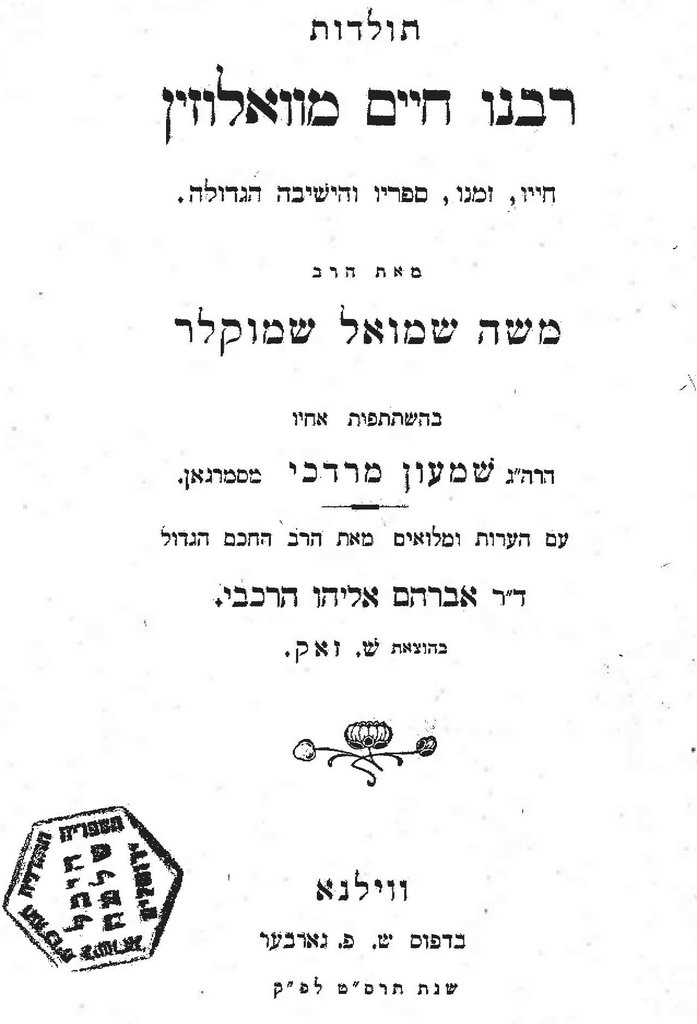
In addition to these three inaccuracies and omissions, there is a much more glaring one; not bibliographical in the abstract, but related to the content of the book – they have left out something which appeared in the earlier editions. In the first (1909) edition, a letter from R. Dr. Abraham Eliyahu Harkavy (1839-1919), a former student at the yeshiva in Volozhin, appears which contains both his warm approval of the book as well as a few comments on the book. Further, the fact Harkavy’s letter was included was no small thing as this was noted on the title page of the book. Specifically, the title page states the book includes:

עם הערות ומלואים מאת הרב החכם הגדול
ד”ר אברהם אליהו הרכבי

In the 1909 edition of Toldot Rabbenu Chaim Volozhin, Harkavy’s letter and notes were included by R. Moshe Schapiro. In the current reprint, the time that the fifth edition of Toldot Rabbenu Chaim Volozhin, published in 2000, by Schapiro’s grandchildren, Harkavy’s letter and notes are mysteriously missing. Perhaps this letter was removed intentionally as Harkavy was a maskil (intellectual) and later the head librarian at the Imperial Library in St. Petersburg.

It is possible these are missing due to a corrupted reprint the current publishers are relying upon. But, even if that would be the case, it does not absolve them of getting the first (or their “first” edition – the 1910 edition). Moreover, the title page they include does not give the current editions date, instead, the date and thus the reference is to the Vilna 1910 edition. Thus, giving the appearance they are merely reproducing the 1910 edition which is incorrect.

As an interesting aside, in 1999 the Artscroll publishing house released the first of two volumes of Shenot Dor v’Dor (the second was published in 2004) by Reuven Dessler, of a collection of priceless letters from important rabbinical personalities culled from the invaluable manuscript collection of the Dessler family, wherein an entire section (in vol. 1) is devoted to correspondence between Harkavy and some of the greatest rabbis of his time, many of them his colleagues and teachers at the yeshiva in Volozhin, including R. Naftali Zvi Yehudah Berlin (Netziv) and R. Chaim Soloveitchik.
Appendix:
Title page of Toldot Rabbenu Chaim Volozhin (1909)


Bedatz Bans HaGaon

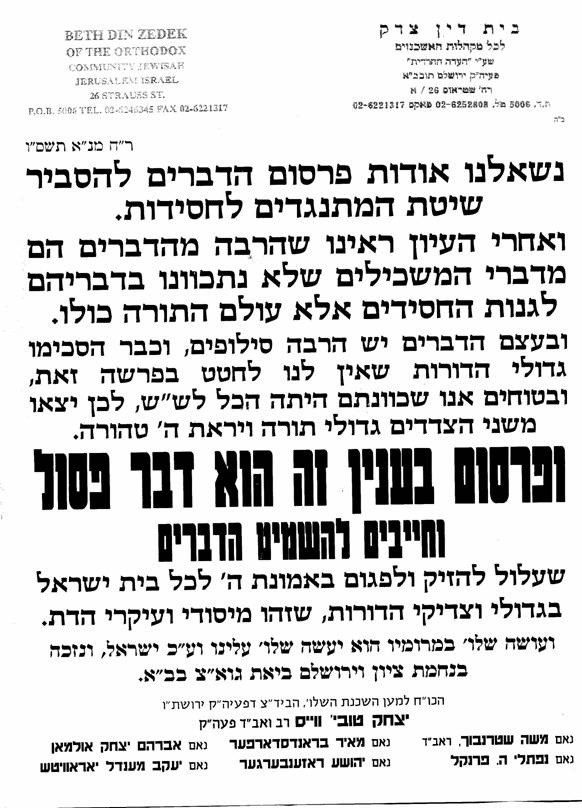
As discussed previously, there are some, mainly Hassidim, who had strong objections to R. Eliach’s biography HaGaon. Now it appears that Bedatz of Jerusalem has also issued a ban on the work (thanks to all those who sent this to me). The ban is reproduced on the side. The ban itself contains some interesting language. Specifically, the ban claims that the sources relied upon by Eliach were “maskilik.” You will recall that all Eliach did was reproduce many of the herems and the like from the non-Hassidim at the time. Now, it is correct that most of those polemics were collected by Wilensky in his Hassidim u’Mitnagdim, but the actual texts are those of some of the greatest Rabbis (not maskilim) of that time period.
Additionally, far from advancing haskalah (enlightenment) R. Eliach repudiates it. Many academics claim that the Gra was the precursor to modernity as the Gra advocates for studying secular subjects (among other things). Eliach, however, devotes an entire chapter demonstrating the Gra was against the haskalah. Eliach also includes additional material on this topic in other places as well. In doing so, he demonstrates that far from accepting maskilik or hasklah literature he actually accepts as true many anti-maskilik assertions. One example is particuarly telling. R. Eliach accepts that the Noda B’Yehuda banned R. Naftali Hertz Wessely. The source for this is an article which appeared in the Journal Kovetz Bet Ahron v’Yisrael by R. Y.A. Heschel. R. Heschel’s article is full of errors and wild assumptions. Most notably, R. Heschel assumes that the ban in question is from the Noda B’Yehuda solely because it was found in a stack of papers also from the Noda B’Yehuda. There is no other cooberating evidence. Instead, this is an unsigned letter that contains no other internal or external indica of reliablity. R. Eliach, however, in his attempt to prove the vehemence as well as the universiality of condemnation of the haskalah accepts this as true. Thus, it is somewhat difficult to understand how R. Eliach could be accused of accepting and advancing maskilik ideas and positions.

Finally, it is rather unclear why in August of 2006 the Bedatz is banning a book published in 2002. It was not as if this book was “under the radar.” Instead, immediatly with its publication there were other bans, articles and condemnations of the book. Further, R. Eliach secured the approbation of R. Chaim Kanievsky and was featured in Dei’ah veDibur the Haredi newspaper. While this wouldn’t be the first controversy between Beni Brak and Jerusalem, (famously the controversy over using the Ben Asher Nach was essentially between the two communities) it is a bit strange in its timing.


The Vilna Gaon’s Talmud

Mississippi Fred McDowell, has posted re: the Vilna Gaon’s Yerushalmi edition. However, I would like to discuss which edition of the Bavli the Vilna Gaon had. This is a rather important especially in light of the numerous emendations to the text the Vilna Gaon made. As when one is amending something it is important to know what exactly they have amended.

Every morning Birkat HaShahar are recited. Among these blessings are three anomalous ones. These there, as opposed to the rest, are in the negative. Specifically, these blessing are for ones legal status, gender, and religion. It is the last one, religion is the one we will focus on.

The Talmud has these blessing, however, there is some difficulty with the text of the religion one. Some editions have this blessing in the positive, i.e. “thank you for making me a Jew,” and some have it in the negative, “thank for not making me a non-Jew.” This confusion prevailed into the medieval period, with some texts containing one iteration of the blessing and some the other. What is unclear, however, is whether this change to the positive was wrought due to censorship or is there some reason this blessing should be in the positive.

R. Yom Tov Lipmann Heller, in his Ma’adani Melekh, claims any passage which is in the positive (“thank you for making me a Jew”) is due solely to censorship. And with this, we get to the crux of our discussion here – the Vilna Gaon’s edition of the Talmud.

The Vilna Gaon, in his commentary on Shulhan Orach says that one should say this blessing in the positive form. He comes to this conclusion because “our editions of the Talmud have the blessing for ‘making me a Jew.'” In theory, the Vilna Gaon’s conclusion is dependent upon whether “our editions” are corrupted or not. That is, if “our editions” are censored then they prove nothing. This contention, that the Vilna Gaon used a corrupted edition is noted by R. Shmuel Feigenshon in the Otzar HaTefilot. Specifically, R. Feigenshon claims that had the Vilna Gaon seen the Amsterdam 1644 edition he would never made this mistake. [Additionally, based in part upon this, Y.S. Speigel notes the Vilna Gaon did not use manuscripts or earlier printed editions when he amended the text.]

It is worthwhile noting that R. Raphael Natan Rabinowich, in his Ma’amar ‘al HaDpasat haTalmud (which has just been reprinted by Mosad HaRav Kook) claims that the Vilna Gaon used the 1644 edition of the Talmud, the very one if he had used it would have avoid this error!!

In the end, we don’t know exactly which edition the Vilna Gaon used and according to Speigel, it is likely that the Vilna Gaon did not use one edition. Instead, it is likely the edition was dependent on the particular volume of the Talmud he had and for each volume it may have been a different edition.

Sources on the blessing: T.B. Menachot 43,b; Dikdukei Sofrim ad. loc.; Rosh, Berakot chapt. 9; Ma’dani Melekh id. at note 24; Tur Orakh Hayyimno. 46:4; id. Bach; Shulchan Orakh and Rama id.; see also, first edition of Rama Prague, 1588 for the proper placement of his comments available here; Biur HaGra id.; see also R. Y. Satnow, Va’yetar Yitzhak, no. 44; R. Jacob Emden, Luach Eres Toronto, p. 24 no. 64; Siddur Otzar haTeffilot, on the blessing in question; On the Vilna Gaon’s edition of the Talmud: Y.S. Speigel, Amudim b’Toldotha Sefer HaIvri: Haga’ot U’Magim, 404-405, 416 and the sources cited therein.


Buring the Hametz and the Goan Book

To the left are pictures what are supposed to be the Klausenberger Rebbe burning the book HaGaon (discussed here previously) with the Hametz. Additionally the final picture is him saying the Yehi Ratzon from the Ateresh Yehoshua when burning books of heresy. If you click on the images you can see them enlarged. Here is the full text of the Yehi Ratzon

יהי רצון מלפניך ה’ אלוקי ואלוקי אבותי, כשם שאנכי באתי לבער את ספרי החיצונים והמשכילים אלה, כן יסור את הצפוני מזרע ישראל, וביותר מן הבחורי חמד אשר ההשכלה מצאה קן בלבם ובמוחם והיצר מבלבל מחשבותם. בעל הרחמים ירחם עליהם ונטע בקרבם אמונת הבורא ואמונת הצדיקים כדכ(תיב), ויאמינו בה’ ובמשה עבדו ועתה בזמן ביעור חמץ אשר היא עת מוכשר על זה לגרש ולבער את השאור שבעיסה הטמ(ו)ן בקרבנו, יעלה תפילה זו לרצון לפני אדון כל, אמן כן יהי’ רצון

“עטרת ישועה על חמישה חומשי תורה”, ח”ב, קראקא, תרפ”ה דף פז, ב’ סי’ א


The Ban on the book HaGaon

Now, as the Yiddish newspaper Der Yid has gotten around to commenting on the book HaGaon, I thought it would be worthwhile flesh out the entire controversy surrounding this book. Interestingly, R. Kamentsky in Making of a Godol actually discusses this very topic, although not in the context of HaGaon.

HaGaon written by R. Dov Eliakh in three volumes discusses everything and anything having to do with the Vilna Gaon. Most of the book is not controversial at all, instead, in painstaking detail R. Eliakh chronicles what we know about the Gra and the times he lived in. However, the third volume was the one that many took issue with. That volume, which discusses the controversy between the hassidim and the non-hassdim, also includes most of the primary literature on the topic. That means, R. Eliakh quotes extensively from many of the early anti-hassidic tracts which were published. Some of these contain scathing critiques of the hassidim and accuse them of rather disturbing acts.

However, as many are aware this was not the first time these were published. All of these, and more, have been published by Mordecai Wilensky, in his Hasidim u-Mitnagdim (which is now available again). In fact, much of this has even been translated into English in Elijah Schochet’s The Hasidic Movement and the Vilna Gaon. But, for some who are unaware of these, Eliakh’s book was highly disturbing.

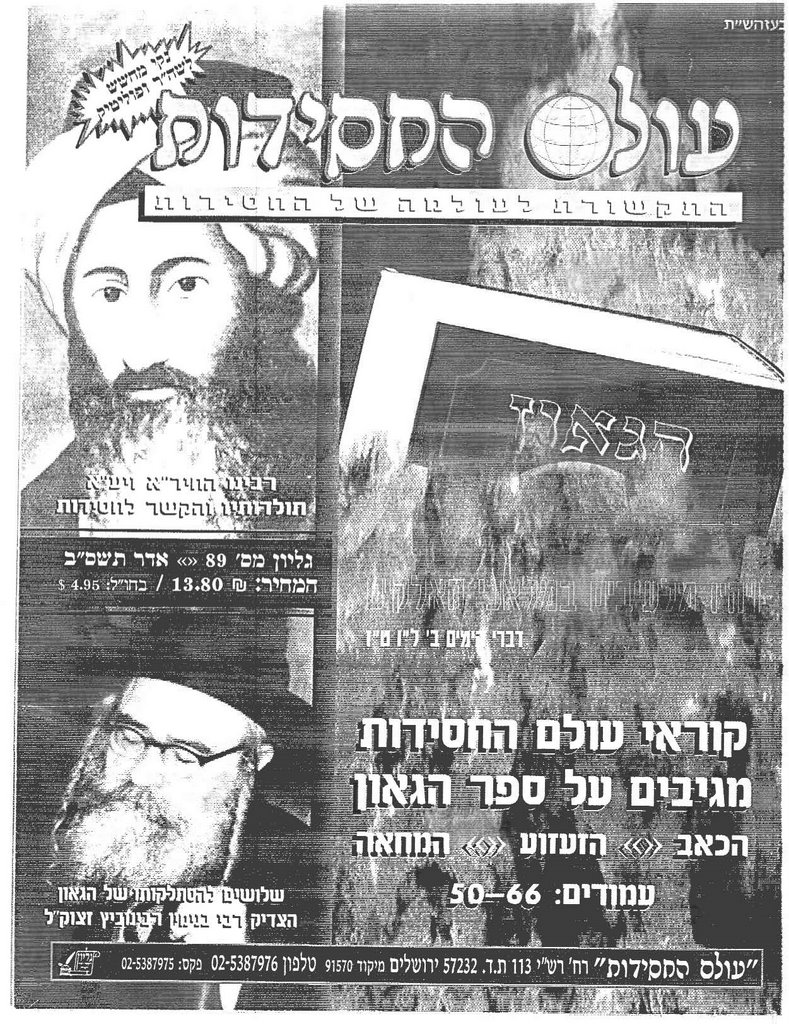
The main complaints came, as is not a surprise, from hasidic circles. For instance, in the magazine Olam haHasidut, has three issues devoted to the book. On the cover of two of those issues, the book HaGoan appears in flames. Needless to say they were not fans of the book. The title reads אוי לדור שכך עלתה בימיו (how unfortunate we are to have this happen in our time). Among the major complaints about the book is that it is “written in the style of the maskilim (enlightenment).” I assume that means that as Eliakh documented everything he wrote that is in the style of the maskilim.

Additionally, they complain that as this controversy is no longer applicable (as the hasidim of today don’t do what they did back then), it serves no purpose in relating this again.

Now, here is where Making of a Godol comes in. R. Nathan Kamenetsky records what his father, R. Yaakov’s opinion on whether to discuss the history of the controversy between the hasidim and the non-hasidim. “My father [R. Yaakov] approved of snubbing of ‘a book on the Goan of Vilna by an outstanding author’ because ‘the author had purposely omitted chapters dealing with the Gaon’s opposition to Hasiduth and that he [R. Yaakov] said, ‘It is prohibited to conceal substantive and important issues such as these. Such distortion is tantamount to falsehood.'” R. Nathan Kamentsky goes on to relate that the book in question was R. Landau’s biography of the Gra and that his father [Rav Yaakov Kamenetsky] actually confronted R. Landau and accused him of “falsifying the image of the Gaon.” See Making of a Godol vol. 1 pp. xxvii (available here).

Consequently, R. Yaakov felt that leaving out such a seminal fact in a biography was equivalent to lying. However, as we see, the publishers of Olam haHassidut appear to disagree. They are not the only ones. R. Yaakov Perlow, the Novominsker Rebbi, wrote a long article where he also takes issue with Eliakh’s book. He also claims that R. Eliakh should have left out the details of the controversy.

It would appear that there is a fundamental controversy as to whether or not one should lie regarding history. In fact, in the journal Ohr Yisrael, there was an article addressing this very point – whether one should lie to tell stories that create yirat shamyim. The author concludes “if the teacher is telling stories which are not true, but is doing so leshem shamyim, so long as he doesn’t make a habit out of it, there is a place to be lenient in this matter, however, one should try to minimize this.”

Interestingly, in the next volume the Admor from Slonim has a stinging rebuttal of the article. He starts by saying, “Our tradition is based upon truth . . . how terrible it is to inject lies into our tradition.” He then explains such a view undermines our entire religion “whomever permits [one to lie] it is as if he is creating uncertainty in the truth of our entire tradition, which is based upon the passing from generation to generation. My teachers have taught that one should only accept truthful stories.”

So it would appear that there is an ongoing controversy, one which implicated the book HaGaon, with some arguing lying or covering up fundamental historical facts, is ok. While others claim this is totally unconscionable.

Sources: Olam haHassidut no. 88, Shevat 2002; 89, Adar 2002; 90, Nissan, 2002. Rabbi H. Oberlander, “HaIm Mutar l’Saper Ma’siyot shaninom amitim kedi l’orrer al yedi zeh l’Torah v’lyerat shaymim, Ohr Yisrael, 29 p. 121-123; R. Avrohom Weinberg (Admor M’Slonim Beni Brak), Letter, Ohr Yisrael, 30, 244. See also, Ari Zivotofsky, Perspectives on Truthfulness in the Jewish Tradition, Judaism 42:3 (Summer, 1993): 267-288. R. Yaakov Perlow, Yeshurun vol. 10 starting on page 831. Der Yid, Talumat Seftei Sheker haDovrot al Tzadik Atik, March 17, 2006. See also here for a discussion of the book. There are others that discuss this as well, and in R. Nathan Kamenetsky’s introduction he quotes them. Further, as a helpful reader/movie buff has noted, I should have included R. Dr. Jacob J. Schacter’s article on this topic available here.


Manasseh of Ilya and Y. Barzilay

I recently finished reading Yitzhak Barzilay’s book on R. Manasseh of Ilya. R. Manasseh was a fascinating character. He was a student of the Vilna Goan, but wrote a pamphlet arguing for reconciliation between Hassidim and non-Hassidim. He wrote another work discussing the trop or cantilation marks and yet another, his mangum opus, on the Talmud. It is the later work that he is most well known for, although not necessarily in a positive way. The Tefferet Yisrael (R. Yisrael Lifshitz) on the Mishna quotes a brief passage from this commentary. R. Menasseh’s comments appear on the first Mishna in Perek Alu Mitzhut. (Baba Metziah 1:1). He understands the Mishna in a different fashion than the Talmud, thus provoking some to argue such a position is heritical.

R. Manasseh was a controversial figure. His book on the reconciliation, Pesher Davar, was publicly burnt. His work on Talmud, Alphei Menashe, after either the publisher or some outsider (depending on the source, there are a couple versions of the story), destroyed it right before it was completed. R. Manasseh was forced to reproduce the entire work from memory and find a different printer.

Additionally, although he had a close relationship with the Vilna Goan, the Vilna Goan severed that relationship after learning R. Manasseh had been in contact with R. Shneur Zalman of Lida (Ba’al haTanya).

All this being said, he is ripe for an excellent biography. Unfortunately, Barzilay does not deviate from his norm, and put out another poor work. Although Barzilay has written on many other interesting figures of Jewish history, almost always he fails to do anything substantive or worthwhile with the subjects.

This work is full of gross supposition that are never supported by any facts. For instance we have sentences like this “It may be assumed that in a talented person like Manasseh, his critical faculties must have awakened rather early, and already in his youth he may have arrived at some of his nonconformist views with regard to the Halakhah and its historical development.” (p. 24). Therefore, Barzilay wants to then claim and project back on Manasseh’s early years and label him as a radical even then based only upon “his critical faculties.” While that may be the case, there are also a million other possibilities. For instance, Manasseh was influenced later in life by someone else or he came to his “nonconformist views” based upon years of study and when he was 17 (according to Barzilay, again a guess) he did not hold these views.

Another example, where Barzilay is discussing Manasseh’s frequent trips to his wealthy relatives house who had a terrific library, Barzilay makes the following statement: “The role of this library in Manasseh’s life and intellectual growth cannot be overestimated . . . It may be further assumed, with a high degree of probability, that there also were to be found there the recent works of the Berlin maskilim, as well as those of the enlightened orthodox Jews from both Eastern Europe and the Germanies.” Barzilay then goes on to cite to the many subscribers of various haskalah literature as “proof” this library contained these books. There a basic problem with this argument. Since Barzilay is able to point to where these books went to as the subscriber list, lists both person and place, why then isn’t this rich relatives name ever listed if he was a collector of such works? Instead, Barzilay is satisfied to assume that the books were there as there were many haskalah books that “found [their] way among the Jews of Eastern Europe.”

These are but two examples from a book that is rife with such sloppy work. The only redeeming fact of the book is the extensive quotation from R. Manasseh’s works. As mentioned above, this is not the first book Barzilay wrote that fails miserably. He also did another biography on R. Shlomo Yehudah Rapoport (Shir), the son-in-law of the Ketzot HaChoshen and one of the leading figures of 19th century Eastern European Haskalah. This book is also disappointing.

unfortunate, the only other biography, Ben Porat Yosef, is no gem either. It was written by Mordechai Plungian an editor at the famed Romm press. This is more of an anecdotal than scholarly work. However, this work got Plungian in trouble as some claimed he attempted to make R. Manasseh into a maskil.

What is particularly strange is that a book review of Plungin’s book appeared in HaMagid. At the JNUL site, which contains old Hebrew newspapers, the version they have appears to have that portion blacked out. The review in question appeared in HaMagid on March 8, 1858.

The full citation for Barzilay’s book is Manasseh of Ilya: Precurser of Modernity Among the Jews of Eastern Europe (Manges Press, 1999).


Book on Yeshivot

Shaul Stampfer has republished a revised and expanded edition of his HaYeshiva haLita’ot b’Hitavato. The book which is devoted to three yeshivot, Volozhin, Slobodka, and Telz, as well as the Kovno kollel. The book tracks the Volozhin yeshiva from its inception to its closure and the Slobodka and Telz yeshivot until the turn of the twenteenth century.

This book was originally Stampfer’s dissertation, Shlosh Yeshivot Litayot b’Meah haTisha Asarah (1981) and was published in book format in 1995. This edition includes numerous updates as well as much new information, especially regarding the closure of Volozhin. Stampfer now argues, based upon new Russian governmental documents, which he includes Hebrew translation of, that the Yeshiva was closed due to the its own internal upheaval. This internal strife was caused by R. Naftali Tzvi Yehuda Berlin (Netziv) attempting to install his son as Rosh haYeshiva. At Telz a similar fight broke out also regarding succession, as well as in Volozhin itself, on two separate occasion. However, the last fight caused such a rapid decline in the internal going ons of the Yeshiva, the government had it shut. The closure did not have to do with the haskala, the Russian government wanting to meddle into Jewish education or any of the other reasons offered. Instead, as has been borne out throughout Jewish history, the Jews brought it upon themselves. For example, the burning of the Talmud in France after the controversy regarding Rambam’s writings as well as the banning of the Talmud in the 16th century were caused or at least the catalyst was internal fighting amongst the Jews.

The book also debunks other theories regarding the opening of Volozhin. Some claim the R. Hayyim Volozhin ask R. Eliyahu of Vilna (Gra) and received his blessing to open the what was the first Yeshiva. Stampfer, however, questions this and notes that in the initial Kol Koreh R. Hayyim Volozhin makes no mention of this, something that would have bolstered his fundraising efforts. Second, Stampfer also proves that the opening of Volozhin was not in response to the Hassidic movement.

Aside from the above, the book is full of first hand accounts of the Yeshivot. These include, Volozhin started praying in the morning at 9 am and the prayers only ran 15-20 minutes. Stampfer qualifies this by noting haNetz haHama in Vilna (just north west of Volozhin) during the winter is 9:17 and also notes the 15-20 minutes is probably slightly exaggerated. Telz yeshiva was the first to institute grade levels in a yeshiva. Also, according to Simcha Assaf’s account, R. Lazer Gorden encouraged him to learn Russian and had his son teach Assaf in his own home. Stampfer includes much about the influence of Zionism and the haskalah on the yeshivot. All you ever wanted to know about all the infighting in the Yeshivot. The first to move to establish a kollel was R. Yitzhak Ya’akov Reines, who was highly controversial with the establishment of his yeshiva in Lida – arguably a precursor to Yeshiva University. These are only a tiny portion of the terrrific nuggets that can be found in this book.

I purchased this book at Beigeleisen in Boro Park (718-436-1165)