The Vilna Gaon, Part 1: How Modern Was He?

The Vilna Gaon, Part 1 How Modern Was He?
by Marc B. Shapiro
Eliyahu Stern, The Genius: Elijah of Vilna and the Making of Modern Judaism (New Haven, 2013)
Eliyahu Stern has set for himself a daunting task and argues his case with conviction. He intends to correct a widespread assumption shared not only by the general public, but by the scholarly community as well. According to this narrative, the Vilna Gaon (hereafter the Gaon) should not be seen as a traditionalist defender of the past, but actually a modern Jew and one who helped usher in the modern era in Jewish history. In Stern’s words, “I [have] come to believe that [Jacob] Katz’s and [Michael K.] Silber’s notion of tradition and traditionalism fails to explain the experience of the overwhelming majority of eighteenth- and nineteenth-century eastern European Jews who did not spend their days either combating the Western European secular pursuit of science, philosophy and mathematics or holding onto the same political and social structures of their sixteenth- and seventeenth-century ancestors. Katz and Silber might have been right about [R. Moses] Sofer. . . . But figures such as the Gaon of Vilna or Hayyim of Volozhin (the Gaon’s student and Sofer’s contemporary), who did not express hostility toward modernity, elude their grasp” (p. 7).
This is quite a claim, and it would be a major revision of the historical picture if Stern could prove the point. Stern also argues that the Gaon’s notes to the sixteenth-century legal code Shulhan Arukh were influential in Jews moving away from a “code-based learning culture supported by the kehilah” (p. 11).[1]

By focusing on Talmud study for its own sake rather than for the sake of determining the halakhah, a paradigm shift occurred in which commentary replaced code. This occurred at the very time that the yeshiva took the place of the kehilah, as seen in the establishment of the Volozhin yeshiva by the Gaon’s disciple, R. Hayyim. Thus, the hierarchy of religious authority was restructured, which leads to what Stern refers to as “religious privatization” (p. 11). As he sees it, “The Volozhin yeshiva was founded not in opposition to the cultural and intellectual upheavals of the nineteenth century. It was itself built on the most modern of assumptions, the separation of public and private spheres” (p. 141). Stern even makes the bold claim that in certain respects the Gaon was more modern than Mendelssohn, arguing that “it was the Gaon’s hermeneutic idealism that called into question the canons of rabbinic authority, while Mendelssohn tirelessly defended the historical legitimacy of the rabbinic tradition to German-speaking audiences” (p. 64). In seeking to turn the Gaon into a more modern Jew, one who is not, as standard scholarship assumes, an opponent of philosophy, Stern even argues that the Gaon did not believe in “demons, magic, [and] charms” (p. 129).[2]
After mentioning that the Gaon is embodied in the Jewish residents of Tel Aviv and New York, who live as though they are majorities, Stern concludes his book with this striking assertion: “From the birth of the State of Israel, to the Jews’ involvement in radical anti-statist modern political movements, to the creation of a robust vibrant Jewish life in the United States, Jewish modernity derives much of its intellectual dynamism, social confidence, and political assertiveness from an astonishing source: the brilliant writings and untamed personality of Elijah ben Solomon” (p. 171).
As with all revisionist theses there is bound to be reluctance to accept a new paradigm. The successful revisionist thesis is the one able to withstand the initial skepticism. Does Stern’s thesis fall into this category? Despite his enthusiastic and tempting arguments, I am not convinced. Reading the book, I could not help wonder if, for example, drawing contrasts with the thought of Leibniz offers any real insight into the thought of the Gaon. We know that the Gaon was fearless in emending rabbinic texts, but for Stern, “Elijah’s emendation project addresses the charge that Leibnizian idealism leaves no room for the possibility of progress, redemption, and critique. . . .  Elijah embroidered the theological concept of evil around the idea of textual error” (p. 61). Isn’t this reading too much into what the Gaon had in mind? Why does the approach of the Gaon have to be given such theological weight that Stern can conclude that “emendation is the path toward redemption and a restored original harmony” (p. 62)?[3]

In another example of his revisionist approach, Stern argues that the Gaon did not oppose philosophy. Rather, “Elijah’s problem with Maimonides revolves around issues of linguistics, interpretation, and hermeneutics and not whether it is permissible to read secular philosophy” (p. 130). As noted already, Stern also assumes that the Gaon did not really believe in “demons, magic, charms and other irrational objects” (p. 129). There is no question in my mind that Stern is in error here. Because the Gaon was a traditional Jew, whose approach to the classical rabbinic texts was not influenced by rationalist philosophy, this is precisely why he believed in demons, magic, and charms. The only reason to reject these things, as did Maimonides, is because one is influenced by rationalist thought.
I see no evidence that the Gaon was influenced in any substantial way by such knowledge, and his occasional use of Aristotelian terminology does not by itself indicate real influence. Furthermore, everything in his writings leads one to believe that when it came to the occult his mental universe was no different than the great rabbis of his time and subsequent to him, for whom demons did indeed exist. In his famous attack on Maimonides, found in his comment to Shulhan Arukh, Yoreh Deah 179:13, he specifically mentioned the efficacy of magic, and contrary to Stern this is to be taken literally.[4]

In fact, a few notes later, 179:26-28, which are not mentioned by Stern, the Gaon again wrote about demons, mentioned that one is permitted to consult with them if it is not the Sabbath, and cited talmudic and midrashic texts that show humans interacting with demons.[5] The Gaon’s position in this matter does not need to be explained. Pretty much every traditional Jew in his day believed in demons, and he did as well. It is Maimonides’ opinion that is not traditional.
Stern leaves it as an open question whether the Vilna Gaon called philosophy “accursed” (p. 245). This is obviously an important issue, since if Stern is correct that the Gaon was not really opposed to philosophy, one would not expect him to use the word “accursed.” Yet there is no doubt that the Gaon did indeed use this word. It appears in the first printing of the Gaon’s commentary to the Shulhan Arukh, and its authenticity was attested to by R. Samuel Luria who examined that actual manuscript. Only later was the word removed by the publisher. Contrary to what Stern states, Samuel Joseph Fuenn, Matisyahu Strashun, and Hillel-Noah Maggid Steinschneider do not claim that later editors put in this phrase. The one to make this assertion was R. Zvi Hirsch Katzenellenbogen, and he was hardly a neutral observer.[6]

Several other issues emerge in the book. Stern quotes Aliyot Eliyahu as stating that before the age of thirteen the Gaon was “studying books on engineering for half an hour a day” (p. 38). I am not sure why Stern mentions anything about “thirteen,” as the text is explicit that he was around eight years old. Furthermore, the text says nothing about “engineering.” Rather, it states that the Gaon studied astronomy (tekhunah).

Stern writes that the Gaon “rejected outright” the Shulhan Arukh (p. 60). This is a strange statement being that the Gaon wrote a commentary on the Shulhan Arukh. Furthermore, this commentary was designed to show the earlier rabbinic sources upon which the Shulhan Arukh‘s laws were based. It is true that there are many times when the Gaon disagreed with the Shulhan Arukh. However, what is significant with the Gaon is precisely that he accepted the Shulhan Arukh. He had the stature to reject it had he chosen, and to write his own code, yet he did the exact opposite. By attaching his notes to the Shulhan Arukh he was affirming the work. He personally did not need the Shulhan Arukh and would decide halakhah from the Talmud and rishonim. But when the Shulhan Arukh decided the halakhah correctly, he was content to show the sources for the law, meaning that the work had value and that is why he affirmed it.[7]

Contrary to Stern (pp. 77-78), there is no evidence that the Gaon was influenced by Elijah Levita and the Gaon never mentioned him. When the Gaon wrote that the Masorah disagreed with the Talmud, he was referring to how to spell certain words, and this formulation comes from the Tosafists. He was not in any way identifying with Levita’s notion that the Hebrew vowels originated in post-talmudic times, and was certainly not addressing “the veracity of the cantillations of the Bible” (p. 78). When the Gaon’s son cited Levita, he was also not referring to his view of the vowels, only of the spelling of words.
I do not know what Stern means by “following Nachmanides, the Gaon argues that the book of Deuteronomy was written later than the other four books of the Bible” (p. 80). Quite apart from Nahmanides, this position is found in Gittin 60a, where one view is that the Torah was given “scroll by scroll.” Also on p. 80, Stern states that “the Gaon, in contrast, builds on the historical position laid down by Ibn Ezra that the last verses, though inspired by Moses, were actually ‘arranged’ by Joshua.” This has nothing to do with Ibn Ezra as the Talmud already contains the view that the last verses were written by Joshua (saying nothing about being “inspired” by Moses. [Ibn Ezra also says nothing about the last verses being “inspired” by Moses])
On page 133, Stern quotes a passage from the introduction to R. Judah Epstein’s Minhat Yehudah (Warsaw, 1877) where he writes of “thousands who came to study and the miracle it would take for one to emerge with any teaching ability.” In the Hebrew the final words are “yatza le-hora’ah.” This has nothing to do with teaching but refers to the ability to decide halakhic questions. The expression originates in Kohelet Rabbah 7:49.
Finally, he writes that “when the Volozhin yeshiva opened its doors in 1802, it was the first time that young men from all economic and social backgrounds were afforded the opportunity to study” (p. 150, see also p. 162). I know of no evidence to support this assertion. Both before the Volozhin yeshiva’s opening and after, opportunities for study were limited to those who could afford to support a child away from home, and give up the income he would bring in for the family.
Even though I am not convinced by Stern’s thesis, there is no doubt that this book is filled with learning and insight and has understandably created a good deal of excitement. To appreciate Stern’s efforts and ingenuity, one must read very carefully, and this reading will be rewarded in many ways.
******
The review you have just read (with the exception of notes 1-5, 7, and one sentence in brackets) appeared on the H-Judaic listserv on July 19, 2013. In the review I was limited in terms of space and I also could not use Hebrew. So let me now add some additional points and corrections that could not be included in the original. Before doing so I want to stress that I enjoyed Stern’s book a great deal, and I also learnt much from it. The Gaon’s scholarship is so wide-ranging that anyone who attempts such a daunting task as to write on him must be commended.[8]

Stern should also feel gratified that so many people have chosen to use their precious time to write about his book, even if they disagree with him.
Stern’s first chapter, which puts the Gaon and Vilna in historical perspective, was particularly interesting to me. How many people, for instance, are aware of the following (p. 70): “The roughly 5,500 Jews in and around Vilna (Wojewoda) made up nearly 30 percent of the population, and the 3,500 to 4,000 Jews living within Vilna proper formed an overwhelming majority of the local population.”
I strongly recommend that people read the book, if only to see how the talented author attempts to create a completely new perspective on the Gaon. Almost every page of Stern’s book raises issues that I can comment on, and I could easily have written a hundred page post. I agree with much in the book, and can cite sources in support of a number of points Stern makes. Yet this does not change the fact that I was not convinced by his major arguments. Rather than cite all the things I agree with, let me offer some more comments correcting errors, or offering different interpretations, as well as some tangential observations.
P. 14. Stern tells us that the Gaon’s mother was from Slutzk, and on p. 181 he cites a source that supposedly claims that the Gaon was also born in Slutzk. Yet this is incorrect. The town referred to is not Slutzk but סעלץ. This is the shtetl Selets (or Selcz) around 150 kilometers south-east of Brisk.[9]

This information is also found in the Encyclopaedia Judaica entry on the Gaon. There is another Selets in Belorussia, some eight hundred kilometers away,[10] but this is not the town associated with the Gaon. There is no actual proof that the Gaon was born in Selets, but that was the tradition of the town.[11]
P. 15. Stern records how the Gaon wanted to study medicine but was discouraged by his father who wanted his son to devote himself to Torah study. I don’t know if this has any relationship to the Gaon’s unusual (but not unique) view in opposition to using doctors as opposed to turning to God. According to one report, the Gaon only had this view when it came to internal medical problems, but not external ones (e.g., a burn).[12]
P. 17. Stern mentions the report by R. Samuel Luria that the Gaon travelled throughout Europe to find rabbinic manuscripts. Among the legends of these travels is one recorded in the name of R. Joseph Hayyim Sonnenfeld, quoting R. Joshua Leib Diskin, that when the Gaon visited the Munich library and saw the famous manuscript of the Talmud, he said that he would give all the money in the world in order to put it in genizah, because this Talmud was only R. Ashi’s first version (and thus of no authority). This story appears in Menahem Mendel Gerlitz’s Mara de-Ar’a Yisrael (Jerusalem, 1969), vol. 1, p. 57 n. 49. I can’t say whether or not R. Sonnenfeld ever made this comment (and Gerlitz’s book in general is quite unreliable). What I can say is that the story never happened as described for the simple reason that the manuscript only arrived in Munich in 1806, as noted by R. Raphael Rabbinovicz in the introduction to Dikdukei Soferim, vol. 1, p. 35.[13]
P. 44. “He [the Gaon] and his students reinterpreted a strand of kabbalah developed by Abraham Abulafia. . . . Elijah’s circle borrowed heavily from his ideas regarding the mathematical underpinnings of the world.” Unfortunately, this influence is never sufficiently explained and there is confusion about an important text. Thus, Stern writes:
As Menachem Mendel of Shklov wrote, “The word cheshbon [calculus] comes from the word machshava [thought] and this [calculus] is the first form that emerges from the essence of thought.”[14]
To begin with, I don’t know why cheshbon should be translated as “calculus.” I assume it means mathematics.[15]  But that is a minor point, as the general meaning of the passage is clear and R. Menahem Mendel of Shklov tells us that this approach was shared by the Gaon. The more important point, however, is that the sentence quoted as having been stated by R. Menahem Mendel was not stated by him at all. R. Menahem Mendel tells us explicitly that the sentence comes from an early book, one that predates R. Isaac Luria. What we learn from Moshe Idel is that this is actually a quotation from Abulafia.[16] Yet this information does not appear in Stern’s book, even though it would have strengthened his case.
Stern also states: “Elijah’s son Avraham approvingly cites the much-maligned Abulafia, and bestows the honorific “z”l” (the Hebrew acronym for “may his memory be blessed”) on the controversial medieval thinker.”
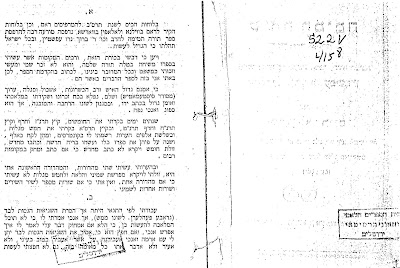
Here is the page in R. Avraham’s Rav Pealim.

Unfortunately, Stern must have read too quickly and instead of וז”ל [= וזה לשונו] he read the abbreviation as ז”ל, or perhaps he mistakenly connected the ז”ל on the previous line to ר’ אברהם הרואה
Pp. 44ff. Stern argues that according to the Gaon, matter existed eternally and the world was created from this eternal matter. If this was the case, it would be quite significant. Yet I believe that Stern misunderstands what the Gaon is saying. Stern himself quotes the Gaon as explaining that creation means “created from that which exists above.” As I see it, what this means is that matter “found” in the Divine was brought into the world, e.g., through emanation. But this is not the same as speaking of eternal matter, even eternal matter that is lacking form, as these exist apart from God.
With regard to the Gaon and creation, see also R. David Luria’s commentary to Pirkei de-Rabbi Eliezer, ch. 51 n. 17, where he cites a manuscript comment of the Gaon that the world is eternally created. This same viewpoint is shared by R. Hayyim of Volozhin, Nefesh ha-Hayyim ch. 13. I don’t see how this can be reconciled with the Gaon’s comment at the beginning of Aderet Eliyahu that time itself is a creation, and he further speaks of an actual moment of the world’s creation:
בראשית: ב’ הוא ב’ הזמניי. כמו ביום. מפני שהזמן עצמו נברא והב’ מורה על עת הבריאה שהיה בחלק הראשון מהזמן הנברא
If matter is eternal, as Stern claims, or even eternally created, then time is also eternal. But this is clearly not what the Gaon says in the text just quoted.
P. 80. Stern notes that the Gaon’s interpretation of the Mishnah was not bound to how the Talmud explained matters. This is correct, and many people have written on the matter. I mention this only to call attention to the comments of the great genius, R. Meshulam Roth, in his Kol Mevasser, vol. 2, pp. 120-121, 128-129, who felt constrained to argue against this notion. I think it will be obvious to readers that R. Roth’s interpretations of the Gaon are based on his own dogmatic assumption, which he states explicitly, that it is unacceptable to interpret the Mishnah in a way that diverges from the talmudic interpretation.

P. 97. Stern writes:

Contrast Elijah’s vision with the picture of intimacy expressed by Rabbi Pinchas of Korzec (1726-1791): “Prayer is like intercourse with the Divine Presence. At the beginning of intercourse there are motions. Similarly, there is a need for motion in prayer. One should move when beginning to pray. Later on, one can stand without moving, attached to the Divine Presence with a powerful bond. As a result of the motions alone one can attain dvekut.”
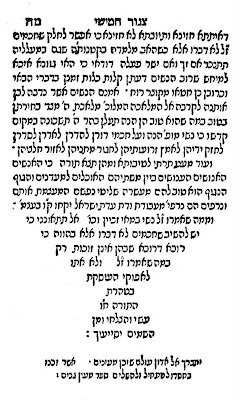
In the note the source for this quotation is given as Likutim Yekarim, 18, and the bibliography tells us that the edition used is Lemberg, 1792 (the first edition). Yet there is some confusion here. R. Pinchas of Koretz indeed wrote a book entitled Likutim Yekarim, but the book where the passage cited comes from is another Likutim Yekarim, one that records the teachings of other early Hasidic teachers. Here is the title page.

Furthermore, the reader looking at page 18 in the first edition of (the correct) Likutim Yekarim will not find anything, as the text is on page 1a. In the 1974 edition the text is found in section 18, but as far as I can tell, these sections were only added in this edition.[17]
Here is the relevant page from the first edition, and the comment referred to is in the last paragraph. The last sentence of the translation quoted above (“As a result . . .”) is not an accurate rendering of the Hebrew sentence that begins מכח מה שמנענע

P. 102: “While it is doubtful that Elijah endorsed or defended Eibeschuetz’s or Luzzatto’s Sabbatian tendencies, he never publicly condemned their works.” Instead of the word “doubtful,” which leaves some room for question, the sentence should say that “it is certain that Elijah never endorsed or defended . . .” I leave aside for now the question of why Stern is so certain that Luzzatto had Sabbatian tendencies, and simply note that the Gaon would have rejected such an assumption in the strongest terms. The Eibeschuetz case is more complicated,[18] but I don’t understand how “Eibeschuetz’s Sabbatian proclivities were revealed when his son Wolff was unmasked as a closet Sabbatian” (p. 99). Since when do the actions of a son determine the stance of a father?
Let us now return to the issue of the Gaon’s view of philosophy, which was mentioned earlier in this post, and when I refer to philosophy I have in mind rationalism. Stern, p. 129, argues that the Gaon was not opposed to philosophy and as evidence for this proposition notes that the Gaon uses Aristotelian terms, cites the Guide once in his Aderet Eliyahu, and procured a copy of Aristotle’s Ethics. He then writes, “This evidence has led some to suggest that Elijah objected to a materialistic or epicurean lifestyle often associated with philosophy, but not to philosophy’s heuristic value.”
While I think that Stern is indeed correct that the Gaon saw heuristic value in philosophy, I was still quite surprised when I read this sentence, since I had never heard of anyone who argued that the Gaon’s only concern with philosophy was the materialistic lifestyle associated with it. When I looked in Stern’s note (p. 246 n. 55) it didn’t help. This is what appears in the note:
See Moshe Philip, ed., Sefer Mishlei im Biur ha-Gra (Petach Tikvah: 2001), 441 and Eliyahu Stern, “Philosophy and Dissimulation in Elijah of Vilna’s Writings and Legacy,” Revue Internationale de Philosophie (forthcoming). On Elijah reading Aristotle, see his letter to Rabbi Shaul of Amsterdam recorded in Tzvi ha-Levi Horowitz, Kitvei ha-Geonim (Warsaw: 1938 [should be 1928]), 3-10.
I don’t know what is intended by the first reference, as there is a typo since the volume does not contain 441 pages. Stern’s forthcoming article can only be discussed when it appears in print, but the book under review does not give any reference to others who argued that the Gaon had no substantive opposition to philosophy. Also, contrary to what Stern states here, the Gaon did not write to R. Saul of Amsterdam asking him to send him the Ethics. The letter Stern refers to was actually written by the Gaon’s brother, R. Yissakhar Ber.[19]

See Kitvei ha-Geonim, p. 4a. On p. 44, Stern states that the letter was written by both the Gaon and his brother. This, I think, is closer to the truth. I say this because the Gaon’s brother requested לקנות בשבילנו ולשלוח לנו, although this could also just be the writing style he used. However, there are lots of reasons why people read books, and this alone does not mean that one is positively inclined to a subject. The greatest of all Jewish philosophers, Maimonides, tells us that he read all the works of Sabian idolatry that he could get his hands on (Guide 3:29). It would also be more significant if instead of the Ethics, the book requested of R. Saul of Amsterdam was Aristotle’s Metaphysics. But I don’t want to make too much of this, since I am convinced by Stern that the Gaon saw some value with philosophy. But contrary to Stern, I would add that the Gaon also saw great dangers in philosophy.
In the note directly following the one just referred to, Stern concludes based upon the introduction of R. Menahem Mendel of Shklov to the Gaon’s commentary to Avot and R. Israel of Shklov’s introduction to his Peat ha-Shulhan that “Elijah was secretly positively inclined to the study of philosophy.” He again refers to his forthcoming article where he develops this point. As mentioned already, discussion of this article must wait until it appears in print. In the meantime, however, it is difficult to accept this point without a clear articulation of what exactly Stern means by “study of philosophy”, since in R. Israel of Shklov’s introduction to Peat ha-Shulhan he writes as follows:
ועל חכמת הפילוסופי’ אמר [הגר”א] שלמד אותה לתכליתה ולא הוציא ממנה רק ב’ דברים טובים . . . והשאר צריך להשליכה החוצה.
R. Israel of Shklov also notes that the Gaon knew חכמת הכישוף which contradicts Stern’s statement that according to the Gaon “references to demons, magic, charms, and other irrational objects and ideas cannot be ignored—though not per se because he thinks they actually exist.” (p. 129).
See also Ma’aseh Rav (Jerusalem, 1906), Siah Eliyahu, p. 21b (no. 61(, which states that the Gaon would not study R. Bahya Ibn Paquda’s philosophically based Sha’ar ha-Yihud (in the Hovot ha-Levavot):
והי’ מחבב הגר”א ז”ל ס’ מנורת המאור וס’ חובת הלבבות זולת שער היחוד ובמקום שער היחוד הי’ אומר שילמדו בס’ הכוזרי הראשון שהוא קדוש וטהור ועיקרי אמונת ישראל ותורה תלוין בו.
There is another passage that is relevant, but as far as I know has not been cited in any of the scholarly discussions about the Gaon and philosophy. R. Hillel Rivlin, Kol ha-Tor (Bnei Brak, 1969), ch. 5:2, quotes the Gaon as saying the following about philosophy, and you can’t get any clearer than this:
את חכמת הפילוסיפיה למדה לתכליתה ולא מצא בה כי אם דברים אחדים שמקורם לוקח מחז”ל ועל השאר אמר, שאין בה לא הגיון ולא צדק ומיוסדת על אפיקורסות אווילית.

As mentioned, you can’t get any clearer than this, but I realize that this is not the Gaon speaking but rather a student, so it is possible to argue that he, and also R. Israel of Shklov, didn’t properly portray their teacher.
The passage that creates so many problems for Stern’s thesis is found in the Gaon’s commentary to Yoreh Deah 179:13. In this text, the Gaon famously attacks Maimonides for being led astray by “accursed philosophy.”

Stern argues that the Gaon does not oppose the study of (even rationalist) philosophy per se. Rather, his opposition is directed at how “a philosophical approach may ignore linguistic nuance” (p. 129). I think this is very unlikely, and it appears to me that Stern is trying to force his interpretation into the words of the Gaon when the more likely, and natural, interpretation is that the Gaon indeed opposes the study of (rationalist) philosophy.[20] (On p. 130 Stern claims that the Gaon was not opposed to the study of “secular philosophy” which is an even more far-reaching claim.) Beyond what the Gaon writes in his comment on the Shulhan Arukh, there is the way he writes it, which unfortunately is not reflected in Stern’s translation. Here is how Stern renders the first part of the text:

All those who came after Maimonides differed [because they did not use his rational allegorical interpretive technique]. For many times we find magical incantations mentioned in the Talmud. Maimonides and philosophers claimed that such magical writings and incantations, and devils, are all false. However, he [Maimonides] was already reprimanded for such an interpretation. For we have found many accounts in the Talmud about magical incantations and writings. . . . Philosophy is mistaken in a majority of cases when it interprets the Talmud in a superficial manner and destroys the sensus literalis of the text. But one should not think that I in any way, Heaven forbid, actually believe in them or in what they stand for.
In this comment the Gaon writes:

והוא נמשך אחר הפלוסופיא הארורה         .
This means that Maimonides “followed after the accursed philosophy.” However, Stern mistakenly translates these words: “Maimonides and philosophers claimed.”
Later in his comment the Gaon writes:

והפלסופיא הטתו ברוב לקחה לפרש הגמרא הכל בדרך הלציי
Stern translates this as “Philosophy is mistaken in a majority of cases when it interprets the Talmud in a superficial manner.” This too is a incorrect translation. What the Gaon is saying is that philosophy misled Maimonides to falsely explain the Talmud. So again, we see the great dangers of philosophy, and how it was able to lead astray even Maimonides. (There is nothing in the Gaon’s comment about “a majority of cases”). The final words quoted from the Gaon, בדרך הלציי, do not mean “superficial manner.” They mean “in a figurative sense.”
What can we say about the Gaon and Maimonides’ Guide? Although I hadn’t investigated the matter properly, for awhile I thought that the Gaon didn’t study the Guide in a serious manner. Anyone who reads Stern will see that this is incorrect. In fact, the Guide was even studied in Vilna during the Gaon’s time. The following passage from Aliyot Eliyahu (Vilna, 1892), p. 13a, should have been cited in the text by Stern as exhibit no. 1, as it is a strong piece of evidence in support of his position. For some reason, it is only summarized in a note (p. 246 n. 58):
וסיפר לי הרב כו’ הישיש מ’ ישראל גארדאן רב בווילנא (אשר היה מכיר היטב את הגאון נ”ע ודירתו היה בחומת אביו וקודם פטירתו היה דר הגאון בחצר בהכנ”ס) אשר היה נכנס ויוצא כפעם בפעם בבית הגאון נ”ע ושמע פ”א אשר בא הרב ר’ טרייטיל ז”ל לפני הגאון והרעיש על אשר ראו עיניו שאנשים קבעו למודם בבהמ”ד בספר מורה נבוכים וביקש שהגאון ימחה בידם והגאון השיבו בחרי אף ואמר ומי יעיז לדבר נגד כבוד הרמב”ם וספרו אשר מי יתנני ואהיה עמו במחיצתו בגן עדן.
There is no question that this report complicates the picture and shows that the Gaon’s view of the Guide was more complex than often portrayed. We see from it that unlike others, the Gaon, despite his strong criticism of Maimonides and general opposition to rationalist philosophy, nevertheless believed that the Guide had value and qualified scholars should not be prevented from studying it. 
After quoting this passage in Aliyot Eliyahu, R. Shlomo Korah adds, “There is a story about someone who asked his rebbe if it is permitted to study the Guide. He replied, ‘The Rambam permits it —הרמב”ם מתיר ”.[21]
Alan Brill has also made the case that the Gaon saw value in philosophy and calls attention to the fact that in a text attributed to the Gaon, there is a summary of a section of the Guide. See his “Auxiliary to Hokhmah: The Writings of the Vilna Gaon and Philosophical Terminology, in Moshe Hallamish, et al., eds., Ha-Gra u-Veit Midrasho (Ramat Gan, 2003), p. 10. This shows that philosophy has value, as I too acknowledge, but this has nothing to do with rationalism, which the Gaon strongly opposed.

It is also worth noting that R. Shneur Zalman of Lyady, in responding to the reported theological objections that the Gaon expressed about early hasidut, wrote as follows[22]:

ומי יתן ידעתיו ואנחהו ואערכה לפניו משפטינו להסיר מעלינו כל תלונותיו וטענותיו הפילוסיפיות אשר הלך בעקבותיהם, לפי דברי תלמידיו הנ”ל, לחקור אלקות בשכל אנושי
In other words, and this is really ironic, R. Shneur Zalman assumes that Gaon was led astray by philosophy and that explains his objections![23]

The reason I had my mistaken assumption that the Gaon didn’t study the Guide in any significant way was because the Gaon didn’t refer to it in his commentary to the Shulhan Arukh, even when he had the opportunity, such as in his note to Yoreh Deah 179:13. Another place where he could have referred to the Guide is in the very first halakhah in Orah Hayyim. R. Moses Isserles is quoting from Maimonides’ Guide, and rather than refer the reader to this, the Gaon offers sources for the Rama’s formulation from rabbinic literature. Yet even before reading Stern’s book I should have seen that the Rama in Darkhei Moshe tells us that he is quoting the Guide, and one should assume that the Gaon saw this text.
This is how R. Isserles begins the Darkhei Moshe (and he begins the Shulhan Arukh similarly):
כתב הרמב”ם בספר מורה הנבוכים חלק ג’ פרק נב שמיד שאדם ניעור משנתו בבוקר מיד יחשוב בלבו לפני מי הוא שוכב וידע שהמלך מלכי המלכים הקב”ה יתעלה חופף עליו שנאמר (ישעיה ו, ג) ) מלא כל הארץ כבודו.
R. Isserles quotes Maimonides as saying that as soon as you wake up in the morning you should think about God. Yet if you look at Guide 3:52 that he is quoting you find something interesting. Here is the passage in Ibn Tibbon’s translation (which is what the Rama used).
מי שיבחר בשלמות האנושי ושיהיה איש הא-להים באמת יעור משינתו וידע שהמלך הגדול המחופף עליו והדבק עמו תמיד הוא גדול מכל מלך בשר ודם ואילו היה דוד ושלמה, והמלך ההוא הדבק המחופף הוא השכל השופע עלינו שהוא הדבוק אשר בינינו ובין הש”י . . . וכבר ידעת הזהירם מלכת בקומה זקופה, משום מלא כל הארץ כבודו.
Where does the Rama get his formulation that as soon as one awakes – מיד שאדם ניעור משנתו – he should think of God? It comes from Maimonides’ words we just read: יעור משינתו. As pointed out by Raphael Speyer,[24] it seems that the Rama simply misunderstood what Maimonides (in Ibn Tibbon’s translation) was saying. The words יעיר משינתו have nothing to do with awakening from sleep in any literal sense. Rather, the expression simply refers to people who are figuratively awakening from their slumber and can now recognize God’s presence. Therefore, there was no need for the Rama in seeking to make his point to include anything about getting up in the morning.
In the Datche’s editor’s response to Speyer, he pointed out another problem with the Rama’s formulation. While the Rama writes of  מלך מלכי המלכים הקב”ה יתעלה חופף עליו, this is not what Maimonides says. According to Maimonides, “this king who cleaves to him and accompanies him is the intellect that overflows toward us and is the bond between us and Him, may He be exalted.” In other words, Maimonides is speaking about the Active Intellect yet the Rama turns this into God Himself. It is because of things like this that Yeshayahu Leibowitz was led to declare that the Rama “didn’t understand philosophy and didn’t understand the Guide of the Perplexed.” He also referred to the Rama’s Torat ha-Olah as a work of “pseudo-philosophy.”[25]

This might seem like an unfair statement, and I am sure that Yonah Ben Sasson would reject it,[26] but consider the following. No one could be regarded as a rabbinic scholar if all he studied was the Mishneh Torah, without examining the talmudic passages upon which the Mishneh Torah is based. In fact, I think all would agree that one can’t really understand the Mishneh Torah without knowing the talmudic sources. By the same token, one can’t really understand the Guide without knowing the Aristotelian sources upon which so much of Maimonides’ words are based. Yet the Rama tells us, in his famous letter to R. Solomon Luria,[27] that he never actually studied Aristotle and his only knowledge of him comes from Maimonides’ Guide and other Jewish sources.
כי אף שהבאתי מקצת דברי אריסטו מעידני עלי שמים וארץ שכל ימי לא עסקתי בשום ספר מספריו רק מה שעסקתי בספר המורה שיגעתי בו ומצאתי ת”ל [תהלה לא-ל] ושאר ספרי הטבע כשער השמים וכדומיהין, שחברו חז”ל ומהם כתבתי מה שכתבתי מדברי אריסטו.
Interestingly, I found one place, Torat ha-Olah 3:47, where the Rama speaks very disrespectfully of Maimonides’ philosophical knowledge, referring to it as foolishness.

ואין לך סכלות חכמתו גדולה מזה
Nevertheless, the Gaon placed the Rama together with Maimonides in his other sharp criticism of the latter[28]:

אבל לא ראו את הפרדס, לא הוא [הרמ”א] ולא הרמב”ם


To be continued
* * * *

Information about my summer trips to Spain, Central Europe, and Italy will be available soon. Anyone interested should check out the Torah in Motion website. Marc Glickman, one of the participants on last year’s tour to Central Europe, described it as follows: “It was great to meet Marc and he was a fantastic guide. The trip was like a living Seforim Blog post (I follow his posts religiously).” Thank you Marc!

Also for those interested, I will be speaking on R. Ovadiah Yosef at Ohab Zedek in NYC on December 17 at 8:15pm. 

[1] Regarding how influential the Gaon was on Lithuanian rabbinic scholarship, see Gil Perl, The Pillar of Volozhin: Rabbi Naftali Zvi Yehuda Berlin and the World of Nineteenth-Century Lithuanian Torah Scholarship (Boston, 2012), pp. 127ff. Perl disputes with Immanuel Etkes and Shaul Stampfer who have argued that the Gaon’s influence has been exaggerated. In terms of the Gaon’s influence on Jewish practice, R. Yaakov Kamenetsky claimed that there were only two places in Lithuania that followed the Gaon’s minhagim, and one of these places was the Gaon’s beit midrash/synagogue (kloiz) in Vilna. See R. Yehoshua Geldzahler, Kodshei Yehoshua (Jerusalem, 1999), vol. 5, p. 1758 (Geldzahler forgot the second place mentioned by R. Kamenetsky.) See also Nathan Kamenetsky, Making of a Godol (Jerusalem, 2002), vol. 1, p. 655.
[2] “In Elijah’s view, references to demons, magic, charms, and other irrational objects and ideas cannot be ignored—though not per se because he thinks they actually exist. (Elijah’s admirer Menashe Illya [1767-1831] recalled ‘that according to his memory,’ Elijah actually ‘criticized those who interpreted Midrash according its [!] literal sense when the Midrash went against reason.’) Elijah’s criticism against Maimonides was based on the belief that one cannot simply deny or gloss over the anti-rational elements that consistently appear in rabbinic literature. Either they belong in the text or they do not; if they do belong, they must be explained. By not including or explaining them, Elijah contends, Maimonides and ‘philosophers’ fail to take seriously the very words and signs that make up the rabbinic tradition.”
[3] In R. Isaac Herzog’s letter about the authority of the Zohar, published by me in Milin Havivin 5 (2010-2011), he quotes R. Abba Werner as saying the following about the Gaon (p. 16):
שהגר”א בבאורו על הזוהר הוא המבקר היותר קשה על הטקסט של הזוהר
R. Mordechai Friedman called my attention to R. Hanokh Ehrentreu, Iyunim be-Divrei Hazal u-ve-Leshonam (Jerusalem, 1978), pp. 184ff., where Ehrentreu prefers a textual emendation of R. Wolf Heidenheim over the emendation suggested by the Gaon. Since I will be dealing with R. Chaim Kanievsky in the next installment, let me mention that he has a tradition that R. Hayyim of Volozhin stated that one of the Gaon’s emendations was mistaken: הגר”א טעה. See R. Hayyim Shalom Segal, Berurei Hayyim (Bnei Brak, 2004), vol. 3, p. 924.
[4] In Aderet Eliyahu to Nahum 3:4, the Gaon writes:
בשלשה דברים ישחית איש את רעהו  . . .  בכשפים: במיני קטורת ממשיכים כחות העליונות אשר מקושרים בלבות בני אדם
[5] See also Aderet Eliyahu to Numbers 23:22 and Hosea 2:20 for other discussions of demons. In Yahel Or (Vilna, 1882), p. 38b (second numbering), the Gaon writes:
 ואמרו כי אמן של שדים נעמי [צ”ל נעמה] הולידה אותן מהנפילים לכן חציין מצד אביהן דומה למלה”ש ומצד אמן לב”א

[6] See Samuel Joseph Fuenn, Kiryah Ne’emanah  (Vilna, 1860), p. 160. In Stern’s book the page number is mistakenly given as p. 169.
[7] Regarding the Gaon and the Shulhan Arukh, see R. Yaakov Hayyim Sofer, Menuhat Shalom (Jerusalem, 2003), vol. 11, pp. 51-52, who shows that because the Gaon did not have access to the early editions of the work, he mistakenly assumed that a word stated by R. Joseph Karo really belonged to R. Moses Isserles. Although there is no question that Sofer is correct, since we are dealing with the Gaon, here is how Sofer prefaces his correction (which also includes the claim that a reference offered by the Gaon is incorrect).
אמנם עם שאיני כדאי כלל וכלל, עפר יעקב, אומר אני אחר נטילת הרשות, שדברי קדשו של רבינו הגדול הגר”א ז”ל, שגבו ממני, ובאפיסותי לא זכיתי להבין דברות קדשו של הגר”א ז”ל.

[8] Regarding the Gaon, many interesting articles appear in Yeshurun 5 (1999) and 6 (1999). R. Dovid Yitzchaki’s contribution, “Havanat Divrei ha-Gra al Da’at Omram,” Yeshurun 5, pp. 502-537, is of particular value. Jacob Israel Dienstag’s bibliography of writings by and about the Gaon is still worth consulting. See Talpiot 4 (1949), pp. 269-356.
[9] See here.
[10] See here.
[11] See Ha-Levanon, Sep. 18, 1872, p. 26.
[12] See R. Moshe Zuriel, Otzrot ha-Gra (Bnei Brak, 2000),  pp. 242f.
[13] See R. Yaakov Wreschner, Seder Yaakov (Jerusalem, 2010), vol. 1, p. 35 (first pagination).
[14] Derekh ha-Kodesh (Jerusalem, 1999), p. 4.
[15] Stern himself translates it as “math” on p. 198 n. 19. Regarding mathematics, in the next post (or maybe the one after) I will defend Stern’s reading of a passage in opposition to the critique of Bezalel Naor here.
[16] See Idel, “Bein ha-Kabbalah ha-Nevuit le-Kabalat R. Menahem Mendel mi-Shklov,” in Moshe Halamish, et  al., eds., Ha-Gra u-Veit Midrasho (Ramat Gan, 2003), p. 174-175.
[17] The text were are discussing is also found in Tzava’at ha-Rivash (Brooklyn, 1998), p. 28 no. 68.
[18] See Sid Z. Leiman, “When a Rabbi is Accused of Heresy: The Stance of the Vilna Gaon in the Emden-Eibschuetz Controversy,” in Ezra Fleischer, et al., eds. Meah Shearim: Studies in Medieval Jewish Spiritual Life in Memory of Isadore Twersky (Jerusalem, 2001), pp. 251-263.
[19] The Gaon had five brothers. See Chaim Freedman, Eliyahu’s Branches (Teaneck, 1997), p. 12.
[20] Let us not forget that the Gaon claimed to have had visions of Jacob and Elijah. This comes from a text written by the Gaon and recorded by R. Hayyim of Volozhin in his introduction to the Gaon’s commentary to Sifre de-Tzeniuta. R. Hayyim also reports that the Gaon said that before he was thirteen years old he started to make a golem, before he concluded that Heaven did not want him to continue. The Gaon further told R. Hayyim that he was visited by R. Shimon Ben Yohai and R. Isaac Luria. All of these things are not characteristic of one with a positive attitude towards philosophy.
[21] Sefat Melekh, vol. 1 (commentary to Mishneh Torah, Sefer ha-Mada [Bnei Brak, 1998], p. 53. R. Korah, Sephardic Chief Rabbi of Bnei Brak, is one of the few Yemenites (are there any others?) who studied under R. Aaron Kotler. See his recollections at the beginning of his Haggadah shel Pesah (2003).
[22] David Zvi Hillman, ed., Iggerot Ba’al ha-Tanya u-Venei Doro (Jerusalem, 1953), p. 97.
[23] See R. Matisyahu Strashun, Mivhar Ketavim (Jerusalem, 1969), p. 125 n. 1.
[24] Datche 55 (17 Av 5769), p. 6.
[25] See his Sihot al Pirkei Ta’amei ha-Mitzvot (Jerusalem, 2003), pp. 723-724.
[26] See his Mishnato ha-Iyunit shel Ha-Rama (Jerusalem, 1984).
[27] She’elot u-Teshuvot ha-Rama, ed. Siev (Jerusalem, 1971), no. 7.
[28] Shulhan Arukh, Yoreh Deah 246:18.


Lawrence Kaplan’s review of Eliyahu Stern, The Genius

Eliyahu Stern’s recent book on the Vilna Gaon has generated a lot of discussion. The Seforim Blog is happy to present Lawrence Kaplan’s review of the work which will be followed up by a three-part post by Marc Shapiro

Eliyahu Stern, The Genius: Elijah of Vilna and the Making of Modern Judaism. New Haven: Yale University Press 2013, pp. xiv+322.*
My father, of blessed memory, was an Orthodox Jew of Lithuanian descent, a “Litvak.” Though he was a businessman all his life, he, like many traditional Litvaks, always kept up his study of classical Jewish texts, both biblical and rabbinic. I remember how often on a Sabbath, whether during a lull in the services or at one of the Sabbath meals, he would introduce an observation on the Scriptural portion of week with “The Gaon says,” literally, “the Genius says.” What followed was always a very acute and original textual insight. Of course, we all knew, without his having to tell us, to whom he was referring. Given my father’s Lithuanian background, he could have had in mind only one Gaon, one Genius: Rabbi Elijah of Vilna (1720-1797), better known as the Vilna Gaon.
            In this regard my father was not unique. As Eliyahu Stern states at the beginning of his important and ambitious study, The Genius: Elijah of Vilna and the Making of Modern Judaism:
For two centuries Elijah has been known simply by the name “Genius,” or “Gaon.” His biographers claim that “one like him appears
every thousand years.”… By the time of his death… he had written commentaries on a wider range of Jewish literature than any writer in history…. His originality, command of sources, and clarity of thought… establish him as the equal of… religious and intellectual giants such as Aquinas and Averroes. (1)
Not surprisingly, not very long after the Gaon’s death traditionalist scholars began writing biographies extolling his piety and, even more so, his brilliance, an enterprise that continues until today.  Despite their hagiographic nature and often strongly ideological bent, these biographies are often serious attempts, granted from within a traditional perspective, to document the Gaon’s life and works and paint his personality, and, if used selectively and critically, they can be of great value to academic historians. Thus, to take a very recent example, R. Dov Eliakh’s 1300 (!) page, three volume biography from 2002, Ha-Gaon[1]  clearly has a Haredi ideological agenda, doing its best to distance the Gaon from, heaven forbid, any “enlightenment” tendencies, and further waging a fierce campaign against all the ”distortions”
that the dastardly “enlighteners” perpetrated on the Gaon and his disciples.[2] Yet this biography, ironically enough, has been condemned in certain extremist Haredi  circles for displaying its own enlightenment tendencies, perhaps alluding to its very full (and useful) documentation and its ”sin” of every now and then referencing academic articles and even worse identifying their authors![3]
            Primarily, however, traditionalist scholars undertook to preserve and disseminate the Gaon’s vast intellectual legacy by transcribing, editing, publishing, and commenting on his works.  Here one must state that while no one will deny the Gaon’s “originality [and] command of sources,” for Stern to speak of his “clarity of thought” is misleading.  While a few of his works, like his Commentary on Proverbs, are full and clear, most of his  writings, as scholars have noted and Stern himself concedes, are exceptionally concise and concentrated, often consisting entirely of learned but obscure allusions and references, the relevance of which can be  deciphered  only by exceptionally knowledgeable readers.[4] Indeed, many of his “commentaries” are, in truth, nothing of the sort, but simply glosses and annotations entered by the Gaon into the margins of the texts in his rabbinic library. Most of his works were not prepared for publication; many were dictated in oral form to his students and exist in varying recensions. At times the Gaon’s original manuscripts are missing, and the accuracy of the printed texts prepared from them is not certain.  The magnitude of this on-going effort cannot be overstated, and even today the job is far from completed.[5]
            In contrast to traditionalist scholars, academic scholars until fairly recently focused, by and large, only on selected aspects of the Gaon’s personality and legacy. They examined the famous and exceptionally fierce  campaign which he, together with the Vilna community leaders, waged against the new spiritual pietistic Hasidic movement; took note of his interest in a broad range of secular disciplines, to be sure, only as ancillaries to the study of the Torah, and asked to what extent he could be seen as a forerunner of the East European Haskalah (Jewish enlightenment); and finally posed the question as to what extent his views regarding the interplay between piety (yirah) and study of the Torah anticipated those of the mid-nineteenth century ethical-pietistic “mussar” movement. In all these instances the scholarly interest was not so much in the Gaon per se, but in his relationship to either contemporaneous or subsequent religious movements.[6]
            Over the past two decades, however, scholars have sought to extend these rather limited horizons and take stock of the broader contours of the Gaon’s intellectual legacy. Important attempts have been made to probe the Gaon’s original Kabbalistic thought; show how, despite his presumed anti-philosophical stance,  he drew upon the medieval Jewish philosophy in forming his world view; examine his hermeneutics and the connected issue of how he conceived of the relationship between the plain-sense meaning of the biblical text and its rabbinic interpretation; and finally assess his immense more strictly Talmudic legacy, looking at his many innovative and unconventional legal rulings and interpretations of rabbinic texts.[7]
            Stern’s The Genius both synthesizes and builds upon this recent scholarship, and is the first attempt to undertake an intellectual biography and cultural profile of the Gaon, placing him firmly within the concrete social and political reality of the Vilna of his day and taking into full account his dizzyingly wide ranging and varied intellectual and literary activity. Of particular interest is the colourful, warts and all, personal portrait that Stern paints of the Gaon, examining the connections between the Gaon’s eccentric, highly reclusive and ascetic lifestyle—for example, he limited his sleep to two hours a day and almost ruthlessly cut all emotional ties with his immediate family—and his genius, or to be more precise the connections drawn between these two facets of his personality by his disciples. As Edmund Morris notes[8] when speaking of the slightly later Beethoven, a genius’ admirers expect him to be unlike ordinary men and wholly devoted his calling—music for Beethoven, rabbinic learning for the Gaon. If Beethoven’s admiring patrons viewed him, to cite Morris, as an ”undisciplined freak”—and all the greater for that—the Gaon’s admiring students appeared to have viewed him as a highly disciplined, indeed, over-disciplined, one—and,
again, all the greater for that.
            Yet, as the book’s subtitle, Elijah of Vilna and the Making of Modern Judaism, indicates, Stern has an even bolder agenda. For in addition to limning the Gaon’s life, thought, and personality, Stern in his book’s Introduction and Conclusion advances a novel thesis regarding the nature of modern Judaism and the role of the Gaon in its making, seeking to unsettle the binary opposition generally drawn between tradition and modernity.
            For Stern, modernity is not “just a movement based on… liberal philosophical principles,” but “a condition characterized [among other
things] by democratization of knowledge and privatization of religion… that restructured all aspects of European thought and life in diverse and often contradictory ways,” (8) and that in the case of Judaism “gave rise to [both] the Haskalah and institutions such as the Yeshiva” (8).  It is in this light Stern maintains that we should understand the historical significance of Gaon’s great work on Jewish law, his Bi’ur
or commentary on Joseph Karo’s sixteenth century code of law, the Shulhan Arukh. Here, to sharpen Stern’s analysis, we may point to an instructive paradox. From the sixteenth to the eighteenth century, thanks to the primacy of the Shulhan Arukh, the study of the Talmud was neglected and scholars focused their attention on codes of law. The Bi’ur might seem to fit into that pattern, but in actuality it served to subvert the Shulhan Arukh’s authority. For by tracing in great and unprecedented detail the source of the Shulhan Arukh’s rulings back the Talmud and its classic commentaries and then by often challenging those rulings in light of those sources the Bi’ur spurred a return to Talmudic study.
            Stern suggestively, if perhaps a bit mechanically, links the move, sparked by the Gaon, from study of Codes to study of the Talmud to the decline of the kehilah, the Jewish community, and the rise of more privatized forms of traditional Judaism. As long as a kehilah possessed the power, granted to it by the local non-Jewish authorities, to govern itself by Jewish law, study of the codes, which served as guides to practical communal legal decision making, occupied center stage. With the kehilah’s decline, study of the Talmud for its own sake emerged as the highest form of religious worship and pushed the study of the codes to the margins.  Thus, Stern notes, the Yeshiva of Volozhin, founded in 1803 by the Gaon’s leading disciple, R. Hayyim of Volozhin, which served as the primary center of Talmud study in Eastern Europe through the nineteenth century, was a new type of Yeshiva that “functioned independently of any communal governing structure, and …recruited students and funds from across European Jewry” (138). Moreover, this detaching of Talmudic study “from practical code-oriented learning” encouraged “an ethos of innovation, originality, and brilliance” (139) where intellectual battles were won by “pedagogic persuasion and not coercion” (140).
            This perception of the Volozhin Yeshiva as exemplifying the rise of a more privatized and democratic form of religion thus connects directly with Stern’s broader thesis that the modern condition manifested itself in both “enlightened” and “traditional” forms of nineteenth century Judaism, despite their apparent opposition. This analysis is very suggestive, but open to two objections.
            First, while the Gaon certainly played an important role in the move from the study of Codes to study of the Talmud, Stern exaggerates the extent of that role.  It would appear that Stern rather uncritically relies on the understandably hyperbolic claims made by the Gaon’s students, who credited him with almost singlehandedly reviving the study of Talmud in traditional circles. In truth, however, the Gaon’s approach appears to be a part of a broader return to Talmudic study in the eighteenth century, which occurred for reasons we cannot enter into here, as exemplified by, among others, his slightly older central European rabbinic contemporary Rabbi Jacob Joshua Falk (1680-1755) and, in particular, by his Lithuanian contemporary R. Aryeh Leib Ginzburg (1695-1785), both of whom, unlike the Gaon, actually wrote full scale commentaries on the Babylonian Talmud. Indeed, as Yisrael Ta-Shma has noted, Falk’s commentary, the famed Pnei Yehoshua, with its penetrating questions but often not entirely satisfactory answers, spurred a whole spate of commentaries on the Talmud, seeking to provide their own answers to Falk’s questions.[9] And, as Ta-Shma has further noted, Ginzburg’s equally famed writings, the Turei Even, Gevurot ha-Ari, and, in particular, the Sha‘agat Aryeh, with their rejection of pilpul, independent approach, amazing control of the far-flung reaches of classic halakhic literature, and very close attention to the peshat of the Talmudic text, resemble in many ways the Gaon’s approach to the Talmud.[10]
            Indeed, Stern admits that “it is puzzling that Elijah composed a commentary on the Shulhan ‘Arukh but not on the Talmud itself” (131). His suggestion “that in the eighteenth century it was much easier to purchase a set of Karo’s code than to acquire a full set of Talmud” (131) is painfully weak, as Stern himself appears to realize. After all, if such a consideration did not deter Rabbis Falk and Ginzberg from writing their commentaries, it is hard to imagine it deterring the even more independent minded Gaon. Moreover, the Gaon wrote full scale commentaries on recondite sections of the relatively neglected Palestinian Talmud and on other obscure works of rabbinic literature despite
their relative inaccessibility.
              Perhaps the key here is the Gaon’s daring and its limits. Rabbi Falk in his commentary deferred to and simply expounded the interpretations of the Rishonim, the classical medieval Talmudic commentators. Even the more independent minded Rabbi Ginzberg, who often rejected views of the Aharonim, even those of the classical commentators on the Shulhan Arukh, never directly rejected those of the Rishonim. The Gaon, by contrast, felt free to reject the Rishonim’s views, despite their great standing.  Still, it was one thing for him to offer original and unconventional explanations of the Palestinian Talmud, where there was not an authoritative tradition of commentary, or even to reject the Rishonim’s explanations of the Babylonian Talmud and offer explanations of his own in the course of his Commentary on the Shulhan ‘Arukh, where his dissent might not be that visible. But a full scale commentary on the Babylonian Talmud would have required that the Gaon, who was unwilling to compromise “his own understanding,”[11] take issue much more openly with the explanations of the Rishonim and present his own exceptionally bold and innovative interpretations.  That might have been too bold a move even for the Gaon, given the conservatism of the Jewish community of his day. This would also explain why the Gaon, despite his son’s, R. Abraham’s urgings, never wrote his own Code of Law.  Again, it was one thing to undermine the Shulhan ‘Arukh’s rulings in course of a commentary, another to simply set the Shulhan ‘Arukh’s rulings aside and directly offer competing rulings in a new code of law.[12]
            Second, even if we grant Stern’s point that the Volozhin Yeshiva exemplifies the rise of a more privatized and democratic form of religion that manifested itself in both “enlightened” and “traditional” forms of nineteenth century Judaism, he underplays the difference
it makes whether that privatization and democratization are harnessed in the service of greater acculturation and individual autonomy, as in the case of the Haskalah, or greater insularity and ideological intolerance, as in the case of many Lithuanian Yeshivas. It is striking that while in the book’s text Stern lauds “the freedom and individuation” of Talmudic study in the Yeshivas, in a lengthy endnote he concedes that
“for all the lively debate … bouncing off the [Yeshiva] walls, these walls were soundproof, blocking out those with radically different and conflicting opinions” (264, n. 80).[13]
            More problematic, Stern’s thesis that the Gaon’s activity and image contributed  to the privatization of Judaism and the democratization of rabbinic knowledge leads him to skew his portrait  of the Gaon, exaggerating both his radicalism and modernity. Thus, for
example, the reader never gets a full sense from Stern of the depth of the Gaon’s involvement in Kabbalah nor learns, except in passing, of the sheer number of major commentaries he authored on Kabbalistic literature. Perhaps Stern deemed such a discussion too technical for the general reader,[14] but one inevitably gets the feeling that this minimizing of the Gaon’s Kabbalistic side fits into the modern picture Stern is drawing.
            A fairly mild example of Stern’s modernizing portrait of the Gaon may be found in Chapter 2, ”Elijah’s Worldview,” the book’s most technical chapter. Here Stern, building on the scholarship of Alan Brill,[15]  seeks to show how the Gaon drew upon Greek and medieval Jewish philosophic sources, Kabbalistic texts, and even, indirectly, the eighteenth century German idealistic tradition in constructing his view of God, creation, and nature. The chapter’s centrepiece is an extended comparison of the worldviews of the Gaon and Leibniz. To be sure, Stern concedes, the Gaon never read any of Leibniz’s works; indeed he most probably did not know any language other than Hebrew. Still, he notes, the Gaon was influenced by the work Tekhunot Ha-Shamayyim, written by Raphael Halevi of Hannover, a leading student of Leibniz, as well as by the writings of Rabbi Moses Hayyim Luzzatto “who read and appropriated Leibniz’s ideas on theodicy” (38).  More significant, “Elijah, Luzzatto, and Leibniz were working with an overlapping set of Kabbalistic and philosophical texts, ideas, and questions that pervaded eighteenth century European intellectual life” (38). Stern’s comparison, while suggestive and forcefully argued, is not entirely
convincing. He argues that both “Leibniz’s and Elijah’s views converge around the … idea that knowledge can be represented in mathematical terms.”[16]  This contention that the Gaon, like Leibniz, believed “that knowledge can be represented in mathematical terms” rests primarily, however, on Stern’s vocalization of a key word from the Gaon’s commentary on the Sifra de-Tzeniuta (196-198, note 19), a vocalization Stern puts forward in opposition to that of Elliot Wolfson, the leading scholar of Kabbalah in North America. However, R. Bezalel Naor, the noted rabbinic scholar of Kabbalah and editor of the Gaon’s commentary on the Sifra de-Tzeniuta, in a review of The Genius supports Wolfson’s vocalization of the text.[17] This is a highly technical matter, and I do not deem myself qualified to adjudicate this dispute, but at the very least it must be said that Stern is building a very imposing edifice on a very slender base.
            Even if we grant Stern his vocalization, nevertheless, as he himself admits, at the heart of Leibniz’s metaphysics are not so much abstract mathematical points, but monads, which are living, self-contained substances. Here Leibniz, as has often been noted, seems to be in large measure inspired, if only negatively, by Spinoza, and his theory of monads appears to be an attempt to adopt Spinozistic premises while avoiding Spinozistic conclusions. Of course, there is no evidence that the Gaon was aware of Spinoza, whose name, indeed, does not appear in Stern’s book. Thus, while it is true that “Elijah … and Leibniz were working with an overlapping set of Kabbalistic and philosophical texts, ideas, and questions that pervaded eighteenth century European intellectual life,” they were also working with non-overlapping sets of “texts, ideas, and questions.” By focusing on the overlapping issues and scanting the broader and differing contexts within which the Gaon and Leibniz worked, Stern, even granting his mathematical comparison, ends up giving a somewhat unbalanced picture of the metaphysical systems of both these thinkers.  Stern concludes his chapter with a bold, if rather speculative, suggestion that one may draw a link between the Gaon’s highly abstract theological ideas and his daring emendations of rabbinic texts, which, in Stern’s view, should be seen as part of “his broader philosophic project of restoring the rational pre-established harmony of a world confused by unnecessary human error and evil” (56-57). Perhaps.
            Chapter 3, “Elijah and the Enlightenment,” advances the book’s most startling and revisionist claim. Generally, Stern notes, the Gaon’s contemporary, Moses Mendelssohn is portrayed as the founder of modern Judaism, while the Gaon is depicted as the defender of rabbinic or traditional Judaism. Stern, however, as part of his effort to unsettle the binary opposition between tradition and modernity, argues that in certain respects the Gaon was a more radical figure than Mendelssohn. Thus, while Mendelssohn maintained that rabbinic interpretations of the legal passages in Scripture were to be identified with the plain-sense meaning of the text, the Gaon interpreted the plain-sense meaning of the text independently of rabbinic interpretations, which were seen as belonging to another level of Scripture. Stern argues that this difference reflects a greater level of self-confidence on the Gaon’s part, as “the intellectual leader of a majority Jewish culture” (71) than on Mendelssohn’s, living as he did in “Berlin, a cosmopolitan city with a tiny Jewish minority” (64), where rabbinic Judaism and particularly rabbinic law were under attack in Christian academic quarters. Stern, I believe, accords too much weight here to matters to matters of demography. Rather, contra Stern, I support the regnant view that this hermeneutical difference reflects, in large measure, the Gaon’s insularity from as opposed to Mendelssohn’s greater openness and sensitivity to their respective surrounding cultures, deriving, in turn, from the presence of a “beckoning bourgeoisie,” to use Gershon Hundert’s phrase,[18] in Berlin and the absence of one in Vilna.
            Even more problematic, Stern’s contrasting portraits of the Gaon and Mendelssohn serve to exaggerate the Gaon’s modernity, while minimizing Mendelssohn’s. Stern begins his chapter, “Elijah and the Enlightenment” with the arresting claim that while ”Elijah believed that Judaism and Jewish texts expressed universal values, Mendelsohn, Leibnitz’s best known Jewish follower … highlighted the social and political limitations of idealism” (63). Really? What of the Gaon’s view (to cite Stern himself) that ”Jew and Gentile do not share the same deity” (109)? And what of his view (something Stern omits to point out) that Jewish souls, as the Kabbalah maintains, differ essentially from non-Jewish souls?[19] Regarding Mendelsohn, Stern himself acknowledges that he believed that philosophy (and we would add Jewish belief) “[are] something universal and cannot contradict natural reason” (79). Furthermore (again something Stern neglects to tell us), Mendelssohn’s criticisms of German idealism flowed from its being in his view not universal enough, still retaining the traces, as in Leibnitz’ affirmation of eternal damnation, of its Christian theological origins. All this is apart from the Gaon’s ready use of the ban to suppress the nascent Hasidic movement, as contrasted with Mendelssohn’s call upon both Church (including Synagogue) and State to renounce any coercion in matters of religious belief.
            A final example of Stern’s skewed perspective is his depiction of the Gaon’s view about the nature and authority of the rabbinic tradition. Stern on the same page (64) first asserts that the “the Gaon called into question the canons of rabbinic authority” and then that
he “challenged the rabbinic tradition.” Both assertions lack any foundation. True, for the Gaon the rabbinic interpretations of the legal passages of biblical text are to be distinguished from their plain-sense meaning, but, as he clearly states on many occasions—and here, incidentally, he is following in Maimonides’ footsteps—their authority is based on their being divinely revealed “laws given to Moses on Mount Sinai,” and after the fact they can all be derived, via the principle of Scriptural omnisignificance, from seemingly minor and trivial superfluities or gaps in the biblical text.  Given this clearly stated view, Stern’s contention that for the Gaon “rabbinic authority is not derived from the rabbis’ connection to the biblical text itself, but rather is based on the fact that the Torah was given to human beings to interpret” (76) cannot be sustained.[20]
            Stern seeks support for his view by referring to a justifiably famous comment of the Gaon to Lev. 6:2. He writes:
The Gaon explains how the [literal sense] of the biblical text allows a [high] priest to enter the [Holy of Holies] whenever he pleases. (According to the rabbis of the Talmud the high priest could only enter once a year.) The Gaon makes a simple but critical historical distinction: during the time of Scripture, biblical law permitted Aaron to go in when he pleased; his access to the [holy of holies] was restricted only later in history when the law changed.  (81)
This is seriously confused. The distinction the Gaon draws in his comment is not between the literal sense of the biblical text and a differing rabbinic view, but between two units of the biblical text itself. Leviticus 16:1-28, the Gaon maintains basing himself on a rabbinic observation in Leviticus Rabbah 21:7,[21] refers just to Aaron, who is allowed to enter the Holy of Holies any time he wishes as long as he performs the ritual outlined in that section. Lev. 16:29-34, on the other hand, refers to all high priests subsequent to Aaron, who are allowed to enter the Holy of Holies only if they perform the requisite ritual and only once a year on Yom Kippur. This accounts for the fact that Yom Kippur is not mentioned in verses 1-28 as well as for the emphasis in verses 16:29 and 34 that this law is “for all time” and the otherwise inexplicable emphasis in 16:34 that this ritual is to be performed only “once a year.” Aside from brilliantly illuminating the biblical text, the Gaon’s analysis also allows him to deftly and convincingly resolve some long standing rabbinic conundrums, such as the rabbinic debate over the
function of the “ram for a burn offering” and the puzzling rabbinic assertion that Lev.16:23 is out of place.[22]
            That Stern misconstrues the Gaon’s observation is particularly unfortunate, since its proper explication would have offered readers a wonderful example of the Gaon’s exegetical genius. This leads to another weakness of Stern’s book. Stern repeatedly and rightly stresses the Gaon’s exegetical originality and incisiveness, but the all too few examples he brings do not, at least in my view, substantiate his claim. There is never any “aha” moment where readers of the book will exclaim ”Wow! This is brilliant; this true genius.” Stern points to the Gaon’s deletion of a passage from a classic rabbinic text on the grounds of its superfluity (55). But while it may take daring to deem a passage inauthentic because it is redundant, it does not require any particular genius to do so. There are many not overly technical examples that Stern could and should have brought where the Gaon’s textual emendations bring light and clarity to what had previously appeared to be a textual and conceptual muddle—say his brilliant transposition in Tosefta Terumot, 7:20 of ”outside” (“mi-be-hutz”) and “inside” (mi-bifnim”)[23] Similarly, there are not overly technical examples of the Gaon’s brilliantly original  interpretations of halakhic texts that Stern could and should have brought—say the Gaon’s famous and oft-cited interpretation of Mishnah Berakhot 4:1 regarding the meaning of the word “keva” in the Mishnaic statement that the evening service has no “keva”.[24]
            In a related, if somewhat different vein, Stern’s scanting the Gaon’s Kabbalistic side deprives him of the opportunity to show the reader how the Gaon often uses Kabbalah to brilliantly explain and illuminate a rabbinic Aggadah. From a critical-historical perspective, of course, such explanations cannot be accepted, since the Kabbalistic concepts the Gaon uses are, as established by historical scholarship, much later than the rabbinic material he is explaining; nevertheless, at times his comments (say his famous explanation of the debate in Bava Batra 15a and Menachot 30a regarding who wrote the last eight verses of the Torah[25]) are so ingenious and so elegantly and powerfully resolve multiple problems in the rabbinic text being explicated that even the critical reader, almost against his or her own better judgment, begins to wonder “Perhaps this is the meaning of the rabbinic text after all!”
            Finally the book is missing a bibliographical chapter, briefly describing the Gaon’s major works, their publishing history, and the problems involved in their editing. Some of this can be found scattered throughout the book, but that is no substitute for a systematic presentation. Such a chapter by detailing the multiple editions of many of the Gaon’s writing and the differences between them would have sensitized the readers to the difficulties in reconstructing his worldview.[26] It would also have driven home the amazing range of the Gaon‘s literary activity. Above all, it might have provided the reader with a deeper understanding of the nature and sheer reach of the Gaon’s literary project. Aside from his commentary on the Shulhan Arukh that, in many ways, is the odd-man out, the Gaon in his writings sought to explicate the totality of biblical and rabbinic literature. But, for him, rabbinic literature includes the liturgy, all of classical rabbinic literature, including the Mishnah, Tosefta, Halakhic and Aggadic midrashim (including Pirkei de-Rabbi Eliezer), the Babylonian and Palestinian Talmuds, and even such historical rabbinic works as Seder Olam Rabbah, all of which for him constitute the exoteric branch of rabbinic literature, as well as such classic Kabbalistic works as the Zohar, Tikkunei Zohar, Raya MehemnaMidrash ha-Ne‘elam, Sefer Yetzira, Sifra
de-Tznuiuta
, and Sefer ha-Bahir, all of which for him constitute the esoteric branch of rabbinic literature. In this respect Stern’s speaking of the Gaon’s “mastery of the entire canon of rabbinic and Kabbalistic literature” (20) is, without further explanation, somewhat misleading, for in the Gaon’s view these were two branches of rabbinic literature, and his goal was to show that, if properly explicated, both branches not only were they not contradictory, but, more, formed a unified whole, rooted in and deriving from biblical literature. This explains why the Gaon, as seen above, never hesitated to use Kabbalistic concepts to explicate aggadic texts and, perhaps even more important, why, he maintained that, if understood properly, there was no contradiction between the halakhic rulings found in the Zohar and those found in the Babylonian and Palestinian Talmuds. Again, the ambition and boldness of this project are breath taking, and, if anywhere, it is here that we find “his broader philosophic project of restoring the rational pre-established harmony of a world confused by unnecessary human error and evil.”
            In sum: Stern’s The Gaon is a pioneering work about an intellectual titan that opens up many important avenues for further research, but I remain unconvinced by its modernizing portrait of the Gaon. Above all, while I am certain that anyone who finishes reading The Gaon with, say, the Appassionata Sonata or Eroica Symphony playing in the background will understand and appreciate Beethoven’s genius, I am not at all certain that, for all Stern’s learning and insight, she will understand and appreciate in what way the Gaon was a genius.
*A considerably briefer and more popular version of this review, “Was the Gaon a Genius?” appeared in Tablet Magazine,
April 3, 2013.
[1] Dov Eliakh, Ha-Gaon, 3 Volumes. Jerusalem: Moreshet ha-Yeshivot, 2002.
[2] Eliakh, Ha-Gaon, pp. 594-639, 1293-1308.
[3]  See ”The Ban on the Book ‘Ha-Gaon,’” Tradition-Seforim Blog, March 27, 2006, and the references there.
[4] Perhaps, however, one mght distinguish between clarity of thought and clarity of presentation.
[5] See Otzar Sifrei ha-Gra (Thesaurus of the Books of the Vilna Gaon), Yeshayahu Vinograd, Jerusalem: Kerem Eliyahu, 2003. This massive work of over 400 pages, a “detailed and annotated bibliography of books by and about the Gaon and Hasid R. Elijah…of Vilna,” should give the reader some idea of the immensity of the task. For a small but important and illustrative example of what remains  to be done, see Yedidya Ha-Levy Frankel, “The Original Manuscript of the Gaon’s Commentary  to the Palestinian Talmud Zera‘im” (in Hebrew), Ha-Gra u-Veit Midrasho, eds. M. Hallamish, Y. Rivlin, and R. Schuchat (Ramat-Gan: Bar-Ilan, 2003), pp. 29-61.
[7] The most recent and finest example of this approach is Immanuel Etkes, The Gaon of Vilna: The Man and his Image, translated from the Hebrew by Jeffery Green, Berkeley: University of California, 2002. (The Hebrew original was published in 1998.)
[7] Representative studies illustrating this new approach may be found in the volume, Ha-Gra u-Veit Midrasho, above, n. 5.
[8]  Edmund Morris, Beethoven: The Universal Composer (New York: Harper Collins, 2005), pp. 130-133.
[9] See Yisrael Ta-Shma, “Some Observations on the Work ‘Pnei Yehoshua’ and its Author” (in Hebrew), Studies on the History of the Jews of Ashkenaz Presented to Eric Zimmer, eds. G. Bacon, D. Sperber, and A. Grossman (Ramat-Gan: Bar-Ilan University, 2008), pp. 277-285.
[10] See Ta-Shma, “The Vilna Gaon and the author of ‘Sha’agat Aryeh,’ the ‘Pnei Yehoshua,’ and the book ‘Tziyon le-Nefesh Chayah’: On the History of New Currents in Rabbinic Literature on the Eve of the Enlightenment” (in Hebrew), Sidra 15 (1999), pp. 181-191. Stern includes this article in his bibliography, but, surprisingly, never refers to Rabbis Falk and Ginzburg.
[11] See R. Abraham b. Elijah’s “Preface” to the Biur ha-Gra on the Shulhan ‘Arukh: Orah Hayyim, cited in Stern, p. 131,
[12] Eliakh, Ha-Gaon, pp. 702-704, cites R. Zvi Hirsch Farber’s suggestion that, to the contrary, the Gaon was convinced that if he wrote a new Shulhan Arukh it would succeed in displacing the old one.  He therefore desisted from writing one “out of his great respect” for Rabbis Karo and Isserles. This suggestion, in my view, is more of a tribute to R. Farber’s piety than to his historical judgment.
[13] In the same note Stern further states “In the early modern period Eastern European rabbinic Jews had been forced to work within the confines of a Jewish  corporate structure, their internal differences notwithstanding…. While pre-modern Eastern European Jewish life was far from ’tolerant,’ it forced extreme elements of the Jewish community to work with one another…. Though a plethora of different ideological voices could be heard within the yeshiva, the new learning institution severely curtailed the range of acceptable positions and practices tolerated by the lay-led early modern corporate structure.” This is very well said, though undercutting the rather rosy picture of the Yeshiva Stern paints in the body of his book. It must be noted, however, that Stern’s basic point here  was often made by the eminent historian of modern Judaism, Jacob Katz, contrasting the early modern corporate Jewish community not so much to the Yeshiva but to the more homogeneously Orthodox Jewish communities of the modern period.  It is unfortunate that Stern all too often uses Katz as a foil for his own revisionist views and does not sufficiently acknowledge the debt he owes to Katz’s pioneering and incisive—if, of course, debatable—theories.
[14] See “Interview with Eliyahu Stern,” Alan Brill: The Book of Doctrines and Opinions, Dec. 20, 2012.
[15] Alan Brill, “Auxiliary to Hokhmah: The Writings of the Vilna Gaon and Philosophical Terminology, Ha-Gra u-Veit Midrasho (above, note 5), pp. 9-37.
[16] In a famous passage from Halakhic Man, Rabbi Soloveitchik writes: “Not for naught did the Gaon of Vilna tell the translator of Euclid’s geometry into Hebrew [R. Barukh of Shklov] that ‘to the degree that a man is lacking in the wisdom of mathematics [hokhmat ha-matematikah], he will lack a hundred fold in the wisdom of the Torah.’ This statement is not just a pretty rhetorical conceit testifying to the Gaon’s broadmindedness, but a firmly established truth of halakhic epistemology.” See R. Joseph B. Soloveitchik, Halakhic Man, trans. Lawrence Kaplan (Philadelphia: Jewish Publication Society, 1983), p. 57.   In truth, however, R. Soloveitchik’s quote is not exact.  What the Gaon actually said was “to the degree that a man is lacking in the other branches of wisdom [shearei he-hokhmot], he will lack a hundred fold in the wisdom of the Torah,” and consequently his statement, contra R. Soloveitchik, should be seen precisely as “a pretty rhetorical conceit testifying to the Gaon’s broadmindedness.” At the same time, in light of Stern’s demonstration regarding the centrality of mathematics in
the Gaon’s conception of the universe, R. Soloveitchik’s claim regarding the Gaon’s overall world–view, if not regarding this particular statement, may not be that far off from the truth!
[17 Bezalel Naor, “Book Review: The Genius,” Orot Blog, March 4, 2013. The review actually just consists of Naor’s posting a letter he wrote to Wolfson the day before, agreeing with and defending the latter’s view on this issue.
[18] Gershon Hundert, “(Re)defining Modernity in Jewish History,” eds. Jeremy Cohen and Moshe Rosman, Rethinking European Jewish History (Oxford: Littman Library, 2009), pp. 139-140; cited in Stern, p. 69.
[19] See the Gaon’s commentary on Isaiah 8:4. “The root of the souls of the nations of the world differs from root of the souls of the Jewish people, for their [nations of the world’s] souls derive from the [demonic] other side.” See Eliakh,   The Gaon, p.1178, which reproduces two copies of the Horodna-Vilna 1820 edition of the Gaon’s Commentary on Nakh: one with the passage intact; the other where the passage is—understandably!—inked out by the censor.
[20] Stern appears to attribute to the Gaon a view approaching that of Nahmanides, though, as noted in my text, his position is much closer to that of Maimonides. But to discuss this with the fullness it deserves would take us beyond the confines of this review essay.
[21] “Whenever he wishes to enter, he can enter, but only if he performs this ritual.” For further analysis, see Leviticus Rabbah, edited by Mordecai Margulies, Vol.2 (New York: Jewish Theological Seminary, 1993), p. 484, note 2.
[22]  See Sefer Aderet Eliyahu: Kitzur Torat Kohanim (Tel-Aviv, 1954), p. 38; and Zikhron Eliyahu (Benei Brak, 1991), pp. 12-15 (part two). For a full discussion, see R. Mordecai Breuer, “Seder Avodat Yom ha-Kippurim,” Pirkei Mo‘adot, Vol.2 (Jerusalem: Horev, 1986), pp. 512-516.
[23] For some representative modern discussions of Tosefta Terumot, 7:20 and the conundrums it poses, see R. Prof. Saul Lieberman, Tosefta ki-Feshutah, Zer‘aim, Vol.1 (New York: Jewish Theological Seminary, 1992), pp.420-423; the exchange between Prof. Samuel Atlas and R. Yehiel Yaakov Weinberg in the latter’s Seridei Esh, Vol. 3 (Jerusalem, 1977), #78 (pp. 197-201); David Daube, Collaboration with Tyranny in Rabbinic Law, Oxford University Press, 1965; Elijah J. Schochet, A Responsum on Surrender: Translation and Analysis, published as an Appendix to The Bach: Rabbi Joel Sirkes, His Life, Works, and Teachings (New York, 2006), pp. 325-413; and Aharon Enker, “Tzorech: Dehiyyat Nefesh Mipnei Nefashot,” in ‘Ikkarim Be-Mishpat ha-Pelili ha-‘Ivri (Ramat Gan: Bar-Ilan University, 2007), pp. 389-448. I hope to show on another occasion that the Gaon’s brilliant emendation of the Tosefta is thoroughly convincing and justified, despite its rejection by both Professors Lieberman and Atlas.
This example also sheds light on the issue as to whether the Gaon in emending a text believed that he was restoring it to its original historical form which had been effaced as a result of the vagaries and errors of copyists, or to cite Stern, whether he believed that he was “refining the text according to what … the text ideally ought to look like” (55). From Stern’s comment it appears he believes the latter to be the case. But it is one thing to say that the Gaon believed that a superfluous passage, even if it was historically part of the original text, ought to be deleted in the name of an ideal principle of maximum conciseness—a principle dear to the Gaon’s heart, quite another to say that the Gaon believed that a passage that, in his view, made no sense was historically part of the original text.
[24] For a full discussion of the Gaon’s explanation and the reactions it aroused, see Hannan Gafni, Peshutah shel Mishnah: ‘Iyyunim be-Heker Sifrut Hazal be-‘Et ha-Hadashah (Tel Aviv: Hakibbutz Hameuchad, 2012), pp. 70-72. Another well-known and not overly technical example Stern might have brought is the Gaon’s explanation of Mishnah Bava Metsi‘a 1:1, cited and made famous by R. Israel Lipschutz in his Mishnah commentary, Tiferet Yisrael. See Gafni, p. 59, note 2, and the sources he cites there. In truth, if anywhere, it is here that the Gaon, though I tend to doubt it, “called into question the canons of rabbinic authority” and “challenged the rabbinic tradition.”
[25] See Zikhron Eliyahu (above, n. 22), pp. 20-22 (part two). But see Yaakov S. Spiegel, ‘Amudim be-Toldot  ha-Sefer ha-Ivri: Hagahot u-Magihim (Ramat-Gan: Bar-Ilan University, 1996), p. 390, n.26.  Stern, p. 223, n.100, appears to allude to this comment of the Gaon, but from his very brief, almost cryptic, remarks it is impossible to discern the point the Gaon is making.
[26 Alan Brill, “Auxiliary to Hokhmah” (above, n. 15).


Soloveitchick’s Act of Selfless Heroism, 1785

Soloveitchick’s Act of Selfless Heroism, 1785[1]
Michael K. Silber, New Haven
Michael K. Silber is the Cardinal Franz Koenig Senior Lecturer in Austrian Studies in the Department of Jewish History and Contemporary Jewry at Hebrew U.  He has taught at Harvard, Stanford and the Central European University and during the 2013-2014 academic year, he is the Jacob Perlow Visiting Professor of Judaic Studies at Yale. He also serves as the Chair of the Board of the Central Archives of the Jewish People, Jerusalem. His researches focus on the Jews of Central Europe, Hungary and the Habsburg Empire in particular, from the end of the seventeenth century until World War I and he has written on a variety of topics in particular on enlightened absolutism, Jewish military service, Orthodox Judaism and Jewish nationalism. Lately, he has also been intrigued by the history of the Jewish beard in modern times. 
“In 1761,” we read in Dov Levin’s entry on Kaunas in The YIVO Encyclopedia of Jews in Eastern Europe,” there were violent attacks on Jews and their property, and Jews were once again expelled from the town. This time, Slobodka’s rabbi, Mosheh Soloveichik, responded by suing the municipality before the royal court. The case was not resolved until 1782 after intervention by Karol Stanisław Radziwiłł (1734–1790). In the end, the city’s mayor, who had directed the events, was sentenced to a short imprisonment, and the municipality was required to pay restitution and an indemnity to the Jewish community. Megilat Kovno, a recounting of the story, was read annually on Purim in the old study hall—the first place of prayer established in Kovno.”
Referring to this incident, Shulamit Soloveitchik Meiselman wrote that Moshe Soloveitchik and his brother Abraham, the sons of Isaac, were honored by the Jews of Kovno: Moshe by being appointed rabbi of the town, and his brother Abraham elected as the head of the community. “Because of the family’s firm stance against the Polish government’s oppressive decrees, the name Soloveitchik became known throughout Eastern Europe. It was identified with honor, respect, aristocracy, strength of character, philanthropy, courage, and fearlessness.” The Soloveitchik Heritage: A Daughter’s Memoir (Hoboken, NJ, 1995), p. 43.
While the skeptical may dismiss this high praise as no more than filial piety, I came across recently an unprejudiced testimony by happenstance, a contemporary report from 1785 published in a Viennese weekly that records an incident that involved the lesser known of the two brothers, Abraham. It testifies to just these virtues and made the name Soloveitchik known if briefly not only in Eastern Europe, but in lands far beyond. This may very well be the first time that the family name appeared in print, albeit in German and mildly distorted.

A few weeks ago, on the Courland coast (a bay of the Baltic Sea), a certain Russian courier on route to Würtemberg burst before the sleigh of a Polish Jew. Suddenly the ice broke under his horse and the abyss threatened to swallow horse and rider. The Jew saw this and heard the Christian wailing, he jumped in and saved him at the risk of his own life. The courier then pulled out his bag to reward the Jew, but he turned down the money, and asked for nothing more than that every poor Jew that the rescued man would see in danger he would take under his wing. This Jew, Abraham Isaac’s son, is called Soloveitchick and is a native of Kovno in the Grand Duchy of Lithuania.


Wienerblättchen 01.03.1785, p. 181.

[1] On the eve of the inauguration of a scion of the family, Peter Salovey (http://www.tabletmag.com/jewish-arts-and-culture/books/119176/soloveitchik-jesus), as the 23rd president of Yale University.


Publication of New Book, Kana’uteh de-Pinhas, by Seforim Blog Contributor, R. Bezalel Naor

Publication of New Book, Kana’uteh de-Pinhas, by Seforim Blog
Contributor, R. Bezalel Naor
RABBI PINHAS HAKOHEN LINTOP (1852-1924)
Pinhas Hakohen Lintop, Rabbi of the Habad community of Birzh, Lithuania, was an intimate friend and colleague of Rabbi Abraham Isaac Hakohen Kook. Their friendship began when Rabbi Kook served as Rabbi of Zoimel, Lithuania and later Boisk, Latvia, and continued even after Rav Kook immigrated to Erets Israel.
What Rabbis Kook and Lintop shared in common, was the belief that the knowledge of the “inwardness of Torah” (“penimiyut ha-torah”) contained the medicine for the spiritual malady of the generation. Both men attempted, each in his own way, to disseminate Kabbalah to the masses. For this, they came under criticism from their rabbinic peers.
Rabbi Lintop was unique in that he was one of only three major Lithuanian kabbalists in that country at the beginning of the 20th century: Solomon Elyashev, Abraham Isaac Hakohen Kook, and Pinhas Hakohen Lintop.
The present book, Kana’uteh de-Pinhas (The Zeal of Pinhas) pivots on a hitherto unpublished letter of Rabbi Lintop to Rabbi Kook, then serving as Rabbi of Jaffa, Erets Israel. The lengthy letter consists of a detailed critique of the recent work of Rabbi Solomon Elyashev of Shavel (1841-1926), Hakdamot u-She’arim (Piotrkow, 1908), the first part of Rabbi Elyashev’s encyclopedic work of Kabbalah, Leshem Shevo
ve-Ahlamah.
While Rav Kook hailed Hakdamot u-She’arim as a supreme contribution to the wisdom of Kabbalah, Rabbi Lintop opposed the worldview contained therein, which as he pointed out, ran counter to both the teachings of Ramhal (acronym of Rabbi Moses Hayyim Luzzatto) and Habad (acronym of Hokhmah, Binah, Da’at, the school of Hasidism founded by Rabbi Shneur Zalman of Liadi).
Much of the present work is an attempt to unpack Rabbi Lintop’s specific criticisms of Hakdamot u-She’arim, while in the process sharpening our understanding of the ideological touchstones that set apart the respective teachings of these three great kabbalists, Rabbis Elyashev, Kook and Lintop.
The book, in Hebrew with an abstract of a few pages in English, is replete with a photo of Rabbi Lintop, his final repose in Birzh, and facsimiles of the titles of his works and some of his manuscript letters, which are of historic interest for their description of conditions in Lithuanian Jewry in the first quarter of the twentieth century (especially their vivid description of the rapid acceleration of the process of secularization and decline of rabbinic authority in the aftermath of World War I). An appendix of the book discusses Rabbi Lintop’s critique of Maimonides’ Thirteen Principles of Faith, a controversial topic which of late has been the focus of several rabbinic and academic studies. (Of especial note is Marc B. Shapiro’s The Limits of Orthodox Theology: Maimonides’ Thirteen Principles Reappraised.)
Another appendix of the book is devoted to Rabbi Solomon E. Jaffe (1858-1923), Chief Rabbi of New York after the demise of Rabbi Jacob Joseph, and to the short-lived Rabbinical Seminary (Yeshivah la-Rabbanim) that Rabbi Jaffe headed in New York (1909-1910) during the temporary closure of Rabbi Isaac Elchanan Theological Seminary (RIETS), today the rabbinical seminary of Yeshiva University. Rabbis Jaffe and Lintop overlapped in the rabbinate of Vabolnik, Lithuania circa 1888 and maintained cordial relations even after Rabbi Jaffe relocated to the United States.
Kana’uteh de-Pinhas is available at Bigeleisen and also from R. Naor’s website, www.orot.com.


Who is Buried in the Vilna Gaon’s Tomb? A Contribution Toward the Identification of the Authentic Grave of the Vilna Gaon

Who is Buried in the Vilna Gaon’s Tomb?
A Contribution Toward the Identification of the Authentic Grave of the Vilna Gaon
by 
Shnayer Leiman
1. Prologue
           This essay attempts to identify the authentic grave of the Vilna Gaon (d. 1797).1 As will become apparent, it surely is not the grave that Jewish pilgrims are shown today when they visit Vilna. We shall attempt to identify his authentic grave by applying the biblical rule: על פי שני עדים יקום דבר “a matter is established by the testimony of two witnesses.” We shall cite two different kinds of witnesses. One witness will represent primarily  תורה שבכתב, i.e., literary evidence. The other witness will represent primarily תורה שבעל פה  , i.e., oral history.
2. Introduction
            Three Jewish cemeteries have served the Vilna Jewish community throughout its long history. The first Jewish cemetery, often called by its Yiddish name der alter feld (Hebrew: בית עולם הישן), was north of the early modern Jewish Ghetto of Vilna, and just north of the Vilia River (today called the Neris) in the town of Shnipishok. It served as the main Jewish cemetery until 1830, when, due to lack of space, it was closed by the municipal authorities. The following photograph, taken in 1912, presents an aerial view of the first Jewish cemetery, looking north from Castle Hill in the old city. One can see the Neris River flowing south of the cemetery; portions of the fence surrounding the cemetery; and the house of the Jewish caretaker of the cemetery near the north-western entrance to the cemetery. (Each of the following images may be enlarged and viewed in higher resolution by clicking on them.)
            Such famous rabbis as R. Moshe Rivkes (d. 1671), author of באר הגולה, and R. Avraham Danzig (d. 1820), author of  חיי אדם, were buried in der alter feld. See the following photograph for the grave of the חיי אדם in the old cemetery.
            The second Jewish cemetery, in use from 1831 until 1941, was east of Vilna proper, on a mountain overlooking the nearby neighborhood called Zaretcha. Here were buried famous Maskilim such as Adam Ha-Kohen Lebensohn (d. 1878), and famous rabbinic scholars such as R. Shmuel Strashun (d. 1872), R. Avraham Avele Pasvaler (d. 1836), R. Shlomo Ha-Kohen  (d. 1906), and R. Hayyim Ozer Grodzenski (d. 1940). With 70,000 graves in place in 1940, the second cemetery ran out of space, and a third Jewish cemetery was acquired and dedicated by the Vilna Jewish community shortly before the outbreak of World War II. It lies north-west of central Vilna, in Saltonishkiu in the Sheshkines region, and is still in use today by the Jewish community in Vilna.
            The Vilna Gaon, who died in 1797, was, of course, buried in the first Jewish cemetery. That cemetery was destroyed in the Stalinist period circa 1950, but just before it was destroyed we are informed by the sources that the Gaon was moved, perhaps temporarily to the second cemetery,2 but certainly to the third cemetery, where he rests today.
            Let us enter the third cemetery and stand before the Ohel ha-Gra.
            It is a modest and narrow Ohel. When one enters the Ohel, one sees seven graves laid out from left to right, with five tombstones embedded in the wall at the heads of the graves.
            The tour guides inform the visitors that the Gaon is buried in the fourth grave from the left. Indeed, directly above his grave, embedded in the wall, is a tombstone that clearly identifies the grave as that of the Gaon. One wonders who else is buried in the Ohel. The narrow confines of the Ohel, and the poor lighting in the Ohel, make it almost impossible to read the tombstones. One American publication identifies the others as R. Shlomo Zalman, the father of the Gra (d. 1758); R. Avraham, the son of the Gra (d. 1809); R. Yehoshua Heschel, Chief Rabbi of Vilna (d. 1749); R. Shmuel b. Avigdor, last Chief Rabbi of Vilna (d.1793); R. Avraham Danzig, author of חיי אדם; and Avraham b. Avraham, the legendary Ger Zedek of Vilna.  Another American publication presents a different list that includes R. Moshe Rivkes, author of the באר הגולה , and Traina, the mother of the Gaon. In Israel, several published lists know for a fact that R. Shmuel Strashun was moved together with the Gaon, and now rests in the new Ohel. All these accounts are imaginary.3
            When one reads the accounts of the reinterment of the Gaon, and of those buried in his Ohel today, it becomes apparent than more than bodies were moved. Wherever possible, the original tombstones were moved together with the dead and then reset at the head of the graves. All one has to do is read the tombstone inscriptions in order to identify who was moved. Reading from left to right, buried in the Ohel ha-Gra are:
1. R. Zvi Hirsch Pesseles (d. 1817). A relative of the Gaon, whose grandfather, R. Eliyah Pesseles (d. 1771), helped finance the Gaon’s study activity.
2. R. Yissachar Baer b. R. Shlomo Zalman (d. 1807). A younger brother of the Gaon, he was a master of rabbinic literature who was also adept in the exact sciences.
3. R. Noah Mindes Lipshutz (d. 1797). Distinguished Kabbalist, he was the author of  פרפראות לחכמה and נפלאות חדשות. He married Minda (hence: Mindes), the daughter of R. Eliyahu Pesseles, mentioned above (grave 1). A close associate of the Gaon during his lifetime, he and the Gaon share a single tombstone in death.
4. The Gaon.
5. Minda Lipshutz (date of death unknown).  She was the daughter of R. Eliyah Pesseles and the wife of  R. Noah Mindes Lipshutz.
6. Devorah Pesseles (date of death unknown). She was the wife of R. Dov Baer Pesseles, a son of R. Eliyahu Pesseles, and the mother of R. Zvi Hirsch Pesseles (grave 1).
            The seventh grave is unmarked, that is, it is without a tombstone. The tour guides will tell you that it contains the ashes of Avraham b. Avraham, the legendary Ger Zedek of Vilna.4
            A pattern emerges. Clearly, the original plot in the Shnipishok cemetery belonged to the Pesseles family, one of the wealthiest and most distinguished in Vilna. The Gaon found his resting place here due to the generosity of his relatives and friends in the Pesseles family. More importantly, when a hard decision had to be made in 1950 or so regarding who should be moved from the old cemetery in Shnipishok, it was not the greatest rabbis who were moved and reinterred. It was neither R. Moshe Rivkes, nor R. Yehoshua Heschel, nor R. Shmuel b. Avigdor, nor R. Avraham Danzig, nor R. Shmuel Strashun. Nor was it the Gaon’s father, mother, or son. It was the Gaon and the persons to his immediate right and left; the Gaon saved not only himself, but also those buried in proximity to him.
3. The Problem
            While the identification seems reasonable, the ordering of the graves is problematic. Anyone familiar with traditional Jewish cemeteries will know that some keep men and women separate, while others are mixed. Clearly, the old Jewish cemetery in Shnipishok was mixed. But even when mixed, husbands and wives tended to be buried next to each other. So too mothers and sons. Yet in the Ohel ha-Gra, R. Zvi Hirsch Pesseles is buried at the extreme left, whereas his mother Devora is buried at the extreme right. Neither is buried next to his or her spouse. Even more puzzling is the fact that the Gaon rests in between Rabbi Noah Mindes Lipshutz and his wife Minda Lipshutz. Now it may be that Rabbi and Mrs. Lipshutz were not on speaking terms, but this was hardly the way to decide where the Gaon should be buried.
 
            The problem assumes prodigious proportions when we examine Israel Klausner’s קורות בית-העולמין הישן בוילנה, published in Vilna in 1935. Klausner visited the Shnipishok Jewish cemetery, recorded some of the tombstone inscriptions of its most famous rabbis and, more importantly, drew a precise map of the location of each grave. It is important to note his orientation, as he drew the map. Klausner stood at the northern entrance to the Jewish cemetery, looking southward toward the Vilia River. See the depiction of the Ohel ha-Gra in Klausner’s map.
            The graves in the Ohel ha-Gra, from left to right, are numbered 20-27. Some of those numbers represent two graves of persons buried immediately next to each other. Klausner, in his narrative, identifies the occupants of graves 20-27 as follows:
20. a)  ר’ שלמה זלמן אבי הגר”א
       b)               ר’ אליהו שתדלן
21. a)                ר’ יהודה ב”ר אליעזר (יסו”ד)
       b) חיה אשת ר’ יהודה ב”ר אליעזר (יסו”ד)
22.          ר’ צבי הירש פעסעלעס
23.               דבורה פעסעלעס
24.             מינדה פעסעלעס ליפשיץ
25. a)         ר’ נח מינדעס ליפשיץ
       b)            הגר”א
26.            ר’ ישכר בער אחי הגר”א
27.        ר’ יהושע העשיל ב”ר שאול
            This, then, is a complete list of all those who were buried in the original Ohel ha-Gra in the old Jewish cemetery. That Klausner has the order perfectly right can be seen from the following photograph.
            Notice the inscription פ”נ הגאון רבינו אליהו in the center of the photograph, near the roof-top of the Ohel. Turning to the extreme left of the Ohel, where the roof slopes down almost to the ground, one can see two grave markers above a single tombstone.
            When enlarged, the inscriptions above the tombstone clearly read (from left to right): פ”נ אבי הגר”א and   ר’ אליהו שתדלן, exactly in the order recorded by Klausner (see above, grave number 20).  When we compare Klausner’s list with the present occupants of the Ohel ha-Gra, it becomes clear that those who moved the Gra from the first to the third cemetery, moved the graves numbered 22-26, a total of six persons altogether, from the original Ohel ha-Gra. The seventh grave, unmarked, remains unidentified and could have come from any part of the old cemetery, and not necessarily from the Ohel ha-Gra.
            When we enter the Ohel ha-Gra today, we need to bear in mind that we are entering from the south and looking north. We see the mirror image of what Klausner depicted on his map. Thus the expected order today should be:
            The expected order solves all our problems. On the extreme right, Devorah and her son R. Zvi Hirsch are buried next to each other. In the center, R. Noah and his wife Minda are buried next to each other. And the Gra is second from the left. It is the actual order that creates our problem. Devorah and R. Zvi Hirsch are separated; neither is buried next to his or her spouse. The Gra is buried in between R. Noah Lipshutz and his wife Minda. אין זה אומר אלא דרשני.
            One more piece of evidence needs to be introduced before we attempt to solve the problem. Israel Cohen, British Zionist and world traveler, visited Vilna twice before World War II. Regarding the Shnipishok cemetery, he records the following: Most famous of all is the tomb of the Gaon Elijah, who lies in the company of a few other pietists on a spot covered by a modest mausoleum which is entered by an iron-barred door.
The tombstones, with long eulogistic epitaphs, are not enclosed within the mausoleum, but stand at the back of it, in close juxtaposition and closely protected by a thick growth of shrubs and bushes.
Israel Cohen, Vilna (Philadelphia, 1943), pp. 415-416. Cf. his Travels in Jewry (New York, 1953), pp. 149-150.
4. The Solution
            It seems obvious that those who moved the Gaon to the new Jewish cemetery made one slight adjustment relating to the ordering of the graves. They moved R. Zvi Hirsch from the extreme right to the extreme left. We will never know with certainty why they did so. What was gained, perhaps, is that now all the males were together on the left, and all the females were together on the right. By moving R. Zvi Hirsch to the extreme left, the Gra was now the third grave from the left. But the actual order today appears to have the Gra as the fourth grave from the left, and buried in between R. Noah and his wife Minda.
            We need to remember that in the old Jewish cemetery the tombstones were outside the Ohel ha-Gra, each tombstone opposite the remains of the person it described, with text of the tombstone facing in a northerly direction. Indeed, every tombstone in the old Jewish cemetery was placed opposite the remains of the person it described, with the text of the tombstone facing in a northerly direction.
            We also need to remember that the Gra and R. Noah shared one tombstone.5
            The Gra’s epitaph was on the right side of the tombstone; R. Noah’s epitaph was on the left side of the tombstone. This was in perfect order, since inside the Ohel, the Gra was to the left of R. Noah, and R. Noah was to the left of, and next to, his wife Minda. In the new Jewish cemetery, the six graves were laid out exactly as in the old cemetery, with the exception of R. Zvi Hirsch as indicated. But it was decided to place the original tombstones inside the Ohel, at the head of each of the graves. Instead of facing in a northerly direction, with texts that could be read only by standing outside the Ohel, the tombstones, now reversed, faced in a southerly direction, with texts that could be read only when standing inside the Ohel. Doubtless, this was done in order to protect the historic tombstones from exposure to the elements, from deterioration, and from vandalism. Also, the tombstones now immediately identified who was buried in each grave. Unfortunately, when the single tombstone shared by the Gra and R. Noah was reversed and set up inside the Ohel, it automatically (and wrongly) identified the third grave from the left as R. Noah, and the fourth grave from the left as the Gra, and caused a split between R. Noah and his wife. In fact, the Gra is the third grave from the left, and R. Noah is the fourth grave from the left – and R. Noah is properly buried next to his wife Minda. In other words, all Jews who visit the grave of the Gra today, pray, and leave qvitlach, at the wrong grave (i.e., at the grave of R. Noah Mindes Lipshutz).
            The above solution was based upon an examination of the literary evidence, and upon an examination of photographs preserved mostly in books. I call this עד אחד  (one witness), that is, the testimony of תורה שבכתב  (i.e., the literary evidence). But a matter established by only one witness is precarious at best.6 Intuitively I was persuaded by the one witness, but hesitated to put the solution in print until more evidence was forthcoming. Fortunately, a surprise second witness has come forward בבחינת תורה שבעל פה  (i.e., oral history). Rabbi Yitzhak Zilber (d. 2003) was a courageous Jew who lived most of his life under Soviet repression between the years 1917 and 1972, before ultimately settling  in Israel. He published a riveting autobiography in Russian in 2003. It has since been translated into Hebrew and English. In his autobiography, Zilber describes how in 1970, under Communist rule, he visited the Ohel ha-Gra in Vilna. The Jew who took him to the Ohel had participated in the transfer of the Gra from the first Jewish cemetery in Shnipishok to the third Jewish cemetery in Saltonishkiu. As they stood before the Gaon’s grave, the Jew turned to Zilber and said:7
            Remember the following forever: the Gaon’s tombstone is above the
           fourth grave from the left, but the Gaon’s body is in the third grave [from
           the left].
על פי שני עדים יקום דבר!  “A matter is established by the testimony of two witnesses.”
NOTES
1
  This essay should not be confused with an earlier essay of mine with a similar title, “Who is Buried in the Vilna Gaon’s Tomb? A Mysterious Tale with Seven Plots,” Jewish Action, Winter 1998, pp. 36-41. The primary focus of the earlier essay was on the identification of the six persons buried together with the Vilna Gaon in his mausoleum (the Ohel Ha-Gra). The primary focus of this essay is on the identification of the  grave of the Vilna Gaon himself. A version of this essay was read at a conference in honor of Professor Daniel Sperber, held at Bar-Ilan University on June 13, 2011. It is presented here in honor of the Vilna Gaon’s  215th yahrzeit on 19 Tishre, 5773.
2
  The claim that the Vilna Gaon was moved temporarily from the first to the second Jewish cemetery appears, among many other places,
in Y. Alfasi, ed., וילנא ירושלים דליטא חרבה (Tel-Aviv, 1993), p. 9; Y. Epstein, “,דער יידישער בית-עולם אין ווילנע”   ירושלים דליטא, October-November 1996, pp. 5-6; and N.N. Shneidman, Jerusalem of Lithuania (Oakville, Ontario, 1998), p. 161. An examination of eye-witness accounts of the reburial of the Gaon, and of much other evidence, yields the ineluctable conclusion that the Gaon was moved only once, directly from the first to the third Jewish cemetery.
3
  See the references cited in the Jewish Action essay (above, note 1).
4
  So reads the Hebrew sign above the entrance to the Ohel Ha-Gra. But the Ohel Ha-Gra was constructed over a three-year period between 1956 and 1958. I cannot say with certainty when the sign first went up, but logic dictates it did not go up before there was an Ohel. In all the early photographs of the Ohel I have seen, there was no sign at all. It surely wasn’t there during the period of Soviet domination of Lithuania, which means it first when up sometime after 1991. As such, it is hardly evidence for who is buried in the Ohel Ha-Gra. More importantly, one of the participants in the reinterment of the Vilna Gaon testified that he and his colleagues wanted to move the remains of Avraham ben Avraham, the Ger Zedek of Vilna, but could not locate his ashes in the old Jewish cemetery. See R.Yitzchak Zilber, To Remain a Jew (Jerusalem, 2010), pp. 389-390.
5
  For side by side transcriptions of the epitaphs on their tombstone, in clear Hebrew font, see R. Noah Mindes Lipshutz, פרפראות לחכמה (Brooklyn, 1995), p. 17.
6
  I was plagued by the remote possibility that the movers, precisely because the shared tombstone required the Gaon to be to the right of R. Noah, switched the remains of the Gaon and R. Noah, and deliberately buried the Gaon in between Minda and R. Noah. (I considered this a remote possibility, because it is highly unlikely that any rabbi would allow such tampering with who was buried to the immediate left and right of the Gaon. As is well known, R. Hayyim Zvi Shifrin [d. 1952] presided over the reinterment of the Gaon. See R. Yaakov Shifrin, קול יעקב [Jerusalem, 1981], pp. 26-30.) If so, all the tombstones are accurately positioned in the Ohel Ha-Gra, even today. Cf. my deliberations in American Jewish Monitor , October 24, 2003, p. 18.
7
  R. Yitzchak Zilber, op. cit. (above, note 4), p. 389.


Emek ha-Netziv : The Manuscript

Emek ha-Netziv : The Manuscript
by Gil S. Perl

Rabbi Dr. Gil S. Perl is dean of the Margolin Hebrew Academy/Feinstone Yeshiva of the South in Memphis. The following selection comes from his new book, The Pillar of Volozhin: Rabbi Naftali Zvi Yehuda Berlin and the World of Nineteenth-Century Lithuanian Torah Scholarship.


The manuscript of ‘Emek ha-Netziv remains in the possession of the Shapira family and there are no additional extant copies. The family are prominent members of a staunchly traditionalist Ḥaredi community in the Geulah neighborhood of Jerusalem. Members of this community generally oppose sustained contact with Western culture and its representative institutions, including universities of any type. The Shapira family seems to harbor additional skepticism toward those researching Netziv , due to the fact that his relative openness to certain aspects of non-traditional culture has made him a controversial figure in some ultra-Orthodox communities.[1]These facts, combined with the sheer value of their manuscript collection,[2] make the family understandably guarded about allowing access to thematerials they possess. However, with the assistance of Rabbi Zevulun Charlop, Dean of the Rabbi Isaac Elchanan Theological Seminary in New York City and a cousin of the Shapira family,[3] I was able to secure brief and accompanied access to the manuscript from which ‘Emek ha-Netziv was taken.[4]

The manuscript is handwritten in three volumes, corresponding to the three volumes of the printed text. The first two volumes were bound, but the binding has completely deteriorated and sections of each volume easily separate from one another. The third volume seems never to have been bound. The pages of all three volumes are severely frayed at the edges.

As suspected, the manuscript contains a core text with countless interlinear and marginal additions as well as words and entire lines that have been crossed out:


.

It is important to note that the brackets and parenthesis which appear throughout the printed text do not correspond to these additions. Rather, they correspond to places in which Netziv placed parenthesis or brackets around his own words both in the core text and in the additions. The additions and the notes he appended to the end of the manuscript (referred to by the Netziv as hashmatot )[5] were incorporated without indication into the printed text.


The script of the core text through the first two volumes and half of the third is a fairly consistent narrowly-spaced brown cursive[6] written with a fairly wide-tipped pen. In the second half of the third volume the script of the core text changes to a blacker, wider-spaced cursive seemingly done with a thinner-tipped pen. The script of the later marginal additions varies.

The notes which appear scattered throughout the printed text (referred to by the Netziv as hagahot) were written at the same time as the core text,[7] as evidenced by the identical script used and the intentional indentations left in the text of the core commentary in order to create space for the hagahot. The hagahotalso contain marginal additions. A typical page in the manuscript containing hagahot, then, is represented in the following diagram:

The reference to the newly printed book ‛Emek Halakhah mentioned above appears as an interlinear addition to the core text, thus implying that for that particular section of the commentary on Naso, the core text was written prior to 1845 and the addition was included after 1845. The references to Reb ‘Iẓele are also found in the core text with the word “she-yiḥyeh,” which dates those passages of the core text to the years prior to 1849 as well.[8]

The orderly progression of chapters in the core text, which begin at varying places on the physical page of the manuscript, indicates that Netziv wrote down his comments in this manuscript in proper sequence, following the order of Sifre. [9]That is, one can safely assume that in this particular copy of the manuscript, the core text of Netziv’s comments on Parashat Bamidbar were committed to writing before those of Parashat Naso, and his comments on pesikta’ aleph were committed to writing prior to those of pesikta’ bet.[10] If the core text of the manuscript was written sequentially, and the core text of EH Naso 49 (I:181) was necessarily written prior to the publication of Zev Wolf ben Yehudah Ha-Levi’s 1845 publication of ‘Emek Halakhah, one can deduce that, at the very least, the entire core text until that point was also committed to writing prior to 1845. Likewise, from the appearance of the word “she-yiḥyeh” in the core text of Be-ha‛alotekha andShelaḥ[11] one can assume that the text up to that point was written prior to Reb ’Iẓele’s death in 1849. If we then add that the handwriting remains rather constant in the core text until the second half of the third volume, we have reason to believe that all of the core text until that shift in appearance was committed to writing prior to 1849.

Thus, one can safely conclude that a good portion of the printed edition of‘Emek ha-Netziv was indeed written while Netziv was a young man in his twenties and thirties. As such, the general character and main attributes of the work must be seen as a product of the cultural and intellectual atmosphere of Lithuanian Jewish society in the 1830s and 1840s. At the same time, given the large number of later additions and the lack of any demarcation in the printed text, one can not firmly ascribe a date to any specific passage found in it, with the exception of those which contain explicit or implicit references to the time of composition.

Censorship

The process of preparing ‘Emek ha-Netziv  for publication was painstakingly performed by the Shapira family over the course of many years, and thus the printed text seems to be relatively free of printing errors. However, there are two hints in the printed text which suggest the possibility of editorial censorship.

As noted above, Netziv’s relative openness to sources of information beyond the pale of the current traditionalist canon is a character trait which is at odds with the values of the contemporary ultra-Orthodox community. As we will describe at length in the pages that follow, Emek ha-Netziv  is filled with citations and references to such sources of information. On two such occasions the reference found in the printed text appears to be intentionally altered so as to prevent proper identification of the source. In his comments on ‘Ekev, Netziv writes that for further study one should consult the book called “thirty-two Middot of [sic] in Vilna.”[12] In all probability Netziv is referring to the book published in 1822 called Netivot Olam: Beraita de-32 Middot with the commentary of Ẓvi Hirsch Katzenellenbogen. Katzenellenbogen is known to have been a member of Vilna’s more “enlightened” circles.[13] As such, the possibility exists that the publisher intentionally left out Katzenellenbogen’s name. This prospect is bolstered by the fact that the manuscript contains a name in the standard acronymic form where the printed edition has a blank space. When I asked to look at this reference in the manuscript, it was reviewed by two members of the Shapira family and I was denied permission to look at it. Nonetheless, I did manage to see what seemed like a legible acronym ending in the letter qof.[14] Although it is possible that the editor could not discern the letters of the acronym, if such had been the case one would expect a bracketed editorial note, such as those which appear on several occasions in the printed text where the manuscript is illegible due to stains or frayed edges.[15]

The second possible instance of editorial censorship concerns a passage in Netziv’s commentary on Shoftim which refers the reader to “hakdamat ḥumash besau[16] ve-‘tav’’alef’.[17] The most common referent for the initials tav”alef in the context of Torah commentary is Targum Onkelos, the ancient Aramaic translation of the Bible. However, if the bet of the word “besau” is replaced with adaled so as to read “desau” we might suggest that the tav”alef stands for targum Ashkenaz, German translation, rather than Targum Onkelos. As such, the citation would be of the well-known introduction to Moses Mendelssohn’s Torah commentary, which was printed in Dessau and contains a German translation of the biblical text. The fact that the subject matter under discussion in this passage of Netziv’s commentary correlates to subject matter discussed by Mendelssohn in the introduction to his Bible commentary supports the latter suggestion.

We might raise the question, then, as to whether the printed text was intentionally manipulated so as to prevent easy identification of Mendelssohn’s work or whether the daled of Dessau was simply mistaken as a bet by the printsetter.[18]The fact that this particular citation was underlined in pink pencil in the manuscript bolsters the suspicion that the publishers of ‘Emek ha-Netziv were sensitive to the potential controversy the citation of Mendelssohn might have caused in the ultra-Orthodox community and that they therefore intentionally altered the printed text.[19]

Both of the above instances of possible censorship beg the question as to why the references were included altogether if the printers wished them to remain unidentified. Furthermore, as will be discussed below, the printed text of ‘Emek ha-Netziv contains references to numerous other works that lie well beyond the traditional contemporary ultra-Orthodox canon which were not censored. As such, the evidence for editorial censorship cannot be considered conclusive. Nonetheless, these two passages do raise the possibility that other parts of the text were more cleverly censored or that other citations were completely deleted.
The End of ‘Emek ha-Netziv
The end of Netziv’s commentary on Sifre, as it appears in the printed edition of ‘Emek ha-Netziv , is also an issue of concern to the critical reader. The commentary in both the printed edition and the manuscript comes to an abrupt halt halfway through the parashah of Ki Teẓeh[20] and well before the end of the text of Sifre itself. One is therefore led to question whether Netziv truly ended his commentary there, or whether there was more to the commentary that does not appear in the printed text.

Several factors indicate that Netziv’s commentary did, in fact, extend beyondpiska’ 27 of Parashat Ki Teẓeh.[21] To begin, Netziv starts his commentary at the beginning of Sifre with an introductory double couplet, and thus one would expect a similar poetic composition at the end of the work, but none appears in the printed text or in the manuscript. Furthermore, a statement of completion marks the close of each parashah throughout the text, but none appears at the end of Parashat Ki Teẓeh. Likewise, the completion of the Book of Numbers is marked by two rhyming stanzas of nine lines each,[22] while Deuteronomy, and the commentary as a whole, has no formal conclusion at all.

One must entertain the possibility that the abrupt ending of the work suggests not that the final portion of the commentary is missing from the printed text but that Netziv never completed the commentary. This theory might be supported by the fact that the statements of conclusion which follow everyparashah are in poetic form in the first two volumes, whereas in the third volume, which consists of the Book of Deuteronomy, the statements consist of nothing more than “Piska’ 8 is complete and [so too] the entire portion of ve-’Etḥ anan.”[23] One might interpret this phenomenon as suggesting that the final touches, such as the transformation of abrupt closing statements into clever couplets, were never applied to the third volume of the work.

Such a conclusion seems unlikely, however, when one considers the numerous revisions and recensions to which Netziv subjected the rest of the commentary. One generally does not spend the time editing, expanding, and re-copying a work that one has yet to complete. Furthermore, in his introduction toHa‘amek She’elah Netziv regrets that he has not yet brought his commentary onSifre to press, but he makes no mention of not having completed writing the text. Similarly, in a comment found in his Harḥev Davar, published along with his Ha‛amek Davar in 1878, Netziv writes that while he has not elaborated on a particular point in this work, he will do so at length when God grants him the merit of “publishing the commentary on Sifre.[24] Here too, Netziv does not ask for God’s help in finishing the work, but in bringing it to press. Likewise, Avraham Yiẓḥak Kook, one of the outstanding students of Netziv , publically called upon his teacher to publish his Sifrecommentary in a footnote to a biographical article on Netziv published in 1888.[25]He too seems to suggest that the work was complete.

The physical form of the third volume of the manuscript makes the possibility of missing material rather plausible as well. The printed text contains commentary to every piska’ in Sifre up until piska’ 27 of Parashat Ki Teẓeh.[26] There is no commentary on piska’ot 27-54, but the text resumes with brief comments on piska’54[27] and then ends completely. In the manuscript, piska’ 27 ends at the bottom of a page, which raises the possibility that further commentary followed on subsequent pages which are now lost. The brief comments to piska’ 54 appear on the reverse side of comments labeled as hashmatot; therefore, they may well represent hashmatot to a core commentary, now lost, on the end of Deuteronomy.[28] When one considers the fact that, unlike the first two volumes, the third volume of the manuscript is not bound and does not appear to ever have been bound, the notion that pages from the end of the commentary were lost must be seriously considered.[29]
Conclusions
The conclusion one must draw from the above investigation of the text of‘Emek ha-Netziv is that a historical analysis of the content found in the printed text must be made with caution. The possibility of the text being incomplete must always be considered both in regard to possible editorial censorship and in regard to the possibility that the text originally contained additional chapters that are currently lost. Whereas the core text of the commentary prior to Shelaḥ [30] can be rather definitively dated prior to 1849, the printed text makes no distinction between the core text and later additions. As such, with the exception of a few passages which include embedded historical evidence, no single passage in the printed text can conclusively be dated to the 1830s or 1840s. Nonetheless, there is sufficient evidence, both in Netziv’s own testimony with which this chapter began and in the clues offered by the text and corroborated by the manuscript, to conclude that the bulk of the commentary does indeed reflect a project with which Netziv was engrossed in his early years. Thus, trends which can be identified throughout the printed text and which comprise its general character must indeed be seen as reflective of the intellectual currents of Lithuanian Jewish culture in the 1830s and 1840s.
[1] In recent years, certain circles in the ultra-Orthodox community recommended that Moshe Dombey and N.T. Erline’s adaptation of Barukh Ha-Levi Epstein’s Mekor Barukh, entitled My Uncle the Neẓiv (Brooklyn, N.Y.: Mesorah Publications, 1988), not be read due to its portrayal of Neẓiv as one who did not share all of the values of the contemporary ultra-Orthodox community. See Jacob J. Schacter, “Haskalah, Secular Studies, and the Close of the Yeshiva in Volozhin in 1892,” Torah u-Madda Journal 1 (1989): 76-133; Don Seeman, “The Silence of Rayna Batya: Torah, Suffering, and Rabbi Barukh Epstein’s Wisdom of Women’,” Torah u-Madda Journal 6 (1995-1996): 91-128; Don Seeman and Rebecca Kobrin, “’Like One of the Whole Men’: Learning, Gender and Autobiography in R. Barukh Epstein’s Mekor Barukh,”Nashim 2 (1999): 52-94; Brenda Bacon, “Reflections on the Suffering of Rayna Batya and the Success of the Daughters of Zelophehad,” Nashim 3 (2000): 249-256; Dan Rabinowitz, “Rayna Batya and Other Learned Women: A Reevaluation of Rabbi Barukh Halevi Epstein’s Sources,” Tradition 35: 1 (Summer 2001): 55-69. This position toward Neẓiv, however, was already espoused a century earlier when a series of articles appeared in the Galician newspaper Maḥzike Ha-Da’at (volumes 16, 17, and 18) warning traditionalist Jews to stay away from Netziv’s Bible commentary,Ha‛amek Davar, due to its modern stance toward the authority of the Talmudic Sages. A similar sentiment is reflected in the fact that many ultra-Orthodox houses of study have refused, and continue to refuse, to include Ha‛amek Davar in their libraries.
[2] A value which stands in stark contrast to the overwhelming poverty of most of Geulah’s inhabitants.
[3] See Neil Rosenstein, The Unbroken Chain. (New York: CIS Publishers, 1990) 433-440.
[4] My examination of the manuscript took place in July of 2004 with the assistance of a Summer Travel Grant awarded by the Center for Jewish Studies at Harvard University.
[5] The hashmatot probably represent additions to the text which Neẓiv could not fit in the margins of the page of the core text due to lack of space.
[6] The letters are in cursive form, but Neẓiv generally did not attach his letters to each other. The brown color was probably black when originally applied but has lost its vibrance with the passage of time.
[7] The hagahot seem to have been intended as tangential footnotes to the main commentary in a manner similar to the way in which Netziv’s Harḥev Davar was intended to supplement his Ha‛amek Davar on the Bible. This format was typical of Lithuanian Torah commentary, for reasons which will be explained in Chapter Three below.
[8] I had hoped to demarcate the beginning and end of each addition in my own printed text along with a description of the script used in each addition. The Shapira family, however, was not willing to grant me the sustained access to the manuscript required for such an endeavor.
[9] If it had not been written in order, one would expect to find empty spaces on the bottom of a page where a particular chapter or section ended and new sections beginning on the top of new pages. Instead the end of each section in the manuscript is followed immediately by the beginning of the next section, indicating that they were written sequentially.
[10] There is reason to believe that this manuscript itself is a later recension of an earlier edition. The family showed me what they said were the few extant leaves of an earlier version of the commentary written by Neẓiv which predates the manuscript used for the printed text, but I was not allowed to study them at length. As such, the above analysis does not suggest that Neẓiv actually composed his commentary according to the sequence of the Sifre text, but simply that the transcription of the core text of the commentary into the manuscript at hand was done in sequential order.
[11] See note 14 above.
[12] EH ‘Ekev 4 (III: 52).
[13] See Chapter Two below.
[14] My access to the manuscript was always limited to sitting next to a member of the Shapira family, who would turn to the page I wished to check and look at the specific textual anomaly before deciding whether to let me look as well. In this case I was able to peer over his shoulder and attempt to decipher the acronym. The exact answer this member of the Shapira family gave me was, “Suffice it to say, it is not a siman in Shulḥan Arukh.”
[15] E.g., EH Naso 42 (I: 162); EH Naso 44 (I: 173); EH Matot 1 (II: 279); EHMatot ‛Ekev (III: 45); EH Re’eh 9 (III: 92).
[16] Bet-ayyin-sameh-vav.
[17] EH Shoftim 16 (III: 189).
[18] In cursive Hebrew writing the bet and daled look quite similar.
[19] A glaring example of this type of censorship recently appeared in a photo-offset of the 1926 Frankfurt edition of David Ẓvi Hoffmann’s responsa, Melamed le-Ho‛il, published by the Lebovitz-Kest foundation. In Responsa #56 in the original printing (II: 50), Hoffmann gives his approval, in exigent cases, for an Orthodox Jew to swear before a civil court without a head covering. In the context of his piece, Hoffmann also attests to the fact that Samson Raphael Hirsch instructed the students in the Frankfurt Orthodox school which he founded to cover their heads only for Judaic studies and allowed them to remain bare-headed for their secular studies. The recent photo-offset contains an introduction by a grandson of Hoffmann, David Ẓvi ben Natan Naftali Hoffmann, which gives the reader the impression that the grandson belongs to the ultra-Orthodox community of Jerusalem. Responsa #56, however, permits a practice clearly anathema to that community. Hence, when one turns to page fifty in the off-set, in place of what was earlier Responsa #56, one finds a blank space. I thank Rabbi Moshe Schapiro, librarian at the Mendel Gottesman Library of Yeshiva University, for bringing this example to my attention.
[20] EH Teẓeh (III: 296).
[21] Note that the piska‘ot of Neẓiv do not correspond to those of the Sifre text with which the commentary is printed. In the text of Sifre the last piska’ for which there is continuous commentary is 43, and it then resumes in 54. See Chapter 5.
[22] EH Mas‛ai (II: 334).
[23] EH Ve-’Etḥanan (III: 43).
[24] HrD Num. 6: 19.
[25] Avraham Yizhak Kook, “Rosh Yeshivat Eẓ Ḥayyim,” Kenesset Yisrael, ed. S.J Finn (Warsaw, 1888), 138-147. Also in Ma’amarei HaRe’iyah (Jerusalem, 1984), 123-126.
[26] EH Teẓeh (III: 296). Piska’ot here are according to Netziv’s division. For more on Netziv’s method of dividing piska’ot see Chapter Three below.
[27] EH Teẓeh (III: 299). In the absence of Netziv’s commentary, piska’ot here refer to the division found in the standard Sulzbach edition.
[28] When I asked the Shapira family about the strange ending of work, they too suggested that there might have been more that was lost. When I asked them who had possession of the manuscript prior to them, they declined to give me any names and replied instead, “Suffice it say, it has been handed down, son after son.”
[29] The existence of commentary on the latter parts of Deuteronomy could have been conclusively proven had Neẓiv included a reference to it in his other writings. I have found no such reference, but no conclusions can be drawn from silence.
[30] EH Shelaḥ 1 (II: 10)


Review: Bekurim with the Gra’s Commentary

Review: Bekurim with Gra’s Commentary
by: Eliezer Brodt
One of the most famous gedolim who lived in the past few hundred years was R. Eliyahu of Vilna, the Vilna goan, or Gra. Gra was known for his expertise in all areas of Torah literature including all of Tanach, Bavli, Yerushlami and the rest of Chazal. Additionally, he was an expert in dikduk, Kabbalah and Halacha. Gra did not print anything in his lifetime; however, shortly after his death, his works began to be printed and have been and continue to be until today. Not only has an incredible amounts of his own material been printed but dozens of seforim, books, and articles have been devoted to him, some devoted to his torah others to his life. Bibliographies have been written collecting everything related to Gra. The most recent listing of his work’s was from Yeshayahu Vinograd in his Otzar Sifrei ha-Gra. This bibliography was printed in 2003 and contains 1,630 entries of materials related to Gra.From 2003 until today, many more could be added to this collection. Many people have worked on different aspects of Gra’s works specifically explaining what he meant etc. As is well known Gra wrote very concisely and many of his manuscripts were his personal notes not intended to be published making it very hard to understand what he was getting at. This is true for most of what he had written such as his Biur ha-Gra on Shulchan Orach which has been worked on by many like the Demsek Eliezer, as well as R. Kook and more recently R. Rakover. These works are extensive commentary to explain exactly what Gra meant. His notes on Shas have been worked on and collected by many different people as has been many of his other works. In this post I would like to focus on recent project and organization called Mechon Maatikei Hashemua. This project is devoted to printing all Gra’s Torah on Seder Zeraim. Recently this Mechon released their first publication, the works of Gra on the first Perek of Yerushalmi Bikurim.

Many years ago, a small team of people headed by R. Yedidah Frankel, began studying Seder Zeraim. There is no Bavli devoted to Seder Zeraim only Yerushalmi which makes studying this seder more difficult as we are accustom to the Bavli.  [Regarding the question of if a Bavli on Zeraim existed but is no longer extant, see the  incredible doctorate of Yakov Zussman.] One of the reasons why Yerushalmi in general is very hard to learn is because our printed editions contain numerous textual errors. Aside from lacking the Bavli, Zeraim is more difficult to study because it has only a handful of the commentaries of the Rishonim and Achronim. One of the reasons for it not having some many commentaries was because Seder Zeraim contains little in the way of practical halacha. During the Middle Ages, the main focus of learning was on practical halacha. Thus, Seder Zeraim, among othes, was rarely studied during this period.  Another reason for the dearth of commentaries is that the Yerushalmi was simply not available – many cities during Middle Ages did not have even a single copy. However, in the past century aside from the Yerushalmi becoming more available, this part of Torah became much more relevant in light of it becoming practical halacha. Thus, many more people are studying the Yerushalmi today.

Just to cite a simple example demonstrating this phenomena.  Two hundred years ago there was almost no works devoted to Shevius  (Shmitah), today with each shmitah dozens of works have been written perhaps in the hundreds already. Now that Zeraim is more relevant and more are studying it, the periush of anyone, and more so a super star like Gra, is extremely important. This organization took upon themselves to print Gra’s commentary on Zeraim. This work is not merely a reprint Gra’s commentary on Zeraim, rather it contains much more. Frist, they found the Yerushalmi that the Gra actually used and wrote notes in when learning Yerushalmi! After carefully going through it they mapped out a plan how to go about printing it. In the past few years both the methods and benefits of this find have been written up in various Torah publications amongst them Yeshurun and Moriea. A very in-depth article was printed in the book released from Bar Ilan on the Gra a few years back, HaGra Ubeis Medraso. In each of these articles R. Frankel shows the importance of this find and how it enlightens our understanding of complex Sugyos in Seder Zeraim.

The manuscript was authenticated by experts in Gra’s handwriting. The significance of this is we now more material to help us understand this complex seder which lacks seforim compared to other areas of Torah.

This beautiful edition is composed of many parts. First, they printed the Mishana with the Pirushim of the Rambam’s Pirish Lemishna, Rash mi-Shantz, and Rosh. To ensure accuracy of these texts, all known manuscripts of these commentaries were used, in a critical edition, with many excellent and useful footnotes. Additionally, in this section they also included the perush of Gra on Zeraim – Shenoes Eliyahu reworking it with new additions from manuscripts including notes.

For the second section they use the type from the Yerushalmi printed in Amsterdam that contains R. Eliyhu Mifulda’s work because this is the edition of the Yerushalmi that Gra used and wrote his notes on. In the footnotes, the editors compared this text of the Yerushalmi to other manuscripts. They also reworked the commentary of R. Eliyhu Mifulda adding in many notes to the text. This section also includes a commentary, Biurei ha-Gra. This commentary is from notes of students of Gra which had been printed before. Again, as with the other sections, there exists a few manuscripts of this work, all of which were used for this section. The editors also include many notes to explain this part. Additionally, this section also includes the complete version of Gra’s notes based on the manuscript of his Yerushalmi. These notes were printed a few times but only partially. However, in this edition each one is put in its proper place with different fonts to make it less confusing. This part also has notes to explain what Gra meant. However, not to confuse the user, Gra’s notes appear on the page in their proper places and an in-depth explanation is included after each daf.

After this section they have a part which is composed of in-depth discussion of Gra. For example, Gra, as mentioned above, wrote rather crypitically, and at times, at first glance when one looks at it you no idea what he was trying to say. This is especially true in Gra’s own notes as they was not meant for anyone other than himself. At times, the commentary contains no words just lines, circles, dashes which, as one would imagine, are especially difficult to decipher. The only way one can properly understand  Gra is to have a great understanding of the whole sugyah. Now the whole sugyah means the comparative texts of  other sifrei chazal such as Bavli, Sifra, Sifri, and Mechilta. One also has to have a command of all the Rishonim on the particular Sugyah. This team spent a very long time going through each sugyah with great depth they presented their finds in this section. They did a excellent job of presenting the material they found in a clear and concise manner. The use charts at times and as many works as necessary to get to the bottom of the issues whether it means consulting critical editions or manuscripts of Chazal or Rishonim, dictionaries for the meaning of a word, rishonim and the works of the main achronim. After reading through each chapter in this section they explain exactly what Gra was trying to do, when one sees it one is just amazed to see what Gra meant with just a few words or dashes.


To explain what drives Gra to write in such a cryptic manner. The only reason why one is allowed to write Torah is because of a heter of עת לעשות לה’  that one will forget. Gra was not scared that he would forget so he just wrote very shorthand to remind him of what how he understand the Sugyah. I also assumed this was yet another legend that they say about Gra, but when one looks at this Yerushalmi where they reproduced the pages with Gra’s notes one can see this very clearly its no legend. The pages are full of dots, cross outs, circles, dashes and one word here and there. To the untrained eye it looks like nothing. This Mechon has shown the incredible wisdom behind each one of those markings. Another Godol who used this style of Gra was R. Nosson Adler. R. Auerbach famous for the Eshkol printed these notes also they were one word here and there lines dashes and he explained them. People accused Auerbach of forging this work too but I believe it has been proven that it is an Authentic work. See Hurowitz, Rabbanei Frankfurt (pp. 151-152). R. Chanoach Erentru brings from his Rebbe,  R. Fevel Palut, a student of the Chasam Sofer the following:

ר’ נתן אדלר אמר שהתירו לכתוב את התורה שבעל פה רק מפני החשש שמא תשכח התורה מישראל לפי זה אמר אין הוא רשאי להשתמש בהתיר זה כי אין הוא שוכח דבר. ואמר עליו שלא רק  שידע את כל התלמוד בעל פה אלא גם מעולם לא שכח דבר מכל ספרות הראשונים (עיונים בדברי חז”ל ובלשונם, עמ’ סו).

In the last section of this work they show exactly what Gra wrote and each of Gra’s notes, big or small, are reproduced in a high quality picture and blown up they than write underneath each photo exactly what they believe Gra was doing. This section at times due to spilling of ink and other problems they could not read some of the writing in the orginal manuscript they than consulted with the the Israeli police department to read some of the comments with infrared magnifiers. They even were helped by NASA to read some particularly difficult parts! I would assume this is the first time they were consulted for help in printing a rabbinical text.

This work is a labor of love as it is obvious from going through it. In the past bunch of years I do not recall any sefer that shows such meticulous preparation for publication. One can see how much the editor R. Frankel believes in the importance of his project. It is printed on beautiful paper, the the size of the volume is very tall making it very usable. The fonts and print of each page are also very well done making it not only beautiful in content but matching in looks. The editor was helped by a very small team of people who mastered Seder Zeraim over years of learning through it as did he. It took many years for this volume to be printed and it is a small part of the whole seder Zeraim very large sums of money were spent to get the project going but it still requires more to complete the project. For more information on purchasing this volume or helping with this project contact them at yedidiyah@hotmail.com. See also here.

I wish them much luck in completing this very special important project.


Review: Minhagei Lita

Minhagei Lita, Rabbi Menachem Mendel Poliakoff, Baltimore: 2008, 116 pp.


The author’s stated purpose is to “clarify for present generation the authentic customs of Lithuanian Jewry in prayer and in common Jewish practice” and highlight the Torah true approach and values that form the underpinnings” of those customs.  Minhagei Lita at 3.  Aside from the difficulty in determining what the author means by “common Jewish practice,” “Torah true approach” this book, unfortunately, has little value. This book, which is really a screed, suffers from numerous problems, which we will highlight below. This book has so many flaws that I was not even going to review it, but it seems to have garnered some media attention and thus we have decided to review the book.
The author apparently spent eight years in Telshe Yeshiva in Lithuania, between 1930-38. It does not appear, according the brief biography at the end of the book, that the author went anywhere other than Telshe.  See id. at 101-02.  He makes no mention of visiting more established and larger Lithuanian cities of Vilna, Kovno, or Mintz for example.  Indeed, in his introduction, he provides that he is “not so presumptuous and foolish to claim knowledge of all or even most of the area of Lithuanian avodah.”  Id. at 4.  But, throughout the book, the author fails to remember this disclaimer.   Instead, for example, the author asserts that “the minhag in Lithuania was to beat the Aravos,id. at 48, or that the neither “in the Telshe Yeshivah or anywhere else in Lithuania,” id. at 50, did they repeat to the two readings of the zekher.  How the author knew that these customs were uniform throughout Lithuania is unclear.
This is not the only piece of his own advice the author ignores. The author records a conversation where another Lithuanian Jew bemoans the current state of Judaisim and particular its failure “to walk humbly with G[o]d?” Id. at 61 Poliakoff agrees this sentiment but a few pages later states about himself, without irony, that “I am much more of a scholar and more pious than many people in Baltimore who denigrate the eruv.”  Id. at 74.  Additionally, Poliakoff decides that he can offer his own “novel” solution to solving the agunah problem and dispensing with the second day of Yom Tov. The idea that in one fell swoop he can deal with these weighty issues doesn’t smack of humility. Moreover, in dealing with both of these issues, as well as others in the book, Poliakoff’s lack of awareness of relevant sources is stunning. He seems to think that only with the very recent technological advances is the Yom Tov Sheni issue problematic.  Of course, since communication has been improving for hundreds of years, many, many people have raised and dealt with the issue of continuing to keep a second day for Yom Tov.  See, for example, J. Katz, Divine Law in Human Hands, Magnes Press: 1998, 255 ff.  Perhaps, as Poliakoff appears to still live in Baltimore, which to my knowledge, has no good Judaic library he had no access to these sources.  When it comes to agunah, his “novel” solution is annulment.  Of course, as anyone who has even the most basic familiarity with the history of the agunah issue knows that this approach has been raised on countless occasions.  For a recent comprehensive history, one just needs to read the comprehensive articles in Yeshurun on this topic (many of which are online at Hebrewbooks, and thus, mitigates Polikoff’s unfortunate status as a Baltimorian). Maybe Polikoff will suggest in his next book that his has novel approach to Pesach where he wants to abandon the prohibition against kitnyot.
This is not the only example where a better library would have assisted him.  He asserts that “one of the new trends today is to pronounce the word for rain in the second brachah of the amidahgashem. The traditional pronunciation has always been, geshem.” Minhagei Lita, at 22. First, this is not a “new” trend, it was started in the early 1800s.  Second, there is much written on this topic that could have clued him in on this.  There are at least three books that are entirely devoted to this issue.  See, e.g., Hayyim Kraus’s books, Mekhalkhel Hayyim, Jerusalem, 1981 and Ot Hayim, Beni Brak, 1984.  Polikoff also asserts that there that is only “recent” is pointing one’s little finger at the torah during the hagbah ceremony.  His “proof” that is a custom that has no basis and is a new one is that he “asked a person whom [he] noticed performing this act why [the pointer] did it and from where he learnt it.” The pointer “was unable to find a traditional source for it.”  Just to be clear, Poliakoff, based upon one persons failure to elicit a source, proves his point.  Rabbi Hayyim Palagei in Lev Chaim, Orach Chaim (167:6) records this custom as does the Yalkut Me’am Lo’ez (Deut. 27:26) records this custom as well as others. I am not suggesting that these sources end the discussion, or if this is an appropriate custom, but merely that the notion that there are no traditional sources is wrong. 
Then, we get to, for lack of a better descriptor, the really silly things that Poliakoff says.  For example, he asserts that it is a “misconception” that a mourner should lead the prayers, instead a mourner is only supposed to say kaddish. Minhagei Lita at 32. As an initial matter, this is a highly questionable assertion, but let’s assume he is correct.  Based upon this assumption, Poliakoff then goes on to complain that sometimes people have decided to take upon themselves to lead the services not for a dead relative that would render them an avel but a grandfather for example.  As they are doing this for hesed they should have priority over an actual avel in leading the prayers.  So, according to Poliakoff, if you are leading the prayers in memory of your great uncle Bob then you are somehow doing more hesed than if you are merely leading the prayers for one’s father John who died two weeks ago.  Why if for Uncle Bob are you doing a hesed  are you not doing it for John? Or we have the especially silly comment since “more than fifty percent of marriages today contracted by the parties themselves end in divorce, we ought to consider whether we would not be better off if we required the consent of the parents to contract a marriage.” Id. at 79.
Poliakoff, is quick to offer his own sociological take on why it is current customs and practices don’t conform with his limited experience in Telshe Yeshiva in Lithuania.  According to him this was in part brought about by the rise of the ba’al teshuva movement. Id. at 55.  I assume the argument is that since ba’al teshuva don’t have their own family customs, they relied too heavily on books, books like the Mishna Berurah, which, according to Poliakoff don’t accurately represent the Lithuanian practice. But, did all ba’al teshuva become religious via the same experiance that Rambam attributes to Abraham? That is, was it based solely on their own introspection, did they not have teachers who were not ba’alei teshuva, teachers who presumably had their own traditions and customs that they could impart to their ba’alei teshuva students? Did these ba’ale teshuva take over all the yeshivas and shuls and institute their “new” non-traditional customs and force everyone else to follow them?  Of course, as Hayyim Soloveichik points out in his own article on this topic, people today may be too willing to rely upon books rather than tradition (ahh what a idyllic world we would have if we all only followed the advice of Fiddler on the Roof) but this suggestion of Poliakoff seems too much of a generalization. For his broader point that people have uncritically accepted certain customs, there is no doubt that he is correct.  The fault with his work, however, is that he provides little basis for this criticism other than his own displeasure.  To be sure, there are numerous books and articles discussing this phenomenon, indeed, one of his examples, the pronunciation of kaddish was discussed on this site here.  And had Poliakoff done even minimal research he could have located similar objections that would have bolstered his understanding of what minhagei lita was comprised of. 
In all, if one is looking for what the customs were in Telshe, Poliakoff provides some of that and is especially strong when he limits himself to that topic. But, as of late, Telshe as a Yeshiva has been dying a slow death, it is unclear what relevance that will have to most.  For a comprehensive work on minhagei lita, however, we will still have to wait for that.


Update:  I have learned that this book was never intended to be a presentation of minhagei Lita, Telshe, or any other customs.  Instead, the book was written for personal reasons and was not expected to generate such press.  Thus, according to representations I received, no halakhic or any other conclusions were to be drawn from this book.  The sole conclusion that is excepted is that it is “proper” to kill the messenger. 


Pini Dunner — Mercaz Agudat Ha-Rabbanim Be-Lita, Kovno, 1931

Pini Dunner B.A (Hons), formerly rabbi of London’s Saatchi Synagogue, is an avid collector of polemical and controversial Hebraica, with a very large, diverse private collection of such material. Many items in his collection are unknown and unrecorded, and relate to long forgotten, obscure controversies.

This is his first post at the Seforim blog in a series about rare polemical pieces from his personal collection.

Mercaz Agudat Ha-Rabbanim Be-Lita, Kovno, 1931
Pini Dunner
(London, England)

In the mid-1920s the rabbi and rosh yeshiva of Slabodka, R. Moshe Mordechai Epstein (1866-1934), left Lithuania to lead the newly established branch of his yeshiva in Chevron. In his place as rabbi of the Slabodka community he left his son-in-law, R. Yosef Zusmanowitz (1894-1942), renowned in the Lithuanian yeshiva world as the ‘Yerushalmi Illuy’. R. Zusmanowitz was a scholar of repute and a great communicator. The heads of the yeshiva, R. Boruch Horowitz (R. Epstein’s brother-in-law) and R. Yitzchak Isaac Sher (1875-1952; son-in-law of the Alter of Slabodka), were concerned that the young R. Zusmanowitz would also try and take over the yeshiva. They were totally opposed to his involvement in the yeshiva, especially as he was not enamoured with the strong concentration on mussar. Instead they appointed R. Zalman Osofsky as the rabbi of the town.

A fierce controversy erupted between the 2 factions. R. Zusmanowitz’s most vociferous supporter was R. Nota Lipshitz, son of the famous secretary to R. Yitzchak Elchanan Spektor, R. Yaakov Lipshitz. The fight became so personal that R. Lipschitz’s nephew was effectively expelled from Slabodka yeshiva simply because of his uncle’s support for R. Zusmanowitz. As a result, the nephew, and others, began to learn together with R. Zusmanowitz, thereby starting a rival Slabodka yeshiva. At its height the yeshiva had 50 students. Frightened of the competition, and of the fundraising confusion that was impacting on their income (Zusmanowitz fundraisers included the 2 Teitz boys from America), R. Horowitz and R. Sher arranged for the Agudat Ha-Rabbanim (R. Horowitz was chairman) to issue a psak that R. Zusmanowitz had to close his yeshiva. This decision was met with anger and derision by its supporters, but the yeshiva closed. None of the 50 students were allowed back into Slabodka yeshiva – except for R. Ephraim Oshry (1914-2003), and he was subsequently suspected of being a spy who had been planted by the Slabodka yeshiva in R. Zusmanowitz’s yeshiva.

In this stencilled poster, the Agudat Ha-Rabbanim vigourously deny that they had reported R. Zusmanowitz to the authorities as a subversive, as he and his supporters were claiming in posters, pamphlets and correspondence. They also explain that as R. Zusmanowitz refused to sign that he would not open a yeshiva if he won the elections that had been scheduled as a way to resolve the dispute, he had effectively ruled himself out of the election. The status-quo that established itself during this time was that R. Osofsky was the rabbi for the Slabodka yeshiva community and R. Zusmanowitz was the rabbi for the rest of the town. The whole controversy was viewed very negatively by those not involved, and particularly because R. Zusmanowitz’s opponents – who used a variety of nefarious tactics to get their way – were meant to represent the mussar movement and its ethical ideals.

R. Zusmanowitz later became the rabbi of Wilkomir – a position for which R. Yaakov Kamenetsky had been vying, and thought he had secured – when the previous rabbi, R. Arye Leib Rubin, father-in-law of the Ponevezher Rov, died in 1937. It was as a result of this that R. Kamenetsky came to America. He would later say that what had at the time seemed like a tragic failure had in fact saved his life and the lives of his family as he was spared from the Holocaust as a result. R. Zusmanowitz was not so lucky. He was killed in 1942. (With thanks to Rabbi Eliezer Katzman for much of the information concerning this controversy).


Marc B. Shapiro – Clarifications of Previous Posts

Clarifications of Previous Posts

by Marc B. Shapiro
[The footnote numbers reflects the fact this is a continuation of this earlier post.]

1. I was asked to expand a bit on how I know that R. Barukh Epstein’s story with Rayna Batya is contrived. In this story we see her great love of Torah study and her difficulty in accepting a woman’s role in Judaism. Certainly, she must have been a very special woman, and I assume that she was, for a woman, quite learned. When Mekor Barukh was published there were still plenty of people alive who had known her and it would have been impossible to entirely fabricate her personality. The same can be said about Epstein’s report of the Netziv reading newspapers on Shabbat. This is not the sort of thing that could be made up. Let’s not forget that the Netziv’s widow, son (R. Meir Bar-Ilan) and many other family members and close students were alive, and Epstein knew that they would not have permitted any improper portrayal. It is when recording private conversations that one must always be wary of what Epstein reports.

A good deal has been written about the Rayna Batya story, and Dr. Don Seeman has referred to it as “the only record which has been preserved of a woman’s daily interactions with her male interlocutor over several months.”[15] When challenged about the historical accuracy of Epstein’s recollections, Seeman replied “that there is no evidence to indicate that R. Epstein invented these episodes out of whole cloth.”[16]

I will therefore explain how I concluded that the story is fictional. Let’s begin with the well-attested fact that Epstein was a plagiarizer. My assumption is that when dealing with someone who is not a reputable scholar, one must be very suspicious of what he or she writes when there is no outside evidence to back it up. In fact, when the Torah Temimah first appeared, the editor of this work published a booklet, Sihah Temimah, accusing Epstein of fraudulent behavior.[17] Here are the first few pages of this booklet.
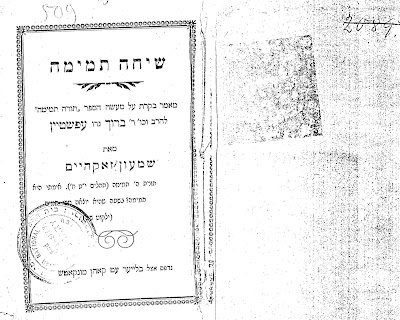
A central feature of his dialogue with Rayna Batya is her producing the book Ma’ayan Ganim by R. Samuel Archivolti. Here it states that mature women who have a desire to study Torah are to be encouraged (Mekor Barukh, p. 1962). Epstein, a young teenager, then attempts to refute her by arguing that the passage from Ma’ayan Ganim is not halakhic, but rather divrei melitzah. The whole dialogue, and in particular the part about her discovering the winning passage in Archivolti, is contrived and designed to lead the reader to sympathize with the fate of the poor woman.

In his Torah Temimah (Deut. ch. 11 n. 68) he cites the passage from Ma’ayan Ganim that as a teenager he supposedly argued against. Anyone reading Torah Temimah would assume that Ma’ayan Ganim is a regular halakhic work, as Epstein refers to it as She’elot u-Teshuvot.[18]

Although at the end of the passage he says that he doesn’t know who the author is, and that Tosafot Yom Tov calls him a grammarian, I believe that this is all part of the literary game he is playing. In other words, he wants to publicize Archivolti’s view, and then to “cover” himself cites Tosafot Yom Tov. In Mekor Barukh, after telling his story, he points out that Archivolti was also a great talmudist and that the only reason the Tosafot Yom Tov refers to him as a medakdek was because he was referring to him in his youth.[19]

Dan Rabinowitz, in his discussion of the issue, writes:

The entire famous Rayna Batya incident must now be called into serious question. Was Rayna Batya so ignorant as to confuse Ma’ayan Gannim with a legitimate book of halakha? How, then, do we reconcile this with her supposed profound learning? It cannot be that R. Epstein was unable to recognize the Ma’ayan Gannim for what it was, for he himself writes that he told his aunt of the true nature of Ma’ayan Gannim. But if he did know what it was, how is it that in his Torah Temima he refers to Ma’ayan Gannim as responsa—and yet in the same paragraph in the Torah Temima he seems to backtrack and wonder how it is that the Ma’ayan Gannim could innovate “new laws about women with reason alone?” The entire Rayna Batya episode is a highly problematic one, raising one perplexing question after another.[20]

As far as the first few questions are concerned, I can only say that the entire report of Rayna Batya discovering the relevant text in Ma’ayan Ganim was made up by Epstein. This book, which was published in Venice in 1553, is an extremely rare volume. There would have only been a few copies of this book in all of Lithuania. (In Torah Temimah Epstein also says that it is a rare book.) It is therefore impossible to imagine that the rebbetzin, sitting in Volozhin, would just so happen to come across this volume on her husband’s bookshelf. Of this, there can be no doubt, and I assumed that Epstein, who was a great bibliophile, later in life came across the book and in his desire to publicize its contents, created the dialogue with Rayna Batya.

Yet thanks to R. Yehoshua Mondshine’s recent article,[21] I see that I was mistaken in my assumption. The truth is that Epstein never even saw the book and thus did not know the true nature of Ma’ayan Ganim. He learnt of the relevant passage, which he places in Rayna Batya’s mouth, from an article that appeared in Ha-Tzefirah, 7 Tishrei, 5656. We see this from the fact that the Ha-Tzefirah quotation mistakenly omits some words, and the same words are omitted in Mekor Barukh. This shows that his knowledge of this book came in 1894 and that he never discussed it with Rayna Batya, who died many years prior to this.

Now that we know where Epstein copied the text from, we can see another element of the literary game he played. He cites Ma’ayan Ganim as follows:
ומאמר חכמינו כל המלמד את בתו תורה כאלו מלמדה תפלות אולי נאמר כשהאב מלמדה בקטנותה.
Yet in Ha-Tzefirah it states:
מאמר רבותינו ז”ל כל המלמד בתו תורה כאלו מלמדה תפלות אינה צריכה לפנים דאיתתא חזינא ותיובתא לא חזינא כי אפשר לחלק שחכמים ז”ל לא דברו אלא כשהאב מלמדה בקטנותה.
Leaving aside the words Epstein omits, he has substituted אולי for אפשר לחלק. In doing so he softened Archivolti’s point. Whereas Archivolti was stating that one can distinguish between teaching a grown woman and a small girl, Epstein has Archivolti prefacing this idea with “perhaps”. I think this is part of Epstein’s confusing game. He wants to bring this view to the public’s attention, but he doesn’t want to come off as too radical. In fact, this אולי, which is his own creation, assumes a life of its own. Thus, in his letter to R. Hayyim Hirschensohn (Malki ba-Kodesh, vol. 6, p. 47), criticizing the latter’s view of teaching women Torah, Epstein writes:

צר לי כי לא אוכל להסכים עמו בזה הן הוא (הרש”ק בעל המכתב הידוע) אינו בטוח בעצמו בדבריו אלה, כנראה מלשונו שכתב “ומאמר חכמינו כל המלמד את בתו תורה וכו’ ‘אולי’ נאמר כשהאב מלמדה בקטנותה” וכו’ ועתה הגע עצמך האם בסברא “פן ואולי” אפשר להתיר מה שנאמר בגמרא מפורש לאיסור. כך דעתי בזה.

In other words, Epstein invents the word אולי and inserts it into Archivolti’s letter, and then he uses this to criticize Hirschensohn! The chutzpah on Epstein’s part is astonishing, but as I see it this is all part of his game.

No one who has discussed Epstein and Rayna Batya was aware of his letter to Hirschensohn, so they could not point out the following obvious fact: When one looks at Mekor Barukh, which was published after his letter to Hirschensohn, one finds him telling Rayna Batya the exact same thing. It is obvious that he uses the language in his letter to Hirschensohn to create the following reply to Rayna Batya, that supposedly occurred some fifty years prior.
והן המחבר בעצמו כמו ‘מודה במקצת’ בזה, באמרו: ‘ומאמר חכמינו’ כל המלמד את בתו תורה כאלו מלמדה תפלות ‘אולי נאמר כשמלמדה בקטנותה’; הרי שבעצמו אינו בטוח בדבריו, וכהוראת הלשון ‘אולי’ ולא ב”אולי” ולא ב”פן” מתירים מה שנאמר מפורש בתלמוד.
(It is possible that I am wrong in assuming that it was his positive view towards women studying Torah which explains why he created the story and cited Ma’ayan Ganim. Perhaps he was simply attempting to create a good story, or even some controversy, and that explains why he seems to be on both sides of the issue, as Dan Rabinowitz points out in the passage cited above.)

Here are the relevant pages in Ma’ayan Ganim, Ha-Tzefirah, Mekor Barukh, and Torah Temimah.
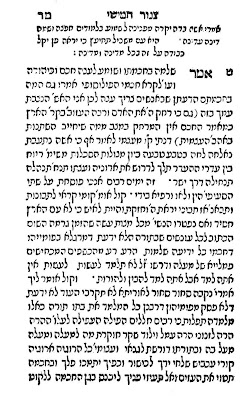
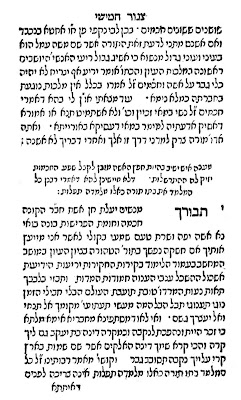
I know that there are people who are very upset at me, believing that I have given ammunition to those who chose to censor and withdraw My Uncle the Netziv. I make no apologies. We must combat falsehoods and plagiarism no matter where they emanate from. If, in the process, some of our own sacred cows are slaughtered, that is the price we must pay.

Returning to Mondshine, he is most concerned with the supposed dialogue between Epstein’s father, R. Yehiel Michel (the author of the Arukh ha-Shulhan), and the Tzemach Tzedek, R. Menachem Mendel Schneersohn. He sees it as an opportunity for Epstein to put all sorts of ideas, including criticisms of Hasidism, into the mouth of the great hasidic leader, something that if he did on his own would have brought down storms of criticism upon him. For example, he has the Tzemach Tzedek say that the hasidim have to be grateful for the opposition of the Vilna Gaon. Had it not been for the great dispute about Hasidism, and the Gaon’s strident opposition, the new movement might have led its followers out of the ranks of halakhic Judaism. (p. 1237). This idea was expressed by R. Kook (Ma’amrei ha-Re’iyah, p. 7) and was probably a common non-hasidic notion. But it is impossible to think that the Tzemach Tzedek would have ever expressed himself this way.

At the time that R. Yehiel Michel is said to have had his conversations with the Tzemach Tzedek, he was the rav of the Habad town Novozypkov.[22] In later years R. Abraham Chen and R. Shlomo Yosef Zevin served as rabbis of the town.[23] I know about this place because my grandmother’s second husband (who was like a grandfather to me) was from there. In fact, during World War One word came to the town that a certain group of Jews was being moved and would be passing through, and that among them was an outstanding young scholar named Shlomo Yosef Zevin. The townspeople came up with the necessary money to remove him from the group. He was chosen as the town’s rabbi and lived in my step-grandfather’s house for about six months. I read somewhere that the townspeople were followers of Kopys/Bobruisk, rather than Lubavitch. As R. Zevin was himself a Bobruisker, this would make sense. R. Yehiel Michel was himself born in Bobruisk, as was his son R. Baruch.

I always tell this story to Habad people in order to impress them with my yichus, that the great R. Zevin lived in my family’s house. Yet on two separate occasions after I told the story to young Habad shluchim, they replied, “Who is Rav Zevin?” It is also very rare to find a young Habadnik who has even heard of Kopust/Bobruisk. Yet without knowing about this it is impossible to understand how R. Zevin could have been a Zionist when the Lubavitcher rebbes were all anti-Zionist. After all, who ever heard of a hasid not following his Rebbe? The answer is that all Lubavitchers were Habad, but not all adherents of Habad were Lubavitch. The ignorance among some in Habad of their own movement probably shouldn’t surprise me, as I have met many hasidim who don’t have a clue about the history of the hasidic movement. And of course, how many Modern Orthodox know the first thing about Hirsch and Hildesheimer?

Mondshine assumes that one of the purposes of Epstein’s stories about his father and the Tzemach Tzedek is to build up his father’s halakhic reputation. His pesakim were subject to attack as being too liberal, and certainly in the hasidic world he was not accepted. In the Lithuanian world he was a much more important posek, and R. Joseph Elijah Henkin stated that in a dispute between the Mishneh Berurah and the Arukh ha-Shulhan, the Arukh ha-Shulhan is to be preferred.[24]

Yet many did not share R. Henkin’s viewpoint. A number of years ago I saw in one of R. Yitzhak Ratsaby’s books that he heard from some gedolim that one should not rely on the Arukh ha-Shulhan. I wrote to him objecting to this lack of respect for the Arukh ha-Shulhan, and also expressing my near certainty that the gedolim he referred to must have been Hungarian, for the Hungarian poskim never accepted the Arukh ha-Shulhan as an authoritative work. On Nov. 22, 1990, Ratsaby wrote to me:
בענין הגאון בעל ערוך השולחן, דוקא הדברים נובעים מליטא, והנני מפרש, הגר”י כהנמן זצ”ל מפוניביז’ (כמדומני שלמד בעצמו יחד עם הערוה”ש) והגר”ח גרינמן שליט”א בן אחותו של החזו”א. זכורני אמנם באגרות משה במקום אחד כתב על ערוה”ש כבר הורה זקן, ובמקום אחר דוחה דבריו. נראה לענ”ד אמנם שבעל ערוה”ש מחדש הרבה סברות ובזה כחו גדול, מאידך בעל משנ”ב מעמיק בעיון היטב הדק. והאמת ניתנה להיאמר שבהרבה מקומות בערוה”ש ראיתי דברים מתמיהים והיפך כוונת הדברים, וכבר הערתי עליו בדרך כלל במקומות שעסקתי בהם בחבורי הנדפסים. ופוק חזי שבישיבות לומדים בקביעות ההלכה מספר משנ”ב, וגם כמעט אין בית היום אשר אין שם משנ”ב. והחזו”א אעפ”י שחולק בהרבה מקומות על המשנ”ב, מ”מ החשיב אותו כהוראה מפי הסנהדרין ומנה אותו בנשימה אחת עם מרן הב”י והמג”א.
(Ratsaby’s recollection is correct. In Iggerot Moshe, Orah Hayyim vol. 1 no. 39, which is his famous responsum on the proper height of a mehitzah, R. Moshe quotes the Arukh ha-Shulhan and uses the expression כבר הורה זקן. Regarding R. Joseph Kahaneman, he actually received semikhah from R. Yehiel Michel.)

The reputation of the Arukh ha-Shulhan has today fallen to such an extent that in a recent publication of the work the rulings of the Mishneh Berurah are included as well. The message of this is that while the Arukh ha-Shulhan is a Torah volume that should be studied, in terms of practical pesak it is the Mishnah Berurah that must be followed. See here for an earlier discussion at the Seforim blog of the recent reprint of the Arukh ha-Shulhan.

2. I was asked if there are any medieval poems in which there is explicit homosexuality. I am unaware of any, and it is precisely because they are ambiguous that there has been controversy about their meanings. This poem by Moses Ibn Ezra is as explicit as I could find
תאות לבבי ומחמד עיני

עופר לצדי וכוס בימיני

רבו מריבי ולא אשמעם

בוא הצבי, ואני אכניעם

וזמן יכלם ומות ירעם

בוא, הצבי, קום והבריאני

מצוף שפתך והשביעני

למה יניאון לבבי, למה

אם בעבור חטא ובגלל אשמה

אשגה ביפיך אד-ני שמה

אל יט לבבך בניב מענני

איש מעקשים, ובוא נסני

נפתה, וקמנו אלי בית אמו

ויט לעול סבלי את שכמו

לילה ויומם אני רק עמו

אפשט בגדיו ויפשיטני

אינק שפתיו וייניקני

כאשר לבבי בעיניו נפקד

גם עול פשעי בידו נשקד

דרש תנואות ואפו פקד

צעק באף, רב לך, עזבני

אל תהדפני ואל תתעני

אל תנף בי, צבי, עד כלה

הפלא רצונך, ידידי, הפלא

ונשק ידידך וחפצו מלא

אם יש בנפשך חיות, חיני

או חפצך להרג, הרגני

Desire of my heart and delight of my eyes –

A fawn beside me and a cup in my hand!

Many admonish me, but I do not heed;

Come, O gazelle, and I will subdue them. Time will destroy them and death shepherd them. Come, O gazelle, rise and feed me With the honey of your lips, and satisfy me.
Why do they hold back my heart, why? If because of sin and guilt, I will be ravished by your beauty – God is there! Pay no attention to the words of my oppressor, A perverse man – come and try me!
He was enticed and we went up to his mother’s house, And he gave his shoulder to my burden. Night and day I was only with him. I undressed him, and he undressed me; I sucked his lips and he sucked mine.
When I left my heart as a pledge in his eyes, The burden of my guilt was also weighted in his hand. He sought enmity, and inflicted his anger, And angrily cried, “Enough; leave me! Do not force me, and do not entice me.”
Do not be angry with me, gazelle, to destruction – Extraordinary is your will, my dear, extraordinary! Kiss your beloved and fulfill his desire. If it is in your soul to give life, revive me – Or if your desire is to kill, kill me![25]

3. When dealing with problematic texts of recent times, the preferred approach is simply to censor them. But with the medievals, there is a simpler method: Say that the text was written by a mistaken student, or even worse, by someone interested in undermining Judaism. In a previous post I mentioned that R. Joseph Zvi Duenner even stated so with regard to the Talmud itself.[26]

Since in modern times we don’t generally have students copying their master’s handwritten texts, the first approach doesn’t make much sense. Yet in a previous post at the Seforim blog,[27] I noted that R. Menasheh Klein used this very argument with regard to R. Moshe Feinstein, even though he was dealing with a responsum published in R. Moshe’s own lifetime. I found another example where Klein uses this exact same approach. He saw something in one of the Steipler’s books, but since it didn’t make sense to him, Klein wrote to the Steipler as follows (Mishneh Halakhot, vol. 7, p. 142a):
היות כי אני מכיר את מעכ”ק וצדקתו נגמר בדעתי שבודאי לא יצאו דברים מפי כ”ק או שיש שם איזה טעות בדפוס מהבחור הזעצער וטעה מעתיק ולא שם על לב כ”ק.
However, here I don’t think Klein should be taken literally. I believe this was just his respectful way of saying that the Steipler was wrong. This is not the case with regard to R. Ovadiah Yosef when he writes that one cannot rely on the responsa in R. Ben Zion Abba Shaul’s Or le-Tziyon, vol. 2.[28] Even though R. Ben Zion was alive, R. Ovadiah claimed that he was powerless to stop his students from taking liberties with the book: הוסיפו וגרעו כפי שעלה בדעתם, וסברו שכן דעת רבם. Not surprisingly, one of R. Ben Zion’s students responded very strongly to this statement.[29]

Prof. Yaakov Spiegel, in his book Amudim be-Toldot ha-Sefer ha-Ivri: Ketivah ve-Ha’atakah, pp. 244ff., discusses the phenomenon of denying the authenticity of responsa. Sometimes the strategy used to reject a responsum is to attribute it to an “erring student.” While on occasion there are scholarly reasons for this assumption, it is almost always the case that the author simply cannot accept that an earlier authority said something. Usually this has to do with halakhah, but there are plenty of examples in theology. For example, R. Issachar Baer Eylenburg assumes that while resurrection is a principle of faith, one is not obligated to believe that this doctrine is found in the Torah. As he puts it (Be’er Sheva to Sanhedrin 90a).
מי שמודה ומאמין על פי הקבלה בתחית המתים אע”פ שהוא אומר דלא רמיזא באורייתא אין ראוי לקראו כופר חלילה ויש לו חלק לעוה”ב.
Although the Mishnah, Sanhedrin 10:1, includes the point that one must believe that resurrection is found in the Torah, Eylenburg assumes that this is a textual error, and indeed, Rambam never mentions this. However, Rashi had this text and explains:
שכופר במדרשים דדרשינן בגמרא לקמן מנין לתחיית המתים מן התורה ואפילו יהא מודה ומאמין שיחיו המתים אלא דלא רמיזא באורייתא כופר הוא הואיל ועוקר שיש תחיית המתים מן התורה מה לנו ולאמונתו וכי מהיכן הוא יודע שכן הוא הלכך כופר גמור הוא.
Eylenberg didn’t like what Rashi said, i.e., it didn’t make sense to him, so he concluded:
לפי דעתי לא יצאו דברים אלו מפה קדוש רש”י אלא איזה תלמיד טועה פירש כן בגליון ונכתב בפנים.
Eylenberg would have been happy to learn what we now know, namely, that the commentary to Perek Helek is, in large measure, not really by Rashi.

I found another example of this in a book that just appeared, R. Menasheh Matloub Sutton’s Mateh Menasheh. (Sutton, who died in 1876, was the rav of Safed.) The second part of the book is a reprint of Sutton’s earlier published Kenesiah le-Shem Shamayim. This work is devoted to a superstitious practice whereby women would burn incense to demons and this was thought to be a help to people who were in various states of distress (e.g., sick, barren, etc.) He includes letters from many great rabbis who agree with him that this is a form of avodah zarah. The problem he has, which he confronts in ch. 2, is that one of the rishonim, R. Isaiah ben Elijah of Trani, is quoted by R. Hayyim Benveniste as follows:
ונראה בעיני המתוק שעושים הנשים מדבש וחלב לרפואה, וכן העישון שמעשנים מותר, שלא חייבה תורה בבעל אוב אע”פ שמקטר לשד אלא מפני שמעלה המת, וכן מעשה כשפים לא נאסרו אלא כשעושים מעשה או כשאוחזים את העיניים כמ”ש, אבל בעישון ומתוק אין בהם כל אלה, וגם אין בהם משום חובר חבר שאינם מתכונים לחבר השדים אלא לרצותם על רפואת החולה ושלא יזיקוהו.
Now it is certainly possible for Sutton to reject R. Isaiah, but it becomes very hard to label the practice as nothing less than idolatry when an outstanding rishon justified it and this rishon is also quoted by Benveniste and the Shiltei Giborim. What to do in such a case? Sutton adopts the tried and true method of declaring that since the position is (in his mind) so objectionable, R. Isaiah could never have said such a thing. It must originate with the “mistaken student” who often makes his appearance when a strange opinion is confronted.
אמינא בקושטא דמלתא כד ניים ושכיב רב אמרה להא שמעתא ועל הרוב שלא יצאו דברים הללו מתחת ידו וקולמוסו אלא שאיזה תלמיד טועה כתבם בגליון קונטריסו והרב שלטי הגבורים אגב ריהטא העתיקם בשמו ובחושבו דתורה דיליה היא מוצאת מעמו ולא פנה לעיין בעיקר הדין נמוקו וטעמו.
Sutton’s book was put out by one of his descendants, Rabbi Harold Sutton, who was a student in the late and much lamented Beit Midrash le-Torah (BMT) together with me. He later went on to become a student of R. Ovadiah Yosef, whose haskamah (together with that of R. Meir Mazuz) adorns the book.

Harold Sutton should not be confused with another young Syrian rabbi, David Sutton. The latter is the author of the ArtScroll book Aleppo: City of Scholars (and from the introduction I learned that he is a son-in-law of R. Nosson Scherman). Zvi Zohar has recently written a very sharp critique of this book. See here.

David Sutton is also the one who delivered the much-talked about lecture “We Believe in Midrashim.” This lecture is the subject of a very harsh attack by Roni Choueka in Hakirah 4 (2007). Choueka sees Sutton’s lecture as a bizayon ha-Torah of the worst sort. When listening to it I didn’t know whether to laugh or to cry. How else is one to respond when one hears a rabbi claim that the fossils are remnants of the giant pets that belonged to Og, who was 800 feet tall and lifted up a stone the size of Manhattan, or that the polar bears came to Egypt complete with their blocks of snow in order to devour the Egyptian children?

Incidentally, in speaking of the Aggadah which describes the great height of Og, the Rashba (commentary to Berakhot 54b) notes that although there is a deep meaning conveyed in this Aggadah, the form in which it is expressed also had a very practical application:
לעתים היו החכמים דורשים ברבים ומאריכים בדברי תועלת והיו העם ישנים, וכדי לעוררם היו אומרים להם דברים זרים לבהלם ושיתעוררו משנתם.
In other words, in order to prevent people from dozing off, the Aggadist would convey his message with outlandish statements. R. Zvi Hirsch Chajes elaborates on this in his Introduction to the Talmud, ch. 26.

4. I have to thank those who have written to me calling my attention to things I did not know. I hope to acknowledge all of you at the proper time. However, many people who send me things have misinterpreted the sources (or the sources they send have been in error).

In the forward of H. Norman Strickman and Arthur M. Silver’s translation of Ibn Ezra to Deuteronomy, p. xiv, the following appears:

It should also be noted that I.E. [Ibn Ezra] was not the only medieval rabbi who believed that there are some glosses or slight changes in the text of the Torah. Thus Rabbi David Kimchi (c. 1160-1235) notes that the word Dan in Gen. 14:14 is post-Mosaic. He argues that the original reading of Gen. 14:14 was “and pursued as far as Leshem.” Rabbi Kimchi maintains that after the tribe of Dan conquered the city of Leshem and changed its name to Dan (Josh. 19:47), the reading of Gen. 14:14 was changed to read “and pursued as far as Dan” as in our texts of Scripture (Radak on Gen. 14:14).

The mention of “Dan” in Gen. 14:14 is used by all critical biblical scholars to prove that the verse must be post-Mosaic. The reason is that since the city would only be conquered in the days of Joshua, and only then be given the name Dan, how could the Torah refer to it this way? Even M. H. Segal, the strong defender of Mosaic authorship, acknowledges the problem. Unlike other scholars he assumes that the verse as a whole is Mosaic. But he also believes that the name “Dan” is a “modernized substitute for the antiquated names Laish or Leshem (Jud. viii, 29, Jos. xix, 47) which stood in the original.”[30]

Yet I was skeptical of what Strickman and Silver wrote as I was aware of Radak’s introduction to his Torah commentary where he is emphatic that the entire Torah is of Mosaic authorship.[31] I looked up Radak to Gen. 14:14 and saw that my skepticism was warranted. Here are Radak’s words:
וירדף עד דן: על שם סופו, כי כשכתב משה רבינו זה לא נקרא עדיין כן, אלא לשם היה נקרא וכשכבשוהו בני דן קראו לו דן בשם דן אביהם.
All Radak says is that the Torah refers to the place as Dan in anticipation of what it will be called in the future. Radak says nothing about the original reading of the Torah being “Leshem” and nothing about the text being changed after Leshem was conquered. As such, Radak cannot be added to the list of those who believe that there are post-Mosaic additions in the Torah.

5. In response to my earlier post at the Seforim blog discussing the meaning of ס”ט, Rabbi Yitzhak Oratz called my attention to Kitvei Ha-Arukh ha-Shulhan, pp. 50-51. In an 1892 letter from R. Yehiel Michel Epstein to R. Hayyim Hezekiah Medini, the author of the Sedei Hemed, we see that R. Yehiel Michel doesn’t know what the acronym stands for, as he writes חכם חיים חזקיאו [!] ס”ט הי”ו. Since the last two acronyms basically mean the same thing one would not put them next to each other, and he must have assumed that the first one meant sefaradi tahor. Yet by 1896 he had learned what it meant and he addresses the Sedei Hemed as מוהר”ר חכם חיים חזקיאו מודיני סופ”י טב טבא הוא וטבא ליהוי.

This is a rare example of an Ashkenazi who knows what the acronym means. For those who have not yet been convinced there is not much more I can say other than that there is a living tradition among the Sephardic scholars for hundreds of years now as to the proper meaning. This is certainly authoritative. Let me also call attention to the end of the introduction of the Peri Hadash on Yoreh Deah (found in the new Machon Yerushalayim edition). He signs his name as follows: חזקיה בן לא”א איש צדיק תמים היה בדורותיו דוד די סילוה נ”ע סופיה טב טבא הוא וטבא להוי אמן.
Also, see R. Yehudah ben Attar’s haskamah to R. Hayyim Ben Attar’s Hefetz Hashem (Amsterdam, 1732). R. Yehudah signs his own name סיל”ט. It is obvious that this is an alteration of ס”ט and means סופיה יהא לטב. 6. Some want to know if any of the letters Chaim Bloch published in Dovev Siftei Yeshenim are authentic. I haven’t carefully investigated every letter, so it is possible that a couple of them are also found in other books. If that is the case, then Bloch included them simply to give the work as a whole a sense of authenticity. There is, however, no doubt that everything that appears for the first time in the work is, in its entirety, a creation of Bloch. Interestingly, when Bloch sent the first volume to the Lubavitcher Rebbe, the Rebbe immediately recognized that the letters from the Rogochover were forged. He wrote to Bloch (Iggerot Kodesh, vol. 19, p. 69):
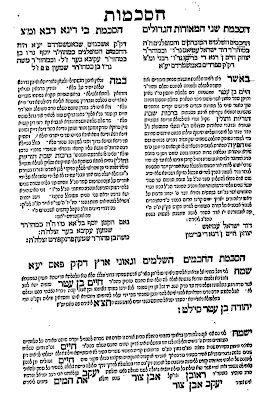
כן מאשר הנני קבלת הס’ “דובב שפתי ישנים”. ולאחרי בקשת סליחתו נצטערתי על שצויין על כמה מכ’ שהם להגאון הרגצובי – וכל הרגיל בסגנונו יראה תיכף שאינו . . .
The three dots are from the publisher, and I would be very interested to know what was taken out.

Bloch wrote to the Rebbe to defend his publication and the Rebbe responded very strongly. He tells Bloch that originally he thought that it was an innocent error or perhaps someone had misled Bloch as to the Rogochover’s letters. It now surprises him that Bloch continues to earnestly defend their authenticity. The Rebbe is so convinced that they are forgeries that he writes (Iggerot Kodesh, vol. 19, p. 159):

שבאם היתה מציאות, שיבוא הרגצובי ויעיד שהוא כתב המכתבים לא יאמינו לו ולא ישמעו לקולו

I assume that the Rebbe didn’t know that Bloch forged the letters himself, or that the rest of the collection was also forged. If he did know this, then I don’t think he would have been so polite to Bloch. He either wouldn’t have engaged in correspondence with him, or he would have told him that he is a liar and a scoundrel. Instead, after explaining why the Rogochover couldn’t have written the letters, the Rebbe concludes:
ואתו הסליחה על ביטוים אלו, שאולי אינם דיפלומטים ביותר.
One certainly doesn’t need to speak “diplomatically” to frauds, so I would assume that the Rebbe wasn’t aware of the extent of Bloch’s deception.

While on the topic of Bloch (who was previously mentioned at the Seforim blog [32]) I should note that his last Hebrew publication was Ve-Hayah Mahanekha Kadosh (New York 1965), which is directed against R. Moshe Feinstein’s permission for a married woman to be artificially inseminated from a non-Jewish donor. Bloch also wrote to R. Moshe about this, harshly rebuking him for this ruling. R. Moshe’s response (Iggerot Moshe, Even ha-Ezer vol. 2 no. 11) includes the following, which became one of the most famous passages in the Iggerot Moshe:
הנה קבלתי מכתבו הארוך מאד המלא דברי תוכחה על כל גדותיו על מה שלפי דעתו נדמה לו שתשובותי סימן י’ וסימן ע”א מספרי אגרות משה על אה”ע יגרמו איזה פרצה בטהרת וקדושת יחוס כלל ישראל. וניכר ממכתב כתר”ה שהיה סבור שיהיה לי קפידא על דברי התוכחה שלו, ואני אדרבה אני נרגש מזה שאני רואה שנמצאים אנשים בעלי רוח שאינם יראים ולא מתביישים מלומר תוכחה. אבל האמת שאין בדברים שכתבתי ושהוריתי שום דבר שיגרום ח”ו איזה חלול בטהרת וקדושת ישראל אלא תורת אמת מדברי רבותינו הראשונים, והערעור של כתר”ה על זה בא מהשקפות שבאים מידיעת דעות חיצוניות שמבלי משים משפיעים אף על גדולים בחכמה להבין מצות השי”ת בתוה”ק לפי אותן הדעות הנכזבות אשר מזה מתהפכים ח”ו האסור למותר והמותר לאסור וכמגלה פנים בתורה שלא כהלכה הוא, שיש בזה קפידא גדולה אף בדברים שהוא להחמיר כידוע מהדברים שהצדוקים מחמירים שעשו כמה תקנות להוציא מלבן. ואני ב”ה שאיני לא מהם ולא מהמונם וכל השקפתי הוא רק מידיעת התורה בלי שום תערובות מידיעות חיצוניות, שמשפטיה אמת בין שהוא להחמיר בין שהוא להקל. ואין הטעמים מהשקפות חיצוניות וסברות בדויות מהלב כלום אף אם להחמיר ולדמיון שהוא ליותר טהרה וקדושה.
7. Since I mentioned some stories from Halakhic Man that show that the Rav did not have a Modern Orthodox ethos, I will also say something about the following story, which some have wondered about.

Once my father entered the synagogue on Rosh Ha-Shanah, late in the afternoon, after the regular prayers were over, and found me reciting Psalms with the congregation. He took away my Psalm book and handed me a copy of the tractate Rosh Ha-Shanah. “If you wish to serve the Creator at this moment, better study the laws pertaining to the Festival.”

I understand that some people are very troubled by this story, as it bespeaks a real intellectual elitism. Yet, to use an expression popular among the younger generation, I can only say “get over it” (or become an adherent of one of the non-intellectual branches of Hasidism). For better or worse, traditional Judaism has always been a fundamentally elitist religion, dividing the haves (i.e., those who have knowledge) from the have-nots. (Although today we are accustomed to think in terms of bringing Torah study to all, in a future post at the Seforim blog I hope to mention some sources that speak of the danger of allowing the ignorant access to Torah knowledge.) Precisely because we have a notion of ein am ha-aretz hasid we can understand why, in contrast to Christianity, we don’t have women “saints” in our history. Since women have (until recent times) been kept ignorant of Talmud and halakhah, there was no way they could achieve any renown in the area of saintliness.

Regarding the passage from Halakhic Man quoted above, the Rav himself makes reference to R. Chaim of Volozhin’s Nefesh ha-Hayyim, and the ideology of that book is the basis for the Soloveitchik approach. In Nefesh ha-Hayyim 4:2 R. Chaim writes
הרי שהעסק בהלכות הש”ס בעיון ויגיעה הוא ענין יותר נעלה ואהוב לפניו יתברך מאמירת תהלים.
Yet I must also note that one needn’t be a Litvak to have this approach. Here is what R. Eliezer Papo writes (Pele Yoetz, s. v. yediah):
וכבר כתבו הפוסקים שמי שיוכל לפלפל בחכמה ולקנות ידיעה חדשה ומוציא הזמן בלימוד תהלים וזוהר וכדומה לגבי דידיה חשיב בטול תורה.
8. Many people have written to me about Ibn Ezra and post-Mosaic verses, a subject I dealt with in The Limits of Orthodox Theology. Let me therefore point out something in this regard that appears in One People, Two Worlds by Yosef Reinman and Ammiel Hirsch. As I am sure everyone recalls, this was the joint work by the Orthodox Reinman and the Reform Hirsch. What made this so significant is that Reinman is from Lakewood and never before had anyone from that community engaged in such a religious dialogue. The response was fast and furious, and here are the first three pages and the last page of an anonymous attack on him that appeared in Lakewood. In fact, One People, Two Worlds is much worse – or much better, depending on your outlook – than anything done in this area by the Modern Orthodox. The Modern Orthodox who were part of organizations like the Synagogue Council of America and the N.Y. Board of Rabbis never engaged in interdenominational theological dialogue on an equal footing the way Reinman does. Furthermore, it is shocking that a haredi would have co-authored this book for another reason: What will happen if someone reads the book and is more convinced by the Reform rabbi? One would think that this would make the book a possible stumbling block.
I have not read the book cover-to-cover, yet the word on the street is that the debate is pretty one-sided as the Reform rabbi is out of his league. But in glancing through the book I found that in one area it is actually the Reform rabbi who is correct. On p. 16 Hirsch refers to Ibn Ezra’s commentary to Gen. 12:6 and states that Ibn Ezra’s “secret” is a hint to his belief that the verse is post-Mosaic. On pp. 23-24 Reinman writes:

I do not understand how you can represent Ibn Ezra, the illustrious Orthodox commentator, as a closet Reformer. I personally have no idea of the nature of Ibn Ezra’s secret; he has successfully concealed it from me. But be that as it may, how can you ascribe non-Orthodox beliefs to Ibn Ezra? What about all the thousands of pages of solid Orthodox commentary he wrote? Don’t they stand for anything? You obviously need to connect to the time-hallowed texts, but you are grasping at the wind.

They go over this issue a couple of more times and Reinman’s responses are similarly dogmatic. Had Hirsch read my article on the Thirteen Principles (my book hadn’t yet appeared) he could have pointed out that plenty of “Orthodox” commentators and scholars have read Ibn Ezra exactly as Hirsch explained. In other words, it was incorrect for Reinman to respond as if Hirsch was asserting an outrageous canard against an “illustrious Orthodox commentator.”

When I saw this I asked a friend, who studied in Lakewood for many years, if is it possible that Reinman, who has been learning Torah for many decades, is completely ignorant about something that every YU student who takes Intro. to Bible learns in the first few weeks. His reply was that this is exactly the case, and that until he started reading works outside of the typical yeshiva curriculum he too never heard about an issue with Ibn Ezra and post-Mosaic additions. In fact, I would assume that R. Moshe Feinstein also never heard of it, and in his attack on the commentary of R. Yehudah he-Hasid he ironically cites Ibn Ezra condemnation of Yitzchaki’s biblical criticism. (Why Ibn Ezra would condemn Yitzchaki for suggesting that some verses are post-Mosaic, when he does that himself, is explained by R. Joseph Bonfils in his Tzafnat Paneah: Ibn Ezra was willing to accept individual verses as being post-Mosaic but not entire sections, which is what Yitzchaki is referring to. Thus, there is no Documentary Hypothesis in Ibn Ezra’s writings.)

This phenomenon, of great scholars not being aware of things that most people reading the Seforim blog learned years ago, should not surprise us. The traditional yeshiva curriculum is very narrow, and you can spend your life in a yeshiva and unless motivated to expand your horizons, will have no knowledge of entire areas of Jewish thought and history. A good example[33] is seen in this announcement by Agudas ha-Rabbonim, which appeared in Ha-Pardes, November 1975. Yet the beautiful saying which the learned rabbis assume was stated by Hazal was actually stated by Ahad ha-Am, and is perhaps his most famous saying (although the concept can be found in traditional sources, see Taz, Orah Hayyim 267:1)[34] However, for one whose only Jewish knowledge comes from the yeshiva, this information would be unknown, and it is easy to see how such a statement (“more than the Jews have kept the Sabbath the Sabbath has kept the Jews”) could “infiltrate” this closed world and become just another ma’amar hazal.[35] It reminds me of how when I was a kid and my friends and I went to Boro Park for Shabbatons we would have been able to hum niggunim which came from popular songs and commercials, and our hosts wouldn’t have known a thing. At the Rutgers Chabad house in the 1980’s they even had a niggun to the tune of the theme song for Bumble Bee tuna. For those too young to remember it, see it here.
Of course, Ahad ha-Am’s statement is sound Jewish doctrine, as should be expected from one who had a hasidic upbringing (he was born in Skvira). I don’t even think that the saying was original to him. Rather, he was repeating a hasidic idea that he heard in his youth. I say this because Rabbi Uri Topolosky – who is currently rebuilding Orthodox life in New Orleans[36] – called my attention to the following passage in the Sefat Emet to parashat Ki Tisa (from 1873; p. 198 in the standard edition):
ואך את שבתותי כו’ פי’ שלא להיות רצון ותשוקה לדבר אחר בעולם, רק להשי”ת שהוא שורש חיות האדם שתתדבק בו בשבת קודש . . . גם מה שמירה שייך לשבת אדרבה שבת שומר אותנו.
NOTES:
[15] “The Silence of Rayna Batya: Torah, Suffering, and Rabbi Barukh Epstein’s ‘Wisdom of Women.'” Torah u-Madda Journal 6 (1996): 127, n. 62.
[16] Torah u-Madda Journal 7 (1997): 197. Since I mention the fine scholar Don Seeman, let me also call attention to his article “Ethnographers, Rabbis, and Jewish Epistemology: The Case of the Ethiopian Jews,” Tradition 25 (1991): 13-29. In this article he deals with the issue I touched on in two earlier posts, namely, does “halakhic truth” need to correspond to what academics regard as “scholarly truth.”
[17] I thank Eliezer Brodt for calling it to my attention (it is not mentioned in Beit Eked Sefarim). Subsequently, I saw that it is mentioned by Yaakov Bazak, “Al Derekh Ketivat ‘Torah Temimah,’” Sinai 66 (1969): 97.
[18] Thus, R. Moshe Meiselman could write: “In the volume of responsa, Maayan Ganim, the author not only permits motivated women to study the Torah but praises them and urges his audience to encourage them in their work.” See Jewish Woman in Jewsh Law (New York, 1978), 38.
[19] R. Menahem Kirschbaum, Tziyun li-Menahem (New York, 1968), 263, points out that contrary to what Epstein states, Tosafot Tom Tov referred to him as a grammarian when Archivolti was quite old.
[20] Rayna Batya and other Learned Women: A Reevaluation of Rabbi Barukh Halevi Epstein’s Sources,” Tradition 35 (2001): 61.
[21] See here
[22] See Kitvei ha-Arukh ha-Shulhan, part 2, p. 142, where he addresses someone as נכד איש אלקים גדול בעל התניא זי”ע ועל כל ישראל אמן. [23] See ibid., p. 154, for R Yehiel Michel’s 1906 letter of recommendation for R. Zevin. [24] See R. Yehudah Herzl Henkin, Beni Vanim, vol. 2, no. 8. In the introduction to Kitvei ha-Arukh ha-Shulhan one finds the following:
על מעמדו של הערוך השולחן כרבן של ישראל ופוסק הדור [שיש הסוברים שהוא הראשון במעלה ואחרון בזמן והלכה כמותו בכל מקום. עי’ בני בנים] אין כאן המקום להרחיב. What kind of reference is this? Most readers won’t even know what Bnei Vanim is. Why is the author, the volume, and page number not given? Why is R. Joseph Elijah Henkin’s name not mentioned? Furthermore, R. Henkin never said that the halakhah is always in accord with the Arukh ha-Shulhan. (Let’s not forget, the Arukh ha-Shulhan thought you could use electricity on Yom Tov.). His comment dealt only with the Arukh ha-Shulhan vs. the Mishneh Berurah.

For Eliezer Brodt’s review of this work, see here.

I have only skimmed part 2 of this important volume, but since it will probably be reprinted, let me make a few corrections and one addition.The transcription of R. Yehiel Michel’s handwriting on the first page is incorrect.

P. 79 s. v. והנה: The word הארוך should be האריך.

P. 146 s.v. גי”ק. The sentence reads: ורבות נצטערתי והמו מעי לו שירדפו גאון מובהק כמו”ב.

The abbreviation should be כמי”ב – כמותו ירבו בישראל. See p. 152, top line.

P. 173 no. 137: R. Aryeh Jacob Katznelson was the son-in-law of R. Yehiel Michel’s brother-in-law.

P. 193 n. 17: The quotation does not appear in no. 39.

According to Glick, Kuntres ha-Teshuvot he-Hadash, vol. 1 (Jerusalem and Ramat Gan, 2007), 582 (no. 2186), material from R. Yehiel Michel appears in R. Moses Spivak, Mateh Moshe (Warsaw, 1935).
[25] Hayyim Schirmann, Ha-Shirah ha-Ivrit bi-Sefarad u-ve-Provence (Jerusalem, 1954), vol. 1, no. 143; translation in Norman Roth, “‘Deal Gently with the Young Man’: Love of Boys in Medieval Hebrew Poetry of Spain,” Speculum 57:1 (1982): 45.
[26] See here.
[27] see my “Obituary: Professor Mordechai Breuer zt”l,” the Seforim blog (Monday, 11 June 2007), available here.
[28] See Yabia Omer, vol. 9, Orah Hayyim no. 108 (p. 269).
[29] See Shmuel Glick, Kuntres ha-Teshuvot he-Hadash, vol. 1 (Jerusalem and Ramat Gan, 2006), 57.
[30] The Pentateuch: Its Composition and Its Authorship (Jerusalem, 1967), 33.

[31] ואומר בתחלה כי משה רבינו כתב כל התורה כלה מפי הגבורה, מ”בראשית” עד “לעיני כל ישראל” . . . וכן צריך להאמין, כי הכל נאמר ברוח הקודש ומפי הנבואה למשה רבינו עליו השלום

[32] See here.
[33] See Avraham Korman, Ha-Tahor ve-ha-Mutar (Tel Aviv, 2000), 99.
[34] See Al Parashat ha-Derakhim, ch. 51, available here. The actual quote is

יותר משישראל שמרו את השבת שמרה השבת אותם.

[35] R. Herzog was well aware of whose saying he was adapting when, in an article on Taharat ha-Mishpahah published in Ha-Pardes (September 1947, p. 15), he wrote:

לצערנו העמוק והמחריד נפרצו בימינו פרצות גדולות, ואף בארץ הקודש, בחומה זו של טהרת המשפחה, שאפשר להגיד עליה, שיותר ממה ששמרו ישראל עליה שמרה היא על ישראל

[36] See here.


The Pitfalls of Disagreeing with the Gra

Sunday, the second day of Hol HaMo’ad, was the 210th yahrzeit of the Gra. The Gra, a towering figure in modern Judaism, was not immune from criticism. His views, like any other’s were subject to scrutiny. And, at times, there were those who disagreed with the Gra’s conclusions. While this criticism should come as no surprise (and especially so in light of the Gra’s dim view of deference to prior authorities), some felt the Gra should be immune from any criticism. Thus, we find the Gra’s dissenters taken to task for merely arguing with the Gra’s position.
Additionally, this post will be the beginning of a series of posts devoted to reviewing and highlighting one of the most important books in the history of the Jewish book to be published in recent memory. Dr. Yaakov Shmuel Spiegel (who has a terrific Hebrew Wikipedia entry here)has published two volumes of Amudim b’Tolodot Sefer HaIvri. Both volumes are tremendously rich in material and appear to have gone virtually unnoticed. (Unfortunately, Spiegel soon after the publication of the first volume came out with a revised edition. All citations are to the first edition of the first volume.)
As mentioned above, the first part of this post, is the first in a series discussing Spiegel’s book. The second part, although related to Spiegel is not discussed by Spiegel, and instead, is from another important bibliography work, Ohel Rochel.
There is but one review in HaMayaan [and in the latest AJS review of Spiegel’s second volume]. In fact, although those who have read it have recognized its import it has not stopped some from hiding their use of the book. Thus, a couple of weeks ago the Hiddushei HaBach were published on portions of the Talmud. Spiegel has an amazing discussion about the Hagot haBach. Spiegel discusses the history, what the Bach was doing, which edition of the Talmud he had. Perhaps most importantly, Spiegel discusses the errors that have crept into the Bach – mainly because the editors of the Vilna Shas removed the introduction to the work. The introduction explains certain devices that were employed to make clear which words the Bach was removing. Both the device (quotation marks) as well as the explanatory notes no longer appear, thus Spiegel provides numerous examples of people who based their Torah on an incorrect understanding of what the Bach was doing.

Returning to the new Hidushei HaBach, in the introduction they discuss the Bach’s other works. Of course, they discuss the Hagot HaBach and they rely heavily (read almost in entirety) on Spiegel. But, the only times they cite (p. 19 n. 1; p.43 n. 55; p. 46 n.65, n. 67) to Spiegel they use the following abbreviation עמודים בתולדות ה”ה. They do not provide what that means, and only a reader who was already aware of Spiegel’s book would have any idea. This is deliberate as although they are willing to use his book they are unwilling to let others know that.

In this post, however, I will not focus on the Bach, rather as mentioned above, we are going to discuss the Gra, and the first example focuses on the Hagot HaGra. This portion of the post mainly comes from Spiegel (Amudim: Haghot u’Maghim pp. 422-426, 461).

R. Gershon Henoch Leiner, the Radzyner Rebbi, published Sidrei Tahros. Sidrei Tahros is an attempt to fill a gap in the talmud. There are some mesechtot that do not have any talmudic commentary. While some, Zeraim for instance, have at least Yerushalmi, the mesechtot of Tahoros do not. Thus, R. Leiner culled the corpus of Rabbinic literature, Talmud, Midrash, Zohar, etc. and collected the relevant statements to create a “talmud” (it is even labeled as such – the legend on the page reads Gemara) on the two mesechtot of Ohelot and Kelim. Additionally, he wrote his own commentary on these volumes. The volume on Kelim was published in 1873 and included a map that can be seen here. The volume on Ohelot was published in 1903. After that both books were not republished until 1960 in a photomechanical reproduction.

Soon after it came out, people took issue with the entire concept – the concept of “creating” a gemara. Those who came out against him, did so in the newspaper Halevonon (available here – see the 1875 nos. 34, kovod levonon (machberes sheni year 11) 6 tamuz edition and see Ir Vilna vol. 1 p. 60 n. 7 for some choice quotes). Someone responded in Hamaggid (also available online see 17 Av, 1875). Much of this criticism was more focused on the concept of the Sidrei Taharos, (creating a “new” gemara) for our purposes, however, we are going to focus on one point, R. Leiner’s disagreements with the Gra.

In his commentary, R. Leiner takes issue with some of the Gra’s textual emendations. For instance R. Leiner states:
ודע דדברי הגר”א ז”ל בזה בספרו . . . לא איתברר לן ולא זכינו לעמוד בסוד דבריו ז”ל . . . דרכו בקודש נסתרה ונעלמה מאתנו

This is but one of the times R. Leiner disagrees with the Gra. At one time, R. Leiner is willing to attribute his disagreement not to the Gra, but instead, R. Leiner claims that perhaps the difficult statements in the Gra were not made by the Gra. Instead, a student misunderstood and thus it is now necessary to figure out what in fact the Gra said. Setting aside this justification (which, when it comes to the Gra’s notes on the Talmud is difficult to believe in light of the fact much comes from the Gra’s hand itself), R. Leiner still disagreed with the Gra for whatever reason it may be.

R. Yosef Refael and R. Betzalael HaKohen, Dayanim in the Vilna Bet Din were against the whole notion of the Sidrei Tahros. But, they also singled out R. Leiner’s disagreements with the Gra. Specifically, they say

ובהשגות המחבר [ר’ גרשון] על רבינו מאור הגולה הגר”א ז”ל כתב הרבה נגד כבוד הגר”א ז”ל בכמה מקומות ומדקדק עליו בדקדודי עניות לבד אשר אין מהצרוך להשיב עליהם כלל, וגם במהלליו את רבינו הגר”א ז”ל התנכר כנגדו כובד וכאילו היה חלילה אחד מחבריו . . . ובכמה מקומות תלה דברים זרים בפירוש הגר”א ז”ל, אשר לא יטעה כל המתחיל ללמוד לפרש כזאת

Another example is that of R. Barukh Brody in his book Bet Ya’akov where he states:

ועל של עתה באתי כי זה לא כביר נדפס ילקוט על מס’ כלים . . . והנה בעברי על פני דבריו באיזה מקומן ראיתי כי יצא בילקוטו באבני נגף נוכח תורת הגר”א ופגע ונגע בכ”מ [= בכמה מקומות] בכבוד רבינו הגר”א ומשיג על דבריו בעזות וחוצפה מאד, ושמתי עיוני על השגותיו ומצאתי ראיתי כי מלבד שאין קטן ערך כמוהו ראוי להתוכח עם ארי ארי[ה] דבי עילאה הגר”א ז”ל, בר מכל דין לא הבין ולא רצה להבין דברי הגר”א הקדושים רק שנאה וחוצפה מדברת מתוך גרונו . . . חכמתו המעט נסתקלה ממנו ולא הבין אפילו פשט הפשוט שבדברי הגר”א ז”ל

R. Brody thus accuses R. Leiner of brazeness, chutzpah, and that R. Leiner “is unable to understand even the simplest explanations.” Harsh words indeed all for disagreeing with the Gra.

The second example deals with a recently discussed book. In our discussion of Teffilah Zakah, we noted that various editions of the Hayye Adam were altered. In this case, we are going to deal with R. Danzig’s other well-known work the Hokhmat Adam. In the prior discussion the removal was due to the inclusion of a controversial book, in this case it was R. Danzig’s own words. [1]

The Hokhmat Adam was published after the Hayye Adam. In the Hayye Adam at various times, he take issue with the opinions of the Gra. R. Danzig was no stranger to the Gra, R. Danzig’s son married the grand-daughter (Gittel Vilner) of the Gra. It appears that R. Danzig’s disagreements with the Gra did not go unnoticed or unopposed.

In the first edition of the Hokhmat Adam, R. Danzig addresses criticisms. R. Danzig notes, inter alia, that the Gra himself would be more than happy to have people disagree with him. It appears, however, that only one copy remains of R. Danzig’s original words. This copy was discovered by Chaim Lieberman, one of the great bibliographers of the past generation, in what was R. Shmuel Straushun’s former library (a portion of the library is now housed in YIVO). The page, in relevant part, reads as follows:

והנה לא נמצא בחיבור זה מדברי מחותני הגאון רשכבה”ג מו’ אלי’ החסיד, והוא לסיבת כי שמעתי דבת רבים המתרעמים עלי שהשגתי עליו באיזה מקומות בחיבורי [חיי אדם] ובלתי ס[פק] שהאנשים המתרעמים לא ידעו דרך הפוסקים שכך דרך תה”ק זה בונה וזה סותר והתלמיד חולק על הרב כמש”כ בש”ע [יו”ד ס’ רמ”ב סע’ ג] ודרך זה היה נוהג אף בזמן תנאים ואמורים, ובודאי ניחא להגר”א מה שאני מפלפל בדבריו ממי שהוא אומר שפיר קאמר כדאר”י [=כדאמר רבי יוחנן] על בר לקישא. ולכתוב דבריו אף אם לא יהיה נ”ל זה לא אוכל, ולכן אחזתי במדת השתיקה להסיר תלונתם מעלי והם עתידים ליתן את הדין כי מנעו נ”ר [=נחת רוח] להגר”א לפלפל בדבריו, ודין אותי לכף זכות ידונו אותו משמים לזכות

This is not the text that appears in Hokhmat Adam, rather a slightly different text appears. These changes, however, as been demonstrated by Ch. Lieberman are significant. The following is how it appears (prior to the Binat Adam section):

והנה דברי מחותני גאון ישראל וקדושו אשר מימיו אנו שותים המקובל אלקי החסיד המפורסם מהו’ אלי’ חסיד דקהילתינו לא הבאתי כלל דבריו כמעט רק איזה גרגרים והוא לסיבה כי שמעתי דיבת רבים המתרעמים עלי על שבאיזה מקומות בחיברי חיי אדם השגתי עליו, ובלתי ספק שאנשים האלה אינם בקיאי’ בלימוד הפוסקי’ שכן דרך תה”ק זה בונה וזה סותר והתלמוד חולק על הרב והטור על אביו הרא”ש כמש”כ בש”ע ובפוסקי’, וזה ניחא להון כדאמר ר’ יוחנן על ר”ל דמיני ומיני’ רווח שמעתתא, ובודאי זהו נחת רוח להגואן יותר ממי שיאמר שפיר קאמר ועתידין ליתן את הדין על שמונעים נחת רוח מהגואן, והדן לכף זכות ידונו משמים לזכות

Lieberman points to four major changes. First, the honorifics surrounding the first mention of the Gra. Second, in the first iteration, R. Danzig decided to totally avoid any mention of the Gra while in the second iteration he cites “some small statements” of the Gra. Third, in the later iteration the statement of R. Yochonon is filled in. That is it provides the text. Lieberman allows that perhaps this was done to avoid “confusion” with another statement of R. Yochonon. R. Yohonon (Ketubot 84,b) says about Resh Lakish “what can I do my peer disagrees with me.” Rashi explains that “peer” means equal. Thus, perhaps the reader would think that R. Danzig was comparing himself with the Gra. Instead, the reader is now directed to the statement of R. Yohonon (Pesachim 88,a; Megilah 14,b) generally discussing Resh Lakish providing numerous answers to questions. Finally, in the later iteration the language “it is impossible for me to write what I don’t actually believe” is missing in it entirety. (For Lieberman’s article see Ohel Rochel, vol. 1, 473-74 [first printed in Kiryat Sefer, 37 (1962) pp. 413-14]).

Note:
[1] For examples of R. Danzig’s disagreements and some responses see Eliach, HaGoan, vol. 2 pp. 706-09.


A Behind the Scenes Look at the Banning of HaGaon

It appears that at least one controversial book can not escape being criticized even after a significant passage of time. In this case, R. Dov Eliach’s book the R. Elijah, Gaon of Vilna, published five years ago and, at the time, subject to some harsh criticism, is the subject of a new magazine – אמת מול שקר (Truth Against Lies) published by “the Institute for Truth and Faith.” That is, the entire purpose of this magazine is to disproving and exposing alleged misstatements in R. Eliach’s book.
The first issue — see below for two excerpted pages — contains, inter alia, the text of the various bans on the book. The editors also claim – according to the ban they reproduce – that R. Chaim Kanievsky issued a ban on the book. On the other side of this particular claim is an article which appeared in Dei’ah veDibur which states that the book was done with R. Kanievsky’s approval. For an earlier discussion (circa August 2006) at the Seforim blog of the BaDaTz herem against R. Dov Eliach’s HaGaon, see here; and for pictures of burning copies of HaGaon, see here. Aside from the various bans and the like, the magazine also contains examples where they attempt to show R. Eliach distorted sources or took out of context.

Additionally, I am unsure if the book is even available anymore, from my admittedly unscientific survey of Seforim stores, the book appears to be out-of-print.


R. Avraham ben haGra: A Victim of Plagiarism?

R. Avraham ben haGra: A Victim of Plagiarism?

In several previous posts at the Seforim blog, I have discussed instances of plagiarism and, in this post, I would like to mention one of the more famous instances of plagiarism within Jewish literature. To be clear, the issues of plagiarism under discussion lack any ambiguity, these discussed are limited to when the entire book is republished with the only difference being the authors name at the beginning.

One of the smaller and lesser known Midrashim is one titled Midrash Aggadat Bereishit. This Midrash was originally published in a collection of other small works by R. Menachem de Lonzano titled Shetei Yadot (Venice, 1618).[1]

This Midrash languished in obscurity until 1802, until it was brought to light by R. Avraham, the son of R. Elijah, the Gaon of Vilna.[2] R. Avraham had an intense interest in Midrashic literature and published a bibliography on the topic, entitling the work Rav Pealim.[3] R. Avraham decided to reprint this Midrash in its own edition, although he included other small Midrashim at the end, the focus is on the Aggadat Bereishit. R. Avraham includes an extensive introduction – the subject of a minor critique by R. Matityahu Strashun of Vilna[4] — where R. Avraham also quotes from his father, R. Elijah, the Gaon of Vilna.

It appears that R. Avraham did too good of a job. Not two years later, in 1804, R. Yaakov b. Naftali Hertz published Midrash Aggadat Bereishit. Now, obviously, the Midrash itself was not copyrighted and both note that they are merely republishing what originally appeared in Lonzano’s work, but Hertz’s work did not only republish the text of this obscure Midrash, as was common within Vilna rabbinic circles at that time,[5] but Hertz also included with small exception (discussed below) the entirety of R. Avraham’s introduction.

There are, to be sure, several additional problems with Hertz’s 1804 reprint. On the most basic of levels, the title page is the same as that of R. Avraham’s 1802 edition [reprinted below], including the sentence which implies that this is but the second printing and that it hasn’t been republished since Lonzano. The title page (in both edition) reads:

נדפס פעם ראשון בעיר ויניציא שנת שע”ח וברוב הימים נתמעטו זו אבידה שאין לה שיעור וחליפין לכן קוי ה’ יחליפו כח בהתחדש העטרה ליושנה ונדפס עוד הפעם

This book was first printed in Venice in 1618 and over time this has been lost, a loss which is difficult to quantify, therefore with the help of God who gives strength to the weak, I have renewed this old crown [to its glory] and reprinted it once more.

Obviously, this assertion would be applicable to the first publication after close to two hundred years, not to a volume republishing something which had been published just two years prior.

The second issue of plagiarism, however, is a much bigger one. As mentioned above, R. Avraham didn’t just republish the text of Aggadat Bereishit itself; instead, he included an introduction quoting his father, R. Elijah, the Gaon of Vilna. In Hertz’s edition the same introduction similarly appears, but with several differences. Instead of ending with R. Avraham’s signature, as it does in the 1802 edition, Hertz’s is unsigned although the introduction is the same. Additionally, R. Avraham, as mentioned above, quotes from his father noting “ושמעתי ממר אבא הגאון,” (I have heard from my father the Gaon); as Hertz’s father wasn’t the Gaon, he needed to change this or otherwise reveal his plagiarism and thus his only says “ושמעתי” (“I have heard”).[6]

Finally, there is one additional distinction that is most indicative of the two personalities. R. Avraham finishes his introduction by minimizing his contribution he states

כי לא עשיתי פה מאומה רק קבצתי ברייתות איידי דזוטרא מרכסי’ וחברתי לאחד בכרך הזאת

I did not do all that much, rather all I did was gather the small berisot and placed them together in this book.

In Hertz’s edition, however, he decided to edit this sentence – this sentence which implies humbleness – out. Perhaps one can suggest that as Hertz’s intention in plagiarizing from R. Avraham was to make it appear he had done something worthwhile, including such a statement would undermine his plan.

To conclude, although one may assume that a plagiarizer would typically steal from someone lesser known to minimize his chances of being found out. This instance demonstrates that no one, even the son of the Vilna Gaon, is immune from this type of behavior.

Sources:
[1] On R. Menachem de Lonzano, see the bibliography collected in David Loewinger, “Lonzano, Menahem ben Judah de,” Encyclopaedia Judaica 13 (2007): 187-188; On his recovery of obscure Midrashic texts, see Isidore Epstein, “Books and Bookmen: A Lost Midrash,” London Jewish Chronicle (March 9, 1934), 24.
[2] On R. Avraham, the son of R. Elijah, the Gaon of Vilna, see R. S.Y. Finn, Kiryah Neemanah (Vilna, 1905), 210-221; and, more recently, see R Shlomo Gottesman, “Kuntres Chomat Avraham,” Yeshurun 4 (1998): 123-154.
[3] Published posthumously in Warsaw, 1894.
[4] See R. Matityahu Strashun, Mivchar Ketavim (Mossad ha-Rav Kook, 1969), 229-230. On the famed Strashun family of Vilna, see here and, earlier, Zvi Harkavy, “Rabbi Matityahu Strashun,” Areshet: An Annual of Hebrew Booklore 3 (1961): 426; and Rabbi Shmuel Strashun mi-Vilna (Jerusalem, 1957).
[5] For an excellent and significant survey of nineteenth century rabbinic scholars who researched and published the Midrashic literature, see Gil S. Perl, “Emek ha-Neziv: A Window into the Intellectual Universe of Rabbi Naftali Zvi Yehudah Berlin,” (PhD dissertation, Harvard University, 2006), 145-146.
[6] As is too often the case, the individuals who republish works are unaware of the bibliographic history, this case is no exception. In the Warsaw 1866 reprint and photomechanical reproduction (Jerusalem, 2000[!]) with numerous commentaries on this Midrash, the editors reprinted Hertz’s 1804 introduction with just the שמעתי with the proper attribution that in fact this comment is from the Vilna Gaon. For a listing of the various editions of this Midrash and commentaries composed on it, see R. Menachem Mendel Kasher, Sari ha-Elef (Jerusalem, 1984), 22-23.

Appendix:

Title page 1802 edition (of R. Avraham)

Title page 1804 edition (R. Yaakov b. Naftali Hertz)

Introduction, 1802 edition (of R. Avraham)

Introduction, 1804 edition (of R. Yaakov b. Naftali Hertz)


Eliezer Brodt: A Censored Work by a Student of R. Hayyim of Volozhin: The Case of Menuchah u-Kedushah

A Censored Work by a Student of R. Hayyim of Volozhin:
The Case of Menuchah u-Kedushah
By Eliezer Brodt

A few years ago (c2000) a fascinating sefer was reprinted called Menuchah u-Kedushah. The sefer was written by R. Yisrael Isserl from Ponevezh. Not much is known about the author except that he was a talmid of R. Hayyim of Volozhin. It’s clear from the sefer that he was a very special person and a big talmid hakham. The haskamot that he received from the R. Naftali Zevi Yehudah Berlin (Neziv), R. Bezalel HaKohen and R. Avraham Eisenstadt, author of the Pitchei Teshuva, show that he was a very prominent, well-known person (for some reason these haskamot were omitted in the reprinted edition). R. Shlomo Elyashiv, the author of the Leshem, also writes that he was an Ish Kadosh, a Holy Man. It appears that he was a melamed [teacher], and (as we will see) it seems that he must have been an excellent one. In the recent reprint, R. Shmuel Auerbach writes that the sefer was famous in particular as a guide in raising children and many followed it and became true Ovdei Hashem. Interestingly, the sefer was originally published anonymously (Vilna, 1864).

In this post I would like to discuss this sefer a bit. The author in his introduction (which, oddly enough, was omitted in the newest reprinted version of the sefer) outlines very clearly what he had wanted to accomplish with this work. Divided into three parts, the first is called Sha’ar HaTefillah, an explaining as to what one should do in order for his tefillot to be accepted. Included are many explanations on different parts of Tefillah. The second part is called Sha’ar HaTorah, which is the way the author feels one should teach children. The third part is called Sha’ar Yichud HaMa’aseh which includes advice how to battle the Yetzer Hara in all different situations.

The sefer reviews many interesting things especially vignettes from R. Elijah Gaon of Vilna (the Gra) and R. Hayyim of Volozhin. Also, included are many beautiful explanations on different areas of Tanakh and Aggadah. Aside from the explanations, this the sefer also includes many halakhot and minhagim. The sefer begins with a nice collection of halakhot of kavod seforim including that the prohibition to use one sefer under another one to bring it closer to you, or leaning completely on seforim like a shtender. To list a few examples of Ta’amei Minhagim brought throughout the sefer: the reason behind the mitzvah to eat on Erev Yom Kippur (pg 51) and giving tzedakah (pg 204). He is very against talking at all during davening; even talking in learning between aliyot (pg 75). The author also wrote a lengthy discussion regarding the proper time to light the Chanukah menorah; opining to light after ma’ariv. The author states that the only reason why R. Elijah Gaon of Vilna lit earlier was because of concern that if he would have waited until after ma’ariv he would have this on his mind the throughout davening, similar to a groom who is exempt from kriat shema (pg 160) due to his preoccupation. When he discusses sitting shiva on ones parents he exclaims ‘do not just sit there making the same mistake most do’; namely, they claim that since it is prohibited for a mourner to learn Torah, they leave a Sefer Iyyov on the stool nearby just to glance at from time to time and fall asleep. Rather, one is supposed to learn the topics that a mourner is allowed to so that one could give one’s parent many merits; there is enough material to learn for three weeks (pp. 88-89)! He writes to his son any shiur that he goes to after he dies he should always say the kaddish de’rabbanan for him; not only the first year (pg 95-96).

Many interesting discussions on various topics, such as the Neshama Yetairah that one gets on shabbat (pp. 49-50) are found throughout the sefer. He also has a lengthy discussion on the now-famous topic (in light of all the biographies on the gedolim) that no great person achieved anything great in life without working very hard for it. The talmudic use of the term “Noch Nafshei” a term of resting, was not hapenstance. Instead, it was used to demonstrate that, in many instance, those persons did not have easy lives, and thus only after death is it approriate to use a term of rest – hence Noch Nafshei. This is in reference to Tana’aim and Amoraim; how much more so in regard to regular people (pp. 79-82). Elsewhere in the sefer he has a long discussion on chumrot, writing very strongly: “one should be concerned that the yetzer hara is bribing him and allowing him to do them so he will be too occupied to observe the ikkar.” As an example for this he gives, he points out that in Minhagei Ha-Gra that he had eaten Matzah Shemurah the whole Pessach. Whereas the author realizes that if because of this chumrah he will have to eat separately from the rest of his family and not have proper simchat yom tov which is a de’oraita, he should not be makpid on eating matzah shemurah which is just a pious action (pp. 155-156).

Another point of interest that he writes is that the Messilat Yesharim was written with ruach hakodesh so listen to what he says (pg 158). When he talks about the sefer Nefesh Ha-Hayyim from his teacher R. Hayyim of Volozhin, he writes “listen to his holy mouth as the sefer is exactly like its name ‘life for the soul’ and one should know that ruach hakodesh is in all the words in the sefer so that it should be accepted by its readers” (pg 69).

After reading all this it would seem to appear that this is a very good work and there should be no problems with anything written in it. However this is not the case. The people who printed it write that in the section called “Sha’ar HaTorah” we were advised by gedolim not to print some parts. This is very strange because as mentioned earlier he had very prominent haskamot from some big gedolim and as the Leshem writes he was a Holy Man, and he was also a known student of R. Hayyim of Volozhin. One is left wondering what in the world could have been wrong with what he had written prompting censor?

In the 1967 reprint of the original edition by Meir Kleiman, the missing pages are included, about five all together. In short, what the deleted material is as follows, he saw many people who had no business becoming teachers taking the job only for the money. He writes that he was a teacher and he would spend a few weeks trying to understand each student what was the best way to deal with him. Another thing he writes is the importantance that boys have a proper understanding of the Hebrew language; not that he has to be a baki in dikduk just to know the basics than it’s easier to learn chumash. Once the boy knows chumash only than should you go on to learn Gemara. When he begins this limud, be careful to go slowly so as not to over burden him. The main point is not to learn enmass, rather emphasis on making sure the student fully understands everything before going further. Instead what happens is the boy only knows how to parrot what the teacher says and on shabbos he shows this off to the father; however nothing of value ever comes out of this. Another thing he writes is in regard to the failure to teach the boys tanakh; not only Gemara as the study of Tanakh is extremely important. Professor Simha Assaf brings much of this edited part in his Mekorot le-Toledot ha-Hinnukh be-Yisrael (vol. 1 Pg 607-613). R. Yitzchak Abadie discusses this whole section in his Teshuvot Ohr Yitzchak (pp. 444-450), available for download at www.HebrewBooks.org.

Reading all of the above, one can only wonder as to what was wrong with printing these parts; the author can not be accused of having haskalic leanings for a few reasons: One, if he did have haskalic leanings, then why allow the rest of the sefer be reprinted. In all honesty, the very thought is quite ridiculous; the Leshem writes he was a Holy Man and a reading of the sefer will show how true that is. Also he was very against learning philosophy saying that only the Rishonim were they on the level to learn it (pg 47).

What’s interesting about all this is many schools in the United States would do well to follow this advice in their educational methods; I am sure it would help many. Not that it’s the solution to all the problems with the children of today but it’s certainly a good start. Interestingly enough R. Yakov Horowitz in a recent article in his column ‘Chinuch Matters’ in the English Mishpacha 143 (Pg 10) called ‘It Doesn’t Start in Tenth Grade‘ writes the same point. R. Yakov Horowitz continues with this theme in the next issue in an article called ‘Training Wheels‘. Of course these columns have been met with opposition. One reader writes (English Mishpacha 145, pg 6) “Torah is acquired thru yegia through no other method can Torah become yours. Making torah easy at the beginning only makes it harder later on. The author mentioned that he is backed by various Achranoim who have suggested alternative methods for teaching torah. It should definitely be mentioned that these methods were unaccepted in Klal Yisroel. Mesorah means tradition passed on Midor Ldor not looking in seforim for unaccepted methods.”

One only wonders what this reader is talking about as shown here a Holy Man and talmid of R. Hayyim of Volozhin wrote these same suggestions as R. Yakov Horowitz and received good haskamot from important known gedolim. Further more as I have mentioned R. Shmuel Auerbach writes that the sefer was famous, in particular, as a guide in raising children and many followed it and became true Ovdei Hashem.


Hillel Noach Magid Steinschneider’s Ir Vilna

Hillel Noach Magid Steinschneider’s Ir Vilna
by Dan Rabinowitz

Vilna being one of the most important cities in Jewish history has a fair amount written about it. One of the classic works discussing the history and persons of Vilna is that of Hillel Noach Magid Steinschneider‘s Ir Vilna. This book was originally published in 1900 by the Romm press. This was only the first volume and Steinschneider envisioned publishing a second volume in short time, however, due to financial constraints he was unable to do so. Steinschneider did was not a historian by profession and instead was employed as a stone etcher for burial monuments – hence his surname Steinschneider which means “stone cutter.” [1] Although he was not a professional historian, his work on Vilna was universally recognized. He not only write this book on Vilna but was also intimately involved with Shmuel Yosef Fuenn’s work on Vilna – Kiryah Ne’emana. Steinschneider gave Fuenn material and eventually, in the second edition, wrote extensive notes. [2]

As for Steinschneider’s own work, it was not until 2003 Magnes published the second volume of this work (and included a nice introduction both about Steinschnider and his work). In part, the reason Steinschneider was unable to publish the second volume, was because people were hesitant to purchase just one volume of a multi-volume work. I have heard people make the same comment about the second volume, namely, they don’t only want the second of two volumes. But, now this has been remedied as someone has republished the first so both are now in print. (Both are available at Biegeleisen of Boro Park 718-436-1165.)

Aside from the importance of this work for the history of Vilna, there is also something curious in this addition – the publishers introduction. Steinschneider included information about all the important (and lesser important) people in Vilna. In doing so, he includes information [3] which from an Orthodox perspective some would find objectionable. Rather than censor this material out or not reprint this at all, the editors deal with this up front. In the introduction they note that Steinschnider was a maskil and that his writing was influenced by the haskalah. They also note that he included people who others found objectionable. For instance they state that Steinschneider discusses the poet “Abraham Dov Lebensohn (Adam HaKohen)” of whom the Hafetz Hayyim would add ימ”ש (may his name be erased).

But, at the end, the publishers explain they decided that even though there was “פסולת” (lit. chaff) the good content outweighed the bad and therefore they have decided to republish this book.

Of course, this is stark contrast to numerous contemporary instances of either removal of the פסולת or not reprinting books that contain any פסולת at all.

Hillel Noach Magid Steinschneider


Notes:
[1] See Ir Vilna vol. 2 p. 1.
[2] Id. at 4-7 for how extensive Steinschneider’s involvement was.
[3] Although it is the second volume which is more or less dedicated to biographies and history of maskilim the first volume also contains some of that information as well.