New Book on R. Saul Wahl, King of Poland for a Day

Dr. Neil Rosenstein, who has already published some rather important works on Jewish genealogy generally, as well as on R. Elijah Gaon of Vilna, has published a new book, devoted to R. Saul (Wahl) Katzenellenbogen. His earlier two-volume landmark work, The Unbroken Chain: Biographical Sketches and Genealogy of Illustrious Jewish Families from the 15th-20th Century, lists in great detail, the descendants of R. Saul (Wahl) Katzenellenbogen. R. Saul is best known for the legend that he became king for a day over Poland. The story goes that that after the Polish king died, the nobles were unable to come to an agreement who would replace him. The law, however, mandated that there not be a day go by without a king in place. The nobles decided to temporarily grant R. Saul Wahl the kingship until they could come to a consensus. In the end, R. Saul Wahl remained king for one day and during that time enacted various law for the benefit of the Jews.

Dr. Rosenstein, has now collected in English for the first time, just about everything there is about this legend and more generally about Saul Wahl (including Saul Wahl’s library). He uncovered a document which has bearing on the dating of Saul Wahl’s death date as well as much other primary material. Additionally, he includes an extensive discussion about how this legend developed, as well as an article (by Professor S. A. Bershadsky) about Saul Wahl, as recorded in Polish and Russian literature. As Dr. Rosenstein is an expert in Jewish Genealogy and on the Katzenellenbogen family, he includes an extensive genealogy of Saul Wahl and his family. The book also includes about the history of the some of the figures involved in the Saul Wahl king story as well as more general history of the time. Most everything in the book includes photocopies of either the relevant documents or materials.

While the book contains much fascinating material on Saul Wahl, I think that it is worthwhile to make note of a few things that Dr. Rosenstein was apparently unaware of their existence. Dr. Rosenstein notes the first mention of Saul Wahl being king, there were prior mentions of Saul Wahl and his standing, but not the king legend – and Rosenstein includes these earlier mentions as well – appears in the work Yesh M’Nechalin (previously touched upon at the Seforim blog here) authored by R. Pinchas Katzenellenbogen (no. 53-55), a descendant of Saul Wahl. But, Rosenstein appears to be unaware that this book is actually published; he notes that it remains in manuscript form, but never notes that in fact it has been printed in 1986! While obviously there is nothing wrong with going to the source – here, the manuscript – it helps the reader to know that they can also view the details somewhere for themselves.

Another omission is Dr. Rosenstein includes a discussion of the medical school in Padua but appears to be unaware that this school and its Jewish connection and graduates was discussed extensively by Prof. David Ruderman (Jewish Thought and Scientific Discovery in Early Modern Europe [Yale University, 1995], esp. pp. 100-118) and Dr. Ruderman’s discussion would enhance Dr. Rosenstein’s considerably.

The book is available at Beigeleisen, as well as here.


Adam Mintz — Rabbi Yosef Eliyahu Henkin: A Forgotten American Posek

Rabbi Adam Mintz is a visiting professor of Jewish History at Queens College and the immediate past president of the New York Board of Rabbis. He lectures widely on a variety of topics in Jewish History and his weekly streaming video entitled “This Week in Jewish History” is featured on the internet at www.rayimahuvim.org. Rabbi Mintz served in the pulpit rabbinate for over twenty years and is one of the founders of Kehilat Rayim Ahuvim on the Upper West Side of Manhattan. He has recently published a book entitled Jewish Spirituality and Divine Law (Ktav, 2005) and is completing his dissertation “The Evolution of the American Orthodox Community: The History of the Communal Eruv” (New York University, forthcoming). Rabbi Mintz serves on the advisory committee of Sh’ma and is a member of the Board of Directors of The Orthodox Caucus, Kehilat Rayim Ahuvim and Plaza Memorial Chapel.

The post below on Rabbi Yosef Eliyahu Henkin was previously delivered as part of his lecture series “History of American Poskim.” We hope that Rabbi Mintz will contribute several posts, based on this fantastic series, to the Seforim blog.

–Dan Rabinowitz
Rabbi Yosef Eliyahu Henkin:
A Forgotten American Posek
by Adam Mintz

Rabbi Yosef Eliyahu Henkin died in his apartment on the Lower East Side of Manhattan on Shabbat Nachamu, August 12, 1973. Rabbi Moshe Feinstein and Rabbi Yaakov Kaminetzky delivered eulogies at his funeral and Rabbi Joseph B. Soloveitchik attended the funeral but did not speak. Rabbi Henkin was born in White Russia in 1881. He studied, primarily, in the yeshiva in Slutzk and spent ten years as a rabbi and rosh yeshiva in Georgia on the Black Sea. Rabbi Henkin emigrated to America in 1923 and was appointed the rabbi of Congregation Anshei Shtutsen on the Lower East Side. In 1925, he became secretary and then director of Ezras Torah, a rabbinic organization founded in 1915 to assist Torah scholars imperiled by the turmoil of World War I. The organization was later expanded to assist rabbis and their students who attempted to flee Europe during the dark years surrounding World War II. Rabbi Henkin remained at the helm of Ezras Torah for the next forty-eight years. He served as a posek for rabbis and laymen throughout America and wrote numerous articles for a variety of Torah journals. Many of his essays and teshuvot are reprinted in a two-volume work entitled Kitvei ha-Gaon Rabbi Yosef Eliyahu Henkin (New York, 1980).

In spite of Rabbi Henkin’s illustrious rabbinic career, we live today amidst a Torah and scholarly community “who knew not Yosef.” When poskim from the Lower East Side are considered, it is Rabbi Feinstein whose name and works are still authoritative twenty years after his passing. Yet, the first volume of Iggerot Moshe was published in 1959, when Rabbi Henkin was almost 80 years old and had spent a lifetime answering rabbinic questions and recording them for others.

The reasons for the popularity of a posek depend on the culture of the contemporary Orthodox community as much as on the quality of the p’sak. Rabbi Feinstein lived for thirteen years after Rabbi Henkin’s passing. Those years, from 1973-1986, were critical years in the growth of the Torah community of America. Many of Rabbi Feinstein’s teshuvot date from that period and many more teshuvot became known during the last years of his life. Most of Rabbi Henkin’s teshuvot date to an era when interest in the intricate questions of halakhah in America was limited to the scholarly rabbis of the time. Yet, these teshuvot remain relevant for all students of halakhah and of the history of American Orthodoxy. The richness and originality of those teshuvot give us insight into the challenges of that generation of American Orthodoxy and into the pivotal role played by Rabbi Henkin during this period.

I would like to address three issues in which Rabbi Henkin and Rabbi Feinstein reached different halakhic conclusions concerning areas of grave importance to American Orthodoxy.

1. The Mehitzah

While Orthodox leaders have always defined mixed seating in synagogue as the great divide between the Orthodox and the non-Orthodox, the 1950’s and 1960’s saw a growing number of Orthodox synagogues which introduced mixed seating. One source claims that in 1961 there existed “perhaps 250 Orthodox synagogues where family seating is practiced.” While it is difficult to verify the accuracy of this report, it is certain that rabbis serving in mixed-seating synagogues continued to belong to the Rabbinical Council of America without fear of expulsion.[1] The tide began to turn in the late 1950’s as many Orthodox leaders declared their opposition to congregations with mixed-seating. A major step in this direction was introduced by Baruch Litvin, a businessman who belonged to Beth Tefilas Moshe, an Orthodox congregation in Mt. Clemens, Michigan which voted to introduce mixed-seating in 1955. Litvin took up the battle against this ruling based on an established American legal principle that a religious congregation cannot introduce a practice opposed to the doctrine of the congregation against the wishes of even a minority of the congregation. His attorneys, supported by the Union of Orthodox Jewish Congregations of America (OU), introduced a significant amount of evidence to support the claim that mixed-seating was “clearly violative of the established Orthodox Jewish law and practice.” The lower courts sided with the congregation and refused to become involved. However, the Michigan Supreme Court unanimously reversed the decision and accepted the minority’s claim.[2]

Litvin gathered the evidence that he had collected and published it, in 1962, in a volume entitled The Sanctity of the Synagogue. Included in this book are letters from rabbis and roshei yeshiva on the necessity of a mehitzah in an Orthodox synagogue. Litvin incorporated an article by Rabbi Feinstein on the background and requirements of a Mehitzah. Rabbi Feinstein’s opinion is summarized by a personal communication to Litvin dated June 17, 1957 and printed at the conclusion of the article.[3] The correspondence states:

Dear Mr. Litvin,

In reference to what is written in my name, that “the prohibition of mixed pews is Biblical law,” it would be better to change the words to read: “the prohibition against praying in a synagogue without a mechitzah of at least eighteen tefachim (handbreadths) or sixty-five inches high is a Biblical law.” Stronger emphasis should be put on the point that it is prohibited to pray in a synagogue without a proper mechitzah, even though there is separate seating.

Sincerely yours,
Rabbi Moshe Feinstein

This view of the necessity for a mehitzah is shared by Rabbi Joseph B. Soloveitchik and Rabbi Aharon Kotler whose letters are also included in Litvin’s volume.

Rabbi Henkin’s view is not recorded in Litvin’s volume. Rabbi Henkin does, however, take a stand on the issue of mehitzah in a responsum dated 1961 which is included in the second volume of his collected writings.[4] The teshuvah addresses the question whether a Shabbat violator can receive an aliyah. He responds that in our generation in which the Reform movement has “cast its net upon the Jewish people to ensnarl them in their ways” it is incumbent upon the Orthodox community to welcome all Jews without reservation into our synagogues and our communities. In this way many have returned to Orthodoxy and hopefully many will continue to return.

He continues in the following way:

Every individual should live in a place of observant Jews if possible. However, if this is not possible, we should not be strict concerning these matters because it will lead to a potential catastrophe.

However, if the place itself is corrupt in that it has mixed-seating, it has already been established that it is preferable to pray by yourself at home. But, if this is the only synagogue in the area and you will always have to pray at home, you must examine the situation and evaluate the corruption versus the hope that through the involvement of the observant in this congregation, the community will become Orthodox. Yet, in all situations you must reprimand them if you pray in their midst.

While the details of the question addressed to Rabbbi Henkin differ from the issue directed by Mr. Litvin to Rabbi Feinstein, these two great poskim take two very different approaches to the mehitzah issue. Rabbi Feinstein defends the principle of mehitzah and argues that it is a Biblical requirement with no room for compromise or flexibility. Rabbi Henkin, on the other hand, while arguing in favor of the importance of mehitzah and the risks inherent in the movement toward mixed-seating in the synagogue, clearly understands the complexity of the social situation and the possibility that prohibiting someone from praying in a non-mehitzah synagogue may ultimately force that person out of the organized Jewish community and prevent him or her from influencing the community toward observance. Rabbi Henkin argued that the principle of mehitzah must be balanced with an appreciation of the social complexities of the situation and the potential for religious outreach while Rabbi Feinstein contended that the principle is so critical that it cannot be influenced even by the difficult practical problems that may arise.

[to be continued]

Sources:

[1] Jonathan D. Sarna, “The Debate over Mixed Seating in the American Synagogue,” in The American Synagogue: A Sanctuary Transformed, ed. Jack Wertheimer (Cambridge, 1987), 380-81; For a recent overview of the mehitzah within historical context, see Gil Student, “The Mehitzah Controversy: Fifty Years Later,” Bekhol Derakhekha Daehu/BaDaD 17 (September 2006): 7-43.
[2] Jonathan D. Sarna, “The Debate over Mixed Seating in the American Synagogue,” 384.
[3] Baruch Litvin, The Sanctity of the Synagogue (New York, 1962), 125.
[4] Yosef Eliyahu Henkin, Kitvei Hagri’a Henkin (New York, 1989), II: 11.


Marc B. Shapiro: “Mi-Yosef ad Yosef Lo Kam ke-Yosef”

Seforim blog contributor Dr. Marc B. Shapiro, professor of Judaic Studies at the University of Scranton, has just published a review essay (“Mi-Yosef ad Yosef Lo Kam ke-Yosef”) in English of the following three books Hayyav, Mishnato u-Mahalkhav ha-Politiyim shel ha-Rav Ovadiah Yosef by Zvi Aloush and Yossi Elituv (Ben Porat Yosef: Or Yehudah, 2004); Maran Ovadiah Yosef: Ha-Biographyah by Nitzan Chen and Anshil Pepper (Jerusalem, 2004); Mi-Maran ad Maran: Mishnato ha-Hilkhatit shel ha-Rav Ovadiah Yosef by Binyamin Lau, (Tel Aviv, 2005) in Meorot Journal – A Forum of Modern Orthodox Discourse, formerly The Edah Journal, published by Yeshivat Chovevei Torah.

To download Professor Shapiro’s article, see here [PDF].


The Chief Rabbi of Amsterdam: A Jewish Convert

Converts have been involved with seforim in many capacities. But, there is one book which was actually authored by a convert – Zera Yitzhak, Amsterdam 1789. This book is on Pirkei Avot and was written by R. Yitzhak (b. Avraham) Graanboom. R. Yitzhak was born in Sweden a non-Jew. His father Jacob moved his family to Amsterdam in 1749. At age 69, after moving to Amsterdam, Jacob and his wife Leah converted to Judaism. At the time, Jacob took the name Avraham. His youngest son Mattis, also converted and became Yitzhak (his full name appears to be Aharon Moshe Yitzhak, however, in his book both on the title page and the approbation he is referred to only as Yitzhak, perhaps these names were added later, or he didn’t use them).

R. Yitzhak was extremely successful in his studies and was widely respected within the Amsterdam community; so much so, that when he attempted to move to Israel, R. Saul (ben Aryeh Löb) Löwenstamm (1717-1790) – then Chief Rabbi of Amsterdam – convinced him not to for the sake of the Amsterdam community. R. Yitzhak was for a short period of time a gem cutter, after which he moved to full time study and working. After R. Löwenstamm died, R. Yitzhak became the interim chief Rabbi of Amsterdam. Later, he became the Chief Rabbi of a new synagogue in Amsterdam, Adat Yeshurun. As this was a new synagogue, there were some from his old synagogue who were upset with the move. R. Yitzhak was known as “Yitzhak the Ger” (Yitzhak the Convert), some members of the old synagogue began referring to him instead as “Yitzhak Getz” (Yitzhak the Fool).

R. Yitzhak died in 1807 and his epitaph reads as follows:

זאת מצבת קבורת אדונינו מורנו ורבינו אב”ד ור”מ דקהלתנו, הנודע שמו בישראל בשם הגאון הצדיק החסיד מוהר”ר אהרן משה יצחק בן כ”ה אברהם זצוק”ל. רועה צאן עדת ישרון, גאה וגאון השליך נגדו, הצנע היה לכתו, רק לאמונה גבר בארץ, להורות עם ה’ את הדרך ישכון אור, להטות לבבם ליראת ה’ כל הימים, ולגלות למסור אזנם, ויקם עדות ביעקב ותורה שם בישראל, אף אם הציון הלז יכסה את גויתו, אהבתו תשאר תקועה
בלבנו, כי בזרע יצחק עוד יאיר שמשו ואור חכמתו ותורתו לעד בעולם

This is the monument of our master, our teacher, our Rabbi, the Chief Rabbi and Teacher of our community, who is known as the great one, pious, and righteous Rabbi Aharon Moshe Yitzhak son of the wise on Avraham ztsuk”l. The leader of Congregation Adat Yeshurun, the great and high one, who was humble in his ways, his relied upon faith, and taught the path to light, to lead their hearts to fear God all their days, and to reveal the ethical path to their ears, and he upheld the congregation and gave Torah to Israel, even though this monument covers his body, our love for him remains in our hearts, with the seed of Yitzhak will still guide by his light, and his light of wisdom and Torah will remain forever.
After he died, there were some who questioned some of his minor innovations and his son, Yisrael printed Melitz Yosher, to defend these practices.


There appears to be but one depiction of R. Yitzhak, a statue of him which unfortunately disappeared during the Holocaust. The statute is reproduced on the side and as you can see his book, Zera Yitzhak, is also included next to the statute.

Sources: For biographical information see: Shmuel Yosef Fuenn, Kenesset Yisrael (Warsaw, 1886), entry R. (Ahron Moshe) Yitzhak b”r Avraham Graanboom; A. Ya’ari, “R’ Yitzhak ben Avraham haGer” in Mizrach u’Ma’ariv 5 (1931), 323-325. On converts who were involved in other aspects of Hebrew books, see A. Ya’ari, Mehkere Sefer (Jerusalem 1958), 245-255. The picture of R. Yitzhak as well as some biographical information is taken from Mozes Heiman Gans, Memorbook: History of Dutch Jewry from the Renaissance to 1940 (Netherlands, 1977), 291. Aside from R. Yitzhak’s Zera Yitzhak, he also composed a song for the inauguration of the Synagogue of Adat Yeshurun which was published in 1797 and is titled Zot Hanukat HaBayit.Appendix:
Zera Yitzhak (Amsterdam, 1789)


Chofetz Hayyim His Death, the New York Times and Research Tools

I have gotten multiple emails (and now S. has posted it on English Hebraica) in the past couple of days regarding an obituary which appeared in the New York Times for the Chofetz Hayyim. The email explains that after hearing someone mentioning the Times covered the Chofetz Hayyim’s death the person couldn’t believe it and decided to investigate the matter. He then went to the New York Public Library and poured over microfiche to finally locate the story on the Chofetz Hayyim’s death. The story, which did indeed appear in the Times, is merely a republication of a Jewish Telegraphic Association article.

There are two points I would like to mention about this whole email and story surrounding it. First, I am at a loss to understand why this person had to go the New York Public Library. While I am all for libraries, for this research he could have done it from the comfort of his home in under 5 seconds. All he had to do was go the New York Times website and search using the words Chofetz Chaim. He would have found the article he located as well as another one, this second one actually written by the Times describing the memorial services held in Brooklyn. This second article discusses the various eulogies held at Tifereth Israel and had Rabbis Simha Solovetchick, Israel Dushowitz and M. Somanowits in attendance and participating in various degrees. Anyone who has a Times Select subscription (if you subscribe it is free) can download the articles.

Second, according to both articles the Chofetz Hayyim was 105 years old when he died. His actual age, however, is in dispute. Some place him at a mere 94 when he died. R. Nathan Kamenetsky, in his Making of a Godol, attempts to prove how old the Chofetz Hayyim actually was. He does so in a rather ingenious manner. First, he attempts to figure out how old the Chofetz Hayyim was when his father father died during the cholera epidemic. Also, at age 70 there was a birthday celebration that R. Kahanneman (Ponivezher Rav) attended in Radin. R. Kahanneman was in Radin in 1909 thus putting the Chofetz Hayyim’s birthday in 1839. Finally, R. Kamenetsky points to the recently published request of the Chofetz Hayyim’s to emigrate to Israel and the birth dates used there. In the end, R. Kamenetsky concludes that in fact the Chofetz Hayyim was a spring chicken of 94 when he died. (See Making of a Godol, pp. 1106-1108).

It is also worth mentioning that America was not the only other country (outside of Radin or Europe) where there were eulogies for the Chofetz Hayyim. R. Elchonon Wasserman was in England when the Chofetz Hayyim died and participated in a service for the Chofetz Hayyim where Rabbi I. J. Unterman gave a eulogy. London Jewish Chronicle, October 6, 1933, p. 8. (Thanks to Menachem of AJHistory fame.)


The Hatam Sofer’s Humor

For Nachi and Matt and their love of noses.

I heard the following from Dr. Leiman. In the Hatam Sofer’s yeshiva in Pressburg, it was the custom for all to wear hats while learning. This included fairly young boys. One day a ba’al ha’bus (a community member not part of the Yeshiva) came in and saw a young boy learning. As he was a youngster, his hat was a bit oversized. The ba’al ha’bus went over to him and said “Shalom aleichem Hat, where is the bucher [boy].” The boy turned around and was rather disturbed by this insult, noticed the man’s rather prominent nose. The boy replied, “Shalom aleichem Nose where is the ba’al ha’bus.” This reply incensed the ba’al ha’bus and he immediately went to the Hatam Sofer to complain.

The Hatam Sofer called the boy over to hear his side of the story. The boy explained he was minding his own business when this person made a comment about his hats size to which he just replied in kind. Upon hearing this, the Hatam Sofer responded, using a verse from this week’s Torah portion (Det. 29:23), if this is so, “מה חרי האף הגדול הזה.” (A play on words to mean “what anger [spite] this great nose displays.”)


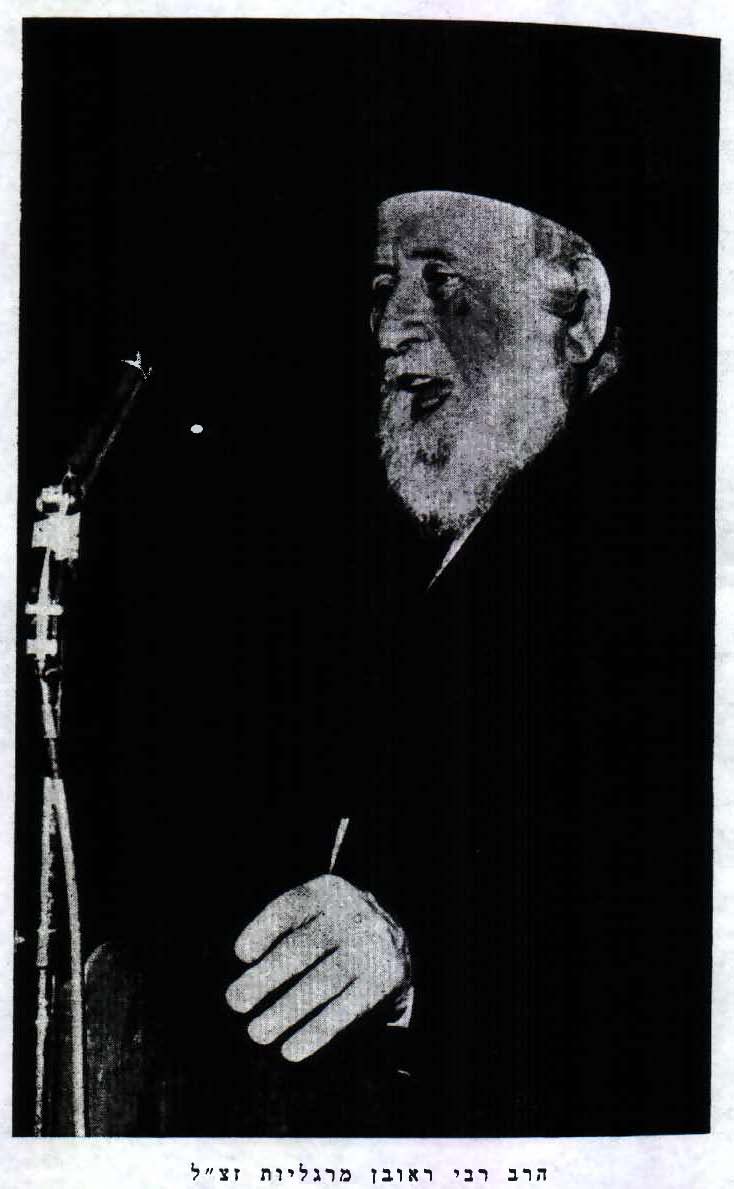
R. Reuven Margulies II

I have already discussed the most recent book of R. Margulies and provided a bibliography of his works, I now want to turn to a brief biography of him.

R. Margulies was born in 1889 and was known, from the time of his youth, as extremly erudite. Although he recieved ordination, he did not become a Rabbi and instead opened a bookstore in Lemberg. It is said that although his store was always full of talmidi hakhmim it was unclear if he actually sold anything. During his time in Lemberg he began publishing his own books. Many of his early books focus on hassidim. One of his early works, a biography on R. Hayyim ben Attar (Ohr haHayyim haKodesh) included comments by R. Dan Polonski, the author of the Kli Hemdah. In 1935 R. Margulies moved to Israel and became the librarian at the Rambam Library in Tel Aviv.

After moving to Israel he produced some of his most well known works. He began to focus on the Zohar literature and produced a fully annotated version of the Zohar, Zohar Hadash, Tikkunei Zohar and the Bahir. Additionally, during this time, he was involved in a controversy with Gershon Scholem over the R. Jacob Emden/R. Jonathan Eybeshuetz controversy. R. Margulies produced a pamphlet defending R. Eybeshuetz and in response Scholem produced his own disagreeing with R. Marguleis’s conclusions.

R. Margulies also produced an annotated Shulhan Orach, Nefesh Hayiah which he lists, in his typical encyclopedic manner, other books which deal with the same issues. It was this book that some in the comments to a previous post have raised questions about plagerism. The source for this accuasation comes for R. Wolf Leiter. He cites to sixty-one examples from R. Margulies’s book Nefesh Hayiah where R. Leiter notes others have said the same thing prior to R. Margulies. In fact, R. Leiter says these are just the tip of the iceberg. He says “there are hundreds of other examples which I have written on the side of my copy, there is no end I have only provided some examples.” R. Leiter’s examples include citations to articles and other books.

It is important to note, however, that R. Margulies wrote this during World War I. R. Margulies himself notes that this was written during a particular trying time “I remember the long winter nights when I was closed up, alone, lacking everything . . . I wrote and studied from the light of the oven fire, laying upon the floor.” Thus, it is a possiblity that during this time he neglected to look up everything and produced much from memory. In turn, the result may have been to include what he had seen before without attribution.

Additionally, some accuse him of plagerizing from R. Yosef Engel and R. Engel’s comments to the Zohar. I have never seen this in print (aside from the comment).

That being said, to accuse R. Margulies of not being extremely well read and very, very, erudite is wrong. If one looks to R. Yosef HaKohen Schwartz, who himself was one of the biggest bikeim of his day. He corresponded with R. Margulies and among other notes that R. Margulies’s “praises are known to all” that he is “an amazingly sharp mind.” Furhter, if one looks at his bibliography in three parts in the journal Areshet is very apparent R. Margulies’s breath of knowledge. Finally, as evidenced by the bibliography below, R. Margulies produced many, many books and if in one or two he may have been sloppy in attribution it is equally clear that the vast majority of his works he was not.

R. Margulies passed away in 1971.

Sources: Sefer Margolios, ed. Dr. Y. Refael; R. Z.W. Leiter, Tzion l’Nefesh Hayyiah no. 109; R. Y. Schwartz, Ginzei Yosef.


R. Reuven Margulies I

First, I want to post a bibliography of R. Margulies’s works and then I shall discuss some biogrpahical details in the next post. This bibliography is not a scientific one in that I do not attempt to list every edition. Rather, I am listing just the works and some bibliogrpahical information as I see fit. Most of this information comes from Naftali Ben Menachem’s bibliogprahy of R. Margulies’s books which was printed in Sefer Margolious.

1) Toldot Adam (Lemberg 1912) on R. Shmuel Edels
2) Kav Besamim (Lemberg 1913) 102 notes on Tosefot
3) Drush l’yom ‘alot ‘al kesi moshlim ‘adonanu haKeiser Karal haRishon (Lemberg 1918)
4) Kavi Ohr (Lemberg, 1921) laws pertianing to Israel as well as articles on history, including yesod hamishna among others
5) Yesod HaMishna V’Arikachto (Lemberg, 1933) on the creation of the Mishna
6) Sefer Hassidim with his notes (multiple printings)
7) Tolodot Rabenu Hayyim ben Atar (Lemberg, 1925), biography on the Ohr Hayyim includes the notes of R. Meir Dan Plotzki (Kli Hemdah)
8) Ohr Meir (Lemberg, 1926), biography of R. Meir from Perlmishiya
9) Margenuta d’Reb Meir (Lemberg, 1926), sayings of the above R. Meir
10) Shealot u’Teshuvot min HaShamyim, R. Margulies’s extensive notes on the teshuvot as well as a comprehensive introduction discussing Torah lo’ Bashmyim and other related topics (multiple printings)
11) Yalkut Margolious ([Lemberg], 1927), derashot of R. Margulies
12) Imrei Kodesh haShalem (Lemberg, 1928)
13) Vikuach Rabbanu Yehiel m’Paris (Lemberg, 1928), with biography of R. Yehiel
14) Shemot v’Kinuim B’Talmud, discussing names in the Talmud, including when two names started, (multiple printings)
15) Helulua d’Tzadika (Lemberg 1929), lifespan and death dates of Tzadikim
16) Vikuach HaRamban (Lemberg, 1928)
17) Yalkut Peninim (Lemberg, 1929), derashot
18) Butzna d’Nehora HaShalem (Lemberg, 1930), about R. Barukh of Metzerich
19) Gevurot Ari (Lemberg, 1930), biography of R. Leib Srhson
20) Toldot Rabbenu Avrohom Mimoni, biography of Rambam’s son, (multiple printings)
21) Rishimah (Lemberg, 193-) list of books in his bookstore
22) Mekor Barukh (Lemberg, 1931), biography of R. Barukh of Metzerich and other historical documents
23) Shem Olam, to reveal the anonymous people in hazal (multiple printings)
24) HaModiah journal
25) Nefesh Hayyia, on Shulchan Orakh multiple printings
26) Hagadah shel Pesach (Tel Aviv, 1937)
27) Shichot Chakhamim
28) Mekor haBerakha discussing blessing and why and when before one does something (recently reprinted)
29) Zohar with his extensive notes (multiple printings)
30) Sibah hisnaguto discussing R. Emden/R. Eybeschitz controversy (very controversial Scholem wrote a pamphelet against this) Tel Aviv 1941
31) Reb Saul Levin M’Ziaf haSefer Besamim Rosh, in Aresehet 1944
32) Malechi Elyon on angels in Hazel (multiple printings)
33) Ollalot various articles (multiple printings)
34) Tikunei Zohar notes, multiple printings
35) Sefer haBahir same as above
36) Zohar Hadash same
37) L’Toldot Anshei Shem b’Lvov, Jerusalem 1952
38) Milchmot HaShem (R. Avrohom ben HaRambam) (including the biography on him) (multiple printings)
39) haRambam v’Hazohar now reprinted in Penini Margolios
40) Sha’ari Zohar collecting relvant passages from the Zohar to Hazal (multiple printings)
41) Margolios HaYam on Sanhedrin (multiple printings)
42) Divrarim b’Itam dershot
43) L’Heker haMisparam beTalmud, Sinai 44
44) Tzioyunim Bibliographim a comprehensive biobibliography in Areshet 1-2,4
45) Tziyunim l’Ha’arot l’Seder haDorot, Sinai 46
46) HaMikrah v’Hamesorah multiple printings
47) Mekharim b’Darkei haTalmud v’Hidosov multiple printings


“New” R. Reuven Margoliyot Book

Mossad HaRav Kook has published Peninem u-Margoliyot which is a collection of articles by R. Reuven Margoliyot. These articles originally appeared in the journal Sinai and are now republished in a single volume. It seems that the impetus to collect and publish these was not so that people could have access to them (although perhaps this played a small role). Instead, Mossad HaRav Kook was forced, as it was, to publish these.
In the last few years, in honor of someone’s child’s wedding, someone published some of R. Margoliyot’s articles and books, including the articles which appeared in Sinai. Now, this seems to have upset Mossad HaRav Kook as they note in the introduction where they explain these articles are not that well known “with the exception of one publisher in America, who stole, without first obtaining permission, and Jews will not have a stumbling block in their homes.” While it may be the case that many are unaware of the journal Sinai or where to find R. Margoliyot’s writings it seems that Mossad HaRav Kook who had these for years, some for 30 years, they would have been content to let them langiush had it not been for this violation of copyright.

In fact, Mossad HaRav Kook has only published those articles which appeared in Sinai, they did not, as the American publisher did, republish other works (long out of copyright) of R. Margoliyot. The American publications include Toledot Ohr Hayyim haKadosh and Toledot Maharsha. The latter was originally published in Lemberg in 1932 it contains a portrait of the Maharsah (R. Shmuel Edels) as well as a discussion by R. Margoliyot of other Rabbis who had their portraits done (the picture of him in the chair is from the 1814 Vienna edition of the Maharsha and the frontal picture is from R. Margulies’s book).

The articles in these books include among others: Ha-Rambam v’HaZohar, Defusi haShulhan Arukh, Defusi haShulahan Ohrah haRishonim, Zionunei HaPesukim b’Talmud u-Midrashim, and Toledot Rebbi Yehuda HaNassi.

I purchased both the American and the Mossad HaRav Kook versions at Beigeleisen Books.


Text of the New Ban on Making of a Godol

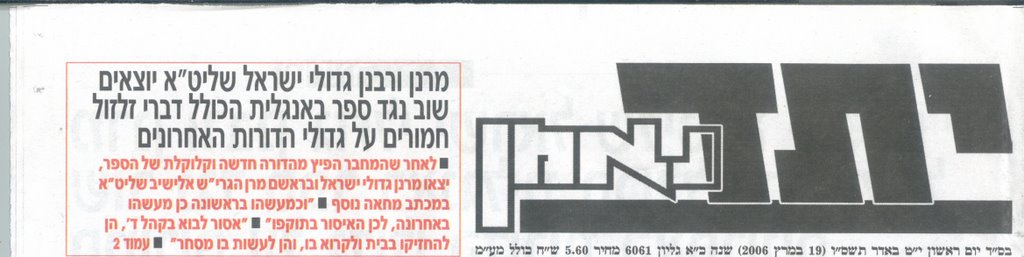
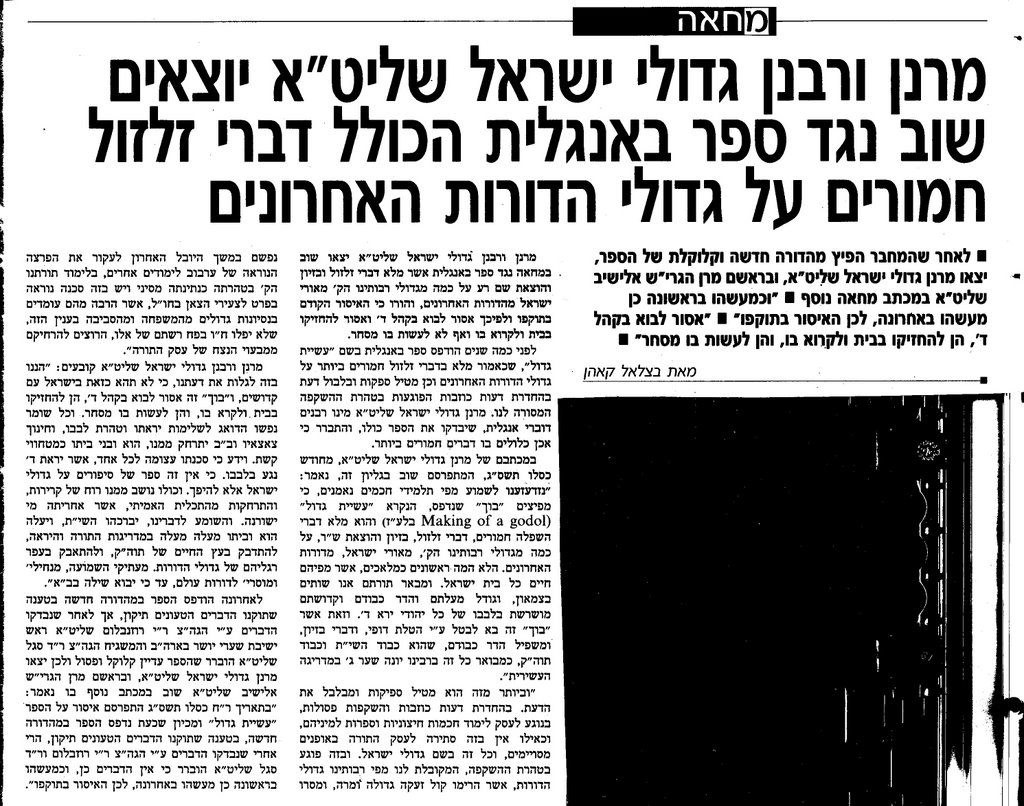
A helpful reader has scanned the Yated with the latest ban against Making of a Godol (“MOAG”). It is notable that R. Eliashiv has signed again as have others who were part of the original ban. Also, as you can see this appeared on the top of the front page as well as a separate article. Those who signed claim that this edition of MOAG although ostensibly “fixed” the “problems” it was unsuccessful and they state “the second edition is the same as the first.” Addtionally, the orignal ban is reprinted with a note that it is still in force. You can click on the scans for a larger view. For some of the differences between MOAG I and MOAG II see here, here and here.


Making of a Godol Banned – Again

An astute reader emailed me that it appears the new and improved edition of Making of a Godol has been banned. Although this edition attempted to “fix” some of the “problems” of the first, it appears that it has not satisfied it detractors. See here. I hope to get a copy of the letter referenced in the article, when I do I will post it.


New Book on Rabbinic Authority

A new sefer came out titled Ohron shel Chachomim. This work purports to collect the various laws and philosophy one should have for the Rabbis. The first section is just the basic law applicable to a talmid chacham, standing, not addressing by first name etc. In this section there is also a brief discussion about the “laws” of emunat chachmim. We are treated however to such laws as “not only is one obligated to follow the chachamim but also their children and their secretaries (mishamsheham) one should not question.” Or this one: “When a person goes to a tzadik and discusses his problems but doesn’t understand what the tzadik responds [I assume it was unintelligible] or it appears the just ignores his request – don’t let this blessing be small in your eyes. Rather believe God will send your salvation.” For many of these laws, the citations are to either aggadic passages in the Talmud or to Midrashim.

The second section discussion yeridat haDorot the lowering of the generations. This begins by telling the reader the concept of yeridat haDorot is not in relation to the tzadik rather it is to the generation. That is, the tzadik is of course as great as in previous generation rather it us that are unable to appreciate this. But then you may ask, it continues, why then do we hear of the great miracles these tzadikim did in previous generations, why not now? Of course, it is due to us – we have created a situation where the tzadikim can’t work their miracles today.

The author then treats us to a discourse on whether the achronim can argue on the rishonim. He explains that this is prohibited. In a footnote he deals with the many achronim that seem to disagree with this. However, he writes these off by noting they are like rishonim. Of course, this then poses another problem (or not) for him as if they are truly like the rishonim then it follows that their peers couldn’t argue on them as they are obviously greater. He just says that this doesn’t appear to be the case and this is allowed. He extends this prohibition against arguing against earlier ones and says this is applicable to the pronouncements of the Shulhan Arukh and the Rama. He appears to be unaware that R. Hayim Volhzin says the Gra said this is not the case and that ever Rav should just do what they see fit irrelevant of the opinion of the Shulkah Orakh and the Rama. Additionally, he doesn’t seem to be aware that R. Moshe Feinstein said the same thing. Or perhaps it is just a case of selective memory.

The next couple of chapters are devoted to the law of a Talmid Chacham today as well as the role of a Rebbi for Chassidim. The chapters include information on “Just Looking at the Rebbi Allows One To Gain In Torah and Avodah,” “The Belief in The Tzadik” as well as lesser topics such as “The Trip to the Rebbi,” “The miracles of the Rebbi” etc.

All in all, this book presents a rather interesting view into what some consider the laws and customs governing the interaction with the Rabbinic class.

I got the book at Biegeleisen in Brooklyn.


I See Dead People

Mary Roach in her excellent book “Stiff: The Curious Lives of Human Cadavers” discusses some of the facinating facts relating to dead bodies. However, she does not discuss some of the more interesting Jewish incidents of dead bodies.

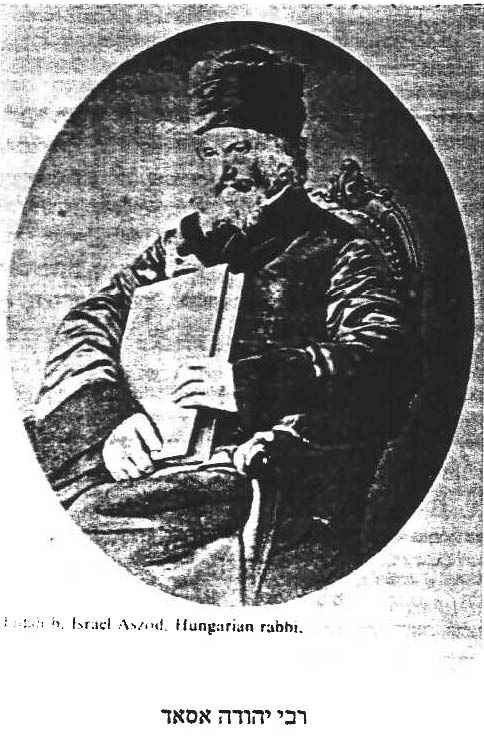
The first is the fairly well known story of R. Yehuda Aszod (1794-1866). R. Aszod’s grandson wrote a biography of his grandfather. Portions of this biography are included in R. Aszod’s commentary on the Torah, Divre Mahri.

“My grandfather never allowed for a picture or portrait of himself [based upon halachik reasons, for more on these reasons see G. Oberlander’s article in the latest Hechal haBeshet]. However, many of his students wanted his picture to remember their teacher. Therefore some of his students decided amongst themselves that after R. Aszod will die they will dress him in his Shabbat clothes, place him on his chair and this is how they obtained his photograph which is found in many people’s homes. However, those that participated in this bad befell them. It was not longer before the participants all died.” This event even engendered a discussion whether such a practice is permitted. R. Zev Tzvi Klien in his teshuvot Kehana Mesaya Kehana (no. 12) discusses this practice and concludes although not recommended it is not prohibited.

While this story does appear in R. Aszod’s commentary on the torah (p. 32) it is only is the older editions, the most recent the entire story including the relevant footnote was removed.

Additionally, there is a picture of R. Aryeh Leib ben Asher Gunzberg (Sha’agat Areyeh) which it appears he is dead. However, the legend underneath the picture reads “This is the picture of the Sha’agat Areyeh at the time he is dying.” I assume this “disclaimer” was placed there to mitigate any criticism of the kind the picture of R. Aszod is subject to. One can see this picture in the book R. Y.M. Stern, Gedoli HaDorot Jerusalem 1996, vol. 1.

There is another case, although not with a dead Rabbi, but with a Jewish question regarding the dead. In University College in London the noted philosopher Jermey Bentham had an interesting request in his will. As it appears on Wikipedia,

A further reason for Jeremy Bentham’s fame within UCL is due to the fact that his body is on display to the public. Jeremy Bentham specified in his will that he wanted his body to be preserved as a lasting memorial, and this instruction was duly carried out. This ‘Auto-Icon’ has become famous. Unfortunately, when it came to preserving his head, the process went disastrously wrong and left the head badly disfigured. A wax head was made to replace it, but for many years the real head sat between his legs. However, this head was frequently stolen and subjected to many student pranks, with students from rival King’s College London often the culprits. The head is said to have at one time been found in a luggage locker at Aberdeen station, and to have been used as a football by students in the Quad. These events led to the head being removed from display and placed instead in the College vaults, where it remains to this day.

Other rumours surrounding the Auto-Icon are that the box containing his remains is wheeled into senior college meetings, and that he is then listed in minutes as ‘present but not voting’. He is also said to have a vote on the council, but only when the vote is split, and that he always votes in favour of the motion.

When the Upper Refectory was refurbished in2003, the room became renamed the Jeremy Bentham Room (sometimes abbreviated JBR) in tribute to the man.

The London Bet Din for a few years put out phamphelts where they would discuss a in depth topics of interest. One of those titled “B’Inyan Ohel ha-Met” Dayan Grosnas no. 14, 1965, discusses whether a Kohen can go through the lobby, or today the JBR where Bentham’s body is. They actually state in the begining, which is not mentioned in the Wikipedia article that the head is kept in a special box, which although not on public display, if one asks it will be shown to you. Obviously, the same question of whether one could photograph it as was raised in the case of R. Aszod would apply as well.

You can see Bentham’s body here.


Manasseh of Ilya and Y. Barzilay

I recently finished reading Yitzhak Barzilay’s book on R. Manasseh of Ilya. R. Manasseh was a fascinating character. He was a student of the Vilna Goan, but wrote a pamphlet arguing for reconciliation between Hassidim and non-Hassidim. He wrote another work discussing the trop or cantilation marks and yet another, his mangum opus, on the Talmud. It is the later work that he is most well known for, although not necessarily in a positive way. The Tefferet Yisrael (R. Yisrael Lifshitz) on the Mishna quotes a brief passage from this commentary. R. Menasseh’s comments appear on the first Mishna in Perek Alu Mitzhut. (Baba Metziah 1:1). He understands the Mishna in a different fashion than the Talmud, thus provoking some to argue such a position is heritical.

R. Manasseh was a controversial figure. His book on the reconciliation, Pesher Davar, was publicly burnt. His work on Talmud, Alphei Menashe, after either the publisher or some outsider (depending on the source, there are a couple versions of the story), destroyed it right before it was completed. R. Manasseh was forced to reproduce the entire work from memory and find a different printer.

Additionally, although he had a close relationship with the Vilna Goan, the Vilna Goan severed that relationship after learning R. Manasseh had been in contact with R. Shneur Zalman of Lida (Ba’al haTanya).

All this being said, he is ripe for an excellent biography. Unfortunately, Barzilay does not deviate from his norm, and put out another poor work. Although Barzilay has written on many other interesting figures of Jewish history, almost always he fails to do anything substantive or worthwhile with the subjects.

This work is full of gross supposition that are never supported by any facts. For instance we have sentences like this “It may be assumed that in a talented person like Manasseh, his critical faculties must have awakened rather early, and already in his youth he may have arrived at some of his nonconformist views with regard to the Halakhah and its historical development.” (p. 24). Therefore, Barzilay wants to then claim and project back on Manasseh’s early years and label him as a radical even then based only upon “his critical faculties.” While that may be the case, there are also a million other possibilities. For instance, Manasseh was influenced later in life by someone else or he came to his “nonconformist views” based upon years of study and when he was 17 (according to Barzilay, again a guess) he did not hold these views.

Another example, where Barzilay is discussing Manasseh’s frequent trips to his wealthy relatives house who had a terrific library, Barzilay makes the following statement: “The role of this library in Manasseh’s life and intellectual growth cannot be overestimated . . . It may be further assumed, with a high degree of probability, that there also were to be found there the recent works of the Berlin maskilim, as well as those of the enlightened orthodox Jews from both Eastern Europe and the Germanies.” Barzilay then goes on to cite to the many subscribers of various haskalah literature as “proof” this library contained these books. There a basic problem with this argument. Since Barzilay is able to point to where these books went to as the subscriber list, lists both person and place, why then isn’t this rich relatives name ever listed if he was a collector of such works? Instead, Barzilay is satisfied to assume that the books were there as there were many haskalah books that “found [their] way among the Jews of Eastern Europe.”

These are but two examples from a book that is rife with such sloppy work. The only redeeming fact of the book is the extensive quotation from R. Manasseh’s works. As mentioned above, this is not the first book Barzilay wrote that fails miserably. He also did another biography on R. Shlomo Yehudah Rapoport (Shir), the son-in-law of the Ketzot HaChoshen and one of the leading figures of 19th century Eastern European Haskalah. This book is also disappointing.

unfortunate, the only other biography, Ben Porat Yosef, is no gem either. It was written by Mordechai Plungian an editor at the famed Romm press. This is more of an anecdotal than scholarly work. However, this work got Plungian in trouble as some claimed he attempted to make R. Manasseh into a maskil.

What is particularly strange is that a book review of Plungin’s book appeared in HaMagid. At the JNUL site, which contains old Hebrew newspapers, the version they have appears to have that portion blacked out. The review in question appeared in HaMagid on March 8, 1858.

The full citation for Barzilay’s book is Manasseh of Ilya: Precurser of Modernity Among the Jews of Eastern Europe (Manges Press, 1999).


Biography of Gedolim

Long before Making of a Godol there was another book that contained terrific stories of Gedolim. These stories are especially refreshing in that they give a “human” look at gedolim. This book was originally published in Yiddish and subsequently portions were translated into Hebrew. The book written by Ya’akov Mark, (1857-1929) is titled Gedolim fun Unzer Tziet (or the great ones of our time). This book was first published in New York in 1927 and included a picture of the author. Mark was from Palanga, Lithuania (or Latvia depending upon how the wind is blowing). Palanga is a resort town on the Baltic Sea where many gedolim came for vacation. Mark, thus was afforded first hand contact with many of the greatest Rabbis at the end of the 19th and the turn of the 20th century. Eventually, in 1920 Mark moved to America and his book was published there.

The book is divided by type of person, namely, Rabbonim, Manhigim, ‘Askonim, and Maskilim. It includes biographies and stories about, among others, R. Y. Salanter, R. Yitzhak Elkhonon, R. Hildesheimer, Shmuel Yosef Fuenn, R. Ma’atishyau Staushun.

Mark’s work was utilized by many. R. Dov Katz in his Tenuat haMussar uses it extensively. In another work on the early ba’ali mussar, haMeorot haGedolim by R. Ha’ayyim Zaichyk, (New York, 1953) also uses Mark, especially in the section devoted to R. Y. Salanter. The use of Mark is documented in the footnotes. In the most recent reprints of haMeorot haGedolim, all footnotes that reference Mark have been removed. Of course, the publishers that reprinted haMeorot haGedolim don’t mention this, let alone offer a reason for this omission. Perhaps it was one of the following “sins” that “warranted” the exclusion of Mark from this edition. The first, he was an accountant and not a Rav. The second was that he offers a more human portrait of the persons mentioned in his book. The third is that includes “questionable” people in his book such as Saul Pinhas Rabinowitz (Shepher) or Dr. Harkavy. Again, I don’t know that these were the reasons, however, I think they are plausible although inexcusable.

In 1958, Mark’s work was partially reprinted and translated into Hebrew. The Hebrew title is b’Mihitzham shel Gedolei haDor. This edition only included the portion of the original Ra’abanim and Manhigim those in the second half of the original under ‘askanim and maskilim were not included. The publishers stated that they planned on publishing a second volume which would include those, however, it seems that never happened. The one exception was R. Ma’atishyu Staushun, who although was in the later category was included in this edition.

Either edition is worthwhile reading full of fascinating anecdotes and stories. The Yiddish is more difficult to obtain, but not impossible.