Some Recollections of R. Jehiel Jacob Weinberg, Love Before Marriage, and More

Some Recollections of R. Jehiel Jacob Weinberg, Love Before Marriage, and More
Marc B. Shapiro
1. In my last post I mentioned R. Nosson Zvi Finkel, the Alter of Slobodka, so let me add the following. There is a transcript of a 1965 taped conversation between R. Jehiel Jacob Weinberg and R. Yaakov Herzog.[1] Herzog had come to Montreux to speak to R. Weinberg, and here is a picture from that meeting which appears in Michael Bar-Zohar, Yaacov Herzog: A Biography.

R. Weinberg, who knew R. Finkel very well, stated as follows.

הרב ויינברג: דער אלטער ז”ל (דער סלאבאדקער, זאגט מען דער אלטער), ר’ נטע הירש, ער איז דאך א צדיק.

הרצוג: אבער נישט קיין למדן.

הרב ויינברג: נישט קיין גרויסער למדן. ער האט געקענט לערנען, אבער ער איז נישט געווין קיין גרויסער למדן. אבער ער איז געווען א חכם, א גרויסער.

הרצוג: יא, דער חכם פון סלאבאדקע.

הרב ויינברג: און ער איז געווען א איידעלער מענטש זייער.

Some sections of this conversation appeared in the English Yated Ne’eman, Nov. 5, 1999. Yet as is to be expected, they appeared in a censored form as Yated Ne’eman would never record R. Weinberg’s statement that R. Nosson Zvi Finkel was not a great talmudic scholar. This judgment is not to be regarded as a put-down, as everyone in the Lithuanian yeshiva world knew that R. Nosson Zvi Finkel’s original insights were focused on Mussar, not analytical Talmud study.[2] Needless to say, the Alter always made sure that outstanding talmudic scholars were on the Slobodka faculty.
Speaking of censorship, here is another example. In the Yated Ne’eman article just mentioned, we find the following passage which is a quote from R. Weinberg.
I was intimately acquainted with R. Eizik Sher. . . . His son-in-law, R. Mordechai Shulman, visited me in Berlin and wanted to hear shiurim from me. I told him: This is not your place. Return to Slobodke.[!] Maybe you will some day become the son-in-law of R. Eizik.
This is what R. Weinberg actually said to Herzog:

ויינברג: ער איז ארויפגעקומען צו מיר אין סעמינאר. ער איז געווען אין בערלין, זיך ארומגעדרייט צוויי מאנאטן. געוואלט אריין אין סעמינאר. האב איך אים געזאגט: הערט זיך איין, ר’ מרדכי, ער איז א טיקטינר. דו וועסט נישט ווערן קיינמאל קיין דאקטאר. און אויב דו וועסט זיין א דאקטאר אפילו, וועסטו קיינמאל נישט קריגן קיין רבינער שטעלע אין דייטשלאנד. וואס טויג עס דיר? וועסט נישט מאכן קיין קאריערע. איז גיי אוועק צוריק אין סלאבאדקע. אמאל קען זיין, דו וועס זיך פארליבן אדער זי וועט זיך אין דיר פארליבן, די טאכטער פון ר’ אייזיק’ן, וועסטו ווערן ר’ אייזיק’ס א איידים.

.הרצוג: וכך הווה

 .ויינברג: און איך האב אים דערמאנט דאס. אז איך האב עס אים אמאל פאראויס געזאגט

R. Weinberg tells us that R. Mordechai Shulman, who was from Tiktin and later became Rosh Yeshiva of Slobodka in Bnei Brak, wanted to enroll in the Rabbinical Seminary of Berlin. Yated doesn’t want its readers to know this, so it “translates” the passage as saying that R. Shulman “visited” R. Weinberg and “wanted to hear shiurim” from him. R. Weinberg told him that he would never get a doctorate, and even if he did he would not get a rabbinic position in Germany, so he should return to Slobodka. R. Weinberg adds that when he returns it could be that he “will fall in love” with the daughter of R. Isaac Sher, or she will fall in love with him, and he can then become the son-in-law of R. Sher, the rosh yeshiva of Slobodka. In fact, this is exactly what happened.[3]
The Yated “translation” omits anything about R. Shulman and R. Sher’s daughter “falling in love.” This is because there is no such concept in the haredi world (and in traditional Jewish societies, in both the Ashkenazic and Sephardic worlds, such a notion was hardly found at all). Any love between husband and wife is said to come after marriage, and the biblical support for this concept, repeated in numerous texts (both haredi and pre-haredi[4]), is found in Genesis 24:67: “Isaac brought her into the tent of his mother Sarah, and he married Rebekkah. So she became his wife, and he loved her.” This verse states that Isaac loved Rebekkah, but only after he married her.[5] R. Gamaliel Rabinowitz goes so far as to state that any love that is found before marriage arises from sin, as there is no room for “feelings” before marriage.[6]
האהבה באה רק לאחר הנישואין, כל אהבה שלפני הנישואין מקורה בחטא רח”ל, ענין ה”רגשות” בכלל אין לו מקום לפני הנישואין, וזה דבר פשוט וברור שאין צריך לבארו.
R. Reuven Margaliyot mentions an interesting interpretation in support of this perspective.[7] There are two contradictory biblical verses. Proverbs 18:22 states מצא אשה מצא טוב, while Ecclesiastes 7:26 states ומוצא אני את האשה מר ממות. The contradiction can be explained as follows.
In earlier years parents would arrange marriages for their sons, and the overwhelming majority of the marriages succeeded. This is alluded to by the verse in Proverbs: מצא אשה מצא טוב. Now, however, things are different, and young men find their own brides, “and most of the time there isn’t peace between them after the marriage.” This is alluded to by the verse ומוצא אני את האשה מר ממות . In other words, if I find a wife for myself, most of the time it will turn out to be “more bitter than death.”
I think there might be another text that speaks to this concept, though I have not seen anyone who has made this point. The sixth of the sheva berakhot recited at a wedding states שמח תשמח רעים האהובים. The words רעים האהובים mean “beloved friends” or “beloved companions.” I don’t think one would use the word רעים to describe a man and woman who are “in love.” I believe that the words of the blessing mean a love that is found between two friends, rather than romantic love. 
R. Moses Gruenwald writes as follows:[8]
וענין חתונה א”א אלא בין רעים האהובים דמי שאינם אוהבים זה את זה א”א להם להתחתן.
What he says is that people who do not love each other cannot get married. I believe that he means the sort of “friendship love” I mentioned in the previous paragraph, rather than romantic love. I find his formulation particularly interesting, since R. Gruenwald was a Hungarian rav typically viewed as being on the extreme side of things. Yet here he is saying that there needs to be a sort of love between the bride and groom.
Could this really have been the norm in R. Gruenwald’s Hungarian (non-hasidic) community? Maybe some readers who come (or descend) from this type of community can offer some comments. I have also wondered what hasidim mean when they say רעים האהובים, since the people getting married hardly know each other. A friend from the hasidic world acknowledged that he doesn’t know if these words can be reconciled with the current reality. He also suggested that perhaps the words can be understood like יומת המת in Deuteronomy 17:6. In this verse the word המת does not mean one who is dead, but rather one who will soon be dead. So perhaps האהובים means “the ones who are in the process of becoming אהובים.”
I found another interesting passage that speaks about love of bride and groom. It is attributed to R. Isaac Luria by R. Hayyim Vital. As part of his explanation of a verse in Song of Songs, R. Luria writes:[9] מחמת רוב אהבת חתן לכלה. These words are explained allegorically, but their simple meaning also reflects a reality, one in which there is real love between bride and groom which could only have flowered prior to the wedding.
Returning to the traditionalist value that love only comes after marriage, this is all fine and good, but R. Weinberg specifically spoke of falling in love before marriage, and that this could lead R. Shulman to become R. Sher’s son-in-law. From the Yated “translation” the reader would assume that R. Weinberg was telling him to return to Slobodka and become a big learner, and that this might lead to him becoming R. Sher’s son-in-law.[10]
Regarding love letters, the following appears in R. Nathan Kamenetsky, Making of a Godol, p. 802, and was one of the passages that led to the book being banned:
A reliable source reported that R’ Aaron [Kotler] wrote a letter to his fiancée of which her father, R’ Isser-Zalman Meltzer, disapproved. When it was shown to the Alter, he rejoined, “I did not tell you he was a tzaddiq. I said he had other qualities, but he will yet become so frum that everyone will suffer from him.”
Many who read Making of a Godol assumed that the letter allegedly sent by R. Kotler was a love letter. In order to counter this understanding, in the second edition of Making of a Godol Kamenetsky added: “This author conjectures that the letter concerned an impressive hasbarah he had delivered.” This conjecture doesn’t seem to fit with the Alter’s reply about R. Kotler not being a “tzaddiq” and becoming “frum”. If R. Isser Zalman was upset because he thought that the young R. Kotler was a bit too impressed with himself, then the Alter would presumably have replied differently. The words that he allegedly used, “tzaddiq” and “frum”, have a certain meaning, and it thus is not surprising that the family of R. Kotler was so strongly opposed to the book and viewed this passage as insulting. (Another report has it that R. Kotler had suggested that his fiancée read a certain book and that was what upset R. Isser Zalman.)
In the second edition of Making of a Godol, the last sentence of the passage in question was altered to read, “But his frumkeit will yet become so great that everyone will suffer its brunt.” 
In my review of Making of a Godol, I wrote as follows:
Another problematic element of the book, admittedly found only on occasion, is its use of unnamed sources. This is acceptable in journalism, but not in scholarship. For example, the evidence for one of the most controversial passages in the book, concerning R. Aaron Kotler, his future wife, and his future father-in-law, R. Isser Zalman Meltzer, is “a reliable source” (p. 802). I understand why the source would not want his or her name to be given, but when repeating such a loaded story, which one knows will be controversial and its veracity challenged, the author is obligated to name the source, thus allowing the reader to judge its reliability. After all, if the source is R. Kotler’s daughter, its authenticity is more apparent than if it is another example of what X heard from Y. If the source does not wish to go on the record, it is best for the story to be omitted. (In my own biography of R. Weinberg, I was forced to leave out a number of “juicy” details, precisely for this reason.)[11]
I have previously discussed R. Samuel Archivolti’s book of melitzah letters, Ma’yan Ganim, and how it was misused by R. Baruch Epstein. See here.[12] This book is described in the Encyclopaedia Judaica as follows: “Archivolti’s most important works are . . . Ma’yan Ganim (Venice, 1553), divided into ‘passages’ containing 25 letters in metrical form designed to serve as models for students of this classic literary genre.”[13] It is worth mentioning Ma’yan Ganim now because on pp. 39ff. Archivolti includes two love letters. It appears clear to me that the focus of these letters is an unmarried couple, and first letter begins with the following heading: אגרת חושק לחשוקתה. 

Also of interest is this picture that appears at the beginning of each section of the book. As I learnt from Shimon Steinmetz, urinating putti were a common theme in the art of Archivolti’s day. You can read about it here

While Ma’yan Ganim is a book of melitzah letters, not responsa, R. Archivolti (1515-1611) was indeed a halakhic authority who served as rabbi of Padua. His pesak in the famous Rovigo mikveh controversy appears in Palgei Mayim (Venice, 1608), p. 15a.
 

R. Archivolti is referred to as מ”ד which stands for מרא דאתרא. In Renaissance Italy this title was only used for very important rabbis,[14] unlike today when all communal rabbis are given the title.
Interestingly, I found that a Hebrew manuscript from R. Archivolti’s era includes a love charm. The woman is told to write יריש ליאוש פילוש on her left hand, and this will cause the man she desires to fall in love with her.[15]
R. David Cohen, the Nazir, is an example of one who fell in love before marriage. In fact, his relationship with his future wife, Sarah, is a great love story. They were separated from each other for twelve years. He was in Europe and Eretz Yisrael and she was in Russia and later trapped behind the Iron Curtain. Throughout these long years they remained committed to each other, and the Nazir kept her picture on his desk. As reported by R. Avraham Remer, R. Zvi Yehudah Kook saw fit to mention this last point at the Nazir’s funeral.[16]
אמר עליו: “אור מופלא”, וציין אז שתי נקודות בחייו של רבי דוד: האחת, תחילת הנזירות בעת היותו באוניברסיטה, כדי לשמור על הפיאות והזקן. והשניה, שעל שולחנו הציב תמונת ארוסתו, כדי שחס-ושלום לא יתן עיניו באחרת.
R. Shear Yashuv Cohen tells us that the Nazir and Sarah also exchanged wonderful love letters during this time, letters which have not been made public:[17]
שמורים בארכיון המשפחה מכתבי-האהבה הנפלאים, ואף קטעי-יומן מלא רגש רוטט שנכתבו על ידי אבא מארי זצ”ל בימי הפירוד שנתמשכו הרבה מעבר למתוכנן ולמצופה . . . הכלה הצעירה מונה ימים ושנים, ונשארת בנאמנותה לבחיר לבה. אף הוא שומר לה אמונים ומתנזר מכל אפשרות של ברית או קשר אחר, בקפידה ובנאמנות יסודית.
When Sarah finally made it to Jerusalem, the Nazir was in the midst of a ta’anit dibur. R. Kook summoned R. Zvi Pesah Frank and R. Yeruham Fishel Bernstein so that they could sit as a beit din and void the ta’anit dibur, thus allowing him to speak to his soon-to-be bride.[18]

Regarding falling in love before marriage, R. Jehiel Jacob Weinberg, in his Oct. 12, 1960, letter to Samuel Atlas, states that R. Soloveitchik came to Berlin intending to marry R. Hayyim Heller’s daughter:
השידוך בטל. ס’ התאהב בזו שהיא עתה אשתו.
According to members of the Soloveitchik family, there is no truth to this, and R. Weinberg was simply repeating a rumor. But it is true that the Rav fell in love with his future wife in Berlin. R. Ronnie Ziegler writes as follows here:
The Rav’s most important and fateful encounter in Berlin was that with his wife, Dr. Tonya (Lewit) Soloveitchik (1904-1967). A student at the University of Jena, where she obtained a Ph.D. in education, she was introduced to Rav Soloveitchik by her brother, a fellow student at University of Berlin. Although a scion of the illustrious Soloveitchik family was expected to conclude a match with the daughter of a prominent rabbi or at least a successful businessman, Rav Soloveitchik fell in love with Tonya Lewit and married her in 1931 despite her family’s undistinguished lineage and lack of means.
R. Ziegler continues by describing the deep connection between the Rav and Tonya.
As mentioned in the previous lecture, the Rav’s relationship with his wife was one of the two most significant relationships in his life. He had unlimited esteem for her – his dedication of “The Lonely Man of Faith” reads: “To Tonya: A woman of great courage, sublime dignity, total commitment, and uncompromising truthfulness.” He respected her opinion and heeded her advice, both in practical and in intellectual matters. It was on her advice that he changed the topics of his annual Yahrzeit (memorial) lectures for his father, which attracted thousands of listeners, to matters which non-scholars could relate to (such as prayer, Torah reading, and holidays). [The halakhic portions of some of these lectures are collected in the two volumes of Shiurim Le-zekher Abba Mari z”l.] In a poignant passage in a teshuva lecture delivered after his wife’s death, he recounted how he used to consult her before speaking:
The longing for one who has died and is gone forever is worse than death. The soul is overcome and shattered with fierce longing. . . . Several days ago, I once again sat down to prepare my annual discourse on the subject of repentance. I always used to discuss it with my wife and she would help me to define and crystallize my thoughts. This year, too, I prepared the discourse while consulting her: “Could you please advise me? Should I expand this idea or cut down on that idea? Should I emphasize this point or that one?” I asked, but heard no reply. Perhaps there was a whispered response to my question, but it was swallowed up by the wind whistling through the trees and did not reach me.” (On Repentance [Jerusalem, 1980], p. 280)
Rav Soloveitchik’s wife was his best and perhaps only real friend. His natural proclivity towards loneliness, which we will encounter repeatedly in his writings, was heightened in his philosophy to an ideal, which expresses itself in an invigorating sense of one’s own uniqueness. One can be lonely even, or perhaps especially, when surrounded by friends, colleagues, and family. This is a constructive force which propels a person toward his individual destiny, while also propelling him to seek a depth-connection with God and with his fellow man. Aloneness, as opposed to loneliness, is a disjunctive emotion – it is a sense of lacking companionship, of being abandoned and forlorn. The passage above highlights the Rav’s almost unbearable sense of aloneness following his wife’s death in 1967 after a long struggle with cancer. He is reported to have said, “After my father’s death, I felt like a wall of my house had fallen down. After my wife’s death, I felt like the entire house had collapsed.”
Concerning the matter of falling in love before marriage, it is noteworthy that the great R. Hayyim Joseph David Azulai (the Hida) was in love with the woman who would later be his wife, and whom he knew for a number of years before they were married. Here is what Meir Benayahu has to say about this.[19]
את אשתו השניה, רחל בת משה הלוי מפיסה, הכיר כחמש שנים לפני שנשא אותה ונקשר עמה בקשרי אהבה. החלומות שחלם עליה לפני הנישואין מעידים על יחסו הנכבד לאשה. הוא שאף ל”נשואים רעננים” ובהנשאו לה ראה שהוא מתעטר בכבוד והדר. בנסיעותיו רכש לה מתנות ומסר לה אותם לפני הנישואין. כסף הרבה הוציא עליה למלבושיה ולהנאותיה, ומותה בשנת תקס”ד הקדיר עליו את עולמו.
Benayahu mentions the Hida’s dreams. Here is a passage that the Hida recorded from one of his dreams.[20]
תשרי תקל”ו . . . וראיתי בחלומי שהייתי בא על אשתי [שהיתה כבר נשואה עמי ולא זכרתי מי] ומוציא בתוליה ורואה דם. [קמ]תי והלכתי אצל אמ”ן [אבי מורי נ”ע] ושאלני ברמז והשבתיו ברמז . . . ונתעוררתי. ותכף הבנתי שהוא תשו’ שאלה מיום [ראש השנה?] לטובה. וב”ה שלא אירע לי שום מקרה ח”ו. הוא ית’ ירחם וייטיב אחריתי מראשיתי לאי”ט וש”ח.
Most people will probably feel uncomfortable reading this sort of passage. Yet the performance of the mitzvah the Hida discusses appears very natural to him and nothing to be ashamed of. Perhaps it is only uncomfortable to read because we have become overly puritanical regarding these matters which are also part of Torah. Nevertheless, it does remind me of other “uncomfortable” passages found in R. Jacob Emden’s autobiography.
I found another interesting passage that deals with love between a bride and groom in R. Aaron Fried’s Zekan Aharon (Munkacz, 1904), p. 52a. Here is the passage.
I am quite surprised by the example the author uses. In commenting on the rabbinic derashah connecting the words מורשה and מאורסה,[21] he uses an example that portrays a romantic relationship. He tells of a rich man, apparently newly married, who loved his wife and tried to woo her by telling her how greatly he loved her. “His love for her increased in quantity and quality beyond how other grooms love their brides.”
This type of description would be unusual enough in a rabbinic work. Yet it gets even more unusual when R. Fried continues by telling us that the rich man showered her with hugs and kisses and placed an expensive necklace around her neck as a sign of his love. R. Fried also elaborates on why, despite all these signs of affection, the woman did not reciprocate with any feelings of love. Later he explains that since the Torah is to us like one bound with erusin, that is why we show it love, decorate it with silver and gold, and even kiss it, just like a groom does with his bride! It happens to be a clever derashah, and ends with how if you want the Torah (i.e., God) to love you back, it is not enough to only support the Torah. One must also support the poor Torah scholars, the “relatives” of the Torah.
Is it just me, or is anyone else surprised by this derashah? I can’t imagine using the imagery found here as part of a derashah before a haredi audience in order to inspire them to be generous with their support of Torah scholars. With the mention of hugging and kissing the bride, I don’t even think this would go over well in front of a Modern Orthodox audience. [22]
I am doubly astounded by the fact that the derashah we have just seen was written by an outstanding student of the Hatam Sofer, one who also showed his halakhic expertise by authoring a volume of responsa titled שו”ת מהרא”ף.
I found the derashah so unusual that I was curious to see if anyone cited it. Using Otzar ha-Hokhmah I found two citations. The first is by a Hungarian rabbi, R. Efraim Balati, who authored Hamudei Efrayim (Galanta, 1935). In vol. 1, p. 35, he cites R. Fried’s comment.
Once again, I am surprised that a Hungarian rabbi would include such information in a derashah, even if, in R. Balati’s retelling, he leaves out the words ומחבב אותה בחיבוק ונישוק. Even though he doesn’t mention how the rich man showed his affection with hugs and kisses, he does include the rest of R. Fried’s words, including how we kiss the Torah just like a groom kisses his bride.
The other source I found that cites R. Fried’s passage is R. Barukh Moskovits, Tenuvot Barukh (Jerusalem, 1969), vol. 2, pp. 326-327.
If you examine the passage, you will see that he is quoting from R. Fried’s text, not R. Balati’s version. Yet R. Moskovits also alters R. Fried’s words ומחבב אותה בחיבוק ונישוק. In R. Moskovits’ text this appears as ומחבב אותה מאד. Since R. Moskovits copied R. Fried’s text basically word for word, I don’t understand why at the end of the passage he writes שמעתי. Why doesn’t he tell the reader the source of the passage? 
To be continued
2. The most recent book to appear in my series with Academic Studies Press is Maxine Jacobson, Modern Orthodoxy in American Judaism: The Era of Rabbi Leo Jung. Anyone with an interest in the history of Orthodoxy in America will want to read this book, and I am very happy that I was able to include it, together with other high quality works, in my series, “Studies in Orthodoxy.” Rather than offer my own description of the book, here is an “official” description, which appears on Amazon.
This work presents the issues of Modern Orthodox Judaism in America, from the decades of the twenties to the sixties, by looking at the activities of one of its leaders, Rabbi Dr. Leo Jung, pulpit rabbi, community leader and writer, whose career spanned over sixty years, beginning in the 1920s. Jung is a fulcrum around which many issues are explored. Rabbi Jung’s path crossed with some of the most interesting people of his time. He worked with Chaim Weizmann, the first president of Israel, with Albert Einstein to promote Yeshiva College, with Herman Wouk, American author and Pulitzer Prize winner, and with Pearl Buck, a Nobel Prize laureate and Pulitzer Prize winner.
Modern Orthodoxy went from being a threatened entity on the American scene to a well- recognized and respected force in Judaism. Orthodoxy, at first, was seen as alien to the American environment. Marshall Sklare, perhaps the most influential exponent of this notion, wrote in the 1950s that the history of Orthodoxy in America could be written in terms of a case study of institutional decay. He realized the errors of his ways in the 1970s. This is the story of the renaissance of American Modern Orthodoxy, from the disorganization of the older Orthodoxy to the new spirit of confidence that emerged after World War Two. The phenomenon of Modern Orthodoxy is examined in the context of Orthodox invigoration and change. This book has relevance for further studies in various areas. It is part of the study of religious acculturation, of the conflict between tradition and modernity and of religious reinvigoration in a secular society.
Another noteworthy recent book is Michael J. Harris, Faith Without Fear: Unresolved Issues in Modern Orthodoxy. In my blurb that appears on the back cover, I write: “A proud and sophisticated manifesto of Modern Orthodoxy, one which builds on past thinkers but does not hesitate to chart new ground as well.” Rabbi Harris deals with a number of issues such as the role and status of women, mysticism, academic biblical scholarship, and religious pluralism. He generally comes down on the more “liberal” side of what is known as Modern Orthodoxy. (An exception to this generalization is his chapter on academic biblical scholarship.) Anyone who is interested in the intellectual trends of Modern Orthodoxy will want to read Harris’s book, as it is engaged scholarship at its best.
I would also like to call attention to R. Shimon Szimonowitz’s just published Haggadah shel Pesah: Aleh Zayit.[23] I know that there are a lot of Haggadot out there, but for talmidei hakhamim this is one of the special ones. I say this because of the many learned comments, including full-length essays, that are found in the volume. Of particular interest to me is R. Szimonowitz’s lengthy article on le-shem yihud. It is crucial reading for anyone interested in the dispute over the le-shem yihud formulation, in particular the positions of R. Ezekiel Landau, R. Eleazar Fleckeles, and R. Moses Sofer. Among other noteworthy things found in this Haggadah are an article by R. Chaim Rapoport and the Yiddish version of a few beloved Passover songs.
3. On June 5, 2016, in honor of Yom Yerushalayim, I will be speaking at the Community Synagogue of Monsey, 89 West Maple Avenue. The title of my talk is “R. Shlomo Goren: The Revolutionary Chief Rabbi.” The talk will follow minhah which is at 8:15pm.

[1] Israel State Archives, Yaakov Herzog Collection, 2989-4/פ. R. Yaakov David Herzog was the son of R. Isaac Herzog. He was named after R. Yaakov David Wilovsky, the Ridbaz, from whom R. Isaac Herzog received semikhah. In addition to his public role in government and as a diplomat, Yaakov Herzog was also a rabbinic scholar. In 1945 he published a translation and commentary of Mishnah Berakhot, Peah, and Demai. This translation was actually ready for publication by the end of 1942, before Herzog was even 21 years old (he was born Dec. 11, 1921). See Michael Bar-Zohar, Yaacov Herzog: A Biography (London, 2005), p. 50.
In Iggerot Moshe, Hoshen Mishpat no. 1, R. Moshe Feinstein critiques an article of R. Isaac Herzog that appeared in Ha-Pardes. R. Moshe’s own article originally appeared in installments in Ha-Pardes, Tamuz and Av 5703. Yaakov Herzog defended what his father wrote in Ha-Pardes, Elul 5704, pp. 36-38, and Tishrei 5705, pp. 25-27. He was only 23 years old when he wrote these articles.
After the retirement of R. Israel Brodie, Herzog was offered, and accepted, the position of British Chief Rabbi. The common view is that Herzog’s health problems prevented him taking up the post, but the truth is more complicated. See Bar-Zohar, Yaacov Herzog, ch. 13.
Since I have spoken in prior posts about religious men not wearing kippot, Herzog should be added to the list. Not only did he go bareheaded when representing the State of Israel in the Diaspora (and also in his famous debate with Toynbee), but as you can see from pictures in Bar-Zohar’s book, he also did so in Israel, while at work in various important government positions. Bar Zohar writes, “Even as a very young man, when he was working at the Foreign Ministry and then in the Prime Minister’s office, Yaacov did not wear a skullcap, except when saying blessings or praying.” (Yaacov Herzog, p. 111) Because of the vast changes that have taken place in Israeli society, it is hard for us to appreciate why, in the early decades of the State of Israel, some religious men, even those who were not of German background, felt that government work required removing their kippah.
You can listen to the Herzog-Toynbee debate here.
In a previous post here I referred to Yitzhak Nebenzahl as not wearing a kippah, and I mentioned that this German practice continued into his old age. In 1974 Nebenzahl was a member of the Agranat Commission which investigated the Yom Kippur War. In pictures of him from this time you can see that he was still without a kippah. A couple of people emailed me to say that by the 1980s he had abandoned the galut custom and indeed wore a big black kippah. One of them even sent a picture of him and Nebenzahl together.
In the post referred to in the previous paragraph, I also discussed Aharon Barth, who like Nebenzahl came from Germany and did not wear a kippah while at work. Subsequent to the post I found that Zorach Warhaftig mentions that after the death of Chaim Weizman, Ha-Poel ha-Mizrachi recommended to Ben Gurion that Barth be a candidate for president of the State of Israel. Warhaftig reports that Ben Gurion rejected this since Barth was too religious and thus not an appropriate representative for the average citizen. See Warhaftig, Hamishim Shanah ve-Shanah (Jerusalem, 1998), p. 116.
[2] Shlomo Tikochinski, Lamdanut, Musar ve-Elitizm (Jerusalem, 2016) p. 111 n. 131, cites Israel Zissel Dvortz and Dov Katz who claim that R. Finkel was indeed a “gadol” in talmudic learning, but he hid this knowledge even from those who were close to him. Some will no doubt regard this judgment as motivated by “religious correctness,” especially as R. Weinberg had a particularly close relationship with R. Finkel and was privy to all sorts of private information. See, however, Nathan Kamenetsky, Making of a Godol, pp. 777ff., who cites additional sources testifying to R. Finkel’s talmudic knowledge.
[3] R. Shulman’s early shiurim were not very successful in drawing a following. Ben-Tsiyon Klibansky writes (Ke-Tzur Halamish: Tor ha-Zahav shel ha-Yeshivot ha-Lita’iyot be-Mizrah Eiropah [Jerusalem, 2104], p. 342):
בסלבודקה הורגשה אי-נחת כשמינה בה הרב יצחק אייזיק שר את חתנו מרדכי “טיקטינר” שולמן לר”מ בשנת 1935. בישיבה הוא היה תלמיד ותיק נודע, ולאחר נישואיו ב-1929 הועיד את כל זמנו להתעלות בלימודיו. אולם משהחל להרצות את שיעוריו בישיבה לא מצאו בחוריה הדעתנים לנכון להשתתף בהם, ובשיעורים הראשונים נכחו חניכים יחידים בלבד.
Here is a picture of R. Weinberg and R. Shulman in Montreux. It appears in Joseph Friedenson, Heroine of Rescue (Brooklyn, 1984), p. 230.

[4] R. Samson Raphael Hirsch, in his commentary to Gen. 24:67, writes as follows:
Like the marriage of the first Jewish son [Jacob], Jewish marriages, most Jewish marriages, are contracted, not by passion but by reason and judgment. Parents, relations and friends consider which young people are really suited to each other, bring them together, and then love grows more and more, the more they get to know each other. But most non-Jewish marriages are made by what they call “love”, and one has only to glance at the novels depicting life to notice what a gulf there usually yawns between the “love” before marriage and after, how rapid and insipid everything then seems, how different from all the glamour one had imagined etc. etc. Such “love” is blind, every step into the future brings disappointment. But of Jewish marriage it says: ויקח את רבקה ותהי לו לאשה ויאהבה. There the wedding is not the culmination but the seed, the root of love!
The Malbim is another pre-haredi figure who speaks of love coming after marriage and cites Gen. 24:67. See his commentary to Deut. 24:1 (p. 169b). Yet he differs from others who make the same general point in that he acknowledges that at the beginning (which appears to mean even before marriage) there is indeed a “spark of love,” זיק אהבה. In context, these words might only mean a healthy attraction. The Malbim continues that the essence of love between a man and woman comes only after marriage:
ונמצא שעקר האהבה היתה נגלית רק אחר הנשואין.
R. Hayyim Hirschensohn, whose outlook was as far from a haredi perspective as can be imagined, also points to Gen. 24:67 as providing the proper approach to love and marriage. He even throws in a negative comment about American mores which is not what most would expect to come from him. See Apiryon 3 (1926), p. 29:
ותהי לו לאשה ויאהביה, לא כמנהג אמריקא שהאהבה בא קודם הנשואין ומתה עם הנשואין, אבל יצחק אהב את רבקה אחרי הנשואין.
Reading all of these passages shows us how much has changed both culturally and sociologically. I don’t think there is a parent in the Modern Orthodox world who would support a child’s marriage if the son or daughter was not convinced that he/she loved the future spouse.
I asked a friend if in the haredi world people would ever say that the bride and groom loved each other (i.e., before marriage). He replied:
לא היו אומרים, אבל אצל הישיבתיים זה בסדר גמור – ואולי גם יותר טוב – שיהיה אהבה ביניהם, אבל לא היו מביעים את זה, קוראים לזה chemistry, רוצים שיהיה chemistry ביניהם לפני שסוגרים את השידוך. אצל חסידים זה לא מקובל.
Radak, in his commentary to Gen. 24:67, is not concerned with using the verse to show that love should only come after marriage, and indeed, in his day this was generally not even an option. Yet in discussing the verse he makes a very telling comment, as true today as in his times:
רוב בני אדם אוהבים נשותיהם.
Most men love their wives.” If you read Hirsch’s grand rhetoric you feel carried away with the purity and perfection of Jewish love after marriage. Radak, however, brings you down to the real world, where unfortunately the truth is that not all men really love their wives.

[5] See, however, Gen. 29:18, 20, where it says that Jacob loved Rachel, and this was before he married her. In Gen. 29:30 the verse states: ויאהב גם את רחל מלאה. Most understand this to mean that while Jacob loved Leah, he loved Rachel more. However, according to one interpretation of the Tosafists, Jacob did not love Leah at all. See Tosafot ha-Shalem al Torah, Nevi’im, u-Khetuvim, vol. 3, p. 145:
ויבא גם אל רחל ויאהב גם: ב’ פעמים גם, אין ריבוי אחר ריבוי אלא למעט, מיעט את לאה מן האהבה, שלא אהב אותה כלל, שנאמר “וירא ה’ כי שנואה לאה”.
See also Nahmanides, Commentary to Genesis 29:31: ולכן שנאה יעקב. He also offers an alternative explanation.
[6] Tiv ha-Emunah (5769 ed.), p. 142.                                         
[7] Devarim be-Itam (Tel Aviv, 1959), p. 57.
[8] Arugat ha-Bosem (Huszt, 1913), parashat Emor, p. 52a.
[9] Humash in Perush ha-Arizal (Jerusalem, 1993), Song of Songs 6:5 (p. 295).
[10] There is a story in yeshiva circles that before R. Isaac Hutner went to Berlin, he was supposed to marry R. Sher’s daughter, whose name was Chava Miriam.
R. Weinberg mentions both R. Sher and R. Shulman in his letter to Samuel Atlas, dated Jan. 17, 1950. (The letter is found in the Jewish Theological Seminary Library, Samuel Atlas collection.) The young rosh yeshiva R. Weinberg refers to is R. Chaim Kreiswirth, who was the son-in-law of the martyred R. Abraham Grodzinski. In this letter R. Weinberg frankly explains why he could not accept a position at Hebrew Theological College in Chicago.
וכן הדבר בשיקאגו. הרב המנוח שאול זילבר כתב לי קודם פרוץ המלחמה ואח”כ כמה וכמה מכתבים ובקשני שאבוא אליהם. גם ידידי הרב רגנסבורג כתב לי. ויש לי שם ידיד אוהב ומעריץ גדול, הרב ר’ אפרים עפשטיין, אחד מחבשי הקוראטוריום של בית המדרש לתורה וגם הוא הפציר בי לבוא לאמיריקה. ובכ”ז לא זכרו אותי בשעה שנפנתה משרת “ראש הישיבה” ונתנוה לאחר. אפשר שרצו באדם צעיר ואפשר שיד סלאבודקי באמצע. הראש ישיבה החדש הוא חתנו של ר’ אברהם ווארשאווער הי”ד, מי שהי’ מנהל ישיבת סלאבודקי. שמעתי שהוא דרש שיתנו לו משרה בישיבת סלאבודקי אשר בבני ברק. טען טענת ירושה. אבל ר’ אייזיק שער נ”י וחתנו ר”מ שולמן שהם כוננו את ישיבת סלאבודקי בבני ברק דחוהו ולפיכך הצטרכו למצוא לו מקום חדש . . .
עכ”פ אי אפשר לי עכשיו לחשוב ע”ד קבלת מינוי בביהמ”ד אשר בשיקאגו. הנ”ל הוא ראש הישיבה ולי אי אפשר לעמוד תחת מרותו של אדם צעיר, ואפילו יהי’ גדול שבגדולים. וצריך אתה לדעת, כי לביהמ”ד זה יש אופי של ישיבה ונוהגים בה כל מנהגי ישיבה, בכבודים ובתוארים וכו’ וכו’ וא”כ איך אפשר לי לעמוד במחיצתם והם ינהגו בי מנהג זלזול כנהוג בישיבה למי שאינו “הראש”.
ב”ה יש לי תלמידים שתופסים משרות רבנות בערים גדולות וגם בבמשלה העברית שבא”י יש לי תלמידים. ומשום כבודם בלבד אסור לי להעשות אסקופה בשביל פרנסה.
Regarding broken engagements, here is the front page of Doar ha-Yom, April 28, 1926 (called to my attention by Moshe Dembitzer).

As you can see, there is an ad wishing R. Kook mazal tov on the engagement of his daughter, Basya, to R. Hayyim Walkin, the son of R. Aaron Walkin. R. Hayyim Walkin would later break this engagement and marry the daughter of R. Yaakov Shapiro, who was the Rosh Yeshiva of Volozhin. After R. Shapiro’s death R. Walkin became Rosh Yeshiva (and was later martyred in the Holocaust). See here.           
[11] Edah Journal 3:2 (Elul 5763), p. 8, available here.
[12] Regarding R. Baruch Epstein’s supposed conversations with his aunt, Rayna Basya – conversations that I have argued here were invented by R. Epstein and thus cannot be regarded as having any historical value – see also Eliyana Adler’s fine article, “Reading Rayna Batya: The Rebellious Rebbetzin as Self Reflection,” Nashim 16 (Fall 2008), pp. 130-152. Another completely fictional account is provided by R. Hayyim Haikel Greenberg in Beit Yaakov 8 (Tevet 5720).

Greenberg has R. Hayyim Ozer Grodzinski pull out Ma’yan Ganim from his bookshelf and read from it during a discussion about the Beis Yaakov school system. Had R. Hayyim Ozer actually had this rare book in his library he would have known that it is a book of melitzah letters, not a book of responsa as stated by Greenberg. (R. Epstein was responsible for creating the false notion that Ma’yan Ganim is a book of responsa. As shown in my post referred to in the previous paragraph, R. Epstein never actually saw Ma’yan Ganim, and I can now add, neither did Greenberg.)
[13] Encyclopaedia Judaica, vol. 3, col. 397.
[14] See Robert Bonfil, Rabbis and Jewish Communities in Renaissance Italy, trans. Jonathan Chipman (London and Washington, 1993),  p. 139.
[15] See Max Grunwald, “Kleine Beiträge zur jűdischen Kulturgeschichte,” Mitteilungen zur jűdischen Volkskunde 19 (1906), p. 112. We know of love charms from ancient times as well. Sefer ha-Razim, which was written in either the tannaitic or amoraic period, records a spell that will cause a woman to fall in love with you. See Michael Satlow, Jewish Marriage in Antiquity (Princeton, 2001), p. 130. Mif’alot Elokim is a book of segulot that has been printed many times since first appearing in 1710. Here is the title page of the Lemberg 1858 edition.

In ma’arekhet aleph, s.v. אהבה, it contains a number of segulot to help women get rid of their “love sickness.” Shimon Steinmetz pointed out to me that R. Jacob Zahalon (17th century), Otzar ha-Hayyim (Venice, 1683), p. 58b, also explains איך יתרפא חולי אהבה. Yet unlike the segulot that appear in Mif’alot Elokim, Zahalon actually has some real psychological insight. His advice is to think about the flaws of the person you are infatuated with, to occupy yourself with other things (that way you won’t be focused on the object of your infatuation), and to move to a different city.
The phrase חולי האהבה is used by Maimonides in Mishneh Torah, Hilkhot Teshuvah 10:3 (חולת אהבה appears in Song of Songs 2:5). He states:
What is the love of God that is befitting? It is to love the Eternal with a great and exceeding love so strong that one’s soul shall be knit up with the love of God, and one should be continually enraptured by it, like a love-sick individual, whose mind is at no time free from his passion for a particular woman, the thought of her filling his heart at all times, when sitting down or rising up, when he is eating or drinking.
Although some have described Maimonides as akin to Spock when it comes to emotions, anyone who reads the passage just quoted will see that Maimonides understood very well what being in love is all about.
[16] Gadol Shimushah (Jerusalem, 1994), p. 47. 
[17] Mishnat ha-Nazir (Jerusalem, 2005), pp. 26-27.
[18] See Mishnat ha-Nazir, pp. 27-28.
[19] Rabbi Hayyim Yosef David Azulai (Jerusalem, 1959), vol. 1, p. 161.
[20] Ibid., p. 559. Benayahu informs us that the first passage in brackets is written above the text in the manuscript.
[21] Actually, מאורשה, see Berakhot 57a.

[22] A friend in the haredi world commented as follows: “Why is this different than the imagery used in שיר השירים? Or in the zemer written by the אריז”ל and sung at my Friday night seudah every week: יחבק לה בעלה?” To this I replied that if someone today would write an erotic poem and say that it really represented God’s love for Israel, it would nevertheless be put in herem.
[23] Regarding the words עלה זית (and עלה תאנה), Samuel David Luzzatto points out that in Biblical Hebrew the word עלה is used for singular and plural. This is similar to how the word פרי is singular and plural in biblical Hebrew. Later Hebrew created the words עלים and פירות. That is why people began to write עלי זית, something which upsets the purist Luzzatto. See his letter at the end of R. Abraham Bedersi, Hotem Tokhnit (Amsterdam, 1865).


A Tribute to Rav Shlomo Elyashiv, Author of Leshem Shevo v-Achloma: On his Ninetieth Yahrzeit

A Tribute to Rav Shlomo Elyashiv,
Author of
Leshem Shevo v-Achloma:
On his Ninetieth Yahrzeit
by Joey Rosenfeld

Joey Rosenfeld is a psychotherapist in St. Louis where he moved with his family. He published his first sefer, sc’hok d’yitzchak on the Kabbalistic theme butzina d’kardinusa, or darkened light. He is currently working on a monograph of R. Shlomo Elyashiv and the philosophical and psychoanalytic themes in Leshem Shevo v-Achloma.

His first essay at the Seforim Blog, is entitled: “Dorshei Yichudcha: A Portrait of Professor Elliot R. Wolfson,” is available available here.
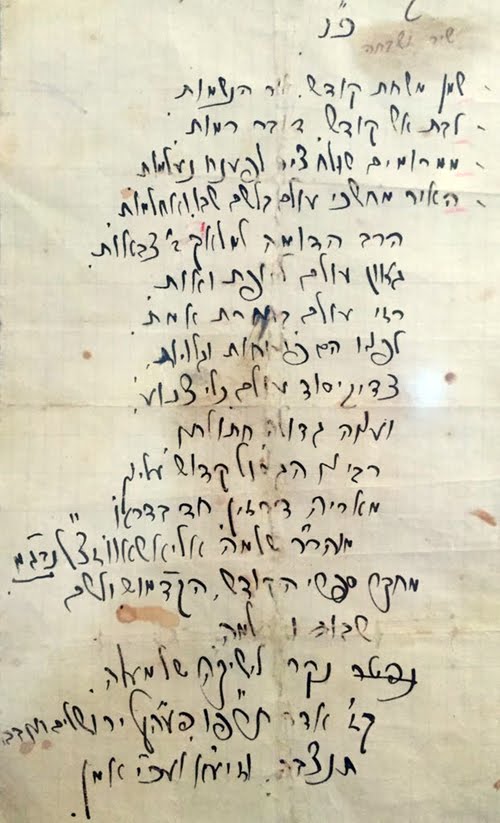

Here is buried
Holy anointing oil, the light of souls
A torch of holy fire, speaker of heights
Sent from on-high to reveal the concealed
Enlightened the darkness through Leshem Shevo v-Achlomot
The Rav like an Angel of God
Genius of the world signified and clear
Secrets of the world in the Torah of truth
Revealed and opened before him
Righteous pillar of the world, vessel of modesty
A great humility in his roots
Our great teacher supernal holiness
Master of secrets unique in his generation
Our teacher R. Shlomo Elyashiv zt”l nbg”m
Author of the holy books Ha”Kadosh v-Leshem Shevo v-Achloma
Called to the Heavenly academy
27th of Adar 1925 here in the holy city of Jerusalem
May his soul be engraved in eternal life
and may his merit protect us Amen

–Rav Avraham Yitzhak Ha-Kohen Kook’s handwritten epitaph for Rav Shlomo Elyashiv, from Rav Kook, which is made available here courtesy of the private collection of Reb Shlomo Gross.

Lurianic Mysticism

When R. Issac Luria (1534-1572) known as the Arizal, developed his theosophical system often referred to as Kabbalat Ha-Ari or Lurianic Mysticism, he initiated a revolution within the Jewish mystical tradition.[1] In the margins of his predecessor and teacher R. Moshe Cordevaro (1522-1570) and through a highly innovative form of Zoharic hermeneutics, the Arizal established a radical approach to the ancient theories of Jewish cosmology (tzimtzum, shevirat ha-keilim), theurgy (kaavanot) and eschatology (tikkun). Codified by his various disciples, primarily R. Chaim Vital (1542-1620) and R. Yisrael Sarug (1590-1610), the Lurianic system took form in the work Eitz-Chaim and the eight volumes of collected teachings known as Shemoneh-Shearim.[2] After the Arizal’s passing, it was generally agreed upon that the Lurianic corpus should, and would remain a closed system, one in which novelty and creativity from subsequent scholars was discouraged and even prohibited. The treatment of the Lurianic corpus as a sacred textual matrix in which creative hermeneutics are discouraged appears to stem from epistemological as well as philological phenomenon. On the epistemological register, the esoteric material being elucidated within the Lurianic system was viewed as an exceedingly sensitive body-of-work that demanded a high level of secrecy and concealment.[3] Only the most spiritually refined individuals were seen as worthy and capable of processing the complexities of the kabbalah. While the political secrecy surrounding the Arizal and his disciples was not a new phenomenon in the history of Jewish esotericism; the emphasis placed on character refinement, both spiritual and physical, for the sake of initiation into the ranks of talmidei ha-Ari is noteworthy. The danger of an unqualified and inexperienced student imposing his own imaginative interpretations upon the system was seen as a potentially catastrophic event with both spiritual and historical consequences.[4] On the philological register, the Arizal himself imposed strict prohibitions upon his disciples regarding the sharing or revelation of his insights, thus creating an economy of occlusion in which his ideas flourished within the strict contours of secrecy. Historically, the Arizal’s pedagogical methods perpetuated the veil of secrecy that kept his teachings hidden while simultaneously enabling them to be collected. Much like the rabbinic sages of the Talmud, R. Issac Luria maintained a strict orality while teaching his disciples. Continuing the rabbinic model wherein oral teachings are associated with a direct teacher-student relationship in which the risk of mistakes and misunderstanding is mitigated, the Arizal delivered his teachings in small groups, often prohibiting his students from textually recording his lessons. It wasn’t until the Arizal was near death that he allowed his disciple R. Chaim Vital to exclusively record his teachings posthumously.

Interpretations of the Lurianic system

While various attempts at interpreting the Lurianic system following R. Issac Luria’s passing did exist, it wasn’t until the seventeenth-century that authoritative schools of interpretation were born. Generally speaking one may categorize four primary approaches towards Kabbalat Ha-Ari in which the Lurianic system was expounded while simultaneously adhering to the strict prohibition of creating concepts that had not been directly recorded by R. Chaim Vital. While each school contained followers who differed from the founding member, the four major personalities associated with unfolding the Arizal’s system were R. Moshe Chaim Luzzatto (1707-1746) known as the Ramchal, R. Elijah of Vilna, known as the Gaon of Vilna (1720-1797), R. Shalom Sharabi (1720-1777) known as the Rashash, and R. Yisrael ben Eliezer (1700-1760), known as the Baal Shem Tov. Respectively, each school can be said to have utilized a different mode of hermeneutical interpretation in emphasizing what they viewed as the fundamental aspect of Lurianic Kabbalah, or Kabbalat Ha-Ari. For Ramchal and his Padua school[5] an emphasis was placed on unpacking the metaphorical nature of the Lurianic system for the purpose of revealing the various modes (hanhaagot) in which the Divine is manifest throughout history, culminating with the metahistorical eschaton in which all will be rectified (tikkun) and unified (yichud). For Rashash and the Jerusalem kabbalists of the Beit El Yeshiva[6] the emphasis was placed almost exclusively on the theurgical nature of religious phenomenology, expounding and developing a highly complex and intricate system of mystical intentions (kavaanot) associated with prayer and religious ritual. The Baal Shem Tov,[7] founder of the Hasidic movement along with his early students read and translated the intricate details of Kabbalat Ha-Ari unto the psychological register, transferring the locus of the Arizal’s system from the hidden depths of the Godhead to the hidden depths of the individual soul, thereby democratizing the once guarded secrets of concealed wisdom (chochmat ha-nistar). The School known as Kabbalat Ha-Gra or Lithuanian Kabbalah,[8] consisting of the Vilna Gaon and the select disciples who learnt directly or indirectly from him, emphasized the spiritual nature of temporality and history with a focus on the Messianic personalities who actively participate in the apocalyptic eschaton, as well as the biblical allusions towards the Lurianic system.

Fourfold of Kabbalistic PaRDeS

It has been suggested that these four schools of Kabbalistic interpretation be compartmentalized according to the fourfold structure of rabbinic hermeneutics known as PaRDeS[9]- an acronym for Peshat, the literal meaning; Remez, the allegorical meaning; Drash, the moral meaning; and Sod, the secret meaning. Generally speaking the gamut of Jewish esotericism-including Kabbalat Ha-Ari- represents the realm of Sod, and as such these four schools of thought would represent the specific substructure of PaRDeS as applied to the Sod of the general structure of PaRDeS. The Rashash and his school primarily engage the textual edifice of Kabbalat Ha-Ari, unearthing apparent contradictions within the system itself while reconciling them through an innovative theory of relativity (erchin) represent the literal approach (Peshat) to the Arizal’s system. The Gra and his school exemplify the allegorical approach (Remez) by utilizing the various forms of creative hermeneutics- primarily sacred numerology (Gematria) and acronyms (Roshei Tevot)- to uncover allusions and intimations signifying aspects of the Lurianic system within biblical texts. The attempt of the Ramchal and his school to uncover the latent meaning within the metaphors of the Arizal represents the moral approach (Drash) in which the externalities of the system are plumbed and simultaneously shed to reveal the inner kernel of meaning. Finally, the Baal Shem Tov and the Hasidic approach, by translating Lurianic ontology into psychological terms represent the essential secret (Sod) wherein the spiritual seeker finds the entirety of existence within themselves thus enabling a unique form of dynamic divine service.

R. Shlomo Elyashiv: Leshem Shevo v-Achloma

R. Shlomo Elyashiv (1841-1926) known as the Leshem after his vast body-of-work Leshem Shevo v-Achloma was a Lithuanian Kabbalist known for his adherence to the school of Kabbalat Ha-Gra.[10] Described as the fourth stage, or peh revieeh within the chain of talmidei ha-Gra, the Leshem formed a system in which the apparent contradictions between the Vilna Gaon and the Arizal were reconciled through a unique form of Kabbalistic analytics. R. Avraham Yitzhak ha-Kohen Kook, close friend and student of the Leshem described R. Elyashiv as applying Talmudic analytics (pilpul) onto the Lurianic corpus thereby clarifying and reconciling the various contradictions and textual ambiguities.[11] With an exhaustive knowledge of the gamut of Jewish esoterica- from the philosophic rationality of the rishonim to the complex intricacies of R. Chaim de La Rosa’s Torat Chachom[12]- the Leshem can be described as one of the most comprehensive as well as creative Kabbalistic thinkers of the late 19th and early 20th century. Born in Zagory, a small city in northern Lithuania, R. Elyashiv was raised studying Talmud with his father R. Chaim Chaikl Elyashiv until leaving home to study under the tutelage of R. Gershon Tanchum of Minsk where he became known for his Talmudic expertise. After his marriage to the daughter of R. Dovid Fein the Leshem went on to study at the Telshe yeshiva where his intellect and vast memory earned him the appellation of Telsher illui. While in Telshe the Leshem was introduced to chochmat ha-nistar by his teacher R. Yosef Reissen who then served as the Rav of Telshe. While learning in Telshe, R. Elyashiv became familiar with the fundamental texts of Jewish mysticism, learning the Pardes Rimonim of R. Moshe Cordevero as well as the Vilna Gaon’s commentaries on Sefer Yetzirah, Safra D’Tzniyuta and the Tikkunei Zohar. Only afterwards did the Leshem begin studying the system of the Arizal and it’s commentaries. R. Aryeh Levin who served as R. Elyashiv’s assistant after the latter’s move to Jerusalem includes within the curriculum the texts of R. Moshe Chaim Luzzato as well; however the distinctive relationship between R. Shlomo Elyashiv and the Ramchal’s school of Lurianic mysticism will be discussed below. After leaving Telshe, the Leshem settled in Shavel, Lithuania where he began to write what would become his vast oeuvre known as Leshem Shevo v-Achloma. In 1922, through the help of Rav Avraham Isaac haKohen Kook and Rav Yitzhak haLevi Herzog,[13] R. Shlomo Elyashiv moved to Jerusalem with his family where he eventually passed away on the 27th of Adar in 1926. While never accepting upon himself any form of communal leadership, the Leshem became known as the preeminent scholar of Kabbalah, through his written works, glosses, vast reaching editorial skills and the various rabbinic personalities with whom he studied and taught.[14]

Leshem Shevo v-Achloma: Overview of Texts

R. Elyashiv’s oeuvre generally referred to as Leshem Shevo v-Achloma is comprised of four separate yet highly integrated volumes.[15] While a comprehensive overview of each work is far beyond the scope of this essay, what follows is an attempt to describe the framework and context of each sefer. The four Kabbalistic works are Leshem Shevo v-Achloma: Hakdamot u-Shearim (1909); Leshem Shevo v-Achloma: Drushei Olam ha-Tohu (1911); Leshem Shevo v-Achloma: Klalei Hitpashtut v-Histalkut (1924); and Leshem Shevo v-Achloma: Chelek ha-Biurim (1935).

Leshem Shevo v-Achloma: Hakdamot u-Shearim

Known as Sefer Hakdo”Sh,[16] this work serves as an introduction to Kabbalat ha-Ari for the novice student, clarifying such concepts as Divine names, unity of God and the mystical anthropomorphization of God. In an attempt to simplify the complexities of Lurianic Kabbalah, R. Elyashiv sets forth a five staged multileveled process through which Ein Sof becomes manifest in/as reality. There is nothing particularly original in the Leshem’s depiction of a five stage process, an idea that is ever-present in the Lurianic system of partzufim. The novelty of Sefer Hakadosh, however, may be found in the Leshem’s configuration wherein the five partzufim; Arich Anpin, Abba, Immah, Zeir Anpin and Malchut are analogously aligned with the five-tiered revelatory process (seder ha-gilluim) in which the latent potentiality of existence emerges as the manifest actuality of creation. These stages, or orders-of-revelation are Ein Sof; Tzimtzum/Kav; Adam Kadmon; Atzilut; and the triadic unit Beriah,Yetzira and Asiya (BY”A). Working with certain Lurianic axioms as refracted through Rashash’s concept of hitklalut v-hitkashrut (integration and redistribution),[17] R. Elyashiv depicts a highly integrated system in which each general stage (seder klali) encompasses a subsystem (seder prati) wherein the five stages operate in a self-contained manner. Thus for example, the general partzuf of Abba- analogous to the revelatory stage of Adam Kadmon- contains within itself a subsystem comprised of every other partzuf and/or gillui. Far from a theoretical divergence into complexities, this multivalent system wherein each part contains the whole rests at the foundation of the Leshem’s system of integration (seder ha-klilut) and secret of unity (sod ha-achdut). The first seven gates of Hakadosh discuss each revelatory-stage in detail including the interconnection between each stage, thus engaging the reader in a textual excursion through the basic framework of the Lurianic system. The eighth gate in Hakadosh– titled Shaar ha-Poneh Kadim– comprises a work unto its own. Here R. Elyashiv undertakes the formidable task of elucidating the Kabbalistic system of R. Yisrael Sarug, commonly referred to as Olam ha-Malbush. While an overview of Olam ha-Malbush as refracted through the works of R. Naftali Hertz Bacharach and R. Menachem Azariah of Fano is far beyond the scope of this essay, R. Elyashiv’s decision to include R. Sarug’s depiction of “hidden mysteries that begin far beyond the worlds described in the writings of our master R. Chaim Vital,” is a significant gesture regarding the source and validity of the Sarugian system.[18]

Leshem Shevo v-Achloma: Drushei Olam ha-Tohu

Drushei Olam ha-Tohu – or Deah as it is known – is a monumental work that deals primarily with the Lurianic cosmological theme Olam ha-Tohu, the world(s) of chaos. Comprised of two parts, Sefer haDeah examines the primordial cataclysm known as the shattering of the vessels (shevirat ha-keilim). For the Leshem, this event- known as the death of the Edomite kings (mitat malchei edom) after the biblical account in parshat VaYishlach– serves as the pre-original opening through which the entirety of history unfolds. Far beyond a simple depiction, or elucidation of this Lurianic motif, part one discusses the “roots and foundations, existence and kingship, death and shattering” of the primordial kings, as well as “the ramifications that are born through this process, the source and the purpose of all this and the general process of rectification.”[19] According to R. Elyashiv the shevira was not an isolated event whose effects were limited to immediate consequences, rather, it serves as the traumatic source of everything that follows.[20] The stage of tohu– and all that transpires therein- is the constitutive break through which history gains its subjectivity. On a psychoanalytic register, not unlike Freud’s original seduction theory, the shattering of the vessels and the subsequent chaos represents the original trauma whose symptoms constitute the subject, as opposed to preexistent subject who experiences the symptoms. The worlds of tohu, resting at the beginning- before the beginning- accompany the historical process, concealed from sight, imposing and composing the ebb and flow of shevira and tikkun, shattering and rectification, which make up history.[21] Part one examines the roots of the necessarily imperfect tohu, from its most concealed source to its revealed manifestation as the existential condition of this-worldliness (olam ha-zeh or asiyah). Part two of Sefer haDeah, while similar to part one in that it deals with the various states of pre and post-shattered existence, is unique in both its conceptual arrangement as well as its area of focus. In part one the Leshem utilizes the complexities of the Lurianic system as well as the textual contradictions therein to slowly build his system. The second chelek assumes that the reader has a knowledge of these complex details and moves beyond the pratim to engage the biblical and historical manifestations of the framework described in the first chelek. R. Elyashiv sees the basic structure of shevira-tikkun, or chaos-order as a pattern that incessantly reasserts itself unto the stage of history. Moving from Adam ha-Rishon’s prelapsarian state, through the primordial serpent’s seduction, the Leshem illuminates the subterranean flow of Divine interpolation which he calls nora ahlilah based on the verse in Psalms (66:5), “Lichu u-riuh mif’alot Elokim nora ahlilah al bnei adam.” R. Elyashiv moves from Adam ha-Rishon’s expulsion from Eden to the narratives of Abraham, Isaac and Jacob, interweaving Lurianic interpretations with his distinctive focus on the delicate balance between the forces of tohu and tikkun. From there the Leshem goes on to describe the concealed essence of Knesset Yisrael’s movement from Egyptian servitude, the exilic wanderings in the wilderness, and the eventual climactic experience at Har Sinai. The Leshem continues clearing a path from Israel’s unconscious repetition of the shevira as embodied in the collective event of Cheit ha-Eigel towards the eschatological advent as depicted in the Rabbinic feasts of the righteous wherein the enigmatic Leviathan, Behemoth and Ziz Shadi take on immense Kabbalistic significance. The second chelek also includes an extensive treatment of the Talmudic narrative of the four who entered the Pardes as well as an analysis of R. Akiva and his nonlocal relationship with Moses. The Leshem closes Sefer haDeah with various maamarim that while related to the concepts expressed in Dea”h comprise a separate unit; these include Drush Eitz ha-Daat; Drush Sfeikot Iggulim vi-Yosher; and Drush Mi’ut ha-Yareiach.

Leshem Shevo v-Achloma: Klalei Hitpashtut v-Histalkut

Klalei Hitpashtut v-Histalkut- or Sefer HaKlalim as it is referred to- can be described as R. Elyashiv’s most difficult as well as significant work. Following the Arizal’s depiction of the dialectical process through which existence comes-to-be as described in Eitz Chaim- particularly Shaar Mati v-lo Mati and Shaar ha-Akudim- the Leshem builds a system wherein each stage of revelation contains within itself a subsystem of Hitpashtut, egression and Histalkut, regression. In laying out the framework of this work, R. Elyashiv describes a comprehensive system “In which we will speak regarding the weaving and concatenation of the worlds. From the heights of the most elevated world to the limit of the lower worlds, Briah, Yetzira and Asiyah.”[22] For the Leshem the constant ebb and flow in which existence is revealed in order to be concealed as it is concealed in order to be revealed marks the basic structural framework that enlivens reality.[23] The dialectical play of egression/revelation and regression/concealment that serves to produce each subsequent stage of existence opens into the fourfold process of Hitpashtut Alef; Histalkut Alef; Hitpashtut Beit; Histalkut Beit. Generally speaking, through the act of Hitpashtut, the prior plenitude- seen as infinite relative to the ensuing stage- undergoes a process of concealment, akin to the first Tzimtzum in that, paradoxically, the prior levels concealment allows the next level to transition from its covert potential within the previous level into the overt manifestation as the new stage in existence. Next, with the first Histalkut, the new level now revealed undergoes a process of regression where what has become manifest returns to its previous source, leaving behind a roshem, or trace thus engraving a potential space in which the new level will eventually concretize. While an overview of this complex dynamic is far beyond the scope of this essay the main goal for the Leshem is to show how each and every stage can trace “their roots and spacing within the world of Adam Kadmon, both the details and the details of the details. To show how they are all eternally rooted and unified there, from the initial thought until the limit of action.”[24] In emphasizing the significance of this system, there is no better description than the words of R. Elyashiv himself, printed on the title page of the sefer:

And the concept of the two Hitpashtiut and the two Histalkiut is as follows, for the Creator blessed be His Name has established the entirety of existence- the totality of which stems only from the surge of His blessed light that is revealed through His actions and his hanhagot from eternity to eternity- He has established it upon the concatenation of many stages, one below the other; and each stage is a totalized system and the entirety of a world, and that which is in this one is in that one as well, with each subsequent stage drawing from the preceding stage situated above it; and now each world has its source above it from which it is drawn and in/through which it exists; and upon this rests the two Hitpashtiut and the two Histalkiut, for the first Hitpashtut and Histalkut form the supernal source of each world that remains above, and the second Hitpashtut and Histalkut form the essential existence of each world in its physical space below. And now, these stem from the light of the Name Yud-Hei-Vav-Hei that shines in each and every world. The first Hitpashtut and Histalkut stem from the letters Yud-Hei of the Name, and the second Hitpashtut and Histalkut stem from the letters Vav-Hei of the Name.”[25]


Sefer Ha-Klalim is made up of two parts discussing each stage of existence and the fourfold process of Hitpashtut and Histalkut that occurs therein. The second chelek is primarily comprised of perek eighteen, anaf ten, or Chai Ani (Yud-Cheit, Anaf-Yud) which the Leshem describes as “the sum total of all of my teachings to show the interconnection of everything within A”K and A”K within everything.” Due to the highly complex nature of this system- running from the unconscious depths of the concealed Godhead to the existential reality of this-worldliness- the Leshem appended a chart in which the system of 52 integrated manifestations of the Tetragrammaton are codified and elucidated.

Leshem Shevo v-Achloma: Chelek ha-Biurim

In Chelek ha-Biurim R. Elyashiv undertakes the enormous task of writing a “wondrous and detailed elucidation of the entirety of the Holiest of Holy, the Arizal’s Eitz Chaim.” While numerous works have been written on Sefer Eitz Chaim, simplifying and clarifying the Lurianic system, the Leshem’s vision lay beyond the normative approach to the text. For the Leshem, R. Chaim Vital’s Eitz Chaim represents a work whose “words are blocked and closed off, concealed by ancient days, as R. Chaim Vital wrote in his introduction, that all that has been revealed to us is nothing but the revelation of a singular handbreadth through the concealment of thousands.” As such, a worthy depiction of the Lurianic mosaic assembled within the gates of Eitz Chaim demands a resistant reading in which the work is read against itself in the hopes of revealing that which has remained concealed within the text. Rooting himself in the “deep wells of the holy Ari and Gra from who’s milk I have suckled and from who’s water I have drawn and drank” the Leshem seeks to “reveal the cherished light and archival secrets…deep beyond depth, elevated beyond height” that rests at the core of Eitz Chaim. In order to do this, R. Elyashiv works through the text, opening that which was closed through an incessant mode of questioning. Taking no statement for granted, the Leshem examines each idea through a hermeneutics of suspicion where the content of Eitz Chaim is measured and compared to similar and dissimilar concepts throughout the Lurianic corpus. When contradictions and textual ambiguities arise, the Leshem utilizes his unique mode of Kabbalistic analytics (pilpul) in reconciling the opposing texts by clearing a new path in which both statements are seen as augmenting one another. Arming himself with Rashash’s conception of Kabbalistic relativity known as archin, R. Elyashiv interprets Eitz Chaim as a dynamic system whose parts can only be properly understood with an intimate knowledge of their particular context. While the Leshem did undertake the enormity of this task, we have only been left with a biur up to Shaar Ha-Nekudim, Perek Gimmel leaving the majority of Eitz Chaim without commentary. The hundreds of pages it took R. Elyashiv to explicate such a small fraction of Eitz Chaim leaves one pondering the sheer vastness of the Leshem’s vision.

Mitnagdic Kabbalah

From a historical perspective Rav Shlomo Elyashiv served an important role in bridging the gap that existed between the Lithuanian world of the yeshiva and baalei mussar and the world of Lurianic Kabbalah. Throughout his time in Lithuania the Leshem studied Kabbalah with R. Yisrael Meir haKohen Kagan,[26] R. Elya Lopian,[27] R. Yosef Leib Bloch,[28] R. Yitzchak Blazer,[29] R. Yeruchem Levovitz,[30] and R. Yosef Yuzel Horwitz.[31] A more significant, yet historically ambiguous relationship was the purported interaction between R. Elyashiv and the founder of the Mussar movement, R. Yisrael Salanter.[32] The Leshem’s engagement with the various rabbinic personalities-most of who served as leaders of Lithuanian yeshivot- may be viewed through one of two sociohistorical lenses. As an adherent of the school referred to as Kabbalat ha-Gra, R. Shlomo Elyashiv represented a dying breed of mitnagdic-mysticism.[33] While never engaging the political polemics surrounding the mitnagdic/hasidic debate, the Leshem was a strong advocate for a clear and exacting approach to the Lurianic corpus, in contradistinction to the “Hasidic” approach in which the Lurianic system underwent a form of imaginative and psychological revisionism. It is important to note that while the Leshem appears to have associated this mode of interpretation with the “Hasidic” explanation of Kabbalat ha-Ari, he by no means viewed it as a uniquely Hasidic phenomenon. Many of the critiques leveled by R. Elyashiv were in fact directed towards R. Naftali Hertz haLevi, author of Siddur ha-Gra be-Nigleh u-Nistar who represented “those who delve too deeply into the system of Ramchal, interpreting the words of the Arizal as imaginative principles (maareh ha-nevuah).”[34] Nevertheless, by associating with rabbinic personalities who represented the mitnagdic elite, the Leshem maintained his position as a Lithuanian mekubal, one who continued the path of the Vilna Gaon.

Messianic Mysticism

Another possible explanation for R. Elyashiv’s vast interactions with the rabbinic elite of his time has less to do with his spiritual/political predilections and more to do with the Kabbalistic subject matter itself. Following a long tradition in which the expansion and expression of Kabbalistic studies was seen as a fundamental stage within the Jewish eschatological process,[35] the Leshem viewed his historical situatedness as signifying his personal spiritual mission. The spiritual and historical significance as well as the strident dereliction of Kabbalah study that the Leshem saw in his generation may have influenced R. Elyashiv’s emphasis on teaching and sharing his knowledge of chochmat ha-nistar. In one text the Leshem decries what he saw as the rabbinic elite’s disregard of Kabbalah as follows:

And I am amazed with some of the wise ones of our generation (chochmei ha-dor), for they have no knowledge in this area whatsoever, how can they manage without engaging chochmat ha-emes, that is pnimiyut ha-Torah, and it is strange in their eyes to the point that they know nothing about it. And all of their answers and excuses are meaningless after what is written in Eruvin (55a), “it is not in heaven, and if it was in heaven you must ascend after her, and if she is beyond the sea, you must cross after her,” and it is apparent that this applies to all areas of Torah…including the esoteric aspect (chelek ha-nistar)…and the chelek ha-nistar transcends all other areas [of Torah].”[36]

Elsewhere, R. Elyashiv quotes from R. Yisrael Salanter in describing the unique historical moment in which the secrets of the Torah (sodot ha-Torah) were now accessible to all who were interested:

And permission has been granted to all those who engage this wisdom to understand these ideas, each according to their level. And specifically from the year taf-reish (1840)[38] and onwards as it is written in the Zohar (2:117), “and in the six-hundredth year of the sixth millennia, the gates of the higher-wisdom (chochma li-ailah) were opened,” and what [the Zohar] meant in writing “opened,” this means to say that permission has been granted to all those who yearn to cleave with the living God (Elokim Chaim), to engage chochmat ha-emes, to enter and to utilize the Name properly. And anyone who delves into this matter will be enlightened and find that this was not the case before the year taf-reish (1840), because then it was still hidden and enclosed, except for a few exceptional individuals, so have I heard in the name of the gaon and chossid R. Yisrael Salanter z”l, and all of this is rooted in the revelation of supernal light that is revealed above and egresses below, as it draws into this world (olam ha-zeh) additional light and the secrets of Torah are revealed in order to rectify (tikkun) the world for the eventual rectification.”[37]

Ignorance coupled with what the Leshem saw as a historically unique time in which sodot ha-Torah were accessible to all may have influenced R. Elyashiv’s drive to engage those rabbinic personalities hitherto unaffiliated with the Kabbalistic system.

R. Elyashiv and R. Avraham Isaac Hakohen Kook

Another significant relationship centered around R. Elyashiv’s expertise in Lurianic Kabbalah was the friendship between the Leshem and the first chief rabbi of Israel, R. Avraham Isaac Hakohen Kook.[39] Serving as a young Rav in the town of Zaumel, Lithuania, R. Kook sought to resolve the “questions and difficulties with some foundational ideas in chochmat ha-nistar” [40] that had arisen in his studies. With permission from the members of his community, R. Kook travelled to Shavel where he spent a month studying and learning from the elder Rav Shlomo Elyashiv. From that point on Rav Kook and the Leshem continued their relationship, exchanging letters, with R. Kook eventually procuring the documents necessary for R. Elyashiv and his family’s move to Jerusalem.[41] R. Kook saw the Leshem as a unique link in the chain of Jewish mysticism, reportedly commenting on the latter’s work Leshem Shevo v-Achloma: Hakdamot u-Shearim (Hakdo”Sh) that “from the time of R. Moshe Cordevaro there has been no sefer in chochmat ha-emet that grasps and expounds the subject matter like the sefer Hakdamot u-Shearim.”[42] Thanking the Leshem for sending his newly published manuscript, R. Kook wrote: “The house was filled with light upon the appearance of his holy book. I cannot convey to my soul-friend my feelings of inner happiness from the good light. In its yet unbound state, I have already devoured several pages, so enamored am I. It was sweet as honey to my mouth.”[43] R. Aryeh Levin, close student of R. Kook and assistant to R. Elyashiv in Jerusalem describes many nights during which the Leshem and R. Kook would study sifrei kabbalah from midnight until the early morning. R. Kook’s sense of a “divine bond in the depths of the heart”[44] existing between himself and Leshem was reciprocated by the elder R. Elyashiv who saw in the chief rabbi “a vast knowledge and unification of all variant Kabbalistic positions (shitot) and one who has earned the description of “no secret being removed from him” (kol raz lo anis leh).”[45] After the Leshem’s passing shortly after arriving in Jerusalem, R. Kook eulogized the great mekubal and composed the epitaph marking R. Elyashiv’s kever, a lasting testimony to their significant relationship.[46] While there has been no scholarly attempt at identifying the Leshem’s influence on the thought of R. Kook, the overlap in both thinkers approach to the spiritual significance of history as well as the utilization of R. Azriel of Geroni’s concept of the “potential (for) limitation within the unlimited (koach ha-gevul bi-bilti gevul)” is significant. It is important to note that while R. Kook and R. Aryeh Levin appear to have viewed R. Elyashiv’s approach to the Lurianic corpus as authoritative, this was not the case for R. Kooks other students comprising the chug ha-rayah. Both R. Yaakov Moshe Charlop[47] and the R. Dovid Cohen regarded the Leshem’s critical view of Ramchal’s interpretative reading of the Arizal as problematic. While the details of R. Elyashiv’s critical approach towards Kabbalat Ramchal will be discussed in a future essay, it appears that the critique of R. Charlop and R. Cohen, both deeply influenced by Ramchal, was more reactionary than substantive.

Leshem Shevo v-Achloma and the Kabbalists of Beit-El

Described by R. Yosef Chaim of Baghdad as the “lion of secrecy (Ari bi-Mistarim),”[48] it is surprising that R. Elyashiv’s vast body-of-work known generally as Leshem Shevo v-Achloma has been all but ignored by both the traditional and academic schools of Kabbalah study. Within the Haredi network of Kabbalah yeshivot the Leshem’s works are seen as important contributions towards the explication of the Lurianic system, but by no means have they entered the limited curriculum of primary texts comprising the “meforshei ha-Ari.” Only the glosses written by R. Elyashiv under the title ha”ShevaCh (Shlomo ben Chaikl) on the first half of Eitz-Chaim- compiled and printed in R. Menachem Menchin Halperin’s Hagaaot u-Biurim– have received treatment in the writings of sefardi mekubalim.[49] While greatly respected by the sefardic Kabbalists of his day- two works by R. Shaul Dweck ha-Kohen were printed with approbations from the Leshem[50]- his works did not enjoy the same treatment. Those following the sefardic approach to Kabbalat ha-Ari- namely the texts of R. Shalom Sharabi and his students- pay little or no attention to the texts of R. Elyashiv due to the fact that he is considered an adherent of the Vilna Gaon’s school whose focus on the allegorical nature of Kabbalat ha-Ari differs from the attempt to uncover the “depth of the practical meaning”[51] (omek ha-peshat). A point that remains to be shown however, is that while R. Elyashiv did not align himself with the interpretative approach of R. Sharabi and the Kabbalists of Beit-El; he engaged their texts both intellectually- composing a short peirush to Rashash’s Rechovot ha-Nahar[52]– and practically, editing R. Dovid of Agier’s Kuntreis Chasdei Dovid.[53] The Leshem’s respect and engagement with the system of RaSha’’Sh becomes clear with the following passage in which R. Elyashiv praises R. Sharabi’s interpretation regarding shvirat ha-Melachim as a process affecting each particular (prat) as opposed to the collective (Klal) understanding:

And the words of our teacher Rashash are alive and sustained, and who like him descends to the depths of the abyss, drawing depth from the depths on each statement of the Arizal. We have seen as well by all the great chochmei sefard who have followed him, in particular the great R. Chaim de la Roza in his work Torat Chochom which engraves a path following him at every point, raising vast treasures on all of his words.”[54]

With this level of admiration and engagement with the thought of Rashash the conscious ignorance on behalf of chochmei sefard of R. Elyashiv’ texts becomes more conspicuous. However, a recently rediscovered letter the Leshem wrote to R. Menachem Menchin Halperin helps shed light on the (non)relation between sefardi mekubalim and the Leshem:

And now my dear friend I will not refrain from informing you that which is within my heart, for I have seen how the great chochmei ha-sefardim- may the supernal sweetness be upon them eternally- align the teachings of our holy teacher R. Shalom Sharabi [in relation] to the teachings of the holy Ari, as they do regarding the oral law in relation to the written law. However in my opinion this does not stand with me. Because regarding the words of the holy R. Shalom may his merit protect us, here I will state that while in truth many of the teachings from his holy words are fundamental and essential regarding the depth of Torat ha-Ari without which it is difficult to grasp the truth; in general his approach is but one facet in the Torat ha-Ari, and it is possible to understand them properly, in my opinion, with other approaches as well, for there are many faces to Torah, and it is not necessary to understand them with his holy path (derech) alone. Furthermore his holy derech is sharp (charif) and very very deep and not every mind can handle this (lav kol moach savil da) and it is possible to understand based on a simpler and easier derech, as I have shown and seen in numerous places that God has graced me with.”[55]

From this letter it is clear that while R. Elyashiv held the Rashash and his derech in high esteem, by no means did he view it as the authoritative and essential approach to the writings of the Arizal. The Leshem’s opinion regarding the teachings of R. Sharabi runs counter to the hyper-essentialism with which the talmidei ha-Rashash viewed his approach. Whether or not this letter was known to the Kabbalists of Beit-El, R. Elyashiv’s stance may have influenced the disassociation from his writings.

Leshem Shevo v-Achloma and Kabbalat ha-Gra

Within the Ashkenazi world of Kabbalah, sifrei Leshem Shevo v-Achloma have experienced a significantly stronger engagement which has been both deeply respectful as well as revisionistic. Considered a student of the Vilna Gaon’s approach to kabbalah, R. Elyashiv differs from the other talmidei ha-Gra in that he had no direct line linking him to the Gra’s teachings. Both R. Chaim Volozhiner (1749-1821) and R. Menachem Mendel of Shklov (d. 1827), considered the main students of the Gra were taught the Lurianic system directly from him. R. Yitzchak Issac Haver (1789-1853), considered peh shlishi in the school of Kabbalat ha-Gra was a student of R. Menachem Mendel of Shklov, and devoted much of his effort towards developing a unifying system wherein the disagreements between the Arizal and the Gra were reconciled.[56] By grafting together the teachings of the Gaon with those of the Arizal in his Pischei Shearim, R. Haver attempts to show that the derech of the Gra is the derech of the Ari. Many of R. Haver’s other writings are direct peirushim on various works of the Vilna Gaon, thus emphasizing his place as an authoritative student. R. Haver’s main disciple, R. Yitzchak Kahane-Kellner- whose three-volume Toldot Yitzchak contains a commentary on the Gra’s peirush to Sefer Yetzirah– spent most of his later years creating institutions in Jerusalem whose sole purpose was to be the study and expansion of the Vilna Gaon’s kabbalistic writings. The Leshem on the other hand had no teacher linking him to the Vilna Gaon, nor did he devote any text to the primary treatment of Kabbalat ha-Gra. Although R. Elyashiv was deemed worthy of editing the writings of the Gra by R. Shmuel Luria of Mohilev and R. Dovid Luria, this did not translate into his works being treated and studied as fundamental texts within the system of Kabbalat ha-Gra.

Current Trends in Leshem Shevo v-Achloma Study

In recent years the writings of the Leshem have seen renewed interest within the Haredi world of Kabbalah study with newly edited editions as well as supplementary works being published. This development however can be divided into two schools of thought; one in which the texts Leshem Shevo v-Achloma are treated as a complex system in which the Lurianic system undergoes an intensive and analytic treatment, thus preserving the difficulty and detailed nature of the text; and one in which Leshem Shevo v-Achloma undergoes a process of simplification for the sake of popularization. Regarding the former, the texts of the Leshem are being edited and reprinted for the primary purpose of textual emendations. In addition, sources as well as footnotes have been added, directing the reader to the source material utilized by the Leshem. Furthermore, various seforim have been published in which the system of the Leshem is treated and clarified. A prime example of this approach is the recently published Yud-Gimmel Maarachot[57] in which the author elucidates the Leshem’s highly complex system of 52 integrated manifestations of the Tetragrammaton that serve as the basic infrastructure running from the recesses of Ein-Sof down to the coarse reality of this-worldliness. This is historically significant in the sense that never before have there been texts solely devoted to understanding R. Elyashiv’s system. With regards to the latter school, the Leshem’s texts have been combed with the redactors culling the philosophical and aggadic material discussing creation, free-will, and matters of faith while discarding the complex Kabbalistic subject matter. The primary example of this approach is the work entitled Shaarei Leshem Shevo v-Achloma (Barzani, 1993), in which R. Yehoshua Edelstein “collected, in full without any change from the holy books Leshem Shevo v-Achloma.”[58] This likkut has two parts; the first contains “a clarification of the fundamentals of faith and worship,” while the second discusses “the order of creation and concatenation (hishtalshlut) in time leading towards the full rectification, may it come speedily in our days.”[59] While the publisher acknowledges that this work serves only as an “opening of the gate to the works of the Rav who is like an angel of God (rav ha-domeh li-malach Hashem) the expert (gaon) in torat emet”[60] it appears to have taken the place of the primary texts for many and as such the actual works comprising Leshem Shevo v-Achloma have been overlooked.

R. Moshe Shapiro: The Popularization of Leshem Shevo v-Achloma

This phenomenon in which the texts of the Leshem undergo the “occasional deletion of a passage so as not to include matters of concealment (nistarot)”[61] for the sake of making them “equal to every searching ben-torah” has taken place primarily within the school of R. Moshe Shapiro and his students. Viewed by many within the Haredi world as the preeminent baal-machshava, R. Shapiro is purported to see in the Leshem– who he describes as “a giant, discordant with the nature of our lowly generation, sent to enlighten our eyes and enable us to grasp a miniscule taste of the depths of torah”[62]- a paradigm of authentic hashkafat ha-torah. In a letter reprinted in Shaarei Leshem[63] at the behest of the Leshem’s grandson R. Yosef Shalom Elyashiv, R. Shapiro explains the rational for publishing a collection of texts taken out of context as follows:

Many have been asking and searching, who will give us faithful waters to drink from the well of living water, the seforim of our master (the Leshem) that were given over closed (chatumim), and they are yearning to find an opening, one that does not engage the depth of the sugyot in the Zohar and writings of the Arizal. And it is known that many of the drushim open gates in the knowledge of God, the fundamentals of faith and yearning for redemption that each Jew is commanded to know, and in our generation in which the wicked ones surround us and things are “cheapened in the eyes of men” and anything that stands at the height of the world is cheapened and lowered to the dust, it appears to be a “time to act for God” (ait laasot la-Hashem), to open an opening for the masses to the enlightened writings that cleanse the eyes and heal the spirit, that they may swim in them so that knowledge be spread; and I know personally how wondrous the affect these writings have on those who learn them, and even on those who taste from the edge of their sweetness, their eyes shall be enlightened.”

R. Shapiro’s logic is clear, due to the spiritual dereliction of the generation two difficulties arise in learning Leshem Shevo v-Achloma properly. The first is practical in the sense that many have expressed interest in the philosophical aspects of the Leshem’s system without a prior knowledge of the Kabbalistic subject matter. Secondly, the spiritual climate in which the holy is “cheapened in the eyes of men” demands a paradoxical transgressive act for the sake of upholding the law, an “ait laasot la-Hashem.” By utilizing the rabbinic notion of ait laasot R. Shapiro enables himself to support the simplification of the Leshem’s work while simultaneously maintaining the non-ideality of such an undertaking. R. Shapiro’s ambivalence between the ideal sanctity of Leshem Shevo v-Achloma as a unique contribution to the Lurianic system and the real inability of many within the Haredi yeshiva world to grasp the complex subject matter is relieved through the utilization of ait laasot, a temporary disavowal in which the laws governing the revelation of Kabbalistic texts are held in abeyance.[64] Sociopolitical factors notwithstanding, the fact that R. Shapiro acknowledges the ideal treatment of the Leshem’s thought as a self-contained Kabbalistic system is apparent from his involvement with texts that maintain the Kabbalistic and highly complex nature of Leshem Shevo v-Achloma. For example, the abovementioned Yud-Gimmel Maarachot contains a letter of approbation in which R. Shapiro praises the author for “revealing to the light of the world the valuable pnimim in the sugya of yud-gimmel maarachot that our master the Leshem valued and held as the fundamental and root of creation and the revelation of atzilut within the worlds of adam-kadmon; these words are enlightening and deep, and they demand much effort to understand, and few actually learn them…” This ambivalence between the popularization of Leshem Shevo v-Achloma and the faithfulness to its complexities is not unique to R. Shapiro; R. Yehoshua Edelstein who compiled Shaarei Leshem has also published Maf’teach Leshem Shevo v-Achloma, a compendium of Kabbalistic sources- from both the Arizal as well as the Vilna Gaon- that appear within the thousands of pages comprising the Leshem’s system. In a letter printed at the beginning of Maf’teach, R. Shapiro describes the project as one “whose great significance need not be explained to those who learn such things,” again highlighting the ideality of approaching the texts in a faithful and accurate way. R. Yosef Shalom Elyashiv, grandson and occasional study partner of his maternal grandfather was in possession of a library that contained seforim with glosses and annotations written by the Leshem. Some of these glosses- primarily Kabbalistic in nature- have been printed in Gilyonot Leshem Shevo v-Achloma as well as a recent edition of the journal Yeshurin dedicated to the memory of the Leshem. In addition to R. Shapiro and his students, the late Haredi Kabbalist R. Yisrael Eliyahu Weintraub delivered classes on some of the Leshem’s writings, often advising novice students to study Leshem Shevo v-Achloma: Sefer Hakdamot u-Shearim as an introductory text.

R. Moshe Schatz: Leshem Shevo v-Achloma as Foundational Text

Within the Hasidic world of contemporary Kabbalah study, Rabbi Yitzchak Meir Morgenstern – rosh yeshiva of Yeshivat Torat Chochom – has consistently incorporated the works of the Leshem into his dynamic synthesis wherein the works of the Arizal, Rashash, Baal Shem tov and Gra are grafted together creating new constellations of thinkers who coalesce in a textual matrix described as “secret of secrets” (razin di-razin)[65]. It is R. Morgenstern’s teacher however, who serves as a significant scholar of Leshem Shevo v-Achloma. R. Moshe Schatz- born and raised in Brooklyn- sits in his cramped study in the Jerusalem neighborhood of Givat Shaul teaching the Leshem’s system to a wide range of students, many of whom have studied the Lurianic system extensively only to reach a point of confusion. In a process akin to Derridian deconstruction, R. Schatz leads his students through a process of deliberate unlearning in which the previously held assumptions regarding the Lurianic system are shed.[66] Once the student has moved beyond the preconceived notions that have compounded their confusion, R. Schatz begins to slowly work from the bottom up, elucidating and clarifying the fundamental ideas that the Kabbalistic system is built upon. For R. Schatz the Lurianic system – as refracted through the teachings of Rashash – is a complex structure in which specific concepts undergo a process of repetition through reconfiguration. Utilizing the Lurianic depiction of Partzufim, the works of the Arizal, Rashash, Baal Shem Tov, and the Vilna Gaon coalesce into a unified whole that is greater than the sum of its parts. Building a gestalt of sod, R. Schatz simultaneously reveals the unity that rests beneath the disparate manifestations of Kabbalah throughout history as he removes the commonly held assumptions of machloket that have marked the interpretive approaches of many scholars. According to R. Schatz, these basic concepts such as tzimtzum, reshimu and kav ha-yashar re/present themselves countless times throughout the system, generating a simple pattern in which the general concepts remain the same while the specific details change according to their relative position within the system. This notion of relativity, or archin as the Rashash termed it, has enabled R. Schatz to see in modern quantum physics a valuable model wherein the Lurianic system is mirrored. While R. Schatz utilizes the entirety of the Leshem’s system in explicating his understanding, it is Leshem Shevo v-Achloma: Klalei Hitpashtut v-Histalkut (Sefer ha-Klalim) that serves as the primary model for the dialectics of repetition and difference that permeate the Lurianic model. While writing extensively, R. Schatz’s primary publication is his Maayan Moshe (Jerusalem, 2013), an introductory work that serves to guide both the novice and expert towards “a clear understanding of Kabbalat ha-Ari and Rashash.” Maayan Moshe is comprised of three sections; the first serves as an overview of R. Azriel of Gerona’s treatment of the sefirotic arrangement in Biur Esser Sefirot as well as R. Meir ibn Gabbai’s Derech Emunah based on the Arizal and the Leshem; the second section contains a critical edition of both Biur Esser Sefirot and Derech Emunah with footnotes and textual emendations; the third and final section contains a previously unprinted (and now, recently-published) correspondence between R. Elyashiv and R. Naftali Hertz haLevi in which the Leshem clarifies his critique of “those who delve too deeply into the writings of Ramchal” as well as his literalist interpretation of the Arizal’s system. From the hitherto unpublished correspondence R. Schatz shows how indebted the Leshem was to the ideas expressed within the work of R. Azriel of Gerona, namely the conceptual description of Ein-Sof’s “potential (for) limitation within the unlimited (koach ha-gevul bi-bilti gevul),” which as stated above greatly influenced the Kabbalistic approach of R. Avraham Isaac Hakohen Kook as well. R. Schatz continues to teach the Leshem Shevo v-Achloma in a creative approach wherein the ideas of quantum physics, neuroscience and Kabbalat ha-Ari meld together in what he views- based in part on the Leshem’s mystical historiography- as the messianic union of “the lower wisdom of below and the higher wisdom from above.”

R. Meir Triebitz: The Leshem as Authentic Mitnaged

Another current teacher of Leshem Shevo v-Achloma within the Haredi yeshiva world is R. Meir Triebitz who serves as a maggid shiur at Yeshivat Machon Shlomo, a baal-teshuva institute in Jerusalem. R. Triebitz, who also serves as a posek for his community, completed his dissertation in mathematical physics at Princeton University before moving to Jerusalem to teach. Aside from the Talmudic course he teaches, R. Triebitz delivers classes on Leshem Shevo v-Achloma: Hakdamot u-Shearim as well as pertinent source materials from the Leshem’s writings. R. Triebitz’s approach is noteworthy in that he maintains that the Leshem’s system is one in which the Kabbalistic system is purified from any pantheistic and acosmic notions. As an adherent to the Vilna Gaon’s interpretation of Kabbalah, R. Triebitz views the Leshem as the last authentic Mitnagdic thinker, fighting both the Hasidic predilection towards pantheism as well as R. Chaim Volozhiner’s revisionism of the Gra’s radical materialism. In supporting his thesis, R. Triebitz highlights the Leshem’s usage of Maimonides’s Guide as well as his literalist approach to the Lurianic system as signifying his attempt to bridge the widening gap separating mysticism and rationality. Of note is R. Triebitz’s usage of philosophical texts- from Kant to Kripke – in an effort to contextualize the evolution of Kabbalistic theology.[67]

Leshem Shevo v-Achloma and the Academic Study of Jewish Mysticism

Within the academic field of Jewish mysticism the apparent ignorance of R. Elyashiv and his works is even more pronounced. While Gershom Scholem does include “Solomon Eliashov’s Leshem Shevo v-Achloma” among the works in which “the basic tenets of Lurianic Kabbalah are systematically and originally presented,”[68] there is no further treatment or analysis of the works. The only other place in which Scholem references the Leshem is in the context of the dialectical process of egression and regression that permeates the Lurianic system. Regarding the tzimtzum and residual reshimu, Scholem writes, that “Throughout this process the two tendencies of perpetual ebb and flow- the Kabbalists speak of hithpasthtuth, egression and histalthkut, regression- continue to act and react upon each other.”[69] In a note on this text Scholem directs the reader to R. Chaim Vital’s Eitz Chaim and adds that “This fundamental idea has been made the basis of the great Kabbalistic system propounded in Solomon Eliassov’s magnum opus Sefer Leshem Shevo v-Achloma. The third volume (Jerusalem 1924) called Klalei Hithpasthuth v-Histalthkut.”[70]

The next academic study that touched upon aspects of the Leshem’s thought was Mordechai Pachter’s 1987 essay Circles and Straightness.[71] In this study Pachter analyzes the Lurianic motif of iggulim v-yosher as described in the writings of R. Chaim Vital and refracted through the teachings of R. Moshe Chaim Luzzatto and R. Yitzchak Isaac Haver. In analyzing the textual contradictions that arise within the works of R. Vital, Pachter utilizes the Leshem’s analytic approach as recorded in Leshem Shevo v-Achloma: Chelek ha-Biurim to clear a path of understanding. While there are a few references to the Leshem’s position as a mitnagdic Kabbalist, primarily with regards to his stance on tzimtzum,[72] Pachter does not engage the Leshem beyond the complex details surrounding the topic of iggulim v-yosher.

Following Pachter’s limited treatment of the Leshem, Ron Wacks completed his Hebrew University master’s thesis, “Chapters in the Kabbalistic Doctrine of Rav Shlomo Elyashiv” (1995), in which the Leshem Shevo v-Achloma undergoes the first significant academic treatment. However, it is Eliezer Baumgarten’s master’s thesis “History and Historiography in the Doctrine of Rav Shlomo Elyashiv” completed at the Ben-Gurion University (2006) where the thought of R. Elyashiv is treated in a systematic and significant fashion. Baumgarten analyzes R. Elyashiv’s usage of the historical process, primarily the teleological emphasis that the Leshem placed on historical temporality. The source material’s utilized by the Leshem, including the writings of the Arizal, Vilna Gaon as well as R. Yisrael Sarug are analyzed as well. It is the relationship between R. Elyashiv and the works of the Ramchal however, that receives the most significant treatment. Baumgarten traces the history of the literal/figurative debate regarding the Lurianic system, touching upon the notion of metaphoric (mashal) versus literal (nimshal) approaches, a topic that will be discussed at length in a future essay. While Baumgarten’s work remains the most extensive and systematic treatment of the Leshem’s system, there is much that remains unanalyzed as well as unthought.

There has been some, albeit limited research regarding the Leshem’s relationship with other mainstream approaches to Lurianic Kabbalah including the sefardic school of Rashash as well as the Hasidic approach to the Arizal’s system. Regarding the former, Jonatan Meir has correctly pointed out R. Elyashiv’s critique of the students of Rashash, or the michavnim in that they saw in R. Sharabi’s approach the only legitimate interpretive stance towards Kabbalat ha-Ari.[73] While Meir does gesture towards R. Elyashiv’s simultaneous critique and admiration for the sefardi mekubalim, his comments are limited to the historical relationship between the two wherein the Leshem “came close to the group of mechavnim, and spent time learning in the Rechovot ha-Nahar yeshiva, even writing a warm letter of approbation for a sefer of kavvanot that was published through the yeshiva.”[74] What is left unexamined is the Leshem’s deep engagement with the system of Rashash, both on a theoretical as well as practical level, manifested through editing and publishing various texts from within the Rashash’s school itself. Meir notes that the instigating factor in the Leshem’s critique of the Rashash’s system was “a difference in approach regarding the relationship between the mashal and the nimshal”[75] within the Lurianic system. Elsewhere[76] Meir suggests that both R. Elyashiv as well as the R. Yehuda Leib Ashlag, the baal ha-Sulam, took issue with the school of Rashash for similar reasons. Namely, that the michavnim were unable to penetrate the depths of meaning within the Lurianic system that were now revealed, a phenomenon- at least for R. Elyashiv – that was symptomatic of the historical epoch. From both sources it appears that Meir conflates the Leshem’s historical/practical critique of the sefardi mekubalim– namely the hyper-essentialism with which they viewed Rashash’s teachings- and the exegetical/theoretical critique that he claims the Leshem held vis a vis the school of Rashah. For Meir the alleged exegetical/theoretical critique was based on a difference of approach regarding the relationship between mashal and nimshal in the Lurianic system, with the Leshem disagreeing with Rashash. While it is clear, as will be discussed in a future essay, that R. Elyashiv did clear a unique path regarding the literal nature of Lurianic Kabbalah in contradistinction to the figurative approach championed by “those who delve too deeply into Ramchal,” it is difficult to claim that the Leshem’s stance varied from the approach of Rashash.[77]

With regards to the (non)relationship between the Leshem and the Hasidic interpretation of Lurianic Kabbalah, Bezalel Naor, Kana’uteh de-Pinhas (2013) offers a hitherto unpublished correspondence between R. Pinchas Lintop and R. Avraham Isaac Hakohen Kook regarding R. Elyashiv’s Leshem Shevo v-Achloma: Hakdamot u-Shearim. As a Kabbalist, R. Lintop associated himself with the theoretical school of Habad and as such, took issue with the Leshem’s treatment of keilim within the world of Atzilut. While R. Elyashiv was in all probability unaware of R. Lintop’s critique, Naor serves as the Leshem’s surrogate in identifying what in Naor’s eyes serves as the distinguishing factor between R. Elyashiv’s mitnagdic-materialism versus Hasidic-acosmism, or pantheism. While Naor does present a coherent, and correct formulation of the differing opinions regarding the status of vessels (keilim) within the world of Emanation (Atzilut), his exegetical analysis in which the issue becomes analogous with the literal/figurative interpretation of tzimtzum is flawed. As will be discussed in a future essay, the Leshem’s understanding of tzimtzum as a literal event is a complex process resulting in a third category wherein tzimtzum must be viewed as both literal and figurative, or to borrow Elliot Wolfson’s locution it is both “figuratively literal as it is literally figurative.”[78] In addition, Naor’s approach appears to be narrow in scope, culling material from limited sources within the Habad school of Kabbalistic theosophy while quoting from only two sources within Leshem Shevo v-Achloma. From a sociohistorical perspective, Naor – correctly basing himself on R. Lintop’s letter in which the criticism of the Leshem is predicated on Hasidic texts as well as Ramchal’s system- appears to conflate R. Elyashiv’s critique regarding “those who delve too deeply into Ramchal”[79] with an assumed hostility towards Hasidut. While it is a legitimate to assume that as an adherent to the system of the Vilna Gaon, R. Elyashiv viewed Hasidut with a critical eye, I do not believe that the Leshem engaged in the harsh polemics that Naor would associate with him. Firstly, the textual evidence in which the Leshem even hints to Hasidut is extremely limited, with Naor’s main source being a letter written to R. Naftali Hertz HaLevi in 1883.[80] If R. Elyashiv, theoretically following in the footsteps of his spiritual predecessor, the Vilna Gaon, held the same beliefs regarding the danger and heretical leanings of the Hasidic movement, one would assume a more explicit and direct critique within his writings. Taking R. Elyashiv’s harsh criticism of Ramchal as an example,[81] it is apparent that the Leshem was not subtle when it came to those who misinterpreted the Lurianic system. Second, the Leshem quotes at times from texts written by Hasidic thinkers, a minuscule yet significant gesture when coming from the pen of a Mitnagdic Kabbalist.[82] While Naor is in all likelihood correct in that R. Elyashiv disagreed with the Hasidic approach to Lurianic Kabbalah,[83] it is reasonable to claim that the criticism was not nearly as severe as Naor, or R. Lintop for that matter, claim.

A positive exception to the ignorance of R. Elyashiv and his works within the academic study of Jewish Mysticism is Professor Jonathan Garb, who holds the Gershom Scholem chair in Kabbalah in the Department of Jewish Thought at the Hebrew University of Jerusalem. Garb, in his multifarious studies on twentieth-century Kabbalah has consistently gestured towards the significant impact the Leshem has had on individual thinkers as well as the field of Kabbalah study in general. While never offering a critical or comprehensive reading of the Leshem, Garb has pointed out certain significant aspects of R. Elyashiv’s unique approach to Lurianic Kabbalah. Of note is the Leshem’s particular stance with regards to the literal/figurative debate as applied to Kabbalat ha-Ari. As Garb notes in the name of R. Elyashiv, “The main sanctity and importance of the study of Kabbalah is to speak [to the realms] above, not below.”[84] Emphasizing the necessary demetaphorization of Lurianic mashal, the Leshem- as Garb correctly notes- highlights the ontological significance of Kabbalah study.[85] As opposed to the metaphorical readings in which the significance of the Kabbalah is limited to the historical or psychological influence leveled upon the subject,[86] R. Elyashiv calls for a metaphorically-literal reading wherein the Lurianic system maintains its transcendental quality. Garb is correct in pointing out that while the Leshem decries the strictly metaphorical reading of Lurianic Kabbalah, he by no means disregards the historical and psychological significance contained within an immanentist reading of the Kabbalah.[87] While most of Garb’s comments on the Leshem are relegated to tangential points or footnotes, the gesture towards his unique approach is noteworthy.

In situating R. Shlomo Elyashiv within the realm of modern Kabbalah scholarship, my aim is to point towards the significant impact – both historically and theoretically – the Leshem had on the world of Lurianic Kabbalah. While this essay has been primarily focused on the historical context of R. Elyashiv and his works, it is my hope that this serve as an introduction into the gates of the Leshem.[88]

Appendix A: R. Shlomo Elyashiv’s Approbation to R. Chaim Shaul Dweck’s Benayahu Ben Yehoyada: Tikkunei ha-Nefesh (Jerusalem, 1911):

Now it has come before me distinguished in tireless [effort] from the holy land in which God resides a flying scroll, sweet and pleasant, piercingly precious. A sefer enshrined in its clarity. Founded upon the purity of the soul, to purify her and sanctify her in the holy supernal light. And I have seen that it is a clarifying cornerstone, its foundations in the sanctified mountains, built and contained on wondrous and frightening unifications, built and founded upon these two holy Rabbis of Jerusalem, who are, the unique one of the nation- whose holiness is known by all- the holy Rabbi and godly mekubal, holy do we say regarding him, our teacher R. Chaim Shaul Dweck ha-Kohen, may God lengthen his days and years, and his viceroy the Rav, great in Torah and Hassidut in whom the wisdom of god rests our teacher R. Eliyahu Yaakov Lagimi may his days be lengthened and good, they are the builders of this holy edifice, a house for God, a palace for God. However, the essence of this sefer, its roots, branches and fruits belong to our master, the holy of holies, (the) Arizal himself from Sefer Shaar Ruach ha-Kodesh, but these chachamim I mentioned have revitalized her with additional light and great blessing, and they have done great work, holy work that has amazed me. For these yichudim that are in the Sefer Shaar Ruach ha-Kodesh, they contain various yechudim that remain closed off (Torah chatuma) and they necessitate clarification and explanation to unfold their essence, and some (yechudim) need workmanship in order to build them. Even the ones that are simple to understand, they too necessitate a clear order as to how to engage them practically; all of this has been rectified by these chachamim mentioned above, who accordant to their wisdom and righteousness have revitalized all of these yechudim collected from Shaar Ruach ha-Kodesh and concretized them within this holy sefer, and their wisdom has stood for them in ordering each and every yichud according to the desired intention, to the point that they no longer need any clarification as they remain open to all. They have also organized each and every yichud in an order appropriate for practical usage, and they have organized each yichud with the myriad Holy names that are applicable, and they have written them out explicitly in this sefer so that nothing is lacking for their practical utilization, one will find everything spread before their eyes in the opening of the gates to the holiness of God, and they need but to gaze with the proper intentions at the crowns of the letters that sparkle and shine the eyes in the holiness of the flaming fire of the godly flame. Furthermore, these chachamim have added crowning stones that shimmer with the spirit of God, for their essential goal is to reveal rectifications for the transgressive soul as the result of various transgressions, to reveal to them soul atonement, to save them from descent to the abyss and to enlighten them with the light of the face of the living King, and because it is impossible to rectify each transgression completely as if it never took place, until all of the blemishes that relate to the root soul and the myriad supernal lights are fully rectified, these chachamim have utilized their wisdom with regards to this as well, and they have taken from the teachings of our holy teacher R. Shalom Sharabi who is known for the wondrous teachings that have been revealed to him through supernal gates within the teachings of Arizal, and he has revealed each particular light that dwells in the chambers of the chariot, specifically with regards to the rectifications of the intentions of prayer and mitzvot; these chachamim have taken from his teachings as well and organized according to this the tikkun of each transgression correspondent to each specific light, to draw forth to each one (transgression) the light of yichud specific to each particular transgressions blemish, in order to perfect each tikkun as it applies to the root soul that is rooted in the holy of holies. There is no doubt that yichudim like these are included in our Sages statement (tb. Yoma 86b), “great is repentance wherein transgressions are transformed to merits”. Furthermore, these chachamim have included in this sefer various frightening yichudim that serve to draw forth upon oneself the holy supernal light, as the benefit of those who engage yichudim with purity and sanctity and who privatize their souls with God is known, and they have organized it all in the order necessary for practical engagement and they have intensified the process though all this. For this reason, there is no limit to the measurement of this sefer’s valuable elevation, for it is a jewel that knows no value, and it is worthy for all those in whose heart rests the fear of God to cleave to Him always and to serve as a stamp upon their hearts and a stamp upon their arms, for everything is contingent on the movement from below, as our Sages (Yumah, ch.3) have stated, “Man sanctifies himself a bit, and he is sanctified immensely, from below- he is sanctified above, in this-world- he is sanctified in the next”. These are the words written by the writer for the sake of this sefer’s holiness and practicality, for the merit of the masses, today the 8th of Adar, 1910,

Shlomo Ben R. Chaim Chaikal, author of Sefer Leshem Shevo v-Achloma

Appendix B: R. Shlomo Elyashiv’s Approbation to R. Chaim Shaul Dweck’s Eipha Sheleima al Otzrot Chaim (1907):

I have received what has been sent to me, a few leaves from the planted plaything, with numerous scents from the tents that God has planted, they are the works of the wondrous worker who seeks the concealed depths in all the proper measurements, with the full and righteous measuring stone (Eipha Sheleima v-Tzedek), clarifying and explaining the words of [the] Arizal in the holy and frightening Otzrot Chaim, and from what I have seen here and there, I have seen that it is a worthy and elevated sefer, great is the effort and great is the strength of this great man, the Rav of the land of Israel, the great Rav who contains vast measurements of valuable light, our teacher R. [Chaim] Shaul ha-Kohen may he live long and good days, his ability is great in deepening and widening these concealed teachings that stand at the apex of the world, in the supernal concealment, his strength is great to search and seek this concealed wisdom in her depths and heights, this is the Torah and this is its reward, to reveal the concealed wisdom, and may his wellsprings burst forth so that the masses may enjoy his light that enlightens the eyes of the wise, and to water the masses from his well, the well of living water that rests in the holy and frightening Sefer Otzrot Chaim. These are the words of he who speaks for the honor of the Torah and for the honor of this holy man, the godly mekubal, Kohen to the transcendent God, the wise author may his days be long and good, written and sealed bein ha-mitzarim, erev Shabbos kodesh, the 23rd of Tammuz of this year 1906, waiting with exhausted eyes for the comfort of Zion and Jerusalem,

Shlomo Ben R. Chaim Chiakal Elyashiv

Notes:
Thank you to yedidi Reb Menachem Butler a true “chaver le-dvar naaleh.” Thanks as well to Reb Shlomo Gross for all of his insight and help with this essay.

[1] On the academic history and theosophy of R. Isaac Luria and the Lurianic school of Kabbalah, see Lawrence Fine, Physician of the Soul, Healer of the Cosmos: Isaac Luria and His Kabbalistic Fellowship (Stanford University Press, 2003); Gershom Scholem, Major Trends in Jewish Mysticism (Schocken, 1978), 244-286; Ronit Meroz, ”Redemption in Lurianic Teaching,” (PhD dissertation, Hebrew University of Jerusalem, 1988; Hebrew); Moshe Idel, “‘One from a Town, Two from a Clan’: The Diffusion of Lurianic Kabbala and Sabbateanism: A Re-Examination,” Jewish History 7:2 (Fall 1993): 79-104; Elliot R. Wolfson, “Divine Suffering and the Hermeneutics of Reading: Philosophical Reflections on Lurianic Mysticism,” in Robert Gibbs and Elliot R. Wolfson, eds., Suffering Religion (London: Routledge, 2002), 101-163; Morris M. Faierstein, “From Kabbalist to Zaddik: R. Isaac Luria as Precursor of the Baal Shem Tov,” in Leonard J. Greenspoon and Ronald A. Simkins, eds., Spiritual Dimensions of Judaism Omaha (NE: Creighton University Press, 2003), 95-104; Shaul Magid, From Metaphysics to Midrash: Myth, History, and the Interpretation of Scripture in Lurianic Kabbala (Bloomington: Indiana University Press, 2008), Morris M. Faierstein, “Traces of Lurianic Kabbalah: Texts and their Histories,” Jewish Quarterly Review 103:1 (Winter 2013): 101-106, among other sources. See also my forthcoming essay, “Metaphoric Literality: The Leshem and Lurianic Kabbalah.”
[2] On the formulation of the Lurianic corpus, see Yosef Avivi,
Kabbalat HaAri (Jerusalem: Ben-Zvi Institute, 2008), three volumes.
[3] Regarding the complex dialectic of concealment and secrecy in Jewish mysticism, see Elliot R. Wolfson,
Language, Eros, Being: Kabbalistic Hermeneutics and Poetic Imagination (New York: Fordham University Press, 2005), 200-224; Elliot R. Wolfson, Open Secret: Postmessianic Messianism and the Mystical Revision of Menahem Mendel Schneerson (New York: Columbia University Press, 2009), 28-66.
[4] See Rav Chaim Vital,
Hakdamah li-Shaar HaHakdamot, printed in R. Chaim Vital Sefer Eitz Chaim (Jerusalem, 1985), 5-24; Rav Tzvi Hirsch Eichenstein, Tzur Me-Rah v-Asseh Tov (Bnei Shlishim, 2004); Louis Jacobs, Turn Aside From Evil and do Good: An Introduction and a Way to the Tree of Life (London: Littman Library, 1995).
[5] On Rabbi Moshe Chaim Luzzatto and his systematic approach to the Lurianic system, see Isaiah Tishby,
Messianic Mysticism: Moses Hayim Luzzatto and the Padua School, trans. Morris Hoffman (London: Littman Library, 2005); Jonathan Garb, Kabbalist in the Heart of the Storm: Rabbi Moshe Hayyim Luzzatto (Tel Aviv: Tel Aviv University Press, 2014; Hebrew); Mordechai Chriqui, Rehev Yisrael: Kabbalat R. Moshe Chaim Luzzatto (Machon Ramchal, 1995); and Elliot R. Wolfson, “‘Tiqqun ha-Shekhinah’: Redemption and the Overcoming of Gender Dimorphism in the Messianic Kabbalah of Moses Hayyim Luzzatto,” History of Religions 36:4 (May 1997): 289-332. For a socio-historical treatment of Ramchal and colleagues, see Elisheva Carlebach, “Redemption and Persecution in the Eyes of Moses Hayim Luzzatto and His Circle,” Proceedings of the American Academy for Jewish Research 54 (1987): 1-29; and Jonathan Garb, “The Political Model in Modern Kabbalah: A Study of Rabbi Moses Hayyim Luzzatto and His Intellectual Surroundings,” in Benjamin Brown, Menachem Lorberbaum, Avinoam Rosenak, Yedidia Z. Stern, eds., Religion and Politics in Jewish Thought: Essays in Honor of Aviezer Ravitzky, vol. 2 (Jerusalem: Israel Democracy Institute and Merkaz Zalman Shazar, 2012), 533-565 (Hebrew).
[6] For a historical overview of Rav Shalom Sharabi and his system of Kabbalistic theurgy, see Pinchas Giller,
Shalom Shar’abi and the Kabbalists of Beit El (Oxford: Oxford University Press, 2008); Jonatan Meir, Rechovot HaNahar: Kabbalah and Exoterica in Jerusalem (1896-1948) (Jerusalem: Hebrew University Press, 2011), 19-74. For an in-depth depiction of Sharabi’s approach to the Lurianic system, see Rav Yaakov Hillel, Ahavat Shalom: Yesodot u-Klalim bi-Torato shel Maran HaRashash (Ahavat Shalom, 2001). On Rav Yaakov Hillel, see Jonatan Meir, “The Boundaries of the Kabbalah: R. Yaakov Moshe Hillel and the Kabbalah in Jerusalem,” in Boaz Huss, ed., Kabbalah and Contemporary Spiritual Revival (Beer Sheva: Ben-Gurion University of the Negev Press, 2011), 163-180.
For a recent, massive work devoted to Rav Sharabi’s system, approach and relationship vis-a-vis other Kabbalistic schools, see Shmuel Ehrenfeld,
Yar’ucha Im Shemesh: Klalim bi-Derech Limmud Torat HaRashash (Yam HaChochma, 2014). The interface between the Rashash, psychoanalysis and the philosophy of Merleau-Ponty will be discussed in my forthcoming essay, “Hitklalut u-Hitkashrut: Individuation, Depth and Coming to be.”
[7] While the bibliography on Hassidut is immense, I will limit the sources to works that deal primarily with the Hasidic (re)vision of Lurianic Kabbalah, See Elliot R. Wolfson,
Open Secret: Postmessianic Messianism and the Mystical Revision of Menahem Mendel Schneerson (New York: Columbia University Press, 2009), 24-43, for a discussion of the transmutation of the Lurianic system unto a Hasidic/Messianic register. See Gershom Scholem, Major Trends in Jewish Mysticism (New York: Schocken, 1978), 325-350; Rachel Elior, The Paradoxical Ascent to God: The Kabbalistic Theosophy of Habad Hasidism (Albany: SUNY Press, 1993), 5-18; Naftali Loewenthal, Communicating the Infinite: The Emergence of the Habad School (Chicago: The University of Chicago Press, 1990); Rivka Schatz-Uffenheimer, Hasidism as Mysticism: Quietistic Elements in Eighteenth-Century Hasidic Thought, trans. Jonathan Chipman (Princeton: Princeton University Press, 1993); and Zvi Mark, Mysticism and Madness: The Religious Thought of R. Nachman of Bratslav (London and New York: Continuum Books, 2009), 28-60; 185-200.
[8] On the Kabbalistic school on the Vilna Gaon and students, see Immanuel Etkes,
The Gaon of Vilna: The Man and His Image (Berkeley and Los Angeles: University of California Press, 2002), 3-26; Yosef Avivi, Kabbalat HaGra (Jerusalem, 1993); Eliezer Baumgarten, “The Gra and His Disciples’ Attitude towards the Authority of the Ari,” Da’at 72 (2011): 53-74; Sid Z. Leiman, “When a Rabbi is Accused of Heresy: The Stance of the Gaon of Vilna in the Emden-Eibeschuetz Controversy,” in Ezra Fleischer, Gerald Blidstein, Carmi Horowitz, and Bernard Septimus, eds., Me’ah She’arim: Studies in Medieval Jewish Spiritual Life in Memory of Isadore Twersky (Jerusalem: The Hebrew University, Magnes Press, 2001), 251-263; Yehuda Liebes, “Tzidkat ha-Tzadik: The Vilna Gaon and His Students Relationship with Sabbatianism,” Kabbalah 9 (2003): 225-306 (Hebrew).
See also The Vilna Gaon and his Disciples, eds. Moshe Hallamish, Yosef Rivlin, and Raphael Shuchat (Ramat-Gan: Bar-Ilan University Press, 2003), especially the two articles by Mordechai Pachter, “The Gaon’s Kabbalah from the Perspective of Two Traditions,” 119-136, and Yosef Rivlin, “The Influence of Kabbalah and Zoharic Literature on the Gaon’s Writings and Commentaries,” 137-154, and Eliyahu Stern, The Genius: Elijah of Vilna and the Making of Modern Judaism (New Haven: Yale University Press, 2013), 196-198n19, and the review by Lawrence Kaplan at the Seforim blog (19 November 2013), available here. On R. Chaim of Volozhin, see Norman Lamm, Torah Lishmah: Torah for the Sake of Heaven in the Works of R. Hayyim of Volozhin and His Contemporaries (Hoboken, NJ: Ktav, 1989), 21-45; 286-295. On R. Menahem Mendel of Shklov, see Moshe Idel, “R. Menahem Mendel of Shklov and R. Abraham Abulafia,” in Moshe Hallamish, Yosef Rivlin, and Raphael Shuchat, eds., The Vilna Gaon and his Disciples (Ramat-Gan: Bar-Ilan University Press, 2003), 173-184 (Hebrew); Yehuda Liebes, “The Students of the Vilna Gaon, Sabbateanism, and Dos Pintele Yid,” Da’at (2003): 255-290 (Hebrew); Eliezer Baumgarten, “Rabbi Menahem Mendel of Shklov: Symbolic Interpretation within the Students of the Gra in the Eighteenth-Century,” in Israel Rozenson and Yosef Rivlin, eds., The Vilna Gaon’s Disciples in Eretz Israel: History, Thought, Reality (Jerusalem: Efrata College Publications, 2010), 23-54 (Hebrew). Regarding R. Yitzhak Isaac Haver, see Eliezer Baumgarten, “The Primordial Light and the Light of the Leviathan: Torah in the Teachings of R. Yitzhak Issac Hever Wildman,” Da’at 76 (2014): 83-110 (Hebrew). On R. Yitzhak Kahane-Kellner, see S.Y Popper, “Toldot ha-Michaber Baal Toldot Yitzhak,” in Toldot Yitzhak: Sefer Yetzirah im Biur HaGra (Machon HaGra, 2008), 32-44 (Hebrew).
[9] See Michael Fishbane,
The JPS Bible Commentary: Song of Songs (Philadelphia: Jewish Publication Society, 2015), 17-21; Moshe Idel, Absorbing Perfections: Kabbalah and Interpretation (New Haven: Yale University Press, 2002), 429-437; Elliot R. Wolfson, Language, Eros, Being: Kabbalistic Hermeneutics and Poetic Imagination (New York: Fordham University Press, 2005), 220-223. See also Lily Glasner, “The Jewish Pardes Metaphor as Reflected in the Magical Garden of a Christian Knight,” in Marcel Poorthuis, Joshua Schwartz, and Joseph Turner, eds., Interaction between Judaism and Christianity in History, Religion, Art and Literature (Leiden: Brill, 2009), 219-235.
[10] The biographical and historical information on R. Shlomo Elyashiv is limited. The works utilized in this effort are R. Aryeh Levin, “Toldot HaGaon HaKadosh Mechaber Sifrei Leshem Shevo v-Achloma,”
printed in Leshem Shevo v-Achloma: Chelek ha-Biurim (Barzani, 2010), 5-12; Rav Seraya Dublitzky, Kuntress Ari bi-Mistarim (Bnei Brak, 1951); Tzvi Hirsch Ferber, “Notes and Comments on the Works of the Vilna Gaon,” Talpiyot 5 (1951): 354-361, esp. 358-360 (Hebrew); and M.D. Chechick, “Aryeh d’Bei Illah: Perakim mi-Chayei HaMekubal HaGaon R. Shlomo Elya`shiv: In Honor of 100 Years Since the Publication of his First Sefer: Hakdamot u-Shearim,” Yeshurun 22 (2010): 781-796 (Hebrew). This volume of Yeshurun 22 (2010) was dedicated to the memory of Rav Sholmo Elyashiv. This volume included a reprint of Aryeh Levin’s classic biographical sketch on the Leshem; M.D. Chechick’s overview culling from materials printed on Rav Elyashiv, and an essay of The Leshem’s glosses to various seforim as well as hitherto unpublished letters. For an interesting discussion on R. Elyashiv’s writing-act itself, see Eliezer Brodt, Likkutei Eliezer, vol. 1 (Jerusalem, 2010), 69
While it is beyond the scope of this essay to discuss the role of Kabbalah in the psak of Rav Shlomo Elyashiv’s grandson, Rabbi Yosef Shalom Elyashiv, their relationship is noteworthy. See
Leshem Shevo v-Achloma: Klalei Hitpashtut v-Hitklalut, 6, where the Leshem thanks his grandson for his help with writing and arranging the texts. As a young child, Rabbi Yosef Shalom Elyashiv, son-in-law of Rabbi Aryeh Levin, was able to relocate in Jerusalem through the efforts of Rav Avraham Yitzhak Ha-Kohen Kook, who was a close friend of his grandfather and served on his eventual Mesader Kidushin. About Rav Yosef Shalom Elyashiv, see Avraham (Rami) Reiner, “Rabbi Yosef Shalom Elyashiv as a Halachic Decisor,” Modern Judaism 33:3 (October 2013): 260-300, and also Tzvi Hersh Weinreb, “Rav Kook & Rav Elyashiv,” Jewish Action (23 May 2013), online here for a review of Yisa Shalom: Choveret al Rav Kook v’Rav Elyashiv (2012).
[11] R. Moshe Zvi Neria, Likkutei ha-Re’ayah (Bnei Brak, 1990), 58.
[12] R. Elyashiv exhibits a succinct comprehension of R. Chaim de La Rosa’s highly complex
Torat Chachom in numerous places, see for example Leshem Shevo v-Achloma: Drushei Olam HaTohu, Chelek Alef, Drush Gimmel, Siman Hei, No. 7 (p.55). The author of Yir’ucha Im Shemesh, 899, recounts that Rav Elyashiv’s copy of Torat Chocham came into his possession and how the margins as well as the title page were filled with personal notations. For more on R. Chaim de La Rosa, see my forthcoming essay, “Hitklalut u-Hitkashrut: Individuation, Depth and Coming to be.”
[13] See Rav Avraham Yitzhak Ha-Kohen Kook, Igrot ha-Re’ayah (Jerusalem: Mosad ha-Rav Kook, 1961), 212-213 (no. 132). Rav Elyashiv’s letter to Rabbi Yitzhak Isaac ha-Levi Herzog is printed in Avraham Shapira, “Geulah ve-Mikdash,” Techumin 5 (1983): 437-438 (Hebrew).
[14] Rav Elyashiv edited and played a major role in printing various Kabbalistic texts. See the comments of Rav Aryeh Levin, “Toldot HaGaon HaKadosh Mechaber Sifrei Leshem Shevo v-Achloma,” 8-9, regarding Rav Elyashiv’s involvement in editing the works of The Vilna Gaon that remained in the library of Rav Dovid Luria, in the hands of Rav Shmuel Luria. According to M.D. Chechick, “Aryeh d’Bei Illah,” 785-786, the edition of Rav Levin’s
booklet that is found in The Gershom Scholem Collection at the National Library of Israel contains the following marginal note, “However, these seforim do not recall his (R. Elyashiv) name, and they specifically mention the names of others.” See however Ramchal, Daat Tevunot (Warsaw, 1889) and Rav Yitzhak Isaac Haver, Pitchei Shearim (1888) that contain mention to Rav Elyashiv’s editorial efforts. Regarding R. Elyashiv’s personal statement regarding his involvement in editing and publishing the Ramchal’s works, see Leshem Shevo v-Achloma: Drushei Olam HaTohu, Chelek Alef, Drush Hei, Siman Zayin, 162, (No. 8). Rav Elyashiv also edited and reviewed Rav Dovid of Aiger, Kuntress Chasdei Dovid and Rav Shalom Sharabi, Rechovot HaNahar, both printed in the back of Sefer Eitz Chaim (Barzani, 2008), see Menachem Menchin Halperin, “Hakdamat ha-Misader veha-Miaseif et ha-Hagaaot u-Biurim,” Eitz Chaim (Barzani, 2008), 4.
[15] All references to
Sifrei Leshem Shevo v-Achloma are based on the Barzani editions of the texts.
[16]
Leshem Shevo v-Achloma: Hakdamt u-Shearim has recently been reprinted by two separate editors, both appending their own footnotes and clarifications; Yehoshua Lipschitz, Hakdamot u-Shearim im Likkut Meir HaLeshem (Jerusalem, 2014) and Menachem Makover, Hakdamot u-Shearim: ha-Aruch ve-ha-Mevu’ar (Yerid HaSefarim, 2010).
[17] While the concept of the integration and redistribution of each level within all other levels is found in the Lurianic system as codified by R. Chaim Vital, it is my opinion that R. Elyashiv’s depiction of a highly complex equation of
hitklalut u-hitkashrut through which each stage undergoes the process of individuation is rooted in RaShaSh’s conception of this Lurianic idea. See Leshem Shevo v-Achloma: Hakdamot u-Shearim, Shaar Gimmel at length; compare to R. Sharabi, Hakdamat Rechovot HaNahar (Barzani, 2008), 2c-3b; Nahar Shalom (Barzani, 2008), 10a-b. Although R. Elyashiv makes no reference to RaShaSh’s conception of hitklalut u-hitkashrut in Shaar Gimmel of Hakdamot u-Shearim, the significance of this idea of the Leshem is apparent, see Leshem Shevo v-Achloma: Biur li-Rechovot HaNahar in Gilyonot HaLeshem (Jerusalem, 1987), 323-328. The Kabbalistic concept of hitklalut u-hitkashrut can be compared to what the French philosopher Gilbert Simondon has termed “collective individuation.” See David Scott, Gilbert Simondon’s Psychic and Collective Individuation: A Critical Introduction and Guide (Edinburgh: Edinburgh University Press, 2014), 27-66, as well as Carl Jung’s description of “psychological individuation,” see Frances Gray, Jung, Irigaray, Individuation: Philosophy, Analytical Psychology, and the Question of the Feminine (London: Routledge, 2004), 35-85. While Simondon and Jung depict the individuation process on the epistemological (Simondon) and psychological (Jung) register, R. Shalom Sharabi, and his disciple R. Chaim de La Rosa appear to be describing the complex dynamic of ontological individuation. For an insightful treatment of Jungian individuation as it applies to Lurianic Kabbalah and Hassidut, see Haviva Pedaya, “Guf ha-Nesirah ve-Individuation” in Dov Noy and B. Kahane, eds., El ha-Atzmi: Ta’halichei Individuation ve-Maavrei Hayim (Reuven, 2015), 297-332, and Haviva Pedaya, Psychoanalysis and Kabbalah (Yediot Sefarim, 2015), 69-84. See also my forthcoming essay, “The Whole is in the Part: Ontological Individuation in the Leshem and Rashash.”
[18] On the Kabbalistic teachings of R. Sarug/Saruq and his school, see Moshe Idel,
Golem: Jewish Magical and Mystical Traditions on the Artificial Anthropoid (Albany: SUNY Press, 1990), 134-154; Moshe Idel, “Between the Kabbalah of Jerusalem and the Kabbalah of Israel Sarug,” Shalem 6 (1992): 165-173; and Ronit Meroz, “Contrasting Opinions Among the Founders of Saruq’s School,” in Paul Fenton and Roland Goetschel, eds., Expérience, Écriture et Théologie dans le Judaïsme et les Religions du Livre (Leiden: Brill, 2000), 191-202. While the teachings of R. Sarug and the worlds of the Malbush were highly significant within the school of Kabbalat HaGra, it was R. Elyashiv who revealed the interdependency between Rav Chaim Vital’s writings and the writings of the Sarugian school, see Leshem Shevo v-Achloma: Hakdamot u-Shearim, 119-121, where R. Elyashiv offers an insight regarding the historical fact that R. Sarug’s writings were published before the writings of R. Chaim Vital, as well as the significance that the Vilna Gaon placed on the teachings of the Sarugian school. For a brief overview of R. Elyashiv’s engagement with R. Sarug’s system, see Eliezer Baumgarten, “History and Historiography in the Doctrine of R. Shlomo Elyashiv,” (MA thesis, Ben-Gurion University of the Negev, 2006), 16-19 (Hebrew). Regarding R. Naftali Hertz Bacharach’s Emek HaMelech, see the recently-printed letter by Rav Yosef Shalom Elyashiv in Yeshurun 22 (2010): 842 (Hebrew).
On the centrality of gevurot in the Leshem, from Olam ha-Malbush to Olam ha-Asiyah, see my forthcoming essay, “Expression, Intensification and Manifestation: Gevurot in the thought of the Leshem.”
See as well the brief comments of Rav Yitzchok Hutner regarding the
Leshem and the Sarugian writings of Rabbi Menachem Azariah of Fano, in Pachad Yitzchok: Iggerot u-Ketavim (Brooklyn: Gur Aryeh, 1998), 147 (no. 80) (Hebrew). See also Robert Bonfil, “New Information on Rabbi Menahem Azariah da Fano and His Age,” in Immanuel Etkes and Yosef Salmon, eds., Studies in the History of Jewish History in the Middle Ages and in the Modern Period: Presented to Professor Jacob Katz on his Seventy-Fifth Birthday by his Students and Friends (Jerusalem: Magnes Press, 1980), 98-135 (Hebrew); and Robert Bonfil, “Halakhah, Kabbalah and Society: Some Insights into Rabbi Menahem Azariah da Fano’s Inner World,” in Isadore Twersky and Bernard Septimus, eds., Jewish Thought in the Seventeenth Century (Cambridge: Harvard University Press, 1987), 39-61.
[19]
Leshem Shevo v-Achloma: Drushei Olam HaTohu (Barzani, 2006), 2. Recently a new edition of Sefer haDea”H, Chelek Alef was printed with notes and annotations from the editor, Yehoshua Lipschitz, Leshem Shevo v-Achloma: Drushei Olam HaTohu im Likkut Meir HaLeshem (Jerusalem, 2016).
[20] Ibid.,
“Maamar Klali al Yesod haSefer,” 3-12.
[21] Gershom Scholem’s interpretation of the
Shevira as the traumatic formation of history is similar to Rav Elyashiv’s treatment, see Gershom Scholem, Major Trends in Jewish Mysticism (New York: Schocken, 1978), 246-250; Elliot R. Wolfson, “Divine Suffering and the Hermenutics of Reading: Philosophical Reflections on Lurianic Mysticism,” in Robert Gibbs and Elliot R. Wolfson, eds., Suffering Religion (London: Routledge, 2002), 101-163; Harold Bloom, Kabbalah and Criticism (New York: Seabury Press, 1975), 24-49. Regarding Scholem’s conception of history and the influence it played on his Kabbalistic interpretations, see David Biale, Gershom Scholem: Kabbalah and Counter-History (Cambridge, Mass.: Harvard University Press, 1982), 94-147. See also my forthcoming essays, “Constitutive Trauma: A Psychoanalytic reading of Drushei Olam HaTohu” and “Afterwardness: The Temporality of Shevirat HaKeilim.”
[22]
Leshem Shevo v-Achloma: Klalei Hitpashtut v-Histalkut (Barzani, 2010), 1.
[23] The dialectical play of concealment and revelation within Jewish Mysticism is a key trope in the thought of Elliot R. Wolfson, which I described in an essay in Joey Rosenfeld, “Dorshei Yichudcha: A Portrait of Professor Elliot R. Wolfson,”
The Seforim Blog (21 July 2015), available here, as well as my forthcoming essay, “Difference through Repetition: The Dialectical Play of Egression and Regression in Klalei Hitpashtut v-Hitklalut.”
[24] For a comprehensive account of this process, see A. Fraenkel,
Nefesh HaTzimtzum, Volume 2: Understanding Nefesh HaChaim through the Key Concept of Tzimtzum (Jerusalem: Urim Publications, 2015), 35-58.
[25]
Leshem Shevo v-Achloma: Klalei Hitpashtut v-Hitklalut (Barzani, 2010), 3.
[26] M.D. Chechick, “Aryeh d’Bei Illah,” 787n16. See also Benjamin Brown, “Kabbalah in the Hafetz Hayyim’s Halakhic Work,” in Rachel Elior, ed.,
‘New Old Things’: Myths, Mysticism and Controversies, Philosophy and Halakhah, Faith and Ritual in Jewish Thought through the Ages, vol. 2 [=Jerusalem Studies in Jewish Thought 23] (Jerusalem: Hebrew University, 2011), 486-542 (Hebrew).
[27] See R. Elya Lopian’s
Lev Eliyahu, vol. 1 (Jerusalem, 2005), 12 (Hebrew).
[28] R. Yosef Leib Bloch quotes a private discussion held with R. Elyashiv regarding acosmic/materialistic view of existence, see R. Yosef Leib Bloch,
Shiurei Daat, vol. 1 (Jerusalem: Feldheim, 1975), 163-164 (Hebrew). R. Bloch refers to the Leshem as R. Shlomo Fine-Elyashiv after his father-in-law’s name.
[29] R. Aryeh Levin, “Toldot HaGaon HaKadosh Mechaber Sifrei Leshem Shevo v-Achloma,” 11.
[30] R. Yeruchem Levovitz,
Daat, Chochma u-Mussar, vol. 2 (Brooklyn: Daas Chochmah U’mussar Publications, 1972), 184 (Hebrew).
[31] Tzvi Hirsch Ferber, “Notes and Comments on the Works of the Vilna Gaon,”
Talpiyot 5 (1951): 358 (Hebrew).
[32] Curiously – and in my view, unfortunately – the purported encounter between R. Shlomo Elyashiv and R. Yisrael Salanter has been one of the most widely discussed topics within the small world of
Leshem scholarship. Regarding the historical ambiguity surrounding this (non)event, see Benjamin Brown, “Eineni Shayich Li Ki Eini Osek Be-Zeh – ‘It Does Not Relate to Me’: The Relationship Between R. Yisrael Salanter and Kabbalah,” in Maren R. Niehoff, Ronit Meroz, and Jonathan Garb, eds., ve-Zot le-Yehuda – And This Is For Yehuda: Studies Presented to our Friend, Professor Yehuda Liebes on the Occasion of His Sixty-Fifth Birthday (Jerusalem: Bialik Institute, 2012), 420-439; S. Hoffman, “ha-Im Nifgash Baal haLeshem Shevo v-Achloma im R. Yisrael Salanter?” Yeshurun 16 (2005): 838-841 (Hebrew); On Rav Yisrael Salanter and Kabbalah, see Iggerot u-Ketavim le-Rav Shlomo Wolbe, vol. 1 (Jerusalem, 2005), 49; Nathan Kamenetsky, “Al Pigishat haLeshem im R. Yisrael mi-Salant,” ha-Ma’ayan 46:3 (2006): 81-90 (Hebrew); Bezalel Naor, Kana’uteh de-Pinhas (Monsey: Orot, 2013), 114n58.
[33] Regarding
mitnagdic, or Lithuanian Mysticism, see Allan Nadler, The Faith of the Mithnagdim: Rabbinic Responses to Hasidic Rapture (Johns Hopkins University Press, 1999), 29-50. See footnote eight above.
[34] The correspondence between R. Shlomo Elyashiv and R. Naftali Hertz were recently reprinted in R. Moshe Schatz,
Maayan Moshe (Jerusalem, 2013), 254-273.
[35] See Gershom Scholem,
Messianic Idea in Judaism: And Other Essays on Jewish Spirituality (New York: Schocken Books, 1971), 37-49.
[36]
Leshem Shevo v-Achloma: Hakdamot u-Shearim, Introduction, 5.
[37]
Leshem Shevo v-Achloma: Drushei Olam HaTohu, Chelek Alef, Drush Hei (no. 4), 76.
[38] Regarding the eschatological significance of “the sixth millennia” in Jewish mysticism, see Haviva Pedaya, “The Sixth Millennium: Millenarism and Messianism in the Zohar,”
Da’at 72 (Winter 2012): 66-80 (Hebrew). On the year 1840 and its messianic significance, see Israel Bartal, “Messianism and Nationalism: Liberal Optimism vs. Orthodox Anxiety,” Jewish History 20:1 (March 2006): 5-17.
[39] See Jonathan Garb,
The Chosen Will Become Herds: Studies in Twentieth Century Kabbalah (New Haven: Yale University Press, 2009), 140n16. Eliezer Baumgarten, however, takes issue with Garb’s depiction of R. Elyashiv as R. Kook’s teacher, claiming that at best their relationship was one of mutual admiration; see Eliezer Baumgarten, “History and Historiography in the Doctrine of R. Shlomo Elyashiv,” (MA thesis, Ben-Gurion University of the Negev, 2006), 9n8 (Hebrew).
[40] R. Moshe Zvi Neria,
Be-Sdei ha-Re’ayah (Bnei Brak, 1990), 25-26 (Hebrew).
[41] R. Avraham Yitzhak ha-Kohen Kook,
Iggerot ha-Re’ayah (Jerusalem, 1996), 750 (Hebrew). This pilgrimage is discussed in Yehudah Mirsky, “An Intellectual and Spiritual Biography of Rabbi Avraham Yitzhaq Ha-Cohen Kook from 1865 to 1904,” (PhD dissertation, Harvard University, 2007), 100 and also, note 197.
[42] R. Moshe Zvi Neria,
Moadei ha-Re’ayah (Jerusalem, 2007), 422-423 (Hebrew).
[43] R. Avraham Yitzhak ha-Kohen Kook,
Iggerot ha-Re’ayah (Jerusalem: Mosad ha-Rav Kook, 1996), 236-237. The translation of this letter is found in Bezalel Naor, “Rav Kook and Rav Shlomo Elyashev (“Leshem”) (1841-1926),” Orot (20 October 2015), here.
[44] R. Avraham Yitzhak ha-Kohen Kook,
Iggerot ha-Re’ayah, vol. 2 (Jerusalem: Mosad ha-Rav Kook, 1996), 114 (Hebrew).
[45] R. Moshe Zvi Neria,
Likkutei ha-Re’ayah (Bnei Brak, 1990), 164 (Hebrew).
[46] See appendix for the handwritten epitaph written by Rav Kook. For a description of R. Elyashiv’s funeral procession, see M.D. Chechick, “Aryeh d’Bei Illah,” 791.
[47] Regarding R. Yaakov Moshe Charlap’s critique of the
Leshem, see Mei Marom al Shemoneh Perakim liha-Rambam, Vol. 1 (Jerusalem: Beit Zevul, 1981), 176-177; R. Y.L Sussman, me-Bechirei Tzadikei: Maamarim v-Iggerot, Reshamim v-Zichronot Me’at Ha-Tzaddik ha-Yerushalmi, HaRav Yosef Leib Sussman (Jerusalem, 2005), 172-173. With regards to R. Dovid Cohen’s view of the Sifrei Leshem Shevo v-Achloma, see R. Dovid Cohen, Kol haNevuah (Jerusalem, 1969), 219, 287, 291, as well as R. Dovid Cohen’s comments recorded in Klach Pitchei Chochmah im Pitchei haPardes: Biurei Nazir Elokim R. Dovid Cohen (Machon Ariel, 2004), 93-96. On the relationship between Rav Kook and R. Dovid Cohen, see the brief essay by my brother Josh Rosenfeld, “Seeker Finds Master—and Transcendence,” Tablet Magazine (14 August 2015), here.
[48] R. Moshe Zvi Neria,
Sichot ha-Re’ayah (Tel Aviv, 1978), 161-162 (Hebrew). See also Jonatan Meir, “Toward the Popularization of Kabbalah: R. Yosef Hayyim of Baghdad and the Kabbalists of Jerusalem,” Modern Judaism 33:2 (May 2013): 148-172.
[49] See R. Menachem Menchin Halperin, “
Hakdamat ha-Misader veha-Miaseif et ha-Hagaaot u-Biurim,” Eitz Chaim (Barzani, 2008), 3-4.
[50] See appendix for the text of these two
haskamot
[51] My thanks to Prof. Jonathan Garb for this phraseology.
[52] “
Leshem Shevo v-Achloma: Biur li-Rechovot HaNahar,” in Gilyonot HaLeshem (Jerusalem, 1987), 323-350.
[53] R. Menachem Halperin, “
Hakdamat ha-Misader veha-Miaseif et ha-Hagaaot u-Biurim,” Eitz Chaim (Barzani, 2008), 4.
[54]
Leshem Shevo v-Achloma: Drushei Olam HaTohu, Chelek Alef, Drush Gimmel, Siman Hei, no. 7 (p.55).
[55] The printed letter can be found in see Shmuel Ehrenfeld,
Yar’ucha Im Shemesh: Klalim bi-Derech Limmud Torat HaRashash (Yam HaChochma, 2014), 544-545.
[56] Regarding the Vilna Gaon’s school of Kabbalah, see footnote eight above.
[57] R. M.D Parchiah,
Kuntress Yud-Gimmel Maarachot (Jerusalem, 2015).
[58]
Shaarei Leshem Shevo v-Achloma (Barzani, 1993), 1.
[59] Ibid.
[60] Ibid.
[61] Anonymous,
Haggadah Shel Pesach im Likkutei Niglot Leshem Shevo v-Achloma (Jerusalem, 2000), Introduction.
[62] See Rav Moshe Shapiro’s approbation
printed at the beginning of Maf’teach Leshem Shevo v-Achloma (Jerusalem, 2002):

[63]
Shaarei Leshem Shevo v-Achloma (Barzani, 1993), 4.
[64] For an in-depth treatment of the paradoxical adherence of the law through its very disavowal, see Elliot R. Wolfson,
Venturing Beyond: Morality and Law in Kabbalistic Mysticism (New York: Oxford University Press, 2006), 186-286.
[65] On Rabbi Yitzchak Meir Morgenstern, see Jonathan Garb, “Mystical and Spiritual Discourse in the Contemporary Ashkenazi Haredi Worlds,”
Journal of Modern Jewish Studies 9:1 (March 2010): 17-36; Jonathan Garb, Yearnings of the Soul: Psychological Thought in Modern Kabbalah (Chicago University Press, 2015), 140-144; Aubrey Glazer, Mystical Vertigo: Contemporary Kabbalistic Hebrew Poetry Dancing Over the Divide (Boston: Academic Studies Press, 2013), 21-70; Elliot R. Wolfson, A Dream Interpreted Within a Dream: Oneiropoiesis and the Prism of Imagination (New York: Zone Books, 2011), 230-235, and Elliot R. Wolfson, “Afterword,” in Aubrey Glazer, Mystical Vertigo: Contemporary Kabbalistic Hebrew Poetry Dancing Over the Divide (Boston: Academic Studies Press, 2013), 270-273.
[66] For an autobiographical depiction of R. Schatz undergoing the same process of unlearning, see the introduction to Moshe Schatz,
Maayan Moshe (Jerusalem, 2013), Jonathan Garb, Yearnings of the Soul: Psychological Thought in Modern Kabbalah (Chicago: The University of Chicago Press, 2015), 122-123.
[67] Rabbi Meir Triebitz’s classes can be found online here
.
[68] Gershom Scholem, Kabbalah (New York: Meridian, 1978), 144.
[69] Gershom Scholem,
Major Trends in Jewish Mysticism (Schocken, 1978), 136.
[70] Ibid., 404n56. See also Daniel Abrams,
Kabbalistic Manuscripts and Textual Theory: Methodologies of Textual Scholarship and Editorial Practice in the Study of Jewish Mysticism (Jerusalem: Magnes Press, 2010).
[71] Mordechai Pachter, “Circles and Straightness: A History of an Idea (From Lurianic Kabbalah to the Teachings of Rav Kook),”
Da’at 18 (1987), 59-90 (Hebrew), translated and reprinted in Mordechai Pachter, Roots of Faith and Devequt: Studies in the History of Kabbalistic Ideas (Cherub Press, 2004), 131-185.
[72] Ibid., 143n26.
[73] Jonatan Meir,
Rehovot HaNahar: Kabbalah and Exoterica in Jerusalem (1896-1948) (Jerusalem: Yad Ben Zvi, 2011), 51.
[74] Ibid.
[75] Ibid. 51n137.
[76] See Jonatan Meir, “Wrestling with the Esoteric: Hillel Zeitlin, Yehudah Ashlag, and Kabbalah in the Land of Israel,” in Ephraim Meir and Haviva Pedaya, eds.,
Judaism: Topics, Fragments, Faces and Identities: In Honor of Professor Rivka Horwitz (Beer Sheva: Ben Gurion University of the Negev Press, 2007), 585-647, esp. 602-604 (Hebrew).
[77] Regarding the similarities between the
Leshem and Rashash’s approach to the literalist/figurative discussion regarding Lurianic Kabbalah, see Rav Yaakov Hillel, Ad ha-Gal ha-Zeh (Ahavat Shalom, 2004), 97-132 (Hebrew).
[78] See Elliot R. Wolfson,
A Dream Interpreted Within a Dream: Oneiropoiesis and the Prism of Imagination (New York: Zone Books, 2011), 200.
[79] See
Leshem Shevo v-Achloma: Drushei Olam HaTohu, Chelek Alef, Drush Hei, Siman Zayin (no. 7-8), 162.
[80] See Bezalel Naor,
Kana’uteh de-Pinhas (Monsey: Orot, 2013), 120n68. The publication of this volume was announced by Bezalel Naor at the Seforim blog (17 July 2013), here.
[81]
Leshem Shevo v-Achloma: Drushei Olam HaTohu, Chelek Alef, Drush Hei, Siman Zayin (no. 7-8), 162.
[82] See for example,
Leshem Shevo v-Achloma: Chelek ha-Biurim, Shaar Ach”P, Perek Gimmel (no. 5), 128. where the Leshem references R. Yitzchak Isaac Yehuda Yechiel Safrin of Komarno’s Zohar Chai, and Chelek ha-Biurim, Shaar TaNT”A, Perek Dalet (no.3), 203, where the Leshem references R. Eliezer Tzvi Safrin of Komarno’s Ohr Einayin. See also the letter printed in Yeshurun 22 (2010), 842, where the Leshem refers to R. Yaakov Tzvi Yalish, a close student and follower of R. Yaakov Yitzchak Horowitz- the Chozeh of Lublin- as “haGaon haChossid Baal Maalei haRo’im” when referencing his Kabbalistic encyclopedia Kehilat Yaakov, a worked adorned with Haskamot from Hasidic masters including the Divrei Chaim of Sanz, the Trisker Maggid and the Bnei Yissaschar.
[83] See for example the statement made by R. Yosef Leib Sussman in the name of R. Yaakov Moshe Charlop regarding the
Leshem’s animosity towards Hassidut, R. Yosef Leib Sussman, me-Bechirei Tzadikei: Maamarim v-Iggerot, Reshamim v-Zichronot Me’at Ha-Tzaddik ha-Yerushalmi, HaRav Yosef Leib Sussman (Jerusalem, 2005), 172-173.
[84] Jonathan Garb,
The Chosen Will Become Herds: Studies in Twentieth Century Kabbalah (New Haven: Yale University Press, 2009), 180.
[85] ibid, 181. See the text of a lecture by Garb, entitled: “Kabbalistic Cultures in Jerusalem in the Early Twentieth Century,” and available online here.

[86] See Garbs discussion on R. Elyashiv’s critique of “those who delve too deeply into the works of Ramchal” in Jonathan Garb,
Kabbalist in the Heart of the Storm: Rabbi Moshe Hayyim Luzzatto (Tel Aviv: Tel Aviv University Press, 2014), 328-331 (Hebrew).
[87] See Jonathan Garb,
Yearnings of the Soul: Psychological Thought in Modern Kabbalah (Chicago: The University of Chicago Press, 2015), 90-91.
[88] In future work, I shall discuss the theological and philosophical ideas that run beneath the Leshem’s system will move beyond the context into the subtext of R. Elyashiv’s mystical hermeneutics.


שמועות נדירות בעניני ספרים וסופרים

שמועות נדירות בעניני ספרים וסופרים

מפי מור הגר שמרישולמאן שליטא

מחס באר שרים, אור לישרים, מריש בבירה, שומר הפתח, שומר מצוה ועוד

זה לי עשר שנים שזכיתי ליצוק מים על ידי אחד המיוחד מזקני הגאונים בדורינו משיירי כנה”ג דור אחרון של גאוני רבני ליטא הגאון מוהר”ר שמריהו שולמאן שליט”א. מלבד גדלותו בתורה המשתקפת מכל דף ודף מעשרות ספריו, ונוסף על זה שכבר מנעוריו נודע הגאון כבעל זכרון מופלא שאינו מאבד טיפה, עוד הוא ממלא תפקיד חשוב כממשיך שרשרת לגדולי הדורות מדורות עברו, שהוא עצמו זכה להתקרב אתם ולשמש לפניהם. הגאון המיוחד הזה זכה ללמוד וללמד תורה ברבים יותר מששים שנה באיזור קווינס, ובמיוחד בקיו גארדענס היללס, ובכל בתי המדרש ובתי הכנסת בקווינס מתבדרין שמעתיה. וכמו שזכה ללמוד וללמד בצעירותו, כן יזכה ללמוד וללמד בזקנותו, לקיים מה שנאמר בבקר זרע את זרעך ולערב אל תנח ידך.

ראיתי לנכון לרשום מקצת שמועות נדירות ששמעתי ממנו משך השנים, ולתת ברכה לפניכם היום, ומובטחני שיהיו לתועלת לשוחרי והוגי תושיה. יצויין שהדברים הבאים היו למראה עיני מו”ר הגאון, והוא אף אישר את תוכנם. התודה והברכה לידידי ר’ משה מיימון על סיועו בהכנת המאמר.

אברהם י’ וילנר

א] בתחילה אציין כמה דברים ששמעתי ממו”ר בשם רבו הגדול רבי יעקב יצחק רודערמאן זצ”ל ר”י נר ישראל בנוגע לספרים שונים.

  • הרוצה לחלק על המחנה אפרים צריך להביא ראיה לדבריו, וא”א לחלק עליו רק מסברא שסברתו היה כ”כ חזקה.
  • הראש ישיבה (=הרב רודערמאן) היה רגיל לומר שיש להסתכל בכל ספרי האחרונים, אבל בספר אור שמח צריכים ללמוד. (ר”ל שכדי להבין דבריו של האור שמח לעומקם א”א בריאה בלבד אלא שצריך לעמל וללמוד אותם כראוי, ושמעתי כמה וכמה פעמים ממו”ר עד כמה העריץ הראש ישיבה את האור שמח ועד כמה היה מפליג בשבחו).
  • אמר שכל קושיות הטובות של האחרונים אפשר למצוא אותם בשער המלך.
  • כשאמרתי למו”ר שראיתי הרבה חולקים על פסקו של רבי חיים עוזר בענין הג’אלאטין, וגם אלו שבדרך כלל לא היו פוסקים נגדו כמו, הרב אליעזר סילבר, בזה פסקו אחרת ממנו. אמר לי שהראש ישיבה הרב רודערמאן זצ”ל אמר לו, שהחזון איש אמר שעל כל פסקי רבי חיים עוזר אפשר לסמוך בלי שום פקפוק, חוץ ממה שהתיר לשמש במוך היכא שהסיבה לשימוש במוך הוא מצד האיש, שבזה א”א לסמוך1.

ב] אמר לי מו”ר שהגאון הרב חיים העליר זצ”ל אמר לו שעל שני אחרונים יש חזקה עליהם שראו כל הספרים שהיו מצוים בזמנם, הש”ך ורבי עקיבא איגר, ולכן אי אפשר לומר עליהם “אילו היה רואה דברי פלוני היה חוזר”, דליתא דכל מה שיש לראות ראו.

ג]ומו”ר כה התפעל מבקיאותו של רעק”א עד שמפאת זה החליט שכפי הנראה רעק”א כתב גליונתיו במשניות ובש”ס רק לעצמו דרך לימודו, ולא ע”מ להדפיסם. שהרי יש קושיות וחידושים בגליון הש”ס שנמצאים בספרים שקדמו, ובע”כ שלא נתכוון רעק”א בגליונותיו אלא לרשום לעצמו הערות בין משלו בין משל אחרים. לדוגמא: בגליון הש”ס ב”ק דף נ”ו העושה מלאכה במי חטאת ובפרת חטאת (כגון ששקל כנגדן משקלות) פטור מדיני אדם וחייב בדיני שמים, ופרש”י ד”ה פטור דהיזק שאינו ניכר לא שמיה היזק, והקשה ברעק”א בגליון הש”ס שם שבמקרה זה ששקל כנגדן פטור מדיני אדם אף אם היזק שאינו ניכר שמו היזק, שמכיון שלא נעשתה מלאכה בגופם לא נפסלו בכך ע”ש בגיטין דף נ”ג. וכבר הקשה כן השער המלך בפ”ז חובל ומזיק ה”ד וכן הקשה הפרי חדש בספרו מים חיים בחידושיו לגיטין דף נ”ב ע”ב (דף ט ע”ב מדפי הספר).

ובמגילה פרק א משנה ה, אין בין יום טוב לשבת אלא אכל נפש בלבד. והקשה שם בתוס’ רעק”א קשה לי למ”ש הב”י סימן רמ”ו ובהגהת שו”ע שם ס”ג בשם שבולי הלקט דאין אדם מצוה על שביתת בהמתו ביו”ט. וכן הרמב”ן בספר תולדות אדם כתב די”ל דליכא ביו”ט איסור שביתת עבדו הובא בב”י ס’ תקכ”ו א”כ אמאי לא חשיב במתני’ דבין יו”ט לשבת שביתת בהמתו ועבדו עכ”ל. והעיר מו”ר בספרו אור לישרים עמ”ס ראש השנה עמוד רו בהערות קצרות אות א’ וז”ל: “אמנם נפלא הדבר שכל הנ”ל מפורש בבית יוסף סימן תצה ד”ה כתב הכל הבו שכתב וז”ל ‘ואיני יודע טעמו של המתיר (שביתת בהמתו ביו”ט) דהא כיון דמקשינן יו”ט לשבת חוץ ממקצת דברים שנתפרשו בתלמוד ושביתת בהמה אינה מכללם האיך אפשר לומר שהיא מותרת ביו”ט’ ע”ש כל דבריו”. (א”ה ואף שיש לדחוק ולומר שיש מקום לקושיות רעק”א שהרי הוא שואל אליבא דהסוברים דאכן שביתת בהמתו מותרת ביו”ט וא”כ קשה למה לא מוזכר במתני’, והב”י סבר שא”א להתיר מכח קושיא הנ”ל אבל לאלו שסוברים תקשה כהנ”ל ומ”מ גם זה מן התימה שלא העיר רעק”א כלל שעצם הנידון כבר דנו הבית יוסף, וכן הב”ח שמלא אחרי דברי הב”י ע”ש).

ד] מלבד בקיאותו הנוראה של רעק”א, עמקותו היה להפליא, ואמר לי מו”ר שהגר”ח צימערמאן2 אמר לו שדברי רבי עקיבא איגר עמוקים מאוד מאוד, וקשה לרדת לסוף דעתו. ואמר הנ”ל שהיחיד שבאמת הבין דברי רבי עקיבא איגר עד תומם היה העילוי ממיטצי’ט, רבי שלמה פולאציק זצ”ל.

ה] ואמר לי מו”ר שאפשר להוסיף אחרון שלישי להרשימה שידעו כל ספר שהיו בנמצא בזמנם, והוא הרב חיים העליר עצמו. ומו”ר הפליג מאד את בקיאותו של הרב העליר, ואמר לי שפעם היה דין תורה קשה שהביאו לפני הרב העליר, ועקב חולשתו הפנה הד”ת לתלמידו הרב מתתיהו קאגאן זצ”ל אב”ד דקאראנא נ”י בעמ”ס מתת ידי3, ואחר שמיעת כל צדדי הד”ת כתב ר’ מתתיהו תשובה ארוכה בנידון והראה אותו לרבו, הרב העליר. אחר שעיין הרב העליר בתשובתו, שאל אותו אם הוא בעצמו חידש הדברים כאן או שהם לקוחים מאיזה ספר, וענה לו תלמידו שאלו הם דברי עצמו. אז הראה לו הרב העליר איזה ספר ישן נושן נדיר שבו היה כתוב בדיוק אותו חידוש.

ו] קצת ממה שמעתי ממו”ר אודות רבי אליעזר סילבר זצ”ל.

  • מרגליה במופיה דרבי אליעזר סילבר שאצלינו אין שום “פאריטץ’עם”4, ואפילו על רבי מאיר שמחה אפשר לחלוק.
  • סיפר לי מו”ר שכשלמד בבלטימור בימי המלחמה, הגיע לישיבה הרב אליעזר סילבר זצ”ל ושאל את הבחורים מה הם לומדים, וענו בבא בתרא והרב הנ”ל הגיב בהתפעלות “מה? רק מסכת אחת? צריכים ללמוד ש”ס!”5, ואמר כשהוא היה צעיר למד סדר א נשים, וסדר ב נזיקין.
  • כשהגיע הגרי”ד הלוי סולובייצ’יק לארצה”ב כיבדו אותו האגודת הרבנים למסור שיעור, והיה אז בעשרת ימי תשובה, ומסר שיעור על עניני עבודת יום הכיפורים בפני כל הרבנים. לפני השיעור לחש לו אביו, הרב משה, שאין עליו לדאוג ולפחד מאף אחד, חוץ מהרב אליעזר סילבר זצ”ל, שהרי כל תוספות ישנים שביומא ידועים לו.

ז] סיפר לי שאחד ממקורבי החפץ חיים, הרב פופקא, אמר לו שאחר שיצא לאור ספר משנה ברורה קיבל החפץ חיים מכתב מהרב יצחק שוסטער שהיה רב באיזהו עייריה בליטא ונודע כבקי גדול בירושלמי, ובו הרבה הערות על המשנה ברורה מהירושלמי. הח”ח קרא לבנו רב לייב6 להביא לו הכת”י מהספר, ואמר לו “תראה שכל ההערות של הרב הנ”ל כבר כתבתי אודותיהם, ויישבתי הקושיות, אלא שלא רציתי להכניס את כל הפילפול והלומדות לתוך הספר”. הרי שמטרת ספרו לא היה להראות גדלותו בתורה רק שיהיה משנה ברורה – כשמו כך הוא.

וכן אמר לי מו”ר כמה פעמים לעיין היטב בדברי המשנה ברורה וביאור הלכה שהספר באמת מלא לומדות, רק שאינו ניכר כל כך משום שקיצר החפץ חיים בלשונו, והרבה מהלמדות שלו “מובלעים הם” תוך דבריו במילים ספורות. וחזר על הנ”ל שלא היה ברצונו להראות גדלותו בתורה וכו’.

ח]סיפר לי שהוא שמע זה מאיש שהיה נוכח אז, לפני למעלה משמונים שנה כשהמקרר היה דבר חדש בעולם, התקיים אסיפת רבנים בבית רבי משה סולובייצ’יק לדון אי מותר לפתוח דלת המקרר בשבת. וכידוע ששלחו שאלה זו להרב שמחה זעליג ריגר הדיין מבריסק, והלה העלה להתיר (ותשובתו נדפסה ב’הפרדס’). בשעת האסיפה אמר הגר”מ שרב שמחה זעליג התיר, ורב אחר שהיה נוכח שם אמר “נו, ומה אומרים הפוסקים האחרים?”. מיד התחילו הנוכחים לצטט פוסקים אחרים בנושא, ואמנם הרבנית, אשת הגר”מ, שהיתה בחדר הסמוך שמעה כל המו”מ וקראה בקול “אני לא מבינה, אם רב שמחה זעליג התיר האם צריכים עוד לדון מה סברו אחרים?” והגר”מ אמר שהיא צודקת ואין על מה לדון עוד, ובכך נסתיים הדיון.

ט] הנה מפורסם מה שאומרים (יש מייחסים השמוע להרב ברוך בער, ובספר תולדות חייו של רבי ברוך בער מובא שרב ברוך בער אמר זה בשם רבו הגר”ח) שמה שהספר שאגת אריה הוא מקובל בעולם יותר משאר ספריו הטורי אבן והגבורת ארי, הוא משום שספרו הראשון שאגת אריה נכתב בימי עניותו ואילו שאר ספריו נכתבו שכבר היה לו במה לפרנס את עצמו. ואמר לי מו”ר שהגר”ח צימערמאן זצ”ל אמר שהשמועה אינה נכונה וא”א לומר דבר כזה, והשאגת אריה היה אותו שאגת אריה בכל המצבים – עם כסף ובלא כסף.

י] אמר לי פעם שהעיקר בפסק הוא הסייעתא דשמיא שיש לרבנים. וסיפר לי ששמע מהרב אנשיל וויינהיוז (אחד מלומדי ישיבת מיר בפולין) שהיה פעם שאלה קשה על איזה ריאה של בהמה בבית המטבחיים בבריסק, וירד הגאון רבי חיים זצ”ל, רבה של בריסק, ביחד עם הדיין, רבי שמחה זעליג זצ”ל, לבדוק אותה, ופסק הגר”ח להקל והכשיר הבהמה. ואז שאל רש”ז את הגר”ח “תינח בבריסק שיש לנו רבי חיים שיכול לפסוק שאלה קשה כזאת, אבל מה יהיה אם שאלה כזאת תהיה בעיירה אחרת שאין לה את הגר”ח?”, ענה לו הגר”ח שאין למה לדאוג שיש סייעתא דשמיא מיוחדת לרב לפסוק ההלכה הנכונה. הנה באותו עת הגיע איזה רב מעיר אחרת שבא לבקר אצל הגר”ח, ושאל אותו מה הוא סובר על אותה שאלה שהם דנו, וענה אותו רב שמותר כמו שכתוב בספר פלוני בדף פלוני, והלכו אח”כ הגר”ח ורש”ז לראות הספר בפנים וראו שבאותו ספר שהרב ציטט, פוסק לאיסור בנד”ד – בדיוק ההיפך ממה שסבר הרב. אז אמר הגר”ח להרש”ז אתה רואה איזה סייעתא דשמיא יש לרבנים, שהוא כיון להפסק הנכון (לדעתו של הגר”ח) תוך טעות בזכרון.

יא] מו”ר שמע מישיש אחד יליד לבוב, כשנפטר בעל הישועות יעקב הציעו לנכדו שהיה בעל מסחר, שימלא את מקומו של זקנו כרבה של לבוב אבל הלה סירב. ואח”כ כשהתחיל עסקו לרדת והפסיד הרבה כסף עד שכמעט פשט רגל, אשתו הציעה לו שילך להתפלל על קבר של זקנו בעל הישועות יעקב להתפלל להטבת מצבם , ענה לה בתמיה “לזקנו? הלא הוא זה שגרם לי כל הירידה הזאת, שרצונו הוא שאני יקבל עול הרבנות במקומו ולא לעסוק בעסוקים”.

עוד אמר מו”ר שהסיבה שהשני גיסים הגדולים בעלי המגן גיבורים הפסיקו ללמוד אחד עם השני (ולכן הספר שלהם הולך רק עד סוף הלכות ערבית) היה עקב המחלוקת הגדולה ביניהם בענין מצת מכונה. ואמר מו”ר שרואים גדלותו של הספר ממה שהמשנה ברורה בשני חלקים הראשונים אינו זז מדבריהם.

יב] מו”ר שמע מישיש אחד מתושבי סלוצק, שבימי הגאון מוה”ר יוסף ז”ל אבד”ק סלוצק ביום ב’ או ה’ בתפלת הבקר היה שם בעל ברית וגם יארצייט, ושניהם בקשו להכבד בעלייה לתורה, והורה שיקראו לבעל הברית לעלות לתורה. וכששאלוהו ע”ז הרי במג”א (סימן רפ”ב) מפורש דמי שיש לו יארצייט קודם לבע”ב, ענה דה”מ כשיש רק מנין א’ בעיר, אבל בק”ק סלוצק יש תה”ל הרבה בימ”ד והרבה מנינים, ורק הברית מיוחדת בביהכ”נ זו מפני שהיה שם כסא של אליהו מיוחד, ומשו”ה כל הבר”מ היו שם בבית הכנסת, ובעל היארצייט יוכל למצוא הרבה מנינים ובתי כנסיות אחרים7.

יג] פעם הזכרתי למו”ר חקירה מחודשת מספר יד שאול לבעל השאול ומשיב שחקר אם חייבים לעמוד בפני גר שנתגייר כשהיה מעל גיל שבעים מאחר שגר שנתגייר כקטן שנולד דמי, ומו”ר מאוד התפעל שאפשר לחקור חקירה כזאת שנשמע מאוד מוזר, ואמר שזה מזכירו האיך הגר”ח ציממרמן היה תמיד מתלוצץ על החקירה אם ב’ אחים שנתגיירו ומתו מחמת מילה אם יבוא אח שלישי שרוצה להתגייר אי אמרינן עליו שאין יכול למולו משום מתו אחיו או לא, משום גר שנתגייר כקטן שנולד דמי ואינם נקראים אחיו, והגר”ח ציממרמן היה מתלוצץ על זה שבדברים שתלוים במציאות א”א לחקור חקירות עליהם.

1 הנה ממש לאחרונה יצא לאור ספר מסורת משה חלק ב’ (ירושלים תשע”ו) ושם בעמ’ שיג-ד נמסר מפי הגר”מ פיינשטיין כדברים האלה: “אבל כדי להתיר מוך, שהוא באמת אסור, שלא נראה שהוצדק הרב חיים עוזר במה שמחשיבו כדרך תשמיש, צריך מצב של סכנה”.

2הגר”ח צימערמאן ויבל”ח מו”ר שליט”א היו ידידים טובים ונאמנים במשך שנים רבות, ומו”ר מרבה בשבחו ומצטט תמיד דבריו חידושיו ומאמריו, ואמר מלבד גדלותו בתורה היה הגר”ח סמל של “ערליכער איד” שפירושו של ערליכער איד אמיתי אינו כשאחד מתנהג ע”פ רוח התורה כשנוח לו, רק המתנהג כן בשעת נסיון, ולהגר”ח הוצע לו כמה פעמים מטעם בית מדרש לרבנים ע”ש שכטר לבוא וללמוד אצליהם בלי שום משרה רשמית ולקבל תקציב הגון רק עבור לימוד בבית מדרשם (והסמינר אז לא היה כזה גרוע כמו היום) והגר”ח היה דוחה אותם כל פעם בלי לחשוב לרגע קט, למרות כמה היה זקוק לכסף אז. ואמר אף שהגר”ח לא פחד לדבר ולהתווכח בלימוד ולכנס לריתחא דאורייתא עם אף אחד עכ”ז עם שנים היה הגר”ח מכניע כתלמיד לפני רבו ודיבר איתם בסיגנון אחר לגמרי דודו רבי ברוך בער ורבי משה סולובייציק. ומו”ר אמר לי שהגר”ח העריץ רבי יעקב ספסל העילוי מווישקי כרבו.

3 מו”ר היה מאריך בשבחיו כמה פעמים, ומאחר שהוא אינו ידוע כ”כ היום, אגיד קצת שבחיו ממה שמעתי ממו”ר במשך השנים. הרב קאגאן למד אצל רבי חיים העליר בברלין ואמר לי פעם שהוא היה לא פחות מהמפורסמים שלמדו אצל הגר”ח בברלין, ובהזדמנות אחרת אמר לי שיש בספרו כמה מו”מ בינו ובין מרן הגר”מ פיינשטיין זצ”ל שהיה מקשה על דברי הגר”מ וכו’ ואמר “שהיה ראוי לכך לשאת וליתן עם הגר”מ”. ואגב אציין שאלה הלכתית מעניינת שהיתה בין מו”ר והרב קאגאן, שלתקופה מסויימת היה מו”ר הבעל קורא בבית כנסת של רב קאגאן, ובשבת אחד באמצע החורף כשירד שלג גדול לא הגיע מנין אנשים באותו שבת להתפלל, לשבוע הבא הורה הרב קאגאן לקרוא שני פרשיות, פרשת השבוע ולהשלים משבוע שלעבר שלא קרינו בתורה, ומו”ר התווכח איתו ואמר שאין דין תשלומין אלא בכגון שהיה מנין ולאיזה שום סיבה לא קראו בתורה אבל אם בכלל לא היה מנין אז לא חל עליהם חיוב קריאות התורה שבעי להשלים, ולכן אם יהיו עשרה אנשים שלא הגיעו לבית הכנסת אם הם כולם יגיעו השבוע הבא אין שום חיוב עליהם להשלים, רק על מנין שלא קראו, והרב קאגאן לא הסכים איתו. וע’ בספרו מתת ידי סימן י”ד מש”כ בזה.

4 ברוסיא פעם היו האיכרים משועבדים לשר בעל הקרקע כאילו נמכרו לו ממכרת עבד. ושר זה נקרא בלשונם פאריטץ, וכמובן היו מפחדים ממנו.

5 ואמר את זה בהברה הליטאית המובהקת שלו שנשמע כאילו אמר ‘ס”ש’.

6 באחד הפעמים שסיפר לי הנ”ל אמר שאגב שמעניין שהחפץ חיים היה קורא לבנו בתואר רב, רב ליב.

7 מו”ר משתמש בסיפור זה בספרו שומר הפתח על יו”ד בראשית דבר עמוד ג’ כדוגמא שאפילו הלכות פסוקות ומפורשות צריכות גם כן רבא. ע”ש שמביא דוגמאות נוספות להנ”ל.


Some Unusually “Liberal” Statements by Mainstream Rabbinic Figures

Some Unusually “Liberal” Statements by Mainstream Rabbinic Figures
Marc B. Shapiro
I have found a number of statements by mainstream rabbinic figures that, if one didn’t know better, one would think that they were said by liberal Orthodox figures. For example:
ומה אעשה ולבי מרחם על אלמנה [ובפרט בימינו] רחמים גדולים, ואולי אפשר לערער אם אני כשר לדון דין אלמנה, אבל מצד הדין אינני רואה פסול לעצמי.
If a liberal Orthodox rabbi made this statement, I think many would say that he was not “objective” and thus not suitable to serve as a dayan. Yet the statement I just quoted was made by R. Isaac Herzog.[1]
I was surprised to see that R. Ovadiah Yosef stated that had the Hazon Ish been a dayan and seen the pain of agunot first-hand then he would have been more lenient.[2]
רבנו דיבר על החזון איש שהחמיר בענין תרי רובי בעגונות, והחמיר עוד בעניינים אחרים, ואמר רבנו אודות החזון איש, שאם החזון איש היה אב בית דין היה מוכרח להקל, כי כך אמרו הרבה שכאשר הרב מוכרח לומר דברים למעשה הוא מוכרח יותר להקל, ואמר רבנו חבל שלא עשו את החזון איש אב בית דין, כי אם היו ממנים אותו אב בית דין היה מוכרח להקל, כי הוא יושב בביתו וכותב, אם היה יושב בבית דין, והיה רואה את הנשים שבוכות כשבאות לבקש להתיר אותן וכו’ היה מוכרח למצוא צדדים להקל. ובספר אבי הישיבות אמרו על רבי חיים מוולוזין שהיה אומר בתחלה שכל עוד שלא נתמנה לאב”ד היה מחמיר בתרי רובי, ועכשיו שמינו אותו לדיין הוא מיקל בתרי רובי בעגונה.
Regarding R. Hayyim of Volozhin, who is mentioned by R. Ovadiah, see what he writes in Hut ha-Meshulash, no. 8.
שכת”ר נוטה אל החומרא מחמת שאין הדבר מוטל עליו ואף אני כמוהו לא פניתי אל צדדי היתרים העולים מתוך העיון טרם הוחלה עלי עול ההוראה והן עתה שבעוה”ר בסביבותינו נתייתם הדור מחכמים והעלו על צוארי עול הוראה מכל הסביבה שאינם מתירים בשום אופן בלתי הסכמת דעתי הקלה וחשבתי עם קוני וראיתי חובה לעצמי להתחזק בכל כחי לשקוד על תקנת עגונות.
Some people will think that the following statement, which appeals to a dayan’s emotion, is problematic:
והוא הדבר גם כאן על הדיין לראות מעצמו אם היה ענין כזה באחת מבנותיו ח”ו, ובא הבעל נגדה בטענה כזו, האם ירצה שביה”ד יפסקו עליה להוציאה בע”כ מבלי כתובה.
Yet this was said by R. Ovadiah Hadaya.[3] 
In fact, words very similar to those of R. Hadaya were earlier stated by R. Hayyim Palache.[4] He explains that the Sages referred to Jewish women as בנות ישראל and not נשי ישראל in order to teach us that when a dayan and beit din deal with women in difficult halakhic circumstances, they should treat them just like their own daughters. Just like they would move heaven and earth to try to find a heter for their own daughters, so too they should do this with every woman who comes appears before them. Here are some of his words, and I wouldn’t be surprised if they are soon emblazoned on the website of ORA.
שירחם הדיין והב”ד וכל מי שהוא חכם בעל הוראה להשתדל על נשי ישראל כאלו הם בנותיו שיצאו מיריכו ובכן בבא עליהן צרה וצוקה שנעלמו בעליהן באיזה אופן שיהיה ותהיינה צרורות שישים כל מגמתו לחפש בספרי הפוסקים חיפוש מחיפוש עד מקום שידו מגעת וידיעתו מכרעת בינו לשמים אם המצא ימצא להפוך בזכותן כאלו היתה בתו ממש כדי שלא תשאר עגונא כמו שמשתדל האב על בתו?:
.The following sentence sounds very 20th century

כנראה שהר’ ז”ל [רש”י] כאב הבנות הפך בזכותן בכל ואולי מזה הצד הוסיף כפייה לחליצה שלא כדברי שאר הפוסקים.

It states that because Rashi had daughters he was led to decide the halakhah in a certain way. Although it sounds modern, it was actually stated by R. Levi Ibn Habib.[5]
Look at the following sentences that explain a dispute among rishonim about the messianic era based on the environments they were living in.
וכפי הנראה החלוקה באה מסיבת חלוקת הזמנים והמקומות שהיה לכל אחד ואחד, שהרמב”ן ז”ל היה בעת המצור והמצוק שהציקו את ישראל ואכלום בכל פה בימי הבינים בין הקתולים, לכן לא מצא מקום למלאות תקות הגאולה אם לא ביד חזקה וכפיות הרצון הנעשה ע”י נפלאות כבימי פרעה מלך מצרים. אבל הרד”ק ז”ל היה בשעתו ומקומו בין מלכי חסד ועמים רודפי צדק אשר לא שנאו את ישראל והיתה תקוה קרובה, כי ישוב לבם לטוב על ישראל.
This definitely sounds like a liberal Orthodox approach, since traditionalists do not usually say that rishonim are influenced by their environment when it comes to such an important thing as their vision of the End of Days. Yet the passage I quoted actually comes from R. Jonathan Eliasberg, Shevil ha-Zahav (Warsaw, 1897), pp. 64-65.
What about someone who writes words of praise for the woman who does not ask the rabbis if she can wear tallit and tefillin, but simply does it on her own? Believe it or not, such a sentiment is found in the writings of R. Yom Tov Algazi, who served as Rishon le-Tziyon in the 18th century.[6]
והנה בפ”ק דברכות אמרו אין עוז אלא תפילין שנא’ נשבע ה’ בימינו ובזרוע עוזו ועוד אמרי’ התם האי מאן דבעי למהוי חסידא לקיים מילי דברכות מפני שהברכות הן להמשכת החסדים כנודע והוא הנרצה באומרו עוז והדר לבושה שהית’ לובשת תפילין וטלית שנקרא עז והדר ומעיד עליה הכתוב לאמר ותשחק ליום אחרון דשכרה איתה ליום אחרון בעה”ב דאע”ג דאינה מצוו’ ועושה מ”מ יש לה שכר, דגדול המצווה אמרו מכלל דמי שאינו מצוו’ ועוש’ נמי נוטל שכר אבל אף חכמת’ עמדה לה שלא באת’ לשאול לחכמי’ אם תהי’ מנחת או”ל אלא היא מעצמה פיה פתחה בחכמ’ ותור’ חסד על לשונה שהית’ עוש’ מ”ע שה”ג שלא נצטו’ בהם מעצמ’.
If someone says that the Talmud was written by men for men and reflects a male approach in the way it is written, I would normally assume that this person is a feminist who sees patriarchy at every corner and interprets everything through the prism of gender. Yet in fact this was actually said by R. Avrohom Chaim Levin of Chicago.[7]
Even when it comes to women rabbis, I have been surprised by some of what I have found. Take a look at this rabbi’s response to a question:
אישה תוכל לכהן כרבנית קהילה?
אני לא יודע. ברור שיש ראשונים שחשבו שזה בסדר ויש כאלו שסלדו מהרעיון. רש”י על התורה מביא את דברי ‘הספרי’ על הציווי למנות שופטים: התורה אומרת ‘הבו לכם אנשים’, והספרי תמה ‘וכי יעלה על דעתך נשים?’. אנחנו אומרים: רש”י, מורנו ורבנו, על דעתך זה לא עולה? על דעתנו זה עולה. אחרי שזה עולה יכול להיות שאנחנו נוריד את זה, אבל אנחנו לא חושבים שמדובר בשיגעון או טירוף. הציווי לבנות עולם ניתן גם לנשים וגם לגברים, ‘לעבדה ולשמרה’.
This was not said by a liberal rabbi but by R. Aharon Lichtenstein.[8] R. Lichtenstein also deals with this matter in his conversations with R. Haim Sabato.[9] Here he tells us that he simply doesn’t know what will be in thirty years when it comes to women’s ordination. 

איני יודע מה יפסקו פוסקי הדור בעוד שלושים שנה בשאלות סמכות נשים וכדומה. אין לי מושג . . . ידועים דברי הרמב”ם, על סמך הספרי, בעניין המינויים הפורמליים, אך יש פוסקים שלא נרתעו מכך. מה יהיה בעתיד איני יודע. אבל מה שאני יודע זה שהיום חשוב שבנות ישראל תדענה תורה, שתהיינה דבקות בתורה. לגבי כל השאר איני אומר בדיוק. בהדי כבשי דרחמנא למה לך

His position, which recognizes the possibility of change in this matter guided by Modern Orthodox/Religious Zionist halakhic authorities, is much more nuanced than what we have been hearing recently. R. Lichtenstein recognized that changes occur and he was honest enough to admit that he didn’t know what the future will bring.

R. Norman Lamm has also stated that he doesn’t know if women will be ordained, and that his opposition to women’s ordination is “social, not religious.”[10] In another interview he took the middle ground, saying that he doesn’t know if it is halakhically permissible for women to become rabbis, but he also doesn’t know if this is forbidden.[11]
Regarding the general matter of women’s ordination, I have already commented on it here.[12] Let me just add that I think I have read everything coming out of the RCA and its people in the last few months, and I confess that I still don’t see the objection to female clergy. I am not talking about women pulpit rabbis, but what is the problem with a woman chaplain at a hospital or a woman teacher of advanced Torah studies or even a woman posek (poseket)? I realize that there are objections to using the title of “rabbi” for women, and Saul Liebeman focused on this in his letter of opposition. So why not just come up with a different title?
The RCA is apparently opposed to giving learned women any title. However, titles are important, as they are community recognition that someone has reached a certain level. There are women who are learned and it is only fitting that they too have a title. In fact, some women who went into academic Jewish studies would have been just as happy to remain in traditional Jewish studies if there was some way of recognizing their achievements. And before you start putting down the importance of titles, I can tell you that there are learned (and not so learned) men who use the title “rabbi”, even though they have never received semikhah. They do so because they feel the title is important for their community work. By the same token, a title can also be important for women who are involved in teaching Torah and community leadership.
As for the title of “rebbetzin”, or “rabbanit” in modern Hebrew,[13] this has no appeal for many of the Modern Orthodox, as I have mentioned here. This point is also seen in a recent comment by Yakir Englander and Avi Sagi, that the title “rabbanit” is used to create a halo of authority where none exists.[14] Yet as I note in the just mentioned post, there is biblical precedent for calling women by their husband’s title. I subsequently saw that in Shabbat 95a, Rashi, s.v. אשה חכמה claims that אשה חכמה here does not mean a learned woman but the wife or daughter of a scholar who would have picked up some knowledge by virtue of her family situation.[15] Isn’t this the same thing with rebbetzins in the haredi world? Simply by being married to a rabbi they end up more Jewishly learned, especially in practical halakhah, than the typical haredi woman.
For a long time the ones pushing women’s ordination have pointed to a responsum by R. Eliyahu Bakshi-Doron, Binyan Av, vol. 1, no. 65, in which he affirmed that women could be poskot. Here is his conclusion.
I have already noted here that very few rabbis are poskim, but every posek is by definition a rabbi. And since R. Bakshi-Doron is telling us that a women can be a posek, it is easy to see why this responsum has been cited again and again in support of women rabbis. This led the RCA to turn to R. Bakshi-Doron for clarification as to whether he indeed supports women’s ordination. Here is the RCA letter[16] and R. Bakshi-Doron’s response
As you can see, he strongly rejects the notion of women rabbis, seeing this as a Reform innovation. He also says that while women can function as poskot, they cannot be appointed to any such position in an official way, and thus a rabbinic position is also out of the question. (So again I ask, what would be the problem with a woman being given a title if she served as a chaplain or teacher? This does not contradict what R. Bakshi-Doron says.[17]) R. Bakshi-Doron concludes his letter as follows:
ויש להבהיר להם שלא יהא יהירות לנשים כדברי הגמ’ במגילה, וחשך דרא דמברא איתתא. ויש בדבר חוסר צניעות בפרט בדורנו שפרוץ מרובה על העומד ותורה על מכתבכם שיש בו כדי להסיר מכשול.
Rabbi Gordimer did a post on R. Bakshi-Doron’s reply. In it, he translated the last sentence of the final paragraph of R. Bakshi-Doron’s letter.
There inheres in the matter (of women serving as rabbis and licensed halachic authorities) a lack of modesty, especially in our generation, in which immodesty is more prevalent than modesty. I thank you for your letter, which has enabled me to remove a source of misinformation.
Rabbi Gordimer did not translate the final paragraph in its entirety. The first part of it states: “It should be explained to them that haughtiness is not fitting for women, as stated by the Gemara in Megillah.” The exact reference is Megillah 14b.
If this wasn’t enough for the Orthodox feminists to stop citing R. Bakshi-Doron, then his next words will be. He wrote וחשך דרא דמברא איתתא. The first thing to note is that there is a typo here and דמברא should read דמדברא. The source of this passage is Midrash Tehillim 22:20 where it states: חשיך דרא דאתתא דברייתא. This means, “Woe unto the generation whose leader is a woman.” This is definitely not the sort of thing that a typical RCA rabbi would feel comfortable putting in print, or announcing from the pulpit. For those arguing against women rabbis this kind of sentiment would hurt, not help, the cause. I think this is the reason why the RCA has not released a translation of R. Bakshi-Doron’s letter, and as noted, Rabbi Gordimer didn’t provide a complete translation either.
To give an example of how this passage from Midrash Tehillin has been used in the past, R. Yisrael Zev Mintzberg published his Zot Hukat ha-Torah in Jerusalem in 1920. This work is devoted to showing that women are not permitted to vote. Look how he cites the passage in his conclusion on p. 33.
R. Hayyim Hirschensohn referred to this passage as well, in his strong attack on R. Mintzberg in which he goes so far as to say that the latter does not even permit women to be women.[18]
ואחד מרבני ירושלים הרה”ג מוהר”ר ישראל זאב מינצבערג נ”י יצא בקונטרס “זאת חוקת התורה” אשר חוקה הוא חוקק גזרה הוא גוזר בכח הפלפול ובכח הקבלה ובכח האגדה לשלול כל זכיה מנשים אפי’ מלהיות נשים, כל ההולך בעצת אשתו נופל בגהינם, אינון מסיטרא דדינא קשיא, חשיך דרא דאיתתא דבריתא, דא היא גזירת אורייתא, ואי אתה רשאי להרהר אחריה.
R. Shlomo Zalman Ehrenreich also cites the phrase חשיך דרא דאיתתא דברייתא in order to make the following point:[19] Women were not created to bring others to Torah. Rather, their role is to enable their husbands to reach perfection.
האשה לא נבראת לטהר אחרים לאביהם שבשמים כדאיתא במגילה י”ד לא יאי יוהרא לנשי ובמדרש שוח”ט חשיך דרא דאיתתא דברייתא הובא בילקוט שמעוני שופטים ב’ ע”ש. ולפמש”כ דכל עיקר האשה הוא רק לתכלית שהבעל יתקדש על ידה.
Finally, when it comes to the matter of women rabbis, I think people will find the following amusing, or disturbing. There are liberal Muslims in Israel, and these are the people that Israel should be supporting. Recently, a Muslim member of Kenesset, Issawi Frej, journeyed to Bnei Brak to try to convince some leading rabbis to support the appointment of women qadis. The problem is that Minister Yaakov Litzman of the Yahadut ha-Torah bloc is strongly opposed to appointing women as qadis, because he fears that this will then lead to pressure for recognition of women rabbis. Knowing that Litzman and the other haredi Kenesset members take their orders from the rabbis, Frej understood that he had to convince the rabbis of his position. Yet unfortunately for Frej and liberal Muslims as whole, and I think for the rest of us as well, the Bnei Brak rabbis he met with refused to budge. See the story here.
Regarding the issue of yoatzot, I don’t want to get into that in any detail, but I do want to call readers’ attention to the following which surprisingly has not been referred to by any of the supporters of yoatzot. In the Leket Yosher (pp. 35-37 in the Machon Yerushalayim edition) we can see a yoetzet in action. A woman wrote to the wife of R. Israel Isserlein with a halakhic question. The wife inquired from her husband, R. Isserlein, and then replied to the woman. Had she already known the answer she would not have had to ask her husband. This is exactly what yoatzot do in the 21st century. Here is the text.
There is also a text in Niddah 13b that refers to what we can term a yoetzet, yet I have also not seen it cited.
אמר רבי חרשת היתה בשכונתינו לא דיה שבודקת לעצמה אלא שחברותיה רואות ומראות לה.
Rashi explains:
ומראות לה: שהיתה בקיאה במראה דם טמא ודם טהור.
Let me now return to the matter of halakhic decisions and ideology. As mentioned, Rabbi Gordimer is mistaken in stating that Modern Orthodox poskim evaluate matters the same way as haredi poskim. They don’t, and this isn’t even something that they should aspire to. Does this mean that a posek’s general ideology should disqualify him in some people’s eyes? For example, if someone is a recognized posek, does the fact that his ideology on Zionism is diametrically opposed to yours (e.g., R. Moshe Sternbuch) mean that you shouldn’t ask him questions?
Historically, ideological matters were kept separate from halakhah. The various rabbinic organizations in Europe and the United States were comprised of rabbis who held different views about Zionism and other matters. If you were a Mizrachi supporter but the rav of your town was an Agudist, you still asked him all of your halakhic questions, because he was your rav. By the same token, if you were an Agudist and the rav of the town was Mizrachi, he was still the one to answer your halakhic questions. This is how matters worked in Lithuania and Poland and then in the United States. One of the unfortunate results of modern haredi Judaism (and it has precedents in Germany and Hungary) is that this model was destroyed.
A basic feature of “official” haredism, especially in Israel, is the attitude that even if someone is a great posek, he is still disqualified if he doesn’t follow the correct Da’as Torah. It is hard to imagine a greater degrading of respect for Torah scholars than this (which thankfully is not shared by all who identify as haredim, even though it is reflected in all the Israeli haredi newspapers and “official” publications). It is precisely this approach, that of degrading one’s ideological opponents despite their great Torah knowledge, that stands at the root of all the terrible disputes in the haredi world. It also explains why, in recent years, haredi figures and newspapers felt that it was OK to speak so inappropriately about outstanding sages such as R. Ovadiah Yosef, R. Meir Mazuz, R. Shlomo Amar, R. Aharon Leib Steinman, and R. Shmuel Auerbach.
Unfortunately, this approach has now entered the Sephardic world as well, where in the last Israeli elections we saw the worst aspects of Ashkenazic haredi society, i.e., personal denigration for ideological reasons, arise for the first time in the Sephardic world. I will discuss this in detail in a future post when I speak about R. Mazuz’s religious and political outlook, his role in the last Israeli elections, and the vicious things said about him and his yeshiva.
While it is true that it was Ashkenazim who began the personal denigrations, it is a Sephardi, R. Shalom Cohen, who brought it to a new low. I will discuss this in the upcoming post, but for now, suffice it to say that for all the Ashkenazic haredi disrespect for opponents, I don’t know of anyone who has referred to an opponent’s yeshiva in the way R. Cohen referred to R Mazuz’s Yeshivat Kise Rahamim, a yeshiva that has educated thousands of students and today is of much greater significance than R. Cohen’s Porat Yosef. For those who haven’t heard, and it is difficult for me to even repeat this, R. Cohen publicly referred to the great Kise Rahamim yeshiva as a בית הכסא. Can anyone imagine a more disgraceful statement about a place of Torah? This is what happens when people think that they can degrade those who don’t adopt a certain Da’as Torah perspective.
Here is a letter I recently received from R. Mazuz, which I publicize with his permission. 

In it he states:

 גדולה שנאה ששונאים חרדים את החרדים משנאה ששונאים חילונים את החרדים.
It is unfortunate that the disqualification of great Torah scholars due to ideological reasons has also been seen in the Religious Zionist world, though not to the extent that it is found in the haredi world. For some Religious Zionist figures, haredi poskim are disqualified in the exact same way that haredim disqualify Religious Zionist poskim. R. Dov Lior quotes R. Kook as stating that the rabbis we today refer to as haredim cannot arrive at the truth of Torah in any matter.[20]
שמי שחי בדור שלנו ואינו מביט אל האור הזרוע של תהליך גאולת עם ישראל, לא יוכל לכוון בשום דבר לאמתה של תורה. גם אם הם יכולים להתפלפל בעניייני שור שנגח את הפרה, בענייני ההנהגה של כלל ישראל הם לא מכוונים לאמיתתה של תורה.
R. Lior’s statement was made in response to haredi indifference to the Gush Katif expulsion, and he claims to be simply citing R. Kook. Yet if we look at R. Kook, Iggerot ha-Re’iyah, vol. 2, no. 378 (p. 37), we find that R. Kook’s statement is much narrower, and I have underlined the point that R. Kook focuses on.
ואם יבא אדם לחדש דברים עליונים בעסקי התשובה בזמן הזה, ואל דברת קץ המגולה ואור הישועה הזרוחה לא יביט, לא יוכל לכוין שום דבר לאמתתה של תורת אמת.
Even R. Lior’s statement is not entirely clear, since he begins by saying that the haredi rabbis can never arrive at Torah truth, but in the end he only seems to be referring to Torah truth when dealing with communal and national matters. R. Kook would agree with this latter point, but I know of no evidence that he would say that in general the haredi rabbis can never arrive at Torah truth.
R. Zvi Yehudah Kook, basing himself on the same letter of R. Kook cited by R. Lior, stated that one should not ask a haredi posek any halakhic questions.[21]
רבנו לימד את אגרת שע”ח: “ואשר יבוא לחדש דברים עליונים בעסקי התשובה ואל דברת הקץ המגולה ואור הישועה הזרוחה לא יביט, לא יוכל לכוון שום דבר לאמתתה של תורת אמת”. הוא הסביר: “עסקי תשובה – הכוונה לדברים כלליים”. תלמיד שאל: “האם בהלכות שאינן נוגעות לענייני תשובה ואמונה ושאר דברים כלליים – אפשר לשאול רב חרדי”? רבנו הגיב חדות: “הדברים ברורים! מה כוונתך?” התלמיד חזר ושאל: “למשל, האם אפשר לשאול רב חרדי בהלכות בשר וחלב”? רבנו דפק על השולחן והגיב בתקיפות: “חרדיות זה מיעוט אמונה, ומיעוט אמונה זה עקמומיות בשכל, ועקמומיות בשכל צריכה בדיקה.”
This is just the flip-side of the common haredi position that one should not ask a Religious Zionist posek any halakhic questions. As mentioned already, the haredim were the first to push this approach, and I find it unfortunate that some Religious Zionist leaders have responded in kind.
Coming soon: R. Hershel Schachter on poskim as communal leaders, a newly discovered letter from R. Jehiel Jacob Weinberg in which he praises R. Joseph B. Soloveitchik, and a previously unknown picture of R. Moshe Feinstein and R. Soloveitchik.

[1] Pesakim u-KhetavimEven ha-Ezer, no. 229 (p. 1291).
[2] Rabbenu, p. 191.
[3] See R. Ovadiah Yosef, Yabia Omer, vol. 3, p. 300. R. Ovadiah Yosef does not agree with R. Hadaya’s sentiments.
[4] Hayyim ve-Shalom, vol. 2, Even ha-Ezer, no. 1 (p. 2a).
[5] She’elot u-Teshuvot ha-Ralbah, no. 36.
[6] Kedushat Yom Tov (Jerusalem, 1843), p. 87b (emphasis added). This passage was noted by Zvi Zohar in Akdamot 17 (2006), pp. 81-82. He mistakenly identifies the author as R. Israel Jacob Algazi, the father of R. Yom Tov.
[7] This is recorded in R. Yona Reiss’s shiur, “Women’s Issues in Halacha: Female Rabbis, Torah for Women, Saying Kaddish & Bat Mitzvas,” available here, beginning at 18:30.
[8] See here (called to my attention by Marc Glickman).
[9] Mevakshei Panekha (Tel Aviv, 2011), p. 177. The passage below from R. Lichtenstein comes from this page.
[10] See here.
[11] See here.
[12] Regarding the matter of women dayanim that I discussed here, see also R. Jonathan Eliasberg, Darkhei Hora’ah (Vilna, 1884), part 2, ch. 8. R. Eliasberg thinks that a woman can be a dayan, but she cannot be a dayan together with men.
דלעולם אשה כשירה לדון אלא דכמו דאשה חייבת בזימון (להאי שיטה) ומ”מ אינה מצטרפת עם אנשים ועקרו חכמים בשוא”ת משום פריצותא מכש”כ דאשה אינה מצטרפת עם עוד שני דיינים משום פריצותא. אבל לעולם אשה שהיא מומחית כיחיד מומחה דנה וכן ג’ נשים דנות וא”כ א”ש הכל דדבורה ע”כ דדנה ביחידי.

[13] See my discussion of “rabbanit” here, where I note that R. Hayyim Joseph David Azulai uses the term “rabbanit” in his Shem ha-Gedolim, but for him it means a female rabbi. R. Hershel Schachter responded to my comment about the Hida and female rabbis. See here.
[14] Guf u-Miniyut be-Siah ha-Tziyoni-Dati he-Hadash (Jerusalem, 2013), p. 123.
[15] R. Meir Mazuz, Asaf ha-Mazkir, p. 115, calls attention to JShabbat 13:7:
דאמר ר”ש בי רבי ינאי אני לא שמעתי מאבא אחותי אמרה לי משמו ביצה שנולדה ביום טוב סומכין לה כלי בשביל שלא תתגלגל אבל אין כופין עליה כלי.
[16] It is strange that the RCA stationery used in June 2015 still listed Barry Freundel as a member of the Executive Committee, even though at that time he was in prison.
[17] R. Bakshi-Doron might see women rabbis as forbidden due to the prohibition of serarah for women. I haven’t seen this point mentioned by RCA figures, and it is difficult to see the modern position of rabbi as having anything to do with serarah. Regarding this matter, see R. Aryeh Frimer, “Nashim be-Tafkidim Tziburiyim bi-Tekufah ha-Modernit,” in Itamar Warfhaftig, ed., Afikei Yehudah (Jerusalem, 2005), pp. 330-354. On p. 345, R. Frimer cites R. Eliezer Silver’s hiddush that there is no issue of serarah in the Diaspora. On p. 346, he cites R. Isaac Herzog’s view that there might not even be an issue of serarah today in the Land of Israel. See also p. 353 where he prints a 1986 letter he received from R. Shaul Yisraeli that is almost prophetic, since in those days no one in Orthodoxy other than Blu Greenberg was even considering the matter of women rabbis. While R. Frimer had argued in favor of including women on religious councils in Israel, R. Yisraeli responded as follows:
כבודו מדבר על השאלה הספציפית של חברות במועצה הדתית. האם כבודו חושב, שבזה יגמר הדבר? הן כבר עיננו רואות את המפלגות החילוניות שעטו על המציאה, וכולם נעשו לפתע מעונינות למנות את נציגיהם, יותר נכון – נציגותיהן, לגוף הבוחר של רב הראשי לתל-אביב. הן לא נטעה, שמחר-מחרתיים, תופיע דרישה למנות “רבנית” במקום “רב”. והרי גם לזה לא קשה למצוא סימוכין – דבורה הנביאה וחולדה הנביאה.

[18] Malki ba-Kodesh, vol. 2, p. 172.
[19] R. Hayyim ben Betzalel, Iggeret ha-Tiyul, ed. Ehrenreich (Jerusalem, 1957), p. 90.
[20] Devar Hevron: Hashkafah ve-Inyanei Emunah (Kiryat Arba, 2011), p. 232 (emphasis added).
[21] Iturei Yerushalayim, Sivan 5769, p. 5. 


Assorted Comments on R. Jacob Emden, Ashkenazic Views of Sephardic Gedolim, and More

Assorted Comments on R. Jacob Emden, Ashkenazic Views of Sephardic Gedolim, and More
by Marc B. Shapiro

1. Since I have discussed R. Jacob Emden in many posts, let me add the following. If you examine Emden’s Birat Migdal ha-Oz you find that he refers to himself as הסריס. Here is the Berditchev 1836 edition of the work, p. 135a.[1]
I think all would agree that this is a strange title to give oneself. In this work, p. 116a, he also calls himself שלו.

On p. 44a he refers to himself as שאול.

On pp. 101b and 102a he refers to himself as שכוי.

Here is Lehem Shamayim (Wandsbeck1728), vol. 1, p. 1a (see also 2a) where he also refers to himself as שכוי.

Returning to Birat Migdal Oz, on p. 108b he refers to himself as שלה.

What is this all about? The answer was revealed by R. Meir Segal in his 1881 commentary on Emden’s siddur (although I am sure many people had already figured it out).[2] The gematriyot of all these words are either 335 or 336. This corresponds to יעקב בן צבי, the gematria of which is also 336 (and we know that gematriyot are allowed to be off by one number).
In Amudei Shamayim, vol. 2, p. 154a, which you can see here

Emden writes:
סוד פורי”ים בקצור רומז ג”א ממותקים בג”ה (ס”ה של”ו הוא בה”ס . . .)

As R. Segal explains,[3] this is to be “translated” as: 

סוד פורים בקיצור רומז ג’ א-להים ממותקים בג’ הויות ס”ה גימטריא של”ו הוא בעל הספר

ס”ה obviously stands for סך הכל and what it is saying – ignoring the kabbalistic allusion – is that the gematria of פורים equals 336 and this is also equaled by א-להים x 3 = 258 + הויה x 3 = 78 (258+78=336)..

As mentioned, Emden refers to himself as שלו. How is this supposed to be pronounced? Some people would assume shelo. I originally thought that a more likely meaning was shalev, which means “calm” or “tranquil”. R. Segal also understands it this way since he writes[4]  כנה א”ע בשם שלו כי השלום יאות לבוטח

Shilo is also sometimes spelled as שלו so that is another possibility.

However, these suggestions are incorrect, and the proper way to pronounce it is selav, as in quail. We know this because of the verse in Psalms 105:40:

שאל ויבא שלו ולחם שמים ישביעם

The second half of the verse has the words לחם שמים. This is the name of Emden’s commentary on the Mishnah. I am certain that the connection of שלו and לחם שמים was regarded as significant by Emden, and this also reveals how שלו should be pronounced.[5]

2. In Changing the Immutable, p. 205, I cite a letter from R. Elhanan Wasserman to R. Eliezer Silver and note that the published version of the letter, in Kovetz Ma’amarim ve-Iggerot, vol. 2, p. 97, omits R. Wasserman telling R. Silver that before R. Hayyim Ozer Grodzinski’s death the latter reached for his wife’s hand. R. Moshe Maimon informed me that the letter with the deleted words restored was published in R. Pinchos Lipshutz, Peninei Hen (Monsey, 2000), pp. 76-77. Here it is.

From the original letter we can see that R. Hayyim Ozer’s comment that things are not good was made to his wife. However, one who reads the letter in Kovetz Ma’amarim ve-Iggerot would have to conclude that this statement was made to R. Elhanan, as the passage reads:
שעה קלה לפני הפטירה . . . אמר: “דוא וויסט עס איז ניט גוט” (אתה יודע שהמצב אינו טוב)
As I mentioned in the book, I think it is significant that the publisher inserted three dots showing that something was deleted, since this is very uncommon among haredi publishers. But the following is also important: In the original letter R. Elhanan writes אמר לה, meaning that R. Hayyim Ozer made this comment to his wife. Also (and this point was made to me by Maimon), in the Hebrew translation what appears is אתה יודע which is masculine and indicates that the comment was made to R. Elhanan. These changes had to be made since once the line about holding his wife’s hand is removed, it would not make sense for the reader to see a reference to a woman, as in אמר לה.

Maimon also called my attention to the following: Here is a famous painting portraying Napoleon granting freedom to the Jews. Notice how Napoleon appears like Moses, holding a Tablet of the Law. 

Here incidentally is another image from a coin minted on the occasion of the meeting of the Sanhedrin summoned by Napoleon. Notice how Napoleon is handing the Two Tablets of the Law to Moses. In other words, Napoleon is portrayed as God.[6]

Returning to the painting of Napoleon, it is reproduced in R. Binyamin Shlomo Hamburger’s Meshihei ha-Sheker u-Mitnagdeihim (Jerusalem, 2009), p. 481, yet here sleeves have been added to the woman.

Since I have just mentioned R. Moshe Maimon, let me continue with a couple of his comments. In my book, p. 97 n. 67, I translate minhag vatikin[7] as a “long established practice”. I actually should have said “long established practice of the pious ones” (although some might see this as already implied). Maimon questions whether there is any relationship between vatikin and “long established”, or it if just means “the pious ones”. I always assumed that vatikin means the “pious ones of old”. Indeed, Jastrow translates the word as “the conscientiously pious men of former days”, and an online search reveals that others translate similarly.

Yet Rashi, Berakhot 9b, explains vatikin as אנשים ענוים ומחבבין מצוה, and in this explanation there is no assumption that the vatikin lived in former days. In other words, a practice developed by contemporary pious ones could also be regarded as a minhag vatikin, and there appears to be no reason for me to have thought that Rashi would assume that the vatikin he describes were also “men of old”.

While modern Hebrew uses the word vatik to mean old or one involved in something for a long time, e.g., מוותיקי הסופרים, I have to acknowledge that, with apparently one exception (see note 8), I have not found early uses of the term that have this connotation. One who paid attention during the High Holidays liturgy would have noticed the term and it has nothing to do with “old” here, e.g., הועד והותיקות, לותיק ועושה חסד, and others.[8] See also Arukh, ed., Kohut, s.v. ותק, which offers Arabic and Greek cognates that have no connection to age. For those really interested in the topic, you should consult David Golinkin’s learned and comprehensive article which also shows that the term vatikin has no connection to age.[9]

Maimon also made the following correction. On p. 229 n. 64, I refer to R. Hayyim Eleazar Shapira’s criticism of Slobodka students and his negative view of R. Moses Mordechai Epstein, and note that this was removed from some editions of R. Moses Goldstein’s Mas’ot Yerushalayim.[10] The censored material I refer to is from a conversation between R. Shapira, the Rebbe of Munkacz, and R. Solomon Eliezer Alfandari, and contrary to what I carelessly wrote, what was deleted was stated by R. Alfandari, not R. Shapira. This matter, and the censorship, is discussed by Maimon in a Seforim Blog contribution here.

Let me offer another example where Mas’ot Yerushalayim is censored (and this is not noted by Maimon in his post just mentioned). Here is Mas’ot Yerushalayim (Munkacz, 1931), pp. 91a-91b.

It mentions that after R. Alfandari’s death his writings were under the control of certain Sephardic rabbis who were associated with the Chief Rabbinate. These rabbis are referred to as .איזה רבני ומלקקי המשרד מהצפרדעי”ם The last word, צפרדעים (frogs) is a play on ספרדים.

Here is how the page looks in a later edition published in Israel (pp. 319-320). As you can see, the reference to the צפרדעים has been deleted.

The same deletion is found in the 2004 edition (p. 237)

Needless to say, Sephardic readers were not pleased to see this. But this wasn’t the only thing to upset them. Earlier in the book (pp. 26a-b in the first edition), we find that R. Shapira stated that he heard from R. Yehezkel Shraga Halberstam of Sieniawa that when the latter was in Jerusalem on the yahrzeit of R. Hayyim ben Attar, the Or ha-Hayyim, he observed that the Sephardim did not visit his grave. He inquired about this and was told that even though the Or ha-Hayyim was a Sephardi, he had disputes with the Sephardim and the latter did not recognize his greatness. Referring to the Sephardim, he quotes Psalms 82:5: “They know not, neither do they understand; they go about in darkness.” This is contrasted to the Ashkenazim who give the Or ha-Hayyim his proper respect.

Here is the passage.

The text was altered in the next edition.

In the Jerusalem 2004 edition it is back in its entirety.

When Mas’ot Yerushalayim appeared, R. Meir Vaknin, the rav of Tiberias, was quite angry upon seeing the two texts I have discussed and responded sharply.[11] He completely rejects the notion that the Sephardim do not properly respect the Or ha-Hayyim. He also denies that there was ever a dispute between the Sephardic community and the Or ha-Hayyim.

Why then do the Sephardim not go to the Or ha-Hayyim’s grave on his yahrzeit?  R. Vaknin explains that the reason is simple, namely, that Sephardim don’t have this minhag and they were never taught to do so by R. Isaac Luria. Therefore, they don’t go to graves on any yahrzeit, “not to the ARI, not to Maran the Beit Yosef, and not to the Rambam. Even to Rabbi Shimon Ben Yohai only a very small number go to Meron.”

R. Vaknin is speaking about the Sephardic community in the Land of Israel before the massive aliyah of the North African Jews. Today, of course, Meron is full of Sephardim on Lag ba-Omer (which people mistakenly believe to be the yahrzeit of R. Shimon Ben Yohai[12]), but R. Vaknin provides testimony about how things were very different not too long ago.

As for Mas’ot Yerushalayim referring to Sephardim as צפרדעים, R. Vaknin is simply outraged by this insult:

והאם טוב וישר הדבר הזה בעיני א-להים ואדם לכתוב ולכנות שם רע על העם הקדוש הספרדי כולו בכללותו, מי יוכל להתאפק על בזיון ושם רע על כללות עם הקודש, ואיזה תקון יועיל לכלות העון הזה ולהתם הפשע החמור, אפילו המכנה שם רע לחברו עיין ברז”ל כמה חמור ענשו, וכל שכן על כללות העם כולו אשר כמה וכמה גדולי תורה נמצאים בתוכו, כמה צדיקים וחסידים וסובלי חולאים וסיגופים ותעניות לכבוד ה’ ותורתו נמצאים בתוכו

R. Vaknin also printed a letter by R. Jacob Zarihan of Tiberias. He too was very upset by what appears in Mas’ot Yerushalayim.

The 2004 edition of Mas’ot Yerushalayim has Goldstein’s reply to R. Vaknin in which he apologizes if he caused offense.[13] He stresses that his negative words about the צפרדעים were only made with reference to those Sephardic rabbis associated with theמשרד , i.e., the Chief Rabbinate.[14] This could hardly have been of any comfort to R. Vaknin since unlike the Ashkenazic world, the Sephardic world did not have an extremist Edah Haredit, and almost all of the Sephardic rabbis had great respect for the Rishon le-Tziyon, R. Jacob Meir, and the other outstanding Sephardic rabbis who worked with him.

It is noteworthy that Goldstein’s rebbe, R. Hayyim Eleazar Shapira, also had some negative things to say about Sephardim. In his discussion about the apparently Sabbatean work Hemdat Yamim, R. Shapira refers to R. Hayyim Palache who in his Kol ha-Hayyim[15] defends the Hemdat Yamim, even if the author was a Sabbatian. As R. Palache states, Rabbi Akiva made a mistake in thinking that Bar Kokhba was the Messiah, but this does not disqualify the Torah teachings of R. Akiva. Similarly, we should not disqualify the Hemdat Yamim no matter what the author believed about Shabbetai Zvi. R. Shapira thinks that this is nonsense, and it is obvious to him that if the author of Hemdat Yamim was a Sabbbatian then the work must be shunned.

What angers R. Shapira even more is that R. Palache later states (Kol ha-Hayyim, p. 18a) that there is a tradition not to speak at all about the Shabbetai Zvi episode, not even in a negative way[16]:

וכבר יש קבלה מרבותינו ואבותינו הקדושים שלא לדבר מטוב ועד רע על ענין ש”ץ כי גם קוב לא תקבנו גם ברך לא תברכנו

R. Shapira finds this outrageous, since how can one not speak negatively about such an evil person as Shabbetai Zvi. He writes:[17]

ורחמנא לישזבן מהאי דעתא הנפסדת המטלת ספיקות מעין היש ה’ בקרבנו וכו’ והיתכן כי על משיח השקר שהמיר דתו למחמדנות באונס או ברצון ועכ”פ שהסית והדיח אלפים מישראל עליו כתוב “גם קוב לא תקבנו” ובודאי בע”כ שהטיל ספיקות אולי הי’ אמת ע”כ קוב לא תקבנו לרעה. לא יאומן כי יסופר שיהי’ כזה נדפס מרב מגדולי הספרדים לולי ראיתי בעיני – אוי לנו שכך עלתה בימנו שהפרוץ מרובה. ואולי [צ”ל ואילו] הי’ כזה נדפס בדור הקדום היו גדולי הדור מרעישים עולם.

After these harsh words, R. Shapira offers his explanation of how R. Palache could have written what he did, and it is perhaps the all-time greatest put-down of Sephardim in rabbinic literature. While R. Shapira has great respect for the Sephardim of earlier generations, and also for special individuals such as R. Alfandari,[18] he thinks that most Sephardim of recent years are simply not that smart, and are thus able to believe all sorts of nonsense.

וחשבתי להצדיק קצת את הה”ג ז”ל בע”ס כל החיים להיות הספרדים בימינו בטבעם רובם נמוכי השכל נוחין להתפתות ולהאמין לכל דבר ע”כ השיאם עון אשמה גם לגדוליהם רבניהם בספיקות כאלה.

What R. Shapira did not know is that this strategy of not speaking bad about Shabbetai Zvi had nothing to do with being sympathetic to him, and was certainly not an example of Sephardic stupidity. Rather, as Gershom Scholem notes, it was a strategy chosen by the rabbis in order to allow the community to return to normal.

In choosing this course, the rabbis of Constantinople and Smyrna may have attempted the impossible; at any rate they acted in what seemed to them the most reasonable and responsible fashion. . . . The messianic propaganda, which had not been checked by either the rabbis or the lay leaders, had roused their emotions and faith to such a pitch that rational criticism and appeals to traditional standards would probably have availed little. It seemed safer and wiser to ignore the whole matter as far as possible, and to let time and oblivion heal the wound. Neither condemnation nor apologies, but silence alone would enable the disturbed community to find the way back to normal life.[19]

Scholem quotes the passage from R. Palache cited above, and he also summarizes another passage from the very same section in R. Palache’s Kol ha-Hayyim.

The earlier version of the story was that R. Sabbatai Ventura of Sofia had shown disrespect at Nathan’s tomb, whereupon his hand dried up and remained paralyzed until he returned again to the tomb and prayed for forgiveness. When his son Abraham Ventura passed through the city on his travels on behalf of the community of Safed, “a drop fell on him during his first night there and he died . . .  and was buried next to the tomb of R. Nathan.” (The story is told by R. Hayyim Palache of Smyrna in Kol ha-Hayyim [Smyrna, 1874], pp. 17-18.)[20]

In the earlier Hebrew version of Scholem’s work, Shabbetai Tzvi  (Jerusalem, 1957), vol. 2, p. 794 n. 2, the direct quotation of R. Palache is a little different:

“נפל עליו טיפה בלילה ראשונה שנכנס שם וימת שם אברהם וקברוהו סמוך ממש לקברו” של ר’ נתן, כפי שסופר בס’ כל החיים לר’ חיים פאלאג’י מאיזמיר, דפים יז, יח.

Notice how in the Hebrew quotation from R. Palache there is no mention of “R. Nathan” (of Gaza). In other words, the English version is mistaken in including the words “R. Nathan” as part of the direct quote.

Most people who examine the matter will probably also assume that Scholem’s Hebrew text is mistaken, since the story R. Palache tells (which appears on p. 18a, not pp. 17-18 as mentioned by Scholem), has nothing to do with Nathan of Gaza and thus the latter should not have been mentioned by Scholem. As you can see from the page following this paragraph (from Kol ha-Hayyim 18a), R. Palache’s story is about the grave of the anonymous author of Hemdat Yamim, not Nathan of Gaza. (Scholem himself did not regard Nathan of Gaza as the author of Hemdat Yamim.[21])

What is going on here? Can we assume that a careful scholar like Scholem made such a blunder and inserted Nathan of Gaza into a story that has nothing to do with him? The answer is no, and let me explain what is behind what Scholem writes since for some inexplicable reason he doesn’t do it himself. In Mekhkerei Shabtaut (Tel Aviv, 1991), p. 251, Scholem notes that once R. Jacob Emden (mistakenly) identified Nathan of Gaza as the author of Hemdat Yamim,[22] most Ashkenazic scholars kept away from the book. However, the Sephardic scholars had a different view, and they continued to treasure Hemdat Yamim despite the fact that they regarded Nathan of Gaza as its author. Furthermore, they began to refer to Nathan of Gaza as הרב חמדת ימים.

So let us now look again at the passage from R. Palache. It mentions that R. Shabbetai Ventura visited the city of איסקופייא where the grave of הרב חמדת ימים is found. איסקופייא is none other than Skoplje in Macedonia, and this is where Nathan of Gaza died and was buried. In other words, when the story speaks about visiting the grave of הרב חמדת ימים it is referring to visiting the grave of Nathan of Gaza. In Kol ha-Hayyim, p. 17b, R. Palache states that we don’t know who wrote Hemdat Yamim, so it seems that he was passing on a tradition the significance of which even he did not grasp. (If my assumption is correct that R. Palache did not realize that the story he told was referring to visiting the grave of Nathan of Gaza, then he must have assumed that while his generation did not know who the author of Hemdat Yamim was, earlier generations did know, and even knew where his grave was.) What Scholem writes in Sabbatai Sevi about the grave of Nathan of Gaza and Rabbi Shabbetai Ventura and his son Abraham is incomprehensible without the explanation just given, and I have no idea why Scholem did not feel it necessary to provide it himself.

Returning to the comments of R. Hayyim Eleazar Shapira, I wonder what he would have said about the Ashkenazi R. Joseph Seliger who commented that it really doesn’t matter whether R. Jonathan Eybeschuetz believed in Shabbetai Zvi, and our respect for him would not be lessened by such an error.[23]

בדבר המחלקת שבין הגאונים ר’ יונתן ור’ יעקב עמדן כבר עשה העם כלו פשרה בין שני החולקים ששניהם היו חכמי אמת וצדיקים גמורים, אלא שר’ יונתן ז”ל היה נוח ועלוב וענו תלמידו של הלל. ולכן עלה גם בחכמה וגם במעשה מאיש ריבו הקנא והקפדן של שמאי. נושא המחלקת היה נכבד רק בשעתו, בעת אשר פשתה האלילות של ש”ץ וכמעט גמרה לבלע את כל ישראל ותורתו בהבליה ובקסמיה. היום הנה שאלה קלת ערך אם האמין ר’ יונתן בש”ץ או לא . . . לו האמין ר’ יונתן באמת בש”ץ, אין הטעות החלקית הזאת גדולה מהטעות הכללית להאמין בקמעות. ואם בכל זה כבוד ר’ יונתן במקומו מונח לפי מצב הדעות בזמנו, כי לא כל חכמי ישראל זוכים לאמונה צרופה כבן מימון, לא היה ר’ יונתן נופל בעינינו אף לו האמין בנביא השקר כר”ח בנבנשתי ז”ל. אבל באמת לא היתה בר’ יונתן האמונה הזאת לא ממנה ולא מקצתה.

Due to what R. Shapira said about Sephardim, R. Ovadiah Yosef was very unhappy with him. The following passage, from 24 Sivan, 5767, appears in R. Eliyahu Sheetrit’s Rabbenu.[24] This book is quite fascinating as it is a diary that Sheetrit kept during the years he learnt with R. Ovadiah and assisted him in publishing his books. Most significantly, only a few of the published texts of the diary have been censored.

רבנו כתב על החמדת ימים, ואז ראה בספר חמשה מאמרות של אחד מגאוני הדור הקודם שכתב בצורה לא יפה על הרבנים הספרדים ועל הספרדים בכלל, וגם נזכר במה שבזמנו אמר הגאון הנ”ל על הספרדים “צפרדעים”, וביקש ממני לעבור בספר, ובכל מקום שכתוב שמו של הגאון הנ”ל למחוק את המלה “הגאון”. עוד אמר רבנו, שהגאון הנ”ל ביקר אצל הגאון מהרש”א אלפנדארי, ושלשה ימים לאחר מכן, נפטר מהרש”א אלפנדארי (ואמר רבנו, שכנראה הגאון הנ”ל עשה עליו עין הרע).

It would be interesting to check if indeed R. Ovadiah’s books published after 2007 are missing the title הגאון before R. Shapira’s name. In the introduction to Hazon Ovadiah: Arba Ta’aniyot, published in 2007, R. Ovadiah refers to R. Shapira’s comments and indeed in this source not only is there no הגאון before his name, but R. Shapira also doesn’t get the less exalted הרה”ג, and he is left with just a ר’. As for what R. Ovadiah said about R. Shapira apparently unintentionally causing the death of R. Alfandari, this will obviously be a great insult to all Munkatcher hasidim.

It must also be noted that R. Ovadiah did not remember correctly, as it was not R. Shapira who referred to the Sephardim as צפרדעים but his follower Moses Goldstein.

R. Chaim Amsalem took note of R. Shapira’s comments about Sephardim and he too was quite offended, and placed these comments in the context of continuing discrimination against Sephardim by the Ashkenazic haredim. He writes as follows (adding a heavy dose Sephardic pride at the end):[25]

מה אני יכול לומר על דברים מעליבים ופוגעים שכאלו “בטבעם רובם נמוכי שכל”, אני רק יכול להודות לו שגלה דעתו האמיתית מה הוא חושב הוא ואחרים שכמותו, וא”כ אין פלא על יחס השחצנות והגזענות שהם מגלים כלפי הספרדים, שרי ליה מאריה, וכמה ראוי לו לבקש מחילה קודם כל ממושא הערצתו הגאון מהרש”א אלפאנדרי זצ”ל, הדברים כ”כ נמוכי שכל שאינני רוצה להגרר להעלבות וכדומה, דבריו מדברים בעד עצמם, אבל עוד יבואו ימים שכולם יאכלו מכף ידינו . . .

I am aware of another place where R. Shapira speaks negatively about a great Sephardic sage, R. Hiyya Pontremoli, author of the halakhic work Tzapihit bi-Devash. In Minhat Eleazar, vol. 4, no. 45 (p. 37a), R. Shapira writes as follows:

הנה עשה א”ע כאלו לא ידע או העלים בכונה סוף דברי רש”י . . . וכבר תמהתי עליו איך שכח או במזיד הביא להיפך ממ”ש במאירי

Simply put, he is accusing R. Pontremoli of intellectual dishonesty. R. Ovadiah Yosef[26] calls attention to the second part of the quotation just given, and expresses his great distress that R. Shapira spoke this way about R. Pontremoli.

ואנכי איש צעיר נוראות נפלאתי עליו הפלא ופלא, מפני היד שנשתלחה, לחשוד רב גדול כהגאון בעל צפיחית בדבש, ששכח או הזיד ח”ו בדברי המאירי. הס כי לא להזכיר.

In Abir ha-Ro’im, the recent biography of R. Ovadiah by his grandson, R. Yaakov Sasson, the latter also gives examples of Ashkenazic scholars belittling Sephardic gedolim.[27] The instances Sasson cites should not be understood as conscious belittling. It is just that in these cases the Ashkenazic scholars, not knowing anything about the Sephardic Torah greats, did not take them very seriously. One of Sasson’s examples comes from Iggerot Moshe, Hoshen Mishpat, vol. 2, no. 69 (p. 298), which is R. Moshe Feinstein’s famous responsum on abortion. Here R. Moshe writes:

ופלא שראיתי בספר רב פעלים לחכם ספרדי

Sasson is correct that this is not the most respectful way to refer to R. Joseph Hayyim. R. Moshe continues by rejecting R. Joseph Hayyim’s view and does not pay him much regard. It is because of this that R. Eliezer Waldenberg, in his response to R. Moshe, says as follows after expressing his surprise with the way R. Moshe deals with R. Joseph Hayyim:[28]

ושרי ליה מריה בזה

I would like to know, did R. Moshe even have any idea who R. Joseph Hayyim was? Someone obviously showed R. Moshe the responsum in Rav Pealim, but was it explained to R. Moshe that the author of Rav Pealim is the Ben Ish Hai, and that for many Sephardim R. Joseph Hayyim’s significance is the equivalent of what the Hafetz Hayyim is for Ashkenazim, i.e., a towering figure, both spiritually and halakhically? Did R. Moshe even know the name of the man who wrote Rav Pealim, since if he only had a copy of the responsum he wouldn’t see the author’s name, as there is no name given at the end of the various teshuvot?

It is possible that the answer to one or more of these questions is “no”, and R. Moshe therefore related to R. Joseph Hayyim the same way he related to other scholars, Sephardic and Ashkenazic, whom he did not view as top-of-the-line poskim. In the last paragraph of his responsum, when dealing with R. Eliezer Waldenberg, here too R. Moshe does not show great respect but simply refers to R. Waldenberg as .חכם אחד. Contrast this with how in this responsum R. Moshe refers to R. Hayyim Ozer Grodzinksi, R. Jehiel Jacob Weinberg, and R. Isser Yehudah Unterman.

Leaving aside what I have just mentioned, R. Moshe’s responsum does have some problematic elements. R. David Feldman even claimed that it was not written by R. Moshe! Here is his letter that appears in Tzitz Eliezer, vol. 20, no. 56.

This is a very strange claim, as the responsum first appeared in 1978 in the Sefer ha-Zikaron for R. Yehezkel Abramsky. Are we supposed to believe that a responsum that appeared in R. Moshe’s lifetime was not written by him? This is clearly impossible. (When I made this point to R. Feldman he continued to insist that R. Moshe did not write the responsum.) Yet as I mentioned, there are indeed some problematic things in this responsum. For example, what is one to make of the following sentence in which R. Moshe attacks a point in R. Eliezer Waldenberg’s first responsum on abortion?[29]

וגם כתב שהשאילת יעב”ץ מתיר אף שאסר בפירוש, בשביל לשון וגם בעובר כשר יש צד להקל לצורך גדול, אף שברור ופשוט שלשון יש צד להקל הוא כאמר שיותר צדדים איכא לאסור.

R. Waldenberg states that it is “ridiculous” to claim that when R. Jacob Emden writes יש צד להקל that it really means that it is forbidden.[30] We, of course, would never use such language about something R. Moshe wrote, but the question remains, could R. Moshe really have believed that יש צד להקל means שיותר צדדים איכא לאסור?

R. Moshe Maimon wrote to me as follows:

As for the question of יש צד להקל – I think all R. Moshe meant is that when a posek says יש צד להקל he is conceding that the presumption is that it should really be אסור but nevertheless sees some ground for a קולא. To R. Moshe this indicates that this posek is more inclined to the צד איסור and can be counted on as a סניף supportive of a more stringent view.[31]

An alternative perspective is offered by a Lakewood scholar who wrote to me: “R. Moshe may have vehemently disagreed with the יעב”ץ but preferred to twist the meaning rather than say openly that the יעב”ץ was mistaken, a very typical thing for someone like R. Moshe to do.” I responded that I don’t find this compelling, since in the second to last paragraph of his responsum R. Moshe has no problem stating that Emden is mistaken, so why would he write differently in the last paragraph?

The Lakewood scholar replied as follows:

If it was a sensitive issue (I’m guessing) R. Moshe may have wanted to strip the opposing view of any legitimacy by insisting that the יעב״ץ didn’t mean it. It’s almost like saying he couldn’t have meant it. Regarding the general approach of twisting the words of achronim in order make it consistent with your own view: The Mekor Baruch describes a similar approach that he attributes to Rabbi Chaim Volozhin, that although one may rule against the Shulchan Aruch, one should nonetheless seek to find hairsplitting differences between your ruling and the Shulchan Aruch’s so not to appear as if you are going head on. The Chazon Ish would say that a טעות סופר נפלה rather than say a rishon made a mistake.

Similar to what the Lakewood scholar claimed, R. Chaim Rapoport, who has published a good deal on the Iggerot Moshe, wrote to me as follows:

מ”ש הגרמ”פ שם “שברור ופשוט שלשון יש צד להקל הוא כאמר שיותר צדדים איכא לאסור” [שיש שתמהו על זה], הנה לפענ”ד הדבר מתאים מאד לדרכו של הגרמ”פ כשהוא משוכנע לחלוטין בצדקת שיטתו ובשלילת השיטה החולקת, ובכה”ג הרגיש בעצמו שמוכרח הוא לקרב את הרחוקים בזרוע, כדי לקיים את מה שהי’ ברור בעיניו כשמש בצהריים.  

ובאמת, בנידון תשובה זו אין דבריו תמוהים כ”כ, שהרי לפעמים מצינו בדברי הפוסקים שכתבו שיש צד להקל ומ”מ אין להקל למעשה [וע”כ צ”ל דהיינו] בגלל שישנם צדדים אחרים [ואפילו צדדים יותר גדולים] להחמיר. ואם כי בנדו”ד הרי מתוכן דברי היעב”ץ אין נראה כן, מ”מ העמיס הגרמ”פ כוונה זו בדברי היעב”ץ, כי ‘ההכרח לא יגונה’. 

מה שזלזל הגרמ”פ בכבודו של הגרא”י ולדנברג בעל שו”ת ציץ אליעזר, הנה אם כנים הדברים, נראה שהי’ זה בגלל שהיטב חרה לו להגרמ”פ ע”ז שפרסם הגרא”י ולדנברג את היתרו להפיל עוברי ‘תיי-סקס’ – אשר לדעתו הר”ז בגדר שפיכת דמים ממש, ואורייתא הוא דמרתחא בי’. 

 ומ”ש הרב בעל ציץ אליעזר על הגרמ”פ “ושרי לי’ מרי’ בזה” [על מה שנראה מלשונו שמיעט בחשיבותו ומעמדו של הרב פעלים] נראה שכתב כן כלפי מה שכתב הגרמ”פ בתשובתו הנ”ל עליו [על הצי”א] “ושרי לי’ מרי’ בזה”, ועד”ז כתב הגרמ”פ בתשובתו (שם) על היעב”ץ, וע”ד מה שאחז”ל מדויל ידי’ משתלים. 

Finally, returning to the matter of negative portrayals of Sephardim, take a look at this bizarre passage in Israel Abraham’s classic Jewish Life in the Middle Ages, p. 122.

There was less warmth in the Oriental Jewish home, less of that tenderness which was once a common characteristic of Jews all the world over, but came in process of time to distinguish Western Jews from their gayer but more shallow brethren of the East. One seems to detect a feebler sense of responsibility in the mental attitude of an Oriental father to his offspring, just as one detects more volubility but less intensity in the Oriental Jew’s prayers.

3. For those who are interested, on Saturday night November 7 at 8pm, I will be speaking at Congregation Ohr Torah, 48 Edgemount Road, Edison, N.J. The title of the talk is “Some Unusual Orthodox Responses to the Rise of Nazism.”

[1] He also refers to himself this way in Birat Migdal Oz two pages later, which is mistakenly numbered as 135a. See also Torat ha-Kenaot (Lvov, 1870), p. 54, where he writes: ונמסר לי הסריס.
[2] Va’ad le-Hakhamim (Lublin, 1881), p. 3a.
[3] Ibid., p. 3b.
[4] Ibid., p. 4a.
[5] See R. Meir Mazuz, Emet Keneh (Bnei Brak, 2000), p. 227. R. Mazuz knows that Emden referred to himself as השכוי, but I can’t tell if he is aware that Emden also referred to himself as .שלו I say this since R. Mazuz mentions the gematria of שלו without indicating that Emden ever used the word. He then makes the connection to ולחם שמים ישביעם.
In 1756 the book Shevirat Luhot ha-Aven appeared. The title page says Zolkiew but this is probably intended to cover up its real place of publication, Altona. According to the haskamah, written by R. Abraham of Zamocz, the author is דוד אוז, an otherwise unknown person. There is no doubt, however, that this book was written by Emden. R. Menahem Mendel Goldstein even found a gematria to tie this name to Emden. See Etz Hayyim 15 (Tamuz-Av, 5771), p. 235 n. 46:
דו”ד או”ז עם ב’ הכוללים בגי’ יעק”ב ב”ן צב”י במספר קטן

[6] The image is from here. This site mistakenly explains that “The kneeling figure represents the Sanhedrin.”
[7] Technically, the word should be pronounced vetikin, with a sheva under the vav, but no one does this.
[8] See Ovadiah Hen, Ha-Ketav ve-ha-Mikhtav (Bnei Brak, 2014), p. 89. See also Ben Yehudah’s dictionary which does not list any early sources in which vatik means old. However, Michael Sokoloff, A Dictionary of Jewish Babylonian Aramaic of the Talmudic and Geonic Periods (Ramat Gan, 2002), p. 396, gives “old” as a translation for ותיק, referring to its use in an incantation bowl.
[9] “Le-Ferush ha-Munahim ‘Vetikin’, ‘Vatik’, ve’Talmid Vatik’ be-Sefer Ben Sira u-va-Sifrut ha-Talmudit,” Sidra  13 (1997), pp. 47-60.
[10] Maimon and pretty much everyone else transliterate the title as Masaot Yerushalayim. I believe this to be mistaken. מסעות in the title is a construct, and is the same thing as מסעי. There should be a sheva under the samekh, not a kamatz. See here.
[11] See his Va-Yomer Meir, vol. 1, no. 10.
[12] For the origin of the notion that R. Shimon Ben Yohai died on Lag ba-Omer, see Eliezer Brodt’s post here.
[13] This letter originally appeared in Vaknin, Va-Yomer Meir,vol. 1,  no. 10.
[14] Mas’ot Yerushalayim (2004), p. 258.
[15] Ma’arekhet he, no. 18 (pp. 17ff.).
[16] I am surprised that R. Shapira doesn’t also criticize R. Palache for mentioning the tradition that R. Hayyim Joseph David Azulai was a gilgul of the author of Hemdat Yamim. See Palache, Kol ha-Hayyim, p. 18a.
[17] Hamishah Ma’amarot (Jerusalem, n.d.), p. 157 (Ma’amar Meshiv Mipnei ha-Kavod).
[18] Regarding R. Alfandari, see the first two stories here from Otzrot ha-Sofer 13 (Tishrei 5763), p. 89.

It boggles the mind to think that there are people who are so gullible that they can actually believe that R. Alfandari met the Hatam Sofer in Pressburg.

There are all sorts of legends about great rabbis visiting far-off places and meeting with other great rabbis. Sometimes the stories are chronologically impossible, e.g., the tale of Ibn Ezra visiting Rashi. See Naftali Ben-Menahem, Inyanei Ibn Ezra (Jerusalem, 1978), pp. 356ff. See my Limits of Orthodox Theology, p. 115, about the legend of Maimonides’ visit to France. See also Otzar ha-Geonim: Hagigah, p. 16, where we are told of the well known “fact” that R. Natronai Gaon magically came from Babylonia to Spain and then returned home.

ודבר ברור ומפורסם לאנשי ספרד ומסורת בידם מאבותיהם כי מר רב נטרונאי גאון זצ”ל בקפיצת הדרך בא אליהם מבבל וריבץ תורה וחזר, וכי לא הלך בשיירא ולא נראה בדרך
[19] Gershom Scholem, Sabbatai Sevi: The Mystical Messiah, trans. R. J. Zwi Werblowsky (Princeton, 1973), pp. 698-699.
[20] Scholem, Sabbatai Sevi, p. 926 n. 270.
[21] See Scholem, Mehkerei Shabtaut (Tel Aviv, 1991), p. 251.                                                             
[22] See Avraham Ya’ari, Ta’alumat Sefer (Jerusalem, 1954), p. 10.
[23] Kitvei ha-Rav Dr. Yosef ha-Levi Seliger (Jerusalem, 1930), p. 503. The last section of this book, where the quoted comment appears, has been deleted (censored?) on Otzar ha-Hokhmah. It can be found in full on hebrewbooks.org.
[24] (Jerusalem, 2014), p. 378.
[25] Gadol ha-Neheneh mi-Yegio (n.p., 2012), pp. 93-94. The three periods at the end of the quotation appear in the original.
[26] Yabia Omer, vol. 2, Orah Hayyim, no. 18.
[27] See Abir ha-Ro’im, vol. 2, p. 134.
[28] Tzitz Eliezer, vol. 14, p. 186.
[29] Iggerot Moshe, Hoshen Mishpat 2, p. 300.
[30] Tzitz Eliezer, vol. 14, p. 186.
 ומגוחח {צ”ל ומגוחך] הוא לפרש כוונתו ולומר דלשון יש צד להקל הוא כאומר שיותר צדדים איכא לאיסור
[31] Somewhat parallel to this is R. Yair Hayyim Bacharach’s view that when R. Moses Isserles write ויש מחמירין it actually means that he doesn’t accept the stringency, since if he did he would have written .ויש אוסרין See Havot Yair, no. 185.


[1]: א״ל הקב״ה … יודע אני כוונתו של אהרן היאך היתה לטובה On a Short Wedding Wish to the Lichtensteins from the Pen of Rabbi Jehiel Jacob Weinberg

[1]: א״ל הקב״ה … יודע אני כוונתו של אהרן היאך היתה לטובה
On a Short Wedding
Wish to the Lichtensteins from the Pen of Rabbi Jehiel Jacob Weinberg
By Shaul Seidler-Feller
I
Rabbi Aharon Lichtenstein, zts”l, the late, lamented, “irreplaceable”[2] gedol ha-dor of the Modern Orthodox and Religious Zionist communities,[3] has been characterized by those who knew him as a larger-than-life – indeed, angelic[4] – leader whose complete command of every facet of Torah learning was matched only by his sterling character and superlative (almost Hafets Hayyim-like) piety.[5] One of the things that struck me most, however, in listening to and reading several of the eulogies delivered or published after his passing was precisely how genuinely human this prince among men was in his personal and family life. Mrs. Esti Rosenberg, one of Rav Lichtenstein’s daughters and the head of the Stella K. Abraham Beit Midrash for Women – Migdal Oz, used the biblical metaphor of “a ladder set up on the earth, whose head reached unto heaven” (Gen. 28:12)[6] to capture how her father managed to radiate both a rarefied aura of sanctity and, crucially, a true humanity that extended to such mundane matters as doing most of the laundry in the house,[7] getting the kids ready in the mornings,[8] helping them with their homework in the evenings,[9] coming to learn with them after seder twice a week,[10] making sure to eat dinner with them almost every night,[11] washing the dishes after Shabbat had ended so that his kids would not fight over whose responsibility it was,[12] attending their performances in the Ezra youth group or at school,[13] teaching them how to ride a bike,[14] playing Scrabble and chess with them,[15] taking an interest in their friends,[16] buying them gifts and clothing during his visits to the States,[17] etc. – all of them activities that might be undertaken by normal devoted fathers but that I think we usually, rightly or wrongly, do not associate with people of Rav Lichtenstein’s intellectual caliber and spiritual stature. Indeed, in the words of Rabbi Avishai David, a student of Rav Aharon’s, “Rav Lichtenstein was a normal gadol ba-Torah, a very normal gadol ba-Torah.”[18]
And, of course, the same level of devotion was manifest in his relationship with his wife, Dr. Tovah Lichtenstein (nee Soloveitchik). Rav Aharon’s children reflected at the levayah on the mutual respect and unwavering support each partner showed the other,[19] while his students described some of the (ever-modest) manifestations of their affection for one another.[20] Dr. Lichtenstein herself summed it up best in a video produced in honor of her husband’s eightieth birthday when she said, “He invested both intellectually and emotionally in our children.[21] And he invested in our marriage as well – he was not only a family man but also a husband.”[22]
II
It is in this context, then, that I wish to digress for a moment and travel back in time to the Lichtensteins’ wedding, the point at which this whole story started, by way of a unique text discovered by Menachem Butler in a volume on the shelves of Yeshiva University’s Mendel Gottesman Library of Hebraica/Judaica. The year is 1959, and Rabbi Jehiel Jacob Weinberg (1884–1966), famed prewar rector of the Hildesheimer Rabbinical Seminary in Berlin and author of the Seridei esh compendium of responsa, halakhic novellae, and topical essays, is living out the last stage of his life in Montreux, Switzerland. Meanwhile, across the ocean in the United States, Rav Lichtenstein has just received semikhah from Yeshiva University’s Rabbi Isaac Elchanan Theological Seminary, having completed his doctorate in English literature at Harvard two years prior,[23] and is engaged to be married to Tovah Soloveitchik, daughter of Rabbi Joseph B. Soloveitchik, Rav Aharon’s rav muvhak.[24] The couple originally planned to wed Tuesday night, 22 Kislev 5720 (December 22, 1959), in the Dorothy Quincy Suite of the John Hancock Building in Boston, the bride’s hometown (see Fig. 1).[25]


 Fig. 1

In anticipation of the joyous occasion, to which he apparently could not arrive in person, Rav Weinberg sent an inscribed volume of Yad sha’ul,[26] a collection of essays compiled in memory of his beloved talmid muvhak (and the person primarily responsible for bringing him to Montreux in the first place),[27] Rabbi Saul Weingort (ca. 1914–1946),[28] who had passed away following a tragic train accident while on his way to deliver a shi‘ur at the yeshivah in Montreux.[29] Through some serendipitous twist of fate, it is this copy of the sefer which made its way into the open stacks of the Gottesman Library. The dedicatory text (see Fig. 2) and my translation thereof follow:

Fig. 2
מזכרת ידידות
ושי לחתונה
של הרה״ג ד״ר אהרן ליכטנשטיין
עב״ג
מרת טובה סולוביציק ילאי״ט
בתו
של גאון הדור ותפארתו
ידידי הגאון הגדול מאוה״ג
מהרי״ד הלוי סולוביציג [!][30] שליט״א
שתתקיים במז״ט ובשעה מוצלחת
בכ״ב לחודש כסליו שנת תש״כ
ויה״ר שהזוג היקר יתברך
ממעון הברכות בחיים ארוכים
טובים ומאושרים ומוצלחים בכל
דרכי חייהם, והבית אשר יוקם
,יהי׳ לשם ולתפארת בישראל
ולמקור עונג ושמחת עולמים
.להוריהם הדגולים
יחיאל יעקב וויינברג
מונתרה, ח׳ בכסליו, תש״כ

A gift and token of friendship presented on the occasion of the marriage of the ga’on, Rabbi Dr. Aharon Lichtenstein, to his soul mate, Ms. Tovah Soloveitchik[31] – may their years be long and good – the daughter of this generation’s pride and splendor, my friend, the great ga’on and Luminary of the Diaspora, our teacher, Rabbi Joseph B. ha-Levi Soloveitchik – may his years be long and good, amen – which is set to take place, under a lucky star and at an auspicious hour, on 22 Kislev [5]720. May it be His will that this precious couple be blessed from the Abode of Blessing with long, good, and joyous lives and with success in all of their endeavors. And may the home that they build be of fame and of glory in Israel [see I Chron. 22:5] and a source of eternal delight and happiness for their distinguished parents.
Jehiel Jacob Weinberg
Montreux, 8 Kislev [5]720 [December 9, 1959]

I think this text is historically significant for at least two reasons. First, while I am unaware of any subsequent contact between the Lichtensteins and Rav Weinberg following the wedding,[32][32] this message certainly attests to a longstanding relationship of mutual regard
between Rabbis Weinberg and Soloveitchik, two leading rashei yeshivah whose formative years were spent in both the Lithuanian yeshivah world and the German academy. We know from other sources that they first met while the Rav was a student at the University of Berlin in the 1920s; according to testimony cited by Rabbi Aaron Rakeffet-Rothkoff, the Rav audited classes at Rav Weinberg’s Seminary during the 1926–1927 academic year.[33] Their encounters extended well beyond the classroom, however,[34] and even though Rav Weinberg was generally not enamored of the Brisker derekh ha-limmud espoused by Rav Soloveitchik and his forebears,[35] these two intellectual powerhouses maintained a deep appreciation for one another throughout their lives[36] – as can certainly be seen in Rav Weinberg’s above inscription.

The second issue that I wish to discuss here relates to the date of the wedding itself. As of 8 Kislev 5720, Rav Weinberg, quite justifiably, thought that it would take place two weeks hence. However, that very evening, December 9 – the same night the Rav delivered the aforementioned (n. 35) hesped for his uncle, Rabbi Isaac Ze’ev Soloveitchik (1886–1959) – Rav Soloveitchik “informed his family that he had been diagnosed with colon cancer, and would be returning to Boston the next day for surgery. His daughter Tovah and her fiancé R. Aharon Lichtenstein postponed their wedding (which had been set to take place in the coming days) until a few weeks later, so that the Rav could participate.”[37] Thus, the wedding was not actually held until Tuesday night, 27 Tevet 5720 (January 26, 1960) (see Figs. 3 and 4),[38] something Rav Weinberg could not have predicted at the time he penned his wishes to the young couple.

Fig. 3


Fig. 4
III
In any case, returning to the present after our brief historical sojourn, it seems to me that, aside from all he taught us about avodat Hashem, lomdes, morality, and how to live as deeply committed Jews in the modern world, Rav Lichtenstein also modeled what it means to be a “totally devoted” family man.[39] As Rabbi Menachem Genack, who began his undergraduate studies at Yeshiva College when Rav Lichtenstein was already a rosh kolel in RIETS, remarked, “Rav Aharon’s gadlus batorah is well-known, but less celebrated is his gadlus as a father and as a son, his commitment and dedication to his family. Rav Aharon was always learning, but nevertheless managed to spend time with all of his children.”[40] Indeed, anyone who sees the pictures of Rav Aharon and his family featured in the aforementioned video will immediately understand what Rabbi Mayer Lichtenstein meant when he said that his father fulfilled the talmudic principle of ner hanukkah ve-ner beito, ner beito adif (Shabbat 23b).[41] With this background, it should not surprise us that, when asked, “What are you most proud of having accomplished during these years of service?” Rav Lichtenstein answered:

Looking back over
the past 50 years, what I am proudest of is what some would regard as being a
non-professional task. I’m proudest of having built, together with my wife, the
wonderful family that we have. It is a personal accomplishment, a social
accomplishment, and a contribution – through what they are giving and will
give, each in his or her own way – in service of the Ribbono shel Olam in the future.[42]

I think the lesson for us, his students, is clear. May we be zokheh to rise to the challenge of carrying forth all aspects of Rav Lichtenstein’s multifaceted legacy for many years to come.


*
I wish at the outset to express my appreciation to yedidi, Reb Menachem Butler, ne‘im me’assefei yisra’el, for furnishing me with the opportunity, as well as many of the bibliographical sources (including the primary text itself!) required, to compose this essay. Additional thanks go to his fellow editors at the Seforim Blog for their consideration of this piece and, generally, for their great service to the public in maintaining such an active and high-quality platform for the serious discussion of topics of Jewish interest. Finally, I am indebted to my friends Eliyahu Krakowski, Daniel Tabak, and Shlomo Zuckier for their editorial corrections and comments to earlier drafts of this piece which, taken together, improved it considerably.
[1]

[1] See Shemot
rabbah
(Vilna ed.) to Parashat
tetsavveh
37:2.

[2]

[2] Dr. David Berger quoted Rabbi Yosef Blau
as describing Rav Lichtenstein in this way and went on to characterize him in
similar terms here
(listen at about 1:04:40). Rabbi Ezra Schwartz said in effect the same thing here,
and in some ways went even further (listen at about 58:00).

[3]

[3] For evidence of how strongly his loss
has already been felt in the Modern Orthodox/Religious Zionist communities, one
need only peruse the ever-expanding number of articles and tributes that have
been cataloged on the Yeshivat Har Etzion websites here and here.

[4]

[4] One set of verses to which maspidim kept returning when describing
Rav Lichtenstein was those that appear in Malachi 2:5-7, together with the
rabbinic interpretation thereof: “If a given rabbi can be compared to an angel
of the Lord of Hosts, let them ask him to teach them Torah, and vice versa” (Hagigah 15b, Mo‘ed katan 17a). See the hespedim
of Rabbis Mayer Lichtenstein here
(listen at about 7:50), Mordechai Schnaidman here
(listen at about 23:00), and my friend Mordy Weisel here
(listen at about 5:05). Similarly, others have described him as angelic without
specific recourse to the verses in Malachi; see the hespedim of Rabbis Mosheh Lichtenstein here
(listen at about 9:25) and Avishai David here
(listen at about 1:03:25).

[5]

[5] So according to Rabbi Mordechai
Schnaidman here
(listen at about 16:00); see also Yosef Zvi Rimon, “Keitsad magdirim gedol dor?
JobKatif (May 4, 2015). Similarly,
Rabbi Ari Kahn compared Rav Lichtenstein to Rabbi Israel Salanter (1810–1883) here
(listen at about 9:00 and 48:55), and Mrs. Esti Rosenberg said that the stories
people tell about her father remind her of those told about Rabbi Aryeh Levin
(1885–1969); see her interview with Yair Sheleg: “Yaledah ahat mul 700 otobusim,” Shabbat: musaf le-torah, hagut, sifrut
ve-omanut
927 (May 15, 2015).

[6]

[6] See her hesped here
(listen at about 0:35 and 2:25).

[7]

[7] See the hesped of Mrs. Tanya Mittleman, Rav Lichtenstein’s youngest, here
(listen at about 10:15).

[8]

[8] See the hesped of Rabbi Nathaniel Helfgot here
(listen at about 46:55).

[9]

[9] See the hesped of my friend David Pruwer here
(watch at about 18:50).

[10]

[10] See the hespedim of Rabbis Mosheh Lichtenstein here
(listen at about 4:50), Mayer Lichtenstein here
(listen at about 12:35), and Assaf Bednarsh here
(listen at about 14:05), as well as the video produced in honor of Rav
Lichtenstein’s eightieth birthday here (watch at about
9:25 and 11:35) and that of a public conversation between Rabbi Benny Lau and
Rav Aharon and Dr. Tovah Lichtenstein on the topic of “Education and Family in
the Modern World” held in Ra’anana on May 13, 2012 here (watch at about
27:45 and 28:55). See also the recently-released essay “On Raising Children,” The Israel Koschitzky Virtual Beit Midrash
(May 2015), based on a sihah
delivered by Rav Lichtenstein in July 2007.

[11]

[11] See the video produced in honor of Rav
Lichtenstein’s eightieth birthday here (watch at about
11:25), as well as the hesped of Mrs.
Tanya Mittleman here
(listen at about 19:05) and Mrs. Esti Rosenberg’s interview with Yair Sheleg, “Yaledah ahat mul 700 otobusim.”

[12]

[12] See the hesped of Mrs. Tanya Mittleman here
(listen at about 11:00). Similarly, Rabbi Julius Berman relates in his hesped here
that when Rav Aharon would stay at his house during visits to the States, he
would always wash his own dishes when he had finished eating (listen at about
20:30).

[13]

[13] See the hespedim of Mrs. Esti Rosenberg here
(listen at about 3:05) and Mrs. Tanya Mittleman here
(listen at about 19:20), as well as the video produced in honor of Rav
Lichtenstein’s eightieth birthday here (watch at about
11:15).

[14]

[14] See the hesped of Rabbi Shay Lichtenstein here
(listen at about 23:00). See also the hesped
of David Pruwer here
(watch at about 18:45), as well as Rav Lichtenstein’s “On Raising Children.”

[15]

[15] On Scrabble, see the hesped of Rabbi Shay Lichtenstein here
(listen at about 4:40). On chess, see the video produced in honor of Rav
Lichtenstein’s eightieth birthday here (watch at about
12:20).

[16]

[16] See the hesped of Mrs. Tanya Mittleman here
(listen at about 19:10).

[17]

[17] Ibid. (listen at about 10:30).

[18]

[18] See his hesped here
(listen at about 16:50).

[19]

[19] See the hespedim of Rabbi Mayer Lichtenstein here
(listen at about 16:15 and 17:30), Mrs. Esti Rosenberg here
(listen at about 13:35 and 15:25), and Mrs. Tanya Mittleman here
(listen at about 21:30); see also that of my friend Noach Lerman here
(listen at about 37:35).

[20]

[20] Rabbi Assaf Bednarsh recounted here
that when Rav Lichtenstein would call his wife on the phone, he would address
her as “darling,” rather than “rebetsin” (listen at about 14:35). (Dr.
Lichtenstein herself reminisced here about how her
husband would sometimes jokingly address her as “Mrs. L.,” and she, in turn,
would call him “Reb Aharon” [watch at about 1:10]). Noach Lerman talked here
about how Rav Aharon would open the car door for his wife when they drove
somewhere (listen at about 34:25). Similarly, see the video here for a picture of
husband and wife going rafting together (watch at about 12:22) and, of course,
the dedication Rav Lichtenstein inscribed at the front of his two-volume Leaves of Faith (Jersey City, NJ: Ktav
Pub. House, 2003–2004): “To Tovah: With Appreciation and Admiration.”

For Rav Lichtenstein’s analysis of the Torah’s attitude
toward the institutions of marriage and family and how they square with more
modern conceptions, see his “Ha-mishpahah ba-halakhah,” in Mishpehot beit yisra’el: ha-mishpahah bi-tefisat ha-yahadut
(Jerusalem: Misrad ha-Hinnukh ve-ha-Tarbut – Ha-Mahlakah le-Tarbut Toranit,
1976), 13-30, esp. pp. 21-30; “Of Marriage: Relationship
and Relations
,” Tradition 39:2
(Summer 2005): 7-35, esp. pp. 10-13 (reprinted here
in Rivkah Blau, Gender Relationships in
Marriage and Out
[New York: Michael Scharf Publication Trust of the Yeshiva
University Press; Jersey City, NJ: Ktav Pub. House, 2007], 1-34, and in Aharon
Lichtenstein, Varieties of Jewish
Experience
[Jersey City, NJ: Ktav Pub. House, 2011], 1-37); and “On Raising Children.”
[21]

[21] In the course of the aforementioned (n.
10) public conversation on the topic of “Education and Family in the Modern
World” here, Dr. Lichtenstein
recalled that at the berit milah of
the couple’s firstborn son Mosheh, her father, Rabbi Joseph B. Soloveitchik
(1903–1993), sensing that Rav Lichtenstein harbored grand aspirations to save
the world, spoke about the importance of the father’s role in raising his
children and not leaving the job solely to his wife (watch at about 26:00). See
Rav Aharon’s parallel account in “On Raising Children,” as
well as his comment there that “I feel very strongly about the need for
personal attention in child-raising, and have tried to put it into practice.”

[22]

[22] Watch here at about 12:15.
Incidentally, during a different part of that same public event in Ra’anana,
available here, Rav
Lichtenstein commented on the role of children in strengthening the emotional
bond between partners (watch at about 35:15; see also 53:55).

[23]

[23] Shlomo Zuckier and Shalom Carmy, “An Introductory
Biographical Sketch of R. Aharon Lichtenstein
,” Tradition 47:4 (2015): 6-16, at p. 7. His dissertation would
eventually appear as Aharon Lichtenstein, Henry
More: The Rational Theology of a Cambridge Platonist
(Cambridge, MA:
Harvard University Press, 1962).

[24]

[24] According to my friend Jonathan Ziring, in
an e-mail communication dated May 28, 2015, the Lichtensteins first met, by
chance, at the home of Rabbi Ahron Soloveichik (1917–2001), the Rav’s brother
and another major influence on Rav Lichtenstein. The Rav would later encourage
Rav Aharon to court his daughter, and the rest, as they say, is history.

[25]

[25] Image courtesy of Naftali Balanson’s Facebook page, as brought
to my attention by Rabbi Jeffrey Saks.

[26]

[26] Jehiel Jacob Weinberg and Pinchas Biberfeld (eds.), Yad
sha’ul: sefer zikkaron a[l] sh[em] ha-rav d”r sha’ul weingort zts”l
(Tel Aviv: The
Widow of Saul Weingort, 1953).

[27]

[27] See Rav Weinberg’s memorial essay,
“Le-zikhro,” printed at the beginning of Yad
sha’ul
, pp. 3-19, at p. 13.

[28]

[28] The date of Rabbi Weingort’s birth seems
somewhat controversial. Rav Weinberg himself, in “Le-zikhro,” 4,
estimates that his student was born in either 5673 or 5674 (1913 or 1914),
whereas the frontmatter
of the Yad sha’ul volume gives the
precise date 12 Kislev 5675 (November 30, 1914); Marc B. Shapiro, Between the Yeshiva World and Modern Orthodoxy: The Life and Works of
Rabbi Jehiel Jacob Weinberg, 1884–1966
(London; Portland, OR: Littman
Library of Jewish Civilization, 1999), 161, claims he was born in 1915; and the website of the Yad Shaoul
kolel in Kokhav Ya’akov, opened in
2011 and dedicated in Rabbi Weingort’s memory, concurs with Shapiro.

[29]

[29] See Weinberg, “Le-zikhro,” 15.

[30]

[30] Most readers are probably familiar with
the more common Hebrew spelling of “Soloveitchik” with a final kof. Rav Weinberg, however, generally
preferred ending the name in a gimel
(except, strangely, in the case of the Rav’s daughter Tovah).

[31]

[31] Dr. Lichtenstein would go on to complete
her doctoral studies in social work at Bar-Ilan University following the
family’s arrival in Israel in 1971, writing her dissertation on “Genealogical
Bewilderment and Search Behavior: A Study of Adult Adoptees Who Search for
their Birth Parents” (1992). She is therefore referred to here without her
doctoral title.

[32]

[32] It should be noted that Rav Lichtenstein
served as coeditor of the rabbinic periodical Hadorom during the mid-1960s and, as such, may have been involved
in editing some of Rav Weinberg’s last publications to appear during his
lifetime. (For a partial bibliography of Rav Weinberg’s oeuvre, see Michael
Brocke and Julius Carlebach, Biographisches
Handbuch der Rabbiner: Teil 2: Rabbiner im Deutschen Reich, 1871–1945
, vol.
2 [Munich: K. G. Saur, 2009], 639-640 [no. 2657]. For a fuller inventory, see Shapiro,
Between the Yeshiva World and Modern Orthodoxy, 239-246.) Discovery and analysis of any
potential remaining correspondence between the two during this period remain
scholarly desiderata.

[33]

[33] See Aaron Rakeffet-Rothkoff, The Rav: The World of Rabbi Joseph B.
Soloveitchik
, ed. Joseph Epstein, vol. 1 (Hoboken, NJ: Ktav Pub. House,
1999), 27 with n. 13. Similarly, see Shalom Carmy, “R. Yehiel Weinberg’s Lecture on Academic Jewish
Scholarship
,” Tradition
24:4 (Summer 1989): 15-23, at p. 16.

[34]

[34] See Werner Silberstein, My Way from Berlin to Jerusalem, trans.
Batya Rabin (Jerusalem: Special Family Edition Published in Honor of the Author’s 95th
Birthday, 1994), 26-27, as quoted in Aaron Rakeffet-Rothkoff, “Rabbi Joseph B. Soloveitchik: The Early Years,” Tradition 30:4 (Summer 1996): 193-209,
at p. 197; idem, The Rav, 28; and idem, From
Washington Avenue to Washington Street
(Jerusalem; Lynbrook, NY: Gefen; New
York: OU Press, 2011), 108 (available here).

[35]

[35] See his letter to Rabbi Jacob Arieli of
Jerusalem composed sometime after 2 Nisan 5711 (April 8, 1951), as reproduced
in Jehiel Jacob Weinberg, Seridei esh:
she’elot u-teshuvot hiddushim u-bei’urim be-dinei orah hayyim ve-yoreh de‘ah
, vol. 2 (Jerusalem:
Mossad Harav Kook, 2003), 355-357 (sec. 144), at pp. 356-357; his letters to Dr. Gabriel Hayyim Cohn,
dated 27
Tevet 5725 (January 1, 1965) and 19 Kislev 5726 (December 13, 1965), as
reproduced in Jehiel Jacob Weinberg, Kitvei
ha-ga’on rabbi yehiʼel yaʻakov weinberg, zts”l
, ed. Marc B. Shapiro, vol. 2
(Scranton, PA: Marc B. Shapiro, 2003), 219 n. 4 (esp. the latter one); and the
beginning of the selection from his eulogy for Rabbi Weingort printed in Yad sha’ul, 16. For a partial translation of the Rav’s famous hesped “Mah dodekh mi-dod,” which
originally appeared in Hebrew in Hadoar
43:39 (September 27, 1963): 752-759 and is referred to by Rav Weinberg in the
last letter cited above, see Jeffrey Saks, “Rabbi Joseph B. Soloveitchik on the Brisker Method,” Tradition 33:2 (Winter 1999): 50-60.

For further discussion of these and similar sources, see
Judith Bleich, “Between East and West: Modernity and
Traditionalism in the Writings of Rabbi Yehi’el Ya’akov Weinberg
,” in Moshe Z. Sokol
(ed.), Engaging Modernity: Rabbinic
Leaders and the Challenge of the Twentieth Century
(Northvale, NJ;
Jerusalem: Jason Aronson Inc., 1997), 169-273, at p. 239; Marc B. Shapiro, “The Brisker Method Reconsidered,” Tradition 31:3 (Spring 1997): 78-102, at
p. 86, with n. 25; idem, Between the
Yeshiva World and Modern Orthodoxy
, 194-195, with nn. 95-98; and Nathan
Kamenetsky, Making of a Godol: A Study of
Episodes in the Lives of Great Torah Personalities
, vol. 1, 1st
ed. (Jerusalem: Hamesorah, 2002), 432-433. See also Rabbi Eliezer Berkovits’
assessment of his teacher’s derekh
ha-limmud
in “Rabbi Yechiel Yakob Weinberg zatsa”l: My Teacher and Master,” Tradition 8:2 (Summer 1966): 5-14, at
pp. 5-10. For Rav Lichtenstein’s own reflections on the types of criticisms of
the Brisker derekh expressed by Rav
Weinberg, see his “Torat Hesed and Torat Emet: Methodological Reflections,”
in idem, Leaves of Faith, 1:61-87,
esp. at pp. 78-83, as well as an earlier version of this essay cited in
Shapiro, “The Brisker Method Reconsidered,” 93-94. (I am indebted
to Eliyahu Krakowski for bringing the Kamenetsky and Lichtenstein references to
my attention.) See also Aharon Lichtenstein, “The Conceptual Approach to Torah
Learning: The Method and Its Prospects,” in idem, Leaves of Faith, 1:19-60, esp. at pp. 43-44, 48-50.
As an aside, and as far as I can tell, allusions to a
“Rabbi Moses Soloveitchik” in Rav Weinberg’s published works, excluding those made
in the above letters, generally refer not to the Rav’s father (1879–1941) but
to his Swiss first cousin (1915–1995), son of Rabbi Israel Gerson Soloveitchik
(1875–1941), son of Rabbi Hayyim Soloveitchik (1853–1918).
[36]

[36] Indeed, Rav Weinberg would consistently
refer to the Rav in writing by his honorific rabbinic handle, “Ha-g[a’on]
r[abbi] y[osef] d[ov],” or a variant thereof (as in our case); see his Seridei esh, 2:196-201 (sec. 78),
at p. 198 (dated 29 Adar 5716 [March 12, 1956]), and idem, Kitvei ha-ga’on rabbi yehiʼel yaʻakov weinberg, zts”l, 219 n. 4. According to Shapiro, Between the Yeshiva World and Modern
Orthodoxy
, 163, Rav Weinberg also contacted the Rav after the War to seek
his assistance during his long recovery.

For the Rav’s part, the postwar written
record with which I am familiar is a bit more reticent, although Rabbi Howard
Jachter reports the following in the context of a discussion of the prohibition
of kol ishah and Rav Weinberg’s
now-famous lenient ruling on the question:
Interestingly, I
asked Rav Yosef Dov Soloveitchik in July 1985 whether he agrees with this
ruling of Rav Weinberg. The Rav replied, “I agree with everything that he
wrote, except for his permission to stun animals before Shechita” (see volume
one of Teshuvot Seridei Eish). Rav Soloveitchik related his great appreciation
of Rav Yechiel Yaakov Weinberg. Rav Shalom Carmy later told me that Rav
Soloveitchik and Rav Weinberg had been close friends during the years that Rav
Soloveitchik studied in Berlin.
See Howard Jachter, “The Parameters of Kol Isha,” Kol Torah 11:17 (February 2, 2002).
For more on the shehitah controversy referred to here, see H. J. Zimmels, The Echo of the Nazi Holocaust in Rabbinic
Literature
(New York: Ktav Publishing House, Inc., 1977), 183-189; Bleich,
Between East and West,” 260-261, 271-272;
and Shapiro, Between the Yeshiva World
and Modern Orthodoxy
, 117-129, 192. For Rav Soloveitchik’s own involvement
in questions relating to the humane slaughter of animals, see Joseph B.
Soloveitchik, Community, Covenant and
Commitment: Selected Letters and Communications
, ed. Nathaniel Helfgot
(Jersey City, NJ: Toras HoRav Foundation, 2005), 61-67.
[37]

[37] Jeffrey Saks, “Rabbi Joseph B. Soloveitchik and the Israeli Chief
Rabbinate: Biographical Notes (1959–60)
,” BDD 17 (September 2006): 45-67, at p.
53.

[38]

[38] Fig. 3 is courtesy of Naftali Balanson’s
Facebook page, as
brought to my attention by Rabbi Jeffrey Saks. Fig. 4 derives from the video
produced in honor of Rav Lichtenstein’s eightieth birthday here (watch at about
1:03). (I am indebted to Rabbis Dov Karoll, Jeffrey Saks, and Reuven Ziegler
for confirming some of the details of the Lichtenstein wedding for me.)

[39]

[39] See the interview with Rabbi Dov Karoll
on Voice of Israel here
(listen at about 2:55). See also the hesped
of Rabbi Mosheh Lichtenstein here
(listen at about 5:15). Similarly, at a sheloshim
event held at the Hechal Shlomo Jewish Heritage Center in Jerusalem on May 18,
Mrs. Esti
Rosenberg, in speaking of her father’s self-identification with the Levites as
the prime exemplars of ovedei Hashem par excellence, commented that just as the
Levites were netunim netunim to Aaron
and his sons in Parashat be-midbar (Num.
3:9) (which also happened to be Rav Lichtenstein’s bar mitzvah parashah), so was Rav Aharon completely
dedicated to his family. See the video here (watch at about 11:40). And for a
visual representation of just how central avodat
Hashem
was to Rav Lichtenstein’s core identity, see the photograph of his matsevah posted to Yeshivat Har Etzion’s
Facebook page.

[40]

[40] From a forthcoming article to be published
in Jewish Action.

[41]

[41] See his hesped here
(listen at about 10:30).

[42]

[42] See Rav Lichtenstein’s interview with
Yaffi Spodek: “Reflecting
on 50 Years of Torah Leadership
,” the
YUNews blog
(October 11, 2011). Similarly, see this video produced in honor
of Rav Lichtenstein receiving the Israel Prize in 2014 (watch at about 10:20),
as well as the hespedim of Mrs. Esti
Rosenberg here
(listen
at about 8:45) and Rabbi Baruch Gigi here (listen at about 16:30) and the
former’s interview with Yair Sheleg, “Yaledah ahat mul 700 otobusim.” Finally, see Rav Lichtenstein’s sihahOn Raising Children,” where
he states unequivocally: “There are very few people about whom it can […]
genuinely be said that there is something objectively more important in their
life than raising children.”


Yehuda Azoulay’s Maran: The Life and Scholarship of Hacham Ovadia Yosef

Yehuda Azoulay’s Maran: The Life and Scholarship of Hacham Ovadia Yosef has just appeared. The Seforim Blog is happy to present this excerpt.

Chapter 17: Back to Jerusalem

In 1958, Hacham Ovadia was invited to serve as a judge on the Jerusalem bet din, beside Rabbi Waldenberg and Rabbi Qafih.[1] His gratitude for being able to move back to Jerusalem is displayed in his third volume of Yabia Omer, published in 1960, and his joy and satisfaction at serving on this prestigious bet din with first-class scholars is evident in a number of places where he mentioned this job.
Rabbi Waldenberg,[2] author of the Tzitz Eliezer responsa, was the head of the bet din and he became Hacham Ovadia’s study partner at this time. Despite their disagreements on many issues of practical halachah,[3] the two enjoyed each other’s company very much. Rabbi Waldenberg was very pleased with the addition of Hacham Ovadia to the bet din; he referred to Yabia Omer in the warmest of terms.[4] Hacham Ovadia as well mentioned Rabbi Waldenberg endearingly throughout his works. He learned much in this forum regarding working on a bet din.[5]
In Petah Tikvah, though Rabbi Katz accorded him great respect and placed him in charge of writing the Sephardic divorces, Hacham Ovadia was frustrated that the court did not see the significance of following Rabbi Yosef Karo for the Sephardic population. Finding himself – the one Sephardic judge – always the minority in the court of three, he could not always convince the two Ashkenazic judges of the importance of his approach.[6] In Jerusalem, he usually served beside the Yemenite Rabbi Qafih, finally creating a majority of Sephardic-Eastern scholars in the courtroom. Rabbi Waldenberg understood early on that, so long as the litigants were Sephardic, the pair could not be swayed by his Ashkenazic leanings and traditions.
In 1964, the issue of ethnic name spellings came up again. This time, however, Hacham Ovadia did not have to resign in protest.
Rabbi Yehezkel Abramsky[7] had been the Av Bet Din of London until his retirement in 1951, when he moved to Bayit Vegan. His bet din in London, who followed his instructions and was still in touch with him for guidance, wrote a divorce with Ashkenazic spelling of the husband’s name “George” for a Sephardic couple; the wife lived in Jerusalem and Hacham Ovadia was on the bet din that reviewed it. The couple themselves preferred the Ashkenazic spelling, but Hacham Ovadia refused to deliver the bill of divorce to the woman, and wrote to the London bet din asking for it to be rewritten. The bet din, however, had followed Rabbi Abramsky’s guidelines in writing the names, so they called Rabbi Abramsky with the story.
Rabbi Abramsky called Rabbi Waldenberg for a meeting and the two agreed that they thought the Ashkenazic spelling correct, but Rabbi Waldenberg was familiar with the tenacity of the two Sephardim on his bet din, and since they were the majority, he explained to Rabbi Abramsky that there was no way they could get the divorce approved without changing the spelling. Eventually, Rabbi Abramsky recognized that he had no recourse but to ask the London bet din to rewrite it.
Maran concluded, “Rabbi Abramsky is indeed a brilliant man, but when it comes to Torah we do not let the honor of any man color our rulings. Our Torah is a Torah of truth.”[8]
Hacham Ovadia’s confidence in and loyalty to his own approach in halachic matters shows up throughout his work on this bet din. Just as he felt it a holy mission to teach halachah without giving precedence to the Ben Ish Hai or the Arizal, he would not change his mind for the honor of teachers, mentors, or peers once he was convinced of his position. In 1962, for example, his bet din had ruled that a husband should not have to pay child support for his stepdaughter in a certain case. The appeals court, which had the final say, overturned the ruling, and sent back the file requesting that their court determine the amount of child support. Hacham Ovadia refused to deal with the procedure, because he continued to maintain that the man should not have to pay. The other members of the court backed him up. He refused to listen to the appeals court against his better judgment, even though it consisted of Rabbi Yaakov Ades – his former teacher, Rabbi Elyashiv – the Torah giant whom Hacham Ovadia held in high esteem, and Rabbi Zolty – a friend and colleague whom he respected as well.[9]
Rabbi Yitzhak Nissim was the Sephardic chief rabbi at that time, following Rabbi Benzion Meir Hai Uziel’s passing in 1953. Sometime during those first few years, Hacham Nissim made it clear to Hacham Ovadia that “I know you will take over for me.” In 1960, as Rabbi Nissim was completing a five-year term, the Sephardic Community Council, headed by the committee’s heads, Elyashar and Sitton, nominated Hacham Ovadia as a candidate for the position.[10] Rabbi Tzvi Pesah Frank pushed him unremittingly to submit his candidacy. At the end of 1962, the rabbis of the Sephardic Council declared Hacham Ovadia the chief rabbi, but in the end, even after postponing the elections twice, Hacham Ovadia did not submit his candidacy, but lingered a few years longer in the world of writing and teaching, his labor of love.

Kol Sinai Magazine[11]

While Hacham Ovadia’s status was steadily rising among the Sephardic sector of Jerusalem through the few hundred who attended his lectures, his true greatness was only known by those who could read Yabia Omer, which was written for a somewhat more scholarly audience.
In 1962, the Sephardic Community Council asked Hacham Ovadia to write a column in its monthly magazine, Kol Sinai. The magazine published biographies and articles that related to Sephardic Jewry. Hacham Ovadia undertook the task, and stood by it monthly for seven years. This magazine, read by many in and out of Israel, is what positioned Hacham Ovadia as the authority and number one address for any Jew, in any area of halachah.
The writing style he adopted in Kol Sinai is nothing like that of Yabia Omer. His magazine articles were very focused and, though he brought support for all his rulings and noted all his sources, he did not go into detail. He generally followed Rabbi Yosef Karo, and noted this whenever the prevalent custom followed the Ben Ish Hai or others. There is no smattering of ethics or stories; these are encyclopedia-like entries by topic: laws of Shabbat, holidays, prayers, etc. He wrote them in language that the layman could understand and relegated any technical discussion or sources to footnotes.
The Hazon Ovadia series on the laws of the festivals, published forty years later, was based on these magazine articles.[12]

Friday Night Classes

Hacham Ovadia delivered a very popular class on Friday nights in Yeshivat Porat Yosef. His brother Naim was the manager of a synagogue, and one week in 1965, he asked his famous elder brother to come speak there. Although Naim knew it probably wasn’t feasible, as Hacham Ovadia had a commitment to Porat Yosef at that time, he nonetheless made his request, and was quite surprised when Hacham Ovadia agreed. That Friday night, he first gave the class in Naim’s synagogue and led the evening prayers there, and afterward left for Porat Yosef to deliver his regular lecture, somewhat later than usual.
While they waited for Hacham Ovadia, Rabbi Binyamin Jorgi informed the students that Hacham Ovadia would arrive late and he gave a mini class in the meantime. Hacham Ovadia arrived about half an hour later and delivered the class as usual.
Toward the end of the lecture, the third floor of the yeshivah suddenly collapsed. Chunks of concrete, iron beams, and planks of wood fell to the street on all sides of the building. The ground floor, however, was unaffected, and everyone within the building remained safe. Had Hacham Ovadia began the class at the usual time, hundreds of students would have been milling around the building at the time of the collapse, and there could have been fatal injuries.
Exiting the building by way of a shattered window and mattresses laid over the debris, the students accompanied Maran all the way home with song and dance. The building was closed off until it was safely renovated.
When Hacham Ovadia spoke to his brother on Sunday, he asked him, “You’ve been managing the synagogue for four years and you never asked me to speak. What made you do so this week, when you knew I wouldn’t be able to come without rearranging my regular class?”
When Naim had no material answer, Hacham Ovadia continued pensively, “And I wonder what made me agree. G-d performs miracles through those who have merit and both of us were fortunate to protect the participants at the Friday night class. This was a truly joyous event.”
Naim suggested that they share the story with a reporter, but Hacham Ovadia insisted there was no need.[13]
Rabbinical High Court
The Rabbinical High Court is the appellate court for Israel’s municipal rabbinical courts. One of the chief rabbis serves as its Av Bet Din. The bet din was established during the years of the British Mandate.
When Hacham Ovadia began his term there, the bet din met in Hechal Shelomo on King George Street. In 1967, it moved to the Old City. Today it shares the Frumin House on King George with the Jerusalem bet din and is headed by Chief Rabbi Yitzhak Yosef.
The Rabbinical High Court appointed new judges in 1965. Hacham Ovadia was already a favored candidate, and he joined at age forty-four. Hacham Salman Hugi-Aboudi,[14] Rabbi Eliezer Goldschmidt,[15] and Rabbi Shaul Yisraeli[16] were appointed on the same occasion.
Already on the bet din were Rabbi Elyashiv,[17] fifty-five at the time, and Rabbi Zolty,[18] who was the same age as Hacham Ovadia.[19]
Hacham Ovadia found a close friend in Rabbi Elyashiv, and said he was like a brother to him.[20] He enjoyed tackling the country’s most complex halachic issues together with Rabbi Elyashiv for he valued the latter’s extraordinary proficiency and clarity of understanding. This friendship between the two leading poskim of the generation continued after Hacham Ovadia became the chief rabbi and Rabbi Elyashiv resigned from his position.
He remained on this bet din, becoming its Av Bet Din with his election to chief rabbi in 1973. As with all his bet din jobs, many of those rulings were printed in Yabia Omer.[21] In 1984, he led the bet din, joined by Rabbi Waldenberg, Rabbi Yitzhak Kolitz,[22] and Rabbi Qafih who was promoted in 1970.[23]
The Sephardic Torah Student[24]
At the beginning of the twentieth century, Porat Yosef was the only major Sephardic yeshivah in Israel. Many Sephardic students went to the Ponevezh yeshivah in Bnei Brak, and when Porat Yosef’s building was destroyed by the Arab Legion during the War of Independence, prominent Jerusalem Sephardic families turned to Ashkenazic yeshivot, especially Kol Torah, run by Rabbi Shelomo Zalman Auerbach. In this way, many hundreds of Sephardic and Yemenite youth internalized the ideas and mentality, and adopted the unique language and dress of their teachers and peers in Lithuanian-style yeshivot.
Students of a yeshivah are in most cases expected to follow the practices of the school; thus Sephardic boys learned to pray with an Ashkenazic accent, at least for those paragraphs recited aloud, wear the garb of a Lithuanian Torah student, and generally conduct themselves according to the norms accepted within those halls. This was a very difficult as well as formative experience for many of these boys.
Hacham Ovadia dealt with the halachic issues that cropped up from this situation,[25] always with the goal of fortifying a distinct Sephardic identity, without alienating the boys from their yeshivot.
Sephardic students of the Ashkenazic Hevron yeshivah asked[26] whether it would be acceptable for them to shave until the first of Av, in accordance with Sephardic custom, or if they were obliged to follow the prevalent custom in the yeshivah and stop shaving from the beginning of the Three Weeks.
Hacham Ovadia answered that since Jews worldwide are aware that Sephardim follow the Shulhan Aruch, and since every group of Jews knows that varying customs are all holy, there is no concern that one will violate the prohibition of splitting the community[27] – a prohibition which does not apply in situations where each group is following its own custom. Everyone must follow his family customs, even within the same synagogue. Nevertheless, he recommended that the boys refrain from shaving, out of respect for and sensitivity to their environment.
Another question[28] deals with the Sephardic custom of wearing tzitzit tucked in, among their Ashkenazic friends who wear them out. According to Kabbalah, tzitzit are tucked inside the pants, to conform with the mandate to “walk modestly with your G-d.”[29] Hacham Ovadia encouraged Sephardic boys to follow this practice and Rabbi Ezra Attiya maintained that “a Sephardic boy who wears his tzitzit out may be guilty of disparaging previous generations.”[30]
Ultimately, however, Hacham Ovadia concluded that the obstacles to developing as a Sephardic yeshivah student in the genuine sense within the Lithuanian yeshivot were insurmountable, as the Ashkenazic yeshivot were fundamentally different from Sephardic ones as far as their underlying visions and goals. This will be discussed more fully in the coming chapters.
Hacham Ovadia, then, wished to reverse the trend of Sephardic boys studying in Ashkenazic yeshivot. He hoped that attracting them back to their own yeshivot would help preserve a unique Sephardic religious identity. Sociologically, he wished to present an alternate image of the ideal Torah lifestyle. Yet perhaps more importantly was the alternative he offered in actual study. He sought to reestablish a distinct Sephardic learning style, which in certain respects is markedly different from that of the Lithuanian Torah world.
Despite the religious intensity of Porat Yosef, the larger Sephardic community in Israel was losing its independent character of cultural codes and halachic customs. The 1940s in Jerusalem saw the Sephardic community join the underground resistance movements, which meant integrating into the Ashkenazic hegemony and cultural assimilation (often characterized by adopting an irreligious lifestyle).[31] Hand in hand with the experience of cultural assimilation, Jerusalem’s Sephardic Jews suffered from a shortage of Torah leadership of any stature. Outside Porat Yosef and its rabbis, few scholars carried the banner of Sephardic tradition, either in Torah study or halachah. Those years witnessed prolific Ashkenazic halachic literature, while Sephardic Jews published next to nothing. Seventy-five percent of rabbinical judges were Ashkenazic. The number of Sephardim who took the test for the judicial rabbinate was negligible and these usually hailed from Lithuanian-style yeshivot and had adopted an Ashkenazic tradition of study and halachic ruling.[32] Meanwhile, most litigants of these bate din were Sephardic.[33]
Sephardic Torah Judaism was in crisis.
Hacham Ovadia jumped in headlong to change all that. In 1965, he approached the heads of the Sephardic committee and established the Study Hall for Rabbis and Rabbinical Judges which would train young men to lead communities and serve as judges carrying the tradition of Sephardic Judaism. The committee provided him with a building that they owned in Talbieh, as well as scholarships. It opened in 1966 with fifteen students. The course provided three years of study, culminating in a test on sections Even Ha’ezer and Hoshen Mishpat, toward the judicial examinations administered by the rabbinate. After the Six Day War, the school moved to the Old City, to synagogue Tiferet Yerushalayim. Hacham Ovadia stood at its head and gave halachah classes three times a week. He tested the young men weekly and supervised their well-being.[34]
There was a yeshivah high school on the premises as well, run at the time by Rabbi Yehuda Amital. Hacham Ovadia maintained a loose connection with the high school, delivering lectures to the students periodically. Upon the graduation of the first class of the yeshivah, Hacham Ovadia pronounced this project “the crown of the Sephardic Committee in Jerusalem, which took the responsibility upon themselves of establishing a generation of rabbis and judges who shall restore the crown to its former glory.”[35]
Hacham Ovadia worked to shape the Sephardic yeshivah world into a vehicle that would continue restoring the crown to its former glory. Later joined by his sons, he established a few elite Sephardic educational institutions that adopted his learning style and halachic methodology. In 1973, when he was elected chief rabbi, he promptly set up a bet midrash for judges called “Hazon Ovadia,” and financed stipends for the married students. The kollel’s alumni serve as judges and rabbis both in Israel and abroad. In 1986, Hacham Ovadia established another kollel, Yehaveh Da’at, with his son, Rabbi David, at its helm. It is considered the premier Sephardic kollel the world over. Hacham Ovadia delivered regular lectures there and kept in close touch with its students. In 1993, Hacham Ovadia opened a yeshivah for higher learning, headed by his son, Rabbi Yitzhak, where hundreds of students were trained in his father’s methods. In 1996, the kollel Ma’or Yisrael opened. At its head stands Rabbi Moshe, Hacham Ovadia’s youngest son. Through these institutions, Maran molded the next generation of Sephardic Torah scholars.
Rabbi Zevin, quoted in the preface to Yabia Omer volume I, cheered the “redeemer” of Sephardic Jewry who will raise it from its humbled state. The editor of Kol Sinai[36] said the same: “This hero has given form to the period of history in which he lived – the period that restored the crown of Torah and glory to Sephardic Jewry – and is the artisan who molded a new spiritual period that shall be known, in the religious annals of our nation, as the period of Rabbi Ovadia Yosef.”
The day Rabbi Attiya disengaged the young man from his father’s shop and brought him back to the yeshivah, Hacham Ovadia was adopted by another world. His spiritual father was the rosh yeshivah, his closest relatives were the boys beside him on the bench, and the library, his playground. It was from the yeshivah that he embarked, protected by his spiritual father, to give his first classes. It was the rosh yeshivah who sat beside him on his first job on the rabbinical court, his intervention which brought him to Cairo, and to him Hacham Ovadia returned at the end of his mission there. His repeated attempts, almost unknown to the public, to establish a body of higher learning for Eastern spiritual leadership, point to the horizon on which his eyes were set: a generation of rabbis and judges proudly bearing the tradition of Sephardic Jews in the holy land of Israel.

[1] Pronounced Kapah; 1917-2000; born in Sana’a, Yemen, he immigrated to Israel in 1943, and worked as a judge on the Jerusalem bet din and then the Rabbinical High Court. He was the rabbi of the Yemenite community and is best known for his translations and commentaries of the Rambam’s works and the translations of other Sephardic literature of that time period.
[2] 1915-2006; Eliezer Yehuda Waldenberg was known as “the Tzitz Eliezer” after his encyclopedic halachic treatise which was one of the great achievements of halachic scholarship of the twentieth century. He was a leading rabbi and Av Bet Din of Jerusalem, and then a judge on the Rabbinical High Court, and was the rabbi of the Sha’are Zedek Medical Center in Jerusalem. He won the Israel Prize for rabbinical studies in 1976. He also wrote Hilchot Medinah, three volumes dealing with halachot regarding the State of Israel.
[3] See, for example, the discussion in chapter 7 regarding whether women should make a blessing when performing time-bound mitzvot such as lulav.
[4] Yabia Omer vol. IV, O.H. 31
[5] Yabia Omer vol. III, introduction; Hazon Ovadia – Eulogies, p. 474
[6] Ovadia Yosef, Biography
[7] 1886-1976; born in present-day Belarus, Rabbi Abramsky studied at premier Lithuanian yeshivot, particularly Brisk, and became a practicing rabbi by the age of seventeen. Following the Russian Revolution, he was at the forefront of opposition to the Communist government’s attempts to repress the Jewish religion and culture. As a result, the Russian government refused Abramsky permission to leave and take up the rabbinate of Petah Tikvah in Palestine in both 1926 and 1928. In 1928, he started a Hebrew magazine, but the Soviet authorities closed it after the first two issues. In 1929, he was arrested and sentenced to five years of hard labor in Siberia. Upon his release in 1931, he moved to London where he was the Av Bet Din until he retired and made aliyah. In Israel, he served as rosh yeshivah of Slabodka. He received the Israel Prize in 1956 for his twenty-four volume Hazon Yehezkel on the Tosefta.
[8] Yabia Omer vol. X, E.H. 34; also retold in Ma’adane Hamelech (Transcriptions of Maran’s Lectures) vol. II, pp. 370-371.
[9] Yabia Omer vol. IX, E.H. 27
[10] Although until then chief rabbis usually served until their passing, the rabbinical establishment was calling for shortening the term and holding elections.
[11] MiMaran ad Maran, pp. 86-87
[12] See introduction to Hazon Ovadia – High Holidays, Sukkot, Hanukah, Tu BeShevat, Purim, and Holidays, where he wrote that the material in those volumes are based on his articles in Kol Sinai forty years earlier.
[13] Sha’ah Tovah interview with Naim
[14] He served until his retirement in 1970.
[15] 1909-1992; born in Lithuania, he aided his teacher Rabbi Yitzhak Isaac Sher in founding the Slabodka yeshivah.
[16] 1909-1995; he was born in Belarus, studied under Rabbi Yehezkel Abramsky in Lithuania, and when he moved to Israel became a prominent religious Zionist rabbi and posek.
[17] He served on this court from 1956 until his resignation in 1973.
[18] Also elected in 1956
[19] Hazon Ovadia – Eulogies, p. 476
[20] Mishpacha, July 2012
[21] For example, a ruling written in 1980, when he was joined by Rabbi Zolty and Rabbi Shaul Yisraeli, is recorded in Yabia Omer vol. VII, H.M. 4.
[22] Yabia Omer vol. VII, E.H. 23; Rabbi Yitzhak Kolitz, 1922-2003, was a Lithuanian Av Bet Din of Tel Aviv, then joined the high court in the late seventies, and became rabbi of Jerusalem in 1983.
[23] Yabia Omer vol. X, E.H. 31
[24] Largely translated and adapted from MiMaran ad Maran, pp. 91-92 and 199-200
[25] E.g., see reply to students in Lakewood, in chapter 44.
[26] Yehaveh Da’at vol. IV, p. 190; see also Hazon Ovadia – Fast Days, p. 159.
[27] See Yevamot 13b based on Devarim 14:1 for the prohibition against forming separate groups among Israel (“lo titgodedu”).
[28] Yabia Omer vol. IX, O.H. 108:18 states that while tzitzit should be worn under the clothing, individuals in Ashkenazic yeshivot, or those new to Judaism, can wear them out.
[29] Yehave Da’at vol. II, p. 5
[30] Ohr LeZion vol. II, p. 27, note 2 by Rabbi Benzion Abba-Shaul
[31] See N. Horowitz, pp. 30-60.
[32] See report by A. Doron, Kol Sinai, 1965, p. 401.
[33] This is the case in many vicinities, as secular Ashkenazim bring their cases to the secular courts system, while the Ashkenazic haredi community is more likely use the rabbinical courts of the Edah Haharedit. Sephardic litigants across the religious spectrum more often bring their complaints to the State-regulated bet din system.
[34] Details found in Bama’aracha, Tishre 1968, p. 1.
[35] MiMaran ad Maran, pp. 91-92
[36] Shevat 1971, page 340


Book Review: Rav Aharon Lichtenstein’s Minchat Aviv

RAV AHARON LICHTENSTEIN’S Minchat Aviv: A REVIEW
Aviad Hacohen
Minchat Aviv: Studies in Talmudic Topics (Hebrew) HaRav Aharon Lichtenstein Editor: Rav Elyakim Krumbein Jerusalem: Maggid Books and Yeshivat Har Etzion, 2014 xvi + 659 pages; source and subject indexes Available here.
A person must exert considerable effort before producing words of Torah and wisdom. Toiling in Torah can be compared to toil in working the land: one must plow and sow, irrigate and fertilize, hoe and aerate, develop and cultivate, harvest and gather. Only after one completes all these tasks and receives God’s blessing does one merit to bring the fruits of one’s labors into one’s home and fulfill with them the mitzva of ingathering. Is it any wonder, then, that of all the Torah’s commandments, and of all the holidays on the Jewish calendar, it is Sukkot, the Festival of Ingathering, that merited the designation of chag – “holiday” par excellence – and the special mitzva of “And you shall rejoice in your holiday”?
Ingathering of the Sheaves
The publication of Minchat Aviv, a collection of “lomdish” and halakhic essays authored by HaRav Aharon Lichtenstein, Rosh Yeshiva of Yeshivat Har Etzion and 2014 Israel Prize laureate for Torah literature, is cause for celebration for all lovers of Torah. For over half a century, HaRav Lichtenstein has been disseminating Torah both in Israel and abroad. Though some of his lectures have been adapted for print by students and are enjoyed by readers across the world, his written work has been relatively limited.
The eight volumes of lectures that have appeared to date under the title Shi’urei HaRav Aharon Lichtenstein testify to HaRav Lichtenstein’s breadth of knowledge and profundity in analysis. But, as is often the case when works of Torah scholarship are recorded not by the master himself, but rather by his disciples, sometimes the author’s particular “spark” is missing, both in substance and in formulation. While the lectures are unquestionably brilliant, and serve to showcase HaRav Lichtenstein’s unique style effectively, the personal electricity that one feels when learning HaRav Lichtenstein’s Torah directly from the source cannot be replicated. It is only natural that the lectures in the 8-volume series are largely limited to the Talmudic tractates that constitute the standard fare of yeshiva study, though here too HaRav Lichtenstein has left his mark. Thus, for example, one of the volumes deals with Taharot (ritual purity), while another deals with Dina De-garmi – an extraordinary phenomenon in itself in the yeshiva world.
Due to his very heavy teaching schedule, HaRav Lichtenstein has never been free to commit his teachings to writing in a systematic and consistent manner. Nevertheless, in free moments, and during the breaks between his classes, he has written on various topics. Over the years, these writings have increased in number and scope. The original articles appeared in a variety of journals, both in Israel and in the US. Only now, when HaRav Lichtenstein has reached his eighties, have these articles been gathered together and published in a single volume.
In their attempt to define the category of work known as immur, gathering, both with regard to the laws of Shabbat and with regard to the commandments relating to the Land of Israel, the halakhic authorities, both medieval and modern, took note of the nature of the labor of gathering. They understood that a sheaf is greater than the sum of its parts. A sheaf is not merely one ear of corn joined to another, but rather a new entity, of a different quality and with a different essence.
This is true in the field and equally true in the house – the house of study. Like the sheaf and like ingathering, so too the teachings of HaRav Lichtenstein. Collecting his articles in a single volume is not merely a technical act of gathering scattered items into one place, but rather a new creation. Studying the volume reveals a profound interplay of Torah and Jewish thought, of Halakha and Aggada, its various parts interconnected in different ways.
Alongside the standard issues found in the Talmudic orders of Mo’ed, Nashim and Nezikin, we find in-depth studies concerning the laws of Zera’im and the commandments relating to the Land of Israel, essays regarding matters discussed in the orders of Kodashim and Taharot and even several practical halakhic analyses. This is a book for experienced travelers in the world of Torah, but anyone who is ready to commit to reading it with the necessary concentration will profit from doing so, both with respect to the reader’s learning skills and through the expansion of the reader’s knowledge.

Cancellation of debts in the shemita Year

            An examination of the various issues dealt with in this volume shows one common characteristic: the attempt to clarify the fundamental principles from which and through which the particulars arise. For this purpose, HaRav Lichtenstein makes use of all the expanses of Halakha, from top to bottom. For example, in discussing the mitzva to cancel debts in the shemita (Sabbatical) year, HaRav Lichtenstein starts with the explicit verse in the Torah, formulated in both positive and negative terms, the meaning of which is rather obscure: “Every lender who lends anything to his neighbor shall release it; he shall not exact of it of his neighbor, or of his brother” (Devarim 15:2). What is the meaning of this mitzva and how is it fulfilled? HaRav Lichtenstein cites a disagreement among the medieval authorities. According to the Yere’im, it is not the date in itself that nullifies the debt, but rather the lender’s declaration: “I release it.” Once the shemita year ends, the lender acquires an obligation to cancel the debt. In contrast, the Or Zaru’a maintains that the passage of time, i.e., the end of the shemita year, is what cancels the debt. This also follows from the words of the Rambam: “When the sun sets on the night of Rosh Ha-shana of the eighth year, the debt is nullified” (Hilkhot Shemita Ve-yovel 9:4). Of course, the practical difference between the two positions expresses itself in a case where the lender, contrary to Torah law, fails to declare: “I release the debt.” The Ittur combines both positions and asserts that the cancellation of debts in the shemita year is governed by two parallel laws: a personal obligation upon the lender and a “Royal cancellation” by heavenly decree.
HaRav Lichtenstein does not stop here after setting each of the various opinions in its place. In light of the Rambam’s opinion, he raises a difficult question: If indeed the cancellation of debts in the shemita year is a “Royal cancellation,” what exactly is the mitzva imposed on the lender?
In typical fashion, HaRav Lichtenstein examines the Tosafot, who try to explain the matter based on the law of a firstborn animal. There is a mitzva to sanctify the animal, even though it is automatically sanctified from birth. HaRav Lichtenstein concludes that the two cases are not similar. In the case of a firstborn, the mitzva to sanctify the animal does not merely dictate a “declaration,” a confirmation of the existing situation, but rather it “necessitates a novel act of sanctification that bestows additional sanctity upon the firstborn.” As for the cancellation of debts, however, if the debt is already cancelled, the lender’s release adds nothing at all. Thus, the question remains: What is the nature of the positive commandment obligating the lender to cancel his debts in the shemita year?
Even according to the opinion that the cancellation of debts is a “Royal cancellation,” this release does not nullify the debt; it merely “freezes” it. This explains the need for the active cancellation of the debt on the part of the lender, which adds force to the borrower’s exemption from repaying his debt, and utterly severs the connection between the lender and the borrower, not just temporarily, but absolutely and forever.
Using his characteristic method of tying together seemingly unconnected areas of Halakha, HaRav Lichtenstein links the laws of a firstborn to the laws of usury, and the laws of repaying a debt to the laws of a gift, and through them and with them he builds his edifice, a tower of scholarship, perfect precision and spectacular analysis. His subtle analysis, which penetrates the very foundations of the law, uproots the common assumption. According to HaRav Lichtenstein, in contrast to the common understanding, the “Royal cancellation” does not absolutely cancel the debt, but merely weakens its force. Thus, we understand why a borrower can repay a loan after the shemita year has passed, and why the Sages are pleased when he does so: The debt was never wiped out, but merely frozen. Based on this understanding, it is clear why the cancellation must be completed by way of an active step on the part of the lender.

Intimacy in prayer

While the book is principally a volume of advanced halakhic analysis, between the lines it allows us a glimpse of HaRav Lichtenstein’s spiritual world. For example, in the chapter discussing the issue of sounding one’s voice in prayer, here and there HaRav Lichtenstein uses characteristic formulations that reflect the “man of prayer” in him: “There is an internal balance between two factors that shape the character and content of prayer, greater concentration on the one hand and a soft voice on the other.”
Although HaRav Lichtenstein generally avoids kabbalistic matters, he cites the Zohar, which states: “If a prayer is overheard by another person, it will not be accepted above,” and emphasizes, on the basis of this passage, “the intimacy and privacy of prayer, in the absence of which prayer is impaired and not accepted above.” While the analysis is strictly halakhic, the spirit of HaRav Lichtenstein’s thought, rife with emotion, penetrates the dry and meticulous preoccupation with Halakha, instilling it with flavor and endowing it with sweet fragrance.
Another example, one of many, appears in the book’s concluding essay, which concerns itself with a “routine question,” as it were, sent to HaRav Lichtenstein by his students serving in the army. The students wanted to know whether an army tent requires a mezuza.
In his usual manner, HaRav Lichtenstein does not content himself with the bottom line, with a halakhic ruling issued, as it were, by way of divine inspiration. He opens with a comprehensive clarification of the plain meaning of the verse that speaks of “the doorposts of your house,” and attempts to define the term “house,” both regarding the prohibition of leavened bread on Pesach and regarding the prohibition, “You shall not bring an abomination into your house” (Devarim 7:26). From here he moves on to the distinction between “house” on the proprietary level and “house” on the geographic and functional level – a “residence,” the place where a person establishes his principal dwelling in actual practice. HaRav Lichtenstein considers the essential distinction between the different halakhic realms: Regarding leavened bread, the “house” is not part of the fulfillment of the mitzva, but merely a circumstantial detail, the place in which the prohibition of leavened bread happens to apply. Regarding a mezuza, on the other hand, the “house” is the cheftza, the object of the mitzva, and that which obligates the mezuza’s very installation.
A practical difference, one that is mentioned already in the Talmud, and afterwards in the words of the later authorities, relates to a renter’s obligation in mezuza. If we are dealing with an obligation of the inhabitant of the house, the question of ownership is irrelevant. But even if the obligation depends on ownership, there is room to consider whether or not renting creates proprietary rights in the property, if only temporarily (see Bava Metzi’a 56b). Characteristically, HaRav Lichtenstein also discusses the different levels of obligation. Even if a
renter is not obligated to affix a mezuza to his doorpost by Torah law, it may be that he is bound to do so by Rabbinic decree.

Restoring Former glory

Here, as usual, HaRav Lichtenstein asks: What precisely was the Rabbis’ innovation? Did they expand the mitzva in such a way that even when there is no “possession,” but only “residence,” there is still an obligation to install a mezuza? Or perhaps they expanded the law of renting and established that even “temporary possession” is considered possession with respect to the Rabbinic obligation of mezuzah? From the words of Tosafot in another passage (Avoda Zara 21a), he determines that it suffices that the house “appear to be his” for one to be obligated in the mitzva of mezuza. That is to say, according to the Tosafot, we are dealing with an expansion of the idea of possession, and that even a residence that only appears to belong to the person in question suffices to obligate him in the mitzva of mezuza on
a Rabbinic level.
Still not satisfied, HaRav Lichtenstein moves on to an analysis of the concept of “residence,” examining the question whether or not a forced dwelling, e.g., a jail, or, in stark contrast, the chamber in which the High Priest resides during the week before Yom Kippur, is considered a “residence” for the purpose of obligation in the mitzva of mezuza. From here, HaRav Lichtenstein shifts gears, taking time to clarify the term “temporary residence,” e.g., living on a boat during an extended journey or in a hotel. In addition to all these considerations, it may be that the obligation to affix a mezuza to the tent does not apply to the soldiers themselves, as they are “temporary guests” in the tent, and certainly not to its owners, but rather to the community or to the army, which owns the tent/house.
In a world where people are especially meticulous about the mitzva of “making many books” (Kohelet 12:12), out of the abundance of books that inundates us, HaRav Lichtenstein’s volume stands out, as its words of Torah are built on the most solid of foundations. Amidst the cacophony of “SMS responsa,” lacking sources and reasoning and presenting their conclusions as a sort of divine fiat, Rav Lichtenstein’s essay sing out with a unique melody, one that is clear and profound, systematic and logical. HaRav Lichtenstein’s work restores the crown
of Torah study to its former glory. Between the lines, it reveals something of the author’s personality, in its moral and emotional dimensions – a personality in which Torah and wisdom, Halakha and Aggada, join together and become one.
(Translated by David Strauss)
Prof. Aviad Hacohen is Dean of Shaarei Mishpat College and author of The Tears of the Oppressed – An Examination of the Agunah Problem: Background and Halakhic Sources (New York, 2004) and Parashiot u-Mishpatim: Mishpat Ivri be-Parashat ha-Shavua (Tel Aviv, 2011).


The Creative Craftsman: Adorning The Torah, One Crown At A Time

The
Creative Craftsman: Adorning The Torah, One Crown At A Time
By Olivia
Friedman
Olivia Friedman received
her M.A. in Bible from the Bernard Revel Graduate School of Jewish Studies.
Based in Chicago, she is a Judaic Studies teacher, tutor, writer, and lecturer
and can be reached at oliviafried-at-gmail-dot-com.
It’s not surprising that
there are many overlooked biblical commentators. However, R’ Zalman Sorotzkin’s is one who ought to be rescued from relative obscurity. Sorotzkin’s biography and
tumultuous history helped shape his unique outlook upon Tanakh. His vision and
appreciation for cultural context allows readers access to the text via the
road of personal relevance. His biblical commentary’s contemporary resonance
will recommend him to modern day Jews in particular.
Biography
Born in 1881 in
Zachrina, Lithuania (Sofer), he was influenced by his father, R’ Benzion, a man
who spent much of his time learning Torah and bringing others closer to God
(Anonymous 4). A brilliant orator, R’ Benzion had the ability to move people to
tears. This last extended even to his son, whom he always cautioned, warning
him that if he did not shed tears when he prayed the words ‘And light up our
eyes with Your Torah’ he would not be successful in his studies that day
(Anonymous 4). R’ Benzion’s wife, Chienah, was the daughter of the sage and
kabbalist R’ Chaim who wrote the work Divrei
Chaim
on the Torah (Anonymous 4). Born to two such illustrious people, it
was hardly surprising that Zalman, a young prodigy, applied himself to his
studies. He learned in his father’s house and then in the famous Slobodka
yeshiva alongside the esteemed R’ Moshe Danishevsky, choosing later to study in
Volozhin under R’ Raphael Shapiro (Anonymous 4).
            Zalman
created a name for himself due to his diligence and success in his studies; his
reputation spread throughout the land and even reached Telz. Rabbi Eliezer Gordon,
Dean of Telz, gave R’ Zalman Sorotzkin his daughter’s hand in marriage. Her
name was Sarah Miriam. Once married, Sorotzkin chose to learn in seclusion for
many years in Volozhin, after which he returned to Telz because the yeshiva had
burned down. He accepted the position of principal in order to rebuild the
yeshiva, a mission he successfully completed (Anonymous 5). Upon the death of
his father-in-law, he was invited to Voronova, which is situated between Lidda
and Vilna, to be the spiritual leader and Rav. R’ Zalman accepted the offer and
immediately set his sights upon recreating the city. At this time he also
became good friends with R’ Chaim Ozer Grodzinski, who lived nearby in Vilna
(Sofer). As soon as R’ Zalman came to Voronova, he made a yeshiva for young
students and did his utmost to forge strong relationships with the community
members, who saw him as a mentor, teacher and spiritual guide (Anonymous 5).
            When
he had completed his task in Voronova, R’ Zalman determined to move to Zhetel,
where he focused on important work such as constructing its Talmud Torah
(Sofer) and offering support in the areas of financial upkeep of the home.
Sorotzkin was never divorced from the reality of everyday living or hardships
within the Jewish communities. Indeed, such hardship and misfortune struck him
as well. Upon the arrival of World War I, he and his family were forced to flee
and escape to Minsk (Sofer).[1]
His name having preceded him, upon his arrival he immediately utilized his time
and energy in serving the people of the community, specifically working to
ensure that as many rabbis and Torah students as possible could be spared from
conscription to the Russian army (Anonymous 5).[2]
Sorotzkin traveled to St. Petersburg and due to his connections with General
Stasowitz, “managed to procure ‘temporary deferments’ for hundreds of rabbis
who were not recognized by the Polish government” (Sofer). Due to a mistake on
General Stasowitz’s part, these deferments remained in effect throughout the
entire period of the war. R’ Sorotzkin also spoke and offered words of
encouragement and praise to the Jews of the community; he was known to possess
a golden tongue (Anonymous 5).
            After
the war was over, Sorotzkin returned to Zhetel briefly. Due to his fame and
abilities, he was courted as potential Rav by many different communities; in
1930, he finally determined to head the community of Lutsk. He transformed the
community, working to ensure that the schools and yeshivot were of top quality
(Sofer) while also focusing on national matters. He was appointed by R’ Chaim
Ozer Grodzinski to head the Committee for the Defense of Ritual Slaughter, as
Poland had determined that halakhic ritual slaughter was cruel. When the law
against ritual slaughter was passed, R’ Sorotzkin countered by “placing a ban
on meat consumption” (Sofer). Three million Polish Jews no longer purchasing
meat was enough to cause cattle-owners to place pressure upon the government, who
then cancelled the decree. When the Polish government decided to establish an
elite rabbinate, one of those chosen was R’ Zalman Sorotzkin (Anonymous 6).
            Upon
the outbreak of World War II, the Soviet authorities planned to arrest R’
Zalman Sorotzkin (Anonymous 6). Thus, he and his family were forced to flee to
Vilna, where R’ Chaim Ozer Grodzinski “instructed him to immediately attend to
the needs of the yeshivas” (Sofer). It was only once Vilna was taken over by
the Bolsheviks that Sorotzkin and other escapees began a long, arduous journey
to Israel (Anonymous 6). They were helped by the sages and rabbis in America.[3]
            Despite
the many tragedies that had occurred in his family (the loss of his only
daughter, his son, his father-in-law and grandchildren during World War II), R’
Zalman Sorotzkin remained undeterred and threw himself into communal
obligations once more. He created a Vaad HaYeshivos in Israel similar to the
one that had existed in Vilna. Its first task was to “provide a financial base
for the yeshivas” (Sofer). When Agudas Israel was organized in Israel and the
Moetzes Gedolei HaTorah [Council of Torah Sages] was formed, the Gaon R’ Isser
Zalman Meltzer was appointed and R’ Sorotzkin was chosen to assist him. After
R’ Isser Zalman Meltzer passed away, R’ Sorotzkin took over the position as
head of the Moetzes Gedolei HaTorah himself (Anonymous 7).
            When
the Israeli government decided to start government-structured education and do
away with certain aspects of Judaic education that had existed until then, the
Moetzes Gedolei HaTorah banded together in order to create a chain of schools
that would accord with their views on education (Anonymous 7). The plan by the
Israeli government was to create three different streams of education- “one for
general Zionism, one for Labor-oriented Zionism, and one for the Mizrachi”
(Sofer). Later, the government wished to reduce these streams to two- “a
secular state system and a religious state system” (Sofer). This was not
something the Moetzes Gedolei HaTorah could support; they had very particular views
regarding Jewish education and having their curriculum approved or managed by
the government was unacceptable. They therefore created the Chinuch Atzmai
initiative.[4] R’ Zalman
Sorotzkin took over leadership for this project and put much effort into it. He
started many schools while simultaneously recording his novel insights into
Torah, publishing several works, including Aznayim
L’Torah,
his commentary on the Torah, Moznayim
L’Torah
, his commentary on the festivals, and HaDeiah v’HaDibur, which focuses both on Torah and the festivals.
Having dedicated his life to the betterment of circumstances for the Jewish
people, he passed away on the 9th of Tamuz 5726 (1966).
Masterwork
            One
of R’ Zalman Sorotzkin’s seminal works – perhaps the seminal work – was his Aznayim
L’Torah
[Ears for the Torah]. His introduction to the work, printed in
front of his commentary to Genesis, contains his personal outlook on life and
an explanation of what inspired him to write this commentary. He begins by
noting the distinction between simple praise and the higher level of praise and
thanks. Praise is offered when someone does a positive action in a normal or
traditional manner. But the higher level of praise and thanks occurs when
someone does something in an unusual way, where they are coming from a place of
love and compassion. Sorotzkin argues that all of the Jews who were blessed and
gifted with survival after the horrors of World War II need to thank God for
their salvation. All the more so does this apply to those who were lucky
enough, like himself, to make their way to the land of Israel.
            Sorotzkin’s
humility is demonstrated by his passionate belief that he, his wife and his
family are so insignificant in relation to the many other people who perished
in the Holocaust. “Who am I and who is my household that You saved us?” he
questions God. He explains that he feels truly blessed that he was able to see
his books in print and come to Israel where he could serve God. Then,
shockingly, he also blesses and praises God with regard to all the horrors that
had been visited upon him. Despite the fact that many of his family members
perished in the Holocaust, he chooses to see this as the will of God and thinks
that he too has a portion in their blood of atonement. He wholeheartedly
believes that God will be good and avenge their blood and that because of this
physical death they have all earned eternal life.
            At
this point in the introduction, R’ Sorotzkin begins to delineate the sources
and motivations for his commentary. There are four of them. First, he credits
his rebbe, who taught him Chumash [Bible] and accustomed him to review it
diligently. There were times that R’ Sorotzkin reviewed an entire book of the
Five Books in a day, and completed all five within the week. Due to this wide
exposure to Tanakh, R’ Sorotzkin was given a wonderful background off of which
to compose speeches and to find answers to the problems of life within the
Torah.
            Second,
he credits his son. He desired to fulfill the commandment of V’shinantam l’vanecha [and you shall
teach/ make it sharp for your son] for at least one day a week without making
use of a shliach [agent]. Thus, he
accustomed himself to learn the portion of the week on the Sabbath with his
son, doing his utmost to plant the seeds for love of Torah and fear of God. His
son had many excellent questions and R’ Sorotzkin explains that he learned a
lot from his son, who would offer
lots of novel insights to him.
            Third,
R’ Sorotzkin was not limited to learning with his son but also learned with
many other people. He explains that throughout his career in Lutsk, Zhetel and
Voronova and continuing to Jerusalem, he would give over short speeches and
lectures themed as pertaining to Torah. In this way he created flowers and
adornments for the section of the week, beautifying it and making it holy. He
tried to find connections between the Written Law and the Oral Law in order to
truly connect with and reach other people.
            Fourth,
R’ Sorotzkin was bothered by all the troubles that beset the Jews- decrees,
wars, a time of destruction, leaving religion, breaking educational boundaries
and exile. He therefore decided to write a commentary that would speak to the
times and address the issues of the generation, trying to show his beleaguered
people that the light of God that comes from understanding the Bible and
Prophets may illuminate their lives as well.
            R’
Sorotzkin writes that he looked over his lifework a number of times before
publishing it, adding sections and subtracting others until he felt that he had
truly created his masterwork. He specifically chose the name Aznayim L’Torah because it reflected the
essence of the work- this demonstrates his own experience in listening to the
messages the Torah conveys as well as the way in which the book was formed,
through listening to the ideas and insights of others (such as his students).
Perhaps the most important aspect of Sorotzkin’s work was his clear desire to
enable it to be accessible to all. He offers a guide as to what many different
members of society will be able to discover within its covers. Rabbis and
scholars will appreciate finding the words of our sages and other interwoven
concepts in clear and concise language. Teachers will find explanations and
clarifications in accordance with the simple understanding of the text and
ideas that will enter into the minds of their students. Learned people will
find new insights and explanations, specifically words that are accepted into
the heart. In this way, his commentary aims to be useful to and appreciated by
all.
            Sorotzkin
explains a stylistic choice he made regarding his utilization of the words
‘Maybe’ or ‘Perhaps’ throughout his commentary. He explains that he wrote his
commentary keeping the adage of the Tosfos Yom Tov in mind (Brachot 85: 44)
that it is permissible to offer explanation and commentary on the Torah only
via the method of explicating the simple understanding or a more complicated
understanding so long as one does not claim this is the final and inarguable
mode of comprehending the text. Sorotzkin explains that his commentary reflects
his thoughts and the reader is welcome to take them or leave them; he
understands that there are seventy facets to the Torah and the reader should
feel free to choose whichever snippets of his commentary speak most to him.
            Sorotzkin
concludes by dedicating his work to the memory of his father and mother, whom
he praises and admires, and thus begins the reader’s journey into the mind and
methods of a nobly intentioned man.
Examples of Sorotzkin’s Unique Approach Via Deuteronomy
What Sets Deuteronomy Apart
            Sorotzkin
begins his commentary to the Book of Deuteronomy by noting the distinct
differences between this book and the other four books of the Torah. The other
four books are linked to Genesis and appear to be one Torah, but this work
begins with the words ‘These are the words’, making it stand alone. It even has
its own title, he explains- that of Mishnah Torah. The second distinction
appears in the way the narrative is told over. Throughout the rest of the
Torah, lashon nistar – secretive or
hidden language- is utilized. Events are told over in the third person: ‘And
God spoke to Moses.’ In contrast, here much of the book is recorded in the
first person. Third, the content of Deuteronomy is quite different: it seems to
be review of precepts formerly discussed in the other works alongside rebuke
and chastisement. Fourth, aside from the title Mishnah Torah, the work has
another name, Sefer HaYashar [The Book of the Righteous] which also requires
explanation.
            Sorotzkin
argues that the entire Torah is from God and anyone who suggests that even one
verse was written by Moses of his own initiative is incorrect. If so, however,
why are there all the aforementioned distinctions between this work and other
works? R’ Zalman explains that it would have been difficult for a generation
steeped in idolatry to serve God appropriately, which was part of the reason
that God decreed that the generation had to stay in the desert for forty years,
during which time its children could grow up knowing only God and unfamiliar
with idols and other forms of impurity. Moses wished to ensure that this second
generation would not sin and thus wanted to paint a vivid picture of all that
had transpired in order to warn and guide them so that when they crossed the
Jordan they would not be lost. Sorotzkin cites the Abarbanel who explains that
first Moses spoke these words and afterwards God gave him leave to include them
within the Torah. Thus, the fact that they were written within the
authoritative text was not of his own initiative. Due to this work’s emphasis
on reviewing the commandments and offering rebuke, it was entitled Mishnah
Torah.
            Yet
why was it entitled Sefer HaYashar? This is due to the verse in Deuteronomy 6:
18, ‘And thou shalt do that which is right and good in the sight of the Lord
that it may be well with thee.’ Yet doesn’t it also mention the word ‘yashar’
in Exodus? Yes, explains R’ Sorotzkin, but the word is mentioned far more
frequently in Deuteronomy than Exodus and the title of a book follows the
frequency of the topic/ theme mentioned therein. He cites the Maharsha, who
explains the verse in 6:18 as referring to the need to operate lifnei m’shuras ha’din [above and beyond
the letter of the law]. Moses is thus instructing the Jews to follow God’s law
but not just the letter of the law; rather, the spirit of the law as well.
            R’
Sorotzkin then offers a beautiful understanding of the Midrash Rabbah which
suggests that this particular work was found in Joshua’s hands and that it is
thus understood that the King of the Jews must carry it with him at all times.
Since all of the Torah is meant for all Jews, why is Deuteronomy specifically
offered to/ meant to be found upon the person of a king? R’ Sorotzkin explains
that it is because the king has special powers to put people to death simply
due to his law (outside of the typical workings of a Jewish court). Thus, the
king might be tempted or fall prey to acting in a cruel manner. It is
specifically this book which focuses upon the need to operate in a way which is
above and beyond the letter of the law that will remind him that he is
accountable for his actions and it is better to be merciful and charitable, as
King David was, than to be too quick to punish. This is the reason that
throughout Tanakh the words yashar [righteous]
and tov [good] are associated with
David and those who follow in his footsteps. This explains the reason that this
work specifically should not be forgotten and should not ever be absent from a
leader’s lips; he must know and understand and remember the need to act in a
just and righteous manner so as not to betray God and the mission God offered
him.
Various Orientations to Text- Literary,
Realistic, Personal, Psychological
            R’
Zalman Sorotzkin’s commentary is both beautiful and peculiar in that it does
not seem to follow simply one methodological method or attempt to reach one
goal. Since the main themes that motivated him in the writing of it were
accessibility to the populace and speaking to the times, it is perhaps not
surprising that his analysis, ideas and thoughts are so varied. He particularly
focuses upon literary and psychological problems within the text, but also
appeals to modern readings of the verses in addition to consistently comparing
verses that appear within one text to those found in a different place. By dint
of these comparisons he desires to draw out a point, sometimes an important and
overarching message that helps demonstrate the particular significance of the
passage he is currently explicating. The varied and sporadic nature of his
commentary typifies its genius. There is something here for everyone, from the
child to the scholar. It is almost like attending a banquet where many
sumptuous foods and delicacies are served. One person may prefer the chocolate
mousse while another may enjoy tenderloin steak, and both are lovingly
presented upon the table.
            Sorotzkin’s
careful reading of verses translates to a fascinating analysis ranging from the
more obvious understanding that Deuteronomy begins without use of the
conjunctive vav to his more subtle reading of Deuteronomy 1:5. There, R’
Sorotzkin questions how it would help to ‘explain’ the Torah in foreign
languages seeing as the Jews would not have understood these languages. He then
offers a reading where the Hebrew word lashon
means ‘idiom’ and thus Rashi is referring to the fact that Moses in fact
explained the seventy facets of the Torah as opposed to writing them down in
different tongues. Sorotzkin is concerned with reality and with events making
sense on a logical plane; thus his worry over an ‘explanation’ that wouldn’t
actually help explain anything!
            Similarly,
in keeping with his desire to link the Written Torah and Oral Torah,
Sorotzkin’s careful literary analysis allows him to demonstrate that there are
places where this must be so. In Deuteronomy 1:11, he comments on the words
‘May God add to you…a thousand times yourselves.’ In keeping with Maimonides’
understanding regarding cities of refuge, where an additional three cities were
not yet added and thus it means that they will be added in the time of Messiah,
Sorotzkin notes that there has not yet been a time in history where there have
been six hundred million Jews. Since the Torah does not offer false promises,
he argues, this blessing too must refer to a future time (that of the Messiah).
            Yet
his literary awareness also leads him to shed light upon deceptively simple
texts. For instance, in Deuteronomy 2:6, he comments to the verse ‘You shall
purchase food…so that you may eat, also water…so that you may drink.’ After
citing other commentaries’ explanations of this verse, the question being why
it was necessary to explain that the people would eat or drink the food (isn’t
that evident?) he offers his own, elegantly linking it back to the complaints
registered against the manna in Numbers 21:5. There, the Hebrews had declared
that they were ‘disgusted with the insubstantial food.’ There were also those
who found fault with the water from the miraculous well, as stated by the
Netziv. Here, notes R’ Sorotzkin, the people will have a chance to purchase
food and water as opposed to the manna and miraculous well upon which they had
previously been subsisting. God knew, however, that as soon as they did so they
would realize that they had in fact lacked nothing for the forty years in which
they had traipsed through the desert, and that God’s food was superior to
anything they could purchase. Thus, the simple explanation of the verse is that
the Hebrews purchased food as opposed to eating their own because they longed
for something to eat which was not miraculous in origin.
            R’
Sorotzkin’s appreciation for stylistic literary choices is further demonstrated
in his understanding of Deuteronomy 1:44. He elaborates upon the verse ‘As the
bees would do,’ creating an extended metaphor that explains how precisely the
actions of these men who desired to possess the land of Israel were akin to
those of bees. He explains that “[b]ees make honey, but also sting” (Lavon 24)
which is why, when a beekeeper desires to harvest his honey, he must first
light a fire with green wood, which will send up lots of billowing smoke. The
bees “run inside the hive and cower” (Lavon 25) upon smelling the smoke, at
which time the beekeeper is able to harvest the honey. In contrast, someone who
desires to steal the honey will not be able to announce his presence by
kindling a fire. Thus, he must approach unshielded and the bees will sting him
to death. In the end, he must flee in order to preserve his life (Lavon 25).
            Similarly,
explains R’ Sorotzkin, the men who wished to possess the land of Israel did so
unlawfully and therefore the pillar of cloud which accompanied them in the
desert did not protect them. Indeed, if they had received God’s explicit
command and blessing, that cloud would have annihilated their enemies and
caused them to fall dead in their path. The Jews would then be able to possess
the land which was flowing with milk and honey, the Amorites having left them
untouched. However, “when these willful people barged in unlawfully, they were
like thieves seeking to take honey from the hive without a smokescreen” (Lavon
25). For this reason, the Amorites were able to fall upon them “like bees”
(Lavon 25) and far from conquering the land flowing with milk and honey, these
Hebrews lost their lives in the attempt. Sorotzkin’s reading is imaginative,
creative and extremely vivid; he takes one sentence within the verse and
conjures up an entire scenario which adds flavor and meaning to the text.
            Sorotzkin’s
playful personality arguably appears in his analysis of Deuteronomy 3:26.
There, God has informed Moses that rav
lach
[it is too much for you]. Sorotzkin interprets this as a literary play
on words. Rav lach could also mean ‘a
Rabbi for you.’ Moses had suggested that even if he was not permitted to lead the Israelites into the Promised
Land, perhaps he could act as an ordinary citizen and follow Joshua’s command.
God’s answer to this was rav lach
‘acting as a Rav is the task for you’ and that he would be unable to be a mere
student. Sorotzkin notes that this fits perfectly with the Midrash Tanhuma’s
understanding that after Moses learned Torah from Joshua he said, “Until now I
requested my life, but now, my soul is Yours for the taking.”
            Aside
from puns and creative interpretation, Sorotzkin’s commentary is also sprinkled
with comments that show his humility. In his commentary to Deuteronomy 1:15, he
gives credit to his nephew for the explanation he offers. In Deuteronomy 1:15,
he frankly admits that he did not fully understand the Vilna Gaon’s holy words.
He is not shy of admitting his lack of understanding. Similarly, in Deuteronomy
1:46, he seems puzzled, explaining that he cannot understand why Rashi offered
an interpretation that is contrary to the one found in Seder Olam. This is
aside from the fact that his commentary as a whole is peppered with sources
outside of himself, whether they are traditional greats like Rashi, Maimonides
and the like or the Vilna Gaon, Melo HaOmer or Ka’aras Kesef. Sorotzkin clearly
valued the contributions of those other than himself and uses them as
springboards off of which to base his own ideas.
            Perhaps
Sorotzkin’s most compelling renderings of Tanakh appear in his psychological
readings of various verses. Indeed, he often links the literary to the
psychological, noticing particular wording in a verse or the placement or
juxtaposition of several verses, and then coming to conclusions about the
significance of this order. In his commentary to Deuteronomy 1:1, ‘The words
that Moses spoke,’ Sorotzkin explains that people will listen to a speaker for
one of two reasons. One: The speaker may be a gifted orator who knows how to
latch onto and grab hold of the hearts of men. Two: He is speaking on behalf of
a famous and important person, and thus even if his tongue is made of stone, he
will still command attention. For this reason, when Moses speaks with God by
the burning bush, the objections he has reflect his psychological state. Moses
realizes that he will not be able to command the attention of the Hebrews
because they do not know who God is and thus will not attend since reason two
will not apply in their case. Due to this, he concludes his conversation with
God by explaining that he is not a man of words as opposed to opening with that
objection.
            Similarly,
in his commentary to Deuteronomy 1:17, Sorotzkin is surprised by Moses’
language. The verse seems to suggest that Moses sees himself as capable of
solving any problem; indeed, he declares that “any matter which is too
difficult for you, you shall bring to me and I shall hear it” (Deut 1:17)! How
can it be that the humblest man on earth, deemed so by God Himself, can be so
arrogant as to suggest that he will be able to solve any problem, no matter how
thorny? R’ Sorotzkin delves into the psychological underpinnings of Moses’
statement and determines that in fact there is no contradiction at all. What
Moses is really stating is that perhaps the judges will come upon a difficult
litigant who will not allow them to proceed in their task. Under such
circumstances, since Moses has already warned the judges not to ‘tremble before
any man,’ he now cautions them that if a litigant comes before them who is too
difficult for them, “’bring [this case] to me and I shall hear it,’ for I am
willing to suffer the slings and arrows of this difficult man” (Lavon 15). Far
from declaring his superiority and claiming that he has the ability and insight
to rule in every single case, Moses is acting humbly, explaining that he is not
too proud to bear the contempt of a dissatisfied plaintiff.
            But
it does not end there. Sorotzkin’s entire interpretation of the phrase ‘As the
Lord, your God, commanded you’ (Deuteronomy 5:16) as it refers to the
commandment of honoring one’s father and mother reflects his sensitivity to the
psychological conditions under which that generation had been raised. He
explains:
Normally, children’s
love and respect for the parents who brought them into the (present) world
grows steadily through the years. The more the child enjoys his life, the more
happiness he discovers, then the greater will be his love for the parents who
gave him this happy life.
In the plains of Moab,
Moses was confronted with children who had suffered greatly from wandering in
the desert, all because of their parents’ misdeeds. It was their parents who
had brought down upon them the decree that “Your children will roam in the
Wilderness for forty years and bear [the guilt of] your guilt” (Numbers 14:33).
Therefore Moses stressed what God had told him on Mt. Sinai: that this
commandment must be done “as the Lord, your God, commanded you”: to honor your
parents during their life and afterwards, regardless of how well or ill
satisfied you are with your life. (Lavon 79)
Once again, Sorotzkin succeeds in making the
Torah a contemporary and caring book, demonstrating that Moses understood and
spoke to the nation’s psychological state.
            Sorotzkin’s
practical advice and use of anecdotes and stories to flavor his point helps him
to fulfill his goal of making his commentary easy and accessible. In his
commentary to Deuteronomy 1:1 on ‘These are the words that Moses spoke’ he
explains that Moses only engaged in words of Torah, a small matter in those
times. Relating the point to his own generation, however, he mentioned that:
For Moses, a man of God,
this was merely a minor accomplishment. Yet in our own times we merited the
example of the Chafetz Chaim, zt”l,
who used his tendency to be talkative as a tool to keep away from sin. In order
to avoid speaking or hearing idle words, he would talk endlessly to both
students and visitors about Torah subjects and Jewish ethics. The great tzaddik R’ Chaim Ozer Grodzinski, zt”l,
bore witness that the author of the Shemiras
HaLashon
guarded his own tongue in a most original way: not by keeping
silent, but by always fulfilling v’dibarta
bam
so that there was never a moment for idle talk. (Lavon 3)
Similarly, in his commentary to Deuteronomy 1:1
on the words ‘To all Israel,’ he offers an example from his time, stating:
A story is told about a gaon who was famous for his moving
discourses. Everyone would run to hear him speak and listen to his words of
rebuke. After his death, his discourses were collected and published, but for
some reason they did not have a profound effect on their readers. People
commented that although these were the very same speeches they remembered
hearing from the great man himself, something was missing—the sigh that would
escape his lips when he paused. That sigh, which rose from the depths of his
heart, broke their hearts when they heard it. For only words that come from the
heart can enter the heart. (Lavon 4)
Through interweaving these stories and
anecdotes, Sorotzkin manages to capture the attention of an element who might
not feel connected to the text otherwise.
            His
penetrating psychological insights and evaluations of characters within the
text also help to add a dimension of reality to an otherwise distant story. For
example, Sorotzkin notices that Moses states “I cannot carry you alone” in
Deuteronomy 1:9 only to later state “How can I alone carry your contentiousness?”
in verse 12. Why the need for repetition? Answers R’ Sorotzkin:
The fact is that being a
ruler of Israel is similar to being a slave. Even after Moses, the acknowledged
ruler of his people, decided that he was unable to bear all their problems and
judge all their cases himself, as he declares in this verse, he asks himself
what the people will say. Perhaps his ‘masters’ would think he was shirking his
duty towards them, and that he was really capable of bearing the burden by
himself. Therefore, he asked them if they agreed with him (v. 12). Let them
tell him, if they can, how he can bear it all by himself! Only after they
answered him, “The thing that you have proposed to do is good” (v. 14) was his
mind at ease. (Lavon 10)
Through careful reading of the verses and
appreciating the literary significance of the seeming repetition, R’ Sorotzkin
seeks to unveil the thoughts that were pressing upon Moses’ mind. Similarly, in
Deuteronomy 2:6 in his commentary to the verse ‘Also water shall you buy from
them for money’ R’ Sorotzkin deducts the Israelites’ state of mind from the
unusual Hebrew word used to mean ‘buy.’ The word is tikhru. R’ Sorotzkin explains that Scripture uses this rare word
due to the fact that “the Jewish people may have considered digging a cistern
on Edomite land without permission” (Lavon 30). The word tikhru means both ‘buy’ and ‘dig.’ Thus, the hint being given is
that if the Israelites wish to “dig for water, they must buy the water!” (Lavon
30)
            R’
Sorotzkin often identifies echo narratives or notes places where he feels light
can be shed by making a comparison (of characters, texts or storylines). In
Deuteronomy 1:3, when commenting on ‘In the eleventh month, on the first of the
month’ Sorotzkin compares Moses to R’ Hanina bar Papa. He notes that Moses
reviewed the Torah with the Jews for a total of thirty-six days, since he began
on the first day of the eleventh month and concluded on the seventh of Adar. In
contrast, R’ Hanina reviewed Torah for a mere thirty days. Why did it take the
latter sage less time? The difference, argues R’ Sorotzkin, is contained in the
mode of study and delivery. Moses was speaking to the entire people and needed
to elucidate the commandments before all of them whereas R’ Hanina was only
learning for and by himself. Thus, the seeming discrepancy is explained.
            While
in that case Sorotzkin drew a comparison between a character in Tanakh as
opposed to a different one who appears in the Talmud, he also uses his
comparison technique and notices differences and similarities between various
characters when solely in their Tanakh context. In his commentary to
Deuteronomy 3:27 on ‘For you shall not cross the Jordan’ he explains:
Joseph spoke with pride
about his native land, saying, “For indeed I was kidnapped from the land of the
Hebrews” (Genesis 40:15). He was therefore rewarded with burial in his own
land. Moses did not admit to his native land. When Jethro’s daughters said of
him, “An Egyptian man saved us” (Exodus 2:19), he heard and was silent. Therefore,
he did not merit burial in his land (Deuteronomy 2:8).
People commonly point
out that Moses not only refused to admit his native land, but he also denied
his people. For Jethro’s daughters called him ‘an Egyptian man’ and that is not
only a land but a people. Why was he not punished for this denial as well?
Perhaps we can explain
this in accordance to the Midrash. When Potiphar saw the Ishmaelites offering
Joseph for sale, he said to them, “In all the world the white people sell black
people and here are black people selling a white man! This is no slave”
(Genesis Rabbah 86). Since the Egyptians were even darker-skinned than the
Ishmaelites, everyone must have known that the Jethro’s daughters weren’t
referring to Moses as an ethnic Egyptian when they said that “an Egyptian man”
had saved them. Clearly he was of the lighter-skinned Hebrews living in Egypt
at the time- a resident of the country, but not one of its natives. At this
point, Moses should have corrected them and told them that he was not an Egyptian
at all, but “from the land of the Hebrews.” (Lavon 51)
Sorotzkin not only delineates the differences
between the two characters but also uses an appeal to common sense as
understood by the Midrash. The Midrash offers its commentary based on (in its
view) the realistic approach that Joseph was white and that slaves who were
commonly sold were black. This is enough of a proof to demonstrate that Moses
could not possibly have been seen as a true Egyptian. Sorotzkin’s appeal to the
cultural standard, milieu or conditions of the time is not only expressed here,
but often occurs within his commentary. He deliberately chose to read the Bible
with modern eyes. In his commentary to the verse ‘Then you spoke up and said to
me, ‘We have sinned to God!’(Deuteronomy 4:1), he explains that “[p]erhaps by
behaving this way they were straying into the ways of idolaters, who
customarily confess sins before their priests” (Lavon 24) which is “not the way
of Israel, who confess their sins directly before God- after asking forgiveness
from the person they have wronged, if it is a sin between man and his neighbor”
(Lavon 24). Sorotzkin’s reference to the practice of confession echoes Catholic
practice and creates a situation where the general populace can understand why
it was improper for the Hebrews to come weeping to Moses as opposed to simply
turning to God.
            Another
example of R’ Sorotzkin’s awareness of the times appears in his commentary to
Deuteronomy 12:8 on the verse ‘Every man what is proper in his eyes.’ He sadly
notes:
Look at the difference
between recent generations and the generation of Moses.
In more recent times
when we talk about, ‘You shall not do…every man what is proper in his eyes,’ we
mean things like theft, robbery, adultery, murder or even idolatry, whereas in
the generation of Moses, it meant that one must not bring a sacrifice to God on
a bamah, a private family altar.
Private altars were permissible at that time, of course, but here the Torah is
referring to someone who brings to a private altar one of those sacrifices
which should be offered only at the national atar at Shiloh.
Times change, and we
change with them. (Lavon 154)
Similarly, Sorotzkin understands the verse in
Deuteronomy 12: 23, ‘Only be strong not to eat the blood’ as referencing blood
libels in addition to the typical explanation of the verse, which refers to
simply not partaking of the lifeblood of an animal. As part of his commentary,
he writes:
A Jew has a
“face-to-face” battle with blood, to the point where, if he finds a speck of
blood in the egg, he throws away the entire egg.
Yet, even though the
gentiles see how Jews are repelled by any sort of blood, they do not hesitate,
nor do they feel the slightest shame, to bring “blood accusations” against us.
This battle, too (an attack from behind) must be fought by us, by convincing
just-minded people among the nations that such accusations are groundless.
It could be that this
kind of ‘blood,’ too, is included in the Torah’s dictum: “Only be strong not to
eat the blood,” and that the Torah is encouraging us to remember that with the
merit of this mitzvah “it will be
well with you and with your children after you” forever, and the gentiles who
spilled your blood will perish. (Lavon 161)
Could there be a more apropos understanding of
the verse in the light of the recent horror that was the Holocaust? When
Sorotzkin looked at this verse, he saw it with eyes that had witnessed the mass
spilling of Jewish blood and therefore sought to find places where God promised
to avenge this loss.
            In
Deuteronomy 13:4, R’ Sorotzkin once again makes use of explanations gleaned
from the times in which he lived. He elucidates the verse ‘Do not hearken to
the words of that prophet or to that dreamer of a dream, for the Lord, your
God, is testing you’ in the following light:
This verse was used by
the community of converts that flourished in the time of the Czars along the
shores of the Caspian Sea, to refute the priests sent by the Russian government
to attempt their return to the Christian fold—Their fathers had been Christians
for centuries, but suddenly they had seized upon the idea of converting to
Judaism, owing to their habit of constantly reading Scripture on the Christian
holidays.—The priests began to tell them all of the signs and wonders that the
man the Christians worship had done, and asked them, ‘Was this not enough to
warrant believing in his prophetic message?” But one of the elders answered
that this man’s prophecy was based upon the Torah of Moses, and there is
written, “If there should stand up in your midst a prophet or a dreamer of a
dream, and he will produce to you a sign or a wonder…Do not hearken to the
words of that prophet…for the Lord, your God, is testing you.” In that case,
what use are the signs and wonders that this man showed, seeing as God Himself
has warned us not to listen to such a prophet no matter what wonders he
performs? (I heard this from the elders of a group of converts when I was in
Tzeritzin, now called Stalingrad, visiting my brother, the Gaon R’ Yoel zt”l who
was the Rav there and afterwards in Stoipce.) (Lavon 167)
Thus, rather than offering an explanation of the
plain meaning of the words, R’ Sorotzkin tells an anecdote that his readers
will appreciate and which will demonstrate the real-life applicability of these
verses. Sorotzkin constantly sprinkles these anecdotes or references to modern
times throughout his commentary. In his understanding of Deuteronomy 13: 7 to
the words ‘Who is like your own soul’ he explains that the person being
referenced here is one’s father. The father was not listed first in the passage
since it was not normal in those times for the father to persuade the son to
become an idolater. However, laments R’ Zalman Sorotzkin, “In that case, what
can we say about some fathers in our times, who hand their sons over to
missionaries? This is a disaster that even the Torah chose not to write out
explicitly, only indirectly” (Lavon 169).
            In
his understanding, comparison with and appeal to modernity, Sorotzkin is able
to make his commentary that much more meaningful and more pertinent to his
audience. For example, when offering his explanation of the verse ‘And you will
be completely joyous’ in Deuteronomy 16:15, he notices that the word ach also appears in another place,
namely the verse ‘Only [ach] Noah
survived’ (Genesis 7:23). In that case, the sages understood this to mean that
‘even he was coughing up blood because of the cold [in the Ark]’ (Lavon 199).
Posits R’ Sorotzkin, “The use of the same word indicates a link between the two
verses. We can learn here that even in times of trouble, when Israel is
‘coughing up blood,’ we are commanded to rejoice in our festival” (Lavon 199).
As someone who knew what trouble meant, having lost the majority of his family
to the Holocaust but still determined to serve and appreciate God with a full
and joyous heart, Sorotzkin’s words are particularly resonant.
            Does
Sorotzkin’s commentary aid in understanding the plain sense of the biblical
text? This changes verse by verse. Sometimes Sorotzkin is citing Midrash or
drawing grand conclusions through comparing various texts. At other times, he
focuses on the literal meaning of the text and the reason for this rendering.
However, on a whole, his commentary is more story-driven and thus filled with
anecdotes, explanations, lessons, derivations and colorful characterization,
than a dry analysis of wording and phraseology. If Sorotzkin is interested in
the literal meaning of the verse, it is generally due to the lesson he wishes
to derive from it.[5]
His Impact
R’ Zalman Sorotzkin’s
stated goal in writing his work was to create a commentary that would be
accessible to all and penetrate the hearts of many different sorts of people.
For this reason, whether he is carefully analyzing a literary tract, making
assumptions about the psychological underpinnings of various characters,
utilizing comparisons to shed light upon particular differences or similarities
between characters or reading the text with fresh, modern eyes, he works these
techniques and insights into his commentary. As an exegete, his commentary is
refreshing due to its being so varied. Rather than adopting one methodological
perspective and consistently following it, Sorotzkin chose to act as a
dilettante, dabbling in many different methods of analysis. In this way, he
pays homage to the many different rabbis and sages who have lived over the
centuries, working their contributions into his own understanding of the text
while simultaneously, at times, differing from them due to his appeal to modern
context.
            When
it comes to the question of what kind of impact Sorotzkin has made upon
subsequent commentary on Deuteronomy or the Jewish exegetical world at large,
it is difficult to answer. On the one hand, there does not seem to be a
well-known definitive or authoritative biography of R’ Zalman Sorotzkin, encyclopedia
entries or other official recognition of him. He is not cited by other
commentators to the text or used as an authoritative arbiter of disputes. On
the other hand, he passed away recently, in 1966. A century hasn’t passed since
his death. There is still time for his impact upon exegesis to grow and his
words to spread. The very fact that his commentary upon the Torah has been
translated into English by Artscroll means that this publishing house has made
it accessible to many different people and thus he can still affect the
understanding that many have of the text. Especially in our modern society,
where Torah learning is institutionalized and often occurs in the classroom as
opposed to on one’s own,[6]
there is hope that slowly but surely, R’ Zalman Sorotzkin’s ideas and
creativity will spread. As his commentary is aimed at the general populace in
addition to scholars, and since it contains all manner of innovative ideas, one
would think its appeal should be more widespread than it currently is.
Unfortunately, as of now his work appears relatively undiscovered. Hopefully,
as time progresses, this will change and the man who set out to document the
novel insights of his son and students, properly use the breadth of knowledge
his rebbe had afforded him, and speak to the times will be recognized as the
forward-thinking and warm individual that he was.
Works Cited
Anonymous. Rabi Zalman
Sorotsḳin : …[le-yom Ha-zikaron Ha-rishon…]
. Yerushalayim : [Merkaz
Ha-ḥinukh Ha-ʻatsmaʼi Be-Erets Yiśraʼel], 1967. Print.
Lavon, Yaakov, Trans. Sorotzkin,
Zalman. Insights in the Torah: Devarim. Vol. 5. Artscroll Mesorah,
1994. Print.
Sefer Bereishis … Min Ḥamishah
ḥumshe Torah : ʻim Targum Onḳelos U-ferush Rashi, Baʻal Ha-Ṭurim, ʻIḳar śifte
ḥakhamim ṿe-Toldot Aharon ; ʻim Perush Oznayim La-Torah / Me-et Zalman B. Ha-g.
Ha-ts. Bentsiyon Sorotsḳin
. Vol. 1. Jerusalem: Mekhon Ha-deʻah ṿeha-dib,
2005. Print.
Sefer Devarim … Min Ḥamishah
ḥumshe Torah : ʻim Targum Onḳelos U-ferush Rashi, Baʻal Ha-Ṭurim, ʻIḳar śifte
ḥakhamim ṿe-Toldot Aharon ; ʻim Perush Oznayim La-Torah / Me-et Zalman B. Ha-g.
Ha-ts. Bentsiyon Sorotsḳin
. Vol. 5. Jerusalem: Mekhon Ha-deʻah ṿeha-dib,
2005. Print.
Sofer, D. “Rav Zalman Sorotzkin
ZT”L: One of Chareidi Jewry’s Main Helmsmen.” Yated Neeman [Monsey]. Tzemach
Dovid
. Web. 4 May 2010. .
[1] At this point, R’
Zalman Sorotzkin became good friends with the Chazon Ish. He noted that his
wife “rented an apartment with three rooms” (Sofer) and the Chazon Ish rented
one of the rooms from her. 
[2] Rabbi Sorotzkin felt
that there should be no discrimination between priests and rabbis; both of them
were clergymen and members of the faith. Thus, when asked by a war minister as
to how he could countenance trying to allow healthy young men to evade their
lawful obligation to serve in the army, he explained that it was only logical
to expect fair and equal treatment. (Sofer)
[3] In The World that Was America 1900-1945 – Transmitting the Torah Legacy to
America
by Rabbi A. Leib Scheinbaum, the situation is explained as follows:
Hatzalas
Nefashos Supersedes Shabbos
The roshei
yeshiva
who had escaped to Vilna cabled Rabbi Shlomo Heiman. They informed
him of the dire need to immediately raise $50,000, to help the rebbeim and
talmidim from the various yeshivas escape imminent death at the hands of the
Russians, if the visas and the permits for the trans-Siberian trip from Vilna
to Vladivostok could not be purchased. Many gedolim,
including Rabbi Aharon Kotler, had escaped to the Vilna area. At this time
their lives were endangered. Despite months of work on an escape plan, the Vaad
was unsuccessful. Now it aappeared that there was a viable solution. All that
was necessary was the cash.
The gedolim in America- Rabbi Moshe Feinstein,
Rabbi Shlomo Heiman and Rabbi Shraga Feivel Mendlowitz- considered this a
matter of pikuach nefesh (a life and
death situation), and as such it superseded even Shabbos. Consequently, on a
Shabbos in November 1940, Rabbi Sender Linchner, Rabbi Boruch Kaplan and Irving
Bunim traveled by taxi throughout the Flatbush section of Brooklyn raising
money, because time was of the essence. With the help of the Almighty, they
were successful in raising $45,000 and the Joint released the money- adding the
$5000 deficit- to Vilna. Miraculously the rebbeim and talmidim were rescued!
Among the rescued gedolim were the Amshenover
Rebbe, Rabbi Shimon Sholom Kalish, Rabbi Zalman Sorotzkin, the Lutsker Rav,
Rabbi Eliezer Yehuda Finkel, Rosh HaYeshiva of the Mirrer Yeshiva and the son of
the famed Rabbi Nosson Tzvi Finkel (the Alter of Slobodka) who went to
Palestine; the Modzitzer Rebbe; Rabbi Reuven Grozovsky, the Kaminetzer Rosh
Yeshiva; Rabbi Avraham Jofen, the Novardoker Rosh Yeshiva who came to the
United States; and Rabbi Yechezkel Levenstein, mashgiach of the Mirrer Yeshiva
who went to Shanghai. (82)

[4] In an amusing exchange,
the minister of education once spoke to R’ Sorotzkin and inquired, “Why do you
have to split off the government network? Why should it bother you if we
supervise your curriculum?”
R’ Sorotzkin responded, “Would you ever
expect a person like me to supervise your secular schools? Can a person
supervise something that he virulently opposes?” (Sofer)
[5] For example, when
Sorotzkin comments to Deuteronomy 22:7 ‘So that it will be good for you and
will prolong your days’ he focuses upon the fact that longevity is promised
both by the commandment of sending away the mother bird and also by honoring
one’s parents. He questions why this is so (seeking to understand the plain
sense of the verse) and explains:
It is because the two
are related. The mother bird must be sent away free, because rather than escape
and save herself when her nest is approached by humans, she risks her life out
of love for her young. The Torah, therefore, forbids us to seize her and
thereby exploit her meritorious behavior. (It is permissible to catch her the
normal way, with a snare [Chullin 141b]). The two commandments, then, have a
common element of respect for one’s parents who are even willing to endanger
themselves to raise their children and preserve the species. Honoring one’s
parents may seem to us the gravest of obligations, and shiluach hakein the slightest, but that is only because of our
superficial view of things. In fact, deeper reflection can show us that shiluach hakein is actually a graver
matter than honoring one’s parents.
Consider, one who honors
his parents “repays” them, albeit minimally, for all they do for him until he reaches
maturity and independence. However, if the same person should happen to find a
bird’s nest, he may not take the mother, even if she actually belongs to him
and fled from his hatchery, and even if she is nesting on his property.
Although this bird has never benefited him in the least he is forbidden to take
her simply because she is a mother who is raising her children. He personally
gains nothing from her devoted child-rearing, yet must still restrain himself.
He will surely find this difficult, though no such difficulty exists with
honoring his parents. Therefore this mitzvah
shares the same reward with honoring parents. (Lavon 264)
Thus Sorotzkin is uninterested in looking
at the plain sense of the verse for its
own sake
but is interested in noting it/ focusing on particular phrasing in
terms of the lessons that can be learned from the text.
[6] Indeed, I learned of R’
Zalman Sorotzkin’s writings in the context of the classroom, as did a friend of
mine who has also studied his works. I learned about Aznayim L’Torah from Rebbetzin Sarah Greer, who utilized it when
teaching her classes at Stern College for Women. My friend heard about it via
the Rosh Yeshiva at his yeshiva in Israel, or as he put it, “I had a rebbe in
Shana Bet who I used to learn Parsha with- and he always quoted him.” 


Book Excerpt: Turning Judaism Outward by Chaim Miller

Chaim Miller’s Turning Judaism Outward, a comprehensive biography of the Lubavitcher Rebbe, has recently appeared. The Seforim Blog is happy to present this excerpt from pages 98-103 

Some truly fascinating insights into Menachem Mendel’s inner life have surfaced recently in his correspondence with Rayatz, first published in 2010.73 The Sixth and future Seventh Rebbes were in very close contact during this period; between 1929 until 1932 alone, Rayatz penned some seventy-two letters to his son-in-law and daughter.

In contrast to Reb Levik’s letters, which were almost exclusively devoted to Torah thoughts, Rayatz’s communications were extremely personal. We get a strong sense of what a thoughtful and caring man he was, and how much his relationship with his new son-in-law meant to him. The few letters of reply from Menachem Mendel that have been published are also extremely revelatory—a glimpse of the future Rebbe’s self-perception, his concerns, and his spiritual leanings.

Material like this is extremely rare. In his fifty years of public work, the Seventh Rebbe seldom spoke or wrote about himself.

From the correspondence, we see how important it was for Rayatz to be intimately connected with the personal lives of his family. The Sixth Rebbe chronicles his travels and experiences in detail, along with their emotional ups and downs. He expects Menachem Mendel to reciprocate and is disappointed when requests to his son-in-law to share his life experiences are not forthcoming. Menachem Mendel, by his own confession, lived in the world of thought, and the little details of everyday life were not important to him. “The reason I have not written,” he writes in the winter of 1930, “which I am sure without my letter you could fathom for yourself, is that it is difficult for me to find interesting events in my life to tell you. Just to fill a piece of paper with incidental details, to write a letter for the sake of writing a letter—why should I steal your time for that?”74

Rayatz is persistent. “I want to clarify,” he writes back, “that when you will contemplate the truth as it is, what a deeply personal relationship ought to exist between us, you will always find something interesting that will extend beyond one page.”75

But Menachem Mendel’s world is the world of ideas, not of events and feelings. In his next letter, which represents a fascinating insight into the Seventh Rebbe’s self-image, he attempts to clarify the matter.

“The reason why I have not written is due to the lack of interesting events to report. There are people for whom the central, overwhelming focus of their lives is in the world of thought, the world of ideas, and their main activities—activity being the sign of life—are focused inwards, to the ‘world set in their hearts’ (Ecc. 3:11), and not to the outside world surrounding them.

After this introduction, I must say that, while I do not consider it to be a particular virtue, it seems that—whether as a result of my natural disposition or outside influences—I am such a person. For as long as I can remember, there has been a paucity of interesting events in my life, things that I found personally engaging.”76

This, however, does not stop Rayatz from showering forth his emotions on paper: love and affection, repeated blessings for children and happy marriage, as well as his frustrations. In a letter penned after the festival of Shavuot, 1930, Rayatz wishes his son-in-law that “you and your wife, my precious daughter, should have a pleasurable life, with love and affection.”77 In a letter to Moussia on her twenty-ninth birthday, Rayatz writes, “My precious daughter! For everything in this world there is a limit and end, but the deep love of parents has no limit,” and he blesses her to have “fine, healthy, bright children.” 78

In a letter to Menachem Mendel the following year, Rayatz’s affections continue to gush forth, “If my thoughts about you went straight onto paper, I mean if thoughts themselves could write, without the need of an actual hand, I would already have heaps of letters.” 79 In another letter Rayatz signs off, “I am your father-in-law… who loves you at every moment.” 80

Sometimes we find Rayatz expressing his distress. In the spring of 1930, Rayatz writes of his “deep, great pain… that you did not merit to see the face of the ‘Holy of Holies’ [Rashab], his face literally shining with G-dly light, the Divine presence resting on him… nor to see the Chasidim in Lubavitch, their prayer and worship…. What an awful shame (chaval chaval) that you did not see all this.” 81

To Moussia he shares mixed emotions of visiting the Western Wall in Jerusalem, “I cried earnestly over the fall of our Lubavitch. I kissed the stones of the Western Wall with a bittersweet pleasure.” 82

More than once, Rayatz expresses his concerns at the thought of his religious son-in-law walking the streets in what was becoming an increasingly dangerous city for Jews, “I am always thinking about how you walk in the city, whether you are taking the necessary precautions.” 83

Rayatz also showed, on one occasion, a fondness for allegory and riddle which did not seem to engage Menachem Mendel. In a letter from the summer of 1929, Rayatz concludes, in a postscript, “Contemplate well the fine pearl which G-d has given you for many long, good years, physically and spiritually.” 84 Receiving no response, he repeats the following winter, “Regarding the fine gift, the precious pearl, do you still not understand what I mean? Or did you already fathom my riddle?” 85

Menachem Mendel’s reply is brief: “Regarding the ‘fine pearl,’ I still do not understand to what this refers.” 86

Rayatz has no choice other than to decipher his own riddle: “The fine pearl which G-d has given you, is my daughter, your honorable wife. (That was what I implied in my letter, but you did not discern what I intimated).” 87

Rayatz also takes much interest in his new son-in-law’s daily routine. “Write to me in detail your daily schedule,” he requests. 88 On another occasion, “I would like to know what you are learning, which tractate? What are you learning in Chasidut? How much time per day, i.e., in each twenty-four hours? Do you have any fixed study times? What are they?” 89 In a 1932 letter Menachem Mendel reports that he is currently learning tractate Bava Batra, but that “regarding a fixed daily schedule, since coming from Russia, I still have not managed this.” He also confesses to having challenges in his learning, “because of mental exhaustion, or from feeling distracted.” 90

Of particular interest are the future Rebbe’s spiritual leanings. In a typically unassuming fashion, Menachem Mendel expresses his yearnings for an arousal to teshuvah (return to G-d). The month of Elul is coming imminently, which is the month of preparation [for the High Holidays] and teshuvah. What, then, is the way, and what is the advisable method, that will affect me, so that I can ultimately have a heartfelt sense of yirat Shamayim [fear of Heaven]—tangibly in the here and now, so that I actually feel the change?91

In response to a request from Menachem Mendel for a blessing to understand Chasidut, Rayatz conveys his wishes, “You should be blessed with a genuine grasp of Chasidut, to become one with it, to study it, to understand it, and to observe it.”92
Menachem Mendel is extremely grateful, and explains how much Rayatz’s blessing means to him.
The reason why I asked you for a blessing to understand Chasidut… is simply because I pine for it. I wrote a request to Your Holiness for this blessing because I believe that if you desire something from the depths of your heart and being, then, whether it be through a blessing or through prayer, you will influence on High that all these things should take effect down here in this world, in me.93
At the end of 1931, Menachem Mendel posed a question to his father-in-law about the very essence of Chabad identity. In Berlin, Menachem Mendel had been exposed to the courts of non-Chabad Rebbes.94 These strands of Chasidut, stemming mainly from Poland and Galicia, seemed to Menachem Mendel to better capture the spirit of the movement’s founder Rabbi Israel Ba’al Shem Tov. They did not focus to such a great extent on the in-depth study of Chasidic wisdom; and just as the Ba’al Shem Tov had been known as a miracle worker, the Chasidim of these movements made much emphasis on their own Rebbes’ miraculous powers—something which was more muted in Chabad.
Menachem Mendel’s penchant for intellectual honesty could not help him wonder and inquire of his father-in-law, “At first glance, the path and teachings of Chasidut taught by the Rebbes of Vohlynia-Poland-Galicia seem closer to the path and teachings of the Baal Shem Tov’s Chasidut than the teachings of Chabad, especially in the emphasis on miracle-working.”95
The question prompted a fifteen-page reply from Rayatz, rich in anecdotal history of the movement, with many accounts of why miracle-working became unimportant in the Chabad system.96 Menachem Mendel was ecstatic. His preference for a dialogue of ideas rather than feelings had finally been met, and he found the material gripping.
From the depths of the heart I thank you for this precious gift. May I be so bold as to make an earnest
suggestion from Your Holiness—if a request is necessary and if it will help. I am strengthened by the hope that from time to time you will honor and delight me with letters like this. I lack a lot of knowledge about the background of Chasidut and its history…. and so with every fact that I gain in this area, I rejoice “as if finding a great prize” (Ps. 119:162).97
Still, the issue of miracles bothered him. In the current day and age, wouldn’t stories that conveyed a sense of the supernatural be helpful to bring Jews closer to Judaism? Intellectual arguments alone did not seem to be sufficient—especially in Germany.
I cannot restrain myself from requesting additional explanation about a subject that has puzzled me for a long time. Again and again, I hear people say that “In Chabad, we have no interest in miracles,” etc. I found a similar sentiment expressed in your letter…. This might have been appropriate for the early Chasidim; they certainly had no need of such stories, for their hearts and minds were pure. But nowadays, the pressures of the times etc., have diminished people’s spiritual sensitivities, and they are engulfed by material concerns. They perceive everything in a very materialistic way, and their souls are desensitized to the sublime and the lofty. It seems difficult to fix this through ideas alone… On the other hand, miracles, and stories of the wonders performed by tzadikim inspire people to rid themselves from the focus on material matters. They will jar even a lowly soul, or someone who has spiritually fallen.98
No response from Rayatz to this request is printed, but in these lines we can already discern the Seventh Rebbe’s creativity and sensitivity to the needs of a spiritually numbed generation. If the old approach no longer works, Menachem Mendel argued, then we need to re-examine it. It was this bold willingness to introduce new pedagogic methods  suitable for the contemporary milieu that would make the Seventh generation of Chabad under his leadership so hugely influential.
73 Igrot Rayatz vol. 15 (New York: Kehot, 2010).
74 Letter of 18th Shevat 5690, ibid. p. 74.
75 Letter of 6th Adar 5690, ibid. p. 77.
76 Letter of 2nd Nisan 5690, ibid. p. 78.
77 Ibid. p. 88.
78 Letter of 25th Adar 5690, ibid. p. 83.
79 Letter of 23rd Adar 5961, ibid. p. 103.
80 Letter of Erev Chag Ha-Sukkot 5690, ibid. p. 66.
81 Ibid. p. 81. See also p. 105,
82 Letter to Moussia, 5th Elul 5689, ibid. p. 60.
83 Letter of Erev Chanukah 5690, ibid. p. 71.
84 Letter to Menachem Mendel, 5th Elul 5689, ibid. p. 59.
85 Letter of 26th Tevet 5690, ibid. p. 74.
86 Letter of 18th Shevat 5690, ibid.
87 Letter of 25th Adar 5690, ibid. p. 82. Emphasis added.
88 Letter of Erev Chanukah 5690, ibid. p. 70.
89 Letter of 9th Tevet 5691, ibid. p. 101.
90 Letter of 11th Shevat 5692, ibid. pp. 114-5
91 Letter of 26th Menachem Av, 5689, ibid. pp. 63-4. Rayatz’s reply is ibid. pp. 62-3.
92 Letter of 24th Kislev 5691, ibid p. 101.
93 Letter of 4th Shevat 5691, ibid.
94 We have seen, at the very least, he had visited the Chortkov Rebbe, the Belzer Rebbe and prayed in the synagogue of the Dombrova Rebbe.
95 Menachem Mendel’s letter of request is not printed, but the question is repeated by Rayatz at the introduction to his response (see following note).
96 The full response is printed in Igrot Rayatz vol. 2, pp. 361-377, and was initially publicized just a few years after Menachem Mendel
received it, in the Chabad journal Hatamim (vol. 2, pp. 150-159). It appears in English translation in Shimon Neubort (trans.), Branches of the Chassidic Menorah vol. 1 (New York: Sichot in English, 1998), pp. 137-162.
97 Letter of 2nd Shevat 5692, Igrot Rayatz vol. 15, p. 112. In English, Neubort p. 163. See also Reshimot installment 138.
98 Igrot Rayatz, ibid.


Who was Reb Shlomo?

Who was Reb Shlomo? by Natan Ophir (Offenbacher)
 
Natan Ophir’s book, Rabbi Shlomo Carlebach: Life, Mission, and Legacy, has just appeared. This is a complete biography of Carlebach’s life (not a hagiography) and is essential for anyone with an interest in Carlebach. The Seforim Blog is happy to include this excerpt from the book, pp. 413-419.
1.      Who was Reb Shlomo?
Who was Reb Shlomo Carlebach? This question was deliberated in the obituaries after his death. Elli Wohlgelernter of The Jerusalem Post tried to describe Shlomo’s elusive uniqueness:
The obituaries referred to Rabbi Shlomo Carlebach as the “Singing Rabbi,” but that’s like describing Yankee Stadium as just some ballpark in the Bronx…. To have spent any time with Shlomo – that’s all he was called, never Rabbi Carlebach – was to understand this: he was his own kind of rabbi and they were his own songs, and they will be sung for as long as Jews gather to sing and dance….He was part hippie, part yippie, part beatnik, and part New Age. He was Dylan, Elvis, Arlo and Seeger all rolled into one, with a touch of Sholem Aleichem and Mark Twain.[1]
Indeed, Shlomo just didn’t seem to fit into any restrictive defining label. Menachem Daum, in a video report for Religion News and Ethics, labeled Rabbi Carlebach as the “most unorthodox Orthodox rabbi.” Moshe Stern, the internationally renowned cantor, characterized Carlebach as a combination of “a prodigal tzaddik, a musical genius, perhaps a religious exegete, a hippie in religious-ultra-orthodox garb.” Stern highlighted the all-encompassing nature of Reb Shlomo’s personality which defied categorization:
His greatest strength was and remains chiefly his ability to be all encompassing, a kind of prototype for felling the divides, for blurring the borders. This, it seems, is what the ears and souls of many in that younger generation latched onto, seeking as they did an escape path from the rigid categorizing enforced on them by the split reality of Israeli life.[2]
Similarly, Robert L. Cohen asks: Was there ever such an “embodied paradox, a bundle of contradictions?”[3] Cohen enumerates some of the seemingly contradictory aspects of Shlomo’s life. For example:
A thoroughgoing traditionalist, with Orthodox yeshiva education and rabbinical ordination, he outraged the Orthodox; a man for whom “pluralism” was an alien, ill-fitting concept, he was an implicit pluralist – teaching and singing everywhere, honoring rabbis of every denomination and encouraging others’ unorthodox paths.[4]
Shlomo was equally at home with the Admor of Amshinov, the homeless in Riverside Park, and Hadassah women. But there were subtle differences in how he presented himself. It was a different type of Shlomo comforting soldiers in hospitals during the Yom Kippur War, and another Shlomo singing for Christians in Poland and Germany.
A 1994 obituary by Yossi Klein Halevi in The Jerusalem Report used the term “Pied Piper of Judaism” to describe how Shlomo “taught an orphaned generation numbed by the Holocaust and assimilation how to return to joy.” Halevi captured the uniqueness of Shlomo’s concerts:
A Shlomo concert was part 60s-style happening, part Hasidic revival…. Shlomo always appeared with an entourage – strung-out street people, rebellious yeshivah boys, spiritual seekers, groupies… The only constant was Shlomo himself: his beautiful melodies; his deep, sure voice; his at-once profound and hokey rap ranging from Hasidic stories to exhortations for people to love each other, to mocking and very funny critiques of both ultra-Orthodoxy and Reform Judaism.[5]
The question of who was Reb Shlomo was often a reflection of how people related to him. Sometimes, it was Rabbi Shlomo Carlebach officiating in rabbinical functions such as weddings. Most disciples preferred the appellation “Reb Shlomo” to indicate a Hasidic closeness and warmth.[6] But for many followers, it was simply “Shlomo,” the best friend, informal confidant, eschewing titles or other artificial barriers. He was the rabbi poised at the entrance to his shul on West 79th St. to welcome all with a bear hug. In the setting of Manhattan’s street corners, he was a “holy brother” to many a “holy beggar.”
With a natural ease, Reb Shlomo also assumed the role of a charismatic prayer leader. For example, on Hoshana Rabbah services at West 79th St., wearing a white kittel and black gartel, he was like a choirmaster orchestrating the musical accompaniment of trumpet, violin and
singing congregation. In the full hour-long video dated September 26, 1994 at the Carlebach Shul, one can see the epitome of the new religious structure invented by Reb Shlomo: integrating a selection of his songs for the Hallel, each setting a different mood and spiritual direction; the symbolic waving of the lulav and arava with joyful dancing, and interjections in English creating a thoughtful direction.[7]
This is the Shlomo leading a new form of religious experience specifically adapted to the Orthodox community.
Shlomo was able to blend in to so many different types of communities because he reflected sundry images to diverse audiences. Prof. Shaul Magid uses the metaphor of a mirror:
Most remember him as a mirror: They saw in him what they wanted him to be, or what they imagined themselves to be…. each of his followers heard what he or she wanted and constructed him in their image. The Orthodox offer one reading, the neo-Hasidim another, Diaspora Jews another, Israeli Jews another; leftists read him one way, Jewish militants another. The point is none of them really know… He bequeathed a “Judaism of uncertainty” (“what do we know?” was his catchphrase) so that everything could be reviewed and revised, in the spirit of love and not separation, on compassion and not exclusion.[8]
Nonetheless, of all the images of Shlomo, the most well-known is that of the Singing Rabbi, the father of modern Hasidic music.
2. The Foremost Songwriter in Judaism?
Ari Goldman, in The New York Times obituary in 1994, designated Shlomo Carlebach “the foremost songwriter in contemporary Judaism.”[9] Recently, Goldman reiterated this statement, adding that it has never been disputed.[10] In 1997, music historian, Robert L. Cohen, referred to Shlomo as “the most prolific composer of liturgical folk melodies in this, perhaps any, century.”[11] In a later article, Cohen explained that Carlebach “opened the gates for a new generation of niggun makers” by creating music with a Hasidic flavor that could be accessible to young Americans:
Shlomo Carlebach had a phenomenal gift for melodies that conveyed yearning and joy, sweetness and exultation all at once… His
example inspired an entire generation to set traditional, and some original, verses to their own new melodies… The result has been a garland of new Jewish music – of new wings for our prayers.[12]
This type of recognition recurs in various Jewish encyclopedias and year books. Mark K. Bauman in the 2011 Jewish American Chronology, recognized Shlomo as “the twentieth century’s most prolific and influential composer of Jewish music and a key ambassador of spirituality,
especially to Jewish youth.”[13] Judah M. Cohen, in the Encyclopaedia Judaica entry, defined Carlebach’s extraordinary influence:
At the time of his death, Shlomo Carlebach had become a legend of sorts, having recorded over 25 albums, composed up to 5,000 songs, performed on five continents, released two official songbooks, amassed a broad following, granted semikhah to both male and female students, and given away nearly all his earnings. Several of his songs, moreover, had become “traditional” during Jewish events; revelers would sing such songs as “Esa Einai,” “David Melekh Yisrael,” “Am Yisrael Chai,” and “Od Yeshoma.”[14]
Mark Kligman, professor of Jewish Musicology at Hebrew Union College in New York, in his survey of contemporary Jewish music in the American Jewish Year Book (2001) stated: “Jewish musical artists of today consider Shlomo Carlebach the father of contemporary Jewish music.”[15] Kligman explains that the most innovative part of Shlomo’s musical success was “the blending of Hassidic song with folk music”:
Combining the participatory ease of folk music, the energy of the newly created music from Israel, and the religious fervor of the Hassidic niggun, he succeeded in moving liturgical music out of the synagogue and into a wide range of other settings, including concert halls and night clubs, and used his music to educate and inspire Jews to renew their Jewish identity and discover the beauty of Jewish life.[16]
Nonetheless, not all Jewish musicologists have recognized Shlomo’s importance. Cantor Macy Nulman in his 1975 comprehensive encyclopedia of Jewish music does not have an entry for Shlomo Carlebach.[17] Similarly, in his 1992 masterful survey of Jewish musical traditions, Hebrew University Professor of Musicology, Amnon Shiloah, does not mention Shlomo.[18] Presumably, part of the reason is that popular Hasidic folk songs are not on the same level as professional music. Indeed, Shlomo’s musical success is remarkable considering that he never really trained as a professional musician, and apart from a few voice lessons in Manhattan, was not an expert cantor. Or as Shlomo self-effacingly explained in an interview to Elli Wohlgelenter:
I don’t think I have a good voice. I think my voice is just good enough to inspire people to sing with me. If I would have a gevalt voice like, let’s say, Moshe Koussevitzky, then nobody would want to sing with me, because then they’ll think they don’t want to miss my voice, but my voice is just good enough to make them sing.[19]
Shlomo’s self-comparison to the renowned cantor Moshe Koussevitzky highlights a key ingredient of his musical success. Rather than impress an audience by a beautiful recital, Shlomo led a sing-along of catchy tunes. A typical Carlebach tune is easy to follow.[20] At Shlomo events, participants quickly learned his new songs thus furthering their popularity.
Musicologist Velvel Pasternak explained that if judged by objective musical standards, Shlomo was not the most outstanding composer, singer or guitarist, but his success was due to an uncanny ability to strike an immediate responsive chord in the ears of his listeners:
Even a seemingly banal sounding melody became a hypnotic and mesmerizing chant. The simplicity of his melody line, the intensity of his performances, the charisma of his personality, served to create a worldwide musical following.[21]
Furthermore, by adapting the form and fervor of a Hasidic farbrengen (see above, Chapter 6), Shlomo constructed a new hybrid of folk singing and semi-prayer. To quote the insightful appraisal of Motti Regev and Edwin Seroussi:
Armed with a guitar, dressed like an “orthodox hippie,” and using the most basic harmonies and short, repetitive melodies, Carlebach appeared at concerts that became a kind of unorthodox prayer that recalled the traditional Hassidic tish, an assembly of Hassidim around the table of the rebbe, held on special dates, and characterized by singing and dancing.[22]
In sum, the amalgamation of a Hasidic tish, inspirational storytelling, emotional insights, and ethical exhortations created the innovative Carlebachian musical experience. Samuel C. Heilman, professor of Sociology at Queens College CUNY, describes Shlomo Carlebach as a product of a synergy between Hasidic, Israeli, and American trends:
He attached himself to Hasidic prayer styles from which he took the idea of expressive enthusiasms in prayer and devotional ecstasy as part of Jewish outreach. From American new folk idioms, he took the guitar, rhythms, the practice of sing-alongs, the “talking blues,” concertizing, and the idea of making recordings. From Israeli culture, he borrowed the idea of shirah b’tzibbur, i.e., choral singing as a tool of social solidarity. All these he mixed syncretistically to develop his particular style.[23]
Indeed, this description sums up the secret of the appeal to Reb Shlomo’s music. He was able to bring together the popular folk music of the 1960s and the fervor of Hasidic niggunim to create a new genre of music. But Heilman goes further and explains:
Contemporary Carlebach minyanim have elevated him and his approach to a kind of mythic status. Reb Shlomo, as devotees refer to him these days, is the modern Jew’s counterpart to the Hasidic rebbes and other immortals that the Haredi world has enshrined. Like these rebbes, he is frequently resurrected in stories, songs, aphorisms, and teachings that are meant to shape the attitudes and religious character of those who invoke his memory.[24]
.
[1] Elli Wohlgelernter, “Simply Shlomo,” The Jerusalem Post, April 20, 1995.
[2] Ronit Tzach in Yediot Aharonot, Seven Day Magazine, Feb. 4, 2005, 34. Cited in Shmuel Barzilai, Chassidic Ecstasy in Music (Frankfurt am Main: 2009), 152.
[3] This witty aphorism is a quote from Charles Caleb Colton (1780–1832), Lacon or Many things in Few Words: Addressed to Those Who Think,vol.1, books?id=6AclAAAAMAAJ&pg=PA180&img=1&pgis=1&dq=paradox&sig=ACfU3U0aMhUVF-mTU8guK4hy2jQQRHDH4A&edge=0CCCCVII, p. 1980.
[4] Robert L. Cohen, “Jewish Soul Man.” Moment, August 1997, 59–64, 83.
[5] Yossi Klein Halevi, “The Pied Piper of Judaism,” The Jerusalem Report, Nov. 17, 1994, 45.
[6] Shlomo explained the advantages of using the designation “Reb” rather than “Rabbi” by playfully distinguishing the letters. “Rabbi” is a combination of Ra (Hebrew for “bad”) and Bi (“he gets by”), whereas “Reb” is a shortened form of “Rebbe,” and in Hebrew means “Rabbi” with the letter yod, signifying the Divine Presence – “God is so tremendous inside” – God’s Light in you. Shlomo’s explanation can be heard on segment 4:53–5:11 in part 4 of “Rabbi Shlomo In Concert”, YouTube, http://bit.ly/1bq3rE0. This is from his concert in Feb. 1994 in Miami Beach.
[7] For an hour long program of Reb Shlomo leading the singing for the Hoshana Rabbah service at the Carlebach Shul on 79th St., see Kikarhashabat.co.il; http://bit.ly/16CTaBM. Compare http://bit.ly/1dbGmHj; http://bit.ly/18pI96e. A record was produced entitled R. Shlomo Carlebach – The Last Hoshana Raba, http://bit.ly/HjJRAv, http://bit.ly/1g44CyH; http://bit.ly/18pHZMk.
[8] Shaul Magid, “Carlebach’s Broken Mirror,” Tablet Magazine, Nov. 1, 2012, TabletMag.com, http://www.tabletmag.com; http://bit.ly/1ac2Yc6.
[9] Ari L. Goldman, “Rabbi Shlomo Carlebach,” New York Times, Oct. 22, 1994.
[10] Ari L. Goldman, “Why Carlebach Matters,” The Jewish Week, May 8, 2009.
[11] Cohen, “Jewish Soul Man,” 59.
[12] Robert Cohen, “New Wings for Our Prayers: On American Jewish Music,” Open the Gates!, vol. 1, 2005, excerpted in Tikkun, March 27, 2008, Tikkun.org, http://bit.ly/17Qyw1k. Cohen’s essay accompanies the CD American-Jewish Music for Prayer and describes Jewish religious folk music, its inspiration in the Hasidic movement and its cultural roots in American folk music. The CD includes 18 different composers and performers of prayerful melodies and #17 is “Ein Keilokeinu” of Shlomo Carlebach.
[13] Mark K. Bauman, Jewish American Chronology: Chronologies of the American Mosaic (Santa Barbara, California: 2011), 119.
[14] Judah M. Cohen, “Carlebach, Shlomo,” Encyclopaedia Judaica, 2nd ed., vol. 4, 481–482.
[15] Mark Kligman, “Contemporary Jewish Music in America,” in David Singer and Lawrence Grossman (eds.), American Jewish Year Book. New York: 2001, vol. 101, 88–140.
[16] Kligman, “Contemporary Jewish Music.”
[17] Macy Nulman, The Concise Encyclopedia of Jewish
Music
(New Zealand: 1975).
[18] Amnon Shiloah, Jewish Musical Traditions (Detroit: 1992). His book is based on a course in Hebrew that Shiloah prepared for the Open University in the years 1985–1987.
[19] Wohlgelernter, “Simply Shlomo.”
[20] A typical Carlebach tune has two contrasting sections of only eight bars each, with the second one in a higher register, melodic sequences, and constant syncopation (with the rhythm accenting a normally weak beat) – see Motti Regev and Edwin Seroussi, Popular Music and National Culture in Israel (Berkeley–Los Angeles–London: 2004), 129.
[21] Velvel Pasternak, “A Musical Legacy,” Aquarian Minyan Newsletter, Autumn–Winter, 1995, reprinted in David Wolfe-Blank (ed.), The Aquarian Minyan KhaZak! Khazak!, 388–389.
[22] Regev and Seroussi, Popular Music, 127–128.
[23] Adapted from Samuel C. Heilman, Sliding to the Right: The Contest for the Future of American Jewish Orthodoxy (Berkeley and Los Angeles: 2006), 291.
[24] Ibid.


Special Lecture by Dr. Marc Shapiro

On Nov. 24, 2013 at 7:30pm, Dr. Marc Shapiro will deliver a lecture at the home of Shlomo and Hannah Sprecher, 1274 East 23rd Street (between Ave. L & M) in Brooklyn. The title of the lecture is Rabbinic Biographies: Personal Reflections on the Balance Between Reverence and Historical Truth. All Seforim Blog readers (and anyone else) are cordially invited to attend.

For those who are interested, Dr. Shapiro will also be speaking at the Kingsway Jewish Center in Brooklyn on Shabbat, Nov. 8-9, and at Bnai Israel-Ohev Zedek in Philadelphia, on Shabbat Nov. 15-16.


R. Shlomo Yosef Zevin, Kitniyot, R. Judah Mintz, and More

R. Shlomo Yosef Zevin, Kitniyot, R. Judah Mintz, and More
Marc B. Shapiro
1. The last post dealt with R. Shlomo Yosef Zevin and I pick up with him here. Before moving forward, I have to thank R. Moshe Maimon who sent me a PDF of the essay attributed to R. Zevin which I discussed in the last post. It comes from the hebrewbooks.org hard drive that was released some time ago.[1] You can see it here. I also thank R. Eliezer Brodt who pointed out that both R. Zvi Pesah Frank and R. Eliezer Waldenberg deal with the essay.[2]
One of the most famous examples of haredi censorship relates to R. Zevin. In his classic Ha-Moadim ba-Halakhah, in the section “Ha-Tzomot”, end of ch. 5 (p. 442 in the most recent edition), in discussing if one still needs to do keriah upon seeing the destroyed cities of Judea, R. Zevin writes:
מסתבר, שעם שיחרורן של ערי יהודה משלטון נכרים והקמת מדינת ישראל (אשרינו שזכינו לכך!) בטל דין הקריעה על אותן הערים.
This is not an extreme Zionist statement. It is simply an expression of happiness that the State of Israel came into being. I have no doubt that the typical haredi agrees that this was a good thing (and see in particular the comments of R. Moshe Feinstein quoted later in this post). However, even this very “pareve” statement was too much for Artscroll. Here is how Artscroll translated this passage (The Festivals in Halachah, vol. 2, p. 294):

It could be argued that since the liberation of the cities of the Judean hills from gentile rule, the law of rending the garment for these cities may no longer be in force.

The first thing to notice is that while R. Zevin wrote מסתבר, which must be translated as “it is reasonable”, “it makes sense”, or something similar, Artscroll has turned this into a tentative argument (“it could be argued”). Yet this is not what R. Zevin is saying. “It could be argued” implies that R. Zevin is on the fence on this matter, while מסתבר shows clearly what his view is.[3]
However, the really egregious action of Artscroll comes later in this sentence where Artscroll deletes mention of the establishment of the State of Israel and, most significantly, R. Zevin’s feeling of joy at this event: אשרנו שזכינו לכך!
I have learnt that the men who run Artscroll did not originally know about the censorship just mentioned. They never authorized any distortion of the translation and were surprised to find out what had been done. Yet once learning what had happened, they never took any steps to correct the translation and even defended the alterations. To this day, the matter has not been rectified. It is one thing if in its own works Artscroll tolerates or even encourages distortions, but to take the work of someone else, especially a great Torah scholar, and “correct” it so as to bring it into line with haredi “Daas Torah” is unforgivable. Furthermore, it is a violation of a sacred trust which every translator should be cognizant of. I also wonder if there isn’t a real issue of geneivah involved. If you sell a book supposed to be a translation, and you alter the translation, it is not merely a matter of geneivat da’at but real thievery, since you are selling a product that is not authentic.[4]
When this matter was raised in Tradition by Jack Feinholtz, Rabbis Nosson Scherman and Meir Zlotowitz replied by quoting one of the translators, Meir Holder:[5]
Mr. Holder has, for many years, maintained the closest contact with Rav Zevin’s family and has been a prime force in the dissemination of this great Tzaddik’s writings, in both Hebrew and English. It is unthinkable that he would tolerate or engage in any attempt to misrepresent Rav Zevin’s thoughts. . . . According to Mr. Holder, the lines which Mr. Feinholtz quotes were added to the edition published just a few months after the State of Israel was founded, a time when Rabbi Zevin and others still held high hopes for the spiritual impact of the State upon the lives of those Jews living there. As time went on, Rabbi Zevin became disappointed and, in the opinion of the members of his own family, his final Halachic opinion with regard to the law of rending garments on seeing the Judean hills is more accurately reflected in the Artscroll translation than in the version of the passage cited by Mr. Feinholtz.
There is a good deal of falsehood here. To begin with, other than Shemirat Shabbat ke-Hilkhatah, I think Ha-Moadim ba-Halakhah has been reprinted more times than any other modern halakhic text. Neither R. Zevin nor his family ever made any changes to the work. So who are these mysterious family members that Mr. Holder consulted with? R. Nahum Zevin, the one grandson of R. Zevin who is a haredi rabbi, is completely honest in his descriptions of his grandfather’s strong Zionist feelings.[6] R. Nahum tells anyone who asks that the change in the English translation was done without his (or anyone else in the family’s) knowledge or approval. He completely rejects the attempts to distort his grandfather’s legacy, as his grandfather never moved from his Zionist outlook. Thus, in addition to what has already been noted, the distortion of R. Zevin’s words must be seen as a betrayal of the family’s trust. (See also the second to last paragraph of the Hebrew article included in this post.)
More offensive than Artscroll’s distortion of R. Zevin’s halakhic opinion is the omission of his words of thanks for the creation of the State, an omission that goes unmentioned in the letter of Scherman and Zlotowitz. In a typical debating tactic, they offer a response that allows them to pretend that the only issue being discussed is R. Zevin’s halakhic view of rending garments rather than the deletion of his comments about the State of Israel. (Regarding the first matter, does this really have anything to do with Zionism? Is there anyone today, even among the non-Zionist haredim, who rends his garment upon seeing the cities of Judea?[7] Even when it comes to mekom ha-mikdash it seems that for many the practice of keriah has fallen by the wayside, and a number of people have written to justify this. And while I am on the topic, is there any halakhic justification for people not to do keriah when they see places like Bethlehem that have been returned to Arab rule?[8])
Before going further, let me present a short article in Hebrew written by a friend of mine that also details Artscroll’s fraudulence in this matter.

בשו”ת אגרות משה או”ח ח”ה סימן לז כתב, וז”ל: בענין חיובים דקריעה על ראיית ירושלים וראיית מקום המקדש, ודאי הוא חיוב, כמפורש בברייתא דמו”ק דף כ”ו ע”א. וגם על ערי יהודה איתא שם דקורע, ואיפסק כן ברמב”ם פ”ט מאבל ה”ב, ויותר מפורט בסוף פ”ה דתעניות. ובטור וש”ע סימן מיוחד באו”ח סימן תקס”א, וגם ביו”ד סוף סימן ש”מ . . . . [אבל] עתה שבחסדי השם יתברך אין מושלים האומות על ערי יהודה ועל ירושלים, והם גם מיושבים, הוא טעם גדול שלא לקרוע, אף שעדיין לא באה הגאולה ע”י מלך המשיח ואנו מתפחדים מהאומות, אין לקרוע, דהא הקרא שלמדים משם שצריך לקרוע על ערי יהודה . . . ויבואו אנשים משכם משלו ומשמרון שמנים איש מגלחי זקן וקרעי בגדים וגו’, הרי באו אחר שנחרבו ממש, שאין ללמוד מזה אפילו ליום אחד קודם החורבן, אף שהיה ידוע על ידי ירמיהו הנביא ועוד כי יהיה החורבן. וכל שכן עתה שמקווים אנחנו שמלך המשיח יבוא בקרוב כשיהיו כל ערי ישראל על מכונם, שאין צורך לקרוע. אבל כשרואה מקום המקדש שעדיין הוא בחורבנו, ולא שייך שיבנה אלא על ידי מלך המשיח, צריך לקרוע בפשיטות. וכשיבוא מלך המשיח במהרה בימינו, אף אם נימא שיהיה קצת זמן עד שיבנה, יורנו מלך המשיח וסנהדרין איך לעשות עכ”ל.
וכ”כ הגאון ר’ שלמה יוסף זווין זצ”ל בספרו “המועדים בהלכה” בפרק חמישי של חלק “הצומות” (במהדורת תשמ”ג – עמוד תמב), שגם טרם מלחמת ששת הימים “מסתבר שעם שיחרורן של ערי יהודה משלטון נכרים והקמת מדינת ישראל (אשרינו שזכינו לכך!) בטל דין הקריעה על אותן הערים”. עכ”ל. 

אמנם בתירגום “המועדים בהלכה” לאנגלית שנעשה בחסות הוצאת “ארטסקרול-מסורה” חלק שני (הוצאת “מסורה” תשמ”ב), עמוד 294, עשו המו”ל שני שינויים לקטע זה: (א) במקום “מסתבר” כתבו “יש מקום לטעון”; (ב) השמיטו מ”ש הרב זוין: “והקמת מדינת ישראל (אשרינו שזכינו לכך!)”. וכבר עוררו על שינויים אלו במכ”ע “טראדישען” ה’תשמ”ז-ח (במדור ‘מכתבי הקוראים’) – ראה מ”ש מר ג’ק פיינהאלץ (טראדישען 22:4, עמוד 120).


העורכים הכלליים של ספרי “ארטסקרול” (הרבנים מאיר זלאטאוויץ ונתן שרמן שיחיו) התייחסו לטענת מר פיינהאלץ במכתב למערכת “טראדישען” [שנדפס ב”טראדישען” שם]. במכתב זה הצדיקו את השינויים האמורים, אשר לפי דבריהם נעשו בשיתוף פעולה עם מר מאיר הולדר ז”ל, (בעל בית הדפוס “הלל” בירושלים עיה”ק, שעמד בראש מלאכת התירגום, ואשר הי’ שותף לארטסקרול בההו”ל של ספרי הרב זוין באנגלית), על יסוד מסורה בע”פ שקיבל הלה ממשפחת הרב זוין. לפי מסורה זו, סיגנון השורות המופיעות ב”המועדים בהלכה” בלה”ק (עד עצם היום הזה) ע”ד ביטול דין קריעה על ערי יהודה אינן מתאימות לסוף דעתו של הרב זוין. שורות אלו ניתוספו ע”י הרב זוין במהדורת הספר שי”ל כמה חדשים לאחרי התייסדות מדינת ישראל, נכתבו בתקופה שהיו, להרב זוין (ולאחרים כמותו), תקוות גדולות לעתידה של המדינה ולהשפעתה על החיים הרוחניים של הגרים בארץ ישראל. ברבות הזמן בטלו סיכויים אלו, אז התאכזב הרב זוין וחזר בו ממ”ש ב”המועדים בהלכה” הנ”ל. עכת”ד מסורת מר הולדר.


הרבנים שרמן וזלאטאוויץ טוענים שאין להעלות על הדעת שמר הולדר, שהי’ [לפי דבריהם] מידידי בית הרב זוין ואיש רב פעלים בהפצת “כתבי הצדיק הזה” [=הגרש”י זוין] זצ”ל, הי’ חשוד על נתינת יד למזייפים. עאכו”כ שלא הי’ עושה בעצמו שום שינוי ב”המועדים בהלכה” שאינו בהתאם גמור ל”מחשבת הרב זוין”. ע”פ שנים עדים אלו (הרבנים שרמן וזלאטאוויץ) הסיגנון המופיע ב”המועדים בהלכה” מהדורת ארטסקרול משקף ביתר דייקנות את משנתו האחרונה של הרב זוין בקשר לחיוב קריעה על ערי יהודה.


[יש לציין שגם במהדורא חדשה של “המועדים בהלכה” שנדפסה ע”י “ארטסקרול” בשנת תשנ”ט – בה תיקנו כמה שגיאות וכיו”ב – עמדו הרבנים זלאטאוויץ ושרמן על משמרתם והניחו את הגירסא החדשה (שע”פ מסורת מר הולדר) במקומה. לאידך גיסא, בכל המהדורות של “המועדים בהלכה” שי”ל בלה”ק לאחרי פטירתו של הרב זוין (שראיתי) נמצאות השורות הנ”ל כצלמן וכתבניתן במהדורות שראו אור בחייו].


מר הולדר כבר שחל”ח וע”כ אין אפשרות לברר אצלו אם אכן הי’ ממעתיקי השמועה ומה באמת היתה מדת מעורבתו בהשינויים הנ”ל, שע”פ העדים הנ”ל נעשו ע”פ מסורת שקיבל ממשפחתו של הגרש”י זוין. [אם אמת נכון הדבר שמר הולדר הי’ מחולל השינוי, צע”ק שלא מצא מר הולדר לנכון לעשות השינויים במהדורת “המועדים בהלכה” שהו”ל באותה תקופה בלה”ק, ועכ”פ לציין בשוה”ג שהנדפס אינו אלא משנה ראשונה של המחבר]. ובכל אופן, נ”ל שטענות הרבנים זלאטאוויץ ושרמן [ומר הולדר?] ע”ד עמדתו של הגרש”י אינן עומדות בפני הביקורת, ומפני כמה טעמים. [מקצת מטענות א-ב דלהלן כבר הביע בשעתו מר טרי נאוועטסקי במכתב תגובה לטענות הרבנים הנ”ל ונדפס במכ”ע טראדישען שם 23:1 עמוד 98 ואילך].


(א) מאז היווסד מדינת ישראל נדפס ספר “המועדים בהלכה” בכו”כ מהדורות בחייו של הרב זוין [
מהדורא שניה – ירושלים תש”ט; מהדורא שלישית – ירושלים תשי”ד; מהדורא חמישית – תל אביב תשט”ז; מהדורא שישית – ירושלים תש”כ. ועוד]. הרב זוין עשה כמה כמה תיקונים והכניס כמה וכמה הוספות קטנות וגם גדולות במהדורות השונות של הספר. על כן, למרות שבספרו זה “לא נתכוון המחבר להקנות לקוראיו דינים ופסקים” (הקדמת הרב זוין ל”המועדים בהלכה”), מ”מ בהתחשב עם זה ש”הספר נועד בעיקר לקהל הרחב . . . מורים ומחנכים” (הקדמה הנ”ל שם) מסתבר שאם באמת חזר בו הרב זוין לא הי’ מניח משנה ראשונה במקומה, וע”ד האמור (איוב יא, יד. כתובות יט, ע”ב) “אל תשכן באהליך עוולה”. ומדחזינן שבענינים אחרים אכן שינה, הוסיף וגרע [אפילו בכה”ג שלא הי’ מקום לחשוש לביטול מצוה או לאפרושי מאיסורא], ובנדו”ד השאיר את הדברים על מכונם, מסתבר לומר שבאמת לא חזר בו, וחזקה על חבר שאינו מוציא מתח”י דבר שאינו מתוקן.
(ב) אין התשובה ממין הטענה כלל, דאם אמנם על השינוי מ”מסתבר” ל”יש מקום לטעון” [אין ולאו ורפיא בידי’] אנו דנים, אכן יש מקום להסברא שהתאכזבותו ממצבה הרוחני של מדינת ישראל גרם להרב זוין לנטות מצידוד חזק [“מסתבר”] לביטול חיוב קריעה [כשיטת האג”מ הנ”ל] ל”הלכה רופפת” [“יש מקום לחלוק ולומר”] בענין זה, וע”פ המבואר לקמן בפנים שיש אומרים דשלטון מדינת אינו בגדר שלטון ישראל. אבל אין אכזבה זו דורשת (1) העלמת שם “מדינת ישראל”, שם שהרבה הרב זוין להשתמש בו בכ”מ. (2) השמטת ביטוי של שמחה והודי’ להשי”ת – “אשרינו שזכינו לכך” – על הקמת המדינה. הגע בעצמך: אין ספק שהגרמ”פ (שהי’ מחברי מועצת גדולי אגודת ישראל) גם הוא התאכזב ממצב היהדות בארץ ישראל תחת שלטון מדינת ישראל [ראה מ”ש באג”מ יו”ד ח”ב סמ”ה בא”ד ש”במדינת ישראל, אין אנו אחראין להנהגת המלכות דשם שהיא בעוה”ר אצל כופרים ומומרים ואין מתחשבים עם . . . כל איסורי התורה החמורים ביותר והמפורשים בגמרא ובקראי”. וראה גם אג”מ חו”מ ח”ב סו”ס סט, ועוד], ואעפ”כ כתב באג”מ בשנת תשמ”א, וכנ”ל, “עתה שבחסדי השם יתברך אין מושלים האומות על ערי יהודה ועל ירושלים [הוא טעם גדול שלא לקרוע]”, הרי שהעברת השלטון מידי האומות לידי ממשלת ישראל הוא מ”חסדי השי”ת”! ואם הגרמ”פ הי’ מודה להקב”ה על חסד זה, מה הכריח את הרבנים זלאטאוויץ ושרמן לעשות את הרב זווין (שגם בסוף חייו פירסם בקהל רב שהוא נוהג להצביע עבור רשימת המפד”ל) לכפוי טובה שאינו מכיר בניסו?
והוא העיקר: יחסו החיובי של הרב זוין למדינת ישראל בא לידי ביטוי בעוד מקומות מפיו ומפי כתביו. הנה שתי דוגמאות לכך: (1) בספרו “לאור ההלכה” (מהדורא שניה, תל אביב תשי”ז, כמה שנים לאחרי הקמת המדינה) תיקן את מאמרו “המלחמה” והוסיף בה דברים שלא היו יכולים להכתב במהדורא הראשונה של המאמר שהדפיס לפני הקמת המדינה (ב”לאור הלכה” ירושלים ה’תש”ו), ובתו”ד (עמוד סה) כתב לאמר: “בימינו אנו שזכינו לתקומת מדינת ישראל העצמאית, משוחררת מעול מלכויות . . . הרי מלחמת השחרור ברור שהיו לה כל דיני מלחמת מצוה וחובה”. [גם ספר “לאור ההלכה” חזרה ונדפסה כמ”פ (במשך ימי חיי הרב זוין) עם תיקונים והוספות, ומשנה זו לא זזה ממקומה]. (2) (2) בראיון שהעניק למכ”ע “הצופה” שי”ל לראש השנה ה’תשל”ו קרוב לשלשים שנה לאחרי הקמת מדינת ישראל וכשנתיים לפני פטירת הרב (בשנת תשל”ח). באותו ראיון אמר הרב זוין: “הרי מדינת ישראל עם כל ליקוייה הרבים בשטח החינוך הלא-דתי וכו’ הרי עם כל זה עלינו לראות את צדדיה החיוביים: הלא רק בחמש השנים האחרונות בלבד היא הצילה יותר ממאה אלף יהודים מטמיעה מוחלטת ושמד רוחני ברוסיה הסובייטית, אשר רבים מהם לומדים עתה כאן בבתי ספר דתיים ואף בישיבות; ועוד היד שלנו נטוי’ לקלוט מהם בעז”ה כהנה וכהנה”.
לית דין צריך בושש שהרב זוין, שהכיר מקרוב את תהליך התפתחות אופיה הרוחני של מדינת ישראל, כבר ידע היטב בשלהי שנת תשל”ה את כל מה שיש לדעת ע”ד צביונה החילוני של מדינת ישראל, ובכל זאת הרי שלך לפניך, שהביע את הערכתו הרבה להקמת מדינת ישראל וחזר והדגיש באר היטב שלמרות כל חסרונותי’ וליקויי’ (‘רבים הם ואי אפשר לפורטם’) הרי הקמת המדינה בארץ ישראל והרווחה בגו”ר שהביאה לעם ישראל הינה זכי’ גדולה וה”ה מהטובות הגדולות שעשה הקב”ה לעמו ישראל וחייבים אנו להודות להקב”ה על קיומה. וא”כ אי אפשר לומר שהשמטת תיבות ההודאה על קיומה של המדינה [“אשרינו שזכינו לכך”] הולמת את שיטת הרב זוין לאחרי אכזבתו.
אמנם למרות כל הנ”ל לא מלאני לבי לבטל מסורתם של מר הולדר ויבלחט”א הרבנים שרמן וזלאטאוויץ עד שהתקשרתי עם משפחת הרב זוין ע”מ לברר וללבן את הדבר. ה’משפחה’ שאיתה עמד מר הולדר בקשר מתמיד, ה”ה הרה”ג ר’ נחום זווין שליט”א, רב בעיה”ק חיפה ת”ו. [בנו יחידו של הגרש”י זווין נלב”ע בחייו, ובנו הרב נחום ירש את הכתבים וכו’ של הגרש”י והוא הוא שמכר את רשות ההדפסה באנגלית למר הולדר]. בשיחה טלפונית שקיימתי עם הרב נחום ביום חמישי י”ד טבת ה’תשס”ד אמר לי בלשון צחה וברורה שלא היו דברים אלו מעולם. הרב נחום זוין נתן לי רשות לפרסם בשמו את אשר מסר לי בענין זה: (א) עד יומו האחרון לא זז הגרש”י מעמדתו ויחסו החיובי למדינת ישראל, עמדה שהתבטאה בכמה משיטותיו והנהגותיו [ולדוגמא: עד שנתו האחרון עלי אדמות ועד בכלל נהג הגרש”י לומר הלל (בלי ברכה) ביום העצמאות וביום ירושלים]. (ב) מעולם לא שמע ממנו שחזר בו משיטתו ע”ד חיוב הקריעה על ערי יהודה, ועד היום הזה (שהודעתיו ע”ד השינויים הנ”ל ב”המועדים בהלכה” מהדורת ארטסקרול) לא ידע אפילו שהי’ אי פעם איזו סברא והו”א (בתוך המשפחה או מחוצה לה) לומר שהגרש”י שינה את דעתו בנידון, ולמותר להגיד שמעולם לא דיבר, לא דבר ולא חצי דבר, לא עם מר הולדר ולא עם שום נציג הוצאת ארטסקרול, על דבר ענין זה. והשתא הדברים מחוורים כשמלה, שמעולם לא היתה ולא היתה יכולה להיות ‘מסורת חשאית’ ממשפחת הרב זוין בנדו”ד, כי מעולם לא חזר בו הרב זוין מדעתו הראשונה, ואין שום סתירה כלל במשנת הגרש”י שהיתה קב ונקי. אין כאן המקום להאריך בהשערות, על מה ולמה החליטו המו”ל של כתבי הגרש”י באנגלית לעשות בדבריו כבתוך שלהם ולייחס אליו דברים שהם זרים לרוחו. מה שחשוב למבקשי האמת הוא, בירור דעתו של הרב זוין בנידון, ולזה הגענו בעז”ה – ואין שמחה כהתרת הספיקות.
[דא”ג: ראה זה פלא! לאחרונה יצא לאור “תלמוד בבלי מסכת מועד קטן” מהדורת שוטנסטיין (דפוס “מסורה” ה’תשנ”ט) תחת השגחת הרבנים זלאטאוויץ ושרמן, ושם דף כו ע”א הערה 43 ציינו (בקשר לחיוב קריעה על ערי יהודה וירושלים בזמן הזה) לדברי הגרמ”פ באג”מ ח”ה הנ”ל, שם כתב שבזמן הזה בטל חיוב קריעה גם על ירושלים עיר הקודש, ולא ציינו כלל להפוסקים הרבים המובאים לקמן בפנים דס”ל שחיוב קריעה על ירושלים במקומו עומד, גם לא ציינו לעמדתו הרופפת של הרב זווין (ע”פ ‘מסורת מר הולדר’) שקנתה שביתה במהדורתם של “המועדים בהלכה” לפיה אין להחליט שחיוב קריעה (אפילו על ערי יהודה – ובמכ”ש על ירושלים) בטל בימינו. וצע”ג].


In Saul Lieberman and the Orthodox, I called attention to two other examples of censorship (omitting Lieberman’s rabbinic title) in Artscroll’s translation of R. Zevin, so it is obvious that the translators felt it was OK for them to take liberties with the text. I know from speaking to people in the haredi world that this sort of thing is very distressing to them. It is no longer surprising when we see censorship and intentional distortions in haredi works. We even expect this and are surprised when a haredi work is actually honest in how it presents historical matters and issues that are subject to ideological disputes. Yet it doesn’t have to be this way. There is no fundamental reason why haredi works can’t express their position without the all-too-common falsehoods. I think the ones most offended by this are those who are part of the haredi world and believe in its ideology, and don’t understand the need to resort to distortions in order to further the truth.


In a recent post I gave an example of fraudulence when it came to a haredi newspaper’s obituary of Louis Henkin, the son of R. Joseph Elijah Henkin. In this post, I mentioned that R. Henkin sent his sons to Yeshiva College. R. Eitam Henkin kindly sent me this picture of the tombstone of R. Henkin’s son, Hayyim, who predeceased his father.


It is noteworthy that R. Henkin saw fit to mention on the tombstone that Hayyim was a student at Yeshiva College (= Yeshivat R. Yitzhak Elhanan).
I would now like to point to an unintentional error in Artscroll’s translation of Ha-Moadim ba-Halakhah. Before last Pesah I took out my copy of The Festivals in Halachah. In reading the chapter on kitniyot, p. 118, I came across the following.
By way of reply, Rav Shmuel Freund, “judge and posek in the city of Prague”
((דין ומו”צ בק”ק פראג published the pamphlet Keren Shmuel, in which he demonstrates at length that no one has the authority to make these prohibited items (kitnios) permissible.
I immediately suspected something wasn’t right, and when I looked at the original I saw that R. Freund was described as דיין מו”ש דק”ק פראג. In translating these words into English, דיין מו”ש  became דין ומו”צ  (since the English version puts vowels on the Hebrew words  דיין became דין), and דק”ק became בק”ק (this latter point is only a minor error).
R. Zevin’s description of R. Freund is put in quotation marks since it is taken from the cover of his Keren Shmuel, as you can observe here.
The translators (who must never have seen the title page of Keren Shmuel) didn’t know what to make of מו”ש  and assumed that it was a mistake for מו”צ. They therefore “corrected” R. Zevin’s text. This is one of those cases where a few well-placed inquiries would have solved the translators’ problem. Some of the blame for this error should be laid at the feet of R. Zevin, for he never bothered explaining what מו”ש  is and he should have realized that that the typical reader (and translator) wouldn’t have a clue as to its meaning.[9]
מו”ש refers to the highest beit din in Prague, as used in the phrases דיין מו”ש and בית דין מו”ש. But what do the letters מו”ש stand for?[10] This is the subject of an essay by Shaul Kook,[11] and he points out that there has been uncertainty as to the meaning of מו”ש.[12] In fact, R. Solomon Judah Rapoport, who was chief rabbi of Prague and a member of the בית דין מו”ש, was unaware of the meaning.[13] After examining the evidence, Kook concludes that מו”ש stands for מורה שוה. This appears to mean that all the dayanim on the beit din were regarded as having equal standing. The בית דין מו”ש of Prague actually served as an appeals court, something that was found in other cities as well, even going back to Spain.[14] R. Yair Hayyim Bacharach, Havot Yair, no. 124, refers to one of the dayanim on this beit din as  אפילאנט, and the new edition of Havot Yair helpfully points out that the meaning of this is דיין לערעורים.[15]
Some people have the notion that the appeals court of the Israeli Chief Rabbinate is a completely new concept, first established during the time of R. Kook. This is a false assumption.[16] (The Chief Rabbinate’s בית דין לערעורים is also known as בית דין הגדול).
R. Moshe Taub has called my attention to another error in the translation of Ha-Moadim ba-Halakhah. In discussing what should be done first, Havdalah or lighting the menorah, R. Zevin writes (p. 204):
ברוב המקומות נתקבל המנהג שבבית מבדילים קודם, ובבית הכנסת מדליקים קודם
The translation, p. 89, has this sentence completely backwards: “Most communities have adopted the following custom: at home – Chanukah lights are lit first; in the synagogue – Havdalah first.”
Since we are on the issue of errors in Artscroll, here is another one which was called to my attention by Prof. Daniel Lasker. In the commentary to Numbers 25:1, Artscroll states:
After Balaam’s utter failure to curse Israel, he had one last hope. Knowing that sexual morality is a foundation of Jewish holiness and that God does not tolerate immorality – the only time the Torah speaks of God’s anger as אף, wrath, is when it is provoked by immorality (Moreh Nevuchim 1:36) – Balaam counseled Balak to entice Jewish men to debauchery.
Yet Rambam does not say what Artscroll attributes to him. Here is what appears in Guide 1:36:
Know that if you consider the whole of the Torah and all the books of the prophets, you will find  that the expressions “wrath” [חרון אף], “anger” [כעס], and “jealousy” [קנאה], are exclusively used with reference to idolatry.
The Rambam says that the language of “wrath” is only used with reference to idolatry, but somehow in Artscroll idolatry became (sexual) immorality. This text of the Moreh Nevukhim is actually quite a famous and difficult one, and the commentators discuss how Maimonides could say that ויחר אף is only used with reference to idolatry when the Torah clearly provides examples of the words in other contexts. In his commentary, ad loc, R. Kafih throws up his hands and admits that he has no solution.
ושכאני לעצמי כל התירוצים לא מצאו מסלות בלבבי, והקושיא היא כל כך פשוטה עד שלא יתכן שהיא קושיא, אלא שאיני יודע היאך אינה קושיא
Returning to the issue of kitniyot, in a previous post I raised the question as to why, according to R. Ovadiah Yosef, all Sephardim and Yemenites who live in Israel are to follow the practices of the Shulhan Arukh but he doesn’t insist on this when it comes to Ashkenazim. If R. Joseph Karo is the mara de-atra, shouldn’t this apply to Ashkenazim as well?[17] I once again wrote to R. Avraham Yosef and R. Yitzhak Yosef seeking clarification. Here is R. Avraham’s letter.
Unfortunately, his history is incorrect. To begin with, it is not true that all of the Ashkenazim who came on aliyah before the “mass aliyah” (which apparently refers to the late nineteenth century) adopted the practices of the Sephardim.[18] It is also not true that the beit din established by the Ashkenazim in the nineteenth century is the beit din of the Edah Haredit. The Edah Haredit is a twentieth-century phenomenon. The historical successor of the beit din of R. Shmuel Salant was the Jerusalem beit din of which R. Kook was av beit din, as he was the rav of Jerusalem (and R. Zvi Pesah Frank served on the batei din of both R. Salant and R. Kook). The Edah Haredit beit din was a completely new creation. As for the Yemenites, Moroccans, and Iraqis, when the great immigration of these groups occurred, many thousands came on aliyah together, (i.e., as complete communities) and thus they never saw themselves as required to reject their practices in favor of the Shulhan Arukh. The fact that they didn’t establish special batei din is irrelevant. In fact, R. Avraham’s last paragraph is a good description of how these communities arrived in the Land of Israel, and is precisely the reason why their rabbinic leaders almost uniformly rejected R. Ovadiah Yosef’s demand that they adopt the Shulhan Arukh in all particulars.
Here is R. Yitzhak Yosef’s letter to me, which has a different perspective.
He cites R. Joseph Karo’s responsum, Avkat Rokhel, no. 212, which requires newcomers to adopt the practices of the community to which they are going even if they come as large groups. He then says that Ashkenazim never adopted this viewpoint, but instead held to the opinion of R. Meir Eisenstadt (Panim Meirot, vol. 2, no. 133). According to R. Eisenstadt, only individuals who come to a town must adopt the local practice, but not if they come as a group and establish their own community.[19]
Let me now complicate matters further. If you recall, in the earlier post I discussed how R. Ovadiah Yosef’s writings assume that Ashkenazim have to abstain from kitniyot on Pesah. I raised the question if an Ashkenazi could “become Sephardi” and thus start eating kitniyot (and also follow Sephardic practices in all other areas). R. Avraham Yosef wrote to me that this is permissible while R. Yitzhak Yosef wrote that it is not.
R. Yissachar Hoffman called my attention to the fact that in the recent Ma’yan Omer, vol. 11, p. 8, R. Ovadiah was himself asked the following question:
אשכנזי שרוצה לנהוג כמו הספרדים במנהגים ולדוגמא לאכול קטניות בפסח, אך רוצה להמשיך ולהתפלל כנוסח אשכנז. האם הדבר אפשרי.
R. Ovadiah replied:
 יכול רק בקטניות, אך עדיף שבכל ינהג כמרן
What R. Ovadiah is saying (and see also the editor’s note, ad loc., for other examples) is that R. Avraham’s answer is correct, namely, that an Ashkenazi can “become Sephardi” (and eat kitniyot). It is significant that R. Ovadiah allows such a person to continue praying according to Ashkenazic practice. Here are the pages.
2. On my recent tour of Italy I spent a good deal of time speaking about the great sages of Venice and Padua. One such figure was R. Samuel Judah Katzenellenbogen (1521-1597), known as מהרשי”ק, the son of the famous R. Meir Katzenellenbogen, known as Maharam Padua. While R. Samuel Judah Katzenellenbogen is basically forgotten today, he was the most important Venetian rabbi in his day. He was also the father of Saul Wahl, who became famous in Jewish legend as Poland’s “king for a day.”[20]
In 1594, R. Katzenellenbogen’s collection of derashot, entitled Shneim Asar Derashot, appeared. Here is the title page.
When the volume was reprinted in Lemberg in 1798, the publisher made an error and on the title page attributed the volume to מהר”י מינץ , the son of Maharam Padua.
Apart from not knowing who the author of the volume was, the publisher also didn’t realize that R. Judah Mintz (died 1508[21]) was the grandfather of Maharam Padua’s wife, meaning that he was the great-grandfather of R. Samuel Judah Katzenellenbogen.
When the volume was reprinted in Warsaw in 1876 the publisher recognized the problem but confounded matters.
Rather than simply correcting the mistake from the 1798 title page by attributing the volume to R. Samuel Judah Katzenellenbogen, he kept the information from the mistaken title page but tells the reader that מהר”י מינץ is none other than “R. Samuel Judah Mintz”, a previously unheard of name.
The most recent printing has gets it even worse.
Now the original title of the book, שנים עשר דרשות, is simply omitted, and the book is called דרשות מהר”י מינץ
The authentic R. Judah Mintz of Padua is known for his volume of responsa that was published in Venice in 1553, together with the responsa of R. Meir Katzenellenbogen. Here is the title page.
R Judah Mintz’s responsa were reprinted in Munkacs in 1898 together with a lengthy commentary by R. Johanan Preshil.
The book was also reprinted in 1995, edited by R. Asher Siev.
Unfortunately, Siev was unaware of the 1898 edition. He also makes the mistake (see p. 353) of stating that R. Samuel Judah Katzenellenbogen was referred to as מהר”י מינץ because his mother’s family name was Mintz. I have seen no evidence that he was ever referred to as such in his lifetime or in the years after, and as mentioned, this was simply a printer’s mistake. I consulted with Professor Reuven Bonfil and he too is unaware of any reference to Katzenellenbogen being referred to as מהר”י מינץ, which supports my assumption that this all goes back to the mistaken title page.[22]
3. In my last post I mentioned how in years past there were shiurim combining students from Merkaz and Chevron and also Merkaz and Kol Torah. This is obviously unimaginable today. For another example showing how Yeshivat Kol Torah has changed, look at this picture, which appears in Yosef and Ruth Eliyahu, Ha-Torah ha-Mesamahat (Beit El, 1998), p. 105.
I guarantee you that even on the hottest of days, none of the Kol Torah students will be wearing shorts. For those who don’t know, Kol Torah was founded by German Orthodox rabbis and was originally very different than it is today. Here is how it was described upon its founding, in a short notice in Davar, August 27, 1939.
It is hard to imagine today, but this was a yeshiva that actually intended for some of its students to take up agriculture. See also here which cites R. Hayyim Eliezer Bichovski, Kitvei ha-Rav Hayyim Eliezer Bichovski (Brookyn, 1990), p. 180, that the Chafetz Chaim said that yeshiva students in Eretz Yisrael should learn nine months a year and work the land the other three months
Speaking of shorts, here are a couple of pictures showing how the boys of the German Orthodox separatist Adass Jisroel community looked when playing sports (also notice the lack of kippot).
This was the community of R. Esriel Hildesheimer and R. David Zvi Hoffmann. The pictures come from Mario Offenburg, ed., Adass Jisroel die Juedische Gemeinde in Berlin (1869-1942): Vernichtet und Vergessen (Berlin, 1986).
Here is how the girls dressed for sports, also with shorts and sleeveless.
And here is how the boys and girls looked when not at a sporting event.
These pictures come from Max Sinasohn, ed., Adass Jisroel Berlin (Jerusalem, 1966).[23]
4. Some people didn’t appreciate the humor in my post with regard to the Gaon R. Mizrach-Etz. I think they should lighten up, and in a previous post, available here, I gave some references to humor in rabbinic literature. This was followed up by a more extensive post by Ezra Brand, available here.
According to the commentary Siftei Hakhamim, it is not just the talmudic sages who would at times show their humorous side, but on at least one occasion Moses thought that God himself was joking with him!
In Ex. 33:13 Moses says to God: ועתה אם נא מצאתי חן בעיניך. Rashi explains this to mean: “If it is true that I have found favor in Your eyes.” This means that Moses was in some doubt as to whether he found favor in God’s eyes, but this is problematic since in the previous verse Moses quotes God as saying to him, “you have also found favor in My eyes.” So if God told Moses that he found favor in His eyes, how can Moses be in doubt and say to God, “If I have found favor in Your eyes”?
Here is the Siftei Hakhamim.
According to Siftei Hakhamim, Moses was in doubt if he really found favor in God’s eyes, since even though God said he did, perhaps God was joking just like people joke around!
דלמא מה שאמרת מצאת חן בעיני מצחק היית בי כדרך בני אדם
5. I want to call readers’ attention to a recent book, Shevilei Nissan, which is a collection of previously published essays from R. Nissan Waxman. There is lots of interesting material in the book, and let me mention just a few things.
In Studies in Maimonides and His Interpreters, p. 75 n. 302, I referred to R. Yaakov Avigdor’s strong criticism of R. Hayyim Soloveitchik’s approach. R. Avigdor also criticized R. Solomon Polachek, the Meitchiter. R. Waxman was a student of the Meitchiter, and on p. 23 n. 1, he comes to his teacher’s defense.
On p. 150, R. Waxman, who was the rav of Lakewood, mentions the problem of how some yeshiva students are halakhically more stringent than their teachers. He quotes R. Yaakov Kamenetsky in the name of R. Aharon Kotler how a student once visited R. Kotler and when the latter offered the student some cookies, the student was reluctant to take before asking which bakery they came from. (Perhaps this behavior can be explained by what I have heard – and maybe someone can confirm this – that in R. Aharon Kotler’s day the Lakewood bakery Gelbstein was not under hashgachah, and yet R. Kotler bought his challot from it. See also here and here The original post referred to in these links has definitely been taken down.)
On p. 233, R. Waxman notes that even though we have the principle, “A Jew who sins remains a Jew”, in actuality, it is possible for a Jew to so remove himself from the Jewish people (e.g., apostasy) that as far as most things are concerned, he is indeed no longer regarded as Jewish. This essay was written concerning the “Brother Daniel” case, and R. Waxman’s approach is similar to that of R. Aharon Lichtenstein who also wrote a famous article on the topic, “Brother Daniel and the Jewish Fraternity,” republished in Leaves of Faith, vol. 2, ch. 3.
On pp. 251ff., R. Waxman deals with Menahem Mendel Lefin’s Heshbon ha-Nefesh, an influential mussar text which as many know was influenced by a work of Benjamin Franklin.
6. I want to also call readers’ attention to two other books recently sent to me. The first is R. David Brofsky, Hilkhot Moadim: Understanding the Laws of the Festivals. This is very large book (over 700 pages) dealing with the Holidays and is a welcome addition to the growing number of non-haredi halakhah works in English.. In a future post I hope to deal with it in greater depth. The second book is Haym Soloveitchik, Collected Essays, vol. 1, published by Littman Library, my favorite publisher. This book is required reading for anyone with an interest in the history of medieval halakhah. I was happy to see that it also includes two essays that appear here for the first time. Furthermore, Soloveitchik’s classic essay on pawnbroking (which was his first significant article) has been expanded to almost double the size of the original. In the new preface to the essay, he writes: “Every essay is written for an imagined audience, and mine was intended for the eyes of Jacob Katz, Saul Lieberman, and my father.”
[1] I also must point out that someone involved with hebrewbooks.org informed me that the essay was not removed from the site because it was viewed as “problematic”, but because they were requested to do so by one of the members of R. Zevin’s family who claimed to hold the copyright to the work. This is obviously a false claim, since as we have seen there is no proof that R. Zevin wrote the essay.
[2] See R. Waldenberg, Hilkhot Medinah, vol. 2, pp. 14, 60, 62, and R. Frank’s haskamah, ibid., pp. 17.
[3] See Jack Feinhotz’s letter in Tradition 22 (Winter 1987), p. 120. R. Zevin’s view, that there is no need for keriah, was also advocated by R. Reuven Katz, Sha’ar Reuven (Jerusalem, 1952), p. 32.
[4] See Terry Novetsky’s letter in Tradition 23 (Summer 1987), pp. 98-99.
[5] Tradition 22 (Winter 1987), p. 120.
[6] In the interview with R. Zevin that appeared in my last post, R. Nahum’s comments tended to be somewhat dogmatic, even “haredi”, and should be contrasted with his grandfather’s words.
[7] Even among the vast majority of Lubavitchers this is the case (so I am informed by R. Chaim Rapoport). This is quite strange since the Rebbe held that you have to do keriah. What this shows us is that not everything advocated by the Lubavitcher Rebbe was adopted by his hasidim.
[8] See R. Dov Lior, Devar Hevron (Kiryat Arba, 2009), Orah Hayyim no. 567
[9] Even the incredibly learned Meir Benayahu was stumped by מו”ש. See this page from his Tiglahat be-Holo Shel Moed (Jerusalem, 1995), p. 21.


Regarding Benayahu, a recent book argues that the missing pages of the Aleppo Codex were not destroyed in Aleppo, but were actually stolen by Benayahu after arriving in Jerusalem. See Matti Friedman, The Aleppo Codex (Chapel Hill, 2012).
[10] I have found one occasion where it is written מ”ש, although this is probably a typo. See R. Yaakov Reischer, Shevut Yaakov, vol. 2, no. 129. R. Reischer was a member of this beit din,
[11] Iyunim u-Mehkarim (Jerusalem, 1963), vol 2, pp. 179ff.
[12] In the Vilna Shulhan Arukh, Yoreh Deah, there is a commentary by R. Jacob Emden. Yet R. Yaakov Hayyim Sofer, Menuhat Shalom, vol. 6, p. 116, shows that it was not written by him, and one of his proofs is that the commentary refers to הגאון אב”ד וב”ד מו”ש, implying that the author lived in Prague.
[13] See Kook, Iyunim u-Mehkarim, p. 180.
[14] See Simhah Assaf, Batei ha-Din ve-Sidreihem Aharei Hatimat ha-Talmud (Jerusalem, 1924), ch. 11.
[15] See ibid., pp. 80ff. for other examples of אפילאנט
[16] This statement should not be taken to imply that the leading rabbis in Eretz Yisrael were happy with the institution of this court, which was pretty much forced upon them by the British. See Amichai Radzyner’s book-length article, “Ha-Rav Uziel, Rabanut Tel Aviv-Yafo, u-Beit Din ha-Gadol le-Irurim: Sipur be-Arba Ma’arakhot” Mekhkerei Mishpat 21 (2004), pp. 120-242.
[17] R. Ovadiah Hadaya, in his approbation to R. Amram Aburabia, Netivei Am (Jerusalem, 1964), states that everyone in Jerusalem should follow “minhag Yerushalayim”. If his opinion is accepted, it would mean the end of any Ashkenazic practices in the city.
[18] Regarding earlier in the nineteenth century, see Yehoshua Kaniel, “Kishrei ha-Edot be-Inyanei Halakhah u-Minhag bi-Yerushalayim ba-Meah ha-Yod Tet,” Morashah 4 (5736), pp. 126-136. In the eighteenth century, the Vilna Gaon was of the opinion that Ashkenazim who come on aliyah should indeed adopt Sephardic practices. See Bezalel Landau, Ha-Gaon he-Hasid mi-Vilna (Jerusalem, 1978), p. 250, n. 30.
[19] This has indeed been the Ashkenazi approach, yet R. Abraham Danzig disagreed. See Hokhmat Adam: Sha’ar Mishpetei ha-Aretz 11:23:
נ”ל דהבאים לא”י אם יקבעו עצמם בעיר שיש שם מנין אעפ”י שהבאים הם מרובים יש להם דין יחיד וחייבים לנהוג חומרי מקום שהלכו לשם ופקעו מהם החומרות שהיו נוהגין במקומם.
[20] As far as I know, R. Samuel Judah Katzenellenbogen was the first great rabbi to have his picture made (unfortunately, it no longer exists). See R. Moses Porti, Palgei Mayim (Venice, 1608), p. 6b (referred to by R. Gedaliah Oberlander, Minhag Avoteinu be-Yadenu [Monsey, 2012], p. 451):
והלא אנכי הייתי הראשון שבקשתי להציב תמונתו לנגד עיני ע”י הצייר ואותה לקחתי לי והצבתיה בבית מדרשי לקיים מה שנאמר והיו עיניך רואות את מוריך
While this picture was hung in the beit midrash, see this post where I mention how R. Pinchas Teitz took down the poster of R. Elchanan Wasserman that I hung up in a room used for tefillah. (R. Porti’s Palgei Mayim is devoted to the famous dispute about the mikveh in Rovigo.)
[21] The standard biographies all record that R. Judah Mintz lived a very long life. This is based on R. Joseph Yavetz, Hasdei Ha-Shem (Jerusalem, 1934), Introduction, p. 9, where R. Yavetz’s son mentions that R. Mintz recited birkat ha-hamah when he was כבן מאה שנה. This would have been in 1505, and he lived another three years after that. R. Meshulam Fishel Behr, Divrei Meshulam (Frankfurt, 1926), pp. 147ff., rejects the younger Yavetz’s testimony and claims that R. Mintz died in his seventies. See, however, R. Naftali Yaakov ha-Kohen, Otzar ha-Gedolim (Haifa, 1967), pp. 35ff.
[22] See also Jewish Encyclopedia, s.v. Katzenellenbogen, Samuel Judah. R. Yissachar Hoffman called my attention to She’elot u-Teshuvot Hakham Zvi, no. 15, where R. Samuel Judah Katzenellenbogen is (mistakenly?) referred to as מהר”י מפאדואה. See also R. Aryeh Yehudah Leib Lifshitz, Avot Atarah le-Vanim (Warsaw, 1927), p. 48 n. 44
[23] When I was in high school in the early 1980s, in the New Jersey-New York yeshiva league only the girls of Bruriah wore sweat pants during basketball games (and the boys were not allowed to attend home games). At the other high schools the girls wore shorts. Today, the league requires all girls to wear sweat pants (i.e., not even long shorts). For a wonderful discussion of the yeshiva basketball league, see Jeffrey S. Gurock, Judaism’s Encounter with American Sports (Bloomington, 2005), ch. 7. Gurock discusses how for six years in the early 1950s, Yeshiva Chaim Berlin was part of the basketball league together with the Modern Orthodox co-ed high schools, something that could never happen today. During this time co-ed schools had cheerleaders, and this was a major factor in forcing Chaim Berlin to leave the league. (Mesivta Tifereth Jerusalem was also in the league for two years.) When I mention cheerleaders, don’t think of current NFL cheerleader outfits. Here, for example, is how the Brooklyn Central girls looked (from Gurock, p. 143).
Yet Gurock, ibid., points out that “as the 1950s progressed, the Brooklyn Central cheerleaders’ skirts also got shorter and shorter.” (Speaking of short skirts, anyone who has looked at Modern Orthodox yeshiva high school yearbooks from the early 1970s will see that the mini-skirt craze was also tolerated at these institutions.)


Rav Ovadia Yosef, ZT”L

Dear Seforim Blog readers,
This past Monday an era ended. As many prominent rabbonim mentioned, during the levaya of Rav Ovadia Yosef, there was the era of Tannaim, the era of AmoraimGeonimRishonimAchronim and the era of Rav Ovadia Meor Yisroel. Each one of us merited living in his generation. He was the Moshe Rabbeinu of our generation (Sukkah 39a), not merely in personal greatness but characteristically as well. He acquired the Torah reaching great heights, nevertheless descended from his league and set it before the nation – the young and the old, the learned and the uninformed. With all his responsibilities, he was attentive to the nations needs. Moshe Rabbeinu merited having the Torah ascribed to him by sacrificing his life for it (Mechiltah, 17); Rav Ovadia devoted his last energy for its flourishing.
The void left by the passing of Rav Ovadia ob”m is felt throughout the Jewish nation. Eulogies throughout the world are being given illustrating the nation’s emotions. In Israel, one yeshiva has even been collaborating with a well known radio channel in arranging for the completion of Talmud Bavli every day of the shiva. It connects the masses and furthers Rav Ovadia’s mission: spreading Torah. Our Torah is great but so is our nation. By uniting as one, no feat is too great for us. Over time, that is essentially how Rav Ovadia grew to be who he came to be and that was how he spread the Torah. Page after page, sefer after sefer. A shiur in this neighborhood and ashiur in that country. The establishment of Jewish schools in different countries for our brethren lacking Jewish identity. Responsa upon responsa he aided the nation in coping with all the various circumstances we faced. It is how he produced such significant seforim, and it is how he systematically rebuilt Sephardic Jewry and impacted World Jewry. His love for each individual, the tears shed for every Jewish child, soldier or aguna all served as the life lesson we sought. Let us all exercise our unique potential and devote some time, however minimal, and begin to reflect his life’s mission.
A study initiative of Talmud Bavli and Mishnayot is ongoing in the Diaspora. An uplifting siyum will be held on the shloshim (November 5, 2013, אור לב’ כסלו) in the Tri-state area, in memory of Rav Ovadia. An updated list of available masechtot and perakimcan be viewed here. Anyone wishing to partake in this project or to request additional (sub)divisions not listed can email requests directly to SiyumforRavOY74@gmail.comDue to the disproportionate requests for particular materials (dafim, perakim, masechtot) all divisions will be reserved upon first-come first-serve basis. A second cycle will begin once the first is completed.


R. Shlomo Yosef Zevin and the Army, and Joe DiMaggio

R. Shlomo Yosef Zevin and the Army, and Joe DiMaggio
by Marc B. Shapiro

1. There is a lot of talk these days about haredim serving in the army. Understandably, the famous essay of R. Shlomo Yosef Zevin has been cited. In this essay, R. Zevin rejects the notion that yeshiva students shouldn’t have to serve.[1] The essay used to be found at http://www.hebrewbooks.org/32904 but it was removed, together with other “problematic” books. (You can see evidence of it having been on hebrewbooks by this archive.org snapshot of the page.)
Here is the essay in its entirety.[2]


You can find an English translation here.
In my series of classes on R. Zevin at Torah in Motion, I discussed this essay and stated that while the sentiments expressed in it are wonderful, I am aware of no evidence that R. Zevin actually wrote it. People say he wrote it but that is not evidence. I also stated that it is not even accurate to say that everyone assumes he wrote it, since his family denies his authorship. That, at least, was the impression I was under.
David Eisen participated in the classes (which were from 4-5am Israel time!), and after hearing what I said decided to pursue the issue further. I am grateful for his research. Here is the first email he sent to me on the topic.

I surfed the web a bit and came across the following website created by Hanan Zevin, R. Zevin’s great-grandson dedicated to R. Zevin and that includes many of his writings: http://ezevin.com/. As the site made no reference to the article from 1948, I contacted Hanan via the e-mail address on the site (see attached).
I just received a phone call from Hanan’s father, [R.?] Yaakov Zevin, who told me that Hanan had forwarded my e-mail to him to respond to me. I subsequently saw that Yaakov also has a website with his own hiddushim on parashat hashavua and the holidays (http://jzevin.com – the cell phone on the website is the same number that called me; interestingly, Yom HaAtzmaut and Yom Yerushalayim are included in the list of holidays and the divrei Torah are quite cynical). He called to tell me that he did not wish to respond in writing as this indeed is a very sensitive matter to the extended family, yet he felt a need to not simply ignore my e-mail. In short, he would not outright confirm that his grandfather indeed wrote the article and repeatedly told me that “if ‘ahad harabbanim’ decided not to disclose his name, he must have had very good reason to do so, yet the authorship of the article is apparent to anyone who is sensitive to the ‘signon’ of the writing in the article.” In other words, he led me to believe that R. Zevin indeed wrote the article but wished to state that “whoever” wrote it had very good reason to have written it anonymously.
I proceeded to ask him if indeed his grandfather ever addressed the question of the article’s authorship, yet he evaded that question. I also told him that the catalog of the Israel National Library attributes his grandfather as the author (see here) and he simply said that indeed this is what is widely accepted but the family does not confirm this. I told him that I heard that his brother, R. Nahum, denies that his grandfather wrote the article, yet he wished to say that he simply does not confirm that their grandfather wrote the piece. I mentioned the Hapardes article that R. Zevin wrote in 1973 (attached is the journal) where he sharply attacked the Mafdal party for supporting the draft of yeshiva students as if to ask if this contradicted the 1948 article, and he simply responded by saying that his grandfather’s views were relevant for each context in which they were made. Personally, I do not see a contradiction either as the war of 1948 was indeed an existential battle for Israel’s survival and its extremely limited and untrained military as opposed to the radically improved situation that existed 25 years later, post-67.
I suggested that Eisen call R. Nahum Zevin, the grandson of R. Shlomo Yosef, and here is the lengthy email he sent me. It is an important document and deserves to be placed in the public sphere.
I just had a lengthy call with R. Nahum Zevin; though we never spoke with one another before, I was very pleased with his accessibility and willingness to speak to a complete stranger on the phone (he answered the phone himself), and above all, I was most impressed by his honesty and candor, which he seems to have inherited from his grandfather.
He wished to clarify that neither he nor anyone else in his family denies that his grandfather wrote the 1948 pamphlet לשאלת הגיוס של בני הישיבות; I did not mention your name, but simply told him that it recently became known to me that the family denies the attribution to him and that this flies in the face of what I grew up upon as a product of Religious Zionist yeshivot and my great admiration for R. Zevin’s writings. He simply said that the family had absolutely no indication that he wrote the pamphlet and proceeded to present the following facts:
1. Of all the grandchildren, he was the closest with R. Zevin, and he went through all of his grandfather’s writings and had a major role in publishing R. Zevin’s posthumous works. He says that he meticulously went through his grandfather’s study and never found a copy or any draft of this pamphlet among the many manuscripts he found in the house.
2. The attribution of this pamphlet to his grandfather was made only years after his grandfather’s petira in 1978. The first time he had heard about this attribution was during the early 1980s from R. Menahem Hacohen when he was still an MK in the Labor party. As such, no one in the family had the opportunity to discuss it with his grandfather. He said that if anyone would have known about his grandfather’s authorship of the article it would have been his father, R. Shlomo Zevin’s only son, yet he told him that he also first heard about this attribution only after his father passed away.
3. He referred to the article entitled אל תגעו במשיחי that was published in 1973 on the heels of the Mafdal’s decision to support drafting yeshiva students. I told him that I am very familiar with that article published in the Iyar 5733 (47:8) edition of Hapardes[3] he told me that he just happened to have a copy of that article on his desk as we spoke yet was unaware of its publication in Hapardes as it was first published on the 12 Adar 5733 edition of Hatzofe and that he (R. Nahum) was the one who personally delivered the text of the article to the editorial staff of Hatzofe. He said that this article created a veritable earthquake in the Dati Leumi camp, and R. Zevin was greatly attacked on the pages of Hatzofe and other related media over the proceeding weeks and months, yet despite the voluminous criticism no one mentioned the pamphlet as if to show that R. Zevin had radically changed his views. I responded that I, too, had the very same question yet nonetheless did not see these two articles as contradicting one another given the existential threat facing the nascent State of Israel as sharply opposed to the hubris-filled post-6 Day War era and preceding the sobering aftermath of the Yom Kippur War that took place half a year later. He agreed with the distinction, yet [to my mind, correctly] noted that had it been known that R. Zevin wrote the 1948 pamphlet it is impossible to think that this connection would not have been made by the numerous pundits.
Apropos the article that originally appeared in Hatzofe and R. Menahem Hacohen’s assertion that his grandfather wrote the pamphlet, R. Nahum told me that there was a good deal of criticism against his grandfather’s article against drafting yeshiva students in the Dati Leumi magazine Panim el Panim. R. Nahum said that he contacted R. Menahem Hacohen after he attributed the pamphlet to his grandfather and reiterated the point that none of the critiques in Panim el Panim mentioned the apparent about-face from 1948, and noted that the editors of Panim el Panim were none other than his brothers, R. Shmuel Avidor Hacohen and R. Pinhas Peli. That said, I probably misunderstood the reference R. Nahum made to Panim el Panim as according to Wikipedia, the magazine was discontinued in 1970, three years before the publication of R. Zevin’s article against drafting yeshiva students.[4]
4. Beyond all of the above points, R. Nahum said that what makes the attribution puzzling is the fact that his grandfather was never reserved about his beliefs, and that it makes no sense to him that he would have published that pamphlet anonymously. After all, his highly positive views on the State of Israel and annual celebrations of Yom HaAtzmaut were well known. He told me that he was so closely linked with the Mizrahi party that he remembers up to the 60’s that R. Zevin would affix his signature along with R. Meshulam Roth and R. Zvi Yehuda Kook on endorsements prior to elections to vote for the Mafdal party (and its Mizrahi and Hapoel Hamizrahi precursors). He also mentioned the parenthetical phrase of “ואשרנו שזכינו לכך” in Moadim B’Halakha with respect to the establishment of the State of Israel and the suggestion that one is no longer required to perform qeriah on Arei Yehuda, and that when it was removed from the English translation (and perhaps a subsequent Hebrew edition).[5] This was used to claim that he no longer held these positive feelings towards the Medina, but R. Nahum utterly rejected this assertion as wholly false and that he never changed his views in this regard.
5. That said, and similar to what his brother Yaakov told me, he said that one cannot avoid comparing the writing style of the pamphlet with R. Zevin’s unique and eclectic writing style; moreover, he said the substance and analysis of the Torah reasoning in the pamphlet is indeed very similar to his grandfather’s Torah writings and very good Torah indeed. R. Nahum clearly has no agenda and was completely honest in saying that this could very well have been written by his grandfather though there is no proof to this effect, and he acknowledged that לא ראינו אינו ראיה so the fact that the family has not found the existence of any manuscripts showing that he wrote the kuntres certainly does not constitute cogent evidence that he did not write it. 
I must agree that if indeed no attribution to R. Zevin was made until after he passed away, then this is a major hurdle to address, and while I appreciate his cautious approach in refusing to conclude one way or the other, it seemed to me a bit naive on R. Nahum’s part to think that it was implausible for him to have written this piece anonymously; I remind you of what his brother, Yaakov Zevin, told me that there is no doubt as to the similar writing styles and that if the author felt a need to write it under the pen name of “אחד הרבנים” he must have had very good reason to do so (shiddukhim, etc.?).
As R. Nahum claims that he first heard the attribution from R. Menahem Hacohen who is alive and well, I guess the next step in delving deeper into this investigation would be to contact R. Hacohen himself. What do you think? If I had the time, which I certainly do not, then I would think that it would make sense to find the first time the pamphlet became attributed to R. Zevin in Israeli newspapers and other writings and track down the paper trail.
Some time later I received the following email from Eisen, which only thickened the plot.
I just came back from the Bat Mitzva party of Naama Rosenbaum, Prof. Zvi Yehuda’s granddaughter, whose daughter, Talli, is a very good friend in my Bet Shemesh neighborhood (unfortunately her father was unable to make the trip to Israel from Florida due to an extended illness). The paternal grandfather of the bat mitzvah girl is Irving Rosenbaum Z”L, the founder of Davka Software and who was very friendly with R. Menahem Hacohen, who attended the party this evening. I seized the opportunity to ask him about the attribution of the 1948 essay to R. Zevin. I actually began the conversation by asking him if he is familiar with you, and his eyes lit up and he said, “Yes, he e-mailed me twice in the past few years… though I forget what it was he contacted me about.” When I then mentioned that R. Nahum Zevin claims that R. Hacohen is the one who attributed the essay to his father only after R. Shlomo Zevin passed away, he then confirmed that it was precisely on this issue that you had approached him.
He quickly got to the heart of the matter and said that he had held in his hands an original copy of the essay and said that there was no question that R. Zevin was the author, though he said that he has misplaced the copy and had no proof to substantiate his assertion. He did say that R. Nahum is incorrect in saying that the attribution to his grandfather was made only after his grandfather passed away and that he had already seen the letter in the early 70’s when he was working alongside R. Goren; and that he believes that R. Zevin himself was asked to confirm that he indeed wrote the letter. In R. Hacohen’s words, R. Zevin neither denied nor confirmed that he wrote the letter inasmuch as R. Nahum essentially says the same thing, yet R. Hacohen added that R. Nahum at the time had (as he still has today) an agenda to disassociate himself from the position taken in the 1948 essay as he is well ensconced in the haredi rabbinate. That said, I told him that R. Nahum’s “proof” by omission that in all the criticism levied against his grandfather’s “Al Tig’u BiM’shihai” by religious Zionists, the fact, as he claims, that no one had noted the seemingly about-face that he had made from the essay he supposedly penned 25 years earlier, was pretty compelling to me. He responded by reiterating that R. Nahum’s allegiances render him unable to confirm what R. Hacohen maintains is the simple truth and that he unfortunately does not have any documented proof regarding R. Zevin’s authorship. He also rebuffed the claim that R. Nahum knows everything that his grandfather had written and preferred Yaakov Zevin’s nebulous formulation that the person who wrote that essay must have had good reason to have done so anonymously. With that, we parted.
So, it seems to me that in order to forge ahead on this issue, it remains vital to read the reactions to the Panim el Panim article along with those generated from R. Hacohen’s assertion made when he was a Labor MK.
Here is Eisen’s fourth email to me, which I believe also raises questions about the attribution of the essay to R. Zevin. At the very least, it discounts the notion that this attribution was widely known, which raises the problem as to when and why people started attributing the essay to R. Zevin.
I have additional information that I have been meaning to write to you after spending a number of hours at the National Library going through the 1972-1973 issues of Panim el Panim and the lengthy articles that appeared in the secular (Yediot, Maariv, Haaretz and Davar) and religious newspapers (Hatzofe, Yated and Hamodia) during the 30 month period following his [R. Zevin’s] passing between February to March 1978. In short, I found NO reference to this article in any of the many articles in which his position against drafting the haredi yeshiva students was discussed following his fiery speech delivered before the members of the Chief Rabbinate Council on the heels of the Mafdal’s support of legislation to draft yeshiva students. . . . I then spoke with one of the chief librarians at the National Library asking what is the basis for its attribution of this article to R. Zevin and when was it made. He made an inquiry and said that the attribution indeed was made many years ago (he believe it goes back to the 60’s though he had no documentation to substantiate this).
In his fifth email, Eisen wrote as follows:
            On the R. Zevin authorship controversy, I had some meaningful conversations on Friday with Prof. [David] Henschke, who put me in touch with his hevruta at Yeshivat Hakotel, R. Yossi Leichter, who is a senior librarian at the National Library, who in turn put me in touch with R. Yitzhak Yudlow, the now retired head of מפעל הביבליוגרפיה הלאומית that was likely the body that attributed the article back in the 60’s to R. Zevin, and he put me in touch with R. Nahum Neria who said he is quite certain that his father [R. Moshe Zvi Neria] told him that R. Zevin indeed was the author and that he would look through his papers and asked that I follow up with him this week. R. Neria also suggested that I contact R. Shear Yashuv Cohen, which I intend to do tomorrow. In short, none of them had any solid information. David Henschke looked into the matter out of curiosity many years ago and concluded that the attribution made by the National Library was made years before R. Zevin passed away and reliable. . . . It seems that that the first time the article was reprinted with the R. Zevin attribution was back in 1980 in a thin booklet of articles compiled by Dr. Yehezkel Cohen, the founder of נאמני תורה ועבודה. Unfortunately, he passed away this past Sukkot, and as someone who devoted a great deal of research on the topic of military exemptions for yeshiva students and actively worked to stem this tide, he is someone who would have been a vital source. I may call his wife for any leads, especially since he was attacked by R. Mordechai Neugorschel in his polemic haredi work entitled “למה הם שונים” for making this attribution when he claims that there was no way that R. Zevin could have written the article given his impassioned speech delivered in 1973 and the fact that no one noted the change in his position from 1948 as noted by R. Nahum Zevin. When Tradition translated the article into English in 1985, they credited נאמני תורה ועבודה as being the original source for attributing the article to R. Zevin in 1980, see here. Truth be told, when Yehezkel Cohen reprinted the 1948 article, he made a point to also include a photocopy of the National Library’s catalog entry as if to show that he was preceded by the National Library in making this attribution.
Here is Eisen’s final email to me on the topic.:

           I just got off the phone with Eliyahu Zevin, 60, the youngest brother of Yaakov and R. Nachum (their father, Aharon, had 3 sons and he passed away in 2006; R. Zevin also had 1 daughter, Shoshana, but I have not been able to track down her family), who is an attorney in Tel Aviv. I believe he is religous-Zionist. He told me that he is certain that his grandfather was not the author of the 1948 article, again, based on his clearly-stated position in 1973, though, he then greed with me that 1948 was an entirely separate matter relating to an existential threat upon the state and the thrust of the article relates only to sugyot of pikuah nefesh and whether or not talmidei hakhamim require protection, without addressing the separate question of whether or not full time yeshiva students should receive an exemption of a military draft. He had no idea what was the source of the attribution to his grandfather and simply said that the similar “signon” of the writing is likely what caused this attribution to be made. I did not discuss with him the fact that I spoke with his other 2 brothers and specifically did not tell him that his oldest brother, Yaakov, led me to believe that his grandfather indeed wrote the article yet had “good reasons” to publish it anonymously.

Regarding the essay and its attribution to R. Zevin, R. Chaim Rapoport has commented to me that since the essay has two references to Shulhan Arukh ha-Rav, this too would seem to point to R. Zevin’s authorship. There is little doubt that in this sort of essay only a Habad author would refer to Shulhan Arukh ha-Rav.

In his research, Eisen discovered this interesting interview with R. Zevin and his son and grandsons that appeared in Maariv, July 31, 1970. 


I thought that I found proof for R. Zevin’s authorship in the Torah journal Yagdil Torah, the last Torah journal  published in the Soviet Union. The first issue of this journal appeared in 1927 edited by R. Yehezkel Abramsky. The second and last issue appeared in 1928 edited by R. Zevin. In the table of contents there are some contributions by אחד הרבנים. Could this be proof that R. Zevin used this pseudonym already in the 1920s? It turns out, however, that אחד הרבנים in this issue of Yagdil Torah is actually R. Abramsky, and this information has been inserted in the reprint of the journal that is found on Otzar ha-Hokhmah.


Surprisingly, however, the person who inserted this information apparently did not know what to make of the pseudonym ב”מ-ו עזפמט. It doesn’t take much imagination to see that in atbash this equals ש”י-ף זעוין. See Aharon Sorasky, Melekh be-Yafyo ((Jerusalem, 2004), pp. 188-189. See also ibid., p. 241 n. 12, for another time when R. Abramsky signed an article אחד הרבנים.


Finally, here is something very nice put together by Yisrael Kashkin. Most of the great rabbis included were what we can call card-carrying Religious Zionists, and the remaining few were positively inclined to the movement. Not surprisingly, R. Zevin’s picture is found here. Kashkin informs me that anyone interested can order framed 8.5 x 14″ and laminated 8.5 x 14″ copies. The former are meant for a wall and the latter for a Succah. He can prepare and ship the frames for $25 and the laminated for $10. You can contact him at yisrael@email.com. I recommend that every Modern Orthodox school order an enlarged copy in order to hang it in the hallway.
2. Many people wanted to hear more from R. Mordechai Elefant, late Rosh Yeshiva of the ITRI yeshiva, but first, here is his picture.

And now, R. Elefant speaks:
I called Sholom Spitz in Queens the other day. I gave him the phone number of Joe DiMaggio’s secretary, Nick Nicolozzi, and I asked him to wish Joe DiMaggio well from me. Five minutes later he called me back to say that they announced on the radio that he died.
Joe and I were very good friends. I met him through a man from Miami named Kovins, a wealthy man, big in the construction business. He met DiMaggio through Nicolozzi, who had worked in a Sheraton hotel he owned in New Jersey. To make a long story short, I became a partner in the Sheraton. It was a 520-room hotel. Joe, Kovins, and I each had a third. I didn’t buy it. I had made a deal and got it as an agent’s fee. There were halachic problems involved concerning the operation of the hotel on Shabbos, so I wanted to unload it, and I talked Joe into it.
Joe DiMaggio had a suite on the fifth floor of that hotel called ”The Joe DiMaggio Suite.” Rav Zelig Epstein, one of the great Talmudists of our day, came to see me when I happened to be staying on the fifth floor of that hotel. We’re walking along the corridor when out steps Joe. So I introduced Rav Zelig Epstein to Joe DiMaggio. He knew who DiMaggio was. He’s a very intelligent man.
Two years ago when I was sick in bed I got a letter from Joe. There was a picture of him in the paper with a big yarmulke. He sent the accompanying article. Mel Allen died, so he went to the memorial service in the synagogue. Joe writes me, “I did it for you, Rabbi.” He wore the yarmulke just for me.
Joe was from the old days. He was born in America, but had a European sensibility. He never went to school but he had style and he was smart. He wasn’t good looking, but he had great charm. He gave me an autographed copy of his autobiography. He hated the Kennedys. He claimed they killed Marilyn Monroe. It wasn’t a normal husband and wife relationship between them. He was like Marilyn’s patriarch.
They didn’t make big money in baseball in his day, but he would do a lot of advertisements. Joe loved a dime because it wasn’t a nickel. He’s from a place called Hackensack [not true – MS] and he came up the hard way.
I saw the respect people would give. It was like they give Rav Shach (one of the most esteemed rabbis in Israel). I said to him, “You’re nothing but a little wop. I’m the chief rabbi of Bethlehem. They don’t give me the kind of respect you get. And they pay you fifteen or twenty thousand dollars just to come to a party.” It was said in a spirit of good humor. Joe wasn’t offended. He said,  “One day I’ll explain it to you.”
Once I was at the hotel in New Jersey, and he said to me, “Rabbi, I have to go to the Super Bowl. Come along.” I didn’t know what Super Bowl meant at the time. Naturally, I paid for his ticket. He loved that. He took me into a fancy hotel on Wilshire Boulevard, into a big ballroom. All the chairmen of the big companies were there. Carl Icahn was there. They had come in for the Super Bowl. Joe was paid to just be there. He walks in, and they all stand up for him, just like for Rav Shach. I can’t imagine what went through their minds when they saw me together with Joe. He said to me, “You see, I’m not just a little wop.”
One Sunday morning he comes into my hotel room – it’s right across from his – and says, “Rabbi, turn on the TV at 2:00 today.” I asked him what’s going to be on. He says, “You’ll see.” He went to Washington on the shuttle. He was invited to meet Gorbachev by President Reagan. Reagan had been a baseball announcer and he was a great fan of DiMaggio’s. Reagan asked him to sign a ball for Gorbachev. Joe tells him, “No problem, Mr. President, but let’s make that three baseballs, one for each of us, and all three of us will sign them.” This is all on TV.
He comes back at night and shows me the ball. I said, “Joe, give it to me.” He said, “Are you crazy, You know what that’s worth?” He did give me ten balls with his autograph. I gave them to children of friends. They would go wild over them.
When Joe was on that trip to Washington, he was on the White House lawn. Everybody gathered around Joe and left Reagan standing alone. I saw it on television. But Joe was so smart. He stepped back and stood next to Reagan. He didn’t want to show that he’s above Reagan. He was humble.
I would sit with him in the lobby of a hotel and people would stand in line to get his autograph. He was really an aristocrat. He was a pleasure to be with.

3. In case anyone is interested, for some reason Amazon is now selling my book Between the Yeshiva World and Modern Orthodoxy for the low price of $16.63. This is a 33% discount.. 
           
Notes
       
[1] I don’t want to go into the matter in too much detail in this post, but I think there has been a lot of confusion in recent months regarding the issue. While the current controversy is often portrayed as the haredim insisting that yeshiva students not be required to serve in the army, my sense is that this is a distortion. It appears to me that the mainstream haredi position in Israel is that no haredi should have to serve, even if he is not in yeshiva and even if his service would be in a haredi unit. In this mindset (which appears to be slowly changing), the rest of the population’s primary purpose is to monetarily support and protect (and if necessary die for) haredi society, while haredi society has no reciprocal obligations and for those in yeshivot not even any financial obligation to support their own children, as this obligation falls upon the population at large which provides the money for welfare payments. (The existence of haredi hesed organizations that also assist non-haredim does not affect my assumption, as I am speaking here about obligations.)

R. Samson Raphael Hirsch wrote (Collected Writings, vol. 7, p. 270): “Judaism believes that a truly viable state cannot be founded solely on collective power or individual need; it must be based on a sense of duty shared by all and on a universal respect for human rights.” (emphasis added) As for the obligation of fathers to support their children, the Shulhan Arukh, Even ha-Ezer 71:1 writes:
חייב אדם לזון בניו ובנותיו עד שיהיו בני שש אפילו יש להם נכסים שנפלו להם מבית אבי אמם ומשם ואילך זנן בתקנת חכמים עד שיגדלו
Seeing the terrible mess Israeli haredi society has created for itself, in which the leadership purposely keep the masses poor and unskilled in the name of ideological conformity (of course, the Knesset members pushing this agenda make a very nice salary, and see this unbelievably sad story about the forced shut-down of a part-time kollel for those who were also working), I thought of R. Samson Raphael Hirsch’s words in a letter he wrote in 1849 while he was rabbi in Nikolsburg (see Ha-Rav Shimshon Raphael Hirsch: Mishnato ve-Shitato [Jerusalem, 1962], p. 337). What he says is neither complicated nor profound, but its value is that it reminds people of what happens when you ignore and even reject the clear teaching of our Sages, who always assumed that not everyone is suited for only Torah study:
ואם שבר בת ציון תעלה על לבך, וראית כי אחת היא מחלתינו ובאחת תעלה ארוכתינו, היא עזיבתנו תורת חכז”ל הצוחת ועומדת מימי קדם: יפה תלמוד תורה עם דרך ארץ ואם אין תורה אין דרך ארץ, ואם אין דרך ארץ אין תורה, ומאז מאסנו לשמוע דברי חכז”ל האלה באמת דרך ארץ שלנו חסר יראת ה’, ואנשי התורה יכשלו רגליהם במעגלי דרך הארץ. והנה רק יגיעת שניהם משכחת עון ויבור רוח הטומאה מבינינו, ופרידתם השכיחה שניהם הדרך ארץ והתורה מבני דורנו
See also my post here where I quoted R. Aharon Leib Steinman’s advocacy, and idealization, of haredi poverty (which by definition means that the welfare state [which in some ways is even worse than the nanny state] will have to provide financial support, which in turn means higher taxes for what is nothing less than enforced charity on behalf of able-bodied people).
In the future, I think people will look back and realize what terrible mistakes the haredi leadership made. Just a few years ago it was obvious that changes were needed and rather than take the bull by the horns and institute these changes and thereby control the direction, the leadership did nothing, meaning that when changes came it was the non-haredim who were in charge. Haredi Judaism, like its pre-haredi predecessors, is completely reactive, never proactive and thinking ahead. It was this trait that led Isaac Breuer to become so disillusioned with Agudat Israel, as he describes in his autobiography. It was also this lack of proactivity that in the early nineteenth century let Reform grow in Germany and in later years allowed secularism to grow in Eastern Europe. Just think about how many young women left traditional Judaism before Beis Yaakov was established, and then consider how many could have been saved if instead of creating Beis Yaakov as a reaction to the widespread defections, it had actually been created thirty years prior by people thinking ahead and acting proactively (traits that while found among German rabbis and R. Israel Salanter, are very hard to find in a traditional conservative society).
My own opinion is that the haredi community has no one to blame but itself for the situation it is in. Much of the ill-will could have been avoided by taking appropriate steps years ago. For example, the haredi community in Israel is the recipient of an enormous amount of what in the U.S. we call “entitlements” (a crazy term if there ever was one). Yet they have never shown any appreciation for this. They are protected by the Israeli army, and yet they refuse to express any thanks for this or say a prayer for the soldiers. Think how public opinion would have been different if the haredim in Israel had acted like American haredim. Just think how people in Israel would view the haredi community if, when the rockets started falling in certain places, instead of yeshivot leaving, young men came to these cities precisely in order to learn Torah. Imagine how people would have reacted if great yeshivot devoted days of Torah study specifically in the merit of the soldiers, or if yeshiva students en masse attended funerals of soldiers, or visited wounded soldiers in the hospital, or paid shiva calls to grieving families to let them know how much they value the sacrifice of those in uniform. Just think how much better the haredi situation would be at present if in past years the haredi community as a whole had simply shown that it cared about what was going on in the rest of the country. One would have thought that this approach would have been followed if only from a purely utilitarian perspective, but again, as Isaac Breuer pointed out, being proactive in meeting challenges has never been a strong point of this community.
A number of years ago I asked someone in Merkaz ha-Rav how his yeshiva differed from the haredi yeshivot, since in both yeshivot one could find people learning instead of going to the army. He replied that there is a great difference since in Merkaz those learning are doing so for the sake of the nation, while in the haredi yeshivot those learning are doing so for themselves. I can’t say how true this statement is, but I mention it to show the sentiment that existed even twenty years ago.

Since I mention Merkaz, let me also note two little known facts that would be unimaginable today. For a long time there was a special shiur given by R. Zvi Yehudah Kook in his home for students and graduates of the Chevron yeshiva. Also, for one winter “zeman” R. Shlomo Zalman Auerbach gave a shiur for students of the highest class at Kol Torah together with students of Merkaz (and it was the Merkaz students who took the initiative in organizing the shiur). See R. Yitzhak Sheilat, “Mi-Seridei Dor ha-Nefilim” in Itamar Warhaftig, ed., Afikei Yehudah (Jerusalem, 2005), p. 18.

Two more points about haredim and the army: (1) There have been some incidents of violence directed against haredi soldiers from extremist haredim. This is not unexpected and one can expect more of this in the future, and it also has historical precdent. See e.g., Degel Mahaneh Ephraim (Elitzur Memorial Volume; Bnei Brak [2012]), p. 304, regarding how a group of Ponovezh students beat up one of their co-students who joined the Irgun. This led to the beaten student entirely abandoning religious life. (2) I might have missed it, but in all the haredi attacks on efforts to draft haredim, I haven’t seen anyone cite Nedarim 32a which states that Abraham was punished and his descendants doomed to Egyptian slavery “because he pressed scholars into his service, as it is written, He armed his dedicated servants born in his own house (Gen. 14:14).”

Regarding the haredi stress on Torah study above all else (and certainly army service) a reader called my attention to R. Hayyim Kanievsky, Derekh Sihah, vol. 2, p. 300, who explains why at a circumcision we speak of raising a boy  to “Torah, huppah, and ma’asim tovim.” Shouldn’t “ma’asim tovim” come before “huppah“? R. Kanievsky explains that before marriage the young man should only be focused on Torah, nothingelse. Ma’asim tovim, i.e., hesed, can come after marriage, but should not interfere with a young man’s intensive Torah study..  

[2] In the original publication, the author was identified as אחד הרבנים. Saul Chajes, Otzar Beduyei ha-Shem (Vienna, 1933), p. 20, identifies this pseudonym as belonging to R. Isser Zalman Meltzer, and refers to its use in Yagdil Torah, the journal published by R. Meltzer and R. Moses Benjamin Tomashoff. Chajes does not offer any source for this identification. If correct, it would be tempting to see R. Meltzer as the author of the essay we are discussing. He was part of the circle of R. Kook, and later R. Herzog, and his positive attitude towards Zionism is well known.
With regard to R. Herzog, there is a good deal that could be cited about their close relationship. R. Meltzer’s admiration of R. Herzog entered the halakhic realm as well. See e.g., his 1939 responsum in R. Hananyah Gavriel, Minhat ha-Hag, vol. 1, Even ha-Ezer no. 8, where R. Meltzer makes his ruling dependant on the concurrence of R. Zvi Pesah Frank and ידידי הגאון הגדול מוה’ יצחק אייזיק הלוי הרצוג שליט”א הרב הראשי לאה”ק
Nevertheless, any identification of R. Meltzer as the author of the essay attributed to R. Zevin would be incorrect for the simple reason that Chajes was mistaken in stating that אחד הרבנים was R. Meltzer. In Yagdil Torah 9 (1917), p. 136, R. Tomashoff reveals that אחד הרבנים was R. Isaac Jacob Rabinowitz of Ponovezh.
Let me make a few more comments on R. Meltzer: According to an unpublished collection of Brisker stories in my possession, R. Hayyim Ozer Grodzinski opposed R. Meltzer’s selection to the Agudah Moetzet Gedolei ha-Torah since אינו תוקף בדעת, פעם אומר כך ופעם כך
Moshe Tzinovitz, “Gadlut ve-Amkut,” in Pinkas Kletzk (Tel Aviv, 1959), p. 46, claims that R. Meltzer was a member of Nes Tziyonah, the secret Hovevei Tziyon society in the Volozhin yeshiva. Tzinovitz was an expert on the Lithuanian yeshivot and presumably his information is accurate. However, I can find no reference to R. Meltzer in Yisrael Klausner, Toldot ha-Agudah Nes Tziyonah be-Volozhin (Jerusalem, 1954) or in Yedael Meltzer, Be-Derekh Etz ha-Hayyim (n.p., 2006)..
R. Meltzer’s outlook when it came to Zionism was obviously much different than that of his son-in-law, R. Aaron Kotler. In his memoir, Slutzk, Johannesburg, Jerusalem (Pittsburgh, n.d.), Moshe Chigier writes (pp. 41, 42):

I began to think about Palestine. My imagination played strongly and emphatically upon my mind, so that at last I decided to try. I went to Rabbi Meltzer and told him that I would like to go to Palestine with him. At first he hardly realized what I was driving at, but when I unfolded my plan that I would like to go to Rabbi Kook’s Yeshiva, he immediately agreed, possibly because he himself was zionistically inclined and he liked the plan. I immediately wrote  a letter to Rabi Kook to which Rabbi Meltzer added a few words of praise about me. . . . 

When it became known that I intended to go to Palestine, Rabbi Kottler [!] became furious. He called me and strongly scolded me for my venture. When he saw that I was adamant, he reminded me of my first act of disobedience and rebellion. He simply told me that I had no place in his Yeshiva anymore. This was a hard blow to me. Where could I go? How could I find food to eat? But the Almighty had not forsaken me. When Rabbi Meltzer heard of this situation, he offered me to come to stay in his house until I could go to Eretz Israel. . . . Now that I was provided with board and lodgings, I could manage without the allowance which Rabbi Kottler had withheld from me, and I could continue planning on how to get to Israel.  

(I thank David Eisen for providing me with a copy of the memoir.)
[3] Here is the article.


The letter of R. Moshe Feinstein on the first page is directed against R. Emanuel Rackman. He was also the subject of the following attack which appeared in the Nisan 5733 issue of Ha-Pardes.


[4] This is incorrect. Contrary to what it says in the Hebrew Wikipedia. Panim el Panim was still published in 1973 (it stopped sometime that year) See the JNUL catalog (MS)

[5] I am unaware of any removal of this phrase from a Hebrew edition. I will deal with the Artscroll censorship of R. Zevin in my next post (MS).