Chanukah Controversies, Customs and Scholarship: A Roundup & Update
Chanukah Controversies, Customs and Scholarship: A Roundup & Update
We are working on creating a better system to navigate past posts [please contact us at Seforimblog-at-gmail if you are interested in volunteering]. In the interim, here is a collection of Chanukah-related posts along with some new material:
(As an aside, the Seforimblog’s internal style guide uses the Ashkenazic transliteration of the holiday name. Nonetheless, each author has the freedom to use whichever they prefer.)
Controversies and Contested History
Nearly every aspect of Chanukah has sparked debate. The holiday’s most famous miracle, the oil burning for eight days, became the center of a 19th-century controversy involving the polyglot Chaim Zelig Slonimsky. Both Zerachya Licht (“חז״ל ופולמס חנוכה“) and Marc Shapiro (“The Hanukkah Miracle“) examine this dispute and whether the eight-day miracle was authentic or constructed. Licht explores Slonimsky’s fascinating life in greater detail in his two-part series on “Chaim Zelig Slonimsky and the Diskin Family” (part 1 and part 2). Slonimsky’s other Chanukah legacy, coining the Hebrew term sivivovon for dreidel, is discussed in this post (it pre-dated Ben Yehuda). Other linguistic terms are discussed with characteristic thoroughness by Mitchell First, tracing both “The Identity and Meaning of the Chashmonai” and “The Meaning of the Name Maccabee.” For an earlier treatment of the latter term, see Dan Rabinowitz’s post here. Meanwhile, the divergence between Ashkenazic and Sephardic practices extends even to the menorah lighting ritual itself. Zachary Rothblatt traces “The History behind the Askenazi/Sephardi Divide Concerning Lighting Chanukah Candles.” Reuven Kimmelman’s “The Books of Maccabees and the Al HaNissim Prayer for Hanukah” reveals how the liturgy itself represents a melding of different historical traditions. While Marc covers another liturgical item, a potential Maccabean Psalm (here), which opens another window into the holiday’s ancient textual layers.
Games, Mathematics, and Mythmaking
The dreidel’s supposedly ancient Jewish pedigree is thoroughly debunked in “April Fools! Tracing the History of Dreidel Among Neo-Traditionalists and Neo-Hebraists.” Despite persistent legends that brave Jews used dreidels to disguise Torah study during Greek persecution, the game has no such heroic origins. That hasn’t stopped it from generating interesting mathematical questions: which player has the best advantage? How long does a typical game last? Thomas Robinson and Sujith Vijay tackle the latter in “Dreidel Lasts O(n²) Spins.”
Dreidel wasn’t the only Chanukah game. Card-playing customs are explored in “The Custom of Playing Cards on Chanukah,” which highlights an often-overlooked source for Jewish practice: Pauline Wengeroff’s Rememberings: The World of a Russian-Jewish Women in the Nineteenth Century.
Customs, Food, and Forgotten Practices
Many Chanukah customs center on food and celebration. Eliezer Brodt surveys these in “The Customs Associated with Joy and their More Obscure Sources,” and discusses the distribution of real and chocolate coins at the end of this post. But not all customs have survived or been remembered. Eliezer’s very first post for Seforimblog back in 2006, “A Forgotten Work on Chanukah, חנוכת הבית,” examined an obscure Chanukah text, Chanukas ha-Bayis, cited by Magen Avraham. (That initial post launched a prolific collaboration—Eliezer has since contributed dozens of articles, completed his Ph.D. dissertation on the Magen Avraham, and published many books.) His “The Chanukah Omission” identifies a missing tractate, with an update available in his recent talk here, along with a discussion of another lesser-known tractate that touches on Chanukah and involves censorship.
The Menorah in Text and Image
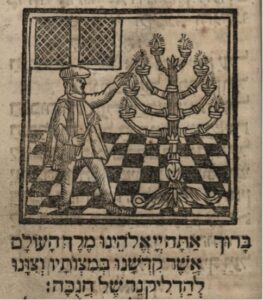
The menorah has been reproduced in countless forms, from the famous depiction on the Arch of Titus to manuscripts, printed books, and ephemera. Steven Fine’s The Menorah: From the Bible to Modern Israel (Harvard, 2016) offers the most comprehensive treatment of how this symbol shaped Jewish identity, and Fine continues to publish on the topic, recent articles are available on his Academia page. The exhibition catalog In the Light of the Menorah: Story of a Symbol (Israel Museum, 1998) contains excellent essays in both Hebrew and English, though oddly, the English version omits nearly all the notes. Another strange omission mars L. Yardeni’s earlier The Tree of Light: A Study of the Menorah (1971): Daniel Sperber notes in his Minhagei Yisrael (vol. 5, 171*) that Yardeni drew extensively on his Journal of Jewish Studies article but credited him only sporadically.
None of these works, however, addresses the menorah in early Hebrew printed books. For that, see our article “The Image of the Menorah in the Early Printed Hebrew,” along with the comments adding further examples.
New and Notable
Daniel Sperber has just published Mei Chanukah, a new work on the berita associated with Chanukah. Due to timing, it will likely only be available in Israel this year. If anyone knows of US distributors, please note them in the comments.
Not all recent scholarship meets the same standard. Akiva Shamesh’s review highlights serious deficiencies in Mitzva Ner Ish u-Beyoto. In another review, “Yemi Shemonah,” Shamesh addresses the “famous” Bet Yosef question: why eight nights of Chanukah rather than seven?
Chanukah Samach!