The Missing Nun Verse in Ashrei

The Missing Nun Verse in Ashrei[1]
Ben Zion Katz
Northwestern University

There are several alphabetic acrostics in the book of Psalms. These acrostics are found in Psalms 25, 34, 37, 111, 112, 119 and 145. Only three of these are complete acrostics – i.e., acrostics in which every letter of the alphabet is represented. Psalms 111 and 112 begin each half verse with the succeeding letter of the Hebrew alphabet following the psalm’s first word (Halleluyah). Psalm 119 is an eight-fold alphabetic acrostic with 176 verses. Psalm 34 is portrayed as a complete alphabetic acrostic in the ArtScroll siddur[2]; however, that is a misrepresentation as there is no verse that begins with the letter vav; the letter vav appears in the last half of verse 6, as it does in the last half of verses 1, 4, 5, 7, 11, 14, 16, 18, 19, 20 and 23, and is therefore not part of the acrostic. Psalms 25, 37 and 145 are also defective acrostics, in that they are missing at least one letter each (and may also have other irregularities). For example, Psalm 25 begins each verse with a succeeding letter of the Hebrew alphabet except for the letters bet (although the second word of verse 2 starts with a bet), vav and kuf (possessing a second resh verse instead). Psalm 37 begins every other verse with a succeeding letter of the alphabet, except that the daled and heh verses immediately follow each other, there are two vav and chet verses, there is no ayin verse, the peh verse follows immediately after what should have been the ayin verse (instead of skipping a verse), and the tav verse begins with a vav. Finally, Psalm 145 is famously missing a nun verse.

Psalm 145 is better known as Ashrei, because of the way it appears in the siddur. Ashrei is said thrice daily (twice in shacharit, the morning service, and once at minchah, the evening service) and is always preceded by two verses from Psalms (84:5 [whose first word, Ashrei, gives the prayer its popular name] and the last verse of the preceding Psalm [144:15]) and concludes with another verse from Psalms (115:18).

Probably because of its popularity and the prominent absence of a verse with the letter nun, the Talmud has the following discussion (Berachot 4b; my loose translation):

Rabbi Eliezer said in the name of Rabbi Avina: Whoever says Psalm 145 thrice daily is assured of a place in the world to come. Why? Is it because it is an alphabetic acrostic? But Psalm 119 is an eight-fold alphabetic acrostic. Perhaps it is because of the verse (verse 16) “You open Your hands and provide sustenance for all life as they require?” But Psalm 136:25 states “He gives food to all flesh” (expressing a similar sentiment)? [The reason is because Psalm 145] has both qualities (an alphabetic acrostic and the notion of God sustaining all life).

Rabbi Yochanan asked: Why does Psalm 145 lack a verse with a nun? Because that verse alludes to the downfall of (lit., the enemies of)[3] Israel, as it says: “Fallen, she will rise no more, the virgin of Israel” (Amos 5:2; the verse continues “She is cast out over her land, none can raise her up”). In the West (i.e., Israel, by placing the comma differently)[4]  they read the verse thus: “Fallen, (and) she will not (continue to) fall any more, rise O virgin of Israel”. Said Rabbi Nachman the son of Isaac: Even so, David prophetically alluded to this [missing] verse with the next verse [following]: “God supports all of the fallen”.

The preceding Talmudic discussion raises at least two related questions: Does the Talmud really mean that a verse in Amos should have been part of Psalm 145? And isn’t that verse (Amos 5:2) completely out of character with the rest of the Psalm, which praises God throughout? In the remainder of this paper I will propose a rationale for the approach of the rabbis of the Talmud in this case (which will have implications for other similar rabbinic speculations as well), and then proceed with a historical discussion of the missing nun verse.

It appears that the rabbis, in realizing that the nun verse is missing from Psalm 145, took a cue from the verse immediately following, as Rabbi Nachman alluded to in the Talmudic discussion above. The verse following where the nun verse should be begins: Somech Adonai lekhol ha-noflim – God supports all of the fallen. The rabbis couldn’t help but notice that the word fallen, noflim, begins with a nun, and if the verse following the missing nun verse states that God helps the fallen, the preceding may very well have started with the verb nafal. The rabbis likely then searched the Bible for such a verse, and found that there are only two verses in the entire Hebrew Bible that begin with the verb nafal – Amos 5:2 (above) and Lamentations 5:16 (“The crown of our heads is fallen, woe unto us for we have sinned”).[5] While neither are great choices from a literary perspective to precede the verse of God supporting the fallen, the verse from Amos, especially as it was reinterpreted in Israel, is less objectionable. It is possible that the rabbis meant that the verse from Psalms was somehow moved to Amos, but more likely the rabbis meant that David (prophetically) knew the verse was destined to be prophesied by Amos, did not wish to include it in Psalm 145 and instead merely alluded to it with the verse immediately following about God supporting the fallen.

There are two historical witnesses as to the text of the missing nun verse of Ashrei. The first is the Septuagint, the Greek translation of Scripture that was begun in the mid-third century BCE, in which there is an extra line in Psalm 145 where the nun verse should be, that reads: “Faithful is the Lord in his words, and holy in all his works”.[6] Scholars have long recognized that the Hebrew word “Ne-eman” means faithful or trustworthy, and could have been the Hebrew word beginning the verse from which the Septuagint translators worked. The reconstructed Hebrew verse then might have read: Ne-eman elohim bechol devarav, ve-kadosh bechol ma-asav.

The second witness is the Dead Sea scrolls, among which is a large Psalms scroll that contains parts of Psalm 145 with a refrain after each verse. See Fig. 1A, where Psalm 145 begins after the break in the column. Note that this text is written in modern, square Hebrew script, except for the Tetragrammaton, which is written using the ancient paleo-Hebrew script, perhaps as a sign of added reverence.

There are minor differences between the psalm as it appears here and in current (Masoretic) Bibles. For example, the first words in line 1 are Tefilah Le-David, a prayer of David, instead of our text, which reads Tehilah Le-David, a psalm of David[7] The first verse (line 1) also contains two names of God (although the first, the Tetragrammaton, missing in current texts, is dotted, perhaps signifying an uncertain reading).[8] A characteristic of the Dead Sea texts are that many words are spelled more fully (i.e., with more vowel letters such as aleph, heh, vav and yud) than is even seen in late Biblical Hebrew,[9] to the extent that the final heh in many instances appears awkward).[10] Notice the scribal corrective technique of adding missing words above the line[11] and the garbled line beginning with the letter kuf, where the scribe appears to have misread a few words.[12] Most noticeable is that each verse is followed by a refrain: Baruch adonay uvaruch shemo leolam vaed – Blessed is God and blessed is His name forever. Finally, there is a nun verse, (beginning the last word of line 9) similar to what it was postulated to be from the Septuagint: Ne-eman Elohim bedvarav ve-chasid bechol ma-asav – Faithful is the Lord in His words and gracious in all His works.

Now that we have seen the two ancient witnesses of the nun verse in Ashrei, several questions arise. First, why does this extra verse use Elohim (Lord) instead of God (the Tetragrammaton), which is the name of God used almost uniformly throughout the psalm? Second, the Greek text implied the word “holy” (kadosh), not “gracious” (chasid)? And finally, if this verse is authentic, why did it drop out?

The first two questions are less difficult than the third. Psalm 145, even in the current Masoretic version, has the word Elohy in the first verse, so it is not as if the form Elohim for God is absent entirely from Psalm 145 as it has come down to us. Also, the fact that the Dead Sea psalm has both names of God in verse 1 (even though one is dotted) provides a possible second usage for the form Elohim for God’s name in this psalm in antiquity. The second question is a matter of near synonyms. The third question is more profound. Perhaps because the last half of the nun verse in the Dead Sea text was exactly the same as the last half of the current verse that begins with the letter tazdi allowed it to be less memorable and more likely to be skipped or forgotten by a scribe. Recall how most of the verse beginning with the letter kuf is missing in Figure 1B (lines 17-18); if the next copyist who saw that manuscript did not know this psalm by heart, the few remaining, extraneous words from the kuf verse might very well have been deleted in the next manuscript version and the kuf verse could have been lost from the psalm as well.

One cannot prove that the nun verse(s) uncovered are original to the Hebrew Psalm 145. What can be said is that the ancient translators of the Greek Bible used a text very similar to that found in Qumran in making their translation. The rabbis, of course, did not have the Dead Sea scrolls available to them; while they did have the Septuagint and were aware of some differences between the Septuagint translations and their Hebrew text(s), the rabbis attributed most of the differences to tendentious translations performed purposefully by the Greek translators.[13]

Regarding the missing nun verse, the rabbis very cleverly tried to deduce, based on the evidence available to them, how the missing verse may have read. Whether the rabbis would have made use of the Dead Sea Scrolls had they been known in antiquity is uncertain. Whether that should prevent us from doing so is a question of hashkafah. For the more traditionally minded, any source not used by previous generations is questionable at best. For the more modern, any valid source (such as using knowledge of the ancient near East to understand the Bible) is not only useful but desirable.

Figure 1A. Psalm 145, verses 1-5. From Scrolls From the Dead Sea: An Exhibition of Scrolls and Archeological Artifacts from the Collections of the Israel Antiquities Authority, A Sussman and R Peled, Library of Congress Washington, 1993 in association with the Israel Antiquities Authority, the Field Museum, 2000, cover and second inner flyleaf, © the Field Museum. Used with permission.

Figure 1B. Psalm 145, verses 13-19. From Scrolls From the Dead Sea: An Exhibition of Scrolls and Archeological Artifacts from the Collections of the Israel Antiquities Authority, A Sussman and R Peled, Library of Congress Washington, 1993 in association with the Israel Antiquities Authority, the Field Museum, 2000, cover and second inner flyleaf, © the Field Museum. Used with permission.

Transcription of Fig. 1A, beginning after the paragraph break, the 1st 7 lines that are completely legible:

תפלה לדויד ארוממכה יקוק אלוקי המלך 1.

ואכרכה שמכה לעלם ועד ברוך יקוק וברוך שמו 2.

לעולם ועד ברוך יום אברככה ואהללה שמכה לעלם ועד 3.

ברוך יקוק וברוך שמו לעלם ועד גדול יקוק ומהולל מאדה 4.

לגדולתו אין חקר ברוך יקוק וברוך שמו לעלם ועד 5.

דור לדור ישבחו מעשיכה וגבורתיכה יגידו ברוך יקוק 6.

וברוך שמו לעלם ועד הדר כבוד הודכה ודברי נפלאותיכה 7.

Transcription of Fig. 1B, beginning at the top of the column, the 1st 13 lines that are completely legible:

וברוך שמו לעלם ועד מלכותכה מלכות כל עולמים וממשלתכה 8.

בכל דור ודור ברוך יקוק וברוך שמו לעלם ועד נאמן 9.

אלוקים בדבריו וחסיד בכול מעשיו ברוך יקוק וברוך 10.

שמו לעלם ועד סומך יקוק לכל הנופלים וזוקף לכול 11.

הכפופים ברוך יקוק וברוך שמו לעלם ועד עיני 12.

כל אליכה ישברו ואתה נותן להמה את אוכלמה בעתו 13.

פותח אתה את ברוך יקוק וברוך שמו לעלם ועד 14.

ידכה ומשביע לכל חי רצון ברוך יקוק וברוך שמו 15.

לעלם ועד צדיק יקוק בכל דרכיו וחסיד בכול 16.

מעשיו ברוך יקוק וברוך שמו לעלם ועד קרוב יקוק 17.

וברוך שמו לעלם ועד יקראוהו באמת ברוך יקוק 18.

וברוך שמו לעלם ועד רצון יראיו יעשה ואת שועתמה 19.

ישמע ויושעם ברוך יקוק וברוך שמו לעלם ועד 20.

Key: italics = dotted word

Underlined = letter or word above the line

Notes: The Tetragrammaton is spelled יקוק, and every heh in other names of God is replaced with a kuf.

[1] I thank my brother, Edward N. Katz, MD, for inspiring me to write this paper.

[2] Sherman N. The Complete ArtScroll Siddur: Weekday/Sabbath/Festival. Mesorah Publications, Ltd. Brooklyn, NY. First edition. 1984. P. 376.

[3] Literally the Talmud states that the verse deals with the downfall of the enemies of Israel, but this is a euphemism; the Talmud does not wish to actually say the downfall of Israel. See for example, M Simon. Berakoth. The Babylonian Talmud. Seder Zeraim. The Soncino Press. London. 1948. P. 15. N. 7 and A Ehrman. Babylonian and Jerusalem Talmud. Tractate Berakhoth. El-Am. Israel. 1965. P. 66.

[4] Ibid.

[5] A Even-Shoshan. A New Concordance of the Bible. Kiryat Sefer Publishing House, Ltd. Jerusalem. 1990. Pp. 769-770 (Hebrew).

[6] Slightly modified from SCL Brenton. The Septuagint with Apocrypha: Greek and English. Samuel Bagster & Sons, Ltd. London. 1851. Reprinted Hendricksen Publishers. Peabody, MA. 1987. P. 785; this is not a scholarly edition of the Septuagint, but is popular and readily available. There is also not one single authoritative text of the Septuagint, so the expression “the Septuagint” is somewhat of a misnomer.

[7] Psalms 17 and 86 also begin with the words Tefilah Le-David, while Psalms 90 and 102 also begin with the word Tefilah.

[8] See Katz BZ. A Journey Through Torah: A critique of the documentary hypothesis. Urim. Jerusalem and N.Y. 2101. Pp. 54-55.

[9] David is spelled daled vav daled in Samuel but daled vav yud daled in Chronicles, for example.

[10] E.g., At the end of lines 4 and 19 and towards the end of line 13.

[11] Indicated by a word or letters that is/are underscored in (the transcriptions in) Fig. 1.

[12] The words אשר לכל קוראיו לכל should be in place of the first four words of line 18. It is not clear exactly how the scribe might have made this error. This is in contrast to the use of ברוך instead of בכל at the beginning of the bet verse in line 3 which could easily be explained as a scribal error due to the psalm’s constant refrain of ברוך יקוק וברוך שמו לעלם ועד; as the verse now stands (beginning with the word ברוך in line 3) it makes little sense. A scribal error might also be the cause of the repetitious את אתה in the peh verse at the end of line 14. There is one more small difference between this psalm and the received text: the absence of a vav at the beginning of line 5.

[13] E.g., Babylonian Talmud, Tractate Megillah 9a-b.


Book Announcement: Mitchell First’s, “Links to Our Legacy: Insights into Hebrew, History, and Liturgy”

Book Announcement: Links to Our Legacy: Insights into Hebrew, History, and Liturgy by Mitchell First

By Eliezer Brodt

The Seforim Blog is proud to announce the publication of our frequent contributor Mitchell First’s newest book Links to Our Legacy: Insights into Hebrew, History, and Liturgy (236 pp.)

Mitchell First’s 66 short articles address interesting questions about the Hebrew language, Jewish history, and liturgy. For example:

• On Hebrew language: insights into the original meanings of the words chamushim, totafot, kohen, minchah, nefesh, netzach, selah, tefillin and many others.

• On Jewish history: the order of the letters in the Hebrew alphabet, the absence of the book of Esther among the Dead Sea Scrolls, the distinction between Neviim and Ketuvim, Rashi’s motivations in writing his Torah commentary, biography of Nehama Leibowitz, and the symbolism of the Israel Postal Company logo.

• On Jewish liturgy: the meaning of sekhvi, the authorship of U-Netanneh Tokef, and the origin of the reading of each of the Five Megillot.

For an article that originally appeared on the Seforim Blog see here.

The book can be ordered here and here

Some reviews of the book can be seen here and here

Here are the Table of Contents:


Picturing Pandemic Prayer

Picturing Pandemic Prayer

Edward Reichman

(with invaluable assistance and inspiration from Menachem Butler and Sharon Liberman Mintz)

Among the precious items recently offered by Sotheby’s at its auction of important Judaica (December 17, 2020) was a richly illustrated miniature book of prayers written and illustrated by Nathan ben Samson of Meseritch, 1728 (here). Nestled among the spectacular illustrations and prayers reflecting all aspects of life we find the page below:[1]

This largely forgotten prayer recited upon seeing one recently recovered from illness derives from the Talmud. Rav Yehuda said in the name of Rav that four must offer thanks to God with a special blessing. One of them is a person who was ill and recovered. The passage then continues to record the proper blessing, which we today know as hagomel. The Talmud then recounts the following story which seems to deviate from the required practice:[2]

רַב יְהוּדָה חֲלַשׁ וְאִתְפַח. עָל לְגַבֵיהּ רַב חָנָא בַגְדָתָאָה וְרַבָנַן. אָמְרִי לֵיהּ: “בְרִיךְ רַחֲמָנָא דְיַהֲבָךְ נִיהֲלַן וְלָא יַהֲבָךְ לְעַפְרָא“. אֲמַר לְהוּ: פְטַרְתּוּן יָתִי מִלְאוֹדוֹיֵי.

The Gemara relates: Rav Yehuda fell sick and recovered, Rav Hana of Baghdad and the Sages entered to visit him. They said to him: Blessed is God Who gave you to us and did not give you to the dust. He said to them: You have exempted me from offering thanks, as your statement fulfilled my obligation to recite a blessing.

While there are seeming difficulties, the Talmud resolves them and considers this alternative expression of thanks, offered not by the patient himself, acceptable under certain halakhic guidelines. Today we routinely utilize the primary formula mentioned in the Talmud for giving thanks after the recovery from illness- birkat hagomel, recited by the patient, though this template could certainly suffice.

I do not think I am being presumptuous in saying that prayer, in some shape or form, in varying degrees, has been on all of our minds, hearts and lips these past few months. Here I do not discuss personalized improvisational prayer, but rather halakhically required or indicated tefillah. From a halakhic perspective, the types of prayers employed throughout this period have been varied and unique.

The Phases[3] of Pandemic prayer

There have been a number of phases of prayer during this pandemic period, each involving a different aspect or focus of prayer.

Phase 1- Techinah (supplication)

The first phase of prayer we encountered during this pandemic was the composition of special prayers to serve as protection and prevention from Covid 19.[4] We previously discussed one aspect of these prayers, the pitum haketoret.[5] There have been countless prayers of this kind written for plagues and pandemics throughout history. A search on the National Library website for the terms magefah and tefillah will sufficiently confirm this. During pre-modern times, when communities endured plague after plague, these prayers were regretfully all too familiar to the European Jew. The liturgy would have been kept under the Aron Kodesh as opposed to the back storage. Current rabbinic authorities thus had ample precedent upon which to draw to compose these prayers. Though we were previously “immune,” both literally and figuratively to this experience, and were unfamiliar with these prayers, we have now all been “exposed” to them.

Phase 2- Hoda’ah (thanksgiving) After Illness

The next prayer discussion to follow, as patients with God’s help began to recuperate from the disease, was an halakhic analysis of the requirements for reciting birkat hagomel. Issues included both when it should be recited, for example if one suffered only a mild case or conversely still had lingering symptoms,[6] to how it should be recited- whether a minyan is absolutely required and, if so, would a zoom minyan suffice.[7] Nathan ben Samson’s illustration might help with at least one of these questions. In order to recite the blessing, the disease should have been severe enough for one to have been bedridden, and one’s recovery advanced enough that he should begin getting out of bed.

Perhaps the rabbis could have considered resurrecting the alternate blessing from our illustration, d’yahavakh lan, during the pandemic. However, it would not have provided any halakhic advantage, as it too requires a minyan. If anything, it would potentially be even more challenging as this brachah is recited by others who observe the patient’s recovery. Perhaps zoom would not be sufficient for this assessment.

Phase 3- Hoda’ah for Preventing Illness

We now b’ezrat Hashem, find ourselves in phase 3 of pandemic prayer. With the development of a successful vaccine we are seeing a new phase of our prayerful preoccupations. Social media is currently abuzz with discussions about whether one should recite a blessing upon receiving the vaccine, and if so, which one.

I have not seen discussions in the halakhic literature on the recitation of a specific tefillah or brachah for previous vaccinations in medical history, neither for smallpox, nor polio, nor measles, nor any others. While admittedly my search has not been exhaustive, assuming there was indeed no previous vaccination prayer discussion, to what would we attribute the sudden change in halakhic perspective? I submit that the answer is rapidity and simultaneity. The rapidity with which Covid 19 spread across the world, leading to the prolonged closure or restriction of religious Jewish practice throughout the entire globe simultaneously is truly unprecedented. While we have experienced pandemics in the past, there has never been a simultaneous, global, real time, communal sense of tragedy on this scale before. Social media contributed exponentially to this experience. The production of multiple effective vaccinations in a mere few months to potentially rescue us from this abyss is likewise unprecedented.

The very aspects that have made this pandemic unprecedented have led to an unprecedented response to the vaccine. The elation at the vaccine’s dissemination is palpable, and the spiritual desire to find tangible verbal expression of gratitude is unrestrained. Rabbinic authorities are responding to this reality.

Furthermore, many rabbinic authorities are strongly supporting if not requiring vaccination.[8] Thus, as opposed to hagomel, or d’yahavakh lan, almost all of us could potentially have an opportunity to recite this brachah. The question then is which blessing.[9]

Talmudic Prayer Prior to Medical Treatment

There is one rabbinic formula mentioned in the Talmud that is to be recited upon undergoing the medical procedure of bloodletting:[10]

.”דְאָמַר רַב אַחָא: הַנִכְנָס לְהַקִיז דָם, אוֹמֵר: “יְהִי רָצוֹן מִלְפָנֶיךָ האֱלֹהַי שֶיְהֵא עֵסֶק זֶה לִי לִרְפוּאָה, וּתְרַפְאֵנִי. כִי אֵל רוֹפֵא נֶאֱמָן אָתָה וּרְפוּאָתְךָ אֱמֶת, לְפִי שֶאֵין דַרְכָן שֶל בְנֵי אָדָם לְרַפּאוֹת אֶלָא שֶנָהֲגוּ

As Rav Aḥa said: One who enters to let blood says:
May it be Your will, O Lord my God, that this enterprise be for healing and that You should heal me. As You are a faithful God of healing and Your healing is truth. Because it is not the way of people to heal, but they have become accustomed.

This passage has been codified in Shulchan Arukh,[11] and though stated in the context of bloodletting, has been traditionally recited throughout history when undergoing any medical treatment or taking any medications.[12]

This blessing with accompanying illustration appears in another eighteenth century illustrated compendium similar to Nathan ben Samson’s:[13]

The modern reader may be forgiven for believing this scene to possibly depict a vaccination, especially given our current preoccupation with the procedure. You would be sorely mistaken. While it is true that the date of the manuscript, 1724, antedates Jenner by some seventy years, a form of smallpox inoculation was being administered long before. However, the Talmudic source of this blessing is associated with bloodletting, in addition to the fact that the clinician is making his incision in the basilic vein, the common location for bloodletting, not inoculation.[14]

This blessing, not unlike d’yahavakh lan pictured above, has, until now, fallen into disuse and atrophy. It has been resuscitated today by contemporary rabbinic authorities for recitation with vaccination for Covid 19. Rav Asher Weiss, Shlit”a recited this upon receiving his first dose of vaccine.[15]

Shehecheyanu

Another brachah considered for vaccination is shehecheyanu. It certainly seems like a logical choice based on its wording alone: “Blessed are You, our God, Sovereign of all, who has kept us alive, sustained us, and brought us to this occasion.” However, it is far more halakhically complex. Rabbi Dr. Daniel Sperber recited this formula and briefly wrote discussing the different options and the logic behind his decision.[16] Rav Asher Weiss devotes his weekly essay on the parashah of Vayigash, 5781 to this blessing, its parameters, and whether it should be recited upon receiving a vaccination for Covid 19.[17] Rav Weiss concludes that it should not be recited in this case.

Hatov Vihametiv [18]

Rav Yosef Rimon, Shlit”a addresses the propriety of reciting another blessing, related to shehechiyanu, hatov vihametiv, as this blessing requires tangible benefit.[19] Allowing that the vaccine’s benefit is indeed tangible in nature, a remaining question is whether it is entirely beneficial, or perhaps not, as there could be adverse reactions. Should one then preferably, he suggests, recite the blessing upon hearing of the vaccine’s effectiveness rather than upon personally receiving the injection. Rav Rimon concludes that one may recite the blessing depending on one’s subjective perception of the value of the vaccine. Rav Hershel Schachter, Shlit”a recited this brachah upon receiving his vaccine.[20]

Treatment Specific Prayer

A lesser known, event specific, prayer was composed by Rabbi Shmuel Eliyahu, Chief Rabbi of Tzfat:

מודִים אֲנַחְנוּ לָךְ האֱלהֵינוּ וֵאלהֵי אֲבותֵינוּ אֱלהֵי כָל בָשָר. בּוֹרֵא רְפוּאוֹת. שאַתָה חונֵן לְאָדָם דַעַת וּמְלַמֵד לֶאֱנושׁ בִינָה לִמְצֹא וּלְהַמְצִיא חִסּוּן לַמַגֵפָה. יְהִי רָצוֹן מִלְפָנֶיךָ שֶהַחִסּוּן הַזֶה יִמְנַע אֶת הִתְפַשְטוּת הַמַגֵפָה וְיַצִיל חַיִים שֶל אַלְפֵי רְבָבוֹת בָעוֹלָם כֻלּוֹ. אָנָא השְלַח רְפוּאָה שְלֵמָה לְכָל חולֵי עַמֶךָ. הִצִילָנוּ מִכָל תּוֹפְעוֹת הַלְוַאי, רְפָאֵנוּ הוְנֵרָפֵא הושִיעֵנוּ וְנִוָשֵעָה כִי תְהִלָתֵנוּ אָתָה. וְהַעֲלֶה אֲרוּכָה וּמַרְפֵא לְכָל תַחֲלוּאֵינוּ. וּלְכָל מַכְאובֵינוּ וּלְכָל מַכּותֵינוּ. כִי אֵל רופֵא רַחְמָן וְנֶאֱמָן אָתָה. יִהְיוּ לְרָצון אִמְרֵי פִי וְהֶגְיון לִבִי לְפָנֶיךָ. הצוּרִי וְגאֲלִי

This prayer thanks God specifically for granting man the wisdom to discover and create a vaccine for this pandemic and beseeches that it should be effective in saving countless lives across the entire world. When I received my vaccination,[21] as a so-called frontline worker, I personally recited the formula of the Shulchan Arukh above, in addition to this tefillah, which personally deeply resonated with me.

Whether one uses the classic formulation of Rav Asher Weiss, the hatov vihametiv of Rav Schachter, or the shehechiyanu of Rabbi Dr. Sperber is not so much the issue.[22] What is far more important is that the tefillah conversation has shifted from the tefillah of techinah (supplication) to the tefillah of hoda’ah (thanksgiving). While hagomel is also a form of hoda’ah, one must have contracted disease to recite it. This form of hoda’ah is a “healthier” form of thanksgiving and represents an appreciation of the introduction of a cure (or more accurately prevention) of the disease that will potentially end the pandemic for us all. It is an appreciation of the advances in medicine which through Hashem’s guidance have enabled scientists to create a novel and exceptionally effective treatment in a remarkably short time, as Rabbi Eliyahu so beautifully encapsulates in his prayer.

Phase 4- Communal Retrospective Hoda’ah

The fourth and final phase of prayer, which we have yet to experience, is communal gratitude for surviving the plague. This form of prayer can only be expressed once the pandemic has abated. Throughout the centuries, communities that survived bouts of plague offered services of communal prayer and thanksgiving for their survival. I offer one such example.

In the nineteenth century there were multiple cholera pandemics. Jewish communities were profoundly affected by these events. The famous cases of Rabbi Yisroel Salanter (supposedly) making kiddush from the bimah on Yom Kippur and of Rabbi Akiva Eiger recommending social distancing in synagogue to minimize contagion were both associated with cholera pandemics.[23] In 1835, the city of Ferrara experienced a severe cholera outbreak.[24] In gratitude to Hashem for the community’s salvation from this particular event a special community prayer service was instituted.[25] The order of prayers was to be recited in every synagogue in the city of Ferrara in the month of Adar after the Shacharit (morning) service. It included selections from Tehillim as well as specific prayers written for the occasion:

Let us conclude by taking a closer look at our first illustration:

This picture I believe accurately reflects our present state of affairs in the midst of the Covid 19 pandemic. We are collectively as a people beginning to get out of bed on the road to recovery. To be sure, we are not there just yet, but we have transitioned gradually from the prone position to sitting off the side of the bed, with our feet dangling. We are still socially distancing, and as in the picture, there is no one in the room with us. Yet, it appears the door is open. The vaccine has been released and we as a people will soon be walking together unmasked outside and standing together shoulder to shoulder in shul, iy”H. We will then transition to the next and final phase of pandemic tefillah, when this pandemic is behind us- the collective community hoda’ah. I look forward to this final phase of reciting the prayer for the salvation of the world from the Covid 19 pandemic together with you, in person (sorry, no Zoom allowed).

Notes:

[1] Seder Birkat ha-Mazon u-Birkat ha-Nehenin (Grace After Meals and Occasional Blessings), written and illustrated by Nathan ben Samson of Meseritch, 1728 (private collection)

[2] Berachot 54b. translation from Sefaria.org.

[3] I use the term “phase” intentionally to be reminiscent of the phases of the vaccine trials, for which there are also four phases, though the connection is admittedly loose.

[4] See Rabbi Dr. Avraham Steinberg’s compendium on the laws relating to Coronavirus, available here.

[5] Edward Reichman, “Incensed by Coronavirus: Prayer and Ketoret in Times of Epidemic,” Lehrhaus (March 15, 2020), available here.

[6] Steinberg, op. cit.

[7] Rabbi Hershel Schachter, Piskei Corona, available here.

[8] Rabbi Dr. Aaron Glatt, “What Do Poskim Say About The Covid-19 Vaccine?” JewishPress.com (December 24, 2020) (here); HaGaon HaRav Yitzchak Zilberstein: “The Vaccine Has The Authority Of Beis Din” theyeshivaworld.com (December 24, 2020), available here. For a video of Rav Schachter and Rabbi Willig receiving the vaccine see here.

[9] An in-depth halakhic analysis is beyond the scope of this essay.

[10] Berachot 60a. text from Sefaria.org

[11] O. C. 230:4.

[12] Mishnah Berurah 230:6

[13] Seder Birkat ha-Mazon u-Birkat ha-Nehenin (Grace After Meals and Occasional Blessings), written and illustrated by Aaron Herlingen of Geitsch, 1724. The Library of the Jewish Theological Seminary, MS8232. I thank Sharon Liberman Mintz for this illustration.

[14] It is curious that there is no bowl to receive the blood, which one would typically find in illustrations of bloodletting. I also looked at the instruments on the table thinking they might be associated with bloodletting specifically, though could not find definitive evidence.

[15] For a more expansive treatment of vaccination in general by Rav Weiss, see here.

[16] For a video of his reciting the blessing while being vaccinated, see here. For his halakhic analysis, see here. I thank Menachem Butler for these references.

[17] Rav Asher Weiss weekly parashah series, year 23, issue 11.

[18] On the history of this blessing, see Adolf Büchler, “The History of the Blessing HaTov veHaMetiv and the Situation in Judaea after the War,” in Avigdor (Victor) Aptowitzer and A.Z. Schwarz, eds., Zvi Peretz Chajes Memorial Volume (Vienna: Alexander Kohut Foundation, 1933), 137-167 (Hebrew)

[19] I thank Rabbi Warren Cinamon for this reference.

[20] A video is available online here.

[21] Of the Pfizer variety.

[22] On the proviso of course that they are following the guidelines of their posek.

[23] Edward Reichman, “From Cholera to Coronavirus: Recurrent Pandemics with Recurrent Rabbinic Responses,” Tradition Online (April 2, 2020), available here.

[24] Myrna Gene Martin, “Outsiders on the Inside: Italian Jewish Ghettos and Cholera in the 1830s,” European History Quarterly 49:1 (2019), 28-49.

[25] Courtesy of the National Library of Israel, item number 990001066250205171


The Haftarah of Parashat Shemot

The Haftarah of Parashat Shemot[1]

By Eli Duker

The Babylonian haftarah for Parashat Shemot was from Ezekiel 16: “Hoda’ et yerushalayim.

The haftarah appears in at least six fragments from the Cairo Geniza,[2] is the haftarah used in the “Emet” piyyut of R’ Shemuel Hashelishi[3] and in the “Zulat” piyyut of R’ Yehuda Beirabbi Binyamin,[4] and is listed in the Seder Hatefillot in Rambam’s Yad Hahazakah as well as in the Siddur of R Shlomo Beirabbi Natan.[5]

This haftarah, an extremely graphic and difficult prophecy, was chosen because it begins by describing the Egypian enslavement and the Exodus. In all of the fragments that describe where the haftarah ends, the last verse is verse 16:15, likely so as not to continue with the difficult words of rebuke that follow that do not have anything to do with the parasha. The Baylonian custom allowed for haftarot that were less than twenty one verses even if the subject is left uncompleted because they still had the practice to read Jonathan’s Targum along with the haftarah, and thus were exempted from the twenty-one verse minimal requirement, as per the ruling of R’ Tahlifa bar Shemuel (Megilla 23b).[6]

This choice of haftarah seems to be problematic in light of the Mishna (Megilla 4:10):

מעשה ראובן נקרא ולא מתרגם מעשה תמר נקרא ומתרגם מעשה עגל הראשון נקרא ומתרגם והשני נקרא ולא מתרגם ברכת כהנים מעשה דוד ואמנון נקראין ולא מתרגמין אין מפטירין במרכבה ורבי יהודה מתיר ר’ אליעזר אומר אין מפטירין (יחזקאל טז, ב) בהודע את ירושלם.

The Mishna brings, without dissent, the opinion of Rabbi Eliezer, which forbids this haftarah. However, the Tosefta as it appears in MS Vienna National Library Heb. 20 seems to allow this haftarah, while Rabbi Eliezer’s view is brought as a dissent:[7]

הודע את ירושלם נקרא ומתרגם ומעשה באחד שהיה קורא לפני ר’ ליעזר הודע את ירושלם אמ’ לו צא והודע תועבותיה של אמך.

However, according to that same Tosefta as it appears in MS Berlin Staatsbiliothek Or. Fol. 1220, the Tanna Kamma merely permits haftarot with general rebuke directed at Jerusalem (תוכחת ירושלים), while Rabbi Eliezer objected to the particular choice of Ezekiel 16:

תוכחת ירושלים נקרא ומתרגם ומעשה באחד שהיה קורא לפני ר’ ליעזר הודע את ירושלים ואמ’ לו צא והודע תועבותיה של אמך.[8]

Like the Mishna above, the Talmud Yerushalmi brings Rabbi Eliezer’s prohibitive opinion regarding this haftarah, and presents no other view:

ר’ אליעזר אומר אין מפטירין בהודע את ירושלם את תועבותיה מעשה באחד שהפטיר בהודע את ירושלם את תועבותיה אמר לו ר”א ילך אותו האיש וידע בתועבותיה של אמו ובדקו אחריו ונמצאו ממזר.[9]

The following appears in both printed versions of the Talmud Bavli [10] as well as in three manuscripts of the Bavli:

הודע את ירושלם את תועבותיה נקרא ומתרגם פשיטא לאפוקי מדרבי אליעזר דתניא מעשה באדם אחד שהיה קורא למעלה מרבי אליעזר הודע את ירושלם את תועבותיה אמר לו עד שאתה בודק בתועבות ירושלים צא ובדוק בתועבות אמך בדקו אחריו ומצאו בו שמץ פסול .

This is very difficult to understand. How can the Gemara assume (פשיטא) that this haftarah can be read if the Mishnah already brought Rabbi Eliezer’s unchallenged opinion forbidding it?

Accordingly, two other manuscripts do not have the word פשיטא.

For example, MS. Columbia 294-295 has the following:

הודע את ירושלם את (..)[ת]ועבותיה נקרא ומיתרגם ומעשה באחד שקרא לפני ר’ אליעזר הודע את ירוש’ את תועב’ אמ’ לו צא והודע תועיבות שלאימך עד שאתה בודק בתועבות ירושלם צא ובדוק בתועבות אמו בדקו אחריו ומצאו בו שמץ פיסול.

Here, the story with Rabbi Eliezer is brought within the context of the view of the Tanna Kamma that it is permissible to read this haftarah. Rabbi Eliezer clearly does not reject this view outright, but still deemed this haftarah a poor choice and an inappropriate one at least under the circumstances.[11]

All of the other manuscripts besides this one feature an explicit disagreement between the Tanna Kamma, who permits this haftarah, and Rabbi Eliezer, who forbids it. The Gemara rejects Rabbi Eliezer’s opinion.

Communities that followed the triennial cycle of the Torah reading never read the beginning of Ezekiel 16 as a haftarah. However for the sidra of V’atta Tetzaveh, they did begin the haftarah from Ezekiel 16:10.[12] It could very well be that this haftarah was deemed permissible despite the Yerushalmi’s ban on the preceding prophecy due to the fact that they held a view later cited by the Levush[13] that the problem with Ezekiel 16 is not the severity of the rebuke but but merely verse 16:3, “Your father was an Amorite and your mother a Hittitess,” which was referenced in Rabbi Eliezer’s retort, seemingly because it casts aspersions of the kind with which no one would be comfortable.

In Europe there were two alternative haftarot for Parashat Shemot: Jeremiah 1:1 and Isaiah 27:6. It seems that many communities either did not want to read Ezekiel 16 even though it was allowed by Halacha because of the weight of Rabbi Eliezer’s rejection, or because they had versions of the Talmudic sources which unanimously presented the haftarah as permissible but undesirable.

In the Iberian peninsula, there were communities that retained the haftarah of Ezekiel 16. It is brought as the haftarah for Parashat Shemot by the Sefer Hashulhan, which was authored by Rabbeinu Hiya ben Shlomo ibn Habib, a student of the Rashba. However, R’ Shemuel Hanagid’s list of haftarot in Sefer HaEshkol lists Jeremiah 1 as the haftarah of Parashat Shemot. The same can be found in Sephardic haftarah books in manuscript[14] and in Sephardic lists of haftarot found in the Cairo Geniza.[15] The reason for this choice of haftarah is the parallel between Jeremiah’s first prophecy and that of Moses. Abudarham lists both of these practices, although it is unclear whether he meant that they were both read in Sepharad or whether he had other locales in mind.

In an early printed humash that is assumed to be Spanish and from around the year 1480, the haftarah for Parashat Shemot is Jeremiah 1:1, while the Hijar Humash from 1487-90 (the only dated humash with haftarot printed before the Expulsion) has Ezekiel 16 as the haftarah.[16] It would be at least over two hundred years later before any other humash was again printed with this as the haftarah.

The Italians adopted Jeremiah 1 as the haftarah for Parashat Shemot as well[17] which is quite surprising, as they preserved more Babylonian haftarot than any other community.[18]

In Ashkenaz, France-England, and Provence the practice was to read Isaiah 27:6 as the haftarah for Parashat Shemot. The same was used as the haftarah for the sidra of V’Eila Shemot in the triennial cycle of Eretz Yisrael.[19] This haftarah was chosen due to its literary rather than thematic associations with the Torah reading, as was generally the case with the rest of the haftarot read according to the triennial cycle. (The haftarot favored in the annual cycle were chosen for their thematic content.)

The first verse of the haftarah,הבאים ישרש יעקב יציץ ופרח ישראל parallels the first verse in the sidra: ואלה שמות בני ישראל הבאים מצרימה את יעקב איש וביתו באו. Three of the haftarah’s first six words are in the first verse of the sidra.[20] We also find that the Romaniote community, which often adopted haftarot from the triennial cycle, adopted Isaiah 27:6 as the haftarah for Parashat Shemot.[21]

This haftarah is also attested to in the Ginzburg manuscript of Mahzor Vitry, in Sefer Etz Haim, in the Sefer HaEshkol’s glosses on the Nagid’s list (where it begins at 27:5, one verse earlier), and in all Ashkenazic humashim and sifrei haftarot in manuscript (although three of them also begin the haftarah one verse earlier).[22]

This haftarah was read in some Morrocan communities.[23]

There were different practices regarding the end of this haftarah. In some manuscripts the final verse is 28:13 making it a “classic” haftarah of exactly twenty one verses, especially appropriate as it was never read with its translation by any community using the annual cycle. Some, in order to end on a clearly positive note, would skip from 28:13 to 29:22 and read two more verses. This is how it appears in all printed humashim with Ashkenazic haftarot. In other manuscripts, we find an alternate practice of extending the reading to verse 28:16, instead of skipping to a later point.

The ensuing printed humashim with Sephardic haftarot post-Expulsion all listed Jeremiah 1 as the Sephardic haftarah for Parashat Shemot

In spite of its absence from the printed humashim, Ezekiel 16 was still retained by many communities as the haftarah for Parashat Shemot. This created a bit of difficulty for those communities. In the recently published Kaf Naki, R. Khalifa Malka, who was active in Agadir, Morocco, between c. 1720-1760,[24] wrote:[25]

The early Magreb practice, as well as our practice, is to read for Parashat Shemot the haftarah of “Hoda’,” based on the Rambam at the end of Sefer Ahava. It is proper to act this way, as he is the rabbi of the Sephardim and the Magrebim. Also concerning this haftarah,[26] I requested of the printer, R’ Shlomo Proofs, to print it together with the haftarah of Hoda’…and he did this to please me in the humashim that he published later on, which had not been done in the days of the publishers who preceded me.[27]

I have not been able to locate any such humashim.[29] The first printed post-expulsion humash I was able to find with this haftarah was printed in Jerusalem by Zuckerman in 1866.

Besides Agadir, this haftarah was (dare I say, miraculously,) retained in many places in various Medditerian and Middle Eastern communities including Algiers,[29] Tafilalt,[30] Fez,[31] Libya,[32] Djerba,[33] Persia/Bukhara,[34] Yemen, and Baghdad.[35] In order to deal with the fact that it did not appear in printed humashim, the practice in Baghdad was to print this haftarah along with the haftarah from Isaiah they would read for Parashat Bo (that was not commonly featured in many printed humashim[36]) in special “Nokh” booklets which had lists of verses and selections from the Mishna that would be recited at home on Shabbatot.[37]


Nokh booklet with the haftarot for Shemot and Bo according to the Bavli custom. (Baghdad, 1930)

[1] I would like to thank Rabbi Avi Grossman for editing this.

[2] Cambridge T-S A-R A13, T-S A-S 19.241, T-S B14.54, T-S B14.62f, T-S B15.5, T-S B20.4

[3] The Yotserot of R. Samuel the Third, Yahalom and Kastuma ed., Vol. 1, pg. 294-295.

[4] Piyyutei R’ Yehuda Beirabbi Binyamin, Elitzur ed., P. 136.

[5] Siddur Rabbeinu Shemuel Beirabbi Natan Hagi ed. Pg. 200.

[6] See Teshuvot Hageonim, Sha’arei Teshuva 84, in the name of R Hai.

[7] Megilla 3:34

[8] See Tosefta Kifshuta, Part V, pg. 1216

[9] Megilla 4:12, This is the version in MS Leiden and all printings of the Yerushalmi.

[10] Vilna, Venice 1520-3, and Pesaro 1509-17.

[11] See Hiddushei HaRan there for an explanation as to why he objected in spite of its permissibility.

[12] See Ofer’s list at https://faculty.biu.ac.il/~ofery/papers/haftarot3.pdf

[13] Levush Hahur 478. See also Duker, Hahaftarot Lefarashiyot Aharei Mot UKdoshim L’fi Minhag Ashkenaz in Hitzei Gibborim Vol. 11, pg. 387-498.

[14] PARM 2054 and Angelica Rome 55.

[15] Cambridge T-S B20.2 and T-S B20.14

[16] Based on this and the Sefer Hashulchan, it could be that the retention of that haftarah was an Aragonian practice

[17] MS Parm 2169.

[18] Besides from retaining the original haftarot for Bo, Behar, and Behukkotai, the Italians only read the special haftarot of Destruction and Consolation during the month of Av, but not in Tammuz or Elul, thus retaining the Babylonian haftarot for the parashiyot of Matot, Masei, Shoftim, Ki Tetzei, Ki Tavo, and Nitzavim. The fact that, unlike as in other communities, the Italians did not read Jeremiah 1 on the Sabbath following the Seventeenth of Tammuz, may indicate that the practice of reading Jeremiah 1 as the haftarah for Shemot originated in Italy, but this is just conjecture at this point.

[19] Ibid. Ofer’s list.

[20] Heard orally from Prof. Yosef Ofer.

[21] See Fried list in the back of Encyclopedia Talmudit Vol. 10

[22] The haftarah appears as such in Geniza Fragment Cambridge T-S B16.19b as well. It is also the haftarah in the “Emet” piyyut of R’ Shelomo Suleiman al-Sinjari, but he vacillates between using haftarot from the Babylonian custom and the haftarot from the triennial cycle. See The Yoserot of Rabbi Selomo Suleiman al-Sinjari for the Annual Cycle of Torah Reading. Hacohen, ed. Pg. 368-370.

[23] Naziri, Otzar HaMinhagim VeHamesorot LiKhillot Tafilalt V’Sijilmasa pg. 84 footnote 128, and Danino, Miminhagei Yahadut Morocco. Avaialble at http://www.daat.ac.il/daat/toshba/minhagim/mar-tfi.htm. Avitan, Minhagei Halacha Lefi Kehillot Morocco., link. The fact that Isaiah 27:6 was read as the haftarah for Parashat Shemot in Morocco opens up the possibility that this may have been the practice somewhere in Spain prior to the Expulsion. Moroccan communities retained all three of the haftarot that we have for Parashat Shemot, as Jeremiah 1 was read in Sefrou (Naziri, ibid.) and is still read today in at least some communities that follow Morrocan practices. Others read Ezekiel 16, as discussed below.

[24] Published 2012, Orot Yehudei HaMagreb, Halamish M. ed.

[25] I would like to thank Rabbi Yehoshua Duker for translating this.

[26] Referring to Isaiah 19 as the haftarah for Parashat Bo.

[27] He proceeds to claim that it had not been printed due to the influence of the Levush which, (in his opinion,) was influential because of the dearth of other works on the Shulhan Aruch back then. I think it is merely because the haftarah was not printed in the Venetian humashim published by Bromberg (in particular, the 1524 edition), which had a heavy influence on the selection of haftarot in later humashim. I will address this in an article on the haftarot of Vayetze and Vayishlach that I hope to publish soon.

[28] He clearly saw the humash with these haftarot as he wrote about how the last verse of the haftarah for Shemot was left out.

[29] Zeh Hashulhan, Minhagei K”K Algier p. 245

[30] Naziri, pg. 84

[31] Ibid. footnote 128 quoting Sefer Ahavat HaKadmonim pg. 6a. It is also written there that this was the practice in Izmir and Turkey.

[32] Biton, Nahalat Avot, p. 65

[33] HaCohen, Brit Kehuna, pg. 16.

[34] Zuckerman Humash

[35] Sitbon, Alei Hadas, pg. 360.

[36] It was only printed in humashim with Italian haftarot (before the late 20th century) such as the following: Manitoba 1589, Amsterdam 1712 (Proofs), 1729 (Binyamin ben Uri Katz), and Venice 1820.This list not exhaustive.

[37] Simanei Pesukei Nokh, 1920. A complete listing of the various printings (seven in all) can be found in Ben Yaakov, Minhagei B’nei Bavel B’Dorot HaAharonim.


Anim Zemiros – A Poem for All Ages by Rabbi Elchanan Adler book review

Anim Zemiros – A Poem for All Ages

By Rabbi Elchanan Adler

Feldheim Publishers, New York, 2020, 192 pages

Reviewed by Myron Wakschlag

Rabbi Myron Wakschlag is a musmach of Rav Ahron Soloveichik zt”l at Yeshivas Brisk of Chicago, and is currently an IT executive in the Washington, DC area. He has researched and published on the early Orthodox rabbinate in America.

It is rare to find a book that is able to successfully illuminate a complex topic, yet still remain captivating and easily accessible. Rabbi Elchanan Adler’s new sefer on Anim Zemiros is just such a book. While Anim Zemiros is familiar to most people, its contents remain largely enigmatic due to its challenging Hebrew terminology and its esoteric meaning. Rabbi Adler has opened up new pathways that enable the reader to unlock both the simple meaning and the profound concepts lying beneath the surface of the text.

In this beautiful volume, Rabbi Adler notes how each stanza of Anim Zemiros is based on specific verses from Tanach or Talmudic/Midrashic passages. This itself is a valuable tool that sheds light on the underpinnings of the text. But the real strength of the book is in its ability to be megaleh amukos, to uncover the deep hidden beauty of the poem and make it accessible to the average reader untrained in the analysis of medieval liturgical poems. Rabbi Adler’s analysis weaves together explanations offered by traditional sources with his own fascinating insights. Rabbi Adler, an esteemed Rosh Yeshiva at Yeshiva University’s Rabbi Isaac Elchanan Theological Seminary for over 20 years, is an erudite scholar and master teacher who has an unusual gift for presenting difficult material in a way that is easy to understand.

The sefer begins with an overview that describes the origin of the formal name Shir HaKavod, the authorship and dating of the work, the origins of its inclusion in the liturgy, and the manner in which it is recited in the synagogue. It then transitions into an analysis of the overall themes, structure, and style of the text, including many interesting observations about the common ideas that are expressed within each section, and numerical allusions that emerge from the text. The next section transitions into the essence of the book, which comprises a textual analysis of each stanza, offering unique insights, explanations, interpretations, and suggestions to explicate the poem based on the full range of rabbinic literature. While it is not an exhaustive treatment of every word in the poem, Rabbi Adler’s choice of what to include helps to capture and hold the reader’s interest.

The book is valuable on many levels. In addition to its primary objective of elucidating both the plain and hidden meaning behind Anim Zemiros, a careful reading of the book allows the reader to acquire a methodology for analyzing piyyutim. Determining exactly what the author of Anim Zemiros meant to convey and what messages he buried beneath the surface is much like solving a mystery. Rabbi Adler employs many analytical tools to uncover the clues and piece together the various threads. It is enlightening to study the manner in which he carefully examines the text to identify nuances and different shades of meaning based on the poem’s rhythm, meter, textual variances, word roots, grammar, alternative translations, vowelization, allegory, and symbolism. He also often adduces prooftexts from Tanach, and contrasts the opinions of the various early and later commentaries to suggest various possibilities in the text. Utilizing this methodology, Rabbi Adler is able to “connect the dots” and uncover the concealed gems that are impossible to discern at first glance.

I owe a great debt of gratitude to Rabbi Adler, not only for giving me a much greater understanding of the magnificence of Anim Zemiros and its prominent place in our liturgy, but also for imparting his approach to analyzing piyyutim and understanding their significance. He has given me a derech to better appreciate medieval liturgical poems in general, and has also provided me with the tools to be able to analyze them on my own.


Rabbi Joseph Hertz, Women and Mitzvot, Antoninus, the New RCA Siddur, and Rabbis who Apostatized, Part 1

Rabbi Joseph Hertz, Women and Mitzvot, Antoninus, the New RCA Siddur, and Rabbis who Apostatized, Part 1

Marc B. Shapiro

1. In my last post here, in discussing R. Joseph Hertz’s suggested alternative text for Maoz Tzur, I wrote that this suggestion “was simply made up by Hertz or perhaps suggested by an unnamed collaborator on his siddur commentary.” At least one person wondered if I had anything in mind when I wrote about “an unnamed collaborator.” Indeed, these words were chosen deliberately. I do not know anything specifically about collaborators on the siddur commentary. However, we do know about the collaborators on his famous Torah commentary. This Chumash used to be found in every Modern Orthodox synagogue, and now, just like the Birnbaum siddur, it is missing from most of these synagogues.[1]

When it comes to what I will describe about the Hertz Chumash, it is possible that we are dealing with a great injustice. At the very least, it was a great misunderstanding between Hertz and his collaborators. Here are the Hebrew and English title pages of the Hertz Chumash.
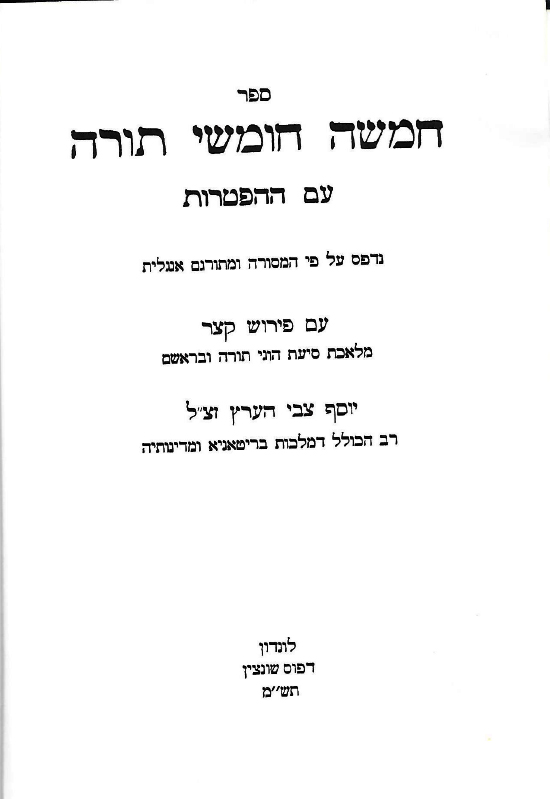
 

The English title page refers to the Chumash as edited by Hertz. The Hebrew title page, which most people don’t even bother looking at, even if they understand Hebrew, refers to a commentary that is the work of a group of Torah scholars headed by Hertz. These are quite different formulations.

Most people who have used the Hertz Chumash, even those who have used it for many years, will not know anything about this group of Torah scholars. Indeed, when people quote from this Chumash, Hertz is given exclusive credit for everything in it. Thus, when citing this Chumash’s commentary, people will say, “Hertz writes.” Yet is this correct?

If we turn to the Chumash’s preface, we learn that Hertz was assisted by J. Abelson, A. Cohen, G. Friedlander and S. Frampton. The first three individuals prepared the commentary to sections of the Torah (the exact sections are listed), and Frampton prepared the commentary to the Haftorahs. Hertz writes: “In placing their respective manuscripts at my disposal, they allowed me the widest editorial discretion. I have condensed or enlarged, re-cast or re-written at will, myself supplying the Additional Notes as well as nearly all the introductory and concluding comments to the various sections.” We see from this that Hertz had an important role, not just as editor, but in contributing content to the Chumash. Yet the commentary itself was not the product of Hertz. He was simply the editor of the material provided by the men mentioned above. In this role, he performed the regular task of an editor who takes texts and condenses and enlarges, re-casts or re-writes, but this editorial involvement does not make the editor the author.

We therefore have to wonder why it is that the men who labored so hard in creating the commentary are given no recognition, apart from the mention of their names in the preface which virtually no one bothers to read. As I already noted, the commentary to the Chumash is universally understood to have been written by Hertz when in fact most of it – other than the “introductory and concluding comments to the various sections” – is not his at all.

Now that the facts have been laid out, I don’t think anyone will be surprised to learn that Abelson, Cohen, and Frampton were not at all happy when the Chumash appeared and they were given no recognition for their labors on the title page. (Friedlander was no longer alive.) They thought that on the title page, following the mention of Hertz as the editor, it should have said something like, “With the collaboration of the Revs. Dr. A. Cohen, Dr. J. Abelson, the Rev. S. Frampton and the late Rev. G. Friedlander.” Hertz responded to their complaint that it had already been established at the initial stages of the planning of the Chumash that the contributors’ names would not appear on the title page.[2] In fact, this a major reason for R. Salis Daiches[3] withdrawing from collaboration on the project. (Obviously, Abelson, Cohen, and Frampton had a different understanding of how Hertz was supposed to acknowledge their work.) Daiches was also unhappy with Hertz’s “editorial policy of extensively rewriting and revising the installments submitted to him by the various annotators.”[4] Hertz later implausibly claimed that his revisions were “an incredible amount of labor, easily ten times the amount of my collaborators.”[5]

Another matter that must be noted is that in the preface found in the first volume of the first edition of the Chumash—it originally appeared in five volumes—Hertz writes that he supplied “nearly all the Additional Notes.” Yet in the one volume edition this sentence has been changed and the word “nearly” has been deleted, making Hertz the only author. Harvey Meirovich has called attention to this, and shows that the Notes dealing with evolution and sacrifices came from R. Isidore Epstein.[6]

I do not know why the following paragraph, which explains the method of the commentary and appeared in the preface to volume 1 of the first edition, was deleted from the preface of the one volume Chumash. This is exactly the sort of explanation of the commentary that the reader would find helpful.

Method of Interpretation: A word must be added as to the method chosen for leading the reader into what the Jewish Mystics called the Garden of Scriptural Truth. The exposition of the plain, natural sense of the Sacred Text must remain the first and foremost aim in a Jewish commentary. But this is not its only purpose and function. The greatest care must be taken not to lose sight of the allegorical teaching and larger meaning of the Scriptural narrative; of its application to the everyday problems of human existence; as well as of its eternal power in the life of Israel and Humanity. In this way alone can the commentator hope not merely to increase the knowledge of the reader, but to deepen his Faith in God, the Torah and Israel.

Also of interest is that the first edition of the Hertz Chumash includes maps which are not found in the one volume edition.

2. In my post here I mentioned that R. Shmuel Wosner defends the practice of women saying שלא עשני גוי and שלא עשני עבד instead of substituting the words גויה and שפחה. R. Yehudah Tesner agrees with R. Wosner and adds the following: If a woman would say שלא עשני גויה this would only mean that she does not want to be a non-Jewish woman. However, she might still prefer to be a non-Jewish man instead of a Jewish woman. Also, if she said שפחה it might only mean that she does not want to be a female maidservant, as this has two negative things, namely, that she is both a woman and enslaved.

שאין רצונה להיות שפחה, שיש בזה תרתי לריעותא, גם אשה וגם משעובדת

However, it might imply that if she could get rid of one of these negative things, i.e., the female, and be a male slave, that this might be acceptable to her. In order to prevent these misunderstandings, R. Tesner says that she must keep the standard text which includes women as part of גוי and עבד. This way she is thanking God that she is not a non-Jew, male or female, and that she is not a slave, male or female.[7]

There is no question in my mind that R. Tesner’s approach is somewhat convoluted and would never represent the thinking of any woman who recited the prayer. I only mention it because R. Tesner takes it for granted that it is better to be born as a Jewish man than a Jewish woman. Yet he also sees as obvious that it is still better to be a free Jewish woman than a male slave.

With regard to this latter point, it is of interest that R. Joseph Teomim states that there are a few things in which a male slave has an advantage over a woman:

עבד חשוב לענין קצת דברים . . . במקצת דברים עדיף מאשה

One of the things he mentions is that a male slave is circumcised, and circumcision is a great mitzvah given to men that women do not have the opportunity to fulfill.[8] This perspective is obviously very different than the outlook advocated by various kiruv speakers that while women are created perfect, men are created defective and thus need a berit milah to get them up to the level of women.[9] I have no doubt that if this argument was first made by someone who identified with Open Orthodoxy, that it would have been regarded as blasphemous for denigrating the commandment of circumcision.

Regarding women not having the opportunity to fulfill the great mitzvah of circumcision (and other mitzvot), I was surprised to find that R. Leon Modena, who was quite “modern” for his time, explains that this is because they do not rank very high in God’s eyes, which is another way of saying that women are simply unworthy of these mitzvot. Here are his misogynistic words:[10]

ומצינו שלא החשיב השי”ת בתורתו הנשים בשום אופן, ולא נתן להן אפי’ אות ברית במילה, ולא רוב מצוות עשה.

Apart from circumcision, it is a popular kiruv perspective that in general women are created with more spiritual perfection, and thus do not need all the mitzvot of men. R. Meir Mazuz attacks this position which he sees as absurd.[11]

דוגמא אחת  מהסילופים: המקשים מצביעים על ברכת “שלא עשני אשה”, והמתרצים מתפלפלים להוכיח שהאשה איננה צריכה כל כך סייגים וגדרים, כי מטבעה דיה במספר מועט של מצוות, ולכן היא מברכת בשמחה רבה “שעשני כרצונו” – שהקב”ה ברא אותה תמימה ושלימה שאיננה צריכה כל כך מצוות, והאיש מברך “שלא עשני אשה” – הוא על דרך שמברכין על הרעה כשם שמברכין על הטובה . . . [ellipses in original] ואילו היה כדבריהם, למה מברכין הנשים ברכת “שעשני כרצונו” בלי שם ומלכות . . . והאנשים מברכים “שלא עשני אשה” בשם ומלכות, ואדרבא איפכא מסתברא?! ובטור א”ח (סימן מ”ו) כתב שנהגו הנשים לברך שעשני כרצונו, ואפשר שנהגו כן כמי שמצדיק עליו את הדין על הרעה . . . ולדעת המתרצים הנ”ל אפשר לומר ג”כ שהגוים עדיפי מישראל, שאינם צריכים לתרי”ג מצוות רק לשבע דוקא, אתמהה.

To R. Mazuz’s words I would only add that if people find it problematic to say that men are created more perfect than women, why do they not find it also problematic to say that women are created more perfect than men? Should I have been offended when a woman once said to me that she is exempt from a number of mitzvot because women are on a higher spiritual level than men, as they are naturally more connected to God, while men can only achieve this connection through mitzvot? I am sure she would have been offended if someone said to her that women are on a lower spiritual level than men, as they are naturally less connected to God, and the evidence of this is that do not have as many mitzvot as men.[12] And what about Torah study? Can we say that men are only commanded to study Torah because they are not at the same spiritual level as women? This would be a complete inversion of the value traditionally assigned to Torah study.[13]

Yisrael Ben Reuven’s book, Male and Female He Created Them (Southfield, 1995), devotes a good deal of discussion to the kiruv perspective. On pp. 132, 133, he writes:

A number of recent books in English propose this idea of women’s spiritual superiority over men, and reportedly, the idea is taught as well in numerous schools for women. The reader should note that none of the books in question offer a classical source for the idea, and none of several teachers of the idea have been able to supply a source when interviewed by this author and numerous individuals known by the author. . . . [T]he teaching contradicts a principle from the Gemara that commandments are placed on a person as a result of his having spirituality (as opposed to his lacking it).

I believe that Ben Reuven is correct in noting that attributing this notion to the Maharal is a mistake. Yet I disagree with his discussion of the view of R. Samson Raphael Hirsch, as Hirsch indeed suggests that women are not commanded in the positive time-bound commandments because they do not need them, for they, by nature, have “greater fervour and more faithful enthusiasm for their God-serving calling.” Contrary to Ben Reuven, doesn’t this mean that they are created with a superior innate spirituality? Men, on the other hand, according to Hirsch, can only reach their spiritual potential through the mitzvot. Hirsch includes circumcision as one of the commandments that men need because they are by nature on a lower spiritual plane then women.[14]

R. Zvi Yehudah Kook also thinks that women are inherently spiritually superior to men. The problem is that men don’t realize this. However, R. Zvi Yehudah claims that in Messianic days when men will understand the truth, they will no longer be able to able to make the blessing שלא עשני אשה, as they will see that women are superior to them.[15]

במצב העכשווי האיש יותר חזק בגופו, ומתוך כך בפרקטיקה האנושית. הוא אקטיבי יותר בכל החיים המעשיים. יש הרגשה שהוא תופס יותר מקום. הרגשה זו היא לפי המדריגה האנושית, והברכות נקבעו על פי ההרגשה האנושית היחסית. זאת התפיסה האנושית הרגילה, והברכה מתייחסת למציאות זו. משום כך אומר האיש כהרגשתו “שלא עשני אשה”, שהרי זו האמת היחסית, והאשה מברכת “שעשני כרצונו”. אך, כאמור, זו תפיסה אנושית חלקית, וההרגשה היא רק עניין יחסי של מצב עכשווי נתון, אמת נוכחית.

לעומת זאת, ההשקפה האלהית, האמת המוחלטת, אינה ענין של הרגשה חולפת, אלא האמת הנצחית מראשיתה ועד סופה. לעתיד לבוא, כאשר גם האדם יכיר את האמת, ויהיה כולו מבחינת “הטוב והמטיב”, לא יוכל לברך “שלא עשני אשה”, שהרי אז יכיר שבניינה של האשה יותר רם, יותר אלהי ופחות אנושי, ממצבו הוא.

For virtually all, the approaches suggested by Hirsch and R. Zvi Yehudah Kook in which women are created more perfect than men would have been inconceivable in pre-modern times. One possible exception, and the only exception I know of, was the sixteenth-century R. Gedaliah Ibn Yahya, author of Shalshelet ha-Kabbalah. He actually enumerates numerous ways in which women are superior to men. He also claims that women are not intellectually inferior to men, and they can thus understand all the wisdoms of the world. In the sixteenth century, this was a very radical position.[16]

Regarding women, R. Yonason Rosman called my attention to the following. The ArtScroll Chumash, p. 1086 (beginning of parashat Nitzavim) states:

On the last day of his life, Moses gathered together every member of the Jewish people, from the most exalted to the lowliest, old and young, men and women, and initiated them for the last time into the covenant of God. What was new about this covenant was the concept of ערבות responsibility for one another, under which every Jew is obligated to help others observe the Torah and to restrain them from violating it. This is why Moses began by enumerating all the different strata of people who stood before him, and why he said (v. 28) that God would not hold them responsible for sins that had been done secretly, but that they would be liable for transgressions committed openly (Or HaChaim).

According to the ArtScroll summary, R. Hayyim Ben Attar, the author of Or ha-Hayyim, states that women are obligated in ערבות. But is this really what he says? Here is his commentary to Deuteronomy 29:9:

R. Hayyim ben Attar actually says the exact opposite of what appears in the ArtScroll summary, in that he states that women are not obligated in ערבות, and they are grouped together with children and proselytes. R. Ben Attar tells us that children are not obligated because they do not have the requisite understanding for such an obligation. Proselytes are not obligated because it is not their place to be rebuking, and thus exercising authority over, those who were born Jewish.[17] Why are women not obligated? R. Ben Attar writes:

ואין הם נתפסים על אחרים שהטף אינם בני דעה והנשים כמו כן הגרים גם כן אין להם להשתרר על ישראל

The sentence is ambiguous, and it all depends on where you put the comma. Here is one way to read the sentence:

ואין הם נתפסים על אחרים שהטף אינם בני דעה והנשים כמו כן, הגרים גם כן אין להם להשתרר על ישראל

If you place the comma after the words והנשים כמו כן, the sentence seemingly means that women are just like children in not having the requisite understanding of the various sins to be obligated in ערבות. R. Yaakov Hayyim Sofer finds it incomprehensible that R. Ben Attar would say that women’s level of understanding is comparable to that of children.[18] He therefore explains that when R. Ben Attar says והנשים כמו כן, he only means to say that the law for women is like the law for children, but not that the reason is the same.

You can also place the comma after the words אינם בני דעה so that one reads the sentence this way:

ואין הם נתפסים על אחרים שהטף אינם בני דעה, והנשים כמו כן הגרים גם כן אין להם להשתרר על ישראל

Now the sentence means that children do not have the requisite understanding to be obligated in ערבות, and women are like proselytes in that it is not their place to be rebuking, and thus exercising authority over, Jewish men. Although this is how R. Avraham Sorotzkin understands the Or ha-Hayyim,[19] I find it difficult as the second half of the sentence does not read well this way.

3. In my post here I referred to Nero and Antoninus and their supposed conversions to Judaism. The Talmud, Gittin 56a, indeed states that Nero converted, and it adds that R. Meir was descended from him. Soncino’s note to the passage reads: “This story may be an echo of the legend that Nero who had committed suicide was still alive and that he would return to reign (v. JE IX, 225).” The Koren Talmud’s note, which is a translation of what appears in Steinsaltz, states that the talmudic story cannot be referring to the famous Nero: “The Roman emperor Nero was killed under strange circumstances and after his death rumors circulated that he was not actually killed but had taken refuge elsewhere.” The note continues that even though Nero is referred to in the passage in Gittin 56a as ,נירון קיסר the story actually refers to another person who was an officer in the Roman army in the campaign against Judea. This person’s name was also Nero, and since he was from the larger Caesar family, he too was called Nero Caesar. This explanation apparently first appears in Seder ha-Dorot.[20]

Graetz thought that the story of Nero converting was part of a rabbinic polemic against Christianity, while Bacher “attributed the origin of the legend to the view which considers the power of Judaism to be so great, that even its greatest enemies become converts either themselves, or, at any rate, their descendants.”[21]

Let me offer another way of explaining the story of Nero’s conversion, which I have not seen anyone else suggest. Josephus tells us that the Jews put up a wall in the Temple to prevent King Agrippa from viewing the sacrificial service. This upset both Agrippa and the Procurator, Festus, and Festus ordered that the wall be torn down. The Jews decided to go over Festus’ head and turned to Nero. Nero’s wife, Poppaea Sabina, pleaded their case, and as a favor to his wife, Nero ordered that the wall should stay.

Why would Poppaea plead the case of the Jews? Josephus tells us that she was a “God-fearer.”[22] Whatever the exact connotations of this term, which has been greatly discussed, she was clearly a sympathizer of the Jews. Josephus tells us that on another occasion she helped secure the release of some Jews who had been placed in prison in Rome. He also tells us that that Poppaea gave him many presents.[23] Could it be that originally the story about the conversion of Nero was said about his wife, and that in the hundreds of years before it was recorded in the Talmud, it was transferred to Nero himself?

As for the Emperor Antoninus, who was friends with R. Judah ha-Nasi, we do not know who this refers to as the title Antoninus was used for various emperors.[24] However, I want to call attention to a different point. In Sefer Yuhasin ha-Shalem, ed. Filipowski, p. 115, in listing the talmudic sages, R. Abraham Zacut includes a “Rabbi Antoninus”. Where does he get such a name? As he indicates, it comes from Mekhilta de-Rabbi Yishmael, and there are actually two separate references there to R. Antoninus.[25] The first reads:[26]

[א”ר אנטונינוס למלך שהוא דן על הכימה [הבימה

The second reads:[27]

…ר’ אנטונינוס אומר ג’ היו והוסיף עליהם עוד אחד והיו ד’

R. Antoninus is being cited as the source for halakhic teachings. Yet the text is corrupt, as was already pointed out by the Vilna Gaon. He emended both passages so that while Antoninus is mentioned, he is not identified as a rabbi.[28]Thus, in the first passage the Vilna Gaon emended it to read:

 [אמר רבי אנטונינוס המלך שהוא דן על הכימה [הבימה

The second passage he emended to read:

רבי אומר ג’ היו הוסיף עליהם עוד אחד והיו ד’ הוסיף אנטונינוס עוד אחד והיו ה’

While the Vilna Gaon may have only sensed intuitively that the text was corrupt, manuscript evidence exists that offers versions similar to or identical with that suggested by the Vilna Gaon.[29]

As for the conversion of Antoninus, R. Solomon Judah Rapoport argues that this is a late, and non-historical, aggadah.[30] He points to a passage in the Jerusalem Talmud, Megillah 1:11, which shows that it was not clear whether Antoninus converted.

אית מילין דאמרין דאתגייר אנטונינוס ואית מילין אמרין דלא אתגייר אנטונינוס

Nevertheless, despite these words, the continuation of this talmudic passage records that he did in fact convert. This is also the conclusion in the Jerusalem Talmud, Sanhedrin 10:5. However, the matter is still not clear, since regarding the Megillah text the Leiden manuscript has a different version which leaves the matter of Antoninus’ conversion undecided.[31] Furthermore, as Shaye J. D. Cohen writes, “the Bavli clearly implies that Antoninus was not a convert, unlike the Roman dignitary Qetia who was.”[32] Cohen also calls attention to Yalkut Shimoni: Isaiah, no. 429, which states that Antoninus was one of the tzadikei umot ha-olam, that is, not a convert.

R. David Zvi Hoffmann examined the various aggadot regarding R. Judah ha-Nasi and Antoninus. With regard to most of them he concludes that they arose in Babylonia long after the events described, and that “it is difficult to find a historical core to them.”[33]He does not tell us whether he regards these stories as simply legends that arose from the people or if they should be seen as didactic tales no different than the numerous other aggadot that describe actions and dialogues of various biblical figures, matters that were also never intended to be taken as historical. R. Hoffmann also discusses how the notion of Antoninus actually converting to Judaism developed from earlier sources that only regard him as a “God fearer.”[34]

Regarding referring to people as rabbis when they do not deserve the title, such as Rabbi Antoninus, here is another interesting example that I believe was pointed out to me many years ago by Prof. Shnayer Leiman. When R. Jonathan Eybeschuetz’s Luhot Edut was reprinted in 1966, the publisher helpfully added an index of names at the back. What seems to have happened is that he went through the index putting “Ha-Rav” before all the names, and mistakenly added this title before Shabbetai Zvi’s name.

When the book was reprinted again by Copy Corner in the 1990s, they fixed this mistake and added שר”י.

It is interesting that in Solomon Zeitlin’s review of Gershom Scholem’s biography of Shabbetai Zvi, he criticizes Scholem for referring to Nathan of Gaza as “Rabbi Nathan.”[35] Had Scholem wished to defend himself from an Orthodox perspective, he could have pointed to the fact that decades after Nathan’s death (and also after Shabbetai Zvi’s death), one of the leading rabbis in Salonika, R. Solomon ben Joseph Amarillo (died 1722), refers to Nathan as הרב הקדוש מהר”ר נתן [36].אשכנזי ז”ל R. Joseph Molho (1692-1768), another leading rabbi in Salonika, refers to Nathan as הרב נתן ז”ל.[37] This positive reference to Nathan is found in R. Molho’s response to R. Solomon ben Isaac Amarillo, who also referred to Nathan this way.[38] In his famous work, Shulhan Gavoah, R. Molho refers to Nathan as follows: וכן קבלו מהרב נתן אשכנזי ז”ל המקובל האלהי.[39] I was surprised to see that in the new edition of Shulhan Gavoah (Jerusalem, 1993), this appears without any censorship, which presumably means that the editor did not know who R. Nathan Ashkenazi is. One final example: The famed R. Moses Zacuto (c. 1620-1697) refers to Nathan as הרב המופלא כמהר”ר נתן הידוע זלה”ה.[40]

Those who are interested in rabbinic history are familiar with R. Naphtali Yaakov Kohn’s nine volume Otzar ha-Gedolim. In vol. 4, p. 125, we find an entry for none other than the notorious Spanish apostate, Joshua Lorki, and his name is followed by שר”י ימ”ש.

Why is such a person included in a book of “gedolim”? The author explains that before he apostatized, he was a rabbi. (I do not believe this is correct. I have never before seen him described as a rabbi and know of no evidence to support such an assumption.) One can easily understand that even if someone was a rabbi, if he later converted, or became a Reform rabbi for that matter, including him in a book of “gedolim” is not going to sit well with many. This is so even though most of the rabbis included in the book are far from what one can consider “gedolim” in the way the term is used today.

Kohn did not print any letters or haskamot in the first four volumes of his work. These first appear in volume 5, and are from such varied figures as R. Joel Teitelbaum and the Chief Rabbis of Haifa. Kohn also includes a four-page letter from R. Yekutiel Yehudah Halberstam, the Klausenberger Rebbe. R. Halberstam saw the entry for Lorki and was very upset. He writes that just as no one would dream of including Dathan and Abiram among the great Jewish leaders, all the more so one should not include Lorki among the rabbis of Jewish history. He further asks, rhetorically, if אותו האיש ימ”ש שר”י   should also be included because he was a student of R. Joshua ben Perahiah?

R. Halberstam is even upset that the book includes an entry for Lorki’s father, and unfairly wonders what type of man he must have been if his son turned out this way. (I say “unfairly” since there are many examples of pious people whose children ended up very differently.) Finally, R. Halberstam makes the following strong point to Kohn: If you are going to sayyemah shemoafter someone’s name, then it has to actually mean something. By including an entry for Lorki in the book, not only are you not blotting out his name, but you are doing the exact opposite by preserving his name for all to see.

ובאמת שאצל המומר לורקי כתב כת”ה בתר שמו ימ”ש שר”י. אבל זה לא רק להלכה אלא גם למעשה ואם אומרים ימח שמו א”כ איך חוקקים שמו להזכירו בזכרון קדוש אחרי שבע מאות שנים?

Kohn thought that it was OK to include an entry for Lorki because he was a rabbi before he apostatized. With this logic it would be OK to also study the Torah works of rabbis who later apostatized, since these works were written before their apostasy. (In part 2 of this post I will deal with rabbis who published seforim and then apostatized.)

5. In my last post here, I wrote that the new RCA siddur will come to be the standard siddur at hundreds of synagogues for decades to come. This was a reasonable conclusion to reach, since ArtScroll is no longer allowed to sell the RCA ArtScroll siddur which has become the standard at Modern Orthodox synagogues. Thus, when these synagogues need to purchase new siddurim – and these siddurim must have the prayers for the State of Israel and the IDF – they would naturally buy the new RCA siddur. Yet it seems that I was mistaken, as I did not anticipate ArtScroll’s response to its anticipated enormous loss of revenue. Here is the ad that many of you have already seen.

ArtScroll is continuing to sell the RCA siddur, minus the name “RCA” on the cover and Rabbi Saul Berman’s introductory essay. Instead of being the RCA edition, this siddur is now called the “Synagogue Edition.” This is designed to ensure that Modern Orthodox synagogues, when they need to buy new siddurim, continue purchasing the ones congregants are used to.

This move by ArtScroll is obviously a serious threat to the success of the new RCA siddur, as the typical Modern Orthodox synagogue will probably find it easier just to buy the new “Synagogue Edition.” It is going to take a lot of effort from the RCA to ensure that the new siddur becomes accepted across America, and only time will tell who will win the battle for the loyalty of the Modern Orthodox synagogues. I don’t know the details of ArtScroll’s contract with the RCA, so I can’t say if what ArtScroll has done is illegal. It certainly appears unethical.

When the original ArtScroll siddur appeared some thirty-five years ago, it immediately caught on, so much so that today it is hard to find an English-speaking Orthodox home that does not have an ArtScroll siddur. This is an enormous historical achievement. However, there was an obvious lack in that the classic ArtScroll siddur did not include the prayers for the State of Israel and the IDF. This meant that it could never be adopted as the siddur for Modern Orthodox synagogues. There were many people who were upset with ArtScroll for not including these prayers. Would it have been so difficult for ArtScroll to have included them with the note that “Some congregations recite these prayers”? In a siddur that found room to include Gott fun Avrohom at Havdalah, for the tiny population of ArtScroll siddur-users that says it, why could it not include prayers recited by many thousands every Shabbat? They could also have put these prayers in the back of the siddur, with the Yotzerot that today hardly anyone says. These steps would have made for an inclusive siddur, and there never would have been a need for the RCA ArtScroll Siddur.

We were led to believe that as a matter of principle, as dictated by ArtScroll’s gedolim, the prayers for the State of Israel and the IDF could not be included. It was thus a surprise that ArtScroll agreed to include these prayers in the RCA edition of the ArtScroll Siddur. The RCA recognized that everyone was moving over from Birnbaum to ArtScroll, and therefore it made sense to produce a Religious Zionist version of ArtScroll. How was ArtScroll able to include the religiously objectionable prayers? Obviously, the reason was money, but there was also deniability, as people could say that it wasn’t actually an ArtScroll siddur. Rather, it was an RCA siddur using the text of ArtScroll, so in this way ArtScroll wasn’t implicated as a partner in religious Zionism and its objectionable prayers.

With the publication of the new “Synagogue Edition” siddur, we now have a situation where ArtScroll itself is publishing a siddur with the prayers for the State of Israel and the IDF. In other words, ArtScroll is publishing a Religious Zionist text. This is definitely news. You can be as cynical as you wish in explaining why when it comes to making lots of money from Modern Orthodox synagogues, Daas Torah can be pushed aside, but it is significant that a so-called haredi publishing house has broken with haredi standards in such a significant way. Nevertheless, I hope that Modern Orthodox synagogues will realize that there is a great difference between the old RCA ArtScroll siddur, which is just the standard ArtScroll siddur with a few extra pages, and the new RCA Siddur which, in its ideological outlook and historical sophistication, is a siddur perfectly suited for today’s Modern Orthodox community.

6. Rabbi Pini Dunner recently publishedMavericks, Mystics and False Messiahs, and I know readers of the Seforim Blog will find it a wonderful read. If you have ever watched any of Dunner’s videos, you know that no one can tell a story like him. The figures and events he discusses (Samuel Falk, Emden-Eybeschuetz dispute, ClevesGet, Lord George Gordon, R. Yudel Rosenberg, Ignatz Timothy Trebitsch-Lincoln) are ones that are perfectly suited for his skill in this area. Readers should not go to this book looking for new discoveries of the sort that he has spoken about in some of his online lectures. Some people will have even read the published works upon which the chapters are based (e.g., Scholem, Leiman, Wasserstein). These sources are discussed in the concluding chapter which is itself fascinating, especially for those who love books. I heartily recommend the book even for those who know the original sources, because no one can bring a story to life quite like Dunner.

There is one thing, however, that I wish had been explained by Dunner. In the longest chapter of the book, dealing with the Emden-Eybeschuetz dispute, there are lengthy dialogues recorded between different people. We also read about when individuals smiled, when they gasped, when they turned pale, when their voice was shaky, when tears flowed down their cheeks, when they sat upright in bed, etc. Occasionally, we find this also in other chapters. Since all this is made up by Dunner (and with regard to the Emden-Eybeschuetz dispute could even be the beginnings of a movie storyline), it would have been helpful for some discussion as to why he decided to spice up the book this way. The most we get is that in the concluding chapter (p. 172), Dunner tells us that portions of the book “have been written in a style that has much more in common with dramatic fiction than with non-fiction history, including details of private conversations, and descriptive elements that may cause readers to wonder about their accuracy.” Yet the reader is never told why Dunner sometimes adopts this approach and at other times he sticks to the facts.

The chapter on the Emden-Eybeschuetz dispute includes as part of the story the legendary account of how R. Emden, on his deathbead, said, “Barukh haba, my revered father, barukh haba, Rabbi Yonatan.”[41] This was understood to mean that he was finally reconciled with his longtime adversary, and explains why they were buried in the same row. Unless one reads the concluding chapter of the book, which deals with the sources, the reader will have no way of knowing that there is no historical basis for this tale. It is attributed in the original source to R. Abraham Shalom Halberstam of Stropkov (1857-1940), though he presumably was repeating a tradition he had heard. The story was obviously invented to create a posthumous peace between the two great rabbis.

I realize that what I have described is part of the liberties taken by any good storyteller. However, anyone who reads the book will wonder why the Emden-Eybeschuetz chapter in particular, which freely mixes fact with fiction, is written in such a different style than the other chapters, which stick much more closely to what the evidence tells us. Dunner has shown that he can be both expert storyteller and historian, but speaking as a fellow historian, my preference would have been not to mix these genres in one book.

[1] Regarding the Hertz Chumash, see the articles by Mitchell First here, and Yosef Lindell here.

[2] See Harvey Meirovich, A Vindication of Judaism: The Polemics of the Hertz Pentateuch (New York and Jerusalem, 1998), pp. 187-189.

[3] Unlike the other contributors, Daiches was actually a rabbi (something not so common in Britain at the time). He received semikhah from the Rabbinical Seminary of Berlin as well as from his father, the great R. Israel Hayyim Daiches, R.  Solomon Cohen of Vilna, and R. Ezekiel Lifshitz of Kalisz. See Hannah Holtschneider, “Salis Daiches –  Towards a Portrait of a Scottish Rabbi,” Jewish Culture and History 16 (2015), p. 4. Holtschneider’s biography of Daiches will be out later this year. See here. The famous author David Daiches was his son, and his book Two Worlds (Edinburgh, 1997) has a lot about Salis Daiches. Here are some passages that I think readers will find of interest, as it speaks to the differences between what it meant to be an Orthodox rabbi in Britain a century ago vs. today.

Pp. 29-30: The electric radiator – which did, I suppose, make some difference, though memory links it only with extreme cold – could be switched on and off on the sabbath, as the electric light also could, in accordance with a decision of my father’s which differentiated his position sharply from that of my grandfather, patriarchal rabbi of an orthodox Jewish congregation in Leeds, who would have been shocked if he had known how cavalierly we treated electricity. Gas light or heat, which required the striking of a match, was another matter that was clearly prohibited. But electricity was a phenomenon unrecognized by the Talmud, and my father felt free to make his own interpretation of the nature of the act of switching on the electric light or heat. He decided that it was not technically ‘kindling a fire’, which a biblical injunction prohibits in the home on the sabbath.”

Pp. 81-82: “For years we travelled with our own meat dishes (for we could not eat off the meat dishes of a non-Jewish house) and Mother had supplies of meat sent out by post from the Edinburgh Jewish butcher. Packing a trunk full of dishes was an arduous business, and eventually Mother gave it up and we went vegetarian throughout August – which was no hardship for Mother could do marvelous things with fish (the term vegetarian in our family meant simply eating no meat but did not exclude fish). Slowly and gradually, and I am sure never consciously on my parents’ part, we relaxed a bit in the matter of diet. When she was first married Mother baked all her own bread, but ceased to do this after her illness in 1919. And on holiday one found oneself going a little further than one would have done in the city. In Edinburgh, we usually ate bread from the Jewish bakery, but occasionally we would get a loaf from a non-Jewish shop. Cakes and biscuits we regularly got from non-Jewish sources. But though Mother would buy ordinary cakes from a non-Jewish baker, she would always make her own pastry, for pastry from a gentile shop was liable to have been made with lard. On holiday, however, pastries started to creep in among the cakes bought for tea, and nobody raised the question of what they were made with.”

I am certain that Daiches is mistaken in his last sentence, and that his father confirmed with the bakery that there were no non-kosher ingredients in these pastries.

Pp. 92: “At home we always covered our heads to pray, and to say grace before and after meals, but we were never expected to keep our heads covered continually. My father wore a black skull cap when receiving members of his congregation in his study, but as the years went by he developed the habit of keeping it in his pocket throughout much of the day and diving hastily for it when the bell rang. In his father’s presence he wore it continually.”

Pp. 174, 176: The rabbi did not believe in a literal personal Messiah; he believed in historical movements, in progress, in amelioration, and in the acceleration of movement in the right direction by the actions of individuals. . . . The Messiah was not a person, but a historical ideal. God, the rabbi was in the habit of telling his congregation, works in history.”

Pp. 175-176: “The priestly benediction recited on High Festivals, when all the Cohens assembled to bless the congregation in the old biblical words of benediction, had been abolished by the rabbi in his Sunderland synagogue and he would not allow it in Edinburgh either.”

[4] Meirovich, A Vindication of Judaism, p. 31.

[5] Meirovich, A Vindication of Judaism, p. 33.

[6] Meirovich, A Vindication of Judaism, pp. 41ff.

[7] Siah Tefilah (Ofakim, 2003), p. 361.

[8] Mishbetzot Zahav, Orah Hayyim 46:4.

[9] See Excursus which will be in part 2 of this post.

[10] Magen ve-Herev, ed Simonsohn (Jerusalem, 1960), p. 47.

[11] See his derashah in R. Rephael Kadir Tsaban, Nefesh Hayah (Bnei Brak, 2007), vol. 2, pp. 269-270.

[12] See e.g, Derashot Rabbi Yehoshua Ibn Shuaib (Cracow, 1573), p. 48a:

כי נשמתן של ישראל הן קדושות יותר מן האומות ומן העבדים הכנעניים הפחותים ואפילו מן הנשים ואם הם שייכי במצות והן מזרע ישראל אין נשמתן כנשמת הזכר השייך בתור’ ובכל המצות עשה ולא תעשה.

[13] R. Shlomo Aviner, in discussing this matter, does not go so far as to say that men are obligated in Torah study because they are not at the same spiritual level of women. However, he comes close, and he is led to this approach because of his understanding of Torah study as leading to devekut, a position which is at odds with the Lithuanian perspective on Torah study. See Aviner, Bat Melekh (Jerusalem, 2013), p. 104:

שאלה: מדוע האשה, שניחנה בבינה יתרה, אינה מחוייבת בלימוד תורה?

תשובה: האיש, שאין בו בינה יתרה, דווקא הוא צריך להרבות בלימוד, אך האשה, שיש לה בינה יתרה, מבינה גם ללא הלימוד הרצוף והממושך. המהר”ל מסביר, שמי שיש לו נטיה טבעית לדבר, הוא משיגו בנקל. ללא נטיב טבעית יש צורך בעמל רב. לאשה באופן טבעי יש נטיה, שהאיש צריך לעמול עליה קשה (מהר”ל, דרוש על התורה עמ’ כז-כח). אלא, עמל לימוד התורה אינו איסוף ידיעות, בעומק הנפש, ודבקות בתורה. האיש הוא קשה עורף, מתקשה לשמוע לכן יש להכותו בגידים (שמות רבה כח ב. רש”י, שמות יט ג), בשוט השכלי של הלימוד. מי שניחן בנטיה טבעית לתורה אינו זקוק ל”גידים” כדי שתחול בו אותה תמורה פנימית, והיא מגיע אליו ביתר קלות . . . זו נטיה עמוקה באישיות האשה, לכן היא מגיעה לדבקות וקישור והתמלאות בתורה בנתיבים שונים מן האיש. האיש מגיע לדבקות זו בנתיב הלימודי, והאשה בנתיב ספיגת הדברים מן החיים.

See here from a Chabad site where we are told that “the female child inherently carries a higher degree of holiness, due to her own biological, life creating capability.” Would anyone today write the same sort of comment, but instead state that the male child has a higher degree of holiness? Faced with a situation where many people believe that women are regarded as inferior in traditional Judaism, defenders of Judaism are often led to offer apologetic answers that argue the reverse, namely, that it is actually women who are more special, spiritual, holy, etc. than men.

In my experience, men never seem to be offended when they hear this. One haredi friend explained to me that this is because the men do not believe it to be true, and thus no reason to be offended if it makes the women feel better. This is a cynical answer, but can anyone come up with a better reason? Imagine the scenario: A Shabbat meal with many guests and the father offers a devar Torah whose upshot is that men are more holy and spiritual than women. This will not go over well and the women (and some men also) will be offended. Yet if the message of the devar Torah is that women are more holy and spiritual, no one will take offense. Why not? And my more basic question is, why we can’t just say that men and women are equally holy and spiritual (albeit with different roles)? Why do people feel a need to say that one is more special than the other?

All this is in the realm of Jewish thought. However, when it comes to explaining halakhic matters in which women might be portrayed in a way that they would take offense at, here too new approaches must be offered. For example, can anyone imagine explaining to modern women why they cannot perform shechitah by telling them what R. Joseph Messas quotes from manuscript from the nineteenth-century R. Jacob Almadyoni (spelling?) of Tlemcen, Mayim Hayyim, vol. 2, Yoreh Deah no. 1?

אין להניח הנשים לשחוט ואפי’ בדיעבד ראוי להחמיר שאף המכשירין יודו האידנא שאין דעת נשי דידן מכוונות כדעת נשי דידהו. ואם על נשיהם אמרו אין חכמה לאשה אלא בפלך [יומא דף ס”ו ע”ב], קו”ח לנשי דידן

[14] See Hirsch’s commentary to Lev. 23:43, and regarding women and circumcision, see also Hirsch to Gen. 17:15. The most comprehensive discussion of Hirsch’s view of women and Judaism is found in Ephraim Chamiel, The Middle Way (Brighton, MA, 2014), vol. 2, pp. 152ff. On p. 153 he titles the section of a chapter: “Revolution: Women are Superior to Men.” Hirsch obviously opposed the notion found in R. David Abudarham that the reason women are not obligated in positive time-bound commandments is because they are “enslaved” to their husband to do his will, and if they were busy performing these commandments they could not serve him properly and this would create marital discord. See Abudarham ha-Shalem (Jerusalem, 1963), p. 25:

והטעם שנפטרו הנשים מהמצות עשה שהזמן גרמא לפי שהאשה משועבדת לבעלה לעשות צרכיו. ואם היתה מחוייבת במצות עשה שהזמן גרמא אפשר שבשעת עשיית המצוה יצוה אותה הבעל לעשות מצותו ואם תעשה מצות הבורא ותניח מצותו אוי לה מבעלה ואם תעשה מצותו ותניח מצות הבורא אוי לה מיוצרה לפיכך פטרה הבורא ממצותיו כדי להיות לה שלום עם בעלה.

The same reason is offered by R. Jacob Anatoli, Malmad ha-Talmidim (Lyck, 1866), pp. 15b-16a:

לפי שהנקיבה היא לעזר הזכר ואל אישה תשוקתה והוא ימשל בה להנהיגה ולהדריכה בדרכיו ולעשות מעשה על פיו והיותה על הדרך הזה הוא גם כן סבה שהיא פטורה מכל מצות עשה שהזמן גרמא כי אלו היתה טרודה לעשות המצות בזמן היה הבעל בלא עזר בזמנים ההם והיתה קטטה נופלת ביניהם ותסור הממשלה המכוונת שהיא לתועלתו ולתועלתה.

R. Ahron Soloveichik adopted an approach similar to that of Hirsch. He claimed that Judaism “recognizes the feminine gender as possessing an innate, unique spiritual blessing as compared with the male gender. . .  [T]he woman has innate spiritual advantage as compared with men.”Logic of the Heart, Logic of the Mind(Jerusalem, 1991), p. 93.

[15] Itturei Kohanim, no. 167 (5759), 4-5; R. Aviner, Panim el Panim (Jerusalem, 2008), p. 194. Significantly, R. Zvi Yehudah’s explanation acknowledges that the blessing שלא עשני אשה implies male superiority. While this was a common understanding in pre-modern times, in recent generations this interpretation was usually rejected. Yet R. Zvi Yehudah claims that the blessing’s formulation was a concession to human feelings. Does this then mean that if a contemporary man recognizes the superiority of women, or even just that they are equal to men, that according to R. Zvi Yehudah he can stop saying this blessing?

[16] See Avraham Grossman “Ma’alot ha-Nashim ve-Adifutan be-Hibur shel R. Gedaliah Ibn Yahya,” Zion 72 (2007), pp. 37-61.

[17] R. Simhah Bunim Lieberman raises a strong objection to Or ha-Hayyim‘s position. See Bi-Shvilei Orayta al Kol Yisrael Arevim Zeh la-Zeh, p. 124:

אבל האמת דעצם דברי האור החיים צ”ע, דאטו מוכיח יש בו שררה, וכי מצאנו איסור לגר להוכיח ישראל שחטא

[18] Edut be-Yaakov, vol. 2, p. 164.

[19] See R. Avraham Sorotzkin, Rinat Yitzhak, Deut. 29:10.

[20] R. Yehiel Heilprin, Seder ha-Dorot (Bnei Brak, 2003), vol. 1, p. 251.

[21] Naomi G. Cohen, “Rabbi Meir, A Descendant of Anatolian Proselytes,” Journal of Jewish Studies 23 (1972), pp. 54-55. Cohen also provides the Graetz reference.

[22] Antiquities 20.8.11.

[23] Life of Flavius Josephus, ch. 3. See A. Andrew Das, Solving the Romans Debate (Minneapolis, 2007), pp. 77ff.; Louis H. Feldman, Jew and Gentile in the Ancient World (Princeton, 1993), p. 351.

[24] R. Maimon ben Joseph (the father of Maimonides), Iggeret ha-Nehamah, trans. Binyamin Klar (Jerusalem, 2007), p. 38, states:

וכבר אמר פעם אחת אחד ממלכי רומי – קללה תבוא על כולם, חוץ מאחד רם המעלה המובדל מהם, הוא אנטונינוס שהיה בדורו של רבנו הקדוש ע”ה.

[25] R. Yehiel Heilprin, Seder ha-Dorot, vol. 2, p. 138, has a version of the Mekhilta that reads Antigonos, and he therefore identifies a “Rabbi Antigonos”.

[26] Beshalah, hakdamah. In the edition with the Netziv’s commentary it is on p. 79.

[27] Beshalah, parashah 1. In the edition with the Netziv’s commentary it is on p. 111.

[28] Surprisingly, Abraham Joshua Heschel did not take note of the Vilna Gaon’s emendation, and cited one of the Mekhilta texts as is. See Torah min ha-Shamayim be-Aspaklaryah shel ha-Dorot (London and New York, 1962), p. 183 n. 3.

[29] See the Horovitz-Rabin edition of the Mekhilta, pp. 82, 89.

[30] See Rapoport, Erekh Milin (Prague, 1852), p. 270.

[31] See the comprehensive discussion in Shaye J. D. Cohen, “The Conversion of Antoninus,” in Peter Schäfer, ed., The Talmud Yerushalmi and Graeco-Roman Culture (Tübingen, 1978), pp. 141-171.

[32] “The Conversion of Antoninus,” pp. 164-165.

[33] “Die Aggadot von Antoninus in Midrash und Talmud,” Magazin für die Wissenschaft des Judenthums 19 (1892), p. 46.

[34] “Die Aggadot von Antoninus in Midrash und Talmud,” pp. 51-52.

[35] See Jewish Quarterly Review 49 (1958), p. 153.

[36] Penei Shlomo (Salonika, 1717), p. 43d.

[37] Ohel Yosef (Salonika, 1756), no. 14 (p. 13a).

[38] Devar Moshe (Salonika, 1750), vol. 3, no. 11 (p. 8a). The three sources just cited are mentioned by Meir Benayahu, Ha-Tenuah ha-Shabta’it be-Yavan (Jerusalem, 1978), pp. 191, 274-275.

[39] Shulhan Gavoah (Salonika, 1756), Orah Hayyim, vol. 2, Hilkhot Yom ha-Kippurim 620 (p. 68a). He also refers to Nathan this way ibid., Hilkhot Rosh ha-Shanah 584 (p. 35a).

[40] See Benayahu, Ha-Tenuah ha-Shabta’it be Yavan, p. 119. For sources regarding Zacuto, see Gershom Scholem, Mehkerei Shabtaut, ed. Yehuda Liebes (Tel Aviv, 1991), p. 528; Bezalel Naor, Post Sabbatian Sabbatianism (Spring Valley, 1999), p. 176 n. 8.

[41] The source of the story for Dunner is David Ginz, Gedulat Yehonatan, vol. 2, p. 286. Abraham Hayyim Simhah Bunim Michaelson, Ohel Avraham (Petrokov, 1911), p. 28b, also heard the story from R. Halberstam, but in his version R. Emden states simply, ברוך הבא אבא.