פיוט צרפתי לא-ידוע לחג השבועות

פיוט צרפתי לא-ידוע לחג השבועות
מאת גבריאל וסרמן
לכל חובבי המחזורים של ד’ גודלשמידט וחתנו י’ פרנקל, “לפי מנהגי בני אשכנז לכל ענפיהם: כולל מנהג אשכנז (המערבי) מנהג פולין ומנהג צרפת לשעבר”, ידוע נוסח התפילה והפיוטים של יהודי צרפת בימי הביניים היה דומה, אך שונה, מזה של בני אשכנז וצאציהם היום. במנהג אשכנז (בחו”ל), אומרים שתי קדושתאות (מערכות פיוטים שמקשטות את תחילת העמידה עד הקדושה) בשבועות, אחת ביו”ט ראשון ואחת ביו”ט שני: “ארץ מטה” של ר’ אלעזר בירבי קליר, ו”אורח חיים” לר’ שמעון בר יצחק. אף בצרפת היתה אמירת “אורח חיים” רווחת, אך הקדושתא הקלירית נהגה פחות, ובמקומה אמרו הרבה קהילות צרפתיות את הקדושתא “אמרות יי” לר’ יוסף טוב-עלם הצרפתי.
כל קדושתא מסתיימת בפיוט ארוך, הנקרא “סילוק”, שסופה מגשר לאמירת הקדושה עצמה: קדוש קדוש קדוש. אבל קהילות צרפת בטלו את אמירת הסילוקים (חוץ מקדושתאות הימים הנוראים) בתקופה קדומה יחסית. ובהיות שהקדושתא “אמרות יי” לא נהגה מחוץ לצרפת, הסילוק חסר כמעט בכל כתבי היד. רק בכתב היד הצרפתי אוקספורד בודלי Opp. 670, המיוחד במינו, עדיין יש סילוקים; אבל רובם אינם מנוקדים, ונראה שאף בזמנם של הסופר והנקדן לא נאמרו בבית הכנסת.
פרנקל כותב במחזור לשבועות (עמ’ כז, בסוף העמוד), על הקדושתא “אמרות יי”: “הסילוק חסר [….] בכה”י העתיק צ [=אוקספורד בודלי Opp. 670] שרד קטע קצר מתוך תחילת סילוק ‘אתן עוז למלכי’ וצונץ סבור שאין הוא שייך לקרובה של ריט”ע.” אבל אין צונץ מנמק את טעמיו, ודבר תימה הוא, למה לשלול את בעלותו של ריט”ע. ועוד, קשה מזה, שפרנקל כותב שלא שרד אלא קטע קצר, והנה כולו נמצא באותו כ”י (!). ואולי פרנקל שקד על פקסימיליה שהיתה חסרה דף.
לפני כמה ימים העתקתי את הסילוק מהמיקרופילם הנמצא בבית המדרש לרבנים באמריקה, בניו יורק. הוא קטע ארוך מאוד, בן 282 שורות, שמספר הרבה סיפורים על נתינת התורה, והרבה מהם, אולי רובם, נלקחים מהתלמוד הבבלי, מסכת שבת, דף פח-פט. (דרך אגב אזכיר כי סוגיה זו היא מרכזית ב”הגדה של שבועות” שעשיתי לעצמי לפני כמה שנים, ואני מקווה בעז”ה להוציאו לאור לשנה הבאה.) כוונתי להוציא את הסילוק כולו עם פירוש, אבל כאן אתמקד בסיפור אחד.
כך מופיע הסיפור בגמרא (שבת פט.):
וא”ר יהושע בן לוי: בשעה שירד משה מלפני הקב”ה, בא שטן ואמר לפניו: “רבונו של עולם, תורה היכן היא?” אמר לו: “נתתיה לארץ.” הלך אצל ארץ, אמר לה: “תורה היכן היא?” אמרה לו: (איוב כח, כג) “אלהים הבין דרכה [והוא ידע את מקומה].” הלך אצל ים, ואמר לו: “אין עמדי.” הלך אצל תהום, א”ל: “אין בי.” שנאמר: (איוב כח, יד) “תהום אמר לא בי היא וים אמר אין עמדי. אבדון ומות אמרו באזנינו שמענו שמעה.” חזר ואמר לפני הקב”ה” “רבש”ע, חיפשתי בכל הארץ ולא מצאתיה.” אמר לו: “לך אצל בן עמרם.” הלך אצל משה, אמר לו: “תורה שנתן לך הקב”ה, היכן היא?” אמר לו: “וכי מה אני שנתן לי הקב”ה תורה?!” א”ל הקב”ה למשה: “משה, בדאי אתה.” אמר לפניו: “רבונו של עולם, חמודה גנוזה יש לך שאתה משתעשע בה בכל יום – אני אחזיק טובה לעצמי?!” אמר לו הקב”ה למשה: “הואיל ומיעטת עצמך, תקרא על שמך.” שנאמר: (מלאכי ג, כב) זכרו תורת משה עבדי וגו’:
ר’ יוסף טוב עלם (שאין סיבה לשלול את בעלותו על הסילוק) מפייט את הטקסט הזה בנאמנות, עד הסוף – ולא עד בכלל. וכה דבריו:
            עָמַד הַשָּׂטָן לִפְנֵי רָם וְנִשָּׂא בִּגְחִינָה
וְנָם: “תּוֹרָה אֵיפוֹא הִיא, הוֹדִיעֵנִי נָא!”
עָנָהוּ: רֵד לָאָרֶץ וְשָׁם תִּמְצָיאֶנָּה     
חִיפֵּשׂ יָם וּתְהוֹם וַאֲבַדּוֹן וְכָל פִּינָּה
וַיַּרְא וְהִנֵּה אֵין הַתּוֹרָה, וְנֶעֱצַב בַּאֲנִינָה:
“וָאֲחַשְּׁבָה לָדַעַת זֹאת, וְרָאִיתִי וְהִנֵּה אֵינֶנָּה”
הֱשִׁיבוּהוּ: “הִנֵּה בֶּן עַמְרָם בְּחֵיקוֹ חוֹנָה”
וַיְמַהֵר לַהֲלוֹךְ שָׁמָּה, וַתְּהִי רִאשׁוֹנָה וְאַחֲרוֹנָה
עָמַד וּשְׁאֵלוֹ: “תּוֹרָה שֶׁקִּיבַּלְתָּה – לְהֵיכָן יֶשְׁנָה?”
הֱשִׁיבוֹ: “מִי אָנֹכִי לְקַבֵּל דָּת הַצְּפוּנָה?
אֱלֹהִים הֵבִין דַּרְכָּהּ וְהוּא יָדַע דִּינָהּ”
בְּשָׁומְעוֹ כָּךְ גָּשׁ וַיְמֻשֵּׁהוּ בְחֵיקוֹ לְהוֹצִיאָהּ
וְהָיְתָה הַתּוֹרָה מִתְנוֹדֶדֶת מִפֹּה וּמִפֹּה לְהִטָּמְנָה
וַיְחַפֵּשׂ וְלֹא מָצָא מְקוֹם שִׁיכְנָהּ
וְחָזַר בְּבָושְׁתּוֹ וְלֹא הוֹעִלַתּוּ רְמִיָּה וְתוֹאֲנָה.
בגמרא,[1] השטן מתעלם מהסיפור מיד אחר תשובתו של משה, וההמשך הוא דיאלוג בין הקב”ה למשה. אצל ריט”ע, השטן מתאבק עם משה רבינו, וממשש בחיקו בעל כרחו, כדרך כליסטס שמתגושש ומנסה לחמוס חפץ מתחת ידי בעליו – או אפילו כדרך גבר רשע שממשש בחיקהּ של אשה בעל כרחה. התורה נשמטת הנה והנה בתוך חיקו של משה (כנראה בדרך נס), והשטן אינו מצליח לחטוף אותה, והוא חוזר בבושת פנים.
לסיפור הזה לא מצאתי מקבילה או מקור. ויש לציין שבמשך כל הסילוק, ריט”ע מדבר על מתן תורה כתחרות – תחרות בין ישראל לגוים, תחרות בין ישראל למלאכים, וכאן תחרות בין משה רבינו (נציגם של ישראל) ובין השטן. ובין כל התחרויות, רק זו שבין משה לשטן היא תחרות פיזית, גופנית, ואלימה.
ויש לדון יותר בכל זה, ואכמ”ל, מפני הימים הקדושים הממשמשים ובאים. ומכל מקום, לאור התיאור החי והצבעוני בפיוטו של ריטע – שזכינו עתה לחשיפתו מתחום נשייה –נבוא להודות ביתר שאת על שזכינו ונבחרנו שתינתן לנו התורה לנו, וכלשון ברכת התורה שאנו מברכים עליה, שכולה הודאה על נתינת התורה לישראל,  “אשר בחר בנו מכל העמים ונתן לנו את תורתו”.
א גוטן שבת און א גוטן יום־טוב.

[1] בדרך אגב נזכיר שבגמרא, בנוסח דידן, אין משה רבינו אומר את הפסוק “אלהים הבין דרכה”, אלא היא תשובתה של הארץ. אבל רש”י מביא את הסיפור בפירושו על איוב כח, ובסופו איתא: “בא לו אצל בן עמרם, אמר לו: ‘היכן תורה?’ ‘אצל הקדוש ברוך הוא’.” והעיר לי ידידי ר’ ישב”ב שרש”י מפרש את המילים “אלהים הבין דרכה והוא ידע את מקומה” כתשובת משה לשטן, שהתורה אינה אלא “אצל הקב”ה”; ואולי היתה לרש”י גירסה בגמרא שמשה אמר את הפסוק הזה, כמו שהוא אצל ריט”ע.


“Be-Esek Atevata”: A Contextual Interpretation of an Elusive Phrase in Akdamut Millin

“Be-Esek Atevata”: A Contextual Interpretation of an Elusive Phrase in Akdamut Millin
by David S. Zinberg
A centerpiece of the Ashkenazic liturgy for Shavuot, Akdamut Millin is an artistically sophisticated, epically dramatic, and emotionally charged piyyut.  After nearly a millennium, the liturgical-narrative masterpiece of R. Meir ben Yitzhak Sheliah Tzibbur continues to intrigue and to inspire.[1] 
Towards the middle of the poem, the poet abruptly changes scenes.  Speaking in his own voice, he announces that he will now praise God “before empires”:

שְׁבַח ריבון עַלְמָא, אֲמִירָא דַכְוָתָא:
שְׁפַר עֲלֵיהּ לְחַווּיֵהּ, בְּאַפֵּי מַלְכְּוָתָא:
What follows, without warning, is a confrontation – almost a poetic disputation – between the gentile nations and Israel. 

Intended, perhaps, to evoke the insecurity of the Jewish experience, the narrative turn is unexpected and jarring.  Following a meditation on the heavenly realms and the superiority of Israel over the angels, the poet imagines a coalition of nations gathering, “like waves,” to confront the Jewish community. 
Their tone first seems benign, even sympathetic.  They are impressed by the Jews and their steadfast religious devotion.  But their assimilationist agenda, backed by a hint of violence – “Join us, it’s for your own good, you know” — comes to the surface before long.
In these six lines, the nations appear and present their argument:

1          תָּאִין וּמִתְכַּנְשִׁין, כְּחֵיזוּ אַדְוָתָא:
2          תְּמֵהִין וְשַׁיְילִין לֵיהּ, בְּעֵסֶק אַתְוָתָא:
3          מְנָן וּמָאן הוּא רְחִימָךְ, שַׁפִּירָא בְּרֵיוָתָא:
4          אֲרוּם בְּגִינֵהּ סָפִית, מְדוֹר אַרְיְוָתָא:
5          יְקָרָא וְיָאָה אַתְּ אִין תַּעַרְבִי לְמַרְוָתָא:
6          רְעוּתֵךְ נַעֲבֵיד לִיךְ, בְּכָל אַתְרְוָתָא:

My translation:

1          They approach, gathering like waves
2          Amazed, question one another about her signs
3          “From where and who is your Beloved, most beautiful,
4          For whose sake you perish in the lions’ den?
5          You are so dear and so lovely!  If you join the hegemony,
6          We will grant you whatever you desire, everywhere”

This finely crafted passage is woven from a set of midrashim revolving around a dialogue in the Song of Songs (5:8-6:2) between the רַעְיָה, the beloved woman, and בְּנוֹת יְרוּשָׁלָיִם, the daughters of Jerusalem.
Below is the text separated by speaker:

הָרַעְיָה:
הִשְׁבַּעְתִּי אֶתְכֶם בְּנוֹת יְרוּשָׁלִָם אִם תִּמְצְאוּ אֶת דּוֹדִי מַה תַּגִּידוּ לוֹ שֶׁחוֹלַת אַהֲבָה אָנִי:

בְּנוֹת יְרוּשָׁלָיִם:
מַה דּוֹדֵךְ מִדּוֹד הַיָּפָה בַּנָּשִׁים מַה דּוֹדֵךְ מִדּוֹד שֶׁכָּכָה הִשְׁבַּעְתָּנוּ:

הָרַעְיָה:
דּוֹדִי צַח וְאָדוֹם דָּגוּל מֵרְבָבָה:
רֹאשׁוֹ כֶּתֶם פָּז קְוֻצּוֹתָיו תַּלְתַּלִּים שְׁחֹרוֹת כָּעוֹרֵב:
עֵינָיו כְּיוֹנִים עַל אֲפִיקֵי מָיִם רֹחֲצוֹת בֶּחָלָב יֹשְׁבוֹת עַל מִלֵּאת:
לְחָיָו כַּעֲרוּגַת הַבֹּשֶׂם מִגְדְּלוֹת מֶרְקָחִים שִׂפְתוֹתָיו שׁוֹשַׁנִּים נֹטְפוֹת מוֹר עֹבֵר:
יָדָיו גְּלִילֵי זָהָב מְמֻלָּאִים בַּתַּרְשִׁישׁ מֵעָיו עֶשֶׁת שֵׁן מְעֻלֶּפֶת סַפִּירִים:
שׁוֹקָיו עַמּוּדֵי שֵׁשׁ מְיֻסָּדִים עַל אַדְנֵי פָז מַרְאֵהוּ כַּלְּבָנוֹן בָּחוּר כָּאֲרָזִים:
חִכּוֹ מַמְתַקִּים וְכֻלּוֹ מַחֲמַדִּים זֶה דוֹדִי וְזֶה רֵעִי בְּנוֹת יְרוּשָׁלִָם:

בְּנוֹת יְרוּשָׁלָיִם:
אָנָה הָלַךְ דּוֹדֵךְ הַיָּפָה בַּנָּשִׁים אָנָה פָּנָה דוֹדֵךְ וּנְבַקְשֶׁנּוּ עִמָּךְ:

הָרַעְיָה:
דּוֹדִי יָרַד לְגַנּוֹ לַעֲרוּגוֹת הַבֹּשֶׂם לִרְעוֹת בַּגַּנִּים וְלִלְקֹט שׁוֹשַׁנִּים:
אֲנִי לְדוֹדִי וְדוֹדִי לִי הָרֹעֶה בַּשּׁוֹשַׁנִּים:

The רַעְיָה begs the Jerusalemite girls to find her love and to tell him of her longing.  They first ask, מַה דּוֹדֵךְ מִדּוֹד – how will we identify him?  In response, she provides detailed signs, in seven lines of verse, of his beauty and charm.  Their next question follows naturally:
אָנָה הָלַךְ דּוֹדֵךְ הַיָּפָה בַּנָּשִׁים אָנָה פָּנָה דוֹדֵךְ וּנְבַקְשֶׁנּוּ עִמָּךְ — now that we know something about your beloved, where did he go?  Tell us, and we will help you search for him. 
In the allegorical reading of the Song – and in the poet’s imagination – the רַעְיָה is Israel, the דּוֹד is God, and the daughters of Jerusalem represent the nations. 
Below are excerpts from the midrashic sources relevant to our passage (language which inspired the poet is highlighted in bold):

מכילתא דרבי ישמעאל בשלח – מסכתא דשירה ג
זה אלי . . . ר’ עקיבא אומר אדבר בנאותיו ובשבחיו של מי שאמר והיה העולם בפני כל אומות העולם. שהרי אומות העולם שואלין את ישראל לומר מה דודך מדוד שככה השבעתנו (שיר השירים ה) שכך אתם מתים עליו וכך אתם נהרגין עליו שנ’ על כן עלמות אהבוך (שם א) אהבוך עד מות, וכתיב כי עליך הורגנו כל היום (תהלים מד). הרי אתם נאים, הרי אתם גבורים, בואו והתערבו עמנו. וישראל אומרים להם לאומות העולם, מכירין אתם אותו [2]נאמר לכם מקצת שבחו: דודי צח ואדום דגול מרבבה (שיר השירים ה). כיון ששומעין שכך שבחו אומרים לישראל נלכה עמכם שנ’ אנה הולך דודך היפה בנשים אנה פנה דודך ונבקשנו עמך (שם ו) וישראל אומרים להם אין לכם חלק בו אלא דודי לי ואני לו וגו’ (שם ב) אני לדודי ודודי לי הרועה בשושנים (שם ו).
במדבר רבה ב:ד

אִישׁ עַל-דִּגְלוֹ בְאֹתֹת (במדבר ב): הה”ד (שיר השירים ו) מי זאת הנשקפה כמו שחר יפה כלבנה ברה כחמה אימה כנדגלות.  קדושים וגדולים היו ישראל בדגליהם וכל האומות מסתכלין בהם ותמהין ואומרים מי זאת הנשקפה וגו’ אומרים להם האומות שובי שובי השולמית (שיר השירים ז) הדבקו לנו בואו אצלנו ואנו עושין אתכם שלטונים הגמונים דוכסין אפרכין אסטרטליטין, שובי שובי ונחזה בך ואין נחזה אלא שררה שכן אמר יתרו למשה (שמות יט) ואתה תחזה וגו’ שובי שובי ונחזה בך
במדבר רבה ב:טז

ד”א והיה במקום וגו’ הה”ד (שיר השירים ח) מים רבים לא יוכלו לכבות את האהבה וגו’ ואומר אם יתן איש את וגו’ אמר רבי שמואל בר נחמן בשתי אהבות הכתוב הזה מדבר. ראשו מדבר באהבתו של ישראל. שאם יתכנסו כל אומות העולם ליטול את האהבה שבינו לבין ישראל אינן יכולין, שנאמר מים רבים לא יוכלו לכבות את האהבה ואין מים רבים אלא אומות העולם שנאמר (ישעיה יז) הוי המון עמים רבים וגו’.
שמות רבה כג:ה
מראש שניר (שיר השירים ד), בזכות יצחק, וחרמון, בזכות יעקב, ממעונות אריות, גלות בבל ומדי, מהררי נמרים, זו אדום
Below, we match each line or half-line from our Akdamut passage to its associated biblical or midrashic expression.  Note how each phrase either quotes directly from or alludes to imagery in the Song and its related midrashim.  For now, we will leave line 2 aside.  This line will be addressed separately.
1          תָּאִין וּמִתְכַּנְשִׁין כְּחֵיזוּ אַדְוָתָא
מים רבים לא יוכלו לכבות את האהבה וגו’ . . .  שאם יתכנסו כל אומות העולם ליטול את האהבה שבינו לבין ישראל אינן יכולין . . .ואין מים רבים אלא אומות העולם . ) . . במדבר רבה ב:טז(
 
3          מְנָן וּמָאן הוּא רְחִימָךְ, שַׁפִּירָא בְּרֵיוָתָא
שהרי אומות העולם שואלין את ישראל לומר מַה דּוֹדֵךְ מִדּוֹד שֶׁכָּכָה הִשְׁבַּעְתָּנוּ )מכילתא דרבי ישמעאל בשלח – מסכתא דשירה ג(
1.      מְנָן (“from where”) — אָנָה הָלַךְ דּוֹדֵךְ הַיָּפָה בַּנָּשִׁים אָנָה פָּנָה דוֹדֵךְ
2.      וּמָאן  — (“and who”)מַה דּוֹדֵךְ מִדּוֹד הַיָּפָה בַּנָּשִׁים

4a        אֲרוּם בְּגִינֵהּ סָפִית
שכך אתם מתים עליו וכך אתם נהרגין עליו[3])  מכילתא דר”י שם(
4b        מְדוֹר אַרְיְוָתָא
ממעונות אריות, גלות בבל ומדי, מהררי נמרים, זו אדום (שמות רבה כג:ה)  
         יְקָרָא וְיָאָה אַתְּ, אִין תַּעַרְבִי לְמַרְוָתָא
הרי אתם נאים, הרי אתם גבורים, בואו והתערבו עמנו) מכילתא דר”י שם(
         רְעוּתֵךְ נַעֲבֵיד לִיךְ, בְּכָל אַתְרְוָתָא
הדבקו לנו בואו אצלנו ואנו עושין אתכם שלטונים הגמונים דוכסין אפרכין אסטרטליטין) מכילתא דר”י שם(
Line 2 of this Akdamut passage – תְּמֵהִין וְשַׁיְילִין לֵיהּ, בְּעֵסֶק אַתְוָתָא – is particularly challenging.  What does the poet mean by בְּעֵסֶק אַתְוָתָא?  To which “signs” (אַתְוָתָא = אותות) does he refer?
Several translators and commentators on Akdamut interpret אַתְוָתָא as “miracles.”[4]  But that rendering is completely unsatisfactory, as this section of the poem does not address miracles.  Furthermore, in all the source-midrashim from which the nations’ argument is derived, there is no reference to miracles.  Indeed, had it referred to “miracles,” this line would be an aberration, as every other phrase in these six lines echoes specific language in the sources cited.

Taking a completely different approach, the ArtScroll Machzor renders אַתְוָתָא as “proofs”; i.e., in light of Israel’s endless suffering in exile, the nations demand proof that God still watches over Israel and plans to send the Messiah to redeem her.[5]

This interpretation has some merit, since it links line 2 to the nations’ adjacent observation regarding Israel’s persecution, i.e., אֲרוּם בְּגִינֵהּ סָפִית, מְדוֹר אַרְיְוָתָא (line 4).  Still, “proofs” is forced and unsupported by the biblical and midrashic sources.

I believe, instead, that the correct translation of בְּעֵסֶק אַתְוָתָא is “about her signs,” i.e., Israel’s signs.  This phrase was clearly borrowed from the Bemidbar Rabba passage (2:4) cited above, a discourse on the banners or “signs” (אֹתוֹת) of the tribes, as described in Numbers 2:2.  Note the association in Bemidbar Rabba 2:4 between עַל-דִּגְלוֹ בְאֹתֹת of Numbers and אימה כנדגלות of Song 6:10.  The Sages read the latter as a reference by the nations to Israel’s impressive banners (נדגלות = דגלים). 

Also note how the poet’s תְּמֵהִין וְשַׁיְילִין לֵיהּ is taken nearly verbatim from the expression וכל האומות מסתכלין בהם ותמהין ואומרים of Bemidbar Rabba, which is used in the context of the flags.   

Of course, the biblical אֹתוֹת often connotes an extraordinary, miraculous phenomenon.  For example:
וְהָיָה אִם-לֹא יַאֲמִינוּ גַּם לִשְׁנֵי הָאֹתוֹת הָאֵלֶּה וְלֹא יִשְׁמְעוּן לְקֹלֶךָ וְלָקַחְתָּ מִמֵּימֵי הַיְאֹר וְשָׁפַכְתָּ הַיַּבָּשָׁה וְהָיוּ הַמַּיִם אֲשֶׁר תִּקַּח מִן-הַיְאֹר וְהָיוּ לְדָם בַּיַּבָּשֶׁת  (שמות ד:ט)
וַיּוֹצִאֵנוּ ה’ מִמִּצְרַיִם בְּיָד חֲזָקָה וּבִזְרֹעַ נְטוּיָה וּבְמֹרָא גָּדֹל וּבְאֹתוֹת וּבְמֹפְתִים  (דברים כו:ח)
However, it appears certain – based on Bemidbar Rabba 2:4 – that the “signs” to which line 2 refers are Israel’s flags, rather than God’s miracles. Here, then, is the final midrashic source for our Akdamut passage:  
2          תְּמֵהִין וְשַׁיְילִין לֵיהּ, בְּעֵסֶק אַתְוָתָא
איש על דגלו באותות – הה”ד מי זאת הנשקפה וגו’ קדושים וגדולים היו ישראל בדגליהם וכל האומות מסתכלין בהם ותמהין ואומרים מי זאת הנשקפה וגו’)  במדבר רבה ב:ד(
What may have motivated the interpretation of אַתְוָתָא as “miracles” was a presumed link between two distinct reactions of the nations: תְּמֵהִין וְשַׁיְילִין לֵיה of line 2 andמְנָן וּמָאן הוּא רְחִימָך of line 3.
The nations’ focus in line 3 is, of course, on God (רְחִימָךְ – your Beloved).  The phrase מְנָן וּמָאן הוּא רְחִימָך is a conflation of אָנָה הָלַךְ דּוֹדֵךְ and מַה דּוֹדֵךְ מִדּוֹד, whose referent is God.  But in line 1 — תָּאִין וּמִתְכַּנְשִׁין — they accost Israel and, in line 2 — תְּמֵהִין וְשַׁיְילִין לֵיה — express wonder among themselves about Israel.  Their response in line 2 is to Israel, rather than to God.  They shift their inquiries to God only in line 3.

[1] On R. Meir ben Yitzhak, see Eliezer Landshut, Amudei Ha-Avoda (Berlin, 1862), pp. 162ff; Avraham Grossman, Hakhmei Ashkenaz Ha-Rishonim (Jerusalem, 1981), pp. 292ff.
[2] The variant text in Mekhilta De-Rabbi Shimon Bar Yohai – אי אתם מכירין אותו – is more readable.
[3] See also Shir Ha-Shirim Rabba 7:1:
אומות העולם אומרות לישראל עד מתי אתם מתים על אלהיכם ומשלמין לו . . .  ועד מתי אתם נהרגין עליו . . .  ועד מתי אתם גומלין טובות עליו ולו לעצמו, והוא גומל לכם רעות
[4] E.g., Mahzor Le-Hag Ha-Shavuot, ed. Wolf Heidenheim (Rodelheim, 1805 and reprints); Mahzor Shavuot, ed. Yonah Fraenkel (Jerusalem, 2000), p. 390, n. 22; and, most recently, Jeffrey Hoffman, “Akdamut: History, Folklore, and Meaning,” The Jewish Quarterly Review, 99:2 (Spring 2009), p. 178.
[5] The Complete ArtScroll Machzor – Shavuos (Brooklyn, 1995), p. 269.  The note on p. 269 attributes this idea to Mevo Ha-Shir by Shmuel Hayyim Yellin (Pietrokow, 1926).  However, “proofs” was already proposed by Aharon ben Yehiel Mikhel Ha-Levi in his Mahzor commentary Mateh Levi.  Yellin renders בְּעֵסֶק אַתְוָתָא as “on the matter of the arrival (of the Messiah),” based on an erroneous association of אַתְוָתָא with ואתא, Aramaic for  ויבא (“he arrived”).  The comments of Mateh Levi and Mevo Ha-Shir can both be viewed here.


פיוטי פורים באשכנז ובצרפת

פיוטי פורים באשכנז ובצרפת
 מאת גבריאל וסרמן
באשכנז ובצרפת נהגו מימים
ימימה לומר את קרובת הי”ח של הקלירי, “ויאהב אומן”, עם ההרחבות
הקליריות “אזרח בט חוץ – תמימים כרשו ארץ – אותו מבהלת” ו”אספרה אל
חוק – אמל ורבך”, וכן נוהגים עד היום הזה. ובליל פורים אחר קריאת המגילה אמרו
באשכנז וברומא (ואולי גם בצרפת? – צריך לבדוק בכי”י) הפיוט הקדם-קלאסי
“אשר הניא”, וכן נוהגים עד היום הזה באשכנז (אך לא ברומא).
לכן לא היה הרבה מקום פנוי
בתפילות פורים לפייטני אשכנז וצרפת לכתוב פיוטים לפורים.
בהרבה כי”י מנהג
אשכנז (אך לא בכולם) יש מאורה[1]
לפורים, “שיר אל נעלם” (חתום: שמואל), והיא נדפסה בדפוסי שני ענפי מחזור
אשכנז, המזרחי והמערבי; אך ברוב אשכנז המערבית לא נאמרה (לפחות בעת החדשה). בתצלום
כ”י צרפתי אחד (נדמה לי שהיה מנצ’סטר גסטר 733) ראיתי גוף יוצר[2]
לפורים, אך הטקסט היה בלתי קריא בתצלום, וצריך לבדוק בכה”י עצמו. בכ”י
צרפתי אחר, פריס 649, יש פיוט עושה-שלום[3]
לפורים, “שודד הושת בתה” (חתום: שלמ[ה] חז[ק], חסר סטרופה אחת), שנועד
להיאמר בתפילת שחרית (יען כי אין תפילת מוסף בפורים), אחר סיום הקרובה הקלירית,
לפני חתימת הברכה האחרונה של חזרת הש”ץ. יש גם פיוט המעריב “ליל שיכורים
הוא זה הלילה”, שנמצא במחזור ויטרי הנדפס עמ’ 583, שהוא פרודיה של המעריב
המפורסם לפסח “ליל שימורים אותו אל חצה”, אבל אפשר נהגו כמה קהילות צרפת
לאמרו בתוך הברכות, למרות אופיו ההיתולי.
מסתמא היו כמה שירי חול
לפורים, בלשון הקודש ובצרפתית(-יהודית) ובגרמנית (אידיש), ואולי אף בארמית, אבל לא
בשירי חול עסקינן הכא, ומכל מקום צריך עיון.
נראה שפייטני אשכנז וצרפת
הקדישו את מרבית כוחותיהם בעניין זה לפיוטי סליחות לתענית אסתר, שאף היא חלק מחג
הפורים, וכידוע לא היו להם פיוטים קדומים ממורשת ארץ ישראל ליום זה, כיון שלא נהגה
תענית י”ג אדר בארץ ישראל, ומקורו בבבל.
במנהג אשכנז המזרחי הנדפס,
יש שלשה פיוטי סליחות תענית אסתר: “אדם בקום עלינו” לר’ מנחם בר מכיר,
“אתה האל עושה פלאות” לר’ שמעון בר יצחק, ו”במתי מספר” (מסוג
ה”פזמון”, חתום: משלם, ויש לבדוק אם הוא משלם בר קלונימוס; הלשון פשוטה
יחסית). כל שלושת הפיוטים נדפסים אף במנהג המערבי, ונוסף עליהם “אתה האל עושה
פלא” (בֶּר כותב ש”המחבר שמואל”, אך לא מצאתי חתימה), וגם קטע
מפיוט “אוילים מדרך פשעם” מסוג ה”חטאנו”, שלא נכתב במקורו
לתענית אסתר ואין לו קשר לפורים אלא שמיליו האחרונות הן: “בעת הזאת רֶוַח
והצלה” (ע”פ אסתר ד:יד).
בלקט פיוטי סליחות
(שהוציא ר’ אברהם פרנקל מעזבונו של סבו ד”ר דניאל גולדשמידט) יש עוד כמה וכמה
פיוטי סליחות לתענית אסתר, שרובם מתמקדים בסיפור המגילתה: “אזכרה מקדם
פלאך” (סימן לט) לר’ אלעזר רקח; “אשא דעי למרחוק” (סימן עב) לר’
גרשם בר שלמה בר יצחק; “אתה הוא אלהי הראשונים” (סימן פד), חתום: הילל
(בר יעקב?); “אדם וחנף בקום עלינו” (סימן צד, מסוג ה”חטאנו”),
חתום: יהודה; “יַצמח אל הישועה” (סימן קכב, מסוג ה”פזמון”),
חתום: יוסף, שמזכיר את מלחמת יהושע בעמלק ואת תליית המן; “אתהלך קודר”
(סימן שלח, מסוג ה”חטאנו”) אנונימי, שמתחיל במלחמת עמלק וממשיך בסיפור
המגילה.
במחזור נירנברג יש פיוט
הסליחה “אגגי כהעמיק מחשבת זממו”, והוא נמצא (בשינויי נוסח) גם בדפוסי
סליחות כמנהג הספרדים או כמנהג רומניה; עי’ אצל דוידזון אוצר השירה והפיוט
א 401. ולא ברור לי מה מקורו, אם מאשכנז-צרפת ואם מחוצה להן.
בשונה מהתעניות על אבל
חורבן המקדש, תענית אסתר נקבעת לא לזכר אסון אלא לזכר ניצחון, ולכן יש מהסליחות
ליום זה שרוויים אווירת שמחה, כגון “אדם בקום עלינו”, שמזכיר את הצרות
ואת תפילות מרדכי ואסתר כחלק מהסיפור, אבל אין בו תלונות על הצרות, והתפילה לגאולה
בסיומו מתאימה יותר ליום חג מאשר ליום צום: “נס ינוסס כאז לפרסם פלאו מסהידים
/ בעת הזאת ריוח והצלה יעמד ליהודים”; ולוּ ידענו שהוא מיועד כסליחה לתענית
אסתר, היינו חושבים שהוא פיוט הודאה לחג הפורים עצמו.[4]
יש לציין גם שבשבת זכור,
אמרו קהילות אשכנז וצרפת את הקדושתא “אזכר סלה זכרון מעשים” של הקלירי,
ואת גוף היוצר “זכור את אשר עשה” המיוחס לו. בפיוטי הקלירי לשבת זו, הוא
מקפיד להתמקד אך ורק בענייני מלחמת עמלק ומחיית עמלק, ואינו מזכיר את המן או את חג
הפורים אלא פעמיים ושלוש בדרך אגב. וזה בניגוד גמור לפייטני קסטיליה
קטלוניה-פרובנס ויון, שהקדישו הרבה פיוטים לשבת זכור לסיפור המגילה ולהלכות פורים.
(פיוט ה”מי כמכה” הארוך של ריה”ל לשבת זכור, “אדון חסדך בל
יחדל”, שמספר את סיפור המגילה, התקבל כמעט לכל מנהגי אירופה – קסטיליה,
קטלוניה-פרובנס, יון, רומא, ואפילו צרפת – אבל אף פעם לא נאמר באשכנז. וההבדל הזה
בין מנהג אשכנז למנהג צרפת ראוי לציון.) פייטני אשכנז וצרפת לא הרבו לכתוב פיוטים
לשבת זו, כיון שהיו בידיהם פיוטי הקלירי; אך במעט שכתבו לא סרו מתוכנם של פיוטי
הקלירי, דהיינו בשבעתא למוסף “ויבן אומן אומנות” לר’ מאיר בר יצחק
ש”ץ (נדפס באוצר התפילות ויוחס שם בטעות לקלירי), ובפיוט האנונימי
הקצר “זכור וזכור נתאמו” שנועד להשתלב בתוך ברכת “מגן אבות”
בליל שבת (נדפס אצל פליישר, “עיטורי פיוט לתפילת ‘מגן אבות'”, תרביץ
מה [תשל”ו] עמ’ 99).
בסיום: פייטני אשכנז וצרפת
לא הרבו לכתוב פיוטים ליום הפורים עצמו ולא לשבת זכור, אך כתבו כמה וכמה פיוטים
לתענית אסתר, שעסקו בהם בסיפור פורים. ואולי עיון יותר בכתבי היד יגלה עוד ועוד
פיוטים, הן לתענית אסתר והן לפורים והן לשבת זכור.


[1] “מאורה”
היא סוג של פיוט שנועד להשתלב בתפילה בסוף ברכת “יוצר המאורות”, לפני
חתימתה.
[2] “גוף
יוצר” הוא סוג של פיוט שנועד להשתלב בתפילה בראש ברכת “יוצר אור”,
אחר המילים “יוצר אור ובורא חושך עושה שלום ובורא את הכל”.
[3] “עושה
שלום” הוא סוג של פיוט שנועד להשתלב בתפילה לפני חתימת הברכה האחרונה של
העמידה (כגון “היום תאמצנו”).
[4] יש לציין שהפיוט הזה, “אדם
בקום עלינו”, די דומה לפיוט שכתב אותו פייטן, ר’ מנחם בר מכיר, לחנוכה, והוא
היוצר “אודך כי עניתני חייתני” לשבת חנוכה (דוידזון א 1654). שני
הפיוטים כתובים במשקל מדוייק של שש שש מילים בכל טור, חוץ מהטור האחרון שבכל
סטרופה, שהיא מובאה מפסוק מקראי. בשני הפיוטים, הסיומות המקראיות מלוקטות מכל
התנ”ך, דווקא מספרים שאין להם כל קשר לחנוכה או פורים; חוץ משתי הסטרופות
בפיוט לחנוכה (שמסתיימות בתהלים ל:ב, “ארוממך יי כי דליתני”, וזכריה
ט:יג, “ועוררתי בניך ציון על בניך יון), והסטרופה האחרונה בפיוט לפורים
(שמסתיימת באסתר ד:יד, “בעת הזאת רוח והצלה יעמד ליהודים”). כלומר,
בפיוט לחנוכה יש סיומות מקראיות מן העניין בראש הפיוט, ובהמשך כל הפסוקים מלוקטים
ממרחבי התנ”ך כולו; ובפיוט לפורים, יש סיומת מקראית בסוף הפיוט, וכל הפסוקים
הקודמים מלוקטים ממרחבי התנ”ך כולו. זאת ועוד: בשני הפיוטים מדגיש ר’ מנחם
שאע”פ ששני המועדים הללו הם בתר-מקראיים (בודאי כן לגבי חנוכה, ואף פורים הוא
על הסף בין מקראי לבתר-מקראי), בכל זאת נתנבאו עליהם הנביאים: זכריה נתנבא על
חנוכה (“בְּטֶרֶם תָּבוֹאנָה חֲדָשׁוֹת הוֹדַעְתָּ אֱמֶת כֵּיוָן /
וְעוֹרַרְתִּי בָנַיִךְ צִיּוֹן עַל־בָּנַיִךְ יָוָן”), והתורה עצמה נתנבאה
על פורים (“יִדַּע רֶֽמֶז הַקּוֹרוֹת לְעַם מְעֻפָּר וּמְהֻדָּס / כְּתָב
הַסְתֵּר אַסְתִּיר וּמָר דְּרוֹר מְפֻרְדָּס”). כך אנחנו רואים שהפייטן כתב
פיוט אחד לכל אחד מהחגים האלה, וייעד את הפיוט לחנוכה לשבת חנוכה, ואת הפיוט
לפורים לא ליום החג אלא לתענית אסתר, שהיא מוקד הפעילות הפייטנית לפורים באשכנז וצרפת.


Tools to help one Understand Piyutim

Tools to help one Understand Piyutim
על כלים פרשניים להבנת הפיוטים
מאת: הרב יצחק זילבער ראש הכולל “אור חיים – פארשעי” מאנסי ניו יורק
על כלים פרשניים להבנת הפיוטים
בשנים האחרונות זכינו ליבול מבורך של חיבורים שנועדו להנגיש את פיוטי התפילה לציבור הרחב. אותם פיוטים שאנחנו אומרים בתוך התפילה, בסליחות וכדומה, לשון הפיוטים האלו זרה וקשה בשביל רוב האנשים בימינו, וגם הבקיאים בתחום מתקשים הרבה פעמים להבין את המכוון על בוריו. אליבא דאמת: תופעת כתיבת פירושים לפיוטי התפילה אינה חדשה כלל וכלל, כבר מלפני כאלף שנה לימד רבן של ישראל את פירושי פיוטי התפילה לתלמידיו, והם העלו את הדברים על הכתב (ראה על כך להלן). והיו עוד חכמים בתקופת הראשונים שעסקו בכתיבת פירושים לפיוטים. המפורסם שבהם הוא ספר ‘ערוגת הבושם’ – אבל הוא לא היחיד, גם רבי יוסף קרא ורבינו משולם וראשונים נוספים עסקו בזה, ומאז ועד היום מתפתחת והולכת הסוגה הספרותית הזאת.


אריח על גבי לבינה
רציתי לעמוד כאן על שני אמצעים חשובים היכולים להיות לעזר רב בהבנת הפיוטים, ודווקא אמצעים אלו נזנחו לצערנו בדורות האחרונים. האמצעי הראשון שייך לצורה החיצונית של הפיוט, והשני – לתוכן הפיוט. הצורה של הפיוט – הכוונה לתבנית שהפיוטים מופיעים בספרים הנדפסים לפנינו, וזו מוזרה מאוד! מאז שמשה רבינו כתב את התורה עד ימינו אנו מעולם לא עלה על דעתו של אדם – בן ברית ושאינו בן ברית – לכתוב שירה בשורות מלאות כמו פרוזה. טבעה של שירה שהיא נכתבת בשורות קצרות, איברים איברים. וזהו אכן המצב בכתבי היד של הפיוטים, הם נכתבים בצורה של שירה. בראשית הדפוס – אולי מחמת יוקר הנייר והעבודה, שינו והדפיסו את הפיוטים באופן מעוות, במגילה אחת כמו פרוזה. יחיד בדורו היה רבי דניאל גולדשמיד שהדפיס הפיוטים כתיקונם, אבל לצערנו אחרים לא הלכו בדרכיו. אין ספק שלו ישכילו מדפיסי דורנו לסדר את הפיוטים כתיקונם, זה כשלעצמו לבטח יועיל הרבה להבין את מבנה הפיוט, ומסתבר שגם יועיל להבנת פירוש המילות.
שרשור הפסוקים
ומכאן להשמטה משמעותית יותר שנעשתה במשך דורות – השמטת הפסוקים שבאים דרך קבע אחרי פיוטים שונים. בכל כתבי היד, אחרי פיוטים מסוימים נהגו הפייטנים לשבץ שרשרות פסוקים. לדוגמא: בפיוטים לשחרית של ד’ פרשיות, (מערכת מהסוג הזה נקראת ‘קדושתא’, אומרים פיוטים רק בשלש הברכות הראשונות, והפיוט האחרון, הארוך, עולה [‘סלק’] לתוך הקדושה), בפיוטים מן הסוג הזה משתבצים שרשרות פסוקים בשלושה מקומות. הפייטנים הקדישו תשומת לב רבה לפסוקים האלה: הפסוק הראשון שבשרשרת נבחר תמיד בקפידה, בדרך כלל על פי מסורות קבועות, אחרי ה”מגן” (הפיוט של ברכת מגן אברהם) הביאו את הפסוק הראשון שבקריאת התורה של היום שלכבודו נכתבה הקדושתא, אחרי ה”מחיה” (הפיוט של ברכת מחיה המתים) הביאו את הפסוק השני, ואחרי ה”משלש” (הברכה השלישית) את הפסוק השלישי, או את ראש ההפטרה. במרבית הקדושתאות הפסוק הוא שקבע את עניינו של הקטע הפייטני שלפניו. בסוף הקטע אף דאגו הפייטנים לשלב לשונות מפורשים מן הפסוק המפויט. הפסוק האחרון שבשרשרת זכה אף הוא למעמד בולט, משום שתיבתו האחרונה פותחת תמיד את מחרוזת הסיום המעבירה לחתימת הברכה “מגן אברהם” או “מחיה המתים”, גם יתר פסוקי השרשרות קשורים תמיד באיזה דרך אל הפיוטים שקדמו להם. במידה מסוימת דומים פסוקים אלו לפסוקי ה’סליחות’ שאנו אומרים לפני הפיוט. מי שמתבונן בפסוקים תופס בדרך כלל את הנושא המרכזי של כל הפיוט. ופסוקי הקדושתאות קשורים הרבה יותר לתוכן הפיוט!
גם כאן עשה רבי דניאל גולדשמיד עבודת שמים והחזיר את הפסוקים למקומם. ובעקבותיו הלך בעל מחזור ווילנא (וכדי לא “להביא גאולה לעולם” לא הזכיר לטובה את גולדשמיד, כנראה לא להיכשל באבק האיסור החמור והנורא של ‘דחיקת הקץ’…), למחזור ווילנא היה רעיון חדש: הוא הדפיס את הפסוקים בצבע בהיר יותר, כך שמצד אחד יכולים  לקרוא את הפסוקים ומצד שני מבינים שאין אומרים את הפסוקים היום.
מדוע באמת השמיטו המדפיסים הראשונים את הפסוקים? מסתבר שהם הלכו בעקבות מנהג מקומם, וכיון שבמקומם כבר נהגו לדלג על הפסוקים – השמיטום אף מן הכתב. אבל השמטת הפסוקים היא ממש בכיה לדורות, משום שזה פגם וקלקל את כל מבנה הפיוט. וראוי מאוד שמדפיסי המחזורים והסידורים יחזירו אחר כבוד את הפסוקים האלו למקומם.
“פירוש רש”י ובית מדרשו”
מתי התחילו לדלג על הפסוקים? בשנה האחרונה יצא לראשונה “פירוש רש”י ובית מדרשו” על פיוטים לארבע פרשיות וקרובץ לפורים. קשה להפריז בחשיבותו של הספר הזה, עוד לא נראה כבושם הזה, הפירוש נערך בידי אומן ידידי הרב יעקב לויפר שליט”א גדול המדקדקים שבדורינו, ויצא לאור ע”י מכון “ממלכת כהנים”. מחיבור זה אנחנו למדים שרש”י ז”ל בשעה שלמד את הפיוטים בפני תלמידיו, הוא לימד גם את הפסוקים שבתוך הפיוטים והרחיב את הדיבור על הפסוקים הללו, הן מצד עצמם, והן בנוגע לקישורם לתוכן הפיוט. ולא זו בלבד! בפירוש ה”מגן” של פרשת שקלים (פיוט “אז מאז”) מוכיח רש”י ז”ל את הפירוש הנכון של הפיוט – מכך שהפייטן לא קבע פסוק מסוים כאן בסוף הפיוט!
בתשב”ץ קטן (סי’ קב) מעיד על מנהגו של מהר”ם שלא היה אומר את הפסוקים שבקרובות, ויתכן מזה כנראה נשתלשל מנהג אשכנז לדלג על שרשור הפסוקים. אבל היום שהוצאת הדפוס הוזל משמעתית, למה לא להדפיס את הפסוקים שהם כלי עזר ראשון במעלה להבנת את הפיוטים?
בנוגע לזה יש לציין לשבח את מהדורת ‘סדר יוצרות המבואר – כוונת הלב’ שיצאה לאור הא שתא עם פירוש שנערך גם הוא על ידי ידידי הרב יעקב לויפר, ושם שובצו הפסוקים אחר כבוד בתוך הפיוטים, איש על מחנהו ועל דגלו, עם הערות ביאור המשרטטות את המבנה שלהם ומבארות את הקישור בין הפסוקים לתוכן הפיוט.
כדי לשבר את האוזן נביא כאן את הפיוט הראשון של הקדושתא לפרשת זכור בסידור נכון ומלא:
אַזְכִּיר סֶלָה זִכְרוֹן מַעֲשִׂים. בַּיָמִים הָאֵלֶּה נִזְכָּרִים וְנַעֲשִׂים. גָחוֹן גָּח מִבֵּין עֲכָסִים. דֵּרְאוֹנוֹ לְהַזְכִּיר לְרֶקֶב  כְּעָסִים:
הַחוֹחַ הֵנֵץ מִגַּלְגַּל וְדַרְדַּר. וּמִדּוֹר לְדוֹר גֻּלְגַּל וְדֻרְדַּר. זֵכֶר עֲוֹן אֲבוֹתָיו הָקְדַּר. חַטַּאת אִמּוֹ בְּלִי לְהַעְדַּר:
טָרַף אַף וַיַּשְׁחֵת רַחַם. יְחוּמָתוֹ מִקְּלוֹט בְּהֵרָיוֹן יַחַם. כְּהָפְקַד לְשָׁלִישׁוֹ חֵטְא נוֹחַם. לֻבַּט לְהִלָּחֵם בְּלוֹחֲמֵי לָחֶם:
מַהֲלַךְ אַרְבַּע מֵאוֹת פַּרְסָה. נָע וְנָד מִכְמוֹרֶת לְפָרְסָה. סָע מִשֵׂעִיר וְהִכְמִין פְּרוּסָה. עָיֵף וְיָגֵעַ מְבוּשָׁיו לְסָרְסָה:
פּוֹעֵל שְׂטִימַת בְּכוֹרָה לַעֲכוֹר. צְמִיתוּת צֹאן קָדָשִׁים לִמְכּוֹר. קְלוֹנוֹ הָחֳרַט בָּעֵט לִזְכּוֹר. רֵאשִׁית גּוֹיִם לְגַלַּע בְּזָכוֹר:
שַׁדַּי זָכַר לַיְלָה חוֹלֵק. שֹׁרֶשׁ וְעָנָף בַּחֲלַקְלַק לְהַחֲלֵק: תְּמוּר כִּי חֲשָׁלָיו הִמְלֵק. תָּבַע לְהִזָּכֵר מַעַשׂ עֲמָלֵק:
ככתוב זָכוֹר אֵת אֲשֶׁר עָשָׂה לְךָ עֲמָלֵק בַּדֶּרֶךְ בְּצֵאתְכֶם מִמִּצְרָיִם: ונאמר וַיַּרְא אֶת עֲמָלֵק וַיִּשָּׂא מְשָׁלוֹ וַיֹּאמַר רֵאשִׁית גּוֹיִם עֲמָלֵק וְאַחֲרִיתוֹ עֲדֵי אֹבֵד: ונאמר יִזָּכֵר עֲוֹן אֲבֹתָיו אֶל ה’ וְחַטַּאת אִמּוֹ אַל תִּמָּח: ונאמר זֵכֶר צַדִּיק לִבְרָכָה וְשֵׁם רְשָׁעִים יִרְקָב: ונאמר וְהַיָּמִים הָאֵלֶּה נִזְכָּרִים וְנַעֲשִׂים בְּכָל דּוֹר וָדוֹר מִשְׁפָּחָה וּמִשְׁפָּחָה מְדִינָה וּמְדִינָה וְעִיר וָעִיר וִימֵי הַפּוּרִים הָאֵלֶּה לֹא יַעַבְרוּ מִתּוֹךְ הַיְּהוּדִים וְזִכְרָם לֹא יָסוּף מִזַּרְעָם: ונאמר אֵין זִכְרוֹן לָרִאשֹׁנִים וְגַם לָאַחֲרֹנִים שֶׁיִּהְיוּ לֹא יִהְיֶה לָהֶם זִכָּרוֹן עִם שֶׁיִּהְיוּ לָאַחֲרֹנָה:
לָאַחֲרוֹנָה יִסְעוּ שֶׁבָּם שָׁלַט. כִּי הֶעָנָן מַטָּם פָּלַט: לְעֵת יִמָּחֶה וְלֹא יֻמְלַט. יְגוֹנֵן עַם גָּנוֹן וּמוּפְלָט: בָּרוּךְ אַתָּה ה’ מָגֵן אַבְרָהָם:


New Book Announcement: A critical edition of R’ El‘azar HaKalir’s Piyyutim of Rosh Hashanah, by Shulamit Elizur and Michael Rand

New Book Announcement: A critical edition of R’ El‘azar HaKalir’s Piyyutim of Rosh Hashanah, by Shulamit Elizur and Michael Rand
By Eliezer Brodt
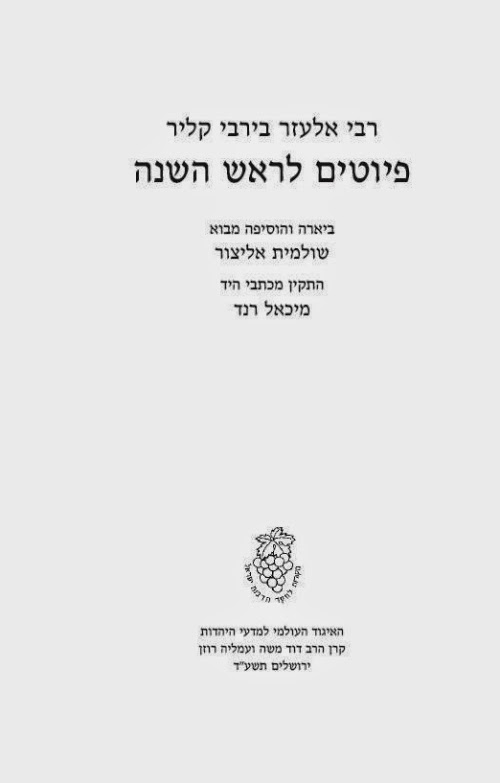
רבי אלעזר בירבי קליר, פיוטים לראש השנה, ביארה והוסיפה מבוא, שולמית אליצור, התקין מכתבי היד מיכאל רנד, האיגוד העולמי למדעי היהדות, ירושלים תשע”ד, [מקורות לחקר תרבות ישראל, כרך יח], 718 עמודים.
I am very happy to announce the publication of an important work out just in time for Rosh Hashanah, a critical edition of all of R’ El‘azar HaKalir’s Piyyutim for Rosh Hashonah, by Shulamit Elizur and Michael Rand.
The importance of studying the Piutim before Yom Tov has been noted by many for example:
R’ Moshe Hakohen, nephew of the Rosh, writes in his work, Sefer Hamaskil:
מה טוב ומה נעים לעיין תמיד דבר בעתו בכל שבוע ושבוע בפירוש חומש ומחזור וסליחות ויוצרות ופיוטים וקינות ופרקי אבות ודברות והושענות וזכרנו ואגדת פסח ומערבים וגדול וקטן… [ספר חסידים, עמ’ עא].
[For an exact explanation of this passage and for general information about this work see the special article of Rabbi M. Honig in Yerushaseinu 1 (2007) pp. 196-240 especially p. 229].
A similar idea is found in the Mahril:
וכל אדם יחזור וילמוד התפלה והקרובץ מקודם להיות שגורים בפיו בר”ה בשעת התפלה [מהרי”ל עמ’ רעב].
The Taz writes:
ראה דבתפלה שצריך להבין בפי’ הדברים בפרט בפיוטים שחמור פירוש’ אם לא בנתינת דעה רבה עליהם ודאי צריך להסדיר תחלה ולא מהני לו ספר בזה וזה פשוט [ט”ז, סי’ ק ס”ק א].
In regard to the Piyutim by the Kalir, it’s worth quoting the Arizal, as mentioned by the Magen Avrohom:
האר”י ז”ל לא היה אומר פיוטים ופזמונים אלא מה שסדרו הראשונים כגון הקלירי שנתקנו ע”ד האמת, (הכוונות( [סי’ סח הקדמה].
Different aspects related to the Kalir have been dealt with here on the Seforim Blog; see Dan Rabinowitz’s article here which includes a bibliography about him. In addition to this, see Marc Shapiro’s article here and my article here, note 73.
The Kalir as described by Rabbi Joseph B. Soloveitchik
 
I would just like to quote one special passage of Rabbi Joseph B. Soloveitchik about the greatness of the Kalir. This passage is from the Koren Mesorat Harav Kinot (pp. 386-388) which is based on Rabb Jacob Schacter’s transcripts of the Rav’s Tisha B’Av sessions:
At this point, it would be useful to make some general observations about Rabbi Elazar Hakalir and the style of his piyutim, his religious poetry. The piyutim of Rabbi Elazar HaKalir, including his kinot, serve two purposes. The first is limmud, learning. Every sentence of the piyut quotes m’aamarei Hazal, teachings of the sages. The second purpose is tokhaha, rubuking the people for their misdeeds and instructing them in the proper way to act. These piyutim deal with reproach, repentance, petition and acknowledgment of God’s justice. The shali’ah Tzibbur was not merely a hazan, a cantor, but was one of the great scholars of the generation who was the principal mokhiah, moral critic of the people…
Rabbi Elazar HaKalir was a master of the Hebrew language and very creative in his use of Hebrew. If not for him, modern Hebrew could not have come into existence. Before HaKalir, the Hebrew language was very rigid. For example, the noun and verbs were fixed in their form. It was difficult to transform a verb into a noun or a noun into a verb, a simple matter in other languages…
But HaKalir made a critical contribution to the development of the Hebrew language by endowing the language with flexibility, thereby paving the way for the development of modern Hebrew. There were other early paytanim, composers of piyut, such as Yose ben Yose, but they were not as radical in their literary style as HaKalir.  HaKalir was the father of the paytanim, and he dared to do more than any other paytan.
As noted above, Rabbi Elazar haKalir’s piyutim served two purposes: limmud, study and tokhaha, rebuke. As for the element of study, one of the dimensions of HaKalir’s piyutim is that they are compilations of the statements of the sages. Most of us, who are expert in neither Hebrew nor aggadot Hazal, find HaKalir’s corpus of piyutim boring. But it is not boring at all; it is like a gold mine. His piyutim for Yom Tov explain the essence of the Yom Tov. The midrashim concerning Sukkot are replete with information about the sukka, etrog and lulav, and all the explanations in the Midrash, all the ta’amei sukka, the reasons for the sukka, all of the ma’amarei Hazal, are brought together in the HaKalir’s piyutim for the first day of Sukkot. Similarly, his piyutim for Rosh HaShana and Yom Kippur include all the homiletical literature concerning the statement in the Midrash, “On Rosh HaShana, Sarah, Rachel and Hanna, were remembered” (Bereshit Raba 73:1). If one were to study carefully and thoroughly the piyutim of Rabbi Elazar HaKalir for Rosh HaSahana, Yom Kippur, Sukkot, and Pesah, one would find many applicable halakot and the entire pertinent Midrash, including many  midrashim that are unknown to us from any other source.
It is quite possible that during the time of Roman and Byzantine rule in the land of Israel, the ruling authorities prohibited shiurim and afternoon lectures by Torah scholars and sent officers to the synagogues on Yom Tov afternoon to prevent the people from studying. Consequently, the rabbis introduced the study of Torah into the prayer service via piyutim, a subterfuge that eluded the authorities. The piyutim were deliberately written in a fashion that would make them difficult to understand, lest the officers recognize their true function and forbid their recitation. As previously noted, we do not know with certainty when Rabbi Elazar HaKalir lived. According to Tosafot (Hagiga 13a, s.v. veraglei hahayot), he was the tanna, Rabbi Elazar HaGadol, who lived in the second century, but according to other Rishonim, he was either an amora, or one of the early liturgical poets, from the sixth or seventh century. But his piyutim could certainly have served the purpose of integrating Torah study into the prayers in a way that would not have been obvious to the non-Jewish authorities.
Description of the work:
What follows is a description of this new work [sent around from the publishers of the book]
Rosh Hashana, the Day of Judgment, has been embellished with numerous fascinating liturgical poems (piyyutim). This book is devoted to the compositions that were written for Rosh Hashana by the illustrious poet R. El‘azar berabbi Qillir, who was active in the Land of Israel at the beginning of the seventh century. The piyyutim for Rosh Hashana are many and varied, and they adorn all of the special prayers for the festival. A number of these piyyutim are known and recited to this day in Ashkenazi congregations, while others are published here for the first time. Even those piyyutim that are known from the festival prayer books (mahzorim) are presented here in a new light. The present edition is primarily based not on European mahzorim, but on earlier fragments from the Cairo Genizah; on the basis of such early sources the editors have succeeded in adding new, original material to the known compositions—there is not one famous composition to which heretofore unpublished material has not been added, in some cases throwing new light on the entire work. Even in such cases, therefore, we are not merely offering old wine in new wineskins, but presenting a new blend that confers on the poetic compositions novel aspects, not previously brought to light.
This edition has been prepared on the basis of close to 400 manuscripts, and all of the variant readings have been given in the margins. An extensive commentary aids the reader in understanding the difficult idiom of the payyetan, identifying the many scriptural and midrashic sources that are woven into the piyyutim, and following the development of their themes. A general introduction treats various questions connected to the poems, from their attribution to the author and the reconstruction of the component parts of each composition, to the literary shaping of the material. In his piyyutim, R. El‘azar berabbi Qillir treats Rosh Hashana in all of its aspects: the Day of Judgment, the blowing of the shofar; the malkhiyot, zikhronot, and shofarot verses; the merit of the Fathers; and more. A number of compositions are specially intended for when Rosh Hashana falls on the Sabbath. Qillir’s unique method in the shaping of each of these themes is also clarified in the introduction. The complex web of interrelations between the piyyutim and their literary sources is elucidated as well; thus it has become clear, for example, that one of the piyyutim edited here for the first time throws new light on the famous poem, U-netane toqef qedushat ha-yom.
“O King, Remember [the ram] caught [by its] horn!” These few words from one of the piyyutim published in the book reveal the genius of the great payyetan. Here, R. El‘azar berabbi Qillir has succeeded in encapsulating in four words the three great themes that lie at the heart of the benedictions that are unique to Rosh Hashana—kingship, remembrance and the ram’s horn (shofar)—all in the
form of a prayer that beseeches God to remember for our sakes, on the Day of Judgment, the Binding of Isaac, symbolized by the ram whose horns are caught in the thicket. And if in four words the payyetan has managed to encapsulate such far-flung meanings, one can only imagine the riches contained in this enormous collection of R. El‘azarʼs writings for the Day of Judgment, which we now have before us.
About the authors:
Prof. Shulamit Elizur has been teaching since 1980 in the section for Medieval poetry and piyyut in the Department of Hebrew Literature at the Hebrew University of Jerusalem. She has published more than ten books and scores of articles, predominantly in the field of Genizah piyyut, but also devoted to Spanish Hebrew poetry and the development of various liturgical rites. A series of her books is devoted to the Late Eastern period of piyyut, and comprises an attempt to characterize the linguistic and literary developments attested during this phase on the basis of the production of critical editions of a number of its outstanding representatives. The present work is part of another series of her books devoted to the great Classical poets, among them R. El‘azar berabbi Qillir and R. Pinhas ha-Kohen.
Dr. Michael Rand specializes in Hebrew philology and piyyut. Since 2013, he has been Lecturer in Hebrew and Aramaic at the University of Cambridge. Dr. Rand acquired expertise with Genizah manuscripts over the course of a number of years of work in the section for piyyut and Medieval poetry of the Historical Hebrew Dictionary Project of the Academy of the Hebrew Language. He has devoted an extensive study to the grammar of the piyyutim of R. El‘azar berabbi Qillir; together with Jonathan Vardi, he has recently completed a soon-to-appear reconstruction of a copy of the Diwan of R. Shmuel ha-Nagid, the leaves of which are now scattered across various Genizah collections. He has also written many articles, among which are a number in which he has edited parts of the Qillirian corpus. In the present work, Dr. Rand is responsible for the paleographical aspects of the research: reading the manuscript sources, grouping them together (where relevant) and reconstructing thereby the larger units (quires, books) to which they belong, producing the apparatus of variant readings, and describing the manuscripts.
Purchasing information:
 
For a Table of Contents or more information about purchasing this work, feel free to contact me at Eliezerbrodt@gmail.com. Copies of this work will be arriving at Biegeleisen shortly.


Kalir, False Accusations, and More

Kalir, False Accusations, and More
by Marc B. Shapiro
1. I now want to return to Kalir and the criticism of me. To recap, I had earlier mentioned how Artscroll originally correctly identified Kalir as post-tannaitic, but later changed what it wrote in order to be in line with Tosafot’s opinion that he was a tanna. Some think that it is wrong to criticize Artscroll by using academic methodology instead of judging them by traditional sources, since they don’t recognize the academic approach.
My first response is that this is nonsense and a textbook example of obscurantism. If there is evidence of a certain fact, one can’t say that it is only a fact if it appears in some “traditional” source, and therefore one who ignores this evidence gets a pass.
Furthermore, when it comes to Kalir one can also date him using traditional sources.[1] One of these sources is quite fascinating. Whether there is any truth to the event described, I can’t say, but the fact that a traditional source dates him after the tannaitic era is what is important for us at present. This shows that Tosafot’s dating is not the only traditional source in this matter. The source I refer to is the medieval R. Ephraim of Bonn who states that the paytan Yannai, who is usually dated to the seventh century but could even be a few centuries earlier (but still post-tannaitic), was the teacher of Kalir.
R. Ephraim notes that Yannai was not the most kind of teachers and he was jealous of his student Kalir, showing that the Sages’ statement that people are jealous of all, except for a son and student (Sanhedrin 105b), can have exceptions. In order to deal with his problem, Yannai decided to terminate Kalir, with extreme prejudice of course. He therefore put a scorpion in Kalir’s sandal which took care of matters. R. Ephraim reports that because of this murder, in Lombardy (Italy) they refused to recite one of Yannai’s hymns.[2]
אוני פטרי רחמתים. ואמר העולם שהוא יסוד ר’ יניי רבו של רבי אלעזר בר קליר, אבל בכל ארץ לומברדיאה אין אומרים אותו, כי אומרים עליו שנתקנא בר’ אלעזר תלמידו והטיל לו עקרב במנעלו והרגו. יסלח ה’ לכל האומרין עליו אם לא כן היה.
R. Ephraim is the source for this report and as you can see from his final words, he took the report very seriously and literally, declaring that if it wasn’t true then those who spread this rumor were in need of repentance. Israel Davidson, however, claims that to take the report literally would be “absurd”, and the report of the scorpion is merely an “idiom, undoubtedly Oriental in origin, for expressing unfriendliness.”[3] The problem with this is, as we have seen, R. Ephraim and the community of Lombardy did take the report literally, so why should Davidson, living well over a thousand years after the supposed event, know more than people who lived in medieval times?[4] It is one thing to say that the murder never occurred, but that doesn’t mean that the story as told was not meant to be understood literally, and there is every reason to assume that it means what it says. If it happened, it would hardly be the first murder committed by a Jew. Thus, although the story is almost certainly a legend, our reason for making this determination is not because it is impossible to imagine one Jew doing such a thing to another.
Another important source is found in R. Hayyim Joseph David Azulai, Mahazik Berakhah, Orah Hayyim 112 (end). Azulai, as we all (should) know, had a keen bibliographical sense, and knew rabbinic history very well. After mentioning how Tosafot and the Rosh state that Kalir was really the tanna R. Eleazar ben Shimon,[5] the Hida quotes R. Isaac Luria as follows:
דהפייטן היה בו ניצוץ מנשמת ר’ אלעזר ברבי שמעון.
In other words, it is not that Kalir was actually a tanna, but that his soul was connected with R. Eleazar ben Shimon. I presume that this is an attempt to preserve the old tradition identifying the two, while at the same time recognizing that historically they were two different people. We find the same approach among many commentaries that deal with aggadic statements that make all sorts of identifications, of what can perhaps be called the rabbinic “conservation of people.” In other words, there is a tendency to identify biblical figures with other known biblical figures, such as Elijah with Pinhas and Harbonah, Hagar with Keturah, Pharaoh with the King of Nineveh, Yocheved and Miriam with Shifrah and Puah, Mordechai with Malachi[6] and Ezra, Tziporah with the Cushite woman,[7] Balaam with Laban, Daniel and Haman with Memukhan, to mention just a few.[8]
I don’t think people should be surprised that also among traditional commentators one can find the viewpoint that these identifications are not to be taken literally[9]—kabbalists are often inclined to see these texts as referring to reincarnation[10]—and some modern scholars have spoken of these identifications as examples of what they term “rabbinic fancy.” Some of these identifications are so far-fetched that I have no doubt that R. Azariah de Rossi and R. Zvi Hirsch Chajes are correct that the Sages who expounded them never intended them to be taken literally.[11]  Although I haven’t investigated the matter, I assume one would find the same tendency to non-literal interpretation when dealing with Aggadot that insert historical figures into other biblical episodes, e.g., Balaam and Jethro becoming Pharoah’s advisors, or when the Aggadah identifies spouses, e.g., Caleb marrying Miriam and Rahab marrying Joshua (and having daughters with him[12]).
2. In the previous post I quoted what the late R. David Zvi Hillman said in the name of R. Shlomo Yosef Zevin regarding Saul Lieberman. Some people were incredulous, and this raises the question of how reliable Hillman was and if he would distort things for ideological purposes.[13] I have spoken about him before, and I reproduced his defense of the Frankel edition of the Mishneh Torah not citing R. Kook.[14] Despite his strong ideological leanings, as of yet I haven’t found any evidence that he would purposely distort. My sense is that he was quite honest in his scholarship (and the issue with R. Zevin and Lieberman might have been something he misunderstood or perhaps R. Zevin wasn’t clear in what he said. It simply is impossible now to reconstruct events.)
Even though I believe that Hillman was honest in his scholarship (i.e., not intentionally distorting as is so often the case with haredi writers), we do find that his ideology led him to unfounded conclusions. These are not intentional distortions because he really believed what he was saying, but they are distortions nonetheless. Here is one example.
In 1999 a memorial volume appeared called Ohel Sarah Leah. Beginning on p. 246 is an article by Hillman dealing with R. Joseph Saul Nathanson’s view of the International Date Line. In this article, he deals with a letter by R. Zvi Pesah Frank published by R. Menachem M. Kasher. He believes that Kasher added material to the letter so as to align it with his own viewpoint. The fact that Kasher published the letter in 1954, almost seven years before R. Zvi Pesah Frank’s death, does not deter Hillman from his argument. Other than Hillman, I think everyone realizes that if you are going to forge something in another’s name, you don’t do it when they are still alive![15] We can thus completely discount Hillman’s argument and see it as an ideologically based distortion.
Despite this defense of Kasher, it must also be pointed out that there are serious questions about the reliability of some things he published. In Between the Yeshiva World and Modern Orthodoxy I mentioned R. Eliezer Berkovits’ claim that the Weinberg letter Kasher published was not authentic. Berkovits clearly thought that Kasher forged it, but when I pressed him to say so openly, he wouldn’t. All Berkovits would say is that Weinberg never wrote such a letter, and it was fraudulent. When I asked, “So R. Kasher forged it?” he replied that he wasn’t going to speculate about this, and would only say that the letter did not exist. Being that Kasher claimed that Weinberg wrote the letter to him, this means that Berkovits was accusing him of forgery, but for whatever reason did not want to say so openly.
I have a 1982 letter from Berkovits to another rabbi, and in this letter he is not as circumspect as he was with me. Here he pretty much states that Kasher forged the letter “le-shem shamayim.”
בענין מו”ר הגאון זצ”ל אני בטוח שהוא מעולם לא כתב אותם הדברים שהרב כשר מוסר בשמו בנועם. אדרבה יראה לנו את מכתבו של מו”ר זצ”ל. לפני כשנה כתבתי לו בדואר רשום ובקשתי בעד צילום או העתק של מכתבו של הרב וויינברג זצ”ל. עד היום לא קבלתי תשובה ממנו. מבטחני שהדברים שנאמרו ושנכתבו בשמו אינם אמיתייים. בעונותינו הרבים הגענו למצב שגם אנשים ירא שמים וכו’ מורים היתר לעצמם בכל מיני ענינים כשהם חושבים שכל כוונתם לשם שמים היא. והוא רחום יכפר וכו’.
In the recently published Genazim u-She’elot u-Teshuvot Hazon Ish, pp. 263ff. the unnamed editor also levels serious accusations against Kasher, in a chapter entitled הזיוף החמור והנורא. He puts forth a series of claims designed to show that another letter Kasher published on the International Date Line, this time a posthumous letter from R. Isser Zalman Meltzer, is also forged. I have to say that in this example, unlike the one dealt with by Hillman, there is at least circumstantial evidence, but no smoking gun. The most powerful proof comes from Kasher himself in which he tells of a meeting with the Hazon Ish and how at that meeting he told the Hazon Ish about the letter he received from R. Isser Zalman in opposition to the Hazon Ish’s position. Yet the letter Kasher publishes from R. Isser Zalman is dated from after the Hazon Ish’s death. There is clearly a problem here, but more likely than assuming forgery is that Kasher was simply mistaken in his description of his visit with the Hazon Ish. Let’s not forget that this element of the account of his visit was published thirty-three years after the event, and it is possible that Kasher didn’t recall everything that was said. The followers of the Hazon Ish have indeed always claimed that his description of his visit, in Ha-Kav ha-Ta’arikh ha-Yisraeli (Jerusalem, 1977), pp. 13-14, is not to be relied upon. Since his own recollection of his visit is the strongest evidence in favor of Kasher forging R. Isser Zalman’s letter, it is not very convincing.
In the previous paragraph I wrote that “this element” of Kasher’s account was published thirty-three years after his visit, so let me explain by what I mean by that. In Ha-Pardes, Shevat 5714, p. 30, soon after the Hazon Ish’s death, he originally published his account. Only when he later published his Kav ha-Ta’arikh ha-Yisraeli did he mention that he told the Hazon Ish that he received letters from R. Zvi Pesah and R. Isser Zalman, and this point is mentioned after his description of his visit. In his original description he mentions nothing about receiving letters, only that R. Zvi Pesah told him his opinion and R. Isser Zalman agreed with this. I think what likely happened is that in the passing decades Kasher forgot that the letters he received only arrived after the Hazon Ish’s death. As mentioned, if you look at what he wrote right after the death of the Hazon Ish, he doesn’t mention any letters, and he even states explicitly that he didn’t have anything in print from R. Zvi Pesah. I think this shows that while Kasher’s recollection was not exact, there is no evidence that he forged the letter.
I do, however, have to mention that in the 1977 version of the visit Kasher adds something that is not in the original recollection and must therefore be called into question. In the original recollection he reports that the Hazon Ish began reading Kasher’s work on the dateline and then said that he is tired and asked if he could hold on to the work to read later. In the 1977 version Kasher then adds the following, which shows the Hazon Ish as not very committed to his own position, a point which is at odds with everything else we know about the Hazon Ish and the dateline:
והוסיף בזה הלשון: נו, יעדער מעג (קען) זיך האלטען ווי ער פערשטעהט. [כל אחד רשאי (יכול) להחזיק כפי הבנתו].
Kasher was also involved in another problematic episode related to his book Ha-Tekufah ha-Gedolah, which is dedicated to showing the messianic significance of the State of Israel. In the book, pp. 374ff., he includes a proclamation urging participation in the Israeli elections. This proclamation is signed my many rabbinic greats and states that the State of Israel is the beginning of the redemption. This is a very significant document and is often referred to, because among the signatories are some who were never identified with Religious Zionism.
But is the document authentic? Zvi Weinman has shown (and provided the visual evidence) that a number of the rabbis signed a document that did not mention anything about athalta di-geula but instead referred to kibutz galuyot.[16] In Kasher’s book, their names are listed together with those who signed the document referring to athalta di-geula, even though they never agreed with this formulation. This would appear to be a Religious Zionist forgery (unless it is simply a careless error), although it is impossible to know whether Kasher was responsible for this or if he was misled by someone else.
If it can ever be proven that Kasher was indeed responsible for a forgery, there is still a possible limud zekhut for this type of behavior (and I mentioned it in a prior post): If you are convinced of the correctness of your position, it is not hard to construct an argument, based on traditional Jewish sources, that false attribution and even forgery is permissible. In the book I am currently working on I bring all sorts of examples of this which I think will be very distressing for readers, as it is in complete opposition to what most of us regard as basic intellectual honesty.
Returning to the recently published Genazim u-She’elot u-Teshuvot Hazon Ish, the editor also makes an outrageous accusation and I am surprised that no one has yet publicly protested. The canard is leveled at Chief Rabbi Isaac Herzog, whose saintliness was universally acknowledged even by those who opposed his Zionist outlook. It was R. Herzog who in early 1940 flew to London and was able to convince the English government to grant a number of visas for Torah scholars. He was thus directly responsible for saving the lives of, among many others, R. Velvel Soloveitchik and R. Shakh.[17] This fact alone should have been enough to prevent any scurillous accusations directed against R. Herzog.
On pp. 226ff. there appears a 1941 letter, dated 24 Elul, from R. Shlomo Yosef Zevin to the Hazon Ish asking him about the problem of Shabbat in Japan for those who had escaped the Nazi clutches. R. Zevin wrote to the Hazon Ish at the request of R. Herzog, who said that only two people in the Land of Israel were expert in this matter, R. Tukatchinzky and the Hazon Ish.
There is a good deal that can be said about R. Zevin’s letter and the Hazon Ish’s response, but that is not my concern at present. Yet I must at least mention that the editor provides another letter from the Hazon Ish in which he expresses his displeasure that R. Zevin’s Torah writings had appeared in the newspaper Ha-Tzofeh. According to the Hazon Ish, these should have been published as a special booklet, as it is inappropriate to publish Torah articles in a newspaper that in the end is used to wrap food in. He also mentions that Ha-Tzofeh itself is not suitable, referring obviously to its Religious Zionist outlook. (R. Zevin would, over his lifetime, write hundreds of articles for Ha-Tzofeh, many of which have not yet been collected in book form.)
Also noteworthy is that in his reply to R. Zevin the Hazon Ish raises the possibility that the viewpoint of the rishonim would have to be rejected if it turns out that they were mistaken in their understanding of the metziut.

העומד עדיין על הפרק הוא אם טעם הראשונים ז”ל הוסד על המחשבה שאין ישוב בתחתית הכדור, ואז נקח עמידה נועזה לנטות מהוראת רבותינו ז”ל ולעשות למעשה היפוך דבריהם הקדושים לנו ולכל ישראל, או שאין לדבריהם שום זיקה לשאלת ישוב התחתון.
(In a later letter, quoted on p. 231, we see a different perspective.) In R. Zevin’s letter he mentions why the issue of Shabbat in Japan was so pressing. R. Herzog had recently received a telegram from Kobe, Japan, asking on what day the Jewish refugees should fast.[18] Here is a copy of the telegram, as it appears in David A. Mandelbaum’s Giborei ha-Hayil, vol. 1.


Genazim u-She’elot u-Teshuvot Hazon Ish, p. 227, makes the astounding assertion that this telegram was a scheme cooked up by the Chief Rabbinate (i.e., R. Herzog).This would enable R. Herzog to call a gathering a great Torah scholars at which time he could push them to accept his opinion in opposition to the viewpoint of the “gedolei Yisrael.” It is hard to imagine a more outrageous accusation directed against a man of unquestioned piety such as R. Herzog.

Quite apart from the slander I have just pointed to, the volume also contains a good deal of ideologically based distortion, which is why it is noteworthy that it not only includes the letter from the Hazon Ish to Saul Lieberman (p. 330) that I published in Saul Lieberman and the Orthodox,,[19] but even identifies him in the following respectful way:
המכתב נשלח לבן דודו פרופ’ ר’ שאול ליברמן ז”ל מחה”ס תוספתא כפשוטה, ירושלמי כפשוטו וש”ס.
Considering how Lieberman is persona non grata in the haredi world, I find this identification, as well as mention of his books, nothing sort of remarkable.[20]
In fact, the story gets even more interesting. A couple of months ago volume two of Genazim u-She’elot u-Teshuvot Hazon Ish appeared. Before I was able to get a copy, people emailed me to let me know that this volume contained a lengthy letter from Lieberman to the Hazon Ish. (I thank Ariel Fuss for sending me a copy of the letter.) It appears on pages 207-209 and is really fascinating. Leaving aside the talmudic analysis, the end of the letter shows the different outlooks of these cousins. We see that the Hazon Ish had criticized Lieberman for referring to Prof. Jacob Nahum Epstein as mori ve-rabbi. Lieberman didn’t understand why the Hazon Ish found this objectionable, since Epstein was a pious Jew and Lieberman learnt many things from him, “true Torah and not the path of the maskilim but that of our teachers of blessed memory, who search for the truth in the words of Hazal, in all possible ways, and many obscure places in the Jerusalem Talmud were explained to me precisely through this approach.”[21]
Lieberman then turns to another criticism of him by the Hazon Ish, that he was not devoting himself adequately to his Torah study. It is hard to know what to make of this critique, as who was more devoted to his studies than Lieberman. Lieberman defends himself from this accusation, noting:
אני לפעמים נופל על הספסל מחוסר אונים מרוב התאמצות ויושב אני לפעמים כמה ימים על סוגיא אחת עם ראש חבוש.
Here is Lieberman’s grave, in the Sanhedria cemetery. Note who he is buried next to. (As I mentioned in Saul Lieberman and the Orthodox, according to Chaim Herzog, Lieberman was R. Herzog’s closest friend. It is therefore fitting that he be buried next to R. Jacob David.)
3. Regarding the last post, a number of people emailed me pointing out other “immodest” title pages and also learned women that I didn’t mention. I thank all who emailed. Many of the other title pages I knew about and might refer to at a future time, but the post was specifically concerned with censorship of title pages, and this explains the ones I cited. One of the commenters did refer to a title page that I did not know, from a 1731 Hamburg manuscript. See here (the rest of the Haggadah has other interesting pictures). If you ever needed an example of how what we today regard as unacceptable is not necessarily how people hundreds of years ago viewed matters, this is it.[22]
Regarding learned women, a great deal has obviously been written about this and I don’t see it as my purpose to simply repeat what others have written elsewhere. I hope that in the prior post (and indeed in all my posts), people find new material and learn things that they wouldn’t know from elsewhere, even those who are experts in the various topics.
Since the matter has been raised again, le me mention something that I originally was going to write about. At the last minute I took it out, as I was convinced (by both a scholar who will remain anonymous and Prof. Shamma Friedman) that I was in error.
Tosefta Ketubot 4:7 (and the parallel passage in J. Ketubot 5:2) reads:
נושא אדם אשה . . . על מנת שתהא זנתו ומפרנסתו ומלמדתו תורה.
It then follows by telling us that R. Joshua son of R. Akiva arranged exactly this sort of marriage. I think that if you show this passage to people, and cover up the commentaries, they will translate it to mean that a man can marry a woman on the condition that she will take care of his physical sustenance “and will teach him Torah.” (This is how Neusner translates in his Tosefta and Yerushalmi translation, and is also found in some academic articles.) Yet all of the traditional commentaries understand this text to mean that the woman provides the financial support her husband needs in order that he is able to study Torah on his own. For a while I assumed that this was an apologetic understanding by the commentators, and we know that the Talmud does offer a few examples of learned women. Yet as mentioned, I was convinced of my error.[23] In email correspondence, Friedman also called attention to other unusual Hebrew formulations which don’t mean what they literally say. For example, Yevamot 13:12 states: בא על יבמה גדולה תגדלנו. Yet this does not mean that she has to raise the boy, but only that she has to wait until he is of age to give her a divorce. He also pointed to Nazir 2:6 (and see also 2:5) which uses the language of הרי עלי לגלח חצי נזיר and this has nothing to do with shaving the Nazir.
One final point I would like to make about learned women is that before drawing any conclusions about their knowledge, we must be sure that we are not dealing with ghost writers. For example, Dov Katz, Tenuat ha-Mussar (Jerusalem, 1982), vol. 1, p. 242 n. 30, refers to the wife of R. Aryeh Leib Horowitz (the son of R. Israel Salanter) as a “learned woman” based on the introduction she wrote to her deceased husband’s Hayyei Aryeh (Vilna, 1907). Here is the text.

I can’t prove it, but I am very confident that someone wrote this on behalf of the wife, who was a traditional rebbetzin, not a maskilah.

4. In preparation for the trip I am leading to Italy in July (we still have room for some more people, and also for the August trip to Central Europe), I thought it would be helpful to read the letters of R. Ovadiah Bartenura. Right at the beginning of the first letter[24] I found something very interesting. I immediately suspected that this passage would be omitted from a translation directed towards the Orthodox masses. I checked, and lo and behold, the passage is indeed deleted. Here is the text:

Note how R. Ovadiah testifies that while the Jews in Palermo were careful about not drinking non-Jewish wine, which was noteworthy since elsewhere in Italy Jews routinely consumed this, their sexual morality and observance of the Niddah laws left something to be desired. He claims that most young women there were already pregnant at their wedding.
Here is how the page appears in the translation by Yaakov Dovid Shulman:
This text was censored even though the preface to the book states: “In publishing these letters in their entirety, including the critical comments made by Rabbi Ovadiah Bartenura of those people and practices of which he disapproved, the assumption is made that these criticisms were written to instruct the reader and not to denigrate any individuals.” As you can see, the letter has not been published in its entirety, and if one were to go through the text carefully, perhaps some other deleted passages would be discovered.[25]
5. I have done six posts on R. Kook and from email I receive I know that some people want me to return to this. I plan to, but I still have a few more posts to do before I get to that. In the meantime, however, I want to inform readers that a new volume of R. Kook’s writings has just appeared. It is called Ginzei ha-Rav Kook and I thank R. Moshe Zuriel for drawing my attention to it. My sense is that this volume does not have much importance, as much of it, and maybe even the majority, has already appeared in other collections, particularly the Shemonah Kevatzim. I was able to determine this using the R. Kook database, which except for the most recently published material includes all of R. Kook’s writings.
I did find one passage (p. 87, no. 85) which I am pretty sure has not yet appeared, even in the most recent writings. It relates back to a point I already called attention to in R. Kook, namely, his privileging of the pious masses over the Torah scholars in certain ways. One rabbinic text that would appear to oppose R. Kook’s conception is the famous Avot 2:5: ולא עם הארץ חסיד. See how R. Kook neutralizes this text, pointing out that there are a lot of things more important than being a hasid. Here is R. Kook, a member of the rabbinic elite, nevertheless insisting that the am ha-aretz can have just as much holiness as the Torah scholar, be visited by Elijah, and even have ruah ha-kodesh:
“ולא עם הארץ חסיד”. אבל מה שהוא למעלה מהחסידות, כמו קדושה וענוה ותחית-המתים וגילוי אליהו ורוח-הקודש, מפני גודל קדושתם הם שוים לכל נפש. כי כל לבבות דורש ד’, ואחד המרבה ואחד הממעיט ובלבד שיכוון לבו לשמים, ומעיד אני עלי שמים וארץ, אמר אליהו, בין איש בין אישה, בין עבד בין שפחה, בין נכרי בין ישראל, הכל לפי מעשיו רוח הקודש שורה עליו. וכיון שלא יצאו שפחה ונכרי מכלל רוח-הקודש, קל-וחומר שלא יצא עם-הארץ שהוא מזרע קודש, מעם ה’ וצבאותיו אשר הוציא ממצרים להיות לו לעם נחלה כיום הזה, סגולה מכל העמים.
(The reference to Elijah is from Tanna de-Vei Eliyahu, ch. 9.)
P. 112, no. 104, returns to a theme I have also dealt with, that study of halakhic details can be problematic for a mystical personality such as R. Kook.[26] Yet he adds that this is still the job of the righteous ones, and we can see here an autobiographical reflection.
אף על פי שלימודם של המצוות המעשיות בדקדוק קיומם מכביד לפעמים הרבה על הצדיקים הגדולים השרויים תמיד באור המחשבה העליונה, מכל מקום מתוך כח היראה העליונה שבלבבם, מתגברים הם גם על שפע קדושתם, ועוסקים בתורה ובמצוות במעשה ובדקדוק, אף על פי שהם צריכים למעט על ידי זה את אורם העליון.
Can we also see an autobiographical reflection on p. 114, no. 106, where R. Kook speaks about the righteous who want the world to recognize their greatness and holiness?
לפעמים מתגלה בצדיקים גדולים תשוקה גדולה, שיכירו הכל את מעלתם ושיאמינו בקדושתם. ואין תשוקה זו באה כלל משום גסות הרוח או אהבת כבוד המדומה, כי אם מפני החשק הפנימי של התפשטות האור הטוב שבהם על חוג היותר רחב האפשרי. וזהו מעין התשוקה של הופעת החכמה על ידי המצאות טובות וספרים טובים שכשהיא אידיאלית היא עומדת בנקודה היותר עליונה שבאור הנשמה הא-להית.
He then returns to the difficulty the Tzaddik has with halakhic particulars (p. 115):
ישנם צדיקים גדולים כאלה, שהם למעלה מכל שרש הדינים, ועל כן אינם יכולים ללמוד שום דבר הלכה. וכשהם מתגברים על טבעם ועוסקים בעומקא של הלכה, מתעלים למעלה גדולה לאין חקר, והם ממתקים את הדינים בשרשם.
[1] R. Yaakov Yisrael Stoll, in his recently published Segulah (Jerusalem, 2012), pp. 50ff., takes it as a given that Kalir is post-tannaitic.
[2] Israel Davidson, Mahzor Yannai (New York, 1919), p. xlix                     
[3] Ibid, p. xxv.
[4] Unless R. Ephraim was misinformed about Lombardy, this practice must have changed at some time because we know that in Lombardy the piyut was recited on Shabbat ha-Gadol. See R. Moshe Rosenwasser, Le-Hodot u-le-Halel  (Jerusalem, 2001), p. 379. As Rosenwasser points out, R. Ephraim is also the source for the story of R. Amnon of Mainz writing U-Netaneh Tokef.
[5] This is impossible as in one of his hymns he tells us that is father’s name is Jacob. See R. Simon Federbush, Ha-Lashon ha-Ivrit be-Yisrael u-ve-ha-Amim (Jerusalem, 1967), pp. 70-71.
[6] This identification explains how in Italy Jews with the Hebrew name Mordechai were sometimes given the vernacular name Angelo (= מלאכי). See Cecil Roth, Venice (Philadelphia, 1930), p. 168.
[7] This identification is rejected by Rashbam. See his commentary to Num. 12:1. Regarding Rashbam’s comment, see the lengthy discussion of Lockshin in his translation. While Rashbam rejects the notion that the Cushite is Tzipporah, he apparently has no problem repeating the legend  that “Moses reigned in the land of Cush for forty years and married a certain queen [from there].” He knew this legend from the work Divrei ha-Yamim de-Moshe Rabbenu, although as Lockshin mentions, it is also found in more “kosher” sources, such as Yalkut Shimoni. Ibn Ezra also cites the legend of Moses ruling in Cush in his commentary to Num. 12:1, despite the fact that in his commentary to Ex. 2:22 he writes:
Do not believe what is written in the book called the History of Moses. I will give you a general rule. We should not rely on any book not written by prophets or by the sages who transcribed traditions passed on to them. We definitely should not rely on these books when they contradict reason. The same applies to the Book of Zerubavel, the Book of Eldad ha-Dani, and similar compositions.
In a previous post I discussed Rashi’s understanding of the word Cushite, and how it is not to be taken literally. Ibn Ezra does take it literally (and still thinks that it refers to Tziporah). As with Rashi, he assumes that Cushites are not very attractive and explains that Miriam and Aaron, who spoke negatively about Moses, “suspected that Moses refrained from sleeping with Tzipporah only because she was not beautiful.” (Commentary to Num. 12:1).
Regarding the Cushite woman, I found something strange in R. Joseph Solomon of Posen’s Yesod Yosef (Munkacs, 1907), p. 8b. This is how he explains Aaron’s and Miriam’s talk against Moses on account of the Cushite he married (Num. 12:1):
מרים ואהרן רצו לתלות בוקי סריקי במשה ולהטיל מום בקדשי’ לפי דברי התרגום שני שפירש אשה כושית מלכה כוש שטימא את ברית קודש ובעל בת אל נכר וכל ביאה שאינה בהיתר נקרא הוצאת זרע לבטלה
R. Joseph Solomon goes on to explain why Aaron and Miriam were mistaken in their judgment.
[8] See R. Joseph Zekhariah Stern, Zekher Yehosef, Orah Hayyim no. 121 (p. 34a). R. Shmuel Avraham Adler, Aspaklaryah, vol. 27, s.v. shem, pp. 119ff
[9] R. Menahem Azariah of Fano acknowledges that when it comes to Elijah-Pinhas, most scholars understood this literally. Yet he rejected this position, perhaps because it would require Pinhas to have lived at least 350 years.) See Asarah Ma’amarot, Hikur Din section 4 ch. 18:
ואף על פי שיש מרבותינו אומרים בפשיטות פינחס הוא אליהו אין הדבר כמחשבת המון החכמים שפינחס לא מת ושקיים בעצמו שנוי השם.
[10] Opponents of gilgul had argued that if this was an authentic Jewish doctrine, certainly the Talmud would have mentioned it. R. Elijah Benamozegh argues that these texts, identifying various people as one and the same, are the proof that the talmudic sages indeed accepted reincarnation. He assumes that for many of these passages, where the different eras of the individuals mentioned is an obvious problem, no one with any intelligence can believe that the Talmud meant these passages to be understood literally. The meaning must therefore be reincarnation. See Eimat Mafgia, vol. 2, p. 2b:
איככה יוכל האיש לא טח עיניו מראות להניח כי לבן הארמי אשר חי בימי יעקב אבינו הוא עצמו בלעם הרשע, אשר היה בימי בני בניו האחרונים . . . וחירם שהיה בימי שלמה הוא אשר היה בימי יחזקאל . . . כיצד נוכל לייחס הבנתם הפשטית לחכמינו הקדושים אשר גם לפי דעות המנגדים לא יתכן לתלות בהם חסרון ושגעון כ”כ עצום כאשר כל אחד יראה בדמיונות האלה.
There are two books entitled Eimat Mafgia, one by Benamozegh and the other by R. Moses ben Ephraim of Brody (Warsaw, 1888). Both of them are directed against R. Leon Modena’s Ari Nohem. The title comes from Shabbat 87b: אימת מפגיע על ארי
[11] Meor Einayim, ch. 18; Mevo ha-Talmud, ch. 21, in Kol Sifrei Maharatz Chajes, vol. 1. In other words, the peshat is not literal. According to traditional commentaries, we find plenty of examples of this in the Bible also. Thus, when the Torah speaks of God’s outstretched arm, Maimonides insists that the peshat is that these words are not to be understood literally. Many have argued that even according to the peshat “an eye for an eye” is not to be understood literally. I think that most people today who read the book of Job will conclude, as did Maimonides, that the peshat is that it is not a historical tale.
[12] See Megillah 14b, Tosafot, Megillah 3b s.v. melamed, Maharsha, Hidushei Aggadot, Eruvin 63b (why does he quote Tosafot and not the Talmud in Megillah14b?), R. Samuel Strashun’s note to Eruvin 63a.
[13] Some people might have been led to thinking this because his letter was published in Yeshurun, which has in the past published articles that have engaged in censorship and ideological distortion. In the most recent volume, Nisan 5772, which also contains the Hillman letter, we find another instance of the disrespect for Torah scholars that is routine, and almost required, in haredi literature, and which in previous posts I have provided numerous examples of. (I refer obviously to Torah scholars not in the haredi camp.) On pp. 456-467,  there are letters from five deceased rabbis to R. Avraham Zeleznik. Four of them have the acronym זצ”ל put after their name. The only one who doesn’t merit זצ”ל, and instead is given ז”ל , is the Zionist R. Avraham Shapira (who incidentally was by far the most distinguished Torah scholar of the five.) R. Shapira also wasn’t provided with a short biography, presumably because then his position as Rosh Yeshiva of Merkaz ha-Rav and Chief Rabbi of the State of Israel would have to be mentioned.
[14] See here. With regard to Hillman, in this post I misstated his genealogy. Prof. Shlomo Zalman Havlin wrote to me as follows:
יש לתקן: הגרד”צ אינו נכד של הגרמ”מ חן הי”ד כפי שכתב [ע”פ האיזכור מבטאון חב”ד שהשתבש.] הוא בנו של ד”ר אשר הילמן בעל משרד רו”ח בת”א, נינו של הגרד”צ, רבה הידוע של צ’רניגוב, אביו של הרמ”מ. אגב, גם המשוררת זלדה [מישקובסקי] היתה נכדת הגרד”צ מצ’רניגוב, ואף אחיינית האדמו”ר האחרון מליובאוויטש.מאחיו של הגרמ”מ היה הרב אברהם חן, שהיה סופר מעולה, מחבר ‘במלכות היהדות’, קונטרס יפה ומרגש על אביו  
הגאון. היה רבה של שכונת בית הכרם [כמדומה שהיתה זו שכונה שלא נזקקה לרב]. מעניין לעניין, כדאי להוסיף, כי לגרמ”מ דובר בשעתו שידוך עם בתו של ר’ חיים מבריסק. לצ’רניגוב בא שליח להכיר את החתן המיועד, ולפי התיאורים ששמעתי ,הוא היה כנראה הגאון ר’ זלמן סענדר, אביו של הגאון ר’ אברהם בעל דבר אברהם, ורבה של קובנה [הוזכר ג”כ במאמר זה]. וכמה נשים ממשפחת הגרד”צ נסעו לבריסק להכיר את הכלה ומשפחתה. בגלל שיבושי הדואר הרוסי, חשבו בצ’רניגוב שאין תשובה, בעוד התשובה החיובית נדדה לעיר אחרת, והשידוך כידוע לא יצא אל הפועל. אגב, שמעתי, כי הנשים ממשפחת הגרד”צ כששבו אמרו, שלאור המסופר על גדולת ר’ ‘חיים וכו’, הרי כאשר שמעוהו בתפילת ערבית, אמרו, אצל אבא רואים יותר אפילו ב”אשר יצר
[15] See the response to Hillman by R. Ephraim Greenbaum (Kasher’s grandson), in Ohel Leah Sarah, pp. 942-943.
[16] Mi-Katovitz ad Heh be-Iyar (Jerusalem, 1995),  pp. 130ff.
[17] See A. Bernstein et al., Yeshivat Mir: Ha-Zerihah be-Fa’atei Kedem (Bnei Brak, 1999), vol. 1, pp. 218-219.
[18] One of my high school teachers was with the Mir yeshiva during the War. He told us how on Yom Kippur some people actually fasted for two days, eating pahot mi-ke-shiur after the first day so that they would be able to fulfill both the opinion of R. Herzog and the rabbis aligned with him as well the Hazon Ish’s view.
Fasting two days on Yom Kippur is actually not new. Ibn Ezra records how certain people did it in medieval times. He minces no words about what he thinks of them. See Sefer ha-Ibur, ed. Halbertam, pp. 4a-b:
ואם טען טוען הלא אתם אומרים כי שני ימים טובים צוו לעשות קדמונינו בעבור הספק למה לא קבעתם צום כפור שני ימים גם יש טפשי עולם מחברינו שיתענו שני ימים ואני אראה להם שלא יועיל להם תעניתם כי הוא שוא ושקר.
[19] This letter was previously printed in Sefer Zikaron Tuv Moshe (Bnei Brak, 2008), p. 253, and here too Lieberman is referred to respectfully. This book does not inform the reader where it found this letter, although Genazim u-She’elot u-Teshuvot Hazon Ish informs us that its source is Sefer Zikaron Tuv Moshe. I know that a number of copies of Saul Lieberman and the Orthodox made their way around Bnei Brak, and one of them apparently found its way to the editor of Sefer Zikaron Tuv Moshe.
[20] With reference to the Hazon Ish’s family, in Saul Lieberman and the Orthodox I noted how the Steipler stated that one should not study Lieberman’s books since he left the Orthodox world. Last year a new edition of the Tosefta was published and included some questions to R. Chaim Kanievsky. In the original question the authors spoke negatively about Lieberman. When they gave the page with their question and R. Hayyim Kanievsky’s reply to the typist (who might even have been a woman) they added the word להשמיט with reference to the comment about Lieberman. Perhaps this was because they didn’t want people to know about the family connection between the Hazon Ish and Lieberman. However, the typesetter didn’t understand their intention and included the word להשמיט, thinking that this word was to be added to the text. Here is the page (click to enlarge, or see detail directly below it).

Portions of the letter of the Hazon Ish to Lieberman, referred to on this page, are also found in Kovetz Iggerot Hazon Ish, vol. 3, no. 2.

I just mentioned women typists, which is common in the haredi world (Kitvei R. Weinberg vol. 1, which was printed by a Satmar company, was typed by a woman.) Let me now turn to what I think is an example of a woman translator, and I thank Elchonon Burton for bringing this text to my attention. Here are two pages from R. Shakh’s Lule Toratekha.

In it he mentions how the Hafetz Hayyim famously referred to Adam ha-Kohen as yemah shemo. Adam ha-Kohen was the pen name of Abraham Dov Baer Lebensohn, and for more on how the Hafetz Hayyim viewed him, see S.’s post here. Note how R. Shakh adds שר”י  to Adam ha-Kohen’s name. This stands for שם רשעים ירקב (“the name of the wicked shall rot” – Prov. 10:7) and is only applied to the most wicked.

Here is how this passage appears in Artscroll’s English translation, Rav Shach on Chumash.

The translator did not understand what שר”י means and assumed that it was part of his name, creating a previously unknown maskil, Adam HaKohen Sherry. Based on this error, I assume that the initial translation was done by a woman who knew modern Hebrew but not “rabbinic code.” The final translator, who is a talmid hakham, probably just revised the initial translation. Now knowing anything about the Haskalah, when he saw the name Sherry it didn’t raise a red flag leading him to check the original. S. pointed out to me that in the Wikipedia entry for Yimach Shemo, Adam HaKohen Sherry also makes an appearance.

[21] While on the topic of Lieberman, let me note that he has an unknown article in Otzar ha-Hokhmah 10 (1934), pp. 83-84, signed ש. ל.. In this short article he criticizes some of what R. Leopold Greenwald wrote about the Jerusalem Talmud. I refer to this article as “unknown” because I have never seen anyone refer to it, and it is not found in Tuvia Preschel’s bibliography of his writings included in Sefer ha-Zikaron le-Rabbi Shaul Lieberman, ed. Shamma Friedman (New York and Jerusalem, 1993).
 [22] After writing these words I saw that the title page of this haggadah was included in Leon Wieseltier’s article in the most recent Jewish Review of Books (Spring 2012), which is presumably where the commenter saw it. See here. See also this post regarding a different Haggadah, and see also Dan’s post here.
Here are some other pictures that I think people will find interesting. They appear in R. Leon Modena’s Tzemah Tzadik (Venice, 1660). This is not found on hebrewbooks.org but is on Otzar ha-Hokhmah (at least for now). This particular copy was originally part of Elkan Nathan Adler’s collection. (Adler used for his middle name the name of his father, R. Nathan Adler, chief rabbi of England. This was not unusual. To give another example, R. Samson Raphael Hirsch’s father’s name was Raphael.) Here is Adler’s book plate. His Hebrew name was Elhanan.
From Tzemah Tzadik, here is an illustration showing love of people.
Here is one showing love of man and wife.

Here is an “immodest” picture showing mermaids, which Modena, like so many others of his time, believed in.

Modena’s name does not appear on the title page of Tzemah Tzedek, but he reveals his authorship at the beginning of ch. 1, where first letters of the first sixteen words read: יהודה אריה ממודינא

Here is the page.

[23] He had already corrected Tal Ilan in this regard. See “A Good Story Deserves Retelling – The Unfolding of the Akiva Legend,” Jewish Studies Internet Journal 3 (2004), p. 85 n. 96.
[24] Darkhei Tziyon (Kolomea, 1886), pp. 5a-b
[25] As part of my preparations for the trip I have also been reading Elliot Horowitz’ many important articles on Italy. Not long after finding the censored text I saw that Horowitz had already discussed this passage and showed that there is indeed a history of omitting and distorting it. See “Towards a Social History of Jewish Popular Religion: Obadiah of Bertinoro on the Jews of Palermo,” Journal of Religious History 17 (1992), pp. 140ff. While the examples Horowitz discussed are motivated by a Victorian style of writing, the example I give is probably motivated by a desire to shield the masses from the knowledge that even in pre-Reform Europe violation of halakhah was in many places a common phenomenon. It never ceases to amaze me how little knowledge of history some otherwise very intelligent people have, which I guess means that the censorship and rewriting of history is having an effect. Not long ago I was with someone who had spent a number of years in yeshiva, and he really believed that in 19th century Eastern Europe the porters and wagon drivers were all great talmidei hakhamim whose free time was devoted to mastering Shas.
[26] See also Tomer Persico, “Ha-Rav Kook: Al Tzadikim Gedolim ve-Yishrei Lev – be-Ma’alah ha-Hasagah ha-Mistit,” Moreshet Yisrael 5 (2008), available here.


Post-script by S. of On the Main Line:

Two points may be of further interest.

1) Regarding the Western Askenazic custom of using the father’s name as a middle name ala  the aforementioned R. Hirsch and Elkan Nathan Adler, E. N.’s two older half brothers also used  their father’s name, Nathan, as middle names; there was Marcus Nathan Adler, best known for his edition of Benjamin of Tudela’s Travels. In addition, Chief Rabbi Herman Adler also used it as a middle name, especially in his earlier years. In his university matriculation record from 1856 he is listed as “Hermann Nathan Adler.”

2) In addition to the coded acrostic self-reference by the author of Zemach Zedek in the opening lines referred to above (‘יושר האהבה וכו), R. Yehuda Aryeh Modena also refers to himself in the opening lines of the hakdamat ha-mekhaber: נודע ביהודה אלקים ובישראל אריה שאג.