A Few Comments Regarding The First Woodcut Border Accompanying The Prague 1526 Haggadah

A Few Comments Regarding The First Woodcut Border Accompanying The Prague 1526 Haggadah

The Prague 1526 edition of the Haggadah is one of the most important illustrated haggadot ever published.  It is perhaps the earliest printed illustrated haggadah for a Jewish audience and served as a model for many subsequent illustrated haggadot.[1] The earliest printed haggadah with illustration was published in 1512 in Latin and for a non-Jewish audience. That haggadah contains six woodcuts, and was intended as a response to the infamous anti-Semite Pfefferkorn’s screeds against Judaism.[2]The woodcut accompanying the first page shows three Jews around the seder who have four cups in front of them.  Although the Talmud explicitly states that one is not required to have four distinct cups of wine, presumably the image is a crude method of indicating the four-fold nature of the wine during the seder rather than prescribing custom.

The Prague 1526 edition was published by Gershom and his brother Gronom Katz on Sunday, 26th of Tevet 5287 or December 30, 1526.[3] This detailed publication information does not appear on the title page, rather it appears at the end of the book and is  referred to as a colophon.  The colophon is a manuscript convention that was incorporated into earlier printed books. The Prague 1526 edition does not have a title page at all.  At that time, the usage of the title page was only in its early stages.[4]

  1.          The Earliest Hebrew Title Pages

As with non-Hebrew titles, the title page developed over time, both in terms of content as well as usage.[5]   The first Hebrew title page is that of the Sefer Rokeah published in Fano in 1505.[6] But that title page is really one of the more basic forms of the title page, known as a “label title page” providing only the title and author and no other ornamentation or information.[7] In that same year, an edition of Abarbanel’s Zevah Pesach was published in Constantinople.  This edition was the first to contain a border with the title and author, but no place or date of publication.[8] The first Hebrew book containing all the elements of a traditional title page, border, title, author, place and date is likely the 1511 Pesaro edition of the Talmud published by Soncino.[9]

Traditionally, the Hebrew title page is referred to as a “sha’ar” or gate.  The theory behind this description is that many title page borders are comprised of “gates,” the most common are the pillars that adorn many Hebrew books and are assumed to be those at Saint Peter’s Basillica in Rome.  Their inclusion in Hebrew books is perhaps linked to the (discredited) notion that the Catholic Church maintains certain portions of the Jewish Temple, and these pillars were actually in the Temple.  The first Hebrew book to use an architectural border is Daniel Bomberg’s edition of the Jerusalem Talmud published in 1522.[10]

  1. Illustrations in Hebrew Books

Returning to the Prague 1526 haggadah, as mentioned previously, this edition was copiously illustrated, including the first page of the book. This is not the first example of Hebrew printed illustrations.  The earliest illustration to appear in a Hebrew book is that of a lulav and a handful of other explanatory images accompanying the Rome edition of the Sefer Mitzvot Gedolot dated to before 1480.[11]


The first fully illustrated Hebrew book was published in the incunabula period as well, it is Isaac ben Solomon Ibn Sahula’s Meshal ha-Qadmoni, printed in Italy, circa 1491, by Gershom Soncino.[12]

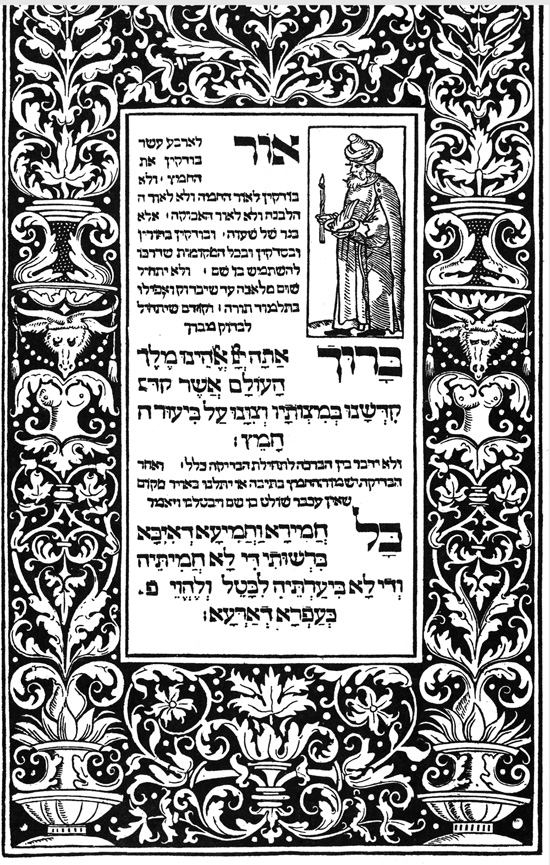
The border surrounding the first page of the Prague 1526 incorporates both Jewish as well as non-Jewish elements.  First, it is obvious that a Jew had a hand in the border as, in the inset, it displays someone performing bedikat hametz (searching for the bread) where he is using the traditional implements of a candle and chicken feather.  The outside border is less Jewish, and as many have noted, appears to be a copy of Italian/German renaissance borders.  The two most likely candidates for models for Prague are the border first used in the 1518 edition of Sacri Doctoris by Raymond Lulli (available here) or a border first used in 1519 for Paolo Ricci’s, Lepida et litere in Augsburg and reused in an Augsburg 1522 edition of Erasmus, Ad reverendum (available here).  Although we cannot pinpoint exactly which of these, if any, served as a model, what is clear is that among the images included in this border are bare-breasted women.

The use of bare breasted women to illustrate the haggadah is not limited to Prague. Both Charles Wengrov and Elliot Horowitz have pointed to earlier manuscript antecedents for Prague’s usage of such illustrations.[13] Aside from the printed example of the Prague 1526 Haggadah, this convention continued in manuscripts as well illuminated after 1526.  There are at least four such 16th century examples.[14] Additionally, and contrary to Horwitz’s contention that Spanish Jews were less accepting of such displays,[15] the Sarajevo Haggadah, which originated in Spain around 1350, includes two panels of Adam and Eve both depicting a bare-breasted Eve.


Likewise, the Golden Haggadah, 1320 Spanish manuscript includes the same form of illustration of the Adam and Eve scene.  Additionally, the Golden Haggadah includes images of nude bathers when it depicts Miriam standing from afar to see what will become of baby Moses.[16]

III.            Censorship in Modern Reprints of Prague 1526

            These historical antecedents notwithstanding, recent reprints of Prague 1526 have not been as accepting.  This initial border has been altered to airbrush and removes the bare breasts.  In 1989, a facsimile edition of Prague 1526 was published with the commentary of the Prague rabbi, Rabbi Yehuda Loew (Maharal). This border has been “touched up.”

Similarly, in 1998, a colorized facsimile edition of Prague 1526 was published.  Although the publishers took great pains to provide color where before there was black and white, they also altered this border.

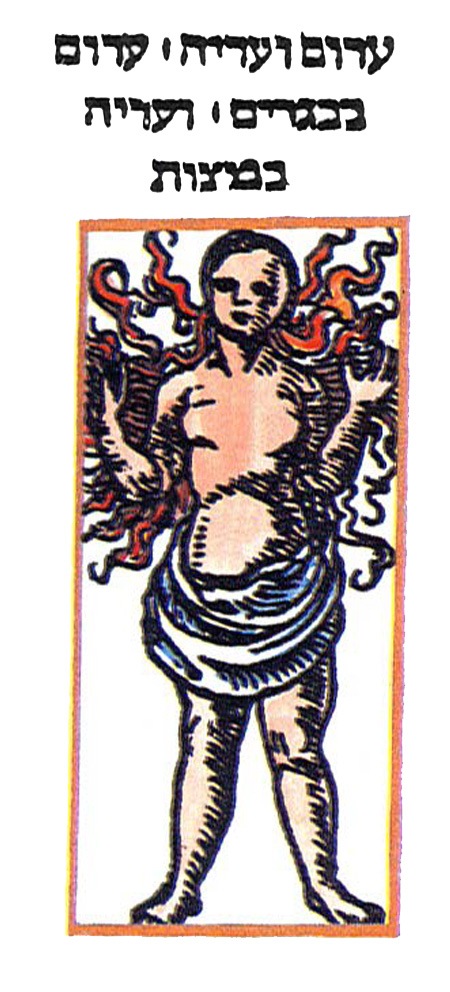
Oddly enough, although they found this image offensive, they decided to reproduce it in two other places in this reprint even though this image only appears once in the original. Here is the original:

Not only is the first border altered, but other instances of bare breasts have been removed; most notably the image accompanying the verse from Ezekiel 16:7 “I made you grow like a plant of the field. You grew up and developed and became the most beautiful of jewels. Your breasts were formed and your hair grew, you who were naked and bare.”

(As discussed previously here a later, Venice 1609, edition also altered this page.)  Again in 2001, a facsimile of Prague 1526 “published by the Religious Council of Efrat in honor of the settlement’s twentieth anniversary . . . . two illustrations are surreptitiously deleted: the bare breasted woman” accompanying the verse from Ezekiel.[17] Most recently, in 2009, the airbrushed image of this woman was reproduced in The Schechter Haggadah: art, history; commentary.[18]

[1] There may be an earlier illustrated print haggadah, however, only 12 leaves of this haggadah are extant making it difficult to date (or identify the country of origin).  For a bibliography regarding this fragment haggadah see Y. Yudlov, Otzar haHaggadot, Magnes Press, Jerusalem:1997, entry 9; and most recently, Eva Frojmovic, “From Naples to Constantinople: The Aesop Workshop’s Woodcuts in the Oldest Illustration Printed Haggadah,” in The Library, Sixth Series, Vol. XVIII, No. 2, June:1996, pp. 87-109.

[2]  See R. Cohen, Jewish Icons: Art & Society in Modern Europe, University of California Press, CA:1998, pp. 21-22; see also Y.H. Yerushalmi, Haggadah; History: A Panorama in Facsimile, Philidelphia:1978, plates 6-8.

[3] Aside from the edition discussed herein, there is at least one copy of another haggadah that is also published by Cohen in Prague that same year.  While both versions are substantially similar, some of the images and borders have been changed.  Relevant for our purposes, is that the image accompanying “Sefokh” which is a full
page border with images of bare breasted women, has been replaced with a more innocuous border found elsewhere in the haggadah.  See Yudlov, Otzar, entry 8; A. Ya’ari, Bibliography of the Passover Haggadah,
Bamberg & Wahrman, Jerusalem:1960, entry 7; Rabbi Charles Wengrov, Haggadah & Woodcut: an Introduction to the Passover Haggadah Completed by Gershom Cohen in Prague, Shulsinger Bros., New York:1967, pp. 78-9.

[4] The first Prague imprint to include a separate title page is in a 1526 edition of Yotzrot published by Cohen.  See Wengrov, Haggadah & Woodcut, p. 82 n.238.

[5] Although, with regard to the adoption of the title page, Jews appear to adopt this convention at or near the time as society at large, that was not the case with other literary advances.  While the majority of the western world adopted the codex and discarded the scroll some time in the third century, the first recorded Jewish reference to the codex does not occur until the late
eighth or the early ninth centuries.  See Anthony Grafton, “From Roll to Codex: A Christian Initiative,” in Crossing Borders, Hebrew Manuscripts as a Meeting-place of Cultures, ed. Piet van Boxel & Sabine Arndt, Bodleian Library:2012, pp. 15-20.

[6] A.M. Habermann, Title Pages of Hebrew Books, Museum of Printing Art, Safed:1969, pp. 8-9.

[7] For a discussion of the development of the title page as well as the different types, i.e., label, border, end-title, see M.M. Smith, The Title-Page its early development 1460-1510, The British Library & Oak Knoll Press, London & Deleware:2000.

[8] See M.J. Heller, The Sixteenth Century Hebrew Book: An Abridged Thesaurus, Brill, Leiden & Boston:2004, vol. I, pp. 6-7.

[9] The border used for the Pesaro Talmuds first appeared in Decachordum Christianum (The Christian Ten String Harpsichord) published in Fano, 1507 by Gershom Soncino.  See M.J. Heller, Printing the Talmud, pp. 104-117  Additionally, see Heller’s discussion, id. p. 113, regarding Soncino’s reuse of the Dechachaordum‘s frames.  In reality, although the frames were originally cut for Decachordum, they were first used on Gershom’s edition of Bahya ibn Pakua’s commentary on the Torah, published four months prior to Decachordum.  See M.J. Heller, The Sixteenth Century Hebrew Book: An Abridged Thesaurus, Brill, Leiden & Boston:2004, vol. I, p. 41; Smith, The Title-Page, supra, pp. 47-59 (discussing the use of the blank title page).

[10]  See A.M. Habermann, “The Jewish Art of the Printed Book,” in Jewish Art, An Illustrated History, ed. Cecil Roth [revised ed. by B. Narkiss], New York Graphic Society Ltd., Connecticut:1971, pp. 167-68.  In Habermann’s earlier work, Title Pages of Hebrew Books, p. 9, he erroneously asserts that the earliest works to include architectural title pages were Soncino’s Melitza le-Maskil and Bomberg’s Tanach, both published in 1524/25.

[11]  See Joshua Bloch, “The Library’s Roman Hebrew Incunabula,” in Hebrew Printing & Bibliography, ed. Charles Berlin, New York:1976, p. 140.  For a description of this work see S. Iakerson, Catalogue of Hebrew Incunabula from the Collection of the Library of the Jewish Theological Seminary of America, JTS, New York & Jerusalem:2005, entry 7.

[12] See A.M. Habermann, “The Jewish Art of the Printed Book,” supra, at 169.  Habermann appears to argue that this is first printed Hebrew book containing illustrations, is incorrect. As discussed above, the first was the Rome edition of Sefer Mitzvot Gedolot. He is not alone in this error.  Ursula Schubert makes the same error.  See Ursula Schubert, Jewish Book Art, From the Renaissance until Emancipation, [Hebrew], Kibbutz hami-Uchad, Tel Aviv:1994, p. 27.  Habermann, id., notes that the great Hebrew bibliographer, Mortiz Steinschneider, was tricked with regard to one of the illustrations contained in Meshal
ha-Qadmoni
.  Steinschneider, in a discussion about the alleged Christian origins of these illustrations, called attention to the fact that in one of them contains a monk wearing a crucifix. But, in the interim we have learned “that this last embellishment was a
practical joke played by a Christian scholar. . . [the crucifix] having been added by [a later] hand!”  Regarding the history and origins of the images included in Meshal ha-Qadmoni, see César Merchán-Hamann, “Fables from East to West,” in Crossing Borders, pp. 35-44; Ursula Schubert, Jewish Book Art, pp. 27-8.

[13]  Rabbi Charles Wengrov, Haggadah & Woodcut, p. 47 nn.112-13;Elliot Horowitz, “Between Cleanliness and Godliness,” in Tov Elem: Memory, Community & Gender in Medieval & Early Modern Jewish Societies, ed. E. Baumgarten, et al., Bialik Institute, Jerusalem:2011, *38-*39.

[14] Mendel Metzger, La Haggada Enluminée, E.J. Brill:1973, plate LIV, nos. 303-305; Chantily Haggadah, Musée Condé, Ms.
732, fol. 13, reproduced in Index of Jewish Art, eds. B. Narkiss & G. Sed-Rajna, Jerusalem-Paris:1976, vol. I, card no. 36.

[15] Horowitz, “Between Cleanliness,” at *38, (“One suspects that a Spanish Jew coming to Germany in the early 15th century would have been equally surprised to see an image of a naked woman” in a Hebrew manuscript.).

[16]  The Golden Haggadah, ed. Bezalel Narkiss, Pomegranate Artbooks, California:1997, figs. 17 & 24.

[17]  Id. n.37.  Horowitz only notes the 2001 example of censorship of Prague 1526, and apparently is unaware of the earlier
examples.  Additionally, he chastises the Efrat reproduction for erroneously indicating a 1527 publication date.  Efrat is not only in erring regarding the secular date.  The first facsimile edition (Berlin:1925), which includes a scholarly introduction, full title
is:  “Die Pessach Haggadah Des Gerschom Kohen Gedruckt Zu Prag 5287/1527.” Perhaps one can excuse the error as, in reality, it was completed on the eve of 1527, December 30, 1526.

[18] The Schechter Haggadah: Art, History & Commentary, [illustrations selected and annotated by David Golinkin], Schechter Institute of Jewish Studies, Jerusalem:2009, p. 36, fig. 16.1.


Halakhah and Haggadah – Manuscript Illustrations and their Halakhic and Customary Significance

This post is part of a series of posts regarding illustrations adorning manuscript and print Haggadot. Our first post dealt with a new work on the topic and can be viewed here. In this post we will focus upon the some of the Halachik implications of these illustrations. In many Ashkenazic manuscripts, the Passover illustrations begin chronologically earlier than the Seder. Many begin with the preparation of the matzah. For example, in the Second Nuremberg Haggadah[1], (the manuscript is online here) a 15th century Ashkenazic haggadah, contains ten scenes devoted to the matzah process. A similar haggadah, likely illustrated by the same artist, also includes numerous matzah baking scenes. All of these, however, begin with the bringing of the grain to the miller. This is in contrast to today’s practice whereby the matzah producing process begins earlier, with the cutting of the wheat.
(All images may be clicked for larger viewing.)
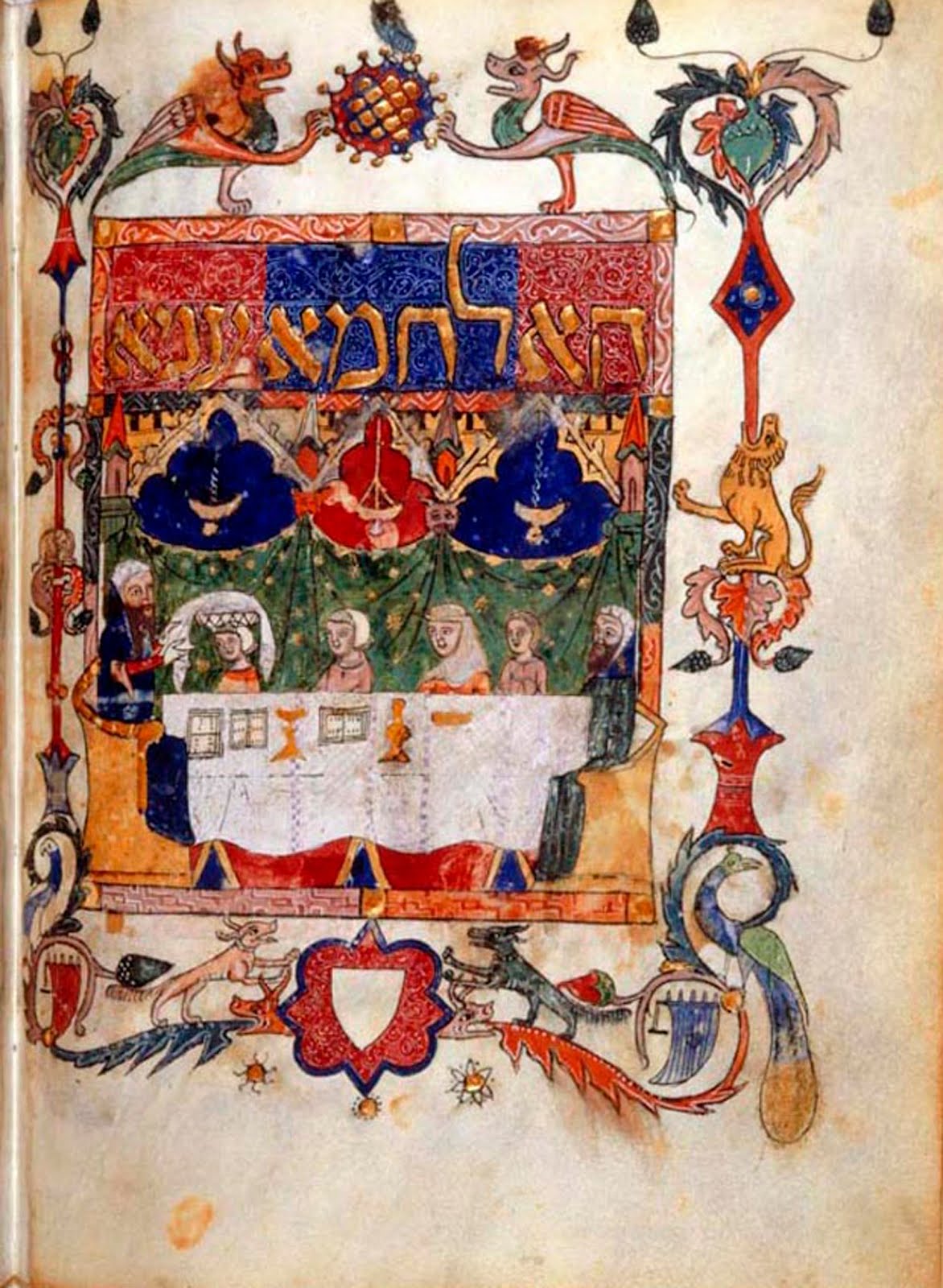
That is, for many today, matzah shmurah means shmurah (watched) from the time of harvest and not from the time of grinding. But, in reality the reason for the illustrations beginning where these haggadot do, is simply because they reflect the practice in Ashkenaz, based upon the R. Ya’akov ben Asher, the author of the Tur, that only from the time of grinding is it necessary to “watch” the grain. Matzah Shmurah in Ashkenaz in the medieval period meant grain which had been watched from the time of grinding not cutting.[2] Turning to a Sefardic custom, the Barcelona Haggadah, produced after 1350, is the earliest record of the custom to place the Seder Plate on someone’s head during the recitation of Ha Lahma Ania (Ashkenazim remove the plate from the table).Only some three hundred years later is this custom mentioned in printed sources. Additionally, there is a difference between the Sefardic and Ashkenazic haggadot regarding what the Seder Plate actually was, with the Ashkenaz depicting a plate, whereas the Sefardic manuscripts depict a basket.[3]
When it comes to marror and what vegetable that is, we have at least two different types depicted in various manuscripts. In the Brother to the Rylands Haggadah, marror is depicted as an artichoke, as is in the case with the Sarajevo Haggadah.

While in many manuscripts, marror is a leafy vegetable.[4]
Setting aside the issue of what marror is, another custom related to marror can be found in both printed and manuscript haggadot. In the Prague, 1526, the first illustrated printed haggadah, there is a picture of a man pointing at his wife with the legend, “there is a custom that a man points to his wife when mentioning marror based upon the verse Ecclesiastes 7:26 “Now I find woman more bitter than death.”
A.Y. Hyman the scholar of Jewish liturgy was appalled when he came across this. In his autobiography, he claims that there is no basis whatsoever for this “custom.” Hyman is wrong.[5] If you look at the Brother to the Rylands Haggadah you can see that it shows this custom. As does the Washington Haggadah. Likewise, the Rothschild Miscellany shows the same custom.

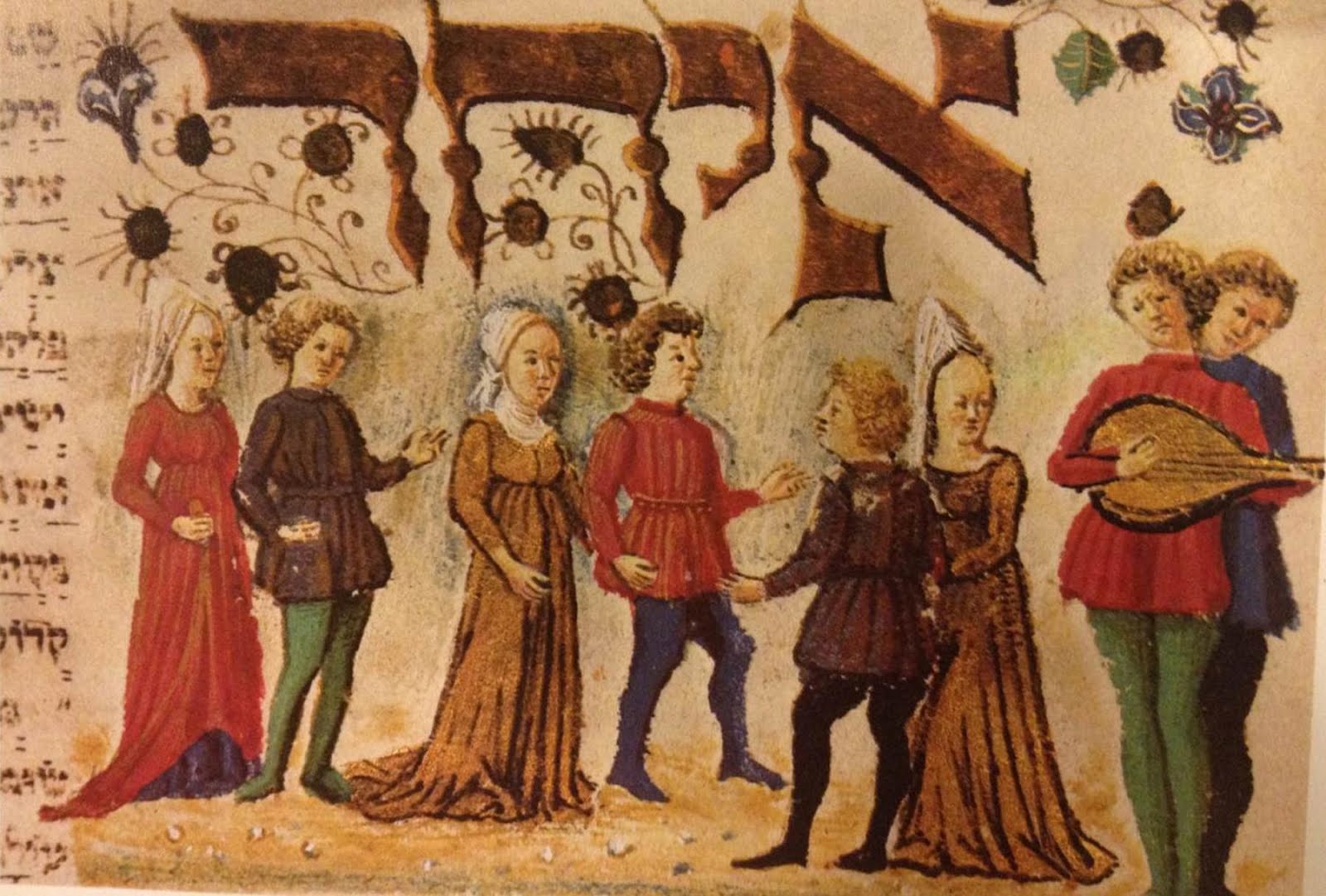
It’s worth noting that the Rothschild Miscellany shows another custom at the time, mid-14th century, that of mixed dancing.

The mixed dancing is that of couples, husband and wives dancing with each other, and not that of unmarried men and women dancing[6] In Italy, where this manuscript was composed, mixed dancing was apparently common during this period.[7] Returning to the gesturing at one’s wife at marror, in the Hiluq and Biluq Haggadah this custom takes on a somewhat more humorous dialogue with the wife no longer passive but instead returns the compliment. In that haggadah it includes speech balloons and they record the following: The husband states “touching marror I must recall that this one, too is bitter [as gall].” To which the wife replies, “It is you [my husband] is one of the causes of bitterness as well.” After which, we have a play on the 13 attributes of Rabbi Yishmael and the haggadah provides that “the third comes between them [perhaps the marror itself] and makes a stink” – or in Hebrew ve-yavo ha-shlishei ve-yakhriach benehem.[8]


Similarly, in some Ashkenazic haggadot manuscripts, they show the the husband and wife pointing at one another.[9] Finally we get to a halachik error in a manuscript haggadah. The Washington Haggadah was written by a scribe calledJoel ben Simon. This haggadah was first printed as part of the Diskin Orphan House haggadah series in 1965. The Library of Congress didn’t publish its facsimile edition until 1991, and last year another facsimile edition of this haggadah was published as well.[10] Although this haggadah was written close to 300 years prior to Diskin publishing it, until that time a significant scribal error escaped notice. Specifically, in the text for eruv tavshilin rather than just saying “with this eruv I am allowed to cook from Yom Yov for Shabbat,” it continues and says “and on Shabbat for Yom Tov.”


Needless to say this did not escape the eagle eyes of some who feared that someone may use this haggadah (we note that contrary to the other reproductions mentioned, the Diskin version is a poor copy) and inadvertently think it is permissible to cook on Shabbat. So, the ever wise Aggudat ha-Rabbonim took out ads in the Yiddish daily, Der Tag, and the Forward to let its readers know of this error. The publishers took this one step further and mailed out a letter, with the provocative title, “Heresy or Blunder,” after Passover indicating the error and also included a letter from Cecil Roth, who had written about manuscript haggadot.


In his letter he indicates that indeed this was most likely inadvertent and that Joel did not have a different tradition regarding eruv tavshilin. Indeed, we know from Joel’s other manuscripts, where he records the correct blessing, that the Washington Haggadah’s version was simply a scribal error.

This is not the only error related to halakha and haggadah illustrations. R. S.H. Kook, criticizes two aspects of illustrations that appear in the Prague 1526 Haggadah. Both of these issues center around how the wine glass is depicted. Specifically, he takes issue with the fact that in many of the illustrations show the wine glass in the left hand and not the right. Additionally, he complains that the illustration show the holder grasping the glass at the stem and not at with his fingers cupping the bottom of the glass.
Regarding the first issue, that of left handedness, this anomaly may be attributed to the fact that this was the first completely illustrated woodcut haggadah. And, as it was the first, it was not necessarily perfectly executed. But, before we continue we must digress and explain about woodcuts in order to get to the left handedness. A woodcut when inked and put on paper produces a mirror image of whatever the woodcut depicts. Thus, if the woodcut was of a right hand, when pressed on paper would produce a left handed image. Additionally, when copies were made, the copyist were not careful and would reverse the images. That is, they were working off the printed image and would copy it directly rather than accounting for reversing the image to ensure that when it was used it would produce the same and not a mirror image. So, as has been explained, during the early history of woodcuts “copies [of woodcuts] were constantly being made, with or without leave, for copyright hardly existed, and the same printer would often have to replace worn cuts by new blocks in successive editions. It is not always an easy task to distinguish copy from original. Immediately recognizable as from different blocks are subjects which appear in reverse directions, for the copyist who does not take the trouble to reverse his drawing from the original print, will make a block that will print the subject reversed.”[11] We can now explain why the images are left handed, presumably, they were copied and the woodcutter was not careful to reverse the image, thus producing a left handed image. As an aside, another example of copying which reverses the images may be seen when the Prague 1526 Haggadah was itself used as a model for a woodcut. The border surrounding Shefokh was reused in the Levush. As is apparent, the images are that appear on the right in the Prague 1526 Haggadah appear on the left in the Levush. And, those on the left appear on the right.

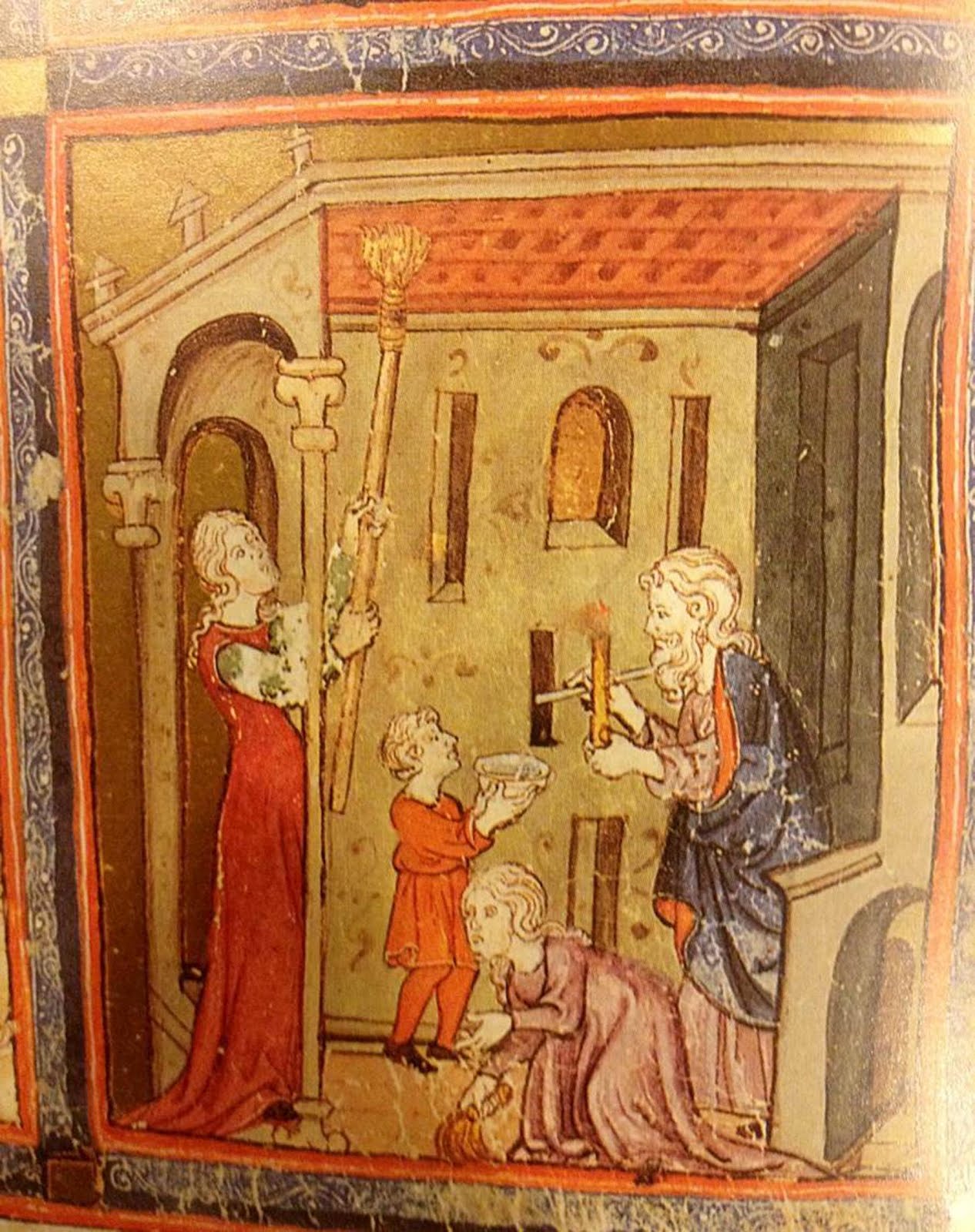
Regarding the second point, the failure to cup the glass rather than grasp the stem, this can be attributed to an error on R. Kook’s part and not the woodcutter. While today it may be commonplace to cup the glass, this was only popularized by R. Yeshaya Horowitz, in his book, Shnei Luchot ha-Brit, (Shelah). R. Horowitz wasn’t born when the Prague 1526 Haggadah was printed – he lived between 1565-1630. Moreover, his book was published posthumously, in 1648, more than 120 after the Prague 1526 Haggadah was published. Thus, it is unremarkable that the Prague 1526 Haggadah failed to account for a custom that didn’t exist at that time. This is another example of why bibliography is important, for other examples see here. Finally, we conclude this part of the series regarding halachot and Passover in general, and specifically, the notion that on Passover we are stricter than normal. At times it appears that some go overboard with the various humrot on Passover as well as cleaning all sorts of items that seemingly don’t require cleaning. But, from the evidence of manuscript illustrations, this notion of stringency is not a new one. The Golden Haggadah, circa 1320, includes this very nice image of cleaning and searching for leaven. If one looks closely they will note that the woman on the left is apparently sweeping the ceiling! Thus, indicating that perhaps going overboard has been the case for some while. Also of note is that the father is performing bedikat hametz and he is bareheaded (as is the son).[12]
[1] Its title is a reference to the fact that from the mid-nineteenth century until 1957 it was housed in Nuremberg, after which it moved to the Schocken Library, and then to a private collector. The reason it is the the Second, is because Nuremberg also had another manuscript haggadah – now known as the First Nuremberg Haggadah. It too is no longer in Nuremberg. Today it is in the Israel Museum.
[2] See Steven Fine, “The Halakhic Motif in Jewish Iconography: The Matzah-Baking Cycles of the Yahuda and Second Nurnberg Haggadahs,” in A Crown for a King, Gefen, Jerusalem-New York: 2000, pp. 106-07. [3] See Evelyn M. Cohen, “Seder Foods & Customs in Illuminated Medieval Haggadot,” in The Experience of Jewish Liturgy, D.R. Blank ed., Brill, Leiden:2011, 24-25. We note that while this article provides a summary of some of the images and text accompanying medieval haggadot, the article provides little context for various practices. Indeed, the article fails to provide sources which support many of the illustrations and texts and instead merely parrots what the the manuscripts say or depict. [4] On this issue of which vegetable is preferable for marror see Zohar Amar, Merorim, n.p., 2008. [5] His comments appear in the Misrad Hasikon 1965 reprint of the Prague 1526 Haggadah at pp. 14-15. [6] See Therese & Mendel Metzger, Jewish Life in the Middle Ages, Chartwell Books, Inc.:1982, 216-17. [7] See the sources collected by R. Henkin, Shu”t Benei Banim, vol. 1, Jerusalem: 1998, no. 37, esp. section 5 where he discusses Italian sources. Thanks to R. Weinfeld for bring this source to our attention. [8] See Bezalel Narkiss, “Art of the Washington Haggadah,” in The Washington Haggadah, Commentary, M. Weinstein, ed., Washington D.C.: 1991, pp. 73-75, discussing manuscripts that contain the marror/wife images, as well as the source in the following note. [9] See R. Yisrael Mordechi Peles, “Controversies Regarding Customs That Can Be Gleaned from Haggadot,” in HaMaayan, Nissan: 5771 (51,3), pp. 13-14, available here. [10] The 1991 edition was accompanied by a commentary volume. The 2011 edition also includes some articles with the color reproduction of the haggadah. [11] Arthur M. Hind, An Introduction to the History of Woodcut, Boston: 1935, vol. 1, pp. 284-85, quoted in R. Charles Wengrov, Haggadah and Woodcut, New York: 1967, pp. 87-88. In general Wengrov’s book provides a wealth of information regarding the images contained in the Prague 1526 Haggadah.[12] Mendel Metzger, Jewish Life in the Middle Ages, supra, p. 148 discussing generally medieval manuscripts and depictions of headcovering or lack thereof.


A review of Marc Michael Epstein’s The Medieval Haggadah, Narrative & Religious Imagination

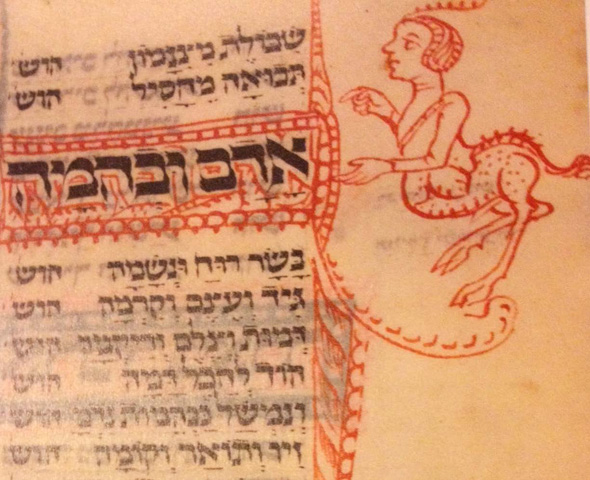
Marc Michael Epstein, The Medieval Haggadah, Art, Narrative & Religious Imagination, Yale University Press, New Haven & London: 2011, 12, 324 pp. Most discussions regarding the Haggadah begin with the tired canard that the Haggadah is one of the most popular books in Jewish literature, if not the most popular, and has been treasured as such throughout the centuries. Over sixty years ago, Isaac Rivkin noted that as a matter of fact, only since the 19th century has the Haggadah become one of the most printed Jewish books. Prior to the 19th century, the Haggadah is neither the most printed nor most written about work in the Jewish cannon.[1] Epstein does not fall prey to this canard nor any other of the many associated with the Haggadah. Dr. Epstein’s survey of four Jewish medieval manuscripts is novel, vibrant, and sheds new light on these manuscripts, as well as Jewish manuscripts and the Haggadah generally. Epstein covers four well-known medieval Haggadah manuscripts:[2] The Birds’ Head Haggadah, The Golden Haggadah,[3] The Rylands Haggadah,[4] and the Brother to the Rylands Haggadah. First, a word about manuscript titles. Sometimes manuscripts are referred to by the city or institution that houses or housed the manuscript, while in other instances, especially when a manuscript contains a unique marking or the like, that unique identifier may be used to describe the manuscript. The Rylands Haggadah (currently housed at the John Rylands Museum, Manchester, UK), is an example of the former, and the Birds’ Head Haggadah is an example of the latter. In the case of the Birds’ Head, most of the figures depicted in the manuscript are drawn not with human heads, but with birds’ heads. Similarly, the Golden Haggadah is another example which gets its title due to the proliferation of gold borders and filler. Finally, the Brother to the Rylands, gets its title from the similarly of its illustrations to that of the Rylands, indicating some connection or modeling between the two manuscripts. As alluded to above, Epstein is not the first to discuss these manuscripts. Indeed, in the case of both the Birds’ Head and the Golden Haggadah, book length surveys have already been published.[5] Epstein, however, differs with his predecessors both in terms of his method as well as what he is willing to assume. Regarding assumptions, previously, many would take the path of least resistance in explaining difficult images and attribute confusing or complex illustrations to errors or lack of precision of the illustrator. Rather than assume error, Epstein gives the illustrations and illustrators their due and, in so far as possible assumes that the images are “both coherent and intentional.” As an extension of his “humility in the face of iconography,” Epstein attempts “to understand how the authors understood it rather than assume that [he] must know better than they did.” He does “not fault the authorship for what” he, “as a twenty-first century viewer, might fail to notice or understand concerning the structure or details of the iconography.” Furthermore, engaging with illustrations not only from tracing the history of how the image came into being but, more importantly, how that image was interpreted and what meaning it carried for its audience throughout its transmission is also one of Epstein’s goals. In furtherance of these goals, Epstein is all too aware of his own limitations and throughout the book, Epstein willingly admits both where the evidence can lead and, what is pure speculation. All of this translates into a highly satisfying and illuminating (no pun intended) perspective on these and Jewish manuscripts in general. The book is divided among the four manuscripts, with each getting its own section, with the exception of the Rylands and its Brother that are included in a single section. At the beginning of each section, all of the relevant pages from the manuscript are reproduced. The reproductions are excellent. This is not always the case in other books that reproduce these images. Indeed, in Narkiss, et al. who compiled an Index of Jewish Art that includes detailed discussions regarding a variety of medieval Haggadah manuscripts, only reproduce the images in black and white.[6] Similarly, Metzger, in her La Haggada Enluminée, also only reproduces the images in black and white (and many times the images are of poor quality). Here, each page containing an image is reproduced in full, in a high quality format that allows the reader to fully appreciate the image under discussion. Appreciating that to obtain similar high quality images requires the purchase of an authorized facsimile edition, which in some instances can be cost prohibitive highlights the importance and attention to detail that characterizes Epstein’s work on the whole. The Birds’ Head Haggadah is the oldest illustrated Haggadah text, dated to around the early 1300s. This manuscript is not the only Jewish manuscript to use zoophilic (the combination of man and beast) images. Zoophilic images can be found in a variety of contexts in Jewish manuscripts. For example, in the manuscript known as Tripartite Machzor, men are drawn normally while the women are drawn with animal heads.[7] Or, the well-known manuscript illustrator Joel ben Simon playfully illustrates the prayer God should save both man and beast, which can be read as God should save the man/beast, with a half human-half beast:
When it comes to the Birds’ Head manuscript, a variety of reasons have been offered for its imagery, running the gamut from halachik concerns to the rather incredible notion that the images are actually anti-Semitic with a bird’s beak standing in for the Jewish nose trope. Epstein ably summarizes the positions and based upon a close examination of the illustrations as well as his stated methodology, dismisses much of the prior theories. His ultimate conclusion, which builds upon the halachik position, is more nuanced and, hence, more believable, than his predecessors. The Birds’ Head provides a striking example where Epstein’s unwillingness to simply ignore complexity by claiming error, demonstrates the interpretative rewards offered to a close reader of the illustrations. While most of the images carry a bird’s head, there are a few exceptions. Most notably, non-Jews, both corporal and spiritual do not. Instead, non-Jewish humans as well as angels have blank circles instead of faces. But, there is one scene that poses a problem. One illustration shows the Jews fleeing Egypt (all with birds’ heads), being pursued by Pharaoh and his army. But, unlike the rest of the figures in Pharaoh’s army, two figures appear with birds’ heads. Some write this off to carelessness on the illustrator’s part. Epstein, who credits his (then) ten-year old son for a novel explanation, offers that these two figures are Datan and Aviram, two prominent members of the erev rav, those Jews who elected to remain behind. The inclusion of these persons, and allowing them to remain with their “Jewish” bird’s head, may be a statement regarding sin, and specifically, the Jewish view that even when a Jew sins, they still retain their Jewish identity. Sin, and including sinners as Jews, are motifs that are highlighted on Pesach with the mention of the wicked son and perhaps is also indicated with this illustration. The illustrator could have left Datan and Aviram out entirely or decided to mark them some other way rather than the Birds’ head. Thus, utilizing this explanation allows for the illustrator to enable a broader discussion about not only the exodus and the Egyptian army’s chase, but expands the discussion to sin, repentance, Jewish identity, inclusiveness and exclusiveness and other related themes.
(click to enlarge)
Epstein’s discussions of the other manuscripts are similarly eye-opening. For instance, the Golden Haggadah is an example of the Sefard manuscript Haggadah genre. Manuscript haggadahs are placed in two broad categories, Ashkenaz and Sefard. The former’s illustrations appear in the margins and generally explain the text or refer to Pesach scenes such as baking matzo or looking for hametz. The latter’s illustrations appear before the text and are a series of illustrations, appearing either in two or four panels on a single page, depicting the beginning of Jewish history with Adam and Eve, or in the case of the Sarajevo haggadah, the actual creation sequence. The illustrations culminate with the exodus. But, unlike the Ashkenaz examples, the Sefard manuscripts generally do not illustrate the Haggadah text (with the exception of HaLachmanya, a picture of matzo or the like). The Golden Haggadah follows the Sefard conventions and includes the Jewish history scenes. Epstein demonstrates, however, that the images should not just be read chronologically. Rather, the Golden Haggadah illustrator subtly linked events that did not necessarily follow in time. For example, the placement of the water in a scene depicting Jacob’s blessing to Pharaoh is linked to the scene, occurring much later, to the boys being thrown in the Nile and is similarly linked by imagery to Moses being saved from the Nile, as well as Moses rescuing Jethro’s daughters. Epstein connects all of these scenes by noting the unique method and placement of the water in the scenes. But the linkage is not merely water, instead, this interpretation affords insight into God’s blessings, promises, the parameters and methods of His divine punishment of “measure for measure,” gratitude, and salvation. Again, this is but one example where close examination of the illustrations enriches the Haggadah discussion. All of Epstein’s discussions display his keen awareness and erudition regarding illustrations appearing in both the manuscript as well as print Haggadahs. Although the work employs end notes, which we find generally to indicate that the notes are unnecessary for the text, the notes should not be ignored. They are full of interesting sidebars as well as additional information on the illustrations discussed and the history of Haggadah illustration.[8] As a testament to the importance of this work, as well as its accessibility, the book was originally published after Pesach last year (hence our belated review) and, already, before even a single Pesach, its publisher is sold out. The work has already received numerous accolades from numerous others to which we add our small voice. This is an incredible work in terms of its insights, methods, and production values that is a welcome breath of fresh air to stale and repetitive Haggadah genre.

[1] See Isaac Rivkin, The Passover Haggada Through the Generations, New York: 1961, pp. 3-4.
[2] We note that unlike most other Jewish books which ceased being produced in manuscript at, or soon after the advent of the printing press, manuscripts of the Haggadah are still being commissioned even today. This is not to suggest that all Haggadah manuscripts are equal. Many of the haggadah manuscripts produced after the printing press are very similar, and especially those produced after the Venice 1609 and Amsterdam 1695 and 1712, most of the illustrations that adore manuscript haggadahs are identical or virtually identical to their printed counterparts. See, e.g., Haviva Peled-Carmel, Illustrated Haggadot of the Eighteenth Century, Jerusalem, The Israel Museum: 1983 (Hebrew).
[3] The link for viewing the Golden Haggadah at the bottom of page here or in a fully sizable and zoomable image here.
[4] The Rylands Haggadah is currently on display at the Met in NYC until September 30, 2012.
[5] M. Spitzer, The Birds Head Haggadah of the Bezalel National Art Musuem in Jerusalem, Jerusalem: 1965; B. Narkiss, The Golden Haggadah: A Fourteenth-Century Illuminated Hebrew Manuscript in the British Museum, London: 1970.
[6] Iconograhical Index of Hebrew Illuminated Manuscripts, ed. Bezalel Narkiss & Gabrielle Sed-Rajina, vol. I, Jerusalem: 1976 (containing Birds’ Head among other Haggadah manuscripts); similarly, see Narkiss’ Hebrew Illuminated Manuscripts in the British Isles, Oxford & New York: 1982.
[7] On the use of zoophilic images in the Tripartite Machzor, see Zsofia Buda, “Animals Gazing at Women, Zoocephalic Figures in the Tripartite Machzor,” in Animal Diversities, ed. Gerhard Jaritz & Alice Choyke, Krems: 2005, pp. 136-64 (available at this link). The Tripartite Machzor is another example of an unusual manuscript title. Its title is derived from Bezalel Narkiss’s conclusion that the work is comprised of three parts, one of which is housed in the Kaufmann Collection in Budapest, Hungry, while the other two parts are currently in the Bodleian Library at Oxford. The Kaufmann portion is available online here.
[8] We note that Epstein’s discussion of headcovering is in conflict with Rivkin. Compare Epstein, p. 278 n.2 with Isaac Rivkin, “The Responsum of R. Judah Areyeh of Modena on Going Bareheaded,” in Sefer Ha-Yovel le-Kovod Levi Ginzberg, ed. Saul Lieberman, New York: 1946, pp. 401-03 n.1.


Some Observations Regarding the Mah Nishtannah

Some Observations Regarding the Mah Nishtannah[1]
by: Mitchell First

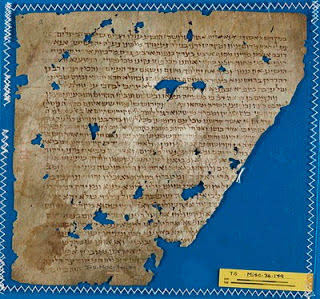
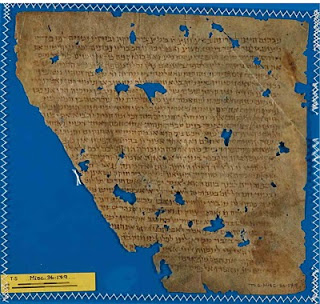
1. It is well-known that the Mishnah in the tenth chapter of Pesachim includes a set of mah nishtannah. But if one opens a standard printed Babylonian Talmud (Pes. 116a), one sees four questions[2] in the text of the Mishnah (matzah, maror, roast, and dipping), while if one opens a standard printed Jerusalem Talmud, one sees three (dipping, matzah and roast). Is this an instance of a disagreement between the text of the Mishnah preserved in Babylonia and the text of the Mishnah preserved in Palestine? There are such disagreements,[3] but this is not one of them. Here, the manuscript evidence points overwhelmingly to the conclusion that the original text of the Mishnah recorded only the questions of dipping, matzah and roast.[4] Moreover, if one opens up a standard Masechet Pesachim of the Babylonian Talmud and looks at the text of the Mishnah recorded in the Rif and the Rosh, one sees that they too record a Mishnah which included only the questions of dipping, matzah and roast. Also, Rambam utilized a text of the Mishnah which included only these three questions.[5] Let us see how the Encyclopaedia Judaica in its original and new editions deal with this issue. When Daniel Goldschmidt published his classic work on the Haggadah in 1960, after earlier German and Hebrew versions,[6] he clearly took the position that the original text of the Mishnah included only three questions.[7] It was therefore somewhat surprising when the “Mah Nishtannah” entry in the original Encyclopaedia Judaica (published in 1972 and written by the anonymous editors) stated that “[t]he Mishnah enumerates four questions.” In its bibliography, this entry had cited only Goldschmidt’s 1960 work, and one other less scholarly source.[8] We are now in the 21st century. There is now a widespread consensus among scholars that the original text of the Mishnah included only three questions.[9] But when one looks at the new edition of the Encyclopaedia Judaica, one finds only a reprint of the original entry![10] —— 2. A widely quoted explanation of the Vilna Gaon takes the positions that there were always four questions, and that, after the churban, the roast question was substituted by the reclining question.[11] We have already seen that the first of these positions is incorrect. The Haggadah fragments found in the Cairo Genizah show that the second of these positions is incorrect as well. Genizah material generally dates from the 10th through the 13th centuries.[12] It is reasonable to assume that this is roughly the period of the Haggadah fragments from the Genizah.[13] Of course, not all of the Haggadah fragments from the Genizah span the mah nishtannah section. But of those that do, many include the roast question.[14] (The survival of the roast question for 1000 years, post-churban, has been implicitly acknowledged in the Haggadah shel Pesach, Torat Chayim, published by Mossad ha-Rav Kook, at p. 29, n. 59.) [15] Furthermore, although most of the mah nishtannah Haggadah fragments found in the Genizah record four questions the way they are asked today,[16] we also find the following:[17] -Several record three questions: matzah, dipping, and roast,[18] just like the original text of the Mishnah. Most likely, the fragments with these three questions reflect the original Palestinian tradition of the Haggadah,[19] which followed the text of the Mishnah, and the fragments with four questions reflect the Babylonian tradition,[20] which gradually penetrated into Palestine and its surrounding areas.[21] -One records the following three questions: dipping, matzah and reclining.[22] -One records five questions: dipping, matzah, roast, maror, and reclining.[23] (See the photograph in M. Kasher, Haggadah Shelemah, p. 93.) In this fragment, the roast question is phrased:… צלי כולו המקדש בבית אוכלים היינו הזה והלילה. This is the only fragment in which the roast question is phrased with such a qualification. [24] -Two record only the questions of dipping and roast.[25] (But there does not appear to be any reason why the matzah question would have been intentionally discontinued. Perhaps the matzah question was accidentally dropped by a scribe in one source, and further copies were later made from that source. It would have been easy for a scribe to accidentally turn his eye to the wrong mah nishtannah line in the source he was copying from, and thereby omit a question.) – One records only the questions of dipping and matzah. I would like to focus on this last source, which is not actually a Haggadah fragment, but is a section of an anonymous Geonic responsum which includes an outline of the procedures at the seder. It can be deduced that the responsum was composed in Babylonia because it includes avadim hayyinu, which was not a part of the Palestinian seder ritual in this period.[26] This responsum was published by Louis Ginzberg, in his Ginzey Schechter, vol. 2, pp. 258-260. [27] Theoretically, it is possible to argue that the author of this responsum gave only an abbreviated version of the mah nishtannah, and listed only the first two questions, even though his practice was four. This seems to be the understanding of Ginzberg, who writes (p. 259, n. 1): הראשונות השאלות ‘ב אלא כאן נאמרו ולא נתקצר נשתנה מה נוסח. B.M. Lewin included this responsum in his Otzar ha-Geonim, Pesachim (pp. 154-55), and he seems to agree with Ginzberg. (See p. 154, n. 13: נתקצר נשתנה מה נוסח.) But this interpretation seems very unlikely. The whole purpose of the responsum was to spell out the procedures and text of the seder. Abbrevation here would have defeated its purpose. The Safrais take a different approach to this responsum in their monumental work, Haggadat Hazal. They write (p. 64, n. 53) that the third and fourth questions are העמוד בסוף חסרות, implying that these questions were originally included in this responsum but were cut off. Moreover, in their chart on p. 266, they put brackets over a supposed area of the third and fourth questions in this responsum, implying that these questions were once there. They take this approach so that the set of questions in our responsum could then parallel the set of questions found in the other known Babylonian Geonic sources of the Haggadah text: Seder R. Amram Gaon, Siddur R. Saadiah Gaon, and the Haggadah text published in 1984 by M. Lehman.[28] All these sources record the standard four questions: dipping, matzah, maror, and reclining.[29] But I was able to view an image of the responsum (T-S Misc.36.179), and with the kind permission of the Cambridge University Library, have included this image at the end of this article. It is clear that the third and fourth questions were never there. The first side of the fragment ends with the last words of the matzah question (the last three words of this question were written below the last regular line), and the next side continues immediately with avadim hayyinu. It is clear from the image that there are no missing lines in between. Assuming we reject the unlikely interpretation of Ginzberg, this source records a two-question set in Babylonia.[30] The idea that we have now been able to “excavate” such a set, evidence of a period before four questions became the universal practice there, is truly remarkable. An issue remains whether the responsum dates to the period before the maror and reclining questions were added in any Babylonian communities, or whether it dates to a period after they were added, but was composed in a community which did not add them. The latter seems more likely. (The responsum does have at least one other unique aspect.[31] It includes the statement: חורים בני היום[ו] עבדים היינו אתמול. The Safrais discuss this statement at p. 111 and do not mention any other fragments from the Genizah with this language.[32] On the image at the end of this article, this statement is found on the first page, six lines above the last full line.) Regarding the issue of when the maror and reclining questions were added, the following are some reasonable observations that have been made by scholars to date: ◦ The reclining question was probably the last question to be added.[33] Unlike the maror question, it did not make its way into in any manuscripts of the Mishnah,[34] and in all communities, it is the last question of the set.[35] ◦ The maror question probably did not arise until after the text of the dipping question was changed in Babylonia (see Pes. 116a[36]) and the dipping question lost its connotation as a maror question. Once the dipping question lost this connotation, it was probably viewed as necessary to add a question relating to maror.[37] ◦ The reclining question probably originated in Babylonia as well.[38] It was probably added, after the maror question, due to a desire to fix the number of questions at four, parallel to the themes of four cups of wine and four sons.[39] Aside from Haggadah fragments found in the Genizah, the earliest sources which include the reclining question are: Seder R. Amram Gaon,[40] Siddur R. Saadiah Gaon,[41] and the Geonic Haggadah text published by Lehman in 1984. (With regard to Seder R. Amram Gaon, it is accepted that many additions and changes were made to it in the centuries after R. Amram’s death, c. 875. The three surviving manuscripts of the work are only from the 14th-16th centuries. See D. Goldschmidt, Seder R. Amram Gaon, pp. 11-13. With regard to the Siddur R. Saadiah Gaon, the material in our possession has traditionally been viewed as representing a generally reliable version of the original 10th century work by R. Saadiah.[42] With regard to the Geonic Haggadah text published by Lehman, see above, n. 28.) —— 3. A main issue of debate among scholars has been whether the mah nishtannah set of the Mishnah reflects questions from Temple times. If we focus on the roast question ( הלילה הזה כולו צלי ), a reasonable initial assumption is that this question is referring to the pesach sacrifice, since the pesach sacrifice was something that was required to be roasted. This would suggest that this question, and hence perhaps all the questions, were composed during Temple times. But many scholars argue that the roast question is not referring to the pesach sacrifice and that this question was composed after the churban (and hence, the other questions probably were as well.) They make the following arguments: 1. A practice arose after the churban, approved (or perhaps initiated) by Rabban Gamliel of Yavneh, of eating a gedi mekulas as a method of commemorating the pesach sacrifice.[43] See Betzah 2:6-7 and Eduyyot 3:10-11. (Although these two sources do not specify that the Rabban Gamliel they are referring to is Rabban Gamliel of Yavneh, it seems fairly clear, for a variety of reasons, that this is the case here.[44]) The meaning of the term mekulas is subject to debate.[45] Nevertheless, it is clear that the gedi mekulas was not designated as a pesach sacrifice, but was arranged on the spit during the roasting process in the same manner as a pesach sacrifice, and was roasted in its entirety just like a pesach sacrifice. See Tosef. Betzah 2:11 (איזהו גדי מקולס? כולו צלי ראשו וכרעיו וקרבו ) and Pes. 74a.[46] The Sages prohibited the gedi mekulas,[47] but it is possible that a large section of Jewry followed the leniency of Rabban Gamliel and engaged in this practice.[48] The roast question could have been composed post-churban in an area which followed this practice and could be referring to this practice.[49] 2. The Mishnah at Pesachim 4:4 records:מקום שנהגו לאכול צלי בלילי פסחים, אוכלים; מקום שנהגו שלא לאכול, אינן אוכלין. It is possible that this Mishnah was composed during Temple times and is referring to a practice of eating roast meat on the seder night outside the Temple. But just as likely, this Mishnah was composed after the churban and is referring to a post-churban practice of eating roast meat[50] as a commemoration of the pesach sacrifice. It is possible to understand the roast question in the Mishnah as composed, post-churban, in an area which followed this practice and as referring to this practice.[51] But (as pointed out to me by my friend Sam Borodach) the precise phrasing of the roast question does not support either of these interpretations. When read in light of the parallel matzah question, the roast question implies that the question is about a required behavior of the evening. While there were areas which had a custom on this evening, post-churban, to eat a gedi mekulas or to eat roast meat, these were not required behaviors. It is hard to imagine the roast question phrased the way it was by someone composing it with the above optional commemorative behaviors in mind. The language of the roast question, read in light of the parallel matzah question, fits the pesach sacrifice best.[52] Does it follow from this interpretation that the roast question was composed during Temple times? Not necessarily. Even if the roast question is referring to the pesach sacrifice, it very possibly could have been composed after the churban, as a simulation of a question that might have been asked during Temple times. Once the idea for a mah nishtannah question about matzah took hold, it would be have been natural and instructive to create a parallel question covering such an important commandment as the pesach sacrifice, even if the pesach sacrifice was no longer being offered. (All the more so if practices commemorating the pesach sacrifice were ongoing!) (It is also possible to understand the roast question as having been composed post-churban if the pesach sacrifice itself continued after the churban.[53] But the evidence for this is weak.[54]) The Mishnah that concerns us, Pesachim 10:4, is found in the last chapter of this masechet. This suggests that this Mishnah was composed after the churban, since it is reasonable to presume that mishnayot that are presented in the early parts of a masechet were composed first and that mishnayot that are presented later were composed later.[55] Moreover, there is specific evidence suggesting that this particular chapter was composed after the churban. Mishnah 10:3 includes the statement:ובמקדש מביאין לפניו גופו של פסח. This statement suggests that the normative statements in this chapter describe only post-churban practice.[56] Of course, the questions themselves could still reflect questions from earlier times, which were recorded in a chapter composed after the churban. Based on recent scholarly developments, a new argument can be made to support the idea that the questions were composed post-churban. The mah nishtannah is not included in the tenth chapter of the Tosefta. This chapter includes much material parallel to the tenth chapter of the Mishnah. In his Tosefta Atikta, published in 2002, Shamma Friedman studied the relationship between the Mishnah and Tosefta of Pesachim in the first four chapters and in the tenth chapter.[57] He came to the conclusion that the material in the Tosefta in these chapters seems to have originated earlier.[58] If Friedman is correct, this also tends to support a post-churban origin for the mah nishtannah. So far, I have not discussed the precise role that the mah nishtannah serve in the Mishnah. But most likely, the mah nishtannah of the Mishnah was not a mandated piece of liturgy to be recited by the father or a typical son. Rather, it was what the child who lacks understanding is taught to ask (…מה נשתנה אביו מלמדו, אם אין דעת בבן).[59] This also perhaps implies that the mah nishtannah text was a later development. ——– Note finally that the Talmud, at Pes. 70a, records and accepts a statement by R. Hisda that the roast question was authored by Ben Tema. Ben Tema took the position that the chagigah too had to be roasted. In the view of R. Hisda, the language of the roast question, הלילה הזה כולו צלי, fit the position of Ben Tema only. Ben Tema is only mentioned at Pes. 70a and Yoma 83a and there is not enough information to determine if he lived during Temple times. (Some suggest that he is to be identified with R. Judah Ben Tema, who probably dates to the second century C.E,[60] but this identification is only conjecture.) The above statement of R. Hisda is not recorded again at Pes. 116a, where one would expect it.[61] R. Hisda’s statement is also surprising, because it takes an overly literal approach to the roast question. There is also no statement in the Jerusalem Talmud expressing the view that the roast question was authored by Ben Tema.[62] ———- To summarize, it is possible that the mah nishtannah was composed during Temple times, but it also possible that it was composed post-churban. In support of the latter is that the mah nishtannah is found in the last chapter of the masechet, and in a chapter whose normative language suggests that it was composed post-churban. The inclusion of a question about roast meat is not inconsistent with this approach. This question could have been composed post-churban in an area which followed the post-churban practice of preparing a gedi mekulas or in an area which followed the post-churban practice of eating roast meat. More likely, if the question was composed post-churban, it is referring to the pesach sacrifice and was composed for educational purposes, as a simulation of a question that might have been asked during Temple times. The fact that the mah nishtannah is not included in the Tosefta may also support a post-churban origin for it. ——— Cambridge University Library T-S Misc.36.179 (reproduced by kind permission of the Syndics of Cambridge University Library)

[1] I would like to acknowledge Dr. Jay Rovner, Rabbi Mordy Friedman, and Sam Borodach for their thoughts and assistance. The views expressed are solely my own. Several sources will be cited throughout: -D. Goldschmidt, Haggadah shel Pesach (1960), cited as “Goldschmidt.” -M. Kasher, Haggadah Shelemah (third ed., 1967), cited as “Kasher.” -Y. Tabory, Pesach Dorot (1996), cited as “Tabory.” -S. and Z. Safrai, Haggadat Chazal (1998), cited as “Safrai.” -S. Friedman, Tosefta Atikta: Masechet Pesach Rishon (2002), cited as “Friedman.” -R. Steiner, “On the Original Structure and Meaning of Mah Nishtannah and the History of Its Reinterpretation,” JSIJ 7 (2008), pp. 1-41, cited as “Steiner.”[2] I will call them questions, even though some have argued that they are best understood, in the context of Mishnah 10:4, as explanations or exclamations. See, e.g., Safrai, pp. 31 and 206, and the sources cited by Steiner, pp. 21-22. Steiner strongly defends the traditional understanding of the mah nishtannah as questions (actually, as one long question). He points out that the Talmud (Pes. 116a) includes the following passage:ת”ר חכם בנו שואלו ואם אינו חכם אשתו שואלתו ואם לאו הוא שואל לעצמו ואפילו שני תלמידי חכמים שיודעין בהלכות הפסח שואלין זה לזה מה נשתנה הלילה הזה מכל הלילות שבכל הלילות אנו מטבילין פעם אחת הלילה הזה שתי פעמים:(Although the printed editions have punctuation between שואלין זה לזה and מה נשתנה, this punctuation is only a later addition. See Steiner, p. 26, n. 95, and Kasher, p. 35. But see Goldschmidt, p. 11, and Safrai, p. 112, for a different approach to the above text.) Steiner argues that the Mishnah is most properly understood as intending only one (long) question, i.e., “what special characteristic of this night is causing us to depart from our normal routine in so many ways?” He shows that R. Saadiah Gaon and every early medieval source understood the mah nishtannah as only one long question. It was not until the 13th century that a medieval source first referred to them asשאלות (plural). A study of the the mah nishtannah inevitably raises other issues. Is the mah nishtannah to be recited by the child only if he cannot formulate his own questions? Is it perhaps to be recited by the father? On these issues, see, e.g., Goldschmidt, pp. 10-11, Kasher, pp. רד-רב, Safrai, p. 31, ArtScroll Mishnah Series, comm. to Pes. 10:4, p. 210, and J. Kulp and D. Golinkin, The Schechter Haggadah: Art, History, and Commentary, p. 196. Most likely, the correct understanding of Mishnah 10:4 is that the mah nishtannah is what the child who lacks understanding is taught to ask. See Steiner, pp. 26, and 33-36. (Steiner suggests that we should read the beginning of Mishnah 10:4 elliptically as if it includes the words לשאל after בבן דעת אין, and again after אביו מלמדו.) It was only sometime in the post-Talmudic period that the mah nishtannah began to be treated as a mandated piece of liturgy.[3] A well-known example is the first Mishnah in the fourth chapter of Bava Metzia. On this topic generally, see M. Schacter, “Babylonian-Palestinian Variations in the Mishnah,” JQR 42 (1951-52), pp. 1-35. [4] This is what the earliest and most reliable Mishnah manuscripts record. See Safrai, p. 26 and Tabory, pp. 260, 262, and 361.With regard to the order of these three questions, almost all of the early sources which record the mah nishtannah as dipping, matzah and roast, record them in that precise order. See Tabory, p. 262. Kasher, p. 113, n. 6, refers to eight manuscripts of the Babylonian Talmud to Pesachim which include the Mishnah. All but one include only the above three questions in their text of the Mishnah (in the order dipping, matzah, and roast). (In this note, Kasher did not cite the Munich 95 manuscript of the Talmud, which also includes only these three questions, because it includes them in a different order.) Almost certainly, it was the familiarity of later copyists with the maror question from the texts of their Haggadah that led them to insert it into texts of the Mishnah. See H. Guggenheimer, The Scholar’s Haggadah, p. 250. Now that it has been established that Mishnah 10:4 includes only three questions, many scholars claim that the three explanations of R. Gamliel at Mishnah 10:5 (pesach, matzah, maror) are the answers to the mah nishtannah. But this approach must be rejected. As Steiner explains (pp. 32-33), although the topics of the mah nishtannah match the topics of the three explanations (the dipping question was the maror question of the time), the “explanations” given do not specifically answer the questions posed. Moreover, the mah nishtannah is most properly understood as only one long question, i.e., “what special characteristic of this night is causing us to depart from our normal routine in so many ways?” If so, what we should be looking for in an answer is one fundamental answer and not three piecemeal ones. According to Steiner, כל הפרשה … מתחיל בגנות is the answer expressed in the Mishnah to the mah nishtannah. (The prevalent view among the Rishonim was that avadim hayyinu was the answer to the mah nishtannah. See Steiner, p. 31. But avadim hayyinu is not found in the Mishnah, and was not even included in the Palestinian seder ritual. See Steiner, p. 32 and below, n. 26.)[5] See the edition of the Rambam’s commentary on the Mishnah published by Y. Kafah. Rambam copied a text of the Mishnah (presumably one that he felt was authoritative) and wrote his commentary on that text. For most of the sedarim of the Mishnah (including Pesachim), we have this text of the Mishnah and the Rambam’s commentary, all written in the Rambam’s own hand. This text of the Mishnah with the Rambam’s commentary was published by Kafah. The edition of the Rambam’s commentary on the Mishnah included in a standard Talmud volume does not include a text of the Mishnah.[6] The German version was published in 1936. The earlier Hebrew version was published in 1947.[7] Goldschmidt, pp. 11-12. He also clearly took this position in the 1947 version (pp. 9-10, and p. 29). I have not seen the 1936 version.[8] The other source cited was: “J. Levy, A Guide to Passover (1958).” There is a typographical error here, as the author’s name was Isaac Levy. This was not a work which compared in any way with the level of scholarship reflected in Goldschmidt’s 1960 Haggadah. At p. 27, Levy assumed, without any discussion, that the Mishnah enumerated the matzah, maror, roast, and dipping questions.[9] E.g., Safrai, p. 26, Tabory, pp. 260, 262 and 361, Steiner, p. 32, and Kulp and Golinkin, pp. 198-99.[10] It includes no new bibliographical references either, unlike many of the other entries.[11] The Gaon’s explanation is printed at Kasher, at p. 115. According to this explanation, reclining at the seder would not have been a shinui prior to the churban, since it was the practice to eat while reclining all year round. Only after the Temple was destroyed did reclining at the seder become something unusual. At the same time, the pesach sacrifice ceased. The Gaon’s explanations to the Haggadah were first published in 1805 (a few years after his death) by his student R. Menachem Mendel of Shklov. The Encylopaedia Judaica entry “Mah Nishtannah” also essentially follows the approach of the Gaon. Another widely quoted view is that of the Rambam, who writes that there were originally five questions before the question about roast meat was dropped. The Rambam writes (Hilchot Chametz u-Matzah 8:3): בזמן הזה אינו אומר והלילה הזה כולו צלי שאין לנו קרבן. [12] R. Brody, The Geonim of Babylonia and the Shaping of Medieval Jewish Culture, p. 32.[13] For a listing of the Haggadah fragments from the Genizah, see Safrai, pp. 293-301. Most of these have not been published.[14] For some published examples, see: 1) I. Abrahams, “Some Egyptian Fragments of the Passover Haggadah,” J.Q.R. (O.S.) 10 (1898), pp. 41-51, fragments # 2, 7,8 and 10; 2) the Haggadah manuscript first described briefly in an article by J.H. Greenstone in 1911, and later published in full by Goldschmidt; 3) the Haggadah manuscript published by Jay Rovner, “An Early Passover Haggadah According to the Palestinian Rite,” J.Q.R. 90 (2000), pp. 337-396, and 4) MS Cambridge T-S H2.152 (photograph at Kasher, p. 93). There are other such fragments as well. For example, see Safrai, p. 53, n. 21 and p. 114, nn. 9 and 11. (The manuscript published by Rovner is probably, but not certainly, from the Genizah.). In only one of these texts (T-S H2.152) was the text of the question amended to צלי כולו המקדש בבית אוכלים היינו. With one exception (see below), the roast question is found only among sets of mah nishtannah which are based on the three questions included in the Mishnah. These sets either follow the set of three included in the Mishnah, or have a modified version of the set which leaves out the matzah question (perhaps erroneously, see the discussion in the text). (But not all of the fragments which include the roast question include a complete set of questions, so the above conclusions are not absolute.) The exception is T-S H2.152 which includes the roast question along with four other questions. One text from the Genizah (Abrahams, fragment #5) includes the following blessing immediately after ha-motzi: מרורים מצות לאכל אבותינו את צוה אשר העולם מלך … ‘ה ‘א ‘ב הברית זוכר ‘ה ‘א ‘ב גבורותיו את להזכיר אש צלי בשר(The Safrais quote this text at p. 30, but erroneously leave out the words אבותינו את.) Whatever community was using this text was almost certainly eating roast meat at their meal, although Tabory (p. 103) raises the possibility that they may have only been partaking a small, symbolic amount. A similar blessing is found in a different Genizah fragment printed by the Safrais at p. 289. There, however, the blessing is included before the blessing for washing and ha-motzi, so it is less clear that the blessing was meant to precede the actual eating of roast meat. Regarding the concluding blessing הברית זוכר, there are other fragments from the Genizah which include such a blessing in this section of the Haggadah (without reference to אש צלי בשר ). See, e.g, the Greenstone-Goldschmidt manuscript (Goldschmidt, p. 83), and Abrahams, fragment #7. For further discussion of this concluding blessing, see Goldschmidt, p. 60, n. 10.

[15] The passage reads:
זו שאלה גם גורסים הגדות שבמספר י עמ׳ שלמה הגדה עי׳.

[16] Safrai, p. 113. (I am not concerned with variation in the order of these four questions.)[17] In this section, I am only including fragments whose total number of questions in their mah nishtannah set can be determined. Therefore, I am not including fragments such as Abrahams #7 and Abrahams #8, which include mah nishtannah questions but which are cut off mid-set. For example, Abrahams fragment #7 starts with the roast question, but is cut off before it. Abrahams fragment #8 starts in the middle of the matzah question. [18] See, e.g., Abrahams, fragments #2 and #10. See also our discussion below of the Greenstone-Goldschmidt fragment. Safrai writes (p. 65) that ניכר מספר of the Haggadah fragments from the Genizah are of this type. [19] Safrai, pp. 26, 64 and 113. But a few fragments which include the roast question follow the Babylonian rite in other essential respects. See Safrai, p. 30, n. 55, and p. 114, n. 9.[20] Safrai, pp. 113 and 206.[21] We know from many other contexts that Babylonian customs gradually penetrated into Palestine and its surrounding areas and became the majority custom. See, e.g., Brody, The Geonim of Babylonia and the Shaping of Medieval Jewish Culture, pp. 111, 115, and 117. (An example is the practice of reciting kedushah in the daily amidah. The letter of Pirkoi ben Baboi, early 9th cent., describes how Babylonian Jews moved to Palestine and forced Palestinian Jews to adopt the Babylonian practice of reciting kedushah daily.) See also I. Ta-Shema, Ha-Tefillah ha-Ashkenazit ha-Kedumah, p. 7. [22] See Kasher, p. 113, n. 11. Kasher calls this manuscript “21ק.” It is MS Cambridge T-S H2.145. It is possible that this is not a legitimate variant and that the maror question was omitted in error by the scribe who copied this fragment. As explained in the text, the reclining question was almost certainly the last question added and there was little reason for a community to have dropped the maror question. We also have evidence of a mah nishtannah set of dipping, matzah, and maror. This does not come from the Genizah, but from additions inscribed at the end of a certain siddur. The siddur was authored by a rabbinic authority from Morocco, who lived in the 11th or 12th century. The additions, inscribed by the owner of the siddur, describe various local rites, and include a mah nishtannah set of dipping, matzah and maror. See Rovner, p. 351, n. 57.[23] T-S H2.152. [24] Safrai, p. 53. This set is so aberrant that it may not reflect an actual rite. Possibly, the set was created by a lone scribe who combined the various questions that he knew of into one set. Since this set records the language of the roast question in a manner found nowhere else, this is evidence that the scribe who copied this fragment may have been a creative one.[25] The Haggadah manuscript published by Rovner clearly records only these two questions. The Greenstone-Goldschmidt manuscript initially recorded only these two questions, but a later scribe inserted the matzah question. See the last line of fragment א/ד and the first line of fragment ב/ד, in the photos at Goldschmidt, p. ii. These photos show that these lines are in a different handwriting. (The Safrais also print a text of the Goldstone-Goldschmidt manuscript. But they print it as if it included all three questions initially. See Safrai, pp. 286-89.) [26] Safrai, p. 50. See also the responsum of R. Natronai Gaon quoted, for example, at Kasher, pp. 27-28, Goldschmidt, p. 73, and Safrai, pp. 56-57. (In this responsum, R. Natronai criticizes an alternative Haggadah ritual for many reasons, one of which was the ritual’s omission of avadim hayyinu. R. Natronai thought it was a sectarian Haggadah ritual. It turns out that he was criticizing the Palestinian Haggadah ritual. See Goldschmidt, p. 74, Safrai, pp. 56-59, and Brody, p. 96.)[27] It is cited in Kasher, p. 113, n. 11 with the symbol ש. The responsum is not devoted solely to the seder. The first few lines of the responsum, whose beginning is cut off, deal with the hoshanot of Sukkot.[28] M. Lehman, Seder ve-Haggadah Shel Pesach le-Rav Natronai Gaon Al Pi Ketav-Yad Kadmon, in Sefer Yovel li-Chevod Morenu ha-Gaon Rabi Yosef Dov ha-Levi Soloveitchik Shelita, ed. S. Israeli, vol. 2, pp. 976-993, at p. 986. The title of Lehman’s article is unfortunate. The text of the article does not even claim that the Geonic Haggadah text published there served as the Haggadah of R. Natronai Gaon. Lehman composed the article initially based on a manuscript which spanned three sections, one of which was a Haggadah text. The first section of the manuscript included a caption stating that the material in that section (a long paytanic version of kiddush for Passover, and a long paytanic version of the blessing before drinking the second cup) was enacted and arranged by R. Natronai. The Haggadah section had its own caption which stated that what followed was the text of the Haggadah accepted by the Talmud and the Geonim (with no mention of R. Natronai). Three Passover-related responsa followed, without any caption. Later, Lehman acquired another page from the same manuscript. He writes that the body of his article was already in final form by this time, but he was able to add his discussion of the new page at the end of the article. The new page included three anonymous responsa, one of which is recorded elsewhere in the name of R. Hai Gaon. This made Lehman realize (p. 991) that his pages were part of a collection of material from various Geonim, and not material that may all have had some connection to R. Natronai. Probably, the article was given its title (by Lehman or perhaps by someone else) before Lehman acquired the additional page. But even before Lehman acquired the additional page, the title was unjustified, as the Haggadah section had its own caption which did not connect it to R. Natronai. (Despite its caption, even the material in the first section of the manuscript may not have been composed by R. Natronai.) It is unfortunate that the Safrais refer to Lehman’s text throughout their work as the “Haggadah of R. Natronai Gaon.” It is evident fom their discussion of this text (p. 261) that all they were really willing to accept is that the text reflected a Haggadah from the time of the Geonim in general.[29] See Safrai, pp. 261 and 266.[30] See Kasher, p. 42, J. Rovner, “An Early Passover Haggadah: Corrigenda,” JQR 91 (2001), p. 429 (correcting p. 351, n. 59 in his original article), and J. Kulp and D. Golinkin, The Schechter Haggadah: Art, History, and Commentary, p. 199. Note that the Rif quotes a text of M. Pesachim 10:4 which includes only the questions of dipping, matzah and roast, and then remarks פסחא לן דלית צלי בשר לימא לא והשתא. It can be argued based on this that, in his community, the mah nishtannah at the seder may have only included dipping and matzah.[31] Perhaps close examination of the responsum will reveal other unique aspects. The responsum follows an alternative nusach for kiddush, but this nusach is widely attested to. See, e.g., Siddur R. Saadiah Gaon, pp. 141-142, Kasher, pp. 183-85 and ג-ב, Safrai, p. 61, and Lehman, pp. 977-980 and 982-83. The responsum records the Sages in Bnei Brak as having been מסיחין about yitziat mitzrayim all night. But there is other evidence for this reading or its equivalent: משיחין. See Safrai, p. 208.[32] But this language is recorded in the haggadot of Djerba (which also include the standard language that we are now slaves and will be free next year). See Kasher, p. 201, and Safrai, p. 111, n. 6. (Djerba is an island off the coast of Tunisia. The Jewish community there has ancient roots. ) R. Shlomo Goren saw fit to to include the above Geonic language (along with the standard language) in the haggadah he composed for the use of the Israeli army. See, e.g., Kasher, p. 201, citing the 1956 edition of the Haggadah Shel Pesach published by הראשית הצבאית הרבנות. Many editions of this haggadah were published and I saw this language in later editions as well. Kasher discusses the Geonic language at pp. 198-201 and attempts to provide a rationale for it.[33] Tabory, p. 260.[34] The maror question made its way into some, but not the earliest, texts of the Mishnah. See Tabory, p. 261.[35] Tabori, p. 261, n. 36.[36] In Amoraic Babylonia, there was no practice of dipping throughout the year. This led the Babylonian Amoraim to rephrase the question. Based on the statements by the Babylonian Amoraim expressed at Pes. 116a, the text of the dipping question was changed in many Mishnah manuscripts. Various forms of the question developed. See Safrai, p. 27, and Goldschmidt, p. 77.[37] Tabory, pp. 261-262. Almost certainly, the original formulation of this question described the herb as מרורים. See Siddur R. Saadiah Gaon, p. 137, Goldschmidt, p. 12, Kasher, pp. 113-14 and pp. יא-י (variant readings), and Tabory, p. 261. See also Rambam, Hilchot Chametz u-Matzah 8:2. (In the nusach ha-haggadah included in the standard printed Mishnah Torah, the reading is מרור. But the Frankel edition points out that some versions read מרורים here.) מרורים is the phrase used in the Bible (Ex. 12:8 and Num. 9:11). Moreover, the singular מרור refers to only one of the five herbs with which one can fulfill one’s obligation. See M. Pes. 2:6.[38] In suggesting that both the maror and reclining questions arose in Babylonia, I am following the approach of the Safrais. The Safrais believe that even though the majority of the mah nishtannah Haggadah fragments from the Genizah include dipping, matzah, maror and reclining, these fragments do not reflect the original Palestinian custom. These fragments only show that the Babylonian custom became the majority custom in Palestine and its surrounding areas. [39] Guggenheimer, p. 250. [40] P. 113 (ed. Goldschmidt).[41] P. 137.[42] But N. Cohen has noted several contradictions between the instructions provided by R. Saadiah and the liturgical texts, and between parallel prayer texts in different sections. According to Cohen, some of the liturgical texts included in the Siddur may have been supplied by later copyists, or at least changed by them. See Cohen, le-Ofiyyo ha-Mekori shel Siddur Rav Saadiah Gaon, Sinai 95 (1983/84), pp. 249-67. Cohen does not address the mah nishtannah in her study.[43] A gedi (=young goat) was one of the animals permitted for the pesach sacrifice. Ex. 12:5 states that the pesach sacrifice must come מן הכבשים ומן העזים (=from a lamb or a goat). [44] One such reason is that plain references to Rabban Gamliel (i.e., without the description “ha-Zaken”) are almost always references to Rabban Gamliel of Yavneh. See Safrai, p. 28, n. 50, E. Schurer, The History of the Jewish People in the Age of Jesus Christ, ed. Vermes, Millar and Black, vol. 2, p. 368, n. 48, and Tos. Niddah 6b, s.v. בשפחתו. A story referring to a practice of preparing a gedi mekulas among Roman Jewry, and the objection of the Sages of Palestine, is found in many sources. See, e.g., Pes. 53a: תודוס איש רומי הנהיג את בני רומי לאכול גדיים מקולסין בלילי פסחים שלחו לו אלמלא תודוס אתה גזרנו עליך נדוי שאתה מאכיל את ישראל קדשים בחוץ … See also Ber. 19a, Bezah 23a, and in the Jerusalem Talmud: Pes. 7:1, Bezah 2:7, and Mo’ed Katan 3:1. Most scholars believe that Todos lived after the churban. See Tabory, p. 98. But there are some scholars who believe that Todos lived during Temple times. See Safrai, p. 28, n. 52. Even if it can shown that there was a practice outside of Palestine of preparing a gedi mekulas during Temple times, this does not mean that there was such a practice in Palestine, where going to Jerusalem and participating in an actual pesach sacrifice was largely possible. (The version of the above story in the standard printed edition of the Talmud at Ber. 19a states that the message to Todos was sent by Simeon b. Shetach. But this is an erroneous reading. See Tabory, p. 98.) Aside from being recorded in both Talmuds, the above story is also recorded in the Tosefta (Bezah 2:11). But the Tosefta has a slightly different reading:תודוס איש רומי הנהיג את בני רומי ליקח טלאים בלילי פסחים ועושין אותן מקולסין… טלא is the Aramaic term for שה, a broader term than גדי . Regarding the significance of this reading, see S. Lieberman, Tosefta ki-Feshutah, 5, p. 959.[45] See the following note.[46] Tosef. Betzah 2:11:איזהו גדי מקולס? כולו צלי, ראשו וכרעיו וקרבו. בישל ממנו כל שהוא שלק ממנו כל שהוא אין זה גדי מקולס … Pes. 74a: איזהו גדי מקולס דאסור לאכול בלילי פסח בזמן הזה כל שצלאו כולו כאחד .נחתך ממנו אבר נשלק ממנו אבר אין זה גדי מקולס (Perhaps it was only the preparation of a gedi mekulas that was forbidden by the Sages, or perhaps the preparation of any kind of מקולס שה was forbidden as well. See the version of the story involving Todos recorded in Tosef. Betzah 2:11 and Lieberman, Tosefta ki-Feshutah, 5, p. 959.) There was a dispute as to the proper manner of positioning the legs and entrails of the pesach sacrifice while it was being roasted. See M. Pesachim 7:1. The view of R. Akiva was that they are hung outside it. This perhaps sheds light on the meaning of the difficult term mekulas. Mekulas in Aramaic can be interpreted as wearing a helmet (see the similar word at Targum Pseudo-Jonathan to I Sam. 17:5). According to Rashi, comm. to Pes. 74a, when R. Akiva expressed the view that the legs and entrails were roasted outside the animal, he meant that they were placed above its head. This made the goat look like it was wearing a helmet. Mekulas would therefore be another way of describing the method of positioning according to R. Akiva. (Rashi elsewhere give a slightly different interpretation of how the term mekulas accords with the view of R. Akiva. See Rashi, comm. to Pes. 53a and Betzah 22b.) An alternative approach is to understand mekulas as meaning “beautiful” or “praised.” See, e.g., Rambam, comm. to Mishnah, Betzah, 2nd chap. The root קלס often has the meaning “to beautify” or “to praise” in rabbinic literature, derived from the Greek word καλος (beautiful). See also J. Gereboff, Rabbi Tarfon: The Tradition, the Man, and Early Rabbinic Judaism, p. 70, where two other Greek derivations for mekulas are suggested: καλως, an animal led on a string, and κολος, a hornless animal. Gereboff also cites S. Krauss for the view that χαυλος in Greek means “helmeted.” See also Tabory, p. 97, n. 248.[47] No reason is given in the Mishnah for the Sages’ prohibition. But in the response to Todos, a reason is given. If the practice of preparing a gedi mekulas is permitted, people will think that kodshim can be eaten outside of the azarah, because the practice was to refer to the gedi mekulas as if it were a pesach offering. Probably, Palestinian Jewry as well as Roman Jewry referred to the gedi mekulas as if it were a pesach offering. See below, n. 54.[48] There would be evidence of this if the custom referred to at M. Pesachim 4:4 is the custom to prepare and eat a gedi mekulas. [49] The Safrais (p. 28), for example, take this approach, as does Friedman (p. 92).[50] Some scholars argue that the custom being referred to in this Mishnah is simply the custom to prepare and eat a gedi mekulas. See, e.g., Safrai, pp. 27-28. But this is not the plain sense of the Mishnah.[51] Scholars who take this approach include G. Allon, The Jews in their Land in the Talmudic Age, pp. 264-65, and Goldschmidt, p. 12. In this approach, the roast question arose in connection with what was perhaps the practice of a large section of Jewry. By contrast, the custom to prepare a gedi mekulas may not have been a widespread custom. [52] A response to this would be that the roast question was phrased the way it was so it could be parallel to the matzah question, even though the phrasing did not exactly fit the concept of an optional commemorative practice.[53] There are those who suggest that the pesach sacrifice (and other sacrifices as well) continued after the churban (perhaps outside the makom ha-mikdash and without the permission of the Sages). See, e.g., J. Brand, “Korban Pesach le-Achar Churban Bayit Sheni,” Ha-Hed 12/6 (1937) and 13/7 (1938), and the references at D. Bleich, Contemporary Halakhic Problems, vol. 1, pp. 247-48. See also Tabory, Moadey Yisrael be-Tekufat ha-Mishnah ve-ha-Talmud, p. 99, n. 65.[54] For example, M. Pesachim 7:2 records a story in which Rabban Gamliel told his slave Tavi to go out and roast “the pesach” on the roasting tray. (The Rabban Gamliel who had a slave named Tavi was Rabban Gamliel of Yavneh. See Safrai, p. 28.) But this story can easily be interpreted as involving only the preparation of a gedi mekulas, post-churban, with the term “pesach” being used only loosely. For similar probable loose usages of the term “pesach,” see Tosef. Ohalot 3:9 and 18:18, and J. Talmud Meg. 1:11. See also Tabory, p. 100-101. The argument that the pesach sacrifice continued after the churban has also been made based on a passage in Josephus’ Antiquities. Josephus writes (II, 313): “to this day we keep this sacrifice in the same customary manner, calling the feast Pascha…” Josephus tells us (XX, 267) that he completed this work in the 13th year of the reign of Domitian (= 93-94 C.E). (The precise year that book II was written is unknown.) But Josephus was writing in Rome, not Palestine, and almost certainly all he meant is that the pesach sacrifice has been kept throughout the centuries through approximately his time. See also B. Bokser, The Origins of the Seder, p. 106. The historian Procopius, describing events in Palestine in the 6th century, wrote: [W]henever in their calendar Passover came before the Christian Easter, [Justinian] forbade the Jews to celebrate it on their proper day, to make then any sacrifices to God or perform any of their customs. Many of them were heavily fined by the magistrates for eating lamb at such times… In the late 4th or early 5th century, the church father Jerome wrote: Take any Jew you please who has been converted to Christianity, and you will see that he practices the rite of circumcision on his newborn son, keeps the Sabbath, abstains from forbidden food, and brings a lamb as an offering on the 14th of Nissan. See Secret History of Procopius, ed. R. Atwater, pp. 260-261 and S. Krauss, “The Jews in the Works of the Church Fathers,” JQR (OS) 6 (1893/1894), p. 237. But almost certainly, these passages are only referring to the practice of slaughtering a gedi mekulas. See Safrai, p. 30, n. 55. (Obviously, the references to “sacrifices” and “offering” in the above passages are only translations.)

There is evidence that the practice of preparing a gedi mekulas on the seder night continued in Palestine through at least the 7th century. This is seen from the Palestinian work Sefer ha-Maasim which dates from this time and includes the following passage:
… קרבו על כרעיו ראשו על שלם ניצלה זה מקולס גדי .

See T. Rabinovitz, “Sefer ha-Maasim le-Vnei Eretz Yisrael:Seridim Hadashim,” Tarbitz 41 (1972), p. 284. Sefer ha-Maasim is a work whose purpose seems to have been to record decisions of halachah applicable in its time. Safrai p. 30, and Rabinovitz, p. 280.[55] Actually, the matter of the order of the chapters in Mishnah Pesachim is not so simple. Some manuscripts of the Talmud and commentaries by Rishonim follow an arrangement in which the tenth chapter follows the first four chapters. All these chapters together are called Masechet Pesach Rishon and the other chapters are called Masechet Pesach Sheni. R. Menachem Meiri writes that this alternative arrangement dates from the time of the Geonim or later. See Safrai, p. 19, n. 1. But some scholars, such as Shamma Friedman, believe that this alternative arrangement has a more ancient origin. See Friedman, p. 12, n. 5. If this alternative arrangement was the original arrangement, it is a mistake to view the tenth chapter as if it were the last of ten chapters.[56] Also, the names of the Sages included in the tenth chapter are: R. Tarfon, R. Akiva, R. Yose, R. Yishmael, Rabban Gamliel, and R. Eliezer b. R. Tzadok. (References to “Rabban Gamliel” in the Mishnah, without the description “ha-Zaken,” are almost always references to Rabban Gamliel of Yavneh. As to R. Eliezer b. R. Tzadok, he was active both before and after the churban.) M. Pesachim 10:6 records that R. Akiva included a prayer for the rebuilding of Jerusalem at his seder. The introductory statement ערבי פסחים סמוך למנחה לא יאכל אדם עד שתחשך and the detailed instructions governing the drinking of wine also give the impression of a chapter composed after the churban, detailing how an individual was obligated to conduct himself in his home. See Friedman, p. 409. Two arguments between Bet Hillel and Bet Shammai are also included in this chapter. In general, these reflect arguments from Temple times. But the author or editor of chapter 10 could simply have inserted this earlier material into a chapter composed after the churban. See Safrai, p. 19. Many printed editions of Mishnah 10:3 read: ובמקדש היו מביאין לפניו גופו של פסח. But היו is a later addition. (See Safrai, p. 25 and Friedman, pp. 89 and 430.) Some have argued that the absence of היו provides a basis for dating this section of the Mishnah, and by implication, the rest of the chapter, to Temple times. In this interpretation, the Mishnah first states the practice in the גבולין in its time (…הביאו לפניו), and then continues with the practice in theמקדש in its time (…ובמקדש מביאין). But as Safrai (p. 25) and Friedman (pp. 89, 430-32 and 438) point out, such an interpretation is very unlikely, and the addition of היו does not change the meaning of the phrase but correctly clarifies the original meaning. The debate about whether the tenth chapter was composed before or after the churban is summarized nicely by Friedman (see, e.g., pp. 88-92, 430-432, and 437-38). Friedman strongly advocates the position that the chapter was composed after the churban.[57] With regard to why these particular chapters were chosen, see above, n. 55.[58] The precise relationship between the Mishnah and the Tosefta has always been an issue. See, e.g., the entry “Tosefta” in the original Encyclopaedia Judaica and the revised entry in the new edition.[59] Steiner, pp. 26, and 33-36. Steiner suggests that we should read this statement elliptically as if it includes the words לשאל after בבן דעת אין, and again after מלמדו אביו.[60] See EJ 10:354 and S. Friedman, le-Ofiyyan shel ha-Beraitot be-Talmud ha-Bavli: Ben Tema u-Ben Dortai, in Netiot le-David: Sefer ha-Yovel le-David Halivni, pp. 248-255.[61] But see Tos., s.v. כולו.[62] Many authorities seem to disregard the statement of R. Hisda. For example, the Rif writes that the chagigah is to be commemorated at the seder by an item that is mevushal. Yet he implies in a different passage that the roast question was a normative question during Temple times. Similarly, the Rambam does not follow the position of Ben Tema (see Hilchot Karban Pesach 10:13), but at the same time, he includes the roast question in his list of mah nishtannah from Temple times. See Hilchot Chametz u-Matzah 8:2 (and Lechem Mishneh there). Note that R. Joseph Caro, OH 473, takes the position that the egg that commemorates the chagigah should be מבושלת. Compare Tos. Pes. 114b, s.v. שני (the halachah follows Ben Tema), and R. Moses Isserles, OH 473 (the egg that commemorates the chagigah must be roasted). Friedman, in his Tosefta Atikta: Masechet Pesach Rishon (2002), pp. 91-92, accepts the essence of the interpretation of R. Hisda, but believes that the roast question must have been composed in accordance with a majority view. This leads him to conclude that the roast question must have been composed after the churban. (In Temple times, a chagigah offering was brought, and according to the majority view, it was not roasted. Since the roast question includes the phrase הלילה הזה כולו צלי, it could not have been composed in accordance with the majority view in Temple times.) In a later article, le-Ofiyyan shel ha-Beraitot be-Talmud ha-Bavli: Ben Tema u-Ben Dortai, pp. 195-274, in Netiot le-David: Sefer ha-Yovel le-David Halivni (2004), Friedman discusses the Ben Tema passage extensively, and takes a different approach.
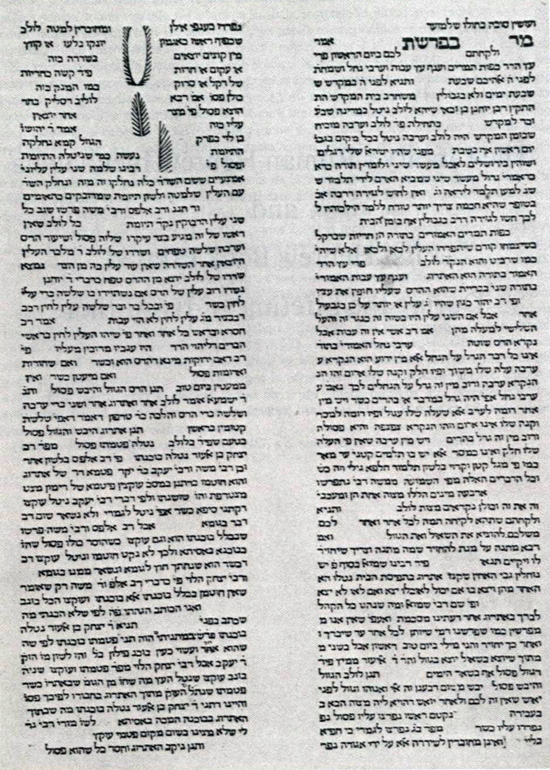
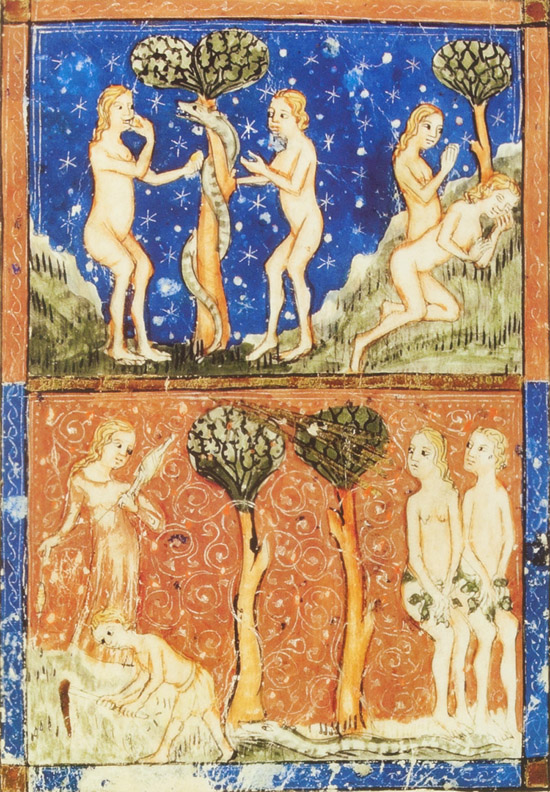
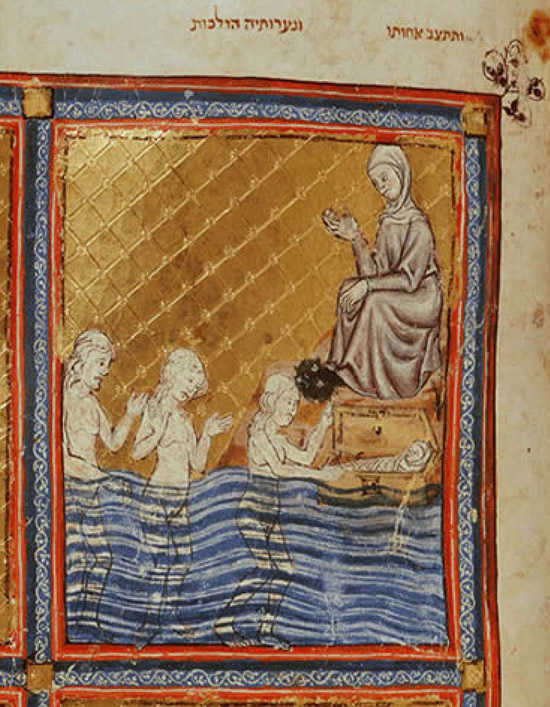
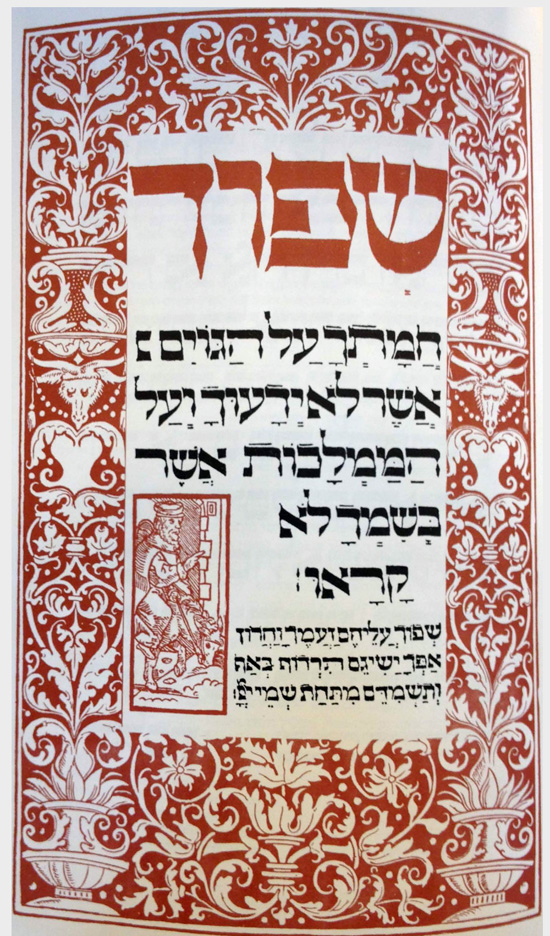
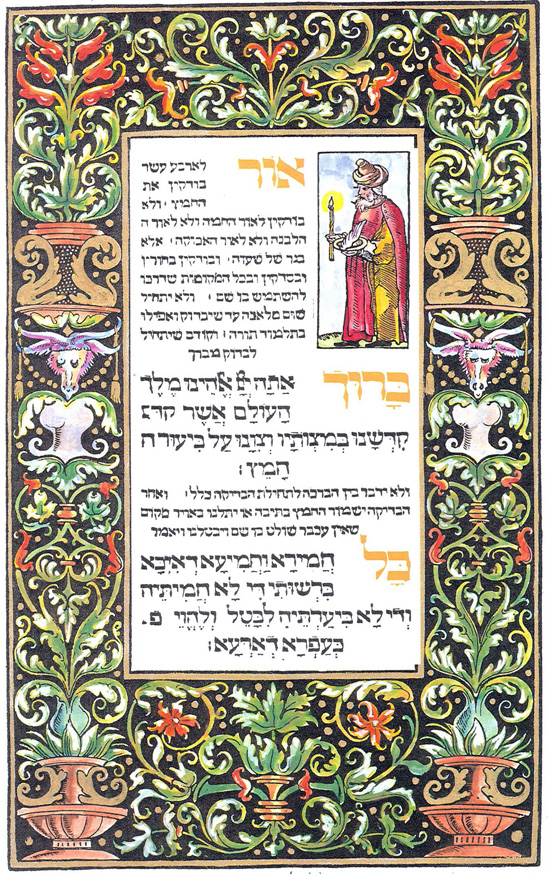
Review: The Schechter Haggadah: Art, History, and Commentary

Book Review: The Schechter Haggadah: Art, History, and Commentary
by Elli Fischer
 Rabbi Elli Fischer is a freelance translator living in Modiin, Israel.  He maintains the “On the Contrary:Judasim with Comments Enabled ” blog.  This is his second contribution to the Seforim blog.
Given the thousands of haggadot that have been published over the years, and the dozens of new ones published each year, it is not easy for any single haggadah to separate itself from the others on the market. As a result, some new haggadot provide unique commentary, others contain innovative liturgy and practice, and still others resorts to gimmickry and humor to win adherents. Only rarely does a haggadah appear that is truly remarkable. The Schechter Haggadah: Art, History, and Commentary, by Dr, Joshua Kulp and Rabbi David Golinkin, is indeed a remarkable haggadah.
In truth, the title of this haggadah is a bit misleading, since the “history” is part of the “art” and the “commentary”, and not an independent section. The text is divided into three sections: the first contains the traditional Ashkenazic haggadah text, adorned with artwork from early, mostly manuscript, haggadot. The second section, authored by Rabbi Golinkin, is an expanded section on the artwork of the haggadah, containing 115 annotated illustrations (according to the authors; though I did not count, I did notice that there were a whole lot of pictures). The comments include basic metadata such as time and place of appearance and where the original illustration can now be found, as well as other historical curiosities pertaining to the particular illustration, the haggadah in which it appears, or artistic themes in the illustration of haggadot in general. The third section of this haggadah is Dr. Kulp’s commentary, in excess of 100 pages, which deconstructs the text of the haggadah and the seder practices, locating their original meanings in the earliest Jewish texts and tracing their development through Jewish history. The latter two sections are referenced by unobtrusive notes in the main text.
The first section is beautifully laid out and has good proportion. Since the commentary does not appear alongside the text, one is not distracted by it during the course of the seder. The artwork that appears in the first section contributes to the aesthetic experience without crowding out the main event. Dr. Kulp’s translation is very straightforward and readable.
The illustrations are beautiful and fascinating, and the commentary informative. It features thirty-seven different depictions of the “four sons”, demonstrating how they were perceived by different artists over close to a millennium of Jewish history. Other artistic elements contain a touch of humor, even if the contemporary reader does not share the same sense of humor. For example, in two portraits from 14th and 15th Century haggadot, a husband points at his wife during the recitation of “maror zeh” (“This bitter herb”). Unfortunately, Rabbi Golinkin fails to note the Biblical origin of this particular misogyny: Kohelet 7:26 (“and I find more bitter [mar] than death the woman”).
Dr. Kulp’s commentary is at its best when engaging in source criticism of the haggadah and its antecedents. In some cases (“the four sons”, “go and learn”) he juxtaposes several variations of the same element, taken from early rabbinic works such as the Sifri, the Talmud Yerushalmi, and early haggadot, demonstrates their significant differences, surveys scholarly work on the relationships between the texts, and offers his own summaries and conclusions regarding the evolution of that element of the haggadah. This type of study, which typifies academic Talmudic scholarship, does not generally appear in popular works. To his credit, Dr. Kulp does an admirable job explaining the process and conclusions of his analysis for the educated layman, though his writing style is occasionally awkward (e.g. “read for someone the Hallel” instead of “read the Hallel for someone”), and I noted a number of grammatical errors (especially a lack of commas) and typos (e.g. “Hillel” instead of “R. Yohanan” on p. 258).
In general, the commentary section is structured as a series of sections, varying in size, that trace the origins of the seder and the haggadah. Virtually every standard practice and text is addressed, some more thoroughly and convincingly than others. The primary sources that Dr. Kulp uses are the Talmudim, Mishna, Tosefta, Tannaitic Midrashim, and haggadot from the Geonic era, from both Babylonia and Eretz Yisrael. However, he occasionally refers to other early sources such as apocryphal works, Greco-Roman writings, early Christian writings, Josephus, and Philo; haggadot from the times of the Rishonim and early Acharonim; and standard halakhic codes.
These sections, for the reader and teacher, constitute the best of what this haggadah offers. Each is akin to an individual lesson on a particular aspect of the haggadah or seder, tracing it from its origins to standard practice. For example, with regard to the four cups of wine, he begins with the Tosefta (Pesachim 10:1) instructing charity bursars to provide poor people with four cups of wine for Pesach night. Working of Professor Shamma Friedman’s theory that the Tosefta predates the Mishna, at least in part, he discerns that the number four was originally a somewhat arbitrary number that was deemed appropriate for the Pesach-night symposium. Later, in the Mishna, the four cups were formally arranged as the framework for the seder meal. Finally, midrashim sprang up to account for the significance of the number four on the night of Pesach. This evolutionary process sees the wine transformed from a vehicle of celebration into a ritual and symbolic act, a process that Dr. Kulp notes over and over again as practices that originated in a Greco-Roman context (dipping, reclining, etc.) are transferred into new cultural settings.
Nevertheless, Dr. Kulp’s explanations for the various texts and performances are not always convincing. For example, he does not really offer an explanation for the composition of the “Ha Lachma Anya” paragraph or for the introduction of the Mishna about Rabbi Elazar ben Azarya (though in both cases he argues against reading them as anti-Christian polemics). With regard to Rabbi Yehuda’s mnemonic, he demonstrates that it is an early source, but does not address why such a mnemonic would need to be developed in the first place (indeed, the Gaon of Vilna [Likkutim at the end of Seder Zeraim] argues that the original context of the mnemonic is as an inscription on Moshe’s staff, and was only imported into the hagaddah at a later date; see also p. 24 of R. Hayim Hischenson’s Motza’ei Mayim, here).
His reading of the midrashim contained within the “go and learn” often miss obvious textual points. For example, he asks, “why is cattle-plague singled out as the plague through which God took the Israelites out of Egypt?” He fails to note that the midrash in question intertextually links the “strong hand” of Deuteronomy 26:8 with the “hand of the Lord” of Exodus 9:3. The same can be said of the “portents” of Joel 3:3 and the same verse in Deuteronomy, about which he asks a similar question. He interprets the midrash on “u-vemorah gadol” as being based on a tradition that “morah” means “vision” and not “terribleness”. If that would be the case, however, then the prooftext cited (Deut. 4:34) is superfluous, as the “revelation of the Divine Presence” can be adduced without the prooftext. Rather, the exegetical nub seems to derive from the final phrase of the prooftext: “just as you saw the Lord your God do for you in Egypt, before your eyes”. As a rule, he does not discuss these midrashim as exegesis and tends to neglect the intertextual elements of these midrashim. While not a fatal flaw, an opportunity to more fully explore the nature of rabbinic exegesis is missed.
Another example of where Dr. Kulp misses a fairly straightforward explanation for the flow of the haggadah pertains to the division of Hallel. He writes: “It seems to me that dividing the Hallel into two portions was meant to highlight the centrality of the pesah sacrifice, perhaps in a similar way that reciting a blessing before and after food sanctifies the food”. Later in the same section, when discussing differing practices regarding the recitation of a bracha before Hallel, he writes that “we recite the Hallel at seder [sic] because the Exodus was miraculous… In contrast, in Babylonia they thought that the Hallel was recited in connection with the pesah sacrifice and hence they considered its significance to be diminished when the sacrifice could not be offered.” While it is hard to deny the difference between Eretz Yisraeli and Babylonian customs surrounding the recitation of Hallel, Dr. Kulp misses the main transitional link that mandates the recitation of Hallel, or at least part of it, at the end of the recounting of the Exodus. The transitional paragraph (imported into the haggadah from the Mishnah) states: “Therefore it is our duty of thank, praise (le-hallel), laud, glorify…the One who made all these miracles for us…Let us say before Him, ‘Hallelujah!'”. In other words, the recounting generates the duty to give praise, and it would be inappropriate to conclude the retelling without some words of praise. This approach is borne out by linking the latter part of Mishna Pesachim 10:5 with 10:6.
These examples all seem to flow from a single, overarching issue. Dr. Kulp tends to atomize the different parts of the haggadah rather than viewing them as part of a single structure or relating to a single theme. He states as much explicitly (p. 230): “we should be extra cautious of detecting editorial intention in the sum of the Haggadah’s texts. In my opinion it is extraordinarily difficult to speak of the ‘intention of the Haggadah.'” While I understand his caution, and agree that it is impossible to speak of a single editorial intention, there is no doubt that at each stage, with the inclusion or alteration of each new text, someone, somewhere, felt that a particular text fit with the overall theme or structure of the haggadah; the chaos is more controlled than Dr. Kulp would have us believe.
I hope that these last few paragraphs to not convey the wrong message; the Schechter Haggadah is a beautiful as well as excellent work of scholarship. Had I included every one of my criticisms, kal va-chomer everything that I liked, this review would have been far longer than it already is. In particular, the commentary has deepened my understanding of the evolution of the haggadah, and for one who is not familiar with source critical methodology, this haggadah can be transformative. My recommendation for readers of this haggadah would be to go through it before the seder: there is simply too much to digest, and the issues are often simply too technical, to be appropriate fare for the seder itself. Additionally, this haggadah is a fantastic resource for educators to teach the haggadah. Dr. Kulp’s commentary evolved from a series of classes that he gave, and it consequently is structured in a manner that is easily adaptable to a classroom setting (as my wife can readily attest).
Chag Kasher ve-Sameach!


Initial Bibliography of Important Haggadah Literature

Initial Bibliography of Important Haggadah Literature
by Eliezer Brodt

All are aware of the proliferation of Haggadahs. Every year more and more are published thus making it difficult to know which versions are worthwhile. Thus, in this post I intend to focus on a listing a small bibliographical list of seforim relating to the Haggadah that are, in my mind, some of the most important ones.

In light of the fact I am going to select a few Haggadahs from the many, a caveat of sorts is in order. When discussing the “best” books it is good to keep in mind the comments of R. Eliyahu ben Avrohom Shlomo HaKohen (d. 1729) in his Shevet Mussar (ch. 28) who writes the following regarding affinities towards particular seforim:

ותראה בני אדם שלומדים ענין אחד מדרוש או ממוסר בספר אחד ואין טועמים ממנו ואין נרשם הדבר בשכלם. והענין או דברי המוסר בעצמו לומדים אותו בספר אחר הבא בשינו לשון ובמלות שונות וטועמים ממנו ונרשם הענין בדעתם ומגדלים ומשבחים אותו ענין. ובהפך אם אחד למד ענין בספר שלמד זה וטעם הוא אינו טועם כטעם הספר שלא טעם חבירו. טעמו של דבר שכל הטועם מענין הספר שלמד יש לו איזה שורש לנשמתו בנשמת מחבר הספר כיון שהם משורש אחד לכן טועם לשונו ונרשמים הדברים בליבו. לא כן מספר שלמד ולא טעם אף על פי שהענין אחד משום שאין לנשמתו שום קורבה ואחיזה בנשמת המחבר אותו ספר.

Basically, according each persons taste of a sefer could be different and the reason has to do with some sort of connection with the author of the sefer. Further, when it comes to the Haggadah and specifically the importance of the Haggadah the comments of the Sefer Hamaskil are instructive (p. 70):

מה טוב ומה נעים לעיין תמיד דבר בעתו בכל שבוע ושבוע בפירוש חומש ומחזיר וסליחות… ואגדת פסח

His basic point being that one should try to prepare before each occasion the tefilos we specific to that occasion – and for Pesach that is the Haggadah. (For more information regarding the Sefer Hamaskil see the excellent article from Rabbi M. Honig in Yerushcanu vol. 1).

One final point regarding the study of the Haggadah. The seder is at most two nights and thus some complain that they have no time to discuss or learn all the torah written about the seder in such a limited time. Many years ago I came across a interesting Netziv who writes that one should discuss Yetzis Mitzrim all Pesach not just the seder night [Hemaek Davar shimos 13:8]. Therefore, according the the Netziv, there is plenty of time to delve into the Haggadah and the seder.

As I have written before there is no other sefer which has more written on it than the Haggadah Shel Pesach. This year, on top of all the Haggadahs printed, Chaim Rosenberg has just added to his website of hebrew books 1000 more Haggadahs ! Moreover, the JNUL also has many rare Haggadahs online as well. Below are some of my recommendations of some good works on the Haggadah with some small points about them. I really should have a individual post about each one of these seforim but due to lack of time this should suffice for now.

Haggadahs discussing the historical development of the Haggadah & the Seder:

Many volumes have been written and will continue to be written about the Haggadah and its development. In 1954, R. Menachem M. Kasher had R. Shmuel Askenazi put together a Haggadah, Haggadah Shelama. [Virtually all of the work was done by R. Ashkenazi not by R. Kasher.] This Haggadah has an excellent introduction of forty chapters comprising 224 pages that discuss all aspects relating to the seder including much about the development of the Haggadah as we have it. As is the case with all R. Ashkenazi’s works, this work is very well written and organized. It’s based on a very wide range of sources including manuscripts and genizah fragments. These introductory chapters have formed the bases for virtually all good Haggadahs printed since then. The second half of the Haggadah has an excellent collection of pirishim from many of the classic commentaries. This work has been reprinted many times, and is currently in print.

Another important Haggadah was edition by Professor D. Goldschmidt. This is a critical edition of the Haggadah [this is a updated version of previous editions that he had written] it also has much useful information on the development of the Haggadah and is a bit more scientific than Haggadah Shelama. But it is not nearly extensive as the Haggadah Shelama in what topics and information that it covers.

Another interesting work on the Haggada is called Haggadah and History by Professor Yosef Yerushalmi. This work contains 494 pages printed beautifully, describing five centuries of the Haggadah through facsimilie plates. Yerushalmi deals with many points of the particular Haggadahs. He also shows how the Haggadah is a mirror of Jewish history in general.

Another important volume was printed in 1998 by professors [father & son] Shemuel & Zev Safrai, Haggadah’s Chazal. This Haggadah is excellent. In the past fifty years, since the printing of Haggadah Shelama, many more manuscripts and genizah fragments have come to light. The Safrai Haggadah makes prodigious use of this new information. It is well written and very user friendly. The Safrais deal with each part of the seder discussing at length the development of the Haggadah from times of Beis Hamikdash onwards. They also go through the entire text discussing various readings, sources, etc. In all, it is more scientific Haggadah then the Haggadah Shelama but less comprehensive. In the U.S. it is available here.

Another excellent work on the seder is Pessach Doros by R. Yosef Tabory published by Kibitz Hameuchad. This work focuses on many aspects of the seder and Haggadah. But this work does not only focus on the Pesach seder instead it discusses and provides sources for everything remotely touching on the seder – including, among others, the development of kiddish, lechem mishna, nitlas yadm on vegetables, and drinking wine in general this work to has a wealth of information on all these topics.

Turning now to non-scientific works on the seder. The first such work is Vayaged Moshe by R. M. Katz. This sefer is full of valuable information and is one of the first collections of all the halachah aspects of the seder. But since its printing there have been many more and better works written.

One such work written a few years back is R. Weingarten’s three volume Seder Ha-aruch. The first volume is all about the halachaic aspects relating to the seder. The second volume discusses the aggadic parts relating to the seder. And the third volume is an excelent edition of the Haggadah. This third volume is based on many of the Haggdahs and includes all kinds of torah. It focuses on peshat based on rishonim and includes many other styles of learning as well including chassidius and kabalah. It is very easy to use and if one is leading a seder and has no time to prepare he will certainly find what to say. In general, this work it is very well researched and organized. It basically became a classic. A few works have come out since than I have not seen one done as well.

Another work on the seder is R. Ovadiah Yosef’s Chazon Ovadiah. Many years back he printed two volumes under the same title but that was merely a bunch of articles on random topics. More recently, he printed a new edition of the Chazon Ovadiah where he goes through all the halachas of peasach in his encyclopedic style.

A Few Works on the Haggadah:

A few years back Mossad Harav Kook printed a beautiful edition of the Haggadah, Toras Chaim. This Haggadah contains 12 different prisushim of rishonim on the Haggadah based on manuscripts and contains many excellent notes on the texts. It is well worth one’s time to study these commentaries which provide the Haggadahs simple peshat. It does, however, take much time and patience (and is confusing) to go through them all at the same time. Instead, it may be easier to divide it up pick one or two commentaries each year. These peshatim are very important as these are the main rishonim and how they understand each part of the Haggdah. They deal with many of the questions one has on the Haggadah but they are not full of sharp crowd catching stuff if one is trying to get the whole seder table into it. That is, when one learns the Haggadah there are many questions he will have as he has when learning any chazal these rishonim deal with many of those problems but they stick straight to peshat not dealing with fancy things or mussar points that people enjoy saying over to the crowd but they are extremely important to learn and in helping one understand the whole Haggadah.

Two minor complaints I have with this edition. Although the print is beautiful the layout is not. I find it a little annoying to use as when one is reading a particular pirish he has to keep on turning pages which is understandable but they are not all in the same place on each page which makes it kind of confusing. For example, some times the Ritvah you are in middle of you have to turn two pages etc. The best would have been to divide the sefer in half and make six pirushim per section making it much easier to use and easier to follow the notes. Another complaint is they should have printed a separate section of the halachos of the seder of these rishonim. This would make an excellent idea for a future work on Pesach and to include all the halchaic works of the rishonim on Pesach already printed by R. S. Stern.

The next Haggdah well worth ones time is the Abarbnel’s Zevach Pesach. This Haggadah was the first printed in 1505 and is the first Haggadah printed with a commentary. Since then this Haggadah has been printed well over hundred times including in English. Last year Mossad Rav Kook printed a beautiful edition of this Haggadah.

This Haggadah provides excellent peshat in the well-known Abarbenel style. He begins by asking 100 questions on the Haggadah and than proceeds to answer each one in his clear manner. This Haggadah was and still is one of the most famous and most quoted in the various seforim. The Me’am Loaz Haggadah is heavily based on this Haggadah.

As far as other works of rishonim on the Haggadah, in the past few years, many have been printed by Professor Yakov Speigel. Speigel’s editions are based on manuscripts and providedin critical editions. Recently Rabbi David Holzer printed a collection of rishonim from manuscript some of which had been printed by Professor Speigel and some never printed before.

Another work of rishonim printed is called Haggadahs Balei haTosfos also based on manuscripts of the Balei haTosofos on the Haggadah. This year a critical edition based on manuscripts was R. Yosef Gikatilla’s Haggadah including many parts never printed before.

This year Mechon Yerushalim issued a new Haggadah, Otzar Mefrshi Haggadah. This collection is beautiful, well done and well organized. It has loads of information on the Haggadah. The style is the same as their Otzar Mifarshei Hatalmud. The editors write in the introduction that they intend to focus on peshat which they do a great job of it. They write they do not intend to bring down everything good as that would fill volumes but they are trying to put together what they could in a usable fashion. They use many hagdas of rishonim and achronim and they are not embarrassed to quote who they use – many times they quote from Seder Haruch etc. Although I think they did a great job and it is worth the money but I think if not for their time dead line the yarzheit of R. Buxbaum. It could have even been better (this is my opinon one can argue of course). For more on this see here.