Book Announcement: Gabriel Wasserman’s Haggadah

Book Announcement:
הגדה של פסח “אשירה ואשננה בחשיקות”
מאת גבריאל וסרמן

You may purchase a copy here.

Every year, many haggadot are published, with various features, but almost all of them have the nearly identical Hebrew text. Yes, Ashkenazic haggadot have a few songs at the end that are not in most Sephardic haggadot, and some Sephardic haggadot may have a few kabbalistic passages that are not in Ashkenazic haggadot, but by and large the texts are well-nigh identical.
In the past, various communities had unique passages that they would include at various points in the seder, but hardly any books today include these passages.
Enter Haggada shel PesaḥAshira Va’ashannena Baḥashiqot”. The author of this haggada, Gabriel Wasserman, has been working on this book for years, assembling texts from various periods and places; first for use at his own seders, and then, due to popular request, also for sale. The haggada includes the text of the haggada as is customary today, but also three types of supplementary additions, at various points in the text: (a) Passages that were once common in the seder rituals of certain communities, and may still be recited in some communities today; (b) passages from rabbinic or piyyuṭic literature, which were never part of the haggada, but are appropriate for innclusion, in the spirit that “all that expand the story are praiseworthy”; and (c) passages that the author has composed himself, mostly piyyuṭim.
But this is not all. The author has included a commentary on the haggada, focusing mostly on the history of the halakhot and rituals of the seder, and on some literary issues of the texts. More detailed discussions are left for essays in back of the volume. Everything – the standard haggada text, the supplemental passages, the commentary, and the essays – is presented in two facing columns, in Hebrew and English; all translations are by the author.
A sample of the English translation is given here, from the Nishmat prayer:
The soul of every living thing renders blessing unto Thee, O Lord our God, and the spirit of all flesh praises and glorifies the mention of Thee, O our King, forever. For all eternity Thou art God, and besides Thee we have no king, redeemer or rescuer, ransomer or releaser, who sustains and has compassion in every time of distress and trouble – we have no king but Thee!
Besides the essays in the back of the volume, there are also sections including recipes (in facing Hebrew and English), and musical notation of some tunes, with discussions of the history of these tunes (again, in Hebrew and English).
One unusual feature of this haggada is that it includes not only texts for seder night, but also for lunchtime on the first two days of Pesaḥ, havdala, and, for the first time, for the night of the seventh and last nights of the holiday, called Yom Vayyosha‘ after the opening word in Exodus 14:30. (The Yom Vayyosha‘ texts, unfortunately, are not translated, but hopefully will be in a future edition.)
Available for purchase here.


New book announcement: Professor David Henshke’s work on the Seder Night

Book announcement:  New work on the Seder Night
By Eliezer Brodt
דוד הנקשה, מה נשתנה: ליל הפסח בתלמודם של חכמים,
מגנס, 626 עמודים
I am very happy to announce the publication of an important work (in time for Pesach) which I have been eagerly awaiting; Professor David Henshke of the Talmud Department at Bar Ilan University’s long awaited volume, Ma Nishtanah: Leil HaPesach BiTalmudam shel Chachamim. The book was printed by Magnes Press.
Why am I excited about this work?
A few years ago I wrote:
Perhaps the topic which has engendered the most commentary in Jewish literature is the Haggadah shel Pesach. There are all kinds, in all languages, and with all types of commentary, pictures, etc. Whatever style one can think of, not one, but many Haggadahs have been written. So, whether it’s derush, kabbalah, halakha, mussar or chassidus there are plenty of Haggadahs out there. Then, there are people who specialize in collecting haggadahs although they do not regularly collect seforim. In almost every Jewish house today one can find many kinds of Haggadahs. In 1901 Shmuel Wiener, in A Bibliography of the Passover Haggadah, started to list all the different printings of the Haggadah. Later, in 1960, Abraham Yaari, in his work A Bibliography of the Passover Haggadah, restarted the listing and reached the number 2700. After that, many bibliographers added ones which Yaari omitted. In 1997, Yitzchak Yudlov printed his bibliography on the Haggadah,  The Haggadah Thesaurus. This thesaurus contains a beautiful bibliography of the Pesach Haggadahs from the beginning of printing until 1960. The final number in his bibliography listing is 4715. Of course ever since 1960 there has been many more printed. Every year people print new ones; even people who had never written on the Haggadah have had a Haggadah published under their name, based on culling their other writings and collecting material on the Haggadah. When one goes to the seforim store before Pesach it has become the custom to buy at least one new Haggadah; of course one finds themselves overwhelmed not knowing which to pick!
A year later I wrote a post listing an Initial Bibliography of Important Haggadah Literature that is out there.  In that post I discussed various works on the Seder night (regular and academic).
I personally collected and have learned through numerous works of all kinds on the seder night for many years. I am always on the lookout for some fresh new look on the seder night. A few years ago, I came across some articles by Professor Henshke in various publications such as HaMaayan and more academic journals and was hooked. I also heard him speak a few times. A few years ago when I was enrolled in the Talmud Department in Bar Ilan University, I started to go to a class of his once a week; each week, I was simply blown away. Around Pesach time the focus of the class was based on some of his work on the Seder night.
What is the strength and uniqueness of this work?
Professor Henshke shows a command of two worlds which some feel cannot go together, the Yeshivah and Academic worlds. He learned by various greats of the past including R’ Yisroel Gustman, R’ Binyamin Ze’ev Benedict, and R’ Shlomoh Fisher, has served as a maggid Shiur and is extremely familiar with the Yeshivisheh Torah in all areas, including Kodoshim and Taharos. His works shows an incredible command of the relevant sources, from Chazal and onwards, Geonim, Rishonim and Achronim. At the same time he shows the same impressive breadth in academic literature as well as deep understanding and utilization of the various methodologies. He is careful to examine all the material from scratch, including the manuscripts, to the finest details. This allows him to look at the sugyah with a fresh look. Additionally, he is also a great “Mechadish” and has originated many new ideas on various issues. Professor Henshke is an outstanding example of the tremendous benefit in combining both worlds (a topic for a different time). All this is done with Yiras Shamyim and with proper respect of whoever he is dealing with, even when he is arguing with them.
In general, Professor Henshke’s lectures and written material focus on the Peshat. Basing himself upon a meticulous reading of the texts, he then approaches Chazal (Midrashi halacha and Mishna-Tosefta) by putting each halachah into its proper literary perspective (each corpus reflects the Halachos as learned in a different Bais Midrash; that of R’ Yishmael and that of R’ Akiva). This approach, coupled with his phenomenal scope allows him to connect seemingly non-related halachos, weaving an intricate tapestry worthy of both Rosh Yeshiva and scholastic.

Here are Professor Henshke’s own words (from the introduction to this work) explaining what it is he is trying to bring to the table (I have abridged the text and footnotes):

כלום לא נכתב די על ליל הסדר?[1] השאלה… אכן מתבקשת – אף על פי שחיבור זה אינו פירוש להגדה (שאין מספר לביאוריה),[2] ואף אינו דיון תורני בסוגיות ליל הפסח (שדה שאף הוא כבר נחרש עמוקות).[3] תכליתו של ספר זה כפולה – בירור מצווֹת ליל הסדר היסודיות מבחינת תולדות ההלכה בתקופת התנאים והאמוראים (והוא חלקו הראשון שלחיבור), והבהרת התהווּתה של ההגדה התנאית – מימות התנאים עצמם ועד עיצובו של הרובד התנאי בהגדה של ימי האמוראים והגאונים (חלק שני). אף על פי כן, השאלה שבכותרת במקומה עומדת, לפי שסִפרות המחקר על ליל הסדר, שעניינה בתכליות הללו, אף היא כבר רחבה ומסועפת

    ברם, לא מעט מסִפרות המחקר נכתב מתוך מבט חיצוני לגופו של החומר הנחקר. חוקרי ליל הסדר לרוב לא ראו את תפקידם בניתוח מהלכי הסוגיות התלמודיות (המשמשות מקור ראשון לענייננו) מפנימן, אלא בהצבת נקודת מוצא שמחוץ להלכי המחשבה התלמודית – כמנוף לבירור מחודש של התופעות. כך, לדוגמאות אחדות, נחקרה ההגדה על רקע פוליטי,[4] על-פי תרבות הסימפוזיון ההלניסטי,[5] או כתגובה לפסחא הנוצרית ול’הגדתה’[6] – אך נקודות מוצא אלה, שאין כלל ספק בחיוניותן, ראוי להן להישקל דווקא לאחר בירור תלמודי מדוקדק בכל כלי הניתוח

שמדע התלמוד של ימינו מְספק. ומעין דבריו של רא”ש רוזנטל: “לא יהיה בסופו של דבר שום מבוא אל התלמוד אלא בתלמודיות ממש“.[7] אין לדלג אפוא אל מעבר לגופי המקורות – קודם שהללו נתבררו מתוכם ככל שיד העיון משגת.

    כיצד יש להם למקורות להתברר? על שלושה דברים עומד מחקר התלמוד:[8] (א) בירור שיטתי של נוסח המקורות התלמודיים, על יסוד מכלול עדי הנוסח שבידינו ויחסיהם ההדדיים; (ב) הבהרת לשונם של המקורות, על-פי פשוטם בהקשרם ועל יסוד בדיקתם בשאר היקרויות; (ג) על בסיס שני אלה מתאפשרת העֲמידה החיונית על הרכבם הספרותי של המקורות, הבחנת רובדיהם אלה מאלה ועמידה על יחסיהם ההדדיים. קשיים ותמיהות שמערימות הסוגיות השונות מתיישבים תחילה מתוך בירורים פנימיים אלה, אשר מביאים לעמידה על מהלכי החשיבה התלמודיים ותולדותיהם; ומעֵין וריאציה על התער של אוקהם[9] דומה שמלמדת כי דווקא כאשר אין בכל אלה כדי להושיע, יש מקום לפנות אל מחוץ לסוגיות עצמן

    אימוצה של מתודה זו בסוגיא דילן[10] דומה שמשיב כל הצורך על השאלה שהוצגה…, כפי שמתברר בבדיקת הסִפרות הקיימת

 סקירה מפורטת של ספרות המחקר בפרשת ליל הסדר, כפי שנדפסה עד שנת תשנ”ו, מצויה במבואו של יוסף תבורי לחיבורו ‘פסח דורות’ (תל-אביב 1996). במרכזה של ספרות זו עומדות כמדומה הגדותיהם של ד’ גולדשמידט (תש”ך) ורמ”מ כשר (מהדורה שלישית תשכ”ז), כל אחת בדרכה; אך תיאורן של דרכים אלה, יחד עם הצגת שאר הספרות בענייננו, ימצא הקורא במבואו האמור של תבורי. ואילו גוף ספרו הוא ודאי נקודת מפנה בחקר הלכות ליל הסדר; כי בחיבור זה מונחת תשתית שאין לה תחליף בתחום הנדון, וכל מחקר הבא אחריו נזון הימנו.[11] ברם, נוסף לנתונים הרבים שנתגלו ונצטברו מיום הופעת ספרו של תבורי (שבנוי בעיקרו על דיסרטציה משנת תשל”ח) – ויָתר עליהם: דרכי חשיבה וניתוח שנתחדדו מאז – הרי כבר הודיע המחבר עצמו כי “עיקר החידוש שלי הוא בתיאור תולדות הלכות ליל הסדר בתקופה הבתר אמוראית” (עמ’ 27; ההדגשה שלי). ואילו חיבורִי מוקדש בעיקרו לסִפרות התנאים והאמוראים.[12]

    מתוך כלל הסִפרות שיצאה לאור לאחר ספרו של תבורי, אזכיר כאן שני חיבורים שנזקקתי להם רבות. בשנת תשנ”ח יצאה לאור ‘הגדת חז”ל’ מאת שמואל וזאב ספראי. זהו חיבור רב ערך שריכז נתונים הרבה, והוא כתוב בידי אב ובנו, שני היסטוריונים מומחים; אלא שהיסטוריה היא אכן מגמתם, ולא בירורי הסוגיות התלמודיות לשמן… ולא עוד אלא שספר זה מוקדש להגדה דווקא, ומצוות ליל הסדר נידונות בו רק אגבה. מכל מקום, הכרת תודה יש בי אף לחיבור זה, שאי אפשר לחוקר ליל הסדר שלא להיזקק לו

    משנה ותוספתא פסחים הן נושא חיבורו של שמא יהודה פרידמן, ‘תוספתא עתיקתא’ (רמת-גן תשס”ג), שבכללו סעיפים העוסקים בענייננו. כדרכו, אין דבר גדול או קטן במהלך הדברים שפרידמן אינו יורד לסוף עניינו ומבררו כשׂמלה. ברם, נקודת המוצא של חיבור זה היא השיטה הכללית המוצעת בו, בדבר קדמותן של הלכות התוספתא להלכות המשנה המקבילות… מכל מקום, כל אימת שחיבורו של פרידמן נגע בענייננו, מיצוי מידותיו היה מאלף

He has written over 100 articles and two books (here and here) developing and elaborating on his methods.

The current volume is certainly not a light read but it will help one understand numerous sugyos of the seder night in new and in deeper levels than before. It is sure to become the new definitive work on the seder night putting it in a original perspective.

If one is interested in reading some articles by Professor Henshke that were later updated and incorporated into this work, feel free to email me at Eliezerbrodt@gmail.com
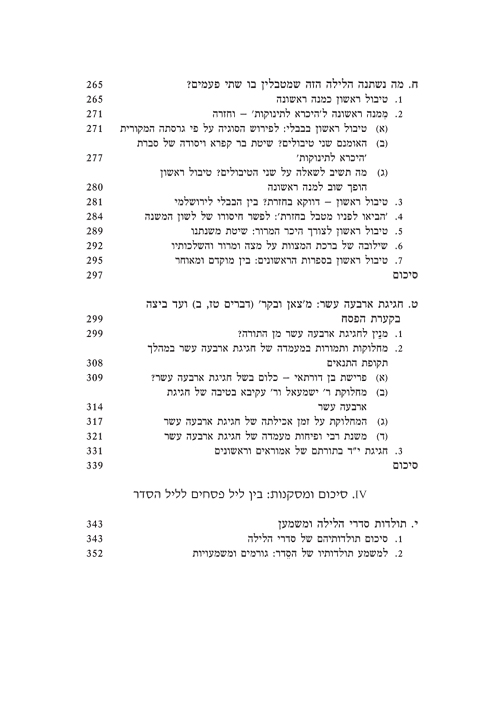
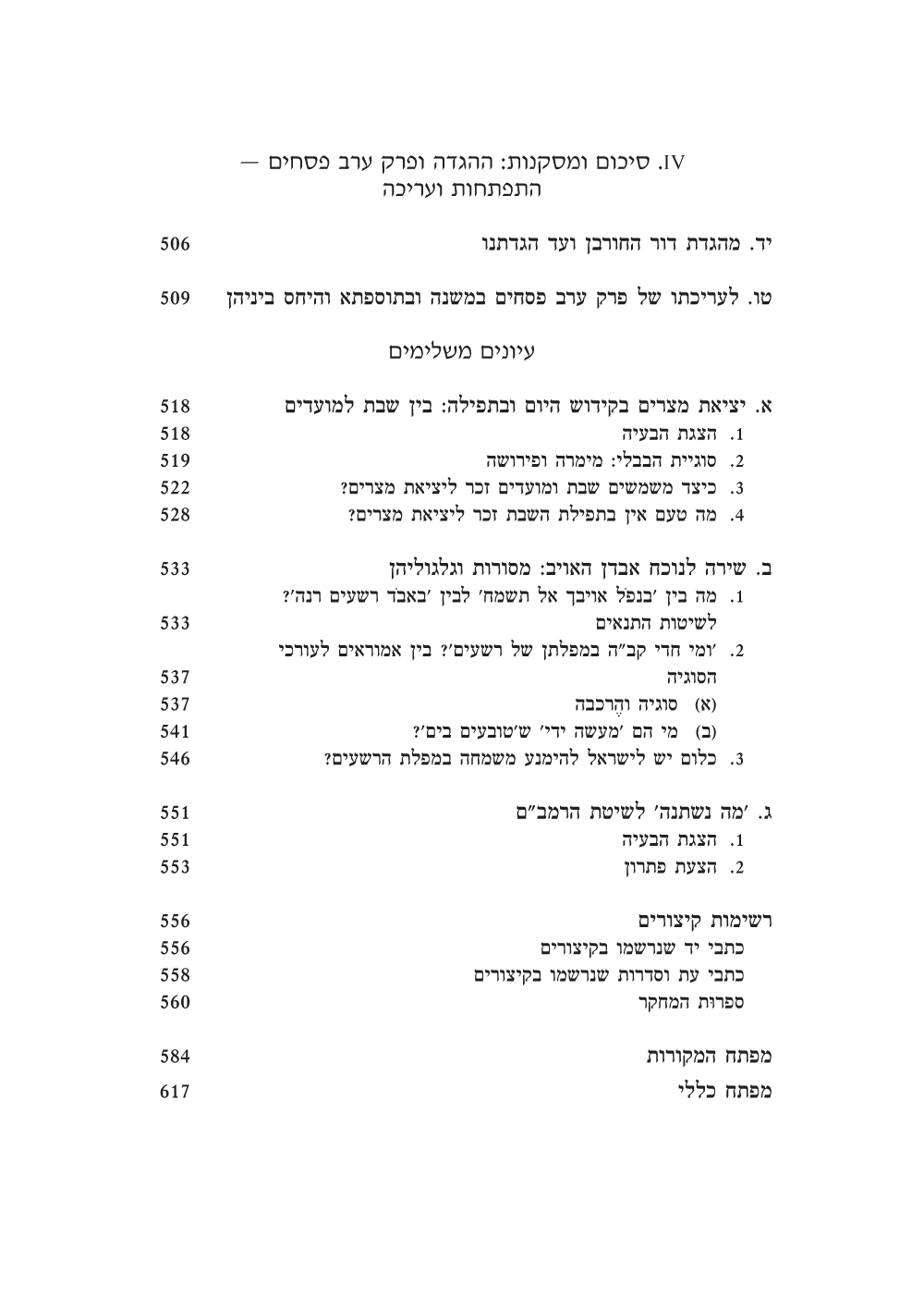
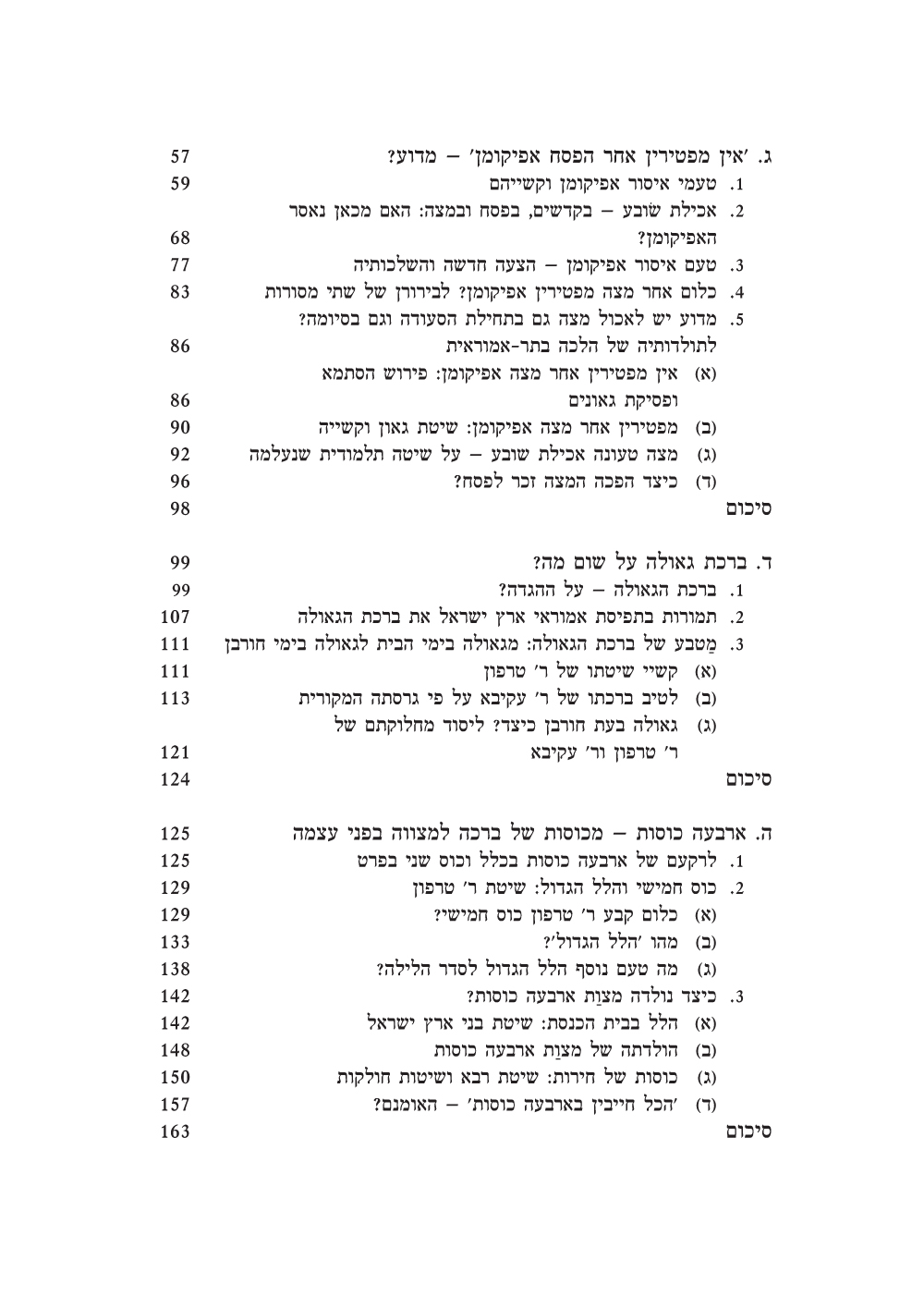
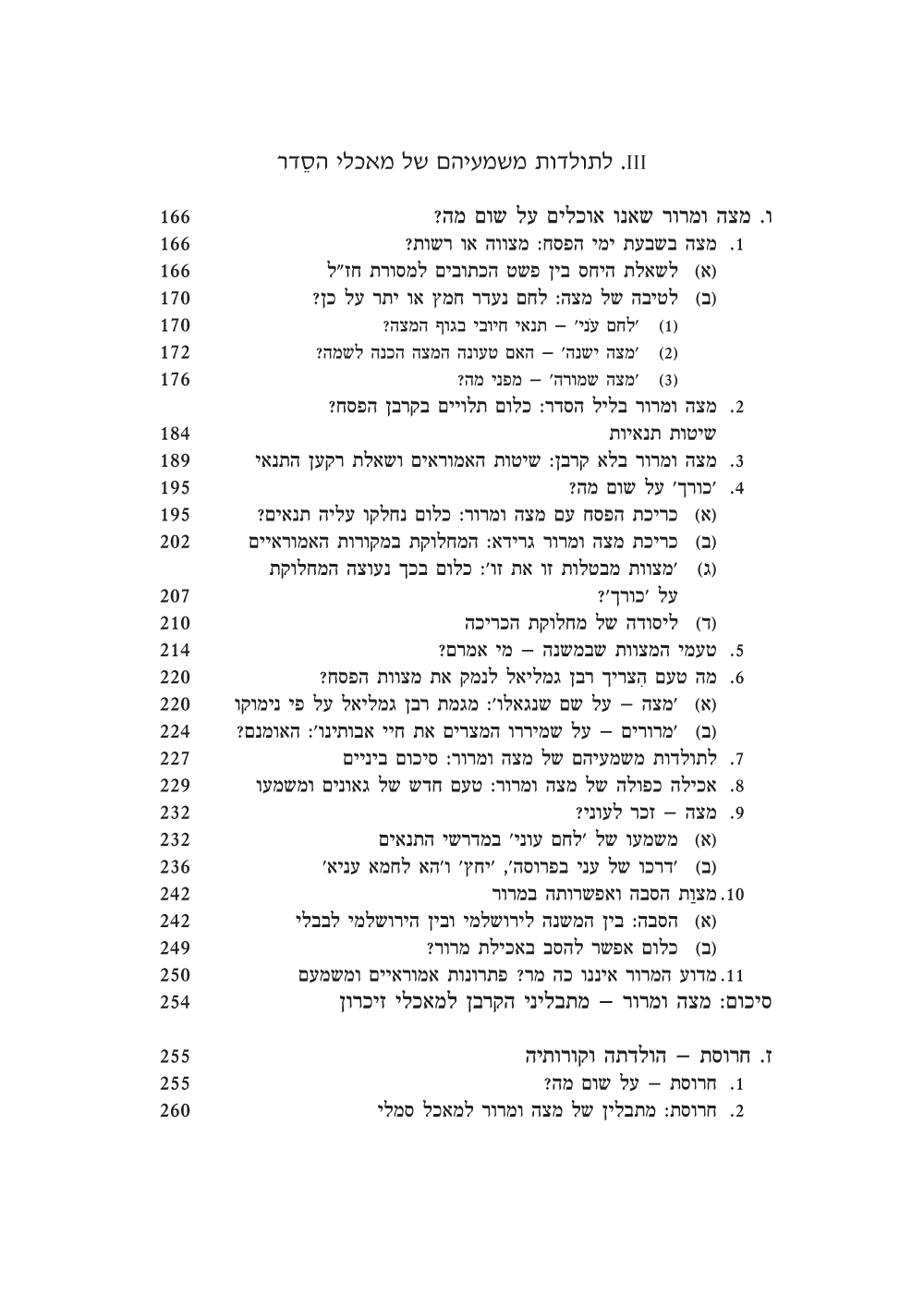
Here are the Table of Contents of this special work.
Simply looking at it gives one sense of some of the issues he deals with.

The book can be purchased via Magnes Press or through me at Eliezerbrodt@gmail.com

Copies of this work will be arriving at Biegeleisen shortly.


[1] הכינוי ‘ליל הסדר’ לליל ט”ו בניסן איננו מחידושי הלשון העברית החדשה, כפי שסבר י’ כנעני, אוצר הלשון העברית,ערך ‘סדר’ (עמ’ 3947), שהרי הוא מתועד כבר אצל מהרי”ל, במפנה המאות י”ד-ט”ו למניינם; ראה מהרי”ל, סדר ההגדה, ח, עמ’ צב. אך ספק אם יש למצאו קודם לכן, והשווה המילון החדש של א’ אבן שושן, ערך ‘ליל’ (עמ’ 812), המייחס את הביטוי לימי הביניים, בלא ציון מקור. הרבה קודם לכן מוצאים אנו את ה’סדר’ גרידא (ראה לדוגמה המקורות שהביא א’ בן יהודה במילונו, ערך ‘סדר’, עמ’ 3971), וכן את ‘סדר ליל פסח’ (ראה למשל ראבי”ה, סי’ תקכד, עמ’ 152). כלום הלעז sederabend הוא פרי תרגום של ‘ליל הסדר’ – או שמא איפכא? בשל המקור המאוחר יחסית של הביטוי ‘ליל הסדר’, נקטנו בכותרת החיבור את הלשון ‘ליל הפסח’. ועל “ליל הפסח” ראה להלן.
[2] ראה: יודלוב, אוצר, שם נרשמו “קרוב לחמש מאות פירושים… ממזרח וממערב, מכל קצות הקשת המחשבתית רבת הגונים והענפים שבעולם האמונה והמחשבה היהודית לדורותיה”, כדברי י”מ תא-שמע בהקדמתו שם, עמ’ ח, והואיל והרישום מגיע שם לשנת תש”ך, הרי כיום יש להוסיף כמובן לא מעט; אך מעֵבר לכך, רשימה זו אינה כוללת אלא את דפוסי ההגדות המלוּות בפירושים, ואילו לביאורי ההגדה שמצאו מקומם בשאר כל הספרות התורנית דומה שאין מספר
[3] ראה, לדוגמה בעלמא, מפתח הספרים שבסוף אוצר מפרשי התלמוד – פסחים, ד: ערבי פסחים, ירושלם תשנ”ד, עמ’ תתסט-תתצח.
[4] ראה למשל פינקלשטיין, א-ב..
[5] ראה למשל מאמרו רב ההשפעה של שטיין, סימפוזיון; על הבעייתיות שבכיווּן זה ראה להלן..
[6] ראה למשל דאובה שצוין להלן…, ובעקבותיו יובל, שני גוים, עמ’ 92; על כך שההנחה שביסוד דברי דאובה אינה מתקיימת, ראה להלן שם בהמשך. רעיונותיו המעניינים של יובל, המתאר את ההגדה כתגובה לנצרות, בעייתיים מבחינת בירור המקורות; ראה על כך עוד, לדוגמה, להלן… בתחום היחס לנצרות מצוי גם חיבורו של ליאונרד, אך הלה מבקש לברר את העניינים גם מתוכם. אלא שאף כאן ניכרת היטב בעייתיות ברקע התלמודי; וראה, לדוגמה, להלן…
[7] רוזנטל, המורה, עמ’ טו
[8] השווה: רוזנטל שם; ספרִי שמחת הרגל, עמ’ 2-1
[9] כבר העירו על ניסוחו של הרמב”ם, בקהיר של המאה הי”ב, לעקרונו של ויליאם איש אוקהם, באנגליה של המאה הי”ד: “אם, למשל, יש ביכולתנו להניח מתכונת אשר על-פיה תהיינה אפשריות התנועות… על-פי שלושה גלגלים, ומתכונת אחרת אשר על-פיה יתאפשר אותו דבר עצמו על-פי ארבעה גלגלים, ראוי לנו לסמוך על המתכונת אשר מספר התנועות בה קטן יותר” (מורה הנבוכים ב, יא, מהד’ שורץ עמ’ 290). ואכמ”ל במקורותיו.
[10] החיבור הנוכחי איננו הראשון שבו מבקש אני לבחון ולהדגים מתודה זו; שני קודמיו (משנה ראשונה; שמחת הרגל) נתמקדו בתורת התנאים..
[11] לחיבורו זה הוסיף תבורי מחקרים נוספים בענייני ליל הסדר, ואלה שנזכרו בחיבורנו רשומים ברשימת ספרות המחקר שבסופו; וראה עוד סיכומו “The Passover Haggadah”, בתוך: S. Safrai et al. (eds.), The Literature of the Sages, II, Assen 2006, pp. 327-338
[12] דיונים בספרות הגאונים והראשונים נערכו כאן כשיש בהם כדי להבהיר את הכיווּנים שהועלו באשר להלכה החז”לית.


The Gematriya Haggadah

The Gematriya Haggadah
By Eli Genauer
I try to buy a new Haggadah every year to make sure I have something new to say. It is especially important at my stage in life when grandchildren will remind you if you use last year’s Dvar Torah.
This year’s Haggadah was definitely in the category of “מה נשתנה ההגדה הזאת מכל ההגדות”. It’s name is ״כוס ישועות״  and it was printed on the Isle of Djerba, Tunisia in 1947. It’s author was Rabbi David Cohen (also known as רבי דוד כהן אלמג׳רבי) who served as the Rav in the southern Tunisian city of Tataouine (תיטאוין). The text of the Haggadah is translated into Judeo-Arabic and the Halachos and instructions are in that language. Thankfully, the Peirush of Rav Cohen is in Hebrew which allowed me access to his approach to the Haggadah.
We find out a bit about Rav Cohen from the Haskamah given at the beginning of the book by six prominent Rabbis of Djerba. It states as follows:
הרב זצ״ל היה כמעט הראשון בהתישבות אחינו בית ישראל שם מראשיתו בתור שוחט ובודק ומרביץ תורה ושליח צבור,ואחר כך נתמנה לרב ומורה צדק שם.
We learn that he was a pioneer in establishing the Jewish community in Tataouine and served in many capacities there before become the Rav of the town. He authored numerous books, some printed while he was alive, and some, like this Hagaddah, printed after his Petirah in 1934.
The Haggadah was printed by a committee (המשתדלים) in Tataouine who raised money for this purpose. There are over 800 names of families or individuals who contributed to its publication. Included in this are over 100 contributors from Tataouine which gives one some idea of the size of the community.
Most of the contributors included with their names the memory of a deceased relative or a blessing for a hoped for milestone for their children. Some of the blessings were familiar to me and others were a bit different.

For a married child: ויפקדהו בבנים זכרים של קיימא אמן abbreviated as ויפקדהו בבזשק״א

This seemed to reflect a cultural preference for boys and perhaps a high rate of infant mortality.

There were no blessings for someone just to have children.

For boys there were two blessings depending on age:

ויזכה לתורה ולתפילין ולחופה and ויזכה לתפילין ולחופה

For unmarried men the hope was ויזכה לחופה 

For those a bit older (?), it was ויזכה לחופה בקרוב
In his Hakdamah, the author explains why he chose to name his Peirush כוס ישועות. He writes that the Gematriya of כוס ישועות is the same as אני הקטן דוד בן המנוח אבאתו כהן. Sort of.  The total of the latter is nine short but if you add to it the nine words כוס ישועות andאני הקטן דוד בן המנוח אבאתו כהן it comes out the same ( 878 ). One senses that the author is very attuned to Gematriyos and his commentary proves this to be true.
A good example of Rav Cohen’s use of Gematriyos is how he plays with the phrase הא לחמא עניא
He first notes that הא לחמא  has the same numerical value as the word מילה (85) indicating that בזכות המילה יצאו ממצרים.

He then writes that the word עניא has the numerical value of ענוה indicating that דבזכות הענוה יצאו
Getting back to הא לחמא which equals 85, he relates it to the word פה which has the same numerical value. Matzah is לחם עוני which requires us to do the following: שׁצריך פה האדם לענות בליל פסח בהלל והודאה לשמו יתברך שעשׂה עמנו ניסים ונפלאו

Finally, if you take the total of the first letters of הא לחמא עניא די אכלו you get 110 which is the number of years that Yosef lived. This hints at the fact that it was because of the sale of Yosef, the Jews suffered in Egypt.
The city of Tataouine is famous in popular culture because it served as the inspiration for the name of the fictional planet of Tatooine in the Star Wars movie series. Many of the scenes of Luke Skywalker’s home planet in the original movie were shot near Tataouine. I was very glad to meet a real inhabitant of Tataouine, one who has enhanced my Seder experience.


אור חדש במעשה ברבי אלעזר בהגש”פ

אור חדש במעשה ברבי אלעזר בהגש”פ
מאת דוד פרקש*
מעשה ברבי אלעזר ורבי יהושע וראב”ע ורבי עקיבא ורבי טרפון שהיו מסובין
בבני ברק, והיו מספרים
ביציאת מצרים כל אותו הלילה, עד שבאו תלמידיהם ואמרו להם, “רבותינו, הגיע זמן קריאת
שמע של שחרית.”
 רבים תמהו על זה, איך אפשר שראשי הרים כאלה, גדולי הדור
כולם, ישכחו זמן קר”ש? והאיך שייך שלא אחד מהם זכר הזמן, עד שהוצרכו
לתלמידיהם להזכירם? הן אפילו מי שאסרו לעסוק בתורה קודם זמן קר”ש כמו שאר
מלאכות שאסורים קודם זמן קר”ש, היינו דוקא כשלומד יחידי, אבל לא כשלומד בבית
הכנסת בצבור. (ע’ הרא”ש ורבינו יונה לברכות ה:, אליבא דרש”י שם,
וע” שו”ע או”ח ס’ פט ס”ו) 
ולכאורה פשוט הטעם מפני שבצבור ליכא למיחש שמא יטרד בגירסא ויעבור הזמן, כי
א”א שאין אף אחד מהצבור יזכור ויאמר לחבירו. ולכן שוב פעם קשה, אי אפילו
להדיוטות לא חיישינן, האיך אפשר שכל חכמים אלו שכחו?
והנה הצעד הראשון הנחוץ לתת פתרון לבעיית כלשהי בדבר הכתוב, הוא להבין בדיוק מה
באמת כתוב.  כאן, נוהגים העולם לקרוא
המאמר דלעיל כאילו באו התלמידים, והם הם אשר אמרו לרביהם  “רבותינו, הגיע זמן קר”ש של שחרית.”
אבל נחזי אנן. מצינו כמה מקומות בספרי חז”ל, בבלי ומדרדים, אשר בהם בעל המאמר
עצמו – כלומר, הסתמא –  קא קרי להרבנן
בהמאמר בשם המונח, “רבותינו.” ראה כמה דוגמאות:
·       
שבת (לג:) ת”ש כשנכנסו רבותינו לכרם ביבנה היה שם רבי
יהודה ור’ אלעזר בר’ יוסי ור”ש נשאלה שאלה זו בפניהם וכו’.
·       
שם (קלח:) ת”ר כשנכנסו רבותינו לכרם ביבנה אמרו עתידה
תורה שתשתכח מישראל שנאמר וכו’.
·       
יבמות (סב:) אמרו שנים עשר אלף
זוגים תלמידים היו לו לרבי עקיבא מגבת עד אנטיפרס וכולן מתו בפרק אחד מפני שלא
נהגו כבוד זה לזה והיה העולם שמם עד שבא ר”ע אצל רבותינו שבדרום ושנאה להם
ר”מ ור’ יהודה ור’ יוסי ורבי שמעון ורבי אלעזר בן שמוע והם הם העמידו תורה
אותה שעה.
·       
ויקרא רבה (ה:ד) מעשה בר’ אליעזר ור’ יהושע
ורבי עקיבא שהלכו לחולות אנטוכיא לעסק מגבת צדקה לחכמים והוה תמן חד בר נש והוה
שמיה אבא יודן והוה יהיב פרנסה בעין טובה פעם אחד ירד מנכסיו וראה רבותינו שם ונתכרכמו
פניו, הלך לו אצל אשתו וכו’
·       
דברים רבה (ואתחנן כד) מעשה שהיו רבותינו ברומי
ר”א הוא אליעזר בן הורקנוס ורבי יהושע הוא יהושע בן חנניה ורבן גמליאל.
·       
שם (ראה ח) מעשה בר”א ור’ יהושע שיצאו
לגבות לעסק מצות רבותינו הלכו לחילתה של אנטוכיא והיה שם אדם אחד והיה נקרא אבא
יודן והיה למוד ליתן לרבותינו ביד רחבה וכו’.
·       
שיר השירים רבה (ב:ג) (מדרש חזית) בשלפי השמד
נתכנסו רבותינו לאושא ואלו הן ר’ יהודה ורבי נחמיה ר”מ ור’ יוסי ורשב”י
ור’ אליעזר בנו של רבי יוסי הגלילי ור’ אליעזר בן יעקב.
אין מן הצורך לכנם לסבך השאלה של זמן עריכת הש”ם
והמדרשים (או חלקיהם.) הרי ידוע כי אפילו אותם מסכתות או מדרשים שהגיעו לצורתם הסופית
בזמן מאוחר, עדיין נכללים בהם מאמרים עתיקים מזמן קדום. הרי עובדה היא כי מונח זה
–  “רבותינו” –  מרגלא בפומייהו של עורכי התלמוד והמדרשים.
וידוע כי גם ההגדה של פסח כבר היה חטיבה בפני עצמה בזמן הגמרא, והיא נזכרת בגמרא ככך.
(ע’ בבא מציעא קטז. רבא אפיק זוגא דסרבלא וספרא דאגדתא מיתמי בדברים העשויין
להשאיל ולהשכיר. ושמא תאמר זהו רק ספרי אגדה בעלמא, ע’ פסחים קטז: והאמר מרימר
שאלתינהו לרבנן דבי רב יוסף מאן דאמר אגדתא בי רב יוסף.)
ושים לב בפרט מי נכללים בהחכמים הנזכרים בתור “רבותינו”
ברוב הדוגמאות דלעיל –רבי אליעזר, רבי יהושע, רבי עקיבא, רבי אלעזר, חכמי יבנה –  היינו בדיוק החכמים שנזכרו במעשה ברבי אלעזר
בבני ברק.[1]
והנה ידוע היא איך שפסיק אחד שלא במקומו עלול לגרום טעות
שלמה בהבנת דברים שבכתב. (לדוגמאה אחת ע’ מחקרים בדרכי התלמוד להגר”מ מרגליות
ערך “רב הונא ורב חסדא”, והוא כותב שם “מכאן אזהרה לאותם
“הפוסקים” תלמודא דידן בסימני פסוק, כמה מומחיות וזהירות צריכה
לכך.”) ללא ידיעת מקום הנכון ששייך הפסיק, המשפט יכול לשנות לגמרי.
ועתה, כבר כתבתי שנוהגים להבין המעשה כאילו התלמידים באו
ואמרו “רבותינו, הגיע זמן.” ברם, אחרי כל האמור לעיל, נ”ל שהמובן
בדיוק הפוך: “רבותינו” כאן הוא דברי הסתמא, לא התלמידים. רבי
אלעזר וחבריו היו מסובין בבני ברק, והיו מספרים ביציאת מצרים כל אותו הלילה
עד שבאו תלמידיהם ואמרו להם רבותינו, “הגיע זמן קריאת שמע של
שחרית.” כלומר, הרבנן בעצמם עסקו בספור יציאת מצרים, ובאו תלמידיהם – לשמוע
ולהקשיב – וכשהגיע זמן קר”ש, הפסיקו הדיון ואמרו רבותינו  בעצמם לתלמידים (או רב אחד אמר לשני) שעכשיו
נפסיק, כי הגיע זמן קר”ש.
ואולי יש להביא קצת ראיה לכך מהמקביל היחיד הידוע לי,
התוספתא האחרונה לפסחים (י:ח) (הובא בטור ס’ תפא) שם כתוב כך:
 “חייב אדם [לעסוק בהלכות הפסח] כל הלילה אפילו בינו לבין
בנו אפילו בינו לבין עצמו אפילו בינו לבין תלמידו מעשה ברבן גמליאל וזקנים שהיו
מסובין בבית ביתוס בן זונין בלוד והיו [עסוקין בהלכות הפסח] כל הלילה עד קרות הגבר הגביהו מלפניהם ונועדו והלכו [להן] לבית המדרש איזו היא ברכת הפסח ברוך אשר קדשנו במצותיו וצונו לאכול הפסח איזו
ברכת הזבח ברוך אשר קדשנו במצותיו וצונו לאכול הזבח.”[2]
אמנם אין מקור זה דומה בדיוק להגש”פ. מיהו, קרוב הוא, וכאמור
זהו המקביל היחיד להמעשה אשר מובא בהגדה. וכאן הרי אין זכר כלל לענין תלמידים. הם
לא נזכרים בכלל, ואין להם שום קשר להמעשה. אדרבה, לפי התוספתא היו עסוקים עד קרות
הגבר. משמע לכאורה כי לא היו התלמידים חלק מרכזי להספור. ולפי הקריאה המסורתי המקובלת,
קצת קשה, כי מי הזכיר הרבנן שהגיע זמן? ברם, לפי הדרך שהצגתי כאן עולה יפה, כי
באמת ביאת התלמידים רק היה גרמא בעלמא –  כמו
קרות הגבר – ששרת כסימן להחכמים שהגיע זמן לפסוק. אבל אפילו בלעדיהם  היו מפסיקים רבותינו  לקרות קר”ש.
יודע אני שקשה לסבול הבנה אחרת לחלוטין מהמובן המסורתי. אבל זה באמת נראה לענ”ד
אמתת הדבר. בהבנה זו מסולקת כל הקושי אשר בו התחלתי. ותכלית הדרשה, כלומר נקודת
הלקח של המאמר, לא זזה ממקומה כלל וכלל. בעל ההגדה מדגיש לנו חשיבות ספור יציאת מצרים,
שהחכמים עסקו בו כל הלילה. לא הוצרכו לתלמידיהם להזכירם, אלא אדרבה, הם הזכירו
אותם. ועתה מנוחתם כבוד.
* Mr.
Farkas, an attorney practicing as in-house labor counsel for FirstEnergy
Corporation, received his rabbinic ordination from Ner Israel Rabbinical
College in 1999. He lives with his family in Cleveland, Ohio.  This is his second appearance in the Seforim
Blog, see his article “Rashbam the Talmudist,
Reconsidered.” (November, 2012).


[1]
אין זאת אומרת כי לא נמצא מקומות אחרות שהמונח “רבותינו” קאי על דור
מאוחר. אדרבה, מצינו בגיטין (עו:) תנא רבותינו התירוה לינשא מאן רבותינו אמר רב
יהודה אמר שמואל בי דינא דשרו מישחא, פרש”י ר’ יהודה נשיאה שהיה בימי
האמוראים בן בנו של רבינו הקדוש. אבל כבר כתב ר”י הלוי בדורות ראשונים (חלק ה
, פרק ט) ש-“יש בזה דבר חדש אשר לא הושם אליו לב כלל ודבר גדול מאד… שדברי
שמואל בגיטין מאן רבותינו, בי דינא דשרו משחא (והיינו ר’ יהודה נשיאה ובית דנו)
אינו על פרט הזה לבד, כי אם שהוא כלל על כל הש”ס, על כל ההכרעות בשם
“רבותינו” אחר דין המשנה.” וע’ש בהמשך דבריו שזהו דור אחרון
של תנאים. אנן הב”ע בדור או דורות שלפני זה.                                     
כמו”כ
מצינו “רבותינו שבבבל” שקאי ארב ושמואל, ו”רבותינו שבארץ
ישראל” שקאי על רב אבא. (שבועות מז.) אבל זהו דוקא בשם לוואי, כמבואר בגמרא
שם, לא בשם “רבותינו” בלבד.                      
                                                                                                                          
          
[2]    אין
שינויים מהותיים בגירסאות המובאות במהדורות חזון יחזקאל או תוספתא כפשוטה


On the Maxwell House Haggadah

For contemporary American Jews, it is not an exaggeration to claim the Maxwell House Haggadah, as one of the most commonly used and widely known haggadahs. Even President Obama was aware of this history when he quipped regarding another recent haggadah “does this mean we can no longer use the Maxwell House Haggadah anymore?”


The first Maxwell House sponsored haggadah was published in 1932. [1] The Haggadah wasn’t published btwetween 1941 and 1948, but otherwise has been consistently published yearly, if in a changed format.  In the early years,   the editions were nearly the same with the only substantive change to update the included five-year calender. The sameness perhaps explains why the New York Times in two different articles accompanied by the identical photograph of the Maxwell House Haggdah, captions one 1932 and the other 1934.


The 1932 date is confirmed by the Maxwell House advertising campaign that included the Haggadah.
Maxwell House was not the first corporate sponsored haggadah, there were many before it.  For example, the West Side National Bank in Chicago sponsored one in 1919, which was printed in both Yiddish and English versions. Sometime in the 1920s, the American National Bank in Newark (whose name appeared in English and Yiddish) sponsored a haggadah, this one included both Hatikvah and the Star Spangled Banner (a common occurrence in many haggadahs published in America). Numerous other banks sponsored haggadas throughout the 1920s.  Postum, a coffee “substitute” put out its own haggdah in 1935, by then Postum was also part of the General Foods’ portfolio.
In 1929, Yeshiva Chaim Berlin sponsored one as “a token of gratitude to its donors.”  The Haggadah was in Hebrew and English with a Yiddish introduction.  The Haggadah also contains an image that includes a star of David flanked by the flag of the United States and the Zionist flag.
Chaim Berlin Flag
 – although in the introduction the editors write that the haggadah was distributed “in the fervent hope that this token will serve as a reminder of [the recipient’s] holy obligation to help the Yeshiva and assist in the undertaking to erect the new building.”  It includes illustrations of the Zionist and American flags, every teacher/rabbi pictured is beardless, and there are numerous pictures of the classrooms, many of which have a portrait of Lincoln hanging. Finally, it contains “a brief survey of the Yeshiva Rabbi Chaim Berlin, founded in 1912.” [By 1970, Yeshiva Chaim Berlin sponsored/published five haggadahs. See Yudolov, Otzar ha-Haggadaot, index, sub. Yeshiva Chaim Berlin.]
Some corporate sponsorships tied in more directly to the food and drink of Peasach, wine and meat. For example, Hebrew National meat products sponsored a haggadah.  Mogen David wines sponsored a haggadah in the 1920’s.(It is lacking a date, however, Yudolov, Otzar ha-Haggadot, no. 2807, dates it to “192-”. If Yudolov is correct, then Pinney’s dating of the use of brand Mogen David to 1947, needs to be corrected.  Thomas Pinney, A History of Wine in America, Univ. of Calif. Press, 2005, 174.)   Similarly, Another wine company, Schapiro’s House of Kosher Wines, California Wine Company, sponsored one in 1941.  And the Manischewitz Company, got into the haggadah sponsorship game in 1943.  While Striets[‘] Matza sponsored one in 1945.
Nor was this practice limited to sponsorship of Hebrew publications.  In 1900, Chase & Sanborn, then one of the largest US coffee concerns, issued a booklet, by one of its owners, to promote its Seal brand coffee, After Dinner Tricks and Puzzles with Your Seal Brand Coffee.  Among the brainteasers was “how many hard boiled eggs can a hungry man eat on an empty stomach?”  Answer:  One only, for after eating one, his stomach would no longer be empty.”  [The booklet also included illustrations and language that through a contemporary lens would be viewed as racist and misogynistic.]
The first edition of the Maxwell House Haggadah was issued in 1932, see supra. (The origin of the company’s name is that a roaster began selling his beans to a prestigious Nashville hotel, Maxwell House, creating a name that is similar to sponsorship.) It contains illustrations that are “reproductions of mediaeval woodcuts and of paintings of old masters.”  The illustrations are neither reproductions of woodcuts or mediaeval, instead, the illustrations can be dated to the 18th and 19th centuries and they were printed with modern techniques.
The sponsorship is indicated on a plain paper cover, “prepared by General Foods Corporation packers of Vita-Fresh Maxwell House Coffee Kosher for Passover” (General Foods appears in smaller type than Maxwell House).  This later changed to a more colorful cover.  The anonymous introduction is written from the perspective of General Foods.  The introduction explains the rational for sponsoring this haggadah that “General Foods Corporation, packers of Maxwell House Coffee, whose relations with the Jewish people have always been most friendly, take pleasure in presenting this new, up-to-date edition of The Haggadah.”  Aside from General Foods touting its relationship with “the Jewish people” there were other reasons General Foods likely sponsored the haggadah.  After the stock market crash in 1929, Maxwell House lost considerable market share.  And, in 1932, General Foods switched its advertising agency to Benton & Bowles, in the hope of turning around Maxwell House sales.  To further this revamped advertising strategy, General Foods “allotted a whopping $3.1 million . . . to advertise Maxwell House.”  And with this advertising dollars, came sponsorships.  The most notable sponsorship was that of a radio show, the Maxwell House Show Boat, that turned into an enormous success greatly increasing it market share, and, the haggada, while perhaps then a lesser known sponsorship, ironically, today it is more well known.
Turning to the advertising aspect of the haggadah, aside from the sponsorship, the final page is a full page ad for Maxwell House and, like the title page, touts the “vita-fresh process” which “assures of full flavor and deliciousness.  Not a trace of air remains in the can to cause loss of flavor or deterioration.” General Foods’ vacuum technique, vita-fresh, was introduced in 1931 to counter Chase & Sanborn’s earlier adoption of vacuum for its coffee and its accompanying advertisements proclaiming that without vacuum the coffee produces “rancid oil” which was “the cause of indigestion, headaches, sleeplessness,” an implicit criticism of Maxwell House.  [Chase & Sunborn were not even the first to adopt this technology.  Instead, the Hill Brothers pioneered the use of vacuum to preserve coffee freshness in 1900, Chase wouldn’t adopt it until the late 1920s and Maxwell House in the 1930s.] Ultimately, as mentioned above, vita-fresh didn’t save Maxwell House, it was the radio show.  Thus, in the second edition of the Maxwell House, it no longer mentions vita-fresh.
There were many companies that sponsored haggadahs in the early twentieth century, today only Maxwell House survives. To account for that longevity it is helpful to keep in mind the unique conditions that led to Maxwell House’s sponsorship — the increase focus on advertising.  The other corporate sponsorships, all predate the stock market crash and subsequent Depression.  While there is no direct evidence, it is likely that those companies reduced their advertising budgets and with that went their haggadah sponsorship.  Maxwell House, however, began its sponsorship after the stock market crash and its sponsorship remained undisturbed by external economic forces, remaining the last survivor of the early Twentieth Century corporate sponsors of the Haggadah.
Notes
[1] See Yudolov, Otzar ha-Haggadot no. 3428. Although the title page does not provide a date, the Haggadah includes a five-year Hebrew calendar.  Thus, to date the Haggadah, the first year indicated in the calendar is used as a proxy for the date of publication.  The first edition includes a calendar beginning in 1932, the next edition begins with 1933, and so on.  See Yudolov, nos. 3428, 3455, 3489, 3594, 3620, 3656, 3689, 3721.
References
Haggadah: Yudolov, Otzar ha-Haggadot, Magnus Press, Jerusalem [n.d]; Goldman, Hebrew Printing in America, Brooklyn, NY:2006, no. 170; Yaari, Bibliography of the Passover Haggadah, Bamberer & Wahrman, Jerusalem, 1960.
Coffee: Pendergrast, Uncommon Grounds, Basic Book, USA, 1999, 125, 191-96.
For an survey of coffee, see Modernist Cuisine, The Cooking Lab, Washington:2011, vol. IV, 357-403.


The most comprehensive book discussing how to brew (excellent) coffee using a variety of methods, see Scott Rao, Everything but Espresso, Professional Coffee Brewing Techniques, Canada, 2010.


The Cup for the Visitor: What lies behind the Kos Shel Eliyahu?

The Cup for the Visitor: What lies behind the Kos Shel Eliyahu?
By: Eliezer Brodt
 
In this post I would like to deal with tracing the early sources for the Kos Shel Eliyahu. A version of this article was printed last year in Ami Magazine (# 65).  This post contains a few corrections and additions to that version. A much more expanded version of this article will appear in Hebrew shortly (IY”H).
One of the memorable parts of the seder night is during Shefoch Chamascha when we open the door for Eliyahu Hanavi to come inside and drink from the Kos Shel Eliyahu. Children all over the world look carefully to see if there is less wine in the cup after he leaves, while many adults ‘accidently’ shake the table to make sure that there is less wine. What are the sources of this custom? When do we pour the kos of wine and what should we do with the leftover wine from the kos—drink it, spill it out, or save it? In this article I hope to trace this custom to its  earliest known sources and to discuss some other aspects of the seder night related to this topic.[1]
I would like to point out that my intention in this article is not to collect all the sources and reasons on these specific topics but rather to focus on the earliest sources and how these various minhagim came about.[2]
To begin with, it is worth pointing out that as far as we know today, there is no mention of the concept of Kos Shel Eliyahu in all of the literature that we have from the Geonim and Rishonim. Neither is there mention of it in the Tur, Shulchan Orach, Rema, or other early commentators on the Shulchan Orach.
One of the earliest mentions of a Kos Shel Eliyahu can be found in Rabbi Yaakov Reischer’s (1660-1733) work, Chok Yaakov, on Hilchos Pesach, first printed in 1696, in Dessau. He wrote that in his area, people had the custom to pour an extra glass of wine and call it Kos Shel Eliyahu.[3] He does not mention a reason for this custom, or at what point during the seder it is done, nor does he connect it to the opening of the door during Shefoch Chamascha or the idea Eliyahu Hanavi comes to the Seder.
Rabbi Chaim Benveniste (1603-1673), famous for his work Knesses Hagedolah, in his work on Pesach called Pesach Meuvin, first printed in 1692, writes that he saw some Ashkenazi Jews that leave an empty glass in the middle of the table for the leftovers of each cup of wine, and they call it Kos Shel Eliyahu. He writes that he liked this minhag so much that he started doing it himself, and he drank this glass during the Meal.[4] Here too, there is no connection made between the Kos Shel Eliyahu and opening the
door during Shefoch Chamascha for Eliyahu Hanavi.
In 1728, Rabbi Moshe Chagiz (1671-1751), printed part of a work of his, on minhagim, in the back of Sefer Birchat Eliyahu[5]. He writes that he was asked about the custom of Ashkenazi Jews to pour a cup of wine at the beginning of the seder for Eliyahu Hanavi, and that after the seder the head of the household slept next to this full glass of wine. Rabbi Moshe Chagiz was asked if observing this custom was a problem of nichush [divination].
Rabbi Chagiz replied that it was not a problem of nichush at all. He explained that the reason for this custom was similar to the reason we prepare a special chair for Eliyahu Hanavi at a bris milah.[6] Eliyahu Hanavi witnesses that the bris is performed. So too, on Pesach, Eliyahu Hanavi is supposed to be a witness that the Korban Pesach is done properly. The Korban Pesach is dependent on milah, since the halacha is that only someone with a bris milah can eat the Korban Pesach.[7] However it is important to point out that according to this reasoning, Eliyahu Hanavi does come to the seder, but it would seem that this would apply only during the times when the Korban Pesach was eaten.


New early sources for Kos Shel Eliyahu
 
Until 1984 these were the three earliest sources that made any mention of Kos Shel Eliyahu. In 1984, Rabbi Binyomin Nuzetz printed parts of a manuscript of Rabbi Zeligman Benga on Pesachim. Rabbi Benga was a grandson of Rabbi Menachem Tzioni and a close talmid of the Maharil, and he died around 1471. Rabbi Benga writes that he noticed some people pour a special glass of wine and call it Kos Shel Eliyahu. He writes that a possible reason for this is that we pour wine for Eliyahu Hanavi, since we are expecting him to come and he will need wine for the Arba Kosos.[8] This source helps us date the Kos Shel Eliyahu a few hundred years earlier than previously thought. Previously, the earliest source was printed in1692. What is interesting about this source is that he was not sure where the minhag came from and, again, he mentions no connection to Shefoch Chamascha.
In 1988, the department in Machon Yerushalayim that prints early works of German Jewry printed two volumes from manuscript from Rabbi Yuzpeh Shamash (1604-1678) of Worms. Rabbi Yuzpeh Shamash writes that it was the custom in Worms at the beginning of the seder to pour one extra cup of wine. Just as we say in the Haggadah, “Kol dichfin yesev v’yachul,” we prepare a glass for the guest who might come. This glass is called Kos Shel Eliyahu since this is the guest we await. Rabbi Yuzpeh Shamash brings another reason why it is called Kos Shel Eliyahu:
because it is a segulah to say “Eliyahu” to get rid of mazikim [destructive forces], and we do various things on the seder night to chase away the mazikim.[9]
In 1985, a manuscript of Rav Yaakov Emden was printed in the Kovetz Kerem Shlomo of Bobov. This manuscript contained Rav Yaakov Emden’s notes on the Pesach Meuvin of Rabbi Chaim Benveniste. He says that there is a minhag to have a Kos Shel Eliyahu but not to pour leftover wine in a cup for him—that would not be an honor for him at all. He points out that the Chazal say not to drink from a cup that someone else drank from.[10]


Additional Reasons for Kos Shel Eliyahu
 
Rabbi Aron of Metz (1754-1836) suggested that the origin of the Kos Shel Eliyahu is that on Pesach the head of the household does not pour for everyone. Therefore, out of convenience, people would leave a big cup in the middle of the table for everyone to take from. Once the children started asking what the cup was for, they would tell them it was a cup for Eliyahu Hanavi.[11]
Rabbi Mordechai Gimpel Yaffe suggests an original possibility for the Kos Shel Eliyahu. The halacha is that when one makes a seudah he should leave over a little space empty as a zecher l’churban. He says that on Pesach, a glass of wine was left over as a zecher l’churban. It was called Kos Shel Eliyahu to represent the hope that Eliyahu Hanavi would come quickly to correct the Churban.[12]
Rabbi Shimon Falk asks the following question: The halacha is that one cannot bring a full loaf of bread to the table before bentching, since it looks like one is doing it for some form of idol worship. So why isn’t it a problem to prepare a glass of wine for
Eliyahu Hanavi? Rabbi Falk suggests that it this might the reason we do not find any mention of a Kos Shel Eliyahu in the Gemara, but today, when there is no one amongst the goyim who worship in this manner, it’s not a problem.[13]


Maharal Haggadah
 
In 1905, in Warsaw, Rabbi Yudel Rosenberg printed the Haggadah of the Maharal which he claimed was from a manuscript of the Maharal’s son in law. In this Haggadah there is a lengthy discussion of the number of glasses of wine one should drink at the seder. The Maharal concludes that one has to drink five cups of wine and that this fifth cup is the Kos Shel Eliyahu.[14] If this is correct we have an early source for Kos Shel Eliyahu, the Maharal, and based on his words we would have many more early sources, since various Rishonim listed by the Maharal mentions the fifth glass of wine.
However, it has been proven that, although Rabbi Rosenberg was a tremendous talmid chacham, he was also a forger. He may have possibly had good intentions behind his forgeries.[15] His most notable forgery was the story about the Maharal’s golem.[16]
Rabbi Avraham Benidict devoted two articles to proving that this Haggadah is a forgery.[17] One of the points he discusses relates to our topic. In 1582, the Mahral publised his work about Pesach and the seder titled Gevuros Hashem. In this work, the Maharal writes that one may drink a fifth cup, but he doesn’t connect the fifth cup to Kos Shel Eliyahu.


The Fifth Cup of Wine
 
However, whether or not the Maharal said that one has to drink a fifth cup, and whether or not he says that this is the Kos Shel Eliyahu, there are others that make a connection between the fifth cup and Kos Shel Eliyahu. A small introduction is needed. The Mishnah at the beginning of Arvei Pesachim says that even a poor person has to have four cups of wine at the seder. Later on, the Mishna and Gemara discuss exactly when the cups should be poured and drunk. The Gemara (119a) says that Reb Tarfon held that the fourth cup should be drunk after we say Hallel Hagadol. Many Geonim and Rishonim interpret this to be referring to a fifth cup of wine. In 1950 Rabbi Menachem Kasher printed a booklet collecting all the Geonim and Rishonim that deal with this issue and he showed that many held that one should, but does not have to, drink a fifth cup of wine.[18] It is worth noting that in Teiman[19] and in Italy,[20] many people drink a fifth cup of wine at the seder because of this. None of the sources that Rav Kasher collected tie this fifth cup to the Kos Shel Eliyahu.
Some bring in the name of the Gra,[21] others in the name of Rabbi Ephraim Zalman Margolis,[22] an interesting explanation for the development of the Kos Shel Eliyahu. There is an argument in the Gemara in Pesachim (119a) whether one needs to drink the fifth glass of wine. There is no final halacha given. Because we are not sure what to do, we prepare a cup of wine, but do not drink
it. The reason it is called Kos Shel Eliyahu is that Eliyahu is going to come and tell us what the din is.[23]
So according to this Gra, Kos Shel Eliyahu is not really a new concept. It always existed, as the numerous sources that Rav Kasher collected demonstrate, but it was not called Kos Shel Eliyahu.
Many times we have different versions of something said over in the name of the Gra. Sometimes that is because things were added to what he actually said. In this case, one version has the Gra saying this idea a bit differently, that the opinion in the Gemara that one should drink a fifth cup of wine was Reb Eliyahu, so the fifth cup is called Kos Shel Eliyahu after him. This version concludes that this reason was revealed to the Vilna Gaon because his name was Eliyahu, as well. The problem with this version is that as far as we know there was no Tanna or Amorah with the name Eliyahu and that the person who said to drink a fifth cup of wine was Reb Tarfon.[24]
Be that as it may, it is likely that there are early sources for a fifth cup of wine at the seder and at some point its name became Kos Shel Eliyahu. But none of these explanations (except for that of Rav Moshe Chagiz) tie the cup to Eliyahu coming to the seder.


The Custom of Opening the Door
 
There is a custom of many that before we begin saying Shefoch Chamascha someone opens the door. What is the source for this minhag? One of the earliest sources of keeping the door open the whole night of Pesach is found in the Geonim. Rav Nissim Gaon says that one should be careful to leave open the doors the whole night.[25] The Manhig explains that this is because the night of Pesach is Leil Shimurim and if Eliyahu will come the door will be open and we would be able to run and greet him.[26] The Rama writes in the Darchei Moshe that because of this we open the door when saying Shefoch Chamascha, to show that we believe in Hashem and that Moshiach should come.[27] So it is clear from this that there is some connection between Shefoch Chamascha and Moshiach coming, but there is no mention in the Geonim and Rishonim that Eliyahu comes when we open the door. Rather it is understood to be a preparation for his eventual coming. It is worth pointing out that not everyone said Shefoch Chamascha[28]
and that there are many different versions of what is said by Shefoch Chamascha.[29]
Rabbi Yosef Hann Norlingen (1570-1637) writes in Yosef Ometz (first printed in 1723) that in Frankfurt there was a custom that when the door was opened by the head of the house at Shefoch Chamascha someone would come in the door, to show our belief that Moshiach will come.[30]
However, Rabbi Yair Chaim Bachrach of Worms writes in Mekor Chaim that the minhag that some had to have the form of a person appear when the door was opened at Shefoch Chamascha was not proper.[31]


Woodcuts and Pictures From Early Haggadahs
 
Some have claimed that there is no basis for a connection between Shefoch Chamascha and Eliyahu coming to the seder. However, as I will demonstrate, this is not so. Some of the earliest Haggadahs printed include many woodcuts and pictures of various aspects of the seder. These Haggadahs are a great resource to help find early sources of how various things were done at the seder.[32] Regarding Eliyahu Hanavi coming to the seder, Professor Sperber noted[33] that in a few of these Haggadahs there are pictures by Shefoch Chamascha of a man on a donkey in some of them he is being led by someone, for example, in the Prague Haggadah printed by Gershon Cohen in 1527.[34] The pictures were updated in a Haggadah printed in Prague in 1560. Another early Haggadah that has such pictures by Shefoch Chamascha can be found in the Haggadah printed in Mantuvah in 1550.[35] Yosef Guttman collected fifteen illustrated Haggadah manuscripts from the fifteenth century which all show a man on a donkey by Shefoch Chamascha.[36] From all this evidence it is clear that already a few hundred years ago there
was a belief that when the door is opened by Shefoch Chamascha that there is a connection to Eliyahu Hanavi and Moshiach.
Mantua 1550:
Prague 1556:
Prague 1590:


Sleeping Near the Kos Shel Eliyahu
 
In 1958, Rabbi Yosef Avidah wrote a small work devoted to gathering all the known information about the Kos Shel Eliyahu. He makes the following interesting observation. Rabbi Moshe Chagiz writes that the custom was that the head of the house slept near the Kos Shel Eliyahu the whole night but he does not say why. He suggests that the reason for this was similar to the reason for sleeping with the door unlocked to show we eagerly await Eliyahu’s and Moshiach’s arrival. He goes further to show that there is an early source for this minhag. The Leket Yosher writes that his Rebbe, Reb Yisroel Isserlin, author of the Terumas Hadeshen,
used to sleep on Pesach on the bed that he leaned on during the meal and he does not know what his reason for this was.[37] Rabbi Avidah suggests that he was sleeping there to remind himself of the concept that on Pesach night we show that we eagerly await Moshiach.[38]
It is interesting to note that the Likutei Chaver from Rabbi Chaim Plaut, a talmid of the Chasam Sofer, writes that the Chasam Sofer would keep the cup the entire night and use it for Kiddush the next morning.[39] This would seem to have a connection to the same idea.
However it is worth pointing out that these don’t point to a connection between Kos Shel Eliyahu and Shefoch Chamascha.


Opening the Door and Zugos
 
Another nice possibility given to explain the opening of the door by Shefoch Chamascha is from the Bais Halevi. The Rama says we open the door to show that it’s Leil Shimurim. The Bais Halevi comments that according to this it would make more sense to open the door at the beginning of the seder not at the end specifically when we say Kol dichfin yesev v’yachul ?[40] He answers that the Gemara in Pesachim (109 b) asks how can there be a halacha to drink four cups of wine if there is a danger to eat or drink things in pairs—which is known as zugos. The Gemara answers since it is Leil Shimurim, there is no danger. So the Bais Halevi says that we specifically open the door when the fourth cup is drunk to explain to the person who would ask why isn’t there a problem of zugos. We show him that it’s not a problem because it is Leil Shimurim as we open the door.[41]


Additional Reasons for Opening the Door by Shefoch Chamascha
 
 A similar explanation for the opening of the door specifically by Shefoch Chamascha is suggested by Rabbi Yosef Zechariah Stern. He says the Gemara in Pesachim says another way that there is no problem of zugos is if one opens the door to the street. So that is why we open the door specifically at this point in the seder.[42]
Others suggest the reason for the opening of the door by Shefoch Chamascha was to show the gentile neighbors that the accusations against the Jews about using blood of Christians and the like are false.[43] Rabbi Shmule Ruzuvski suggested that the
possible reason why the door is opened by Shefoch Chamascha is that when we used to eat the Korban Pesach the halacha
is that one cannot take any of it out of the house so they used to lock the door. After bentching, they would go to the roof to say Hallel, so they opened the door.[44]
A Very Original Explanation for this Custom of Eliyahu Hanavi and the Seder
 
One possible explanation of why Eliyahu Hanavi is associated with the seder could be the following: Rabbi Yuzpeh Shamash writes[45] that on Pesach night we say Eliyahu and Moshiach will come because mazikin run away from a place where they recite Eliyahu’s name. He says that because of this some make a picture of Eliyahu and Moshiach for the children so that the children seeing it will say “Eliyahu,” causing the mazikin to disappear.[46] Interestingly enough he writes that this could also be the reason it is called Kos Shel Eliyahu to get rid of the mazikin.[47] According to all this, what lies behind saying Eliyahu’s name at the seder is simply a desire to get rid of mazikin.
Earlier I mentioned the Bais Halevi and others who say that the opening of the door at the seder by Shefoch Chamascha is to get rid of mazikin. According to Rabbi Yuzpeh Shamsash this was the also reason some used to draw pictures of Eliyahu and Moshiach.


Eliyahu Actually Comes
 
There are quite a number of stories concerning Eliyahu at the seder just to list some of them:
 The Yismach Moshe once sent some of his chassdim to eat the seder with the Chasam Sofer. When they returned they told him that \in the middle something strange happened. A farmer came in. He drank a cup of wine that the Chasam Sofer gave him and then the Chasam Sofer drank from the cup after him. The Yismach Moshe told them that this was Eliyahu Hanavi.[48]
The Chiddushei HaRim once was speaking about the greatness of the Nodeh B’Yehuda. He said that when the Noda B’Yehuda would say Shefoch Chamascha he would escort Eliyahu Hanavi all the way to the street. The Noda B’Yehuda said, “It’s not that I actually see him, but rather \that I believe so strongly that he does come to everyone, and this emunah is better than gilui Eliyahu![49]
Rabbi Yitchock Weiss writes that Rabbi Shneur Lublin, author of the Shut Toras Chesed, did not allow anyone to eat at his seder,
He also told said that Eliyahu or a messenger comes to every great person on the night of the seder.[50]
The Belzer Rebbe would great Eliyahu when he opened the door by Shefoch Chamascha.[51]
 
Rabbi Yitchock Weiss writes that Rabbi Chaim Gottlieb of Stropkov would be visited by Eliyahu Hanavi at the seder. Many
wanted to come to see this so they asked him permission to come. He answered, “Why not?” While they were there, they fell into a deep sleep until the seder was over.[52]


Conclusion
 
In conclusion there are definitely early sources that talk about a fifth cup of wine at the seder. According to some, this fifth cup at some point started being called Kos Shel Eliyahu. Starting from the late 1400s we find that people would pour a special kos, and call it Kos Shel Eliyahu.  I have shown that there are early sources for opening the door at Shefoch Chamascha that give various reasons. I also showed that there are many drawings by Shefoch Chamascha of a man on a donkey and Eliyahu found in the early manuscripts and printed illustrated Haggadahs. This would logically lead us to conclude that there was a belief that he did indeed come to visit when the door is opened and I offered another possible explanation for all this. May we be zocheh for Eliyahu to come with Moshiach this year at the Leil Haseder.

NOTES

[1] For sources on this topic that helped me prepare this article See Rabbi Yosef Zecharia Stern, Zecher Yehosef, pp. 39-40; Rabbi Moshe Weingarten, Seder Ha-Aruch 1 (1991), pp.576-582; Shmuel & Zev Safrai,Haggadas Chazal, (1998), pp.177-178; Rabbi Gedaliah Oberlander, Minhag Avosenu Beydenu, 2, pp. 392-409; Rabbi Tuviah Freund, Moadim Li-Simcha (Pesach), pp. 358-376; Pardes Eliezer, pp. 180-243. These collections of sources were useful but it is worth noting that much earlier than all these collections many of the sources on this topic were already collected by Rabbi Yosef Avidah in 1958, in a small work called Koso
Shel Eliyahu
. As I mentioned a few weeks ago I recently reprinted this work with additions from the author’s copy. Another earlier useful article on the topic is from Yehudah Rosenthal, Mechkarim 2, pp. 645- 651. For general useful collections of material related to Eliyahu Hanavi see the two volume work Romot Gilod from Rabbi Eliezer Veisfish, (2005) and the earlier work of Aharon Weiner, The Prophet Elijah in the Development of Judaism (1978). I would like to thank my good friend Yisroel Israel for help with the beautiful pictures to accompany this article.
[2] I hope to return to all this in my forthcoming article in Hebrew on this topic.
[3] Chok Yaakov, end of Siman 480.
[4] Pesach Meuvin (1997), p. 124, #182.
[5] See also the end of his Shut Shtei Lechem. Rabbi Freund (above note 1), p. 359 was apparently not aware of where this piece was printed first. This explanation is also brought in Rabbi Dovid Zecut, Zecher Dovid, Mamar Rishon, Chapter 26, pp. 174-175. See Elisheva Carlbach, The Pursuit of Heresy, (1990) esp. pp. 247-249.
[6] I hope to return to this topic in a future article.
[7] See Hagadat Baer Miriam of Rabbi Reven Margolis (2002), p. 90-91 where Rabbi Magolis brings a similar idea from the Toras Emes.
[8] Moriah, 13, (1984), n. 146-147, p. 17. See Chidushei MaHarz Binga, (1985), p.195.
[9] Minhaghim De-Kehal VerMeizah, (1988), p. 85-86.
[10] Kovetz Kerem Shlomo, 76 (1985) p. 7
[11] Meorei Or, Pesachim. On this work see the important article of Yakov Speigel, Yerushaseinu 3 (2009, pp. 269-309.
[12] Techeles Mordechaei in Keser Kehunah, (2004), p. 40. See also his Hagadas Mordechai, p. 75.
[13] Shut Shem Mishimon, (2003) 2, pp. 100-101.
[14] Hagdah Shel Pesach, Loshon Limudim , 1905, pp. 65-66.
[15] See Meir Bar Ilan, Alei Sefer 19 (2001), pp. 173-184.
[16] On all this see the excellent work from Dr. Shnayer Leiman, 2004, The Adventure of the Maharal of Prague in London. See also E. Yassif, Ha-golem Me-Prauge U- Massim Niflayim Acharyim, (1991).
[17] See Moriah 14 (1985) n. 3-4, pp. 102- 112; Moriah 16 (1989) n. 9-10, pp. 124- 130. See also Y. Yudolov, Otzar Hagadas, p. 171, #2299; Rabbi Shlomo Fischer, Tzefunot 3 (1989) p. 69.
[18] Kos Chemeshi, Later reprinted in the back of Haggadah Shelimah, pp. 161-177. See also Yosef Tabori, Pesach Dorot, (1996), pp. 325-341; Shmuel & Zev Safrai,Haggadas Chazal, (1998), pp. 40-41.
[19] See Rabbi Yosef Kapach, Ha-Liechos Teiman (1968), pp. 22-23. See also Rabbi Y. Ritzabi, Aggadata Depischa, (1996), pp. 388-390; Moshe Garba, Mechkarim BeSidurei Yeiman 1 (1989), pp. 139-141
[20] See Machzor Roma (1485), p. 73b [in the facsimile edition of this Machzar printed in 2012]. See also Sefer Ha-Tadir, (1992), p. 217.
[21] See the excellent article of Rabbi Y. Avidah in Hatzofeh (1958) which I
recently
reprinted in his Koso Shel Eliyahu pp. 53-57where he explains why he does not believe that the Gra actually said this idea.
[22] Hagdah Shel Pesach shel Haflah.
[23] See Likutei Tzvi, p. 28; Pineinim MeShulchan Ha-Gra, pp. 112-113; Hamoer Ha-godol, pp. 126-127. See also Rabbi Yeruchem Fishel Perlow in his notes to the Chidushel Dinim Mei-Hilchos Pesach, pp.29-30 who gives this explanation himself. See also A. Hopfer, Ha-Tzofeh Le-chochmas Yisroel, 11 (1927), pp. 211-21; Rabbi Shlomo Zalman Auerbach, Shalmei Moed, p. 404.
[24] This version appears in the beautiful Haggadah Beis Avrhom- Beis Aron (p.117b) where the author heard this from The Belzer Rebbe T”l in the name of the Gra. On all this see Yaakov Speigel, Yeshurun 7 (2000), p. 728-730. See also Shut Ber Sheva, end of siman 73; Rabbi Yosef Zecharia Stern, Mamar Tahaluchos HaAgdot, p. 26.
[25] Rav Nissim Goan, (Abramson) p. 278.
[26] Sefer Ha-Manhig, 2. p. 423-424. See Daniel Sperber, Minhagei Yisroel, 3, pp. 81-82.
[27] For a discussion of the opening of the door see Rabbi Yosef Avidah, Koso Shel Eliyahu, pp. 4-8. See also his work Bershis Be-mlitzah Ha-ivrit, (1938), pp. 40-43. For an early illustration of the opening of the door at Shefoch Chamascha see Therese and Mendel Metzger, Jewish Life in the Middle ages, (1982),p. 380.
[28] For example, in Italy they did not say it. See Machzor Roma (1485); Machzor Moscovitz, (2005), p.29. See Yitzchack Yudolov, Kovetz Mechkarim Al Machzor Ki-Minhag Bnei Roma (2012), pp. 17-18.
[29] See Daniel Goldshmidt, Haggadah Shel Pesach (1960), pp. 62-64; Haggadah Sheilmah, pp. 177-180. See also Yosef Tabori, Mechkarim Betoldos Halacha (forthcoming), pp. 370-389; Shmuel & Zev Safrai,Haggadas Chazal, (1998), pp.174-175.
[30] Yosef Ometz , p. 172, #786.
[31] Mekor Chaim, end of Siman 480.
[32] See Cecil Roth, Areshet 3 (1961, pp. 7-30, especially, pp. 14-1. See also Richard Cohen, Jewish Icons, (1998), pp. 90-100; U. Schubert, Emunos HAsefer HaYehudit (1993); Marc Epstein, The Medieval Haggadah: Art, Narrative, and Religious Imagination (2011), especially, pp. 80-84.
[33] Minhaghei Yisroel 4, pp. 168-170.
[34] On this haggadah see Y. Yudolov, Otzar Haggadas, p. 2, # 7-8. See also Rabbi Charles Wengrov, Haggadah and Woodcut, (1967), pp, 69-71; the introduction to the 1965 reprint of  his Haggadah; Yosef Yerushalmi, Haggadah and History, plate 13; See also Yosef Tabori, Mechkarim Betoldos Halacha (forthcoming), pp. 461-474.
[35] On this rare Haggadah see Y. Yudolov, Otzar Haggadas, p. 3, # 14.
[36] The Messiah at the Seder—A Fifteenth Century Motif in Jewish Art, pp. 29-38 printed in Sefer Rephael Mahaler (1974). See also his Hebrew manuscript Painting (1978), pp. 98-99. See also the Illustration of the Washington Haggadah 1478 in Betzalel Narkiss, Hebrew Illuminated manuscripts, pp. 140-141,34.
[37] Leket Yosher, p. 86.
[38] Koso Shel Eliyahu, pp. 12-13.
[39] Likutei Chaver Ben Chaim, 5 (1883), p. 110 b.
[40] The truth is as previously mentioned originally that was indeed the custom.
[41] Bais Ha-Levi, Parshas Bo, p. 15. The Chasam Sofer says this same idea in his notes to Shulchan Orach, 480.
[42] Rabbi Yosef Zecharia Stern, Zecher Yehosef, p. 39. See also Mishna Zicron (1923), p. 138; Rabbi Tzvi Farber, Kerem Hatzvi, p. 79. See the comments of the Dvar Yehoshuah on this printed in Hagadat Baer Miriam of Rabbi Reven Margolis (2002), p. 91.
[43] Likutei Tzvi, p. 29; Rabbi Shlomo Schick, Siddur Rashban, p. 32; Hagaddas Ha-Malbim (1883), p.50 (editor’s note).
[44] Mikrai Kodesh (Harri), p. 548.
[45] Rabbi Oberlander and Freund (above note 1) incorrectly thought that this comment is from the Chavos Yair.
[46] Minhaghim De-Kehal VerMeizah, (1988), p. 87. Rabbi Gedaliah Oberlander, Minhag Avosenu Beydenu, Rabbi Tuviah Freund, Moadim Li-Simcha, and Pardes Eliezer, all quote this piece of Rabbi Shamash But they did not realize what he was really saying.
[47] Minhaghim De-Kehal VerMeizah, p. 86.
[48] Orchos Hasofer, p. 115.
[49] Or Pnei Yitchak, p. 16.
[50] Elef Kesav, p. 21.
[51] Elef Kesav, p. 72.
[52] Elef Kesav, p. 97.