A Gift for Rabbi Chaim Yosef David Azulay: On R. Yaakov Shimshon Senigallia, author of the Machshirei Pischa haggada, and his relationship with Rabbi Chaim Yosef David Azulay,‘the Chida’.

A Gift for Rabbi Chaim Yosef David Azulay: On R. Yaakov Shimshon Senigallia, author of the Machshirei Pischa haggada, and his relationship with Rabbi Chaim Yosef David Azulay,‘the Chida’.

Moshe Maimon, Jackson NJ

Every antique sefer collector has his specialty. Some collect first prints, some collect classic editions and some collect the prints from a specific European press. The genres vary as well, with some focusing more on Kabbalah while others focus more on polemical literature. Yet, every collector will tell you, that each sefer has a story, and when you examine the individual characteristics of the sefer, the personalities involved with the sefer – whether it be the author or previous owner or the like – verily come alive and step off the pages to tell you their story.

One such cherished possession in the collection of a friend of mine, is the 1788 edition of the classic haggada, Pesach Me’uvin, by R. Chaim Benveniste, chief rabbi of Izmir in the tumultuous era of Sabbatean messianism and its after wake, and author of the important and voluminous halachic compendium, Kneset HaGedolah which collects and analyzes the considerable halachic literary output of the preceding centuries.
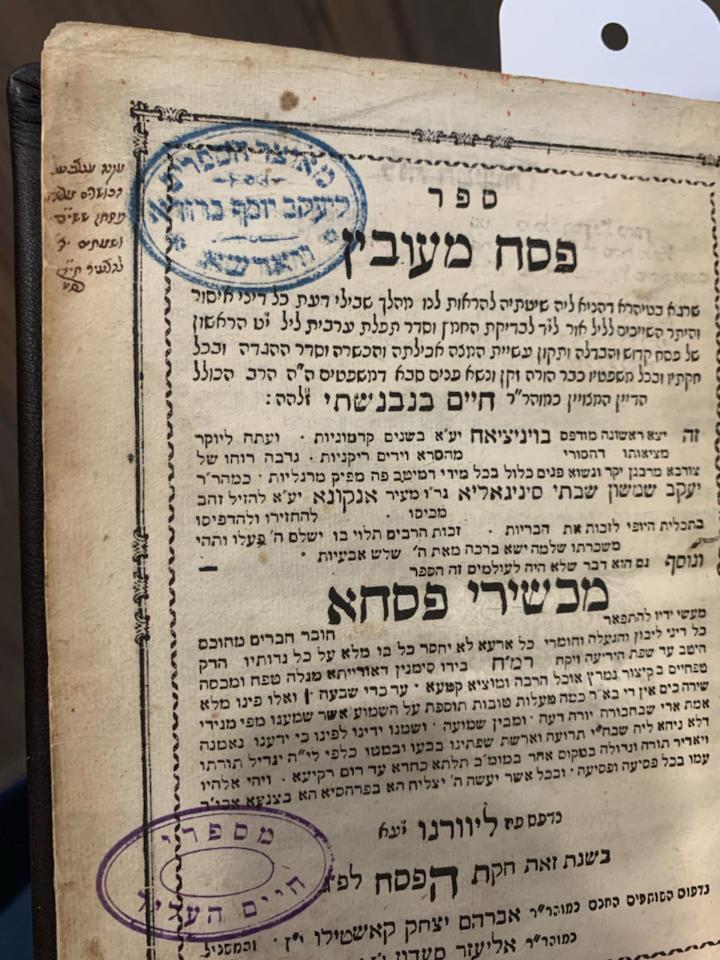
Benveniste’s haggada Pesach Me’uvin, first published in Venice 1692, is likewise an important compendium of halachic rulings pertaining to Passover and the seder night, and is widely quoted in the standard halachic sources. It has since been printed many times, up to the most recent edition (Lakewood 1997) in which the manuscript glosses of R. Yaakov Emden were included. A unique feature of the first publication is that it was printed simultaneously in two editions – one containing the Sephardic rite and one containing the Ashkenazic rite.

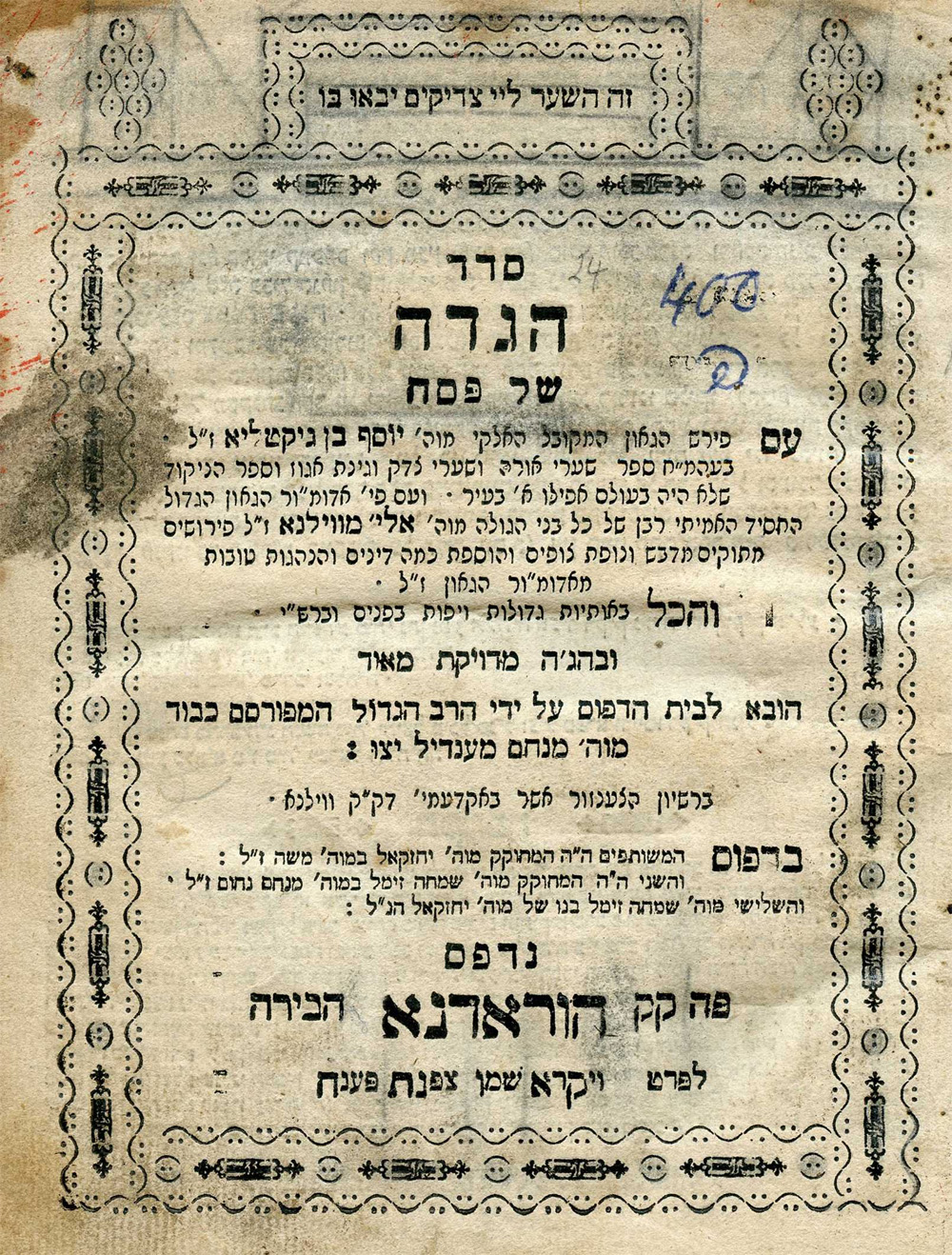
The 1788 edition is the second edition of this haggada and it was published in Livorno (Leghorn) by a young and promising scholar from an aristocratic Italian family, R. Yaakov Shimson Shabetai Senigallia of Ancona. Along with the Pesach Me’uvin, this edition included the original work of the publisher, R. Senigallia, called Machshirei Pischa, which continued the work of R. Benveniste concerning the laws of kashering kitchen utensils for Passover. 
This would prove to be the first of many scholarly contributions by R. Senigallia, and by the time of his death in 1840 he had built up a reputation as a great scholar, as well as a pious and saintly individual, with many important publications to his credit.[1] This work too would stand the test of time, and a hundred years later, in 1889, when the Netziv of Volozhin had his own commentary on the haggada, Imrei Shefer, published in Warsaw, he had it printed together with the Pesach Me’uvin and Machshirei Pischa.

At some point during the Chida’s tenure in Livorno, R. Senigallia became personally acquainted with him,[2] and the two would maintain a friendly correspondence throughout the years. R. Senigallia would refer frequently in his writings to the Chida’s own works, always with great honorifics, and after the passing of the latter, R. Senigallia was wont to chastise a fellow rabbinic scholar when he felt not enough deference had been shown in arguing with Chida’s halachic rulings.[3]

Before presenting the Chida’s copy of R. Senigallia’s haggada, a brief summary of the surviving record of their correspondence, preserved in the Chida’s letters published by Dr. C. Rosenberg,[4] is in order. Only one actual letter to R. Senigallia from the Chida has survived (#7 p. 11), a critical edition of which is appended at the end of this article, but in his other letters the Chida often makes mention of R. Senigallia, from which we can reconstruct a partial record of their correspondence and from which we can gage the nature of the close relationship they shared. 

The earliest mention of R. Senigallia is in a letter (#3 p. 7) the Chida wrote in the summer of 1787 to his erstwhile pupil and confidante, R. Yoel Camis of the Ancona Beth Din, in which he shares that he had received requests from R. Senigallia and R. Elia Nahamo, they too of Ancona, to give his haskama on the forthcoming publication of R. Senigallia’s aforementioned haggada. The Chida writes that he is unable to comply as he has already made a firm decision not to grant any haskama, and he has already had occasion to turn down many persistent entreaties from close acquaintances on account of this decision.[5 ] Concurrently, the Chida requests of R. Camis to make peaceful overtures towards the aforementioned rabbis and beg them to excuse him.

The mention of R. Senigallia in this letter is not accompanied by the terms of endearment we find in later references to him in the Chida’s letters, and perhaps we may surmise from this that they had not yet developed the close relationship they would later share. This assumption is bolstered by the fact that R. Senigallia apparently did not feel he could rely on the merit of his own relationship in approaching the Chida, and therefore turned to R. Nahamo, whose own haskama graces the sefer, for help in requesting the Chida’s haskama.[6]

Aside for the one letter in the collection addressed to R. Senigallia, the remaining references to R. Senigallia are found in the Chida’s letters to his son, R. Raphael Yeshaya Azulay, who had assumed the position of Chief Rabbi of Ancona in the summer of 1788. The Chida played an integral role in the negotiations with communal leaders to have his son elected to this position,[7] and he remained very appreciative of the efforts of the Anconians who had helped with this appointment.[8] It is difficult to ascertain if R. Senigallia had himself assisted in this matter, but the fact remains that from this point forward, he is mentioned frequently in the letters from the Chida to his son,[9] and we may rightly surmise that he had quickly become a close member of the inner circle of the new rabbi of Ancona.

Almost all of the references to R. Senigallia are in the context of the Chida’s request that his son extend warm greetings to R. Senigallia in his name, and the Chida often adds that he prays for R. Senigallia constantly. The Chida also says as much himself in his letter to R. Senigallia, where he also makes mention of his learning and praying for a few other philanthropists in Ancona as well. Likely this is indicative of the gratitude the Chida felt towards these individuals for the financial support they may have extended to the Chida,[10] and this is why the Chida wanted them to know that he was repaying his debt of gratitude.

Besides for learning and praying for the merit of his benefactors, the Chida would also honor them with his letters, and his holiday greetings to R. Senigallia in the letter to him preserved in this collection (a critically edited version of which is appended below) would seem to fit that bill perfectly.[11] Yet, the terms of endearment with which the Chida consistently refers to R. Senigallia, such as ידידינו אהובינו (our very dear beloved) and מאור עינינו (the light of our eyes), indicate clearly the genuine affection he felt for the latter. In one letter (#22 p. 35) he calls him ידידינו חמודינו נשמת רוח חיים (our very dear cherished breath of life), in which חיים meaning life, is a double entendre, also being the Chida’s first name – indicative of how important R. Senigallia was to him.

The letters also discuss other interactions the Chida had with R. Senigallia, such as the gifting to him of the Chida’s works Sha’ar Yosef (#24 p. 39) and Shem HaGedolim (#32 p. 49), or the distribution through him of other sefarim (#26 p. 43; #51 p. 67). We learn from these letters of instances (#10 p. 18; #11 p. 21) where R. Senigallia had turned to the Chida for his assistance in communal affairs, and in one case (#36 p. 53), the Chida asks his son to reply in his name regarding a request made of him by R. Senigallia for a segula needed for an acquaintance who had taken ill.[12]

All in all, this sampling serves well in painting a picture of a cordial relationship that blossomed with time and eventually became a deep and abiding friendship. At one point, their correspondence had reached a point where the Chida would become greatly distressed when too much time had elapsed without a letter from R. Senigallia (#25 p. 42), and by 1793, five years after R. Senigallia had published his Machshirei Pischa, a scant two weeks without hearing from him would give the Chida pause (#34 p. 52).

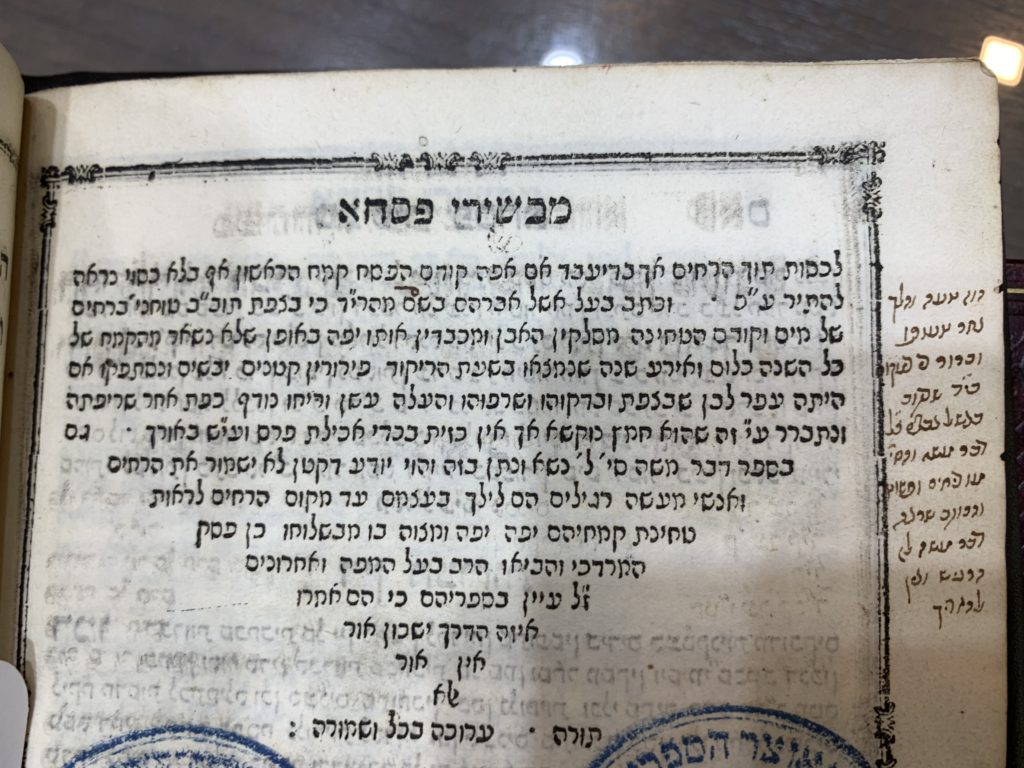
We are now in position to better appreciate the Chida’s inscription in the copy of this haggada gifted to him by R. Senigallia. We don’t know for certain when the haggada was given, but knowing of R. Senigallia’s interest in having the Chida’s recommendation on his work, it is likely that it was gifted shortly after it was published. The Chida’s apparent delight in the gift is evident in his inscription:

 מתנה מנצב על הכושרים מכשירי פסחא ששי”ם ושמחים יצ”ו להצעיר חיד”א ס”ט

Loosely rendered, it reads thus (and we emphasize “loosely”, as the Chida’s melitza is not given to literal translation): “A present from the one who stands over and guides those who are kashering and readying the preparations for Pesach joyously and happily to the humble Chida”. This clever inscription incorporates the title of the sefer Machshirei Pischa (“preparations for Pesach”), the nature of the sefer (“stands over and guides those kashering”) and even the name of the author whose initials make up the word ששים (“joyously”).[13]

Evidence of the Chida’s having studied the sefer comes from his gloss on the last page of the Machshirei Pischa section where R. Senigallia references the discussion of the Safed practice for kashering baking utensils. R. Senigallia quotes the sefer Eshel Avraham (Orach Chaim 453)14 who in turn quotes the respona of R. Yosef David of Salonika, Shu”t Bet David (Salonika 1740), who discusses this practice. R. Senigallia further cites the responsa of R. Moshe Amarilio, Shu”t Dvar Moshe (#30) who he says also discusses this particular practice. 

The Chida’s sharp eye, tremendous bekiut and keen bibliographical sense were on full display in his comment on this:

הוא טעה והלך אחר טעותו וברור כי במקום בי”ד שכתוב באשל אברהם צ”ל דבר משה והסי’ מוכיחים ופשוט והכותב שראה דבר משה לא הרגיש ואין להאריך

The Chida was quick to realize that by citing Shu”t Dvar Moshe as an additional source to the Bet David cited in Eshel Avraham, R. Senigallia was unwittingly duped by a typographical error in the Eshel Avraham. When the Eshel Avraham originally cited the Bet David, it was a mistake (as evidenced by the inaccurate citation), and in fact should read Dvar Moshe, which, it turns out, is the only source to discuss this practice.

I imagine that over the course of their long and fruitful correspondence, the Chida must have had occasion to bring this correction to the attention of R. Senigallia, and I imagine R. Senigallia must have been just as overjoyed – ששי”ם – with the knowledge of the Chida’s delight in his gift and his interest in the sefer, as we have been to learn all about the lives and emotions of these two great individuals as they come to life and step right off the pages of this cherished haggada.

*****

[1] See the entry for R. Senigallia in R. Mordechai Shmuel Girondi’s Toldot Gedolei Yisrael (Trieste 1853, p. 158). It should be noted that the list of publications there is scant compared with the fuller listing in Dr. C. Rosenberg’s Igrot M’Harav Chida (Budapest 1927, pp. 11-12). It should be further noted that some of the titles listed in R. Girondi’s work as manuscripts, such as Yaakov L’chok and Shomer Shabbat, had actually been published earlier together with other works of R. Senigallia. For a complete bibliography of his works, in print and in manuscript, see the entry for R. Senigallia in Asher Salah’s Le Republique Des Lettres, Brill 2001, p. 617.
[2] One meeting is recorded by R. Senigallia in his responsa, Meged Shamayim, Livorno 1844, p. 22a, in which R. Senigallia remembers debating the Chida with regards to a problematic text in Shu”t Rashbash. This meeting is said to have take place twenty years before the writing of this responsum, though the responsum is undated and all we know is that it was written after the Chida’s passing in 1806. Presumably, R. Senigallia was in Livorno for the 1788 printing of Machshirei Pischa, and perhaps that is when he met with the Chida, though there is no way to know for certain. R. Avraham Tikotzky writes in his preface to the Jerusalem 1986 edition of R. Senigallia’s Matan B’seter – Niddah (p. 10) that the Chida never met with R. Senigallia in person save for the one time when the Chida saw R. Senegallia as a youth (כשהחיד”א ראה את רבינו בעודו בחור). No source is given for this contention, and this is hardly evident from the aforementioned source in Meged Shamayim.

Despite the more than 200 miles separating Ancona on Italy’s east coast and Livorno on her west coast, it is likely that over the course of the Chida’s twenty six or so years in Livorno the two had more than one occasion to meet up, either in Livorno or Ancona. This is all the more likely when we consider that the Chida’s eldest son served as Chief Rabbi in Ancona from 1788 and on, and on at least one occasion, in the summer of 1791, the Chida did make the journey to Ancona to visit with him (See letter 22 on p. 34 and Dr. Rosenberg’s note there, see also p. 12 fn. 3 where he surmises the Chida’s wife, whose warm regards for R. Senigallia’s wife are expressed in the Chida’s letter to him, owed her acquaintance with Mrs. Senigallia to this visit).
[3] See Meir Benayahu’s biography: Rabbi Chaim Yosef David Azulay (Jerusalem, 1959 pp. 122-123, the reference in Asher Salah’s aforementioned bibliography to pp. 112-113 in this book should be corrected).
[4] Hatzofeh L’Chochmat Yisrael, Vol. 11 (Budapest 1927, pp. 241-309). This collection has likewise been printed in a separate pamphlet, also in Budapest 1927 (available here), and the references to this work in the present article follow the pagination in this pamphlet.
[5] The Chida emphasizes this point with the following melitzah (wordplay): ואין לדרוש בקל וחומר כי אם בגזרה שוה. This phrase which is a spinoff of the Talmudic phrase found in Pesachim (66a) and elsewhere (דאין אדם דן גזירה שוה מעצמו אלא קל וחומר) has been explained by Dr. Rosenberg in a footnote to mean that Chida’s refusal to grant haskamot was on account of his humility; he did not want to appear important (חמור) at the expense of others (קל), but rather wished to be viewed as an equal (שוה).

Whether this is indeed the Chida’s rationale for withholding his haskamot is debatable (and Benayahu in his biography (pp. 96-97) has made the convincing case that there must have been other factors as well), but it is clear that Dr. Rosenberg, who in any event had little appreciation for the melitzah of the Chida (as per his own comments in the introduction to his edition of Igrot), missed the innuendo in this melitzah as well. In this context, it is clear that what the Chida meant to say was that he does not want to be strict (חמור) with some requests for haskamot and lenient with others (קל), but rather must apply his decision (גזרה) to everyone equally (שוה).
[6] Benayahu writes in his biography (p. 97) that R. Senigallia had turned to R. Camis for help in obtaining the haskama, but this is a mistake and should say R. Nahamo in place of R. Camis, as is evident from the above quoted letter. R. Tikotzky, who seems unaware of Dr. Rosenberg’s edition of Igrot, shows his hand when he writes in his preface to the Jerusalem 1986 edition of R. Senigallia’s Matan B’seter – Niddah (p. 10): כשעמד רבינו להדפיס בשנת תקמ”ז את הספר “פסח מעובין” עם הוספותיו בשם “מכשירי פסחא” הכולל דיני ליבון והגעלה, ביקש מחברו ר’ יואל חמיץ מאנקוה (צ”ל אנקונה) כי ישפיע על החיד”א שיתן הסכמה לספר.
[7] See the documents detailed by Benayahu in his biography from p. 504 and on. Some important documents from this episode are reproduced, transcribed and translated in R. Dessler’s Shnot Dor V’dor vol. 2 (Jerusalem 2004, pp. 71-98).
[8] Cf. Dr. Rosenberg’s comments on p. 18 fn. 5.
[9] He is mentioned in 15 out of the 47 letters the Chida wrote to his son in this collection (they are: #10,11,22,24,25,26,32,33,34,36,37,40,45,46,51).

According to Dr. Rosenberg, the additional mention of סי’ ר’ יעקב, among the addressees to whom the Chida mailed letters from Firenze (listed in a 1791 letter to his son, #23 p. 37), is none other than our R. Senigallia, however I am inclined to doubt that on account of the fact that the Chida always refers to him by the name or initials of יעקב שבתי, and also always preceded with the honorific כמה”ח, which stands for כבוד מורנו החכם (contra Dr. Rosenberg p. 67 fn. 5). More likely, this סי’ ר’ יעקב is to be identified with סי’ יעקב who was one of the wealthy patrons of the community mentioned in letter #24 (p. 39), as the title סי’ (Signor), a respectful title for a layperson, would suggest.
[10] Among the Chida’s personal effects, we find a paper published in Benayahu’s biography (pp. 466-467) containing the Chida’s accounting of income for the year 1781, among which are listed several entries of subsidies he had received from various philanthropists. From what we can glean from the Chida’s correspondence, these subsidies most likely took the form of sponsorships for the Chida’s prolific sefarim output (cf. p. 38 fn. 2; p. 48 fn. 1 – the reference there to letter #23 should be corrected to #24; see also #34 pp. 51-52).
[11] Cf. #46 p. 63 where the Chida writes to his son informing him of the letter he had penned to R. Senigallia, along with that of another patron, and also asks him to deliver the letters and to elaborate on them on his own in order to compensate for the brevity of these letters.
[12] Interestingly, none of our letters are indicative in any way of a scholarly correspondence between the two, and I know of no basis for the claim put forth by R. Tikotzky in his preface to the Jerusalem 1986 edition of R. Senigallia’s Matan B’seter – Niddah (p. 10): בין החיד”א לרבינו נסבו בדרך כלל המכתבים מענייני הלכה ופלפול, אך אף בענייני קבלה החליפו מכתבים ביניהם, והחיד”א אף כותב לבנו, כי שלח קמיעות רבות לאנקונה מקום מושבו של רבינו (Our rabbi and the Chida generally corresponded in pipulistic and Halachic matters, however they also corresponded in kabbalistic matters, and in fact, the Chida even writes to his son of the many kemayas he had sent to Ancona where our rabbi resided). As far as I can tell, the only kernel of truth in this flight of fancy is the (one and only) kemaya the Chida sent to R. Senigallia, mentioned in his letter to him, and referenced in various letters to the son; however this kemaya was not intended for R. Senigallia at all, but to be used as an amulet for an ailing patron, and in any event says nothing about any supposed kabbalistic dealings between the two rabbis.
[13] This is so because the Chida uses מ for the last name, for מסיניגאליא. Although on the title page the last name is spelled סיניגאליא without the prefix מ (from), the name indicates that the family hailed from the city of Senigallia, and our rabbi sometimes spells it himself with the מ, such as on the title page of his Abir Yaakov (Pisa 1811).
[14] This is the work of R. Avraham Oppenheim first published in Amsterdam 1769 and printed in the margin of most editions of the Shulchan Aruch, and should not be confused with the similarly named work by R. Avraham David Wahrman of Butchatch, whose own Eshel Avraham, found in the back of contemporary editions of the Shulchan Aruch, was first printed in 1889, a hundred years after the Machshirei Pischa. I note this because there appears to be some confusion about this, and even the tremendously helpful Sefaria website has the former sefer listed under the authorship of the latter.


ADDENDUM:

העתק מכתבו של הרחיד”א לר’ יעקב שמשון סיניגאליא ע”פ צילום כת”י[15]5

ב”ה  ער”ח ניסן תקנ”ה[16]6

ידידנו ואהובינו חכם לב איש חסיד[17] כמהח“ר יעקב שמשון סיניגאליאה[18] יצ”ו נר”ו

ונתתי ש'[19] בארש[20]. מקוצר רוח ממה שעברתי אברים קודמין[21] יעברו חלושים[22] ודחקתי לכתוב 

שתי אותיות בפרו”ס הפסח[23] כפור”ס מן החיים[24] סוכת ש’ ולברך שמו הטוב ולכל אשר באהלי יעקב 

יחוגו הג הפסח לחיי“טם ט ולש’ ובעושר וכבוד ושמחה רבה כי”ר 

מעיד אני עלי שמים וארץ כי ברוב הימים אני מברך שמו ושם אהוב ונחמד סי’ ש”םמיצ”ו 

וסי’ יש”ע יצ”ו ואני לומד איזה ד”ת לשם יש”ע וכה יאמר להם ושלחתי הקמיעאה ליד יש”ע

על יד יאו”ר לי[25] הבן יקיר נר”ו. מצד נ”ב להגברת נ”ב מ’ ש”ר ולהבנים היקרים אצוה את ברכתי 

ברכת הדיוט. לגיסיו האהובים יצ”ו ש”ר. לכל שואל בש’ ש”ר. ואני תפלה הצעיר וזעיר 

מתפלל בעדו תמיד 

חיד”א ס”ט

אהובינו סי’ יש”ע יצ”ו יעלה עלי

‘הכתוב כאן כאלו לו לבת נתנת הארש וש


  1. בספריית בית המדרש לרבנים מספר 5397 (ניתן להוריד צילומו כאן, והמכתב מופיע בעמ’ 18 בתדפיף). המכתב נדפס ע”פ כתה”י ע”י ח’ רוזנברג בספרו ‘אגרות מהרב חיד”א’ (בתדפיס מיוחד מתוך ‘הצופה לחכמת ישראל’ שנה יא, בודפסט תרפ”ז, עמ’ 11-12, ניתן לצפות בו כאן). העתקתו של רוזנברג לקויה בחסרות ויתרות (לרוב בלתי משמעויות) שתוקנו כאן בגוון אדום. תודתי נתונה בזה למכובדי הרב שלמה דיין נר”ו שעזר על ידי בפיענוח כתה”י.
  2. באותו יום ערך מכתב לבנו (אגרות מהד’ רוזנברג עמ’ 62-63), ובין הדברים כתב לו אודות מכתבו הנוכחי להריש”ש סיניגאליא: “בדוחק אני כותב שתי שורות לסי’ ש”ם וכמהחרי”ש הי”ו נא לתתם בידם וישלח דברו להשלים ולגמור חסרי”.
  3. אני משער שתואר זה, הבנוי כנראה על לשון הכתוב במשלי (יא:יז) ‘גומל נפשו איש חסד’ (וממנו בפיוט יגדל ‘גומל לאיש חסד כמפעלו’) מרמז על חסדו של הריש”ש סיניגליה שתיווך בין הרחיד”א להגבירים הנרמזים במכתב זה ושכנראה התפרנס הרחיד”א מהם באיזה שהוא אופן (מן הסתם ע”י התרמתם להדפסת ספריו), ולכן חש הרחיד”א כלפיהם יחס של גומלים, והוא מברך את שמם ולומד ומתפלל בעדם. להגביר האחד ‘ש”ם’ ערך הרחיד”א מכתב נוסף באותו יום כנזכר באגרתו בהערה הקודמת, ולהגביר השני ‘יש”ע’ שלא ערך לו מכתב בפני עצמו (אולי מפני חולשת בריאותו) הוסיף שתי שורות הנכתבות להלן בסוף המכתב (המועתקות כאן לראשונה) להודיע לו שיקרא אגרת זו הנוכחית כאילו שהיא נכתבה אליו בעצמו.
  4. לא הרגיש המעתיק שנשמר הרחיד”א מלכתוב האותיות יו”ד וה”א ברצף ממדת חסידות, ולכן יש שאף שינה וכתב אל”ף במקום ה”א כמו ‘יאודה’ במקום ‘יהודה’, וכן אצל שם בנו הר”ר רפאל ישעיה נהג לפעמים לכתוב ‘ישעיא’ כנראה מצילומי הכתיב שע”ג המטעפות בתוך קובץ כתה”י, ואולם המעתיק העתיק תמיד ‘ישעיה’ באין מבין.
  5. קיצור ל’שלום’ (וכזה תמצא עוד שבע פעמים להלן), וכבר בספרו ברכי יוסף (או”ח פה:ח) צידד הרחיד”א כשיטת האומרים ששלום הוא מן השמות שאינן נמחקין ואשר אין לכותבן באגרות שלומים.
  6. מליצה ע”פ לשון הכתוב (ויקרא כו:ו) ‘ונתתי שלום בארץ’, ונשתמש בה הרחיד”א בעוד כמה אגרות, ור”ל הנני מקדם פניך בדיבור (ארש) של שלום.
  7. מליצה ע”פ לשון חז”ל שאנו אומרים בתפלה כל יום בסדר המערכה, ובפירושו כתב ר’ חנניה חביב אזולאי בהערה לאגרות הרחיד”א מהד’ רוזנברג (עמ’ 44) ש’קודמין’ ר”ל החליים הישנים שבאיברי גופו, ואולם לדידי חזי לי שהכוונה לאברים שבחלק הקדימה שבגוף כמו האיצטומכא, שכן סבל הרחיד”א בימים אלו הרבה מחולי המעים כנזכר באגרתו מט”ו אדר בשנה זו (עמ’ 61) ע”ש. 
  8. מליצה ע”פ לשון הכתוב בבמדבר (לב:ל) ‘יעברו חלוצים’. על חולשת אבריו והתרופפות מצב בריאותו בימים אלו, ראה אשר כתב הרחיד”א באגרת לבנו באותו יום  (עמ’ 63): “שם כתבתי כי הא גופא קשיא וכאבי נעכר ועתה רווח פורתא שאין הענין בחוזק כאשר היה ה’ ירפאני רפואה שלמה”. ואולם למרבה הצער תקוותיו של הרחיד”א להחלמה גמורה לא התגשמו, ראה אשר כתב אח”כ באגרת לבנו (אגרות מהד’ רוזנברג עמ’ 13): “נהייתי ונחליתי יותר מחודש וכל הפסח לא יכולתי לילך אפילו לישיבה ועד האידנא חייך הידיד לא איפרק מחולשא”.
  9. חמשה עשר יום לפני הפסח נקרא פרוס הפסח בלשון המשנה (שקלים ג:א), ומליצת הרחיד”א רומזת שהוא פורס בשלומו בפרוס הפסח (שכן נכתב המכתב ער”ח ניסן כנזכר בתאריך).
  10. מליצה ע”פ לשון הגמ’ בקידושין (סו:): “אמר ליה ר’ טרפון: עקיבא כל הפורש ממך כפורש מן החיים”, והכוונה כאן ש’חיים’ (שמו הפרטי של הרחיד”א) מבקש שיפרוס סוכת שלומו של הנמען.
  11. מליצה שגורה בפי הרחיד”א לבנו בכורו ר’ רפאל ישעיה אב”ד אנקונה, המכילה ר”ת של שמו (י-שעיה א-זולאי ר-פאל), וכאן היא בנויה על לשון הכתוב בשמות (ב:ה): ‘על יד היאור’, וביחזקאל (כט:ג): ‘לי יאורי


Mysteries of the Magical Fifth Passover Cup (II): The Great Disappearing Act

Mysteries of the Magical Fifth Passover Cup (II): The Great Disappearing Act

By Leor Jacobi

Years ago, as a Yeshiva Bochur, a Rabbi explained to me that, according to the GRA, the Cup of Elijah at the Passover Seder is really the Fifth Cup mentioned in the Talmud which there is a doubt about  Thus, it is Elijah’s cup because when he returns to herald the redemption, every Talmudic tequ will be solved. I found that the elusive Fifth Cup is not actually mentioned in the Talmud as we have it, but by most of the Rishonim, who all had a textual variant.

Later, as a Junger Mann, I found R. Menachen Mendel Kasher’s pamphlet on the Fifth Cup, also published in his Haggadot (generally abridged). Despite some intrinsic flaws, it is a masterful and ingenious integration of traditional and modern methods.

A few years ago, groundbreaking publications by my teacher, David Henshke, and my colleague, Eliezer Brodt, inspired me to build upon their foundation, concentrating on points which remain obscure or unsolved.

As there are quite a few of these, I divided up the study into seven chronological and thematic parts which I hope will evolve into book chapters eventually but also stand alone as they are. The first part of the envisioned series, on the magical genesis of the fifth cup, was accepted by a prominent journal that graciously agreed to have an early draft distributed here. Part four, on 19th century scholarship post-Levinsohn was recently submitted to another leading academic journal.

With the current social upheavals due to the Coronavirus pandemic in mind, thanks to the generosity of the editors of the Seforim Blog, we can forego delays and release a draft of part two in time for Passover. Hopefully, the virus will disappear faster than the fifth cup did! Please favor me with your feedback towards advancing the project and I will do my best to acknowledge any and all contributions.

In a previous study on the genesis of the Fifth Cup, a primary textual variant of the Babylonian Talmud (Pesachim 118a) was identified as the source, an original teaching from the Talmudic Sages. Following the compilation of the Talmud, Babylonian Geonim not only received this textual variant, but actually drank the fifth cup themselves, with the apparent exception of Rav Hai Gaon, who also had the fifth cup Talmudic variant, but interpreted it as an optional practice, one which he did not follow. If the fifth cup was ordained in Babylon due to zugot, concern for even pairs arousing evil spirits, as explained in the prior study, perhaps Rav Hai inherited the original Palestinian custom of only four cups (zugot was only an issue in Babylon), as the Sages of Erez Israel did not believe in zugot. Alternatively, perhaps Rav Hai rejected the fifth cup as far as his own practice but not to the point of speaking out against it.

The fifth cup was widely observed among the Babylonian Geonim, and subsequently mentioned by Alfasi, Maimonides, and by Tur (14th century), the latter at length, with an entire siman (OḤ 481) devoted to it. 


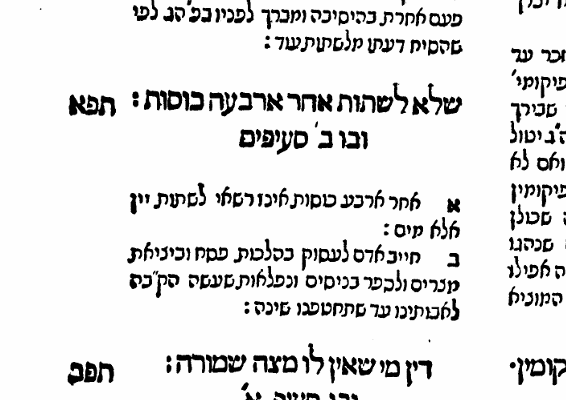
However, if we fast-forward to the 16th century, we find that, despite an extensive discussion in R. Joseph Karo’s monumental Bet Yosef the fifth cup disappeared completely in his Shulḥan Arukh. Following the order of Tur, R. Karo gave names to all of the simanim. Here, he adopted a side issue of the siman and made it the focus and new title: “Not to drink after the fourth cup”. 


Furthermore, none of the principal commentators on the Shulḥan Arukh (“nose kelim”, 16th-17th centuries) even noted its disappearance. Explaining the magical disappearing act of the fifth cup during the Middle Ages will be the focus of this study.

The disappearance has bothered modern scholars of rabbinic literature, who struggled to explain it, most notably R. Menahem Kasher. Several factors have been suggested to explain the elimination of the fifth cup. They include: 1) Deletion of the Talmudic text mentioning the fifth cup due to homoteleuton (skipping text from one similar word to another)[1], 2) Endorsement of this variant by Rashi and Rashbam, 3) Application of this variant by subsequent Ashkenazi scribes,[2] 4) Circulation of an abbreviated version of Rav Hai Gaon’s responsum (in Tur) which suggests that Rav Hai Gaon also received the “Rashbam’s” version of the Talmud which does not mention the fifth cup,[3] 5) A statement at the beginning of Tur that the fifth cup should not be drunk, probably explaining Rashbam’s opinion, but ambiguously stated, 6) the development of a stringency in Medieval Ashkenaz to refrain from all drinking after the fourth cup, with some including even water in the prohibition (see below) and 7) The publication of the Venice edition of the Talmud, in 1520-23 following Rashbam’s textual variant, with no mention of the fifth cup, all subsequent editions following in kind, almost certainly the edition consulted by R. Joseph Karo.

Despite this multitude of factors, they don’t adequately explain R. Joseph Karo’s editorial decision to completely delete such a well-entrenched custom as the fifth cup, mentioned by all three of his pillars, Alfasi, Maimonides, and Rosh.[4] I propose that an additional factor, barely recognized previously and never noted in this context, was the one that settled the matter conclusively in the mind of Maran.

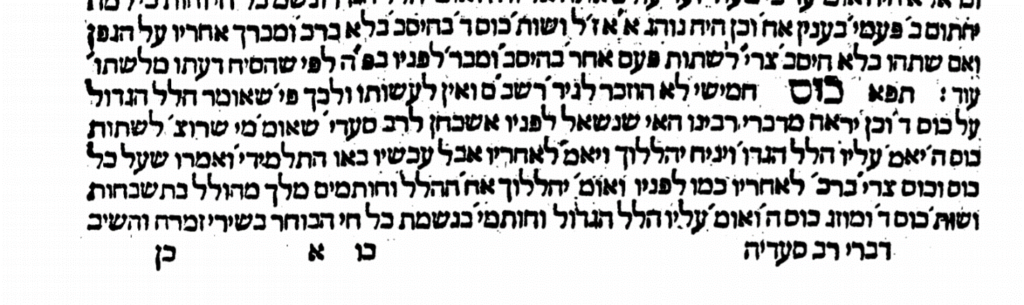
Rabbenu Yonah Girondi (13th century) maintained that one should refrain from drinking extra wine so as to be able to study the laws of Passover and the story of the Exodous all night, as the Sages did in Bne Braq. Maharil cites Rosh (Asheri) as adding that the fifth cup was permitted due to the verse v’heveiti. However, our standard printed text of Rosh states that the fourth cup is permitted due to the verse v’laqaḥti

(אבל בכוס רביעי התירו שיש לו סמך מן הפסוק כנגד ולקחתי אתכם. (סימן לג…

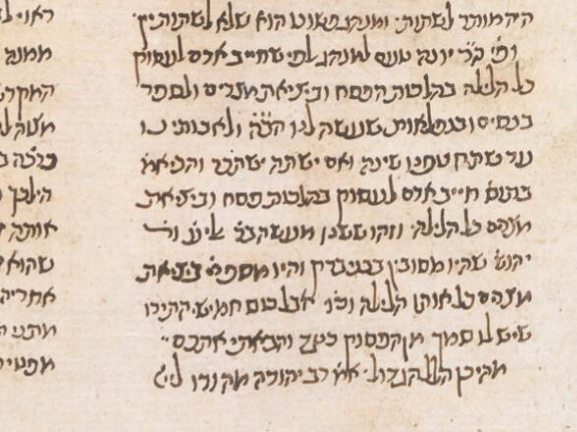
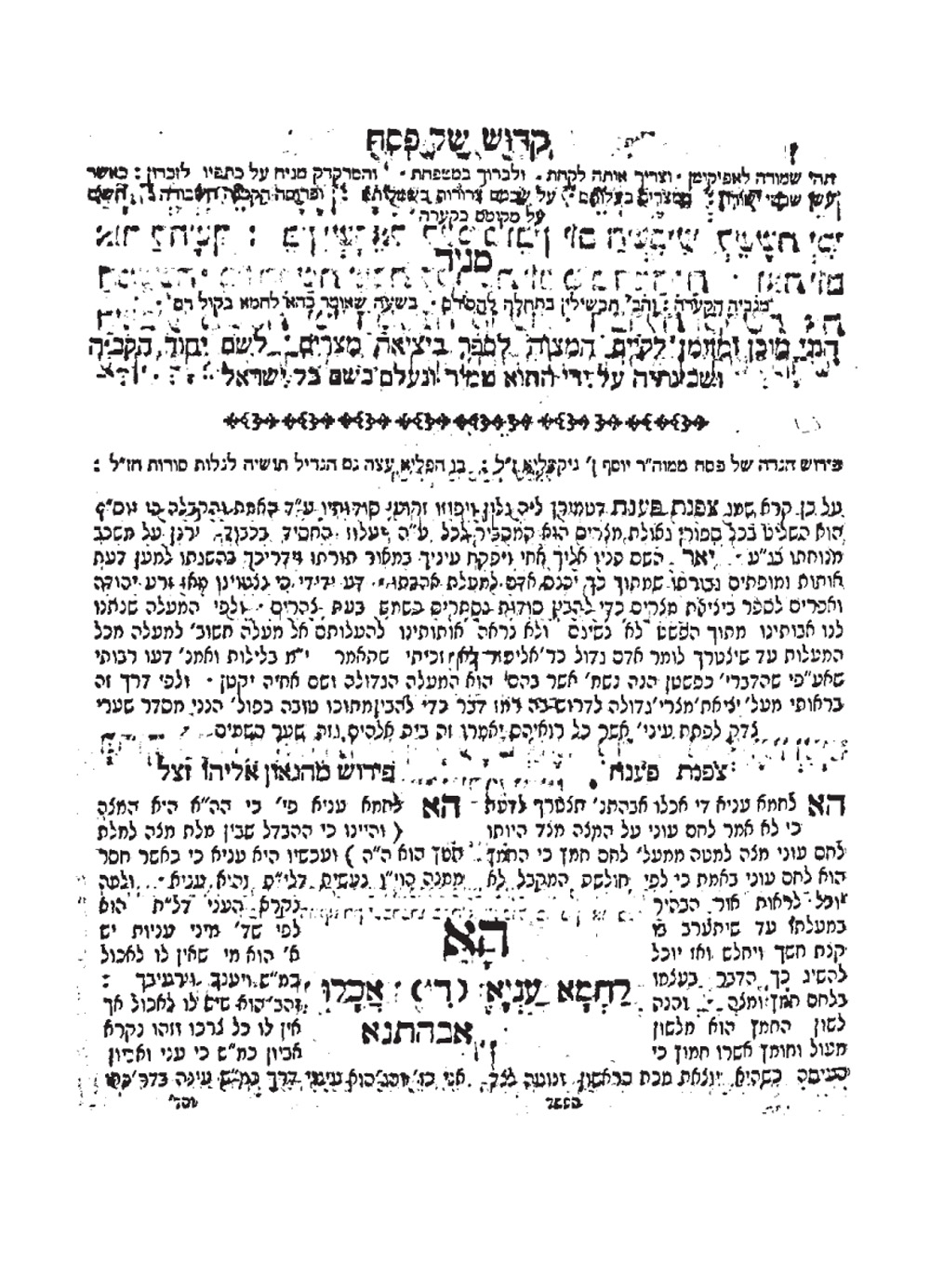
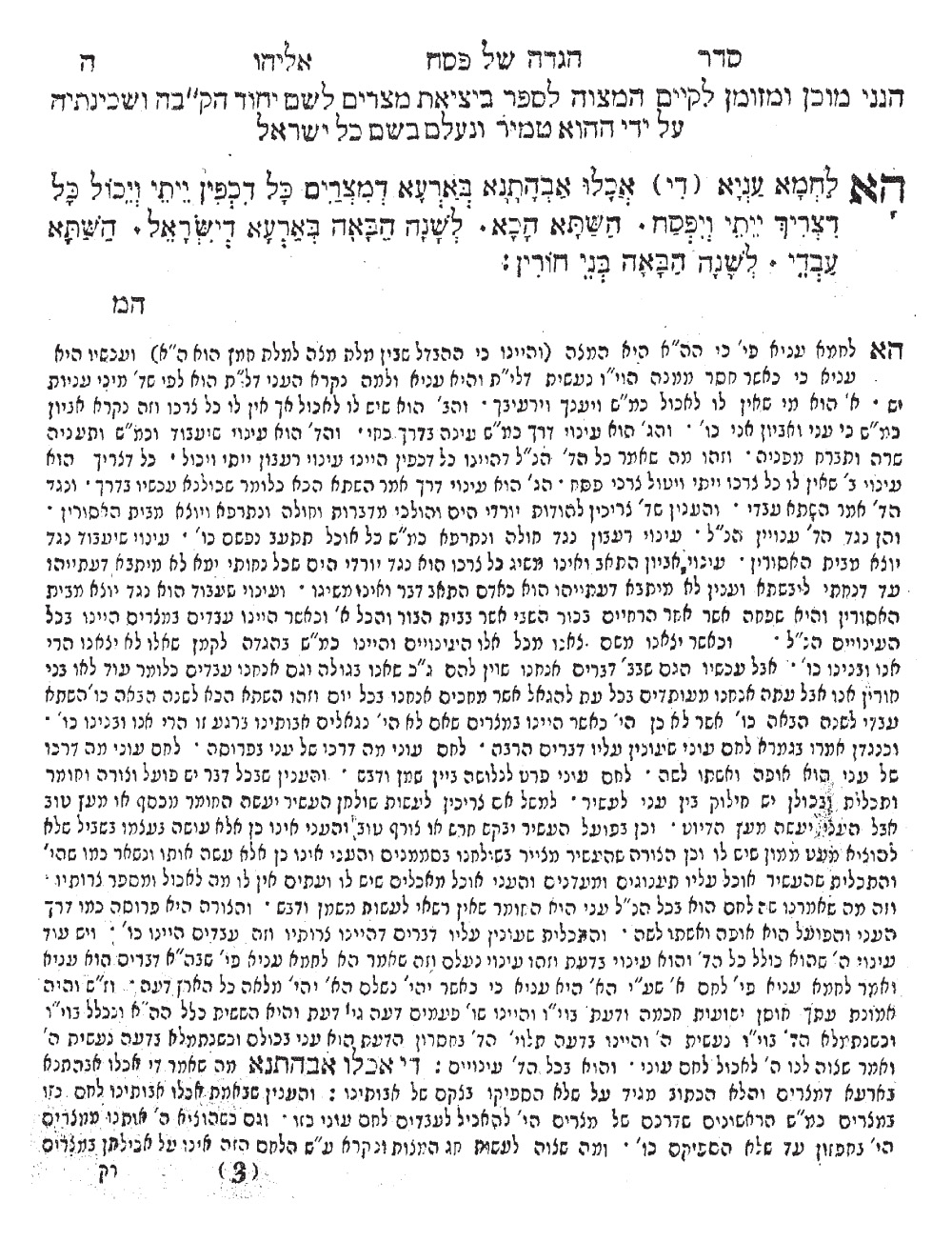
Rabbi Alter Hilewitz (1906-1994, author of halakhic works and editor of Encyclopedia Talmuditobjected that the printed text makes no sense and must have become corrupted.[5] There is no reason to permit the fourth cup after it has already been mandated in the Mishnah. The special dispensation must have been for the fifth cup and Maharil cited the genuine text version of Rosh.[6] R. Hilewitz’s hunch was correct, as we find in an early manuscript of Rosh (Asheri) written in Spain in 1325 during the lifetime of Rosh (from middle of 3rd line from bottom):[7] 


Rabbi Hilewitz

The corruption was a by-product of proliferation of the Rashbam’s text of the Talmud eliminating the fifth cup entirely. It probably represents an unintended stringency in interpretation of the prohibition on drinking excessively. Another correction we find in the manuscript is the attribution of the opinion. The manuscript attributes it to Rabbenu Yonah, corresponding to the attribution in Tur. However, the printed edition misattributes it to ר”מ, R. Meir of Rothenburg, master of Rosh.

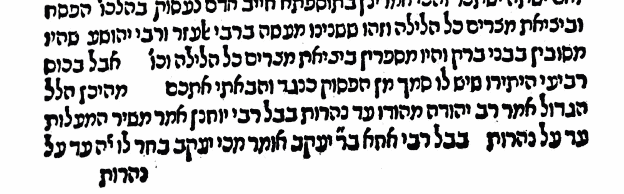
The text of Rosh which R. Joseph Karo relied upon was almost certainly that of the famous aforementioned Venice edition of the Talmud.[8] It reads:

.אבל בכוס רביעי התירו שיש לו סמך מן הפסוק כנגד והבאתי אתכם…


The text does not make sense. It is conflated. Either the fourth cup was permitted by the verse v’laqaḥti (as in the modern printed editions), or the fifth cup was permitted by the verse v’heveiti (as in the manuscript). The fourth cup could not have been permitted by the verse v’heveiti. The development was apparently a two-stage process and the Venice Edition represents the “missing link”, an intermediate stage in which the fifth cup was changed to the fourth cup but the verse remained intact. At this point, R. Joseph Karo or the later publishers could have corrected the text back to “the fifth cup”, restoring the original version in the manuscript. However, the tide was already turning towards the fourth cup Talmudic textual variant in Bet Yosef, with his decision to read Rashbam’s Talmudic textual variant into Rav Hai Gaon’s responsum.[9] R. Joseph Karo decided to keep “the fourth cup” and to ignore the word v’heveiti, or to mentally “correct” it to v’laqaḥti, exactly how the later printers chose to emend the text of Asheri.

One can speculate as to why Kasher, Benedict and subsequent Rabbinic scholars did not discover this source. R. Hilewitz’s observation was published in a 1945 newspaper article in Palestine. At the time, war was raging and R. Kasher was in America. Manuscript variants of the text of the Talmud have been studied and published on for years[10] and the last generation has brought us two editions of Tur prepared using manuscripts.[11] Even Tosafot Rosh is published from manuscripts in critical editions.[12] However, for some reason, manuscripts of Rosh are relatively uncharted territory, despite the centrality and rabbinic authority of the work. Perhaps (similar to Rashi’s Talmudic commentary, up until the groundbreaking work of my teacher, Aaron Ahrend) it is this very centrality that led its manuscripts to be ignored, as it was printed so early on, in the Venice Talmud, and so many times. 

Most significantly, the text is hidden from view. Tur clips off this section of the discussion and Bet Yosef does not cite it. However, once we return to the textual version that laid open before R. Joseph Karo on his desk, which he certainly meditated on, we can understand how he interpreted the abbreviated text of Tur and why he decided to delete the fifth cup.


Addendum: The Power of Piyyut

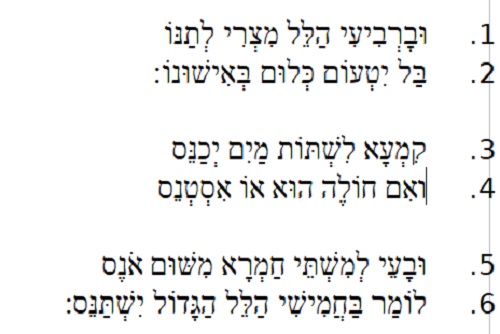
Shmuel of Evreux adopted a stringency not to drink even water after the four cups.[13] His source was the piyyut composed by R. Yosef Tuv Elem for a qerova recited on Shabbat ha-Gadol.[14] The last two stanzas at the end of the piyyut are the most famous today, for they are recited almost universally at the end of the Haggadah: “Hasal siddur Pesah”. The stanza preceding it is one mentions the fifth cup. There are two textual variants of this line interpretations of the piyyut. Three manuscripts read as follows:[15]


According to this text, line 3 states that it is permitted to drink water absolutely, in accordance with normative halakhah. Line 4 adds conditions for drinking wine, being sick or finicky, as described in line 5 with the recitation of Hallel ha-Gadol in line 6.

Medieval piyyut commentaries also follow this text, for example, the commentary by Samuel b. Salomo of Falaise:[16]

…קמעא, מעט, לשתות מים יכנס, לאחר סעודתו אם ירצה לשתות, ואם חולה הוא או אסטניס ובעי למשתי חמרא ואינו יכול לשתות מים, לומ’ בה’ על שם ‘ה הלל הגדול, ישתנס, יאזור

However, the textual variant followed by the Tosafot (Pesahim 117b) omits the vav at the beginning of line 4. Now the conditions of line 4 apply to line 3 as conditions for drinking water. Apparently from this piyyut, R. Shmuel of Évreux derived the stringency against drinking water after the Seder.[17] Tosafot for chapter Arvei Pesahim were based upon the Tosafot of R. Yechiel of Paris or a student of his, such as Rabbenu Peretz (Shalem Yahalom). R. Yechiel was in contact with R. Shmuel. R. Yechiel would attempt to refute R. Shmuel’s novel stringencies. Sometimes the refutation was accepted, such as cited by R. Peretz in his gloss to Smak 93, and sometimes not, as found in Orhot Hayyim, Hilkhot Tum’ah, vol 2, p. 602, and apparently in our case regarding the stringency of not drinking water. In this case, the development of a stringent shitta forbidding even the drinking of water likely shifted the goalposts of halakhic discussion away from the option of the Fifth Cup of wine. 

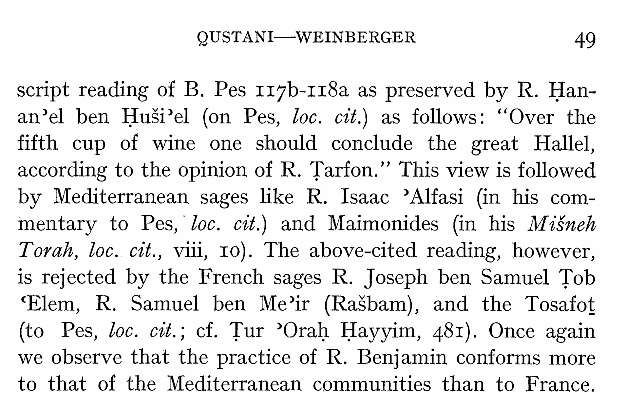
Finally, on the topic of piyyut, Leon J. Weinberger described a poem from R. Binyamin which mentions the fifth cup as a basic custom, an integral part of the Passover Seder. The piyyut was later published in its entirety by Ezra Fleischer.[18] According to Weinberger, it provides a messianic interpretation of the fifth cup, an aspect of the fifth cup that will become more evident during later periods to be discussed in chapters of this study yet to come. 


Editor Note: please see Eliezer Brodt’s earlier post on this subject: https://seforimblog.com/2013/03/the-cup-for-visitor-what-lies-behind/

[1] Henshke; also see here for another possibility and analysis of Talmudic manuscripts here.
[2] Kasher noted Rabbenu Tam’s fierce opposition in general to applying proposed emendations into the text of the Talmud itself, blaming Rashbam (his older brother) in particular. See Spiegel, Soloveitchik, briefly reviewed in my Jewish Hawking in Medieval France.
[3] Rav Kasher advanced this claim convincingly to explain the deletion by R. Joseph Karo. R. Avraham Benedict also advanced this claim, without crediting Kasher. As far as rendering a legal decision, Benedict took a diametrically opposite position. According to Kasher, now that we possess the full version of Rav Hai Gaon’s responsum, we see that R. Joseph Karo was led astray by an ambiguous text. Benedict considers R. Karo’s decision binding and the presence of the abbreviated version is ample justification.
[4] Noted especially by Kasher, also by Henshke.
[5] ‘Kos shel Eliahu’, Bamishor 245-6 (25.3.1945), p. 5.
[6] This version is also found in Abudraham (Seder ha-Haggadah u’Perisha, ed. S. Kroizer, Jerusalem 1963, p. 234), citing Rabbenu Yonah. Abudraham’s source was probably Asheri, but he did not generally cite secondary sources, as he himself stated in his introduction (p. 6.). See: L. Jacobi, “Talmudic Honey”, Fragments of the Novellae of R. David ben Saul of Narbonne”, Giluy Milta B’alma, 2/17/2016.

[7] British Library Add. 27293 f. 131v.
[8] Bomberg: Venice 1520-1523, p. 138b.
[9] Kasher, Benedict.
[10] Diqduqe Sofrim, Lieberman Instritute, Friedberg.
[11] Shirat Devorah; Ma’or.
[12] Mossad Ha-Rav Kook, Ofeq Institute.
[13] Cited by Mordechai, Hagahot Maimoniot (Ed. Constantinople, 6:11, “gedole Evreax”), Agur. Tosafot Pesachim 117b.
[14] See a letter from Pinchas Eliyahu Lawee in Kobetz Beit Aharon 15:5 (89, 1998), pp. 135–136.
[15] With only minor variants irrelevant for our purposes. Gabriel Wasserman shared with me his pilot edition of variants and Abraham Levine provided me with expert guidance in this study.
[16] Parma – Biblioteca Palatina Cod. Parm 3000 (de Rossi 378), f. 30a-35b. I was aided in locating piyyut commentaries by Elisabeth Hollender’s monumental Clavis.
[17] Another later piyyut follows this strict opinion, recently published by R. Jacob Israel Stal. See his note at page 33.
[18] Kobez al Yad 21 (1985), p, 31.


The 1526 Prague Haggadah and its Illustrations

The 1526 Prague Haggadah and its Illustrations
By ELIEZER BRODT

This piece was originally printed in Ami Magazine’s Kunteres 9 Nisan 5777 – April 5, 2017

The topic perhaps most written about in Jewish literature is the Haggadah shel Pesach. There are many kinds in many languages and with all kinds of pirushim and pictures. Whatever style one can think of, not one but many Haggados have been written—be it on derush, kabbalah, halachah, mussar or chassidus. There are people who specialize in collecting Haggados, even though they don’t regularly collect sefarim. In every Jewish house today one can find many kinds of Haggados. Over the years, various bibliographers collected and listed the various Haggados. In 1997, Yitzchak Yudolov printed The Haggadah Thesaurus, which contains an extensive bibliography of Haggados from the beginning of printing until 1960. The final number in his bibliography listing is 4,715! Of course, many more have been printed since 1960. New Haggados are printed every single year. Even people who never wrote chiddushim on the Haggadah have had one published under their name based on their collected writings. When one goes to the sefarim store before Pesach, it has become the custom to buy at least one, although it is very easy to become overwhelmed, not knowing which to pick.
The one I would like to focus on in this article was printed in Prague in 1526.[1] The Prague  edition of the Haggadah is considered by experts to be one of the most important illustrated Haggados ever published. It is perhaps the earliest printed[2] illustrated Haggadah for a Jewish audience, and it served as a model for many subsequent illustrated Haggados. Some insist that it is the greatest single Haggadah ever printed. “Certainly it is one of the chief glories in the annals of Hebrew printing as a whole and for that matter in the history of typography in any language.”[3] Printing came to Prague in 1487 (around 40 years after its invention), and the first Hebrew book was printed there in 1518. The Prague 1526 edition was published by the brothers Gershom (Cohen) and Gronom Katz on Sunday, 26 Teves 5287 or December 30, 1526.[4]
This Haggadah contains many of the halachos of the Seder beginning with bedikas chametz, a collection of pirushim on various parts of the Haggadah, and 60 illustrations made from woodcuts. However, we do not know who authored these halachos and divrei Torah (which are full of interesting ideas). The halachos written here are very significant, as they were written and printed before the Shulchan Aruch. The illustrations are also significant, as they had a tremendous impact on the illustrated Haggados printed afterward.
I would like to discuss some of the interesting things we can learn about the Seder and Haggadah via this Haggadah and some of its illustrations.
The first general question is why they chose to illustrate the Haggadah. Who was their intended audience? Various people who studied this Haggadah have debated this issue,[5] but to me it’s pretty clear that it had to do with one of the most important parts of the Seder night—the special audience—the children. This was a tool to help enable us to fulfil the important obligation of v’higadeta l’vincha. Last year, in an article in this magazine, I outlined many customs done during the Seder with the underlying theme to get the children “into” the Seder. One of the best ways to get kids “into” it is via visual aids, showing them pictures or acting out certain things.  Simply reciting the Haggadah and just saying “some Torah” is not as effective. It would seem to me that this was their intention when they illustrated the Haggadah. It could be that some of the pictures were to lighten it up for the adults too, as I will soon explain.
The significance of this point is that Rav Shlomo Zalman Auerbach, zt”l, raises possible issues with looking at illustrated Haggados on Pesach based on the halachos in the Shulchan Aruch (307:15) dealing with reading captions of images on Shabbos.[6]
If we are correct that the purpose is to educate the children, it might be a possible reason to permit looking at these images. To be sure, some of the Haggados with images were printed with the involvement of great gedolim, such as the illustrated 1590 Prague Haggadah, which had a kitzur of the Zevach Pesach of the Abarbanel written by Rav Yitzchak Chayis (1538-1610).
Just to emphasize the significance of visual aids when learning, in a haskamah for a work about shechitah that was written but never printed, the Aderes stresses the benefit of the numerous diagrams and illustrations of animals in the book for the understanding of the various complex halachos of shechitah.[7]
Similarly, Rav Belsky dissected an animal on video to give a visual aid for those learning Maseches Chulin. It is also related that when the Minsker Gadol, Rav Yerucham Perlman, zt”l (1835-1896), first became rav he made it his business to go to the head shochet of the city to learn all the aspects of animals for the laws of treifos and the like. The shochet asked him how he could possibly teach the rav anything. The Minsker Gadol replied, “It’s one thing to learn the halachos in sefarim, but when it comes to psak halachah one needs to know the exact aspects as they are on the actual animal.[8]
Additionally, there is a great benefit for us to analyze the pictures nowadays, as it can give us a glimpse into how they conducted the Seder in those days.
Halachos
One of the first parts of the Seder is the eating of karpas. Nowadays, for the most part, the custom is for the children to say, “We wash our hands, but we don’t say the brachah for this washing.” In the instructions to the Prague Hagadah it says to say the brachah for washing.[9] In fact, there are a number of Rishonim who say that one should say the brachah of al netilas yadayim.
Who pours the wine?
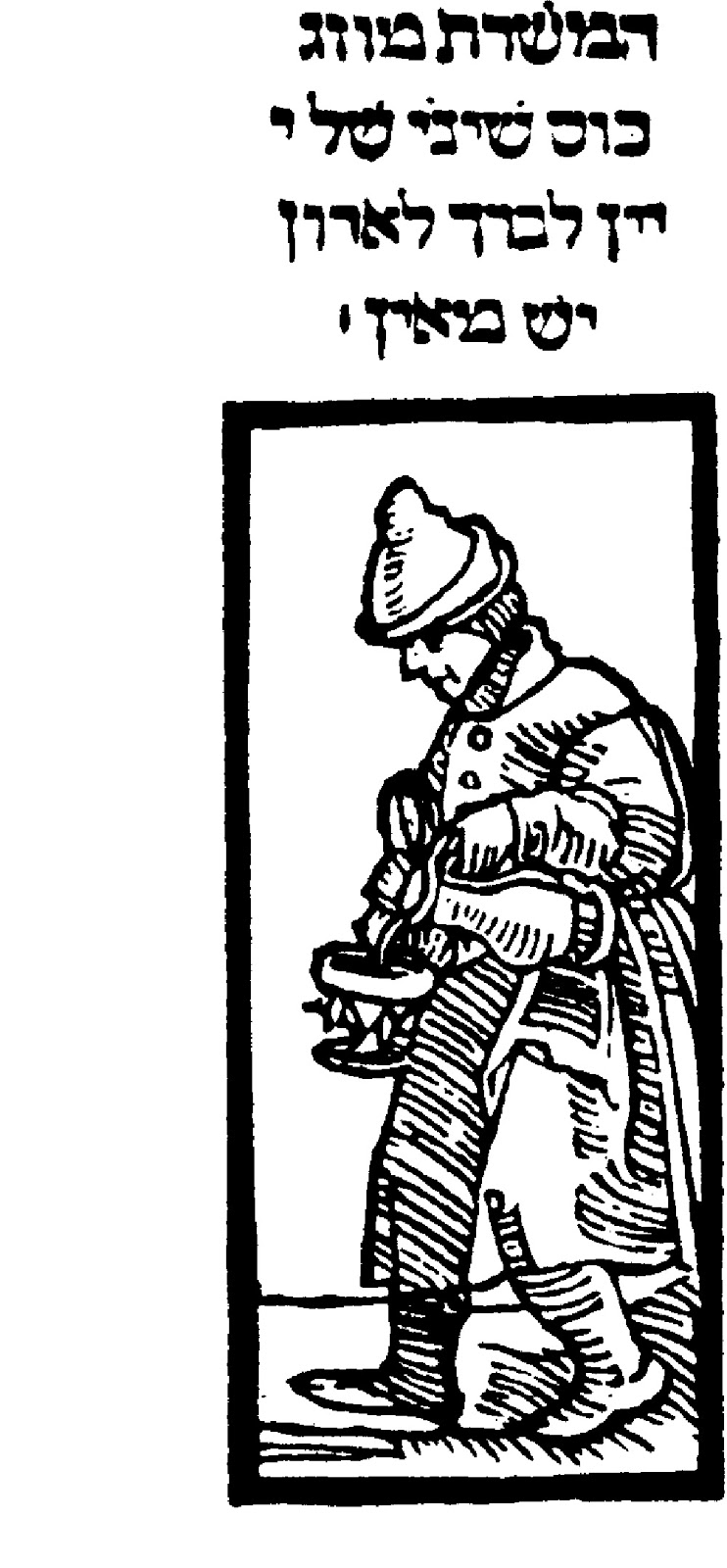
After saying Ha Lachma Anya the cups of wine are refilled. There is a picture of someone refilling the wine with a caption stating that the servant should refill the wine. The Rama in Darchei Moshe says that the person who is conducting the Seder should not fill the cups of wine; rather, someone else should do it for him.[10] This would appear to be an earlier writter source with the same idea.[11] Interestingly enough, the Aruch Hashulchan writes that we do not do this. The leader can pour the wine for himself, and there is no reason that his wife should have to pour for him.[12] Rav Yitzchak Chayis writes in Siach Yitzchak—which is a halachic work about the Seder night first printed in Prague in 1587—that one should train his six or seven-year-old child to do this mitzvah.[13] Perhaps another minhag related to this statement of the Rama is that the one leading the Seder does not get up to wash his hands; rather, the water is brought to him.[14]
Pouring out the wine for the Ten Makkos
 
After saying Ha Lachma Anya the cups of wine are refilled. There is a picture of someone refilling the wine with a caption stating that the servant should refill the wine. The Rama in Darchei Moshe says that the person who is conducting the Seder should not fill the cups of wine; rather, someone else should do it for him.[10] This would appear to be an earlier writter source with the same idea.[11] Interestingly enough, the Aruch Hashulchan writes that we do not do this. The leader can pour the wine for himself, and there is no reason that his wife should have to pour for him.[12] Rav Yitzchak Chayis writes in Siach Yitzchak—which is a halachic work about the Seder night first printed in Prague in 1587—that one should train his six or seven-year-old child to do this mitzvah.[13] Perhaps another minhag related to this statement of the Rama is that the one leading the Seder does not get up to wash his hands; rather, the water is brought to him.[14]
Another minhag found in this Haggadah is the famous custom of dipping the fingers into the wine when saying the Ten Makkos. In this section of the Haggadah there is an illustration of someone dipping his finger into his cup and there is also a caption under the picture stating that some dip with the pinky, followed by a reason for this custom.[15]
The earliest known source for this minhag can be found in a drashah of the Rokei’ach, recently printed from a manuscript by Professor Simcha Emanuel.[16] But this source speaks about dipping the index finger. The Rama also writes to dip the index finger. Interestingly, the Magen Avraham says to dip with the kemitzah, which is the ring finger.
Walking with a sack on the back
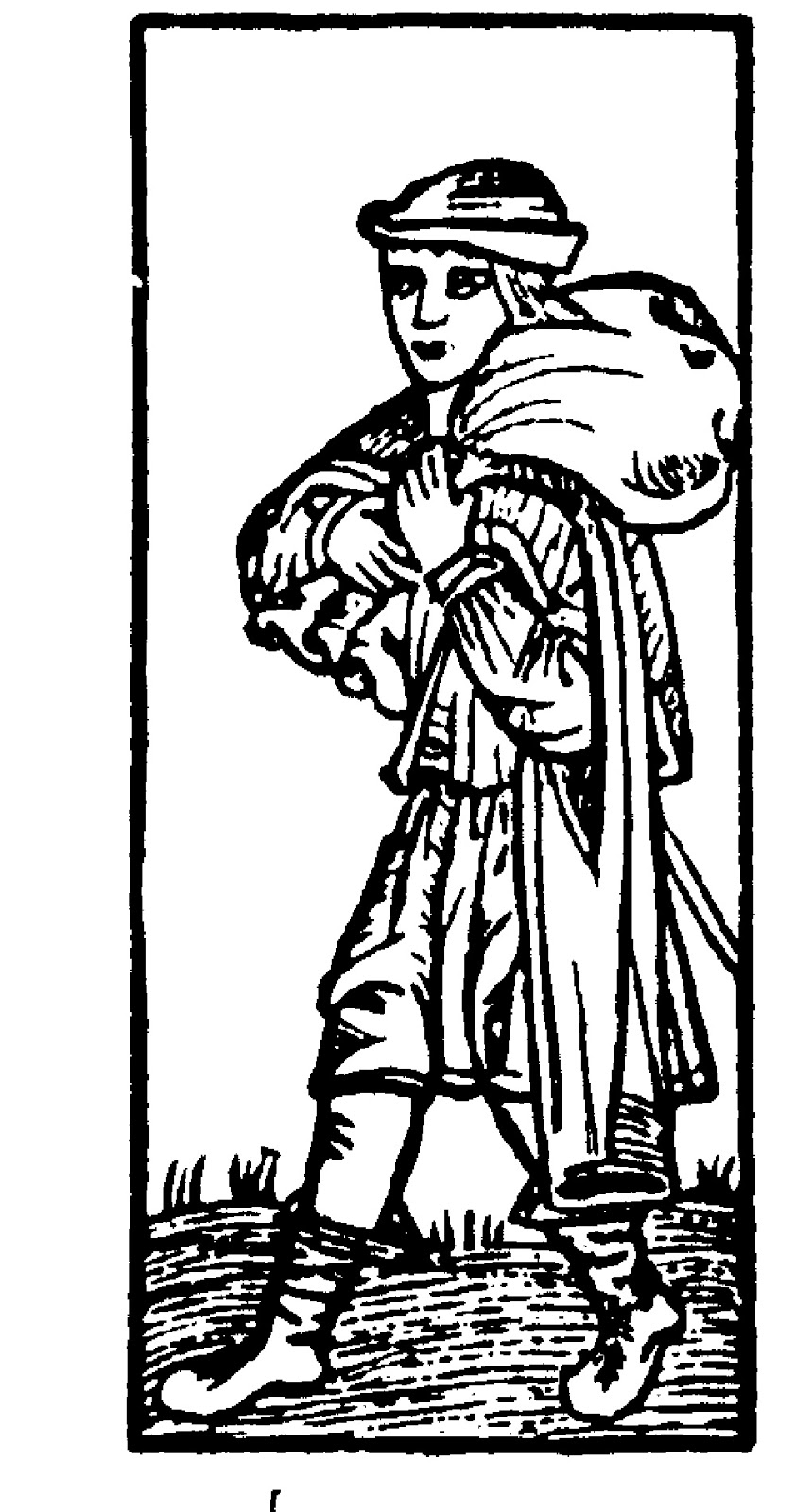
There a few places in the Haggadah, such as near the paragraph of B’chol dor vador, where we find an illustration of someone walking with a sack (of matzah) on his back. The source for this can be found in some of the Rishonim and early Acharonim. After mentioning breaking the matzah in their description of Yachatz they add that the leader of the Seder puts it on his shoulders and walks with it for a bit; others do this only later on when they eat the afikoman.[17]
Eliyahu Hanavi coming to the Seder
I traced the sources for this in a previous article in Ami Magazine. When discussing the sources for this, Rabbi Sperber notes[18] that in a few of the illustrated Haggados there are pictures of a man on a donkey near Shefoch Chamascha. In some of them he is being led by someone else; for example, in the Prague Haggadah of 1526.
I also noted that Rabbi Yuzpeh Shamash writes that mazikin run away from any place where Eliyahu’s name is mentioned. He says that because of this some make a picture of Eliyahu and Moshiach for the children, so that the children seeing it will say “Eliyahu,” causing the mazikin to disappear.[19] This could indicate that the illustrations were shown specifically to the children, as I claimed earlier.
Nusach of the Haggadah
The actual nusach of the Haggadah is its own large topic, starting from the Gemara and moving onward to manuscripts and discussions among the poskim. In the beginning of the Haggadah we begin with the famous Aramaic passage of Ha Lachma Anya. Much has been written about different aspects of this passage. One aspect is whether the exact nusach should be Ha Lachma Anya or K’ha Lachma Anya. The Rama quotes Rav Avraham of Prague, who says to specifically say Ha Lachma Anya and not K’ha Lachma Anya. The Maharal says the same. We see that two great sages from the city of Prague paskened that we should say Ha Lachma Anya.
Who was this Rav Avraham of Prague quoted by the Rama?
Rav Dovid Ganz (a talmid of the Maharal) writes in his historical work Tzemach Dovid that he was the rosh yeshivah and av beis din of Prague in the 1520s. He also authored some notes to the Tur, which were printed by Gershom (Cohen) Katz in Prague in 1540.[20] Thus, it is interesting that in the Haggadah the nusach was different from that of the av beis din of the city. Interestingly enough, his sons printed two more Haggados (1556 and 1590) in Prague and there too the nusach is different from that of Rav Avraham. Ultimately, the Magen Avraham concludes that whichever nusach one says is fine.[21]
What to use for maror
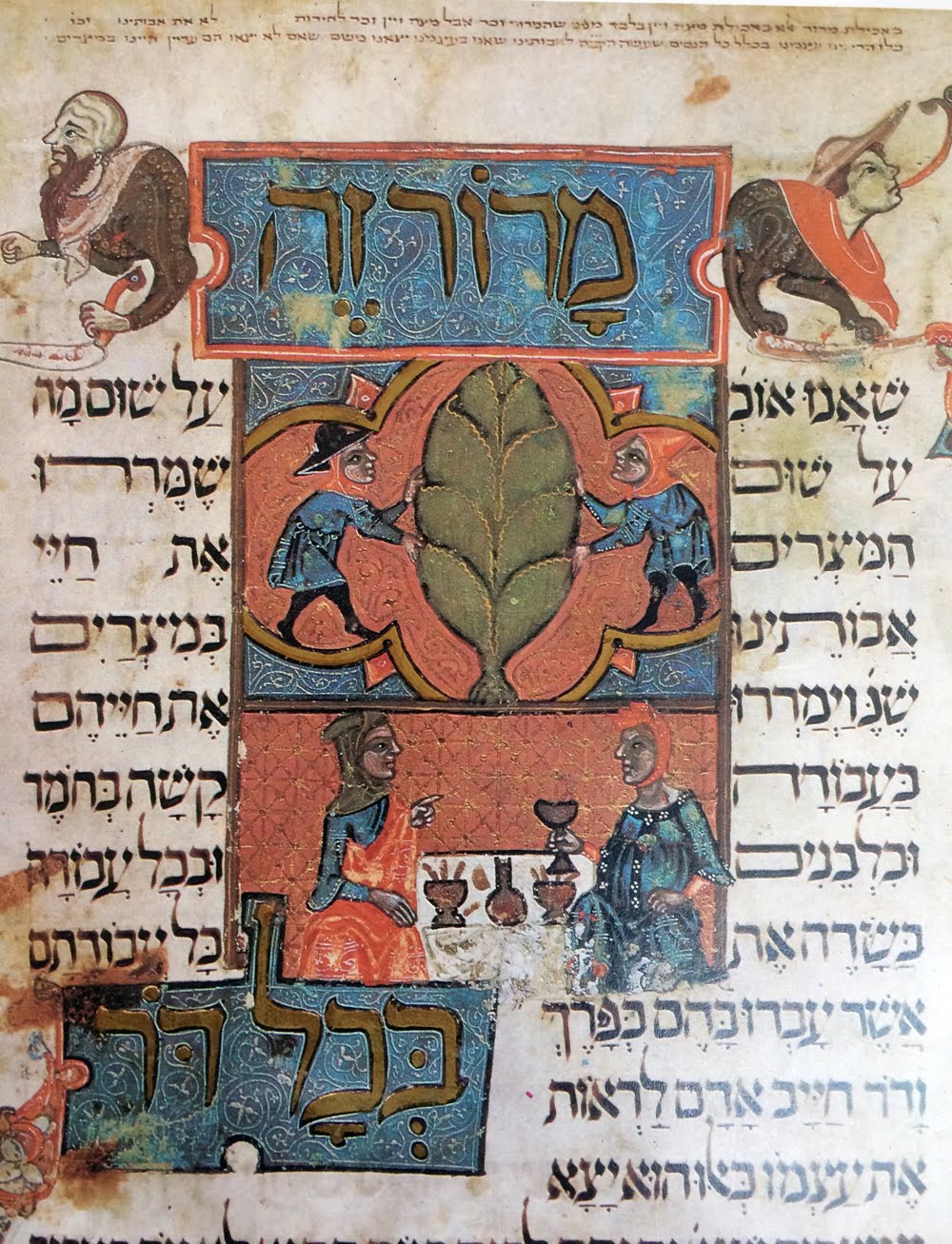
Another interesting picture is of the maror. In two places in the Haggadah the illustration used for maror is that of a lettuce—chasah. This is chazeret, which is the first of the five types enumerated in the Mishnah that one can use for maror.
There is a famous teshuvah from the Chacham Tzvi where he writes at length that this is the ideal item to be used for maror, as it’s the first in the list of the Mishnah.[22] We also find that the Netziv wrote a letter to his son, Rabbi Chaim Berlin, urging him to use it for maror instead of sharper vegetables, especially after fasting and drinking wine.[23] There are also numerous earlier illustrated manuscripts that show pictures of lettuce for the maror.[24]
More on maror
Speaking of maror, the inscription next to the picture is of great interest. It says, “There is a custom when saying maror that the man points to his wife, as it says ‘An evil wife is worse than death.’” Much has been written about this illustration. Some have written that it is ridiculous and there cannot be such a custom. On the other hand, Rabbi Wengrov and, more recently, Rabbi Yisroel Peles,[25] have demonstrated that there are pictures of a man pointing to his wife near the paragraph of maror in various illustrated Haggadah manuscripts. It is clear, however, as Rabbi Wengrov writes, that this was done in a joking manner to lighten up the Seder, but it isn’t serious, chas v’shalom. Rabbi Wengrov demonstrates that other pictures found in these Haggados show that the authors had a sense of humor and drew certain illustrations to lighten up the mood.[26]
Explanation via illustration
 
 
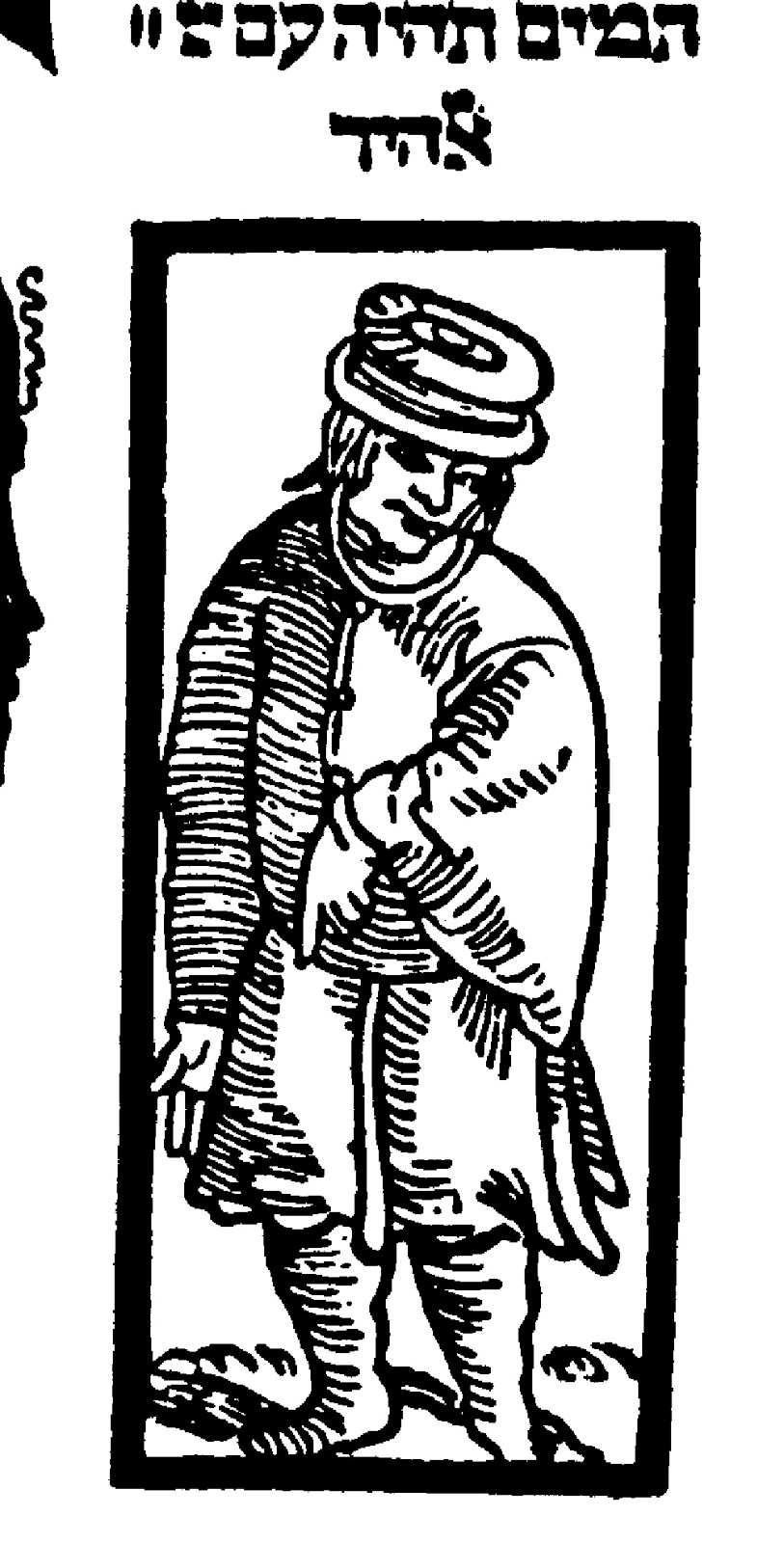
Some of the pictures in the Haggadah are to explain a particular passage. One such example is the image of the four sons. The tam is often translated as a derogatory term—the foolish son. However, the caption above the picture says, “Tamim tihyeh im Hashem” – always be complete with Hashem, which means that they understood the tam to be a man of piety.[27]
Omission
At the end of the Haggadah we conclude the Seder with a few songs, such as Echad Mi Yodei’a[28] and Chad Gadya. The authors and earliest sources for reciting them are unknown.[29] Rabbi Shemaryah Adler suggests that Chad Gadya may have been written by Daniel.[30] Rabbi Yedidyah Tiyah Weil writes in Marbeh L’sapeir on the Haggadah that he heard that these two songs were found in a manuscript from the beis midrash of Rav Elazar Rokei’ach. Numerous pirushim have been written about Chad Gadya, based on all the methods of learning Torah.[31] Be that as it may, many have noted that they are not found in this Haggadah. The first time they appear in print are in the Haggadah printed in Prague in 1590.
Another notable omission is the stealing of the afikoman. I wrote in the past in this magazine that one of the earliest sources in print can be found in the Siach Yitzchak, which mentions stealing the afikoman, but not in the same way as we do it nowadays.[32] It would seem that since no mention of it is made in the instructions of the 1526 Haggadah that it was not yet a widespread custom at that time.
Kiddush and Hunting
 

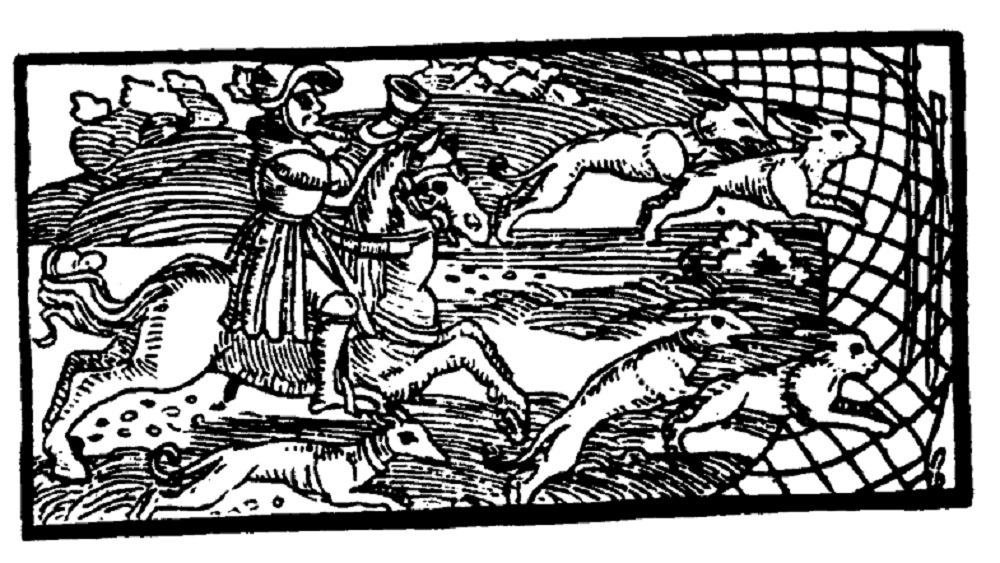
In the beginning of the Haggadah, on the bottom of the page of Kiddush, we find a mysterious picture of someone hunting hares with a horn and dogs. This picture can also be found in a bentcher printed by the Katz brothers in Prague a few years earlier. The question is obvious: What in the world does this have to do with Kiddush, especially as it is not a Jewish hobby? One of the answers suggested is that when Yom Tov occurs on Motzaei Shabbos we use an abbreviation known as Yaknehaz to remember the order in which to say Kiddush and Havdalah. The pronunciation of Yaknehaz is similar to jagen hasen, which is German for hunting hares, so this picture is meant to serve as a reminder of the abbreviation.[33]
Moreon Kiddush
Throughout the Haggadah there are illustrations of people holding cups of wine; sometimes the one holding the cup is dressed like a king. It would appear that this is to reflect the halachah to act like a king on the Seder night as part of the celebration of our freedom.
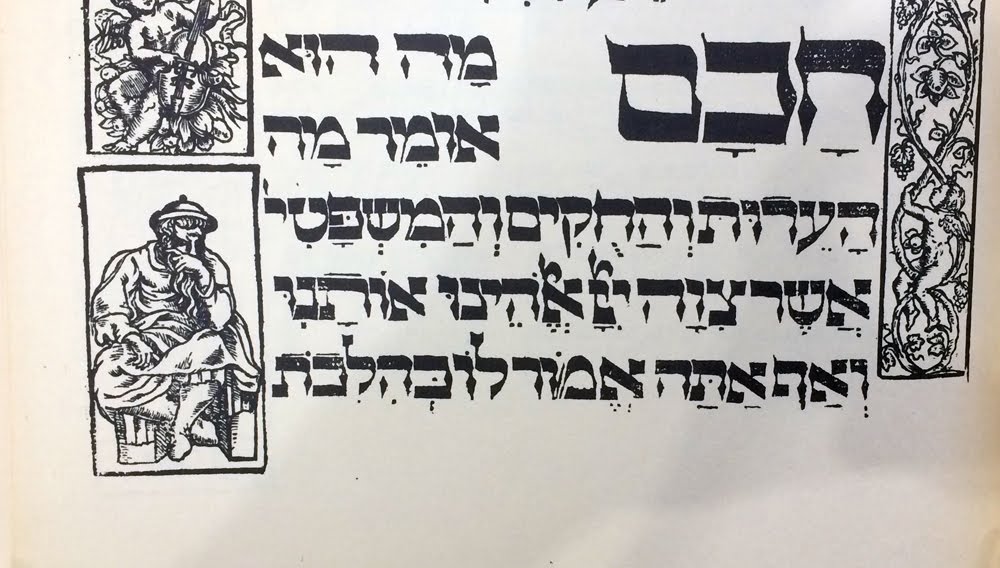
At other times the image is of an older man holding the cup either in his left hand or in his right. Rabbi Shaul Kook points out that some of the time it’s in the palm of his hand, which is the way it should be held according to various mekubalim, while at other times he holds the cup by its stem. He suggests that near the passage where Rabbi Elazar ben Azaryah says, “I am like someone who is 70 years old,” he is depicted as holding the cup in his left hand while stroking his white beard with the other to show that he’s really not that old.[34] At that point in the Haggadah one would not be holding the cup for the purpose of drinking one of the four kosos and that’s why he’s not holding it in his palm. Whereas in the pictures near where one would hold the cup for drinking he is holding it in the palm of his right hand. However, there is another picture on the page of Kiddush that is similar to the one of Rabbi Elazar holding the cup in his left hand and stroking his beard. Rabbi Kook says that this is because the printer was not educated and, not realizing the reasons for the difference, used the wrong woodcut.[35]
 
The problem with this is that the earliest source we have for holding the cup of wine specifically in the palm of the hand is in the Shalah HaKadosh, which was first printed in 1648—long after this Haggadah was printed.[36] It is, however, very possible that mistakes were made because printing with woodcuts is very difficult and confusing.
Sitting during Kiddush
Other customs that we can possibly learn from the illustration of Kiddush are that the person is both sitting and looking at the cup. These are also mentioned by various poskim in regard to the halachos for how Kiddush should be said.[37] There are other halachos of Kiddush that can perhaps be learned from these illustrations, but one has to be careful as to how much to “read into” them.
[1] On this Haggadah, see A. Yaari, Bibliography Shel Haggadot Pesach, p. 1. Y. Yudolov, Otzar Haggados, p. 2, # 7-8; the introduction to the 1965 reprint of this Haggadah; Yosef Yerushalmi, Haggadah and History, plate 13; Yosef Tabori, Mechkarim B’toldos Halachah (forthcoming), pp. 461-474. See especially the excellent work of Rabbi Charles Wengrov, Haggadah and Woodcut, (1967), which is completely devoted to this Haggadah. Another recent work devoted to this Haggadah was printed this year by R’ Yehoshua Goldberg, Haggadas Prague. Many thanks to my friend Dan Rabinowitz for the discussions about this Haggadah over the past few years. Here are two earlier posts by Dan on manucript Haggados and the 1526 Prague Haggadah: here and here. Thanks also to Mr. Yisroel Israel for his help with the images.
[2] As there are numerous illustrated manuscript haggadas.
[3] Yerushalmi, Haggadah and History, p. 30.
[4] This detailed publication information does not appear on the title page; rather, it appears at the end of the book in what is referred to as the colophon. On the printers see Chaim Friedberg, Toldos Hadefus Haivri, pp. 1-10. On various aspects about printing in these years in Prague, see Hebrew Printing in Bohemia and Moravia (Prague 2012).
[5] Richard Cohen, Jewish Icons, (1998), pp. 94-97; Chone Shmeruk, The Illustrations in Yiddish Books of the Sixteenth and Seventeenth Centuries (Heb. 1986).
[6] Halichos Shlomo (Pesach), pp. 267-268.
[7] Intro to Shu”t Ohel Yosef, 1903.
[8] Hagadol MiMinsk, p.51.
[9] Drashah L’Pesach L’Rabbi Elazar MiVermeiza, p. 96. See: Haggadah Shevivei Eish, p. 152; Y. Tabory, Pesach Dorot, pp. 216-244. See also what I wrote in my work Bein Kesse Le’assor, pp. 148-153.
[10] Darchei Moshe, 486:1.
[11] See also Siach Yitzchak (Brooklyn 2016), p. 241.
[12] Aruch Hashulchan, 473:6.
[13] Siach Yitzchak, p. 239, 252.
[14] Siach Yitzchak, p. 239.
[15] On this minhag see Zvi Ron, Our Own Joy is Lessened and Incomplete; The History of an Interpretation of Sixteen Drops of Wine at the Seder, Hakirah 19 (2015), pp. 237-255. I hope to return to this in the future.
[16] Drashah L’Pesach L’Rabbi Elazar MiVermeiza, p. 51, 101, 127.
[17] Rabbi Wengrov (above note 1), p. 60. See also Hanhagot HaMaharshal, pp. 10-11; Magen Avraham, 473:22; Chidushei Dinim MeiHilchos Pesach, p. 38. See Rabbi Chaim Benveniste, Pesach Me’uvin, 315; Vayageid Moshe, pp. 116-117.
[18] Minhagei Yisroel 4, pp. 168-170.
[19] Minhaghim Dik’hal Vermeiza, p. 86
[20] Tzemach Dovid, p. 139. See also Tzefunot 7 (1990) pp. 22-26.
[21] See also Siddur R’ Shabsei Sofer, 1, p. 5; Rabbi Yosef Zechariah Stern, Zecher Yosef, p. 4. [22] Chacham Tzvi, 119. On using this even though it is not bitter see also Dovid Henshke, Mah Nishtanah (2016), pp. 250-255, 215-220, 224-227, about Maror being bitter.
[23] Meromei Sadeh Pesachim 7b, See also Arthur Schaffer, History of Horseradish as the Bitter Herb of Passover, Gesher 8 (1981) pp. 217-237; Levi Cooper, Bitter Herbs in Hasidic Galicia, JSIJ 12 (2013), pp. 1-40; Z. Amar, Merorim, pp. 67-83. See also Rabbi Yehudah Spitz, Maror Musings, the not so bitter truth about Maror, Ami Magazine (2014), pp. 230-234.
[24] See Rabbi Wengrov (above note 1), p. 54. See also Rabbi Dovid Holtzer, Eitz Chaim 25 (2016), pp. 285-292.
[25] Hamaayan 51 (2011), pp. 11-14.
[26] On this and other pictures related to humor in the Haggadah see Rabbi Wengrov (above note  1),pp. 54-59.
[27] See also Rabbi Wengrov (abovenote 1), pp. 43-44; HaggadasMidrash B’chodesh (2015) of Rav Eliezer Foah (talmid of the Rama MiFano), p.135; R’ Elazer Fleckeles, Maaseh B’Rabbi Elazar, p. 63-64. See also Dovid Henshke, Mah Nishtanah (2016), pp. 358-359.
[28] See Rabbi Toviah Preshel, Kovetz Maamarei Tuviah 2, pp.64-65.
[29] See Chone Shmeruk, “The Earliest Aramaic and Yiddish Version of the Song of the Kid (Khad Gadye),” in The Field of Yiddish, 1 (New York 1954), pp. 214-218; Chone Shmeruk, Safrut Yiddish,pp. 40-42, 57-60; Asufot, 2 (1988), pp. 201-226; Rabbi Yisroel Dandrovitz, Eitz Chaim 23 (2015), pp. 400-416. Shimon Steinmetz discusses the origin of Chad Gadya here.
[30] Minchas Cohen, p. 73. Many thanks to my friend Rabbi Shalom Jacob for sending copies of this extremely rare work.
[31] Marbeh L’Sapeir, p. 140, 151. See also Rabbi Yosef Zechariah Stern in his Haggadah Zecher Yosef (p. 30), who writes that he did not find this piyut printed before the sefer Maasei Hashem. See also the Haggadah Shleimah ad. loc.; Assufot, vol 2 pp. 201-226; Mo’adim L’simcha vol. 5 ch. 11; Y. Tabory, Pesach Doros, pp. 341-342 and the note on pp 379.
[32] Siach Yitzchak, p. 21a. About this gaon see the introduction of Rabbi Adler in his recent edition of Pnei Yitzchak – Apei Ravrevi.
[33] See Rabbi Wengrov (above note 1), pp. 36-37.
[34] See Rabbi Yosef Zechariah Stern, Zecher Yosef, pp. 5a-6a.
[35] See Yeida Haam 2 (1954), p. 148; Iyunim Umechkarim, 1 pp. 81-83.
[36] See also R’vid Hazahav, Vayeishev (Kaf Paroh); Rabbi Mordechai Rosenbalt, Hadras Mordechai, Bereishis, 259. See also Shu”t Beis Yaakov, (1696) 174 who quotes such a custom from the Arizal.
[37] See Rabbi Dovid Deblitsky, Birchos L’rosh Tzaddik, pp. 25-31.


Everything is Illuminated: Mining the Art of Illustrated Haggadah Manuscripts for Meaning

Everything is Illuminated: Mining the Art of Illustrated Haggadah Manuscripts for Meaning
            We have discussed haggadah illustrations in the past (see the links at the end of this post) and we wanted to expand and update upon that discussion for this year. In this post we focus on Hebrew illuminated haggadah manuscripts, and in the follow-up post will turn our attention to printed illustrated haggadot.
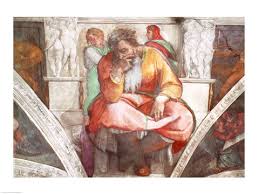
            While there is not as large of a body of Jewish art as that of art in general, historically Jews have appreciated the visual arts early in their evolution into a nation.  Aside from the biblical forms, we have evidence of art dating to the second century of the common era in the well-known frescos at the Dura-Europos synagogue.[1] But, such appreciation was not limited to second century Palestinian Jews, as evidenced from the discussion below, this appreciation continued, almost unabated, until the modern period.  It was not just the artist class or wealthy acculturated Jews that were exposed to and admired this medium.  For example, in the 1560 Mantua haggadah, one of the more important printed illustrated haggadot, the wise son appears to be modeled after Michelangelo’s Jeremiah in the Sistine Chapel (view it here: link). 
            

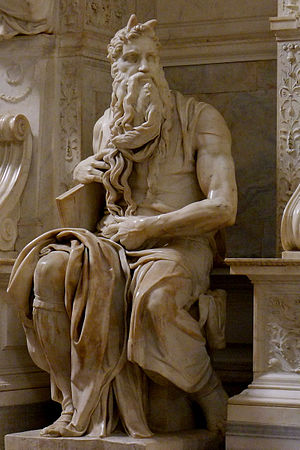
Lest one think that it is highly unlikely that a 16th century Italian Jew would have even entered the chapel, let alone been familiar with this painting, a contemporaneous account of Jewish art appreciation disabuses those assumptions.  Specifically, Giorgi Vasari, the 16th century artist and art historian, in his Lives of Excellent Painters (first published in 1560), records regarding Michelangelo’s statute of Moses – that is a full statute depicting the human form and was placed in the church of San Pietro in Rome – that “the Jews [go] in crowds, both men and women, every Saturday, like flocks of starlings, to visit and adore the statue.” That is, the Sabbath afternoon activity was to go to church to admire the statute of Moses, that is more famous for having horns than its Jewish visitors.[2]

Hebrew Manuscripts Background  
A brief background regarding Hebrew manuscripts before delving into the illuminated haggadah manuscripts. Details regarding manuscripts, the name of the copyist, the date, and the place where the manuscript was written, were supplied not at the beginning of the book – as is the convention with printed books and title pages –  instead in manuscripts this information is provided at the end. For this reason, the scribe’s note containing the information was called a colophon – from the Greek word kolofon, meaning “summit” or “final point.”[3]
Number of Hebrew mss.

A cautious guess of the number of extant Hebrew manuscripts in existence is between 60,000 -70,000 “but no more than 30-40 thousand of them predate the middle of the sixteenth century.”[4] Of the 2-3 hundred thousand Hebrew manuscripts presumed in existence in Europe at the beginning of the fourteenth century, probably no more than four to five thousand are extant today, possibly even less. “From the tenth century (before which information is very scarce) to 1490 (when the influence of printing books began to be felt)” there are an estimated one million manuscripts, meaning, “that 95 per cent of manuscripts have disappeared.”[5]  In addition, the early printed books – incunabula – had similar survival rates.

            The dearth of manuscripts has left a significant hole in our knowledge of major Jewish texts.  For example, there is only one complete manuscript of the Palestinian Talmud (1289) and two partial manuscripts. The Babylonian Talmud fared slightly better, with one complete manuscript (1342) and 63 partial manuscripts in libraries, with only 14 dating from the 12th & 13th centuries.[6] 
One of the partial TPs is known as the Vatican Codex 133 – and worth mentioning is the Vatican and its role regarding Hebrew manuscripts.  While there is no doubt that the Church had a significant hand in reducing the number of manuscripts – in reality the destruction of Hebrew manuscripts was the work of the Jesuits and not the Roman Catholic Church. Indeed, the Church confiscated and, thus in some instances preserved Hebrew manuscripts.  Consequently, we have a number of important Jewish texts that survive in the Vatican library.  Today, many of these manuscripts have been published.  The incomplete manuscript of the TP is but one example.  Additionally, regarding the use of (rather than just reprinting) the Vatican library, for at least late 19th century, Jews had access to the library.  For example, R. Raphael Nathan Rabinowitz, who authored a monumental work on Talmudic variants provides that “I prayed to God to permit me entrance to the Vatican library to record variant readings” his prayer was answered, and he received permission not only to use it during regular hours but “even on days that it was closed due to Christian holidays, when the library was closed to all, and even more so Jews.”[7] In total he spent close to 9 months in the library. In addition, Rabbi Rabinowitz’s presence and special status at the Vatican library was instrumental for the editing of the Vilna Talmud, where he secured permission for the Romm-employed copyists to work with manuscripts of the commentary of Rabbenu Hananel, even though they arrived in Rome during the summer season when the library was closed.
            Of the estimated one million Hebrew manuscripts from the 10th century until 1490, approximately 5% have survived.  As mentioned, religious persecution was one reason, but the main reasons are (1) deterioration from use, (2) accidents, and (3) reuse.  The first two are self-explanatory, the third requires a bit of explanation.  From the times that manuscripts were written on papyrus, unwanted manuscripts were scraped or washed and then reused.  (This papyrus recycling was not confined to reusing for books, papyrus was used from wrapping mummies, burned for its aroma, and used, according to Apices, to wrap meat for cooking). Similarly, leather and parchment were recycled, in the more egregious examples for shoe leather but in many cases for book bindings.  The latter reuse would be critical to the survival of numerous Hebrew manuscripts which have now been reclaimed from bindings.  It is estimated that there are 85,000 such binding fragments.  “The commonest use of written folios, however, was in bindings, whether for binding strips, end papers, or covers.”[8]   
Illuminated Hebrew Manuscripts

            The “earliest examples of Jewish book illumination are tenth-and eleventh-century Bible codices written in the Orient or Near East.  The illuminations are not figurative but consist of a number of decorative carpet pages adorned with abstract geometric or micrographic designs preceding or following the Biblical text.”[9] While these early illuminated manuscripts did not contain human figures, they did contain the first iterations of something unique to Jewish manuscripts, “one form of manuscript depiction unique to Jewish manuscripts is micrography with the earliest examples of this art may be found in the tenth-century Bibles written in the Orient.”[10]  A beautiful example of this art can be seen in the carpet pages for the Leningrad Codex. 


Similar non-representational geometric art was incorporated into Islamic art to avoid graphic representation.  Consequently, symmetrical forms were created which required advances in math theory to accommodate the ever more complex art.
Hebrew manuscripts did not adopt the Islamic convention – for the most part – and the earliest illustrations of human figures appear in Franco-Ashkenazic manuscripts – bibles – of the thirteenth century.
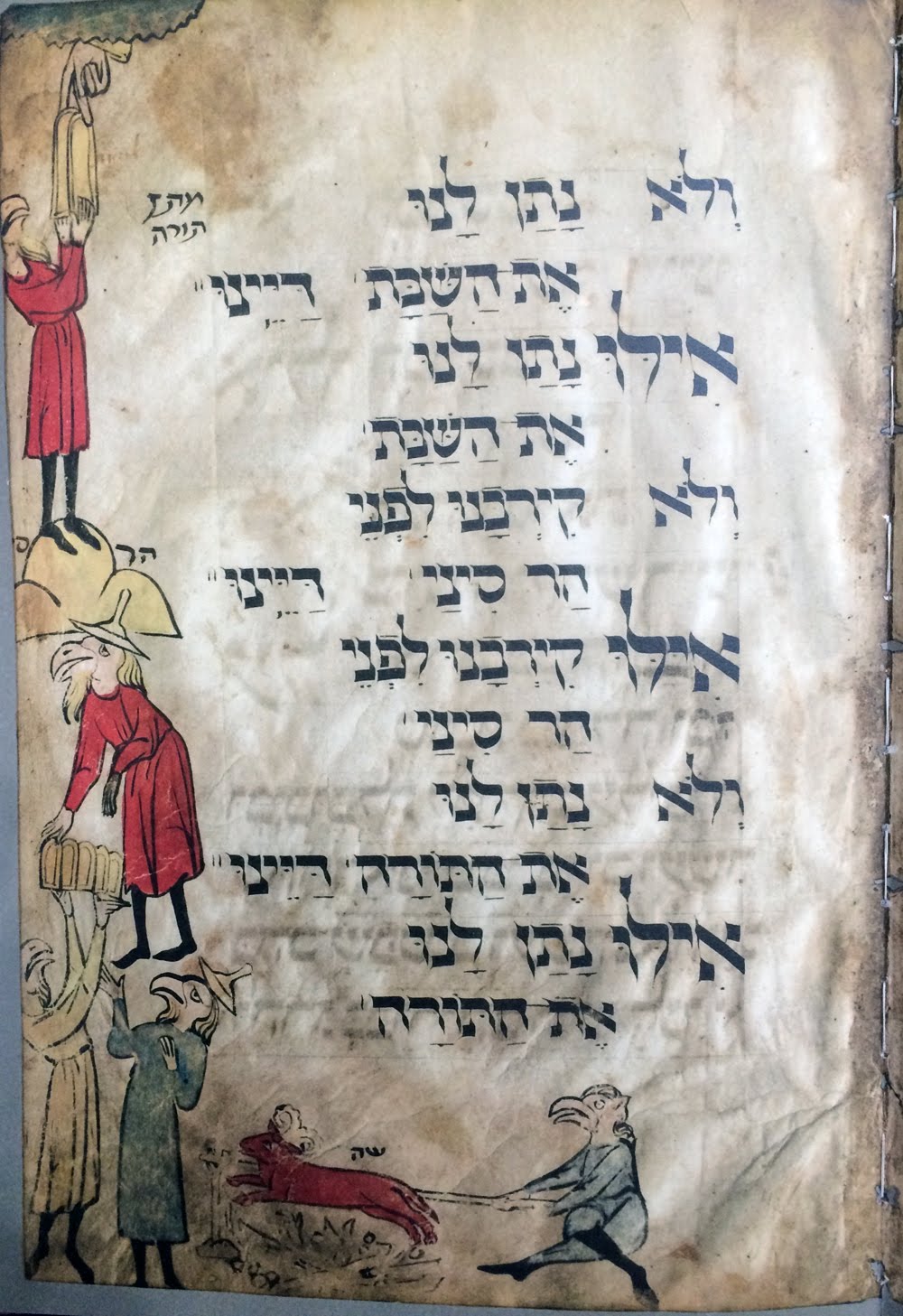
The earliest extant illustrated haggadah[11] is what is known as the Birds’ Head Haggadah dated to the early 1300s. The moniker “Birds’ Head” comes from the fact that the illustrator used birds heads/griffins in place of human heads. This manuscript is not the only Jewish manuscript to use zoophilic (the combination of man and beast) images. Zoophilic images can be found in a variety of contexts in Jewish manuscripts. For example, in the manuscript known as Tripartite Machzor, men are drawn normally while the women are drawn with animal heads.[12]  The name of this Machzor comes from the random fact that the manuscript was split up into three.  At times manuscripts are titled by location (Leipzig Mahzor), history (tripartite) or owner.  In one example, the “Murphy Haggadah” “ suffered a fate all too common to many Hebrew texts.  Before the Second World War the manuscript belonged to Baron Edmond de Rothschild.  During the war it was stolen and sold to an American, F.T. Murphy, who bequeathed it to Yale University, his alma matter.  For years it was known as the “Murphy Haggadah” until, in 1980, a Yale scholar, Prof. J. Marrow, identified as belonging to the Rothschilds.  The manuscript was returned to the Rothschild family and presented by the Baroness Dorothy to the Jewish National Library.[13]
            When it comes to the Birds’ Head manuscript, a variety of reasons have been offered for its imagery, running the gamut from halachik concerns to the rather incredible notion that the images are actually anti-Semitic with a bird’s beak standing in for the Jewish nose trope and the claim that the ears on the “birds” are reminiscent of pigs’ ears. Generally, those claiming halackhic, or more particular pietistic reasons, do so because they are unable “to conceive of such a bizarre and fanciful treatment of the human image as emerging from anywhere other than the twisted and febrile imagination of religious fanatics.”[14] But, in reality the use of bird’s head in lieu of human “reflects a liberal halakhic position rather than an extreme one.”[15]  The camp of Yehuda ha–Hassid would ban all human, animal and celestial depictions, a more liberal position from this perspective permits animal images.  And, while that position doesn’t explicitly permit a depiction half-animal half-human, the zoophilic images appear to show they were allowed, as the illuminator and owner of the Birds Head Haggadah agreed with that position.
            Aside from halakha, and the meaning or lack thereof behind “birds”, a close examination how the illuminator used this convention yields surprising nuance and commentary.      
While most of the images carry a bird’s head, there are a few exceptions. Most notably, non-Jews, both corporeal and spiritual do not. Instead, non-Jewish humans as well as angels have blank circles instead of faces. But, there is one scene that poses a problem. One illustration shows the Jews fleeing Egypt (all with birds’ heads), being pursued by Pharaoh and his army. Pharaoh and his army are depicted faceless.

  But, unlike the rest of the figures in Pharaoh’s army, two figures appear with birds’ heads. Some write this off to carelessness on the illustrator’s part. Epstein, who credits his (then) ten-year old son for a novel explanation, offers that these two figures are Datan and Aviram, two prominent members of the erev rav, those Jews who elected to remain behind. Indeed, they are brandishing whips indicative of their role as nogsim (Jewish taskmasters, or the precursor to Jewish Sonderkommando). While the illustrator included them with the Egyptians, he still allowed them to remain with their “Jewish” bird’s head.  This is a powerful idea regarding the idea of sin, and specifically, the Jewish view that even when a Jew sins, they still retain their Jewish identity – their “birds head.”   Sin, and including sinners as Jews, are motifs that are highlighted on Pesach with the mention of the wicked son and perhaps is also indicated with this illustration. The illustrator could have left Datan and Aviram out entirely or decided to mark them some other way rather than the Birds’ head. Thus, utilizing this explanation allows for the illustrator to enable a broader discussion about not only the exodus and the Egyptian army’s chase, but expands the discussion to sin, repentance, Jewish identity, inclusiveness and exclusiveness and other related themes.[16]

            Once we have identified the Jews within the haggadah, we need to discuss another nuance in their depiction.  The full dress of the adult male bird is one with a beard and a “Jewish hat,” pieus conutus – a peaked hat, or the Judenhut.  Children and young servants are bareheaded.  But, there are three other instances of bareheadness that are worthy of discussion.  (1) Joseph in Egypt, (2) the Jews in Egypt and (3) Datan and Aviram.  The similarity between all three is that each depicts a distance from god or Jewish identity.  Joseph, unrecognizable to his brothers, a stranger in a strange land, and while inwardly a Jew, externally that was not the case.

            The Jews in Egypt had sunk to the deepest depths on impurity, far from God. Finally, as we discussed previously, Datan and Aviram are also removed from god and the Jewish people.  Again, the illustrator is depicting Jews – they all have the griffin heads – but they are distinct in their interaction with god and the Jewish people.[17]  

Using this interpretation of the griffin images, yields yet another subtle point regarding inclusion, and also injects some humor into the haggadah.  The dayenu panel has splitting of the sea, the manna and the giving of the Torah.  The middle panel is less clear. Some posit that it is the Jews celebrating at the sea, but there is no indication of that because in most manuscripts, that includes Miriam, and the Egyptians drowning, not just five random images.

   
Instead, it appears that the person to the left is speaking (his hand is over his heart a medieval convention to indicate speech), and they are approaching the older figure on the left.  All are griffin headed and Judenhut attired – so Jews and regular ones. Between the splitting of the sea and the manna and quails the Jews complained to Moses.  Its possible that this is what is being depicted here, the complaining Jews, and the illustration serves as a testament to God’s patience and divine plan, the theme of dayenu, that even though we complained and did X, God still brought the manna, quail and Torah.[18] 

            If these are in fact the complainers, we can theorize about another detail of the image.  Above the figure at the left and the right, is faint cursive (enhanced here for visibility as much as possible) that reads: “Dass ist der Meirer (this is Meir) Dass ist der Eisik (this is Issac).”[19]  Thus Meir and Issac are being chided – but not kicked out – for complaining too much (rather than representing an unclear image of the Jews celebrating at the sea or just evidencing poor dancing). 


            Continuing through the dayenu we get to the giving of the Torah, and again, the nuance of the illustrator is apparent

.

            Two tablets were given at Sinai, but the actual Pentateuch is comprised of 5 books.  Thus, to capture that the 5 are a continuity of the two, as they are transmitted down, they transform into five tablets.  What about the ram/lamb at the bottom?  Some have suggested that it is the Golden Calf. But it is unlikely that such a negative incident would be included.  Instead, assuming that continuity or tradition is the theme, this lamb is representative of pesah dorot that is an unbroken tradition back to Sinai and unconnected with the Christian idea of Jesus as a stand in for the lamb.  Immediately prior to dayenu we have the Pesach mitzrayim with the figure’s cloak blowing back due to the haste.

       Thus, the dayenu is bracketed by the historic Pesach and the modern one – all part of the same tradition. [20]  

            It is worth mentioning that the Birds’ Head Haggadah is currently in the news. An item recently appeared about how the heirs of Ludwig Marum and his wife Johanna Benedikt, the owners of the haggadah prior to the Nazi era, are pressing the Israel Museum to recognize their family’s title, and pay them a large sum of money (but only a fraction of its estimated value). The Israel Museum acquired the haggadah for $600 from a German Jewish refugee in 1946.  (link).

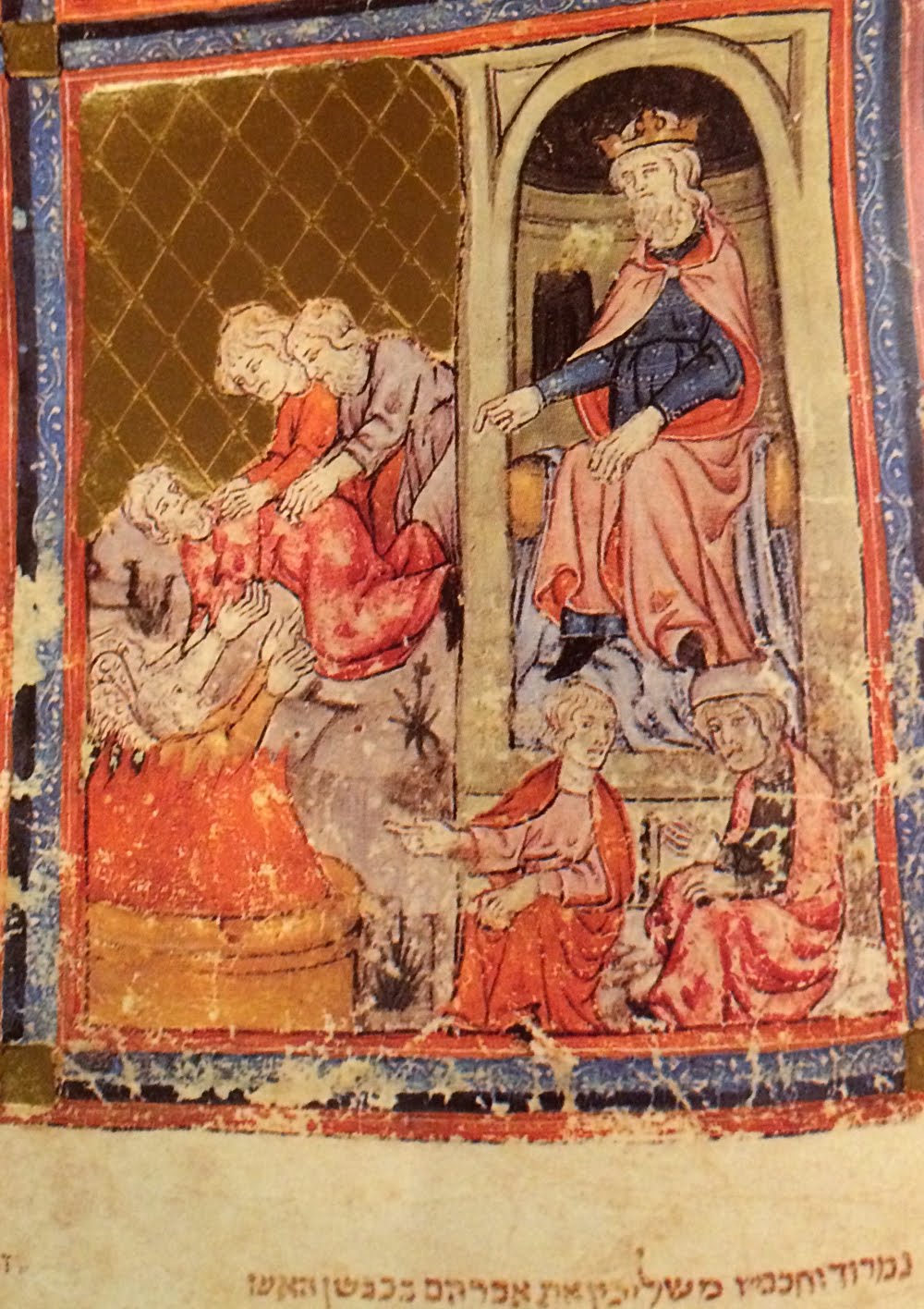
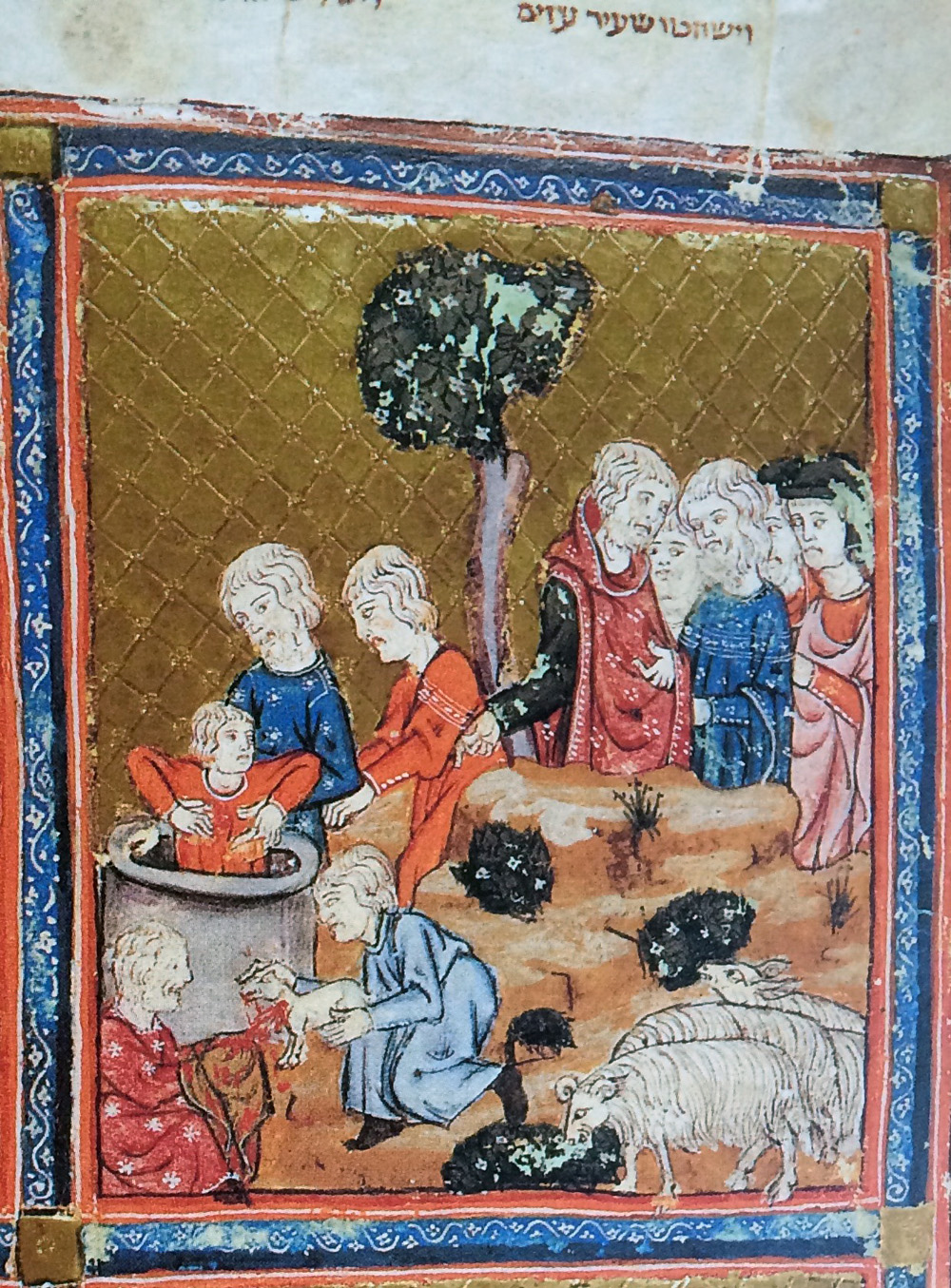
            Turning to Spain, one of the most beautiful illuminated haggadot is the “Golden Haggadah.”  Just as the Ashkenazi Bird’s Head has depth to the illustrations, the Golden Haggadah can be mined for similar purpose.  Each folio is comprised of four panels.  And while they appear to simply depict the biblical narrative, they are so much more. 

            In an early panel we have Nimrod throwing Abraham into the fire and later Pharaoh throwing the males in the Nile, both Nimrod and Pharaoh are similarly depicted, on the throne, with a pointed finger indicating their equivalence in denying god. 

            The folio showing the Joseph story has the brothers pointing in the same manner as Pharaoh and Nimrod – the illustrator showing his disdain for the mistreatment and betrayal and equating it with the others.

            But, that is not all.  Counting the panels there are 9 between Nimrod and Joseph and 9 between Joseph and Pharaoh.  Taken together, these illustrations “renders an implicit critique of the attitude of that Jewish history is nothing but an endless stream of persecution of innocent Israel by the bloodthirsty gentiles.  Yes, it is acknowledged, these gentile kinds might behave villainously in their persecution of Jews.  But groundless hatred between brother and brother is on par with such terrible deeds, and sometimes sinat hinam can precipitated treachery as destructive as persecution by inveterate enemies.”[21]

            One other striking feature of the Golden Haggadah is the inclusion of women. There are no fewer than 46 prominent depictions of women in the haggadah.  Indeed, one reading of the exodus scene has a woman with a baby at the forefront leading the Jews out of Egypt behind Moses.

            This may be a reference to the midrash that “in the merit of the righteous women the Jews were redeemed.”[22]  The difference in the exodus scene is particularly striking if one compares it to the Ashkenaz Haggadah – Moses clearly at the front, and the most prominent woman in the back.


Of course, it is completely appropriate for the inclusion of women in the haggadah as women and men are equally obligated to participate in the seder. Another example of the prominence that woman play in the Golden Haggadah iconography is the scene of Miriam singing includes the largest images in the haggadah, the women occupying the full panel.  We don’t know why the illustrator chose to highlight women – was it for a patron or at a specific request.[23] 
The Golden Haggadah is not the only manuscript that includes women in a prominent role in the illustrations.  The Darmstadt Haggadah includes two well-known illuminations that place woman at the center.  The illuminations adoring other Darmstadt serve a different purpose than the Golden or Birds’ Head, they are purely aesthetic.[24]  Thus, the inclusion of women may not be linked to anything in particular.  At the same time, it is important to note that in terms of reception, that is, how the reader viewed it, the focus on women was not cause for consternation. One other note regarding the haggadah, the last panel is a depiction fountain of youth.  Note that men and woman are bathing – nude – together, which seems odd to a modern viewer (and, again, apparently did not to the then contemporary reader).  And, while admittedly not exactly the same, the 14th century R. Samuel ben Baruch of Bamberg (a teacher of R. Meir of Rothenberg) permitted a non-Jewish woman to bath a man so long as it was in public to reduce the likelihood of anything untoward occurring.[25] 

Before we leave the Darmstadt Haggadah, we need to examine the panel facing the Fountain of Youth. This panel depicts a deer hunt.

 As mentioned above, this image is not connected to the text and instead is solely for aesthetic purposes.  The hunting motif is common in many medieval manuscripts, and in some a unicorn is substituted for a deer.  While the unicorn has Christological meaning, on some occasions it also appears in Hebrew manuscripts.[26]

While the use of the hunting scene in the Darmstadt Haggadah was unconnected to the haggadah, in others it was deployed for substantive purpose.[27] [As an aside, it is possible that Jews participated, possibly Rabbenu Tam, in hunting, or at least its falconry form.[28]] As is well-known, the inclusion of the hare hunt is to conjure the Talmudic mnemonic regarding the appropriate sequence over the wine, candle, and the other required blessings, or YaKeNHaZ.  “To Ashkenazic Jews, YaKeNHaZ sounded like the German Jagen-has, ‘hare hunt,’ which thereby came to be illustrated as such in the Haggadah.”[29]

 Generally, Jews seem to have issues with botany.  We struggle to identify which of the handful of fruits and vegetables mention in the Bible and Talmud. But on Passover, the marror an undefined term, proves particularly illusory. Today, there is no consistency regarding what is used for marror with it running the gamut from iceberg lettuce to horseradish root. While we may not be able to identify it with specificity, we know what its supposed to taste like – bitter.  Manuscripts may provide some direction here.  There are two depictions in illuminated haggadot.  One of a leafy green, found in numerous examples, from a fragment from the Cairo Geniza to the Birds’ Head, and that of an artichoke.[30]  If it is a leafy green, it must be a bitter one – and that changes based upon time, place and palate.  For example, 30 years ago romaine lettuce was only the bitter lettuce widely available. But, among lettuces, it is far from bitter, and today, there are a variety of truly bitter lettuces available, arugula, mustard greens, dandelion, mesclun, etc.  Another leafy and very bitter option that is found in illuminated haggadot is the artichoke.  The artichoke is extremely bitter without proper preparation.  Indeed, from just touching the leaves and putting them in your mouth you can taste the bitterness.  The Sarajevo Haggadah and brother to the Rylands both have artichokes.

            The association of the artichoke with Passover is more obvious when one accounts for Italian culinary history.  Specifically, artichokes are associated with Jews and Passover. Carcoifi alla giudia – literally Jewish style artichokes “is among the best known dishes of Roman Jewish cuisine.” Artichokes are a spring thistle and traditionally served at Passover in Italy.  Whether or not from a culinary history this dish sprung from the use of raw artichoke for marror is not known, but we can say with certainty that artichokes have a considerable history when it comes to Passover. 

Horseradish only became popular, in all likelihood, because an early Pesach, would be too soon for any greens and thus they were left with horseradish – which is not bitter at all, instead it is spicy or more particularly hot.  In Galicia in the 19th century the use of horseradish was so ingrained that  permission was even granted and affirmed for people to use less than a kezayit  and still recite the blessing. In light of this, the custom yields the possibility that all sort of other spicy items be used for marror including very hot jalapeño peppers, for example.[31] Since we are discussing herbs, it is also worth noting that recently rulings regarding the use of marijuana and Pesach have been issued both in Israel and the United States (here), for our discussion on marijuana and Pesach please see here.

            One manuscript captures the uncertain identification of marror.  In the Tubingen Haggadah, the place where the illustration for marror is left blank, presumably to permit the owner to fill in what they are accustomed to use.

            Marror is not the only vegetable that is eaten during the seder, another difficult to identify is the karpas.  Today there are a variety of items used, and in reality, any dip-able vegetable will suffice, historically, it seems that lettuce or celery was used. The Birds Head provides that “lattich (lettuce) and eppich (celery) should be used. These are traditional salad foods, which, in the normal course of things, would be dipped or tossed with a dressing.  A dressing can be a simple as vinegar, and indeed, in many medieval haggadot, hometz or vinegar is used to dip.  We can trace the change from the more obviously salad oriented vinegar to saltwater where in the Darmstadt Haggadah, a later hand wrote on top of hometz – mei melekh.  While it appears nearly universal that hometz was used, its disfavor may be connected to a rule unrelated to Passover.  Since the Middle Ages, there is a dispute whether or not vinegar falls under the ambit of stam yenam.  Thus, the change to saltwater may be more of a reflection about views on what constitutes stam yenam and less to do with tears.

            One final food item is the haroset preparation.  Apples are familiar and linked to the midrash regarding birthing under an apple tree, in the Rothschild Machzor and the 2nd Nuremburg haggadah, cinnamon is called for because “it resembles straw.”  It also concludes that “some incorporate clay into the haroset to remind them of the mortar. For those wanting to replicate this addition, edible clay, kaolin, is now easily procured, and there is even a preparation that creates stone-like potatoes, perfect for the seder.
            To be continued… but until then see these posts Halakha & Haggadah, and regarding some illustrations in the iconic Prague 1526 Haggadah, here and also Elliot Horowitz’s discussion.

[1] E.L. Sukenik, The Dura-Europa Synagogue and its Art, Bialik Press, Jerusalem:1947. See also, Gabrielle Sed-Rajna, Jewish Art, transl. Sara Friedman & Mira Reich, Harry N. Abrams, Inc., New York: 1997, 9-13; 20-29;114-39.
[2] Two Prague Haggadahs, Valmadonna Trust Library, Italy:1978, 16 n.16 (the citation should read p. 435, not p. 345)
[3] Binyamin Richler, Hebrew Manuscripts: A Treasured Legacy, Cleveland/Jerusalem: Ofeq Institute, 1990, 20.
[4] Id. at 58.
[5] Colette Sirat, Hebrew Manuscripts of the Middle Ages, ed. & transl. Nicholas de Lange, New York: Cambridge University Press, 2002, 234.
[6] Id. 242-43.
[7] R. N. Rabinowitz, Dikdukei Soferim, Munich: E. Hovner, 1881, vol. 11, Tractate Baba Bathera, 7. 
[8] Sirat, Hebrew Manuscripts, 235-38.
[9] Richler, Hebrew Manuscripts, 45.
[10] Id. 48.
[11] Interestingly, illuminated haggadot did not end with the introduction of printing, there are a number from the 18th century and beyond.
[12] See B. Narkiss, Hebrew Illuminated Manuscripts, Jerusalem: Keter Publishing House, 1969, 106.
[13] Richler, Hebrew Manuscripts, 47.
[14] Marc Michael Epstein, The Medieval Haggadah: Art, Narrative, and Religious Imagination, New Haven & London: Yale University Press, 2011, 50-51. See the other discussions of this book, here.
[15] Id. 51.
[16] Id. 51-53, 71-72.  Much of the discussion regarding this haggadah and the Golden Haggadah is reliant upon Epstein’s thorough analysis of these manuscripts.
[17] Id. 65-68, 71-72.
[18] Id. 87-90.
[19] M. Spitzer & B. Narkiss, “General Description of the Manuscript,” in The Bird’s Head Haggada of the Bezalel National Art Museum in Jerusalem, ed. by M. Spitzer, Tarshish Books: Jerusalem, 1967, 23.
[20] Epstein, The Medieval Haggadah, 90-91.
[21] Id. 162.
[22] Id. 178.
[23] Id. 185-86.
[24] Narkiss, Hebrew Illuminated Manuscripts, 126.
[25] Elliot Horowitz, “Between Cleanliness and Godliness,” in Tov Elem: Memory, Community & Gender in Medieval & Early Modern Jewish Societies, ed. E. Baumgarten, et al., Bialik Institute, Jerusalem:2011, *38-*39.
[26] Piet van Boxel, “The Virgin & the Unicorn: A Christian Symbol in a Hebrew Prayer Manuscript,” in Crossing Borders, Hebrew Manuscripts as a Meeting-place of Cultures, ed. Piet van Boxel & Sabine Arndt, Bodleian Library, University of Oxford:2009, 57-68.
[27] The hare hunt image appears in Seder Zimerot u-Birkat ha-Mazon, Prague 1514, in the Shevuot portion.  Of course, the mnemonic applies to any holiday that potentially falls on a Saturday night.  See B. Roth, “Printed Illustrated Hebrew Haggadot,” Areshet, vol. 3 (1961), 8.  
[28] See Leor Jacobi, “Jewish Hawking in Medieval France: Falconry, Rabbenu Tam, and the Tosefists,” in Oqimta 1 (2013) 421-504, available here.
[29] Y. Yerushalmi, Haggadah & History, The Jewish Publication Society, United States:1997, plate 15.
[30] The various manuscript depictions of marror are collected in Mendel Metzger, La Haggada Enluminee, Brill, Leiden:1973, figs. 242-65.
[31]  Levi Cooper, “Bitter Herb in Hasidic Galicia,” Jewish Studies, an Internet Journal, vol. 12, 2013 (available here). 


R. Elazar Fleckeles’s Haggadah Maaseh BR’ Elazar

R.  Elazar Fleckeles’s Haggadah Maaseh BR’ Elazar
By Eliezer Brodt
In the past I wrote:
Perhaps the topic which has engendered the most commentary in Jewish literature is the Haggadah shel Pesach. There are all kinds, in all languages, and with all types of commentary, pictures, etc. Whatever style one can think of, not one, but many Haggadahs have been written. So, whether it’s derush, kabbalah, halakha, mussar or chassidus there are plenty of Haggadahs out there. Then, there are people who specialize in collecting haggadahs although they do not regularly collect seforim. In almost every Jewish house today one can find many kinds of Haggadahs. Every year people print new ones; even people who had never written on the Haggadah have had a Haggadah published under their name, based on culling their other writings and collecting material on the Haggadah. When one goes to the seforim store before Pesach it has become the custom to buy at least one new Haggadah; of course one finds themselves overwhelmed not knowing which to pick! Every year, besides for the new Haggadahs being printed, old ones are reprinted, some in photo off-set editions, others with completely retype set.
Some years there are many choices of what to buy; in recent years, while the quantity of Haggadahs being printed has not ebbed, the quality most arguably has. This year, one important and high quality Haggadah that has been retype-set and republished is Maaseh BR’ Elazar by R’ Elazar Fleckeles.
R’ Elazar Fleckeles was born in 1754 in Prague and died there in 1826. He was a direct descendant of R’ Ephraim Luntschitz, author of the Keli Yakar, whom R’ Fleckeles quotes many times throughout his writings. When R’ Fleckeles was 14, he went to study with R’ Ezekiel Landau and spent ten years studying there. R’ Landau, as is evident from his haskamot to R’ Fleckeles works, held R’ Fleckeles in high regard. Additionally, many teshuvot in R’ Landau’s Noda b’Yehuda are addressed to R’ Fleckeles. In R’ Fleckeles’s writings, he quotes many interesting statements from R’ Landau. When R’ Fleckeles was twenty-four, he became the Rabbi of Kojetin, a town in Moravia. However, just four years later R’ Fleckeles returned to Prague to sit on R’ Landau’s Bet Din and serve as a head of a yeshiva. [See also here and here].R’ Fleckeles authored many works on halakha and derush, as well as a commentary on the Haggadah called Maaseh BR’ Elazar. R’ Fleckeles was a skilled halakhist, as is evident from his volumes of responsa, Teshuva m’Ahavah, but his fame also rests on his skills as a darshan. His derashot were published in a four volumes, Olat Chodesh. The fourth volume contains, R’ Fleckeles series of derashot he gave against Shabbatai Tzvi and Jacob Frank (this section has a separate title, Ahavat David) [recently auctioned off as noted here].

Almost all of his works besides his Teshuva m’Ahavah, are very hard to find.
A few years ago a new Boro Park-based Machon called Netzach Yaakov started reprinting his seforim. In 2014 they printed a volume of his Drashot related to Elul and Tishrei along with two works, Chazon LaMoed and Olat Chodesh (437+20 pp.). This beautifully produced work, including an introduction about R’ Fleckeles and a detailed index, matches the content of the actual Drashot.
 A few weeks ago this company released a new edition of his commentary on the Haggadah: Maaseh BR’ Elazar (224 +23 pp).
The Maharil noted in a drasha that he gave before Rosh Hashonah:
כל אדם יחזור וילמוד התפלה והקרובץ מקודם להיות שגורים בפיו בר”ה בשעת התפלה. וכן ילמוד בניו ובני ביתו סדר התפלה, ויריצם סדר הברכות ומלכיות זכרונות ושופרות, כדי שלא יצטרך בר”ה להפסיק בין גאולה לתפלה להראות להם אז הסדר, כי צריכנא לסמוך גם ביום טוב גאולה לתפלה. [וכשחל ר”ה בשבת כל שכן – דצריך אדם לסדר להרגיל התפילה להראות לבני ביתו בתחילה – דאז משנין בכמה מקומות התפילה – והקרובץ [מהרי”ל, עמ’ רעב]
 But specifically more instructive is the Sefer Hamaskil‘s comment:
מה טוב ומה נעים לעיין תמיד דבר בעתו בכל שבוע ושבוע בפירוש חומש ומחזיר וסליחות… ואגדת פסח [ספר המשכיל עמ’ 70].
His basic point being that one should try to prepare before each occasion the tefilos we specific to that occasion – and for Pesach that is the Haggadah.
Many people look all over each year to have nice new pieces of Torah to say over at the seder. This work is full of nice (many) shorter pieces focusing on Peshat and Derush (not Kabbalah) which can be enjoyed by different audiences.
Some General comments on this work;
This Haggadah was first printed by the author in Prague in 1818.
Abraham Yaari, in his work A Bibliography of the Passover Haggadah, writes about this work:
הפרט העברי ככתבו עולה תקע”ב אולם יש לקרוא את שני היודין של השם כשם הויה, ואז יעלה תקע”ח, בהתאם לשנה הלועזית 1818, ולהסכמת הצנזור שניתנה באוקטובר 1817 [מספר 418]
For recent Discussion of other works with similar wording see Yakov Speigel Amudim be-Toldot ha-Sefer ha-Ivri; BeSharei HaDefus, pp. 273-296.
In 1944 in Oradea, Romania this work was printed again. It appears that this was the last Haggadah printed in Europe during World War Two. To me it is fascinating that in this turmoil time they bothered to print this work.
Yaari records this edition [number 2308] as does Yitzchak Yudolov in The Haggadah Thesaurus [number 3918]
This 1944 edition has an interesting addition, as noted by the publisher. Into the text of the Haggadah the prelude Li Shem Yichud was added:
 ולא הוספתי עליו רק מה שנוהגים לומר לפני כל מצוה לשיחקב”ה וכו’ [=לשם יחוד קודשא…] הצגתי כהסכמת הגאון משאמלויא שליט”א…
In R’ Ehreneich’s second letter to the publisher he writes:

 אבל בזמנינו נתפשט המנהג
של צדיקי הדורות זי”ע לאמרו והגאון המחבר זצ”ל שהוא בעולם האמת
בודאי לא יקפיד ע”ז ויאחז כאו”א ויעשה כמנהגו…


Although it’s very nice that they decided to add this into R’ Fleckeles work and not hide this addition but I do not think they had any right to do such a thing. R’ Fleckeles was very outspoken about saying Li Shem Yichud, to say the least.
דרך כלל יאות לבטל כל התחנו’ ובקשות אלו וכיוצא בהן שנתחדשו מלקוטי האחרונים ומעיד אני עלי שמים וארץ שראיתי אחד הי’ רצה לברך על אתרוג המהודר של רבינו הגאון האמתי נ”ע (כי הי’ תמיד מהדר מן המהדרין אחר אתרוג המהודר בכל מיני הידור וכסף וזהב לא הי’ נחשב בעיניו מאומ’ אף שהאתרוג הי’ בתכלית היוקר) וכאשר ראה שאותו פלוני אמר יה”ר קודם נטילת לולב (הנדפס במחזורים ובלקוטי צבי) כעס ורגז ואמר בקצף גדול האומר יה”ר אינו מניחו לברך על אתרוג שלו ולא הניחו לברך ועיין מ”ש רבינו בספרו נ”ב חלק א”ח סי’ ל”ה דף כ’ ע”ג ובחלק י”ד סי’ צ”ג והרבה יש לי לדבר בענינים האלה וכאלה ומרוב טרדותי לא אוכל להאריך [שו”ת תשובה מאהבה, א, סוף סי’ א][1]
He was following in the path of his Rebbe, the Nodeh BeYehudah, who as is well known was adamantly against the saying of Li Shem Yichud:
ועל הרביעית אשר שאל בנוסח לשם יחוד אשר חדשים מקרוב נתפשט ונדפס בסידור הנה בזה אני משיב עד שאתה שואלני נוסח אמירתו יותר ראוי לשאול אם נאמר כי טוב באמירתו. ולדעתי זה רעה חולה בדורנו ועל הדורות שלפני זמננו שלא ידעו מנוסח זה ולא אמרוהו והיו עמלים כל ימיהם בתורה ובמצות הכל ע”פ התורה וע”פ הפוסקים אשר דבריהם נובעים ממקור מים חיים ים התלמוד עליהם נאמר תומת ישרים תנחם והם הם אשר עשו פרי למעלה וגדול מעל שמים חסדם. אבל בדורנו הזה כי עזבו את תורת ה’ ומקור מים חיים שני התלמודים בבלי וירושלמי לחצוב להם בורות נשברים ומתנשאים ברום לבבם כל אחד אומר אנכי הרואה ולי נפתחו שערי שמים ובעבורי העולם מתקיים אלו הם מחריבי הדור. ועל הדור היתום הזה אני אומר ישרים דרכי ה’ וצדיקים ילכו בהם וחסידים יכשלו בם. והרבה היה לי לדבר מזה אבל כשם שמצוה לומר דבר הנשמע כך מצוה שלא לומר דבר שאינו נשמע וה’ ירחם עלינו. עי”ש באריכות. [נודע ביהודה (קמא) יו”ד, סי’ צג].
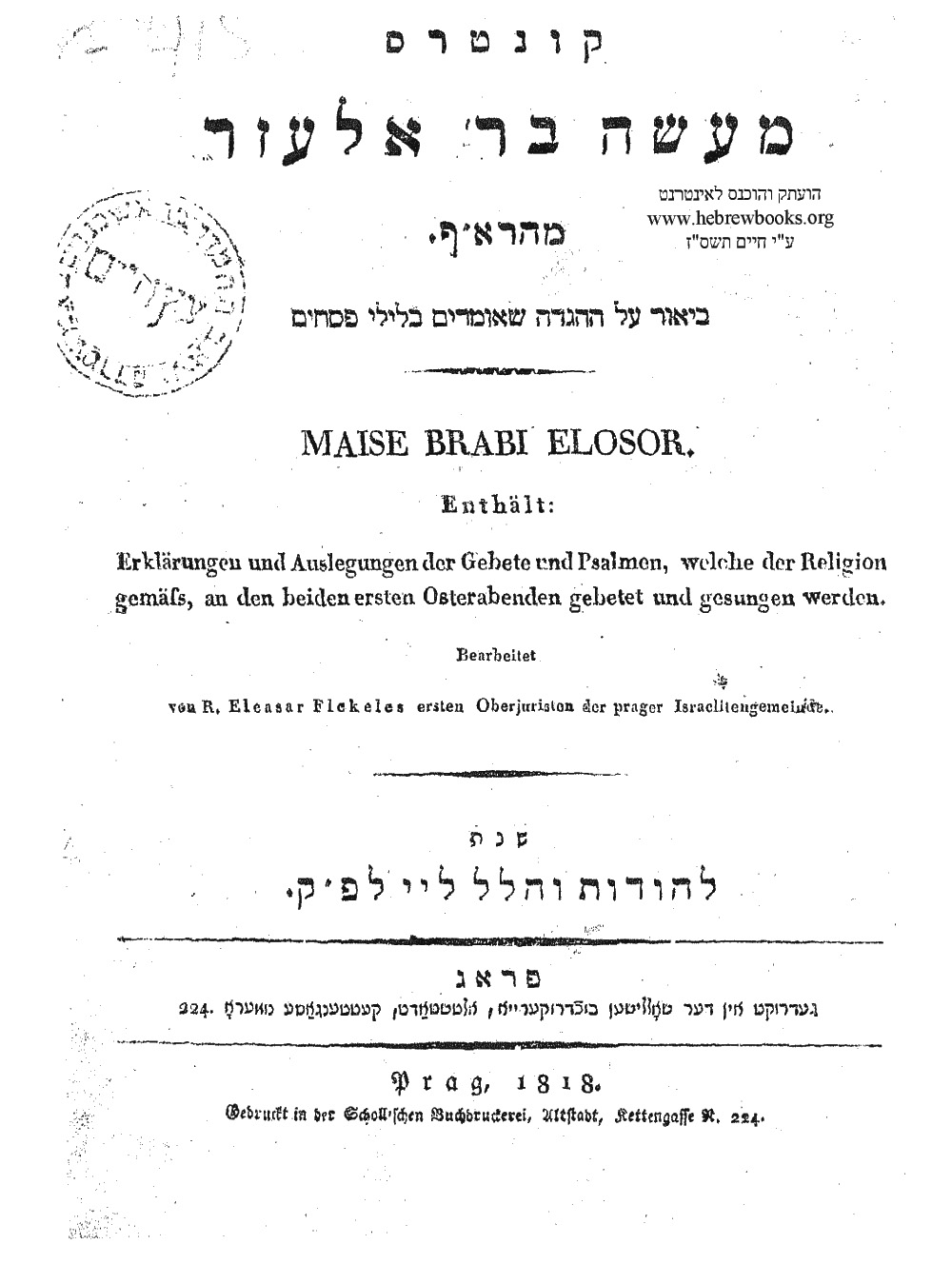
A few months ago I mentioned the censorship of this Teshuvah.
This topic of saying Li Shem Yichud will hopefully be discussed at a different time.[2] But just to add some sources.
In 1805, R’ Menachem Mendel of Shklov, one of the main talmidim of the Vilna Gaon, printed the Gra’s work on the Haggadah for the first time.

Before Maggid it says:
הנני מוכן ומזומן לקיים המצוה לספר ביציאת מצרים לשם יחוד הקב”ה…
In a recent edition of the Gaon’s Haggadah the editor writes:
והנה אין גילוי מפורש בדעת רבינו הגר”א ז”ל באמירת לשם יחוד אך אילו ידע רמ”מ ז”ל שרבינו ז”ל מתנגד לאמירתה בוודאי לא היה מדפיסה… [ר’ חנן נובל, הגדה של פסח עם פירוש הגר”א, ירושלים תשע”ג, עמ’ כט, עי”ש].[3]
This same passage appears in later prints of the Gra Haggadah including one printed in Prague in 1813 at the time R’ Fleckeles was very active there. [Worth noting is the censor was R’ Fleckeles friend, Karl Fisher].

Even though it is unclear what the Gra held about saying Li Shem Yichud, another talmid of his appears to write against it. Here is what R’ Menashe M’IIlyah writes about it in Alfei Menashe:

In the beginning of the Haggadah, R’ Fleckeles deals with the famous question as to why there is no Beracha on Sipur Yetzias Mitzrayim, quoting a Shut Besamim Rosh on the topic [see here]. A few lines later he quotes the real Shut HaRosh, with this preface:
ובתשובות הרא”ש המקובלת לנו ראיתי…
Returning to this newest edition of the Maaseh BR’ Elazar.
One nice piece in this Haggadah is his discussion against his Rebbe, the Nodeh Beyhudah, about the Issur of Chametz in Mitzrayim.
He writes:
הנה חדשים מקרוב נדפס ספר מערבי וראיתי…
The current editors do not write to which sefer he is referring. This is the work he is referring to, first printed in 1793:

In 1959, Yitzchak Refael printed numerous additions to this Haggadah in the journal Sinai (45: 22-36). The source of these addenda is R’ Fleckeles personal copy, which he had specially bound with added on margins and blank pages inserted between each page, affording the author ample room for marginalia. After passing through several hands, finally arriving in R’ Maimon’s library. This new version of the work includes all of these addenda, in their proper places. Interestingly enough, neither Yaari nor Yudolov mention these additions in their entries on this Haggadah.Returning to Li Shem Yichud Sharon Flatto writes in her ‘The Kabbalistic Culture of Eighteenth Century Prague’:

Notably a Haggadah was recently discovered that was owned during the late 1780s by Fleckeles…. The margins of this Haggadah contain leshem Yihud formulas to be recited before the blessing on the the four cups of wine penned in Fleckeles’ hand.

In the footnote she writes they seem to have been written between 1784-1790.'(pp. 225-226). While I wish I had more clearer sources about this discovery. She does not note that the Haggadah that R’ Fleckeles himself printed in Prague in 1818 nor in the manuscript updates of R’ Fleckeles to his own Haggadah does he write to say Li Shem Yichud or any such Tefilah in the Haggadah. This newest edition of the Maaseh BR’ Elazar prints the Haggadah like R’ Fleckeles did in 1818 without Li Shem Yichud.

Besides for all these new pieces added into this new edition, the volume also includes a well-written introduction about R’ Fleckeles, including an interesting eye witness account from manuscript of the day he died in Prague. Another plus to the new edition are the numerous sources they added, at times quoting R’ Fleckeles references from his other works.  Finally, there is a very useful index of topics and seforim quoted by R’ Fleckeles at the end of the volume. I really hope they continue to print the rest of R’ Fleckeles works.
To purchase this Haggadah try Girsa in Jerusalem, Biegeleisen in NY or your local seforim store.
Appendix:

One of the seforim noticeably omitted, for the most part, from R’ Fleckeles works, including this Haggadah, is the Zohar.
Much of the sources in R’ Fleckeles writings regarding the Zohar and Kabalah in general has been gathered in Boaz Huss’ recent work, KeZohar Harokeyah (pp. 322-323). Most notable is this piece which I quote here in its entirety:
ועתה אין מן הצורך להשיב את האיש אשר רצה להמצי’ דבר חדש להשביע את האיש הישראלי בספר הזוהר… את זה כתבתי לדעת האיש ההוא שהספר הזוהר כלו קדוש אבל אני אומר הריני נשבע בתורת ה’ שבספר הזוהר נמצאו כמה זיופים וקלקולים אשר הוסיפו ועלה אחת מתלמוד בבלי הויות דאביי ורבא קדוש יותר מכל ספר הזוהר הנה אם אמרו חכמי התלמוד על ברייתא דלא מתנייא בי ר’ חייא ור’ אושיעא מאן ימר דמתרצתא היא דלמא משבשתא היא וספר הזה ודאי לאו בר”ח ורב אושיעא אתמר כי כל הדורות מראש לא זכרו מספר הזוהר מאומה לא בהקיץ ולא בחלום כי הנה אם אמת הדבר שהחבור הזה הוא מהתנא ר’ שמעון בר יוחאי אשר ר’ יהודה הנשיא קבל גם ממנו כמבואר בהקדמ’ הרמב”ם לספרו יד החזק’ איך לא זכר את הספר הזה בחבורו ש”ס משניות או בשום מקום ואף ר’ יוחנן שחיבר תלמוד ירושלמית אינו מזכירו בשום מקום ורבינא ורב אשי שחברו תלמוד בבלי מאה שנים אחר חבור תלמוד ירושלמי והיו סוף אמוראים ולא שמו רמז בכל התלמוד מספר הזוהר ורבה בר נחמני שחובר רבות ושוחר טוב וכיוצא בהם הרבה לא זכרו מחבור רשב”י גם רבנן סבוראי והגאונים והרי”ף והרמב”ם ורש”י ותוס’ והרמב”ן והרשב”א והרא”ש והטור והילקוט שמעוני אשר אסף ולקט כל המדרשות והמכילתות והברייתות כלם לא ידעו ולא ראו ממנו דבר עד שזה קרו’ לשלש מאות שנים ענו ואמרו שמצאוהו ואיזהי כנסיה אשר קבלוהו בכנופיה, כמו תלמוד בבלי וירושל’ וז”ל הרמב”ם בהקדמתו לספר יד החזקה אבל כל הדברים שבגמרא הבבלי חייבין כל ישראל ללכת בהם וכופין כל עיר ועיר וכל מדינה ומדינה לנהוג בכל המנהגות שנהגו חכמי הגמרא ולגזור גזירותם וללכת בתקנותם הואיל וכל אותם דברים שבגמרא הסכימו עליהם כל ישראל עכ”ל ויעיין עוד שם ואין אני חלילה מטיל דופי ופגם בכבוד התנא אלדי ר’ שמעון בר יוחאי כי הוא היה מחסידי עליון אלא אני אומר לאו גושפנקא דרשב”י ועזקתיה חתום עליה ומי שיש לו חצי דעת יגיד כן שהרי נזכרו בספר הזוהר כמה תנאים ואמוראי’ שהיו אחר רשב”י שנים רבות במספר והארכתי בזה במקום אחר מפי סופרים ומפי ספרים כמבואר בס’ מטפחת להגאון מו”ה יעב”ץ זצלל”ה שגזר אומר שחלו בו ידים מזייפים וחשד את החכם ר’ משה דיליון יעיי”ש.
והינה מיום שנתחדש ספר הזוהר הרבה נכשלו ע”י כי כמה דברים סתומים וחתומים אשר המציאו האחרוני’ להתעות בני אדם יושבי חשך השכל, צאו וראו כמה קלקולים רבים קלקלו מאמיני הכלב רע שבתי צבי שבור ואחוזת מרעהו ברכי מסאלנוקא ויעקב פראנק שם רשעים ירקב, ותלו דבריהם בספר הזוהר אשר בודאי לא יאונה לצדיק ר’ שמעון בר יוחאי כל און.
מה טוב ומה נעים, אשר כתבתי בחבורי קטן אשר קראתיו בשם קונטרס אהבת דוד שנדפס בק”ק פראג תק”ס וזה לשוני שם באו ונחזיק טובה וחינות לשני מלכים גדולי אדירי’ אדוננו המשובח המנוח הקיסר יאזעף השני ואדוננו המהולל הקיסר פראנץ השני אשר צפו והביטו בחכמתם הנפלאה, רבות רעות ושבושי דעות תסתעפנה מחלומות והבלים המקובלים, והמה לנזקי בני האדם נזקי הגופות ונזקי הנפשות, ופקדו באזהרה גדולה שלא להביא ספרי קבלה בכל מדינות מלכותם הפקודה הראשונה העכסט האף דעקרעט פאם ב’ נאוועמבר למספרם והשני פאם ז’ יוני למספרם והארכתי שמה בדברים נכונים… (תשובה מאהבה חלק א סי’ כו).
According to Shmuel Werses, Haskalah and Sabbatianism, (Heb.), pp. 68 and Boaz Huss, KeZohar Harokeyah (p.323) this teshuvah has been censored out of the 1912 edition of TM. I have been unable to independently confirm this, as the 1912 editions I have seen (both in NLI and in BIU) have it in full – as do most reprints available today, including the edition found on the HebrewBooks.org website
In another teshuvah on this topic R’ Fleckeles writes:
ובלא”ה כבר כתבתי פעמי’ רבות שאין ראי’ מזוהר שלא נודע ברור מי הוא המאסף והמלקט ספר הזוהר והרבה הוסיפו  (תשובה מאהבה א:סב).
It is worth pointing out that R’ Fleckeles does not dismiss the Zohar completely taking it into account elsewhere in TM; for example in this teshuvah he writes:
מה ששאלני מדוע רובא דעלמא מקילים והולכים בבקר ד’ אמות בלי נטילת ידים שחרית הא כבר כתב המ”א בשם הב”ח בשם תולעת יעקב כל ההולך ד’ אמות בלי נטילת ידים שחרית חייב מית’ עיי”ש וכמה בני תורה אשר אינם שוגגים מקילים ואין להם על מה שיסמכו. ידע ידידי שדבר זה כתב בעל תועלת יעקב בשם הזוהר וכן העתיקו הב”ח, והמג”א השמיט בשם הזהר או מן השמים השמיטוהו כי חפשתי בספר הזוהר יגעתי ולא מצאתי ובעל א”ר האמין לשמועותיו בשם הזוהר והאר”י וצדר להקל עיין סי”א סק”ד ולבסוף מסיק בשם ספר דמשק אליעזר שדבר זה  דוקא בזמנם כמו גילוי וזוגות עיין שם ולענ”ד ליתא בזוהר כלל והרב בית יוסף אשר העתיק בכל פעם דברי הזוהר לא שם רמז מזה ושארי לי’ מארי’ שעשה רוב ישראל לחייבי מיתות שוגגן ישרים יחזו במסכת ברכות דף  סמ”ך ע”ב ישר יחזו פנימו ולענ”ד היא משנת חסידים והזריז הרי זה משובח ואפשר דזוהר מיירי אם מים מצוים לפניו והולך ד’ אמות בלי נטילת ידים ואח”ז ה’ אנה לידי ספר ברכי יוסף וראיתי שמביא דברי הזוהר כת”י וסיים וזה לשונו אלא דשמיע לי מרבני קדישו דזמנין דמיא הרחק מאד מאדם ובלכתם ילכו פחות מד’ אמות כאותה שאמרו גבי שבת עיין שם סימן א’ אות א’ ולשון הזוהר אינו לפני לעיין והנרא’ לענ”ד כתבתי. (תשובה מאהבה חלק א סי’ יד וראה חלק ב סי’ א אות ד)
As an aside, the shitos of R. Fleckeles on the Zohar are bland compared to those of his Rebbe, the Noda Beyehudah, as found in the recently printed drasha of his from manuscript by Dr. Maoz Kahana and M. Silber. I note in passing that this drasha has sparked a debate between them and Dr. Flatto, to which she responded in a later version of the journal Kabbalah.


[1]  See also his Melechas Hakodesh, p. 132
[reviewed here].
[2]  See Moshe Hallamish, Kabbalah (Heb.),
pp. 45-70; Maoz Kahane, MiHaNoda BiYehuda LaHatam Sofer, pp. 89-91 and
pp. 235-236; most recently Shimon Szimonowitz, Haggadah
Aleh Zeis
(2016), pp. 35-78.
[3]  Thanks to R’ Dovid Vieder for this source.


Aaron the Jewish Bishop

Aaron the Jewish Bishop

The exodus from Egypt was led by Moses and Aaron. Moses, however, does not appear in the Passover haggadah (with one exception that is likely a later interpolation).[1] Aaron does make two appearances in the hallel section.  That said, in numerous illuminated haggadahs, from the medieval period to present, both appear in illustrated form. Additionally, in printed haggadot, most notably the 1609 Venice haggadah, one of the seminal illustrated haggadot, Moses and Aaron appear on the decorative border.

Generally, conclusively determining Jewish material culture, especially from the biblical period, is nearly impossible.  Regarding Moses, other than his staff, the bible provides no additional information.[2]  Aaron is a different story.

The Torah expends a significant amount of verses discussing the details of the Kohen Gadol’s (the high priest) garments but while the descriptions are detailed, we still struggle to determine what these special clothes looked like.  Rashi, for example, has to resort to anachronistic parallels for the “me’il” comparing it to a medieval French equestrian pant.  Similarly, by the Talmudic time, the details of the headband were subject to dispute. We should briefly pause here to correct a common misconception – that the Vatican or the Catholic Church still retains items related to the Jewish temple.  Unfortunately, this misconception is so prevalent, that a number of Israeli officials have requested that the Vatican repatriate the temple vessels.  Briefly, while the Talmud mentions that sometime between the 2nd and 5th centuries, temple vessels may have resided in Rome, there is no indication whatsoever of them since the 5th century. In addition, due to the numerous sackings that Rome underwent, or the reality that the Catholic Church is an entirely different sovereign than the Roman ruler Vespasian who sacked Jerusalem, it must be regarded as highly unlikely at best that any former temple vessels remain (assuming they were ever there) within the Vatican. For additional discussion regarding this issue, see here.
The ambiguity about the clothing has not stopped many from attempting to depict what they believe is the correct version.  Thus, depictions of Aaron the High Priest appear in Hebrew books. Hebrew manuscripts did not shy away from including illuminations and illustrations to create a more aesthetically pleasing product.  All sorts of shapes and images are employed to this end, on page borders, end pages, or just sprinkled throughout a manuscripts and – geometric patterns (Hebrew manuscripts are the first to use micrography), animals, people or combinations thereof of half-human-half-beast.  Noticeably, however, biblical figures are not included in this category. While biblical scenes appear in Hebrew manuscripts it is only to actually illustrate the content, and not independently for aesthetic purposes.
With printing, however, this slowly changed. Printing began in 1455 with Gutenberg and Hebrew books followed soon after.  These early books, however, did not follow all the conventions that we associate with books today.  Title pages did not begin until the 16th century and it wasn’t until the early 17th century that title pages were de rigueur.  Apart from information relevant to the books contents, title pages also began to included aesthetic details.  Sometimes these are architectural, pillars etc. other times flowers or some other flower or fauna.
Generally, printers did not explain why certain images were included on title pages, the assumption is that it was simply for aesthetic purposes.  At least in one case, this was made explicit.  The Shu’’t Ma-harit”z, Venice, 1684, by Yom Tov Tzalahon, includes an illustration of the temple on the title page.  The publisher, Tzalahon’s grandson, provides that this was included as “it makes it more beautiful” and he was so enamored with the illustration – even though it is very rudimentary he included it three times in the book (this likely speaks more about the publisher’s exposure – or lack thereof – to art in general).[3]
There are, however, at least a few examples of a title page illustration serving a purpose beyond the aesthetic. Some illustrations are including because of allusions to the author’s name, but at least in one instance a Hebrew title page illustration was used to illustrate the title.
The most common form appearing “on the frontispiece of countless printed books,” were biblical figures Moses, Aaron, David, Solomon, nearly always coupled, and “became the accepted heraldic figures.”[4]  The first biblical figures to appear in Hebrew books were was a woodcut by Hans Holbein of David and Solomon, flanking one, among other biblical scenes, in the Augsburg 1540 Arba’ah Turim. This illustration, however, did not appear on the title page, which is plain, instead it appears on folio 7.[5]  See Heller, 242-43.
The first frontispiece to include a biblical figure is the Tur Orach Hayyim, Prague, 1540, that includes, at the top of the page, a depiction of Moses holding the tablets.[6] The first frontispiece to include the coupling of biblical figures – the most ubiquitous form of biblical figures – is Jacob Moelin’s She’elot u-Teshuvot Mahril printed in Hanau in 1610. That frontispiece depicts Moses on the left in one hand the tablets and the other hand he grasps his staff.  Aaron is wearing the garments of the high priest:  the tunic, bells, breastplate and and is carrying the incense.
 
The usage of Moses and Aaron on Hebrew frontispieces thus began with Hanau, 1610.  By way of comparison, the first appearance of Moses and Aaron on the frontispiece of a book in English was the King James Bible, published a year after Hanau in 1611. The Hanau printer reused the Moses/Aaron frontispiece on two more books:  Nishmat Adam by Aaron Samuel ben Moshe Shalom of Kremenets, 1611 and Joseph ben Abraham Gikatilla’s, Ginat Egoz, Hanau 1615.[7]  The illustration best fits the Nishmat Adam, and may have originally been the book for which this illustration was intended and not Molin’s.  Unlike Jacob Molin’s work that has no direct connection with Aaron or Moses, the author of Ginat Egoz’s name includes both Moses and Aaron, and while Samuel is not captured in the illustration, the year of publication is derived from “Samuel.”
Moses and Aaron became the most common biblical figures on frontispieces, but not the exclusive ones.  In some instance, a mélange of biblical figures is presented.  The Amsterdam printer, Solomon Proops, included the image of Moses, Aaron, David, and Solomon, each wearing a crown, and a Moses carrying not the tablets but instead the Torah scroll.

A deviation from the coupling of Moses and Aaron appears in Beit Aharon, Frankfurt am Oder, 1690, which displays Aaron and Samuel.  In that instance, however, the deviation is explained because the figures are allusions to the author’s name, Aaron ben Samuel.  The use of coupled figures was not exclusive to Biblical figures; in many Hebrew books a variety of mythical and pagan figures and scenes are commonplace on title pages.  A partial list of pagan deities include:  Venus, Hercules, Mars and Minerva that appear on ennobled works such as Rambam’s Mishne Torah, Venice 1574, and Abarabenel’s commentary on Devarim, Sabbioneta 1551, and were reused many times.[8]  The use of pagan figures in Jewish items is not limited to Hebrew books and these images appear on the Second Temple menorah, and the Dionysus, Poseidon are inscribed on Palestinian mezuzotSefer Raziel mentions Zeus and Aphrodite, Dionysus and Poseidon reappears in a common prayer said during the priestly blessings, and Dionysus appears individually in the additionally yehi ratzon that some recite during Aveinu Malkanu (helpfully Artscroll and other siddurim direct that for the prayers that include these names, they should “only be scanned with the eyes and concentrated upon, but should not be spoken,” as they are “divine names”).[9]
Returning to the use of Moses and Aaron on frontispieces of Hebrew books, as mentioned above, the basic form of the illustrations remained fairly static with Moses appearing with his staff and/or the tablets or the Torah and Aaron in his priestly clothing.  And, these are prevalent throughout the 17th century, across the Europe and the Middle East.  In Europe the coupling appears in Altona, Amsterdam, Venice, Furth and Izmir, on diverse works – Talmudic commentaries, Mendelssohn’s commentary to the bible, and a commentary on the zemirot (which includes a heliocentric depiction of the constellations).  

A slightly different version appears in the Ma’ashe Rokeakh that has Aaron holding a slaughter knife.

There is, however, one notable exception to this depiction both in terms of the items displayed in addition to the “coupling.”  Aaron ben Hayyim Perachia’s Perekh Matteh Aaron, published in Amsterdam, 1703, includes a coupling but rather than Moses and Aaron, in this instance both images are that of Aaron.  Additionally, the Aaron on the left is the standard depiction of items, but the one on right is distinct in that it has Aaron holding a budding almond branch – perach mateh Aaron.  Of course, these deviations are understandable as the “second” Aaron and his unique “staff” is not merely aesthetic but is illustrative of the title of the book, the first time an title page illustration illustrates the title.[10]

 
A final note regarding the frontispiece depictions of two items Aaron’s clothing.  First, in many instances, including the Hanau prints, Aaron’s hat is not the traditional wrapping or turban associated with the mitznefet, but a bishop’s mitre.  At times, the mitre is horned, for example, Zohar, Amsterdam, 1706.  The horned mitre, however, is based upon “the mistaken belief that the horned mitre descended from the Jewish high priest” when in reality the bishop’s mitre is related to “Moses’ horns and their symbolic meaning within the context of the medieval Church.”[11]
The frontispiece is not the only time that the kohen’s headgear is interpreted contrary to Jewish tradition.  In a recent illustrated edition of Mishna Tamid, the editors depict the Kohen not only wearing the turban but also a yarmulke.  The Torah enumerates the priestly garments and any addition to those items is subject to the death penalty.  Thus, a Kohen wearing a yarmulke – as illustrated and that is not included in the Torah’s description of the Kohen’s outfit – commits a capital crime.[12] Here is another example of Aaron, looking very much like a bishop. This illustration is from a 15th century manuscript called המשכן וכליו by Simon ben Joel.

Unlike Aaron’s head-covering that appears from time to time as a bishop’s mitre, the second odd item that Aaron carries appears almost universally. Specifically, Aaron holds the incense in his hand, but unlike the Rabbinic interpretation that the incense was delivered in a shovel, Aaron is always depicted with the incense in a ball or  censer.  There is no Jewish source that records that form of the incense ritual and is an exclusive non-Jewish understanding of the Torah.
Ironically, the only person to take issue with the depiction of Moses and Aaron (and other biblical figures) argues against their use does not raise these issues nevertheless counsels against these biblical depictions.  His rationale, however, is counter-factual.  Specifically, Samuel Aboab, decries the depiction of biblical figures because the depictions are anachronistic and but for non-Jewish influences would never have been included in Jewish items.
While there is no doubt that some elements of the depictions are non-traditional, since at least the second century, biblical figures are found in a variety of Jewish contexts.  For example, the second century synagogue of Dura Europos and a few years later at the Bet Alpha synagogue contain biblical images. Dura Europos contains numerous illustrations of biblical figures and scenes, including Moses and Aaron.  And, while Abaob is correct that both Moses and Aaron are depicted anachronistically – in typical clothing of that time period, a toga-like garment – this is simply explained by the fact the purpose of the illustrations was to remind the viewers of the people and stories.  Therefore, had Aaron “been depicted with the biblical clothing that were no longer in use, the viewer might not know what they are looking at.”[13]  Thus, the anachronisms are not to make these seminal biblical figures in our image, but to simply ensure that the art clearly transmit its message.

[1] David Henshke, “The Lord Brought Us Forth from Egypt: On the Absence of Moses in the Passover Haggadah,” AJS Review, Vol. 31, No. 1 (Apr., 2007), pp. 61-73.
[2] The lack of information has not stopped the theorizing as to Moses’ visage.  The most notable example is R. Yisrael Lipschutz’s comments at the end of Kiddushin.  See Shnayer Z. Leiman, “R. Israel Lipschutz and the Portrait of Moses Controversy,” in Isadore Twersky, ed., Danzig, Between East and West: Aspects of Modern Jewish History (Cambridge, Mass., 1985), pp. 51-63, and for a different version, “R. Israel Lipschutz: The Portrait of Moses,” Tradition 24:4 (Summer 1989): pp. 91-98 (available here). See also the important chapter on this subject in R’ Shmuel Ashkenazi, Alpha Beita Kadmeysuh, Jerusalem:2000, pp. 337-371. For additional sources on this story see R’ Dov Turish in his various works; Maznei Tzedek, p.149, 310; Ginzei Ha-Melech, p. 38, 40, 43,48, 56; MiArat haMchpeilah, p. 101 and onwards.
[3] Shmuel Glick, Kuntress ha-Teshuvot he-Hadash, Schechter Institute of Jewish Studies, Jerusalem & Ramat Gan, 2007, n. 2120.  For more on Glick’s work see here and  here.
[4] Richard I. Cohen, Jewish Icons, Art & Society in Modern Europe, University of California Press, Berkley & Los Angles, 1998, 127.
[5] Marvin J. Heller, The Sixteenth Century Hebrew Book, An Abridged Thesaurus, Vol. I, Brill Leiden & Boston, 2004, 242-43.
[6] That is not to say the first to contain, rather than appear on the title page illustration, figures of living persons.  The Prague 1526 haggadah depicts, Adam, Eve, David, Goliath, Judith, and Samson in the woodcuts accompanying internal pages.  For a list of Hebrew books containing Moses with horns and without see Two Prague Haggadahs, Valmadonna Trust Library, 1978, 16-18 n.16
[7] An examination of the haskamot (approbations) accompanying the early Hanau prints also provides evidence of “the breakdown of central rabbinical authority in Germany during this period.”  Stephan G. Burnett, “Hebrew Censorship in Hanau: A mirror of Jewish-Christian coexistence in Seventeenth-century Germany,” in Raymond B. Waddington and Arthur H. Williamson, eds., The Expulsion of the Jews: 1492 and After, Garland Studies in the Renaissance, Vol. 2. New York & London: Garland Publishing Inc., 1994, pp. 202-03 (available here).
[8] Marvin J. Heller, Studies in the Making of the Early Hebrew Book, Brill NV, Leiden, 2008, 1-17.
[9] See Daniel Sperber, Magic & Jewish Folklore in Rabbinic Literature, Bar Ilan University Press, Ramat-Gan, 1994, 97-98 and n. 29; Yosef Shaposhnik, Siddur im Revid ha-Zahav, Chief Rabbi of the Rabbinical Association, London, 1929, 63.
[10] By way of comparison, a few years after the Perach Matteh Aaron, the frontispiece of the haggadah with the commentary Mateh Aaron, Frankfort A.M., 1710 does not include any depiction of Aaron or his staff. Instead it reuses a non-Jewish woodcut that depicts the Eye of Providence – an allusion to the all seeing eye of “god” –  the trinity as it is depicted within a triangle or three sided object, as it does on the back of the US dollar bill.  But, notably, the eye appearing on the Mateh Aaron is not within a triangle.  Perhaps this was deliberately changed or the original woodcut for some other reason elected not to use the triangle, but to arrive at any definitive conclusion requires additional research into the history of the particular woodcut which is outside the scope of this article.

[11] Ruth Mellinkoff, The Horned Moses in Medieval Art & Thought, University of California Press, Berkley, 1970, 105,94-96.
[12] Dan Rabinowitz, “Yarmulke: A Historic Cover-up?,” akirah: The Flatbush Journal of Jewish Law and Thought, 4 (2007): 231-32.
[13] E.L Sukenik, The Synagogue of Dura-Europos and its Frescoes, Bialik Foundation, (Jerusalem, Palestine):1947, 97.