Change Has Come To Modena

Change Has Come To Modena

By Eli Genauer

I would like to thank S. of “On The Main Line” for his assistance and insightful comments.

The Kitzur Shelah by Rav Yechiel Michel Epstein, was first published in Fürth in 1683.[1] It was not truly an abridgement of the Shnai Luchos HaBris, but rather a Sefer which stood on its own. It was used for many years by people in smaller communities as a guide for what to do at different times of the year.[2] As many know, it is reputedly the source of the actual Pesukim recommended for the custom of saying Pesukim Lishemot Anashim. [3]

I have an old copy of this Sefer (Amsterdam 1707) whose title page looks like this:
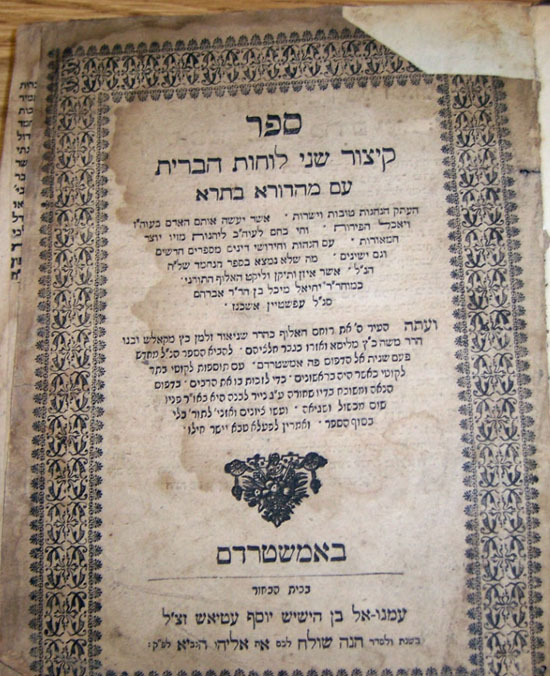
In fact, this custom of reciting a Pasuk associated with one’s name is recorded there at the very end.

Chapter 5 of Post Sabbatean Sabbatianism by Rabbi Dr. Bezalel Naor goes into the reasons why Rav Yakov Emden blacklisted this book. It is based on the Hakdamah which uses the expressions Mashiach Ha’Amiti and Y’Mot HaMashiach, which equal 814 and is also the Gematria for Shabbetai Zvi.[4] The copy I have from 1707 comes with the original quotation marks, functioning like italics, on both Mashiach Ha’Amiti and Y’mot Hamashiach. (Starting from the third line from the bottom with the word V’Yizku.)
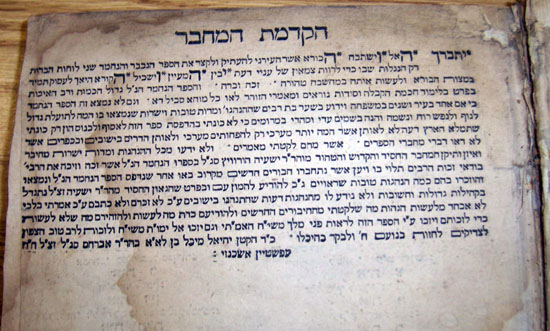
Detail:

I was looking through the book to find the part that speaks about the Pesukim L’Shemot Anashim and found it at the very end. I was fascinated to see that immediately before the final section, Rabbi Epstein concludes his Sefer with a hope for the coming of Moshiach, and he refers to Moshiach as Nezer Rosheinu ( bottom line below).
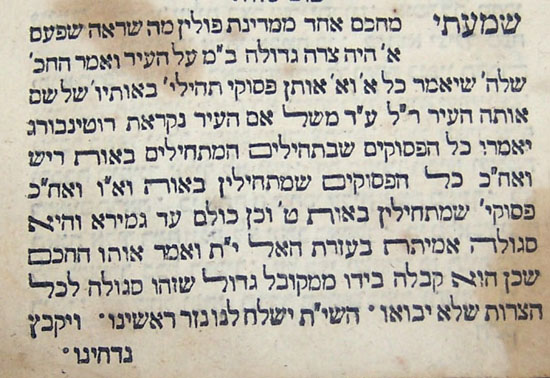
I was curious about the words Nezer Rosheinu to describe Moshiach, and suspecting foul play, I did two things. Firstly, I wrote to Dr. Shnayer Leiman and asked him about the Kitzur Shelah and its use of the word Nezer Rosheinu. This is what Dr. Leiman answered (posted with permission).

“Briefly, Kitzur Shelah is a Sabbatian work. It is suffused with Sabbatian material, so one needn’t look for evidence just at the beginning and end. It was already identified as Sabbatian by R. Yehezkel Katznellenbogen in the first quarter of the 18th century. See also Krengil’s שם הגדולים השלם, vol. 2, p. 148, in הגהות עין חנוך, where the work is identified as Sabbatian.

נזר ראשינו (if that is the correct נוסח — one always need to check the first 3 editions; Amsterdam, 1707 is the 4th edition) is surely a reference to Sabbetai Zevi. The latter name in gematria totals 814, a sacred number for Sabbatians. נזר ראשינו adds up to 824. Either the author wrote נזר ראשנו which totals 814, and the printer misspelled it ראשינו; or, the total 824 stands for ה”ה שבתי צבי. Sabbatians regularly wrote ה”ה before his name. It is an abbreviation for המלך המשיח.

What really needs to be noted is that in a recent edition of קיצור של”ה (Ashdod, 1998), the offensive phrase has been censored and replaced.”

It appears then that Kitzur Shelah has Sabbatean allusions right from the Hakdamah ( which anyone can see for themselves by the use of Mashiach Ha’amiti, etc.) to the last lines which use the words Nezer Rosheinu. It is almost as if it is Koheles in reverse where “its beginning is words of Torah and its end is words of Torah” (Shabbat 30b).

I also did a search online putting in the words “Shabbetai Zvi” and “Nezer Rosheinu”. I got one pertinent hit and it brought up an entirely new issue. I found referenced an article from the Israeli publication HaMaayan published by Mossad Yitzchak Breuer in Tammuz of 5743 (1983).

There we find an article by Rav Yosef Yehoshua Apfel (a Dayan in Leeds, and a noted Talmid of the Seridei Eish) on Yom Kippur Kattan, where he writes about the connection between Nezer Rosheinu and Shabbetai Tzvi. Rav Apfel references the famed Siddur Avodas Yisroel printed in 1868 by Dr. Yitzchak (Seligmann) Baer:
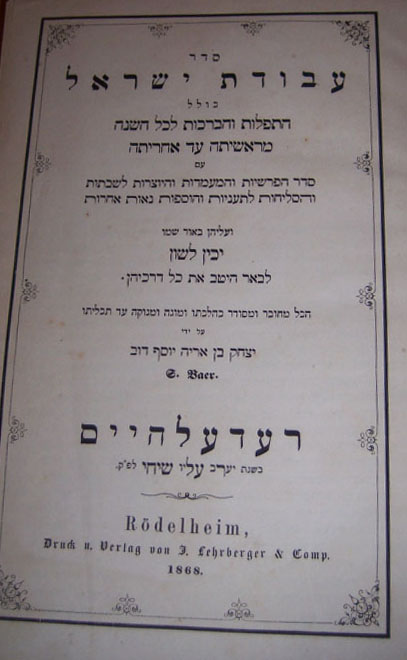
and specifically the Piyyut Yom Zeh Yehi Mishkal Kol Chatasai, included in the Yom Kippur Kattan service which appears there.
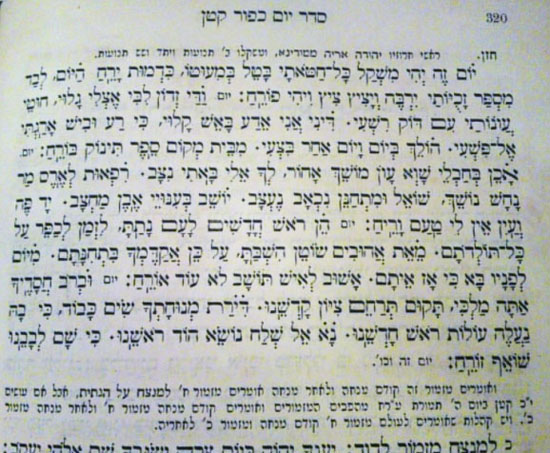
He writes as follows
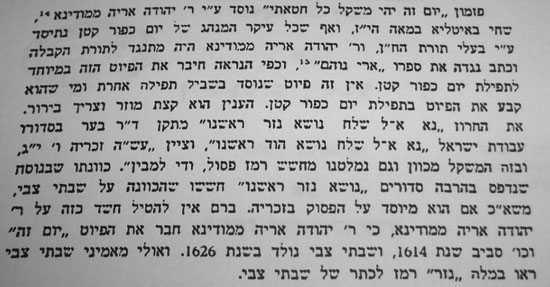
Rav Apfel is at first puzzled a bit as to why Modena would write a Piyyut for a Kabbalistic service (“Ha’Inyan Hu K’tzas Muzar”). He then tells us that Dr. Baer changed the last line of the Piyyut by exchanging the phrase “נא א-ל שלח נושא נזר ראשנו” for “נא א-ל שלח נושא הוד ראשנו”. Dr. Baer explains his reasoning for this change: because he wanted to restore the proper meter, and because he wanted to save the Piyyut from having a “Remez Passul.” Rav Apfel understands this to mean a hint of Shabbetai Zvi. Dr. Baer did this even though, as Rav Apfel writes, Rabbi Yehuda Aryeh MiModena could not have been referring to Shabbetai Zvi, because the Piyyut was written around 1614, and Shabbtai Zvi was only born in 1626. Rav Apfel writes that the Nussach of “נא א-ל שלח נושא נזר ראשנו” appears in many Siddurim (בהרבה סדורים). I recently looked at many Siddurim at the Library of Congress and found this to be true, especially in ones published pre-1868.

Rav Yakov Emden, who needed little prompting to find Sabbatean allusions, did not understand this phrase as referring to Moshiach, but rather to the Kohen Gadol. This booklet contains the Yom Kippur Katan service with the commentary of Rav Yakov Emden:
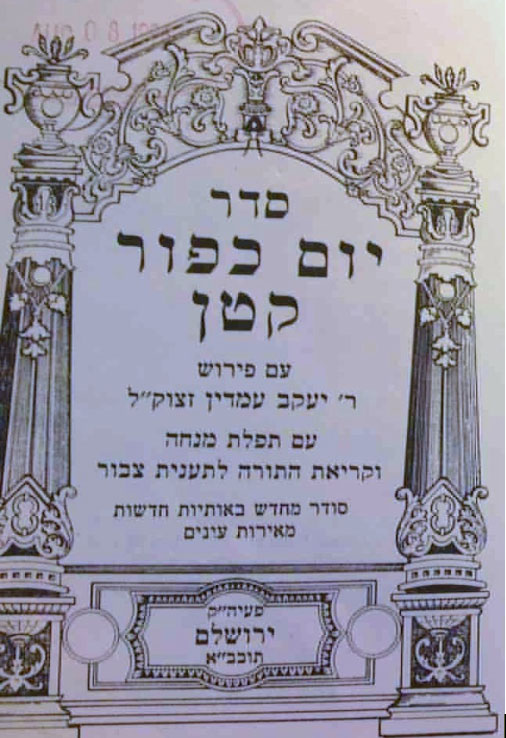
The Peirush of Rav Yaakov Emden on the words “נא א-ל שלח נושא נזר ראשנו” indicates as such. “שלח לנו כהן גדול הנושא הציץ כמו נזר”.
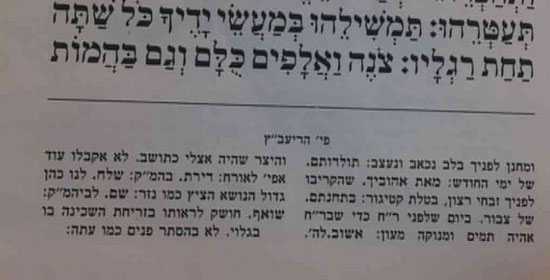
The phrase “נא א-ל שלח נושא נזר ראשנו” is also used in the following book which is generally based on Kisvei Yad of Modena found in the Bodleian Library, although this particular Piyut is not from a Ksav Yad. [5]
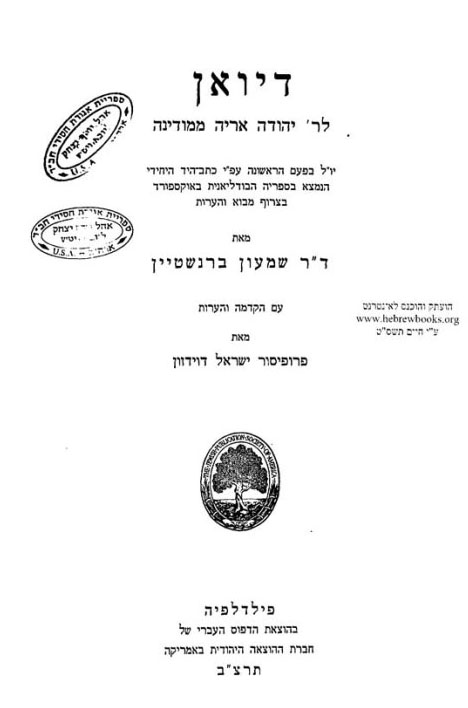
(דיואן – יהודה אריה ב”ר יצחק ממודינא, courtesy of Hebrewbooks.org)

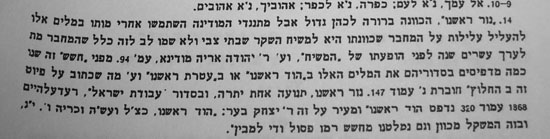
In this book, Professor Simon Bernstein takes on the change in phrase matter and writes[6]:
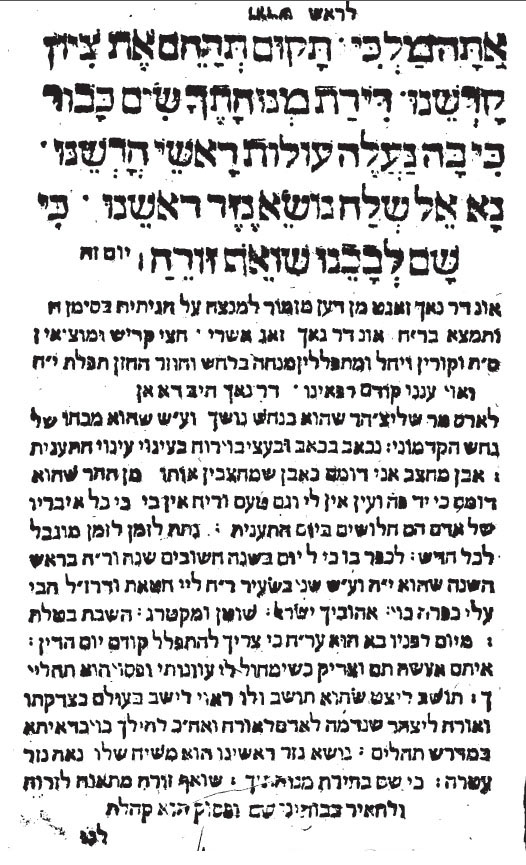
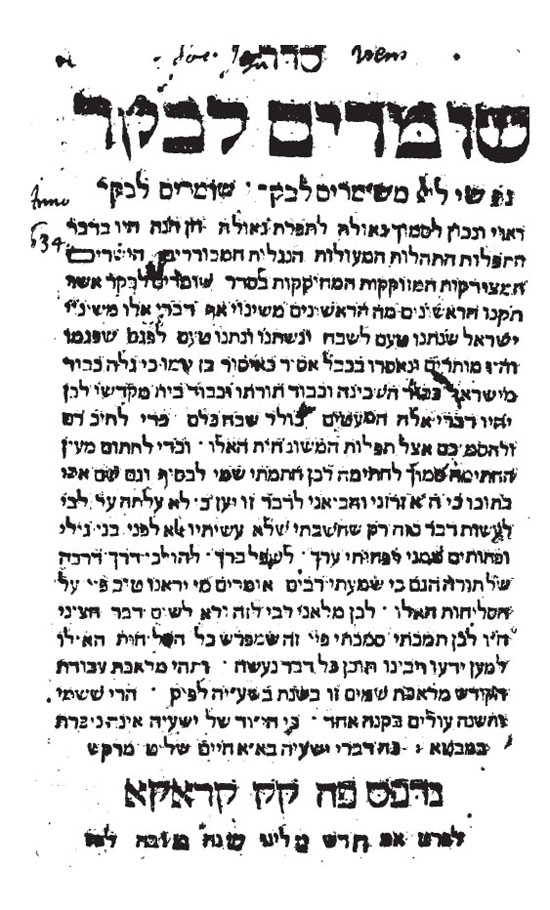
Probably the best proof as to what the original Nusach really was comes from a book named Seder Shomrim LaBoker printed in Cracow in 1626, only 12 years after the Piyyut was probably written.

As you can see, not only is the phrase Nosei Nezer Rosheinu used, the commentary actually explains that it refers to Moshiach and not to the Kohen Gadol (נושא נזר ראשינו הוא משיח שלו נאה נזר עטרה)!
All the many Siddurim that I looked at in the post-1868 period also have the phrase which includes the words Nezer Rosheinu. The new ArtScroll Siddur printed in August of 2010 which includes for the first time the Yom Kippur Kattan service, has the Nussach of Nezer Rosheinu. It seems that in the end, that Nussach won out. The only one I could find who used Hod Rosheinu, following Dr. Baer, was T. Carmi in the Penguin Book of Hebrew Verse (1981):
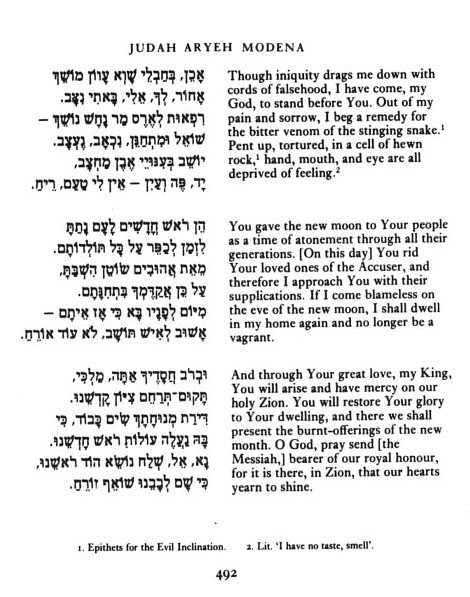
I am not sure what Dr. Baer’s main reason for changing the Nussach from what seems was the normative one. Could it have mainly been the fixing of the meter and the Shabettai Zvi issue was brought along Agav Urchay?[7] He introduces his comment on his version of the text with the abbreviation כצ”ל . Does this mean that he had a written source for his version? In the introduction to his Siddur, Dr. Baer lists more than 25 post-1650 Siddurim that he consulted in the process of putting together his work. I am curious as to why he did not cite a source for this textual variation. As stated by Rav Apfel and Dr. Bernstein, it is clear that this phrase when written in 1614, did not originally refer to Shabbetai Zvi who didn’t “appear” until a few decades later. Was Dr. Baer reacting to a later development in history and changing the past to reflect the present? We have seen that quite often lately, and example of which was pointed out by Dr Shnayer Leiman above: “What really needs to be noted is that in a recent edition of קיצור של”ה (Ashdod, 1998), the offensive phrase has been censored and replaced”

[1] Encyclopedia Judaica, Keter Publishing House, Jerusalem, 1972. Article entitled “Epstein, Jehiel Michal Ben Abraham Ha-Levi” attributed to Dr. Yehoshua Horowitz
[2] Ibid.
[3] This matter is in contention and is based on the question of when the book was first printed. S. wrote me “When was the Kitzur first published? Like the Encylopedia Judaica, many sources state that the book was first published in 1683, Steinschneider contends that it was published in 1693. He claims that this is what the chronogram on the title page adds up to. Since this is a dispute about a yud, my guess is that he is correct. The first significant bibliographer before him, Julius Fuerst (Bibliotheca Judaica v. 1 pg. 246 under Eppstein) listed the year 1683. However, shortly afterward Steinschneider cataloged the Hebrew books in the Bodleian Library and there he writes that it’s 1693. He not only bases this on the chronogram, but also on the content of the haskamos. Following him is the next significant Jewish bibliographer, Isaac Benjacob, who in his Otzar Ha-seforim (pg. 535) agrees with Steinschneider. Whether or not Benjacob saw the book, I cannot say, but Steinschneider obviously did.

“What makes this interesting is that if this is true, then the Kizur Ha-shelah was actually published three years *after* the Sefer Ben Zion, (which lists actual Pesukim Lishmot Anashim) not seven years before. This would make the Ben Zion the first to list names and pesukim [that we know of so far].”

Be that as it may, here is an excerpt from the page on Names in my Kitzur Shelah (Amsterdam 1707):
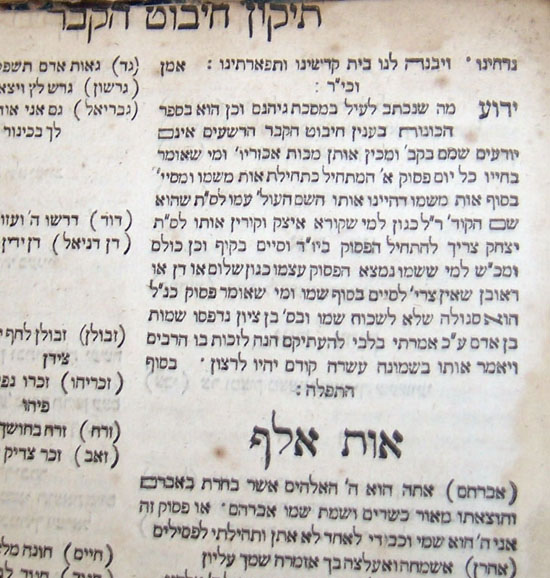
[4] What I find fascinating is that the author of the Encyclopedia Judaica article cited above, completely ignores this point. He writes “It is very doubtful that he (Rav Epstein) had any associations with the Sabbatean movement, although he was suspected of it because of the wording of a certain passage in his Siddur”.
[5] Yom Zeh Yehi Mishkal, which is printed on page 199, is not from Modena’s Divan, which evidently didn’t include this pizmon. Rather, the poem was so famous that the editor evidently thought he simply had to include it. He copied it from a Siddur, the 1845 Prague edition of Seder Tefilat Yisrael edited by Wolfgang Wessely.
[6] In the Introduction to the Divan, Bernstein also writes:
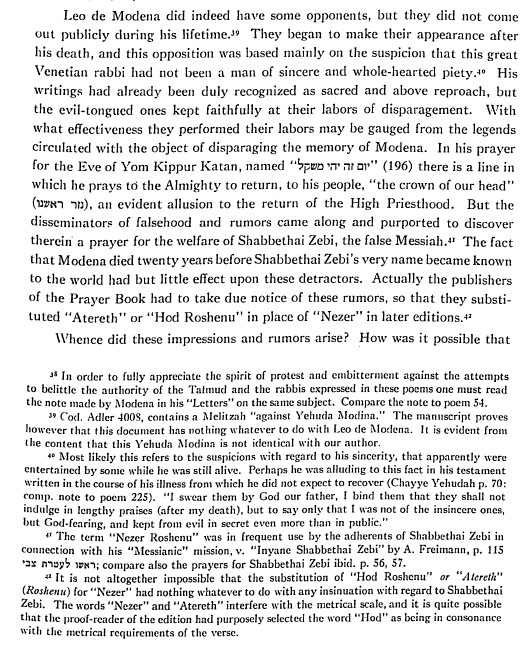
[7] S.’s conclusion was that Dr. Baer’s primary concern was grammatical. There were at least two sources prior to him which alluded to a Sabbatean suspicion about Nezer Rosheinu in Yom Zeh Yehi Mishkal (and both of them reject it as absurd). If the concern was primarily about Sabbatianism, why then didn’t he change Nezer to Keter? The answer must be that this change would not fix the problematic meter, but Hod does. Thus under the cover of removing even a “Shemetz” of a doubt, despite it not even being a real issue, he makes the change which soothes his grammarian’s soul.


Tu Be-Shevat and Sabbatianism

For those interested in a potential link between sabbatianism and Tu be-Shevat, see our early post on the subject here. For other customs that may have sabbatian origins see here.


Tu be-Shevat Sabbatianism

See here for our earlier post discussing the potential linkage between Tu be-Shevat (or Tu B’Shevat)customs and Sabbatianism. See here, here, and here for other customs that may have similar likages. And, finally, see here for a collection of articles on Sabbatianism generally.


Kitzur Shelah, Sabbatianism, and the Importance of Owning Old Books

R. Jacob Emden, in his Torat haKenot claims a well known and fairly popular book is written by a Sabbatian (a follower of the false-Messiah Sabbatai Zevi). This book, Kitzur Shelah, authored by R. Yehiel Michel Epstein, which although its title implies is merely an abridged version of the Shelah (Sheni Luchot HaBrit) by R. Isaiah Horowitz, is much more than that. While the Kitzur Shelah does include some content from the larger Shelah it also includes much else which appears no where in the Shelah. Perhaps the most well-known custom to come out of the Kitzur Shelah is the custom to recite a verse which beginning and end letters of the verse correspond to the first and last letters of ones name. (Although this does have another source as well, the Kitzur Shelah is the first to include actual verses and it is those verses which appear in the siddurim.)

R. Emden claims that R. Epstein makes a reference to Sabbatai Zevi in the Introduction to the Kitzur Shelah. R. Emden’s exact language is “גם רמז על הצוא”ה בהקדמת קשל”ה” [R. Emden uses צואה (excrement) to refer to Sabbatai Zevi in that the numerical value of צואה is the same as צבי]. The Introduction is in fact but a single paragraph and at first glance it would seem to imply that the author was not a follower of Sabbatai Zevi. This is so, as the author expresses his hope that the publication of this book will be a merit for the coming of the Messiah. Such a line implies that the Messiah has not in fact come, which is counter to the idea of Sabbatai Zevi already coming and being the true Messiah.

But, with this, we need to start on our journey through multiple editions of the Kitzur Shelah. Although you will find it nowhere on the title pages of any of the editions, in fact there are at least four different editions of this work. (There was what is known as a מהדורה בתרא of the Kitzur Shelah, however, for our purposes that is irrelevant.) That is, there are at least four distinct versions.

First we need to understand where it is explicit in the Introduction that the author is a follower of Sabbatai Zevi, and for that we must turn to the early editions. In the early editions the very line which discusses the hope for the Messiah appears as follows, ” ויזכו על ידי הספר הזה לראות משי”ח האמ”תי וגם יזכו אל ימו”ת משי”ח.” If you note, you can see that four words contain quotation marks. These marks are the key to understanding R. Emden’s claim. These marks, generally, have two purposes one to signify the use of an abbreviation and the second to indicate that aside from the plain meaning of the word, one should also use the gematria – numerical value of the word. This device is extremely common on title pages of books where verses are used to indicate the date of publication. The words which the printers wish to use have the marks.

In this instance, it is the same. That is, the value of the four words or more specifically, the two sets of two words, are equal to 814 (משי”ח האמ”תי = 814 and ימו”ת משי”ח = 814). Sabbatai Zevi is also equivalent to 814 (שבתי צבי = 814). Thus, the “true Messiah” the author is referencing is in fact Sabbatai Zevi.

Now, in the later editions, these quotation marks were removed. Thus, there is no longer a signal to the reader to use the value of the words. But, it seems the removal was insufficient for some. In at least one edition (Frankfurt am Main, 1745) the entire Introduction was removed.

So we now have three different versions, the early ones with the quotation marks, the later with those removed and the final without the Introduction. In 1998 the Kitzur Shelah was reprinted with some additional notes and nikkud. In this edition it seems it was no longer good enough to just leave out the quotation marks, instead, the text itself was altered. In place of the line we have been discussing in this edition the line reads “ויזכו על ידי הספר הזה לראות ביאת משיח צדקנו.” I have been unable to locate this language in any edition I have checked, thus leading one to believe this change was deliberate to “address” the claim of R. Jacob Emden.

Thus, this is an example of why it pays to own (or at least have access) to multiple editions and that although subtle a minor change can have a major effect. All three versions appear on the side for the reader to see for themselves. The top is a copy of the Amsterdam 1724 edition (which is the same as it appears in the first edition). The second is a photo-mechanical reproduction of the Lember 1862 edition. And the final one is from the 1998 edition. You can click on the picture for a larger version.

Sources: Shnayer Z. Leiman “ספרים החשודים בשתאות: רשימתו של הגאון יעב”ץ זצ”ל” in ספר הזכרון לרבי משה ליפשיץ זצ”ל pp.885-894 esp. n. 12. On the topic of Sabbatianism in books see Naor, Post Sabbatian Sabbatianism


Is Tu-beshevat a Sabbatian Holiday?

There are those who claim the custom to celebrate Tu-beshevat as a holiday is based upon the book Hemdat Yamim. This book, according to many, was either written by Nathan of Gaza (Shabbati Zvi’s “prophet”) or one of follower of Shabbati Zvi. (This is contrary to the assertion in the Philogos that Nathan is not author, a contention which has little to no source). In Ha’aretz, an article appeared with this contention, namely the source for the Tu-beshevat custom is Sabbatian or as the headline reads “The New Year for the Trees, Isn’t is Shabbati Zvi.”

However, a closer look at the history reveals, that although some of the customs on Tu-beshevat can be traced to Hemdat Yamim the actual celebration dates much earlier. Avraham Ya’ari, the noted bibliographer, in an article traced the history of Tu-beshevat. He explains that much of the early mentions of Tu-beshevat were only in the negative, i.e. one can’t fast or say tachanun. Obviously, the first mention is in the Mishna in Rosh Hashana which states, according to Bet Hillel, Tu-beshevat is the new year for trees. The new year does not conotate a New Years like celebration, instead, this only has implications for questions of tithing. One can’t tithe fruits from one year using a different years fruits. Thus the 15th of Shevat is the cut off point.

Ya’ari, however, notes the first mention in connection to a celbration or the like is in the 16th century. Specifically, R. Issachar ibn Susan (c. 1510-1580) in Ibur Shanim, published in 1578 (the book was published earlier, in 1564, this was done without the knowledge or R. Issachar and according to R. Issachar, with numerous errors) he mentions “the Ashkenazim have the custom [on Tu-beshevat] to eat many fruits in honor of the day.” Mention of this custom also appeared in a Jedeo-German Minhagim book first published in 1590. “The custom is to eat many fruits as it is the New Year of the trees.”

In the community of Worms there was a rather interesting permentation of the custom. As R. Jousep Schammes in his Minhagim de Kehilah Kedosha Vermaysa, states:

On Purim and the 15 of Av and Shevat these were vacation days for the Rabbis, especially the 15ht and the 33rd day of the Omer for the students and their teachers. On these days the students did not go to school nor did the teachers go in. The teachers were required to distribute to the students as they left that morning, on the 15th and the 33rd day of the Omer whiskey and sweet cake from the teachers’ own pocket, they should not charge the students, this is the custom.


He repeats this in his comments to the 15th of Shevat. “One doesn’t say tehina even during the morning prayer. It is a vacation day for the students and the teachers, especailly the younger students, it is a holiday for the teachers. The custom is for the teachers to distribute whiskey to the students and make merry with them.”

While we have shown there was a custom for those Ashkenazim to celebrate Tu-beshevat, amongst the Sefardim, it is correct the source is Hemdat Yamim. Hemdat Yamim, first published in 1732 anonymously has the entire seder for Tu-beshevat. This includes passages from the Bible as well as specific foods. This in turn was popularized to a greater degree when it was included in the book Pri Etz Hadar first published in 1753 and republished an additional 29 times by 1959. This book included the entire Hemdat Yamim service.

So at the end of the day, although some of the customs of Tu-beshvat may come from the Hemdat Yamim he clearly is not the only or the first source for celebrating Tu-beshevat.

For more on the Hemdat Yamim, a controversy that has recently been stirred up again with the republication by R. Moshe Tzuriel of the Hemdat Yamim with an extensive introduction. Additionally, Ya’ari has a book Talmuot Sefer which his conclusion has been disproven by Tishbi in his Nitvi Emunah U’Minut. R. Tzuriel’s publication engendered the publication of a small pamphelet Hemdat Yosef as well as a bunch of articles in the journal Hechal HaBeshet. Rabbi Dr. Leiman in his latest article in Ohr haMizrach has a footnote with all the citations. [R. Dr. Leiman’s article collects all of R. Y. Eybeschit’s and R. Y. Emden’s approbations].

Also, anyone can get a copy of Hemdat Yamim. There are two places on the web where it is available free. The first is at the Jewish National Libraries site for rare books online here. For this one you need to download their viewer. Or at SeforimOnline.org (which for some reason is not online as I write this). Who has it in PDF format?

Additionally, Ya’ari has an article on the piyutim for Tu-beshevat here.


Collection of Articles on Sabbatianism Online

The book The Sabbatian Movement and Its Aftermath: Messianism, Sabbatianism and Frankism, edited by Rachel Elior, is available online, in its entirety, for free (see here).

The book includes articles by Elisheva Carlebach, “The Sabbatian Posture of German Jewry,” Jacob J. Schacter, “Motivations for Radical Anti-Sabbatiansim: The Case of Hakham Zevi Ashkenazi,” as well as an excellent article in Hebrew by Moshe Fogal “Sabbatianism of the book Hemdat Yamim: A New Exploration.”