Young Rabbis and All About Olives

Young Rabbis and All About Olives

Marc B. Shapiro
I am currently working on a book focused on the thought of R. Kook, in particular his newly released publications. A book recently appeared titled Siah ha-Re’iyah, by R. David Gavrieli and R. Menahem Weitzman. It discusses a number of important letters of R. Kook. In addition to the analysis of the letters, each of the letters is printed with explanatory words that make them easier to understand. We are also given biographical details about the recipients of R. Kook’s letters. Here is the title page.
In reading the book, I once again found myself asking the question, how can intelligent people sometimes say nonsensical things? On p. 252 the book states that R. Menahem Mendel Cohen studied in yeshivot in Tiberias and Safed, and was appointed as chief rabbi of the Ashkenazic community of Cairo in 1896 when he was only ten years old!
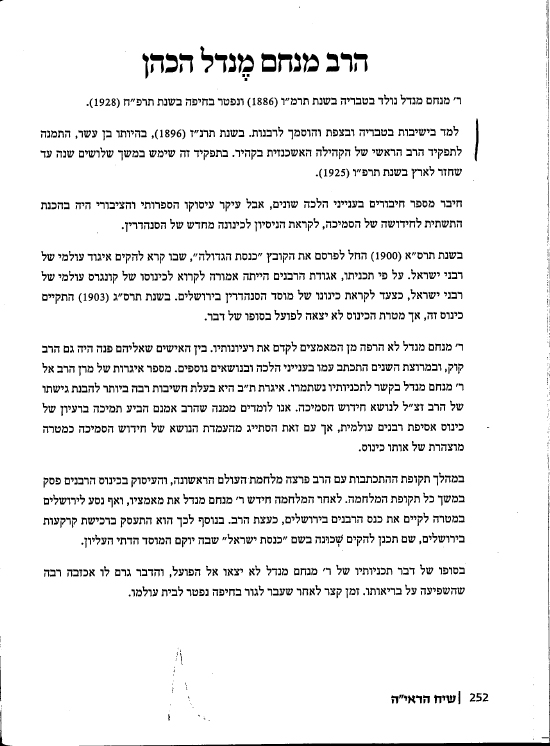
How is it possible for anyone to write such a sentence, that a ten-year-old was appointed as a communal rabbi? Let me explain what happened here, but first, I must note that the name of the man we are referring to is not R. Menahem Mendel Cohen, but R. Aaron Mendel Cohen. Here is his picture, which comes from a very nice Hebrew Wikipedia article on him.
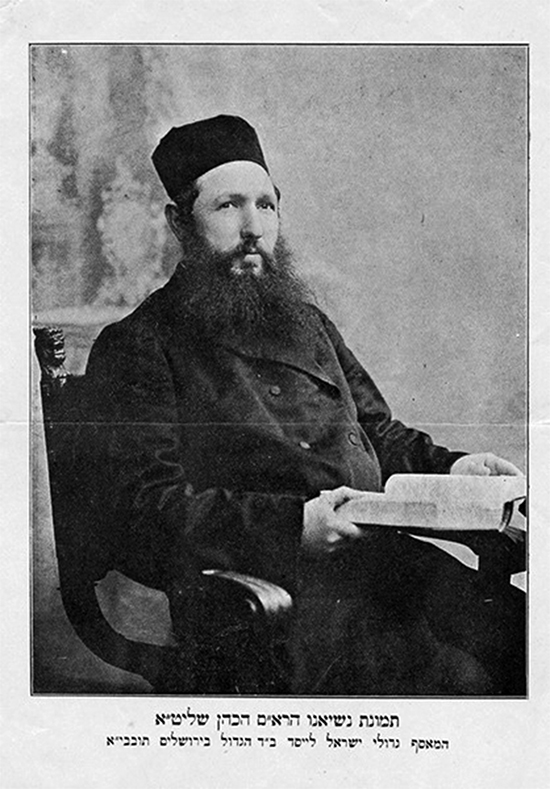
As for R. Cohen being appointed rabbi at age ten, whoever prepared the biographical introduction must have had a source which mistakenly stated that R. Cohen was born in 1886. Since this source also said that he became rabbi in Cairo in 1896, this means that he was ten years old was he was appointed rabbi. Yet we can only wonder how the authors did not see the obvious impossibility of a ten-year-old being appointed rabbi of Cairo, which should have led them to investigate a little further. Simply by googling R. Cohen’s name in Hebrew, the Wikipedia article will come up, and it tells us that R. Cohen was born not in 1886 but in 1866. Thus, instead of a ten-year-old rabbi he is now thirty years old.

With regard to young rabbis, let me repeat, with some slight edits, something I wrote in an earlier post here.

In terms of young achievers in the Lithuanian Torah world, I wonder how many have ever heard of R. Meir Shafit. He lived in the nineteenth century and wrote Sefer Nir, a commentary on the Jerusalem Talmud, when not many were studying it. Here is the title page of one of the volumes, where it tells us that he became rav of a community at the age of fifteen.

The Hazon Ish once remarked that the young Rabbi Shafit would mischievously throw pillows at his gabbaim![1]

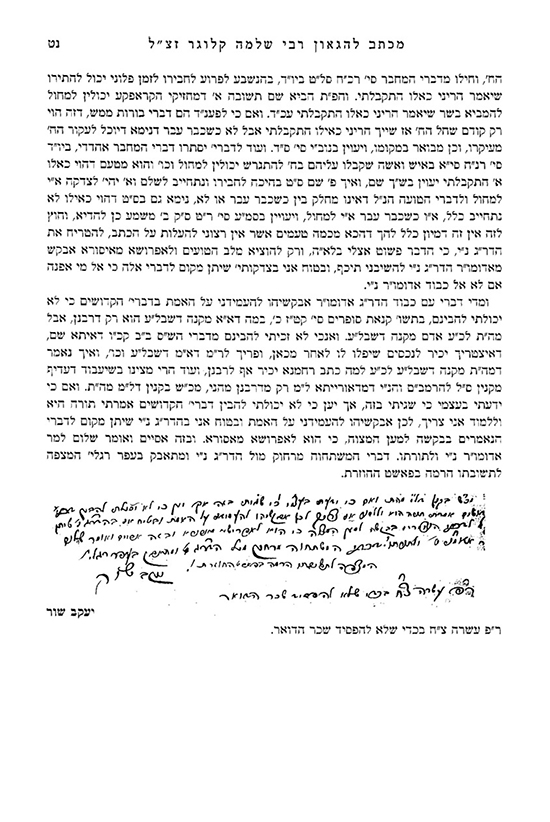
Regarding R. Jacob Schorr [mentioned earlier in the original post] being a childhood genius, this letter from him to R. Shlomo Kluger appeared in Moriah, Av 5767.
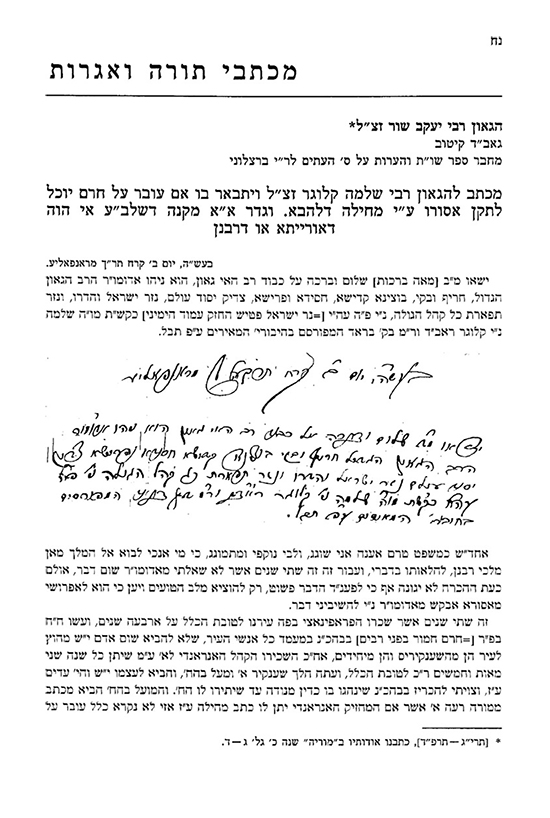
As you can see, the letter was written in 1860 (although I can’t make out what the handwriting says after תר”ך). We are informed, correctly, that R. Schorr was born in 1853, which would mean that he was seven years old when he wrote the letter. This, I believe, would make him the greatest child genius in Jewish history, as I don’t think the Vilna Gaon could even write like this at age seven. Furthermore, if you read the letter you see that two years prior to this R. Schorr had also written to R. Kluger. Are there any other examples of a five-year-old writing Torah letters to one of the gedolei ha-dor? From the letter we also see that the seven-year-old Schorr was also the rav of the town of Mariampol! (The Mariampol in Galicia, not Lithuania.) I would have thought that this merited some mention by the person publishing this letter. After all, R. Schorr would be the only seven-year-old communal rav in history, and this letter would be the only evidence that he ever served as rav in this town. Unfortunately, the man who published this document and the editor of the journal are entirely oblivious to what, on the face of things, must be one of the most fascinating letters in all of Jewish history.

Yet all that I have written assumes that the letter was actually written by R. Schorr. Once again, we must thank R. Yaakov Hayyim Sofer for setting the record straight. In his recently published Shuvi ha-Shulamit (Jerusalem, 2009), vol. 7, p. 101, he calls attention to the error and points out, citing Wunder, Meorei Galicia, that the rav of Mariampol, Galicia was another man entirely, who was also named Jacob Schorr.

This is what I wrote in the prior post. Let me now add some additional information about R. Shafit, the fifteen-year-old communal rav. The first thing I want to point out relates to the city in which R. Shafit became rav at age fifteen. If you look at the title page you can see that its name is מיצד. This is actually an alternate way of spelling the city which is better known as מייצ’ט. Anyone who knows their Lithuanian rabbinic history will recognize this city as Meitchet (Molchad in English), made famous by the great R. Solomon Polachek, known as the Meitcheter Iluy. (R. Polachek was not actually born in Meitchet, but in a small town nearby.) There is so much to say about R. Polachek, but it will have to wait for a future post.

Returning to R. Shafit, although he is hardly a household name, in his day he was actually quite a well-known rabbi. He contributed to R. Israel Salanter’s journal Tevunah,[2] and those who study the Jerusalem Talmud know that his commentary is a very important work.[3] R. Adin Steinsaltz, who is from R. Shafit’s family, even took time away from his own work on the Talmud to publish from manuscript a commentary of R. Shafit on the Jerusalem Talmud. Here is the volume that appeared in 1979.
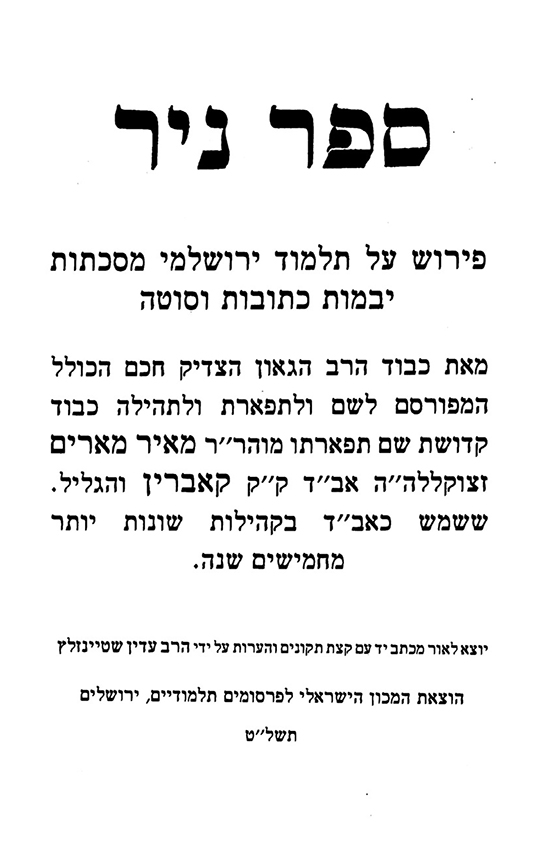
 

In the preface, R. Steinsaltz writes:

כל החכמים הלומדים בירושלמי בכל השיטות, למן חכמי בית המדרש נוסח ליטא העתיקה עד לאנשי המדע המובהקים, כולם כאחד הודו שפירוש “הניר” הוא מחשובי הפירושים שנכתבו אי פעם על התלמוד הירושלמי
I do not need go into more detail on R. Shafit since in 2014 Hillel Rotenberg published an entire book on him.[4] And while it is true that, as mentioned already, R. Shafit is not a household name, there are today people who celebrate his hillula. See here. In case you are wondering what a Lithuanian rabbi is doing with a hillula, R. Shafit was actually a Slonimer Hasid.

In response to my earlier comments about the young R. Shafit, Seforim Blog contributor R. Ovadiah Hoffman sent me another example of a young rabbi: Avigdor Aptowitzer. Aptowitzer, who was one of the twentieth-century’s leading academic scholars of rabbinic literature, is best known as the editor of R. Eliezer ben Joel Halevi’s halakhic work Ra’avyah, concerning which he published another important volume as an introduction to the Ra’avyah, and a book called Hosafot ve-Tikunim le-Sefer Ra’avyah (Jerusalem, 1936). 

According to Abraham Meir Habermann, when Aptowitzer was around seven years old his father, the rabbi of Tarnopol, became ill. Young Avigdor took the place of his father as rabbi. During the week he taught students and on Shabbat people carried him to the synagogue so that he could deliver the derashah.[5] As far as I know, this makes Aptowitzer the youngest person ever to serve as a communal rabbi, even though he was never officially appointed to the position.

It is also reported that R. Shimon Sofer, the son of R. Abraham Samuel Sofer (the Ketav Sofer), was so learned as a child that he received the title חבר from R. Judah Aszod when he was only nine years old.[6]

In speaking about young rabbis, it is also important to mention a passage in R. David Abudarham’s[7] commentary on the Haggadah, s.v. אמר רבי אלעזר הרי אני כבן שבעים שנה. Abudarham cites the Jerusalem Talmud, Berakhot 4:1, that R. Elazar ben Azariah was appointed nasi of the Sanhedrin at age 13. Our version of the Jerusalem Talmud has “age 16”, but the version cited by Abudarham appears in other early sources.[8]

Regarding age 16, R. Solomon Ibn Gabirol wrote his azharot for Shavuot when he was that old. At the beginning of the azharot he wrote (with great self-confidence, I might add):[9]

והנני בשש עשרה שנותי ובי שכל כמו בן השמונים
Avodah Zarah 56b tells about a child who learned Tractate Avodah Zarah when he was six years old. The Talmud describes how he was asked halakhic questions on the tractate, and his replies apparently signify that he was deciding halakhic matters at the age of six.

He was asked, ‘May [an Israelite] tread grapes together with a heathen in a press?’ He replied, ‘It is lawful to tread grapes together with a heathen in a press.’ [To the objection] ‘But he renders it yein nesekh [10] by [the touch of] his hands!’ [he answered], ‘We tie his hands up.’ [To the further objection] ‘But he renders it yein nesekh by [the touch of] his feet!’ [he answered], ‘Wine touched by the feet is not called nesekh.’  

Although not an example of a child rabbi, I think it is worthwhile to mention R. Jacob Berab’s statement that when he was only eighteen years old, and did not yet have a beard, he was the rabbi and halakhic authority for a community of 5000 families in Fez.[11]

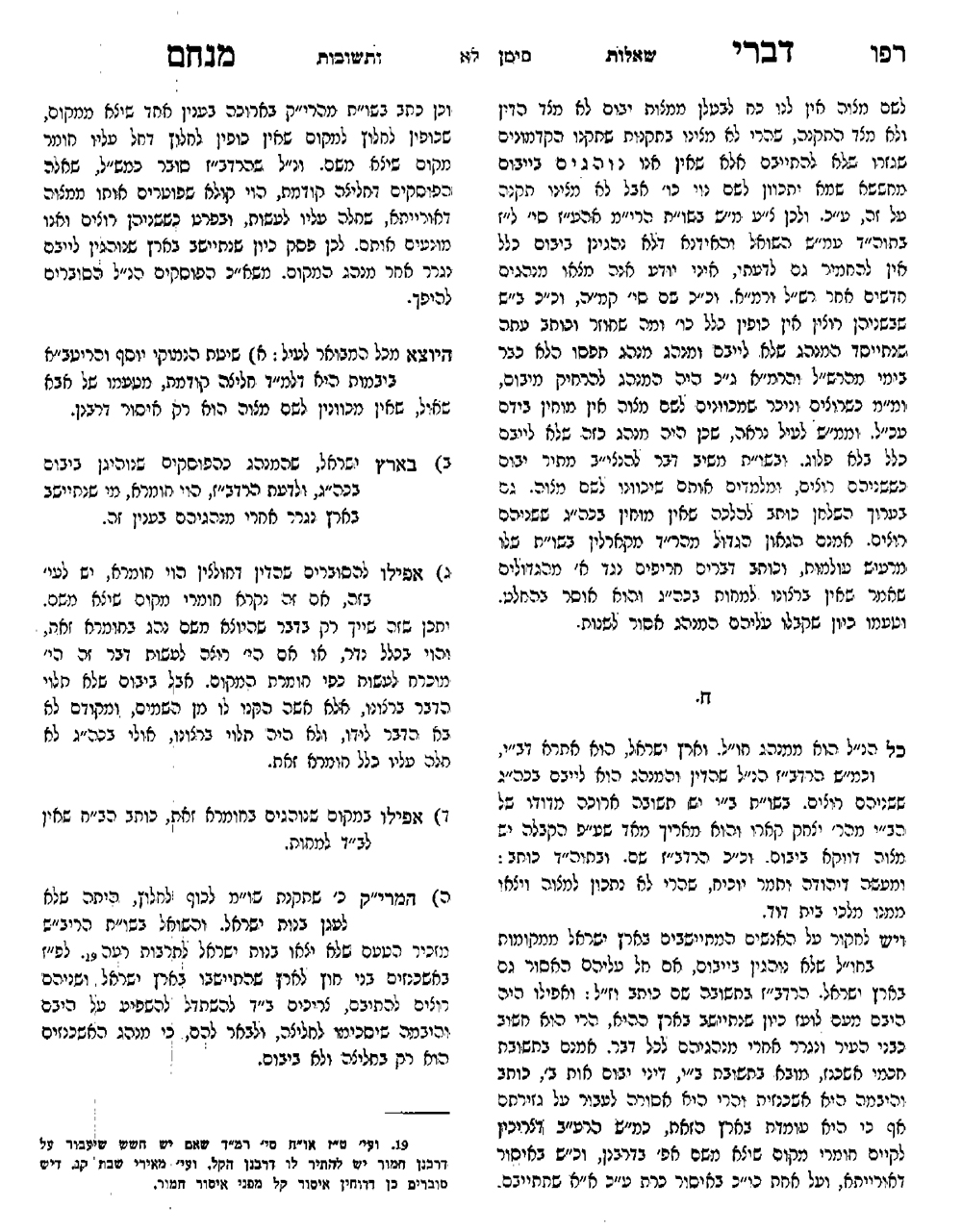
Returning to Aptowitzer, R. Meir Mazuz directs a comment at him in a recent issue of his weekly Bayit Ne’eman.[12] In discussing the proper size of a kezayit, R. Mazuz notes that the Ashkenazic rishonim did not have any personal knowledge of olives, and thus did not know how big they were.[13] He cites R. Eliezer ben Joel Halevi, the Ra’avyah, who writes as follows:[14]

וכל היכא שצריך כזית צריך שיהיה מאכל בהרווחה, לפי שאין אנו בקיאין בשיעור זית כדי, שלא תהיה ברכה לבטלה
You cannot get any clearer than this that R. Eliezer, who lived throughout Germany, had no idea how big an olive was.[15] Yet in Aptowitzer’s note to the words לפי שאין אנו בקיאין בשיעור זית, he writes:

כלו’ אלא ע”י מדידה וחשבון, וכאן שבברכה אחרונה אנו עסוקין וכבר אכל ואי אפשר לחשוב ולמדוד, לכן יזהר שיאכל מתחילה שיעור גדול שאין להסתפק בו שהוא כזית
He explains the Ra’avyah to be saying that we do not know how large our portion of food is without measuring it. Since we are dealing with the final blessing and the food is already eaten and thus can no longer be measured, people should eat enough so that there is no doubt that they ate an olive’s worth and thus no problem with a berakhah le-vatalah.

It is hard to understand how Aptowitzer could have written something so obviously incorrect, as there is no doubt as to the passage’s meaning. R. Mazuz writes:

איזה “חכם”, שנכון שאחרי שכבר אכל את הזית לא יכול למדוד, אבל לפני שאכל הוא רואה את הגודל אז למה צריך לאכול בהרווחה?! אלא לא היו מכירים את הזיתים
Here is something else relevant to Aptowitzer. Nahmanides, Commentary to Genesis 31:35, writes (Chavel translation):

The correct interpretation appears to me to be that in ancient days menstruants kept very isolated for they were ever referred to as niddoth on account of their isolation since they did not approach people and did not speak to them. For the ancients in their wisdom knew that their breath is harmful, their gaze is detrimental and makes a bad impression, as the philosophers have explained. I will yet mention their experiences in this matter. And the menstruants dwelled isolated in tents where no one entered, just as our Rabbis have mentioned in the Beraitha of Tractate Niddah: “A learned man is forbidden to greet a menstruant. Rabbi Nechemyah says, ‘even the utterance of her mouth is unclean.’ Said Rabbi Yochanan: ‘One is forbidden to walk after a menstruant and tread upon her footsteps, which are as unclean as a corpse; so is the dust upon which the menstruant stepped unclean, and it is forbidden to derive any benefit from her work.’”

Baraita de-Masekhet Niddah is a strange work, with all sorts of extreme statements not found in mainstream rabbinic literature. This is not the place to review in any detail the various scholarly views about the text’s origin.[16] Suffice it to say that Saul Lieberman thought that the author was a sectarian, but not a Karaite.[17] Aptowitzer, however, took issue with Lieberman and argued that Baraita de-Masekhet Niddah is a Karaite forgery designed to insert Karaite views into the Rabbanite community, and also to make the Sages look like fools. As an example of the latter, Aptowitzer quoted the “halakhah” recorded in Baraita de-Masekhet Niddah that a kohen whose family member – by which it means one he lives with – is a niddah cannot offer a sacrifice or perform birkat kohanim.[18] Aptowitzer concluded that it is “very unfortunate” that some rishonim were misled by this forgery, thinking it an authentic work.[19]

Aptowitzer’s work, Mehkarim be-Sifrut ha-Geonim, in which he expressed this judgment, was published by Mossad ha-Rav Kook. R. Hayyim Dov Chavel also published his commentary on Nahmanides with Mossad ha-Rav Kook, and on the just-mentioned passage of Nahmanides to Genesis 31:35, R. Chavel quotes Aptowitzer’s view.

It is easy to see why, from a traditional perspective, what Aptowitzer said is problematic. After all, he posits that Nahmanides, one of the greatest of the medieval sages, was taken in by a heretic’s forgery. His apology, as it were, that Nahmanides and other medieval sages were not critical scholars, and thus it is not a cause for wonder that they were fooled in this matter, is not the sort of thing that will be seen as respectful in traditional circles. It is one thing to write about more recent sages being fooled by Besamim Rosh and the Yerushalmi on Kodashim, but when dealing with a figure like Nahmanides such a position is bound to be more controversial.

This is exactly what happened, and R. Chavel must have been subjected to criticism for citing Aptowitzer in this matter. In the second edition of his commentary, vol. 1, p. 554, R. Chavel backtracks from what he wrote. Had he been able to reset the type and delete the entire note from the text of the commentary I am sure he would have done so. However, he had to settle for a comment in the hashmatot u-miluim, which most people never bother to look at. He writes as follows:

על דעת בקורתית זו יש להוסיף: אף כי חכם גדול היה ר’ אביגדור אפטוביצר, ונאמן רוח לתורה ולחכמה, נתפס כאן לסברה בעלמא, שלא שזפה עינו החדה כי הברייתא הזאת (ברייתא דמסכת נידה) היא עדות מוכחת עד כמה גידרו קדמונינו עצמם להתרחק מטומאת הנדה. כטומאת הנדה היתה דרכם לפני (יחזקאל לו, יח). ואף שלא היו הדורות נוהגים למעשה בכל החומרות הנזכרות בברייתא זו, הלא כבר כתב ה”חתם סופר” [או”ח  סי’ כג] שאולי נשתנו הטבעים והמקומות, או כיון שדשו בה רבים שומר פתאים ה
As readers can see, R. Chavel’s point is completely dogmatic without any scholarly argument. 

Returning to Nahmanides’ comment to Genesis 31:35, he tells us that he will have more to say on this matter. This is found in his commentary to Leviticus 18:19, where he writes that the blood of menstruation “is deadly poisonous, capable of causing the death of any creature that drinks or eats it.” He further states:

If a menstruant woman at the beginning of her issue were to concentrate her gaze for some time upon a polished iron mirror, there would appear in the mirror red spots resembling drops of blood, for the bad part therein [i.e., in the issue] that is by its nature harmful, causes a certain odium, and the unhealthy condition of the air attaches to the mirror, just as a viper kills with its gaze.

I find it noteworthy that such a great figure as Nahmanides, who was also a doctor, was able to be taken in by these fairy tales. He certainly had never seen any red spots showing up on a mirror so why did he believe such a story without attempting to confirm its accuracy himself? I realize that in medieval times people were much more credulous, and repeated all sorts of far-fetched things that they heard.[20] Nahmanides himself repeats that people in Germany would make use of demons, and he had no reason to doubt this report.[21]

שמעתי בבירור שמנהג אלמניי”ו לעסוק בדברי השדים ומשביעים אותם, ומשלחים אותם ומשתמשים בהם בכמה ענינים
He also believed a report that travelers to the east had discovered the Garden of Eden, but were then killed by the flaming sword that guards the Garden.[22]

 ובספרי הרפואות היונים הקדמונים, וכן בספר אסף היהודי סיפרו כי אספלקינוס חכם מקדוני וארבעים איש מן החרטומים מלומדי הספרים הלכו הלוך בארץ ועברו מעבר להודו קדמת עדן למצוא קצת עלי הרפואות ועץ החיים למען תגדל תפארתם על כל חכמי הארץ, ובבואם אל המקום ההוא ויברק עליהם להט החרב המתהפכת, ויתלהטו כלם בשביבי הברק, ולא נמלט מהם איש
However, when dealing with red spots on a mirror this was something that Nahmanides could have easily confirmed, and yet instead he relied on what he heard, or perhaps read. In seeking to understand how Nahmanides could have been misled in this matter, it helps to be reminded of Bertrand Russell’s famous comment made with reference to Aristotle’s assertion that men have more teeth than women.

To modern educated people, it seems obvious that matters of fact are to be ascertained by observation, not by consulting ancient authorities. But this is an entirely modern conception, which hardly existed before the seventeenth century. Aristotle maintained that women have fewer teeth than men; although he was twice married, it never occurred to him to verify this statement by examining his wives’ mouths.[23]

Returning to the matter of olives, it is noteworthy that the halakhic authorities, including those in the twentieth and twenty-first centuries, who argued that olives have shrunk since the days of the Sages did not actually seek to prove this with historical evidence. Had they done so they would have found that the size of olives has not changed. However, concerning another measurement we find that the Steipler was indeed interested in what the historical record revealed. R. Avrohom Marmorstein and Jacob Djmal both called my attention to a letter of the Steipler that was recently up for auction. Here is the item from Kedem’s January 2018 auction catalog (catalog no. 59), pp. 269-270 (item no. 298).

This letter already appeared in Aleh Yonah (Jerusalem-Bnei Brak, 1989), p. 134.
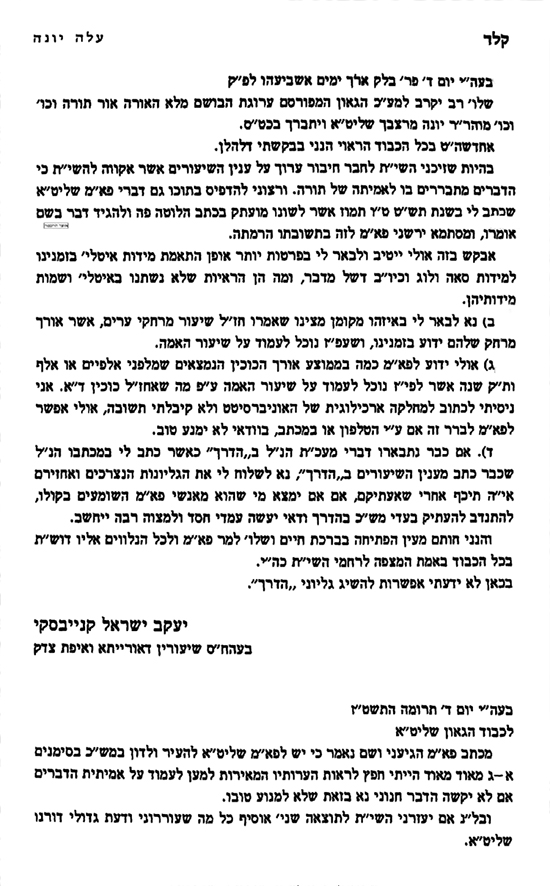
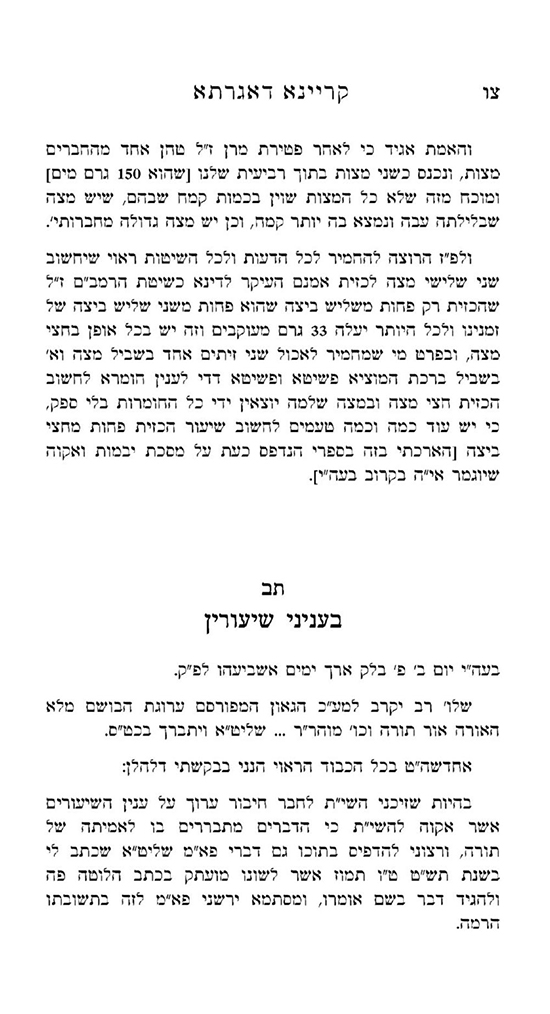
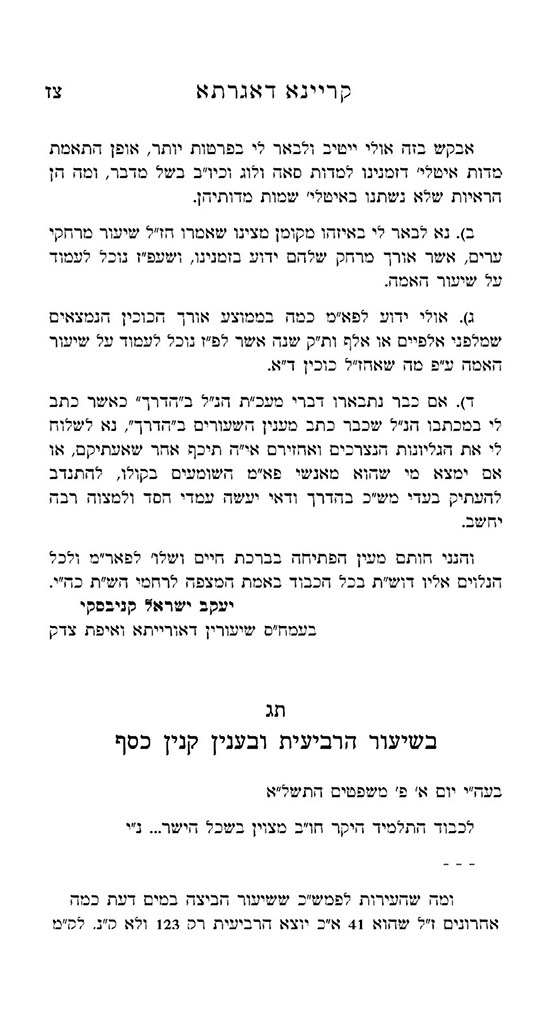
We see that in trying to determine the size of a cubit, the Steipler actually wrote to the archaeology department at “the university” (i.e., Hebrew University). This sort of effort is exactly what is required when trying to investigate a matter such as this. Yet look what happened when this letter was published in the Steipler’s Karyana de-Igarta, vol. 2, no. 402. The section showing that the Steipler reached out to the academic world was simply deleted, with no indication given that anything has been removed from the letter.
Finally, it is worth mentioning the Hazon Ish’s position that although the various measurements go back to Sinai, the actual size of the measurements required in order to fulfill an obligation was established by the Sages. In other words, while the measurement of a kezayit is mi-deoraita, how big this olive is – as there are different size olives – was given to the Sages to be determined.[24]

וכשנאמרו שיעורין בסיני נאמרו על האומד ומה שנראה לו לאדם זהו שיעורו, ואמנם הדבר מסור לחכמים לקבוע גדרי השיעור לכל ישראל וכמו שאמרו חכמים כזית שנאמרו זה אגורי כשעורה זו מדברית כעדשה זו מצרית לא שנאמרה למשה כך אלא נאמרה סתם והיא הבינונית אלא חכמים עיינו בדבר וקבעו לכל ישראל שכזית אגורי ושעורה מדברית ועדשה מצרית הם הבינונים, וכשם שמסור לדעתו של רואה להכריע על הבינוני של הפרי בין חביריו הגדולים והקטנים כן מסור לחכמים לקבוע את המדידה שיש להגיד עליה שפירותיה הם הבינונים בהגלילים והארצות השונות
Regarding the kezayit measurement, there is one other point worth mentioning. Everyone knows that one is required to eat a kezayit of maror at the Seder. Nevertheless, the practice of the Ropshitz hasidim used to be precisely the opposite, as they were careful not to eat a kezayit of maror. This strange practice goes back to the founder of the Ropshitz dynasty, R. Naphtali Zvi Horowitz (1760-1827). (I don’t know if the practice continues today.) Not only is the lack of a kezayit problematic, but there is the other issue regarding whether one can even say a blessing on the maror with less than a kezayit

R. Aryeh Zvi Frommer deals with Ropshitz practice, and also mentions that he heard that R. Shalom of Belz and R. Ezekiel of Shinova also told people to eat less than a kezayit of maror and to make the blessing on it.[25] R. Frommer attempts to justify this practice halakhically, and he states explicitly that he is doing so in order that the actions of these hasidic masters not be in contradiction to the Mishnah, Pesahim 2:6, the meaning of which appears to be that a kezayit is the minimum amount required for maror.[26] He also notes that he wants to justify the practice of “most of Israel” who use horseradish for maror and also do not eat a kezayit. His justification is only of eating less than a kezayit of horseradish, so it does not seem that this will be of any help with regard to the view of the Ropshitzer, as his avoidance of a kezayit of maror apparently applied to all types of maror, even lettuce. 

Many people probably remember their grandparents telling them that in Europe they used horseradish for maror, but that unlike today there was no concept of being careful to eat a kezayit. If you had any doubts about what your grandparents reported, R. Frommer tells us the exact same thing. Are we to say that most Jews in Europe did not fulfill the mitzvah of maror? This is a conclusion that no rabbi wants to reach, and that is why R. Frommer is motivated to find some justification for the practice.

כנלע”ד ליישב דברי הצדיקים ז”ל שלא יסתרו למשנה מפורשת הנ”ל וליישב מנהג רוב ישראל שאוכלין למרור חריין פחות מכזית ומברכין עליו על אכילת מרור
R. Frommer was obviously concerned that what he wrote would be regarded as too radical. Thus, on the very last page of the book, where one finds the corrections, he stressed that his words were only a limud zekhut because most people do not eat a kezayit, but le-khathilah one cannot rule this way.

כ”ז כתבתי רק דרך למוד זכות מחמת שרוב ההמון ונשים נוהגין כן אבל לכתחלה אין להורות כן וכ”מ באבני נזר סי’ שפ”ג

R. Frommer has another relevant comment on this matter:[27]

ביום ג’ שמות חלם לי, שהגידו לי בשם הרה”צ ר’ פינשע ז”ל מפילץ דאף מי שמגיע לו יסורים ר”ל, סגי ביסורים כ”ש [כל שהוא], דלא עדיף ממרור דלא בעי כזית, ומה”ת סגי במשהו כמ”ש הרא”ש פ”י דפסחים סי’ כ”ה, כמו בזה סגי במשהו
There is no need for me to go into this matter in any detail, as it has been comprehensively analyzed in a wonderful article by Levi Cooper.[28] I would just like to call attention to some sources not mentioned by Cooper. 

1. R. Mordechai Shabetai Eisenberger, Berurei Halakhot (Netanya, 2006), no. 51, offers a halakhic justification for the Ropshitzer, and claims that it is only applicable to horseradish.

2. The following story, quoting R. Aaron Rokeach, the Belzer Rebbe, appears in Aharon Pollak, ed., Beito Na’avah Kodesh (2007), vol. 2, p. 482:

פ”א, בליל הסדר שנת תש”ט, נכח דודי הר”ר יוסף צבי וועבער ז”ל (לאחר שניצל מגיא ההריגה במלחמה  באירופה, וזכה לעלות ארצה אחר החורבן שם), והנה כ”ק מרן זי”ע נתן לו בידו מעט מאוד מה”מרור”. אחד מן הנוכחים שם, הרהיב עוז והעיר למרן זי”ע, ש”זה רק כל שהוא”. נענה מרן זי”ע והתבטא בלשונו “ער האט  שוין געהאט גענוג מרירות”! – (בשם בעל העובדא
3. The following story, that R. Joel Teitelbaum of Satmar refused to follow his father-in-law’s practice of eating less than a kezayit of maror, appears in Aharon Perlow, Otzroteihem shel Tzadikim al ha-Torah ve-ha-Moadim (2006 edition), p. 323, quoting Moshian shel Yisrael, vol. 4, p. 17:

בליל התקדש חג הפסח בעריכת הסדר היה המנהג בבית דזיקוב לברך על אכילת מרור בשיעור פחות מכזית, וכן נהגו גם בפלאנטש. אולם רבינו (כ”ק מרן אדמו”ר מסאטמאר) ז”ל נהג כפשטות לשון הפוסקים וכנהוג בבית אבותיו הק’ לאכול שיעור מרור כזית כדאיפסקא הילכתא. וכשהיה רבינו ז”ל סמוך על שולחן חותנו (מזיוו”ר – הרה”ק רבי אברהם חיים הורביץ מפלאנטש זצוק”ל) לא נתנו לו שיעור מרור כראוי. ורק פחות מכזית – כמנהגם – ולא רצו שרבינו ז”ל יתנהג אחרת ממנהגם. אבל רבינו ז”ל השכיל להכין ולהצניע מראש מקדם בכיס הגלימא שלו שיעור כזית לאכילת מרור, ובעת עריכת הסדר כשהגיע לקיים מצות אכילת מרור אכל רבינו כשיעור
  
4. Matityahu Gutman, Belz (Tel Aviv, 1912), p. 31, states:

רבי יהושע מבלז אמר: אבי היה פוסק, והוא אמר שאין צריך לאכול כזית מרור, ובתשובות הנדפסות בסו”ס אמרי נועם למועדים כותב שמקובל כך מזקנו הק’ מרופשיץ וכן היו נוהגין כל בני ביתו, מחמת אי בריאות

The words I have underlined are how later generations mistakenly attempted to reconcile the practice of the Ropshitzer and his descendants with the halakhah.

Excursus

Another proof that the medieval German sages never actually saw olives is provided by R. Hayyim Benish – the expert in all matters of halakhic measurements and times – in what is still probably the best discussion of the history and halakhah of the kezayit measurement (and he did not need an entire book to make his points). See Benish, “Shiur Kezayit: Berur Da’at ha-Rishonim ve-ha-Aharonim,” Beit Aharon ve-Yisrael 50 (Kislev-Tevet, 5754), pp. 107-116. 

R. Benish calls attention to a medieval Ashkenazic series of halakhic rulings published by Shlomo Spitzer in Moriah 8 (Sivan 5738). On p. 4, in discussing the size of an olive and the problem created by the medieval Ashkenazic assumption that two olives equal one egg, the unknown author writes:

ולי הכותב אינו קשה כי ראיתי זיתים בא”י ובירושלים אפילו ששה אינם גדולים כביצה
From this we see that the medieval Ashkenazic sages did not know what an olive looked like, and because of this they were mistaken in their assumption that two olives equal one egg. The author himself, who had journeyed to Eretz Yisrael and had seen actual olives, was able to correct his Ashkenazic contemporaries. Yet his statement that an olive is not even one sixth the size of an egg is not in line with the Rashba, Torat ha-BayitMishmeret ha-Bayit, Mossad ha-Rav Kook ed., vol. 2, col. 52 (bayit revi’i, sha’ar rishon), who had olives at his disposal and describes them as less than one fourth the size of an olive. (See R. Benish, p. 109, for the common view that according to Maimonides an olive is one third of an egg.) See also R. Jacob Moelin, Sefer Maharil, ed. Spitzer (Jerusalem, 1989), Likutim, no. 55, that whereas two olives equal one egg, three dried figs also equal an egg. In other words, he believed that a fig is smaller than an olive, which could only be said by someone who never saw an olive. Perhaps he never saw a fig either, but the measurement of three figs equaling one egg is held by the geonim and Maimonides. See R. Eliyahu Zini, Etz Erez, vol. 3, pp. 201-202.
There are, of course, different types of olives, and R. Benish, p. 114, has a chart with the different measurements. Regarding the anonymous medieval Ashkenazic author, who stated that an olive is not even a sixth the size of an egg, it is possible that when he returned to Germany he forgot the exact size, and recalled them as being smaller than they actually were.
The editor of Torat ha-Bayit, R. Moshe Brun, finds the Rashba’s statement that an olive is not even a quarter of an egg so significant that he remarks:

חדוש גדול חידש לנו רבינו בהלכות שיעורין, דיותר מד’ זיתים בכביצה
R. Benish concludes that the size of a kezayit is 7.5 square centimeters. Recognizing that this is a good deal smaller than what people are told today, he concludes with the following important words which explain why a kezayit by definition must be a really small size.[29] What he says would appear to be basic to all of the Sages’ measurements, but for some reason I was never taught this in yeshiva:

רבים יתמהו ודאי, האם בשיעור זעיר כל כך מקיימים מצוות אכילה הכתובה בתורה. תמיה זו יסודה בחוסר הבנה במושג שיעורי תורה בכלל, ובשיעור אכילה בפרט. בסיס השיעורים בכל מקום ומקום הוא השיעור המזערי ביותר שעליו ניתן לומר שיש לו מהות. וכמו שיעור רוחב אגודל במדות האורך – מדה מחייבת בענינים התלויים במדות אורך (כמו לאו דהשגת גבול. ראה רמב”ם הל’ גנבה פ”ז הי”א), ושיעור פרוטה, שיעור מתחייב בממון, למרות שהוא שיעור זעיר ביותר . . , ואם יקדש אשה בשיעורי ממון זה – מקודשת. וכן הוא ה”כזית” – שיעור אכילה: השיעור המיזערי ביותר שיצא מכלל פירור ויש בו חשיבות אוכל . . . ואין תנאי במצות אכילה שיהיה בו שיעור מיתבא דעתא או שביעה
See also Beit Aharon ve-Yisrael 53 (Sivan-Tamuz 5754), pp. 91ff., where R. Benish responds to criticisms of his article. On p. 96 he mentions that one person criticized him by saying that the information he wrote about should not be made public!

והנה אמר לי חכם אחד: לא חידשת במאמרך מאומה, הדברים הינם ידועים, אלא שנאמרו, אפילו ע”י גדולי הפוסקים, מפה לאוזן, ואתה הוצאת זאת שלא כדין ושלא לצורך לרשות הרבים
Finally, no mention of the size of an olive would be complete without referring to R. Natan Slifkin’s essay on the topic available here.
One complicating factor in any discussion of the kezayit is that R. Joseph Karo, Shulhan ArukhOrah Hayyim 586:1, writes:

שיעור כזית יש אומרים דהוי כחצי ביצה
R. Karo knew what an olive looked like, so why in his codification of the Passover laws would he record the view that it is the size of half an egg? Furthermore, why does he ignore the views of R. Isaac Alfasi, Maimonides, and R. Asher who held that a kezayit is less than this? And finally, how come in Orah Hayyim 210 when he discusses the kezayit he does not define it as half an egg? 

These points are all raised by R. Hadar Yehudah Margolin in support of R. Benish’s position that when, in the laws of Passover, R. Karo mentions the view that a kezayit is half an egg, this is only to be regarded as a humra. However, R. Karo himself holds that the basic law is that a kezayit is really the actual size of an olive (which is certainly smaller than half an egg). See Beit Aharon ve-Yisrael 51 (Shevat-Adar 5754), p. 119.

In the recently published De-Haziteih le-Rabbi Meir (Jerusalem, 2018), vol. 1, p. 399, we see that R. Meir Soloveitchik did not like the suggestion that medieval Ashkenazic sages did not know how big an olive was.

אמר על כך הגר”מ שהרי ההגהות מיימוניות (פרק א’ ממאכלות אסורות אות מ’) מביאים שרבינו תם נתקשה בסימני עוף טהור, ואז עף אל שולחנו עוף טהור, ועל ידי זה ידע את הסימנים. ומזה רואים כמה סייעתא דשמיא היה להם שלא יטעו לומר דבר שאינו נכון, וא”כ איך אפשר לומר שכיון שלא ראו זיתים לכן לא ידעו מה שיעור כזית
* * * *

My Torah in Motion 2019 summer trips will be to Morocco, Central Europe, and Greece. Information about them will soon be up on the Torah in Motion website.

Notes

[1] A. Horowitz, Orhot Rabbenu (Bnei Brak, 1991), vol. 1, p. 364. Horowitz adds that he asked the Steipler how they could appoint a fifteen-year-old rabbi when it says in Shulhan Arukh, Hoshen Mishpat that a dayan has to be eighteen-years-old. The Steipler replied that a rabbi is not a dayan, as he only decides halakhic questions and is not on a beit din. Horowitz also asked the Steipler about what appears in the Beit Yosef, that semikhah should not be given to anyone under eighteen. The Steipler replied that this is only a general rule, but there are exceptions.

Regarding eighteen as the minimum age of a dayan, contrary to what Horowitz states, this is actually not recorded as halakhah in the Shulhan Arukh. R. Karo writes as follows inHoshen Mishpat 7:3:

יש אומרים שאינו ראוי לדון אלא מבן י”ח ומעלה והביא שתי שערות. וי”א דמבן י”ג ומעלה כשר ואפילו לא הביא שתי שערות
This is actually a case of יש אומרים ויש אומרים, and according to R. Yitzhak Yosef the general rule in such a case is that the second opinion is the one we accept. See Ein Yitzhak, vol. 3, pp. 438ff. (Kelalim be-Da’at ha-Shulhan Arukh, no. 28).

Sefer Meirat Einayim explains the position that allows a thirteen-year-old dayan as due to the fact that being a dayan is only dependent on חריפותו ובקיאותו .
R. Kook refused to give semikhah to a young man as he believed that semikhah should only be given to one who was knowledgeable in the entire Torah (!). See his responsum published in Peri ha-Aretz 5 (1982), pp. 6-9.
[2] Tevunah (1861), nos. 39, 40.
[3] Sections of this commentary that have not yet appeared in print were recently offered for sale at an auction. See here.
[4] Ha-Gaon ha-Hasid Rabbi Meir Marim Shafit. See also the very nice story about R. Shafit recorded here.
[5] Habermann, Anshei Sefer ve-Anshei Ma’aseh (Jerusalem, 1974), p. 139.
[6] R. Asher Anshel Yehudah Miller, Olamo shel Abba (Jerusalem, 1984), p. 181.
[7] The common pronunciation of his name as “Abudraham” is a mistake. See here.
[8] See R. Menahem Kasher, Haggadah Shelemah, p. 17 n. 141.
[9] Israel Davidson, Otzar ha-Shirah ve-ha-Piyut (New York, 1924), vol. 1, p. 303. As Davidson notes, this is the correct version of the text.
[10] This is how the words are pronounced, not yayin nesekh.
[11] See R. Levi Ibn Habib, Teshuvot, no. 147 (Kuntres ha-Semikhah, no. 4), s.v. ומתחלה. R. Baruch Rabinovich, about whom I have written a good deal in recent posts (and more is to come) was appointed גאב”ד of Munkatch immediately upon his marriage, when he was only eighteen years old. See R. Nathan David Rabinowich, ed., Hashav Nevonim (N.Y.-Jerusalem, 2016), p. 9.

This post deals with young rabbis, not precocious children. However, regarding children wise beyond their years, I just came across the following from R. Hayyim ben Bezalel, Be’er Mayim Hayim (London, 1964), vol. 1, p. 165:

ואני בעודי נער כמו בן ז’ שנים פעם אחת בליל שבת של פרשה זו הסיבו יחד זקנים בעלי הוראה ונתנו ונשאו בזאת הקושיא והייתי מקשיב לקולם לאחר דבריהם אמרתי לחוות דעי גם אני ברשותם . . . והודי לי רבותיי והנהתי להם מאד

[11] No. 99 (18 Shevat 5778), p. 6 n. 35. Regarding R. Mazuz, I think readers will enjoy the song devoted to him that recently appeared.


Here are other songs devoted to him


Here is Lipa Schmeltzer on Sukkot 2018 singing before R. Mazuz and R. Shlomo Amar. The first song he sings is a poem that R. Mazuz wrote about Maimonides.

[13] R. Mazuz also shows that the medieval French sages never saw a date, and this explains why they describe it incorrectly. See Bayit Ne’eman, Orah Hayyim, no. 25 (pp. 135, 137-138).

[14] Berakhot no. 107.
[15] See Excursus.
[16] Interested readers can consult the numerous sources listed by R. Eliezer Brodt, Likutei Eliezer, pp. 38ff.
[17] Sheki’in (Jerusalem, 1939), p. 22.
[18] See R. Moses Sofer, She’elot u-Teshuvot Hatam Sofer, Orah Hayyim, no. 23, who discusses the matter of birkat kohanim, as it is also quoted by Rabad in his commentary to Tamid 33b from Sefer ha-Mikzto’ot. R. Efraim Zalman Margulies, Beit Efrayim, Orah Hayyim no. 6, explains the Ashkenazic practice of not reciting birkat kohanim every day as due to the concern that there might be a niddah in a kohen’s house. With reference to the notion that a kohen does not recite birkat kohanim if there is a niddah in his house, which as just noted is quoted by Rabad from Sefer ha-Miktzo’ot, R. Joseph Kafih writes (commentary to Moreh Nevukhim 3:47, n. 31):

והדעות הללו חדרו גם לשכבות מסוימות של היהדות והחלו להתנהג במנהגותיהם, ראה לדוגמא פירוש הראב”ד למסכת תמיד הפרק האחרון בשם ספר המקצעות
In other words, R. Kafih is in agreement with Aptowitzer that this is an example of sectarian ideas finding their way into the writings of rishonim

The late Yaakov Elman even saw Zoroastrian influence in a practice that would become part of the Niddah laws. He wrote the following here:

As to the non-elitist Babylonian Jews, we have a report regarding the ordinary Babylonian Jewish women. Rabbi Zera reports that the “daughters of Israel had undertaken to be so strict with themselves as to wait for seven [clean] days [after the appearance] of a drop of blood the size of a mustard seed [although biblically they are required only to separate for seven days from the onset of menstruation]” (Berakhot, fol. 31a; Megillah, fol. 28b; Niddah, fol. 66a). It is clear from Niddah (fol. 66a) that this stringency was a popular practice and not a rabbinic prohibition, probably in response to a “holier than thou” attitude perceived by the populace as emanating from their Persian neighbors. It seems that Babylonian Jewish women had internalized their Zoroastrian neighbors’ critique of Rabbinic Judaism’s relatively “easy-going” ways in this regard.
[19] Mehkarim be-Sifrut ha-Geonim (Jerusalem, 1941), pp. 166-168.
[20] Of course, in modern times people can also be quite credulous. Since we are discussing menstruation, here is another myth repeated by R. Hayyim David Halevi, Mekor Hayyim, vol. 5, p. 70:

וכבר הוכח שאחיזת יד האשה הנדה בפרחים ממהרת נבילתם
[21] Kitvei Ramban, ed. Chavel, vol. 1, p. 381. See also ibid., p. 149, that he believed it is possible for necromancers to raise the spirits of the dead.
[22] Kitvei Ramban, vol. 2, p. 296. Nahmanides wrote this in the thirteenth century when all sorts of tall tales were believed. Yet I still recall how surprised I was when told by a high school rebbe in the 1980s that he believed that the Ten Tribes were hidden somewhere on earth, waiting to be discovered. Perhaps relevant to this, R. Aharon Leib Steinman writes that the reason we cannot find the Sambatyon river is because of hester panim. See Ayelet ha-Shahar, Devarim, p. 190.
In general, it never ceases to amaze me how even very great figures have been taken in by phony stories. For one example (and I could provide a very long list of similar examples), here is a story about the power of the evil eye that R. Joseph Zechariah Stern records inZekher Yehosef, vol. 4, Tahalukhot ha-Agaddot, p. 13a. It actually upset me when I saw this, as I am a big admirer of R. Stern and was disappointed that he, too, readily accepted a phony story as fact.

ובענין עין הרע שנמצא באגדות הנה גם אנשים שאין להם חלק בתלמוד מחכמיהם ענו אמן על התאמתם וכנודע ע”פ מ”ע [מכתבי עת] כי הרופאים בע”מ פ”ב [בעיר מלוכה פטרבורג] עשו נסיון מבחינה שעשו שהניחו ככר לחם לפני אחד מחייבי מיתות ושהרעיבו אותו שלש ימים מקודם, ואותו חלק מהלחם שהניחו לפניו מבלי ליתן אותו לנגוע בו רק במבטי עיניו נהפך אח”כ לסם המות
This source, and the one from R. Steinman mentioned earlier in this note, are referred to in the recently published Otzar Hemdah (n.p., 2018), pp. 81, 150. See also ibid., p. 219, which cites R. Elijah David Rabinowitz-Teomim, Over Orah (Jerusalem, 2003), p. 237:

כבר נודע שבעת פריחת הגפנים אז גם היין שכבר הוא מכמה שנים במרתפים תוסס, (וכן אנו רואים בעת פריחת התבואות אז העיסה תוססת), ודבר זה נעלם מחכמי הטבע, אבל הכל רואים דבר זה בחוש, וא”כ ודאי שגם מה שכשאומרים דבר שמועה בשמו גורם ששפתותיו דובבות בקבר אין להתפלא כלל, אף שאין אנו מבינים דבר
How is it that R. Rabinowitz-Teomim can write that everyone sees the phenomenon with grapes and wheat he describes when the entire description is completely without basis? Otzar Hemdah, p. 219, cites a similar passage from R. Hayyim Joseph David Azulai,Homat Anakh (Jerusalem, 1986), parashat Matot (p. 67a):

הלא תראה היין שהוא במרתף ומונח בחבית סתומה בעת שדורכים הענבים אף שהוא רחוק מאד היין שבחבית מתנועע והוא פלא
Again, we have to ask, how is it that so many people believed that they saw something which never occurred?
[23] The Impact of Science on Society (London and New York, 2016), p. 6.
[24] Hazon Ish, Hilkhot Shabbat 39:1 (Kuntres ha-Shiurim).
[25] Eretz Tzvi, vol. 1, no. 85.
[26] I say the meaning “appears to be,” as there is a famous comment of R. Asher ben Jehiel, Pesahim, ch. 10, no. 25, which some understand to be suggesting a different approach to maror and the obligation of kezayit. See R. Aryeh Leib Gunzberg, Sha’agat Aryeh, no. 100; R. Mordechai Shabbetai Eisenberger, Berurei Halakhot (Netanya, 2006), no. 51; R. Samuel Pardes, Avnei Shmuel (Jerusalem, 1993), no. 13; R. Asher Weiss, Minhat Asher: Haggadah shel Pesah (Jerusalem, 2004), pp. 203ff.
[27]  Eretz Tzvi, vol. 2, p. 401.
[28] “Bitter Herbs in Hasidic Galicia,” Jewish Studies Internet Journal 12 (2013), pp. 1-40.
[29] See also R. Naphtali Zvi Judah Berlin, Meromei Sadeh, Pesahim 39a, who states that a kezayit is very small:
וזה ברור דשיעור כזית המבואר בשו”ע הוא שיעור קטן מאד


מצות ישיבת ארץ ישראל

מצות ישיבת ארץ ישראל
בצלאל נאור
א]
רבי אבא הוה קא משתמיט מיניה דרב יהודה, דהוה קא בעי למיסק לארעא דישראל, דאמר רב יהודה, כל העולה מבבל לארץ ישראל עובר בעשה, שנאמר “בבלה יובאו ושמה יהיו עד יום פקדי אותם נאום ה’ [והעליתים והשיבותים אל המקום הזה]” [ירמיה כז, כב].
אמר, איזיל ואשמע מיניה מילתא מבית וועדא והדר אפיק. אזל1 אשכחיה לתנא דקתני קמיה דרב יהודה, היה עומד בתפלה ונתעטש, ממתין עד שיכלה הרוח וחוזר ומתפלל. איכא דאמרי, היה עומד בתפלה ובקש להתעטש, מרחיק לאחריו ארבע אמות ומתעטש, וממתין עד שיכלה הרוח, וחוזר ומתפלל ואומר, “רבונו של עולם, יצרתנו נקבים נקבים, חלולים חלולים. גלוי וידוע לפניך חרפתנו וכלימתנו בחיינו, ובאחריתנו רימה ותולעה”. ומתחיל ממקום שפסק.
אמר ליה, אילו לא באתי אלא לשמוע דבר זה, דיי!
(ברכות כד, ב)
יש לבאר שרבי אבא עמד בפני דילמה גדולה. מצד אחד, בערה בו חיבת הארץ. רבי אבא נעשה לשם דבר עבור חיבת ארץ ישראל שלו. “רבי אבא מנשק כיפי דעכו”.2 אמנם לעומתו עמדה שיטת רבו, רב יהודה, שהתנגד בכל תוקף לעלייה מבבל לארץ ישראל.
במצב כזה שהיה “על הגדר” ומתנדנד בשרעפי לבו, קרהו מקרה—”השגחה פרטית”—שהכריע לצד העלייה לארץ ישראל. הוא שמע הלכה שמי שנתעטש מלמטה, מתרחק ארבע אמות ממקום התפילה שלו, וכשיכלה הרוח, חוזר למקומו הראשון ומתפלל. רבי אבא בחכמתו ובתבונתו שמע לקח לגבי גורל ישראל. הגם שחטאו ישראל על דרך שכתוב “נרדי נתן ריחו”,3 “ומפני חטאינו גלינו מארצנו”,4 אין חייבים להישאר בגלות בבל עד ביאת גואל, אלא משיכלה הרוח, חוזרים לארצם ומתחילים את העבודה ממקום שפסקו.5
ב]
רבי זירא הוה קא משתמיט מדרב יהודה, דבעי למיסק לארעא דישראל, דאמר רב יהודה, כל העולה מבבל לארץ ישראל עובר בעשה, שנאמר “בבלה יובאו ושמה יהיו” [ירמיה כז, כב].
אמר, איזיל ואשמע מיניה מילתא ואיתי ואיסק. אזל אשכחיה דקאי בי באני, וקאמר ליה לשמעיה, הביאו לי נתר, הביאו לי מסרק…
אמר, אילמלא באתי אלא לשמוע דבר זה, דיי!
קא משמע לן דברים של חול מותר לאומרם בלשון קודש.
(שבת מא, א)
גם רבי זירא התלבט אם לעלות לארץ ישראל או להישאר בבבל. הוא השתוקק לעלות לארץ ישראל אבל עמד מנגד פסק דינו של רבו, רב יהודה, שאסר העלייה מבבל לארץ ישראל.6 וגם לו קרה מקרה—”השגחה פרטית”—שהכריע את כף המאזנים לצד העלייה לארץ ישראל אם עוד קינן ספק בלבו. אף הוא שמע הלכה חדשה—מתוך “מעשה רב”—שהפיק ממנה לקח לגבי העלייה לארץ ישראל. כנראה שהיו כאלה שסברו שאסור לומר דברים של חול בלשון הקודש; שסברו שרק דברים של קודש מותר לומר בלשון הקודש. ומפי רבו, רב יהודה—”מרא דשמעתתא” גופיה—שמע יקרות לשון הקודש והבין שכמה שיותר יש לדבר בלשון הקודש.
“תני בשם רבי מאיר: כל מי שהוא קבוע בארץ ישראל, ואוכל חוליו בטהרה, ומדבר בלשון הקודש, וקורא את שמע בבוקר ובערב—מובטח לו שהוא מחיי העולם הבא”.7
ג] תוספות כתובות קי”א א’ ד”ה בבלה יובאו ושמה יהיו: “אף על-גב דהאי קרא בגלות ראשון כתיב, יש לומר דבגלות שני נמי קפיד קרא”.
דברי התוספות אינם מובנים כל הצורך. וכבר כתבתי במקום אחר,8 שישנו חבל ראשונים שכתבו שבאמת בית שני לא היווה גאולה אלא “פקידה” בעלמא, שמלכי בית חשמונאי לא השיגו מלוא העצמאות ועדיין משועבדים היו למלכי פרס ויוון ורומי. ראה פירוש רבינו עזרא מגירונה לשיר השירים ח, יג: “הלא לא היתה לישראל מלוכה וממשלה כל ימי בית שני כי תחת מלכי פרס ויוון ורומי היו”.9 וכן כתוב בדרשות הרן, סוף הדרוש השביעי,10 וביתר הרחבה באור השם לתלמידו ר’ חסדאי קרשקש.11
ואם כן, איננו צריכים לתירוץ התוספות אלא מובן מאליו שגלות ראשון וגלות שני היינו הך, המשך אחד עם פסק זמן באמצע הקרוי “בית שני”. מפורש אומר רבי חסדאי: “האמת הגמור לפי מה שיראה, שהגלות הזה שאנחנו בו, הוא הגלות שנמשך מחורבן הבית הראשון”.12
אולם הרמב”ם לא יסבור כן שהרי כתב בהלכות חנוכה פ”ג הל”א: “וחזרה מלכות לישראל יתר על מאתיים שנה עד החורבן השני”. והוא יצטרך לתירוץ התוספות. וצריך עיון.13
ד] הרמב”ן החשיב ישיבת ארץ ישראל למצות-עשה מן התורה (עיין פירושו במדבר לג, נג) וכן מנאה במניין המצוות שלו (מצות-עשה רביעית לדעת הרמב”ן, נדפס בספר המצוות לרמב”ם). וזה לשונו שם: “הכל הוא ממצות עשה שנצטווינו לרשת הארץ ולשבת בה. אם כן, מצות עשה לדורות, מתחייב כל יחיד ממנו ואפילו בזמן גלות”.
והנה יש לנו ספר חשוב בשם מגילת אסתר (ויניציאה, שנ”ב) שנכתב להצדיק את שיטת הרמב”ם בספר המצוות מהשגות הרמב”ן. מחברו ר’ יצחק ליאון בן אליעזר אבן צור ספרדי.14
זה לשון מגילת אסתר (דפוס ויניציאה שנ”ב), דף צז ע”ב:
ונראה לי כי מה שלא מנאה הרב [=הרמב”ם] הוא לפי שמצות ירושת הארץ וישיבתה לא נהגה רק בימי משה ויהושע ודוד וכל זמן שלא גלו מארצם, אבל אחר שגלו מעל אדמתם אין מצוה זו נוהגת לדורות עד עת בא המשיח, כי אדרבא נצטוינו לפי מה שאמרו בסוף כתובות [קי”א א’] שלא נמרוד באומות ללכת לכבוש את הארץ בחזקה, והוכיחוהו מפסוק “השבעתי אתכם בנות ירושלים וגומר, ודרשו בו שלא יעלו ישראל בחומה15…ועוד ראיה שאין בו מצוה ממה שאמרו גם כן התם [=כתובות ק”י ב’] כל העולה מבבל לארץ ישראל עובר בעשה שנאמר “בבלה יובאו ושמה יהיו”. ואם היה מצוה בדירת ארץ ישראל בכל הזמנים, איך יבוא נביא אחרי משה לסתור את דבריו והא אין נביא רשאי לחדש דבר מעתה וכל-שכן לסתור.
מהרץ חיות בהגהותיו ברכות כ”ד ב’ דחה דבריו האחרונים: “ואני אומר, ולטעמיך גם לשיטתו [=לשיטת הרמב”ם] לא יתכן, דאפילו אם מצות עשה דירושת הארץ אינה לדורות, מכל מקום אין נביא רשאי לחדש דבר, אלא ודאי דאמירת ירמיה איננה רק תקנה כשאר תקנות נביאים שאינן בכלל מצוות…”
אמנם יש להפריך את דברי המגילת אסתר באופן יסודי יותר. אלה דברי הרמב”ם בספר המצוות, מצוה קעב:
היא שצונו לשמוע כל נביא מהנביאים לעשות כל מה שיצוה אפילו בהיפך מצוה או כלל מצות מהמצוות האלו ובתנאי שיהיה זה לפי שעה, לא שיצוה להתמיד תוספת או חסרון, כמו שבארנו בפתיחת חבורנו בפירוש המשנה, והכתוב שבא בו הציווי הזה הוא אמרו “אליו תשמעון” [דברים יח, טו] …
וכן כתב הרמב”ם בחיבורו הגדול משנה תורה, הלכות יסודי התורה פ”ט הל”ג: “וכן אם יאמר לנו הנביא שנודע לנו שהוא נביא, לעבור על אחת מכל מצוות האמורות בתורה, או על מצוות הרבה, בין קלות בין חמורות, לפי שעה—מצוה לשמוע לו”.
ולכן מילתא דפשיטא הוא שמה שציווה ירמיהו הנביא “בבלה יובאו ושמה יהיו”, הוראת שעה היא, כדברי הנביא עצמו “עד יום פקדי אותם, נאום ד'”.
אלא שנצטרך להבהיר שישנה “שעה” שמתארכת מאות שנים. וכבר הוכחנו זאת במקום אחר מדברי הרמב”ם בהלכות בית הבחירה פ”ד הל”א שמנה בין הכלים הנטפלים לארון את מטה אהרן וצנצנת המן והשמיט את הארגז ששיגרו פלשתים דורון לאלוקי ישראל, משום שאינו אלא על דרך הוראת שעה ולא הוראה לדורות.16
לכן, מה שחשב בעל מגילת אסתר להוכיח שמצות ישיבת ארץ ישראל אינה מצוה לדורות מזה שהנביא ירמיהו יכל לאסור העלייה לארץ ישראל (לדברי רב יהודה), נפל בבירא. כי יתכן מאד שהמצוה נוהגת לדורות והנביא לא אמר לבטלה אלא “לפי שעה”.17
ה] יש בידינו ספר יקר מאד, מסולא בפז, מאחד ה”חסידים הראשונים”, שהיה שייך לחוג הנרחב של הבעש”ט, ר’ בנימין מגיד מישרים דק”ק זלאזיץ. שם הספר הוא אהבת דודים (למברג, תקנ”ג), פירוש על שיר השירים.18 בפירוש לפסוק “השבעתי אתכם בנות ירושלים בצבאות או באילות השדה אם תעירו ואם תעוררו את האהבה עד שתחפץ” (שיר השירים ב, ז), כותב ר’ בנימין דברים נוראים המרקיעים שחקים.
הגמרא סוטה (י”ג ב’) אומרת: “כל העושה דבר ולא גמרו—קובר אשתו ובניו”. בבראשית רבה (פה, ג) הלשון: “כל מי שהוא מתחיל במצוה ואינו גומרה—קובר את אשתו ואת בניו”.
מקשה המגיד מזלאזיץ:
וצריך להבין, הא כל מדותיו של הקב”ה מדה כנגד מדה, וקשה, וכי כך היא המדה שיבוא עונש כזה על שאינו גומר המצוה?
שנית, למה יהיה זה האדם יותר גרוע ממי שאינו מתחיל בה כלל?
המגיד מסביר על-פי משל:
ונראה לתת טעם לשבח, ומבשרי נחזה, באלפי אלפים הבדלות, כשאדם בא לקרב את עצמו אל היחוד הגשמי ונתעורר[ה] תאות שניהם אל היחוד, ובא איזה דבר המונע לגמור יחודם, כמה “אנפיהם עציבין”,19 ולא עוד אלא במה שהיה אפשר להם להוליד איזו נשמה קדושה ביחודם, לא די שלא הולידו בקדושה, אף זו שלפעמים יצא חס-ושלום ממנו לבטלה הואיל שנתעורר לזווג, ויתן כח חס-ושלום לחיצונים בהתעוררות זיווג זה.
ותיכף למשל, נמשל:
כן הדבר הזה, כשהתחיל לעשות היחוד באיזו מצוה, ובאתערותא דלתתא אתער לעילא, העלאות מ”ן [=מיין נוקבין] והורדות מ”ד [=מיין דוכרין], וכשלא נגמר היחוד כדקא יאות, גורם ד”אתכסיא סיהרא”,20 שהיא מדת מלכות…
והוא הדבר אשר גורם מי שהתחיל במצוה ואינו גומרה. ונמצא לפי זה עונשו הוא לפי המדה: כשם שהוא גורם ש”אתכסיא סיהרא”, לכך הוא קובר אשתו ונכסית ממנו; וכשם שגרם ש”נהורא לא אשתכח”,21 שלא קיבלה המיין דוכרין, שהיא [=שהן] נשמות קדושות, שהיה יכול להוליד מזה היחוד, לכך קובר בניו, חס-ושלום.22
כך מפרש אחד מגדולי החסידות את השבועה בשיר-השירים, “אם תעירו ואם תעוררו את האהבה עד שתחפץ”. הדברים נאמרו במישור הפרטי שהמתחיל במצוה מושבע ועומד לגומרה, אולם ניתן להעתיק את הדברים אל המישור הכללי. כנסת ישראל התחילה במצות ישוב ארץ ישראל. “באתערותא דלתתא, אתער לעילא”. אחינו בני ישראל, אל נא נרפה ממצוה זו! מושבעים אנו בכל חומר השבועה לגמור את אשר החלנו.

1
.רש”א גורס: וועד ואתי ואזיל
2
.כתובות קיב, א
3
.שיר השירים א, יא ורש”י שם
4
.תפילת מוסף של שלוש רגלים
5
.(כבר נדפס ממני דרוש זה בראשית אוני על מסכת ברכות, חלק א (ניו-יורק תשל”ה
6
בעלייתו לארץ ישראל הצטיין רבי זירא במסירות הנפש שלו, כמסופר בשלהי מסכת כתובות (קי”ב א’): “רבי זירא כי הוה סליק לארץ ישראל, לא אשכח מברא למיעבר, נקט במצרא וקעבר”. (רש”י: נקט במצרא—יש מקום שאין גשר, ומשליכים עץ על רוחב הנהר משפה לשפה, ואינו רחב לילך עליו, כי-אם אוחז בידיו בחבל המתוח למעלה הימנו, קשור שני ראשיו בשתי יתידות, אחת מכאן ואחת מכאן, בשני עברי הנהר.)
מלבד מסירות הנפש הגופנית, היתה כאן מסירות נפש רוחנית. אלה דברי מו”ר הרב צבי יהודה הכהן קוק זצ”ל:
לא רק במסירות גופו בהסתכנות חייו בהיותו “נקט במצרא” כדי להזדרז ולהגיע אליה [=אל ארץ ישראל] בהקדם, כאשר “לא אשכח מברא למיעבר” (כתובות קי”ב א’), אלא גם במסירות נפשו והקרבת עמדתו הרוחנית בשביל זה. כי ירא שמים כמוהו, הלא בודאי היה לו “מורא רבו כמורא שמים” (אבות פ”ד מ”יב) בכל תוקפו. אכן בהחלטתו לעלות לארץ ישראל השתמט מלפני רבו רב יהודה, שאמר “כל העולה מבבל לארץ ישראל עובר בעשה”, ומקיים בפועל את העלייה לארץ, במסירות נפש והקרבה רוחנית, למרות הוראתו זו של רבו.
(רצי”ה קוק, לנתיבות ישראל, ב [ירושלים, תשל”ט], “תורה לשמה והארץ לשמה”, עמ’לא)
7
ירושלמי, שבת פ”א הל”ג. ובירושלמי שקלים פ”ג הל”ג הסדר הפוך: “ומדבר בלשון הקודש ואוכל פירותיו בטהרה”. (ועיין בתקלין חדתין שם מר’ ישראל משקלוב, תלמיד הגר”א, שפירש  על דרך הסוד שישיבת ארץ הקודש, אכילת פירות בטהרה, הדיבור בלשון הקודש, וקריאת שמע כנגד גוף ונר”ן, מתתא לעילא, ואם כן הסדר במסכת שבת מדוייק טפי.) יש עוד שינוי, במסכת שקלים הנוסח: “יהא מבושר שבן עולם הבא הוא”. אמנם בכפתור ופרח לרבינו אשתורי הפרחי, פרק י, מביא את הגמרא הירושלמית שקלים בזה הלשון: “יהא מובטח שהוא מבני העולם הבא”.
8
.בספרי אוירין (ירושלים, תש”מ), עמ’ פה-פז
9
.כתבי רמבן, ערך רח”ד שוול, כרך ב (ירושלים, תשכ”ד), עמ’ תקיז
10
.רבינו נסים בן ראובן גירונדי, דרשות הרן, ערך ר’ אריה ל’ פלדמן (ירושלים, תשל”ז), עמ’קכג
11
ר’ חסדאי קרשקש, אור השם, מאמר ג ח”א, כלל ח, פרק ב. במהדורת מו”ר רבי שלמה פישר שליט”א (ירושלים, תש”ן), עמ’ שסח-שסט
12
.שם, עמ’ שסט
13
וראה מה שכתב בשיטת הרמב”ם (הלכות מלכים פרק ה, הלכה יב) ר’ חיים הלוי, זה מקרוב נדפס:
ונראה לומר, דהנה התוספות (כתובות קי”א א’ ד”ה בבלה) הקשו דהאי קרא דבבלה בגלות ראשון הוא דכתיב. ותירצו דילפינן גלות שני מגלות ראשון. והנה צריך עיון דאיך ילפינן גלות שני מגלות ראשון כיון דקדושה ראשונה לא קידשה אלא לשעתה, ונמצא דלא היה על כל יחיד ויחיד הך מצוה דישיבת ארץ ישראל, מה שאין כן בקדושה שניה דקידשה לעתיד לבוא, ונמצא דאיכא על כל יחיד הך מצוה דאורייתא של ישיבת ארץ ישראל, אפשר דבכי האי גוונא ליכא להך דינא דשמה יהיו.
ואשר על כן סובר הרמב”ם דהך דינא דאסור לעלות מבבל לארץ ישראל לא קיימא אלא אם נימא דקדושה שניה גם כן בטלה, או דנימא דקדושה ראשונה גם כן לא בטלה, אבל אם אך נימא דראשונה בטלה ושניה לא בטלה, באמת ליכא למילף גלות שני מגלות ראשון, כיון דבגלות שני איכא מצות עשה דישיבת ארץ ישראל, מה שאין כן בגלות ראשון.
אכן כל זה הוא רק לעניין ארץ ישראל, מה שאין כן לעניין שאר ארצות, הרי גלות ראשון וגלות שני שווין, ושפיר ילפינן שני מראשון. ועל כן הרמב”ם דפסק (פ”ו מהלכות בית הבחירה הלט”ז) דקדושה ראשונה בטלה ושניה קידשה לעתיד לבוא, על כן שפיר חילק, וכתב דלעניין שאר ארצות איכא הך עשה דושמה יהיו, מה שאין כן לעניין ארץ ישראל ליכא הך עשה, כיון דאיכא עשה דישיבת ארץ ישראל, וכמו שנתבאר, ודוק.
(כתבי רבנו חיים הלוי מכי”ק [טאג בוך], ערך הרב יצחק אבא ליכטנשטיין [ירושלים,תשע”ח], עמ’ קלט)
לפי הסבר ר’ חיים הלוי, מצות ישיבת ארץ ישראל תלויה בקדושת הארץ לגבי תרומות ומעשרות וכו’ (וכן העלה באבני נזר, חלק יורה דעה, סימן תנד, אותיות לג, לה, לט, דלמ”ד קידשה ג”כ לע”ל היא מצוה דאורייתא, ולמ”ד לא קידשה לע”ל אין מ”ע דישיבת ארץ ישראל בזמן הזה רק מדרבנן).
אמנם יעויין בספר כפתור ופרח לרבנו אשתורי הפרחי, פרק יו”ד, שמבוארת דעתו שאין מצות ישוב הארץ תלויה במצוות התלויות בארץ (ודעתו מיוסדת על הלכות ארץ ישראל לרבינו ברוך בעל ספר התרומה). הובאו דברי הכפתור ופרח במבוא לספר שבת הארץ לראי”ה קוק, פרק טו. וכן במשפט כהן להנ”ל, סימן סג (עמ’ קכט), בתשובה לרידב”ז: “הנה כבר האריך בכפתור ופרח (פ”י) שקדושת ארץ ישראל וקדושת המצוות תרי מילי נינהו, ואפילו כשנפקעה קדושת המצוה…מכל מקום מצוה רבה יש בישוב ארץ הקודש מפני קדושתה העצמית”.
וקדמו בזה הרמב”ן בחידושיו ריש מסכת גיטין: “ואי נמי סבירא להו לא קידשה לעתיד לבוא לעניין תרומות ומעשרות, חביבא עלייהו, דהא איכא דאמרי קדושה שלישית יש להם, ואף על-פי כן ארץ ישראל בחיבתה היא עומדת ובקדושתה לעניין ישיבתה ודירתה”.
לאחרונה, ראיתי חכם אחד שביקש להעמיס חילוק זה של הרמב”ן והכפתור ופרח—בין קדושת ארץ ישראל העצמית ומצות ישובה לבין קדושת המצוות כגון תרומות ומעשרות—ברמב”ם! וחיליה מרמב”ם הלכות שבת פרק ו, הלכה יא: “הלוקח בית בארץ ישראל מן הגוי,מותר לומר לגוי לכתוב לו שטר בשבת, שאמירה לגוי בשבת אסורה מדבריהם ומשום ישוב ארץ ישראל לא גזרו בדבר זה, וכן הלוקח בית מהם בסוריאשסוריא כארץ ישראל לדבר זה“.והקשה המגן אברהם (אורח חיים, סימן שו, סקי”א): “צריך עיון דהא ברייתא [גיטין ח’] סבירא לה כיבוש יחיד שמיה כיבוש, ואם כן אסור ליתן להם חנייה בקרקע מלאו ד’לא תחנם’, לכן מותר לעבור איסור דרבנן, אבל כיון דהרמב”ם פסק דכיבוש יחיד לא שמיה כיבוש, למה נדחה דרבנן מפני דרבנן?” וחידש החכם הנ”ל שלרמב”ם בסוריא אין קדושת מצוות תרומות ומעשרות אבל קדושת הארץ העצמית—וממילא מצות ישובה—ישנה. ואם כן, השבות דרבנן של אמירה לגוי נדחית מפני המצוה דאורייתא של ישוב ארץ ישראל. עד כאן תורף דבריו.
אמנם אין צריך לזה, שהרי “לשבת יצרה” מצוה דרבנן, ומכל מקום כתבו התוספות בכמה דוכתי (גיטין מא, ב ד”ה לא תוהו בראה לשבת יצרה, ובבא בתרא יג, א ד”ה שנאמר לא תוהו בראה) שהיא “מצוה רבה”. ואף לגבי סוריא, יש לומר שהרמב”ם סובר באמת שישובה מצוה דרבנן, ברם מכיון ש”מצוה רבה” היא, נדחית השבות דאמירה לגוי מפניה. ועיין תוספות, שבת ד, א ד”ה וכי אומרים לו לאדם חטא בשביל שיזכה חבירך.
14
ראה עליו בשם הגדולים לגרחיד”א, ערך “יצחק דיליאון” (יו”ד—שלג), שבשנת ש”ו כתב איזה פסק, וכתוב שם שהיה תושב אנקונה (של איטליא).
15
“אין למידין מן ההגדות” (ירושלמי, פאה פ”ב הל”ד). דבר השבועה הוא בגדר אגדה ולא הלכה.  ראה שו”ת אבני נזר לר’ אברהם בורנשטיין מסוכצ’וב, חלק יורה דעה, הלכות ישיבת ארץ ישראל, סימן תנד, אותיות מ-נ. וזה לשונו שם אות נ: “ובהכי ניחא שהרמב”ם וכל הפוסקים לא הביאו דין החמש שבועות שנשבעו ישראל דזה אין עסק בהלכה, דבאמת האדם עצמו כמו שהוא בגוף לא נצטוה רק שורש הנשמה למעלה”. ובאות נא: “קרא דהשבעתי…אין בזה לא ציווי ולא אזהרה שהיא רק שבועת הנשמה בשורשה”. ובתור שכזו—אגדה ולא הלכה—הביא הרמב”ם את דבר השבועה באגרת תימן (ראה אגרות הרמבם, מהדורת הרב קאפח, ירושלים תשנ”ד, עמ’ נה), והשמיטו מחיבורו ההלכתי, משנה תורה.
חכם אחד העיר לי דיוק נפלא ברמב”ם הלכות מלכים (פי”ב הל”ד) שאינו סובל את איום השבועה שלא יעלו בחומה.
כותב הרמב”ם:
ואם יעמוד מלך מבית דוד הוגה בתורה ועוסק במצוות כדוד אביו כפי תורה שבכתב ושבעל-פה, ויכוף כל ישראל לילך בה ולחזק בדקה, וילחם מלחמות ה’—הרי זה בחזקת שהוא משיח.
אם עשה והצליח ונצח כל האומות שסביביו, ובנה מקדש במקומו וקיבץ נדחי ישראל—הרי זה משיח ודאי.
ואם לא הצליח עד כה, או נהרג—בידוע שאינו זה שהבטיחה עליו תורה, והרי הוא ככל מלכי בית דוד השלמים הכשרים שמתו.
למה נחשב מלך זה שלא הצליח למלך שלם וכשר? הרי “נלחם מלחמות ה'”, וממילא העביר את ישראל על השבועה שלא יעלו בחומה, ובסוף לא רק שהורעה חזקתו אלא איגלאי מילתא למפרע שהרשיע. ואם כן, היה לו לרמב”ם לפסוק דינו ככל המלכים הרשעים. אלא, “בהדי כבשי דרחמנא למה לך?!” (ברכות י’ א’).
16
.ראה בצלאל נאור, אמונת עתיך (ירושלים, תשמ”ז), “הארון ואביזריו”, עמ’ קלט-קמ
17
אגב, המגילת אסתר כתב דבר תמוה מאד במצות-עשה החמישית (דפוס ויניציאה שנ”ב, דף פו ע”א): “שמה שתקנו אלו הזמנים [=זמני התפילה] אינם לעיכובא, רק למצוה, דהא תפילה רחמי נינהו, ובכל עת הוא זמן רחמים”. וכבר שקיל למטרפסיה בשאגת אריה, סימן טו (בהמשך לסימן יד).
18
יש אומרים שר’ בנימין היה תלמיד ר’ יחיאל מיכל מזלוטשוב. הוא חיבר ספרים נוספים: חלקת בנימין על הגדה של פסח (לבוב, תקנ”ד); אמתחת בנימין על מגילת קוהלת (מינקאוויץ,תקנ”ו); תורי זהב על התורה (מאהלוב, תקע”ו). כבר בשער ספרו אהבת דודים (למברג,תקנ”ג) נזכר שמו בברכת המתים.
19
:ר’ בנימין הביא את דברי ספר הזוהר, חלק ב, קפא, ב
אמר רבי שמעון: כלא איהו קריבא למאן דידע ליחדא יחודא ולמפלח למאריה, דהא בזמנא דאשתכח קרבנא כדקא יאות, כדין אתקריב כלא כחדא ונהירו דאנפין אשתכח בעלמא בבי מקדשא…וכד קרבנא לא אשתכח כדקא יאות, או יחודא לא הוי כדקא יאות, כדין אנפין עציבין,ונהירו לא אשתכח, ואתכסיא סיהרא, ושלטא סטרא אחרא בעלמא, ואחריב בי מקדשא, בגין דלא אית מאן דידע ליחדא שמא דקב”ה כדקא יאות.
20

.ספר הזוהר, שם
21
.ספר הזוהר, שם.
22
.ר’ בנימין מזלאזיץ, אהבת דודים (למברג, תקנ”ג), כז, א-ב


Gems from Rav Herzog’s Archive (Part 2): Sanhedrin, Dateline, the Rav on Kahane, and More

Gems from Rav Herzog’s Archive (Part 2):
Sanhedrin, Dateline, the Rav on Kahane, and More
By Yaacov Sasson
EDIT Please see this post for a crucial correction – it is the conclusion of the Rav’s family that the letter  in the Herzog Archive about Kahane is a forgery.
This post continues from Part 1, here.
V Renewal of Sanhedrin
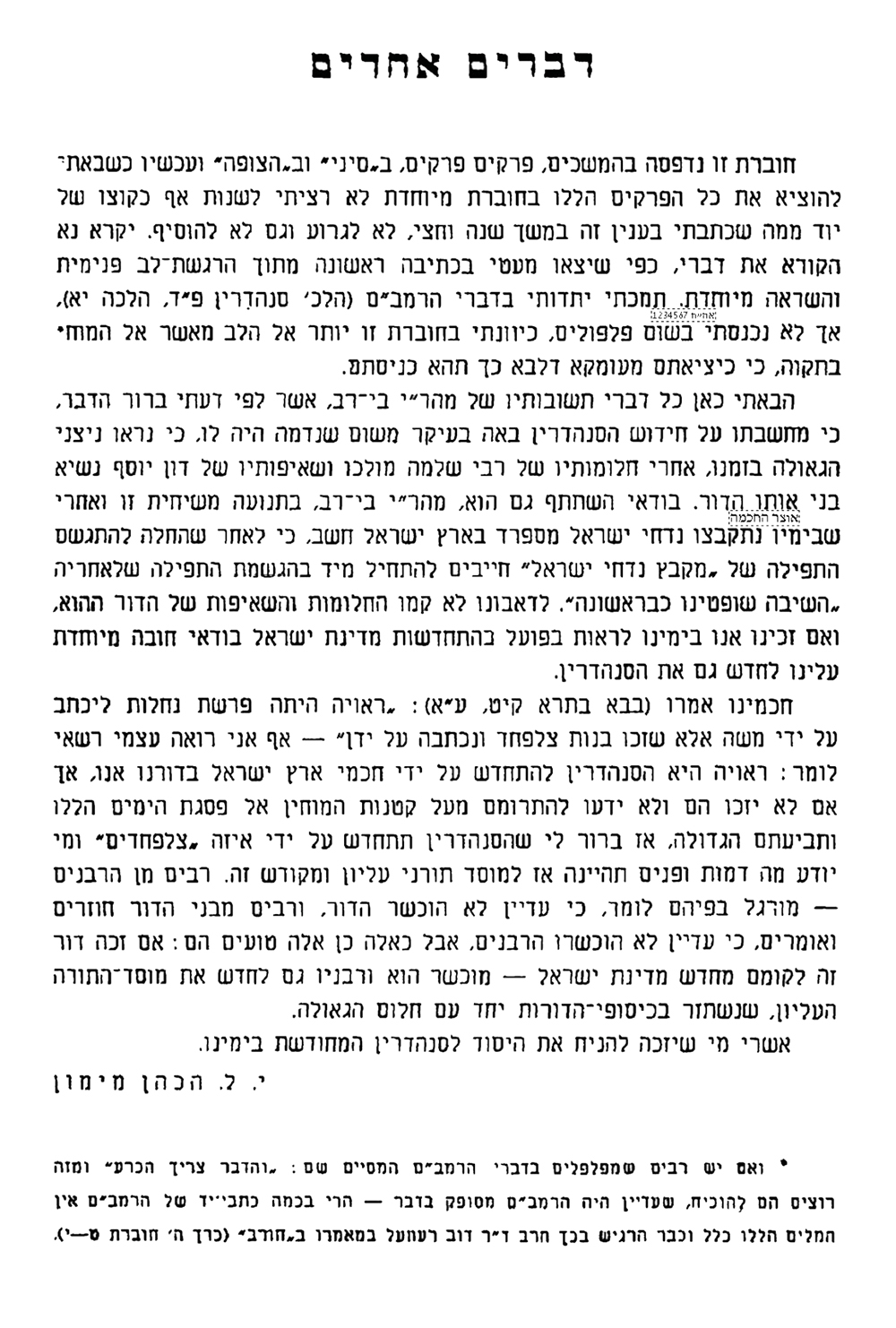
Another important file in Rav Herzog’s archive is his file on the renewal of Semicha and the Sanhedrin.[1] Among other letters, the file contains an unpublished letter from Rav Herzog to R’ Yehuda Leib Maimon regarding the issue. R’ Maimon was a well-known Mizrachi leader, the first Minister of Religion of the State of Israel, and the most vocal advocate of renewing the Sanhedrin. To that end, he wrote a series of articles on the topic in Ha-Tzofeh and Sinai, which he collected into a book in 1950, entitled Chidush Ha-Sanhedrin BeMedinateinu Hamechudeshet. Renewal of Semicha and Sanhedrin was of course not without opponents. Rav Herzog instructs R’ Maimon to proceed slowly and with caution, as there are a number of unresolved issues regarding renewal of Semicha which require great care and deliberation.
There were two main halachic objections to the renewal of Semicha. The first (not mentioned here by Rav Herzog) is based on the language of the Rambam in Sanhedrin 4:11, the very same halacha in which he suggests the possibility of the renewal of Semicha. The Rambam writes there:
נראין לי הדברים שאם הסכימו כל החכמים שבארץ ישראל למנות דיינין ולסמוך אותן הרי אלו סמוכין ויש להן לדון דיני קנסות ויש להן לסמוך לאחרים אם כן למה היו החכמים מצטערין על הסמיכה כדי שלא ייבטלו דיני קנסות מישראל לפי שישראל מפוזרין ואי אפשר שיסכימו כולן ואם היה שם סמוך מפי סמוך אינו צריך דעת כולן אלא דן דיני קנסות לכל שהרי נסמך מפי בית דין והדבר צריך הכרע.
The intention of the Rambam in his concluding words, Ve-hadavar tzarich hechrea, has been the subject of dispute for hundreds of years, going back to the dispute of the Mahari Beirav and the Ralbach, with some authorities believing that the Rambam was mesupak whether Semicha could in fact be renewed. A novel approach to the issue was suggested by Dr. Bernard Revel in an article in Chorev, Volume 5 (1939). Dr. Revel suggested the possibility that the final three words, Ve-hadavar tzarich hechrea, are not be the words of the Rambam himself, but were added later by another person who disagreed with the Rambam’s innovation.[2] Dr. Revel cited statements of other rishonim which he believed supported his theory. R’ Maimon addressed this issue in the introduction to his book, in the footnote, writing that the three words, Ve-hadavar tzarich hechrea, do not appear in “kama kitvei yad” (several manuscripts), thus supporting Dr. Revel’s hypothesis.
 
However, there is no evidence that any such manuscripts actually exist. The Frankel edition of the Rambam does not cite any alternate nusach that excludes these three words. Additionally, Professor Eliav Schochetman[3] wrote nearly 30 years ago that he found no evidence of any such manuscript in the numerous manuscripts that he consulted from across the world.


There are two potential explanations to what happened here. One potential explanation is that R’ Maimon simply lied about the existence of these kitvei yad in order to advance his agenda of renewing the Sanhedrin. Alternatively, Rabbi Eliyahu Krakowski has suggested a limud zchut – perhaps R’ Maimon forgot what Dr. Revel had written and mistakenly believed that Dr. Revel had uncovered manuscripts supporting his thesis[4], or he never saw it himself and was misinformed as to what Dr. Revel wrote, in which case R’ Maimon would be guilty of carelessness rather than dishonesty.
The second major halachic objection to the renewal of Semicha is the issue of the Samuch’s qualifications. The Rambam in Sanhedrin 4:8 writes that a Samuch must be rauy lehorot be-chol hatorah kula, capable of ruling on the entire Torah. Rav Herzog mentions in this letter to R’ Maimon that the Ralbach objected to renewal of Semicha on the grounds that no one is rauy lehorot be-chol hatorah kula. (This was also the position of the Radvaz, in his commentary on Sanhedrin 4:11.) Rav Herzog adds that if he said so in his generation, anan aniyey de-aniyey mah na’ane abatrei? Rav Herzog then makes a somewhat novel suggestion, one with halachic ramifications for the issue of renewal of Semicha. Rav Herzog suggests that rauy lehorot be-chol hatorah kula does not mean that the Samuch must literally know by heart all the relevant halachic sources. A similar approach was also suggested by the Rav[5] and the Steipler.[6] In the language of the Rav, the Samuch need not possess “universal knowledge”, rather a “universal orientation.” While this approach would certainly remove this barrier to renewal of Semicha, Rav Herzog concludes, however, that the matter requires extensive clarification and discussion, and as long as this point has not been clarified, there can be no possibility of renewing the Sanhedrin.


There are a number of talmidei chachamim in the last century who have deemed others to be rauy lehorot be-chol hatorah kula, in contrast to the position of the Ralbach and the RadvazFor example, in his 1935 recommendation letter for the Rav regarding the Chief Rabbinate in Tel Aviv, publicized by Dr. Manfred Lehmann[7], Rav Moshe Soloveichik wrote that the Rav is rauy lehorot veladun be-chol dinei hatorah like the mufla on the Sanhedrin. In Rav Moshe Mordechai, the biography of Rav Moshe Mordechai Shulsinger (page 275), it is related that the Chazon Ish listed to his student Rav Shlomo Cohen (Rav Shulsinger’s father-in-law) the names of 32 Rabbis whom he believed to be rauy lehorot be-chol hatorah kula and worthy of sitting in the Sanhedrin, among them the Chafetz Chaim and Rav Meir Simcha. It would appear that Rav Moshe Soloveichik and the Chazon Ish also assumed the more lenient definition of rauy lehorot be-chol hatorah kula, in line with the position of Rav Herzog, the Rav and the Steipler.
VI Halachic Dateline
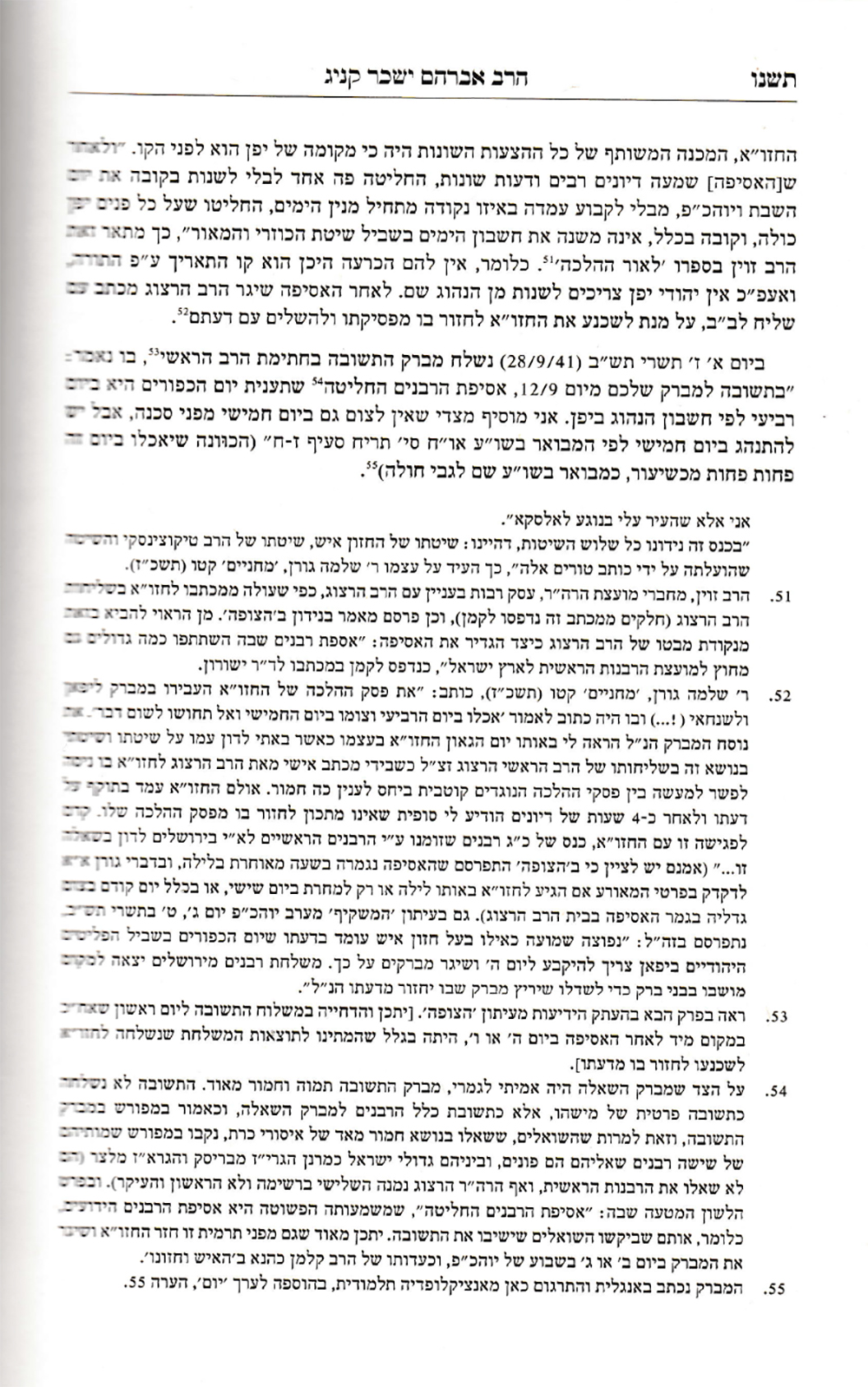
The archive contains an entire file dedicated to the question of the Halachic Dateline.[8] Rav Herzog was of course involved in the Dateline controversy in 1941. At that time, some members of the Mir Yeshiva, among other Jews, were located in Japan for Yom Kippur and they sent a telegram to Rabbis Mishkovsky, Alter, Herzog, Soloveichik, Finkel and Meltzer asking for guidance. Rav Herzog convened a meeting of a number of Rabbis to decide how to proceed, and sent a telegram back to Japan with their instructions. The file contains copies of the telegrams, much of Rav Herzog’s correspondence on the issue, as well as a kuntres on the topic prepared by Rav Tukachinsky that was distributed in advance of the meeting. Most of the significant material in this file has already been published in Kovetz Chitzei Giborim – Pleitat Sofrim Volume 8, in an extensive article by Rav Avraham Yissachar Konig, which was previously reviewed on the Seforim Blog by Dr. Marc Shapiro.[9]
Rav Konig’s most significant contribution is showing that Rav Herzog’s letter as published in Rav Menachem Kasher’s Kav Ha-taarich Ha-yisraeli has been altered from Rav Herzog’s actual letter. Here is Rav Herzog’s letter to Rav Kasher as it appears in the archive:
And this is the letter as printed at the beginning of Rav Kasher’s Kav Ha-taarich Ha-yisraeli:
 
There are three sentences that have been omitted from Rav Herzog’s letter as presented at the beginning of Rav Kasher’s volume. (I would add the following point that Rav Konig failed to mention – Rav Kasher wrote explicitly on page 248 that he presented the letters at the beginning of the volume in full.) The following sentences have been omitted from Rav Herzog’s letter:
הנני להודיע עכשיו שבדיעה זו אני ממשיך ומחזיק היום. אני תפלה שיזכני הקב”ה לעיין בעצם שאלת קו התאריך ולבדוק את כל הדיעות ולהגיע לידי דיעה עצמית. אולם לעת עתה אינני נוקט שום עמדה בהן.
This omission creates the impression that Rav Herzog had a definitive position on the question of the Dateline. However, this is obviously not the case; Rav Herzog never came to any conclusion on the issue of the Dateline, as is clear from the omitted sentences, as well as from a number of other letters in the file. In fact, Rav Konig has shown that in Rav Kasher’s response to this letter, he actually complained to Rav Herzog about these specific sentences for this reason. From Rav Herzog’s original letters, it appears that his position on the question of Japan was one of hanhaga bemakom safek (i.e. instruction on how to act in absence of a clear conclusion on the location of the Dateline) not a definitive hachraa. (Rav Konig elaborates on Rav Herzog’s position at length.) The first sentence above, that Rav Herzog stands by the position of the Rabbinic meeting, in conjunction with Rav Herzog’s statement that he has no definitive opinion on the matter of the Dateline, also implies that the position of the Rabbinic meeting convened by Rav Herzog was also one of hanhaga bemakom safek. (This point is also clear from Rav Herzog’s letter to Dr. Yishurun, also in the file, that the Dateline matter remained unresolved, and the meeting of Rabbis came to no definitive conclusion on the location of the Dateline. They issued their instructions to Japan based on the majority of opinions regarding location of the Dateline, with no consensus on the issue itself.) The altered version of Rav Herzog’s letter creates the false impression that Rav Herzog had a definitive opinion on the Dateline question.
However, I must take issue with one point made by Rav Konig. In his footnote 54, he criticizes Rav Herzog for his language in the telegram sent to Japan. Rav Konig writes that the language of the telegram is misleading, and creates the false impression that the telegram represents the position of the six rabbis (Rabbis Mishkovsky, Alter, Herzog, Soloveichik, Finkel and Meltzer) to whom the telegram from Japan was addressed. This is Rav Konig’s critique, in footnote 54:
Unfortunately, Rav Konig has been misled by an inaccurate translation of Rav Herzog’s telegram. Rav Herzog’s original telegram was written in English, and Rav Konig tells us (footnote 55) that he has relied on the translation to Hebrew as it appears in the Encyclopeida Talmudit, in the addendum to the entry on “Yom”, (coincidentally also in footnote 55.) That translation is taken from Rav Kasher’s Kav Ha-taarich Ha-yisraeli on page 246. This is the telegram sent by Rav Herzog, as it appears in the archive:
An accurate translation to Hebrew would be as follows:
בתשובה למברק שלכם מיום 12.9, אספת רבנים בנשיאותי החליטה שתצומו ליום כיפור ביום רביעי לפי חשבון הנהוג ביפן וכו’
This is the mistranslation in Rav Kasher’s Kav Ha-taarich Ha-yisraeli:
Translated accurately, Rav Herzog’s telegram does not imply that the six Rabbis to whom the question was addressed are providing the answer. The main difference is a subtle, but significant one. Rav Herzog wrote “meeting rabbis my presidency”, which Rav Kasher mistranslated to Asifat Ha-rabbanim, “meeting of the rabbis”, and he neglected to translate “my presidency” at all. As noted by Rav Konig, Asifat Ha-rabbanim (with the hey ha-yedia) implies the known Rabbis, i.e. the Rabbis to whom the question was addressed. Correctly translated, however, Asifat Rabbanim be-nesiuti, “a meeting of Rabbis under my presidency” (without the hey ha-yedia) does not imply that Rabbis Mishkovsky, Alter, Soloveichik, Finkel and Meltzer were involved in the decision. Rav Konig was unfortunately misled by Rav Kasher’s mistranslation, which was also repeated by Encyclopeida Talmudit. The attack on Rav Herzog’s integrity is entirely unwarranted.
There appears to be a second very subtle error in Rav Kasher’s translation. Rav Kasher’s translation states flatly that the Taanit of Yom Kippur is on Wednesday, implying a definitive hachraa. Rav Herzog’s telegram actually says that the decision was that they should fast on Wednesday for Yom Kippur, language which is consistent with a hanhaga bemakom safek. This would also fit with Rav Herzog’s personal addendum, that the Jews in Japan ought to keep Thursday as a fast day as well while eating leshiurim. Given Rav Kasher’s apparently less-than-honest presentation of Rav Herzog’s letter, as noted above, one might surmise that this “error” was also a willfull misrepresentation of the contents of the telegram, intended to advance Rav Kasher’s preferred narrative of a definitive hachraa, in accordance with his own position.
VII Yibum B’zman Hazeh
In addition to the documents related to Rav Herzog’s tenure as Chief Rabbi of Israel, there are also a number of files from his tenure as Chief Rabbi of Ireland. Among his correspondence from his time is Ireland is a fascinating teshuva, written by Rav Kasher in 1936, regarding the issue of Yibum B’zman Hazeh.[10] The background to the question: an Ashkenazi Yavam and Yevama living in Israel want to marry via Yibum, rather than doing Chalitza. Must the beit din protest, or can the beit din allow the Yibum? This teshuva was printed by Rav Kasher in the inaugural volume of Talpiot[11] (1944), and also appears in his Divrei Menachem Volume 1, Teshuva 31. Interestingly, Rav Kasher’s conclusion in the original teshuva differs significantly from the conclusion in the teshuva that he eventually published in Talpiot and Divrei Menachem.
Here is the conclusion of the teshuva as it appears in Rav Herzog’s archive, at the end of page 11 continuing to page 12:


Here is the conclusion of the teshuva as it appears in Divrei Menachem:
 
Originally, Rav Kasher concluded that the beit din should try to convince the couple to do chalitza, but if beit din is unsuccessful, and if the couple is religious, then beit din should teach them to have kavana l’shem mitzvah and need not protest the yibum. The concluding sentences were removed from Rav Kasher’s published teshuva, and the ending simply states that beit din try to convince them to do chalitza. (The teshuva as published is actually quite awkward, as it is clearly building towards the conclusion that they may do yibum, yet ends abruptly without stating this conclusion.) Apparently, Rav Kasher censored his own conclusion. He does stipulate at the end of the original teshuva that he is writing le-halacha ve-lo le-maase until the Gedolei Ha-Rabbanim in Israel agree to permit the yibum. It is possible that Rav Kasher did not receive such approval, and subsequently decided to censor his own conclusion when he published the teshuva.
VIII The Rav on Rabbi Meir Kahane
In addition to the archives of Chief Rabbi Herzog, the archives of his son, President Chaim Herzog, have also been scanned and are available. A very intriguing file in his archive is the file dedicated to Rabbi Meir Kahane.[12] A fascinating document in that file is a letter about Kahane written to Herzog by the Rav in the summer of 1984. The background to the letter: in 1984, Kahane became a member of the Knesset, representing the Kach party. Traditionally, during the process of building a coalition, the president would invite every party to take part in coalition negotiations. Herzog, however, snubbed Kahane and refused to invite him.[13] It was in response to this snub that the Rav wrote the letter below to Herzog, which is surprisingly supportive of Kahane:
 
The Rav starts by mentioning his close relationship with Rav Herzog, and that Chaim Herzog was actually named for his grandfather, the great Rav Chaim Soloveichik of Brisk.[14] The Rav says that he cannot understand how Herzog could invite the representatives of Arafat, but did not invite Kahane. The Rav adds that Kahane is “ktzat talmid chacham” despite his shigonot, and that he is a yarei shamayim who fights for the Torah and kvod shamayim. The Rav says that someone as energetic as Kahane should be moderated and he could contribute.
(Other sources have portrayed the Rav’s view of Kahane far more negatively, claiming that the Rav regarded Kahane’s “selective citation of Jewish sources as a distortion and desecration of Torah.”[15] Additionally, it is related that, at some point in the 1980s[16], the Rav told others that Kahane should not be given a platform to speak at YU.[17] I am not sure how to reconcile this portrayal of the Rav’s view of Kahane with the Rav’s own letter to Herzog that was rather supportive and praising of Kahane.)
The Rav then gives Herzog some gentle mussar for being irreligious and encourages him to keep mitzvot while in public as a Kiddush Hashem. Herzog’s response to the Rav also appears in the same file.
Kahane and Herzog had quite a contentious (non-)relationship, extending far beyond the coalition snub, as is evidenced by the rest of Herzog’s file on Kahane. This is a scathing column that Kahane wrote for the Jewish Press, also found in Herzog’s archive, in which Kahane dubs Herzog “vinegar son of wine”, among other insults:
 
Additionally, Kahane’s Kach party presented Herzog with the inaugural Pras Idud Ha-hitbolelut – “Award for the Encouragement of Assimilation” 5745, as appears below:
 
The above is a sampling of the important and interesting documents contained in the archives. As mentioned, there is certainly much more fascinating material to be found. In the meanwhile, אנו יושבים ומצפים לגאולה שלמה, ייתי ונחמיניה.
[2] http://www.hebrewbooks.org/pdfpager.aspx?req=23218&st=&pgnum=16. See also Rav Chaim David Regensburg’s criticism of this thesis in Kerem Volume 1, pages 93-94 (also reprinted in his Mishmeret Chaim), and the comments of Rav Hershel Schachter brought in Shiurei Ha-rav (Sanhedrin), page 37, footnote 35.
[3] Shenaton Ha-Mishpat Ha-Ivri 14-15, page 235, footnote 77
[4] Dr. Revel did cite statements of other rishonim that he believed supported his view. Perhaps R’ Maimon mistakenly thought that Dr. Revel had supported his view with manuscripts of the Rambam, rather than other rishonim.
[5]  Nefesh Ha-rav page 18 footnote 22 , Shiurei Ha-rav (Sanhedrin) page 27. See also Leaves of Faith (volume 1) pages 121 and 134, where Rav Lichtenstein attributes this approach to Rav Moshe Soloveichik. From the other sources, it would seem that this approach was the Rav’s own. However, the recommendation letter that Rav Moshe wrote might imply that Rav Moshe also followed this approach.
[6] Kitvei Kehillot Yaakov Ha-chadashim, Sanhedrin, page 187.
[7] Sefer Yovel for Rav Yosef Dov Soloveitchik, jointly published by Mosad HaRav Kook and Yeshiva University, at the end of Volume 1 (unpaginated). The transcription, along with an image, is also available here.
Lehmann’s transcription of Rav Moshe’s letter appears to be mostly accurate, with one exception. Towards the end of the letter, Lehmann’s transcription reads as follows:
וגם הם בדור עשירי לעזרא איכא בי’ מכל צד וצד…
This meaningless sentence is obviously an error in transcription. The transcription should read:
וגם הך דדור עשירי לעזרא איכא בי’ מכל צד וצד…
meaning that the Rav has illustrious lineage and zchut avot on both his father’s and mother’s side. (See Brachot 27b for the source of this expression.) It is also clear from Lehmann’s translation that he misunderstood this line entirely and did not realize that it was referring to the Rav and his lineage. See the translation here.
[13] “Rabbi Kahane was the only party leader in the Parliament whom President Herzog refused to see in the consultations that led to the President’s asking Shimon Peres, the Labor Party leader, to form a government.” (New York Times, August 14, 1984)
[14] Herzog himself mentions this in his memoir, Derech Chaim, although it does not appear in the English translation, Living History. Rav Chaim passed away on July 30, 1918, and Herzog was born on September 17, 1918.
[16] The Rav’s last shiur at YU/RIETS was in 1985 (The Rav, Volume 1, page 43), at which point he withdrew from public life due to his illness. Presumably, this incident must have occurred at some point before then.


The Universalism of Rav Kook

The
Universalism of Rav Kook
by
Bezalel Naor
Copyright
©
2018 Bezalel Naor

Stereotypes are difficult to overcome. Until
recently, the stereotype of Rav Avraham Yitzhak Hakohen Kook (1865-1935) was of
a nationalist (perhaps even ultranationalist) who lent his rabbinic aegis to
the Zionist enterprise in the first third of the twentieth century.
In his seminal work Orot [Lights]
(Jerusalem, 1920), the very first section of the book is entitled “Erets
Yisrael.”
The punchline of the first chapter reads:
The expectation of
salvation (tsefiyat ha-yeshu‘ah) is the force that preserves exilic
Judaism; the Judaism of the Land of Israel is salvation itself (ha-yeshu‘ah
‘atsmah
).
Thus, Rav Kook placed Israel’s return to its
ancestral homeland front and center, and provided it with theological
underpinnings sorely lacking in the secular Zionist movement.
In this respect, Rav Kook’s bold initiative,
courageous and outspoken, at times alienated him from his more
conservative-minded rabbinic peers. The Gerrer Rebbe, Avraham Mordechai Alter
(1866-1948), wrote in a much publicized letter:
The Rav, the Gaon R.
Avraham Kook, may he live, is a man of many-sided talents in Torah, and noble
traits. Also, it is public knowledge that he loathes money. However, his love
for Zion surpasses all limit and he “declares the impure pure and adduces proof
to it.”…From this, came the strange things in his books.
With the passage of time and the publication of many
hitherto suppressed manuscripts, we become increasingly aware of another facet
to the extremely complex personality of Rav Kook: the cosmopolitan or
universalist. Rav Kook’s passionate love for his land and his nation of Israel,
in no way vitiated the larger scope of his Messianic or utopian vision. Such an
illuminating manuscript is that designated Pinkas 5, published this year
of 2018 by Boaz Ofen in volume 3 of his ongoing series Kevatsim mi-Khetav
Yad Kodsho
[Journals from Manuscript]. The Pinkas has been
dated by the Editor to the years 1907-1913, during which time Rav Kook served
as Rabbi of Jaffa.
In the following pensée (perhaps essay is the
better word), Rav Kook argues that just as the “seventy nations” of the world
form an organic unity, the proverbial “family of man,” so too the various faith
communities or religions complement one another in a parallel organic unity.
Though Rav Kook probably never heard of the mythic
bird Simorgh—who figures prominently in the twelfth-century work The Conference
of the Birds
by the Persian poet Farid ud-Din Attar—Rav
Kook’s imagery is roughly reminiscent. In that allegorical tale, the birds of
the world set out to find a leader. It has been suggested to them that they
appoint as their king the legendary Simorgh. To reach the remote mountain abode
of the Simorgh, the birds must embark on a perilous journey. Most of the birds
succumb to the elements along the way. At journey’s end, there remain but
thirty birds. They discover that they themselves, together, form the sought
Simorgh. In Persian, “Simorgh” means “thirty birds” (si-morgh).
Lest the reader mistakenly surmise that Rav Kook
suggests that the faith of Israel will in some way be subordinated to a higher
unity, Rav Kook’s bottom line reads:
And with this,
automatically the horn of Israel must be uplifted.
“Bow
down to Him, all gods”
[Psalms
97:7].
***
The aspiration to bring
peace to the world, has always been the aspiration of Israel. This is the
interior of the soul of Knesset Israel (Ecclesia Israel), which
was given full expression by the chosen of her children, the Prophets who
foresaw at the End of Days humanity’s happiness and world peace.
However, light advances
slowly. The strides made are not discernible because divine patience is great,
and that which appears in the eyes of flesh insignificant—is truly exalted from
the vantage of the supernal eye. “In the place of its greatness, there you find
its humility.”[1]
Even in the worst life; the hardest, lowest, most sinful life—there is abundant
light and sufficient place for the divine love to appear. That life need not be
erased from existence, but rather uplifted to a higher niveau. There is no
vacuum,[2] no
empty space; every level needs to be filled.
Truly world peace, in
the material sense, comes into our vision. The nationalism that ruled supreme
during the days of “barbarism,” when each nation perceived a foreign nation as
uncivilized,[3]
[and held] that all man’s obligations to man are cancelled in regard to the
“barbarians”—this evil notion is being erased. On the other hand, with the
passing of generations, the intellect, the light of fairness, and the necessity
of life—the windows through which the divine light wends its way—all together
impress the stamp of universal peace upon the national character. Gradually,
there arrives the recognition that humanity’s division into nations, does not
pit them against one another, such that nations cannot dwell together on the
planet Earth. Rather, their relation is organic—just as individuals relate to
the nation, and the limbs to the body. This notion, when completely manifest,
shall renew the face of the world, purifying hearts of their wickedness and
uplifting souls.
However, the relation
of nations—their pacification—must correspond to the relation of religions. A
complete nationalism is not possible without correlate feelings of holiness.
Those sentiments—whether few or many—change opinions; those sentiments are
sensitive to the variables of geography and history.[4]
Peace between nations
cannot come about by minimizing the value of nationalism. On the contrary,
people of good will recognize that just as the feeling for family is
respectable and pleasant, holy and pure, and were it to be lost from the world,
humanity would lose with it a great treasure of happiness and holiness—so the
loss of the “national family” [i.e. nationalism] and all the sentiments and delicate
ideas bound to it, would leave in its place a destruction that would bring to
the collective soul a frustration much more painful than all the pains that it
suffered on account of the demarcation of nationalism.
Humanity must receive
the good and reject the evil. The force of repulsion and the force of
attraction together build the material world; and the cosmopolitan and national
forces together build the palace of humanity and its world of good fortune.[5]
As it is in regard to nationalism,
so it is in regard to religions. It is not the removal of religion—that will
bring bliss, but rather the religious perceptions eventually relating to one
another in a bond of friendship. (With the removal of religion there would pass
from the world a great treasure of strength and life; inestimable treasures of
good.) Every thought of enmity, of opposition, of destruction, will dissipate
and disappear. There will remain in the religions only the higher, inner,
universal purpose, full of holy light and true peace, a treasure of light and
eternal life. The religions will recognize each other as brothers; [will
recognize] how each serves its purpose within its boundary, and does what it
must do in its circle. The relation of one religion to another will be organic.
This realization automatically brings about (and is brought about by) the
higher realization of the unity of the light of Ein Sof [the Infinite],
that manifests upon and through all. And with this, automatically the horn of
Israel must be uplifted.
“Bow
down to Him, all gods”
[Psalms
97:7].
(Kevatsim
mi-Khetav Yad Kodsho
, ed. Boaz Ofen, vol. 3 [Jerusalem, 2018], Pinkas 5,
par. 43 [pp. 96-97])

[1] A play upon the
saying of Rabbi Yoḥanan in b. Megillah 31a: “Wherever you find the strength
of the Holy One, blessed be He, you find His humility.”
[2] Based on the
saying attributed to Aristotle: “Nature abhors a vacuum.”
[3] Rav Kook
explains the meaning of the original Greek word “barbaros” (βάρβαρος).
[4] Cf. this
passage in ‘Arpilei Tohar:
Messiah will
interpret the Torah of Moses, by revealing in the world how all the peoples and
divisions of mankind derive their spiritual nourishment from the one fundamental
source, while the content conforms to the spirit of each nation according to
its history and all its distinctive features, be they temperamental or
climatological; [according to] all the economic vagaries and the variables of psychology—so
that the wealth of specificity lacks for nothing. Nevertheless, all will bond
together and derive nourishment from one source, with a supernal friendship and
a strong inner assurance.
“‘The Lord will
give a saying; the heralds are a great host’ [Psalms 68:12]—Every word that
emitted from the divine mouth divided into seventy languages” (b. Shabbat
88b).
(‘Arpilei
Tohar
[Jerusalem, 1983], pp. 62-63)
‘Arpilei Tohar was first
printed in Jerusalem in 1914, before the outbreak of World War One. For various
reasons that we need not go into now, that edition remained unbound and
uncirculated. Random copies found their way into private collections. In 1983, ‘Arpilei
Tohar
was reprinted in a slightly censored fashion. The complete contents of
‘Arpilei Tohar are now available in the unexpurgated collection, Shemonah
Kevatsim
, where it is designated “Kovets 2.” This particular
passage occurs in Shemonah Kevatsim (Jerusalem, 2004), 2:177.
[5] Rav Kook likens
nationalism and cosmopolitanism to the repulsive and attractive forces of a
magnet.


Book Launch of the Koren Rav Kook Siddur

Book Launch of the Koren Rav Kook Siddur
Seforim Blog contributor Rabbi Bezalel Naor has just published a major work, the Koren Rav Kook Siddur.
Culled from Rav Kook’s own commentary to the Siddur, Olat Re’iyah, and other writings of Rav Kook, as well as rich anecdotes transmitted by Rav Kook’s son and major disciples, The Koren Rav Kook Siddur speaks to the soul, while it connects us all to the sacred soil of the Holy Land.
There will be a book launch on Sunday, January 7, 10:00 AM, at Lincoln Square Synagogue in New York. Rabbi Naor will discuss the new siddur and dialogue with Professor Marc B. Shapiro regarding Rav Kook’s legacy. The event will be moderated by Rabbi Shaul Robinson. All are invited to attend.
Here are some sample pages:


Lecture Announcement: Rabbi Yechiel Goldhaber

The readership of the Seforim Blog are invited to two lectures by the noted author, Rav Yechiel Goldhaber (link), whose respected research and scholarship is well-known to Seforim Blog readers. 
1) The first shiur that will be taking place is this Thursday, November 2, 7:30 PM at 1454 54th Street, Brooklyn, NY. Rabbi Goldhaber’s speech will be delivered in Yiddish. The subject of this shiur is “Orthodox and Rabbinic Responses to the Balfour Declaration.”
This lecture is dedicated לזכר נשמת the late Dr. Shlomo Sprecher ז״ל who coordinated and hosted many of Rabbi Goldhaber’s shiurim.
2) The readership of the Seforim Blog is also invited to a shiur that will be taking place this Sunday November 5, at 8PM. The subject is likewise “Orthodox and Rabbinic Responses to the Balfour Declaration. It will take place in Monsey at Ohr Chaim Learning Center, 20 Forshay Road, (head upstairs). This lecture is in English.
Rabbi Goldhaber has authored many wonderful articles, published important documents and written works on a wide range of topics, among them Minhagei Kehilos about customs, Kunditon (link) about the Titanic and the so-called Cherem on Spain, and two volumes of Ginzei Yehuda, a collection of assorted letters from various rabbis of note. 
It should be noted that Rabbi Goldhaber’s visit to the United States is connected with raising funds for an upcoming wedding for his son, therefore donations are encouraged (albeit not required to attend). 

EDIT 11.6.17: Here is a link to the Yiddish lecture: link. 

The English will be posted if we receive it.