Surrounding Independence Day

Surrounding Independence Day
by Aaron Ahrend

Dr. Aaron Ahrend, a senior lecturer in the Department of Talmud at Bar-Ilan University, has published many studies on Talmudic commentary and Jewish liturgy.

The ancients established a sign by which one could determine on which days certain holidays occur. The sign is based on the pairing of the letters Aleph and Tav (א”ת) and the days of the Passover holiday.[1] Thus is the sign: Aleph-Tav (א”ת) = the day of the week on which the first day of Passover falls is the same day that Tisha B’Av falls in that year. Bet-Shin (ב”ש) = on the day of the week on which the second day of Passover falls, Shavuot falls. Gimel-Resh (ג”ר) = on the day of the week on which the third day of Passover falls, Rosh Hashanah falls. Dalet-Kuf (ד”ק) = on the day of the week on which the fourth day of Passover falls, the reading of the Torah occurs, i.e., Simchat Torah outside of Israel on the second day of Shemini Atzeret. Hei-Tzadi (ה”צ) = on the day of the week on which the fifth day of Passover falls, the fast, Yom Kippur, falls. Vav-Peh (ו”פ) = on the day of the week on which the sixth day of Passover falls, Purim falls before it. The final sign, Zayin-Ayin (ז”ע), remains unresolved: there was no holiday whose name begins with the letter Ayin that fell on the day that the seventh day of Passover falls.

And behold, when the State of Israel was established, the sign was completed: Zayin-Ayin (ז”ע) = the day of the week on which the seventh day of Passover falls is the day on which Independence Day falls, namely the 5th of Iyar (when it is not postponed or deferred). The inclusion of Independence Day within the framework of the אתב”ש signs of the holidays serves as a kind of proof or hint of its status as one of Israel’s holidays. At the entrance of the Tunisian synagogue Or Torah in Acre, a beautiful artistic creation dedicated to Independence Day was established. It was painted blue, the prominent color in the flag of the State of Israel, and it features symbols of the country, the IDF emblem, the flag of Israel, the walls of Jerusalem, the Hatikvah anthem, the blessing Shehecheyanu, excerpts of prayers, and above all these – the seven signs of אתב”ש representing the integration of Independence Day within the framework of Israel’s holidays.

There exists a great similarity between the essence of the seventh day of Passover, when the Egyptians drowned in the Red Sea while pursuing the Israelites upon their exodus from Egypt, and the essence of Independence Day: in both, there was a confrontation between the people of Israel and Egypt, and in it Israel prevailed despite having no chance of victory on its own against Egypt, with its organized army and sophisticated weapons.[2] Therefore, it was determined that the Haftarah of “Od Hayom” read abroad on the second day of the seventh day of Passover would be the Haftarah for Independence Day in the Land of Israel, as it is appropriate in content for this day.

Regarding the aforementioned sign, Rabbi Yoel Bin-Nun added:[3]

Isn’t Zayin-Ayin (ז”ע) a heavenly hint? Didn’t the British Mandate truly end on Saturday, the 6th of Iyar, at midnight, and only because David Ben-Gurion and his colleagues decided to honor the Sabbath, they advanced the declaration of independence of the State of Israel to Friday, the 5th of Iyar, which corresponds to the seventh day of Passover. This alone provides a sufficient reason for all God-fearing individuals to truly celebrate Independence Day.

In other words, the declaration of independence of the state on Friday, the 5th of Iyar, which allows for the sign Zayin-Ayin (ז”ע), occurred solely due to the consent of the heads of state, who were not religious, to consider the Sabbath. This surprising and joyful consideration alone is sufficient reason to celebrate Independence Day.

* * *

Many devout Jews do not celebrate Independence Day at all and do not acknowledge to the Holy One, blessed be He, for the establishment of the State of Israel. In contrast, Zionist rabbis believe that thanks should be given to the Holy One, blessed be He, for the wonder and great miracle of the State’s existence, even though it is not particularly a religious state.[4]

For those who do not celebrate the establishment of the state and Independence Day, we bring here the words of Rabbi Shimon Deutsch (1814? – 1878), one of the important disciples of the Hatam Sofer. This sage had a strong connection and love for the land of Israel, and even ascended and resided in Jerusalem. In his book Imrei Shefer on Tractate Berakhot, he discusses the Mishnah (54a): “One who sees a place where miracles were performed for Israel says: Blessed is He who performed miracles for our ancestors in this place.” Rabbi Deutsch asks why the Mishnah uses the plural form: “where miracles were performed,” when even a person who sees a place where only one miracle was performed for our ancestors should bless with this blessing? He answers: Sometimes the Holy One, blessed be He, performs a miracle for a person, but the one experiencing the miracle does not recognize his miracle. Therefore, it is said: “You give to those who fear You a banner to rally to” (Psalms 60:6), meaning, giving a person a miracle that he recognizes as a miracle. In other words: He will have the miracle that he recognizes and acknowledges to the Holy One, blessed be He. Therefore, when a person blesses for any miracle, there are here two miracles, since recognizing the miracle is considered an additional miracle. In light of this, it is understood why even for one miracle, the Mishnah uses the word ‘miracles’ in the plural form.

On Independence Day every year, we are obligated to thank the Holy One, blessed be He, for many miracles: the establishment of the State of Israel, the victory in the War of Independence of the few against the many, the ingathering of exiles, the development of the Torah world, and the country’s progress in many areas. Many have described the numerous achievements of the State of Israel over the years. Here is an excerpt from the words of Rabbi Jonathan Sacks in his unique formulation:

Israel has done extraordinary things. It has absorbed immigrants from 103 countries, speaking 82 languages. It has turned a desolate landscape into a place of forests and fields. It has developed cutting-edge agricultural and medical techniques and created one of the world’s most advanced high-tech economies. It has produced great poets and novelists, artists and sculptors, symphony orchestras, universities and research institutes. It has presided over the rebirth of the great Talmudic academies destroyed in Eastern Europe during the Holocaust. Wherever there is a humanitarian disaster in the world, Israel is often the first to offer aid and the most efficient in doing so — if only allowed to. It has shared its technologies with other developing countries.[5]

* * *

Following the war that broke out during Simchat Torah this year, synagogues began to increase prayers for the well-being of IDF soldiers, the wounded, and the captives, more than usual.[6] Even artists expressed their opinions on these prayers and designed them in unique forms, two examples of which are presented here.

The company A La Mode from Modi’in designed the Mi Sheberach prayer for IDF soldiers and the prayer for the peace of the State of Israel written on glass perspex within a frame creating the shape of the map of Israel.[7]

The artist Kalman Gavriel from the Jewish Quarter of Jerusalem focused on the soldier. He painted a soldier seen from his back, praying and wrapped in a blue tallit, resembling the flag of the country. The figure of the soldier is composed of words: in the center of the tallit is the Mi Sheberach prayer for the soldiers, at the hem are fitting verses from Psalms: “The Lord shall guard your going out and your coming in, from now and to eternity” (Psalms 121:8), “I will lie down and sleep in peace, for You alone, Lord, make me dwell securely” (Psalms 4:9), and the phrase “He who believes does not fear”; the soldier’s pants and boots are formed from the verse speaking of walking: “Even though I walk through the valley of the shadow of death, I will fear no evil, for You are with me” (Psalms 23:4); on the sides of the soldier there is a sort of “border” composed of symbols of the combat units of the IDF; at the bottom, planes are drawn, a soldier hangs a flag symbolizing the victory in the War of Independence, and three soldiers gaze upward symbolizing the victory in the Six-Day War.

Notes:

[This article is a translation of Aaron Ahrend, “Surrounding Independence Day,” Daf Shvui (Bar-Ilan University), no. 1568: Parashat Kedoshim (11 May 2024): 3-4 (Hebrew).]

[1] Rashi to Arakhin 9b s.v. Sheneihem; Rabbi Simcha Vitry, Machzor Vitry II, 581 (Hebrew).
[2] Yaakov Shmuel Spiegel, “Allusions and Derashot on Yom Haatzmaut,” in Aaron Ahrend, Israel’s Independence Day: Research Studies (Jerusalem: Office of the Campus Rabbi of Bar-Ilan University, 1998), 244-252 (Hebrew).
[3] Yoel Bin-Nun, Nes Kibbutz Galuyot (Jerusalem, 2011), 86 (Hebrew).
[4] Aaron Ahrend, Israel’s Independence Day: Research Studies (Jerusalem: Office of the Campus Rabbi of Bar-Ilan University, 1998), 13-19, 38-41 (Hebrew).
[5] Jonathan Sacks, Future Tense (Jerusalem: Maggid, 2021), 141 (Hebrew). In another context, he raises an interesting point: “I seriously suspect that if Herzl were to rise today for the resurrection, he would recite the Shehecheyanu blessing and also say Al HaNissim. For even he did not envision anything as impressive as the State of Israel today.” See Jonathan Sacks, “Interview with Rabbi Nahum Rabinovitch,” in Nahum Rabinovitch, Mesilot Bilvavam (Maaleh Adumim, Israel: Hotsaʼat Maʻaliyot, 2015), 505 (Hebrew).
[6] Even in the Hasidic world, which does not typically pray for the well-being of soldiers, additional prayers were added as a result of the war. See Levi Cooper, “Hasidim Praying for Soldiers,” in Aviad Hacohen and Menachem Butler, eds., Praying for the Defenders of Our Destiny: The Mi Sheberach for IDF Soldiers (Cambridge, MA: The Institute for Jewish Research and Publications, 2023), 173-197.
[7] In Kehillat Ahavat Tzion in Ramat Beit Shemesh Aleph, members acquired the artwork of the Mi Sheberach prayer for soldiers and placed it on a wall in the synagogue, thereby expressing solidarity with praying families whose children were drafted into the war.


R. Shlomo Yosef Zevin and Yeshiva Students being Drafted to the Army, views of women, and more

Shlomo Yosef Zevin and Yeshiva Students being Drafted to the Army, Views of Women, and More

Marc B. Shapiro

1. In an earlier post I wrote about R. Shlomo Yosef Zevin and the famous essay about how yeshiva students need to serve in the army, an essay which is widely attributed to him. See here. In the post I cited important information uncovered by David Eisen that complicates the issue (as we see the Zevin family itself is of two minds on the matter), and we were left with no absolute proof that R. Zevin wrote the essay. I encourage all readers interested in the topic to read the six emails from Eisen quoted in my post, as they became the primary source material for all who wish to explore this matter.

One of the points that Eisen’s sources disagree about is when the essay was attributed to R. Zevin. R. Nachum Zevin, R. Zevin’s grandson, claims that it was only attributed to him after R. Zevin’s passing in 1978, but R. Menachem Hacohen states that already in the early 1970s he had seen the essay and it was believed that R. Zevin wrote it. As Eisen reports, one of the chief librarians at the National Library told him that he believes that already in the 1960s the essay was attributed to R. Zevin.

I am now able to put the matter to rest and establish beyond any doubt that R. Zevin is indeed the author of the essay. One of R. Zevin’s close friends was the author R. Zvi Harkavy, who served as an army chaplain. Harkavy regarded R. Zevin as his teacher, referring to him as מו”ר. In 1959 it was announced that Harkavy would publish a bibliography of all of R. Zevin’s writings, which were estimated to be over 1000 items, including material written under a pseudonym.[1] As far as I can tell, this never appeared. In Harkavy’s Ma’amrei Tzvi, p. 26, he includes a 1969 letter he received from R. Zevin is which Harkavy is addressed as ידידי הדגול. I mention all this only to show that when Harkavy speaks about R. Zevin you rely on what he says.

It has often been said that the identification of R. Zevin with the essay on yeshiva students and the army was only made years after its 1948 appearance, and this casts doubt on it having been being written by R. Zevin. I can now say that this is incorrect. In 1951 (Iyar 5711) Harkavy published an article in the Jerusalem Torah periodical Ha-Hed, which was a journal that R. Zevin himself often published in. (Unfortunately, very few issues from this periodical can be found on Otzar haChochma.) In Harkavy’s article he identifies R. Zevin as the author of the essay. Not only was Harkavy, because of his close friendship with R. Zevin, in a position to know that he wrote it, but R. Zevin never denied authorship in subsequent issues of Ha-Hed.

This shows without any doubt that R. Zevin is the author of the essay, and from this point on no one—including members of the family—should deny his authorship. Here is Harkavy’s article.

R. Nochum Shmaryohu Zajac called my attention to the recently published memorial volume for R. Yehoshua Mondshine,Sefer, Sofer, ve-Sipur. On p. 327 R. Mondshine wonders why R. Zevin—whom he seems to believe was indeed the author of the essay—would have felt it necessary to keep his authorship secret. R. David Zvi Hillman suggests that R. Zevin felt that if it was known that he wrote it, he would not have been welcome at the Brisker Rav’s home. He adds that it could have also created problems with the Habad synagogue he attended, as well as with his good friend R. Yehezkel Abramsky.

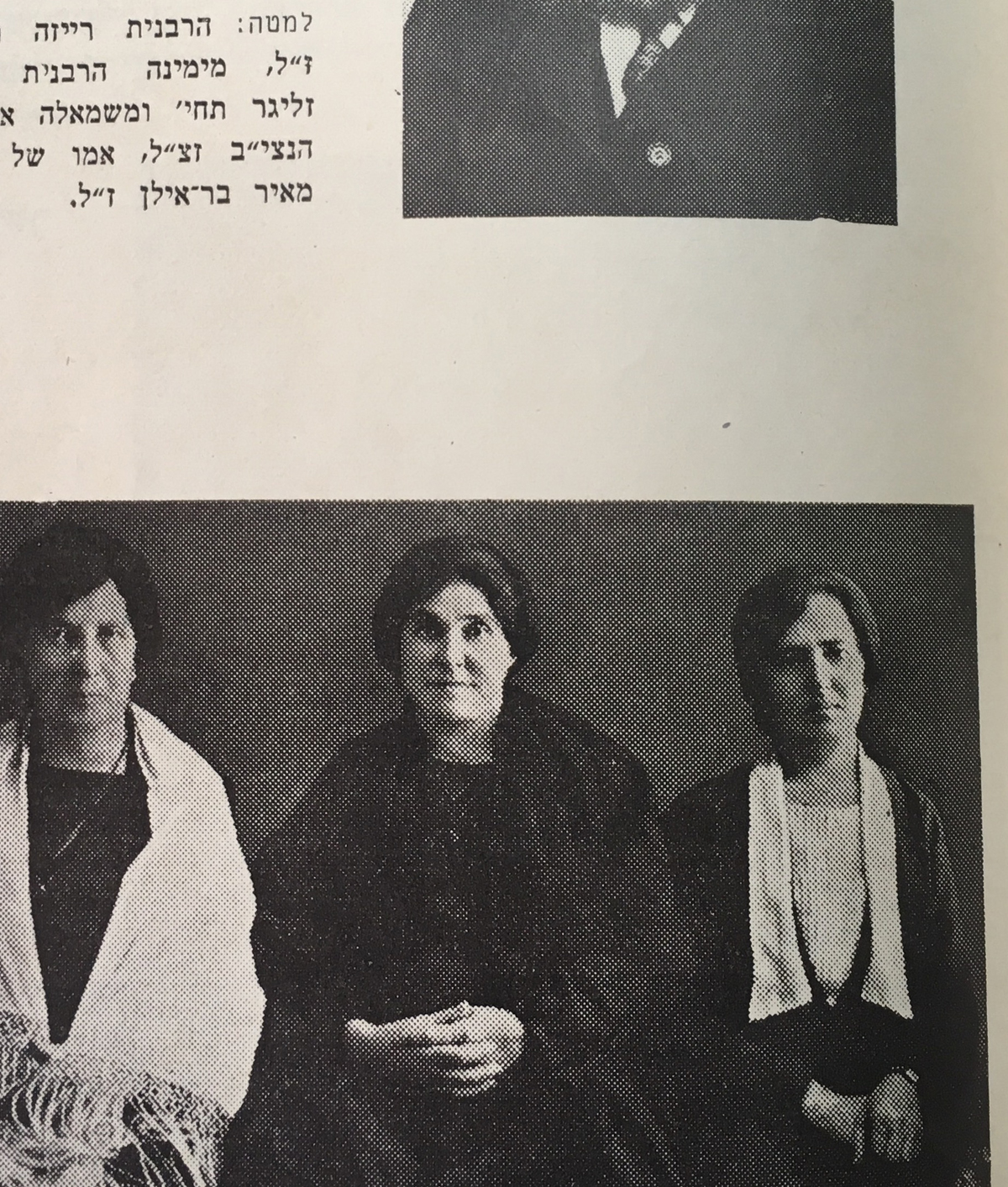
In going through the various issues of Ha-Hed, I discovered a picture of great interest in the Shevat 5711 issue.

On the right is Leah Seliger. She was a learned woman who edited the collected writings of her late husband, R. Joseph Seliger, 

Kitvei Ha-Rav Dr. Yosef Seliger (Jerusalem, 1930). The woman in the middle is R. Kook’s wife, Raize Rivka. Until recently I knew of only one other published picture of her, and this appears at the beginning of Pinchas Grayevski, Benot Tziyon vi-Yerushalayim, vol. 7 (Jerusalem, 1929; I think Dr. Yehudah Mirsky called my attention to this picture). The woman on the left is Miriam Berlin, the widow of R. Naftali Zvi Judah Berlin. I do not know of any other published pictures of her.

Shimon Steinmetz called my attention to this additional picture of R. Kook’s wife that can be found here.

2. In my post here I discussed these words from Exodus 15:16:

בִּגְדֹל זְרוֹעֲךָ יִדְּמוּ כָּאָבֶן

However, I neglected to mention one additional point. How come there is a dagesh in the כ when according to the grammatical rules it should not be there? R. Aaron of Lunel in his Orhot Hayyim offers an explanation. He states that if there was a dagesh people would read the last two words as יִדְּמוּךׇ אָבֶן, “stones are similar to you,” which is not a respectful thing to say to God.[2]

3. In my last post here I discussed the Hazon Ish’s opinion on the dispute between Maimonides and Rabad about an unwitting heretic, and the Hazon Ish’s assumption that Maimonides actually agreed with Rabad in this matter. It must be clarified that the Hazon Ish is not certain about his suggestion that there was no disagreement between Maimonides and Rabad when it came to someone who was completely “innocent” in his heresy. The Hazon Ish4. A couple of years ago in my post here I mentioned that in part two of the post I would have an excursus on the nature of women. For some reason I forgot to include this excursus in all the subsequent posts, so here it is.[4]

On the matter of the creation of women, and whether they are created “better” or “worse” than men, Shaul Regev calls attention to a strange comment by R. Jacob Matalon, Toldot Yaakov (Salonika, 1597), p. 7d (printed together with his She’erit Yaakov).[5] There are many comments in rabbinic texts that have a negative view of women, and most of these comments are based on a belief that women are inherently inferior to men. Yet not many texts are as explicit as R. Matalon in regarding women as almost a different species, standing between apes and men.

ובין החי למדבר הקוף ובין הקוף םמדבר [צ”ל למדבר] ומשכיל הם הנשים והאנדרוגינוס

Women obviously speak, so מדבר must mean speak with intelligence.

A passage similar to what R. Matalon says, but without mention of an ape, is found in Gersonides’ comment to Genesis ch. 3 (p. 110 in the Ma’aliyot edition).

והנה קראה האדם שם אשתו ‘חוה’, כאשר השיג בחולשת שכלה, רוצה לומר שלא עלתה מדרגתה על שאר הבעלי חיים עילוי רב, ואם היא בעלת שכל, כי רוב השתמשותה אמנם הוכן לה בדברים הגופיים, לחולשת שכלה ולהיותה לעבודת האדם. ולזה הוא רחוק שיגיע לה שלמות השכל, אלא שעל כל פנים היא יותר נכבדת מהם, וכולם הם לעבודתה

Gersonides is known for his negative view of women, and this reputation comes from passages like this. Here Gersonides states that women are on a higher level than animals, but not by much. Furthermore, just like the animals are at the service of women, so women’s role is to serve men. In discussing this passage, Menachem Kellner writes: “Gersonides apparently found Darwin’s missing link: woman!”[6]

For another explanation which Modern Orthodox women will probably regard as insulting, but more traditional women will probably see as a compliment, see R. Meir Mazuz, Bayit Ne’eman, no. 52 (parashat Terumah 5777), p. 1, who quotes R. Nissim Gaon as follows: The verse in Proverbs 1:8 states: אל תטוש תורת אמך – “Forsake not the teaching of thy mother”. Yet since women don’t have Torah knowledge, תורת אמך cannot mean this. Rather, it means the special holiday foods that the mother makes.

Readers can correct me if I’m wrong, but I do not believe that R. Mazuz’s understanding is correct, and I think R. Mazuz was citing R. Nissim from memory. That is, R. Nissim’s comment has nothing to do with women lacking Torah knowledge and identifying their cooking as תורת אמך. Rather, he cites the verse simply as a general statement about the importance of tradition. Here is the passage of R. Nissim Gaon as cited by R. Maimon the father of Maimonides.[7]

וכתב רבינו נסים במגילת סתרים כי כל מנהגי האומה באלו המנהגות כמו זה. והראש בראש השנה, החלב בפורים ובמוצאי פסח, והפולים ביום הושענא רבה. ואותם המנהגות אין לנו לבזותם ומי שהנהיגם זריז ומשתדל הוא כי הם מעיקרים נעשים ולא יבוזו במנהגי האומה וכבר אמר הנביא ע”ה ואל תטוש תורת אמך, דת אומתך אל תעזוב

Regarding the role and responsibilities of women, R. Mazuz has another interesting comment.[8] As part of his argument that women are not obligated in hearing parashat Zakhor, he says that this commandment is connected to the commandment of destroying Amalek, and women are not able to do this. How do we know that women cannot destroy Amalek and therefore are not commanded in it? “Because if she sees blood and even if she sees a mouse she becomes afraid, so how could she kill Amalek?” While many will not appreciate what they see as R. Mazuz’s flippant tone (which is obviously a joke, as he is well aware that there are women soldiers and doctors), do even feminists wish to claim that killing comes as easy to women as to men? Do they really want to be “equal” with men in this matter? I, for one, have always assumed that if women were running the world, there would be many fewer wars, as only someone who is blind to reality cannot see that men are naturally more inclined to violence than women.

Here is another interesting point relevant to the subject of women: Rashi, Menahot 43b s.v. היינו, in explaining the talmudic passage dealing with the blessings that a man recites in the morning, states that a woman is to regarded as a maidservant to her husband (i.e., to do his wishes), much like a slave is to his master: דאשה נמי שפחה לבעלה כעבד לרבו

Rashi’s comment is not surprising and has often been quoted. Indeed, although it will trouble modern readers, lots of similar comments can be found in rishonim and aharonim.[9] Furthermore, in at least three places the Talmud refers to a wife with the term shifhah.[10] Yet for a reason I can’t explain, R. Moshe Feinstein was very troubled by this comment of Rashi, and this led him to write something quite problematic.[11] See Dibrot Moshe, Gittin p. 511 (also in Iggerot Moshe, vol. 9, Orah Hayyim no. 2):

ולולי דמסתפינא הייתי אומר שצריך למחקו דח”ו לרש”י לומר דברי הבל כזה, דמן התורה הא ליכא שום שעבוד על האשה לבעלה חוץ מתשמיש ולענין תשמיש הוא משועבד לה יותר דהא עליו איכא גם איסור לאו . . . ואינה מחוייבת לעשות רק עניני הבית ולא עבודת שדה ומעט עשיה בצמר שהיא מלאכה קלה ממלאכות שדרכן של בנות העיר בזה

R. Moshe states that in no way can a woman be generally regarded as under her husband’s authority as only in a few areas does she have obligations to him (much like he has to her). He continues to expound on the way a husband is obligated to treat his wife in order to show that she is far removed from being a maidservant.[12] This is all true, and it would be easy to quote authorities who write similarly. Yet they did not see this as in any way contradicting Rashi’s statement. Understandably, some have expressed great surprise upon seeing how R. Moshe refers Rashi’s comment as הבל (as they do not accept R. Moshe’s point that Rashi could never have said דאשה נמי שפחה לבעלה כעבד לרבו).

R. Shlomo Aharon Gans goes so far as to say that if thegadol ha-dorhad not been the one to say this, it would be forbidden to write such a thing. He adds the following, bringing support for the notion expressed in Rashi that a wife is like a maidservant (not that she is a maidservant, but she is like one)[13]:

ולא הבנתי דהא הויא קנין כספו, ועי’ תורא”ש קידושין ה’ דהוא מושל עליה ומשעובדת לו וכדכתיב והוא ימשל בך, וא”כ מאי קשיא ליה כ”כ בדברי רש”י אלו

This conception, that a wife is like a maidservant, was actually criticized by R. Hayyim Hirschensohn who called attention to the “barbaric” way Jews treated their wives in the small towns of Galicia, where the wives did not even eat at the same table with their husbands.[14]

וה’ יסלח לו כי ההרגל הרע של בני מדינתו להתגאה על נשותיהן אשר לוקחים אותן רק לרקחות וטבחות ואין מסיבות בשלחן עם בעליהן וחושבים אותם כחמת כו’ [מ”ש: ראה שבת קנב ע”א] ואלמלי עלמא צריכי להו היו בעי רחמי דלבטלי מן העולם ח”ו, ההרגל הפראי הזה אשר בעירות הקטנות בגאליציא ובקצת ערי פולין גרם להרב הנז’ לבלי להרגיש את העלבון אשר עלב לבנות האבות והאמהות אשר קמו גם הן לאם לבנות את בית ישראל

As a curiosity, it is worth noting the opinion of R. Menasheh Klein that a husband should not help his wife with household tasks such as cleaning the dishes, as that is “women’s work”, while the husband works outside the home. (And what about when the wife also works outside the home?) Instead, the husband should use that time for learning Torah and other spiritual pursuits.[15]

כי לכן נתן לו הקב”ה אשה לאדם שיהי’ לו לעזר שתעשה לו צרכי הבית והוא יהיה פנוי בזמן שיש לו ללמוד תורה ולעבודת השם ולא לכבס ולהדיח הכלים אחרי האכילה ולסדר את המטות החיוב על הבעל לפרנס את אשתו ובניו ושאר הזמן כל רגע ורגע ינצל ללימוד התורה ולעבודת השי”ת שמו. ובעונ”ה נשתנה הוסת שהבעלי בתים הצעירים נעשים בעלת בתים מבשלים ומדיחים הכלים והולכים לחניות לקנות צרכי הבית איינקויפען בלע”ז בקיצור עושים כל מלאכת הנשים והנשים עושים מלאכת האנשים

I can only imagine what the reaction of a newlywed wife would be if her husband would tell her that no, he has no plans to help clean the table and do the dishes because that is women’s work.

Related to this is the following story told by R. Yosef Wineberg, the grandson of the Slonimer Rebbe. It is obviously designed to make the “Litvish” look bad.[16]

A newly married Litvishe couple was once sitting together. The wife asked her husband to please make her a cup of tea. He immediately jumps up, puts on his hat and jacket and walks out the door. About an hour later, the husband returns home, removes his hat and jacket and makes her a cup of tea. Puzzled by his strange behavior, she asks for an explanation.

He explains: when you first asked me to make you a cup of tea, I was upset. I am a Talmid Chacham, a scholar, and you are meant to “serve” me, not the opposite. Not wishing to get into an argument, I went to my Rav to ask him what I should do.

The Rav explained to me that “ishto k’gufo”, that the Halacha considers us like one person. Therefore, making tea for you is identical to making tea for me. As I feel no compunctions with serving myself, I returned home to fulfill your request.

In order to show that the husband is the boss of the household, R. David Kimhi states that while the husband calls his wife by her name, the wife does not call her husband by his name, but by some title which shows his superior status.[17]

כי האיש הוא הקורא לאשתו בשמה ולא האשה לאישה, אלא דרך כבוד בלשון אדנות קוראה לו ולא בשמו, כי כל מי שיש לו מעלה אל אחר אין ראוי לאשר למטה ממנו לקרוא אותו בשמו, כמו אביו או רבו או אדניו . . . וכן האשה לבעלה כי אדניה הוא כמו שאמר: והוא ימשוך בך

One of the proofs he offers for this idea is that in Genesis 17:17 Abraham refers to Sarah by her name, but in Genesis 18:13 Sarah refers to Abraham as “my lord” (אדני). Another proof he mentions is that when God changes the names of Abraham and Sarah he says to Abraham (Gen. 17:15): “Thou shalt not call her name Sarai.” From this we see that Abraham called his wife by her name. However, when Abraham’s name was changed the Torah states (Gen. 17:5): “Neither shall thy name any more be called Abram.” Sarah was not told this, Radak states, as she didn’t refer to her husband by his name. This was rather a general statement, that among those people who call Abraham by his name, they no longer would do so.

Although Radak states that a husband calls his wife by her name, we know that this was not always the case. Thus, we are told that R. Jacob Moellin in speaking to his wife would not call her by her name. When he referred to her in conversation with others, he would call her mein hausfrau (my housewife).[18] The text that records this information notes that already in the Talmud, Shabbat 118b, we find that R. Yose referred to his wife as “my house,” and I think most assume that this was done as a term of respect.[19] The text further notes that the general practice was that both husband and wife did not refer to each other by their first name. Such a practice was also found in the Sephardic world.[20] What this shows us is that contrary to what Radak records, the practice need not have anything to do with the husband being regarded as “superior” to his wife.

With all the discussions in rabbinic literature that show the essential differences between men and woman, let me mention another curiosity that, if you want to be cute, you can say that in one place the Talmud actually refers to women as men. I have in mind Zevahim 67b which, in discussing the burnt offerings brought by two women after childbirth, states:

חטאת לזו ועולה לזו עשה שתיהן למעלה . . . אימור דא”ר יהושע בחד גברא בתרי גברי מי אמר

In this passage, the word גברי, which means “men”, refers to the case of the two women (although the principle enunciated applies to all people).[21]

While on the male-female topic, let me mention something else that is relevant. We all know that the name Avi (short for Avraham) is quite popular. Yet how many know that this is already a biblical name, but used for a woman (2 Kings 18:2)?

I want to return to the notion already mentioned in this note, and found in a number of earlier works, that an ape stands between animals and humans. The Sefat Emet, Genesis 18:1, expands on this as follows:

ובין חי למדבר קוף. ואנו נאמר כי אחר מדבר אדם, שעל זה נאמר “אדם” אתם קרוין אדם ולא האומות. וישמעאל הוא הממוצע לכן נקרא פרא אדם, ולכן יד כל בו וידו בכל, כי על ידו יש התקשרות בין מדריגות מדבר למדריגת אדם

When he writes כי אחר מדבר אדם it means that after the level of מדבר, which means “humanity”, there is the level of אדם, which is the level of the Jewish people. He then adds that the Arabs stand between מדבר and אדם which is why they are called פרא אדם. Often פרא אדם is used to show that the Arabs are on a lower level than other nations. However, here we see that the Arabs are on a higher level, and closer to the Jews than the other nations, as among the nations of the world only the Arabs are also called אדם—no doubt because of their monotheism, see Yevamot 61a—even if this word is placed together with the negative term פרא.

The Sefat Emet’s comment is derived from the Zohar,[22] which explains פרא אדם as meaning one who possesses the “beginnings of אדם”. The Zohar also places the descendants of Ishmael on a higher level than the other nations because they are circumcised. Circumcision was widely practiced even in pagan Arabia, so the reference to circumcision alone would not be enough to date this passage of the Zohar to the post-Islamic period.

R. Jacob Emden, however, cites a different passage in the Zohar that assumes the existence of the Islamic world, meaning that it could not have been written by R. Shimon ben Yohai.[23] He writes:

הנה לפניך שבימי בעל ספר הזוהר כבר היתה אמונת מחמד הישמעאלי בעולם (שנתחדשה בימי אמוראים האחרונים על”ב) כי קודם זמן זה היו כל הישמעאלים עובדי אלילים גמורים, ככל יתר גוי הארצות.

R. Emden also cites another Zoharic passage that assumes Islamic rule in the Land of Israel. He comments:[24]

הרי כי בימי בעל ספר הזוהר היתה אומת ישמעאל שולטת בארץ הקדושה, ודבר ידוע הוא ומפורסם, שלא הגיעו הישמעאלים לממשלה כללית עד שנת שע”ד לאלף החמישי . . . נמצא עכ”פ יותר מחמש מאות שנה אחר רשב”י חובר ספר הזוהר, ואולי מאוחר עוד הרבה מזה, ואיך אפשר להסכים זה עם שמות האומרים אותם הדברים, והמה חבריו או תלמידיו של רשב”י, לפי המובן בלשונו של בעל ספר הזוהר, הלא זה כדבר שאין לו שחר

He cites a third such example and writes:[25]

מלכות ישמעאל לא נתפרסמה ולא נתפשטה בימי תנאים ואמוראים. כי היו אז ממלכה שפלה קטנה וירודה

Returning to the matter of how women have been viewed, R. Joseph Solomon Delmedigo mentions that jokers—ליצני הדור—come up with all sorts of gematrias. When it comes to women not all of them are negative. For example, the gematria of אשה is דבש, and אשה יפה = שמחה גדולה. However he also cites a gematria which is not very complimentary to women. זכר=ברכה and נקיבה=בקללה. R. Delmedigo sees this as a big joke, but it is actually mentioned by R. Hayyim the brother of the Maharal in his Iggeret ha-Tiyul, section ז, and it is also found in Ba’al ha-Turim, Gen. 1:27 (with some differences as to which letters are actually included in the gematria).

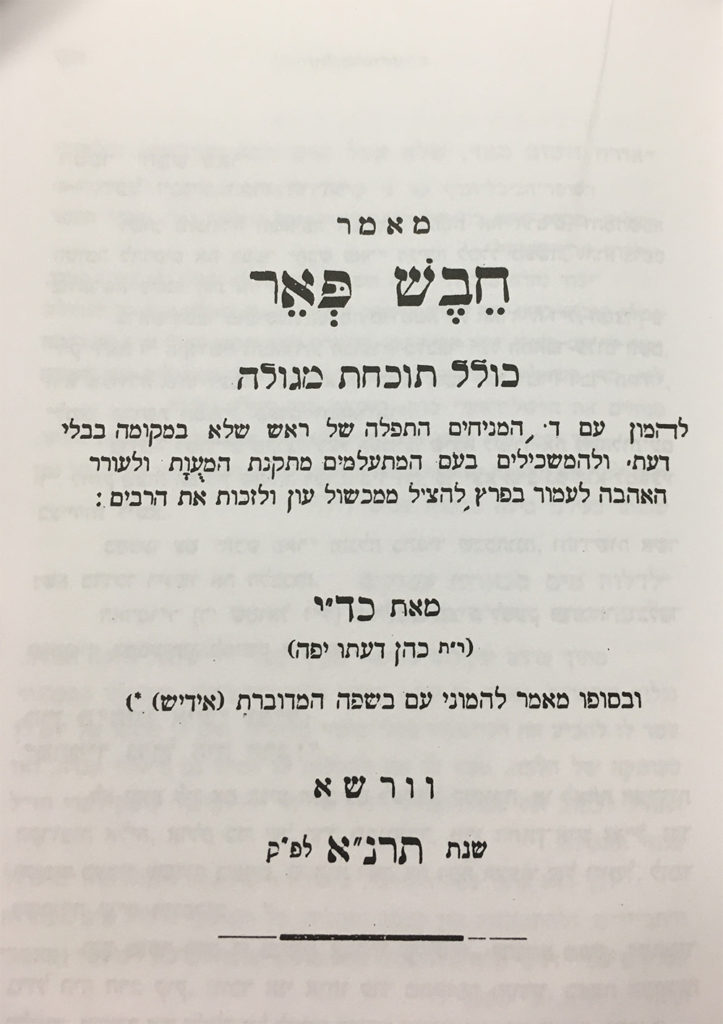
In 1807 R. Jacob Samson Shabbetai Senigallia[26] published his talmudic commentary Shabbat shel Mi. Here is the title page of the Livorno first edition. (It has been reprinted a number of times).

Here is what appears in the book on p. 89b. He is trying to explain why chapters 5 and 6 in tractate Shabbat are next to each other. Chapter 5 begins במה בהמה and chapter 6 begins במה אשה, and according to R. Senigallia this is because “birds of a feather flock together.”

If he was trying to make a joke, I can understand what he wrote. But who ever heard of making a joke in the middle of a talmudic commentary? Presumably, he was being serious, which leaves us with a very offensive comment.

There is, to be sure, humor in the Talmud, but I don’t know of any examples in talmudic commentaries. Yeshayahu Leibowitz quipped that the Sages must have had a good sense of humor, since they included the following text in the Talmud [27]: תלמידי חכמים מרבים שלום בעולם. In all seriousness, however, there are indeed humorous passages in the Talmud, as pointed out by R. Moses Salmon.[28] Here is one example he gives (Bava Batra 14a):

The Rabbis said to R. Hamnuna: R. Ammi wrote four hundred scrolls of the Law. He said to them: Perhaps he copied out the verse תורה צוה לנו משה

R. Salmon claims that anyone with a bit of sense can see that R. Hamnuna’s reply is a wisecrack made in response to the obvious exaggeration about R. Ammi.

Nehemiah Samuel Libowitz states that even in the Zohar we have passages that show a humorous side.[29] One of the many examples he points to is Zohar, Bereshit, p. 27a:

וימררו את חייהם בעבודה קשה בקושיא. בחומר קל וחומר. ובלבנים בלבון הלכתא. ובכל עבודה בשדה דא ברייתא. את כל עבודתם וגו’ דא משנה

I have no idea what to make of the following comment from R. Oury Cherki, dealing with humor, which does not sound like something that would be said by a leading kiruv figure (De’ah Tzelula: Olam ve-Adam be-Mishnat ha-Rav Kook [Jerusalem, 2015], p. 246). Rather, it sounds like something one of the maskilim of old would say.

התורה שבעל-פה אינה מובנה ללא שותפות רוח האומה. לכן כשלומדים הלכה רצוי להצטייד בחוש הומור, שכן לפעמים הדברים נראים משונים למדי. למשל, הכנת כוס תה בשבת. התלמוד אומר שאסור לשפוך מים קרים לתוך החמים אבל מים חמים לתוך הקרים מותר, כי יש כלל ש”תתאה גבר”, התחתון גובר. כששופכים מים חמים לתוך הקרים המים הקרים מתחממים ומתבשלים מה שאין כן ההפך – המים החמים מתקררים. יש כאן בהחלט סוג של הומור

I also found the following interesting comment by Moshe Meisels, the editor of Ha-Doar, in a letter to Chaim Bloch.[30] He suggests that the talmudic prohibition against a non-Jew observing the Sabbath is an example of rabbinic wit, and is not to be understood literally.

ואגב, לא אהא בבחינת מורה הלכה לפני רבו אם אינני מתאפק מלהביא מעין חידוש שנתחדש לי הקטן באחד המאמרים התמוהים בתלמוד מן הסוג הנ”ל, והוא אמרם: עכו”ם ששבת חייב מיתה, שנאמר יום ולילה לא ישבותו וכו’. ואין צורך להרבות דברים על הזרות שבדבר: מה איכפת למי אם שבת או לא שבת, ומה היא הראיה מאותו פסוק, המוסב על קיץ וחורף וכו’, ומה ענינו לכאן ולעכו”ם דוקא? ונראה לי שכל המאמר בא בדרך חידוד, וזה מובנו: עכו”ם ששבת מן הדין שיהא חייב מיתה בדיניהם. מדוע? ישראל שלא שבת חייב מיתה, משום שעל א-לוהיו נאמר וישבות ביום השביעי וכו’, אבל עובד כוכבים ומזלות, שעליהם נאמר יום ולילה לא ישבותו, מן הדין שעובדיהם יהיו חייבים מיתה אם שינו מדרך אלהיהם ושבתו

On the matter of non-Jews observing the Sabbath, R. Yaakov Koppel Schwartz makes a fascinating suggestion, which he acknowledges has no support in the rishonim and therefore he has doubts whether it is correct.[31] The prohibition against labor on the Sabbath is in remembrance of the fact that we were slaves and God redeemed us. Therefore, it is understandable why non-Jews are forbidden to commemorate the Sabbath by abstaining from work, as this has no connection to them. However, there is another reason given for the Sabbath and that is so that we remember the creation of the world. Non-Jews are also supposed to acknowledge this and therefore there should be nothing wrong with non-Jews having some sort of celebration in honor of the Sabbath.

אבל הכיבוד והקידוש של יום השבת, שהוא משום אמונת חידוש העולם, שייך שגם הגויים יהיו בהם ואינם מנועים מלכבד ולענג את השבת

If we follow R. Schwartz’s approach, this is something that could be suggested for Noahides whose “religion” is lacking any rituals, which for most people is an essential component of their religion.

* * * * * * * *

[1] Ha-Tzofeh, June 16, 1959, p. 2.

[2] Orhot Hayyim, Or Etzion ed. (Merkaz Shapira, 2017), p. 106, quoted by R. Joseph Karo, Beit Yosef, Orah Hayyim 51 (end). Regarding negative expressions directed against God, there is an interesting passage in R. Yedidiah Solomon Raphael Norzi, Minhat Shai, Deut. 8:3. To understand it one must know that the old French word “fi” expressed disdain or disgust. See here. The issue Norzi discusses is that the verse reads:

‘כִּי עַל-כָּל-מוֹצָא פִי-ה

Norzi cites a view that in this case there should be a dagesh in the word פי even though that is not in accord with the general rule, because without the dagesh, reading it as “fi” would be disrespectful to God:

כי לשון גנאי הוא בלשון צרפת וחלילה לשם יתברך

Norzi completely rejects this and states that the rules of biblical grammar are not to be changed because of how words sound in languages other than Hebrew (and there are indeed examples where biblical Hebrew words sound like profanity in other languages).

ואין לנו לחוש ללשון צרפת שאין מבטלין דרכי לשון הקדש מפני שאר לשונות

See also Samuel David Luzzatto, Prolegomena to a Grammar of the Hebrew Language, trans. Aaron D. Rubin (Piscataway, N.J., 2005), pp. 133-134.

Regarding the pronunciation of פ, R. Meir Mazuz points out that the Vilna Gaon, Commentary to Tikunei Zohar, section 19, p. 38d (p. 166 in R. Zuriel’s edition), mistakenly believed that Sephardim pronounce פ with and without a dagesh the same way (just as they pronounce ת with and without a dagesh the same way). R. Mazuz notes that the Vilna Gaon’s point is repeated by R. Baruch Epstein, Mekor Barukh, vol. 1, p. 397b (without mentioning the Gaon). See Mazuz, Bayit Ne’eman (Humash), vol. 1, p. 13 (first pagination).

[3] Hazon Ish, Yoreh Deah 62:21.

[4] In my earlier post I cited R. Samson Raphael Hirsch as adopting the notion that women are created on a higher spiritual level than men. I neglected to note that Shaye J. D. Cohen earlier discussed Hirsch’s approach. See Cohen, Why Aren’t Jewish Women Circumcised (Berkeley, 2005), pp. 165ff.

[5] “Eshet Hayil: Kavim li-Demutah u-le-Ma’amadah shel ha-Ishah be-Hagut ha-Yehudit ha-Shesh Esreh,” in Ephraim Hazan and Shmuel Refael, eds. Mahbarot li-Yehudit (Ramat-Gan, 2012), p. 286.

[6] Torah in The Observatory (Boston, 2010), p. 287. I earlier discussed Ralbag here.

[7] See R. Yaakov Moshe Toledano, Sarid u-Falit (Tel Aviv, [1945]), p. 8.

[8] Bayit Ne’eman no. 153 (parashat Vayikra 5779), p. 2.

[9] See e.g., R. Israel Ibn Al Nakawa, Menorat ha-Maor, ed. Enelow, vol. 4, pp. 32-33, who instructs a wife as follows (using the word שפחה that so troubled R. Moshe):

ועושה צרכיו בעצמה ולא על ידי אחרים. ואפי’ היו לה כמה עבדים וכמה שפחות, תעמוד היא ותשרתנו, ותקראנו אדוני . . .ויהיו עיניה תלויין לו, כעיני שפחה אל יד גבירתה

For a translation of this passage, see here. Maimonides, Mishneh Torah, Hilkhot Ishut 15:20, says that a wife should regard her husband כמו שר או מלך.

Radak, Gen. 3:16, writes:

והוא ימשול בך: לצוות עליך מה שירצה כאדון על עבד

Ramban, Gen. 3:16, explains that as a result of Eve’s sin, the relationship of man and woman was changed. From that point on:

 והוא יחזיק בה כשפחה ואין המנהג להיות העבד משתוקק לקנות אדון לעצמו אבל יברח ממנו ברצונו

R. Bahya ben Asher, Gen. 3:16, writes:

ואל אישך תשוקתך: שאע”פ שהאשה משועבדת ברשות הבעל ומנהג העבד לברוח מן האדון כדי שלא ישתעבד, גזר בזאת שתהיה משתוקקת לבעל ושתרצה להשתעבד לו בהפך מן המנהג

See also R. Chaim Rapoport’s letter in my Iggerot Malkhei Rabbanan, p. 172.

R. Avraham Blumenkrantz, Gefen Poriah, p. 352, quotes approvingly another rabbi who states as follows (emphasis added):

Her tears are ever ready to flow at the most miniscule suggestion of being dealt with as a maidservant. She will concede you the service of והוא ימשל בך. She will consent to call you בעלי, but don’t accent the דגש in the בית too heavily. She must constantly be reassured that there is honor and dignity in her subservience. Honor her more than you honor yourself. She must be compensated for her subjugation, and be made to feel that she has a genuine share in the dignity of the throne.

Do haredi women really feel that they are subservient or subjugated? Do haredi men feel this way about their wives? Hasn’t haredi society accepted the notion of separate but equal when it comes to men and women?

[10] Sanhedrin 39a, Yevamot 113a, Nedarim 38b.

[11] As is well known, and I have written about previously, R. Moshe often rejected the authenticity of texts that he found problematic. Another example of this with regard to Rashi on the Talmud is found in Iggerot Moshe, Even ha-Ezer, vol. 4, no. 64:1. Here R. Moshe says to delete words in Rashi even though, as he notes, these words are found in “Rashi” on the Rif and in R. Nissim. See the strong responses to R. Moshe quoted in R. Yonason Rosman, Petihat ha-Iggerot, pp. 605-606. One of these responses is from R. Menasheh Klein in his notes to R. Eyal Shraga, Minhat Ish, vol. 1, pp. 302-303. R. Klein writes:

וח”ו ואטו עד כמה נילך ונמחוק בדברי רבותינו ז”ל שנאמרו ברוה”ק, ולולי דמספינא הייתי אומר דאיזה תלמיד טועה כתבו, אבל פשוט דדברי רש”י נכונים וליכא כאן טעות כלל

When R. Klein suggests—לולי דמספינא—that a “mistaken student” is responsible for the problematic passage in Iggerot Moshe, he does not mean it seriously. This is just his respectful way of saying that R. Moshe’s position is completely without basis. He uses the same language in Mishneh Halakhot, vol. 12, Yoreh Deah no. 214. There he responds to R. Moshe’s statement that he doesn’t know who R. Menahem Tziyoni is, but since he quotes a heretical—in R. Moshe’s opinion—passage from R. Judah he-Hasid’s commentary on the Torah, therefore R. Tziyoni’s work must be banned together with R. Judah he-Hasid’s commentary.

[12] R. Moshe also famously states that women do not have any less holiness than men. See Iggerot MosheOrah Hayyim vol. 4, no. 49 (p. 81). See also the new Mesorat Moshe, vol. 4, p. 476. This position is at odds with many earlier writers who saw men as holier because they are commanded in more mitzvot. This is also Maimonides’ position in his commentary to Horayot 3:7. See R. Chaim Rapoport’s discussion in Kovetz Hearot u-Veurim, no. 908 (2006), pp. 138ff. Yet see R. Dov Halbertal, Erekh ha-Hayyim be-Halakhah (Jerusalem, 2004), vol. 2, p. 399, who has a different approach and makes the point that just because a Kohen and Levi are to be saved before an Israel, no one would say that the Kohen and Levi have more holiness. See also R. Yitzhak Barda, Yitzhak Yeranen, vol. 11, p. 249, that women are holier than men. He offers an original explanation of this notion.

שהאשה שהקב”ה הפריש ממנו, מהצלע שלו, הוא מופרש, וממילא כל מופרש קדוש, ואז האשה יותר קדושה מהאיש. ובזה מובן למה האיש מקדש את האשה, לא אומר לה הרי את אשתי, או כל סממן לשון של נישואין, חברה או שותפה וכו’, זולתי: הרי את מקודשת לי! לפי שהקב”ה קבע כל מופרש קדוש

[13] Kinyan Shlomo, Yevamot, p. 89. See also R. Natan Einfeld, Minhat Natan: Kiddushin, pp. 139-140, who cites other sources in rejecting R. Moshe’s point.

[14] Malki ba-Kodesh, vol. 4, p. 50a. See R. Menasheh Klein, Mishneh Halakhot, vol. 12, no. 351, for a defense of the practice of husbands and wives eating separately.

[15] Mishneh Halakhot, vol. 7 no. 155 (called to my attention by R. Aviad Stollman).

[16] The story is recorded by R. Chaim Dalfin, Faces and Places Boro Park (Brooklyn, 2017), p. 149.

[17] Commentary to Gen. 17:15. See the rejection of Radak’s opinion in R. Betzalel Stern, Be-Tzel ha-Hokhmah, vol. 1, no. 70.

[18] Maharil, Likutim (p. 610 in the Makhon Yerushalayim edition).

[19] On the other hand, R. Meir Schiff (Maharam Schiff), Gittin 52a, explains that R. Yose referred to his wife this way because she was a bad wife: אשה רעה. Yet the proof he brings for this is actually from a different R. Yose. See R. Judah Leib Maimon, ed., Sefer ha-Gra, vol. 1, p. 110 in the note. Regarding “bad wives”, R. Elazar of Worms is quoted as follows in R. Alexander Suslin, Sefer ha-Agudah, ed. Brizel, Yevamot, no. 78 (p. 41):

מי שיש לו אשה רעה יסבול יקבל ברצון ויקבל בשמחה ולא יראה פני גהינם

What does R. Elazar mean that if you suffer under a bad wife you will not see gehinnom? R. Moses Guedemann explains that with a bad wife you already saw gehinnom in your lifetime, so there is no need to see if after death. See Ha-Torah ve-ha-Hayyim, trans. Friedberg (Warsaw, 1897), vol. 1, p. 194:

כי פני הגיהנם כבר ראה בחייו

Regarding “good wives” see R. Shlomo Hoss, Kerem Shlomo, no. 43, who writes:

אין לך כשרה בנשים אלא אשה שעושה רצון בעלה: אהע”ז ס”ס ס”ט (אך אשת חיל כזאת מי ימצא)

R. Solomon Zvi Schueck was shocked at R. Hoss’ final comment, that one cannot find a wife who does the wishes of her husband. R. Schueck writes that based on this passage he assumed that R. Hoss must not have had a good wife.

נראה לי שהי’ לו אשה רעה, וממנה דן על כל הנשים שבישראל

See She’elot u-Teshuvot Rashban, Even ha-Ezer, no. 99 (p. 88b). He further tells us that he asked one of R. Hoss’ students who confirmed that this was indeed the case.

[20] See Tuvia Preschel, Ma’amrei Tuvyah, vol. 5, p. 142.

[21] See Or Torah, Shevat 5780, p. 460.

[22] Exodus 86a, 87a.

[23] Mitpahat Sefarim, ch. 4 (at the beginning; p. 20 in the Jerusalem 1995 edition). In R. Reuven Rapoport’s edition of Mitpahat Sefarim, with his commentary Itur Soferim, p. 13, R. Rapoport sees it as obvious that this passage in the Zohar is a later interpolation much like there are Savoraic additions in the Talmud.

[24] Mitpahat Sefarim, ch. 4 (p. 27 in the Jerusalem 1995 edition).

[25] Mitpahat Sefarim, ch. 4 (p. 54 in the Jerusalem 1995 edition). Regarding the larger issue that R. Emden points to, see Ronald C. Kiener, “The Image of Islam in the Zohar,” Jerusalem Studies in Jewish Thought 8 (1989), pp. 43-65.

[26] See the recent discussion of R. Senigallia by R. Moshe Maimon in the Seforim Blog here.

[27] Sihot al Pirkei Ta’amei ha-Mitzvot (Jerusalem, 2003), p. 289.

[28] Netiv Moshe (Vienna, 1897), pp. 45-46.

[29] “Halatzot ve-Divrei Bikoret be-Sefer ha-Zohar,” Ha-Tzofeh le-Hokhmat Yisrael 11 (1927), pp. 33-45. For more on humor in the Talmud, see Yehoshua Ovsay, Ma’amarim u-Reshimot (New York, 1946), ch. 1; Meyer Heller, “Humor in the Talmud” (unpublished masters dissertation, Hebrew Union College, 1950), available here; R. Mordechai Hacohen, “Humor, Satirah, u-Vedihah be-Fi Hazal,” Mahanayim 67 (5722), pp. 8-19; and Ezra Brand’s post here. From Brand I learned that David Lifshitz wrote an entire doctorate on the subject. See also my posts here and here where I discuss Siftei Hakhamim’s comment that Moses thought God was joking with him, and how this has been censored in a recent edition. See also J. Chotzner, Hebrew Humor and Other Essays (London, 1905); Nehemiah Samuel Libowitz, Ha-Shomea Yitzhak (New York, 1907).

[30] See here (Chaim Bloch Collection, Leo Baeck Institute, 7155-7156, 1/13).

[31] Likutei Diburim, vol. 4, pp. 24-25.


Berakhot Koren Talmud Bavli and Ein Aya

Berakhot Koren Talmud Bavli and Ein Aya

by Chaim Katz

Berakhot Koren Talmud Bavli (KE) is a translation (into English) of Rav Adin Even-Yisrael Steinsaltz’s Hebrew edition of tractate Berakhot. It comprises the text of the Talmud, the in-line commentary, the explanation of foreign words, the mini-studies (iyunim), the biographies of selected sages, the description of cultural objects (hahayim), descriptions of fauna and flora and more. As far as I’ve noticed, they never mention in the front matter nor in the advertising blurbs that they added informational notes that don’t appear in the original edition, but there are more than 100 new notes in Berakhot KE.

In this paper, I’d like to present an overview of the new notes, and specifically examine the notes based on Ein Aya [1] – Rav Kook’s commentary to Ein Yaakov. [2]

I had a few questions about the notes based on Ein Ayah:

  1. In the Hebrew edition, Rav Adin created a bibliography of all the sources he used to compile his explanations. The list contains about 100 entries that stretch from Baal Halakhot Gedolot and Sheiltot (8th century) to Rabbi Akiba Eger (died 1837), the Hatam Sofer (died 1839), and  commentaries printed in the Vilna Shas and the Vilna Ein Yaakov, e.g., Maharatz Chajes (died 1855), Rav Samuel Strashun (died 1872), Rav Hanokh Zundel the author of Etz Yosef (died 1867).  Rav Adin did not incorporate any 20th century authors in his commentary. KE made an exception and included Rav Kook. What is the reason?
  2. Ein Aya is not really an explanation of Ein Yaakov. Rav Kook points out in its introduction that his work uses Ein Yaakov as a starting point. However, his goal was to expand the literature of Aggadah and produce a new type of reading material based upon ethical ideas in Jewish philosophy, kabbalah, musar and hassidut. Does KE realize that Ein Aya is not a commentary like the others?
  3.  Ein Aya is very long. A haggadic statement that Maharsha devotes 15 lines of explanation to, is discussed by Rav Kook in about 60 lines (30 lines of double column text). How will KE summarize all that material? [3]

First, I’ll briefly review some of the new notes in KE and then examine a few passages quoted from Ein Aya. The following are new:

1 KE Daf 16b (page 112) has a biography of Rav Safra which is copied from the Hebrew edition Moed Kattan 25a

2 KE Daf 57b (page 371) has a biography of Rabbi Yishmael ben Elisha copied from Gittin 58a

3 KE Daf 64a (page 409) has a note about the Chaldean astrologers, which is copied from the Hebrew Shabbat 156b. 

4 KE Daf 17b (page 115) has a note about Jesus the Nazarene copied from the Hebrew Edition Sotah 47a.

5 KE Daf 9b, (page 59) there is a note about tekhelet, similar but different from the notes in Menahot 38a  .

6 KE Daf 12b, (page 82) has a long note about tzizit – ritual fringes

7 KE Daf 13b, (page 91) there’s a definition of kavanah – intent

8 KE Daf 13b, (page 92) has a diagram of the placement of the tefillin on the arm and hand. 

9 KE Daf 56b, (page 365) has a note describing a lion. 

10 KE Daf 56b, (page 367) has a note describing an elephant. 

11 KE Daf 41a, (page 270) has notes for: radish, olive, wheat, barley, and fig. The following page has a definition of a date. 

12 KE Daf 59a (page 382) has a note about a rainbow.

13 KE Daf 7a, (page 42) has an unattributed explanation based on the words: “When I wanted you did not want . . . “.  The explanation is from Maharsha. 

14 KE Daf 10a, (page 64) has a comment concerning the relationship of the Holy One Blessed is He and the world. This explanation comes from Etz Yosef.

15 KE Daf 11b, (page 74) has an unattributed very long note about abounding love אהבה רבה and eternal love אהבת עולם. The note is taken verbatim from The Long Shorter Way (Chapter 4 – Two Ways of Loving G-d) [4].

16 KE Daf 51a, (page 323) has a clarification of a statement made by the angel Suriel. This is from the Maharsha. 

17 KE Daf 58a, (page 374) has an explanation concerning the statement: “When Samaria was cursed, its neighbors were blessed”. The explanation comes from Anaf Yosef.

18 KE Daf 17a (page 114) There is a short note about the “Divine Presence” (although it’s not the first time that the word שכינה appears in the tractate.)

My sense is that the Steinsaltz Hebrew edition only introduces a note when there is a problem (on the page) that the additional note might solve. KE relaxes this constraint. I’ll illustrate this difference using the first example in the above list. We read in our Gemara:

 After his prayer, Rav Safra would add: “May it be Your will, G-d our G-d, that You make peace among the members of the heavenly court…”

Rav Safra is one of many sages quoted. There is no problem that needs to be solved. The KE has a biography of Rav Safra that ends this way:

Since Rav Safra was an itinerant merchant, he never established his own yeshiva and did not spend much time in the study hall. Therefore, there were those among the Sages who held that he was unlike other Rabbis, that all are required to mourn their passing. 

This is a strange piece of information which doesn’t look like it belongs in a biography. However, the Talmud Moed Kattan 25a, records the following discussion:

When R. Safra died, the students did not rend their clothes for him, since, they said, we have not learned from him. Abaye argued with them: Does the baraita say: ‘When a teacher dies’? Rather it says ‘when a scholar dies’.  Moreover, every day in the study hall we discuss his interpretations of the halakha. 

KE’s biography was copied from Rav Adin’s biography in Moed Katan. 

There are many other examples of notes in KE that were copied from one location to another. They usually don’t fit very well in the destination location. In general, the notes regarding the religious objects add value. The notes describing the obvious (e.g., lion and elephant) are probably included for their esthetics.

Concerning Ein Aya: First, I’ll present the note, my translation and the Hebrew text of Ein Aya side by side and then I’ll discuss the note briefly. 

1 KE Daf 9a (Page 57), Ain Aya Berakhot 1 112 

When the children of Israel were redeemed from Egypt, they were redeemed only in the evening. And when they left, they left only during the day:

There are two separate elements to the transition from slavery to freedom. First, the slave acquires a personal sense of freedom and becomes master of his own fate. Second, he becomes free in the eyes of others, i.e., he is perceived by those surrounding him as a free man and has the potential to influence them. With regard to the children of Israel, the first element enabled them to receive the Torah and elevate themselves with the fulfillment of G-d’s commandments. The second element provided Israel with the opportunity to become a “light unto the nations.” Therefore, the redemption was divided into two stages. The first stage, in which they acquired private, personal freedom, took placed at night; the second stage, which drew the attention of the world to the miracle of the Exodus, took place during the day.

R. Aba said: All agree that when Israel was redeemed from Egypt, they were redeemed specifically during the night, and when they left Egypt, they left specifically during the daytime.

Redemption from slavery to freedom in general has two effects on an entire nation: 1) An inner liberation and exaltedness that it senses when it exchanges the submissiveness of slavery for autonomy and self-determination. 2) A freedom to perform actions that impact the world. 

In Israel these two effects are more pronounced. For the inner freedom is the beginning of their own perfection – developing holy behaviors in Torah, its mitzvot and its wisdom. While the outer public freedom allows Israel to be a light to the nations. A great part of the latter mission has already been accomplished even in our time and will be fully completed when G-d has compassion on His nation. For from Zion will the Torah go forth (Is. 2:3), Even the people in the far-way lands will wait to hear Torah of Israel (Is. 42:4)

Therefore, the redemptions are divided into two parts. When Israel was redeemed from Egypt – the inner redemption – this occurred during the nighttime. For the main point is not publicity or exposure to others, but a strong sense of their inner liberation. When they left, they specifically left during the daytime, publicly and openly for all the nations of the world to see, to demonstrate their worldly mission of instructing, benefiting and illuminating all of mankind with the light of G-d as it is written: Nations will walk in your light, kings in your glorious light. (Is. 60 3)

א”ר אבא הכל מודים כשנגאלו ישראל ממצרים לא נגאלו אלא בערב, וכשיצאו לא יצאו אלא ביום .

הגאולה מעבדות לחירות בכלל, פועלת בכלל עם-שלם שני עניינים. האחד הוא החופש שירגיש בנפשו התרוממות שיצא מכלל שפלות העבדות ונעשה בן חורין ואדון לעצמו. והשני הוא הפעולה הנגלית בעולם, בהיותו עם חפשי חי ופועל.

ובישראל עוד יתר שאת לשני אלה, כי החופש הפנימי הוא התחלה לשלמות עצמם, בקדושת המדות בתורה ומצותי’ וחכמתה. והחופש הגלוי החיצוני, הוא עומד בישראל להיות לאור גויים, כאשר כבר נעשה חלק גדול מזה גם לעת כזאת, ויגמר בתכליתו לעת ירחם ד’ את עמו, כי מציון תורה תצא ולתורת ישראל איים ייחלון.

 ע”כ נחלקו הגאולות לשני חלקים, כשנגאלו ישראל ממצרים הגאולה הפנימית, היינו מבערב, שע”ז אין העיקר הידיעה והפרסום של זולתם, כי אם ההרגשה הטובה בחופשתם הפנימית. וכשיצאו לא יצאו אלא ביום, ביד רמה גלוי לכל יושבי תבל, להורות על פעולתם הגלויה בעולם, להשכיל להיטיב לכל ברואי בצלם להאיר באור ד’, כדבר שנאמר “וְהָלְכוּ גוֹיִם לְאוֹרֵךְ וּמְלָכִים לְנֹגַהּ זַרְחֵךְ

KE skipped the nuance that Rav Kook was speaking about nations and not individuals. It also decided that redemption occurs in two stages, while Rav Kook only said that redemption has two components to it. They stopped short and didn’t capture the emphasis that Rav Kook placed on enlightening the nations (probably with the Noachide laws), but on the whole, it’s a fairly accurate summary.

2 KE Daf 10b, (page 65), Ain Aya Berakhot 1 141

From the chambers [kirot] of his heart – Often prayer is viewed as an act that combines the spiritual and the intellectual. There is a cognitive awareness of the necessity to turn to G-d in our time of need. When there is a pressing need, calling for a higher level of prayer, there can be an authentic call emanating from a person’s very heart, as the Psalmist declares: “My heart and my flesh sing for joy unto the living G-d” (Psalms 84:3) Hezekiah turned his face to the wall and prayed. Why wall? Rabbi Shimon b Lakish said: From the walls of his heart.

There is a prayer that accompanies emotions that are intellectual, when the intellect perceives the value of the necessity of praying and recognizes the great worth of prayer. For the intellect is associated with the spirit of the heart, which resides in the chamber of the heart. 

However, when one fortifies oneself in prayer so much so that the body’s powers are aroused by the feelings generated by prayer, then the prayer affects the body, not just the soul. This is called praying from the walls of the heart. Namely, not just with the spirit, which is in the chamber of the heart, but also with physical vitality as it written: my heart and my flesh sing to the living G-d (Psalms 84:3)

ויסב חזקי’ את פניו אל הקיר ויתפלל. מאי קיר ארשב”ל מקירות לבו

יש תפילה שבאה ברגש שכלי, שהשכל משקיף על ערך הנחיצות להתפלל ומכיר גדולת ערך התפילה. והנה השכל מיוחס לרוח הלב השורה בחלל הלב.

אבל כשמגביר ברחמים עד שגם כוחות הגופניים מתפעלים מרגשי התפילה, ונמצא שהתפילה פועלת על הגוף לא על הנפש לבדה, נקרא שמתפלל מקירות הלב. כלומר לא מהרוח לבדו שהוא בחלל הלב, כ”א גם בהתפעלות בשרית, כמו שכתוב “לבי ובשרי ירננו אל אל חי”.

This is a more difficult piece, particularly because we don’t relate to the view that (one side of) the heart is filled with spirit. We don’t identify with the description of the heart as a source of emotion and we no longer think of intellect affecting the flesh of the heart (but that’s another discussion).

The main problem with KE’s translation, is that Rav Kook is speaking here about the influence that prayer has on the person. He’s not speaking about “a higher level of prayer . . . an authentic call emanating from a person’s very heart”. He’s saying that a person can change himself through prayer.  He can change his thoughts (chamber of the heart) and he can even change his character (walls of the heart). KE’s translation misses all of this. It misses the distinction between walls and chamber, and it misses the connection to the verse from Psalms that Rav Kook cites.

(It’s not the right place now to trace the history of the idea that the person refines and elevates himself through prayer. See maybe Rav Shimshon Raphael Hirsch on Devarim 11:13, or Rabbi Soloveitchik’s Shiurim l’Zecher Aba Mori z”l  volume 2, page 29 and other places there.)

3 KE Daf 63b, (page 408), Ain Aya Berakhot 9 344

Matters of Torah are only retained by one who kills himself over it [5]

While educators often try to make Torah study easier because they believe that doing so will lead students to accumulate more information and Torah knowledge, their approach is fundamentally flawed. The significance of Torah education is qualitative, not quantitative. It is not the sheer volume of knowledge amassed; it is the quality of the Torah wisdom that is attained. Simplistic, facile methods of study do not facilitate deep understanding. That can only be achieved through hard work and serious effort

The school of R. Yannai taught: What is the meaning of (Mishle 30:33) The culturing of milk produces fermented milk (yogurt) …  In whom do you find fermented milk of Torah, in the one who spits out the milk he nursed from his mother.


There are many educators who pride themselves for introducing methods that make learning simpler. They imagine they’ll benefit the world by transmitting lessons and knowledge of Torah in an undemanding way, eliminating the need to for a person to work. 

This assistance is misguided. Knowledge isn’t measured by quantity but by quality, according to depth and perceptiveness that enable the student to apply the knowledge to any situation. More so regarding Torah knowledge, which is measured by the profound impression on the student in his ethical personality, virtuous behavior, and pure fear of Heaven.

Success will come when the studies do not follow an easy and undemanding curriculum. For through exertion and mental effort, a person is elevated to ethical behaviors, and turns with love and longing toward wisdom and holiness. The learning affects him such that he’s entirely dedicated and devoted to his lessons. Learning specifically with great effort produces a deep understanding, clarity in knowledge, and the pleasing way of serving G-d, fearing Him, and purifying one’s character. 

Studies that are acquired easily, without exertion and tremendous struggle will always be superficial, frozen and detached from the person’s inner soul. They will have minimal impact on his behavior and personality. 

Therefore, the fermented milk of Torah, the choice purified portion of Torah, the key aspect, clarified by deep thought and profound understanding that strengthens the soul in the fear G-d, and in the ways of holiness in whom will it be found? Only in one who was raised laboring in Torah and acquired Torah by following the beaten paths of strenuous effort and great toil; who distances himself from his childhood pleasures so that his Torah was not acquired though childish games.  He spits out the sweet milk he nursed from his mother

אמרי דבי ר”י: מאי דכתיב (משלי ל לג): “כי מיץ חלב יוציא חמאה במי אתה מוצא חמאה של תורה? – במי שמקיא חלב שינק משדי אמו עליה”

רבים הם הפדגוגים המתנשאים להביא דרכים להקל את עול הלימוד, וחושבים שיביאו ברכה לעולם בהקנותם את הידיעות והלימודים התורניים באופן קל, שלא יצטרך האדם להיות עמל בהם.

תועלת הדבר אינה אמנם אלא מתעה, כי הידיעות לא תימדדנה על פי כמותם כי אם על פי איכותם, על פי עומק ההבנה וחריפות השימוש בהם לכל חפץ.ביותר לימודי התורה, על פי גודל הרושם שפועלים על הלומד, לענין התכונה של המוסר המעשים הטובים ויראת ה’ הטהורה. 

ובזאת יהיה מועיל רק הלימוד שאינו בא בדרכים קלים ונוחים לקלוט, כי על-ידי היגיעה ועבודה שכלית מתעלה האדם למידות נעלות, ולהיות נוטה אל השכל ואל כל דברי קודש באהבה וחפץ לב, והלימוד פועל עליו להיות כולו נתון ומסור ללימודיו. על-כן יצא מהלמוד שעל-ידי היגיעה דווקא, עומק ההבנה והידיעה הברורה עם הפעולה הרצויה לעבודת ה’ ויראתו וכל טהרת המדות. 

אבל הלימודים הנכנסים באופן קל, בלא יגיעה ועבודה כבירה, ישארו לעולם שטחיים וקפויים, עומדים מחוץ לנפשו של אדם הפנימית, ופועלים מעט על מעשיו ועל יצרי לבבו.

ע”כ חמאה של תורה, הברור והמובחר שבה, העיקרי, המחוור בעומק רעיון ושום שכל והמרבה אומץ הנפש ביראת ה’ ודרכי קודש במי תמצא? רק במי שנתגדל על עבודת התורה בעמל, וקנה אותה בדרכים כבושים שע”י יגיעה ועבודה רבה, שעמדו לו להתרחק מן הילדות וכל געגועיה, לבלתי קנותם בדרך שעשועי ילדים, כ”א מקיא חלב שינק משדי אמו עליה

KE, missed the point here as well. Rav Kook isn’t speaking about education or Torah education. It’s not about “deep understanding that can only be achieved through hard work and serious effort” 

He’s speaking about love of G-d. The fermented milk of Torah represents the Torah studies that, under the proper conditions, lead the person to the love of G-d. Knowledge isn’t sufficient; one must labor and exert himself in these Torah studies and only then will they succeed in leading him to holiness.  

(The basis of Rav Kook’s idea might be in the Sifre Devarim (on Deut. 6 6) quoted by Maimonides Book of Commandments, Positive #3, “You shall love G-d your G-d with all your heart’, can I know how to love G-d? The Torah therefore says: These words which I command you today shall be upon your heart. Thus, you will come to recognize the One who spoke and the world was created and you’ll cling to His ways.)

4 KE Daf 10a, (page 62), Ain Aya Berakhot 1 128  

David… resided in five worlds and said a song of praise corresponding to each of them:

There is a tremendous difference between looking upon an experience in a superficial manner and reflecting upon it and contemplating it. An individual who merely sees the external will not come to understand the deeper, spiritual significance of a given experience or encounter. Natural events like pregnancy, birth and nursing may seem to be mundane events experienced by humans and animals alike. However, one with a higher level of spiritual discernment will appreciate the vast difference between man and animal. King David’s songs of praise, uttered at every stage of life, attest to the magnitude of his sensitivity to G-d’s beneficence and to his appreciation of His role in the world.

He lived inside his mother’s womb and offered songs of thanksgiving; he went out into the air of the world…

One who looks at the real world superficially cannot recognize the grandeur and beauty of the majesty of G-d nor the splendour of the human soul, as his perception of the real world is based exclusively on obvious visible traces of wisdom. In the words of the Duties of the Heart, (Hovot HaLevavot by Bahya ibn Pakuda Spain 11th century): based on the obvious visible traces of wisdom in the real world, both the intelligent man and the fool are equivalent. 

On the other hand, the truly gifted person will find hidden insights in the very things that didn’t inspire or elevate the person who looks at the world superficially. The truly gifted person will recognize the line of kindness that extends through all creations from their beginnings to their ultimate purpose. He will appreciate G-d’s wonders and thank Him. With happiness he will sing for G-d and for His goodness. He will recognize the majesty of his own soul that perceives the grandeur of the glorious King. Therefore, David (peace to him), who combined in himself depth of knowledge with sweet Divine song, sang about things that are discerned only with wisdom and deep contemplation. 

He lived inside his mother’s womb…  

Seemingly, there is no reason to be amazed. The experience is similar for a human or any other animal that doesn’t speak. In the womb, the human embryo is just like an amphibian or a lizard, the lowest rungs in the animal hierarchy.

 But when he reflects deeply, that in this lowly state all organs and limbs, which will serve the loftiest powers of the soul, are being completed. Not one is missing. If so, how great is the work taking place in the womb for the design of a person. Then, being so far from perfection, all the material and spiritual abilities he will later need are developing so that he’ll develop into a refined ethical person, who embraces in his brain and mind, the foundations of the world and its infinite expanses.

דר במעי אמו ואמר שירה, יצא לאויר העולם  . . . 

הבדל יש בין המסתכל רק בהשקפה שטחית על המציאות, הוא לא יוכל להכיר רוממות ה’ והדר גאונו ועם זה הוד נפש האדם, רק מהדברים הגלויים בסימני החכמה שבמציאות. כדברי חוה”ל, שבסימני החכמה הגלויים המשכיל והכסיל שוין בהם. 

אבל החכם האמיתי, הוא יחדור אל סימני החכמה הצפונים, שלעין הרואה רק חיצוניות הדברים לא יולד מהנה שום רוממות נפש. אבל החכם האמיתי, יכיר החוט של חסד ההולך בכל המעשים כולם מהתחלתם עד מטרתם, ויכיר נפלאות השם ית’ ויודה לשמו. ומטוב לב ישיר על ד’ ועל טובו, ויכיר הוד נפשו המכרת את הדרת מלך הכבוד. ע”כ דוד ע”ה שבו חובר עומק הדעת עם נועם השירה האלהית, אמר שירה על הדברים שרק בחכמה והשקפה רבה יוכר הודם ופלאם.

 דר במעי אמו, לפי החיצוניות אין להפליא כ”כ, מקרה האדם בזה כמו שאר החיים הבלתי מדברים, אז הוא במדרגת השרצים ג”כ שהם במדרגה הנמוכה של מערכת החי. 

אבל כשהתבונן, כי בהיותו במצב הנמוך הזה אז נגמרו ונוצרו כל יצוריו כולם, וכל האיברים המשמשים לכוחות הנפש היותר נשגבות אחד מהם לא נעדר. א”כ מה רבה התכונה הנעשה בבטן המלאה ביצירת האדם, שאז במצב רחוק משלמות והתפתחות כזה, צריכים שיוכנו לו כל הכוחות וכל הכלים הרוחניים והגשמיים שיצטרכו לו בהיותו אדם המעלה, המחבק זרועות עולם ומרחבי אין קץ בדעו ושכלו.

Here too, I think, KE missed the point. It’s not about “the vast difference between man and animal”, which Rav Kook never mentioned. Rav Kook picks the theory of recapitulation to explain David’s song. According to the theory (which was immensely popular in the second half of the 19th century), the stages of embryonic development correspond to adult stages in the evolution of the species (ontogeny recapitulates phylogeny). That’s why Rav Kook writes: the human embryo is then like an amphibian.  But the theory is based on superficial similarities. The truly wise man looks beyond the superficiality and sees that each embryonic phase is not an evolutionary ancestor, but a point on a line extending from the person’s beginning to his birth. Each point on the line contains a hidden potential that will unfold and finally develop into a moral and ethical man. The insight (probably disproves the theory and) results in a greater appreciation of the Creator’s kindness, which is the song of praise that David sings.

We can now come back and answer the three questions that I posed earlier. 1) KE is not looking at Ein Aya as a typical commentary; that’s why they had no problem including Rav Kook’s words in the Berakhot volume.  Additionally, I guess, the writers or editors have an admiration and affinity for Rav Kook and wanted to include some writings of his. 2) KE knows that in quoting a section from Ein Aya they are not explaining the text of the Talmud. Instead, they are attempting to follow the path of Ein Aya; to add thoughts and reading material of an ethical nature to KE. 3) It looks (at least in these few examples) that KE translated only the first few sentences of the Ein Aya section and then wrote up their own conclusions. They probably didn’t read to the end of the Ein Aya section(?), or if they did, they decided to “keep it simple”. I guess this can be excused too. In one of these notes they did write “see Ein Aya” instead of just attributing the section to Ein Aya.

Maybe the new notes in KE Berakhot aren’t of the same calibre as the original notes in the Hebrew edition. Still, they make the learning more interesting and more attractive. For this we should be thankful.

[1] Ein Aya is a work by Rav Kook on the Aggadah in Ein Yaakov, published by Makhon HaRav Tzvi Yehuda, Jerusalem. It consists of 4 volumes covering Berakhot and most of Shabbat. Though it was written over 100 years ago it was only published recently (approximately between 1995 and 2005). The text is also available at https://he.wikisource.org/wiki/
[2] Ein Yaakov is a collection of aggada from the Talmud Babli, by Rabbi Yaakov Ibn Habib (died 1516)
[3] I’m using as my example: Daf 3a “Rabbi Eliezer said: The night consists of three watches… during the first watch a donkey brays, during the second the dogs howl, during the third the infant nurses from its mother and a wife speaks with her husband”
[4] The Long Shorter Way, Discourses on Chasidic Thought, by Adin Even-Israel Steinsaltz, edited and translated by Yehuda Hanegbi, Koren/Maggid Publishers. Based on a series of lectures delivered by Rabbi Adin Even-Israel Steinsaltz on Rabbi Schneur Zalman of Liadi’s classic Chasidic work, the Tanya.
[5] There is a printing mistake here. They mixed up the passage’s key words (דיבור המתחיל) with another comment.  I’m not sure if this mistake affected the subsequent translation. 


Legacy Judaica Auction, Cremation, R. Kook, and Other Items

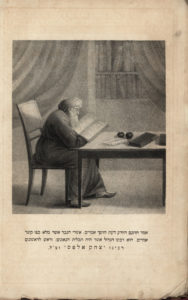
Legacy Judaica is holding an auction on Monday, September 23rd, and a few items of note.  The Viennese Schmidt press produced two books with rather striking portraits.  One of R. Shmuel Eidels, Maharsha, and other of R. Yitzkah Alfasi, Rif, which is at lot 54.  Rif is depicted wearing robes and a turban with a long white beard.  Of course, there are no contemporaneous portraits of Rif, and this is a 19th century creation.  (For more on rabbinic portraits see Cohen, Jewish Icons, 114-153).


The first edition of R. Yitzhak Hutner’s, Torat ha-Nazir, contains three approbations from R. Chaim Ozer, R. Avraham Shapiro (Dvar Avraham), and R. Kook.  The next edition omits all three, presumably to avoid including R. Kook’s.  Although later reprints include just R. Chaim Ozer’s, leaving out the page that contains the Dvar Avraham’s and R. Kook’s letters (for example, the copy on Hebrewbooks). (See Marc Shapiro, Changing the Immutable, 157-160, and Eitam Henkin, “Historical Revisionism by the families of R. Kook’s Disciples:  Three Case Studies,” in Hakirah.)’


The polemical offerings include the Berlin 1905 book, Hayyei Olam, (lot 74) that opposes cremation of Jewish bodies.  At the turn of the twentieth century the issue of cremation was debated among Jews, with the rabbis of Hamburg and Altona having opposing views.  Hayei Olam, written by R. Lerner, the rabbi of Altona was against the practice and collects numerous other letters from sympathetic rabbis.  On the other side, R. Arentreu, in Or ha-Emet, and R. Shimon Tzvi Deutsch, in Heker Halakha, defended the practice.  (For more on the issue, see the entries for these works in Shmuel Glick’s Kuntres ha-Teshuvot ha-Hadash and Michael Heiger’s article in Halakhot ve-Aggadadot).


For a more recent controversial book, lot 80 is Making of a Godol, of the recently passed R. Nosson Kamenetsky.  We have discussed this book and its editions and the book, Anatomy of a Ban, which documents the controversy here

For those interested in bibliomancy, the edition of Tanakh recommended for the goral ha-Gra is at lot 123.  Of note is that this edition has two title pages in Hebrew and Latin, and likely not intended for a Jewish audience.

For one of the more bizarre travelogues, it is hard to surpass Sefer ha-Brit ha-Hadasha im ha-Nehar Sambatyyon be-Medinat China (lot 141).  After receiving permission from President McKinley, Uziel Haga accompanied US military forces in China for purposes of surveying the customs and life of Chinese Jews. Another lot of American Judaica, lot 138, is a collection of 10 works from R. Yekusiel Yehuda Greenwald.  R. Greenwald was a prolific author who wrote on many diverse topics. He is perhaps most well known for his book on the laws of mourning, Kol Bo Aveilut, but also wrote books on R. Yonathan Eiybschitz, the reform movement, and the Palestinian Talmud, and was a rabbi in Columbus, Ohio after emigrating from Hungary.

There is a well-known if an inaccurate story that on Yom Kippur, during a cholera epidemic, R. Yisrael Salanter wanted to ensure that those who needed to would eat.  So he got up on the bimah in the Great Synagogue of Vilna and made Kiddush and ate cake.  Although the veracity of the story has been questioned, with an eyewitness reporting that R. Yisrael announced from the bimah that those who needed to eat could do so without first asking their doctor but he ate nothing.  (See Yaakov Mark, Be-Mihitzatam shel Gedolim 68).  Lot 197 is a document from R. Yaakov Tzvi Mecklenburg, author of Kitav veha-Kabbalah, instructing women to remain at home and not attend synagogue for fear of spreading communicable diseases. For more on cholera, Yom Kippur, and R. Yisrael Salanter, see Eliezer Marmalstein, “Eating on Yom Kippur during Epidemics — Cholera — R. Yisrael Salanter’s Permissive Stance and those who Opposed Him,” Kovets Ets Hayyim, (Bobov), vol. 7, 273-294 (Hebrew).


The Religious-Zionist Manifesto of Rabbi Yehudah Leib Don Yahya

The Religious-Zionist Manifesto of Rabbi Yehudah Leib Don Yahya

by Bezalel Naor

In 1901 there appeared in Vilna a 32-page booklet entitled, Ha-Tsiyoniyut mi-nekudat hashkafat ha-dat (Zionism from the Viewpoint of Religion). The author was Yehudah Don Yahya.[1] The final eight pages of the work contain a supplement (Milu’im) by one Ben-Zion Vilner, criticizing the anti-Zionism of the Rebbe of Lubavitch. (One ventures that “Ben-Zion Vilner” is a pseudonym.)

What is remarkable about this manifesto that argues that Zionism is totally compatible with traditional Judaism, is that the author, Rabbi Yehudah Leib Don Yahya, was an intimate student of Rabbi Hayyim Soloveitchik, a most outspoken opponent of the Zionist movement.[2]

To add to the intrigue, Don Yahya’s grandfather, Rabbi Shabtai Don Yahya of Drissa, had been an ardent Hasid of Rabbi Menahem Mendel of Lubavitch (known by his work of Halakhic responsa as “Tsemah Tsedek”).[3] Yehudah Leib himself would go on to serve as rabbi of the Habad Hasidic community of Shklov.[4] Although, as we shall see, within the Habad community, there were differing responses to Zionism along the fault line of the Kopyst—Lubavitch dispute.

Today, students who immerse themselves in the Torah novellae of Rabbi Hayyim Soloveitchik may come across the name of Rabbi Yehudah Leib Don Yahya, but they have no idea who this disciple was. Appended to Hiddushei ha-GRaH he-Hadash ‘al ha-Shas (issued upon the ninetieth anniversary of Rabbi Hayyim’s passing in 2008) are Don Yahya’s memoirs of his beloved mentor in the Volozhin Yeshivah. In 2018 (coincidentally a century since Rabbi Hayyim’s passing) there appeared in print a Tagbuch or diary, in which Rabbi Hayyim jotted down his insights on Talmud and Maimonides’ code.[5] In his introduction to the volume, the editor, Rabbi Yitshak Abba Lichtenstein, notes that Rabbi Hayyim would allow some scholars to copy down entries from the journal. Indeed, one such scholar was Rabbi Yehudah Leib Don Yahya. Two novellae that appear in the Tagbuch were previously published in Don Yahya’s Bikkurei Yehudah (1939).[6]

One asks: What would prompt such a devoted disciple to break from his master’s ideology concerning Zionism?

To understand how such a phenomenon as Yehudah Leib Don Yahya was possible, one needs to trace his membership in Nes Ziyonah, the underground proto-Zionist movement that existed in the Volozhin Yeshivah from 1885 until its disbandment in 1890.let

This was the era of Hovevei Zion (Lovers of Zion), a Russian Jewish movement to settle the Land of Israel that predated Herzlian political Zionism. Nes Ziyonah, which blossomed independently within the ranks of the student body of the famed Volozhin Yeshivah, interfaced with Hovevei Zion, presided over by Rabbi Samuel Mohilever of Bialystok. Members of Nes Ziyonah were sworn to secrecy. The membership included such illustrious scholars as Moshe Mordechai Epstein of Bakst,[7] Menahem Krakovsky,[8] and Isser Zalman Meltzer. Moshe Mordechai Epstein would eventually become Rosh Yeshivah of Slabodka. Menahem Krakowsky would one day assume the position of “Shtodt Maggid” of Vilna. Finally, Isser Zalman Meltzer would become Rosh Yeshivah of Slutzk and later ‘Ets Hayyim of Jerusalem.[9]  It was through the last-mentioned disciple, who was especially close to Rabbi Hayyim Soloveitchik, that Rabbi Hayyim was able to discover the identities of the students who belonged to Nes Ziyonah.[10]

Nes Ziyonah had sprung up without the knowledge of the elder dean of the Yeshivah, Rabbi Naftali Tsevi Yehudah Berlin (NeTsIV). In fact, according to Israel Kausner, who wrote a history of Nes Ziyonah, the members of the secret society prided themselves that they had been able to prevail upon Rabbi Berlin to join the greater Hovevei Zion movement and to assume a role of leadership alongside Rabbis Samuel Mohilever and Mordechai Eliasberg of Bausk.[11] In 1890, somehow Nes Ziyonah came to the attention of the Russian government authorities. One of its leaders (Yosef Rothstein) was arrested but subsequently released. When Rabbi Berlin learned that such a society had sprung up in the Yeshivah under his very nose, he was aghast. He feared that Nes Ziyonah might jeopardize the existence of the Yeshivah, which was under constant government scrutiny.[12] Leaving aside pragmatic considerations, in principle, Volozhin had always been a bastion of pure Torah learning; there was no room in it for Zionist activism.[13] Nes Ziyonah ceased to exist. (Hovevei Zion, with its office in Odessa, was legalized by the Tsarist government in 1890.)[14]

The idealistic young men who had formed Nes Ziyonah were not ones to easily give up. Nes Ziyonah morphed into Netsah Yisrael, whose express goal was to advocate on behalf of Zionism and religion. (Nes Ziyonah had restricted its activities to settling the Land of Israel.) Most prominent in this reincarnation of Netsah Yisrael was—Yehudah Leib Don Yahya.[15]

It is against this backdrop—the publicistic activity of Netsah Yisrael—that one must view Don Yahya’s tract, Zionism from the Viewpoint of Religion.

Let us briefly sum up some of the more salient points of the booklet.

Don Yahya begins by clarifying that the return of the nation to its land can in no way be viewed as the complete redemption prophesied in Scripture. The prophets’ vision, while including the ingathering of exiles, extends beyond that to global mankind’s acknowledging God and embracing His Torah.[16]

On the other hand, Don Yahya is flummoxed by various rabbis who adopt an all-or-nothing attitude to the Zionist organization’s striving to secure from the Ottomans a safe haven for Jews in the Holy Land. Just because the Zionist dream does not encompass the comprehensive vision of our prophets of old, is no reason to reject Zionism. Granted that the Zionist goals are much more modest in scope; that still does not justify opposing the movement. Don Yahya’s own reading of the sources—Biblical and Rabbinic—is gradualist. He anticipates a phased redemption. The Jews’ return to the Land is certainly the beginning, the first installment in a protracted process which will eventually—upon completion of “the full and encompassing redemption” (“ha-ge’ulah ha-sheleimah ve-ha-kelalit”)—culminate in the restoration of the Davidic dynasty in the person of King Messiah and the rebuilding of the Temple.[17]

The author adopts as his paradigm the Second Temple period. Taking issue with those who construe the return from Babylonian captivity as a “temporary remembrance” (“pekidah li-zeman mugbal”), Don Yahya maintains that the Second Commonwealth had the potential to develop into full-blown redemption. With that model in mind, he writes that return from exile and settling the Land can evolve beyond that to greater spiritual dimensions.[18]

After having made his case for the compatibility of the nascent Zionist movement and Judaism, Don Yahya tackles the painful question why some of the great Torah geniuses oppose Zionism.[19]

Don Yahya has a couple of explanations. First, knowledge of Torah is divided into Halakhah and pilpul, on the one hand, and matters of belief and opinion, on the other. Contemporary ge’onim (unlike their medieval predecessors Maimonides and Nahmanides) have devoted their lives to Halakhah, to the exclusion of emunot ve-de‘ot (beliefs and opinions). “In regard to the portion of Torah which is beliefs and opinions, their view does not exceed the view of an average Jew.”[20]

Rather conveniently, Don Yahya holds up as examples of recent Torah authorities who plumbed the depths of the beliefs contained in the Aggadah, and who concluded that the redemption shall begin with the Jews receiving permission to settle the Land of Israel—Rabbis Naftali Tsevi Yehudah Berlin and Mordechai Eliasberg—two rabbis who stood at the helm of Hovevei Zion.[21]

A second reason for the opposition of some ge’onim to Zionism is that they have been fed misinformation (or disinformation) by those of lesser stature who surround them. As the great men eschew reading newspapers, they must rely for information on extremists (kana’im) who skew their perception. They are told that the leaders of the Zionist movement are men who are not simply unobservant in their private lives, but furthermore, intent on uprooting Judaism.[22]

According to Don Yahya, the Zionist leaders profess no proficiency in matters of religion and are amenable to working with the great rabbis in matters pertaining to religion. He cites the example of a responsum from one of the great halakhic decisors of the generation to accommodate the Colonial Bank so that the prohibition of charging interest (ribit) be not transgressed. Don Yahya personally witnessed both the question from Zionist officialdom and the responsum issued by the elderly ga’on.[23] (Undoubtedly, “the elderly ga’on” [“ha-ga’on ha-yashish”] was Don Yahya’s own father-in-law, Rabbi Shelomo Hakohen, the dayyan or chief justice of Vilna.)[24]

Don Yahya points out the democratic character of the Zionist congresses. If more religious Jews would join the ranks of the Zionist movement, they would be able to turn the tide and steer the movement in a more religious direction.[25]

The author chides those religious elements opposed to Zionism not to gloat and say, “We told you so.” In the event that Zionism deviates from Judaism, this will be a self-fulfilling prophecy of doom; the anti-Zionist agitators will then be held responsible for bringing about that outcome by instructing observant Jews to stay clear of the movement.[26]

II.

As stated above, the Milu’im or Excursus of the pamphlet is a harshly worded rejoinder to the Rebbe of Lubavitch, Rabbi Shalom Dov Baer Schneersohn (1860-1920), who had made public his vehement opposition to Zionism on religious grounds.[27]

Again, one asks: How is possible that a staunch Habad Hasid such as Rabbi Yehudah Leib Don Yahya appended such an excursus to his work? From a remove of more than a century this seems inconceivable.

We need once more to place this pamphlet within the context of the times. Today, Habad has assumed a monolithic character, but at the turn of the twentieth century there existed a great divide between two competing “courts” within Habad Hasidism: Kopyst and Lubavitch. When Rabbi Menahem Mendel Schneersohn of Lubavitch (author of the responsa Tsemah Tsedek) passed in 1866, a dispute erupted over succession to the throne. The youngest son, Shmuel (Maharash), remained in Lubavitch and inherited control of that city. An older son, Yehudah Leib (Maharil), moved to the city of Kopyst, taking some of the Hasidim with him.[28] When within a year of the Tsemah Tsedek’s passing, Yehudah Leib passed, his son Shelomo Zalman (author of the Hasidic work Magen Avot) became the Kopyster Rebbe. And when in 1900 the Kopyster Rebbe passed, he was succeeded by his younger brother Rabbi Shemaryah Noah Schneerson (author of the Hasidic work Shemen la-Ma’or). Though there was a brief attempt on the part of Rabbi Shemaryah Noah Schneerson to establish himself in the city of Kopyst, eventually he returned to his rabbinate in Bobroisk, which then became the center of this branch of Habad Hasidism.[29] With the passing of the Rebbe of Bobroisk in 1923, this branch ceased to exist, leaving only the Lubavitch faction. At that point, remnants of the Bobroisker Hasidim transferred their allegiance to the Lubavitcher Rebbe.

In the early years of the twentieth century there erupted a major financial dispute between Bobroisk and Lubavitch regarding control of the purse strings of Kollel Habad in Erets Yisrael. (One may find evidence of the dispute in letters of Rav Kook from this period, when as Rabbi of Jaffa he offered guidance how to come to a compromise.)[30] The tension arose because each Rebbe wanted his representative in Erets Yisrael to be responsible for disbursement of the funds raised by the Hasidim in Russia for the support of their brethren in the Holy Land.

Thus, there are historians who would explain the tension between Bobroisk and Lubavitch as being purely financial.[31] Truth be known, there were ideological issues dividing the two cousins, Rabbi Shemariah Noah of Bobroisk and Rabbi Shalom Dov Baer of Lubavitch. In general, it may be said that the Bobroisker was more progressive, more forward-looking. The Lubavitcher was more old-school, more conservative in outlook. These different Weltanschauungen found expression on many fronts.

When the Russian government sought to demand of the rabbis proficiency in the Russian language, the Bobroisker (as Rabbi Meir Simhah Cohen of Dvinsk) found this a reasonable demand; the Lubavitcher (as Rabbi Hayyim Soloveitchik of Brisk and Rabbi Israel Meir Kagan [a.k.a. Hafets Hayyim]) fought against this proposal tooth and nail.[32]

When it came to deciding which city should serve as the center of Habad Hasidism in Erets Yisrael—Hebron or Jerusalem—Rabbi Shalom Dov Baer militated to retain the center in the provincial town of Hebron rather than allow the center to shift to Jerusalem.[33] In this way, the Lubavitcher Rebbe believed he could shield the Hasidim from the distractions of urban civilization. The Bobroisker did not think it realistic to keep the Hasidim “down on the farm.” Willy-nilly, establishment of a lending library in Hebron would bring secular literature to the curious eyes of Hasidic youth.[34]

And finally, we arrive at the issue with which we began: Zionism. While Lubavitch would have no truck with Zionism, out of the “Kibbutz” (study-hall for advanced rabbinic students) of Bobroisk there would emerge prominent rabbis of the Mizrahi or Religious Zionist movement.[35]

The answer to the question how Rabbi Yehudah Leib Don Yahya, a fervent Habad Hasid, could oppose the Rebbe of Lubavitch is simple: Don Yahya was a Kopyster Hasid,[36] not a Lubavitcher Hasid.

Epitaph on Tombstone of Rabbi Eliezer Don Yahya in Ludza (Lutzin)

צנא מלא ספרא

כלו ספרא מבעל —-

מגזע רבני —-

מחבר אבן שתיה

הרב הגאון ר’ אליעזר

בהרב ר’ שבתי

דון יחייא

ויאסף אל עמיו

ד’ ימים לחדש תמוז

שנת תרפו

[1] Yehudah Leib Don Yahya was born in Drissa (today Verkhnyadzvinsk, Belarus) in 1869 and passed in Tel-Aviv in 1941. Besides this Zionist manifesto, Rabbi Don Yahya published two volumes of Halakha and essays and sermons: Bikkurei Yehudah, vol. 1 (Lutzin, 1930); vol. 2 (Tel-Aviv, 1939).

Volume One of Bikkurei Yehudah was published in Lutzin (Ludza) by the author’s cousin, Rabbi Benzion Don Yahya, Rabbi of Lutzin. At that time Rabbi Yehudah Leib served as Rabbi of Chernigov, Soviet Russia. In his preface to the work, Benzion Don Yahya explains that the manuscript was sent to him for publication because there is no longer a Hebrew press in Russia. On pages 36-38, the Editor traces the lineage of the Don Yahya family. We learn that his paternal grandfather was Rabbi Shabtai Don Yahya, Rabbi of Drissa for sixty years until his death at approximately age 90 in 1907. One of Rabbi Shabtai’s sons, Rabbi Eliezer, became Rabbi of Lutzin (Ludza), a rabbinate inherited by his son, the Editor (Rabbi Benzion). In 1840, there were born to Rabbi Shabtai twins: Menahem Mendel and Hayyim. Menahem Mendel served as Rabbi of Kopyst for some years, passing there in 1920. Hayyim served as Rabbi of Shklov, and after his father Shabtai’s passing, as Rabbi of Drissa, until his own passing in 1913. Hayyim’s son, Yehudah Leib, served as Rabbi in Shklov and Vietka, until he inherited from his father the Rabbinate of Drissa in 1913. (In Bikkurei Yehudah, vol. 2, f. 159, there is a letter dated 5673 [i.e. 1913] from Rabbi Meir Simhah of Dvinsk to Rabbi Don Yahya congratulating him on assuming the rabbinate of his father and grandfather in Drissa.) In 1925, Yehudah Leib was accepted as Rabbi of Chernigov.

In Shklov, Rabbi Yehudah Leib Don Yahya ministered to the “Kehal Hasidim” (exclusive of the Mitnagdim, who would have had their own Rav). (See below note 4.) However, it should be mentioned that the communities of Vietka and Chernigov as well figure prominently in the annals of Habad Hasidism.

The Rabbi of Vietka, Rabbi Dov Baer Lifshitz, author of an important commentary on Tractate Mikva’ot, Golot ‘Iliyot (Warsaw, 1887), refers to Rabbi Shneur Zalman of Liadi as “dodi zekeini” (“my great uncle”). See ibid., Addendum to Introduction, and 7c.

The man who immediately preceded Rabbi Don Yahya as Rabbi of Chernigov, Rabbi David Tsevi (Hirsch) Hen (referred to by the Hasidim as “RaDaTs”) was acknowledged as one of the greatest of Habad Halakhists in his day. In 1925, through the intervention of Chief Rabbi Kook, he was able to emigrate from the Soviet Union to Erets Yisrael together with his daughter Rahel, son-in-law Rabbi Shalom Shelomo Schneerson (brother of Rabbi Levi Isaac Schneerson, Rabbi of Yekaterinaslav, today Dnieperpetrovsk, and uncle of Rabbi Menahem Mendel Schneerson, Lubavitcher Rebbe of Brooklyn), and granddaughter Zelda, who would later achieve fame as a Hebrew poet. See Igrot Re’iyah, vol. 4 (Jerusalem, 1984), Letter 1330 (p. 251), in which Rav Kook attempts to install the recently arrived Rabbi S.S. Schneerson as Rav of Haderah. Rav Kook’s involvement in bringing RaDaTs and family to Erets Israel is discussed in the recently published annals of the Hen Family, Avnei Hen, ed. Eliezer Laine and S.Z. Berger (Brooklyn, NY: Kehot, 2015).

Reviewing the second volume of Bikkurei Yehudah, Rabbi Zevin wrote an especially insightful appreciation of Rabbi Yehudah Leib Don Yahya. Rabbi Zevin, himself a Habad Hasid, noted how rare it was to find in the twentieth century a Habad Hasid who combined both persona of the maskil (intellectual) and the ‘oved (master of contemplative prayer). (In the latter connection, Rabbi Zevin observed that Rabbi Don Yahya wore daily three pairs of tefillin: Rashi, Rabbenu Tam, and Shimusha Rabbah.) Beyond Habad Hasidism, Don Yahya mastered Rabbi Hayyim Soloveitchik’s method of Talmudic analysis and the process of pesikah (Halakhic decision) of Don Yahya’s father-in-law, Rabbi Shleimeleh Hakohen, the Dayyan of Vilna. See Rabbi Shelomo Yosef Zevin, Soferim u-Sefarim (Tel-Aviv: Abraham Ziyoni, 1959), pp. 296-300.

It is noteworthy that the volume contains a responsum to Rabbi Mordechai Shmuel Kroll, the Rav of Kefar Hasidim in Erets Yisrael, and a Halakhic novella of Rabbi Kroll. See Bikkurei Yehudah, vol. 2, ff. 121-129, 160-162. Rabbi Kroll was the eminent disciple of Rabbi Don Yahya.

[2] Rabbi Hayyim Soloveitchik’s opposition to Zionism is well known. One particular statement should illustrate how extreme was Rabbi Hayyim’s opposition to the new movement. The following incident took place in Minsk in 1915 (when many Jews were forced to flee their homes before the German invasion and seek refuge in the large city located farther east).

Young Raphael Zalman Levine was walking down the street with his father, Rabbi Abraham Dov Baer Levine (known as the “Mal’akh,” the “Angel”). Pinned to the adolescent’s lapel was an insignia of the Keren Kayemet le-Yisrael (Jewish National Fund), to which he had recently donated. The elder Levine was adamantly opposed to the Zionist enterprise and demanded that his son remove the pin, which he found offensive. Father and son were in the midst of an intense argument when, lo and behold, they saw approaching them from the opposite direction none other than the great Rabbi Hayyim Soloveitchik.

Rabbi Levine said to Rabbi Soloveitchik: “My son wants to ask you a she’elah (question).”

Rabbi Soloveitchik turned to Raphael Zalman: “You can ask your father.” (Rabbi Levine and Rabbi Soloveitchik were friends.)

Rabbi Levine persisted: “My son wants to ask you a she’elah in emunah (a matter of faith).”

“Emunah?” Rabbi Soloveitchik’s face now assumed a serious expression.

Young Raphael Zalman was put on the spot and forced to ask Rabbi Hayyim what he thought of his donation to the Jewish National Fund.

It just so happened that across the street was a church.

Rabbi Hayyim responded to his young questioner: “If you have a few spare kopecks in your pocket, you can place them there rather than in the pushke of the Keren Kayemes.”

(Reported by RYYL and by Prof. Richard Sugarman who both heard this anecdote from the mouth of Rabbi Raphael Zalman Levine of Albany, New York, on two separate occasions.)

The episode is also reported in Rabbi Raphael Zalman Levine’s name in Rabbi C.S. Glickman, Mi-Pihem u-mi-Pi Ketavam (Brooklyn, NY, 2008), pp. 119-120.

Though the sharpness of Rabbi Hayyim Soloveitchik’s statement is shocking, Halakhic opposition to donating to the Zionist cause was shared by several East European rabbinic leaders. A decade later in 1925, four distinguished leaders of Polish Jewry, the Hasidic Rebbes of Gur, Ostrovtsa, Radzyn, and Novominsk, addressed a letter to Rav Kook adjuring him to curtail his support of Keren Kayemet le-Yisrael and Keren ha-Yesod. See Igrot la-Rayah, ed. B.Z. Shapiro (Jerusalem, 1990), Letter 199 (pp. 303-304); facsimile on p. 590.

Rav Kook, unlike the Polish Rebbes, differentiated between the two funds, lending his support to Keren Kayemet le-Yisrael, which directed funds to the physical reclamation of the land, but not to Keren ha-Yesod, which funded secular (and perhaps anti-religious) culture. See Rabbi Tsevi Yehudah Hakohen Kook, Li-Sheloshah be-Ellul, vol. 1 (1938), par. 44 (p. 22); Igrot ha-Rayah, vol. 5: 5682, ed. Ze’ev Neuman (Jerusalem, 2019), pp. 407-413.

[3] According to his namesake and great-grandson, journalist Shabtai Don Yahya (who wrote under the pen name of “Sh. Daniel”), the Rabbi of Drissa was known in Lubavitch as “Reb Shebsel Drisser.” Sh. Don Yahya wrote that it was said that the Rabbi of Drissa might have become one of the great men of the generation in terms of Talmudic learning, but his Hasidic exuberance stunted his academic growth. See Shabtai Don Yahya, Rabbi Eliezer Don Yahya (Jerusalem, 1932), pp. 10-11.

(The title-page makes the point that the book bears the encomium of Chief Rabbi Kook. Shabtai Don Yahya was one of the first students of Merkaz Harav and a devoted disciple of Rav Kook. Rabbi Eliezer Don Yahya is a biography of the author’s paternal grandfather, the Rabbi of Lutzin, son of Rabbi Shabtai Don Yahya. As a youth, Avraham Yitshak Hakohen Kook studied under Rabbi Eliezer Don Yahya in Lutzin. Rabbi Eliezer Don Yahya was born 4 Tammuz 5598 [i.e. 1838] and passed on his birthday, 4 Tammuz 5686 [i.e. 1926]. See the epitaph on his tombstone at the conclusion of this article. A photograph of the funeral of Rabbi Eliezer Don Yahya in Lutzin in 1926 may be found in Rabbi Yitzhak Zilber’s autobiography, To Remain a Jew. Zilber’s original surname was “Ziyoni.” Rabbi Eliezer Don Yahya inherited the rabbinate of Lutzin from his illustrious father-in-law Rabbi Aharon Zelig Ziyoni.)

Rabbi Yehudah Leib Don Yahya often quotes the Tsemah Tsedek in his Halakhic responsa.

[4] In the biography of Rabbi Yehudah Leib Don Yahya in Shmuel Noah Gottlieb’s Ohalei Shem (Pinsk, 1912), p. 207, s.v. Shklov, it states that Don Yahya assumed the rabbinate of Shklov in 1906. However, as early as Friday, 17 Menahem Av [5]664,” i.e. 1904, Rabbi Shelomo Hakohen addressed his son-in-law as “Rav Av-Beit-Din of the congregation of Hasidim of Shklov.” See Bikkurei Yehudah, vol. 2 (Tel-Aviv, 1939), 145a.

In Shklover Yidden (1929) and Feter Zhoma (1930), the Yiddish and Hebrew poet and writer Zalman Shneur portrayed the Hasidim of his birthplace.

Earlier, Rabbi Yehudah Leib’s father, Rabbi Hayyim Don Yahya, had served as Rabbi of Shklov. A halakhic responsum of Rabbi Hayyim Don Yahya (datelined “5653 [i.e. 1893], Shklov”) was published in the journal of the Skvere Kollel, Zera‘ Ya‘akov 26 (Shevat 5766 [i.e. 2006]), pp. 17-21. On p. 20, Rabbi Hayyim mentions the learned opinion of his brother from Kopyst [i.e. Rabbi Menahem Mendel Don Yahya].

[5] Rabbi Yitshak Lichtenstein writes in the introduction to the volume that there were many such Tagbikher that were lost to posterity. This particular journal was inherited by Rabbi Hayyim’s son, Rabbi Moshe Soloveitchik. (Behind the scenes, the Tagbuch was made available to Rabbi Lichtenstein by his maternal uncle, Prof. Haym Soloveitchik of Riverdale, son of Rabbi J.B. Soloveitchik of Boston, son of Rabbi Moshe Soloveitchik.)

[6] See Bikkurei Yehudah, vol. 2 (Tel-Aviv, 1939), 142a-144b. The volume was edited by the author’s son-in-law Rabbi Yitshak Neiman. Rabbi Zevin explains that though the volume was submitted for publication in 1939, it was not issued until 1941, a few weeks before the author’s passing. See S.Y. Zevin, Soferim u-Sefarim (Tel-Aviv: Abraham Ziyoni, 1959), p. 297. The two novellae of Rabbi Hayyim Soloveitchik (to Bava Kama 13a and Ketubot 21a) were reprinted in the memorial volume for Rabbi Neiman, Zikhron Yitshak (Jerusalem, 1999), along with several novellae of his father-in-law, Rabbi Don Yahya.

[7] See Israel Klausner, Toledot “Nes Ziyonah” be-Volozhin (Jerusalem: Mossad Harav Kook, 1954), pp. 25, 65, 113. Moshe Mordechai Epstein appears in a group photo on p. 26.

[8] Ibid. p. 24.

[9] Rabbis Epstein and Meltzer would eventually become brothers-in-law by their marriage to two sisters, daughters of the Maecenas Shraga Feivel Frank of Kovno.

[10] Heard from Rabbi Yosef Soloveichik of Jerusalem (son of Rabbi Ahron Soloveichik of Chicago), a great-grandson of Rabbi Hayyim Soloveitchik. Rabbi Yosef Soloveichik explained the exact halakhic reasoning whereby his ancestor was able to release young Isser Zalman Meltzer from his solemn oath.

This Soloveichik family tradition, which reflects Rabbi Hayyim’s disapproval of Nes Ziyonah, seems to fly in the face of Yosef Rothstein’s memoir, whereby Rabbi Hayyim rejoiced at Rothstein’s release after he had been arrested by the Russian police:

Also the Gaon Rabbi Hayyim of Brisk, of blessed memory, greatly rejoiced over me. He received me with joy and brought me before the NeTsIV, of blessed memory, who was pleased by my return, though he did say to me that this is not the place [for activism]. “A mitsvah that can be performed by others, we do not cancel for it the study of Torah” [MT, Hil. Talmud Torah 3:4]…Evidently, the NeTsIV too was content but had to act as if he disapproved…

(Yosef Rothstein, in Israel Klausner, Toledot “Nes Ziyonah” be-Volozhin, p. 123)

See earlier on p. 13 the NeTsIV’s opposition to students taking time out from their Torah study for activism—even on behalf of a cause as dear to NeTsIV’s heart as Yishuv Erets Yisrael.

[11] Ibid. p. 14.

[12] Ibid. p. 19.

[13] See above note 10.

[14] Klausner, Toledot “Nes Ziyonah” be-Volozhin, p. 21.

[15] Ibid. pp. 22-24. The members of Netsah Yisrael were also sworn to secrecy. Netsah Yisrael lasted until the closing of the Volozhin Yeshivah by the Russian authorities in 1892.

[16] Ha-Tsiyoniyut mi-nekudat hashkafat ha-dat, pp. 5-6.

[17] Ibid. pp. 6-7.

[18] Ibid. pp. 7-10.

[19] Ibid. p. 15.

[20] Ibid.

[21] Ibid. p. 16.

[22] Ibid.

[23] Ibid. pp. 16-17. Don Yahya does not go into Halakhic details. Usually, the way to circumvent the problem of ribit (interest) is by drafting a “heter ‘iska.” Rabbi Tsevi Yehudah Hakohen Kook relates that when the Zionist Colonial Bank was founded, his father, Rabbi Avraham Yitshak Hakohen Kook, entered into negotiations with the Zionist officials and rabbis, which resulted in a “shtar heter ‘iska.” See Rabbi Tsevi Yehudah Hakohen Kook, Li-Sheloshah be-Ellul, vol. 1 (1938), par. 17 (pp. 11-12).

[24] The elderly Dayyan of Vilna, Rabbi Shelomo Hakohen (author of Heshek Shelomo) was exceptionally respectful of Theodor Herzl when the latter visited Vilna, extending to him the priestly benediction at a reception in Herzl’s honor. See Israel Cohen, History of Jews in Vilna (Philadelphia: Jewish Publication Society of America, 1943), p. 350; and Israel Klausner, Vilna: “Jerusalem of Vilna,” 1881-1939, vol. 2 (Hebrew) (Israel: Ghetto Fighters’ House, 1983), p. 339.

Another son-in-law of Rabbi Shelomo Hakohen, Rabbi Nahum Greenhaus of Trok (Lithuanian, Trakai), a suburb of Vilna, was, like Don Yahya, an outspoken advocate of Zionism. Because of their support of the movement, both Rabbi Shelomo Hakohen and Rabbi Nahum Greenhaus suffered persecution by anti-Zionist elements in Lithuanian Jewry. See Klausner, ibid. pp. 330-333.

Rabbi Nahum Greenhaus’ namesake was Rabbi Nahum Partzovitz (known in his youth as “Nahum Troker”), who would one day become the illustrious Rosh Yeshivah of the Mirrer Yeshiva in Jerusalem. Rabbi Nahum Partzovitz’s father, Rabbi Aryeh Tsevi Partzovitz, inherited the rabbinate of Trok from his father-in-law, Rabbi Nahum Greenhaus.

A third son-in-law of Rabbi Shelomo Hakohen of Vilna was Rabbi Meir Karelitz, older brother of Rabbi Abraham Isaiah Karelitz (author of Hazon Ish), who was prominent in Agudah circles, both in Vilna and later in Erets Yisrael.

[25] Ha-Tsiyoniyut mi-nekudat hashkafat ha-dat, p. 17.

[26] Ibid.

This modern disagreement sounds vaguely reminiscent of the disagreement between Resh Lakish and Rabbi Yohanan in Talmud Bavli, Yoma 9b-10a. Resh Lakish said of Babylonian Jewry: “God hates you. If you had gone up to the Land of Israel en masse in the days of Ezra, the divine presence would have rested in the Second Temple and there would have been a resumption of full-blown prophecy. Now that you have gone up in pitifully small numbers (dalei dalot), but a remnant of prophecy remains, the bat kol (heavenly voice).” Rabbi Yohanan responded: “Even if all of Babylonian Jewry would have gone up to the Land in the days of Ezra, the divine presence would not have rested in the Second Temple, for it is written: ‘God will broaden Japheth and dwell in the tents of Shem’ [Genesis 9:27]. Though God will broaden Japheth, the divine presence rests only in the tents of Shem.” Rashi explains that the divine presence was prevented from resting in the Second Temple because it was built by the Persians; the divine presence rested only in the First Temple which was built by Solomon of the seed of Shem.

Evidently, Rabbi Don Yahya (like Resh Lakish) was convinced that that what was crucial to effecting a spiritual revolution in Erets Yisrael was a critical mass. His opponents (like Rabbi Yohanan) could not be swayed that it was merely a matter of numbers. To their thinking, non-Jewish influence at the very inception of the Zionist movement would preclude it from bringing about the hoped for spiritual renascence so woefully lacking in the Jewish collective.

[27] See ’Or la-Yesharim (Warsaw, 1900), pp. 57-61. For other (later) recordings of Rabbi Shalom Baer Schneersohn’s anti-Zionist stance, see Bezalel Naor, When God Becomes History: Historical Essays of Rabbi Abraham Isaac Hakohen Kook (New York, NY: Kodesh Press, 2016), p. 168, n. 10.

[28] In his autobiography, Chaim Tchernowitz (“Rav Tsa‘ir”) revealed some of the intrigue in the aftermath of the Tsemah Tsedek’s passing that led to the Kopyst-Lubavitch schism. See Ch. Tchernowitz, Pirkei Hayyim (New York, 1954), pp. 104-106.

[29] See Hayyim Meir Heilman, Beit Rabbi (Berdichev, 1902), vol. 3, chap. 9.

[30] See Igrot ha-Rayah, vol. 1 (1962), Letter 39 (pp. 34-36), to Rav Kook’s maternal uncle, Rabbi Yehudah Leib Felman of Riga, a Kopyster Hasid. The letter is datelined, “Jaffa, 3 Marheshvan, [5]667,” i.e. 1906.

[31] Roughly thirty years ago I heard this monetary explanation from Rabbi Chaim Liberman, who had served as personal secretary and librarian of Rabbi Joseph Isaac Schneersohn of Lubavitch.

Interestingly enough, in the 1880s there emerged a theological dispute between the Rebbes of Kopyst and Lubavitch. The way it came about was in the following manner. After the passing of Rabbi Samuel (Maharash) of Lubavitch in 1882, his sons published an edition of their ancestor Rabbi Shneur Zalman of Liadi’s Torah ’Or on the first three parshiyot or pericopes (Bereshit, Noah, Lekh Lekha). Entitled Likkutei Torah, it was brought out in Vilna in 1884. The publishers took the liberty of incorporating into the text comments of the recently deceased Rabbi Samuel Schneersohn. The Kopyster Rebbe, Rabbi Shelomo Zalman Schneerson (author of Magen Avot) was outraged and penned a public letter of protest.

One comment of his uncle Rabbi Samuel (to Parashat Noah) in particular provoked the Kopyster Rebbe, this touching on the proper way to understand Rabbi Isaac Luria’s metaphor of Tsimtsum. In three letters to Rabbi Dan Tumarkin of Roghatchov (a Lubavitcher Hasid), the Kopyster Rebbe clarified his position on Tsimtsum and how it differed from that of Rabbi Samuel Schneersohn. The correspondence is briefly alluded to in H.M. Heilman, Beit Rabbi, vol. 3, chap. 10, s.v. Rabbi Dan Tumarkin. The entire exchange is available in Rabbi Mordechai Menashe Laufer, Ha-Melekh bi-Mesibo, vol. 2 [Kfar Habad, 1993], pp. 283-293. (This truly fascinating correspondence was brought to my attention a generation ago by Baruch Thaler.)

Regarding the publication of Likkutei Torah (Vilna, 1884), see further Hayyim Meir Heilman, Beit Rabbi, vol. 1, 87a; vol. 3, 16a, 28a; Rabbi Yehoshua Mondshine, “‘Likkutei Torah’ le-Shalosh Parshiyot,” Kfar Habad, nos. 931, 933. Available online at http://www.shturem.net/index.php?section=blog_new&article_id=29

[32] This issue was raised at the rabbinical conference held in St. Petersburg in 1910. The decisions reached by the delegates were relayed to Stolypin, Minister of the Interior. Some of the heated exchange between the Bobroisker and the Lubavitcher behind closed doors has been preserved in the memoirs of Isaac Schneersohn, one of the delegates to the conference; see I. Schneersohn, Leben un kamf fun Yiden in Tsarishen Rusland 1905-1917 (Paris, 1968). The chapters concerning the 1910 conference were translated from Yiddish into Hebrew by Rabbi Yehoshua Mondshine, “Asifat ha-Rabbanim be-Rusya bi-Shenat ‘Atar,” Kfar Habad, no. 898. Availble online at: http://www.shturem.net/index.php?section=blog_new&article_id=24

According to Isaac Schneersohn, it was none other than he (Crown Rabbi of Chernigov) who proposed abolishing the position of Kazyonny Ravin (in Hebrew, “Rav mi-Ta‘am,” or Crown Rabbi), thus wresting authority from the secular-trained, modern “Rabbiner” and consolidating communal power in the hands of the Talmudically-trained traditional Rav—provided he be proficient in the Russian language.

[33] Historically, the Habad community in Hebron preceded that of Jerusalem. In 1823, Rabbi Dov Baer Shneuri of Lubavitch (“Mitteler Rebbe”), the second-generation leader of the Habad movement, founded a Habad community in Hebron. Later, in 1847, a group of Habad families from Hebron relocated to Jerusalem.

[34] See Kuntres me-Admo”r shelit”a mi-Bobroisk: Teshuvot nitshiyot va-amitiyot ‘al Kuntres Admo”r shelit”a de-Libavitz (1907).

[35] Two names come to mind: Rabbi Nissan Telushkin in the United States and Rabbi Shelomo Yosef Zevin in Erets Yisrael. Both studied in the “Kibbutz” of the Bobroisker Rebbe and received ordination from him. Eventually, with the extinction of Bobroisker Hasidism, both Telushkin and Zevin would transfer their allegiance to Lubavitch. However, their affiliation with the Religious Zionist movement could at times place them in an unenviable position. Particularly Rabbi Zevin oftentimes found himself between a rock and a hard place. Rabbi Menachem Mendel Schneerson, the Lubavitcher Rebbe residing in Brooklyn, would on occasion expect of Rabbi Zevin to promote positions at variance with his Mizrahi colleagues in Erets Yisrael (such as Chief Rabbi Isaac Halevi Herzog). See Marc B. Shapiro, Changing the Immutable: How Orthodox Judaism Rewrites Its History (Oxford: Littman, 2015), pp. 235; 238, n. 87.

A brief autobiographical sketch of Rabbi Telushkin (a native of Bobroisk) is found at the conclusion of his Halakhic work on mikva’ot (ritual baths), Tohorat Mayim (Brooklyn, NY: Kehot, 1990), pp. 355-356 (“Le-Zikaron”).

[36]In Rabbi Don Yahya’s letter to Rabbi Shelomo Yosef Zevin concerning the counterintuitive thought process that informed Rabbi Hayyim Soloveitchik’s Halakhic decisions, Rabbi Don Yahya refers to himself as a “Hasid [of] Kopyst.” The context is Rabbi Hayyim’s desire to procure a “Yanover esrog” (citron from Genoa, Italy) to fulfill the commandment, in compliance with the tradition of Habad, and earlier the Hatam Sofer, Orah Hayyim, no. 207. See Hiddushei ha-GRaH he-Hadash ‘al ha-Shas (B’nei Berak: Mishor, 2008), p. 586.

However, in Zikhron Yitshak (Memorial Volume for Rabbi Yitshak Neiman) (Jerusalem, 1999), p. 141 (which is the source of Hiddushei ha-GRaH), Rabbi Don Yahya refers to himself as a “Hasid (Habad).” It would be interesting to see the original of the letter, which may yet be in the hands of the heirs of Rabbi Zevin. From the fact that the word “Habad” is placed in parentheses, one is inclined to assume that this is an addition on the part of an editor (Rabbi Zevin?). According to the Introduction (“Petah Davar”) to Zikhron Yitshak, this is the first publication of the letter from Rabbi Don Yahya to Rabbi Zevin.

Klausner, Toledot “Nes Ziyonah” be-Volozhin, p. 17, records that in 1889, the members of Nes Ziyonah were able to elicit letters of support for the conception of Yishuv Erets Yisrael from the Hasidic Rebbes of Kopyst and Bohush (a branch of Ruzhin).


When Rav Kook Was the Kana’i (Zealot) and His Opponent the Melits Yosher (Advocate)

When Rav Kook Was the Kana’i (Zealot) and His Opponent the Melits Yosher (Advocate)[1]

By Bezalel Naor

In 1891, there appeared in Warsaw an anonymous work[2] entitled Hevesh Pe’er,[3] whose sole objective was to clarify for the masses the proper place on the head to don the tefillah shel rosh or head-phylactery. According to halakhah, the tefillah must be placed no lower than the hairline and no higher than the soft spot on a baby’s head (i.e. the anterior fontanelle).[4] In ancient times, there were sectarian Jews who deliberately placed the tefillah on the forehead, as attested to by the Mishnah: “If one placed it [i.e. the tefillah] on his forehead, or on his hand, this is the way of sectarianism (minut).”[5] These Jews interpreted literally the verse, “You shall bind them for a sign upon your hand, and they shall be for frontlets between your eyes.”[6] Adherents to Rabbinic Judaism are punctilious about placing the hand-phylactery on the biceps of the forearm opposite the heart,[7] and the head-phylactery above the hairline. East European Jews who placed their phylacteries on the forehead did so not out of conviction, as the Sadducees of old, but rather out of sheer ignorance of the law. The slim book (all of 24 leaves or 48 pages) was thus an elaborate educational vehicle to educate the masses how to properly observe the law.[8]

According to the approbation to Hevesh Pe’er by Rabbi Elijah David Rabinowitz-Te’omim (ADeReT) of Ponevezh, the book was published [but not authored] by his former son-in-law (presently his brother’s son-in-law), Rabbi Abraham Isaac Hakohen Kook of Zeimel.[9]

Wares in hand, the young rabbi of Zeimel (aged twenty-six) assumed the role of an itinerant bookseller, travelling from town to town in Lithuania. Wherever he went, he preached concerning the importance of fulfilling the commandment of tefillin. Historically, there was precedent for a rabbi promoting that specific mitsvah. In the thirteenth century, Rabbi Jacob of Coucy (author of Sefer Mitsvot Gadol or SeMaG), circulating in the communities of France and Spain, was able to turn the tide and convince Jews, hitherto lax in their observance of the commandment, to don tefillin.[10] As for an author posing as an itinerant bookseller, Rav Kook’s older contemporary, Rabbi Israel Meir Kagan of Radin, had done exactly that, thus earning himself the sobriquet Hafets Hayyim, after the book by that name that he peddled. (Hafets Hayyim tackles the problem, halakhic and otherwise, of malicious gossip.)

It is recorded that Rav Kook’s sermons had such a positive influence upon his audience that the Rebbe of Slonim, Rabbi Shmuel Weinberg, offered to support him if he would devote himself fulltime to acting as a maggid or peripatetic preacher.[11]

One would never have imagined that this halakhic work would meet with any rabbinic opposition.[12] The point it makes that wearing the head-phylactery below the hairline on the forehead invalidates the performance of the commandment, seems rather clear-cut in the sources. (In fact, but a few years earlier, in 1884, Rabbi Israel Meir Kagan in his work Mishnah Berurah had advised wearing the phylactery higher on the head, at a remove from the hairline, just to be on the safe side.)[13]

However, five years later, Rabbi Ze’ev Wolf Turbowitz of Kraz (Lithuanian, Kražiai; Yiddish, Krozh)[14] devoted the very first of his collected responsa to pummeling the anonymous work Hevesh Pe’er.[15] Rabbi Turbowitz prefaces his remarks by saying: “The intention of this author [i.e. the author of Hevesh Pe’er] is for [the sake of] heaven, but nonetheless he has spoken shabbily of the people of the Lord. May the Lord forgive him. For Israel, ‘if they are not prophets, they are the children of prophets.’”[16] Rabbi Turbowitz goes on to argue that the commandment is invalidated only if the majority of the phylactery is placed below the hairline. If, on the other hand, the majority is situated above the hairline and only a minority below, then the halakhic principle of “rubo ke-khulo” (“the majority as the whole”) applies, and the commandment is fulfilled.[17] One of the rabbi’s supposed proofs is that one must recite the blessing once again only in a case where the entire phylactery or the majority thereof has slipped down, but if only a minority of the phylactery has been displaced, with the majority still within the prescribed area, one does not recite another blessing upon readjusting the phylactery.[18]

Rav Kook (now outed as the author of Hevesh Pe’er) responded to the onslaught of Tif’eret Ziv. His lengthy rejoinder, entitled “Kelil Tif’eret,” appeared in the periodical Torah mi-Zion (Jerusalem, 1900).

Rav Kook dismantles Rabbi Turbowitz’s supposed proof from the fact that another blessing is unwarranted as long as the majority of the phylactery is still in its proper place. Rav Kook reasons that we must distinguish between the essential commandment (“‘etsem ha-mitsvah”) and the action of the commandment (“ma‘aseh ha-mitsvah”). The fact that one does not recite an additional blessing does not necessarily mean that the commandment (“‘etsem ha-mitsvah”) is still being fulfilled. What it does imply, is that the action of the commandment (“ma‘aseh ha-mitsvah”) is ongoing. The blessing addresses renewed action (“ma‘aseh ha-mitsvah”). In a case where only a minority of the phylactery has been displaced, the action required to readjust it does not warrant a blessing. “And the Turei Zahav[19] holds that since in the entire Torah, ‘rubo ke-khulo,’[20] once most of the action has been nullified, the action as a whole is nullified, but if most of the action remains, even though the commandment has been nullified, still the action exists…”[21]

As is typical for Rav Kook, he signs himself, “Abraham Isaac Hakohen Kook, servant to the servants of the Lord…Bausk.”[22]

Evidently, Rabbi Turbowitz was not one to take something lying down. He came back at Rav Kook with a stinging reply, integrated into Ziv Mishneh, his commentary to Maimonides’ Mishneh Torah.[23] There, in Hilkhot Tefillin (4:1), he maintains that since “rubo ke-khulo is a universal principle in the entire Torah”[24]—this applies to tefillin as well. He reiterates once again his proof from the TaZ, who ruled that the blessing is recited once again only in a scenario where the tefillin are totally displaced. He mentions the opinion of “one wise man” (“hakham ehad”) who wrote that even the slightest deviation disqualifies the mitsvah, and disagrees. According to Rabbi Turbowitz, lekhathilah (to begin with), the entire phylactery should be above the hairline with none of it extending down to the forehead, but be-di‘avad (ex post facto), if a minority of the phylactery is below the hairline, one has nonetheless fulfilled the commandment. And therefore, the anonymous sage was wrong to badmouth the masses, who are remiss in this respect, and their spiritual leaders, who look the other way and do not protest. “He spoke shabbily of the people of the Lord and will in the future be called to judgment!” After summing up rather concisely the position he took earlier in Tif’eret Ziv, Rabbi Turbowitz now lambastes Rav Kook for what he wrote in Torah mi-Zion (Jerusalem, 1900), no. 4, chap. 4, accusing Rav Kook of deliberately misquoting him.

In 1925, two disciples of Rav Kook, Rabbi Yitshak Arieli[25] and Rabbi Uri Segal Hamburger,[26] reissued Hevesh Pe’er in Jerusalem with Rav Kook’s permission.[27] Appended to the work was Rav Kook’s rebuttal “Kelil Tif’eret.” (In addition, this edition was graced by the comments of Rav Kook’s deceased father-in-law, ADeReT, and of Rav Kook’s admirers in Jerusalem: Rabbis Tsevi Pesah Frank, Ya‘akov Moshe Harlap, and Yehiel Mikhel Tukachinsky. Finally, there are the substantial “Comments upon Comments” [“He‘arot le-He‘arot”] of the editor, Rabbi Yitshak Arieli.)[28]

In 1939, Rabbi Yosef Avigdor Kesler of Rockaway (Arverne to be precise)[29] published a second collection of his deceased father-in-law, Rabbi Ze’ev Turbowitz’s numerous responsa. Whereas the first collection of Tif’eret Ziv covered only Orah Hayyim, this collection covered all four sections of Shulhan ‘Arukh.[30] In addition, it contained a supplement (Kuntres Aharon) entitled “Mele’im Ziv.” In the supplement, Rabbi Kesler published a letter from ADeReT to Rabbi Turbowitz that turned up in the latter’s papers.

ADeReT’s letter is datelined “Monday, Vayyetse, 5657 [i.e. 1896].” In the letter, ADeReT gratefully acknowledges receipt of the recently published book Tif’eret Ziv. Regretting that he is unable to send monetary payment for the book because he is presently inundated with works of various authors, ADeReT nonetheless wishes to at least offer some comment on the contents of the book.[31]

Referring to the very first responsum in Tif’eret Ziv, ADeReT rejoices that Rabbi Turbowitz sought to advocate on behalf of the Jewish People regarding the commandment of tefillin. He is especially overjoyed that Rabbi Turbowicz was not cowed, but dared to differ. ADeReT holds up as role models Rabbi Zerahyah Halevi (Ba‘al ha-Ma’or) who critiqued Rabbi Isaac Alfasi (Rif), only to be attacked himself by Rabad of Posquières; Rabad of Posquières who critiqued Maimonides; et al. Since this is the “way of Torah” (darkah shel Torah), why should he harbor any resentment toward Rabbi Turbowitz for disagreeing with him?[32] (ADeReT, though not the author of Hevesh Pe’er, had wholeheartedly endorsed it.)

The sterling character of ADeReT is best summed up in these lines:

God forbid, I am not deluded to think that truth resides with me. I wholeheartedly acknowledge the truth. I have not a thousandth part of resentment towards one who differs with me. And the opposite, I love him with all my soul when he points out to me the truth.[33]

Since Rabbi Turbowitz acted as a true talmid hakham (Torah scholar) who uninhibitedly speaks truth, ADeReT wonders why he failed to mention the name of the work he critiqued, Hevesh Pe’er. This would have provoked neither the author nor ADeReT.[34]

In this vein of truth-seeking, ADeReT proceeds to explain why the argument presented in Tif’eret Ziv failed to dissuade him from the position adopted both by him and the author of Hevesh Pe’er. Since the shi’ur or measurement of the area on the head where the phylactery is to be placed is Halakhah le-Moshe mi-Sinai (a law to Moses from Sinai), the principle of “rubo ke-kulo” is of no consequence in this regard.[35]

Realizing the historic importance of the contents of the letter, Rabbi Kesler provided a photograph of the crucial passage in the letter, which reads as follows:

About two years ago, the thought occurred to me to reprint the booklet Hevesh Pe’er. I wrote to its author, my son-in-law, my soul-friend (today the Rabbi of Bausk, may he live) and asked him if he has anything new to add to it. He wrote me an article, brief in quantity but great in quality, that it is possible to say ‘rubo ke-khulo.’ In the summer of 5655 [i.e. 1895] when I was in Warsaw, I already spoke with a printer and also notified the [government] censor, and I was thinking to print. But after this, I reversed myself, and the two of us [i.e. ADeReT and Rav Kook] agreed that it is not worthwhile to print leniencies (kulot) in this.[36]

ADeReT explains that if we show any leniency, it will prove a slippery slope. He reveals to Rabbi Turbowitz his unusual experience with Hasidim in particular: “From this, there came about in places where the Hasidim reside [the custom] to wear large tefillin.[37] Not one in a thousand bears most of the tefillah within the hairline. In most cases, but a small fraction (mi‘uta de-mi‘uta) [is within the hairline]. I have seen with my own eyes the entirety upon the forehead. They laughed at my rebuke, saying: ‘Thus is the mitsvah.’ ‘So we saw our fathers doing.’ etc. etc.”[38]

The letter concludes with this salutation:

His friend who is honored by his love, appreciates his genius and his Torah, and blesses him with all good,

Elijah David Rabinowitz Te’omim

…Mir[39]

[1] These are the exact words of Rabbi Joseph Avigdor Kesler in the introduction to his father-in-law Rabbi Ze’ev Wolf Turbowitz’s work of responsa, Tif’eret Ziv (Brooklyn: Moinester Publishing Company, 1939), p. 7, par. 5.

By the time of his passing in 1935, Rav Kook would be immortalized as a twentieth-century Rabbi Levi Isaac of Berdichev, the great advocate of the Jewish People, forever defending their practices in the heavenly tribunal. Today, Rav Kook is famous for his leniency concerning the Shemitah or Sabbatical year, the heter mekhirah, which allows sale of the land to a non-Jew for the duration, whereby agriculture, or at least some forms thereof, may take place. The model for this contract is the prevalent mekhirat hamets or sale of leaven to a non-Jew before Passover, so that it need not be removed from the home of the Jew.

However, in general, if one studies the teshuvot (responsa) of Rav Kook, he does not come across as extraordinarily lenient in his pesakim or halakhic decisions. Par contre, someone whose work is chock-full of startling leniencies is Rabbi Aryeh Tsevi Fromer of Kozhiglov (1884-1943), Rosh Yeshivah of Yeshivat Hakhmei Lublin and a disciple of Rabbi Abraham Bornstein (author of responsa Avnei Nezer). Rabbi Fromer designed his work of responsa, Erets Tsevi (Lublin, 1938), to be melamed zekhut, to find some halakhic justification (however farfetched) for certain otherwise anomalous practices within the Jewish community. This is apparent from the very first responsum, where the author attempts to justify the prevalent practice of wearing a tallit katan that fails to meet the prescribed shi‘ur or measurement.

[2] The title page credits as author: “KDY (Kohen Da‘ato Yafah).” The expression “kohen she-da‘ato yafah” comes out of the Mishnah, ‘Avodah Zarah 2:5. Thus, the title alludes to the author being a Kohen or member of the priestly caste.

The thought occurs to this writer (BN) that “Yafah” might be an allusion to Rav Kook’s descent from Rabbi Mordechai Yaffe (author of the Levush[im]). Rav Kook was immensely proud of his pedigree which reached back to the Levush. The pedigree to the Levush was something that Rav Kook had in common with his father-in-law ADeReT. In the letter written by Rav Kook’s paternal great-uncle, Rabbi Mordechai Gimpel Yaffe of Rozhinoy, to the Trisker Maggid, Rabbi Abraham Twersky, Rabbi Yaffe mentions their remote common ancestor, the Levush.

[3] The title is taken from the verse in Ezekiel 24:17: “Pe’erkha havosh ‘alekha” (“Bind your head-tire upon you”). The Rabbis interpreted the head-tire as a reference to the head-tefillah; see b. Mo‘ed Katan 15a.

[4] y. ‘Eruvin 10:1; b. Menahot 37a; Maimonides, MT, Hil. Tefillin 4:1; Rabbi Joseph Karo, Shulhan ‘Arukh, Orah Hayyim 27:9.

[5] m. Megillah 4:8.

[6] Deuteronomy 6:8.

[7] Shulhan ‘Arukh, Orah Hayyim 27:1.

[8] In Hevesh Pe’er, chap. 2, the author points out that there already appeared in print a small booklet with diagrams, “Tikkun ‘Olam ‘im tsiyurim,” but writes that the error persists depite that.

[9] Rav Kook’s first wife, Alta Batsheva, daughter of ADeReT, died at a young age, leaving him to raise their infant daughter, Freida Hannah. ADeReT suggested to Rav Kook that he marry Reiza Rivkah, ADeReT’s niece, daughter of his deceased twin brother, Tsevi Yehudah, Rabbi of Ragola. ADeReT had raised Reiza Rivkah in his home after her father’s death.

[10] Rabbi Jacob of Coucy, Sefer Mitsvot Gadol, positive commandment 3; Hevesh Pe’er, chap. 2. At the end of positive commandment 3, Rabbi Jacob gives the exact year of his campaign in Spain: 4996 anno mundi or 1236 C.E.

Urbach writes that this role of the itinerant preacher, or darshan, is without precedent among the French Tosafists; he conjectures that in this respect, Rabbi Moses of Coucy came under the influence of Hasidei Ashkenaz. See E.E. Urbach, Ba‘alei ha-Tosafot (Jerusalem: Bialik Institute, 1995), pp. 466-470. Concerning specifically French Jewry’s laxity when it came to observing the commandment of tefillin, see ibid. p. 469, n. 13 (citing Tosafot, Shabbat 49a, s.v. ke-Elisha Ba‘al Kenafayim, and Rosh Hashanah 17a, s.v. karkafta de-lo manah tefillin). The SeMaG refutes Rabbenu Tam’s understanding of “karkafta de-lo manah tefillin.”

[11] Rabbi Ya‘akov Moshe Harlap, quoted in Rabbi Moshe Tsevi Neriyah, Sihot ha-Rayah (Tel-Aviv, 1979), p. 191, and idem, Tal ha-Re’iyah (Tel-Aviv, 1993), p. 116. According to Rabbi Harlap, the Slonimer Rebbe reached out to ADeReT, hoping that he could prevail upon his former son-in-law (and present nephew by marriage) to accept this magnaminous offer.

[12] Rav Kook’s erstwhile mentor in the Volozhin Yeshivah, Rabbi Naphtali Tsevi Yehudah Berlin (NeTsIV), was so enamored of Hevesh Pe’er that he kept it in his tallit bag. See the Introduction of Rabbis Yitshak Arieli and Rabbi Uri Segal Hamburger to the Jerusalem 1925 edition of Hevesh Pe’er, p. 2.

[13] See Rabbi Israel Meir Kagan, Mishnah Berurah (Warsaw, 1884) to OH 27:9. In the Be’ur Halakhah, Rabbi Kagan sought support for this prescription in the manuscript glosses of “the Gaon Rabbi El‘azar Harlap” to Ma‘aseh Rav (a collection of the practices of the Vilna Gaon). If I am not mistaken, these notes would have been penned by the Gaon (and Mekubal) Rabbi Ephraim Eliezer Tsevi Harlap of Mezritch.

[14] Rabbi Ze’ev Wolf Turbowitz was born Rosh Hodesh Iyar, 1840 in Baboina near Kletsk and was known in his youth as the “Ilui of Baboina.” His first wife was from Izilian. After his marriage, he devoted himself exclusively to study of Torah, whereby he was then known as the “Porush of Izilian.” At a tender age he began to study Kabbalah. (Among his writings was found a work on Zohar.) In 1863, he was appointed as a rosh metivta in Minsk. In 1866, he received his first rabbinical position in Swislowitz. In 1875, he assumed the rabbinate of Kletsk. Afterward, he served a stint in Wolpa. And finally in 1889, he was elected rabbi of Kraz, where he served until his death on the 14th of Kislev, 5682 [i.e. 1921]. These biographical details were gleaned from his son-in-law Rabbi Yosef Kesler’s introduction to the Brooklyn 1939 edition of Tif’eret Ziv, p. 4.

Rabbi Eitam Henkin hy”d wrote of the interface between Rabbi Turbowitz and Rabbi Eliyahu Goldberg, mentor of Rabbi Yehiel Mikhel Epstein (author of ‘Arukh ha-Shulhan). Besides corresponding with Rabbi Goldberg in halakhic matters, Rabbi Turbowitz delivered a moving hesped (eulogy) for Rabbi Goldberg in 1875 in the town of Kletsk, Rabbi Goldberg’s birthplace. See Rabbi Eitam Henkin, Ta‘arokh Lefanai Shulhan (Israel: Maggid, 2018), pp. 359-360, 363.

[15] See Rabbi Ze’ev Wolf Turbowitz, Tif‘eret Ziv (Warsaw, 1896), no. 1. Ziv is an acronym for Ze’ev Yekhuneh Volf.

The responsum is datelined “Wednesday, 16 Tamuz, 5651 [1891],” which means that it was penned the same year that Hevesh Pe’er was published. Rabbi Turbowitz does not mention the book by name, referring to it as “a new book that has appeared” (“sefer ehad hadash she-yatsa la-’or”).

By the same token, in responsum 12 of Tif’eret Ziv, where Rabbi Turbowitz engages with another early work of Rav Kook (in fact, his first), ‘Ittur Soferim, he refers to that work obliquely as “sefer ehad katan” (“a small book”). Rabbi Abraham Joshua of Pokroi had raised the question whether one who becomes bar mitsvah at night must recite once again the blessing for studying Torah (birkat ha-Torah), though he already recited it that morning. The editor, Rav Kook, devoted a few pages to resolving this problem. See ‘Ittur Soferim, Part Two (Vilna, 1888), 9a-10b. Rabbi Turbowitz made short shrift of the question. At the same time, he tackled the Vilna dayan, Rabbi Shelomo Hakohen, who had also raised the question in his work, Binyan Shelomo. In the Brooklyn 1939 edition of Tif’eret Ziv, the first two responsa are to Rabbi Shelomo Hakohen, who had defended his position to Rabbi Turbowitz.

According to Rabbi Turbowitz’s son-in-law, Rabbi Yosef Avigdor Kesler, the famous “Gadol of Minsk” (i.e. Rabbi Yeruham Yehudah Perlman) read Rabbi Turbowitz’s responsum concerning the placement of the head-phylactery before it went to print and approved its contents. See the supplement to the Brooklyn 1939 edition of Tif’eret Ziv, Kuntres Aharon, “Mele’im Ziv,” 2d-3a, footnote.

[16] Tif’eret Ziv, 6a. The quote is from b. Pesahim 66b: “Leave Israel alone! If they are not prophets, they are the children of prophets.” Rabbi Turbowitz’s remark is quoted in Yehudah Mirsky, Rav Kook: Mystic in a Time of Revolution (New Haven: Yale University Press, 2014), p. 23.

[17] Tif’eret Ziv 1:3 (6c).

[18] Tif’eret Ziv 1:16-21 (8c-9b). See Rabbi David Halevi (TaZ), Magen David to OH 8:15; cited in Mishnah Berurah to OH 25:12.

[19] See previous note.

[20] It may strike the reader as ironic that Rav Kook introduced at this point in the discussion the concept of rubo ke-khulo when he had earlier rejected its application. But from Rav Kook’s standpoint (and that of his father-in-law Aderet, see below note 35), that principle simply could not be applied to the area of the phylactery with its precise dimensions. “Shi‘urim halakhah le-Moshe mi-Sinai,” “Measurements are a law to Moses from Sinai” (y. Pe’ah 1:1, Hagigah 1:2; b. ‘Eruvin 4a, Yoma 80a, Sukkah 5b).

[21] Rabbi Abraham Isaac Hakohen Kook, “Kelil Tif’eret” in Hevesh Pe’er, ed. Rabbis Y. Arieli and Uri Segal-Hamburger (Jerusalem: Mossad Harav Kook, 1985), p. 46. Of course, the element of hesah ha-da‘at, i.e. whether one has “removed one’s awareness,” plays a crucial part in determining whether one must recite the blessing on the tefillin once again. See ibid.

Rav Kook’s hiluk (differentiation) between “‘etsem ha-mitsvah” and “ma‘aseh ha-mitsvah” (especially the terminology) is somewhat remarkable, issuing as it did from the pen of Rav Kook, who studiously avoided the school of Hasbarah with its abstract constructs and neologisms, then in vogue in the Lithuanian yeshivah world. The most famous proponent of Hasbarah was Rabbi Hayyim Soloveitchik (who would one day inherit his father Rabbi Yosef Dov Soloveitchik’s rabbinate in Brisk, whereupon he would be known as “Reb Hayyim Brisker”). The latter’s methodology of Talmudic analysis came to be known as the “Brisker derekh [ha-limud],” “the Brisker way.”

Rav Kook’s biographers have duly noted that his first mentor back in Dvinsk (since Rav Kook’s bar mitsvah), Rabbi Reuven Halevi Levin (known as “Reb Ruvaleh Denaburger”) had, so to speak, “immunized” Rav Kook against the trend of “sevarot” or newfangled “concepts.” Rabbi Reuven Levin was highly suspicious of sevarot that had not been enuciated already by the rishonim, the medieval authorities. (See Rabbi Kesler’s introduction to Tiferet Ziv, Brooklyn 1939, p. 8, par. 9, quoting Rabbi Reuven Levin, and ibid. sec. Hoshen Mishpat, responsum 46:6 [116c]: “It is not my way to say sevarot of my own cognizance.”)

And thus, when later Avraham Yitshak Kook arrived at Volozhin, “the mother of yeshivot,” he gravitated to the elder Rosh Yeshivah, Rabbi Naphtali Tsevi Yehudah Berlin (NeTsIV), known as a pashtan, a champion of the simple understanding of the text, rather than to his grandson-in-law, Rabbi Hayyim Soloveitchik, who was surrounded by budding scholars attracted to the exciting new method of Talmudic analysis that he was developing.

Although Rav Kook was never so outspoken as Ridbaz Wilovsky (“Reb Yankel Dovid Slutsker”) who satirized the new method as “chemistry,” Rav Kook was clearly on the other side of the great divide between Lithuanian Talmudists. This aversion of Rav Kook to the method of “hasbarah” was given eloquent testimony in recently unearthed correspondence concerning the unsuccessful attempt of Rabbi Shim‘on Shkop (a rosh yeshivah in Telz and later head of his own yeshivah in Grodna) to be accepted as Rosh Yeshivah of Merkaz Harav in Jerusalem. Speaking in Rav Kook’s name, his devoted disciple Rabbi Ya‘akov Moshe Harlap conveyed to Rabbi Hizkiyahu Yosef Mishkovski of Krinik (who had interceded on Rabbi Shim‘on Shkop’s behalf) the following laconic response:

Regarding the proposal concerning the Gaon Rabbi Shim‘on Shkop, may he live, to accept him as Rosh Yeshivah of Merkaz Harav, there is certainly nothing to discuss, for since the founding of the Yeshivah, this position is reserved for Maran [our master, i.e. Rav Kook], may he live, who plans to fill it himself. For Maran, may he live, wishes—and this is a strong desire—that the main method of learning of the Yeshivah be according to the order and method of the Gra [i.e. the Gaon Rabbi Elijah of Vilna], of blessed memory. Though he [i.e. Rav Kook] knows and feels also the great necessity of developing the methods of “hasbarot” (conceptualizations) and “havanot hegyoniyot” (logical understandings), he wants the main spirit of the Yeshivah to be based on his method, etc. Today I showed Maran, may he live, his honor’s letter, and what I wrote here is his response.

Rabbi Harlap’s letter is datelined “Monday, 2nd day of Rosh Hodesh Adar, 5686 [i.e. 1926], Jerusalem.” It was published in a Festschrift for his grandson, Rabbi Zevulun Charlop, Zeved Tov, ed. Ari S. Zahtz (New York: Yeshiva University Press, 2008), p. 103.

Inter alia, “Z. Wein” mentioned in the letter from Rabbi Shkop to Rabbi Tobolsky, expressing his desire to settle in the Holy Land (ibid. p. 101), is none other than [Rabbi] Ze’ev Wein a”h, father of Rabbi Berel Wein shelit”a. Rabbi Ze’ev Wein (1906-2004), a disciple of Rabbi Shkop, went on to study in Rav Kook’s Merkaz Harav in Jerusalem. He served for many years as a distinguished rabbi in Chicago.

Rabbi Shim‘on Shkop was famous for his method of “higayon” (logic), displayed in his magnum opus, Sha‘arei Yosher. (Rabbi Hershel Shachter shelit”a revealed to this writer [BN] that his father-in-law, Rabbi Yeshayah Shapiro, a rosh yeshivah at Torah Vodaath in Brooklyn, was instrumental in writing that work.)

This is not the place to discuss in any depth the differences between Rabbi Shim’on Shkop’s method and that of Rabbi Hayyim Brisker and his heirs. Two anecdotes should suffice. The Briskers quipped that Rabbi Shim‘on “had looked at the world and created the Torah” (“Istakel be-‘alma u-vara ’oraita”), a reversal of the Zohar’s adage, “[God] looked at the Torah and created the world” (“istakel be-’oraita u-vara ‘alma”). On one occasion, Rabbi Yitshak Ze’ev Soloveitchik (“Reb Velvel,” known as the “Brisker Rov,” for he inherited from his father Rabbi Hayyim the rabbinate of Brisk) met Rabbi Shim‘on Shkop and told him: “I removed from your student Rabbi Leib Malin the last sinew (gid) left from your teaching.” (The imagery is that of deveining or nikkur. Reb Velvel used the Yiddish verb, “treiberen.”) Both anecdotes were heard from Rabbi Shelomo Fisher shelit”a of Jerusalem.

[22] In 1895, Rav Kook left the town of Zeimel for the large city of Bausk, Latvia.

[23] Rabbi Ze’ev Wolf Turbowitz, Ziv Mishneh (Warsaw, 1904). The author has the rather unique distinction of viewing Maimonides as a kabbalist and finding kabalistic “sources” for his rulings. (Similarly, the introduction to the Warsaw 1896 edition of Tif’eret Ziv demonstrates the author’s proficiency in Lurianic kabbalah.) Though not unique in this respect, Rabbi Turbowitz is perhaps the most outspoken proponent of this peculiar methodology of studying Maimonides’ Mishneh Torah. Another Maimonidean commentator who occasionally resorts to this method of sourcing is Rabbi Joseph Rosen (the Rogatchover Gaon). See his Tsafnat Pa‘neah, Hil. ‘Avodah Zarah 12:6. Nowadays, Rabbi Hayyim Kanievsky’s Kiryat Melekh is replete with references to Zohar.

[24] b. Horayot 3b; and Rashi, Zevahim 26a, s.v. hikhnis rosho ve-rubo. Both are referenced by Rabbi Turbowitz.

[25] Rabbi Yitshak Arieli was one of the founders of Yeshivat Merkaz Harav and acted in the official capacity of “Mashgiah” of the Yeshivah. He is most famous for his work on the Talmud, ‘Eynayim le-Mishpat. Recently, Aharon Ilan, a great-grandson of Rabbi Yitshak Arieli, brought out his biography, ‘Eynei Yitshak (Jerusalem, 2018).

[26] Rabbi Uri Segal Hamburger was a descendant of Rabbi Moshe Yehudah Segal Hamburger of Novemeste (a disciple of the Hatam Sofer) who came to Erets Yisrael in 1857. Rabbi Uri Segal Hamburger resided in the Old City of Jerusalem until its conquest by the Jordanians in 1948. He penned a memoir of that tragic event, “Be-Tseiti mi-Yerushalayim.” One may find a short biography and a photograph of Rabbi Hamburger in ‘Eynei Yitshak, pp. 136-137.

[27] Rav Kook’s biographer and disciple, Rabbi Moshe Tsevi Neriyah, records that Rav Kook wrote in his haskamah (letter of approbation) to the publishers the following disclaimer: “In our holy land, which thank God, is full of Torah and fear of heaven, the admonition (azharah) is not so necessary. Nevertheless, I have not prevented re-issuing the book, for the benefit of our brothers in the diaspora, in areas where the matter is yet in need of correction” (Sihot ha-Rayah, pp. 189-190). This disclaimer does not appear in the printed version of the haskamah. Where did Rabbi Neriyah obtain it? The mystery was cleared up in the new edition of Sihot ha-Rayah (2015) published after Rabbi Neriyah’s passing. Rabbi Arieli’s son, Prof. Nahum Arieli, wrote to Rabbi Neriyah that he has in his possession much material that went into the making of the Jerusalem edition of Hevesh Pe’er edited by his father, including a “petek” (note) with those exact words. Rabbi Neriyah’s daughter, Tsilah Bar-Eli, granted Aharon Ilan permission to include a facsimile of Nahum Arieli’s letter to her father (on stationery of Bar-Ilan University) in the biography of Rabbi Arieli, ‘Eynei Yitshak, p. 139.

[28] Rabbi Arieli’s promised “Kuntres Aharon” was never published. Remnants of the manuscript are in the possession of his heirs. Rabbi Neriyah speculated that financial considerations prevented its publication in Hevesh Pe’er. See ‘Eynei Yitshak, p. 138, n. 102.

[29] On the inside of the book, Rabbi J. Kesler’s address is given as: “146 Beach 74th Street, A[r]verne, Long Island.”

[30] It is important to note that the two collections do not overlap. The responsa on Orah Hayyim that appeared in the Warsaw 1896 edition of Tif’eret Ziv, were not included in the Brooklyn 1939 edition. In their stead, appear more recent responsa on Orah Hayyim. In terms of sheer quantity, the second collection by far outstrips the first. The first Warsaw edition has 122 pages; the second Brooklyn edition, 488 pages.

[31] “Mele’im Ziv,” 2a-b.

[32] “Mele’im Ziv,” 2b-2c.

[33] “Mele’im Ziv,” 2d.

[34] “Mele’im Ziv,” 3a.

[35] “Mele’im Ziv,” 3a-b.

[36] The facsimile occurs in Rabbi Kesler’s introduction to the book on p. 7. It is transcribed in “Mele’im Ziv,” 3b.

If not for the evidence of the facsimile, it would indeed be difficult to accept that Rav Kook once entertained even the remote possibility of invoking the principle of rubo ke-khulo in this regard.

[37] To this day, Lubavitcher Hasidim wear very large tefillin.

[38] “Mele’im Ziv,” 3b-c.

[39] “Mele’im Ziv,” 3d.

In 1893, ADeReT left the community of Ponevezh to assume the rabbinate of Mir.