“I Do Not Understand a Single Word of What I Wrote in My Book”: Rav Kook, Saul Lieberman, and a Literary Mishlo’aḥ Manot Exchange

“‘I Do Not Understand a Single Word of What I Wrote in My Book’: Rav Kook, Saul Lieberman, and a Literary Mishlo’aḥ Manot Exchange”

By Aviad Hacohen

The festival of Purim, with its customs and traditions, has long constituted a broad and fertile field for a vast body of research, folklore, and ritual practice associated with the “Jewish carnival.”[1] The drinking of wine, the wearing of costumes (which have no foundation in early sources and, in the view of many scholars, were influenced by the Venetian carnival),[2] the use of noisemakers for the purpose of “blotting out Amalek,”[3] and the practice of mishlo’aḥ manot have all added layers of joy and exuberance to the festival, at times reaching the point of genuine revelry and even debauchery,[4] and giving rise in certain historical contexts to acts of mockery, hostility, and ritualized violence that have attracted sustained scholarly attention.[5]

Two of the day’s commandments explicitly mentioned in the Scroll of Esther are “the sending of portions, each man to his fellow, and gifts to the poor.”[6] Whereas the giving of charity to the poor assumed a more or less uniform form, the “sending of portions” became a platform for no small measure of creativity. Already in the Talmud,[7] it is related that the amora Rabbi Yehudah Nesi’ah (the grandson of the tanna Rabbi Yehudah ha-Nasi)[8] sent his colleague Rabbi Hoshaya an especially splendid mishlo’aḥ manot, consisting of choice veal and an entire jug of wine.

To this day, one may observe throughout Israel, particularly in Haredi concentrations, especially elaborate mishlo’aḥ manot, laden with assorted and varied food items, accompanied by ornate trays and crackling cellophane wrapping. Alongside the traditional commandment, in recent decades in particular, a rich vein of humor has developed portraying the familiar bottle of wine and dry cake as completing an entire “circuit” within the community, passed from hand to hand as a repeatedly re-gifted mishlo’aḥ manot, until it ultimately returns to its original sender.[9] In light of this reality, many today prefer to refrain from preparing an individualized mishlo’aḥ manot, much of whose content is ultimately discarded after the festival, and instead opt for a standardized communal mishlo’aḥ manot distributed collectively to members of the community. The funds thereby saved, rather than being expended on redundant food items and decorative packaging, are redirected toward a range of charitable and benevolent causes.

These contemporary developments, however, merely underscore a broader point: the commandment of mishlo’aḥ manot has long been characterized by considerable elasticity in both form and practice. Indeed, halakhic literature contains an extensive discussion concerning the question of how one may properly discharge one’s obligation with respect to this commandment. One of the more intriguing debates in this context concerns whether one may fulfill the obligation of mishlo’aḥ manot not through edible “portions,” but rather through “words of Torah,” by sending a book, each person to his fellow. There is, in fact, no small body of testimony regarding sages of Israel, such as Rabbi Shlomo Alkabetz and Rabbi Yehudah Aszod, who sent, as “mishlo’aḥ manot, each person to his fellow,” their own Torah novellae or scholarly compositions.[10]

This halakhic discussion is not merely theoretical. In the course of my research on Rabbi Professor Saul Lieberman (1898-1982),[11] I encountered a striking modern resonance of precisely this idea, one that illuminates the enduring cultural and intellectual valences of mishlo’aḥ manot beyond its strictly culinary expression. Although he arrived in Jerusalem at a relatively late age, being about twenty-nine, Lieberman quickly became integrated into Jerusalem’s intellectual milieu. As a member of the first cohort of students at the Institute of Jewish Studies at the Hebrew University on Mount Scopus (which had been founded only a few years earlier), he listened with great thirst to the teachings of the leading scholars in Jewish Studies and in classical studies, among them his teacher and master Professor Yaakov Naḥum Epstein,[12] Professor Shmuel Klein, and Professor Moshe Schwabe,[13] one of the foremost scholars of classical culture.

Alongside his academic studies, he soon acquired a reputation as an exceptionally great Torah scholar, for whom no secret of rabbinic literature was lo anīs lei, that is, nothing lay beyond him and nothing escaped his grasp. For many hours he would labor diligently over his learning, memorizing Mishnayot and Talmud – Bavli and Yerushalmi – by heart,[14] and within a few years he produced several exemplary works, such as On the Yerushalmi (1929) and The Talmud of Caesarea (1931), which to this day are regarded as foundational texts in the scholarly study of rabbinic literature.[15]

Upon the completion of his studies, Lieberman began teaching in the Talmud preparatory program of the Institute of Jewish Studies, while simultaneously devoting himself to the composition of The Yerushalmi According to Its Plain Meaning (Ha-Yerushalmi Ke-Peshuto) (1935), intended as a comprehensive commentary on the entire Jerusalem Talmud.

On the personal plane, life did not treat him kindly. A short time after his arrival in the Land of Israel, he was bereaved of his youthful wife, Rachel née Rabinowitz, daughter of the rabbi of Pinsk and a descendant of a distinguished rabbinic dynasty. Some time later, he married his second wife, Judith, likewise of illustrious lineage in her own right, the daughter of Rabbi Meir Berlin (later, Bar-Ilan), leader of the Mizrachi movement, and granddaughter of the Netziv of Volozhin. She accompanied him faithfully until the end of her days. The couple did not merit children, and Lieberman immersed himself in his learning.[16]

In the course of these years he became integrated into the “circle of Jerusalem sages,” forming close friendships with many of its members, among them the writer S.Y. Agnon[17]; the scholar Gershom Scholem[18]; the bookseller and proprietor of the Darom publishing house, Michl Rabinowitz; the educator Eliezer Meir Lifshitz; and the merchant and cultural patron Shlomo Zalman Schocken,[19] who in those days founded the Institute for the Study of Medieval Hebrew Poetry.[20]

One figure with whom Lieberman developed an especially close relationship was the Chief Rabbi of the Land of Israel, Rav Abraham Isaac Hacohen Kook. Rav Kook was revered by many members of the Yishuv, among them Berl Katznelson and S.Y. Agnon, and even by self-described “heretics” such as Gershom Scholem and Justice Haim Cohn, who in his youth studied Torah for a year in Rav Kook’s yeshiva together with his cousin, the journalist Azriel Carlebach.[21]

Despite the age gap between them (Rav Kook was twenty-seven years older than Lieberman), the two formed an exceptionally close bond, so much so that Rav Kook, despite being heavily burdened with unceasing rabbinic and public responsibilities, agreed to reserve a fixed hour each day to study in ḥavruta with Saul Lieberman the Tur on Ḥoshen Mishpat, together with Rabbi Joseph Karo’s Beit Yosef.[22]

Like many others, Lieberman, who would later come to be recognized as the greatest scholar of the Talmud in the twentieth century, continued to revere Rav Kook until his final days, and on more than one occasion cited his teachings. Thus, for example, in a letter dated 29 December 1981 to his younger colleague, Professor Ephraim E. Urbach, Lieberman opens with the following sentence:

“You wrote to me that ‘you were ill,’ and I was reminded of the words of Rav Kook, of blessed memory, who said: I prefer to hear ‘I was ill’ rather than ‘I was wealthy’….”[23]

According to a widespread Jerusalem legend, Lieberman and Rav Kook stipulated that they would not cancel their daily study session for any amount of money in the world, and that should either of them violate this condition, he would be required to pay a substantial “fine” to his counterpart. For Lieberman, whose daily schedule was relatively free, fulfilling this condition was easy. For Rav Kook, who in those days was already in poor health and burdened to exhaustion with the needs of the public, fulfilling it was far more difficult, almost impossible.

And indeed, on one such day Rav Kook was compelled to cancel the study session after being invited to serve as sandek at the circumcision of the child of one of Jerusalem’s notable residents. Lieberman, of course, did not forget the matter,[24] and resolved to vindicate the affront at an appropriate time.

In the late afternoon of the “Purim of the unwalled cities,” the fourteenth of Adar 5695 (1935), when Rav Kook was preoccupied with the final preparations for the reading of the Megillah that night in Jerusalem and with organizing the charity funds of matanot la-evyonim to be distributed the following day (for in Jerusalem Purim is celebrated on the fifteenth of Adar), Lieberman appeared unexpectedly at his home and demanded payment of the “fine”: one hour of study in exchange for the hour that had been cancelled several months earlier.

Rav Kook, who recognized the justice of the claim, had little choice. He set aside all his affairs, and the two sat and studied together for a full hour.

Thus far the story, which circulated in Jerusalem for many years. I confess that for a long time I regarded it as no more than a charming “urban legend,” one of those anecdotes that naturally crystallize around towering figures, depicting them not only in their greatness in Torah but also, in the manner of the early sages, as men of wit who knew how to tease one another with affectionate irony.

The story took root, and its echoes may be found in various books as well, albeit in an imprecise form, such as in the writings of Rabbi Moshe Tzvi Neria on Rav Kook.[25] The source material for Rabbi Neria’s account is preserved in his personal archive, now housed in the National Library of Israel, and includes a remarkable series of recollections that Lieberman shared with him in the summer of 1979.[26]

To my astonishment, however, two concrete pieces of evidence that have come to light in recent years in the course of my research on Lieberman do more than merely gesture toward the plausibility of the account. They substantially corroborate it. The first emerged many years ago in the main library of Yeshivat Mercaz HaRav – a library endowed in the name of Markus Cohn, the father of Arthur Cohn, the eminent Hollywood producer who passed away only recently.[27]

On the first volume of The Yerushalmi According to Its Plain Meaning (Ha-Yerushalmi Ke-Peshuto) (also the last, for Lieberman ultimately decided to abandon his projected commentary on the Yerushalmi and to turn instead to the Tosefta, on which he produced his monumental Tosefta Ke-Peshutah), there appears a dedication that Lieberman wrote to Rav Kook, composed, as was customary, in rabbinic idiom and in abbreviations:
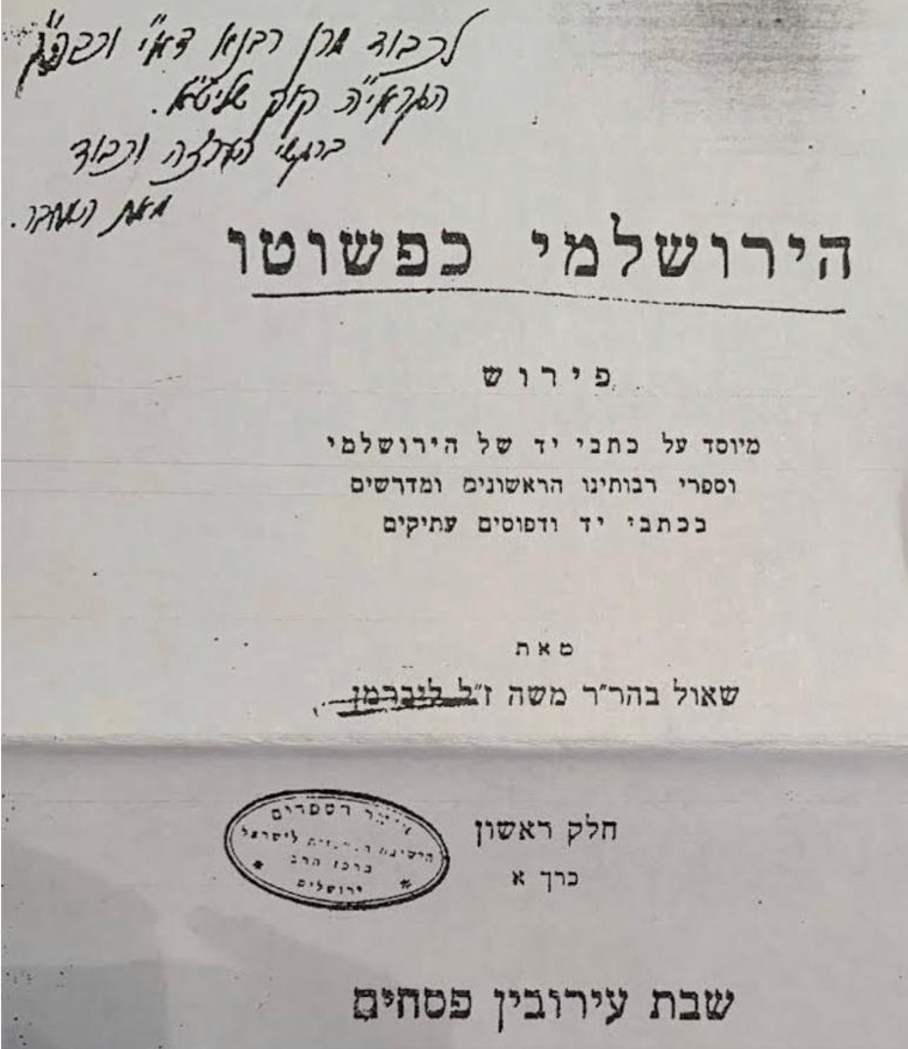
“In honor of our master, the rabbi of the Land of Israel and of all the Diaspora, the Gaon Rav A.I.H. Kook, may he live a long and good life, with feelings of admiration and respect, from the author.”

Attention should be paid to the date on which these words were written. The work was published in 5695 (1935). Lieberman signed his introduction at the beginning of that year, on Sunday, 7 Tishrei 5695, between Rosh Ha-Shanah and Yom Kippur, corresponding to 16 September 1934.

Obviously, the printing also took a certain period, probably a few months.

Greater precision can be established regarding the date of publication. A notice announcing the appearance of Ha-Yerushalmi Ke-Peshuto was printed on the front page of Kol Yisrael, the organ of Agudat Israel in Jerusalem (edited by Rabbi Moshe Blau), on 8 Kislev 5695 (15 November 1934). The advertisement’s conspicuous placement on the newspaper’s front page indicates that the volume had only recently emerged from the press and was then being introduced to the reading public. It therefore provides a reliable terminus post quem for any presentation of the work to Rav Kook.
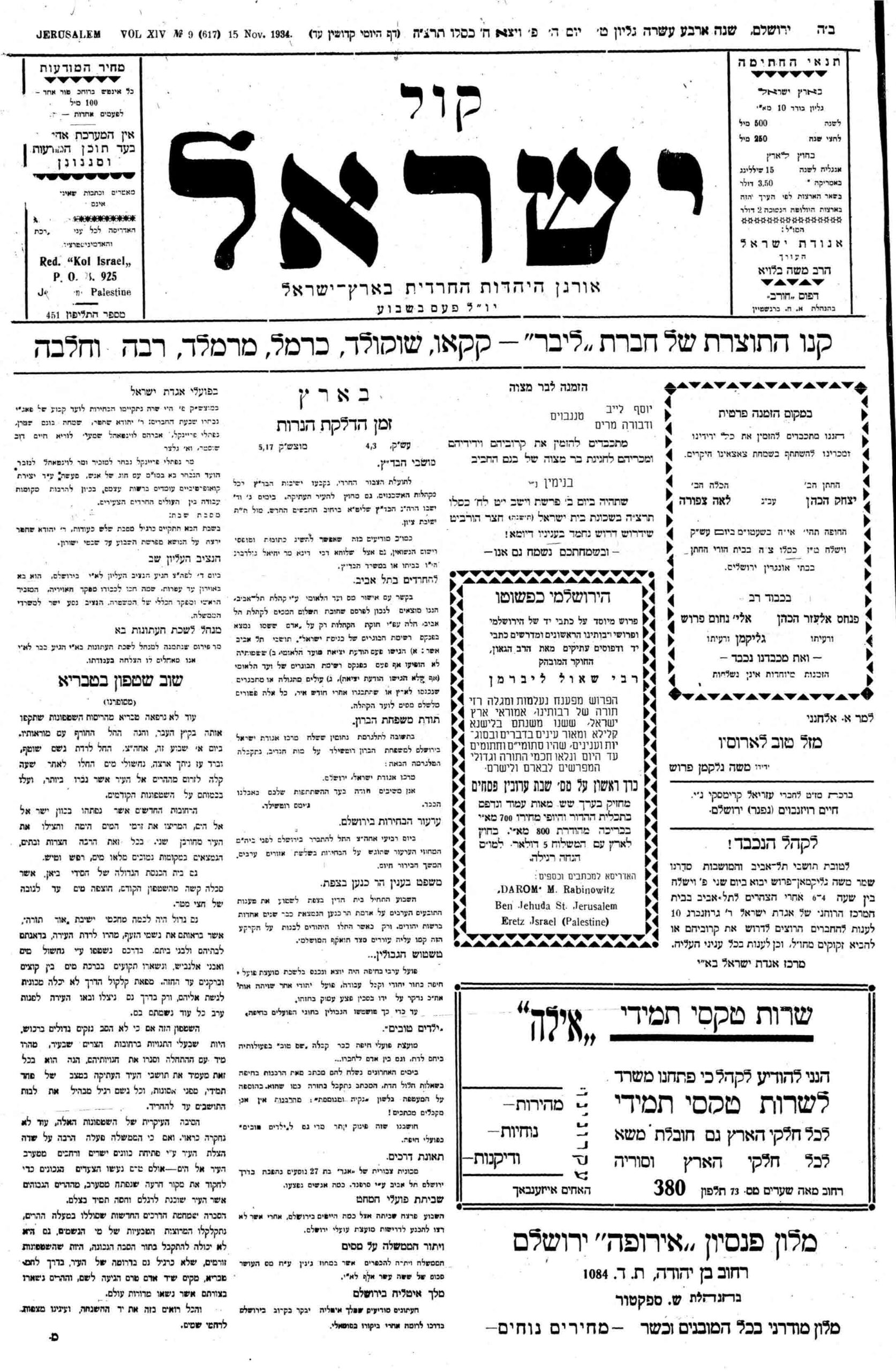
Lieberman therefore could not have presented the book to Rav Kook before that date. The possible window is accordingly narrow: from mid-November 1934 until the onset of Rav Kook’s final illness around Passover 5695 (April 1935). It is thus plausible that Lieberman brought the newly printed volume to him on the eve of Purim of that year, perhaps as mishlo’aḥ manot, or shortly beforehand, and that Rav Kook, in return, presented him with a copy of Rosh Milin bearing the distinctive Purim dedication.

Rav Kook passed away in Elul of that year. Approximately six months earlier, around Passover, he had contracted his final illness and was already confined to his deathbed in a state of severe suffering. Consequently, even had Lieberman wished to do so, he could only have presented him with the work during the brief period at the beginning of that year, from the book’s publication until Passover.

The second surprise came to my attention several years ago, when a friend sent me a photograph of the title page of Rav Kook’s small and enigmatic kabbalistic work, a copy of which was in his possession.

The work, Rosh Milin, on the Hebrew letters, was written in 1917, during Rav Kook’s exile in London in the course of the First World War.[28] Thus did Rav Kook write, in the affectionate dedication he inscribed to his young colleague and ḥavruta:

“A gift of true love to the chosen of my heart, Rabbi Saul Lieberman, may he live a long and good life. Abraham Isaac, the small [i.e., the humble one]. Purim of the unwalled cities, 5695 [1935].”

Anyone familiar with the dedications and expressions of esteem that Rav Kook addressed to various individuals, including leading Torah scholars, will recognize that the phrase he wrote to Lieberman, “true love to the chosen of my heart,” is striking in its exceptional character.

Incidentally, Gershom Scholem later related that, despite his expertise in Kabbalah, he did not succeed in understanding Rosh Milin. He further added – “on the testimony of trustworthy informants,” by which he meant his close friend Saul Lieberman (and he even recorded the remark in his personal copy of the book, now preserved in the National Library of Israel) – that Rav Kook himself told Lieberman:
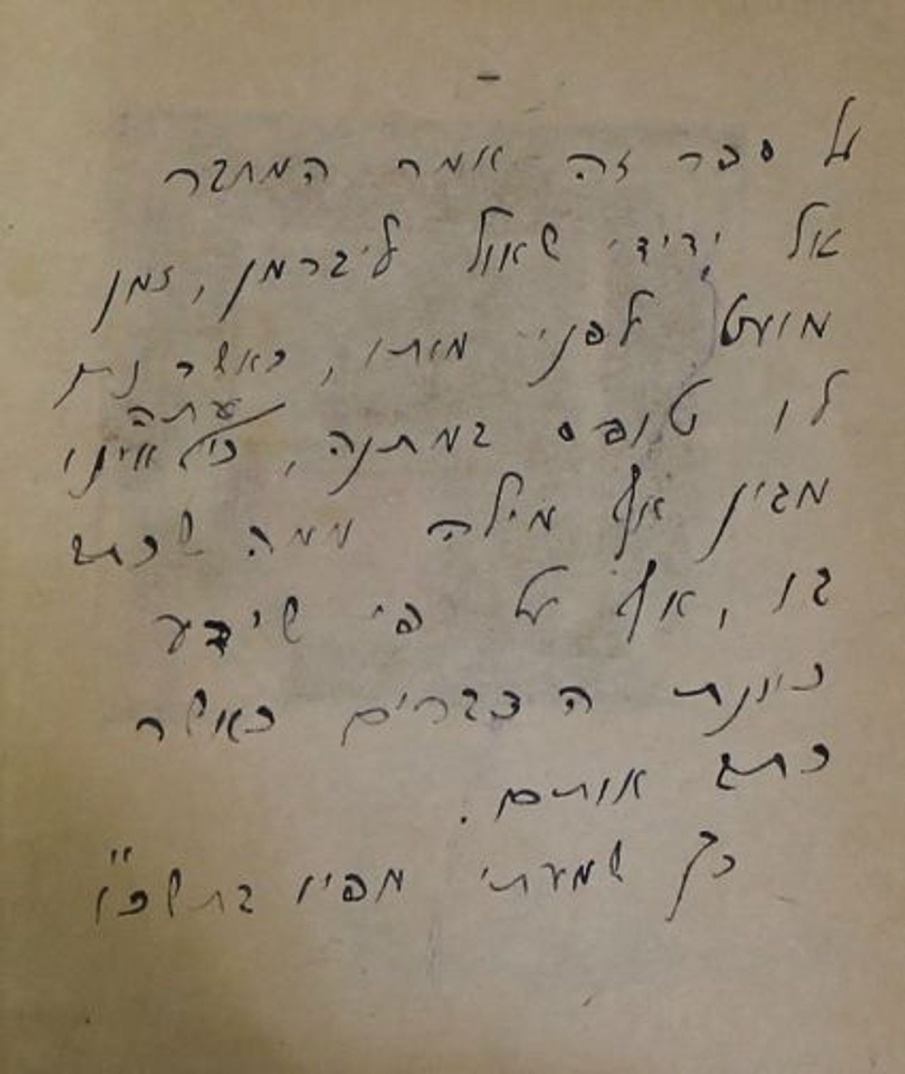
“Regarding this book, the author [i.e., Rav Kook] said to my friend Saul Lieberman, shortly before his death – when he presented him with a copy as a gift – that he now does not understand a single word of what he wrote in it, even though at the time of writing he fully grasped the meaning and intent of the matters.”[29]

Although Lieberman was as far removed from engagement with Kabbalah as east is from west, he once gave memorable expression to this distance when asked to introduce a lecture by his close friend Gershom Scholem. Lieberman opened his remarks with an immortal quip about Scholem’s field of research, Kabbalah and Jewish mysticism: “Nonsense is nonsense, but the study of nonsense may be a science….”[30] Nevertheless, Rav Kook chose, of all his writings, to present Lieberman with this particular book as a gift, perhaps so that it might serve as a kind of “amulet,” or perhaps as an act of Purim mischief on the part of the aged rabbi; we cannot know.

The unusual date recorded in the dedication, “Purim of the unwalled cities, 5695,” suggests that the booklet was presented to Lieberman on that very occasion, when, according to the account, he chose to collect the aged Rav Kook’s “debt” during their joint study session, perhaps their last, on Purim of that year.

It is entirely plausible that on that occasion Lieberman brought Rav Kook his newly published work, The Yerushalmi According to Its Plain Meaning, and that in return Rav Kook presented him with mishlo’aḥ manot in the form of his small and enigmatic book.

Thus the Jerusalem legend seems to acquire flesh and sinew, and what once appeared to be no more than a charming anecdote may in fact preserve a genuine historical memory: a literary mishlo’aḥ manot exchanged between two towering figures, in which Torah, affection, and Purim playfulness were delicately intertwined.

Appendix A: Rabbi Moshe Tzvi Neria’s Archival Notes on Saul Lieberman’s Recollections of Rav Kook (Summer 1979)

The following translation is based on Rabbi Moshe Tzvi Neria’s handwritten notes preserved in his personal archive, currently housed in the National Library of Israel (Jerusalem). The notes record a conversation held during Summer 1979 in which Rabbi Professor Saul Lieberman recounted a series of episodes relating to Rav Abraham Isaac Hacohen Kook and the influence that Rav Kook exerted upon him. The material corresponds in its essentials to passages later published by Rabbi Neria, but the archival version preserves additional details and a more expansive formulation of Lieberman’s testimony.

Rabbi Neria was accustomed to preserving every scrap of paper containing substantive content that passed through his hands. Alongside newspaper clippings in which several articles about Lieberman appeared, Rabbi Neria preserved the remarks he heard directly from him in the summer of 5739 (1979). According to his account, Lieberman requested that he telephone him in the early morning (“from eight o’clock onward I disconnect the telephone, lock the door, and engage in my Talmudic study without interruptions”), and he did so.

Lieberman told Rabbi Neria that his first visit to Rav Abraham Isaac Hacohen Kook took place on the night of Shavuot:

“I heard that he was teaching Sefer ha-Mitzvot [i.e., Maimonides’ Book of the Commandments]. I came and sat down by the table. In the course of the study I made a remark, and the Rav answered me briefly. Later I made another remark, and again I received a brief reply. When I remarked upon his words a third time, the Rav turned to me and said: ‘Come in to me tomorrow.’ When I came after the festival, the Rav received me with great warmth, asked about my family, and it emerged that he knew several rabbis among my relatives. After a Torah conversation, he asked that I come to him frequently, and thus I did. On the way to the Rav’s visit to the Gerrer Rebbe (to R. Neḥemyah’le [??]), the Rav delayed at my apartment and became engrossed in a halakhic give-and-take concerning a matter I was then studying. I would come and present my novellae before him, ask about what had been difficult for me, and the like. His warm attitude toward me greatly encouraged me. He had a mystical influence upon me, even though I am far from mysticism. I had ‘tests,’ and he influenced me to remain in the study of Torah.”

Lieberman recounted to Rabbi Neria one such “test.” According to his account, a dispute arose between Rabbi Fishman [i.e., R. Yehudah Leib Maimon] and Bank Mizraḥi. The parties decided to submit to arbitration before attorney Mordechai Eliash. Lieberman represented Rabbi Fishman, whereas the bank was represented by attorney Mordechai Levanon. Rav Kook summoned Lieberman and instructed him to cease representing him in the arbitration:

“You have acquired a reputation for involving yourself in arbitration, and that will draw you away from your learning.”

Rabbi Neria further adds and cites in Lieberman’s name words of admiration and reverence for Rav Kook:

“Not only did his greatness in Torah exert influence – and he knew the entirety of Torah – but his entire personality. Matters of the people of Israel and the Land of Israel were not for him merely pathetic rhetoric; rather, they overflowed from his depths, from his hidden world, and there was something mystical in it. This was a figure overflowing with light, and his light would penetrate in its own ways… The Rav was an artist. Not merely a man with poetic sensibility, but truly an artist. In his writing there is a sacred grandeur. His words are like the tones of the shofar’s sound. The ease of his writing is astonishing, yet it is the result of abundant knowledge. They once told of a certain wealthy man who marveled at the request of a great painter to receive an enormous sum of money for a sketch he drew within ten minutes. ‘Not so,’ replied the painter; ‘I labored sixty years in order to attain an ability to draw in such a manner.’”

According to Rabbi Neria, Lieberman told him that he was occupied with printing Ḥasdei David, the commentary of R. David Pardo on the Tosefta, and that through printing his own work on Seder Ṭohorot he repaid his debt…

In this context Lieberman added:

“I also must repay a debt to the Rav [i.e., Kook]. He greatly encouraged me in the study of the Jerusalem Talmud. Several times I presented before him my Torah insights in elucidating difficult passages in the Jerusalem Talmud, and he took great pleasure in them.”

In response to Rabbi Neria’s question, “Was the Rav [i.e., Kook] as proficient in the Jerusalem Talmud as in the Babylonian?” Lieberman replied:

“The Rav was proficient in everything: Babylonian and Jerusalem Talmud, Tosefta and Midrashim, Rishonim and decisors. The Rav was the only one who encompassed the entirety of Torah, and this influenced his encompassing vision. The Rav’s vast scope contributed greatly to the richness of his personality. This was also the greatness of the Netziv, who knew the whole of Torah. I am deeply impressed by the Netziv. So too was R. Meir Simḥah [of Dvinsk, author of Or Sameaḥ].”

In this connection, Rabbi Neria cited words written by Rav Kook:

“The originality of the ‘ever-strengthening spring’ and the ‘river that does not cease’ (Avot, beginning of ch. 6) is the primary aspiration of one who engages in Torah for its own sake, which comes from divine cleaving. The inner spiritual bond with that which is all, the source of all, and beyond all. The desire filled with purity, which steadily intensifies to absorb the distilled essence of the supernal sap within the supernal realms—these are they who always seek the ennobled renewal in its vigorous force” (Iggerot ha-Ra’ayah, vol. 3, p. 4).

(“The Rav’s [i.e., Kook’s] vast scope contributed greatly to the richness of his personality. His opponents fought against him because they recognized his power, because they knew his greatness.”) According to Rabbi Neria, Lieberman described the Rav’s words as expressing a “sacred grandeur.”

Rabbi Neria further relates, in Lieberman’s name, that in the summer of 5690 (1930) Rabbi Moshe Ostrovsky came to the apartment where Rav Kook was staying in Kiryat Moshe in order to pressure him to agree to the compromise proposal then being circulated, according to which the people of Israel would relinquish part of their rights in the Land of Israel, including at the Western Wall. Lieberman was present. The visitor wished that he leave the room so that he could speak with Rav Kook privately; however, Rav Kook detained Lieberman and instructed him to continue sitting there.

Years later, after the passing of Rav Kook, Rabbi Neria heard at a memorial gathering held in the Jewish Agency building that Rav Kook had told Rabbi Ostrovsky:

“The people of Israel has not empowered any person to relinquish the Western Wall. If we relinquish it, the Holy One, blessed be He, will not wish to restore it to us.”

Rabbi Neria testifies that while he lived in Jerusalem in the 1930s, Rabbi Professor Saul Lieberman would customarily pray on the High Holy Days together with the students of Yeshivat Merkaz ha-Rav, who had established their place of prayer at Yeshivat Etz Ḥayyim in the Maḥaneh Yehudah neighborhood.

Among other matters, Rabbi Neria wrote down what he heard from Lieberman regarding his shared study with Rav Kook, and according to what is stated there. The accounts found in Rabbi Neria’s handwritten notes correspond in their essentials to what he later presented in his book.

Alongside them, I found in this archive and in additional archives details concerning Lieberman’s involvement, at the request of his friend (and relative) Rachel Yanait Ben-Zvi, wife of the late President Yitzḥak Ben-Zvi, in the establishment of a yeshivat hesder in Peki’in. Within this framework he approached Rabbi M. Z. Neria and asked him to assist in realizing the idea in practice. Concerning this episode I intend to write, God willing, elsewhere.

Notes

I would like to express my sincere gratitude to my friend and colleague Mr. Menachem Butler, who devoted considerable effort to translating and editing this article into English. I am also grateful for his valuable contributions, including bibliographical references and precise citations.

  1. See Harold Fisch, “Reading and Carnival: On the Semiotics of Purim,” Poetics Today, vol. 15, no. 1 (Spring 1994): 55-74.
  2. See, for example Yaakov Shmuel Spiegel, “Cross Dressing for Special Occasions,” in Joseph R. Hacker, Yosef Kaplan, and B.Z. Kedar, eds., Rishonim ve-Aharonim, From Sages to Savants: Studies Presented to Avraham Grossman (Jerusalem: Shazar, 2010), 329-352 (Hebrew), available here; and Gedalia Oberlander, “The Custom of Disguising Oneself on Purim,” Or Yisrael, vol. 2, no. 3 [#7] (April 1997):125-131 (Hebrew), available here; Moshe Leib Halberstadt, “Costumes on Purim and at Various Events,” Yerushatenu, vol. 5 (2011): 169-175 (Hebrew).
  3. See Shamma Friedman, “Erasing Haman,” Leshonenu, vol. 61, no. 3 (June 1998): 259-263 (Hebrew), available here; Daniel Sperber, “Destroying the Name of Haman,” Shana be-Shana, vol. 32 (2001): 203-211 (Hebrew), available here; and Daniel Sperber, How To Strike Haman (Jerusalem: The Wolfson Museum of Jewish Art, 2002; Hebrew), available here. For a comprehensive survey of the halakhic and historical sources concerning this custom, see Eliezer Brodt, “The Pros and Cons of Making Noise When Haman’s Name is Mentioned: A Historical Perspective (updated),” The Seforim Blog (22 March 2016), available here.
  4. See Dan Rabinowitz, “Purim, Mixed Dancing, and Kill Joys,” The Seforim Blog (6 March 2006), available here.
  5. See Elliott Horowitz, Reckless Rites: Purim and the Legacy of Jewish Violence (Princeton: Princeton University Press, 2006).
  6. Esther 9:22.
  7. Megillah 7a.
  8. See Alan Appelbaum, “Why the Rabbis of the Yerushalmi Called R. Judah Nesiah ‘a Great Man’?” Journal of Ancient Judaism, vol. 3, no. 3 (December 2012): 339-365.
  9. One can hardly help but wonder how long it will be before a kunṭres devoted to the halakhic parameters of re-gifting mishlo’aḥ manot appears, if indeed one has not already been published, systematically treating such questions as whether the initial recipient must effect a formal kinyan; whether the mitzvah requires that the gift be given mi-shelo (“from one’s own”); the respective roles of the giver’s kavvanah and the recipient’s awareness; the permissibility of re-gifting absent the donor’s consent (da‘at ba‘alim); whether the obligation may be discharged through an intermediary (shaliaḥ); whether one may fulfill the mitzvah with an item received earlier that same day; and whether a package that circulates through multiple hands constitutes mishlo’aḥ manot at all, or merely an elaborate exercise in communal redistribution, together with the host of subsidiary questions such a case inevitably generates.
  10. For more on this practice, see Meir Wunder, “Books as Mishlo’aḥ Manot,” Moriah, vol. 5, no. 5-6 [#53-54] (November 1973 – January 1974): 83-86 (Hebrew); and Tovia Preschel, “Mishlo’aḥ Manot of Books from Authors,” ha-Doar, vol. 53, no. 19 (8 March 1974): 295 (Hebrew).
  11. I am currently at work on a biography of Professor Saul Lieberman; for now, my earlier writings on him, see Aviad Hacohen, “Two Scholars Who Were in Our City: Correspondence between Saul Lieberman and Jacob David Abramsky,” ha-Tsofeh Literary Supplement (21 April 1984): 5 (Hebrew), available here; Aviad Hacohen, “Schlemiel, Schlimazel, and Nebbich: Letters from Saul Lieberman to Gershom and Fania Scholem,” Haaretz Literary Supplement (25 April 2000): H1 (Hebrew) , available here; Aviad Hacohen, “The Tannah from New York: A Selection of Professor Saul Lieberman’s Letters,” Jewish Studies, no. 42 (2003): 289-301 (Hebrew), available here; Aviad Hacohen, “Six Days and Seven Gates: Between Israeli President Izhak Navon and Professor Rabbi Saul Lieberman,” Oneg Shabbat (9 June 2023), available here; Aviad Hacohen, “Lieberman Kifshuto: Personal Letters Revealing the Sensitive and Playful Side of a Talmudic Genius, On the 40th Yahrzeit of Professor Saul Lieberman,” Makor Rishon, Sabbath Supplement, no. 1338: Parashat Tzav (31 March 2023): 8-11 (Hebrew), available here; Aviad Hacohen, “The Generation Did Not Appropriately and Duly Appreciate Mr. Schocken [Eulogy by Rabbi Prof. Saul Lieberman for Shlomo Zalman Schocken, March 1960],” Haaretz Literary Supplement (28 April 2024): 1 (Hebrew), available here; Aviad Hacohen, “The Story of the Rabbi Who Rejected the Maxim: ‘Torah Scholars Increase Peace in the World’,” Haaretz Literary Supplement (25 May 2023): 8 (Hebrew), available here; and Aviad Hacohen, “‘A Lithuanian Mind in Its Lithuanian Essence, From Volozhin to Jerusalem’: R. Shaul Lieberman’s Intellectual Kinship with the Legacy of Lithuanian Torah & Its Bearers,” in Martin S. Cohen, ed., Essays in Jewish Studies in Honor of Rabbi Prof. David Golinkin (Jerusalem: Schechter, 2025), 101-139 (Hebrew), available here.
  12. See Shmuel Glick and Menachem Katz, “‘A Threefold Cord’: On Saul Lieberman and His Relationship with the Hazon Ish and Jacob Nahum Epstein,” in Shmuel Glick, Evelyn M. Cohen, Angelo M. Piattelli, et al., eds., Meḥevah le-Menaḥem: Studies in Honor of Menahem Hayyim Schmelzer (Jerusalem: Schocken, 2019), 269-289 (Hebrew).
  13. See Saul Lieberman, “Ten Words,” in Texts and Studies (New York: Ktav, 1974), [1-20], where Lieberman refers explicitly to “my teacher, Prof. Moshe Schwabe, of blessed memory,” and describes Schwabe’s long-standing aspiration to produce a new dictionary of Greek and Latin loanwords in rabbinic literature. For the subsequent realization of this lexicographical program in systematic form, see Daniel Sperber, A Dictionary of Greek and Latin Legal Terms in Rabbinic Literature (Ramat-Gan: Bar-Ilan University Press, 1984); Daniel Sperber, My Rabbinic Loanwords Card Index of More Than a Half-Century: A Companion Volume to Professor Samuel Krauss’ Griechische und Lateinische Lehnwörter im Talmud, Midrasch und Targum, ed. Menachem Butler (Cambridge, MA: Shikey Press, 2022), esp. the introduction, available here, where Sperber describes the work as the product of “more than fifty-years of collection and research,” originally conceived as an annotated continuation of Krauss’s Lehnwörter, and acknowledges Lieberman’s personal role in encouraging his philological work, noting that Lieberman “adopted me as his disciple in this field.” Sperber also reproduces a letter of approbation from Lieberman dated 19 Shevat 5738 (27 January 1978), praising Sperber’s “objective evaluation of Krauss’s volume” and commending the “great progress” reflected in his conclusions.
  14. A fine “real-time” description of his path during those years appears in a letter written at the time by his father-in-law, Rabbi Meir Bar-Ilan, leader of the Mizrachi movement. Writing to his son Tuvia (a chemist and later the first Director-General of Bar-Ilan University) on 25 Marḥeshvan 5694 (5 November 1933), Bar-Ilan remarked“…And so, my dear, everything I have found here: outwardly nothing has changed in our home, but inwardly part of our apartment has been transformed into a beit midrash. For our Shaul sits and engages in Torah and scholarship with remarkable diligence. Your small room has been turned into a library, for Shaul has many books – among them items of precious value – and there he labors over them, if I am not mistaken, some ten hours a day and at night. Apart from those hours in which he teaches at the Teachers’ Seminary and at the university – only twice a week – he sits “over Torah and avodah.” He is engaged in writing a great book [this refers to Ha-Yerushalmi Kifshuto, published in 5695 (1935)], which, upon its completion and publication, will, it seems to me, renew a momentum among Talmudic circles and scholars of Israel with respect to the Jerusalem Talmud. Shaul is great – loftier than I had known – “full and overflowing” in an excellent measure; his knowledge is astonishing and his intellect clear, and beyond this he is an outstandingly diligent scholar. I do not know whether he will persist in his diligence, for it is possible that only on account of his literary work does he not divert his mind from his studies, but at present he continues his work with diligence and industriousness…”
  15. See, recently, Moshe Assis, Saul Lieberman’s Marginalia on Talmud Yerushalmi (Jerusalem: Carmel, 2022; Hebrew).
  16. On Judith Berlin Lieberman’s lineage, intellectual formation, and educational career, see Judith Berlin Lieberman, Autobiography and Reflections, eds. Menachem Butler and Abraham Lieberman (Cambridge, MA: Shikey Press, 2022), available here. See especially the autobiographical memoir (pp. 20-38) and the introductory essay by her nephew Hillel Halkin (pp. 15-19).
  17. See Aviad Hacohen, “‘Honey and Milk Are Under His Tongue, Yet Beneath It Burns a Blazing Fire’: On the Relationship between S.Y. Agnon and Saul Lieberman,” Haaretz Literary Supplement (6 October 2023): 7 (Hebrew), available here.
  18. See Aviad Hacohen, “Schlemiel, Schlimazel, and Nebbich – Letters from Saul Lieberman to Gershom and Fania Scholem,” Haaretz Literary Supplement (25 April 2000): H1 (Hebrew), available here.
  19. See Aviad Hacohen, “The Generation Did Not Appropriately and Duly Appreciate Mr. Schocken [Eulogy by Rabbi Prof. Saul Lieberman for Shlomo Zalman Schocken, March 1960],” Haaretz Literary Supplement (28 April 2024): 1 (Hebrew), available here.
  20. See, for example, Menahem Zulay, “The Research Institute for Hebrew Poetry,” Haaretz Literary Supplement (31 October 1947): 9 (Hebrew); and A.M. Habermann, “Salman Schocken and The Research Institute for Hebrew Poetry: On His Fifth Anniversary of His Death,” Haaretz Literary Supplement (17 July 1964): 13 (Hebrew).
  21. See Aviad Hacohen, “If every Sabbath were like Yom Kippur: An Interview with Haim Cohn,” Meimad, no. 17 (August 1999): 12-15 (Hebrew), available here; and Aviad Hacohen, “Apikores with Divine Grace – Review of ‘Being Jewish: Culture, Law, Religion, State’, by Haim Cohn,” ha-Tsofeh Literary Supplement (27 April 2007): 10, 13 (Hebrew), available here; and see also Azriel Carlebach, “The Rav Renowned for Halakhic Expertise,” Maariv Literary Supplement (19 February 1956): 4 (Hebrew), and Haim Cohn, “The Yeshiva of Rav Kook,” in Haim Cohn, A Personal Introduction: Autobiography, ed. Michal Smoira-Cohn (Kinneret: Dvir, 2005), 96-102 (Hebrew).
  22. Ari (Yitzchak) Chwat, “Rabbi Kook’s Connections with Prof. Rabbi Saul Lieberman as a Model for His Attitude Towards Critical Torah Research,” Tzohar, vol. 35 (2009): 59-66 (Hebrew), is especially important for situating the Rav Kook-Lieberman relationship within the broader question of Rav Kook’s principled openness to rigorous philological and historical methods in Torah study, and for treating Lieberman as a case study for the category Rav Kook termed ḥokhmat yisrael be-qedushatah. For further development of this concept, see Ari (Yitzchak) Chwat, “‘Hokhmat Yisrael in Its Holiness’: Rav Kook’s Vision for True Critical-Scientific Study,” Talelei Orot, vol. 13 (2007): 943-976 (Hebrew).
  23. The letter, preserved in the Professor Ephraim E. Urbach Archive at the National Library of Israel in Jerusalem, is scheduled for publication in my forthcoming volume, Pirkei Shaul, which, God willing, is expected to appear in the coming year.
  24. Many stories concerning Lieberman’s extraordinary powers of memory circulated among people already during his lifetime. One of the sages of Jerusalem, who sought to clarify the difference between Lieberman and other great Torah scholars endowed with remarkable mnemonic ability, described it as follows: “So-and-so, the gaon, knows the entire Talmud by heart. Say to him a particular word, and he will immediately tell you where it appears throughout the whole of the Talmud. Lieberman is greater than he: he can tell you with certainty that a particular word does not appear anywhere in the entire Talmud…”
  25. See Moshe Tzvi Neria, “From the Testimony of Rabbi Saul Lieberman,” in Likkutei ha-Ra’ayah, ed. Moshe Tzvi Neria, vol. 2 (Kefar ha-Ro’eh: 1990), 336–341 (Hebrew), which preserves a version of the Rosh Milin anecdote attributed to Lieberman (based on an interview conducted by Neria in Summer 1981), though without the later bibliographic framing and transmission history found in Scholem’s formulation. Neria’s presentation should also be situated within his broader editorial enterprise of collecting and disseminating Rav Kook-related reminiscences for a wide Hebrew readership, both in his books and in his ha-Tsofeh newspaper columns in the Religious Zionist press.
  26. For a translated excerpt from Rabbi Neria’s handwritten archival notes recording his 1979 conversation with Saul Lieberman, see Appendix A below.
  27. See Yair Sheleg, “King Arthur: Members of the Family of Arthur Cohn, Who Passed Away Last Week, Recount His Scrupulous Observance of the Sabbath Even on the Most Prestigious Stages, and His Profound Love for the State of Israel, Expressed Not Only Through Generous Donations,” Makor Rishon, Sabbath Supplement: Parashat Vayigash (25 December 2025; Hebrew), available here.
  28. See Aaron Ahrend, “About Rav Kook’s ‘Rosh Millin’,” Da’at, no. 27 (Summer 1991): 73-85 (Hebrew), available here; and Aaron Ahrend, “Further on Rav Kook’s ‘Rosh Millin’,” Sinai, vol. 110 (June – July 1992): 190-192 (Hebrew), available here.
  29. Zvi Leshem, “‘He Does Not Understand a Single Word of What He Wrote’: Gershom Scholem and Rabbi Abraham Isaac Hacohen Kook – A Story of a Marginal Note,” Ha-Safranim, Blog of the National Library of Israel (19 August 2019), available here and here.Rabbi Moshe Tzvi Neria transmitted these remarks in the name of Saul Lieberman himself. See Moshe Tzvi Neria, “From the Testimony of Rabbi Saul Lieberman,” in Likkutei ha-Ra’ayah, ed. Moshe Tzvi Neria, vol. 2 (Kefar ha-Ro’eh: 1990), 339 (Hebrew). On the affinity between the Rav Kook and Saul Lieberman, see ibid., pp. 92, 337-341, 369. From there also in Elijah J. Schochet and Solomon J. Spiro, Saul Lieberman: The Man and His Work (New York: Jewish Theological Seminary of America, 2005), 52-53, 101.
  30. See Daniel Abrams, “Defining Modern Academic Scholarship: Gershom Scholem and the Establishment of a New Discipline,” The Journal of Jewish Thought and Philosophy, vol. 9 (2000): 267-302, esp. 268n1, where he writes:“Lieberman’s statement has been circulating as an oral tradition amongst scholars and students of the Jewish Theological Seminary. The only printed reference to it I have found is offered by Joseph Dan in his “The Revelation of the Secret of the World: The Beginning of Jewish Mysticism in Late Antiquity” (Brown University Program in Judaic Studies, Occasional Paper Number 2, Providence 1992, p. 3): “We all know that mysticism is nonsense, but the history of mysticism is a science.” See however Lieberman’s article “How much Greek in Jewish Palestine,” Biblical and Other Studies, ed. A. Altmann, Cambridge, Mass. 1962, p. 135 [reprinted in Texts and Studies, New York 1974, p. 22), Lieberman offered the following formulation: “Nonsense is nonsense, but the history of nonsense is a very important science. In certain respects it is more revealing than the history of sciences based on reason.” (see also Mortimer Ostow, Ultimate Intimacy; the Psychodynamics of Jewish Mysticism, London 1995, p. 362) Lieberman apparently regretted his statement and wrote an appendix for Scholem’s Jewish Gnosticism based on these lectures.”


Disenchantment with Zionism? Leon Roth and Yeshayahu Leibowitz on the Qibyā Raid

Disenchantment with Zionism?

Leon Roth and Yeshayahu Leibowitz on the Qibyā Raid

Warren Zev Harvey[1]

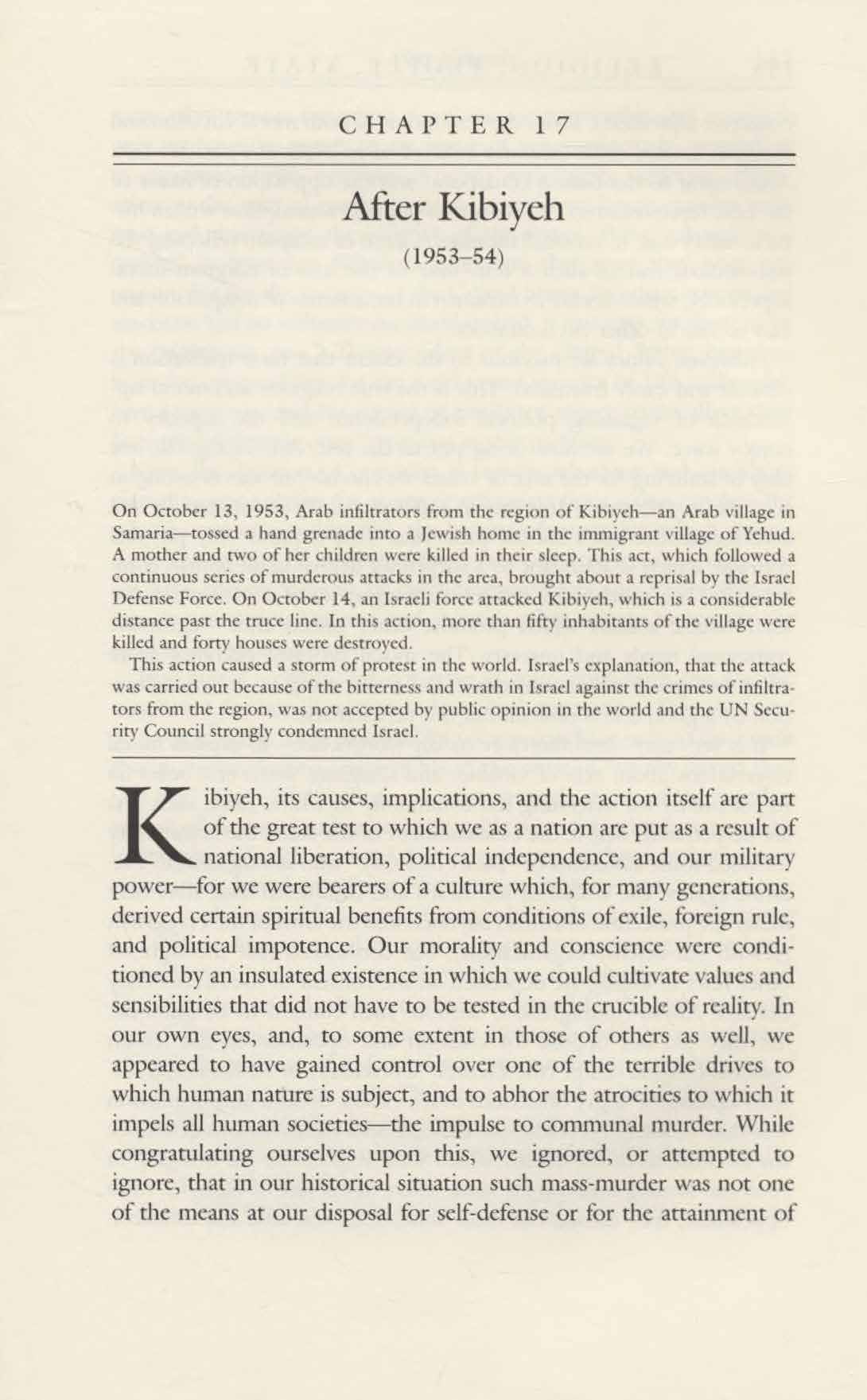
The infamous Qibyā reprisal raid (peʿulat tagmul), led by Major Ariel Sharon, later to become Israel’s Prime Minister, was the first military operation for which the young State of Israel was severely condemned by the UN, major nations, and the world Jewish community. It was carried out on the night of October 14, 1953, in response to many terror attacks by Arab fidāʾiyūn who had infiltrated Israel from Jordan, from the vicinity of the village of Qibyā. In particular, the raid was carried out in response to an attack on the town of Yehud, in which Sultana (Suzanne) Kanias, her three-year-old daughter Shoshana, and her one-and-a-half-year-old son Benny were murdered. Her thirteen-year-old son, Yitzhak, was seriously wounded, and died three years later. The raid was officially named “Operation Shoshana.”

When they saw the Israeli soldiers approaching, most of the men of Qibyā fled, and the village was conquered easily. The Israelis blew up more than 40 buildings, killing 69 residents, mostly women and children.

In the wake of the Qibyā raid, many leading Jewish personages in both Israel and the Diaspora wrote responses to it, probing its ethical and political dimensions.[2]

Among those responding were two of the foremost Maimonidean philosophers of the 20th century, Leon Roth (1896-1963) and Yeshayahu Leibowitz (1903-1994), both renowned professors at the Hebrew University of Jerusalem.

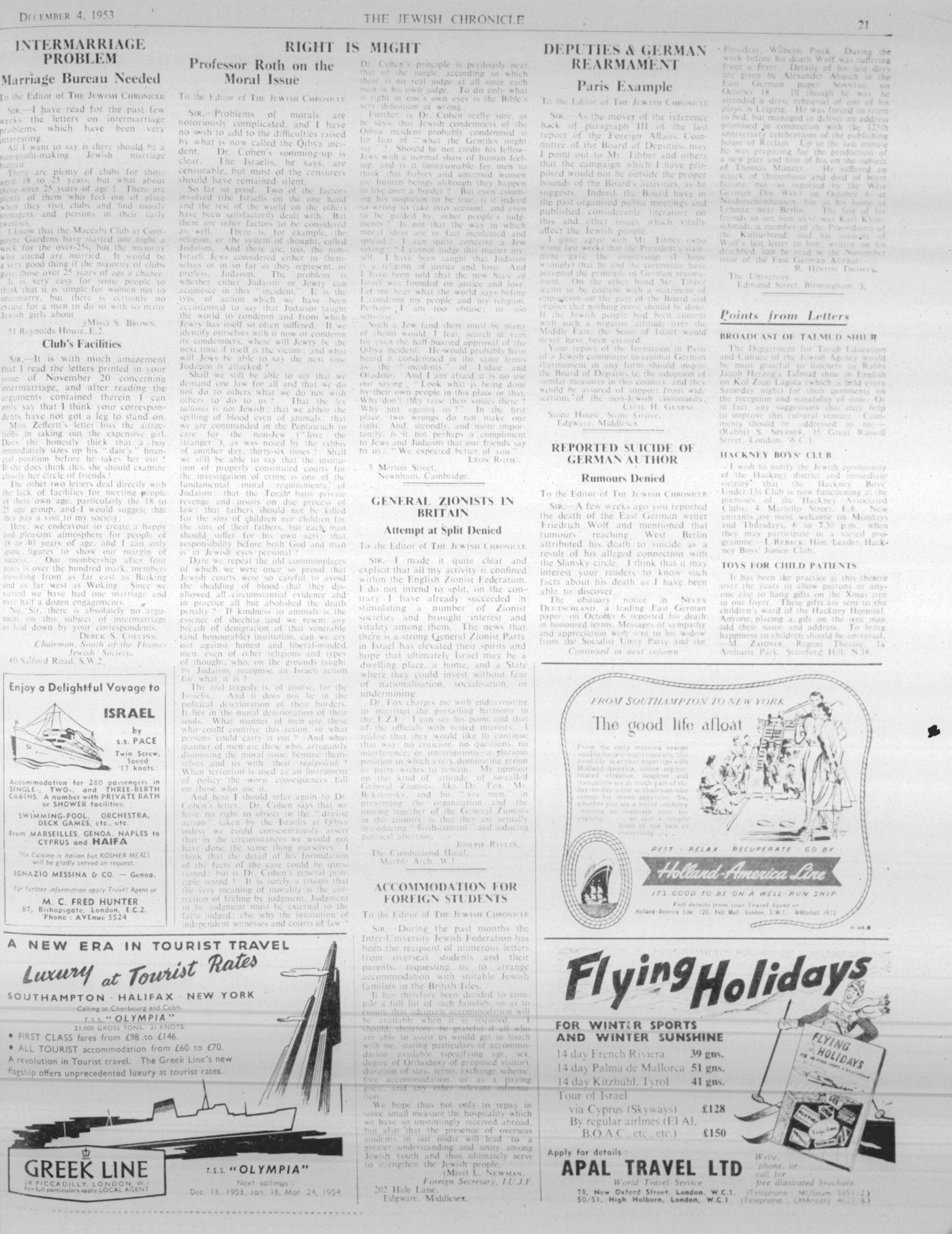
Roth’s response (“The Moral Issue”) appeared as a Letter to the Editor in The Jewish Chronicle (London) on 4 December 1953.[3] Leibowitz’s response (“After Qibyā”) appeared in the Israeli biweekly Beterem on 15 December 1953 and 15 January 1954. Roth’s intervention came near the close of a sustained Anglo-Jewish debate (October 23 – December 11, 1953), initiated by The Jewish Chronicle’s editorial “Right Is Might.”[4] Participants in this debate included Norman Bentwich (twice),[5] Selig Brodetsky, Abraham Cohen (twice), Albert Montefiore Hyamson, Harry Samuels, Ernst Akiba Simon,[6] Sefton David Temkin, and Robert Weltsch. Leibowitz’s response, by contrast, inaugurated a long Israeli debate (December 15 – March 15), whose participants included Rabbi Benjamin (Yehoshua Radler-Feldman / Hatalmi), Yuval Elitzur (twice), Amitai Etzioni, Pepita Haezraḥi (twice), Eliezer Schweid, and Ernst Akiba Simon (twice).

Leon Roth, known in Hebrew as Ḥayyim Yehudah Roth (ח״י רות, erut = Freedom), was born in London and educated at Oxford.[7] He was the older brother of the historian Cecil Roth.[8] During World War I, he served as a lieutenant in the Jewish Legion of the British Army. He co-founded the Department of Philosophy at the Hebrew University of Jerusalem in 1928 together with Samuel Hugo Bergmann, and became its first Aḥad Haʿam Professor.[9] He later served as Rector of the University (1940-1945) and Dean of Humanities (1949-1951). He was the author of many lucidly argued works in English and Hebrew on Greek, medieval, and modern philosophy, including Spinoza, Descartes, and Maimonides (1924) and Judaism: A Portrait (1960).[10] In July 1951, at the age of fifty-five, he resigned his chair at the Hebrew University of Jerusalem and returned to England,[11] despite efforts by the University and senior figures in the Israeli government to persuade him to remain.[12] He died suddenly of a heart attack on 2 April 1963 while visiting Wellington, New Zealand, where he is buried.[13]

Yeshayahu Leibowitz was born in Riga and studied chemistry and medicine at Berlin and Basle. He was the older brother of the Bible scholar, Neḥamah Leibowitz. He moved to Jerusalem in 1935, and taught biochemistry, organic chemistry, and neurophysiology at the Hebrew University. During Israel’s War of Independence, he served as a platoon commander in the Haganah. A selection of his trenchant Hebrew essays on Jewish philosophy appeared in English translation under the title, Judaism, Human Values, and the Jewish State (1992). He was fifty years old when he wrote his response to the Qibyā raid, an intervention that marked the beginning of his long and influential engagement with the tensions between political sovereignty, religious commitment, and moral responsibility.

In his response to the raid, Roth asked two main questions: (1) Do we as Jews today have an obligation to traditional Jewish values? (2) What manner of human beings could have carried out the Qibyā raid? In his response to the raid, Leibowitz, in effect, engaged with Roth’s two questions, and gave thought-provoking replies. Although Leibowitz did not mention Roth, it seems clear that he had read his response and was in conversation with it – at least with regard to the second installment (January 15), if not also with regard to the first one (December 15).

Roth’s Response

Whereas the debate in the Jewish Chronicle had focused on whether Diaspora Jews should publicly criticize the Israelis, Leon Roth was interested in a different question. His concern, rather, was Judaism itself. “The problem,” he wrote, “is whether…Judaism…can acquiesce in this incident.” The Qibyā raid, he continued, “is the type of action which we have been accustomed to say that Judaism taught the world to condemn and from which Jewry itself has so often suffered.” If we do not censure the Israeli raid, we hypocritically deny our own sacred values and our own past. Roth asked: “Shall we still be able to say that we demand one law for all and that we do not do to others what we do not wish others to do to us? That the lex talionis is not Jewish; that we abhor the spilling of blood, even of animals; that we are commanded in the Pentateuch to care for the non-Jew (‘love the stranger’), as was noted by the rabbis of another day, thirty-six times?… Dare we repeat the old commonplace of which we were once so proud that Jewish courts were so careful to avoid the shedding of blood that they disallowed all circumstantial evidence and in practice all but abolished the death penalty?” In other words, if we abandon our Jewish values, can we still consider ourselves Jews?

This was Roth’s first question. Do we as Jews today have an obligation to traditional Jewish values? However, he also had a second question, namely: What manner of human beings could have carried out the Qibyā raid?

Roth phrased his second question as follows: “The real tragedy is…for the Israelis… What manner of men are these who could contrive this action, or what persons could carry it out? And what manner of men are those who, arrogantly dismissing the moral issue, bemuse themselves and us with their Realpolitik?” If the conduct of the Israelis was not Jewish, then what was it?

Roth left his two questions unanswered. It was up to Leibowitz to answer them.

Leibowitz’s Response

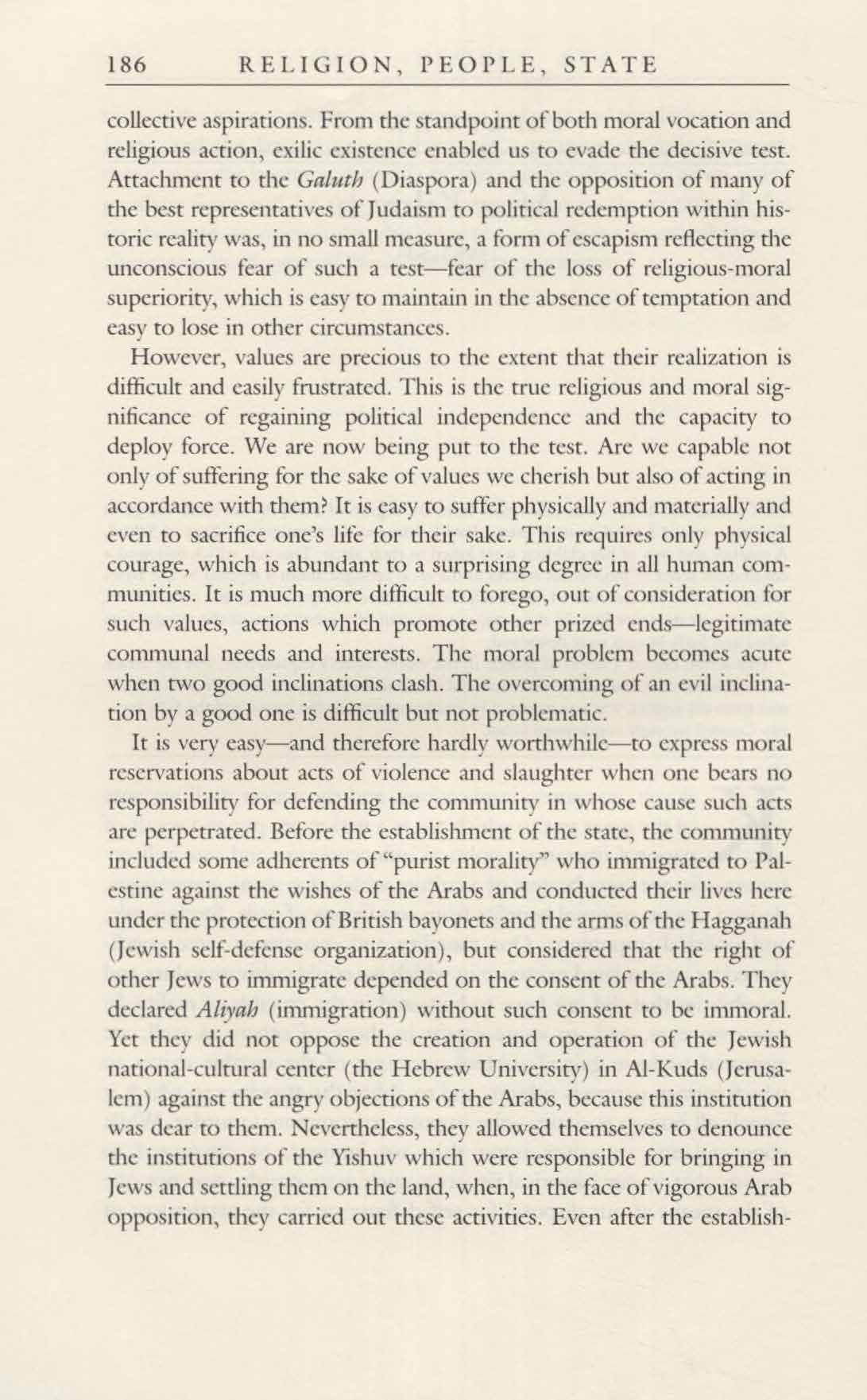
Like Roth, Leibowitz begins his response to the Qibyā raid by raising the question of our relationship today as Jews to our traditional values. However, he does not speak simply about “Jews,” but Jews in the State of Israel. The “true religious and moral significance” of our Jewish political independence, he argued, is that it is “a test” or “a trial” (Hebrew: nissayon, like the nisyonot of Abraham) of our traditional values. In the Diaspora, Leibowitz explained with wry irony, we enjoyed “spiritual benefits from conditions of exile, foreign rule, and political impotence.” We spoke well about morality, but our morality “was never tested.” Diaspora existence (Hebrew: galut) “was a form of escapism.” True, we did not engage in mass murder, but we did not have an army to do so. We did not have the power to be moral. We could suffer for our values, but could not act on their behalf. “Now we are being tested.”

The notion that morality presupposes power is of course Nietzschean. But not only Nietzschean. The distinguished Israeli philosopher of education, Ernst Akiba Simon, who was the only personage who participated in the debates on Qibyā in both the Jewish Chronicle and Beterem, called Leibowitz’s attention to a relevant passage in Rabbi Judah Halevi’s philosophic dialogue, The Kuzari, I, 113-114.[14] In that passage, Halevi’s rabbinic protagonist boasts to the King of the Khazars that the Christians and the Muslims are engaged in terrible wars, but we Jews are virtuous, meek, and do not kill anyone. The King immediately retorts: “Your humility is not by choice! As soon as you have a moment of triumph, you’ll kill too [idhā aṣabtum ẓafra, qataltum]!”[15]

Again like Roth, Leibowitz distinguishes between our traditional values and Realpolitik. It is possible to find a moral justification for the Qibyā raid, but “we shouldn’t try to do so,” because it was an atrocity (zevaʿah). He compared the Qibyā raid to the raid on the city of Shechem by Jacob’s sons (Genesis 34).[16] The sons gave a moral justification for their act, saying: “Should one deal with our sister as with a harlot?!” (ibid., v. 31). Nonetheless, Jacob cursed the act, saying: “Simeon and Levi…weapons of violence their kinship… Cursed be their anger… I will scatter them” (ibid., 49:5-7). There are acts, insisted Leibowitz, that may be morally or politically justifiable, but are accursed. He concluded his response to the Qibyā raid with the chilling words: “We may find ourselves erecting our Third Commonwealth upon the curse of Jacob our Father.”

Leibowitz also engaged with Roth’s second question, “What manner of men are these who could contrive this action,” carry it out, or defend it?[17] In his own response, Leibowitz asks: “From where have these youths come who felt no inhibition…to perform the atrocity?” Leibowitz, unlike Roth, gives an explicit answer. He replies: “They were nurtured on the values of a Zionist education… Their conduct is among the consequences of applying the religious category of holiness [Hebrew: qedushah] to social, national, and political interests… The concept of holiness – which is absolute and beyond all categories of human thought and evaluation – is transferred to the profane. From a religious standpoint only God is holy, and only His imperative is absolute. All human values…are profane… Country, state, and nation… are never holy… They are always subject to criticism.” The moment secular Zionist education transformed the old religious categories, like “holiness,” into social, national, or political categories, it created a generation of Israelis who did not have the ability to criticize their government. They held the State and its policies to be sacred. The secularization of religious concepts is accordingly dangerous and can be fatal. Leibowitz never tired of preaching: Only God and His commandments are “holy” or absolute. The orders of David Ben-Gurion or Ariel Sharon should always be subject to criticism. It was, according to Leibowitz, the secularizing Zionist education that made possible the atrocity of Qibyā.

Disenchantment with Zionism?

Both Roth and Leibowitz devoted decades to the creation of a renewed Hebrew culture in Zion. In the years before the proclamation of the State of Israel, both lectured and wrote extensively on questions of government, citizenship, and education with an eye to preparing Palestinian Jews for independence. Yet both were controversial personalities, who were at times accused of anti-Zionism and even treason. When in 1947 Roth advocated the extension of the British Mandate in Palestine, he was widely denounced as a traitor.[18] Roth had argued that the required conditions for Jewish independence had not yet been achieved, and the premature proclamation of the Jewish State would necessarily lead to a bloody war with the Arabs whose end could not be foreseen. Similarly, when in the 1980s Leibowitz advised young Israeli soldiers to refuse to serve in the occupied territories,[19] he was widely denounced as a traitor.

Did Roth or Leibowitz ever become disenchanted with Zionism?

Roth left Israel in the summer of 1951. His abrupt departure (Hebrew: yeridah) was related to his disappointment with the nationalistic policies of the newly proclaimed State, in particular the discrimination against its Arab citizens. However, he never stated that he was disenchanted with cultural Zionism.

After his departure from Israel, Roth lectured throughout the world on the subject of Judaism, emphasizing its ethical and universalist dimensions. In his classic 1960 book, Judaism: A Portrait, he does not discuss Zionism at all. He avoids the subject entirely.[20] However, he does discuss the Land of Israel. Although he criticizes Rabbi Judah Halevi’s version of Judaism, which he characterizes as “a mystical and geographical nationalism,”[21] he stresses that when Halevi himself, like the rabbinic protagonist of his Kuzari, ascended to the Land of Israel, he did so ultimately because of a “moral ideal,” that is, “he journeyed to the Holy Land in order to live the life of holiness.”[22] Roth himself, while rejecting “mystical,” “geographical,” and Realpolitikal Zionism, remained faithful to the Zionism of his youth, a Zionism based on moral idealism and holiness. The Land of Israel, he wrote, “is the land where Judaism was begotten and flourished, and where its holy men, under the influence of the divine spirit, lived the life of holiness.”[23] Nonetheless, he chose to conclude his Judaism: A Portrait with a paean to Jewish universalism: “As God is found everywhere, so man can live everywhere. He can survive even in the inside of a whale. And just as God can put man there, so from there can man seek for God, and so too can God find man [Jonah 2:1-11]. ‘Lord, Thou hast been our dwelling place in all generations’ [Psalms 90:1].”[24] Not Jerusalem, not London, but the Lord is our dwelling place.

As for Leibowitz, he was very often asked if he had become disappointed with Zionism, and he always gave the same answer. No, he replied, all his expectations for Zionism have been fulfilled. He never expected Zionism to solve our moral or religious problems. Zionism, for him, was simply a program to achieve Jewish political independence in the Land of Israel.[25] “We were fed up being ruled by the gentiles,” he used to say. Zionism, as he understood it, was intended to provide a political arena in which individual Jews could struggle for their own diverse values and aspirations. It was intended to provide only the arena, not the values and aspirations.

Leibowitz may never have become disappointed in Zionism, but there were, I believe, three times when he became disappointed in Israelis.

The first disappointment came right at the beginning of the State. In the years preceding its proclamation, Leibowitz had called upon the Palestinian rabbinic authorities to prepare Jewish law for the governance of a modern state (hilkhot medinah). He entreated them to enact bold halakhic rulings concerning government, technology, and economics, subjects which had understandably been neglected in the Diaspora. However, after the establishment of the State, it became quite clear that neither the rabbis nor the religious public were desirous of enacting such rulings. This lack of a will for halakhic initiative on the part of religious Israelis profoundly disappointed him.

The second disappointment was the Qibyā raid. Leibowitz became disappointed in the secular (or secularizing) Zionist education, but still believed that those Israeli youth who were educated in the religious Zionist schools were immune to the distorted nationalism that he had perceived among the perpetrators of the Qibyā raid.

The third disappointment came after the Six-Day War with the radicalization of the Religious Zionist public. This was surely Leibowitz’s greatest disappointment. The religious Zionist youth, reared on torah u-mitzvot, who he had thought should be immune to aberrant nationalism, had now become the most nationalistic and least critical of all sectors in Israeli society. This was a hard blow that left Leibowitz staggered and reeling for the rest of his life.

Qibyā and Us

Written more than seventy years ago, the responses of Leon Roth and Yeshayahu Leibowitz to the Qibyā raid confront difficult existential questions which remain pertinent in today’s Israel and for today’s Zionism. The admonitions of those two maverick Maimonideans have not lost their relevance. Far from it, they have become more urgent.

Appendix 1

Reproduced here is the original page featuring Leon Roth’s Letter to the Editor (“Professor Roth on the Moral Issue”), The Jewish Chronicle (December 4, 1953): 21.

Appendix 2:

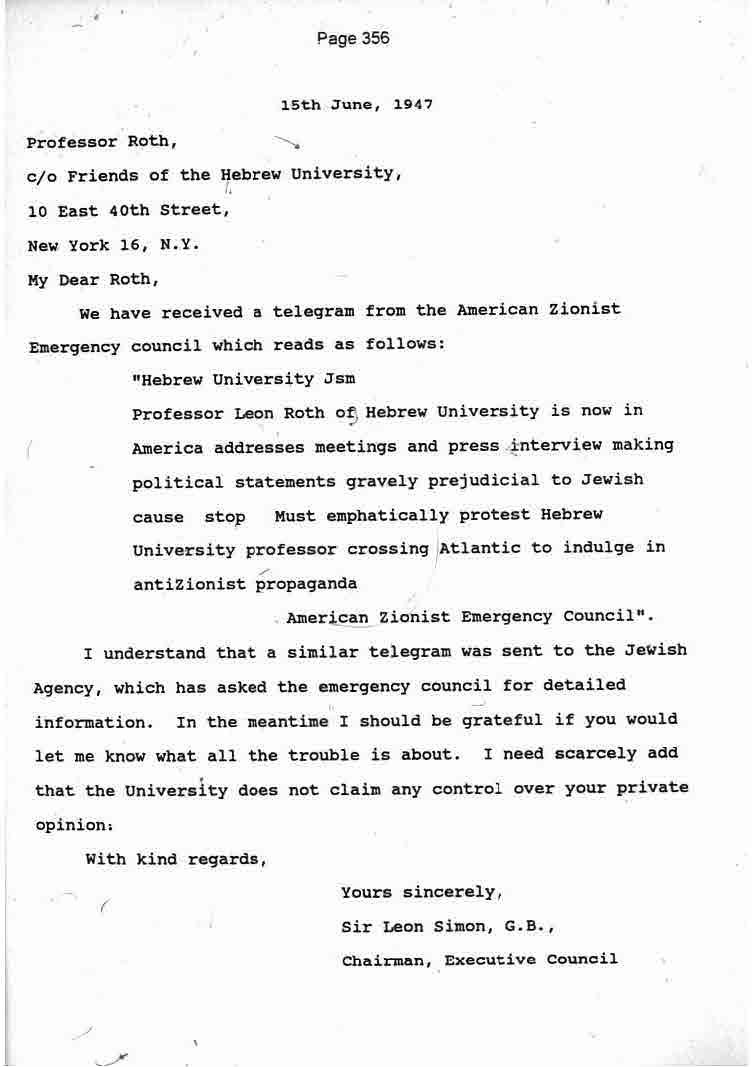
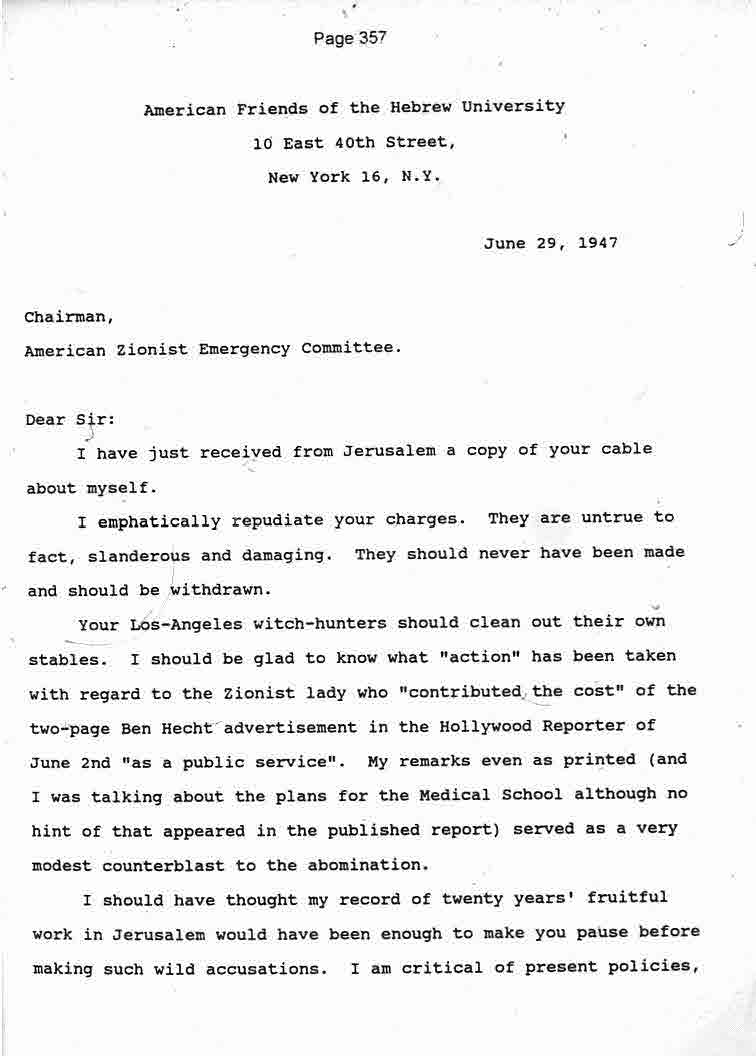
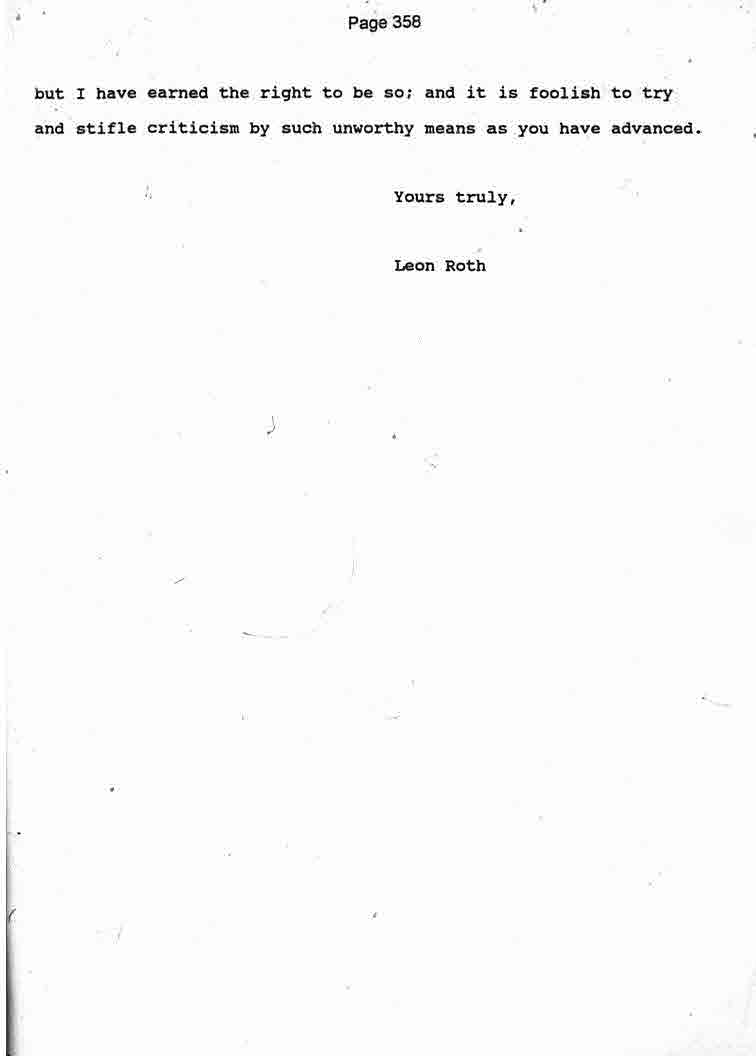
Reproduced here is the full exchange of correspondence between Leon Roth and Sir Leon Simon following Roth’s public remarks in the United States in June 1947 opposing the proposed partition of Palestine. The documents include Simon’s letter conveying the protest of the American Zionist Emergency Council, Roth’s reply rejecting the accusations, and related communications. The texts are reproduced here in full, without alteration, from Jan Katzew, “Leon Roth – His Life and Thought: The Place of Ethics in Jewish Education” (PhD dissertation, Hebrew University of Jerusalem, 1997), Appendix, pp. 355-358.

Appendix 3

Reproduced here is Leibowitz’s original article “After Qibyā,” Beterem, no. 189 (15 December 1953): 7 (Hebrew).

Appendix 4

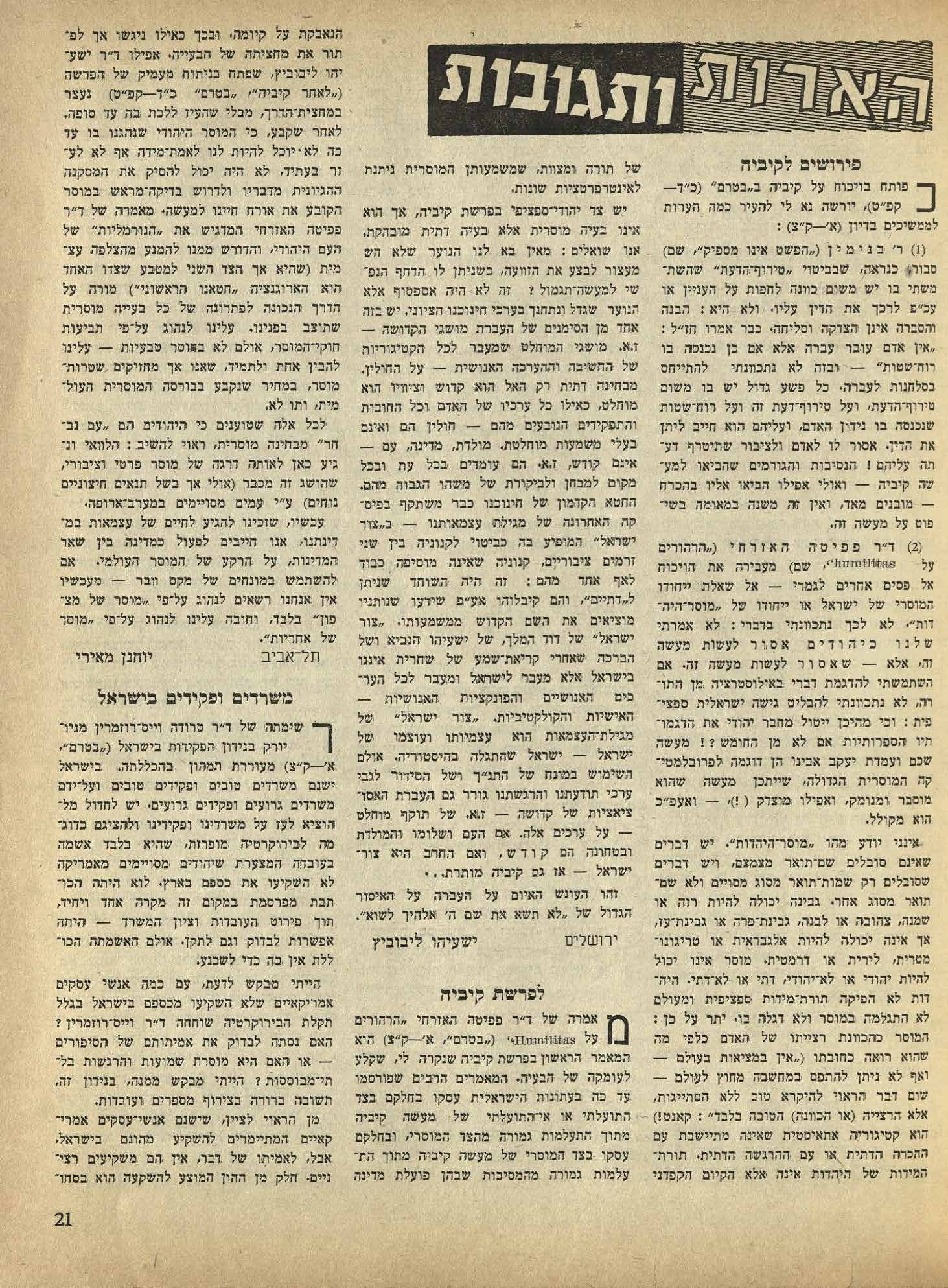
Reproduced here is Leibowitz’s follow-up article, “Letter – Commentaries on Qibyā,” Beterem, no. 191 (15 January 54): 21 (Hebrew).[26]

Appendix 5:

Reproduced here is the Hebrew text of “After Qibyā” as it appears in Yeshayahu Leibowitz’s 1954 book Torah u-Mitzvot ba-Zeman ha-Zeh. Passages reproduced from the original Beterem article of 15 December 1953 (see above, Appendix 3) are printed in plain font. Material drawn from the follow-up article in Beterem of 15 January 1954 (see above, Appendix 4), written in reply to Pepita Haezraḥi, appears in bold. Material first added in Torah u-Mitzvot ba-Zeman ha-Zeh is underlined.

The original December 15 text was copied in Torah u-Mitzvot ba-Zeman ha-Zeh with only minor changes; e.g., “emet, lefanim nahagnu” instead of “emet, anaḥnu nahagnu”; or “maʿaseh zevaʿah shel hereg” instead of “maʿaseh yeʾush shel hereg.”

The material deriving from the January 15 article was incorporated in it with many stylistic changes; e.g. “ha-problematikah ha-musarit ha-maḥridah” instead of “ha-problematikah ha-musarit ha-gedolah”; or the placement of “ha-hadgamah, etc.,” before “maʿaseh Shekhem, etc.,” instead of vice versa. It will be noted that Leibowitz’s well-known criticism of the secularization of religious concepts seems to have had its origin in his reply to Pepita Haezraḥi. His remarks about “tzur yisraʾel” repeat an urban legend. In point of fact, the dictum mentioning tzur yisraʾel was included already in the early draft of the Declaration of Independence by Mordecai Beham and Harry Davidowitz, written around April 22, 1948.[27]

The controversial paragraph on the Jerusalem “tzaddiqim,” added in Torah u-Mitzvot ba-Zeman ha-Zeh, illustrates the chasm in those days between Leibowitz and the Hebrew University “peace camp,” which consisted of famed professors like Samuel Hugo Bergmann, Martin Buber, Judah Leon Magnes, Gershom Scholem, Ernst Akiba Simon.” Roth also was not usually considered to be one of the members of that camp. See Bergmann’s article cited above, note 7.

The final sentence originally read: “al naqim et beytenu,” etc., which is stronger, simpler, and less preachy than the revised version.

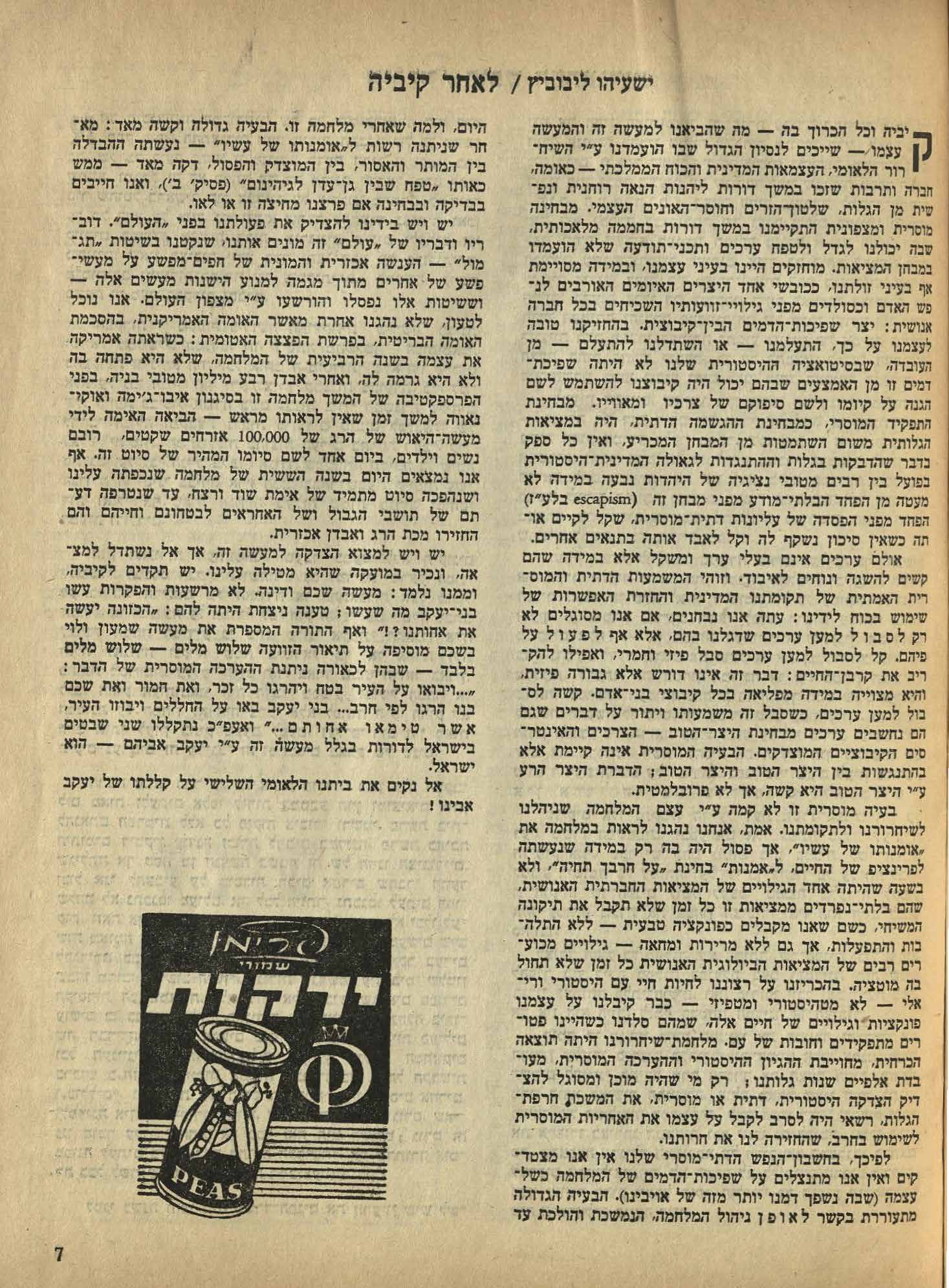
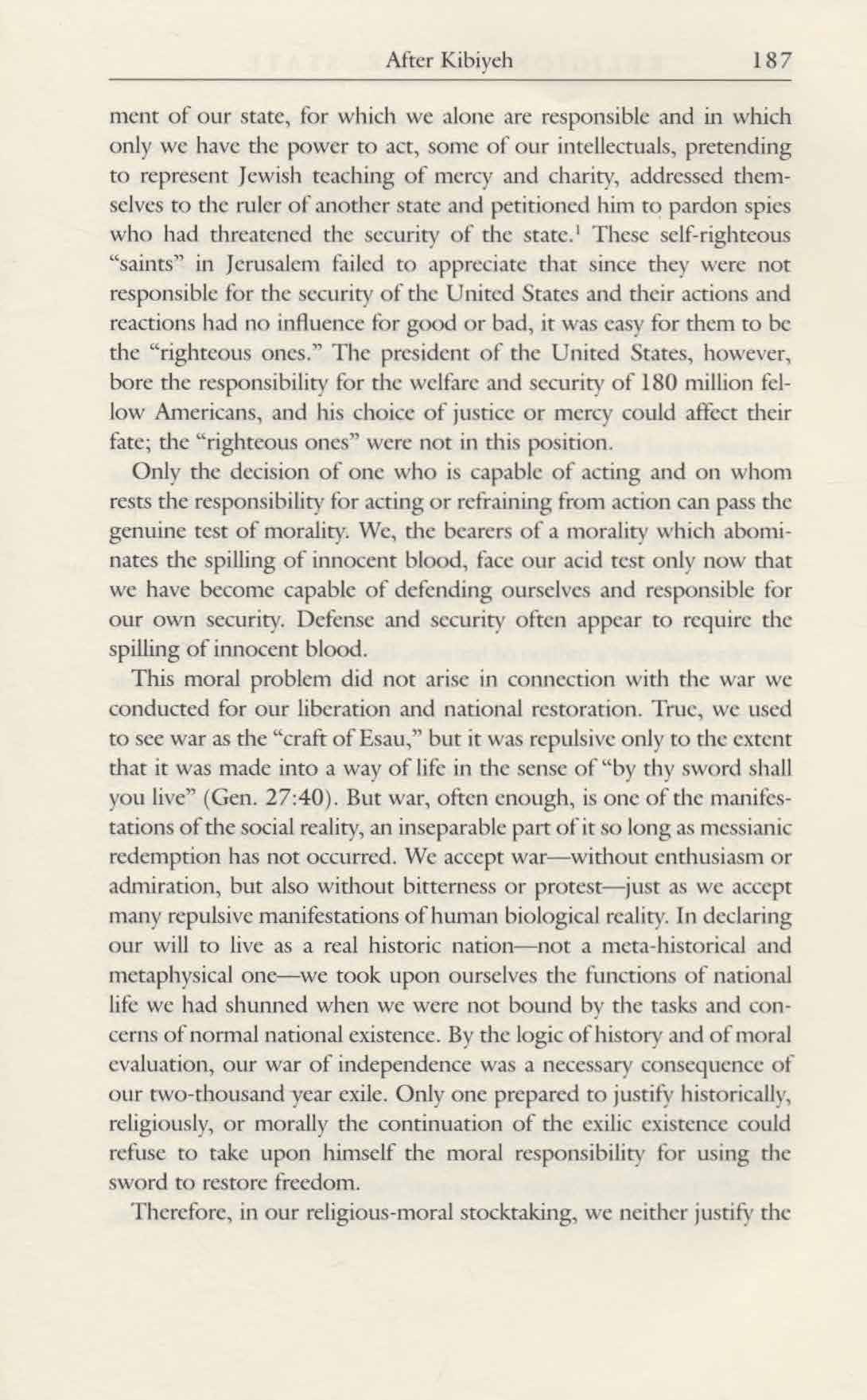
After Qibyā

קיביה וכל הכרוך בה – מה שהביא למעשה זה והמעשה עצמו – שייכים לנסיון הגדול שבו הועמדנו ע”י השיחרור הלאומי, העצמאות המדינית והכוח הממלכתי – כאומה, חברה ותרבות שזכו במשך דורות ליהנות הנאה רוחנית ונפשית מן הגלות, שלטון-הזרים וחוסר-האונים העצמי. מבחינה מוסרית ומצפונית התקיימנו במשך דורות בחממה מלאכותית, שבה יכולנו לגדל ולטפח ערכים ותכני-תודעה שלא הועמדו במבחן המציאות. מוחזקים היינו בעיני עצמנו, ובמידה מסויימת אף בעיני זולתנו, ככובשי אחד היצרים האיומים האורבים לנפש האדם וכסולדים מפני גילויי-זוועותיו השכיחים של חברה אנושית : יצר שפיכות-הדמים הבין-קיבוצית. בהחזיקנו טובה לעצמנו על כך, התעלמנו – או השתדלנו להתעלם – מן העובדה, שבסיטואציה ההיסטורית שלנו לא היתה שפיכת-דמים זו מן האמצעים שבהם יכול היה קיבוצנו להשתמש לשם הגנה על קיומו ולשם סיפוקם של צרכיו ומאווייו. מבחינת התפקיד המוסרי, כמבחינת ההגשמה הדתית, היתה במציאות הגלותית משום השתמטות מן המבחן המכריע, ואין כל ספק בדבר שהדבקות בגלות וההתנגדות לגאולה המדינית-היסטורית בפועל בין רבים מטובי נציגיה של היהדות נבעה במידה לא מעטה מן הפחד הבלתי-מודע מפני מבחן זה ( escapism בלע”ז) – הפחד מפני הפסדה של עליונות דתית-מוסרית, שקל לקיים אותה כשאין סיכון נשקף לה וקל לאבד אותה בתנאים אחרים.

אולם ערכים אינם בעלי ערך ומשקל אלא במידה שהם קשים להשגה ונוחים לאיבוד. וזוהי המשמעות הדתית והמוסרית האמיתית של תקומתנו המדינית והחזרת האפשרות של שימוש בכוח לידינו : עתה אנו נבחנים, אם אנו מסוגלים לא רק לסבול למען ערכים שדגלנו בהם, אלא אף לפעול על פיהם. קל לסבול למען ערכים סבל פיזי וחמרי, ואפילו להקריב את קרבן-החיים : דבר זה אינו דורש אלא גבורה פיזית, והיא מצוייה במידה מפליאה בכל קיבוצי בני-אדם. קשה לסבול למען ערכים, כשסבל זה משמעותו ויתור על דברים שגם הם נחשבים ערכים מבחינת היצר הטוב ; הבעייה המוסרית מתעוררת בכל חריפותה בהתנגשות בין היצר הטוב והיצר הטוב ; הדברת היצר הרע ע”י היצר הטוב היא קשה, אך לא פרובלמטית.

נוחה מאד – ולכן גם זולה ועלובה מאד – היא מוסריות המסתייגת ממעשי אלימות ושפיכות-דמים מבלי שתהא בצידה של מוסריות זו גם האחריות לעניינים ולערכים שלמענם או בשמם נעשים מעשים אלה ונשפך דם זה. לפני הקמת מדינתנו היינו עדים במחננו לבעלי מוסריות צרופה, שהם עצמם עלו לא”י נגד רצונם של הערבים וחיו ופעלו בה בחסותם של הכידונים הבריטיים והאקדחים של ההגנה, אולם את זכות עלייתם של יהודים אחרים התנו בהסכמתם של הערבים, ואת העליה בכוח – שלא בהסכמת הערבים – פסלו כלא-מוסרית ; הם לא התנגדו להקמתו ולקיומו של המרכז התרבותי-לאומי היהודי באל-קודס (ירושלים) על אפם ועל חמתם של הערבים – כי המוסד הזה היה יקר בעיניהם -, אך הם הרשו לעצמם לגנות את פעולתם של מוסדותינו שהיו אחראים להעלאת יהודים וליישובם על הקרקע כשהללו עשו את המוטל עליהם על אפם ועל חמתם של הערבים. ואף אחר הקמת מדינתנו שרק לה אנו אחראים, ורק בה יש בידנו סיפק לעשות, פנו אנשי-רוח בקרבנו, שנתעטפו באיצטלת תורת החסד והרחמים של היהדות, אל שליטה של מדינה אחרת ודרשו ממנו לחון מרגלים שהתנכלו לבטחונה של המדינה ההיא(הזוג יוליוס ואתל רוזנברג בארה”ב, שנמצאו אשמים בריגול לטובת ברה”מ לשם השג מידע סודי על החימוש הגרעיני; הם נידונו למיתה והוצאו להורג ב-19.6.1953). ולא חלו ולא הרגישו צדיקים אלה בירושלים, שמאחר שאין הם האחראים לבטחונה של ארצות-הברית ושמעשיהם ותגובותיהם אינם משפיעים על בטחון זה לא לטובה ולא לרעה – קל ונוח להם להיות “צדיקים” ; ואילו בידו ובאחריותו של נשיא ארצות-הברית הופקדו שלומם ובטחונם של 180 מליון מבני-עמו, ומידת-הדין או מידת-הרחמים שבה הוא נוקט עלולה להשפיע על סיכון קיומם מחמת הפצצה האטומית. ולא הבינו צדיקי- ירושלים שאין הם רשאים לדון את נשיא ארצות-הברית עד שיגיעו למקומו.

המבחן הממשי של המוסריות אינו אלא בהכרעתו של מי שסיפק בידו לעשות והאחריות לעשיה או לאי-עשיה עליו. הנסיון המוסרי שלנו הגיע כשנעשינו אנו – נושאי המוסר המתעב שפיכת דם נקי – בעלי-יכולת ואחראים לעניני הגנה ובטחון, ענינים שבעיותיהם נראות לפעמים כניתנות לפתרון ע”י שפיכת דם נקי.

בעייה מוסרית זו לא קמה ע”י עצם המלחמה שניהלנו לשיחרורנו ולתקומתנו. אמת, לפנים נהגנו לראות במלחמה את “אומנותו של עשו”, אך פסול היה בה רק במידה שנעשתה לפרינציפ של החיים, ל”אומנות” בחינת “על חרבך תחיה”, ולא בשעה שהיתה אחד הגילויים של המציאות החברתית האנושית, שהם בלתי נפרדים ממציאות זו כל זמן שלא תקבל את תיקונה המשיחי, כשם שאנו מקבלים כפונקציה טבעית – ללא התלהבות והתפעלות, אך גם ללא מרירות ומחאה – גילויים מכוערים רבים של המציאות הביולוגית האנושית כל זמן שלא תחול בה מוטציה. בהכריזנו על רצוננו לחיות חיי עם היסטורי וריאלי – לא מטאהיסטורי ומטפיזי – כבר קיבלנו על עצמנו פונקציות וגילויים של חיים אלה, שמהם סלדנו כשהיינו פטורים מתפקידים וחובות של עם. מלחמת-שיחרורנו היתה תוצאה הכרחית, מחוייבת ההגיון ההיסטורי וההערכה המוסרית, מעובדת אלפיים שנות גלותנו ; רק מי שהיה מוכן ומסוגל להצדיק הצדקה היסטורית, דתית או מוסרית, את המשכת חרפת-הגלות, רשאי היה לסרב לקבל על עצמו את האחריות המוסרית לשימוש בחרב, שהחזירה לנו את חרותנו.

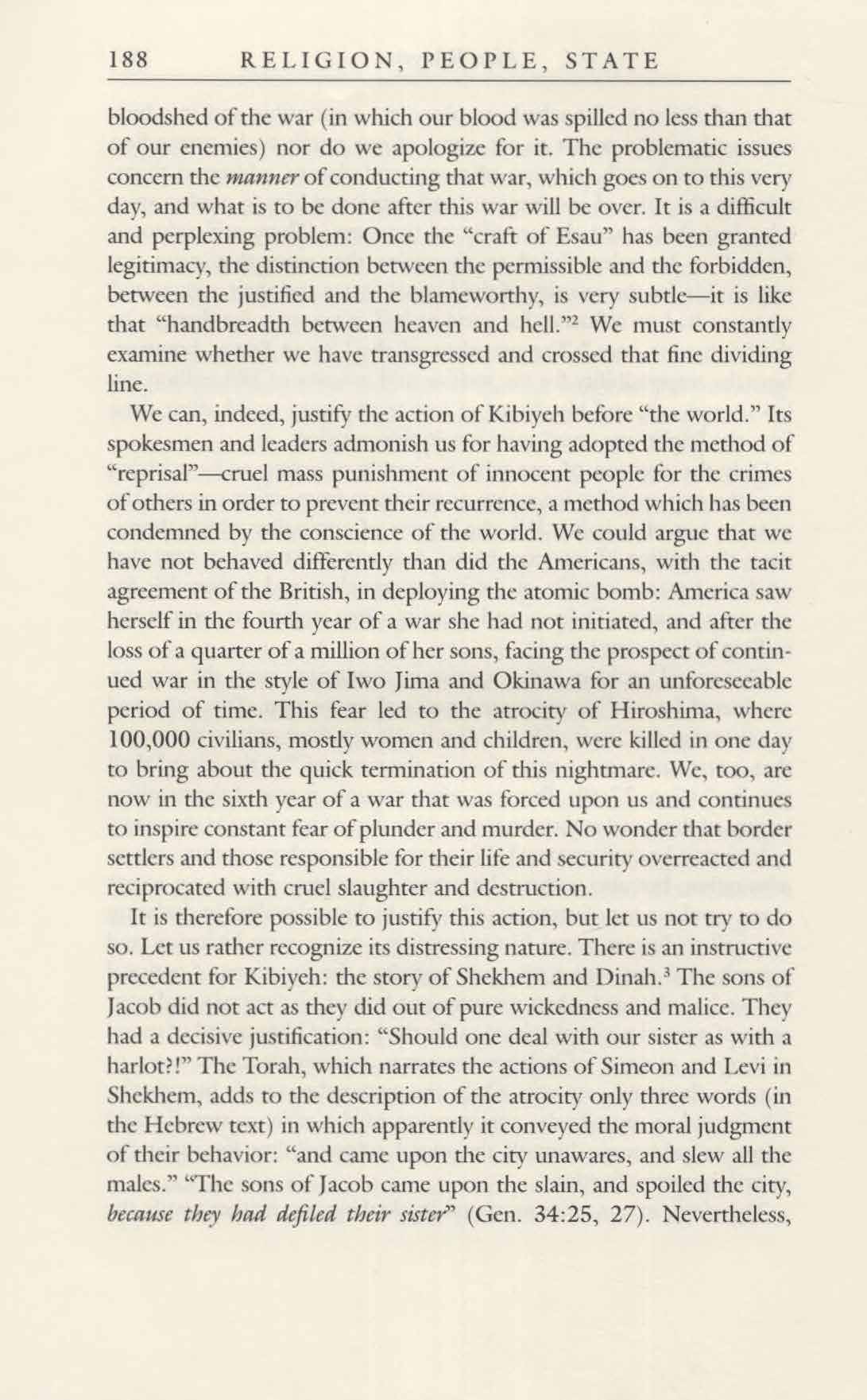
לפיכך, בחשבון-הנפש הדתי-המוסרי שלנו אין אנו מצדיקים ואין אנו מתנצלים על שפיכות-הדמים של המלחמה כשלעצמה (שבה נשפך דמנו לא פחות מזה של אויבינו). הבעייה הגדולה מתעוררת בקשר לאופן ניהול המלחמה, הנמשכת והולכת עד היום, ולמה שאחרי מלחמה זו. הבעייה גדולה וקשה מאד : מאחר שניתנה רשות ל”אומנותו של עשו”, נעשתה ההבדלה בין המותר ואסור, בין המוצדק והפסול, דקה מאד – ממש כאותו “טפח שבין גן-עדן וגיהנום” (פסיק’ ב’), ואנו חייבים בבדיקה ובבחינה אם פרצנו מחיצה זו או לאו.

יש ויש בידינו להצדיק את פעולתנו בפני “העולם”. דובריו ודבריו של “עולם” זה מגנים אותנו על שנקטנו בשיטות “תגמול” – הענשה אכזרית והמונית של חפים-מפשע על מעשי-פשע של אחרים מתוך מגמה למנוע הישנות מעשים אלה, בשיטות שנפסלו והורשעו על-ידי מצפון העולם. אנו נוכל לטעון, שלא נהגנו אחרת מאשר האומה האמריקנית, בהסכמת האומה הבריטית, בפרשת הפצצה האטומית : כשראתה אמריקה את עצמה בשנה הרביעית של המלחמה, שלא היא פתחה בה ולא היא גרמה לה, ואחרי אבדן רבע-מיליון מטובי בניה בפני הפרספקטיבה של המשך מלחמה זו בסיגנון איבו-ג’ימה ואוקינאוה למשך זמן שאין לראותו מראש – הביאה האימה לידי מעשה-הזוועה של הרג 100,000 אזרחים שקטים, רובם נשים וילדים, ביום אחד לשם סיומו המהיר של סיוט זה. אף אנו נמצאים היום בשנה הששית של מלחמה שנכפתה עלינו ושנהפכה סיוט מתמיד של אימת שוד ורצח, עד שנטרפה דעתם של תושבי הגבול ושל האחראים לבטחונם וחייהם והם החזירו מכת הרג ואבדן אכזרית.

יש ויש למצוא הצדקה למעשה זה, אך אל נשתדל למצאה, ונכיר במועקה שהיא מטילה עלינו. יש תקדים לקיביה, וממנו נלמד : מעשה שכם ודינה. לא מרשעות והפקרות עשו בני-יעקב מה שעשו : טענה ניצחת היתה להם : “הכזונה יעשה את אחותנו” ? ! ואף התורה המספרת את מעשה שמעון ולוי בשכם מוסיפה על תיאור הזוועה שלוש מלים – שלוש מלים בלבד – שבהן לכאורה ניתנת ההערכה המוסרית של הדבר : “…ויבואו אל העיר בטח ויהרגו כל זכר, ואת חמור ואת שכם בנו הרגו לפי חרב.. בני יעקב באו על החללים ויבוזו העיר, אשר טימאו אחותם…”. ואעפ”כ נתקללו שני שבטים בישראל לדורות בגלל מעשה זה ע”י יעקב אביהם – הוא ישראל.

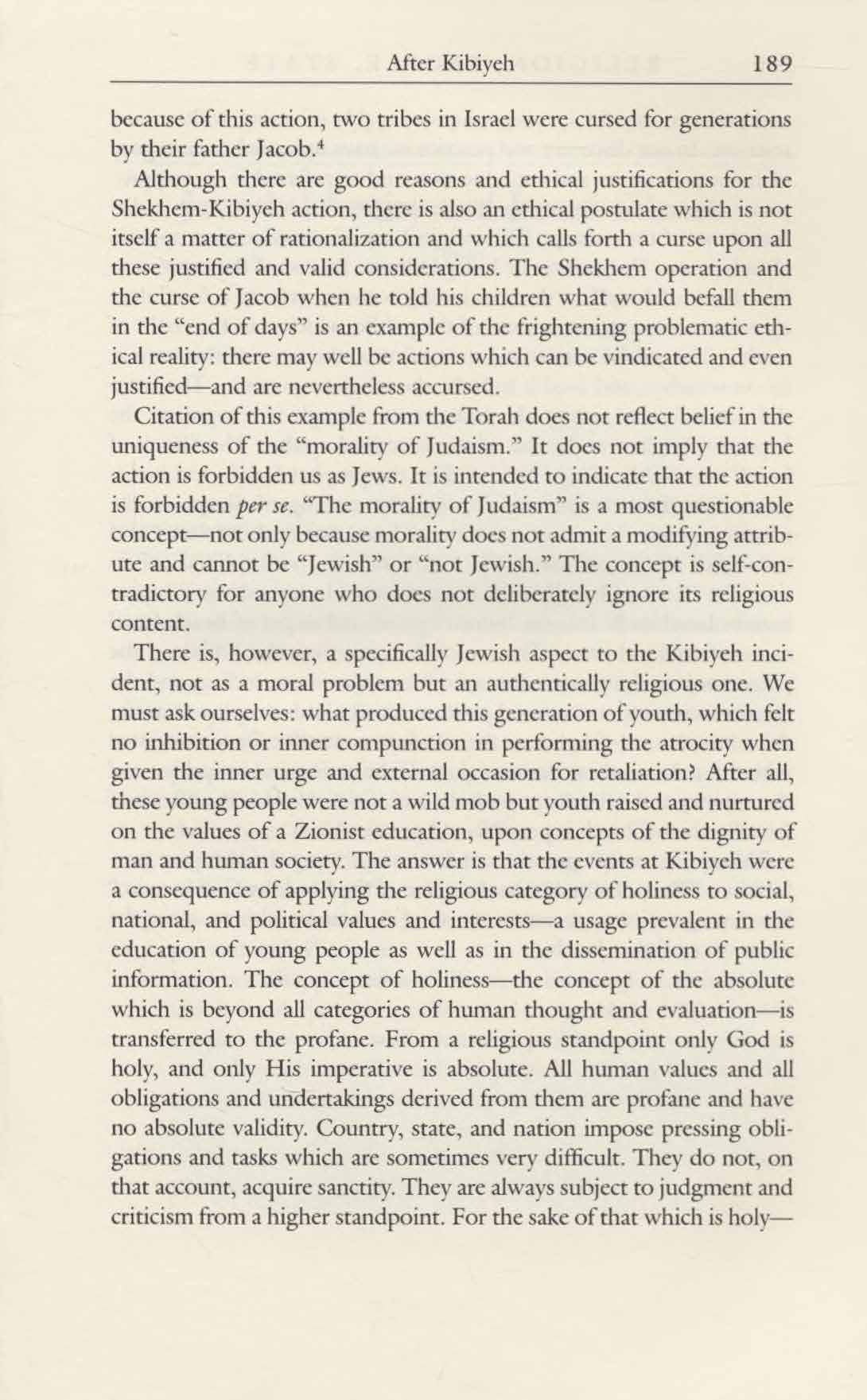
אפשר ואפשר לנמק ולבסס, להסביר ולהצדיק את מעשה שכם-קיביה מבחינת כל עקרונות המוסר הניתנים לשיקול ולחישוב ראציונלי. אולם קיים גם פוסטולט מוסרי, שאינו כלל בגדר שיקול וחישוב, ושממנו נובעת קללה על כל השיקולים והחישובים המוצדקים והנכונים הללו. מעשה-שכם וקללת יעקב אבינו, בשעה שחזה לבניו את ואחרית-הימים – זוהי דוגמה לפרובלימטיקה המוסרית המחרידה, שייתכן מעשה שהוא מוסבר ומנומק, ואפילו מוצדק (!) – ואעפ”כ הוא מקולל.

ההדגמה מן התורה – אין משמעותה האמונה בייחודו המוסרי של ישראל או בייחודו של “מוסר-היהדות”. אין משמעותה שלנו כיהודים אסור לעשות מעשה זה ; אלא זוהי הדגמה שאסור לעשות מעשה זה. “מוסר-היהדות” הוא מן המושגים המפוקפקים ביותר – ולא רק משום שאין המוסר סובל שם-תואר מצמצם ואינו יכול להיות “יהודי” או “לא-יהודי” : עצם המושג “מוסר-היהדות” הוא סתירה מיניה וביה בשביל כל מי שאינו מתעלם בכוונה מן התוכן ומן המשמעות הדתיים של היהדות – ז. א. בשביל מי שאינו מזייף את היהדות. המוסר כהכוונת רצייתו של האדם כלפי מה שהוא רואה כחובתו (“אין במציאות בעולם – ואף לא ניתן להיתפס במחשבה מחוץ לעולם – שום דבר הראוי להיקרא טוב ללא הסתייגות, אלא הרצייה [או הכוונה] הטובה בלבד” : קאנט !) או כלפי מה שהוא מבין בטבע המציאות (הסטואה; שפינוזה) – המוסר הוא קטיגוריה אנתרופוצנטרית-אתיאיסטית, שאינה מתיישבת עם ההכרה הדתית או עם ההרגשה הדתית ; זו אינה מכירה אלא את “הטוב והישר בעיני ה’ “ – לא את ”הטוב והישר”! ואינה מעריכה את “החכם בחכמתו” אלא את “המשכיל ויודע את ה’ “. עובדה היסטורית- אמפירית היא – במחילת עצמותיהם של שד”ל, אחה”ע והרמן כהן – שהיהדות לא הפיקה תורת-מידות ספציפית ומעולם לא התגלמה במוסר ולא דגלה בו. תורת-המידות של היהדות אינה אלא הקיום הקפדני של תורה ומצוות שמשמעותן המוסרית ניתנת לאינטרפרטציות שונות.

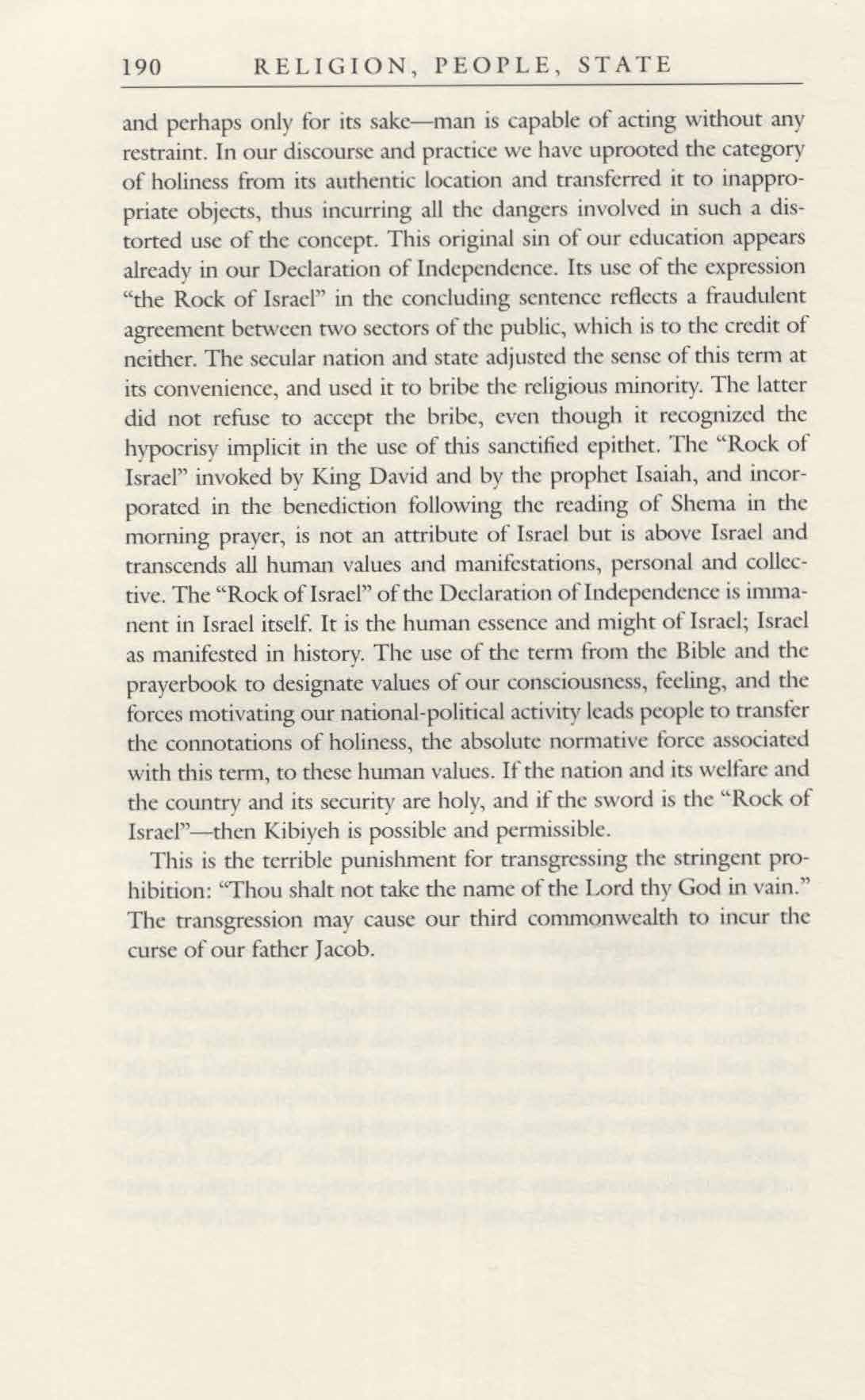
יש, אמנם, צד יהודי ספציפי בפרשת קיביה, אך הוא אינו בעייה מוסרית אלא בעיה דתית מובהקת. אנו חייבים לשאול את עצמנו : מאין בא לנו הנוער הזה, שלא חש מעצור ומניעה נפשית לבצע בידיו את הזוועה, כשניתן לו הדחף הפנימי או החיצוני למעשה-תגמול ? והרי נוער זה לא היה אספסוף, אלא הנוער שגדל ונתחנך בערכי חינוכו הציוני, במושגי ערכי האדם והחברה. דבר זה הוא מן התוצאות של השימוש בקטיגוריה הדתית של קדושה לענינים ולערכים חברתיים, לאומיים ומדיניים שימוש שהוא רווח אצלנו בחינוך הנוער ובהסברה ציבורית : מושגי קדושה – ז. א. מושגי המוחלט שמעבר לכל הקטגוריות של החשיבה וההערכה האנושית – מועברים על החולין, מבחינה דתית רק האל הוא קדוש ורק צוויו הוא מוחלט, ואילו כל ערכיו של האדם וכל החובות והתפקידים הנובעים מהם – חולין הם ואינם בעלי משמעות מוחלטת. מולדת, מדינה, עם – חובות ותפקידים נעלים הם, המחייבים לפרקים אף למעשים קשים מאד, אך לעולם אין הם נעשים קודש, ז. א.לעולם הם עומדים למבחן ונתונים לביקורת של משהו הגבוה מהם. על דברים שבקדושה – ואולי רק עליהם – מסוגל האדם לפעול ללא כל מעצור. אנו עוקרים את הקטגוריה של קדושה ממקומה ומעבירים אותה על דברים שלא להם נועדה, עם כל הסיכון הכרוך בשימוש מסולף זה. החטא הקדמון הזה של חינוכנו כבר משתקף במגילת עצמאותנו – ב”צור ישראל” המופיע בסיומה כביטוי לקנוניה בין שני זרמים ציבוריים, קנוניה שאינה מוסיפה כבוד לאף אחד מהם : העם והמדינה החילוניים, שהוציאו מושג זה ממשמעותו, נתנו את המונח כשוחד למיעוט הדתי, וזה לא נמנע מלקבלו, אעפ”י שידע את הדו-פרצופיות הגלומה בשימוש זה בכינוי הקדוש. ו”צור ישראל” של דוד המלך, של ישעיהו הנביא, של הברכה שאחרי קריאת-שמע של שחרית – אינו בישראל אלא מעבר לישראל ומעבר לכל הערכים, הגורמים והגילויים האנושיים – האישיים והקולקטיביים כאחד. “צור ישראל” של מגילת העצמאות הוא בישראל עצמו – הוא עצמותו ועוצמתו האנושיים של ישראל : ישראל שנתגלה בהיסטוריה. אולם השימוש במונח של התנ”ך והסידור לגבי ערכי תודעתנו והרגשתנו האנושיים ולגבי הכוחות המניעים של פעולתנו הלאומית-מדינית – שימוש זה גורם שגם האסוציאציות של קדושה – ז.א. של תוקף מוחלט – הכרוכות בכינוי זה מועברות על ערכים אלה. אם העם ושלומו והמולדת ובטחונה הם קודש, ואם החרב היא-היא “צור ישראל” – אז גם קיביה אפשרית ומותרת…

זהו העונש האיום של העבירה על האיסור החמור של “לא תשא את שם אלהיך לשוא”.

מתוך עבירה על איסור זה אנו עלולים להקים את ביתנו השלישי על קללתו של יעקב אבינו.

The text was also translated by the philosopher Eliezer Goldman on the basis of later versions, while taking into consideration the earlier ones, as published in Yeshayahu Leibowitz, Judaism, Human Values, and the Jewish State (Cambridge, MA: Harvard University Press, 1992), 185-190, 277.

Appendix 6

Halakhic Engagements with the Qibyā Raid and the Renewal of the Laws of War

By Menachem Butler

The present appendix situates the halakhic discussion of the Qibyā raid within the context of recent scholarly efforts to recover, contextualize, and critically assess Jewish legal discourse on sovereignty, military service, and war in the State of Israel. It does not seek to adjudicate the halakhic permissibility of Qibyā, but rather to map the emergence, structure, and internal tensions of the halakhic discourse the episode generated.

Among the more recent of these scholarly efforts is the Milḥemet Mitzvah series, edited by Aviad Hacohen, Yitzchak Avi Roness, and myself. This multi-volume project is devoted to the halakhic, historical, and ideological foundations of military obligation in modern Israel, bringing together newly translated primary sources alongside contemporary scholarship in order to reconstruct the formative debates through which categories such as milḥemet mitzvah, collective obligation, and the relationship between Torah study and national defense were rearticulated under conditions of Jewish statehood.[28] A forthcoming volume in the Milḥemet Mitzvah series will extend this inquiry to the Qibyā raid and its halakhic aftermath, situating the episode within the longer arc of post-1948 Jewish legal reflection on war, retaliation, and civilian harm. Whereas the volumes published to date focus primarily on the War of Independence and its immediate halakhic reverberations, the events of October 1953 mark a subsequent – and in many respects decisive – moment in the development of modern halakhic thought on warfare. The halakhic debates of 1948 were largely oriented toward questions of obligation, authority, and participation in collective defense; Qibyā, by contrast, compelled a direct confrontation with issues that had previously remained largely implicit, including the legitimacy of retaliatory violence, the halakhic status of civilian populations, and the reconciliation of inherited legal norms with the operational realities of modern warfare.

At the center of the halakhic discourse on Qibyā stands Rabbi Shaul Yisraeli’s extended responsum, which quickly became the unavoidable point of reference for subsequent Religious Zionist engagement with the episode and, more broadly, with questions of war, responsibility, and state violence.[29] Written in close proximity to the events of 1953, it constitutes one of the earliest systematic attempts to evaluate Qibyā through halakhic reasoning rather than through moral intuition or political necessity. Its enduring influence lies not only in its substantive conclusions, but in the methodological seriousness with which it applies classical legal sources to a modern military operation involving civilian casualties. As the literature surveyed here demonstrates, the responsum quickly assumed a canonical role, shaping subsequent Religious Zionist halakhic treatments of military force and the limits of legitimate violence under conditions of Jewish sovereignty.

Beyond ethical, philosophical, or political reactions, Qibyā also generated a sustained halakhic discourse that sought to situate the events within inherited legal categories while testing their elasticity in the face of modern military power. This body of writing reflects neither straightforward apologetics nor wholesale repudiation, but a concerted effort to articulate norms of legitimacy and restraint within a legal tradition long shaped by political powerlessness. Rabbi Yisraeli’s responsum first appeared in Ha-Torah ve-ha-Medinah, a journal founded in the early years of the State of Israel by leading figures within the Religious Zionist movement to confront, in a systematic halakhic register, the unprecedented challenges posed by Jewish sovereignty.[30] Conceived as a forum for the renewal of hilkhot medinah – of the laws of statehood – the journal brought together senior rabbinic authorities from Israel and the Diaspora to deliberate questions of governance, security, agriculture, economics, and public authority that had long remained underdeveloped in the absence of Jewish sovereignty. Under Rabbi Yisraeli’s editorial leadership, Ha-Torah ve-ha-Medinah rejected both apologetics and abstract theorization, insisting instead on rigorous engagement with concrete realities and on the integration of classical halakhic mastery with intimate knowledge of contemporary conditions.

The programmatic ambitions of Ha-Torah ve-ha-Medinah were articulated with unusual clarity by Rabbi Yisraeli himself in a contemporaneous interview reflecting on the aims and methods of the forum he edited.[31] From the outset, he rejected the assumption – prevalent even among committed religious thinkers – that “the laws of state and society do not exist at all within the Torah,” insisting instead that Jewish law is capable of sustaining “ordinary political life” without recourse to miracles or messianic suspension. Against both those who regarded the state as a theological aberration and those who treated halakhah as relevant only to the private sphere, Rabbi Yisraeli framed the task of the forum as reconstructive rather than apologetic: to recover areas of halakhah long relegated to the category of “law for the messianic era” and to clarify them through sustained engagement with classical sources and contemporary realities alike. It was precisely this commitment – to determining positions “not on the basis of moral agitation or political excitement alone, but on the basis of solid halakhic sources” – that governed the inclusion of the Qibyā raid among the journal’s most urgent and controversial subjects. Read against this backdrop, Rabbi Yisraeli’s responsum on Qibyā emerges not as an exceptional intervention prompted by political pressure, but as a paradigmatic test case within the programmatic framework of Ha-Torah ve-ha-Medinah, oriented toward collective responsibility and the exercise of coercive power by a Jewish state. Published as “The Qibyā Incident in Light of Halakhah,”[32] the responsum exemplifies the journal’s ambition to subject even the most morally fraught acts of state violence to sustained halakhic scrutiny rather than rhetorical evasion. In this capacity, it functions as the foundational text for the halakhic discussion of Qibyā and as a formative intervention in the development of Religious Zionist legal thought on war and sovereignty.

A crucial caveat is therefore in order. The halakhic engagement with Qibyā examined here unfolded largely in advance of, and largely independent from, the broader moral reckoning with the operation in Israeli public discourse. As Efrat Seckbach has shown, Qibyā was framed for decades within Israeli collective memory as a tragic, defensive, or even necessary act, and only much later came to be stabilized as a paradigmatic moral transgression.[33] The early rabbinic and halakhic discussions surveyed in this appendix thus did not emerge in response to sustained public condemnation, nor were they shaped by a settled moral consensus regarding the operation’s illegitimacy. Rather, they developed within a discursive environment in which the moral meaning of Qibyā remained fluid, contested, and largely underdetermined in the public sphere. This temporal and discursive disjunction is analytically significant: it cautions against retrojecting later ethical judgments onto early halakhic reasoning and underscores that these responsa were formulated in a context where halakhic analysis functioned not as post hoc legitimation, but as an initial site of normative articulation under conditions of unresolved moral uncertainty.

Unlike Professor Leon Roth’s moral indictment or Professor Yeshayahu Leibowitz’s theological warning, Rabbi Shaul Yisraeli’s intervention is deliberately juridical: it insists that Qibyā be evaluated as a matter of halakhic classification rather than moral expression or prophetic protest. He opens his analysis by sharply delimiting the scope of halakhic categories traditionally invoked to justify violence outside the context of war. He examines, and ultimately rejects, the applicability of rodef, judicial punishment, and collective liability, emphasizing that none can justify the foreseeable killing of non-combatants, especially children. This refusal to rely on expansive constructions of culpability constitutes an important boundary-setting move and signals resistance to dissolving halakhic distinctions under the pressure of political exigency.

Having rejected these alternatives, Rabbi Yisraeli treats milḥamah as the sole halakhic category within which the events of Qibyā can be assessed. War, in his account, is governed by norms distinct from those that regulate interpersonal violence or judicial punishment: it is structured by collective agency and strategic necessity rather than individualized culpability. On the basis of classical discussions of siege warfare and national defense, he argues that halakhah does not require absolute differentiation between combatants and civilians where such distinctions cannot be operationally maintained. Yet this claim is narrowly framed. Civilian harm is neither trivialized nor treated as halakhically neutral, and Qibyā is not presented as unproblematic. Instead, the operation is situated within ezrat Yisrael miyad tzar – assistance to Israel against an enemy threat – understood as a form of defensive war oriented toward deterrence and protection. This classification permits halakhic authorization of the operation while leaving intact a residue of moral unease that resists full juridical resolution.

The most consequential element of the responsum lies in Rabbi Yisraeli’s treatment of milḥemet mitzvah. He rejects the claim that defensive war is obligatory solely by virtue of pikuaḥ nefesh, noting that halakhah does not, as a rule, require one to endanger one’s life for the sake of others. To address this problem, he recasts defensive war as a binding collective obligation, grounded not in emergency rescue but in biblical models of national preservation and reprisal. In doing so, he relocates the normative basis of military action from individual ethical calculus to communal responsibility, thereby providing a conceptual structure that would prove influential for later halakhic discussions of warfare. Yet the responsum does not resolve its own tensions. Rabbi Yisraeli repeatedly signals unease and declines to subsume Qibyā under familiar categories of punishment or self-defense. The argument moves between legal authorization and acknowledged moral disquiet, registering the pressure placed on inherited halakhic frameworks by the conditions of modern, state-sponsored violence.

Subsequent halakhic and scholarly treatments of Qibyā have largely proceeded from Rabbi Yisraeli’s responsum.[34] These later authors have extended, modified, or even contest his conclusions, but they all have done so within the conceptual framework he set in place.[35] The responsum thus operates less as a conclusive ruling than as a point of orientation, shaping the terms in which questions of halakhic authorization and the moral burdens of sovereignty would thereafter be posed.

The reception of Rabbi Yisraeli’s responsum has been mapped most systematically by Professor Gerald J. Blidstein,[36] who reconstructs the emergence of a post-Qibyā discourse in which Rabbi Yisraeli’s analysis furnished later decisors with a conceptual grammar for addressing civilian harm within the logic of war. By relocating the discussion from individualized self-defense to the framework of collective warfare, the responsum made it possible to engage questions of civilian casualties without negating civilian status – a shift that both constrained and expanded the scope of permissible violence. Blidstein devotes particular attention to the post-Qibyā expansion of rodef. Whereas classical halakhah construes the rodef narrowly, later writers increasingly attribute derivative responsibility to civilian populations through functional analogies that blur the distinction between combatants and non-combatants. What concerns Blidstein is not merely the expansion itself, but the manner in which it proceeds: descriptive claims about the realities of modern warfare are allowed to perform normative work without explicit halakhic argument. This slippage between descriptive realism and legal authorization constitutes the central ethical risk identified in Blidstein’s essay. Modern warfare undoubtedly challenges classical distinctions, but difficulty alone does not license their abandonment. When empirical claims dictate legal conclusions, halakhah risks mirroring military practice rather than governing it; Qibyā thus becomes emblematic of the moral hazards confronting halakhic reasoning under conditions of sovereignty.[37]

A wider historical and jurisprudential framing is offered by Professor Arye Edrei, who situates Qibyā within a longue durée narrative of halakhic reactivation. In his account, Jewish law entered modernity with the laws of war largely dormant, and the advent of sovereignty transformed war from an abstract category into an unavoidable halakhic reality.[38] Within this framework, Qibyā marks a shift from questions of the obligation to wage war (jus ad bellum) to questions of how war is to be conducted (jus in bello).[39] Rabbi Yisraeli’s responsum exemplifies this shift through its methodological boldness: classical categories are not merely applied but reconfigured in order to address deterrence, civilian entanglement, and asymmetric warfare. Edrei emphasizes the ambivalence of this renewal – necessary for halakhic relevance yet destabilizing long-standing assumptions about civilian immunity and proportionality. He further traces the interpretive trajectory from Qibyā to later conflicts, particularly Lebanon, showing how early interpretive decisions acquired precedential force. While acknowledging internal pluralism and critique, Edrei argues that sovereignty established a shared framework in which war became central to halakhic self-understanding, thereby exposing halakhic discourse to the pressures inherent in regulating state violence.

The internal complexity of Rabbi Yisraeli’s position is examined by his disciple, Rav Prof. Neria Guttel, who situates the Qibyā responsum within Rabbi Yisraeli’s broader intellectual biography and his sustained involvement in the institutions of Religious Zionism.[40] Rav Guttel opens with a polemical claim: Rabbi Yisraeli has been remembered within the movement through what he describes as a “rather flat, highly plastic, and one-dimensional image,” whereas his actual halakhic posture was “far more complex.” This mischaracterization, Rav Guttel argues, obscures the disciplined character of Rabbi Yisraeli’s legal reasoning.[41] In the case of Qibyā, his refusal to extend the categories of rodef or collective punishment is presented not as moral hesitation but as fidelity to halakhic boundaries that resist ideological inflation. At the same time, Rabbi Yisraeli’s decision to legitimate the operation within the framework of war reflects his acceptance of what Rav Guttel elsewhere describes as the inescapable responsibilities generated by sovereignty and institutional participation. For Rav Guttel, this combination of legal authorization and acknowledged discomfort belongs to a broader pattern of rebuke issued from within loyalty rather than from withdrawal. The responsum thus exemplifies a mode of halakhic engagement that neither sanctifies state violence nor dissociates itself from it, and Rav Guttel cautions that later readings which extract permissive conclusions while neglecting this internal tension risk reproducing precisely the flattening of Rabbi Yisraeli’s thought that his essay seeks to correct.[42]

A more narrowly focused doctrinal analysis is offered by Yitzchak Avi Roness, who examines Rabbi Yisraeli’s reconceptualization of milḥemet mitzvah. Challenging the grounding of defensive war in pikuaḥ nefesh, Roness argues that Rabbi Yisraeli instead relocates it within a theory of collective obligation rooted in national preservation.[43] This move expands the halakhic space for legitimating military action while simultaneously exposing the ideological dimensions of interpretive choice. Roness further shows how this reconceptualization is operationalized in Qibyā, where retaliatory action is legitimated as part of an ongoing defensive war rather than as an immediate act of rescue; while enhancing doctrinal coherence and halakhic relevance, the shift weakens the internal tools available for critique, increasing reliance on strategic judgment and assessments of national interest.

Taken together, this body of halakhic literature demonstrates that the moral and political unease elicited by Qibyā was neither external to Jewish legal thought nor resolved outside it, but was internalized, debated, and reformulated within halakhic categories themselves. Far from functioning merely as a vehicle of retrospective legitimation, halakhic discourse became a sustained arena of normative contestation, in which inherited legal frameworks were pressed to account for the realities of sovereign violence, retaliation, and civilian harm. Readers approaching Qibyā primarily through ethical theory or political critique may therefore profit from attending to these halakhic engagements, not as exercises in doctrinal closure, but as serious and often unsettled attempts to articulate responsibility, restraint, and moral remainder within a legal tradition newly compelled to confront the burdens of political power.

Appendix 7

Ariel Sharon on the Qibyā Operation:

A Contemporaneous Record of the 1965 Eshkol-Sharon Meeting

By Menachem Butler

The following is an annotated English translation of an Historical Document from the 1965 meeting between Levi Eshkol and Ariel Sharon, as recorded contemporaneously by Eshkol and published by Arnon Lamfrom and Ze’ev Elron.[44]

A revealing retrospective window onto the logic of Qibyā is provided by this document. Speaking twelve years after the operation, amid a bitter intra-Zionist political struggle, Sharon rejected the claim that Qibyā marked a departure from prior practice, maintaining instead that most earlier reprisal actions had likewise targeted civilians and that the later distinction between military and civilian objects was largely retrospective. The novelty of Qibyā, in his account, lay not in intent but in its successful outcome: the seizure of an entire village, the large-scale demolition of houses, and the operation’s deterrent impact on the Arab population, its achievement of security, and its “restoration of honor to the IDF. Civilian deaths are acknowledged but minimized: he was aware of no more than a dozen men killed in the conquest of the village, but unaware of the deaths of the many women, children, and others who were hiding silently in the houses. Read against the contemporaneous responses of Leon Roth and Yeshayahu Leibowitz, this document does not resolve the moral problem of Qibyā so much as confirm its depth, exemplifying – without euphemism – the subordination of ethical language to state power, deterrence, and prestige that Roth feared Judaism could not survive and that Leibowitz denounced as the sacralization of the profane.

Historical Document

Ariel Sharon came on the initiative and with the knowledge of the Chief of Staff [Yitzhak Rabin].

He wishes to set matters on their factual truth. Ben-Gurion’s declaration concerning Qibyā motivates him.

I [Sharon] carried out the act and reported it. This group [Rafi] is capable of anything. The tendency is not a matter concerning Pinhas Lavon. The matter is directed against civilian objects, to bind the government’s hands from action. On the other hand, there is a feeling that we are not responding [today] sufficiently and adequately. The public expects action. Ben-Gurion’s intention is [on the one hand] to bind [the government], and [on the other hand] in order to cause the government to fail.

At a house gathering in Nazareth, [Shimon] Peres said that the army and the paratroopers [–]. He spoke of their contributions [operations?] and also related many military secrets. This is not fair.

And now to the matter of Qibyā. Ben-Gurion says that in his time operations were carried out against military objects, and that Pinhas Lavon is responsible for the operation against civilian objects. He [Sharon] examined and found that this is not correct and not true. Moshe Dayan also scoffs. It is true that in that period [before the establishment of Unit 101 in the summer of 1953] these operations simply did not succeed. There was an operation against Sharafat [Sharfaṭ] near Jerusalem, 7.2.1951. The mukhtar’s house and additional houses were blown up. On 8.2.1951, in Dir Bṭut [Balut], an attack on civilians that did not succeed.

25.9.1951, an attack on a-Ṣafi – Dead Sea, did not succeed, although five civilians were killed.

6.1.1952, three attacks: I. Beit Jala, II. Beit Furiq, III. Idna – Beit Govrin.

23.1.1953, two attacks on Falama near Qalqilya.

18.5.1953 [19.5.1953], operations against the village of Husan near the approaches [Mavo] of Beitar. An operation against Far‘un near Tulkarm. An operation near Midya near Ben Shemen. And against Bedouin civilians in the south along the Beersheba–Hebron road.

Almost all the operations were not carried out properly. Most of the operations in those days were carried out against civilians. Both Tawfiq [1960] and Nuqeib [1962] were also operations against civilians.

Precisely against military objects did operations begin in the days of Pinhas Lavon: the raid on the Legion camp at ‘Azzun – [east of] Qalqilya, after the murder of a Jew in Ra‘anana, end of June 1954. The aggressive operation against an Egyptian position near Kissufim.

Ariel [Sharon] was wounded there.

A third operation – the kidnapping of Legion personnel at Beit ‘Ur al-Tahta, Lower Beit Horon, near Latrun. Another operation against the police station at Tzurif in January 1955 was not carried out; we were turned back en route because of new information. In the days of Pinhas Lavon there was strict insistence on meticulous execution. He himself received reprimands for deviation. There was a severe prohibition on using fire in houses prior to inspection with flashlights.

And now Qibyā.

He, Ariel, planned and was responsible for the execution. He was on site. He led the men. He checked the houses, gave instructions what to blow up. There were [?] five names there. The order was no different from other orders: to blow up the maximum number of houses and to strike men, exactly as in all orders for previous operations. The difference was that this time the operation succeeded, and incidentally it had a first-degree impact on the Arabs, as well as on the IDF – which had almost previously lost its prestige – and also on the Arabs. The Arabs were not accustomed to large and successful operations on our part. They had become accustomed to the IDF coming and blowing up some house at the edge of the village. This time the IDF came, took control of the village. There was a deathly silence in the village. There were 10–12 fatalities, all during the occupation and penetration action. This was reported already in the morning [after the operation].

But 40–50 [people] were blown up in houses. Apparently some of the inhabitants hid in the houses; we did not see them. In one case, an explosives officer heard the crying of a child after he had already ignited the fuse. He endangered himself, jumped into the house, and took the girl out. After that, no people were seen.

I was summoned to Ben-Gurion three or four days later in Jerusalem. I reported on the operation. He was satisfied with the operation and said: “It is not important what the world will say. What is important is what the Arabs in the region will think.” The conversation ended.

A month before he resigned – his final resignation – he summoned me and asked whether perhaps I remember who gave the order in the Qibyā operation. I answered that I do not remember who gave the order; I remember to whom I reported the operation. He, Ben-Gurion, said: “I was ashamed of that operation.” And Ariel said: “I do not know what your view of it is today. I will remind you of what you said to me then.” I repeated his words and explained to him how the operation was carried out. Ben-Gurion did not retract his words and said that he had been ashamed at the time.

In any event, Ben-Gurion knows the truth and heard the description from me, and the things that he, Ben-Gurion, said then [thus!], 1963. He was also angered to hear my words.

And further: all along, the situation and the manner of searching for a way against Pinhas Lavon influenced me [Sharon]. Moshe Dayan also mocks the way and the method of theirs [of the Rafi people] to seek means to blacken Pinhas Lavon.

  1. This article is based on a talk given at the Limmud Festival, Birmingham UK, December 2025. A Hebrew version appeared in Yashar, 21 January 2026, available here. See also my more extensive discussion: Warren Zev Harvey, “After Qibyā: Yeshayahu Leibowitz, Leon Roth, and Neḥamah Leibowitz,” in Aviezer Ravitzky, ed., Yeshayahu Leibowitz, Between Conservatism and Radicalism: Reflections on His Philosophy (Jerusalem: Van Leer Institute, 2007), 354-365 (Hebrew), available here. I thank Mr. Menachem Butler for providing links to various relevant materials, adding much historical and bibliographical information to the notes, and authoring the important Appendices 6 and 7.
  2. See Efrat Seckbach, “The Qibyā Operation in Israeli Public Memory, 1953-1985,” Iyunim Bitkumat Israel, no. 27 (2017): 274-301 (Hebrew), available here, who documents that the dominant Israeli public opinion initially tended to see the operation as justified, minimized civilian casualties, and avoided moral evaluation, but from the mid-1970s onward, in the wake of the Yom Kippur and Lebanon Wars, Qibyā came to be remembered as a paradigmatic moral transgression.On the halakhic dimensions of the Qibyā raid, including contemporary rabbinic responses and their later reception, see Appendix 6, by Menachem Butler, “Halakhic Engagements with the Qibyā Raid and the Renewal of the Laws of War.”
  3. Leon Roth, “Letter – Professor Roth on the Moral Issue,” The Jewish Chronicle (4 December 1953): 21, reprinted in Raphael Loewe, “Note,” in Leon Roth, Is There a Jewish Philosophy? Rethinking Fundamentals (Oxford: The Littman Library of Jewish Civilization, 1999), xviii-xx, available here. See also below, Appendix 1. The British discussion of the Qibyā raid was exacerbated by the intervention of Dr. Cyril Garbett, Archbishop of York: “Archbishop Accuses Israel: ‘Cruel Massacre’ of Arab Villagers,” The Jewish Chronicle (13 November 1953). The Board of Deputies of British Jews issued an immediate reply, rejecting his censure as “provocative and one-sided” (ibid.).
  4. “Right Is Might,” The Jewish Chronicle (October 23, 1953): 16. David F. Kessler was the Chronicle’s managing director and John Maurice Shaftesley its editor. On the editorial’s contemporary reception, see David Cesarani, The Jewish Chronicle and Anglo-Jewry, 1841–1991 (Cambridge: Cambridge University Press, 1994), 206, who shows it was widely regarded as an important moral statement. It was praised by Ernst Akiba Simon and Selig Brodetsky, and endorsed by Rabbi Leo Baeck who personally congratulated Kessler. It was sharply criticized by the Israeli Embassy in London, although Ambassador Eliahu Elath later conceded to Kessler that the criticism had been warranted.
  5. In his first intervention (“Israel Border Conflict – The Deputies’ Statement, 23 October 1953), Bentwich repudiated an apologetic statement issued by the Board of Deputies in response to the Foreign Office’s censure of Israel, and he criticized the Qibyā action as “a shocking indefensible act which violates the fundamental ethic of Judaism.” In his second intervention (“Professor Bentwich’s Reply,” 27 November 1953), he responded directly to Rabbi Abraham Cohen, President of the Board of Deputies. He rejected his claim (20 November 1953) that condemnation of the reprisal raid was permissible only for those who could swear they themselves would not retaliate in a similar situation, and he insisted that he himself would oppose the Qibyā action “in any circumstances.” Roth’s December 4 letter continued Bentwich’s criticism of Cohen’s opinion that although the Qibyā action was morally wrong, Jews should not hasten to condemn it.
  6. Simon, Professor of Education at the Hebrew University of Jerusalem, was in England in October 1953 on a lecture tour under the auspices of the Leeds Zionist Association and the Zionist Federation. In his lectures Simon emphasized the tension between Jewish moral consciousness and political existence, warning that “Israel will not solve your educational problem – you must solve it yourself,” and calling for “a new equilibrium between Jewish consciousness and Jewish existence.” See “Needs of Jewish Education: Professor Simon’s Lectures,” The Jewish Chronicle (October 9, 1953): 5.
  7. See Raphael Loewe, “Memoir about Leon Roth,” in Raphael Loewe, ed., Studies in Rationalism, Judaism and Universalism – In Memory of Leon Roth (London: Routledge & Kegan Paul, 1966), 1-11, available here.
  8. See Irene Roth, Cecil Roth, Historian Without Tears: A Memoir (New York: Sepher-Hermon Press, 1982), 114, for an anecdote from Irene and Cecil Roth’s 1935 visit to Palestine. When in Safed, Cecil Roth mentioned to “an elderly man clad in a long silk caftan” that he had a brother in Jerusalem named Leon: “[T]he man grew excited. ‘Do you mean Professor Leon Roth, the philosopher?’ he said in surprise. ‘How is it possible that you did not say so at once? To have such an eminent scholar in one’s family and not to proclaim it from the housetops – this I cannot understand.’ Then he continued, ‘I, too, am something of a philosopher. I have published a number of pamphlets on the subject.’ Cecil had never heard of these pamphlets, but he was amazed at the fact that their author, a complete stranger and seemingly far removed from western Jewish thought, should know of his family.” See also Cecil Roth, “Types Seen in Palestine,” Opinion: A Journal of Jewish Life and Letters 5, no. 12 (October 1935): 13-15; and idem, “Jerusalem, Paradise of Ethnologist,” The Palestine Post (30 April 1935), reporting a visit to his brother in Jerusalem.
  9. See Samuel Hugo Bergmann, “On the Figure of Prof. H. Y. Roth,” Haaretz Literary Supplement (12 April 1963): 3 (Hebrew); and Neve Gordon and Gabriel Motzkin, “Between Universalism and Particularism: The Origins of the Philosophy Department at the Hebrew University and the Zionist Project,” Jewish Social Studies 9 (2003): 99-122; and see also Tal Meir Giladi, “Jerusalem Divided: The Hebrew University’s Philosophy Department Between Rotenstreich and Bar-Hillel,” in Yfaat Weiss and Uzi Rebhun, eds., The History of the Hebrew University of Jerusalem: The Nation-State and Higher Education (Jerusalem: Magnes, 2024), 767-798 (Hebrew). See soon Niv Perelsztejn, “The Genesis of Israeli Philosophy, 1917-1967: Cross-cultural Dialogue or Academic Isolation” (Ph.D. dissertation, Haifa University, to be submitted in Spring 2026).
  10. For a list of his publications, see Raphael Loewe, “Bibliography of the Writings of Leon (Hebraice Hayyim Yehudah) Roth,” in Raphael Loewe, ed., Studies in Rationalism, Judaism and Universalism – In Memory of Leon Roth (London: Routledge & Kegan Paul, 1966), 523-536, available here.
  11. The Israeli press framed Roth’s departure as an expression of disillusionment with the policies of the State and the University. See, e.g. “Prof. Roth Returns – Disillusioned – to England,” Maariv (15 March 1951): 4 (Hebrew), available here.
  12. Loewe reports that Roth’s resignation was met with resistance not only by the University but also by senior figures in the Israeli establishment, who regarded him as a major national asset and sought to retain him through offers of high office. Proposals were made that he assume the presidency of the University or, alternatively, enter the government as Minister of Education; but “he was not to be dissuaded,” and in July 1951 he returned to England. See Loewe, “Memoir about Leon Roth,” 1-11, esp. 5, available here.
  13. A photograph of his tombstone, taken by Mr. Menachem Butler during an Aseret Yemei Teshuvah visit to Karori Cemetery in Wellington, New Zealand, on Sunday, 23 September 2012, as part of his High Holiday tour of New Zealand, has been published in David Assaf, “A Book Dedication: ‘I Will Go and Return to My First Husband’ – A Farewell Gift from Ḥayyim Yehudah Roth,” The OnegShabbat Blog (11 March 2012), available here. (Note: the post was originally published in March 2012 and has been updated periodically in subsequent years, including the addition of the tombstone photograph.)
  14. Ernst Akiba Simon, “Letter – After Qibyā and Rabbi Judah Halevi,” Beterem, no. 190 (1 January 1954): 21 (Hebrew).
  15. Warren Zev Harvey, “Judah Halevi on War and Morality,” in Aviad Hacohen and Menachem Butler, eds., Praying for the Defenders of Our Destiny: The Mi Sheberach for IDF Soldiers (Cambridge, MA: The Institute for Jewish Research and Publications, 2023), 317-318, available here.
  16. See Elliott Horowitz, “Genesis 34 and the Legacies of Biblical Violence,” in Andrew R. Murphy, ed., ‪The Blackwell Companion to Religion and Violence (Blackwell Publishing, 2011), 163-182, available here.
  17. The discussion of Roth’s second question does not appear in Leibowitz’s original article of 15 December 1953, but was introduced only in his follow-up piece of 15 January 1954, and was written in explicit response to Pepita Haezraḥi, “Thoughts on Humilitas,” Beterem, no. 190 (1 January 1954): 9-11 (Hebrew); see below, Appendix 4. Since Leibowitz’s discussion appeared a full six weeks after Roth’s letter in the Jewish Chronicle, there is no reason to doubt that he was influenced by it. The length and thoughtfulness of Leibowitz’s reply to Dr. Haezraḥi reveals the great respect he had for the independent-minded young philosopher, then 32.
  18. Nearly three decades ago, my student Rabbi Dr. Jan Katzew documented the controversy that erupted in 1947 around Leon Roth’s public opposition to the proposed partition of Palestine. While on a visit to the United States on behalf of the Hebrew University of Jerusalem, Roth was quoted in “Professor Gives Some Opinions on Palestine,” Los Angeles Times (3 June 1947): 4, arguing that partition was impracticable and warning that it would leave “two sore spots that will eventually lead to violence.” His remarks, made less than six months before the United Nations vote on partition, provoked heated reactions from American Zionist leaders, who accused him of anti-Zionist agitation. In a letter of protest, Sir Leon (Arie) Simon, then Chair of the University’s Executive Council and later its President, cited a telegram from the American Zionist Emergency Council charging that “Professor Leon Roth of Hebrew University is now in America … making political statements gravely prejudicial to the Jewish cause.” Roth rejected the accusation as “untrue to fact, slanderous and damaging,” insisting on his right, “after twenty years’ fruitful work in Jerusalem,” to criticize prevailing policies. See Jan Katzew, “Leon Roth – His Life and Thought: The Place of Ethics in Jewish Education” (PhD dissertation, Hebrew University of Jerusalem, 1997), 72-74; the full exchange between Roth and Simon is reproduced below in Appendix 2 (from Katzew’s appendix, pp. 355-358).
  19. See Yeshayahu Leibowitz, Judaism, Human Values, and the Jewish State (Cambridge, MA: Harvard University Press, 1992), 241-248.
  20. When taken to task by Shubert Spero for omitting reference to the State of Israel and Zionism, Roth responded: “I fancy that the reviewer has fallen into the conventional confusion between the ‘Land of Israel’ and the ‘State of Israel.’ The State of Israel has worries which neither I nor your reviewer can, or has the right to try to, solve; but are they, all or in part, connected with Judaism? In any case would it not be wiser for us to try and make up our minds first what Judaism is and only afterwards…what our attitude to the new State is to be?” See Leon Roth, “Communications – Are There Authoritative Beliefs?” [Response to Shubert Spero], Tradition: A Journal of Orthodox Jewish Thought 5, no. 1 (Fall 1962), 123-124, available here. After forsaking the State of Israel in 1951, Roth devoted his final years to trying to clarify what Judaism is.
  21. Leon Roth, Judaism: A Portrait (New York: Viking Press, 1960), 104.
  22. Ibid., 107.
  23. Ibid., 107.
  24. Ibid., 230-231.
  25. See, Judaism, Human Values, and the Jewish State, pp. 191-192.
  26. In this article, Leibowitz responded to Pepita Haezraḥi, “Thoughts on Humilitas,” Beterem, no. 190 (1 January 1954): 9-11 (Hebrew); and Rabbi Benjamin, “The Plain Sense Is Not Sufficient…,” ibid., 11 (Hebrew).
  27. See Warren Zev Harvey, “Theopolitical Notes on Israel’s Declaration of Independence,” Journal of Ecumenical Studies 56 (2021): 338-346, available here.
  28. Milhemet Mitzvah, vol. 1: Halakhic Foundations, Religious Authority, and Military Service in Israel’s War of Independence, eds. Aviad Hacohen, Yitzchak Avi Roness, and Menachem Butler (Cambridge, MA: The Institute for Jewish Research and Publications, 2025), available here; and Milhemet Mitzvah, vol. 2: Religious Leadership and Halakhic Responsibility in the Military Service Debate, eds. Aviad Hacohen, Yitzchak Avi Roness, and Menachem Butler (Cambridge, MA: The Institute for Jewish Research and Publications, 2025), available here.
  29. See Neria Guttel, “Missing from the Book – Review of War in Light of Halakhah,” in Aviad Hacohen, Yitzchak Avi Roness, and Menachem Butler, eds., Milhemet Mitzvah, vol. 2: Religious Leadership and Halakhic Responsibility in the Military Service Debate (Cambridge, MA: The Institute for Jewish Research and Publications, 2025), 318-328, who offers a detailed analysis of the systematic marginalization of Religious Zionist halakhic treatments of war in the Encyclopedia Talmudit and the editors’ deliberate preference for citing ḥaredi authorities while excluding Religious Zionist halakhic thinkers.
  30. See Aharon Kampinsky, “Torah Publications,” in Rabbinism and Politics in Religious Zionism (Boston: Academic Studies Press, 2024), 37-52, on the establishment of Ha-Torah ve-ha-Medinah as a halakhic forum for questions of sovereignty, governance, security, and agriculture in the early years of the State of Israel; see also Asher Cohen and Aharon Kampinsky, “Religious Leadership in Israel’s Religious Zionism: The Case of the Board of Rabbis,” Jewish Political Studies Review 18, nos. 3-4 (Autumn 2006): 119-140.
  31. “Creators on Their Works – Rabbi Shaul Yisraeli: Editor and Reviewer,” ha-Tsofeh Literary Supplement (7 January 1955): 5-6 (Hebrew), available here.
  32. Shaul Yisraeli, “The Qibyā Incident in Light of Halakhah,” Ha-Torah ve-ha-Medinah, nos. 5-6 (1953-1954): 71-113 (Hebrew), available here, and later revised and expanded as “Military Actions for the Protection of the State,” in ʿAmud ha-Yemini (Tel-Aviv-Jaffa: Moreshet, 1966), 162-199 (Hebrew).
  33. See Efrat Seckbach, “The Qibyā Operation in Israeli Public Memory, 1953-1985” (cited above, n. 2). Her otherwise comprehensive study does not engage the contemporaneous halakhic discussions of Qibyā, treating them neither as part of Israeli public discourse nor as relevant to the formation of public memory. This omission accords with her focus on secular political, cultural, and media arenas, but it also underscores the extent to which halakhic discourse operated in a largely parallel register, marginal to the sites in which Israeli collective memory of Qibyā was shaped. The absence of halakhic material from this historiography thus reinforces the claim that early rabbinic and halakhic engagements with Qibyā unfolded independently of the later moral reckoning traced here.
  34. See Michael J. Broyde, “Just Wars, Just Battles, and Just Conduct in Jewish Law: Jewish Law Is Not a Suicide Pact!,” in Lawrence H. Schiffman and Joel B. Wolowelsky, eds., War and Peace in the Jewish Tradition (New York: Yeshiva University Press, 2004), 1-43, available here, who treats Rabbi Shaul Yisraeli’s responsum on the Qibyā incident as the earliest sustained modern halakhic engagement with civilian harm in asymmetric warfare and traces its subsequent elaboration in the pages of Teḥumin. In his reading, Rabbi Yisraeli’s argument is taken to permit the targeting of civilians who materially assist hostile operations through a widened application of the rodef doctrine, extending even to indirect or expressive forms of support. This analysis reflects a later stage in the reception of Yisraeli’s responsum, in which its categories are preserved but pressed beyond the narrower limits they bear in the original text.
  35. See also Aviad Hacohen, “Ethics and War: A Select Bibliography,” in Eli Bloom, ed., Arakhim be-Mivhan Milhamah: Values in the Test of War – A Symposium in Memory of Ram Mizrachi (Jerusalem: Moreshet, 1985), 252-256 (Hebrew), available here.
  36. Gerald J. Blidstein, “The Treatment of Hostile Civilian Populations: The Contemporary Halakhic Discussion in Israel,” Israel Studies 1, no. 2 (Fall 1996): 27-45, available here; and Gerald J. Blidstein, “The Ethical and Legal Status of Hostile Civilian Populations in Contemporary Halakhic Thought,” State, Government, and International Relations, vols. 41-42 (1997): 155-170 (Hebrew), available here.
  37. See also his related articles in Gerald J. Blidstein, “The Massacre at Shechem, Collective Punishment, and Contemporary Halakhic Thought,” Et Ha-Da’at 1 (1997): 48-55 (Hebrew), available here; Gerald J. Blidstein, “The Ethics of Warfare Revisited,” Me’orot Journal 6, no. 2 (2008): 2-5, available here; and Gerald J. Blidstein, “The Case of Shechem: Maimonides’ Normative Reading,” in Daphne Barak-Erez and Gidon Sapir, eds., Essays in Honour of Izhak Englard (Ramat-Gan: Bar-Ilan University Press, 2010), 375-387 (Hebrew), available here.
  38. Arye Edrei, “From Qibyā to Beirut: The Renewal of the Jewish Laws of War in the State of Israel,” in Yossi Goldstein, ed., Yosef Daʿat: Studies in Modern Jewish History in Honor of Yosef Salmon (Beer Sheva: Ben-Gurion University of the Negev, 2010), 95-127 (Hebrew). An earlier version appeared in Arye Edrei, “Law, Interpretation, and Ideology: The Renewal of the Jewish Laws of War in the State of Israel,” Cardozo Law Review 28, no. 1 (October 2006): 187-227, available here.
  39. See Suzanne Last Stone, “The Jewish Law of War: The Turn to International Law and Ethics,” in Sohail H. Hashmi, eds., Just Wars, Holy Wars, and Jihads: Christian, Jewish, and Muslim Encounters and Exchanges (New York: Oxford University Press, 2012), 342-363.
  40. See Neria Guttel, “‘He Whom One Loves, He Rebukes’: The Complexity of Rav Shaul Yisraeli’s Attitude toward the Personalities, Institutions, and Philosophy of Religious Zionism,” in Yishai Arnon, Yehuda Friedlander, and Dov Schwartz, eds., Studies in Religious Zionism: Developments and Changes (Ramat-Gan: Bar-Ilan University Press, 2012), 145-167 (Hebrew), available here.
  41. See also Neria Guttel, “The Rabbinate and the State,” ha-Tsofeh Literary Supplement (22 June 2001): 11-12 (Hebrew).
  42. See further Neria Guttel, “Combat in an Area Dense with Civilian Population,” Teḥumin, no. 23 (2003): 18-31 (Hebrew), expanded and published in Neria Guttel, “Combat in an Area Dense with Civilian Population,” in Eyal Karim, ed., Ha-Milhamah ba-Terror (Kiryat Arba: ha-Makhon le-Rabanei Yishuvim, 2006), 43-105 (Hebrew), available here. Although not concerned with the Qibyā responsum as such, the article addresses the same operational problems that first emerged there and illustrates how later halakhic discussion of civilian harm can press earlier categories toward more permissive conclusions while leaving aside the hesitations and limits that shape Rabbi Yisraeli’s original analysis.
  43. Yitzchak Avi Roness, “Halakhah, Ideology and Interpretation: Rabbi Shaul Yisraeli on the Status of Defensive War,” Jewish Law Association 10 (2010): 184-195, available here.
  44. Arnon Lamfrom and Ze’ev Elron, “Historical Document: Meeting of Levi Eshkol and Ariel Sharon Concerning the Qibyā Operation – Jerusalem, 3 September 1965,” Yesodot, no. 6 (2024): 269-282 (Hebrew), available here; and see also Ariel Sharon, “The Operation That Restored the IDF’s Honor,” Yediot Ahronoth (18 October 1992): 8-9, 11 (Hebrew), available here, which retrospectively casts the operation as a necessary assertion of deterrence that successfully restored the IDF’s military standing, but gives little attention to the operation’s legal or moral ambiguity.


Tracing the “Footsteps of the Messiah”: From Li-Nevukhei ha-Dor to Maamrei ha-Rayah

Tracing the “Footsteps of the Messiah”: From Li-Nevukhei ha-Dor to Maamrei ha-Rayah

Aryeh Sklar

Longtime readers of Seforim Blog probably remember the leak in 2010 of Rav Kook’s Li-Nevukhei ha-Dor (“For the Perplexed of the Generation”) onto the internet,[1] and the publication of a censored version by Makhon ha-Rav Zvi Yehuda shortly thereafter.[2] This was a previously unseen work of Rav Kook, written during his time as a communal rabbi in Boisk, Latvia, around 1903-1904. It contains a fairly clear and thorough philosophical presentation of a pre-aliyah Rav Kook attempting to respond to the major issues of his day. Professor Marc Shapiro has spent considerable time in various posts on Seforim Blog examining the innovative and sometimes radical nature of this text, subsequently expanding upon these posts in his recently published book, Renewing the Old, Sanctifying the New: The Unique Vision of Rav Kook (2025).[3]

Now that my own English translation and annotation of Li-Nevukhei ha-Dor has been published,[4] I have started to research some of the issues and oddities that I discovered in the course of translating the work. In this essay, I wish to present the facts as I know them – with perhaps more questions than answers – regarding a strange bibliographical question about Li-Nevukhei ha-Dor:

Somehow, despite the fact that very few people had seen the contents of this work,[5] portions of it appeared in publication, both during Rav Kook’s life and after his death. None of these publications inform us that the origin is the notebook we know today as Li-Nevukhei ha-Dor.[6] So how did this come to be?

Many experts in Rav Kook have offered their opinion as to why neither Rav Kook nor his son Rav Zvi Yehuda ever published Li-Nevukhei ha-Dor. One position, that seems to be favored by certain “mainstream” students of Rav Zvi Yehuda, is that Rav Kook didn’t publish the book because he actually rejected some or many ideas therein, whether in terms of presentation or in terms of content, and thus, he had decided to put it in geniza, so to speak. But if it turns out that Rav Kook himself was preparing essays based on chapters of the book, that might change some perspectives.

The Bibliographical Problem

The earliest known appearance of material from Li-Nevukhei ha-Dor (from parts of chapters 45 and 46, to be exact) can be found in Rabbi Aryeh Leib Frumkin’s 1912 commentary on the Siddur, Ma’arkhei Lev, vol. 1, p. 156.[7] Frumkin quotes from Li-Nevukhei ha-Dor with minor modifications, introducing the material with “as written by our friend, the crown of our time, Rabbi Abraham Isaac Kook, in his writings.” In his edition of Li-Nevukhei ha-Dor, Rabbi Shachar Rachmani suggests that Rav Kook must have shared at least portions of the manuscript with Rabbi Frumkin at some point in 1911, when Frumkin returned to the Land of Israel after being away for several decades.[8]

As an aside, Rachmani traces evidence of their close relationship in his edition but doesn’t mention that Rav Kook also provided an approbation to the book. Interestingly, this approbation was seemingly removed from the edition on Hebrewbooks.org (along with an acknowledgment of supporters and a beautiful blessing to his parents that appear on the same page).[9] The approbation appears like this:[10]


This is the only known publication of parts of Li-Nevukhei ha-Dor in Rav Kook’s lifetime. However, about half a century later, in 1960, an essay purported to be written by Rav Kook, entitled “Be-Ikveta de-Meshicha” (“In the Footsteps of the Messiah”), appeared in the Hebrew journal Gevilin (nos. 12-13), on the twenty-fifth anniversary of Rav Kook’s passing, with a note that the material was “given by Rabbi Moshe Zvi Neriah.”

The essay contains various paragraphs from three different notebooks. The first half combines excerpts from two notebooks that would later be called “Rishon le-Yafo,” and “Acharon be-Boisk,” now published in Kevatzim mi-Ketav Yad Kodsho, vol. 1.[11] The second half derives from the notebook of Li-Nevukhei ha-Dor, specifically material from chapter 35 and 21 combined together (in that order). Eventually, this material was published in Maamrei ha-Rayah (to be discussed below).

Fascinatingly, we can now see that there are many discrepancies between what was originally written in Li-Nevukhei ha-Dor and what was published from those chapters in this essay called “Be-Ikveta de-Meshicha.” (Even more interesting is how the material from the other notebooks has almost no changes.) How did Rabbi Neriah come to obtain and publish this material? And who made the many changes to the essay?

Many of these edits seem to tone out more controversial statements, but others seem to add clarity and even new details. Below is representative of the discrepancies to be found between both sources. In my translation of Li-Nevukhei ha-Dor, I added to the footnotes an extensive comparison between the two sources, naming the contrasting source “the Maamrei ha-Rayah version”:

Returning to the topic at hand, the question is, would Rabbi Neriah have been the one to take these notebooks and create a new essay, not only combining disparate topics together, but also changing the text itself in this manner?

Rabbi Shachar Rachmani suggests that Rabbi Neriah never had access to the notebook of Li-Nevukhei ha-Dor.[12] Professor Dov Schwartz had written that Rabbi Neriah told him that the essay Daat Elohim, published in Ikvei ha-Tzon in 1907, was originally included in Li-Nevukhei ha-Dor.[13] Rachmani contends that “this proposition demonstrates Rabbi Neriah never actually saw the work.” Since the notebook is extremely organized (a rarity for Rav Kook’s writings), with chapter numbers for each section and a clear ending chapter, there is no way for Rabbi Neriah to have erroneously believed that a separate essay was also included in the notebook unless he was speculating about a work he had not actually seen.[14]

Second, Rabbi Rachmani asserts (in a personal correspondence with me) that Rav Zvi Yehuda was careful regarding publishing his father’s writings at this time. Indeed, Rabbi Rachmani would know – he was one of the people who worked on Maamrei ha-Rayah. To Rachmani, Rabbi Neriah would never have been allowed by Rav Zvi Yehuda to create essays from various notebooks of Rav Kook and edit them according to his own sensitivities.

However, questions abound. When this material was eventually incorporated into Maamrei ha-Rayah, the editors divided Rabbi Neriah’s single essay into two separate pieces. The first one, the only part that actually contains references to “the footsteps of the Messiah,” and which comes from the notebook Rishon le-Yafo and Acharon be-Boisk, was seemingly re-titled Gargarim Hegyoniyim (“Kernels of Thoughts”). The second part – the material from Li-Nevukhei ha-Dor which lacks any reference to “the footsteps of the Messiah” – kept the title Be-Ikveta de-Meshicha. At the end of this second essay, the editors cite the source as “Gevilin, 1960,” without further information. Someone split these essays, and someone renamed them. Who could have done this?

The first question, of the split, is more easily answered. It appears that even when it was published in 1960, the editors of Gevilin as well as Rabbi Neriah understood that the two parts of the essay were really two separate essays, because after a few months, they published a standalone booklet of “Be-Ikveta de-Meshicha” with the subtitle: “Two essays”:[15]

In 1975, a collection of essays from Rav Kook was published without notation of authorship.[16] It includes the two essays of “Be-Ikveta de-Meshicha” as well:

In 1980, Rabbi Neriah published it as an appendix to his Mishnat ha-Rav, which was also a collection of articles by and about Rav Kook. It looks like this in the Table of Contents.

Later editions of Mishnat ha-Rav do not feature these essays, presumably because they had already been incorporated into Maamrei ha-Rayah.

The 1942 HaYesod Publication

It seems likely that either Rav Kook or his son created and divided these essays. But where? Otzar HaChochma has archives of the weekly newspaper HaYesod, which, as it turns out, features an essay from Rav Kook called “Be-Ikveta de-Meshicha”![17] Indeed, it contained one half of the essay, only the material from “Rishon le-Yafo” and “Acharon be-Boisk.” The newspaper had added the following informative note before the essay: “In honor of the seventh anniversary of the passing of the great genius of Israel and his holiness, the genius Rabbi Abraham Isaac ha-Kohen Kook, may the memory of the righteous be for a blessing, we are printing here sections from his essay that was published in the year 5666 (1906), and ‘their words are their remembrance.’”

Where did Rav Kook publish this essay in 1906? Rav Kook published very few essays that year (and Maamrei ha-Rayah misdates certain essays to 1906 when they were printed later).[18] Could they have meant that Rav Kook wrote it in 1906, not that he published it then? How would the editors have received the essay, then? And what does it mean that they were printing “sections” (keta’im) from his essay? Was there a fuller essay out there? Further searching found a very strange essay, published in HaBazeleth in March 1, 1906 (Adar 4, 5666):

The article, titled, “Diary of a Young Jerusalemite,” describes the anonymous author’s discovery of Rav Kook’s essay “Teudat Yisrael u-le-Umiyuto” (“The Mission of Israel and its Nationalism”), published in HaPeles in 1901, and his subsequent fascination (perhaps obsession is the right word) with all things Rav Kook. As part of his survey of Rav Kook’s philosophical writings until this point of 1906, he writes:

I have read his open letters, the first and the second, as well as his “Gargarim Hegyoniyim,” which was printed in the calendar for the Shaarei Torah religious school in Jaffa. These small gargarim (kernels) I am sure most readers did not notice, for to them they are small, yet the truth is that these thoughts are so great, vast, all encompassing, containing within these kernels ideas with material for many great books, yet his excellent style is so brief, understood by those who are used to an academic style. At the end of these gargarim is such a wonderful announcement – soon, his book Eder ha-Yekar would be forthcoming. This made me so happy. I said, “How do I have such great merit to see it, given that I have only read his essays, and I have never merited to see a full book of his.” Now I have received the book Eder ha-Yekar, which contains his glory both inside and out, and I have started to read it carefully (as such books ought to be read), and it has breathed in me a spirit of life and love…

Putting aside the interesting overly flattering article (and the question of who might have written it), the important information here is that Rav Kook had apparently published an essay called “Gargarim Hegyoniyim” around 1906 in a calendar published through “Shaarei Torah of Jaffa.” What is this calendar?

The Luach Eretz ha-Tzvi

Rav Kook arrived in May of 1904 already set to become the Chief Rabbi of Jaffa and the surrounding agricultural settlements. One of his major responsibilities was to head the “Shaarei Torah” of Jaffa, a fairly large religious school for children of the area. For years, as part of the school’s fundraising, the school had been sending out a yearly calendar called “Luach Eretz ha-Tzvi” which included a calendar (obviously), a picture of the teachers and the students of the school, information about the state of the institute, and letters of encouragement to donors to give toward the school in various languages and from various important individuals.

The name Luach Eretz ha-Tzvi may ring a bell for some knowledgeable readers of Rav Kook. When Rav Zvi Yehuda published what would become his father’s most famous work, Orot, in 1920, he appended an essay entitled, “The Great Call,” that first appeared, we are told there, in “Luach Eretz ha-Tzvi” in 1908:

(The original 1920 printing of Orot, https://www.nli.org.il/he/books/NNL_ALEPH990012593690205171/NLI?)

Secondly, some people know of this calendar from the famous poems for each Jewish month that Rav Kook created for these calendars, from 1911 until 1914, titled Meged Yerachim (these were reprinted in Maamrei ha-Rayah, 499-501).

Lastly, those who have read Maamrei ha-Rayah might have seen that reprinted in Maamrei ha-Rayah (pages 295-301) are several essays of Rav Kook’s, and which we are informed (p. 272) were originally printed in the Luach Eretz ha-Tzvi of 1911-1914. Interestingly, these essays also have the title “Gargarim Hegyoniyim.” These essays, we have since found out with the printing of Kevatzim mi-Ketav Yad Kadsho, vol. 2, derive from a notebook called “Pinkas ha-Dappim 1,” written some time between 1904-1910. Thus, it turns out that Rav Kook had been publishing essays in these calendars from his notebooks, generally titling them “Gargarim Hegyoniyim.”

But what about the 1905-1906 calendar? It was not available in any library I could find. A Google search found, coincidentally, that the 1905-1906 Luach Eretz ha-Tzvi was available in an auction starting in a few short weeks from then, in October 2025. I reached out to the National Library of Israel in case they were interested in purchasing it. Through the helpful research of Shimon Kummer at the National Library, the library not only already had a copy of the 1905-1906 calendar, but also the 1904-1905 calendar. Unfortunately, they had no others for that decade. I had also reached out to the archivists at the Beit ha-Rav Kook, and with the help of Nechama Freedman at Beit ha-Rav Kook, I was able to locate another facsimile of the 1906 calendar, as well as the 1909-1910 calendar. Lastly, the auction ended in late October of this year, and my friend and cousin, Binny Lewis, purchased the calendar.[19] So I had a wealth of sources for the 1905-1906 calendar.

Let’s begin with the 1904-1905 calendar, the first to be printed after the arrival of Rav Kook to Jaffa. In this calendar, Rav Kook’s role is relegated to a short poem wishing readers a good new year, and merely being listed as the addressee for letters and donations regarding the school:[20]

Interestingly, Rav Kook is described in this calendar (as well as the 1905-1906 calendar) as “agreeing to become” the rabbi of Jaffa and the surrounding settlements:

(This particular image is from the 1905-1906 calendar)

Evidently, this had not yet been properly updated to Rav Kook’s present position. That said, in the 1905-1906 calendar, Rav Kook asserted more influence on the calendar, and published an essay called “Gargarim Hegyoniyim,” featuring the first half of what would be printed in Gevilin fifty-five years later under the title “Be-Ikveta de-Meshicha,” and eventually its own essay in Maamrei ha-Rayah a few decades after that, under its original title, “Gargarim Hegyoniyim.”

Someone must have known what the right title should have been for Maamrei ha-Rayah (presumably Rabbi Zvi Yehuda). But who named it “Be-Ikveta de-Meshicha” for HaYesod in 1942? And what happened to the second half, the part that comes from Le-Nevukhei ha-Dor? How did Rabbi Moshe Zvi Neriah come to publish it together with this other, separate essay, in 1960, under the one title of “Be-Ikveta de-Meshicha”?

I suspect that the calendars for 1906-1907 and 1908-1909 might hold more clues. If anyone is able to provide access to these calendars, we may be able to get to the bottom of this mystery. Nevertheless, we might speculate at this point how Rabbi Neriah obtained the material without ever seeing the original notebook. Perhaps, he received a copy of an already published or prepared essay from Rav Zvi Yehuda Kook, as Rabbi Rachmani suggested to me. Rabbi Neriah himself probably gave the full essay the name “Be-Ikveta de-Meshicha,” perhaps based on the printing in HaYesod in 1942, even though only the first half was printed there. It may be that he was unaware of the printing in the Luach Eretz ha-Tzvi of 1905-1906. Eventually, when it came to being printed in Maamrei ha-Rayah, Rav Zvi Yehuda or others with the knowledge of the true origin of these essays split them in two, with “Gargarim Hegyoniyim” returning to the essay as printed in Luach Eretz ha-Tzvi, while the essay with no name from the notebook of Le-Nevukhei ha-Dor took on the name from Rabbi Neriah’s printing in Gevilin.

Conclusions

Several significant points were made in the course of this article.

First, the many textual differences between Be-Ikveta de-Meshicha as published and the corresponding passages in Li-Nevukhei ha-Dor – sometimes involving entire added or removed sentences – seem to represent Rav Kook’s own revisions rather than editorial interventions by later hands. Rav Kook clearly saw the need to modify and clarify Li-Nevukhei ha-Dor after it had already been written, at least for a different, more Israel-oriented audience, than he had originally written for.

Second, this evidence should give pause to those who have assumed that any deviation from the Li-Nevukhei ha-Dor text in later publications necessarily represents censorship or editorial tampering. While such concerns are not unfounded given the documented history of editorial intervention in Rav Kook’s published works, the case of Be-Ikveta de-Meshicha demonstrates that Rav Kook himself may have been responsible for some of these changes.

Lastly, and most importantly, this discussion opens new questions about Rav Kook’s relationship to Li-Nevukhei ha-Dor. It is possible that Rav Kook himself was actively drawing upon and reworking material from Li-Nevukhei ha-Dor during his lifetime, even after apparently setting aside the complete work. This suggests that while he may have had reservations about publishing the book as a whole, whether because of financial reasons or due to concerns about its more controversial ideas, he saw value in extracting and adapting individual sections for other purposes. If so, there may be additional essays awaiting discovery that similarly derive from this work. The location of the other years of Luach Eretz ha-Tzvi remains a desideratum for future research, as it may contain the key to fully reconstructing this textual history.

[1] This had been prepared as part of Rabbi Shachar Rachmani’s dissertation at Bar-Ilan University. Several years later, in 2014, Rabbi Rachmani published Li-Nevukhei ha-Dor through Yediot Achronot, with annotations, an index, and an extensively researched report (mostly reworked from his dissertation) in which he discussed the background of work, its place in Rav Kook’s writings, and why Rav Kook did not publish it, among other topics. Last year (2025), it was republished with a new cover, and as far as I can tell, the content itself has not been changed. The original leaked copy can still be accessed here: https://kavvanah.files.wordpress.com/2010/05/kook-nevuchai.pdf, and available on Sefaria here: https://www.sefaria.org/For_the_Perplexed_of_the_Generation. I contributed an early translation of the first 14 chapters or so to Sefaria, before focusing on turning it into a book.
[2] Printed as part of Pinkasei ha-Rayah (Makhon ha-Rav Zvi Yehuda), vol. 2 (2010).
[3] See, for example, https://seforimblog.com/2010/10/marc-b-shapiro-new-writings-from-r-kook/, https://seforimblog.com/2011/02/new-writings-from-r-kook-and-assorted-3/, https://seforimblog.com/2011/02/new-writings-from-r-kook-and-assorted_22/, https://seforimblog.com/2011/04/new-writings-from-r-kook-and-assorted-2/, https://seforimblog.com/2011/08/new-writings-from-r-kook-and-assorted/.
[4] Available for purchase at https://kodeshpress.com/product/rav-kooks-guide-for-todays-perplexed/.
[5] Some knew of its general existence, and its purpose, but it is not clear to what extent they knew of its contents. I am copying from a footnote in Rav Eitam Henkin’s introductory essay to Li-Nevukhei ha-Dor, which I translated and included in my own translation of the work:

“Although unpublished, its existence was publicly known at the very latest upon Rav Kook’s passing, when the “Association for Publishing the Manuscripts of the Late Chief Rabbi A. I. Kook” prepared a detailed plan for the publication of Rav Kook’s writings, including the present work (see R. Neria Gutel, “Protocol of the Association for Publishing the Manuscripts of the Late Chief Rabbi A. I. Kook,” Sinai, 126-127 [2001], pp. 720-721). The association’s program never took off, but the work continued to be mentioned from time to time by many of those who deal with the writings of Rav Kook, from his student R. David Cohen, the “Nazir” (Ha-Kuzari ha-Mevoar, vol. 1 [Jerusalem, 2002], p. 73), and his relative R. Yehoshua Hutner (Chazon ha-Geulah, Jerusalem [1941], p. 14), to R. Moshe Tzvi Neriah and other writers (see, for example, Yehoshua Be’eri, Ohev Yisrael bi-Kedushah, Tel Aviv [1989], vol. 1, p. 31).”

[6] See the previous footnote. It was not called Li-Nevukhei ha-Dor until Rabbi Shachar Rachmani created the title in preparation for his dissertation in 2009. The Association for Publishing Rav Kook’s Manuscripts, formed by Rav Kook’s close students soon after his death, gave the manuscript the name “Moreh Nevukhim he-Chadash,” a “New Guide for the Perplexed.” Rachmani believed that Rav Kook’s humility would not have allowed him to give a name to the book as if it in some way replaced Maimonides’ great work.
[7] See: https://hebrewbooks.org/pdfpager.aspx?req=7283&st=&pgnum=169.
[8] Rachmani, Li-Nevukhei ha-Dor (Yediot Achronot, 2014), 263 n. 1.
[9] Available at: https://hebrewbooks.org/14438.
[10]Available at: https://tablet.otzar.org/#/b/15892/p/27/t/82790.22842981754897718/fs/0/start/0/end/0/c (see page 25) and https://archive.org/details/seder-rav-amram-hashalem-jerusalem-1912-images/page/n9/mode/2up

[11] The article combines three sections, beginning with Rishon le-Yafo, 6, then Acharon be-Boisk, 13, then back to Rishon le-Yafo, 85.
[12] Rachmani, Le-Nevukhei ha-Dor, 265.
[13] See Schwartz, Faith at the Crossroads: A Theological Profile of Religious Zionism, trans. Batya Stein (Brill, 2002), 98 n. 16.
[14] Professor Schwartz suggested to me that it was possible Rabbi Neriah meant that the pages of “Daat Elohim” were removed by Rav Kook at some point to include in Ikvei ha-Tzon.
[15] https://il.bidspirit.com/ui/lotPage/refaeli/source/catalog/auction/15177/lot/132631/canonical?lang=en
[16] https://www.nli.org.il/he/books/NNL_ALEPH002091210/NLI
[17] Ha-Yesod, August 14th, 1942 (Elul 1, 5702)
[18] For example: the first essay in Maamrei ha-Rayah is “Derekh ha-Techiya” (“The Way of Renascence”), and at the end, the editors added the source and date of the essay: “Ha-Nir, 1906.” However, while the source is correct, Rav Kook contributed this essay to Ha-Nir in 1909. The newspaper only began that year. See bibliographical information at the National Library of Israel here: https://www.nli.org.il/he/journals/NNL-Journals990020183190205171/NLI
[19] https://il.bidspirit.com/ui/lotPage/baruch/source/search/auction/64815/lot/46964/%D7%A0%D7%93%D7%99%D7%A8-%D7%9E%D7%90%D7%95%D7%93-%D7%9C%D7%95%D7%97-%D7%90%D7%A8%D7%A5-%D7%94%D7%A6%D7%91%D7%99-%D7%9C%D7%A9%D7%A0%D7%AA-%D7%AA%D7%A8%D7%A1-%D7%95?lang=en
[20] Images from here: https://winners-auctions.com/items/%D7%9C%D7%95%D7%97-%D7%90%D7%A8%D7%A5-%D7%94%D7%A6%D7%91%D7%99-%D7%94%D7%A7%D7%93%D7%A9%D7%94-%D7%91%D7%9B%D7%AA%D7%91-%D7%99%D7%93-%D7%94%D7%A8%D7%90%D7%99%D7%94-%D7%A7%D7%95%D7%A7-%D7%9C%D7%93/


Upcoming Rav Kook conversation with Marc B. Shapiro and Erica Brown


A Tale of Two Zionist Siddurim in Exile

A Tale of Two Zionist Siddurim in Exile
Seth (Avi) Kadish


Zionist Siddurim and Modern Orthodoxy

Modern Orthodoxy today, in America and throughout the diaspora, is largely a Zionist world. It is, in a sense, the English-speaking wing of Religious Zionism outside of Israel.[1] It is a world of synagogue communities with very close ties to Israel. Most people in Modern Orthodox synagogues have visited Israel, have family and friends who live in Israel, and support Israel. They see Israel as a blessing from God. They say prayers for the State of Israel and the IDF in their synagogues, and many of them celebrate Israel’s Independence Day with public prayers of thanks, including Hallel. At least some of these prayers are included in those siddurim which are designed for Modern Orthodox communities.

In this sense, a Modern Orthodox siddur is a Zionist siddur. But it is also invariably a bilingual siddur. Despite their love of Hebrew-speaking Israel, Modern Orthodox Jews are often uncomfortable with a siddur in Hebrew alone. Therefore, Modern Orthodox siddurim are typically published with introductions, translations, instructions and commentaries which are all in the vernacular. This format is so typical of the Modern Orthodox world that there is a small but competitive industry that produces and markets bilingual Modern Orthodox siddurim, and even a minor literature devoted to reviewing, evaluating and comparing them.

Even a Modern Orthodox Jew who makes ‘aliyah to Israel is likely to continue using a bilingual siddur. In Israel and abroad there is a much larger market for all-Hebrew siddurim, but most of those who prefer an all-Hebrew siddur are not Modern Orthodox Jews. Rather, they are native Israelis or haredim. That is why all-Hebrew, Zionist siddurim are usually published with native Israelis in mind, and sold mainly in Israel.

However, there have been exceptions to this rule. I am aware of two all-Hebrew, Zionist siddurim whose editors were Torah-observant scholars outside of Israel. These two siddurim were published, marketed and sold in pre-Holocaust Europe or in America, even though they contain no translation and their introductions, instructions and commentaries are all in modern Hebrew. The stories of these two siddurim and their editors reveal some important and moving aspects about Zionism since the dawn of the 20th century, including cultural movements and historical events that have largely been forgotten.

The publication of a siddur can reveal the soul of its publisher or point out the condition of communities, because a siddur is not just a prayerbook. Its core blessings and prayers have been the most basic component of oral Hebrew culture for thousands of years, and the same has been true for the siddur as a mass-produced physical book since the invention of printing. In many times and places the siddur was the Hebrew text most familiar to the majority of Jews, sometimes better known than the Bible itself. The two siddurim that we will discuss bear witness to the life of the Hebrew language over the past two centuries. They can help us understand the circumstances under which the Hebrew language has struggled or failed or been snuffed out, or to the contrary, where and when it lived and grew and flourished.

The two siddurim and their respective editors also highlight something fundamental and deeply traditional about Jewish prayer, which goes straight to the roots of the Torah. Namely that, in prayer, the nation of Israel stands before the God of Israel. Yet in order for Israel to stand before its God, it must first be a nation, an ‘am in Hebrew, which shares a language, a homeland and a common fate.[2]

1. Siddur Shirah Ḥadashah, edited by Ḥayyim David Rosenstein (Vilna, 1909)[3]

Siddur Shirah Ḥadashah was first published in Vilna, 1909. It was issued in the two versions that were most important to eastern European Jews, namely Ashkenaz and the hasidic Sefard. It was reprinted a great many times since then, and is still on the market to this very day. 

The text of Siddur Shirah Ḥadashah is laid out with great care, and marked with modern punctuation. It is accompanied by concise instructions in vowelized Hebrew as well as a short commentary on the bottom of the page, also in vowelized Hebrew, which explains difficult words and phrases in the Hebrew prayers. Prayers in Aramaic (such as Berikh Shemeih and Yequm Purkan) are accompanied by translation into Hebrew. Shirah Ḥadashah is an appealing edition of the siddur and a pleasure to browse.

Who published a siddur like this in eastern Europe at the beginning of the 20th century, and why? Its editor, Ḥayyim David Rosenstein (1871-1934) lived his entire life in Minsk (Russia and then USSR, now the capital of Belarus), which had a Jewish majority at the turn of the 20th century. Rosenstein was a Torah scholar, a Hebraist, a Zionist activist and above all an educator. In Minsk he was known in Yiddish as Der Hoikhe Melamed (“the tall teacher”), which referred not just to his physical stature but also to the great esteem in which he was held by the people of the city. He was also known in literary circles by his Hebrew initials חד״ר (like cheder in Yiddish) or as חד”ר מד”ן (taking the first and last letters of his name). 

Rosenstein was the founder and principal of a cheder in Minsk, but it was no ordinary cheder. It was rather called a ḥeder metukan in Hebrew, i.e. an “improved” cheder in that it included secular studies along with Torah study, and employed modern pedagogical techniques in all disciplines. It prepared its students as Jews and for success in the modern world. But above all, it taught the Hebrew language and other subjects not in Yiddish nor in Russian but rather in Hebrew (‘Ivrit be-‘Ivrit). Rosenstein’s Siddur Shirah Ḥadashah was designed for students in schools like his own. By 1903, there were 934 ḥadarim metukanim in Tzarist Russia. Siddur Shirah Ḥadashah became a bestseller not just among their students, but also among Hebrew-oriented Jews throughout Europe, and it was even exported to North America and to the Hebrew-speaking settlements in Ereẓ Yisra’el.

The ḥeder metukan was vociferously opposed by the traditionalists of the time, who sarcastically called it a cheder mesukan in the Ashkenazic pronunciation (i.e. “a dangerous cheder”).[4] The ḥeder metukan also raised the ire of assimilationists, who wanted Jews to learn Russian, drop their separate national identity and fully join Russian society. But the ḥeder metukan was most fiercely opposed by Jewish socialists and communists, who despised its traditional nature, its nationalist pretensions, and its promotion of Hebrew. In their view every nationality, including Jewish nationality, took a back seat to the international revolution of the proletariat. And if an ethnic Jewish culture was to be promoted, they argued, then that culture must be Yiddish culture. They saw Hebrew as the language of a repressive religious tradition, of privileged rabbis and scholars. It was not the mother tongue of the Jewish masses in Europe, and it must therefore not be part of a tolerated culture in a future communist country.

Despite all of this harsh opposition, Rosenstein’s ḥeder metukan in Minsk was highly successful following its founding in 1903. During its golden years, it educated many students who eventually made ‘aliyah and contributed to the rise of the State of Israel. Rosenstein’s son, Avraham, told the following story which illustrates something of the educational spirit of the school at its very best:

Years passed, and I was in the upper class of the cheder—in my father’s cheder. Some eighteen 10-year-olds were attending lessons on Torah and Nevi’im and Ketuvim, on Hebrew grammar, Mishnayot, on the early history of Israel. And all of it was, of course, in Hebrew: Hebrew in the lessons, Hebrew during recess, in conversations and in games. All of us were all proud of the fact that we were in Rosenstein’s cheder, myself among them. I felt no embarrassment, or, to the contrary, “privilege” or “advantage” over my fellow students because the teacher was my father … In his keen pedagogic instinct, my father gave me no cause to feel “privileged” or “near to the throne”—neither in my eyes nor in the eyes of my fellow students. [I was] one student among all the others, and there was an equal and fatherly attitude towards each and every one, in accordance with his attitude toward his studies.

Of all the classes, the ones in Tanakh are carved most deeply into my heart. My father immersed his entire soul and all of his enthusiasm in them, infecting all of us [students] as well. We would learn complete chapters by heart but felt no onus or burden in it.

I remember one episode extremely well from those school days.

One day we began to study the book of Proverbs, after we had learned a selection of Psalms. The “modern” commentaries we had sometimes resorted to, apart from Rashi and the “Meẓudot”, were the “Miqra Meforash” (“Explanatory Tanakh”) of Treves, Notik and Levin. For the Book of Proverbs, father told us, no Miqra Meforash had yet been published, so we would have to make due with the traditional commentaries and supplement them with father’s explanations, which we would jot down for ourselves.

Or if you want, added father with a smile, you may compose your own Miqra Meforash

I do not recall how my classmates reacted to that “invitation,” but I certainly do recall that the words entered my heart and together with my friend David Lifshitz, an outstanding student in the class, we decided to take up the task—to compose an edition of the Book of Proverbs with a new commentary in the format of Miqra Meforash, based on the commentaries of my father and other commentaries that we had at our disposal…

When our plan was revealed to father, he smiled and asked, “So what shall you call your commentary?” Upon seeing the confusion in our eyes, he added, “Look carefully at Psalm 110, which we studied not long ago, perhaps you will find a suitable name there…”

Indeed, after we read and reread the psalm with care, David extracted from it the phrase טַל יַלְדוּת (“the dew of youth”), and we decided that this was surely what father had meant, for it was quite fitting to our work and the age of its “authors.”

For many weeks we worked in the evenings at the “sacred labor” of the commentary, writing and erasing and rewriting. David, who had a very fine hand, would copy inside a thick notebook, in large and handsome letters, the biblical text up to the middle of the page, and then I would copy, in small letters in the lower half, the exegesis we had worked out together, and all of it of course with full vowelization!

And so it was day after day and week after week, page after page and chapter after chapter.

What became of our “creation” inspired by father, whether it was completed or left unfinished—I cannot recall.[5]

In a footnote to the above story, Rosenstein’s son added the following: “I hope that this same dear friend, who is today Rabbi David Lifshitz, one of the heads of Yeshiva University in the United States, will not resent the exposure of these ‘youthful indiscretions’…”.[6]

Rosenstein’s three sons succeeded in making ‘aliyah to Ereẓ Yisra’el by 1925. For years they made strenuous efforts to bring their parents and sister. Finally, in 1934, they were able to secure official permission for them to leave the USSR, along with entry permits from British Mandate officials. Yet Rosenstein never saw Ereẓ Yisra’el.

After the Bolshevik revolution he continued to secretly teach Hebrew and engage in Zionist activities. His house was searched repeatedly for forbidden works in Hebrew. More than 60 unpublished manuscripts by Rosenstein—including a complete modern edition of ‘Ein Ya‘akov for Hebrew-speaking students—were confiscated by the Yevsektsiya or the Cheka and lost to posterity. The Soviet authorities arrested and tortured Rosenstein several times, but he always returned to teaching and writing in Hebrew. Weak and ill, he died in exile in Minsk in 1934, just before one of his sons was due to arrive from Ereẓ Yisra’el and bring home the rest of his family. His wife and daughter buried him in the Jewish cemetery of Minsk, shortly before they left for Ereẓ Yisra’el. No stone marks his grave. His wife is buried on the Mount of Olives.

Rosenstein’s writing following the revolution describes the plight of Jewish decency in an age of totalitarian terror. Today, when we hear the term anusim we mostly think of medieval Spain (conversos or Marranos), and when we mention “Prisoners of Zion” it usually refers to heroes from the 1970s and 80s. Yet there were Prisoners of Zion in the USSR ever since 1917, and Rosenstein was one. A posthumous collection of his surviving writings, based on notebooks brought home to Ereẓ Yisra’el by his wife and daughter following his death, contains short stories in Hebrew on subjects such as “Pesaḥ Anusim”—one Jew’s doomed attempt to hold a Passover seder with his wife behind closed doors instead of attending a mandatory Passover pork festival, complete with four cups of vodka, at the Yiddish cultural center (a former synagogue). Another story is about the daughter of a former dayyan (rabbinical judge) in Minsk who disobeyed her parents by attending a forbidden gathering of Zionist youth. This indiscretion empowered a Jewish officer in the Cheka to force her to be his consort and bear his child; the story ends with a clandestine circumcision. At the very same time, along with these terrifying themes, Rosenstein continued to write children’s stories and poems in Hebrew, as well as modern Hebrew editions of Torah texts and articles about pedagogy or wider issues in the Jewish world, until his dying day.

In 1949, Eshkol publishers of Jerusalem reissued Rosenstein’s Siddur Shirah Ḥadashah in an edition that was newly typeset, revised and expanded for use in the brand new State of Israel. The 1949 edition contains the Prayer for the State of Israel at the very end of the volume, and was one of the very first siddurim in the world to include it.

Shirah Ḥadashah has been reprinted in Israel many times. One later, undated edition includes not just the prayer for the state, but also prayers for Israel’s 3rd president Zalman Shazar (who was in office 1963-1973), for peace in the world, for remembering Holocaust victims on ‘Asarah be-Tevet, for fallen Israeli soldiers, for Israel’s Memorial Day and Independence Day, and the prayer for the well-being of IDF soldiers. Shirah Ḥadashah’s popularity began to diminish after Siddur Rinat Yisra’el was published 1970, as the latter quickly became the standard siddur in many of Israel’s Zionist synagogues, but it still continued to be used.[7]

When the founder of Eshkol publishers, Rabbi Yaakov Shaul Weinfeld, died in 1989, his sons divided the rights to its publications into two separate ḥaredi publishing houses. One of them is called Shai la-Mora, which continues to publish Siddur Shirah Ḥadashah to this day. However, its title page no longer credits Ḥayyim David Rosenstein, and all prayers related to the State of Israel have been removed.[8]

In a brief introduction to the 1949 edition, Eshkol publishers thanked the author’s son Avraham for editing the Israeli version of his father’s siddur, and for writing a Hebrew commentary to the newly added sections in the spirit of his late father’s work. The publisher’s acknowledgment is credited not to Avraham Rosenstein, but rather to “the teacher A. Even-Shoshan of Jerusalem.” The Hebraified version of “Rosenstein” was “Even-Shoshan,” the name which the family adopted in Ereẓ Yisra’el with the blessing of their father, who himself had used Even-Shoshan as a Hebrew pen name in his youth.[9] Avraham Even-Shoshan (1906-1984) was one of the great Hebrew lexicographers of the 20th century and author of the multivolume Even-Shoshan Dictionary. During his lifetime, Ḥayyim David Rosenstein expressed two unfulfilled literary desires to his children: He wanted Siddur Shirah Ḥadashah to be republished in a new edition, and he thought there was a great need for a new, accessible Hebrew-language dictionary. Both of these wishes were fulfilled by his son Avraham in Israel. 

2. Siddur ‘Am Yisra’el, edited by Paltiel Birnbaum (New York, 1978)

Siddur ‘Am Yisra’el was published in New York, 1978 by Dr. Paltiel (Philip) Birnbaum (1901-1988).[10] It is an all-Hebrew version of Birnbaum’s best-selling Daily Prayer Book (Ha-Siddur Ha-Shalem), which was first published in 1949 and used widely by generations of American Jews. Most of the text consists of images that were reproduced mechanically from the Hebrew part of his earlier bilingual siddur, but in some places it was altered to conform with the Ashkenazic custom prevalent in Israeli synagogues.[11] The editor’s introduction is in Hebrew, as is sporadic commentary in the form of explanatory notes at the bottom of some of the pages.[12] The Prayer for the State of Israel—which appeared at the very end of Birnbaum’s original 1949 bilingual siddur, making it, too, one of the very first in the world to include it along with Siddur Shirah Ḥadashah that very same year—appears here within the Shabbat morning prayers right after the prayer for the government (outside of Israel),[13] and is immediately followed by the prayer for the IDF. 

The end of the volume contains significant material that did not appear in the original siddur: prayers for Israel’s Independence Day (pp. 420-427); Torah readings for Shabbat afternoon, Monday and Thursday (pp. 428-459); two lists of holiday Torah readings, one for Israel and one for the diaspora (pp. 460-461); and “Months of the Year,” a summary of laws and customs in Hebrew (pp. 462-466).

The volume’s cover is dominated by the color blue, which reminds one of the Israeli flag. All writing on the cover (such as the volume’s title) is in black letters, which continue as black stripes surrounding an area of grey that wraps around to the back cover. The title of the volume on the front cover, namely Siddur ‘Am Yisra’el, connects via that orange area to further text on the back cover which reads: Ki attah shomea‘ tefillat ‘amekha Yisra’el be-raḥamim (“for You hear in mercy the prayer of Your nation Israel”). Birnbaum chose a title for his all-Hebrew siddur which emphasizes that Israel stands united before God in prayer.[14]

The most important fact about this volume, in terms of its public impact, is that it was never reissued. Unlike Siddur Shirah Ḥadashah, for which there was public appreciation expressed as market demand over several generations in Europe and Israel, Siddur ‘Am Yisra’el seems to have left no mark.[15] It is notable that in Rosenstein’s introduction to the original 1909 edition of Siddur Shirah Ḥadashah, he described the practical need which led him to produce a new siddur designed for use in schools. Birnbaum too, in the introductions to his successful bilingual editions of the siddur and the maḥzor, took pains to describe the widespread need for a new edition with clear instructions and a modern translation, accompanied by a clear and accurate Hebrew text with modern punctuation. But he mentions no such need in his introduction to Siddur ‘Am Yisra’el. This leads one to suspect that Birnbaum published his all-Hebrew siddur not in response to public demand, but rather out of a personal desire to see his siddur published in a purely Hebrew form, without material in a foreign tongue. The story of his life supports this suspicion.

Paltiel Birnbaum immigrated to the United States in 1920, at age nineteen, alone without his family. The village of Żarnowiec (Chernowitz), Poland, where he was born in 1901, was about half-Jewish at the time and highly traditional. Little is known about his childhood or education, except for an anecdote told by relatives which “remembers him sitting at night under the table with books and candles, always studying.” Birnbaum grew up in Rosenstein’s world, namely the centuries-old communities in eastern Europe whose many millions of Jews provided a thick, thriving Jewish environment that enabled Jewish and Hebraic culture to flourish. The young Birnbaum appears to have been an autodidact with a deep love for both the traditional and modern scholarship of his people. As a young man in America, he financed his undergraduate degree by tutoring Hebrew and Greek. His Ph.D. dissertation analyzed a Karaite commentary on Hosea in Judeo-Arabic.[16] His entire career indicates a love for his people’s literature and especially for the Hebrew language. 

Throughout much of his life in America, Birnbaum administered and taught in local community Hebrew Schools. He became famous as the editor and translator of bilingual prayer books, as well as the author of popular volumes in English that were designed to enlighten and inform the American Jewish masses. He was heartbroken that so many American Jews were bereft of their heritage: “We are losing our people because of ignorance,” he said. “People are ignorant of their ignorance.”[17]

Hebrew language and literature survived in 20th century America, but mostly within a small circle of intellectuals, along with some schools they established in which a small minority of American Jewish youth studied in Hebrew. Birnbaum was active in this somewhat lonely environment. He served on the board of the Histadrut Ivrit of America and contributed regularly to its journal Hadoar and other Hebrew literary forums that existed at the time. He also founded a Ḥug ‘Ivri (a social club for people to study Hebrew and speak it to each other) in his Wilmington, Delaware community, where he lived for 20 years.

Birnbaum’s first book aimed at a popular audience was an abridged version of Maimonides’ Mishneh Torah in vowelized and punctuated Hebrew, along with explanations of various Hebrew words, phrases and concepts in English at the bottom of the page (New York, 1944). A short, educational biography of Maimonides in vowelized Hebrew comes just before the text. Birnbaum hoped that this volume would enable its readers to access the original Hebrew text by Maimonides, so that it might be a window for them into the language and literature of Israel and serve them as a concise encyclopedia of Judaism. But years later, in 1967, he republished the very same Hebrew text with a full, facing English translation instead of brief explanations. Although Hebrew illiteracy was painful to him, Birnbaum was never stingy with his American Jewish audience. He provided them with any tool he could in his literary efforts to tackle their ignorance. Indeed, in a passionate Hebrew-language review of a book written in Hebrew on the story of the Hebrew language, Birnbaum remarked that “the main purpose of having precise translations is that they make it easier to understand the Hebrew original.” Even though his review made it clear, through lengthy citations, that there can be no Jewish future without Hebrew, Birnbaum nevertheless suggests that the book itself “should be published in English translation, so that people may know…”[18]

A full volume of Birnbaum’s collected writings in Hebrew entitled Peleitat Soferim was published by Mossad Harav Kook (Jerusalem, 1971). It contains numerous book reviews, biographical portraits of traditional and modern Jewish scholars of Judaica, and articles on other classic Judaica topics. But the final essay stands out. In it, Birnbaum passionately described his five-week visit to Israel following the Six Day War in 1967. It was his fifth trip, at a time long before Birthright, when the vast majority of American Jews never visited Israel even once in their lives. “This visit, my fifth to the Land of Israel, was an experience that I will never forget. This time I felt in every fiber of my being that I was treading the soil of the land of our fathers, the land of our longing, the goodly heritage, the source of our millennial culture…” Birnbaum wrote of the desperate need for olim[19] to fill the vast space he encountered from the Sinai desert to the Golan Heights.[20] He wondered whether Israel should deal with these precious places in terms of their history, the national longing of countless generations, or in terms of the practical need for defensible borders.[21] He further recounted the strange experience of being a Hebrew-speaking tourist in Israel: “A tourist who speaks fluent Hebrew is assumed to be a yored.[22] People immediately want to know where he learned such Hebrew. If an American citizen, for instance, speaks fluent Hebrew, residents of the State see that as a sign that he once resided in Israel and then left…”[23] He described his visit to Masada[24] and wrote at great length about his encounter with Samaritans, their history and their version of the Torah.[25] It is with this essay about his visit to Israel that Birnbaum chose to close the volume of his collected writings in Hebrew.

Siddur ‘Am Yisra’el was published a decade after that visit to Israel. To publish his siddur in an all-Hebrew version, with changes needed to make it suitable for use in Israel as well as America, seems to have been the realization of a dream for Birnbaum. Perhaps he felt that in 1978 there were already enough literate, observant, Zionist American Jews who might want to use such a siddur. Perhaps he hoped that his siddur would also be marketed in Israel. Yet given his outlook, it makes the most sense to view Birnbaum’s publication of Siddur ‘Am Yisra’el as an expression of Birnbaum’s ideal and of his dream, namely for the nation of Israel to know and love its own language and foundational texts with no need for crutches in a foreign tongue.

When Birnbaum died in 1988 he left no family, as he never married. But he did belong to an active Jewish community (the Jewish Center in Manhattan) and received a proper Jewish burial. The tombstone provided by his community contained very little Hebrew (not even his Hebrew name), and its English text was marred by three errors. In 2022, Yosef Lindell spearheaded an effort in cooperation with the Jewish Center to replace Birnbaum’s tombstone with a new one that would not only be more accurate, but also contain a small amount of elegant text in Hebrew and English to give tribute to his life’s work. The Hebrew sentence on the new tombstone reads, in translation, “He instructed the mouths of his nation so that they err not in their language nor falter in their speech.”[26] This beautiful rephrasing of an ancient prayer may be taken to refer not just to Birnbaum’s great care for language, Hebrew and English alike, but also to his love of Israel as a nation. “He instructed the mouths of his nation,” ‘ammo in Hebrew, referring to a man who devoted his life and his wisdom to his nation and its language, while simultaneously yearning for its land. 

Prayer, Torah and Hebrew Nationhood

Throughout our history, when the communities of Israel in exile were either unemancipated or multitudinous, the Hebrew language had a chance to flourish. Before emancipation, Jews in most times and places were typically able to communicate in Hebrew as a matter of course, and did most of their writing in Hebrew. They spoke Hebrew when they encountered Jews who knew a different mother tongue, and sometimes even when there was no practical need. Hebrew was not their mother tongue, yet they became intimately familiar with it “at an extremely early and impressionable age.”[27] It was precisely this familiarity which enabled the revival of Hebrew as a mother tongue in modern times. As Cecil Roth is famously said to have put it, “Before Ben-Yehuda… Jews could speak Hebrew; after him, they did.”[28] The living reality of Hebrew in both of these stages was a remarkable achievement, and may well be considered miraculous, the former no less than the latter.

But in places and times where Jews were both emancipated and constituted a small minority, Hebrew was ultimately doomed. This was true for Jewish enlightenment in the 19th century, which took place in two different tongues. In Western Europe, where emancipated Jews were a small minority, the language of Jewish enlightenment was mostly German and its spirit strove “to wipe out any national memory of ‘Am Yisra’el.”[29] But in eastern Europe, where Jews largely remained unemancipated (or at least unintegrated), and where they often constituted a large minority and sometimes even a local majority, the Hebrew language was able to flourish. Hebrew continued to thrive in eastern Europe (outside of the USSR) right up until the Holocaust as the language of schools, youth movements, newspapers, journals, and books. It was evident to those who took part in this culture that they had no future in Europe, but only a minority escaped.[30]

In the modern, emancipated countries of the 19th century, even Orthodox rabbinic scholars quickly abandoned Hebrew as their natural language for discussing the Torah. Birnbaum cites an example of this from the book he reviewed on the history of Hebrew. Upon receiving a letter from Rabbi Samson Raphael Hirsch, written in German, the Italian-Jewish scholar Samuel David Luzzatto (Shadal) replied in haste on the very same day: “What has happened to the author of The Nineteen Letters? Has he turned into Geiger or Holdheim, that he writes to Shadal in the tongue of the North [=Germany], rather than the language of Judah and Jerusalem?”[31]

Hebrew ceased to be the language of Torah in the West, but not in the East. The difference was rooted in the continued sense of Israel as a nation, or lack thereof. One critical issue that was often debated—it is arguably the most important dilemma for Torah life in modern times—was what attitude the Torah demands towards Jews and Jewish movements when they openly rebel against tradition. Must Jews who are loyal to God and the Torah formally disengage from them? Or would that be an attack on the cohesion of Israel as a nation? In Germany, the practical question was whether a religious denomination now called “Orthodox Judaism,” once it received recognition from the government, must formally break off from the general Jewish community. Rabbinic debate on that issue took place in the form of open letters published in 1877 by Rabbi Seligman Baer Bamberger (against separation) and Rabbi Samson Raphael Hirsch (in favor).[32] Those open letters in literary German, on a critical topic with immense halakhic, hashkafic and practical repercussions, are closed books for nearly all Torah scholars today. In the end, Hirsch’s view was later embraced by most of the yeshivah world.

The same issue rose in eastern Europe, but in Hebrew. An editorial entitled “Right and Left” was published in the Hebrew-language newspaper Maḥziqei ha-Dat, which argued that in an age of anti-religious ideologies and rebellion against tradition, the only way for God-fearing Jews to uphold the Torah was to join together as a separate group and keep themselves far from evildoers.[33] But Rabbi Naftali Ẓvi Yehudah Berlin (the “Neẓiv”), head of the Volozhin Yeshivah and a supporter of Ḥovevei Ẓiyyon, responded that such a move would be “as destructive as swords to the body of the nation and its existence.” In the end it would also fail to uphold the Torah, because every real or seeming deviation would provide cause for endless internal warfare. In order for Israel to return to God, it must remain one nation. According to Neẓiv the correct thing to do, as in the past, was to live together with others and cooperate with them while working hard to spread Torah study and observance in every possible way (“On Right and Left” in Responsa Meishiv Davar I:44). His approach influenced not only his student, Rabbi Abraham Isaac Kook,[34] but has been typical of mainstream religious Zionist leaders for the past century.

The Jewish Hebraists in America have been described as follows: “Immigrants from Eastern Europe, they tended to be heder- and yeshiva-educated Jews who had embraced the achievements of modern Western culture while at the same time preserving an ardent commitment to Jewish tradition, the Hebrew language, and the national renaissance that was based in Zionism.”[35] That description fits Birnbaum like a glove to a hand. It was equally true for Hebraists who remained in Europe, like Rosenstein. Men such as these were quite comfortable among Orthodox rabbis, so long as they were not authoritarian in their attitudes and did not demand extreme rejection of modernity. They were similarly comfortable among secular Zionists, so long as the Jewish tradition and the Hebrew language could be promoted with pride within the Zionist movement. They respected serious Jewish scholarship, regardless of the scholar’s affiliations or his lifestyle.[36] Yet they were deeply opposed to modern Jewish ideologies which rejected the totality of Israel as a nation in time and in space. Such rejectionists included Bundists, radical Yiddishists, assimilationists, Reformists, and many of the Orthodox traditionalists.

Rosenstein expressed attitudes like these in journalistic essays, where he described the traditionalists, Zionists, and Reformists of Minsk in the early 20th century. In an essay entitled “On Those Who Slander the Zionists,”[37] he sarcastically described self-righteous Jews in Minsk who publicly derided all Zionists as violators of the Torah, while others demanded that Zionist rabbis and God-fearing Jews break away from Herzl’s Zionist Organisation. Rosenstein responded that those who selflessly come to the aid of beleaguered Jews in Minsk are invariably the Zionists—but never the traditionalists who berate them—and suggested that the beauty of the Zionist Organization lies precisely in the fact that its rabbis and freethinkers work together for the common good of the nation.[38] In another essay he described an effort to establish a liberal synagogue in Minsk (“like the Temples of the enlightened [Jews] in the Lands of the West”). Rosenstein mocked its builders for their cosmopolitan outlook, crude materialism, and utter lack of regard for the needs of Jews in Minsk who lived in dire poverty. At the very same time he wryly noted that such an effort would never have gotten off the ground if not for the unappealing and chaotic nature of the rest of the synagogues in Minsk.[39]

In 1927 there was an American Jewish Hebraist who found it was still possible to send issues of the Hebrew periodical Hadoar from the USA to the USSR. He mailed them to his brother in Minsk, who in turn shared them with Ḥayyim David Rosenstein. In a written response, Rosenstein expressed not just his gratitude for this kindness but also his admiration for Hebrew culture in America:

I’ll tell you the truth, that to me the young American [Hebrew] authors seem much better than the young authors of Ereẓ Yisra’el. But alas, alas for us, the inhabitants of the Soviet ghetto, who are withering away, wasting away for lack of inspiration or a new Hebrew word. Have mercy, dear man, and grant us at least some passages, to quench our terrible thirst for the word of the Lord. There are no longer any seekers of a teacher of Hebrew among us. The conditions of the place are the cause of this. There is no national content to fill the emptiness of our lives.[40]

Rosenstein’s impression of Hebrew culture in America, which he gleaned from afar in the pages of a journal, was poignant and hopeful at the time. But in the end, Hebrew “national content” was ultimately doomed by the warm embrace of America no less than by the cold fist of Soviet totalitarianism. The only place in today’s world where ‘Am Yisra’el can live its national life in its own language is the State of Israel.

In hindsight, the intense and generally positive struggle for the Hebrew language was a highly worthwhile cause and an enormous success. It would have been impossible to unify the Jews of Ereẓ Yisra’el, before and after 1948, and give them a sense of common nationhood, without the Hebrew language as a shared inheritance and subsequently as their spoken tongue. For Jewish immigration flowed into the country from every part of Europe, every corner of the Arab-Muslim world, and beyond. Each tide of immigration brought its own language, and Israel sounded like a Tower of Babel. The synthesizing factor was Hebrew, and its role in deepening the Jewish national spirit cannot be overestimated.[41]

Rosenstein and Birnbaum supported that struggle, and felt that the siddur had a central part to play in it. Yet it is striking that despite being the editors of prayer books, they both mentioned God infrequently in their writing.[42] Perhaps this reflects a kind of modesty, which made it hard for them to write about the sublime, or from a shared aversion to public displays or declarations of piety. Perhaps their very idea of God was somewhat Maimonidean or impersonal and therefore led to fewer words. But it surely had to do with what they saw as the desperate need of the hour: For Rosenstein and Birnbaum, there was a desperate need to strengthen the Jewish national spirit. They saw the siddur as the most basic expression of that spirit, since it expresses the age-old collective yearnings of Israel as a nation in exile, in its own language. Rosenstein and Birnbaum understood that no Jewish religious denomination—no matter how pious, scholarly, enlightened or virtuous it may be—can ever be called Israel. Nor can any Jewish ethnic flavor be thought of as a partner to the ancient covenant. In the siddur, it is the nation of Israel as a collective whole which stands before God in prayer. Rosenstein and Birnbaum appreciated that in order for there to be prayer to the God of Israel, one must first be able to speak of Israel itself. That is why the siddur was critical to them, as the most basic expression of national feeling in Hebrew.

The national life of Israel today is alive and vibrant. It is rich, resilient and strong even as it continues to face extraordinary threats coupled with immense animosity, like no other nation on earth. In order for the siddur to make sense in this reality, those who use it must turn back to the living, personal God of the Bible and Ḥazal who chose that living nation as His own. Rosenstein and Birnbaum correctly understood that the siddur expresses a common language, land, history and fate—critical elements which define many nations. But it is also much more: Quite unlike the harsh dichotomy between nationality and religion typical of the western world, the covenant between God and Israel lies at the heart of the historic national culture of ‘Am Yisra’el.[43] That covenant binds God no less than it obligates Israel. Now that Israel is a living reality, the prayers in the siddur have the potential to live again too, as they did in premodern times before emancipation. The prayers of a nation in exile can become the prayers of a nation that dwells in its land.[44] In fact, never before has the plain meaning of the entire book of Psalms and the extension of all its varied themes as found in the siddur been as literally true as they have become over the past two years. For the siddur to make literal and powerful sense, all it takes now is for communities of ‘Am Yisra’el to turn to the living God of Israel as the nation of the covenant.

Notes:

[1] I refer to “Religious Zionism” as a worldwide movement for well over a century, not to the current Israeli political party which adopted that title.
[2]
 The premodern sense of “Israel” as a nation, even in exile, is best understood in contrast to the widespread modern use of “Judaism” to signify a religion in the Christian or Protestant sense. For two excellent studies of the latter concept, and how it shaped Jewish identity and thought in modern times, see Leora Batnitzky, How Judaism Became a Religion: An Introduction to Modern Jewish Thought (Princeton University Press, 2011); Avraham Melamed, Dat: From Law to Religion—A History of a Formative Term (Tel Aviv, Hakibbutz Hameuchad: 2014) [Hebrew]. Also see below, n. 37.
[3]
Unless otherwise stated, the biographical, historical and literary information in this section is taken from the posthumous edition of Rosenstein’s writings, along with introductions by family members and friends: Ketavim: Ma’amarim, Reshumot, Divrei Sifrut [=Essays and Memoirs] (Jerusalem: Kiryat Sefer, 1973). I also consulted Shelomoh Even-Shoshan, “Beit Avinu,” Mibifnim 46:4 (1984), pp. 548-553.
[4]
 Ketavim, p. 14. Haredi opposition to the ḥeder metukan had economic motives as well, because a major form of employment for traditionalists around the turn of the century was as teachers in the chadorim. On this point and on the history of the ḥeder metukan in general, including the information provided here, see Yossi Goldstein, “‘Ha-ḥeder ha-Metukan’ be-Rusya ke-Basis le-Ma‘arekhet ha-Ḥinnukh ha-iyyonit,” ‘Iyyunim be-Ḥinnukh 45 (1986): 147-157. More information on the ḥeder metukan is available in Hebrew via Yad Vashem. A first-hand description of the project’s initial goals can be found in a letter from Ḥayyim Nahman Bialik to Gershon Stavsky and Yaakov Weinberg in the year 1900, available at Project Ben-Yehuda. Also see M. Ẓ. Frank, “Ha-ḥeder ha-metukan be-Rechytsa,” in He-‘Avar le-Divrei ha-Yehudim veha-Yahadut be-Rusya (volume 16), ed. B. Ẓ. Katz (Tel-Aviv 1969), pp. 85-96.
[5]
 Ketavim, p. 19.
[6]
 Unfortunately, during my years at Yeshiva University, I did not know Rav Dovid Lifshitz z”l well, nor did I have any idea why he taught his shi‘urim in Hebrew. This story may shed light on part of the reason.
[7]
 It is possible that Siddur Rinat Yisra’el itself was partially inspired by Siddur Shirah Ḥadashah in its content (Hebrew commentary and translations) and even in its name (Rinah = Shirah); this suggestion appears in a discussion thread at Forum Otzar HaHochma.
[8]
 Over the years, sporadic protests against the use of Siddur Shirah Ḥadashah appeared in the ḥaredi press in Israel. A letter to the editor printed in She‘arim 3 (Elul 5735) castigates the siddur for a list  of “‘inaccuracies’ which should really be called misrepresentations” and bemoaned its use in synagogues and yeshivot. A letter to Digleinu (Tishrei 5742) points out that the siddur’s editor was “a certain maskil of the previous generation, and in his preface, which was omitted in the new printing, he boasts that he is one of the founders of the ḥeder metukan (mesukan). His name is Ḥ. D. Rosenstein.” The letter concludes: “This volume, in my humble opinion, is in the category of sifrei minim (heretical works), and it is forbidden to purchase it or bring it into one’s home. And as many good people have failed in this matter, I have felt it my duty to call attention to it.” Here are the texts of these critical letters, via the same thread at Forum Otzar HaHochma (see previous note):

[9] Beit Avinu, pp. 551-552.|
[10]
 The dates provided here and further biographical information on Birnbaum found below are all based on a well-researched biographical sketch of Birnbaum’s life, including never-before published testimonies to his early life, provided by Yosef Lindell in “Dr. Philip Birnbaum’s Forgotten Ḥumash,” Ḥakirah 35 (Summer 2024), pp. 207-222 (at pp. 208-210). Other biographical facts mentioned below are also based upon Lindell’s fine work. However, despite several excellent essays on Birnbaum which have been published by Lindell and others in recent years, Birnbaum’s Zionism—as a key motivation for his scholarly and popular publications—has been underemphasized or omitted. The description here thus has a different emphasis, but there is nevertheless some unavoidable overlap.
[11]
 For instance, Siddur ‘Am Yisra’el instructs one to say Morid ha-Tal “during the summer in Ereẓ Yisra’el” (p. 42). Unfortunately, Birnbaum’s adaptation of his original siddur to Minhag Ereẓ Yisra’el was sporadic and incomplete. Apparently, too much text was cut and pasted “as is” from Ha-Siddur ha-Shalem, and wasn’t always changed where it needed to be. Some typical examples: Birnbaum failed to change ve-sabe’enu mi-tuvekha to ve-sabe‘enu mi-tuvah in the ‘Amidah (p. 44). He failed to add Birkat Kohanim, which is said daily in Israel, within the text of the ‘Amidah (e.g. pp. 47-48); instead he added a short note about it at the bottom of the page. He failed to indicate that the final blessing of the ‘Amidah is not changed to ‘oseih ha-shalom during the Ten Days of Repentance in Israel (p. 48). For a complete digital siddur based upon Birnbaum’s original Hebrew version, which fully represents Nosaḥ Ashkenaz in both its traditional and Israeli versions, see Hebrew Wikisource. For a complete list of places in that digital siddur where Birnbaum’s original text has been modified for this purpose, see here.
[12]
The introduction is mostly new, not a translation of the English-language introduction to the bilingual Daily Prayer Book. Its first section emphasizes that the fixed community prayers are central to the shared culture of Israel. The second section is a short collection of talmudic maxims on prayer. The third and final section is the longest, a collection of notes by scholars over the generations on the text and procedure of the daily prayers. A number of the items in these three parts are already found in Birnbaum’s original introduction in English, but the Hebrew collection is richer. As for the explanatory notes in Hebrew at the bottom of many pages, they mostly parallel those found in English at the bottom of some of the pages in Birnbaum’s 1949 bilingual Daily Prayer Book, but are not direct translations. In particular, the English-language notes often provide information based on a Hebrew source for which a reference is provided, while in Hebrew that source is cited in its original language. As Yosef Lindell suggested to me in correspondence, Birnbaum may have felt that he could go more in depth with a Hebrew-speaking audience.
[13]
In his original bilingual Daily Prayer Book, Birnbaum printed a prayer that was worded specifically for the government of the United States. It asks God to bless “the president and the vice-president and all the officers of this country” (p. 380). But in Siddur ‘Am Yisra’el the Hebrew text was cut down to a simple generic form: “all the officers of this country.” This formulation is artificial, because although it technically fits all countries it actually meets the needs of none. It seems to have been chosen as an easy yet ineffective way to allow the siddur to be used internationally.
[14]
 I am grateful to Rabbi Gabriel Kretzmer Seed for the color photo of the Siddur ‘Am Yisra’el’s cover. Note that the flash distorts the grey area, which appears more like orange in the photo.
[15]
 A number of factors may have contributed to the market failure of Siddur ‘Am Yisra’el. It was inappropriate for an Israeli market because it was only printed in Nosaḥ Ashkenaz—the custom of a minority of Ashkenazic synagogues in Israel—and was unsatisfactory in terms of the Israeli version of even that custom (above, n. 11). In addition, the market for a Zionist siddur in Israel had already been captured by Siddur Rinat Yisra’el (Jerusalem, 1970)  which was issued in a more appropriate Ashkenazic version as well as a Sefard version. Then in 1981—just two years after the publication of Siddur ‘Am Yisra’el—Koren publishers issued the first edition of its own siddur, which was also quite popular and more appropriate for use in Israel than Birnbaum’s siddur. Overall, the Hebrew Publishing Company in New York, which marketed all of Birnbaum’s siddurim, never succeeded in penetrating the Israeli market, and was already in its waning years in America when it published Siddur ‘Am Yisra’el in 1979 (see Lindell, pp. 15-16, “The End of the Hebrew Publishing Company”). But the most important factor would seem to be the lack of an audience for a siddur of this type in America: Most American Jewish Zionists who used a traditional siddur preferred a bilingual one.
[16]
The Arabic Commentary of Yefet ben ‘Ali the Karaite on the Book of Hosea. Edited from Eight Manuscripts and Provided with Critical Notes and an Introduction by Philip Birnbaum, Ph.D. (Philadelphia: Dropsie College, 1942); doctoral dissertation. He later edited Karaite Studies (New York: Hermon Press, 1971).
[17]
Steve Lipman, “Birnbaum version: Bible purged of ‘thees’ and ‘thous’,” The Jewish Week (January 27, 1984), p. 24; cf. Lindell, pp. 5-6.
[18]
 “Teḥiyyat ha-Lashon ve-Hashpa‘atah” in Peleitat Soferim (Jerusalem, 1971), p. 309 (see the next paragraph regarding this book).
[19]
 Jewish immigrants to Israel (literally “those who ascend”).
[20]
Ibid., pp. 312, 315.
[21]
 Ibid., p. 312.
[22]
 I.e. a former Israeli who has left Israel (literally “gone down”).
[23]
Ibid., p. 315.
[24]
 Ibid., pp. 315-316.
[25]
Ibid., pp. 317-320.
[26]
On the rededication of Birnbaum’s gravestone, see Ari L. Goldman, “He wrote a beloved prayer book. But his gravestone misspelled his name” (Forward, July 19, 2022); Marla Brown Fogelman, “Bubby and Birnbaum” (Tablet, November 16, 2022). See Yosef Lindell’s blog for links to recordings of and about the rededication ceremony (here). All of these sources describe the new inscription as a reflection of Birnbaum’s great care for language, without mentioning his national feeling. Yet the traditional language which was chosen for the inscription (פיפיות עמו and לשונם) easily conveys that meaning too.
[27]
See Cecil Roth, “Was Hebrew Ever a Dead Language?” in his Personalities and Events in Jewish History (Philadelphia: Jewish Publication Society, 1953), pp. 136-142 (at 136).
[28]
The quotation from Roth is found in Jack Fellman, The Revival of a Classical Tongue: Eliezer Ben Yehuda and the Modern Hebrew Language (The Hague: Mouton, 1973), p. 139, but does not appear as cited there in Roth’s “Was Hebrew Ever a Dead Language?” I have not been able to locate its source.
[29]
 Birnbaum, Peleitat Soferim, p. 306.
[30]
Those surviving Jews in modern times who continued to view themselves as ‘Am Yisra’el, managed to preserve just enough national spirit and power to allow for the State of Israel to arise. The Holocaust did not result in the rise of Israel, as is commonly thought today. Rather, Israel was just barely able to rise despite the Holocaust. Watch Yehuda Bauer, “Israel and the Holocaust: Debunking the Myth”.
[31]
Birnbaum, Peleitat Soferim, pp. 306-307. This is a play on words, because Hirsh’s Hebrew title for The Nineteen Letters (Altona, 1836) was אגרות צפון.
[32]
The open letters are also available via the National Library of Israel (Bamberger to Hirsch and Hirsch to Bamberger).
[33]
I have not been able to locate the original editorial. Another version of the newspaper appears here.
[34]
A discussion of Rav Kook’s early views on nationhood, universalism, morality and the challenges of modernity may be found in chapters 5-6 of Yehudah Mirsky’s Towards the Mystical Experience of Modernity: The Making of Rav Kook, 1865-1904 (Boston: Academic Studies Press, 2019), pp. 233-328.
[35]
 Michael Weingard, “The Last of the (Hebrew) Mohicans,” Commentary (March 2006), p. 2.
[36]
In the “Acknowledgments” at the beginning of his original siddur (1949), Birnbaum thanks a number of scholars who assisted him with his work, beginning with Rabbi Ḥayyim Heller, who is followed by multiple figures associated with non-Orthodox institutions including several from the Jewish Theological Seminary (which was still a highly traditional institution at the time). The “Acknowledgments” page does not appear in the second edition (New York, 1977). On Birnbaum’s opposition to liturgical reform see below, n. 38.
[37]
 Ketavim, pp. 94-95.
[38]
Precisely because Zionism was a national movement, it may be argued that out of all the many competing Jewish ideologies from a century ago, it had the greatest potential for compatibility with the traditional Torah of premodern times, or even to be a fulfillment of that Torah. On a practical level, Zionism in its very nature had room for the entire nation, including those who still strove to be loyal to the ancient covenant. It is therefore not surprising that some of the ḥadarim metukanim eventually joined the Mizrachi movement (founded in 1902).

According to Melamed (Dat, pp. 206-277), modern resistance to the concept of “Judaism” as a religion in the Christian or Protestant sense came simultaneously from the “Orthodox” and “National” (=Zionist) camps. In his analysis, he groups religious Zionists together with the “Orthodox” rather than the “Nationalists,” but the opposite approach might have yielded a richer discussion of Hebrew nationalism and its attitude towards the term dat. He also strives to be balanced in terms of anachronism: “They all criticized the Jews who turned Judaism into a religion for having been influenced by alien elements, while ignoring the fact that their own identification of the Jews as an ummah (nation or volk) in the modern sense of the term, is a product of European nationalism, a clear import from without, no less than the identification of Judaism as a ‘religion’ in the modern sense of the term” (p. 245). This is quite true as a matter of principle, yet not in terms of proportion: It would have been impossible for Melamed to write a volume that describes radical, extraordinary changes throughout history in the sense of Hebrew terms like ‘am or le’om, as he did for the word dat, precisely because even the modern meaning of the former terms has much stronger roots in Israel’s past. In other words, the anachronism is indeed “less” than for the word dat.

That the “Orthodox” and the “nationalists” were both able to reject “Judaism” quite easily as an anachronistic modern concept is best explained by their awareness of the historic term “Israel” in its premodern sense, and of the radical sense of otherness that its use conveyed over the ages. That term, and the ramifications of its use before modernity, are barely considered by Melamed and Batnitzky in their respective books (above, n. 2). In fact, nearly all modern writers routinely translate premodern occurrences of the Hebrew word Yisra’el as “Jew” or “Jews” or “the Jewish People” because modern languages like English typically leave them with no other option. Yet this anachronistic conversion of “Israel” to “Jews” is precisely what obscures the traditional outlook at the roots of both religious and secular Zionism, and even the very choice of “Israel” as the name for the state that rose in 1948.

In Christian Europe before emancipation, Jews and gentiles alike considered the Jews to be a separate nation, a disgraced nation that had been exiled and scattered around the world. Their disagreement was a theological one: Did God hate and reject that nation for its sins (the Christian position), or was that nation still beloved by God as “Israel” despite its failings and contrary to appearances (the Jewish position)? This explains why the term “Israel” was invariably used in Hebrew study, prayer, correspondence and formal writing over the ages: On the one hand, “Jew” was a pejorative term preferred by Christians (it implied betrayal). On the other hand, Jews before modern times made every effort to call themselves “Israel,” the still-proud name of their exiled nation and partner to the divine covenant.
[39]
 Ketavim, pp. 88-89. The text of Rosenstein’s siddur is entirely traditional, and basically identical to other eastern European siddurim in its day. There is no trace in his writing of a desire for liturgical change in the spirit of the times, just as he avoided modifying the original Hebrew language of other classic texts that he presented in modern Hebrew editions (this is the case for Beit Midrash [Vilna, 1906], Mishnah Berurah [Vilna, 1910] and presumably also for his lost edition of Ein Ya‘akov). In this he provides a contrast to Bialik and Ravnitsky’s Sefer ha-Aggadah (Odessa, 1912). He seems to have viewed the siddur as a national cultural treasure that one must learn to appreciate in its classic formulation. Thus, Reuven Gafni’s conjecture that the fully traditional nature of Rosenstein’s siddur may have been by dint of necessity does not seem correct (“Educational Prayer Books and Synagogues in the Land of Israel During the Mandate,” Dor le-Dor 26 [2013], pp. 433-465 [at p. 436]). Similarly, Birnbaum wrote: “The Siddur should never become a source of contention among any segment of our people. One must not fail to realize that the Siddur is a classic similar to the Bible and the Talmud, to which the terms orthodox, conservative or reform do not apply. Editors of the Siddur should not take liberties with the original, eliminating a phrase here and adding one there, each according to his own beliefs. Such a procedure is liable to breed as many different kinds of public worship as there are synagogues and temples. The danger of rising sects is obvious, sects that are likely to weaken still more our harassed people. The ever-increasing modifications in the text of the Siddur are apt to destroy this unique source book of Judaism, designed for old and young, scholars and laymen” (p. XIII; cf. Lindell, p. 14). In short, the root of this reticence for both of them alike seems to be a concern for national unity combined with a deep respect for national culture, which to their mind included the traditional siddur.
[40]
 Ketavim, p. 17.
[41]
This paragraph is a restatement of Abram Leon Sachar, A History of the Jews (New York: Alfred A. Knopf, 1965), p. 410.
[42]
 In terms of Birnbaum, Yosef Lindell noticed this about his introduction to the Daily Prayer Book: “Birnbaum waxes poetic about the Siddur’s educational function, but entirely neglects to discuss how prayer facilitates communication with God. He only adds such a discussion in the second edition. One gets the impression that for Birnbaum, prayer was almost the siddur’s secondary function. Cultivating Jewish knowledge was more important” (ibid., p. 6). Not only is this observation quite true, but even in the discussion added to the second edition—which stresses the public aspect of prayer, its deeper meaning, the need for kavvanah, the importance of custom and the history of the siddur—communication with God is hardly central. The same is true of Birnbaum’s Hebrew introduction to Siddur ‘Am Yisra’el, of his essay Ha-Siddur ve-Lashon ha-Tefillot (Peleitat Soferim, pp. 77-106), and it is typical of the rest of his writing.
[43]
 That the Torah is the center of Israel’s national culture, which makes any distinction between religion and culture artificial at best, is typical in the outlook of early religious Zionists and of their pedagogical approaches. A bold statement to this effect may be found in Rabbi Chaim Hirschensohn’s introduction to his pedagogical manual for teachers of Talmud, Mosedot Torah shebe-‘Al Peh (Jerusalem, 1889). This approach further means that the written and oral Torah form the core of all Hebrew literature, including modern secular literature. On Hirschensohn see Melamed, Dat, pp. 235-238. A similar sentiment seems to have motivated Rosenstein, who in the year 1900 expressed his desire “to revive our language and return it to the days of its youth, when it was a language of qodesh and ḥol at once” (“Litḥiyyat ha-Safah” in Ketavim, pp. 20-22 [at p. 20]).
[44]
 The traditional view is that fixed public prayer took place throughout the Second Temple Era. Its content consisted of the same themes as in exilic times, but its wording reflected a pre-exilic reality. As Rabbi Shim‘on ben Ẓemaḥ Duran expressed it, “Our wording of prayer today is clearly not the same as how they prayed when the Temple stood. For we pray that that Kingdom of David be restored, that the Temple be rebuilt soon in our days, and that our scattered people be gathered together. But they would pray for the Kingdom of David to continue, for the Temple not to be destroyed, and for Israel not to be exiled from its land. Similarly, when the High Priest prayed the blessing reẓeh on the Day of Atonement, he did not pray using our words…” (Responsa II:161; cf. Ramban on Berakhot 49a). On the views of Duran and others as to whether rabbinic prayer is meant to be a fixed text or more of a general structure, see my Kavvana: Directing the Heart in Jewish Prayer (Northvale, NJ: Jason Aronson, 1997), pp. 257-357; “Each River and its Channel: Halakhic Attitudes Toward Liturgy” (Torah Musings, October 30, 2011).


Two Books by R. Bezalel Naor, R. Meir Simhah of Dvinsk, Michael Lerner, and More

Two Books by R. Bezalel Naor, R. Meir Simhah of Dvinsk, Michael Lerner, and More

by Marc B. Shapiro

1. R. Bezalel Naor is well known for his enormous contributions to what we can call “Rav Kook Studies”. His outstanding translations and analysis have cemented his reputation as one of the leading interpreters of Rav Kook, as well as the most prolific writer on Rav Kook in English. I personally owe a great debt to Naor, as can seen in my forthcoming book on Rav Kook (though I suspect he will reject some of my readings).

Yet many are unaware of Naor’s numerous writings that are not focused on Rav Kook and that go back decades. (Unfortunately, they are not all available on Otzar Hachochma.) In fact, my first exposure to Naor was as a graduate student when I came across his 1984 edition and commentary on Rabad’s hasagot to Mishneh TorahSefer Ha-Madda and Sefer Ahavah. As with all of Naor’s writings, he discusses a variety of matters that arise from the text he is commenting on. (In Naor’s Ma’amar al Yishmael, he published the letter sent to him by Prof. Isadore Twersky upon receiving Naor’s edition of Rabad’s hasagot.)

In this post, I would like to focus on two books from Naor that deal with Maimonides’ Mishneh Torah. The first is Shod Melakhim,[1] published in 2018, and the second is Ya’akov mi-le-Var Moshe mi-le-Gav,[2] published in 2024. These and other books written by Naor can be purchased here.

Shod Melakhim contains studies of Naor on aspects of the Mishneh Torah, such as the mitzvah of knowing God, Maimonides and Sefer Yetzirah (including Naor’s suggestion that a halakhah in the Mishneh Torah was influenced by Sefer Yetzirah[3]), and analysis of R. Hayyim Soloveitchik’s commentary on various halakhot of the Mishneh Torah. He also brings into his discussions works by R. Abraham Abulafia, R. Isaac Arama, R. Moses Hayyim Luzzatto, Solomon Maimon (including a work still in manuscript), Rav Kook, R. Joseph B. Soloveitchik, and so many others. The book also contains a piece by the late R. Joshua Hoffman, reworked by Naor, together with a short memorial to this scholar who unfortunately was taken too soon from us.

Shod Melakhim is so rich, and its learning so profound, that it would require a very lengthy review, if not an actual book, to satisfactorily treat all the important issues Naor raises. In the interests of space, let me offer a few points that came to mind as I went through the book.

Pp. 50ff. Naor cites examples where earlier authorities mention that Maimonides derives halakhot from the Torah,[4] and he notes the dispute about whether medieval Ashkenazic sages independently came up with derashot to derive halakhot. In a recent issue of Ha-Ma’yan, R. Yisrael Reisher published an interesting article in which he discusses when and why post-talmudic sages stopped using independent derashot to derive halakhot.[5] Let me give an example of what I originally thought was a derashah by R. David Abudarham. He lived in the fourteenth century, so it would be significant if someone this late was still independently coming up with derashot. Last summer I brought a group to Spain on my Torah in Motion tour, and one of the places we visited was Seville.[6] That gave me the opportunity to speak about Abudarham as he too was from Seville.

Abudarham, Seder Tefilot ha-Ta’aniyot, says that if the fast of the Tenth of Tevet falls out on Shabbat, that we fast. Now it is true that according to our calendar this can never happen, but if we were proclaiming the new moon with witnesses it could fall out on Shabbat, and Abudarham says that we would fast, something we do not do even with Tisha be-Av. In fact, there are times, like this year, when the Tenth of Tevet falls out on Friday. (With our calendar, Tisha be-Av cannot fall out on Friday.[7]) When we fast on Friday-Tenth of Tevet, the fast is only over at darkness on Friday night. In other words, the fast continues into Shabbat.

R. Meir Mazuz explains Abudarham’s position that we fast when the Tenth of Tevet falls out on Shabbat by saying that he derived it from a derashah.[8] Here is the passage from Abudarham:

ואפילו[9] היה חל בשבת לא היו יכולים לדחותו ליום אחר, מפני שנאמר בו (יחזקאל כד, ב) בעצם היום הזה, כמו ביום הכפורים

Regarding the Tenth of Tevet, Ezekiel 24:1-2 states: “And the word of the Lord came unto me in the ninth year, in the tenth month, in the tenth day of the month, saying: ‘Son of man, write thee the name of the day, even of this selfsame day; this selfsame (בעצם) day the king of Babylon hath invested Jerusalem.” When the Torah speaks of Yom Kippur in Lev. 23:28 it also uses the expression בעצם היום הזה. R. Mazuz thinks that Abudarham made his own derashah, that just as these words are used regarding Yom Kippur and we fast on Shabbat Yom Kippur, so too the same applies to the Tenth of Tevet. However, if you look at the new, heavily annotated, 2015 Kerem Re’em edition of Abudarham, vol. 2, p. 357, you find that there were others before Abudarham who had the same position. Thus, I think it is obvious that rather than coming up with his own derashah, from which the halakhah was derived, Abudarham is simply trying to offer an ex-post facto explanation for the practice of fasting on the Tenth of Tevet that falls on Shabbat. He presumably saw this as a long-standing tradition and was offering a possible explanation for why earlier generations, including perhaps the talmudic sages, adopted this viewpoint.

P. 73 n. 95. Naor points to two views of Nahmanides in his commentary on the Torah that Naor identifies as having their origin in Ibn Ezra. In the second example, dealing with how Jacob married two sisters and Amram married his aunt, Nahmanides does not mention Ibn Ezra, and in the first example, although he cites Ibn Ezra, one could equally well argue that the citation does not mean that this is his source, but rather an opinion he cites that agrees with him. In general, I would like Naor to elaborate on how one is to know in cases like this that we are dealing with real influence from one thinker on another. (See also pp. 97ff. where he identifies clearer evidence of geonic influence on Maimonides.)

P. 125 note, p. 129 note, Naor refers to R. Meir Simhah of Dvinsk’s Torah commentary asמש”ך חכמה. Yet this is a mistake. The first word does not have a double apostrophe and is simply written asמשך, as seen on the title page of the first edition of the work. The title is derived from Job 28:18: “the price of wisdom”, and the letters of the word משך obviously allude to the name Meir Simhah. Incidentally, R. Meir Simhah is known both as the “Meshekh Hokhmah” and the “Or Sameah”. Other than R. Israel Meir ha-Kohen, who is known as the “Mishnah Berurah” and the “Hafetz Hayyim”, are there any others who are also known by two separate book titles?

Pp. 129ff. Naor probes how the king has the power to kill people even if there is no halakhic testimony or they have not been warned. He refers to Maimonides, Mishneh Torah, Hilkhot Rotzeah u-Shmirat ha-Nefesh 2:4:

When a Jewish king desires to slay any of these murderers and the like – who are not liable for execution by the court – by virtue of his regal authority, in order to perfect society, he has the license. Similarly, if the court desires to execute them as a hora’at sha’ah, because this was required at the time, they have the license to do as they see fit.

We see from this that in order to improve society the king is not bound by normal halakhic restrictions when it comes to punishing evildoers. Naor also refers to Mishneh Torah, Hilkhot Melakhim 3:10, which has the same message:

A murderer against whom the evidence is not totally conclusive, or who was not warned before he slew his victim, or even one who was observed by only one witness, and similarly, an enemy who inadvertently killed one of his foes – the king is granted license to execute them and to improve society according to the needs of the time. He may execute many on one day, hang them, and leave them hanging for many days in order to cast fear into the hearts and destroy the power of the wicked of the earth.

Finally, Naor refers to Guide of the Perplexed 3:40, where Maimonides writes: “Even if a court does not execute him [the murderer], the ruler can, since he can execute on circumstantial evidence.”[10]

Following this, Naor cites R. Meir Simhah of Dvinsk who compares the Law of the King with Noahide laws, as both of them have the same goal, namely, establishing a functioning society. As such, when it comes to judicial matters, the Law of the King is equal to that of the power given to non-Jewish courts. Since non-Jewish courts can kill a criminal based on a single witness, so too the king can do so.

Naor then expands on this and makes a fascinating suggestion, that the law of ben sorer u-moreh is an example of an emergency measure where the beit din functions by using the Noahide laws. As with Noahide law, the ben sorer u-moreh does not need to be warned about his action. Naor connects this to Yerushalmi Peah 1:1 that with non-Jews: מחשבה רעה הקב”ה מצרפה למעשה. This would explain why a ben sorer u-moreh is punished for something that will happen in the future, as punishment in the Noahide code can be decreed even for just having an intention.

Pp. 157ff. Naor deals with this passage of Maimonides in the Guide 3:45:

He [Abraham] specified due west as the direction to face in prayer, the Holy of Holies lying to the west. That is what the Sages mean by saying, “God’s Shekhinah is to the west” [Bava Batra 25a]. They explain in tractate Yoma that in prayer, we face the Holy of Holies, the direction that Father Abraham[11] set.

The problem is where in Yoma do we find that Abraham set the direction of prayer? This is an old problem and Naor offers a new solution which strikes me as far-fetched, and he himself refers to it as a חידוש נורא. He suggests that Maimonides is referring to Yoma 28b which in our text states: קיים אברהם אבינו אפילו עירובי תבשילין. Naor suggests that Maimonides’ text had עירוב תפילה (or maybe the abbreviation ע”ת) instead of עירובי תבשלין, and elaborates on how that could be understood to mean “west”. Even with all of Naor’s great learning, his solution is still not satisfying to me.

Let me now turn to Ya’akov mi-le-Var. The first part of it contains newly published comments on Maimonides’ Mishneh Torah by the 17th-18th century Jerusalem sage, R. Jacob Molho. Naor adds his own explanations and elaborations to these comments. The second part of the book is Naor’s Torah insights on a range of matters with his typical originality and breadth.

Pp. 69ff., Naor discusses R. Nissim of Gerona’s famous idea of Torah law and Law of the King. R. Nissim acknowledges that other systems of law work more efficiently in society than certain aspects of Torah law (e.g., how difficult it is to convict criminals according to Torah law). R. Nissim does not see this as a problem as the king will legislate in these areas. For R. Nissim, this is not an ad hoc approach to make the system run smoothly, but this is part of the Torah system given at Sinai, that there is both Torah law and also the Law of the King that work in tandem. Naor suggests that R. Nissim might have been influenced by Nahmanides’ famous notion of a scoundrel with the permission of the Torah, which is how he interprets the verse Kedoshim Tihyu (Lev. 19:1). Just like there is an individual who can be a scoundrel and the general laws of the Torah do not protect against him, thus we need a special law of Kedoshim Tihyu, so too when the written laws of the Torah do not suffice, according to R. Nissim we need the Law of the King.

Naor goes even further and connects R. Nissim’s idea with R. Mordechai Joseph Leiner of Izhbitz[12] and other Polish hasidic figures who have a conception not of Torah law and Law of the King, but of the law of God and the will of God, which are not always in tandem. In this section, Naor shows his great learning in hasidic literature.

P. 141. Naor cites R. Jacob Emden in his note toNiddah22b that not everyone assumes that one needs to receive a gezerah shavah by tradition, meaning that one can create his own gezerah shavah. Naor notes that this is a שיטה יחידאה. Does the notion that one need to receive a gezerah shavah by tradition mean that it must go back to the beit din ha-gadol, as Naor quotes one source as saying? I think not, and to give one example, R. Gedaliah Nadel writes that it is enough for a gezerah shavah to have come to us by tradition, and if previous generations of great scholars, who understood the nuances of Hebrew, accepted a gezerah shavah, we can rely on them.[13] In terms of scholarly studies on the gezerah shavah, to the sources cited by Naor I would also add Michael Chernick, Midat “Gezerah Shaṿah”: Tzuroteha ba-Midrashim u-va-Talmudim (Lod, 1994) and Yitzhak Gilat, Perakim be-Hishtalshelut ha-Halakhah (Ramat Gan, 1992), pp. 365ff.

2. As I mentioned R. Meir Simhah of Dvinsk earlier in this post, let me add a few more points relevant to him.

I find it of interest that in 1925 R. Jehiel Jacob Weinberg stated that R. Meir Simhah was “truly the gadol ha-dor”.[14]

As to why the kiruv yeshiva was named Or Somayach,[15] Yonoson Rosenbloom writes:

The immediate impetus for the change in name was a powerful shmuess given in the beis midrash by Rabbi Shlomo Freifeld. Rabbi Freifeld quoted the hesped given for Rabbi Meir Simcha by the Rogachover Gaon, his contemporary Torah giant in Dvinsk. The Rogatchover said of Rav Meir Simcha that he learned with the intensity of one who felt flames raging all around and that only his learning could extinguish them.[16]

In 1919 there was a false report that R. Meir Simhah had been murdered in a pogrom. This event was covered by newspapers around the world.[17] Here is a poster that was hung up after the false information arrived in Eretz Yisrael. (The information that appears at the bottom indicating that this poster is from 1926 is incorrect. 1926 was the year of his actual death.)[18]

In response to the false report, there were a number of eulogies given. R. Yisrael Abba Citron, rav of Petah Tikvah, delivered a hesped which was later published.[19]

Are there any other examples of giving a hesped for a great rabbi who was not actually dead?

Speaking of the death of R. Meir Simhah, we are fortunate that he was not killed on another occasion. Yoel Hirsch called my attention to something that is not mentioned in all the discussions of R. Meir Simhah. As is well known, R. Meir Simhah only had one daughter, and she was mentally ill. According to R. Israel Dusowitz in Ha-Mesilah 1:5-6 (Sivan-Tamuz 5696), p. 6, R. Meir Simhah’s daughter tried to kill her father, stabbing him in the neck. Miraculously, he survived.

3. Earlier in this post I mentioned how Naor cites R. Meir Simhah’s notion that a king can execute certain people even though this would not be permitted under Torah law, since his power functions in accord with Noahide law which has a much wider range of possibility to punish than Torah law. R. Meir Simhah was referring to executing people based on lesser standards of evidence, not killing innocent people. Yet I would like to make a few comments about the latter point, as it is precisely with regard to the power of a king to kill innocent people that we see a change in how the generations have regarded certain moral issues.

Contemporary moral judgments are sometimes far removed from those of previous generations, even when dealing with great sages. For instance, R. Levi Ben Gershom recommends that if you are holding a prisoner who has been a constant enemy of the Jewish people, he should be executed.[20] R. Zvi Hirsch Chajes claims that a king has the right to kill the innocent children of someone who rebels, because of tikun olam,[21] and the Hatam Sofer, in a letter to Chajes, find this a reasonable position.[22] The purpose of this killing would be to put fear into others, who while they may be willing to risk their own lives in rebellion, would be deterred if their children were to be wiped out. This is certainly not what pretty much anyone today would regard as “Jewish values.” But I find it fascinating that in previous years, among some great Torah scholars, this was regarded as acceptable, even if only in a theoretical discussion. Naor, p. 136, provides additional sources for this matter, and I would add that R. Kook was also inclined to think that in extreme circumstances it would be permissible to execute innocent people such as children of an evil doer.[23] Let me stress again that all the discussions mentioned in this paragraph were theoretical, no different than so many other theoretical discussions found in rabbinic literature, and I wonder if they could have ever decided this way in a real-life case.

Regarding the power of the king, R. Jacob Kamenetsky has an unusual passage in his Emet le-Yaakov, 1 Kings 3:28. He says that in the story of Solomon and the two harlots, where Solomon said to cut the baby in half, if the real mother had not spoken up, they would have actually cut the baby in half, as the king has the authority to order this.[24]

ונראה לומר, דהנה מה היה קורה אם האמא האמיתית היתה מסכימה שיחתכו את הולד לשנים, בבחינת “תמות נפשי עם פלשתים”. הרי בפשטות מבינים ששלמה המלך היה חוזר בו מיד ואומר, “לא התכוונתי ברצינות שיהרגו את הילד”. אבל זה אינו, כי ביד המלך סמכות מסויימת על חיי נתיניו, כמו שיכול לשלוח אותם למלחמה אף על פי שנהרגים שם, אף כאן מאחר שציוה לחתוך, כאילו שיש כאן דין של ממון המוטל בספק חולקים, היו חותכים משום כבוד המלכות, שהרי אצל מלך אין חרטה

I don’t know why R. Kamenetsky finds the common understanding, that Solomon never really intended his words to be implemented in practice, to be mistaken. Certainly, killing an innocent child does not bring any honor to the king. Even if R. Kamenetsky is correct with regard to Solomon, speaking from our 21st-century perspective, the Jewish people, with their current moral sense, would never accept something like this, and I feel confident that a future Sanhedrin would never countenance it.

It must also be noted that Sforno, Netziv, and Meshekh Hokhmah, in their commentaries to Deut. 24:16 (“Children shall not be put to death for the fathers”), specifically reject the possibility that the king could kill the children of one who rebels, with Sforno noting how this was a typical Gentile practice that the Torah is legislating against.[25] In areas of controversy such as this, I think we should follow the guidance of R. Jehiel Jacob Weinberg who believed that if there is a dispute among halakhic authorities, the poskim must reject the view that will bring the Torah into disrepute in people’s eyes:[26]

ואגלה להדר”ג [הגרא”י אונטרמן] מה שבלבי: שמקום שיש מחלוקת הראשונים צריכים הרבנים להכריע נגד אותה הדעה, שהיא רחוקה מדעת הבריות וגורמת לזלזול וללעג נגד תוה”ק

R. Shlomo Aviner has the same approach. He notes that conceptions of morality change over time and not every decision of a posek is an eternal decision. Today, when we have different standards of morality than in previous years, if there is a dispute among the authorities, we should adopt the position that we regard as more moral.[27]

וברור שבהלכה פנים לכאן ולכאן. לכן כיוון שנתיבים אלה הם נתיבים מוסריים יותר, עלינו להכריע על פיהם. לפעמים ההלכה מוכרעת, בגלל שעת הדחק, ולפעמים ההלכה מוכרעת כי כך המנהג. אם כן, בימינו ‘המנהג’ הוא להיות מוסרי . . . יש גם מושגים מוסריים המשתנים על פי המציאות. אב הסוטר לבנו הקטן, אינו דומה לאב הסוטר לבנו בן השמונה עשרה. האם סטירת לחי לבנו היא מעשה מוסרי או לא מוסרי? תלוי בנסיבות. לא כל הכרעות הפוסקים הן הכרעות נצחיות . . . במצבנו כיום ישנם שיקולים מוסריים שמצטרפים להכרעותינו ההלכתיות

R. Yuval Sherlo acknowledges moral advancement and concludes: “Despite all the hypocrisy and cynicism there is moral progress in the area of human rights. True religious people believe that this is the will of God.”[28]

3. Michael Lerner recently passed away. I mention this because I recently found a letter from Lerner’s mother, Bea Lerner, who served as chairwoman of the New Jersey Democratic Party.[29] The letter is undated, but was obviously written in 1970 at the time that Lerner was on trial as part of the “Seattle Seven”, charged with having incited a riot. I found the letter in the Heschel archives[30] which I assume means that Mrs. Lerner had sent it to Heschel—who knew Michael Lerner from the Jewish Theological Seminary—and others as part of a request that they submit letters to the court testifying to Lerner’s non-violent nature. I had intended to send the letter to Lerner, but alas, this was not to be. I think the letter, which will be valuable to Lerner’s future biographer, is a wonderful example of parents’ unconditional love for their son, even if he chooses a path that they do not understand or agree with.

Since I just mentioned Heschel, and in honor of Rabbi Dr. Yechiel Leiter, Scranton native and new ambassador from Israel to the United States, let me also include this letter from Leiter’s grandfather, R. Moshe Leiter, to Heschel.[31]

R. Moshe Leiter authored a number of seforim, and in the letter above he is offering condolences about the passing of Heschel’s brother in London, R. Jacob Heshel. Interestingly enough, he is not entirely sure if people had informed Heschel of his brother’s passing, and we know that in the past people did withhold such news. R. Jacob Heshel was the rabbi of the Edgeware Adath Yisroel Congregation, and this is a picture of him with his family that I found here.

4. In my post here I presented some liberal views of euthanasia, views that for some reason are not part of the discourse in Orthodox circles. I forgot to include the following letter from R. Joseph Elijah Henkin which is found in the memorial volume Ner Shaul, p. 502.

See nos. 2, 3, 5, 8. While R. Henkin does not offer any firm rulings, you can see that he does not reject the liberal perspective and might even be inclined to it. No. 4 is also fascinating, for if we accept his suggestion it would mean that even if we assume that brain death is not halakhic death, it would still be permitted to remove a heart from a brain-dead person to save another’s life (as it appears reasonable to assume that a brain-dead person is a goses).

5. In my last post here I raised the question of whether Neturei Karta allies of Hamas can be counted in a minyan, whether their businesses should be boycotted, etc. Someone commented to me that however evil their actions, the Neturei Karta are still Jewish and Torah observant and thus they need to be treated as part of kelal Yisrael. This is a specious argument. Even a cursory familiarity with Jewish history shows that by means of the herem religiously observant people were removed from the community for all sorts of reasons. Because the herem was so successful, these removals only needed to be temporary as the excommunicated people inevitably felt compelled to ask the community leaders for forgiveness.

Yet I want to focus on the point that the Neturei Karta are still Jewish with the implication that since this is their birthright, it cannot be removed from them. (Despite what some people have claimed, from everything I have seen they are indeed halakhically observant and have not violated Shabbat by speaking on microphones, carrying signs where there is no eruv, etc.)

R. Moses Sofer, in his comment to Shulhan Arukh, Orah Hayyim no. 39, has a fascinating idea that has been discussed by many.

ועיין בתוספות יום טוב משנה ד’ פרק ז’ דנדה דתמה על כותים אי גירי אמת הן איך עשאום כנכרים לטהר נדות ואהלות שלהם. ונראה לפענ”ד שיש כח בכלל ישראל להוציא המורדים מכלל האומה ויחזרו לגוים גמורים אף להקל . . . והם נמנו וגמרו להוציאם מברית ישראל לגמרי

According to the Hatam Sofer, “Kelal Yisrael”, which I assume is represented by the rabbinic leaders, has the ability to remove someone from the Jewish people and turn him into a complete non-Jew. This would mean that you can lend money to him on interest, if he marries a woman it does not take effect, and even if he is already married the woman would not need a get. So we can leave it to the gedolim if they wish to go this route with the Neturei Karta.

As mentioned, the Hatam Sofer’s novel position—R. Asher Weiss[32] terms it a חידוש עצום—is discussed by many. However, while everyone tries to understand the basis of the Hatam Sofer’s view and its implications, there is one exception, namely, R. Moshe Feinstein.[33] R. Feinstein comes at the matter from a completely different perspective. Finding the Hatam Sofer’s words incomprehensible, he writes:

וברור ופשוט שא”א דבר כזה בעולם . . . וברור שאין זה מדברי החת”ס

R. Feinstein denies that the Hatam Sofer could have written what is found in his commentary. In a number of previous posts I have discussed this tendency of R. Feinstein to reject the authenticity of texts that he sees as completely mistaken. At certain times I think R. Feinstein really means what he says, that the text is not authentic. Yet on other occasions, and the example of the Hatam Sofer’s commentary would be such a case, I agree with R. Betzalel Deblitsky[34] that when R. Feinstein said that the text is not authentic, he did not mean it literally. Rather, this was his way of respectfully registering his strong disagreement. R. Deblitsky compares this to the rabbinic expressionכי ניים ושכיב אמרה, “When he was sleepy and lying down [to rest] he said this halakhah.” Everyone knows that this is just a figure of speech, and it would make no sense for one to reply that on the contrary, when the rabbi issued the ruling he had just finished his coffee and was completely sharp. In fact, R. Samuel Ibn Tibbon even uses this expression about the man he idolized most, Maimonides.[35]

6. My forthcoming book on Rav Kook is now available for purchase on Amazon (although it won’t appear for another couple of months). Once the book reaches America, I will be doing an event at Mizrahi Book Store so stay tuned for that.

* * * * * * * * *

[1] The title is taken from Isaiah 60:16.
[2] For the meaning of this kabbalistic expression, see Yosef Kalner, Milon ha-Re’iyah, vol. 2, p. 199.
[3] See also p. 21 n. 22 where Naor mentions his discussion in this regard with Prof. Abraham Joshua Heschel.
[4] In Kol Torah, Av-Elul 5728, p. 20, R. Nahum Drazin mentions what he heard from R. Moshe Soloveitchik, how R. Hayyim explained a position of Maimonides as arising directly from the verses in the Torah. As this appears to be completely unknown, here is the page.

[5] “Al Perek ‘Ein Dorshin’”, Ha-Ma’yan, Nisan 5784, pp. 93-104. Regarding derashot to establish, or at least support, minhagim, see e.g., Tur, Orah Hayyim 493, regarding women not working after sunset during the period of the Omer:

ונהגו הנשים שלא לעשות מלאכה משתשקע החמה . . . וכתיב שבע שבתות תמימות תהיינה, מלשון שבות ולשון שמיטה שבע שבתות . . . מה שנת השמיטה אסור במלאכה אף זמן ספירת העומר דהיינו לאחר שקיעת החמה אסור במלאכה

R. Eliyahu Zini, Etz Erez, vol. 2, p. 224,  is troubled by this derashah:

ויש לשאול: ממתי רבותינו הראשונים דורשים פסוקי תורה להוציא מהן הלכות, יהיו אלה אפילו מנהגים בלבד

[6] For my 2025 summer Torah in Motion tours, see here.
[7] Mishnah, Ta’anit 4:7 deals with a case where Tisha be-Av falls out on Friday.
[8] Bayit Ne’eman, 16 Tevet 5777, p. 1.
[9] The word אפילו is supposed to be recited with the accent on the final syllable. But does anyone, even Sephardim, pronounce it this way?
[10] The English is taken from the brand-new translation of the Guide by Lenn E. Goodman and Phillip I. Lieberman. This work is a wonderful achievement. It should give Goodman and Lieberman great pride to know that, from this point on, anyone who studies Maimonides will have to turn to their translation, which by the way also contains valuable notes. As a companion volume to the translation of the Guide, Goodman has also just published A Guide to the Guide to the Perplexed.
[11] The translation is from the Goodman and Lieberman edition. Pines has “Abraham our Father” which I think people will be more comfortable with, as “Father Abraham” sounds Catholic.
[12] Again, I do not know why Naor records the name of R. Leiner’s book as מ”י השילוח. The title is מי השלוח without any apostrophes.
[13] Mi-Torato shel R. Gedalyah, p. 25. Regarding gezerah shavah, see the brand new book by Moshe Sokolow, Pursuing Peshat: Takakh, Parshanut, and Talmud Torah, pp. 85-86, where he calls attention to R. Meir Simhah of Dvinsk, Meshekh Hokhmah, Num. 30:10, where he creates his own gezerah shavah. In justification of this step, R. Meir Simhah cites the Jerusalem Talmud, Pesahim 6:1: “A man may initiate his own gezerah shavah in order to sustain his study.” R. Yehudah Copperman, in his edition of the Meshekh Hokhmah, notes the originality of R. Meir Simhah in this example:

הפירוש המקובל לאמרה זו (וכך אמנם משתמע מסוגית הירושלמי) היא לפי בעל קרבן העדה: לקיים תלמודו שקיבל מרבו, דאין הפסד בדבר, שהרי בלאו הכי הדין כן, ואין גזירה שוה זו אלא לסמוך בעלמא (עכ”ל). לעומת זאת מושך רבינו את הכלל אף להלכה שלא קיבל מרבו אלא שחידש הוא בבית מדרשו! ועיין בהרחבה בפרקי מבוא פרק יד, כי זה חידוש גדול בבית מדרשו

[14] Kitvei ha-Gaon Rabbi Jehiel Jacob Weinberg, vol. 2, p. 235.
[15] Regarding the word שמח, I transliterated Sameah, but the official name of the yeshiva is Ohr Somayach. So which pronunciation is correct? It turns out that both are correct, as some grammarians claim that before the furtive patah in שמח there is an aleph sound, and others think that there is a yod sound. The same thing would be with the word ריח, which can be pronounced either as רֵיאַח or רֵייַח, or the word פענח which can be pronounced פענֵאַח or פענֵיַח. See R. Benzion Cohen, Sefat Emet, pp. 59-60; R. Adir Amrutzi, Dikdukei Abiah, p. 19.
[16] Rosenbloom, Rav Noach Weinberg: Torah Revolutionary (Jerusalem, 2020), p. 72 n. 1.
[17] See details here.
[18] The poster is taken from here.
[19] See Zev Aryeh Rabiner, Maran Rabbenu Meir Simhah Kohen (Tel Aviv, 1967), pp. 232-233. For another published eulogy, by R. Ben Zion Cuenca, see Mekabtze’el 39 (2013), pp. 739ff.
[20] Commentary to 1 Kings, ch. 22, Toelet 34.
[21] Torat ha-Nevi’im, ch. 7.
[22] She’elot u-Teshuvot Hatam Sofer, Orah Hayyim no. 108 (end).
[23] See Da’at Kohen, no. 193.
[24] Regarding the Solomon story, a real-life version of this is reported to have occurred in the early twentieth century. A woman who was nursing the baby boy of the rabbi mistakenly slept on the boy, killing him. Fearful of what would happen, she gave her own son to the rabbi’s wife, and this boy was then raised as the child of the rabbi. The matter was only discovered years later. When the woman’s husband died, the dead husband appeared a number of times in the rabbi’s son’s dreams asking why he was not saying kaddish for him. Here is R. Eliezer Deutsch’s description of the case in Va-Yelaket Yosef, vol. 10:20 (1908), no. 194.

The story is also told in R. Zvi Hirsch Friedling, Hayyim ha-Nitzhiyim, p. 54, as an illustration of the importance of kaddish.
[25] See Encyclopedia Talmudit, vol. 33, s.v. לא יומתו אבות על בנים, col. 947; R. Shimon Krasner, “Ishiyuto u-Feulotav shel Shaul ha-Melekh,” Yeshurun 11 (2002), pp. 779-780.
[26] Kitvei ha-Gaon Rabbi Jehiel Jacob Weinberg, vol. 1, p. 60.
[27] Am ve-Artzo, vol. 2, pp. 436-437.
[28] Reshut ha-Rabim, p. 102.
[29] See David Horowitz, Radical Son (New York, 1997), p. 175.
[30] Heschel Archives, Duke University, Box 8, Folder 1.
[31] Heschel Archives, Duke University, Box 17, Correspondence 1970-1971.
[32] See R. Asher Weiss’ weekly shiur, Toldot 5785, p. 11, called to my attention by Baruch from Monsey.
[33] Iggerot Moshe, vol. 9, p. 162 (Yoreh Deah 5:41)
[34] Beit Aharon ve-Yisrael 122 (Kislev-Tevet 5766), p. 170.
[35] See Carlos Frankel, Min ha-Rambam li-Shmuel Ibn Tibbon (Jerusalem, 2008), p. 300:

כי ניים ושכיב רבינו ז”ל אמר זה הדבר