A Conversation with Professor Benjamin Brown on the Publication of ‘Hasidic Leadership in Israel: Past and Present, Spirit and Matter’

A Conversation with Professor Benjamin Brown on the Publication of ‘Hasidic Leadership in Israel: Past and Present, Spirit and Matter’

This article presents an English translation of an insightful interview with Professor Benjamin Brown, conducted by Moshe Shochat for his blog, Sefarim ve-Kitvei Yad. Published online on July 26, 2025, and available here), the interview marks the occasion of Professor Brown’s newly published book, Hasidic Leadership in Israel: Past and Present, Spirit and Matter (Jerusalem: The Israel Democracy Institute and Magnes Press, 2025; Hebrew). This translation appears at the Seforim Blog with the kind permission of both Moshe Shochat and Professor Benjamin Brown.

Professor Benjamin Brown is a full professor in the Department of Jewish Thought at the Hebrew University of Jerusalem. His scholarly output is astonishing, and he stands out particularly for his extensive research on Haredi society and the Hasidic movement. I would not exaggerate to say that he is currently the foremost scholar of Haredi society, just as Professor Menachem Friedman (1936-2020) was in his time. His new book – Hasidic Leadership in Israel: Past and Present, Spirit and Matter – is an exceptionally impressive study of the social and leadership structure of the Hasidic movement. In his book, he examines the Doctrine of the Tzaddik as it was formulated at the inception of the Hasidic movement in the generation of the Baal Shem Tov’s disciples, the transformations this doctrine underwent in subsequent generations, and especially during the movement’s rehabilitation in the Land of Israel from the time of World War II to the present day. I read the book carefully and enjoyed it immensely, but I was left with some open questions. Given my friendship with the author, I chose this time to deviate from the usual review format and sit down for an open conversation with the book’s creator. To my delight, Professor Brown accepted my proposal and dedicated his valuable time to my questions about the book.

Moshe Shochat: Professor Brown, hello. First, I’d like to extend my heartfelt congratulations on the publication of your remarkable new book. Would you like to introduce the book in a few words?

Professor Brown: Hello Moshe. Thank you for the congratulations! The book is called Hasidic Leadership in Israel, and it is precisely that. It deals with the status and perception of the Admorim (Rebbes) in late Hasidism, meaning Hasidism as it exists up to our present day. The book concludes with the COVID-19 crisis. This point does not symbolize an “end of an era,” but rather the time when the book was finalized and went to print. In the book, I seek to examine a changing and evolving perception of the “Tzaddik” and the Admorut (Rebbisteve, Rebbeship) in its very process of formation, or at least within its very recent history of formation. We are accustomed to tracing the doctrine of the Tzaddik from the inception of Hasidism or in the nineteenth and early twentieth centuries. Indeed, there were interesting developments during these periods, and the book surveys at least some of them. But it becomes clear that even here in Israel, the perception of the Tzaddik continues to develop before our eyes in various forms and directions. To examine these developments, one must first and foremost follow the texts of the movement, as to a large extent we are dealing with a doctrine that Hasidism has always championed and given textual expression to throughout the generations. But in addition, one must follow the realization of the idea on the ground, following events that come and complement additional and more vivid angles of the conceptual perception. Therefore, at least the last part of the book contains a lot of politics and many events in Israeli public life and within the Hasidic communities themselves, which, although not conceptual, enrich the insights regarding the Admorim’s and Hasidim’s understanding of the essence of the Tzaddik’s role and the nature of the activity and content included in that role. In this direction, the book contributes its part to the long discussion on the development of the Tzaddik’s doctrine within the Hasidic movement throughout its generations.

Moshe Shochat: So, are all the dramas, conflicts, intrigues, and politics described in the book directly related to the question of the Tzaddik’s status? It seems that every issue in Hasidic society could be connected to the Tzaddik at its apex. What were the boundaries that guided you in choosing your topics?

Professor Brown: The first part of the book deals directly with the doctrine of the Tzaddik. Regarding the later parts of the book, which discuss the State of Israel in recent generations, I felt that all the topics were interconnected, and it was impossible to cut the story short. Therefore, I narrated the story in its full progression, hoping I ultimately succeeded in tying all the threads together. To this end, I included both summary paragraphs in each chapter and a general concluding chapter at the end of the book, aiming to demonstrate the internal connection among all these sections.

Ultimately, all the internal politics within Hasidic communities, the external politics between different Hasidic groups, and even the politics between Hasidic groups and state institutions, are all connected to the very essence of Hasidism. Therefore, when a Hasid ultimately looks at his Rebbe with reverence, today they view him differently than they did fifty years ago, and certainly before the Holocaust. Today, a Hasid reveres their Rebbe not just as a spiritual personality, a dispenser of abundance, a miracle worker, an educator, or one possessing divine inspiration, but also as a competent manager and a strong leader. Part of this strength is his ability to operate at a level that, in any other context, we would term political. The intention isn’t that all Admorim have become politicians or that their traditional roles have been marginalized. These roles are certainly present, but in a certain sense, politics has also become part of their spiritual function. In the Hasid’s consciousness, the figure of the “Tzaddik” has become imbued with a significantly higher proportion of political activity.

From these three levels – the internal, the external Hasidic or Haredi, and the external towards general society and national politics – everything ultimately converges to what I summarized in the final pages: what is perceived in the Hasid’s consciousness, and even in the consciousness of the Admorim themselves, when they contemplate Tzaddikism (or, in Hasidic parlance: Rebbisteve).

This aligns with the method of “indeliberate theology” that I’ve believed in for many years. This refers to a theological understanding that isn’t necessarily explicitly formulated as theology. I wouldn’t be overly presumptuous to extract theology from things that are not textual at all, such as the behavior of Admorim, concrete instructions, or things that don’t reflect profound conceptual depth. However, when I take the texts and construct new concepts from them, and concurrently substantiate this with descriptions of concrete actions, it helps us understand how, even without formulating the Tzaddik’s doctrine in new theological terms, a kind of new theology emerges before us. This is true even when its adherents don’t perceive it as new, and instead emphasize continuity over change.

I will later address “indeliberate theology” and the political connection, but first, I wish to conclude the discussion on the book’s boundaries. I chatted with a friend about your book and jokingly told him that in certain parts of the book, I felt like I was scrolling through the Twitter feed of Moshe Weisberg (a tweeter who extensively covers the courts of Rabbis and Admorim, often in a manner that appears grotesque and embarrassing). It seems to me that this feeling arose because, unlike your other books, the focus here is not on doctrines or the sociology of some obscure European history, but on the near present and the most beleaguered politics of Admorim’s courts that almost no one has heard of. What was the experience like to write “history” about last week’s gossip, and were there any fresh anecdotes you omitted because you felt they were “too much”?

I’ll start from the end. Well, the book certainly delves into small, even petty details, in a comprehensive and highly detailed manner. Since I present these matters as an illustration of the Tzaddik’s doctrine, I also require events that enrich the texts. The use of the word “gossip” is interesting. Perhaps I’ll share something in this context: The first conference where I participated as a lecturer was the Orthodoxy Research Conference at Givat Ram. By its nature, Orthodoxy research convenes scholars from various disciplines, and both historians and scholars of Jewish thought were present. In one of the open discussions, an interesting debate arose, where historians primarily stood against Jewish thought scholars. In summarizing the event, Professor Avi Ravitzky, one of the conference organizers, concluded that historians accuse Jewish thought scholars of dealing with “things in the air,” while Jewish thought scholars accuse historians of dealing with “gossip.” Indeed, we may sometimes feel that historical engagement is gossipy, but the engagement with that gossip has a purpose. Hasidism is not a philosophical system that one formulates at a writing desk or through abstract theoretical thought. In fact, no profound thought is like that, but certainly not thought that does not claim to be systematic, such as that of Hasidism. To forgo the “earthly” material is essentially to turn the discussion into a detached context, “things in the air.” On the other hand, I did not settle for gossip, and I endeavored to complete the picture with the help of texts that seek to formulate the concepts more consciously. It is possible that the balance was sometimes disturbed, but for my part, I aspired to achieve such a balance. The seemingly “low” engagement with “amnion and placenta” is akin to “cooks and confiture-makers for Torah,” meaning for the doctrine that I ultimately wish to reach and understand.

Fortunately, in dealing with the recent history of Haredi Judaism, there is an immense abundance of journalistic material that delves into minute details. This contrasts with the distant past, from which there is little journalism, especially non-Hasidic, and even when there is Hasidic journalism, it deals with specific and narrow aspects of the Admorim’s functions. In contrast, we have quite a bit of internal Hasidic literature, which deals with both stories and teachings. As a researcher, you utilize what is available to you, not what is not. Hasidic scholars of previous centuries would have been delighted to receive such an abundance of journalistic materials and field testimonies, but from those periods, such materials are scarce. Today the situation is different, and in my opinion, it should be leveraged effectively. Therefore, the first part of the book differs from the second, which deals with contemporary Hasidism.

Moshe Shochat: You mentioned at the beginning of the book a debate between Martin Buber and Gershom Scholem. Buber argued that the fundamental sources for understanding the Hasidic movement are the stories, whereas Scholem contended that the most fundamental source is the Admorim’s (Rebbes’) teachings. In the case of the Tzaddik doctrine, do you state that everyone would agree the stories are primary?

Professor Brown: Certainly, there’s no basis to suggest that the Tzaddik’s doctrine hasn’t been discussed in Hasidic literature. It’s been a continuous topic. His spiritual role includes elevating and bringing down from the supernal worlds, bestowing abundance and blessing, education, study, ruach hakodesh, miracles, and more. All these aspects are exhaustively discussed in Hasidic philosophical literature as well. What wasn’t discussed, and this needs qualification by saying it wasn’t extensively discussed until roughly the mid-19th-century, is the “political theology” of the Tzaddik doctrine. That is, the political dimensions of the Tzaddik as a communal leader, an individual with authority, one entrusted with communal public affairs, beyond the spiritual roles I outlined. We glean these aspects more from story literature and from additional complementary sources.

Moshe Shochat: The absence of explicit sources led you to employ a term you coined previously – “indeliberate theology.” Recently, a philosophical book on the Haredi movement, written “from within,” briefly argued that your formulation is presumptuous, as it performs a theological psychologization of individuals who haven’t experienced the language of theology. Would you like to address this critique and perhaps, at this juncture, clarify something regarding the judgmental dimension present in or absent from this term?

Professor Brown: Yes. I believe the method of “indeliberate theology” isn’t my innovation; at most, I formulated it and gave it its name. This method has been applied by scholars of Jewish studies for many years, across generations, concerning numerous non-systematic thought systems, and particularly in the study of Hasidism. No one believes that the Baal Shem Tov created theology in the conventional, institutional sense of the word, not in the Christian sense, nor even in the medieval Jewish sense. When we discuss the Baal Shem Tov’s thought, we collect his sayings and attempt to construct from them ideas that cohere into a slightly more systematic theology. This is “indeliberate theology” in its solid and moderate approach. One could extend “indeliberate theology” to more extreme degrees, creating theology not just from isolated, scattered, and eclectic texts, but even from behaviors, actions, or practical directives. However, here we are treading on far less stable ground, much more perilous, and significantly further from the word “theology,” which principally refers to a conceptual framework. Therefore, I personally refrain from engaging with “indeliberate theology” using these latter tools, treating them at most as a complement to texts. Where texts are absent, we risk descending into psychologization or similar approaches that do not qualify as theology and generally open up significant avenues for speculation.

The book you are referring to is Menachem Nabet’s work, Haredim El Devaro (2025). His comment in the context of the book puzzles me, and I’ve already discussed it with him. In his book, he seeks to counter the excessive focus on the sociology of Haredi society and to engage more with theology, whose fundamental principle, in his view, is total devotion for Torah and the observance of mitzvot. He derives this conceptual framework from behaviors, life patterns, and emotions. In fact, it turns out that he himself applies the method of “indeliberate theology” in the extreme manner I mentioned. I emphasize that he does so correctly and convincingly, in my opinion; his arguments have significant value in scholarly thought. However, precisely in light of his own use of this method, his critique of the softer version of the method I employ strikes me as puzzling.

Moshe Shochat: Let me be a bit more direct. On the surface, you strive to remain “clean” of judgmentalism and personal opinions. Yet, in several places, you chose to include humorous anecdotes from Hasidim or their opponents that cast the institution of Hasidic leadership in a somewhat ludicrous light. For example, the jest that Esau was a rebbe, given that four hundred men followed him, he wore a “peltz” (a thick fur coat), and even wished to kill his brother… Similarly, you have often highlighted behavioral paradoxes, such as the contradiction between the principled and surprising statement of the Divrei Chaim that Admorut is not inherited like rabbinate but rather derives from the Tzaddik’s inherent stature, and his personal practice of bequeathing his position to all his sons, thereby fostering a dynasty where every male child became an Admor. As an author, you can choose what to present and how to guide the reader to the desired conclusions. Is a researcher capable of presenting research without personal opinion, or will their personal opinion inevitably influence the ordering of things and the selection of sources? Or, to rephrase, does your avoidance of direct judgmentalism stem from research considerations, or is it a personal choice, perhaps out of deference?

Professor Brown: That’s a good question. First, one must distinguish between research work in its essence and an ideological or polemical work. As far as research is concerned, I adhere to the conservative, solid view, which I believe most of my colleagues in the field of Jewish studies share. This view holds that a researcher inherently possesses a personal stance, and it is impossible for this stance not to influence their research, whether consciously or unconsciously. However, as a researcher, one must strive for their personal views to influence the work as minimally as possible. Even if complete separation between research and personal stance proves challenging, at least at the foundation of the conclusions, the researcher must be transparent and explicitly state that he is presenting his personal perspective. To the extent that this personal stance is expressed in a manner that does not distort the research or mislead the reader, it is legitimate, and even then, it is advisable for it to appear only in the margins. This is how I have endeavored to conduct myself in my research over the years, and the current study is no different in this regard.

Introducing humorous and even biting anecdotes about the institution of Admorut or the functioning of specific Admorim is not pertinent to this issue. Here, I return to the earlier questions. We are blessed that the Haredi public, in my view, possesses the best sense of humor among the various sectors in Israel, a sense of humor with deep historical roots. The ability to approach the institution of Admorut itself with humor, but even more so the way it is perceived by people – both by Hasidim and Admorim themselves, and by opponents – is an integral part of enriching the content and the feeling accompanying it. That is to say, truly understanding something involves not only grasping its literal text but also comprehending the emotional and experiential depth embedded within that text. Just as we quote fervent expressions of admiration that convey positive emotion, so too irony, sarcasm, and satire are part of understanding the phenomenon. We could not fully grasp the phenomenon of Admorut if we did not read the exaggerated expressions of admiration by Hasidim, but similarly, we would not understand it correctly if we refrained from reading the critiques and irony of the opponents, or even the satires of the Maskilim. If we were to draw only from one side, or disproportionately from one at the expense of the other, then we could indeed argue that there is a bias, and a bias is usually judgmental, leading the reader in the direction the author desires. To the extent that sources from all sides are utilized, including the irony expressed by each side, it becomes an integral part of a richer understanding of the subject text.

Moshe Shochat: A fascinating answer. I also want to note that in at least one place, you explicitly voiced an opinion against absolute judgmentalism and eloquently explained how one’s personal stance influences interpretation. In the book’s summary, you discussed the decentralized nature of the Hasidic movement, for better or worse, concluding: “If you ask a person their opinion on a particular society with many groups and streams, it is likely that their answer will be determined by their normative and emotional attitude towards it: if they love it, they will say there is pluralism, and if they hate it, they will say there is factionalism” (p. 357). I felt it was important to quote these words due to their significance in my eyes.

Professor Brown: Thank you! And there are many more examples of such nuanced phrasing. It’s always worthwhile to be sensitive to them…

Moshe Shochat: Well, we’ve discussed the framework and the question of personal stance in research so far. Now, I’d like to delve a bit into a more substantive point. In several places in your book, you wrote about unique turning points related to Hasidic leadership that occurred in twentieth-century Israel. However, I often felt that these changes weren’t fundamental but rather underwent rephrasing or sharpening in light of external developments – whether “from without,” confronting secular Jewish rule, or “from within,” confronting other Haredi groups that necessitated distinguishing clarification. I’ll start with an example where you did specifically clarify what you meant by “turning point.” You mentioned three Hasidic groups where the value of holiness (in the sense of sexual abstinence in married life) became a “trademark” only in twentieth-century Israel: Gur, Slonim, and Toldos Aharon. You noted that in all three, the foundations of holiness were already rooted in previous generations in Eastern Europe, yet a unique turning point occurred here in the Land. You cited three reasons for this transformation: the need for spiritual revival and the creation of renewed values as a substitute for the mysticism of the first generations; the modern and permissive challenge that elicited a reaction; and the need for these groups to rebuild themselves after the Holocaust and adopt distinctive group features by sharpening existing values. Can one even speak of an ideological turning point based on manifestations and expressions that suddenly appear in Israel against a backdrop of new circumstances?

Professor Brown: The answer is: Yes. Absolutely yes. Traditional societies, characterized by stability and deep commitment to tradition, do not tend to innovate ex nihilo. Every innovation within them is, in fact, “ex materia” (“yesh mi-yesh”) – a return to existing values from their broad cultural and religious reservoir. Even when they present the innovation as novel, it’s typically a revival of past ideas, adapted to current needs. Historically, we know that restoration is almost never an authentic return to the past, but rather a re-processing of it. When Ben-Gurion called for a return to the Bible, he wasn’t asking to live the Bible, but to use it as a foundation for building a modern identity. The same applies to Hasidism: the call to return to the Baal Shem Tov, heard at times, is not a demand for precise replication – no one believes that’s possible – but for the adoption of suitable elements from his legacy, within the context and adaptation to society in the modern era and its needs. In a traditionalist society, where a rich repository of texts, ideas, and norms exists, there’s no need to invent anything new. Innovation occurs through selection, emphasis, or the elevation of a particular value over another, or even just alongside another value that dominates that society. Such a change, even if minor, may be considered revolutionary in the society’s internal consciousness or from the perspective of the examining researcher.

The book does not argue for a comprehensive revolution in the Tzaddik doctrine, but rather points to movements of expansion to new extremes not seen in recent generations. We are witnessing the development of a more individualistic Admorut, both on the part of the spiritual leader (for instance, in the phenomenon of the mashpi’im) and on the part of the Hasid, who gains broader scope and freedom, alongside more authoritarian, centralized, and forceful tendencies. Some Admorim display independence in relation to tradition; some revert the doctrine to spiritual-heavenly patterns, as exemplified by the Amshinover Rebbe, or conversely, to political-earthly patterns, as seen in Gur and similar movements. These changes, even if not dramatic, are significant. They delineate the boundaries of possible renewal within a conservative society and indicate how the institution of the Tzaddik is stretched and reshaped in accordance with the spirit of the times.

Moshe Shochat: I generally accept your points, and yet I’ll clarify my intention with another example. In the summary of the chapter on “The Growth and Development Phase (1966–1994),” you wrote about a change that occurred in the Tzaddik’s doctrine during this period. Although the doctrine itself didn’t show change – meaning, Hasidic texts still discussed Tzaddikim and faith in Tzaddikim in formulations similar to those in Europe – in practice, the Admor’s role underwent a transformation. This included, among other things, the integration of Admorim into politics, both national/municipal and internal Haredi/Hasidic politics. As you rightly noted, this change is hardly reflected in the rebbes’ verter (Torah homilies). Let me put it this way: While an external observer might perceive the entry into politics as a fundamental change, as you know, you place great emphasis on self-consciousness. Is there not a case to give greater weight to the self-consciousness that views this change as circumstantial and “external,” merely an adapted lobbying channel, and therefore doesn’t address it on the ideological level? After all, there’s no doubt that in Haredi eyes, “politics for heavenly purpose” (politika tzorekh gavoha) is a fundamental concept, meaning that all worldly avenues are solely for the purpose of aiding a life of Torah and fear of Heaven.

Professor Brown: Your question essentially presupposes the well-known and familiar distinction between the core and the periphery, between goals and means, between content and framework, or any similar distinction one might choose. According to your argument, at the core level, Hasidism remained in the form it had before the Holocaust or before the establishment of the State of Israel, and only the periphery changed because the means needed to adapt to changing circumstances.

I am quite suspicious of this distinction. We’re dealing with human beings. People are living creatures. The need to change the means almost necessarily, both psychologically and socially, mandates a different perspective on the core, on the content. The lack of expression of this in the philosophical discourse stems, in part, from the fact that this discourse truly reflects consciousness less. It largely continues a current of thought that is, I would almost say, inert – a continuity that is pushed to remain the same, and doesn’t adequately reflect, at least in the discourse of the Admorim themselves, the changes that others, even those in their immediate surroundings, observe. It’s very difficult to dispute that, ultimately, more and more changes in the framework eventually permeate the content as well. Therefore, even if its verbal expression, the official theological expression, remains continuous, it doesn’t mean that no changes have occurred.

Moreover, ultimately, we do see the expression of changes in certain Torah teachings, for example, in those of the Klausenberger Rebbe, or in the writings of certain Hasidim who certainly give expression to things in a way that their forefathers did not. Not to mention what is discussed in the media or other means of expression. Ultimately, there is a change in the doctrine here, even if the formulations often, at least during the transition periods themselves, don’t reflect it.

Moshe Shochat: In the same vein, I want to press you from another angle, and here I connect to another important point you mentioned in your book. In the chapter on “The Doctrine of the Tzaddik” you outlined several circles of identity for the Hasidic Jew: the circle of Halakhah, to which you also connected the encompassing circle of Ashkenazi custom; the circle of Hasidic custom in the narrow sense (various practices related to the performance of mitzvot); the circle of Hasidic custom in the broad sense (practices not related to halakhic life but to the Hasidim’s relationship with the Rebbe and the community); and others. My understanding is that in the reality of our lives in Israeli politics, it would have been appropriate to add another circle – the circle of Haredism, within which Hasidim share common ground with the Litvish and Sephardic publics. The question of involvement in politics while maintaining a conscious distinction from the national idea is, in my view, the prominent expression of this circle (with varying degrees of distinction between Ashkenazim and Sephardim). Involvement in politics is a derivative of the Haredi circle, and according to this, it has no bearing on the Hasidic circle, and it certainly does not influence or is influenced by the doctrine of the Hasidic Tzaddik.

Professor Brown: You raise a very strong point here, and the truth is, I’m somewhat conflicted about it. First, I concede that I should have considered your argument and given it due thought. According to you, and I believe you’re correct, Haredism as a social circle, which encompasses Hasidim, Litvish Jews, and Sephardic Haredim, is undoubtedly a circle with existential identity significance for every Hasid. There are norms that can be defined as general Haredi norms, and it would have been appropriate to address this in the book.

The doubt that still arises for me regarding this matter is whether it truly constitutes a normative religious circle. When I speak of normative circles of a Hasid’s life, I’m referring to religious normative circles. In the context of this circle, we must ask: what would we define as fulfilling a religious ethos in the life of Haredi Judaism that isn’t specific to being a Hasid, Litvish, or Sephardic Jew? Perhaps certain stringencies in choosing kosher certifications, perhaps certain modesty norms, but even these vary from sector to sector. I find it difficult at this moment to pinpoint particular norms that would uniformly unite the entire Haredi public as such. While such norms do exist, generally, even these norms will be carried out in different ways across sectors. I would summarize: it’s challenging to find a universal Haredi ethos that is observed identically across all of Haredi society, without shades of difference between the particular ethoi of individual sectors within the broader Haredi society. Therefore, it is certainly a less sharply defined circle than the circles I delineated in the book.

Moshe Shochat: In the book’s conclusion, you presented the phenomenon of the “Mashpi’im” as a counterpoint to Hasidic involvement in politics, and as a more primordial, purer representation of the Baal Shem Tov’s Hasidism, devoid of politics and worldliness. In my view, every Hasidism begins as a “pure” movement; its expansion in the next stage inevitably leads to institutionalization, and institutionalization brings about economic and political necessities. An example you mentioned in the book but didn’t fully elaborate on is the Mashpia Rabbi Tzvi Meir Zilberberg. For approximately two decades, he operated as a completely “pure” Mashpia, even functioning within a Beis Midrash that wasn’t his own. However, in recent years, he began establishing institutions, building a community, and more. Naturally, he also became involved in fundraising and the institutionalization of a group with solidified rules. To the best of my knowledge, his political outlook tends towards zealotry (kanaut) and an avoidance of entering the political arena (if I recall correctly, he doesn’t have Israeli citizenship and is therefore “exempt” from concerning himself with setting an example regarding electoral participation). But this is merely a coincidental value choice, and I have no doubt that if he weren’t a zealot, he would also operate on the political level to secure state funding. If so, the phenomenon of the Mashpi’im isn’t a phenomenon fundamentally opposed to institutionalized Hasidism, but rather represents Hasidic groups in developmental stages that will also eventually undergo institutionalization.

Professor Brown: The institutionalization of Mashpi’im figures in Hasidism is a fascinating question. There’s a well-known dynamic: any young, fresh, and uninstitutionalized force that seeks to establish itself in reality and ensure its continuity eventually tends to become institutionalized. Even if formal institutions aren’t established in the current generation, the desire for inheritance and continuity in future generations will lead, almost inevitably, to some process of institutionalization.

Rabbi Tzvi Meir Zilberberg is an example of a figure who established institutions, yet there are other Mashpi’im who have not done so. Nevertheless, the very emergence of individuals who operate on the non-institutionalized spiritual plane, while being very careful to avoid involvement in internal-Hasidic and external-Hasidic politics, is a unique phenomenon. Their drawing power largely stems from this very distance. Even if they themselves ultimately become institutionalized, the mere existence of a mechanism that bypasses the traditional Admorut, allowing for the growth of new Mashpi’im, is a significant innovation. This mechanism provides the Hasid or spiritual seeker with a spiritual experience that is personal and non-institutionalized, suited to the needs of their generation. The very possibility of experiencing the spiritual in an unmediated way is of great value. There are also Mashpi’im who choose to avoid institutionalization almost entirely. They don’t aim to accumulate institutional baggage or to create formal continuity, maintaining a modest, non-institutional, and even non-regal character. This, too, represents an important innovation. Once the mechanism for producing leaders of this type exists, their eventual institutionalization doesn’t really matter, because if one becomes institutionalized, two or three who haven’t yet done so will emerge in their place, able to fulfill the spiritual yearning of the less institutionally inclined Hasid.

In my opinion, the phenomenon of the Mashpi’im warrants more in-depth research. Such research should examine the personalities of the prominent Mashpi’im in our generation, but also descend to the field level – to the Mashpi’im who are emerging, or those who operate with a lower profile. There is also scope to examine the dynamics among them, perhaps even internal connections between Mashpi’im. This is a phenomenon that could justify an entire book, perhaps not too extensive, but certainly an interesting one. It’s important for me to emphasize that I didn’t see myself as the one to complete this work. This is a broad phenomenon, which is still on the fringes of the Hasidic camp – important and interesting fringes, but still fringes. Therefore, I chose to grant it a relatively modest place, understanding that it would be incorrect to give it proportions that exceed its current status and thus present a misleading picture of its power. Nevertheless, I definitely commend anyone who chooses to delve into this topic and research it thoroughly and in detail.

Moshe Shochat: In the seventh chapter, you impressively analyzed five Hasidic texts from recent years. Alongside surprising texts that seek to take a step back and express reservations about the extremist Tzaddik doctrine, such as those by Rabbi Shaul Alter or “Kehal Hasidei Yerushalayim,” you also discussed some challenging texts. One of these is the text by the Rebbe of Vizhnitz–Merkaz, which speaks of the “holy method” – “shvantzunes” – that pushes the Tzaddik doctrine to an extreme and even dangerous peak. The second text is by one of the Mashgichim in Gur, offering a principled justification for the use of violence against deviants within the group as part of enforcing the Admor’s authority. These matters seem to speak for themselves. The current public discourse on these two dangerous manifestations views them as a kind of “sect,” even though it’s debatable whether these Hasidic groups meet the clear criteria for defining sects. Sociological research offers several possible definitions for a sect, and as is well known, The Israeli Center for Victims of Sects deals extensively with these questions. First, at the level of the book itself, was there a reason you refrained from mentioning this topic, even implicitly? And moving forward, should we expect to wake up one morning and find that more Hasidic groups have reached an extreme expression that resembles a sect? We know that concerning the examples I mentioned, outsiders, not just from Haredi society, are afraid to intervene, probably mainly for political reasons. In contrast, we are familiar with extreme cases of clear sects that law enforcement agencies have dealt with (for example, Berland Hasidim or the “Lev Tahor” sect, which you didn’t mention, likely because it doesn’t operate in Israel). Do you foresee any external intervention that will put an end to these phenomena?

Professor Brown: This is a difficult question. The question of the boundaries of a “sect” is a complex and volatile issue, not only politically but also at the purely analytical research level. There’s the well-known saying, “religion is a sect that succeeded” – a militant secularist statement, yet it contains a kernel of truth. Even non-religious groups, when they succeed, can evolve into a movement, and sometimes even a full-fledged society. Prior to that, they’re often perceived as marginal, semi-underground, bizarre groups, almost “sects” in a secular sense of the word. In the 18th-century, the Illuminati and the Freemasons were largely perceived as secular “sects.”

The term “sect” carries judgmental connotations, especially in Hebrew, and sometimes it also reflects criteria of success or failure. This complicates the discourse, as it intermingles value judgment with analytical description. In English, for instance, the common phrase used in the media, and sometimes in academia, to describe Hasidic groups is “Hasidic sect.” When I was a member of an international research group that authored the book Hasidism: A New History (2018), we discussed this issue and decided to avoid the use of “sect” as much as possible, preferring terms like “Hasidic groups” due to the negative connotations of the former. Ostensibly, any Hasidic group could be considered a sect, but we don’t wish to define it that way – both because of the judgmental aspect and due to questions of size and influence. Therefore, classifying groups as “sect or not sect” strikes me as an unproductive discussion, and at times, it even diverts the focus from the essential to the trivial. For this reason, I refrained from such a definition in my research.

Nevertheless, there is room for an internal discussion within the Hasidic discourse itself: What are the limits of legitimacy for the Tzaddik doctrine? When does it begin to undermine the internal logic of the Hasidic idiom itself? Berland, for example, was condemned even within the Hasidic camp, albeit with muted language. In contrast, Rabbi Mendele of Vizhnitz-Center is perceived as a legitimate phenomenon within that camp, and some seek to adopt certain aspects of his approach. It’s truly difficult to say when Hasidic society itself begins to worry that certain perceptions of Admorut cross the line. Beyond this, as part of Israeli society, one must also examine the impact of these phenomena on fundamental norms that society is willing to tolerate, and the point at which it chooses to confront them. When the phenomenon infringes upon social norms, as in the cases of Rabbi Berland or Lev Tahor, the state knew how to act, perhaps also because these were groups with limited political power. It took steps, sometimes risking confrontation. In other cases, it refrained from doing so. Therefore, the central question is twofold: what is the degree of dangerousness of the phenomenon, and what is the society’s willingness and capacity to confront it? These questions extend beyond the book’s objectives. They are more suited for position papers by social and political research institutes. While the book provides information that can enrich a discussion on the subject, the practical aspects and public policy are not part of the current research and do not align with its character.

Moshe Shochat: We cannot avoid mentioning current events, and I’ll do so briefly, focusing narrowly on the Tzaddik doctrine. These days, the Haredi parties have stirred a political uproar with their withdrawal from the government. Do you read the news differently in light of your research on Hasidic leadership? Does every political step taken by the Haredi parties, including, of course, the Hasidim, influence or is influenced by the Tzaddik doctrine?

Professor Brown: The short answer is: no. I do not read the news differently, because the political dynamics are familiar and well-known, and the book itself points them out. Politics is politics – a system of internal and external pressures. Admorim, being leaders, are also subject to such pressures. The Tzaddik doctrine is the foundation from which these processes emanate, and it develops through its application, but not every event directly affects it. Current events are mostly an expression of the power structures and dynamics that the Tzaddik doctrine itself has created. When observing them, there is no sense of dramatic novelty, but rather an identification of familiar processes that have already been analyzed in research. My writing aims to describe these dynamics, to view them as everyday political occurrences, a sequence of actions, but not every action is the direct realization of a specific doctrine. At certain points, sometimes even arbitrary ones, there is room to pause and examine the broader picture. It’s important to experience reality “in the small,” but also to know when to observe “in the large,” as the “large” does not change frequently. It accumulates gradually from the small events. Only after a period, a decade or two, does it become clear that a substantive change has occurred, one that warrants analysis, conceptualization, and the naming of a new phenomenon. It is then necessary to rise above the current daily reality and view it with a broader perspective.

The book aims to do this at a contemporary juncture, understanding that the process will continue into the future. In a few decades, perhaps even less, there will be a need for new analyses and further conceptualizations. These too will require a descent into the field, a deep observation of details, but without getting bogged down in them. There is a need to combine particular observation with a comprehensive outlook – to ascend to the “hilltop” and survey the broad picture, while creating general conceptualizations that will allow for a profound understanding of the processes.

Moshe Shochat: Having discussed your new book, it only remains to ask, with your permission, where you are headed after this book? Does your workbench hold another surprising book for us?

Professor Brown: Thank you for the question. My workbench is laden with future plans and research, and I hope, with God’s help, that I will succeed in realizing as many of them as possible. As of now, two central projects occupy me, both very different from each other and also different from the current book. I’ll just mention that the book you read is, in all likelihood, my last research for the foreseeable future in the field of Israeli Haredi Judaism. I have dealt with this topic over the years, mainly within the framework of the Israel Democracy Institute, and I am now setting it aside.

The first project I am engaged in belongs to the field of general philosophy; a field less known to the broader public as an area of my work, yet one that has accompanied me throughout my years. Alongside my work in Jewish studies, I have also extensively engaged with philosophy: I have read, taught, written, and even published two books in English. The first, Thoughts and Ways of Thinking: Source Theory and Its Applications, was published in London in 2017, and the second, The Foundations of Rational Metaphysics, was recently published in Munich. Both deal with complex and professional philosophical topics that are not related to Jewish studies. Many, even those who know me well, are unaware of their existence, as I am generally identified with Jewish studies research. But these fields are very central in my life, and no less important to me than Jewish studies research, even if I built my professional career in this area. The last book particularly excited me, as I worked on it for 16 years. It includes, in my opinion, important innovations in the field, even if they are technical and not popular topics. I am very happy with it, and I intend to continue to engage in general philosophy. However, the book I am currently working on is in a completely different direction.

The next book in philosophy will address more accessible topics, ones that may interest a broader readership than the previous two. It focuses on the historical and intellectual roots of critical theories in the social sciences and humanities in the Western world. Critical theories represent a broad family – ranging from the Frankfurt School, through post-structuralism, feminism, critical race theories, intersectionality, and more. These theories are the intellectual, academic, and theoretical engine of progressive movements and “woke” movements today. The book does not deal with them per se, but with their roots, from the 18th century until their maturation in the 20th century: how they emerged, what were their historical, social, and political circumstances, and what granted them the immense cultural and social power they possess today. I apply a critical method to them – not their own, but a different method – with the aim of understanding their ascent and the power they have accumulated. This is a topic that fascinates me greatly, and I am in the midst of working on it, hoping to complete it in the foreseeable future.

The second project is indeed related to the field of Jewish studies, and it focuses on the circle of the Baal Shem Tov. This deals with 18th-century Hasidism, not that of the 19th and 20th centuries, which I have addressed until now. I have already written two articles on the subject that were published in the journal Zion, and their expanded versions will form part of the book, alongside additional expansions. My goal is not only to research the figure of the Baal Shem Tov, who has already been the subject of rich scholarly inquiry, but also the members of his circle who have often remained underexamined in existing scholarship. I seek to illuminate their figures and examine the politics of early Hasidism. This politics includes spiritual disagreements over paths of divine service, but also personal tensions, diverse temperaments, and group power dynamics. It’s difficult to determine which precedes what – personal relationships or ideological differences – but it doesn’t really matter, as there are almost always correlations between them. I examine this phenomenon also through new sources that have not been recognized or have been somewhat neglected in existing research.

These are the two books on my desk. I move between them according to time and capacity, alongside the routine demands of academic work. Both occupy me, excite me, and with God’s help, I hope to make progress on them in the near future.

Moshe Shochat: Professor Brown, I thank you very much for the considerable time you dedicated to me. I wish you – and us, your readership – that you continue to produce more important and fascinating works as we have been privileged to receive so far.

Professor Brown: With pleasure. Thank you too for your profound reading and insightful discussion.


Review: Contemporary Uses and Forms of Hasidut, edited by Shlomo Zuckier

Contemporary Uses and Forms of Hasidut. Edited by Shlomo Zuckier. Yeshiva University Press, 2022. 516 pages. ISBN 978-1-60280-398-5.

REVIEWED BY BEZALEL NAOR

When the ‘Ilui of Denenburg was in Lublin, he visited the Rabbi of the city, the Gaon Rabbi Shneur Zalman [Fradkin]. Upon parting, he asked him if there is to be found in Lublin another gaon. Rabbi Shneur Zalman replied: “There resides here Rabbi Zadok HaKohen, a great gaon.” The ‘Ilui of Denenburg went to the “Kohen,” who received him with great honor.

(Shmuel Ungar, Sefer Toledot Hakohen mi-Lublin, ed. Zevi Moskowitch [Jerusalem, 1966], chap. 9, p. 36)

When the famous Gaon, Rabbi Yosef Rosen, may he live, the Rabbi of Denenburg, visited him and wished to engage him in pilpul (Talmudic dialectic), [Rabbi Zadok Hakohen] said to him: “When the Men of the Great Assembly instituted the blessing, ‘You bestow knowledge upon men,’ their intention was not that one should demonstrate ones prowess in pilpul. But since ‘from the LORD a man’s steps are set’ [Psalms 37:23], perhaps it is for this reason that His Honor has come to me. Though His Honor is an ‘ilui, he should know that I was an ‘ilui. While I was yet young, I won over all the gedolim (greats) who engaged me in pilpul. Yet, I saw afterward, that it is impossible to merit to the ‘crown of Torah’ unless we latch onto the door of the disciples of the Ba‘al Shem Tov, may his merit protect us.”

(Shlomo Gavriel Margaliyot, “Toledot Rabbeinu ha-Kohen ha-Mehaber,” Introduction to Rabbi Zadok ha-Kohen, Sihat Mal’akhei ha-Sharet [Lublin, 1927], 2a)

For the better part of the twentieth century, Yeshiva University—under its rashei yeshivah, Rabbi Moshe Soloveichik, his elder son Rabbi Yosef Dov Soloveitchik (referred to simply as “the Rav”), and younger son Rabbi Ahron Soloveichik—was the vanguard of the much vaunted “Brisker derekh,” the novel method of Talmudic analysis developed by Rabbi Hayyim Soloveichik of Brisk de-Lita (Brest-Litovsk), Moshe’s father. This methodology was later transported to Yeshivat Har Etzion (in Gush Etzion), when Rabbi Yosef Dov’s son-in-law Rabbi Aharon Lichtenstein became rosh yeshivah there in 1971. The Soloveichik Family, descendants of Rabbi Hayyim of Volozhin, the premier disciple of the Vilna Gaon, carried on the Mitnagdic tradition of Torah li-shemah (study of Torah for Torah’s sake) as outlined in Rabbi Hayyim’s work Nefesh ha-Hayyim, and as put into practice for the better part of the nineteenth century in the Volozhin Yeshivah, ‘the mother of yeshivot.”

And then there was Shagar. ShaGaR (acronym of Shimon Gershon Rosenberg) (1949-2007), himself a product of the Dati-Le’umi (Religious Zionist) world (identified by their knitted yarmulkas, or kippot serugot) posed a challenge to the monolithic world of Brisk. With an impressive armamentarium of spiritual works—Habad, Likkutei Moharan (by Rabbi Nahman of Breslov), Mei ha-Shilo’ah (of the Izhbitser Rebbe)—his teachings found a chink in the armor of the time-hallowed derekh ha-limmud (method of study). One could say, Shagar was a Litvak’s worst nightmare. Students of the Gush, the so-called “Harvard of yeshivot hesder,” who evidently were dissatisfied with the traditional diet of the yeshivah, were taken by the siren song of Shagar, who dispensed a post-modernist presentation of Hasidic thought.

And then the unthinkable occurred. The refracted light of Hasidism bounced back to the “mother ship,” Yeshiva University, and in 2013, Rabbi Moshe Weinberger, an American Hasidic rebbe (a graduate of Yeshiva University), was appointed “Mashpi‘a” of Yeshiva University. (Previously, the title “mashpi‘a,” or “spiritual influencer,” was synonymous with Lubavitcher yeshivot.)

The meeting between the Vilna Gaon’s heirs and the Ba‘al Shem Tov’s heirs was happening.

The present volume, edited by Rabbi Dr. Shlomo Zuckier, a polymath of some distinction, and published under the auspices of Yeshiva University, is testimony to this paradigm shift within the world of Yeshiva University and Yeshivat Har Etzion.

The thought occurs to this writer that the confrontation of Shagar and Rabbi Aharon Lichtenstein in the Gush, might have taken place a generation earlier had Rabbi Abraham Joshua Heschel become faculty at Yeshiva University. (There exists documentation to substantiate the negotiations between Heschel and Yeshiva University.) Within the halls of Yeshiva University there would have held forth the Rav and the Rebbe; the scion of the Beit Harav mi-Volozhin, and the descendant of the Apter Rov (his namesake, Rabbi Abraham Joshua Heschel), author of Ohev Yisrael; Rabbi Levi Yitzhak of Berdichev, author of Kedushat Levi; the royal house of Ruzhin; and the Rebbe of Novominsk. A generation earlier, the encounter of the Man of Halakhah and the Man of Aggadah might have produced a marvelous cross-pollination.

A single example will illustrate the fecundity of their mutually complementary thought: Prophecy.

Where the Rav, the Ish ha-Halakhah (based on Maimonides, of course) “worked overtime” to glean the halakhic takeaway of the entire prophetic enterprise, and arrived finally at the notion of imitatio Dei (“ve-halakhta bi-derakhav”), the Rebbe, the Ish ha-Aggadah, dismissed imitatio Dei. While the Man of Halakhah sought the dimension of “prophecy needed for generations” (“nevu’ah she-hutzrekhah le-dorot,” b. Megillah 14a), the Man of Aggadah searched for precisely the “teaching of the hour” (hora’at sha‘ah).

After quoting Maimonides’ Hilkhot De‘ot 1:6 (“And in this way, the prophets called God by all those epithets [kinuyim]—“Long Suffering,” “Master of Lovingkindness,” “Righteous,” “Straight,” etc.—to make known that they are good and straight ways, and a man is obligated to conduct himself by them and to emulate Him to his ability”), Rabbi Yosef Dov Soloveitchik confides:

I always had difficulty in regard to the role of the prophets of Israel. On one hand, we rule that a prophet may not innovate to add or subtract even a jot; on the other hand, the word of the LORD required prophets, and their prophecy was written down for generations. What is the purpose of their prophecy inasmuch as they were unable to innovate any matter of Halakhah? Certainly, they rebuked Israel, and rebuke was one of the purposes for which our prophets were sent. However, I still have difficulty saying that in their prophecy they told Israel nothing in the Halakhic sense.

But now all is crystal clear. There is an entire Torah in the books of the Prophets—the Torah of the ways of the LORD, the Torah of the epithets that obligates man in imitating his Creator. … Tout court, prophecy came to teach man how to participate in the attributes of the Holy One, blessed be He, and to attain His epithets.

(Yosef Dov Soloveitchik, Shi‘urim le-Zekher Abba Mori [Jerusalem: Mossad Harav Kook, 2002], vol. 2, pp. 188-189)

In revolt against Maimonides, and nurtured on the iconoclasm of Pshysucha and Kotzk, Heschel, proponent of divine pathos, searches for exactly the “teaching of the moment,” the prophet’s experience of the moment. (As one of the authors in the collection, the late Ya‘akov Elman, wrote, “Individualism in Przysucha-Kotzk-Izbica-Lublin involves not just individual humans, but also individual moments in time and circumstance” [p. 87].)

Heschel writes:

Prophetic sympathy is by no means identical with the imitation of God, which in the broadest sense is also a biblical motif (cf. Lev. 19:2). The difference is the more significant because the resemblance, too, is obvious. Imitatio, the pattern of which is a concrete life-history, is realized as a practical way of life. Sympathy, whose object is an inner spiritual reality, is a disposition of the soul. The prototype of imitatio is an unchanging model; a constant traditional knowledge of it indicates a ready path to be followed. Pathos, on the other hand, is ever changing, according to the circumstances of the given situation. The content of sympathy is not fixed by any predetermination. What is abiding in it, is simply the orientation toward the living reality of God.

Imitatio is concerned with a past, sympathy with a present, occurrence. Imitatio is remote from history; what is at stake in sympathy is an actual historical situation.

(Abraham Joshua Heschel, The Prophets [Peabody, Mass.: Hendrikson, 2010], Part Two, p. 102)

And again, in even more strident terms:

The goal of sympathy is not to become like unto God, but to become effective as a prophet through approximation to the pathos of God. In sympathy, divine pathos is actually experienced in the moment of crisis; in imitatio, the fixed pattern is transmitted. In the former case, an assimilation or creative understanding is necessary; in the latter, mere knowledge is sometimes sufficient.

In imitatio, the whole being of the deity is often taken as the pattern; in sympathy, only its aspect as pathos is taken as the pattern.

(Ibid. pp. 102-103)

We read that when a meeting was arranged between Rabbis Heschel and Soloveitchik in the 1960s to map out a strategy for confronting the Vatican, at their initial encounter, these two Jewish leaders (whose parallel paths traversed Warsaw, Berlin and New York) discussed (at Rabbi Soloveitchik’s insistence)—Yiddish literature. Perhaps the time has come for the denizens of the worlds of Halakhah and Aggadah to discuss—Prophecy.


Tzevi Hirsch of Nadworna’s Sefer Alpha Beta

Tzevi Hirsch of Nadworna’s Sefer Alpha Beta

by Marvin J. Heller[1]

By the riches of the sea they will be nourished, and by the treasures concealed in the sand. (Deuteronomy 33:19).

Sefer Alpha Beta (1799) Nowy Dwor
Courtesy of the National Library of Israel

A primary component of the corpus of Hebrew literature is ethical works. The Torah is replete with examples of virtuous deeds, such as the patriarch Abraham’s numerous acts of kindness, and moral principles and commandments are a primary component of the taryag (613) mitzvot. Subsequent ethical works are innumerable, among the earliest and undisputedly the most popular being Pirkei Avot

Pirkei Avot, the last tractate of Mishnayot in Seder Nezikin, was redacted in the third century C. E. It has since been copied, studied regularly, and been the frequent subject of commentaries. First printed in the incunabular period, it continues to be reprinted to the present-day. The popularity of Avot is attested to by the number of editions, both independently and together with either Mishnayot or prayer books. Dr. Steven Weiss records, in his authoritative bibliography on Avot, from the first printing through 2015, 1,503 such editions.[2]

Among the many other frequently reprinted ethical works are such classics as R. Bahya ben Joseph ibn Paquda’s (second half of 11th century) Ḥovot ha-Levavot; R. Jonah ben Abraham Gerondi’s (Rabbeinu Yonah, c. 1200–1263) multiple ethical works, Iggeret ha-Teshuvah, Sha’arei Teshuvah, and Sefer ha-Yir’ah; R. Hayyim ben Bezalel’s (c.1520-1588) Sefer ha-Ḥayyim; the anonymous Orhot Zaddikim (Prague, 1581), written in Germany in the 15th century, preceded by an abbreviated Yiddish edition as Sefer ha-Middot (Isny, 1542); R. Moses Hayyim Luzzatto’s (Ramhal, 1707–1746) Mesillat Yesharim; and more recently and most notably R. Israel Meir ha-Kohen’s (Kagan, 1838-1933) Hafetz Hayyim, who is referred to today by that title.

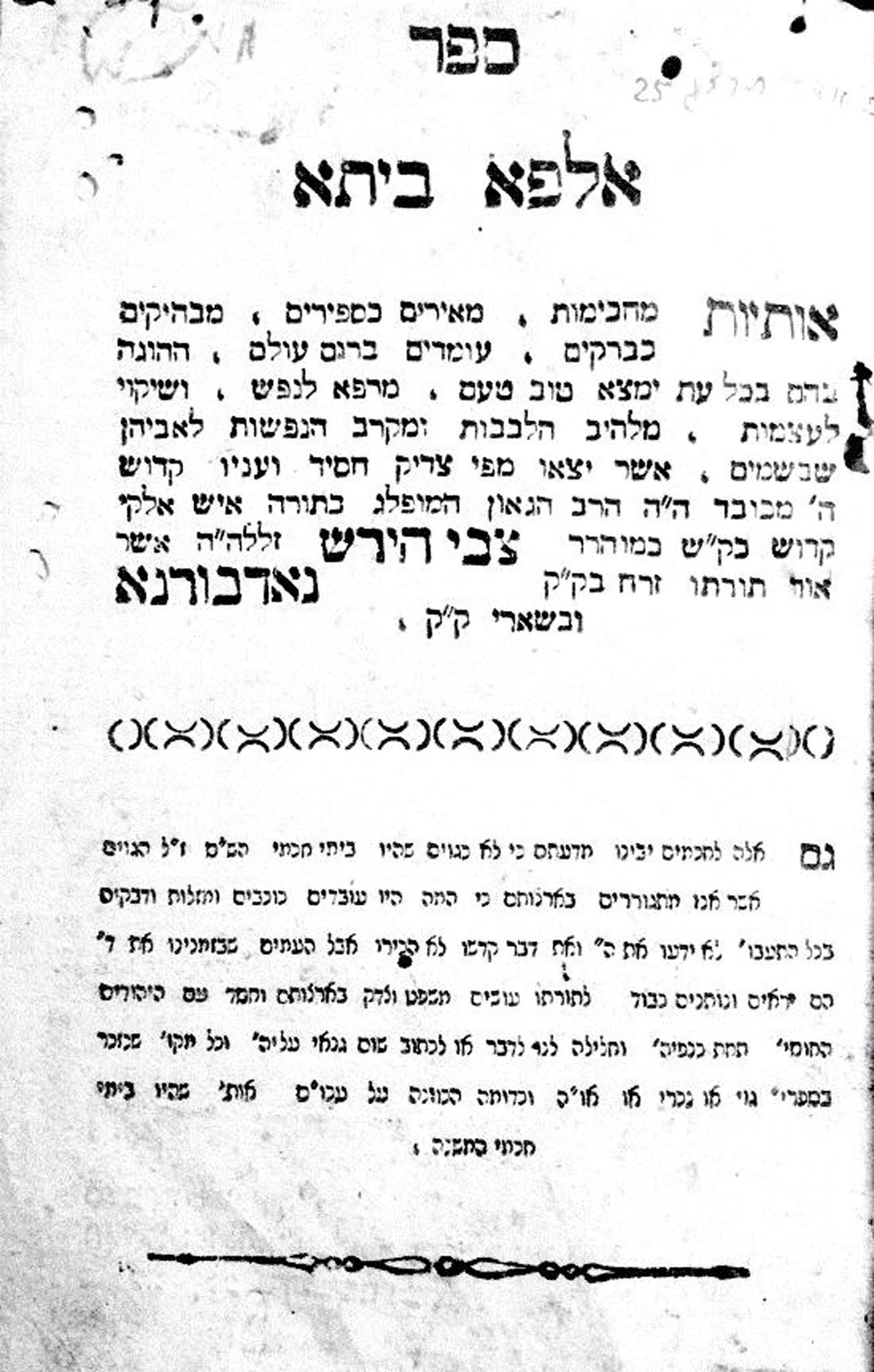
Among the many other ethical works of value but less well known, is a small book, booklet really, by R. Tzevi Hirsch ben Shalom Zelig of Nadworna (d. 1801), entitled Sefer Alpha Beta, aphorisms based on hassidic works arranged alphabetically. Zevi Hirsch was a student (disciple) of R. Dov Baer, the Maggid of Mezhirech (d. 1772) but his primary influence was R. Jehiel Michal of Zloczow (c. 1731–1786), both among the early and foremost proponents of the Hassidic movement. Zevi Hirsch was a preacher in Dolina and afterwards was av bet din in Nadworna (Nadvornaya), in the Ivano-Frankovski section of Galicia, his name being associated with the latter community. According to R. Efraim Zalman Margulies of Brody, Zevi Hirsch “turned many sinners to repentance.” He had several illustrious talmidim (students) among them R. Menahem Mendel of Kosov, R. Tzevi Hirsch of Zydaczov, R. Abraham David of Buczacz, R. Tzevi Hirsch of Dilatin, and R. Isaac Landman of Visnitz.[3]

1818, Sefer Tsemah ha-Shem la-Tzevi, Berdichev
Courtesy of the National Library of Israel

Tzevi Hirsch was the author of several other titles in addition to Alpha Beta, well received and reprinted several times. Yitzhak Alfasi writes that Tzevi Hirsch was unusual for Hassidic rabbis, for, in contrast to other Hassidic leaders whose words were written by others, Tzevi Hirsch wrote his own books. That his father was a prolific author is attested to by R. David Aryeh Leib, Tzevi Hirsch’s son, in the introduction to Sefer Tsemah ha-Shem la-Tzevi (above), hassidic homilies on the weekly Torah readings (Berdichev, 1818), printed between two pages of approbations.[4]

1910, Haggadah shel Pesah, Saigat
Courtesy of Hebrewbooks.org

“This is the blessing which” (Deuteronomy 33:1) I found in his treasured files, a detailed listing of his holy writings, in his actual script, on the Torah, on the Prophets, and on many of the sayings of our sages on the Talmud and Aggadah, “founded on the holy mountains” (cf. Psalms 87:1) according to pardes (literal, allusive, discursive, and esoteric interpretations of Torah), mussar, and insight. All written by the hand of the Lord that guided him. If I brought them as they were to a press, hundreds of pages would be insufficient. . . .

Another of Tzevi Hirsch’s works is Sifte Kedoshim (Lemberg, 1873) also homilies on the weekly Torah readings and Psalms, and Haggadah shel Pesah, described on the title-page as having been concealed from the light for more than a hundred years.

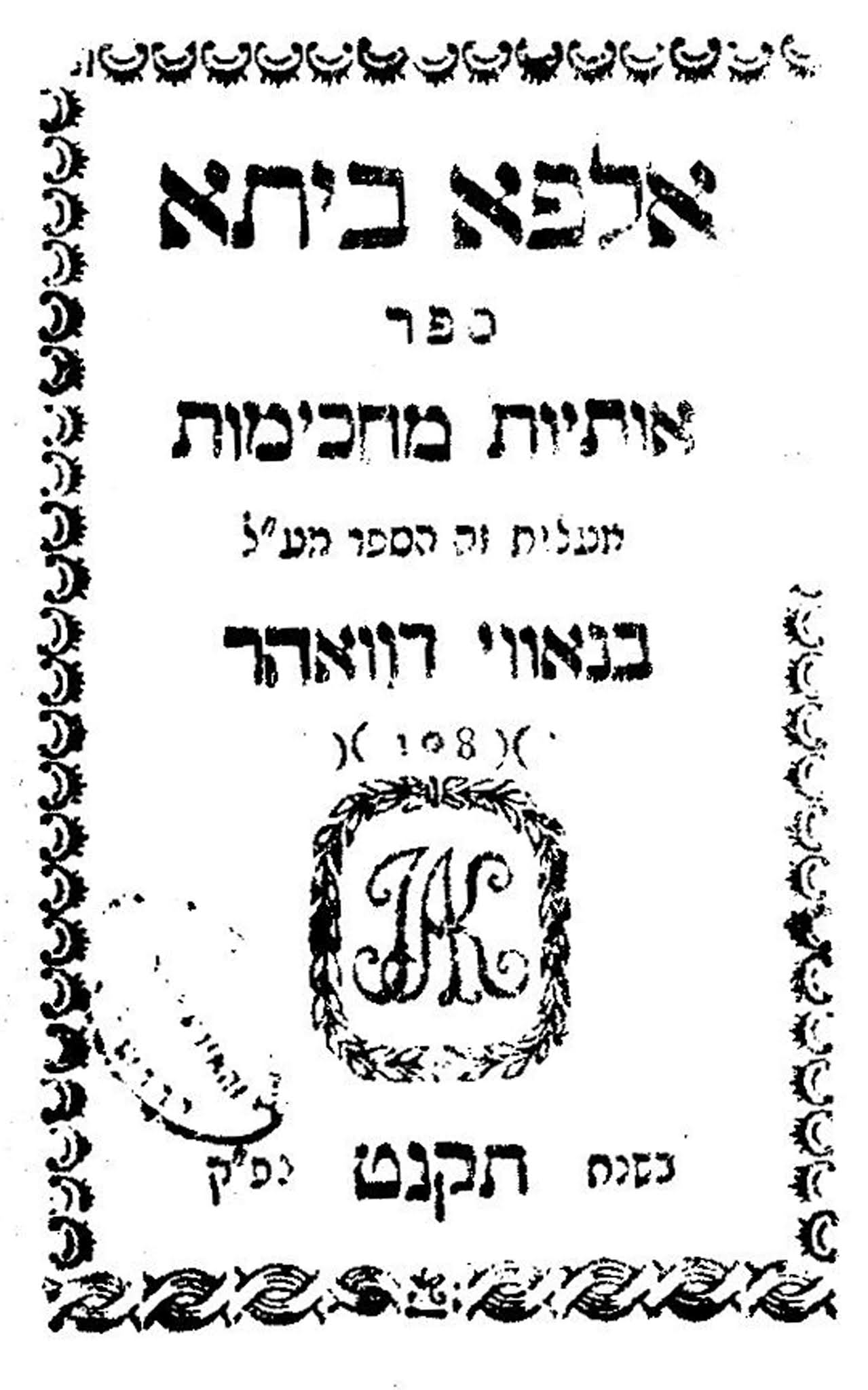
We turn now to our subject book, Alpha Beta. That work, according to Ze’ev Gries, reflects the influence of the Maggid of Mezhirech.5 Initially printed as Otiyyot Mahkimot (Instructive Letters) Alpha Beta consists, as noted above, of ethical maxims arranged according to the letters of the alphabet based on Hassidic works. The date of printing is unclear, bibliographic sources giving conflicting dates and places of publication. The Bet Eked Sefarim dates the first edition to Breznitz (1796), followed soon after by Nowy Dwor (1799) and Berdichev (1817) editions. The Thesaurus of the Hebrew Book records a Russia-Poland (1790) edition followed by Ostrog (1793), Zolkiew (1794), Podberezce (1796), Nowy Dwor (1799), Lemberg (1800), Russia-Poland ([1800]), and then the Berdichev (1818) edition.[6] Among the early imprints of Alpha Beta in The National Library of Israel, which has a large collection of that work, are Ostrog (1794), Nowy Dwor (1799), Poland (c. 1800), and Berdichev (1810).

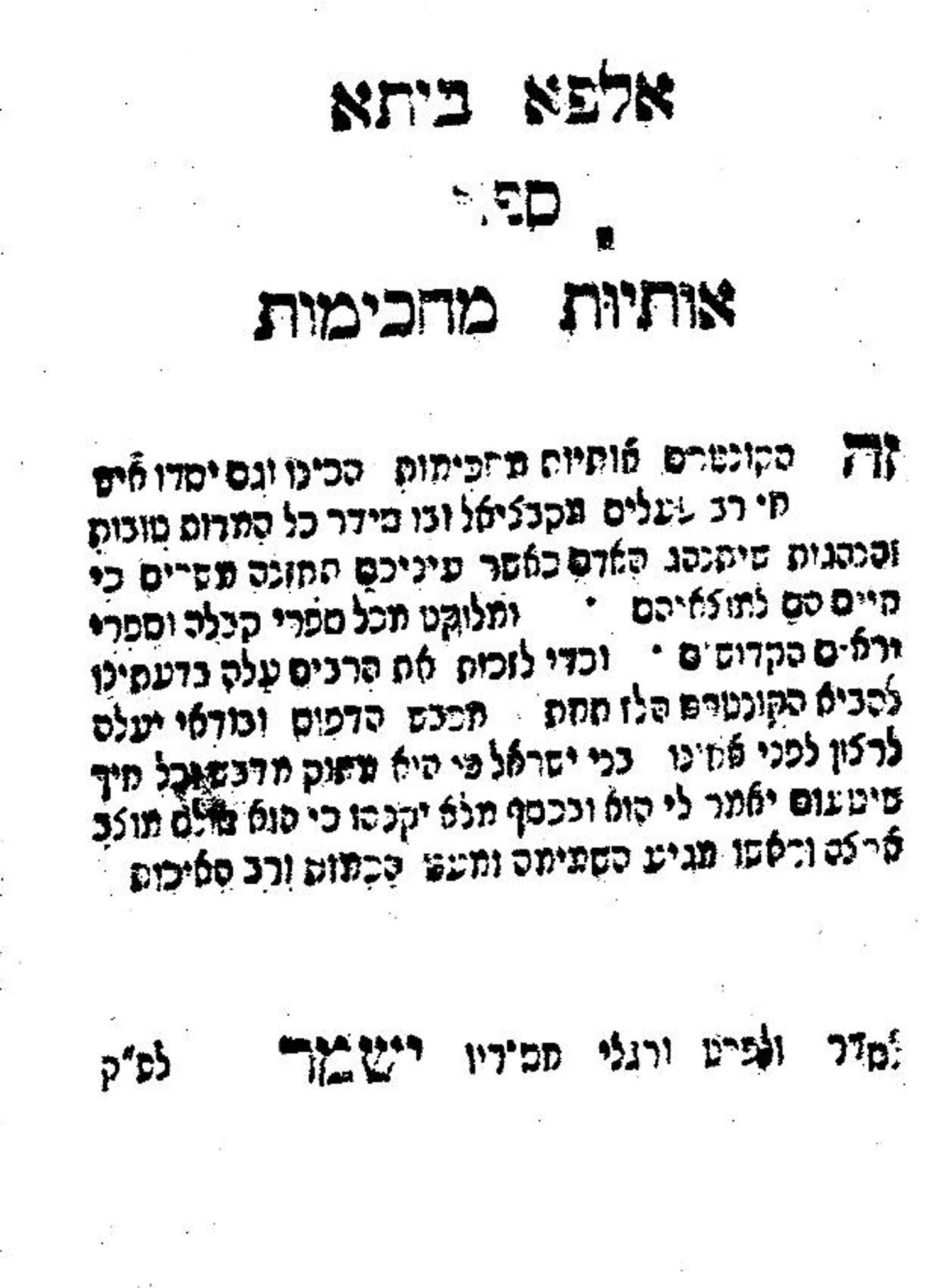
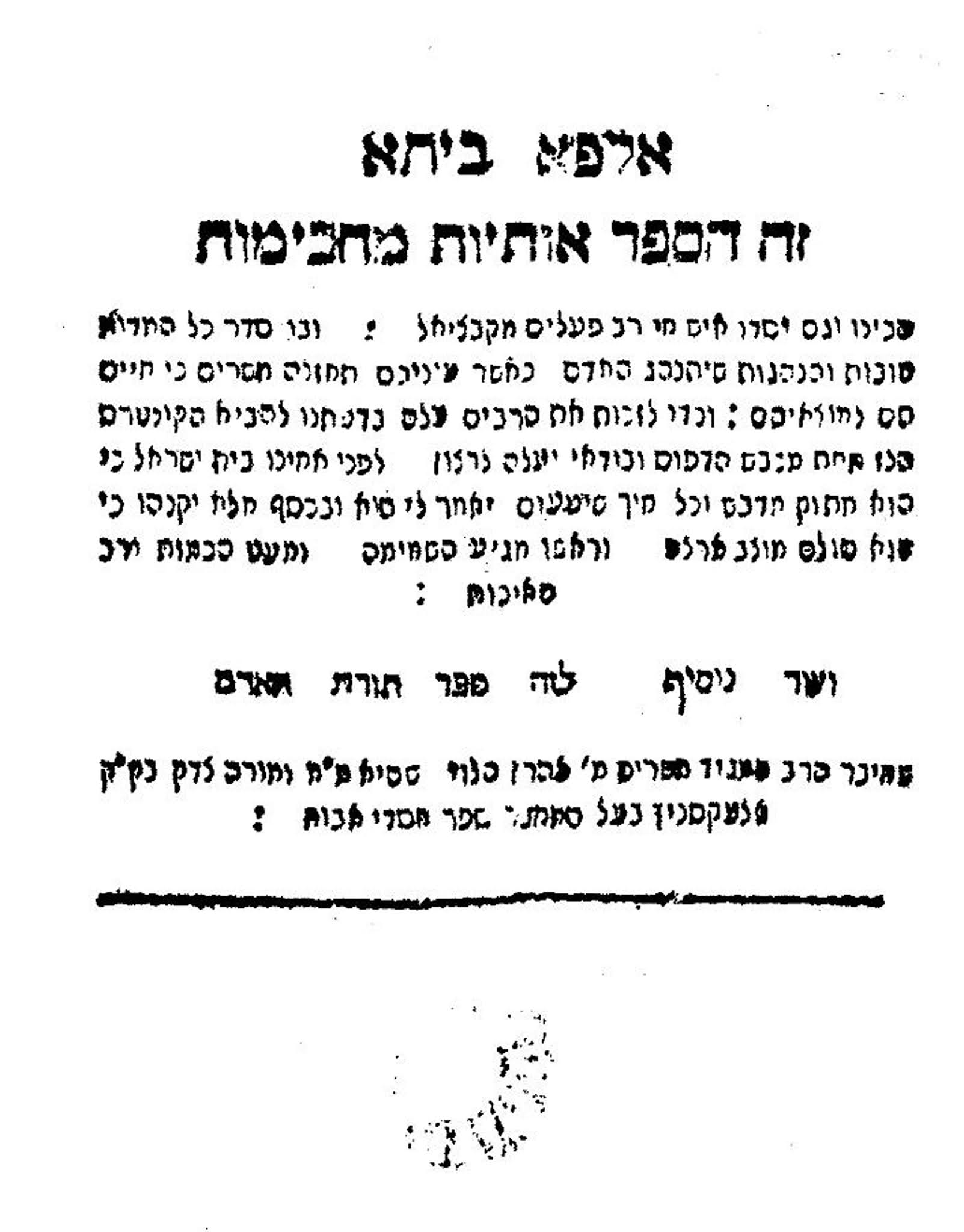
Among the earliest printings of Alpha Beta is the c. 1794/1800 edition, published in octavo (80: [12] ff.) format. The title-page of that edition does not record the date or the place of printing, thus accounting for the dating variances in the bibliographic records. The Library of Agudas Chassidei Chabad Ohel Yosef Yitzhak records it as a 1794 imprint and the press as Zolkiew. In contrast the National Library of Israel records the same edition as c. 1800, place of publication Poland. The title-pages states that it is,

1794/ 1800, Alpha Beta
Courtesy of The Library of Agudas Chassidei Chabad Ohel Yosef Yitzhak

Alpha Beta
This is the book Otiyyot Mahkimot

“A valiant man of many achievements from Kabzeel” (II Samuel 23:20, I Chronicles 11:22). In it are the order of all the middot tovot (good virtues) and the manner in which one should conduct himself as your eyes can see, “for they are life to him who finds them” (Proverbs 4:22). For the public good we have brought this booklet to press. Certainly, it will be pleasing to our brothers the children of Israel for it is “sweeter than honey” (Judges 14:18; cf. Psalms 19:11). All of your days you will taste of it and say for me it “was acquired at the full price (Genesis 23:9, I Chronicles 21:22, 24)” for it is “a ladder set earthward and its reaching heavenward] (Genesis 28:12).” Small in size but of great value.

Furthermore, we have added to this the sefer Torat ha-Adam.

Written by the rav, ha-Maggid R. Aaron ha-Levi, who is the moreh zedek (righteous teacher) in the [holy community] of Zaksanin and author of the sefer Hasdei Avot,

Tzevi Hirsch’s name does not appear on the title-page. The text follows immediately after the title-page, beginning with the phrase “‘these are the words’ (Deuteronomy 1:1) which a man shall carry out and live by them’ (Leviticus 18:5, Ezekiel 20:11, 13, 21), everlasting life, and whomever fulfills these words will assuredly be a great zaddik.” Below this opening phrase is the text, comprised of entries in alphabetic order.

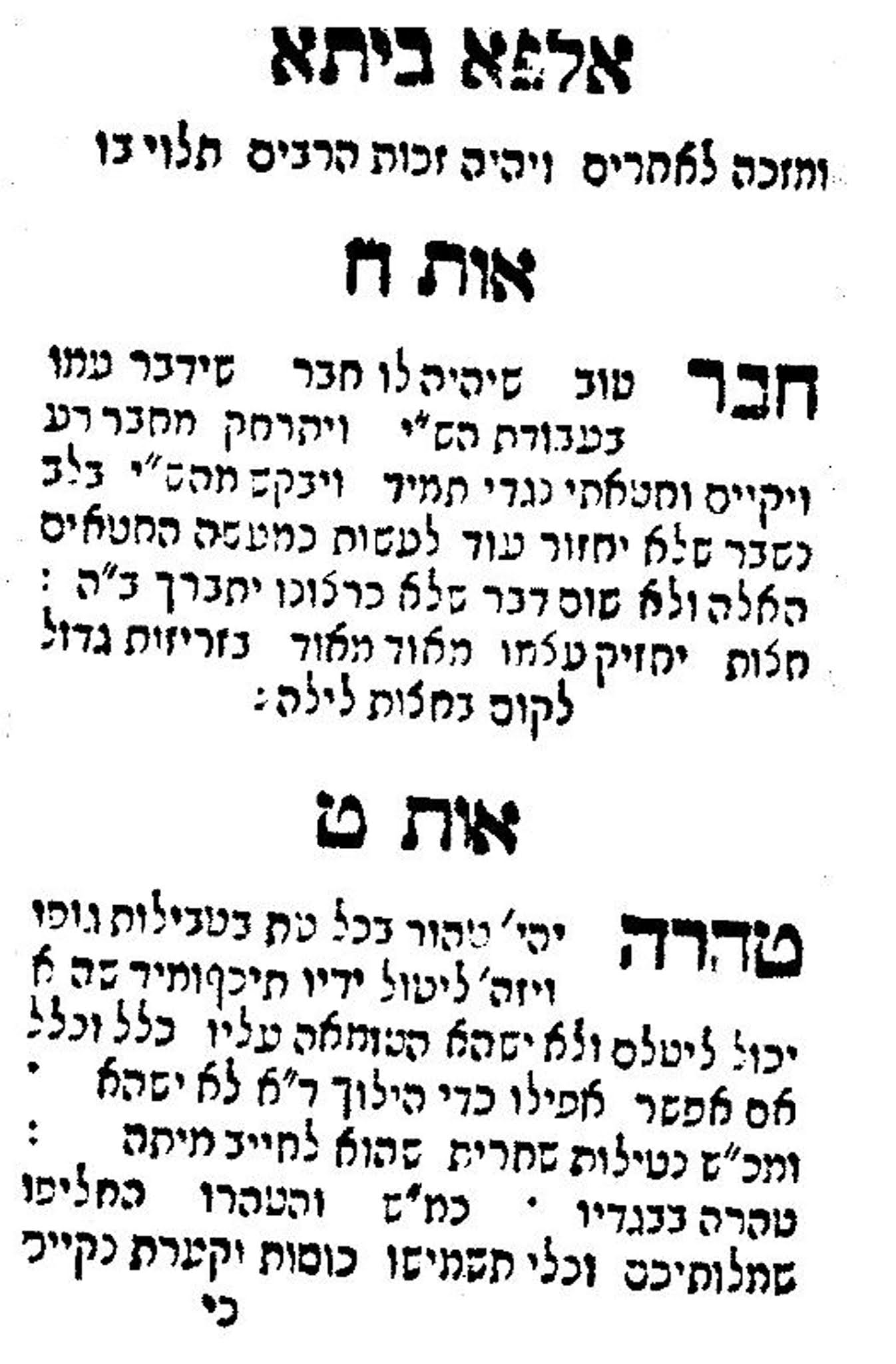
Examples of the subject matter are אות א (letter alef) emet (truth); א ahavah (love): letter ב bet; bracha (blessing): ג gimmel; gemilat hesed (acts of loving kindness): ד daled, no entry; ה heh; hihor (thoughts); ו vav; ve-tikvah (and hope), ז zayin; zahiros, (caution); and concluding with ר resh ratzon (will); ש shin shtikah (silence); and ת tav: teshuvah (repentance). Entries vary in length. Examples of brief entries are:

חבר ח (friend). It is good for a person to have a friend to speak with concerning serving the Lord and to maintain distance from a bad companion, fulfilling “my sin is before me constantly” (Psalms 51:5) and seek from the Holy One, blessed be He, with a broken heart that I should not repeat these sinful deeds nor anything that is not according to the will of the Holy One, blessed be He. It is a mitzvah to very much strengthen oneself with great zeal to arise at chaztot lilah (middle of the night).7

טהרה ט (purity) A person should be pure at all times by immersing his body [in a mikvah, ritual bath) and be careful to wash his hands immediately afterwards so that there should absolutely not be any defilement on them and if possible so as to not go even daled amos. All the more when washing one’s hands in the morning one is responsible for his life (literally subject to death). Purity of his garments, as it is written “cleanse yourself and change your garments” (Genesis 35:2)and all your utensils , cups and plates shall be [ritually] clean for this arouses purity of the soul.

קדושה ק (holiness). A person should sanctify himself in all the ways that hazal (rabbinic sages) has cautioned him and as what is written, one should be very careful to sanctify all his limbs and senses.

The text of Alpha Beta is followed by Torat ha-Adam written by R. Aaron ben Judah ha-Leṿi (18th cent.), also author of Hasdei Avot.8 Torat ha-Adam is also a collection of moral maxims, concluding with a brief alphabetical list of dictums, a few a bit strange, such as כ “all your companions and your brothers will betray you: and even those who lie in your bosom will forsake you”9 and, more customary, ת “give thanks to the Lord your God and then you may go in safety on your way.”


Sefer Alpha Beta (c. 1799) Nowy Dwor
Courtesy of the National Library of Israel

Shortly after the first printing of Alpha Beta several other editions of Alpha Beta were published. Among them is a clearly dated תקנט (559 = 1799) Nowy Dwor edition (title-page above). Nowy Dwor, located in east-central Poland, thirty-one kilometers from Warsaw, was published at the press of Anton Krieger (Krüger), a Christian German cloth merchant.10 The title-page has a brief text, simply stating that it is Alpha Beta, Sefer Otiyyot Mahkimot and giving the place of printing. Here too Tzevi Hirsch’s name is omitted. The volume begins with a brief preface praising the work and then an introduction by Tzevi Hirsch’s son stating that it was previously printed as Otiyyot Maḥkimot, undated and without the place of publication. This edition, more complete, has added material, among it the following entry,

דיבור ד speech. Speech is very precious and should not be used in vain, and all the more to anger or for dispute, G-d forbid, derogatory speech, talebearing, disparaging speech, mockery, or falsehood . . .

Some letters are amplified, that is they are enlarged subheadings within entries, such as א ahavah (love) has been expanded to highlight אמת (truth), followed by ahavah (love), and then אכילה (eating), but this is infrequent. The text of Alpha Beta is followed by Be-Ezer ha-Zur, an alphabetical listing of concise aphorisms, for example,

ו One should be careful to not go daled amos (approximately 6 feet) without netilat yadaim (washing one’s hands).

ז One should be careful to join day and night times with Torah or tefillah (prayers).

יג One should not look at any animal, wild beast, or bird at the time they are occupied one with the other.

יד One should not look at any idol or graven image for his prayers will not be accepted for forty days, G-d forbid.

כד One should be careful not to embarrass anybody.

Sefer Alpha Beta (1799) Nowy Dwor
Courtesy of the National Library of Israel

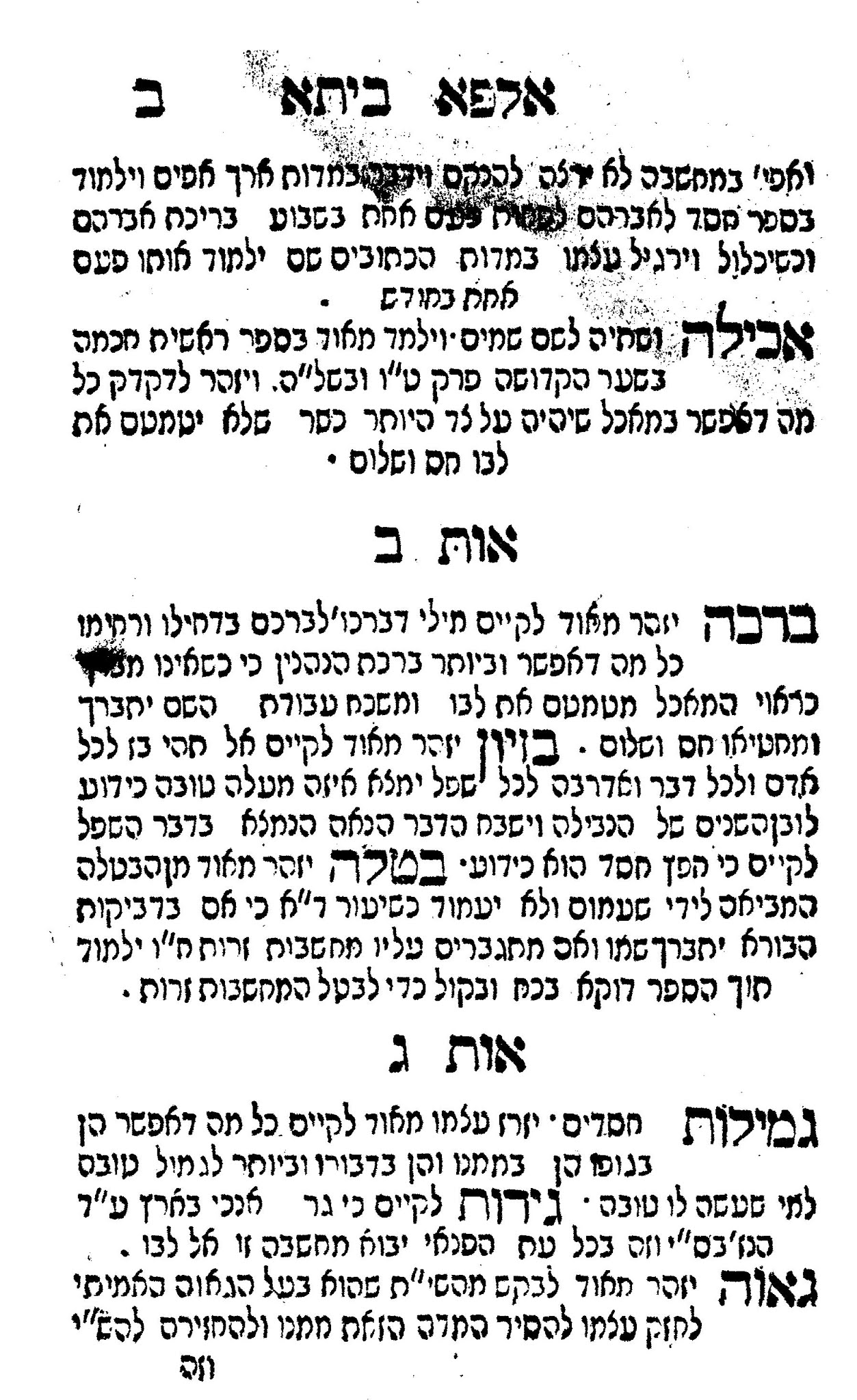
There is yet another edition late eighteenth-century edition (below) this with the location unknown but clearly dated “He guards the steps of His devout ones ורעלי חסידיו ישמר (550 = 1790)” (Samuel 2:9). If the date is correct this would be the earliest of our printings of Alpha Beta. It was noted above that the Thesaurus records a 1790 Russia-Poland edition, likely referring to this printing, presumably the first printing, prior to the Nowy Dwor edition, which may have been the second edition and the first complete printing of Alpha Beta, excepting the recorded Breznitz Alpha Beta (1796), which was not seen. However, this 1790 Alpha Beta mentions Otiyyot Mahkimot but otherwise makes no reference to earlier printings.

It stands out, however, for within the entries portions of the text are highlighted so that they now appear as several entries. For example, within the above entry on ד דיבור speech there are now two additional entries, that is, the words are highlighted in the text, for example ד דיבור speech, דין judgement, and דרך ארץ respectfulness.

1818, Alpha Beta, Russia-Poland
Courtesy of the National Library of Israel

Two distinct editions of Alpha Beta are recorded as 1818 imprints. One clearly dated as 1818, lacking the place of publication, is recorded as a Russia-Poland imprint and omits Zevi Hirsch’s name. The second edition, tentatively dated 1818, the place of publication also lacking, is frequently recorded as a Berdichev imprint. It clearly identifies Zevi Hirsch as the author. These are the eighth and ninth editions of Alpha Beta.

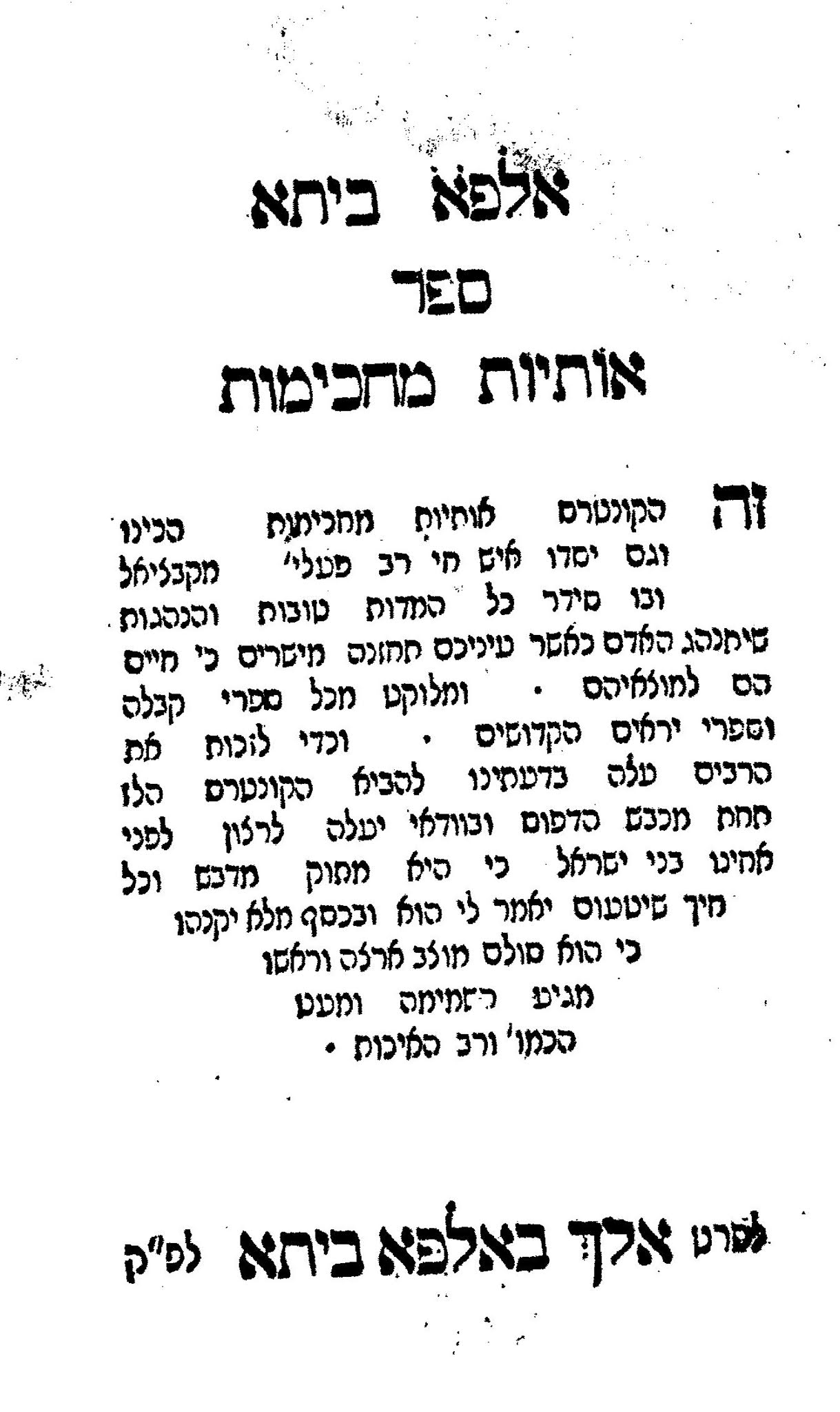
The Russia-Poland edition is dated אלך באלפא ביתא (578 = 1818) but no printer is given. It is described as 19 cm. (8 ff.). The title-page states,

Alpha Beta
Sefer
Otiyyot Mahkimot

This brochure Otiyyot Mahkimot was prepared and created by “a valiant man of many achievements from Kabzeel” (II Samuel 23:20; I Chronicles 11:22). In it he arranged all the good middot (traits) and conduct with which a person should conduct himself as “your eyes can behold righteousness” (cf. Psalms 17:2) “for they are life to he who finds them” (Proverbs 4:22).

Selected from all the works of Kabbalah and by God fearing men. For the public good we have brought this brochure to press, and it will certainly be pleasing to our brothers the children of Israel for it is “sweeter than honey” (Judges 14:18) and all your life you should taste of it and say for full silver he acquired it for it is “a ladder set earthward its top reaching heavenward” (Genesis 28:13), of small size.

Tzevi Hirsch of Nadworna’s name does not appear on the title-page nor in the brief introductory paragraph that precedes the text, set in rabbinic letters.

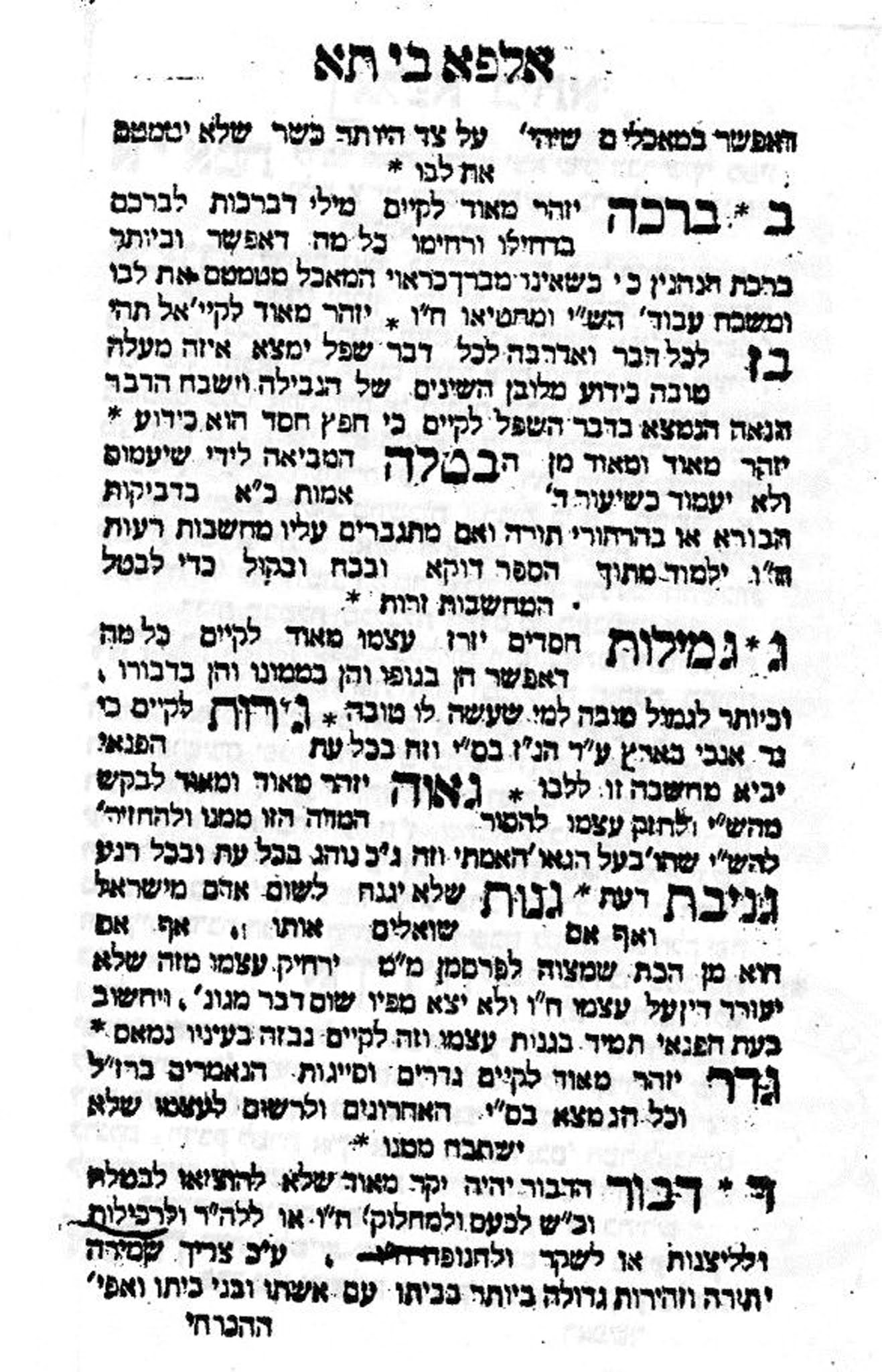
The second 1818 edition is generally recorded as a Berdichev imprint, 16 cm. [28] ff. However, a word of caution. Isaac Yudlov notes that Avraham Yaari, in his article on Hebrew printing in Berdichev, in which Yaari records Bedichev imprints, omits this edition of Alpha Beta, suggesting that Yaari, who recorded fifty-six Berdichev titles, either did not believe it was a Berdichev imprint or omitted items that were questionable.11 Nevertheless, most bibliographies do record this edition as a Berdichev imprint.

The most active printer in Berdichev at this time was Israel Bak, who published Tzevi Hirsch’s Tsemh ha-Shem la-Tsevi, also in 1818 (above), also lacking the date of publication. Tzevi Hirsch’s name is clearly given, in enlarged bold letters, on the title-page of this edition of Alpha Beta. The title-page states,

Sefer
Alpha Beta

Otiyyot Mahkimot. Illuminating as saphires, shining as lightening, standing at the top of the peak of the world, who reflects on them at all times will find in it “good reasoning” (Psalms 119:66), a healing for the soul (cf. Proverbs 16:24) and a tonic for your bones (Proverbs 3:8), arousing hearts, and bringing souls closer to their Father in heaven. That came from the mouth of the righteous, the pious, and humble, holy one of the Lord, the esteemed , the rav, the gaon, illustrious in Torah, the godly man Tzevi Hirsch the light of whose Torah shined in Nadworna and other communities.

A second paragraph states that references in the Talmud to idol worshippers and various terms used to describe them do not apply to contemporary nations who are not idol worshippers but give honor to the Torah and its followers and rule with justice and kindness. Such proforma statements are often found in contemporary Hebrew works and editions of the Talmud. The title-page is followed by the introduction of Tzevi Hirsch’s son, David Aryeh. He writes,

Behold, the above holy words that were already published by one who exited and entered in the tent of the Torah of the Rav [Tzevi Hirsch], placing it in his bag, the identity of the one who took this awesome work[12] הכר”ך הנורא הזה completely unknown (lit. obscured from sight) and there is no reason as to why in places it was abbreviated and others lengthened from the author. Now time has turned, thanks to the will of the Creator, to merit my father . . . and to bring the book to press . . .

1818, Alpha Beta, Berdichev
Courtesy of the National Library of Israel Courtesy of Steven Weiss

Ze’ev Gries and Ya’akov Shemu’el Shpiegel both note, referencing the introduction, that the reason for the omission of Tzevi Hirsch’s name in the previous printings was that, beginning with the 1790 Poland or Russia edition, Alpha Beta was frequently printed without the author’s name as the book was plagiarized or printed with changes unbeknownst to the author. The situation was corrected when Tzevi Hirsch’s son, David Aryeh, issued the Berdichev, 1818 edition.[13]

Gries, after comparing the Berdichev and the previous editions, finds that the errors are insignificant, the differences minor, the texts generally alike. He concludes that David Aryeh’s complaints are primarily based on the unauthorized use of his father’s work and the omission of the aphorisms included at the end of the Nowy Dwor edition, which may have been omitted intentionally or because the manuscript in question lacked them.[14]

Printed with this edition of Alpha Beta is Mille d’Avot, a commentary on Pirke Avot. The latter work frequently printed together with Alpha Beta. In Pirke Avot: A Thesaurus Steven Weiss records eleven editions of Alpha Beta beginning with the 1818 Berdichev edition through a 2011 Benei Brak edition.[15] In the introduction David Aryeh informs that the work of “many pearls” (Proverbs 20:15) Mille d’Avot is printed from a manuscript of his father’s, the author of that work, and also notes the publication of Tsemah ha-Shem la-Tzevi.

1848, Alpha Beta, Zolkiew
Courtesy of Otzar Hahochma

Subsequent editions of Alpha Beta clearly mention Zevi Hirsch’s name, for example the 1848 Zhitomir (Zhytomyr), edition (above). That edition was printed by Ḥanina Lipa, Aryeh Leib and Joshua Heschel Shapira, sons of Samuel Abba and Phinehas Shapira, grandsons of R. Moses Shapira. The original family press, in Slavuta, highly regarded, was forced to close after charges were brought by central authorities, but denied by the local Russian authorities, concerning the alleged murder by the Shapira family of a non-Jewish worker who had denounced the press to the authorities for printing Hebrew books without the approval of the censor. The press was reestablished by the Shapira sons in Zhitomir in 1847.

There is at least one recent edition that not only recognizes Zevi Hirsch as the author of Mille d’Avot but even emphasizes Mille d’Avot over Alpha Beta, the Lodz 1930 edition (below).

1930, Alpha Beta/ Mille d’Avot, Lodz
Courtesy of Steven Weiss

Tzevi Hirsch ben Shalom Zelig of Nadworna’s Alpha Beta has been a moderately popular work. The Thesaurus of the Hebrew Book records thirteen editions, the last being a questionable Zolkiew 1850 printing; The Bet Eked Sefarim records an equal number, the latest being a Lublin 1934 printing. While Alpha Beta is highly regarded this number of printings is not, in comparison to the ethical works noted at the beginning of this work, an impressive number of editions. Alpha Beta is a small brochure, portable and more easily learned than the other books mentioned, which are large and, in some instances, multi-volume works. One would have thought that this would have resulted in many more printings of Alpha Beta rather than the relatively small number noted. Given these considerations and the value (importance) of the ethical teachings in Alpha Beta the verse quoted at the beginning would appear to be appropriate for Alpha Beta.

By the riches of the sea they will be nourished, and by the treasures concealed in the sand. (Deuteronomy 33:19).

[1] I would like to express my appreciation to Eli Genauer for reading this article and for his suggestions, Dr. Steven Weiss and R. Yitzhak Wilhelm, Library of Agudas Chassidei Chabad Ohel Yosef Yitzhak Lubavitch, for their assistance.
[2] Steven J. Weiss, Pirke Avot: A Thesaurus: An Annotated bibliography of Printed Hebrew Commentaries, 1485- 2015 [Hebrew with English introduction]. A reason for the custom of saying Pirkei Avot between Pesah and Atzeret is that in these days each and every member of the people of Israel is obligated to purify himself during the days of Sefirah as the children of Israel purified themselves from the defilement of Egypt as is known from the holy Zohar. Seven weeks comparable to the seven days of niddah. (Ohev Yisrael for the Shabbat after Pesah 3:1).
[3] Yitzhak Alfasi, Entsiklopedyah la-Hasidut: Ishim כ-ת (Jerusalem, 2004), cols 603-07 [Hebrew]; Tzvi M. Rabinowicz, The Encyclopedia of Hasidism (Northvale, London, 1996), p. 335.
[4] Alfasi.
[5] Ze’ev G,ries, Sifrut ha-Hanhagot: Toldoteha u-Mekomah be-haye Haside R. Yisrael Ba’al Shem Tov (Jerusalem, 1989), p. 119 [Hebrew].
[6] Ch. B. Friedberg, Bet Eked Sefarim (Israel n.d.), alef 1422 [Hebrew]; Yeshayahu Vinograd, Thesaurus of the Hebrew Book. Listing of Books Printed in Hebrew Letters Since the Beginning of Printing circa 1469 through 1863. I (Jerusalem, 1993-95), p. 11 [Hebrew].
[7] Arising at chaztot lilah (middle of the night) refers to the kabbalistic custom of arising at the middle of the night to recite prayers and lamentations over the destruction of the Temple. (Aaron Wertheim (Author), Shmuel Himelstein (Translator), Law and Custom in Hasidism (Hoboken, 1992), p. 99.
[8] Torat ha-Adam has been printed independently several times, beginning with an Oleksinetz edition (c.1769) entitled Zot Torah ha-Adam. It is refeered to by that title in the Sudilikov (1819) and Munkatch (1904) printings.
[9] Cf. “Trust no friend, rely on no intimate; be guarded in speech with her who lies in your bosom” (Micah 7:5).
[10] Concerning the Nowy Dwor press see Marvin J. Heller, Printing the Talmud: Complete Editions, Tractates, and Other Works and the Associated Presses from the Mid-17th Century through the 18th Century (Leiden/Boston, 2019), pp. 211-18.
[11] Avraham Yaari, “Hebrew Printing at Berdichev,” Kiryat Sepher (1944), p. 100-24 [Hebrew]; Isaac Yudlov, The Israel Mehlman Collection in the Jewish National and University Library: An Annotated Catalogue of the Hebrew Books, Booklets and Pamphlets. Jerusalem 1984, pp. 190-91 no. 1171 [Hebrew].
[12] Concerning this phrase Gries references Ezekiel 1:22 the letters of הכר”ך reversed, the verse stateing “There was a likeness of an expanse above the heads of the Chayah החיה רקיע כעין הקרח, like the color of the awesome ice, spread out over their heads from above.” Also see TB Bava Mezia 24b and Hullin 95a where the phrase “obscured from sight” appears, albeit in a very different context.
[13] Gries, pp. 120-21; Ya’akov Shemu’el Shpiegel, Amudim be-Toldot ha-Sefer ha-Iṿri: hadar ha-meḥaber: be-Sha’ari ha-Defus (Jerusalem, 2014), pp. 25-26 [Hebrew].
[14] Gries, p. 21.
[15] In a private correspondence, dated May 27, 2020, Dr. Weiss writes that, concerning Alpha Beta, he “only listed the editions with Avot.”


A Conversation With Professor Marcin Wodziński on Hasidism

A Conversation With Professor Marcin Wodziński on Hasidism
By Rabbi Yitzchok Frankfurter

This article appeared in Ami Magazine July 11, 2018/ 28 Tamuz 5778 and is reprinted here with permission.

This is not my first conversation with the Polish scholar Marcin Wodzinski. In 2013, following the release of his book on chasidism and politics, he visited my office together with the well-known askan Reb Duvid Singer. Today as then, my conversation with him elicits paradoxical emotions. His knowledge of chasidism, particularly its roots and subsequent development, is shockingly broad. In fact, many chasidim turn to him for information about their origins, and Professor Wodzinski’s research has saved for posterity much of that history.
Of course, the mere fact that chasidism, a vibrant Jewish movement that once thrived in Eastern Europe and Russia, has been reduced to a scholarly discipline for a Polish academician is saddening. Poland was once the center of chasidic and Jewish life in general, but it now has very few Jews living there. And it goes without saying that Poland is devoid of any vibrant Jewish culture.
“That loss,” he tells me, “is very acutely felt in Poland on many levels. One significant expression of this is the Museum of the History of Polish Jews in Warsaw. I was its head historian for some time, as well as the chief designer of the gallery that depicts the 19th century. Three years after its opening, it is now the most successful museum in Poland.”
Unfortunately, it hurts to hear that, because that is precisely what Hitler was trying to accomplish. The Nazis wanted to reduce Jews and Judaism to relics and artifacts found only in a museum, and I tell the sympathetic professor as much.
“That’s true, but I would say that Poland as a country can’t do anything about it because there are so few Jews living there. But in terms of recognizing the tragedy and the loss and as an expression of pain, this museum is extremely important. And there are many other examples of how the non-Jewish community is trying to integrate an understanding of Jewish culture into what it means to be Polish today. There are at least four centers of academic Jewish studies in the country, which is the same number that exists in Israel. Each center has many scholars who are doing valuable research and earning PhDs in the subject. These schools attract people who want to study Jewish history and culture. Many of them write important articles and books that are read by a lot of Poles.
“The Jews are not an extinct race,” he says with fervor, “and this notion among Poles is even stronger today than it was 50 and 100 years ago, when Polish culture was very antagonistic towards Jews and sought to exclude them. Today, an increasing number of people realize that you can’t understand Poland without understanding the Jews.”
Field of Study
Marcin hails from a town in Poland that is 50 kilometers away from Breslau, or Wrocław as it is known in Polish, which before the Holocaust was the epicenter of the haskalah, rather than chasidism. Yet ironically, it was the chasidic movement that drew his interest.
“Of course. There weren’t any chasidim here. The city of Wrocław is best-known for the Beit Midrash l’Rabbanim, which was part of the so-called Conservative movement. Abraham Geiger, who one of the leaders of the Reform movement, was also quite active in Wrocław for over two decades. And the Jewish historian Heinrich Groetz spent his entire academic Marcin Wodzinski accompanying chasidim at a kever. Seen in the background is Reb Duvid Singer. life at its university,” he tells me when I confide in him that given his place of birth and alma mater (he also attended the University of Wrocław), I find his interest in chasidism rather peculiar. “But there were also some important chasidic books that were published in Wrocław, such as the first edition of Kol Simchah, which is the collected teachings of Rav Simchah Bunim of Peshischa.”
“So you’re a goy,” I tease him, “born in the birthplace of the maskilim, but chasidism became your field of interest.”
“That’s right!” he replies good-naturedly. “I’m trying to bridge ideas and interests. My interest in Jewish history and culture began with Jewish cemeteries, which was very typical at the time because it was the most visible presence of both the Jewish presence and absence in Poland in the 1980s. I learned Hebrew so I could write down the inscriptions, and I was fascinated by seeing the rebirth of chasidic pilgrimages to the gravesites of tzaddikim in Lizhensk, Peshischa, Lublin and other places. Then I started researching chasidic life, which is what I’ve been involved in for the past three decades.
“Two weeks ago I published a book called An Historical Atlas of Hasidism, which is going to be very important for chasidic studies. It contains 280 pages of full-color maps and images from the inception of chasidism until today. The maps present an entirely new way of understanding the movement, and there are a lot of previously unknown historical images. The book was published by the prestigious Princeton University Press.
“I also recently published a book entitled Hasidism: Key Questions. That one was printed by Oxford University Press. That is the volume of which I am the most proud, as it summarizes my entire investigation into chasidism. It has seven chapters, each of which addresses a different central question: the definition of chasidus, women in chasidism, chasidic leadership and the role of a tzaddik, the demographics of chasidim historically and today, the geography of where they lived, the economics of chasidic life, and finally, the end of chasidus in Eastern Europe and how it moved to the United States and Israel. I put forth the argument that this shift was not only because of World War II but actually started during the First World War. The book has around 350 pages.”
“What do you think you’ve added to the understanding of chasidus?” I ask.
“There are several things that are unique about my work. First of all, I am equally interested in the lives of the rank-and-file chasidim as I am in the lives of the tzaddikim. To me, a tzaddik isn’t a leader if he doesn’t have followers. That is why I believe that much of the research so far has been misguided by omitting the tzaddik’s thousands of followers from the picture. I think it’s critically important to understand not only the teachings of the great chasidic minds but also—and perhaps more so—to understand how they reached the simple folk and affected their lives. Another innovation in my work is that I don’t just delve into intellectual topics. I also look at the social, economic and other aspects of history, which are aspects that have only been properly addressed by very few scholars. This results in an entirely different perspective.
“But perhaps most importantly, the vast majority of scholarship on chasidism has focused on its early years. We know quite a lot about the Baal Shem Tov and Rav Dovber of Mezritch, and we know some things about their disciples, but we know very little about chasidism in the 19th and early-20th centuries before the Holocaust. We know about some leaders, but very little about the lives of the chasidic communities. Both of these two recent books expand the scope of interest. I call the 19th century the ‘golden age’ of chasidism, because that’s when the number of people who considered themselves chasidim reached its peak. There were many regions of central Poland, Galicia and Volhynia [the region where Ukraine, Poland and Belarus meet] where chasidim constituted the majority of Jews, and it’s critically important to understand what their lives were like then.”
“How much of the actual Torah of the tzaddikim do you study? Is it something you consider necessary for your research, or do you completely ignore it?”
“Obviously, there are many people who are bigger experts on that than I am. I’m not even an am haaretz; I’m a goy!” he says unapologetically, “so it’s not really something for me to study.”
“So you don’t think it’s important or that you’re missing something in your research?”
“It’s obviously important, and that’s why many people study it. But I can’t do everything. I do need to understand the chasidic concepts, but I don’t study them myself; I read what other scholars have written. That’s the best I can do. I can’t be a specialist on everything. What I’m trying to do is to show that beyond Torah, there is a huge area of chasidic life that hasn’t been properly looked into, such as the relative power of individual groups. These are things that everyone would love to know. It also gives you an understanding of the spiritual leadership of various tzaddikim, because if one tzaddik has 100,000 followers, his relationship with his followers is very different from that of a tzaddik with 50 followers.
“We can also see how far the shtieblach were located from the court. For Chabad, the average distance between the court and the shtiebel was 400 kilometers, which means that the vast majority of chasidim only visited the Rebbe once or twice in their lives. For Vizhnitz, which was very strong in Hungary, the average distance was less than 100 kilometers, which means that most of the chasidim came to see the Rebbe several times a year because it was relatively easy to get there. This means that the relationship of the typical Vizhnitzer chasid and his Rebbe was very different from that of the typical Lubavitcher chasid and his Rebbe.
“Then there were courts that were even closer to their shtieblach. For example, Kretchnif’s average distance was 30 kilometers, which means that they could go to their Rebbe every Shabbos and he knew his chasidim personally. The Gerrer Rebbe had 100,000 chasidim, which means that he didn’t know all of them by face and name, with the result that the spiritual inspiration they received was different from that received by chasidim of a smaller chasidus. So while this kind of information isn’t part of the teachings of any particular group, it’s still very important to understand.
“It’s hard to summarize everything I believe I bring to the field. But as I said, I try to capture the totality of chasidic life, not just its spiritual aspects but also its economic, social and cultural ones.”
“Has your work brought you emotionally closer to the Jewish community, or is it just a field of research to you?”
“Whenever anyone chooses a field of research he feels some sort of connection. The most difficult thing for anyone to do is to decipher himself.”
“You speak Hebrew and English fluently, but in which language do you write?”
“Lately, I’ve been writing more and more in English instead of Polish because my books are addressed primarily to international audiences. But I still write articles in Polish, so I’m pretty much bilingual in my academic life.”
“Is the objective of your research to understand Poland or to understand Jews?” I ask next.
“I might be exceptional in some sense because I focus on Jewish history; I don’t research so-called Polish-Jewish relations. I’m interested in chasidism, the haskalah and Jewish cemeteries and that’s it. But I would say that the majority of scholars in Poland who are interested in Jews study the relationship between Poles and Jews.”
“As a non-Jew, are you welcomed by Jewish researchers of chasidism, or do you feel like an outsider?”
“There isn’t any bias against non-Jewish scholars in academia, or at least I’ve never experienced it. As a whole, the scholars studying chasidism are extremely openminded people. I’m very happy to be part of this community and I feel very welcome and supported both intellectually and emotionally. The research I do is very broad, so I often have to rely on support from other people, which is always forthcoming.
“I would also say that over time I have established increasingly good relations with the chasidic community and with many individual chasidim who seem to appreciate my research. A big part of the atlas in my book maps out contemporary chasidism. In order to do it I had to ask a critical question—how many chasidim are there today?—because without the answer it’s impossible to continue any further. Are the numbers bigger or smaller than before the war? Where do they live? Which is the biggest chasidic court today? Celebrating at a Belz wedding To obtain the answer, I decided to turn to the chasidic phone directories and counted the number of households. Based on the 42 directories I received I arrived at a total of 130,000, which I believe covers almost all of the chasidic households in existence today. This allowed me to estimate the demographic and geographic distribution of chasidim and many other issues, and it was only possible thanks to the goodwill of the chasidic communities that appreciated my research and shared their directories with me. I am extremely pleased to have gotten support not only from my fellow scholars but also from chasidic people.”
“Which is the largest chasidus today?”
“You know the answer to that: Satmar, with 26,000 households split between the two groups.”
 “Which is second?”
“Chabad, with 16,000, followed by Ger, with 12,000. Belz has 7,500 households. The most difficult to calculate is Breslov because they use different categories for inclusion, but I estimate them at 7,000. Sanz has 4,000; Bobov has 3,000; and another 1,500 for Bobov-45. I am very proud to have done this research.”
Bustling Centers of Chasidic Life
“Where was the center of chasidic activity in the 19th century, Poland or Ukraine?”
“That’s a very good question. I have a set of maps in my atlas depicting where the tzaddikim lived and how this changed over time. I also have a map showing 70% of all the existing chasidic shtieblach at the beginning of the 20th century. This was an enormous undertaking. I managed to locate 2,854 shtieblach, which, as I said, represents some 70% of the total during that time period. It is very clear that the cradle of chasidism was Podolia and Volhynia, which are Ukrainian territories. At the end of the 18th century it moved north to Belarus and west to Galicia. In the 19th century, the epicenter was Galicia and the southern part of central Poland. Then it moved south again into Hungary and Romania.”
“Where does Czechoslovakia, where my own parents hail from, come into play?”
“Slovakia is part of Greater Hungary, because up until 1918 it was part of the Austro-Hungarian Empire, so when I say ‘Hungary’ I am including Slovakia. By contrast, the area that is now the Czech Republic isn’t significant to us because there were very few chasidim there if at all. In fact, only the eastern part of Slovakia, which later became TransCarpathian Ruthenia and was incorporated into Hungary, Romania and now Ukraine, is relevant to this topic, but it was never a center of chasidic life. As for the Hungarian territories, it was mostly Maramures and Transylvania that were heavily chasidic.”
“According to your calculations, would you say that the majority of the Jews at that time were religious, and a majority of the religious Jews were chasidim?”
“Up until the interwar period in the 1920s and ’30s, the majority of the population was religious, although not all were chasidim; it depended on the area. In Lithuania the majority were Litvish—either misnagdim or ambivalent towards chasidim—while only a minority were chasidim. But in Galicia, especially Eastern and Central Galicia, the majority were chasidim. Many communities were dominated by chasidim. Poland was also divided: Eastern Poland was mostly chasidic, but in Western Poland the numbers were much smaller.
“In general, the vast majority of Eastern European Jews in the 19th century were Orthodox, but this changed radically in the interwar period. In the Soviet Union, the number of religious people dropped dramatically because of the Communists’ anti-religious stance, and the chasidim were heavily persecuted and their leaders sent to Siberia. For example, the Machnovka Rebbe was only allowed to leave his exile in the 1960s. In Poland there wasn’t any religious persecution between the wars, but because of the trend towards modernization and the influence of secularism and politics, the number of people who were still religious dropped to one-third of the Jewish population. Of those who were religious, I’d say that the majority were chasidim. This loss was acutely felt by the chasidic community.
“If you look at the activities of the Piaseczno, Aleksander Rebbe and Gerrer Rebbes, much of their activity was inspired by the crisis of many members of the younger generation leaving the community and becoming communists or Zionists. They understood that they had to reinvent the structure of the traditional chasidic community, particularly during the First World War and immediately afterwards.”
“They say that history is written by the victors. There were many large chasidic courts before the Holocaust but they are no longer remembered, and other chasidic groups are far more dominant now. This makes people believe that they were dominant before the war as well, but it’s not necessarily true.”
“My atlas corrects this misconception. As I told you, I found 2,854 shtieblach in the early part of the last century. By comparing the number of shtieblach of different courts, I was able to establish their relative power, and the numbers are very precise. In Central Poland, 22% of shtieblach were Ger; 13% were Aleksander; 6% were Kotzk and its offspring, followed by Amshinov, Otvotzk (Vorka), and other smaller groups. Perhaps the biggest one that’s completely unknown today is Olik, which may have been the third largest in Volhynia during the interwar period.
“Which was the biggest in Ukraine?”
“Between the wars, the biggest court in Ukraine was Trisk, with 16%. The second largest was Sadigura, which was really in Bukovina, outside Ukraine, with 8%. The third was Olik, followed by Karlin-Stolin, Makarov, Tolne, Chernobyl, Stepan, Lubavitch, Skver, Brzezan, Hornosteipel and others.”
“Where was Lubavitch the most dominant?”
“Lubavitch was the dominant group in Lithuania and Belarus, where they had 32% of all the shtieblach. Every third shtiebel was Lubavitch, and there were other shtieblach belonging to other Chabad courts. Four percent belonged to Kapust; 3% to Liadi, and 3% to Strashelye. If you count all of them together, almost half of the shtieblach were Chabad. The next largest one in Belarus and Lithuania was Karlin-Stolin with 10%, followed by Slonim, Kobrin, Koidanov and several others.”
“Do you see a common denominator between all of these groups despite their differences?”
“Yes, and one of them is their common origin. The understanding that they all come from the Baal Shem Tov informs every single chasidic community. It also affects the relationships between groups, because it is much easier to move from one chasidic group to another than it is to move from chasidism to non-chasidism or vice versa. There are also elements that are shared by every group. The role of the tzaddik is one such element. Even to the groups like the ‘toite chasidim,’ as the Breslovers were once called since they don’t have a live Rebbe, there is still an understanding of the Rebbe as an essential spiritual experience for every chasid.
“Perhaps this is something that distinguishes me from many other scholars of chasidism. Whereas most of them concentrate on the theology and books, my approach is more in line with the statement of Rav Zusha of Anipoli. When he was in the court of Rav Dovber of Mezritch, he said that he learned more Torah from the way his Rebbe tied his shoelaces than he would ever learn from his lectures. To me, the interaction with the Rebbe is what defines the life of the community. My research brings this aspect to light, whereas other scholars tend to overlook it.”
Economic Life and Political Power
“How do you make a distinction in your research between religious Jews and chasidic Jews in terms of their economic, social and cultural lives? They were probably almost the same.”
“That’s true as far as economics is concerned,” he admits. “It’s very difficult to differentiate between chasidim and non-chasidim, and finding sources was extremely difficult. But I managed to locate the complete lists of several communities in Poland and Belarus, and I also came into possession of complete lists of taxpayers and their professions. By comparing the two lists, I could see how chasidim fit into the picture of the general Jewish economic activity.
“There’s a popular stereotype both in the secular world and among chasidic writers that the early chasidim were poor, even in the 19th century. One of the things I wanted to know was whether chasidim on average were richer or poorer than the average nonchasid. I also wanted to know if there was any specific profile for chasidic economic activity. Where did the money they used to sustain their families come from?
“Thanks to the comparison between the lists of chasidim and the lists of other Jews in central Poland and Belarus, I came to the conclusion— which was quite surprising to me—that chasidic communities were on average wealthier than nonchasidic ones. Even more interesting, the chasidim preferred to engage in trade and weren’t so involved in artisanship and crafts. Also, there were very few chasidim who were unskilled workers, although there was a lot overrepresentation when it came to the communal professions such as rabbi, gabbai, shames, mohel and shochet. So when you compare chasidim to other religious groups with similar profiles, you understand why their communal structure was as I described.”
“In what sense?”
“In the sense of emunah and bitachon supporting the economic activity. In the 19th century, the average boy starting an enterprise would get money from his family or in-laws and establish a business. Some of them would succeed, while others would go bankrupt. Many people needed to go bankrupt several times before starting to make money. In the traditional non-chasidic world, a person might start a business once or twice with his family’s support, but if he didn’t succeed he simply went bankrupt.
“Then there was another tier of support in the chasidic world: If a person failed using the money from his family, he could still count on assistance from his community. There is much documentation of chasidic solidarity being very important for internal economic support. If there was a wealthy person in a small chasidic town and he knew that another person had failed at his enterprise, he was willing to help him. This meant that people were given another chance.
“Also, chasidim preferred to be in trade rather than crafts, which usually generates a higher income. Being a chasid actually supported engaging in trade, because a non-chasid’s economic relations extended to his immediate business partners and family, but for a chasid this network was wider since he had to visit the court of the tzaddik several times a year, where he was able to build very strong relationships with people from other towns. This meant that he had access to business partners in a very large geographical region. It was therefore much easier for him to have a successful enterprise because he had a much larger pool of potential partners.
“Another important factor is the role of the tzaddik as arbitrator, not only in spiritual or familial matters but also economically. This is one more level that wasn’t available to a non-chasidic community, and it was enough to put chasidim in a relatively better financial situation.”
“Tell me about the political power chasidim wielded in their various countries of residence in Eastern Europe, which is the subject of the book you released in 2013.”
“It’s very interesting to see that some of the tzaddikim—most prominently Rav Yitzchak of Vurka and later the Chidushei HaRim—functioned as shtadlanim, representatives of the Jewish community to the non-Jewish authorities. It is also very instructive to see that behind their activity there were what I would call legal advisers, people who were very knowledgeable and skillful in navigating the law of the country. These were generally big entrepreneurs who had major financial influence and dealt with the authorities on a day-to-day basis. Those people weren’t visible, however; they lent their expertise to the tzaddik, who was the face of the political power. But it was really a wider enterprise undertaken by the entire community and not just the tzaddikim themselves.”
“Who do you think was the most politically astute and active among the Rebbes?
“In the 19th century, it is clear to me that the biggest innovation in the understanding of politics among tzaddikim came from Rav Yitzchak of Vurka. Around the same time the Tzemach Tzedek, Rav Menachem Mendel Schneersohn, was also very influential in political matters in Russia. You can see the structure of support from very wealthy Jews in St. Petersburg and Moscow, who brought their expertise into the service of the chasidic community. Those two should be listed as the most skillful political leaders of that period. In a sense they established the path for other segments of the Orthodox Jewish community. In the next century you have the founders of Agudat Yisrael in Poland, but that was a very different concept because by then it was mostly electoral politics predicated on parties.”
“Was the political power held only by the Rebbes or the chasidim as well?”
“I would say that any political activity required a very developed cooperation of many levels of political involvement. The tzaddik would never act alone, and it is obvious that without support he wouldn’t have been able to accomplish what he did. At the same time, without him others would be unable to have power. They were entirely interdependent, so it’s impossible to say which was the more important. The beauty is that they managed to invent new ways of being politically active, because traditional Jewish politics had been based on shtadlanim.
“The way it worked up until then was that the Jewish community would hire a political activist who would go to the Polish court or nobleman and try to obtain certain political privileges. This changed in the late-18th century because there was no longer a Polish court, so the entire legal system changed. Under the new system, the Jewish community was deprived of political power, not because of antiSemitism—which of course existed—but because the authorities claimed that the Jews weren’t a community but only individual citizens. Every citizen could represent his own interests, but no one could speak in the name of a group. Jews were permitted to organize for religious purposes, but they were forbidden to organize politically. This meant having to reinvent how to represent themselves to the government, but somehow the tzaddikim managed to present themselves as the representatives of the entire Jewish population.”
“What’s fascinating is that all of this developed in antiSemitic environments. Would you agree with that statement?”
“The political elite were certainly more or less antiSemitic, but they were trying to present themselves as neutral. Those who were skillful used this supposed ambivalence to their advantage. Rav Yitzchak of Vurka, for example, was as successful as he was because he was able to neutralize the anti-Semitic bias of many politicians. He forced them to act against their will by citing legal precedents in support of his arguments that they couldn’t reject. One such case involved the right of rabbanim to control the kashrut of meat in Poland. Absurdly, the right to sell kosher meat and levy the special tax on it had been given over to a Christian enterprise, which was obviously a major problem. Rav Yitzchak of Vurka managed to present this as destructive to the state budget and contrary to its revenue laws. By using this argument, he managed to help the Jewish community regain control. The political bias and anti-Semitism of many of the politicians was rendered ineffective, because they had to follow the legal procedures established by the law of the land. One of the most important factors in the politics of the 19th century was that even the most oppressive countries were trying to establish themselves as places that operated under the rule of law.”
“Tell me about the Tzemach Tzedek’s successes. What was his style of political activity?”
“He was active in Russia in a different context. When he passed away in 1866 there was a visible break in the political representation in Russia, mainly because his succession was unclear; his sons established other courts in other towns, and his youngest son, Rav Shmuel, remained in Lubavitch. This was only slowly regained by his grandson, Rav Shalom Dovber, but his was a time of lesser political success. Concurrently, the Chidushei HaRim established himself as an extremely successful political leader in central Poland. He was succeeded by the Sfas Emes, who was also very successful, as was his son, the Imrei Emes, who was very involved in the creation of Agudat Yisrael. By then the political climate in central Poland was under Russian control, but because it was ethnically different, it maintained a separate legal system that encouraged political activity far more than Russia. So I would say that after 1866 and the passing of the Tzemach Tzedek, there was no longer a real parallel of politics in Russia and Poland.”
“By ‘political activism’ you mean efforts to benefit Jewish life in the places they lived.”
“I am referring to those actions that were undertaken by chasidic leaders with the support of their constituencies to guarantee certain privileges or rights for the Jewish community at large, not just the chasidic community. Aside from the right to have control over the supply of kosher meat, this would include the ability of Jewish prisoners to have kosher food or the right to establish eiruvin in Jewish districts. This was a very important change from the earlier chasidic involvement in politics like that of Rav Meir of Apta, who was mostly active in defending the rights of chasidim to establish their own shtieblach, or to prevent the persecution of the chasidic community.”
“Every Jewish leader really fought for the rights of the Jewish community, so how were the chasidic leaders different in that regard?”
“True, many of their efforts weren’t very different from those of non-chasidic rabbanim, but the whole structure of chasidism empowered its leaders far more than other rabbanim. Let’s say that there was a rabbi of a town—even a very important posek in a big city. Who was behind him? He had only his personal charisma and his community. The Gerrer Rebbe, however, had 50,000 followers all over Poland. This gave him the ability to engineer a campaign to support his political actions in a very broad way. This structure of support that wasn’t confined to specific territories and could cover large areas of Eastern Europe gave additional power to chasidic representation.”
“Did you get the feeling that the growth of a particular court was dependent on the political skills of its leader?”
“That’s something that’s very hard to establish, because no direct testimonies would say such a thing, that this tzaddik was more powerful because he was politically skilled. But if you observe the correlation between political involvement and the number of followers, it’s very significant that those tzaddikim who became more politically involved eventually gained wider followings and vice versa; by having wider followings they were able to be more effective politicians. So these two phenomena were interdependent both ways.
“This is also very true of the interwar period. The tzaddikim who were engaged in the reinvention of chasidism after the First World War, establishing new school systems and other activities of that kind, eventually turned out to be more effective than others. For example, before WWI the Tchortkover and Belzer Rebbes were equally as powerful. But after the war the Tchortkover Rebbe’s power shrank dramatically, and the same holds true of many other Rebbes in central Poland. Another example would be the Gerrer Rebbe, whose political involvement and institution of new infrastructures in the yeshivos and Bais Yankevs [sic] gave him a very strong boost. He had 100,000 followers in the interwar period, which was unparalleled. So a connection exists between politics and the internal relative power of certain Rebbes.”
Concerns and Lessons
The country of Poland is currently going through difficult political times. Last week, the government effectively forced more than two dozen justices out of their jobs. The purged judges refused to recognize their dismissal, while the government officials insisted that they would no longer be allowed to hear cases. Surrounded by cheering supporters, the top Supreme Court justice took a defiant stand on the courthouse steps, and vowed to keep fighting to protect the Polish constitution and the independence of that nation’s courts. The confrontation was followed by dueling news conferences, fiery speeches and more street protests. I ask Marcin if he thinks Poland is moving towards a more dictatorial type of government.
“Poland has been losing its democratic institutions with increasing rapidity over the last three years since the ruling party took power,” he admits. “I can already see a lot of manifestations of an authoritarian state. While the Supreme Court is currently in the news it’s really only the tip of the iceberg, because we see many such things on a daily basis, such as the use of police against the political enemies of the present government, which is typically authoritarian. Then there’s the use of the media as a propaganda tool for the current government. Using public money in support of one political option totally demolishes the constitutional structure. I am very afraid that if the ruling party wins again next year, that will be the last free election in Poland.”
“Do you think that the Jews who live in Poland and the Jewish community at large should be concerned about this?” I want to know. “The ruling party is right-wing, and in Europe right-wing parties are very closely associated with anti-Semitic ideologies, but they are very wary of being labeled antiSemitic. For this reason, the ruling party won’t openly attack the Jewish community in the foreseeable future. But just by looking at the Holocaust law that was passed in January you can see that even without the direct intention of the regime there’s been a rise of anti-Semitic sentiment, which is fueled by the current political climate. This might be a concern in the long run, and is something that has been expressed by many representatives of the Jewish community over the last year.”
“Are you concerned as an academic about the freedom to do your research?”
“Yes. My understanding of the Holocaust law, which was somewhat rescinded, was that the objective wasn’t to persecute people who discussed the involvement of Poles in the killing of Jews during the Holocaust; it was more about creating a general feeling of fear and auto-censorship of what can be said in public these days.”
My final question to the professor is whether he thinks that what his research reveals about chasidic life contains lessons for the world at large.
“That’s a difficult question for me because I’m an academic; my work isn’t so much about finding moral lessons. But it is very clear to me that chasidism holds a huge cultural and spiritual attraction to the world. If you look at its impact on cultural imagery, the image of the traditional Jewish world to many non-Jews is identical to chasidism. This is a huge success, which is due to the spiritual attractiveness of chasidism. But I’m much more interested in analyzing it as a religious phenomenon that shows the interrelationship between religion and other aspects of daily life. I’m not saying that chasidism isn’t a religious movement; of course it is. But being a chasid is something so comprehensive that it affects cultural expressions, economic life and many other areas of activity.
“My research articulates the totality of the experience and helps people understand chasidism as a vibrant movement that isn’t black and white, which is the way it is often portrayed. It has very rich and complicated structures, which have a very big influence not only on the Jewish community but on the larger, non-Jewish societies in which chasidim live. It is also very deeply embedded in geographical location. My Historical Atlas of Hasidism shows how much the spirituality of chasidism is conditioned by the geographical context in which it developed, which is yet another aspect.
“What I would love to achieve with my publications,” he finally allows, “is to promote the understanding that because chasidism is so unique, it allows us to understand much of the world around us, and not just chasidism itself.”


Book announcement: Two books on Karlin-Stolin Chasidim

Book announcement: Two books on Karlin-Stolin Chasidim
By Eliezer Brodt
בנימין בראון, כספינה מיטלטלת, חסידות קרלין בין עליות למשברים, 659 עמודים, מרכז זלמן שזר ר’ אברהם אביש שור, כתבים, פרקי תולדות ועיון במשנת קרלין-סטולין, תדפיסים מתוך קובץ בית אהרן וישראל, 1229 + 18 עמודים.
Recently a good amount of literature devoted to Chasidim has appeared. In this announcement I am just mentioning two recent works, related specifically to Karlin-Stolin Chasidim. One is written by an academic (outsider) and one is written by a Stoliner Chassid (insider). This would be a great way to compare them, based on Chaim Liberman’s classic essay “Keitzad Chokrim Chasidus BYisrael?” (Ohel Rochel, 1, pp. 1-49).
The first volume is from Dr. Benny Brown, renowned for his massive book on the Chazon Ish a few years back (mentioned here and here) and for a more recent book edited by him (mentioned here) called HaGedolim. Last year Dr. Brown wrote a book devoted to understanding Charedim (451 pp.) called Madrich Lechevrah HaCharedis, where part of it he focuses on Chassidim. A few months ago his latest volume appeared, devoted to Karlin-Stolin (659 pp.) titled כספינה מיטלטלת.
This book also includes many documents which he got from insiders (no idea why they gave it to him). I was happy to see some discussion of a special Karliner Chasid that I had the great privilege to have a close relationship with, R’ Yossel Zeinvorth.

The table of contents to this work may be viewed here (link).Here is the cover:

The second book just released earlier this week is called Kesavim from Rabbi Abish Shor. R’ Abish is one of the most prolific writers in the Charedi Chasidic world. His articles have been featured in the Karlin-Stolin journal Kovetz Beis Aron V’Yisroel for the past thirty years. This is a collection of all his essays that appeared in that journal arranged in chronological and topical order. This volume has important information related to the history of Chasidim in general, based on numerous manuscripts amongst other sources. This huge volume was printed in a limited edition and for a short time is available for sale through me at eliezerbrodt@gmail.com

View the table of contents to the work here (link).Here is the cover:


The Satmar Rebbe and a Censored Mishnah Berurah, and R. Baruch Rabinovich of Munkács

The Satmar Rebbe and a Censored Mishnah Berurah, and R. Baruch Rabinovich of Munkács

Marc B. Shapiro

1. In my recent interview in Der Veker, available here, I said that I hope to discuss how the Satmar Rebbe was mistaken in identifying a Zionist censorship in the Mishnah Berurah.

In Ha-Maor, Elul 5716, p. 30, M. Abramson tells the following story that appears under the heading על זיוף המשנה ברורה. The Satmar Rebbe was away from home and asked his assistant, R. Joseph Ashkenazi (who is the source of the story), to bring him a book. Ashkenazi brought the first book that came to his hand. It was a Mishnah Berurah printed in Israel. After investigating the history of the printing of the Mishnah Berurah at the National Library of Israel, I concluded that the copy the Satmar Rebbe was given was published by Pardes in 1955 (one year before the event described). Here is the title page.

Later the Rebbe returned the book to Ashkenazi and said that as far as he remembers, the language in section 156 of this copy of the Mishnah Berurah differs from what appears in other editions. Ashkenazi checked an older edition of the Mishnah Berurah and discovered that the Israeli edition had altered the original text.

The original Mishnah Berurah 156:4 reads:

מצוה על כל אדם לאהוב את כ”א מישראל כגופו שנא’ ואהבת לרעך כמוך וכו’ ודוקא רעך בתורה ומצוות אבל אדם רשע שראה אותו שעבר עבירה המפורסמת בישראל ולא קיבל תוכחה מצוה לשנאתו.

I have underlined the words that Abramson calls attention to. While the original text reads: לאהוב את כ”א מישראל, the Pardes edition has לאהוב את עמיתו. Abramson notes, “In this they wanted to show their support for democracy, that one needs to love not just the Jews but also the Arabs.” The Pardes edition also omits the second series of words that I have underlined, which express sentiments that are not very tolerant of the irreligious,[1] as well as some other words.

Here is the uncensored page in the Mishnah Berurah.

Here is the censored page in the Pardes edition.

Upon looking again at the Abramson article, I see that I misremembered, as it does not actually say that the Satmar Rebbe attributed this censorship to the Zionist publisher. He simply noticed the problem in the Israeli edition and said that this Mishnah Berurah is not like the others he has seen. It is Abramson who explicitly blames the Zionists (although perhaps the Rebbe agreed with Abramson). Abramson sarcastically writes that apparently they also provide copies of the Mishnah Berurah “to the children of Mapai and Mapam,” and this explains why they altered and censored the text.

Yet the truth is that what we have just seen has nothing to do with the Israeli publisher, Pardes. I found the same censorship in a Mishnah Berurah that appeared in Warsaw in 1895, and interestingly, it is this very edition that is found on hebrewbooks.org here. In other words, the changes we have seen were inserted under Czarist rule, and the Israeli publisher simply reprinted a copy of the Mishnah Berurah without realizing that it was a censored version.[2]

I know of another example where the altering of a text was blamed on the Zionists, and this time the one doing the blaming was a Mizrachi rabbi, R. Avigdor Cyperstein. In the Mossad ha-Rav Kook Archive of Religious Zionism there is a letter from R. Cyperstein to Dr. Yitzhak Rafael dated May 14, 1967. The relevant section reads as follows:

ידידי היקר – אני רוצה לזכות אותך בזכות הרבים, ובטח לא תחמיץ את המצווה הזו: כעת בכל העולם נפוצים הסידורים תוצרת הארץ הוצאת “בית רפאל”, ת”א – “סדור התפלה השלם” – והנה מצאתי בסידור זה דבר נורא: במעמדות של יום הששי מובא הגמ’ מנחות מד. המעשה באדם אחד שהי’ זהיר במצוות ציצית וכו’ ושם כתוב “באה לבית מדרשו של ר’ חייא, אמרה לו רבי צוה עלי ויעשוני גיורת וכו’, – והמולי”ם הללו העיזו לשלוח יד בגירסת הגמ’, ובמקום ויעשוני גיורת – השליכו את הגיורת החוצה, והכניסו במקומה “עברית” . . . והמרחק-התהום בין גיורת לעברית – אין צורך לבאר, וגם כוונתם הטרופה, בוקעה מזה, ומעלה סרחון, בכי’ לדורות. דומני שאין מי שהוא שהעיז לכבוש את המלכה בבית וכל ישראל – מתפללים מסידור זה, וע”כ מצווה לפרסם זה ברבים, ולתקן בהוצאות החדשות.

It is hard to know whether what R. Cyperstein refers to was indeed a Zionist inspired alteration. I say this because the version ויעשוני עברית is also attested to in a few sources that pre-date Zionism. I think it is more likely that the publisher just assumed that this is a more authentic reading.

Since I have been discussing the Satmar Rebbe, here is as good a place as any to note that contrary to popular belief, the name Satmar does not come from St. Mary. The original meaning seems to be a personal name, and in popular etymology the word came to mean “great village.”[3] Yet even in the Satmar community some believe that the word comes from St. Mary, and because of this they pronounce it as “Sakmar”. In pre-war Hungary this pronunciation was common among many Orthodox Jews, not only Satmar hasidim.[4] For one example of this, here is Samuel Noah Gottlieb’s entry on Satmar in his rabbinic encyclopedia, Ohalei Shem (Pinsk, 1912), p. 425. As you can see, while “Szatmar” appears in the vernacular, in the Hebrew the city is spelled “Sakmar”. There are many more such examples.

This avoidance of saying the word “Satmar” is similar to the way Jews referred in Hebrew and Yiddish to the Austrian town Deutschkreutz. Unlike the case with Satmar, when it came to Deutschkreutz the universal Jewish name was Tzeilem (Kreutz=cross=tzelem). On the other hand, there was a significant Jewish community in the Lithuanian city of Mariampole, whose name comes from Mary. Yet I am not aware of anyone who avoided saying the name of this city. Shimon Steinmetz emailed me as follows:

We might also note other cities with Christian-y names, like Kristianpol. Kristianpoler was a name used even by rabbis, cf. Rabbi Yechiel Kristianpoler, and his son Rabbi Meir. In addition, the Lithuanian town Kalvarija, which has a very Christian association, Jews used it without any issue. On the other hand, the Jews called St Petersburg, “Petersburg,” without the “St.”

One other point about Satmar: In a lecture I mentioned that one of the old-time American rabbis met with the Satmar Rebbe and concluded that when it came to the State of Israel, you simply could not speak to him about it. He was like a shoteh le-davar ehad when it came to this in that no matter how much you tried to convince him otherwise, he refused to listen to reason. Someone asked me which rabbi said this. It was R. Ephraim Jolles of Philadelphia (as I heard from a family member). I don’t think his formulation is too harsh, as anyone who has read the Satmar Rebbe’s writings can attest. It does not bother me if he or anyone else wants to be an anti-Zionist. However, the anti-Zionist rhetoric found in the Satmar Rebbe’s writings, and those of his successors, is often more extreme than what we find among the pro-Palestinian groups. Take a look at this passage from Va-Yoel Moshe, p. 11.

אם נקח כל פירצות הדור והעבירות המרובות הנעשות בכל העולם וישימו אותם בכף מאזנים אחת, ומדינה הציונית בכף מאזנים השני’, [המדינה הציונית] תכריע את הכל, שהוא השורש פורה ראש ולענה של אבי אבות הטומאה שבכל אבות הנזיקין שבכל העולם כולו, והן המה המטמאים את כל העולם כולו.

By what logic can one claim that such an outrageous passage would be anti-Semitic if said by Mahmoud Abbas, Linda Sarsour, Tamika Mallory, or Max Blumenthal, but not so if the very same thing is said in Satmar?

If anyone wants to see the results of this rhetoric, here are two videos with kids from Satmar. In this one the children are being taught that the Zionists started World War II and to hope for the destruction of the State of Israel.


In this video children were told that Netanyahu was in the car and they were to throw eggs at it.

It is very painful to see how children are being indoctrinated with such hatred. Again I ask, if such a video surfaced from a leftist camp, there would be no hesitation in labeling it anti-Semitic. So why are people hesitant to conclude that Satmar is also involved in spreading anti-Semitism?

The general assumption is that the Satmar Rebbe hated Zionism and the State of Israel so much, that he was inclined to believe even the most far-out anti-Semitic canards against the State. I have always found this difficult to believe. Say what you will about the Rebbe, there is no denying that he was very intelligent. Thus, I have a hard time accepting that he could have really believed in Zionist control of the media and other anti-Semitic tropes found in his polemical writings. In other words, I think it is more likely that he did not believe in any of these things but said them anyway in order to convince his followers not to give up the fight against Zionism, a fight that had been abandoned by so many former anti-Zionists after the Holocaust and the creation of the State of Israel in 1948. In such a battle it was necessary to turn Israel not only into something bad, but actually the worst sin imaginable.

R. Nahum Abraham, a Satmar hasid and prolific author, has recently written that the Satmar Rebbe would deny things that he knew were true. He regarded his denials as “necessary lies,” in order to prevent people from being led in the wrong direction.[5] If the Rebbe thought that it was permissible to deny the truth of certain hasidic stories in order to prevent his followers from being influenced by them, isn’t it possible that he would exaggerate the evils of the State of Israel in order to best indoctrinate his followers with an anti-Zionist perspective?

This approach also would explain a big problem that no one has been able to adequately account for. How was the Satmar Rebbe able to have friendly and respectful relationships with people who, based on what he writes, he should have regarded as completely out of the fold due to their involvement with the State of Israel? This includes even men like R. Aharon Kotler who supported voting in the Israeli elections, which the Satmar Rebbe claimed is “the most severe prohibition in the entire Torah.”[6] Yet we know that the Satmar Rebbe respected R. Aharon and others who had a very different perspective.[7] Can’t this be seen as evidence that there is a good deal of ideologically-driven exaggeration in the Satmar Rebbe’s writings, and that not everything he says really reflects his actual views? After all, if he really thought that voting in the elections was the most severe prohibition in the Torah and the State of Israel was completely destroying Judaism, would he still be able to be on good terms with rabbis who instructed their followers to vote and be part of the State?

2. Since I mentioned Munkács in this post, let me return to another recent post here where I discussed R. Baruch Rabinovich, the son-in-law of R. Hayyim Eleazar Shapira and his successor as Munkácser Rebbe. When I wrote the post I was unaware of the fact that R. Baruch’s grandson, R. Yosef Rabinovich, recently published Ner Baruch, which is a collection of Torah writings and letters from R. Baruch. He includes in the volume the haskamot written by R. Baruch. I examined new printings of the volumes with haskamot that I was unaware of and found that R. Baruch’s haskamah to the first edition of R. Yitzhak Adler, Seder Shanah ha-Aharonah (Munkács, 1937) was deleted in subsequent printings. The same thing happened with R. Baruch’s haskamah to R. Judah Zvi Lustig’s Yedei Sofer (Debrecen, 1938). Here is how the page with the haskamot looks in the original printing.

Here is how the page with the haskamot looks in the reprint, where R. Baruch’s haskamah has been deleted.

Another point about R. Baruch: In 1946 he tried to become chief rabbi of Tel Aviv but lost out to R. Isser Yehudah Unterman. This is discussed in Samuel Heilman’s Who Will Lead Us? From a letter that appears in the archive of R. Isaac Herzog, and was sent to an unknown rabbi, we see that in 1950 R. Baruch was also interested in becoming av beit din in Tel Aviv.

This information is, to the best of my knowledge, not recorded anywhere else. In this letter, which I found here (a site that contains more interesting information and pictures about R. Baruch) we that R. Herzog, R. Unterman, and R. Yaakov Moshe Toledano were strongly opposed to R. Baruch receiving this appointment. Although the reason for this opposition is not mentioned, it is perhaps because they felt it was an abomination that someone from the anti-Zionist Munkács dynasty should have such a position in the State of Israel. However, as I have mentioned in my previous post, it is doubtful that R. Baruch ever really shared his father-in-law’s strong anti-Zionism. It is possible that the anti-Zionist statements he made in the pre-war years might not have reflected his actual beliefs but were due to his position as rebbe. That is, as the successor of R. Hayyim Eleazar Shapira he felt that he had to make such statements. It is also the case that had he not continued his father-in-law’s anti-Zionist stance he would not have retained much of a following in Munkács.

When R. Baruch wanted to become chief rabbi of Tel Aviv, a letter in opposition to this was published by Chaim Kugel, head of the Holon Municipal Council:

Is it conceivable that this man . . . who hounded Zionism and Zionists . . . who loyally continued the line of the Munkács court, which cursed and banned any Jew who pronounced the word Zion on his lips . . . is it conceivable that this man will appear as a representative and moral leader in the first Hebrew city, and be a guide to its residents and Zionists?[8]

In those days it was obvious that positions of chief rabbis of important cities would go to Zionist rabbis. Here, for example, is a letter to R. Unterman from David Zvi Pinkas, an important Mizrachi figure and signatory of Israel’s Declaration of Independence.[9] Note how Pinkas tells R. Unterman that the Mizrachi expects him to follow the Mizrachi approach in everything he does. If R. Unterman could not commit to this, then Pinkas would have found another rabbi who could.

In my earlier post I neglected to mention R. Baruch’s Hashav Nevonim that appeared in 2016. This book is full of interesting material, and the more I read from R. Baruch, the more impressed I am. He really was a fascinating figure in so many ways.

There is a good deal I can say about Hashav Nevonim, but let me just call attention to the first essay that appears in the book, focused on conversion. Conversion is a matter often in the news. I have said on numerous occasions that what currently passes as the standard approach to conversion was not the case at all in previous years. To begin with, among the rabbis there were different understandings of what kabbalat ha-mitzvot entailed, and the currently accepted view that a prospective convert must commit to become fully halakhically observant, as practiced today in Orthodox communities, was not the view of many, and perhaps not even the view of most. The notion that a conversion could be annulled after the fact was hardly ever put into practice, although even this is found on occasion and R. Baruch cites some authorities who speak about this very point. Thus, it is not, as has often been alleged, a modern haredi idea with no historical basis although, as mentioned, it was very rare.

After going through the various views on conversion, R. Baruch concludes as follows (p. 47).

מנהג העולם נראה כמקבל דיעה זו, וכל מי שנתגייר, בין ששומר מצוות, ובין שחוזר ועובר עבירות, דינו כישראל, כל שקיבל עצמו עול מצות עם גירותו.

I have underlined the words which are not currently accepted by many (most?) conversion courts and which are at the heart of the controversy regarding voiding conversions. Today, the assumption of many conversion courts is that if someone who converts is later seen violating halakhah in a serious way, we can assume that this person never really accepted the mitzvot at the conversion, and the conversion is therefore not valid. It is this argument which was hardly ever put into practice in previous years and now appears to be quite common, so much so that converts claim to feel that their conversions are always “on condition,” namely, that even many years after converting there is the possibility that the conversion will be declared invalid because of a lack of proper kabbalat ha-mitzvot.

On pp. 27-28, R. Baruch calls attention to the novel view of R. Isaac Benjamin Wolf, author of Nahalat Binyamin (Amsterdam, 1682), a book reprinted a number of times and which carries the haskamah by R. Jacob Sasportas. Here is the title page.

R. Isaac is described as rabbi of מדינת מרק. This refers to the German county of Mark, about which see here.

Here is page 89a in Nahalat Binyanim

According to R. Isaac, in places such as Spain and Portugal, where one could not practice Judaism openly, if a Jewish man marries a non-Jewish woman, and the woman chooses to practice Judaism, both she and her children are regarded as Jewish. How can she be Jewish when she never immersed in the mikveh and there was no beit din to preside over the conversion? R. Isaac says that there is no obligation to immerse in the mikveh when there is danger (as there would be in a place with the Inquisition looking to find Crypto-Jews). Although he does not elaborate, it is obvious that according to R. Isaac kabbalat ha-mitzvot in front of a beit din is not an absolute requirement. In other words, he holds that in a she’at ha-dehak one can convert on one’s own, without a beit din.

This is a fascinating position that is at odds with accepted halakhah, so much so that most people won’t even believe that such a position is possible. R. Baruch is not able to cite anyone who agrees with it. The position of Nahalat Binyamim is discussed by R. Eliezer Waldenberg, who not surprisingly completely rejects it.[10] However, he does cite a medieval view that has some similarity to Nahalat Binyamim:

היה מקום להביא סמוכין לזה משיטת האביאסף שהובא במרדכי ביבמות סו”פ החולץ שמפרש דברי הגמ’ שם שאומרת מי לא טבלה לנדותה שמשמע דבדיעבד הוי גר גמור גם בטבילה בלי ג’.

Unlike R. Waldenberg, R. Hayyim Amsalem, Zera Yisrael, p. 290, does not reject Nahalat Binyamin out of hand. Instead he writes:

חזו דברי גאון קדמון זה לאיצטרופי, ולדון להקל בבני האנוסים ובבני יהודים לענין גיורם וחזרתם לדת, שכל שימולו ויטבלו לשם יהדות בהודעת מקצת מצוות כהלכה, סגי להו אף לכתחילה, אע”פ שאנחנו לא יודעים מה שהיה אח”כ לענין קיום המצוות, וזה אתי אפי’ למ”ד קבלת מצוות מעכבת.

See also Jacob Sofer, Sipurei Yaakov (Lvov, 1913), vol. 2, pp. 7ff. (no. 42), for a lengthy story starring the Maharal. The tale is obviously fictional, but of importance for our purposes is that the story, reported in a hasidic text, tells of a woman who ran away from her non-Jewish husband and married a Jewish man, had children, and was a righteous woman. However, this woman never converted with a beit din, and yet on p. 8a it specifically states that she and her children are to be regarded as Jewish. R. Nahum Abraham points to this as an example of an anti-halakhic hasidic story that cannot be true.[11]

Finally, Nahmanides in his commentary to Yevamot 45b has an interesting view and I do not know if it is accepted.

ואיפשר לומר דגבי קבלת מצוות צריך שלשה אפילו בדיעבד דמשפט כתיב ביה מה התם שנים שדנו אין דיניהן דין אף כאן אינו גר אפילו בדיעבד, אבל מי שהודיעוהו מקצת ענשן של מצות ומתן שכרן של מצות וקיבל עליו בב”ד לטבול ולמול, אם הלך ומל וטבל שלא בפני ב”ד הרי זה כשר ולא פסלינן לזרעיה

3. There are many new books to speak about. One of them is Chaim I. Waxman, Social Change and Halakhic Evolution in American Orthodoxy. The content of the book can be seen from the title. I will be reviewing this book in an academic journal, so I do not need to speak about it here. I would, however, like to call attention to one point that will not be mentioned in my review. Chapter 5 is titled “Tensions Within Modern Orthodoxy.” Not surprisingly, it deals with women rabbis. On pp. 109-110, Waxman refers to R. Jeremy Wieder’s view on the matter (the name is misspelled “Weider”). He quotes from an article in the Yeshiva University Commentator, which summarizes R. Wieder’s position as follows: “[I]n light of the success of the yoetzet halacha program in increasing overall observance in the communities that he has observed, it may be very beneficial to have women rabbis.”

I was quite surprised to see such a liberal position expressed by a YU Rosh Yeshiva, and I checked the source which appears here. R. Wieder is indeed quoted saying, among other things, that there is no binding tradition on the matter of women rabbis since the issue of women in leadership positions is a new question, thus preventing the development of a “stream of Jewish tradition.” However, when I read the article I did not find anything about how it may be “beneficial to have women rabbis.” I then noticed the following at the beginning of the article. “Editor’s Note: This article has been edited to more precisely convey the opinions represented.” In this case, I think the meaning of “more precisely convey” is that what originally appeared was altered (presumably at R. Wieder’s request) in order to prevent controversy. Yet even with the removal of R. Wieder’s view that it may be “beneficial to have women rabbis,” the current text of the article does not alter the substance of R. Wieder’s opinion. Thus, we find the following:

Lastly, Rabbi Wieder talked about the issue from a philosophical standpoint. He argued that expanding the pool of rabbinic students could lead to an increase in qualified rabbinic candidates. Rabbi Wieder added that he has observed the yoetzet halacha program increase overall halachic observance in the communities it serves and he expressed his optimism that women rabbis could generate similar improvement.

These words are certainly in opposition to the OU’s recent statement on women and religious leadership which is available here.

The question I have been asked a few times is if in the current political climate it is possible for a rabbi at a mainstream Modern Orthodox synagogue, or a teacher at a mainstream Modern Orthodox school, to feel free to express support for the ordination of women. Would such a rabbi or teacher risk censure from his colleagues or even the possibility of losing his job? The answer to these questions will determine if we are dealing with a real wedge issue (as I think we are).

Another new book is R. Bezalel Naor’s Shod Melakhim. R. Naor is well known as an outstanding interpreter of R. Kook. His great knowledge of the entire scope of Jewish thought (not just R. Kook) is apparent to anyone who examines his writings. Yet I do not know how many are aware of R. Naor’s achievements when it comes to rabbinic literature. This latest book is a collection of R. Naor’s studies on various halakhot in the Mishneh Torah. As part of R. Naor’s explication of these halakhot, he offers the reader wide-ranging enlightening discussions using numerous sources, both traditional and academic. For those who can appreciate the synthesis of the traditional and the academic approaches to the study of Maimonides, R. Naor’s new book is a real treat.

In the past I have spoken about the late R. Mordechai Spielman’s great work on the Zohar, Tiferet Zvi. The seventh volume of Tiferet Zvi has recently appeared, and can even be purchased on Amazon. Anyone who is interested in how the Zohar has been interpreted, and the impact of the Zohar on later rabbinic literature, will benefit greatly from of R. Spielman’s writings.

A new book (over 600 pages) by Benjamin Brown has appeared. It focuses on the Karlin hasidic dynasty. When I received the book in the mail, the first thought that came to my head is that Brown is a phenomenon. There is no other way to put it. It is not just the quantity of his literary output that is astounding, but also the quality, as everything he writes is worth reading.

____________

[1] Regarding the Hafetz Hayyim’s view of the non-religious, which is very much at odds with current approaches in the Lithuanian yeshiva world (at least in America), see Benjamin Brown, “Ha-‘Ba’al Bayit’: R. Yisrael Meir ha-Kohen, he-‘Hafetz Hayyim,’” in Brown and Nissim Leon, eds., Ha-Gedolim (Jerusalem, 2017), pp. 127ff. Brown also shows that in a few letters the Hafetz Hayyim adopts a more moderate perspective.
[2] In future posts I hope to say a good deal more about the Satmar Rebbe’s writings. For now, let me just respond to someone who emailed me and compared R. Hayyim Eleazar Shapira, the Munkácser Rebbe, to the Satmar Rebbe. It is true that they are similar in terms of their strong opposition to Zionism, and the Satmar Rebbe can be seen as the Munkácser Rebbe’s successor in this matter. However, in terms of their scholarly approach, they are quite different, as the Satmar Rebbe did not have the Munkácser’s critical sense. In fact, I was quite surprised to learn that the Satmar Rebbe accepted as authentic the forged anti-Zionist letters published by Chaim Bloch in his three volume Dovev Siftei Yeshenim. See R. Dov Schwartz, Meshiv Devarim (New York, 2011), pp. 140-141.
[3] See here.
[4] Shimon Steinmetz called my attention to סאקמאר appearing as the name of the city as early as 1859 in R. Hayyim Meir Ze’ev ha-Kohen, Sha’arei Hayyim (Pressburg 1859), in the list of subscribers at the beginning of the book. (You can find this on Google books, but the version of the book on hebrewbooks.org is missing these pages, as well as other pages.) This shows that referring to the city as “Sakmar” was already common. Steinmetz also called my attention to the same thing in the list of subscribers found at the end of R. Hayyim Joseph David Azulai, Kise Rahamim (Ungvar, 1870). In this case, you can see the subscribers in the copy on hebrewbooks.org, but it has been removed from the copy on Otzar ha-Chochmah. If this was removed intentionally, on the assumption that it is not really part of the sefer, it is a big problem, as the subscriber information can be of great historical importance. It is vital that both hebrewbooks.org and Otzar ha-Chochmah scan books in their entirety, without making any changes whatsoever.

R. Yoel Teitelbaum used the term Satmar all the time, and it was on his stationery, but I did find a number of places where he wrote Sakmar, spelled סאקמער and סאקמיר. See e.g., his approbations to R. Abraham Hayyim Reinman, Va-Yetze Perah (Satmar, 1940), R. Asher Steinmetz, Mikveh Yisrael ha-Shem (Jerusalem, 1961), and his letter in Divrei Yoel: Mikhtavim (Brooklyn, 1981), vol. 2, p. 81. See also Esther Farbstein, Be-Seter ha-Madregah (Jerusalem, 2013), p. 862, for a 1949 letter from Budapest to R. Yoel in which the word Sakmar is used. Shimon Steinmetz wrote to me as follows:

I think you can see by his [R. Yoel’s] correct spelling in Latin letters that he didn’t take it seriously, and perhaps not too many Jews did. After all, R. Joel Teitelbaum himself, who I think most people would consider fairly zealous, did not insist or use it very much. . . . This tells me that when people did call it Sakmar, most of them were probably just calling it that because it was already what Jews called it. Perhaps it was even a sly joke to begin with.

[5] Peti Ya’amin le-Khol Davar (n.p., 2017), p. 31
[6] Divrei Yoel, Mikhtavim, no. 90.
[7] In a future post I will publish a letter I received from Moshe Beck dealing with this point. Beck is the chief rabbi of the U.S. Neturei Karta.
[8] Translation in Heilman, Who Will Lead Us?, p. 45.
[9] The letter is found in the Israel State Archives, David Zvi Pinkas collection, 3070/15-פ.
[10] Tzitz Eliezer, vol. 17, no. 42:11.
[11] Heikhal ha-Besht 18 (Nisan 5767), p. 18. For an Arabic version of this story, see Bayit Neeman 96 (26 Tevet 5776), pp. 4-5.