Is there a rotten apple in the Tu-BeShevat Fruit Basket?

Is there a rotten apple in the Tu-BeShevat Fruit Basket?

By Dan Rabinowitz and Eliezer Brodt

[This post is heavily updated from an earlier Seforim Blog post – here]

Some claim that the origins of the custom to celebrate Tu-beShevat as a holiday that includes eating fruits and other rituals, is Sabbatean. In the main, this assertion is based upon identifying  the work Hemdat Yamim as the source for Tu-beShevat as a holiday and eating fruit and other rituals.  Thus, an article in Ha’aretz trumpets, “The New Year for the Trees, Isn’t it for Sabbatai Zvi.” And the National Library of Israel’s blog includes a post “The Holiday of Tu-beShevat is an Auspicious Time to Pray for the Only (?!) Jewish False Messiah.”  They even include this photoshopped image.
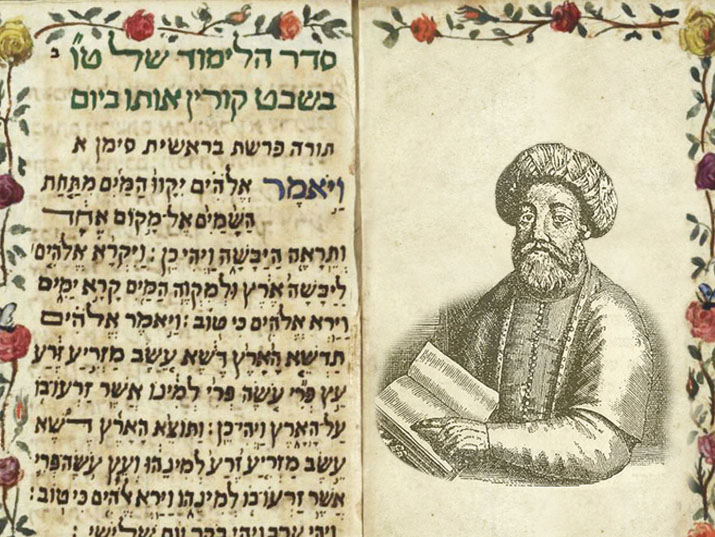
However, a closer look at the history reveals, that although some of the customs on Tu-beShevat can be traced to Hemdat Yamim the actual celebration dates much earlier. Contrary to the popular song, Tu-beShevat hegihu hag ha-ilannot, the 15th of Shevat was not a “chag” of the trees.  Instead, the earliest discussions regarding Tu-beShevat do not mention any holiday associated with the day.  The first Mishna in Rosh Hashana, identifies the 15th of Shevat as the new year for trees.  This designation merely defines how to calculate annualized tithes and is otherwise silent as to the significance of the date.  One can’t tithe fruits from one year using a different year’s fruits. Thus the 15th of Shevat is the cut-off point. [For other contemporaneous examples see Safrai, Mishnat Erets Yisrael, Mesekhet Rosh HaShana (Jerusalem:  Mehlelet Lifshitz, 2011), 305-06]. It was not until R. Gershom’s time that there were any of the traditional holiday markers, but only that fasting is prohibited.

The first mention of the custom to eat fruit and other holiday rituals appears in 16th century Machzor, published between 1548 and 1550. 

That Machzor follows the Ashkenazi rite and includes a discussion of customs according to that rite and the commentary of R. Benyamin ha-Levi Ashkenazi, Ma’aglei Tzedek. He was the rabbi of the Ashkenazi community in Saloniki (of contemporary interest is that he records the death of four of his sons during a plague).   This source, however, was not well-known, and, historically, a different, later, source is identified.  For example, Avraham Ya’ari in his otherwise comprehensive article claims that R. Issachar ibn Susan (c. 1510-1580) is the first mention.  Susan, in his Ibur Shanim, published in 1578, provides that “the Ashkenazim have the custom [on Tu-beShevat] to eat many fruits in honor of the day,” confirming the custom recorded in the Machzor.  1578 was the first authorized printing of R. Susan’s work but not the first time this custom is associated with him.  In 1564, Shlomo Rie published Susan’s Tikkun Yissachar.  (Ibur Shanim 48b and Tikkun Yissachar 62a).  Susan, in Ibur Shanim, accuses Rie of publishing an unauthorized edition, one that contains errors and unacknowledged additions by Rie. Ibur Shanim includes a corrected and otherwise only slightly modified version of Tikkun Yissachar.  [See Susan’s introduction; see also Yaakov Shmuel Spiegal, Amudim be-Tolodot Sefer ha-Ivri: Hadar Mechaber (Jerusalem, 2018), 321-22.]

Mention of this custom also appeared in a Judeo-German Minhagim book first published in 1590. “The custom is to eat many fruits as it is the New Year of the trees.”
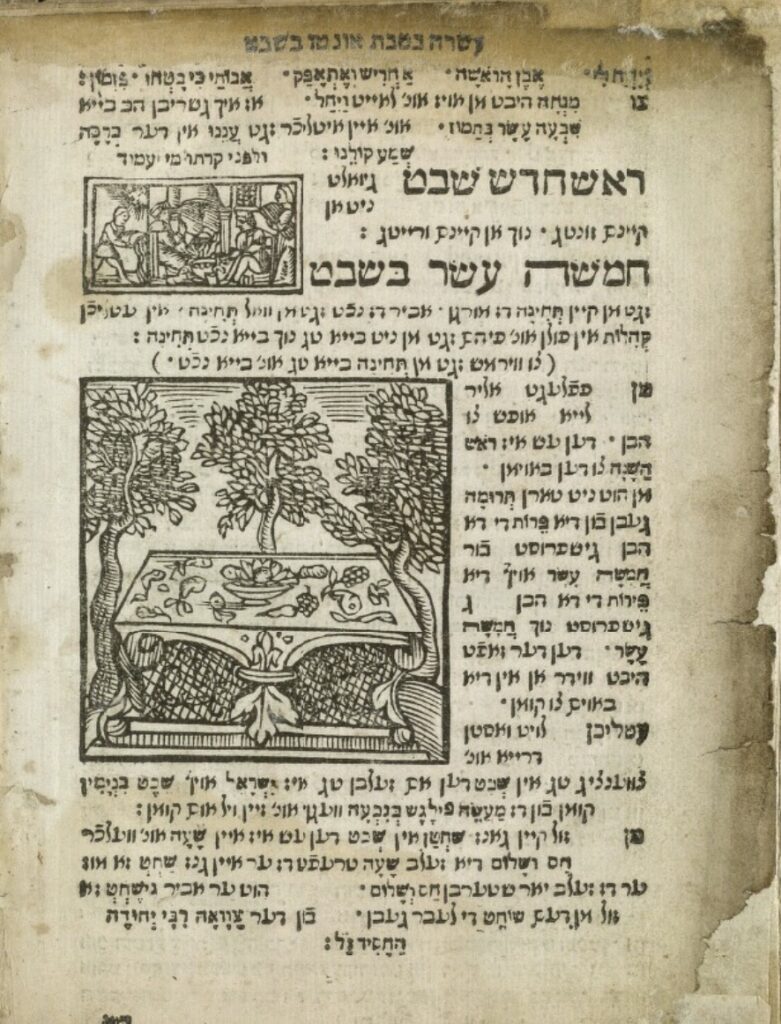
Venice, 1593 edition


In the community of Worms, there was a rather interesting variation of the custom. As R. Jousep Schammes (1604-1678) in his custom-book states:

On Purim and the 15 of Av and Shevat these were vacation days for the Rabbis, . . . [on the 15th of Shevat] one says tehina even during the morning prayer. It is a vacation day for the students and the teachers, especially the younger students, it is a day of feasting and joy for or the teachers and their students. The custom is for the teachers to distribute whiskey to the students and make merry with them.”  Minhagei [de-Kehilah Kedosha] Vermisai le-Rebi Joszpa Shamesh (Jerusalem:  Machon Yerushalim, 1988), 249-50, no. 211.

The first mention of Tu-beShevat in a Sefardic source appears in R. Hayyim Benveniste’s (1603-1673) Kenneset ha-Gedolah, first published in Livorno in 1658, where he quotes Susan from the Tikkun Yissachar.  Although Benveniste would later be associated with the Sabbatian movement, his inclusion of this custom in 1658, long pre-dates the movement. Benveniste’s source does not include a seder, nor does it testify to any adoption amongst Sefardim.

Kabbalah first enters the picture in 1728 with a somewhat obscure source. In 1728, Eliyahu Malhlenov published, Birkat Eliyahu, his commentary on the Talmud.  Amongst his papers,, he had a few pages of materials from R. Moshe Hagiz and appended those to Birkat Eliyahu. These materials include responsa and discussions regarding customs.  Hagiz records a custom from his grandfather, R. Moshe Galante.  R. Galante was also Hagiz’s teacher as his father died when Hagiz was a boy.  According to Hagiz, his grandfather had “the custom that on the 15th of Shevat he would eat many fruits that required many blessings and prayed to God that he should decree for us and them a good year. He ate the following 15 fruits, and on each one would recite … a chapter of Mishna…”  Hagiz then provides the order to eat the fruits.

Hagiz might technically be the first to describe a specific ceremony associated with eating fruits, but the source that popularized Tu-beShevat amongst Sefardim, and that incorporated a seder is Hemdat Yamim. Hemdat Yamim, first published in 1732 anonymously has the entire seder for Tu-beShevat. This includes passages from the Bible as well as specific foods. This in turn was popularized to a greater degree when it was included in the book Pri Etz Hadar first published in 1753 and republished an additional 29 times by 1959, and now digitized on Sefaria.

National Library of Israel

The author of Hemdat Yamim concedes that this is not a custom that originated with the Ari or his students.  Nonetheless, the author provides his own kabbalistic ideas and wrote his own kabbalistic prayers for the occasion, and a specific order to the ceremony.  According to many scholars, Hemdat Yamim is not reflective of the kabbalah of the Ari but that of Sabbatai Tzvi and his disciples.  Indeed, Boaz Huss has identified specific prayers in the Hemdat Yamim Tu-beShevat liturgy that allude to Sabbatai Tzvi. Whether or not this assertion is correct, because we can trace this custom, that of eating fruits, to over 100 years prior to the Sabbatian movement as already a pre-existing custom, it is likely unrelated to Sabbatian theology or custom.

Plagiarism

Avraham Ya’ari, the noted bibliographer, wrote a comprehensive article tracing the history of Tu-beShevat.  That article appeared in Machanim and is available at Daat.  This article, at times entire paragraphs, are reprinted verbatim, without any attribution, in a recent book ostensibly authored by Tuvia Freund, Moadim le-Simchah.  Published in six volumes between 1998-2010, this work is replete with such examples of plagiarism.  Here, however, Freund did something arguably even more egregious.  In the pages of materials he steals, Freund cites Yaari and his article by name.  Not for the fact that all the above material comes from there but a small tangential item, the number of times a book was printed.  Indeed, Freund is so unwilling to give Yaari any credit in a paragraph lifted word for word from Yaari, the work Hemdet Yamim is discussed.  Freund provides in a footnote, “see the long discussion regarding this work in Sefer Talmumot Sefer page 134 and on.”  Freund doesn’t reveal the author of Talmumot Sefer, who is none other than Yaari.  Freund doubly removed Yaari from the picture.


Magen Avraham

The Magen Avraham cites the Tikkun Yissachar as the earliest source for the custom to eat fruits on the 15th of Shevat.  This, despite the fact that he had accessed, and indeed quotes on many occasions, the Machzor with the Maageli Tzedek commentary. See, e.g.,

נה:יז, פח:ג, קלא:י, תכז:א, תלא:ה, תלז:יז, תכז:א, תנ:יב, תנג:יא, תקפא:ד, תקפא:ז, תקפא:ח, תקפב:ח, תקפג:ב תקפד:ג, תקפט:ד, תרכד:ז, תרכט:ה, תרנא:יט, תרנא:כא, תרנח:יב, תרסא:, תרע:ב [2X], תרעב:ה, תרעג:ז, תרפא:א, תרפח:יא, תרצ:יט, תרצא:ח

While he had access to the Machzor, he did not have access to the Tikkun Yissachar.  The Magen Avraham quotes the Tikkun Yissachar on a few occasions, but always via a secondary source. See Brodt Halachic Commentaries to the Shulchan Aruch on Orach Chayim from Ashkenaz and Poland in the Seventeenth Century (PHD Bar Ilan 2015), pp. 68-69. The Mekor Chaim in O.C. 686:1 is the first to point to the Machzor for this minhag.

The halachot in the Machzor were collected by  Yitzhak Hershkowitz ed., Maglei Tzedek (Jerusalem, 2000), pp. 156-157.  Regarding R. Benyamin see Y.S. Emmanuel, Matsavos Saloniki, vol. 1 (Jerusalem, 1973), 36, 68-69; Meir Benayahu, “Rebi Shmuel Yaffa Ashkenazi,” in Tarbiz, 42 (1973), 423-24 and note 37; M.S. Molcho, Matsevot Bet ha-Olamin she Yehudi Saloniki (Tel Aviv, 1975), 59-60; Yitzhak Rivkin, “Dikdukei Soferim,” in Kiryat Sefer 4 (1927), 278 no. 32; Daniel Goldschmidt, Mehkerei Tefillah u-Piyyut, 252-65, Meir Benayahu, Defus ha-Ivri be-Kremonah (Jerusalem, 1971), 141-78. About Knesset Hagedolah and being a Sabbatean see Brodt, Halachic Commentaries to the Shulchan Aruch on Orach Chayim from Ashkenaz and Poland in the Seventeenth Century, pp. 56; Brodt, Yeshurun 35 ( 2016 )p. 775; See also the recent work, R. Shmuel Ashkenazi, Igrot Shmuel (2021)-, 1, pp. 4-5. 

R. Shmuel Ashkenazi

As the Seforim Blog just published Iggrot Shmuel from R. Shmuel Ashkenazi (see here and here) we reprint two letters from his collection, one discussing the origins of the holiday of the 15th of Shevat and the other Hemdat Yamim.


Notes:

Additional sources discussing the 15th of Shevat, see  Meir Rafeld, Netivi Meir, (2013), 185-189; R Mandelbaum, Tehilah Ledovid (Jerusalem, 1993);  Guttman, Otzar TuBeshvat.

Tikkun Yissachar was republished in 1988 with an excellent introduction from R. Betzalel Landau.  Most recently, in 2019, it was reprinted and re-typeset, with additional notes. This edition also includes R Landau’s introduction and another introduction of material about the work. See also Elisheva Carlebach, Palaces of Time: Jewish Calendar and Culture in Early Modern Europe (London: Belknap, 2011),  51-58; יוסף הקר, ‘יששכר אבן סוסאן עליית כוהנים לתורה בשמחת חתנים’, בתוך: ‘מנחה למנחם’, קובץ מאמרים לכבוד ר’ מנחם כהן, בעריכת חנה עמית, אביעד כהן וחיים באר, ירושלים תשס”ח, עמ’ 79-97

Regarding Hagiz, see Elisheva Carlebach, The Pursuit of Heresy (New York: Columbia University Press, 1990).

After the Birkat Eliyahu was published it was attacked by some rabbis.  See Meir Benayahu, “Sefarim she-Hiburum R. Moshe Hagiz she-Hotsyim le-Or,” in Ali Sefer 4 (1977), 143, 150-52; see also Shlomo Yaakovovitch, “Sefer Shehitot u-Bedikot le-R’ Yaakov Weil,” in Tsefunot 4 (1989), 112; Carlebach, Pursuit of Heresy, 247-49. Regarding R. Eliyahu see Y. Halpern, Pinkas Vaad Arba Arotsot (Jerusalem, 1990) 362; Tzvi Horowitz, Le-Tolodot ha-Kehilot be-Polin (Jerusalem, 1989), 1.

The literature on Hemdat Yamim is substantial and we hope to return to the work in an upcoming post.  For the most recent discussion see Y. Goldhaber, “Le-Birur Zehuto shel Mehaber Hemdat Yamim,” in  Sefer Zikhoron le-Professor Meir Benayahu, vol. 2 (Jerusalem: Karmel, 2019), 873-908.

Huss’s article appears as Boaz Huss, “Ha-Ets ha-Nehmad ben Yishi Hayi al ha-Adama: al Mekoro ha-Sabbatai shel Seder 15 Shevat,” in Sefer Zikhoron le-Professor Meir Benayahu, vol. 2 (Jerusalem: Karmel, 2019), 909-20.


Lag B’Omer through the eyes of a Litvak in 1925

Lag B’Omer through the eyes of a Litvak in 1925[*]
By Shimon Szimonowitz


Dov Mayani (1903-1952)

A Static and Evolving Chag

Lag B’Omer has infiltrated Jewish culture as a bona fide holiday. While the day is celebrated throughout the Jewish world, it tends to take on added significance in Eretz Yisrael. This age-old disparity has seen a little easement, probably as a result of enhanced communication between the Promised Land and the rest of the world, but the difference is still obvious.

R. Chaim Elazar Shapira of Munkács[1] (1868-1937) states, as a point of fact, “It has been the custom for hundreds of years in the holy land, especially in Meron, to make se’udos accompanied by dancing and music on Lag B’Omer. He goes on to state that conversely, in Chutz L’Aretz, although Chasidim do make Se’udos, “to also have music and dancing as in Meron would be very bizarre[2] since it is not practiced in our lands.”[3] There is no question that a lot has changed since the publication of that Teshuva in 1922.[4]

The purpose of this article is to travel back in time and view Lag B’Omer through the eyes of a Lithuanian Yeshivah student studying in the Chevron Yeshivah in 1925. By comparing his attitude to the festivities to the ones prevalent currently, we can bear witness to the evolution that Lag B’Omer has undergone outside of Eretz Yisrael in the last hundred years. At the same time, it will underscore how little it has changed in Eretz Yisrael.

On his first Lag B’Omer in Eretz Yisrael,[5] in May of 1925, Dov Mayani (1903-1952)[6] penned a letter[7] to his close friend Ari Wohlgemuth[8] who was in Europe at the time.[9] In exquisite prose,[10] Mayani vividly describes the Lag B’Omer celebration in Eretz Yisrael. One can sense surprise and even a measure of bewilderment which Mayani in turn thought he would provoke in his friend back home as well.

Dr. Joseph Wohlgemuth – Ari’s father

On one hand, we see from this letter that very little has changed in almost a century regarding how Lag B’Omer is celebrated in Eretz Yisrael. On the other hand, we see how much has changed in the rest of the world. Today we are accustomed to the festivities in Meron and we see similar events taking place all over, even outside of Eretz Yisrael. What was entirely novel to a Lithuanian Yeshiva student and his German counterpart in 1925 has now become the norm in many circles.

The letter includes many other interesting and valuable tidbits of information regarding the Chevron Yeshiva,[11] but for the purpose of this article we will focus only on the portion concerning Lag B’Omer.

Presented below is a translation of said excerpt of the letter.


The letter

B’Ezras HaShem, Chevron Ir HaKodesh Tibaneh V’Sikonen, Tuesday- Behar Bechukosai

Chavivi!

[Following several handwritten pages concerning various important matters, Mayani continues…] Now I will write to you about our life [in Chevron] … Let me now go over to lighter matters.[12] Today is Lag B’Omer. Today is the day that the entire Yeshiva was desperately[13] waiting for, since they are now able to remove the mask[14] of hair which was covering their faces. You should know that here [in Eretz Yisrael] there are more stringent customs. Starting from Pesach, no man may raise a hand to touch his beard.[15] [The beard] grows and increases until it matures; the hair sprouts and there is no respite from it.[16]  Picture for yourself, that even mine [=my beard] got big and wide, and I already have an idea what I will look like in the future.

Dov Mayani with his friend Yitzchak Hutner in 1928

Rabbi Dov Mayani in his later years

And now on to the topic of the fires… You should know that here there is a custom of lighting a bonfire on Lag B’Omer. And what do they do? They light a bonfire and all the people of the moshav gather next to it and they sing and dance. The source of the custom seems to be in Kabala but it used to have a different character.[17]

Lag B’Omer is the Hilula [lit. a celebration] of Rabbi Shimon Bar Yochai, the anniversary of his death. It is brought in the Zohar that his disciples would come to his grave and light candles in his memory and they would spend the day as a quasi-holiday.[18] The Mekubalim in the days of the holy Ari z”l [R. Yitzchak Luria (1534-1572)] renewed the custom and through the influence of Chasidim and their entire sect[19] it was adopted by the entire nation. It is self-understood what kind of form it has already taken on by now…

On the day [of Lag B’Omer] they gather from the entire land [Eretz Yisrael], mostly from the Chasidim, Sefardim, and the Bucharim, at the grave of Rabbi Shimon Bar Yochai in Meron, near Tzefas, and they make a big fire and they light candles and oil; all that they can get their hands on.[20] They throw all kinds of clothes into the fire, expensive items, and notes with requests on them.[21] This custom, although opposed by many of the Gedolim, still remained strong, and the masses believe in it and in its powers[22] It used to be a Yom Tov of Chasidim and Anshei Ma’aseh, but now it has the character described above, and it is certainly not appropriate to be excited about it.

From all corners of the Land, they come with their sick children, and with the young ones which are to get a haircut for the first time[23] and the hair is then thrown into the fire etc. They break out in dances and circles.[24] In short, these festivities are celebrated with magnificence and splendor.[25]

Lighting of smaller fires is also done throughout the land. In Chevron the townspeople made a fire last night and they invited the entire Yeshiva. The Hanhala [management] of the Yeshiva itself with the Rav [Rabbi Moshe Mordechai Epstein (1866-1933)] at its helm didn’t respond to the invitation at all, and declared that it totally doesn’t recognize it [= the festivities]. But many of the Yeshiva students came to see, and I[26] too was among the onlookers.

They went climbed up on to the roof after Ma’ariv and lit a large bonfire at the center and sang a Chasidic song. The students of the Yeshiva joined in spontaneously and many of them danced around the fire. It was an amazing sight, albeit a bit wild and lacking Jewish flavor. In didn’t find favor in my eyes at all, but it was interesting to watch.

Mainly it was a Chag for their children[27] who went around with fireworks[28] in their hands and with beaming and shining faces.

Analysis

[1] “…here there are more stringent customs…”

Mayani comments that in Eretz Yisroel there are more stringent customs regarding shaving during Sefirah. In HaHar Hatov (p. 49) it is suggested in a footnote that it can be deduced from this comment that in Berlin [whence Wohlgemuth hailed] they were lax regarding the customs of the Sefirah days.

I believe this to be in error. It seems that Mayani was referring to the difference in custom between Lithuania and Eretz Yisroel. In Lithuania, religious Jews refrained from shaving only from Rosh Chodesh Iyar until Lag B’Omer [18 days] and then again from Lag B’Omer until the Sh’loshes Yemei Hagbala [13 days], thus never allowing the beard to grow too long. See Aruch HaShulchan (493:6) where he confirms this to be the custom in Lithuania”.[29] In Eretz Yisrael, the Yeshiva students felt compelled to conform to the local custom which was to observe Sefirah from Pesach until Lag B’Omer. Since they couldn’t shave from Erev Pesach, it forced them to grow their beard for twice as long as they had been accustomed to in Europe.

Regarding laxity with Sefirah, R. Eliezer Brodt pointed me in the direction of a letter dated May 10, 1938, in which Ernst Guggenheim, a French Yeshiva student who traveled to study in the Yeshiva in Mir, reports “everyone has a dirty beard, but in other yeshivot, like the one in Brisk, for example, the whole Yeshiva, with the Rosh Yeshiva in the lead, shaves during this period” (Letters from Mir: A Torah World in the Shadow of the Shoah pp. 127-128). Guggenheim writes again about his beard on May 29th (ibid p. 137) “I wear a quite gorgeous beard at this moment, six-week-old and cleaned on Lag B’Omer. It’s not simply a piece around the chin, but a collar à la Hirshler before he trimmed it. Moreover, soon I will make it disappear even though it is already popular at the Yeshiva.” See Nefesh HaRav p. 191.

[2] “Lag B’Omer is the Hilula of Rabbi Shimon Bar Yochai, the anniversary of his death”

Lag B’Omer is not mentioned anywhere in the Mishnah or Talmud. An early reference to it can be found in the name of R. Zerachya HaLevi of Gerona (c. 1125-1186). Accordingly, R. Zerachya was in possession of an old Sephardic manuscript of the Talmud which alludes to the fact that Rabbi Akiva’s disciples ceased to die on that date.[30] R. Menachem HaMeiri (1249 – 1306) is probably one of the earliest sources to explicitly mention the day of Lag B’Omer. [31] Despite that fact that these Provencal sages[32] do mention this day as the end of the mourning period, they do not mention it as a reason to celebrate it in any shape or form.

There is also very little in the classical Poskim regarding the origins of Lag B’Omer. R. Moshe Isserls (1520-1572), based on Maharil, simply states that one must ‘celebrate a bit’[33] on Lag B’Omer.[34] The Vilna Gaon (1720-1797) indicates that the reason for celebration is the fact that the disciples of Rabbi Akiva ceased to die on that day.[35] This would also appear to be the reason given by the Maharil. The problem is, as pointed out by R. Aryeh Leibish Balchubar (1801-1881), that the reason they stopped dying is because there were none left. Why would this be a reason to celebrate?[36]

R. Avraham Gombiner (c. 1635-1682) relates in the name of R. Chaim Vital (1542-1620), that someone once said Nachem [a prayer with an expression of mourning] on Lag B’Omer and was punished.[37] It would seem that this event was unrelated to Rabbi Shimon Bar Yochai or his place of burial. R. Aaron Alfandari (c. 1700–1774) questions this omission and points out that the reason why the man was punished is only because he said Nachem on the Hilula of Rabbi Shimon bar Yochai and not because it was Lag B’Omer… if it was because of Lag B’Omer”.[38] R. Menachem Mendel Auerbach (1620-1689) prefaces the abovementioned story by saying that it is the custom in Eretz Yisrael to visit the graves of Rabbi Shimon and his son Rabbi Elazar on Lag B’Omer. He identifies the anonymous man mentioned by R. Gombiner as a Rabbi Avrohom HaLevi, and adds that R. Yitzchak Luria delivered a message from Rabbi Shimon bar Yochai to R. Avrohom HaLevi, that the latter is going to be severely punished for saying Nachem on the day of “my happiness”.[39]

Regarding R. Alfandari’s argument that Lag B’Omer was not the reason for R. Avrohom Halevi’s punishment, but rather due to the Hilula of Rabbi Shimon bar Yochai, R. Chaim Yosef Dovid Azulai (Chida, 1724-1806) suggests that Lag B’Omer and Hilula of Rabbi Shimon are one and the same. In other words, the source of celebration on Lag B’Omer was the fact that it was the Hilula of Rabbi Shimon. Still, R. Alfandari viewed these as mutually exclusive. In any event R. Azulai also concedes that the opposition to saying Nachem was confined to the place of Rabbi Shimon’s burial. Interestingly enough, R. Azulai ends his remarks by praising R. Gombiner’s ambiguous wording since it leads to what he sees as a positive conclusion, that one should celebrate on Lag B’Omer regardless of whether he is at the gravesite of Rabbi Shimon or not. He merely points out that the intensity of the celebration is greater near the gravesite.

Although we now know that Lag B’Omer is the Hilula of Rabbi Shimon, we are still left in the dark regarding the exact reason for celebration. The most popular explanation is the one which Mayani mentions here, that it was the anniversary of Rabbi Shimon’s death. R. Azulai mentions this possibility, but elsewhere in his writings he questions it. R. Dovid Avitan in his notes on the Birkei Yosef, argues that R. Azulai’s conclusion was that it was not the anniversary of Rabbi Shimon bar Yochai’s death. This is corroborated by a more reliable manuscript of R. Shmuel Vital’s (1598 – 1677) writings. Instead R. Azulai suggests that perhaps Lag B’Omer was the day that Rabbi Shimon began studying Torah at the feet of Rabbi Akiva.

Lag B’Omer has confounded many halachic authorities throughout the generations.[40] For a more comprehensive treatment of this subject, the reader is referred to R. Eliezer Brodt’s Seforim Blog article: http://seforim.blogspot.co.il/2011/05/printing-mistake-and-mysterious-origins. and for a great lecture on the subject, Professor Shnayer Leiman’s the strange history of Lag B’Omer is strongly recommended.

[3] “…at the grave of Rabbi Shimon Bar Yochai in Meron, near Tzefas…”

It is safe to say that nowadays the name Meron garners instant recognition among most religious Jews. Yet in 1925 this was apparently not the case. Mayani felt compelled to identify Meron as being situated “near Tzefas.” The Chasam Sofer, in his teshuva about the Lag B’Omer festivities, writes that “they gather from all over in the holy city of Tzefas to celebrate the Hilula of Rabbi Shimon bar Yochai”.[41] Throughout the entire Teshuva he fails to mention Meron by name. While it is true that in those days they would gather from all over the Land and converge in Tzefas and then go on to Meron, as recorded by Rabbi Menachem Mendel of Kaminetz (1800-1873) in his Koros Ha’itim, it is still noteworthy that the Chasam Sofer does not mention the name of the town. When discussing the custom of gathering in Meron on Lag B’Omer, R. Aryeh Leibish Balchubar also feels a need to add that this takes place in the village Meron “which is near Tzefas”.[42]

[4]They throw all kinds of clothes into the fire, expensive items… opposed by many of the Gedolim…”

The custom of throwing expensive clothes into the fire in honor of Rabbi Shimon is well documented. One of the earliest descriptions available is found in a letter written by a student of R. Chaim Ben-Attar (1696-1743) in which he writes that R. Chaim went to Meron the day after Purim of 1742 and “lit many clothes” in honor of the Tanna.[43] R. Menachem Mendel of Kaminetz (1800-1873) is an early eyewitness who describes how this was practiced on Lag B’Omer itself. He relates that they would sell the honor of igniting the fire for a large sum of money and the one who bought it would take a large scarf in good wearing condition, light it, and throw it into a bowl of oil. Additional historical accounts of burning clothes are compiled in the introduction to the 2011 edition of R. Shmuel Heller’s Kevod Malachim.

This custom merited the ire of R. Yosef Shaul Nathanson (1808–1875). In a Teshuva concerning an event that took place in 1842, R. Nathanson writes that he has a lot to say about the custom of burning clothing in honor of Rabbi Shimon on Lag B’Omer. He maintains that “they are transgressing the prohibition against wasting[44]  and are engaging in superstitious practices[45] which are forbidden”. He adds that this custom was obviously not practiced in the days of the Ari z”l and he is certain that R. Yosef Karo would not have allowed it. R. Nathanson ends off by saying that he guarantees that if they were to take all that money [wasted on the burning of clothes] and use it to support the poor of Eretz Yisrael, Rabbi Shimon bar Yochai would derive much more pleasure from it.[46] These very sentiments are also expressed by the Sephardic Rishon L’Tzion, R. Rafael Yosef Chazan (c.1741 – 1820).[47]

In 1874 the Chief Rabbi of Tzefas, R. Shmuel Heller (1803-1884), authored a pamphlet named Kevod Malachim, in which he vehemently defended this practice and thereby encouraged its continuation despite of the abovementioned opposition. For a more comprehensive treatment of this fascinating subject, the reader is referred to Prof. Daniel Sperber’s Minhagei Yisroel vol. 8 pp. 72-83.

It is also possible that Mayani was referring to the Teshuva of R. Moshe Sofer (1762–1839) in which he takes issue in general with the festivities in Meron. According to R. Moshe Sofer, turning a day on which no miracle occurred into a Chag, constitutes a transgression of the commandment against adding to the Torah.[48]  Allusion to the lighting of the fires is treated with similar disapproval.[49]


Kever of Rabbi Shmuel Heller

[5] “It used to be a Yom Tov of Chasidim and Anshei Ma’aseh…”

Mayani obviously did some research on Lag B’Omer. In a letter dated April 25, more than a week before Lag B’Omer, he writes:

Here in the Land, Lag B’Omer, the anniversary of the death of Rabbi Shimon bar Yochai and many of his disciples, is a great Chag for the people of the Yishuv. Originally it was [intended] only for the Talmidim and people of a high caliber, but now ‘that there are scarcely any men of high caliber and there is an influx of big-mouths and strongmen’, it has lost it pure character. I heard from people in Jerusalem that very few of the very pious[50] visit the village of Meron on that day.[51]

This sentiment that Lag B’Omer used to be celebrated in a more spiritual manner in earlier times is found in some other sources as well. Among others, R. Nathanson (שואל ומשיב מהדורה חמישאה סימן לט) argues that in all probability back in the days of the Ari z”l, they would only learn by the graveside of Rabbi Shimon and recite prayers so that he should awaken the mercy of Heaven.

[6] “…sang a Chasidic song…”

From his letter one gets the sense that Mayani was a bit prejudiced against chasidim as was typical of a Lithuanian Misnaged. This happens to be far from the truth. On his farewell trip leaving Europe he stayed by a Chasid who was an Agudah leader and in addition to discussing with him Torah topics, Dov Mayani learned many Modzhitzer Nigunim during his stay. According to his daughter this encounter made a deep impression on Mayani’s musical style.[52] She also says that in general her father had an affinity toward Chasidus.[53]

Nevertheless, Mayani can be critical at times of what he called a “Chasid Shoteh”. In a letter describing his fellow passengers on the boat trip to Eretz Yisrael, Mayani describes a Belzer Chasid whose entire Judaism was encompassed in his sidelocks, his beard, his long gabardine, despised Lithuanians, and minimized interaction with any other kind of people (תמצא לו החברה חסיד בלזאי שוטה, אשר כל יהדותו בפאותיו וזקנו וקפוטתו תלויות, ושונא הליטווקים תכלית שנאה וממעט מכל שיח ושיג עם אנשים אחרים.). On the other hand, in that same letter, he describes a Chasid of Chabad in glowing terms, as someone he considers to be a Lamdan and an important man… (גם חסיד ליטאי, מחסידי חב”ד איש למדן וחשוב בעירתו אשר ירד מגדולתו ועשרו לרגל המלחמה ובעוד כוחו עמו עולה לארץ ללמד בה ולהאחז בה).

Later in his life he came even closer to Chasidus. His daughter Rivka states that despite his Lithuanian upbringing and education, her father possessed a Chasidic soul.[54] He especially appreciated the emphasis placed on music. In his later years, he became close to some Chasidic leaders such as R. Yisrael Alter (1895-1977) and R. Simcha Bunim Alter (1898-1992). He was even asked by the latter to deliver sermons in the Gerrer Yeshiva in Tel Aviv in 1941. He also forged a close relationship with R. Chaim Meir Hager of Viznitz (1887-1972) and Reb Arele Roth of Jerusalem (1894-1947), and even prayed with a Gartel given to him by R. Hager.[55]

[*] I would like to express my appreciation to Professor Shlomo Tikochinsky (See note below) and my friend Eliezer Brodt for providing me with important sources for this article. A tremendous debt of gratitude is owed to my mother for spending her precious time editing this article. I also need to mention my friends R. Eli Reisman and Binyamin Steinfeld for reviewing this document and offering insightful edits that have been incorporated in the final version. Many thanks also go to R. Shaul Goldman for reviewing it and contributing to its style and final form.
[1]  חלק ג סימן ס
[2] “כזרות יחשב”
[3]
“כיון שזהו אינו נוהג פה במדינתנו”
[4] Here the present Munkatcher Rebbe can be seen lighting a Lag B’omer fire and dancing in front of it. This is a clear deviation from the teshuva of his Grandfather, the Minchas Elazar. While one can be sure that he found good reason to institute the change, for our purposes this observation helps document the evolution of the Chag.

The same change has recently been observed in Satmar. The present Satmar Rebbe of Monroe is on record for having once spoken out against bonfires on Lag B’omer in Chutz La’aretz, saying that they are against the custom, yet he later reversed himself and instituted perhaps the biggest bonfire festivity outside of Eretz Yisroel. See here for more details and for a link to his original speech against bonfires. See also חידושי תורה מהר”א ט”ב תשס”א אמור/ל”ג בעומר p. 194 where the Rebbe writes:

וזה הענין מה שנוהגין גם בחוץ לארץ להדליק נרות ומאורות בלילה הזה…

[5] He arrived in Eretz Yisrael on the tenth day of Shevat 5685 (February 4th 1925).
[6] He was born Dov Karikstansky. In Yeshiva, he was nicknamed ‘Berel Grodner’ after his hometown Grodno. Shortly after arriving in Eretz Yisrael he Hebraized his surname to Mayani. See אעברה נא p. 71 for the story behind the name change.[7] The letter was transcribed in its original Hebrew and published by his daughter Rivka Monowitz in the digital supplement to her אעברה נא, called ההר הטוב. The letter begins on p. 46 of ההר הטוב. Pictures of the original letter were supplied to me by Professor Shlomo Tikochinsky who transcribed the letters published in ההר הטוב. Almost the entire portion of the letter presented here also appears in the original Hebrew in Tikochinsky’s latest and most fascinating book, למדנות מוסר ואליטיזם p. 243. Prof. Tikochinsky was also kind enough to supply me with the pictures of Dov Mayani.
[7] Ari studied together with Dov at the Slobodka Yeshiva in Europe. Later they studied together at the Berlin seminary where they both became attached to the legendary Rabbi Avraham Eliyahu Kaplan. Ari was from Berlin, where his father Dr. Joseph Wohlgemuth served as a professor of Talmud and Jewish philosophy at the Rabbinical Seminary. The younger Wohlgemuth was constantly struggling to reconcile his “Yekkeshe” upbringing with his Eastern European Lithuanian Mussar education. In this matter Dov and Ari were soulmates who worked together to synthesize these two different worlds. (See אעברה נא p. 127)
[8] Ari studied together with Dov at the Slobodka Yeshiva in Europe. Later they studied together at the Berlin seminary where they both became attached to the legendary Rabbi Avraham Eliyahu Kaplan. Ari was from Berlin, where his father Dr. Joseph Wohlgemuth served as a professor of Talmud and Jewish philosophy at the Rabbinical Seminary. The younger Wohlgemuth was constantly struggling to reconcile his “Yekkeshe” upbringing with his Eastern European Lithuanian Mussar education. In this matter Dov and Ari were soulmates who worked together to synthesize these two different worlds. (See אעברה נא p. 127)
[9]
We can assume that Ari was in his native Germany at the time. One can also glean this information from the last few lines of this letter. Dov writes to Ari that he and another student at the Yeshiva were debating whether Graetz’ book ‘Geschichte der Juden’ [History of the Jews] begins with the Exodus or only after Joshua conquered Eretz Yisroel. Dov says that he remembers reading a half a year ago in a Russian translation of the book about the Exodus, but his friend insists that the book only begins after they entered Eretz Yisroel. He asks Ari to take a look at the book and let him know who is right. It would seem that since Ari was in Berlin he was in the position to easily look up the answer.

For the benefit of the curious reader, it is worth noting that there was merit to both sides of the argument. Graetz begins with the crossing of the Jordan, but then goes back to describe the Exodus. See here.
[10] The letter was written in beautiful Hebrew. It is quite amazing that a Yeshiva student in 1925 mastered Modern Hebrew. See אעברה נא p. 34 for a discussion regarding how Mayani mastered the relatively new language.
[11] There are many interesting parts to the letter, but it is worth mentioning in particular Mayani’s description of Rav Isser Zalman Meltzer’s (1870 – 1953) visit to the yeshivah. Rav Isser Zalman was a brother-in-law of the Slobodka Rav and Rosh Yeshiva, Rav Moshe Mordechai Epstein. Mayani writes that Rav Isser Zalman came to spend the weekend in the city of Chevron to which his brother-in-law had just relocated from Slobodka. He describes an exciting shiur which Rav Isser Zalman delivered on Sunday. He adds that Rav Isser Zalman is a more outstanding Magid Shiur [ר”מ יותר מצויין] than his brother-in-law Rav Moshe Mordechai. He also praises Rav Isser Zalman’s personality by noting that he is a very gentle sweet person with a young spirit which draws his students. Mayani also shares that Rav Isser Zalman had a Yahrtzeit and davened all the Tefillos for the Amud. One cannot help but smile while reading that the musical Mayani admits that he “begrudgingly” (בדיעבד שבעתי מזה רב רצון) immensely enjoyed Rav Isser Zalman’s davening.
[12]
Earlier in the letter Mayani tells Wohlgemuth about how he spent the “יום הזכרון” dedicated in memory of their joint Rebbe, the legendary Rav Avraham Eliyahu Kaplan. In spite of the fact that the Alter of Slobodka had an unspoken agreement with Rav Avraham Eliyahu that the latter was not to attract Slobodka students to the Berlin Seminary, Mayani was attracted to R. Kaplan when he visited Slobodka and subsequently joined R. Kaplan in Berlin. This went against the Alter’s view that the Seminary was only for German-born students who grew up with a “Torah im Derech Eretz” upbringing. See אעברה נא p. 45.
 [13] “בכיליון עיניים”
[14] “מעטה”
[15] “לנגוע בזקנו”
[16]

Utilizing a clever play on the words of the prophet Yechezkel (16:7), Mayani writes:

“ויגדלו וירבו ויבואו בעדי עדים, השער צמח ואין נגדו עזרה”

[17] “ואף צביון לגמרי אחר היה לו”
[18] “ומא דפגרא”
[19] כת was a derogatory term used by Misnagdim when referring to Chasidim.
[20] “ל אשר ידם מגעת”
[21] “ופתקאות בקשה”
[22] “סגולות”
[23] This custom has many sources and is beyond the scope of this article.
[24] “מחול”
[25] “פאר והדר”
[26] “אני הקטן”
[27] In many sources, Lag B’Omer is described as a day focused on children. Among others see Minhagim of Worms (מנהגי וורמיישא ח”א אות צה וח”ב עמוד קע”ה) were it is described as a relaxed day in which the teachers provide their students with goodies.
[28] In the source, it says אבוקות קטנות – “Feuerwerke”. In HaHar Hatov it is mistakenly transcribed as “Feueraserke”.
[29] וכן המנהג שלנו.
[30] See Sefer HaManhig הלכות אירוסין ונישואין סימן קו.
[31] בית הבחירה יבמות סב, ב וע”ע תשב”ץ חלק א סימן קעח.
[32] R. Zerachya, Me’iri, Sefer Hamanhig were all from the Province. See also Kaftor V’Ferach (פרק ז עוד בענין טבריה) where another Provincial sage mentions Lag B’omer as the end of the mourning period.
[33] מרבים קצת שמחה ואין אומרים תחנון.
[34] רמ”א סימן תצג סעיף ב.
[35] ביאור הגר”א שם ד”ה ומרבים.
[36] שו”ת שם אריה סימן יד.
[37] מגן אברהם שם סעיף ב.
[38]  יד אהרן שם.
[39] עטרת זקנים שם.
[40]
R. Yosef Shaul Nathanson (שואל ומשיב מהדורה חמישאה סימן לט) questions why one would celebrate the anniversary of a Tanna’s death. He points out that on the anniversary of Moshe Rabbeinu’s death on the seventh of Adar it is customary to fast, so why would we celebrate on the anniversary of Rabbi Shimon’s death:

תמהתי דהרי אדרבא במות צדיק וחכם יש להתענות ואנו מתענין על מיתת צדיקים ואיך נעשה יום טוב במות רבינו הגדול רשב”י ז”ל ובמות מבחר היצורים משה רבינו ע”ה אנו עושין ז’ אדר בכל שנה ואם הזוהר קרא הלולא דרשב”י היינו לו שבודאי שמחה לו שהלך למנוחה אבל אותנו עזב לאנחה.

R. Aryeh Leibish Balchubar (שו”ת שם אריה סימן יד) penned a responsum in which he criticized the “newfangled” custom of turning a Yahrtzeit into a day of celebration. He insinuates that the Chasidim are responsible for what he sees as a deviation, and he chastised them for doing so:

בימים ההם ובזמן הזה החלו בני עמנו במקצת מחוזות, כמו וואלין פאדליא אוקריינא ועוד, לשלוח ידם במנהגים שנהגו בהם אבותינו ואבות אבותינו מעולם.. ועתה באתי לדבר על מה שכתב הרמ”א ביורה דעה ס”ס ת”ב בשם הרבה פוסקים קדמונים שמצוה להתענות יום שמת בו אביו או אמו… ומשנים קדמוניות נהגו כן כל מדינתנו והוא מנהג וותיקין שנתיסד מקדמונים ואין אדם רשאי לבטלו אם לא ע”פ אונס.

R. Balchubar writes that the Chasidim bring proof from the celebrations on Lag B’Omer that a Yartzeit is a cause for celebration. As can be expected he rejects their claim, by saying that it is not the reason why we celebrate Lag B’Omer:

ואומרים כי חלילה להתענות ביום מיתת הצדיק רק מצוה להרבות בשמחה וראייתם ממה שמרבים בשמחה בל”ג בעומר על קרב הצדיק בוצינא קדישא רשב”י כידוע שמתאספים שמה מכל הארצות ומדליקים שם הדלקות ומאורות רבות וששים ושמחים במקום מנוחתו בכפר מירון הסמוך לצפת. ואומרים בתר רשב”י אנן גררינן וממנו אנו לומדים לעשות כן להצדיקים האלה הקדושים אשר בארץ. ומה שנהגו עד כה להתענות ולהתאבל ביום זה, הוא נתקן רק לפני אנשי ההמון ואנשים פשוטים אשר צריכים להתאבל במיתתם, לא הצדיקים והחסידים המפורסמים אז הוא יום שמחתם כידוע מהמעשה בכתבים ובמגן אברהם וכו’ ומזה נתפשט המנהג הרע הזה כמעט בכל האנשים כי כל אחד יאמר אבי היה צדיק וחסיד וכו’ וכדי לבטל פטפוט דבריהם ושיחה בטלה שלהם נגד תורה שלמה שלנו…

After rejecting the possibility that a Yahrtzeit is a reason for celebrating, R. Balchubar continues with a lengthy discussion regarding the cause for celebration on Lag B’omer.
[41] שו”ת חתם סופר יורה דעה סימן רגל
[42] שו”ת שם אריה סימן יד
[43] אגרות ותשובות רבינו חיים בן עטר אגרת ז’
[44] בל תשחית
[45] דרכי אמורי
[46] שואל ומשיב מהדורה חמישאה סימן לט
[47] חקרי לב מהדורה בתרא יורה דעה סימן יא
[48] בל תוסיף
[49] שו”ת חתם סופר יורה דעה סימן רגל
[50] היראים
[51] ההר הטוב עמ’ 43-44.
[52] אעברה נא עמ’ 58
[53] שם עמ’ 63
[54] היה בעל נשמה חסידית
[55] אעברה נא עמ’ 262-263


Tu Bishvat and The Symmetry Between Aesthetics and Eros

Tu Bishvat and The Symmetry Between Aesthetics and Eros
Based on a homily by R. Hayyim Elazar Shapira of Munkacz (1872-1937)[1] in Sha’ar Yessakhar, volume 2, p. 481-482 Translation[2] and Commentary by Shaul Magid

Professor Shaul Magid is the Jay and Jeanie Schottenstein Chair of Jewish Studies at Indiana University. This text was originally prepared for a text-study at a Tu Bishvat Seder at Temple Emunah in Lexington, MA on January 27, 2002. Sincere thanks goes out to Gloria Greenfield for her organizing the seder and for co-producing a beautiful Tu Bishvat Haggadah of which this was a part. Special thanks to the editors (and readers) of the Seforim blog for their gracious consideration of this essay. Professor Magid’s most recent book is Hasidism Incarnate Hasidism: Christianity, and the Construction of Modern Judaism (Stanford University Press, 2015), and his previous post at the Seforim blog is entitled: “‘Uman, Uman Rosh ha-Shana’: R. Nahman’s Grave as ErezYisrael”.

TEXT: In his collected sermons Bnei Yesakhar, Rabbi Zvi Elimelekh of Dinov (d. 1829)[3] mentions a rabbinic tradition that one should pray for a beautiful etrog on Tu Bishvat. Examining this custom, he invokes another rabbinic dictum stating that “the way of man (ish) is to pursue a woman (isha).” The word ish (man) shares the same numerical value as the word Shevat (311). Woman in this passage corresponds to the etrog because the etrog is the only one of the Four Species (lulav, aravah, hadasim, etrog) taken on Sukkot that carries the feminine gender in Hebrew. The mystical tradition also holds that the etrog represents the sephirah Malkhut (the feminine recipient of the other three Species). We can now re-read R. Zvi Elimelekh’s insight into the first rabbinic citation in light of the second. “It is the way of man” that is, the
essence of the month of Shevat, “to pursue a woman” i.e., a beautiful etrog.[4]
It is also the custom on Tu Bishvat to eat various types of fruit accompanied by the appropriate blessing “Borei Pri Ha-Etz” (Who blessed the fruit of the tree).[5] The Bnei Yesakhar interprets this custom in the following manner. Tu Bishvat falls exactly forty days before the creation of the world (according to the opinion of Rabbi Yehoshua that the world was created in Nisan and not in Tishrei). When God decided (“when the ThoughtWill went up in His Mind”) to create the world, this creative process began forty days before the actual creation.[6] The letters of the word “will” (razon) (RZN) are also the letters of the word “conduit” (zinor) (ZNR) as the Kabbalists noted. This means that the (idea of creation) descended through the Primordial Divine body (from the Mind, the sephirah Da’at- the source of the Will) through the spinal column (zinor) until it reached Yesod (the organ of creation). The blessing “Borei Pri Ha-Etz” occurs in Yesod (as it celebrates the fulfillment and telos of the fruit).[7] We have another tradition from the zaddikim that Tu Bishvat is a time for pro-creation in that it is a cosmic time when the willful act of creation begins in the Divine Mind.
COMMENTARY: Both of these short readings are focused on the attempt to integrate aesthetics and Eros as the two fundamental parts of the holiday of Tu Bishvat. Before pursuing a more detailed analysis of how this synthesis works, it should also be noted that the entire mystical, cosmic and psychic narrative that constitutes Hasidic discourse is rooted here in acute sensitivity to the changing natural environment. The mystics (including the Sabbateans, who were most probably the originators of the ritual of the Tu Bishvat Seder so common in popular Judaism in the late 20th century)[8] were very attuned to the changing hues of their environment and viewed this natural shift as responding to and reflecting the ever-changing cosmic world.
In our texts Tu Bishvat represents the Origin before the Beginning. That is, it marks the moment in the cyclical cosmic calendar when the Divine Will is conceived, initiating a process in the highest realm of the Godhead (the Divine Mind), which emanates and subsequently culminates in creation. The emulation of this process through human copulation and its cyclical manifestation in Tu Bishvat requires a closer look at the relationship between the aesthetic and the erotic in the Jewish mystical imagination. Our first text teaches that the innate human “will” toward Eros is a reflection of the aesthetic appreciation of nature by juxtaposing the prayer for an etrog on Tu Bishvat with the innate human need for conjugal union. “The way of man is to pursue a woman,” offers an opinion on the nature of human sexuality, however problematic such an assertion may be.[9]
The etrog stands out in the biblical and rabbinic tradition as one of the only religious objects (hefez shel mitzvah) where the aesthetic value of the object is the basis of its religious status (i.e., its kashrut). The etrog as a religious; object requires our aesthetic sense and appreciation because the viability of an etrog for ritual use demands that it is beautiful to its owner. This is the notion of hidur as a requisite category for the etrog. This is derived from the biblical description of the etrog as Pri Etz Hadar.[10] This Hasidic text suggests a correlation between the Eros of human sexuality and the aesthetic sensitivity required to use an etrog. Tu Bishvat is the time of year when the fragrance of spring, the colors of new life and the lengthening of days arouse both our artistic and romantic natures. As mentioned above, the mystics viewed the environmental transformation and its effect on human beings as having its roots in the cosmic realm. The expression of this correlation is accomplished by invoking the aesthetic appreciation of mitzvah (etrog) with the erotic realm sense necessary for creation/creativity.
The second text extends the central idea of beauty as creativity/creative-ness by viewing Tu Bishvat through the lens of the rabbinic disagreement on the date of creation. This is based on two oft-quoted rabbinic dicta. The first is the debate between R. Eliezer and R. Joshua as to whether the world was created in Nisan or Tishrei. The second is the statement that the human embryo is only ensouled 40 days after conception. R. Hayyim Elazar Shapira suggests that these two rabbinic dicta can aid in explaining the concealed nature of this apparently minor festival that, while mentioned in the Mishna (Tractate Rosh Ha-Shana 1:1),[11] has never resulted in any significant ritual activity until the 16m century.[12]
The initial forty-day period of gestation in the embryo before ensoulment is mystically rendered as simultaneously reflecting the process of emanation from Divine Will (Pure Thought) to Action (Creation) and from erotic human desire for love (Eros) to its fulfillment in conjugal union (pro-creation). His description of the descent from the Mind (Da’at) to the sexual organ (Yesod) reflects a common medieval medical belief that the male semen is rooted in the base of the brain (in Kabbala, the sephirah Da’at) and descends via the spinal column until it reaches the male sexual organ.[13] The will to create/procreate and the initial projection of that will toward action is rooted in the emotive faculty of the intellect, which reaches fulfillment in the consummation of the creative/conjugal act.[14] As mentioned in the text, both in the cosmic realm and the process of ensoulment in the human embryo, this process takes forty days.
Tu Bishvat falls forty days before the 25th of Adar, the first day of creation according to position that Nisan as the month of creation. This is because the first of Nisan, like the first of Tishrei, is the day of the creation of humankind, the telos, of the entire process of creation. This is the moment where the creative process begins_ in the Mind/Will of God, in the ethereal realm of Pure Thought. Thus, our author utilizes the kabbalistic wordplay Will (razon) and conduit (zinor) (each containing the same letters RZN), suggesting that Tu Bishvat represents the purely emotive impulse to create, the product of Eros, initiating a movement toward union that will conclude forty days later in the renewed act of creation, carrying with it all the implications of redemption.[15]
This is not as far-fetched as it may seem. The mystics, always looking to weave the cyc1e of the Jewish year into a seamless tapestry of erotic desire and consummation (both cosmic and human), correlate the 15th of the month of Shevat with the 15th of the month of Av, a neglected festival mentioned once in the Mishna. The similitude of these two minor festivals does not rest solely on the fact that both fall on the full moon. Rather, their correlation rests on their juxtaposition to the months of Nisan and Tishrei, the two months seen as the moment of “beginning” in rabbinic tradition. If we look to the other talmudic stance on the date of creation (Tishrei), we find that precisely forty days before the 25th of Elul (the first day of creation if Rosh Ha-Shana is the creation of Adam and Eve) is Tu B’Av (the 15th of the month of Av) which is mentioned in the last mishna in Tractate Ta’anit 4:8.
Said Rabban Shimon ben Gamliel, There, were no festive days in Israel like the 15th of Av (Tu B’Av) and Yom Ha-Kippurim. On those days the daughters of Jerusalem would go out dressed in (identical) white garments, borrowed so as not to embarrass (the poor among them). All of the garments first underwent ritual immersion. The daughters of Israel would go out in circles in the vineyard. What would they say? “Young man – Do not be seduced by beauty, be drawn to lineage…
The Hasidic masters pick up the same line of reasoning we suggested about Tu Bishvat regarding Tu B’Av.[16] That is, Tu B’Av is the moment where the pure Thought of God (God’s initial act of volition) to create the world comes into being. Such a moment yields arousal of aesthetic beauty (“the maidens in the vineyard”) followed by the arousal of male Eros (“as the young men gaze upon them”). Tu Bishvat, according to our Hasidic text constitutes a similar arousal of emotion(s). However, on Tu Bishvat, marking the blossoming natural environment, initiates this willing for new life and the fulfillment of human desire played out in the relationship between Shevat (male) and the etrog (female). On this reading we are directed on Tu Bishvat to simultaneously submit to the natural changing of the seasons and respond to the cosmic moment of conception. The blessing “Borei Pri Ha-Etz” is not merely limited to the consumption of fruit but also points to the celebration of aesthetics and Eros, both of which are required in order to consummate human intimacy and creativity, divine Creation, and the final redemption that is conceived before creation and unfolds in the cyclical nature of the natural world.
NOTES:
[1] R. Hayyim Elazar Shapira of Munkacz, popularly known as the Minhat Elazar after the title of his book of halakhic responsa published in Munkacz and Pressberg 1903-1938, was a leader of Hungarian Hasidism in interbellum Hungary. Although most widely known for his adamant protest against Zionism, modernity and Agudat lsrael, he was a widely accepted halakhic authority, community leader, and Hasidic author. For the most detailed study of his thinking, see Alan Nadler, “The War on Modernity of R. Hayyim Elazar Shapira of Munkacz,” Modern Judaism 14:3 (October 1994): 234-264. Cf. Samuel Ha­Kohen Weingarten, “Ha-Admor mi’Munkacz Rabbi Hayyim Elazar Shapira ‘Baal Techusha Bikoret’,” in Shana be-Shana (Jerusalem, 1980), pp. 440-449, and Aviezer Ravitzky, Ha-Ketz Ha-Megueh Ha-Medinat Ha-Yehudim (Tel Aviv, 1993), pp. 60-74.
[2] I have attempted to remain fairly close to the original text in my translation although I have taken considerable liberty to elaborate at certain points. The parentheses are my insertions which do not appear in the text. Any Hasidic text eludes translation precisely because it often originate in an oral format and little attempt is made to transform it into a coherent literary. R. Shapira is particularly difficult to translate in that his discourse is highly referential, mentioning a word or phrase to imply an entire complex idea.
[3] R. Zvi Elimelekh of Dinov was the great-great grandfather of R. Hayyim Elazar Shapira. He was a leader of Galician Hasidism in the early 19m century. We have four major collections of his sermons and teachings: Bnei Yessakhar (New York, 1946), Igra D’Kala (Munkacz, 1942), Igra D’Pirka (Lemberg, 1910) and Derekh Pekudekha (Lemberg, 1914). The uncritical but informative hagiography Ha-Rebbe Zvi Elimelekh mi-Dinov (Bnei Brak, 1972), by Nathan Orenter gives us a wealth of infonnation about his life. R. Hayyim Elazar often begins his discourses in Sha’ar Yesakhar with a citation from his great-great grandfather’s Bnei Yesakhar.
[4] See an abbreviated version of this in R. Yeheil Michel Geller, Darkhei Hayyim v’Shalom (the customs and practices of R. Hayyim Elazar Shapira) (Jerusalem, 1960) p. 310. Darkhei Hayyim v’ Shalom also mentions the custom of eating a cooked etrog that was set aside after the
previous Sukkot. It is noted that R. Hayyim Elazar was stringent that the etrog should not be cooked before nightfall on the 15th of Shevat.
[5] This is likely taken from R. Avraham Avlei of Kalish, Magen Avraham to Shulhan Arukh ‘Orakh Hayyim # 131, citing Tikkun Yessakhar. While both Magen Avraham and R. Judah Askenazi’s Be’er Hetiv ad loc. mention that the custom of eating fruit only applies to Askenazi Jews, the anonymous Pri Etz Hadar (adopted from the Sabbatean Hemdat Yomim), p. I adds, “Sephardim also follow such a custom.” No reference is given for this addition.
[6] This forty day period is based on a rabbinic opinion, not universally accepted in rabbinic or post-rabbinic literature, that the ensoulment of a human embryo only occurs forty days after conception of the child.
[7] It is also the case that the word pri is also a term denoting part of the circumcision ritual called priah, or the peeling
away of the sides of the penis to reveal the crown. Thus the blessing of pri ha-etz could also be rendered to mean to disclosure of male Eros (“the way of man is to pursue woman).
[8] The most reliable and perhaps oldest text which elaborates on the ritual of the Tu Bishvat Seder is the anonymous Hemdat Yomim which is said to have probably been written either by Nathan of Gaza, Shabbatai Zevi’s closest disciple and leader of the movement after his death, or a member of his circle. It was probably first published in lzmir or Kushta although the publication date is not known.. The extant edition was published in Zolkiew two or three times between 1745-1762. Cf. Yizhak Isaac ben Ya’akov Ozar Ha-Seforim (Vilna, 1880), p. 193, # 678. A practical guide to the Tu Bishvat Seder, the anonymous Pri Etz Hadar (Jerusalem, 1968), includes various readings from the Zohar which accompany the eating of various types of fruit, all of which are interpreted according to the Lurianic tradition. This pamphlet largely adopts the mystical explanations of the festival given in Hemdat Yomim.
[9] The Kabbalists were not concerned with the biological or political nature of such dicta. They viewed such statements as teaching them something about the human condition in general which yielded a deeper understanding of the cosmic environment in which they lived.
[10] The rabbis, who offer various possibilities as to what it means, recognize the ambiguity of the word hadar. Beauty is one such rendering.
[11] The position of Tu Bishvat (the 15th of Shevat) as the “New Year for the Trees” is the position of Beit Hillel against Beit Shammai who argues for the first of Shevat. According to the structure of the Mishna alone, Beit Hillel’s position is problematic. The mishna delineates four “New Years”, each one beginning on the first day of a particular month. Only Beit Hillel suggests that regarding the New Year for the Trees, the 15th day as opposed to the first is appropriate. The Talmud explains that the disagreement is based upon meteorological estimations.
The disagreement rests on determining when most of the rain has fallen for that season. This would indicate at what time fruits would start to blossom and dictate when the appropriate tithes should be taken. Of course, this agricultural debate is completely irrelevant to our Hasidic author who takes the accepted rabbinic position (the 15th) and builds an entire cosmic edifice upon it.
[12] This may very well be due to the fact that its significance, at least in the talmudic understanding of the Mishna, only relates to Temple tithes and thus is legally inoperative. Again, the mystics are never willing to limit the significance of any event to its legalistic and ritualistic construct. It is therefore not surprising that Tu Bishvat is re-formulated and re-signified by the mystical tradition.
[13] R. Hayyim Elazar Shapira is most likely deriving this from The Zohar. See Zohar 1.15a, 2.2a and The Gershom Scholem’s Annotated Zohar (Jerusalem, 1992) p. 1512, cited and discussed in E.R. Wolfson, Through a Speculum That Shines (Princeton, 1989), p. 389 and n. 236. For this theory in medieval medicine see D. Jacqert and C. Thomasset, Sexuality and Medicine in the Middle Ages (Princeton, 1980), p. 53ff.
[14] In light of this the mystical tradition suggests that the arousal of Eros in the human mind results in “forgetting” or loss of memory. In one Hasidic text, such a position was used to justify why Er and Onan, the sons of the biblical Judah, refused to consummate their relations with Tamar. Although the Torah is quite adamant about their wrongdoing, this text utilizes the above theory that they did not want to leave their perpetual state of devekut (communion with God) and thus refused to allow their mind to be re­ directed toward Eros. See R. Mordecai Joseph of lzbica, Mei Ha-Shiloah, vol. I, p. 15b,16a.
[15] This connection between renewed creation and redemption justifies the centrality of Tu Bishvat in the Sabbatean teaching as a celebration of the initial moment of the final unfolding of the messianic drama.
[16] Tu B’Av and Tu Bishvat are cited together in Shulhan Arukh ‘Orakh Hayyim # 131:6 regarding the custom to refrain from reciting supplication prayers (takhanun) on those days. Outside of the custom of Askenazi Jews to increase the consumption of fruit, there appears to be no other recognition of Tu Bishvat in the classical legal tradition outside of deleting takhanun.


TU BISHVAT: TREE AND THOU

TU BISHVAT: TREE AND THOU
by Alan Zelenetz

Rabbi Alan Zelenetz, M.Phil. has been professionally involved in Jewish education, academia, and independent scholarship for more than twenty-five years, including leadership positions as principal of Torah and General Studies of Yeshivah of Flatbush Middle Division and Director of Curriculum Development of Teachers College Innovations, Columbia University.

DYNAMIC GREEN
From their cosmic vantage point in outer space, NASA satellites orbiting our planet beam down real-time streaming video of Earth’s surface. They reveal that 75% of our world is “a relatively unchanging ocean of blue,” the remaining 25% “a dynamic green” terra
firma
, confirming the dominance of vegetation and the fecundity of plant life on dry land. It’s not difficult for us to re-imagine NASA’s spectacular photographs as screenshots capturing the magnificence of the third day of Creation described in Sefer Bereishit, the Book of Genesis – a gathering of waters followed by growing grass and the flourishing of flowers and trees.
NASA’s cutting edge science and technology provide a God’s-eye view of the plant world unique to our modern day and age, but the variety and beauty of Earth’s species of flora has been the subject of literary poets for millennia. From Ovid of Ancient Rome, who sings of elms and oaks and laurel trees transformed, to the 18th century Scottish lyricist Robert Burns, whose “O my Love’s like a red, red rose” remains, perhaps, the best known simile in verse, the botanical side of nature has forever held fascination for us humans who share our globe and gardens with the kingdom of plants. In his fantasy epic, Lord of the Rings, J.R.R. Tolkien goes so far as to envision the Ents, a noble race of
walking, talking trees, while contemporary American poet Louise Glück personifies a real flower, “The Red Poppy,” which speaks to us in a floral first person, “I have / a lord in heaven/ called the sun, and open / for him, showing him / the fire of my own heart…” Though talking trees are nothing if not a prime example of poetic license, there are many scientists today who embrace the metaphor in their practice. In a recent New Yorker essay, “The Intelligent Plant,” journalist Michael Pollan reports the latest research in plant biology. He describes attempts to prove (not without controversy and critics) that plants are capable of cognition and communication, and he includes as an example a leaf’s ability “to signal other leaves to mount a defense” against impending infestation by insects. Astonishing as is the scientific hypothesis of “thinking” plants, emotionally stirring as is the imagery of poets, they ought to be comfortably familiar to us as Jews, who have been sensitive to our seed-bearing cohabitants on earth literally since the beginning of traditional Jewish time.
FIRST PLANT YOUR SAPLING
Had there been an ancient Green Party, the Torah would have been its platform. The very first pages of the Jewish Bible introduce humankind at its origin, woman and man implanted with divine purpose in the Garden of Eden. Commenting on this edenic scene, Rabbi Samson Raphael Hirsch intuits God’s purpose: the destiny of humankind and the earth is Paradise. By working the earth, human beings raise “its purely physical nature into playing a part in the…moral purposes of the world…we are shown what we should be, how we should live, how this world of ours would form a paradise…”
Several Books later, Sefer Devarim offers one of the most celebrated examples of the Written Law’s ethical and ecological sensitivity, “Lo tashchit…do not destroy [fruit-bearing] trees by wielding an ax against them, for from them you will eat, do not cut them down.” Based on this proscription, Judaism derives an overriding moral principle known as bal tashchit, prohibiting any random destruction or wanton waste in all walks of life.
An Aggadic passage in the Oral Law carries Judaism’s recognition of the sanctity of plant life on Earth to an extraordinary extreme: Rabbi Yochanan used to say, “If you are about to plant a sapling and a cry goes out, ‘Come, hurry, the Moshiach is here!’, be certain first to plant your sapling, then go and greet the Messiah.”
Yes, our Jewish love affair with fruit, flower, and foliage has, indeed, been an eternal one. We can already discern the strains of a love song in Talmudic times when the Sages teach us how to bless the trees “who” share our lives, “Tree, O tree, with what should I bless you? Your fruit is already sweet…Your shade is plentiful… May it be G‑d’s will that all the trees planted from your seeds should be like you . . .” And it continues in our own day and age, when Yossi Klein Halevi reminds us – in describing a young Israeli kibbutznik’s attempt to preserve a tactile encounter with the fruit he harvests by machine –  “If you don’t say good morning to the tree, he had learned from the old-timers, the tree won’t say happy new year to you.”
WE HAVE TO TALK ABOUT TU BISHVAT
To speak of plant life and Judaism is to speak, of course, of Tu Bishvat, the day marked in the Mishnah and on the Jewish calendar as our New Year of Trees. This designation carries specific halachic obligations regarding agricultural tithes, both in the ancient and contemporary lands of Israel. But, true to our theme, we keep here to the celebratory and symbolic aspects of the holiday
In his Ziv ha’Minhagim, Rabbi Yehudah Dov Zinger paints a scene of  ”the bare fruit tree in the dead of winter showing little sign of vitality; nonetheless, as its New Year of 15 Shevat approaches, life begins to course through its roots once again, it revives with the flowing sap.” And Eliyahu Kitov, in Sefer ha’Toda’ah, explains why the fifteenth of Shevat is considered a rosh ha’Shanah and celebrated, “…because [Tu Bishvat] has an aspect of praise of the land, as this is the time that the soil renews its vigor and the fruits are full and praiseworthy, which is what the land is known for…Thus, the day the land renews itself is, indeed, a day of great joy for all of Israel.”
To reiterate, in Jewish thought and practice a tree is no simple metaphor. The trees of Tu Bishvat are at the essence of our understanding the interrelatedness of God’s world. The Torah, in fact makes the comparison over and over. In both Tehillim and in the Talmud we find fruit trees and cedars breaking into songful praise of God. And the prophet Isaiah declares explicitly, “For as the days of a tree shall be the days of my people.”
Indeed, Rabbi Menachem Mendel Schneerson, the last Lubavitcher Rebbe, pointedly asks us to “reflect on the lessons we can derive from our affinity with our botanical analogue.” The Rebbe goes on to suggest that, just as a tree’s primary components are its roots, trunk, branches, leaves, and fruit, so, too, people’s spiritual lives consist of the same: “The roots represent faith, our source of nurture and perseverance. The trunk, branches and leaves are the body of our spiritual lives – our intellectual, emotional and practical achievements. The fruit is our power of spiritual procreation – the power to influence others, to plant a seed in a fellow human being and see it sprout, grow and bear fruit.”
A WALK WITH RAV KOOK
This identification of human being and tree is the foundation of the moral dimension of Tu Bishvat. It is the living Torah teaching us Chesed, to feel compassion for all living things, and it is embodied in a living example recounted in the memoirs of Reb Aryeh Levin, who recalls an early afternoon stroll with Rav Kook in the fields of Jaffa: “On the way, I plucked some branch or flower. Our great master was taken aback; and then he told me gently, ‘Believe me: In all my days I have taken care never to pluck a blade of grass or a flower needlessly, when it had the ability to grow or blossom. You know the teaching of the Sages that there is not a single blade of grass below, here on Earth, which does not have a heavenly force (or angel) above telling it, Grow! Every sprout and leaf of grass says something, conveys some meaning… Every creature utters its song…’ ”
In I And Thou, philosopher Martin Buber explores how, as human beings, we come to understand the world by interacting with the others, the objects, and the creatures all around us. Buber posits a higher level of human existence that depends upon a series of  “I/Thou” relationships, the most exalted of which is with the Divine, “One who truly meets the world goes out also to God.”
Not surprisingly, Buber turns to a tree to help define his idea of an “I/Thou” relationship, asserting that “…as I contemplate the tree I am drawn into a relation, and the tree ceases to be an It…Whatever belongs to the tree is included…its conversation with the elements and its conversation with the stars…I encounter…the tree itself.”
A TREE’S EMBRACE
In her book Celebrate!, author Lesli Koppelman Ross catalogues many Jewish holiday practices and customs throughout history and from around the globe. Kabbalists early on created a Tu Bishvat seder that has been perpetuated in many fruits and many forms, ranging from the mystic to the ecological to the feminist, down to our own day. In some Mediterranean Jewish communities on Tu Bishvat “women would embrace trees at night, praying for fertility and many children. In Salonica, it was believed that the trees themselves embrace on Tu Bishvat, and anyone seeing them do so would have his/her wish fulfilled.” And so we seem to circle back, within a Jewish frame of reference now, to Tolkien’s Ents and Ovid’s trees and transformations.
The French linguist Émile Benveniste made the observation that “ ‘personal pronouns’ are never missing from among the signs of a language, no matter what its type, epoch, or region may be. A language without expression of person cannot be imagined.” Poet Maureen N. McClane offers her own riff on Benveniste’s thought, “To command you, to address you, I must think you. ’I’ must think ‘you. And yet even as I think you I interfuse you with my own nature…”
On Tu Bishvat, “I” must think “Tree,” “Tree” must think “Thou.” We may even, in homage to Benveniste, pun on the “Tu” in Tu Bishvat and think of it as “tu,” the French second person pronoun of affection and familiarity, reminding us that You, the trees of Shevat, and we, the people of this planet, share earthly and earthy roots from which we draw succor of body, mind, and spirit. In our oneness we join voices in celebration of our Creator.


A Printing Mistake and the Mysterious Origins of Rashbi’s Yahrzeit*

A Printing Mistake and the Mysterious Origins of Rashbi’s Yahrzeit*
by Eliezer Brodt
In this post I would like to deal with tracing the early sources for the great celebrations that take place worldwide on Lag Ba-Omer, specifically at the Kever of Rashbi (R. Shimon b. Yochai) in Meron.[1] A few years back on the Seforim Blog I dealt with some of these issues (link). More recently in Ami Magazine (# 22) I returned to some of the topics. This post contains new information and corrections that I have found which were not included in those earlier articles.
The period of Sefirat ha-Omer is traditionally considered a time of great mourning. The most well-known reason given for the mourning – offered by the Geonim and Rishonim – is due to the death of twenty-four thousand students of R. Akiva who, according to the Gemara in Yevamot 62b, died during this time of the year for not having accorded respect to each other. Because this is deemed a mourning period, we refrain from shaving, taking haircuts, dancing, listening to music, and making weddings.[2] Sefer Ha- Tadir[3] writes:
ומנהג בין פסח לעצרת לומר מסכת אבות בכל שבת ושבת קודם המנחה משום מעשה תלמידי ר”ע… י”ב אלפים זוגות תלמידים היו לו לר”ע… שלא נהגו כבוד זה לזה… (ספר התדיר, עמ’ רכב).
However, the prohibitions associated with sefirah are suspended on Lag Ba-Omer, and many early sources offer reasons for additional levels of simcha on Lag Ba-Omer, which includes omitting tachnun on that day. Additionally, there is a custom to celebrate Lag Ba-Omer at the kever of Rashbi in Meron, amidst great celebration, complete with music, dancing, and bonfires. The remainder of this post at the Seforim Blog will offer some reasons for this practice.
R. Yehoshuah Ibn Shu’eib, a student of the Rashba and a great Mekubal, was unsure of the reason for the custom in his day of taking a break from mourning on Lag Ba-Omer, until he heard some say that it is because the students of R. Akiva stopped dying on that day.[4] He writes:
ולכן נהגו לגדל שפם עד עצרת, ואין כונסין נשים בזה הפרק, ואף על פי שיש טעם אחר במדרש על אותן שנים עשר אלף זוגות תלמידי דר’ עקיבא שמתו מן הפסח עד העצרת. ומה שנהגו רוב העם להגדיל שפם עד ל”ג לעומר לא מצינו בו ענין, ובתוספות פי’ כי מה שאמר ל”ג אינו כמו שנוהגין, אלא ל”ג יום כשתסיר שבעת ימי הפסח ושבעה שבתות ושני ימי ראש חדש שהן ששה עשר יום שאין אבלות נוהג בהם, נשארו מן הארבעים ותשעה ימים ל”ג, וזהו מאמרם ל”ג יום לעומר. שמעתי שיש במדרש עד פרס העצרת והוא חמשה עשר יום העצרת באמרם פרס הפסח פרס החג שהם חמשה עשר יום בניסן ובתשרי, וכשתסיר חמשה עשר יום מארבעים ותשעה יום נשארו שלשים וארבעה, והנה הם שלשים ושלשה שלימים ומגלחין ביום שלשים וארבעה בבקר כי מקצת היום ככולו. (דרשה לפסח יום ראשון)
Some other Rishonim, including the Manhig and Meiri, also give this reason, while others say that the students only stopped dying on the thirty-fourth day of the Omer, the day after Lag Ba-Omer. Thus, according to them, there would be no reason for festive celebrations on Lag Ba-Omer.[5] See, for example, the Tashbetz who writes:
וכן אירע לר’ עקיבא שהעמיד ארבעה ועשרים אלף תלמידים וכולם מתו מן הפסח ועד פרס העצרת אחר עבור ל”ג לעומר, כי פרס הוא חצי חדש שהם חמשה עשר ימים, כמו שנזכר בפרק מעשר בהמה בבכורות [נח א]. וכן בתוספתא [שקלים פ”ב מ”א] אמרו, איזהו פרס, אין פחות מט”ו. וט”ו ימים קודם עצרת, הוא יום ל”ד לעומר. ולזה נהגו להתאבל באותם ימים שהם מהפסח עד ל”ג לעומר ולא נהגו איסור ביום ל”ד לפי שמקצת היום ככולו. וכולם מתו מפני שהיתה עינם צרה זה לזה (מגן אבות, אבות, א:א).
If one looks in the Tur, the Shulhan Arukh as well as the various early commentaries, one will not find any other reason as to why there should be simcha on Lag Ba-Omer, other than that the students of R. Akiva stopped dying on Lag Ba-Omer. Be that as it may, this particular reason offers no insight into the connection between Meron, and more specifically Rashbi, and Lag Ba-Omer.
The most well known explanation to the connection between Rashbi and Lag Ba-Omer is that Rashbi died on that day, and he was one of the students of R. Akiva. Assuming for a moment that this is factually correct, it is quite strange that we celebrate Rashbi’s death. We don’t celebrate the yarzheit of Avraham Avinu, Moshe Rabbeinu, David HaMelech, or any other great people with bonfires. Rather, halakha states the opposite – to fast on a yahrzeit, especially on those days that great people died. This problem is addressed by the Sho’el u-Meshiv (5:39) and because of this question and others, he was very skeptical of the celebration that takes place at Meron. R. Aryeh Balhuver, in his Shem Aryeh (no. 13), points out that because of the celebration that takes place at Meron for Rashbi, people began to be lenient about fasting on the yarzheit of their parents.
Another problem is that neither Chazal nor any of the Rishonim mention Rashbi dying on Lag Ba-Omer; and as a general rule we do not make any form of a Yom Tov on a day that is not mentioned in Chazal. This issue was addressed by the Chatam Sofer in his teshuvot (Y.D. 233) and because of this, he too was very skeptical of the way Lag Ba-Omer is celebrated.
So what is the source that Rashbi died on Lag Ba-Omer? R. Yehosef Schwartz writes in his Tevuot Ha-Aretz (p.224) that he searched all over for the reason for the great simcha at Meron on Lag Ba-Omer, and concluded that it must be because Rashbi died on Lag Ba-Omer. R. Jonathan Eybeschutz, the Ba’al ha-Tanyah, Reb Zadok ha-Kohen, and the Arukha ha-Shulhan also say that Rashbi died on Lag Ba-Omer.
The Shem Aryeh (no. 14) writes that when we celebrate the yahrzeit of Rashbi, we are celebrating that he died a natural death, at the proper time and place, and not at the hands of the Romans, who did not bury the people they killed. The Gemara in Shabbat 33b–34a relates that the Romans wanted to kill Rashbi, and he ran away and hid in a cave for many years until the Romans stopped hunting him.
What appears to be an earlier source for some who say that Rashbi died on Lag Ba-Omer is R. Hayyim Vital, quoting in the name of the Arizal, found in the Peri Etz Chaim. Indeed, R. Hayyim Vital states that Rashbi died on Lag Ba-Omer, and he was one of the students of R. Akiva who died during Sefirah. In truth, it is a mistake to give R. Vital credit for this. The source of this mistake was based on a simple printing mistake in two edition of the Peri Etz Chaim. One was printed in Koretz 1785 (p. 108a).
The other was printed in Dubrowno 1802 (p. 124b).

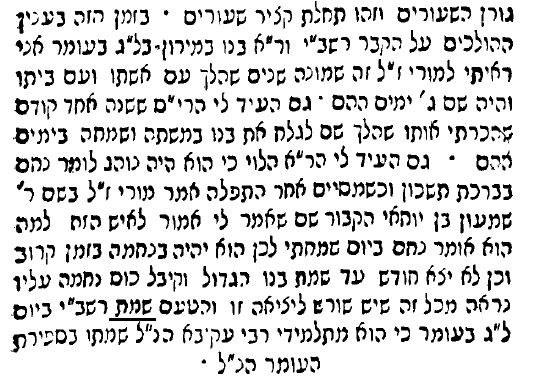
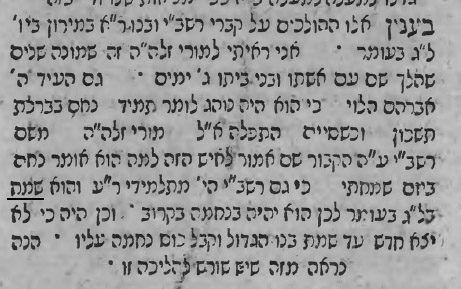
In the first printed edition of the Peri Etz Chaim, which was printed in 1782 (p. 101a), it does not say that at all. Instead of saying “she-meit” (that he died) it has a very similar, but entirely different word, samach (was joyous). The letter chet was apparently confused for a tav in the later version, causing the whole mistake![6] (Interestingly, the Aderes in his work Zecher Davar has a whole collection of cases where a problem arose due only to a קוצו שלו יוד.)
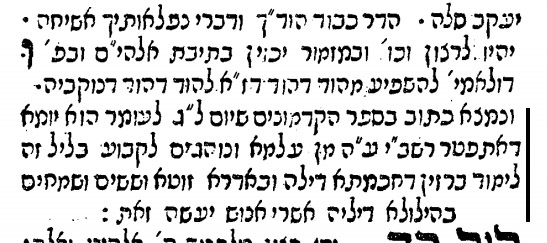
In the Shaar ha-Kavanot from R. Vital first printed in 1752, where the same piece appears, it also reads samach (p. 127) like the first edition of Peri Etz Chaim. In a later edition of of Peri Etz Chaim printed in 1819 it also reads samach. These would seem to confirm that the error is indeed she-met rather than samach.
The late Meir Benayahu z”l and, more recently, R. Yaakov Hillel, confirmed, based on many early manuscripts that this reading that does not have Rashbi dying on Lag be-Omer, is the correct reading from the writings of R. Chaim Vital. Recently, R. Yaakov Hillel printed the Sefer Shaar Ha-Tefilah from a manuscript of R. Hayyim Vital’s actual handwriting, and in that location (p. 312), as well, the passage states that it was the day of Simchat Rashbi, not the day he died.[7]
Interestingly, the Chida in his work Birkhei Yosef, printed in 1774, writes that Rashbi died on Lag Ba-Omer. But in a later work of his, Ma’aret Ayin, printed in 1805, he writes that the Prei Etz Chaim is full of mistakes and this statement regarding Lag Ba-Omer and Rashbi’s death day is one of them. So the Chida’s conclusion is that it is not a reference to Rashbi’s day of death at all. This conclusion is accepted by later authorities, including Takfo Shel Nes (p. 59a), Shu”t Rav u-Po’alim (1:11), and Tziyun LeNefesh Chayah (no. 65).[8]
The Lubavitcher Rebbe[9] wrote in a letter to R. Zevin that there is a printing mistake in the Peri Etz Chaim.

הרה”ג הוו”ח אי”א נו”מ וכו’ מהורשי”ז שי’
שלום וברכה!
במקרה ראיתי, בספרית כ”ק מו”ח אדמו”ר שליט”א, את ספרו “המועדים בהלכה” מהד”ת, ומצאתי שם בפרק ל”ג בעומר העתקת לשון הפרע”ח (דפוס דובראוונע ודפוס לאשצוב) שער ספה”ע פ”ז בהערה, וז”ל: והטעם שמת רשב”י ביום ל”ג בעומר כי הוא מתלמידי רע”ק שמתו בספה”ע.
והנה ידוע, אשר קטע זה מוקשה הוא הן בנגלה, כי רשב”י הוא מהחמשה תלמידים שסמך רע”ק אח”כ, הן מצד הנסתר ע”פ המבואר, בפע”ח שם ובסידור האריז”ל, מדריגת הכ”ד אלף תלמידים שמתו ומדריגת ה’ תלמידים הנ”ל. וכבר עמד ע”ז בשו”ת דברי נחמי’ חאו”ח סל”ד סק”ז. וסיים: ואולי יש ט”ס בפע”ח שם במ”ש כי הוא כו’ כנ”ל וצ”ע בדפוס קארעץ ששמעתי ששם נשמט זה.
ואמת כן הוא, אשר בפע”ח דפוס קארעץ לא נמצא קטע הנ”ל. וכן בסידורי האריז”ל ובשני פע”ח כת”י, שישנם באוסף הכת”י אשר לכ”ק מו”ח אדמו”ר שליט”א, חסר כל ענין זה. כן לא מצאתי לביאור הנ”ל בכל דרושי דא”ח שראיתי לע”ע.
וז”ל ספר הכוונות (ענין ספה”ע דרוש יב) בטעמי מנהגי ל”ג בעומר: כי הרשב”י ע”ה הוא מחמשה תלמידיו הגדולים של רע”ק ולכן זמן שמחתו ביום ל”ג בעומר. ועד”ז הוא במשנת חסידים.

– ובעהמ”ס ד”נ כנראה לא ראה את סה”כ, מדאינו מביאו – ומכמה טעמים מהנכון, לפענ”ד, לתקן את הנ”ל בספרו, או עכ”פ להעיר על הספקות שבדבר, בהזדמנות הראשונה. ..

The question then is, what is the earliest printed source that Rashbi died on Lag Ba-Omer. Avraham Yaari and Meir Benayahu demonstrate that the earliest source to mention Lag Ba-Omer as the yarzheit of Rashbi is none other than the Chemdat Yamim. R. Yaakov Hillel also confirms this in his Aid ha-Gal ha-Zeh (p. 13).
The Chemdat Yamim was first printed in the 1730s and has been the source of controversy and debate until today. Some go out of their way to attack it, claiming it has strong ties to Shabbetai Tzvi. Others strongly defend it, saying it is a very special work. Whatever the case is, Chemdat Yamim has been established by many as the source of many different customs that we observe today. It is not necessarily the earliest source, but in the first few years after it first appeared, Chemdat Yamim was printed many times, becoming a bestseller as it were. Because of this, many customs contained therein became widespread. One notable example is the celebration of Tu Be-shevat. After the Chemdat Yamim was printed, many works about the customs of Tu Be-shevat were printed based on it. What is very interesting is that Chasidim, who are principally against the Chemdat Yamim, are very into this concept that Lag Ba-Omer is the yarzheit of Rashbi.[10]

If one looks at all early mentions of Lag Ba-Omer and the Arizal one will not see any mention of it being the yarzheit of Rashbi. Here are some examples:
The Magen Avraham, first printed in 1692, writes when talking about days when we do not say Tachanun writes:
מעשה באחד שנהג כל ימיו לומר נחם בבונה ירושלים ואמרו בל”ג בעומר ונענש על זה מפני שהוא י”ט [כונת האר”י] (מגן אברהם סי’ קלא ס”ק יז)
When talking about Lag Ba-Ome , the Magen Avraham writes:
ומרבים בו קצת שמחה – וכתו’ בכוונות שגדול אחד היה רגיל לומר נחם בכל יום ואמרו גם בל”ג ונענש (מגן אברהם סי’ תצג ג)
We see that he makes no mention of it being the yarzheit of Rashbi when he referencing to the Arizal and Lag Ba-Omer. It is generally accepted that the Magen Avraham is responsible for bringing the writings of the Arizal into the world of halakhic discourse. The question, however, is regarding the Magen Avraham’s source for this specific Arizal. In general R. Yosef Avivi shows that the Magen Avraham when quoting from the Arizal was using the work Shulhan Arukh Shel Arizal.[11] There are many works similar to this work, one was called Nagid U-metzaveh; another was called Lechem Min Hashamayim. In both of these works, the whole story with the Arizal and Nachem appears with the version that this was the day of Simchat Rashbi, and not the day he died.
Now in this work, the story as quoted above appears and no mention of it being the yahrzeit of Rashbi, but rather that it was the day of Simchat Rashbi. However we cannot say, for certain, that his source was the Shulhan Arukh Shel Arizal because he specifically quotes the Sefer Hakavanot as his source. Now the problem with this is, which Sefer Hakavanot was the Magen Avraham referring to? The only edition printed before the Magen Avraham was from R. Moshe Terniki printed in Venice in 1620. In that edition of Sefer Hakavanot, there is nothing about Lag Ba-Omer. In a personal communication, R. Yosef Avivi suggested to me that it was the Sefer Hakavanot that was written in Cracow in 1650 and the Magen Avraham had it in manuscript. This edition of Sefer Hakavanot was later printed under the name Peri Etz Chaim in 1785.[12]
Another example of an early source who quotes the Arizal about Lag Ba-Omer but makes no mention of it being his yahrzeit can be found in the Ateret Zekenim from R. Menachem Auerbach, first printed on the side of the Shulhan Arukh in 1702 (it was written much earlier). He also cites the story of the Arizal:
מנהג ארץ ישראל שנוהגין לילך על קברי רשב”י ז”ל ור”א בנו ביום ל”ג בעומר והעיד ר”א הלוי שהוא היה נוהג תמיד לומר נחם בברכת תשכון וכשסיים התפלה א”ל ר”י לוריא ז”ל משם רשב”י הקבור שם שאמר לו אמור לאיש הזה למה הוא אומר נחם ביום שמחתי ולכן הוא יהיה נחם בקרוב וכן היה שמת לו בנו הגדול (סי’ תצג).
Here too we see a version of the story that has nothing about it being the yahrzeit of Rashbi.
Another example of an early source that quotes the Arizal about Lag Ba-Omer, but makes no mention of it being his yahrzeit can be found in the Sefer Shirei ha-Levim. This work was first printed in 1677; it includes anything having to do with the topic of Shir Shel Yom including the Arizal’s custom that he found in different sources.[13] When talking about Lag Ba-Omer he writes:
ל”ג בעמור שייך מזמור לז על שם שנאמר בו צופה רשע לצדיק וגו’ וזה שייך על רשב”י וחבריו שנשארו מתלמידי ר”ע כמבואר בגמרא ולא שלט בהם המלאך המות ביום ההוא וכן מיום ההוא והלאה כי קצת דיעות. וכתב בספר כוונת האר”י הנדפס שהלך האריז”ל עם אשתו ובניו לגלח על קבר רשב”י ועשה משתה ושמחה ג’ ימים לג לד לה ולמדו ספר הזוהר על קברו לכבודו של רשב”י וחביריו שנשתיירו והעמידו תורה באותו שעה, וע”ש מעשה נפלא על אחד שנענש על שאמר נחם בתפילת יח בעת שמחתו אבל ספר כוונת של הקדוש ר’ חיים וויטל…
I am not sure which printed edition of Sefer Hakavanot he was referring to that contains this passage. However we see here also no mention of it being yahrzeit of Rashbi.
The Mishnat Chassidim, first printed in 1727, collected lots of material from the Arizal. When talking about Lag Ba-Omer, also makes no mention of it being the yarzheit of Rashbi.[14] He just writes:
ועל ידי ר’ שמעון בן יוחאי שהיה אף הוא תלמידו נתקיים העולם לפיכך אין להתאבל ביום זה כלל על החרבן שלא יענש אל מצוה לשמח שמחת ר’ שמעון בן יוחאי ואם דר בארץ ישראל ילך לשמוח על קברו.
Next is the historical work Divrei Yosef from R. Yosef Sambary, completed in 1672 but only printed a few years ago, (although parts were printed by Adolf Neubauer in 1887). When he records the story with the Arizal about someone saying Nachem at the kever of Rashbi, he does not even mention it was on Lag Ba-Omer; he, too, records the story stressing that it was a day of Simcha not the yahrzeit of Rashbi (p. 188).
It is also worth pointing out that the Shelah ha-Kadosh, an earlier work that was influenced by the Arizal, when talking about Lag Ba-Omer, also makes no mention of it being the yahrzeit of Rashbi.
The Divrei Nechemiah, written by the grandson of the Ba’al ha-Tanyah, writes (no. 34) that there is a printing mistake in the Peri Etz Chaim when he says that it was the yahrzeit of Rashbi. However he concludes:
אך המפורסמות אין צריך ראיה שכבר נתפרסם בכל העולם מכמה דורות ע’ הלולא דרשב”י בל”ג בעומר ומסתמא יש מקור לזה בזוהר או בכתבי האר”י ז”ל.
In short it is quite amazing that the whole source for Lag ba-Omer being the day of Rashbi’s death is based on a printing mistake found in only one version of the story with the Arizal, while all other versions I have found of the story does not say anything about it being the yahrzeit of Rashbi!
Returning to the origins of going to Meron on Lag Ba-Omer, Avraham Yaari, has a very detailed article where he collects many early sources[15] for going to Meron in general[16] from famous travelers such as R. Binyomin Me-Tudela in the 1170s, R. Pesachyah Me-Regensburg, but these early sources make no mention of going to Rashbi’s Kever, only to the kevarim of Hillel and Shammai[17] who are also buried in Meron.[18] The first source that Avraham Yaari found that mentions going to Rashbi’s kever is from the twelfth-century in the travels of R. Yaakov HaKohen. After that, he found it in other sources.[19] None of these sources mention to these kevarim at a specific time. In the beginning of the fourteenth century, however, a student of the Ramban mentions going to the kevarim of Hillel and Shammai in Meron on a specific date in the month of Iyar, on Pesach Shnei. We have other early sources that mention going to those kevarim on Pesach Sheini. In the famous letter of R. Ovadiah me-Bertinoro (1488) and the travels of R. Moshe Basola (1521-1523), we also find mention of going to Meron to visit the kevarim of Hillel and Shammai on Pesach Sheini. From many of these sources, we see that the reason they went was to daven for water, and that at times, water would miraculously appear from the caves. However, it is important to stress that while we have many accounts of going to Meron even during the month of Iyar none mention going to the kever of Rashbi during that time of year.
Avraham Yaari and Meir Benayahu cite many sources that clearly demonstrate that the Mekubelei Tzefat would go to Meron to the kever of Rashbi a few times during the year to learn Zohar. However, the first source we have for someone going to Rashbi’s kever specifically on Lag Ba-Omer, is the Talmdim of the Arizal, who say that the Arizal once went to the kever of Rashbi on Lag Ba-Omer while still living in Egypt. When recording this testimony, R. Hayyim Vital writers that he is not sure if this occurred before the Arizal was well versed in Kabbalah. But he stresses that he was doing something done by others before him. We do not know to whom R. Hayyim Vital referred. Meir Benayahu concluded that the custom of going to Meron on Lag Ba-Omer was begun by the Mekubelei Tzefat.
Although Yaari concedes that Mekubelei Tzefat were very into going to the kever of Rashbi, that is not how the minhag to go specifically on Lag Ba-Omer developed. Yaari shows that the custom of going to Meron was taken from an earlier custom of going to Shmuel Hanavi’s Kever on his yahrzeit, which was on the twenty-eighth day of Iyar.[20] The Tur brings down from the Behag that one should fast on this day. We have many early sources of prayers that were recited on this day at Shmuel Hanavi’s Kever.[21] In the travels of Meshulem Me-Volterrah from 1481, the travels of R. Ovadiah me-Bertinoro (1488) and the travels of R. Moshe Basola (1521-1523) we also find mention of going to Shmuel Hanavi’s Kever on his yarzheit. In these sources, we also see that they used to light many big flames. Avraham Yaari believes this to be the source of the minhag to go to Kever of Rashbi.
In sum, the above indicates that there are early sources for people going to Meron during the month of Iyar, on Pesach Sheni, to the kevarim of Hillel and Shammai. The Mekubelei Tzefat went to Rashbi’s kever throughout the year and Meir Benayahu feels that the minhag of going Lag Ba-Omer originated from them too. While Yaari feels that the custom of going to Meron on Lag Ba-Omer was taken from an earlier custom to go to Shmuel Hanavi’s Kever on his yahrzeit, it is also clear that the Arizal did, in fact, go to the kever of Rashbi on Lag Ba-Omer at least once.
However it appears to this writer that it is more likely that the custom of going to Meron to the Kever of R. Shimon Bar Yochai on Lag Ba-Omer grew out of the earlier minhag of going to Meron in the month of Iyar, to the kevarim of Hillel and Shammai on Pesach Sheini which is only a few days before Lag Ba-Omer, and not from the Minhag of going to Shmuel Hanavi’s Kever on his yahrzeit, which was on the twenty eighth day of Iyar, which is not even in Meron. Possibly support to this can be found in the travels of R. Moshe of Basola who writes that after going to kevarim of Hillel and Shammai on Pesach Sheini, the crowd would go to the cave where Rashbi and his son hid for thirteen years and they would spend a few days and nights celebrating in Meron.[22]
In the work Arugat Ha-Bosem, written in 1234, I found a very interesting version to the earlier quoted, famous Gemara of why the sefirah period is considered a time of mourning. He writes:
מה טעם מנהג בישראל אין עושין מלאכה בין פסח לעצרת, משתקשע החמה עד למחרת שחרית, ואמרו לנו שני טעמים אחד על פטירת תלמיד הילל ושמאי, דאמ’ שמוני’ אלף תלמיד’ היו להילל הזקן ושמאי מגבת ועד אנטיפרס, וכולן מתו מפסח עד עצרת על שאלה ונוהגים כבוד זה לזה… [ערוגת הבשם, א, עמ’ 75].
This version would be possible additionally support, that originally in Iyar Jews went to the kevarim of Hillel and Shammai on Pesach Sheini. However I was unable to find any other manuscript that records such a reading of this Gemara.[23]
R. Shemaryhu Adler has a very interesting insight into the deaths of the talmdim of R. Akiva during sefira and when they start dyeing. In this piece he also says as a fact that Rashbi died on Lag B’Omer.
נראה טעם הגון ונכון לעצומו של יום לג בעומר דהוא בכלל יום טוב. ובהקדם להבין עוד מה דלכאורה תמוה דלמה לכולהו הני שיטות ליכא התחלה לאבילות כי אם מזמן התחלת ספירת העומר והיינו מיום ב’ דפסח דאיזה שייכות יש לאבילות ךדלמידי ר”ע לזמן התחלת ספירת העומר כיון דיבמות ס”ב ע”ב אמר כולם מתו מפסח ועד עצרת וסתמא תנא מפסח מנ”ל דזהו מיום ב’ דפסח ולא מיום א’.
נראה ע”פ דאמר במנחות סח ע”ב יתיב ר”ט וקא קשיא ליה מה בין קודם לעומר לקודם שתי הלחם אמר לפניו יהודה בר נחמיה לא אם אמרת קודם לעומר כשן לא הותר מכללו אצל הדיוט כו’ שתק ר”ט צהבו פניו של רבי יהודה בר נחמיה אמר לו ר”ע יהודה הבצו פניך שהשבת את זקן תמהני אם תאריך ימים אר”י ב”ר אלעי אותו הפרק פרס הפסח היה עשעליתי לעצרת שאלתי אחריו יהודה בן נחמיה היכן הוא ואמרו לי נפטר והלך לו עכ”ל הגמרא יעו”ש
ומזה נראה דהי’ קודם פסח ט”ו יום ונשאו ונתנו בענינא דעומר וע”י דצהבו פניו של יהודה בן נחמיה במה דהשיב את ר”ט ועי”ז קפד ר”ע מסברא לומר דבעת שהגיע זמן הקרבת העומר דהוא זמן התחלת ספירת העומר ביום ב’ של פסח מצאה הקפידה מקום דתיחול כיון דעיקר דהשיב לר”ט היה בענינא דעומר וכיון דקפידת ר”ע היה על מה דתלמידו יהודה בן נחמיה התכבד בתשובתו לר”ט ולא נהג בו כבוד כראוי ומצאה הקפידה מקום לנוח בזמן הקרבת העומר דזהו היתה סיבה להא דהשיב הזקן ר”ט שפיר התפשטה קפידת ר”ע ג”כ על כל תלמידיו שלא נהגו כבוד זה לזה והלכך שפיר התחילה פטירתן מאותו זמן דעיקר הקפידה חלה והיינו מיום ב’ דפסח שהוא זמן הקרבת העומר והלכך שפיר שייכא אבילות דתלמידי ר”ע לזמן התחלת ספירת העומר וכנ”ל
ועיין כי רשב”י היה מתלמידי ר”ע והיה קפדן גדול וכדאמר במעילה יז ע”ב… וא”כ הו”א כיון דר”ש ג”ג נפטר ביום ל”ג בעומר נהי דכבר היה זה זמן טובא אחר שמתו תלמידי ר”ע כיון דאמר ביבמות ס”ב והיה… מ”מ כיון דקפידת ר”ע על מניעת נהיגת כבוד חלה בזמן בעומר שוב פטירת ר”ש דהיתה בזמן ימי העומר והיינו ל”ג בעומר ג”כ מקפידת ר”ע רבו על דהיה קפדן ובודאי לא נהג כבוד, והלכך לשלילת מחשבה כזו עושים קצת שמחה להראות דפטירת רשב”י אינו בגדר קפדנותו של ר”ע רבו ומטעמא דנהי דרשב”י היה קפדן מ”מ לא היתה לבד התכבדות בקלונו של חברו ח”ו דז”א דרשב”י הי צדיק גמור ועיקר קפדנותו לא היתה כ”א לכבוד השי”ת וקנאותו וזהו עיקר הלולא דרשב”י (שו”ת מראה כהן, סי’ כט אות ג).
R. Eliezer Dunner, in his work Zichron Yosef Tzvi, offers a very novel reason for the celebration on Lag Ba-Omer. He says that we know that R. Akiva was a strong supporter of Bar Kochba. He suggests that R. Akiva students were soldiers in his army to fight the Romans and they died in this time period of Sefirah. During this time, on Lag Ba-Omer, the Jews were winning, that is why they turned this day into a great day of celebration.
ידענו כי ר’ עקיבא היה הולך ונוסע ומלמד בכל תפוצת הארץ ובכל מקום היה לו תלמידים הרבה מאוד ועין שחושב לבר כוזבא כמשיח קרא כל תלמידיו להלחם בצד בר כוזבא ותחת רגליו נגד חיל האויבים… ואף על פי שבתחילה חלשו היהודים את אויביהם לפי חרב אחר כך גברו הרומיים ולכדו מישראל עיר ועיר ובאותה זמן היתה מלחמה בכל יום יום ובכל מלחמה נפלו ומתו הרבה אנשים מחיל בר כוזבא ובהן כמה תלמידי ר’ עקיבא וכששקעה החמה בכל יום ויום פסקה המלחמה ואז נקברו כל המתים. ואפשר שבתוך כל המלחמות הללו שהיו יום יום ושבהם גברו האויביהם על ישראל היה יום אחד והוא ל”ג בעומר שגבר בו ישראל אותו יום שבו היה להם ישעות ה’ בעת צרתם יום גבורה ותשועה אותו יום קבעו ליום שמחה לדור דורים וכמו כן שמעתי גם מפי הרב דק”ק פוזנא מוהר”ר זאב פיילכענפעלד ז”ל (זכרון יוסף צבי, סי’ תצ”ג).
However, this original explanation, while giving us new insight into the mourning period during sefirah does not help us understand the connection to Rashbi. Avraham Korman in his Pinu’ach Aggadot (pp. 190-210) cites others (not R. Dunner) that tie the death of the talmidim of R. Akiva to the rebellion of Bar Kochba and he goes further to explain the connection between this and Rashbi and other minhagim of Sefirah.
There is a custom in many chasidic courts to use bow and arrows on Lag Ba-Omer. Many explanations are offered, but Korman says that perhaps the bows and arrows serve as a reminder of the war that the students of Rebbe Akiva fought against the Romans. As an aside, although most sources for bow and arrows on Lag Ba-Omer are found in chasidic seforim, I have found a possible source that in Vilna in the early 1800’s they also used bow and arrows on Lag Ba-Omer.[24]
R. Mordechai Ha-Kohen suggests based on this connection between the students of R. Akiva and the battle of Bar Kochba, that we can understand another issue. The Tur brings an old minhag that woman would refrain from doing work at night from after sunset the whole sefirah. He says the reason was the woman too participated in the battles against Bar Kochba they acted as nurses and helped the fallen soldiers and buried the dead every day after sunset when the fighting stopped. Therefore he says a custom developed that woman today do not do work after sunset.[25]
The earliest source who ties the mourning period during sefirah period for the deaths of the students of R’ Akiva and the battle of Bar Kochba that I found was in the magnum opus of the famous Galician maskil, Nachman Krochmal, who write in his Moreh Nevuchei Ha-zman:
אכן נראה כי גברה עתה המחשבה והעצה למרוד גם בין קצת החכמים וביחוד בין התלמידים והבחורים, ויש זכר לדבר גם בתלמוד ובמדרשות, ד”מ השנים עשר אלף תלמידים שהיו לר’ עקיבא מגבת ועד אטניפרוס וכולם מתו מפסח ועד עצרת (כלומר שעזבוהו כולם בזמן קצר לעת המרידה ולבסוף ספו תמו במלחמה) [מורה נבוכי הזמן, שער י, עמ’ קט].
Support to this theory can possibly be found in the Iggeret R. Sherirah Gaon according to Gedaliahu Alon. R. Sherirah Gaon writes:
והעמיד ר’ עקיבא תלמידים הרבה והוה שמדא על התלמידים של ר’ עקיבא והות סמכא דישראל על התלמידים שנייים של ר’ עקיבא דאמור רבנן שנים עשר אלף תלמידים היו לו לר’ עקיבא מגבת ועד אנטיפטרס וכלם מתו מפסח ועד עצרת (אגרת ר’ שרירא גאון, ב”מ לוין, עמ’ 13).
Alon suggests that the words and “there was a Shemad” implies they were killed by the government.[26] However, it is not so simple that this is all historically true as there are many different discussions to what extent was R. Akiva was actively involved in the rebellion. It is well known that the Rambam writes:
וביתר שמה והיו בה אלפים ורבבות מישראל והיה להם מלך גדול ודימו כל ישראל וגדולי החכמים שהוא המלך המשיח, ונפל ביד גוים ונהרגו כולם והיתה צרה גדולה כמו חורבן המקדש (הל’ תעניות ה:ג).
Elsewhere he writes even more clearly:
אל יעלה על דעתך שהמלך המשיח צריך לעשות אותות ומופתים ומחדש דברים בעולם או מחיה מתים וכיוצא בדברים אלו, אין הדבר כך, שהרי רבי עקיבא חכם גדול מחכמי משנה היה, והוא היה נושא כליו של בן כוזיבא המלך, והוא היה אומר עליו שהוא המלך המשיח, ודימה הוא וכל חכמי דורו שהוא המלך המשיח, עד שנהרג בעונות, כיון שנהרג נודע להם שאינו… (הל’ מלכים יא:ג).
The Meiri writes:
וכן בדבור הזה עמד בן עוזיבא ועשה עצמו משיח, וטעו רבים אחריו, ואף ר’ עקיבא היה נושא כליו (סדר קבלה, מה’ אופק, עמ’ 77).
R. Hamberger in his Meshichei Sheker u-Mitnageidheim (pp. 676-681) has a long list of people who agree with the Rambam.
Zecharia Frankel in Darkei HaMishna (p. 128) concludes that he did not really have much to do with the rebellion[27]. Y. Derenberg concludes that R. Akiva and his students were very involved with Bar Kochba.[28] R. Issac Halevi in his Dorot Ha-Rishonim (5, pp. 602- 628) downplays R. Akiva’s role completely saying he did not really endorse Bar Kokhba for that long. From the Rambam and Meiri quoted above it seems they disagree. Aharon Heyman concludes that R. Akiva and his students were actively involved with Bar Kochba (Toledot Tanaaim ve-Amoraim 3, pp. 1002-1004).
To conclude with a well-known cute story related to R. Akiva and Bar Kochba: R. Zevin brings from R. Chaim Soloveitchik:
פעם אחת נסע רבי חיים ברכבת… היה שם איש אחד מן המסיתים, שהירבה דברים להוכיח שאותו האיש הוא המשיח… בתוך הויכוח נענה אחד ואמר להמסית וכי מי יודע יותר בטיבו של אותו האיש התנאים, שהיו בדורו והכירו אותו ואת מעשיו או אתה שאתה רחוק ממנו כאלפיים שנה? והרי התנאים של אותו דור דנוהו ותלוהו. השיב המסית אותם התנאים הרי אנו רואים, שטועים היו שכן טעה רבי עקיבא וחשב את בר כוכבא למשיח. נסתתמו טענותיו של היהודי ורבי חיים כשראה שיד המסית על העליונה, נענה ואמר וכי זו מנין לך שרבי עקיבא טעה בבר כוכבא? נתלהב המסית הרי הרגו את בר כוכבא! אם כן משיב רבי חיים בנחת הרי אתה מודה שמשיח שנהרג אינו משיח. (אישים ושיטות, עמ’ ס).
* Thanks to R. Yosef Avivi for his help with some of the issues related to the writings of the Arizal.
[1] Much has been written about all the customs of Lag Ba-Omer. The best collections of material on the topic appear in Avraham Yaari, Tarbiz 22 (1951); Meir Benayhu, Sefunot 6 pp. 11-40, summarized in Sefer Vilnai 2:326-330] and R. Betzalel Landau, Maseh Meron (1966). See also David Tamar, Eshkolet Tamar, pp. 116-120]. See also R. Shelomo Joseph Zevin, Moadim Bahalcha pp. 359-64; Shmuel Ashkenazi, Avnei Chain pp. 103-11. For more recent collections of sources see: R. Yaakov Hillel, Aid ha-Gal ha-Zeh, pp. 3-29; Moshe Blau, Yeshurun 15 (2008), pp. 854-872; Tuviah Freund, Moadim le-Simcha; Pardes Eliezer s.v Lag ba-Omer;Yitzhak Tessler, Pinnenei ha-Chag.
As I have noted in my previous post at the Seforim blog on the topic of Lag ba-Omer, Freund and Blau have each plagiarized greatly from the works of Landau, Yaari, and Benayahu.
[2] For a detailed discussion, see R. Gedaliah Oberlander, Minhag Avoteinu be-Yadeinu (Merkaz Halakhah, 2005), pp. 528-547.
[3] On this work see R. R.N. Rabinowitz, Ohel Avraham (1898) pp. 14-15; Y.Yudolov, Yeshurun 24 (2011), pp. 893-919.
[4] Dershos Ri Ibn Shu’eib, 1, p. 222.
[5];Peri Chadash, 493:2. See also Beis Yosef and Aruch Ha-shulchan.
[6] For more on this edition, see R. Yosef Avivi, Binyan Ariel, pp. 68-71 and his Kabbalat Ha-Ari, 2, pp. 705-06.
[7] One can see pictures of the manuscripts in the article from Moshe Blau cited in footnote one.
[8] It would appear to me that Reb Yosef Engel also did not think that Rashbi died on Lag B’omer as in his work Otzros Yosef he has many pages on Lag b’omer and talmidei R. akiva etc and he makes no mention that it was the day he died.
[9] Thanks to an anonymous commenter for pointing to this letter.
[10] For a partial list of sources regarding the Chemdat Yamim controversy, see my Likutei Eliezer, p. 2. It’s worth mentioning that a new three volume edition of the Chemdat Yamim has just been printed in Benei Brak. The edition is very nice and was based upon the first edition. However, the 250 page introduction is extremely amusing.
[11] See R. Yosef Avivi, Kabbalat Ha-Ari, 2, pp. 752-753.
[12] See R. Yosef Avivi, Kabbalat Ha-Ari, 2, pp. 593-598, 670-672, 705-06. See also Zeev Gries, Safrot Ha-hanhaghot, pp. 81-84, 87-90; Yaakov S. Speigel, Pitchei Tefilah u-Moed, pp. 308-309.
Edit 6.22.11: However after reading this post R. Bentzion Meisles (In a personal communication) showed me that this whole piece with the Arizal going to Meron does indeed appear in the Sefer Hakavonos of R. Terniki, (In the 2006 edition it appears on pp. 5-6) and it too says שמחתי.
[13] On this work see here and here.
[14] See R. Yosef Avivi, Kabbalat Ha-Ari, 2, pp. 757-759.
[15] The actual sources can be seen in his works Masaot Eretz Yisrael and Iggerot Eretz Yisrael.
[16] Much has been written about davening at kevarim in general see Yehezkal Lichtenstein, Me-Tumah Le-Kedusha, pp. 218-242, 293-386.
[17] M. Zulay published very early Piyutim that seem to show that Hillel and Shammai were brothers! See his Eretz Yisrael u-Piyuteh, pp. 539-545.
[18] On going to the kevarim of Hillel and Shammai see M. Weiss, Kivrei Avos, 129-132; Elchanan Reiner “Pilgrims and Pilgrimage to Eretz Yisrael (1099-1517),” (PhD dissertation, Hebrew University of Jerusalem, 1988), 295-320.
[19] General sources for going to the Kever of Rashbi can be found in M.Weiss, Kivrei Avos pp. 179-81; Z. Vilnai, Mazavos be-Eretz ha-Kodesh pp. 117-150.
[20] On this being his date of death see the Tur (O.C. 580); S. Elitzur, Lamu Tzamnu, pp. 177-180.
[21] M. Zulay, Eretz Yisrael U-piyuteh, pp. 401-412. For more regarding Shmuel ha-Navi and visiting his grave, see M. Weiss, Kivrei Avot, pp. 113-16; Lamu Tzamnu pp. 177-80; Reiner op. cit. pp. 306-20; Y. Lichtenstein, Me-Tumah Le-Kedusha, pp. 298-230.
[22] The Itinerary of R. Moses Basola (David ed.) p.91.
[23] See Makhon Talmud Yisraeli, Yevamot 62b.
[24] Kundes p. 49. For more on this 1824 parody see here. For more sources on using bow and arrows on Lag Ba-Omer: see the sources listed by Landau, ibid pp. 124-26; Moadim le-Simcha pp. 155-59; Pardes Eliezer pp. 229-49; ha-Koton ve-Halachosov chapter 24 p. 59 n. 22; Zikhronot Av u-Beno p. 231; A.S. Sachs, Worlds that Passed (Philadelphia, 1928), p. 112.
[25] Ishim Utekufot, pp. 102-105.
[26] Toldos Hayehudim Beretz Yisroel, 2, pp. 43-44.
[27] See also J. Brull in his Mavo Le-Mishna, 2. pp. 121-122. For more sources on all this see: G. Alon, Toldos Hayehudim Beretz Yisroel, 2, pp. 16-47; S. Safrai, R. Akiva Ben Yosef, pp. 26-33; M. Cohen, Ishim Utekufot, pp. 92-112; R. Y. Tamar, Alei Tamar, Tannis, pp. 390-392;C. Kulitz, Rosh Lechachochim; Ibid, Ben Ha-aliyah; collection of articles in Mared Bar Kochba, Ed. A. Oppenheimer; R. Hamberger, Meshichei Sheker U-misnagdim, pp. 138-155, 665-681.
[28] Maseh Eretz Yisroel, pp. 220-228.


Tu Be-Shevat and Sabbatianism

For those interested in a potential link between sabbatianism and Tu be-Shevat, see our early post on the subject here. For other customs that may have sabbatian origins see here.