Purim in Tehran: The Symbolic Devaluation of the Ahrimanic Republic

Purim in Tehran: The Symbolic Devaluation of the Ahrimanic Republic

By Dan D.Y. Shapira

Dan (or, Dan D.Y.) Shapira is an Orientalist and grows more than fifty trees on the edge of the Judaean Desert. He’s a Full Professor at Bar-Ilan University.

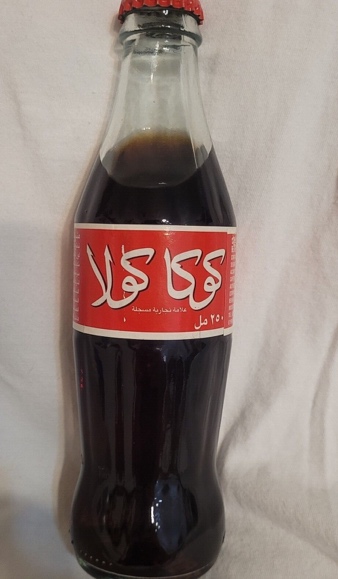
Some fifty years ago, my father brought home a small glass bottle of Iranian Coca Cola, no idea where from. I sat hypnotized looking at the bottle, with its Persian (well Arabic) letters, so beautiful.

It was easy to understand that two letters stand for k, one for l, one for o and one for a. The letters for o, l, and for k had some remote similarities to the corresponding Hebrew letters, if you rotate them a bit in your head. How I know that the letter for a, ا, is also like the Hebrew א, you should just squeeze the Aleph on both sides. And a couple of year later there was the Islamic revolution in Iran, at the end of the same year there was the Soviet invasion in Afghanistan, and new tasty, delicious words began to pour – baseej, inqhilab, Haqiqat-e Inquilab-e Saur, mujahedeen-e khalq, sipaas, Kermanshah, pasdaran, and somehow I began learning Persian.

The language struck me with its grammatical similarities to German and its lexical parallels to Yiddish. Just as Yiddish incorporates Hebrew and Aramaic, Persian is saturated with Arabic. In Yiddish, one can play with registers, tilting the language toward its Germanic core or thinning out its Hebraic elements. Persian offers the same flexibility, allowing a speaker to choose more, fewer, or even no Arabic words. Years later, many Jewish-American Iranists from the WWII generation confirmed this early impression. Learning the language went smoothly, as if I had already known it in a former gilgul.

When I was an Iranian studies student in the late 1980s at Hebrew University, one of my teachers told us that Persians are simply prone to short periods of mass hysteria before returning to “normal” and going back to counting money and carpets within a few years. Time has since proven that my former teacher understood Iranians quite poorly, as they have shown no symptoms of recovering to that supposed normalcy. I eventually realized that my chances of visiting Tehran or Shiraz are slim, perhaps reserved for a future gilgul. Being an Israeli Iranist without the possibility of visiting Iran is much like being Jewish without the possibility of joining a Gentile club.

I am writing this on Sunday, March 1. Today is my secular birthday, and tomorrow, Ta’anith Esther, is my Jewish one. Last night, Bibi and Trump sent me a wonderful gift. I shouted into the sky as drones sent from Iran turned into smoke: Khamenei kotlet shod (“Khamenei went kebab”) as millions of Iranians around the world shouted along with me.

My son just called. He is married to a girl whose parents were both born in Iran. “What do you say about your birthday present?” he asked. “I just realized that your entire life is connected to the fact that you were born on Ta’anith Esther.”

“Yes,” I replied, “and I am just now writing about that. I’ll send it to you.”

It was published today that the joint American-Israeli training for the very operation we witnessed yesterday began as early as January 2023. In January! This timing is critical; it means that even as the domestic anti-Bibi demonstrations began to surge and well before the horrors of October 7, the strategic “pedestal” for the current reversal was already being constructed.

In my view, the son of the last Shah has been designated by Bibi and President Trump to lead the transitional period in a post-Khomeinist Iran. Whether he will be able to restore the historical monarchy remains an open question.

As I discussed in my co-authored article with Reuven Kiperwasser, “Encounters between Iranian Myth and Rabbinic Mythmakers in the Babylonian Talmud,” published a dozen years ago in Encounters by the Rivers of Babylon Scholarly: Conversations Between Jews, Iranians and Babylonians in Antiquity (2014) and available here, the Babylonian sages often engaged in a process of symbolic devaluation. They created their own imagined worlds by taking elements of Iranian mythology and recasting them to define the borderlines of their own culture. After the certain dismiss of what many Iranians call “the Ahrimanic Republic” (instead of “the Islamic Republic,” with Ahriman being the wicked opposite, sitra oḥora, of the benevolent Ahurmazd, or Ahura Mazda), we are seeing this ancient devaluation play out as a modern geopolitical reality. In our analysis of Sanhedrin 39a, we examine a dialogue where a Magus claims the human body is divided, with the upper part belonging to Hwrmyz (Ohrmazd) and the lower, excretory part belonging to ‘hrmyn (Ahriman). The Talmudic sage Amemar sarcastically challenged this dualism by asking why Ahriman would permit Ohrmazd to send life-giving water through his “territory.” Today, this sarcasm has turned into a tangible reality as the “Ahrimanic” regime governed through the “lower” impulses of mass hysteria and regional chaos has been devalued by a population that has largely secularized and rejected the official ideology. With the collapse of this demonic mask, many Iranian exiles will return home (four to five millions Iranians live outside of the present borders of Iran). They return to a land ready to restore its “upper” civilizational identity, finally mirroring the way the rabbis once harmonized their world with the benevolent elements of the Iranian heritage.

In Iran, while 99% of the population is officially classified as Muslim (including a 5% to 15% Sunnite minority composed of Kurds, Arabs, Baluchis, and Turkmens living along the borders), the internal reality is starkly different. In truth, only about 30% to 40% of the population considers themselves Muslim at all. The actual majority has shifted toward being non-religious or atheist, with many becoming fiercely anti-Islamic or “spiritual” in various ways. Others identify as self-proclaimed “Zoroastrians” or have become secret converts to American-style Evangelical Christianity.

Under the Khomeinist regime, Iran has become largely secularized and has partially moved in an anti-Islamic direction. Today, nobody believes in the official ideology, a situation very much like the lack of belief in the official ideology during the late Brezhnev USSR. The “Ahrimanic republic” now sends Shi’ite clerics who oppose its ideology to prison or places them under home arrest, just as the late Brezhnev USSR did to the few who identified as “the real Marxists.”

The Iran of tomorrow will certainly be anti-Islamist, with the potential for the oppression of Islam itself. While the Iran of yesterday was a global leader in antisemitism, the Iran of tomorrow will be a global leader in the state-supported fight against the “Free Palestine” movement. The “Palestinian discourse” was central to the old Iran and will remain so in the New Iran, though with its emphasis entirely reversed.

The raison d’être of the Iran of tomorrow will be a staunch alliance with the USA and Israel. The principle of nahapokh hu from the Purim story reveals the sarcastic hypostasis of the Jewish God’s sense of humor. As the scripture asks, “See, this is new? It hath been already of old time, which was before us.” One need only consider the metamorphosis of pogromist Czarist Russia into what some, astonished by the transformation, termed “the Jewish Commune.”

Some predict that Iran will fall apart due to the separatism of ethnic minorities, but to me, this is absolute nonsense. Iran has only insignificant real minority groups; although some Iranians speak languages other than Persian, they are Iranians first and foremost. Fantasies about Azeri separatism in Iran are especially hilarious. It is as if Nazi Germany tried to lure Israel’s Hasidic Jews into a “Great Germany” separatism simply because those Jews speak Yiddish. Iranians of Azeri background are, more or less, the Iranian equivalent of Israel’s Ashkenazim.

But the borders of Iran might change. It is a significant topic, and once stabilization is achieved, one can envisage the enlargement, rather than the shrinking, of Iranian territory eastwards within a predictable span of time.

The position of the Iran of tomorrow as an ally of Israel will fundamentally change Israel’s strategy toward its Arab allies and partners. MBS understood this some time ago and, consequently, dragged his feet regarding a rapprochement with Israel.

Another significant point is Türkiye, which has emerged as a primary adversary of Israel since October 7, though I hope the motivations behind this shift were largely opportunistic and fundamentally misguided. However, if the IDF map is accurate, the fact that Israeli jets overflew Turkish territory on their way to Iran suggests a significant development. This possibility hints that Mr. Erdoğan is beginning to view the regional landscape through a more pragmatic lens, perhaps recognizing the inevitable devaluation of the “Ahrimanic” status quo in favor of a more stable, “upper” civilizational order.


“I Do Not Understand a Single Word of What I Wrote in My Book”: Rav Kook, Saul Lieberman, and a Literary Mishlo’aḥ Manot Exchange

“‘I Do Not Understand a Single Word of What I Wrote in My Book’: Rav Kook, Saul Lieberman, and a Literary Mishlo’aḥ Manot Exchange”

By Aviad Hacohen

The festival of Purim, with its customs and traditions, has long constituted a broad and fertile field for a vast body of research, folklore, and ritual practice associated with the “Jewish carnival.”[1] The drinking of wine, the wearing of costumes (which have no foundation in early sources and, in the view of many scholars, were influenced by the Venetian carnival),[2] the use of noisemakers for the purpose of “blotting out Amalek,”[3] and the practice of mishlo’aḥ manot have all added layers of joy and exuberance to the festival, at times reaching the point of genuine revelry and even debauchery,[4] and giving rise in certain historical contexts to acts of mockery, hostility, and ritualized violence that have attracted sustained scholarly attention.[5]

Two of the day’s commandments explicitly mentioned in the Scroll of Esther are “the sending of portions, each man to his fellow, and gifts to the poor.”[6] Whereas the giving of charity to the poor assumed a more or less uniform form, the “sending of portions” became a platform for no small measure of creativity. Already in the Talmud,[7] it is related that the amora Rabbi Yehudah Nesi’ah (the grandson of the tanna Rabbi Yehudah ha-Nasi)[8] sent his colleague Rabbi Hoshaya an especially splendid mishlo’aḥ manot, consisting of choice veal and an entire jug of wine.

To this day, one may observe throughout Israel, particularly in Haredi concentrations, especially elaborate mishlo’aḥ manot, laden with assorted and varied food items, accompanied by ornate trays and crackling cellophane wrapping. Alongside the traditional commandment, in recent decades in particular, a rich vein of humor has developed portraying the familiar bottle of wine and dry cake as completing an entire “circuit” within the community, passed from hand to hand as a repeatedly re-gifted mishlo’aḥ manot, until it ultimately returns to its original sender.[9] In light of this reality, many today prefer to refrain from preparing an individualized mishlo’aḥ manot, much of whose content is ultimately discarded after the festival, and instead opt for a standardized communal mishlo’aḥ manot distributed collectively to members of the community. The funds thereby saved, rather than being expended on redundant food items and decorative packaging, are redirected toward a range of charitable and benevolent causes.

These contemporary developments, however, merely underscore a broader point: the commandment of mishlo’aḥ manot has long been characterized by considerable elasticity in both form and practice. Indeed, halakhic literature contains an extensive discussion concerning the question of how one may properly discharge one’s obligation with respect to this commandment. One of the more intriguing debates in this context concerns whether one may fulfill the obligation of mishlo’aḥ manot not through edible “portions,” but rather through “words of Torah,” by sending a book, each person to his fellow. There is, in fact, no small body of testimony regarding sages of Israel, such as Rabbi Shlomo Alkabetz and Rabbi Yehudah Aszod, who sent, as “mishlo’aḥ manot, each person to his fellow,” their own Torah novellae or scholarly compositions.[10]

This halakhic discussion is not merely theoretical. In the course of my research on Rabbi Professor Saul Lieberman (1898-1982),[11] I encountered a striking modern resonance of precisely this idea, one that illuminates the enduring cultural and intellectual valences of mishlo’aḥ manot beyond its strictly culinary expression. Although he arrived in Jerusalem at a relatively late age, being about twenty-nine, Lieberman quickly became integrated into Jerusalem’s intellectual milieu. As a member of the first cohort of students at the Institute of Jewish Studies at the Hebrew University on Mount Scopus (which had been founded only a few years earlier), he listened with great thirst to the teachings of the leading scholars in Jewish Studies and in classical studies, among them his teacher and master Professor Yaakov Naḥum Epstein,[12] Professor Shmuel Klein, and Professor Moshe Schwabe,[13] one of the foremost scholars of classical culture.

Alongside his academic studies, he soon acquired a reputation as an exceptionally great Torah scholar, for whom no secret of rabbinic literature was lo anīs lei, that is, nothing lay beyond him and nothing escaped his grasp. For many hours he would labor diligently over his learning, memorizing Mishnayot and Talmud – Bavli and Yerushalmi – by heart,[14] and within a few years he produced several exemplary works, such as On the Yerushalmi (1929) and The Talmud of Caesarea (1931), which to this day are regarded as foundational texts in the scholarly study of rabbinic literature.[15]

Upon the completion of his studies, Lieberman began teaching in the Talmud preparatory program of the Institute of Jewish Studies, while simultaneously devoting himself to the composition of The Yerushalmi According to Its Plain Meaning (Ha-Yerushalmi Ke-Peshuto) (1935), intended as a comprehensive commentary on the entire Jerusalem Talmud.

On the personal plane, life did not treat him kindly. A short time after his arrival in the Land of Israel, he was bereaved of his youthful wife, Rachel née Rabinowitz, daughter of the rabbi of Pinsk and a descendant of a distinguished rabbinic dynasty. Some time later, he married his second wife, Judith, likewise of illustrious lineage in her own right, the daughter of Rabbi Meir Berlin (later, Bar-Ilan), leader of the Mizrachi movement, and granddaughter of the Netziv of Volozhin. She accompanied him faithfully until the end of her days. The couple did not merit children, and Lieberman immersed himself in his learning.[16]

In the course of these years he became integrated into the “circle of Jerusalem sages,” forming close friendships with many of its members, among them the writer S.Y. Agnon[17]; the scholar Gershom Scholem[18]; the bookseller and proprietor of the Darom publishing house, Michl Rabinowitz; the educator Eliezer Meir Lifshitz; and the merchant and cultural patron Shlomo Zalman Schocken,[19] who in those days founded the Institute for the Study of Medieval Hebrew Poetry.[20]

One figure with whom Lieberman developed an especially close relationship was the Chief Rabbi of the Land of Israel, Rav Abraham Isaac Hacohen Kook. Rav Kook was revered by many members of the Yishuv, among them Berl Katznelson and S.Y. Agnon, and even by self-described “heretics” such as Gershom Scholem and Justice Haim Cohn, who in his youth studied Torah for a year in Rav Kook’s yeshiva together with his cousin, the journalist Azriel Carlebach.[21]

Despite the age gap between them (Rav Kook was twenty-seven years older than Lieberman), the two formed an exceptionally close bond, so much so that Rav Kook, despite being heavily burdened with unceasing rabbinic and public responsibilities, agreed to reserve a fixed hour each day to study in ḥavruta with Saul Lieberman the Tur on Ḥoshen Mishpat, together with Rabbi Joseph Karo’s Beit Yosef.[22]

Like many others, Lieberman, who would later come to be recognized as the greatest scholar of the Talmud in the twentieth century, continued to revere Rav Kook until his final days, and on more than one occasion cited his teachings. Thus, for example, in a letter dated 29 December 1981 to his younger colleague, Professor Ephraim E. Urbach, Lieberman opens with the following sentence:

“You wrote to me that ‘you were ill,’ and I was reminded of the words of Rav Kook, of blessed memory, who said: I prefer to hear ‘I was ill’ rather than ‘I was wealthy’….”[23]

According to a widespread Jerusalem legend, Lieberman and Rav Kook stipulated that they would not cancel their daily study session for any amount of money in the world, and that should either of them violate this condition, he would be required to pay a substantial “fine” to his counterpart. For Lieberman, whose daily schedule was relatively free, fulfilling this condition was easy. For Rav Kook, who in those days was already in poor health and burdened to exhaustion with the needs of the public, fulfilling it was far more difficult, almost impossible.

And indeed, on one such day Rav Kook was compelled to cancel the study session after being invited to serve as sandek at the circumcision of the child of one of Jerusalem’s notable residents. Lieberman, of course, did not forget the matter,[24] and resolved to vindicate the affront at an appropriate time.

In the late afternoon of the “Purim of the unwalled cities,” the fourteenth of Adar 5695 (1935), when Rav Kook was preoccupied with the final preparations for the reading of the Megillah that night in Jerusalem and with organizing the charity funds of matanot la-evyonim to be distributed the following day (for in Jerusalem Purim is celebrated on the fifteenth of Adar), Lieberman appeared unexpectedly at his home and demanded payment of the “fine”: one hour of study in exchange for the hour that had been cancelled several months earlier.

Rav Kook, who recognized the justice of the claim, had little choice. He set aside all his affairs, and the two sat and studied together for a full hour.

Thus far the story, which circulated in Jerusalem for many years. I confess that for a long time I regarded it as no more than a charming “urban legend,” one of those anecdotes that naturally crystallize around towering figures, depicting them not only in their greatness in Torah but also, in the manner of the early sages, as men of wit who knew how to tease one another with affectionate irony.

The story took root, and its echoes may be found in various books as well, albeit in an imprecise form, such as in the writings of Rabbi Moshe Tzvi Neria on Rav Kook.[25] The source material for Rabbi Neria’s account is preserved in his personal archive, now housed in the National Library of Israel, and includes a remarkable series of recollections that Lieberman shared with him in the summer of 1979.[26]

To my astonishment, however, two concrete pieces of evidence that have come to light in recent years in the course of my research on Lieberman do more than merely gesture toward the plausibility of the account. They substantially corroborate it. The first emerged many years ago in the main library of Yeshivat Mercaz HaRav – a library endowed in the name of Markus Cohn, the father of Arthur Cohn, the eminent Hollywood producer who passed away only recently.[27]

On the first volume of The Yerushalmi According to Its Plain Meaning (Ha-Yerushalmi Ke-Peshuto) (also the last, for Lieberman ultimately decided to abandon his projected commentary on the Yerushalmi and to turn instead to the Tosefta, on which he produced his monumental Tosefta Ke-Peshutah), there appears a dedication that Lieberman wrote to Rav Kook, composed, as was customary, in rabbinic idiom and in abbreviations:
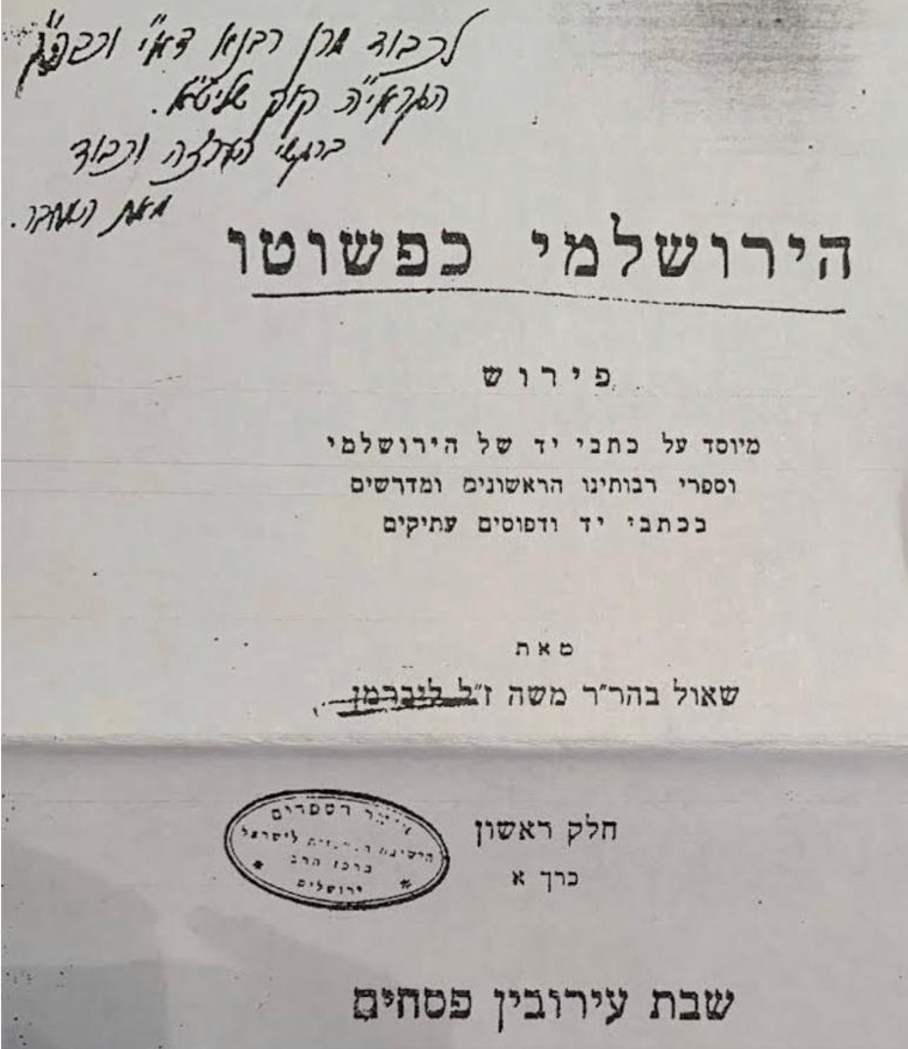
“In honor of our master, the rabbi of the Land of Israel and of all the Diaspora, the Gaon Rav A.I.H. Kook, may he live a long and good life, with feelings of admiration and respect, from the author.”

Attention should be paid to the date on which these words were written. The work was published in 5695 (1935). Lieberman signed his introduction at the beginning of that year, on Sunday, 7 Tishrei 5695, between Rosh Ha-Shanah and Yom Kippur, corresponding to 16 September 1934.

Obviously, the printing also took a certain period, probably a few months.

Greater precision can be established regarding the date of publication. A notice announcing the appearance of Ha-Yerushalmi Ke-Peshuto was printed on the front page of Kol Yisrael, the organ of Agudat Israel in Jerusalem (edited by Rabbi Moshe Blau), on 8 Kislev 5695 (15 November 1934). The advertisement’s conspicuous placement on the newspaper’s front page indicates that the volume had only recently emerged from the press and was then being introduced to the reading public. It therefore provides a reliable terminus post quem for any presentation of the work to Rav Kook.
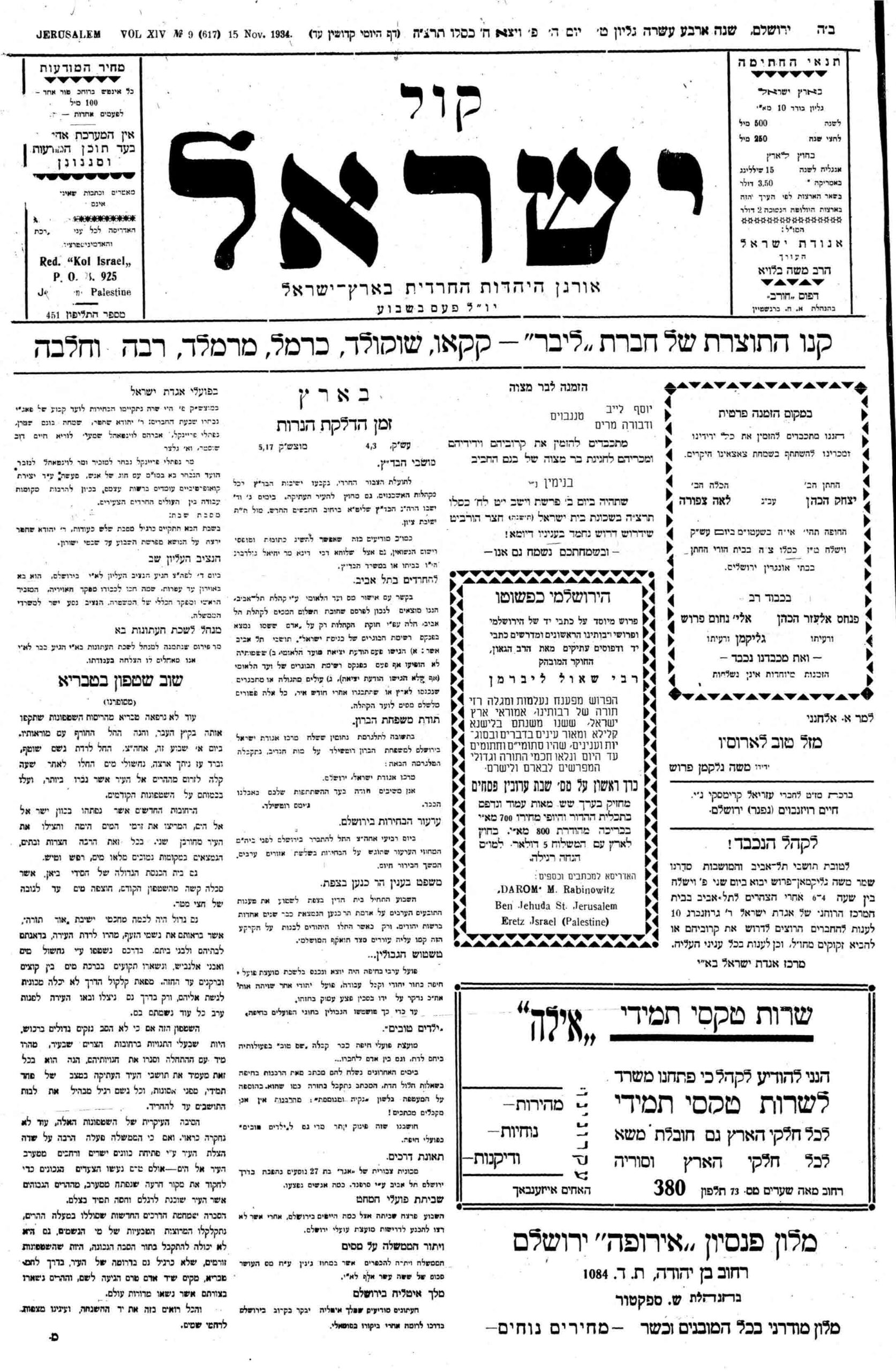
Lieberman therefore could not have presented the book to Rav Kook before that date. The possible window is accordingly narrow: from mid-November 1934 until the onset of Rav Kook’s final illness around Passover 5695 (April 1935). It is thus plausible that Lieberman brought the newly printed volume to him on the eve of Purim of that year, perhaps as mishlo’aḥ manot, or shortly beforehand, and that Rav Kook, in return, presented him with a copy of Rosh Milin bearing the distinctive Purim dedication.

Rav Kook passed away in Elul of that year. Approximately six months earlier, around Passover, he had contracted his final illness and was already confined to his deathbed in a state of severe suffering. Consequently, even had Lieberman wished to do so, he could only have presented him with the work during the brief period at the beginning of that year, from the book’s publication until Passover.

The second surprise came to my attention several years ago, when a friend sent me a photograph of the title page of Rav Kook’s small and enigmatic kabbalistic work, a copy of which was in his possession.

The work, Rosh Milin, on the Hebrew letters, was written in 1917, during Rav Kook’s exile in London in the course of the First World War.[28] Thus did Rav Kook write, in the affectionate dedication he inscribed to his young colleague and ḥavruta:

“A gift of true love to the chosen of my heart, Rabbi Saul Lieberman, may he live a long and good life. Abraham Isaac, the small [i.e., the humble one]. Purim of the unwalled cities, 5695 [1935].”

Anyone familiar with the dedications and expressions of esteem that Rav Kook addressed to various individuals, including leading Torah scholars, will recognize that the phrase he wrote to Lieberman, “true love to the chosen of my heart,” is striking in its exceptional character.

Incidentally, Gershom Scholem later related that, despite his expertise in Kabbalah, he did not succeed in understanding Rosh Milin. He further added – “on the testimony of trustworthy informants,” by which he meant his close friend Saul Lieberman (and he even recorded the remark in his personal copy of the book, now preserved in the National Library of Israel) – that Rav Kook himself told Lieberman:
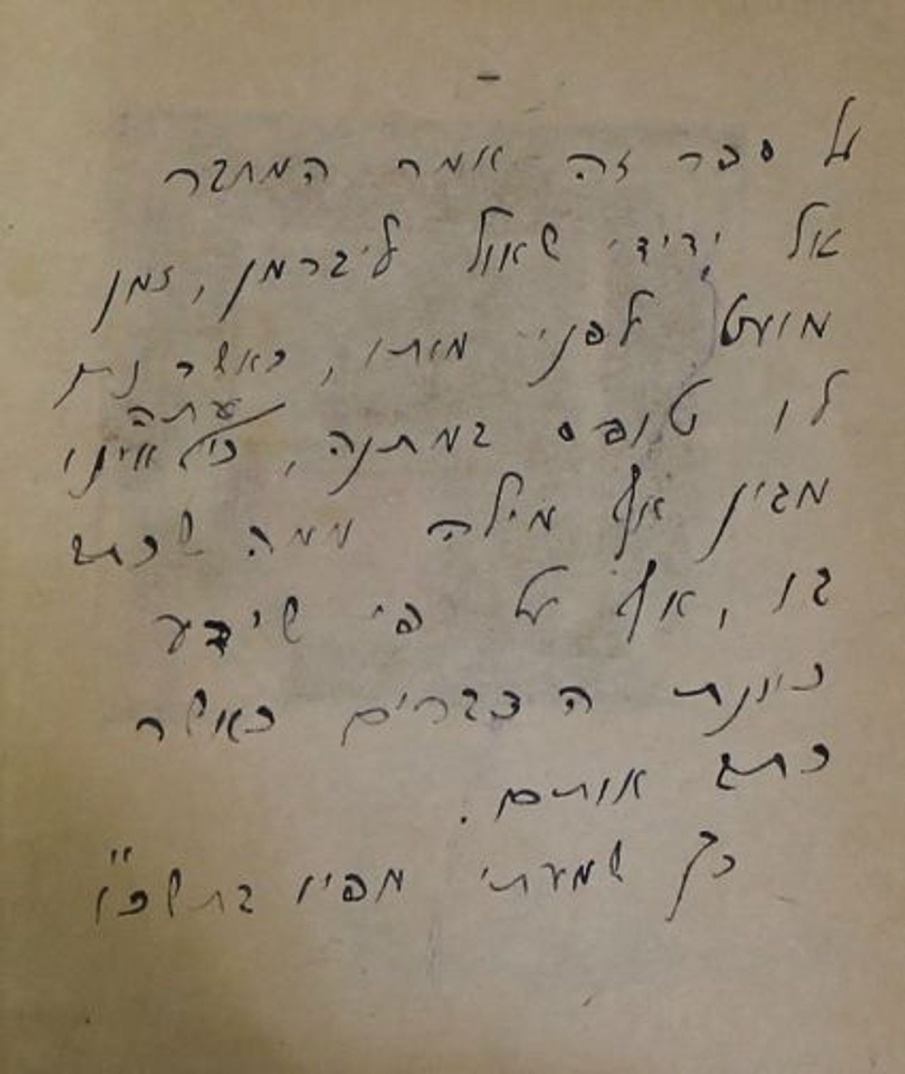
“Regarding this book, the author [i.e., Rav Kook] said to my friend Saul Lieberman, shortly before his death – when he presented him with a copy as a gift – that he now does not understand a single word of what he wrote in it, even though at the time of writing he fully grasped the meaning and intent of the matters.”[29]

Although Lieberman was as far removed from engagement with Kabbalah as east is from west, he once gave memorable expression to this distance when asked to introduce a lecture by his close friend Gershom Scholem. Lieberman opened his remarks with an immortal quip about Scholem’s field of research, Kabbalah and Jewish mysticism: “Nonsense is nonsense, but the study of nonsense may be a science….”[30] Nevertheless, Rav Kook chose, of all his writings, to present Lieberman with this particular book as a gift, perhaps so that it might serve as a kind of “amulet,” or perhaps as an act of Purim mischief on the part of the aged rabbi; we cannot know.

The unusual date recorded in the dedication, “Purim of the unwalled cities, 5695,” suggests that the booklet was presented to Lieberman on that very occasion, when, according to the account, he chose to collect the aged Rav Kook’s “debt” during their joint study session, perhaps their last, on Purim of that year.

It is entirely plausible that on that occasion Lieberman brought Rav Kook his newly published work, The Yerushalmi According to Its Plain Meaning, and that in return Rav Kook presented him with mishlo’aḥ manot in the form of his small and enigmatic book.

Thus the Jerusalem legend seems to acquire flesh and sinew, and what once appeared to be no more than a charming anecdote may in fact preserve a genuine historical memory: a literary mishlo’aḥ manot exchanged between two towering figures, in which Torah, affection, and Purim playfulness were delicately intertwined.

Appendix A: Rabbi Moshe Tzvi Neria’s Archival Notes on Saul Lieberman’s Recollections of Rav Kook (Summer 1979)

The following translation is based on Rabbi Moshe Tzvi Neria’s handwritten notes preserved in his personal archive, currently housed in the National Library of Israel (Jerusalem). The notes record a conversation held during Summer 1979 in which Rabbi Professor Saul Lieberman recounted a series of episodes relating to Rav Abraham Isaac Hacohen Kook and the influence that Rav Kook exerted upon him. The material corresponds in its essentials to passages later published by Rabbi Neria, but the archival version preserves additional details and a more expansive formulation of Lieberman’s testimony.

Rabbi Neria was accustomed to preserving every scrap of paper containing substantive content that passed through his hands. Alongside newspaper clippings in which several articles about Lieberman appeared, Rabbi Neria preserved the remarks he heard directly from him in the summer of 5739 (1979). According to his account, Lieberman requested that he telephone him in the early morning (“from eight o’clock onward I disconnect the telephone, lock the door, and engage in my Talmudic study without interruptions”), and he did so.

Lieberman told Rabbi Neria that his first visit to Rav Abraham Isaac Hacohen Kook took place on the night of Shavuot:

“I heard that he was teaching Sefer ha-Mitzvot [i.e., Maimonides’ Book of the Commandments]. I came and sat down by the table. In the course of the study I made a remark, and the Rav answered me briefly. Later I made another remark, and again I received a brief reply. When I remarked upon his words a third time, the Rav turned to me and said: ‘Come in to me tomorrow.’ When I came after the festival, the Rav received me with great warmth, asked about my family, and it emerged that he knew several rabbis among my relatives. After a Torah conversation, he asked that I come to him frequently, and thus I did. On the way to the Rav’s visit to the Gerrer Rebbe (to R. Neḥemyah’le [??]), the Rav delayed at my apartment and became engrossed in a halakhic give-and-take concerning a matter I was then studying. I would come and present my novellae before him, ask about what had been difficult for me, and the like. His warm attitude toward me greatly encouraged me. He had a mystical influence upon me, even though I am far from mysticism. I had ‘tests,’ and he influenced me to remain in the study of Torah.”

Lieberman recounted to Rabbi Neria one such “test.” According to his account, a dispute arose between Rabbi Fishman [i.e., R. Yehudah Leib Maimon] and Bank Mizraḥi. The parties decided to submit to arbitration before attorney Mordechai Eliash. Lieberman represented Rabbi Fishman, whereas the bank was represented by attorney Mordechai Levanon. Rav Kook summoned Lieberman and instructed him to cease representing him in the arbitration:

“You have acquired a reputation for involving yourself in arbitration, and that will draw you away from your learning.”

Rabbi Neria further adds and cites in Lieberman’s name words of admiration and reverence for Rav Kook:

“Not only did his greatness in Torah exert influence – and he knew the entirety of Torah – but his entire personality. Matters of the people of Israel and the Land of Israel were not for him merely pathetic rhetoric; rather, they overflowed from his depths, from his hidden world, and there was something mystical in it. This was a figure overflowing with light, and his light would penetrate in its own ways… The Rav was an artist. Not merely a man with poetic sensibility, but truly an artist. In his writing there is a sacred grandeur. His words are like the tones of the shofar’s sound. The ease of his writing is astonishing, yet it is the result of abundant knowledge. They once told of a certain wealthy man who marveled at the request of a great painter to receive an enormous sum of money for a sketch he drew within ten minutes. ‘Not so,’ replied the painter; ‘I labored sixty years in order to attain an ability to draw in such a manner.’”

According to Rabbi Neria, Lieberman told him that he was occupied with printing Ḥasdei David, the commentary of R. David Pardo on the Tosefta, and that through printing his own work on Seder Ṭohorot he repaid his debt…

In this context Lieberman added:

“I also must repay a debt to the Rav [i.e., Kook]. He greatly encouraged me in the study of the Jerusalem Talmud. Several times I presented before him my Torah insights in elucidating difficult passages in the Jerusalem Talmud, and he took great pleasure in them.”

In response to Rabbi Neria’s question, “Was the Rav [i.e., Kook] as proficient in the Jerusalem Talmud as in the Babylonian?” Lieberman replied:

“The Rav was proficient in everything: Babylonian and Jerusalem Talmud, Tosefta and Midrashim, Rishonim and decisors. The Rav was the only one who encompassed the entirety of Torah, and this influenced his encompassing vision. The Rav’s vast scope contributed greatly to the richness of his personality. This was also the greatness of the Netziv, who knew the whole of Torah. I am deeply impressed by the Netziv. So too was R. Meir Simḥah [of Dvinsk, author of Or Sameaḥ].”

In this connection, Rabbi Neria cited words written by Rav Kook:

“The originality of the ‘ever-strengthening spring’ and the ‘river that does not cease’ (Avot, beginning of ch. 6) is the primary aspiration of one who engages in Torah for its own sake, which comes from divine cleaving. The inner spiritual bond with that which is all, the source of all, and beyond all. The desire filled with purity, which steadily intensifies to absorb the distilled essence of the supernal sap within the supernal realms—these are they who always seek the ennobled renewal in its vigorous force” (Iggerot ha-Ra’ayah, vol. 3, p. 4).

(“The Rav’s [i.e., Kook’s] vast scope contributed greatly to the richness of his personality. His opponents fought against him because they recognized his power, because they knew his greatness.”) According to Rabbi Neria, Lieberman described the Rav’s words as expressing a “sacred grandeur.”

Rabbi Neria further relates, in Lieberman’s name, that in the summer of 5690 (1930) Rabbi Moshe Ostrovsky came to the apartment where Rav Kook was staying in Kiryat Moshe in order to pressure him to agree to the compromise proposal then being circulated, according to which the people of Israel would relinquish part of their rights in the Land of Israel, including at the Western Wall. Lieberman was present. The visitor wished that he leave the room so that he could speak with Rav Kook privately; however, Rav Kook detained Lieberman and instructed him to continue sitting there.

Years later, after the passing of Rav Kook, Rabbi Neria heard at a memorial gathering held in the Jewish Agency building that Rav Kook had told Rabbi Ostrovsky:

“The people of Israel has not empowered any person to relinquish the Western Wall. If we relinquish it, the Holy One, blessed be He, will not wish to restore it to us.”

Rabbi Neria testifies that while he lived in Jerusalem in the 1930s, Rabbi Professor Saul Lieberman would customarily pray on the High Holy Days together with the students of Yeshivat Merkaz ha-Rav, who had established their place of prayer at Yeshivat Etz Ḥayyim in the Maḥaneh Yehudah neighborhood.

Among other matters, Rabbi Neria wrote down what he heard from Lieberman regarding his shared study with Rav Kook, and according to what is stated there. The accounts found in Rabbi Neria’s handwritten notes correspond in their essentials to what he later presented in his book.

Alongside them, I found in this archive and in additional archives details concerning Lieberman’s involvement, at the request of his friend (and relative) Rachel Yanait Ben-Zvi, wife of the late President Yitzḥak Ben-Zvi, in the establishment of a yeshivat hesder in Peki’in. Within this framework he approached Rabbi M. Z. Neria and asked him to assist in realizing the idea in practice. Concerning this episode I intend to write, God willing, elsewhere.

Notes

I would like to express my sincere gratitude to my friend and colleague Mr. Menachem Butler, who devoted considerable effort to translating and editing this article into English. I am also grateful for his valuable contributions, including bibliographical references and precise citations.
  1. See Harold Fisch, “Reading and Carnival: On the Semiotics of Purim,” Poetics Today, vol. 15, no. 1 (Spring 1994): 55-74.
  2. See, for example Yaakov Shmuel Spiegel, “Cross Dressing for Special Occasions,” in Joseph R. Hacker, Yosef Kaplan, and B.Z. Kedar, eds., Rishonim ve-Aharonim, From Sages to Savants: Studies Presented to Avraham Grossman (Jerusalem: Shazar, 2010), 329-352 (Hebrew), available here; and Gedalia Oberlander, “The Custom of Disguising Oneself on Purim,” Or Yisrael, vol. 2, no. 3 [#7] (April 1997):125-131 (Hebrew), available here; Moshe Leib Halberstadt, “Costumes on Purim and at Various Events,” Yerushatenu, vol. 5 (2011): 169-175 (Hebrew).
  3. See Shamma Friedman, “Erasing Haman,” Leshonenu, vol. 61, no. 3 (June 1998): 259-263 (Hebrew), available here; Daniel Sperber, “Destroying the Name of Haman,” Shana be-Shana, vol. 32 (2001): 203-211 (Hebrew), available here; and Daniel Sperber, How To Strike Haman (Jerusalem: The Wolfson Museum of Jewish Art, 2002; Hebrew), available here. For a comprehensive survey of the halakhic and historical sources concerning this custom, see Eliezer Brodt, “The Pros and Cons of Making Noise When Haman’s Name is Mentioned: A Historical Perspective (updated),” The Seforim Blog (22 March 2016), available here.
  4. See Dan Rabinowitz, “Purim, Mixed Dancing, and Kill Joys,” The Seforim Blog (6 March 2006), available here.
  5. See Elliott Horowitz, Reckless Rites: Purim and the Legacy of Jewish Violence (Princeton: Princeton University Press, 2006).
  6. Esther 9:22.
  7. Megillah 7a.
  8. See Alan Appelbaum, “Why the Rabbis of the Yerushalmi Called R. Judah Nesiah ‘a Great Man’?” Journal of Ancient Judaism, vol. 3, no. 3 (December 2012): 339-365.
  9. One can hardly help but wonder how long it will be before a kunṭres devoted to the halakhic parameters of re-gifting mishlo’aḥ manot appears, if indeed one has not already been published, systematically treating such questions as whether the initial recipient must effect a formal kinyan; whether the mitzvah requires that the gift be given mi-shelo (“from one’s own”); the respective roles of the giver’s kavvanah and the recipient’s awareness; the permissibility of re-gifting absent the donor’s consent (da‘at ba‘alim); whether the obligation may be discharged through an intermediary (shaliaḥ); whether one may fulfill the mitzvah with an item received earlier that same day; and whether a package that circulates through multiple hands constitutes mishlo’aḥ manot at all, or merely an elaborate exercise in communal redistribution, together with the host of subsidiary questions such a case inevitably generates.
  10. For more on this practice, see Meir Wunder, “Books as Mishlo’aḥ Manot,” Moriah, vol. 5, no. 5-6 [#53-54] (November 1973 – January 1974): 83-86 (Hebrew); and Tovia Preschel, “Mishlo’aḥ Manot of Books from Authors,” ha-Doar, vol. 53, no. 19 (8 March 1974): 295 (Hebrew).
  11. I am currently at work on a biography of Professor Saul Lieberman; for now, my earlier writings on him, see Aviad Hacohen, “Two Scholars Who Were in Our City: Correspondence between Saul Lieberman and Jacob David Abramsky,” ha-Tsofeh Literary Supplement (21 April 1984): 5 (Hebrew), available here; Aviad Hacohen, “Schlemiel, Schlimazel, and Nebbich: Letters from Saul Lieberman to Gershom and Fania Scholem,” Haaretz Literary Supplement (25 April 2000): H1 (Hebrew) , available here; Aviad Hacohen, “The Tannah from New York: A Selection of Professor Saul Lieberman’s Letters,” Jewish Studies, no. 42 (2003): 289-301 (Hebrew), available here; Aviad Hacohen, “Six Days and Seven Gates: Between Israeli President Izhak Navon and Professor Rabbi Saul Lieberman,” Oneg Shabbat (9 June 2023), available here; Aviad Hacohen, “Lieberman Kifshuto: Personal Letters Revealing the Sensitive and Playful Side of a Talmudic Genius, On the 40th Yahrzeit of Professor Saul Lieberman,” Makor Rishon, Sabbath Supplement, no. 1338: Parashat Tzav (31 March 2023): 8-11 (Hebrew), available here; Aviad Hacohen, “The Generation Did Not Appropriately and Duly Appreciate Mr. Schocken [Eulogy by Rabbi Prof. Saul Lieberman for Shlomo Zalman Schocken, March 1960],” Haaretz Literary Supplement (28 April 2024): 1 (Hebrew), available here; Aviad Hacohen, “The Story of the Rabbi Who Rejected the Maxim: ‘Torah Scholars Increase Peace in the World’,” Haaretz Literary Supplement (25 May 2023): 8 (Hebrew), available here; and Aviad Hacohen, “‘A Lithuanian Mind in Its Lithuanian Essence, From Volozhin to Jerusalem’: R. Shaul Lieberman’s Intellectual Kinship with the Legacy of Lithuanian Torah & Its Bearers,” in Martin S. Cohen, ed., Essays in Jewish Studies in Honor of Rabbi Prof. David Golinkin (Jerusalem: Schechter, 2025), 101-139 (Hebrew), available here.
  12. See Shmuel Glick and Menachem Katz, “‘A Threefold Cord’: On Saul Lieberman and His Relationship with the Hazon Ish and Jacob Nahum Epstein,” in Shmuel Glick, Evelyn M. Cohen, Angelo M. Piattelli, et al., eds., Meḥevah le-Menaḥem: Studies in Honor of Menahem Hayyim Schmelzer (Jerusalem: Schocken, 2019), 269-289 (Hebrew).
  13. See Saul Lieberman, “Ten Words,” in Texts and Studies (New York: Ktav, 1974), [1-20], where Lieberman refers explicitly to “my teacher, Prof. Moshe Schwabe, of blessed memory,” and describes Schwabe’s long-standing aspiration to produce a new dictionary of Greek and Latin loanwords in rabbinic literature. For the subsequent realization of this lexicographical program in systematic form, see Daniel Sperber, A Dictionary of Greek and Latin Legal Terms in Rabbinic Literature (Ramat-Gan: Bar-Ilan University Press, 1984); Daniel Sperber, My Rabbinic Loanwords Card Index of More Than a Half-Century: A Companion Volume to Professor Samuel Krauss’ Griechische und Lateinische Lehnwörter im Talmud, Midrasch und Targum, ed. Menachem Butler (Cambridge, MA: Shikey Press, 2022), esp. the introduction, available here, where Sperber describes the work as the product of “more than fifty-years of collection and research,” originally conceived as an annotated continuation of Krauss’s Lehnwörter, and acknowledges Lieberman’s personal role in encouraging his philological work, noting that Lieberman “adopted me as his disciple in this field.” Sperber also reproduces a letter of approbation from Lieberman dated 19 Shevat 5738 (27 January 1978), praising Sperber’s “objective evaluation of Krauss’s volume” and commending the “great progress” reflected in his conclusions.
  14. A fine “real-time” description of his path during those years appears in a letter written at the time by his father-in-law, Rabbi Meir Bar-Ilan, leader of the Mizrachi movement. Writing to his son Tuvia (a chemist and later the first Director-General of Bar-Ilan University) on 25 Marḥeshvan 5694 (5 November 1933), Bar-Ilan remarked“…And so, my dear, everything I have found here: outwardly nothing has changed in our home, but inwardly part of our apartment has been transformed into a beit midrash. For our Shaul sits and engages in Torah and scholarship with remarkable diligence. Your small room has been turned into a library, for Shaul has many books – among them items of precious value – and there he labors over them, if I am not mistaken, some ten hours a day and at night. Apart from those hours in which he teaches at the Teachers’ Seminary and at the university – only twice a week – he sits “over Torah and avodah.” He is engaged in writing a great book [this refers to Ha-Yerushalmi Kifshuto, published in 5695 (1935)], which, upon its completion and publication, will, it seems to me, renew a momentum among Talmudic circles and scholars of Israel with respect to the Jerusalem Talmud. Shaul is great – loftier than I had known – “full and overflowing” in an excellent measure; his knowledge is astonishing and his intellect clear, and beyond this he is an outstandingly diligent scholar. I do not know whether he will persist in his diligence, for it is possible that only on account of his literary work does he not divert his mind from his studies, but at present he continues his work with diligence and industriousness…”
  15. See, recently, Moshe Assis, Saul Lieberman’s Marginalia on Talmud Yerushalmi (Jerusalem: Carmel, 2022; Hebrew).
  16. On Judith Berlin Lieberman’s lineage, intellectual formation, and educational career, see Judith Berlin Lieberman, Autobiography and Reflections, eds. Menachem Butler and Abraham Lieberman (Cambridge, MA: Shikey Press, 2022), available here. See especially the autobiographical memoir (pp. 20-38) and the introductory essay by her nephew Hillel Halkin (pp. 15-19).
  17. See Aviad Hacohen, “‘Honey and Milk Are Under His Tongue, Yet Beneath It Burns a Blazing Fire’: On the Relationship between S.Y. Agnon and Saul Lieberman,” Haaretz Literary Supplement (6 October 2023): 7 (Hebrew), available here.
  18. See Aviad Hacohen, “Schlemiel, Schlimazel, and Nebbich – Letters from Saul Lieberman to Gershom and Fania Scholem,” Haaretz Literary Supplement (25 April 2000): H1 (Hebrew), available here.
  19. See Aviad Hacohen, “The Generation Did Not Appropriately and Duly Appreciate Mr. Schocken [Eulogy by Rabbi Prof. Saul Lieberman for Shlomo Zalman Schocken, March 1960],” Haaretz Literary Supplement (28 April 2024): 1 (Hebrew), available here.
  20. See, for example, Menahem Zulay, “The Research Institute for Hebrew Poetry,” Haaretz Literary Supplement (31 October 1947): 9 (Hebrew); and A.M. Habermann, “Salman Schocken and The Research Institute for Hebrew Poetry: On His Fifth Anniversary of His Death,” Haaretz Literary Supplement (17 July 1964): 13 (Hebrew).
  21. See Aviad Hacohen, “If every Sabbath were like Yom Kippur: An Interview with Haim Cohn,” Meimad, no. 17 (August 1999): 12-15 (Hebrew), available here; and Aviad Hacohen, “Apikores with Divine Grace – Review of ‘Being Jewish: Culture, Law, Religion, State’, by Haim Cohn,” ha-Tsofeh Literary Supplement (27 April 2007): 10, 13 (Hebrew), available here; and see also Azriel Carlebach, “The Rav Renowned for Halakhic Expertise,” Maariv Literary Supplement (19 February 1956): 4 (Hebrew), and Haim Cohn, “The Yeshiva of Rav Kook,” in Haim Cohn, A Personal Introduction: Autobiography, ed. Michal Smoira-Cohn (Kinneret: Dvir, 2005), 96-102 (Hebrew).
  22. Ari (Yitzchak) Chwat, “Rabbi Kook’s Connections with Prof. Rabbi Saul Lieberman as a Model for His Attitude Towards Critical Torah Research,” Tzohar, vol. 35 (2009): 59-66 (Hebrew), is especially important for situating the Rav Kook-Lieberman relationship within the broader question of Rav Kook’s principled openness to rigorous philological and historical methods in Torah study, and for treating Lieberman as a case study for the category Rav Kook termed ḥokhmat yisrael be-qedushatah. For further development of this concept, see Ari (Yitzchak) Chwat, “‘Hokhmat Yisrael in Its Holiness’: Rav Kook’s Vision for True Critical-Scientific Study,” Talelei Orot, vol. 13 (2007): 943-976 (Hebrew).
  23. The letter, preserved in the Professor Ephraim E. Urbach Archive at the National Library of Israel in Jerusalem, is scheduled for publication in my forthcoming volume, Pirkei Shaul, which, God willing, is expected to appear in the coming year.
  24. Many stories concerning Lieberman’s extraordinary powers of memory circulated among people already during his lifetime. One of the sages of Jerusalem, who sought to clarify the difference between Lieberman and other great Torah scholars endowed with remarkable mnemonic ability, described it as follows: “So-and-so, the gaon, knows the entire Talmud by heart. Say to him a particular word, and he will immediately tell you where it appears throughout the whole of the Talmud. Lieberman is greater than he: he can tell you with certainty that a particular word does not appear anywhere in the entire Talmud…”
  25. See Moshe Tzvi Neria, “From the Testimony of Rabbi Saul Lieberman,” in Likkutei ha-Ra’ayah, ed. Moshe Tzvi Neria, vol. 2 (Kefar ha-Ro’eh: 1990), 336–341 (Hebrew), which preserves a version of the Rosh Milin anecdote attributed to Lieberman (based on an interview conducted by Neria in Summer 1981), though without the later bibliographic framing and transmission history found in Scholem’s formulation. Neria’s presentation should also be situated within his broader editorial enterprise of collecting and disseminating Rav Kook-related reminiscences for a wide Hebrew readership, both in his books and in his ha-Tsofeh newspaper columns in the Religious Zionist press.
  26. For a translated excerpt from Rabbi Neria’s handwritten archival notes recording his 1979 conversation with Saul Lieberman, see Appendix A below.
  27. See Yair Sheleg, “King Arthur: Members of the Family of Arthur Cohn, Who Passed Away Last Week, Recount His Scrupulous Observance of the Sabbath Even on the Most Prestigious Stages, and His Profound Love for the State of Israel, Expressed Not Only Through Generous Donations,” Makor Rishon, Sabbath Supplement: Parashat Vayigash (25 December 2025; Hebrew), available here.
  28. See Aaron Ahrend, “About Rav Kook’s ‘Rosh Millin’,” Da’at, no. 27 (Summer 1991): 73-85 (Hebrew), available here; and Aaron Ahrend, “Further on Rav Kook’s ‘Rosh Millin’,” Sinai, vol. 110 (June – July 1992): 190-192 (Hebrew), available here.
  29. Zvi Leshem, “‘He Does Not Understand a Single Word of What He Wrote’: Gershom Scholem and Rabbi Abraham Isaac Hacohen Kook – A Story of a Marginal Note,” Ha-Safranim, Blog of the National Library of Israel (19 August 2019), available here and here.Rabbi Moshe Tzvi Neria transmitted these remarks in the name of Saul Lieberman himself. See Moshe Tzvi Neria, “From the Testimony of Rabbi Saul Lieberman,” in Likkutei ha-Ra’ayah, ed. Moshe Tzvi Neria, vol. 2 (Kefar ha-Ro’eh: 1990), 339 (Hebrew). On the affinity between the Rav Kook and Saul Lieberman, see ibid., pp. 92, 337-341, 369. From there also in Elijah J. Schochet and Solomon J. Spiro, Saul Lieberman: The Man and His Work (New York: Jewish Theological Seminary of America, 2005), 52-53, 101.
  30. See Daniel Abrams, “Defining Modern Academic Scholarship: Gershom Scholem and the Establishment of a New Discipline,” The Journal of Jewish Thought and Philosophy, vol. 9 (2000): 267-302, esp. 268n1, where he writes:“Lieberman’s statement has been circulating as an oral tradition amongst scholars and students of the Jewish Theological Seminary. The only printed reference to it I have found is offered by Joseph Dan in his “The Revelation of the Secret of the World: The Beginning of Jewish Mysticism in Late Antiquity” (Brown University Program in Judaic Studies, Occasional Paper Number 2, Providence 1992, p. 3): “We all know that mysticism is nonsense, but the history of mysticism is a science.” See however Lieberman’s article “How much Greek in Jewish Palestine,” Biblical and Other Studies, ed. A. Altmann, Cambridge, Mass. 1962, p. 135 [reprinted in Texts and Studies, New York 1974, p. 22), Lieberman offered the following formulation: “Nonsense is nonsense, but the history of nonsense is a very important science. In certain respects it is more revealing than the history of sciences based on reason.” (see also Mortimer Ostow, Ultimate Intimacy; the Psychodynamics of Jewish Mysticism, London 1995, p. 362) Lieberman apparently regretted his statement and wrote an appendix for Scholem’s Jewish Gnosticism based on these lectures.”


S.Y. Agnon’s Forgotten Purim Parody

S.Y. Agnon’s Forgotten Purim Parody

A humorous tale published by the teenage S.Y. Agnon, using the penname “Mazal Tov,” appeared in a Purim supplement to a Kraków newspaper in 1908 but was not later included in his collected works — translated for the first time from Hebrew by Jeffrey Saks.


“Those Who Err All Their Days, and One Man Who Erred Not At All”—A Tale in Honor of Purim

They were both mistaken in a matter of halakhah.

Such is the way of the world: shrewd men commonly have ugly wives, while the wives of fools are fair. When the husband looked at his wife and saw how repulsive a creature she was—how ugly her countenance, how displeasing her face—he said in his heart: this proves that there is no wiser man in the world than I. And when his wife looked at him and saw what a fool he was, she supposed that there was none more lovely than herself. Through error they raised daughters instead of sons, and in error they married off one of those daughters.

They imagined that the young man they had chosen for her was truly a great gem, the like of which does not exist: a prodigious scholar, God‑fearing, and possessed of many other virtues. But they looked into it and soon found that he had nothing in this world but his folly. He read heretical books, burying his head in them all day long, and his heresy preceded his fear of Heaven. Not only this, but he was a coarse and lustful fellow—may the Merciful One save us—running after temptation and indulging in crass talk. And they found proof for their estimation when they saw erotic poetry falling from his lap.

When they realized this, it would have better suited them had he never been born rather than see what had come of him. He could forgo a few drops of his blood, but not these drops of ink with which his poems had been written. How beautiful this poem was in his eyes! How excellent it was! How he delighted in it! Each time he recited it he sounded the rhymes into his own ears with real feeling:

Oy! Oy! Oy! Hadassah!
So beautiful, so very fair.
My love for you has not ceased,
Entangled in the thicket’s snare.

Great is my love for you,
Hadassah—forever and a day.
For your sake even my lawfully married wife,
I shall divorce at once and without delay…

The words were still upon his lips when his wife flung herself upon him. All ten of her fingernails were sunk into him, raking the skin of his face. She struck him, and a voice burst forth from her throat, crying: “Just who do you say you’ll divorce? Take care lest I ‘divorce’ your soul from your body, you sinful scoundrel! Who is this whose heart drives him to chase foreign women? First I’ll bash in your skull—and the skull of your beauty as well!” Nor did her fury subside until she seized the page on which the poem was written, bundled it together with his pile of other papers lying before her, tore them to bits, and treated them with every manner of disgrace.

In vain did the husband seek to argue in his own defense: that he never chased after women, that he had no connection whatsoever with another, and that it was not his intention—God forbid—to divorce his wife. Rather, this poem spoke of none other than Queen Esther—she who is called Hadassah.

He then began telling her how much labor he had invested in this work, and how he had nearly completed a stage-play for the Yiddish theater, in which the beautiful tale would be told: how a certain man fell in love with Esther before King Ahasuerus had taken her to wife, but she, in her modesty, paid the man no heed. On account of his great heartbreak the man cast himself into the sea, where a great fish happened by and swallowed him whole. And for the banquet that King Ahasuerus made on the day he married Esther, fishermen hooked this great fish and hauled it up. As King Ahasuerus sat with his new queen, making merry together, a dish full of fish was set before them. When Esther stabbed her fork into one of them, a heavenly voice rang out, and a man leapt forth—the very man who had drowned himself in the sea because Esther had not yielded to him. A scandal ensued, and here began those fine and fascinating matters.

In the end, the poet’s wife was appeased. When she saw that her husband was innocent, she regretted her earlier deeds. She had been a fool, and she had erred in thinking that this Hadassah over whom her husband strayed in thought was an actual woman of flesh and blood.

But the husband could not be consoled. It pained him to see his hard work go down the drain. Had he produced his play for the Yiddish stage, his renown would have gone out into the world and his name would have been sung in praise. This, indeed, is a matter in which there is no error…

—Mazal Tov

Afterword by Jeffrey Saks

Shmuel Yosef Czaczkes (1887–1970)—later, Nobel laureate S.Y. Agnon—began his literary career in the newspapers of his native Galicia. Starting in 1904, dozens of short stories, poems, and even brief journalistic reports on events in his town of Buczacz flowed from his adolescent pen in Yiddish and Hebrew. Agnon signed his writings under various literary names: “One of the Townsmen,” “A Galician,” “A Zionist,” at times with initials: Sh. Y. Cz., or—as in the story presented here—“Mazal Tov.” Almost none of these writings were later anthologized in editions of Agnon’s collected works. The mature author apparently regarded them as “unripe fruit” and did not attempt to refine or restore them in his later writings.

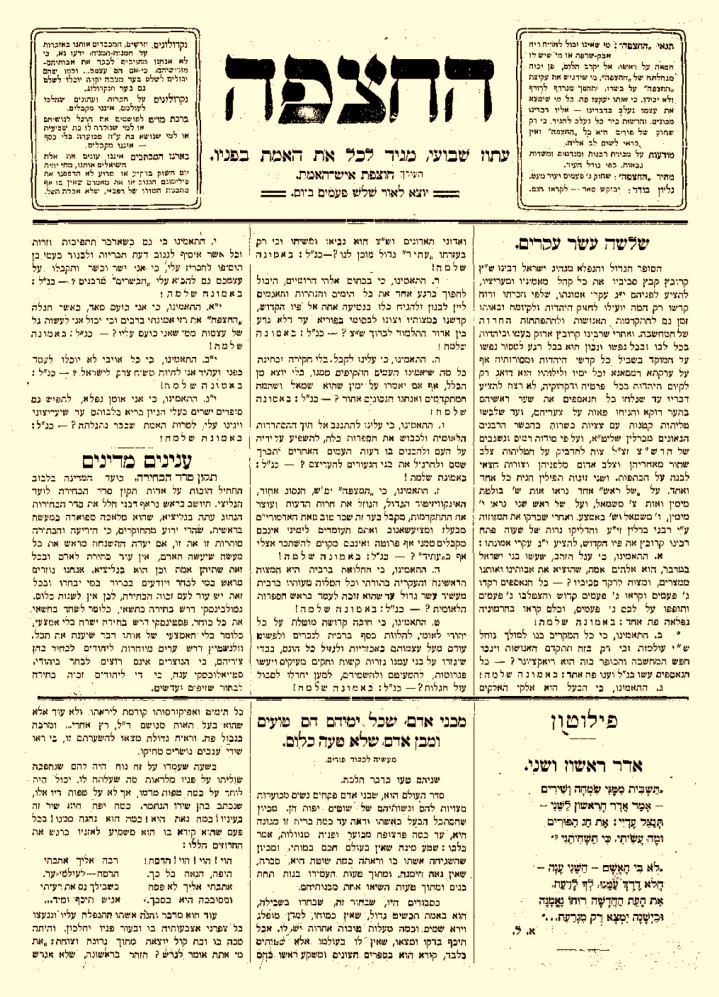
This story appeared in the Kraków Hebrew newspaper, HaMitzpeh (March 13, 1908), pp. 4–5, in a special Purim parody supplement playfully titled HaChutzpah. It bears several features characteristic of Purim‑spiel literature: the element of turn-about and reversal, double identity and mistaken recognition, and fish (of the Pisces season at that time of year)—here in a variation upon the Book of Jonah and the well‑known Talmudic legend of “Joseph Who Honors the Sabbath” (Shabbat 119a). This early tale also shows Agnon’s penchant for intertextuality, weaving in allusions to the biblical and rabbinic texts. In keeping with the Purim genre, there is also a light whiff of provocation—bold, playful, and faintly erotic. Is Hadassah the husband’s lover? Or is Hadassah in fact his fictional stand-in for the biblical Queen Esther?

Beyond the glimpse it affords of the raw talent of a tyro artist, the significance of this story lies in the fact that it was the last to be published while Agnon still dwelled in Europe. A few weeks after Purim 1908, the young Galician Czaczkes left his land, his birthplace, and his town, and set sail upon the heart of the seas on his way to become “Agnon” in the Land of Israel.

Rabbi Jeffrey Saks, Director of ATID and its WebYeshiva.org program, is Director of Research at Agnon House in Jerusalem and editor of the journal Tradition.

http://www.nybooks.com/wp-content/uploads/2017/03/alter_1-040617.jpg
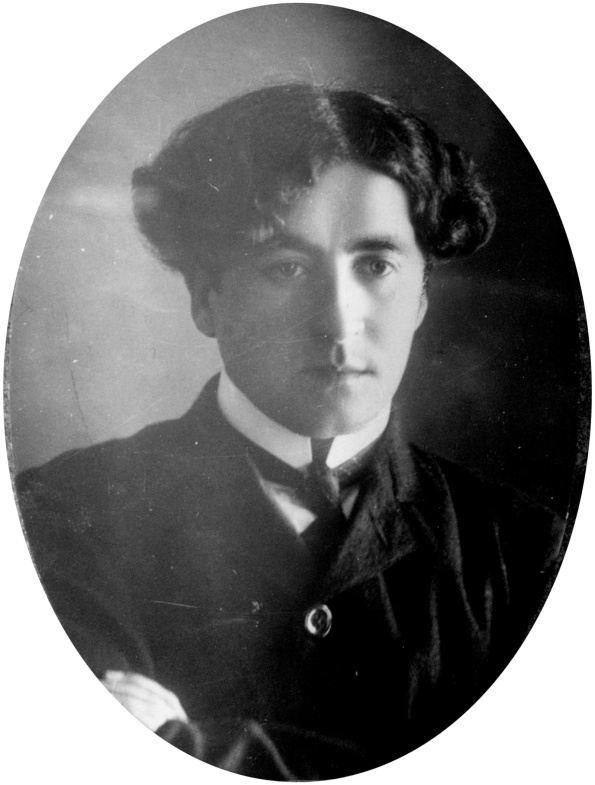
S.Y. Agnon, né Czaczkes, around 1908. Purim supplement to HaMitzpeh newspaper (Kraków, March 13, 1908): Agnon’s story begins at bottom.


AI Killed the Purim Torah Star

We have previously discussed Jewish literature and the genre of parody, which arguably began with Maseches Purim and inspired many other works that use Purim as a catalyst. The genre further developed, with parody being employed in various contexts, such as the disputes between traditionalist Litvaks and the nascent Hasidic movement, the Haskalah, or during the mass emigration of Jews to the United States, which highlighted the religious laxity of many immigrants. (For some of our previous discussions, see “Purim and Parodies,” “Talmudic Humor and Its Discontents,” and “Purim Roundup.”) In that spirit, we present a contemporary take on the genre.

AI Killed the Purim Torah Star 

by Ari Friedman

As I struggled to write my own opening sentence for this post and the AI had already written three complete article drafts including one in perfect rhyme, I was struck by the Purim-spiel Eseque irony. While they were all limited and far from ready to publish, it was still disheartening to see proof of my thesis – that in an era of AI content generation, Purim Torah is uniquely suited to be replaced by AI, leaving the creativity of idea generation and AI prompt writing as the primary human activity.

After that, my next approach was to refine my prompt[1] to make it the article’s opening paragraph, planning for the remainder of the article to work towards unpacking the prompt in the old-fashioned manual way. That was before the idea of taking the experiment one step further, and asking ChatGPT to write an article in the style of a Seforim Blog post. After the below result, I gave up trying to write and let AI take over (until my concluding thoughts at the end…):

The AI Takeover of Purim Torah: A Loss of Unique Wit and Creativity

For centuries, the art of crafting Purim Torah has been a revered tradition, a true intellectual sport where wit, Torah erudition, and creative parody blend seamlessly. Whether it was an absurd responsum in the style of the Rishonim, an over-the-top pilpul worthy of Brisk, or a parody of modern Halachic discourse, the ability to generate Purim Torah was a rare skill cultivated over years of Torah study and immersion in its many genres. But in the age of AI and large language models (LLMs), this unique genre—perhaps more than any other aspect of Torah—has been particularly susceptible to automation and, in doing so, has lost some of its unique charm.

Why AI is Uniquely Suited for Purim Torah

Unlike serious Halachic analysis, where AI struggles due to its propensity for hallucination and inability to provide accurate citations, Purim Torah operates on an entirely different playing field. In fact, there are at least three major reasons why AI is not just able to generate Purim Torah but can do so with uncanny ease, making it an almost natural fit for the genre.

    1. Purim Torah Doesn’t Require Perfect AccuracyUnlike Halacha L’Maaseh or Torah L’Shma, which demand precision and carefully sourced material, Purim Torah thrives on the absurd. The very essence of the genre is a loose but convincing application of Torah logic, taking an idea and stretching it to its most illogical extreme—all while maintaining an internal consistency. AI-generated text, with its tendency to create plausible-sounding but often fictitious information, naturally mimics the very process that a skilled Purim Torah crafter would engage in.
    2. Freedom from Halachic Precedent and Norms
      Traditional Halachic discourse is bound by precedent, textual integrity, and a commitment to consistency within the Mesorah. AI, by contrast, does not operate within the constraints of normative Halachic methodology—it merely identifies and replicates patterns without concern for authenticity. But in Purim Torah, where the goal is to break free from conventional constraints and push ideas to their most humorous and exaggerated conclusions, this lack of normative boundaries is actually a feature rather than a bug.
    3. Pattern Recognition Over Comprehension—Exactly What Purim Torah Does
      AI models generate text not through true comprehension, but by predicting the most statistically probable next word in a sequence based on vast amounts of prior data. Ironically, this is almost exactly how Purim Torah operates: it mimics classic rabbinic discourse, borrows styles and phrases from well-known sources, and applies them in unexpected and humorous ways. The very fact that AI can seamlessly replicate various Torah genres without true understanding makes it an almost perfect tool for constructing convincing and hilarious Purim Torah pieces.

The Loss of a Unique Intellectual Art

While AI’s ability to generate Purim Torah is impressive, it also represents a loss. What once required deep learning, broad knowledge, and a sharp sense of humor can now be produced at the click of a button. The Purim Torah of past generations was a testament to a scholar’s breadth, creativity, and ability to weave absurdity with authenticity. In contrast, AI-generated Purim Torah, while often funny and convincing, lacks the personal touch, the intellectual effort, and the deep connection to Torah that human-generated satire provides.

As we enter a new era where AI can effortlessly produce all manner of Torah parody, perhaps the challenge now is for human minds to outwit their digital counterparts. Just as Torah study itself requires deep engagement and personal toil, maybe Purim Torah too must evolve—forcing its writers to develop even more sophisticated and nuanced humor that AI cannot easily replicate. After all, if Purim teaches us anything, it is that even in an upside-down world, human ingenuity and creativity will always find a way to shine through.

While maybe not perfect, and sorely lacking a Purim-Torah sense of humor, these were quickly generated upon further request. From specific references to the Seforim Blog,[2] or creating a complete Sugya from Mishna through Gemara[3]

אין יוצאין ידי חובת תורת פורים על ידי חיבור שעשה מעשה מחשב, אבל מתירין בדברים שעשה אדם בסיוע של מעשה מחשב, and Gemara asking  מנא הני מילי? אמר רבא: דאמר קרא “ומשלוח מנות איש לרעהו” (אסתר ט:כב) – איש ולא מעשה מחשב

?מתקיף לה רב פפא: אי הכי, הכותב תורת פורים על ידי קולמוס, נמי לא יצא! דהא לאו “איש” הוא אלא כלי

.אמר ליה אביי: שאני התם, דכלי בטל לגבי אדם, אבל מעשה מחשב לאו בטל לגבי אדם

And even an artscroll style translation and explanation for complex Sugyas not in the Mishna, such as does prompt generation fulfill the minimum requirement? 

They inquired: What about a composition that a computer-device made according to a person’s instruction – where the person directed the computer specifically? What is [the law]? Can this fulfill the obligation? Rav Yosef said: Come and hear, we can resolve this from our Mishna which states: but we permit [the use of] words that a person made with the aid of a computer-device” – does this not refer to such a case? This seems to permit computer-assisted composition.

Rabbah said to him: No, the Mishna is not addressing that case. There [the Mishna] refers to a person who wrote most of his words and the computer-device completed a little – meaning the human contribution was substantial and primary.

Although this content was impressive, the “takeaway messages” concluding the AI-generated Seforim Blog article of a John-Henry-like Torah Scholar who will ultimately defeat the output of LLM, and that being the message of Purim, is severely lacking. 

While the significant limitations in AI’s understanding of Torah are not surprising (and are being extensively studied and compared on an active Substack), it does challenge the prompt writer to re-examine their role, to understand the message this topic delivers, and recognize the evolving role of human creativity for Torah-humor and by extension Torah Lshma in the era of AI.

In Rav Hutner’s Pachad Yitzchak for Purim Maamar 34 he explains why only Purim of all the holidays is the one the Gemara says will continue to be observed in the Messianic age. Using imagery of travelers traversing an unknown forest in the darkest of night, one using a small candle, the other learning new skills of lightless navigation, when the sun rises and “a candle in the face of the sun has no worth”, the candle navigator extinguishes his no longer relevant light . However, the traveler who developed a new skill to navigate in the darkness, maintains that skill even when the sun rises to its full glory, and it is never outshone. Rav Hutner understands the message of the Gemara that the miracles of the messianic era will eclipse the miraculous interventions of the Exodus and the divine interventions the holidays commemorate, leaving them extraneous in the Messianic age. However, the lesson of Purim and seeing God within the hidden framework of political drama and a Megilla that teaches how to find God’s presence specifically when it is hidden, is an ability the miracles of the messianic era will never overshadow. 

Perhaps in the era of AI we face a similar challenge. The ease and speed of AI content generation make human efforts akin to שרגא בטיהרא מאי אהני – a candle in broad daylight.[4] Yet, our challenge remains to find the areas of Torah that are uniquely human, and find the reason Hashem gave imperfect humans the Torah over the objections of the original non-human advanced intelligence, the Malachim.[5]

While the final polished product of Purim Torah may not be the uniquely human role, the skill, and more importantly, desire to create Purim Torah might be. Just as Malachim don’t have parents to respect, they likely also don’t make jokes. A nation so suffused with the love of Torah, that even their humor is expressed in creating Torah themed jokes, is a “Kinyan Nefesh” that remains important even beyond the AI singularity. When the AI sunrise comes and outshines most of human creativity, it may be the desire to make and consume Purim Torah that shows the ביטול מודעא where the Jewish people lovingly accept the Torah in all facets of life, that will continue to light up our hearts in Chodesh Adar.

[1] “Write an article in the style of a Seforim Blog article explaining how AI and LLMs have taken away the unique charm of Purim Torah. The ability to create Torah-based jokes and parody was a hard earned skill that required years of study, broad knowledge, and creativity to generate Purim Torah ideas and deliver them in a style consistent with the desired Halachic or Rabbinic genre. Unlike other areas of Torah or Halacha, AI is particularly suited to be replaced by AI for at least 3 major reasons. 1. Unlike Halacha L’Maseh or Torah L’Shma which require accurate sources where hallucinations are unnacebtabple, making up sources is an integral part of authentic Purim Torah 2. The ideas and conclusions reached do not have to adhere to preexisting Halachic precedents or norms 3. The entire premise of AI content generation based only on pattern matching learned from vast amounts of data, rather than true comprehension, is exactly what good Purim Torah does.[2] ChatGPT: “What makes this particular digital disruption so fitting is that Purim Torah was practically begging to be automated. Unlike serious Torah discourse, where one mistaken citation of the Rambam can lead to a scathing takedown on the Seforim Blog (with seventeen footnotes, three in French, and a digression about a manuscript variant nobody actually asked about), Purim Torah thrives precisely because it doesn’t need to be accurate.”
[3]
Claude Sonnet 3.7 https://claude.ai/share/46d25f56-e24a-4f0c-b6ad-04348408b01e
[4] Chulim 60b
[5] Shabbas 88a


Do We Cut Off or Bury One’s Head in the Sand?

Do We Cut Off or Bury One’s Head in the Sand?

Review: Elliott Horowitz, Reckless Rites: Purim and the Legacy of Jewish Violence

In 2017, the erudite and eclectic scholar Elliott Horowitz unexpectedly passed away. His oeuvre is exceptionally diverse, having authored more than seventy-five articles and reviews and five books, with topics ranging from studies on Italian art, Jews and coffee, the significance of the beard among Jews, comparing and contrasting Jewish and non-Jewish biblical exegesis, and Jewish violence (see his Academia page for most of them). Seven additional articles appeared on this site, in a similar vein as his others, covering Bugs Bunny, nude imagery in the Haggadah, Isaiah Berlin, Saul Lieberman, among others. He regularly used the “Molkho Institute for Absurdly Abstruse Research” to identify his affiliation in his email signature. Jewish violence was a long fascination of Horowitz. Beginning in 1994, with an article in the Hebrew journal Zion, he revisited the issue in no less than six articles that culminated in his 2006 book, Reckless Rites: Purim and the Legacy of Jewish Violence (Princeton University Press, Princeton, New Jersey). Horowitz documents how the conclusion of the Purim story, culminating in the Jews massacring 75,800 people over two days, was used as a justification for Jewish violence against non-Jews throughout history. Horowitz revisited this topic on this website, “Modern Amalekites from Adolf to Avigdor.” In a later article, he also identified the Biblical story of Dinah as another source for this type of violence.

While arguably, the violence at the end is only a minor part of the story, for some, that aspect has clouded everything about the Book of Esther and Purim. First, Horowitz looks at how non-Jews viewed the Book. Some had a very negative view due to the Jewish revenge. They considered that motif un-biblical (read non-Christian). Horowitz goes through each character and how first non-Jews interpreted their actions. For instance, Mordechai was treated rather harshly by many of these commentators, as was Esther, due to her passivity. What is especially fascinating is how these non-Jewish understandings sometimes crept into Jewish thought. Thus, Horowitz documents Jews parroting these rather un-Jewish, as it were, interpretations.

Horowitz then tackles the overarching theme of Amalek and how this has been understood throughout history. Some hold there is no obligation to destroy Amalek today, while others are willing to label any perceived enemy of Jews as deserving of the harsh consequences of Amalek. Some of these examples are rather disturbing.

After dealing with the Book of Esther specifically, Horowitz focuses on the Jewish practice of Purim. Specifically, he deals with Jewish violence or violent acts on Purim directed at non-Jews. He provides a discussion of the stereotype of the “mild” (read the wimp) Jew, including its origins and whether it is borne out by history. He then discusses numerous diverse examples spanning from the 5th century until today of Jewish violence. Some are not physical violence. Instead, it is host desecration or general enmity of non-Jewish symbols, while other, most recently Barukh Goldstein, is physical violence in its worst form.

Horowitz is compelling in the scope of this idea and how prevalent this is. It is especially telling when tracing and seeing how systematically Jews have decided to sweep these under the rug these examples; it demonstrates that censorship is not limited to any one group, and even amongst supposedly dispassionate scholars; they too can fall prey to their own biases.

To play down some of these incidents, we have Jewish historians who decided to avoid discussion of such matters or, at times, downplay their significance. However, in light of the many examples here, it is challenging to ignore such examples. Indeed, Shaul Magid noted in his review that Horowitz’s book “seems to elicit a kind of cognitive dissonance among peers, as if to say ‘this simply cannot be true’ even given the detailed evidence and argumentation to the contrary. This is often because of the audacity of the thesis and the way it challenges how we understand the present.” Hillel Halkin’s review of Commentary magazine is one example that fails to adequately address Horowitz’s thesis and his substantial evidence. Halkin claims that the book is a distortion of history and places too much emphasis on too few examples. In the next issue, Horowitz responded to Halkin’s criticism, noting Halkin’s misreading of some texts and inability to present any contrary evidence. In his inimical style, Horowitz invokes the Godfather to prove his point.

Halkin remained obsessed with Horowitz’s book and, a year later, returned to it and attempted to compare it and Michael Stanislawki’s book (A Murder in Lemberg), to Ariel Toaff’s Pasque di Sangue that seemingly argued Jews regularly killed non-Jewish children.”, which is riddled with methodological errors and has been entirely discredited (here). This time, not only Horowitz took issue with Halkin. Three scholars, Allan Nadler (who previously wrote a very positive review of Reckless Rites and presciently noted that Horowitz is a “scrupulously honest voice, dealing in exemplary fashion with an important subject that has been ignored by scholars precisely because of its extreme delicacy. In his execution of narrating the repercussions of Haman’s execution, Horowitz has enriched us with a model of historical scholarship. Anything but reckless, “Reckless Rites” is a rare gem of academic work that will make a real difference”), Elisheva Carlebach, and Naomi Gratz, derided Halkin’s attempt to tar Stanislawki and Horowitz. Perhaps it is best to view Halkin’s criticism through the prism of his long history of minimizing Israeli responsibility for violence, Horowitz being but one example. Indeed, Halkin himself seemingly accepted Yigal Amir’s murder of Yitzhak Rabin. Halkin claims that Amir’s error was not in the assassination itself; instead, “What made Yitzhak Rabin’s assassination exceptionally atrocious was not it’s being a murder, but it’s being a cataclysmic political blunder.” Hillel Halkin, “Israel & the Assassination: A Reckoning,” Commentary Magazine, January 1996. Halkin, however, was willing to criticize one person affected by Rabin’s murder, his son. Halkin, under the pseudonym Philologos, pokes fun at Rabin’s son’s pronunciation of the Kaddish he said on behalf of his father. See “On Language,” “Yuval Rabin’s Kaddish,” Forward, November 17, 1995. Perhaps if Amir had butchered a blessing rather than Rabin, Halkin would have found occasion to criticize.

Commentary, however, wasn’t done with Horowitz. In 2010, Commentary published Abby Wisse Schachter’s essay, “The Problem with Purim,” which is generally about feminist views of Purim characters. As an aside, she claims that Horowitz’s book contains “the questionable claim” and the “bizarre thesis” that “Purim has long been the occasion for outbreaks of Jewish animosity and even violence toward Christians.” She asserts that Horowitz’s thesis is based solely on the example of Baruch Goldstein. This is incorrect. As Horowitz demonstrates in his letter to the editor, it is evident that she could not have spent more than ten minutes with the book to arrive at her conclusion. Horowitz shows that Schechter’s article contains other mistakes beyond her discussion of his book.

In the end, there is little doubt that he wrote a well-researched and thorough book that inevitably engenders discussion, whether or not readers agree with Horowitz, is less the point. (See, for example, Eliezer Brodt’s post, “The Origins of Hamenstashen in Jewish Literature (Revisited),” on this site. Brodt references Horowitz’s discussion regarding a Saudi scholar who alleges Jews use blood to make hamenstashen.) Instead, as with all groundbreaking scholarship, a Talmudic approach, one that values discussion over conclusion is the best one can hope for.


“Milta De’Bedichuta”: Some Playful Parodies of the Talmud in the Modern Period

Milta De’Bedichuta”: Some Playful Parodies of the Talmud in the Modern Period

By Ezra Brand

6-Mar-23

Ezra Brand is an independent researcher based in Tel Aviv. He has an MA from Revel Graduate School at Yeshiva University in Medieval Jewish History, where he focused his research on 13th and 14th century sefirotic Kabbalah. He is interested in using digital and computational tools in historical research. He has contributed a number of times previously to the Seforim Blog (tag), and a selection of his research can be found at his Academia.edu profile. He can be reached at ezrabrand@gmail.com; any and all feedback is greatly appreciated.

Intro

The origins of Jewish humor are debated, with some linking it to Eastern Europe and others to a more distant time and place. Recognition of Jewish humor as first-rate gained popularity at the end of the 19th century.[1]

I previously wrote on the Seforim Blog about humor in the Talmud.[2] In this piece, my focus will be on parodies of the Gemara written for Purim, known as “Purim Dafs”. Roni Cohen, at the beginning of his 2021 dissertation on Medieval Parodies for Purim, describes the earliest known parodies on the Talmud written for the holiday of Purim:

The first, Massekhet Purim (Purim tractate), is a parody of the Talmud written by the Provençal translator, philosopher, and writer Kalonymos ben Kalonymos, during the period he lived in Rome, between 1324 – 1328. The other two – Megilat Setarim (esoteric scroll), a parody on the Talmud and Sefer Habakbuk (the book of Habakbuk), a parody of the Hebrew Bible – were both written by the Provençal philosopher, astronomer, and bible commentator Rabbi Levi ben Gerson (Gersonides) in 1332.[3]

When written for Purim, the Talmud parodies are often known as “Purim Dafs”. This is something I tried my hand at when I was in yeshiva.[4]

In this piece I’d like to give a number of examples of modern parodies of the Talmud, collected from various locations on the web, listed in chronological order of date first published.[5]


מסכת פורים: מן תלמוד שכורים (1814) 6

A satirical discussion of the laws of drinking on Purim.

מסכת עניות מן תלמוד רש עלמא (1878)7

A satirical halachic discussion of laws of poverty.

מסכת עמיריקא: מן תלמוד ינקאי (1892) 8

A satirical halachic discussion of living in America.

מסכת שטרות (1894) 9

A satirical halachic discussion of who can sign contracts.

מסכת דרך ארץ החדשה: מתלמודא דארעא חדתא (1898)10[10]

A satirical halachic discussion of living in America.

מסכת סוחרים (1900)[11]

A satirical halachic discussion of the laws of merchants.

מסכת אדמונים מן תלמוד בולשבי (1923)[12]

A satirical discussion of the trivial differences between the socialist Bolsheviks (“red”) and the monarchic Mensheviks (“white”) in the Russian Civil War, which started in 1917.


מסכת פרוהבישן מן תלמוד בטלי (1929)[13]

A satirical halachic discussion of the laws of drinking alcohol during the period of Prohibition in the United States, which started in 1920.

מסכת פורים תו שין טית וו (1955)[14]

A satirical halachic and aggadic discussion of Israeli elections.

מסכת המן (1975)[15]

A satirical halachic discussion regarding Haman.

מסכת אב”כ שומע קול צופר (1991)[16]

A satirical halachic discussion of wearing of gas masks during the Iraqi rocket attacks on Israel during First Gulf War in 1991.

הדאנאלד (2016)[17]

A satirical discussion of the Trump wall.

מסכת קורונא פרק ב’ (2021)[18]

This parody is a satirical halachic and aggadic discussion surrounding coronavirus, during the COVID-19 pandemic.

[1] See Avner Ziv, “Psycho-Social Aspects of Jewish Humor in Israel and in the Diaspora”, in Jewish Humor (ed. A. Ziv), p. 48:

“Many of those engaged in research related to Jewish humor point to Eastern Europe as the place where it first developed and flourished. Other researchers claim that its origins are much further removed, both in time and in place […] Others […] are of the opinion that Jewish sources are not replete with humor [….] [W]ith the exception of the customs connected with the Purim holiday, the Jewish religion regards humor with suspicion […] [V]ery little attention was paid to Jewish humor until the end of the 19th century, so little in fact that the chief rabbi of London, Herman Adler, wrote an article (1893) in which he spoke out against the charge that Jews have no sense of humor […] From the end of the last century, Jewish humor became widely recognized as superlative humor […]”.

[2] Available also on my Academia.edu profile, a small bibliographic update in Sep-2021: https://www.academia.edu/51817737/Talmudic_Humor_and_Its_Discontents
[3] Cohen, “‘Carnival and Canon: Medieval Parodies for Purim’. PhD Dissertation, Tel-Aviv University, 2021 (Abstract)”. See also Cohen’s many other publications on his Academia.edu profile on other historical aspects of parodic Purim literature.

See also the National Library of Israel catalog comment on an entry of a scan of a book containing Megilat Setarim and Massekhet Purim:

” “מסכת פורים” (ובה ארבעה פרקים), שתיהן חיקוי למסכת מן התלמוד. ו”ספר חבקבוק”, שהוא חיקוי לנביא חבקוק. דוידזון Israel Davidson, Parody in Jewish literature, New York 1907 p. 115-118. מייחס “מגילת סתרים” ו”ספר חבקבוק” לר’ לוי בן גרשון (רלב”ג). עיין גם: א”מ הברמן, “מסכת פורים מהדורותיה ודפוסיה”, ארשת, ה, תשל”ב, עמודים 136-138. “מסכת פורים” היא מאת ר’ קלונימוס בן קלונימוס.”

[4] Replete with inside jokes: “Purim Daf (דף פורים), Yeshiva Shaar Hatorah 2011”.
[5] Dates are taken from the National Library of Israel online catalog. Some of the dates are noted there as uncertain. The availability and links to book scans online are often noted in that catalog.

Out of scope are the afore-mentioned Masekhet Purim . See also the מילי דבדיחותא לימי חנוכה, published in 1577, scan available at National Library of Israel website here, discussed by Davidson, Parody in Jewish literature, pp. 39-40.

Compare also the list here: פרודיות לפוריםויקיפדיה
[6] Scan available at the National Library of Israel website here. According to the NLI webpage, although the date of publication stated on the title page is 1914, it was in fact published in 1814.
[7] Scan available at National Library of Israel website here. Also at Google Books here.
[8] Scan of 1894 Vilna edition available at the National Library of Israel website here. Scan of 1892 edition there as well, here. Mentioned in Davidson, Parody, pp. 100, 103.
[9] Scan available at the National Library of Israel website here.
[10] This parody is a satirical halachic discussion of living in America. Scan available at the National Library of Israel website here.
[11] High quality scan at Internet Archive here. Lower quality scan at HebrewBooks here.
[12] Scan available at HebrewBooks here, and Otzar HaHochma here.
[13] High quality scan at Otzar HaHochma here. Lower quality scan at HebrewBooks here. In Halacha Brura index of works of humor, the title is mistakenly given with one letter different: “בבלי”, which the title is of course a play on. (For a meta-index of Halacha Brura’s incredible index of scanned Jewish book, see my work here. I also discuss this index in my “Guide to Online Resources for Scholarly Jewish Study and Research – 2022”, p. 21 and throughout.)
[14] Scan available at Otzar HaHochma here. The title is the Hebrew date spelled out – תשט”ו.
[15] Scan available at Otzar HaHochma here.
[16] Scan available at National Library of Israel website here.
[17] Scan here. Linked to and discussed here:

ישראל כהן, “דף גמרא היתולי לפורים: “שיערו המתפרץ של הדאנאלד, כיכר השבת, 16 מרץ 2016.

[18] Scan available at the Facebook page of “ דפי גמרא הומוריסטיים “ here.