R. Shlomo Yosef Zevin, Kitniyot, R. Judah Mintz, and More

R. Shlomo Yosef Zevin, Kitniyot, R. Judah Mintz, and More
Marc B. Shapiro
1. The last post dealt with R. Shlomo Yosef Zevin and I pick up with him here. Before moving forward, I have to thank R. Moshe Maimon who sent me a PDF of the essay attributed to R. Zevin which I discussed in the last post. It comes from the hebrewbooks.org hard drive that was released some time ago.[1] You can see it here. I also thank R. Eliezer Brodt who pointed out that both R. Zvi Pesah Frank and R. Eliezer Waldenberg deal with the essay.[2]
One of the most famous examples of haredi censorship relates to R. Zevin. In his classic Ha-Moadim ba-Halakhah, in the section “Ha-Tzomot”, end of ch. 5 (p. 442 in the most recent edition), in discussing if one still needs to do keriah upon seeing the destroyed cities of Judea, R. Zevin writes:
מסתבר, שעם שיחרורן של ערי יהודה משלטון נכרים והקמת מדינת ישראל (אשרינו שזכינו לכך!) בטל דין הקריעה על אותן הערים.
This is not an extreme Zionist statement. It is simply an expression of happiness that the State of Israel came into being. I have no doubt that the typical haredi agrees that this was a good thing (and see in particular the comments of R. Moshe Feinstein quoted later in this post). However, even this very “pareve” statement was too much for Artscroll. Here is how Artscroll translated this passage (The Festivals in Halachah, vol. 2, p. 294):

It could be argued that since the liberation of the cities of the Judean hills from gentile rule, the law of rending the garment for these cities may no longer be in force.

The first thing to notice is that while R. Zevin wrote מסתבר, which must be translated as “it is reasonable”, “it makes sense”, or something similar, Artscroll has turned this into a tentative argument (“it could be argued”). Yet this is not what R. Zevin is saying. “It could be argued” implies that R. Zevin is on the fence on this matter, while מסתבר shows clearly what his view is.[3]
However, the really egregious action of Artscroll comes later in this sentence where Artscroll deletes mention of the establishment of the State of Israel and, most significantly, R. Zevin’s feeling of joy at this event: אשרנו שזכינו לכך!
I have learnt that the men who run Artscroll did not originally know about the censorship just mentioned. They never authorized any distortion of the translation and were surprised to find out what had been done. Yet once learning what had happened, they never took any steps to correct the translation and even defended the alterations. To this day, the matter has not been rectified. It is one thing if in its own works Artscroll tolerates or even encourages distortions, but to take the work of someone else, especially a great Torah scholar, and “correct” it so as to bring it into line with haredi “Daas Torah” is unforgivable. Furthermore, it is a violation of a sacred trust which every translator should be cognizant of. I also wonder if there isn’t a real issue of geneivah involved. If you sell a book supposed to be a translation, and you alter the translation, it is not merely a matter of geneivat da’at but real thievery, since you are selling a product that is not authentic.[4]
When this matter was raised in Tradition by Jack Feinholtz, Rabbis Nosson Scherman and Meir Zlotowitz replied by quoting one of the translators, Meir Holder:[5]
Mr. Holder has, for many years, maintained the closest contact with Rav Zevin’s family and has been a prime force in the dissemination of this great Tzaddik’s writings, in both Hebrew and English. It is unthinkable that he would tolerate or engage in any attempt to misrepresent Rav Zevin’s thoughts. . . . According to Mr. Holder, the lines which Mr. Feinholtz quotes were added to the edition published just a few months after the State of Israel was founded, a time when Rabbi Zevin and others still held high hopes for the spiritual impact of the State upon the lives of those Jews living there. As time went on, Rabbi Zevin became disappointed and, in the opinion of the members of his own family, his final Halachic opinion with regard to the law of rending garments on seeing the Judean hills is more accurately reflected in the Artscroll translation than in the version of the passage cited by Mr. Feinholtz.
There is a good deal of falsehood here. To begin with, other than Shemirat Shabbat ke-Hilkhatah, I think Ha-Moadim ba-Halakhah has been reprinted more times than any other modern halakhic text. Neither R. Zevin nor his family ever made any changes to the work. So who are these mysterious family members that Mr. Holder consulted with? R. Nahum Zevin, the one grandson of R. Zevin who is a haredi rabbi, is completely honest in his descriptions of his grandfather’s strong Zionist feelings.[6] R. Nahum tells anyone who asks that the change in the English translation was done without his (or anyone else in the family’s) knowledge or approval. He completely rejects the attempts to distort his grandfather’s legacy, as his grandfather never moved from his Zionist outlook. Thus, in addition to what has already been noted, the distortion of R. Zevin’s words must be seen as a betrayal of the family’s trust. (See also the second to last paragraph of the Hebrew article included in this post.)
More offensive than Artscroll’s distortion of R. Zevin’s halakhic opinion is the omission of his words of thanks for the creation of the State, an omission that goes unmentioned in the letter of Scherman and Zlotowitz. In a typical debating tactic, they offer a response that allows them to pretend that the only issue being discussed is R. Zevin’s halakhic view of rending garments rather than the deletion of his comments about the State of Israel. (Regarding the first matter, does this really have anything to do with Zionism? Is there anyone today, even among the non-Zionist haredim, who rends his garment upon seeing the cities of Judea?[7] Even when it comes to mekom ha-mikdash it seems that for many the practice of keriah has fallen by the wayside, and a number of people have written to justify this. And while I am on the topic, is there any halakhic justification for people not to do keriah when they see places like Bethlehem that have been returned to Arab rule?[8])
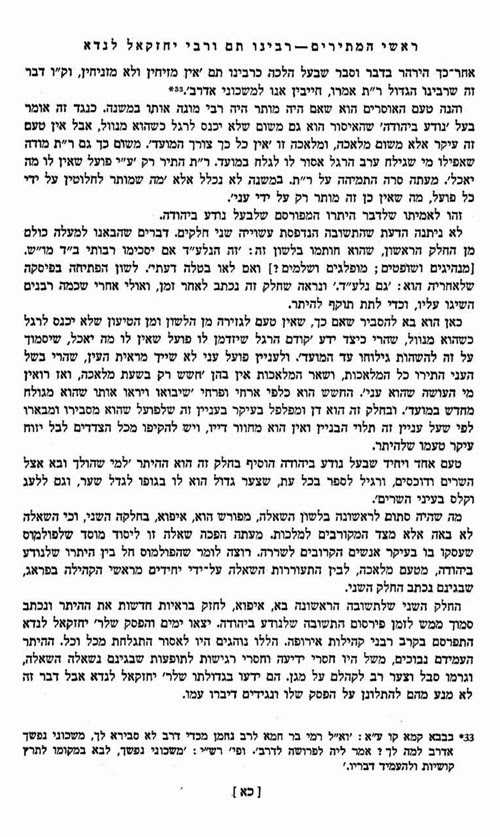
Before going further, let me present a short article in Hebrew written by a friend of mine that also details Artscroll’s fraudulence in this matter.
בשו”ת אגרות משה או”ח ח”ה סימן לז כתב, וז”ל: בענין חיובים דקריעה על ראיית ירושלים וראיית מקום המקדש, ודאי הוא חיוב, כמפורש בברייתא דמו”ק דף כ”ו ע”א. וגם על ערי יהודה איתא שם דקורע, ואיפסק כן ברמב”ם פ”ט מאבל ה”ב, ויותר מפורט בסוף פ”ה דתעניות. ובטור וש”ע סימן מיוחד באו”ח סימן תקס”א, וגם ביו”ד סוף סימן ש”מ . . . . [אבל] עתה שבחסדי השם יתברך אין מושלים האומות על ערי יהודה ועל ירושלים, והם גם מיושבים, הוא טעם גדול שלא לקרוע, אף שעדיין לא באה הגאולה ע”י מלך המשיח ואנו מתפחדים מהאומות, אין לקרוע, דהא הקרא שלמדים משם שצריך לקרוע על ערי יהודה . . . ויבואו אנשים משכם משלו ומשמרון שמנים איש מגלחי זקן וקרעי בגדים וגו’, הרי באו אחר שנחרבו ממש, שאין ללמוד מזה אפילו ליום אחד קודם החורבן, אף שהיה ידוע על ידי ירמיהו הנביא ועוד כי יהיה החורבן. וכל שכן עתה שמקווים אנחנו שמלך המשיח יבוא בקרוב כשיהיו כל ערי ישראל על מכונם, שאין צורך לקרוע. אבל כשרואה מקום המקדש שעדיין הוא בחורבנו, ולא שייך שיבנה אלא על ידי מלך המשיח, צריך לקרוע בפשיטות. וכשיבוא מלך המשיח במהרה בימינו, אף אם נימא שיהיה קצת זמן עד שיבנה, יורנו מלך המשיח וסנהדרין איך לעשות עכ”ל.
וכ”כ הגאון ר’ שלמה יוסף זווין זצ”ל בספרו “המועדים בהלכה” בפרק חמישי של חלק “הצומות” (במהדורת תשמ”ג – עמוד תמב), שגם טרם מלחמת ששת הימים “מסתבר שעם שיחרורן של ערי יהודה משלטון נכרים והקמת מדינת ישראל (אשרינו שזכינו לכך!) בטל דין הקריעה על אותן הערים”. עכ”ל. 

אמנם בתירגום “המועדים בהלכה” לאנגלית שנעשה בחסות הוצאת “ארטסקרול-מסורה” חלק שני (הוצאת “מסורה” תשמ”ב), עמוד 294, עשו המו”ל שני שינויים לקטע זה: (א) במקום “מסתבר” כתבו “יש מקום לטעון”; (ב) השמיטו מ”ש הרב זוין: “והקמת מדינת ישראל (אשרינו שזכינו לכך!)”. וכבר עוררו על שינויים אלו במכ”ע “טראדישען” ה’תשמ”ז-ח (במדור ‘מכתבי הקוראים’) – ראה מ”ש מר ג’ק פיינהאלץ (טראדישען 22:4, עמוד 120).


העורכים הכלליים של ספרי “ארטסקרול” (הרבנים מאיר זלאטאוויץ ונתן שרמן שיחיו) התייחסו לטענת מר פיינהאלץ במכתב למערכת “טראדישען” [שנדפס ב”טראדישען” שם]. במכתב זה הצדיקו את השינויים האמורים, אשר לפי דבריהם נעשו בשיתוף פעולה עם מר מאיר הולדר ז”ל, (בעל בית הדפוס “הלל” בירושלים עיה”ק, שעמד בראש מלאכת התירגום, ואשר הי’ שותף לארטסקרול בההו”ל של ספרי הרב זוין באנגלית), על יסוד מסורה בע”פ שקיבל הלה ממשפחת הרב זוין. לפי מסורה זו, סיגנון השורות המופיעות ב”המועדים בהלכה” בלה”ק (עד עצם היום הזה) ע”ד ביטול דין קריעה על ערי יהודה אינן מתאימות לסוף דעתו של הרב זוין. שורות אלו ניתוספו ע”י הרב זוין במהדורת הספר שי”ל כמה חדשים לאחרי התייסדות מדינת ישראל, נכתבו בתקופה שהיו, להרב זוין (ולאחרים כמותו), תקוות גדולות לעתידה של המדינה ולהשפעתה על החיים הרוחניים של הגרים בארץ ישראל. ברבות הזמן בטלו סיכויים אלו, אז התאכזב הרב זוין וחזר בו ממ”ש ב”המועדים בהלכה” הנ”ל. עכת”ד מסורת מר הולדר.


הרבנים שרמן וזלאטאוויץ טוענים שאין להעלות על הדעת שמר הולדר, שהי’ [לפי דבריהם] מידידי בית הרב זוין ואיש רב פעלים בהפצת “כתבי הצדיק הזה” [=הגרש”י זוין] זצ”ל, הי’ חשוד על נתינת יד למזייפים. עאכו”כ שלא הי’ עושה בעצמו שום שינוי ב”המועדים בהלכה” שאינו בהתאם גמור ל”מחשבת הרב זוין”. ע”פ שנים עדים אלו (הרבנים שרמן וזלאטאוויץ) הסיגנון המופיע ב”המועדים בהלכה” מהדורת ארטסקרול משקף ביתר דייקנות את משנתו האחרונה של הרב זוין בקשר לחיוב קריעה על ערי יהודה.


[יש לציין שגם במהדורא חדשה של “המועדים בהלכה” שנדפסה ע”י “ארטסקרול” בשנת תשנ”ט – בה תיקנו כמה שגיאות וכיו”ב – עמדו הרבנים זלאטאוויץ ושרמן על משמרתם והניחו את הגירסא החדשה (שע”פ מסורת מר הולדר) במקומה. לאידך גיסא, בכל המהדורות של “המועדים בהלכה” שי”ל בלה”ק לאחרי פטירתו של הרב זוין (שראיתי) נמצאות השורות הנ”ל כצלמן וכתבניתן במהדורות שראו אור בחייו].


מר הולדר כבר שחל”ח וע”כ אין אפשרות לברר אצלו אם אכן הי’ ממעתיקי השמועה ומה באמת היתה מדת מעורבתו בהשינויים הנ”ל, שע”פ העדים הנ”ל נעשו ע”פ מסורת שקיבל ממשפחתו של הגרש”י זוין. [אם אמת נכון הדבר שמר הולדר הי’ מחולל השינוי, צע”ק שלא מצא מר הולדר לנכון לעשות השינויים במהדורת “המועדים בהלכה” שהו”ל באותה תקופה בלה”ק, ועכ”פ לציין בשוה”ג שהנדפס אינו אלא משנה ראשונה של המחבר]. ובכל אופן, נ”ל שטענות הרבנים זלאטאוויץ ושרמן [ומר הולדר?] ע”ד עמדתו של הגרש”י אינן עומדות בפני הביקורת, ומפני כמה טעמים. [מקצת מטענות א-ב דלהלן כבר הביע בשעתו מר טרי נאוועטסקי במכתב תגובה לטענות הרבנים הנ”ל ונדפס במכ”ע טראדישען שם 23:1 עמוד 98 ואילך].


(א) מאז היווסד מדינת ישראל נדפס ספר “המועדים בהלכה” בכו”כ מהדורות בחייו של הרב זוין [
מהדורא שניה – ירושלים תש”ט; מהדורא שלישית – ירושלים תשי”ד; מהדורא חמישית – תל אביב תשט”ז; מהדורא שישית – ירושלים תש”כ. ועוד]. הרב זוין עשה כמה כמה תיקונים והכניס כמה וכמה הוספות קטנות וגם גדולות במהדורות השונות של הספר. על כן, למרות שבספרו זה “לא נתכוון המחבר להקנות לקוראיו דינים ופסקים” (הקדמת הרב זוין ל”המועדים בהלכה”), מ”מ בהתחשב עם זה ש”הספר נועד בעיקר לקהל הרחב . . . מורים ומחנכים” (הקדמה הנ”ל שם) מסתבר שאם באמת חזר בו הרב זוין לא הי’ מניח משנה ראשונה במקומה, וע”ד האמור (איוב יא, יד. כתובות יט, ע”ב) “אל תשכן באהליך עוולה”. ומדחזינן שבענינים אחרים אכן שינה, הוסיף וגרע [אפילו בכה”ג שלא הי’ מקום לחשוש לביטול מצוה או לאפרושי מאיסורא], ובנדו”ד השאיר את הדברים על מכונם, מסתבר לומר שבאמת לא חזר בו, וחזקה על חבר שאינו מוציא מתח”י דבר שאינו מתוקן.
(ב) אין התשובה ממין הטענה כלל, דאם אמנם על השינוי מ”מסתבר” ל”יש מקום לטעון” [אין ולאו ורפיא בידי’] אנו דנים, אכן יש מקום להסברא שהתאכזבותו ממצבה הרוחני של מדינת ישראל גרם להרב זוין לנטות מצידוד חזק [“מסתבר”] לביטול חיוב קריעה [כשיטת האג”מ הנ”ל] ל”הלכה רופפת” [“יש מקום לחלוק ולומר”] בענין זה, וע”פ המבואר לקמן בפנים שיש אומרים דשלטון מדינת אינו בגדר שלטון ישראל. אבל אין אכזבה זו דורשת (1) העלמת שם “מדינת ישראל”, שם שהרבה הרב זוין להשתמש בו בכ”מ. (2) השמטת ביטוי של שמחה והודי’ להשי”ת – “אשרינו שזכינו לכך” – על הקמת המדינה. הגע בעצמך: אין ספק שהגרמ”פ (שהי’ מחברי מועצת גדולי אגודת ישראל) גם הוא התאכזב ממצב היהדות בארץ ישראל תחת שלטון מדינת ישראל [ראה מ”ש באג”מ יו”ד ח”ב סמ”ה בא”ד ש”במדינת ישראל, אין אנו אחראין להנהגת המלכות דשם שהיא בעוה”ר אצל כופרים ומומרים ואין מתחשבים עם . . . כל איסורי התורה החמורים ביותר והמפורשים בגמרא ובקראי”. וראה גם אג”מ חו”מ ח”ב סו”ס סט, ועוד], ואעפ”כ כתב באג”מ בשנת תשמ”א, וכנ”ל, “עתה שבחסדי השם יתברך אין מושלים האומות על ערי יהודה ועל ירושלים [הוא טעם גדול שלא לקרוע]”, הרי שהעברת השלטון מידי האומות לידי ממשלת ישראל הוא מ”חסדי השי”ת”! ואם הגרמ”פ הי’ מודה להקב”ה על חסד זה, מה הכריח את הרבנים זלאטאוויץ ושרמן לעשות את הרב זווין (שגם בסוף חייו פירסם בקהל רב שהוא נוהג להצביע עבור רשימת המפד”ל) לכפוי טובה שאינו מכיר בניסו?
והוא העיקר: יחסו החיובי של הרב זוין למדינת ישראל בא לידי ביטוי בעוד מקומות מפיו ומפי כתביו. הנה שתי דוגמאות לכך: (1) בספרו “לאור ההלכה” (מהדורא שניה, תל אביב תשי”ז, כמה שנים לאחרי הקמת המדינה) תיקן את מאמרו “המלחמה” והוסיף בה דברים שלא היו יכולים להכתב במהדורא הראשונה של המאמר שהדפיס לפני הקמת המדינה (ב”לאור הלכה” ירושלים ה’תש”ו), ובתו”ד (עמוד סה) כתב לאמר: “בימינו אנו שזכינו לתקומת מדינת ישראל העצמאית, משוחררת מעול מלכויות . . . הרי מלחמת השחרור ברור שהיו לה כל דיני מלחמת מצוה וחובה”. [גם ספר “לאור ההלכה” חזרה ונדפסה כמ”פ (במשך ימי חיי הרב זוין) עם תיקונים והוספות, ומשנה זו לא זזה ממקומה]. (2) (2) בראיון שהעניק למכ”ע “הצופה” שי”ל לראש השנה ה’תשל”ו קרוב לשלשים שנה לאחרי הקמת מדינת ישראל וכשנתיים לפני פטירת הרב (בשנת תשל”ח). באותו ראיון אמר הרב זוין: “הרי מדינת ישראל עם כל ליקוייה הרבים בשטח החינוך הלא-דתי וכו’ הרי עם כל זה עלינו לראות את צדדיה החיוביים: הלא רק בחמש השנים האחרונות בלבד היא הצילה יותר ממאה אלף יהודים מטמיעה מוחלטת ושמד רוחני ברוסיה הסובייטית, אשר רבים מהם לומדים עתה כאן בבתי ספר דתיים ואף בישיבות; ועוד היד שלנו נטוי’ לקלוט מהם בעז”ה כהנה וכהנה”.
לית דין צריך בושש שהרב זוין, שהכיר מקרוב את תהליך התפתחות אופיה הרוחני של מדינת ישראל, כבר ידע היטב בשלהי שנת תשל”ה את כל מה שיש לדעת ע”ד צביונה החילוני של מדינת ישראל, ובכל זאת הרי שלך לפניך, שהביע את הערכתו הרבה להקמת מדינת ישראל וחזר והדגיש באר היטב שלמרות כל חסרונותי’ וליקויי’ (‘רבים הם ואי אפשר לפורטם’) הרי הקמת המדינה בארץ ישראל והרווחה בגו”ר שהביאה לעם ישראל הינה זכי’ גדולה וה”ה מהטובות הגדולות שעשה הקב”ה לעמו ישראל וחייבים אנו להודות להקב”ה על קיומה. וא”כ אי אפשר לומר שהשמטת תיבות ההודאה על קיומה של המדינה [“אשרינו שזכינו לכך”] הולמת את שיטת הרב זוין לאחרי אכזבתו.
אמנם למרות כל הנ”ל לא מלאני לבי לבטל מסורתם של מר הולדר ויבלחט”א הרבנים שרמן וזלאטאוויץ עד שהתקשרתי עם משפחת הרב זוין ע”מ לברר וללבן את הדבר. ה’משפחה’ שאיתה עמד מר הולדר בקשר מתמיד, ה”ה הרה”ג ר’ נחום זווין שליט”א, רב בעיה”ק חיפה ת”ו. [בנו יחידו של הגרש”י זווין נלב”ע בחייו, ובנו הרב נחום ירש את הכתבים וכו’ של הגרש”י והוא הוא שמכר את רשות ההדפסה באנגלית למר הולדר]. בשיחה טלפונית שקיימתי עם הרב נחום ביום חמישי י”ד טבת ה’תשס”ד אמר לי בלשון צחה וברורה שלא היו דברים אלו מעולם. הרב נחום זוין נתן לי רשות לפרסם בשמו את אשר מסר לי בענין זה: (א) עד יומו האחרון לא זז הגרש”י מעמדתו ויחסו החיובי למדינת ישראל, עמדה שהתבטאה בכמה משיטותיו והנהגותיו [ולדוגמא: עד שנתו האחרון עלי אדמות ועד בכלל נהג הגרש”י לומר הלל (בלי ברכה) ביום העצמאות וביום ירושלים]. (ב) מעולם לא שמע ממנו שחזר בו משיטתו ע”ד חיוב הקריעה על ערי יהודה, ועד היום הזה (שהודעתיו ע”ד השינויים הנ”ל ב”המועדים בהלכה” מהדורת ארטסקרול) לא ידע אפילו שהי’ אי פעם איזו סברא והו”א (בתוך המשפחה או מחוצה לה) לומר שהגרש”י שינה את דעתו בנידון, ולמותר להגיד שמעולם לא דיבר, לא דבר ולא חצי דבר, לא עם מר הולדר ולא עם שום נציג הוצאת ארטסקרול, על דבר ענין זה. והשתא הדברים מחוורים כשמלה, שמעולם לא היתה ולא היתה יכולה להיות ‘מסורת חשאית’ ממשפחת הרב זוין בנדו”ד, כי מעולם לא חזר בו הרב זוין מדעתו הראשונה, ואין שום סתירה כלל במשנת הגרש”י שהיתה קב ונקי. אין כאן המקום להאריך בהשערות, על מה ולמה החליטו המו”ל של כתבי הגרש”י באנגלית לעשות בדבריו כבתוך שלהם ולייחס אליו דברים שהם זרים לרוחו. מה שחשוב למבקשי האמת הוא, בירור דעתו של הרב זוין בנידון, ולזה הגענו בעז”ה – ואין שמחה כהתרת הספיקות.
[דא”ג: ראה זה פלא! לאחרונה יצא לאור “תלמוד בבלי מסכת מועד קטן” מהדורת שוטנסטיין (דפוס “מסורה” ה’תשנ”ט) תחת השגחת הרבנים זלאטאוויץ ושרמן, ושם דף כו ע”א הערה 43 ציינו (בקשר לחיוב קריעה על ערי יהודה וירושלים בזמן הזה) לדברי הגרמ”פ באג”מ ח”ה הנ”ל, שם כתב שבזמן הזה בטל חיוב קריעה גם על ירושלים עיר הקודש, ולא ציינו כלל להפוסקים הרבים המובאים לקמן בפנים דס”ל שחיוב קריעה על ירושלים במקומו עומד, גם לא ציינו לעמדתו הרופפת של הרב זווין (ע”פ ‘מסורת מר הולדר’) שקנתה שביתה במהדורתם של “המועדים בהלכה” לפיה אין להחליט שחיוב קריעה (אפילו על ערי יהודה – ובמכ”ש על ירושלים) בטל בימינו. וצע”ג].


In Saul Lieberman and the Orthodox, I called attention to two other examples of censorship (omitting Lieberman’s rabbinic title) in Artscroll’s translation of R. Zevin, so it is obvious that the translators felt it was OK for them to take liberties with the text. I know from speaking to people in the haredi world that this sort of thing is very distressing to them. It is no longer surprising when we see censorship and intentional distortions in haredi works. We even expect this and are surprised when a haredi work is actually honest in how it presents historical matters and issues that are subject to ideological disputes. Yet it doesn’t have to be this way. There is no fundamental reason why haredi works can’t express their position without the all-too-common falsehoods. I think the ones most offended by this are those who are part of the haredi world and believe in its ideology, and don’t understand the need to resort to distortions in order to further the truth.


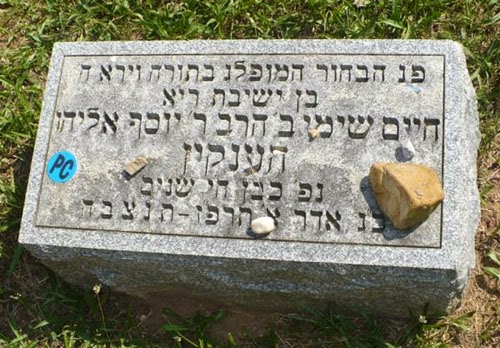
In a recent post I gave an example of fraudulence when it came to a haredi newspaper’s obituary of Louis Henkin, the son of R. Joseph Elijah Henkin. In this post, I mentioned that R. Henkin sent his sons to Yeshiva College. R. Eitam Henkin kindly sent me this picture of the tombstone of R. Henkin’s son, Hayyim, who predeceased his father.


It is noteworthy that R. Henkin saw fit to mention on the tombstone that Hayyim was a student at Yeshiva College (= Yeshivat R. Yitzhak Elhanan).
I would now like to point to an unintentional error in Artscroll’s translation of Ha-Moadim ba-Halakhah. Before last Pesah I took out my copy of The Festivals in Halachah. In reading the chapter on kitniyot, p. 118, I came across the following.
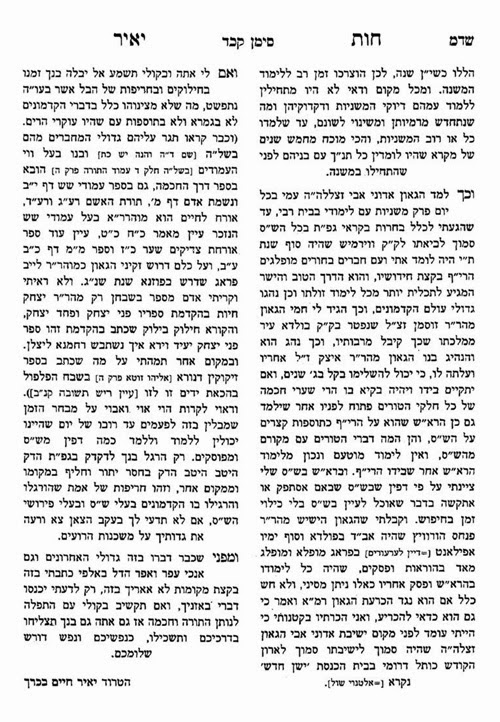
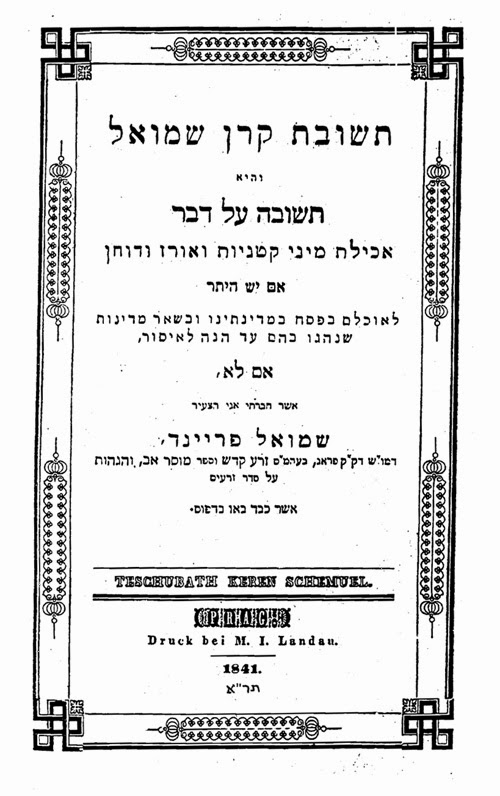
By way of reply, Rav Shmuel Freund, “judge and posek in the city of Prague”
((דין ומו”צ בק”ק פראג published the pamphlet Keren Shmuel, in which he demonstrates at length that no one has the authority to make these prohibited items (kitnios) permissible.
I immediately suspected something wasn’t right, and when I looked at the original I saw that R. Freund was described as דיין מו”ש דק”ק פראג. In translating these words into English, דיין מו”ש  became דין ומו”צ  (since the English version puts vowels on the Hebrew words  דיין became דין), and דק”ק became בק”ק (this latter point is only a minor error).
R. Zevin’s description of R. Freund is put in quotation marks since it is taken from the cover of his Keren Shmuel, as you can observe here.
The translators (who must never have seen the title page of Keren Shmuel) didn’t know what to make of מו”ש  and assumed that it was a mistake for מו”צ. They therefore “corrected” R. Zevin’s text. This is one of those cases where a few well-placed inquiries would have solved the translators’ problem. Some of the blame for this error should be laid at the feet of R. Zevin, for he never bothered explaining what מו”ש  is and he should have realized that that the typical reader (and translator) wouldn’t have a clue as to its meaning.[9]
מו”ש refers to the highest beit din in Prague, as used in the phrases דיין מו”ש and בית דין מו”ש. But what do the letters מו”ש stand for?[10] This is the subject of an essay by Shaul Kook,[11] and he points out that there has been uncertainty as to the meaning of מו”ש.[12] In fact, R. Solomon Judah Rapoport, who was chief rabbi of Prague and a member of the בית דין מו”ש, was unaware of the meaning.[13] After examining the evidence, Kook concludes that מו”ש stands for מורה שוה. This appears to mean that all the dayanim on the beit din were regarded as having equal standing. The בית דין מו”ש of Prague actually served as an appeals court, something that was found in other cities as well, even going back to Spain.[14] R. Yair Hayyim Bacharach, Havot Yair, no. 124, refers to one of the dayanim on this beit din as  אפילאנט, and the new edition of Havot Yair helpfully points out that the meaning of this is דיין לערעורים.[15]
Some people have the notion that the appeals court of the Israeli Chief Rabbinate is a completely new concept, first established during the time of R. Kook. This is a false assumption.[16] (The Chief Rabbinate’s בית דין לערעורים is also known as בית דין הגדול).
R. Moshe Taub has called my attention to another error in the translation of Ha-Moadim ba-Halakhah. In discussing what should be done first, Havdalah or lighting the menorah, R. Zevin writes (p. 204):
ברוב המקומות נתקבל המנהג שבבית מבדילים קודם, ובבית הכנסת מדליקים קודם
The translation, p. 89, has this sentence completely backwards: “Most communities have adopted the following custom: at home – Chanukah lights are lit first; in the synagogue – Havdalah first.”
Since we are on the issue of errors in Artscroll, here is another one which was called to my attention by Prof. Daniel Lasker. In the commentary to Numbers 25:1, Artscroll states:
After Balaam’s utter failure to curse Israel, he had one last hope. Knowing that sexual morality is a foundation of Jewish holiness and that God does not tolerate immorality – the only time the Torah speaks of God’s anger as אף, wrath, is when it is provoked by immorality (Moreh Nevuchim 1:36) – Balaam counseled Balak to entice Jewish men to debauchery.
Yet Rambam does not say what Artscroll attributes to him. Here is what appears in Guide 1:36:
Know that if you consider the whole of the Torah and all the books of the prophets, you will find  that the expressions “wrath” [חרון אף], “anger” [כעס], and “jealousy” [קנאה], are exclusively used with reference to idolatry.
The Rambam says that the language of “wrath” is only used with reference to idolatry, but somehow in Artscroll idolatry became (sexual) immorality. This text of the Moreh Nevukhim is actually quite a famous and difficult one, and the commentators discuss how Maimonides could say that ויחר אף is only used with reference to idolatry when the Torah clearly provides examples of the words in other contexts. In his commentary, ad loc, R. Kafih throws up his hands and admits that he has no solution.
ושכאני לעצמי כל התירוצים לא מצאו מסלות בלבבי, והקושיא היא כל כך פשוטה עד שלא יתכן שהיא קושיא, אלא שאיני יודע היאך אינה קושיא
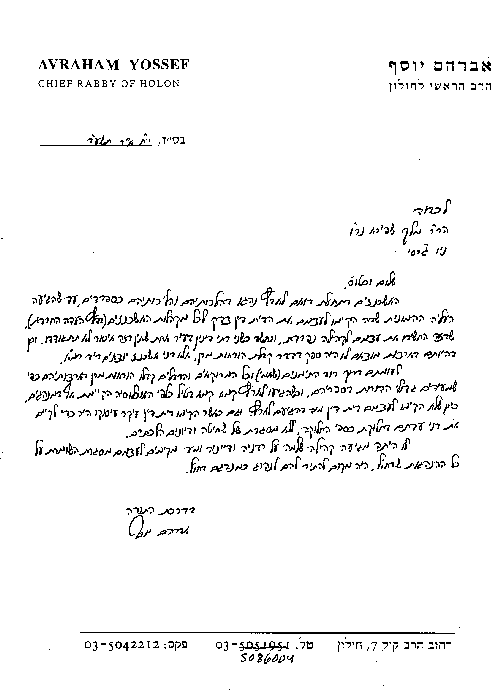
Returning to the issue of kitniyot, in a previous post I raised the question as to why, according to R. Ovadiah Yosef, all Sephardim and Yemenites who live in Israel are to follow the practices of the Shulhan Arukh but he doesn’t insist on this when it comes to Ashkenazim. If R. Joseph Karo is the mara de-atra, shouldn’t this apply to Ashkenazim as well?[17] I once again wrote to R. Avraham Yosef and R. Yitzhak Yosef seeking clarification. Here is R. Avraham’s letter.
Unfortunately, his history is incorrect. To begin with, it is not true that all of the Ashkenazim who came on aliyah before the “mass aliyah” (which apparently refers to the late nineteenth century) adopted the practices of the Sephardim.[18] It is also not true that the beit din established by the Ashkenazim in the nineteenth century is the beit din of the Edah Haredit. The Edah Haredit is a twentieth-century phenomenon. The historical successor of the beit din of R. Shmuel Salant was the Jerusalem beit din of which R. Kook was av beit din, as he was the rav of Jerusalem (and R. Zvi Pesah Frank served on the batei din of both R. Salant and R. Kook). The Edah Haredit beit din was a completely new creation. As for the Yemenites, Moroccans, and Iraqis, when the great immigration of these groups occurred, many thousands came on aliyah together, (i.e., as complete communities) and thus they never saw themselves as required to reject their practices in favor of the Shulhan Arukh. The fact that they didn’t establish special batei din is irrelevant. In fact, R. Avraham’s last paragraph is a good description of how these communities arrived in the Land of Israel, and is precisely the reason why their rabbinic leaders almost uniformly rejected R. Ovadiah Yosef’s demand that they adopt the Shulhan Arukh in all particulars.
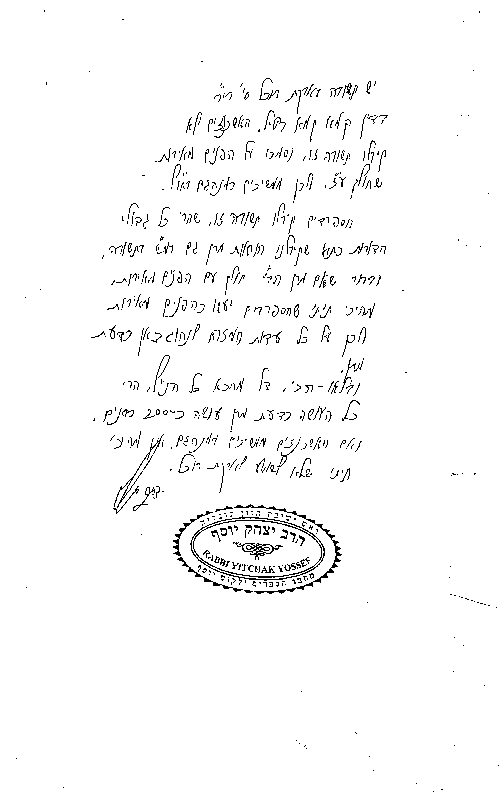
Here is R. Yitzhak Yosef’s letter to me, which has a different perspective.
He cites R. Joseph Karo’s responsum, Avkat Rokhel, no. 212, which requires newcomers to adopt the practices of the community to which they are going even if they come as large groups. He then says that Ashkenazim never adopted this viewpoint, but instead held to the opinion of R. Meir Eisenstadt (Panim Meirot, vol. 2, no. 133). According to R. Eisenstadt, only individuals who come to a town must adopt the local practice, but not if they come as a group and establish their own community.[19]
Let me now complicate matters further. If you recall, in the earlier post I discussed how R. Ovadiah Yosef’s writings assume that Ashkenazim have to abstain from kitniyot on Pesah. I raised the question if an Ashkenazi could “become Sephardi” and thus start eating kitniyot (and also follow Sephardic practices in all other areas). R. Avraham Yosef wrote to me that this is permissible while R. Yitzhak Yosef wrote that it is not.
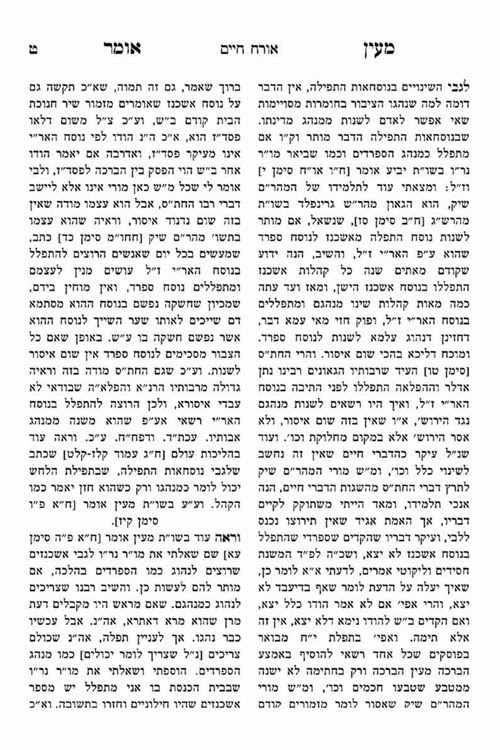
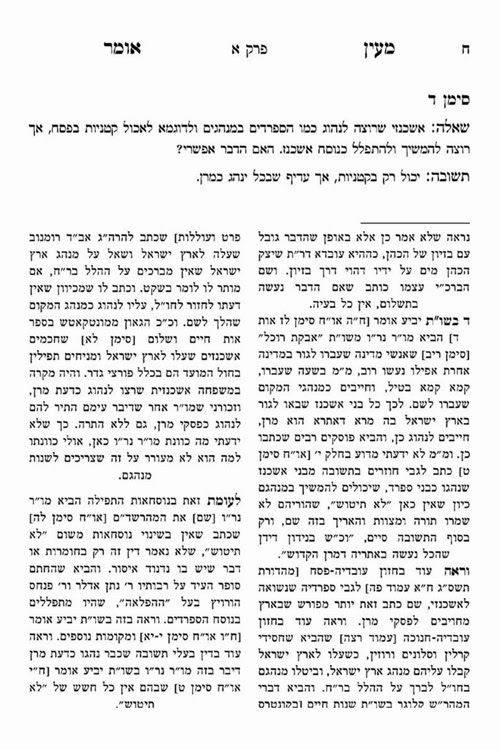
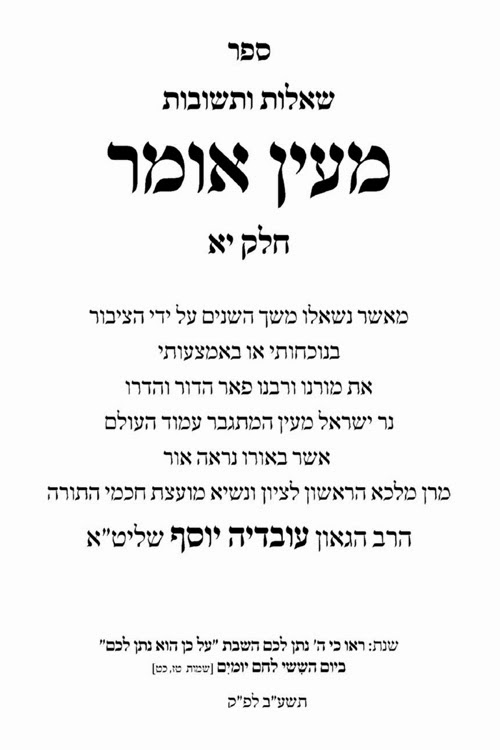
R. Yissachar Hoffman called my attention to the fact that in the recent Ma’yan Omer, vol. 11, p. 8, R. Ovadiah was himself asked the following question:
אשכנזי שרוצה לנהוג כמו הספרדים במנהגים ולדוגמא לאכול קטניות בפסח, אך רוצה להמשיך ולהתפלל כנוסח אשכנז. האם הדבר אפשרי.
R. Ovadiah replied:
 יכול רק בקטניות, אך עדיף שבכל ינהג כמרן
What R. Ovadiah is saying (and see also the editor’s note, ad loc., for other examples) is that R. Avraham’s answer is correct, namely, that an Ashkenazi can “become Sephardi” (and eat kitniyot). It is significant that R. Ovadiah allows such a person to continue praying according to Ashkenazic practice. Here are the pages.
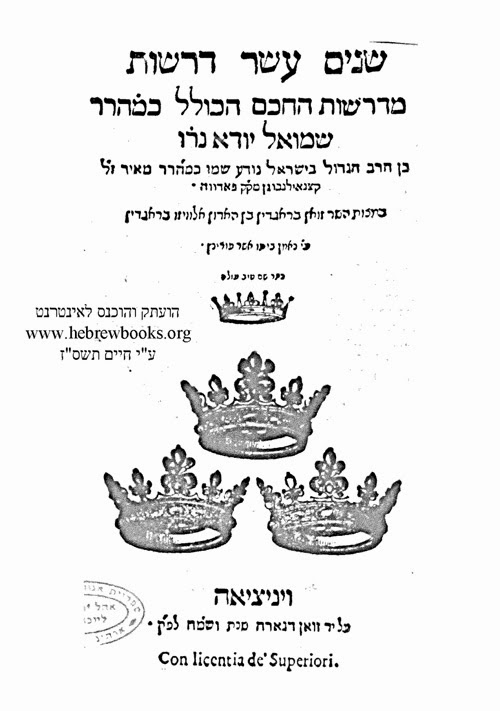
2. On my recent tour of Italy I spent a good deal of time speaking about the great sages of Venice and Padua. One such figure was R. Samuel Judah Katzenellenbogen (1521-1597), known as מהרשי”ק, the son of the famous R. Meir Katzenellenbogen, known as Maharam Padua. While R. Samuel Judah Katzenellenbogen is basically forgotten today, he was the most important Venetian rabbi in his day. He was also the father of Saul Wahl, who became famous in Jewish legend as Poland’s “king for a day.”[20]
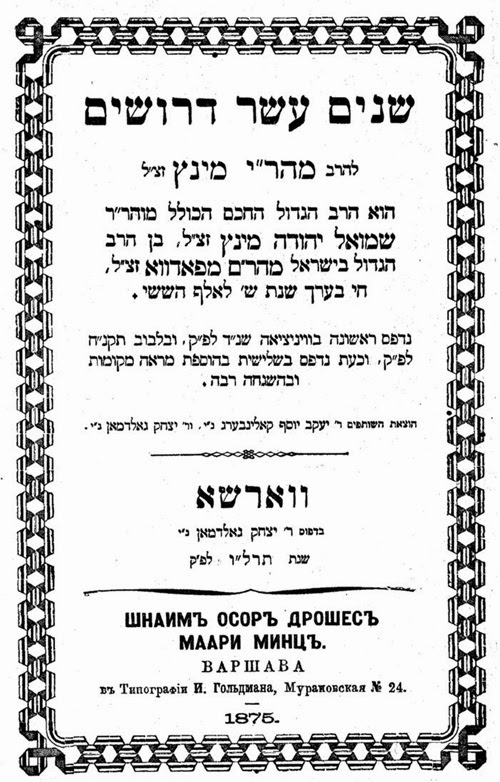
In 1594, R. Katzenellenbogen’s collection of derashot, entitled Shneim Asar Derashot, appeared. Here is the title page.
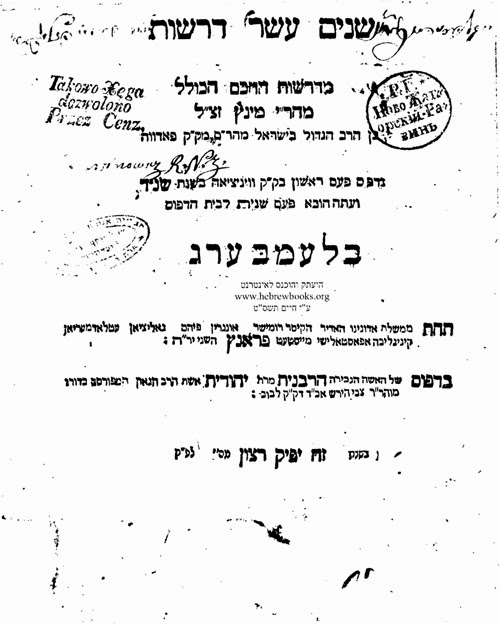
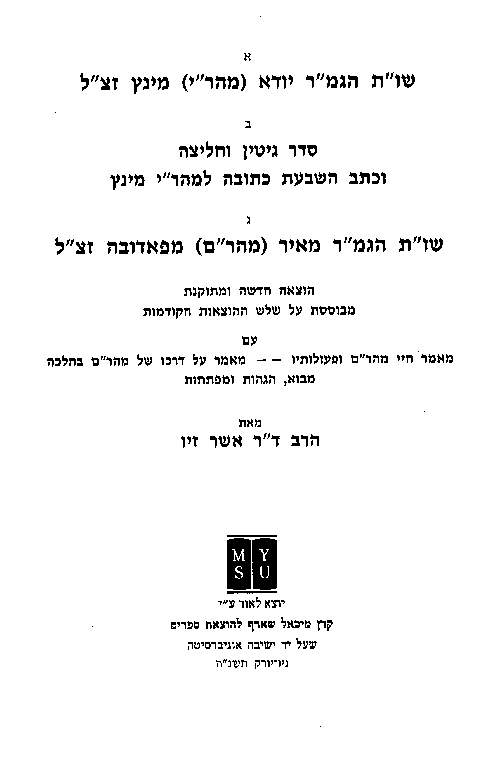
When the volume was reprinted in Lemberg in 1798, the publisher made an error and on the title page attributed the volume to מהר”י מינץ , the son of Maharam Padua.
Apart from not knowing who the author of the volume was, the publisher also didn’t realize that R. Judah Mintz (died 1508[21]) was the grandfather of Maharam Padua’s wife, meaning that he was the great-grandfather of R. Samuel Judah Katzenellenbogen.
When the volume was reprinted in Warsaw in 1876 the publisher recognized the problem but confounded matters.
Rather than simply correcting the mistake from the 1798 title page by attributing the volume to R. Samuel Judah Katzenellenbogen, he kept the information from the mistaken title page but tells the reader that מהר”י מינץ is none other than “R. Samuel Judah Mintz”, a previously unheard of name.
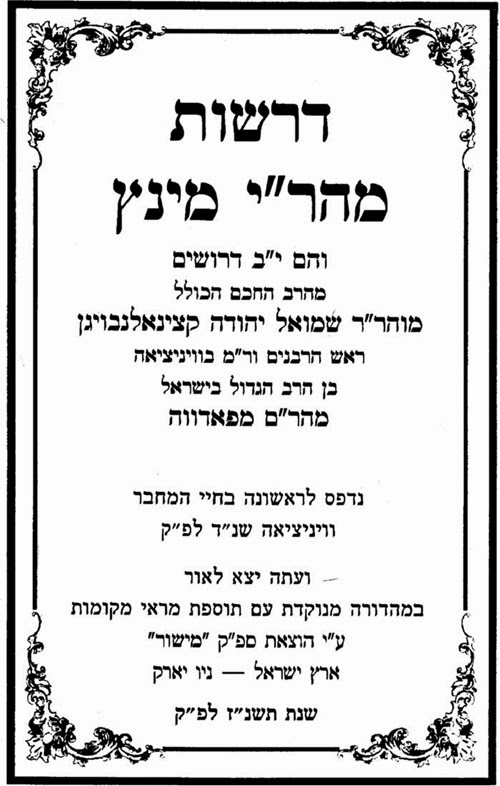
The most recent printing has gets it even worse.
Now the original title of the book, שנים עשר דרשות, is simply omitted, and the book is called דרשות מהר”י מינץ
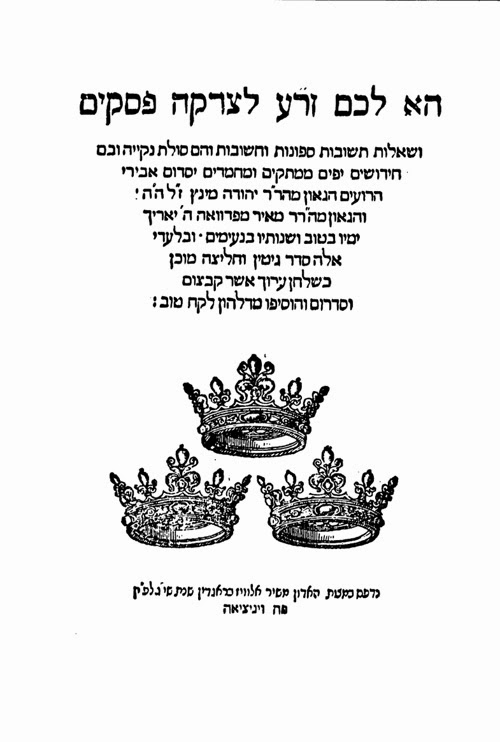
The authentic R. Judah Mintz of Padua is known for his volume of responsa that was published in Venice in 1553, together with the responsa of R. Meir Katzenellenbogen. Here is the title page.
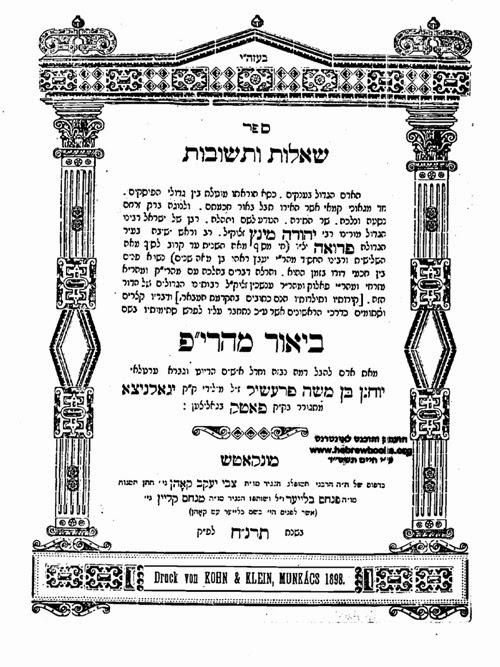
R Judah Mintz’s responsa were reprinted in Munkacs in 1898 together with a lengthy commentary by R. Johanan Preshil.
The book was also reprinted in 1995, edited by R. Asher Siev.
Unfortunately, Siev was unaware of the 1898 edition. He also makes the mistake (see p. 353) of stating that R. Samuel Judah Katzenellenbogen was referred to as מהר”י מינץ because his mother’s family name was Mintz. I have seen no evidence that he was ever referred to as such in his lifetime or in the years after, and as mentioned, this was simply a printer’s mistake. I consulted with Professor Reuven Bonfil and he too is unaware of any reference to Katzenellenbogen being referred to as מהר”י מינץ, which supports my assumption that this all goes back to the mistaken title page.[22]
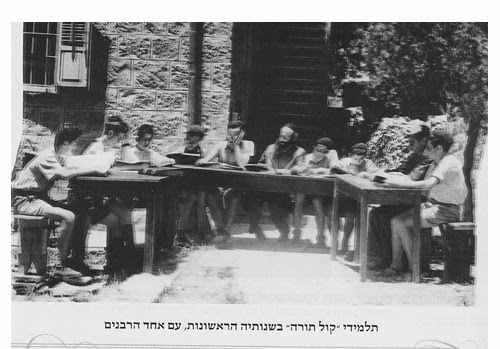
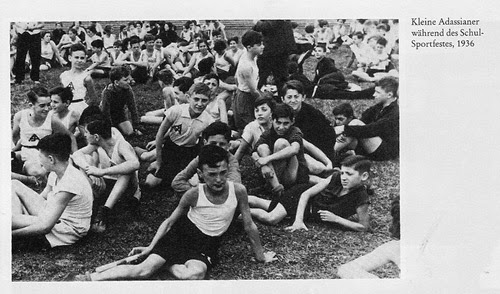
3. In my last post I mentioned how in years past there were shiurim combining students from Merkaz and Chevron and also Merkaz and Kol Torah. This is obviously unimaginable today. For another example showing how Yeshivat Kol Torah has changed, look at this picture, which appears in Yosef and Ruth Eliyahu, Ha-Torah ha-Mesamahat (Beit El, 1998), p. 105.
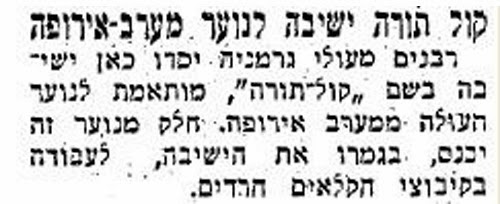
I guarantee you that even on the hottest of days, none of the Kol Torah students will be wearing shorts. For those who don’t know, Kol Torah was founded by German Orthodox rabbis and was originally very different than it is today. Here is how it was described upon its founding, in a short notice in Davar, August 27, 1939.
It is hard to imagine today, but this was a yeshiva that actually intended for some of its students to take up agriculture. See also here which cites R. Hayyim Eliezer Bichovski, Kitvei ha-Rav Hayyim Eliezer Bichovski (Brookyn, 1990), p. 180, that the Chafetz Chaim said that yeshiva students in Eretz Yisrael should learn nine months a year and work the land the other three months
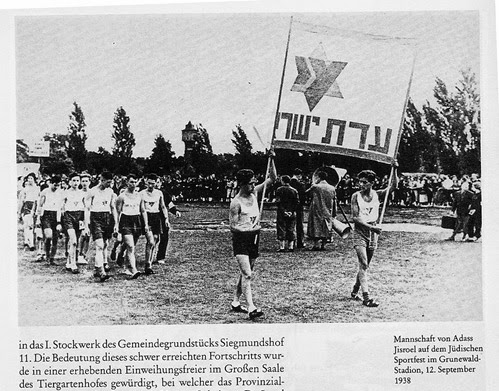
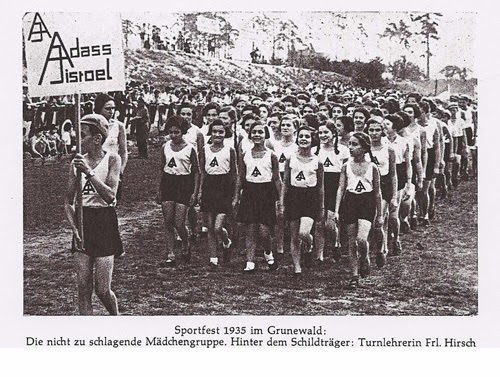
Speaking of shorts, here are a couple of pictures showing how the boys of the German Orthodox separatist Adass Jisroel community looked when playing sports (also notice the lack of kippot).
This was the community of R. Esriel Hildesheimer and R. David Zvi Hoffmann. The pictures come from Mario Offenburg, ed., Adass Jisroel die Juedische Gemeinde in Berlin (1869-1942): Vernichtet und Vergessen (Berlin, 1986).
Here is how the girls dressed for sports, also with shorts and sleeveless.
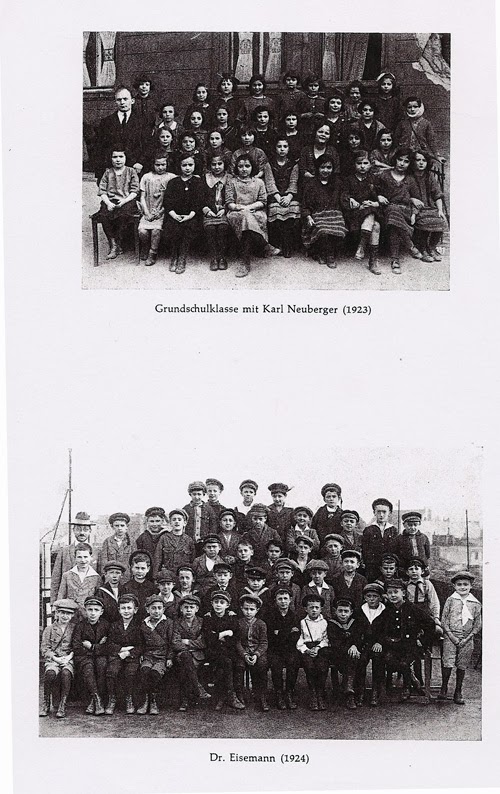
And here is how the boys and girls looked when not at a sporting event.
These pictures come from Max Sinasohn, ed., Adass Jisroel Berlin (Jerusalem, 1966).[23]
4. Some people didn’t appreciate the humor in my post with regard to the Gaon R. Mizrach-Etz. I think they should lighten up, and in a previous post, available here, I gave some references to humor in rabbinic literature. This was followed up by a more extensive post by Ezra Brand, available here.
According to the commentary Siftei Hakhamim, it is not just the talmudic sages who would at times show their humorous side, but on at least one occasion Moses thought that God himself was joking with him!
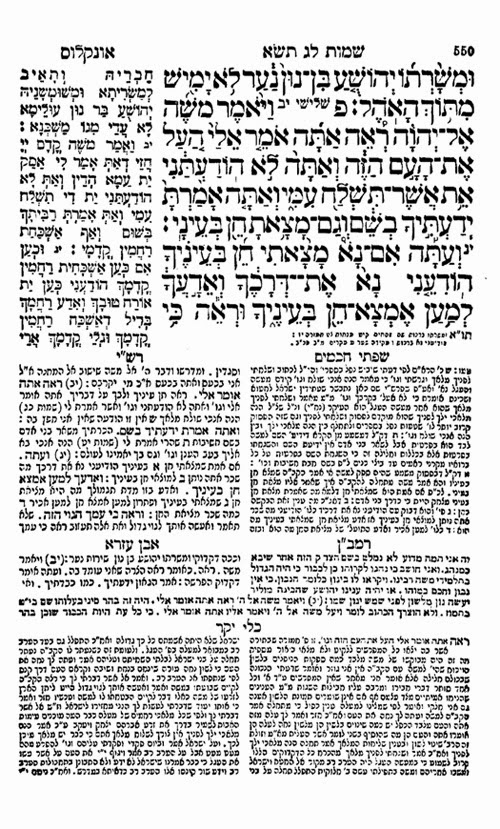
In Ex. 33:13 Moses says to God: ועתה אם נא מצאתי חן בעיניך. Rashi explains this to mean: “If it is true that I have found favor in Your eyes.” This means that Moses was in some doubt as to whether he found favor in God’s eyes, but this is problematic since in the previous verse Moses quotes God as saying to him, “you have also found favor in My eyes.” So if God told Moses that he found favor in His eyes, how can Moses be in doubt and say to God, “If I have found favor in Your eyes”?
Here is the Siftei Hakhamim.
According to Siftei Hakhamim, Moses was in doubt if he really found favor in God’s eyes, since even though God said he did, perhaps God was joking just like people joke around!
דלמא מה שאמרת מצאת חן בעיני מצחק היית בי כדרך בני אדם
5. I want to call readers’ attention to a recent book, Shevilei Nissan, which is a collection of previously published essays from R. Nissan Waxman. There is lots of interesting material in the book, and let me mention just a few things.
In Studies in Maimonides and His Interpreters, p. 75 n. 302, I referred to R. Yaakov Avigdor’s strong criticism of R. Hayyim Soloveitchik’s approach. R. Avigdor also criticized R. Solomon Polachek, the Meitchiter. R. Waxman was a student of the Meitchiter, and on p. 23 n. 1, he comes to his teacher’s defense.
On p. 150, R. Waxman, who was the rav of Lakewood, mentions the problem of how some yeshiva students are halakhically more stringent than their teachers. He quotes R. Yaakov Kamenetsky in the name of R. Aharon Kotler how a student once visited R. Kotler and when the latter offered the student some cookies, the student was reluctant to take before asking which bakery they came from. (Perhaps this behavior can be explained by what I have heard – and maybe someone can confirm this – that in R. Aharon Kotler’s day the Lakewood bakery Gelbstein was not under hashgachah, and yet R. Kotler bought his challot from it. See also here and here The original post referred to in these links has definitely been taken down.)
On p. 233, R. Waxman notes that even though we have the principle, “A Jew who sins remains a Jew”, in actuality, it is possible for a Jew to so remove himself from the Jewish people (e.g., apostasy) that as far as most things are concerned, he is indeed no longer regarded as Jewish. This essay was written concerning the “Brother Daniel” case, and R. Waxman’s approach is similar to that of R. Aharon Lichtenstein who also wrote a famous article on the topic, “Brother Daniel and the Jewish Fraternity,” republished in Leaves of Faith, vol. 2, ch. 3.
On pp. 251ff., R. Waxman deals with Menahem Mendel Lefin’s Heshbon ha-Nefesh, an influential mussar text which as many know was influenced by a work of Benjamin Franklin.
6. I want to also call readers’ attention to two other books recently sent to me. The first is R. David Brofsky, Hilkhot Moadim: Understanding the Laws of the Festivals. This is very large book (over 700 pages) dealing with the Holidays and is a welcome addition to the growing number of non-haredi halakhah works in English.. In a future post I hope to deal with it in greater depth. The second book is Haym Soloveitchik, Collected Essays, vol. 1, published by Littman Library, my favorite publisher. This book is required reading for anyone with an interest in the history of medieval halakhah. I was happy to see that it also includes two essays that appear here for the first time. Furthermore, Soloveitchik’s classic essay on pawnbroking (which was his first significant article) has been expanded to almost double the size of the original. In the new preface to the essay, he writes: “Every essay is written for an imagined audience, and mine was intended for the eyes of Jacob Katz, Saul Lieberman, and my father.”
[1] I also must point out that someone involved with hebrewbooks.org informed me that the essay was not removed from the site because it was viewed as “problematic”, but because they were requested to do so by one of the members of R. Zevin’s family who claimed to hold the copyright to the work. This is obviously a false claim, since as we have seen there is no proof that R. Zevin wrote the essay.
[2] See R. Waldenberg, Hilkhot Medinah, vol. 2, pp. 14, 60, 62, and R. Frank’s haskamah, ibid., pp. 17.
[3] See Jack Feinhotz’s letter in Tradition 22 (Winter 1987), p. 120. R. Zevin’s view, that there is no need for keriah, was also advocated by R. Reuven Katz, Sha’ar Reuven (Jerusalem, 1952), p. 32.
[4] See Terry Novetsky’s letter in Tradition 23 (Summer 1987), pp. 98-99.
[5] Tradition 22 (Winter 1987), p. 120.
[6] In the interview with R. Zevin that appeared in my last post, R. Nahum’s comments tended to be somewhat dogmatic, even “haredi”, and should be contrasted with his grandfather’s words.
[7] Even among the vast majority of Lubavitchers this is the case (so I am informed by R. Chaim Rapoport). This is quite strange since the Rebbe held that you have to do keriah. What this shows us is that not everything advocated by the Lubavitcher Rebbe was adopted by his hasidim.
[8] See R. Dov Lior, Devar Hevron (Kiryat Arba, 2009), Orah Hayyim no. 567
[9] Even the incredibly learned Meir Benayahu was stumped by מו”ש. See this page from his Tiglahat be-Holo Shel Moed (Jerusalem, 1995), p. 21.


Regarding Benayahu, a recent book argues that the missing pages of the Aleppo Codex were not destroyed in Aleppo, but were actually stolen by Benayahu after arriving in Jerusalem. See Matti Friedman, The Aleppo Codex (Chapel Hill, 2012).
[10] I have found one occasion where it is written מ”ש, although this is probably a typo. See R. Yaakov Reischer, Shevut Yaakov, vol. 2, no. 129. R. Reischer was a member of this beit din,
[11] Iyunim u-Mehkarim (Jerusalem, 1963), vol 2, pp. 179ff.
[12] In the Vilna Shulhan Arukh, Yoreh Deah, there is a commentary by R. Jacob Emden. Yet R. Yaakov Hayyim Sofer, Menuhat Shalom, vol. 6, p. 116, shows that it was not written by him, and one of his proofs is that the commentary refers to הגאון אב”ד וב”ד מו”ש, implying that the author lived in Prague.
[13] See Kook, Iyunim u-Mehkarim, p. 180.
[14] See Simhah Assaf, Batei ha-Din ve-Sidreihem Aharei Hatimat ha-Talmud (Jerusalem, 1924), ch. 11.
[15] See ibid., pp. 80ff. for other examples of אפילאנט
[16] This statement should not be taken to imply that the leading rabbis in Eretz Yisrael were happy with the institution of this court, which was pretty much forced upon them by the British. See Amichai Radzyner’s book-length article, “Ha-Rav Uziel, Rabanut Tel Aviv-Yafo, u-Beit Din ha-Gadol le-Irurim: Sipur be-Arba Ma’arakhot” Mekhkerei Mishpat 21 (2004), pp. 120-242.
[17] R. Ovadiah Hadaya, in his approbation to R. Amram Aburabia, Netivei Am (Jerusalem, 1964), states that everyone in Jerusalem should follow “minhag Yerushalayim”. If his opinion is accepted, it would mean the end of any Ashkenazic practices in the city.
[18] Regarding earlier in the nineteenth century, see Yehoshua Kaniel, “Kishrei ha-Edot be-Inyanei Halakhah u-Minhag bi-Yerushalayim ba-Meah ha-Yod Tet,” Morashah 4 (5736), pp. 126-136. In the eighteenth century, the Vilna Gaon was of the opinion that Ashkenazim who come on aliyah should indeed adopt Sephardic practices. See Bezalel Landau, Ha-Gaon he-Hasid mi-Vilna (Jerusalem, 1978), p. 250, n. 30.
[19] This has indeed been the Ashkenazi approach, yet R. Abraham Danzig disagreed. See Hokhmat Adam: Sha’ar Mishpetei ha-Aretz 11:23:
נ”ל דהבאים לא”י אם יקבעו עצמם בעיר שיש שם מנין אעפ”י שהבאים הם מרובים יש להם דין יחיד וחייבים לנהוג חומרי מקום שהלכו לשם ופקעו מהם החומרות שהיו נוהגין במקומם.
[20] As far as I know, R. Samuel Judah Katzenellenbogen was the first great rabbi to have his picture made (unfortunately, it no longer exists). See R. Moses Porti, Palgei Mayim (Venice, 1608), p. 6b (referred to by R. Gedaliah Oberlander, Minhag Avoteinu be-Yadenu [Monsey, 2012], p. 451):
והלא אנכי הייתי הראשון שבקשתי להציב תמונתו לנגד עיני ע”י הצייר ואותה לקחתי לי והצבתיה בבית מדרשי לקיים מה שנאמר והיו עיניך רואות את מוריך
While this picture was hung in the beit midrash, see this post where I mention how R. Pinchas Teitz took down the poster of R. Elchanan Wasserman that I hung up in a room used for tefillah. (R. Porti’s Palgei Mayim is devoted to the famous dispute about the mikveh in Rovigo.)
[21] The standard biographies all record that R. Judah Mintz lived a very long life. This is based on R. Joseph Yavetz, Hasdei Ha-Shem (Jerusalem, 1934), Introduction, p. 9, where R. Yavetz’s son mentions that R. Mintz recited birkat ha-hamah when he was כבן מאה שנה. This would have been in 1505, and he lived another three years after that. R. Meshulam Fishel Behr, Divrei Meshulam (Frankfurt, 1926), pp. 147ff., rejects the younger Yavetz’s testimony and claims that R. Mintz died in his seventies. See, however, R. Naftali Yaakov ha-Kohen, Otzar ha-Gedolim (Haifa, 1967), pp. 35ff.
[22] See also Jewish Encyclopedia, s.v. Katzenellenbogen, Samuel Judah. R. Yissachar Hoffman called my attention to She’elot u-Teshuvot Hakham Zvi, no. 15, where R. Samuel Judah Katzenellenbogen is (mistakenly?) referred to as מהר”י מפאדואה. See also R. Aryeh Yehudah Leib Lifshitz, Avot Atarah le-Vanim (Warsaw, 1927), p. 48 n. 44
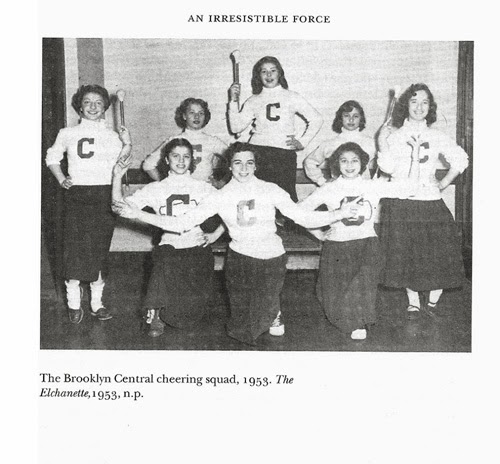
[23] When I was in high school in the early 1980s, in the New Jersey-New York yeshiva league only the girls of Bruriah wore sweat pants during basketball games (and the boys were not allowed to attend home games). At the other high schools the girls wore shorts. Today, the league requires all girls to wear sweat pants (i.e., not even long shorts). For a wonderful discussion of the yeshiva basketball league, see Jeffrey S. Gurock, Judaism’s Encounter with American Sports (Bloomington, 2005), ch. 7. Gurock discusses how for six years in the early 1950s, Yeshiva Chaim Berlin was part of the basketball league together with the Modern Orthodox co-ed high schools, something that could never happen today. During this time co-ed schools had cheerleaders, and this was a major factor in forcing Chaim Berlin to leave the league. (Mesivta Tifereth Jerusalem was also in the league for two years.) When I mention cheerleaders, don’t think of current NFL cheerleader outfits. Here, for example, is how the Brooklyn Central girls looked (from Gurock, p. 143).
Yet Gurock, ibid., points out that “as the 1950s progressed, the Brooklyn Central cheerleaders’ skirts also got shorter and shorter.” (Speaking of short skirts, anyone who has looked at Modern Orthodox yeshiva high school yearbooks from the early 1970s will see that the mini-skirt craze was also tolerated at these institutions.)


The Cup for the Visitor: What lies behind the Kos Shel Eliyahu?

The Cup for the Visitor: What lies behind the Kos Shel Eliyahu?
By: Eliezer Brodt
 
In this post I would like to deal with tracing the early sources for the Kos Shel Eliyahu. A version of this article was printed last year in Ami Magazine (# 65).  This post contains a few corrections and additions to that version. A much more expanded version of this article will appear in Hebrew shortly (IY”H).
One of the memorable parts of the seder night is during Shefoch Chamascha when we open the door for Eliyahu Hanavi to come inside and drink from the Kos Shel Eliyahu. Children all over the world look carefully to see if there is less wine in the cup after he leaves, while many adults ‘accidently’ shake the table to make sure that there is less wine. What are the sources of this custom? When do we pour the kos of wine and what should we do with the leftover wine from the kos—drink it, spill it out, or save it? In this article I hope to trace this custom to its  earliest known sources and to discuss some other aspects of the seder night related to this topic.[1]
I would like to point out that my intention in this article is not to collect all the sources and reasons on these specific topics but rather to focus on the earliest sources and how these various minhagim came about.[2]
To begin with, it is worth pointing out that as far as we know today, there is no mention of the concept of Kos Shel Eliyahu in all of the literature that we have from the Geonim and Rishonim. Neither is there mention of it in the Tur, Shulchan Orach, Rema, or other early commentators on the Shulchan Orach.
One of the earliest mentions of a Kos Shel Eliyahu can be found in Rabbi Yaakov Reischer’s (1660-1733) work, Chok Yaakov, on Hilchos Pesach, first printed in 1696, in Dessau. He wrote that in his area, people had the custom to pour an extra glass of wine and call it Kos Shel Eliyahu.[3] He does not mention a reason for this custom, or at what point during the seder it is done, nor does he connect it to the opening of the door during Shefoch Chamascha or the idea Eliyahu Hanavi comes to the Seder.
Rabbi Chaim Benveniste (1603-1673), famous for his work Knesses Hagedolah, in his work on Pesach called Pesach Meuvin, first printed in 1692, writes that he saw some Ashkenazi Jews that leave an empty glass in the middle of the table for the leftovers of each cup of wine, and they call it Kos Shel Eliyahu. He writes that he liked this minhag so much that he started doing it himself, and he drank this glass during the Meal.[4] Here too, there is no connection made between the Kos Shel Eliyahu and opening the
door during Shefoch Chamascha for Eliyahu Hanavi.
In 1728, Rabbi Moshe Chagiz (1671-1751), printed part of a work of his, on minhagim, in the back of Sefer Birchat Eliyahu[5]. He writes that he was asked about the custom of Ashkenazi Jews to pour a cup of wine at the beginning of the seder for Eliyahu Hanavi, and that after the seder the head of the household slept next to this full glass of wine. Rabbi Moshe Chagiz was asked if observing this custom was a problem of nichush [divination].
Rabbi Chagiz replied that it was not a problem of nichush at all. He explained that the reason for this custom was similar to the reason we prepare a special chair for Eliyahu Hanavi at a bris milah.[6] Eliyahu Hanavi witnesses that the bris is performed. So too, on Pesach, Eliyahu Hanavi is supposed to be a witness that the Korban Pesach is done properly. The Korban Pesach is dependent on milah, since the halacha is that only someone with a bris milah can eat the Korban Pesach.[7] However it is important to point out that according to this reasoning, Eliyahu Hanavi does come to the seder, but it would seem that this would apply only during the times when the Korban Pesach was eaten.


New early sources for Kos Shel Eliyahu
 
Until 1984 these were the three earliest sources that made any mention of Kos Shel Eliyahu. In 1984, Rabbi Binyomin Nuzetz printed parts of a manuscript of Rabbi Zeligman Benga on Pesachim. Rabbi Benga was a grandson of Rabbi Menachem Tzioni and a close talmid of the Maharil, and he died around 1471. Rabbi Benga writes that he noticed some people pour a special glass of wine and call it Kos Shel Eliyahu. He writes that a possible reason for this is that we pour wine for Eliyahu Hanavi, since we are expecting him to come and he will need wine for the Arba Kosos.[8] This source helps us date the Kos Shel Eliyahu a few hundred years earlier than previously thought. Previously, the earliest source was printed in1692. What is interesting about this source is that he was not sure where the minhag came from and, again, he mentions no connection to Shefoch Chamascha.
In 1988, the department in Machon Yerushalayim that prints early works of German Jewry printed two volumes from manuscript from Rabbi Yuzpeh Shamash (1604-1678) of Worms. Rabbi Yuzpeh Shamash writes that it was the custom in Worms at the beginning of the seder to pour one extra cup of wine. Just as we say in the Haggadah, “Kol dichfin yesev v’yachul,” we prepare a glass for the guest who might come. This glass is called Kos Shel Eliyahu since this is the guest we await. Rabbi Yuzpeh Shamash brings another reason why it is called Kos Shel Eliyahu:
because it is a segulah to say “Eliyahu” to get rid of mazikim [destructive forces], and we do various things on the seder night to chase away the mazikim.[9]
In 1985, a manuscript of Rav Yaakov Emden was printed in the Kovetz Kerem Shlomo of Bobov. This manuscript contained Rav Yaakov Emden’s notes on the Pesach Meuvin of Rabbi Chaim Benveniste. He says that there is a minhag to have a Kos Shel Eliyahu but not to pour leftover wine in a cup for him—that would not be an honor for him at all. He points out that the Chazal say not to drink from a cup that someone else drank from.[10]


Additional Reasons for Kos Shel Eliyahu
 
Rabbi Aron of Metz (1754-1836) suggested that the origin of the Kos Shel Eliyahu is that on Pesach the head of the household does not pour for everyone. Therefore, out of convenience, people would leave a big cup in the middle of the table for everyone to take from. Once the children started asking what the cup was for, they would tell them it was a cup for Eliyahu Hanavi.[11]
Rabbi Mordechai Gimpel Yaffe suggests an original possibility for the Kos Shel Eliyahu. The halacha is that when one makes a seudah he should leave over a little space empty as a zecher l’churban. He says that on Pesach, a glass of wine was left over as a zecher l’churban. It was called Kos Shel Eliyahu to represent the hope that Eliyahu Hanavi would come quickly to correct the Churban.[12]
Rabbi Shimon Falk asks the following question: The halacha is that one cannot bring a full loaf of bread to the table before bentching, since it looks like one is doing it for some form of idol worship. So why isn’t it a problem to prepare a glass of wine for
Eliyahu Hanavi? Rabbi Falk suggests that it this might the reason we do not find any mention of a Kos Shel Eliyahu in the Gemara, but today, when there is no one amongst the goyim who worship in this manner, it’s not a problem.[13]


Maharal Haggadah
 
In 1905, in Warsaw, Rabbi Yudel Rosenberg printed the Haggadah of the Maharal which he claimed was from a manuscript of the Maharal’s son in law. In this Haggadah there is a lengthy discussion of the number of glasses of wine one should drink at the seder. The Maharal concludes that one has to drink five cups of wine and that this fifth cup is the Kos Shel Eliyahu.[14] If this is correct we have an early source for Kos Shel Eliyahu, the Maharal, and based on his words we would have many more early sources, since various Rishonim listed by the Maharal mentions the fifth glass of wine.
However, it has been proven that, although Rabbi Rosenberg was a tremendous talmid chacham, he was also a forger. He may have possibly had good intentions behind his forgeries.[15] His most notable forgery was the story about the Maharal’s golem.[16]
Rabbi Avraham Benidict devoted two articles to proving that this Haggadah is a forgery.[17] One of the points he discusses relates to our topic. In 1582, the Mahral publised his work about Pesach and the seder titled Gevuros Hashem. In this work, the Maharal writes that one may drink a fifth cup, but he doesn’t connect the fifth cup to Kos Shel Eliyahu.


The Fifth Cup of Wine
 
However, whether or not the Maharal said that one has to drink a fifth cup, and whether or not he says that this is the Kos Shel Eliyahu, there are others that make a connection between the fifth cup and Kos Shel Eliyahu. A small introduction is needed. The Mishnah at the beginning of Arvei Pesachim says that even a poor person has to have four cups of wine at the seder. Later on, the Mishna and Gemara discuss exactly when the cups should be poured and drunk. The Gemara (119a) says that Reb Tarfon held that the fourth cup should be drunk after we say Hallel Hagadol. Many Geonim and Rishonim interpret this to be referring to a fifth cup of wine. In 1950 Rabbi Menachem Kasher printed a booklet collecting all the Geonim and Rishonim that deal with this issue and he showed that many held that one should, but does not have to, drink a fifth cup of wine.[18] It is worth noting that in Teiman[19] and in Italy,[20] many people drink a fifth cup of wine at the seder because of this. None of the sources that Rav Kasher collected tie this fifth cup to the Kos Shel Eliyahu.
Some bring in the name of the Gra,[21] others in the name of Rabbi Ephraim Zalman Margolis,[22] an interesting explanation for the development of the Kos Shel Eliyahu. There is an argument in the Gemara in Pesachim (119a) whether one needs to drink the fifth glass of wine. There is no final halacha given. Because we are not sure what to do, we prepare a cup of wine, but do not drink
it. The reason it is called Kos Shel Eliyahu is that Eliyahu is going to come and tell us what the din is.[23]
So according to this Gra, Kos Shel Eliyahu is not really a new concept. It always existed, as the numerous sources that Rav Kasher collected demonstrate, but it was not called Kos Shel Eliyahu.
Many times we have different versions of something said over in the name of the Gra. Sometimes that is because things were added to what he actually said. In this case, one version has the Gra saying this idea a bit differently, that the opinion in the Gemara that one should drink a fifth cup of wine was Reb Eliyahu, so the fifth cup is called Kos Shel Eliyahu after him. This version concludes that this reason was revealed to the Vilna Gaon because his name was Eliyahu, as well. The problem with this version is that as far as we know there was no Tanna or Amorah with the name Eliyahu and that the person who said to drink a fifth cup of wine was Reb Tarfon.[24]
Be that as it may, it is likely that there are early sources for a fifth cup of wine at the seder and at some point its name became Kos Shel Eliyahu. But none of these explanations (except for that of Rav Moshe Chagiz) tie the cup to Eliyahu coming to the seder.


The Custom of Opening the Door
 
There is a custom of many that before we begin saying Shefoch Chamascha someone opens the door. What is the source for this minhag? One of the earliest sources of keeping the door open the whole night of Pesach is found in the Geonim. Rav Nissim Gaon says that one should be careful to leave open the doors the whole night.[25] The Manhig explains that this is because the night of Pesach is Leil Shimurim and if Eliyahu will come the door will be open and we would be able to run and greet him.[26] The Rama writes in the Darchei Moshe that because of this we open the door when saying Shefoch Chamascha, to show that we believe in Hashem and that Moshiach should come.[27] So it is clear from this that there is some connection between Shefoch Chamascha and Moshiach coming, but there is no mention in the Geonim and Rishonim that Eliyahu comes when we open the door. Rather it is understood to be a preparation for his eventual coming. It is worth pointing out that not everyone said Shefoch Chamascha[28]
and that there are many different versions of what is said by Shefoch Chamascha.[29]
Rabbi Yosef Hann Norlingen (1570-1637) writes in Yosef Ometz (first printed in 1723) that in Frankfurt there was a custom that when the door was opened by the head of the house at Shefoch Chamascha someone would come in the door, to show our belief that Moshiach will come.[30]
However, Rabbi Yair Chaim Bachrach of Worms writes in Mekor Chaim that the minhag that some had to have the form of a person appear when the door was opened at Shefoch Chamascha was not proper.[31]


Woodcuts and Pictures From Early Haggadahs
 
Some have claimed that there is no basis for a connection between Shefoch Chamascha and Eliyahu coming to the seder. However, as I will demonstrate, this is not so. Some of the earliest Haggadahs printed include many woodcuts and pictures of various aspects of the seder. These Haggadahs are a great resource to help find early sources of how various things were done at the seder.[32] Regarding Eliyahu Hanavi coming to the seder, Professor Sperber noted[33] that in a few of these Haggadahs there are pictures by Shefoch Chamascha of a man on a donkey in some of them he is being led by someone, for example, in the Prague Haggadah printed by Gershon Cohen in 1527.[34] The pictures were updated in a Haggadah printed in Prague in 1560. Another early Haggadah that has such pictures by Shefoch Chamascha can be found in the Haggadah printed in Mantuvah in 1550.[35] Yosef Guttman collected fifteen illustrated Haggadah manuscripts from the fifteenth century which all show a man on a donkey by Shefoch Chamascha.[36] From all this evidence it is clear that already a few hundred years ago there
was a belief that when the door is opened by Shefoch Chamascha that there is a connection to Eliyahu Hanavi and Moshiach.
Mantua 1550:
Prague 1556:
Prague 1590:


Sleeping Near the Kos Shel Eliyahu
 
In 1958, Rabbi Yosef Avidah wrote a small work devoted to gathering all the known information about the Kos Shel Eliyahu. He makes the following interesting observation. Rabbi Moshe Chagiz writes that the custom was that the head of the house slept near the Kos Shel Eliyahu the whole night but he does not say why. He suggests that the reason for this was similar to the reason for sleeping with the door unlocked to show we eagerly await Eliyahu’s and Moshiach’s arrival. He goes further to show that there is an early source for this minhag. The Leket Yosher writes that his Rebbe, Reb Yisroel Isserlin, author of the Terumas Hadeshen,
used to sleep on Pesach on the bed that he leaned on during the meal and he does not know what his reason for this was.[37] Rabbi Avidah suggests that he was sleeping there to remind himself of the concept that on Pesach night we show that we eagerly await Moshiach.[38]
It is interesting to note that the Likutei Chaver from Rabbi Chaim Plaut, a talmid of the Chasam Sofer, writes that the Chasam Sofer would keep the cup the entire night and use it for Kiddush the next morning.[39] This would seem to have a connection to the same idea.
However it is worth pointing out that these don’t point to a connection between Kos Shel Eliyahu and Shefoch Chamascha.


Opening the Door and Zugos
 
Another nice possibility given to explain the opening of the door by Shefoch Chamascha is from the Bais Halevi. The Rama says we open the door to show that it’s Leil Shimurim. The Bais Halevi comments that according to this it would make more sense to open the door at the beginning of the seder not at the end specifically when we say Kol dichfin yesev v’yachul ?[40] He answers that the Gemara in Pesachim (109 b) asks how can there be a halacha to drink four cups of wine if there is a danger to eat or drink things in pairs—which is known as zugos. The Gemara answers since it is Leil Shimurim, there is no danger. So the Bais Halevi says that we specifically open the door when the fourth cup is drunk to explain to the person who would ask why isn’t there a problem of zugos. We show him that it’s not a problem because it is Leil Shimurim as we open the door.[41]


Additional Reasons for Opening the Door by Shefoch Chamascha
 
 A similar explanation for the opening of the door specifically by Shefoch Chamascha is suggested by Rabbi Yosef Zechariah Stern. He says the Gemara in Pesachim says another way that there is no problem of zugos is if one opens the door to the street. So that is why we open the door specifically at this point in the seder.[42]
Others suggest the reason for the opening of the door by Shefoch Chamascha was to show the gentile neighbors that the accusations against the Jews about using blood of Christians and the like are false.[43] Rabbi Shmule Ruzuvski suggested that the
possible reason why the door is opened by Shefoch Chamascha is that when we used to eat the Korban Pesach the halacha
is that one cannot take any of it out of the house so they used to lock the door. After bentching, they would go to the roof to say Hallel, so they opened the door.[44]
A Very Original Explanation for this Custom of Eliyahu Hanavi and the Seder
 
One possible explanation of why Eliyahu Hanavi is associated with the seder could be the following: Rabbi Yuzpeh Shamash writes[45] that on Pesach night we say Eliyahu and Moshiach will come because mazikin run away from a place where they recite Eliyahu’s name. He says that because of this some make a picture of Eliyahu and Moshiach for the children so that the children seeing it will say “Eliyahu,” causing the mazikin to disappear.[46] Interestingly enough he writes that this could also be the reason it is called Kos Shel Eliyahu to get rid of the mazikin.[47] According to all this, what lies behind saying Eliyahu’s name at the seder is simply a desire to get rid of mazikin.
Earlier I mentioned the Bais Halevi and others who say that the opening of the door at the seder by Shefoch Chamascha is to get rid of mazikin. According to Rabbi Yuzpeh Shamsash this was the also reason some used to draw pictures of Eliyahu and Moshiach.


Eliyahu Actually Comes
 
There are quite a number of stories concerning Eliyahu at the seder just to list some of them:
 The Yismach Moshe once sent some of his chassdim to eat the seder with the Chasam Sofer. When they returned they told him that \in the middle something strange happened. A farmer came in. He drank a cup of wine that the Chasam Sofer gave him and then the Chasam Sofer drank from the cup after him. The Yismach Moshe told them that this was Eliyahu Hanavi.[48]
The Chiddushei HaRim once was speaking about the greatness of the Nodeh B’Yehuda. He said that when the Noda B’Yehuda would say Shefoch Chamascha he would escort Eliyahu Hanavi all the way to the street. The Noda B’Yehuda said, “It’s not that I actually see him, but rather \that I believe so strongly that he does come to everyone, and this emunah is better than gilui Eliyahu![49]
Rabbi Yitchock Weiss writes that Rabbi Shneur Lublin, author of the Shut Toras Chesed, did not allow anyone to eat at his seder,
He also told said that Eliyahu or a messenger comes to every great person on the night of the seder.[50]
The Belzer Rebbe would great Eliyahu when he opened the door by Shefoch Chamascha.[51]
 
Rabbi Yitchock Weiss writes that Rabbi Chaim Gottlieb of Stropkov would be visited by Eliyahu Hanavi at the seder. Many
wanted to come to see this so they asked him permission to come. He answered, “Why not?” While they were there, they fell into a deep sleep until the seder was over.[52]


Conclusion
 
In conclusion there are definitely early sources that talk about a fifth cup of wine at the seder. According to some, this fifth cup at some point started being called Kos Shel Eliyahu. Starting from the late 1400s we find that people would pour a special kos, and call it Kos Shel Eliyahu.  I have shown that there are early sources for opening the door at Shefoch Chamascha that give various reasons. I also showed that there are many drawings by Shefoch Chamascha of a man on a donkey and Eliyahu found in the early manuscripts and printed illustrated Haggadahs. This would logically lead us to conclude that there was a belief that he did indeed come to visit when the door is opened and I offered another possible explanation for all this. May we be zocheh for Eliyahu to come with Moshiach this year at the Leil Haseder.

NOTES

[1] For sources on this topic that helped me prepare this article See Rabbi Yosef Zecharia Stern, Zecher Yehosef, pp. 39-40; Rabbi Moshe Weingarten, Seder Ha-Aruch 1 (1991), pp.576-582; Shmuel & Zev Safrai,Haggadas Chazal, (1998), pp.177-178; Rabbi Gedaliah Oberlander, Minhag Avosenu Beydenu, 2, pp. 392-409; Rabbi Tuviah Freund, Moadim Li-Simcha (Pesach), pp. 358-376; Pardes Eliezer, pp. 180-243. These collections of sources were useful but it is worth noting that much earlier than all these collections many of the sources on this topic were already collected by Rabbi Yosef Avidah in 1958, in a small work called Koso
Shel Eliyahu
. As I mentioned a few weeks ago I recently reprinted this work with additions from the author’s copy. Another earlier useful article on the topic is from Yehudah Rosenthal, Mechkarim 2, pp. 645- 651. For general useful collections of material related to Eliyahu Hanavi see the two volume work Romot Gilod from Rabbi Eliezer Veisfish, (2005) and the earlier work of Aharon Weiner, The Prophet Elijah in the Development of Judaism (1978). I would like to thank my good friend Yisroel Israel for help with the beautiful pictures to accompany this article.
[2] I hope to return to all this in my forthcoming article in Hebrew on this topic.
[3] Chok Yaakov, end of Siman 480.
[4] Pesach Meuvin (1997), p. 124, #182.
[5] See also the end of his Shut Shtei Lechem. Rabbi Freund (above note 1), p. 359 was apparently not aware of where this piece was printed first. This explanation is also brought in Rabbi Dovid Zecut, Zecher Dovid, Mamar Rishon, Chapter 26, pp. 174-175. See Elisheva Carlbach, The Pursuit of Heresy, (1990) esp. pp. 247-249.
[6] I hope to return to this topic in a future article.
[7] See Hagadat Baer Miriam of Rabbi Reven Margolis (2002), p. 90-91 where Rabbi Magolis brings a similar idea from the Toras Emes.
[8] Moriah, 13, (1984), n. 146-147, p. 17. See Chidushei MaHarz Binga, (1985), p.195.
[9] Minhaghim De-Kehal VerMeizah, (1988), p. 85-86.
[10] Kovetz Kerem Shlomo, 76 (1985) p. 7
[11] Meorei Or, Pesachim. On this work see the important article of Yakov Speigel, Yerushaseinu 3 (2009, pp. 269-309.
[12] Techeles Mordechaei in Keser Kehunah, (2004), p. 40. See also his Hagadas Mordechai, p. 75.
[13] Shut Shem Mishimon, (2003) 2, pp. 100-101.
[14] Hagdah Shel Pesach, Loshon Limudim , 1905, pp. 65-66.
[15] See Meir Bar Ilan, Alei Sefer 19 (2001), pp. 173-184.
[16] On all this see the excellent work from Dr. Shnayer Leiman, 2004, The Adventure of the Maharal of Prague in London. See also E. Yassif, Ha-golem Me-Prauge U- Massim Niflayim Acharyim, (1991).
[17] See Moriah 14 (1985) n. 3-4, pp. 102- 112; Moriah 16 (1989) n. 9-10, pp. 124- 130. See also Y. Yudolov, Otzar Hagadas, p. 171, #2299; Rabbi Shlomo Fischer, Tzefunot 3 (1989) p. 69.
[18] Kos Chemeshi, Later reprinted in the back of Haggadah Shelimah, pp. 161-177. See also Yosef Tabori, Pesach Dorot, (1996), pp. 325-341; Shmuel & Zev Safrai,Haggadas Chazal, (1998), pp. 40-41.
[19] See Rabbi Yosef Kapach, Ha-Liechos Teiman (1968), pp. 22-23. See also Rabbi Y. Ritzabi, Aggadata Depischa, (1996), pp. 388-390; Moshe Garba, Mechkarim BeSidurei Yeiman 1 (1989), pp. 139-141
[20] See Machzor Roma (1485), p. 73b [in the facsimile edition of this Machzar printed in 2012]. See also Sefer Ha-Tadir, (1992), p. 217.
[21] See the excellent article of Rabbi Y. Avidah in Hatzofeh (1958) which I
recently
reprinted in his Koso Shel Eliyahu pp. 53-57where he explains why he does not believe that the Gra actually said this idea.
[22] Hagdah Shel Pesach shel Haflah.
[23] See Likutei Tzvi, p. 28; Pineinim MeShulchan Ha-Gra, pp. 112-113; Hamoer Ha-godol, pp. 126-127. See also Rabbi Yeruchem Fishel Perlow in his notes to the Chidushel Dinim Mei-Hilchos Pesach, pp.29-30 who gives this explanation himself. See also A. Hopfer, Ha-Tzofeh Le-chochmas Yisroel, 11 (1927), pp. 211-21; Rabbi Shlomo Zalman Auerbach, Shalmei Moed, p. 404.
[24] This version appears in the beautiful Haggadah Beis Avrhom- Beis Aron (p.117b) where the author heard this from The Belzer Rebbe T”l in the name of the Gra. On all this see Yaakov Speigel, Yeshurun 7 (2000), p. 728-730. See also Shut Ber Sheva, end of siman 73; Rabbi Yosef Zecharia Stern, Mamar Tahaluchos HaAgdot, p. 26.
[25] Rav Nissim Goan, (Abramson) p. 278.
[26] Sefer Ha-Manhig, 2. p. 423-424. See Daniel Sperber, Minhagei Yisroel, 3, pp. 81-82.
[27] For a discussion of the opening of the door see Rabbi Yosef Avidah, Koso Shel Eliyahu, pp. 4-8. See also his work Bershis Be-mlitzah Ha-ivrit, (1938), pp. 40-43. For an early illustration of the opening of the door at Shefoch Chamascha see Therese and Mendel Metzger, Jewish Life in the Middle ages, (1982),p. 380.
[28] For example, in Italy they did not say it. See Machzor Roma (1485); Machzor Moscovitz, (2005), p.29. See Yitzchack Yudolov, Kovetz Mechkarim Al Machzor Ki-Minhag Bnei Roma (2012), pp. 17-18.
[29] See Daniel Goldshmidt, Haggadah Shel Pesach (1960), pp. 62-64; Haggadah Sheilmah, pp. 177-180. See also Yosef Tabori, Mechkarim Betoldos Halacha (forthcoming), pp. 370-389; Shmuel & Zev Safrai,Haggadas Chazal, (1998), pp.174-175.
[30] Yosef Ometz , p. 172, #786.
[31] Mekor Chaim, end of Siman 480.
[32] See Cecil Roth, Areshet 3 (1961, pp. 7-30, especially, pp. 14-1. See also Richard Cohen, Jewish Icons, (1998), pp. 90-100; U. Schubert, Emunos HAsefer HaYehudit (1993); Marc Epstein, The Medieval Haggadah: Art, Narrative, and Religious Imagination (2011), especially, pp. 80-84.
[33] Minhaghei Yisroel 4, pp. 168-170.
[34] On this haggadah see Y. Yudolov, Otzar Haggadas, p. 2, # 7-8. See also Rabbi Charles Wengrov, Haggadah and Woodcut, (1967), pp, 69-71; the introduction to the 1965 reprint of  his Haggadah; Yosef Yerushalmi, Haggadah and History, plate 13; See also Yosef Tabori, Mechkarim Betoldos Halacha (forthcoming), pp. 461-474.
[35] On this rare Haggadah see Y. Yudolov, Otzar Haggadas, p. 3, # 14.
[36] The Messiah at the Seder—A Fifteenth Century Motif in Jewish Art, pp. 29-38 printed in Sefer Rephael Mahaler (1974). See also his Hebrew manuscript Painting (1978), pp. 98-99. See also the Illustration of the Washington Haggadah 1478 in Betzalel Narkiss, Hebrew Illuminated manuscripts, pp. 140-141,34.
[37] Leket Yosher, p. 86.
[38] Koso Shel Eliyahu, pp. 12-13.
[39] Likutei Chaver Ben Chaim, 5 (1883), p. 110 b.
[40] The truth is as previously mentioned originally that was indeed the custom.
[41] Bais Ha-Levi, Parshas Bo, p. 15. The Chasam Sofer says this same idea in his notes to Shulchan Orach, 480.
[42] Rabbi Yosef Zecharia Stern, Zecher Yehosef, p. 39. See also Mishna Zicron (1923), p. 138; Rabbi Tzvi Farber, Kerem Hatzvi, p. 79. See the comments of the Dvar Yehoshuah on this printed in Hagadat Baer Miriam of Rabbi Reven Margolis (2002), p. 91.
[43] Likutei Tzvi, p. 29; Rabbi Shlomo Schick, Siddur Rashban, p. 32; Hagaddas Ha-Malbim (1883), p.50 (editor’s note).
[44] Mikrai Kodesh (Harri), p. 548.
[45] Rabbi Oberlander and Freund (above note 1) incorrectly thought that this comment is from the Chavos Yair.
[46] Minhaghim De-Kehal VerMeizah, (1988), p. 87. Rabbi Gedaliah Oberlander, Minhag Avosenu Beydenu, Rabbi Tuviah Freund, Moadim Li-Simcha, and Pardes Eliezer, all quote this piece of Rabbi Shamash But they did not realize what he was really saying.
[47] Minhaghim De-Kehal VerMeizah, p. 86.
[48] Orchos Hasofer, p. 115.
[49] Or Pnei Yitchak, p. 16.
[50] Elef Kesav, p. 21.
[51] Elef Kesav, p. 72.
[52] Elef Kesav, p. 97.


The Pesach Drasha of the Rokeach

The Pesach Drasha of the Rokeach
by Eliezer Brodt
By way of introduction, in the Shulchan Aruch it is written that thirty days before Pesach one should learn the halachos of Pesach. As Pesach is fast approaching, it is appropriate to discuss anew a post from five years ago, of which this is an update.
Every once in a while we are privileged to have the venerable printing house Mekizei Nirdamim release something special from the great rishonim (aside from their great journal Kovetz Al Yad).[1] Five years ago they published a critical edition of a Pesach Drasha of R. Eliezer Rokeach of Worms for the first time, edited by Professor Simcha Emanuel. In this post I would like to discuss some of the many things of interest in the work and also comment in general on the great job of Simcha Emanuel did with this work.
One of the reasons why I am updating this post is I was just told by Mekezei Nirdamim that they only have a few remaining copies and it will not be reprinted. I am selling copies for $16, while supplies last. For more information feel free to contact me at eliezerbrodt@gmail.com.
Part of the proceeds of this sale will be going to help support the efforts of the Seforim Blog.
This drasha seems to have been an actual drasha that the Rokeach delivered, although it is pretty obvious from the length that it was not said at one time but probably a compilation of a few derashos recited at different times. The style is mostly halacha, with a bit of aggadah in the beginning and also scattered throughout. He goes through many halachos of Pesach starting with kashering the utensils, getting rid of the chametz, and baking the matzos. He then continues on at great length to discuss all the aspects of the Seder. Then he deals with what to do if one finds chametz on Pesach and he ends with some halachos of Yom Tov in general.
I would like to mention some of the interesting points found in the actual drasha. First, the Rokeach records that his family custom was when they burned the chametz they would do so with the lulavim and hoshanos which they had saved from Sukkos (p.79). [2] While talking about the minhag to bake matzos Erev Yom Tov he writes that one should not bake the matzos for the second night until the second night itself, because of chavivah mitzvah bi’shaatah (p. 92). [3] He states that one should go to the Mikvah before Yom Tov. [4]
The Rokeach writes that if the Yom Tov falls out on Shabbos we do not smell hadassim for besamim on Motzei Shabbos, because there is no loss of the extra soul, as the soul remains for the duration of Yom Tov. (p. 93).[4a] In a note Professor Emanuel points out that others disagree with this point and hold that one does in fact make a blessing on the besamim when Saturday night is still Yom Tov. While talking about the washing for karpas he writes that one should make ‘al nitelas yadaim (p. 96), whereas today we do not. [5] He then goes on to say that we eat a full kezayis for karpas, which is something we also do not do – we purposely eat less than a kezayis. [6] (p. 97, 152). He notes his family minhag was to hold the cup of wine during the recitation of vehi she’amdah (p. 99 and p. 126) [7], the common custom today.
He describes how his family poured out the wine when they said the ten Makkot (p. 101, see also, p. 127). The importance of this last custom is that until the publication of this drasha, although many have recorded this custom in the name of the Rokeach, it appeared in none of his writings (as I plan on discussing at length in a forthcoming article). In regard to washing mayim acharonim at the seder, although others argue he writes one should wash (p. 106). [8]
In addition to all this Professor Emanuel has included extensive notes and comments throughout the drasha, which are excellent. These provide additional sources for various things mentioned in the drasha, also including interesting sources from unpublished manuscripts.
To list some of the topics that he deals with in the notes: Making matzos with pictures on them (pp. 129-134), about the nussach of the Haggdaah that some said רבון עלומים וכו after ביד חזקה (pp. 53- 57) [9], and reasons for the prohibition of kitniyos (p. 51).[10]
One very interesting thing which Emanuel points out is the difference about how a name is spelled in various manuscripts. Specifically, whether the Rokeach’s father-in-law was Eliezer or Elazar. If it was Elazar than it turns out that the Rokeach, whose first name was also Elazar, apparently ignored the will of his teacher, Rebbi Yehuda ha-Hassid – who disallows such marriages in his famous Tzavaah. Although, most likely, the Rokeach was married even prior to coming in contact with Rebbi Yehuda ha-Hassid, his practice demonstrates that people, prior to Rebbi Yehuda ha-Hassid’s pronouncement did not observe or even know of this custom. (pp. 57- 59). Emanuel than brings early evidence that part of the Tzavaah were strictly for the family.[11]
In this work we find an early source not related to Pesach but to Shavous – such as to eat Milchigs (p. 39, 110). [12]
Aside from this small work (152 pp.) containing this very important drasha of the Rokeach it also includes many important pieces of information in regard to the Rokeach in general and especially to two works of his that were unknown. There is a lengthy discussion about a sefer of the Rokeach on shechitah and treifos as well as another sefer – Sefer Ma’aseh Rokeach.
[1] For more information on this special, 150-year old publishing house, see the pamphlet printed by them in 1964, called Chevrat Mekizei Nirdamim.
[2] For further on this custom see Sefer HaMaskil pp. 33-34; the important comment of R. Honig in Yerushaseinu 1 (2007), pp. 208-209; Sefer Kushiyos pp. 168-169 and the notes therein; D. Sperber, Minhagei Yisrael, vol. 2 p. 193. See also what I wrote in Yerushaseinu 2 (2008), p. 219.
[3] For general sources on baking Matzos on Erev Pesach see Rabbi. G. Oberlander, Minhag Avoseinu Beyadeinu, pp. 327-255.
[4] For a very detailed discussion of this topic see my Bein Kesseh Le-assur, pp.48-96.
[4a] See; Shmuel and Zev Safrai, Haggadas Chazal, pp.54-55.
[5] See; Haggadah Shevivei Eish, p. 152; Y. Tabory, Pesach Dorot, pp. 216- 244. See also what I wrote in my Bein Kesseh Le-assur, p. 152.
[6] See; Y. Tabory, Pesach Dorot, pp. 264-265.
[7] See; Haggadah Shevivei Eish p. 109.
[8] See; Tabory, ibid, p. 244-249.
[9] See; Pirush Meyuchas le-Rashi in the Torat Hayyim Haggadah, p. 110; Shmuel and Zev Safrai, Haggadas Chazal, pp. 84-85; Simcha Emanuel, “‘When God Descended to Egypt’: The Story of a Passage in the Passover Haggadah,” Tarbiz 77:1 (2008): 109-132 (Hebrew).
[10] See; Y. Ta-Shma, “Prohibition of Kitniyot on Pesach,” Early Franco-German Ritual and Custom (Jerusalem: Hebrew University Magnes Press, 1992), pp.271-282 (Hebrew); Rabbi. G. Oberlander, Minhag Avoseinu Beyadeinu, pp. 410-438.
[11] On all this see also my Likutei Eliezer, pp. 51-53.
[12] See; Rabbi. G. Oberlander, Minhag Avoseinu Beyadeinu, pp.623-647. I hope to return to this topic shortly.


Seforim Blog Pesach Roundup

Here’s a roundup of Pesach and Haggadah-themed posts at the Seforim Blog.
I. Racy Title Pages Update II 12.01.2005.
Discusses the title page of the Prague Haggadah of 1526. This particular Haggadah used an illustration of a nude woman in the Haggadah’s quotation of Ezekiel 16:7 (“I cause you to increase, even as the growth of the field. And you did increase and grow up, and you became beautiful: you breasts grew, and your hair has grown; yet you were naked and bare”). This is contrasted with the Venice 1603 Haggadah which not only used an almost identical illustration, but even included a note alterting the reader that this is a picture of a man!
II. Eliyahu Drinking from the Cup 3.29.2006.
Discusses various beliefs about Elijah in connection with the Seder, illuminated from Haggadah illustrations.
III. Prague 1526 Haggadah 3.30.2006.
Discusses this first fully illustrated Haggadah. Since according to rabbinic tradition Abraham was called an Ivri because he came from “the other side” of the river, he is depicted in a row boat. In the Mantua 160 Haggadah a similar idea is shown, only Abraham rides in a gondola!
IV. Separate Beds More on Illustrated Haggadot 4.04.2006.
Discusses the bedroom illustration in the Venice 1629 Haggadah. The Haggadah interprets “our pain” (Deut. 26:7) as referring to the separation of husbands and wives. This is illustrated with husband and wife sleeping in separate beds and a lit lamp.
V. Haggadah, First Hebrew Map, and Forgery 4.10.2006.
Discusses the Amsterdam 1695 Haggadah. This Haggadah innovated by using copper plates rather than woodcuts, making its illustrations – by the convert Abraham b”r Ya’akov mi-mishpahto shel Avraham avinu – exceptionally intricate and pleasing. Includes one of the earliest Hebrew maps of the land of Israel.
VI. Old Haggadot for Free 4.10.2006.
A notice that many important and old Haggadot are available online.
VII. Pesach Journals, Had Gadyah, Plagiarism & Bibliographical Errors 3.27.2007.
Discusses Yeshurun’s special Pesach issue. The author of one of the article’s method of essentially repackaging scholarly journal articles for frum Torah journals is exposed.
VIII. Haggadah and the Mingling of the Sexes 3.27.2007.
The Mantua 1560 edition of the Haggadah shows men and women working together to bake matzot. The editors even included a verse from Psalms 148:12, highlighting old and young, bachelor and virgin, seeing matzah production as a fulfillment of this verse. By contrast, in the 1609 Prague Haggadah although a similar illustration is used there is no woman working the matzah oven. The interpretation of verses appearing to sanction the mingling of young boys and girls is also discussed.
IX. Rabbi Eliezer Brodt on Haggadah shel Pesach: Reflections on the Past and Present 3.27.2007.
Discusses the interesting Haggadah of R. Yedidiah Thia Weil (Rav Korban Nesanel’s son). Among other things of note, the author mentions that he heard that Jews have one more tooth than non-Jews.
X. Pesach Drasha of the Rokeach by Eliezer Brodt, 4.02.2007.
Discusses a newly published derasha of R. Eleazer Rokeach’s Pesach , which mentions his personal Pesach customs, and of which confirms something long recorded in his name, but never known from his own words.
XI. Initial Bibliography of Important Haggadah Literature by Eliezer Brodt, 4.16.2008.
Discusses Haggadot which discuss the historical development of the Haggadah, such as R. Menachem Kasher’s Haggadah Shelemah and Prof. Y. H. Yerushalmi’s Haggadah and History, as well as many others.
XII. The Date of the Exodus: A Guide to the Orthodox Perplexed by Mitchell First, 4.03.2011.
Discusses possible ways of identifying the specific Pharaoh of the Torah and therefore the date of the enslavement and exodus from Egypt.
Chag kasher ve-sameach!


Some Observations Regarding the Mah Nishtannah

Some Observations Regarding the Mah Nishtannah[1]
by: Mitchell First

1. It is well-known that the Mishnah in the tenth chapter of Pesachim includes a set of mah nishtannah. But if one opens a standard printed Babylonian Talmud (Pes. 116a), one sees four questions[2] in the text of the Mishnah (matzah, maror, roast, and dipping), while if one opens a standard printed Jerusalem Talmud, one sees three (dipping, matzah and roast). Is this an instance of a disagreement between the text of the Mishnah preserved in Babylonia and the text of the Mishnah preserved in Palestine? There are such disagreements,[3] but this is not one of them. Here, the manuscript evidence points overwhelmingly to the conclusion that the original text of the Mishnah recorded only the questions of dipping, matzah and roast.[4] Moreover, if one opens up a standard Masechet Pesachim of the Babylonian Talmud and looks at the text of the Mishnah recorded in the Rif and the Rosh, one sees that they too record a Mishnah which included only the questions of dipping, matzah and roast. Also, Rambam utilized a text of the Mishnah which included only these three questions.[5] Let us see how the Encyclopaedia Judaica in its original and new editions deal with this issue. When Daniel Goldschmidt published his classic work on the Haggadah in 1960, after earlier German and Hebrew versions,[6] he clearly took the position that the original text of the Mishnah included only three questions.[7] It was therefore somewhat surprising when the “Mah Nishtannah” entry in the original Encyclopaedia Judaica (published in 1972 and written by the anonymous editors) stated that “[t]he Mishnah enumerates four questions.” In its bibliography, this entry had cited only Goldschmidt’s 1960 work, and one other less scholarly source.[8] We are now in the 21st century. There is now a widespread consensus among scholars that the original text of the Mishnah included only three questions.[9] But when one looks at the new edition of the Encyclopaedia Judaica, one finds only a reprint of the original entry![10] —— 2. A widely quoted explanation of the Vilna Gaon takes the positions that there were always four questions, and that, after the churban, the roast question was substituted by the reclining question.[11] We have already seen that the first of these positions is incorrect. The Haggadah fragments found in the Cairo Genizah show that the second of these positions is incorrect as well. Genizah material generally dates from the 10th through the 13th centuries.[12] It is reasonable to assume that this is roughly the period of the Haggadah fragments from the Genizah.[13] Of course, not all of the Haggadah fragments from the Genizah span the mah nishtannah section. But of those that do, many include the roast question.[14] (The survival of the roast question for 1000 years, post-churban, has been implicitly acknowledged in the Haggadah shel Pesach, Torat Chayim, published by Mossad ha-Rav Kook, at p. 29, n. 59.) [15] Furthermore, although most of the mah nishtannah Haggadah fragments found in the Genizah record four questions the way they are asked today,[16] we also find the following:[17] -Several record three questions: matzah, dipping, and roast,[18] just like the original text of the Mishnah. Most likely, the fragments with these three questions reflect the original Palestinian tradition of the Haggadah,[19] which followed the text of the Mishnah, and the fragments with four questions reflect the Babylonian tradition,[20] which gradually penetrated into Palestine and its surrounding areas.[21] -One records the following three questions: dipping, matzah and reclining.[22] -One records five questions: dipping, matzah, roast, maror, and reclining.[23] (See the photograph in M. Kasher, Haggadah Shelemah, p. 93.) In this fragment, the roast question is phrased:… צלי כולו המקדש בבית אוכלים היינו הזה והלילה. This is the only fragment in which the roast question is phrased with such a qualification. [24] -Two record only the questions of dipping and roast.[25] (But there does not appear to be any reason why the matzah question would have been intentionally discontinued. Perhaps the matzah question was accidentally dropped by a scribe in one source, and further copies were later made from that source. It would have been easy for a scribe to accidentally turn his eye to the wrong mah nishtannah line in the source he was copying from, and thereby omit a question.) – One records only the questions of dipping and matzah. I would like to focus on this last source, which is not actually a Haggadah fragment, but is a section of an anonymous Geonic responsum which includes an outline of the procedures at the seder. It can be deduced that the responsum was composed in Babylonia because it includes avadim hayyinu, which was not a part of the Palestinian seder ritual in this period.[26] This responsum was published by Louis Ginzberg, in his Ginzey Schechter, vol. 2, pp. 258-260. [27] Theoretically, it is possible to argue that the author of this responsum gave only an abbreviated version of the mah nishtannah, and listed only the first two questions, even though his practice was four. This seems to be the understanding of Ginzberg, who writes (p. 259, n. 1): הראשונות השאלות ‘ב אלא כאן נאמרו ולא נתקצר נשתנה מה נוסח. B.M. Lewin included this responsum in his Otzar ha-Geonim, Pesachim (pp. 154-55), and he seems to agree with Ginzberg. (See p. 154, n. 13: נתקצר נשתנה מה נוסח.) But this interpretation seems very unlikely. The whole purpose of the responsum was to spell out the procedures and text of the seder. Abbrevation here would have defeated its purpose. The Safrais take a different approach to this responsum in their monumental work, Haggadat Hazal. They write (p. 64, n. 53) that the third and fourth questions are העמוד בסוף חסרות, implying that these questions were originally included in this responsum but were cut off. Moreover, in their chart on p. 266, they put brackets over a supposed area of the third and fourth questions in this responsum, implying that these questions were once there. They take this approach so that the set of questions in our responsum could then parallel the set of questions found in the other known Babylonian Geonic sources of the Haggadah text: Seder R. Amram Gaon, Siddur R. Saadiah Gaon, and the Haggadah text published in 1984 by M. Lehman.[28] All these sources record the standard four questions: dipping, matzah, maror, and reclining.[29] But I was able to view an image of the responsum (T-S Misc.36.179), and with the kind permission of the Cambridge University Library, have included this image at the end of this article. It is clear that the third and fourth questions were never there. The first side of the fragment ends with the last words of the matzah question (the last three words of this question were written below the last regular line), and the next side continues immediately with avadim hayyinu. It is clear from the image that there are no missing lines in between. Assuming we reject the unlikely interpretation of Ginzberg, this source records a two-question set in Babylonia.[30] The idea that we have now been able to “excavate” such a set, evidence of a period before four questions became the universal practice there, is truly remarkable. An issue remains whether the responsum dates to the period before the maror and reclining questions were added in any Babylonian communities, or whether it dates to a period after they were added, but was composed in a community which did not add them. The latter seems more likely. (The responsum does have at least one other unique aspect.[31] It includes the statement: חורים בני היום[ו] עבדים היינו אתמול. The Safrais discuss this statement at p. 111 and do not mention any other fragments from the Genizah with this language.[32] On the image at the end of this article, this statement is found on the first page, six lines above the last full line.) Regarding the issue of when the maror and reclining questions were added, the following are some reasonable observations that have been made by scholars to date: ◦ The reclining question was probably the last question to be added.[33] Unlike the maror question, it did not make its way into in any manuscripts of the Mishnah,[34] and in all communities, it is the last question of the set.[35] ◦ The maror question probably did not arise until after the text of the dipping question was changed in Babylonia (see Pes. 116a[36]) and the dipping question lost its connotation as a maror question. Once the dipping question lost this connotation, it was probably viewed as necessary to add a question relating to maror.[37] ◦ The reclining question probably originated in Babylonia as well.[38] It was probably added, after the maror question, due to a desire to fix the number of questions at four, parallel to the themes of four cups of wine and four sons.[39] Aside from Haggadah fragments found in the Genizah, the earliest sources which include the reclining question are: Seder R. Amram Gaon,[40] Siddur R. Saadiah Gaon,[41] and the Geonic Haggadah text published by Lehman in 1984. (With regard to Seder R. Amram Gaon, it is accepted that many additions and changes were made to it in the centuries after R. Amram’s death, c. 875. The three surviving manuscripts of the work are only from the 14th-16th centuries. See D. Goldschmidt, Seder R. Amram Gaon, pp. 11-13. With regard to the Siddur R. Saadiah Gaon, the material in our possession has traditionally been viewed as representing a generally reliable version of the original 10th century work by R. Saadiah.[42] With regard to the Geonic Haggadah text published by Lehman, see above, n. 28.) —— 3. A main issue of debate among scholars has been whether the mah nishtannah set of the Mishnah reflects questions from Temple times. If we focus on the roast question ( הלילה הזה כולו צלי ), a reasonable initial assumption is that this question is referring to the pesach sacrifice, since the pesach sacrifice was something that was required to be roasted. This would suggest that this question, and hence perhaps all the questions, were composed during Temple times. But many scholars argue that the roast question is not referring to the pesach sacrifice and that this question was composed after the churban (and hence, the other questions probably were as well.) They make the following arguments: 1. A practice arose after the churban, approved (or perhaps initiated) by Rabban Gamliel of Yavneh, of eating a gedi mekulas as a method of commemorating the pesach sacrifice.[43] See Betzah 2:6-7 and Eduyyot 3:10-11. (Although these two sources do not specify that the Rabban Gamliel they are referring to is Rabban Gamliel of Yavneh, it seems fairly clear, for a variety of reasons, that this is the case here.[44]) The meaning of the term mekulas is subject to debate.[45] Nevertheless, it is clear that the gedi mekulas was not designated as a pesach sacrifice, but was arranged on the spit during the roasting process in the same manner as a pesach sacrifice, and was roasted in its entirety just like a pesach sacrifice. See Tosef. Betzah 2:11 (איזהו גדי מקולס? כולו צלי ראשו וכרעיו וקרבו ) and Pes. 74a.[46] The Sages prohibited the gedi mekulas,[47] but it is possible that a large section of Jewry followed the leniency of Rabban Gamliel and engaged in this practice.[48] The roast question could have been composed post-churban in an area which followed this practice and could be referring to this practice.[49] 2. The Mishnah at Pesachim 4:4 records:מקום שנהגו לאכול צלי בלילי פסחים, אוכלים; מקום שנהגו שלא לאכול, אינן אוכלין. It is possible that this Mishnah was composed during Temple times and is referring to a practice of eating roast meat on the seder night outside the Temple. But just as likely, this Mishnah was composed after the churban and is referring to a post-churban practice of eating roast meat[50] as a commemoration of the pesach sacrifice. It is possible to understand the roast question in the Mishnah as composed, post-churban, in an area which followed this practice and as referring to this practice.[51] But (as pointed out to me by my friend Sam Borodach) the precise phrasing of the roast question does not support either of these interpretations. When read in light of the parallel matzah question, the roast question implies that the question is about a required behavior of the evening. While there were areas which had a custom on this evening, post-churban, to eat a gedi mekulas or to eat roast meat, these were not required behaviors. It is hard to imagine the roast question phrased the way it was by someone composing it with the above optional commemorative behaviors in mind. The language of the roast question, read in light of the parallel matzah question, fits the pesach sacrifice best.[52] Does it follow from this interpretation that the roast question was composed during Temple times? Not necessarily. Even if the roast question is referring to the pesach sacrifice, it very possibly could have been composed after the churban, as a simulation of a question that might have been asked during Temple times. Once the idea for a mah nishtannah question about matzah took hold, it would be have been natural and instructive to create a parallel question covering such an important commandment as the pesach sacrifice, even if the pesach sacrifice was no longer being offered. (All the more so if practices commemorating the pesach sacrifice were ongoing!) (It is also possible to understand the roast question as having been composed post-churban if the pesach sacrifice itself continued after the churban.[53] But the evidence for this is weak.[54]) The Mishnah that concerns us, Pesachim 10:4, is found in the last chapter of this masechet. This suggests that this Mishnah was composed after the churban, since it is reasonable to presume that mishnayot that are presented in the early parts of a masechet were composed first and that mishnayot that are presented later were composed later.[55] Moreover, there is specific evidence suggesting that this particular chapter was composed after the churban. Mishnah 10:3 includes the statement:ובמקדש מביאין לפניו גופו של פסח. This statement suggests that the normative statements in this chapter describe only post-churban practice.[56] Of course, the questions themselves could still reflect questions from earlier times, which were recorded in a chapter composed after the churban. Based on recent scholarly developments, a new argument can be made to support the idea that the questions were composed post-churban. The mah nishtannah is not included in the tenth chapter of the Tosefta. This chapter includes much material parallel to the tenth chapter of the Mishnah. In his Tosefta Atikta, published in 2002, Shamma Friedman studied the relationship between the Mishnah and Tosefta of Pesachim in the first four chapters and in the tenth chapter.[57] He came to the conclusion that the material in the Tosefta in these chapters seems to have originated earlier.[58] If Friedman is correct, this also tends to support a post-churban origin for the mah nishtannah. So far, I have not discussed the precise role that the mah nishtannah serve in the Mishnah. But most likely, the mah nishtannah of the Mishnah was not a mandated piece of liturgy to be recited by the father or a typical son. Rather, it was what the child who lacks understanding is taught to ask (…מה נשתנה אביו מלמדו, אם אין דעת בבן).[59] This also perhaps implies that the mah nishtannah text was a later development. ——– Note finally that the Talmud, at Pes. 70a, records and accepts a statement by R. Hisda that the roast question was authored by Ben Tema. Ben Tema took the position that the chagigah too had to be roasted. In the view of R. Hisda, the language of the roast question, הלילה הזה כולו צלי, fit the position of Ben Tema only. Ben Tema is only mentioned at Pes. 70a and Yoma 83a and there is not enough information to determine if he lived during Temple times. (Some suggest that he is to be identified with R. Judah Ben Tema, who probably dates to the second century C.E,[60] but this identification is only conjecture.) The above statement of R. Hisda is not recorded again at Pes. 116a, where one would expect it.[61] R. Hisda’s statement is also surprising, because it takes an overly literal approach to the roast question. There is also no statement in the Jerusalem Talmud expressing the view that the roast question was authored by Ben Tema.[62] ———- To summarize, it is possible that the mah nishtannah was composed during Temple times, but it also possible that it was composed post-churban. In support of the latter is that the mah nishtannah is found in the last chapter of the masechet, and in a chapter whose normative language suggests that it was composed post-churban. The inclusion of a question about roast meat is not inconsistent with this approach. This question could have been composed post-churban in an area which followed the post-churban practice of preparing a gedi mekulas or in an area which followed the post-churban practice of eating roast meat. More likely, if the question was composed post-churban, it is referring to the pesach sacrifice and was composed for educational purposes, as a simulation of a question that might have been asked during Temple times. The fact that the mah nishtannah is not included in the Tosefta may also support a post-churban origin for it. ——— Cambridge University Library T-S Misc.36.179 (reproduced by kind permission of the Syndics of Cambridge University Library)

[1] I would like to acknowledge Dr. Jay Rovner, Rabbi Mordy Friedman, and Sam Borodach for their thoughts and assistance. The views expressed are solely my own. Several sources will be cited throughout: -D. Goldschmidt, Haggadah shel Pesach (1960), cited as “Goldschmidt.” -M. Kasher, Haggadah Shelemah (third ed., 1967), cited as “Kasher.” -Y. Tabory, Pesach Dorot (1996), cited as “Tabory.” -S. and Z. Safrai, Haggadat Chazal (1998), cited as “Safrai.” -S. Friedman, Tosefta Atikta: Masechet Pesach Rishon (2002), cited as “Friedman.” -R. Steiner, “On the Original Structure and Meaning of Mah Nishtannah and the History of Its Reinterpretation,” JSIJ 7 (2008), pp. 1-41, cited as “Steiner.”[2] I will call them questions, even though some have argued that they are best understood, in the context of Mishnah 10:4, as explanations or exclamations. See, e.g., Safrai, pp. 31 and 206, and the sources cited by Steiner, pp. 21-22. Steiner strongly defends the traditional understanding of the mah nishtannah as questions (actually, as one long question). He points out that the Talmud (Pes. 116a) includes the following passage:ת”ר חכם בנו שואלו ואם אינו חכם אשתו שואלתו ואם לאו הוא שואל לעצמו ואפילו שני תלמידי חכמים שיודעין בהלכות הפסח שואלין זה לזה מה נשתנה הלילה הזה מכל הלילות שבכל הלילות אנו מטבילין פעם אחת הלילה הזה שתי פעמים:(Although the printed editions have punctuation between שואלין זה לזה and מה נשתנה, this punctuation is only a later addition. See Steiner, p. 26, n. 95, and Kasher, p. 35. But see Goldschmidt, p. 11, and Safrai, p. 112, for a different approach to the above text.) Steiner argues that the Mishnah is most properly understood as intending only one (long) question, i.e., “what special characteristic of this night is causing us to depart from our normal routine in so many ways?” He shows that R. Saadiah Gaon and every early medieval source understood the mah nishtannah as only one long question. It was not until the 13th century that a medieval source first referred to them asשאלות (plural). A study of the the mah nishtannah inevitably raises other issues. Is the mah nishtannah to be recited by the child only if he cannot formulate his own questions? Is it perhaps to be recited by the father? On these issues, see, e.g., Goldschmidt, pp. 10-11, Kasher, pp. רד-רב, Safrai, p. 31, ArtScroll Mishnah Series, comm. to Pes. 10:4, p. 210, and J. Kulp and D. Golinkin, The Schechter Haggadah: Art, History, and Commentary, p. 196. Most likely, the correct understanding of Mishnah 10:4 is that the mah nishtannah is what the child who lacks understanding is taught to ask. See Steiner, pp. 26, and 33-36. (Steiner suggests that we should read the beginning of Mishnah 10:4 elliptically as if it includes the words לשאל after בבן דעת אין, and again after אביו מלמדו.) It was only sometime in the post-Talmudic period that the mah nishtannah began to be treated as a mandated piece of liturgy.[3] A well-known example is the first Mishnah in the fourth chapter of Bava Metzia. On this topic generally, see M. Schacter, “Babylonian-Palestinian Variations in the Mishnah,” JQR 42 (1951-52), pp. 1-35. [4] This is what the earliest and most reliable Mishnah manuscripts record. See Safrai, p. 26 and Tabory, pp. 260, 262, and 361.With regard to the order of these three questions, almost all of the early sources which record the mah nishtannah as dipping, matzah and roast, record them in that precise order. See Tabory, p. 262. Kasher, p. 113, n. 6, refers to eight manuscripts of the Babylonian Talmud to Pesachim which include the Mishnah. All but one include only the above three questions in their text of the Mishnah (in the order dipping, matzah, and roast). (In this note, Kasher did not cite the Munich 95 manuscript of the Talmud, which also includes only these three questions, because it includes them in a different order.) Almost certainly, it was the familiarity of later copyists with the maror question from the texts of their Haggadah that led them to insert it into texts of the Mishnah. See H. Guggenheimer, The Scholar’s Haggadah, p. 250. Now that it has been established that Mishnah 10:4 includes only three questions, many scholars claim that the three explanations of R. Gamliel at Mishnah 10:5 (pesach, matzah, maror) are the answers to the mah nishtannah. But this approach must be rejected. As Steiner explains (pp. 32-33), although the topics of the mah nishtannah match the topics of the three explanations (the dipping question was the maror question of the time), the “explanations” given do not specifically answer the questions posed. Moreover, the mah nishtannah is most properly understood as only one long question, i.e., “what special characteristic of this night is causing us to depart from our normal routine in so many ways?” If so, what we should be looking for in an answer is one fundamental answer and not three piecemeal ones. According to Steiner, כל הפרשה … מתחיל בגנות is the answer expressed in the Mishnah to the mah nishtannah. (The prevalent view among the Rishonim was that avadim hayyinu was the answer to the mah nishtannah. See Steiner, p. 31. But avadim hayyinu is not found in the Mishnah, and was not even included in the Palestinian seder ritual. See Steiner, p. 32 and below, n. 26.)[5] See the edition of the Rambam’s commentary on the Mishnah published by Y. Kafah. Rambam copied a text of the Mishnah (presumably one that he felt was authoritative) and wrote his commentary on that text. For most of the sedarim of the Mishnah (including Pesachim), we have this text of the Mishnah and the Rambam’s commentary, all written in the Rambam’s own hand. This text of the Mishnah with the Rambam’s commentary was published by Kafah. The edition of the Rambam’s commentary on the Mishnah included in a standard Talmud volume does not include a text of the Mishnah.[6] The German version was published in 1936. The earlier Hebrew version was published in 1947.[7] Goldschmidt, pp. 11-12. He also clearly took this position in the 1947 version (pp. 9-10, and p. 29). I have not seen the 1936 version.[8] The other source cited was: “J. Levy, A Guide to Passover (1958).” There is a typographical error here, as the author’s name was Isaac Levy. This was not a work which compared in any way with the level of scholarship reflected in Goldschmidt’s 1960 Haggadah. At p. 27, Levy assumed, without any discussion, that the Mishnah enumerated the matzah, maror, roast, and dipping questions.[9] E.g., Safrai, p. 26, Tabory, pp. 260, 262 and 361, Steiner, p. 32, and Kulp and Golinkin, pp. 198-99.[10] It includes no new bibliographical references either, unlike many of the other entries.[11] The Gaon’s explanation is printed at Kasher, at p. 115. According to this explanation, reclining at the seder would not have been a shinui prior to the churban, since it was the practice to eat while reclining all year round. Only after the Temple was destroyed did reclining at the seder become something unusual. At the same time, the pesach sacrifice ceased. The Gaon’s explanations to the Haggadah were first published in 1805 (a few years after his death) by his student R. Menachem Mendel of Shklov. The Encylopaedia Judaica entry “Mah Nishtannah” also essentially follows the approach of the Gaon. Another widely quoted view is that of the Rambam, who writes that there were originally five questions before the question about roast meat was dropped. The Rambam writes (Hilchot Chametz u-Matzah 8:3): בזמן הזה אינו אומר והלילה הזה כולו צלי שאין לנו קרבן. [12] R. Brody, The Geonim of Babylonia and the Shaping of Medieval Jewish Culture, p. 32.[13] For a listing of the Haggadah fragments from the Genizah, see Safrai, pp. 293-301. Most of these have not been published.[14] For some published examples, see: 1) I. Abrahams, “Some Egyptian Fragments of the Passover Haggadah,” J.Q.R. (O.S.) 10 (1898), pp. 41-51, fragments # 2, 7,8 and 10; 2) the Haggadah manuscript first described briefly in an article by J.H. Greenstone in 1911, and later published in full by Goldschmidt; 3) the Haggadah manuscript published by Jay Rovner, “An Early Passover Haggadah According to the Palestinian Rite,” J.Q.R. 90 (2000), pp. 337-396, and 4) MS Cambridge T-S H2.152 (photograph at Kasher, p. 93). There are other such fragments as well. For example, see Safrai, p. 53, n. 21 and p. 114, nn. 9 and 11. (The manuscript published by Rovner is probably, but not certainly, from the Genizah.). In only one of these texts (T-S H2.152) was the text of the question amended to צלי כולו המקדש בבית אוכלים היינו. With one exception (see below), the roast question is found only among sets of mah nishtannah which are based on the three questions included in the Mishnah. These sets either follow the set of three included in the Mishnah, or have a modified version of the set which leaves out the matzah question (perhaps erroneously, see the discussion in the text). (But not all of the fragments which include the roast question include a complete set of questions, so the above conclusions are not absolute.) The exception is T-S H2.152 which includes the roast question along with four other questions. One text from the Genizah (Abrahams, fragment #5) includes the following blessing immediately after ha-motzi: מרורים מצות לאכל אבותינו את צוה אשר העולם מלך … ‘ה ‘א ‘ב הברית זוכר ‘ה ‘א ‘ב גבורותיו את להזכיר אש צלי בשר(The Safrais quote this text at p. 30, but erroneously leave out the words אבותינו את.) Whatever community was using this text was almost certainly eating roast meat at their meal, although Tabory (p. 103) raises the possibility that they may have only been partaking a small, symbolic amount. A similar blessing is found in a different Genizah fragment printed by the Safrais at p. 289. There, however, the blessing is included before the blessing for washing and ha-motzi, so it is less clear that the blessing was meant to precede the actual eating of roast meat. Regarding the concluding blessing הברית זוכר, there are other fragments from the Genizah which include such a blessing in this section of the Haggadah (without reference to אש צלי בשר ). See, e.g, the Greenstone-Goldschmidt manuscript (Goldschmidt, p. 83), and Abrahams, fragment #7. For further discussion of this concluding blessing, see Goldschmidt, p. 60, n. 10.

[15] The passage reads:
זו שאלה גם גורסים הגדות שבמספר י עמ׳ שלמה הגדה עי׳.

[16] Safrai, p. 113. (I am not concerned with variation in the order of these four questions.)[17] In this section, I am only including fragments whose total number of questions in their mah nishtannah set can be determined. Therefore, I am not including fragments such as Abrahams #7 and Abrahams #8, which include mah nishtannah questions but which are cut off mid-set. For example, Abrahams fragment #7 starts with the roast question, but is cut off before it. Abrahams fragment #8 starts in the middle of the matzah question. [18] See, e.g., Abrahams, fragments #2 and #10. See also our discussion below of the Greenstone-Goldschmidt fragment. Safrai writes (p. 65) that ניכר מספר of the Haggadah fragments from the Genizah are of this type. [19] Safrai, pp. 26, 64 and 113. But a few fragments which include the roast question follow the Babylonian rite in other essential respects. See Safrai, p. 30, n. 55, and p. 114, n. 9.[20] Safrai, pp. 113 and 206.[21] We know from many other contexts that Babylonian customs gradually penetrated into Palestine and its surrounding areas and became the majority custom. See, e.g., Brody, The Geonim of Babylonia and the Shaping of Medieval Jewish Culture, pp. 111, 115, and 117. (An example is the practice of reciting kedushah in the daily amidah. The letter of Pirkoi ben Baboi, early 9th cent., describes how Babylonian Jews moved to Palestine and forced Palestinian Jews to adopt the Babylonian practice of reciting kedushah daily.) See also I. Ta-Shema, Ha-Tefillah ha-Ashkenazit ha-Kedumah, p. 7. [22] See Kasher, p. 113, n. 11. Kasher calls this manuscript “21ק.” It is MS Cambridge T-S H2.145. It is possible that this is not a legitimate variant and that the maror question was omitted in error by the scribe who copied this fragment. As explained in the text, the reclining question was almost certainly the last question added and there was little reason for a community to have dropped the maror question. We also have evidence of a mah nishtannah set of dipping, matzah, and maror. This does not come from the Genizah, but from additions inscribed at the end of a certain siddur. The siddur was authored by a rabbinic authority from Morocco, who lived in the 11th or 12th century. The additions, inscribed by the owner of the siddur, describe various local rites, and include a mah nishtannah set of dipping, matzah and maror. See Rovner, p. 351, n. 57.[23] T-S H2.152. [24] Safrai, p. 53. This set is so aberrant that it may not reflect an actual rite. Possibly, the set was created by a lone scribe who combined the various questions that he knew of into one set. Since this set records the language of the roast question in a manner found nowhere else, this is evidence that the scribe who copied this fragment may have been a creative one.[25] The Haggadah manuscript published by Rovner clearly records only these two questions. The Greenstone-Goldschmidt manuscript initially recorded only these two questions, but a later scribe inserted the matzah question. See the last line of fragment א/ד and the first line of fragment ב/ד, in the photos at Goldschmidt, p. ii. These photos show that these lines are in a different handwriting. (The Safrais also print a text of the Goldstone-Goldschmidt manuscript. But they print it as if it included all three questions initially. See Safrai, pp. 286-89.) [26] Safrai, p. 50. See also the responsum of R. Natronai Gaon quoted, for example, at Kasher, pp. 27-28, Goldschmidt, p. 73, and Safrai, pp. 56-57. (In this responsum, R. Natronai criticizes an alternative Haggadah ritual for many reasons, one of which was the ritual’s omission of avadim hayyinu. R. Natronai thought it was a sectarian Haggadah ritual. It turns out that he was criticizing the Palestinian Haggadah ritual. See Goldschmidt, p. 74, Safrai, pp. 56-59, and Brody, p. 96.)[27] It is cited in Kasher, p. 113, n. 11 with the symbol ש. The responsum is not devoted solely to the seder. The first few lines of the responsum, whose beginning is cut off, deal with the hoshanot of Sukkot.[28] M. Lehman, Seder ve-Haggadah Shel Pesach le-Rav Natronai Gaon Al Pi Ketav-Yad Kadmon, in Sefer Yovel li-Chevod Morenu ha-Gaon Rabi Yosef Dov ha-Levi Soloveitchik Shelita, ed. S. Israeli, vol. 2, pp. 976-993, at p. 986. The title of Lehman’s article is unfortunate. The text of the article does not even claim that the Geonic Haggadah text published there served as the Haggadah of R. Natronai Gaon. Lehman composed the article initially based on a manuscript which spanned three sections, one of which was a Haggadah text. The first section of the manuscript included a caption stating that the material in that section (a long paytanic version of kiddush for Passover, and a long paytanic version of the blessing before drinking the second cup) was enacted and arranged by R. Natronai. The Haggadah section had its own caption which stated that what followed was the text of the Haggadah accepted by the Talmud and the Geonim (with no mention of R. Natronai). Three Passover-related responsa followed, without any caption. Later, Lehman acquired another page from the same manuscript. He writes that the body of his article was already in final form by this time, but he was able to add his discussion of the new page at the end of the article. The new page included three anonymous responsa, one of which is recorded elsewhere in the name of R. Hai Gaon. This made Lehman realize (p. 991) that his pages were part of a collection of material from various Geonim, and not material that may all have had some connection to R. Natronai. Probably, the article was given its title (by Lehman or perhaps by someone else) before Lehman acquired the additional page. But even before Lehman acquired the additional page, the title was unjustified, as the Haggadah section had its own caption which did not connect it to R. Natronai. (Despite its caption, even the material in the first section of the manuscript may not have been composed by R. Natronai.) It is unfortunate that the Safrais refer to Lehman’s text throughout their work as the “Haggadah of R. Natronai Gaon.” It is evident fom their discussion of this text (p. 261) that all they were really willing to accept is that the text reflected a Haggadah from the time of the Geonim in general.[29] See Safrai, pp. 261 and 266.[30] See Kasher, p. 42, J. Rovner, “An Early Passover Haggadah: Corrigenda,” JQR 91 (2001), p. 429 (correcting p. 351, n. 59 in his original article), and J. Kulp and D. Golinkin, The Schechter Haggadah: Art, History, and Commentary, p. 199. Note that the Rif quotes a text of M. Pesachim 10:4 which includes only the questions of dipping, matzah and roast, and then remarks פסחא לן דלית צלי בשר לימא לא והשתא. It can be argued based on this that, in his community, the mah nishtannah at the seder may have only included dipping and matzah.[31] Perhaps close examination of the responsum will reveal other unique aspects. The responsum follows an alternative nusach for kiddush, but this nusach is widely attested to. See, e.g., Siddur R. Saadiah Gaon, pp. 141-142, Kasher, pp. 183-85 and ג-ב, Safrai, p. 61, and Lehman, pp. 977-980 and 982-83. The responsum records the Sages in Bnei Brak as having been מסיחין about yitziat mitzrayim all night. But there is other evidence for this reading or its equivalent: משיחין. See Safrai, p. 208.[32] But this language is recorded in the haggadot of Djerba (which also include the standard language that we are now slaves and will be free next year). See Kasher, p. 201, and Safrai, p. 111, n. 6. (Djerba is an island off the coast of Tunisia. The Jewish community there has ancient roots. ) R. Shlomo Goren saw fit to to include the above Geonic language (along with the standard language) in the haggadah he composed for the use of the Israeli army. See, e.g., Kasher, p. 201, citing the 1956 edition of the Haggadah Shel Pesach published by הראשית הצבאית הרבנות. Many editions of this haggadah were published and I saw this language in later editions as well. Kasher discusses the Geonic language at pp. 198-201 and attempts to provide a rationale for it.[33] Tabory, p. 260.[34] The maror question made its way into some, but not the earliest, texts of the Mishnah. See Tabory, p. 261.[35] Tabori, p. 261, n. 36.[36] In Amoraic Babylonia, there was no practice of dipping throughout the year. This led the Babylonian Amoraim to rephrase the question. Based on the statements by the Babylonian Amoraim expressed at Pes. 116a, the text of the dipping question was changed in many Mishnah manuscripts. Various forms of the question developed. See Safrai, p. 27, and Goldschmidt, p. 77.[37] Tabory, pp. 261-262. Almost certainly, the original formulation of this question described the herb as מרורים. See Siddur R. Saadiah Gaon, p. 137, Goldschmidt, p. 12, Kasher, pp. 113-14 and pp. יא-י (variant readings), and Tabory, p. 261. See also Rambam, Hilchot Chametz u-Matzah 8:2. (In the nusach ha-haggadah included in the standard printed Mishnah Torah, the reading is מרור. But the Frankel edition points out that some versions read מרורים here.) מרורים is the phrase used in the Bible (Ex. 12:8 and Num. 9:11). Moreover, the singular מרור refers to only one of the five herbs with which one can fulfill one’s obligation. See M. Pes. 2:6.[38] In suggesting that both the maror and reclining questions arose in Babylonia, I am following the approach of the Safrais. The Safrais believe that even though the majority of the mah nishtannah Haggadah fragments from the Genizah include dipping, matzah, maror and reclining, these fragments do not reflect the original Palestinian custom. These fragments only show that the Babylonian custom became the majority custom in Palestine and its surrounding areas. [39] Guggenheimer, p. 250. [40] P. 113 (ed. Goldschmidt).[41] P. 137.[42] But N. Cohen has noted several contradictions between the instructions provided by R. Saadiah and the liturgical texts, and between parallel prayer texts in different sections. According to Cohen, some of the liturgical texts included in the Siddur may have been supplied by later copyists, or at least changed by them. See Cohen, le-Ofiyyo ha-Mekori shel Siddur Rav Saadiah Gaon, Sinai 95 (1983/84), pp. 249-67. Cohen does not address the mah nishtannah in her study.[43] A gedi (=young goat) was one of the animals permitted for the pesach sacrifice. Ex. 12:5 states that the pesach sacrifice must come מן הכבשים ומן העזים (=from a lamb or a goat). [44] One such reason is that plain references to Rabban Gamliel (i.e., without the description “ha-Zaken”) are almost always references to Rabban Gamliel of Yavneh. See Safrai, p. 28, n. 50, E. Schurer, The History of the Jewish People in the Age of Jesus Christ, ed. Vermes, Millar and Black, vol. 2, p. 368, n. 48, and Tos. Niddah 6b, s.v. בשפחתו. A story referring to a practice of preparing a gedi mekulas among Roman Jewry, and the objection of the Sages of Palestine, is found in many sources. See, e.g., Pes. 53a: תודוס איש רומי הנהיג את בני רומי לאכול גדיים מקולסין בלילי פסחים שלחו לו אלמלא תודוס אתה גזרנו עליך נדוי שאתה מאכיל את ישראל קדשים בחוץ … See also Ber. 19a, Bezah 23a, and in the Jerusalem Talmud: Pes. 7:1, Bezah 2:7, and Mo’ed Katan 3:1. Most scholars believe that Todos lived after the churban. See Tabory, p. 98. But there are some scholars who believe that Todos lived during Temple times. See Safrai, p. 28, n. 52. Even if it can shown that there was a practice outside of Palestine of preparing a gedi mekulas during Temple times, this does not mean that there was such a practice in Palestine, where going to Jerusalem and participating in an actual pesach sacrifice was largely possible. (The version of the above story in the standard printed edition of the Talmud at Ber. 19a states that the message to Todos was sent by Simeon b. Shetach. But this is an erroneous reading. See Tabory, p. 98.) Aside from being recorded in both Talmuds, the above story is also recorded in the Tosefta (Bezah 2:11). But the Tosefta has a slightly different reading:תודוס איש רומי הנהיג את בני רומי ליקח טלאים בלילי פסחים ועושין אותן מקולסין… טלא is the Aramaic term for שה, a broader term than גדי . Regarding the significance of this reading, see S. Lieberman, Tosefta ki-Feshutah, 5, p. 959.[45] See the following note.[46] Tosef. Betzah 2:11:איזהו גדי מקולס? כולו צלי, ראשו וכרעיו וקרבו. בישל ממנו כל שהוא שלק ממנו כל שהוא אין זה גדי מקולס … Pes. 74a: איזהו גדי מקולס דאסור לאכול בלילי פסח בזמן הזה כל שצלאו כולו כאחד .נחתך ממנו אבר נשלק ממנו אבר אין זה גדי מקולס (Perhaps it was only the preparation of a gedi mekulas that was forbidden by the Sages, or perhaps the preparation of any kind of מקולס שה was forbidden as well. See the version of the story involving Todos recorded in Tosef. Betzah 2:11 and Lieberman, Tosefta ki-Feshutah, 5, p. 959.) There was a dispute as to the proper manner of positioning the legs and entrails of the pesach sacrifice while it was being roasted. See M. Pesachim 7:1. The view of R. Akiva was that they are hung outside it. This perhaps sheds light on the meaning of the difficult term mekulas. Mekulas in Aramaic can be interpreted as wearing a helmet (see the similar word at Targum Pseudo-Jonathan to I Sam. 17:5). According to Rashi, comm. to Pes. 74a, when R. Akiva expressed the view that the legs and entrails were roasted outside the animal, he meant that they were placed above its head. This made the goat look like it was wearing a helmet. Mekulas would therefore be another way of describing the method of positioning according to R. Akiva. (Rashi elsewhere give a slightly different interpretation of how the term mekulas accords with the view of R. Akiva. See Rashi, comm. to Pes. 53a and Betzah 22b.) An alternative approach is to understand mekulas as meaning “beautiful” or “praised.” See, e.g., Rambam, comm. to Mishnah, Betzah, 2nd chap. The root קלס often has the meaning “to beautify” or “to praise” in rabbinic literature, derived from the Greek word καλος (beautiful). See also J. Gereboff, Rabbi Tarfon: The Tradition, the Man, and Early Rabbinic Judaism, p. 70, where two other Greek derivations for mekulas are suggested: καλως, an animal led on a string, and κολος, a hornless animal. Gereboff also cites S. Krauss for the view that χαυλος in Greek means “helmeted.” See also Tabory, p. 97, n. 248.[47] No reason is given in the Mishnah for the Sages’ prohibition. But in the response to Todos, a reason is given. If the practice of preparing a gedi mekulas is permitted, people will think that kodshim can be eaten outside of the azarah, because the practice was to refer to the gedi mekulas as if it were a pesach offering. Probably, Palestinian Jewry as well as Roman Jewry referred to the gedi mekulas as if it were a pesach offering. See below, n. 54.[48] There would be evidence of this if the custom referred to at M. Pesachim 4:4 is the custom to prepare and eat a gedi mekulas. [49] The Safrais (p. 28), for example, take this approach, as does Friedman (p. 92).[50] Some scholars argue that the custom being referred to in this Mishnah is simply the custom to prepare and eat a gedi mekulas. See, e.g., Safrai, pp. 27-28. But this is not the plain sense of the Mishnah.[51] Scholars who take this approach include G. Allon, The Jews in their Land in the Talmudic Age, pp. 264-65, and Goldschmidt, p. 12. In this approach, the roast question arose in connection with what was perhaps the practice of a large section of Jewry. By contrast, the custom to prepare a gedi mekulas may not have been a widespread custom. [52] A response to this would be that the roast question was phrased the way it was so it could be parallel to the matzah question, even though the phrasing did not exactly fit the concept of an optional commemorative practice.[53] There are those who suggest that the pesach sacrifice (and other sacrifices as well) continued after the churban (perhaps outside the makom ha-mikdash and without the permission of the Sages). See, e.g., J. Brand, “Korban Pesach le-Achar Churban Bayit Sheni,” Ha-Hed 12/6 (1937) and 13/7 (1938), and the references at D. Bleich, Contemporary Halakhic Problems, vol. 1, pp. 247-48. See also Tabory, Moadey Yisrael be-Tekufat ha-Mishnah ve-ha-Talmud, p. 99, n. 65.[54] For example, M. Pesachim 7:2 records a story in which Rabban Gamliel told his slave Tavi to go out and roast “the pesach” on the roasting tray. (The Rabban Gamliel who had a slave named Tavi was Rabban Gamliel of Yavneh. See Safrai, p. 28.) But this story can easily be interpreted as involving only the preparation of a gedi mekulas, post-churban, with the term “pesach” being used only loosely. For similar probable loose usages of the term “pesach,” see Tosef. Ohalot 3:9 and 18:18, and J. Talmud Meg. 1:11. See also Tabory, p. 100-101. The argument that the pesach sacrifice continued after the churban has also been made based on a passage in Josephus’ Antiquities. Josephus writes (II, 313): “to this day we keep this sacrifice in the same customary manner, calling the feast Pascha…” Josephus tells us (XX, 267) that he completed this work in the 13th year of the reign of Domitian (= 93-94 C.E). (The precise year that book II was written is unknown.) But Josephus was writing in Rome, not Palestine, and almost certainly all he meant is that the pesach sacrifice has been kept throughout the centuries through approximately his time. See also B. Bokser, The Origins of the Seder, p. 106. The historian Procopius, describing events in Palestine in the 6th century, wrote: [W]henever in their calendar Passover came before the Christian Easter, [Justinian] forbade the Jews to celebrate it on their proper day, to make then any sacrifices to God or perform any of their customs. Many of them were heavily fined by the magistrates for eating lamb at such times… In the late 4th or early 5th century, the church father Jerome wrote: Take any Jew you please who has been converted to Christianity, and you will see that he practices the rite of circumcision on his newborn son, keeps the Sabbath, abstains from forbidden food, and brings a lamb as an offering on the 14th of Nissan. See Secret History of Procopius, ed. R. Atwater, pp. 260-261 and S. Krauss, “The Jews in the Works of the Church Fathers,” JQR (OS) 6 (1893/1894), p. 237. But almost certainly, these passages are only referring to the practice of slaughtering a gedi mekulas. See Safrai, p. 30, n. 55. (Obviously, the references to “sacrifices” and “offering” in the above passages are only translations.)

There is evidence that the practice of preparing a gedi mekulas on the seder night continued in Palestine through at least the 7th century. This is seen from the Palestinian work Sefer ha-Maasim which dates from this time and includes the following passage:
… קרבו על כרעיו ראשו על שלם ניצלה זה מקולס גדי .

See T. Rabinovitz, “Sefer ha-Maasim le-Vnei Eretz Yisrael:Seridim Hadashim,” Tarbitz 41 (1972), p. 284. Sefer ha-Maasim is a work whose purpose seems to have been to record decisions of halachah applicable in its time. Safrai p. 30, and Rabinovitz, p. 280.[55] Actually, the matter of the order of the chapters in Mishnah Pesachim is not so simple. Some manuscripts of the Talmud and commentaries by Rishonim follow an arrangement in which the tenth chapter follows the first four chapters. All these chapters together are called Masechet Pesach Rishon and the other chapters are called Masechet Pesach Sheni. R. Menachem Meiri writes that this alternative arrangement dates from the time of the Geonim or later. See Safrai, p. 19, n. 1. But some scholars, such as Shamma Friedman, believe that this alternative arrangement has a more ancient origin. See Friedman, p. 12, n. 5. If this alternative arrangement was the original arrangement, it is a mistake to view the tenth chapter as if it were the last of ten chapters.[56] Also, the names of the Sages included in the tenth chapter are: R. Tarfon, R. Akiva, R. Yose, R. Yishmael, Rabban Gamliel, and R. Eliezer b. R. Tzadok. (References to “Rabban Gamliel” in the Mishnah, without the description “ha-Zaken,” are almost always references to Rabban Gamliel of Yavneh. As to R. Eliezer b. R. Tzadok, he was active both before and after the churban.) M. Pesachim 10:6 records that R. Akiva included a prayer for the rebuilding of Jerusalem at his seder. The introductory statement ערבי פסחים סמוך למנחה לא יאכל אדם עד שתחשך and the detailed instructions governing the drinking of wine also give the impression of a chapter composed after the churban, detailing how an individual was obligated to conduct himself in his home. See Friedman, p. 409. Two arguments between Bet Hillel and Bet Shammai are also included in this chapter. In general, these reflect arguments from Temple times. But the author or editor of chapter 10 could simply have inserted this earlier material into a chapter composed after the churban. See Safrai, p. 19. Many printed editions of Mishnah 10:3 read: ובמקדש היו מביאין לפניו גופו של פסח. But היו is a later addition. (See Safrai, p. 25 and Friedman, pp. 89 and 430.) Some have argued that the absence of היו provides a basis for dating this section of the Mishnah, and by implication, the rest of the chapter, to Temple times. In this interpretation, the Mishnah first states the practice in the גבולין in its time (…הביאו לפניו), and then continues with the practice in theמקדש in its time (…ובמקדש מביאין). But as Safrai (p. 25) and Friedman (pp. 89, 430-32 and 438) point out, such an interpretation is very unlikely, and the addition of היו does not change the meaning of the phrase but correctly clarifies the original meaning. The debate about whether the tenth chapter was composed before or after the churban is summarized nicely by Friedman (see, e.g., pp. 88-92, 430-432, and 437-38). Friedman strongly advocates the position that the chapter was composed after the churban.[57] With regard to why these particular chapters were chosen, see above, n. 55.[58] The precise relationship between the Mishnah and the Tosefta has always been an issue. See, e.g., the entry “Tosefta” in the original Encyclopaedia Judaica and the revised entry in the new edition.[59] Steiner, pp. 26, and 33-36. Steiner suggests that we should read this statement elliptically as if it includes the words לשאל after בבן דעת אין, and again after מלמדו אביו.[60] See EJ 10:354 and S. Friedman, le-Ofiyyan shel ha-Beraitot be-Talmud ha-Bavli: Ben Tema u-Ben Dortai, in Netiot le-David: Sefer ha-Yovel le-David Halivni, pp. 248-255.[61] But see Tos., s.v. כולו.[62] Many authorities seem to disregard the statement of R. Hisda. For example, the Rif writes that the chagigah is to be commemorated at the seder by an item that is mevushal. Yet he implies in a different passage that the roast question was a normative question during Temple times. Similarly, the Rambam does not follow the position of Ben Tema (see Hilchot Karban Pesach 10:13), but at the same time, he includes the roast question in his list of mah nishtannah from Temple times. See Hilchot Chametz u-Matzah 8:2 (and Lechem Mishneh there). Note that R. Joseph Caro, OH 473, takes the position that the egg that commemorates the chagigah should be מבושלת. Compare Tos. Pes. 114b, s.v. שני (the halachah follows Ben Tema), and R. Moses Isserles, OH 473 (the egg that commemorates the chagigah must be roasted). Friedman, in his Tosefta Atikta: Masechet Pesach Rishon (2002), pp. 91-92, accepts the essence of the interpretation of R. Hisda, but believes that the roast question must have been composed in accordance with a majority view. This leads him to conclude that the roast question must have been composed after the churban. (In Temple times, a chagigah offering was brought, and according to the majority view, it was not roasted. Since the roast question includes the phrase הלילה הזה כולו צלי, it could not have been composed in accordance with the majority view in Temple times.) In a later article, le-Ofiyyan shel ha-Beraitot be-Talmud ha-Bavli: Ben Tema u-Ben Dortai, pp. 195-274, in Netiot le-David: Sefer ha-Yovel le-David Halivni (2004), Friedman discusses the Ben Tema passage extensively, and takes a different approach.


Kitniyot and Stimulants: Coffee and Marijuana on Passover

Kitniyot and Stimulants: Coffee and Marijuana on Passover
One of the more interesting customs for Pesach in that of refraining from kitniyot. There is much discussion regarding the origins of this mysterious custom.  That is, the exact time this custom began, as well as it initial rationale is cloaked in mystery. That is not to say that numerous reasons haven’t been offered, only that we probably will never know for certain why this was enacted.  Moreover, what exactly is encompassed in this custom is similarly cloaked in mystery.  We have food items running the gamut.  Aside from the standard fare of rice, we have those prohibiting such seemingly odd foods as garlic and carrots.  Thus, it should come as no surprise that many have included foods that there is no legitimate reason for doing so. Indeed, as we shall see, in some instances the foods in question are prohibited although it is clear that the persons prohibiting them have no idea what exactly the foods are.  This hearkens to the idea espoused by Dr. Daniel Sperber, discussed in this article, and expanded upon in this book, that if one understanding of history, bibliography and other relevant areas is lacking this may lead one to make grievous errors in halakhic matters. In this post we will deal with two foods, both of which were prohibited under the rubric of kitniyot, and, apparently, those who made these decisions were unaware of the actual characteristics of the foods in question.  The two items we shall deal with are coffee and cannabis (hemp, hemp seed, and marijuana). [Our discussion below is with the recognition that one must always comply with all relevant federal and state laws and we limit our discussion to what position Jewish law takes regarding this topic.]
Coffee
Coffee was introduced to Western Europe in the 17th century. [See David Liss’s excellent fictionalized account of the burgeoning coffee trade in Jewish Amsterdam, The Coffee Trader. (Avner Gold has an Artscroll book, A Scandal in Amsterdam, that uses much of the same material, one wonders if it was “influenced” by Liss’s book.)]  With its introduction, some rabbis began dealing with its halakhic status, which blessing is required and, as relevant here, whether it is permissible on Passover.  R. Ya’akov Reischer (1670-1733), in his Shevut Ya’akov (vol. 2 no. 5), deals with both these questions.  Regarding the first, he holds a shehakol is the correct blessing.  Regarding the issue of Passover, he permits coffee.  He is skeptical that coffee would be considered kitniyot because “he has been told” that coffee is grown on trees, and whatever one may think about the scope of kitniyot, it does not encompass tree fruits.  But, R. Reischer hedges a bit and notes that even if coffee would be deemed kitniyot, as coffee is roasted, or, as he refers to it “burnt prior to Passover” this renders coffee unfit for even a dog and permissible on Passover.
R. Yosef b. David of Breslau, in Hok Yosef (no. 457, first published in 1730), however, disagrees.  He first questions the argument regarding roasting or burning the beans and notes that the roasting process is an integral part of coffee process.  More fundamentally, he argues that indeed coffee is kitniyot. He notes that his father-in-law, R. Abraham Broda, similarly held that coffee is kitniyot and prohibited.
R. Hayyim Yosef David Azulai (HIDA), disputes this holding in very strong terms.  HIDA explains (Shu”t Tov Eyin, no. 8) that these rabbis “should be forgiven [for holding coffee is prohibited as kitniyot] because coffee is the fruit of a tree.”  Regarding this classification HIDA is not speaking from second hand accounts like R. Reischer, rather HIDA notes that “a few years ago I saw a coffee tree in Amsterdam in the botanical gardens, as well as in Pisa and thus there is no reason to be strict regarding coffee.”  HIDA in his travelogue describes in detail his visit to the Amsterdam botanical gardens, Hortus Medicus. On the 18th of Iyar, 1778, in the afternoon,  HIDA went to the gardens. He says “that these gardens are truly indescribable they are so beautiful, all the plants and grasses are in rows, and everything is so clean, it is a testament to human intelligence.  Every plant is labeled. There are plants from America, Portugal and Turkey all in rows according their nationalities.  The wall have holes where fires can be lit to control the temperature of the gardens and ensure that the plants can survive even in the cold climate of Amsterdam.  Among the plants I saw was the coffee plant.”  (Ma’agel Tov ha-Shalem p. 150-51 ) While HIDA is unwilling to accede that these rabbis were completely unaware that coffee is tree fruit, it begs the question what those who prohibit coffee were thinking in considering coffee kitniyot.
It is not only those who prohibit coffee who seem to be unaware of exactly what they are discussing.  More recently, R. Yitzhak Isa’ak Weiss (1875-1944), one of the Spinka Rebbis, discusses “two” types of coffee, one grown on trees and the other grown “in gardens.”  He ultimately holds that both types of coffee are permitted, but the issue is that coffee always grows on tress.  There are two major types of coffee, arabica and robusta, both of which grow on trees.  Perhaps what R. Weiss is discussing is another type of coffee – one that was commonly substituted for coffee – but is not in fact coffee.  The common substitute, which has its own history and own halakhic issues, is chicory. [See. R. Y. Goldhaver’s excellent articles regarding chicory and its treatment under Jewish law in Yeshurun 19:792-834, 20:839-864] Chicory is indeed a bush and not a tree and perhaps is what R. Weiss is discussing.
Today, for most (with Passover, one can almost always find a group that prohibits something) coffee is not deemed kitniyot and is Kosher for Passover.  Indeed, one of the more common haggadot is the one produced by the Maxwell House Coffee company. (For more on the Maxwell House haggadah see our  post, “On The Maxwell House Haggadah.”)  One scholar has commented on this phenomenon: “As always, entrepreneurs, Jewish and otherwise, capitalized on wives’ and mothers’ desires to have just the right foods on the table for Passover, that longest standing of traditions.  Maxwell House coffee, reportedly, caused a stir at many seder meals when it introduced a new ‘tradition’ of drinking coffee rather than tea at the end of the sumptuous holiday banquet. A decade or so later, the company would print its own Haggadah to insure a ‘unique relationship between a product and a people.” (Jeffrey S. Gurock, Orthodox Jews in America (Bloomington: Indiana University Press, 2009), p. 151.) Maxwell House even advertised in Yiddish in HaPardes: [Thanks to M. Butler for these two sources.]


Marijuana
In 2007, the Green Party in Israel made headlines in coming out that Ashkenzim should not smoke marijuana on Passover.  There were articles from the Jerusalem Post on the topic as well as other publications.  Most are notable only in that how poor they are in substance.  Indeed, another recent example can be found here.  Although from reading these articles one may get the sense that rabbis haven’t discussed the marijuana, indeed there is at least one responsa on cannabis, the plant from which marijuana is derived, and its status on Passover.
R. Yitzhak Ya’akov Weiss (1902-1989), in Shu”t Minhat Yitzhak (vol. 3 no. 138(b)), discusses cannabis on Passover.  Specifically, he is dealing with two foods, cannabis and cotton-seed oil, but we will focus on cannabis. Prior to engaging in this discussion we should note that the cannabis plant produces three things: (1) hemp which is fibrous and can be used to make clothing, and was commonly used to make strong rope; (2) hemp seed, which is used in food and in some homeopathic remedies; and (3) as a narcotic referred to as marijuana. [See also Y. Felix, Marot ha-Mishna, Jerusalem: 1977, p. 131; and Z. Amar, “Hashish and the Hashishim in Eretz Yisrael and Syria During the Medieval Period,” in Ariel 120 (1997), pp. 277-282 (he discusses, among other topics the band of assassins that are associated with the narcotic).]  R. Weiss first notes that cannabis shouldn’t be questionable at all for Passover as Rambam, in the laws of prohibited mixing of seeds, labels cannabis as a vegetable and not kitniyot.  However, R. Weiss points out that there is an internal problem with the Rambam, one that many of commentaries on Rambam have dealt with, but not to R. Weiss’s satisfaction. It should be noted that one commentary, Radbaz (1479-1589 or 1463-1573), in his discussion of this issue makes it apparent that he is aware of cannabis’s narcotic use.  He explains that “in Egypt they eat [smoke?] cannabis and become high and those who do report that it makes them very happy . . . in other places they use cannabis to make clothing like linen.” Returning to the conflict in Rambam, R. Weiss’s solution is that there is no conflict and instead Rambam is referring to two distinct plants both of which are called cannabis.  He arrives at this conclusion by noting that cannabis is defined differently.  Some define cannabis as a fiber and others refer to it as a food item.  Thus, he concludes that there must be two different plants which share the same name.  This conclusions is of course wrong.  There are not two distinct plants but a single plant that has a variety of uses.  [Additionally, it should be noted that R. Weiss “proves” his point by referencing a Mishna that contains nikkudot.  He doesn’t identify which edition he is referring to – Kehati or some other, but using such a source is highly questionable. The Kaufmann Mishna, one of the oldest examples of a nikkud mishna doesn’t contain both mentions of cannabis in the Mishna and therefore it is impossible to determine if the nikkud follows that advocated by R. Weiss.]
R. Weiss, based upon his non-existent two plant types, concludes that hemp would be included in the prohibition of kitniyot. In so doing, R. Weiss provides yet another example of someone incorrectly categorizing a food based on lack of knowledge of the plant itself. In all events, this responsum of R. Weiss, even though it is incorrect, is not referred to in any of the above cited articles.  Indeed, the Star-K reaches the opposite conclusion and lists hemp and hemp seed as permitted on Passover (so long as one ensures there are no errant grains mixed in). Thus, it appears that marijuana would equally be deemed non-kitniyot.
Even if one accepts that marijuana is kitniyot, there is another reason that smoking it on Passover would be permitted.  This is so as R. Ya’akov Emden, (Mor u-Kitziya no. 511) discusses using tobacco on Passover where there is a fear that the tobacco may have been soaked in beer.  R. Emden explains that using such tobacco poses no problem on Passover for many reasons.  In fact, he is so sure that such tobacco is permitted he “would have announced that Jew can affirmatively soak his tobacco in beer prior to Passover, but for the fact that am haratzim would view this as wrong.” [In part this sweeping permission is due to the fact that tobacco is inedible and thus immediately after the beer is mixed in it is no longer edible.]  R. Emden concludes that he “remembers that his father [R. Tzvi Ashkenzi, Hakham Tzvi] used to laugh at those who displayed piety (mit-hassdim) and purchased Kosher for Passover tobacco.”  R. Emden’s rationale applies with equal force to marijuana.  In particular, R. Emden explains that smoking is merely deriving benefit and not considered ingesting the item in question.  This is so even if one derives benefit through one’s mouth.  R. Emden goes further to allow one to use snuff where one is partially ingesting the tobacco.  Thus, according to R. Emden, smoking something that contains hametz (beer) is not a problem, surely something that is kitniyot would pose no problem. Therefore, presuming one is smoking marijuana, this would be allowed on Passover even according to those who consider it kitniyot.
What is particularly surprising is that if one is resorting to Jewish law to determine the status of marijuana, this question is not limited to Passover.  Indeed, irrespective of marijuana’s status vis-à-vis Passover, various Rabbis have opined that using marijuana is always prohibited. For example, R. Moshe Feinstein (Shu”t Iggerot Moshe, Y”D vol. 3, no. 35) was asked about “the Yeshiva bochorim that have begun to smoke hashish (marijuana)” and if this is permissible.  R. Feinstein replies unequivocally that according to Jewish law the practice is prohibited. Similarly, R. Shlomo Zalman Auerbach prohibits the use of marijuana.  (Nishmat Avraham, O”H no. 155, no. 4)  He also deals with the issue of if one is under the influence what is their halakhic status. (Shulchan Shelmo, Refuah, vol. 2, p. 223).
Additional Sources Regarding Kitniyot Generally:
Israel Ta-Shma, “Prohibition of Kitniyot on Pesach,” Early Franco-German Ritual and Custom (Jerusalem: Hebrew University Magnes Press, 1992), p.271-282 (Hebrew)
R. Shlomo Yosef Zevin, Ha-Mo’adim be-Halakha, pp. 305-312
Simcha Emanuel, Deroshot ha-Rokeach le-Pesach, Mossad Bialik, pp. 51-53 (reviewed here)
Shut Beis Mordecai (Fogelman) #23
R.Yakov Chaim Sofer, Menuchas Sholom 7, 93-99, Menuchas Sholom, 8, p. 219-230
Minhag Avotenu be-Yadnu, 2, Chapter 20
There is also a chapter on kitniyot in Mo’adim le-Simcha although there are some inaccuracies contained therein.  Additionally, some of those inaccuaries are the same that appear in the early article in Minhag Yisrael Torah vol. 2 no. 457, thus providing yet another example of plagiarism on the Mo’adim le-Simcha‘s part.