1

A Forgotten Work on Chanukah: חנוכת הבית

Rabbi Eliezer Brodt of Jerusalem has authored articles in the journals Ohr Yisrael and Yeshurun, both familiar to many readers of the Seforim blog, and is contributing what is hoped to be the first of many guest-posts.

While learning הלכות חנוכה, I noticed that the very first מגן אברהם quotes a sefer called חנוכת הבית. I had never heard of the sefer before, and I was curious about it. I asked several people about the sefer until I found someone who was familiar with it. He was kind enough to purchase it for me. I started reading through the sefer last week, and I completed it over shabbos. It was a fascinating read.

In the introduction, the author begins with a list of questions about the נוסח of הנרות הללו. He then proceeds to answer his questions with the interesting concept that almost all of the הלכות חנוכה are hidden in the text of הנרות הללו. I believe that this is a virtually unknown idea, as I have yet to see this concept quoted in any sefer about חנוכה — including the outstanding sefer חזון עובדיה by ר’ עובדיה יוסף. Even the generally exhaustive מפתח על שבתי פרנקל on מסכת בבא קמא in the גמרא relating to חנוכה he makes no mention of his piece on this גמרא!

Not much is known about ר’ שאול בן ר’ דוד, the author of חנוכת הבית. His date of birth appears to have been around the year 1570. We do know that he learned from the מהרש”ל השני and ר’ הירש שור, the father of the תורת חיים. He was a ראש ישיבה in Russia. ר’ שאול wrote a few seforim, the most well known being טל אורות on the ל”ט מלאכות of שבת. The טל אורות received many very חשוב הסכמות, including הסכמות from the מהרש”א, the כלי יקר and the של”ה. It’s quoted by the מגן אברהם and מרכבת המשנה many times. A beautiful edition was reprinted in ירושלים in 1996. Another sefer by this author is תפלת הדרך which was printed by his son in 1641 [this book includes an unusual illustration of a ship at sea on the last page]. The sefer חנוכת הבית was first printed in פראג in 1616. It was not reprinted until in 1981 in a photo offset version. It was reprinted a year later, and in 2002, a very nice edition with notes was printed.

חנוכת הבית seems to be almost completely unknown to many bibliographers. The חיד”א makes no mention of it in his שם הגדולים although he has two entries on the author. The bibliographer יצחק בן יעקב has two separate entries on the sefer, one of which says “this might be the sefer that the מגן אברהם quotes a few times,” but he doesn’t write any details about it. Then two entries later he talks about our sefer showing he never saw it – because it’s the same one that the מגן אברהם mentions.

As previously mentioned, חנוכת הבית starts with the concept that almost all of הלכות חנוכה are hidden in הנרות הללו. There are three additional parts to the sefer. The first is a song which contains many of the halachos of חנוכה in the lyrics. Another part is מליצות based on הלכות חנוכה containing clever גמטריות and kabbalistic ideas about חנוכה. The third part is a דרשה connecting פרשת תצוה to חנוכה in many ways. The author was fond of writing in song. He also wrote similar kinds of songs in his work ט”ל אורות. In his introduction to ט”ל אורות, he writes that he likes this method because it’s a great memory tool. We have other songs he composed, such as a song in the שלשלת הקבלה, which was a הספד on his רבי, the מהרש”ל השני. Another song he wrote could be found in one of the manuscript’s of סידור שבתי סופר, which was written by his nephew.

חנוכת הבית discusses almost all the important topics related to חנוכה and makes many interesting points. The author goes through many of the גמרות in מסכת שבת about חנוכה at great length. He deals with topics such as the famous question of the בית יוסף. (See סקווירא תשסג p. 33), why חנוכה isn’t nine days because of ספיקא דיומא (Idem at p. 50), why the מנורה wasn’t טמא etc (Idem at p. 36). He takes sides on some of the big halachick questions in the פוסקים such as whether to light נר שבת or נר חנוכה first (Idem at p. 58), whether to make הבדלה before נר חנוכה on מוציא שבת or not (Idem at p. 60), and many other topics. The author also takes a stance in the big controversy about the נוסח of the ברכות. Like the מהרש”ל, he says that the correct way is to say שלחנוכה as one word (Idem at p. 32). The sefer mentions that the מהר”י סגל lit נרות in the place where he gave his שיעור (Idem at p. 120). Also mentioned is the reason for the מנהג to eat milchigs on חנוכה (Idem at p. 136). חנוכת הבית is also the earliest known source for giving gifts on חנוכה. In his song, the author uses the words “לחלק מתנות.” In the הלכה part of the sefer, he writes that one should give צדקה, especially to the children who are learning תורה (Idem at p. 72, 83). It is this statement the מגן אברהם quotes when he quotes from the חנוכת הבית. The חנוכת הבית is quoted another time by the מגן אברהם in הלכות פסח.


Sources:

שלשלת הקבלה עמוד קנ; מגן אברהם סימן תפט סעיף ז ובהלכות חנוכה ריש סימן תרע; אוצר הספרים אות ח מספר 732 ו734; והמבוא של הטל אורות באריכות שיצא לאור בירושלים תשנ”ו

Appendix:
Title Page from Chanukat Ha-Bayit (Prague, 1616)

Ship Illustration from Shaul ben David’s Tefilat Ha-Derekh (Prague, 1641)


Tussle Over Horowitz’s Book

As I mentioned before, Elliott Horowitz wrote an excellent book on Purim and its connection with violence. But, as some are wont to do, instead of reading a book objectively they come into a book with all sorts of preconceived notions. This was typified by Hillel Halkin’s review of Horowitz’s book. In the June 2006 issue of Commentary Magazine, Halkin reviewed Horowitz’s book. I did not bother to mention this, solely because it was painfully obvious Halkin did not read the first half of the book, or chose to ignore it (as Horowitz points out in his response), and that Halkin was only interested in finding fault. Halkin takes issue with the very notion that Jews could be violent and thus can not believe (or address) most of Horwitz’s points. In fact, much of Horowitz’s thesis had already been published years ago in his articles on the topics. (Perhaps Halkin doesn’t read academic journals? Although he feels it fine to review an academic work).

Well in the October 2006 issue of Commentary Magazine, Elliott Horowitz responses as does Halkin. Halkin’s response, however, is so juvenile and void of content, he does more to undermine his position than anything Horowitz could have done. Halkin to buttress his position resorts to name calling and a general ad hominem attack. So, for example, Halkin starts by noting

As I stated in my review, Elliot Horowitz wrote an interesting but not entirely honest book. How he has written an uninteresting and thoroughly dishonest letter.

Setting aside Halkin’s vitriolics, Horowitz, as he is wont to do, uses the terrific image of the Godfather movies to prove his point. He notes that there is a distinction between the Godfather and Bonnie and Clyde, one which just has violence and the other which explores it. Horowitz, thus illuminates his purpose of exploring the sources and theological underpinnings of his thesis. [Now, there are not that many Jewish academics who cite to movies (or as he does in another of his articles compares the imagery in a haggadah to Bugs Bunny) so this somewhat is refreshing.] Halkin, of course, fails to note this (apparently he is not one for subtleties) and instead turns the movie quote into a childish retort of

If Horowitz wanted to write a Jewish version of The Godfather . . . he should have done a movie script.

Additionally, Halkin fails to address most of Horowitz’s most salient points. So, Halkin still ignores the entire first half of Howowitz’s book and fails to explain the rampent use of the term Amalek to this day. It is disappointing that Commentary publishes such drivel, but does demonstrate that one should not judge a book by its cover nor a review (or reviewer) by its inclusion in Commentary.

You can read the full exchange here for yourself until the end of October 2006.


R. Akiva Yosef Schlesinger, Tikkat Shofar on Shabbat & plagiarism (of course)

Menachem Mendel has a very good post discussing the issues and the history regarding the propriety of blowing the shofar on Rosh HaShana when it falls on Shabbat. A central figure in this discussion is R. Akiva Yosef Schlesinger. R. Schlesinger is perhaps best known for his book Lev haIvri a commentary on the last will and testament of the Hatam Sofer. In this book, which perhaps can be used to trace much of Haredi ideology today, the bulk is devoted to putting down the “reformers.” He discusses Mendelssohn’s Biur, speaking in the vernacular and a host of other issues. There is no doubt he held what many would consider extremists views. R. Schlesinger has a less well known side – his love of Israel and dislike or almost vehement hatred of inertia.

R. Schlesinger who was born and raised in Hungry emigrated to Israel. When he got to Israel, at the time, most people were supported by the various kollelim. These kollelim would be set up by country, Hungarian Kollel etc. (the American Kollel was controversial). These kollelim in turn wielded tremendous power – they had the money. R. Schlesinger took a very dim view of these kollelim. First, he felt the money was not given out based upon need and merit, rather it was given based upon status and connections. Additionally, this system only ensured that people would never actually try and make money themselves. To be clear, these kollelim did not only support people learning full time, rather, almost everyone was supported by them.

R. Schlesinger came out strongly against the kollelim and decided to set up his own system. This system he outlined his book Kollel HaIvirim. First, he explains his system would be democratic. He explains that the Torah requires one to follow the majority. This is so, even when a Godol or the like holds different views. He proves this by pointing to the system of the Sanhedrin. There, they did not just go with greatest Rabbi on the Sanhedrin, rather, they started polling the views of the lowest one. (p. 7).

According to R. Schlesinger’s system the Kollel or Board would be in charge of almost everything. They would oversee the education of the children. He advocated for marriage at 18 and then a 3 year period to devote to study. However, R. Schlesinger notes, not too many people are successful at just studying Torah full time, therefore, the Kollel should see who is not or who does not have an interest and they should learn a proper profession. This study should not be half hazard. Instead, they should study from a expert and devote a significant amount of time to this endeavor. He includes agriculture among these professions. (p. 9-10)

R. Schlesinger did not shy away from accountability. Even today many religious organizations do not have open books. R. Schlesinger, however, advocated for a yearly accounting which would be sent to all where they could view all the expenses and the accounting of the Kollel. (p.11).

He also seems to have taken what today would be considered a religious Zionist view of the then current status of Israel. Although at the time, Israel was under the rule of the Turkish government, due to the fact, they were fairly benevolent he understood that it was already then – long before the founding of the State of Israel – the messianic era. Specifically, he points to the Talmudic passage which explains the only change during the messianic era will be the removal of government oppression (אין בין עולם הזה לימות המשיח אלא שעבוד מלכיות בלבד). (p. 19) Additionally, he chides his former countrymen on their aversion to move to Israel. He says R. Isaiah Horowitz in the 16th century moved to Israel although it took a year to do. Today, he says, it is easy. The government gives anyone who wants a pass and it on the fast ships and rail it takes a mere 10 days. (p. 16).

Although it was fairly safe, R. Schlesinger was aware there still should be a security force. Thus, he advocated for a month long rotation for everyone. These watchers would serve for a month and then others would take their place. He says they should do so even on Shabbat. (p. 26b).

He wanted everyone to have a flag. There would be a general Kollel haIvrim flag with white, green, purple and turquoise. Then each shevet would have their own as well. (p. 27).

All of these plans met with serious resentment from the established Kollelim. They viewed him as undermining their system and way of life. So, as anyone who wants to get someone in trouble does – they searched his books to find something they could ban. Sure enough, they were successful. In his book Bet Yosef Hadash, which is on the Bet Yosef, he discusses a terrible problem and attempts to find a satisfactory answer. In Russia at the time there was forced conscription for a 25 year period. This was a Jewish death sentence – some people, were taken as young as 8. So, some would flee Russia and move to Israel to avoid this. At times, their wives refused to come. R. Schlesinger, therefore, discusses the possibility of getting around the Herem of Rabbenu Gershon on two wives. R. Schlesinger’s enemies, however, accused him of doing away with and not respecting the Herem.

They consigned his books to the fire and put a ban on them.

In the end, however, his students (and he had many) were successful in setting up the city of Petach Tikvah (see here for more). They wanted R. Schlesinger to join them, and he did. He purchased land, but to honor his father in law, purchased it in his father in laws name.

Unfortunately, this had terrible ramifications. When R. Schlesinger returned to Hungary to gain support for his movement, his enemies went to his father in law. His father in law was old and could not take this. His father in law signed over the land he owned in Petach Tikvah, the land which was the culmination of R. Schlesinger’s dream to his enemies, the Hungarian Kollel. R. Schlesinger then attempted to get it back. He did win some court victories. His opponents, however, used his own means against him. They ignored the pronouncements of the Bet Din, knowing that R. Schlesinger would never go to a non-Jewish court.

It seems that not only was R. Schlesinger a tragic figure, but other things he touched as well. Shmuel Weingarten was an avid Zionist. He published, among other things, a book demonstrating the collection of anti-Zionist letters in Dovev Siftei Yeshanim were forgeries. At the end of his life he obtained letters sent to R. Schlesinger’s group (although they don’t mention it, Weingarten shows they in fact were)and published them in a volume titled B’Shevach Yishuv Ha’aretz. These letters were from many Rabbis, some who were not that well known. Weingarten, as he notes, had to spend considerable effort tracking down and providing biographical information about these persons. He also transcribed the letters. He, unfortunately, did not live to see this book published.

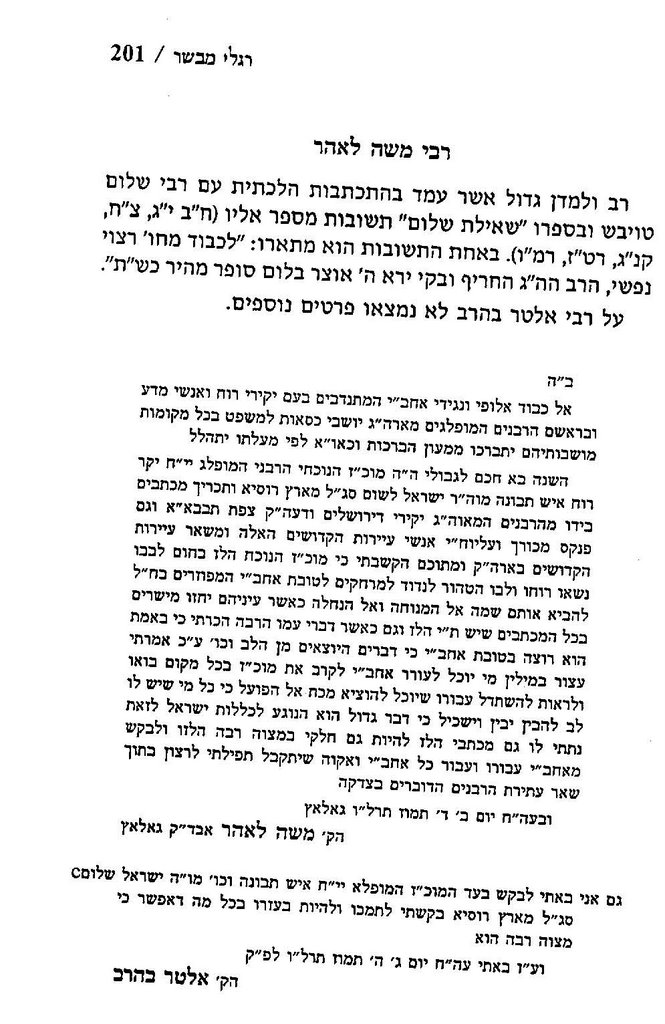
In 1999/2000 some in Beni Brak B. Margolius (most likely a woman due to the lack of first name), published a book, Ragli Mevasar. This book is divided into three parts. The first two are biographies of R. Schlesinger and his father in law. The last part are the very same letters originally published by Weingarten. Additionally, they include the very same biographies that Weingarten did. There is absolutely no attribution at all! I have included a page from each were the reader can see how they are the same. The top page is from Weingarten and the bottom from Ragli Mevasar. None of the library catalogs I have seen note that this is plagiarized.


The Custom of Reciting l’Dovid HaShem Ori

A fairly universal custom is to recite the passage from Psalms l’Dovid Hashem Ori twice a day during the month of Elul. A question which has received renewed scrutiny recently is where this custom came from. The most obvious answer is the work Hemdat Yamim. This work, however, is rather controversial. Many claim this book (which has many other well-accepted customs) was written by Nathan of Gaza, the prophet of the infamous false-Messiah Shabbetai Zevi. Thus, if the Hemdat Yamim is in fact the source, that would not be a good thing.

So, some have claimed that in fact there is another source for the recitation of l’Dovid HaShem during Elul. They point to the book Shem Tov Kotton. In this book, which is a collection of additionally kabbalistic prayers, there is a mention to say l’Dovid HaShem during Elul. The problem, however, is that a) Shem Tov Kotton only says to do so on Monday and Thursday and the 10 days of repentance but not everyday in Elul; (b) he also says that not only one should say l’Dovid but also additionally prayers some of his own compilation and others such as the 13 middot haRachmim and the Psalm Rananu Tzadikim; (c) finally, he says to say l’dovid HaShem immediately after Shmonei Esreh. So it would seem that in all likelyhood the Shem Tov Katton is not the source of our custom to say l’Dovid daily, at the end of prayers, without any additional prayers.[1]

So we are back to square one. Lest one despair some have come to fill this gap. They say anyways the Shem Tov Koton would not have been the best source as they would rather this custom ultimately come from the Ari’zal (which the Shem Tov Koton would not). Now, some just claim the Hemdat Yamim is really a student of the Ari and is perfectly kosher. This solves everything, but that is not the general consensus. Instead, they have located that R. Hayyim haKohen who was known as student of the R. Hayyim Vital and himself an important conduit for the Ari’zal’s writtings, says to say l’Dovid HaShem during Elul. Now, as it was we have a Ari’zal source so the custom has been saved.

Not so fast. First, a rather interesting work was recently redone and republished on the Shir Shel Yom. This book, Shirei haLevim, is everything and anything having to do with the Shir Shel Yom. The book, discusses all the Ari”zal’s customs as connected to the Shir Shel Yom, the book was originally published in 1677. However, no where in this book is there any discussion of l’Dovid, which tends to show that although the author was well versed in all the other Ari’zal’s Shir Shel Yom customs, it seems not this one. Thus, it seems doubtful this custom actually emerged from the Ari’zal.

But, even more questionable is that in the manuscript from which R. Hayyim Kohen’s comments were published that manuscript contains nothing about l’Dovid haShem instead, it appears the publisher inserted into the R. Hayyim’s work. And as already has noted by some (see Yudolov’s comments for the entry of Sha’arei Rachmim [No. 0182652] on the Bibliography of the Hebrew Book 1470-1960) many insertations to the work in question, the Sha’arei Rotzon, are found in the Hemdat Yamim.

2007 Update: Also, it is worth pointing out the lengths persons will go to obscure the Hemdat Yamim source. For instance, in the Siddur Alyiyat Eliyahu and the Machzor by the same editor, Mikrai Kodesh, in both these siddurim the editor offers the following as the source for l’Dovid: “Sha’arei Tefilah which attributes this custom to R. Hayyim Kohen, a student of the AriZa”L, Shem Tov Koton.” So, the earliest source is this work Sha’arei Tefilah which attributes it tho R. Hayyim Kohen – this apparently is a new source, which, although we have seen other sources which attribute it to R. Hayyim we saw that source was questionable at best. While the editor did not explain which of the many Sha’arei Tefilah he is referring to[2], in fact he is referring to R. Ya’akov Raccah’s work published in 1870. Now, as this work is published in 1870 and supposedly is the source for what R. Hayyim Kohen who died in 1655 and authored many of his own works which discuss similar topics should immediately be a red flag . When one actually looks at the Sha’arei Teffilah the quote (p. 48) one sees that he is not the source, instead, all the Sha’arei Teffilah does is quote the Sha’arei Rotzon, which, as noted above, we now know is not actually a quote from R. Hayyim, and instead merely the later insertation of the editors of that work. Now, why would the editor go so far out of his way to reference a rather obscure work from the late 19th century as the first source for this custom but never make any mention of the earlier source Hemdat Yamim at all? It would seem that he wanted to avoid as much as possible any connection to this source.

Notes:
[1] R. Katz, in Divrei Yosef (p. 175) uses the differences between the custom advocated for the Hemdat Yamim – l’dovid should be recited prior to selichot, as a “proof” that our custom can not be based upon Hemdat Yamim. Katz, however, is silent about the numerous differences between our custom and what the Shem Tov Koton advocates for.

[2] It is especially ironic that the editor did not explain which Sha’arei Tefilah he is referencing as the editor spends a considerable portion of his introduction castigating R. Shlomo Zalman Hanau’s Sha’arei Tefilah (the most well-known work with the title Sha’arei Teffilah) for numerous precieved sins. Such a bland citation my lead an innocent reader to make the grave error that the editor is now citing to this “horrible” work.

Sources: Shirei HaLevim was reprinted and retypeset in the book Shirat Shmuel; on l’Dovid see Ohr Yisrael no. 1 by R. Katz (reprinted in his Divrei Yosef); Shem Tov Koton, Chernowitz, 1855 12a-13a (available online at Hebrewbooks.org; R. Goldhaber, Minhagei Kehillot vol. 2 p. 8 (he is the source for the manuscript evidence) Goldhaber’s work is generally excellent; on Hemdat Yamim (the recent controversy) see R. M. Tzuriel’s recent reprint and his introduction; R. N. Greenwald “The Attitudes of the Leaders of Hassidim towards the book ‘Hemdat Yamim’,” Hechal HaBesht no. 6; 34-64; R. Mondshien’s response in the next issue of Hechal HaBesht and Greenwald’s response to R. Mondshein in that issue; for even more on Hemdat Yamim as well as where you can get your own copy for free see my prior post here ; for more on R. Hayyim Kohen, see here about half way down the page.


Jews, Beards and Portraits

“If men be judged wise by their beards and their girth, Then goats would be the wisest creatures on Earth.”

With the High Holidays approaching one of the more interesting attributes which takes a more prominent position is that of shaving or facial hair. Of course, prior to any Shabbat or Yom Tov, one is supposed to shave and take a haircut. Yet, for the High Holidays, there is a special emphasis on facial hair. One of the attributes that the Hazan should have is a beard. Although a beard is not the only qualification for the Hazan, nor is it the dispositive one, it is still mentioned. The importance of the beard is mentioned in the Hazan’s prayer prior to the Mussaf prayers. In that prayer, he lists some of his possible faults including his lack of a full beard (זקן מגודל). [As an aside, this prayer is public and a general one listing in a general manner the various shortcomings everyone really has, Artscroll has that one should say silently some of the faults which seems to belie the fact that every hazzan says this thus removing any individual stigma. Yet, were I pray most years, the Hazzan goes one step further and says half if not more silently. I don’t know if this is due to his immense piety or in fact all those things are applicable to him or perhaps he doesn’t think any of those are applicable and is really just skipping them.]

While the Torah prohibits shaving one’s face with a razor, according to most, one can still remove facial hair. There is a long and tortuous debate about what exactly one can use to remove facial hair, however, putting that aside, it is assumed that there are permissible methods of removal. Now, aside from the straight halakhic (Jewish Law) debate there is another issue that is implicated in removing one’s beard – kabbalah. Some hold that although one is not prohibited from shaving according to a strict reading of the law, one must still be cogent of the kabbalah, which they argue, prohibits any trimming or shaving of the beard.

While some claim kabbalah prohibits shaving, there are others who question this. This debate while ostensibly centered around the interpretation of kabbalah texts, instead revolves around the practice of a single person, R. Menachem Azariah of Fano (Rama m’Fano).

The Rama m’Fano was considered one of the greatest kabbalisits of his generation. He authored many important works on kabbalah and was considered, among many, the heir for Lurianic kabbalah. Thus, his practices regarding shaving can shed light on whether kabbalah really advocates for a beard or if one can still conform with kabbalah and be clean shaven.

R. Shabbtai Baer (d. 1674) in his Be’er Esek was asked whether kabbalah mandates that one keep a beard. He replied by first discussing all the relevant texts and in the end makes the argument that perhaps in the Diaspora kabbalah doesn’t mandate growing a beard. He then gets to the crux of what would become the debate for the next 300 years – the practice of the Rama m’Fano. R. Baer states that he attempted to find out exactly what the practice of the Rama m’Fano was in this area. He learnt that every Friday, the Rama m’Fano would trim his beard or shave his beard “as is the custom in Italy.” And in fact, his students, including R. Baer’s father in law, followed in the practice of their teacher and also shaved. As R. Baer correctly points out, someone of the stature of the Rama m’Fano, obviously is extremely telling for whether kabbalah mandates keeping a beard. From his evidence, R. Baer concludes that kabbalah can not mandate keeping a beard.

Yet, R. Baer’s testimony regarding the Rama m’Fano did not go unchallenged. R. Yosef Ergas, in his Divrei Yosef claims R. Baer got it wrong. Specifically, R. Ergas investigated the practice of the Rama m’Fano as well. R. Ergas came to contrary conclusion than that of R. Baer – the Rama m’Fano had a full beard and he never shaved. R. Ergas’s evidence is based upon a portrait of the Rama m’Fano. In this portrait the Rama m’Fano has a full beard.

This debate continued on to the 19th century with R. Moshe Sofer (Hatam Sofer) and R. Eliezer Shapiro (Munkatcher Rebbe). R. Sofer was asked the very same question as R. Baer was, whether one shouldn’t shave based upon kabbalah. After first professing that “we do not follow kabbalah” and that “he does not occupy himself with that which is hidden” he then goes on to discuss the Rama m’Fano. He uses, as did R. Baer, the Rama m’Fano to demonstrate that kabbalah does not mandate a full beard. Instead, R. Sofer points out that based upon testimony the Rama m’Fano did not keep a beard.

R. Shapiro in his Minhat Eliazer takes strong issue with R. Sofer. He notes that R. Sofer’s evidence must be based upon the Be’er Esek and R. Shapiro argues that R. Ergas’s portrait of the Rama m’Fano has settled this issue and R. Shapiro alleges that had R. Sofer been aware of R. Ergas’s evidence R. Sofer would never have said what he did.

So, in the end, it seems in part this hinges on the portrait of the Rama m’Fano. Well in 1904 in a biography on the Rama m’Fano, the author included a portrait of the Rama m’Fano. In this portrait it is clear as day the Rama m’Fano has a full beard. In fact the author of the biography, devotes a chapter to the beard of the Rama m’Fano. He claims, however, with his publication of the portrait this issue is truly settled. What the author neglects to mention is how in the world do we actually know this in fact is the portrait of the Rama m’Fano. Although the author does provide how he obtained the portrait, no where on the portriat does it actually state this is the picture of the Rama m’Fano. Now, if you will recall, even R. Joseph Ergas testimony regarding the portrait was rather late – close to 125 years after the Rama m’Fano died. R. Baer, in fact, was actually much closer, at least in time, to the Rama m’Fano, and had his father in law who studied under the Rama m’Fano personally to talk to. Thus, it would appear that although the author with the publication of this portrait deemed this issue settled, in fact it is far from settled.

This was not the only (possibly) erroneous portrait to be brought into the debate about beards. The famous portrait of Maimonides was also discussed in the beard context. There are those who claim based upon their reading of Maimonides that using scissors on the beard is prohibited. The question then becomes, the portrait of Maimonides clearly shows a trim beard. The issue with this line of inquiry is that the portrait doesn’t necessarily depict Maimonides at all. This portrait was first published in 1744 and was allegedly based upon a medallion – a medallion which was never produced or seen by anyone other than the one who published it. You can see this portrait as well as the page from the book it originally from here (scroll down half way).

Finally, it is worth noting that Jews, even important Rabbis were far from universal in their facial hair. R. David Nieto is a good example. In this portrait, he has a wig and is sporting a stilleto beard which one assumes was the style of the times. R. Joseph Baer Solovetchik during the 1950s had a goatee.

Sources: Shu’t Be’er Esek no. 70; Shu’t Divrei Yosef, no. 28, Shu’t Hatam Sofer, Orah Hayyim no. 159; Shu’t Minhat Eliezer, vol. 2 no. 48; see also, Elliot Horowitz, “The Early Eighteenth Century Confronts the Beard: Kabbalah and Jewish Self-Fashioning,” Jewish History 8 (1994):95-115; and by Horowitz as well, “On the Significance of the Beard in Jewish Communities in the East and in Europe in the Middle Ages and Early Modern Times,” Pe’amim (1994):124-148 [in Hebrew].

There is much more on this topic, however, I can’t right now provide a complete bibliography.


Shavout Night and Coffee

There are many customs associated with Shavout, you can read about some here and here. One, is staying up all night and learning Torah (or at least part). This custom, which began in the 16th century in Safet spread rather quickly throughout the Jewish world. R. Yosef Karo, the author of the Shulkan Orakh lent a spiritual side. R. Karo stayed up all night and was studying with his student R. Shlomo Alkabtz (author of Lecha Dodi) and the following occurred:

Rav Yosef Karo and I agreed to stay up all night on Shavuot… we did not sleep for one minute… and when we began to study the Mishna.. we heard the voice of the Divine Presence, [with a feeble voice] speaking through Yosef Karo: ‘May you be blessed; return to your studies, do not stop for one minute, and go to Eretz Yisrael… Do not have pity on your vessels [material goods], because you will be sustained by “the upper realms”… so hurry to Eretz Yisrael, because I will be your sustainer, and I will provide for you and the peace of your house.’ And we all raised up a great cry of joy, when we heard the Divine Presence, her voice pleading with us…

Thus, feel the Divine and give Him honor.. and God will cause your hearts to merit becoming one with the Holy Land, to work it together, Amen.

Elliott Horowitz, who we had mentioned previously, has a rather interesting explanation to the quick spread of the custom. Horowitz notes that the rise in popularity of remaining up all night was due to the new drink – coffee. Coffee with its stimulant powers allowed more people to participate in this ritual. Thus, Horowitz notes in a period of thirty years no less than five editions of Tikkun lel Shavout are published in Venice. The same is true in other areas of Europe. This coincided with the rise of coffeehouses. Venice, the same city with all the printings of the Tikkun lel Shavout, in the 18th century, had some 200 coffeehouses (even prior to the rise of Starbucks). In Worms, the community was tasked with supplying coffee specifically for Shavout night. These facts precipitated greater parcipitation in a ritual with its demand upon wakefullness through the night.

While the above is rather interesting explaination for the spread of this custom, it is worth noting that Horowitz’s article appears incomplete. Specifically, he doesn’t touch on two other rituals which would benefit from coffee. The first would be Pesach night. As one is obligated to stay up (and this is min HaTorah) coffee it would seem would be perfect. (In fact, Briskers only stay up on Pesach night and do not stay up on Shavout to highlight this.)

But, perhaps coffee was not used on Pesach because a) it was a private – in the home and b) some considered hametz or kitnyot or at least susceptible to admixture with them.

The second area is the custom to say Shilchot at midnight. Many say it in the morning or some even say it early evening, but many hold midnight is the best time, why did this not benefit from coffee? In other words, why do we not see a rise in people reciting Selichot at midnight after coffee is introduced.

Finally, Horowitz does not discuss how almost all of the kabalistic customs from Safed where quickly adopted by the rest of Europe even when they had nothing to do with coffee. So the remaining awake all night can be seen as just an outgrowth of the acceptance of the others, think kabbalat shabbat etc.

Although Horowitz doesn’t touch upon these, his thesis is one to bear in mind when one is indulging in coffee (today RedBull) and cheesecake at 2 am.

Sources: Elliott Horowitz, “Coffee, Coffeehouses and the Nocturnal Rituals of Early Modern Jewry,” AJS Review 14:1 (Spring, 1989) 17-46; For a fascinating view of the spread of coffee to Amsterdam Jews and the rest of the world, one should read David Liss’s historical fiction work “The Coffee Trader.”