This essay first appeared in the Jewish Review of Books (Spring 2026) and is republished here. Its postscript appeared in the magazine’s Substack newsletter, which you can subscribe to here.
Last December, on the eighth day of Hanukkah, the American haredi newspaper of record Yated Ne’eman published a long, impassioned article titled “Ufortzu Chomos Migdolai Vetimu Kol Hashmanim,” by Rabbi Michoel Sorotzkin. The Hebrew title is from the fifth stanza of the famous Hanukkah standard Maoz tzur, which many of us never get to: “They breached the walls of my towers and defiled all the oils.” That is to say, the Greeks (and their Hellenized Jewish allies) broke through the defenses of the holy Temple in Jerusalem, leaving, seemingly, all its oils polluted and unusable. One might have expected that such a headline would announce a discussion of, say, the closure of haredi yeshiva day schools in New York City, or the Israeli government’s attempts to draft haredim into the military, or, perhaps, the rampant antisemitism threatening European Jewry.
But Sorotzkin’s article addressed none of these very real challenges to haredi life. The breach he identified, the defilement requiring an elaborate polemic couched in apocalyptic language, was a brief mention I had made of the Brisker Rov’s visit to a library in Vilna, in an article I published in these pages last summer (“Golden Ledgers,” Summer 2025, and republished on the Seforim blog).
The Strashun Library of Vilna was the first Jewish public library; it admitted both male and female patrons and included secular as well as religious books (sifrei kodesh). The historical question at issue itself is trivial—in fact it isn’t really a question. Rabbi Yitzhak Ze’ev Soloveitchik, who was commonly known as Reb Velvel or the Brisker Rov, visited the Strashun Library with at least one, but almost certainly two, of his sons on October 1, 1940, and they checked out the books to read in its famous reading room that the library ledger lists them as checking out.
This is demonstrable beyond any remotely reasonable historical doubt. The interesting question is: Why was it so important to Sorotzkin, a prominent member of the haredi world, to tie himself up in speculative knots denying it not once but twice in one of that world’s leading newspapers? Before answering that question, I should explain how I came to write an article that breached the walls and defiled the oils, when what I was trying to do (if you’ll allow me to mix biblical metaphors) was pluck a brand from the fire.
I go to Vilna at least three times a year. Sometimes I stay at a hotel at the epicenter of the three main streets that formed the Jewish district; other times I stay near German Street where Mattityahu Strashun once lived. My mornings begin with a thirty-minute walk to Lithuania’s National Library. The route passes through streets that once hummed with Yiddish, past buildings that housed yeshivas and Jewish publishers, through spaces that sustained centuries of Jewish intellectual life before the Nazis destroyed it. My afternoons are spent walking those streets comparing what I’ve found in the archives against what I expected to find, evenings reviewing notes and planning the next day’s research. What I’m trying to do is reconstruct the ordinary moments that illuminate the extraordinary history of Jewish Vilna.
“In the Strashun Library”: a postcard from the “Vilner yidishe geto” (Vilnius Jewish Ghetto) series with illustrations by Ber Zalkind. (Ber Zalkind, Khaykl Lunski/Wikimedia Commons.)
During these walks, I often run into tour groups gathered at one of the few plaques marking the place of Jews in the city’s history. Usually, it’s the plaque noting the line of demarcation where the Nazis established the Vilna Ghetto. This is the tours’ inevitable focus: the annihilation of the Jews. What preceded the destruction—the institutions of learning and publishing, the literary circles and research institutes, the daily life that made Vilna the “Jerusalem of Lithuania”—receives far less attention. There used to be a sign marking where the Great Synagogue complex, the architectural and spiritual center of Jewish Vilna for centuries, stood. That sign is gone now. What remains are markers of death and destruction; all the complexity of Jewish intellectual life before World War II gets compressed into a prelude to catastrophe.
Those of us who study prewar Jewish culture are trying, each in our own way, to reconstruct and understand the life that preceded the catastrophe. That’s how I came to write a book on the Strashun Library several years ago. It’s why I continue to research its workings and the vibrant world of which it and its patrons, including great rabbinic leaders like Yitzhak Ze’ev Soloveitchik and ordinary Jewish readers, were a part.
The Strashun Library opened in 1902 as the first Jewish public library, built from Mattityahu Strashun’s private collection of rare books and manuscripts. From its opening, it became central to Vilna’s intellectual ecosystem. Its reading rooms welcomed everyone: rabbis and historians, secular scholars and traditional students, men and women, those seeking Yiddish literature and those researching Jewish law. By the time it was shuttered in 1940, it held roughly fifty thousand volumes and served a public that spanned the full spectrum of Jewish life.
Khaykl Lunski, Librarian of the Strashun Library in the book stacks. Postcard (undated), Private Collection.
When I discovered the library’s checkout ledgers in the National Library of Lithuania archives in 2024, I realized that their spare entries allowed us to reconstruct the day-to-day life of the library: who used it, which books they read, and how it served different strata of Jewish society.
As the first step in a project to digitize and make the ledgers publicly available to other researchers, I spent four very full days scanning thousands of pages, each holding about fifty handwritten entries. As I worked, I browsed the names and tried to quickly register patterns in the data. One of the names that jumped out at me was “Yitzchok Soloveitchik,” who requested a collection of I. L. Peretz’s Hasidic stories, Khasidish. Could this be Rabbi Yitzhak Ze’ev Soloveitchik, the son of Rabbi Chaim Soloveitchik, who founded the famous Brisker approach to talmudic study?
Yitzhak Ze’ev inherited and extended his father’s analytic method and later became one of the most uncompromising voices in Israeli haredi leadership, where he was known as the Brisker Rov. I knew that he and his family had been in Vilna at the time, because I’d found him listed among prominent rabbis in Vaad ha-yeshivos refugee housing records that show, yeshiva by yeshiva, where students, teachers, and refugees were staying. Nonetheless, it could have been another Yitzchok Soloveitchik. Then I looked more carefully at the same ledger page and saw another entry: a Raphael Soloveitchik had requested Maimonides’s Iggeret ha-shemad just a few lines above Yitzchok’s request for Peretz. Now it was clear. The Brisker Rov had a son named Raphael, and although Peretz’s short stories was a surprising choice for his father, the choice of Maimonides’s famous letter on persecution by the scion of a family fleeing persecution and famously devoted to Maimonides made perfect sense.
In short, the ledger documented that the Soloveitchiks had used the library just weeks before the Soviets would permanently close it, which is what I wrote, in passing, in my article. All that I thought I had documented in doing so was that the library served the rabbinic elite alongside ordinary Jews of all kinds, who were reading everything from talmudic commentaries to Yiddish translations of Tolstoy. But merely documenting a prewar Jewish world that was different than is generally imagined in haredi publications like Yated turned out to be an act of desecration.
Rabbi Sorotzkin’s first attack began by quoting the offending lines—or part of them at any rate—from my article: “On the afternoon of October 1, 1940, Reb Velvel came to the Strashun Library with his teenage son . . . His father’s reading for the day was more surprising: I. L. Peretz’s short stories about Hasidim.” (Sorotzkin’s ellipses will turn out to be doing a lot of work here.)
“With this passage,” Sorotzkin wrote, “Mr. Dan Rabinowitz does more than recount an archival curiosity. He stages a tableau.” He went on:
The Brisker Rov, Rav Yitzchok Zev Soloveitchik, appears before us not as generations of talmidim knew him, but as a character in a modern morality play: seated calmly in the Strashun Library of Vilna, immersed in the ironic fiction of I. L. Peretz, surrounded by secular readers, students, men and women alike.
The effect is unmistakable. The reader is invited to marvel at the distance between the “real” man and the image preserved by Torah memory. Hagiography, we are told implicitly, has concealed a richer, more complex inner life—one now revealed by the cold honesty of a library ledger.
It is an elegant narrative. It is also an edifice built on sand. What we encounter here is not historical reconstruction, but a breach—peritzas geder—in the most basic disciplines of historical inference. And once the wall is breached, all the oil may be rendered impure.
Beyond the rhetoric of righteous indignation, Sorotzkin’s argument was simple: The Brisker Rov would never have entered a “mixed, open, modern” library because his “entire being recoiled from even the faintest rei’ach [whiff] of ideological modernity.” Therefore, someone else named Yitzchok Soloveitchik must have. And here Sorotzkin had a candidate:
The Vilna region was saturated with Soloveitchiks. . . . Among them appears a Yitzchok Soloveitchik, a timber merchant, a vald-socher [from Švenčionys]—precisely the kind of educated townsman who would frequent the Strashun Library and read Peretz.
There are just three problems with this line of argument—actually there are more than that, but let’s restrict ourselves to three for the moment:
a. The same ledgers that documented the visit of a “Yitzchok Soloveitchik” also recorded several visits by Rav Pinchas Hirschprung, who would later serve as chief rabbi of Montreal. Rav Chaim Ozer Grodzinski, the preeminent Torah authority in Vilna, held special borrowing privileges at the library, and Rabbi Yisrael Meir Kagan, the renowned Chafetz Chaim, visited and signed the library’s VIP “Golden Book.” If such colleagues could visit the library, can Sorotzkin really be so certain that the Brisker Rov’s “entire being” would have prevented him from doing so?
b. Švenčionys is over eighty kilometers from Vilna, and we have no evidence this timber merchant traveled to Vilna in October 1940. Not to speak of the fact that neither Rabbi Sorotzkin nor I know anything about the reading habits of Jewish timber merchants in the area.
c. The ledger records two Soloveitchiks visiting the library on October 1, 1940. Are we to suppose that this other Yitzchok Soloveitchik also had a son named Raphael, who was also a deep Maimonidean?
This last problem—call it the “Zvei Soloveitchiks problem”—returns us to Rabbi Sorotzkin’s creative use of ellipses. When he quoted my offending lines about Reb Velvel, he elided Raphael—whom I mentioned in those sentences—right out of the picture and never acknowledged that he appeared in the ledger a few lines above his father.
Actually, unlike Sorotzkin’s conjectural Peretz-reading ironist timber merchant, the Brisker Rov had good reason to visit the Strashun Library. He was in the midst of a life-and-death halakhic controversy with his colleague Rav Aharon Kotler about whether refugees should try to flee to Eretz Yisrael or America. To support his position that they should not go to America because of the spiritual danger, the Brisker Rov turned to a passage he remembered from Maimonides’s Iggeret ha-shemad, which he wanted to quote verbatim.
Soloveitchik family memory confirms this. In a footnote to Shiurei Rabbeinu Meir ha-Levi, a collection of the Brisker Rov’s son, he is quoted as saying:
I recall that during the war years, Maran [the Brisker Rov] sought a copy of the letters from the Rambam, because he wanted to study Iggeret he-shemad, in which the Rambam has a lengthy discussion to explain the fundamental idea that a person acclimates to his surroundings and it is prohibited to live in a place which doesn’t allow one to fulfill the mitzvot properly. . . . Initially, however, he was unable to find a copy, and, in the end, he located one in the Strashun Library in Vilna. According to the library’s rules, one was not permitted to remove books from the building. And therefore his son R. Chaim copied it word for word for him.
The library ledger records Raphael as the borrower of Iggeret ha-shemad while the family testimony remembers Chaim as the copyist. Perhaps both brothers participated, or Raphael handled the checkout while Chaim copied the passage. Or perhaps the family misremembered which brother accompanied his father to the library. At any rate, there were at least two, and quite possibly three, Soloveitchiks at the Strashun Library on that day. And they were there precisely because the Brisker Rov took his obligations as a halakhic scholar and leader of Torah Jewry so seriously.
When I wrote to Yated Ne’eman to explain all this, the editors—to their credit—published my letter, but they did so alongside a reply from the unflappable Rabbi Sorotzkin. Sorotzkin not only blithely failed to acknowledge his errors of omission and commission but went on to a new and truly gobsmacking theory, titling his response “Veha’emes Vehashalom Ehavu” (Love truth and peace).
The entry for a “Yitzchok Soloveitchik” must, he now admits, refer to one of the famous Soloveitchiks rather than a random timber merchant from Švenčionys. Still, it couldn’t possibly be the Brisker Rov. So, who was it? Here I must quote Rabbi Sorotzkin at length to convey just how far he is willing to go to save Reb Velvel from having gone to a public library:
The presence of a ledger entry bearing the name “Yitzchok Soloveitchik” is taken to indicate the Brisker Rov himself, seated in the reading hall and borrowing secular literature. Yet there exists a far more coherent and internally consistent explanation, one that aligns with the testimony, the ledger itself, the halachic framework governing names and conduct, and the lived reality of the Brisker household.
According to this reading, it was the Brisker Rov’s son, Rav Chaim who entered the Strashun Library as the responsible emissary. Anyone familiar with the family dynamic knows that his keen intelligence, composure, and practical capability marked him as the natural choice for such a mission. His younger brother, Rav Rafael, accompanied him and formally requested the Iggeres HaShemad, which then had to be copied in full—a task of approximately 3,500 words, requiring a prolonged stay. Such an extended presence in a public institution would naturally invite scrutiny. To avoid unnecessary attention, it would have been prudent, even expected, to request an additional book, a routine borrowing that raised no eyebrows and normalized the time spent at the table.
Here the ledger entries themselves become illuminating rather than sensational. Immediately preceding the Soloveitchik entry, two patrons are recorded borrowing works by I. L. Peretz. . . . When Rav Chaim was offered titles by the same author, the specific work recorded — Chassidish — was accepted not as an ideological choice but as a convenient placeholder, a book taken to cover the duration required for copying the Iggeres. . . .
The use of the name “Yitzchok” in the ledger is likewise neither mysterious nor incriminating. Rav Chaim could not identify himself by his own well-known name without drawing attention, particularly given that the sefer of his grandfather, Rabbeinu Chaim Halevi, was already catalogued in that very library. Nor could he identify himself by his father’s full name. Halacha is explicit that one may not refer to one’s father by name, even after death, without alteration. . . . The use of the shortened form “Yitzchok” . . . would have satisfied both the halachic requirement and the practical need for discretion, without uttering an outright falsehood.
It is difficult to imagine anyone believing that a scholarly household in the midst of the “lived reality” of a desperate flight to safety from both the Soviets and the Nazis would strategize over the impossible “mission” of going to a library frequented by other pious Jews to copy a passage from Maimonides. And further, to think that they needed an elaborate cover story involving false names and phony book checkouts so that the Jewish librarians did not penetrate their cover (and what?—inform Rav Kotler about the killer prooftext from Maimonides?). The tradition has a term for such groundless theorizing, pilpul shel hevel, and it is a hallmark of the Brisker tradition to oppose it.
Sorotzkin closes his response on an extraordinary—and, one presumes, unconscious—note of chutzpah. “When suggestive narratives arise from thin evidentiary reeds,” he writes, “methodological restraint becomes not a courtesy but an obligation.” But perhaps I am being unfair, as George Orwell once remarked, “We are all capable of believing things which we know to be untrue, and then, when we are finally proved wrong, impudently twisting the facts so as to show that we were right.”
Sorotzkin’s initial response characterized my work as “peritzas geder,” a breach of protective walls. But what did he think needed to be protected? Not the Brisker Rov’s actual stature or commitment. That he wanted to verify the exact wording of Maimonides’s Iggeret ha-shemad from the richest collection of sifrei kodesh in Eastern Europe to guide his thinking on the refugee crisis illuminates the rigor of his approach to unprecedented questions. What Sorotzkin needed to protect was rather a nostalgic fantasy: one in which the great sages (gedolim) of that generation never entered mixed public spaces, relied on secular institutions, or read fiction. But the infrastructure of Jewish life in places like Vilna was not neatly divided into “Torah” and “secular” categories, and gedolim and their students checked out books from the Strashun Library alongside maskilim, socialists, and ordinary Jews looking for something to read.
I go back to Vilna regularly to identify, amid the destruction and absence, what can be found to resurrect, contextualize, and enrich our understanding of the astounding Jewish culture of prewar Vilna. The Jews of this city—rabbis and students, traditionalists and modernists, Hebraists and Yiddishists—created institutions, filled libraries, published journals, founded schools and research institutes, and argued about everything.
The Brisker Rov spent an afternoon in the Strashun Library in October 1940 with his sons to obtain a text he desperately needed. While his sons diligently copied Maimonides’s text, he requested Peretz’s collection of Hasidic stories. I don’t know why and, of course, it doesn’t matter—only Sorotzkin and his more credulous readers would think that it does. But there is a plausible answer. It turns out that among Peretz’s Hasidic tales is the story “Between Two Mountains,” in which a fiercely strict and intellectual rosh yeshiva called “the Brisker Rov” is taught a lesson in humanism by a former student who has become a Hasidic rebbe. Might not the Brisker Rov have been simply curious to read about his fictional counterpart?
The Holocaust destroyed the Strashun Library and most of the Jewish world of which it was a part. The Soviets shuttered its reading room; the Nazis looted its collections; after the war, the building was destroyed. Yet, the few surviving Strashun Library ledgers reveal precious little moments in the lost history of Jewish intellectual life in Vilna. The final volume documents the last gasp of Eastern European Jewry, not only the local Jewish inhabitants but also the thousands of refugees like the Soloveitchiks who, fleeing Hitler and Stalin, briefly sought safety in Vilna.
Strashun Library Building in 1945. Vilna Gaon Museum of Jewish History Archive, 1829-1
It seems to me that what we, their descendants, owe them is to see their lives, at least in glimpses, as they were, even if it is through the entries of a humble library ledger. That is a history worth recovering, even when—especially when—it complicates what we thought we knew. Such complication is not desecration; on the contrary, it honors their memories.
Postscript
After writing this response to Rabbi Sorotzkin’s pilpul shel hagiografia, I continued to return to the 1940 ledger, which hasn’t been digitized yet. As I described above, Sorotzkin’s new, and equally implausible, claim was that Chaim Soloveitchik used his father’s name rather than his own, to avoid the commotion of being recognized as the grandson and namesake of the author of one of the library’s own seforim, and to escape the notice of the authorities. In fact, it turns out Chaim checked out books under his own name at least five times in September 1940.
The first entry was on September 6, 1940, weeks before his father and Rafael appear in the ledger together. He checked out the Iggeret ha-shemad twice, on September 12 and September 14. These are, undoubtedly, the visits to transcribe Maimonides’s text, as described in the family testimony recorded in Shiurei Rabbenu Meir HaLevi. Rafael’s borrowing of the same text on October 1, when he visited the library with his father, was probably to check his brother’s transcription against the source.
That September, Chaim also read the tenth-century grammarian Dunash ben Labrat, the letters of Sa’adia Gaon and Ramban, the Abudraham’s commentary on the siddur, Samuel David Luzzatto’s essays collected in Bet ha-otzar, and a run of midrashic works, several in modern critical editions such as those of Solomon Buber. This is not the reading of a man sent on an undercover mission to copy one text. It is, rather, the reading of a wide, curious, and learned mind, and the ledger records it without comment or apology.
Of course, this isn’t surprising. As I wrote above, many well-known rabbinic figures used the library without incident. What is surprising is the pseudo-pious lengths to which Sorotzkin went to deny that the Brisker Rov and his sons simply used the Strashun Library, a fact that the family itself had no qualms about memorializing. What the ledgers allow us to do is to see, in a reader’s own name and hand, what he read in one of the great libraries of his world.
The Strashun Library Ledger Project, which is digitizing and making the ledgers publicly available, is a collaboration between the Martynas Mažvydas National Library of Lithuania, the e-Lijah Lab at the University of Haifa, Yale University’s Jewish Studies Department and Library, the Fortunoff Video Archive, and Litvak SIG.
‘And How Can One Behold a Sefer Torah in Distress?’ On the Relationship between Rabbi Chaim Heller and Rabbi Joseph B. Soloveitchik
‘And How Can One Behold a Sefer Torah in Distress?’
On the Relationship between Rabbi Chaim Heller and Rabbi Joseph B. Soloveitchik
by Aviad Hacohen and Menachem Butler
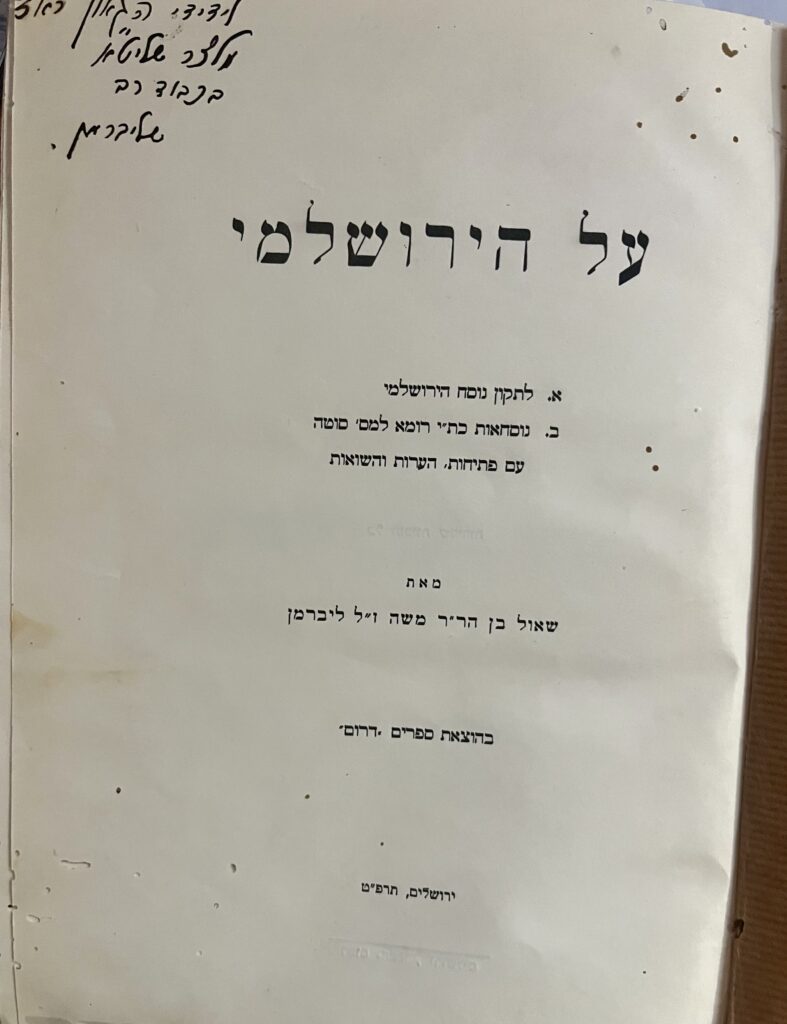
This article, published on the occasion of the anniversaries of the passing of Rabbi Chaim Heller (14 Nisan 5720) and Rabbi Joseph B. Soloveitchik (18 Nisan 5753), may their memories be a blessing, reexamines their relationship through a newly published body of correspondence, situating their bond within the intellectual and material conditions of mid-twentieth-century American Orthodoxy.[1] The letters document both a relationship of unusual personal and scholarly closeness and the economic precarity and institutional instability that affected even leading Torah scholars of the period.
One such document, written by R. Soloveitchik in 1942 at a moment of acute crisis, reads as follows:
“Your esteemed honor has surely heard that our friend, the great and mighty gaon, luminary of the Diaspora and its glory, the crown of Israel’s splendor, our teacher and master Rabbi Chaim Heller, may he live long, has fallen gravely and dangerously ill. To our joy, and to the joy of all who fear God, our prayers have been accepted, and the Healer of all flesh has sent recovery and healing to the great one of our generation. Yet he remains weak and requires exceptional care. I therefore request of your esteemed honor, as a friend of the aforementioned gaon, to exert yourself on his behalf in every possible way. The supervision of the illness has entailed great expense, and even now the outlay is considerable while there is no income – and how can one behold a Sefer Torah in distress? I am confident that your esteemed honor will do all that is necessary, secure a fitting sum, and deliver it to the gaon R. H. Heller, may he live long, or to the fund ‘For R. H.’ I thank him in advance for his efforts. Your admirer and one who honors you.”[2]
In this letter, Soloveitchik addressed his friend Rabbi Simon (Abraham Yeshayahu) Dolgin,[3] then rabbi of Congregation Beth Jacob in the Beverly Hills neighborhood of Los Angeles, where he would serve for more than three decades and build one of the most significant Orthodox communities on the American West Coast. Upon receiving the appeal, Dolgin promptly sent a contribution; it appears, however, that its amount did not meet Soloveitchik’s expectations.
In a subsequent letter of appeal sent to Rabbi Dolgin approximately one month later [=14 July 1942], R. Soloveitchik again wrote:
“I received your letter together with the check. To my great regret I cannot deliver it to our friend, the great gaon, the mighty shepherd, may he live long, for the sum is not commensurate with the honor and majesty of a gaon of Israel, a luminary of the Diaspora, who dispersed his wealth to the poor and destitute, and whose home was open wide to all who were embittered and broken in spirit. Woe unto us, that the rabbi of Israel stands in need of aid and assistance. I request of your esteemed honor – who, as I have heard, is among the friends of the aforementioned gaon – to do all that lies within your power and to send a proper and worthy sum.”
The letters published here for the first time provide a rare window into the distinctive relationship, a bond of unusual personal and intellectual intimacy, and the enduring ties that prevailed for decades between two of the leading Torah scholars in the United States in the twentieth century. At the same time, they illuminate the manifold hardships, including acute financial privation, humiliation, and disappointment, that rabbis of that period were compelled to endure as they sought even minimal means of livelihood with which to sustain their households. This fate did not spare even one of the foremost sages of the generation, R. Chaim Heller, who, in order to support his family, was compelled to piece together sporadic and temporary sources of income until he eventually attained, albeit only in relative terms, a measure of stability and a settled position that afforded him and his family a degree of economic security.[4]
Beyond their intrinsic interest, these letters are of particular importance by virtue of the period in which they were written. They date to the years of the Second World War, from which very little of Rabbi Joseph B. Soloveitchik’s correspondence has survived.
Already in these early letters, the literary Hebrew of R. Joseph B. Soloveitchik and his distinctive stylistic register stand out prominently.[5] They attest both to the profound bond between the two scholars and to R. Soloveitchik’s sustained concern for the welfare of his colleague and intimate friend, R. Chaim Heller. Their connection began years earlier in Berlin.
R. Chaim Heller (1879-1960) was among the leading Torah scholars of the early twentieth century. Alongside his greatness in Torah, he was deeply engaged in the scholarly study of Talmudic literature and biblical translation.[6] His work was characterized by a distinctive methodological orientation that sought to challenge the prevailing assumptions of modern biblical criticism through philological rigor grounded in the resources of the rabbinic tradition. In his introduction to On the Jerusalem Targum to the Torah (New York, 1921), R. Heller sharply criticized what he termed the “mechanical method” of comparing ancient translations in order to posit divergent textual recensions. Against this approach, he argued that the multitude of so-called “variants” in translations such as the Peshitta, the Septuagint, and the Samaritan Pentateuch do not reflect alternative Hebrew originals, but rather systematic exegetical practices. In his view, the translators did not render the biblical text literally, but interpreted and expanded it in light of traditions preserved in Hazal. This thesis enabled him simultaneously to undermine the conclusions of contemporary critics and to reaffirm the centrality and antiquity of the Oral Torah as an interpretive matrix for Scripture.[7]
This distinctive synthesis of traditional learning and critical scholarship was already prefigured in the formative trajectory of his early life. Born in Białystok and raised in Warsaw, he was already in his youth known as “the prodigy of Warsaw.” From the age of ten he ceased studying with melammedim; he never attended a yeshiva and acquired his entire Talmudic learning independently, as an autodidact. He married the daughter of a wealthy member of the Łódź community, and in the home of his uncle in Warsaw encountered the leading sages of the generation, engaging them in rigorous dialectical discussion. Among them were R. Yosef Dov Soloveitchik, author of Beit ha-Levi; R. Isaac Elchanan Spektor of Kovno; and the Netziv of Volozhin. During these years he also formed especially close ties with R. Chaim Soloveitchik, his relative by marriage R. Eliyahu Feinstein of Pruzhany, and R. Eliyahu Chaim Meisel of Łódź. In later years, he received a doctoral degree from the University of Würzburg.
Following the death of Rabbi Malkiel Tzvi Tannenbaum, the community of Łomża was left without a rabbi, and its leaders resolved to appoint Rabbi Heller, already known as a sharp and penetrating scholar and a man of broad learning who held a doctoral degree. By that time he had published studies on the Septuagint and on Maimonides, which drew the respect of both rabbinic and academic circles. Yet after only a few months he resigned his post. Various explanations have been offered for his departure: some point to his reluctance to devote extensive time to communal responsibilities, which he regarded as bittul Torah, while R. Joseph B. Soloveitchik recounted that Rabbi Heller himself expressed concern that members of the congregation might pressure him to act against his convictions.
R. Heller soon left for Berlin, where, in 1922 he established the Beit Midrash ha-Elyon, an advanced institution for rabbinic training that drew a small but serious circle of students. Berlin at the time was a meeting ground of worlds, traditional learning and modern scholarship, and Heller moved between them with unusual authority. In R. Heller’s case, this was not merely a sociological juxtaposition but a fully integrated intellectual stance, in which Wissenschaft methods were appropriated and redirected in defense of the integrity of the Masoretic text and the authority of the Oral Torah.[8] It was there that the young R. Soloveitchik spent several formative years. He was not formally enrolled in the institution, but he attended Heller’s lectures and was deeply influenced by them. What impressed him was not only R. Heller’s mastery of Torah and scholarship, but the range of his mind – the sense that he inhabited both disciplines fully, without strain or concession.
In 1929, R. Chaim Heller was appointed as a Visiting Professor of Bible at RIETS,[9] and “for close to ten years Heller taught in New York while occasionally traveling to Berlin and elsewhere before settling in the United States.” More than a decade later, his name was even floated by Rabbi Dr. Leo Jung as a potential successor as Rosh Yeshiva of RIETS following the death of R. Moshe Soloveichik in 1941.[10] A contemporaneous portrait of Heller’s intellectual profile appears in a 1930 article by R. Yerahmiel Elimelekh (Max J.) Wohlgelernter in the ha-Pardes journal, in which R. Heller is presented not merely as a scholar of unusual range, but as a figure who entered directly into confrontation with modern biblical criticism on its own terms, armed with philological expertise yet grounded in the authority of the rabbinic tradition. Against what R. Wohlgelernter characterizes as the “mechanical” methods of contemporary critics, R. Heller is depicted as demonstrating that the multiplicity of textual variants in ancient translations reflects interpretive practice rather than divergent textual recensions, thereby reasserting the integrity of the Masoretic text and the centrality of the Oral Torah as its interpretive matrix.[11]
In 1937, several years after the rise of the Nazis to power and the intensification of anti-democratic measures directed especially against the Jews, R. Chaim Heller emigrated to the United States and settled in New York. That same year, R. Moshe Feinstein likewise arrived in New York. During this period, R. Heller renewed his connection with R. Joseph B. Soloveitchik, who had come to the United States some five years earlier at the urging of his father, R. Moshe, then Rosh Yeshiva of the Rabbi Isaac Elchanan Theological Seminary. In Boston, R. Joseph B. Soloveitchik led his community with distinction and, alongside his teaching, increasingly assumed a position of broader intellectual and religious leadership, establishing himself as a central figure for a growing circle of students and adherents.[12]
Despite this recognition of his intellectual stature, the conditions that Heller encountered upon his arrival in the United States were markedly different. Like many rabbis who fled Germany on the eve of the Second World War and arrived in the United States as refugees,[13] R. Chaim Heller entered a professional landscape that was structurally inhospitable. The lingering effects of the Great Depression continued to constrain both the rabbinic and academic labor markets.[14] Congregational positions, even in smaller and more remote communities, were typically occupied by long-established incumbents, while the few available posts offered only modest remuneration. Universities, for their part, were in a period of contraction, with limited hiring and little institutional appetite for figures whose scholarly profile did not align neatly with existing departmental frameworks. For a scholar of Heller’s unusually wide and interdisciplinary range, no obvious institutional niche presented itself.
In response, Heller adopted a peripatetic mode of intellectual livelihood. Lacking a stable appointment, he supported himself through public lectures, assembling an income that remained precarious and contingent. This required sustained mobility, persistence, and a readiness to engage even relatively small audiences. At one stage, this itinerant circuit took him as far as Los Angeles, a journey that, under the conditions of the time, entailed considerable logistical and physical demands, where he delivered a series of lectures in his areas of expertise. It was likely in the course of this visit that he first encountered Rabbi Dolgin.
The notice of R. Chaim Heller’s arrival in Los Angeles appeared in the Los Angeles Times, March 22, 1940.
It may be assumed that, in the wake of this visit, the relationship between the two was further strengthened. Expression of this is found in three letters written during those years by R. Chaim Heller to R. Dolgin, which are published here for the first time.
The first letter is dated 4 Nisan 5700 [= 12 April 1940], a short time, approximately three weeks, after R. Chaim Heller’s arrival in Los Angeles. It reads as follows:
“To the honorable Rabbi Abraham Isaiah Dolgin, may he live long: Your esteemed letter has reached me. Although Magnin[15] caused considerable damage, it seems to me that his words made no impression upon ploni, notwithstanding the saying, ‘When a word cannot enter in its entirety, it enters in part.’[16]
I have a conjecture as to whose soul spoke through Magnin, and whose finger was involved in undermining the matter there, but why should we speak of what has passed.
Since Your Honor requested of me “to forgive him for his errors,” I hereby note that, indeed, your entire letter was written well; however, two errors slipped from your pen: first, that you wrote also “concerning the matters of his נשיאתו (nesi’ato, ‘his presidency/bearing’) to Chicago,” whereas it should read נסיעתו (nesi‘ato, ‘his travel’); and second, that you wrote שגיאותי ושגיעותי (shegiyotai, ‘my errors’), and such a latter form does not exist.
I have drawn his attention to this out of my great affection for him,[17] and your honor should take care to be precise in his writing. You also wrote to me that Mr. Sh. desires to discuss matters with Rabbi B. [Bernard Revel[18]]; however, your honor knows that the latter has recently opposed me with full force, though I do not know the cause of his reversal,[19] and I am uncertain whether your honor acted wisely in writing to him, for he and those associated with him may think that I prompted your honor to do so. I have been brief in all this, and I conclude with blessings of peace and all good to your honor, according to your will and the will of one who esteems and cherishes you, and who inquires after your welfare.
Chaim Heller”
In the margin of the letter, his wife added a brief greeting of her own: “I too inquire after his welfare. Miriam Heller.”
The second letter was written approximately two months later, on the eve of the festival of Shavuot, in which R. Chaim Heller gives expression to his frustration that promises made to him, apparently concerning the provision of a stable source of livelihood, had not been fulfilled. It reads as follows:
3 Sivan [5700] [9 June 1940]
To the honorable Rabbi Abraham Isaiah Dolgin, may God preserve and sustain him,
Your esteemed letter reached me with delay, as is the way of ordinary post, and I shall respond to all your inquiries: regarding the matter of the years [?], up to this day there is nothing whatsoever, and I had indeed waited and hoped for this, and accordingly set aside and abandoned other undertakings which I now lack greatly – very greatly.
I very much wished to meet with […], but in truth it was difficult for me to request this.
Concerning the attitude toward the war,[20] it is certainly an obligation and a commandment, and I have much to elaborate on this matter. Books addressing this subject are not presently known to me, for I am entirely without books in my home; with God’s help, I shall set my mind to seeking them out.
I shall be brief this time. With blessings for long life, a joyous festival, and days of gladness always, in accordance with your will and the will of one who esteems and honors you, who inquires after your welfare and goodness.
Chaim Heller
[p.s.] My wife and daughters inquire after your welfare, and bless you with every good, selah.
The third letter was written approximately a year later, on the eve of Passover 5701. At that time, reports in the press in the Land of Israel[21] indicated that R. Heller was about to receive a teaching appointment at Yeshiva University alongside his colleague R. Joseph B. Soloveitchik. Having grown accustomed to disappointment, R. Heller feared that this announcement amounted to no more than a “trial balloon” lacking any concrete foundation. This apprehension, together with his distress at both the substance and the tone of the report, found expression in a letter he addressed to R. Dolgin:
“12 Nisan 5701 [9 April 1941]
To the honorable Rabbi Abraham Isaiah Dolgin, may God preserve and sustain him,
After a long period of silence while confined to bed, I received your letter. Concerning the report that you read: to this day I have no connection whatsoever with the yeshiva.[22] I have not spoken even a word – however slight[23] – with any person, and I was selected entirely without my knowledge; indeed, I am far removed from accepting an appointment in such a manner. I immediately considered issuing a denial in the very newspaper that published the report, but many worthy individuals dissuaded me, on the grounds that matters might yet develop otherwise, and that the counsel of the Lord shall prevail.”
In this connection, he related to his friend his deliberations regarding an additional source of livelihood – delivering lectures to vacationers in the Catskill Mountains during the summer months:
“You surely recall that two years ago I was approached to deliver lectures, for remuneration, before rabbis and scholars, etc., during the summer season (be-idna de-qayta), in the vacation period; and now this matter has again been raised, and I am prepared to lecture for six weeks in one of the pleasant locales to which people travel.
The lectures would be held three times a week and would encompass a comprehensive and wide-ranging treatment of biblical scholarship and the Talmuds, such that ‘the ear would not be sated with hearing’.[24] Over this period, the listener would gain far more than he would in a year or two at any college or seminary in the world. However, I require a highly energetic organizer who will undertake to arrange this enterprise properly. May your honor be blessed with all good and prosperity, and may you celebrate the Festival of Unleavened Bread with joy and delight.”
After several years in the United States, during which he lacked a stable source of livelihood, R. Chaim Heller secured a position on the teaching staff of Yeshiva University and served alongside his colleague R. Samuel Belkin, R. Joseph B. Soloveitchik, and R. Moshe Shatzkes on the RIETS Ordination Board.[25]
Screenshot
Yet, as emerges from a letter cited below, his salary conditions remained far from favorable. Efforts were made to improve them and, over time, met with a measure of success. The literary oeuvre of R. Chaim Heller is vast in scope. Yet, as R. Joseph B. Soloveitchik would later describe in his eulogy, what was published only represents only a minute fraction, “mere remnants of remnants,” of the breadth of his orally transmitted Torah. It should also be borne in mind that the overwhelming majority of his writings were composed prior to his arrival in the United States.
Among his works in the field of biblical scholarship, particular note should be taken of his studies on the textual tradition of the Bible and its various translations: his work on the Jerusalem Targum to the Torah (New York, 5681 [1921]); on the Samaritan Pentateuch (Berlin, 5684 [1924]); on the Septuagint in the Concordance Heikhal ha-Qodesh, with appended notes, commentaries, and investigations in biblical studies (New York, 5704 [1944]); and on the Peshitta, the Syriac translation of the Bible (transcribed into Hebrew script, with notes, glosses, and commentaries by Chaim Heller: Genesis, Berlin, 5687 [1927]; Exodus, Berlin, 5689 [1929]). He prepared a revised edition of the Peshitta to Exodus for publication but did not succeed in completing its printing prior to his death. Among his halakhic works, his annotated edition of Maimonides’ Sefer ha-Mitzvot (first edition, Piotrków, 5674 [1914]) is well known. A subsequent edition of this work was published by Mossad HaRav Kook in Jerusalem (5706 [1946]) – and has since appeared in numerous further editions – and for this work he was awarded the Rav Kook Prize in 5707 [1947]. His writings also include Hiqrei Halakhot, analytical investigations of legal rulings and issues in the section Hoshen Mishpat (vol. I, Berlin, 5684 [1924]; vol. II, Piotrków, 5692 [1932]); as well as studies on various topics in Maimonides and the halakhic decisors concerning the laws of lending and borrowing and their ancillary matters (Chicago, 5706 [1946]). In addition, he published, in jubilee and memorial volumes, several qontrasim that functioned as a kind of Masoret ha-Shas for the Jerusalem Talmud.[26]
Even after R. Chaim Heller had joined the faculty of Yeshiva University, R. Joseph B. Soloveitchik continued to seek ways to assist him, inter alia by working to secure an increase in his salary. Expression of this may be found in a brief letter that he wrote to R. Chaim Heller on 23 Sivan 5713 (5 June 1953), which is likewise published here for the first time:
Erev Shabbat, 22 Sivan 5713 [5 June 1953]
To my honored friend, the true gaon, luminary of the Diaspora, crown of Israel and its glory, pillar of halakhah and instruction, may he live long,
Greetings and blessings!
I departed New York on Thursday morning and arrived in Boston utterly exhausted. On the preceding Wednesday I met with Rabbi Rosenberg at a certain inn, and we resolved to add two thousand dollars annually[27] to your honor’s salary. It seems to me that next month you will receive a check in accordance with the new scale. We trust in God that the matter will be brought to a good conclusion and that no obstacle will arise in connection with it. Naturally, the matter must remain in absolute confidence, and no one need be informed of it.
I conclude with abundant blessing and faithful affection,
This quiet intervention on Heller’s behalf was not an isolated act, but part of a sustained pattern of concern. In this connection, it is instructive to recall R. Aharon Lichtenstein’s characterization of R. Joseph B. Soloveitchik, in his eulogy. Reflecting on his father-in-law’s own self-understanding, he writes:
“The personal self-conception that characterized the Rav, of blessed memory, with respect to his own functioning was bound up with educational–pedagogical activity, and this across multiple spheres. He would often remark that when he arrived in the World of Truth, and were he to be asked to specify by virtue of what he merited a share in the World to Come, he would indicate three points: (a) that he studied Torah with his children; (b) that he founded the Maimonides School in Boston; (c) that he was concerned, over an extended period, for the honor and welfare of a certain talmid hakham.”[29]
This final point refers to R. Soloveitchik’s sustained and well-documented efforts on behalf of R. Chaim Heller. The depth of this personal concern was not confined to the private sphere, but found parallel expression in a sustained intellectual and institutional collaboration between the two. A further expression of their bond and cooperation is found in their joint letter of response to Israeli Prime Minister David Ben-Gurion, who in 1958 approached them, among other “Sages of Israel,” to solicit their opinion on the question “Who is a Jew?” Although the inquiry was addressed to each of them separately, the two resolved to compose a joint reply. Thus they wrote, inter alia:
“We are indeed perplexed that the State of Israel now seeks to hew down our traditional branches and thereby smear the ancient glory of Israel which has long been sanctified through the spilt blood and sufferings of preceding generations. It is only because of these roots that we preserve our uniqueness as a holy people and that we are inextricably bound to the Holy Land. … Will the present State of Israel be built up by (maintaining a threat of) destruction to its very sanctity?”[30]
The same bond found further expression in another brief letter issued by R. Joseph B. Soloveitchik some two years later, likewise published here for the first time. The occasion for its dispatch was the forthcoming wedding of R. Joseph B. Soloveitchik’s daughter, Tova, to Rabbi Dr. Aharon Lichtenstein, his most distinguished student.
In September 1959, a small notice appeared in the “Announcements” column of The Commentator, the student newspaper of Yeshiva University, reporting the engagement of Dr. Aharon Lichtenstein, a member of the class of 1953, to Tova Soloveitchik. It appeared alongside advertisements for driving instruction and for Barton’s confectionery (under OU supervision).[31]
Approximately a month and a half later, in November 1959, the parents of the couple sent a formal invitation to family members and acquaintances. The Hebrew text was ornate, replete with distinctive idioms, and clearly bore the imprint of R. Joseph B. Soloveitchik’s unique stylistic signature:
“To our friends in all their places of residence – may your peace flourish without end! We hereby inform you that Tova shall be betrothed and married to Aharon, with the grace of God, on the evening preceding the fourth day of the week, on the twenty-second day of the month of Kislev, in the year five thousand seven hundred and twenty from Creation, according to the reckoning we follow here in Boston, the city situated at the approaches of the sea. Pray assemble at six o’clock on that evening in the Dorothy Quincy Hall, in the John Hancock Building (355 Stuart Street), for the celebration of bride and groom, for the festive meal, and for the joy of a commandment. Rejoice with us in the joy of our offspring’s wedding day and in the gladness of our hearts. Joseph Dov HaLevi and Tonya Soloveitchik; Yechiel and Bluma Lichtenstein.”
By contrast, the English version was brief, formulated in a more formal and utilitarian manner. The period during which the invitations were sent was one of particular intensity in the Soloveitchik household. At that time, R. Soloveitchik received an informal invitation to put forward his candidacy for the position of Chief Rabbi of Israel[32]; concurrently, he was engaged in intensive preparation for the major eulogy for his uncle, the Griz, R. Yitzhak Ze’ev Soloveitchik, later known as the discourse “Mah Dodekh mi-Dod.”[33]
On account of the mention of his name as a candidate for the office of Chief Rabbi, an extensive journalistic interview with R. Soloveitchik was conducted in Yedioth Ahronoth.[34] The interviewer, Elie Wiesel (later a Nobel laureate), reported that, following the Rav’s annual Teshuvah Derashah several months earlier, the Israeli consul general in New York had sent a telegram to Jerusalem declaring: “Here is the best candidate to replace Rabbi Herzog.”[35] Wiesel asked R. Soloveitchik whether he would agree to assume the position if it were offered to him. R. Soloveitchik replied that no such offer had yet been made, but added in principle: “One does not decline an invitation that comes from the Land of Israel… When I receive it, if indeed it is sent, I shall consider it with utmost seriousness. I shall ask myself whether I am worthy of so exalted an office.” When Wiesel further inquired whether it was true that his uncle, R. Yitzhak Ze’ev Soloveitchik, had instructed him not to accept the position, R. Soloveitchik dismissed the report: “It is difficult to believe such rumors. In our family there is a tradition not to compose wills… perhaps because we fear death and its reality.”[36]
In the course of the interview, R. Soloveitchik spoke with evident pride of the religious and spiritual revival among youth and young adults in America, yet added that talk of their immigration to the Land of Israel was, at most, “a beautiful dream.” He attributed the gap between the intensification of Jewish and religious consciousness and the reluctance to immigrate, inter alia, to Prime Minister David Ben-Gurion, who, in his view, failed to appreciate the potential inherent in religion to draw youth to Israel and to demand sacrifice on its behalf. “In my view,” said the Rav, “Ben-Gurion is a religious Jew, though it is possible that he himself does not know this.” These remarks, whose precise formulation was itself questioned in contemporaneous discussion, elicited sharp criticism from several prominent figures within American Jewry. Among them was Moshe Meisels, editor of ha-Doar, who, in a pointed “open letter,” challenged both the claim that Israel had lost its ‘messianic’ hold on the Jewish imagination and the attribution of this development to deficiencies in the religious posture of the Israeli state.[37] Questioning the very premise of R. Soloveitchik’s formulation, Meisels asked rhetorically whether it could truly be maintained that “the concept of Israel has lost its messianic content,” and whether the responsibility for such a development could plausibly be laid at the feet of the state. The Rav sought to respond, but was exceedingly occupied with the final polishing of the eulogy for his uncle, R. Yitzhak Ze’ev Soloveitchik, which he was to deliver within a matter of days.[38]
Indeed, as the Yiddish adage has it, a mentsh trakht un Got lakht – man plans, and God laughs. Only a few days after the wedding invitations for his daughter and R. Aharon Lichtenstein had been dispatched, R. Joseph B. Soloveitchik was diagnosed with colon cancer and was required to travel urgently to Boston to undergo life-saving surgery. R. Soloveitchik informed his family, including the bride and groom, on the night that he delivered the eulogy for his uncle. On the following day, he departed for Boston. The couple, of course, immediately announced the postponement of the wedding, and all prayed for the Rav’s recovery.
R. Soloveitchik himself, only fifty-seven years old at the time, confided to those close to him: “I suddenly ceased to be immortal; I became a mortal being.” In the nights preceding the operation, he undertook a profound reckoning of his life. In later years, he described something of his experience during those turbulent days:
“My existential awareness was an absolute one. Non-being did not enter into it. I would not sustain my gaze upon nihility. Whenever I started to think of death, my thoughts were dashed back and they returned to their ordinary objective, to life. When I looked upon my grandson, I always tried to think of him as if he were my contemporary. I believed that we would always do things and play together. Then sickness initiated me into the secret of non-being. I suddenly ceased to be immortal; I became a mortal being.
The night preceding my operation I prayed to God and beseeched him to spare me. I did not ask for too much. All I wanted was that he should make it possible for me to attend my daughter’s wedding, which was postponed on account of my illness – a very modest wish in comparison with my insane claims to life prior to my sickness. The fantastic flights of human foolishness and egocentrism were distant from me that night.
However, this ‘fall’ from the heights of an illusory immortality into the valley of finitude was the greatest achievement of the long hours of anxiety and uncertainty. Fundamentally, this change was not an act of falling but one of rising toward a new existential awareness which embraces both man’s tragedy and his glory, in all its ambivalence and paradoxality. I stopped perceiving myself in categories of eternity. When I recite my prayers, I ask God to grant me life in very modest terms.”[39]
Further testimony to R. Soloveitchik’s state of mind during this period is found in a letter he sent to R. Reuven Katz, Chief Rabbi of Petah Tikvah. At its outset, the Rav explains that he had fallen gravely ill and been confined to bed, describing the experience in stark terms:
“Dark days, filled with anxiety, suffering, and silent loneliness, passed over me. My world was suddenly overturned. Yet the merit of my forefathers stood by me in the hour of wrath, and the Holy One, blessed be He, in His abundant mercy redeemed my soul in peace and did not allow me to die… Even now, as I begin to recover, I have not yet shaken off the physical weakness and the psychological dread that overcame me during those bitter and difficult hours of illness and suffering.”[40]
He then turns to the question of the Chief Rabbinate, noting both the changed circumstances and his own unsuitability for the role:
“However, the recent developments concerning the Chief Rabbinate… have cast a new light upon the situation, and I doubt whether I would be able to engage in Torah study with peace of mind… There is compelling reason to assume that I would become entangled in all the convolutions of politics, a matter that is neither to my spirit nor to my desire… Therefore I am compelled to acknowledge that, under the present circumstances, I am not fit for this office. I am a teacher, and I have in my world nothing but the four cubits of halakhah. I do not wish to depart from them, even were I to be offered an entire kingdom.”
These remarks make clear that R. Soloveitchik’s refusal to consider candidacy for the position of Chief Rabbi was shaped both by the lingering effects of illness and by a principled resistance to political entanglement, together with a self-conception rooted in the life of Torah within “the four cubits of halakhah.”[41]
As a result of his illness, R. Soloveitchik remained in Boston for approximately three months, during which he gradually recovered. In the course of this period, he merited to bring his daughter Tova and his son-in-law, R. Aharon Lichtenstein, under the wedding canopy. In consultation with the family, it was decided to postpone the wedding by only one month following the operation, and it was ultimately held on 26 Tevet 5720 (26 January 1960).[42]
A week before the rescheduled wedding, still confined to his bed and not yet recovered from surgery, R. Soloveitchik insisted on writing to his close friend R. Chaim Heller. The letter, published here for the first time, was not written in his own hand. The script shows that he dictated it, most likely to his wife, and, in his weakened state, managed only to sign his name.
“To my honored friend, the gaon of Israel and its glory, luminary of the Diaspora and pillar of halakhah and instruction, may he live long; greetings and blessings! Although the physicians have forbidden me to engage in writing on account of my extreme weakness, I cannot refrain from writing this letter in order once again to extend a heartfelt invitation to your esteemed honor, to your esteemed wife, and to your distinguished daughter, may they live, to participate in the wedding of Tova and Aharon. Their presence on the day of our heart’s rejoicing will lend joy and splendor to the celebration. With great affection, Joseph Dov HaLevi Soloveitchik.”
His wife, Dr. Tonya Soloveitchik, appended a moving appeal of her own in Yiddish:[43]
January 19, 1960
To the honorable and true gaon, R. Chaim Heller, to his esteemed wife, the rebbetzin, and to their refined daughter, may they live – greetings and blessings!
We had hoped that we would have the opportunity to visit you once more and to invite you personally to the wedding of our Tova. To our regret, however, my husband’s illness has altered our plans, and we have no possibility of coming to New York to do so.
What we are unable to do orally, we must now do in writing: we warmly invite you all to the wedding! Your presence will greatly enhance our joy.
I also wish once again to thank you for the friendship you have shown during my husband’s illness. Your good wishes and blessings gave us strength at a critical time.
With regards and respect,
Tonya Soloveitchik
In the end, R. Chaim Heller did not attend the wedding, apparently due to his frail health and the difficulty of traveling from New York to Boston. Within a few months, on the Fourteenth of Nisan 5720 (10 April 1960), the Eve of Passover, he returned his soul to his Creator.[44] Although the constraints of time and the approaching festival precluded extended eulogies, R. Joseph B. Soloveitchik flew from Boston to New York to attend the funeral, delivered brief words of farewell, recited kaddish at the funeral,[45] and returned to Boston before the onset of Passover. The rabbinic journal ha-Pardes would later note that “his close friend and trusted associate, Rabbi Joseph Dov Soloveitchik of Boston, eulogized him in moving words.”[46] Although these remarks were long thought to have been lost, a partial and mediated record preserved in the Yiddish press makes it possible to recover something of their content:
“A visit to Rabbi Chaim Heller was in the nature of a pilgrimage… When I would arrive at the elevator of the building at 210 West 99th Street… I would experience a sensation as though a curtain had descended, separating between the sacred and the profane. The Temple comprised three divisions: the Holy of Holies, the Sanctuary, and the Courtyard. Rabbi Chaim embodied all three. He conducted himself within the Holy of Holies… his occupation was solely with Torah… The entirety of the Torah lay before him as an open book… Yet he also partook of the character of the Courtyard, engaged with the community of Israel as a whole… From him radiated both the light of immense knowledge and the simplicity of humanity.”[47]
Even in this compressed form, the structure of the eulogy is already fully present: Heller is cast simultaneously as a figure of absolute immersion in Torah, of intellectual breadth, and of human accessibility, an integration that would find fuller expression in Soloveitchik’s later memorial address. Several weeks later, he returned to the task in a more formal setting, delivering a powerful and deeply moving eulogy at a memorial gathering at Yeshiva University.
As is well known, and in keeping with the characteristic reserve of the Lithuanian Torah greats, R. Joseph B. Soloveitchik was generally sparing in his expressions of affection, esteem, and praise for fellow scholars, and rarely employed language of overt admiration. In the case of R. Chaim Heller, however, he departed from this pattern and bestowed upon him an exceptional and uncommon measure of appreciation, the like of which he appears to have granted to few, if any, other Torah scholars.
This finds expression in the great and moving eulogy that R. Soloveitchik delivered for R. Chaim Heller nine weeks after his passing, at a public gathering at Yeshiva University on June 13, 1960, which also included eulogies by the institution’s president, Dr. Samuel Belkin. R. Soloveitchik’s eulogy was published the following year on the occasion of the first yahrzeit under the title “Rabbi Chaim Heller: The ‘Shmuel ha-Katan’ of Our Generation,” and opened with the following words:
“Who was this man who departed from us in silence and with gracious humility? What was his stature, and what were his deeds? Who was R. Chaim, who held no public office and had no need for conventional titles – whose entire greatness was encapsulated in two simple words: ‘R. Chaim,’ greater than ‘Rabban’ was his name? Some years ago… when the president of this institution, Rabbi Samuel Belkin, introduced R. Chaim… he employed the following formulation: ‘R. Chaim belongs to that small company of men of virtue for whom we pray each day in the Amidah: for the righteous, for the pious, for the elders of Your people the House of Israel, and for the remnant of their scribes. R. Chaim,’ the rabbi continued, ‘is of the remnant of Israel’s scribes.’ In this utterance he encapsulated all that was singular and wondrous in the man. At the time, I was seated on the platform beside R. Chaim, and as I beheld him – entirely withdrawn, enclosed and self-contained, as though scorched by the gaze of the audience fixed upon him – his lips murmuring, ‘What does he want of me?,’ and the pained embarrassment of a solitary individual, thrust against his will into a bustling and clamorous crowd, spread across his face…”[48]
R. Chaim Heller and R. Joseph B. Soloveitchik in New York, in the vicinity of Yeshiva University.
Notes
A shorter, and non-annotated, version of this article appeared in Hebrew as Aviad Hacohen and Menachem Butler, “‘A Sefer Torah in Distress’,” Makor Rishon, Pesach Supplement, no. 1495 (1 April 2026): 10-11, 16 (Hebrew), available here.We are grateful to our friend Aaron R. Katz and to the Dolgin family for granting us access to letters sent by Rabbi Joseph B. Soloveitchik and Rabbi Chaim Heller to the family patriarch, Rabbi Simon (Abraham Isaiah) Dolgin, of blessed memory. We thank Shulamith Z. Berger of the Yeshiva University Archives for providing photographs of Rabbi Joseph B. Soloveitchik and Rabbi Chaim Heller. We are also grateful to Rabbi Moshe Dembitzer, author of several landmark biographical studies of Rabbi Chaim Heller, for sharing with us a forthcoming, as yet unpublished essay on Rabbi Soloveitchik’s graveside eulogy for Rabbi Heller. ↑
The letter bears no date; however, the postmark on the envelope indicates that it was sent from Boston to Los Angeles on June 9, 1942. ↑
On Rabbi Simon (Abraham Isaiah) Dolgin (1915-2004) and his extensive activities, see Jubilee Volume Minḥah Le-Ish: Presented to HaRav Simon A. Dolgin on the Occasion of His 75th Birthday, ed. Itamar Warhaftig (Jerusalem: Ariel, 1990). Ordained at the Hebrew Theological College in Skokie, Illinois, Dolgin assumed the rabbinate of Congregation Beth Jacob (later in Beverly Hills) in 1938 and served there for approximately thirty-two years, during which he transformed it into a prominent Orthodox community and developed a broad educational infrastructure, including the Harkham Hillel Hebrew Academy. In 1971 he immigrated to Israel, where he served as rabbi of the Ramat Eshkol neighborhood and later as Director-General of the Ministry of Religious Affairs. On his correspondence with David Ben-Gurion, see On the Character of the State of Israel: Correspondence between Prime Minister David Ben-Gurion and Rabbi Simon (Abraham Isaiah) Dolgin, ed. Yitzhak Goldshlag (Jerusalem, 1973; Hebrew). ↑
By way of comparison with the present, this phenomenon still finds occasional resonance in the lives of rabbis today. ↑
On this point, see the remark of Rabbi Aharon Lichtenstein, at the conclusion of his discussion of “The Rav as Eulogist” (forthcoming):“It is difficult for me to conclude without saying a word about the literary dimension of these eulogies. For all my admiration of the Rav’s Torah greatness, and of the content of these eulogies – which is, of course, primary – it is hard not to be left in astonishment at his literary and linguistic ability. We are speaking of a person who was not educated in the Hebrew language, and whose knowledge in this area was drawn from reading Haskalah literature. Let us recall: the Rav did not live in a Hebrew-speaking environment, nor did he speak Hebrew fluently. Yet the richness of his language is truly astounding. Were one to read these texts for this purpose alone, I have no doubt that he would be amply rewarded.” ↑
On the most recent biography and intellectual profile of R. Chaim Heller, see the now substantial body of recent scholarship, which has significantly advanced our understanding of his life and work, see Moshe Dembitzer, “The Letters of Rav Chaim Heller,” Hitzei Giborim, vol. 9 (2016): 923-952 (Hebrew), which assembles and analyzes a wide corpus of correspondence and reconstructs key aspects of his personal and scholarly networks; Uriel Banner, “Towards a Profile of Rabbi Chaim Heller,” Asif, vol. 8 (2023): 720-766 (Hebrew), offering a synthetic biographical portrait grounded in both contemporary testimony and archival material; and Moshe Dembitzer, “‘To Show My People a New Type’: The Academic Chapter in the Life of Rabbi Chaim Heller,” Mekhilta, vol. 5 (February 2024): 365-382 (Hebrew), which reconstructs in detail his academic formation and intellectual program, particularly his engagement with philology and the Wissenschaft des Judentums milieu. ↑
For earlier biographical and bibliographical information on Heller, see Jacob I. Dienstag, “Ein ha-Mitzvot: Bio-Bibliographical Lexicon of the Scholarship on Maimonides’ Sefer ha-Mitzvot,” Talpiyot, vol. 9, no. 3-4 [=Rabbi Chaim Heller Memorial Volume] (September 1970): 663-759, esp. 697-702 [#20] (Hebrew), available here, which underscores both his expertise in biblical translation and linguistics and his programmatic effort to defend the integrity of the Masoretic text. For a critical assessment of R. Heller’s methodology, see Marc B. Shapiro, Between the Yeshiva World and Modern Orthodoxy: The Life and Works of Rabbi Jehiel Jacob Weinberg, 1884-1966 (Oxford: Littman Library, 1999), 169-171, who characterizes R. Heller’s work as driven by a dogmatic commitment to the integrity of the Masoretic text and questions the scholarly validity of his attempts to account for all textual variants within that framework. On the polemical reception of Heller’s work among contemporaries, especially R. Yehiel Jacob Weinberg and Paul Kahle, see ibid. On the reception of Heller’s halakhic method within the American-yeshiva world, see Mordechai Gifter, “Halakhic Studies in [Rav Chaim Heller’s] ‘Le-Hikrei Halakhot’,” Talpiyot, vol. 9, no. 3-4 [=Rabbi Chaim Heller Memorial Volume] (September 1970): 913-921 (Hebrew). Rabbi Mordechai Gifter, at the time Rosh Yeshiva of the Telshe Yeshiva in Cleveland and a former student of R. Chaim Heller at Yeshiva College/RIETS in the early 1930s (prior to his subsequent entry to the world of Telshe in Lithuania), presents the work as a sustained program of conceptual halakhic analysis, marked by rigorous coordination of the Rishonim. In contrast to the reading of both Professor Jacob I. Dienstag and Professor Marc B. Shapiro, it is in Rabbi Mordechai Gifter’s reading of R. Chaim Heller that there is a reflection of the work’s reception within advanced yeshiva circles as an instance of high-level lomdus rather than as an idiosyncratic or marginal enterprise. ↑
See Moshe Dembitzer, “‘To Show My People a New Type’: The Academic Chapter in the Life of Rabbi Chaim Heller,” Mekhilta, vol. 5 (February 2024): 365-382 (Hebrew). ↑
“To Join Yeshiva Faculty: Dr. Chaim Heller of Berlin Will Be Professor of Bible,” The New York Times (18 September 1929): 24. ↑
Jeffrey S. Gurock, The Men and Women of Yeshiva: Higher Education, Orthodoxy, and American Judaism (New York: Columbia University Press, 1988), 130-131, 275n21. See also “Rabbi Chaim Heller, Yeshiva U. Professor, Dead at 81,” Yeshiva University News (5 April 1960), 6-7; and Gilbert Klaperman, The Story of Yeshiva University: The First Jewish University in America (New York and London: Macmillan, 1969), 152 ↑
See Yerahmiel Elimelekh (Max J.) Wohlgelernter, “Rabbi Chaim Heller: Prince of the Torah and Ruler over the Treasures of Knowledge,” ha-Pardes, vol. 4, no. 2 (May 1930): 26-30 (Hebrew); and for a later popular portrayal in the American context, see Aaron Rosmarin, “Reb Chaim Heller – One in Generations,” The Jewish Criterion, vol. 20, no. 104 (15 September 1944): 175-178. Special thanks to Shimon Steinmetz for pointing us to this article by Dr. Aaron Rosmarin. ↑
See Seth Farber, “Reproach, Recognition and Respect: Rabbi Joseph B. Soloveitchik and Orthodoxy’s Mid-Century Attitude Toward Non-Orthodox Denominations,” American Jewish History, vol. 89, no. 2 (June 2001): 193-214; Seth Farber, “Immigrant Orthodoxy’s Last Stand: The Rise of Rabbi Soloveitchik to Rosh Yeshiva,” in Immanuel Etkes, ed., Yeshivot u-Batei Midrashot: Mordechai Breuer Jubilee Volume (Jerusalem: Shazar, 2006), 417-430 (Hebrew); Seth Farber, “Immigrant Orthodoxy’s Last Stand: The Appointment of Rabbi Joseph B. Soloveitchik as Rosh Yeshivah at RIETS and the Coming-of-Age of American Orthodoxy,” in Bentsi Cohen, ed., As a Perennial Spring: A Festschrift Honoring Rabbi Dr. Norman Lamm (New York, 2013), 173-187; and earlier in Seth Farber, An American Orthodox Dreamer: Rabbi Joseph B. Soloveitchik and Boston’s Maimonides School (Hanover, NH: Brandeis University Press, 2004). ↑
See, for example, Michael A. Meyer, “The Refugee Scholars Project of the Hebrew Union College,” in Bertram W. Korn, ed., A Bicentennial Festschrift for Jacob Rader Marcus (Waltham, MA: American Jewish Historical Society, 1976), 359-375; Michoel Zylberman, “Yeshiva’s Response to World War II and Revel’s Rescue of European Refugees,” The Commentator, vol. 69, no. 4 (16 November 2004): 22-23; and most recently, Cornelia Wilhelm, The Last Generation of the German Rabbinate: German Refugee Rabbis in the United States, 1933-2010 (Bloomington: Indiana University Press, 2024). ↑
On the difficulties faced by immigrant rabbis in securing stable positions in the United States during the interwar and Depression years, including the need to obtain congregational contracts as a condition of entry and the scarcity of viable pulpits, see Jonathan D. Sarna and Zev Eleff, “The Immigration Clause that Transformed Orthodox Judaism in the United States,” American Jewish History, vol. 99, no. 3 (July 2017): 357-376. ↑
Rabbi Edgar F. Magnin (1890-1984) was a prominent American Reform rabbi who served for decades as the spiritual leader of Wilshire Boulevard Temple in Los Angeles, one of the most influential Reform congregations in the United States. ↑
Bereshit Rabbah 56:4; that is, a statement containing lashon hara – if it does not enter in its entirety [into the heart of its recipient], at least part of it enters. ↑
“Out of the abundance of my affection for him”; a common idiom found in the sources of Mishpat Ivri. ↑
Yeshiva’s founding president Rabbi Bernard Revel passed away a few months later, on December 2, 1940, in the prime of his life, at the age of fifty-five (!). For a biography from more than a half-century ago, see Aaron Rakeffet-Rothkoff, Bernard Revel: Builder of American Jewish Orthodoxy (Philadelphia: The Jewish Publication Society of America, 1972). See also Sidney B. Hoenig, “Rabbinics and Research: The Scholarship of Dr. Bernard Revel,” in Leon D. Stitskin, ed., Studies in Judaica in Honor of Dr. Samuel Belkin as Scholar and Educator (New York: Yeshiva University Press, 1972), 401-467; Harvey Horowitz and William M. Kramer, “Stamp of Approval: Oklahoma Oilman and Rosh Ha-Yeshiva Bernard Revel,” Western States Jewish History, vol. 18, no. 3 (April 1986): 256-261; Jeffrey S. Gurock, “An Orthodox Conspiracy Theory: The Travis Family, Bernard Revel, and the Jewish Theological Seminary,” Modern Judaism, vol. 19, no. 3 (October 1999): 241-253; and Moses Mescheloff, “As I Knew Him: Memories of Rabbi Dr. Bernard Revel,” in Menachem Butler and Zev Nagel, eds., My Yeshiva College: 75 Years of Memories (New York: Yashar Book, 2006), 76-80; and William L. Lee, “President Bernard Revel’s Triple Program: Inventing Jewish and Semitic Studies for the Original 1928-1929 Yeshiva College Curriculum,” in Hayyim Angel and Yitzchak Blau, eds., Rav Shalom Banayikh: Essays Presented to Rabbi Shalom Carmy by Friends and Students in Celebration of Forty Years of Teaching (Jersey City, NJ: Ktav Publishing House, 2012), 201-224. ↑
This remark (dated 12 April 1940) may plausibly be connected to the negotiations then underway between Rabbi Joseph B. Soloveitchik and Dr. Bernard Revel concerning the proposed affiliation of Heikhal Rabbeinu Haym ha-Levi, the Boston graduate-level yeshiva founded by Rabbi Soloveitchik in 1939, with RIETS and Yeshiva College. Following a period of negotiation, a formal memorandum of agreement was drafted in May 1940, envisioning the Heikhal as a New England branch of the New York institution, with coordinated academic governance and shared institutional interests. In this context, R. Chaim Heller’s reference to Dr. Revel’s sudden opposition might reflect tensions surrounding these negotiations and suggests that Heller was attempting to advocate on Rabbi Soloveitchik’s behalf before Dr. Revel. See Rabbi Joseph B. Soloveitchik, Community, Covenant, and Commitment: Selected Letters and Communications, ed. Nathaniel Helfgot (Jersey City: Ktav Publishing House, 2005), 168-169 (no. 7, “Memorandum of Agreement Between RIETS, Yeshiva College and the Graduate-Level Yeshiva in Boston Opened by Rabbi Soloveitchik”); and Samuel Pardes, “Observations on Sukkot in Boston on the Occasion of Ha-Pardes’ Jubilee,” ha-Pardes, vol. 14, no. 8 (November 1940): 27-29 (Hebrew), who describes the rapid consolidation of Orthodox communal life in Boston under Soloveitchik’s leadership, including the central role of the Heikhal, thereby providing contemporaneous evidence for the institutional significance of the Boston enterprise. See also Menachem Genack, “Rabbi Nota Greenblatt, zt”l,” Jewish Action, vol. 83, no. 2 (Winter 2022): 67-68, who notes that during the six months in which Rabbi Greenblatt studied at Heikhal Rabbeinu Haym ha-Levi, Rabbi Soloveitchik “sat opposite the sole portrait in the room – that of ‘the Zeide, Reb Chaim’.” Although the proposed affiliation with RIETS and Yeshiva College ultimately did not materialize, Rabbi Soloveitchik’s Boston enterprise continued to consolidate locally.As Maimonides School historian Seth Farber notes, on December 31, 1940, the Maimonides Educational Institute merged with Yeshivat Torat Israel and Heikhal Rabbeinu Haym ha-Levi, forming a unified institution soon relocated to a centrally situated campus serving the Orthodox communities of Dorchester, Roxbury, and Mattapan. In 1962, reflecting shifting demographic patterns in Greater Boston, the Maimonides School relocated to Brookline under the leadership of Rabbi Soloveitchik and his wife, Dr. Tonya Soloveitchik, chair of the School Committee. See Seth Farber, An American Orthodox Dreamer: Rabbi Joseph B. Soloveitchik and Boston’s Maimonides School (Hanover, NH: Brandeis University Press, 2004), 56. See also Seth Farber, “Reproach, Recognition and Respect: Rabbi Joseph B. Soloveitchik and Orthodoxy’s Mid-Century Attitude Toward Non-Orthodox Denominations,” American Jewish History, vol. 89, no. 2 (June 2001): 193-214; Seth Farber, “Immigrant Orthodoxy’s Last Stand: The Rise of Rabbi Soloveitchik to Rosh Yeshiva,” in Immanuel Etkes, ed., Yeshivot u-Batei Midrashot: Mordechai Breuer Jubilee Volume (Jerusalem: Shazar, 2006), 417-430 (Hebrew); Seth Farber, “Immigrant Orthodoxy’s Last Stand: The Appointment of Rabbi Joseph B. Soloveitchik as Rosh Yeshivah at RIETS and the Coming-of-Age of American Orthodoxy,” in Bentsi Cohen, ed., As a Perennial Spring: A Festschrift Honoring Rabbi Dr. Norman Lamm (New York, 2013), 173-187; and Tovah Lichtenstein, “Mrs. Soloveitchik: A Biographical Sketch,” Tradition: A Journal of Orthodox Jewish Thought, vol. 55, no. 2 (Spring 2023): 95-112. ↑
The letter was written in the midst of the Second World War. ↑
“Leading Torah Sages Appointed Heads of Yeshivat Rabbeinu Yitzchak Elchanan in New York: Rabbis Dr. Chaim Heller, Rabbi Yitzhak Rubinstein of Vilna, and Rabbi Joseph B. Soloveitchik,” ha-Tsofeh (4 April 1941): 1 (Hebrew). ↑
This is a reference to the Rabbi Isaac Elchanan Theological Seminary. ↑
An expression from Kabbalistic and Hasidic literature, in its fuller form: “ata qalila de-leit beih meshasha,” meaning a slight utterance devoid of substance. ↑
This photo appears in Aaron Rakeffet-Rothkoff, The Rav: The World of Rabbi Joseph B. Soloveitchik, vol. 2 (Jersey City, NJ: Ktav Publishing House, 1999), 216. ↑
At the time, a rumor circulated that these booklets were composed as part of a commentary on the entire Jerusalem Talmud; if such a work existed, it has not come down to us. ↑
$2,000 in June 1953 is equivalent to approximately $24,386.94 in present-day value, adjusted for inflation based on the U.S. Consumer Price Index. ↑
This letter was made available to us, through the courtesy of the family of R. Chaim Heller, in August 2012. ↑
See Aharon Lichtenstein, “Eulogy for Rabbi Joseph B. Soloveitchik,” Mesorah Journal, vol. 9 (1994): 8-33, esp. 24 (Hebrew). ↑
The letter was printed in English translation in Joseph B. Soloveitchik and Chaim Heller, Jewish Identity: Who Is A Jew?, ed. Baruch Litvin and Sidney B. Hoenig (New York: Feldheim, 1965), 116-117, and reprinted in a slightly different translation in Rabbi Joseph B. Soloveitchik, Community, Covenant, and Commitment: Selected Letters and Communications, ed. Nathaniel Helfgot (Jersey City: Ktav Publishing House, 2005), 168-169 (#27. “On the ‘Who is a Jew?’ Question [a]”). ↑
The Commentator, vol. 50, no. 1 (24 September 1959): 4. See also Jesse Sodden, “A Jewish Ideal Realized on the American Scene (Interview with Stephen Klein),” The Jewish Forum, vol. 34, no. 6 (June 1951): 105-108; and Morris Freedman, “Orthodox Sweets for Heterodox New York: The Story of Barton’s,” Commentary Magazine, vol. 13, no. 5 (May 1952): 472-480. ↑
On this episode, see Jeffrey Saks, “Rabbi Joseph B. Soloveitchik and the Israeli Chief Rabbinate: Biographical Notes (1959–1960),” Bekhol Derakheha DeAhu (BaDaD), no. 17 (September 2006): 45-67. For a detailed account of an earlier, unsuccessful candidacy and its broader implications, see Aviad Hacohen, “‘You May View the Land from a Distance, but You Shall Not Enter It’: Rabbi Joseph B. Soloveitchik’s Candidacy for the Tel Aviv Chief Rabbinate and the Riddle of His Subsequent Refraining from Visiting Israel,” in Dov Schwartz, ed., Religious Zionism: History, Thought, Society, vol. 9 (Ramat Gan: Bar-Ilan University Press, 2023), 153-222 (Hebrew). ↑
See Gerald J. Blidstein, “Rabbi Dr. Soloveitchik Eulogizes Famed Uncle, The Brisker Rav,” The Commentator, vol. 50, no. 5 (17 December 1959): 1,3. The eulogy was later published as Joseph B. Soloveitchik, “Mah Dodekh mi-Dod,” ha-Doar, vol. 43, no. 39 (27 September 1963): 752-759 (Hebrew), and reprinted in Joseph B. Soloveitchik, Besod Hayahid Vehayahad, ed. Pinchas Peli (Jerusalem: Orot, 1976), 191-253 (Hebrew). ↑
Elie Wiesel, “‘The Immigration of Jewish Youth from the United States Is in the Nature of a Beautiful Dream’…: said Rabbi Joseph B. Soloveitchik, who has been mentioned as a candidate for the position of Chief Rabbi of Israel, in a conversation,” Yedioth Ahronoth Sabbath Supplement (13 November 1959): 7 (Hebrew). ↑
See Jeffrey Saks, “Rabbi Joseph B. Soloveitchik and the Israeli Chief Rabbinate: Biographical Notes (1959-1960),” Bekhol Derakheha DeAhu (BaDaD), no. 17 (September 2006): 45-67, esp. 50. ↑
Elie Wiesel, “‘The Immigration of Jewish Youth from the United States Is in the Nature of a Beautiful Dream’…: said Rabbi Joseph B. Soloveitchik, who has been mentioned as a candidate for the position of Chief Rabbi of Israel, in a conversation,” Yedioth Ahronoth Sabbath Supplement (13 November 1959): 7 (Hebrew). ↑
See Moshe Meisels, “The State of Israel and the Land of Israel: A Sort of Open Letter to Rabbi Joseph B. Soloveitchik,” ha-Doar, vol. 40, no. 5 (4 December 1959): 71 (Hebrew). ↑
Gerald J. Blidstein, “Rabbi Dr. Soloveitchik Eulogizes Famed Uncle, The Brisker Rav,” The Commentator, vol. 50, no. 5 (17 December 1959): 1,3. ↑
These reflections were published only decades later, in Joseph B. Soloveitchik, Out of the Whirlwind: Essays on Mourning, Suffering and the Human Condition, eds. David Shatz, Joel B. Wolowelsky, and Reuven Ziegler (Hoboken, N.J: Ktav, 2003), 131-132. On this, see Dov Schwartz, “Finitude and Suffering: ‘Out of the Whirlwind’,” in From Phenomenology to Existentialism: The Philosophy of Rabbi Joseph B. Soloveitchik, vol. 2 (Leiden: Brill, 2013), 227-289. ↑
Published in full in Marc B. Shapiro, “Letters from the Rav,” Hakirah: The Flatbush Journal of Jewish Law and Thought, vol. 32 (2022): 135-168, at 165-166 (Hebrew). An abridged version appeared in “Rabbi Dr. Joseph B. Soloveitchik Refuses to Stand for the Office of Chief Rabbi of Israel [Letters to MK Haim-Moshe Shapira and Rabbi Reuven Katz],” ha-Doar, vo. 40, no. 19 (11 March 1960): 330 (Hebrew), and a partial English translation is found in Rabbi Joseph B. Soloveitchik, Community, Covenant, and Commitment: Selected Letters and Communications, ed. Nathaniel Helfgot (Jersey City: Ktav, 2005), 173-176 (no. 29, “Declining the Offer to Submit His Candidacy for the Position of Chief Rabbi of the State of Israel [a]”). ↑
See also Menashe Unger, “What Disappointed Rabbi Soloveitchik in the Chief Rabbinate?” Tog-Morgen Journal (11 March 1960): 5 (Yiddish); Menashe Unger, “Rabbi Soloveitchik Reflects upon the Great Responsibilities of the Rabbinate,” Tog-Morgen Journal (14 March 1960): 5 (Yiddish); and Menashe Unger, “Conversation with Rabbi Joseph B. Soloveitchik, ‘The Rabbinate and that of the State Are Two Separate Domains’,” ha-Tsofeh Literary Supplement (18 March 1960): 3-4 (Hebrew). An edited translation appears in Rabbi Joseph B. Soloveitchik, Community, Covenant, and Commitment: Selected Letters and Communications, ed. Nathaniel Helfgot (Jersey City: Ktav Publishing House, 2005), 179-185 (no. 31, “On the Chief Rabbinate of Israel [c]”); ↑
For the literary gift from Rabbi Jehiel Jacob Weinberg to the newlyweds, see Shaul Seidler-Feller, “‘Amru Lo HaKadosh Barukh Hu … Yodea Ani Kavanato shel Aharon Heikh Hayetah Le-Tovah’: On a Short Wedding Wish to the Lichtensteins from the Pen of Rabbi Jehiel Jacob Weinberg,” The Seforim Blog (18 June 2015), available here. ↑
Our thanks are extended to Dr. Vicki Shifris and Dr. Nathan Shifris for their assistance in translating the letter. ↑
R. Chaim Heller passed away at the Hospital for Joint Diseases in Manhattan (now NYU Langone Orthopedic Hospital). See “Rabbi Chaim Heller, Yeshiva U. Professor, Dead at 81,” Yeshiva University News (5 April 1960): 6-7. ↑
See Aharon Benzion Shurin, “The Gaon Rabbi Chaim Heller Who Passed Away on the Eve of Passover,” Forverts (15 April 1960): 6 (Yiddish); and the testimony regarding the recitation of Kaddish attributed to Aharon Benzion Shurin’s brother, Rabbi Israel Shurin, in Hershel Schachter, Mi-Peninei ha-Rav (Jerusalem: Flatbush Beth Hamedrosh, 2005), 266 (Hebrew). ↑
Samuel Pardes, “The Gaon Rabbi Chaim Heller,” ha-Pardes, vol. 34, no. 8 (May 1960): 40 (Hebrew). ↑
We thank Rabbi Moshe Dembitzer for sharing an unpublished forthcoming essay on Rabbi Soloveitchik’s eulogy at Rabbi Heller’s graveside. The present English translation is based on a Hebrew rendering of the text in a forthcoming study by Moshe Dembitzer, “Words of Farewell at the Bier of Rabbi Chaim Heller,” and has been checked against the Yiddish original published by Hillel Seidman, “Rabbi Chaim Heller: His Genius in Torah and in Hokhmat Yisrael,” Tog-Morgen Journal (20 April 1960): 5 (Yiddish). See also Hillel Seidman, “The Combatant for the True Meaning of the Torah: After the Passing of Rabbi Chaim Heller,” ha-Doar, vol. 40, no. 23 (29 April 1960): 443 (Hebrew); and Hillel Seidman, “The Gaon Rabbi Chaim Heller: In His Halakhic Rulings and His Practices,” ha-Doar, vol. 40, no. 24 (6 May 1960): 460-461 (Hebrew). ↑
Joseph B. Soloveitchik, “Rabbi Chaim Heller: The ‘Shmuel ha-Katan’ of Our Generation,” ha-Doar, vol. 41, no. 23 (21 April 1961): 400-405 (Hebrew), reprinted in Ohr ha-Mizrach, vol. 9. 1-2 (September 1961): 1-11 (Hebrew); and then republished under a new title in Joseph B. Soloveitchik, “Rabbi Chaim Heller,” Panim El Panim, no. 514-515 (2 April 1969): 20-25 (Hebrew); and Joseph B. Soloveitchik, “Profile of Rabbi Chaim Heller (On the Tenth Anniversary of his Passing — Eve of Passover, 5720),” Shana be-Shana (1970): 197-221 (Hebrew). It was later reprinted under the title “Peletat Sofreihem” (lit. “The Surviving Remnant of Their Scribes”) in Joseph B. Soloveitchik, Besod Hayahid Vehayahad, ed. Pinchas Peli (Jerusalem: Orot, 1976), 254-294 (Hebrew); and Joseph B. Soloveitchik, Divrei Hagut ve-Ha’arakha, ed. Moshe Krone (Jerusalem: World Zionist Organization, 1982), 137-162 (Hebrew). A translation of this essay appears in Joseph B. Soloveitchik, “A Eulogy for R. Hayyim Heller” (trans. Shalom Carmy),” in Joseph Epstein, ed., Shiurei ha-Rav: A Conspectus of the Public Lectures of Rabbi Joseph B. Soloveitchik (Hoboken, NJ: Ktav Publishing House, 1974), 46-65. ↑
Review of Rabbi Eliezer Berkovits, Jewish Women in Time and Torah
Review of Rabbi Eliezer Berkovits, Jewish Women in Time and Torah
Ross Singer
Ross Singer received rabbinic ordination from Professor Rabbi David Weiss Halivni, Rabbi Shear Yashuv Cohen, and Rabbi David Bigman. He has an MA in Talmud and Rabbinics from the Jewish Theological Seminary and is a graduate of the Mandel Jerusalem Fellows. He has published articles in The Edah Journal, The JOFA Journal, Amudim, Lehrhaus, The Jerusalem Post, and The Times of Israel. He is the translator of Gideon Katz’s In Silence and Out Loud: Yeshayahu Leibowitz in Israeli Context.
Ross served as a rabbi in Vancouver, Canada and Baltimore, MD, and currently resides in Israel where he works as an educator and tour guide.
Rabbi Eliezer Berkovits has long been an outlier in the Orthodox world.[1] Over the past two decades, there has been a concerted effort by admirers of R. Berkovits to revive his thought and put it on the agenda. New commentaries to the Haggadah[2] and Megillat Esther[3] have been culled from the large corpus of R. Berkovits’ writings, a sampling of his important essays has been collected and published,[4] major works have been translated into Hebrew and published by Shalem Press, and new editions of his out of print books have been reissued including the subject of this review, his Jewish Women in Time and Torah.
On the backdrop of this trend to cultivate a reconsideration of R. Berkovits’ thought in the Orthodox community, it is important to note that a feature of R. Berkovits’ work may play a role in its marginalization. In the introduction to his English magnum opus, Not in Heaven, R. Eliezer Berkovits writes:
Finally may I be permitted a personal confession. While all my life I have endeavored to take my stand on the foundations of Halakhic Judaism, as it was handed down to me in my father’s house and as I have acquired it from my studies in Y’shibot and later from my great teacher, Rabbi Yehiel J. Weinberg, ז”ל, at the Hildesheimer Rabbinical Seminary in Berlin, in this my work I was determined to be guided exclusively by the traditional halakhic material as I found it and as I have learned to understand it over the years.[5]
While Rabbi Berkovits describes his return to the classic sources as a departure from the approach that he received from his teachers and based upon his own unique understanding, scholars of R. Berkovits’ work have found other halakhists who lay out kindred theories of halakhah. Some theorize that R. Berkovits may have been influenced by R. Moshe Shmuel Glasner, the father of one of his early teachers, R. Akiva Glasner,[6] and Rabbi Chaim Hirshensohn.[7] Despite his “confession,” R. Berkovits’ approach has powerful antecedents that a reader of Not in Heaven will not encounter there. It is not clear why they go unmentioned and unexplored by R. Berkovits. It is clear that a full appreciation of the place of his approach in the broader canvas of halakhic thought requires some filling in of gaps that his work leaves out.
This is particularly true of R. Berkovits’ final work, Jewish Women in Time and Torah. The recent republication of this volume affords us an opportunity to explore analogs of the book’s central thesis that R. Berkovits leaves unmentioned or underdeveloped, and to note some more recent work that picks up on its themes.
Before engaging in the endeavor to uncover the congruity of R. Berkovits’ thought in this work with the larger tradition, let us appreciate two features of this new edition. Firstly, it includes a moving introduction by R. Berkovits’ granddaughter, R. Rahel Berkovits. Her essay gives some important personal and ideological context. Secondly, this new edition uses footnotes as opposed to endnotes used in the earlier edition making it easier to turn to the various sources quoted by R. Berkovits without losing one’s place in the book.
The most significant contribution of the content of Jewish Women in Time and Torah is R. Berkovits’ distinction between “Torah-taught” and “Torah-tolerated.” This distinction lies at the center of the book’s agenda. R. Berkovits explains that the Torah was given into a particular cultural context and as such, it must take that context into consideration in legislating its norms. The Torah must, in certain cases, compromise its highest ideals for the sake of speaking to a particular generation who in their context are unable to understand and accept the fullest aspirations of the Torah. Using a pragmatic strategy, the Torah guides the community towards ever greater fulfillment of its ideals. In R. Berkovits’ own words:
The goals and the values are these forever. But they are taught and applied with the wisdom of understanding that time-conditioned reality cannot be changed overnight. The method of the Torah is to acknowledge reality, to take human nature into account and apply the eternal word to it so far as is possible, thus to teach values and guide behavior, indicating the goal towards which the guided change has to move.[8]
The Torah tolerates time-conditioned realities and they may seep into its norms, however one must distinguish between the Torah-tolerated and the Torah-taught. R. Berkovits asserts that the disparaging statements about women and halakhic inequalities that one finds in Jewish tradition stem from the ancient context into which Torah was given and in which it developed. Such evaluations of women were Torah-tolerated, however none of them were Torah-taught. While R. Berkovits had advocated for decades for adjustments in halakhah for women’s status, he had justified this approach in the past based on his understanding of halakhah’s prioritization of the ethical. In Jewish Women in Time and Torah, he introduces this historiosophy to his English language readers for the first time.[9] According to his read of the history of halakhah, the time is ripe to rid halakhah of what it had compromised on in the past:
It is our task to eliminate whatever remains from the Torah-tolerated, impersonal phase and to establish woman’s status completely on the Torah-taught and prescribed personal level.[10]
To appreciate the significance of this, it may be helpful to look at a question posed to R. Berkovits by R. Shalom Carmy. In a nuanced review of R. Berkovits’ approach, R. Carmy finds much to appreciate. Nevertheless, he echoes the common critique that R. Berkovits’ approach overreaches. R. Carmy notes R. Berkovits’ exasperation over a statement of the Ramban regarding the case of a woman who claims that her husband is repulsive to her without offering independent evidence. While reinforcing the strength of the position that allows the court to force the husband to divorce his wife, Ramban adds that whoever follows the stricter opinion that the court cannot force the husband “has lost nothing, and may be blessed.” R. Berkovits states that, “one remains astounded at such words. To be ‘strict’ in matters of divorce and overlook the happiness of the woman may often be extreme leniency in the implementation of the not insignificant commandment ‘And you shall love your neighbor as yourself.’” Rabbi Carmy takes issue with Rabbi Berkovits critique of Ramban:
We are obligated, as a simple matter of intellectual integrity and a measure of kevod ha-Torah, to understand why Ramban’s theoretical and practical judgements diverge markedly from ours. Such an exercise will yield a better understanding of Torah and a better self-understanding… Rolling one’s eyes in exasperation with the Ramban is not a philosophy.[11]
Rabbi Carmy’s point is an excellent one. How can R. Berkovits so easily discount the Ramban’s statement? Isn’t it too part of the Torah that must be understood and appreciated? If the priority of the ethical is so fundamental to halakhah, why doesn’t the Ramban recognize that? In Jewish Women in Time and Torah, R. Berkovits provides an answer to these questions. Ramban’s acquiescence to an approach in halakhah that diminishes women’s status before the court is a holdover of a Torah-tolerated approach. In our period such an approach should be left behind as we reassert the Torah-taught.[12]
The implications of R. Berkovits’ historiosophy of halakhah are tremendous and raise many questions. It introduces new dimensions to the subjective element of R. Berkovits’ thought. How is one to distinguish in the corpus of Torah between what is merely Torah-tolerated and what is actually Torah-taught? Where does R. Berkovits get such an idea about halakhic evolution and progression? Is this aspect of his thought also a deviation from the teaching he received from his family and teachers? What precedents exist for approaching Torah and halakhah in this way?
Indeed, it seems that R. Berkovits’ historiosophy of halakhah conflicts with the predominant way that Torah is presented in many orthodox circles. One of the opening statements of Bereishit Rabbah presents a conception of Torah that seems antithetical to R. Berkovits’ approach:
A king of flesh and blood who builds a castle does not do so from his own knowledge, but rather with the knowledge of a craftsman, and a craftsman does not build it from his own knowledge; he has scrolls and books in order to know how to make rooms and doorways. So too God looked into the Torah and created the world…[13]
In this depiction, the Torah precedes the world. The Torah then can be seen as pristine and untouched by human history and culture. In such a depiction, the Torah’s commandments cannot bear the taint of any human foibles. The Torah does not tolerate or compromise with or react to history because the Torah precedes history. In my experience, this is the dominant conception of Torah’s relationship to the world in Orthodox circles.[14]
Is there an alternative competing conception to this one upon which R. Berkovits can find precedent? To ground his position in the classical sources, R. Berkovits first quotes from Rashi’s interpretation of Psalms 29:4. Rashi comments, “At the time of the giving of the Torah, God limited His voice in accordance with the strength of the Israelites to receive.”[15] R. Berkovits elaborates explaining that each person received the Torah “in conformity with his own spiritual and moral capacity.” Building on this, R. Berkovits turns to the Rambam’s famous passage in his Guide for the Perplexed about the origin of the sacrifices:
… the prevailing custom in the world was to sacrifice animals… God’s wisdom counseled Him that to command the Jews to give up all that kind of service and annul it completely would have been something that their hearts could not have accepted… For this reason, God allowed the [generally practiced] sacrificial services to remain but directed them away from those created or imagined powers in which there is no truth, to His own name blessed be He.[16]
While R. Berkovits suffices with this one excerpt, the notion that God’s revelation to Israel took into account particular historical circumstances recurs throughout the Rambam’s writings. In a number of places in the Guide, Rambam explains that the Torah’s commandments and teachings are responses to and polemics against the practices and beliefs that had become prevalent among ancient idolators. For example, this is how he explains the reason for the Korban Pesach:
Scripture tells us, according to the version of Onkelos, that the Egyptians worshiped Aries, and therefore abstained from killing sheep, and held shepherds in contempt… For this reason those sects abstained from eating goats’ flesh. …This is [also] the reason why we were commanded to kill a lamb on Passover, and to sprinkle the blood thereof outside on the gates. We had to free ourselves of evil doctrines and to proclaim the opposite, viz., that the very act which was then considered as being the cause of death would be the cause of deliverance from death.[17]
This approach is not limited to the Guide. In his earlier popular works Rambam makes similar suggestions. In the Sefer HaMitzvot (Negative Commandments #43) Rambam already explained that the Torah’s prohibition of shaving off the corners of one’s head is in response to the practice of ancient idolatrous priests shaving that part of their hair. He repeats this explanation in the Mishneh Torah (Hilkhot Avodah Zarah 12:1). The reason for the prohibition of mixing wool and linen together in garments is explained in the Sefer HaMitzvot (Negative Commandments #42) in the same way. In his Letter on Astrology, Rambam again articulates the broad use he makes of the approach:
I also have read in all matters concerning all of idolatry…I have read it and have understood its subject matter and have plumbed the depth of its thought. From those books it became clear to me what the reason is for all the commandments that everyone comes to think of as having no reason at all, other than the decree of Scripture.[18]
Given the claim that the Guide was written as an apologetic work to draw in those who had been lured away from traditional Judaism and therefore might include rhetorical passages that do not represent the most authentic positions of Rambam, these examples[19] are significant.
Another iteration of Rambam’s assertion that the Torah takes into account the exigencies of history found outside of the Guide is found in his Epistle on the Resurrection of the Dead.[20] After reaffirming his earlier pronouncements that the resurrection of the dead is a fundamental Jewish principle, Rambam addresses the absence of any explicit indication of the resurrection of the dead in the Pentateuch. He explains that the notion of the resurrection of the dead was so foreign and difficult to accept in the culture of Moses’ time, that were it to be mentioned, it would have made the acceptance of all the Torah’s other truths and instructions unthinkable. Therefore, God withheld the truth of the resurrection at that time in order to inculcate other more fundamental notions of prophecy and creation. Only after prophecy and creation were well established beliefs did God see fit to reveal the notion of resurrection and therefore we only find resurrection mentioned explicitly in later books of the Bible. Rambam explains that just as the Israelites were led out of Egypt in a circuitous route to avoid the land of the Philistines, “lest the people change their minds when they see war and return to Egypt (Exodus 13:17),” so too the revelation of the resurrection took a circuitous route lest the people reject the Torah. The metaphor of the circuitous path of the exodus is also employed by the Rambam in the Guide to explain his approach to the sacrifices in the passage mentioned above. The impact of the exigencies of human history not only shape the path of the Exodus and the establishment of the sacrificial rites, they also determine that certain information must be omitted from the content of the Torah.
In perhaps the most subtle but also the most profound example of this phenomenon, Rambam seems to hint that the very revelation of the whole of the Torah was a reaction to a particular historical moment. In chapter one of the Mishneh Torah’s Laws of Idolatry, Rambam recounts how all of the progress in creating a monotheistic community was nearly undone during the many years that the Israelites lived in Egypt.
When the Jews extended their stay in Egypt, however, they learned from the [Egyptians’] deeds and began worshiping the stars as they did, with the exception of the tribe of Levi, who clung to the mitzvot of the patriarchs – the tribe of Levi never served false gods. Within a short time, the fundamental principle that Abraham had planted would have been uprooted, and the descendants of Jacob would have returned to the errors of the world and their crookedness.
Seemingly in response to this deterioration, God
brought forth Moses, our teacher, the master of all prophets, and sent him. Once Moses, our teacher began to prophesize, and God chose Israel as His inheritance, He crowned them with mitzvot and informed them of the path to serve Him, and the law prescribed for idol worship and all those who stray after it.
In the Rambam’s retelling it sounds as if the superior level of prophesy bestowed upon Moses and the giving of the mitzvot of the Torah are prompted by a crisis in history – the potential loss of the monotheistic tradition that Abraham founded. As Rabbi Nahum Eliezer Rabinovitch puts it in his commentary to this passage:
We find that Moses’ mission and the transmission of Torah and mitzvot guaranteed that the root that Abraham planted was not uprooted and would never be uprooted.[21]
Rav Shagar suggests that this first chapter of the laws of idolatry should be seen as just one example of a larger phenomenon in the Mishneh Torah:
In my opinion, one should explain the Rambam’s effort in the Mishneh Torah in his historical introductions to various halakhot, like his introduction to the laws of marriage for example, in this way (a historical understanding). The Rambam, in opposition to most of the Torah’s interpreters today, did not hide his conception of the Torah as constructed by history (among other factors) and as adapted to changing human consciousness.[22]
Deeply embedded in Rambam’s thought, and throughout his writings we find that the Torah was shaped by the exigencies of history.
Perhaps the greatest rabbinic figure since Rambam to articulate a similar approach to the impact of history on the formulation of the Torah was Rabbi Abraham Isaac HaCohen Kook. In a letter to the orthodox academic biblical scholar, Moses Seidel, R. Kook writes:
If we find in the Torah certain things which seem to be based on widely accepted ideas of the distant past, but are incompatible with the scientific knowledge of today, we cannot be sure if our current research has produced absolute truth. Even if current understandings are true, there certainly could have been an important and sacred reason for which these matters needed to be explained according to the popular notions of ancient times and not scientifically precise ones. This approach is taken for granted by certain spiritual notions and fundamentals of understanding scriptural narrative like, “the Torah addressed humanity’s evil inclination,” or “[The Torah is formulated] in order to explain in a way that it is intelligible to the [human] ear”, and these instances testify to beloved enduring Divine wisdom.[23]
In another letter to Seidel, Rav Kook writes:
Life must be understood through two parameters, how it is and how it should be… The Divine exalted Torah is that very beloved instrument that cultivates and directs life towards the state that it should be. However, you must be careful not to think that these two parameters have no relationship or connection to each other, for they are related matters just like the changing horizons that one who travels a long journey encounters.[24]
These two letters together produce an approach that is basically the same as R. Berkovits’ – the Torah takes into account “the popular notions of ancient time” even if they are not “precise”, and seeks to move life from “how it is” towards “how it should be” incrementally like “changing horizons.” These ideas find a later iteration in the posthumously published L’nevuchei Hador.
A similar notion can be found in R. Kook’s essay “Fragments of Light.” There he writes:
The long road of development, after man’s fall, also needs physical exertion, which will at times require a meat diet, which is a tax for passage to a more enlightened epoch, from which animals are not exempt…
This is the advantage of the moral sense when it is linked to its divine source. It knows the proper timing for each objective, and it will sometimes suppress its flow in order to gather up its strength for future epochs, something that the impatient kind of morality that is detached from its source would be unable to tolerate. When the animal lust for meat became overpowering, if the flesh of all living beings had been forbidden, then the moral destructiveness, which will always appear at such times, would not have differentiated between man and animal, beast and fowl and every creeping thing on the earth. The knife, the axe, the guillotine, the electric current would have felled them all alike in order to satisfy the vulgar craving of so-called cultured humanity.[25]
These and similar ideas on the consumption of meat in another essay were culled together by R. Kook’s student R. David Cohen into an essay entitled “A Vision of Vegetarianism and Peace.” In R. Berkovits’ terminology, R. Kook is suggesting that the eating of meat is Torah-tolerated but not Torah-taught. Though he never quotes from R. Kook, their approaches clearly share a similar understanding of the necessity for Torah to compromise its highest aspirations in the face of the exigencies of history.
And yet, even as we have seen that R. Kook and the Rambam both teach that the Torah includes elements that are the product of historical circumstances, one could still challenge the notion that this should have any practical ramifications. The same Rambam who in the Guide presents the sacrificial system as a compromise with historical exigencies, in the Mishneh Torah brings all of the details of the halakhah of animal sacrifice. As Rabbi Ira Bedzow articulates it:
Nevertheless, the obligation of sacrifices was never abrogated completely in favor of prayer. In his Book of the Commandments, Maimonides enumerates prayer as the fulfillment of the specific commandment of worshiping God. Yet he also enumerates each commandment of the sacrificial rite even though they could have been included in the general category since they are considered only a way-station on the path to proper worship. Their enumeration shows that as specific commandments, the performance of sacrifices is eternally valid, as is the rest of the Torah.[26]
We could also note that R. Kook was insistent that for his time it was inappropriate to implement the Torah taught vegetarianism. He explicitly discouraged his son from refraining from eating meat.[27] R. Kook was concerned that the time was not yet ripe and the consequences of implementing the Torah’s ideals could backfire. Moreover, even though R. Kook was very unconventional as a thinker, his practical halakhic decisions were often very conservative.
R. Kook’s and Rambam’s reticence to diverge from the Torah-tolerated halakhah towards what they believed was a more ideal Torah teaching is an important point to consider. However, most of what Rabbi Berkovits advocates for in this book is not analogous to the abolition of sacrifice or the wholesale prohibition on consuming meat. In most cases, Rabbi Berkovits is suggesting the adoption of one strain of the halakhah embedded in the Talmudic and post-Talmudic authorities over other strains. For instance, his proposals of women reading Megillat Esther for the community, making Kiddush in their homes, counting for the three that make up the Zimmun and leading the zimmun, all are based on classical sources.
And still, even regarding relatively minor adjustments, how can one be sufficiently confident that one strain is merely tolerated while the other is Torah-taught? Could both be Torah-taught and part of Rabbinic pluralism – a pluralism that R. Berkovits embraces in other contexts?[28] R. Berkovits insists that in these cases one position is a holdover with less legitimacy and the other is an ideal whose time has come. R. Berkovits traces a line from negative statements about women in ancient Greek culture and presumes that parallel statements in the Rabbinic literature must derive from this foreign source. R. Berkovits seems to presume that this is self-evident and does not feel a need to demonstrate causation. One wonders if there is a possibility of a more objective way of separating the “Torah-taught” from the “Torah-tolerated.”
At just about the same time that R. Berkovits was writing up these ideas,[29] R. Nahum Eliezer Rabinovitch was sharing very similar thoughts:
The system of Torah and commandments is two-fold. On the one hand, it conveys concepts, instills eternal values, and directs people to the service of God at the highest levels and to the formation of a society worthy to be the bearer of God’s presence. On the other hand, it encompasses legislation and commands to combat the forces of evil and destruction that erupt within the individual’s soul and the nations’s spirit and to ensure that the necessary conditions for spiritual development are satisfied to the greatest possible extent, given each generation’s situation and the social, economic, and cultural circumstances prevalent at any given time and place. For the first objective, the Torah places before us lofty goals that challenge and motivate the generations, for even the noblest of people cannot attain them in full. At the same time it establishes, for the second objective, criteria for conduct that people can, as a practical matter, accept minimum standards that must be met to avoid endangering the survival of the individual and the society in which he is placed and giving up all hope of spiritual uplift.
R. Rabinovitch and R. Berkovits are laying out very similar ideas to each other at the same time without mentioning each other.
Like R. Berkovits, R. Rabinovitch asserts that halakhah indeed should respond and has responded to progress in history that allows for the raising of “minimum standards” towards “service of God at the highest levels.” He writes:
In the time of the rishonim, R. Gershom, Beacon of the Diaspora, saw that his generation was ready for a ban on divorce without the wife’s consent and for eliminating polygamy, at least within the communities of Western Europe. By now, his enactments have spread through all Israel. Certainly the Sages instituted such enactments – yet they did not draw them out of thin air, but advanced the values already determined by Scripture. In the biblical era, however, the time was not yet ripe, and people were not yet ready for the full realization of that vision. Only over time, as a result of training in the life of Torah, were people’s hearts made ready and did it become possible to draw closer to the goal established by the Torah.[30]
R. Rabinovitch sees in takanat Rabbeinu Gershom an example of the Torah-taught replacing the Torah-tolerated. He powerfully grounds his claim that monogamy is an ideal of the Torah and that polygamy is a compromise with reality, He allows the Torah to present its ideal in its own terms: “Therefore a man shall leave his father and his mother and cleave to his wife and they will become as one flesh” (Genesis 2:24). “I am my beloved’s and my beloved is mine” (Song of Songs 6:2).
It is worthwhile noting some differences between R. Rabinovitch’s presentation and R. Berkovits. R. Rabinovitch’s seems to have a higher threshold for determining the Torah-taught.[31] He is less willing to intuit the Torah’s higher ideals and so all of his examples rely on broad constitutive statements. He also is much less programmatic and ambitious than R. Berkovits. R. Rabinovitch makes the case that this is how Torah works but he does little to lay out what our next steps should be. For those who are convinced of the basic theory of Torah-taught vs. Torah-tolerated, the continuum between the more programmatic and intuitive R. Berkovits and the more conservative modest R. Rabinovitch might provide margins to the discussion of how far one can or should go with this approach.
Before closing, we should note some very recent movement towards these ideas in another realm. While, for R. Rabinovitch, R. Berkovits, and R. Kook, these ideas primarily address ethical qualms that we might have over the discrepancy between our senses of morality and the tradition’s prescriptions, they have also been used recently to address issues arising from the discipline of Biblical Criticism.
In two recently published books, the ideas explored above are brought to shed light on Biblical criticism. R. Joshua Berman’s Ani Maamin and Yeshivat Maale Gilboa’s Gishat HaTemurot seek to address the discrepancies and contradictions in the Torah that scholars of the Documentary Hypothesis make so much of. Both of these books suggest that understanding the Torah’s relationship to historical developments and culture explains these discrepancies in ways that can be harmonized with reverence for the divinity of the text.
R. Berman titles the opening chapter of his book, “The Rabbinic Mandate to Understand the Torah in Ancient Near Eastern Context.” He justifies his approach by quoting the passages from The Guide mentioned above, the Letter on Astrology, Ralbag, and Rav Kook. R. Yehuda Gilad in his article in Gishat HaTemurot brings together Rambam’s passage about sacrifice in The Guide, Rav Kook’s Letter #89, and the Vision of Vegetarianism and Peace and offers an overarching analysis of the ramifications of this approach.
From all this we can see that R. Berkovits’ thesis in Jewish Women in Time and Torah is deeply grounded in the broad oeuvre of Rambam’s writings, and it reverberates with seminal passages in the writings of R. Abraham Isaac HaCohen Kook. It was paralleled by the work of his younger contemporary R. Rabinovitch, and its methodology has been used in two important books to address the challenges of Bible criticism. Perhaps what might seem at first glance to run afoul of common attitudes towards the sanctity of the Torah’s text, should be considered a legitimate and well-trodden path of engaging with the Torah by some of our greatest lights. If so, this can open an exciting and vital debate about the potential ramifications for the proper adjudication of halakhah in our moment in history. The republication of Jewish Women in Time and Torah is an excellent springboard for this debate.
* * * * * * *
Notes
[1] His approach has been disparagingly associated with Conservative Judaism. See R. Chaim Twerski, Academic Journal of Hebrew Theological College 1:2 (April 2003), in the letters section page 101. His yirat shamayim has been called into question. See Allan Nadler, “Eliezer Berkovits’ Not in Heaven,” Tradition 21:3, (Fall 1984), p. 97. While his own teacher, Rabbi Yechiel Ya’akov Weinberg, wrote a glowing approbation of R Berkovits’ work Tnai Bernesuin UVaGet (For an analysis of the controversy around this letter, see Marc B. Shapiro, Between the Yeshiva World and Modern Orthodoxy, (1999), pp. 191-192, footnote 83), in private correspondence, Rabbi Weinberg wrote that an article of R. Berkovits’ “contains harmful ideas that cannot be accepted” (Shapiro, “Rabbi Jehiel Jacob Weinberg on the Limits of Halakhic Development” The Edah Journal 2:2 Tammuz 5762, p. 2). To be sure, in that same letter, R. Weinberg ultimately comes to the general defense of his devoted student, but the statement that R. Berkovits had gone too far in this particular article is telling. When publishing an article by R. Berkovits in 1965, Tradition felt the need to include the following disclaimer: “Although most of our Editorial Board disagree with the views expressed in this essay, Tradition is happy to provide a forum for the provocative ideas presented by Dr. Eliezer Berkovits (‘Orthodox Judaism in a World of Revolutionary Transformations’ (Berkovits 1965).” Gil Graff cites a letter where R. Berkovits himself felt he hadn’t found a place where he felt comfortable in American Jewish life (Gil Graff “Halakhah as Torat Hayyim,” Journal of Modern Jewish Studies, April 16, 2019, p. 7).
[2] Reuven Mohl (ed.), Faith and Freedom Passover Haggadah with Commentary from the Writings of Rabbi Eliezer Berkovits, (2019).
[3] Reuven Mohl (ed.), Faith Fulfilled: Megillat Esther and the Ma’ariv Evening Service for Purim with Commentary from the Writings of Rabbi Eliezer Berkovits, (2022).
[4] David Hazony (ed.), Essential Essays on Judaism, (2002).
[5] Eliezer Berkovits, Not in Heaven, (1983) p. 2.
[6] Dr. David Hazony, Prof. Marc Shapiro and Rabbi Nathan Lopes Cordozo have all made this speculation. R. Cardozo writes, “Rabbi Berkovits received his rabbinical training (and semicha – rabbinic ordination) from Rabbi Akiva Glasner (1885-1956), who took over as Chief Rabbi of Klausenburg when his father, Rabbi Moshe Shmuel Glasner (1856-1924) left for Israel. The latter – a staggering, daring figure in the world of Halacha – authored Dor Revi’i, one of the most remarkable works ever written, suggesting an entirely different approach to Jewish Law. The elder Rabbi Glasner had a major influence on Rabbi Berkovits’s halachic thinking and approach” (R. Cardozo, “Faith and Freedom – a book review,” Times of Israel, March 27, 2019 https://blogs.timesofisrael.com/faith-and-freedom-a-book-review/). David Hazony writes, “Yet he had other teachers, as well, whose influence was no less evident than Weinberg’s, even if he does not tell us as much explicitly. Of these, probably the most decisive was Rabbi Akiva Glasner, under whom he studied and received rabbinic ordination during his years in Pressburg, and who officiated at Berkovits’ wedding—a traditional symbol of reverence and, presumably, influence. And though Glasner himself left little record of his views regarding the subjects Berkovits wrote about, we do know that he shared a close affinity with his father, Rabbi Moshe Shmuel Glasner, even succeeding him as chief rabbi of Klausenberg. The elder Glasner was renowned for two controversial beliefs in his time—beliefs that find powerful expression in Berkovits’ writings, and which do not have seemed to be emphasized in those of Weinberg, and which, knowing what we know about how rabbinic dynasties tend to function, are likely to have infused Akiva Glasner’s teachings as well and reached Berkovits through him” (Hazony, Human Responsibility in the Thought of Eliezer Berkovits – Thesis submitted to the Senate of the Hebrew University, July, 2011, p. 31). Professor Shapiro is much more reserved writing that, “Presumably, some of the elder Glasner’s ideas were carried forward by his son, although it is impossible to say if this influenced Berkovits, since he never mentions Glasner in his writings” (Shapiro, “Rabbi Eliezer Berkovits’s Halakic Vision for the Modern Age,” Shofar 31:4, p. 16). R. Glasner may have had explicit influence or subconscious influence on R. Berkovits or perhaps he had no influence at all. Whatever the case may be, R. Berkovits’ approach does have a powerful important antecedent.
[7] See Hazony, Human Responsibility in the Thought of Eliezer Berkovits – Thesis submitted to the Senate of the Hebrew University, July, 2011, pp. 35-36. See also R. Jonathan Sacks, Arguments for the Sake of Heaven, (1995), pp. 196, where R. Sacks puts R. Hirschensohn and R. Berkovits in the same ideological camp.
[8] P. 47.
[9] This idea appears in Hebrew in a less developed form in Berkovits’ article מעמד האישה ביהדות – הבט הלכתי-חברתי that appears in דב רפל (עורך) הפנינה: ספר זכרון לפנינה רפל which was published in 5749 (1988-89) – a year or so before the publication of Jewish Women in Time and Torah.
This article introduces a new element into Rabbi Berkovits’ historiosophy of halakhah. In Not in Heaven, he writes that, “halakha is the application of the Torah to life. But since there is no such thing as life in general, since it is always a certain form of life at a specific time in history, in a specific situation, Torah application means application to a specific time in a specific situation” (pp. 1-2). In his article “The Role of Halakhah,” he writes that “the concrete historical situation is forever changing. Halakhah therefore, as the application of Torah in a given situation, will forever uncover new levels of Torah-depth and Torah-meaning and thus make new facets of Judaism visible… authentic Jewry represents a single application of Torah to a specific constellation of conditions in which Jews find themselves at one time in their history (Berkovits, “Authentic Judaism and Halakhah,” Judaism 19 (1): 66–76). However, In Jewish Women in Time and Torah he goes a step further. It is not just that the adjudication of halakhah’s ideals must be applied and adapted to particular circumstances. Here he is saying that halakhah at times compromises on its ideals during historical periods in which its ideals are unachievable.
[10] Berkovits, Jewish Women in Time and Torah p. 71.
[11] R. Shalom Carmy, “Eliezer Berkovits’s Challenge to Contemporary Orthodoxy, The Torah u-Madda Journal (12/2004), p. 198.
[12] Reading R. Berkovits’ complaints about the agunah issue in his early work highlights the new dimension that the Torah-taught vs. Torah-tolerated conception brings to R. Berkovits thought. In “The Role of Halakhah,” p. 74, he writes, “It has, however, become more serious in our times than it has been even before, First of all, the problem has been psychologically aggravated. Conditions have changed, movies have changed, the position of women in society has changed. People are no longer willing to put up with the problem as they might have done in earlier times. The unresolved status of the problem drives numerous people away from Halakhic Judaism. Often the woman is penalized because of the attitude of the husband. He may refuse to give a get out of spite or because, exploiting the situation, he makes monetary demands on his wife or on her family in return for a religious divorce… The problem of the agunah is a critical problem of Jewish ethics. It challenges the entire concept of derakheha darkhei noam, that the ways of the Torah are ways of pleasantness. It is unquestionably a grave injustice to the woman. Its consequences often lead to self-defeating futility, for in the majority of such problematic cases the parties accept the civil divorces as final and remarry without the benefit of a get.” Modern women’s feelings, injustice, social mores, the fact that there will be remarriages anyway etc. are the issues that R. Berkovits raises here. However, the crisis is not described as the result of an anachronistic compromise. After reading Jewish Women in Time and Torah, the absence of the Torah-taught/Torah-tolerated distinction in this exhaustive diatribe is glaring.
[13] Genesis Rabbah 1:1.
[14] To be sure, R. Berkovits might interpret this passage as referring only to the Torah-taught elements of Torah. However, the passage does not hint at any such distinction and it is my sense that it is not commonly taken that way.
[15] Jewish Women p. 45.
[16] Guide for the Perplexed 3:32 quoted on p. 46 of Jewish Women.
[17] Guide for the Perplexed 3:45. Other examples can be found in this chapter and in 3:30; 3:37; 3:39; 3:46; 3:49 as well.
[18] Twersky, ed. A Maimonides Reader, pp. 465-66.
[19] For some others, see Sefer HaMitzvot Negative commandment #45 and Hilkhot Avodah Zarah 12:7.
[20] See Abraham Halkin (translator), Epistles of Maimonides: Crisis and Leadership (1985), pp. 229-230.
נמצא שעל ידי שליחותו של משה רבינו ומתן תורה ומצוות הובטח שאותו עיקר ששתלו אברהם לא נעקר ולא ייעקר לעולם
[22] Rabbi Shimon Gershon Rosenberg, Kelim Shvurim (Heb.) 5764, p. 34, n. 18.
[23] Iggrot HaRaya #473, p. 119.
[24] Iggrot HaRa’yah, #89, pp. 94-95.
[25] Translation taken from Ben Zion Bokser, Abraham Isaac Kook, (1978) pp. 318-319.
[26] Ira Bedzow, Halakhic Man Authentic Jew (2009), p. 177.
[27] Iggrot HaRa’yah #802.
[28] Not in Heaven, pp. 50-53.
[29] R. Nahum Eliezer Rabinovitch first lays out the ideas mentioned below in an essay in Maaliyot (a publication of Yeshivat Birkat Moshe) in 1988. R. Berkovits presents these ideas in the same year. See footnote 9 above. Rabbi Rabinovitch’s essay was expanded and republished in a collection of his essays entitled Darkah shel Torah that was published in 1998. The portions quoted here are taken from Joel Linsider’s translation of the expanded essay that appeared in The Edah Journal 3:1 Tevet 5763.
[30] R. Nahum Eliezer Rabinovitch, “The Way of Torah,” The Edah Journal 3:1 Tevet 5763, p. 8.
[31] R. Berkovits’ claim of a Torah ideal of an equality of the sexes might find an anchor in R. Yehuda Herzl Henkin’s essay “Equality Lost.” See R. Y.H. Henkin, Equality Lost.
Beyond the Masthead of the Beys Yaakov Journal, 1923-1980 – Part 2: ‘Abomination’ or Scandal? Mistranslation, Journalism, and the Halivni Controversy
Beyond the Masthead of the Beys Yaakov Journal, 1923-1980 – Part 2:
‘Abomination’ or Scandal? Mistranslation, Journalism, and the Halivni Controversy
By Dan Rabinowitz and Menachem Butler
In Part 1 of this study, it was argued[1] that the Beys Yaakov Journal cannot be understood simply as an ideological mouthpiece of Agudath Israel, nor as an instrument of Orthodox withdrawal. Across decades, its editors repeatedly confronted intellectual challenges in public, publishing voices and materials that lay beyond the formal boundaries of Agudah authority and resisting the impulse toward protective silence. That does not mean it adopted liberal positions; rather, its conclusions fit squarely within the traditions of Ultra-Orthodox theology. The journal’s Orthodox commitments were genuine, but they were not understood to require insulation from controversy or the suppression of methodological dispute. In this second installment of “Beyond the Masthead of the Beys Yaakov Journal, 1923-1980,” the controversy surrounding Rabbi Professor David Weiss Halivni serves as an especially revealing test case for these dynamics.
Rabbi Professor David Weiss Halivni passed away on June 28, 2022. On July 17, the New York Times published a lengthy obituary under the headline and subheadline:
“David Weiss Halivni, Controversial Talmudic Scholar, Dies at 94. He was considered too radical by many Orthodox rabbis and too regressive by many Conservative Jewish leaders. But his work was widely praised.”[2]
NY Times July 17, 2022 Obituary
The framing is revealing. Halivni is positioned between two opposing camps, too radical for one and too regressive for the other. This symmetrical construction reduces a complex methodological dispute to a narrative of ideological extremity and obscures the substantive nature of Orthodox objections. The obituary further characterized Halivni’s scholarship as grounded in the “controversial idea” that the Talmud is “riddled with inconsistencies and incongruities” resulting from the vulnerabilities of largely oral transmission, “subject to the flaws resulting from fallible memories.” It reproduced Agudath Israel’s denunciation of his work as an “abomination,” accusing him of daring “to enter the domain of the holy” and to suggest that the transmitters of the Talmud altered the text unknowingly. At the same time, Halivni was quoted defending his position: “divine origin does not preclude critical study, since critical study seeks to purge the text of human error.”
Beyond this polemical exchange, the obituary devoted substantial attention to Halivni’s innovative approach to Talmudic study, illustrating it through an extended discussion of a sugya in Mo’ed Katan. What was “pioneering” about Halivni’s work, the obituary explained, was his effort to “burrow[…] deeply into the history of how the Talmud … came to be compiled,” and to argue that its transmission, “for generations, largely oral,” was inevitably “subject to the flaws resulting from fallible memories.” Halivni therefore sought to “restore the pristine state of the Talmud,” in one student’s formulation, by identifying “incorrect editorial surmises” and exposing moments in which later transmitters resorted to “forced readings” in order to reconcile contradictions. As the obituary emphasized, Halivni’s method aimed to “iron out the inconsistencies and gaps and restore logical coherence” by tracing a concept’s provenance and, where necessary, reconstructing earlier textual strata. This methodological claim entailed a far-reaching reassessment of traditional assumptions about the formation and internal coherence of the Talmud.[3]
David Weiss Halivni (1927-2022) was born in Poljana Kobilecka in interwar Czechoslovakia and received rabbinic ordination in Sighet at the age of fifteen. Deported to Auschwitz in 1944, he survived the camps as the sole remaining member of his family.[4] After immigrating to the United States in 1947, he combined advanced yeshiva learning with formal academic study, ultimately joining the faculty of the Jewish Theological Seminary and later Columbia University.[5] In his later years he made aliyah and taught at Bar-Ilan University. Beginning in 1969, he published the first volume of his monumental Mekorot u-Mesorot,[6] which developed a sustained program of source-critical Talmudic interpretation,[7] aimed at distinguishing between tannaitic dicta and later amoraic and editorial strata.[8] It was this methodological ambition, more than questions of biography or institutional affiliation, that made Halivni a focal point of Orthodox critique.
Such sustained engagement with technical Talmudic scholarship is unusual for The New York Times. Yet this was not the paper’s first encounter with Halivni’s work. On the eve of Rosh Hashanah in 1977, The New York Times Magazine published a lengthy profile of Halivni by Israel Shenker under the title “A Life in the Talmud.”[9] There, Shenker described Halivni as “a respected public enemy at the pinnacle of modern scholarship” and reported that “The ultra-Orthodox Israeli political party Agudath Israel called it an ‘abomination,’” citing an editorial in Beys Yaakov Journal. The juxtaposition of scholarly daring and religious denunciation supplied the dramatic architecture that the 2022 obituary would later reprise.
The New York Times narrative, however, is fundamentally flawed. It misidentifies the institutional character and editorial posture of the Beys Yaakov Journal, misconstrues the nature of its engagement with contested scholarship, and rests on a tendentious, if not deliberate, mistranslation of a pivotal passage. More importantly, it mislocates the center of Orthodox resistance to Halivni’s work. The critique in that article in Beys Yaakov Journal, and the journalistic distortions surrounding it, should not be mistaken for the principal arena of Orthodox opposition. The more consequential controversy unfolded within the American Modern Orthodox world, particularly at Yeshiva University and among its associated intellectual networks, circles far more familiar to the Times readership and far more central to the internal struggles of American Judaism during the period under review. As we will demonstrate in a subsequent installment of this series, it was there, rather than in Israeli party politics, that the most sustained and institutionally significant resistance to Halivni took shape.
Israel Shenker: A Scholar “Trapped in a Newsman’s Body”
To grasp the significance of Israel Shenker’s mischaracterization of the Beys Yaakov Journal, one must first understand Shenker himself. He was no ignorant sensationalist, no journalist stumbling blindly into a world he did not understand. On the contrary, he was widely (and aptly) described as “a scholar trapped in a newsman’s body.”[10] Fluent in Hebrew and Yiddish and possessed of formidable erudition, Shenker moved comfortably among texts, languages, and learned worlds that lay beyond the reach of most reporters.
That independence was visible early. While enrolled at the University of Pennsylvania, Shenker reportedly completed his degree without attending classes, preferring to work alone in the library and appearing only for examinations. As his niece later recalled, he “did not attend classes because he did not need to,” a habit that remained a defining feature of his intellectual life: self-directed, book-centered, and impatient with institutional mediation.[11]
Across several decades at The New York Times, Shenker profiled an extraordinary range of cultural and intellectual figures. Yet the range was not random. He gravitated toward individuals who combined mastery with eccentricity, authority with paradox: Groucho Marx,[12] whose comic persona masked a sharp literary intelligence; Jorge Luis Borges,[13] blind yet hyper-lucid; Noam Chomsky,[14] the dissident linguist who destabilized both politics and grammar; Vladimir Nabokov,[15] the aristocratic stylist and relentless classifier; Pablo Picasso,[16] whose genius lay in permanent disruption. Alongside them appeared scientists and system-builders such as Isaac Asimov, polymaths of prodigious output and explanatory ambition.[17]
Shenker brought the same sensibility to Jewish intellectual life. He wrote about scholars such as Uriel Simon,[18] Salo Wittmayer Baron,[19] and Solomon Zeitlin,[20] figures whose authority derived not from popular appeal but from textual mastery and historical depth. He became one of the Times’ principal correspondents on Jewish culture, though with telling selectivity: the Jewish Theological Seminary consistently dominated his institutional coverage,[21] while nearly every other yeshiva or rabbinical seminary in New York went largely unremarked[22]; the Second Avenue Deli became his emblem of Jewish urban life,[23] while nearly every other Jewish restaurant remained invisible.[24] Shenker’s choices reveal a consistent pattern: he favored sites and figures that condensed Jewish meaning into legible symbols.[25]
Much of his Jewish writing was light in tone but not trivial. He reported on a snobbish kosher hotel in England[26]; obscure and declining Jewish communities[27]; the phenomenon of “miraculous” pareve cheesecake[28]; the Twerski rabbinic dynasty[29] and other Hasidic groups[30]; itinerant soferim repairing pesul Torah scrolls[31]; Hebrew book publishing[32]; dreydl manufacturers[33]; the economics of yarmulkes and skullcaps[34]; the professional culture of kosher certification and supervision[35]; and prayer groups on El Al flights so numerous they gathered at the rear of the plane and disrupted its altitude.[36] These were not throwaway curiosities. They were chosen because they dramatized ingenuity, adaptation, and excess.
Other pieces were more substantial. Shenker produced one of the most comprehensive journalistic profiles of Isaac Bashevis Singer,[37] wrote with open admiration about Harry Austryn Wolfson, the legendary Harvard scholar of Jewish philosophy,[38] and reported sympathetically on the Lubavitcher Rebbe’s public call for kindness on the occasion of his seventieth birthday.[39] He covered Holocaust conferences, theological debates, Jewish cultural institutions, and scholarly gatherings with genuine seriousness.[40] Many of these essays were later revised and collected in his 1985 volume Coat of Many Colors, a book that stands as the fullest expression of his intellectual commitments.[41]
Shenker’s first sustained engagement with talmudic scholarship came in 1971, with a profile of Rabbi Adin Steinsaltz,[42] then deeply immersed in producing a new edition of the Talmud.[43] The article was largely respectful, yet it included a pointed dismissal attributed to Rabbi Louis Finkelstein, chancellor of the Jewish Theological Seminary, belittling Steinsaltz’s achievement.[44] The move is revealing. Even where admiration was warranted, Shenker could not resist inserting institutional tension, foregrounding controversy where extended methodological explanation might have sufficed.
That instinct became even more pronounced in Shenker’s 1975 feature, “Responsa: The Law as Seen by Rabbis for 1,000 Years,” based on interviews with Rabbi Moshe and Rabbi Solomon B. Freehof.[45] The pairing itself was astute, recognizing responsa as a transdenominational genre spanning Orthodox and Reform authority. Yet the article in The New York Times was framed by a prominent callout box – “A Responsum Sampler” – that juxtaposed grave contemporary questions, such as homosexuality and women wearing pants, with deliberately quirky cases,[46] including ritual slaughter under hypnosis[47] and a woman who swallowed a fly.[48] Responsa appeared less as a discipline of burdened responsibility than as a theater of ingenuity and oddity. The irony is that Rabbi Feinstein explicitly rejected such a portrayal. “You can’t wake up in the morning and decide you’re an expert on answers,” he insisted, stressing that authority emerges only through long recognition of sound judgment. More pointedly, he framed pesak as religious accountability: “A rabbi who replies to people’s questions works harder than a doctor dealing with a case of life and death. The doctor is responsible only to his patient, but the rabbi is responsible to God.” This ethic of burdened responsibility, articulated in the interview itself, stands in tension with the broader journalistic framing. Rabbi Feinstein articulated the same conception programmatically in the introduction to the first volume of Iggerot Moshe,[49] where he repeatedly describes his rulings not as demonstrations of mastery but as obligations imposed by circumstance. His responsa, he writes, emerge from “darkness,” composed only because he felt compelled to give instruction; the decisor must rule according to “what his eyes see and what appears true to him,” even amid doubt and fear of error. Authority, in this account, lies not in brilliance or certainty but in the willingness to assume responsibility for guidance. This was an ethic that closely parallels his insistence in the Times interview that “the rabbi is responsible to God,” not to ingenuity or acclaim. [50]
Shenker was plainly fascinated by the genre; he devoted nearly thirty pages to responsa literature in Coat of Many Colors. Whether the emphasis on eccentricity reflected his own priorities or editorial intervention is difficult to determine. Shenker’s own reflections offer some guidance. In a 1986 profile, he described himself as writing “as a reporter more than anything else,” insisting that he was “not interested in arguing any ideas of [his] own.”[51] Baruch Halpern’s account is especially suggestive. A leading scholar of the Hebrew Bible and ancient Israel, he explains that when Shenker worked for Time in postwar Europe, managing its Paris bureau, Shenker deliberately forwent by-lines out of a “corporatist sense of mission,” valuing collective authorship over individual credit.[52] Only later, at The New York Times, did Shenker embrace what Halpern memorably termed “that sacred by-line,” situating his career within a broader shift toward intellectual individuation.[53]
Shenker openly admired religious intellect even while identifying as a nonbeliever. He spoke candidly of his fascination with rabbinic literature – not for its piety, but for what he called “the determination to find excuses for impossible things.” Talmud and responsa were, in his words, “endlessly fascinating.” This posture, respectful yet detached, drawn to paradox rather than normativity, helps explain both his genuine engagement with Jewish learning and his recurrent tendency to foreground eccentricity or scandal at the expense of internal meaning.[54]
That stance was reflected not only in Shenker’s writing but also in the manner in which he chose to live. In his later years he withdrew from institutional journalism altogether and settled in rural Scotland, where his wife Mary, born into the Sagman family of Glasgow, had familial roots. There he described himself as a solitary reader moving from library to library, drawn to places that functioned as what he called “intellectual hospices.”[55] Writing in 1985 about a residential library in Wales founded by William Gladstone, Shenker offered an implicit self-portrait: a scholar without a pulpit, a journalist without a platform, committed less to intervention than to observation, and to books rather than communities. From that deliberately marginal and proudly nonconfessional vantage point, Judaism appeared not as a living system governed by internal norms, but as a repository of endlessly fascinating textual ingenuity. This orientation is also visible in Shenker’s books. Beyond Coat of Many Colors, Shenker published a series of substantial monographs that further attest to the breadth and seriousness of his intellectual interests, including studies of lexicography and the history of language,[56] literary travel[57] and eighteenth-century intellectual culture,[58] and contemporary Jewish and Israeli public life.[59]
Seen against this background, Shenker’s treatment of David Weiss Halivni cannot plausibly be dismissed as a product of ignorance or linguistic incapacity. He possessed the philological competence to read the Hebrew of the Beys Yaakov Journal accurately and the cultural literacy to recognize the specifically Orthodox stakes of Halivni’s project. The resulting mischaracterization was therefore interpretive rather than inadvertent: a reframing of a bounded intramural methodological dispute in the idiom of public scandal. In this instance, Shenker’s erudition did not guard against distortion but conferred authority upon it.
To see why this reframing proved so consequential requires closer attention to the article itself and to the broader Orthodox debate over the academic study of the Talmud in which it intervened. Only within that broader context does the inadequacy of the binary framework later imposed upon Halivni come into focus. In a subsequent installment of this series, we will examine specific episodes in his life, consider his distinctive approach to Talmudic study, and then turn to the controversy it provoked. His trajectory across worlds often presumed to be mutually exclusive, including the traditional yeshiva culture of Eastern Europe, the postwar Orthodox institutions of America, and the emerging academic study of rabbinic literature, forms an essential backdrop to that debate.
The 1969 Beys Yaakov Journal Article: Engaging the Challenge
In early 1969, the Beys Yaakov Journal published “A Cry of Alarm Concerning the New School of ‘Talmud Critics’!”[60] by “Harav Yitzhak M. Shmueli” (almost certainly a pseudonym).[61] The article appeared in issue no. 116, shortly after the publication of the first volume of Halivni’s Mekorot u-Mesorot (1969).[62] It was not a reflexive polemic or an immediate rebuttal, but a considered response to a scholarly methodology that had already begun to exert influence within academic and semi-academic Jewish discourse.[63] Shmueli’s article reflects the Journal’s longstanding editorial posture: the intellectual challenges of modernity, particularly those circulating in print and academic venues, cannot be met with silence or denial. Rather than ignoring them, the Beys Yaakov Journal insisted on direct and public engagement.[64]
The article offers a sweeping critique of the Jewish Theological Seminary (JTS) and its Talmudic scholarship, with Halivni serving as the central exemplar. After briefly dismissing academic biblical criticism as a spent and methodologically compromised enterprise, Shmueli turns to what he presents as a more urgent danger: the emergence of academic Talmudic criticism within the Jewish Theological Seminary. He notes that Mekorot u-Mesorot bears the subtitle Biʾurim Talmudiyim and explicitly links this nomenclature to the Biʾur associated with Moses Mendelssohn, whom he identifies, in conventional Orthodox polemic, as a progenitor of German Reform Judaism.[65] The terminological parallel is presented as symptomatic rather than incidental.
Shmueli’s extended polemic against biblical criticism should be read less as his operative argument than as a genealogical warning. By tracing “Ḥokhmat Yisrael” back to German biblical criticism and Wissenschaft des Judentums, he establishes a historical cautionary tale rather than mounting a detailed refutation.[66] Once the discussion turns to Talmud, however, the tone shifts markedly: denunciatory generalizations give way to named books, cited introductions, concrete methodological claims, and extended quotation of traditional authorities. The rhetorical genealogy sets the stage; the argument itself unfolds as a focused dispute over the limits of legitimate Talmudic method.
Beyond an Internal Scholarly Debate
Shmueli’s concern, however, was not confined to an intramural scholarly dispute that might otherwise have remained limited to a narrow academic readership. The urgency, he argued, arose from Halivni’s entry into the broader intellectual public. In 1963, Halivni authored the Encyclopaedia Britannica entry “Source Criticism,” appended to the encyclopedia’s discussion of the “Talmud.” There he did not merely note philological problems in passing, but presented “source criticism” as a discrete scholarly method whose central task was to distinguish between the original statements of rabbinic authorities and the forms those statements assumed through oral transmission. A paragraph from that Britannica entry was later reprinted on the inside cover of Mekorot u-Mesorot: Seder Nashim (1969) under the heading, “From the author’s statement in the Encyclopaedia Britannica.” It reads:
“Source criticism seeks to differentiate between the original statements as they were enunciated by their authors and the forms they took as a consequence of being orally transmitted; that is, between the sources and their later traditions. It is not to be confused with the kind of analysis – frequently carried out by the rabbis or the Talmud – which merely traces the historical sources of a given passage without judging whether or not the passage faithfully reflects these sources. Source criticism claims that the transmission of the Talmud was not, and perhaps could not have been, verbatim, and that the text became altered in transmission, with the result that many statements in the Talmud have not come down in their original form. Instead, what survives is the form assumed in the last phase of transmissional development. While such a study is pertinent to most ancient texts, it is particularly relevant to the Talmud, which primarily consists of quotations and their interpretations.”[67]
On Halivni’s account, talmudic transmission “was not, and perhaps could not have been, verbatim,” with the result that many passages survive only in the form assumed in the final phase of transmissional development. The Talmud, he argued in that encyclopedia entry, is therefore particularly susceptible to such analysis, since it largely consists of quotations and interpretive strata. By articulating this claim in the idiom of general textual criticism and situating it within a major English-language reference work addressed to a broad, non-confessional readership, Halivni effectively relocated questions of talmudic authority from the internal norms of the beit midrash to the evaluative jurisdiction of modern academic scholarship. What might otherwise have remained an internal scholarly controversy was thus recast as a public representation of the Talmud within a wider intellectual culture.
It is precisely this public and methodological self-positioning that made the volume contentious. By placing the critical premise at the threshold of the book, Halivni indicated that the issue at stake was not merely philological refinement but the conceptual framework within which the Talmud itself would be understood. The decision to reproduce this paragraph prominently on the inside cover of Mekorot u-Mesorot was therefore more than bibliographic notice. It framed the book from the outset as an intervention in the academic discourse of textual criticism and positioned its central thesis as a methodological claim rather than an incidental observation. Before encountering Halivni’s detailed readings, the reader is confronted with a declaration about the nature of talmudic transmission and the legitimacy of critical reconstruction. In this sense, the reprinted Britannica passage functions as a programmatic preface, signaling that the project’s claims about the Talmud’s layered development are not ancillary but foundational.
This concern about public legitimation was not new. Long before the appearance of Halivni’s Mekorot u-Mesorot, Orthodox critics had already accused JTS, particularly under Finkelstein, of attempting to translate rabbinic tradition into a civic idiom aimed at American elites, a trajectory that would later culminate in highly visible episodes such as the Seminary’s 1957 convocation attended by Chief Justice Earl Warren.[68] This dynamic can already be seen by the early 1930s, such critiques had evolved from responses to discrete initiatives into a sustained indictment of Finkelstein’s leadership. In a widely circulated Yiddish pamphlet responding to the accumulated controversy surrounding the Seminary,[69] Dr. Aaron Rosmarin retrospectively gathered earlier charges, first voiced in The Jewish Forum,[70] Der Tog,[71] and The Jewish Spectator ,[72] into a comprehensive critique of what he presented as a coherent institutional strategy: the deliberate public repositioning of JTS through interfaith initiatives and universalist ethical rhetoric, designed to render Judaism intelligible and respectable to Christian and civic authorities while eroding the internal boundaries of rabbinic tradition.[73] Read in this longer perspective, the anxieties later articulated by Shmueli in the late 1960s appear not as episodic reactions to a single event, but as the continuation of an established polemical grammar through which the Seminary had long been contested within Haredi and Orthodox circles.
Yet the controversy did not unfold solely in the register of political denunciation or institutional suspicion. It also took the form of an internal methodological dispute over the norms of Talmudic scholarship.
Substantive Scholarship, Not Political Condemnation
Shmueli did not confine his critique to rhetorical denunciation. The article prominently featured, in a separate callout box at the top center of the page, the complete four-paragraph letter of the Ḥazon Ish addressing the use of manuscripts and textual emendation in Talmudic interpretation.[74] Given the Ḥazon Ish’s stature as one of the most authoritative scholars of his generation, his methodological positions were widely regarded as normative and were adopted, explicitly or implicitly, by many traditional Orthodox rabbis and scholars. Crucially, the Ḥazon Ish does not reject manuscript evidence as such; rather, he rejects its elevation into a corrective authority over the received text as transmitted and interpreted through the classical rabbinic canon. By foregrounding the Ḥazon Ish’s objections instead of invoking partisan rhetoric or institutional polemic, Shmueli cast the controversy as a serious methodological dispute internal to the discipline of Talmud study.
The letter reads in full:
“To interpret a sugya and to emend the Gemara on the basis of the ‘Munich’ manuscript – does this mean that all the sages of the generation, from the time of the Rishonim until now, all failed to apprehend the truth, because a single scribe erred and added material to the Gemara of his own accord, thereby causing all the sages to stumble?
I am not of them nor of their multitude. The manuscripts that were in the hands of the early authorities of blessed memory – they gave their lives for them, and the providence of the Blessed One, that the Torah not be forgotten from Israel, hovered over them. And when they began to print the Gemara, the sages of the generation gave their lives for its refinement and correction. And even if, at times, one may benefit from manuscripts to cleanse corruptions that arise over the course of time, with regard to a matter that issued from the hands of all our masters without any hesitation – Heaven forbid to disturb it.
Consider this yourself. When there are three manuscripts before us and two agree, we follow the two and set aside the one. And who can say to us that the ‘Munich’ manuscript is not from that one that was nullified by the majority in its own time? And who can say that it was not known to those lacking precision? In any case, it is null and void, like a broken potsherd, in the face of the received version.
And because a scribe erred and omitted a few words, as scribes are wont to err – shall we build towers? Perhaps indeed it is so, that the scribe omitted them and it is not from the sages, but when we rely on the tradition, the Torah of Rashi and Tosafot and all the sages – certainly this is the Torah. And I have almost never seen any benefit in arriving at the truth through variant readings uncovered from the genizot. Rather, they are all a benefit for distorting judgment and perverting the truth. It would have been fitting to consign them to burial, for the loss outweighs the gain.”
By reproducing this letter in full, Shmueli makes clear that his opposition to Halivni’s methodology rests on principled epistemological and methodological grounds rather than on ideological reflex. The Ḥazon Ish’s critique does not deny the existence of manuscript variation or the occasional value of textual witnesses; rather, it rejects the privileging of isolated manuscripts over the cumulative authority of the received tradition as transmitted and interpreted through generations of rabbinic scholarship.[75]
Crucially, Shmueli explicitly acknowledges that multiplicity, difficulty, and textual variation are intrinsic features of Torah she-baʿal peʿh. He concedes that variant readings and unresolved tensions have always belonged to the tradition, and he invokes major figures such as the Ḥatam Sofer and R. Israel Salanter to underscore that truth in Torah does not reside in surface simplicity. This concession sharply distinguishes his position from any naïve textual absolutism. What he rejects is not complexity itself, but the elevation of conjectural reconstruction into a corrective authority over the received text and its interpretive canon. In this way, Shmueli situates his argument squarely within a substantive Talmudic debate. He contends that even academically rigorous methods, supported by extensive philological evidence, remain subject to serious internal critique from within the Orthodox scholarly tradition itself. The article therefore represents intellectual engagement rather than political denunciation or fundamentalist rejection.
A full reading of Shmueli’s article makes clear that his deepest concern is not the existence of critical hypotheses as such, but their translation into public authority. Again and again, the danger he identifies lies in institutional legitimation: a book published by a major Israeli press, authored by a faculty member of the Jewish Theological Seminary, and disseminated to a broad readership through venues such as the Encyclopaedia Britannica. For Shmueli, the methodological question becomes urgent precisely at the point where speculative reconstruction threatens to become normative representation. The issue, in other words, is not academic experimentation behind closed doors, but the public pedagogy of Judaism to Jews and non-Jews alike.
Acknowledging Lieberman’s Authenticity
One of the most revealing features of Shmueli’s polemic is his careful distinction between Halivni and Saul Lieberman. Despite the breadth and intensity of his critique of the JTS approach, he is markedly restrained in his treatment of Lieberman. This restraint is deliberate. Lieberman’s Orthodox credentials were exceptionally strong and widely recognized across multiple sectors of the Orthodox world.[76] Upon his arrival in Palestine in 1928, he was appointed director of Machon Harry Fischel, a flagship Orthodox research institute devoted to advanced talmudic and halakhic scholarship, an appointment facilitated by leading rabbinic figures, including R. Isser Zalman Meltzer and R. Avraham Yitzhak Hacohen Kook.[77] At the same time, Lieberman pursued rigorous academic training at the Hebrew University under Prof. Jacob Nahum Epstein, the foremost architect of modern academic Talmud. Far from disqualifying him, this dual formation reflects the still-open willingness of segments of the Orthodox rabbinic elite in the interwar period to recognize exceptional Torah mastery even when pursued through unconventional scholarly frameworks.[78]
This standing remained intact even as Lieberman later contemplated accepting a position at the Jewish Theological Seminary. Before doing so, he consulted major Orthodox authorities, among them R. Isser Zalman Meltzer and R. Yaakov Moshe Charlap. Their responses ranged from principled refusal to issue a ruling to cautious, conditional acquiescence, but none denied Lieberman’s stature as a preeminent talmid ḥakham.[79] As Marc B. Shapiro has shown, Lieberman’s move to JTS did not erase his reputation within elite Orthodox circles; rather, it exposed unresolved tensions within Orthodoxy itself concerning the boundaries between institutional affiliation, scholarly method, and personal halakhic authority.[80] Lieberman thus occupied a liminal position: fully embedded in the Lithuanian rabbinic elite, deeply shaped by its intellectual ethos, yet operating at the outer limits of what Orthodoxy could comfortably accommodate.
It is precisely this status that explains Shmueli’s careful tone. To indict Lieberman directly would have required confronting not a marginal figure but a scholar whose legitimacy had been affirmed – explicitly or tacitly – by many of Orthodoxy’s leading authorities. Shmueli’s restraint therefore reflects less an endorsement of Lieberman’s methodology than an acknowledgment of the exceptional difficulty of dislodging a figure whose authority derived not from institutional politics alone, but from recognized and formidable Torah greatness. Shmueli’s own rhetoric reflects this distinction with care. He refers to Lieberman explicitly as a “renowned scholar, erudite in Torah she-baʿal peh,” even as he directs his most sustained and forceful criticism toward Halivni and the methodological program embodied in Mekorot u-Mesorot. This differentiation is significant. It underscores the Beys Yaakov Journal’s capacity for discriminating judgment rather than indiscriminate rejection of academic scholarship.
This, despite the fact that Lieberman’s earliest major work, Al ha-Yerushalmi, had already exemplified a disciplined form of textual criticism, drawing on manuscripts, parallel traditions, and internal philological analysis to clarify and correct the text of the Jerusalem Talmud. This could easily have provided fodder for Shmueli, yet he remained silent regarding Lieberman’s method. Recently published letters show that even the Ḥazon Ish engaged Lieberman seriously on these questions. Their correspondence reveals a principled disagreement over method, particularly regarding emendations grounded in manuscript evidence, while also demonstrating that such philological argumentation could be treated as a legitimate subject of rabbinic dispute rather than dismissed outright as heresy. Of course, since this correspondence had not yet been published, it cannot explain Shmueli’s silence on Lieberman’s approach.[81]
Copy of Al ha-Yerushalmi Gifted to R. I.Z. Meltzer from Lieberman
This nuance is essential for understanding the Beys Yaakov article’s invocation of the Ḥazon Ish. Lieberman is not cast as a theological threat or ideological provocateur, but as a formidable talmid ḥakham whose methods, though troubling to some, remained bounded within an elite scholarly discourse. Halivni, by contrast, is portrayed as extending those methods in a more expansive and publicly consequential direction, one that, in Shmueli’s view, exceeded the implicit safeguards that had contained earlier forms of academic intervention. The result is a portrait of Orthodox engagement with academic Talmud that is internally differentiated, historically self-aware, and intellectually serious, far removed from caricatures of reflexive or indiscriminate rejection.
That differentiation, however, depended upon the boundaries of scholarly containment. It held only so long as the debate remained internal to a learned community. Nowhere does Shmueli’s anxiety emerge more sharply than in his discussion of Halivni’s contribution to the Encyclopaedia Britannica.[82] Written in English for a general readership unfamiliar with the internal conventions of Talmudic study, Halivni’s article marks, in Shmueli’s view, the point at which an intramural scholarly debate enters the public register. At that point, silence becomes irresponsible. What is at stake is no longer a disputed method within a learned guild, but the public representation of the Talmud itself: its authority, coherence, and standing before a wider audience.
Yet the subsequent reception of the controversy would hinge less on Shmueli’s carefully drawn distinctions than on the interpretation of a single line in the Beys Yaakov article itself.
The Mistranslation That Changed Everything
After developing its substantive critique, the Beys Yaakov article closes with a pointed rhetorical question:
!?האפשר לשתוק נוכח שערוריה נוראה מעין זו
The phrase is best rendered: “Is it possible to remain silent in the face of such a terrible scandal?”
Here we arrive at Shenker’s most consequential error. Shenker isolated the noun שערוריה (sha’aruriyah) and translated it as “abomination.” This was not a neutral lexical choice, but a serious mistranslation with far-reaching interpretive consequences.
In classical and rabbinic Hebrew, as well as in modern Hebrew, שערוריה denotes a scandal or public outrage, an event or claim that provokes alarm, indignation, and moral disquiet. Rooted in the semantic field of סער and סערה, it evokes turbulence and upheaval, suggesting commotion and protest rather than ritual pollution or theological deviance.[83] The term therefore belongs to the register of public scandal and polemical critique, not to the technical vocabulary of halakhic or theological condemnation. It conveys gravity, even urgency, but it does not imply that the object in question lies beyond the bounds of religious legitimacy. By contrast, Biblical and rabbinic Hebrew possess precise and well-established terms for “abomination,” most prominently תועבה (toʿevah) and the ש־ק־ץ family (שקץ, sheqets; שיקץ, shiqets). These terms function as technical markers of religious repugnance and exclusion.[84] תועבה denotes what is abhorrent before God, a term reserved for practices that are religiously intolerable, most prominently idolatry and acts explicitly proscribed as violations of the divine order. שקץ, by contrast, marks what is ritually defiling and categorically repugnant, designating objects or acts that are not merely objectionable but intrinsically contaminating within the cultic and halakhic system. In such usage, these terms do not merely register protest or indignation. They function as categorical markers of religious illegitimacy, designating acts or objects as intrinsically defiling and wholly intolerable within the normative order of divine law.
An Orthodox polemicist seeking to convey that level of categorical condemnation would almost certainly have employed one of these terms. Shmueli does not. His diction is emphatic but restrained, signaling moral alarm and scholarly urgency rather than theological excommunication. Translating שערוריה as “abomination” imputes to the article a category of judgment absent from the Hebrew. The difference is not rhetorical but semantic: the mistranslation shifts the text from protest to proscription, from scandal to heresy. One is reminded of the rabbinic topos of qotzo shel yod, the barely perceptible stroke of the yod (understood by Rashi as its right leg and by Rabbeinu Tam as its curved crown) whose alteration can overturn an entire halakhic construction.[85] Shenker’s substitution performed precisely such a transformation. There is no plausible pathway by which the language of “abomination” could have entered the public narrative surrounding Halivni other than through this mistranslation. In doing so, it recast an argument urging engagement with a grave scholarly challenge as a declaration of religious intolerance and obscured the article’s actual posture, which was not to brand Halivni’s work as heretical but to insist that a development of profound intellectual and communal consequence cannot responsibly be met with silence.
The consequences of this lexical substitution extended far beyond Shenker’s 1977 profile. Once “abomination” entered the New York Times archive as the purported Orthodox verdict on Halivni, it became available for repetition as journalistic fact. Thus, when the Times published its 2022 obituary of Halivni, it reproduced Shenker’s framing and relied on the same source. The obituary’s headline, casting Halivni as a “controversial” scholar rejected by “many Orthodox rabbis,” thus rested in part on a mistranslation that had already transformed a bounded Hebrew critique of scholarly method into a sweeping theological denunciation. In this way, a single erroneous word became the pivot of a durable public narrative.
The Effect of Sensationalism
Israel Shenker’s mistranslation did not merely distort a phrase; it altered the character of the intellectual activity in which the Beys Yaakov Journal was engaged. The original article undertook a demanding and careful task: it presented a sophisticated academic methodology to an Orthodox readership, explained why that methodology posed serious difficulties within the traditional epistemology of Talmudic study, marshaled substantive scholarly objections, above all the position of the Ḥazon Ish, acknowledged internal differentiation within Orthodoxy, and articulated strong disagreement grounded in textual and methodological analysis. By rendering the article’s culminating language as invoking an “abomination,” Shenker recast sustained scholarly critique as fundamentalist denunciation, collapsing methodological dispute into theological outrage and substituting caricature for argument.
This inversion is especially consequential in light of the documented record of the Beys Yaakov Journal of reflective engagement with modernity, both in its prewar Polish incarnation[86] and in its postwar Israeli continuation.[87] Beys Yaakov was not a polemical broadsheet but an educational and intellectual forum that repeatedly confronted modern scholarship rather than retreating from it. Shenker’s portrayal effaced that history and compounded the distortion by mischaracterizing the journal as “an official publication” of Agudath Israel. It was not. Published by the “Central Beys Yaakov of Israel” and later by the “Bais Yaakov Women’s College,” the journal functioned as an educational organ aligned with Agudah but not as a party instrument. The distinction is substantive. Educational journals cultivate explanation and debate; party organs enforce discipline.
The encounter with Rabbi Professor David Weiss Halivni was therefore neither a reflexive ban nor an eruption of obscurantism, but a serious internal reckoning with a scholarly development understood to carry public and pedagogical consequences. The episode demonstrates how readily Orthodox intellectual life in the mid-twentieth century has been recast through external narratives that confuse methodological dispute with theological denunciation. To understand the controversy properly requires moving beyond journalistic distortion to the jurisprudential problem Halivni’s scholarship forced into view. The debate was not about temperament or piety, but about first principles: whether historical reconstruction can be insulated from normativity; whether halakhic authority rests on procedural continuity or on claims of historical transparency; and whether Orthodox institutions possess mechanisms capable of absorbing critical candor without destabilizing the structures of authority they seek to preserve. It is to that institutional and conceptual terrain that we now turn.
[to be continued…]
Appendix 1: Yitzhak M. Shmueli, “A Cry of Alarm Concerning the New School of ‘Talmud Critics’!” Beys Yaakov, vol. 10, no. 4 [#116] (1969): 4-5 (Hebrew), available here:
Yitzhak M. Shmueli,
“A Cry of Alarm Concerning the New School of “Talmud Critics”!
“Ḥokhmat Yisrael” – that enterprise which was founded and ardently desired at the initiative of the various exponents of “Reform,” in all its forms – there is no falsehood and distortion more dreadful than it. This “root that bears gall and wormwood” – its earliest growth began in Germany, and there it affixed to itself the flattering yet deceptive name: “Wissenschaft des Judentums” (“the Science of Judaism,” in a literal translation from German). Within the bosom of this poisoned “science” arose all the movements of assimilation and derision away from Judaism. Generations of upright Jews fell into this trap. Many – far, far too many – this very “Ḥokhmat Yisrael” led all the way to the gates of apostasy, Heaven forfend.
All the venomous “wisdom” of the founders and disseminators of this “science” concerning “Judaism” in fact drew its sustenance from the sources of malice inherent in German, gentile “Biblical Criticism.” There were German scholars who regarded themselves as immense experts in the knowledge of the “East” (“Orientalistics,” in the foreign tongue), and, being afflicted with hatred of Israel, jealousy and the impulse of enmity toward the Book of Books burned within them. From this was born their aspiration “to criticize the Bible” in the most bizarre forms. And the matter is well known to the discerning. Several of the Christian researchers in Germany, foremost among them the orientalist Wellhausen – notorious for his attacks and his arrogant “discoveries” against the integrity and originality of the Bible – in fact founded the modern school of “Biblical Criticism.” And to our shame, even a few scholars from among our brethren, the Children of Israel, adhered to this path, taking hold of the seeds of self-directed malice, and lent their hand and their strength to the expansion and dissemination of this poisonous “science,” whose very point of departure was permeated with hatred of Israel.
This is neither the place nor the proper hour to display publicly all the falsehoods and malicious distortions that have accumulated around this discipline of “Biblical Criticism,” which, from the moment Jews too began to engage in it, cloaked itself in the new guise of “Ḥokhmat Yisrael.”
The historical truth is that this entire “science” known as “Biblical Criticism” has long since been exposed as false – and of all the mountains of nonsense and all the towers of lies that were heaped up and constructed by the celebrated “Biblical critics,” there remains no longer one stone upon another, one brick upon another, most evidently so. Indeed, it is precisely the scientific discoveries of the most recent period – and first and foremost the discovery of the “hidden scrolls” – that have decisively demolished the foundations of this deceptive “science.”
From time to time, modern Israeli archaeologists burst forth in cries of astonishment: Behold and see, to what degree everything found in the Holy Scriptures is precise!
And the historical truth is being clarified from every perspective. For these “Biblical critics,” not a few of whom are in fact complete ignoramuses regarding the Torah of Israel as a Torah of life and as the Torah of eternity, are accustomed to “correcting” the books of the Bible in accordance with whatever arises from their most confused and wildly unrestrained imagination. And suddenly, from ancient caves, hidden scrolls are found dating from nearly two thousand years ago, and everything written within those original and authentic scrolls – which renowned scholars examine and scrutinize – contradicts and refutes those sophistic vapidities and heaps of nonsense that were crowned with the title “Biblical science.”
And beyond this, the archaeologists engaged in excavations at historical sites in the Land also have something to say. And they demonstrate – as, for example, the Israeli archaeologist Dr. Moshe Kochavi recently demonstrated, who organized and directed the excavations in the Negev and in the Judean Mountains:
“The geographical record in Scripture has been proven by the discoveries in our excavations to be an exceptionally precise and reliable measure! In the Book of Joshua, chapter 15, there is found a detailed delineation of the boundaries of the tribe of the sons of Judah, their cities and their settlements, and all the discoveries made by our archaeological unit, which encompassed approximately twenty-five sites from the period of the kings of Judah, definitively confirmed that the entire division into districts – in the wilderness, in the hill-country, in the lowland, and in the Negev – is completely accurate; it accords with the standards demanded by every rigorous modern geographer!”
Ḥazal already said: “Yehudah ve-‘od la-qera” – that is, is there any further need whatsoever to confirm what is written in the Torah? In this generation, therefore, the whole-hearted faithful of Israel – loyal to the Torah and continuers of the heritage of Judaism – can, for their part, dispense with all those “authoritative confirmations” as well as the “scientific corroborations” of those “rigorous modern geographers.” But those great “sages” of Biblical Criticism – what answer can they possibly offer in the face of all the archaeological discoveries?
II.
And behold, there has emerged the newest fashion of “Talmud Criticism,” as a link integrated into the chain of distortions of “Ḥokhmat Yisrael” – which contains no “wisdom,” and whose association with “Israel” is exceedingly dubious.
It is a sacred obligation to raise a mighty voice of protest against the new “school” of the pretentious “Talmud critics,” who are liable to mislead pure souls among the Children of Israel. It is a double obligation to sound the alarm and to warn, since the dangerous initiative to harm – Heaven forbid – the foundational sources of the Oral Torah has now issued forth from a group of scholars concentrated around the “Schechter Seminary” in New York, whose official name is the “Jewish Theological Seminary,” and which is known as the “spiritual center” of the Conservative (“traditionalist”) movement in America.
As the first swallow heralding the emergence of the new method, there has now appeared, published by “Dvir” in Tel Aviv, a book entitled Sources and Traditions – Explanations in the Talmud. Its author, David Halivni, presents himself as an “expert in Talmudic research” who grew up within the walls of the “Schechter Seminary” in New York, in the company of Professor Louis Finkelstein, head of the Seminary, and Professor Saul Lieberman, the Seminary’s chief scholarly authority.
A public alarm must be sounded regarding the dangerous and destructive tendency of these “Talmudic explanations,” for of itself there surfaces the characteristic comparison with that famous “commentary” on the Torah by Moses Mendelssohn, the founding father of Reform in Germany! And if one extends this historical comparison further, the author of this “Talmudic research” likewise employs an innocent formulation and continually lifts his eyes heavenward…
“‘Blessed is the Omnipresent’ – thus opens the book’s ‘Preface’ – ‘who has merited me to see in print my explanations… May it be His will that just as He has merited me to see in print my explanations on the Order of Nashim, so may He merit me to see in print my explanations on the other orders and other books.’”
As it appears, the destructive hand is raised openly, and the plan is rather broad: to attack all the orders of the Shas and the other sources of Ḥazal, by means of that rusted and poison-saturated weapon called “Sources and Traditions”…
In the author’s scientific idiom this is called “textual truth,” since he strives to demonstrate that the Talmud is supposedly filled and replete with “inaccuracies,” “changes in sources,” “deviations from the simple interpretation,” and the like – claims and arguments that were habitual upon the tongues of all the “Biblical critics.”
From the words of the “Introduction” it is plainly evident that the author knows the truth, and merely intends to rebel against it! He himself writes that variations in textual versions, together with the difficulties bound up with them, have long since become part of the traditions… and indeed, one who has grown accustomed to this – precisely in this he perceives the distinctiveness of the Torah, and that its very diversity is its superior virtue…
The author even knows how to cite the words and opinions of the great Torah authorities, the giants of spirit of the later generations, such as the Ḥatam Sofer or Rabbi Israel Salanter, who explained that the essence of the distinctiveness of the Oral Torah lies precisely in this: that not everything appears revealed and simple at first glance…
This was the considered view of the author of the Ḥatam Sofer (in his novellae to tractate Ketubbot):
“The forced explanations (the resolutions offered to account for the difficulties arising in the comparison of the words of Ḥazal) – most of them are true… however, the rationalizations and inventions – most of them are false, and they are what cover over the face of truth.”
And Rabbi Israel Salanter, founder of the Mussar movement, stated this explicitly (in the introduction to his work Tevunah):
“What is truth? Truth does not live by simplicity alone, for simplicity is but one branch among the ways of proof; and for the most part the cherished difficulties stand ready to wage war against simplicity and to dislodge it…”
And despite all this, the arrogant audacity of a young scholar such as he has not been satisfied – a man who presents himself as a survivor of the Holocaust and as a remnant of the Auschwitz camp – to the point that he dared to approach the holy and to voice such a venomous and destructive notion, as though “the tannaim who transmitted the baraitot and dicta” altered much and did not even sense the alterations… whereas this “new star” from the Talmudic factory of the “Schechter Seminary” knows how to decipher “the truth in its truest sense” and to “correct” very many passages in the Talmud, by inserting “corruptions” and “errors” into the accepted and sanctified text!
Is it possible to remain silent in the face of such a terrible scandal?
III.
The source of a great danger has been exposed – one that is public-spiritual in character, and not merely literary-scholarly. We have no dispute with the author of this “collection of explanations,” who, notwithstanding everything, is himself compelled to concede that this is in essence not a new invention of his own, and that there have already been such researchers within the domain of “Ḥokhmat Yisrael” who attempted to “explicate” the sugyot of the Shas by a textual “critical method”…
The gravity of the danger is inherent in this fact: that it is an “official product” of the “Schechter Seminary,” and consequently it will be recognized and accepted as a “scientific discovery,” and perhaps even as a “scientific challenge” on the part of the Conservative movement in America.
Several years ago, the heads of the “Schechter Seminary” in America made numerous efforts to confer upon themselves a name and standing as a “Talmudic” research institution. Above all, they relied upon the personality of Professor Saul Lieberman, a renowned scholar and master of knowledge in the disciplines of the Oral Torah. It was not difficult to grasp that the spiritual leadership of the Conservative movement could not remain indifferent to the mighty historical phenomenon that became apparent in America with the establishment and flourishing of several advanced yeshivot for Torah study and rabbinic instruction. The “rabbis” of the Conservatives were truly alarmed by the rise of the power and influence of Haredi Judaism (Orthodox Judaism) in America, and they sought to demonstrate that among them too a “spiritual revival” was taking place, and that they too intended to return and to revivify the connection with the heritage of Judaism.
In accordance with the manner of the Conservatives and of all varieties of Reform, who are oriented primarily outward and whose chief concern is to find favor in the eyes of the gentiles, so they then arranged (some years ago) a grand celebration “in honor of the Talmud,” to which the Chief Justice of the Supreme Federal Court in Washington, Earl Warren, was invited. And the great surprise of the celebration was that the Chief Justice of the highest judges in America delivered an enthusiastic address concerning “the ethics of the Talmud,” and set forth several of the principles of Talmudic ethics as a model and exemplar of justice and uprightness!
The speech of the Chief Justice was not an isolated occurrence in America, where in recent times interest in the sources of Judaism has grown. Thanks to authoritative English translations, Christian scholars obtained some access to the treasures of the Talmud. One scholar, an expert in international law, a gentile from birth, published in the pages of an important scholarly journal a special study on the “spirit of true democracy” which he discovered in the Talmud.
And it is an interesting matter that the scholar paid attention there to that foundational principle in halakhic clarification in the Talmud: that “these and those are the words of the Living God.” The expert in international law translated this into his own terms, as an expression of democracy and freedom of expression – that one does not silence the “minority opinion” and does not disregard the rational arguments of the “opposing side,” but rather grants (as is done in the Talmud!) full right even to the minority opinion to explain its outlook. Even after the ruling has been decided on the basis of the majority view – which precisely accords with formal democracy – the “Talmudic sage” continues to voice and present his opinion upon the pages of the Talmud!
In various forms and through various channels, some of the perspectives of the Talmud began to penetrate American society. The growth in the number of yeshiva students in America – many of whom are regarded as authoritative experts in the domains of modern science – transmitted many of the moral principles of the Oral Torah into the broader world.
Until there arose a young “Talmudic researcher,” among the trainees of the “Schechter Seminary,” and proclaimed from every possible platform that fidelity to the text of the Talmud is doubtful, and that one must begin “Talmudic criticism”…
This matter did not suffice with the preparation of the anthology of “Sources and Traditions,” whose entire purpose is to obscure the sources and to undermine the traditions, but he even offered his “merchandise” (apparently upon the recommendation of the heads of the “Schechter Seminary”) to the editorial board of the world-renowned Encyclopaedia Britannica.
From his pen emerged the article “Source Criticism,” appended to the entry “Talmud” in volume 21 of the Encyclopaedia Britannica. What is the entire tendency of this article – particularly when it appears in English and is directed to the general public and to scholars for whom both the sources of the Talmud and the spirit of the Talmud are foreign – what can it lead to? Destructive views such as these: “that one should not lose one’s reason because of the analyses of the sages of the Talmud, who were not precise in the historical sources.” Both absolute ignorance is embedded in them, and an evil spirit of slander and self-degradation drips from them!
IV.
This figure did not emerge merely to testify concerning himself; rather, he also serves to testify concerning the entire “Schechter Seminary.” And the matter exceeds the limited framework of “literary activity” in the domain of “Talmud Criticism.” The “Schechter Seminary” embodies the “fortress of spirit” of the Conservative movement in America – and not only in America.
In recent years, the “Conservative” leaders have revealed an aspiration for “conquest,” and they seek precisely to transform themselves into a “global spiritual movement.” Concurrently, part of their leadership issues “public declarations,” as though their entire purpose is “to preserve and to draw from the sources of Judaism.”
It is indeed true that the great Torah authorities in America, foremost among them the Gaon Rabbi Aharon Kotler, of blessed memory, related from the outset with great suspicion to all “signs of rapprochement” on the part of the Conservatives, since, according to da‘at Torah, even their “tendencies” bear a pronounced character of Reform. The great Torah authorities in America therefore warned that rabbinic organizations in the United States should not blur the “dividing line” between the Jewish communities and the Conservative associations. A fierce spiritual campaign was waged on this matter in the public consciousness of American Jewry. And now one sees plainly what may be expected even from the learned “masters of sources” within the Schechter Seminary.
Appendix 2: Menashe Unger, “A Survivor of Auschwitz Creates a New Method in Talmudic Interpretation,” Der Tog (10 March 1969): 5-8 (Yiddish)
Menashe Unger,
“A Survivor of Auschwitz Creates a New Method in Talmudic Interpretation”
Der Tog (10 March 1969): 5-8 (Yiddish)
Dr. David Halivni Weiss, a survivor of the Nazi extermination camp at Auschwitz, has developed a new method in the study of the Talmud, a method that has aroused wide and serious interest.
In an earlier article we described how the fifteen-year-old Eliyahu David Weiss Halivni was sent to the death camp at Auschwitz already possessing rabbinic ordination; how, under conditions of mortal danger, he studied Gemara together with fellow Jews in Auschwitz and in other death camps; and how, after liberation, he arrived in America. At the age of eighteen he began studying at the Rabbi Chaim Berlin Yeshiva, where he again received rabbinic ordination, this time from Rabbi Moshe Binyamin Tomashov. He later pursued studies at New York University and at the Jewish Theological Seminary, under the guidance of the eminent scholar Rabbi Professor Saul Lieberman. He ultimately became professor of Talmud at the Jewish Theological Seminary and at Columbia University.
His book has now appeared: Mekorot u-Mesorot: Biʾurim ba-Talmud (Sources and Traditions: Explanations in the Talmud), on the Order Nashim, published by Dvir in Tel Aviv. The volume comprises 728 pages, with an introduction of nineteen pages. The book has made a powerful impression in the world of Talmudic scholarship.
What constitutes the new method of Rabbi David Halivni Weiss?
Rabbi Halivni Weiss first emphasizes that more than four hundred Tannaim and more than three thousand Amoraim lived under widely differing historical and social conditions over a period of approximately six hundred years. It is therefore understandable that at times an Amora did not fully comprehend a teaching of a Tanna transmitted to him. There were Tannaim who possessed extraordinary memories and transmitted the teachings of earlier authorities in the academies. Yet even when their memory was exceptional, they were not always able to convey the precise wording exactly as the original Tanna had formulated it. As a result, discrepancies arose, and the Amoraim were compelled to discuss these matters in the academies in order to reconcile the transmitted teachings.
The Amoraim even leveled accusations against such Tannaim, declaring: “The Tannaim are destroyers of the world” (Sotah 22a), because they failed to transmit the halakhah of the Mishnah exactly as the earliest Tanna had stated it. Accordingly, one must strive to return to the original formulation of the halakhah, or to the original statement of the earliest Tanna.
How is this accomplished? By making systematic use of variant manuscripts of the Talmud, Midrash Halakhah, the Tosefta, and the interpretations of many early authorities that have been discovered in recent times in various libraries. We know that Rabbi Judah the Prince, the redactor of the Mishnah, himself sometimes transmitted a halakhah according to his own conceptual framework, and not exactly as the Tanna had originally stated it, in order to render it more intelligible.
To clarify this approach, we will offer one example, drawn from the first Mishnah in Tractate Berakhot. The Mishnah opens: “From when does one recite the Shema in the evening?” It states that from the time the priests enter to eat their terumah one may recite the Shema until the end of the first watch, according to Rabbi Eliezer. The Sages say until midnight, and Rabban Gamliel says “until the rise of dawn.” However, in Avot de-Rabbi Natan it is stated that Rabban Gamliel says “until the rooster crows.”
This raises a difficulty: why did Rabbi, the redactor of the Mishnah, transmit Rabban Gamliel’s opinion as “until the rise of dawn,” whereas Avot de-Rabbi Natan reports it as “until the rooster crows”? One might assume that these refer to the same point in time, that the crowing of the rooster coincides with the appearance of the morning star. Yet from the Tosefta in Tractate Taʿanit (1:6) we see that these two temporal markers are not identical.
The discussion there concerns a fast that begins in the morning, as distinct from fasts such as the Ninth of Av, which begin in the evening. A dispute is recorded between Rabbi and Rabbi Eliezer ben Rabbi Shimon. Rabbi maintains that one may eat “until the rise of dawn,” meaning until the appearance of the morning star, which is still considered night, whereas Rabbi Eliezer ben Rabbi Shimon rules “until the rooster crows.” From this it is evident that the two times are not the same.
Rabbi Halivni Weiss therefore concludes that Rabban Gamliel originally stated only that one may recite the Shema “throughout the entire night,” without specifying any precise endpoint. The later Tannaim then debated how long the measure of “the entire night” extended. Since Rabbi held that night ends with the rise of dawn, and since Avot de-Rabbi Natan indicates that he indeed held this position, Rabbi incorporated into the Mishnah the formulation that Rabban Gamliel says “until the rise of dawn.” In Avot de-Rabbi Natan, however, both views were preserved: Rabbi’s position, “until the rise of dawn,” and that of Rabbi Eliezer ben Rabbi Shimon, “until the rooster crows,” because the redactor of Avot de-Rabbi Natan apparently accepted the latter view and therefore recorded both.
A similar phenomenon appears in the text of the Passover Haggadah, where it states: “They would recount the exodus from Egypt all that night,” without specifying an endpoint. By contrast, the Tosefta at the end of Tractate Pesahim states: “They recount the exodus from Egypt until the rooster crows.”
Rabbi David Halivni Weiss has thus developed a method that may be described, in a certain sense, as Talmudic textual criticism, but in a positive and constructive manner. Already the Netziv writes in his Haʿamek Sheʾelah (Sheʾiltah 136, section 1) that “it is the way of the Talmud to reinterpret the Mishnah so as not to uproot the halakhic ruling.” That is, the Sages did not wish the accepted halakhah to stand in contradiction to an explicit Mishnah, and where necessary they even corrected the wording of the Mishnah so that it would conform to the accepted halakhah.
Rabbi Halivni Weiss presents a striking illustration from Tractate Taʿanit (26b). The Mishnah there states that on three occasions during the year the priests raise their hands in blessing four times a day, and it enumerates Shaharit, Musaf, Minhah, and the closing of the Temple gates. These occasions are fast days, Maʿamadot, and Yom Kippur. The Gemara asks: is there a Musaf prayer on a fast day? It answers: “Something is missing, and this is how it should read: On three occasions during the year the priests raise their hands whenever they pray.” We thus see that the Gemara itself emended the Mishnah.
Why did the Amoraim do this? Rabbi Halivni Weiss explains that Musaf was recited only on a communal fast. In Babylonia there was never a communal fast, as the Gemara itself notes, because only the Nasi could proclaim such a fast, and Babylonia lacked a Nasi, unlike the Land of Israel. In the Land of Israel, communal fasts did exist, but after the abolition of the Nasiate in the year 425 they ceased there as well. In the Mishnaic period, however, Rabbi correctly included Musaf among the prayers recited on such days.
Later Amoraim, who lived in Babylonia and knew no communal fasts even in the Land of Israel, were perplexed by the Mishnah’s implication that Musaf was recited on a fast day. In order to harmonize the Mishnah with the accepted halakhah, they therefore emended its wording and inserted the phrase “whenever they pray.”
Rabbi David Halivni Weiss places primary emphasis on the textual foundations of the Mishnah and the Gemara. He demonstrates, on the basis of early sources, that there existed variant versions of the Mishnah, such as the Mishnah of Rabbi Meir and the Mishnah of Rabbi Akiva, which differed in wording.
As an example, he points to the opening Mishnah in Tractate Kiddushin: “A woman is acquired in three ways: by money, by document, and by intercourse.” The Gemara in Kiddushin (9a) asks: “By document, how?” and answers that if a man writes, “You are betrothed to me,” the woman is betrothed. Rabbi Halivni Weiss asks how the formulation “your daughter” enters the discussion, when the Mishnah speaks of a woman. He explains that this baraita originally referred not to Kiddushin but to Ketubbot, chapter four, where the Mishnah states that a father has rights over his daughter’s betrothal by money or by document. The redactor of the Gemara in Kiddushin apparently possessed such a version and connected the baraita to the Mishnah in Kiddushin because it was the closest relevant context.
This, then, is the path of study of Professor David Halivni Weiss. He proceeds through all the tractates of the Order Nashim, Yevamot, Ketubbot, Nedarim, Nazir, Sotah, Gittin, and Kiddushin, offering on every folio his elucidations and explanations, thereby clarifying many passages that have long remained obscure. At times a single incisive observation resolves a complex Talmudic difficulty and causes an entire accumulation of questions, which scholars had struggled to answer, to fall away.
Rabbi David Halivni Weiss is an outstanding disciple of the eminent Rabbi Professor Saul Lieberman, who takes great pride in his student. Professor Rabbi David Halivni Weiss is the youngest professor of Talmud at the Jewish Theological Seminary. He is engaged in a monumental scholarly undertaking that will be appreciated by all the leading Torah scholars of the generation. Having published his major work on the Order Nashim, he is already preparing a commentary on the Order Moʿed, with the aim of completing a comprehensive work on the entire Talmud.
Rabbi David Halivni Weiss emerged from the valley of death as a fragile child, a living remnant who endured the years of torment in the death camps while preserving his Jewish identity. He has remained a deeply observant Jew, meticulous in every detail of halakhic observance. Through his new method he has conferred a great benefit upon the world of Torah scholarship with his work Mekorot u-Mesorot, which will surely be highly esteemed by all students of Torah throughout the world.
Appendix 3: The 1957 Warren Convocation and the Circulation of Talmudic Self-Incrimination Discourse
Shmueli notes in his article in the Beys Yaakov Journal the wider efforts of JTS to translate talmudic discourse into a public idiom of modern legal and ethical relevance, and specifically a visit by Chief Justice Earl Warren.[88] During the 1950s, under the leadership of JTS Chancellor Louis Finkelstein, the Seminary promoted what it termed an “ethics of the Talmud,” presented as a normative program rather than antiquarian scholarship. Finkelstein described this enterprise as a kind of “fifth Shulḥan Arukh,” positioning the Talmud as a source of authoritative guidance for contemporary life.
The scope and aims of this project are documented in a substantial exchange between Finkelstein and Saul Lieberman in the mid-1950s.[89] In a detailed letter dated July 22, 1955, Finkelstein outlined his ambition to develop what he explicitly termed a “fifth Shulḥan Arukh,” by which he meant a systematic exposition of rabbinic ethics derived from the talmudic corpus. The letter makes clear that the two had discussed the matter repeatedly and that Finkelstein regarded Lieberman as indispensable to its realization. He credited Lieberman not only for scholarly guidance but for shaping his understanding of the ethical dimensions of rabbinic literature, remarking that he sought to render “Professor Lieberman as an institution” into a durable intellectual framework. Lieberman’s reply articulates a distinctive conception of legal-ethical obligation. Jewish law, he argued, establishes only the minimal standards necessary for social existence; genuine ethical responsibility begins beyond that threshold. Ethical expectations vary according to intellectual and moral stature. Conduct that might be considered blameless in an ordinary individual could be ethically culpable in a scholar. Rabbinic literature, he maintained, preserves numerous episodes illustrating such graduated responsibility, and only a sustained analytical study of the entire corpus could yield a systematic code of rabbinic ethics. He wrote:
“I might have stated to you my position on Jewish law and legal ethics. I believe that they are only the minimum without which no society can exist. The real legal ethics begin beyond this minimum. Each individual is legally bound by an ethical system conditioned to his individual character, temperament and general stature. A certain behavior on the part of an ordinary man may rightly be considered blameless under the circumstances, but the same behavior on the part of a learned man should be considered ethically criminal. In between the ignorant small man and the learned great man there are numerous gradations of ethical principles which correspondingly should guide the individual according to his status. Rabbinic literature abounds in episodes which highly illuminate the particular ethical principles with which we are concerned. The general idea is that none is exempt from the moral duty to aspire for perfection, thus raising the standards of the ethical principles required by the law for the particular individual.”[90]
This initiative took institutional form in September 1957 with the inauguration of the Lehman Institute of Ethics,[91] marked by a scholarly convocation on “Law as a Moral Force,”[92] attended by Chief Justice Earl Warren and described by one speaker as graced by the presence of “the most beloved citizen of our land.”[93]
Contemporary coverage makes clear that the convocation was designed not only as an internal scholarly gathering but as a publicized civic event. Reporting on the occasion, The New York Times noted that Warren had “enrolled” at the Seminary for a three-day convocation held over the weekend of September 13-14, 1957, devoted to Jewish law and its relevance to contemporary legal problems, and described both his participation in scholarly discussions and his attendance at Sabbath eve services. Finkelstein was quoted as framing the event as a gesture of civic-cultural deference: the Seminary, he declared, sought to honor Warren by sharing with him “our most treasured possession – the Talmud and its teaching.”[94] The report further translated rabbinic jurisprudence into American legal idiom, describing the Mishnah’s interpretive authority as “analogous to a Supreme Court decision,” and noting that Saul Lieberman’s Friday night lecture addressed procedural doctrines, especially self-incrimination and double jeopardy, that resonated directly with American constitutional discourse.[95] A contemporaneous Jewish Telegraphic Agency report similarly quoted Warren as remarking that several American constitutional safeguards, including those against self-incrimination and double jeopardy, appeared to derive from talmudic law. While noting that protection against self-incrimination was “perhaps not as sacred now as in ancient times,” Warren nonetheless affirmed its continuing place within American jurisprudence.[96] The episode illustrates the dynamic that Shmueli sought to resist: talmudic law presented as a moral-jurisprudential resource whose public legitimacy is ratified through elite American recognition.
According to Louis Finkelstein’s later recollection, Warren was so struck by Lieberman’s lecture that, despite an understanding that he would not speak publicly, he insisted on addressing the assembled audience. Warren reportedly expressed astonishment that such teachings were “almost a secret,” asking how it was that “nobody knows about it.” Public attention followed quickly. Finkelstein recalled that former President Harry S. Truman, then visiting New York, read the New York Times account of the event and declared, “If it is good enough for him, it is good enough for me,” before arriving at the Seminary together with Judge Samuel Rosenman, himself not merely a jurist but a leading Democratic insider and former presidential adviser closely associated with Roosevelt and Truman. Shmueli’s polemic thus draws upon a real and widely publicized episode in which the Talmud was presented to prominent representatives of the American political and legal establishment as a jurisprudential and ethical resource.[97]
Although the text of Lieberman’s lecture, “Law as a Moral Force in Rabbinic Literature,”[98] has not been preserved (and no recording was made, as it was delivered on the Sabbath eve), the intellectual aims of the convocation inaugurating the Herbert H. Lehman Institute of Ethics are articulated with unusual clarity in the published preface to Professor Shalom Spiegel’s address, Amos versus Amaziah.[99]
The conclave was explicitly convened to explore the moral dimensions of law as articulated in ancient Hebrew sources and to assess their relevance to contemporary legal and civic problems. Chief Justice Earl Warren and former President Harry S. Truman were among the featured participants, and Warren was quoted as remarking on the “sense of humility” that follows from recognizing that “most of the good things that we find in our law and in our own institutions come from the wisdom of men of other ages.” Spiegel’s address, identified in the prefatory material as one of the principal lectures of the weekend, framed prophetic confrontation and biblical justice through the idiom of constitutional adjudication and judicial review; Truman reportedly described it as “one of the best [lectures] I have ever heard in my life.”[100] In this respect, Spiegel’s published address offers a reliable index of the conceptual register within which Lieberman’s now-lost lecture was heard.
The episode circulated widely beyond the English-language press. Coverage in the Yiddish press highlighted the unusual image of the Chief Justice of the United States Supreme Court sitting in the Seminary, wearing a yarmulke and studying Talmud together with Finkelstein and Lieberman.[101] It was largely through this reportage that the episode entered the retrospective memory of circles associated with Yeshiva University. Decades later, Rabbi Hershel Schachter recalled in writing that R. Joseph B. Soloveitchik reacted sharply to Yiddish newspaper accounts of Lieberman’s talmudic exposition, particularly the suggestion that repentance could nullify liability to punishment in an earthly court, a claim difficult to reconcile with Makkot 13b. He reportedly dismissed such reports as devarim betelim (‘idle talk’) and invoked the Ra’avad’s critique of Maimonides.[102]
Samuel J. Levine has recently suggested that Chief Justice Warren’s later invocation of Jewish law in Miranda v. Arizona (1966) may be traced to his widely reported 1957 visit to the Jewish Theological Seminary. According to Levine, the JTS encounter helped prepare the conceptual ground for Miranda, as contemporary accounts of the visit already portrayed Jewish law as an antecedent to Anglo-American constitutional protections, particularly in the area of self-incrimination.[103] That framework, however, was already in circulation at least a year earlier and cannot be attributed solely to the 1957 Seminary visit.
Newly available correspondence complicates any linear account of influence running from Warren’s 1957 visit to the Seminary to Miranda (1966). In early 1956, Rabbi Norman Lamm, then a pulpit rabbi in Springfield, Massachusetts, published in Judaism a substantial essay written at the height of public controversy over the Fifth Amendment, explicitly framing ein adam mesim atzmo rasha (“no man can render himself legally wicked”) as the halakhic analogue of the constitutional privilege against self-incrimination.[104] Far from offering a casual comparison, Lamm argued that halakhah went beyond the Fifth Amendment by rendering all criminal confessions inadmissible, even if voluntarily offered.[105] This was the argument Warren would later cite in his majority opinion.
On March 19, 1956, more than a year before Warren’s appearance at the Seminary, Justice William O. Douglas wrote to Lamm that he had read the essay and found it “uncommonly suggestive,” praising its “penetrating analysis.”[106] The letter demonstrates that Lamm’s comparative formulation had already circulated within the Court at the moment of its publication, independently of the later public staging of the JTS symposium. Although the precise circumstances under which Warren first encountered the essay remain unknown, Douglas’s correspondence establishes that the argument had entered the Court’s intellectual orbit well before the 1957 visit.[107]
Contemporary Jewish press coverage of Miranda indicates that Warren’s footnote was promptly read in genealogical terms. An editorial in the Wisconsin Jewish Chronicle, titled “Grandpappy of the Fifth Amendment,” presented the decision as evidence that “the ancient Talmudic law” lay at the root of modern constitutional protections. Citing Lamm’s formulation of ein adam mesim atzmo rasha, it described the Talmud as the “great, great, great grandpappy” of the Fifth Amendment and treated the Court’s ruling as a contemporary reaffirmation of an ancient legal principle.[108] Similarly, the St. Louis Jewish Light interpreted Warren’s reference to “ancient times” as an acknowledgment of Lamm’s 1956 formulation, stressing that halakhah not only anticipated but surpassed the Fifth Amendment in stringency.[109] In both instances, a comparative footnote was taken as evidence of a historical lineage linking Jewish jurisprudence to American constitutional doctrine.
The JTS episode should therefore be understood not as the origin of Warren’s engagement with Jewish law, but as a conspicuous public moment that consolidated and legitimated a line of juridical reflection already underway.
This pattern of influence and circulation is also visible, albeit indirectly, in the later secondary literature produced within the Seminary’s own intellectual milieu. Aaron Kirschenbaum, whose Self-Incrimination in Jewish Law emerged from the JTS faculty orbit,[110] neither mentions Warren’s widely publicized 1957 visit to the Seminary nor notes Warren’s later reliance on Norman Lamm’s 1956 essay in his majority opinion in Miranda v. Arizona. He does, however, call attention to Warren’s use of other secondary legal scholarship.[111] The omission is striking, since Enker and Elsen themselves cite Lamm’s essay on the halakhic analogue to the Fifth Amendment,[112] thereby situating Lamm’s argument squarely within the very body of legal literature on which Warren drew.
Indeed, Kirschenbaum explicitly situates his own engagement with self-incrimination in the political and legal climate of the early 1950s. Reflecting on his years at JTS, he recalls how he and his fellow students felt an almost compulsive need to render Moses, Hazal, and Maimonides “relevant,” reading classical sources through the selective lens of modern rights discourse. Under the pressures of the McCarthy era, he writes, congressional investigations and compelled testimony rendered the constitutional privilege of silence a matter of urgent moral significance. The formula “I refuse to answer… because my response would constitute self-incrimination” became, for him, not merely a legalism but a moral idiom. It was precisely this Fifth Amendment protection, he explains, that “captivated” him and first drew him into the surrounding legal literature.[113]
Whatever the precise channels through which Jewish legal analogies entered American constitutional discourse, the Lehman Institute convocation represented a highly visible attempt to stage talmudic law as a public moral resource within elite American civic culture, and it was precisely this institutional posture that drew Orthodox critique. Yet the controversy surrounding the Lehman Institute and the 1957 Warren convocation was not without precedent. From the mid-1930s onward, Louis Finkelstein’s efforts to reposition the Jewish Theological Seminary as a locus of public moral and cultural authority had already provoked sustained criticism from Orthodox and right-wing observers, who viewed such initiatives as compromising rabbinic integrity in pursuit of external validation. Programs aimed at engaging Christian intellectuals or framing Judaism in universal ethical terms were repeatedly denounced in the Orthodox and Yiddish press as apologetic accommodation, and at times as missionary entanglement. Figures such as Aaron Rosmarin cast these projects as oriented less toward the cultivation of internal rabbinic tradition than toward securing legitimacy before non-Jewish audiences and American cultural elites.
Notes
Throughout this article, individuals are occasionally referred to by surname alone, in keeping with established scholarly convention. This practice is adopted solely for stylistic consistency and carries no implication of disrespect. ↑
Joseph Berger, “Rabbi David Weiss Halivni, Scholar Devoted to the Talmud, Dies at 94,” The New York Times (18 July 2022): A17. ↑
See David Weiss Halivni, The Book and The Sword: A Life of Learning In The Shadow of Destruction (New York: Farrar Straus and Giroux, 1996); and Netiʻot Ledavid: Jubilee Volume for David Weiss Halivni, eds. Yaakov Elman, Ephraim Bezalel Halivni, and Zvi Arie Steinfeld (Jerusalem: Orhot Press, 2004). ↑
For the fullest methodological exposition of his theory of Talmudic redaction, see David Weiss Halivni, The Formation of the Babylonian Talmud, trans. Jeffrey L. Rubenstein (Oxford: Oxford University Press, 2013). See also H.A. Alexander, “David Halivni and Shamma Friedman: Conflicting Trends in Talmud Criticism,” Conservative Judaism, vol. 39, no. 3 (Spring 1987): 45-57; Ari Bergmann, Halevy, Halivni and the Oral Formation of the Babylonian Talmud (PhD diss., Columbia University, 2014) and Ari Bergmann, The Formation of the Talmud: Scholarship and Politics in Yitzhak Isaac Halevy’s Dorot Harishonim (Berlin: de Gruyter, 2021); and earlier in Irwin H. Haut, The Talmud as Law or Literature: An Analysis of David W. Halivni’s ‘Mekorot Umasorot’ (New York, Bet Sha’ar Press, 1982). A fuller treatment of Halivni’s method and its reception will be presented in subsequent essays in this series. ↑
For the subsequent editions in this series, see David Weiss Halivni, Mekorot u-Masorot: Seder Nashim (Tel-Aviv: Devir, 1969; Hebrew); David Weiss Halivni, Mekorot u-Masorot: Seder Moed, from Yoma to Hagiga (Jerusalem: Jewish Theological Seminary, 1975; Hebrew); David Weiss Halivni, Mekorot u-Masorot: Shabbat (Jerusalem: Jewish Theological Seminary, 1982; Hebrew); David Weiss Halivni, Mekorot u-Masorot: Eruvin-Pesahim (Jerusalem: Jewish Theological Seminary, 1982; Hebrew); David Weiss Halivni, Mekorot u-Masorot: Seder Nashim, second edition (Toronto: Otsereinu, 1992; Hebrew); David Weiss Halivni, Mekorot u-Masorot: Bava Kamma (Toronto: Otsereinu, 1993; Hebrew); David Weiss Halivni, Mekorot u-Masorot: Bava Metzia (Jerusalem: Magnes, 2002; Hebrew); David Weiss Halivni, Introduction to ‘Mekorot u-Masorot’, first edition (Jerusalem: Magnes Press, 2009; Hebrew); David Weiss Halivni, Introduction to ‘Mekorot u-Masorot’, second edition (Jerusalem: Magnes Press, 2012; Hebrew); David Weiss Halivni, Mekorot u-Masorot: Sanhedrin, Shavu’ot, Makot, Avodah Zarah, Horayot (Jerusalem: Magnes, 2012; Hebrew); David Weiss Halivni, Mekorot u-Masorot: Zevahim-Menahot (Jerusalem: Magnes Press, 2023; Hebrew); and see David Weiss Halivni, The Formation of the Babylonian Talmud, ed. and trans. Jeffrey L. Rubenstein (Oxford: Oxford University Press, 2013). ↑
A comprehensive bibliographical listing of Halivni’s writings, including digitized scans, is available on the Academia.edu page (here) curated by Menachem Butler in collaboration with Professor Halivni’s family. ↑
Israel Shenker, “A Life in the Talmud,” The New York Times Magazine (11 September 1977): 44-45, 74-82, available here. ↑
Margalit Fox, “Israel Shenker, 82, a Reporter With the Instincts of a Scholar,” The New York Times (17 June 2007): 23. ↑
Israel Shenker, “Groucho, at 81, Discusses Favorite Topic- Women,” The New York Times (4 May 1972): 50; Israel Shenker, “Groucho Marx Uses Room Service to Press Suit,” The New York Times (5 June 1975): 40. ↑
Israel Shenker, “Borges, a Blind Writer With Insight,” The New York Times (6 April 1971): 48. ↑
Israel Shenker, “Former Chomsky Disciples Hurl Harsh Words at the Master,” The New York Times (10 September 1972): 70. ↑
Israel Shenker, “The Old Magician at Home,” The New York Times Book Review (9 January 1972): 2. ↑
Israel Shenker, “Picasso, 90 Today, Assayed By Critic, Curator, 3 Artists,” The New York Times (25 October 1971): 42. ↑
Israel Shenker, “Asimov, ‘on Fire to Explain,’ Writes 100th Book – About Himself,” The New York Times (18 October 1969): 35; Israel Shenker, “I.B. Singer As Traveler,” The New York Times (13 March 1983): 66-70. ↑
Israel Shenker, “A Religious Zionist Urges Compromise on Occupied Lands,” The New York Times (15 June 1978): 12. For contemporaneous coverage of the Oz V’Shalom movement – founded in response to Gush Emunim – see “Orthodox Group in Israel Forming Peace Movement to Oppose Gush Emunim,” The Jewish Week (11 June 1978): 24. ↑
Israel Shenker, “Professor, 80, Looks to Volume 18 of Jewish History,” The New York Times (26 May 1975): 31. ↑
Israel Shenker, “Solomon Zeitlin, Long a Professor of History and Rabbinics, Dies,” The New York Times (30 December 1976): 26. ↑
Israel Shenker, “Shabuoth Group Sifts Gossamer Threads of Torah, Particularly the Ten Commandments,” The New York Times (24 May 1969): 25; Israel Shenker, “Rabbi Gives Views on Birth Control: Cites Jewish Law and Bible on Marital Ethics,” The New York Times (30 November 1969): 50; Israel Shenker, “Rabbi Finkelstein to Retire; Joy of Study Undiminished,” The New York Times (28 September 1971): 41; Israel Shenker, “Two Are Named as Heads of the Jewish Theological Seminary,” The New York Times (28 October 1971): 43; Israel Shenker, “Rabbi to Give Nixon a Kingly Blessing,” The New York Times (19 January 1973): 16; Israel Shenker, “Adele Ginzberg, at 90, Says, ‘So What?’,” The New York Times (16 May 1976): 50; Israel Shenker, “Japanese Christian Is Awarded A Doctorate by Jewish Seminary,” The New York Times (31 May 1977): 33. ↑
See also Shenker’s profile of Rabbi Benjamin Kamenetzky, son of the renowned Torah scholar Rabbi Yaakov Kamenetsky, who fielded religious inquiries through a public telephone ‘Hot Line to the Rabbi’, in Israel Shenker, “On Wednesday, the Rabbis Answered the Phones,” The New York Times (19 May 1978): B1. ↑
See also Israel Shenker, “Deli Waiters Turn Polite for the 4th,” The New York Times (5 July 1969): 38; Israel Shenker, “Delicatessen Puts Clock Back 20 Years,” The New York Times (12 March 1974): 41; Israel Shenker, “For Customers Over 65, The Food Is Half-Price,” The New York Times (25 September 1974): 46; and Israel Shenker, “In Delis, 2d Ave. Is a Palace,” The New York Times (22 April 1977): C19. ↑
There were, of course, rare exceptions. See, for example, Israel Shenker, “Knishes and Latkes, Yes! But Chicken Wellington?” The New York Times (10 March 1971): 45; Israel Shenker, “Taste for Business Builds Brooklyn Knish Empire,” The New York Times (9 May 1971): 80; and Israel Shenker, “They Sing in Praise of Matzoh Brei,” The New York Times (19 November 1973): 44. ↑
Including, for example, Israel Shenker, “Ideological Labels Changing Along With the Label-Makers,” The New York Times (12 November 1970): 45,48; Israel Shenker, “Man and Machine Match Minds at M.I.T.: 5th Conference on Artificial Intelligence Seeks Ways to Smarter Computers,” The New York Times (27 August 1977): 8; Israel Shenker, “Lowell’s Sacco-Vanzetti Papers Are Opened After 50 Years,” The New York Times (10 December 1977): 12; Israel Shenker, “Freiheit Editor’s 75th Birthday Party Is in a Class by Itself: ‘Preserving the Language’,” The New York Times (12 February 1978), 48; Israel Shenker, “Webster, Noah (1758-1843): A Clearly Defined Reputation,” The New York Times (14 April 1978): B1, B5. ↑
Israel Shenker, “Behind the Scenes at the Savoy,” The New York Times (23 June 1985): 19, 36. ↑
Israel Shenker, “Lonely Sea Gate’s Streets Still Belong to Its People,” The New York Times (2 January 1972): A6; Israel Shenker, “Despair Fills Lower East Side Synagogues,” The New York Times (19 March 1974): 4; Israel Shenker, “What’s Nu? Bagel-and-Bus Tours of Jewish New York,” The New York Times (5 May 1976): 89. ↑
Israel Shenker, “The Miraculous Cheeseless Cheesecake: The Cheesecake Without Cheese,” The New York Times (5 July 1978): C1, C7. ↑
Israel Shenker, “The Twerski Tradition: 10 Generations of Rabbis in the Family,” The New York Times (23 July 1978): 38. See also Edward Reichman and Menachem Butler, “The Medical Training and Yet Another (Previously Unknown) Legacy of Rabbi Dr. Abraham J. Twerski, zt”l,” The Seforim Blog (2 February 2021), available here. ↑
Israel Shenker, “Hasidic Group Marks Its 100th Year,” The New York Times (2 June 1971): 46; Israel Shenker, “Hasidic Feat: Simple as Aleph, Beth, Gimel,” The New York Times (3 November 1977): A18. ↑
Israel Shenker, “Brooklyn Brothers Use Scribes’ Ancient Art in Torah Repairs,” The New York Times (27 July 1977): B1. ↑
Israel Shenker, “It’s Onward and Uptown For Hebrew Publishing,” The New York Times (1 August 1976): 40. ↑
Israel Shenker, “Dreydl Makers in City Preparing for What’s a Dreydl? You Shouldn’t Ask,” The New York Times (28 September 1970): 45; and Israel Shenker, “C.C.N.Y’s President Loses Dreydl Crown in Spin-Off,” The New York Times (7 December 1972): 106. ↑
Israel Shenker, “Brides and Bar Mitzvahs Bring a Rush on Yarmulkes,” The New York Times (20 June 1977): 31 ↑
Israel Shenker, “The Day the Waldorf Went Kosher,” The New York Times (23 Dec 1977); 20; and Israel Shenker, “With Them, It’s Always Strictly Kosher,” The New York Times (15 April 1979): 32-33, 36-38, 40, 42. ↑
Israel Shenker, “On El Al, They’d Rather Walk: It’s Up and Down the Aisles, Even at Meal Times,” The New York Times (15 November 1968): 93. ↑
Israel Shenker, “Isaac Singer’s Perspective on God and Man,” The New York Times (23 October 1968): 49, 94; Israel Shenker, “A Bit of Reality by I.B. Singer and Son,” The New York Times (17 April 1970): 44; and Israel Shenker, “The Man Who Talked Back to God: Isaac Bashevis Singer, 1904-91,” The New York Times Book Review (11 August 1991): 11. ↑
Israel Shenker, “Harvard’s Resident Sage Marks 85th Birthday Today,” The New York Times (2 November 1972): 45, 86, available here. He later wrote Wolfson’s obituary in Israel Shenker, “Harry Wolfson, 86, Philosopher of Religion at Harvard, is Dead,” TheNew York Times (21 September 1974): 32, available here. For another contemporaneous tribute, see Mark Jay Mirsky, “Our Greatest Sage: Elegy for Harry Wolfson,” The Village Voice (13 January 1975): 39-41, available here. ↑
Israel Shenker, “Lubavitch Rabbi Marks His 70th Year With Call for ‘Kindness’,” The New York Times (27 March 1972): 39. ↑
Israel Shenker, “Israeli Historian Denies Jews Yielded to the Nazis ‘Like Sheep’,” The New York Times (6 May 1970): 2; Israel Shenker, “How Yiddish Survives At 2 New York Schools,” The New York Times (16 January 1974): 68; Israel Shenker, “An Awesome Reliving of Auschwitz Unfolds at St. John’s,” The New York Times (4 June 1974): 39; Israel Shenker, “The Holocaust: Did God Want It?” The New York Times (6 June 1974): 38; Israel Shenker, “The Holocaust Was ‘Radical Counter-Testimony’ to Religion,” The New York Times (9 June 1974): E5; Israel Shenker, “Scholars at Holocaust Conference Here Seek Answers to the Unanswerable,” The New York Times (4 March 1975): 13; Israel Shenker, “Jewish Cultural Arts: The Big Debate,” The New York Times (13 January 1976): 42; Israel Shenker, “Diverse Views Given on U.S. Jewish Experience,” The New York Times (22 March 1976): 55; and Israel Shenker, “Conference Ponders Who’s a Jew and Why,” The New York Times (26 May 1976): 18; ↑
Israel Shenker, Coat of Many Colors: Pages from Jewish Life (Garden City, NY: Doubleday, 1985). ↑
Israel Shenker, “Israeli Scholar Preparing New Edition of Talmud,” The New York Times (19 September 1971): 78. ↑
And on the controversy two decades later on Rabbi Adin Steinsaltz’ edition of the Talmud, see Haim Shapiro, “Talmudist Continues Down Path of Peace,” The Jewish Week (25 August 1989): 2, 31; Leon Wieseltier, “Unlocking the Rabbis’ Secrets: Review of ‘The Talmud’, by Adin Steinsaltz,” The New York Times Book Review (17 December 1989): 3, 31; Haim Shapiro, “Moving Up The Charts: Rabbi Adin Steinsaltz’s English Translation of the Talmud is Becoming A Surprisingly Hot Seller Abroad,” The Jerusalem Post Magazine (9 March 1990): 7-8; Jonathan Sacks, “Steinsaltz the Polymath,” The London Jewish Chronicle (2 March 1990): 27; Jacob Neusner, “Letter – Steinsaltz’s Say-So,” The Forward (7 December 1990): 6; Jacob Neusner, “Along with the Sizzle, Plenty of Beef: Review of ‘The Talmud: The Steinsaltz Edition, vol. 1: Tractate Bava Metzia. Part 1’, by Adin Steinsaltz,” in Jacob Neusner, ed., Approaches to Ancient Judaism: New Series, vol. 2 (Atlanta: Scholars Press, 1990), 57-65; Emanuel Rackman, “Carved in Stone: Some Powerful Rabbis Won’t Accept New Talmud Interpretations,” The Jewish Week (22 February 1991): 31; and Chaim Rapoport, “On Publishing the Talmud in Translation and With New Commentaries,” Ohr Yisroel, vol. 13, no. 2 (December 2007): 53-88 (Hebrew). ↑
Israel Shenker, “Israeli Scholar Preparing New Edition of Talmud,” TheNew York Times (19 September 1971): 78. Professor Louis Finkelstein held a very different view on another aid to Talmudic study, a concordance of the Talmud. In that instance, he praised the work describing it as “important as the Dead Sea Scrolls,” because “except for the rare scholar” it was nearly impossible to identify parallel, and potentially related, Talmudic terms. Perhaps JTS sponsorship of the concordance may account for the different treatments of the two works. See Harry Gilroy, “Index to Talmud is Reported Half Finished,” TheNew York Times (1 April 1968): 42. As well, JTS was involved in the publication of the El Am Talmud. See Moses Eskolosky, “New Key to Talmud’s Treasure Trove,” The United Synagogue Review, vol. 18, no. 1 (July 1965): 14-17; and Elie Wiesel, “A Proposal on How to Learn Talmud with Children,” Forverts (22 September 1967): 2, 5 (Yiddish). ↑
Israel Shenker, “Responsa: The Law as Seen by Rabbis for 1,000 Years,” The New York Times (5 May 1975): 33, 61. ↑
Israel Shenker, “Hats Are Off to Kremlinologists, an Endangered Species in Era of Détente,” The New York Times (20 September 1974): 41, 77. ↑
Israel Shenker, “When a Patient’s Dreams Put Him to Sleep, He May Defy Analysis,” The New York Times (17 December 1976): 29. ↑
Israel Shenker, Coat of Many Colors: Pages from Jewish Life (Garden City, NY: Doubleday, 1985), 74. ↑
Moshe Feinstein, “Introduction,” in Iggerot Moshe, vol. 1 (New York: New York: Noble Book Press Corp., 1959), 3-4 (Hebrew).↑
See also Tovia Preschel, “Profile of Rav Moshe Feinstein,” The Jewish Press (27 July 1962): 3; Emanuel Rackman, “Halachic Progress: Rabbi Moshe Feinstein’s Igrot Moshe on Even ha-Ezer,” Judaism: A Quarterly Journal, vol. 13, no. 3 (Summer 1964): 365-373; Aaron Kirschenbaum, “Rabbi Moshe Feinstein’s Responsa: A Major Halachic Event,” Judaism: A Quarterly Journal, vol. 15, no. 3 (Summer 1966): 364-373, available here; “Orthodox Jewish Leader Points To A Remedy For Today’s Many Problems,” The American Examiner (16 April 1970): 1-2; Marvin Schick, “Rabbi Moshe Feinstein: A Genius in Learning, Service and Loving Kindness,” The Long Island Jewish World (17 April 1986): 6-7; Harel Gordin, “Torah Sage of America: Rabbi Moses Feinstein,” in Benjamin Brown and Nissim Leon, eds., The Gedolim: Leaders Who Shaped the Israeli Haredi Jewry (Jerusalem: Magnes Press, 2017), 430-455 (Hebrew); and Aviad Hacohen, “Everything Is according to the American Custom: A New Custom for a New Country,” in Joseph Isaac Lifshitz, Naomi Feuchtwanger-Sarig, Simha Goldin, Jean Baumgarten, and Hasia Diner, eds., Minhagim: Custom and Practice in Jewish Life (Berlin: de Gruyter, 2019), 235-324, available here. ↑
Ira Wolfman, “Israel Shenker, A Jewish Writer, Sweet and Sour,” The Long Island Jewish World (24 July 1986): 16. ↑
Baruch Halpern, From Gods to God: The Dynamics of Iron Age Cosmologies (Tübingen: Mohr Siebeck, 2009), 7. ↑
Margalit Fox, “Israel Shenker, 82, a Reporter With the Instincts of a Scholar,” The New York Times (17 June 2007): 23. ↑
Ira Wolfman, “Israel Shenker, A Jewish Writer, Sweet and Sour,” The Long Island Jewish World (24 July 1986): 16. ↑
Israel Shenker, “In Wales, A Bookworm’s Holiday,” The New York Times (2 June 1985): 32. ↑
Israel Shenker, Words and Their Masters (Garden City, NY: Doubleday, 1974); Israel Shenker, Harmless Drudges: Wizards of Language: Ancient, Medieval, and Modern (Bronxville: Barnhardt, 1979). ↑
Israel Shenker, Following Tocqueville through Joyce’s Dublin (New York: Random House, 1972). ↑
Israel Shenker, In the Footsteps of Johnson and Boswell (Boston: Houghton Mifflin, 1984). ↑
Israel Shenker and Mary Shenker, As Good as Golda: The Warmth and Wisdom of Israel’s Prime Minister (New York: Random House, 1970). ↑
Yitzhak M. Shmueli, “A Cry of Alarm Concerning the New School of ‘Talmud Critics’!” Beys Yaakov, vol. 10, no. 4 [#116] (1969): 4-5 (Hebrew), available here, with translation in Appendix 1 below. ↑
See Shmuel Ashkenazi, Iggeret Shmuel, vol. 1 (Jerusalem, 2021), 404 (Hebrew), who subjects another article by “Rabbi Yitzhak M. Shmueli” to sustained critique, describing it as a conspiratorial construction lacking evidentiary support. Through close examination of manuscripts, historical context, and philological detail, Ashkenazi argues that Shmueli’s claim of deliberate textual manipulation for anti-Hasidic purposes is unsupported and rests on conjecture rather than demonstrable proof; see ibid., 401–404. The episode is instructive insofar as it illustrates a broader feature of Shmueli’s polemical style. Apart from this case, Shmueli published only a small number of additional essays on the same figure, most of which are similarly rhetorical and accusatory in tone rather than analytically substantiated; see Beys Yaakov, nos. 113–114 (September 1968): 28-30, 36 (Hebrew); and Beys Yaakov, nos. 160–161 (May 1973): 4-6 (Hebrew). ↑
Yitzhak M. Shmueli’s article against Halivni in Beys Yaakov constitutes an explicit counter-intervention to the laudatory presentation of David Weiss Halivni’s work published days earlier in Menashe Unger, “A Survivor of Auschwitz Creates a New Method in Talmudic Interpretation,” Der Tog (10 March 1969): 5-8 (Yiddish), translated below in Appendix 2. Unger’s review introduced Mekorot u-Mesorot to a broad Yiddish-reading public, highlighting Halivni’s Holocaust biography, his punctilious Orthodox observance, and, above all, his standing as a distinguished disciple of Professor Saul Lieberman. Framed in these terms, the article suggested that Halivni’s method warranted acceptance within Orthodox circles, treating Lieberman’s imprimatur and Halivni’s personal piety as sufficient markers of legitimacy. It is precisely this public strategy of legitimation, rather than the mere circulation of a scholarly monograph, that the Beys Yaakov article appears designed to contest. ↑
See, for example, the Dan Rabinowitz, “Between Authority and Inquiry: Beyond the Masthead of the Beys Yaakov Journal, 1923-1980 – Part 1,” The Seforim Blog (22 December 2025), available here. ↑
On this motif, see Zev Eleff and Menachem Butler, “Moses Mendelssohn and the Orthodox Mind,” The Lehrhaus (9 January 2017), available here; see, now, Yoav Schaefer, “Haskalah in Berlin: Moses Mendelssohn, Immanuel Kant, and the Foundations of Reform Judaism,” in Stanley M. Davids and Leah Hochman, eds., Re-forming Judaism: Moments of Disruption in Jewish Thought (New York: CCAR Press, 2023), 147-164. ↑
For a more differentiated historical account of Wissenschaft des Judentums and its complex relationship to modern biblical criticism, see Edward Breuer and Hanan Gafni, “Jewish Biblical Scholarship between Tradition and Innovation,” in Magne Sæbø, ed., Hebrew Bible-Old Testament, The History of Its Interpretation, vol. 3: From Modernism to Post-Modernism (The Nineteenth and Twentieth Centuries) (Göttingen: Vandenhoeck & Ruprecht, 2013), 262-303.These studies present a more differentiated genealogy than the schematic lineage invoked by Shmueli. ↑
David Weiss Halivni, “Talmud: Source Criticism,” Encyclopedia Britannica, vol. 21 (1963): 645, available here. ↑
For documentation of the 1957 Lehman Institute convocation inaugurating the Lehman Institute of Ethics, including Chief Justice Warren’s participation, contemporaneous press coverage, later recollections, and the subsequent circulation of talmudic self-incrimination discourse within Supreme Court circles, see Appendix 3 (“The 1957 Warren Convocation and the Circulation of Talmudic Self-Incrimination Discourse”). ↑
Aaron Rosmarin, An Answer (To the Polemic surrounding the Jewish Theological Seminary) (New York: 1943; Yiddish). ↑
Aaron Rosmarin, “Whither the Jewish Theological Seminary?” The Jewish Forum, vol. 17, no. 8 (September 1934): 239-246; Aaron Rosmarin, “Whither the Jewish Theological Seminary?” The Jewish Forum, vol. 17, no. 10 (November 1934): 315-319; Aaron Rosmarin, “Whither the Jewish Theological Seminary?” The Jewish Forum, vol. 18, no. 1 (January 1935): 6-8. ↑
Aaron Rosmarin, “‘Hold-up’ on Sukkot,” Der Tog (28 September 1934): 9 (Yiddish). ↑
Aaron Rosmarin, “American Jewry Awake,” The Jewish Spectator, vol. 4, no. 1 (November 1938): 18-21; Aaron Rosmarin, “Editorial: Missionaries in a Rabbinical Seminary,” The Jewish Spectator, vol. 7, no. 2 (December 1941): 4-5; Aaron Rosmarin, “Is The Jewish Theological Seminary of America Becoming A Den of Missionaries?” The Jewish Spectator, vol. 7, no. 3 (January 1942): 13-16; Aaron Rosmarin, “Editorial: ‘Honors’ for Dr. Finkelstein,” The Jewish Spectator, vol. 13, no. 2 (December 1947): 5; Louis Feinberg and Aaron Rosmarin, “Post-Scripts to the Finkelstein Controversy,” The Jewish Spectator, vol. 13, no. 4 (February 1948): 29-30. ↑
Dr. Aaron Rosmarin’s polemical posture is further complicated by the later fact that he refused to grant his wife a gett, a biographical episode that bears directly on the themes of halakhic coercion and moral accountability that animate his broader critique of rabbinic authority. See Marc B. Shapiro, “Saul Lieberman and his Ketubah, Driving on Shabbat, an Unusual Marriage Practice, Girls born on Friday, and More,” The Seforim Blog (28 January 2026), available here, and the forthcoming essay by Aviad Hacohen and Menachem Butler, “Trude Weiss-Rosmarin as a Philosopher of Halakhic Accountability: The Agunah Crisis and the Lieberman Clause in Postwar America,” which situates Weiss-Rosmarin’s polemic against rabbinic institutional impotence within the longer history of Orthodox–Conservative conflict over authority, jurisdiction, and moral responsibility in Jewish divorce law. Although Rosmarin’s anti-JTS campaign spanned more than a decade and generated a substantial polemical corpus across Yiddish and English venues, it has not yet been reconstructed systematically as an object of intellectual or institutional history; a full study of his sustained polemic against the Seminary remains a scholarly desideratum. ↑
For extended discussion of the Ḥazon Ish’s approach to manuscripts and textual emendation, see Moshe Bleich, “The Role of Manuscripts in Halakhic Decision-Making: Hazon Ish, His Precursors and Contemporaries,” Tradition: A Journal of Orthodox Jewish Thought, vol. 27, no. 2 (Winter 1993): 22-55; Benjamin Brown, “The Method of Study of the Ḥazon Ish in Contrast to the Approach of Critical Scholarship,” in The Ḥazon Ish: Halakhist, Believer and Leader of the Haredi Revolution (Jerusalem: Magnes Press, 2011), 384-397 (Hebrew); and Hannah Kehat, “Fortifying the Status of Torah in the Thought of the Ḥazon Ish,” in Aviad Hacohen, Yitzchak Avi Roness, and Menachem Butler, eds., Milḥemet Mitzvah, vol. 2: Religious Leadership and Halakhic Responsibility in the Military Service Debate (Cambridge, MA: The Institute for Jewish Research and Publications, 2025), 157-241. ↑
The Ḥazon Ish’s position will be analyzed in greater detail in our forthcoming article at The Seforim Blog. ↑
See David Golinkin, “Was Professor Saul Lieberman ‘Orthodox’ or ‘Conservative’?” The Seforim Blog (2 December 2014), available here; and Tuvia Preschel, “R. Saul Lieberman and His Scholarly Work,” in Ma’amarei Tuvia: Reshimot u-Ma’amarim, vol. 2 (Jerusalem: Mossad HaRav Kook, 2017), 155-56. Preschel’s study remains, to date, the most reliable biographical treatment of Lieberman, albeit partial. By contrast, Elijah J. Schochet and Solomon J. Spiro, Saul Lieberman: The Man and His Work (New York: Jewish Theological Seminary of America, 2005), authored by two of Lieberman’s students, fails to do justice to either the man or his scholarship. Despite its publication by an academic press, the volume is largely hagiographic in character, relying heavily on unverified anecdotes and making little effort to reconcile these with the historical record. The authors’ uncritical devotion to Lieberman results in significant apologetic distortion, aimed at rehabilitating his standing among his students and within segments of the Orthodox world. For a more balanced and methodologically rigorous analysis of Lieberman’s complex relationship with Orthodox Judaism, see Marc B. Shapiro, Saul Lieberman and the Orthodox (Scranton: University of Scranton Press, 2007).A comprehensive critical biography of Lieberman and a full assessment of his scholarly legacy remain a desideratum. For now, see the Festschriften for Saul Lieberman in ha-Doar, vol. 43, no. 23 (5 April 1963; Hebrew); Researches in Talmudic Literature in Honor of the Eightieth Birthday of Saul Lieberman (Jerusalem: Israel Academy of Sciences and Humanities, 1983), (Hebrew); Saul Lieberman Memorial Volume (Jerusalem: Israel Academy of Sciences, 1983; Hebrew); Saul Lieberman Memorial Volume, ed. Shamma Friedman (New York and Jerusalem: The Jewish Theological Seminary of America, 2005; Hebrew); Saul Lieberman (1898-1983): Talmudic Scholar, ed. Meir Lubetski (Lewiston: The Edwin Mellen Press, 2002), and see also Elijah J. Schochet and Solomon Spiro, Saul Lieberman: The Man and His Work (New York: The Jewish Theological Seminary of America, 2005), and Marc B. Shapiro, Saul Lieberman and the Orthodox (Scranton: University of Scranton Press, 2007).Professor Aviad Hacohen is at work on a biography of Professor Saul Lieberman; for now, see Aviad Hacohen, “Two Scholars Who Were in Our City: Correspondence between Saul Lieberman and Jacob David Abramsky,” ha-Tsofeh Literary Supplement (21 April 1984): 5 (Hebrew), available here; Aviad Hacohen, “Schlemiel, Schlimazel, and Nebbich: Letters from Saul Lieberman to Gershom and Fania Scholem,” Haaretz Literary Supplement (25 April 2000): H1 (Hebrew) , available here; Aviad Hacohen, “The Tannah from New York: A Selection of Professor Saul Lieberman’s Letters,” Jewish Studies, no. 42 (2003): 289-301 (Hebrew), available here; Aviad Hacohen, “Six Days and Seven Gates: Between Israeli President Izhak Navon and Professor Rabbi Saul Lieberman,” Oneg Shabbat (9 June 2023), available here; Aviad Hacohen, “Lieberman Kifshuto: Personal Letters Revealing the Sensitive and Playful Side of a Talmudic Genius, On the 40th Yahrzeit of Professor Saul Lieberman,” Makor Rishon, Sabbath Supplement, no. 1338: Parashat Tzav (31 March 2023): 8-11 (Hebrew), available here; Aviad Hacohen, “The Generation Did Not Appropriately and Duly Appreciate Mr. Schocken [Eulogy by Rabbi Prof. Saul Lieberman for Shlomo Zalman Schocken, March 1960],” Haaretz Literary Supplement (28 April 2024): 1 (Hebrew), available here; Aviad Hacohen, “The Story of the Rabbi Who Rejected the Maxim: ‘Torah Scholars Increase Peace in the World’,” Haaretz Literary Supplement (25 May 2023): 8 (Hebrew), available here; and Aviad Hacohen, “‘A Lithuanian Mind in Its Lithuanian Essence, From Volozhin to Jerusalem’: R. Shaul Lieberman’s Intellectual Kinship with the Legacy of Lithuanian Torah & Its Bearers,” in Martin S. Cohen, ed., Essays in Jewish Studies in Honor of Rabbi Prof. David Golinkin (Jerusalem: Schechter, 2025), 101-139 (Hebrew), available here. ↑
See Ari (Yitzchak) Chwat, “‘Hokhmat Yisrael in Its Holiness’: Rav Kook’s Vision for True Critical-Scientific Study,” Talelei Orot, vol. 13 (2007): 943-976 (Hebrew); and Ari (Yitzchak) Chwat, “Rabbi Kook’s Connections with Prof. Rabbi Saul Lieberman as a Model for His Attitude Towards Critical Torah Research,” Tzohar, vol. 35 (2009): 59-66 (Hebrew), among other sources. ↑
Aviad Hacohen, “‘A Lithuanian Mind in Its Lithuanian Essence, From Volozhin to Jerusalem’: Rabbi Shaul Lieberman’s Intellectual Kinship with the Legacy of Lithuanian Torah and Its Bearers,” in Martin S. Cohen, ed., Shir Ha-Ma’alot L’David: Essays in Jewish Studies in Honor of Rabbi Prof. David Golinkin (Jerusalem: Machon Schechter, 2025), 101-139, available here. ↑
Saul Lieberman, “Letter to S.A. HaLevi and the editors of ha-Pardes,” in Jehiel Jacob Weinberg, Kitvei ha-Gaon Rabbi Yehiel Ya’akov Weinberg, vol. 2, ed. Marc B. Shapiro (Scranton: University of Scranton Press, 2003), 449-450 (Hebrew). ↑
Marc B. Shapiro, Saul Lieberman and the Orthodox (Scranton: University of Scranton Press, 2006), esp. chs. 2-4. ↑
See Shmuel Glick and Menachem Katz, “‘A Threefold Cord’: On Saul Lieberman and His Relationship with the Hazon Ish and Jacob Nahum Epstein,” in Shmuel Glick, Evelyn M. Cohen, Angelo M. Piattelli, et al., eds., Meḥevah le-Menaḥem: Studies in Honor of Menahem Hayyim Schmelzer (Jerusalem: Schocken, 2019), 269-289 (Hebrew). ↑
David Weiss Halivni, “Talmud: Source Criticism,” Encyclopedia Britannica, vol. 21 (1963): 645, available here. ↑
See Ludwig Koehler and Walter Baumgartner, The Hebrew and Aramaic Lexicon of the Old Testament (Leiden: Brill, 1994), s.v. סער, סערה; cf. modern Hebrew dictionaries, s.v. שערוריה, which define the term as scandal, public outrage, or moral tumult. ↑
Koehler and Baumgartner, Hebrew and Aramaic Lexicon, s.v. תועבה (denoting what is religiously abhorrent, especially in contexts of idolatry or forbidden practice); s.v. שקץ (a detestable or ritually impure object, frequently in cultic contexts). ↑
See b. Menahot 29a, Rashi and Tosafot ad loc., s.v. Qotzo shel yod. For the modern afterlife of this rabbinic proverb, see Ben-Ami Feingold, “Kotzo Shel Yod: The Anatomy of a Satire,” Jerusalem Studies in Hebrew Literature, vol. 2 (1983): 73-103 (Hebrew); and Michael Stanislawski, For Whom Do I Toil? Judah Leib Gordon and the Crisis of Russian Jewry (New York: Oxford University Press, 1988), 125-128. ↑
See Yossef Fund, A Banner for Youngsters: The Agudat Israel Children’s Press (Jerusalem: Carmel, 2021), 67-71 (Hebrew). ↑
See Yossef Fund, Separation or Participation? Agudat Israel Confronting Zionism and the State of Israel (Jerusalem: Magnes, 2009; Hebrew); and Yossef Fund, Assemble Youngsters of Yehuda!: The Youth Movements of Agudat Israel (Jerusalem: Carmel, 2023; Hebrew). ↑
For a foundational analysis of the internal intellectual dialectic at JTS, between an elite philological-textual tradition and a more publicly engaged mode of scholarship oriented toward translating rabbinic learning into contemporary civic and ethical discourse, and for an account that explicitly situates Finkelstein’s mid-century initiatives within that institutional tension, see Jonathan D. Sarna, “Two Traditions of Seminary Scholarship,” in Jack Wertheimer, ed., Tradition Renewed: A History of the Jewish Theological Seminary, vol. 2: Beyond the Academy (New York: Jewish Theological Seminary of America, 1997), 54-80. ↑
See Elijah J. Schochet and Solomon Spiro, Saul Lieberman: The Man and His Work (New York: The Jewish Theological Seminary of America, 2005), 197-199. ↑
Harvey E. Goldberg, “Becoming History: Perspectives on the Seminary Faculty at Mid‑Century,” in Jack Wertheimer, ed., Tradition Renewed: A History of the Jewish Theological Seminary, vol. 1: The Making of an Institution of Jewish Higher Learning (New York: The Jewish Theological Seminary of America, 1997), 355-437, esp. 371. ↑
Louis Finkelstein, “Earl Warren’s Inquiry into Talmudic Law,” in Earl Warren: The Chief Justiceship (Berkeley: The Regents of the University of California, 1977), 1-24, esp. 4-5, recalling Warren’s weekend at JTS and describing Saul Lieberman’s lecture on the talmudic prohibition of self-incrimination and its relevance to Anglo-American constitutional protections. ↑
For the address delivered by the event’s principal patron, emphasizing the civic and moral framing of the convocation, see Simon H. Rifkind, “The Law as a Moral Force,” The Reconstructionist, vol. 23, no. 13 (1 November 1957): 8-12; reprinted in full, including the complete opening remarks, in Simon H. Rifkind, One Man’s Word: Selected Works of Simon H. Rifkind, vol. 1, eds. Adam Bellow and William Keens (New York: Keens Co., 1986), 367-374. Rifkind opened: “The annual convocations of this institution of higher learning are always grand occasions. To this convocation, however, I should like to attribute special virtues. First, because it is graced by the presence of the Chief Justice of the United States, who is also the most beloved citizen of our land. Second, because of its theme, since it is dedicated to the concept of the ‘law as a moral force.’ I feel obliged to recite the traditional prayer of gratitude. She-heḥeyanu ve-kiyyemanu ve-higgiʿanu la-zeman ha-zeh.” ↑
Richard Amper, “Warren Studies Talmudic Law Here,” The New York Times (14 September 1957): 1, 10, reporting that Chief Justice Earl Warren “enrolled” at the Jewish Theological Seminary for a three-day program on Jewish law and its contemporary relevance, including lectures by Louis Finkelstein and Saul Lieberman and Warren’s attendance at Sabbath services. ↑
Ibid.; and see Harvey E. Goldberg, “Becoming History: Perspectives on the Seminary Faculty at Mid‑Century,” in Jack Wertheimer, ed., Tradition Renewed: A History of the Jewish Theological Seminary, vol. 1: The Making of an Institution of Jewish Higher Learning (New York: The Jewish Theological Seminary of America, 1997), 355-437, esp. 371-372. ↑
For contextual discussion of the Warren-JTS episode as part of a broader mid-century encounter between American legal culture and Jewish studies, see Shira Billet, “Harry S. Truman’s Bible and Earl Warren’s Talmud: A Forgotten Story in the Encounter between American Law and Jewish Studies,” Dine Israel, vol. 38 (2024): 11*-36*, available here. ↑
The title of this lecture was noted in “To Discuss Moral Force,” New Jersey Jewish News (13 September 1957): 2, available here. ↑
Shalom Spiegel, Amos versus Amaziah: Address Delivered at the Jewish Theological Seminary of America Weekend Convocation on “Law as a Moral Force,” September 14, 1957 (New York: Jewish Theological Seminary of America, 1957). ↑
See also Harry S. Truman’s letter to Louis Finkelstein, Sept. 17, 1957, as found in the Library of the Jewish Theological Seminary of America, in which Truman wrote that he had long known Amos 7 “word for word” and added: “I wish you would tell that able and distinguished rabbi [Shalom Spiegel] that I have never had a more pleasant experience than listening to his lecture.” This letter is quoted in Shira Billet, “Harry S. Truman’s Bible and Earl Warren’s Talmud: A Forgotten Story in the Encounter between American Law and Jewish Studies,” Dine Israel, vol. 38 (2024): 11*-36*, esp. 12*n9, available here. ↑
“Earl Warren, Chief Justice of the Supreme Court, Studies Gemara at the Jewish Theological Seminary,” Der Tog (15 September 1957): 1-2 (Yiddish). ↑
See Hershel Schachter, MiPninei HaRav (Jerusalem: Flatbush Beth Hamedrosh, 2001), 223 (Hebrew), and then further in Hershel Schachter, “In a Court of Law, a Person Cannot Render Himself an Evildoer,” in Eretz ha-Tzvi (New York: The Michael Scharf Publication Trust of Yeshiva University Press, 1992), 237-240 (Hebrew). In an essay at The Seforim Blog, Yaacov Sasson notes that Lieberman’s reported explanation is difficult to square with Makkot 13b, which states explicitly that repentance does not absolve one from liability to capital punishment administered by an earthly court. He suggests a possible distinction between repentance prior to gmar din and repentance after sentencing, but stresses that such a harmonization is strained, departs from the plain sense of the sugya, and sits uneasily with the dominant trajectory of later halakhic interpretation. See Yaacov Sasson, “Gems from Rav Herzog’s Archive (Part 1 of 2): Giyus, Professor Lieberman and More,” The Seforim Blog (23 May 2018), available here. ↑
Newton M. Roemer, “Chief Justice Warren Studies Talmud,” New Jersey State Bar Journal, vol. 1, no. 1 (Fall 1957): 15. ↑
Norman Lamm, “The Fifth Amendment and Its Equivalent in the Halakha,” Judaism: A Quarterly Journal, vol. 5, no. 1 (Winter 1956): 53-59. ↑
Rabbi Norman Lamm’s engagement with Fifth Amendment discourse predates his 1956 essay and can already be traced in his public sermonic rhetoric during the height of McCarthy-era investigations. In 1954, the Springfield Union reported on a Sabbath sermon delivered by Lamm on the occasion of Albert Einstein’s seventy-fifth birthday, in which he praised Einstein’s resistance to Senator Joseph McCarthy and explicitly invoked the Fifth Amendment as a constitutional idiom of principled restraint under political pressure. The report describes Lamm’s interpretation of Einstein’s guarded response to congressional inquiry (“probably he was wrong”) as a lesson in the moral and civic meaning of the privilege against self-incrimination. See “Einstein’s Courage in Challenge to ‘Demagogue’ McCarthy Hailed,” Springfield Union (13 March 1954): 23. ↑
William O. Douglas to Norman Lamm, “Letter from Justice Douglas about Article on the Fifth Amendment and Halacha,” (19 March 1956), The Lamm Legacy, available here. ↑
Alan M. Dershowitz, Chutzpah (Boston: Little, Brown, 1991), 365 n.4, points that both Miranda v. Arizona, 86 S. Ct. 1602, 1619 n.27 (1966), and Garrity v. New Jersey, 87 S. Ct. 616, 627 n.5 (1967), cited Rabbi Norman Lamm’s article. In each instance the reference appears in a comparative-law footnote and serves an illustrative rather than doctrinal function. The citations demonstrate that Lamm’s argument was known to members of the Court and regarded as jurisprudentially suggestive, but they do not, standing alone, establish that halakhic doctrine exerted a determinative influence on the Court’s constitutional analysis. ↑
“Editorial: Grandpappy of the Fifth Amendment,” Wisconsin Jewish Chronicle (5 August 1966): 6. ↑
“Editorial: Jewish Law Revisited,” St. Louis Jewish Light (3 August 1966): 4. ↑
Aaron Kirschenbaum, Self-Incrimination in Jewish Law (New York: The Burning Bush Press, 1970). ↑
Specifically, to Arnold N. Enker and Sheldon H. Elsen, “Counsel for the Suspect: Massiah v. United States and Escobedo v. Illinois,” Minnesota Law Review, vol. 49, no. 1 (November 1964): 47-91. ↑
Ibid., 67n66, they cite Norman Lamm, “The Fifth Amendment and Its Equivalent in the Halakha,” Judaism: A Quarterly Journal, vol. 5, no. 1 (Winter 1956): 53-59. See the retrospective in Samuel J. Levine, “Rabbi Lamm, the Fifth Amendment, and Comparative Jewish Law,” Tradition: A Journal of Orthodox Jewish Thought, vol. 53, no. 3 (Summer 2021): 146-154. ↑
Yet his autobiographical account of those same years, when he was at JTS, makes no reference to Earl Warren’s 1957 visit, an omission that bears directly on the interpretive frame through which his work might otherwise plausibly be read. Aaron Kirschenbaum, Self-Incrimination in Jewish Law (New York: The Burning Bush Press, 1970), which emerged from the Seminary’s intellectual orbit, could easily be situated within the narrative of Warren’s celebrated encounter with rabbinic jurisprudence. Kirschenbaum himself, however, locates the origins of his interest elsewhere: in the political and legal pressures of the McCarthy era and in the contemporaneous moral salience of the Fifth Amendment privilege against self-incrimination. See Aaron Kirschenbaum, Autobiography (Tel Aviv: Olam Hadash, 2014), esp. 92 (Hebrew). ↑
Between Authority and Inquiry: Beyond the Masthead of the Beys Yaakov Journal, 1923-1980 – Part 1
Between Authority and Inquiry:
Beyond the Masthead of the Beys Yaakov Journal, 1923-1980 – Part 1
by Dan Rabinowitz
In December 1961, the Israeli edition of Beys Yaakov, the educational journal of the Agudath Israel–affiliated school system, published an article that sits uneasily with standard accounts of Agudath Israel’s twentieth-century intellectual posture.[1] Issue 6 of its second year reprinted in full a study on the archaeological and halakhic problems surrounding the base of the Temple menorah.[2] The identity of the author is therefore institutionally consequential. Rabbi Dr. Yitzhak Isaac Halevi Herzog served as the Ashkenazi Chief Rabbi of Israel at the head of a state-established rabbinate whose claim to centralized religious authority Agudath Israel did not recognize, locating binding rabbinic authority instead in its own Moetset Gedolei HaTorah.[3] The unabridged publication of his work in an Agudah-affiliated journal thus draws attention to the editorial criteria and intellectual assumptions operative within Beys Yaakov. This decision was not anomalous. From its founding in interwar Poland through its postwar continuation in Israel, Beys Yaakov repeatedly engaged materials, methods, and voices that lay beyond the formal boundaries of Agudath Israel’s institutional authority.[4] The journal maintained clear Orthodox commitments, but it did not construe those commitments as requiring insulation from external scholarship or the suppression of internal disagreement.
Examining Beys Yaakov between 1923 and 1980 permits a reconstruction of an Orthodox public discourse that does not conform to models centered on withdrawal or uniform ideological consolidation.[5] Across decades and editorial regimes, the journal published women’s reflective writing, printed criticism of decisions taken by Agudath Israel’s own rabbinic leadership, and, in later years, employed scholarly analysis to interrogate elements of the modern State of Israel’s symbolic repertoire.[6] These practices were not episodic but structural, pointing to a sustained editorial orientation in which intellectual engagement operated as a constitutive element of Orthodox self-definition rather than as a deviation from it. While recent scholarship has rightly emphasized Agudath Israel’s institutional boundary maintenance and political separatism, as well as the culturally mediating role of the Beys Yaakov movement, attention to the Beys Yaakov Journal redirects analysis from ideology and leadership to editorial practice as a central site of Orthodox intellectual life.[7]
Polish Origins: Sara Schenirer and the Educational Crisis
Before World War I, Orthodox Jewish girls in much of Eastern Europe received little formal Jewish schooling.[8] Although rabbinic attitudes toward women’s Torah study had varied across periods and locales, prevailing practice in Polish Orthodox communities restricted instruction largely to domestic settings and to the transmission of basic laws, customs, and religious dispositions.[9]At the same time, access to secular schooling expanded steadily and was widely taken up. Girls often acquired fluency in Polish language and culture while lacking the textual and conceptual resources necessary to interpret or articulate their own religious tradition. By the interwar period, this asymmetry contributed to significant patterns of religious disengagement among Orthodox young women. Sara Schenirer understood this constellation of pressures from personal experience.
Born in 1883 into a Hasidic family in Kraków, Schenirer was exposed to modern culture while remaining committed to religious life. She concluded that Orthodox women required systematic Jewish education not as enrichment but as a condition of religious continuity. In her view, inherited modes of informal instruction no longer sufficed in a social environment shaped by compulsory schooling, expanding public culture, and women’s economic participation. Early efforts to address the problem through youth circles and informal study groups proved inadequate. In 1917, Schenirer therefore turned to formal education, beginning with a small class for girls in her apartment. The initiative expanded rapidly. By 1923, the Agudath Israel movement formally adopted the schools, recognizing both the scale of the educational crisis and the effectiveness of Schenirer’s response. What began as a local experiment thus became an institutional project with transnational reach.[10]
Orthodox anxieties surrounding girls’ education crystallized around the erosion of communal control over women’s intellectual trajectories, particularly with respect to access to higher education. The emergence of Beys Yaakov must therefore be understood not only as an educational response to religious disengagement, but also as part of a broader effort to redirect female intellectual aspiration into institutionally supervised and religiously authorized forms.[11]
From the outset, the Beys Yaakov system was conceived not merely as a network of schools but as a cultural intervention. It aimed to reshape how Orthodox girls understood their position within Jewish life, public society, and the transmission of religious knowledge. This ambition required not only curricula and classrooms but also a medium capable of addressing students beyond the school setting and articulating a shared intellectual and moral framework. That medium soon took the form of a journal.
Friedenson and the Power of Print
Eliezer Gershon Friedenson understood that the success of the Beys Yaakov project depended not only on the establishment of schools but on the creation of a discursive environment capable of sustaining religious commitment amid rapid social change. From his first encounter with Sara Schenirer in 1923, Friedenson recognized that girls’ education required a medium that could operate beyond the classroom, address readers as reflective subjects, and articulate a shared intellectual vocabulary for Orthodox womanhood. The Beys Yaakov Journal, first published in June 1923, was conceived to meet precisely this need.[12] Recent scholarship has emphasized that the institutionalization of Beys Yaakov under Agudath Israel after 1923 marked a decisive transformation of the movement.[13] This period coincided with the professionalization and rapid expansion of the school network under the direction of Dr. Leo (Samuel) Deutschländer, whose training and pedagogical outlook drew on German Neo-Orthodox models that emphasized professional instruction, curricular coherence, and engagement with general culture. It also marked the movement’s absorption into Agudath Israel’s organizational framework, without full capitulation to its separatist educational norms.[14] Friedenson’s journal should be understood as part of this same process. It functioned as a centralizing instrument that helped standardize pedagogical assumptions, circulate ideological norms, and integrate disparate local initiatives into a coherent movement culture.[15]
Beys Yaakov, Issue 1, 1923
The Beys Yaakov journal’s masthead articulated its mission succinctly: an Orthodox periodical devoted to religious thought among Jewish women and girls and to the question of girls’ education in the spirit of Torah and tradition. Its choice of Yiddish situated the journal within established Orthodox linguistic practice while also enabling broad accessibility across regional and social boundaries.[16] At the same time, its format, regular publication schedule, and thematic range reflected contemporary print culture rather than traditional rabbinic genres. Schenirer herself repeatedly underscored the journal’s importance, urging that it circulate “in every corner in which a heart beats,” a formulation that framed readership not as passive consumption but as emotional and moral participation in a shared undertaking. Naomi Seidman has characterized Beys Yaakov as a “revolution in the name of tradition,” in which innovation was articulated as preservation rather than rupture.[17] The journal exemplified this logic. While anchored in Orthodox commitments, it systematically adopted literary and discursive forms – essays, poetry, autobiographical reflection, and historical narrative – that had little precedent in traditional frameworks of women’s religious instruction. These genres did not function merely as stylistic embellishments or pedagogical supplements; they reconfigured the educational encounter itself. By foregrounding narrative voice, affective experience, and historical self-placement, the journal addressed its readers as reflective subjects whose relationship to Jewish tradition was neither automatic nor self-evident, but required deliberate cultivation. In this way, Beys Yaakov treated Orthodox girls not simply as future wives and mothers charged with transmission, but as moral and intellectual agents whose commitment depended on sustained engagement, interpretation, and identification with the tradition they were being asked to inhabit.
From its earliest issues, the journal’s contents extended well beyond internal school news or institutional announcements, indicating that it was not conceived merely as an administrative organ of the school system. It published essays on Jewish women in history, profiles of literary and cultural figures, poetry, and original creative writing, genres that invited readers to situate themselves within broader historical and cultural narratives. Sara Schenirer’s own Torah commentaries appeared regularly and were incorporated into classroom instruction, further collapsing the distinction between pedagogical text and public religious discourse. In this way, the journal functioned simultaneously as a curricular supplement and an autonomous intellectual forum, shaping religious sensibility less through formal instruction or prescriptive norms than through sustained exposure, interpretive engagement, and processes of identification.
The journal’s use of literary, historical, and reflective genres was not an idiosyncratic editorial choice but emerged from the ideological landscape in which Beys Yaakov took shape. Interwar Orthodoxy in Poland was marked by unresolved tensions between Neo-Orthodox educational models, particularly Torah im derekh erets, and increasingly separatist ultra-Orthodox positions that emphasized cultural insulation. The Beys Yaakov movement developed at the intersection of these currents, selectively appropriating Neo-Orthodox pedagogical forms while operating under the institutional aegis of Agudath Israel.[18] Although the school system ultimately aligned with Agudath Israel’s organizational framework, the journal retained elements of this hybrid inheritance. Its openness to cultural reference, historical inquiry, and literary expression parallels developments in other Orthodox women’s initiatives, most notably the Lithuanian Bet Jakob, which likewise employed periodicals to cultivate modern Orthodox female subjectivity within a religious framework rather than to enforce ideological retrenchment.
Friedenson’s achievement lay not simply in founding a journal, but in identifying print culture as a form of religious infrastructure capable of sustaining Orthodox life under modern conditions. The Beys Yaakov Journal did not merely disseminate information about the movement; it produced a shared intellectual space in which Orthodox women encountered tradition as an object of study, interpretation, and appropriation rather than as an unexamined inheritance. By habituating readers to engagement through narrative, reflection, and cultural reference, the journal established patterns of reading and response that later enabled it, under different editors and in changing historical contexts, to address contested questions, incorporate external scholarship, and even publish internal critique without relinquishing institutional loyalty or doctrinal commitment.
Surveying the Inner Lives of Orthodox Girls
One of the most consequential features of the Beys Yaakov journal was its adoption of empirical and introspective methods to inform educational practice. In 1926, for example, the editors published an “urgent appeal” arguing that effective religious education required systematic knowledge of students’ personalities, aspirations, and emotional lives.[19] Rather than relying on teacher reports or ideological presuppositions, the journal solicited responses directly from its readership and published them verbatim, deferring editorial interpretation to subsequent issues.
First Survey, Beys Yaakov, 1926
The 1926 survey posed five questions:
What does the child want to be when they grow up?
Whom does the child love more, their father or their mother?
Which subjects does the child most enjoy studying (for example, languages or history)?
What does the child most enjoy reading?
In which language does the child prefer to read?
These questions reflect a distinct set of pedagogical assumptions. They treated future orientation, emotional preference, and cultural consumption as legitimate objects of educational inquiry rather than as private or extraneous matters. The first question acknowledged that girls might imagine futures extending beyond domestic roles. The second redirected attention from normative family hierarchy to affective relationships. The remaining questions presupposed familiarity with secular subjects, varied reading practices, and multilingual environments, thereby situating Orthodox girls within the broader cultural landscape of interwar Poland rather than insulating them from it.
A second survey, published in 1931, expanded both the scope and the stakes of this inquiry.[20] It asked whether girls were satisfied with their education; what professions they hoped to pursue; whether they anticipated wage labor or exclusive domestic responsibility; how they related to nonreligious Jews, including within ideologically divided families; and whom they regarded as confidants, parents or peers. Additional questions addressed leisure practices and aesthetic interests, including music, art, and dance. Taken together, these questions treated social integration, emotional authority, and cultural participation as variables relevant to religious education.
Second Survey, Beys Yaakov, 1932
Respondents were permitted to answer under their own names or under pseudonyms. The journal printed their responses in full,[21] without prior selection or accompanying commentary. The range of answers was wide. Some affirmed conventional expectations, while others articulated positions that departed from them. One respondent endorsed women’s economic independence, arguing that “a woman must be concerned with her own destiny exactly as a man is.”[22] Others reported greater trust in peers than in parents, explaining that “parents today don’t understand their children.”[23] Several described attending concerts or cultivating artistic interests. The editor praised the responses as evidence of the respondents’ intelligence and noted that some articulated “brilliant ideas.” The editor explicitly rejected claims made in “a long letter” asserting that polls were meaningless and that social questions should not be discussed publicly. By contrast, the editor’s only regret was the limited number of responses received.[24]
First Responses, Beys Yaakov, Issue 81
Second Responses & Editor’s Note, Beys Yaakov, Issue 83
This procedure marked a significant departure from prevailing Orthodox educational discourse. Female students were addressed not as objects of instruction but as sources of knowledge about their own religious and social experience. Their voices were presented without mediation by teachers, administrators, or male authorities. The journal thus treated subjective experience as data relevant to institutional decision-making. Even in secular Yiddish educational and research circles, which acknowledged the importance of understanding Jewish youth, gender was rarely treated as an analytic category, and women’s experiences were largely subsumed under male norms.[25] While comparable survey-based approaches to women’s lives would later become common in mid-twentieth-century social research, Beys Yaakov employed them within an Orthodox framework decades earlier, integrating empirical attention to women’s inner lives into a religious educational project rather than positioning such inquiry in opposition to it.
Challenging Authority: The Palestine Certificate Controversy
The journal’s willingness to engage contested questions extended beyond pedagogy to matters of institutional authority. This is evident in its response to the distribution of immigration certificates to Palestine in 1934. When Agudath Israel secured a limited allotment of certificates and allocated them exclusively to men, the Beys Yaakov journal devoted its front page to a critical response under the headline drawn from the biblical verse “Tenu La’anu Achuzah!” (“Grant Us Our Rightful Portion!”; Num. 27:4).[26]
“Give Us our Portion,” Beys Yaakov, 1934
The significance of this intervention lies not only in its substance but in its institutional setting. The Beys Yaakov schools operated under Agudath Israel’s auspices, and the movement’s leadership exercised formal control over the journal’s publisher. Publishing a front-page critique of a policy associated with the Gerrer Rebbe, one of the central rabbinic authorities within Agudath Israel, placed the journal in direct tension with the leadership structures on which it depended. This episode contrasts sharply with the centralized and crisis-driven leadership culture described by Yossef Fund in his study of Agudath Israel during the Holocaust years.[27]
The article, signed by Rochel Bas Tovim, likely a pseudonym,[28] did not frame its claims in the language of contemporary feminist movements, which it explicitly rejected as incompatible with Judaism. Instead, it grounded its argument in canonical sources, invoking the biblical daughters of Tzelofchad, who appealed for inheritance rights within the framework of Torah law. The author contended that women’s exclusion from the allocation of certificates represented not a preservation of tradition but a departure from it, insofar as it denied women claims recognized within the scriptural tradition itself. The critique thus operated on two levels. Substantively, it challenged a concrete policy decision with immediate consequences for women’s lives. Formally, it modeled a mode of argument in which institutional authority could be questioned through textual reasoning rather than ideological opposition. The article neither denied rabbinic authority nor asserted autonomous rights external to halakhic discourse. Its challenge was internal, drawing on shared sources and categories to dispute the manner in which authority had been exercised.
This episode illustrates the journal’s broader editorial posture. It did not treat institutional loyalty as incompatible with critique, nor did it equate obedience with silence. By providing space for a reasoned challenge to Agudath Israel’s own leadership, framed entirely within traditional discourse, the Beys Yaakov Journal demonstrated that boundary crossing could occur not only in relation to secular culture or academic knowledge but also within Orthodoxy’s own structures of authority.
Israeli Resurrection: Moshe Prager and Postwar Transformation
The destruction of the Polish Beys Yaakov system during the Holocaust brought the journal’s original trajectory to an end. Eliezer Gershon Friedenson was murdered, and the institutional network that had sustained the movement in Eastern Europe ceased to exist. When the Beys Yaakov journal reappeared in Israel after the war, it did so under markedly different conditions and new editorial leadership. The journal was revived by Moshe Prager, a journalist and historian whose work focused on Orthodox life during the Shoah and its aftermath.[29] Under Prager’s editorship, Beys Yaakov retained its formal affiliation with the movement while undergoing a redefinition of scope and audience. It no longer addressed girls and women exclusively. Men increasingly appeared among both contributors and intended readers, and the range of subjects expanded to include Holocaust memory, Orthodox historiography, and contemporary Israeli society. These shifts reflected both the altered demographic realities of postwar Orthodoxy and Prager’s own intellectual preoccupations.
At the same time, the journal’s engagement with sources and methods beyond Agudath Israel’s institutional boundaries became more explicit and systematic. Issues from this period regularly included discussions of secular scholarship, historical research, archaeology, and European culture. Such materials were not presented as authoritative in themselves but were framed through editorial commentary that situated them in relation to Orthodox commitments. The result was neither rejection nor uncritical adoption, but sustained engagement shaped by religious criteria. A review of surviving issues from Prager’s tenure indicates that this orientation was not confined to isolated contributions; rather, it structured the journal’s content across genres, including essays, book reviews, historical reflections, and responses to contemporary events. The editorial stance was consistent: readers were introduced to ideas and figures beyond the Agudah orbit, while the journal retained control over framing and evaluation.
Under Prager’s leadership, Beys Yaakov was thus transformed from a movement-centered educational periodical into a broader Orthodox intellectual forum, without severing its institutional ties or abandoning its religious orientation. Although the postwar journal differed markedly from its Polish predecessor in subject matter and audience, it continued to operate according to an editorial logic already present in the interwar period: engagement with the surrounding intellectual world as a component of Orthodox self-understanding rather than as a concession to external authority.
Art, Archaeology, and Cultural Engagement
The journal’s engagement with material beyond conventional religious genres extended to the domain of visual art, where aesthetic production was treated as a legitimate object of religious interpretation rather than as a neutral cultural sphere. In 1969, Beys Yaakov devoted an entire issue to Rembrandt on the three-hundredth anniversary of his death, placing one of his paintings on the cover and asserting the Jewish identity of the figure depicted.[30] The editor described Rembrandt as among the hasidei ummot ha-olam and argued that his work captured the tzurah ha-Yehudit (Jewish character).[31] This framing did not present Rembrandt as a canonical figure of European high culture to be admired at a distance, nor as an external influence to be resisted. Rather, the journal appropriated his work into a Jewish interpretive framework, reading it as part of a historical and religious conversation to which Orthodox readers could lay claim. In doing so, Beys Yaakov treated visual art not as a threat to religious integrity but as a site in which meaning could be evaluated, contested, and re-situated within Jewish historical consciousness.
Rembrandt Issue, Beys Yaakov, 117
Archaeology received similar treatment. In a public exchange with Yigael Yadin, Prager engaged archaeological scholarship directly, acknowledging findings that reinforced halakhic continuity while contesting Yadin’s symbolic and practical interpretation of Masada, particularly where it entailed the desacralization of the site and the normalization of Sabbath violation.[32] These responses neither rejected archaeological inquiry nor deferred to it as an independent authority. Instead, archaeological evidence was incorporated selectively and evaluated in relation to textual tradition and halakhic categories.
Such treatments assumed an audience capable of engaging visual and historical material critically rather than passively. Cultural artifacts and scholarly claims were presented as objects of analysis and judgment, not as threats requiring avoidance. In this respect, the journal extended to art and archaeology the same editorial logic evident elsewhere: engagement framed by religious criteria, with interpretive authority retained by the journal rather than ceded to external disciplines.
The Herzog Article in Context
Read against the journal’s established editorial practice, the 1961 publication of Chief Rabbi Dr. Yitzhak Isaac Halevi Herzog’s article on the Temple menorah appears not as an exception but as a coherent extension of its editorial logic.[33] Herzog’s training combined advanced rabbinic learning with formal academic methods, a mode of scholarship that Beys Yaakov had repeatedly presented to its readership as an object of analysis rather than emulation. The article was neither commissioned for the journal nor modified to conform to its institutional priorities. It was reproduced in full from an academic festschrift honoring Sally Mayer, an Italian Jewish communal leader, philanthropist, and Zionist activist rather than a rabbinic authority. The volume focused on Italian Jewish history and culture and brought together contributors from across denominational lines in recognition of civic and intellectual contribution rather than religious office.
R. Herzog, Menorah, Beys Yaakov, 19, 1960
The subject of Herzog’s study further clarifies its original placement. The menorah depicted on the Arch of Titus in Rome occupies a central position in the historical memory of Roman and Italian Jewry, standing at the intersection of archaeological evidence, rabbinic tradition, and the symbolic legacy of exile. Herzog addressed this object through close comparison of textual and material sources, treating their divergence as a problem for interpretation rather than as grounds for dismissal. Such an approach aligns with the commemorative orientation of the Mayer volume, which foregrounded Jewish cultural and historical life beyond rabbinic authority structures. By reprinting the article without alteration and preserving its original scholarly context, the Beys Yaakov Journal framed academic Jewish scholarship as a legitimate object of Orthodox engagement while retaining control over its evaluation.
R. Herzog Original Article
Title Page, Scritti in Memoria Di Sally Mayer
Prager’s editorial handling of the article maintained its scholarly form without incorporating it into the journal’s institutional voice. The text was reproduced in full, without excerpting or interpretive gloss, and its original scholarly setting was left intact rather than explicitly affirmed or disavowed. In this way, academic Jewish scholarship was presented as material available for Orthodox consideration, while the institutional and ideological frameworks in which it had been produced were neither adopted nor contested.
Herzog’s study addressed a problem long recognized in both rabbinic and scholarly literature: the divergence between classical rabbinic descriptions of the Temple menorah and its representation on the Arch of Titus. The Roman relief depicts the menorah resting on a solid, multi-sided base adorned with ornamental motifs, whereas rabbinic sources describe a three-legged stand and explicitly exclude foreign imagery. Herzog did not resolve this discrepancy by dismissing the archaeological evidence as polemical, nor by subordinating it automatically to textual tradition. Instead, he treated the divergence itself as the object of analysis, placing halakhic sources and material evidence into direct comparison in order to account for their coexistence while preserving the distinct authority of each. This approach neither insulated tradition from external evidence nor deferred to archaeological reconstruction as determinative.
The article’s presentation was shaped as much by editorial framing as by its scholarly argument. The cover reproduced the menorah from the Arch of Titus beneath the caption “The Menorah, a Symbol of Jewish Eternity,” and the editors appended a subtitle that posed a pointed question: “Is the menorah, the symbol of the state, sacred?” These visual and textual elements placed Herzog’s study within a contemporary Israeli symbolic register, directing readers to consider its implications for modern political and religious meaning rather than treating it solely as a technical or antiquarian inquiry.
Cover, Beys Yaakov, 19, 1960
By 1961, the State of Israel had adopted the Arch of Titus menorah as its official emblem, reappropriating a Roman triumphal image associated with destruction and exile as a marker of national sovereignty. As Steven Fine has shown, this choice reflected a form of civic symbolism that drew on ancient material culture to construct a shared national iconography while bracketing explicit theological commitments.[34] By foregrounding Herzog’s study under the subtitle “Is the menorah, the symbol of the state, sacred?”, the Beys Yaakov Journal explicitly juxtaposed this civic appropriation with rabbinic conceptions of the Temple menorah. What might otherwise have remained a discussion of archaeological form and halakhic sources was thereby reframed as an inquiry into the religious status of a state symbol. In doing so, the journal subjected Israel’s central emblem to halakhic and historical evaluation, engaging civil iconography as an object of scrutiny rather than affirmation and declining to concede interpretive authority over Jewish symbols to the secular state.[35]
The journal further marked institutional boundaries through its use of honorifics. Chief Rabbi Herzog, who died in 1959, was designated ז״ל (zikhrono livrakha), the conventional formula for the deceased, rather than זצ״ל (zekher tzaddik livrakha), which in Orthodox usage signals recognized rabbinic authority. This choice acknowledged Herzog’s scholarly standing while withholding the modes of recognition through which the journal conferred religious authority, thereby separating the act of reprinting his article from any affirmation of the Chief Rabbinate he represented.[36]
Considered together, the visual reproduction of the Arch of Titus menorah, the explicit questioning of state symbolism, and the calibrated use of honorific language make visible the journal’s editorial procedure. Beys Yaakov crossed cultural and institutional boundaries while retaining control over framing and evaluation. Attention to such devices is therefore necessary for understanding how the journal accommodated intellectual engagement without erasing its own institutional distinctions.
Conclusion
The history of the Beys Yaakov journal complicates historiographical models that describe twentieth-century Orthodoxy primarily in terms of withdrawal, boundary consolidation, or epistemic closure. Without minimizing Orthodox resistance to secularization or the expansion of separatist institutions, this study has identified a parallel mode of Orthodox self-articulation in which engagement with external knowledge, cultural forms, and even rival institutions functioned as a means of maintaining religious authority rather than undermining it. The journal did not treat engagement as a value in itself or as a concession to modernity, but as a regulated practice embedded within Orthodox commitments. Attention to editorial procedure, rather than ideological declaration alone, makes visible how Orthodoxy could preserve institutional coherence while remaining responsive to changing social and cultural conditions.
Across its Polish and Israeli phases, Beys Yaakov operated according to a consistent editorial logic that cut across differences of context, audience, and leadership. In interwar Poland, the journal treated the subjective experiences of Orthodox girls as legitimate sources of knowledge, employing surveys and verbatim publication to inform educational practice and to recalibrate assumptions about women’s religious lives. It provided space for critique of Agudath Israel’s own leadership while grounding dissent in canonical texts and shared interpretive categories. In postwar Israel, the journal incorporated academic scholarship, archaeology, European art, and historiography into its pages, neither excluding these domains nor conceding interpretive authority to them. The unabridged publication of Herzog’s study of the Temple menorah – framed through visual cues, honorific distinctions, and explicit questioning of state symbolism – represents the most explicit articulation of this approach: engagement that expanded the scope of inquiry while retaining Orthodox criteria of judgment.
These practices do not support an interpretation of Beys Yaakov as a covertly liberal or proto-modernizing institution. The journal consistently reaffirmed halakhic authority, institutional loyalty, and skepticism toward secular ideologies and state claims to religious legitimacy. Its significance lies instead in the forms of engagement it authorized: empirical attention to women’s lives, critique conducted within Orthodox institutional structures, and sustained interaction with scholarly and cultural materials under religious supervision. In this respect, the journal’s trajectory parallels patterns identified by Ada Gebel in her study of Agudath-affiliated workers’ institutions, even as it complicates the political narrative of Orthodox separatism emphasized by Daniel Mahla. More broadly, the case of Beys Yaakov underscores the importance of women’s education as a site of Orthodox intellectual experimentation. Positioned outside the structures of male rabbinic authority yet committed to religious continuity, the movement developed pedagogical and editorial practices unavailable within yeshiva contexts. Taken together, these findings call for a more differentiated account of Orthodox intellectual history – one attentive to genre, audience, and institutional location, and resistant to reducing diverse Orthodox responses to modernity to a single trajectory. Rather than asking whether Orthodoxy engaged modernity, the evidence points to a more precise question: under what institutional conditions, and through which mediating forms, was engagement understood as a means of sustaining tradition?
* I would like to thank Menachem Butler for his editorial assistance and plethora of sources.
See, inter alia, Daniel Mahla, Orthodox Judaism and the Politics of Religion: From Prewar Europe to the State of Israel (Cambridge: Cambridge University Press, 2020), esp. chapters 1-3; and Yossef Fund, A Movement in Ruins: Agudat Israel’s Leadership Confronting the Holocaust (Jerusalem: Magnes Press, 2008; Hebrew). For a contrasting emphasis on cultural mediation within the Beys Yaakov movement, see Naomi Seidman, Sarah Schenirer and the Bais Yaakov Movement: A Revolution in the Name of Tradition (London: Littman Library, 2019).
For prior analyses of the Journal, see Joanna Lisek, “Orthodox Yiddishism in Beys Yakov Magazine in the Context of Religious Jewish Feminism in Poland,” in Andrzej Katny, Izabela Olszewska, Aleksandra Twardowska, eds., Ashkenazim and Sephardim: A European Perspective (Frankfurt am Main: Peter Lang, 2013), 127-154; Abraham Atkin, “The Beth Jacob Movement in Poland (1917-1939),” (PhD Dissertation, Yeshiva University, 1959), esp. 99-111; Seidman, Sarah Schenirer, passim.
Nearly all extant issues of the Beys Yaakov Journal are accessible in digital reproduction. Issues published in interwar Poland are available through The Beys Yaakov Project at the University of Toronto, while postwar Israeli issues are available via Hebrewbooks.org. The availability of these materials in searchable digital format has enabled systematic analysis across decades of publication, including comparison of editorial practices, thematic emphases, and modes of engagement under differing institutional and historical conditions. On behalf of the readers of the Seforim blog, the author gratefully acknowledges the individuals and institutions whose efforts made these digital resources possible. ↑
Yitzhak Isaac Halevi Herzog, “On the Form of the Menorah on the Arch of Titus: Is the Menorah, the Symbol of the State, Sacred?” Beys Yaakov, vol. 2, no. 6 (December 1961): 3 (Hebrew), reprinted from Yitzhak Isaac Halevi Herzog, “The Menorah of the Arch of Titus,” in Umberto Nahon, ed., Scritti in memoria di Sally Mayer (Jerusalem: Sally Mayer Foundation, 1956), 95-98 (Hebrew). ↑
On Herzog’s conception of the Chief Rabbinate as a centralized locus of religious and legal authority, and on the principled rejection of this claim by non-Zionist Orthodoxy, see Alexander Kaye, “Modernizing the Chief Rabbinate,” in The Invention of Jewish Theocracy: The Struggle for Legal Authority in Modern Israel (Oxford: Oxford University Press, 2020), 99-121, 205-211, who shows that Agudath Israel consistently refused to recognize the Chief Rabbinate – both in Mandatory Palestine and after 1948 – as a legitimate arbiter of binding rabbinic authority, maintaining instead that such authority resided in independent rabbinic councils, above all its own Moetset Gedolei HaTorah. For the broader political and institutional consequences of this stance within early Israeli Orthodoxy, see also Daniel Mahla, “Emerging Israeli Milieus,” in Orthodox Judaism and the Politics of Religion: From Prewar Europe to the State of Israel (Cambridge: Cambridge University Press, 2020), 159-185, 252-259. ↑
For the interwar journal’s scope and editorial practices, see Seidman, Sarah Schenirer, esp. chap. 5. ↑
For historiographical models emphasizing Orthodox withdrawal, ideological consolidation, and boundary hardening in the modern period, see Jacob Katz, Tradition and Crisis: Jewish Society at the End of the Middle Ages, trans. Bernard Dov Cooperman (New York: NYU Press, 1993); Aviezer Ravitzky, Messianism, Zionism, and Jewish Religious Radicalism, trans. Michael Swirsky and Jonathan Chipman (Chicago: University of Chicago Press, 1996), esp. chaps. 1-2; and Daniel Mahla, Orthodox Judaism and the Politics of Religion: From Prewar Europe to the State of Israel (Cambridge: Cambridge University Press, 2020). ↑
On women’s reflective writing and surveys, see below, “Surveying the Inner Lives of Orthodox Girls”; on critique of Agudath Israel’s leadership, see below, “Challenging Authority: The Palestine Certificate Controversy”; on engagement with state symbolism and scholarship, see below, “The Herzog Article in Context.” ↑
On Agudath Israel’s political separatism and institutional boundary maintenance, see Mahla, Orthodox Judaism and the Politics of Religion. On the Beys Yaakov movement as a site of cultural mediation within Orthodoxy, see Seidman, Sarah Schenirer. For contrasting evidence of flexibility within Agudath-affiliated institutions, see Ada Gebel, The Agudat Yisrael Workers Movement in Eretz Israel, 1933-1939 (Jerusalem: Yad Izhak Ben-Zvi, 2017; Hebrew). ↑
Shaul Stampfer emphasizes the distinction between formal schooling and overall levels of education, cautioning against equating the relative absence of institutional frameworks for girls with intellectual illiteracy or lack of religious knowledge. See Shaul Stampfer, “Gender Differentiation and the Education of Jewish Women,” in Families, Rabbis and Education: Traditional Jewish Society in Nineteenth-Century Eastern Europe (Oxford: Littman Library, 2014), 167-190. On the persistence of the stereotype of female educational deprivation and its historiographical consequences, see also Iris Parush, Reading Jewish Women: Marginality and Modernization in Nineteenth-Century Eastern European Jewish Society (Waltham, MA: Brandeis University Press, 2004). ↑
On the history of the controversy over girls’ education, see Rachel Manekin, “Something Totally New: The Development of the Idea of Religious Education for Girls in the Modern Period,” Massekhet, vol. 2 (2004): 63-85 (Hebrew), available here; Rachel Manekin, “Torah Education for Girls in the Interwar Bais Yaakov School System: A Re-Examination,” Zion, vol. 88, no. 2 (2023): 219-262 (Hebrew), available here; and see also Rachel Manekin and Charles (Bezalel) Manekin, “The Hafetz Hayyim’s Statement on Teaching Torah to Girls in Likutei Halakhot: Literary and Historical Context,” The Seforim Blog (27 May 2020), available here. ↑
For a recent biography, see Naomi Seidman, Sarah Schenirer and the Bais Yaakov Movement: A Revolution in the Name of Tradition (London: Littman Library, 2019). ↑
Rachel Manekin, “From Anna Kluger to Sarah Schenirer: Women’s Education in Kraków and Its Discontents,” Jewish History, vol. 33, no. 1-2 (March 2020): 29-59, available here; and see also Rachel Manekin, “The Cracow Bais Yaakov Teachers’ Seminary and Sarah Schenirer: A View from a Seminarian’s Diary,” Jewish Quarterly Review, vol. 112, no. 3 (Summer 2022): 546-588, available here. ↑
Friedenson self-published a single preliminary issue in June 1923, which included contributions by Sara Schenirer and Yehudah Leib Orlean; see Abraham Atkin, “The Beth Jacob Movement in Poland (1917-1939),” (PhD Dissertation, Yeshiva University, 1959), 100; Joanna Lisek, “Orthodox Yiddishism in Beys Yakov Magazine in the Context of Religious Jewish Feminism in Poland,” 133. The journal’s official publication, however, began with the issue of Tishrei 5684 (September 1923); see Seidman, Sarah Schenirer, 111. ↑
See Seidman, Sarah Schenirer, 111-112; Mahla, Orthodox Judaism and the Politics of Religion. ↑
On the post-1923 institutional consolidation of Beys Yaakov under Agudath Israel, the central role of professional educators such as Leo (Samuel) Deutschländer, and the movement’s mediation between German Neo-Orthodox pedagogical models and the separatist educational norms of East European ultra-Orthodoxy, see Iris Brown (Hoizman), “At the Centre of Two Revolutions: Beit Ya’akov in Poland between Neo-Orthodoxy and Ultra-Orthodoxy,” in François Guesnet, et al., eds., Jewish Religious Life in Poland since 1750 [=Polin, vol. 33] (London: Littman Library, 2021), 339-369, available here. ↑
See Joanna Lisek, “Orthodox Yiddishism in Beys Yakov Magazine in the Context of Religious Jewish Feminism in Poland,” 147-152; and Naomi Seidman, Sarah Schenirer, 181-185. From issue 3 through 1929, the journal included a Polish-language supplement titled Wschód, which was later discontinued. On the factors contributing to the supplement’s demise, see Lisek, “Orthodox Yiddishism,” 133-134. A single additional Polish-language supplement appeared in 1936, devoted to combating rising antisemitism and addressing prevailing anti-Jewish stereotypes; see ibid., 134. ↑
For an extended analysis of the use of modern print culture, literary genres, and affective address in the formation of Orthodox female subjectivity within the Beys Yaakov movement, see Naomi Seidman, Sarah Schenirer and the Bais Yaakov Movement: A Revolution in the Name of Tradition (London: Littman Library, 2019). Seidman analyzes journals, letters, autobiographical writing, and didactic essays as media that positioned girls and women as interpretive and ethical agents, capable of reflection, identification, and disciplined self-understanding. A central element of her argument is that Beys Yaakov articulated pedagogical and institutional change through idioms of continuity, presenting new educational forms and media practices as legitimate extensions of inherited religious norms rather than as departures from them. This analytic framework is essential for understanding how the movement integrated print, emotional discourse, and modes of self-articulation into an Orthodox educational setting. ↑
On the educational and ideological legacies of Torah im derekh erets within Polish Orthodox women’s education, and the selective adaptation of Neo-Orthodox pedagogical forms within Agudath Israel-affiliated institutions, see Iris Brown (Hoizman), “At the Centre of Two Revolutions: Beit Ya’akov in Poland between Neo-Orthodoxy and Ultra-Orthodoxy,” in François Guesnet, et al., eds., Jewish Religious Life in Poland since 1750 [=Polin, vol. 33] (London: Littman Library, 2021), 339-369, available here. On the role of journals and print culture in shaping Orthodox female identity, aspirations, and religious agency within Lithuanian Bet Jakob, see Tzipora Weinberg, “Toward a Modern Conception of Orthodox Womanhood: The Case of Lithuanian Bet Jakob,” in Marcin Wodziński, Shaul Stampfer, and Lara Lempertienė, eds., Jewish Religious Life in Lithuania in the 18th-20th Centuries (Leiden: Brill, 2025), 146-174. ↑
Beys Yaakov, no. 3 (June 1926): 84-85 (Yiddish), available here. Seideman incorrectly references this issue as appearing in 1924. Seidman, Sarah Schenirer, 122 and “Bibliography,” 409. ↑
Beys Yaakov, no. 77 (October 1931): 1 (Yiddish), available here. Despite the 1926 survey, Journal refers to the 1931 as the first. Seidman, Sarah Schenirer, 122. ↑
Beys Yaakov, no. 81 (January 1932): 16-17 (Yiddish), available here; and Beys Yaakov, no. 83 (March 1932): 13 (Yiddish), available here. ↑
See Gershon Bacon, “Woman? Youth? Jew? – The Search for Identity of Jewish Young Women in Interwar Poland,” in Judith Tydor Baumel and Tova Cohen, eds., Gender, Place and Memory in the Modern Jewish Experience (London: Vallentine Mitchell, 2003), 3-28, esp. 4, available here; Gershon Bacon, “The Missing 52 Percent: Research on Jewish Women in Interwar Poland and Its Implications for Holocaust Studies,” in Dalia Ofer and Lenore J. Weitzman, eds., Women in the Holocaust (New Haven: Yale University Press, 1999), 55-67, available here. As Bacon demonstrates, even pioneering secular Yiddish research initiatives, including the YIVO youth autobiography collections and Max Weinreich’s sociological studies, recognized the importance of understanding Jewish youth while largely treating male experience as normative and leaving women’s voices analytically unthematized. Women appear in these corpora primarily as raw material rather than as a category of inquiry in their own right. Against this backdrop, the Beys Yaakov journal’s solicitation and verbatim publication of girls’ self-reports represents an unusual case in which women’s subjective experience was not merely documented but operationalized within an institutional educational framework. ↑
Beys Yaakov, no. 120 (November 1934): 1 (Yiddish), available here. See Seidman, Sarah Schenirer, 177-179. ↑
Yossef Fund, A Movement in Ruins: Agudat Israel’s Leadership Confronting the Holocaust (Jerusalem: Magnes Press, 2008; Hebrew). ↑
Moshe Prager was a leading Orthodox journalist and historian whose work focused on the destruction of European Orthodoxy during the Shoah and the religious meaning of catastrophe in its aftermath. His writing combined documentary impulse with commemorative and theological reflection. For a collection of essays and memorial writings on the destruction of Polish Jewry and the spiritual legacy of Hasidic and yeshiva worlds, see Moshe Prager, Min ha-Meitzar Karati (Jerusalem: Mosad ha-Rav Kook, 1959; Hebrew), especially the introductory essays on Orthodox Holocaust memory; and for a selection in English translation in Moshe Prager, Sparks of Glory (Jerusalem, 1974), 210-213; and for his role on the Orthodox press in interwar Poland, see Moshe Prager, “When Hasidism of Ger Became Newsmen,” in Lucy S. Dawidowicz, ed., The Golden Tradition: Jewish Life and Thought in Eastern Europe (New York: Holt, Rinehart and Winston, 1967), 210-213, and for an account of Prager’s journalistic career and editorial leadership, see Tovia Preschel, “Profile of Moshe Prager,” The Jewish Press (21 April 1972): 41, translated and reprinted in Tovia Preschel, Ma’amarei Tovia, vol. 8 (Jerusalem: Mosad ha-Rav Kook, 2025), 528-530. ↑
Beys Yaakov, no. 117 (January 1969; Hebrew), available here. ↑
“Editor’s Note,” Beys Yaakov, no. 117 (January 1969): 2 (Hebrew). One article in the same issue concludes with a poem explicitly praising Rembrandt for capturing the depth and inwardness of the Jewish gaze (ibid., 17). This mode of Jewish cultural appropriation of Rembrandt belongs to a longer interpretive genealogy, ranging from nineteenth-century apologetic readings to late-twentieth- and twenty-first-century art-historical and museological reassessments. For recent synthetic treatments, see Mirjam Knotter and Gary Schwartz, eds., Rembrandt Seen Through Jewish Eyes: The Artist’s Meaning to Jews from His Time to Ours (Amsterdam: Amsterdam University Press, 2024); and the earlier demythologizing intervention in Mirjam Alexander-Knotter, Jasper Hillegers, and Edward van Voolen, The Jewish Rembrandt: The Myth Unravelled (Amsterdam: Jewish Historical Museum, 2006).An illuminating intermediate case appears in the work of the sculptor and novelist Avram Melnikoff (1892-1960), a former Jewish Legion officer and later a London-based portrait sculptor, whose writings offer a rare glimpse into an early Zionist-spiritual reception of Rembrandt. In a 1935 essay published in The London Jewish Chronicle following the death of Rabbi Abraham Isaac Kook, Melnikoff recounts a conversation that took place during Rav Kook’s wartime exile in London during World War I. The exchange was prompted by Melnikoff’s professional unease with the biblical prohibition against “graven images,” which he understood as having profoundly shaped the historical limits and possibilities of Jewish art. Melnikoff thus approached Rav Kook with a halakhic query as to whether rabbinic tradition permitted, under any conditions, the practice of sculpture by Jews. Rav Kook replied by citing a rabbinic principle according to which image-making is permitted when the work is deliberately imperfect or maimed. Melnikoff responded with irony, remarking that his own sculpture must therefore be kosher precisely because it fell so far short of perfection, a comment that, he recalls, elicited Rav Kook’s warm laughter. It is at this point that Melnikoff introduces Rembrandt. Rav Kook told him:
“When I lived in London I used to visit the National Gallery, and my favourite pictures were those of Rembrandt. I really think that Rembrandt was a tzaddik. Do you know that when I first saw Rembrandt’s works, they reminded me of the legend about the creation of light? We are told that when God created light, it was so strong and pellucid that one could see from one end of the world to the other, but God was afraid that the wicked might abuse it. What did He do? He reserved that light for the righteous when the Messiah should come. But now and then there are great men who are blessed and privileged to see it. I think that Rembrandt was one of them, and the light in his pictures is the very light that was originally created by God Almighty.”
This intuitive and homiletic reading of Rav Kook’s attitude toward art was subsequently taken up and given systematic halakhic and philosophical form by Rabbi David Avraham Spektor (1955-2013), a Dutch-born rabbi educated at Yeshivat Merkaz Harav and among the first religious-Zionist thinkers to treat art as a sustained field of halakhic inquiry. In Art in the Teachings of Rav Kook (Jerusalem: Ministry of Education, Culture and Sport, Religious Education Administration, 2001; Hebrew), Spektor reconstructs Rav Kook’s scattered remarks on art, aesthetics, creativity, and imagination across responsa, letters, notebooks, and published essays, arguing that Rav Kook understood artistic creation as a legitimate and even necessary expression of the divine image in humanity, so long as it remained oriented toward spiritual elevation rather than aesthetic autonomy for its own sake. He further shows that Rav Kook did not regard art merely as a tolerated concession to modernity, but as a domain through which latent spiritual forces within the nation could be revealed and disciplined. This interpretive framework was later translated into practical halakhic categories in Rabbi David Avraham Spektor, Shuʾt Omanut: Responsa and Abridged Halakhic Rulings in the Fields of Art, Graphic Design, and Computers (Jerusalem: Erez, 2003; Hebrew), which addresses concrete questions concerning sculpture, figurative representation, theater, visual media, and digital technologies. Taken together, Rabbi Spektor’s works mark a decisive shift from Rav Kook’s lyrical and metaphysical idiom to a jurisprudential effort to normalize artistic production within halakhic discourse. For further discussion, see Dan Rabinowitz and Menachem Butler, “The Halakhic Status of Illustrated Sifrei Kodesh: History, Practice, and Methodology,” forthcoming at The Seforim Blog. ↑
See Moshe Prager, “What Is Masada: An Archaeological Site or a Symbol for the Jewish Tradition?” Beys Yaakov, no. 135-136 (February 1971): 7-10 (Hebrew), available here, a published open letter addressed to Prof. Yigael Yadin responding to his archaeological and public policies regarding Masada, including the operation of the cable car on Shabbat. Prager accepts the evidentiary value of Yadin’s archaeological discoveries – especially where they corroborate halakhic continuity – while rejecting the transformation of Masada into a desacralized national monument detached from religious norms. See also Haim Zalman Dimitrovsky, “Masada,” Conservative Judaism, vol. 22, no. 2 (Winter 1968): 36-47, available here; and Nachman Ben Yehuda, The Masada Myth: Collective Memory and Mythmaking in Israel (Madison: University of Wisconsin Press, 1995). ↑
Yitzhak Isaac Halevi Herzog, “On the Form of the Menorah on the Arch of Titus: Is the Menorah, the Symbol of the State, Sacred?” Beys Yaakov, vol. 2, no. 6 (December 1961): 3 (Hebrew), reprinted from Yitzhak Isaac Halevi Herzog, “The Menorah of the Arch of Titus,” in Umberto Nahon, ed., Scritti in memoria di Sally Mayer (Jerusalem: Sally Mayer Foundation, 1956), 95-98 (Hebrew). ↑
On the emergence of the menorah as a central Zionist visual symbol, see Alec Mishory, Lo and Behold: Zionist Icons and Visual Symbols in Israeli Culture (Tel Aviv: Am Oved, 2000), 138-164 (Hebrew); and on the deliberations surrounding the adoption of the Arch of Titus menorah for the state emblem, see Alec Mishory, “The Menorah and the Olive Branches: The Design Process of the National Emblem of the State of Israel,” in Yael Israeli, ed., In the Light of the Menorah: Story of a Symbol (Jerusalem: The Israel Museum, 1999), 16-23; and, more recently, for a longue-durée analysis of the menorah’s transformation from Temple object to Roman trophy to modern Israeli national symbol, see Steven Fine, The Menorah: From the Bible to Modern Israel (Cambridge, MA: Harvard University Press, 2016). ↑
On the adoption of the Arch of Titus menorah as the emblem of the State of Israel and its role in the construction of Israeli civil iconography, see Steven Fine, “Creating a National Symbol,” in The Menorah: From the Bible to Modern Israel (Cambridge, MA: Harvard University Press, 2016), 134-162, 242, who situates the choice of the Arch menorah within a broader process of state formation, in which ancient material culture was redeployed to produce a shared civic symbol that could command wide consensus while bracketing explicit theological claims. He also documents contemporary aesthetic, cultural, and rabbinic objections to the emblem, including Herzog’s sustained critique of the menorah’s base and iconography, and analyzes the menorah’s function as a state symbol that invokes Jewish tradition while re-signifying it in secular-national terms. ↑
On the Chief Rabbinate as a contested locus of religious authority, and on Agudath Israel’s principled refusal to recognize its claims to centralized rabbinic legitimacy, see Alexander Kaye, “Modernizing the Chief Rabbinate,” in The Invention of Jewish Theocracy: The Struggle for Legal Authority in Modern Israel (Oxford: Oxford University Press, 2020), 99-121, 205-211. As Kaye shows, Agudath Israel consistently treated the Chief Rabbinate not merely as a rival institution but as an illegitimate reconfiguration of rabbinic authority grounded in state power rather than communal consent or halakhic hierarchy. The journal’s calibrated use of honorifics should be read against this background, as a micro-level editorial practice that registers non-recognition of the Rabbinate’s authority without polemical confrontation ↑
Can Orthodoxy Decide Its Own History?
Can Orthodoxy Decide Its Own History?
Rabbi Shmuel Lesher
TheMaking of a Godol
In his 2004 review of Rabbi Nosson Kamenetsky’s controversy-sparking Making of a Godol,[1] Professor Mordechai Breuer notes a marked change happening within haredi culture, specifically book culture:
The contents of the traditional Haredi bookshelf have expanded and transformed beyond recognition in recent generations. Alongside … the rabbinic classics … the shelves are now filled with books of types our ancestors could not have imagined.[2]
Breuer is referring to the proliferation of a new form of biography, or hagiography, of gedolim, or “Torah scholars” sometimes referred to as “Shivhei Tzaddikim” (Praises of the Righteous).
To be sure, historically, the practice of telling stories of praise and piety about gedolim is not new. Records of this literature can be found as early as the 19th century.[3] However, the recent proliferation and high demand for these works within contemporary haredi society is a fairly recent phenomenon.
It is against this backdrop that, in his review, Breuer celebrates R. Kamenetsky’s publication of Making of a Godol. He correctly notes that this book is not just another routine addition to the existing genre of hagiography. Quite the contrary, employing the rigorous research of an academic, the book makes a serious effort to depict the lives of Lithuanian yeshiva personalities as they truly were, without embellishment or distortion. In stark contrast to those who advocate for the idealized and sanitized portrayal of gedolim as saintly individuals devoid of human flaws or weakness, R. Kamenetsky authored a book whose content was subject to a single test: the test of truth.[4]
It is for this very reason that others did not celebrate the publication of Making of a Godol. In fact, shortly after the book was published in 2002, it was subject to a ban and removed from bookstores.
Breuer has his own critiques of the book. In addition to a number of serious methodological issues he raises with the book from an academic historical perspective, Breuer takes issue with a number of passages from a religious perspective, some of which may have been the reasons why it was banned within parts of the haredi community:
It is unfortunate that the author did not refrain from delving into minutiae that lack historical significance, including the personal weaknesses of Torah scholars… Yet, the author makes no effort to reconcile this phenomenon with the ideal of shemirat halashon (guarding one’s speech) …. The extensive treatment of such topics, without any attempt to analyze or integrate them into a cohesive picture of the “Making of a Godol” borders on gossip for its own sake. It would have been better to omit such material altogether.[5]
Jewish History: Lashon Harah?
Although Breuer categorizes the inclusion of some trivial and negative descriptions of gedolim in R. Kamenetsky’s book as “bordering on gossip for its own sake,” someone who levels the claim of actual lashon harah (prohibited negative speech) against any and all accurate history-keeping is Rabbi Shimon Schwab.
R. Schwab correctly notes that history must be accurate:
History must be truthful, otherwise it does not deserve its name. A book of history must report the bad with the good, the ugly with the beautiful, the difficulties and the victories, the guilt and the virtue. Since it is supposed to be truthful, it cannot spare the righteous if he fails, and it cannot skip the virtues of the villain. For such is truth, all is told the way it happened.[6]
Clearly, there is little use for inaccurate history books.
R. Schwab further notes that since the canonization of Tanakh, no works of Jewish history were composed by our Sages. It appears that when prophecy ceased, the recording of Jewish history stopped at the same time.[7]
This phenomenon was noted by historian Yosef Hayim Yerushalmi. He writes that after the canonization of the Bible, it appears that Jewish historiography abruptly stopped:
After the close of the biblical canon the Jews virtually stopped writing history…. It is as though, abruptly, the impulse to historiography had ceased.[8]
This, Yerushalmi writes, is remarkable. Biblical Jewry and subsequent generations of Jews drew deep meaning from history. Their people’s history was deeply wedded to their sacred scripture. They came together weekly to read aloud from these passages in synagogues for thousands of years. Generation of scribes would copy and transmit these texts to the next generation with the utmost care and concern for their sacred task.[9]
Moreover, the Torah itself commands the Jewish people to remember “the days of old and to contemplate the years of every generation”:
זכר ימות עולם בינו שנות דור ודור שאל אביך ויגדך זקניך ויאמרו לך
Remember world history, study the generational epochs. Ask your father and he will relate to you, your elders and they will tell you (Devarim 32:7).
Therefore, R. Schwab asks: Why did our great Torah leaders not deem it necessary to register in detail all the events of their period just as the Torah and the prophets had done before them?
R. Schwab’s answer will likely be shocking to all those who love history:
Only a prophet mandated by his Divine calling has the ability to report history as it really happened, unbiased and without prejudice….An historian has no right to take sides. He must report the stark truth and nothing but the truth…if an historian would report truthfully what he witnessed…He would violate the prohibition against spreading loshon harah which does not only apply to the living, but also to those who sleep in the dust and cannot defend themselves any more. What ethical purpose is served by preserving a realistic historic picture? Nothing but the satisfaction of curiosity. [10]
Using the imagery of Shem and Yefet who covered the nakedness of their father Noah when he became intoxicated, preserving their saintly memory of their father (Bereishit 9:23), R. Schwab argues for a more synthetic and sterilized version of Jewish history:
We should tell ourselves and our children the good memories of the good people, their unshakeable faith, their staunch defense of tradition, their life of truth, their impeccable honesty, their boundless charity and their great reverence for Torah and Torah sages. What is gained by pointing out their inadequacies and their contradictions? We want to be inspired by their example and learn from their experience. Rather than write the history of our forebears, every generation has to put a veil over the human failings of its elders and glorify all the rest which is great and beautiful. That means we have to do without a real history book….We do not need realism, we need inspiration from our forefathers in order to pass it on to posterity.
Because a historian must record the facts, and the facts remain lashon harah and therefore forbidden, R. Schwab argues that Torah-true “historians” should engage in the genre of “story-telling” rather than truthful history focusing on telling the stories that will inspire, leaving out the truth if unflattering.
Is R. Schwab correct in asserting that the reading or writing of all accurate history is in violation of the formal prohibition(s) of lashon harah and therefore renders the field of Jewish history decidedly quite “un-Jewish”? Any serious student of history must respond to this question.[11]
It appears from the literature that the standard prohibition of lashon harah only applies to the living. The Gemara in Berakhot (19a) cites Rabbi Yitzhak who states, “Anyone who speaks negatively about the deceased is as if he speaks about a stone. Some say this is because the dead do not know, and some say that they know, but they do not care [about such speech].
Simply understood, R. Yitzhak’s statement means that just as there is no formal prohibition of lashon harah for slandering inanimate objects, there is no lashon harah when speaking negatively about the dead.[12]
Although the Raavya[13] and the Mordekhai[14] quote an ancient heirem (ban) against falsely libeling the deceased which is codified in Shulhan Arukh,[15] this would not constitute formal lashon harah.[16]
Interestingly, the father of the aforementioned R. Nosson Kamenetsky, Rabbi Yaakov Kamenetsky, writes that even this ban, which reaches beyond the scope of normative lashon harah, only forbids false libel. Whereas lashon harah is forbidden when speaking about living persons even when true,[17] one is permitted, according to the elder R. Kamenetsky, to tell negative stories about people from the past as long as they are true.R. Gil Student notes that when applied to history, this principle would provide a heter (allowance) for the accurate, albeit occasionally negative, recording of facts.[18]
On the other hand, R. Binyamin Yehoshua Zilber argues, contrary to the simple reading of the Gemara cited above, the dead do, in fact, know about and are affected by what is said about them. Therefore, he rules that one may not say anything bad about the dead, false or true.[19]
The Allowance of “Toelet”
Either approach one takes to lashon harah about the dead, the allowances to permitted lashon harah would seem to apply to the dead just as it applies to the living. Regarding history, two allowances outlined by the Hafetz Haim seem particularly relevant: one permitting the “sharing of public knowledge”[20] and another based on “toelet” — having a legitimate or constructive purpose.[21] If something is already public knowledge, its inclusion in history books is permitted under the category of “sharing public knowledge.” If it is not already known, I would argue that documenting it for posterity, when it serves a constructive purpose for the historical record, should also be allowed.
Returning to Making of a Godol, R. Kamenetsky was aware of the potential for Breuer’s critique of lashon harah. In defense of his choice to include some less than savory passages in his book apparently for the sake of the historical record, R. Kamenetsky appears to utilize the “toelet argument”:
It goes without saying that R. Mordekhai Schwab [brother of R. Shimon Schwab who supported the study of accurate Jewish history] did not approve of revealing faults in any man without constructive purpose; and neither do I.[22]
R. Kamenetsky makes another argument to support disclosing even unsavory information. He claims there is some form of halakhic statute of limitations on people’s embarrassment. Things that transpired over a century ago are no longer subject to the rules of lashon harah:
I did not give much consideration to concealing then-sensitive matters for the reason that when my father talked about these long-past episodes he specifically applied the verse גם שנאתם גם קנאתם כבר אבדה (Both their [the principals’] enmity and their envy are already bygone)[23]…. In fact, my father considered the passage of only 50 years – a יובל (which the Torah labels ” לעולם [forever]”) – to have enough of a cumulative effect to erase one world and bring a new society in its stead.[24]
This rationale goes well beyond the toelet allowance or limiting lashon harah to the living. If one accepts this contention, any information that is at least 50 years old can be written even if the individual would not want this information shared.
Whatever the assumed allowance is, in recent years, it appears that many, even within the haredi community, have taken a more open approach to the study of Jewish history.
Although Making of a Godol was banned, this did not impede the public’s interest in historical scholarship. Over twenty years after the Making of a Godol ban, interest in the academic study of Jewish history has only grown. Today, there is a new wave of Jewish historians, writers, and podcast hosts who are engaged in rigorous study and writing of Jewish history. In their weekly column in Mishpacha magazine “For the Record,” Yehuda Geberer and Dovi Safier cite directly from historical documents and materials from Jewish history. Geberer hosts a popular podcast entitled “Jewish History Soundbites (here).”Nachi Weinstein of Lakewood, New Jersey, the host of the Seforim Chatter podcast (here), routinely interviews academic historians and professors well outside the typical sources found in the more insulated Yeshiva community.
Although there is still a strong presence of the typical biographical or hagiographical, any careful observer of the Jewish community can discern a largely different approach being taken to the study of Jewish history.
The Ethical Imperative of Accurate Historiography
I have shown that, although debated, there is a halakhic basis for the study of accurate and truthful Jewish history. However, is there a moral imperative to study Jewish history? It may be permitted halakhically, but is there inherent value in the recording of history?
According to Rabbi Samson Raphael Hirsch, we can derive from the Torah itself that there is an ethical value in preserving history. R. Hirsch notes that the Torah “does not hide from us the faults, errors, and weaknesses of our great men” and narrates events simply “because they took place”:
The Torah never hides from us the faults, errors, and weaknesses of our great men. Just by that it gives a stamp of veracity to what it relates . . . The Torah never presents our great men as being perfect, it deifies no man, says of none ‘here you have the ideal, in this man the divine became human’ . . . The Torah is no collection of examples of saints. It relates what occurred, not because it was exemplary, but because it did occur.[25]
In fact, recording the mistakes of our biblical heroes provides more credibility to the Torah.
R.Yehuda Leib Bloch, the Rosh Yeshiva of Telshe, Lithuania makes a similar point:
At the very moment it describes the greatness and holiness of the Patriarchs, [the Torah] does not remain silent about their shortcomings. It does not conceal their flaws, nor does it portray them as divine beings possessing every virtue without defects or shortcomings….Our Torah is a Torah of truth, a Torah of life. It teaches us that a person, by virtue of being human, cannot be divine.[26]
Aside from the lesson of our Patriarchs’ and Matriarchs’ humanity and the credibility gained by the Torah, the fact that the Torah records events simply “because they took place” is significant for R. Hirsch. The very notion that something occurred, in and of itself merits being recorded in the Torah because the Torah values the truth of history. Throughout many of his works, R. Hirsch emphasizes the importance of historical awareness and the necessity of the study of history.[27] One citation will suffice:
To obtain knowledge of Nature and History…is not only something permitted but something which is desirable to the fullest extent, for only a mind armed with such a wide panoramic view on all matters can draw the right conclusions of the Jewish position in the world, in the whole of its speciality.[28]
Censoring the “Inconvenient Truths” of History
Rabbi Dr. Jacob J. Schacter has argued in a number of important essays that there is an ethical imperative to preserving historical truth about our past and “facing the truths of history.”[29]
In support of his position, which he notes has historically been the minority one, R. Schacter draws from R. Yaakov Emden,[30] R. Hirsch,[31] and the Hazon Ish.[32] Critical of hagiographic works that censor or remove “inconvenient truths” about gedolim, R. Schacter writes:
Is overlooking part of the truth, in fact, any less of a lie than actively distorting it? Do not both result in a less than true—let us call it what it really is, i. e., false—picture of the facts or figure being presented? W. E. B. Du Bois wrote: “One is astonished in the study of history at the recurrence of the idea that evil must be forgotten, distorted, skimmed over.”[33]
R. Schacter also responds to R. Schwab’s rationalization for omitting parts of history:
It is interesting that Rabbi Schwab does not deny that “important people” and “good people” have failings and inadequacies. Rather, he suggests that they are best overlooked and forgotten. However, even this…explains only the neglect and disregard of history; it does not justify the distorting of history. While it may explain why one should not write about the past, it does not justify distorting the past when one does write about it. Inventing the past is as foolish as foretelling the future, but more scandalous.[34]
Suffice it to say, although “facing the truths of history” may be difficult, even prohibitive according to some, according to R. Schacter and those of his school, it is imperative.
The Miracle of Jewish Survival
There may be yet another reason to study Jewish history from a religious perspective. In an often-cited passage, R. Yaakov Emden writes that Jewish history very well may be the repository of the greatest miracle known to man:
Who is so blind as to not see the divine providence?… We the exiled nation, a dispersed sheep. After all the troubles and shifts for two thousand years. No nation in the world is as pursued as us….[Our enemies] have brought on us great sufferings but were never able to triumph over us…All these ancient, powerful nations have gone by, their strength has withered, their protection has eroded. But we who cling to G-d are all alive today…Can the hand of chance do all this? I swear by my soul that…these ideas are greater [miracles] in my eyes than all the great open miracles G-d has performed for our forefathers in Egypt, the Sinai Desert, and in the land of Israel. The longer the exile lasts, the more the miracle is confirmed…[35]
If, as R. Emden argues, the story of Jewish people’s survival is even more miraculous and contributes more to our faith than the Exodus, it would follow that the study of the Jewish people’s history and its survival would be a critical part of Jewish education and faith-building.
In fact, R. Emden’s theory of the significance of the Jewish story of survival and its place within history, was felt by Catholic historian Paul Johnson. In the prologue to his A History of the Jews, Johnson gives his fourth and final reason why he chose to write this book and to study the Jewish people:
The book gave me the chance to reconsider objectively…the most intractable of all human questions: what are we on earth for? Is history merely a series of events whose sum is meaningless?….No people has ever insisted more firmly than the Jews that history has a purpose and humanity a destiny. At a very early stage in their collective existence they believed they had detected a divine scheme for the human race, of which their own society was to be a pilot. They worked out their role in immense detail. They clung to it with heroic persistence in the face of savage suffering. Many of them believe it still….The Jews, therefore, stand right at the centre of the perennial attempt to give human life the dignity of a purpose.[36]
For Johnson, the Jews stand at the centre of the very question of history and of human existence itself. Believing and arguing, by their very existence, that mankind does matter, and that there is moral significance to the history of the human race.
In sum, the value of the rigorous and accurate study of Jewish history has been the subject of debate. From the standpoint of halakhah, I have argued that even negative information that can provide a greater understanding of our history is permitted to be recorded if it serves a constructive purpose for the historical record. However, more fundamentally, I believe that the proper study of Jewish history is not only a moral imperative ensuring an accurate picture of the past, it provides us with a deep sense of memory and Jewish identity.
Rabbi Jonathan Sacks notes that although Jews were the first people to write history, biblical Hebrew has no word for “history.” Instead it uses the root zakhor, meaning “memory.”[37] History and memory are not the same thing. History is about facts, memory is about identity. History is about something that happened to someone else. It is “his story.” Memory is my story, the past that made me who I am, of whose legacy I am the guardian for the sake of generations yet to come. While, as I have argued, the study of history is crucial, without memory, there is no identity, and without identity, we are “mere dust on the surface of infinity.”[38]
[1] R. Nosson Kameneksty, Making of a Godol: A Study of Episodes in the Lives of Great Torah Personalities (Mesorah, 2002).
[2] Mordechai Breuer, “Gidulo Shel Gadol (Making of a Godol)” Hamayan 44:2 Teves 5764, pp. 81-82. For more reviews of Making of a Godol see Zev Lev, “Al Gidulo shel Gadol,” Hamayan 50:1 (Tishrei 5770) , pp. 100-104; “Teguvah le-divrei Prof. Lev z”l al ha-sefer “Gidulo shel Gadol” Hamayan 50:7 (Tishrei 5770), pp. 77-104.
[3] See Immanuel Etkes, “On Shaping the Image of ‘the Gedolim’ in Ultra-Orthodox Lithuanian Hagiographic Literature,” in Benjamin Brown and Nissim Leon, eds., The Gedolim: Leaders Who Shaped the Israeli Haredi Jewry (Magnes, 2017), p. 26 (Hebrew). I was introduced to this and several other sources referenced in this article through R. Dovid Bashevkin. See his “Is Jewish History Lashon Harah,” Reading Jewish History in the Parsha (April 10, 2024) (available here).
[4] Breuer, “Gidulo Shel Gadol,” p. 81.
[5] Breuer, “Gidulo Shel Gadol,” pp. 83-84. For more on Making of a Godol and the ban on it see R. Nosson Kameneksty, “Anatomy of a Ban: the Story of the Ban on the Book Making of a Godol; R. Nosson Kamenetsky, “Making of a Ban: A Look At the Banning of Making of A Godol,” YUTorah.org(March 12, 2005) (available here); Marc B. Shapiro, “Of Books and Bans,” The Edah Journal 3:2 (2003) (available here) and his “On Re-Reading a Banned Book: Nathan Kamenetsky’s Making of a Godol,” Jewish Review of Books (Spring 2022); Dovid Lichtenstein, “Supermen or Super Men: Acknowledging the Faults and Mistakes of Gedolim,” Headlines 3: Halachic Debates of Current Events (Mekor, 2021), pp. 385-413 and his Halacha Headlines podcast on the topic.
[6] R. Shimon Schwab, Selected Writings, (1988), p. 233.
[7] Ibid.
[8]Yosef Hayim Yerushalmi, Zakhor: Jewish History and Jewish Memory (Seattle and London, 1982), 15-16.
[9] Yerushalmi’s thesis has been the subject of much debate in academic circles. See perhaps most notably, Robert Bonfil, “How Golden was the ‘Golden Age’ of Jewish Historiography?” History and Theory, Vol. 27, No. 4, Beiheft 27: Essays in Jewish Historiography (Dec., 1988), pp. 78-102. Also see Amos Funkenstein’s Perceptions of Jewish History (University of California Press, Berkeley, 1993); David N. Myers and Amos Funkenstein, “Remembering “Zakhor”: A Super-Commentary [with Response],History and Memory, Vol. 4, No. 2 (Fall – Winter, 1992), pp. 129-148; David Berger, “Identity, Ideology and Faith: Some Personal Reflections on the Social, Cultural and Spiritual Value of the Academic Study of Judaism,” in Howard Kreisel (ed.), Study and Knowledge in Jewish Thought (Ben-Gurion University, 2006), pp. 15-16. Thanks to Dr. Marc Herman and Dr. Tamar Ron Marvin for these sources.
[10] R. Schwab, p.234.
[11] For a discussion of the position of the Rambam on this question see R. Zev Eleff, “The Intersection of Halakhah and History,” Beit Yitzhak, Vol. 42 (5770), p. 425n4.
[12] It should be noted that R. Yosef Shalom Elyashiv is cited as reading this Gemara differently and thereby prohibits lashon harah spoken of the dead the same as the living. See R. Benzion Kook (ed.), Shiurei Maran HaGrish Elyashiv, Berakhot 19a, with nn. 53-54.
[13] Yoma, no. 531.
[14] Yoma, no. 724.
[15]Orah Hayim 606:4.
[16]Mishnah Berurah 606:16.
[17] Emet Liyaakov al Hatorah, Vayeishev, p. 194.
[18] R. Gil Student, “Toward a Halakhic Philosophy of History,” Torah Musings (March 15, 2011).
[19] Shu”t Az Nidberu 14:68. For more see R. Daniel Feldman, False Facts and True Rumors: Lashon Hara in Contemporary Society, (2015), pp. 228-230 and R. Eleff, pp. 422-431.
[20]Hafetz Hayim 1:2:2.
[21] Ibid. 1:10:2.
[22] R. Nathan Kamenetsky, Making of a Godol, Vol. 1 (Improved Edition, 2004), p. xxv.
[23] Kohelet 9:6.
[24] R. Kamenetsky, Making of a Godol, pp. xxiii-xxiv.
[25] R. Samson Raphael Hirsch, The Pentateuch, Genesis 12:10-13.
[26] R. Yosef Yehuda Leib Bloch, Shiurei Daat, Vayikra Bishem Hashem, p. 157.
[27] See R. Hirsch, “On Hebrew Instruction As Part of General Education,” Judaism Eternal, Vol. 1 (Soncino, 1956), p. 199; The Nineteen Letters, Letter Eighteen (Feldheim, 1995), p. 273; Pentateuch, Devarim 4:32, 6:4, and 16:1. I am indebted to Professor Yehuda (Leo) Levi for many of these citations. See his “Rabbi Samson Raphael Hirsch: Myth and Fact,” Tradition (Spring 1997), 31.3, p. 7 and 18.
[28]Pentateuch, Devarim 4:32.
[29] See his “Haskalah, Secular Studies and the Close of the Yeshiva in Volozhin in 1892,” The Torah u-Madda Journal, vol. 2 (1990), pp. 76-133 (available here) and “Facing the Truths of History,” The Torah u-Madda Journal, vol. 8 (1998-1999), pp. 200-276 (available here).
[30] “Facing the Truths of History,” pp. 203-204.
[31] R. Jacob J. Schacter, “On the Morality of the Patriarchs: Must Biblical Heroes be Perfect?” in Zvi Grumet, ed., Jewish Education in Transition (2007), p. 5. [32] Koveitz Iggerot Meiet Hahazon Ish, Vol. 2, no. 133.
[33]“Facing the Truths of History,” pp. 230-231. [34]“Haskalah, Secular Studies,” pp. 111-112.
[35] Siddur Yavetz, Vol. 1, Introduction.
[36] Paul Johnson, A History of the Jews (1988), p. 2.
[37] R. Jonathan Sacks, “A Nation of Storytellers,” (Ki Tavo), Lessons in Leadership (2015), p. 278.
[38] R. Sacks, Morality (2020), p. 15.
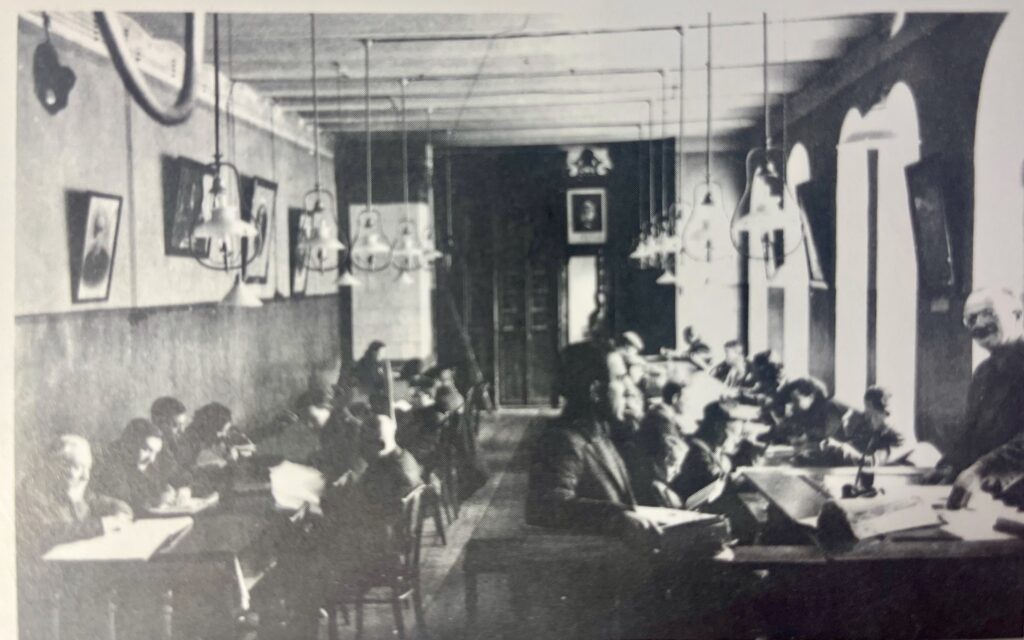
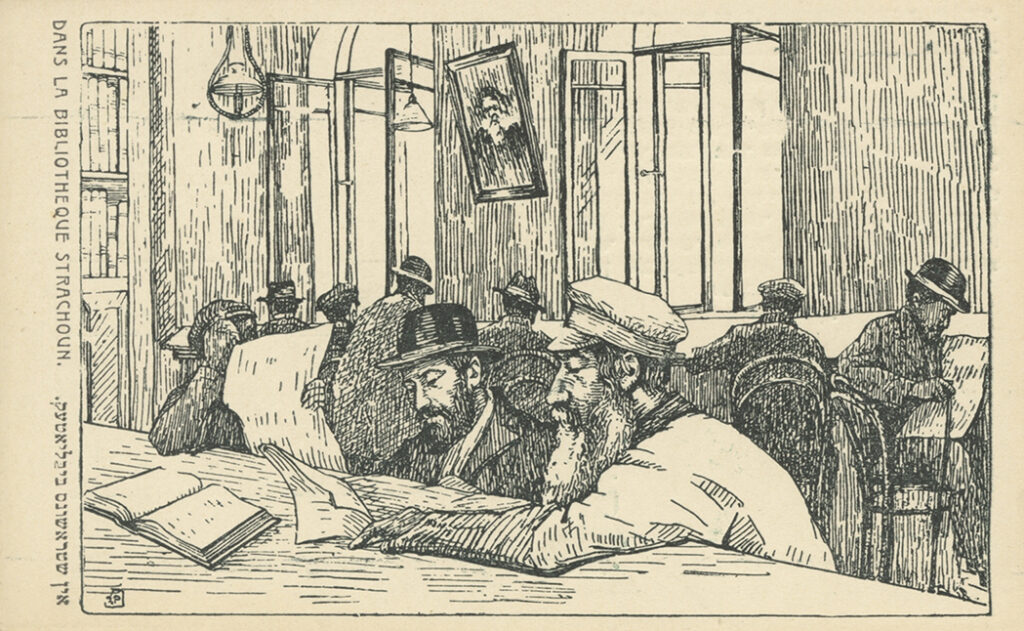
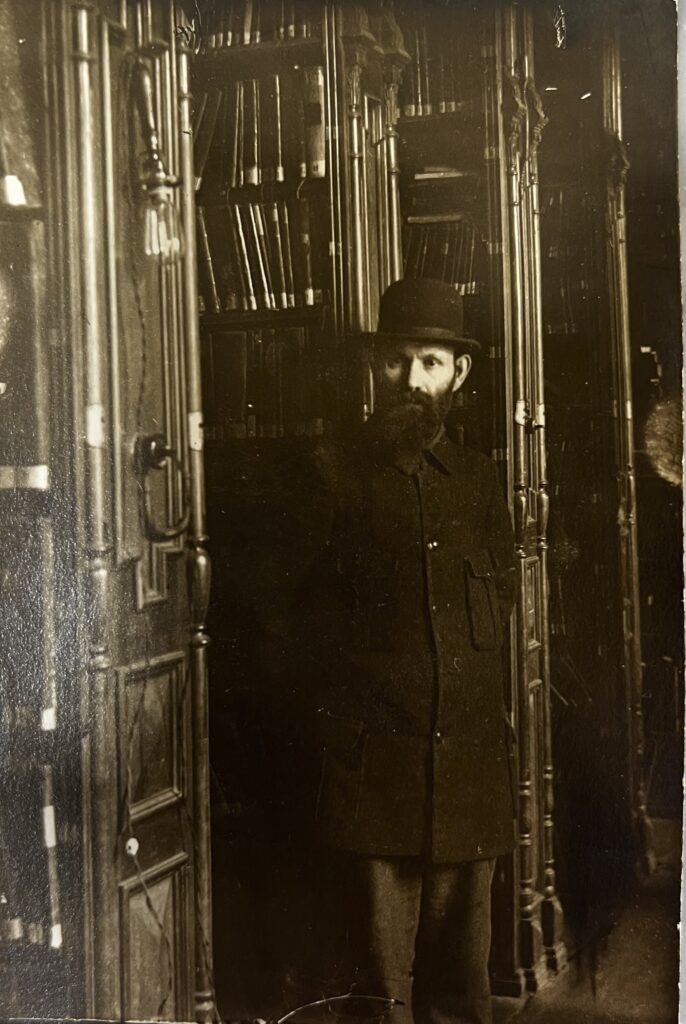
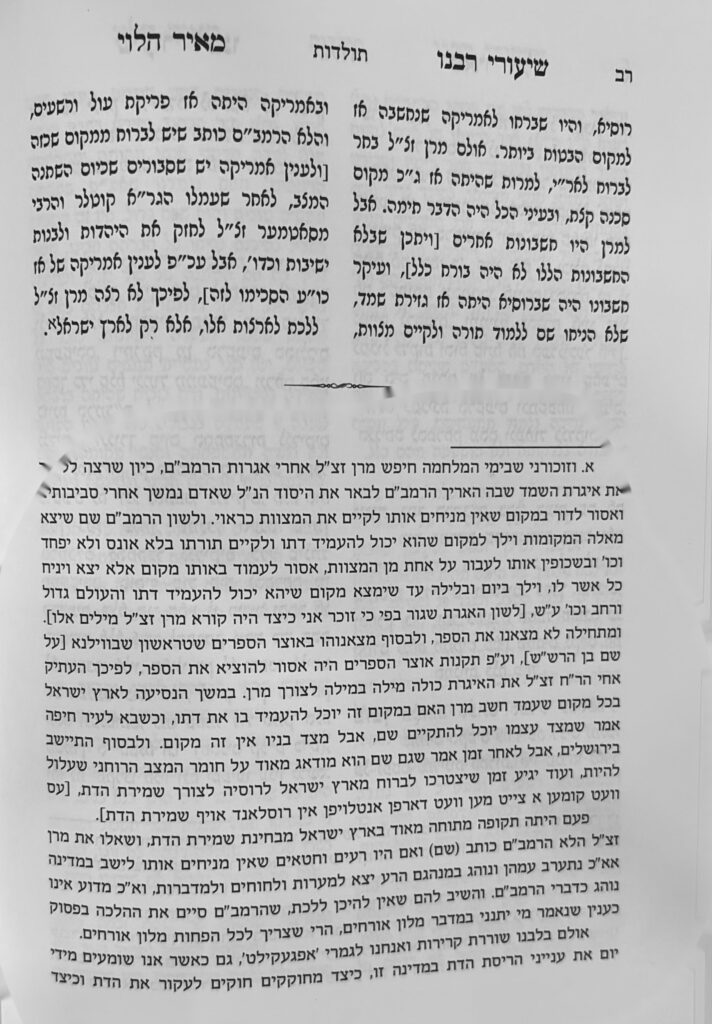
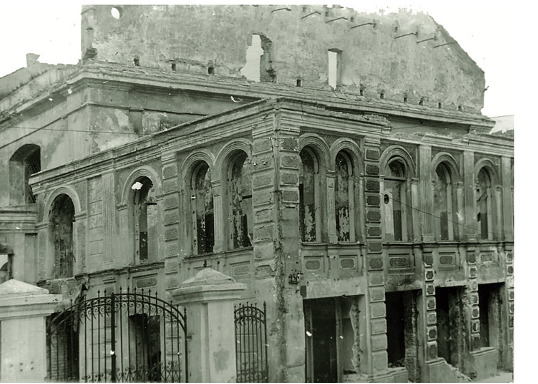
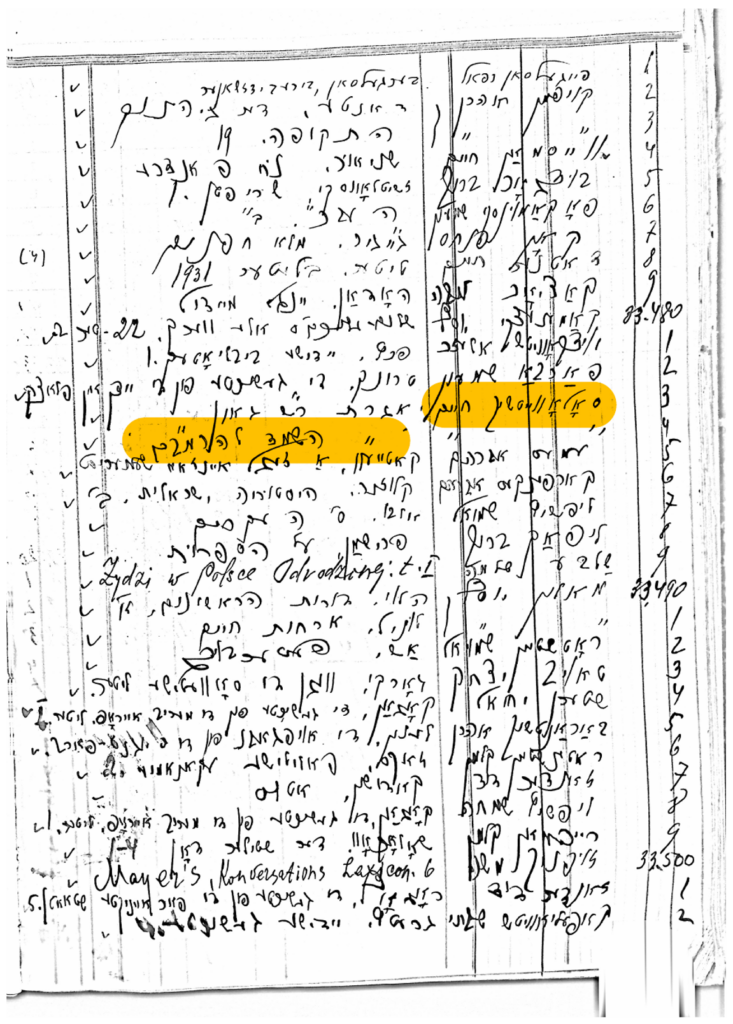
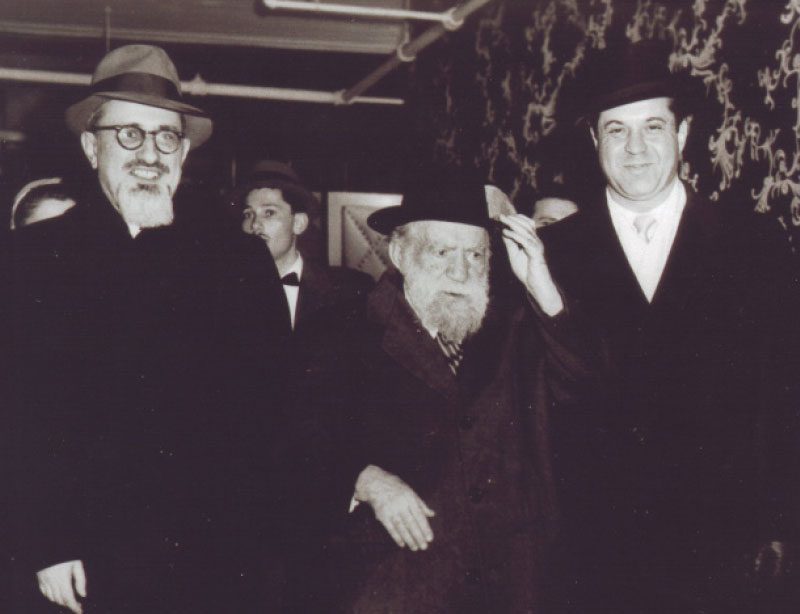
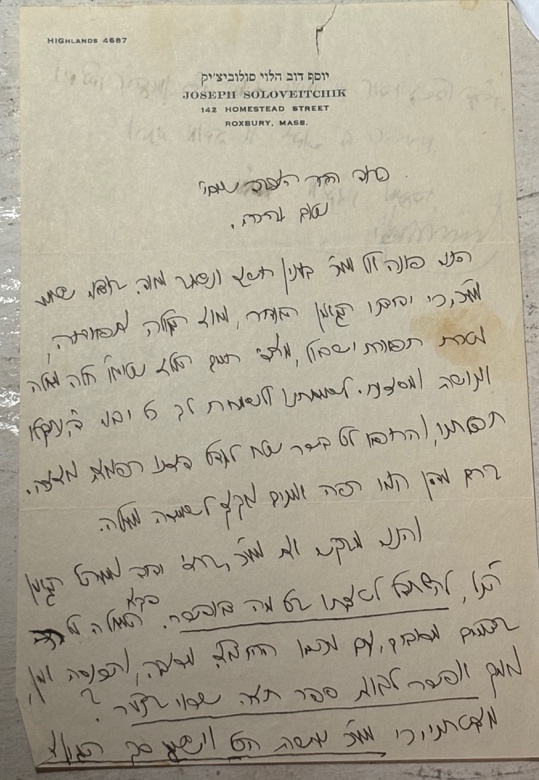
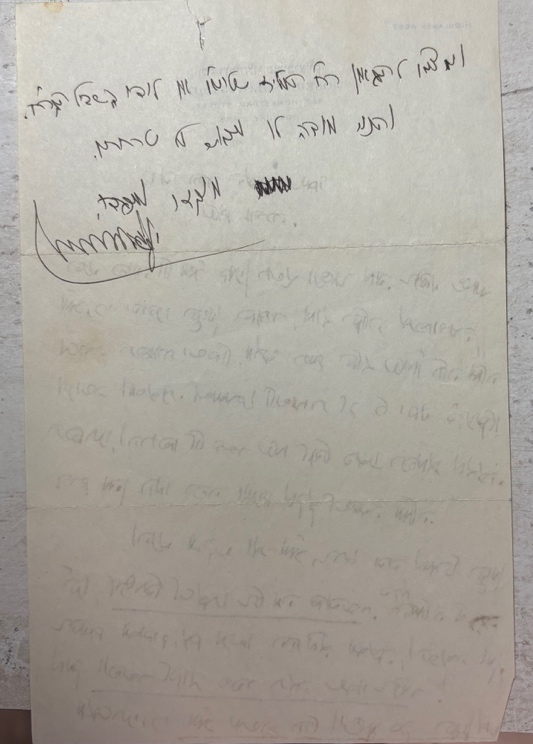
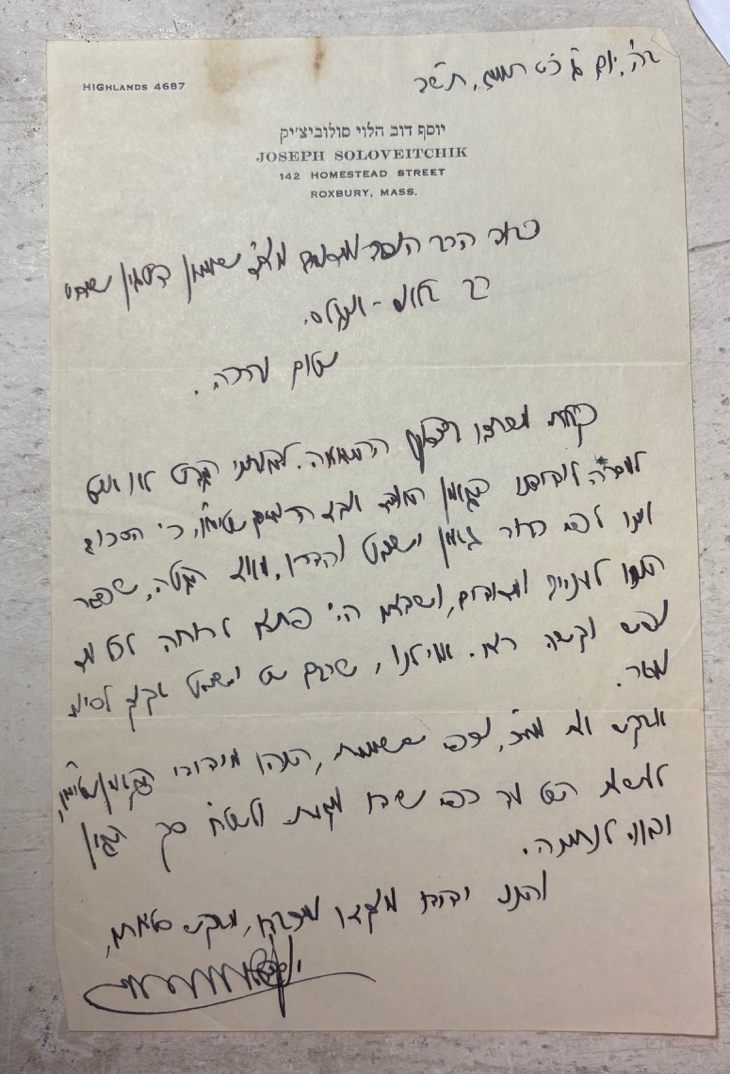
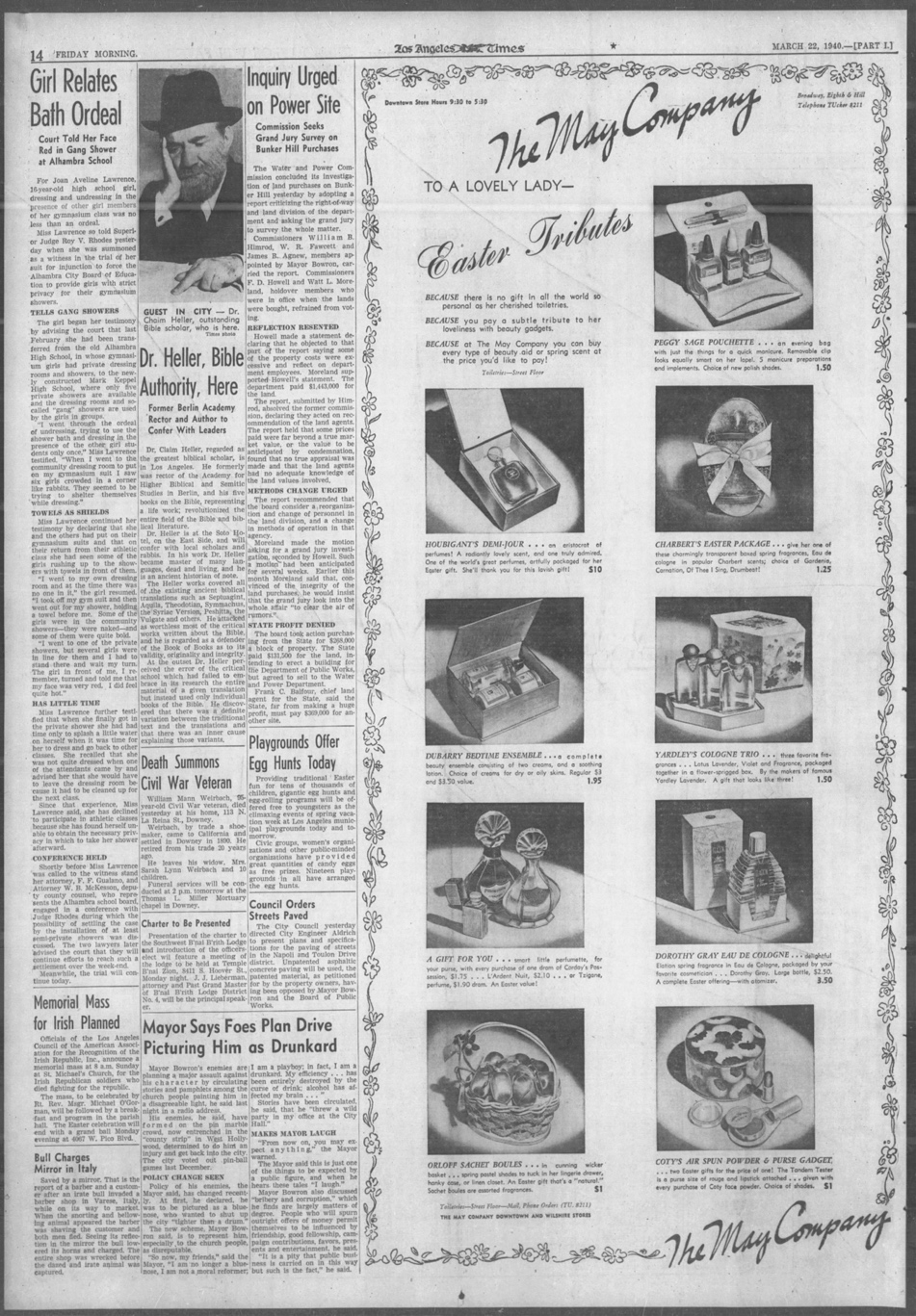
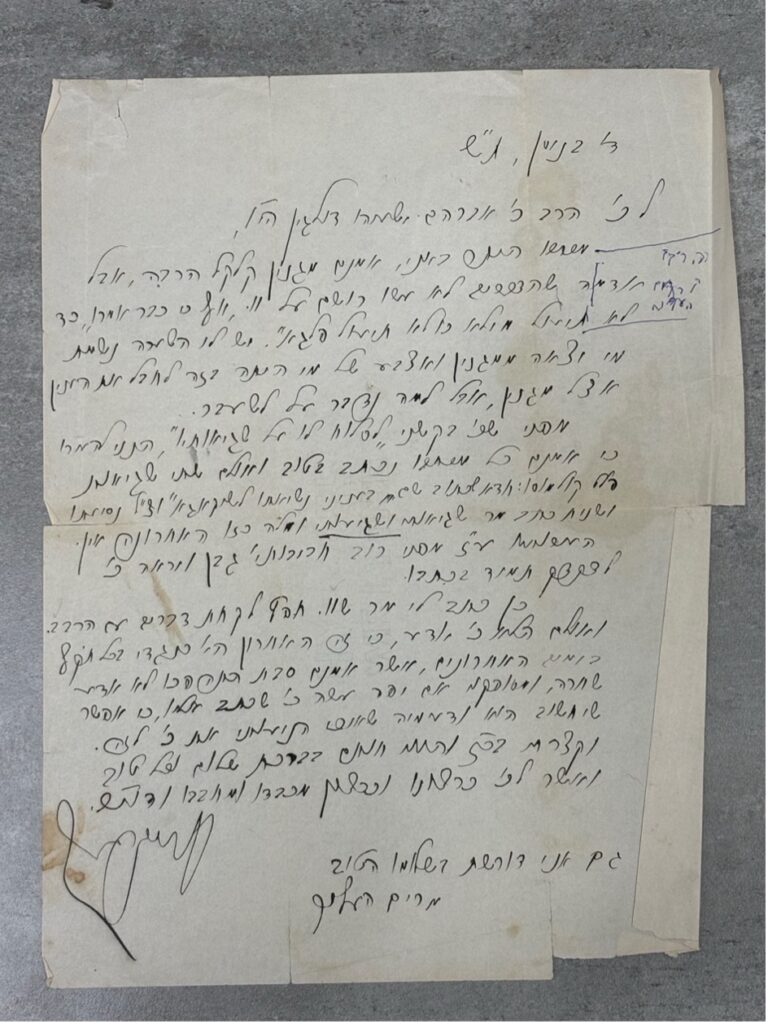
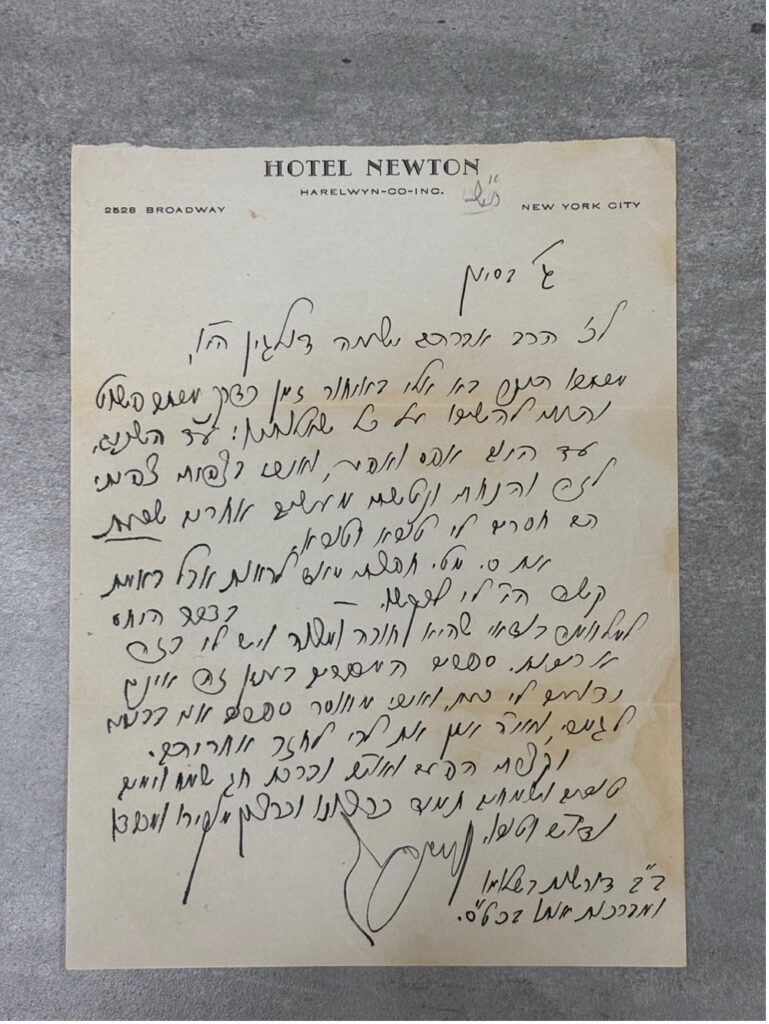
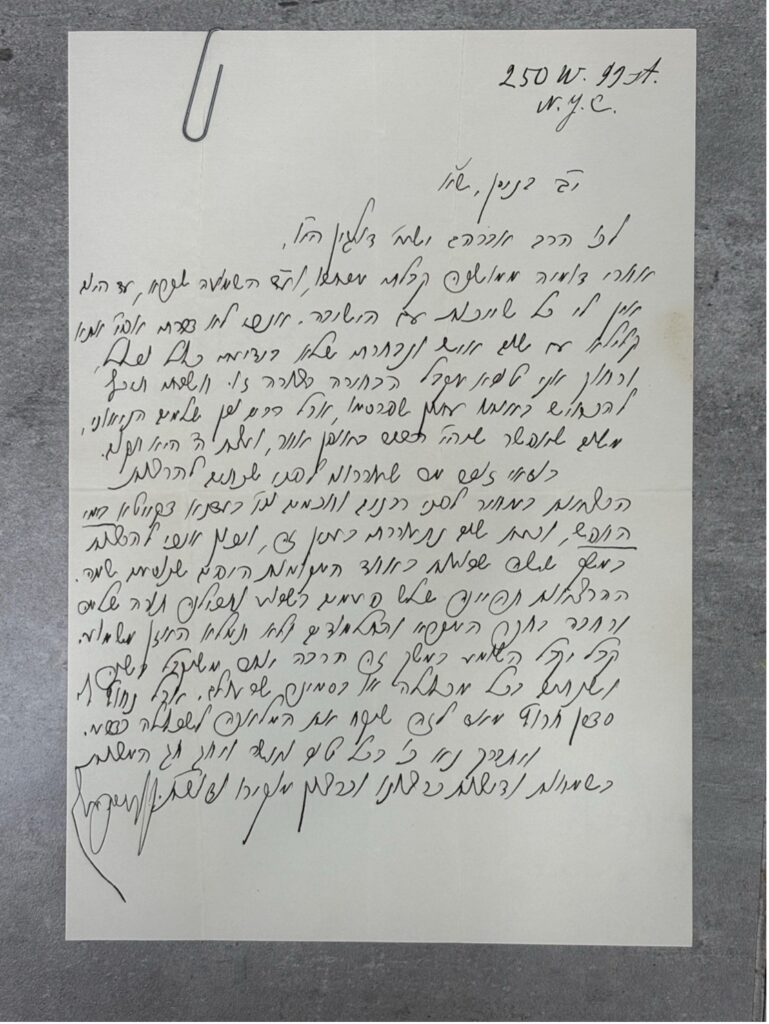
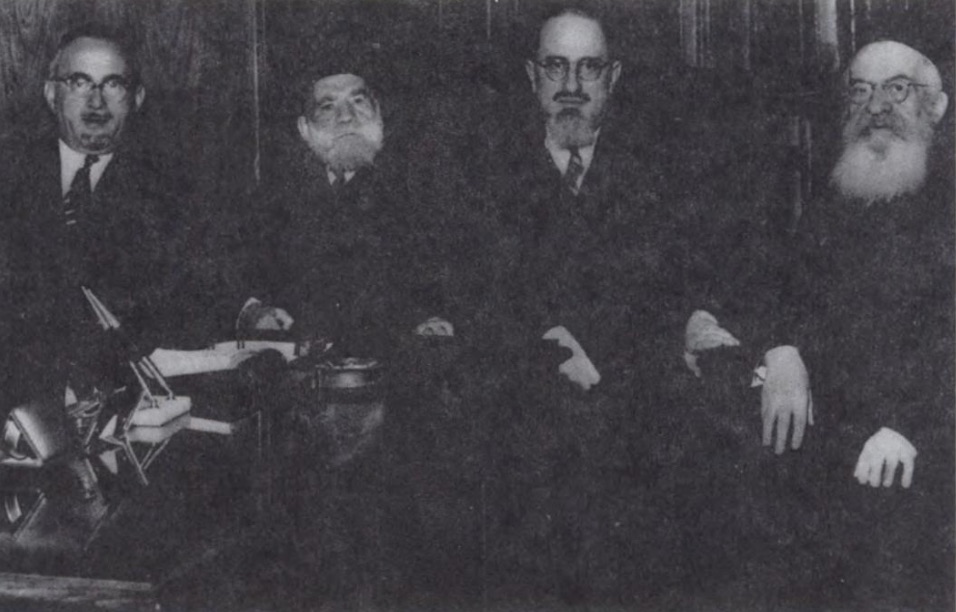
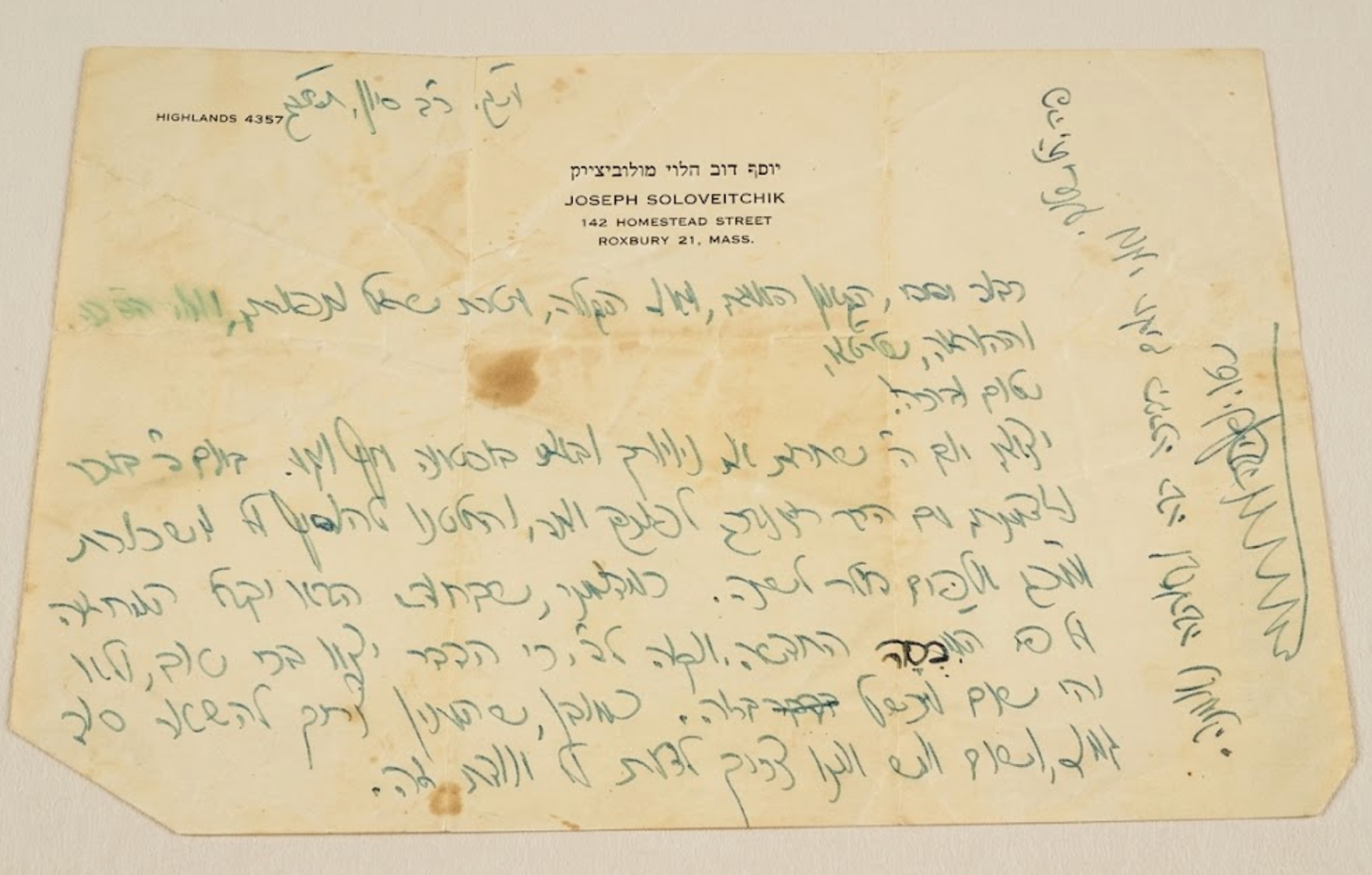
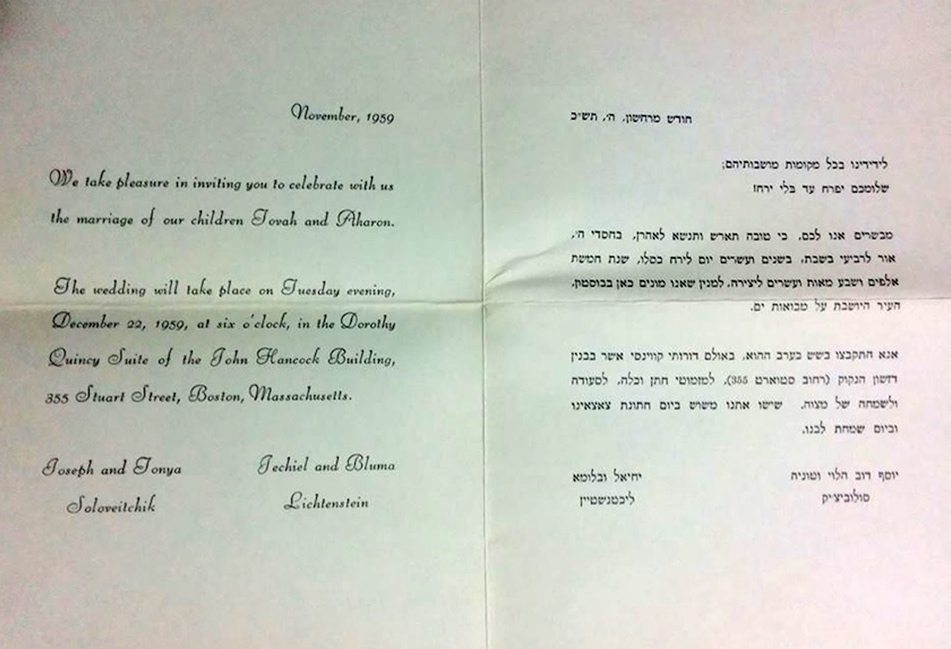
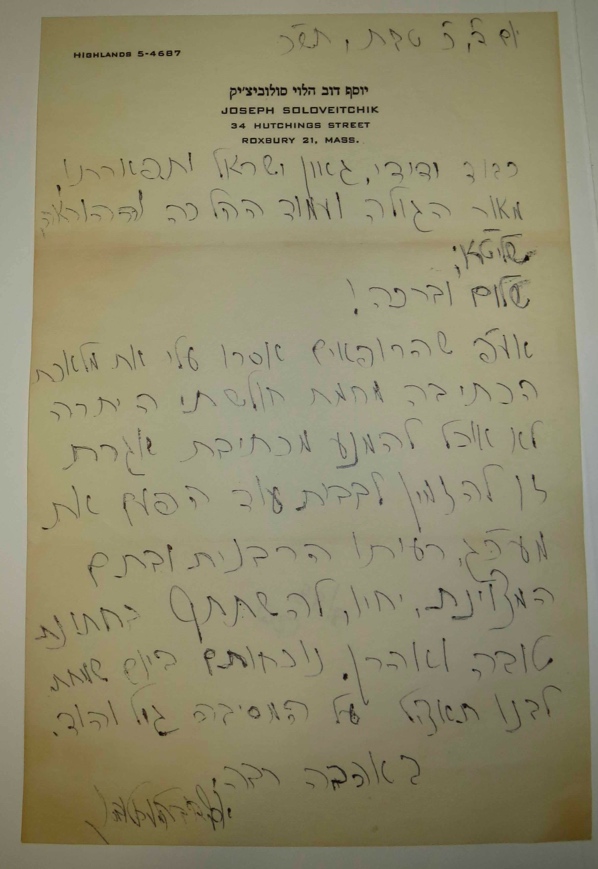
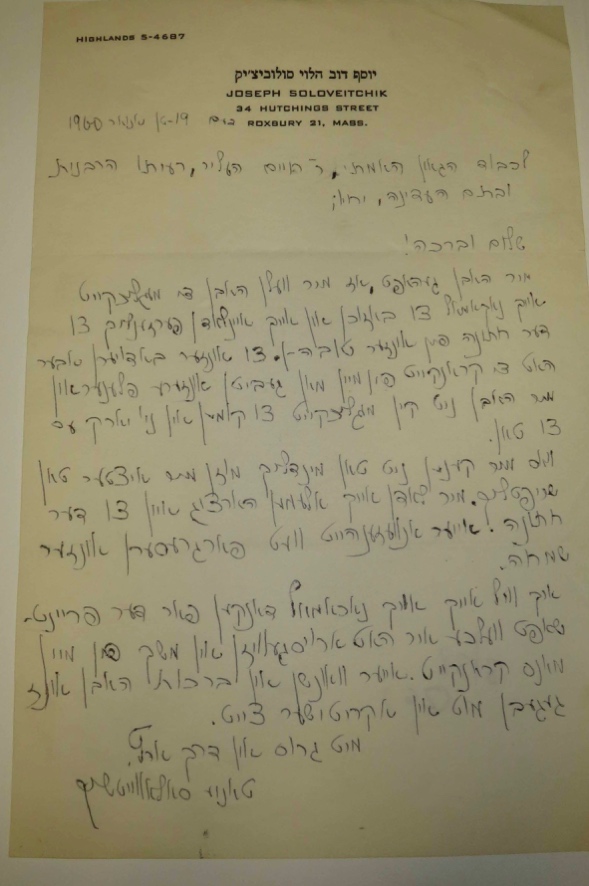
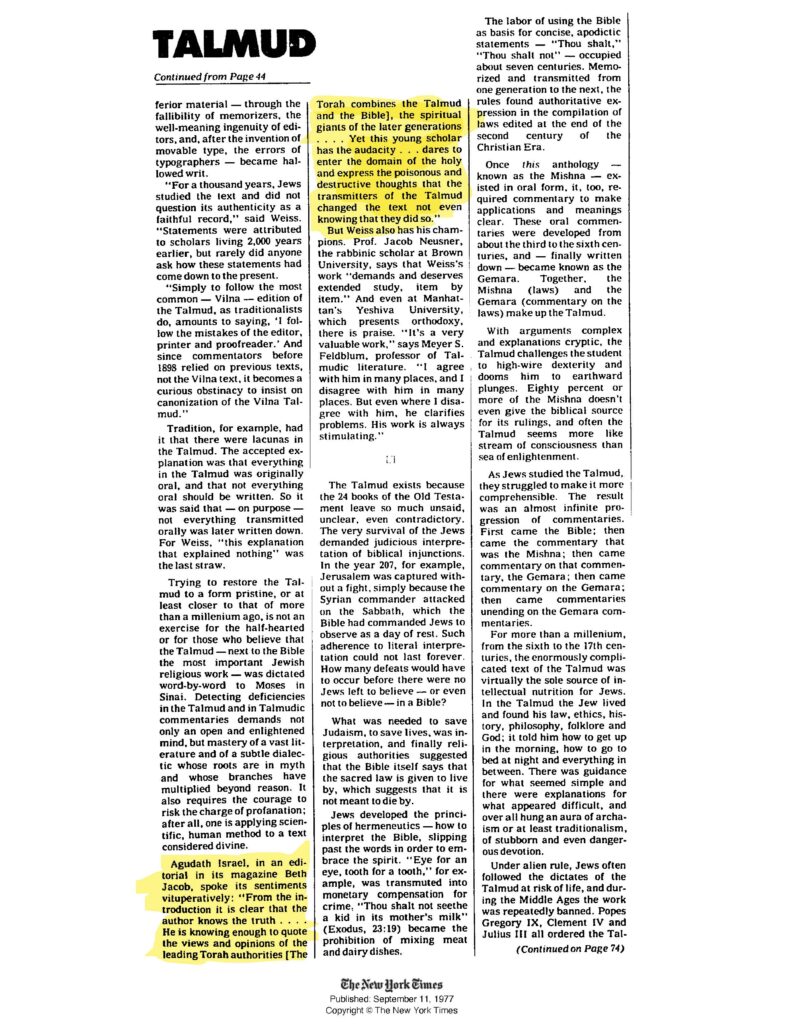
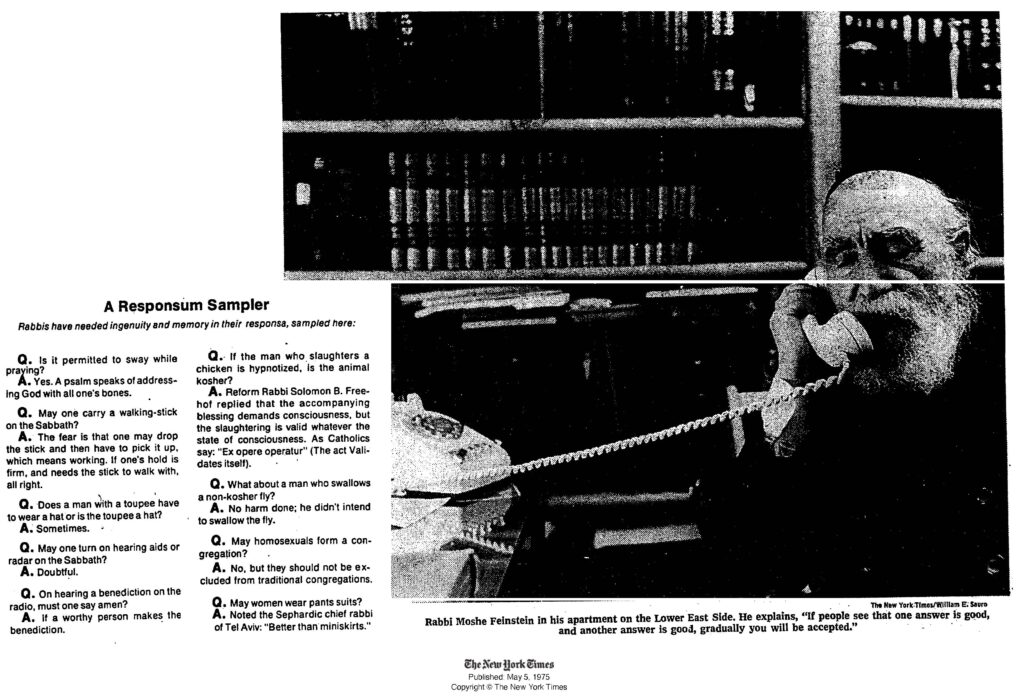
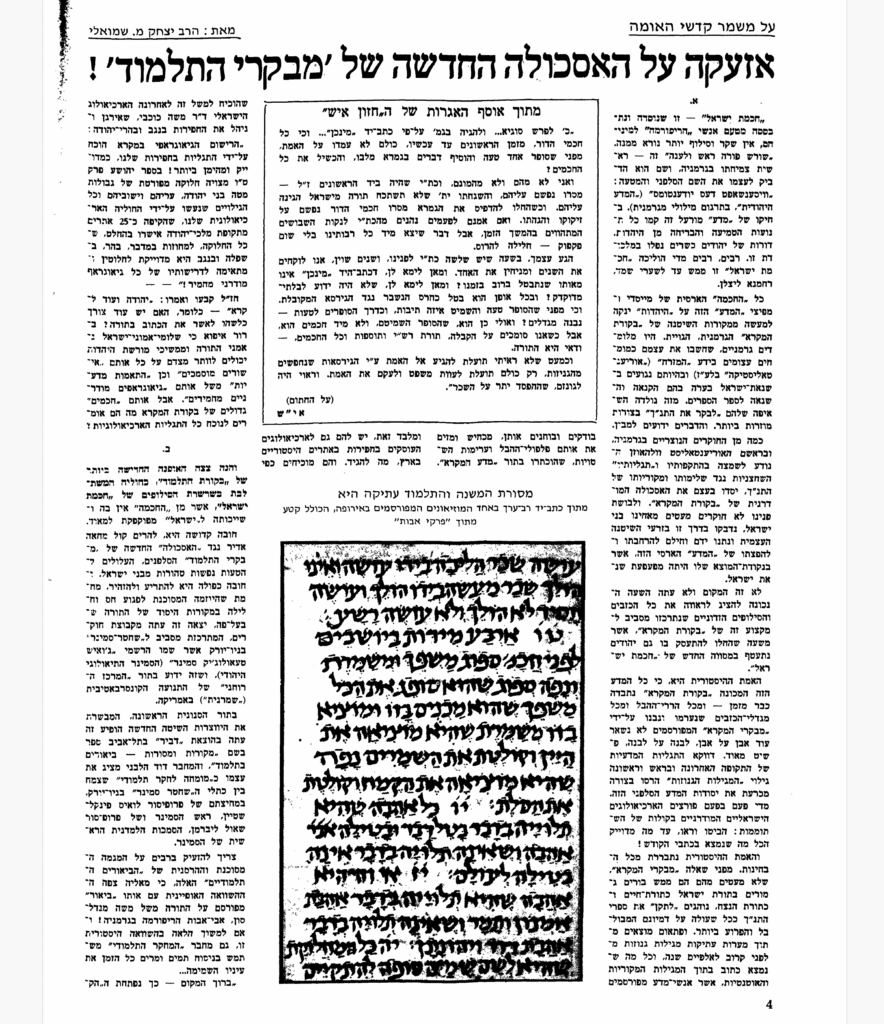
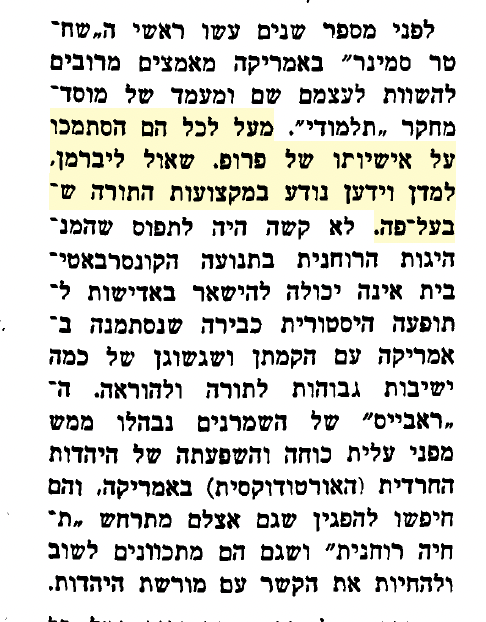 This, despite the fact that Lieberman’s earliest major work, Al ha-Yerushalmi, had already exemplified a disciplined form of textual criticism, drawing on manuscripts, parallel traditions, and internal philological analysis to clarify and correct the text of the Jerusalem Talmud. This could easily have provided fodder for Shmueli, yet he remained silent regarding Lieberman’s method. Recently published letters show that even the Ḥazon Ish engaged Lieberman seriously on these questions. Their correspondence reveals a principled disagreement over method, particularly regarding emendations grounded in manuscript evidence, while also demonstrating that such philological argumentation could be treated as a legitimate subject of rabbinic dispute rather than dismissed outright as heresy. Of course, since this correspondence had not yet been published, it cannot explain Shmueli’s silence on Lieberman’s approach.