Aaron the Jewish Bishop

Aaron the Jewish Bishop

The exodus from Egypt was led by Moses and Aaron. Moses, however, does not appear in the Passover haggadah (with one exception that is likely a later interpolation).[1] Aaron does make two appearances in the hallel section.  That said, in numerous illuminated haggadahs, from the medieval period to present, both appear in illustrated form. Additionally, in printed haggadot, most notably the 1609 Venice haggadah, one of the seminal illustrated haggadot, Moses and Aaron appear on the decorative border.
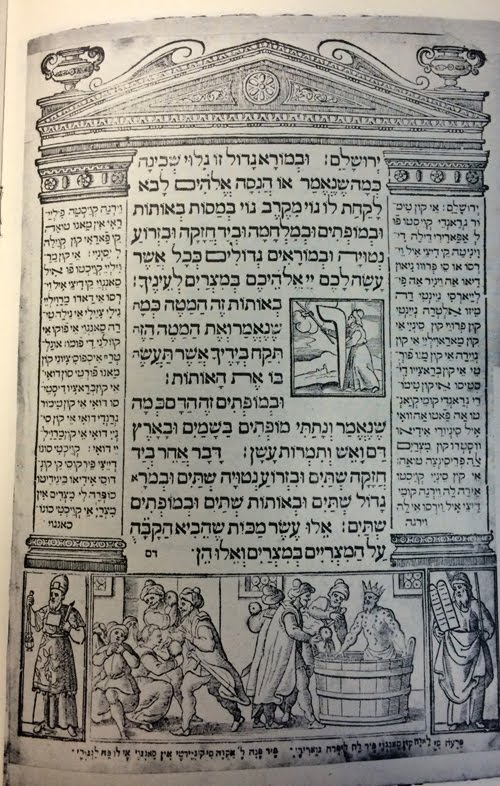
Generally, conclusively determining Jewish material culture, especially from the biblical period, is nearly impossible.  Regarding Moses, other than his staff, the bible provides no additional information.[2]  Aaron is a different story.

The Torah expends a significant amount of verses discussing the details of the Kohen Gadol’s (the high priest) garments but while the descriptions are detailed, we still struggle to determine what these special clothes looked like.  Rashi, for example, has to resort to anachronistic parallels for the “me’il” comparing it to a medieval French equestrian pant.  Similarly, by the Talmudic time, the details of the headband were subject to dispute. We should briefly pause here to correct a common misconception – that the Vatican or the Catholic Church still retains items related to the Jewish temple.  Unfortunately, this misconception is so prevalent, that a number of Israeli officials have requested that the Vatican repatriate the temple vessels.  Briefly, while the Talmud mentions that sometime between the 2nd and 5th centuries, temple vessels may have resided in Rome, there is no indication whatsoever of them since the 5th century. In addition, due to the numerous sackings that Rome underwent, or the reality that the Catholic Church is an entirely different sovereign than the Roman ruler Vespasian who sacked Jerusalem, it must be regarded as highly unlikely at best that any former temple vessels remain (assuming they were ever there) within the Vatican. For additional discussion regarding this issue, see here.
The ambiguity about the clothing has not stopped many from attempting to depict what they believe is the correct version.  Thus, depictions of Aaron the High Priest appear in Hebrew books. Hebrew manuscripts did not shy away from including illuminations and illustrations to create a more aesthetically pleasing product.  All sorts of shapes and images are employed to this end, on page borders, end pages, or just sprinkled throughout a manuscripts and – geometric patterns (Hebrew manuscripts are the first to use micrography), animals, people or combinations thereof of half-human-half-beast.  Noticeably, however, biblical figures are not included in this category. While biblical scenes appear in Hebrew manuscripts it is only to actually illustrate the content, and not independently for aesthetic purposes.
With printing, however, this slowly changed. Printing began in 1455 with Gutenberg and Hebrew books followed soon after.  These early books, however, did not follow all the conventions that we associate with books today.  Title pages did not begin until the 16th century and it wasn’t until the early 17th century that title pages were de rigueur.  Apart from information relevant to the books contents, title pages also began to included aesthetic details.  Sometimes these are architectural, pillars etc. other times flowers or some other flower or fauna.
Generally, printers did not explain why certain images were included on title pages, the assumption is that it was simply for aesthetic purposes.  At least in one case, this was made explicit.  The Shu’’t Ma-harit”z, Venice, 1684, by Yom Tov Tzalahon, includes an illustration of the temple on the title page.  The publisher, Tzalahon’s grandson, provides that this was included as “it makes it more beautiful” and he was so enamored with the illustration – even though it is very rudimentary he included it three times in the book (this likely speaks more about the publisher’s exposure – or lack thereof – to art in general).[3]
There are, however, at least a few examples of a title page illustration serving a purpose beyond the aesthetic. Some illustrations are including because of allusions to the author’s name, but at least in one instance a Hebrew title page illustration was used to illustrate the title.
The most common form appearing “on the frontispiece of countless printed books,” were biblical figures Moses, Aaron, David, Solomon, nearly always coupled, and “became the accepted heraldic figures.”[4]  The first biblical figures to appear in Hebrew books were was a woodcut by Hans Holbein of David and Solomon, flanking one, among other biblical scenes, in the Augsburg 1540 Arba’ah Turim. This illustration, however, did not appear on the title page, which is plain, instead it appears on folio 7.[5]  See Heller, 242-43.
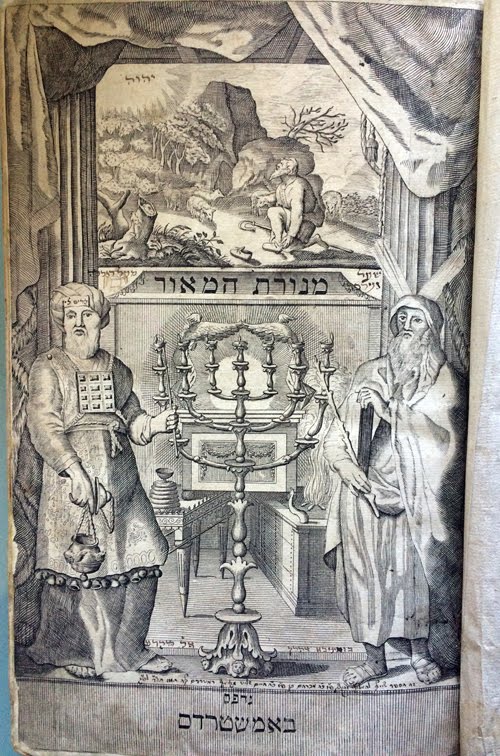
The first frontispiece to include a biblical figure is the Tur Orach Hayyim, Prague, 1540, that includes, at the top of the page, a depiction of Moses holding the tablets.[6] The first frontispiece to include the coupling of biblical figures – the most ubiquitous form of biblical figures – is Jacob Moelin’s She’elot u-Teshuvot Mahril printed in Hanau in 1610. That frontispiece depicts Moses on the left in one hand the tablets and the other hand he grasps his staff.  Aaron is wearing the garments of the high priest:  the tunic, bells, breastplate and and is carrying the incense.
 
The usage of Moses and Aaron on Hebrew frontispieces thus began with Hanau, 1610.  By way of comparison, the first appearance of Moses and Aaron on the frontispiece of a book in English was the King James Bible, published a year after Hanau in 1611. The Hanau printer reused the Moses/Aaron frontispiece on two more books:  Nishmat Adam by Aaron Samuel ben Moshe Shalom of Kremenets, 1611 and Joseph ben Abraham Gikatilla’s, Ginat Egoz, Hanau 1615.[7]  The illustration best fits the Nishmat Adam, and may have originally been the book for which this illustration was intended and not Molin’s.  Unlike Jacob Molin’s work that has no direct connection with Aaron or Moses, the author of Ginat Egoz’s name includes both Moses and Aaron, and while Samuel is not captured in the illustration, the year of publication is derived from “Samuel.”
Moses and Aaron became the most common biblical figures on frontispieces, but not the exclusive ones.  In some instance, a mélange of biblical figures is presented.  The Amsterdam printer, Solomon Proops, included the image of Moses, Aaron, David, and Solomon, each wearing a crown, and a Moses carrying not the tablets but instead the Torah scroll.
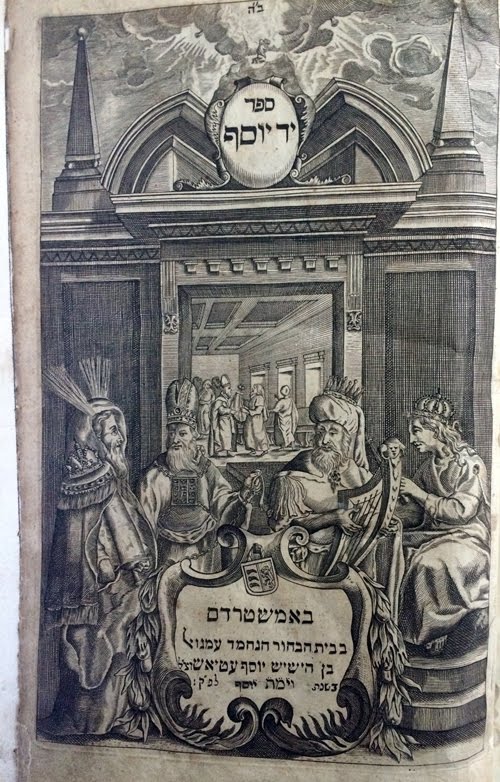
A deviation from the coupling of Moses and Aaron appears in Beit Aharon, Frankfurt am Oder, 1690, which displays Aaron and Samuel.  In that instance, however, the deviation is explained because the figures are allusions to the author’s name, Aaron ben Samuel.  The use of coupled figures was not exclusive to Biblical figures; in many Hebrew books a variety of mythical and pagan figures and scenes are commonplace on title pages.  A partial list of pagan deities include:  Venus, Hercules, Mars and Minerva that appear on ennobled works such as Rambam’s Mishne Torah, Venice 1574, and Abarabenel’s commentary on Devarim, Sabbioneta 1551, and were reused many times.[8]  The use of pagan figures in Jewish items is not limited to Hebrew books and these images appear on the Second Temple menorah, and the Dionysus, Poseidon are inscribed on Palestinian mezuzotSefer Raziel mentions Zeus and Aphrodite, Dionysus and Poseidon reappears in a common prayer said during the priestly blessings, and Dionysus appears individually in the additionally yehi ratzon that some recite during Aveinu Malkanu (helpfully Artscroll and other siddurim direct that for the prayers that include these names, they should “only be scanned with the eyes and concentrated upon, but should not be spoken,” as they are “divine names”).[9]
Returning to the use of Moses and Aaron on frontispieces of Hebrew books, as mentioned above, the basic form of the illustrations remained fairly static with Moses appearing with his staff and/or the tablets or the Torah and Aaron in his priestly clothing.  And, these are prevalent throughout the 17th century, across the Europe and the Middle East.  In Europe the coupling appears in Altona, Amsterdam, Venice, Furth and Izmir, on diverse works – Talmudic commentaries, Mendelssohn’s commentary to the bible, and a commentary on the zemirot (which includes a heliocentric depiction of the constellations).  
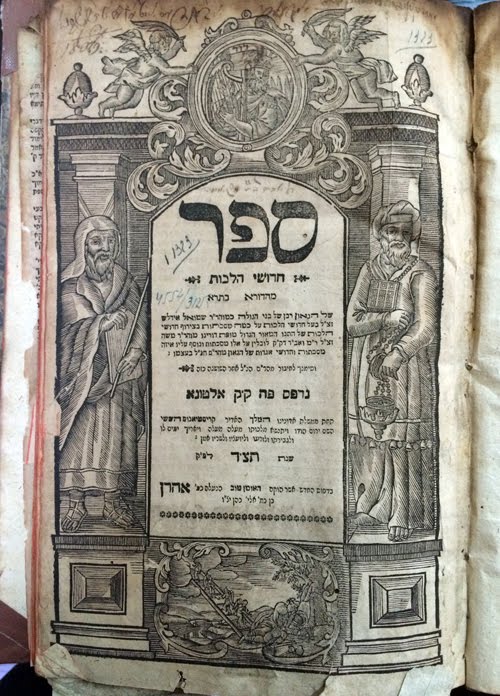
A slightly different version appears in the Ma’ashe Rokeakh that has Aaron holding a slaughter knife.
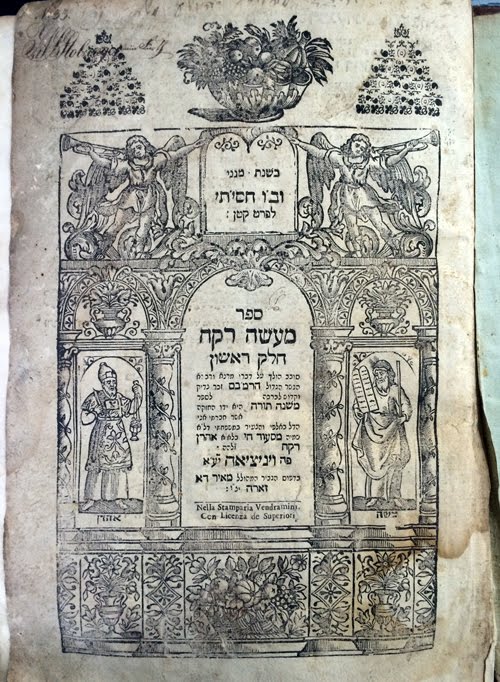
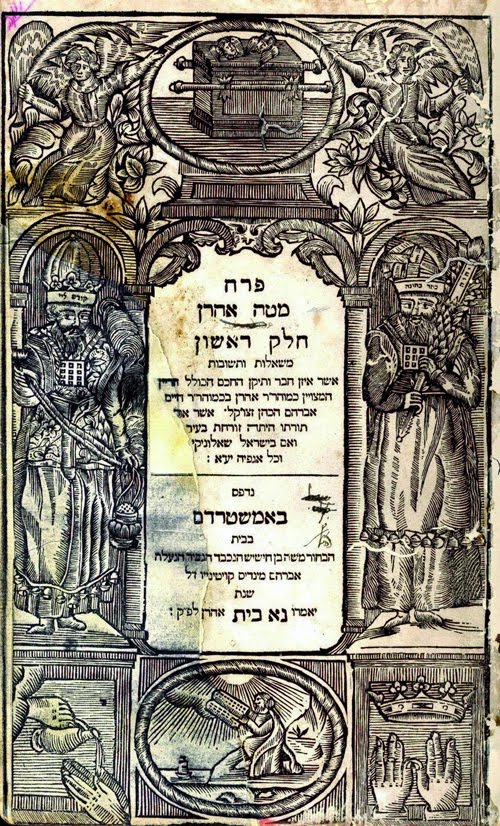
There is, however, one notable exception to this depiction both in terms of the items displayed in addition to the “coupling.”  Aaron ben Hayyim Perachia’s Perekh Matteh Aaron, published in Amsterdam, 1703, includes a coupling but rather than Moses and Aaron, in this instance both images are that of Aaron.  Additionally, the Aaron on the left is the standard depiction of items, but the one on right is distinct in that it has Aaron holding a budding almond branch – perach mateh Aaron.  Of course, these deviations are understandable as the “second” Aaron and his unique “staff” is not merely aesthetic but is illustrative of the title of the book, the first time an title page illustration illustrates the title.[10]
 
A final note regarding the frontispiece depictions of two items Aaron’s clothing.  First, in many instances, including the Hanau prints, Aaron’s hat is not the traditional wrapping or turban associated with the mitznefet, but a bishop’s mitre.  At times, the mitre is horned, for example, Zohar, Amsterdam, 1706.  The horned mitre, however, is based upon “the mistaken belief that the horned mitre descended from the Jewish high priest” when in reality the bishop’s mitre is related to “Moses’ horns and their symbolic meaning within the context of the medieval Church.”[11]
The frontispiece is not the only time that the kohen’s headgear is interpreted contrary to Jewish tradition.  In a recent illustrated edition of Mishna Tamid, the editors depict the Kohen not only wearing the turban but also a yarmulke.  The Torah enumerates the priestly garments and any addition to those items is subject to the death penalty.  Thus, a Kohen wearing a yarmulke – as illustrated and that is not included in the Torah’s description of the Kohen’s outfit – commits a capital crime.[12] Here is another example of Aaron, looking very much like a bishop. This illustration is from a 15th century manuscript called המשכן וכליו by Simon ben Joel.
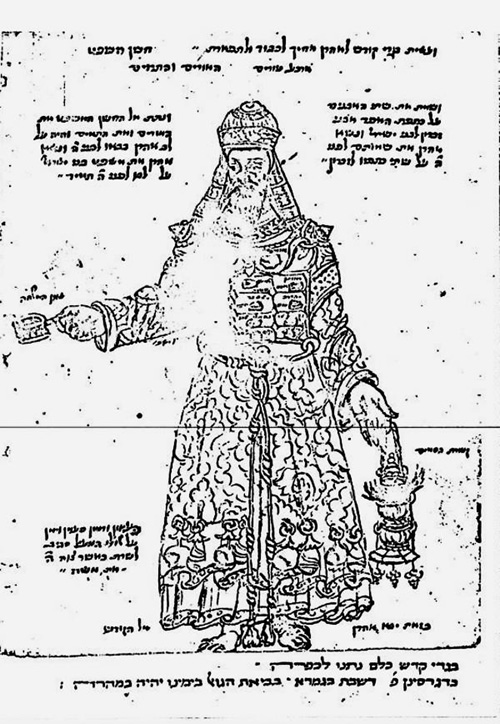
Unlike Aaron’s head-covering that appears from time to time as a bishop’s mitre, the second odd item that Aaron carries appears almost universally. Specifically, Aaron holds the incense in his hand, but unlike the Rabbinic interpretation that the incense was delivered in a shovel, Aaron is always depicted with the incense in a ball or  censer.  There is no Jewish source that records that form of the incense ritual and is an exclusive non-Jewish understanding of the Torah.
Ironically, the only person to take issue with the depiction of Moses and Aaron (and other biblical figures) argues against their use does not raise these issues nevertheless counsels against these biblical depictions.  His rationale, however, is counter-factual.  Specifically, Samuel Aboab, decries the depiction of biblical figures because the depictions are anachronistic and but for non-Jewish influences would never have been included in Jewish items.
While there is no doubt that some elements of the depictions are non-traditional, since at least the second century, biblical figures are found in a variety of Jewish contexts.  For example, the second century synagogue of Dura Europos and a few years later at the Bet Alpha synagogue contain biblical images. Dura Europos contains numerous illustrations of biblical figures and scenes, including Moses and Aaron.  And, while Abaob is correct that both Moses and Aaron are depicted anachronistically – in typical clothing of that time period, a toga-like garment – this is simply explained by the fact the purpose of the illustrations was to remind the viewers of the people and stories.  Therefore, had Aaron “been depicted with the biblical clothing that were no longer in use, the viewer might not know what they are looking at.”[13]  Thus, the anachronisms are not to make these seminal biblical figures in our image, but to simply ensure that the art clearly transmit its message.

[1] David Henshke, “The Lord Brought Us Forth from Egypt: On the Absence of Moses in the Passover Haggadah,” AJS Review, Vol. 31, No. 1 (Apr., 2007), pp. 61-73.
[2] The lack of information has not stopped the theorizing as to Moses’ visage.  The most notable example is R. Yisrael Lipschutz’s comments at the end of Kiddushin.  See Shnayer Z. Leiman, “R. Israel Lipschutz and the Portrait of Moses Controversy,” in Isadore Twersky, ed., Danzig, Between East and West: Aspects of Modern Jewish History (Cambridge, Mass., 1985), pp. 51-63, and for a different version, “R. Israel Lipschutz: The Portrait of Moses,” Tradition 24:4 (Summer 1989): pp. 91-98 (available here). See also the important chapter on this subject in R’ Shmuel Ashkenazi, Alpha Beita Kadmeysuh, Jerusalem:2000, pp. 337-371. For additional sources on this story see R’ Dov Turish in his various works; Maznei Tzedek, p.149, 310; Ginzei Ha-Melech, p. 38, 40, 43,48, 56; MiArat haMchpeilah, p. 101 and onwards.
[3] Shmuel Glick, Kuntress ha-Teshuvot he-Hadash, Schechter Institute of Jewish Studies, Jerusalem & Ramat Gan, 2007, n. 2120.  For more on Glick’s work see here and  here.
[4] Richard I. Cohen, Jewish Icons, Art & Society in Modern Europe, University of California Press, Berkley & Los Angles, 1998, 127.
[5] Marvin J. Heller, The Sixteenth Century Hebrew Book, An Abridged Thesaurus, Vol. I, Brill Leiden & Boston, 2004, 242-43.
[6] That is not to say the first to contain, rather than appear on the title page illustration, figures of living persons.  The Prague 1526 haggadah depicts, Adam, Eve, David, Goliath, Judith, and Samson in the woodcuts accompanying internal pages.  For a list of Hebrew books containing Moses with horns and without see Two Prague Haggadahs, Valmadonna Trust Library, 1978, 16-18 n.16
[7] An examination of the haskamot (approbations) accompanying the early Hanau prints also provides evidence of “the breakdown of central rabbinical authority in Germany during this period.”  Stephan G. Burnett, “Hebrew Censorship in Hanau: A mirror of Jewish-Christian coexistence in Seventeenth-century Germany,” in Raymond B. Waddington and Arthur H. Williamson, eds., The Expulsion of the Jews: 1492 and After, Garland Studies in the Renaissance, Vol. 2. New York & London: Garland Publishing Inc., 1994, pp. 202-03 (available here).
[8] Marvin J. Heller, Studies in the Making of the Early Hebrew Book, Brill NV, Leiden, 2008, 1-17.
[9] See Daniel Sperber, Magic & Jewish Folklore in Rabbinic Literature, Bar Ilan University Press, Ramat-Gan, 1994, 97-98 and n. 29; Yosef Shaposhnik, Siddur im Revid ha-Zahav, Chief Rabbi of the Rabbinical Association, London, 1929, 63.
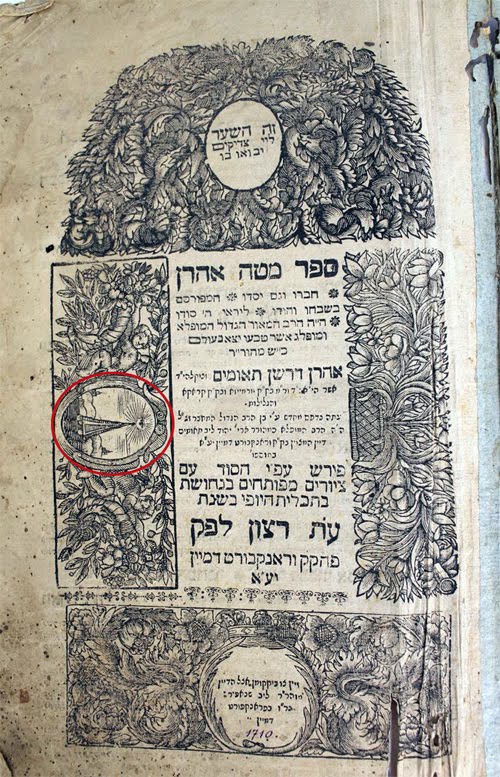
[10] By way of comparison, a few years after the Perach Matteh Aaron, the frontispiece of the haggadah with the commentary Mateh Aaron, Frankfort A.M., 1710 does not include any depiction of Aaron or his staff. Instead it reuses a non-Jewish woodcut that depicts the Eye of Providence – an allusion to the all seeing eye of “god” –  the trinity as it is depicted within a triangle or three sided object, as it does on the back of the US dollar bill.  But, notably, the eye appearing on the Mateh Aaron is not within a triangle.  Perhaps this was deliberately changed or the original woodcut for some other reason elected not to use the triangle, but to arrive at any definitive conclusion requires additional research into the history of the particular woodcut which is outside the scope of this article.
[11] Ruth Mellinkoff, The Horned Moses in Medieval Art & Thought, University of California Press, Berkley, 1970, 105,94-96.
[12] Dan Rabinowitz, “Yarmulke: A Historic Cover-up?,” akirah: The Flatbush Journal of Jewish Law and Thought, 4 (2007): 231-32.
[13] E.L Sukenik, The Synagogue of Dura-Europos and its Frescoes, Bialik Foundation, (Jerusalem, Palestine):1947, 97.


Rabboni Jesus – Confirmation from the Talmud?

Rabboni Jesus – Confirmation from the Talmud?
David M. Goldenberg*
The exchange one year ago between Pope Francis and Prime Minister Netanyahu over the language spoken by Jesus overshadowed any other news of the pope’s visit to Israel. The pope was right, of course, Jesus spoke Aramaic, not Hebrew, although Netanyahu could have offered a better rejoinder than his weak “But he knew Hebrew.” He could have said: “But he prayed in Hebrew.”
Among the proofs that Aramaic was the spoken language of Jesus’ time and place is the evidence of the New Testament, which no doubt informed the pope’s comment. Of the Aramaic words and phrases recorded in this text, perhaps the most cited is the word rabbouni (ραββουνι) or rabboni (ραββωνι), which is how Jesus is referred to by the blind man in Mark 10:51 and by Mary Magdalene in John 20:16. The text in John glosses the word by adding: “which means teacher.”
Years ago the spelling of this word caused confusion, since Jewish Aramaic and Hebrew texts traditionally vocalize the first letter with a ḥiriq (as in ribbono shel  ‘olam). But then the pataḥ vocalization was discovered in Palestinian Targum fragments from the geniza and in Targum Neofiti, as also in Samaritan Aramaic texts.  Some time later it was also found in Hebrew manuscripts.  Where the Mishna in Ta’anit 3.8 records Ḥoni ha-Ma’agal’s reference to God as ribbono shel olam, both MS Kaufmann and MS Parma vocalize the first word with pataḥ (Kaufmann as rabbuno; Parma as rabbono). Then geniza liturgical fragments of birkhot ha-shaḥar (Palestinian rite) turned up with the phrase רבון כל העולמים vocalized with a pataḥ under the resh.[1]
MSS Kaufmann and Parma have another point in common: as opposed to the printed editions of the Mishna, the original text of the manuscripts does not have the words של עולם; Kaufmann has them added above the line, and Parma in the margin (in both cases as clitics, written as one word). As scholars have noted, this indicates that the original was רבוני alone but a later hand added של עולם and extended the yod of רבוני (which is grammatically required and graphically obvious) to make it into a vav, thus producing עולם של רבונו.
The first person possessive suffix recalls the New Testament reference to Jesus as rabbouni /rabboni. In addition to the New Testament, the word with the first person suffix (‘my teacher’) is commonly found in several of the Aramaic texts mentioned above.  In regard to Hebrew texts, besides MSS Kaufmann and Parma, רבוני is commonly found in geniza manuscripts of Hebrew midrashic works. A search of the word on the Friedberg Genizah database (genizah.org) results in 23 hits of רבוני, all but one in Hebrew texts, and that figure does not even take into account cases where the reading is obvious but not certain and the search results did not therefore include it.[2]
An interesting example of רבוני in a Hebrew context is found in a reconstructed text of Bavli, ’Avoda Zara 17a. Here we find the story of R. Eliezer’s arrest for heresy. R. Eliezer, who lived in the second half of the first century and the beginning of the second century, explained his heresy to R. Akiva as follows (additions in curly brackets follow the uncensored Munich 95 and Paris 1337 manuscripts):

פעם אחת הייתי מהלך בשוק העליון של ציפורי ומצאתי אחד {מתלמידי יש”ו הנוצרי} ויעקב איש כפר סכניא שמו אמר לי כתוב בתורתכם (דברים כג) לא תביא אתנן זונה [וגו’] מהו לעשות הימנו בהכ”ס לכ”ג ולא אמרתי לו כלום אמר לי כך לימדני {יש”ו הנוצרי} (מיכה א) [כי] מאתנן זונה קבצה ועד אתנן זונה ישובו ממקום הטנופת באו למקום הטנופת ילכו. 

Translation: I was once walking in the upper market of Sepphoris when I came across one of the disciples of Jesus the Nazarene, Jacob of Kefar Sekhania by name, who said to me: “It is written in your Torah, You shall not bring the hire of a harlot . . . into the house of the Lord your  God (Deut. 23:19). May such money be used to build a toilet for the High Priest? I didn’t answer him. He said to me: “Thus Jesus the Nazarene taught me: For of the hire of a harlot has she gathered them and to the hire of a harlot shall they return (Micah 1:7) – They came from a place of filth, let them go to a place of filth.”

In place of אמר לי כך לימדני {יש”ו הנוצרי} [כי] מאתנן זונה קבצה…., the superior Marx-Abramson manuscript (JTS Rab 15) of ’Avoda Zara reads:  אמ’ לי כך למדו ישו רבו כי מאתנן זונה קבצה …. with an inserted ש over the כ of כך, and a notation mark inserted above the line between רבו and כי, as seen below.

In the printed edition, as well as MSS Paris and Munich, R. Eliezer recounts the disciple’s comments in direct discourse: “He said to me: ‘It is written in your Torah ….’” and “He said to me: ‘Thus Jesus the Nazarene taught me/us ….’” MS JTS, however, presents the first phrase in direct discourse, but the second in indirect discourse, as indicated by the third person pronominal suffixes in למדו and רבו (“Thus Jesus his teacher taught him”). Thus,[3]
Ed.:                 אמר לי כך לימדני [כי] אמר לי כתוב בתורתכם /
Paris:               אמ’ לי כתו’ בתורת’ / אמ’ לי כך למדנו ישו הנוצרי כי
Munich:  א’ לי כתו’ בתורתכ’ / א’ לי כך למדני ישו הנוצרי כי
JTS:           אמ’ לי כתוב כתורתכם / אמ’ לי [ש]כך למדו ישו רבו כי
The change to indirect discourse was, no doubt, what caused the scribe to insert the ש above כך. But clearly direct discourse is called for as indicated by the preceding direct discourse in אמר לי כתוב in MS JTS, and in the lack of ש in ישו כך לימדני/למדנו אמר לי in the other witnesses. What would have caused the (confusing) change to indirect discourse in the MS JTS?  
The notation mark above the line between רבו and כי gives a clue. That mark points to a marginal notation. Such notations in this manuscript often refer to another reading of the indicated text. Unfortunately, whatever the scribe wrote in the left margin has been covered by a strip of paper glued to the page to strengthen it and prevent its separation from the codex. But I wouldn’t be surprised if the marginal comment presented the reading רבוני, like that found in the Kaufmann and Parma manuscripts of the Mishna Ta’anit.  Perhaps an indication that רבוני was the original reading is the directly following quote from Micah 1:7, which begins with the word כי (כי מאתנן זונה קבצה ועד אתנן זונה ישובו). The anomalous reading of  רבוin MS JTS may well have derived from an original רבוני, which became רבו כי due to the graphic similarity of kaf and nun, and the fact that the verse in Micah began with כי. Once רבוני became רבו כי, other changes were required to conform to the third person suffix of רבו and the resulting indirect discourse of the text, and so לימדני was changed to למדו and a ש was inserted to turn כך into שכך. The missing כי in the printed edition may also derive from this confusion.
If this reconstruction is correct, not only do we have another case of the Hebrew word רבון with a first person pronominal suffix (רבוני ), but the word is used to refer to Jesus just as it is in the New Testament. So in addition to the blind man and Mary Magdalene, we have another who called Jesus רבוני – Jacob of Kefar Sekhania, the disciple of Jesus, who taught R. Eliezer an interpretation of a biblical verse.
The Gospel of John glosses the word רבוני as ‘teacher.’ Shouldn’t the possessive suffix (רבוני) require a translation ‘my teacher,’ just as the Aramaic and Hebrew uses of the word clearly indicate a translation ‘my teacher’?[4] Not necessarily. A translation without the possessive would be similar to the term רבי/Rabbi, in which the suffix lost its possessive meaning (‘my’) and the word, as a frozen term, came to mean ‘teacher’ or ‘master.’ Support for this may be found, although from a later period, in Arabic literature. The Qur’an (5:47, 66) preserves the word رباني (rabbānī), which, as the Kisters (father and son) showed, derives from רבוני.[5] But the word cannot mean ‘my teacher’ because in the Qur’anic context it appears in the absolute plural: ربانيون (rabbānīyuna) i.e., ‘teachers.’ In other words, the final vowel in רבוני did not function as a pronominal suffix, as the Kisters noted. The word, rather, evolved as a frozen term from an original meaning ‘my teacher’ into the meaning ‘teacher,’ just as John glossed rabbouni as ‘teacher,’ and just as רבי evolved in meaning from ‘my teacher/master’ to ‘teacher/master’ (Rabbi), which, incidentally, is how John elsewhere (1:38) translates rabbi (ραββι). Y. Kutscher explained the word רבן (as in רבן גמליאל) the same way, comparing it with the French monsignor.[6] In the final analysis, not only was the pope right that Jesus spoke Aramaic, but the evidence of Jesus’ speech in the New Testament records precisely the pronunciation and meaning of the Aramaic of his time and place.

* See David M. Goldenberg’s other articles on his website at http://sites.sas.upenn.edu/dmg2 or at https://upenn.academia.edu/DavidGoldenberg.

[1] See Ḥ. Yalon in Leshonenu 24 (1960) 162; Y. Kutscher, “Leshon ḥazal,” in Sefer anok Yalon (Jerusalem, 1963), pp. 268-271 (reprinted in Kutscher, Meḥqarim be-Ivrit uve-Aramit, Jerusalem, 1977, pp. צה-צח); Z. Ben-Ḥayyim. ’Ivrit we-Aramit nusaḥ Shomron 3.2 (Jerusalem, 1967), pp. 37-38. Targum Neofit references are in Michael Sokoloff, A Dictionary of Jewish Palestinian Aramaic of the Byzantine Period (Ramat-Gan/Baltimore, 1990, 2003), s.v. רבון. In addition to the references in these articles, note that a Syriac version of the original Greek Transitus beatae Mariae virginis has Mary refer to Jesus as “Rabbuli, the messiah” which W. Wright takes as “Rabbuni, the messiah” (W. Wright, trans. and notes, Contributions to the Apocryphal Literature of the New Testament, collected and edited from Syriac Manuscripts in the British Museum, London, 1865), pp. 19, trans.; 28 text; 60 note.  The liturgical fragments: Naftali Wieder, “Ha-ṣura rabbun bi-mqorot ’Ivriim,” Leshonenu 27-28 (1963-64) 214-217.
[2] With two exceptions (a piyyu‹ and a medieval letter), all are midrashic texts.
[3] The readings from MSS Paris and Munich are taken fromשאול ליברמן  מאגר עדי הנוסח של התלמוד הבבלי ע”ש = Sol and Evelyn Henkind Talmud Text Databank.
[4] Of the 23 instances recorded in the Friedberg database, all but one are petitions to God as רבוני, usually made by Moses. One (T-S Misc. 36.198 2v, lines 14 and 16) parallel רבוני and מרי, ’my master.’ In Aramaic, e.g., Targum Neofiti translates אדוני אברהם in Gen. 24:27 as רבוני אברהם.
[5] M.Y. and Menaḥem Kister, “Al Yehudei Arav — he’arot,” Tarbiẓ 48 (1979), pp. 233-234.
[6] Y. Kutscher, “Ha-Aramit shel ha-Shomronim,” in his Meḥqarim be-Ivrit uve-Aramit, Jerusalem, 1977, pp. רסג-רסב.


הרהורים בנכר (דפים מתוך פנקס מסעות)

הרהורים בנכר
(דפים מתוך פנקס מסעות)


מאת: טוביה פרשל
מתוך “המודיע” חנוכה
תשי”ד גליון ה 1000
א. גנזי הטיבר
1
מטייל אני על גדות הטיבר. הלילה רד על
רומא ואלפים כוכבים נוצצים ברקיע. בניני העיר מטילים צללים ארוכים על מימי הנהר,
זרועי אור הלבנה, הזוחלים לאטם.
חושך ודומיה אופפים את סמטאותיו
הקטנות והעקלקלות של הגטו שעל שפת הנהר. רק פה ושם קורעת קרן אור הפורצת מאחד
החלונות של הבנינים הגבוהים והצרים את האפלה. שומם מאין עובר הוא הכיכר הרחב לפני
בית הכנסת הגדול.
תושבי הגטו ישנים שנתם. כל היום
טרודים הם להביא לביתם לחמם הצר רק העניים שבעניי הקהילה נשארו מתגוררים בשכונה בה
גרו אבותיהם ואבות אבותיהם מאות בשנים וכאילו מוליכים גם הם דמעותיהם לטיבר הקרוב.
מה רבו הדמעות העבריות ששתה אותו נהר.
זקנה קהלת רומא העתיקה בגולת המערב ברוב תלאה וצרה.
שוכן הגטו העברי בין חורבות
ה”פורום רומנים” מרכז רומא האלילית לבין כנסיות וארמונות הואתיקן –
כאילו סמל הוא משמש ליהדות העיר שמדרס היתה לכף רגלם של שתי מלכויות עולמיות.
2
עוד מלפני אלפים שנה ראו בני הקהילה
המומי אבל ובעינים דומעות את אחיהם גבורי ירושלים, את פרוכת המקדש האדום מדם
קרבנות, השלחן הטהור, מנורת הזהב וציץ כהן הגדול מובלים שבי ברחובות המקושטים של
הקריה החוגגת.
אחוזי רעד ופחד שמעו עולות מקולוסאום
הקרקס את גניחות ואנחות אחיהם בנפלם בקרב עם אריות.
מאות בשנים אם ולב הגולה היתה עדת
רומא ועדיה הגיעו צער וכאב כל בניה. דרך שעריה באו משולחי העדות מקרוב ורחוק
מובילות שי ותחנונים לאפיפיור וחשמניו לבקש ולקנות את חסדם.
וקהלת רומא עצמה …זכות ישיבה לא
היתה לה בעיר… רק מדי שנה בשנה הורכרחה לבקש מחדש סבלנות מאת הגויים. ומדי שנה
בשנה רואה רומא הגויית את תהלוכת החרפה של יהודיה, ראשי ונכבדי הקהילה עמוסי מתנות
לאוצרות האפיפיור נגשים לשליטי הכנסיה והגמוניה ומבקשים להאריך אתם אפים עוד שנה.
3
בדומיה נשאו בני הגטו כל עלבון וצער.
גופיהם נתנו למכים ובוזים. ספרו חרפה וכלימה ודמעותיהם לטיבר הוליכו. רק פעם אחת
בשנה הראו בגלוי לגויים את המרירות שהצטברה בקרבם. ביום תשעה באב יצאו את הגטו
ומסביב לקשת טיטוס התישבו לקרוא בקול רם, באזני הגויים מגילת “איכה”,
קינות ודברי נחמה.
ורק פעם אחת במשך מאות בשנים הרימו
ראש וזקפו את הגב. לפני אלף וחמש מאות שנה היה הדבר.
גדודי הונדלים ירדו מהצפון על רומא.
ובהתקרב האויב לעיר והתפרץ בה בהלה וערבוביא – כך מספרת המסורת – קמו בני העברים
פשטו בכל עבר וחפשו במקדשי האלילים עד שמצאו כלי המקדש השבויים. לקחום מידי הגויים
וזרקום למי הטיבר – למען לא יראם עוד עין זר וערל.
לאטם זוחלים מי הטיבר. היודעים הם
הסוד הטמון בקרבם? כלי בית הבחירה צפונים במעמקיהם מיטהרים בדמעות עשרות דורות
מזוהמת הגויים.
ב. בית הכנסת בטולדו
1
שלוח שלח הקיסר רודולף לעיר היהודים
בפראג לקרוא את המהר”ל. נכנסו שניהם חדר בתוך חדר ולא נתגלה סוד שיחתם עד
היום.
מספרים כי הקיסר שאל את המקובל היהודי
סוד הפיכת עפר לזהב.
אם אמת הדבר העמיק אותו קיסר לחשוב
מכל מלכים ורוזנים שקדמוהו. אלה סחטו ומצצו כסף היהודים לוו ולא פרעו, החרימו
ולקחו בכוח זרוע ואף פעם לא שאלו: מאין להם, ליהודים, הכסף והזהב הרב, אכן הרבה
לחקור אותו קיסר ומצא. בודאי נתגלה לרבניהם אותו סוד שרבי-המגים מכל הדורות עמלו
לפענחו – ליצור זהב מעפר האדמה.
לקח המלך פדרו, המכונה האכזר, משר
אוצרו היהודי שמואל הלוי את כל רכושו וממונו וגם את ארמונו שבנה לו ולמשפחתו. עבר
אותו ארמון ממלכים לרוזנים עד שמאתיים שנה אחרי הבנותו שכן בו כבוד. אחד מגדולי
ציירי העולם, אל גרקו.
ועוד היום מראים בטולדו העיר את
הארצון שבו גר היה הצייר הגדולי ויהודי מגולי ירושלים אשר בספרד בנהו לו ולמשפחתו.
2
אבל לא בגלל ארמונו הנהדר יפקד שם
היהודי בתולדות עמו – כי אם בגלל הבית המפואר שבנה לבני עמו ולאלוקיו באותה העיר.
בית צנוע בחצוניותו אבל עשיר בתוכו עם
ציורי קיר נפלאים וקורות התקרה מארזי הלבנון.
והיה גורל אותו בית כגורל יתר הבתים,
בהם גדלו תפלה ורנה לאלוקי ישראל, בארץ ספרד. באותו יום מר ונמהר – יום ט’ באב,
יום מיועד לפורענות ודמעות מימי קדם, בו יצאו המגורשים, רבניהם וספרי תורתם בראש,
את חצי-האי, נהפך אותו מקדש להיכל לנוצרים.
3
הורו רבותינו: עתידים בתי כנסיות
שבבבל להקבע בארץ ישראל. ועוד מסורת בידינו: בועז ויכין, שני עמודי מקדש שלמה
נטועים היו גם בבית שני ובהגלות ישראל מעל אדמתו, הגלו לרומי, והנם עמודי היסוד של
כנסית פטר. ומדי שנה בשנה ביום ט’ באב זולגים הם דמעות, כי רבים הגעגועים וגדולים
הכסופים להר ה’.
שפוך שפך העם את רוחו, בנודדו בגולה
על עץ וגם על אבן. וגדולים הגעגועים ורבה הצפייה לאותו יום שבו תועלה ציונה כל אבן
שטבלה בדם ובדמע, להשלים ולפאר את בנין הכותל העזוב.
ואם באת לטולידו העיר ואתה נכנס לאותו
בית כנסת ששמואל הלוי הקימו לעמו ולאלוקיו והגויים הפכוהו לכנסייתם, תכרע ותשתחוה
על רצפת האבן ושפתותיך תשקנה מקום עמדו אבותיך בפללם – אולי תראה עיניך דמעת
האבנים ואזנך תאזין לקינתם הנוגה.
4
עומד המהר”ל בארמון הקיסר. עינו
נודדת מבעד החלון מעל גני עיר היהודים ומבטו נופל על ה”אלטניישול”, בית
כנסת קהלתו, “על תנאי” הוא בנוי. אם יבוא משיח צדקנו ייסתר ואבניו
תועלינה ירושלימה.
והוא עומד שקוע במחשבות. “מה
רוצה הקיסר החולני, אוהב בצע ורודף שלמונים. זהב ניצור מעפר בעד אוצרות מלכותו!
סוד זה לא נדע… אבל ידוע ידענו להפוך אבני גזית לאבני יקר. ואותן האבנים, קדשנו
בדם ובדמע. לא יוכלו לקחת מאתנו לעולם… שוב ישובו אלינו”.
וגם אתן אבני בית הכנסת “אל
טרנזיטו” בספרד שבאתי מרחוק לראותכן לא לעולם תהיו גלמודות ובודדות בנכר – מי
שיאסוף דמעות וצרות עמו יקבץ גם אתכן.
ג. פראג עיר המסתורין
1
מסתורין אופף את בתי הכנסת של פראג.
כשתבוא ל”אלטניישול” תחפש
לשוא את שרידי הגולם. עפרו גנוז בעליית הבית ולשם לא תוכל להגיע.
אולם תוכל לראות את כתלי בית התפלה
רוויים דם ודמעות של דורות. לפני שש מעות שנה פרצו זרים לתוך בית הכנסת ובמקום
הקדוש רצחו וחמסו ודם הקרבנות נזרק על הקירות – שש מאות שנה נמנעו יהודי פראג
מלסייד ולטייח את כותלי הבית – כדי לא לכסות על הדם הנשפך.
וכל תפלה שעלתה למרום מבית זה טבולה
היתה בדם של קדושים.
מסתורין גם אופף את בית כנסת פנחס
באותה עיר.
מצאתיו סגור ומסוגר. מאז ימי השמד
הפסיק לשמש את הקהלה. אולם לאן נעלם האוצר היקר שהיה טמון בתוכו… בגדיו של שלמה
מולכו, קדוש בישראל?
2
בשנת 1491 בעיר אבילה בספרד היה הדבר.
באחד ממאסרי האינקויזיציה שפך אנוס את לבו לפני אחיו לצרה יהודי, סנדלר לפי
מקצועו, הוא התוודה על חטאו שפרש כפיו לאל זר ובלב שלם הוא חוזר לדת אבותיו וכל
מגמתו היא לעלות לארץ הקודש. הוא מבקש את הסנדלר היהודי, שהשיארו בידו כנור לזמר
לפניו את שירת אליהו, הנאמרת במוצאי שבתות.
עשרות בשנים היה אותו שיר על אליהו,
שיבא עם משיח בן דוד, מתנגן באזניהם של האנוסים, כל חייהם היו לצפייה ארוכה
וגעגועים גדולים לגואל שיבוא לגולל מעליהם ומעל בניהם ובני בניהם את חרפת השמד
והאונס ולהכניס אל תחת כנפי השכינה את אבותיהם ואת אבות אבותיהם הקבורים בארץ טמאה
וזרה תחת הצלב והצלם. בכל מאורעות הימים דמו לראות עקבות המשיח ומכל דברם והגיגם
עלתה המיתם לקראת פעמיו.
בבוא דוד הראובני, לחצרות מלכי ספרד
ופורטוגל ובשורה בפיו: שליח משולח הוא מטעם אחיו המולך על שבטי ישראל בקצות המדבר,
להביא דברו למלכי המערב להקים ברית נגד התוגר, למען שחרר מתחת ידו את ירושלים עיר
הקודש, משתלהבת שלהבת התקוה, שהיתה עשנה בעומק נשמות האנוסים.
דיאגו פירס, סופר בחצר מלך פורטוגל,
שבהיותו בן שש נחטף מחיק הוריו וגודל על ברכי נזירים, פורע את ערלת בשרו ומטיף דם
הברית להעביר מעל גופו את המים הזדונים, מי הטבילה. הוא שם לתוגרמה פעמיו לבשר
לאחיו הגולים, כי הקיץ הקץ לגלות ישראל. ומתוגרמה הוא עובר לרומא בירת אדום.
ובהתקרבו לעיר פורצת תפלה לא-ל נקמות
בלבו. הכואב כאב עמו.
“ה’ צבאות! עד מתי אתה לא תרחם
את ירושלים ואת ערי יהודה על כל הרעות אשר עשו לנו היושבים בקרתא הזאת להצר לנו
ולזרותנו מארצנו”.
ובעיר הוא מנבא נבואות, מי הטיבר יעלו
על גדותיהם. רעש אדמה יהיה בליסבון, האותות באו בזמנם ובמקומם. הוא זורע מבוכה בין
הגויים.
3
הורה להם רבם ומוכיחם של יהודי ספרד.
הרב יצחק ערמאה: “כשם שיש לעברי בגד לימי חול ובגד לשבת בן עליו לשמור נוסף
על נמוסי הגויים, מצות התורה”.
בימי חשכת הגורל פשטו רבים את
מלבושיהם העבריים והתלבשו במחלצות הגויים. וכה הם הלכו בדרך היסורים: באין תפילין
על הזרוע ובין העינים באין אות ברית בעורם ובין ציצית בכסותם, רק אמונה בצור ישראל
בלבם, למען יראה להם את הדרך בצלמות מדבר העמים.
וכגודל צערם וסבלם כן רבתה שמחתם
בהמלטם מצפרני מעניהם, לך אמסטרדמה ותראה את פאר והדר הבית שבנו האנוסים לאלוקיהם.
ספות הרקמה ובגדי המשי של רבניו. ותדע מה רבה היתה שמחתם בשובם לחיק דת אבותיהם.
בברוח דיאנו פירס, שנקרא שמו בישראל
שלמה מולכו, מחצר מלך פורטוגל, עשה לו כתונת פסים ושני דגלים עליהם רקומים שמות
קדושים, למען ישא יהדותו ברמה. ובאותו לבוש ובאותם דגלים נלוה לדוד ראובני בדרכו
לרנגנסבורג לחצר מלך קרל החמישי.
השליחות נכשלה. החשד בהם הקיסר שהם
מרגלי התוגר? ההיה מוצדק אותו חשד? הייאמן כי משפחות האנוסים יתמכו בברית עם אויבי
נפשם, מלכי ספרד ופורטוגל, נגד תוגרמה שנתנה מחסה ומגן לרבבותיהם?
אולי לעולם לא נדע את סודו של דוד
ראובני כמו שאולי גם לא ידעו מלוהו הנלהב. דוד ראובני נתפש והובל באזיקים לספרד.
שלמה מולכו הוצא במנטובה לאש. “תתחרט, חזור לנצרות, והצל נפשך” אמר לו
שליח הקיסר כאשר עלה שלמה מולכו על המוקד. “הנני מתחרט על אותם הימים שרחוק
הייתי מעמי ומאמונת אבותי. בשמחה רבה הנני שב לביתי” ענה מולכו.
4
אמרו לו תלמידיו לרבי חנינא בן תרדיון
כשהאש אחזה בגופו ובספרי התורה סביבו: “רבי מה אתה רואה”? “גוילין
נשרפין ואותיות פורחות”.
נשרף שלמה מולכו במנטובה אבל אותיות
שמות הקדושים שבבגדיו ודגליו נשארו בחצר הקיסר ברנגסבורג. שם עוד נראו עשר שנים
אחרי מותו. אחרי שני דורות מעיד הרב יום טוב ליפמן הלר בעל ה”תוספות יום
טוב” שהוא ראה את כסותו ודגליו של מולכו בבית כנסת פנחס בפראג.
ומנהג היה באותה קהילה קדושה שבכל שנה
ושנה ביום שמחת התורה, היו באים כל הקהל אנשים נשים וטף לראות את בגדיו של קדוש
בישראל.
מי הביא אותם מרגנסבורג? מי גאל אותם
מידי הגויים ופדם מידי הקיסר? ולמה הובאו דוקא לפראג? ההיתה ידו של המהר”ל,
רבה של פראג באותו זמן בדבר?
מסתורין אופף את בית כנסת פנחס.
לעולם לא נדע מתי ומי הביא אליו בגדיו
ודגליו של מולכו וגם לא נדע על ידי מי ומתי נעלמו ממנו לפני נפול אותו בית תפלה
בשבי הגויים.
ד. בית העלמין הישן
1.
שוב הובילונו רגלי בלי משים לבית
העלמין הישן. אולי באשר הוא המקום היחידי בשכונה היהודית בפראג אשר הגויים לא חדרו
לתוכו.
רחובות הגטו התרוקנו בימי השמד האחרון
מתושביהם היהודיים. רק מנינים מצומצמים מתאספים בשני בתי הכנסת
ה”אלטניישול” ו”הויכע שול” אשר נשרדו מבתי התפלה הרבים אשר
בשכונה אשר פעם המו מרוב אדם, בודד עומד בית מועצה היהודי הישן עליו מתנוסס השעון
העברי הנודע ופעם שימש מרכז לקהילה מפוארה, בו דנו ימים ולילות נגידיה וקציניה
בעניני עדתם.
גויים שולטים היום ברחובות השכונה,
גרים בדירות היהודים, סוחרים בחנויותיהם ועובדים בבית מלאכתם.
רק בבית העלמין הישן לא נשתנה דבר.
עומד הוא על תלו כלפני מאה ומאתיים שנה.
פעם קבעו שלט קטן בשערו: אל תרגיזו את
המתים ממנוחתם.
ומעשה שהיה כך היה. בשנת 1837 בקשו
תושבי השכונה להרחיב גבולותיה. פנו לשלטונות העיר בבקשה להרשות להם להתיישב מחוץ
לתחומיה. בקשתם נתנה הורשה להם לבנות בגבולות בית העלמין הישן, באדמה שהוקצעה
למתים.
דחו היהודים בתוקף את ההצעה. הסתפקו
ברחובותיהם האפלים והצרים ועל שערי בית העלמין כתבו: אל תרגיזו המתים ממנוחתם.
וכן נשאר הדבר עד היום.
רק מעטים היהודים היום בפראג. אין שם
בית מדרש, ישיבה או תלמוד תורה. קהלה שהיתה פעם תל תלפיות בישראל הרבה ושוממה –
אולם בבית העלמין הישן לא פגעו הגויים.
2
עצים מסורבלים מסוככים על הקברות.
שבילים מכוסים עלים נובלים מתפתלים בין המצבות השקועות למחצה באדמה. שונות צורות
האבנים מרובעות, עגולות למחצה ומשולשות, מצבות גדולות וקטנות.
כבר מרחוק הנך מכיר את קברו של
המהר”ל. גלי אבנים קטנות על מצבתו מציינים אותו מבין יתר הקברות.
מי שם אלו שם בשנים האחרונות?
יהודים מהשכונה שבימי הפרעות התגנבו
לבית העלמין וערכו תפילה על יד כבר הרב בעד אחיהם ואחיותיהם שנשלחו לטרזין, מידנק
ואושבנצים?
אז אולי קבוצות הבורחים, שרידי הטבח
הגדול שבשנים שלאחרי המלחמה עשו את דרכם למערב דרך פראג, באו לכאן לשלשל פתקאות
בקשה לבקיעי המצבה טרם ימשיכו את מסעם לעתיד ולמרחקים לא ידעו מה יצפינו להם?
כפוף גב משרך אני את רגלי בין הענפים
הנמוכים בשבילים הצרים. מספרות מצבות אלו על עברה המזהיר של הקהלה החרבה, על גאון
רבניה, עושר קציניה ואצילות ונדיבות לב בניה הפשוטים ביותר.
נעצר אני לפני קברו של קצב, קצב… מה
אמרו פעם אצלנו על בני אומנתו.
ואילו זה שבקהלת פראג … נוהג היה
בכל ערב חג לחלק בין עניי העדה בשר כמשקל בני משפחתו.
כאלו היו פעם פשוטי העם בעדת פראג.
ולא רק בפראג לבד כי אם בכל קהלות ישראל באשר הן שם. לא גאונים בתורה היו, לא
נגידים בכסף – אולם גדולים ועשירים במעשים טובים.
ואולי בשל זה מוליכות אותך רגליך בכל
מקום ומקום לבתי החיים העתיקים, מתגעגע הלב לעולם יהודי נדיב ואציל שפעם היה קיים
ברחובות קצרים והאפלים של גיטאות אירופה. עולם ששקע ואינו עוד.
ה. נשמות בשבי
1
“מי זה
מעלי חיקי גנבך,
ומי שמך פרי
בטני עזובי –
ידידי מה לך
בין עם טמא לב
כתפוח בתוך
יערי חרובי
ונפשך הטהורה
בין עממים
כשושנה בין
חוחי ועשבי
נהג ולך ובוא
עדי גדודי
ברח ודמה אלי
עופר ולצבי”
כך קונן רבי יהודה אברבנאל על בנו
שהובל לשמד בליסבון. זו רק קינה אחת מאלפים ורבבות, דמעה אחת מים של דמעות ששפכו
הגולים על בני משפחותיהם וקרוביהם שבזרוע הורחקו מאתם והובלו לטבילה.
אולם הם לא נבלעו כליל בין הגויים, מי
הטבילה לא יכלו להטביע את הדם העברי שהיה נוזל בעורקיהם ולכבות את אש אמונת
אבותיהם – עוד בוערים ורועשים הם במעמקי נשמותיהם עד היום.
“ואם יגזרו שלא ינוחו תפילין, תעשה
לך סימן ותקשור חוט השני על ידך לזכר דם הברית” כותב ר’ אברהם סבע ממגורשי
פורטוגל בספרו “צרור המור”.
בחדר תוך חדר, בעליות ובמרתפים שמרו
האנוסים על יהדותם. ובאין יכולת האב לשמור ולמסור לבנו מצוות וחוקים בהלכתם מסר לו
סימנים וסמלים לבל תינתק שלשלת הזהב המאחדת את העם באשר הוא שם.
ועוד היום מצויים בידי בניהם ובני
בניהם של האנוסים שיורי מצוות. סימנים וסמלים שקבלום מאבותיהם.
שומרים הם על אלה ואינם יודעים בשל מה
– רק כשנפגשים עם יהודי הבא ממרחקים ומסתכלים במעשיו והליכותיו, עולה זכרון יהדותם
בדמם.
2
בשנים שלפני מלחמת העולם הראשונה בקר
פורטוגזי צעיר בבית כנסת “שערי תקוה” שלקהלה הקטנה בליסבון, בהתענינות
מרובה עקב אחרי תפילות ודרכי המתפללים, אחרי ימים הוא מתודע לראש העדה ושופך לפניו
את שיחו.
“אמי היתה קתולית” אמר,
“אבי היה בן אנוסים, רק אחרי מותו נודע לי הדבר. רגיל היה בימים מסוימים
בשבוע, לרוב בלילי שבתות לפרוש לחדר לעצמו, נדמה היה לי כבר אז שהוא עורך תפלות
בסתר. הוא בעצמו לא גילה לי דבר על אמונתו, כל ימי חשדתי בו שהוא מושלמי, אחרי
מותו אחזני הרצון הכביר לגלות אמונת אבותי. דת הקתוליות היתה זרה לרוחי. חפשתי דרך
לאלוקים וידעתי שעלי ללכת בעקבות אבי שהוא היה יקר לי מכל. בבית כנסת זה נגלתה
לפני אמונת אבותי, בזמן שהאזנתי לתפלותיכם, כאשר הייתי נמצא ביניכם, בני אברהם,
יצחק ויעקב עלו בנשמתי זכרונות נשכחים. לפתע שמעתי קול קורא אלי: זו היא דעת
אבותיך, היא צריכה להיום גם זו שלך”.
כאלו היו דבריו של ארטורו בסטו, קצין
בצבא ארץ מולדתו, סופר ופעיל בחייה המדיניים, שמתוך שבי הגויים בא בחזרה לעמו.
ארטורו בסטו התגייר והתמסר לתפקיד
הקדוש שנטל על עצמו להחזיר את בניהם ובני בניהם של האנוסים לדת אבותיהם. בכפרי
ועיירות המדינה בקר לעורר את אלו שדם אנוסים נוזל בקרבם ובידיהם שיורי מנהגים ומצוות
שירשו מדורות עברו.
3
נקיה אוירתה של ליסבון. נקיים להפליא
רחובותיה שזופי השמש. רוח קרירה הבאה מן הים מגרשת מתוכם כל ריח רע ואבק.
במשך עשרות ומאות בשנים פזרה רוח זו
לכל עבר את אפר הקדושים ועשן מוקדי האש והיום לא תמצאו ברחובותיה וככריה הרחבים של
העיר שריד וזכר לימי האינקויזיציה.
אולם רק למראית עין כן הדבר.
אם גם לא תגלה בכיכר “דו
רוסיה” השוקק תנועה ששמש מלפנים מושב לאינקויזיציה, דם אבותיך שנשפך שם לרוב,
לא נעלם ונאלם הוא, עודנו רועש וגועש הוא בתחתית נשמותיהם של אלפים ואולי רבבות
תושבי המדינה המפרפרות בצפרני גולה בתוך גולה.
בשולי הפנקס
(הערות)
א.     
גנזי
הטיבר
הובלת כלי המקדש השבויים בתהלוכת
הנצחון ברומא מתאר יוספוס פלביוס בספרו “מלחמות היהודים”. לפי דבריו
הוצגו אחר כך בארמון הקיסר. בגמרא מסופר שרבי אליעזר ברבי יוסי ראה את הציץ ואת
הפרוכת בבית הקיסר. כמו כן מוצאים אנו באבות דר’ נתן, פרק מ”א, הלכה
י”ב: דברים העשויין וגנוזין אלו הן, אהל מועד וכלים שבו וארון ושברי לוחות
וצנצנת המן והמטה ומקלו של אהרן שקדיה ופרחיה ובגדי כהונה ובגדי כהן משיח אבל
מכתשת של בית אבטינס, שלחן ומנורה ופרוכת וציץ עדיין מונחין ברומי”.
חלוקות המסורות בנוגע לגורלם במאות
השנים הבאות.
פרקופיוס שהיה סופרו של המצביא
הביזנטי בליזר מספר בספר “מלחמות הגותים והונדלים” כי אלריך מלך הגותים
שכבש את רומא בשנת 410 למספרם הוליך אחדים מכלי המקדש לקרקיסונה. בשנת 455 שדד
גנזריך מלך הונדלים את השאר ולקחתם אתו לקרת-חדתא. בליזר כבש את העיר הזו בשנת 534
ובתהלוכת הנצחון שנערכה בביזנץ הובלו כלי בית הבחירה השבויים. יהודי מתושבי העיר
הזהיר את קרוביו של המלך יוסטינאן שהכלים מביאים אסון לבעליהם וכאשר הגיעה השמועה
לקיסר צוה להחזירם לירושלים.
מסורת אחרת מובא ב”דיקצ’יונרי
אוף דה בייבל” לסמיט בערך “מנורה”. שם מסופר שהמלך הרומי מקסנטיוס
זרק את המנורה לטיבר אחרי שנוצח על ידי קונסטטין בשעת 312 על ידי פונט מילביוס.
המלומד היהודי-צרפתי שלמה ריינק חקר בדבר אבל לא הצליח למצוא מקור המסורת. הוא פנה
לחוקר תולדות רומא המפורסם תיאודור ממוסן אולם אף הוא לא ידע מנין באה
ל”דיקצ’יונרי אוף דה בייבל” שמועה זו (ש. ריינק ברביו הצרפתי משנת
1889).
במסורת שיהודי רומא זרקו את כלי המקדש
לטיבר נתקלתי בהיותי ברומא בשנת 1949 במאמר על כלי המקדש שהופיע בעתון האיטלקי
“סו טוטו”, העתון הביא אז את הידיעה הסנסציונית שממשלת ישראל עומדת לבקש
ממשלת איטליה רשות לחפש אחרי כלי המקדש במעמקי הטיבר. העיתון ידע גם לספר כי לפני
מלחמת העולם השניה הגיש מהנדס אמריקאי תכנית לממשלת איטליה לערוך חפירות בקרקע
הטיבר במטרה לגלות את כלי המקדש ואוצרות אחרים ששליטי העיר ותושביה החביאו שם
בעלות עליה אויב, לפי דברי העתון התענין מוסוליני בתכנית אולם פרוץ המלחמה נגד חבש
מנע את בצועה. (ראה עוד להלן בסוף ההערות ל”בית כנסת בטולידו”).
-*-
יהודי רומא היו נוהגים לקרוא
“איכה” ולומר את הקינות על יד קשת טיטוס. מנהג זה נתבטל מאז המלחמה.
בנוגע אם היה קיים מנהג לא לעבור מתחת לקשת חלוקות הדעות. (עיין א. ברלינר
“תולדות יהודי רומא”).
כדאי פה לציין שיש סברה כי הקשת איננו
שער שהוקם להנציח נצחונו של טיטוס כי אם קברו של זה.
ב.     
בית
הכנסת בטולידו,
בית הכנסת בטולידו הנקרא היום
“סינגוגה דל טרנסיטו” נבנה בערך בשנת 1357 למספרם על ידי ר’ שמואל הלוי
אבולפיה שר אוצרו של המלך דון פדרו האכזרי, אחרי גרוש היהודים מספרד נמסר לכנסיה
ועד מלפני ששים שנה שימש בית תפלה לנוצרים. בסוף המאה הקודמת הרחיקו ממנו את פולחן
הגויים והסירו את הטיח והסיד שבהם כסו הנוצרים את הכתבות העבריות שעל הקירות.
פרופ’ א. ל. יהודה ז”ל ששנים
רבות עשה בספרד, פרסם בספרו “עבר וערב” מחקר מקיף על תולדות וכתבות בית
הכנסת.
כתבה שהיא לימין מקום ארון הקודש
קוראה:
ראו מקדש אשר
נקדש בישראל
והבית אשר בנה
שמואל
ומגדל עץ
למקרא דת בתורה
ותורותיו למו
א-ל
ומזרקיו
ונרותיו להאיר
וחלונותיו
כחלוני אריא-ל
שונאי שמואל הלוי בחצר המלך העלילו
עליו שהוא טומן בארמונו אוצרות המלך וזה השליך אותו למרתפו ויענהו על מות.
אברהם זכותא כותב בספר היוחסין דברים
אלו על שמואל הלוי:
“דון פדרו הרג ביסורין בבית
הסוהר לר’ שמואל הלוי שעשה בית הכנסת בטולטולה ובתי כנסיות אחרים בקסטיליא וטובות
גדולות לישראל ומיד לקח הקב”ה נקמה מהמלך דון פדרו שהרגו אחיו”.
-*-
על הפגישה בין המהר”ל מפראג
והקיסר רודולף כותב ר’ דוד גנז ב”צמח דוד”:
“אדוננו הקיסר הישר המאור הגדול המהולל רודולפוס יר”ה ברוב חסדו
ואמיתו שלח וקרא אליו את הגאון מה”ר ליווא ב”ר בצלאל וקבלו בסבר פנים
יפות ושוחקות ודבר עמו פה אל פה כאשר ידבר איש אל רעהו ומדות ואיכות הדברים
סתומים, חתומים נעלמים הם. והיה זה פה ק”ק פראג ביום א’, ג’ אדר שנת
שנ”ב”.
-*-
בכנסית פטר ברומא מונחת אבן ואומרים
עליה שהיא שבר מעמוד בית המקדש.
מסורת דומה במקצת לזו שהזכרנו על
העמודים הבוכים מובא בספר המסעות לר’ בנימין מתודלה.
ר’ בנימין מוסר על ביקורו ברומא:
ושם שנקג’ון דלטרנה (שמה של כנסיה) ובבמה שני עמודים מנחושת ממעשה שלמה
המלך ע”ה ובכל עמוד חקוק שלמה בן דוד ואמרו לי היהודים אשר ברומא כי בכל שנה
ושנה בימי תשעה באב נמצאה זיעה עליהם נגרת כמים – ושם מערה שגנז בתוכו טיטוס בן
אספסינוס כלי בית המקדש שהביא מרומא.
-*-
ג. פראג עיר המסתורין
אין לך קהלה בישראל ששר האגדה עטרה
והקיפה שמועות וספורים כפראג. רבות האגדות על בתי כנסיותיה, רבניה, קציניה ותושבי
הגטו הפשוטים. רבים הספרים שנכתבו על אודותם (“ספורים” של פשלס, הספרים
הרבים על המהר”ל והגולם ועוד).
בנגוע לשרידי הגולם יש שתי מסורות
שונות לפי האחת נגנזו בעליית “האלטניישול” ולפי האחרת הבריחו אותם משם
אברהם בן זכריה, שמש המהר”ל ואברהם חיים וקברום בסתר ב”גלגנברג”
בסיבת פראג… העתונאי והסופר א. א. קיש הלך פעם ל”חפש” את שרידי הגולם.
חפושיו תאר בספרו “דר רזנדר רפורטר”.
-*-
שלוש פעמים מזכיר ה”תוספות יום
טוב” בספרו “דברי חמודות” על הלכות ציצית להרא”ש כי הוא ראה
את בגדיו של שלמה מולכו.
בס”ק כ”ה: פה ק”ק פראג
בבהכ”נ דפינחס שהייתי רגיל בה קודם שנתמניתי לאב”ד יש ארבע כנפות
ממשי… והובא לכאן מרגנסבורג והוא של הקדוש רבי שלמה מולכו הי”ד עוד שני
דגלים שלו וגם סרגינוס שקורין קיטל”.
בס”ק מ”ח: אבל ראיתי
ציציותיו של הקדוש רבי שלמה מולכו זצ”ל.
בס”ק נ”ח: וגם אנכי הרואה
כן בטלית קטן של הקדוש ר’ שלמה מולכו זצ”ל שיש פה בבית הכנסת והוא נקרא
בהכ”נ דפינחס וכבר הזכרתי זה לעיל ס”ס כ”ה.
בעל “צמח צדק” שהיה בן פראג
והמרחיב בספרו את הדבור על ר’ שלמה מולכו וגם כותב שראה אצל אחד מקרוביו את ספר
הקבלה שחבר איננו מזכיר שלבושיו נמצאים בבית הכנסת פינחס, לכן נראה שבזמנו טרם
הובאו לפראג.
לפי זה נוכל אולי להגביל את זמן הבאתם
מרגנסבורג לפראג בין שנ”ב, השנה בה סיים ר’ דוד גנז את ספרו לשנת שפ”ט,
אז גלה ר’ יום יטוב ליפמאן הלר מפראג. היות והתוספות יו”ט מדבר על המצאם של
הבגדים כעובדה הידועה מכבר יש לצמצם את זמן העברתם לשנים הראשונות של התקופה
הנזכרת לעיל. (כידוע היה ה”תוספות יום טוב” עד טרם שנתקבל לאב”ד
פראג ושימש במשרה זו בערים אחרות, דיין אותה קהל בשנת שנ”ח).
באגרת משנת תכ”ו שנשלחה מוינה
נמסר כי ה”תוספות יום טוב” בקש פעם להעתיק את שמות הקדושים אשר על
הלבושים אבל הנייר וקסת הסופר שלו נסתתמו ונעלמו מעיניו באופן “שלא נודע עד
היום היכן הלכו” (י. שלם ב”ציון” כרך י. וש. ח. קוק ב”רשומות”
סדרה חדשה. תאור מפורט של בגדי שלמה מולכו נמצא בספרו של פדיברנד “יוד.
אלטרטימר אין פראג).
-*-
ד. בית העלמין הישן.
השלט בן שלוש שורות בעברית וגרמנית
המזהיר לא להפריע את המתים ממנוחתם נקבע על פי פקודת הרב שמואל לנדוי בנו של
ה”נודע ביהודה” רבה של פראג באותה תקופה.
הנני להביא את נוסח המצבה של אותו קצב
נדיב לב.
…אב ונקבר ביום עשרה למנחם אב תי”ו לפ”ק.
נפטר היקר כמר דוד כ”ץ קצב בן היקר כמר והנעלה כ”ה משה קרוב כץ
זצ”ל.
ויהי דוד עושה צדקה בכל עת, תמיד, יתומים זן ומפרנס, אוהב רבנים ורחים
רבנים, ומשגר להם מתנות בכל עת. בכל יום טוב שקל בניו ובנותיו, ונתן בשבילם בשר
לקופה ובתי הקדשות. ואף הוא עשה מנורה של נחושת בבתי הכנסת הישנה ונתן בכל שנה שמן
זית להעלות נר תמיד בכל עת לכן
תנצב”ה
(מתוך הספר “גל עד” מאה
ושבעה כתבי לוחות אבני זכרון בשדה הקבורה הישן כאן, מאת קופל ליבן והקדמה מאת
שי”ר, פראג ה’ תרט”ז).
-*-
ה. נשמות בשבי
רבות נכתב במשך שלושים השנה האחרונות
על “הנוצרים החדשים” מנהגיהם ומנהיגם ארטורו ברוס (בר ראש) בפורטוגל.
המהנדס שמואל שוורץ שהיה גר בליסבון היה ראשון העושים למענם. ועד שנוסד בלונדון
בשנות העשרים עזר ל”אנוסים” להקים בתי כנסת משלהם בכפרים בצפון המדינה
ובעיר הנמל אופטרו. שמואל שוואץ שחבר ספרים חשובים על האנוסים בפורטוגל מת לפני
חצי שנה בליסבון.
-*-
רבי אברהם סבע מחבר “ספר צרור
המור” מספר בהקדמתו לפרושו “צרור הכסף” למגילת אסתר (טרם נדפס)
ש”שני בני קירות לבבי לקחום בעל כרחם להמיר דתם ולא ראיתים יותר”.
דבריו שצטטנו בפנים כי בשעת הגזרה
יקשרו חוט השני על הזרוע במקום התפילין מובאים בפרשת “עקב” על הפסוק
“ושמתם את דברי אלה על לבבכם ועל נפשכם וקשרתם אותם לאות על ידכם והיו
לטוטפות בין עיניכם” נראה הדבר (אין הספר כעת תחת ידי לעיין בו מחדש) שהוא מפרש
את דברי הספרי הנזכרים ברש”י – ושמתם את דברי, אף לאחר שתגלו הוו מצויינים
במצוות הניחו תפילין, עשו מזוזות כדי שלא יהיו לכם חדשים כשתחזרו. וכן הוא אומר
“הציבי לך ציונים” – באופן כזה כי בגלות אם לא תהיה אפשרות לקיים את
המצוות כהלכתן, אף על פי כן “הניחו תפילין” באופן סמלי על ידי קשירת חוט
השני ועל ידי כך לא תשתכחנה מכם המצוות. פירוש זה בספרי מסיר ממנו כל הקשיים
שהתקשו בהם האחרונים.


The Ethics of the Case of Amalek: An Alternative Reading of the Biblical Data and the Jewish Tradition

 The Ethics of the Case of Amalek: An Alternative Reading of the Biblical Data and the Jewish Tradition
by Reuven Kimelman
This study of Amalek deals with seven questions.
1. Is the battle against Amalek primarily ethnic or ethical?
2. What is the difference in reading the biblical data starting with Exodus and Deuteronomy or starting with I Samuel 15?
3. What is the evidence that the Bible already seeks ethical justification for punishing Amalek?
4. How does post-biblical literature in general and rabbinic literature in particular further the transformation of Amalek into an ethical category?
5. How is the “Sennacherib principle” applied to Amalek?
6. How is Amalek de-demonized?
7. How can Haman be an Amalekite when according to 1 Chronicles 4:43 the remnant of Amalek had been wiped out?
                                                1. Introduction
This study deals with the wars against Amalek. The popular conception is that the Bible demands their extermination thereby providing a precedent for genocide.[1] This reading of Amalek filters the Torah material through the prism of Saul’s battle against Amalek in the Book of Samuel. The total biblical data is much more ambiguous making the most destructive comments the exception not the rule as will be evident from a systematic analysis of all the Amalek material in the Bible.
                                                2. AMALEK
The first biblical reference to Amalek appears in Exodus 17:
7The place was named Massah and Meribah, because the Israelites quarreled and because they tried the Lord, saying, “Is the Lord present among us or not?” 8Amalek came and fought with Israel at Rephidim. 9Moses said to Joshua, “Pick some men for us, and go out and do battle with
Amalek. Tomorrow I will station myself on the top of the hill, with the rod of God in my hand.” Joshua did as Moses told him and fought with Amalek, while Moses, Aaron, and Hur went up to the top of the hill. 11Then, whenever Moses held up his hand, Israel prevailed; but whenever he let down his hand, Amalek prevailed. 12But Moses’ hands grew heavy; so they took a stone and put it under him and he sat on it, while Aaron and Hur, one on each side, supported his hands; thus his hands were faithful until the sun set. 13And Joshua overwhelmed the people of Amalek with the sword. Then the Lord said to Moses, “Inscribe this in a document as a reminder, and recite in the ears of Joshua:[2] ‘I will utterly blot out the memory of Amalek from under heaven.’ ” 15And Moses built an altar and named it Adonai-nissi. He said, “It means, ‘Hand upon the thro[ne] of the Lo[rd]!’ The Lord will be at war with Amalek throughout the ages.”
This text raises many questions: (1) why could Moses not keep his hands up fully aware that as long as they were raised Israel prevailed, (2) why are the hands of Moses called “faithful,” (3) why was it inscribed in a document and told specifically to Joshua that God — not he — is to blot out Amalek, (4) why is it God — not Israel — who will be at war with Amalek, and if God is waging the war (5) why does God not finish them off as was done with the Egyptians at the Sea rather than extending it throughout the ages. Finally, (6) why do the terms for God and throne appear in the Hebrew orthographically truncated? The inability to account for these matters in literal terms has generated the view that the battle between Amalek and God serves as a metaphor for the conflict between human evil and divine authority where human evil truncates, as if were, the divine presence and authority.[3] The metaphorical reading would account for locating the war with Amalek in Exodus after a crisis of faith — “Is the Lord present among us or not?” (17:7)[4]  and why the hands of Moses are described as faithful, namely, faith generating. It also accounts for its location in Deuteronomy after a warning against dishonest business practices that ends with “For everyone who does those things, everyone who deals dishonestly, is abhorrent to the Lord your God” (25:16).[5]
The appearance of Amalek is thus correlated with the absence of faith and morality. Its presence signifies their absence. The position is epitomized in the rabbinic statement: “As long as the seed of Amalek is in the world neither God’s name nor His throne is whole. Were the seed of Amalek to perish from the world the Name would be whole and the throne would be whole.”[6] In fact, an alternative version explicitly states “the wicked” instead of Amalek.[7] Thus the war against Amalek is not against a specific ethnicity, but the human ethical condition. Such a battle ultimately can only be waged by God not Joshua. Therefore Joshua is pointedly told that what he started with the historical Amalek is not his job to finish since that can only be done by God. In sum, the more Amalek comes to embody moral evil, the more it moves from ethnicity to ethics.
It is generally assumed that the metamorphosis of Amalek from the ethnic to the ethical is a product of post-biblical exegesis, absent in the Bible itself. Alternatively, the aforementioned terminological peculiarities reflect a process of metaphorization already evident in the Bible. The possibility that the Exodus text was already understood metaphorically in the Bible may be gathered from the other references to the actual nation of Amalek which lack awareness of the Exodus text. Thus in the next reference to Amalek, in Numbers 13:29 and 14:25, they are designated by their location only. Numbers 14:43-45 warns Israel:
42Do not go up, lest you be routed by your enemies, for the Lord is not in your midst. 43 For the Amalekites and the Canaanites will be there to face you, and you will fall by the sword, inasmuch as you have turned from following the Lord· and the Lord will not be with you.” 44Yet defiantly they marched toward the crest of the hill country, though neither the Ark of the Covenant nor Moses stirred from the camp. 45And the Amalekites and the Canaanites who dwelt in that hill country came down and pummeled them to/at Hormah.
There is no allusion to the Exodus episode unless it is in the metaphorical explanation that Israel meets defeat because they turn away from God. In any case, there is no command to do away with Amalek nor any special comment about them. In Numbers 24:20, it is predicted that Amalek will be gone or perish forever without any mention that Israel will destroy them.[8] It correlates well with the last biblical mention of Amalek in 1 Chronicles 4:43 where it is recorded that the last remnant of Amalek was done away with as part of its conflict with the tribe of Simeon, but not because of any mandated war against them.
The next reference to Amalek is in Deuteronomy 25. It adds three elements. It seeks to provide a basis for retributive justice by charging Amalek with an unprovoked ambush of the defenseless, seeking to “cut down all the stragglers in your rear.” It is precisely their immorality
that triggered the demand for retribution.[9] It also delays the battle until all the borders have been secured thereby removing it from any defense or security agenda. This process is extended by later authorities who further postponed the struggle with Amalek till the kingship was instituted and the Temple built,[10] while others delayed it to the messianic age.[11] And lastly, it shifts the responsibility for such retribution from God to Israel. It goes like this:
17Bear in mind what Amalek did to you on your journey, after you left Egypt—18how, he surprised you on the march, when you were famished and weary, and undeterred by fear of God, cut down all the stragglers in your rear. 19Therefore, when the Lord your God grants you safety from all your enemies around you, in the land that the Lord your God is giving you as a hereditary portion, you shall blot out the memory of Amalek from under heaven. Do not forget!
This description, especially the expression “undeterred by fear of God,” provoked various classical commentators to level against Amalek a slew of charges such as insolence, immorality in warfare, undermining divine authority,[12] and provoking other nations to attack Israel.[13] Thus it was claimed that they were “justly suffering the punishment which they wrongly strove to deal to others.”[14] Others, however, claimed that the expression “not fearing God” applied to Israel just as do the preceding expressions “famished and weary.”[15] Faulting Israel for “not fearing God” correlates with faulting Israel for the lack of faith, in Exodus 17:7, which precipitated the onslaught of Amalek in 17:8.[16]
 Amalek next appears in The Book of Judges.[17] He is described as a launcher of raids into the Israelite heartland without any special comment. In fact, he is sometimes associated there with Midian, who becomes the object of Israel’s wrath (ibid., 6:15), not Amalek. The absence of any special enmity for Amalek is telling.
The next reference to Amalek in 1 Samuel 15 is fateful. It places the responsibility to blot out the memory of Amalek on the king and identifies “the memory” with all the people and livestock. This position was harmonized with Deuteronomy’s position that it is the people’s responsibility by maintaining that the demand devolves upon the people only when led by a king in an act of war.[18]  It states:
1Samuel said to Saul, “I am the one the Lord sent to anoint you king over His people Israel. Therefore, heed the voice of the Lord’s words. 2‘Thus said the Lord of Hosts: I am exacting the penalty for what Amalek did to Israel, for the assault he made upon them on the road, on their way up from Egypt.’ 3“Now, go attack Amalek, and proscribe all that belongs to him. Spare no one, but kill alike men and women, infants and sucklings, oxen and sheep, camels and asses.”
There are two ways of parsing this section. Either both verse two and three are God’s, or only verse two while three is Samuel’s inference. According to the second parsing, we have here Samuel’s interpretation and application. He places the responsibility to blot out the memory of Amalek on the king, he interprets “blotting out” as physical extermination, and identifies “the memory” with all the people and livestock. Samuel thereby extends the innovation of Deuteronomy seven of including Canaanites in the proscription of Israelite idolators to the Amalekites.[19] This move was perceived as so harsh that the talmudic rabbi, R. Mani, had King Saul himself protest the order objecting that even if the adult males were guilty the children and livestock were not.[20] Since there is no similar objection with regard to the Amalek material in the Torah, the Torah material was not understood as including children and livestock. Saul’s objection in the Talmud must hence be against Samuel’s interpretation that the proscription of Amalek includes the destruction of those who did not partake in Amalek’s dastardly deeds. After all, Exodus faults Amalek for mounting the attack at all, whereas Deuteronomy focuses on their crude cowardice of attacking the stragglers. Both accusations are limited to those who fought.
 Just as Samuel expanded the biblical data, Maimonides later on circumscribed Samuel’s
position and harmonized it with Deuteronomy by limiting the attack on Amalek to the people when led by a king in an act of war.[21] He thus ruled that the appointment of a king precedes the war against Amalek. Since he also ruled there that the destruction of Amalek precedes the building of the Temple,[22] he ends up severely restricting its application to the period between the appointment of the king and the building of the Temple. In biblical chronology, that limits it to the reign of Saul and David. Even that, is not as limiting as the Bible itself since there is no mention of Amalek with regard to David’s failed attempt, or Solomon’s successful attempt, to build the Temple nor do either seek to do away with Amalek. Presumably, Amalek was already irrelevant or that Samuel’s understanding of Amalek was never accepted. This, as shall see, makes most sense of the biblical data.
Besides limiting the morally outrageous ruling on Amalek to a specific time, it was limited by a process of moral justification. This process begins already in Deuteronomy by spelling out their felonious behaviour and continues in the Book of  Samuel. Samuel thus justifies his slaying of the king of Amalek, Agag, not by referring to crimes of long ago but to recent ones, saying: “As your sword has bereaved women, so shall your mother be bereaved among women” (I Samuel 15:33).[23] By understanding the king as representative of the people, a four hundred year vendetta becomes a quid pro quod judicial execution. Only those who have wielded the sword will die by the sword. [24] Lurking behind this understanding is obviously the verse “A man shall be put to death [only] for his own sin” (Deuteronomy 24:16). A verse which was already used in the Bible (2 Kings 14:6 = 2 Chronicles 25:4) to prevent cross-generational vendettas. A similar understanding of the battle against Amalek as justified retribution appears in the reference to Amalek immediately preceding our story in 1 Samuel 14:48: “He (King Saul) was triumphant, defeating the Amalekites and saving Israel from those who have plundered it.” If the Hebrew of “and” is taken, as it sometimes is, as “namely,”[25] then Saul’s defeat of the Amalek is in response to Amalek’s plundering of Israel.
This reading that Amalek should only get as they gave is justified by David’s tit-for-tat response to Amalek’s plundering. 1 Samuel 30 states what Amalek did to Israel:
1By the time David and his men arrived in Ziklag, on the third day, the Amalekites had made a raid into the Negev and against Ziklag; they had stormed Ziklag and burned it down. 2They had taken the women in it captive, low-born and high-born alike; they did not kill any, but carried them off and went their way.
Again Amalek attacked the weak left behind. What did David do? Not knowing what to do he inquired of the Lord:
7David said to the priest Abiathar son of Ahimelech, “Bring the ephod up to me.” 8When Abiathar brought up the ephod to David, inquired of the Lord, “Shall I pursue those raiders? Will I overtake them?” And He answered him, “Pursue, for you shall overtake and you shall rescue.”
Evidently, there was no recourse to any standing order to kill Amalek. Indeed, nothing is made of the fact that they are Amalekites. They are simply called raiders. David’s counterattack sought only to recoup his own. Amalekites who fled are left alone and the livestock is taken as spoil:
17David attacked them from before dawn until the evening of the next day; none of them escaped, except four hundred young men who mounted camels and got away. 18David rescued everything the Amalekites had taken; David also rescued his two wives. 19Nothing of theirs was missing—young or old, sons or daughters, spoil or anything else that had been carried off —David recovered everything. 20David took all the flocks and herds, which [the troops] drove ahead of the other livestock; and they declared, “This is David’s spoil.”
Note that there is no condemnation of David, à la Saul, for not slaying Amalek or for taking the spoil. Similarly, 1 Chronicles 18:11 records that David dedicated to God the spoils of Amalek[26] just as he did to those of Edom, Moab, Ammon, and the Philistines. Again Amalek is treated as other enemies without a distinctive comment or special treatment just as is the case in Psalm 83:7-9 which lists Amalek among the many enemies of Israel. One tradition, cited by Rashi and Radak to 2 Chronicles 20:1, has the Amalekites trying to pass as Ammonites to wage war against Israel in the time of Jehoshaphat, whereas another, based on Numbers 21:1, has them trying to pass as Canaanites to exploit Israel’s vulnerability upon the death of Aaron.[27]
The final case which shows that the treatment of Amalek was not different from other enemies is David’s encounter with the Amalekite who slew King Saul in 2 Samuel 1:
4“What happened?” asked David. “Tell me!” And he told him how the troops had fled the battlefield, and that, moreover, many of the troops had fallen and died; also that Saul and his son Jonathan were dead. 5“How do you know,” David asked the young man who brought him the news, “that Saul and his son Jonathan are dead?” 6The young man who brought him the news answered, “I happened to be at Mount Gilboa, and I saw Saul leaning on his spear, and the chariots and horsemen closing in on him. 7He looked around and saw me, and he called to me. When I responded, ‘At your service,’ 8he asked me, ‘Who are you?’ And I told him that I was an Amalekite. 9Then he said to me, ‘Stand over me, and finish me off for I am in agony and am barely alive.’ 10So I stood over him and finished him off, for I knew that he would never rise from where he was lying. Then I took the crown from his head and the armlet from his arm, and I have brought them here to my lord.” … 13David said to the young man who had brought him the news, “Where are you from?” He replied, “I am the son of a resident alien, an Amalekite.” 14“How did you dare,” David said to him, “to lift your hand and kill the Lord’s anointed?” 15Thereupon David called one of the attendants and said to him, “Come over and strike him!” He struck him down and he died. 16And David said to him, “Your blood be on your own head! Your own mouth testified against you when you said, ‘I put the Lord’s anointed to death.’ ”
The Amalekite who informed David that he had slain Saul at his request expected a reward not retribution. The fact that he tells David that he informed Saul that he is an Amalekite indicates his obliviousness of any Israelite crusade to do away with Amalek. Indeed, as we have seen, David treated Amalek no different than any other enemy.
Samuel’s demand for the wholesale killing of Amalek thus stands as the exception not the norm. It does not even coincide with the other biblical data. After all, if Saul had slain all the Amalekites why did they remain so numerous in David’s time? In Numbers, Judges, and elsewhere in 1 Samuel (14:48, 27:8) Amalek gets the same quid pro quod treatment as other ancient enemies. This is even their lot at the hands of Saul in 1 Samuel 14:48.
The normalization of Amalek reaches its peak in the en passant record of their destruction in 1 Chronicles 4:41-43:
41 Those recorded by name came in the days of King Hezekiah of Judah and attacked their encampments and the Meunim who were found there, and wiped them out to this day, and settled in their place because there was pasture there for their flocks. 42 And some of them, five hundred of the Simeonites, went to mount Seir with Pelatiah, Neariah, Rephaiah, and Uzziel, sons of Ishi, at their head. 43 Having destroyed the last surviving Amalekites, they live there to
this day.
The destruction of the remnant of Amalek is told as part of a local conflict with the tribe of Simeon during the reign Hezekiah in the late eighth century BCE. Neither king, prophet, or God is involved. No biblical precedent is noted. It simply is not a big deal. Any subsequent reference or allusion to Amalek is perforce metaphorical. The major biblical example of the metaphoraization of Amalek is Haman, the would-be exterminator of the Jews in the Book of Esther. The association of Amalek with Haman through the term ‘Agagite’ is a consequential development in the move from the ethnic to the ethical. Since, as 1 Chronicles 4:43 notes, the last Amalekites were done away centuries earlier, the association of Amalek with Haman is part of the move of identifying Amalek with their historical wannabees.  Apparently, aware of the historical problem, the Greek versions of Esther 3:1 call Haman, or his father Hammedatha, a Bougaean or Macedonian not the Agagite. The Talmud itself understood Hammedatha, in Esther 3:1, 10, as an expression of moral opprobrium.[28]
The Haman case is complex and requires extended analysis. It is common to see the conflict between Mordecai and Haman as an episode in the ongoing bout between Israel and Amalek by linking Mordecai with King Saul and Haman with Amalek. Both links are problematic. The identification of Mordecai with Saul is based on identifying Saul with “the son of Jair, the son of Shimi, the son of Kish, a man of Benjamin” (Esther 2:5). The assumption is that Kish is the Benjaminite Kish, the father of Saul (1 Samuel 9:1),[29] yet no mention is made of the most illustrious and pertinent ancestor — King Saul. Moreover, Jair is not a Benjamite name, but rather a son of Manasseh according to Numbers 32:41, or a priest of David according to 2 Samuel 20:26. Finally, Shimi is identified only as a member of the clan of Saul (2 Samuel 16:5), not as a descendant of Saul. Frustrated by these discrepancies, the Talmud takes Jair, Shimi, and Kish to be metaphorical epithets of Mordecai himself.[30]
With regard to designating Haman the Agagite (Esther 3:1, 10; 5:8; 8:1, 3, 5; 9:10, 24), note that Haman is not designated an Amalekite as other Amalekites are but only as an Agagite.[31] Moreover, the antagonism of Haman for Mordecai is attributed to Mordecai’s provocative
behavior (Esther 3:2-5), a stance he maintains even after the decree (Esther 5:9), and not to Haman’s genealogy. There is no evidence that Haman on his own had it in for the Jews.  Similarly, the Greek Addition A to Esther (v. 17) attributes Haman’s ire against Mordecai and his people to Mordecai having exposed the plot against the king of the two eunuchs who, according to Josippon 4, were relatives of Haman. He only becomes subsequently the nefarious model of classical Judeophobia; ticked off by one Jew he seeks to eliminate all Jews.
Note that Haman is not executed because of his genealogy, but because of his murderous machinations. He is specifically hanged on the gallows he prepared for Mordecai as an expression of poetic justice and not for any long standing vendetta. As Samuel justifies Agag’s execution by his iniquitous acts so does the Book of Esther justify Haman’s by his. Neither is punished for the sins of their fathers. Similarly, the Book of Esther no more concludes with a mandate to remember Amalek than does the story of Saul and Agag. In both cases by doing away with the enemy, in Haman’s case also his sons, there remains no remnant in the story itself and the case is closed. Even Haman’s sons are slain not because of their father but because, as 9:5-10 notes, they numbered among the foes of the Jews. Had this been part of a historical vendetta, a tit-for-tat allusion to the impalement of Saul’s sons by the vindictive Gibeonites in 2 Samuel 21:9 would have been in order. Clearly, the moral structure of the book is predicated on a measure for measure system not on any historical retribution or squaring of accounts.
Instructively, if not ironically, Haman’s plan “to destroy, massacre, and exterminate all the Jews, young and old, children and women” (Esther 3:13) smacks of Samuel’s order to Saul: “kill alike men and women, infants and sucklings” (1 Samuel 15:3). In pointing out the moral absurdity of Haman’s designs there is an oblique critique of Samuel’s. Josephus indeed states that Haman’s hatred of the Jews derives from this incident,[32] as if to say that the Jews are now getting as they gave. A vendetta against Amalek has become a vendetta against the Jews. The Midrash, however, sees this as a preemptive comeuppance arguing that “God gave Amalek a taste of his own future work.”[33] The Midrash is extending Samuel’s moral justification for slaying Agag. Just as Samuel justified killing Agag because he killed others, so the Midrash justifies the order for wiping out Amalek because Haman ordered the wiping out of the Jews. Not able to anchor Amalek’s extraordinary punishment in any prior behavior, the Midrash perforce extends its moral compass to include Amalek’s future behavior. In any case, the issue remains moral.
This moral self-criticism extends to comments made about Amalek’s mother Timna. Accordingly to the Talmud, her efforts to convert were rejected by all three Patriarchs. Wanting to join this people at all cost, she marries Isaac’s grandson, through Esau, Eliphaz. The fruit of
this relationship is Amalek who goes on to aggrieve Israel for their having ticked off his mother Timna.[34] The insight is that Israel’s lack of receptivity to converts can trigger a resentment that leads to retributive vindictiveness.
The allusion to the Saul-Amalek incident explains another relevant peculiarity of the Book of Esther. Thrice, it states that “they did not lay hands on the spoils” (9:10, 15, 16) of those persons slain in trying to kill the Jews even though the royal edict (8:11) explicitly permitted it. Since the original decree specifically mentioned (3:13) the right of spoils for the slain Jews why did the Jews not act in kind? Unless it was to avoid transgressing the prohibition against taking the spoils of Amalek mentioned in 1 Samuel 15:3. But the murderous Persians are not of Amalek stock,[35]  unlike the sons of Haman where the same scruple was adhered to (see Esther 9:10). If they are not of Amalek why were they treated as if they were? if not because they were Amalek in character. Despite no chance for spoils, now that government support had been rescinded, they pressed on to kill the Jews. Wanting to kill Jews for its own sake, they are dubbed thrice-fold not just the enemies of the Jews, but also their haters (Esther 9:1, 5, 16).[36]
Acting like Amalek, they are treated as Amalek, no longer an ethnic designation but an ethical metaphor.[37]
Maimonides also makes no special provision for Amalek when he argues that all wars must be preceded by overtures of peace indicating that were Amalek to sue for peace they would not be subject to destruction.[38] The ruling that all must be offered terms of peace flows from the following Midrash:
God commanded Moses to make war on Sihon, as it is said, ‘Engage him in battle’ (Deuteronomy 2:24), but he did not do so.  Instead he sent messengers . . . to Sihon . . . with an offer of peace (Deuteronomy 2:26). God said to him: ‘I commanded you to make war with him, but instead you began with peace; by your life, I shall confirm your decision.  Every war upon which Israel enters shall begin with an offer of peace, as it is written, “When
you approach a city to attack it, you shall offer it terms of peace”
(Deuteronomy 20:10).[39]
Since Joshua is said to have extended such an offer to the Canaanites,[40] and Numbers 27:21 points out Joshua’s need for inquiring of the priestly Urim and Tumim to assess the chances of victory, it is evident that also divinely-commanded wars are predicated on overtures of peace as well as on assessments of the outcome.[41] Moreover, the cross-generational struggle against Amalek, according to Maimonides, is limited to Amalek maintaining the practices of their biblical ancestors of rejecting the Noachide laws which stipulate the norms of human decency and civil society.[42] Were Amalek to accept them they would achieve the status of other Noachites. Again morality trumps biology.
The concern with the humanity of the enemy is also a factor. Referring to Deuteronomy 21:10ff. Josephus says the legislator of the Jews commands “showing consideration even to declared enemies.  He . . . forbids even the spoiling of fallen combatants; he has taken measures to prevent outrage to prisoners of war, especially women.”[43] Apparently reflecting a similar sensibility, R. Joshua claimed that his biblical namesake took pains to prevent the disfigurement of fallen Amalekites,[44] whereas David brought glory to Israel by giving burial to his enemies.[45] It is this consideration for the humanity of the enemy that forms the basis of
Philo’s explanation for the biblical requirement in Numbers 31:19 of expiation for those who fought against Midian. He writes:
For though the slaughter of enemies is lawful, yet one who kills a man, even if he does so justly and in self-defense and under compulsion, has something to answer for, in view of the primal common kinship of mankind.  And therefore, purification was needed for the slayers, to absolve them from what was held to have been a pollution.[46]
The position that the negation of Amalek is ethical not ethnic is also reflected in the following talmudic anecdote about Amalek’s ancestor Esau[47] who was later identified with Rome:
Antoninus (the Roman Emperor) asked Rabbi (Judah the Prince): Will I enter the world to come?” “Yes,” said Rabbi. “But,” said Antoninus, “is it not written, ‘And there will be no remnant to the house of Esau’ ” (Obadiah 18). (Rabbi replied) “The verse refers only to those who act as Esau acted.” We have learned elsewhere likewise: “And there will be no remnant of the house of Esau,” might have been taken to apply to all (of the house of Esau), therefore Scriptures says specifically — “of the house of Esau,” to limit it only to those who act as Esau acted.[48]
Once the criterion becomes behavior and not birth, the Talmud can claim that even the descendants of Haman the Amalekite became students of Torah.[49] Following suit, Maimonides ruled: “We accept converts from all nations of the world.”[50] Radak even entertains the possibility that the Amalekite who refers to himself as a ger in 2 Samuel 1:13 meant a convert to Judaism. For him and Maimonides, the wiping out of Amalek can be accomplished by the wiping out of Amalekite qualities. This is why Maimonides states with regard to Amalek: “It is also a positive commandment to remember always his evil deeds.”[51] He adopts the position of Sifrei Deuteronomy[52] that “remember” is fulfilled with the mouth, and “do not forget” is fulfilled through the heart. No act of violence is mandated against Amalek. So why, according to him, was Amalek punished so harshly to begin with? To deter future Amalek wannabees.[53]
As Amalek became more and more a metaphor for human evil, the eradication of Amalek from the national-historic plane was shifted to the metaphysical and psycho-spiritual.[54] The interioralization of Amalek imposes the duty of eradication on all. This shift parallels the aforementioned rabbinic reading of the Amalek episode in Exodus if not that of the Bible itself.
In the post-biblical period the shift from ethnicity to ethics is total. In both the Saul-Amalek and Haman episodes, Scripture indicates that no one remained. Their ethnicity was also rendered operationally defunct by applying the same “Sennacherib principle” to them that was applied to the long gone Canaanites.[55] This principle was based on the fact that Sennacherib, the king of Assyria, erased the national identity of those he conquered which included all of the nations of ancient Canaan and surrounding nations,[56] as he says: “I have erased the borders of the peoples; I have plundered their treasures, and exiled their vast populations” (Isaiah 10:13). Independent of the “Sennacherib principle,” others limited the moral relevance of the command against Amalek by restricting the waging of a war of total destruction against Amalek to King Saul.[57] Such limitations best reflects the total biblical data. Applying the “Sennacherib principle” and limiting the commandment to a specific period in the past or postponing it to the messianic age effectively removes the case of Amalek from the post-biblical ethical agenda.
In sum, there are four ways of rendering Amalek operationally defunct:
1. The recognition that the mandate for their extermination was a minority position based on Na”kh (1 Samuel 15), not confirmed in the rest of the Bible indeed implicitly denied.
2. The realization that the process of transmuting Amalek into a metaphor for human evil is rooted in the Torah (Exodus 17).
3. The limitation of the conflict to King Saul and/or postponing the battle to the messianic era
4. The application of the same “Sennacherib principle” to Amalek that was applied to the long gone Canaanites.
 These four overlapping stratagems of the biblical and post-biblical exegetical tradition mitigate the ruling regarding the destruction of the Amalekites. This trumping of genealogy by ethics helps account for the absence of any drive to exterminate or dispossess Amalek even when Israel was at the height of its power under the reigns of David and Solomon.
[1]On the practice of
genocide in antiquity, see Louis Feldman, “Remember Amalek!”: Vengeance,
Zealotry, and Group Destruction in the Bible according to Philo, Pseudo-Philo,
and Josephus
, (Cincinnati: Hebrew Union College Press, 2004), pp. 2-6.
[2]Taking kee as
introducing direct speech; see The Hebrew and Aramaic Lexicon of the Old
Testament
, eds. L. Koehler, W. Baumgartner, et al., (3 vols.,
Leiden: Brill, 1994-1996), 2:471a; and Amos Ḥעakham, Sefer Shmot,
(2 vols., Jerusalem: Mosad Harav Kook, 1991), 1:329a.
[3]See Pesikta deRav
Kahana 3; and Pesikta Rabbati 12.
[4] Which is how the
Midrash takes it; see Midrash Tanḥעuma, BeShalaḥע
25, p. 92; and Pesikta deRav Kahana 3.8, ed.
Mandelbaum, 1:47 with parallels in n. 5. Otherwise it should probably be
located several chapters later after the Sinaitic narrative.
[5]So Pesikta de
Rav-Kahana
3.4, ed. Mandelbaum, 1:42-43:
R. Banai, citing R. Huna, began his discourse
[on remembering Amalek] with the verse “A false balance is an abomination to
the Lord …” (Proverbs 11:1). And R. Banai, citing R. Huna, proceeded: When you
see a generation whose measures and balances are false, you may be certain that
a wicked kingdom will come to wage war against such a generation. And the
proof? The verse “A false balance is an abomination to the Lord” … which is
immediately followed by a verse that says, “The immoral kingdom will come and
bring humiliation [to Israel]” (Prov. 11:2).
See Rashi and Abarbanel
to Deuteronomy 25:17 with Tosafot to B. T. Kiddushin
33b, s. v. ve-eima.
[6]Pesikta DeRav Kahana
3.16, ed. Mandelbaum, 1:53 with parallels in n. 8.
[7]See Menaḥem Kasher,
Torah Shelemah
(Jerusalem: Beth Torah Shelemah, 1949-1991), 14:272f.
[8]This may be what allowed
Josephus (Antiquities 3:60) to say that Moses predicted that the
Amalekites would perish with utter annihilation.
[9]As spelled out in the
end of the first stanza of the kerovah of Parshat Zakhor; see the Yotzer
for Parshat Zakhor in The Complete ARTScroll Siddur for
Weekday/ Sabbath/ Festival, Nusach Ashkenaz
(Brooklyn: Mesorah
Publications, 1990), p. 880f.
[10]Sifrei Deuteronomy 67, T.
Sanhedrin 4.5, B. T. Sanhedrin 20b.
[11]The eschatological
reading may already be in the Dead Sea Scroll 4Q252, 4.1-3; see Louis
Feldman, “Remember Amalek!”: Vengeance, Zealotry, and Group
Destruction in the Bible according to Philo, Pseudo-Philo, and Josephus

(Cincinnati: Hebrew Union College Press, 2004), p. 52f. It is clearly already
tannaitic. Rabbi Joshua reads Exodus 17:6 to mean “When God will sit on His
throne and His kingship is established — at that time will the Lord war on
Amalek.” And according to Rabbi Eliezer: “When will their names be blotted out?
When idolatry is uprooted along with its devotees,when the Lord is alone in the
world and His kingdom lasts forever– then the Lord will go out and war on
those people” (Mekhilta deRabbi Ishmael, ed.
Horowitz-Rabin, p. 186). See the version and discussion in Menahem Kahana, The
Two Mekhiltot on the Amalek Portion
[Hebrew] (Jerusalem: Magnes Press,
1999), p. 239f. The Aramaic translation, Targum Jonathan, takes
the word “end” in Numbers 24:20, which refers to Amalek, as an allusion to the
Messianic era. For medievals who also postponed the conflict to the messianic
period, see Moses b. Jacob of Coucy, Sefer Mitsvot Gadol (SeMaG),
negative commandment #226; and R. David b. Zimra (RaDBaZ) with Maimonidean
Glosses to Hilkhot Melakhim 5:5.This probably includes Maimonides
since he made the battle with Amalek contingent upon a king, see his “Laws of
Kings and Their Wars,” 1:2.
[12]See Nachmanides,
Abarbanel, and Sforno ad loc., and Exodus 17:16 along with Josephus, Antiquities
4.304.
[13]See Josephus, Antiquities
3.41; Mekhilta de-Rabbi Ishmael, Amalek 1 (ed. Horovitz-Rabin), p. 176; Mekilta
de-Rabbi Shimon bar Yohai
81 (ed. Epstein-Melamed) 119; and the end of the
second stanza of the kerovah of Parshat Zakhor in The Complete
ARTScroll Siddur for Weekday/ Sabbath/ Festival, Nusach Ashkenaz
(Brooklyn:
Mesorah Publications, 1990), p. 882f.
[14]Philo, The Life
of Moses, 1:218 (LCL 6:391).
[15]Mekhilta, Amalek 1, ed.
Horowitz-Rabin, p. 116, l. 9 (see p. 116, lines 3 and 18). See Ralbag
(Gersonides) as cited by Abarbanel ad loc.
[16]See Midrash Tannaim,
ad loc., ed. Hoffmann, p. 170; and Hizkuni ad loc.
[17]Judges 3:13; 6:3-5, 33;
7:12; 12:15. The
word עמלק
appears also in 5:14, but, based on the Septuagint, probably should be emended
to עמק.
[18]Based on B. T.
Sanhedrin 20b, Maimonides explicitly
states that the commandment devolves only on the collectivity not the
individual; see his Book of Commandments,
end of positive commandments #248. In his “Laws of Kings and Their Wars,” 1:2,
based on 1 Samuel 15:1-3, Maimonides rules that the appointment of a king
precedes the war against Amalek. He also rules there that the destruction of
Amalek precedes the building of the Temple; see Sifrei Deuteronomy  67, ed. Finkelstein, p. 132, with n. 4.
Nonetheless, there is no mention of Amalek with regard to David’s failed
attempt, or Solomon’s successful attempt, to build it. Presumably, Amalek had
already disappeared or was irrelevant.
[19]See Michael Fishbane, The JPS Bible Commentary Haftarot
(Philadelphia: The Jewish Publication Society, 2002), p. 344f.
[20]B. T. Yoma
22b; and Yalqut Shimoni 2:121 (Genesis–Former
Prophets
[10 vols., ed. Heyman-Shiloni, Jerusalem: Mosad Harav Kook,
1973-1999], Former Prophets, p. 242 with parallels).
[21]Based on B. T.
Sanhedrin 20b, Maimonides explicitly
states that the commandment devolves only on the collectivity not the
individual; see his Book of Commandments,
end of positive commandments #248.
[22]“Laws of Kings and Their
Wars,” 1:2; see Sifrei Deuteronomy  67, ed. Finkelstein, p. 132, with n. 4.
[23]This sentiment leads, in
the nineteenth century, Avraham Sachatchover (Bornstein) to reject the idea
that the seed of Amalek is punished for the sins of their fathers, for it is
written (Deuteronomy 24:16): “Fathers shall not be put to death for children,
neither shall children be put to death for fathers.” Thus the punishment
of Amalek is contingent upon their maintaining the ways of their fathers (Avnei Nezer, part 1: Orahע Ḥayyim [New York: Hevrat Nezer, 1954]
2.508).
[24]As Maimonides states:
“Amalek who hastened to use the sword should be exterminated by the sword” (Guide for the Perplexed 3:41. ed. Pines, p. 566); see
Eugene Korn, “Moralization in Jewish Law: Genocide, Divine Commands and
Rabbinic Reasoning,” The Edah Journal
5:2 (Sivan 5766/2006), pp. 2-11, especially p. 9.
[25]See The Hebrew and Aramaic
Lexicon of the Old Testament,
eds. L. Koehler, W. Baumgartner, et al., (3 vols., Leiden: Brill, 1994-1996)
1:258a
[26]Just as Saul, in 1
Samuel 15:15b, claimed was his intention.
[27]See Numbers Rabbah 19.20, Yalkut Shimoni 1:764 with Menahem Kasher, Torah Shleimah 41:196,
nn. 4-5.
[28] צורר בן צורר, see  P. T.
Yevamot  2:5 with Penei Moshe ad loc.; and Agadat Esther 3.1, ed.
Buber, p. 26, along with Louis Ginzberg, Legends
of the Jews
, 7 vols. (Philadelphia: The Jewish Publication Society, 1968)
6:461, n. 88, and 462f., n. 93.
[29]See Midrash Psalms 7.13-15,
and B. T. Moed Qatan 16b
[30]B. T. Megillah
12b; see Menachem Kasher, Torah Sheleimah, Megillat Ester (Jerusalem 1994), p. 60, n. 45.
[31]Accordingly, Targum Rishon adds “Agag son of Amalek” and Targum Sheinei traces the
genealogy all the way back to Esau echoing Genesis 36:12.
[32]Josephus, Antiquities 11.212
[33]Pesikta Rabbati 13.7, ed.
Friedmann, p. 55b; ed. Ulmer, 13.15, p. 205. For the demonization of Amalek,
see the Yotzer for Parshat Zakhor, Birkat Avot, found in The Complete ARTScroll Siddur for Weekday/ Sabbath/ Festival, Nusach
Ashkenaz
(Brooklyn: Mesorah Publications, 1990), pp. 880-883.
[34]See B. T. Sanhedrin 99b, Midrash HaGadol, Genesis, ed. Margulies, p. 609
[35]Pace Targum Rishon 9:6, 12; Rabbenu Baḥעyעa to
Exodus 17:19 and Ralbag to 1 Samuel 15:6
[36]The combination of
“enemies and haters” recurs in the blessing after the Shema of the evening
service referring to Israel’s opponents in general not just the Egyptians.
[37]This is similar to the
classical Soloveitchikean position which identifies Amalek with those groups
whose policy with regard to the Jewish people is “Let us wipe them out as a
nation” (Psalm 83:5). See the discussion of Norman Lamm, “Amalek and the Seven
Nations: A Case of Law vs. Morality,” in War
and Peace in the Jewish
Tradition, ed. Lawrence Schiffman and
Joel Wolowelsky (New York: Yeshiva University Press, 2007), p. 215.
[38]“Laws of Kings and Their
Wars,” 6.1, 4. This became the normative position; see Aviezer Ravitsky,
“Prohibited Wars in Jewish Tradition,” ed. Terry Nardin, The Ethics of War
and Peace (Princeton: Princeton University Press, 1998), pp. 115-127.
[39]Deuteronomy Rabbah 5.13 and Midrash
Tanhעuma, Sעav 5.
[40]“Who came and told the
Cannanites the Israelite were coming to their land?
R. Ishmael b. R. Nahman said, ‘Joshua
sent them three orders: “He who wants to leave may leave; to make peace may
make peace, to make war against us may make war.” ’ The Girgashites left …
The Gibeonites made peace… Thirty-one kings made war and fell” (Leviticus
Rabbah 17.6, ed. Margulies, p. 386 and parallels).
[41]The position that all
wars must be preceded by an overture of peace gained widespread acceptance; see
Maimonides, “Laws of Kings and Their Wars” 6:1, 5; Nahmanides and Rabbenu
Baḥaya to Deuteronomy 20:10; SeMaG
positive mitzvah #118; Sefer Ha-Hעinukh mitzvah #527 along with Minḥat
Hעinukh
, ad loc.; and possibly
Sa’adyah Gaon, see Yeruḥעam Perla, Sefer
Ha-Mitsvot Le-Rabbenu Sa’adyah
(3 vols., Jerusalem, 1973) 3:251-252. Cf. Tosafot, B. T. Gittin 46a, s.v. keivan.
[42]See Maimonides, “Laws of
Kings and Their Wars” 6.4, with Joseph Caro, Kesef Mishnah, ad  loc.; and Avraham Bornstein, Avnei Nezer, to Oraḥע Ḥעayyim
508.
[43]Josephus, Contra Apion II. 212-13.
[44]Mekhilta, Amalek 1, ed.
Horovitz-Rabin, p. 181; ed. Lauterbach, 2:147; and Naftali Zvi Yehudah Berlin, Ha‘ameq Davar to Deuteronomy 17:3.
[45]See Rashi and Radak to 2
Samuel 8:13. In general, no one is to be left unburied. Deut. 21:23 allows for
no exceptions; see B. T. Sanhedrin 46b with Saul Lieberman, “Some
Aspects of After life in Early Rabbinic Literature, in Harry Austryn Wolfson Jubileee Volume (Jerusalem: American Academy
of Jewish Research, 1965), pp. 495-532, 516.
[46]Philo, Moses 1.314.
[47]See Genesis 36:12, 16; I
Chronicles 1:36.
[48]B. T. Avodah
Zarah 10b. A later midrash even
applies “Your priests O Lord,” (Psalm 132:9, or 2 Chronicles 6:41) to Antoninus
the son of Severus; see Bet HaMidrasch,
ed. Jellinek (Jerusalem: Wahrmann, 1967) 3:28; and Yalqut Shimoni 2:429. He
is also included among the ten rulers who became proselytes; see Louis
Ginzberg, Legends of the Jews, 7
vols. (Philadelphia: The Jewish Publication Society, 1968), 6:412, n. 66.
[49]B. T. Sanhedrin 96b, B. T. Gittin 57b. For a range of modern traditional opinion on the
issue, see Yoel Weiss, “Be-Inyan Mi-Benei Banav Shel Haman Lamdu Torah Be-Benei
Beraq, Ve-Ha’im Meqablim Gerim Me-Zera Amaleq,” Kovets Ginat Veradim 1.1 (5768 [20008]), pp. 193-196.
[50]“Laws of Prohibited
Relations,” 12:17.
[51]“Laws of Kings and Their
Wars” 5.5. Not dealing with messianic reality, the subsequent codes, Arba‘ah Turim and the Shulkhan Arukh, make no mention of Amalek’s elimination only the possible
(!) requirement of reading it from the Torah; see Joseph Karo, Shulkhan Arukh, Orakh Hayyim 685:7.
[52]296; see Finkelstein
edition, p. 314, l. 8, with n. 8.
[53]Guide for the Perplexed
3:41 (ed. Pines, p. 566).
[54]See Zohar 3:281b. The approach gained currency in medieval philosophy, in
medieval and Renaissance biblical exegesis, in Kabbalah, in Hasidic literature,
and in other modern traditional commentaries; see Eliot Horowitz, Reckless Rites: Purim and the Legacy of
Jewish Violence
(Princeton: Princeton University Press, 2006), pp. 134-35;
Alan Cooper, “Amalek in Sixteenth Century Jewish Commentary: On the
Internalization of the Enemy,” in The
Bible in the Light of Its Interpreters: Sarah Kamin Memorial Volume
, ed.
Sara Japhet (Jerusalem: Magnes Press, 1994), pp. 491-93; Avi Sagi, “The
Punishment of Amalek in Jewish Tradition: Coping with the Moral Problem,” The Harvard
Theological Review, 87 (1994), pp. 323-346, esp. 331-36; and Yaakov Meidan, Al Derekh
HaAvot (Alon Shvut: Tevunot, 2001), pp. 332-35.
[55]See Elimelech (Elliot)
Horowitz, “From the Generation of Moses to the Generation of the Messiah: Jews
against Amalek and his Descendants,” [Hebrew] Zion 64 (1999), pp.
425-454; and Sagi, “The Punishment of Amalek in Jewish Tradition: Coping with
the Moral Problem,” op. cit. pp. 331-336, who cites Yosef Babad, Minḥat Ḥinukh, 2. 213 (commandment
604); and Avraham Karelitz, Ḥazon Ish Al
Ha-Rambam
(Bnei Brak, 1959), p. 842.
[56]See M. Yadayim 4:4, T. Yadayim 2:17 (ed. Zuckermandel, p.
683), T. Qiddushin 5:4 B. T. Berakhot
28a, B. T. Yoma 54a, with Osעar HaPosqim, Even HaEzer 4.
[57]See Minhעat Hעinukh to Sefer HaHעinukh,
end of mitzvah #604; and Avraham
Karelitz, Ḥעעazon Ish Al
HaRambam (Bnei Brak, 1959), p. 842.


Rabbi Jacob Ettlinger and Warder Cresson

Rabbi Jacob Ettlinger and Warder Cresson
by Yirmiya Milevsky
Rabbi Jacob Ettlinger (1798 –1871) was a German rabbi and author, and one of the great leaders of Orthodox Judaism. He was born at Karlsruhe and died in Altona. He studied under Rabbi Abraham Bing in Würzburg, where he also attended the university. Because of his well-known greatness as a Torah scholar, questions were sent to him from across the globe. The following question relates to a story that occurred in Jerusalem.
    According to Jewish Law, there is a list of activities that are prohibited on the Jewish Sabbath. Although resting on the Sabbath is one of the most important commandments for a Jew, the Talmud tells us that a Gentile is actually forbidden from resting on the Sabbath, and must perform one of the “prohibited” actions to be considered a righteous gentile. The following is the question presented to Rabbi Ettlinger with regard to this issue. (Responsa Binyan Tzion 91)
שו”ת בנין ציון סימן צא
ב”ה אלטאנא, יום ו’ כ”ו אייר תר”ט לפ”ק. להרה”ג וכו’ מ”ה אשר לעמיל נ”י הגאב”ד דק”ק גאלין וכעת משכן כבודו בירושלם עיה”ק תוב”ב.
כתב מעכ”ת נ”י וז”ל – ילמדנו רבינו בעובדא דאתא לידן פעה”ק ירושלם ת”ו יום ג’ כ”ג לירח אדר שני שנת תר”ח העבר לפ”ק נימול א”י אחד שבא הנה ממדינת מאראקא לשם גירות בפנינו בד”צ דקהל אשכנזים הי”ו וקיבל עליו המצות כדין וכדתה”ק ובש”ק שלאחריו עדן /עדין/ לא היה נתרפא ממילתו ולא טבל עודנה הגידו לי לאמר מזריזתו במצות איך הוא נזהר בשביתת שבת הגם שהוא עודנה /עודנו/ בכלל חולה שאב”ס =שאין בו סכנה= אינו מניח לגוי להבעיר אש בביתו והשבתי להם לדעתי לא מבעי’ שמותר לו לעשות מלאכה בשבת אלא אפילו מחויב ומוזהר על יום ולילה לא ישבותו וחייב לעשות מלאכה בשבת כ”ז שלא טבל לשם גירות וכה עשו השומעים למשמעתי והלכו אצל הגר והגידו לו בשמי כן בש”ק לאחר תפלת המנחה וכן עשה כי כתב איזה אותיות ויהי ביום המחרת כאשר נשמע הדבר בעה”ק ת”ו פה צווחו עלי חכמי ספרד וחכמי אשכנזים הי”ו על דבר חדש הלזו אשר לא נשמע מעולם אחרי שכבר קבל עליו כל המצות בשעת מילה וכבר נימול ועומד ומצפה בכל יום לטבול לכשיתרפא שיהי’ מותר לו לחלל וכש”כ שיהי’ עליו חיובא ומצוה לחלל ש”ק והמה זוכרים כמה גרים שנימולו פעה”ק ת”ו ולא נשמע כזאת ומנין לי לחדש דבר אשר לא שערום הראשונים והשבתי להם אולי מקום הניחו לי להתגדר בו
    “Here in Jerusalem on Tuesday the twenty third day of the month of Adar Sheni of the year (5)608, a non Jew came from Morocco and was circumcised for the sake of conversion, and accepted all the mitzvoth. On the following Shabbat, he had not fully recovered from the circumcision and thus not entered the Mikvah (ritual bath to finalize the conversion). A rabbi was informed that the convert is very careful in his observance of the Sabbath. However another rabbi claimed that due to the fact that he did not yet enter the Mikvah he must not observe the Sabbath and must perform one of the prohibited acts. It was late in the day and the convert was told what he must do. Consequently he violated the Sabbath by writing a few letters. After the Sabbath when the Rabbis in town heard of the ruling they disagreed claiming that after circumcision he is considered a Jew and must not violate the Sabbath.”
    While reading about this out of the ordinary situation, that produce a vast amount of Halachic literature,[1]  a question may arise in our minds: What brought this Moroccan to Jerusalem and what prevented him from converting in his homeland where a very significant Jewish population and rabbinic court was present?
**********************
Some time ago I came across an article by Frank Fox, entitled  “Quaker, Shaker, Rabbi: Warder Cresson, the Story of a Philadelphia Mystic.” Pennsylvania Magazine of History and Biography 95, no. 2 (April 1971): 147-194  Philadelphia.(Unless otherwise indicated all information and quotes are from the article.)
The narrative follows the unorthodox journey of Cresson. Born  in 1798 and grew up following the habits of the Quaker elders.
    Warder displayed a mind immersed in Scriptures. In 1829, Cresson wrote a condemnation on the “Babylon” of Pennsylvania, attacking wealth and social distinction. “It will certainly be admitted,” he began, “that all the misery and troubles that afflict the human family arise aspiring from …selfishness.” The lack of true religion, he wrote, a faith that ought to be expressed through self-denial and universal love, had brought about tyrannies and caused slavery and bloodshed.
    Cresson became familiar with a Jewish leader in Philadelphia, Rabbi Isaac Leeser, a pioneer of the Jewish pulpit in the United States. Leeser, the minister of Congregation Mikveh Israel since 1829, was using his pulpit to educate and to revive the deteriorating communal and religious organizations.
    Another contemporary, whose views affected Cresson, was Mordecai M. Noah, who addressed Christian and Jewish audiences in New York and Philadelphia in the early 1840s and urged a return to Zion as the only solution to the Jewish problem of persecution. In 1825, he attempted to establish “Ararat”, a city of refuge for the Jewish people on Grand Island in the Niagara River.
    In 1844, Cresson decided to go to Washington and to apply for the position of the first American Consul to Jerusalem. by May 17, was officially notified of his appointment. His appointment was rescinded within a short time. Nevertheless Cresson made his way to Jerusalem.
    After his arrival Cresson wrote critically of the high salaries paid to the missionaries who lived “in the very best houses, bought most splendid Arabian horses and dressed in the most luxurious and stylish manner.” As for their practical work, he wrote that, “To further their imposing and enterprising object they built a church which has cost them more than $150,000; then a hospital and Dispensary, sent physicians from England, set up an institution of Industry and also a college and schools, all to entrap and instruct the poor, dirty, oily, greasy, starving Jews and to tempt and provide them with good livings, fine English clothing, upon the only one condition that they will give their names and use all their influence to support and promote the interest of their Society for introducing and establishing Sawdust instead of Good Old Cheese, amongst the poor Jews in Jerusalem and Palestine.” According to Cresson, the missionaries failed to get a single Jew to apostatize.
   
    In 1847, Cresson began writing, “The Key of David the True Messiah”, in which he began his journey towards Judaism.    Finally, after denying the divinity of Jesus, Cresson was ready for the final step of his spiritual journey. He writes, “I remained in Jerusalem in my former faith until the 28th day of March, 1848,” he wrote, “when I became fully satisfied that I could never obtain Strength and Rest, but by doing as Ruth did, and saying to her Mother-in-Law, or Naomi ‘Entreat me not to leave thee for whither thou goest I will go’… In short, upon the 28th day of March, 1848, I was circumcised, entered the Holy Covenant and became a Jew.”
Cresson- or Michoel Boaz Yisroel ben Avraham- returned to the United States for a few years. Upon his return to Jerusalem in 1852 he married a Sephardic woman named Rachel Moledano. Cresson died in 1865 and was buried on Mount Olives.
Many aspects of his life are quite intriguing and fascinating. However one detail provides the answer for the mystery regarding the “Moroccan” convert in Rabbi Jacob Ettlinger’s response. Cresson identifies the date of his conversion, The 28th of March 1848 – the day Warder Cresson became Michael Boaz Yisrael – corresponds to the 23rd of Adar Sheini in the Jewish year (5)608. In other words, the conversions occurred on the same day! The response indicates that conversions in Jerusalem were pretty unusual,(והמה זוכרים כמה גרים שנימולו פעה”ק ת”ו- And they recall conversions from the past…) making it difficult to believe that there were two conversions on that specific day.  
Consequently, I believe that the non Jew in Rabbi Jacob Ettlinger’s response did not come from Morocco but rather from America. In Hebrew, the spelling of America can be easily mistaken for Morocco (“מאראקא”). Cresson indeed came to Jerusalem “for the sake of conversion”.
************************************
[1]  The question is addressed by several Halachak authorities; See
Divrei Yosef Rabbi Yosef Schwartz 24(First hand knowledge of the incident) : Rabbi Abraham Bornstein; Avnei Nezer, Yoreh Deah 351: Rabbi Yeshua Shimon Chaim Ovadyah; Yismach Levav, Yoreh Deah 33: Aryeh Leib Frumkin in his Toldot Chachmei Yerushalayim mentioned as well the Halachik dispute regarding the Ger from “Morocco.”
http://hebrewbooks.org/pdfpager.aspx?req=36973&st=&pgnum=640


“Torah Study on Christmas Eve” — free Torah in Motion lecture by Dr. Marc B. Shapiro

In the spirit of inyana de-yomaTorah in Motion is offering, free of charge, Dr. Marc B. Shapiro’s lecture on “Torah Study on Christmas Eve,” delivered on Christmas Eve, 2009. You can get it here.[1]


We invite all those who download the class to visit Torah in Motion’s website www.torahinmotion.org where over a thousand other lectures and classes are available for download (including lectures by Dan Rabinowitz, Eliezer Brodt, and Marc Shapiro’s series of over 130 classes on great rabbinic figures). We also invite you to check out Dr. Shapiro’s upcoming tours to Spain, Italy and Central Europe. Information is available here.
[1] Or copy and paste into your browser: http://torahinmotion.org/cart/add/p2767_a2o1?destination=cart.