Were the Ba’alei Tosafos Familiar with Aesop or Buddhism?

Were the Ba’alei Tosafos Familiar with Aesop or Buddhism?

By Rabbi Akiva Males

I – The European Cheder Rebbi and the Ba’alei Tosafos[1]

While completing my Kollel studies in the early 2000’s, I took part in a well-run teacher’s training program. During one session, a noted Jewish educator shared the following first-hand experience: In speaking with an old-school European cheder rebbi years earlier, he asked that rebbi how he shared positive reinforcement with his young charges. The rebbi was confused by the question, so our instructor re-phrased it. This time, he asked the older rebbi how he dealt with students who misbehaved. With a heavily-accented Yiddish he responded matter-of-factly, “I give patsh”. A bit taken aback, our instructor followed up by asking that rebbi what he did when his students had done something right. Surprised by the question, the older man responded, “I don’t give patsh.”[2]

The lesson conveyed to our group of aspiring young educators was that a lack of punishment should never be seen as a replacement for rewarding good behavior. I fondly recalled that humorous incident as I prepared my Shabbos Derasha for Parshas Toldos 5786 / 2025. While looking over that week’s Torah portion, I chanced upon a remarkable explanation offered by the Da’as Zekeinim mi-Ba’alei Tosafos[3] which seemed to mirror the remarks of that old-school cheder rebbi.

In Bereishis 26:26, we find that not long after having expelled Yitzchak Avinu from his locale (Ibid. 26:16-17), Avimelech – king of the Pelishtim – had a change of heart. Together with his military leadership, he approached Yitzchak interested in entering into a peace treaty. Taken aback by Avimelech’s offer, Yitzchak expressed his surprise. In explaining himself, Avimelech commented (Ibid. 26:29) on how nicely he and his people had previously treated Yitzchak: “וכאשר עשינו עמך רק טוב ונשלחך בשלום – and as we have done with you only good, and we sent you away in peace”.

Avimelech’s words are startling. By all measures, Yitzchak had been terribly mistreated by Avimelech and the Pelishtim. After his people destroyed the vital wells which had been previously dug by Yitzchak’s father Avraham, Avimelech himself ordered the expulsion of Yitzchak and his family from his lands (Ibid. 26:15-16). How could such actions be described as, “we have done with you only good, and we sent you away in peace”?!

In order to explain Avimelech’s seemingly bizarre statement, the Da’as Zekeinim mi-Ba’alei Tosafos (Ibid. 26:29) offers a wonderful parable:

משל לארי שהיה לו עצם בגרונו. אמר כל מי שיבא ויטלנו יעשרנו המלך עושר גדול. בא עוף אחד ששמו אגרון שצוארו ארוך. אמר, אני אטלנו. הכניס העוף ראשו בגרון הארי והוציא העצם. לאחר שהוציאו שאל שכרו. אמר לו הארי, לא דייך ששלחתיך בשלום ולא אכלתיך כשהכנסת ראשך בגרוני, אלא שעדיין אתה שואל שכר?! כך אמר לו אבימלך ליצחק, חסד גדול עשינו ממה ששלחנוך בשלום, כי דרכנו להזיק כל הבא.

A parable can be made to a lion who had a bone stuck in his throat. He proclaimed, “Anyone who comes and removes it will be greatly enriched by the king!” Along came a bird named Agron[4] that had a long neck and said, “I will extract it.” The bird inserted its head into the throat of the lion and removed the bone. After he extracted it he asked for his reward. The lion responded, ‘Is it not enough that I sent you off in peace, and I did not eat you when you placed your head in my throat? Now you still ask for a reward?!’ This is what Avimelech said to Yitzchak, “We behaved with great kindness by sending you away in peace – as we normally harm all who enter our locale.”

According to the Ba’alei Tosafos, Avimelech truly felt that he had behaved compassionately with Yitzchak. How so? He normally treated foreign visitors in a more brutal fashion. Thus, in Avimelech‘s mind expelling Yitzchak – in a way which did not hurt him – qualified as having acted in a manner that was “only good”, and that he had in fact sent Yitzchak away in peace. I grinned as I thought of the old-school cheder rebbi who confused his “not giving patsh” with actively rewarding his students for their good behavior.

II – Aesop’s Fables and Buddhist Texts

It soon hit me that there was something about the Ba’alei Tosafos’ parable which I recognized. The more I thought about it, the story of a long-necked bird who plucked a bone out of the throat of an ungrateful predator seemed familiar to me. Where had I seen / heard this story before?

After conducting some online research, I was shocked to discover a tale in Aesop’s Fables[5] entitled, “The Wolf and the Crane.” Here is that short story as translated by George Fyler Townsend:[6]

A Wolf who had a bone stuck in his throat hired a Crane, for a large sum, to put her head into his mouth and draw out the bone. When the Crane had extracted the bone and demanded the promised payment, the Wolf, grinning and grinding his teeth, exclaimed: “Why, you have surely already had a sufficient recompense, in having been permitted to draw out your head in safety from the mouth and jaws of a wolf.”

The moral of the story according to Townsend: “In serving the wicked, expect no reward, and be thankful if you escape injury for your pains.”[7]

The striking similarities between the parable of the medieval Baalei Tosafos and that of Aesop left me quite confused. After all, Aesop told his stories in ancient Greece nearly 1,800 years earlier than the Ba’alei Tosafos had flourished in France. In order to explain a difficult passage in Parshas Toldos, had the Ba’alei Tosafos borrowed this tale from Aesop?

I paused to better understand what troubled me. After all, Jewish tradition encourages us to accept wisdom from outside sources. For example, our Sages taught in Pirkei Avos (4:1): “איזהו חכם? הלומד מכל אדם – Who is wise? One who learns from all men.” The Sages again taught in Midrash Eicha Rabbah (2:13): אם יאמר לך אדם יש חכמה בגוים תאמין” – Should someone say to you that there is wisdom among the nations, believe him.” Finally, in his introduction to his Shemoneh Perakim, Rambam – who was well known for his openness to Greek wisdom – famously expressed: “שמע האמת ממי שאמרה – Listen to the truth from whoever said it.”

Nonetheless, I had a hard time believing that the Ba’alei Tosafos had applied those aphorisms to use one of Aesop’s parables in their commentary to Parshas Toldos. After all, were the Ba’alei Tosafos known to be as comfortable as Rambam in employing ancient Greek wisdom in service of their Torah learning? Even if they were, to my knowledge, Aesop the storyteller was never grouped together with the famous philosophers, scientists, and naturalists of classical Greece. Is there any indication that Aesop’s Fables were viewed by our Rishonim as an important font of wisdom?

While I considered all this, my research soon revealed that a nearly analogous version of this same parable exists in Far Eastern traditions. I learned of a work in Buddhist literature known as the Jataka Tales. That text is a collection of stories – each containing a moral lesson – of what the Buddha said he experienced in previous lives. I was surprised to discover one of those stories known as the ‘Javasakuna Jataka’. In that tale, the Bodhisatta (i.e. the one who would eventually become the Buddha) was a woodpecker. It reads as follows:[8]

The Bodhisatta was once a woodpecker. One day he saw a lion suffering and asked what ailed it. The lion answered that a bone was stuck in his throat, causing him pain and preventing him from eating anything. After the lion promised not to eat him, the Bodhisatta agreed to help. But not entirely trusting the lion, he propped his mouth open with a stick for added safety before poking his head in to dislodge the bone. Then he kicked out the stick and flew away into a tree without a word of thanks from the lion.

Sometime later, the Bodhisatta saw the lion eating a wild buffalo. He flew onto a tree branch nearby and asked if he could get something for saving the lion’s life. The lion told him that not eating him when he had the chance was sufficient reward.

I now felt completely flummoxed. How was one to make sense of the Ba’alei Tosafos proposing a parable to explain a difficult verse in Parshas Toldos – when that parable was nearly identical to a much earlier Buddhist teaching? (After all, Buddhism can be traced back to the sixth or fifth century BCE[9] – which would make Aesop and the Buddah almost contemporaries.) Putting aside the question of using Aesop’s Fables, it seemed entirely unreasonable to imagine that the medieval French Ba’alei Tosafos had any familiarity with Far Eastern Buddhist texts.

Additionally, I had discovered three nearly identical versions of the same parable. Considering the numerous startling similarities they each shared, it seemed too unlikely for them to be unrelated. However, considering the vast distances in geography, culture, and time which separated all three, how could their commonality be explained?

III – The Jewish Origins of the Ba’alei Tosafos’ Parable: Two Possibilities

After some more research I became confident that the source of the Ba’alei Tosafos’ parable was found on the shelves of their own Beis Medrash. At least two Jewish texts contain the same parable employed by the Ba’alei Tosafos. Of those two sources, one was contemporaneous and the other was of much older vintage.

Berechiah ben Natronai ha-Nakdan[10] (Hebrew: ברכיה בן נטרונאי הנקדן) was an acclaimed Jewish writer, grammarian, translator, poet, and philosopher. Scholars believe he lived in 12th or 13th century England or France (or both). He is best-known for his work entitled Mishlei Shu’alim (“Fox Fables”).[11]

Although it is now little-known, Mishlei Shua’lim was once quite popular. According to Dr. Anchi Ho (a program specialist in the African and Middle Eastern Division of the Library of Congress):

Fox fables were a popular genre in his day, and scholars have noted that Berechiah could have drawn his fables from any number of existing collections, including the Aesop’s Fables then circulating in various vernaculars or the French fox fables written closer to his own time by Marie de France. Berechiah did not so much make up his stories as render them in Hebrew for a Jewish audience.[12]

In his introduction, Berachiah readily states that he collected many valuable parables from other cultures and languages. After adding Jewish themes, rhymes, and poems to those parables he produced a unique work filled with ethical and moral lessons. Though the makeup of his book seems rather unusual for his era and locale, until modern times, Berachiah’s Mishlei Shua’lim was readily found in Jewish libraries and homes throughout Europe.

Parable number eight in Mishlei Shu’alim is entitled: זאב ועגור / The Wolf and the Crane – the exact same appellation used by Aesop for his fable involving identical creatures. While Berachiah’s version of that parable is far more verbose than Aesop’s (it is nearly four times longer), it shares the very same story and moral lesson. As such, it seems clear that Aesop – who preceded Berachiah by over 1,500 years, was the source for the eighth parable found in Mishlei Shu’alim.

One could posit that when commenting on Avimelech’s strange choice of words in Parshas Toldos, the Ba’alei Toasafos readily recalled the parable of the wolf and the crane found in Mishlei Shu’alim. Realizing that story could beautifully explain the verses in question, they employed Berechiah ha-Nakdan’s parable. Unfamiliar as they may have been with Aesop’s Fables, by making use of Mishlei Shu’alim, the Ba’alei Toasafos unknowingly enshrined one of Aesop’s tales into their commentary to the Torah.

However, there is a second – and much older – authentically Jewish text where the Ba’alei Toasafos’ parable can be found. See Midrash Bereishis Rabbah (64:10), where it is recorded that the Sages – living over a thousand years earlier than the Ba’alei Tosafos – utilized that very story, and even connected it to the same Biblical verses in Parshas Toldos.

Before we see the parable as recorded in the Midrash, the context in which it was taught is crucial for our discussion. According to that Midrash, at some point following their destruction of the second Beis HaMikdash, the Roman Empire had a change of heart, and granted the Jews permission to rebuild their temple in Jerusalem. Upon hearing this news, our ancestors in the Holy Land were ecstatic. They quickly began making great preparations to accommodate the anticipated return of their exiled brethren.

Soon, however, the Samaritans – who had long caused problems for their Jewish neighbors – strongly petitioned the Roman government to cancel their earlier allowance. The Romans sided with the Samaritans and reneged on their short-lived permissive proclamation.

With their hopes now dashed, the Jewish people were understandably devastated. In their frustration, some began talking of rebelling against the Romans once again. Knowing what the terrible outcome of such an effort would certainly be, the Sages sought to calm the Jewish zealots who were considering this uprising.

The Midrash reports that the Sages felt that the great Rav Yehoshua ben Chananya was capable of speaking to and calming his aggrieved countrymen before it was too late. He was dispatched on this crucial mission, and he shared the perfect message with the people who most needed to hear it. Rav Yehoshua succeeded by means of the following parable:

ארי טרף טרף ועמד עצם בגרונו. אמר כל דאתי מפיק ליה אנא יהיב ליה אגריה. אתא הדין קורא מצראה דמוקרה אריך, יהיב מוקריה ואפקיה. אמר ליה הב לי אגרי. אמר לו זיל תהא מלגלג ואומר דעלת לפומא דאריה בשלם ונפקת בשלם. כך דינו שנכנסנו לאמה זו בשלום ויצאנו בשלום.

A lion tore its prey and a bone became stuck in its throat. He said: “Anyone who extracts it, I will give him a payment.” An Egyptian koray [bird] with a long neck[13] came, inserted its neck, and removed it. It said to him [the lion]: “Give me my payment.” He [the lion] said to it: “Go, boast, and say that you entered the mouth of a lion in peace and emerged in peace.” Likewise, it is sufficient that we entered into dealings with this nation in peace, and departed in peace.[14]

Using this parable, Rav Yehoshua ben Chananya successfully calmed his kinsmen. He validated their feelings of immense frustration and expressed his agreement that they were in fact owed recompense by the Roman Empire. At the same time, he reminded them of their opponent’s brutal nature. Considering that track record, it would be wise to take note of their well-being and view that as compensation of sorts.

The Midrash states that this parable can be used to explain Avimelech’s seemingly strange statement in Bereishis 26:29. Based on his normally violent behavior, in a sense, he really had done good for Yitzchak when he sent him away in peace.

One could argue that after taking note of Avimelech’s odd choice of words in Parshas Toldos, the Ba’alei Toasafos recalled the Midrash’s parable of the lion and the long-necked bird. Realizing that tale could perfectly explain the verses in question, they made use of it as well. If Rav Yehoshua ben Chananya’s teaching from the Midrash was the source of the Ba’alei Toasafos’ parable, it follows that nothing from Aesop’s Fables was inadvertently included in their Torah commentary.

IV – Which Jewish Text Was the Most Likely Candidate?

We have seen two Jewish texts from which the Ba’alei Tosafos could have sourced of their parable. For the following four reasons, I believe that the Ba’alei Tosafos’ parable was based on the Midrash Rabbah and not on Mishlei Shu’alim:

  1. Length and style of the parable: The Midrash’s version of this parable is only forty-nine words long. It is concise and to the point. Similarly, the length of the story recorded by the Ba’alei Tosafos is just sixty-nine words. Like the tale found in the Midrash, the Ba’alei Tosafos’ parable is also written in a straightforward fashion. In stark contrast, with a word count of two hundred and ninety-four (not including an additional poetic moral lesson), the parable found in Mishlei Shu’alim is extremely verbose. Furthermore, unlike the Ba’alei Tosafos’ parable, Berachiah’s tale is a winding elaborately rhyming poem.
  2. The animals involved: The parable taught by Rav Yehoshua ben Chananya in the Midrash Rabbah involved a lion and a long-necked bird. It was precisely those same two animals which were the key figures in the Ba’alei Tosafos’ version of the story.However, the predatory animal in Mishlei Shu’alim’s parable was a wolf – not a lion. In fact, the two animals involved in Berachiah’s tale were a wolf and a crane – the very same creatures in Aesop’s version of the story.
  3. Use as Biblical commentary: Midrash Rabbah serves as a running commentary on the Torah. Rav Yehoshua ben Chananya‘s parable of the lion and the long-necked bird was specifically cited by the Midrash to explain Shemos 26:29. In order to make sense of Avimelech’s strange choice of words, the Ba’alei Tosafos used that same tale in their commentary to that very verse. Mishlei Shu’alim, however, shares that parable completely unconnected to any Biblical narrative. It is not used in the context of offering any commentary on the Torah.
  4. Likelihood of familiarity: Mishlei Shu’alim was penned by a contemporary of the Ba’alei Tosafos. With the advent of the printing press still a few hundred years away[15], that work was only available in manuscript form. Copying such texts by hand was a laborious process. As such, it would take time for handwritten editions of Mishlei Shu’alim to spread across Europe. One can imagine that during the period of the Ba’alei Tosafos, they were far more familiar with a classical Jewish text – such as the Midrash Rabbah – than they were with an unusual new work like Mishlei Shu’alim.

Thus, the Ba’alei Tosafos’ parable seems to have been based on a lesson they knew from the Midrash Rabbah rather than on a tale in Mishlei Shu’alim. As such, it was Rav Yehoshua ben Chananya’s teaching in the Midrash – and not Aesop or a Buddhist text – that was the basis of the Ba’alei Tosafos’ parable.

V – The Need for Further Clarity

I now felt confident that the Ba’alei Tosafos had drawn their parable from a much earlier – and authentically – Jewish source. I realized, however, that I had only kicked the proverbial can down the road. After all, Rav Yehoshua ben Chananya’s parable – as found in the Midrash Rabbah – was taught to quell a would-be-rebellion against Rome after the destruction of the second Beis HaMikdash. That places his teaching of this parable at some point after the year 70 CE.

However, as we have seen, that same parable was shared by both Aesop and Buddhism some 500-600 years before the incident recorded in our Midrash. That being the case, I wondered about the originality of what Rav Yehoshua ben Chananya taught. In the spirit of the Sages’ earlier cited teachings in Pirkei Avos and Midrash Eicha Rabbah about being open to foreign wisdom, might he have borrowed his parable from the works of Aesop or Buddhism? On the other hand, based on what I shared in Part II regarding the Ba’alei Tosafos, it seems just as unreasonable to claim that Rav Yehoshua ben Chananya had based his parable on either of those earlier sources.

VI – The Spread of Jewish Teachings in the Ancient World – Approach A

I would like to present two approaches which can explain how this parable is of authentic Jewish vintage.

In 1995, I had the good fortune of spending close to six months furthering my Yeshiva studies in Jerusalem. While there, I discovered that Ohr Somayach – a nearby Yeshiva catering to English speaking men beginning their Jewish journeys – had an extensive Torah tape cassette lending library. While looking through their offerings, I was pleasantly surprised to find several tapes of question-and-answer sessions that had been led by Rabbi Simcha Wasserman, zt”l.[16] I borrowed them and quickly discovered that they contained a treasure trove of information.[17]

During one of those recorded sessions, a recent arrival to the Yeshiva posed the following question to Rabbi Wasserman: Prior to exploring his Jewish identity and finding his way to Israel, he had spent a significant amount of time in the Far East. While there, he immersed himself in the culture and study of various Eastern religions. The young man expressed his surprise at the similarity between several of the moral lessons he had imbibed in the Far East and some of the ancient Jewish wisdom he was now studying in Jerusalem. He found this occasional confluence of ideas confusing, and he asked Rabbi Wasserman for help making sense of those unexpected commonalities.

I remember being struck by Rabbi Wasserman’s response, and how I rewound the tape to listen to it a few times. Rabbi Wasserman began by validating that sincere student’s query. He stated that he too had thought about that question and then shared an approach that he had found helpful.

Rabbi Wasserman referred to the end of Parshas Chayei Sarah (Bereishis 25:6), which states:

ולבני הפילגשים אשר לאברהם נתן אברהם מתנת וישלחם מעל יצחק בנו בעודנו חי קדמה אל ארץ קדם.

“And to the sons of Avraham’s concubines, Avraham gave gifts, and he sent them away from his son Yitzchak while he [Avraham] was still alive, eastward to the land of the East.”

The Torah clearly states that Avraham had children other than Yitzchak whom he had raised and (one can assume) educated. In order to ensure that there would be no doubts as to Yitzchak being the sole heir to his legacy, Avraham sent those other children away before his passing. Where were those children sent? The Torah tells us they were sent “קדמה אל ארץ קדם – eastward to the land of the East.” That double expression, suggested Rabbi Wasserman, may indicate that they were sent not just east of Israel, but very east – i.e. the Far East.

It would make sense that those children of Avraham took many of his teachings with them to their new locales. With time, those children – and the Abrahamic teachings they had brought with them – fully assimilated into their new societies. Rabbi Wasserman posited that this could explain why some ideas contained in ancient Far Eastern cultures / religions bore strong similarities to several of Judaism’s ancient teachings. Those particular Far Eastern concepts may have originated with Avraham. However, due to the vast number of miles and years, their Jewish origins had been forgotten.

In the years since hearing Rabbi Wasserman’s novel (and ever so practical) theory, I thought of an additional way to support and expand on it. The Torah tells us that accompanying Avraham and Sarah to the land of Canaan were the “נפש אשר עשו בחרן – the souls whom they had made in Charan” (Bereishis 12:5). Rashi quotes the Midrash which explains that the verse refers to the students whom Avraham and Sarah had shared their unique monotheistic teachings with. According to Rambam (Mishneh Torah, Hilchos Avodas Kochavim 1:3), Avraham amassed a following of tens of thousands of students – and composed texts of religious instructions for them as well (see also tractate Avoda Zarah 14b). Rambam adds that both Yitzchak and Yaakov continued teaching others – outside of their immediate family.

As such, there were thousands of people who had been exposed to – and learned directly from Avraham, Yitzchak, and Yaakov. In time, those multitudes of devotees parted ways with the Jewish people and charted their own destinies. Despite the eventual assimilation of those one-time-students of the Jewish patriarchs (and matriarchs), some of what they had learned surely stuck with them, and would align with what would eventually become known as Jewish teachings.

VII – The Spread of Jewish Teachings in the Ancient World – Approach B

Tanach provides us with another clear avenue to explain how Jewish teachings spread throughout the ancient world. In I Melachim 3 we find that Shlomo HaMelech asked Hashem to bless him with wisdom – and that his wish was granted. In I Melachim 5:11-12 we read that Shlomo’s wisdom exceeded that of all other men, and that he composed thousands of parables and songs. As word of his incredible wisdom gained renown, many traveled from around the world to meet Shlomo and bask in his wisdom (Ibid. 5:14).

It follows that after spending time learning from Shlomo HaMelech in Jerusalem, those visitors returned to their homelands and shared some of what they had learned with their countrymen. As such, much of Shlomo’s teachings (including his parables) would have been introduced to many ancient nations and religions quite distant from Israel and Judaism. With time, and a lack of recorded history, the origins of that imported wisdom were forgotten as it was subsumed by the nations whose ancestors had imported it.

VIII – The Jewish Origin of Lion and Bird Parable

Based on either of the above-mentioned approaches, it makes perfect sense why occasional similarities are found between the age-old teachings of Judaism and those of other ancient cultures / religions. One can argue that those ideas from extraneous sources which mirror Jewish teachings may have originated with the earlier teachings of either Avraham Avinu or Shlomo HaMelech. As we have seen, each of those foundational pillars of the Jewish people shared their knowledge and wisdom with a vast number of foreign pupils eager to learn from them. Those students, in turn, took what they had learned with them when they returned to their home countries – both near and far.

We can propose that the Midrash’s parable of the ungrateful lion that required a bird to dislodge a bone from its throat was absolutely Jewish in origin. It was a creative lesson first taught by either Avraham or Shlomo to those who had gathered around them to partake of their knowledge. Those who appreciated the lesson of that parable brought it back home (along with other teachings) and shared it with their students, families, and friends. Thus, a teaching which had originated with either Avraham Avinu or Shlomo HaMelech was later taught and recorded with a few minor tweaks (which perhaps reflect the wildlife found in each locale) by both Aesop and Buddhist scribes.[18] [19]

IX – Rav Yehoshua ben Chananya’s Role

In order for this theory to function, there is one final detail which must be ironed out. As pointed out in Parts III and V, Rav Yehoshua ben Chananya’s taught this parable in order to quell a would-be-rebellion against Rome. This incident occurred in the aftermath of the destruction of the second Beis HaMikdash.

However, we proposed that this parable was authentically Jewish, and originated with either Avraham Avinu or Shlomo HaMelech. That being the case, how are we to make sense of the Midrash attributing this parable to Rav Yehoshua ben Chananya – who lived after 70 CE?

I would posit that the Midrash never stated that Rav Yehoshua ben Chananya created this parable. Instead, the Midrash taught us that he transmitted that parable. I would further suggest that this was an ancient Jewish parable – developed by either Avraham Avinu or Shlomo HaMelech – that Rav Yehoshua shared with an audience who needed to hear it.

At a time when Torah she-Ba’al Peh – Judaism’s oral teachings – was not yet written down, only the great Sages and their students were knowledgeable of the full corpus of Jewish wisdom. The Sages saw Rav Yehoshua ben Chananya as a walking repository of the Torah she-Ba’al Peh. They felt confident he could recall the perfect homiletic teaching that would convince the zealots to end their saber rattling.

This understanding fits perfectly with the words of the Midrash. In selecting Rav Yehoshua ben Chananya for this role, the Midrash stated: “אמרין יעול חד בר נש חכימא וישדך צבורא. אמרין יעול רבי יהושע בן חנניא דהוא אסכולסטקיא דאורייתא. – They [the Sages] said, ‘One wise man should go and pacify the community.’ They said, ‘Rabbi Yeshoshua ben Chananya should go, for he is the master scholar of the Torah.’”[20] The commentaries[21] to the Midrash suggest the term “אסכולסטקיא דאורייתא – the master scholar of the Torah”, connotes one who is fully proficient in the traditional Jewish homiletic teachings which calm the hearts of those who know them.[22]

According to the Midrash, our Sages acted wisely in selecting Rav Yehoshua ben Chananya for this task. At that fateful moment in Jewish history, he was able to recall the perfect ancient parable – first taught by either Avraham Avinu or Shlomo HaMelech. That parable contained the precise lesson which successfully averted a disastrous rebellion against Rome.[23]

X – Conclusion

Not all of us will spend time immersed in the cultures of the Far East. Nonetheless, it is quite likely that we will one day find ourselves just as perplexed as that sincere young man in Jerusalem who turned to Rabbi Simcha Wasserman for a lifeline. While studying Torah, we are bound to stumble upon instances where age-old Jewish wisdom and a teaching or two from ancient foreign cultures seem to mirror one another. Being able to point to Avraham Avinu or Shlomo HaMelech to explain how some of our people’s venerable teachings may have spread far beyond Israel is an extremely useful tool to have in our toolkits. One never knows when it might even prove invaluable.
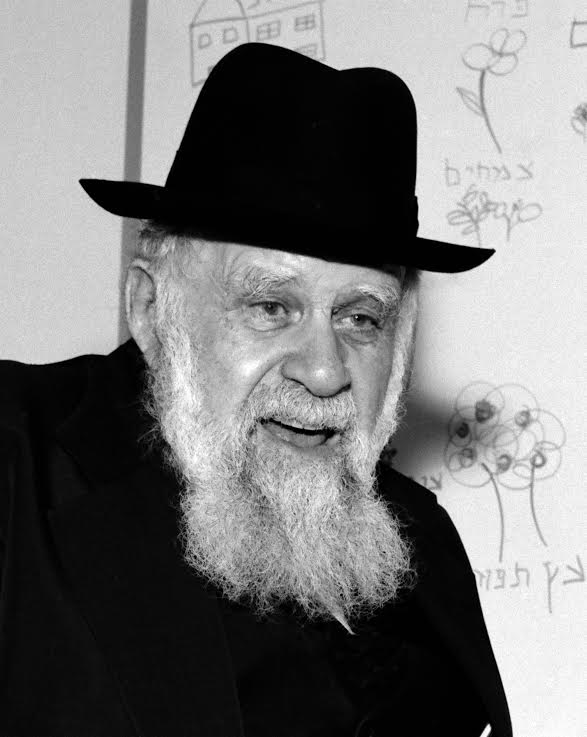
Photo of Rabbi Simcha Wasserman by Harry Green, c. 1986, South Bend, IN harrygreenphoto@gmail.com

  1. I thank Rabbi Yitzchok Shapiro (Boca Raton, Florida) and Rabbi Dr. Eliezer Brodt (Ramat Beit Shemesh, Israel) for their important comments to an earlier version of this article. I thank my father, Mr. U. Harold Males (Jerusalem, Israel) for his editorial assistance.
  2. In a humorous Forward article linked below, the author turned to an expert who proposed these definitions for the following Yiddish words: “A zets is a strong punch. A patsh is a common slap, whereas a frask is a sharp, stinging one, given with a vengeance.” See: https://forward.com/news/547/martial-arts-in-yiddish/ . After reading this, I felt relieved that the older cheder rebbi had only made use of a patsh – and not a zets or a frask.
  3. The Da’as Zekeinim mi-Ba’alei Tosafos is a Torah commentary compiled from the writings of French and German Tosafists who lived in the 12th and 13th centuries.
  4. I was unable to find information about a bird named אגרון / Agron. However, the Hebrew word for the crane is עגור / Agur (see Isaiah 38:14 and Jeremiah 8:7). A crane is a long-necked bird which certainly matches the winged creature in the Ba’alei Tosafos‘ parable.
  5. Aesop (c. 620–564 BCE) was a Greek storyteller credited with a number of tales which are collectively known as ‘Aesop’s Fables’. See: https://en.wikipedia.org/wiki/Aesop
  6. See: https://classics.mit.edu/Aesop/fab.1.1.html
  7. I have no recollection of ever reading Aesop’s Fables as an adult. Did my parents or older siblings read a children’s book of Aesop’s Fables to me when I was young? Had I read such a book to my nieces / nephews when they were little?
  8. See: https://thejatakatales.com/javasakuna-jataka-308/
  9. See: https://en.wikipedia.org/wiki/Buddhism
  10. See: https://en.wikipedia.org/wiki/Berechiah_ha-Nakdan and https://en.wikipedia.org/wiki/Mishl%C3%A8_Shu%27alim
  11. The term Mishlei Shua’lim is clearly taken from Sanhedrin 38b where we learn ג’ מאות משלות שועלים היו לו לרבי מאיר ואנו אין לנו אלא שלש – Rabbi Meir had composed 300 fox fables (i.e. parables involving animals – the fox being chief among them), but we are only left with three of them.
  12. https://blogs.loc.gov/international-collections/2021/09/a-fox-fable-goes-digital-bialiks-classic-hebrew-story-for-children-finds-new-life-at-the-library-of-congress/
  13. Eitz Yosef quotes Aruch who translates מוקרה as ‘its neck.’ It should be noted, however, that Rashi translates מוקרה as ‘its beak.’
  14. I initially wondered if this Midrash might also be the basis for the lyrics “פרוק ית ענך מפום אריותא – save Your flock from the mouths of the lions” in the Shabbos song ‘Kah Ribon’. However, a little research revealed that the term “פום אריותא – the mouths of the lions” is a clear reference to Daniel 6:23.
  15. See: https://en.wikipedia.org/wiki/Printing_press
  16. Rabbi Elazar Simcha Wasserman (1898 – 1992) was a son of the storied Rabbi Elchonon Wasserman, zt”l (1874 – 1941) – head of the pre-WWII Yeshiva in Baranovich, Poland. Prior to the Holocaust, Rabbi Wasserman (the son) immigrated to the United States where he played important roles in Jewish education and outreach (particularly in California). He and his wife moved to Israel in 1979, where they spent the final and ever-productive chapters of their lives in Jerusalem. I vividly recall attending the funerals of both Rabbi Simcha and Rebbetzin Faiga Rochel Wasserman (sadly, she passed away just after observing Shiva for her late husband) while first studying in Jerusalem in 1992. On November 5, 1992, the Los Angeles Times published an obituary for Rabbi Wasserman. See: https://www.latimes.com/archives/la-xpm-1992-11-05-we-1397-story.html . For a book-length biography, see: Fox, Dovid (1995) Greatness in Our Midst: The Life of Rav Simcha Wasserman. Jerusalem: Feldheim Publishers. For a more recent article on Rabbi Wasserman, see Eytan Kobre, “Building Worlds.”, Mishpacha, November 14, 2023. https://mishpacha.com/building-worlds/.
  17. Some of Rabbi Wasserman’s presentations have been digitized and are posted on Ohr Somayach’s website. However, among those that are available, I was unable to find the question-and-answer session cited in this article. See: https://audio.ohr.edu/showperson/id=20
  18. At this point, I believe an important disclaimer is in order. By suggesting that this parable is of ancient Jewish vintage, I am not claiming that that it was stolen from Jewish sources and plagiarized by foreigners. (Neither was that what Rabbi Wasserman had suggested.) A long tradition of such claims seems to go back to Philo (c. 20 BCE – 50 CE), and Josephus (c. 37 CE – 100 CE). For a scholarly treatment of such assertions, see Norman Roth, “The ‛Theft of Philosophy’ by the Greeks from the Jews,” Classical Folia, vol. 32, no. 1 (1978): 52-6. For some important rabbinic sources on such claims, see Rabbi Moshe Isserless’ Toras Ha’olah 1:11 (end of the chapter) and Metzudos Dovid to I Melachim 5:12. For a more recent rabbinic source see Rabbi Joseph B. Soloveitchik’s commentary to Tisha B’Av Kina 37 on page 574 in Posner, Simon. 2010. The Koren Mesorat Harav Kinot: The Lookstein Edition: Tefilla for Tisha B’Av, Kinot, Eikha. New York: OU Press; Jerusalem. (See footnote 19 for additional sources on this theme.)
  19. See the link below for a series of five thorough articles (with extensive footnotes) published in the Ohr Yisroel journal (Monsey, NY) by Rabbi Yaakov Yisroel Stahl: (10) מקור חכמת אומות העולם מעם ישראל In these articles, Rabbi Stahl cites an incredible amount of material on the theme of ancient Jewish wisdom making its way into the teachings of the nations of the world. I thank Rabbi Dr. Eliezer Brodt for bringing these articles to my attention.
  20. I credit Artscroll / Mesorah’s Kleinman Edition of Midrash Rabbah (2010) for the translation of this passage.
  21. See Matnos Kehuna, and Eitz Yosef Ibid.
  22. Both Rashi and the Eitz Yosef (Ibid.) note the clearly Latin roots (i.e. scholastic) of the word אסכולסטקיא.
  23. As demonstrated above in Part IV, this Midrash was the source of the parable shared by the Ba’alei Tosafos.


Purim in Tehran: The Symbolic Devaluation of the Ahrimanic Republic

Purim in Tehran: The Symbolic Devaluation of the Ahrimanic Republic

By Dan D.Y. Shapira

Dan (or, Dan D.Y.) Shapira is an Orientalist and grows more than fifty trees on the edge of the Judaean Desert. He’s a Full Professor at Bar-Ilan University.

Some fifty years ago, my father brought home a small glass bottle of Iranian Coca Cola, no idea where from. I sat hypnotized looking at the bottle, with its Persian (well Arabic) letters, so beautiful.

It was easy to understand that two letters stand for k, one for l, one for o and one for a. The letters for o, l, and for k had some remote similarities to the corresponding Hebrew letters, if you rotate them a bit in your head. How I know that the letter for a, ا, is also like the Hebrew א, you should just squeeze the Aleph on both sides. And a couple of year later there was the Islamic revolution in Iran, at the end of the same year there was the Soviet invasion in Afghanistan, and new tasty, delicious words began to pour – baseej, inqhilab, Haqiqat-e Inquilab-e Saur, mujahedeen-e khalq, sipaas, Kermanshah, pasdaran, and somehow I began learning Persian.

The language struck me with its grammatical similarities to German and its lexical parallels to Yiddish. Just as Yiddish incorporates Hebrew and Aramaic, Persian is saturated with Arabic. In Yiddish, one can play with registers, tilting the language toward its Germanic core or thinning out its Hebraic elements. Persian offers the same flexibility, allowing a speaker to choose more, fewer, or even no Arabic words. Years later, many Jewish-American Iranists from the WWII generation confirmed this early impression. Learning the language went smoothly, as if I had already known it in a former gilgul.

When I was an Iranian studies student in the late 1980s at Hebrew University, one of my teachers told us that Persians are simply prone to short periods of mass hysteria before returning to “normal” and going back to counting money and carpets within a few years. Time has since proven that my former teacher understood Iranians quite poorly, as they have shown no symptoms of recovering to that supposed normalcy. I eventually realized that my chances of visiting Tehran or Shiraz are slim, perhaps reserved for a future gilgul. Being an Israeli Iranist without the possibility of visiting Iran is much like being Jewish without the possibility of joining a Gentile club.

I am writing this on Sunday, March 1. Today is my secular birthday, and tomorrow, Ta’anith Esther, is my Jewish one. Last night, Bibi and Trump sent me a wonderful gift. I shouted into the sky as drones sent from Iran turned into smoke: Khamenei kotlet shod (“Khamenei went kebab”) as millions of Iranians around the world shouted along with me.

My son just called. He is married to a girl whose parents were both born in Iran. “What do you say about your birthday present?” he asked. “I just realized that your entire life is connected to the fact that you were born on Ta’anith Esther.”

“Yes,” I replied, “and I am just now writing about that. I’ll send it to you.”

It was published today that the joint American-Israeli training for the very operation we witnessed yesterday began as early as January 2023. In January! This timing is critical; it means that even as the domestic anti-Bibi demonstrations began to surge and well before the horrors of October 7, the strategic “pedestal” for the current reversal was already being constructed.

In my view, the son of the last Shah has been designated by Bibi and President Trump to lead the transitional period in a post-Khomeinist Iran. Whether he will be able to restore the historical monarchy remains an open question.

As I discussed in my co-authored article with Reuven Kiperwasser, “Encounters between Iranian Myth and Rabbinic Mythmakers in the Babylonian Talmud,” published a dozen years ago in Encounters by the Rivers of Babylon Scholarly: Conversations Between Jews, Iranians and Babylonians in Antiquity (2014) and available here, the Babylonian sages often engaged in a process of symbolic devaluation. They created their own imagined worlds by taking elements of Iranian mythology and recasting them to define the borderlines of their own culture. After the certain dismiss of what many Iranians call “the Ahrimanic Republic” (instead of “the Islamic Republic,” with Ahriman being the wicked opposite, sitra oḥora, of the benevolent Ahurmazd, or Ahura Mazda), we are seeing this ancient devaluation play out as a modern geopolitical reality. In our analysis of Sanhedrin 39a, we examine a dialogue where a Magus claims the human body is divided, with the upper part belonging to Hwrmyz (Ohrmazd) and the lower, excretory part belonging to ‘hrmyn (Ahriman). The Talmudic sage Amemar sarcastically challenged this dualism by asking why Ahriman would permit Ohrmazd to send life-giving water through his “territory.” Today, this sarcasm has turned into a tangible reality as the “Ahrimanic” regime governed through the “lower” impulses of mass hysteria and regional chaos has been devalued by a population that has largely secularized and rejected the official ideology. With the collapse of this demonic mask, many Iranian exiles will return home (four to five millions Iranians live outside of the present borders of Iran). They return to a land ready to restore its “upper” civilizational identity, finally mirroring the way the rabbis once harmonized their world with the benevolent elements of the Iranian heritage.

In Iran, while 99% of the population is officially classified as Muslim (including a 5% to 15% Sunnite minority composed of Kurds, Arabs, Baluchis, and Turkmens living along the borders), the internal reality is starkly different. In truth, only about 30% to 40% of the population considers themselves Muslim at all. The actual majority has shifted toward being non-religious or atheist, with many becoming fiercely anti-Islamic or “spiritual” in various ways. Others identify as self-proclaimed “Zoroastrians” or have become secret converts to American-style Evangelical Christianity.

Under the Khomeinist regime, Iran has become largely secularized and has partially moved in an anti-Islamic direction. Today, nobody believes in the official ideology, a situation very much like the lack of belief in the official ideology during the late Brezhnev USSR. The “Ahrimanic republic” now sends Shi’ite clerics who oppose its ideology to prison or places them under home arrest, just as the late Brezhnev USSR did to the few who identified as “the real Marxists.”

The Iran of tomorrow will certainly be anti-Islamist, with the potential for the oppression of Islam itself. While the Iran of yesterday was a global leader in antisemitism, the Iran of tomorrow will be a global leader in the state-supported fight against the “Free Palestine” movement. The “Palestinian discourse” was central to the old Iran and will remain so in the New Iran, though with its emphasis entirely reversed.

The raison d’être of the Iran of tomorrow will be a staunch alliance with the USA and Israel. The principle of nahapokh hu from the Purim story reveals the sarcastic hypostasis of the Jewish God’s sense of humor. As the scripture asks, “See, this is new? It hath been already of old time, which was before us.” One need only consider the metamorphosis of pogromist Czarist Russia into what some, astonished by the transformation, termed “the Jewish Commune.”

Some predict that Iran will fall apart due to the separatism of ethnic minorities, but to me, this is absolute nonsense. Iran has only insignificant real minority groups; although some Iranians speak languages other than Persian, they are Iranians first and foremost. Fantasies about Azeri separatism in Iran are especially hilarious. It is as if Nazi Germany tried to lure Israel’s Hasidic Jews into a “Great Germany” separatism simply because those Jews speak Yiddish. Iranians of Azeri background are, more or less, the Iranian equivalent of Israel’s Ashkenazim.

But the borders of Iran might change. It is a significant topic, and once stabilization is achieved, one can envisage the enlargement, rather than the shrinking, of Iranian territory eastwards within a predictable span of time.

The position of the Iran of tomorrow as an ally of Israel will fundamentally change Israel’s strategy toward its Arab allies and partners. MBS understood this some time ago and, consequently, dragged his feet regarding a rapprochement with Israel.

Another significant point is Türkiye, which has emerged as a primary adversary of Israel since October 7, though I hope the motivations behind this shift were largely opportunistic and fundamentally misguided. However, if the IDF map is accurate, the fact that Israeli jets overflew Turkish territory on their way to Iran suggests a significant development. This possibility hints that Mr. Erdoğan is beginning to view the regional landscape through a more pragmatic lens, perhaps recognizing the inevitable devaluation of the “Ahrimanic” status quo in favor of a more stable, “upper” civilizational order.


Ba-Yamim ha-Hem Ba-Zeman ha-Zeh: Were Jews Involved in Iran’s First Political Upheaval?

Ba-Yamim ha-Hem Ba-Zeman ha-Zeh: Were Jews Involved in Iran’s First Political Upheaval?

Aton M. Holzer

The Persian Empire was founded via the conquests of Cyrus II following his rise to the Anshan throne in 559 BCE. Cyrus, celebrated in the Hebrew Bible as the liberator whose decree permitted the Return to Zion, was succeeded by his son Cambyses, who is not mentioned in the Bible. Cambyses was followed for a brief period by his brother [or someone claiming to be] Bardiya (known in Greek sources as Smerdis or Tanyoxarces), until Darius I overthrew him.

The Behistun inscription of Darius I, an ancient trilingual text carved into a rock face at Mount Bīsotūn, which overlooks the main road from Babylon to Media, presents the case for Darius’s royal legitimacy. It begins by tracing Darius’s lineage back to the mythical royal ancestor Achaemenes and his son Teispes, great-grandfather of Cyrus, and then recounts his struggle against Gaumâta, a Median magus (priest) who, in Darius’s telling, impersonated royal heir Bardiya.

Gaumâta declared his rebellion on 14 Viyakhna (the eleventh month) from atop Mount Arakadris and was crowned on 9 Garmapada (the fourth month).[1] He was ultimately defeated by a coalition of seven nobles, including Utana, son of Thukhra, and was executed by Darius on 10 Bagayad (the seventh month). Traditionally, modern scholarship has viewed Darius’s claims of royal ancestry and Smerdis’s imposture as fabrications to justify a coup d’état, but this assumption has recently been called into question.[2]

26 …Darius the King 27 declares: This is what was done by me when the king 28 I did become. The son of Cyrus, of our family, Cambyses by name — 29 he was the king here. Of that Cambyses [there] was a brother, 30 Smerdis by name, having the same mother and father as Cambyses. And then Cambyses 31 struck down that Smerdis. When Cambyses struck down Smerdis, 32 it did not become known among the people that [he] had struck down Smerdis. And then Cambyses 33 went to Egypt. And when Cambyses went to Egypt, the people grew treacherous, 34 and thus deceit rose rampantly in both Persia and Media and 35 in the [Empire’s] other lands. Darius the King declares: Later, 36 there was one man, a Magian, Gaumâta by name, and he rose up from Paishiyauvada. 37 [There is] a mountain in Persia named Arakadri. From there, when fourteen days of the month of Viyakhna 38 were completed, he rose up, [and] he deceived the people [saying] thus: 39 “I am Smerdis, the son of Cyrus who [is] brother of Cambyses.” 40 Thereupon, all the people became rebellious against Cambyses and went over to him, [Smerdis], 41 Persia and Media and the other lands, [and] he seized the kingdom. 42 Nine days were completed in the month of Garmapada [when] he seized the kingdom thus. 43 And then Cambyses died by his own hand …

48 … Darius the king declares: There was no man, 49 neither Persian nor Median nor any among our family who could render that Gaumâta 50 kingdom-deprived. The people feared him greatly, 51 lest he would strike down the numerous people who knew him previously as Smerdis; 52 lest he would strike down the people on account of this: “Lest he who would know me [would know that] I am not Smerdis, 53 the son of Cyrus.” No one dared to say anything 54 against Gaumâta the Magian until I came. After that, 55 I asked Ahura Mazda for help, [and] Ahura Mazda bore me aid. 56 Ten days of the month of Bagayad were completed when, with a small number of men, 57 I struck down that Gaumâta the Magian and those men who 58 were his foremost allies. [There was] a fortress called Sikayauvati, a land called Nisaya, 59 in Media, [and] there I struck him down. I seized the kingdom [from] him, [and] by the will 60 of Ahura Mazda, I became king. Ahura Mazda bestowed the kingdom to me…[3]

…Says Darius the king: These (are) the men who were there then when I slew Gaumâta the Magian, who called himself Bardiya; then these men cooperated as my allies; Intaphernes (Vidafarnah) by name, the son of Vayaspara, a Persian; Otanes (Utāna) by name, the son of Thukhra, a Persian; Gobryas (Gaubaruva) by name, the son of Mardonius, a Persian; Hydarnes (Vidarna) by name, the son of Bagabigna, a Persian; Megabyzus (Bagabuxša) by name, the son of Daduhya, a Persian; Ardumaniš by name, the son of Vahauka, a Persian.[4]

The information from the Behistun inscription is enriched by Herodotus and fragments from Ctesias’ now-lost Persica, which are preserved in the writings of the Byzantine scholar Photius. In Herodotus’ Histories (3.68-3.87), a Persian noble named Otanes is depicted as the chief conspirator against the impostor Smerdis/Gaumâta-Bardiya, rather than Darius, who is actually the last to join the conspiracy. It was Otanes’ daughter, Phaedyme, one of Smerdis’ wives, who discovered the imposture because Smerdis lacked ears, which had been removed by Cyrus as punishment for earlier misdeeds (in Ctesias’ account, it is not a queen, but a eunuch, who informs the entire army of the deception). Otanes invited Aspathines and Gobryas for a discussion, and each subsequently recruited another conspirator. Darius joined them last, but quickly became the most vocal. They entered Smerdis’ palace without difficulty, and carried out the assassination.

The subsequent events in Herodotus also differ from Darius’ account. According to Herodotus, The Seven convened shortly after Smerdis’ death to discuss the future form of government. Otanes proposed a democracy, Megabyzus suggested an oligarchy (or aristocracy), and Darius advocated for a monarchy. After four members sided with Darius in favor of monarchy, they then needed to determine who would become King. They agreed on a competition: the one whose horse neighed first at dawn would become King. Otanes declined, leaving six conspirators to meet the next day. Darius prevailed by means of a ruse, and thus became the King of the Achaemenid Empire.

While the Behistun inscription portrays Darius as an unquestionable leader and future King, Herodotus downplays his significance and adds numerous details to the events, though the eventual outcome and main points of the revolt, including the names, remain unchanged. The seven conspirators became the most important officers of the empire, and the families of each of these seven continued to play key roles in Achaemenid governance until Alexander’s conquest.[5]

But one conspirator played an outsized role in the Empire’s affairs. Herodotus describes:

These were the three opinions presented at the meeting, and after the other four of the seven men decided in favor of the last one, Otanes, despite his eagerness to establish isonomy, recognized that he had lost the argument, and he now addressed them all: “My comrades, it is clear that one of us must become King, and whether he who will be entrusted with the administration of the kingdom is chosen by lot, by the majority of the Persians, or by some other method, I shall not compete with you, for I wish neither to rule nor to be ruled. So I now withdraw from this contest on the following condition: that neither I nor my descendants will be subject to you.” When he had stated this requirement, the other six agreed to it, and so he took no part in the competition among them but stood aside with an attitude of neutrality. And even now, Otanes’ family is the only free one among the Persians; it submits to rule only as much as it wants to, although it does not transgress Persian laws. The remaining six then deliberated about how they could most fairly establish one of themselves in the position of King. First they all agreed that if the kingship did go to one of them, Otanes and his descendants would be granted yearly allotments of Median clothing and every other gift thought to be most honorable in Persia. They decided to grant him these gifts because he had been the first to plan the conspiracy and bring them all together. And in addition to these perquisites for Otanes, they resolved to establish other privileges that they would share in common: they agreed that anyone of the seven would be allowed to go into the palace without an official to announce him, unless the King happened to be sleeping with a woman at the time, and that the King would not be permitted to marry a woman from any families other than their own… (Histories 3.83-3.84)[6]

In Herodotus’ account, Otanes advocates for Persia to transition to a democracy. Scholars[7] often view this debate as an apocryphal reflection of Herodotus’ own thoughts on governance, influenced by the democracy-oligarchy conflicts at the onset of the Peloponnesian War. Nonetheless, Herodotus himself notes contemporaneous skepticism, and asserts that Otanes nonetheless championed democracy (6.43). When outvoted in favor of maintaining the monarchy, Otanes relinquishes any claim to kingship, requesting only that he and his descendants be granted independence from royal rule (3.83). Ultimately, Darius triumphs among the six remaining contenders by resorting to deceit in a contest. Otanes, identified as “one of the seven,” reappears in Herodotus (Histories 3.141.1) as a commander of the Persian army. He is further noted as the father of Amestris, Xerxes I’s wife, and as the general during the campaign against the Greeks in 480 (7.61.2). This is forty-two years after the conspiracy – at which time Otanes already had a grown daughter in Bardiya’s harem – which would make Otanes, if living, quite old for such a task.

Pierre Briant[8] argued that the Otanes who led the campaign in 480, whom Herodotus identifies as the father of Amestris, was a different individual altogether. Rüdiger Schmitt posits that Herodotus may have been mistaken about the general in 480, who probably was one of Otanes’ sons, but maintains that Amestris was indeed Otanes’ daughter – such a royal marriage would have made good sense, in order to further cement the Darius-Otanes lineal alliance.[9]

In the Biblical Book of Esther, Xerxes’ wife is Esther. The historicity of Esther, once roundly rejected in scholarly circles, has recently gained some support. A recent article by faculty at the University of Tehran (!)[10] highlights numerous details within the Masoretic text of Esther that could only have arisen from direct familiarity with “the details of the administrative system, rules, and customs of the Achaemenian Empire and court,” without mediation by Greek sources. Coupled with the fact that Esther contains many Persian loanwords but no Greek ones, this evidence supports dating Esther, at the latest, to the end of the Achaemenid empire or the very beginning of the Hellenistic period—i.e., a time when the Achaemenid dynastic line was still a living memory. Scholars have suggested that the name Esther might be an apocopated form of Amestris, and the name given for her father, avi hayil, meaning ‘father of the soldiers,’ could be a title rather than a proper name, indicating a military commander.[11]

Following out this line of thinking – granting historicity to both the book of Esther and Persian and Greek sources, to the maximum extent possible – leads to some interesting possibilities.

In the Biblical book, Esther’s apparent selection through a contest might have been a strategic charade by Xerxes, a king known for cosmopolitanism and promoting equality among his subjects,[12] to give the impression of being open to marriage alliances with his diverse peoples, even as the contest for chief queen was really among a much smaller pool – since he preferred to marry a Persian from one of the seven families, in consonance with the agreement of the seven. (Otanes is explicitly identified as a Persian in the Behistun inscription.)

But how could Esther be both Persian and Judean?

One might suggest that Otanes’ Persian credentials were fabricated. The “Persians” were not averse to fabricating their own fictional ancestries; indeed, some skeptics suggest that even Darius I might have done so concerning his royal lineage as depicted in the Behistun Inscription.[13] Or perhaps Amestris was a product of intermarriage, Persian by her father but of a Judean mother — the question of whether ethnicity is passed in a patrilineal or matrilineal manner was unresolved in the early years of empire, both are reflected in the evidence, and concerns with the details of adjudicating conflicts of ethnicities are actually hashed out in the “constitutional laws,” data of Darius, as preserved at Behistun and Naqsh-e Rostam.[14]

But none of this is necessary. Recent studies argue that Persian ethnicity, in the early Achaemenid period, was actually a new construct:

“To be ‘Persian’ is unlikely to have denoted partaking in a cultural identity that was the direct heir and linear continuation of a migrant Indo-Iranian identity; instead, it meant to subscribe to a relatively new and inclusive identity, informed by both Elamite and Indo-Iranian traditions and developed and transformed pari passu with the incredible dynamism from which the Persian empire emerged… Of course, it may well be that in certain aspects of being ‘Persian’ the Indo-Iranian side was or became dominant, but that is not the essence: what matters is that both founding traditions were transformed and merged to the extent that one may speak of a new ethnicity or ethnic identity – the Persian ethnogenesis.”[15]

Judean ancestry or worship of the God of Israel, even if professed, would not have posed a barrier, in Achaemenid eyes, to identification with the constructed Persian ethnicity; Mazdaism, in whatever form it may have taken, was not confirmed as the ruling class’ religion until or after Darius,[16] and many cults continued to be worshipped in the Persian heartland.[17] The possibility that Amestris’ late “Persian” father-Darius co-conspirator Otanes, the commander of Persian forces, was of Judean ancestry and even creed, is thus not at odds with any Achaemenid imperial marriage policy. Nonetheless, once Darius embraced Zoroastrianism as the official state religion, and “Judaism” emerged as a distinct ethnicity,[18] the Persian nobleman’s family would have had reason to hide both.

If Otanes is indeed the character identified in the Megillah as avi hayil, a “crypto-Jew”, he might just have been the greatest shtadlan of all time. According to the Behistun inscription, Gaumâta had either destroyed or halted work on temples of which he disapproved — “the temples which Gaumâta, the Magian, had destroyed, I restored to the people.” Whether or not the disruption of Cyrus’s promise to rebuild the Jewish Temple was a motivating factor in Otanes’ conspiratorial intervention, Darius’s unusually fervent and forceful insistence on the reconstruction of the Jewish Temple (Ezra 6:11-12) makes good sense if a repayment of a debt to his good friend and benefactor.

This could potentially also resolve a longstanding crux interpretum in Esther (3:2-4): why did Mordechai refuse to bow to Haman? If we consider Herodotus’ account – which indicates that Otanes’ family remained free from subjugation to Darius’ descendants – it might explain why Mordechai[19] chose to uphold the privilege their ancestor had secured and refrained from bowing before the king or his representatives.

In a highly original and ambitious article[20] published some time ago, which rejects Herodotus in favor of the historicity of Esther (and Daniel), Chaim Heifetz posited that Gaumâta—as a magus-priest and religious absolutist linked to the ancient Median religion—was engaged in a religious conflict against the abstract (imperial form of) Zoroastrianism, which Jews and their religion found to be a more natural ally. He suggests that Haman “the Agagite” was a literary-theological construct derived from historical memory of Gaumâta. According to this reading, the very first Persian regime change—the overthrow of genocidal religious fanatics—bears a striking resemblance to the last, kein tihiyeh lanu.

  1. Incidentally, the anniversary of the date recorded in II Melakhim 25:3 as that of the breaching of the walls of Jerusalem by Nebuchadnezzar. 14 Adar is of course Purim, and 10 Tishrei is Yom Kippur – fascinating but not more than that, given no evidence of Judean-Persian calendrical synchronization.
  2. Amir Ahmadi, “The Bīsotūn Inscription-A Jeopardy of Achaemenid History.” Journal of Archeology and Ancient History 27 (2020) 1-55; .‏Zarghamee, Reza. “A Contribution to the Discourse Regarding a Teispid-Achaemenid Dynastic Divide.” Ancient History Bulletin 39 (2025) 3-4, 86-124.
  3. Translation by Scott L. Harvey, Winfred P. Lehmann, and Jonathan Slocum, Old Iranian Online, Lesson 8: Old Persian, archived at https://lrc.la.utexas.edu/eieol/aveol/80 and accessed January 14, 2026.
  4. Translation by Herbert Cushing Tolman, The Behistan Inscription of King Darius (Vanderbilt University, 1908),‏ 35.
  5. Libor Pruša, “Seven Against Mage: Darius and His Co-Conspirators,” Sapiens ubique civis 3 (2022), 27-56.‏
  6. Translations of Herodotus are from Robert B., Strassler, ed., The Landmark Herodotus: the Histories (Vintage, 2009).
  7. Farane Zaidi, “The Controversies and Skepticisms of the Constitutional Debate in Herodotus 3.80-82.” Ipso Facto: The Carleton Journal of Interdisciplinary Humanities 3 (2024), 49-62; Breno Battistin Sebastiani, “Herodotus’ Allusions to Democracy in Books 7 and 8: Between Heuristic Device and Purposeful Action,” Greece & Rome 72:2 (2025), 203-223.‏
  8. Pierre Briant, From Cyrus to Alexander: A History of the Persian Empire (Eisenbrauns, 2002), p. 135.
  9. Rüdiger Schmitt, Iranische Anthroponyme in den erhaltenen Resten von Ktesias’ Werk (Verlag der ÖAW, 2006), 174-176.‏
  10. Morteza Arabzadeh Sarbanani, “Revisiting the Book of Esther: Assessing the Historical Significance of the Masoretic Version for the Achaemenian History.” Persica Antiqua 3:4 (2023), 19-32.
  11. Robert Gordis, “Religion, wisdom and history in the book of Esther: a new solution to an ancient crux.” Journal of Biblical Literature 100:3 (1981), 359-388; Mitchell First, “The Origin of Ta ‘anit Esther.” AJS Review 34:2 (2010), 309-351.
  12. Kristin Kleber, “Taxation in the Achaemenid Empire.” Oxford Handbooks Online. Classical Studies. Oxford University press, 2015. See also Aton Holzer, “Esther, Feminist Ethics, and the Creation of Jewish Community,” The Lehrhaus, March 13, 2022, archived at https://thelehrhaus.com/scholarship/esther-feminist-ethics-and-the-creation-of-jewish-community/ and accessed January 15, 2026.
  13. Pierre Briant, “Achaemenids.” Oxford Research Encyclopedia of Classics, 2015.
  14. Hilmar Klinkott, “How to Govern an Empire? The Inscriptions of Darius I As a Constitutional Program,” archived at https://pourdavoud.ucla.edu/video/how-to-govern-an-empire-the-inscriptions-of-darius-i-as-a-constitutional-program/ and accessed February 22, 2023.
  15. Wouter FM Henkelman, “Humban and Auramazda: Royal Gods in a Persian Landscape,” in Henkelman, Wouter FM, and Céline Redard, eds., Persian Religion in the Achaemenid Period-La religion perse à l’époque achéménide. (Harrassowitz Verlag, 2017), 302.
  16. Philip G. Kreyenbroek, “Zoroastrianism under the Achaemenians: A non-essentialist approach.” In J. Curtis, St. J. Simpson. L., eds., The world of Achaemenid Persia: history, art and society in Iran and the ancient Near East (I.B. Tauris, 2010), 103-109.
  17. Wouter FM Henkelman, “Practice of worship in the Achaemenid heartland.” A Companion to the Achaemenid Persian Empire 2 (Wiley, 2021), 1243-1270.
  18. Aton M. Holzer, “Esther, Empire, and the Emergence of Jewish Ethnicity,” Journal for the Study of Judaism 56:4-5 (2025), 371-395.‏
  19. And possibly others from Otanes’ family, had they been stationed at the king’s gates rather than leading armies — see Herodotus Histories 7.62 and 7.82.
  20. Chaim S. Heifetz, “Malkhut Paras U-Madai be-Tekufat Bayit Sheini u-Lefaneha – Iyun Mehudash,” Megadim 14 (1991), 78-147.


Franciscans and More; “Repulsive” Practices; Saul Lieberman, Abraham Joshua Heschel, and R. Jehiel Jacob Weinberg

Franciscans and More; “Repulsive” Practices; Saul Lieberman, Abraham Joshua Heschel, and R. Jehiel Jacob Weinberg

Marc B. Shapiro

1. Following up on what I wrote here and here about the term צעירים (Franciscans) and other expressions used with reference to Catholic religious orders, Brian Schwartz called my attention to a couple of relevant sources. In Milhemet Hovah (Constantinople, 1710), p. 14a, R. David Kimhi mentions a theological argument he had with one of the חכמי הצעירים. In Ginzei Nistarot (1868), vol. 2, p. 10, R. Jacob of Venice in his anti-Christian polemic mentions the צעירים and the דורשים (Dominicans). I also found a mention in the text of the Tortosa Disputation, ibid., p. 47. R. David Kimhi refers to the צעירים and the דורשים in his letter about the Maimonidean controversy found in Kovetz Teshuvot ha-Rambam ve-Igrotav, sec. 3 (Iggerot Kanaut), p. 4.[1]

There are no doubt many other such references in medieval texts and there is no need to elaborate any further. However, there is one other point worth noting. In the version of Nahmanides’ Disputation printed in Judah Eisenstein, Otzar Vikukhim, p. 89, it reads: וחכמי הצעירים והדורשים והחובלים. The last word, החובלים, is not found in the version published in Chavel’s edition. What does החובלים mean?

In his note Eisenstein tells us that החובלים are Cordeliers, which is how the Franciscans were called in France.[2] In fact, the Cordeliers were only one branch of the larger Franciscan order. The word cordelier refers to the rope that Franciscans wore around their waist.

חובלים, together with Cordeliers, appears in R. Avigdor Tzarfati’s Torah commentary:[3]

מכאן רמזה תורה אותן החובלים קירדליי”ש והייקופינ”ט ההולכים יחפים שעתידין להכעיס את ישראל

In this text we also have a new word, הייקופינ”ט. This is just an alternate spelling of the word יקופש. In Da’at Zekenim mi-Ba’alei ha-Tosafot, Deut. 32:21, it refers to החובלים ויקופש as people who bring trouble upon the Jews. So what does this word יקופש mean? In R. Aharon Yehoshua Pessin’s Midah ke-Neged Midah [4] he knows that החובלים refers to Franciscans and suggests that יקופש means “Capuchin.” However, the Capuchin order, which is a branch of the Franciscans, was only founded in the sixteenth century, so the Tosafists could not have mentioned it. יקופש actually refers to the Jacobins,[5] which is how the Dominicans were called in medieval France.

2. Readers might recall that in my post here I mentioned the late Dr. Shlomo Sprecher’s characterization of two segulot as “repulsive.”[6] I then cited another example of a segulah which I believe falls into this category (and see also my post here). However, the obvious point, which I mention here, is that what our generation regards as repulsive was not always regarded so in a different generation and culture.

Following the post in which I discussed Dr. Sprecher’s article, a few people sent me examples of things that were accepted in previous generations but today would be regarded as repulsive. Many of these examples are from general society and relate to standards of hygiene, food, etc., but a few came from Jewish texts as well. One reader sent me this interesting post by Tomer Persico that deals with the matter. He mentions, among other things, the following shocking remedy recorded in R. Hayyim Vital, Sefer ha-Peulot, p. 321, that appears to recommend a blatant halakhic violation. (It is doubly shocking when one remembers how seriously this sin is viewed in Lurianic Kabbalah, and this fact alone should perhaps lead us to reject the authenticity of the comment.)

לנכפה [לריפוי אדם הסובל ממחלת הנפילה], יקחו נער א’ [אחד] שמימיו לא ראה קרי ויוציאו ממנו שכבת זרע, ואותו הקרי ושכבת הזרע ימשחו בו שפתותיו של החולה ומעולם לא יחזור החולי ההוא

Jeremy Brown, in his recent National Jewish Book award winning volume, The Eleventh Plague: Jews and Pandemics from the Bible to COVID-19 (Oxford, 2023), p. 77, mentions another recommendation, this time to avoid bubonic plague. Among the ingredients to be consumed are “a little of the first urine” produced in the morning and “a small quantity of dried human feces, dissolved in wine or rose water, to be taken while fasting.”[7]

In the post here referred to above, I dealt with metzitzah ba-peh. Subsequently, I found that R. Leon Modena, in his response to the heretic Uriel da Costa, rejects the latter’s claim that metzitzah ba-peh is disgusting because the mouth speaks the word of God while the sexual organ is impure.[8] The medieval anti-Jewish polemicist, Raymond Martini, had earlier attacked metzitzah ba-peh as an “abominable act.”[9]

R. Moshe Mordechai Epstein has a perspective at odds with many other Lithuanian sages in seeing metzitzah as essential to the mitzvah of circumcision, not simply a medical procedure.[10] He also sees metzitzah ba-peh as crucial to the fulfilment of this mitzvah, again, in opposition to what was the standard approach in Lithuania (as opposed to among the Hasidim). As he puts it, if metzitzah ba-peh is not a basic part of the mitzvah, no one would have ever advocated such an action that, in any other circumstance, would be regarded as utterly repulsive.

אשאל שאלה מאלה האומרים כי מציצה היא רק משום סכנה, וע”כ די ברטית סמרטוטין, מאותם אשאל, נשער נא בנפשינו, אילו לא הי’ מצוה ולא הי’ נהוג אצלינו לעשות המציצה, ואחד הי’ רוצה לעשות המציצה בפה, בודאי היינו קוראים אחריו מלא כי אין לך מתועב יותר מזה ליקח אבר פצוע לתוך הפה. ומה גם אותו האבר. ולא עוד אלא למצוץ הדם, הלא הדבר גועל נפש ממש חלילה (אם אינה מצוה) . . . מי זה חסר לב יאמר כי הנהיגו דבר כזה בלי מצוה . . . בענין המציצה כאשר היא מצוה קדושה לתקן הנפש, אין בה גיעול ח”ו, קדושה וטהורה היא המצוה, אהובה וחביבה מרוממת רוחניות הנפש, אבל אילו לא הי’ מצוה רק הכשר כדי שלא יסתכן הולד מהדם, איך נוכל לומר שיהי’ נהוג בישראל ענין מתועב כזה, חלילה וחלילה. הלא האמת ברור לכל, כי המציצה היא מצוה קדושה בעצמה דוקא באופן הזה למצוץ דוקא בפה

3. In my last post here I spoke about Saul Lieberman, so let me add a few more points. In Tovia Preschel’s Ma’amrei Tuvyah, vol. 6, p. 231, he discusses Lieberman’s investigations into obscure words in rabbinic literature, and is reminded of how Sherlock Holmes can always find the answer:

כשאתה רואה אותו מצרף קו לקו ותג ותג להוכחה ברורה ומוריד מעל המלים את המסווה שמאחוריו מתחבאת משמעותן האמיתית – עולה בלבך המחשבה: הרי זה שרלוק הולמס, האמן-הבלש, של שפתנו

ואמנם נקראים כמה ממחקריו בענייני לשון כסיפורים של סר ארתור קונן דויל. דומה עליך שהנך רואה את שרלוק הולמס מרצה לידידו ועוזרו ואטסון כיצד סימנים ועקבות קטנים ובלתי-ברורים מוליכים אותו לפענוחו של תעלומות גדולות

ר’ שאול ליברמן – תורה למד בישיבות, חכמה קנה באוניברסיטאות – אך אמנות הבלשות מנין לו

Preschel then notes that in the little free time that Jabotinsky had, he liked to read detective stories. Preschel wonders, does Lieberman also do so? He adds that he was never brazen enough to ask Lieberman about this.

לפעמים אני הוגה בלבי: אולי גם ר’ שאול בין קוראי ספרות זו, עת הוא נח מעמלה של תורה, בשעה שאינה לא יום ולא לילה? אך עדיין לא העזתי לשאול אותו כל כך

Preschel’s insight is amazing. In Lieberman’s letter to Gershom Scholem, dated July 31, 1947,[11] Lieberman writes about how during the summer vacation, when he is away from New York and has free time, he reads detective stories![12]

ומכיוון שבכפר אני מתיר לעצמי לבטל קצת את הזמן הריני קורא לפעמים ספרות בלשית. וכשבא מאמרך לידי נמשכתי אחריו באותה מתיחות ממש כאילו אני קורא a detective story


Earlier in Ma’amrei Tuvyah, vol. 6, pp. 229-230, Preschel provides the answer to something I had thought about. If you look at a number of the title pages of Lieberman’s books you see that his name is in smaller print than that of his father.

Other than in Lieberman’s books, I don’t recall ever seeing this on a title page. Fortunately, Preschel asked Lieberman about this and Lieberman explained that this is “minhag Yisrael”. Lieberman showed Preschel what R. Hayyim Benveniste writes in Sheyarei Kenesset ha-GedolahTur, Yoreh Deah 240:8, that when one signs his name together with that of his father, yesh nohagim that the father’s name is written above as a sign of respect. What this means is that the father’s name written with bigger letters so that it stretches above the son’s name.

Here is the page in R. Benveniste’s work where he also provides an example.

Preschel concludes:

“פותח שערים” אני. אצבעותי מישמשו בהרבה ספרים. שערים רבים ראיתי. צא ובדוק אם תמצא מחברים שנהגו מנהג רם ונשגב זה בשערי ספריהם. ואם תמצא – מעטים הם, נער יספרם

Since we have been speaking about Lieberman, here is a treat for all the Lieberman fans: A letter from Lieberman to Abraham Joshua Heschel in which we see a bit of Lieberman’s mischievous humor.[13]

And while mentioning Heschel, here is another letter to him from R. Pinchas Biberfeld.[14]  

From this letter we learn something that until now was completely unknown, namely, that Heschel attended lectures of R. Jakob Freimann at the Berlin Rabbinical Seminary. In Edward Kaplan’s book on Heschel, Prophetic Witness, pp. 106, 256, he mentions that Heschel would frequently eat at Freimann’s house on Shabbat, and that Heschel contributed an article — his first academic publication — to the Freimann Festschrift.

R. Pinchas Biberfeld was the son of the legendary physician-rabbi Eduard Biberfeld, and he received semikhah from the Berlin Rabbinical Seminary. Here is a copy of his semikhah.[15]

The semikhah, dated Feb. 7, 1939, is signed by R. Jehiel Jacob Weinberg and R. Samuel Gruenberg. R. Weinberg was forced to leave Germany not long after this, and R. Gruenberg  and R. Biberfeld were fortunate to also get out and immigrate to Eretz Yisrael. While in Israel R. Biberfeld edited the Torah journal Ha-Ne’eman. You can read about him here on Wikipedia, and here is an interview he gave.

Biberfeld’s German name was Paul, and he was named after Paul von Hindenburg![16] People today often don’t realize how integrated into German society the German Orthodox were, and the naming of Paul Biberfeld is a great example of this.[17] In some ways, the German Orthodox were even more attached to their non-Jewish surroundings than today’s American Modern Orthodox, whose Americanness is usually expressed in a shared low culture with non-Jewish society (e.g., television, music, and sports), rather than in high culture and patriotism, both of which were part of the German Orthodox ethos.

R. Immanuel Jakobovits’s father was a well-known German rabbi, Julius Jakobovits, and yet he was comfortable naming his son after Immanuel Kant.[18] (R. Jakobovits’s Hebrew name was Yisrael.) In Michael Shashar, Lord Jakobovits in Conversation, pp. 10-11, Jakobovits explains (and it is obvious that he did not know the story of Paul Biberfeld’s name):

I may be the only rabbi in the world named after a non-Jew – Immanuel Kant, who was a native of Koenigsberg [where Jakobovits was born] and never left it.[19] The city was also known as “Kantstadt” [the city of Kant]. My father was one of Kant’s admirers, and when I was born he wanted to call me Israel, after one of his uncles, but at that time in Germany it was not acceptable to call a Jewish child Israel. Accordingly, he searched for a name beginning with I and ending with L, and so he gave me Kant’s name, Immanuel.

I don’t know why it was not acceptable in 1920s Germany for a Jewish child’s “secular” name to be Israel. 

Returning to Heschel, when he first came to the United States he was teaching at the Reform Hebrew Union College in Cincinnati. Here is a letter from Louis Ginzberg to Heschel that provides information that until now has not been known.[20]

From this letter, we see that Heschel was in discussions about a job at Dropsie College. Ginzberg urges him to accept this position if offered, and notes that the atmosphere at HUC was not in line with Heschel’s outlook. This never came to be, and Heschel accepted a position at the Jewish Theological Seminary in 1946 where he spent the rest of his life.

I think readers will find the next two letters of interest, as we see that Heschel was in discussions to teach at Yeshiva College and its Bernard Revel Graduate School.[21]

There are two other documents from the Heschel Archives that I would like to call attention to as they are of great historical interest. Unfortunately, they were not available to me when I wrote Between the Yeshiva World and Modern Orthodoxy. First, I must note that a few months ago the Jewish Historical Institute of Warsaw published a wartime list of rabbis in the Warsaw Ghetto. You can see it here. The list is not complete. For one, it does not mention R. Jehiel Jacob Weinberg, whom as I discuss in Between the Yeshiva World and Modern Orthodoxy was very involved in the Warsaw ghetto rabbinate and also served as the head of a committee to assist rabbis and yeshiva students. Also not mentioned in the Hebrew document is R. Kalonymous Kalman Shapiro, the Piaseczno Rebbe.

In a letter dated May 25, 1941, R. Weinberg wrote to Heschel from the Warsaw Ghetto.[22] Here is the envelope that R. Weinberg used. I include both sides of the envelope. As you can see, Heschel was living at Henry Street on the Lower East Side. Also note R. Weinberg’s address on the reverse as well as the Nazi stamp.

Here is the letter in which R. Weinberg asks Heschel for assistance with the emigration of rabbis in the ghetto. Because of German censorship, R. Weinberg’s letter had to be written in German. (We have other letters from R. Weinberg sent from the Ghetto and they too are written in German.)


It is interesting to see how R. Weinberg’s letter divides the rabbis between the truly outstanding and the others who, while also praised, are placed on a lower level. (R. Kalonymous Kalman Shapiro does not appear on the list.) While in the end, none of the rabbis were permitted to emigrate, the letter is clearly making a distinction between the rabbis. It is saying that if only limited opportunities to emigrate are available, that the order should be the rabbis in list 1, followed by list 2, and then list 3 and 4. This is a clear case where the greater rabbis were going to be saved first.[23]

The letter we have just seen, which is not addressed to a particular individual, and also the letter below, were sent to a number of people, not specifically to Heschel. You can see this in the letter below by how Heschel’s name is inserted at the beginning. Yet I have never seen other copies, which is why we have to be grateful that Heschel saved everything.

In a letter dated June 15, 1941, R. Weinberg again wrote to Heschel from the Warsaw Ghetto. Here are both sides of the envelope, followed by the letter, and this time R. Weinberg spelled the street name “Henry” correctly.


In this letter, R. Weinberg speaks about American Jewish assistance in sending money and food, and helping with emigration from Warsaw. The letter is accompanied by two lists, lengthier than what we saw in the first letter, divided again into what may be the more important figures and the others. But I am not certain if this is the significance of the division here, as there are some differences in how the names are divided in the two letters. 

On the first list here you can see R. Kalonymus Kalman Shapiro at no. 20, with his address — that we know from other sources as well — 5 Dzielna. Other than R. Weinberg, did any of the rabbis on the two lists survive?

* * * * * * *

[1] This letter is difficult to read, as the sage he degrades for informing on Maimonides to the Church may be R. Jonah Gerondi.
[2] See also Ben Yehudah’s dictionary, s.v. חובל; Dov Yarden, “Hovel Nazir Franciscani,” Leshonenu 18 (1953), pp. 179-180.
[3] Perushim u-Fesakim le-Rabbenu Avigdor ha-Tzarfati (Jerusalem, 1996), p. 445.
[4] (Jerusalem, 2009), p. 157 n. 20.
[5] See Leopold Zunz, 
Zur Geschichte und Literature (Berlin, 1845), p. 181.
[6] One of these 
segulot is that barren women should swallow the foreskin of newly circumcised boys in order to help them conceive a male child. For more sources on this practice, see Zev Wolf Zicherman, Otzar Pelaot ha-Torah, vol. 4, pp. 486-487. R. Yehoshua Mamon, Emek Yehoshua, vol. 1, Yoreh Deah, nos. 31-32, argues that this practice is forbidden according to Torah law. Regarding mohalim being buried with the foreskins they cut off, as a form of protection after death, see R. Joseph Messas, Otzar ha-Mikhtavim, vol. 2, no 986. Regarding women consuming the placenta, see R. Mordechai Lebhar, Menuhat Mordechai, no. 38.
[7] Regarding eating portions of a corpse and ground-up skull of non-Jews, and why rabbis permitted this, see my post here. Repulsive language is also noteworthy. R. Uri Feivish Hamburger, 
Urim ve-Tumim (London, 1707), p. 8a, first word of line 3, is the only example I know where a certain inappropriate word appears in a sefer. According to this source, even in the early eighteenth century the word was regarded as taboo.

It could be that this word is no longer really regarded as repulsive, only a little unseemly. It even appears in the title of eminent philosopher Harry G. Frankfurt’s #1 New York Times bestselling book, published by Princeton University Press. See here.

While Jews are obligated to speak in a dignified manner, there is an exception when it comes to speaking about idolatry. See Megillah 25b, where among other things it states: “It is permitted for a Jew to say to a gentile: Take your idol and put it in your shin tav [i.e., shet, buttocks].” This is the Koren translation and Soncino and Artscroll translate similarly. Yet I was very surprised to find that in Shabbat 41a Soncino twice translates כנגד פניו של מטה as “near his buttocks”, when it is obvious that the proper translation is “over his genitals”.
[8] 
Magen ve-Tzinah, p. 6b. Let me take this opportunity to correct a common error. R. Leon Modena called himself Yehudah Aryeh mi-Modena. But in Italian he called himself Leon Modena (not Leon de Modena). Modena himself tells us this. See Hayyei Yehudah, ed. Daniel Carpi (Tel Aviv, 1985), p. 33:

אני חותם עצמי בנוצרי ליאון מודינא דה ויניציאה‘, ולא דה מודינא‘, כי נשארה לנו העיר לכנוי ולא לארץ מולדתנווכן תמצא בחבורַי הנוצרים בדפוס

[9] See Lawrence Osborne, Poisoned Embrace: A Brief History of Sexual Pessimism (New York, 1993), p. 128. Regarding Martini, see Richard S. Harvey, “Raymundus Martini and the Pugio Fidei: A Survey of the Life and Works of a Medieval Controversialist” (unpublished masters dissertation, University College London), available here. Shimon Steinmetz pointed out to me that the famous non-Jewish Hebraist Johann Buxtorf (1564-1629), in his discussion of metzitzah, does not express any revulsion. He merely notes that this was not commanded by Moses. See hereIt would be interesting to examine how other Christian scholars and Jewish apostates of previous centuries described metzitzah.
[10] She’elot u-Teshuvot Levush Mordechai, no. 30. The expression he uses in the passage, קוראים אחריו מלא, comes from Jer. 12:6.
[11] The letter was published by Aviad Hacohen, “Ha-Tanna mi-New York,” Madaei ha-Yahadut 42 (5763-5764), p. 298.
[12] After I wrote this, I learned that R. Yitchak Roness made the exact same point. See here.
[13] The original is found in the Heschel Archives, Duke University, Box 2, Folder 2.
[14] The original is found in the Heschel Archives, Duke University, Box 10, Folder 3.
[15] The original is found in the Leo Baeck Institute; see here.
[16] See Mordechai Breuer, Modernity Within Tradition (New York, 1992), p. 480 n. 124. Breuer also mentions that a hasidic synagogue in Leipzig was renamed the “Hindenburg Synagogue.”
[17] See Jacob H. Sinason, The Rebbe : The Story of Rabbi Esriel Glei-Hildesheimer (New York, 1996), p. 128:

[Dr. Eduard Biberfeld] looked at the war against the Czar’s Russian empire as a kind of holy war against the dark forces responsible for the systematic persecution of Jews. He named one of his sons after the victorious German general, just as the Jews in Hellenistic times had called their children after Alexander the great. (Even to the extent of adopting Alexander as the Shem Hakodesh.)

The last sentence means that people with the name Alexander would be called up to the Torah with this name, as they would not have a corresponding Hebrew name as was often the case with German Orthodox Jews who had both a “secular” name and also a Hebrew name.
[18] Regarding Kant, Dr. Isaac Breuer had a picture of him on his wall, together with R. Samson Raphael Hirsch. I asked Breuer’s son, Prof. Mordechai Breuer, if the Holocaust had any effect on how he viewed Kant, who was, after all, an important part of German culture. As I expected, his answer was “no,” and even after the Holocaust the picture of Kant was not taken down.

The pictures on one’s walls obviously reflect an outlook. Alexander Altmann writes as follows about his father, R. Adolf Altmann, Rabbi of Trier:

Significantly, five pictures adorned his study, those of the “Hatam Sofer”, S.R. Hirsch, Graetz, Herzl and Mendelssohn, representing the orthodox tradition, old and new, Jewish History, the Zionist dream, and the philosophical quest respectively. These images had been the formative influences of his youth, and they continued to guide him.

Adolf Altmann (1879-1944), A Filial Memoir,” Leo Baeck Institute Year Book 26 (1981), p. 160.
[19] Although often repeated, this is actually incorrect. We know that Kant did leave Koenigsberg on a few occasions, including for his father’s funeral, but he never was more than 30 miles or so from his home. I mentioned this in one of my classes on R. Elijah Benamozegh, see here, while referring to the report the latter only left Livorno twice in his life.
[20] The original is found in the Heschel Archives, Duke University, Box 20, Folder 2.
[21] The originals are found in the Heschel Archives, Duke University, Box 22, Folder 2. These letters are referred to in Edward K. Kaplan, 
Spiritual Radical: Abraham Joshua Heschel in America, 1940-1972 (New Haven, 2007), pp. 61, 65.
[22] The Weinberg letters in are found in the Heschel Archives, Duke University, Box 22, Folder 2.
[23] For another example where rabbis (and their families) were chosen to be saved before others, see Steven Lapidus, “Memoirs of a Refugee: The Travels and Travails of Rabbi Pinchas Hirschprung,” Canadian Jewish Studies 27 (2019), pp. 73-74. Lapidus quotes from a letter from R. Oscar Fasman, at that time in Ottawa:

Here we are not dealing with only seventy individuals. These seventy embody a wealth of Jewish sacred learning, the like of which can no longer be duplicated, now that the European Yeshivoth are closed. In these people we have that intensive tradition of Torah which buoyed up the spirit of Israel. Thus, we are saving not merely people, but a holy culture which cannot be otherwise preserved. When the U.S. admitted Einstein, and not a million other very honest and good people who asked for admission, the principle was the same. It is certainly horrible to save only a few, but when one is faced with a problem of so ghastly a nature, he must find the courage to rescue what is more irreplaceable.


Do We Cut Off or Bury One’s Head in the Sand?

Do We Cut Off or Bury One’s Head in the Sand?

Review: Elliott Horowitz, Reckless Rites: Purim and the Legacy of Jewish Violence

In 2017, the erudite and eclectic scholar Elliott Horowitz unexpectedly passed away. His oeuvre is exceptionally diverse, having authored more than seventy-five articles and reviews and five books, with topics ranging from studies on Italian art, Jews and coffee, the significance of the beard among Jews, comparing and contrasting Jewish and non-Jewish biblical exegesis, and Jewish violence (see his Academia page for most of them). Seven additional articles appeared on this site, in a similar vein as his others, covering Bugs Bunny, nude imagery in the Haggadah, Isaiah Berlin, Saul Lieberman, among others. He regularly used the “Molkho Institute for Absurdly Abstruse Research” to identify his affiliation in his email signature. Jewish violence was a long fascination of Horowitz. Beginning in 1994, with an article in the Hebrew journal Zion, he revisited the issue in no less than six articles that culminated in his 2006 book, Reckless Rites: Purim and the Legacy of Jewish Violence (Princeton University Press, Princeton, New Jersey). Horowitz documents how the conclusion of the Purim story, culminating in the Jews massacring 75,800 people over two days, was used as a justification for Jewish violence against non-Jews throughout history. Horowitz revisited this topic on this website, “Modern Amalekites from Adolf to Avigdor.” In a later article, he also identified the Biblical story of Dinah as another source for this type of violence.

While arguably, the violence at the end is only a minor part of the story, for some, that aspect has clouded everything about the Book of Esther and Purim. First, Horowitz looks at how non-Jews viewed the Book. Some had a very negative view due to the Jewish revenge. They considered that motif un-biblical (read non-Christian). Horowitz goes through each character and how first non-Jews interpreted their actions. For instance, Mordechai was treated rather harshly by many of these commentators, as was Esther, due to her passivity. What is especially fascinating is how these non-Jewish understandings sometimes crept into Jewish thought. Thus, Horowitz documents Jews parroting these rather un-Jewish, as it were, interpretations.

Horowitz then tackles the overarching theme of Amalek and how this has been understood throughout history. Some hold there is no obligation to destroy Amalek today, while others are willing to label any perceived enemy of Jews as deserving of the harsh consequences of Amalek. Some of these examples are rather disturbing.

After dealing with the Book of Esther specifically, Horowitz focuses on the Jewish practice of Purim. Specifically, he deals with Jewish violence or violent acts on Purim directed at non-Jews. He provides a discussion of the stereotype of the “mild” (read the wimp) Jew, including its origins and whether it is borne out by history. He then discusses numerous diverse examples spanning from the 5th century until today of Jewish violence. Some are not physical violence. Instead, it is host desecration or general enmity of non-Jewish symbols, while other, most recently Barukh Goldstein, is physical violence in its worst form.

Horowitz is compelling in the scope of this idea and how prevalent this is. It is especially telling when tracing and seeing how systematically Jews have decided to sweep these under the rug these examples; it demonstrates that censorship is not limited to any one group, and even amongst supposedly dispassionate scholars; they too can fall prey to their own biases.

To play down some of these incidents, we have Jewish historians who decided to avoid discussion of such matters or, at times, downplay their significance. However, in light of the many examples here, it is challenging to ignore such examples. Indeed, Shaul Magid noted in his review that Horowitz’s book “seems to elicit a kind of cognitive dissonance among peers, as if to say ‘this simply cannot be true’ even given the detailed evidence and argumentation to the contrary. This is often because of the audacity of the thesis and the way it challenges how we understand the present.” Hillel Halkin’s review of Commentary magazine is one example that fails to adequately address Horowitz’s thesis and his substantial evidence. Halkin claims that the book is a distortion of history and places too much emphasis on too few examples. In the next issue, Horowitz responded to Halkin’s criticism, noting Halkin’s misreading of some texts and inability to present any contrary evidence. In his inimical style, Horowitz invokes the Godfather to prove his point.

Halkin remained obsessed with Horowitz’s book and, a year later, returned to it and attempted to compare it and Michael Stanislawki’s book (A Murder in Lemberg), to Ariel Toaff’s Pasque di Sangue that seemingly argued Jews regularly killed non-Jewish children.”, which is riddled with methodological errors and has been entirely discredited (here). This time, not only Horowitz took issue with Halkin. Three scholars, Allan Nadler (who previously wrote a very positive review of Reckless Rites and presciently noted that Horowitz is a “scrupulously honest voice, dealing in exemplary fashion with an important subject that has been ignored by scholars precisely because of its extreme delicacy. In his execution of narrating the repercussions of Haman’s execution, Horowitz has enriched us with a model of historical scholarship. Anything but reckless, “Reckless Rites” is a rare gem of academic work that will make a real difference”), Elisheva Carlebach, and Naomi Gratz, derided Halkin’s attempt to tar Stanislawki and Horowitz. Perhaps it is best to view Halkin’s criticism through the prism of his long history of minimizing Israeli responsibility for violence, Horowitz being but one example. Indeed, Halkin himself seemingly accepted Yigal Amir’s murder of Yitzhak Rabin. Halkin claims that Amir’s error was not in the assassination itself; instead, “What made Yitzhak Rabin’s assassination exceptionally atrocious was not it’s being a murder, but it’s being a cataclysmic political blunder.” Hillel Halkin, “Israel & the Assassination: A Reckoning,” Commentary Magazine, January 1996. Halkin, however, was willing to criticize one person affected by Rabin’s murder, his son. Halkin, under the pseudonym Philologos, pokes fun at Rabin’s son’s pronunciation of the Kaddish he said on behalf of his father. See “On Language,” “Yuval Rabin’s Kaddish,” Forward, November 17, 1995. Perhaps if Amir had butchered a blessing rather than Rabin, Halkin would have found occasion to criticize.

Commentary, however, wasn’t done with Horowitz. In 2010, Commentary published Abby Wisse Schachter’s essay, “The Problem with Purim,” which is generally about feminist views of Purim characters. As an aside, she claims that Horowitz’s book contains “the questionable claim” and the “bizarre thesis” that “Purim has long been the occasion for outbreaks of Jewish animosity and even violence toward Christians.” She asserts that Horowitz’s thesis is based solely on the example of Baruch Goldstein. This is incorrect. As Horowitz demonstrates in his letter to the editor, it is evident that she could not have spent more than ten minutes with the book to arrive at her conclusion. Horowitz shows that Schechter’s article contains other mistakes beyond her discussion of his book.

In the end, there is little doubt that he wrote a well-researched and thorough book that inevitably engenders discussion, whether or not readers agree with Horowitz, is less the point. (See, for example, Eliezer Brodt’s post, “The Origins of Hamenstashen in Jewish Literature (Revisited),” on this site. Brodt references Horowitz’s discussion regarding a Saudi scholar who alleges Jews use blood to make hamenstashen.) Instead, as with all groundbreaking scholarship, a Talmudic approach, one that values discussion over conclusion is the best one can hope for.


On the Ger Tzedek of Vilnius

On the Ger Tzedek of Vilnius

By Yosef Vilner

This year the holiday of Shavuot occurred right after Shabbat. There were many meals and lively conversations around the table. During one these talks my daughter mentioned a story she read in a weekly supplement to the Hebrew edition of the Orthodox Jewish newspaper Hamodia. The story was about Polish nobleman Graf Potocki, a convert to Judaism who was convicted of apostacy by the Catholic Church and burned alive at the stake in Vilna on the second day of Shavuot on May 24, 1749. As a native of Vilna, I was very pleased to hear that this old, deeply rooted Litvak tradition is still celebrated on the pages of the contemporary Israeli magazines. However, the following day I discovered that Lithuanian Jewish Community in an apparent attempt to commemorate this event as a non-event published an article with a headline: “Ger Tzedek Count Potocki Story is Likely a Myth.” The article is derived from Wikipedia, where it appears under the title “Abraham ben Abraham.”

What prompted the editors of the website to compose such a headline? Most likely the following introductory passage in the Wikipedia article: “Although the Orthodox Jewish community accepts the teachings about Abraham ben Abraham, secular scholars have largely concluded that it is a legend.” But if the editors would take the trouble to continue reading the article they would probably arrive at a different conclusion. Setting aside the question of the reliability of Wikipedia as a source, let me present some of the conclusions of these “scholars” and examine them together with you.

As we read the article, we are informed that: “Historians who have studied the story of Potocki, believe it to be invented although it is unknown when or by whom. Jacek Moskwa points to a possibility that the author was Kraszewski himself, who is known to have invented some tales he claimed were true.” The reference here is to Joszef Ignacy Kraszewski, a well-known Polish writer and historian who published the story about Ger Tzedek from a Hebrew manuscript in his history of Vilna in 1841.

But to our great surprise in the next paragraph we discover that: “Polish historian Janusz Tazbir asserted that the story originated at the turn of the 19th century and was published in a Jewish periodical issued in London as “The Jewish Expositor and Friend of Israel” (vol. 8, 1822).” It does not take a mathematical genius to figure out that if the story appeared in print already in 1822 it could not be an invention of Kraszewski, who published it in 1841.

But what is this mysterious “Jewish periodical issued in London” called The Jewish Expositor and Friend of Israel? And what was exactly published there? A quick Google search produced the following results. “The Jewish Expositor and Friend of Israel” was a monthly periodical published by London Society for Promoting Christianity amongst the Jews, by no means a “Jewish periodical”. The abovementioned volume contains “Extracts from the Journal of Mr. Wolff”, who was a Jewish convert to Christianity and traveled as a missionary in Egypt and Eretz Israel between 1821 and 1826. According to the Jewish Encyclopedia from 1906 he “was the first modern missionary to preach to the Jews near Jerusalem.”  In the spring of 1822, he met with Rabbi Menachem Mendl of Shklov one of the leading rabbis in Jerusalem at the time. A neophyte Christian and a fervent missionary, Joseph Wolff initiated theological discussions with Rabbi Menachem Mendl in a disguised attempt to convert him to Christianity. Rabbi Rabbi Menachem Mendl, on the other hand, intended to bring Joseph Wolff back to the faith of his forefathers, the Judaism. It is the experts from these discussions that Joseph Wolff reported to “The Jewish Expositor and Friend of Israel”. April 14, 1822, Joseph Wolff wrote: “Rabbi Mendel mentioned to me the history of the conversion of a Polish Count, Podozky by name, he turned Jew, and was committed to the flames by the inquisition in Wilna.”

Rabbi Menachem Mendl was one of the outstanding disciples of the Vina Gaon, who immigrated to Eretz Israel in 1808 and settled in Jerusalem in 1816. Born in Shklov in 1750 he came to Vilna in 1795 to study with the Gaon. According to his own testimony: “I did not withdraw from his [the Gaon’s] presence; I held onto him and did not leave him; I remained in his tent day and night.” There is little doubt that he heard the story about the Ger Tzedek from the Rabbis of Vilna who were contemporaries to the trial and the execution of Avraham ben Avraham in 1749. This oral tradition Menachem Mendl related to Joseph Wolff in Jerusalem on the 14 April 1822.

As a result, the assertion of Janusz Tazbir  that the story about the Ger Tzedek “originated at the turn of the 19th century“ is not at all compelling. Moreover, if we scroll back to the beginning of the Wikipedia article, we will read the following passage:

There is also one contemporary written account from 1755, by Rabbi Yaakov Emden, Vayakam Edus b’Yaakov, 1755, p. 25b. A rough translation: A few years ago, it happened in Vilna the capital of Lithuania that a great prince from the family of Pototska converted. They captured him and imprisoned him for many days thinking they could return him to their religion. He knew that he would not escape harsh tortures and a cruel death if he would not return. They wanted to save him from the death and punishment that would await him if he held out. He paid no attention to them or to the begging of his mother the countess. He was not afraid or worried about dying in all the bitter anguish they had done to him. After waiting for him for a long time, they tried to take it easy on him for the honor of his family. He ridiculed all the temptations of the priests who would speak to him every day because he was an important minister. He scorned them and laughed at them, and chose death of long and cruel agony, to the temporary life of this world. He accepted and suffered all from love and died sanctifying God’s name. May he rest in peace.

Rabbi Yakov Emden, one of the prominent European Rabbis of the 18th century, resided most of his life in Altona, now part of Hamburg, but maintained very close ties with the Jewish community of Vilna, were both of his parental grandparents were born. Known for his critical attitudes, he most certainly verified the credibility of the account before he published it in a book.

If incredulous Janusz Tazbir would be aware of this source, he would never have suggested “that the story originated at the turn of the 19th century.” But would he be convinced that it really happened in the first half of the previous century? Probably not, and this is because: “the tragic fate of Potocki, passed through Jewish oral tradition, remains unconfirmed by 18th-century Polish primary sources .” We must admit, in all fairness, that the lack of the evidence in the Polish sources poses a serious problem. But does it necessarily follow that the alleged event never happened? Or is it possible that the Polish archives of that period possess black holes that conceal certain events? One could speculate that due to the prominence of the Potocki magnate family, the conversion of one its members from Catholicism to Judaism and his subsequent execution was concealed from the public and later obliterated from the Church records.

As we progress with Tazbir’s arguments presented in the article we discover that: “the Polish nobility was guaranteed the freedom of faith and capital punishment was extremely rare.” But the author of the article is quick to note: “though see also Iwan Tyszkiewicz” and links to an entry in Wikipedia were we are told the following. Iwan Tyszkiewicz was well-to-do subject of the Polish–Lithuanian Commonwealth, who became a follower of Socinian doctrines and abandoned Roman Catholicism for a Unitarian sect and was burned alive for blasphemous heresy at the great marketplace of Warsaw in 1611. So much for religious freedom of faith. The second point attributed to Tazbir in above citation “and capital punishment was extremely rare” is even more incredible. How does it exactly invalidate the Jewish tradition that one Ger Tzedek was executed in 1749? Furthermore, according to Magda Teter (The Legend of Ger Zedek of Wilno as Polemic and Reassurance, AJS Review 29:2, 2005) in the span of five-year period from 1748 to 1753, another two such executions occurred in Poland. Abram Michelevich, a Jew from Mohilev, and his Christian partner, Paraska Danilowna, were executed in Mohilev in 1748, Abraham for proselytizing and Paraska for apostasy. And on June 2, 1753, Rafal Sentimani was burned alive for having converted from Catholicism to Judaism on the outskirts of Vilna. By no means it could be called an extreme rarity by the standards of the mid-eighteenth century.

Professor Shaul Stampfer of Hebrew University once commented that it is much easier for a historian to prove what something did happen then to prove that something did not happen. Indeed, to paraphrase the famous motto of Leopold von Ronke, to show wie es eigentlich nicht gewesen ist is extremely difficult. Some of the arguments against the historicity of the Jewish tradition about Count Valentin Potocki presented in the Wikipedia article are false, some are dubious, and others are not compelling. The deafening silence of the Polish sources from the 18th century could possibly be explained; the Jewish record from 1755 cannot possibly be ignored. Is it legitimate because of this piece of scholarship to conclude that: “Ger Tzedek Count Potocki Story is Likely a Myth”?

If gerbiami journalists from Lithuanian Jewish Community could go back in time for some eighty-five years and then continue for another ten minutes from their fortified headquarters on Pylimo street to attend the morning service at the Great Synagogue of Vilna on the second day of Shavuot, they would hear a special prayer recited in honor of Avraham ben Avraham, the Ger Tzedek. A prayer that is already mentioned by Samuel Joseph Fuenn in his Kiryah ne’emanah ,1860, p.125. And its recital on the second day of Shavuot in the Great Synagogue is attested to by Chaykl Lunski in Mehagito Havilnai, 1921, p.56.

If they would visit the old Jewish cemetery in Shnipishok, they would see a place where the ashes Ger Tzedek were interred. The grave “had an iron shed built over it, with a Hebrew inscription, enclosed with large blocks of stone joined by heavy iron rails” (Israel Cohen, Vilna 1943, p. 74).

If they would visit the old cemetery on the 9th of Av or on the eve of the High Holidays, they would most likely encounter numerous visitors praying by the grave of the Ger Tzedek. Would they still have courage to say that “Ger Tzedek Count Potocki Story is Likely a Myth”, and the Jews of Vina are paying respect to the product of their own imagination?

The Great Synagogue of Vina was demolished, and the old Jewish cemetery was razed to the ground by the Lithuanian Soviet regime. Most of the worshipers who offered a special prayer in honor of Ger Tzedek on the day of his martyrdom or prayed by his grave themselves became martyrs during the Holocaust. But the story about noble life and tragic death of Count Potocki is still retold by the traditional Jewish periodicals around the time of Shavuot with great admiration and respect. Would it not be more appropriate for the official website of the Lithuanian Jewish Community to honor its glorious past and to do the same instead of calling it “likely a myth”?

Acknowledgment

My understanding of this topic was informed by a lecture of Professor Shnayer Leiman “The Ger Tzedek of Vilna: Fact or Fiction”, available on yutorah.org.