A World War II Liberator’s Letter to his Hometown Rabbi

A World War II Liberator’s Letter to his Hometown Rabbi

By Rabbi Akiva Males

I recently realized that this year, January 26th will correspond to the 26th of Teves. That date marks the tenth Yahrtzeit of a remarkable man — who lived through some extraordinary experiences exactly eighty years ago. I had the honor of knowing Mr. Charles Press (1920 – 2015) for the last eight years of his life. However, others in Harrisburg, PA (where I served as a pulpit Rabbi from 2007 – 2016) enjoyed his friendship for over nine decades. Over the course of those many years, Charlie (as he was lovingly known) was a very active member of his synagogue (Kesher Israel Congregation) and the Jewish community that had nurtured him. With his devoted wife Eunyce (1924 – 2023) at his side, Charlie was also among the most dedicated volunteers that his Shul ever knew.

Charlie was a member of the heroic cohort which journalist Tom Brokaw reverently labeled as “The Greatest Generation”. On several occasions, I had the opportunity to hear him speak about some of his World War II experiences. As the 80th anniversary of those events approaches, I believe some of what Charlie told me needs to be shared with a broader audience.

Measuring over six feet, Charlie was a very tall man — yet one of the gentlest people I ever met. As much as I try, it is hard for me to imagine him as a strapping young man in his early twenties, struggling to stay warm under his olive drab steel helmet, and spending sleepless nights in frigid fox holes, while slugging it out with the Nazis. However, that is exactly what the early months of 1945 were like for Charlie Press.

After the US entered World War II in December of 1941, Charlie saw many of his childhood friends leave Harrisburg to join the fight in both the European and Pacific theaters of war. As an employee of the Pennsylvania Railroad, the powers-that-be saw Charlie’s role as essential to the US war effort. As much-needed personnel and war supplies were constantly being shipped through Pennsylvania from other states, he received a draft deferment. In fact, his superiors pleaded with Charlie to remain at his railroad position in the Keystone State. Nonetheless, as a proud Jewish-American, Charlie yearned to play a more direct role in the fight against the Nazis. Unable to continue observing from the sidelines, he quit his job, enlisted in the US Army, and left the safety of Pennsylvania behind.

Charlie trained to be part of a two-man bazooka team and was assigned to the 90th Infantry Division, 357th Battalion. The bazooka (a shoulder-fired rocket launcher) was a relatively new — and highly-appreciated — weapon which gave US soldiers the firepower they needed to attack the enemy’s tanks and fortifications. In addition to his rifle and personal gear, Charlie also carried the bazooka’s shells and loaded the weapon for his partner (another Jewish GI named Harvey Goldreyer from Queens, NY) who would carefully aim and fire it.

Charlie joined his unit as a replacement following the bloody ‘Battle of the Bulge’ (December 1944 – January 1945). In the months that followed, he and his bazooka partner’s skills were called upon numerous times.

On April 23, 1945, US forces liberated the Flossenburg Concentration Camp. Decades later, this is how Charlie described those events:

I was in the 90th Infantry Division which liberated the Flossenburg Concentration Camp, located about six kilometers (about 3.5 miles) from the German-Czech border as the war in Europe drew to a close in 1945. We were not prepared for what we saw: Still smoldering crematoria and open gravesites of human ashes, piles of corpses and shoes stacked about 20 feet high. When we arrived there were about 70 men and women who survived. They were so emaciated; they were just skin and bones. Speaking with them we found out that this was a political camp as well as an exterminating camp for Jews, Gypsies, and the disabled. The camp guards and personnel had fled before our unit arrived.

In addition, there were [US] soldiers that were captured by the Germans in the Battle of the Bulge and were forced to undergo long forced marches in the cold after being deprived of their overcoats and warm clothing. As the Americans began falling by the wayside the SS guards shot them. Many never made it to Flossenburg.

The German soldiers that were taken prisoners and returned to the camp as prisoners of war were very arrogant in defeat. They [repeated how they] were following orders and were proud that they were Germans.

For many years I never talked about what I saw. My granddaughter had to do a paper for school about who was her hero. That was the first time that I told her about what I experienced at Flossenburg.

Shockingly, in the years since WWII, the outlandish claims of Holocaust deniers have gained traction in some quarters. As a result, in his later years, Charlie became more open about what he had personally witnessed at Flossenburg. What follows is the text of a letter Charlie wrote in Flossenburg and sent to his beloved Rabbi back home — Rabbi David L. Silver (1907 – 2001).

Rabbi David L. Silver — the son of the famed Rabbi Eliezer Silver (1882 – 1968) — founded Harrisburg’s Jewish day school, and led Kesher Israel Congregation for more than 50 years. Charlie Press told me that he had one goal in publicizing this historic letter which contains his eye-witness account:

Read the letter. Now tell me there was no Holocaust!”

____________________________________

Germany, July 3, 1945

Dear Rabbi,

At present my outfit is located at the Flossenburg Concentration Camp guarding Hitler’s elite. This camp was at one time a living hell for many Jewish, Polish, Czech, and German political prisoners. The atrocities which I have witnessed are uncountable. At this moment I am in a guard tower which is equipped with weapons to hinder any attempted break by the criminals. At one time though, this same tower was occupied by some of the criminals who are now inside the fence.

To the left of this tower is a crematorium where daily human beings were burned. In the rear of this crematorium is a room with small vases in which the ashes of only the German dead were placed and sent to their families. The other prisoners’ ashes and bones were piled in a small ravine and covered up. The rain washed all the dirt off and uncovered the hideous evidence. In another section of the field is where human bodies were stacked crosswise on top of wood, and oil was poured over and lighted. When one row would be burned, the next row would be started, and so they kept the fires burning continuously.

The past few Sundays I have been visiting in a small town called Floso, where there are about fifteen Jewish displaced persons who at one time have been in this camp. We go there and have services and sing songs and tell stories. It’s really wonderful to make them happy although in their hearts there is unrest from what they have gone through. They are having a synagogue rebuilt and as soon as it is finished I am going to try and have services there for all of the soldiers and civilians around. It will be great to go to Shul once more.

I thank you again for the holiday greetings, and hope next Pesach I can be home with the family in a civilian suit, and enjoying a good Pesach-dig Seder.

Sincerely yours,

Charles Press

____________________________________________

Young Israel of Memphis’ Rabbi Akiva Males can be reached at rabbi@yiom.org

Mr. Charles Press and Pennsylvania Governor Ed Rendell at the Governor’s Civic Commemoration of the Holocaust in April 2009 (Photo taken by Rabbi Akiva Males)

WWII-era photo of Charlie Press in his US Army uniform — note the 90th Infantry Division insignia

A plaque honoring the 90th Infantry Division at Flossenburg

WWII-era US soldier aiming a bazooka

Kesher Israel Congregation’s 1953 dinner honoring Rabbi David L. Silver

Left to right: Rabbi David L. Silver; Samuel Brenner (President of Kesher Israel); Rabbi Eliezer Silver (father of Rabbi David L. Silver and former Rabbi of Kesher Israel); Rabbi Dr. Samuel Belkin (President of Yeshiva University)

Charlie Press in September of 2014 – just four months before his passing (Photo taken by Rabbi Akiva Males)


The Ghetto Library and Daily Life Under the Nazis

The Ghetto Library and Daily Life Under the Nazis

In giving the public this opportunity to learn more about the spiritual resistance of the Vilna Ghetto, we seek to immortalize the moral heroism of the victims of the Holocaust. And bring to light the phenomenon of the vitality and endurance of the Jewish people – throughout their long existence, laden with suffering and restrictions, it has forced them not to give up but to seek the means of self-expression and foster their traditions and culture no matter what adversity they faced.
Jevgenija Biber, “To the Reader,” Vilna Ghetto Posters

During the Holocaust, resistance took on many forms. In some instances, it was armed resistance, such as in the Warsaw ghetto and the Vilna ghetto uprisings. Other types were religious or spiritual, such as Jews performing mitzvahs or studying Torah in the most horrific situations and, for example, refusing to eat on Yom Kippur in concentration camps where their food rations were already placing them at risk of starvation. However, there is another type, and that was refusing to allow the Nazis to control everyday life. After the Soviets re-entered Vilna in 1944, among the few survivors, some began collecting whatever documents and other materials that they could regarding Jewish life before the war. Eventually, this would form the core collection of a short-lived Jewish Museum. The museum operated until 1948 when the Soviet-controlled government confiscated all the materials and dumped them into a repurposed church. It would be decades before they were placed in more appropriate locations. A portion of those documents went to the Lithuanian Central State Archives. 

Among those in the Archive are posters and broadsides from the Vilna Ghetto period. These are evidence of continuing daily life even after there had been massive deportations and murders of Jews. Nonetheless, when the opportunity presented itself, whether for intellectual events, concerts, or even sports, the Jews ferociously fought to continue to live their lives. 2005, the Vilna Gaon Jewish State Museum in Vilnius published some of these Vilna Ghetto Posters, compiled by Jevgenija Biber, Rocha Kostanian, and Judita Rozina. (Unfortunately, as far as we know, the book is only available at the Museum’s bookstore in Vilnius.)

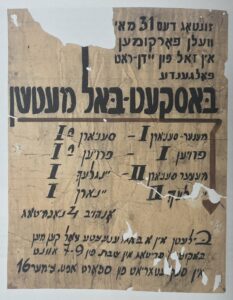
Basketball Competition at the Jewish Council hall, Sunday, May 31, 1942, Ghetto Posters, Number 6, LCVA, F. r-1421, Ap. 2, B. 94

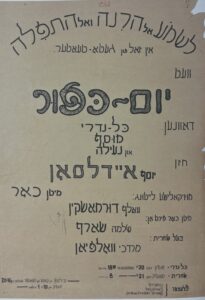
For example, one poster announces a basketball tournament that includes men, women, and seniors. Another announces the opening of the Jewish ghetto theater, whereas others announce specific plays and other cultural events, such as a night commemorating Haim Nahum Bialik. The theater hall also housed Yom Kippur services in 1942.

Ghetto Posters, number 25, LCVA, F. r-1421, Ap. 2, B. 122

On the intellectual side, there were lectures on Jewish history, one on the zugos, and the pairs of Rabbis in the Mishna. Another was an announcement of sermons delivered on the Yom Tefillah that was declared in February 1942.

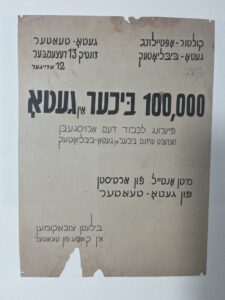
Ghetto Posters, number 46, VŽM 1219

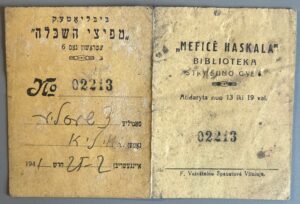
One of the most astounding documents was an announcement that on Sunday, December 13, 1942, at noon, a “Celebration of one hundred thousand books loaned by the Ghetto library” since it opened in September 1941. The ghetto library was in the former Mefitsei Haskalah Library. That library was among the three largest in Vilna. The other two, the Strashun Library and the YIVO Library were closed by the Nazis. This was nearly the same circulation numbers, 90,000 yearly, as before the Nazi invasion and ghettoization of the Vilna’s Jews. Most recently, in the portion of the pre-war documents now at the Judaica Centre at the Lithuanian National Library, a reader’s library card was discovered that slightly pre-dates the formation of the ghetto library. This card, from February 21, 1941, provides the library’s rules, including an admonishment not to leave the books in rain or snow, how to calculate due dates, and fines for overdue books.  

From the Judaica Collection of the National Library of Lithuania 

In addition to the poster is a highly detailed description of the library and its operations that survived the Holocaust. In October 1942, Kruk published “The Library and Reading Room in the Vilna Ghetto, Strashun Street.” The document was originally in Yiddish (and the original is at the YIVO Institute in New York, available here), but Zachary Baker translated it into English and added notes. (See Herman Kruk, “Library and Reading Room in the Vilna Ghetto, Strashun Street 6,” translated by Zachary Baker, in The Holocaust and the Book, Destruction and Preservation, ed. Jonathan Rose, University of Massachusetts Press, 2001, 171-200). 

Kruk provides a prehistory and then specifically recounts the library’s activities since it reopened in September 1941. Among other details, before the war, there were 2,000 subscribers, and in 1940-41, with the influx of Jews from all over Eastern Europe, that number doubled. By September 1941, there were 4,700 subscribers. Men and women were represented almost equally, although women had a slight advantage. The fact that the library reached 100,000 books by December is especially remarkable, in that it was closed for several months as it was too cold to operate. 

Kruk notes significant changes in subject matter and books during this period. For example, there was a 600% increase in readership for War and Peace, and books on war, such as All is Quiet on the Western Front and Emile Zola’s War, were also in high demand. The library’s readers of history were focused on books regarding the Crusades and other martyrdom literature. However, there have been significant changes to the library since before the war. Most notably, 15-30-year-olds made up the bulk of readers during the pre-war period, while in 1942, that number had dropped precipitously. Kruk explains that age groups bearing the brunt of forced labor were too tired to contemplate reading at the end of an exhausting day. 

Kruk summarizes the popularity of libraries and readings, even in the face of death: “A human being can endure hunger, poverty, pain, and suffering, but he cannot tolerate isolation. Then, more than in normal times, the attraction of books and reading is almost indescribable.” 


The Paper Brigade’s Recording of Epitaphs in Vilna’s Old Jewish Cemetery: A Literary Analysis

The Paper Brigade’s Recording of Epitaphs in Vilna’s Old Jewish Cemetery: A Literary Analysis

Shnayer Leiman

I. Introduction.

Shortly after the Nazis captured Vilna on June 24, 1941, representatives from the “Special Detail of Reich-Administrator Alfred Rosenberg” (Einsatzstab des Reichleiter Alfred Rosenberg) arrived in Vilna. Their task was to loot the literary (and other) treasures of Vilna’s Jewish community, and to ship them to Frankfurt.[1] Under the aegis of Nazi “experts” in Jewish matters, a slave-labor unit consisting at times of some 40 Jews was established.[2] Like the other slave-labor units, the group gathered early in the morning each day at the gate of the Jewish Ghetto. It was then marched outside the Ghetto to the nearby YIVO building at 18 Wiwulskiego Street, which had become the headquarters of Einsatzstab Rosenberg in Vilna. A variety of tasks were performed by the members of slave-labor unit, including the sorting of thousands of books and documents, cataloguing materials, and the preparation of essays on topics selected by, and of special interest to, Einsatzstab Rosenberg. The primary Nazi goal was to loot the best of the materials and to destroy the remaining materials. The primary goal of the members of the slave-labor unit was to stay alive by biding their time, and – at the same time – to rescue from destruction as many literary and artistic treasures as possible. They are the heroes of what is known as “the Paper Brigade.”[3]

II. Issues to be examined. One of the more important compilations of the Paper Brigade, completed in 1942, was a list of 51 epitaphs from Vilna’s Old Jewish cemetery in Shnipishok (in use until 1830)[4] and 140 epitaphs from Vilna’s New Jewish cemetery in Zaretcha (in use until 1941).[5] Given the fact that the vast majority of tombstones of both these cemeteries were destroyed, in part during the Holocaust, and primarily during its aftermath under Communist rule, it is imperative that the compilations of the Paper Brigade, prepared in 1942, be examined for their accuracy, and ultimately for their contribution to historical truth. Fortunately, these compilations have been preserved and can easily be accessed.[6] This study will focus only on the 51 epitaphs from Vilna’s Old Jewish cemetery. It will attempt to address, at least in a preliminary fashion, such questions as:

1. Did members of the Paper Brigade actually visit the Old Jewish cemetery and copy the epitaphs that are recorded in the compilations?

2. What other sources may have been used by the members of the Paper Brigade in preparing their compilation?

3. Why were these 51 epitaphs selected for the compilation, given the approximately 300 tombstones[7] with legible epitaphs that were still standing in the Old Jewish cemetery in 1942?

III. Methodology. We will examine samples of the transcriptions of the 51 epitaphs, as they appear in the compilation, and compare them to the transcriptions of the same epitaphs as published in books prior to the Holocaust and as preserved in photographs. We will look for patterns that repeat themselves in the 51 transcriptions of the epitaphs, patterns that may shed light on how, and from where, they were copied.

Epitaph 1: The Vilna Gaon (d.1797).

Discussion: This copy of the Vilna Gaon’s epitaph, for the most part, preserves the text as it first appeared in Yehoshua Heschel Levin, עליות אליהו (Vilna, 1856), p. 90, and in Shmuel Yosef Fuenn, קריה נאמנה (Vilna, 1860), p. 146 (and second edition: Vilna, 1915, pp. 155-156). Henceforth, we will refer to Levin as L. and Fuenn as F. The opening letters of lines 3-13 spell the acrostic רב אליהו גאון. The closing words of lines 3-13 are poetic, all of them ending with the rhyming letters עים or אים. The narrative portion (lines 14 on) follows the texts of L. and F., but not their line divisions.

What needs to be noted here is that this was not what the Vilna Gaon’s epitaph looked like in 1942. Probably due to both natural deterioration and human negligence, some of the letters on the extreme right of the tombstone were rubbed out or smudged. Attempts were made to re-ink some of the missing letters, often creating imaginary words. See below, for photographs A and B.

Photograph A[8] is a pre-Holocaust photo of the epitaph. Photo B[9] is a post- Holocaust photo, taken circa 1995. Notice line 10 in the epitaph, which must begin with an enlarged letter ג , for it begins the word גאון in the acrostic. But in the photographs, one clearly sees what looks like םכר (which probably was originally ג]ם פר[ישות ). In any event, we are served notice by the very first epitaph that the Paper Brigade did not always record what they saw; they surely did not see the words גם פרישות on the Gaon’s tombstone in 1942. They recorded what they knew from other literary sources.

Epitaph 3: R. Shlomo Zalman, father of the Vilna Gaon (d. 1758).

Discussion: The epitaph is replete with letters in parentheses. Parentheses, of course, do not ordinarily appear on Jewish tombstones. Clearly, then, the Paper Brigade either saw a mostly illegible epitaph, and filled in the missing letters, marking them in parentheses, or they copied the entire text from a published book. There is no need here for guesswork. The epitaph was published previously by three different authors: L. (in 1856); F. (in 1860 and 1915); and Israel Klausner, קורות בית-העלמין הישן בוילנה (Vilna, 1935), henceforth K. Here are the three editions of the epitaph:

L. (p. 27, n. 3):

F. (p. 123; second edition, p. 128):

K. (p. 45):

It should be noted that the Paper Brigade erred in the title of the entry, wrongly listing ר’ אליהו חסיד as the father of ר’ שלמה זלמן. Nevertheless, it seems obvious that the Paper Brigade copied the text of the epitaph almost exactly as it appeared in K., recording כסלו (and not א’ דחנוכה), and even inserting the hyphen that connects the names ישכר and בער. There was no need to visit the Old Jewish cemetery in order to copy the epitaph.

Epitaph 9: R. Avigdor b. Shmuel, father of R. Shmuel – the last Av Bet Din of Vilna (d. 1771).

Discussion: It is certainly worth noting that the format follows exactly that of epitaphs 1 and 8, and many others in the Old Jewish cemetery, namely an acrostic at the right of the epitaph, included in a rhymed poem praising the deceased and mourning his loss, followed by a narrative text listing the titles and name of the deceased and the date of death. More importantly for our purposes, this epitaph was copied almost exactly as it appears in F., p. 165; second edition, p. 171:

But note that F. included two sets of parentheses that would not have appeared on the original tombstone. In line 1, the opening word אבי is marked by parentheses, since all three letters were necessary for the acrostic. In the last line, the word תקל”א [5]531 = 1771 was added (in parentheses) for clarification of the year of death. No such markings or words would have appeared on the original tombstone. Again, it is obvious that the Paper Brigade copied the epitaph from a published text. No visit to the Old Jewish cemetery was necessary.

Epitaph 10: R. Eliyahu b. R. Moshe Kramer (d. 1710).

Discussion: The Vilna Gaon was a great-grandson of R. Eliyahu b. Moshe Kramer and, indeed, was named after him. The epitaph preserved in the compilation is taken directly from F., p. 99; second edition, p. 105:

A photograph of the original epitaph has been preserved, taken shortly before or during World War I. It features a three-line marker that identifies the grave, painted just above the epitaph. These lines may well have been added to the gravesite after F.’s visit in 1860. But an examination of the original epitaph indicates that its line division differed considerably from F.

It is clear that the Paper Brigade did not visit the gravesite itself. Below is a photo of the gravesite and a transcription of its epitaph into modern Hebrew font.[10]

Photo Transcription:

Epitaph 14: R. Yehoshua Heschel: Av Bet Din of Vilna (d. 1749).

Discussion: This was a wooden tombstone, well preserved, and photographed circa 1935 (see K., p. 52). The compilation slavishly follows the line division of F., p. 110; second edition, p. 116:

F

The circa 1935 photograph of the tombstone, however, presents a different line division for lines 8 and 10.

K Photo

In F., lines 8 and 10 end with the words זהב and לעולמו, respectively. In K., in the photo taken at the cemetery, the same lines end with the words פרוים and בך”ו , respectively. This suggests once again that the Paper Brigade did not actually copy epitaphs in the Old Jewish cemetery.

Epitaph 30: R. Noah Mindes Lipschuetz (d. 1797).

Discussion: R. Noah Mindes Lipshuetz, distinguished Kabbalist, was buried next to the Vilna Gaon. They died within three months of each other, and were מחותנים as well. (The Vilna Gaon’s son, R. Avraham, was married to Sarah, the daughter of Rabbi Noah and Mrs. Mindes Lipshuetz.) It was decided that they would share one tombstone, with only a narrow painted ivy decoration separating their epitaphs. The original tombstone, with its epitaphs, can be seen to this very day in the Sudervas Jewish cemetery in Vilnius.

Whatever reservations one may still entertain about the compilation having borrowed information directly from F., will surely be dispelled by a careful reading of F.’s recording of R. Noah Lipshuetz’s epitaph:

F 171

The last line of the epitaph in F. (p. 171; second edition, p. 177) reads:

וי”נ (= ויצאה נשמתו) שנת ג’ טבת לפ”ק תאמי צביה “And his soul departed in the year 3 Teveth, equivalent (not counting the thousands) to the numerical value of “Ta’amei Zeviah.” See Song of Songs 7:4. Now the numerical value of “Ta’amei Zeviyah” (not counting the thousands) is [5]558 = 1797, which works perfectly. But the words “and his soul departed in the year 3 Teveth” are senseless. This, of course, is an error (or: typo, if you like) in F. One need merely look at the original epitaph[11] and read the correct Hebrew text: נפטר ביו’ ג טבת שנת תאמי צביה. “He died on the 3rd day of Teveth in the year “Ta’amei Zeviyah.” But the senseless phrase “and his soul departed in the year 3 Teveth” reappears in the compilation prepared by the Paper Brigade! Had the Paper Brigade visited the Old Jewish cemetery in Shnipishok in 1942, it surely would have seen and recorded the correct text of the epitaph.

————————-

There are two epitaphs included in the 51 listed, that merit special attention.

Epitaph 51: R. Shneur Zalman Kaczerginski (d.1815).

The German title at the top of the entry identifies Kaczerginski as a talmudic scholar and philanthropist who died in 1815. As such, he certainly qualifies for inclusion in a compilation of persons buried in Vilna’s Old Jewish cemetery, which was closed in 1830. Alas, no such person was buried in the Old Jewish cemetery! It turns out that Shneur Zalman Kaczerginski was born in 1817 and died in 1887, and – of course – was buried in the Zaretcha cemetery, Vilna’s second Jewish cemetery. The Paper Brigade borrowed the full text of the Kaczerginski epitaph, word for word, from Hillel Noah Steinschneider, עיר ווילנא (Vilna, 1900), vol. 1, p. 290; once again, a sign that the members of the Paper Brigade read books sooner than copying tombstone inscriptions while standing outdoors in the cold.[12] In other words, the Paper Brigade recorded only 50 genuine entries of epitaphs for the Old Jewish cemetery (Alter Friedhof). “Epitaph 51” properly belongs to the Zaretche Jewish cemetery (Neuer Friedhof). Interestingly, Willy Schaefer, one of the Nazi “Jewish” experts who lorded it over the Paper Brigade, writes specifically in his report on Vilna’s Jewish cemeteries that the Paper Brigade had prepared a 108 page research paper with a total of 190 entries of epitaphs.[13] The 108 page research paper has been preserved (and its epitaphs are cited throughout this essay), but Schaefer’s 190 entries of epitaphs was based on the assumption that 50 epitaphs were copied from the Old Jewish cemetery and 140 from the New Jewish cemetery, i.e. Zaretcha, for a total of 190 epitaphs. In fact, we have 51 numbered entries for the Old Jewish cemetery, plus 140 numbered entries for the Zaretcha cemetery, for a total of 191 numbered epitaphs. One can only speculate as to why epitaph 51 was added to the research paper, and in the wrong place at that. And speculate we will! But before doing so, it should be noted that one key spelling difference separates Steinchneider’s recording of the Kaczerginski epitaph from what appears in the Paper Brigade’s report as Epitaph 51. Steinschneider spells the deceased’s last name as: קאצערגיסקי [Kaczergiski]. He even adds in a footnote that the deceased hailed from a town outside of Vilna called Kaczergisak, and that is why the family name is Kaczergiski. But the Paper Brigade lists the deceased’s last name as Katscherginski (in German) and קאצערגינסקי (in Hebrew).

One suspects this may have to do with the key role played by Shmerke Kaczerginski,[14] a Vilna born partisan, and a prominent member of the Paper Brigade.[15] He may have wished to memorialize a possible ancestor who was overlooked by the editors of the Paper Brigade report on epitaphs in the Jewish cemeteries. Perhaps turned down by the editor of the report on Zaretcha, Kaczerginski was able to persuade the editor of the report on the Old Jewish cemetery to add one more entry, epitaph 51 – but that required a falsification of R. Shneur Zalman Kaczergiski’s date of death, and a slight change in the spelling of his name. Whether Steinschneider’s קאצערגיסקי is interchangeable with the name קאצערגינסקי (and its Yiddish equivalent קאטשערגינסקי ) seems questionable to me; and it remains to be proven whether R. Shneur Zalman Kaczergiski was, in fact, an ancestor of Shmerke Kaczerginski.

Epitaph 31: R. Dov Baer Natansohn (d. 1804).

R. Dov Baer Natansohn is described as being active in Vilna’s Great Synagogue, and serving as an official of Vilna’s Jewish Community Council. We know too that in a later period, members of the Natansohn family would play a leading role among Vilna’s moderate Maskilim in the middle of the 19th century.[16] What’s unique about this epitaph is that it is the only one (of the 50 genuine epitaphs of Jews buried in the Old Jewish cemetery) that is not recorded in F. or K. or in any early source known to me. This is almost certainly an indication that R. Dov Ber Natansohn – at least in the eyes of Fuenn and Klausner – did not quite measure up to the names of those included in their monographs. In any event, one could argue, that this epitaph could only have been recorded by a member of the Paper Brigade who actually visited the gravesite at the Old Jewish cemetery. This may well be the case. But is also possible that a descendant of R. Dov Baer Natansohn in the Vilna Ghetto, kept a copy (or even a photograph) of the tombstone, and handed it to a member of the Paper Brigade, so that the epitaph would be preserved for posterity. It should also be mentioned that Khaykl Lunski,[17] the famed librarian of Vilna’s Strashun Library, was an early advisor to the Paper Brigade. In the Vilna Ghetto, he was busy working on a study of the epitaphs in Vilna’s Old Jewish cemetery.[18] He may well have provided a copy of R. Dov Baer Natansohn’s epitaph to a member of the Paper Brigade.

————————————-

In terms of which groups of Jews (buried in the Old Jewish cemetery) were selected for memory by the Paper Brigade, it is clear that a prior selection had already been made by F. and K. As indicated above, 49 out of the 50 genuine epitaphs were borrowed from the earlier accounts in F. and K. These were elitist accounts that focused primarily on professional rabbis and rabbinic scholars, and Jewish communal leaders. F. precluded women from the entries in his book; K. included women, but (for the most part) only to the extent that they were family members of famous rabbis, such as the Vilna Gaon. Looking specifically at the 50 epitaphs included in the Paper Brigade report, some 25 are distinguished professional rabbis and rabbinic scholars; approximately 8 others relate to the Vilna Gaon and members of his family (including women); approximately 8 relate to Jewish communal leaders; approximately 6 relate to professionals (e.g., doctors, printers, and cantors); with approximately 2 or 3 miscellaneous cases (e.g., the Ger Zedek; and R. Yehudah Asher Guenzberg, father of the Maskil Mordechai Aaron Guenzberg). Clearly, the report was prepared by someone who was sympathetic to the prominent role played by rabbinic culture in Vilna’s early modern period, and who knew where to look for the sources he needed in order to prepare the report.

Some will quibble over the tendency of the Paper Brigade to overlook the common man and woman when listing their selected epitaphs. After all, every Jewish man and woman who died in Vilna between 1592 and 1830 was buried in the Old Jewish cemetery. They seem to forget that it was 1942, under Nazi rule, and in the Vilna Ghetto, that the report was written, hardly the time and place to engage in original sociological research of any kind. At best, they could examine the printed books in the Ghetto library, or perhaps those gathered in the former YIVO building, now the headquarters of Einsatzstab Rosenberg. This they did with great skill, and often, at great risk to their lives.

In sum, it appears unlikely that the Paper Brigade spent much time, if any at all, in Vilna’s Old Jewish cemetery. The primary source for the epitaphs gathered by the Paper Brigade was a series of volumes published by a variety of scholars, including Shmuel Yosef Fuenn, Yisrael Klausner, and Hillel Noah Steinschneider. The content of those earlier volumes influenced the scope of the epitaphs that the Paper Brigade could choose for inclusion in their final report. Finally, we wish to stress that whatever is said here applies only to the Paper Brigade report regarding the Old Jewish cemetery. Even a cursory glance at the Paper Brigade report on the Zaretche cemetery indicates that its author recorded countless epitaphs that had – and have – never appeared in print. As such, it is imperative that the report be examined for the many epitaphs it, and it alone, preserves.

————————

NOTES

[1] For an early account of Alfred Rosenberg and his anti-Jewish “academic” activity, see Max Weinreich, Hitler’s Professors: The Part of Scholarship in Germany’s Crimes Against the Jewish People (New York: YIVO, 1946), pp. 77-78, note 171, and pp. 97-106. A vast literature exists on Rosenberg; for the more recent studies, see the bibliography appended to his entry on Wikipedia.
[2] On up to 40 Jews serving in the slave-labor unit, see Shmerka Kaczerginski, פארטיזאנער גייען: זכרונות פון ווילנער געטא (Buenos Aires: Union Central Israelita Polaca en la Argentina, 1947), p. 63.
[3] For the definitive study on the Paper Brigade, see David E. Fishman, The Book Smugglers: Partisans, Poets, and the Race to Save Jewish Treasures from the Nazis; The True Story of the Paper Brigade of Vilna (Lebanon, New Hampshire: ForeEdge, 2017). Cf. his Embers Plucked From the Fire: The Rescue of Jewish Cultural Treasures in Vilna (New York (YIVO, 1996; second expanded edition, YIVO, 2009); and his “Split Identity: Jewish Scholarship in the Vilna Ghetto,” אין געוועב : A Journal of Yiddish Studies, June 30, 2020, pp. 1-9.
[4]  For a history of Vilna’s Old Jewish cemetery, see I. Klausner, קורות בית-העלמין הישן בוילנה (Vilna: S. An-ski Jewish Historical and Ethnographic Society, 1935); Elmantas Meilus, “The History of Vilnius Old Jewish Cemetery at Šnipiškes in the Period of the Grand Duchy of Lithuania,” Lithuanian Historical Studies 12 (2007), pp. 63-92; and Vytautas Jogela, “The Old Jewish Cemetery in the Nineteenth and Twentieth Centuries,” Lituanus 61:4 (2015), pp. 76-93.
[5] A history of Vilna’s New Jewish cemetery in Zaretcha remains a scholarly desideratum. Tentatively, see I. Klausner, “צו דער געשיכטע פון יידן אין ווילנע: דאס נייע פעלד”, in צייט, October 4, 1933, p. 4; Zalman Szyk, יאר ווילנא 1000 (Vilne: געזעלשאפט פאר לאנדקענטניש אין פוילן, 1939), pp. 418-437; Vida Girininkiene, “The Jewish Cemetery on Olandų Street: History and Reflections,” in Rimantas Dichavičius, Paminklas Paminklui (Vilnius: UAB Balto Print, 2020), pp.19-25; and Irina Guzenberg, Vilnius: Traces of the Jerusalem of Lithuania (Vilnius: Pavilniai, 2021), pp. 691-700.
[6] The compilations of the Paper Brigade are available in Vilnius at the Judaica collection of the Mažvydas National Library of Lithuania. Based upon evidence from the Vilnius archives, Jogela (above, note 4), p. 84, claims that “a certain Goldbergas” compiled the list of 51 epitaphs. Jogela does not identify Goldbergas, but almost certainly it was Eliezer Goldberg, Jewish educator and historian. Prior to the Holocaust, he administered and taught at Vilna’s Esther Rubinstein School for Girls. In the Vilna Ghetto, he lectured widely on Jewish history in the various synagogues and schools. In 1943, he was deported by the Nazis to Estonia, where he perished in 1944. On Goldberg, see Shmerka Kaczerginski, חורבן ווילנא (New York: United Vilner Relief Committee, 1947), p.236; H.S. Kazdan, ed., לערער יזכור בוך: די אומגעקומענע לערער פון צישא שולן אין פוילן (New York: Martin Press, 1954), p. 72 (where Goldberg is described as א ייד א למדן און מיט וועלטלעכער בילדונג ); J. Biber, R. Kostanian, and J. Rozina, eds., Vilna Ghetto Posters: Album-Catalogue (Vilnius: Vilna Gaon Jewish State Museum, 2006), p. 265 (which includes a photograph of Goldberg); and A. Einat, חיי יום-יום בגטו וילנה (Haifa: Moreshet, 2013), pp. 240 and 417. It is too early to speculate how many other hands were involved in selecting the 191 epitaphs included in the Paper Brigade’s final report.
[7] See Klausner, pp. 77-82, who lists 220 named graves that were still standing in 1935. Actually, many of the “named graves” were grave sites with more than one named grave at the site, all of them listed by Klausner. Thus, a total of approximately 240 names are listed. On pp. 83-84, Klausner lists an additional 51 named graves , some of them grave sites, strewn throughout the cemetery. They actually total 55 names. The 240 names plus the additional 55 names yield an approximate total of 300 names.

[8] Photograph A is taken from the late Yeshayahu Epstein’s collection of pre-Holocaust photographs of Vilna. See Yitzchak Alfasi, ed., וילנא ירושלים דליטא חרבה! היתה ואיננה עוד (Tel-Aviv, 1993), p. 10.
[9] Photograph B is taken from the pamphlet Vilniaus Gaonas Elijahu אליהו הגאון מוילנה (Vilnius, 1996), no pagination, issued by the Lithuanian Jewish Community in anticipation of the commemoration of the 200th anniversary of the death of the Vilna Gaon (1797-1997).
[10] The photo and the transcription are taken from S. Leiman, “A Picture and its One Thousand Words: The Old Jewish Cemetery in Vilna Revisited,” The Seforim Blog, January 14, 2016, section A, item 7 and notes.
[11] See above, at Epitaph 1, Photo B, for a full frontal color photograph of the joint tombstone inscriptions of R. Noah Mindes Lipschuetz and the Vilna Gaon; cf. Photo A. In the light of the evidence presented here, R. Noah Mindes Lipschuetz did not die in November of 1797, as claimed by the German heading to Epitaph 30. He died on, or about, December 22, 1797 (= 3 Teveth, 5558), some two and a half months after the death of the Vilna Gaon on October 9, 1797 (= 19 Tishre, 5558). For an alternate reading of the somewhat unclear last lines of the epitaph (that correctly preserves the יום ג’ טבת date of death), see R. Yitzchok Arnstein’s edition of R. Noah Mindes Lipschuetz’ פרפראות לחכמה (Brooklyn: Edison Lithographic Corporation, 1995), Introduction, p. 17.
[12] Steinschneider’s text reads as follows:


[13] See Schaefer’s essay entitled “Friedhöfe und Grabsteine der Juden in Wilna,” dated 1/9/1943 (in the Judaica collection at the Mažvydas National Library of Lithuania). On the title page he refers (in German) to his gathering together of “190 tombstone inscriptions in 108 typewritten pages.”
[14] A vast literature was produced by, and exists on, Shmerke Kaczerginski (1908-1954), Yiddish poet and Vilna partisan. In general, see the entry on him in לעקסיקאן פון דער נייער יידישער ליטעראטור (New York: Congress for Jewish Culture, 1981), vol. 8, columns 48-50; and the more recent bibliography appended to his entry in Wikipedia.
[15] For some of Kaczerginski’s own reflections on the Paper Brigade, see his פארטיזאנער גייען! זכרונות פון ווילנער געטא (Buenos Aires: צאנטראל-פארבאנד פון פוילישע יידן אין ארגענטינא, 1947), pp. 61-69; חורבן ווילנע (New York: United Vilner Relief Committee, 1947), p. 337; and איך בין געווען א פארטיזאן (Buenos Aires: Cultura, 1952), pp. 40-44.
[16] See Mordechai Zalkin, בעלות השחר (Jerusalem: Magnes Press, 2000), p. 34, n. 45, and passim.
[17]  On Haykl Lunski, see Hirsz Abramowicz, Profiles of a Lost World: Memoirs of East European Jewish Life before World War II (Detroit: Wayne State University Press, 1999), pp. 260-264. Cf. Frida Shor, מ”לקוטי שושנים” ועד “בריגדת הנייר”: סיפורו של בית עקד הספרים ע”ש שטראשון בווילנה (Tel Aviv: Probook, 2012); and Dan Rabinowitz, The Lost Library: The Legacy of Vilna’s Strashun Library in the Aftermath of the Holocaust (Waltham: Brandeis University Press, 2019).
[18] S. Kaczerginski, חורבן ווילנע (New York: United Vilner Relief Committee, 1947), p. 198.


Hirschian Humanism After the Holocaust: An Analysis of the Approach of Rabbi Shimon Schwab

Hirschian Humanism After the Holocaust:
An Analysis of the Approach of Rabbi Shimon Schwab
By Rabbi Shmuel Lesher

Rabbi Shmuel Lesher is a Machon Beren Kollel fellow at RIETS / Yeshiva University. Prior to completing his rabbinic ordination at RIETS, Rabbi Lesher studied at the Mirrer Yeshiva in Jerusalem and Yeshiva of Greater Washington in Silver Spring, Maryland. Rabbi Lesher lives in Washington Heights, with his wife Leora and their three children.

This is his first contribution to the Seforim Blog.

In 1959, Rabbi Shimon Schwab[1] made a unique contribution to the way his community and others commemorate the Holocaust. Shortly after he joined the rabbinate of K’hal Adath Jeshurun in Washington Heights, Manhattan, R. Schwab was asked by R. Joseph Breuer[2] to compose a special Tisha B’av kinnah for their kehillah. Although it was originally written for the KAJ community, many other congregations have adopted the custom of reciting it on Tisha B’av.[3] To be sure, there have been others who authored kinnot to commemorate the Holocaust.[4] However, it appears that, especially in America, R. Schwab’s kinnah is perhaps one of the first written by a rabbinic figure to gain widespread popularity.

In addition to his innovative Holocaust kinnah, the events of the Holocaust played a significant role in how R. Schwab interpreted and perpetuated the Torah Im Derekh Eretz philosophy to which he was heir. According to R. Schwab, Torah Im Derekh Eretz was seen by R. Samson Raphael Hirsch as the ideal model. However, openness to secular culture has historically been the minority opinion among gedolei yisrael.[5]

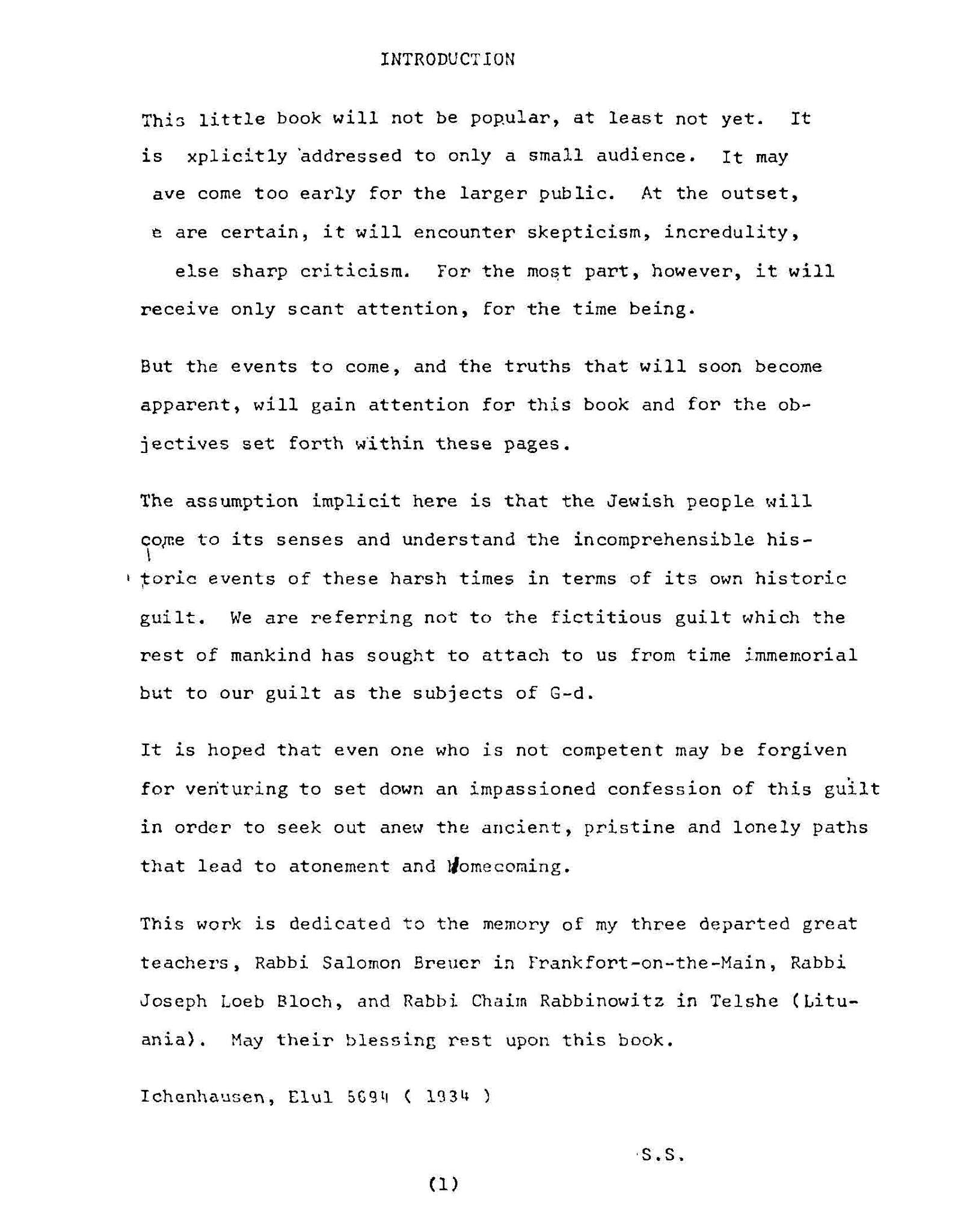
R. Schwab reached this conclusion after re-evaluating his position multiple times throughout his life. In a speech he delivered in 1990,[6] he recalled how the events of Kristallnacht (Nov 9, 1938 – Nov 10, 1938), and later the Holocaust, shook his belief in Torah Im Derekh Eretz to the core. How could R. Hirsch have believed the humanism of Germany would lead to an uplifted and righteous society when the same humanistic society ended up committed genocide without much protest from the “enlightened students of Schiller and Goethe?”[7] R. Hirsch must not have seen German humanistic Bildung[8] as anything more than a time-bound compromise in order to save his community from assimilation.[9] R. Schwab was referring to an essay he wrote in 1934 entitled Heimkehr ins Judentum (Homecoming To Judaism).[10] Here R. Schwab claimed R. Hirsch only intended Torah Im Derekh Eretz as a temporary allowance. This book was the first substantial rejection of Torah Im Derekh Eretz written by someone who grew up in the Hirschian community.[11]

An English version of this essay, prepared by K’hal Adath Jeshurun translator Gertrude Hirschler, appeared in 1978.[12]

Around the same time he published Heimkehr ins Judentum, R. Schwab wrote to a number of Eastern European Torah leaders asking them about the permissibility of incorporating secular studies into a yeshiva curriculum.[13] Dr. Marc B. Shapiro notes that this was yet another sign of the waning popularity of Torah Im Derekh Eretz at the time, even in Germany itself.[14] Apparently, R. Schwab, who had studied in Lithuanian yeshivot, was not convinced of the permissibility of what had been established as normative practice in his own country. Dr. Shapiro’s analysis is correct. However, consider R. Schwab’s query in light of his unequivocal rejection of Torah Im Derekh Eretz in his Heimkehr ins Judentum. Based on the dates of his letters and the responses of his interlocutors, it appears that even as he published Heimkehr ins Judentum, R. Schwab felt the viability of Torah Im Derekh Eretz was still an open question — or at least one still worthy of inquiry.[15]

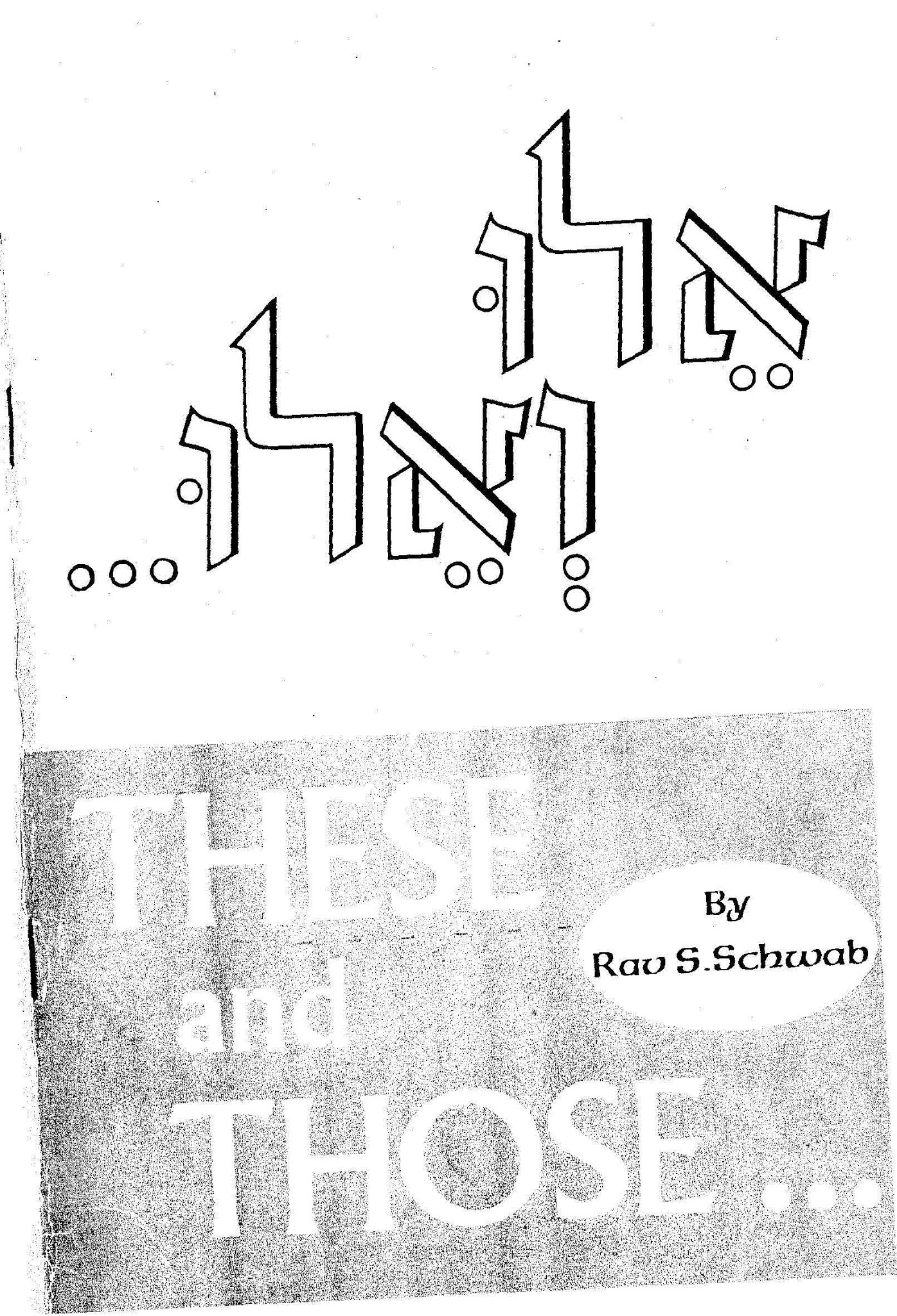
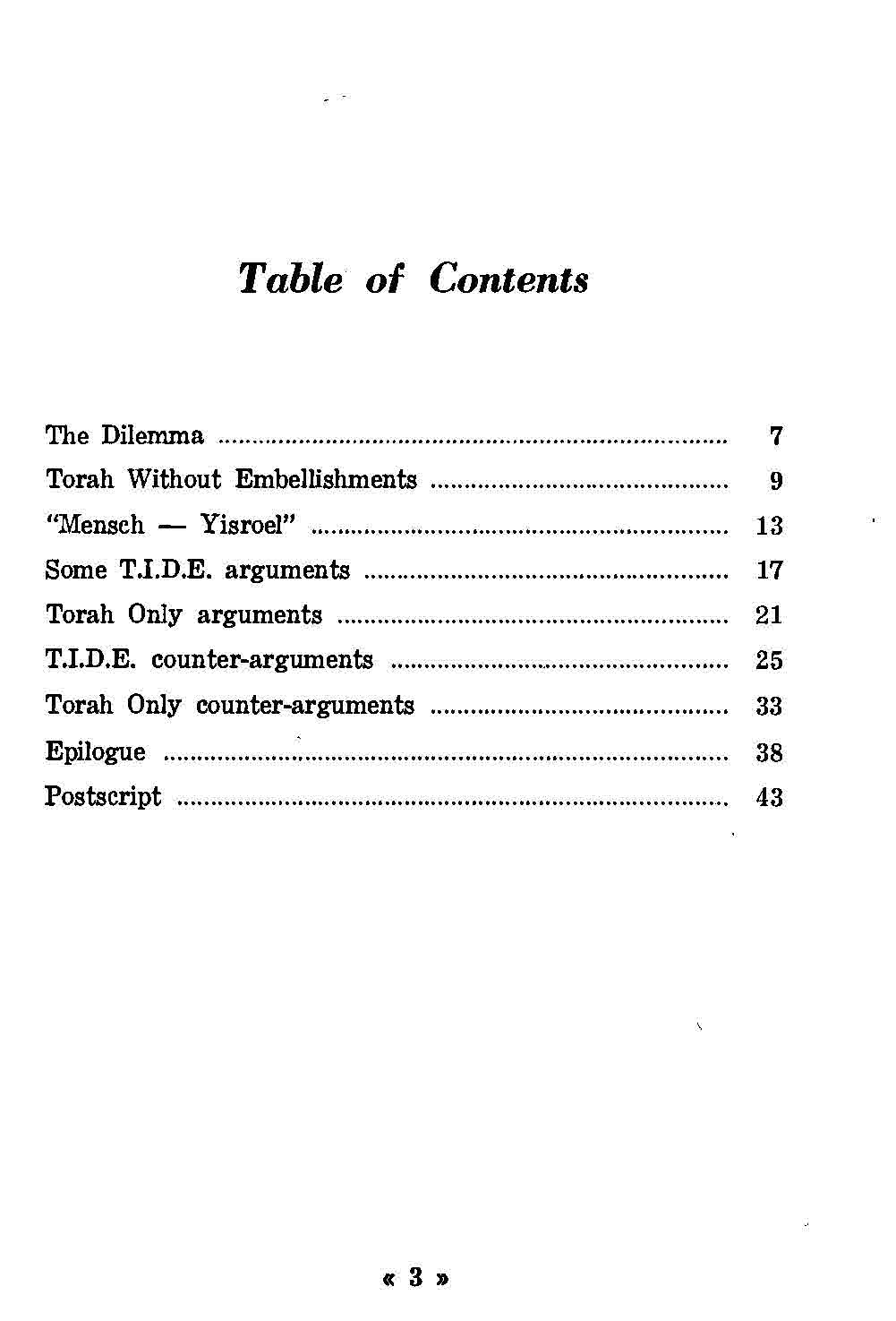
Later in his life, after re-assessing R. Hirsch writings, R. Schwab came to believe that his earlier view was incorrect. In this later re-evaluation, R. Schwab felt that Hirsch did, in fact, wholeheartedly believe in the significance of humanism for society. After this realization, in 1966, R. Schwab wrote an essay entitled, “Elu ViElu: These and Those,” which showed the validity and necessity of both the “Torah Only” approach of many gedolei yisrael and the Hirschian “Torah Im Derekh Eretz” approach. R. Schwab wrote this 47-page pamphlet in the form of a series of dialogues intended as the “echoes of endless discussions amongst our searching youth.”[16]

On the 48th anniversary of Kristallnacht, in 1986, R. Schwab echoed his previous concern, expressing that in a post-Holocaust world, although he accepted R. Hirsch’s Torah Im Derekh Erech application to science, medicine, and history, he could no longer believe in the power of culture and secular humanism.[17] Although R. Hirsch celebrated Schiller, and all the values of ethics and humanism he represented, this vision was “broken by the shattering of windows and the screaming of frightened children in the night.”[18] “We do not extend Torah Im Derekh Eretz to include philosophy, ethics, morality or humanism…No longer are we going to seek out Schiller to teach us about humanity. It no longer interests us.”[19] He therefore discouraged the study of these disciplines, stating unequivocally:

“The age of Humanism was a passing episode in the annals of history…The lessons of Kristallnacht – don’t believe there is Torah among the goyim (gentiles). Let us not make the same mistake as our ancestors, to believe there is any other ethical culture for us beside the Torah.”[20]

However, as forceful as this statement was, it is unclear if this was in fact R. Schwab’s final position. In his last comments on the matter in 1990, he argued for Torah Im Derekh Eretz as an ideal model.[21] Although he did caution about the dangers of the arts and literature influencing our moral compass, he did not vouch for a complete break with those disciplines.[22] As indicated by the title of his essay, R. Schwab believed, “Elu ViElu divrei Elokim hayim” – These and those are the words of the Living God.[23] Both the “Torah Only” approach of the majority of gedolei yisrael, and the “Torah Im Derekh Eretz” approach are of equal validity and importance for the Jewish community.[24] However, as the Holocaust demonstrated, we should be cautious when approaching secular humanism. Ultimately, there is no other true ethical code that produces an uplifted and righteous society other than the Torah. Although commitment to both disciplines – Torah and humanism – was seen by R. Hirsch as the ultimate goal, it appears that the same cannot be said for R. Schwab.[25]

Although R. Schwab apparently regained some of his conviction in Hirschian humanism, the Holocaust challenge has been posed to the Hirschian position and to religious humanism in general. How can one believe the study of the humanities can guarantee humaneness? R. Aharon Lichtenstein marshals the words of the literary critic George Steiner:

“We now know that a man can read Goethe or Rilke in the evening, that he can play Bach and Schubert, and go to his day’s work in Auschwitz. To say he has read them without understanding or that his ear is gross, is cant. In what way does this knowledge bear on literature and society, on the hope, grown almost axiomatic from the time of Plato to that of Mathew Arnold, that culture is a humanizing force, that the energies of the spirit are transverse to those of conduct?”[26]

R. Lichtenstein notes this is a “terrifying question for believers in the self-sufficiency of secular humanism, [and] a formidable one for advocates of religious humanism.”[27] In response to this challenge, R. Lichtenstein argues as long as the ultimate source of morality is the Torah and our humanism is fettered in religious conviction, religious life can gain much from the study of the humanities.[28]

We cannot know how R. Hirsch himself would respond to this challenge, however, one can certainly hear echoes of Hirschian thought in R. Lichtenstein’s defense of religious humanism.[29] According to the Hirschian authority Dayan Isidor Grunfeld, R. Hirsch argued for a religious humanism anchored by divine revelation. In fact, Grunfeld loosely translated Torah Im Derekh Eretz, the slogan most commonly associated with R. Hirsch, as “God-rooted religious humanism.”[30]

In this view, an irreligious or secular humanism is bound not to elevate man, but rather to debase him. Religious humanism, on the other hand, embraces the intrinsic dignity of man because he was created in the image of God.[31] For R. Hirsch, this principle is fundamental to his view of all of mankind joined in one universal “brotherhood.”[32] By ceasing to regard man as being of a higher and divine origin, secular humanism, paradoxically results in the diminishing of man’s value.[33]

In fact, R. Hirsch in his commentary on the Torah, argues for the intrinsic value of Torah Im Derekh Eretz, or culture, even in the face of the potential negative impact of secular culture:

“Culture starts the work of educating the generations of mankind and the Torah completes it; for the Torah is the most finished education of Man…culture in the service of morality is the first stage of Man’s return to God. For us Jews, Derekh Eretz and Torah are one. The most perfect gentleman and the most perfect Jew, to the Jewish teaching, are identical. But in the general development of mankind culture comes earlier…

But of course, where culture and civilisation are used in the service of sensuality and degeneration only gets all the greater. But still such misuse of culture does not do away with the intrinsic value and blessing of Derekh Eretz.”[34]

Although what can be called “low culture” or “degenerative humanism” corrupts Torah ideals, this does not negate the intrinsic value of “good and true culture.” Indeed, according to R. Hirsch, “Jews rejoice whenever or wherever culture elevates people to a perception of true values and to nurture goodness.”[35]

Perhaps the Hirschian response to the Holocaust challenge is that if we do not believe we are the ultimate arbiters of truth and morality, fundamentally, our value system remains sacrosanct even when it is not recognized by society, namely, even in Nazi Germany. The utter failing of a secular humanistic society does not undermine the value of a God-fettered humanism. Even after the horrors of the Holocaust, Hirschian humanism remains intact. In the words of Jacob Breuer, Torah Im Derekh Eretz is indeed a “Timeless Torah.”[36]

Notes:

Thank you to Dan Rabinowitz and the editors at the Seforim Blog for their assistance. Thank you to my father-in law R. Hanan Balk and Yehuda Geberer who shared some important sources with me. I am indebted to my rebbe and mentor R. Netanel Wiederblank in general, and in particular for his advice and insight into this topic.

[1] R. Schwab served as a rabbinic leader K’hal Adath Jeshurun from his arrival in 1958 until his passing in 1995. For biographical details on R. Schwab, see R. Moses L. Schwab, “Rav Simon Schwab: A Biography,” in Moreshet Tzvi – The Living Hirschian Legacy: Essays on ‘Torah im Derech Eretz’ and the Contemporary Hirschian Kehilla (New York: K’hal Adath Jeshurun, 1988), 45-51. For other essays in this volume, see the Table of Contents:

See also R. Moshe L. Schwab, “Biography of Rav Shimon Schwab,” in Rav Schwab on Prayer (Brooklyn: ArtScroll Mesorah, 2001), ix-xx available here; R. Eliyahu Meir Klugman, “The Ish Ha’Emes: The Man of Impeccable Integrity, Rabbi Shimon Schwab,” The Jewish Observer, vol. 28, no. 5 (Summer 1995): 11-22, available here.
[2] Rabbi Dr. Joseph Breuer, the grandson of R. Samson Raphael Hirsch, was the founding Rav of K’hal Adath Jeshurun in Washington Heights, Manhattan. For biographical details on R. Breuer, see David Kranzler and R. Dovid Landesman, Rav Breuer: His Life and His Legacy (New York: Feldheim, 1998) and Dr. Ernst J. Bodenheimer and R. Nosson Scherman, “Rav Dr. Joseph Breuer zt”l, One Year After His Passing,” The Jewish Observer, vol. 15, no. 6 (May 1981): 3-10, available here.
[3] See R. Avrohom Chaim Feuer and R. Avie Gold, eds., Tefillah L’Moshe: The Complete Tisha B’av Service (Brooklyn: Artscroll Mesorah, 1992), 392-394, who cite the background story to the kinnah from R. Schwab himself. Also see Moshe Schwab, “A Biography of Rav Shimon Schwab,” Rav Schwab on Prayer, xix, who also references the story. For the text of R. Schwab’s Holocaust Kinnah, see here, courtesy of ArtScroll/Mesorah.
[4] For other kinnot composed for the Holocaust, see Mordechai Meir, “Zakhor Na Ha-Bikhiot Bi-Tahom HaGoyot: Kinnot L’zekher HaShoah,” Akadamot, vol. 9 (2000): 77-99 (Hebrew), available here; and Jacob J. Schacter, “Holocaust Commemoration and Tish’a be-Av: The Debate Over ‘Yom ha-Sho’a’,” Tradition: A Journal of Orthodox Jewish Thought, vol. 41, no. 2 (Summer 2008): 164-197, available here, especially 194-195n36-41 for sources on R. Joseph B. Soloveitchik’s position. See also Jacob J. Schacter, “The Rav and the Tisha B’Av Kinot,” in Zev Eleff, ed., Mentor of Generations: Reflections on Rabbi Joseph B. Soloveitchik (Jersey City: Ktav, 2008), 303-314, available here, and earlier in Jacob J. Schacter, “Rabbi Joseph B. Soloveitchik zt”l on the Tisha B’Av Kinos,” Jewish Action, vol. 54, no. 4 (Summer 1994): 11-12, available here.

[5] Anonymous, “A Letter Regarding ‘the Frankfurt Approach’,” ha-Ma’ayan, vol. 6, no. 4 (1966): 4-7 (Hebrew)

A translation of this anonymous essay appears in Shnayer Z. Leiman, “From the Pages of Tradition – R. Shimon Schwab: A Letter Regarding the “Frankfurt’ Approach,” Tradition: A Journal of Orthodox Jewish Thought, vol. 31, no. 3 (Spring 1997): 71-77, available here. Dr. Leiman writes in 77n4 that members of ha-Ma’ayan’s editorial board confirmed his suspicion that the Anonymous author was R. Shimon Schwab.
[6] R. Shimon Schwab, “Torah Im Derech Eretz – A Second View,” in Selected Speeches: A Collection of Addresses and Essays on Hashkafah, Contemporary Issues and Jewish History (New York: C.I.S. Publishers, 1991), 236-252, the transcript of an address delivered at K’hal Adath Jeshurun on February 19, 1990.
[7] Ibid.
[8] Referring to the German tradition of self-formation through acculturation and education attributed to Wilhelm Von Humboldt (1791-1810).
[9] R. Shimon Schwab, “Torah Im Derech Eretz – A Second View,” in Selected Speeches: A Collection of Addresses and Essays on Hashkafah, Contemporary Issues and Jewish History (New York: C.I.S. Publishers, 1991), 239.
[10] R. Shimon Schwab, Heimkehr ins Judentum (Homecoming To Judaism) (Frankfurt: Hermon-Verlag, 1934; German).
[11] Marc B. Shapiro, Between The Yeshiva World and Modern Orthodoxy: The Life and Works of Jehiel Jacob Weinberg 1884-1966 (Portland: Littman Library, 1999), 152. Dr. Shapiro notes that one of the first articles written by the great Jewish historian Jacob Katz was a review of Heimkehr ins Judentum. See Jacob Katz, “Umkher oder Rückkehr – Review of ‘Heimkehr ins Judentum’, by Simon Schwab,” Nahalat Tsevi, vol. 5 (1935): 89-96, available here; and Jacob Katz, With My Own Eyes: The Autobiography of an Historian, trans. Ziporah Brody (Hanover, NH: New England Universities Press, 1995), 96.
[12] R. Shimon Schwab, Heimkehr ins Judentum (Homecoming to Judaism), trans. Gertrude Hirschler (New York, 1978).
[13] See Marc B. Shapiro, Between The Yeshiva World and Modern Orthodoxy: The Life and Works of Jehiel Jacob Weinberg 1884-1966 (Portland: Littman Library, 1999), 152, who notes that a copy of the original letter exists in the Joseph Rozin Archive, Yeshiva University. The four Eastern European rabbis who are known to have responded in writing are R. Elhanan Wasserman, R. Barukh Ber Leibowitz, R. Avraham Yitzhak Bloch, and R. Yosef Rozen. Their replies are printed in Yehuda (Leo) Levi, Shaarei Talmud Torah (Jerusalem: Feldheim, 1981), 296-312 (Hebrew) and R. Bloch’s response was first published in Proceedings of the Association of Orthodox Jewish Scientists, vol. 1 (New York: AOJS, 1966), 107-112, available here. For more on the background of R. Schwab’s letter and the responses he received, see Jacob J. Schacter, “Torah u-Madda Revisited: The Editor’s Introduction,” The Torah u-Madda Journal, vol. 1 (1989): 1-22, available here, especially 15n1-2; Yehuda (Leo) Levi, “Rabbi Samson Raphael Hirsch-Myth and Fact,” Tradition: A Journal of Orthodox Jewish Thought, vol. 31, no. 3 (Spring 1997): 5-22, esp. 11, available here, and Marc B. Shapiro, “Torah im Derekh Erez in the Shadow of Hitler,” The Torah u-Madda Journal, vol. 14 (2006-2007): 84-96, esp. 85-86,95 available here.
[14] See Marc B. Shapiro, Between The Yeshiva World and Modern Orthodoxy: The Life and Works of Jehiel Jacob Weinberg 1884-1966 (Portland: Littman Library, 1999), 152.
[15] There seems to be some discrepancies among those who record the story. Marc B. Shapiro dates the letter to 1933, whereas Jacob J. Schacter says it was 1934. Most surprising, is R. Dr. Norman Lamm’s assertion that the question was posed from America. See R. Norman Lamm, Torah Umadda: The Encounter of Religious Learning and Worldly Knowledge in the Jewish Tradition (Northvale, NJ: Jason Aronson, 1990), 39. Either way, contrary to what Dr. Levi writes that R. Schwab was still a student in a Lithuanian yeshiva when he posed the question, R. Schwab had already left the Mir Yeshiva by 1931. By September of 1933 he had already accepted a rabbinic position in Ichenhausen, Bavaria. See Moshe L. Schwab, “Biography of Rav Shimon Schwab,” Rav Schwab on Prayer, x-xi. It appears more likely that R. Schwab sent his letters as he started making arrangements to open a yeshiva in Bavaria. This is, in fact, how I heard the story from R. Dovid Landesman, R. Breuer’s biographer. See his R. Dovid Landesman, There Are No Basketball Courts In Heaven (McKeesport, PA: Jewish Educational Workshop, 2010), 142-143. Nevertheless, there is reason to believe that Dr. Levi’s record of the story should be the most accurate. In addition to publishing the four responses to R. Schwab, Dr. Levi writes in his Torah Study: A Survey of Classic Sources on Timely Issues (New York: Feldheim, 2002), 363n13, available here, that R. Schwab himself shared R. Yosef Rozen’s response with him personally. It is unlikely that Dr. Levi would not have gotten the context of the letters accurately from R. Schwab. Perhaps one can suggest in Dr. Levi’s defense, that R. Schwab may have posed the question at least twice. Once when he was a yeshiva student in Lithuania and then again in writing later when opening a yeshiva in Bavaria.
[16] It was published by Philipp Feldheim, Inc., and included a brief preface by R. Dr. Joseph Breuer. See also the related essay by R. Joseph Breuer, “Torah im Derech Eretz: A Hora’at Sha’ah?” Mitteilungen, vol. 26 (August – September 1965): 1-2 (German), and then translated into Hebrew as R. Joseph Breuer, “Torah ‘im Derekh Erez. —Hora’at Sha’ah?” ha-Ma’ayan, vol. 6, no. 4 (1966): 1-3 (Hebrew). See also Shnayer Z. Leiman, “Rabbinic Responses to Modernity,” Judaic Studies, no. 5 (Fall 2007): 1-122, available here, especially pp. 57-96 on R. Samson Raphael Hirsch, and esp. 84-85n122 on this article by R. Breuer. It is beyond the scope of this essay to explore this article by R. Schwab.
[17] R. Shimon Schwab, “Kristallnacht: A Historical Perspective,” in Selected Writings: A Collection of Addresses and Essays on Hashkafah, Jewish History and Contemporary Issues (New York: C.I.S, 1988), 81-87. See also R. Shimon Schwab, “Fifty Year After Kristallnacht,” in Selected Speeches: A Collection of Addresses and Essays on Hashkafah, Contemporary Issues and Jewish History (New York: C.I.S. Publishers, 1991), 30-36, the transcript of an address delivered at K’hal Adath Jeshurun on October 30, 1988.
[18] R. Shimon Schwab, “Kristallnacht: A Historical Perspective,” in Selected Writings: A Collection of Addresses and Essays on Hashkafah, Jewish History and Contemporary Issues (New York: C.I.S, 1988), 84-86.

For further on R. Samson Raphael Hirsch and Friedrich von Schiller, see the annotated translation of R. Samson Raphael Hirsch’s address delivered at “the Celebration of the Israelitischen Religionsgesellschaft’s School in Frankfurt am Main on November 9, 1859 on the Eve of the Schiller Festival,” which was first translated to English in Marc B. Shapiro, “Rabbi Samson Raphael Hirsch and Friedrich von Schiller,” Torah u-Madda Journal, vol. 15 (2008-2009): 172-187, available here. Several years later, in 2012, the official publication committee of R. Samson Raphael Hirsch’s writings for the Hirschian community published an English translation of R. Samson Raphael Hirsch, “Address Delivered on the Eve of the Schiller Centenary,” in The Collected Writings of Rabbi Samson Raphael Hirsch, vol. 9: Timeless Hashkafah (New York: Rabbi Dr. Joseph Breuer Foundation, 2012), 137-152, with the translation having been decades earlier by Gertrude Hirschler.
[19] R. Shimon Schwab, “Kristallnacht: A Historical Perspective,” in Selected Writings: A Collection of Addresses and Essays on Hashkafah, Jewish History and Contemporary Issues (New York: C.I.S, 1988), 86.
[20] Ibid. Also see Rav Schwab on Prayer, 54 where R. Schwab noted on November 10th, 1990, on the anniversary of Kristallnacht, that “this nation [Germany] of poets and thinkers’ was, at its core, really nothing but a horde of highly organized wild animals. All their developments in medicine, science, art, music, and philosophy did not make them one iota more human.”
[21] R. Shimon Schwab, “Torah Im Derech Eretz – A Second View,” in Selected Speeches: A Collection of Addresses and Essays on Hashkafah, Contemporary Issues and Jewish History (New York: C.I.S. Publishers, 1991), 236-252. In fact, in his Ma’ayan Beit Ha-Shoevah (Brooklyn: ArtScroll Mesorah, 1994), Parshat Yitro, 194 (Hebrew) he takes a more humanistic approach to explain the very same Midrash he mentioned as the lesson of Kristallnacht – “If a person tells you there is Torah among the nations of the world, do not believe him. However, if a person tells you there is wisdom among the gentiles, believe him (Eicha Rabba 2:13).
[22] R. Shimon Schwab, “Torah Im Derech Eretz – A Second View,” in Selected Speeches: A Collection of Addresses and Essays on Hashkafah, Contemporary Issues and Jewish History (New York: C.I.S. Publishers, 1991), 246.
[23] A reference to Eruvin 13b.
[24] R. Shimon Schwab, These and Those (New York: Feldheim, 1966), 40-42.
[25] For more on the development of R. Schwab’s position vis a vis Torah Im Derekh Eretz as well as his criticisms of Modern Orthodoxy and Torah u-Madda, see Zev Eleff, “American Orthodoxy’s Lukewarm Embrace of the Hirschian Legacy, 1850-1939,” Tradition: A Journal of Orthodox Jewish Thought, vol. 45, no. 3 (Fall 2012): 35-53, available here; and Zev Eleff, “Between Bennett and Amsterdam Avenues: The Complex American Legacy of Samson Raphael Hirsch, 1939-2013,” Tradition: A Journal of Orthodox Jewish Thought, vol. 46, no. 4 (Winter 2013): 8-27, esp. 20-26, available here.
[26] George Steiner, Language and Silence: Essays, 1958-1966 (London: Faber and Faber, 1967), 15-16.
[27] R. Aharon Lichtenstein, “Torah and General Culture: Confluence and Conflict,” in Jacob J. Schacter, ed., Judaism’s Encounter with Other Cultures – Rejection or Integration? (Northvale, NJ: Jason Aronson, Inc, 1997), 217-292, quote at 316.
[28] Ibid., 317.
[29] Ionically, R. Lichtenstein was critical of R. Hirsch’s humanism. He wrote that, “it is precisely the sense of accommodation and concession – at times, even apologetics – that is persistent, if not pervasive. The humanism is genuine and genuinely Jewish; and yet at many points, the sense that we are dealing with an element that has been engrafted is inescapable.” See R. Aharon Lichtenstein, “Legitimization of Modernity: Classical and Contemporary,” in Moshe Z. Sokol, ed., Engaging Modernity: Rabbinic Leaders and the Challenge of the Twentieth Century (Northvale, NJ: Jason Aronson, Inc., 1997), 3-33, quote at 30. See also R. Aharon Lichtenstein, “‘Mah Enosh’: Reflections on the Relation between Judaism and Humanism,” Torah u-Madda Journal, vol. 14 (2005-2006): 1-61, available here, where although he does not quote R. Samson Raphael Hirsch, he does quote from his son in Dr. Mendel Hirsch, Humanism and Judaism, trans. J. Gilbert (London: Beddo Press, 1928), at 51n2. See also Mendel Hirsch, “Humanism and Judaism,” in Jacob Breuer, ed., Fundamentals of Judaism: Selections from the works of Rabbi Samson Raphael Hirsch and outstanding Torah-true thinkers (New York: The Rabbi Samson Raphael Hirsch Society, 1949), 167-179, available here. This critique predates R. Lichtenstein. See Gershom Scholem, “Politik der Mystik, Zu Isaac Breuer’s ‘Neuen Kusari’,” Jüdische Rundschau, vol. 39, no. 57 (17 July 1934): 1-2 (German), available here and cited in Mordechai Breuer, The Torah Im Derekh Eretz of R. S.R. Hirsch (New York: Feldheim, 1970), 61n117, available here.
[30] Dayan Isidor Grunfeld, Introduction to Horeb (London: Soncino, 1962), xciii.
[31] See R. Akiva’s statement in Avot (3:14), “Beloved is man for he was created in the image [of God].”
[32] R. Samson Raphael Hirsch, The Pentateuch, trans. Isaac Levy (London: L. Honig & Sons, 1959), Genesis 5:1.
[33] Dayan Isidor Grunfeld, Judaism Eternal, vol. 1: S.R. Hirsch – The Man and His Mission (London: Soncino, 1956), xx.
[34] R. Samson Raphael Hirsch, The Pentateuch, Genesis 3:11.
[35] Ibid.
[36] See the title of Jacob Breuer, ed., Timeless Torah: An Anthology of the Writings of Rabbi Samson Raphael Hirsch (New York: The Rabbi Samson Raphael Hirsch Society, 1957).


Rav Aryeh Tzvi Frommer HY”D: סנגורם של ישראל

 Rav Aryeh Tzvi Frommer HY”D: סנגורם של ישראל

A Closer Look At One of the Greatest Defenders of the Common Jew in Modern Times[1]
Rosh Yeshiva of Yeshivat Chochmei Lublin, Av Beit Din of Kozoglov, Author of Responsa Eretz Tzvi, Siach Ha-Sadeh, Doreish Tov Le’amo[2]

     By Alon Amar
הכל מלמדין זכות” – משנה סנהדרין ד:א”

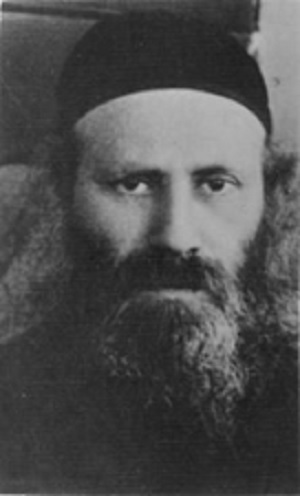
In the fall of 1933, immediately after the death of Rabbi Meir Shapira zt”l – Rosh Yeshivat Chochmei Lublin, an article appeared in the “Lubliner Tugenblatt” newspaper. The title reads “Who will be the next Rosh Yeshiva?” The article references multiple distinguished candidates for the prestigious appointment, including Rav Menachem Zemba hy”d and Rav Dov Berish Weidenfeld zt”l – The Tchebiner Rav. Interestingly enough, the eventual successor to Rabbi Meir Shapira, was not even mentioned in the article, though his greatness in Torah learning and piety was on par with those aforementioned geonim. Rav Aryeh Tzvi Frommer Hy”d (RATF), also known as The Kozoglover Gaon, was chosen as the next Rosh Yeshiva of Yeshivat Chochmei Lublin and served at its helm until it’s closure during World War II. His unique legacy expanded beyond the four walls of the yeshiva where he inspired and taught students. Through his responsa he engaged real-life issues creatively defending many customs of questionable halachic standing and created the mishna yomi program allowing all Jews, both scholars and laymen, to complete the entirety of Torah Sheb’al peh. His preoccupation with the spiritual needs of the full spectrum of jewry, and the creativity he employed for this task remain defining hallmarks of his inspiring legacy.

Brief Biography

RATF was born in Czeladź, Poland in the year 1884[3]. His father Hanoch-Hendel made his living as a tailor[4] and RATF’s mother Miriam-Kayla passed away when he was three years old.[5]He was sent to study in heder in the town of Wolbrum, residing by relatives of his mother. Some of his formative years of development in Torah learning occurred after leaving Wolbrum to study in the Yeshiva Ketana of Amstov, Poland[6]. The dean of the yeshiva, Rabbi Efraim Tzvi Einhorn zt”l recognized the unique abilities and challenges of the young orphan and took great care in supporting the young boy’s spiritual & physical development.[7] [8]
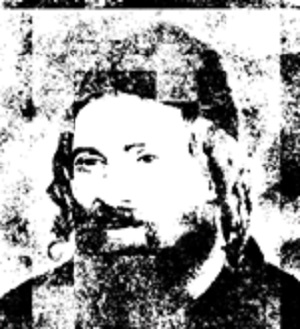
Rabbi Efraim Tzvi Einhorn Zt”l – Rosh Yeshiva Amstov, Poland

At the age of thirteen, RATF made his way to the court R’ Avraham Borenstein known as the “Avnei Neizer”[9] in Sochaczew (Sochatchov), Poland. Reb Leib Hirsch as RATF came to be known (Yiddish translation of Aryeh Tzvi), studied assiduously under the Avnei Neizer for five years developing a reputation as notable young Torah scholar in Poland and a close student of the venerable Avnei Neizer.[10] RATF was exposed to the unique combination of halacha, gemara, kabbalah and chassidut interwoven in the thought of the Avnei Neizer. At the time the Avnei Neizer was one of the leading poskim of the generation. RATF subsequently married Esther Shweitzer and spent the next eight years studying in the home of his father-in-law. Despite moving  away from his beloved rebbe, RATF maintained close ties with the Avnei Neizer, visiting on holidays as well corresponding on Torah topics.[11]

When the Avnei Neizer passed away in 1910, his son R’ Shmuel Borenstein[12], the “Shem Mi’Shmuel” was crowned the heir to his father’s chassidic court; becoming the second scion of the Sochatchov dynasty. On his father’s first yahrzeit, the Shem Mi’Shmuel established Yeshivat Beit Avraham in his memory. The Shem Mi’Shmuel appreciated the unique talents of RATF, and invited him to be the Rosh Yeshiva of Beit Avraham at the age of 27[13]. It was during this period of learning & teaching that RATF published his first work; Siach Ha’Sadeh. In it, RATF dealt with various talmudic topics with central themes of hilchot berachot & tefillah. The work came with laudatory approbations from leading scholars of the time including: Rav Meir Arik,[14] Rav Yosef Engel[15] and others.[16]RATF remained the Rosh Yeshiva of Beit Avraham, until the city of Sochatchov was destroyed in World War I.
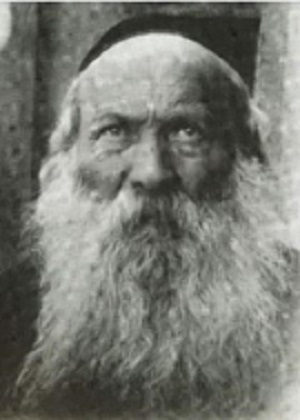
Rabbi Shmuel Borenstein Zt”l – (Shem Mi’Shmuel) The second Sochatchover Rebbe
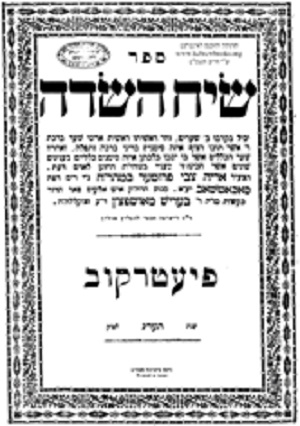
Cover page of Siach Hasadeh; Pietrikov 1912

The Frommer family had grown to a total of six children, relying on RATF as he sought his next job opportunity. His uncle, Rabbi Yitzchak Gottenstein, the rabbi of a small town in Poland, Koziegłowy (Kozoglov), had passed away and the community needed a new Rabbi. The community was small, and the financial opportunity was no greater. However, due to lack of alternatives this would be RATF’s next stop. There, RATF established a small yeshiva and continued his learning and teaching, jump-starting an environment of Torah learning and scholarship in the small town. Although his tenure there did not last particularly long, he would be forever known by the appellation; “The Kozoglover Gaon”.

After leaving Kozoglov[17], RATF headed to Zbeirtza, Poland. The community of Sochatchover chassidim that lived in the city of Zbeirtza, were “laymen” of an extraordinary caliber. Many of them students of the Avnei Neizer, providing context to appreciate the uniqueness and caliber of RATF and his erudition. RATF had developed into a combination of a classical scholar, chassid and tzadik that made him such a sought-after leader. He was knowledgeable in all areas of the revealed Torah as well as kabbalah and chassidut as is evident from his works. Additionally, he would arise at midnight to recite “tikkun chatzot” and study kabbalah late into the night away from the public eye. It was in Zbeirtza that his students began to compile notebooks with the teachings that RATF would share on shabbat & yom tov.[18]

Once again, the time came for RATF to migrate to the nearby town of Sosnovitz[19]continuing to gain admirers and students. It was at this time that Rabbi Meir Shapiro zt”l, founder of Yeshivat Chochmei Lublin and Rav of Lublin, expressed an interest in having RATF join the faculty of the yeshiva[20]. RATF deflected the requests due to his desire to remain close to his existing students and admirers. However, after Rabbi Meir Shapiro’s untimely death in October 1933, Yeshivat Chochmei Lublin was left without a leader. RATF decided to move to Lublin and became the second Rosh Yeshiva of Yeshivat Chochmei Lublin.
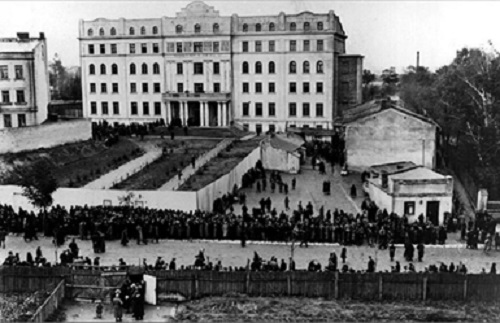
The funeral of Rabbi Meir Shapiro Zt”l at the Yeshiva of Chochmei Lublin

In a fascinating interlude in RATF’s life, he witnessed one of his lifelong dreams materialize; visiting Eretz Yisrael. RATF had a great yearning for the land of Israel.[21]He once remarked to his confidant and host in Tel Aviv, Rabbi Dovid Landa, that “a regular day in Eretz Yisrael contains the same holiness as yom tov sheni shel galuyot in the diaspora”.[22] His trip lasted four months while he visited Jerusalem, Meiron[23], Tel Aviv & Bnei Brak.[24] Afterward, he returned to his new position at the Yeshivat Chochmei Lublin. RATF experienced some of his most productive years of Torah learning & creativity at the helm of the yeshiva. After many years of narrowly avoiding personal financial collapse and constantly being forced to migrate throughout Poland, he had finally arrived at a place where his only concern was Torah.

It was during his tenure as Rosh Yeshiva of Yeshivat Chochmei Lublin that he published his second work, Responsa Eretz Tzvi,[25]in 1938. Eretz Tzvi, is a work of collected responsa, mostly concentrated on the orach hayim section of the Shulchan Aruch with certain discussions regarding Yoreh Deah and Even He’ezer as well. The volume was first published in Lublin, at a printer only steps away from the Yeshivat Chochmei Lublin.[26] A second printing was done in America in 1963 and a third re-printing by RATF’s nephew, Rabbi Dov Frommer in 1975 in Tel Aviv[27]. It is worth noting that a fourth edition including never before collected writings, as well as Siach Hasadeh, became the “second & third cheilek” of the responsa Eretz Tzvi as separate volumes. The collection includes responsa, letters &  glosses on various masechtot, and was printed in 2000 by Rabbi David Abraham Mandelbaum[28] [29]. Throughout Eretz Tzvi, RATF corresponds with many scholars including The Gerrer Rebbe, The Shem Mi’Shmuel of Sochatchov, Rabbi Meir Arik and the Bianer Rebbe on various topics of halacha. It is in this work that his unique approach combining halacha, aggadah and kabbalah is showcased. His creative methodology allowed for uncovering defenses of questionable customs, providing a limud zechut for the masses in many cases. In this way he served as a “Defender of Israel”[30].
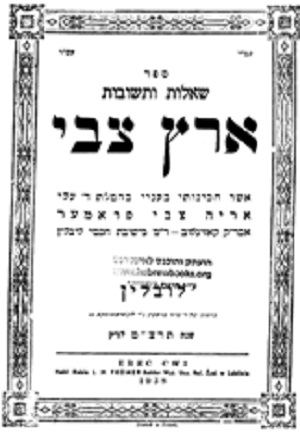
Cover page of Responsa Eretz Tzvi; Lublin 1938

In 1938, on the occasion of the second completion of the Daf Yomi cycle, RATF introduced a study program that would complement Daf Yomi: Mishna Yomi[31]. Two mishnayot studied every day; enabling a participant in the Daf Yomi program to finish the entirety of the mishnah, even those tractates which did not include bavli commentary.

The second world war began, and Poland was overrun by the Nazi army. In 1939 RATF together with his family were forced to relocate to the Warsaw Ghetto[32]. It was reported[33] that RATF was leading Torah learning initiatives for the younger students in the ghetto. Additionally, even while in the ghetto he continued to comprise Torah novella as many of his glosses on his own responsa Eretz Tzvi were written during his time in the Warsaw Ghetto.

RATF was forced to take a job making shoes for the German soldiers on the Russian front provided by the “Shultz” company.[34] He worked alongside the third Sochatchover Rebbe – Rabbi Dovid Borenstein and the  Piasetzna Rebbe Rabbi Kalonymus Kalman Shapira[35] along with other great rabbis and scholars .[36]
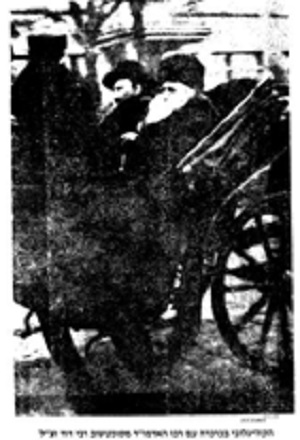
RATF alongside his Rebbe. Rabbi Dovid Borenstein Zt”l – The third Sochatchover Rebbe

After the liquidation of the Warsaw Ghetto in the spring of 1942 the Frommer family was sent to the Majdanek death camp in Lublin, Poland only 123km away from his beloved Yeshivat Chochmei Lublin. It is documented that as he entered the gas chambers, the holy Kozoglover Gaon exclaimed “Thank G-d, for I am included in the sanctification of G-d’s great name!”.[37]
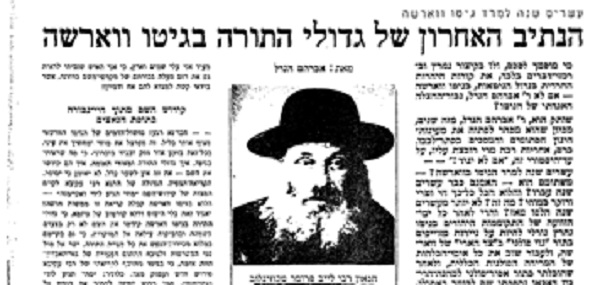
A newspaper article describing the experiences of Torah scholars in the Warsaw Ghetto.

Key Themes In The Thought of The Kozoglover Gaon

  1. הכל מלמדין זכות – סנגורם של ישראל 

The central theme in the halachic thought of RATF, is his focus on defending existing customs which are at odds with normative practice, often utilizing various non-traditional halachic arguments. RATF not only included kabbalistic and chassidic sources in normative talmudic & halachic discussions, but even allowed them to inform practical decisions in the realm of halacha. Eretz Tzvi strives to support rather than tear down shaky customs. RATF notes in his introduction to Eretz Tzvi when discussing his approach:

“That which we observed, that the students of the Baal Shem Tov zt”l abolished the practice of fasting and self- affliction [to atone for sins], and I am not worthy to enter into this discussion. Rather, I base myself on the mishna ”All may argue in favor of acquittal”[38]

[From this example, one could suggest that RATF saw himself as a halachic expositor of the way of the Baal Shem Tov, utilizing his halachic knowledge to apply the chassidic outlook of focusing on positive actions, rather than becoming mired in the guilt of sin.] Naturally, the very first responsa in Eretz Tzvi begins with this exact objective, foreshadowing the central theme of his halachic work:

“In defense of the widespread custom of wearing a tallit kattan which is smaller than the halachic size delineated in the Shulchan Aruch[39] which ostensibly precludes any fulfillment of the mitzvah tzitzit as many great scholars have protested about…as well as providing a limud zechut regarding the required length of tzitzit”[40]

One common conflict between chassidim and mitnagdim is their opposing halachic attitudes within the area of zmanei hatefillah. Perhaps the most well-known example of RATF’s limud zechut is the defense of the custom of some chassidim for beginning shacharit after 4 halachic hours into the day. The problem being the recital of berachot kriat shema, after their preferred time.  This poses a potential transgression of beracha levatala[41]. RATF defends this custom with various arguments. In the first part of the responsa in Eretz Tzvi[42], RATF begins by neutralizing the potential issue of beracha levatalah by positing that the prayer is considered a tefillat nedava, a voluntary prayer similar to the voluntary offering in the beit hamikdash. A voluntary tefilla is not bound by the common restrictions of an obligatory tefilla.

However, RATF is challenged to explain how one could put aside the halachically preferential time for praying and engage in a seemingly lesser level of voluntary prayer [chovah vs. nedavah]? To answer this secondary question, RATF utilizes the Shulchan Aruch Harav of Rav Shneur Zalman of Liadi – The Ba’al Hatanya.[43] The gemara[44]states that someone who is constantly engrossed in Torah learning (Torato um’nato [Rashbi V’chaveirav]) is not obligated to stop at the proper time and pray shemoneh esreih while engrossed in learning. Additionally, the Ba’al Hatanya adds that praying with the highest level of deveikut (divine cleaving) would take precedence over Torah learning, even for those who are described as torato um’nato.

RATF points out that from the Shulchan Aruch Harav we see that only a prayer with extraordinary intent and focus [A] trumps the Torah learning of someone who’s primary occupation is Torah learning [B] while an ordinary tefillah [C] would not obligated him to interrupt his studies to pray. ([A]>[B]>[C]) Utilizing a similar line of reasoning, we can assume that an individual who delays praying to attain the higher level of prayer will supersede the usual obligation of prayer service at the proper time. ([A]>[C])

Perhaps a more ambitious attempt at justifying the practice of some of the great chassidic masters with respect to zmanei tefillah, is another point in the same responsa. RATF quotes from the Ruzhiner Rebbe[45]who explains that prior to the sin of adam harishon in gan eden, the entire day was equally fit for prayer. However, the post-sin world is not fit for such a structure so the forefathers; Avraham (Shacharit), Yitzchak (Mincha) and Yaakov (Arvit) designated timeframes for each prayer. When the world reaches the ultimate redemption, the framework of zmanei tefillah will revert to their undefined framework similar to pre-sin existence. Utilizing a concept from the Rashba in Masechet Menachot[46] [regarding the halachic status of korban ha’omer], RATF suggests that since prayers of the tzadikim are focused on delivering the ultimate redemption (when the typical time boundaries will cease to exist) these prayers in and of themselves (even in our current pre-redemption era) are not bound by the usual rules and regulations.[47] Additionally, in two separate places RATF defends the practice of regular chassidim (not only great tzadikim as discussed above) who begin to pray Mincha in the time of bein hashmashot[48]employing the concept of safeik d’rabanan lkula.
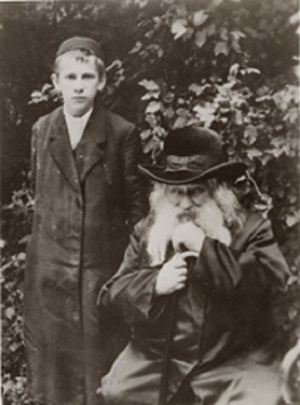
Rabbi Avraham Mordechai Alter zt”l (seated)  – The “Imrei Emet” of Ger along with his grandson.. A common correspondent of RATF. (Hakira.org)

In another example of limud zechut RATF defends the custom of delivering mishloach manot late in the day of Purim such that it is already past nightfall. While this practice ostensibly has no grounds in halacha as the halachic day has ended, as RATF himself admits, he still uncovers a halachic reasoning for the custom.[49] RATF quotes an explanation from Rabbi Yaakov Yitzchak Rabinowitz, the Yid Hakadosh of Pshiske,[50] who defends the practice of beginning to pray mincha when the prayer will extend past the proper halachic time of shkiah. Rabbi Rabinowitz justifies it based on the gemara and Tosafot in Berachot[51]regarding the curse of Bilaam towards the Jewish people. It is mentioned in the Gemara that Bilaam knew the precise split-second at which Hashem became angry during the day and could fit in a quick curse at that opportune time. However, Tosafot asks “What curse could you fit in a split-second?” and answers that the word kalem (כלם) meaning “they should be cursed” could fit the time allotment. Tosafot offers a second explanation: “even if it was a longer curse, if Bilaam would begin his cursing of the Jewish people in the split-second that Hashem’s anger appears each day even if he would continue after that time it would take effect as well.” Therefore, proves the Yid Hakadosh quoted by RATF, we see from here that beginning a prayer or a mitzvah at the right time will allow one to finish after the allotted time.[52] [53]
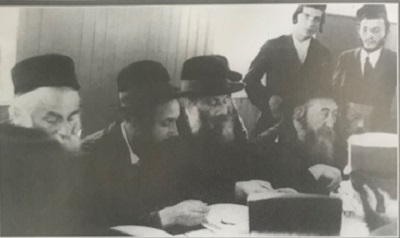
RATF (Third from left) administering a bechina at Yeshivat Chochmei Lublin

A limud zechut which came in an alternate form is RATF’s insistence on separating the strict halacha from that of middat hassidut or virtuous behaviour. In a correspondence[54] between RATF and the Imrei Emet of Gur (Rabbi Avraham Mordechai Alter), RATF discusses a specific type of lashon hara treated by the Hafetz Hayim in his work Shemirat Halashon. The Hafetz Hayim discusses the prohibition of speaking negatively about a person “even if he [the speaker] himself saw him [the transgressor] from close proximity doing something that is inappropriate according to the law”.  As a source, the Hafetz Hayim cites Rabbeinu Yonah in Shaarei Teshuva[55]:

”…perhaps the transgressor already repented from his evil ways, is distressed in his thoughts, and the heart knows the bitterness of his soul, and it is incorrect to reveal it.”

RATF points out that the exact words of Rabbeinu Yonah namely, “It is incorrect”, smack of middat chassidut and not strict halachic prohibition, and therefore takes issue with the Hafetz Hayim supporting his halachic decision on such grounds. RATF continues and writes “And since many people fail in this, one ought to find them a defense”.

It is interesting to note, that the work of Rabbeinu Yonah being discussed is the Shaarei Teshuva – a work not typically categorized as halachic. RATF did not object to the use of Rabbeinu Yonah’s “Shaarei Teshuva” on the grounds that it is a mussar work as opposed to a halachic one. One possible explanation is that RATF himself relies on and includes non-halachic sources to inform halachic decisions. RATF employs the full gamut of Torah thought in order to come to the defense of common practices and customs even if they infringe on pietistic sensibilities.[56]

Limud Zechut in Other Writings

As a young Rabbi, RATF published a short letter delineating the basic requirements of hilchot tefillah enabling his fellow Jews to fulfill the obligation of daily prayer. He published this letter anonymously, seemingly to avoid the appearance of haughtiness in a younger scholar lecturing the public.
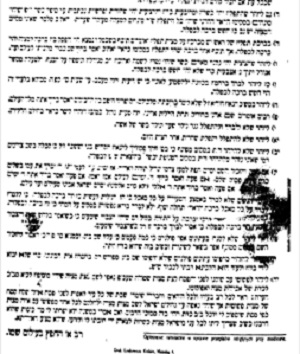
Part of the letter that RATF published anonymously to remind the general public about the basic requirements of Teifillah in hopes  of zikui harabim

Lastly, in addition to his published works RATF published a kuntres or small pamphlet called Doresh Tov le’amo[57]. The work remained in manuscript and included a defense of “most Jews” who don’t have the requisite intent during the opening birchat avot of shemoneh esreih.  RATF writes that even if a person doesn’t understand the meaning of the words, if they are aware of the fact that they are praying “in front of Hashem” bedieved they fulfill their obligation. [RATF’s position is seemingly in opposition to the well-known position held of Rabbi Chaim Brisker[58]that in the first beracha of shemoneh esreih both the intent of standing in front of Hashem as well as the meaning of the words are necessary even bedieved.]


  1. Innovation Through Connecting all Areas of Torah

RATF utilized existing logic and concepts while applying them to previously unexplained passages and problems providing a framework of creativity that remains in line with tradition. We have already seen from the above mentioned responsa that RATF was open to utilizing kabbalistic and chassidic concepts in order to provide a limud zechut. RATF’s works do indeed draw from chassidut, kabbalah as well as gemara and rishonim. RATF describes his philosophy regarding new interpretations in Torah and their purpose: [59]

“As it is explained in the work Maayan Chaim as he discusses at length to provide support to those who produce Torah novella although it is not clear whether they are true & correct which would be a transgression according to the Zohar. In my humble opinion, the Zohar prohibits writing such novella only in a case where the logic being applied is not true, however if the logic and approach is true and found in earlier works, even if it is being applied in a novel way to explain a certain passage, even if the explanation is not correct this is not a transgression. For this is the honor of Torah and to demonstrate that there is nothing that is not hinted to in the Torah and everything can be “clothed” in Torah.”
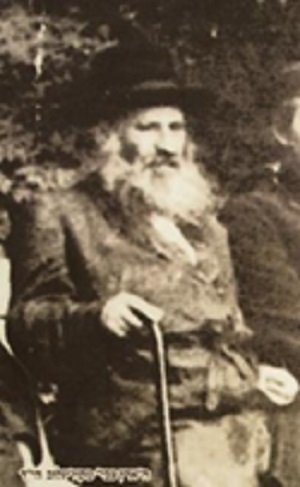
RATF in his later years

A great example of his propensity to cross-pollinate between disciplines is a discourse on Sukkot[60]. Regarding the libations of wine and water that took place on Sukkot he writes:

“One could suggest that the libations of wine and of water represent two separate ideas, oneg & simcha. The water libations represent oneg, as the concept of water is the source of all enjoyment as explained in Shaarei Kedusha[61]while wine represents simcha as [the Talmud] says “ein simcha ela b’yayin”. Additionally, we know that oneg & simcha are two separate ideas as explained in the Chatam Sofer’s novella (Shabbat 111a)[62] that on Shabbat there is an obligation of oneg while on Yom Tov there is an obligation of simcha…it would seem that the difference between these two emotions is that oneg involves the five senses while simcha involves only the heart/mind [lev]…and from simcha one arrives at dancing as is written in the Sefer Hakuzari, and the Maharal explains that our custom to raise our feet during Kedushah is to show that our soul naturally longs to take flight and similarly dancing which is initiated by simcha…on the other hand oneg is specifically in the engagement of the five senses as it says in Sefer Yetzira[63] which corresponds to oneg…and this is why all year round the only libation is that of wine representing simcha in the heart/mind however specifically on Sukkot after the forgiveness of sins [Yom Kippur] the body [and senses] are purified we are then given the libations of water representing the enjoyment of the senses as now these too can be used in cleaving to Hashem.”

In this passage RATF quotes from Talmud and a classical commentary as well as kabbalistic and chassidic sources interchangeably and unapologetically. The breadth and depth of RATF’s references adds a layer of relevance as he finds common themes in sifrei kabbalah along with classical rishonim and achronim. [64] In another passage, RATF describes his affinity for combining the hidden and revealed disciplines of Torah learning. He states:[65]

“It is my “way”, myself the pauper, to uncover (l’hamtzi) a source in the revealed Torah for the hidden…”

The word he uses is l’hamtzi which has double connotation of uncovering & creation. Through utilizing the spectrum of Torah literature RATF essentially creates new sources previously unrelated to the topic at hand through exposing them to his unique thought process.

See Responsa Eretz Tzvi[66] where he was asked by someone who accidentally turned on a light on shabbat and wanted to understand how much money he should give for atonement (kaparah). At the end of the discussion, [after finding a lenient opinion in estimating the modern equivalent of the monetary sums discussed in the gemara] RATF adds a reminder lest the questioner miss out on the true purpose of giving the symbolic amount to achieve “kaparah”.

However, the crux (ikar) of teshuva is the remorse and humility and lowliness that a person should be heartbroken that he desecrated the holy Shabbos. Additionally, it would be appropriate to take up oneself to assist the “Chevra Shomrei Shabbos” …for this is considered a tikkun of desecrating Shabbos.”       

RATF’s halachic thought utilized a maximalist approach in finding prooftexts and sources. Besides for the revealed and esoteric areas of Torah, we see from this last example that his responsa took the full religious experience into account.
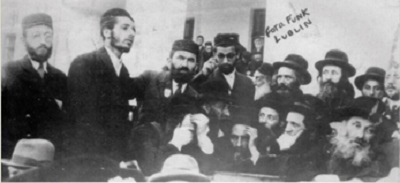
RATF (bottom right corner) at a an unspecified event in Yeshivat Chochmei Lublin. To his right, Rav M, Ziemba

  • Centrality of Torah for All Jews & Mishna Yomi

In a related theme to limud zechut & providing access to all areas of Torah, it is clear that RATF strived to include the full population of Jewry in his philosophy of learning Torah. It is interesting to note, as Rabbi S.Y. Zevin does in his review of Eretz Tzvi[67], that although RATF was the dean of a yeshiva which was typically focused on the abstraction of talmudic law, Eretz Tzvi is comprised entirely of questions that are practical in nature. He utilized his training in the disciplines of pilpul and sevara as a tool for dealing with everyday people & problems.

An initiative of RATF aiming to elevate the religious experience of common Jewry, was the Mishna Yomi program that he instituted. Upon the second inaugural Siyum Hashas in 1938, RATF created a new study program allowing every Jew to appreciate and complete the entirety of Torah. His initiative was both  complementary and supplementary to the Daf Yomi that was already instituted by Rabbi Meir Shapira zt”l. An adherent to the Daf Yomi schedule would complete the entire Talmud Bavli over the course of the seven-year cycle. However, there are many aspects of torah sheb’al peh left untouched due to the significant amount of mishnayot that have no Bavli commentary. RATF suggested that the geulah (ultimate redemption) is dependent on the Jewish people learning the entirety of the oral Torah. See below for his inspirational words when introducing the program explaining an interpretation provided by the gemara for a cryptic passage in Hoshea.[68]

“Though they hire among the nations, now I will gather them up” (Hoshea 8:10)

“Should they learn it all; then, “now I will gather them up” [the Geulah will come immediately]”(Bava Batra 8a)

One could understand the words of the gemara “It all” in two ways. Either A. All of Bnei Yisrael or B.  Each individual should learn all the mishnayot as they encompass all of the oral law. And there is support for this from the Zohar[69] that one of the methods of teshuva is to learn the entirety of Torah …as every part of Torah has a unique ability to offer salvation for a specific area in one’s life, however the ultimate geulah is the entirety of all individual salvations at once and therefore all areas of the Torah must be covered in order to glean all the unique salvations to arrive at the ultimate collective salvation [of the Jewish people]. It therefore says “אי תנא כולהו” [if they learn it all], utilizing both understandings [A. all of the Jewish people and B. the entirety of the oral Torah] …and this is the purpose of the “Mishna Yomi”, that every Jew young and old, scholar and layman, wealthy & poor can all take part in this great mitzvah.”

RATF felt that the geulah could be hastened through the entirety of the Jewish people learning all the mishnayot which encompasses the oral Torah.[70] It was seen as a great complement to the Daf Yomi, to the extent that there were printings of Talmud with both the Daf Yomi & Mishna Yomi schedule to allow for combined study.[71]

Although RATF conceived the Mishna Yomi prior to WWII, the concept needed a reaffirmation amongst post war Jews. Rabbi Yonah Stenzel, who was a student of RATF in the town of Sosnovitz and eventually emigrated to Tel Aviv and joined its rabbinate, re-instituted the concept of Mishna Yomi & Halacha Yomi in remembrance of those Jews that perished in the holocaust. In a few articles he is credited with creating the Mishna Yomi format, however RATF clearly introduced the concept before the war.

It is noteworthy that the specific vehicle chosen by RATF for bringing the ultimate redemption was Torah study. The gemara mentions other potential deeds that can bring the ultimate redemption in somewhat simpler ways.[72] The accessibility of Talmud Torah to the masses and the potential for each and every Jew to experience the entirety of Torah was RATF’s preferred initiative for bringing about greater spirituality in the community at large. It was through Torah that RATF saw his contribution in hastening the geulah.
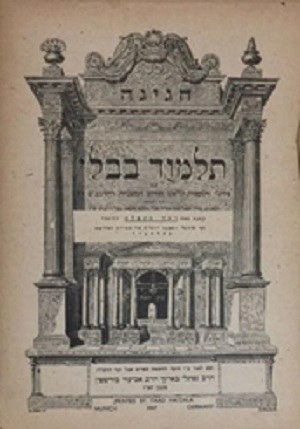
Tamud Bavli, Tractate Hagigah and Mo’ed Katan and Mishnayot Shvi’it – special edition for the students of the Daf Yomi and the Mishnah Yomi – Munich 1947

Conclusion

Halachically speaking, any city which is entirely idolatrous is classified in the gemara as an ir hanidachat and condemned to destruction. However, the gemara[73]mentions that if one of the houses within the city maintains a mezuzah on its doorpost the city should not be destroyed. An apocryphal story describes a city facing imminent destruction due to its idolatrous practices that had permeated every household. On the eve of the final verdict there was a Jew who arrived from another city and ran from door to door affixing mezuzot to all bare doorposts. I believe that on a symbolic level, one of the rabbis affixing figurative mezuzot to various embedded customs requiring limud zechut in the last century was the Kozoglover Gaon, Rabbi Aryeh Tzvi Frommer Hy”d.

The concept of limud zechut, that was RATF’s raison d’etre, allowed for needed leniency within the structure and framework of Orthodox Torah observance. At times, we need a limud zechut on our own individual behavior as well as for our various practices and customs as a community. Perhaps, even if the halachic conclusions of RATF aren’t the accepted practice, his willingness to defend questionable practices with the breadth of his learning utilizing both the revealed and esoteric sections of the Torah remind us the importance of limud zechut and our responsibility to engage others and ourselves through it’s lens.

**I would like to dedicate this article in memory of my grandparents:

    Norman Sebrow                                                              Jo Amar

יוסף בן מזל ז”ל                                               נחמן דוד בן צבי אייזק ז”ל

     Jeanette Sebrow                                                    Raymonde Amar

רוחמה בת אסתר ז”ל                                             יוכבד בת אשר זעליג ז”ל

[1] I am grateful to Rabbi Hershel Schachter שליט”א, who introduced me to the Torah of the Kozoglover Gaon amongst a variety of unique thinkers as a student in his shiur. Additionally, I would like to thank the following people for their insight and help in bringing this project from idea to reality: Rabbis Dovid Bashevkin, Yaacov Sasson, Danny Turkel as well as Moshe Rechthand. Lastly, R’ Eliezer Brodt for his insight and breadth of knowledge that he offered to help complete this project.

[2] RATF’s collected writings and teachings can also be found in Eretz Tzvi (Moadim & Al Ha’Torah)  compiled by Erlich, Yehuda; Tel Aviv, 1984. Additionally, his students in Yeshivat Chochmei Lublin compiled a collection of insights called Mekabtz’el.

[3] Frommer, Aryeh Tzvi. Eretz Tzvi, Bnei Brak, 1976, pp. 5–6.

[4] Soreski, Aharon. Geonei Polin Ha’achronim, Bnei Brak, 1982, pp. 182 According to other opinions his father was a coal salesman.

[5] Ibid.

[6] Ibid. pp. 184 RATF’s personality is described as being exceptionally bright while at the same time a שובב or a bit of a “troublemaker”. It was in the yeshiva in Amstov that Rabbi Efraim Einhorn, paid special attention to the young orphan and provided him with the fundamentals for development in learning. It was this special attention that RATF attempted to repay when Rabbi Einhorn’s grandson, Rabbi Moshe Krohn came to study with RATF in Zbeirtza. RATF took extra care to attend to all of Rabbi Moshe Krohn’s physical and spiritual needs.

[7] Regarding the level of studies at the Amstov yeshiva – see Ibid. pp. 185-186 The day began with a shiur from 5AM until 10AM when the yeshiva would pray shacharit.

[8] Some of the other well-known students of the yeshiva; Rabbi Shlomo Stenzel and the Rebbe of Radomsk: Rabbi Shlomo Henich Hacohen Rabinovitz.

[9]1838 -1910. A chassid and son-in-law of the Kotzker Rebbe, after the Rebbe passed away he became a Gerrer chassid. In 1883 he moved to Sochatchov where he founded his own branch of chassidut named after the city, and which gave him the title of “the Sochatchover Rebbe.” His responsa were collected posthumously and published as the Responsa – Avnei Nezer hence his title. He published the sefer Eglei Tal as well, which covers the 39 melachot of Shabbat.

[10] Geonei Polin Ha’achronim, pp.182

[11] Ibid. – As a testament to the esteem regarded by the Avnei Neizer for his student, see Responsa Avnei Neizer, Orach Chaim, 109 where his teacher writes the following. “Greetings to my beloved student, the Harif and Baki our teacher, Rabbi Leib Hirsch. From your letter I see that you have been meditating on my work…You said well and spoke truth. Wishing you great strength and courage in Torah and G-d willing, may you develop into a vehicle for chassidut and fear of Heaven…Abraham”

[12] 1855-1926. Published the work “Shem Mi’shmuel”. The only son of the Avnei Neizer, was both a son and close student of his father and maintained an extremely close relationship with his father until his death. After his father’s death, he was accepted as the next Socatchover Rebbe. He published his father’s works and led Socotchov Chassidut. He died at the age of 70. He was brought to burial in the same ohel (covered grave) as his father, the Avnei Nezer, in Sochaczew. His son, Dovid, succeeded him as third Sochatchover Rebbe.

[13] Bergman, Ben-Tzion. Michoel B’Achat, pp.44 – RATF was not the only one asked to lead the yeshiva. Rav Michoel Forschlager another prized student of the Avnei Neizer was sought along with RATF to lead the yeshiva. It was RATF who served as the dean of the yeshiva while Rav Forschlager was more directly involved with directing the studies of the young students. Among Rav Forschlager’s students were Rabbi Avraham Aaron Price, Rabbi Mordechai Gifter, Rabbi Yitzchak Hoberman and Rabbi Pinchas Hirschprung. Additionally, see the newly reprinted Toras Michael (Machon Avnei Choshen, 2016) a collection of Rav Forschlager’s torah novella.

[14] 1855-1926 – One of the great galician Torah scholars with works such as Imrei Yosher, Tal Torah. His students include the prolific Rav Reuven Margolies and founder of Daf Yomi and Chochmei Lublin Yeshiva – Rabbi Meir Shapiro.

[15] 1858-1920 – Rabbi and Av Beis Din in Krakow, Poland. Author of Gilyonei Ha’Shas, Beit Ha’Otzar. Himself a fascinating Torah scholar who utilized abstract thinking in his conceptual approach to Talmudic study. At the bris of RATF’s first born son, Rabbi Yosef Engel served as the sandak, while RATF himself was the mohel.

[16] Including Rabbi Moshe Nachum Yerushalimsk, 1855-1916. Another of the great Torah luminaries in Poland at the time.

[17] See “Rabbi Aryeh Tzvi Frumer From Kozhiglov: Head of the Rabbinical Court and Rosh Yeshiva: Center for Holocaust Studies” – the reason for his departure from the city as being due to a disgruntled wealthy man that RATF slighted by deciding against him in a din Torah. For another version of the story involving his neighbor being a priest see the introduction to the third printing of Reponsa Eretz Tzvi.

[18] Specifically, Rabbi Yitzchak Yaakov Erlich whose son R’ Yehuda ended up publishing the works of RATF Rav in Israel many years later.

[19] It is in Sosnovitz where Rabbi Yonah Stenzel (1904-1969) became a devoted student of RATF. Rabbi Stenzel, who also studied in Chochmei Lublin, eventually migrated to Tel Aviv where he re-stablished the study of Halacha and Mishna Yomit in memory of all those who perished in the Holocaust.

[20] It is important to emphasize the honor and prestige that even joining the student body of the yeshiva brought along with it. It was said that each student needed to know 200 folio of Talmud by heart to gain admission.

[21] See Responsa Eretz Tzvi I:25 in his letter to the Gerrer Rebbe “Who will give me wings of a dove, I will fly and settle (in the land of Israel), kiss its earth, embrace its stones may it be hastily in our days”

[22] See Geoneil Polin Ha’achronim pp.250

[23] See Eretz Tzvi I:27 where he mentions that a certain hiddush occurred to him in Meiron on Lag Ba’omer

[24] Geoneil Polin Ha’achronim pp.252: It is said that he after meeting with the Chazon Ish zt’l in Bnei Brak, the Chazon Ish praised his brilliant Torah mind saying that he had not met such a brilliant mind in many years.

[25] The name is used as a description of the land of Israel, in the book of Daniel for example (Chapter 11), from which he had recently returned. Additionally, Tzvi for his middle name.

[26] Yeshivat Chochmei Lublin was located at Lubitrovska 57, initially a vacant lot which Rabbi Meir Shapira secured from a wealthy donor. Eretz Tzvi’s first printing was at a press located footsteps away at Lubitrovska 62 as seen on the cover page.

[27] Geonei Polin Ha’achronim, pp 271. Reportedly, the copy used for the third printing was amongst many works that survived the destruction of the holocaust and arrived as part of a larger delivery to the misrad hadatot of Israel. It was this specific copy that had the glosses of the author in the margins. Among other works saved is RATF’s personal copy of Responsa Imrei Yosher with RATF’s glosses.

[28]Rabbi Mandelbaum is a notable scholar of all topics related to Yeshivat Chochmei Lublin and many of the great minds of Polish origin. Rabbi Mandelbaum added a new dimension to the Torah of RATF and many other geonim by collecting their dispersed writings and organizing them while also providing noteworthy glosses and footnotes in various reprintings. Rabbi Mandelbaum’s father was a student of RATF in Yeshivat Chochmei Lublin. Additionally, Rabbi Mandelbaum thanks Rav Shmuel Halevi Vozner Zt”l and other for sharing many of the items found in this second volume as he was in possession of various manuscripts and writings of RATF.

[29]  ‘ שו”ת ארץ צבי, חלק ב ה, Bnei Brak, 2000

[30] סניגורם של ישראל – This term is also used in reference to the great Rav Levi Yitzchak of Berditchev (1740-1809) who repeatedly strove to portray both Jews and Jewish issues in a positive light. For more on this topic see; Luckens, ‘Rabbi Levi Yitzhak of Berdichev’, Ph.D. thesis (Temple University, 1974) pp. 38 citing M. Wilensky, I, 122-131.

[31] His words were recorded and can be found in Eretz Tzvi Moadim pp. 276

[32] ארץ צבי עה”ת pp. 14

[33] Hidden in Thunder: Perspectives on Faith, Halachah and Leadership …, Volume 1, Esther Farbstein,

[34] ארץ צבי עה”ת pp. 14

[35] See http://www.daat.ac.il/daat/shoah/biton37.pdf  based on the daily journals of Hillel Zeidman

[36] [The Last Path for Torah Leaders in the Warsaw Ghetto]. Bais Yaakov (in Hebrew) (47): 7 – Testimony of Avraham Hendel. An additional story is told about Rabbi Aryeh Tzvi that he was desperately searching for someone to help him conduct a chemical experiment with the margarine that was given out at meals in the shoe factory – to test for any treif fat that could have been mixed in and thus prohibited to eat.

[37] Ibid.

[38] Reponsa Eretz Tzvi, Introduction

[39] Siman 17

[40] Eretz Tzvi,

[41] See Shulchan Aruch 58:6

[42] Responsa Eretz Tzvi I:36

[43] Talmud Torah 4:5

[44] Shabbat 10a

[45] Israel Friedman of Ruzhyn (1796 –1850), also called Israel Ruzhin, was a Hasidic rebbe in 19th-century Ukraine and Austria. Friedman was the first and only Ruzhiner Rebbe. However, his sons and grandsons founded their own dynasties, collectively known as the “House of Ruzhin”. These dynasties, which follow many of the traditions of the Ruzhiner Rebbe, are Bohush, Boyan, Chortkov, Husiatyn, Sadigura, and Shtefanesht. The founders of the Vizhnitz, Skver, and Vasloi Hasidic dynasties were related to the Ruzhiner Rebbe through his daughters.

[46] Menachot 4a

[47] It should be noted however, that RATF concedes that this line of reasoning would specifically apply to the great tzadikim whose prayers can be assumed bring the ultimate redemption closer vs. those of the typical petitioner.

[48] See Eretz Tzvi 1:1, 1:60

[49] 1:121

[50] Rabbi Yaakov Yitzchak Rabinowitz (1766–1813). A student of the Chozeh of Lublin (Ya‘akov Yitsḥak Horowitz) with whom he eventually parted ways. See Buber, Martin: Gog und Magog (1949; first published in English translation as For the Sake of Heaven, 1945). The Yid Hakadosh would become the teacher of Rabbi Simcha Bunem of Pshiskhe. See Rosen, Michael: The Quest for Authenticity.

[51] 7a s.a

[52] See Piskei Teshuvot, Purim, Siman 695:5 Note 24. Where this responsa of RATF is brought as an example of an opinion that defends the practice of starting the Purim feast close to the end of the day where most of it will take place after Purim although it was begun before the end of the day.

[53] Additionally, regarding the proof from Tosafot in Berachot referencing Bilaam. See Nefesh Harav (pp.114) that when Rav Joseph B. Soloveitchik heard this proof he laughed and Rabbi Shachter שליט”א explains that it was evident that he was not comfortable with this type of proof.

[54] See “From Principles to Rules and from Musar to Halakhah: The Hafetz Hayim’s Rulings on Libel and Gossip”, for Rabbi Dr. Brown’s discussion the works of the Hafetz Hayim at length and who discusses RATF’s discussion as well.

[55] Shaarei Teshuva, Sha’ar 3

[56] See below for further examples (non-exhaustive list) of limud zechut:

1.See Eretz Tzvi 34 – in defense of the custom for women of the time that didn’t daven everyday, when seemingly this is against the clear gemara (Berachot 20b) & Shulchan Aruch (O”C – 106:2) that women are obligated in tefillah. Rabbi Aryeh Tzvi provides additional support via comparison of tefillah to korbanot thus re-affirming the position of magen Avraham (ibid.) that suggests that the women will at some point request something from G-d and therefore fulfill their Torah obligation according to the Rambam.

  1. See Eretz Tzvi 53 54 – in defense of the common custom to make a borei pri hagefen on wine that includes significant amounts of water which are 6x the wine although this is seemingly at odds with the normative halacha as both the Shulchan Aruch YOD (siman 134) & Rama (YOD 204:5) conclude that one should not make a borei pri hagefen on such a wine.
  2. Eretz Tzvi 75 – in defense of the common custom in an area without an eiruv on Shabbat to use a minor to perform hotzaah.
  3. See Eretz Tzvi 94-95 with respect to finding support for those kohanim who fly on an airplane which might fly directly over graves of Jews thus exposing them to tumas kohanim
  4. Eretz TZvi 96 – in defense of the common custom to make seltzer on Shabbos –
  5. Eretz Tzvi 97 – in defense of the custom of certain chassidim to sit in the sukkah and make a bracha on shmini atzeret – though ostensibly at odds with the gemara.
  6. Eretz Tzvi 125 – finding support for creating a mikvah using snow in a place that no other type of mikvah would be possible.
  7. Eretz Tzvi 30 – in defense of the custom of the Ashkenazim in the diaspora who refrain from reciting the daily birchat kohanim
  8. Eretz Tzvi 35 – in defense of the custom for those washing netilat yadaim and the water does not cover most of their hand

[57] See Geonei Polin Ha’achronim, pp. 262

[58] See Chiddushei Rabbeinu Chaim Halevi al Harambam, Hilchot Tefillah as well as the he’arot of the Chazon Ish

[59] Eretz Tzvi (Torah commentary) Introduction

[60] Eretz Tzvi, Moadim, pp. 110, Sukkot תרפ”ה

[61] Kabbalistic work of the Ari’zal

[62] ד”ה ודע

[63] Chapter 2:7

[64] Another notable exchange is one that appears in the second volume of Eretz Tzvi where RATF engages in correspondence with none other than the Ishbitzer Rebbe, Rabbi Mordechai Yosef Leiner zt”l. It was in 1934 that the Ishbitzer Rebbe sent a question that was bothering him regarding a specific comment of Maimonides related to Hilchot Shevuot. RATF goes on to cite various chassidic and Kabbalistic sources and their bearing on the halachic issues. Thank you to Rabbi Josh Rosenfeld for pointing out this source, in his Sunday Responsa Series.

[65] Responsa Eretz Tzvi, I:12

[66] Siman 62

[67] Sofrim U’Sfarim, Tel Aviv, 1959, pp.189.  [Thank you to Rabbi Eliezer Brodt who brought this source to my attention]

[68] The discourse can be found in it’s entirety in Eretz Tzvi Moadim pp. 276.

[69] Zohar Chadash, Rut

[70] See also Eretz Tzvi, II: 72, 73

[71] This unique edition was printed in the framework of daily Daf Yomi and daily Mishnah. A combined calendar of Daf Yomi and the daily Mishnah is printed at the beginning of the book for the years to come: 5767-1912. The tablet is spread over four columns. Beneath the calendar of Daf Yomi, a special prayer was printed “after the end of a chapter from a daily mishnah.” This prayer was composed by Rabbi Yonah Stenzel zt “l, in memory of the Holocaust victims” who were killed for the sanctification of God … by the German oppressors. [Seen at Tzolman’s auctions (Bidspirit.org)]

[72] See Shabbat 118a – “If only [Bnei] Yisrael would keep two consecutive Shabbatot they would be immediately redeemed”

[73] Sanhedrin, 71a


“שואה, מדוע אלו שנהרגו בה נקראו “קדושים

שואה,
מדוע
אלו שנהרגו בה נקראו
קדושים
הרב
משה צוריאל
הרבה
חקרו בשאלה מה הוא המקור לכך שאומתנו
מעניקה תואר-כבוד
“קדושים”
לנהרגים
בשואה במלחמת העולם השניה.
פשוט הדבר
שהנהרג מפני שהוא מקיים אחת ממצוות התורה,
והגוים
הורגים אותו על כך, הוא
נקרא “קדוש”.
אבל ההרוגים
בשואה לא נהרגו מפני שקיימו מצוות.
גם אם נגיד
שנהרגו מפני שהיו יהודים,
רק אם היתה
להם אפשרות להכחיש יהדותם ולהמלט,
ובכל זאת
בחרו להודות ביהדותם, אפשר
לכנותם “קדושים”.
אבל העובדה
היא שלרובם של ההרוגים לא היתה שום אפשרות
להמלט. ומפני
מה נקרא להם קדושים”?
והרי אין
מקור לזה, לא
בגמרא, ולא
בספרי “ראשונים”
ואף לא בספרי
גדולי הדורות האחרונים.[1]1
הרב
אליהו דסלר, בספרו
“מכתב
מאליהו” (ח”ג
עמ’ שמ”ח)
כתב בשנת
תש”ו
(שנה
אחרי המלחמה) “רבים
שאלו ותמהו, מה
בצע במיתות הללו? אילו
מתוך גזירת שמד מתו, ומסרו
נפשם על קדושת שמו, הלא
דבר הוא. אבל
הרוצחים הללו לא לאמונה דרשו,
אלא להשמיד
להרוג ולאבד כמאמין כמומר,
ולהמית את
כולם על שנולדו ויהודים,
וכי מה ענין
יש בזה? הן
גם אפשרות לקדש את שמו ית
לא
ניתנה להרוגים
!
ואם כן,
על מה למה?
תמיהה רבתי”.
[עכ”ל]
הרב
יצחק ויינברג בספר “בכל
נפשך” (ירושלים,
תשס”ד,
עניני קידוש
השם, בסי’
ע”ב)
הביא בשם
רש”ז
אויערבך דהנהרגים בשואה אינם נחשבים שמתו
על קידוש השם. לעומתו
הרב מנחם ש”ך
(“מכתבים
ומאמרים” ח”ג
סי’ כ”ה)
כתב כי הנהרג
ע”י
אומות העולם רק בגלל שהוא יהודי,
הרי זה נחשב
שנהרג על קידוש השם שאמרו חז”ל
“אין
כל בריה יכולה לעמוד במחיצתן”
(בבא בתרא
י’). ושם
בעמ’ פ”ו
כינה להרוגים הללו בשם “קדושים”.
אבל לא הביא
שום מקור לשימוש בכינוי זה.
בספר
“בינה
ודעת” של
הרב מנחם אדלר, דן
בנושא זה (עמ’
תתסב-תתסג)
והביא דברי
הרב יהושע משה אהרונסון בספרו “עלי
מרורות” (עמ’
306) ודברי
אדמו”ר
מסלונים בקונטרסו “ההרוגה
עליך” (עמ’
כה,
לז)
והפריך
דבריהם. ונשאר
ללא מענה על שאלתנו, מה
הוא המקור לכנות כך את ההרוגים?
נראה
לי שבעז”ה
מצאתי מקור נאמן. מובא
בספר דניאל פרק ח פסוקים יט-כד:
(יט)
וַיֹּאמֶר
הִנְנִי מוֹדִיעֲךָ אֵת אֲשֶׁר יִהְיֶה
בְּאַחֲרִית הַזָּעַם כִּי לְמוֹעֵד
קֵץ
:
(כ)
הָאַיִל
אֲשֶׁר רָאִיתָ בַּעַל הַקְּרָנָיִם
מַלְכֵי מָדַי וּפָרָס:
(כא)
וְהַצָּפִיר
הַשָּׂעִיר מֶלֶךְ יָוָן וְהַקֶּרֶן
הַגְּדוֹלָה אֲשֶׁר בֵּין עֵינָיו הוּא
הַמֶּלֶךְ הָרִאשׁוֹן:
(כב)
וְהַנִּשְׁבֶּרֶת
וַתַּעֲמֹדְנָה אַרְבַּע תַּחְתֶּיהָ
אַרְבַּע מַלְכֻיוֹת מִגּוֹי
יַעֲמֹדְנָה וְלֹא בְכֹחוֹ:
(כג)
וּבְאַחֲרִית
מַלְכוּתָם כְּהָתֵם הַפּשְׁעִים יַעֲמֹד
מֶלֶךְ עַז פָּנִים
וּמֵבִין חִידוֹת:
(כד)
וְעָצַם
כֹּחוֹ וְלֹא בְכֹחוֹ וְנִפְלָאוֹת
יַשְׁחִית וְהִצְלִיחַ וְעָשָׂה
וְהִשְׁחִית עֲצוּמִים וְעַם קְדשִׁים
:
מדובר
כאן על ארבע מלכויות שקמו נגד ישראל,
ואחרון שבהם
“עז
פנים”. כתב
על כך מהר”י
אברבנאל בספרו “מעיני
הישועה” (מעין
ט’ תמר
ח, עמ’
שסג)
“וכן רומי
בגימטריא ‘עז
פנים’ חסר
אחד”. וכן
זיהה המלבי”ם
על פסוק זה שמדובר ברומי.
ולכן גם
נאמר כאן “ובאחרית
מלכותם” כי
היא הרביעית מארבע מלכויות,
והוא עולם
המערב (אירופה).
ומה
פירוש “והשחית
עצומים ועם קדושים”?
כתב הרב
סעדיה גאון (במהד’
תרגום הרב
יוסף קאפח, עמ’
קנט)
“וענין
‘ונפלאות
ישחית’ הוא
מה שיתפלאו משחיתותו כאשר יארעו דברים
שלא נראו כמותם. וכו’.
וענין
‘והשחית
עצומים ועם קדושים’ שיהרוג
מנבחרי בני ישראל
,
והמוניהם
עכ”ל.
כלומר
יהרוג מהחשובים והצדיקים,
וגם יהרוג
מההמון, כלומר
אנשים שהם פשוטים. המלה
“המון”
איננה באה
להגדיר כמות גדולה של אנשים,
אלא אנשים
שאינם בדרגא רוחנית גבוהה,
וכשימוש
רמב”ם
ב”מורה
נבוכים” (בתרגום
הגר”י
קאפח), בתחילת
הפתיחה (עמ’
ה)
וכן שוב
(בח”ג
פרק נא, עמ’
תד)
“המוני
אנשי התורה, כלומר
עמי הארץ”. וכאן
בחזונו של דניאל קורא להם
עַם
קדושים
“!
מעין
זה כתב רלב”ג
בפירושו לספר דניאל (מהד’
מוסד הרב
קוק, “פירושי
רלב”ג
לנביאים ראשונים ח”ב
וכתובים”, על
דניאל ח, כד)
“ונפלאות
ישחית, כי
פלא יהיה איך יכול להשחית כל כך?
ולא יבצר
ממנו כל אשר יזם. והצליח
ועשה כל אשר יחפוץ”.
עד
כאן גוף המאמר הנוכחי. מה
שהקודמים אלי ניסו לחפש מקור למנהג קריאה
זו בדברי גדולי הדורות,
או בדברי
התלמוד והמדרשים, דומני
שמצאנו מקור בעזרת השם בדברי התנ”ך
עצמו. הודו
לה’ כי
טוב.
*
“לִבָּן
של ישראל” (מדרש
שיר השירים ה, ב)
להלן
נושא מסתעף, שאין
ענינו נחוץ להבנת הדברים שהיו עד כה.
אלא יש
בדברים דלהלן נסיון להבהיר הא כיצד המקרא
יקרא “קדושים”
לאנשים שלא
היו שומרי מצוות התורה,
ואפילו
מחללי שבת בפרהסיא; וחלק
מהם היו אף כופרים ביסודות האמונה.
לזה
אנו צריכים ללמוד ממהר”ל,
ובדורות
אחרונים מר’ צדוק
הכהן, שהניחו
לנו יסוד נפלא, שכל
יהודי באשר הוא “רצונו
לעשות רצון אבינו שבשמים”
(ברכות יז,
א)
אלא “שאור
שבעיסה” כלומר
יצר הרע מבלבל אותו, ולכן
חיצוניותו מכחישה את פנימיותו.

על
מאמר חז”ל
“רבון
העולמים! גלוי
וידוע לפניך שרצוננו לעשות רצונך.
ומי מעכב?
שאור שבעיסה
[=ביאר
רש”י:
“יצר הרע
שבלבבנו המחמיצנו”]
ושעבוד
מלכיות. יהי
רצון מלפניך שתצילנו מידם ונשוב לעשות
חוקי רצונך בלבב שלם”
(ברכות יז,
א)
כתב ר’
צדוק הכהן
בספרו “ישראל
קדושים” (אות
י, עמ’
121):
“כי
מעמקי לבבו של כל ישראל דבוק בהשם יתברך
כמו שאמרו בברכות (יז,
א)
‘גלוי וידוע
לפניך שרצוננו וכו’ ומי
מעכב’ וכו’.
ולפניך
דייקא הוא גלוי, שאתה
יודע תעלומות לב. רק
שהיצר הרע היושב על שני מפתחי הלב שהם
הפתחים שמשם יוצאים כוחות הלב לפועל ומעכב
בעד התעלומות להתגלות.
ועיקר החיות
הוא בלב”.
ולכן
פסק רמב”ם
שכל יהודי באשר הוא, אפילו
אם הוא רשע מרושע, אם
בית דין מצוה עליו לתת גט לאשתו,
והוא סרבן,
היו נוהגים
להכות אותו מכות קשות עד שיגיד בפיו שהוא
רוצה לתת לה את הגט. וזו
לשון רמב”ם
(הלכות
גירושין סוף פרק ב):
“מי
שהדין נותן שכופין אותו לגרש את אשתו ולא
רצה לגרש בית דין של ישראל בכל מקום ובכל
זמן מכין אותו עד שיאמר ‘רוצה
אני’ ויכתוב
הגט והוא גט כשר וכן אם הכוהו גוים ואמרו
לו ‘עֲשֵׂה
מה שישראל אומרין לך!’
ולחצו אותו
ישראל ביד הגוים עד שיגרש הרי זה כשר.
ואם הגוים
מעצמן אנסוהו עד שכתב הואיל והדין נותן
שיכתוב, הרי
זה גט פסול.
ולמה
לא בטל גט זה? שהרי
הוא אנוס, בין
ביד גוים בין ביד ישראל!
שאין אומרין
‘אנוס’
אלא למי
שנלחץ ונדחק לעשות דבר שאינו מחוייב מן
התורה לעשותו, כגון
מי שהוכה עד שמכר או נתן.
אבל מי שתקפו
יצרו הרע לבטל מצוה או לעשות עבירה,
והוכה עד
שעשה דבר שחייב לעשותו,
או עד שנתרחק
מדבר שאסור לעשותו, אין
זה אנוס ממנו אלא הוא אנס עצמו בדעתו הרעה.
לפיכך זה
שאינו רוצה לגרש, מאחר
שהוא רוצה להיות מישראל רוצה הוא לעשות
כל המצות ולהתרחק מן העבירות
,
ויצרו
הוא שתקפו
. וכיון
שהוכה עד שתשש יצרו ואמר ‘רוצה
אני’, כבר
גרש לרצונו” עכ”ל
רמב”ם.

כתב
מהר”ל
בספר “נצח
ישראל” (פרק
ב עמ’ יד):

“וזהו
ההפרש שיש בין ישראל ובין האומות,
כי ישראל
מצד שהם בשלימות, רק
כי היצר הרע מגרה בהם ומביא אותם אל הרע,
ואין הרע
בהם מגרה בהם. אבל
האומות הם בעצמם בחסרון,
ודבק בעצם
שלהם, ואינו
רק במקרה בשביל היצר שהוא בהם הרע,
ומצד זה
ימשכו עצמם לגמרי אל הרע,
שהם פחותים
ורעים, והרע
להם טבעי. ונמצא
כי לפי מדרגתם הפחותה שלהם ימצא הרע בעצמם
בלא גרוי”:
ועוד
כתב: בספר
“גבורות
השם” (פרק
ט, עמ’
נז)
בהשוואה מה
בין חטאיהם של ישראל לחטאיהם של אומות
העולם:
“ואין
החטאים שוים, כי
החטא אשר הוא במקרה לאדם,
אינו שקול
כמו החטא אשר הוא בעצם לאדם.
ובזה הארכנו
למעלה במה שחטא ישראל ראוי לכפרה ולסליחה,
בעבור שעצמם
ראוים הם לטהרה ולנקיות מן החטא,
ולכך לישראל
החטא מקרי להם, ולאומות
החטא עצמי להם”[2].2.
כלומר,
לפי פנימיות
התורה, מי
שהוא בא מצאצאי האבות,
הטוב שבו
מושרש. על
ישראל נאמר שהם “מאמינים
בני מאמינים” (שבת
צז ע”א)
ואם הם
מדברים דיבורי כפירה, זה
מפני פיתויי יצר הרע, אבל
בתוך לבם עדיין הם מאמנים בהקב”ה
ובתורתו. נביא
מדברי המלבי”ם
על תהילים פרק מד, פסוקים
יח-כב:
(יח)
כָּל זֹאת
בָּאַתְנוּ וְלֹא שְׁכַחֲנוּךָ וְלֹא
שִׁקַּרְנוּ בִּבְרִיתֶךָ:
(יט)
לֹא נָסוֹג
אָחוֹר לִבֵּנוּ וַתֵּט אֲשֻׁרֵינוּ
מִנִּי אָרְחֶךָ:
(כ)
כִּי
דִכִּיתָנוּ בִּמְקוֹם תַּנִּים וַתְּכַס
עָלֵינוּ בְצַלְמָוֶת:
(כא)
אִם שָׁכַחְנוּ
שֵׁם אֱלֹהֵינוּ וַנִּפְרֹשׂ כַּפֵּינוּ
לְאֵל זָר:
(כב)
הֲלֹא
אֱלֹהִים יַחֲקָר זֹאת כִּי הוּא יֹדֵעַ
תַּעֲלֻמוֹת לֵב:
הוא
מפרש:
(יט)
לא נסוג –
והגם שלפעמים
מפני כובד הגלות נטתה אשורנו מני ארחך,
ולא יכלנו
לקיים המצות כראוי, מכל
מקום לא נסוג אחור לבנו –
כי בלבבנו
היינו שלמים עם ה’ גם
בעת אשר תט אשורנו מני ארחך

ולא זאת לבד
[אלא]:

(כ)
כי –
גם בעת אשר
דכיתנו במקום תנים – בעת
שהיינו בין אכזרים כתנים,
ותכס עלינו
בצלמות – שהמיתו
אותנו במיתות משונות ועינו אותנו ביסורים
קשים לצאת מן הדת, גם
בעת ההיא:
(כא)
האם שכחנו
שם אלהינו – הגם
כי ונפרוש כפינו לאל זר –
הגם שהיינו
אנוסים לפרוש כפינו לאל זר;
היה זה רק
במעשה אבל בלב גם בעת שפֵּרַשְׂנוּ
כפים לע
ג
היה לבנו שלם
עם יחוד ה’
ואמונתו:
(כב)
הלא אלהים
יחקר זאת – שהוא
יודע האמת מה שהיה בלבבנו
,
כי
הוא יודע תעלומות לב
– [עכ”ל
המלבי”ם]
אמנם
אמת שהמלבי”ם
(וגם
רש”ר
הירש, בפירושו
לפסוקים אלו) כתבו
כך לענין נסיון האנוסים שבספרד,
ששמרו דברי
תורה בסתר, אבל
הדברים הם אמת גם לענין כפיה אחרת,
של פיתויי
הגוים וצרות גלותינו הנוראה,
וכדברי
רמב”ם
בתחילת “אגרת
תימן” (מהד’
הגר”י
קאפח, עמ’
יט-כא)
על נסיונות
היציאה מהדת שלנו בעת גלותנו.
כלומר הרעיון
אמתי הנ”ל
שבתעלומות לב יודע הקב”ה
מה באמת רצונו של כל בן-ישראל,
אפילו
שהישראלי ההוא אינו מודע לכך.
פסוקים אלו
יהוו מעין רמז לשיטות מהר”ל
ור’ צדוק
שאנו מביאים כאן.
ר’
צדוק,
ספר רסיסי
לילה (אות
י, עמ’
ה’
ע”ב):
“משל
לאסא דקאי ביני חילפי אסא שמיה”
(סנהדרין
מד, א)
שהמשילו
חטאים הסובבים לאדם כקוצים הסובבים
לשושנה, ואינו
מעצם האדם רק שסובבים ומקיפים אותו מצד
ההתפשטות של האדם. אבל
מצד עצם נפש הישראלי אין בו חטא כלל”.
ספר
פוקד עקרים – אות
ה
“להיותו
יתברך שוכן עמם גם בתוך טומאתם ד’צור
לבבי וחלקי אלהים לעולם’.
ד’חלק
ה’ עַמו’.
ולעולם
קרויים עַמו יתברך, דאף
על פי שחטא ישראל הוא (סנהדרין
מד, א)
ובכלל עַם
ה’. ובאומות
בהיפך, אפילו
חסידי אומות העולם אינם בכלל עַם ה’;
אלא אם כן
יתגיירו ובשם ‘ישראל’
יכנו”:
ספר
רסיסי לילה – (אות
כ, עמ’
23)
“אבל
השביעית היא קדושת השבת דקביע וקיימא
דנקרא שבת על שם השביתה מכל השתדלות ופעולת
אדם שאין להם מבוא בזה דהוא שוכן גם בתוך
טומאותם, ואף
על פי שחטא ישראל הוא (סנהדרין
מד.). כי
כנסת ישראל בת זוגו דשבת והם דבוקים במידה
זו שאי אפשר לנתקם כלל. כי
מידה זו נקרא ‘אמונה’
(זוהר ח”ג
רל.) וישראל
נקראים (שבת
צז.) ‘מאמינים
בני מאמינים’. וזרע
אברהם יצחק ויעקב אי אפשר שלא יאמין כלל,
כי זהו מצד
קדושה דקביע וקיימא מהשם יתברך בתוך לבבות
בני ישראל”:
ספר
רסיסי לילה (אות
לז דף לב ע”א):
“וזה
עיקר החילוק בין ישראל לעמים שאמרו ז”ל
(ראש
השנה ד.) ‘האומר
סלע לצדקה בשביל בשביל שיחיה בני וכו’
הרי זה צדיק
גמור’ מה
שאין כן באומות העכו”ם.
כי חטאי
ישראל נקראים אצל חז”ל
(סנהדרין
מד.) אסא
דקאי ביני הוצי, שהם
רק סובבים אותו אבל שורשו אין כך.
והוא כמו
כופין [אותו]
עד שיאמר
רוצה אני, דידוע
טעם הרמב”ם
(סוף
פרק ב מהלכות גירושין). כך
מה שעושה לכוונה אחרת דמתוך שלא לשמה,
(היינו)
[אבל]
התוכיות
ופנימיות הוא לשמה ולכך הרי זה צדיק גמור,
כמו דהגט
כשר ונחשב מרצונו הגמור.
מה שאין כן
אומות העולם (שורשם)
[=שאין שורשם]
כך”:[3]3:
ספר
תקנת השבין (אות
טו, עמ’
156-157)
“ונראה
דפירוש ‘אין
אש [של
גיהנם] שולט
בהם’ (חגיגה
כז, א)
היינו
בעצמיותו ושורש נפשו אין לו שום שליטה
כלל, ואפילו
להכאיב לו. ועיקר
אור של גיהנום הוא לכלות ולבער הרע מן
העולם. ואומות
העולם ‘קוצים
כסוחים’ (ישעיה
לג, יב)
משורשם,
ובאש יצתו
‘וליהט
אותם היום הבא שלא ישאר מהם שורש וענף’
(מלאכי ג,
יט)
שיכלו
ויבוערו לגמרי. אבל
בפושעי ישראל ‘יתמו
חטאים’ כתיב
ולא חוטאים כמו שאמרו בברכות (י’
ע”א).
כי שורש כל
הנפשות דישראל דבוקים באלהים חיים,
ש’חלק
ה’ עמו’
(דברים לב,
ט),
וכמו שאמרו
(קידושין
ל”ו.)
דאפילו לית
בהו הימנותא ופלחי לעבודה זרה דיאמר להם
לא עמי ולמראית העין כאילו אינם עמו
[=עדיין
נאמר בהם “בנים
אתם לה’ אלהיכם”],
שהם חלק ה’,
מאמינים
בני מאמינים, כמו
שאמרו בשבת (צ”ז.).
וזרע יעקב
מטתו שלימה שאין בלבם אלא אחד כמו שאמרו
בפסחים (נ”ו.).
דהושע קראם
‘לא
עַמי’ בשביל
שאמרו לו ‘החליפם
באומה אחרת’ כמו
שאמרו שם (פ”ז
ע”א)
שהיה סבור
שאפשר לנתק שם ישראל ושורש היהדות על ידי
ריבוי החטאים חס ושלום.
עד שאמר לו
הקב”ה
‘בני
הם, בני
בחוני הם’. וכו’
וכו’.
אבל בהתעוררות
מדת הרחמים השיג ד’במקום
אשר יאמר לא עַמי אתם יאמר להם בני אל חי’.
דכאשר ‘יתמו
חטאים ורשעים עוד אינם’
ונשאר השורש
הטוב. כי
כל חטאיהם הם רק מצד ההוצי וחוחים הסובבים
לאסא ושושנה, ויצר
הרע יושב על שני מפתחי הלב בפתיחה ובהתחילה
וכמו שנאמר (בראשית
ד, ז)
‘לפתח חטאת
רובץ’. והצדיקים
שלבן ברשותן אין מניחין אותו ליכנס,
והרשעים הן
ברשות לבן שכיון שנכנס אף שתחילתו הלך
ואורח בסוף נעשה בעל הבית שממלא כל חדרי
הלב עד ששורש הטוב נעלם לגמרי ונעשה הוא
בעל הבית וכאילו שורשו רע”
[עכ”ל
ר’ צדוק]
סיכום
על
הפסוק “אני
ישנה ולבי ער, קול
דודי דופק” (שיר
השירים ה, ב),
מה שאמרה
הרעיה, כנסת
ישראל, אל
הדוד, הקב”ה,
מובא במדרש
(שיר
השירים רבה פרשה ה פסקה ב):

“אני
ישנה. אמרה
כנסת ישראל לפני הקב”ה:
‘רבש”ע!
אני ישנה
מן המצות, ולבי
ער
לגמילות חסדים.
וכו’
וכו’.
אני ישנה
מן הקץ, ולבי
ער לגאולה. אני
ישנה מן הגאולה, ולבו
של הקב”ה
ער לגאלני. אמר
ר’ חייא
בר אבא, איכן
מצינו שנקרא הקב”ה
לבן של ישראל? מן
הָדֵין קרא, דכתיב
(תהלים
עג, כו)
‘צור לבבי
וחלקי אלהים לעולם”.[4]4.
כלומר
אפשר בהחלט שהמעשים החיצוניים אינם לפי
הראוי. אבל
בתוכיות לב של כל אחד מישראל שהוא מצאצאי
האבות, יש
בו ניצוץ אלוה חיים, ולכן
ראוי לו להקרא “קדוש”.
וכל שכן אלו
שנהרגו ע”י
האומות, דוקא
מפני שהם יהודים.
[1]
היו
מי שהביאו סמך מהגמרא “מת
מתוך רשעו כיון דכי אורחיה קמיית לא הויא
ליה כפרה נהרג מתוך רשעו כיון דלאו כי
אורחיה מיית הויא ליה כפרה.
תדע
דכתיב ‘מזמור
לאסף אלהים באו גוים בנחלתך טמאו את היכל
קדשך [וגו’]
נתנו
את נבלת עבדיך מאכל לעוף השמים בשר חסידיך
לחיתו ארץ’
(תהלים
עט, ב)
מאי
‘עבדיך’
ומאי
‘חסידיך’?
לאו
‘חסידיך’,
חסידיך
ממש.
‘עבדיך’
הנך
דמחייבי דינא דמעיקרא וכיון דאיקטול קרי
להו עבדיך”
(סנהדרין
מז, א)
וכפי
דברי אביי מדובר בהרוגי מלכות,
ושלא
כדין נהרגו.
אבל
אין משם שום ראיה. [א]
אפילו אינם
נכללים לפי גמרא זו בשם “חסידיך”
קל וחומר
לא בכלל “קדושיך”
שלא הוזכר.
ועוד,
[ב]
אם נסמוך
על מאמר זה, גם
הנהרג בתאונת דרכים נייחס לו שם “קדוש”
כיון שמת
לא כי אורחיה?
והיה
מי שהקיש הדבר להרוגי מלכות שאין כל בבריה
יכולה לעמוד במחיצתן (בבא
בתרא י ע”ב).
אבל שוב,
מה שאמרו
אמרו, ולא
אמרו שנקראו “קדושים”.
[2]
לא
נכביר כאן בהבאת כל דברי מהר”ל,
אבל
המעוניין לראות כמה מהר”ל
חזר על יסוד חשוב זה,
שחטאיהם
של ישראל הם רק מקרה,
ולא
עצם מהות שלהם,
יראה
ב”נצח
ישראל”
עמ’
יד
, סו,
עב-עג,
קצא,
“גבורות
השם”,
עמ’
מה,
“נתיבות
עולם”
ח”ב
עמ’ קפ.
[3]
עיין
“תקנת
השבין”,
עמ’
142
[4]
והדברים
משתלבים עם דברי רמב”ן
(בראשית
ב, ז)
“ויפח
באפיו נשמת חיים”,
מאן
דנפח מדיליה נפח.
וכתב
רמב”ן
(על
דברים לב,
סוף
פסוק כו)
שמדובר
בפסוק זה בהעברת נשמת-שדי
לבני ישראל דוקא,
ולא
לאומות.