German Orthodoxy, Hakirah, and More

German Orthodoxy, Hakirah, and More
Marc B. Shapiro
1. I recently published a translation of Hirsch’s famous lecture on Schiller. You can see it here.
At first I thought that this lecture remained untranslated into English for so long because of ideological concerns. (I still think that this is the reason it was never translated into Hebrew.) Yet before the article appeared, I was informed that the reason it did not appear in the English translation of the Collected Writings of Hirsch was not due to ideological censorship, but censorship of a different sort (see the article, note 2). I will let readers decide if this was a smart choice or not. I plan on publishing another translation from Hirsch which has also never appeared in English or Hebrew, and which many people will regard as not “religiously correct” for the twenty-first century.
With regard to the Schiller lecture, I thank Elan Rieser who called my attention to the following: Hirsch quoted Schiller as saying about a plant, “What it [the plant] unwittingly is, be thou of thine own free will.” It so happens that this very thought also appears in the Nineteen Letters, Elias translation, p. 56: “The law to which all forces submit instinctively and involuntarily—to this law you, too, are to subordinate yourself, but consciously and of your own free will.” This shows that even in his earliest work, Hirsch was influenced by Schiller.
While on the topic of non-Jewish writers influencing German rabbis, here is another example which might lead some to wonder if we have crossed the line from influence into plagiarism. (I do not think so, as I will explain.) Rabbi Marcus Lehmann (1831-1890) was a well-known German Orthodox rabbi. He served as rabbi of Mainz and was founder and editor of the Orthodox newspaper Der Israelit. Apart from his scholarly endeavors, he published a series of children’s books, and is best known for that. These were very important as they gave young Orthodox Jews a literature that reflected traditional Jewish values and did not have the Christian themes and references common in secular literature. Yet despite their value for the German Orthodox, R. Israel Salanter was upset when one of Lehmann’s stories (Süss Oppenheimer) was translated into Hebrew and published in the Orthodox paper Ha-Levanon. Although R. Israel recognized that Lehmann’s intentions were pure and that his writings could be of great service to the German Orthodox, it was improper for the East European youth to read Lehmann’s story because there were elements of romantic love in it. This is reported by R. Isaac Jacob Reines, Shnei ha-MeorotMa’amar Zikaron ba-Sefer, part 1, p. 46. Here is the relevant passage:
והנה ברור הדבר בעיני כי הרה”צ רמ”ל כיון בהספור הזה לש”ש, ויכול היות כי יפעל מה בספורו זה על האשכנזים בכ”ז לא נאה לפני רב ממדינתינו להעתיק ספור כזה שסוף סוף יש בו מענייני אהבה.
This passage is followed by another, which was made famous by R. Jehiel Jacob Weinberg in Seridei Esh, vol. 2 no. 8. This is Weinberg’s well-known responsum on co-ed groups. He describes how R. Israel Salanter visited R. Esriel Hildesheimer and saw him giving a shiur in Tanakh and Shulhan Arukh before young women. R. Israel commented that if a rabbi from Lithuania would institute such a practice in his community they would throw him out of his position, and rightfully so. Yet he only hoped that he would be worthy enough to share a place in the World to Come with Hildesheimer: הלואי שיהי’ חלקי בג”ע עם הגה”צ ר”ע הילדסהיימר.
Weinberg doesn’t say where he learnt of this story, but it comes from Reines, who heard it directly from R. Israel Salanter. Yet Weinberg’s recollection was not exact. Before World War II, Weinberg had access to Shnei ha-Meorot, and he refers to it in his essay on Reines (Seridei Esh, vol. 4, p. 355, originally published before the War). After the War he no longer had access to this book, and thus was not able to check R. Israel Salanter’s exact words. Although, based on Weinberg, people often repeat Salanter’s comment that he hopes for a share of the World to Come together with Hildesheimer, he never actually said this. Here are his words, as recorded by the only witness, Reines, and I hope that from now on the great R. Israel Salanter will be quoted accurately. (The passage in the parenthesis is a comment from Reines himself.)
הלכתי לבקר גם את ביה”ס אשר לבנות, ששמעתי שגם שם מגיד הרה”ג הנ”ל [הילדסהיימר] איזה שעור, ומצאתי שבחדר גדול ורחב ידים עומד באמצע שולחן גדול וסביב השולחן יושבות נערות גדולות, והרה”ג הנ”ל בראש השלחן מגיד לפניהם שעור בשו”ע (הוא אמר לי אז גם באיזה הלכה שאמר להם אבל שכחתי) והוסיף לומר בזה”ל “ברור הדבר בעיני כי כוונת הרב היא לש”ש, וגם נעלה הדבר בעיני מכל ספק, כי כל התלמידות האלה השומעות לקח מפיו תהיינה לנשים כשירות, תמלאנה כל המצות שהנשים חייבות בהן, תחנכנה ילדיהן על דרכי התורה והאמונה, באופן שיש לומר בוודאות גמורה ומוחלטת כי הרה”ג הנ”ל עושה בזה דבר גדול באין ערוך, בכ”ז ינסה נא רב במדינתינו לעשות ב”ס כזה, הלא יקראו אחריו מלא ומן גיוו יגרשוהו; ואין ספק כי יהי’ מוכרח לנער את חצני’ מן הרבנות כי לא תהלמו עוד”, כל הדברים האלה דבר הרה”ג הצדיק הנ”ל בהתרגשות מיוחדה והתלהבות יתירה
Returning to Lehmann, one of his short stories is titled Ithamar. Eliezer Abrahamson called my attention to the fact that chapter 17 tells the same story as is found in Lew Wallace’s classic American novel, Ben-Hur, Book 3, chs. 2-3. I prefer to call this “borrowing”, rather than plagiarism, since Ben-Hur was a worldwide sensation and Lehmann was not trying to hide his borrowing. At that time, any adult reading Lehmann’s book would know what he was basing the chapter on, and that he was providing a Jewish version of certain episodes. In fact, the name of the main character of Lehmann’s book, Ithamar (not a very common name), is also the name of the father of the main character of Ben-Hur (Judah ben Ithamar ben Hur). By naming his character Ithamar, Lehmann was signaling his debt to Wallace.[1]
Regarding Lehmann’s stories, in the 1990s they also appeared in a censored haredi version. Ha-Modia actually published an article attacking this “reworking”. Here it is, followed by the response. (You can right-click to open larger images, or download it as a pdf here.)

I found these on my computer and don’t remember anymore how I got them (and unfortunately, there is no date visible on the articles). Click them to enlarge.

2. Not too long ago Hakirah 13 (2012) appeared, and as with the previous issues, it is a great collection of articles. The other Orthodox journals have to ask themselves why Hakirah has been so successful in overshadowing them. I think the answer is obvious. Hakirah is not afraid to take risks in what they publish. They don’t mind rocking the boat a bit, and dealing with controversial matters. I want to respond to two articles in the issue. The first is R. Elazar Muskin’s piece in which he discusses a 1954 Yom ha-Atzmaut event in Cleveland, which featured R. Elijah Meir Bloch, the Rosh Yeshiva of the Telz yeshiva. From the article one sees that Bloch had a positive attitude towards the State of Israel. Before reading further, I suggest people look over Muskin’s article again, so you can best appreciate that which will follow. You can find the article here.
Muskin notes that Bloch’s letter justifying his appearance at the Yom ha-Atzmaut event was published in R. Joseph Epstein’s 1969 book Mitzvot ha-Shalom. Although there have been many books that express a positive, or tolerant, view towards Zionism, anti-Zionist extremists chose to focus on this volume. Muskin quotes Gerald Parkoff who wrote as follows in a letter published in the Torah u-Madda Journal 9 (2000), p. 279:

When the first edition of the Mizvot ha-Shalom was published, the unsold inventory, which represented most of the extant copies, was kept in Rabbi Epstein’s garage. As it turned out, the sefer came to the attention of some misguided people[2] who were particularly upset with Rabbi Epstein’s association of Rabbi Eliyahu Meir Bloch with Yom ha-Azmaut. They proceeded to burn the first edition of Mizvot ha-Shalom in Rabbi Epstein’s garage. Subsequently, the perpetrators of this dastardly act were found and brought to a Satmar Bet Din. Financial restitution was then made to Rabbi Epstein.

As Parkoff notes, when the next edition of the work was published, Epstein took out Bloch’s letter, so as not to have another confrontation with the extremists. Yet something doesn’t make sense. Why would Satmar (or Satmar-like) extremists care about a letter from Bloch in Epstein’s book? What does this have to do with them? The extremists certainly had no interest in defending the honor of an Agudist whose ideology is rejected by them just as they reject the Mizrachi position. So why would they care about Epstein’s book at all?
If you compare the first edition of Mitzvot ha-Shalom to the second edition, the answer is, I think, obvious, and it has nothing to do with the Bloch letter. Pages 605-624 from the first edition are omitted in the second edition. The first few pages of this is Bloch’s letter, but beginning on p. 612 there is a section titled “Al ha-Geulah ve-al ha-Teshuvah.” This section is a rejection of R. Joel Teitelbaum’s views (in which, by the way, Epstein refers to the writings of R. Zvi Hirsch Kalischer, R. Yissachar Shlomo Teichtal, and R. Menachem M. Kasher). The very title of the section is an allusion to the Satmar Rav’s book, Al ha-Geulah ve-al ha-Temurah. While Epstein’s views are expressed respectfully, it is easy to see why the extremists would have gone after him, as a means of upholding the honor of their Rebbe. They presumably also saw the following passage, p. 611, as directed against the Satmar Rav, and even if it wasn’t directed against him personally, it is certainly directed against his followers.
אמנם השטן מרקד בין תלמידי חכמים על תלמי הפירוד והפילוג בישראל להטיל קטטיגוריא ביניהם, עד כדי השמצת שמות אהלי תורה ויראה, ועד כדי הורדת כבוד גדולים ארצה בכתבי פלסתר והוצאת דיבה, ללא חשש הלבנת פנים, וחטא מבזה תלמיד חכם, ונמצאים נכשלים בחטאים יותר חמורים מאלה שבאו לצעוק עליהם.
On p. 615 he writes as follows (even referring to the Satmar Rav’s views as “has ve-shalom”):
עיני גדולי וצדיקי הדור רואים נסים ונפלאות (ראה לעיל מבוא, מ”מ 32) – קול דודי דופק – אם אתחלתא דגאולה, אם רק פקידה, אם רק רמז רמיזה “מן החרכים” מאבינו שבשמים לריצוי, לפיוס – בהדי כבשי דרחמנא למה לן – איתערותא דלעילא הקוראת לאיתערותא דלתתא – וכי כל זה אך אור מתעה הוא חו”ש? (ראה “על הגאולה ועל התמורה עמ’ כ’ . . . )

I found a relevant “open letter” in the R. Leo Jung archives, File 2/1, at Yeshiva University. I thank the Yeshiva University Archives for permission to reproduce the letter here.

From this letter we see again that the issue had nothing to do with Bloch. Yet since there were other people attacking the Satmar Rav’s views during this time, I still think we need an explanation as to why these crazies decided to focus on Epstein. From the “open letter” it would appear that this was just another way to attack R. Moshe Feinstein, who wrote a haskamah for Epstein. In the “open letter” it states that if R. Moshe does not retract his haskamah then those behind the letter will take action. This action no doubt includes the burning of Epstein’s sefer.[3]

Here is how these wicked people expressed themselves, sounding just like mobsters:
משה’לע תדע שזה היא האזהרה האחרונה שאם לא תתחרט ברבים על ההסכמה שכתבת להספר הנ”ל לא נבוא עוד בכתב רק בידים נעשה מעשים נבהלים שתסמר שערות ראשך שתבוש להראות פרצופך הטמא.
Regarding R. Elijah Meir Bloch, he was a real Agudist, even serving on the U.S. Moetzet Gedolei ha-Torah. Yet his positive view of the establishment of the State of Israel is not unexpected. I say this because his father, R. Joseph Leib Bloch, Rosh Yeshiva of Telz and also rav of the city – the combination of rosh yeshiva and city rav was not so common [4] – appeared to be inclined to a type of Religious Zionism. Here is his letter to R. Zvi Yehudah Kook, published in the latter’s Li-Netivot Yisrael (Beit El, 2001), vol. 1.
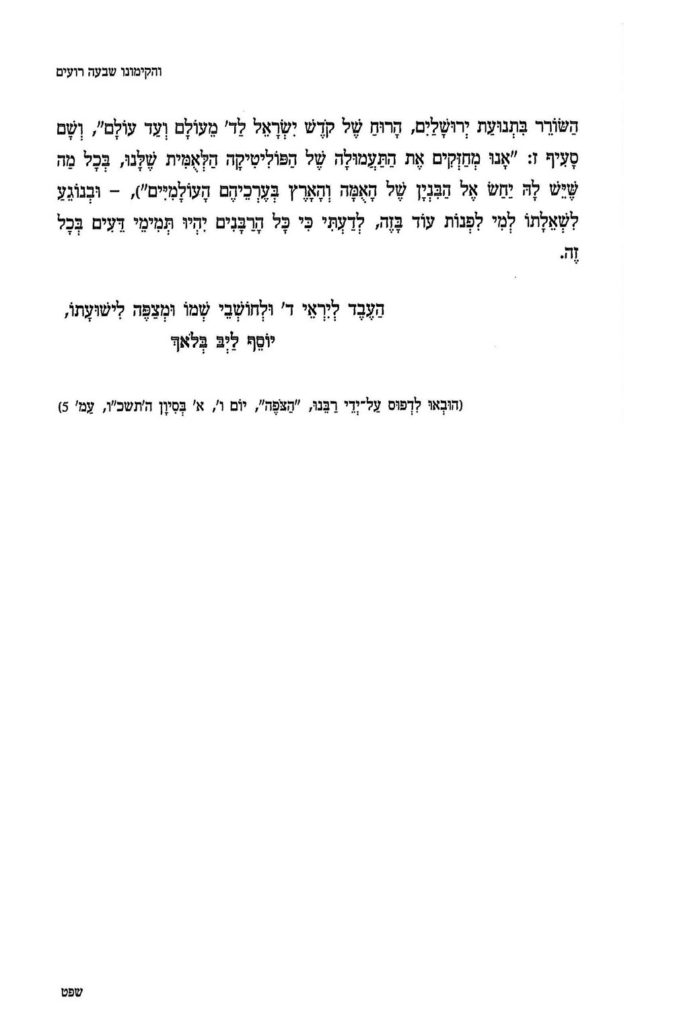
 

I realize that R. Joseph Leib Bloch is usually portrayed as a strong anti-Zionist. This needs further investigation, but it could be that his opposition was only against secular Zionism and what he regarded as the Mizrachi’s compromises with the secular Zionists. From his letter, we see that he had a much different view of R. Kook’s Degel Yerushalayim.[5]
The letter above that of R. Joseph Leib Bloch is from R. Avraham Shapiro, the Kovno Rav, who unlike many other Lithuanian gedolim was a real opponent of Agudat Israel. (Another noteworthy opponent was R. Moses Soloveitchik.) Here is R. Shapiro’s picture.

R. Shapiro also was a supporter of Religious Zionism and a great admirer of R. Kook. Unfortunately, we don’t yet have a biography of his life. Those who want to know a little more about his attitude towards Zionism can see his 1919 letter to R. Kook in Iggerot la-Re’iyah, no. 94. Here he writes as follows:

החלטנו שבהמעשים הפוליטיים להשגת חפצנו באה”ק, כלומר העבודה לפני אסיפת השלו’, נלך ביחד עם הציונים שלא בהתפוררות כבאי כח מפלגה ומפלגה, כי אם כבאי כח כל העם העברים בסתם. למטרה זו נבחרה קומיסיה פוליטית לבוא בדברים עם הציונים, וכבר נעשה הצעדים הדרושים לזה. מקוה אני שתמצא הדרך להתאחדות הפעולות.
We see very clearly from this letter that the Kovno Rav supported working with the non-Orthodox Zionists in order to achieve the Zionist objective, which became a real possibility after the defeat of the Ottoman Empire in World War 1.
In a 1921 letter to R. Zvi Yehudah Kook, Iggerot la-Re’iyah, p. 557, the Kovno Rav refers to the Agudah paper Ha-Derekh in a mocking tone: כפי שראיתי מ”הדרך” לא-דרך. In this letter he tells R. Zvi Yehudah that it is important for the Orthodox in Palestine to be involved in the political process that was set up by the British Mandatory authorities. Yet instead of doing that, he claims that the Orthodox have turned a large portion of the women against them, alluding towards the Eretz Yisrael rabbis’ ruling forbidding women’s suffrage, a ruling which R. Avraham Yitzhak Kook was at the forefront of. Look at these words and remember that the one writing them was one of the greatest poskim of his time, the great rav of Kovno, not some minor Mizrachi figure:
האומנם חושבים הם את השתתפות הנשים לאיסור גמור המפורש בתורה שאין אומרים בו מוטב יהיו שוגגים כו’? לדעתי הסכילו עשה.
This opposition to women voting in Israeli elections has disappeared from the haredi world, for obvious political reasons. Yet examination of haredi writings leads to the conclusion that female suffrage is only a hora’at sha’ah, and that if the haredim ever became a majority the right to vote would be removed from women. But I think that this is more theory than reality, as I can’t imagine that even a haredi society would take this step as the backlash from women would be quite significant. As for the followers of R. Kook, do they also think that female suffrage is hora’at sha’ah and hope for a day when the vote will be taken away from women, for all the reasons R. Kook offered? Based on a recent statement by R. Aviner, it appears that for some of them the answer to this question is yes.
The Kovno Rav ends his letter to R. Zvi Yehudah with these strong words against Agudat Israel:
כנראה אסע אי”ה בקרוב בשביל צרכי צבור ללונדון. כמובן לא בשביל אגודת-ישראל. כנראה אחר כ’ את האספה בפ”ב. מה דעתו עליה? אנכי בכוונה לא נטלתי חלק בה, לפי שכל מעשיהם עד עכשיו אינם רצוים בעיני ואינם בדרך האמת. הדו”ח של רוזנהיים לא הי’ אמת. הקומיסא הפוליטית איננה יודעת מאום מאשר עשו ולכה”פ אנכי איני מסכים על כל דרכיהם שהזיקו רק להאורטודקכסיא ולא לאחרים. אני אומר זאת לכל מפורש מבלי התחבא בהשקפתי.
I mention the Kovno Rav’s opposition to Agudat Yisrael not only for its historical significance, but also because it brings us back to a time when Agudat Israel actually did something other than put on a big Daf Yomi celebration every seven years.[6] There was a time when Agudat Israel tried to accomplish great things, so there was reason to oppose it by those who thought that it was moving in the wrong direction. Today, however, what is Agudat Israel? There was a time when it was a movement, and today it is a lobbying organization, pure and simple, and without much influence at that. I guess that’s what happens when you don’t even have a website or a journal. You sink into oblivion, only to be remembered in another seven years at the next Siyum ha-Shas.
In a 1931 letter to R. Kook, Iggerot la-Re’iyah, no. 273, the Kovno Rav asks R. Kook if he agrees with him that a world congress of rabbis should be convened – אספת רבנים עולמית . I mention this only because in later years it became almost an article of faith in the haredi world that such rabbinic gatherings were absolutely forbidden. The fear was that the gatherings would make decisions at odds with the haredi Daas Torah. The only way to make sure that their followers would not attend these gatherings, where they might actually hear different viewpoints, was for the haredi leaders to ban these gatherings.[7] This is as good an example of any of how the haredi leadership uses its rabbinic “muscle” for political goals. If someone were to ask on what basis can one state that it is forbidden for rabbis with different viewpoints to gather to discuss issues, the answer is obviously not going to be that the Talmud or Shulhan Arukh says it is forbidden. It is forbidden because the gedolim say it is forbidden, i.e., Daas Torah.
R. Jehiel Jacob Weinberg writes as follows about the Kovno Rav (Kitvei ha-Rav Weinberg, vol. 2, p. 234):
ועלי להעיר כי הגאון דקאוונא שליט”א הוא אחד מגדולי הדור בזמננו, אחד המוחות היותר טובים שבתוכנו. ואעפ”י שאנשים ידועים משתדלים להשפילו ולהמעיט את ערכו, מ”מ אי אפשר להחשיך את אור תורתו וחכמתו.
What does Weinberg mean when he speaks of those who oppose the Kovno Rav and try to minimize his importance? Who are these people and what led them to this judgment of the great Kovno Rav? Let me thicken the plot. The late R. Tovia Lasdun wrote to me as follows: “Kovner Rav was a great person, but his views did not always meet the views of the Orthodoxy [!]”[8] By “Orthodoxy” he meant Lithuanian yeshiva world Orthodoxy. From what we have seen already, namely, his anti-Agudah stand and the other points I noted, one can begin to understand why there would be opposition to the Kovno Rav from yeshiva circles.

R. Jeffrey Woolf recorded the following story about the Kovno Rav. He heard it from an eyewitness and it is very illuminating.[9]

The pre-war Jewish community of Kovno (Kaunas, today) Lithuania was divided into different components, divided by the Neris River. On the one side was the general community, which was made up of every type of contemporary Jewish religious and cultural population. Indeed, the community was a bit notorious for a lackadaisical form of religiosity. On the other side of the Williampol bridge, was the famous Slabodka Yeshiva, a flagship of the Mussar Movement. As might be expected, relations between the two sectors were often tense. There was a saying attributed to the Alter of Slabodka, R. Nosson Zvi Finkel זצ”ל, that the bridge from Kovno to Slabodko only went one way.

Coping with the myriad of challenges, modernization and secularization in Kovno was its illustrious rabbi, R. Avraham Dov-Bear Kahana-Shapira זצוק”ל, author of the classic collection of responsa and Talmudic essays דבר אברהם, and known more popularly as the ‘Kovner Rov.’ One central concern of his was the alienation of young Kovner Jews from the synagogue. Thus, when the administration of the Choral Synagogue came to him with an intriguing approach to the problem, he jumped at it.

The idea was to have the synagogue’s cantor, the internationally renowned tenor Misha Alexandrovich, offer public concerts that would feature classical חזנות alongside renditions of serene Italian bel canto compositions. The hope was that this type of cultural evening would draw modernizing young Jewish men and women to the synagogue, where they would socialize and (perhaps) find mates. 

The first concert was a smashing success and more were planned. Everyone was thrilled, except for the heads of the Slabodka Yeshiva. They turned angrily to the Kovner Rov and demanded that he intervene to stop the concerts. They were indecent, the Rashe Yeshiva objected. The led to fraternization between men and women, and in the synagogue. Worse still, they might corrupt yeshiva students.

The Kovner Rav listened quietly, and then firmly rejected the Yeshiva’s objection. “You are responsible only for your yeshiva,” he asserted. “I am responsible for the spiritual welfare of all of the Jews of Kovno.” The concerts, he declared, would continue.

Returning to R. Elijah Meir Bloch, there is another relevant source and that is found in Chaim Bloch’s Dovev Siftei Yeshenim. (There was no familial relationship between the two Blochs.) As we have discussed numerous times, one can’t believe anything that Bloch wrote, and all of the letters of gedolim he published must be assumed to be forgeries. However, this only applies to the letters he published of deceased individuals, but the letters he published of living figures are indeed authentic. In vol. 1 (1959), p. 392, he published a letter he received in December 1944 from Jacob Rosenheim, the president of World Agudat Israel, then living in New York. Chaim Bloch had written to him asking on what basis the Agudah was now supporting the establishment of a Jewish state. Rosenheim replied that this policy was based on the decision of the “gedolei ha-Torah.” He also mentioned that this support was dependent on two important points. (1) The State had to be run according to Torah, and (2) that the new State would be accepted peacefully by the Arabs. He states that if the Arabs and the world governments agree to the establishment of the State, then there is no prohibition of שלא ימרדו באומות. He also adds that there is no prohibition to establish a state without a Temple, i.e., a State before the coming of the Messiah.
Chaim Bloch strongly rejects Rosenheim’s words, and declares that based upon what Rosenheim writes, there is now no difference between the Agudah and the Mizrachi. This was exactly the claim of the Edah Haredit in Jerusalem, and eventually it and the Agudah would go their separate ways.
The end of Rosenheim’s letter is of interest to us, because after stating that he personally doesn’t believe that in the current (end of 1944) circumstances there is any chance of a Torah state, he adds that R. Eliezer Silver and R. Elijah Meir Bloch do think such a Torah state is possible. I don’t know what this says about the political acumen of Silver[10] and R. Elijah Meir Bloch, but it shows that R. Bloch had a very optimistic view of the religious development of the future State.
Rosenheim concludes his letter by stating that, unlike Silver and R. Elijah Meir Bloch, “we” (by which he must mean the rest of the Agudah leadership) regard the creation of a State as a real catastrophe. Rosenheim and the others assumed (correctly) that the non-religious would be the majority and that this would create a very difficult circumstance for Orthodox Jews. Their preference was that the land remain under British control, with religious freedom given to all. Rosenheim’s comments today appear surprising, but we must remember that from the perspective of most Agudists, nothing was worse than having a secular “Hebrew State”. Many of them assumed that Zionist control of the Land of Israel would lead to anti-religious measures (which turned out to be correct in some instances). Others might even have believed that the Zionists were to be suspected of wanting to kill the Orthodox![11]
Regarding R. Elijah Meir Bloch, let me call attention to one more interesting source. In the volume Yahadut Lita, vol. 2, pp. 234-235, Bloch contributed an article on Agudat Israel, in which, as mentioned, he was very involved. In this article he says the following, which fits in very well with what we learn from Muskin’s essay (I have added the emphasis).
“אגודת ישראל” בליטא, כמו מרכז “יבנה”, התענינו גם בהפצת הדיבור העברית והשתמשו בטקסיהם בדגל הכחול-לבן, שכן סיסמתה של ה”אגודה” בליטא היתה ללחום רק נגד הדברים שהם בניגוד להשקפתה, אבל לא נגד דברים נכונים כשלעצמם, אף שאחרים דוגלים בהם בדרך מנוגדת להשקפת העולם החרדית. סיסמתנו היתה שכל דבר טוב שייך לנו, אף שאחרים הרימוהו על נס, ונקבל את האמת ממי שאמרו. אדרבה, בזה יכולנו לרכוש את דעת-הקהל לצדנו בהיות מאבקנו רק נגד הדברים שהם בניגוד למסורת.
As Bloch says, the approach of the Lithuanian Agudah was not to oppose something just because it was supported by the non-Orthodox. Just because the non-Orthodox spoke in Hebrew in their schools and used the blue and white flag didn’t mean that the Orthodox had to avoid these things. (I have to admit that for Agudah members to use the blue and white flag strikes me as very strange, as from its beginning this was a Zionist flag, not a flag for the Jewish people as a whole.)
In his article, Bloch describes how in the 1930s two hundred Agudah halutzim went on aliyah, after hakhsharah at Tzeirei Agudah kibbutzim in Lithuania. Sounding very Zionistic, he notes that among them were those who took part in defense of the yishuv against Arab attacks: ופעלו במסירות למען בנין הארץ.[12]
* * * *
In a previous post I asked two quiz questions. No one was able to answer no. 1, which means that the prize will remain for the winner of a future quiz. These were the questions.
1. Tell me the only place in the Shulhan Arukh where R. Joseph Karo mentions a kabbalistic concept? I am referring to an actual concept e.g., Adam Kadmon, Ein Sof, etc.
2. If more than one person answers the above question correctly, the one who answers the following (not related to seforim) will win: Which is the only United States embassy that has a kosher kitchen?
Nachum Lamm and Ari Zivotofsky both got the answer right for no. 2. The embassy is in Prague and the ambassador is Norman L. Eisen. I had the pleasure of davening with him every morning on my trip to Prague last summer. You can read about him here.
Now let’s turn to the question no. 1. The first thing to note is that there are many halakhot in the Shulhan Arukh. If R. Joseph Karo was a mystic, as in the title of Werblowsky’s book on him,[13] one would expect to see evidence of this in the Shulhan Arukh, and also in the Beit Yosef. Yet we don’t have this, and references to the Zohar and even basing halakhot on the Zohar have nothing to do with whether one should be thought of as a mystic. By the 16th century the Zohar was a canonical text, so referring to it says nothing about whether one is a mystic, neither then nor today.
However, we know that R. Joseph Karo was a mystic because of his book Magid Meisharim, which recounts his visions of a heavenly figure, who taught him over many decades.[14] Interestingly, R. Leopold Greenwald denied that Karo wrote this book. He attributes it to an anonymous לץ.[15] This reminds me of something I noted in an earlier post. See here where I mention how Abraham Samuel Judah Gestetner denies that R. Jacob Emden wrote Megilat Sefer, his autobiography. Gestetner claims that it could only have been written by a degenerate maskil! (There is no doubt whatsoever that Emden wrote the work.)
Despite the fact that the Shulhan Arukh does not generally mention kabbalistic ideas, there is one place, and only one place, where he indeed does so. It is in Orah Hayyim 24:5, where he states that the two tzitzit in front have ten knots, which is an allusion to the ten Sefirot:
כשמסתכל בציצית מסתכל בשני ציציות שלפניו שיש בהם עשרה קשרים רמז להויות

* * *

I am happy to report that this summer, God willing, I will once again be leading Jewish history-focused tours to Central Europe and Italy. (A trip to Spain is being planned, but will not be ready by the summer.) For information about the trip to Central Europe, please see here.
Complete information about the Italy trip will will soon be available on the Torah in Motion website.

To be continued

[1] With regard to Ben-Hur, there are at least eight different Hebrew translations, and they all censor Christian themes in the novel. See Nitsa Ben-Ari, “The Double Conversion of Ben-Hur: A Case of Manipulative Translation,” Target 12 (2002), pp. 263-302.
[2] Why such lashon nekiyah? I can think of many more appropriate ways to refer to such criminals.
[3] In the introduction to Iggerot Moshe, vol. 8, p. 27 (written by the sons and son-in-law), it states that some Satmar hasidim would come to R. Moshe for advice and to receive blessings. But on p. 26 it also records as follows:
בגלל עמדת האגודה לגבי ארץ ישראל וההתנגדות החריפה של חסידות סטאמר לעמדה זו, הוחלט אצלם לתקוף את רבנו ופסקיו (כך ספרו לרבנו אנשי נטורי קרתא בירושלים כאשר היה שם בשנת תשכ”ד). כמטרה להתקפה זו נבחרו תשובותיו בעניין הזרעה מלאכותית ושיעור מחיצה של עזרת נשים. מחלוקת זו שלא היתה לאמיתה של תורה גרמה לרבנו עגמת נפש מרובה. התקפות אלה לא היו רק באמצעות מאמרים ותשובות, אלא גם בהתקפות אישיות חירופים וגידופים, מעשי אלימות, איומי פצצות, הטרדות טלפוניות ושריפת ספריו.
[4] His father-in-law, R. Eliezer Gordon, also held both positions, as did his son, R. Avraham Yitzhak Bloch (who was martyred in the Holocaust). Although in the U.S. the Telz yeshiva adopted a very anti-secular studies perspective, this was not the case in Europe. R. Joseph Leib Bloch was very involved with the Yavneh day school system in Lithuania, which incorporated secular studies (and also Tanakh), and in the context of Eastern Europe can be regarded as a form of Modern Orthodox education. It is also significant that in Yavneh schools Hebrew was the language of instruction for all subjects. The preparatory school (mekhinah) of the Telz yeshiva also contained secular studies (which the government insisted on if students wanted to be exempted from the draft).
The graduates of Yavneh attended universities, in particular the University of Kovno, and they had an Orthodox student group named Moriah. By the 1930s, Lithuania had begun to produce an academically trained Orthodox population. Had the Holocaust not intervened, much of Lithuanian Orthodoxy would have come to resemble German Orthodoxy. This is important to realize since people often assume that Bnei Brak and Lakewood are the only authentic continuation of Lithuania, when nothing could be further from the truth. What R. Ruderman attempted to establish in Baltimore was, speaking historically, the true successor of the pre-War Lithuanian Orthodox society’s dominant ethos. (I am speaking of Orthodox society as a whole, not the very small yeshiva population.)
In speaking of R. Joseph Leib Bloch, Dr. Yitzhak Raphael ha-Halevi Etzion, the head of the Yavneh Teacher’s Institute in Telz, writes as follows:
בדברי על הגימנסיה העברית לבנות “יבנה” בטאלז ובהזכרי על החינוך בעיר בכלל אינני יכול שלא להזכיר את דמותו המופלאה והדגולה של הרב ר’ יוסף ליב בלוך זצ”ל, רבה של טאלז וראש ישיבתה. אחד הרבנים הגדולים והקנאים ביותר של ליטא – היה הראשון שהבין את הנחיצות של חינוך עברי דתי-מודרני לבנות ולבנים.
See “Ha-Zerem ha-Hinukhi ‘Yavneh’ be-Lita,” Yahadut Lita, vol. 2, pp. 160-165.
R. Shlomo Carlebach wrote as follows, after describing the creation of the Kovno Gymnasium, a Torah im Derekh Eretz school established by R. Joseph Zvi Carlebach (Ish Yehudi: The Life and the Legacy of a Torah Great, Rav Joseph Tzvi Carlebach (Brooklyn, 2008), pp. 74, 76):

The Kovno Gymnasium left a deep impression upon the Lithuanian Torah leaders, who could not help but notice the enthusiastic response to the Torah im Derech Eretz educational approach on the part of students and parents. They realized that this approach caused no compromise in Yirat Shamayim. The enormous upheaval in the political and social structure of Jewish society throughout the land, in the aftermath of war, threatened the stability and loyalty of Jewish youth. Under those circumstances, these Torah leaders felt an urgent need to introduce a similar educational program, on a broad scale, by reorganizing existing schools and establishing new ones, where subjects in Derech Eretz would be taught alongside Limuday Kodesh.

At the behest of the Telzer Rav, Rav Joseph Leib Bloch, a world-renowned gaon and Rosh Yeshivah of the equally renowned Telzer Yeshivah, Dr. [Leo] Deutschlaender, director and guiding spirit of the Keren Hatorah Central Office in Vienna, was summoned to Kovno to organize, in consultation with the Rav [Joseph Zvi Carlebach] such an educational system, to be called Yavneh. . . . At its conclusion, he published a summary of the “Yavneh educational project” in the “Israelit”. He reported that separate teachers’ seminaries for men and women had been established in Kovno, in addition to “gymnasium-style high schools in Telz, Kovno, and Ponevesh, and approximately 100 elementary schools spread throughout the land.”

It is interesting that when the late, unlamented, Jewish Observer published a review of this book by R. Yosef Gavriel Bechhofer, the editor felt constrained to insert the following “clarification,” knowing that its readers would be shocked to learn that Lithuanian Torah Jewry was not an enlarged version of Lakewood.

The best part of this “clarification” is the final sentence. I wonder, why does such a careful scholar and talmid hakham as Rabbi Carlebach need to have his book vetted by “gedolei Torah and roshei yeshivos”, who for all their talmudic learning are not known as experts in historical matters? Since the Agudah gedolei Torah and roshei yeshivot are prepared to cover up historical truths (as seen in their signing on to the ban of Making of a Godol), why in this case did they agree to allow the masses to learn what really was going on in Lithuania? Is it because they too feel the need to change the direction of American haredi Orthodoxy to a more secular studies friendly perspective, and this could help set the stage for this?

Returning to Telz, the question remains why Telz in Cleveland adopted such an extremely negative outlook regarding secular studies? Maybe a reader can offer some insight. R. Rakeffet has reported that R. Samuel Volk of YU, who was himself an old Telzer, commented that Telz in Cleveland distorted what Telz in Europe was about.

An interesting story about the Cleveland Telz was told to me by Rabbi M.C., a Cleveland native (and YU musmach). He was at the Telz high school and upon graduating decided to go to YU. R. Mordechai Gifter summoned M.C.’s mother and told her that if her son goes to YU, within a few months he will no longer be religious. She then angrily demanded that R. Gifter return to her all the years of tuition she had paid. She said: “If you tell me that after all the years my son has studied here, it will only take a few months at YU before he becomes non-religious, then the education you offer must be pretty lousy, and I want my money back!”
R. Dov Lior recalls that R. Zvi Yehudah Kook had a similar reaction when at a meeting of roshei reshiva with Minister of Defense Shimon Peres a haredi rosh yeshiva claimed that putting yeshiva students in the army could lead to them becoming non-religious (Hilah Wolberstein, Mashmia Yeshuah [Merkaz Shapira, 2010], p. 296):
הרכין הרב צבי יהודה את ראשו כולו בוש ונכלם. הרי צבא ישראל, צבאנו הוא, ולא צבא הפריץ הנוכרי, ולכן חובה עלינו להשתתף בו. זאת ועוד, האם המטען שהבחורים קיבלו בישיבות אינו חזק דיו שיש לחשוש כל כך לקלקולם?
[5] See his Shiurei Da’at (Tel Aviv, 1956), vol. 3, p. 65 (in his shiur “Dor Haflagah”), where we see that he was also opposed to messianic Zionism, so it appears that he didn’t really understand R. Kook’s ideology.
הגאולה אי אפשר להביא על ידי תחבולות בני אדם ואי אפשר לדעת אותן, נעלה ונעלם הוא ענין הגאולה, ולכן תבא בהיסח הדעת, כי לא ידעו בני אדם אל נכון איזה מצב הוא הראוי לגאולה.

[6] In all the discussions recently about the success of Daf Yomi, I didn’t see anyone note that one of the reasons this success is so surprising is that the whole notion of Daf Yomi goes against what for many years was the outlook of the rabbinic elite. The Shakh, Yoreh Deah 246:5, quoting the Derishah, states that laypeople should not only study Talmud but also halakhah, which he thinks should be their major focus as practical halakhah is שורש ועיקר לתורתינו. It is not hard to understand the point that since a layperson’s time is limited, he will get more out of his learning by focusing on practical material. If, for example, one has an hour a day to learn, what makes more sense: to go through hilkhot Shabbat or to study Talmud? While people today prefer Talmud, the Shakh prefers halakhah, and I don’t know of any rabbinic figures in years past who disagreed with the Shakh. This Shakh is also mentioned in the introduction to the Mishnah Berurah. While it is obvious that one who has time to learn both Talmud and practical halakhah is in the ideal circumstance, how did we get to the situation where those whose time is limited are now encouraged to focus on Talmud? The credit (or blame, depending on your outlook) for this development can, I think, be laid at Artscroll’s door, for Artscroll made learning Talmud exciting for the masses, in a way that halakhah is not, and maybe can never be.
Daf Yomi is so revolutionary precisely due to its democratic ethos, that everyone is welcome to study that which used to be the preserve of only the elites. Much like American universities opened up higher learning to the masses, and created a situation where for the first time in history texts such as Plato and Aristotle were now taught (or spoon-fed) to all, so too, for he first time in history, Daf Yomi allowed Talmud to become a product of mass consumption.
[7] See e.g.. R. Eleazar Shakh, Mikhtavim u-Ma’amarim, vols. 1-2, no. 111.
[8] Rabbi Rakeffet has reported the following story that he was told by R. Bernard Revel’s widow, Sarah. When the Kovno Rav was in New York he was at some gathering with Revel. Revel told him that he had to excuse himself as he had yahrzeit and had to go recite kaddish at a minyan, The Kovno Rav replied: “You also believe in that?” The implication was that the notion of saying kaddish on a yahrzeit was folk religion, not something that Torah scholars take seriously. Mrs. Revel was shocked when she heard the comment, but Rakeffet is probably correct that this was an example of Lithuanian rabbinic humor.
[9] See here.
[10] I heard from a Holocaust survivor that in 1946 Silver came to Kielce. Dressed in a military uniform, he gave a speech telling the people to remain in Poland in order to rebuild Jewish life there. The man who told me this thought that Silver’s speech was directed against the Mizrachi. (Silver was in Poland on July 4, 1946, the date of the infamous Kielce pogrom, yet I don’t know if his visit to Kielce was before or after the pogrom.) Silver was not a chaplain, but rather an emissary of Agudat ha-Rabbanim and Vaad Hatzalah. “The American government agreed to Silver’s wearing an Army uniform so its insignias would add to his protection in areas where anti-Semitism was still rife.”Aaron Rakeffet-Rothkoff, The Silver Era (Jerusalem/New York, 2000), p. 228.
[11] It has been reported that R. Moshe Sternbuch claims that he was told by R. Velvel Soloveitchik that his father, R. Hayyim, once expressed fear of not being left alone with a religious Zionist. He was worried that the latter would kill him, since the Zionists are suspected of shefihut damim. See Mishkenot ha-Ro’im, vol.1, p. 271, quoting Om Ani Homah, Sivan 5732. (I don’t know if Sternbuch is being quoted accurately, but I can’t imagine that R. Hayyim would ever have said this about a religious Zionist. A number of his own students and relatives were religious Zionists!). The exact same fear was, according to Moshe Blau, expressed by R. Joseph Rozin, the Rogochover:
הלא הם [הציונים] חשודים על הכל, הם חשודים גם על שפיכות דמים
See Yair Borochov, Ha-Rogochovi p. 70. (After the killing of Jacob de Haan, this viewpoint was given some basis.) See ibid., where Blau also quotes the Rogochover as saying that the reason he stopped publicizing his anti-Zionist views was because he was asked to do so by his daughter, who was married to R. Yisrael Abba Citron, the rav of Petah Tikvah. Citron was a Mizrachi supporter and it was creating problems for him that his father-in-law was attacking the Zionist movement. Regarding Citron, see the fascinating book-length biography of him that appears at the beginning of his volume of hiddushim, published in 2010.
[12] As Eliezer Brodt noted in his last post, Bloch’s son, R. Yosef Zalman Bloch, Be-Emunah Shelemah (Monsey, 2012), pp. 115-116, quotes a strongly anti-Zionist and anti-Mizrachi letter of the elder Bloch, attempting to leave the impression that when it came to this issue his father had a completely negative attitude. However, as we have seen, the truth is more complicated. In general, Y.Z. Bloch’s book is quite a strange mix of wide learning combined with unbelievable nonsense, a point alluded to much more gently by Brodt. On the very page that he quotes his father’s view of Zionism, he tells us that one who does not believe that God’s individual providence encompasses everything in the world, even the animals, insects, falling leaves, etc. הרי הוא כופר בעיקר, ואין לו חלק לעוה”ב. He says that the sages in earlier times who didn’t have this perspective were tzadikim and they are at present in Olam ha-Ba, but today, after the matter has been “decided” by the Masorah, holding such a position is heretical. Leaving aside the question as to why he feels he is a prophet and can in bombastic fashion declare who has lost his share in the World to Come (something he is fond of doing in this book), does he not realize how many great Torah scholars from even recent generations he has (inadvertently?) condemned as heretics?
This is all so obvious to me that I don’t see any need to cite “authorities.” But for those who want this, let me offer the following. A few years ago, an author writing in Mishpahah asserted that one who believes that animals are not subject to individual providence, it is like he is “eating fowl with milk” (which is a lot less severe than Bloch’s judgment that such a person is a heretic with no share in the World to Come). R. Meir Mazuz, Or Torah, Tamuz 5769, pp. 867-868, responded to this strange assertion by citing many authorities who indeed held this position, and he mentions nothing about it being “rejected by the Masorah.” He concludes:
אבל אטו מי שסובר כדעת הרמב”ם והרמב”ן והרד”ק ורבינו בחיי וספר החינוך ומהרש”א והרמ”ק ומהר”י אירגאס והגר”א נקרא אוכל בשר עוף בחלב?
A large section of Bloch’s book is designed to show that the only acceptable Torah belief is that the sun, planets, and stars revolve around the earth. As for Copernicus, he refers to him as קופירניקוס הרשע שר”י (p. 351 n. 36).
Among his nuggets of wisdom is that astronomy is the most heretical, and anti-Jewish, of all the sciences. P. 387 n. 1:
וצריכה למודעי, דספרי חכמת התכונה גרעי טובא יותר מכל שאר ספרי חכמתם, שמלאים אפיקורסות ושנאת הקב”ה ר”ל, שנאת דת יהודית, ושנאת האמת, שטויות ושגעונות, עד שיש להתפלא מה טעם יהיו “חכמיהם” וספריהם האלו כל כך מטופשים ומלאי ארס הכפירה יותר מכל שאר ספרי חכמיהם.
Since, as he states, these scientists are not only heretics but also stupid fools, one can only wonder how they were able to figure out how to put a man on the moon.
On p. 331 he refers to the view of R. Jacob Kamenetsky (without mentioning him by name) that the first four chapters of Hilkhot Yesodei ha-Torah are not to be regarded as Torah but as פילוסופיא בעלמא. See Emet le-Yaakov (New York, 1998), pp. 15-16. Bloch sees this as absolute heresy, and he quotes R. Yehudah Segal of Manchester as saying that even if the Hatam Sofer or the Noda bi-Yehudah said this, we would not accept what they said, and would be forced to reinterpret their words. Bloch quotes this approvingly, and this illustrates the problem. He is so locked into his dogmatic assumptions that his mind is closed and doesn’t want to be confused with the facts.. If most people were shown an explicit text of the Hatam Sofer or Noda bi-Yehudah that diverges from their dogmatic assumption, they would conclude that their assumption of what is “acceptable” needs to be revised. But Bloch refuses to even acknowledge the possibility that people greater than him might have a different perspective on what constitute the fundamentals of faith.
Bloch advocates this approach even when it comes to the rishonim (p. 117):
ואפילו מה שכתבו עמודי העולם הראשונים ז”ל, אם אינו מתאים עם האמונה הפשוטה הברורה שבה”אני מאמין”, וכפי שנמסרה לנו ה”אני מאמין” מאבותינו ואמותינו הצדיקים והצדקניות, הַניחו אותה בקרן זוית.
On p. 336 Bloch goes further than merely rejecting the Copernican outlook that earth revolves around the sun. He also denies that the earth rotates on its axis. According to him, it is a Torah truth that the earth stands still: שהארץ עומדת על עמדה ואינה זזה כלל.
The absolute craziest thing he says, in a book filled with absurdities, is that the sun, moon, and all the stars [!] revolve around the earth every twenty-four hours!:
שהשמש והירח וכל הכוכבי-לכת וכל הכוכבים וכל צבא השמים סובבים יחד את כדור הארץ בכל עשרים וארבע שעות.
I  guess it is a neat trick that stars so many light years away (i.e., trillions of miles away) are able to circle earth each day. (Our galaxy alone has hundreds of billions of stars.) But seriously, is one supposed to laugh or cry when reading this? How should one relate to a rabbi who so dishonors the Torah by claiming that this is Torah truth, and a required belief of any religious Jew?
On p. 289 Bloch writes:
והא דמצינו לפעמים שאחד מרבותינו הראשונים או אחד מגדולי האחרונים ז”ל אשר מימיהם אנו שותים, אמרו על איזה אגדתא שזה גוזמא, תדע לנכון דלא משום שח”ו לא הרכינו ראשם לכל הנאמר בגמרא, וחשבו שמה שרחוק מהמציאות שלעינינו בהכרח יתפרש רק כגוזמא, אלא דכך היתה קבלתם דזה המאמר המובא בתלמוד לא נאמרה מעיקרא כפשוטה אלא כגוזמא.
Everything in this sentence is incorrect, and is contradicted by numerous explicit statements in rishonim and aharonim.
[13] Joseph Karo: Lawyer and Mystic (Oxford, 1962)
[14] Regarding why R. Joseph Karo doesn’t mention the maggid in his halakhic writings, see Eliezer Brodt, Likutei Eliezer (Jerusalem, 2010), pp. 106ff. As usual, Brodt shows incredible erudition.
[15] Kol Bo al Avelut (Brooklyn, 1951), vol. 2, p. 31, in the note. Greenwald elaborates on this position in Ha-Rav R. Yosef Karo (New York, 1953), ch. 8.


“Rabbi David Hoffmann, ZL” by Eliezer M. Lipschuetz – A Translation

Rabbi David Hoffmann, ZL
By Eliezer M. Lipschuetz
Introduction, Translation, and Notes by David S. Zinberg
David S. Zinberg blogs at Realia Judaica.

Introduction

Rabbi Dr. David Zvi Hoffmann was a unique figure in the history of both German Jewish Orthodoxy and academic Jewish Studies.[1] He was widely regarded by contemporaries as an unequaled master of Halakha and Wissenschaft, and as a major leader in both communities. The biographical essay below by Eliezer Meir Lipschuetz, translated from Hebrew, was attached to the Hebrew translation (by Eliezer Barishansky) of Re’ayot Makhri’ot Neged Velhoizen, Hoffmann’s critique of the Documentary Hypothesis (Jerusalem, 1928 and available on HebrewBooks.org). Hoffmann’s original version, Die Wichtigsten Instanzen gegen die Graf-Wellhausensche Hypothese, was published in Berlin in 1904 (available on archive.org). Carla Sulzbach’s English translation, an MA thesis titled David Zvi Hoffmann’s . . . main arguments against the Graf-Wellhausen hypothesis, can be downloaded here.

Lipschuetz’s brief but rich portrait is notable for its first-hand account of Hoffmann, as a scholar, teacher, writer, and as a pious Jew. While clearly enamored of his subject, Lipschuetz expresses some gentle criticism of Hoffmann. He laments the fact that Hoffmann wrote in German rather than Hebrew, and harshly criticizes the general neglect of Hebrew by both Wissenschaft and German Orthodox writers. Lipschuetz also faults Hoffman for not proposing an alternative theory to the Documentary Hypothesis to reconcile inconsistencies in the Torah, even if Hoffmann successfully – in Lipschuetz’s estimation – negated the theory by demolishing its assumptions. Following the latter critique, Lipschuetz offers a somewhat tentative defense of Hoffmann.
For a brief biography of Lipschuetz, see the entry here in David Tidhar’s Entziklopedia Le-Halutze Ha-Yishuv U-Vonav.

The translation is non-literal, but I have tried to preserve the tone and style of the original. Where Lipschuetz’s Hebrew terminology adds value to the translation, I include it in square brackets. Common dates have been added alongside, or substituted for, Hebrew dates. In the notes, I include links to online versions of works cited.
__________

The story of his life – the properly developed life of a Torah scholar – was not eventful. His birthplace, Jewish Hungary, was unique; she experienced a late spiritual awakening, and for generations lacked any great Torah scholar or spiritual leader. But from the very moment her Torah began to shine, she was granted a short-lived daybreak full of light and vitality. She influenced much of the Diaspora, in many fields of study, both within and beyond the Jewish domain. He was born in the community of Verbó (Nitra province) in Hungary,[2] on 1 Kislev 5604 (November 24, 1843). His father was a local religious arbitrator [dayan]. He received the standard cheder education, though it included personal attention and supervision. From the time of Rabbi Moses Sofer, Hungary was blessed with yeshivot whose curricula differed from those of Lithuanian yeshivot. Even as a young man, he earned a reputation as a Talmudic prodigy [ilui]. He studied at the yeshivot of Verbó and Pupa[3] and later at the yeshiva of that generation’s most prominent rabbi [gadol ha-dor], Rabbi Moses Schick, in Sankta Georgen[4] near Pressburg,[5] where he was his teacher’s absolute favorite.

Around this time, a notable event took place in Hungary: Rabbi Esriel Hildesheimer, a German Torah scholar who served as rabbi of Eisenstadt, founded a yeshiva for both Torah and secular studies during a period of extremist agitation. The two opposing camps had separated angrily, and the Jewish community was split in two. At this inopportune time, the life of this yeshiva was cut short, as was the residence of its founder in Eisenstadt, due to the shrill protests of the ultra-conservative camp. It was feared that an extremist war would be waged against Rabbi Hildesheimer or, even worse, that he would mount a counter-offensive against the Torah leadership. Purity and Torah were in danger of becoming apostasy; alas, such is the power of communal dissension. He escaped the place of expected misfortune and returned to his native Germany where he became a rabbi and innovative leader of the Orthodox community.

Rabbi Hoffmann was Rabbi Hildesheimer’s student at his yeshiva in Eisenstadt and when his teacher departed, he did as well, arriving at the Pressburg Yeshiva, the central yeshiva in Hungary. Later, he studied at the University of Vienna and from there moved to Germany where he taught at the preparatory school of the Jewish Teachers Institute at Höchberg, near Würzburg. There, he was a colleague of Rabbi Seligman Baer Bamberger, another German Orthodox rabbi, whose goal was to safeguard the light of Torah within daily life. Rabbi Bamberger was a old-school scholar; he was mild mannered in ideological controversies and viewed the Jewish community as single entity which should not easily be split.

In 1875 [sic], Rabbi Hoffmann composed a dissertation, A Biography of Mar Shmuel,[6] and received a doctorate from the University of Tübingen.[7] He then married a woman from a prominent family, who survived him, and was invited by Rabbi Samson Raphael Hirsch to teach at the high school he had founded. This was the first modern school for Orthodox students. Rabbi Hirsch fought the battle for Torah with the weapons of modern Enlightenment. He strove to consciously combine Enlightenment and Jewish ideology, but he viewed himself as a wartime general, and was inclined to separate and confine the Orthodox community. Rabbi Hoffmann served for a number of years as a teacher in Rabbi Hirsch’s school, and was close to him. After only a short time, Rabbi Hoffmann became closely connected with three of the spiritual leaders of the new Orthodox movement in Germany. At that time, Orthodox Judaism was aroused to defend itself, to establish relations with the new culture, and to create a Torah lifestyle within a foreign society. These three great leaders, though they had different personalities and goals, stood at the vanguard of the movement, to organize and dig in the troops. Rabbi Seligman Baer Bamberger continued to support earlier developments, disapproved of separatism, and strove to preserve an ideal of perfection untarnished by current fads. Rabbi Samson Raphael Hirsch understood the full extent of the battle; he felt obligated to pursue total, uncompromising Enlightenment, and a Judaism that included full intellectual awareness. He established an ideological basis for Judaism, founded on intellect, and created a rationalist system based on principles of faith. He considered his age one of creating boundaries and he preferred separatism. Rabbi Esriel Hildesheimer believed that his mission was to advance the scientific understanding of Judaism and to preserve its image in the eyes of science. He desired that Torah should never be forgotten in Israel, and although he too believed at the time in the need for separation, he maintained his sense of responsibility towards the wider community. The leadership of German Orthodoxy succeeded, then and forever, to create the type of Jew who combines within himself involvement in daily life [derekh eretz] and the fear of God, and to create a modern Orthodox lifestyle, including an Orthodox literature and science, though not on a large scale. These were transitional years, and immersion in transitional conflicts did not cause Rabbi Hoffmann mental anguish or psychological trauma; “he came and he left in peace.”[8] He was close with all three leaders at a formative period of his life; he was influenced by all three, but his approach was primarily that of his original teacher, Rabbi Esriel Hildesheimer. Together, they set themselves a goal, and worked towards it jointly throughout their entire lives.

When Rabbi Hildesheimer founded the Rabbinical Seminary in Berlin, as a center of Torah and Science in our time, he called on his student to teach Talmud. Rabbi Hoffmann taught Talmud and halakhic works [posekim] at that institution for forty-eight years. After the founder’s passing, he was appointed Rector of the Rabbinical Seminary (1899). The government and the University granted him the title of Professor (1918) and through old age he never left the Beit Midrash; he taught Talmud and posekim to the students and held a class on Talmud for lay members of the community.

Those who knew him while he was still alive know that his personality was as great as his Torah. One would have to return to the medieval period to witness such a persona among the German or French Hasidim. He was a man with no sense of his own greatness. He exuded humility and everything about him was simplicity. His words, in writing and in speech, were always to the point; he never spoke extravagantly, or used ornate speech, or showed off his knowledge. Truth was the expression of his personality. A measure of spirituality, piety, and modesty resided within his diminutive, silent frame, which was crowned by a brilliant mind. This is exactly how he appeared to me just weeks before his passing. He had attained a sort of calm, an equanimity, contentment, and clarity, which bestowed on him a peaceful beauty. He was always willing to serve even the most minor student; he was never indignant and no one could insult him. This man, who was as diligent in religious observance as one of the ancient righteous [tzadikim ha-rishonim], was shy by nature and humble before God and man. His integrity guided his relationships, without making him bitter or prickly. He had a sense of humor, was pleasant with everyone he met, and could even poke fun occasionally without ever hurting a soul. While his teacher Rabbi Hildesheimer was an activist, he was a “dweller in tents,” inclined to quiet research and study.

As much as he rarely left the “four cubits of Halakha,” he was not removed from daily life. He was well versed in the ways of the world and sensitive to life’s problems. There was no human or Jewish issue with which he was unfamiliar. Although not a political person, he participated in the movements of our people, joined in Orthodox undertakings, and had an appreciation for activism and political movements. In spirit, he was close to Mizrahi, but was an executive member of Agudath Israel, a member of the Aguda’s Council of Torah Sages, and a president of the Orthodox rabbinic association.[9] (The latter group was ideologically close to the Berlin Rabbinical Seminary and was not radically secessionist. There is another rabbinical association based in Frankfurt[10] which is completely secessionist, and yet another general union[11] for rabbis of all camps). He valued equally the undertakings of all those loyal to Torah, and did not exclude even those Jews who rejected separatism. In general, it was not his nature to stand apart, create divisions, or engage in weeding out opponents. He was a true pursuer of peace [rodef shalom]; he endeavored to abstain from conflict and was not combative in matters of Torah. He debated, but would not attack or behave triumphantly. The very essence of his being was peace [hotamo hayya ha-shalom].

His German style is clear and simple, without excessive use of flowery expressions. It is the fine language of a scientist, suitable for scientific material; there is gentleness in such simplicity. His Hebrew style is rabbinic, and it too is not weighed down by flowery expression (though occasionally it does show the influence of Haskalah writing). But his Hebrew style is plodding, apparently unable to express modern ideas. Hebrew’s major effort in recent times has been the adaptation of the language to modern concepts, the expansion of word usages, and the substitution of archaic usages with modern ones. He never acquired this level of Hebrew (though we should not think that he opposed the recent effort towards linguistic adaptation). He did not write much in Hebrew. For the most part, he wrote in Hebrew only when he composed halakhic responsa, notes, and a handful of commentaries. For the sake of being recognized by Gentile scholars, Wissenschaft Des Judentums sacrificed Hebrew on the altar of foreign language. German Orthodoxy committed a comparable sin by abandoning Hebrew in order to level the playing field between Orthodox Judaism and Liberal Judaism. It is a pity that Rabbi Hoffmann’s works were written in a foreign tongue, and were thus destined to have limited influence or value.[12] In any language, his ideas are properly organized and clearly stated, the ordering and contents are lucid and plain, and there is no strain or drag in his writing. His method is to offer a theory, accompanied by evidence, in a convincing and logical manner.

Rabbi Hoffmann had an extensive, multi-faceted grasp of European learning. He knew classical languages thoroughly, studied Semitic languages, and mastered several European languages. His knowledge spanned the entire range of Enlightenment learning and science.

He was also a great Torah scholar [gadol ba-Torah], without equal in Germany. We tend to measure a gadol by both erudition and intellect. Rabbi Hoffmann was great in both senses, in the sense of the term as used by elite Torah scholars [lamdanim]. His erudition covered all areas of Torah learning. Unlike those modern scholars who consider the Talmud a subject for antiquarian study, he studied the early and late Talmud commentaries. Talmud was not only fit for historical research; it was a living subject that had never died, whose past could only be explained by its continuity through the ages. He would clarify and simplify, and remove later embellishments. During the course of his teaching and his analysis, complexities became clear. He disliked artificial Talmudic sophistry [pilpul shel hidud],[13] but valued Talmudic analysis based on true notions [pilpul shel emet], which he practiced his entire life. He taught Torah publicly throughout his life; his teaching style was plain and clear. He would explain the topic under discussion in the simplest manner, and those who understood him realized that there was a thesis underlying this simplicity that could resolve halakhic disputes, determine the correct interpretation, and might even refute the opinion of an early or late Talmudic authority. Most scholars who teach Talmud disregard fundamental, introductory principles, relying on previously acquired knowledge; Rabbi Hoffmann did not. He would explain fundamental ideas that could be easily understood. These included synthetic words, popular expressions, halakhic issues, archeology, Talmudic methodology, the structure of Talmudic passages, and their textual context. He would explain all of these matters logically and lucidly.

His responsa[14] were published posthumously; others edited them for publication. He never intended to publicize them[15] and most were products of their time [le-tzorekh sha’a]. For decades, critical issues and complex questions from every corner of Germany were sent to him, by laymen as well as rabbis, who considered themselves his disciples and relied completely on his wisdom. Sometimes, a village rabbi would be confounded by a halakhic question and would travel that day to Berlin to consult with his teacher, or else send a telegram, or write a letter with his halakhic query. He was like the Great Sanhedrin for all German Jewry. Most questions were on contemporary matters that remain of practical interest. Essentially, these were questions on the Jew’s relationship to daily phenomena and technology: Issues related to manufacturing and commerce; social and communal matters; prayer and synagogue practices; questions on electricity and the telephone pertaining to Sabbath law; attending non-Jewish schools on the Sabbath; business arrangements with non-Jewish partners with regard to the Sabbath; laws pertaining to medication on Passover; the question of an Orthodox rabbi presiding over a Liberal congregation; the law on taking an oath bare-headed; shaving for medical reasons; Torah education for girls (he permitted it); women’s suffrage. In his responsa, he determined the halakha in a straightforward manner, by reference to the early and late authorities; he categorized their positions, and arrived at a halakhic decision. There were times when he utilized modern science or critical methods to clarify Talmudic issues. He may cite the writings of natural scientists, quote the opinion of medical experts, refer to scientific works, and then reply with his halakhic ruling. He only rarely engaged in the lengthy give-and-take of halakhic argumentation. For the most part, he simply cited his sources and outlined his halakhic ruling. He did not hesitate to reference halakhic abridgements, which most great Torah scholars normally ignore. In this transitional period, circumstances required setting patterns of daily life and social norms for Judaism within the modern world which, willy nilly, impacted the Jew. An important creation of German Orthodoxy was this model of modern life within which the Orthodox Jew could live without conflict. Rabbi Hoffmann was involved in all of these questions. He helped establish Halakha’s attitude to modern life and set parameters for permitted and prohibited behavior. Some of the questions he was asked by laymen display a real integrity that bring honor to the questioner.

The secular courts regularly consulted with him to clarify points of Jewish Law. He was often called as an expert witness in court at infamous trials, i.e., trials of anti-Semites. These events affected him deeply. When the survival of the German Empire hung in the balance,[16] I heard him say that this was divine punishment, measure for measure, for the monarchy’s lack of intervention in the trial of Fritsch,[17] who blasphemed against Heaven. As he said this, his voice shook with emotion. As a result of such trials, he composed his work on the Shulhan Arukh (first edition, 1885; second edition, 1895),[18] in which he outlined the role of posekim in our tradition – even though Rabbi Joseph Karo [ha-Mehaber] is the normative posek – and he clarified many details of the laws pertaining to Gentiles. Based on first editions of printed works, he explained the halakhic distinctions between Christians and other Gentiles. This work contains much detailed knowledge and explanations derived from his deep understanding.

The Wissenschaft establishment considered him one of its architects. Wissenschaft is primarily concerned with reconstituting the past from literary remnants, employing an historical-philological method, and embracing all aspects of Judaism. It is conservative by nature. Its originators held traditional beliefs but, over time, it became fundamentally antagonistic to Orthodox Judaism. The Orthodox were distressed over the inability of this heritage to strengthen tradition. The goal of Rabbi Hoffman and his teacher Rabbi Hildesheimer was to fortify the borders of Wissenschaft so that it could not harm tradition, and so that traditional ideology would not be harmed by Wissenschaft scholarship. They were determined to analyze the sources using the scientific method, and were confident that the Torah could not be damaged by true science. He demanded extreme caution, both from himself and from others. Whenever he discovered a conflict between scholarship and Torah he suspected that the conflict stemmed from a lack of precision, from flawed science or from superficial disregard of the sources. He was not narrowly constrained within his field; all of Jewish scholarship and all fields of Torah study were within his purview. Aside from the books he wrote, he published numerous articles. He stood constant guard, responding to every scientific discovery in his fields from the standpoint of both scientific criticism and traditional ideology. The truth of tradition was part of his consciousness. There was no boundary between his Talmudic analyses and his scientific research. He did not employ two methodologies, even if he was a master of two methodologies. He might clarify a halakha using textual variants or historical considerations, and he would employ all the tools of a Torah scholar to confirm details of critical study. For the benefit of critical scholarship, he made available a vast quantity of Talmudic and rabbinic material previously inaccessible to scholars.

In his book The First Mishna (1882, and translated into Hebrew by Dr. Samuel Greenberg),[19] he cast new light on the history of the Oral Law, and laid a foundation for the new field of Mishna criticism. Previously, most scholars believed that prior to our Holy Teacher, Rabbi Judah the Prince, there were only scattered, disorganized, and disjointed halakhot, until Rabbi Judah compiled them. It was considered groundbreaking when someone tried to show that compilations of halakhot were available in the Beit Midrash in Rabbi Akiva’s day. Had this issue come up earlier, many scholars may have hesitated to address it; but the question with its full implications had not yet arisen. Rabbi Hoffmann came forward and proved – with proofs withstanding critical evaluation – that at the time of the elders of the Shamai and Hillel schools there existed a First Mishna, fully complied and having a fixed text. Major mishnayot and basic halakhot in our Mishna derive from the First Mishna, and the very expression mishna rishona found in the sources is not only meant in contrast to a late Mishna on a particular halakha, but that this was the title of a compilation of halakhot used in the Beit Midrash during this period. He adduced proofs from mishnayot which, he showed, were from the Second Temple period; from common terminology; from the internal arrangement of the halakhot; and, primarily, from Tannaitic disputes. He believed that for the most part, these disputes were based on disagreements about the original wording and interpretation of the First Mishna, and that the relationship of the later Tannaim to the First Mishna was like that of the Amoraim to the Mishna as a whole. From the time the First Mishna was compiled, it was subject to much editing and came out in several revisions, comprising layer upon layer, until it was finalized in Rabbi Judah’s time. He then attempted to determine, by precise criticism, the makeup of the First Mishna, using internal signs as well as statements of Amoraim who were familiar with the Tannaitic world (though he did not employ enough of the latter method).
As examples he used Tractate Avot, in which he identified three revisions, and chapters in Pesahim and Yoma in which he identified multiple layers. He believed that mishnayot containing halakhic midrash were the oldest. He was of the opinion that prior to the compilation of the Mishna, the Soferim and the Tannaim studied the Oral Law in the format of halakhic midrash, accompanying Scripture. Associated with each verse they transmitted any relevant halakha, accepted interpretation, popular custom, and contemporary statute. These were attached to the biblical words and verses. The Soferim and early Tannaim proceeded from one verse to the next, interpreting each word, and associating halakhot with each and every letter. Mishnayot surviving from this early midrash are embedded in our Mishna, a clear sign that they derive from the First Mishna. Rabbi Yitzhak Isaac Halevy[20] succeeded him and followed his method (without mentioning his name[21]), though he disagreed with some of the details of Rabbi Hoffmann’s thesis. Rabbi Halevy dated the compilation of the First Mishna (which he termed the “Foundational Mishna” [yesod ha-mishna]) earlier, to the period of the late Soferim, the last members of the Great Assembly. This theory is reasonable, but must be considered speculative, while Rabbi Hoffmann’s dating is supported by evidence and can withstand serious critical appraisal. Still, one should not dismiss Rabbi Halevy’s opinion as mere reasonable speculation. One may criticize Rabbi Hoffmann for underemphasizing the notion of gradual, anonymous, literary evolution, which could account for the Mishna’s creation from an historical perspective. Rabbi Halevy also disagreed with Rabbi Hoffmann’s view – a view shared by Rabbi Zechariah Frankel – that halakhic midrash preceded the Mishna. Rabbi Halevy took the opposite position, that the apodictic Mishnayot preceded halakhic midrash, and that the latter defined and restricted the apodictic halakhot. I believe that Rabbi Halevy was unsuccessful in shaking the foundations of Rabbi Hoffmann’s thesis. I believe one must distinguish between the midrash of the Soferim – which derives Halakha from Scripture, and for each new question applies exegesis to Scripture as an halakhic source – and the midrash of the Tannaim, which attempts to support and define previously compiled halakhot.[22] In one fell swoop, Rabbi Hoffmann illuminated the entire process of the Mishna’s creation, explicated the Tannaitic period, and laid the foundation for the field of scientific criticism of the Mishna, a field whose future is bright. This discipline does not damage traditional belief. On the contrary, it pushes back the date of the Oral Law’s compilation, and thus bolsters the antiquity of tradition.

There is obvious scientific value to his book An Introduction to Halakhic Midrashim (Berlin, 1887),[23] in which he defined the evolutionary pathways of halakhic midrash. He discovered two trends or styles within halakhic midrash: One of the school of Rabbi Akiva and the other of Rabbi Ishmael. He identified the signs by which one may distinguish between these two schools: Variations in exegetical style; differences in the names of Tannaim cited; differences in linguistic expression and exegetical structure. He demonstrated that there were once two parallel sets of halakhic midrashim on four books of the Pentateuch, written according to each method. His thesis was validated when it helped discover remnants of Tannaitic midrash. He published these in edited and annotated versions:

1. “On a Mekhilta to Deuteronomy,” in Shai la-Moreh (Berlin, 1890)[24]
2. Likutei Batar Likute mi-Mekhilta le-Sefer Devarim (Berlin, 1897)[25]
3. Midrash Tannaim al Sefer Devarim (Berlin, 1908)[26]
4. Mekhilta de-Rabbi Shimon al Sefer Shemot (Frankfurt, 1905)[27]
5. Midrash ha-Gadol al Sefer Shemot, two volumes (Berlin, 1913-1921)[28]

Two of these books[29] were published by the author in complete form; their conclusions are straightforward and they are clear and well-organized. When I discussed these two books with him, he admitted that with respect to his ideas, he was preceded by Rabbi Israel Lewy of Breslau, in the latter’s books The Mishna of Abba Shaul[30] and Mekhilta De-Rabbi Shimon.[31] However, it must be noted that Rabbi Lewy – an unequaled scholar – wrote obliquely, whereas Rabbi Hoffmann constructed fully developed systems. Rabbi Hoffmann also translated and wrote a commentary on Mishna Nezikin and began work on Taharot. [32] He calmly expressed doubt about completing the commentary on Taharot in his lifetime. Although the translation was intended mainly for laypeople, the commentary includes notes and explanations of lasting value, especially on Taharot.

Scattered among his articles and responsa are studies on Talmudic philology and Jewish History. He was among the first to use the Samaritan Aramaic translation of the Bible for linguistic study of the Mishna and Talmud. He made emendations to the Talmud; interpreted obscure passages; attempted to reconcile conflicting chronologies; researched the history of the Sanhedrin; resolved difficulties in the writings of Josephus; utilized Jewish Hellenistic literature to explain Talmudic passages; analyzed etymologies of loanwords from Greek and Latin; tried his hand at comparing Hebrew and Aramaic to other Semitic languages; interpreted difficult chapters in Tractate Midot; elucidated Talmudic archeology; wrote commentaries on liturgy and piyyutim; and, he founded a scholarly journal which he edited for several years (1876-1893), the Magazin für die Wissenschaft des Judentums.[33] He achieved his self-imposed goal: To study Judaism by the scientific-critical method, and to bring respectability to scholarship that is loyal to tradition. His spoke with equanimity and conducted himself with humility. No opponent could act presumptuously toward him, and no one could cast doubt on his commitment to scientific scholarship.

In the end, he crossed over the boundary he had originally set for himself, and engaged in biblical studies. At most rabbinical seminaries in the West, there was no study of the Written Law except for some instruction on medieval commentaries. Wissenschaft scholars did not study Bible out of fear of taking a stand on fundamental principles concerning the Torah. They did not have the courage to challenge the prevailing opinions of Gentile scholars. Chumash was studied at two Berlin seminaries – at Maybaum’s Liberal seminary,[34] and also at the Orthodox seminary founded by Rabbi Hildesheimer – since both academies recognized the challenges posed by modern biblical studies, and each had its own unique approach to Torah study. Teaching Chumash at the seminary led him to study exegesis and to analyze the conclusions of biblical criticism. He then wrote his book against Wellhausen, the most prominent biblical critic, The Principle Arguments Against Wellhausen [Re’ayot Makhr’iot Neged Velhoizen],[35] published in 1904, in which he sanctified God’s name by his critique of criticism. He critically assessed the proofs employed by criticism, and highlighted the flaws in its arguments. In this way he attempted to destroy Wellhausen’s structure, removing each level, brick by brick. He especially fought the Documentary Hypothesis, refuting its assumption of multiple textual layers. He revealed its artificiality and its lack of foundation, as well as its internal inconsistencies, using proofs based on the methods and principles of the critics themselves. He refuted their proofs for the existence of separate biblical source-documents, based on the notion of distinctive terminology, by listing parallels between expressions used in the Prophets and in the Torah, thus negating the belief that the Prophets were unaware of sections of the Torah. He cited ironclad evidence regarding internal connections between the sources, showing how they were indeed parallel according to the critics’ own methodology.

After this fundamental work, he devoted himself to publishing his commentaries on Leviticus[36] and Deuteronomy.[37] Here he battled the destructive criticism on behalf of Scripture, using every available scientific and deductive weapon. At the same time, by citing a vast quantity of Talmudic and rabbinic material, he demonstrated the contribution of the Oral Law to understanding the simple meaning of Scripture. From one chapter to the next, he pursued critical theory, contradicted each of its conclusions, and made sense of the verses.

He also made an effort, in which he was preceded by several Jewish scholars (Rabbis Naftali H. Wesseley, Meir L. Malbim, J. Z. Mecklenberg), to demonstrate the unity of the Written and Oral Laws, both in the long introduction to Leviticus and within the commentary. He investigated the division and ordering of biblical paragraphs [parshiyot], and even addressed matters of philosophy and the rational justification of the commandments [ta’ame ha-mitzvot]. One might consider his commentary the “Orthodox version” of scientific exegesis. Before his time, Orthodox Judaism was resigned not to respond to criticism, choosing silence instead. He blazed a new path which, however, is not suited for the general public. It is a pity that he did not write his commentaries in Hebrew, but we can rejoice at the fact that his fundamental work against Wellhausen has now been translated.

One might fault him for responding to biblical criticism by negation only; for demonstrating the emptiness of the critics’ proofs but not offering a positive resolution to the problems they raise; for not confronting speculation with certitude; for not proposing a positive theory to resolve inconsistencies in the Torah. It is possible that he intended only to negate, and left the positive response to faith and tradition.[38]

Six years ago today, on 19 Marheshvan 5682 (November 20, 1921), he passed away at the age of 78. At the time, we all felt that he had no replacement, and that the generation had been orphaned. He was accorded much honor by his students and by all of German Orthodoxy; an honor that cultured people confer on their teachers; an honor that brings honor to those who give it.

There is no replacement for a giant, but there is comfort in his teaching.

May his soul be bound in the bond of life.

19 Marheshvan 5688 (November 14, 1927)
[1] For an introductory bibliography on Hoffmann, see the note here on a Seforim Blog post by Dr. Shnayer Leiman. The following sources can be found online on archive.org: Marx, Essays in Jewish Biography; Ginzberg, Students, Scholars and Saints.
[2] Today: Vrbové, Slovakia
[3] Today: Pápa, Hungary
[4] Today: Svätý Jur, Slovakia
[5] Today: Bratislava, Slovakia
[6] Mar Samuel, Rector der jüdischen Akademie zu Nehardea in Babylonien (Leipzig, 1873); available on Google Books.
[7] The dating of Hoffmann’s doctorate to 1875 is either a mistake or a typographical error, as the date on the published version of Mar Samuel (see previous note) is 1873. In Essays in Jewish Biography, p. 204 (see note 1), Alexander Marx dates Hoffman’s doctoral diploma to December 17, 1870.
[8] A reference to Rabbi Akiva’s return from the pardes (“orchard”) of secret mystical learning, free of physical, psychological, or religious injury; cf. Hagiga 13a. Hayyim Tchernowitz (Rav Tzair) uses the same expression with regard to Hoffmann in his biographical essay; cf. “R. David Zvi Hoffmann: Le-Partzufo Haruhani,Ha-Tekufah, v. 13 (1922), p. 479.
[9] Vereinigung Traditionell-Gezetzestreuer Rabbiner
[10] Verband Orthodoxer Rabbiner. Thanks go to Dr. Marc B. Shapiro for this identification.
[11] Allgemeiner Rabbiner Verband in Deutschland. On the history of these organizations, see Matthias Morgenstern, From Frankfurt to Jerusalem: Isaac Breuer and the History of the Secession Dispute in Modern Jewish Orthodoxy (Leiden, 2002) pp. 38ff.
[12] Lipschuetz echoes Hoffmann’s own fear about the legacy of his German writings (see his introduction to Melamed Le-Ho’il and see note 15). Nearly a century later, we can state that Hoffmann’s major German works have had and will continue to have lasting influence, as nearly all of his published monographs have appeared in Hebrew translation. His commentary on Exodus was recently published in Hebrew from a German manuscript (trans. Asher Wasserteil, Jerusalem, 2010).
[13] Hoffmann appears to have changed his attitude to this type of pipul in his later years. In his introduction to Melamed Le-Ho’il (p. 2), he states that pilpul designed to sharpen the minds of students, even if it disregards logic, is more desirable in Germany than it once was. Since Torah scholarship and appreciation for Torah scholars has waned, pilpul shel harifut may help endear Torah learning to students. Hoffmann makes this point to justify the inclusion of his own pipul-style writings in Melamed Le-Ho’il.
[14] Melamed Le-Ho’il (Frankfurt, 1926); available on HebrewBooks.org.
[15] Melamed Le-Ho’il was edited by Hoffmann’s son Moses and published posthumously in 1926. But there is evidence to suggest that Hoffmann wished to publish the manuscript in some form; see Moses Hoffmann’s testimony here in his introduction to the printed version: וידוע למקורביו כי היה בדעתו בימי זקנותו להוציאם לאור הדפוס. In his own introduction to the manuscript, the senior Hoffmann expresses the hope that his children and his students benefit from its contents. He also states clearly his desire that Melamed Le-Ho’il becomes part of his permanent legacy – ויהיה לי לזכרון לדור אחרון – compared to his German writings which, he says, may soon be forgotten.
[16] Presumably near or at the conclusion of World War I.
[17] Theodor Fritsch (1852-1933), German anti-Semitic writer and publisher. See Richard S. Levy, Antisemitism: A Historical Encyclopedia of Prejudice and Persecution, v. 1 (Santa Barbara, 2005), pp. 249ff; link here.
[18] Der Schulchan-Aruch und die Rabbinen über das Verhältniss der Juden zu Andersgläubigen (Berlin, 1885); available on Google Books.
[19] Die erste Mischna und die Controversen der Tannaim (Berlin, 1882); Hebrew translation, Ha-Mishna Ha-Rishona U-Felugta De-Tanna’ei (trans. Samuel Greenberg, Berlin, 1914); available on HebrewBooks.org.
[20] Yitzhak Isaac Halevy Rabinowitz (1847-1914), author of Dorot Ha-Rishonim (Frankfurt, 1906ff.); available on HebrewBooks.org.
[21] Tchernowitz (p. 485) makes the same accusation against Halevy.
[22] I.e., Hoffmann was correct in saying that the earliest midrash, of the Soferim, was written as an interpretive layer attached directly to Scripture, and that it preceded the compilation of the First Mishna. However, Tannaitic midrash was indeed written as a subsequent elaboration of the First Mishna.
[23] Zur Einleitung in die halachischen Midraschim
[24]Uber eine Mekhilta zu Deuteronomium,” in Jubelschrift zum Siebzigsten Geburgstag des Dr. Israel Hildesheimer (Shai la-Moreh) p. 83ff.; available on Google Books.
[25] Available on archive.org.
[26] Available on HebrewBooks.org.
[27] Available on HebrewBooks.org.
[28] Available on HebrewBooks.org, here (v. 1) and here (v. 2).
[29] Presumably nos. 3 and 4.
[30] Uber Einige Fragmente aus der Mischna des Abba Saul (Berlin, 1876).
[31] Ein Wort über die Mechilta des R. Simon(Breslau, 1889); available on Google Books.
[32] Mishnayot : Shishah Sidre Mishnah Be-Nikud Ha-Otiyot Uve-Haʻataḳah Ashkenazit (Berlin, 1893-1897).
[33] Began publication in 1874 as Magazin für Jüdische Geschichte und Literatur, edited by Abraham Berliner. From 1876, was renamed and published under the joint editorship of Berliner and Hoffmann.
[34] Siegmund Maybaum (1844-1919), lecturer at the Hochschule für die Wissenschaft des Judentums.
[35] Original version, Die Wichtigsten Instanzen Gegen die Graf-Wellhausensche Hypothese (Berlin, 1904); available on archive.org. Hebrew translation by Eliezer Barishansky (Jerusalem, 1928); available on HebrewBooks.org.
[36] Original version, Das Buch Leviticus (Berlin, 1905-1906); available on Google Books, here (v. 1) and here (v. 2). Hebrew version, Sefer Vayikra (trans. Zvi Har-Sheffer and Aharon Lieberman, Jerusalem, 1976).
[37] Original version, Das Buch Deuteronomium (Berlin, 1913-1922). Hebrew version, Sefer Devarim (trans. Zvi Har-Sheffer, Tel Aviv, 1961); available on the Daat website. Hoffmann’s commentary on Genesis, Sefer Bereshit, was published in Hebrew from a German manuscript (trans. Asher Wasserteil, Bnei Brak, 1969) and is available on Daat.
[38] Tchernowitz (pp. 489ff.) makes the same observation regarding Hoffmann’s sole focus on negating Wellhausen and offers a similar, though more vigorous, defense of Hoffmann. He says that “negating the negation” [shelilat ha-shelila] was sufficient for his purpose, since the burden of proof lies on one who questions the traditional view of the Torah. He adds that many had tried, but failed, in their attempt to prove the traditional view. Thus, the negative approach was preferable, by which Hoffmann could show that science does not contradict tradition. Moreover, Tchernowitz says, Hoffmann’s main objective was to show that the Documentary Hypothesis, though widespread, was merely a belief – and an unsupportable one at that – lacking scientific merit.


Further Comments by Marc Shapiro

Further Comments
By Marc B. Shapiro
I had thought that this would be my last post of the current batch, but it turned out to be too long. So I have divided it into two parts. Here is part no. 1.
The volumes Shomrei Mishmeret ha-Kodesh, by R. Natan Raphael Auerbach, have just appeared. Here is the cover.

This book is devoted to the Auerbach family, which was one of the great rabbinic families in Germany. They were the “A” in what was known as the ABC rabbinic families (the others being Bamberger and Carlebach). Over 150 pages are devoted to R. Zvi Benjamin Auerbach, who was the most prominent of the Auerbach rabbis. He was also the publisher of Sefer ha-Eshkol, to which he added his commentary Nahal Eshkol. In a number of posts I dealt with Auerbach’s edition of Sefer Ha-Eshkol, and discussed how both academic scholars and traditional talmidei hakhamim have concluded that the work is a forgery.1 Readers who are interested in the details can examine the earlier posts. In this newly published volume, which was called to my attention by Eliezer Brodt, the author speaks briefly about the Sefer ha-Eshkol controversy and responds to those who, in his words, continue to defame a gadol be-Yisrael (p. 382):
הממשיכים לבזות גדול בישראל ולהכפישו באופן אישי

In the note the author refers to Moshe Samet, who earlier had dealt with Sefer ha-Eshkol, and also to one of my posts on the Seforim Blog. While Seforim Blog posts have been cited in English scholarly writings, as far as I know this is the first time that there has been citation in a Hebrew volume.

I understand why members of the Auerbach family might feel obliged to defend him. (Yet one of my college suitemates was a descendant of Auerbach, and it didn’t seem to trouble him when I told him about the controversy.) Why a respected rabbi would forge a book is not something I want to get into now. In the earlier post I assumed that he was schizophrenic, as when it comes to Sefer ha-Eshkol I can’t think of any ideological reason for his actions. (Samet, He-Hadash Assur min ha-Torah [Jerusalem, 2005], p. 152 n. 235, identifies as one of Auerbach’s motivations: מגמה אורתודוקסית).

As for the argument that since he was a leading rabbi we must therefore assume that he couldn’t have done such a thing, this is disproven by all  the recent examples of well-known rabbis who were involved in a variety of types of improper behavior. Before they were exposed, no one could ever have imagined what we learnt, and everyone would have been 100 percent sure that these rabbis could not possibly have been involved in such activities. This simply shows that that just because someone is a well-known rabbi we don’t have to automatically conclude that he is innocent no matter what the evidence says.

In many of the recent cases, at least the ones dealing with sexual abuse, the rabbis no doubt suffered from some sort of mental illness, as I can’t imagine that men who did so much to influence people positively and help them were complete frauds. I think that Auerbach must also have had some psychological issues, and this is actually the best limud zekhut. For once we assume this, it means that we don’t have to view the rest of his illustrious career and achievements as fraudulent. In short, he had a problem and it manifested itself in his forgeries. Yet I admit that I can’t prove my supposition, and at the end of the day we will probably never be able to explain definitively why Auerbach would forge the text any more than we can explain how another great figure, Erasmus, forged a patristic work and attributed it to Saint Cyprian.2 Anthony Grafton, who has written an entire book on the subject, sums up the matter as follows: “The desire to forge, in other words, can infect almost anyone: the learned as well as the ignorant, the honest person as well as the rogue.”3

Unfortunately, Shomrei Mishmeret ha-Kodesh does not seriously deal with any of the evidence that has led to the conclusion that we are dealing with a forgery. (For reasons I can’t get into now, I find it completely implausible that someone in medieval times forged the work and Auerbach was duped. But let me make one point: Auerbach claimed to be working from a very old manuscript, and yet this “manuscript” contains material from the 17th and 18th centuries.). Since the author mentions Sefer ha-Eshkol vol. 4, which was published in 1986 together with the Nahal Eshkol, I once again renew my call for this manuscript to be made public and for some explanation to be given as to where it comes from, since Auerbach’s many defenders were unaware of it. The fact that a portion of Auerbach’s manuscript (i.e. his copy of the supposed medieval manuscript) mysteriously surfaced so many decades after Auerbach’s death, and that we are told nothing about it or even shown a picture of it, certainly raises red flags. As I noted in one of my previous posts, the Nahal Eshkol published here has a reference to a book that only appeared after Auerbach died. This means that quite apart from Sefer ha-Eshkol, we also have to raise questions about whether the Nahal Eshkol published here is itself authentic. It could be that it is indeed genuine, and the reference to the later book is an interpolation, but that is why we have to see the manuscript. After all, if the manuscript is written in one hand, and it includes the reference to the later book, then there is no doubt that it too is a forgery. So let the evidence about Sefer ha-Eshkol vol. 4, together with the manuscript, be placed on the Seforim Blog for all to see. Perhaps then we can begin to understand the mystery of this volume.

As long as the topic has been brought up, let me call attention to Shulamit Elitzur’s new book, Lamah Tzamnu (Jerusalem, 2007). On p. 115 n. 2, she gives an example where the Sefer ha-Eshkol forgery was perpetrated by using a quotation from the Shibolei ha-Leket, and cites a comment in this regard from the noted scholar Simhah Emanuel. On p. 235 n. 3,8 she mentions another example of forgery in the Auerbach Sefer Ha-Eshkol. For further instance, see Israel Moshe Ta-Shma’s posthumously published Keneset Mehkarim, vol. 4 (Jerusalem, 2010), p. 183 n. 28.4 In an article in Atarah le-Hayyim (Jerusalem, 2000), p. 292, Neil Danzig also points to a non-authentic interpolation in Auerbach’s Sefer ha-Eshkol. Yet I am surprised to see that he follows Ta-Shma in thinking that R. Moses De Leon might have had something to do with this.

In terms of traditional Torah scholars, I came across a comment by R. Avigdor Nebenzahl in R. Yaakov Epstein’s recently published Hevel Nahalato, vol. 7, p. 157. (Epstein is the grandson of Prof. Jacob Nahum Epstein.5) Nebenzahl comes from a German Orthodox background, so one might expect him to come to the defense of Auerbach, as did a number of prominent German Orthodox figures. Yet that is not what we find. Epstein had cited a passage from Auerbach’s Sefer ha- Eshkol to which Nebenzahl added that it is well known that some question the authenticity of this edition and claim that it is a forgery. In case you are looking for any non-scholarly motivations for this comment, I should mention that Nebenzahl’s sister was Plia Albeck (died 2005), the daughter-in-law of Hanokh Albeck and a significant person in her own right. (She paved the way for most of the Jewish settlements in the West Bank.) Hanokh Albeck, together with his father, Shalom Albeck, published the authentic Sefer ha-Eshkol, and were both very involved in exposing Auerbach’s forgery. In other words, Nebenzahl’s comment shows that families stick together. (Just out of curiosity, does anyone know if there have been any marriages between the two important families, the Auerbachs and the Albecks?)

In a previous post, I mentioned R. Yehiel Avraham Zilber’s belief that the Auerbach Sefer ha-Eshkol is forged. To the sources I referred to, we can add Birur Halakhah, Orah Hayyim 75. Also, R. Yisrael Tuporovitz, who has written many volumes of Talmudic commentaries, is not shy about offering his opinion. Here is what he writes in Derekh Yisrael: Hullin (Bnei Brak, 1999), p. 8:

וכבר נודע שספר האשכול הנדפס עם ביאור נחל אשכול הוא מזוייף ואין לסמוך עליו כלל

He repeats this judgment on pages 38, 53 and 345.

In one of the earlier posts I mentioned that R. Yitzhak Ratsaby denies the authenticity of Auerbach’s edition. I also quoted from his letter to me. At the time,  I was unaware that portions of this letter also appear in his haskamah to R. Moshe Parzis’ Taharat Kelim (Bnei Brak, 2002). Another new source in this regard from Ratsaby is his Shulhan Arukh ha-Mekutzar (Bnei Brak, 2000), Yoreh Deah 138:3 (p. 287), where he accuses Auerbach of taking something from the Peri Hadash and placing it in Sefer ha-Eshkol

Ratsaby discussed the Sefer ha-Eshkol in his haskamah to Parzis’ book because the latter had called attention to the defense of Auerbach in Tzidkat ha-Tzaddik. Here is the title page of the latter work.

Among the defenders of Auerbach was R. Jacob Schorr of Kuty, Galicia. Schorr was a genius and is best known for his edition of the Sefer ha-Itim.6 He also wrote the responsa volume Divrei Yaakov (Kolomea, 1881), and a second volume, culled from various sources, both published and manuscript, appeared in 2006.  Here is his picture, taken from Aharon Sorasky’s Marbitzei Torah me-Olam ha-Hasidut, vol. 3, p. 11.

It is an unfortunate oversight that this incredible scholar does not have an entry in the Encyclopaedia Judaica. A list of all of his works can be found in the introduction to his Mavo al ha-Tosefta (Petrokov, 1930). This introduction also contains R. Zvi Ezekiel Michaelson’s biography of Schorr. As with everything written by this amazing bibliophile,7 one learns a great deal, not only about the subject he focuses on, but about all sorts of other things.8 Michaelson was killed in the Holocaust and numerous unpublished manuscripts of his were lost. His grandson was Prof. Moshe Shulvass, and a responsum is addressed to him in Michaelson’s Tirosh ve-Yitzhar, no. 158.

Schorr’s son was Dr. Alexander Schorr, who translated many classic Greek and Latin texts into Hebrew.9 Alexander Schorr’s grandson is the well-known Israeli film director, Renen Schorr.10

Since Prof. Leiman has just written about the Maharal, it is worth noting that Schorr tells an incredibly far-fetched story, which he actually believed, about the Maharal and Emperor Rudolph. According to the tale, Rudolph’s biological father was a Jewish man. What happened was that Rudolph’s mother, the queen, could not have children with the Emperor. She therefore asked a Jewish man to impregnate her or else she would unleash persecution on the Jews in the kingdom. Upon hearing this, the beit din gave the man permission to accede to her wishes. I don’t want to repeat any more of this nonsensical story, but those who are interested can find it in R. Abraham Michaelson’s Shemen ha-Tov (Petrokov, 1905), pp. 60a-b. (R. Abraham was R. Zvi Ezekiel’s son.)

Returning to Schorr, one of the most astounding examples of self-confidence—others will no doubt call it arrogance or foolishness—ever stated by a rabbi (in print, at least) was penned by him. In his Meir Einei Hakhamim, reprinted in Kitvei ve-Hiddushei ha-Gaon Rabbi Yaakov Schorr (Bnei Brak, 1991), p. 177, we find the following:

ואני מעיד עלי שמים וארץ כי לא היה ולא יקום עוד אחרי שום חכם אשר יהי’ בקי בטוב [!] בפלפול תנאים ואמוראים כמותי

This text is often quoted by R. Yaakov Hayyim Sofer in his various works.11 This is not the only time Schorr expressed himself this way. On page 129 he writes
ודע דהופיע רוח הקודש בבית מדרשי

(This expression can also be found in other books, and originates in Rabad’s hassagah to Hilkhot Lulav 8:5. But to see this type of language in a sefer written by a someone very young [see below], even a genius like Schorr, is a bit jarring.) Sofer, Shem Betzalel, p. 28, also points to Meir Einei Hakhamim, p. 209, where Schorr writes about one of his ideas:

וזה נכון יותר מפירוש רש”י

(On this page, Schorr alludes to R Zvi Hirsch Chajes, referring to him as אחד מחכמי הזמן. Sofer claims that Schorr’s general practice is to not mention Chajes by name. Sofer wants the reader to think that he doesn’t know why Schorr acts this way. Yet the reason is obvious, and Sofer himself certainly knows that some talmudists were not fans of Chajes.)

Perhaps we can attribute Schorr’s over-the-top comments to his own immaturity. After all, as Sofer, Shem Betzalel, p. 29, points out, Schorr began writing the book  I am quoting from at age thirteen, and completed it by the time he was sixteen. A genius he certainly was, yet I think we should assume that his excessive comments were the product of youthful exuberance. Sofer sees Schorr’s youthfulness as also responsible for the very harsh way he criticizes the writings of various gedolim, which is something that is more understandable, and forgivable, in a teenager than in a mature scholar. I think all writers are embarrassed of things their penned in their youth, and that is to be expected.12 An example I often mention in this regard (when not referring to myself) is Hirsch’s harsh criticism of Maimonides. This appeared in Hirsch’s first book, the Nineteen Letters, published when he was 28 years old. Never again in Hirsch’s many writings does he ever express himself this way. My assumption is that he regretted what he wrote, and in his mature years he would not have used such strong language. Similarly, I wonder if in his mature years R. Soloveitchik would have commented to R. Weinberg—as he did in his twenties—that his grandfather had a greater understanding than even the Vilna Gaon. (I have printed Weinberg’s letter where this appears in a few different places, most recently on the Seforim Blog and in the Hebrew section to my Studies in Maimonides.)

In terms of young achievers in the Lithuanian Torah world, I wonder how many have ever heard of R. Meir Shafit. He lived in the nineteenth century and wrote a commentary on the Jerusalem Talmud, when not many were studying it. Here is the title page of one of the volumes, where it tells us that he became rav of a community at the age of fifteen. 

The Hazon Ish once remarked that the young Rabbi Shafit would mischievously throw pillows at his gabbaim!13

Returning to Schorr and Sefer ha-Eshkol, Ratsaby is not impressed by Schorr’s defense. He notes that in R. Yaakov Hayyim Sofer’s Torat Yaakov, Sofer states that the ideas of Schorr “צריכים בדיקה.”

I found the comment in Torat Yaakov (2002 edition) p. 880. Here Sofer claims that despite his brilliance, Schorr often puts forth unsustainable suppositions, and he calls attention to R. Reuven Margaliot, Ha-Mikra ve-ha-Mesorah, ch. 12. Here Margaliot cites a suggestion by Schorr that the text of Kiddushin 30a should be emended because the vav of גחון is not the middle letter of the Torah. Schorr further states that the editor of Masekhet Sofrim was misled by the error in the Talmud. The implication of Schorr’s comment is that all of our sifrei Torah are mistaken, for they mark this letter as special. Margaliot responds:
ותמה אני על תלמיד חכם מובהק כמוהו איך הרשה לעצמו לחשוב על מסדר מסכת סופרים שהוא טועה ומטעה וגם בודה מלבו מנהגים בכתיבת ס”ת. ב”הגהות” כאלו יכולים לעשות כל מה שרוצים, וכאשר כתב הגר”א [אליהו] פוסק בפסקי אליהו שם: רעדה אחזתני לעשות טעות כזה בגמרא ולחשוב על כל הס”ת שגיונות בדקדוקים דו’ דגחון ודרש דרש.

With regard to Ratsaby, I should also note that his dispute with R. Ovadiah Yosef continues unabated. In his recent Ner Yom Tov (Bnei Brak, 2008), pp. 20-21, he goes so far as to accuse R. Ovadiah of plagiarism.

He also states, with regard to R. Ovadiah (p. 100):

 שכבוד התורה אצלו, הוא רק למי שמסכים לדבריו

Ratsaby’s book was written to defend the Yemenite practice of not making a blessing on Yom Tov candles against the criticism of R. Ovadiah. He also deals with R. Ovadiah’s larger point that the Yemenites must embrace the Shulhan Arukh’s rulings now that they are in the Land of Israel. The entire Yemenite rabbinate agrees with Ratsaby’s position, but upon seeing how he attacked R. Ovadiah, the condemnation of him from other Yemenite rabbis was swift. All I can say in defense of Ratsaby is that R. Ovadiah has been criticizing him in a less than respectful way for some time now. But in a sense, Ratsaby got what was coming to him, because for many years he has been writing very disrespectfully about R. Kafih.

In this new book, p. 98, Ratsaby goes so far as to repeat the legend that when Kafih was appointed a dayan in Jerusalem he swore to R. Ovadiah that he accepted the Zohar, and Ratsaby claims that Kafih swore falsely. Kafih, however, denied that he ever took such an oath.14 For a long time Ratsaby has been proclaiming that it forbidden to use Kafih’s books, as he is a member of the kat, i.e., the Dardaim who don’t accept the Zohar or Kabbalah in general. Yet R. Ovadiah has declared that the Dardaim are not to be regarded as heretics.15 This is in contrast to R. Chaim Kanievsky who holds that the Dardaim are heretics who cannot be counted in a minyan.16  R. David Teherani states that since the Dardaim reject the Zohar, their wine is yein nesekh.17 According to Aaron Abadi, R. Shlomo Zalman Auerbach also ruled that rejection of the Zohar and Kabbalah is heresy.18

I can understand those who assert that one must believe that the Zohar was written by Rashbi or at the very least that it was written be-ruah ha-kodesh, and if you deny this it is heresy. Yet what is one to make of the following statement, which greatly enlarges the realm of heresy (R. Menasheh Klein, Mishneh Halakhot, vol. 7, no. 160):
ואם הוא אינו מאמין שהמ”ב [משנה ברורה] נכתב ברוה”ק אזי הוא בכלל אפיקורוס וכופר בתורת ה’ . . . יש בזמן הזה שאין מאמינים שגם בדורינו אנו ישנם חכמי הזמן שיש להם רוה”ק . . . ומי שלא מאמין בזה הרי הוא אפיקורוס וכופר בלי ספק.

Based on this definition, I think the entire Lithuanian rabbinate until World War II would be regarded as heretics. Would such a statement even have been imaginable before twenty years ago? It is, of course, no secret that the Lithuanian rabbinate has been transformed along hasidic lines. This change is undeniable and I can point to many examples of this. Here is one (which was sent to me by R. Yitzhak Hershkowitz).

Would any Jew in Lithuania ever fall for such a thing as magic (or holy) wine? Anyone who tried to peddle this stuff would have been thrown out of the beit midrash. I was actually told an anti-hasidic joke with regard to this picture. I ask all Hasidim not to be offended as neither I nor the management endorse the joke. Yet it deserves to be recorded for posterity, for as we all know, jokes are simply jokes, but the history of jokes (even bad ones), well that is scholarship. The joke goes as follows: “It is incredbible. We now see great Lithuanian Torah scholars doing things that until now only hasidic rebbes did. But even more incredible would be to see the reverse, that is, to see hasidic rebbes write seforim on Shas and poskim.”

With regard to the Zohar, I must mention an amazing point called to my attention by David Zilberberg, from which we see that R. Joseph B. Soloveitchik did not believe that R. Simeon bar Yohai wrote the Zohar, or at least that he didn’t write all of it. I always assumed as much, but as far as I know there was never any proof, until now. In The Lord is Righteous in All His Ways, pp. 206-207, the Rav discusses the Western Wall and says that there is no mention of it in Chazal and very little mention in rishonim. The Wall is mentioned in Shir ha-Shirim Rabbah 2:2219, where it states that the Kotel will never be destroyed, but the Rav says about this Midrash:

I will tell you frankly that I am always suspicious about this midrash, because the classical sources, the Bavli and the Yerushalmi, do not mention the Kotel ha-Ma’aravi. The midrash cited earlier is, perhaps, a later insert. Apparently, Rabbi El’azar ha-Kalir knew the midrash. To my mind, this kinah of Rabbi Elazar ha-Kalir is one of the earliest documents to mention the Kotel ha-Ma’aravi.

Earlier in this book the Rav tells us when Kalir lived:

I do not know why historians have to explore when Kalir lived when he himself states that nine hundred years have passed and the Messiah has not yet arrived. It means that Kalir lived in the tenth century.

Yet as Zilberberg correctly points out, the Western Wall is seen as quite significant in the Zohar (II, 5b), and is referred to as Rosh Amanah.20 The Rav knew the Zohar very well, and therefore, when he tells us that Chazal do not mention the Western Wall, and it is only during the time of the rishonim that we begin to see references to it, he is also telling us that the Zohar (or at least this section of the Zohar) was written in the days of the rishonim.

Returning to Auerbach, let me add in conclusion that he is not the only great rabbi and Torah scholar who was involved in forgery. An earlier case is R. Benjamin Ze’ev of Arta (sixteenth century), author of the well known responsa volume Teshuvot Binyamin Zeev. Here is the title page from the first edition (Venice, 1539):

In the midst of a dispute he was involved in, he forged the signature of the Venetian rabbi, R. Baruch Bendit Axelrad, placing it on a document that supported himself. He also forged an entire letter in R. Baruch Bendit’s name. When all this was discovered, it helped lead to R. Benjamin’s downfall.21

Quite apart from the forgery, R. Solomon Luria, Yam Shel Shlomo, Bava Kamma, ch. 8 no. 72, also accuses R. Benjamin Zev of plagiarism. Here are some his words: 
כל דבריו גנובים וארוכים בפלפול שאינו לצורך וכנגד פנים מראה אחור . . . ושרי לי מרי אם הוא צדיק למה הביא הקב”ה תקלה על ידו הלא הוא היה הכותב ונתן לדפוס הספר מידו ומפיו.
One big question that needs to be considered is how far removed is forgery from false attribution? When it comes to false attribution there is a long rabbinic tradition supporting it, and in the book I am currently working on I deal with this in great detail. If you can falsely attribute a position to a sage, perhaps you can forge a document in his name as well (assuming it is not done for personal gain). Could that be what was driving Auerbach?
*        *        *

A few people have sent me a question about my Monday night Torah in Motion classes, so I assume that there are others who have the question as well. Here is the answer: If you cannot be with us at 9PM and you are signed up, the classes are sent to you so that you can watch or listen at your convenience. This is much cheaper than downloading the classes individually.

Notes

1 From my post here you can find all the links.
2 See Anthony Grafton, Forgers and Critics: Creativity and Duplicity in Western Scholarship (Princeton, 1990), pp. 44-45.
3 Ibid., p. 48.
4 As has been noted by many, Auerbach’s edition of Sefer Ha-Eshkol has misled countless talmidei hakhamim. There is another way in which Auerbach misled a scholar, but in this case it was accidental. In the introduction to his edition, p. xv note 9, Auerbach reports in the name of a supposedly reliable person that the Yerushalmi Kodashim was to be found in the Vatican library. This false report led R. Mordechai Farhand to travel there from Hungary in search of this treasure, and he describes his journey. See Farhand, Beer Mordechai (Galanta, 1927), pp. 154ff. Farhand was a gullible fellow. See ibid. p. 152, where even though it had been a number of years since Friedlaender’s Yerushalmi forgery had been established, he didn’t want to take sides. The legend that there was a copy of the Yerushalmi Kodashim in the Vatican had been disproven already in the nineteenth century. See R. Baruch Oberlander in Or Yisrael (Tamuz 5761),  p. 220.
5 In his review of my edition of Kitvei ha-Rav Weinberg, vol. 2, R. Neriah Guttel, Ha-Maayan (Nisan 5764), pp. 82-83, writes that it was improper for me to publish Weinberg’ judgment of Epstein (p. 430). Although they were friends, and Weinberg thought that Epstein was a great scholar, he also pointed out that that Epstein wasn’t a lamdan. What Weinberg meant is that Epstein wasn’t a traditional talmid hakham but an academic Talmudic researcher. As such, while his publications had great value, in Weinberg’s eyes they didn’t get to the heart of what Talmudic scholarship should be about. In Weinberg’s words:
סוכ”ס אפשטיין אינו למדן, ואיננו אלא פילולוג בעל חוש חד. בלא לומדות אי אפשר לחקור לא את המשנה ולא התלמוד.
Statements like these are vital for evaluating Weinberg’s approach to academic scholarship, and I never would dream of censoring such things.
6 In his Shaar Yaakov (Petrokov, 1922), no. 16, there is a responsum to “Abraham Joshua Heschel.” Shmuel Glick, Kuntres ha-Teshuvot he-Hadash, vol. 3, s.v. Shaar Yaakov, assumes that this is the famous A. J. Heschel, but I don’t think we can conclude this based only on the name, which was shared by a number of others.
7 Eleh Ezkerah (New York, 1957), vol. 2, p. 196 (repeated in the Encylopaedia Judaica entry on Michaelson), states that in Michaelson’s Degan Shamayim (Petrokov, 1901), there are responsa written when he was twelve and thirteen years old. This is a mistake. The earliest responsa dates from when he was seventeen years old. See pp. 10a, 11a.
8 On p. 23 he prints a letter that Schorr wrote to Michaelson’s son, who wanted to translate the Sefer ha-Hinukh into Yiddish. Schorr was strongly opposed to this. He explained as follows, using words that won’t make the women very happy:
רבינו הרמב”ם והחינוך אחריו שהודיעו ברבים טעמי מצות וכו’ יכשלו בזה קלי הדעת לבטל המצוה כפי סכלות דעתם אשר לפי הטעם אין לחוש עוד בזמנינו וכיוצא שבטל בהם טעם זה וכו’ איך ניתן לגלות טעמי מצות גם בפני נשים ועמי הארץ אשר יקראו בו, חלילה לרו”מ לעבור על לפני עור.
9 See here
10 See here
11 Sofer often refers to a similar type of comment by R. Shlomo Kluger, Ha-Elef Lekha Shlomo, Orah Hayyim 367:
אם הייתי זוכר כל מה שכתבתי מעולם לא הי’ שום הערה בעולם שלא הרגשתי בזה.
(I cited both Schorr and Kluger in a footnote in my article on the Hatam Sofer in Beerot Yitzhak: Studies in Memory of Isadore Twersky. Although other writers also cite this comment of Kluger, as with much else, I believe that I first saw the reference in one of Sofer’s writings.) Kluger wrote so many thousands of responsa, that it is not uncommon for him to contradict himself and forget what he wrote previously. See R. Yehudah Leib Maimon, ed., Sefer ha-Gra (Jerusalem, 1954), p. 99 in the note. R. Solomon Schreiber, Hut ha-Meshulash (Tel Aviv, 1963), p. 19, claims that R. Nathan Adler’s reason for not recording his Torah teachings was due to a belief that the permission to put the Oral Law into writing only applies if one is not able to remember this information. Since, according to Schreiber, R. Nathan claimed that he never forgot any Torah knowledge, he was not permitted to take advantage of this heter.
12 Regarding Schorr being a childhood genius, this letter from him to R. Shlomo Kluger appeared in Moriah, Av 5767. 

As you can see, the letter was written in 1860 (although I can’t make out what the handwriting says after תר”ך). We are informed, correctly, that Schorr was born in 1853, which would mean that he was seven years old when he wrote the letter. This, I believe, would make him the greatest child genius in Jewish history, as I don’t think the Vilna Gaon could even write like this at age seven. Furthermore, if you read the letter you see that two years prior to this Schorr had also written to Kluger. Are there any other examples of a five-year-old writing Torah letters to one of the gedolei ha-dor? Furthermore, from the letter we see that the seven-year-old Schorr was also the rav of the town of Mariompol! (The Mariompol in Galicia, not Lithuania.) I would have thought that this merited some mention by the person publishing this letter. After all, Schorr would be the only seven-year-old communal rav in history, and this letter would be the only evidence that he ever served as rav in this town. But the man who published this document and the editor of the journal are entirely oblivious to what must be one of the most fascinating letters in all of Jewish history. Yet all this assumes that the letter was actually written by Schorr. Once again we must thank R. Yaakov Hayyim Sofer for setting the record straight. In his recently published Shuvi ha-Shulamit (Jerusalem, 2009), vol. 7, p. 101, he calls attention to the error and points out, citing Wunder, Meorei Galicia, that the rav of Mariampol was another man entirely, who was also named Jacob Schorr.
13 A. Horowitz, Orhot Rabbenu (Bnei Brak, 1991), vol. 1, p. 364.
14 See Avivit Levi, Holekh Tamim (Jerusalem, 2003), p. 133 n. 161.
15 See R. Yosef Pinhasi, Yefeh Toar, p. 116.
16 See his response in Mordechai Alemkayas, Va-Yikhtov Mordechai (Jerusalem, 2009), p. 340.
17 Yayin le-Nesekh (Betar Ilit, 1996), p. 70.
18 See here.  According to Abadi, R. Shlomo Zalman’s decision was made with regard to a well-known scholar who is very involved with Artscroll.
19 The Rav doesn’t note that there is a mention of the Wall in Shemot Rabbah 2:2 as well, but his judgment would no doubt be the same. Contrary to the Rav, since these midrashim are found in so many parallel sources, I don’t think there is any question that they indeed originate with Chazal.
20 See Pinchas Giller, Reading the Zohar (Oxford, 2001), pp. 12-13.
21 The event is described in Meir Benayahu, Mavo le-Sefer Binyamin Zeev (Jerusalem, 1989),  pp. 120ff. Once the dispute got going, all sorts things were said. R. Benjamin was even accused of purchasing his semikhah. See ibid., p.140. The source for this is R. Elijah ha-Levi,  Zekan Aharon (Constantinople, 1534), no. 184.


Birkat Ha-Hammah in the Old Jewish Cemetary of Frankfurt

Birkat Ha-Hammah in the Old Jewish Cemetery of Frankfurt
by Shnayer Leiman
On Wednesday, April 5, 1617 (= 29 Adar Sheni, 5377), birkat ha-hammah was recited throughout the Jewish world. Two witnesses – both were present in Frankfurt on that day – left accounts of the ceremony as it was commemorated in Frankfurt.[1] The first witness is R. Yosef Yuzpa Hahn (1570-1637), in his Yosef Ometz[2] (Frankfurt, 1723):[3] לסוף כל מחזור גדול ביום ד’ הראשון בחודש ניסן שבו התקופה נופלת בשנת ראשונה במחזור גדול מקדשין החמה. ומנהג פה שכל הקהל הולכים תיכף אחר בית הכנסת לחצר בית עלמין ואומרים ברוך אתה ה’ אלקינו מלך העולם עושה מעשה בראשית, והשמש מכריז בשחרית בבית הכנסת שילכו כל הקהל לקדש החמה. The second witness is R. Asher b. R. Eliezer Ha-Levi (circa 1598-1660), an Ashkenazic merchant and rabbinic scholar who lived most of his life in Alsace. In his Sefer Zikhronot (Berlin, 1913), he writes:[4] כ”ט ואדר שע”ז בהיותי בק’ ורנקבורט נתחדש החמה כי כן נעשה כל כ”ח שנה מחזור החמה, ולא נעשה כזאת עוד עד ער”ח ניסן ארבע מאות וחמשה, אשרי המחכה ויגיע לימים אלו, והלכו כל הקהל בשעה ג’ על היום על בית הקברות, ויום מעונן היה, ועמדתי בתוכם ואמרנו פה אחד: ברוך עושה מעשה בראשית. The plain sense of the texts is that the blessing was recited just outside the old Jewish cemetery of Frankfurt. R. Yosef Yuzpa Hahn’s “חצר בית עלמין“ is certainly not to be confused with “בבית עלמין.” Similarly, R. Asher b. R. Eliezer Ha-Levi’s “על בית הקברות” means “adjacent to” or “by” and is not to be confused with “בבית הקברות.”[5] Readers of the testimony of these two witnesses were puzzled as to why in Frankfurt birkat ha-hammah was recited adjacent to the Jewish cemetery. No such practice is recorded elsewhere in Jewish literature. The puzzlement was compounded by some later authorities (see below) who understood the witnesses as testifying that in Frankfurt birkat ha-hammah was recited in the Jewish cemetery. This surely demanded explanation! Given the recent proliferation of halakhic anthologies on birkat ha-hammah,[6] we decide to investigate some of them in order to see how this problem was addressed.[7] R. Mordechai Genut, summarizing the previous birkat ha-hammah literature, writes:[8] מנהג פרנקפורט דמיין היה לברך ברכה זו בבית-הקברות. It is difficult, of course, to imagine the Kohanim of Frankfurt marching into the cemetery and reciting birkat ha-hammah![9] One wonders too why the concept of לועג לרש, which does not allow for the public performance of mitzvoth in a cemetery (e.g., wearing of tallit or tefillin or recital of the fixed prayers)[10], seems not to apply to birkat ha-hammah![11] Surprisingly, R. Genut did not address these specific issues, but he did wonder why in Frankfurt they insisted on reciting birkat ha-hammah in the cemetery. In a footnote, he cites several solutions. Here, we shall focus only on the first two (of the three solutions he proffers). The first solution is that Jewish cemeteries provide a conducive setting for repentance. (And one should not perform any mitzvah – and certainly not one that can be performed only once in 28 years – without first engaging in an act of repentance.) Even conceding all the “givens” of R. Genut’s first solution, the fact remains that this practice was unique to Frankfurt. Surely it is strange that no other Jewish community saw the need to recite birkat ha-hammah in the cemetery. The second solution is that the Jewish cemetery in Frankfurt was on elevated ground. Presumably, R. Genut means that the cemetery grounds were more elevated than the ground upon which the Jews actually resided in Frankfurt. But this, in fact, is not true. From the Jewish quarter, one walked downhill in order to reach the cemetery. These solutions are hardly persuasive. More importantly, as the witnesses cited at the start of this essay make abundantly clear, the Jews of Frankfurt recited birkat ha-hammah adjacent to the Jewish cemetery, not in it. R. Genut missed an important reference[12] that makes this very distinction – a comment published by R. Yissakhar Tamar in 1979. We present the full comment here, because – as we shall see –it left an indelible imprint on other recent halakhic anthologies on birkat ha-hammah.[13] ואגב הרני מעיר שמביא [הרב צבי מושקוביץ, ברכת החמה, ירושלים, תשי”ג] בשם ספר יוסף אומץ שמנהג פפד”מ הוא לברך ברכת החמה בבית עלמין, והנה דבר זה זר מאד, ברם יצאה שגיאה מלפניו מתוך חוסר ידיעה, וז”ל היוסף אומץ בסימן שע”ח: לסוף כל מחזור גדול מקדשין החמה, ומנהג פה שכל הקהל הולכים תיכף אחר (יציאת)[14] בית הכנסת לחצר בית העולמין ואומרים וכו’ עכ”ל. ומי שהיה בפפד”מ, ואני הייתי שם בשנת תרפ”א, יודע שביהכנ”ס הישן הוא מלוכד יחד עם בית העולמין, כי לא נתנו להם בזמן הקודם חלקת שדה לבית עלמין אלא דווקא בגיטו וע”י בהכנ”ס, ודרך חלונות ביהכנ”ס רואים את בית העולמין והמצבות. ומי שיודע זה קורא את דברי יוסף אומץ בלי כל הפתעה, רק באופן טבעי כן הוא שבזמן שהקהל מתאסף יחד כשיוצאין מביהכנ”ס יוצאין לחצר בית עלמין, ומברכין שם ברכת החמה. ולא התאספו ברחוב לפני ביהכנ”ס כדי שלא יעוררו ענין ותשומת לב אצל הגוים כשמתאסף קהל גדול, אבל לא שיהיה איזה מנהג שיברכו ברכת החמה דוקא בבית העלמין, שזה דבר מוזר מאד, ור”צ מושקוביץ מתוך חוסר ידיעה זו שגה בזה וגם העתיק “בית עלמין” במקום “חצר בית עלמין”. R. Tamar is to be congratulated for being the first to lay to rest (alas, without success) the claim that the Jews of Frankfurt recited birkat ha-hammah in the Jewish cemetery. Sadly, however, much of his comment is mistaken, and – in fact – would mislead those who came after him. We do not doubt for a moment that he was, as he claims, in Frankfurt in 1921. Nor do we doubt that he saw a synagogue adjacent to the Jewish cemetery, from whose windows one could see the tombstone inscriptions. But this was not the בית כנסת הישן of Frankfurt, as Tamar calls it, nor was it the synagogue that the Jews of Frankfurt prayed in during the 17th century, when R. Joseph Yuzpa Hahn and R. Asher b. R. Eliezer Ha-Levi wrote their accounts of birkat ha-hammah. (Fig. 1) Briefly, when R. Samson Raphael Hirsch succeeded in creating a thriving separatist Orthodox Jewish community in Frankfurt in the 19th century (after the majority of the official Jewish community had joined the Reform movement), it became apparent to the official Jewish community that the best way to counter Hirsch’s success was by finding a place for Orthodoxy within the official Jewish community. The communal authorities agreed in 1878 to appoint an Orthodox rabbi, Rabbi Markus Horovitz (author of שו”ת מטה לוי), aside from the Reform rabbis already in their employ. As a precondition to his appointment, Rabbi Horovitz demanded that a new Orthodox synagogue be built for his community in Frankfurt. It was constructed in 1882 – a magnificent structure – and was known as the Börneplatz Synagogue (figure 1) until its destruction by the Nazis on November 10, 1938.[15] Indeed, it was built adjacent to the Jewish cemetery, and its windows overlooked the tombstones in the cemetery. It displaced the old Jewish hospital, not a synagogue. No other synagogue in the history of Frankfurt was built overlooking the Jewish cemetery. This, then, was the synagogue that R. Tamar saw in 1921. But, of course, it didn’t exist in 1617 and therefore cannot be used to explain the accounts of R. Joseph Yuzpa Hahn and R. Asher b. Eliezer Ha-Levi.[16] Tamar’s confused account misled at least two of the recent halakhic anthologies on birkat ha-hammah, R. Gavriel Zinner, נטעי גבריאל: קידוש החמה וברכתה (Jerusalem, 2009)[17] and R. Yonah Buxbaum, קידוש החמה (Jerusalem, 2009).[18] Both cite Tamar’s account as authoritative, without further comment. In the case of R. Buxbaum (prior to his citation of Tamar), two reasons are suggested for the recitation of birkat ha-hammah adjacent to the Jewish cemetery: it provided greater space for the entire Jewish community to gather and recite the blessing together, and it provided a better view of the sun. At last, a breath of fresh air! We shall devote the remainder of this essay to an analysis of these two suggestions, to see whether or not they are likely explanations of what happened in Frankfurt. An organized Jewish community existed in Frankfurt from as early as 1150. Christian persecution of the Jews in Frankfurt was rampant throughout the medieval period and took a variety of forms. In 1462, it took the form of a decree issued by the Frankfurt Council which forced the Jews to live in a newly created ghetto. It was basically one long street, called the Judengasse, ultimately with four and five story wooden row-houses on both sides of the street (figures 2, 3, and 4).[19] Initially, walls 30 feet high were constructed around the ghetto to keep the Jews out of Christian Frankfurt. The gates that allowed entry in and exit from the ghetto were kept locked at night. Jews could not leave the ghetto on Sundays and Christian holidays (until 1798, when this restriction was rescinded). These were the basic conditions of Jewish life on Frankfurt until the 19th century, when in the aftermath of the French Revolution and Emancipation, the ghetto walls came crumpling down and Jews were permitted to live outside the ghetto.[20] (Fig. 2) (Fig. 3) (Fig. 4) A wonderful account of the Judengasse is preserved in the writings of R. Jacob Joshua Falk (author of פני יהושע), who described what he saw when he moved to Frankfurt in 1742 in order to serve as Chief Rabbi:[21] בבאי לכאן ק”ק פפד”מ עיר הגדולה לאלקים, רבתי עם, רבתי בדעות, ראיתי שערוריה גדולה בין כהני ה’, בהיות הדבר ידוע שאין ליהודים פה כי אם רחבה אחת קטנה, ארוכה כמות שהיא מצפון לדרום ונחלקה לשתי שכונות, אחת מצד מזרח ושכנגדה למולה מצד מערב, ואין הפסק בין הבתים, כל שכונה ושכונה, כי אם במקומות מעט מזעיר. והיה כי ימות מת באחד מבתי השכונה, הוצרכו הכהנים להיות נעים ונדים ולזוז ממקום ולילך משכונה לשכונה שכנגדה. ואם ח”ו גם באותה שכונה ימות המת, אזי לא ימצא מנוח לכף רגלם, ללון לינה אחת ברחוב היהודים כלל, כי אם במקומות מעט מזעיר. Lest anyone assume that the פני יהושע’s description of the Judengasse applies only to the 18th century, and not earlier, a map of Frankfurt – drawn in 1628 – indicates otherwise (see figure 5).[22] The map, contemporary with R. Joseph Juzpa Hahn and R. Asher b. R. Eliezer Ha-Levi, depicts the Judengasse exactly as described by the פני יהושע.
(Fig. 5) One other point needs to be addressed in order for this analysis to continue. What time in the morning did davening begin in Frankfurt, and when did they recite the birkat ha-hammah? Regarding the latter question, the two witnesses cited at the start of the essay seem to contradict each other. R. Joseph Yuzpa Hahn indicates that the blessing was recited immediately after davening, adjacent to the cemetery. R. Asher b. R. Eliezer Ha-Levi indicates that it was recited “in the third hour,” adjacent to the cemetery. In fact, we know that on April 5, 1617, sunrise (more specifically: נץ החמה) in Frankfurt was at 5:53 A.M. and sunset was at 7:03 P.M.[23] If one counted hours from 6:00 A.M., the third hour was between 8:00 and 9:00 A.M. If one counted שעות זמניות, the third hour from sunrise was approximately between 8:05 and 9:11 A.M. We also know exactly what time davening ordinarily began, thanks to Johann Jacob Schudt, who testifies that services began every weekday morning in Frankfurt at 6:00 A.M.[24] Assuming that davening took not more than an hour, according to R. Hahn the blessing was recited shortly after 7:00 A.M. According to R. Ha-Levi it was recited shortly after 8:00 A.M.[25] At that hour, on the Judengasse, due to the row-houses, the sun could not be seen at all! This was because the Judengasse was a crescent shaped street on a North-South axis, more or less perpendicular to the Main River. In order to see the sun – rising in the East and setting in the West – it was necessary to leave the ghetto and walk to the nearest open space, so that the blessing could be properly recited. The nearest open space, just beyond the southern gate of the ghetto, was the Jewish cemetery and its surrounding fields (see figure 6).[26] (Fig. 6) Returning to the two suggestions of R. Buxbaum, the first was that the land adjacent to the cemetery provided greater space for the entire Jewish community to gather and recite the blessing together. Doubtless this is true, but it does not seem likely that this was the key factor for the decision to walk out to the cemetery area. There was one place in the Jewish ghetto where large crowds could gather, if the only concern was ברוב עם הדרת מלך. Weddings in Jewish Frankfurt were performed just outside the doors of the main synagogue[27] precisely because there was sufficient room for all the invited guests to attend the ceremony (see figure 7).[28] In 1617, there were some 454 Jewish families living in Frankfurt.[29] These could easily gather in front of the main synagogue, if necessary in shifts. If they walked to the cemetery area nonetheless, it was because only there could the sun be sighted and the blessing recited. R. Buxbaum’s second suggestion was that the cemetery area provided “a better view” of the sun. We would suggest that it provided the only view of the sun – at an early hour – in Jewish Frankfurt from the 15th through the 19th centuries.
(Fig. 7) It is noteworthy that some 30,000 Jews lived in Frankfurt in 1925, a year in which birkat ha-hammah was recited. There are no reports that Jews went to the cemetery area in order to recite the blessing. It was no longer necessary.

[1] A third witness from Frankfurt, R. Joseph Koshmann, נהג כצאן יוסף (Hanau, 1718; cf. the Tel-Aviv, 1969 edition, p. 145), also discusses birkat ha-hammah. Since he makes no reference to the Jewish cemetery in Frankfurt, the focus of discussion of this essay, his account will not be addressed.[2] The correct name of the sefer is יוסיף אומץ. The printer misread the manuscript copy (still extant at the Bodleian Library in Oxford), and it is by the mistaken title that the book is read and cited. See R. Yissachar Tamar,עלי תמר: ירושלמי סדר זרעים (Tel-Aviv, 1979), vol. 1, p. 294. [3] . §378. Cf. יוסף אומץ (Frankfurt, 1928), p. 80, §378. R. Hahn’s testimony is not necessarily confined to the 1617 recital of the birkat ha-hammah, as he may also have witnessed the 1589 recital when he was 19 years old. [4]. P. 7 of the Hebrew section of M. Ginsburger, ed., Die Memoiren des Ascher Levy (Berlin, 1913). Cf. E. Kallmann, ed., Les Mémoirs d’Ascher Levy de Reichshoffen (Paris, 2003), p. 21, interlinear addition 2. [5] Cf. Psalm 137:1 על נהרות בבל, which can only mean “at the side of; by.” See also Rashi to Gen. 14:6. [6] See, e.g., E. Brodt and Ish Sefer, “A Preliminary Bibliography of the Recent Works on Birkat ha-Chamah,” Tradition Seforim Blog, March 27, 2009; and Akavya Shemesh, “על ספר קידוש החמה לר’ יונה בר”י בוקסבוים,” Tradition Seforim Blog, March 30, 2009. [7] We have examined the following 6 works only: R. J. David Bleich, Bircas HaChammah (Brooklyn, 2009); R. Yonah Buxbaum, קידוש החמה (Shikun Square, 2009); R. Mordechai Genut, ברכת החמה בתקופתה (Bnei Brak, 2009); R. Menachem Mendel Gerlitz, ברכת החמה כהלכתה (Jerusalem, 2009); R. Yehuda Herskowitz,The Sun Cycle (Monsey, 2009); and R. Gavriel Zinner, נטעי גבריאל: הלכות ברכות החמה (Brooklyn, 2009). [8] Genut, p. 290. [9] Had there been any validity to this presumption, it surely would have been adduced by the late R. Mordechai Spielman in his ציון לנפש צבי (Brooklyn, 1976), an anthology of all passages in rabbinic literature that allow a Kohen to enter a cemetery.[10] See שולחן ערוך: יורה דעה §367:2-4 and commentaries. [11] Gerlitz, p. 232 was the only work (of the 6 I consulted) to raise this issue (in a footnote). He resolves it by suggesting that the blessing was actually recited just outside the cemetery. Nonetheless, in the body of his work he writes unequivocally that: יש שנהגו לברך ברכה זו בבית הקברות.[12] So too Gerlitz, pp. 231-232.[13] See above, note 2. [14] For this emendation, see already R. Liepman Philip Prins (d. 1915), פרנס לדורות (Jerusalem, 1999), p. 292. [15] See Rachel Heuberger and Salomon Korn, The Synagogue at Frankfurt’s Börneplatz (Frankfurt, 1996). Figure 1, a photograph of the Börneplatz Synagogue taken in 1887, is drawn from p. 11 of this booklet. [16] Moreover, the Börneplatz Synagogue was outside the Jewish ghetto, whereas during the ghetto period (15th -19th centuries), all the synagogues in Frankfurt were inside the ghetto. [17] Pages 105-106.[18] Pages 160-161.[19] Figure 2 is a 19th century lithograph of the Judengasse (from the Leiman Library). Figure 3 is a photograph of the Judengasse from circa 1860 and is drawn from Georg Heuberger, Ludwig Börne – A Frankfurt Jew Who Fought For Freedom (Frankfurt, 1996), p. 9. Figure 4 is a photograph of the eastern side of the Judengasse, taken circa 1875 after much of the western side was demolished. The main Reform Synagogue, constructed in 1860 at the exact site where the main synagogue of the traditional community once stood, can be seen at the extreme left of the photograph (from the Leiman Library). [20] In general, see A. Freimann and F. Kracauer, Frankfort (Philadelphia, 1929). [21] See R. Mordechai Halberstadt, שו”ת מאמר מרדכי (Brünn, 1790), §56. [22] The map is drawn from Rachel Heuberger and Helga Krohn, Hinaus aus dem Ghetto: Juden in Frankfurt am Main 1800-1950 (Frankfurt, 1988), p. 13. [23] See R. Meir Posen, אור מאיר (London, 1973), p. 330 and table 86. [24] Johann Jacob Schudt, Jüdische Merkwürdigkeiten (Frankfurt, 1714), vol. 2, p. 218. [25] It is possible that in order to recite birkat ha-hammah together as a community specifically during the third hour, davening in Frankfurt on this day began at 7:00 A.M., rather than at 6:00 A.M. Thus, there would be no conflict between the reports of R. Hahn and R. Ha-Levi, both agreeing that the blessing was recited shortly after 8:00 A.M. Interestingly, a לוח published in Frankfurt in 1757 – a year in which birkat ha-hammah was recited – seems to state that the proper time for the recital of the blessing was between 8:00 and 10:00 A.M (if I am reading it correctly). I am indebted to Dan Rabinowitz for bringing the לוח to my attention. [26] Figure 6 is a portion of a map of Frankfurt from 1864. It is drawn from Heuberger and Krohn, op. cit., p. 93. At the upper left of the map is the Judengasse. One can see the newly constructed Reform Synagogue on the eastern side of the Judengasse.. The row-houses lead into the Judenmarkt, east of which is the old Jewish cemetery. Doubtless, it was in and around the Judenmarkt that the Jews gathered to recite birkat ha-hammah between the 15th and 19th centuries. [27] See סדר והנהגה של נשואין (Frankfurt, 1701), pp. 4-5, §4. Cf. יוסף אומץ (Frankfurt, 1928), p. 332.[28] Figure 7 (drawn from Heuberger and Krohn, op. cit., p. 49) depicts the Old Synagogue (on the Judengasse) of Frankfurt, after it was rebuilt in 1711 [and prior to its demolition in 1860] following a fire that destroyed almost all the dwellings in the Jewish ghetto. There appears to be ample space in the foreground for the communal recitation of birkat ha-hammah. [29] See Jewish Encyclopedia, vol. 5, p. 486.


Message From Professor Haym Soloveitchik

Message From Professor Haym Soloveitchik

It has come to my attention that a critique of my article “Halakhah, Hermeneutics and Martyrdom” published by the Jewish Quarterly Review has appeared in the Tradition Seforim blog in Fall of 2008. In principle, I do not respond to blogs, as this would place my time at the mercy of anyone who can type. However, I am preparing my articles for re-publication in 3 volumes by the Littman Library. The articles will be reproduced as originally published. However, I hope to relate to new developments in the prefaces to the individual essays. I welcome any criticism or relevant notes that individuals would send me. If I find merit in their remarks, I will note it; if their criticism seems substantive, I will try to address it.

I should add, I will not respond to anonymous communications. As I view such traffic as inappropriate. Intellectual engagement entails reciprocity of exposure. To criticize others behind a shield of anonymity is to my thinking craven and unworthy of a scholar or talmid hakham.


Haym Soloveitchik (solo@yu.edu)
Merkin Family Research Professor at Yeshiva University


Dr. Lange’s Commentary on Koheleth

In a recent post, Dr. Leiman noted that Rabbi Dr. Dovid Tzvi Hoffmann's commentary on Shemot is being translated into Hebrew and printed in the near future.  While the volume on Shemot will be published, a commentary of one of R. Hoffmann's student on Koheles has recently been translated and printed.  Indeed,  there are two editions of the same commentary that have been recently been printed.  The fact that someone who has been ignored for a while then merits to have competing editions of their work is not that uncommon. For example, recently, there has been a renewed interest in the works of the Aderet.  The Adret's commentary on teffilah, Tefilat Dovid, there are three editions when five years ago there were none.

In this case, there are two editions, one in Hebrew and one in English of Dr. Gerson Lange's commentary on Kohelet.  The English edition titled, "The Book of Koheleth," is edited by Yosef Binyamin Fagin and includes a short biography about Dr. Lange. A slightly different version of this biography was printed in volume two of Yeruhaseinu (English section, pp. 22-31). Dr. Lange was a student of Rabbis Hoffmann and Hildesheimer and eventually took over as Director, after the death of R. Dr. Mendel Hirsch of the Israelitischen Religionsgessellschaft Realschule in Frankfort.  In this role as teacher, Dr. Lange taught Kohelet to his students, this work is a product of those classes. 

This is not Dr. Lange's only book, he also translated the Ralbag's Ma'asei Choseiv, a work on mathematics.  Dr. Lange, after obtaining semikh, studied mathematics at the University of Berlin.  In his commentary on Koheleth, he makes use of his mathematical background and even discusses Newton's Theory of Emission in the introduction.The commentary is one of peshat and many times focuses on eytomology to find the peshet.  The English version produces a highly readable translation. 

The Hebrew version, titled Gerash Yerachim, although the original title was, as the English version renders it, The Book of Koheleth, the editor decided to come up with a new title – a point that is not mentioned anywhere in this version. Additionally, this version, according to the editor, is not a translation but adapts Dr. Lange's commentary.  This version contains an introduction and background on Dr. Lange.  The introduction appears to take on a more apologetic tone than the English version.  Specifically, when discussing Dr. Lange the introduction points out that although Dr. Lange went to university buty that "going to university was common amongst the German Jews and without obtaining an advanced degree they could not function in any communal role, even amongst the Orthodox communities . . . [Dr. Lange] was following in the footsteps of his teachers, Rav Ezreil Hedesheimer and R. Dovid Tzvi Hoffmann and going up in holiness the Goan R. [Yaakov] Ettlinger."  Additionally, the introduction goes on to recount how R. Meir Shapira visited a resort near Frankfort, "Dr. Lange would get up at four a.m. and go to R. Shapira to study with him.  When R. Meir [Shapira] came back into Frankfort he proclaimed 'A Jew like [Dr. Lange] shows that there are still beni aliyah amongst the German Jews!'" Whether or not this tone was the intent of the editor, is of course, difficult to discern but worth noting. Finally, a short review of the Hebrew edition appeared in volume three of Yeruhaseinu pp. 399-400.

Both of these versions should be available in your local seforim stores, or the English can be purchased by contacting langebook-at-aol.com