The American Yekkes

The American Yekkes[1]
By Yisrael Kashkin
As I march around town grasping my Hirsch Siddur, I sometimes am asked, “Are you a Yekke?” to which I answer, “I am an American Yekke.”[2]  This statement draws puzzled looks as if I had said that I were an Algonquin Italian. “America is a Germanic country and my family has lived here for a century,” I say, attempting to explain but provoking usually even more puzzlement. For those who want to hear more, I present my case. 
Consider the country’s language. English is technically a Western Germanic tongue. It started when Germanic tribes settled in Britain in the fifth century, displacing Common Brittonic, a native Celtic language, and Latin, which had been introduced by the Romans. The English that was formed then was called Old English. As Wikipedia describes it, “Old English developed from a set of Anglo-Frisian or North Sea Germanic dialects originally spoken along the coasts of Frisia, Lower Saxony, Jutland and Southern Sweden by Germanic tribes traditionally known as the Angles, Saxons, and Jutes. As the Anglo-Saxons became dominant in England, their language replaced the languages of Roman Britain…”[3] Frisia is a coastal region along the Southeastern corner of the North Sea which today sits mostly in the Netherlands. 
The Frisian languages are the closest to English. Wikipedia explains: 

The Frisian languages are a closely related group of Germanic languages, spoken by about 500,000 Frisian people, who live on the southern fringes of the North Sea in the Netherlands, Germany and Denmark. The Frisian dialects are the closest living languages to English, after Scots.[4]

The language of Scots mentioned here is also a Frisian tongue brought by the Germanic immigrants and not Scottish Gaelic, a Celtic language that people generally associate with Scotland.[5] 
Old English was followed by Middle English which started in the 11th century after the Norman Conquest and continued unto the late 15th century. While Modern English contains vocabulary from several languages, the second most prominent being French which arrived with the Normans, the basic vocabulary and grammar of English is Germanic. Of the 100 most commonly used English words, 97% are Germanic; of the 1000 most commonly used English words, 57% are Germanic.[6]
Look at this example. Here’s one way to say, “Hello, my name is Harold” in several languages, the first four being Germanic. 
Dutch: Hallo mijn naam is Harold. 
German: Halo mein numen ist Harold. 
Swedish: Hej, mitt namn är Harold 
English: Hello, my name is Harold. 
French: Je m’appelle Harold. 
Italian: Ciao, mi chiamo Harold. 
Latin: Salve nomen meum HOROLD. 
Russian: привет меня зовут Гарольд. 
Chinese: 你好,我的名字是哈羅德 
See what I mean? 
As mentioned, those Germanic tribes went by the names Angles, Saxons, and Jutes. While most people associate the term Anglo-Saxon with the American aristocracy and the British, the term actually finds its origins in those Germanic settlers of Britain as does the name of the language called English, which derives from the Angles specifically. The Encyclopedia Britannica sums it up as follows: 

Anglo-Saxon, term used historically to describe any member of the Germanic peoples who, from the 5th century ce to the time of the Norman Conquest (1066), inhabited and ruled territories that are today part of England. According to the Venerable Bede, the Anglo-Saxons were the descendants of three different Germanic peoples—the Angles, Saxons, and Jutes—who originally migrated from northern Germany to the island of Britain in the 5th century at the invitation of Vortigern, king of the Britons, to defend his kingdom against Pictish and Irish invaders.[7] 

The Venerable Bede was an 8th century English monk and historian whose book The Ecclesiastical History of the English People earned him the title “The Father of English History.” The name Bede is actually Anglo-Saxon, ie. Germanic, being built on the root bēodan or to bid or command.[8]  Thus, the father of English history has a Germanic Anglo-Saxon name. 
It is possible that a high percentage of the inhabitants of 5th century Britain were not only influenced by the Germanic invaders but were actually comprised largely of those Germanic invaders and their descendants. We see this in the spread of the Frisian-Germanic language throughout Britain. In “Empires of the World, A Language History of the World,” Nicholas Ostler traces the decline of Latin during the collapse of the Roman Empire against invading armies. Slavic languages took hold in Eastern Europe but Germanic-Frisian held sway in Britain. 

Perhaps something similar happened at the opposite end of the Roman dominions, for Britain too lost its Latin in the face of invasions in this period. It also lost its British. This event of language replacement, which is also the origin of the English language, was unparalleled in its age – the one and only time that Germanic conquerors were able to hold on to their own language.[9] 

Ostler cites a theory by researcher David Keys that the ravages of the bubonic plague facilitated the spread of the Frisian Germanic dialect as it wiped out a high percentage of the Britons who, unlike the Saxons, maintained trade routes with the Roman Empire, from which the plague entered the island. A Germanic language took hold because a large percentage of the populace was actually Germanic. 
Genetic studies support the theory. One study at the University College of London tracked a chromosome that is found in nearly all Danish and North German men to about half of British men.[10] It is not found in Welsh men of Western England where the Angles and Saxons did not invade. 
While anthropologists debate the percentages of the British populace that trace to the AngloSaxons, the sociological discussion is more relevant to the thesis. The Germanic Anglo-Saxons ruled the British Isles for centuries, and rulers tend to dictate cultural norms. The Wikipedia entry on the Britons sums up their demise with the pithy words: “After the arrival of the Anglo-Saxons the population was either subsumed into Anglo-Saxon culture, becoming “English”; retreated; or persisted in the Celtic fringe areas of Wales, Cornwall and southern Scotland, with some emigrating to Brittany.”[11] The point here is that the nationality called English is built on Anglo-Saxon or old Germanic culture. 
And again, pithily, Wikipedia sums up the entire cultural transformation of Britain under the Germanic invasion: 

The Anglo-Saxon settlement of Britain is the term traditionally used to describe the process by which the coastal lowlands of Britain developed from a Romano-British to a Germanic culture following the withdrawal of Roman troops from the island in the early 5th century. The traditional view of the process has assumed the large-scale migration of several Germanic peoples, later collectively referred to as Anglo-Saxons, from the western coasts of Europe prior to the establishment of the Anglo-Saxon kingdoms that came to dominate most of what is now England and lowland Scotland.[12] 

A connection between the aristocracies of Germany proper and England has endured to modern times. British Kings George I and II were born in Germany, spoke German, and belonged to the House of Hanover.13 Queen Victoria’s mother was born in Germany, and Prince Albert, the husband of Queen Victoria, also was born in Germany. Their son King Edward VII, was an uncle of Kaiser Wilhem II, the last German Emperor and King of Prussia. Mary, the Queen consort of King George V, was a princess of Teck, a German aristocratic line. The present British monarch, Queen Elizabeth II, inherited the throne from Edward VII’s grandson George VI. Thus, she too is part German as are the princes Charles and William, the current heirs to the throne. 
It should be no surprise that the British and other Germanic peoples have much in common. One sees it in their orderliness, rationalist mindset, industriousness, and emotional reserve. Similar too is the Anglo aristocracy that set up the USA, laid down its primary culture, and arguably continues to run the place or did so through the 1950s. The educated American reader certainly needs no overview of the British roots of the USA which started as a British colony. The connection is so strong that the term WASP or White Anglo-Saxon Protestant is generally used by Americans to designate a type of American even though, as I have shown, it traces back to the Germanic English and their German ancestors. While the USA is composed today of many ethnic groups, it is governed mostly in an AngloGermanic style, ie. rule-based and organized. 
So there’s the Germanic-English connection and its role in the founding of America. What about the American people? There we have an even more recent linkage via 19th century immigration. German Americans, some forty-nine million strong, are the largest ancestral group in the country.[14] By contrast, Irish Americans number thirty-five million and Italian Americans seventeen million. The 2010 census reports the top five as follows:
1      German      49,206,934      17.1% 
2      African      45,284,752      14.6% 
3      Irish      35,523,082       11.6%
4      Mexican      31,789,483      10.9% 
5      English      26,923,091      9.0% 
Incredibly, there are nearly twice as many Americans of German ancestry as English.[15] In 1990, fiftyeight million Americans reported German ancestry, constituting 23% of the entire country.[16] Between 1850 and 1970, German was the second most widely spoken language in the United States, after English.[17]
Germans immigrated in the greatest concentrations to the Midwest where the state legislatures of several of the North-Central states promoted their immigration with funding and support.[18] The area between Cincinnati, Milwaukee, and St. Louis was known as the German triangle.[19] By 1900, more than 40% of the major cities of Cleveland, Milwaukee, and Cincinnati were German American.[20] However, they landed also in large numbers in New York and Pennsylvania and went all the way to the West Coast. In 1790, a third of the residents of Pennsylvania were German immigrants.[21] The following map shows plurality ancestry, ie the largest groups of national origins, in each state in 2010: 
Plurality ancestry in each state.[22]
More states have a plurality ancestry of German than any other nationality, three times the number of the next highest group.[23] Moreover, significant German immigration started in the 1670s and continued in large numbers throughout the 19th century, whereas most of the other ancestral groups of significant numbers arrived much later into a more established culture into which they strove mostly to conform.[24] Africans, whose numbers come closest to the Germans, also arrived early but were not in a position to shape the national culture.[25] 
Now, the word German and any word that contains it such as Germanic are problematic for many Jews, particularly those who were most directly affected by the Holocaust. This is understandable. However, as we have shown, the term Germanic is not limited to Germany proper. Germanic languages are spoken in such places as Holland, Norway, Sweden, and Denmark, culturally similar countries from a global perspective, and sources of immigration to the USA, particularly the Midwest. All are considered Germanic peoples.[26] Switzerland and Belgium too are largely Germanic. While technically, English and German belong to the West German family of languages along with Dutch and Afrikaans, North Germanic languages include Norwegian, Danish, Swedish, Icelandic, and Faroese, which is spoken in the islands off the coast of Norway.[27] The adjective Germanic describes not just the culture of Germany but that of Northern Europe including large parts of Holland, Scandinavia, England, Switzerland, Luxembourg, and Iceland. The Danes who are famous for protecting Jews during World War II are Germanic, as were the Dutch business associates of Otto Frank, Anne Frank’s father, who assisted her family as they hid in the attic, as was the Swede Raoul Wallenberg, who, by the way, studied in the American Middle West, at the University of Michigan, before he risked (and likely lost) his life saving Jews during the Holocaust. 
Accordingly, England, Germany, and the United States are not culturally identical. The Germanic Anglo-Saxons merged with the Britons and Pics of the British Isles. The British colonialists cohabited the New World with French settlers, Native Americans, Africans, Dutch, Irish, and an idiosyncratic group of Germans who came to the New World in search of religious freedom. As the USA formed and evolved millions of immigrants from all over the planet joined them. Germans are more intense than the other two groups. The British have the best sense of humor. Americans are the least formal of the three. Additionally, Americans are the least class conscious, have by far the best record regarding treatment of the Jews and religious freedom in general, and lack the ethic of blind obedience to authority that once characterized the Germans and enabled the Holocaust. In fact, the phrase “question authority” originated in the USA during the sixties movement and is arguably traceable to American sensibilities in general. Nobody knows what the future holds, but as I write, America, though Germanic, is not Germany, even as it picked up many traits from German immigrants. The same applies to England. But all three societies start to look quite similar when you compare them to Italy, Greece, Ukraine, Turkey, India, China, Nigeria, or the Arab countries. 
Even though my great-grandparents, who I never met, lived their lives in shtetls in the Ukraine, I am more Western and Germanic in style than Eastern European. Many Jewish Americans of Eastern European extraction can claim the same since peak immigration occurred at the turn of the last century. In those days, immigrants were encouraged to Americanize. The situation might be somewhat different for the people who attended yeshivos in New York City and lived in enclaves there, but for those who lived “out of town”, moved to the suburbs, or attended public school, the culture could be quite distinct from that of Eastern Europe. In American public schools until very recently, literature classes consisted of British and American authors and history classes British and American leaders, the latter being of Anglo descent. 
Granted, America has many sub-cultures, some not Anglo at all. You can visit neighborhoods in Metropolitan New York City such as Spanish Harlem and Chinatown in Manhattan or Little India in Jersey City and experience the difference. However, many Jewish Americans were raised in the suburbs, and their culture was defined by the public education system which took its cues from the universities which themselves are Anglo-Saxon in style, at least they used to be. Consider the archetypal professor in a tweed jacket with elbow patches ‒ the British gentleman. So, too, are most corporations Anglo-Germanic in style with their command and control organizational structure. 
The German influence is seen from coast to coast. Some people argue that the whole notion of a public education, funded and administered by the government, comes from the Germans.[28] Elsewhere, schooling was a private matter. This may be one reason that the Midwest developed such strong public schools, as German American writer Kurt Vonnegut often noted[29], and such strong state universities. In the Northeast, private colleges are more prominent. The concept of kindergarten comes from Germany.[30] The concept of the research university, used by many of America’s most prominent institutions, comes from Germany, as does the practice of faculty following their interests and students choosing their courses – the model used in most colleges today.[31] The old British model called for a rigid curriculum. The prizing of home ownership, which is a strong American value, was common among German immigrants. In the words of La Vern J. Rippley, “There was a low rate of tenancy among early German immigrants, who purchased homes as early as possible. German Americans have traditionally placed a high value upon home ownership and prefer those made of brick.”[32] Not surprisingly, home ownership is highest in the Midwest.[33] And let us not fail to mention hamburgers with pickles and frankfurters with sauerkraut, German imports, named for German cities but as American as the flag. Few Americans have 4th of July picnics or any picnics without them. 
Even socially, America resembles Germany. I recall as a youth visiting Europe and noting the contrasting styles of the people in various societies, particularly in comparison to Americans. As I entered each new country, I felt as if I were meeting entire new breeds of people. For example, the English were more classy (more than me) and sticklers about social propriety. They had complex rules about social interactions that I had never heard before, when to call, when not to call, how long a visit should be, what topics to discuss and not to discuss. The French were more cultured and had rules about food, dining, and clothing, rules that I had never heard before. I was impressed by aspects of both groups but felt like an outsider. However, with the Germans I seemed to know the rules and to care about them as well. The smooth running of society was a central concern. Our very practical goals for education seemed similar. They were ambitious and interested in engineering, commerce, politics, and history. The gaps between their style and mine were the narrowest − even physical mannerisms and social cues seem to be the same. For example, while the British, French, and Germans all displayed senses of humor, the Germans tended to take serious topics more seriously and refrain from joking about them.[34] I felt much of the time that I was with Americans, which is not something I felt with any other group. 
Blogger Dana Blankenhorn makes a similar observation: 

Here is something you weren’t told in school.  

America is a Germanic country.  

Our food is German. Our dress is German. Our distances, both personal and urban, are German. Our sense of beauty is German, not French. Our bread and sweets are German. Our loud laughter is German. America has people of French and Spanish and Polish and English and Irish and a hundred other descents, but the Germans set the mood, and the mood remains the same.[35] 

On the darker side, some argue that the notion of compulsory peacetime military service and general militarism come from the Germanic kingdom of Prussia and lead to the World Wars.[36] As James Gerard, the US ambassador to Germany during World War I noted, “Prussia, which has imposed its will, as well as its methods of thought and life on all the rest of Germany, is undoubtedly, a military nation.”[37] Mirabeau the French orator said, “War is the national industry of Prussia” and Napoleon said that Prussia “was hatched from a cannon ball.”[38] The USA, with a larger military budget than the next fifteen nations combined and five times the budget of the second biggest spender, seems to have inherited much of this militaristic sensibility.[39] The USA, despite having oceans for natural boundaries, has military personnel in over one hundred countries, far exceeding the global military presence of any other country.[40] 
With all of this said, we can return to the term that I have set out to explain: American-Yekke. What is a Yekke? Is he or she a descendant of Yepeth, Gomer, Ashkenaz, and the Germanic tribes that migrated from Asia Minor to Central Europe, warring with and pushing out the Roman legions?[41] No, he or she is a descendant of Shem, Abraham, and Sarah who practiced Judaism in the countries built by those Germanic peoples, extracting some of their better qualities. An American-Yekke is a Jew who lives not in European Germanic countries such as Germany, Austria, Switzerland, or Holland but in Germanic America. 
Just this week, I received a phone call from a long, lost elder cousin. He was born in Cuba in the 1930s after my great-uncle immigrated there from a shtetl in the Ukraine. One brother gained entrance to the United States and the other to Cuba where he stayed until the communist takeover, immigrating eventually to Miami, Florida. My cousin was raised in Cuba and absorbed some of the best features of the Latin personality. He is easygoing and super-friendly, almost musical in his speaking manner. Certainly, I observed myriad universal Jewish qualities in my cousin and traces of Eastern Europe as you’ll find in me. But you can hardly call him an Eastern European even though his father, a wonderful man, was very much an old world yid from the shtetl. In talking to my cousin after a break of four decades, I could see how much we are shaped by the societies in which we are reared even as we retain Jewish identity and practice as he has. I have made similar observations of South African Jews whose parents are from Lithuania, British Jews whose parents are from Poland, and French Jews whose parents are from North Africa. We absorb much from the societies in which we live. I once had a Shabbos meal with a Haredi family in Paris. They served traditional Eastern European type food – chicken and kugel – but in tiny portions on large plates, in the manner of French cuisine.[42] After only one generation in France the influence was visible. 
So what are the repercussions of this? They are that some American Jews will be attracted to German Orthodoxy as it developed to suit the needs and reflect the sensibilities of pious Jews in Germanic lands. Each of the different camps of Orthodoxy work from the same literature, principles and laws. They are substantively the same, differing only in the margins, in style, via the parts of the Torah that they emphasize. 
I have observed a curious phenomenon. Many Russian Jewish baalei teshuvah thrive in the Eastern European portion of the Haredi world, looking completely at home there. They embrace the isolation from and lack of identification with the general society that characterizes much of that world. After all, they don’t even want you to call them Russian. “I am a Jew from Russia, not a Russian Jew,” they’ll say. Now, how many American Jews don’t want to be called American? Even those who make aliyah often still refer to themselves as American. Same with the British, Canadians, Australians, Swiss, and other Westerners. One can see in these recent immigrants from Russia how Eastern European Jewry in the 19th century put less emphasis on concepts like ‘light unto the nations’ and ‘tikun olam.’ This can happen when an entire nation is cast into an apartheid situation like the Pale of Settlement and mistreated there. 
By contrast, many American baalei teshuvah were attracted to Torah because of those ideas. One of the pillars of education in the USA is civics. Public school education in the United States of the 1920’s centered on the teaching of citizenship and civic service.[43] Scores of American youth envision for themselves careers in the public service. This is very American. Certainly before the 1970s it was.[44] It was German too.[45] Civic duty and national loyalty ‒ those were important parts of the culture in Germany. Certain nefarious people manipulated that value for wicked purposes as we know. One sees those values addressed in a constructive way in the writings of numerous German rabbis. In the words of Rav Joseph Breuer of Frankfurt, Germany: 

“And promote the welfare of the city to which I have exiled you; pray for it to God, for with its welfare, you too, will fare well” (Yirmeyahu 29:7). Because the Prophet has given this message to our people, banished from its homeland by the Will of God, each Jew, wandering through the world and faithful to the Torah, is obliged to keep faith towards the country which gives him refuge and a home.[46]

This idea being rooted in the Prophets is not alien to any Orthodox Jewish group but is emphasized in the German Jewish community. Rabbi Leo Jung, who attended the Hildesheimer Seminary in Berlin, wrote, “Judaism is a national religion in that it is the religion which God has given to Israel. According to the Torah, He has chosen us as His peculiar people, ‘to be a kingdom of priests and a holy nation.’ But Judaism is also universal, for that very choice implies that, as a priest to his congregation, the whole nation should be an example unto the gentile world of a life lived with God – upright, just, and kind. Our rabbis tell us that Judaism is the way of salvation for the Jew, but the righteous men of other religions will also partake of eternal salvation.”[47] 
Interestingly, I know one young woman who was born in the Ukraine but raised from a very young age in the United States. She even speaks fluent Russian but having been raised and educated in a Germanic country, the USA, she is attracted to the German Jewish approach on these matters. I know another that moved to the USA as an adult and she views both her native country Russia and her new host society the USA from the perspective of an outsider, with palpable suspicion and an often amusing derision. 
Of course, there are limits within German Orthodoxy to identification with one’s host country. If German Jews are anything, it is self-disciplined and they know where to draw the line. As Mordechai Breuer noted, “S.R. Hirsch was not alone in his aversion to Prussiandom and manifestations of German flag-waving. There were observant Jews in all parts of Germany who consciously distanced themselves from such display, either because they tended toward the old piety, where their ‘Jewishness’ did not leave room for German national consciousness, or because they shared an overriding affection for the local urban or rural surroundings.”[48] The idea within German Orthodoxy is to act with gratitude and loyalty towards one’s host country and to serve as a light when possible. But it is a host country; it is not our country. The very identification of it as a host puts us on the outside. 
Also appealing to the American sensibility is the order and decorum of the German Jewish approach. The first time that I walked into K’hal Adath Jeshurun the main synagogue of the German Orthodox community in Washington Heights, New York City, I was dazzled by the tidiness and order of the place. Their bank of light switches is numbered and color coded. It was a thing of beauty. The tefillah schedule is accurate and displayed outside the front door. The siddurim are grouped by type as they sit neatly on the shelves.[49] I cannot tell you how many times I have tidied up the sefarim in shuls around the world only to find them a mess again days later. In KAJ, I felt at home. I felt like I was back in the Midwest. 
The sense of discipline and order is found as well in the German approach to minhagim. The German Jewish loyalty to every detail of minhag avoseinu is well known and has served to safeguard authentic practice. In the words of Lakewood Mashigiach Matisyahu Salomon: 

As we know, over the years it became common to poke fun at the customs of the ‘Yekkes’, until someone proceeded to show the world that it is specifically the Yekkes who continue the ancient traditions, and that their customs originated during the time of the Geonim and Rishonim.[50]

Maintenance of the many details of minhagim right down to the nusach of fine points of the Siddur and piyutim requires a special kind of commitment and attitude. The Yekke beis ha-kenneses puts this all on display with its unique atmosphere of decorum, seriousness, and refined sentiment. 
One sees a similar sort of decorum in many American institutions from government to military to education much as one does in other Germanic countries. However, this does not mean that the German Jewish approach is to imitate the German gentiles. As Rav Joseph Breuer pointed out, “Extensive chapters in the Shulchan Aruch stress the vital importance of cleanliness, order, and dignity in the Synagogue. Thus, these aspects in themselves have little to do with a specific ‘German Jewishness.’”[51] According to Rabbi Avigdor Miller, the idea of order and punctuality as Jewish virtues traces back to the great generation of Har Sinai as depicted in the Chumash: 

But before Moshe, the Am Yisroel were so good that even Bilaam, al corchei had to praise them. Now it states, Vayisa Bilaam es einav. Bilaam lifted up his eyes. Now he wasn’t looking for good things in the Am Yisroel. You have to know that. If Bilaam could have found faults, he would have pounced on it like a fly pounces on a speck on the rotten apple. He was looking for faults. Vayar es Yisroel shochain l’shvatim. He saw Yisroel dwelling according to their shevatim. Now this I’ll say in passing although it’s not our subject. He saw that they were orderly. That they didn’t mix. Everything was done with a seder. Now that’s off the subject. Someday I’ll talk about the importance of the orderliness of the ancient Jewish people. The ancient Jewish people were punctual in time. It’s a mistake when you say Jewish time. It’s a big lashon hara. There’s a zman krias Shema and that’s the time. You got to be punctual. No fooling around with that time. And other things in Halacha. Oh no, Jewish time is the most punctual, precise time. They were baalei seder.[52]

While some people view German Jewish punctuality as a quaint idiosyncrasy, we see that it represents the preservation of ancient practice that predates the German golus by thousands of years. What is happening is that the environment of the host country allows for better enactment of important parts of halacha. This doesn’t mean that the gentile hosts are encouraging halachic excellence but it just so happens that their style works in our favor on occasion. 
The incentive apparatus for observance is another distinguishing trait of German Orthodoxy – at least the Hirschian portion of it – that works better for many Americans. One finds in some parts of the frum world an intense focus on divine wrath. It may work successfully for many people. However, it is not productive for some, particularly when administered in large doses. I know of people who literally suffered nervous breakdowns from the continuous feeling of failure and terror. Moreover, the “terror of Heaven” approach does not go well with the American sensibility of optimism, responsibility, selfrespect, and healthy ambition as primary motivations in life. 
Fittingly, we do not see a persistent terror-based approach in the writings of Rav Hirsch, not a continuous emphasis on it. One finds openly threatening talk towards people who take advantage of the innocent and the helpless (Horeb 353 for example), and certainly, Rav Hirsch often discussed divine judgment (Siddur, Pirkei Avos, 3:1; Horeb, chapter 8; Collected Writings, Vol. I, p. 216; Vol. II, p. 398, and Vol. IX, p. 123 are a few examples), warning us of the “stern justice in the hereafter weighing all in an unerring balance” (Judaism Eternal , Vol. 1, “Adar”). He even translated passages from the medieval work Sefer Chasidim, which, while presenting love of and obedience to God as the primary 9 motivations for its stringent call to piety (Sefer Chasidim 62, 63), reference palpable concern over divine reward and punishment as well. For example, “Whatever you may have done to give your neighbor even a moment’s grief will be subject to punishment by Divine judgment, for it is written (Ecclesiastes 11,9;12,14) that God will call you to account for all this, even for secret things.” (Sefer Chasidim 44 in Collected Writings, Vol. VIII, pp. 160-1). However, overall Rav Hirsch’s approach was multi-faceted, utilizing love and awe of God, self-respect, fear of Divine retribution, and yearing for Divine reward. He did not resort to fire and brimstone at every turn. In the words of the gaon R’ Yechiel Yaakov Weinberg:

Rav Hirsch reestablished the principle of the fulfillment of religious duties with a spirit of joy and love, that is, from a satisfaction of the natural yearning of the Jewish soul for authentic religious expression. Mitzvos, as understood by Rav Hirsch, are the conduit of the Divine blessing in this world, the cord which binds man’s soul to his Creator, and which binds his fundamental spiritual nature with his physical presence. Rav Hirsch constantly appealed for the living of a religious life enriched by spiritual vitality, not by fear of Divine retribution in this life and the next.[53]

According to Rav Weinberg, an excessive reliance on fear of punishment as motivation for religious observance was an unfortunate byproduct of antisemitism. In his article “The Torah of Life, As Understood by Rav S. R. Hirsch,” he said the following in a discussion of medieval European Jewry, which presumably included medieval Germany, and the effects of persecution, pogroms, banning of Jews from trades, and expulsions. 

Judaism no longer drew direct sustenance from life; it no longer was synonymous with the abundant power which dwells in the Jewish soil. Rather, it began to be viewed as being nourished by fear -‒ of death and of awesome punishments in the world to come. It is true that belief in reward and punishment is a fundamental of Judaism, and indeed, no religion worthy of the name can dispense with a concept which logically follows from the idea of an omniscient and omnipresent Supreme Being, as clearly elucidated by Saadia HaGaon in his Emunot V’deiot. However, the use of this belief as a central pillar or religious feeling and the sole motivating force for the fulfillment of one’s duty served only to cast a pall over religious sensibility and weakened any spiritual vitality, as decried by the Chassidic masters.[54]

One can become so accustomed to the punishment-only approach to Judaism that he or she may be surprised to find that there can be another. In Rav Hirsch one finds another. In drawing from the Torah to motivate German Jews of the modern era, he served Americans too. 
While gentile German immigration to the Americas started early by American historical standards, it transpired deep into European history, two centuries after the close of the Middle Ages. The Napoleonic Wars, which affected meaningful Jewish emancipation in Europe, particularly Germany, were a major impetus for immigration as they caused severe disruption in the Germany economy.[55] During the same period, France under Napoleon granted Jews full rights as citizens and this included the Jews living in the Rhine Valley, which had been annexed by France.[56] Thus, the German immigrants who formed so much of American culture were not the same people who had so intensely persecuted the Jews in Medieval times. They were for the most part 19th century contemporaries of Rav Hirsch. Thus, it makes sense that the approach to religious motivation and divine reward that Rav Hirsch formulated for Jews in 19th century German society would be meaningful to Jews who are raised in an American society that was shaped to a major extent by immigrants from 19th century Germany. 
As Rav Weinberg points out, Rav Hirsch accomplished this by returning to a traditional Jewish outlook. He did not invent something new. Says Rav Weinberg, “Nor were these ideas unique to him – they were as old as the founding Sages, who called this attitude הרוממות אהבת הרוממות יראת : awe and love of the Almighty’s elevated nature, and the greatness in man which it implies.” Rav Hirsch brought us back to where we stood before persecution “cast a pall over religious sensibility.” Since the multi-faceted approach is rooted basic Talmudic thought, Rav Hirsch was not the only one to turn to it. As Rav Weinberg noted, the Chassidic masters of Eastern Europe also pursued this approach, as did others. The same applies to many of the distinguishing traits of German Orthodoxy. They are not necessarily exclusive to German Jews. As mentioned, the differing styles of the various derachim often come down to a matter of emphasis. When I sing the praises of German Orthodoxy, I do not intend to slight other groups or discount the worth of their approaches, nor do I always intend to contrast them with the vast and magnificent world of Eastern European Judaism. Even when I do contrast West and East, I am pointing out only differences in style. Each has its merits and shortcomings. 
And of course the two groups are cousins. Ashkenazi Jews in general can count a long stay in Germany as part of their golus story. After the destruction of the Second Temple, the Romans took many Jews as slaves across the Mediterranean to Rome proper, which in our times is called Italy. Sometime after earning their freedom and building communities in Italy, they migrated to France and elsewhere in Southern Europe and then to Germany where the language of Yiddish, a German dialect was formed. After several hundred years persecutions drove them East to Poland and Russia. The vast majority of Ashkenazi Jews have German Jewish ancestry which is why they are called Ashkenazi, a term used since Medieval times for Jews living in the Rhine Valley in Germany. 
Another area of overlap between Germany and America is recognition of the value of secular studies. According to Professors Mordechai Breuer[57] and Marc Shapiro[58], openness to quality secular learning was nothing unusual in Germany. As Professor Mordechai Breuer wrote, “Among German Jewry, there had always been rabbis who had recognized the need for Jews to acquire some general culture and who saw no offense against tradition in this.” This makes sense given that there was much quality material.[59] The same applies in the United States, which, until recently, displayed in many quarters a distinct concern for morality and faith and a knack for memorializing them in literature and law. Accordingly, Torah observance need not stand in opposition to the best of “secular” knowledge. It is the next step above it. They are not always opposites. A person need not toss aside his secular education if that education was of a proper kind. This is an important idea for Americans as the USA is intensely focused on higher education. In the most recent Quacquarelli Symonds World University Rankings, 13 of the 25 top ranked universities are located in the USA[60] and in the London Times rankings 17 of the top 25 are in the USA.[61] Rav Hirsch stresses of course that “the knowledge of the Torah and the understanding we derive from it is to be our principle concern and…must be the yardstick by which we measure all the results obtained by other spheres of learning.” (R’ Hirsch on Vayikra 18:5)[62] 
Steven M. Lowenstein’s Frankfurt on the Hudson, which is a history of the German Jewish community of Washington Heights in Manhattan, discusses other Germanic qualities such as thrift.[63] Germanic peoples are known for it. Along with thrift comes savings. The book talks about immigrants who espoused the philosophy of “saving for a rainy day” even deep into their elder years when that rainy day had come.[64] Accordingly, the contemporary trend of forgoing job training for the young and living with no financial plan is quite alarming to many culturally Germanic Americans.[65]
Being practical-minded comes into play here too. As Russian immigrants encountered German immigrants at the turn of the last century, each formulated generalizations about the others. Polish born Educator Israel Friedlander summed them up as follows: 

The German Jews were deliberate, reserved, practical and sticklers for formalities, with a marked ability for organization; the Russian Jews were quick-tempered, emotional, theorizing, haters of formalities with a decided bent towards individualism (Israel Friedlander “The Present Crisis of American Jewry,” 1915)[66]

Sociological generalizations are considered not “politically correct” these days, but we all know that they often contain grains of truth. German Jews (and Germans) do tend to be concerned with the practical. Rav Hirsch uses the words “practical” and “practice” more than a dozen times in the eighteenth letter of his book Nineteen Letters. So, too, are the British and the Americans inclined towards the practical. 
The leaning towards practicality can play a role in an entire religious philosophy. In the Nineteen Letters, Rav Hirsch, apparently basing himself on the Kuzari, challenges a notion that developed in parts of Medieval Spanish Jewry that the goal of man was philosophic perfection for which mitzvos were a handmaiden, rather than the reverse. In Rav Hirsch’s view this approach was the result of an attempt to reconcile Judaism with Greek thought. Aristotle had said, “The highest individual perfection is speculative wisdom, the excellence of that purely intellectual part called reason.” (Comp. Aristotle, Ethics, I, 6.) Professor Harry Wolfson described this encounter with Greek thought as follows: 

Like Philo, the philosophers of the Middle Ages aimed at reconciling Jewish religion with Greek philosophy, by recasting the substance of the former in the form of the latter. The principles upon which they worked were (i) that the practical religious organization of Jewish life must be preserved, but (ii) that they must be justified and defended in accordance with the principles of Greek philosophy. Thus Hellenic theory was to bolster Hebraic dogma, and Greek speculation became the basis for Jewish conduct. The carrying out of this programme, therefore, unlike that of Pauline Christianity, involved neither change in the practice of the religion, nor abrogation of the Law. There was simply a shifting of emphasis from the practical to the speculative element of religion. Philo and the mediaeval philosophers continued to worship God in the Jewish fashion, but their conception of God became de-Judaized. They continued to commend the observation of the Law, but this observation lost caste and became less worthy than the “theoretic life.” Practice and theory fell apart logically; instead there arose an artificial parallelism of theoretic with practical obligations.[67]

This outlook was influential on kelal Yisrael, in Rav Hirsch’s view negatively so as it lead to a devaluation of mitzvos. It seems to me that parts of Jewry in general more enthusiastically embraced “the speculative element of religion.” By contrast, as Israel Friedlander described it, the Germans were “practical.” The term in this sense conveys the meaning of something that one puts into practice. Not surprisingly, Rav Hirsch repeatedly stressed the importance of putting study into practice. He wrote, “You must study for practical life — that is the fundamental principle of the law. With attentive mind and with receptive heart you must study in order to practice. You must aim at learning from the law a way of life, which is its true teaching; only then can you learn it properly, only then will it disclose to you its inmost meaning.” (Horeb 75, 493) And he wrote, “Knowledge of the Law alone is not enough to gain Paradise in world to come; if that Paradise is to be won and the earth is also to be transformed into a Paradise, this Law must be not only known but also observed. And there remains a very wide gap between the knowledge of the Law in theory and its observance in practice.”[68] And once again, let us remark that German Jewry is not unique in this value, ie., it is not the only group that emphasizes the putting of learning into practice.[69] However, it is one of the most fervent. 
As Rav Shimon Schwab tells us, Rav Hirsch did not create his derech out of thin air. He got it mostly from his rebbes (who were German Jews) who got it from their rebbes: “But Rav Hirsch also had behind him a solid mesorah from gadolim who showed him the way. From the time of Chazal through the period of the Geonim; the Rambam, the Chachmei Sepharad through the Talmidei Hagra all the way down to his own Rebbe the Oruch L’ner and his disciples. Rav Hirsch had his mesorah.” (Selected Speeches, p. 243).[70]
Aside from the Germanic trait of pragmatism, Friedlander mentioned also emotional reserve, deliberation in action, and formality. Lowenstein elaborates: 

Among the many formal values that were highly praised were dignity, discipline, punctuality, structure, and order. Spontaneity was less prized than stability. Many German Jews expressed disapproval of the loud wailing at eastern European funerals as undignified; at their own funerals, weeping was restrained and silent.[71] 

Conduct at funerals was not the only issue. The book goes on to describe actual confrontations at Simchas Torah celebrations where the old-timers from Germany struggled with attempts by the youth to bring Eastern European style boisterous dancing into KAJ and other German Orthodox synagogues in Washington Heights. As it stands now in the 21st century, shtick and exuberant dancing at weddings and other gatherings seems, well, Jewish. In actuality, it is Eastern European Jewish, probably Russian Jewish for the most part (along with numerous Sephardic groups). German Jews conducted themselves differently. 
None of this is intended to equate German Jews with German gentiles nor American Jews with American gentiles. I am saying only that we are influenced by our host societies, sometimes in negative ways, sometimes in neutral ways, and sometimes in positive ways. For example, many of us feel quite Jewish when we refer to horseradish as כרײן. But this word, like most in Yiddish, does not have a Hebrew etymology: 

The Southern German term Kren is a loan from a Slavonic tongue, where cognates of Kren are widespread (Czech křen, Sorbian krěn, Russian khren [хрен], Ukrainian khrin [хрін] and Polish chrzan) and ultimately of unknown origin. Some other non-Slavonic European languages have also borrowed that name, e. g., French cran, Italian cren, Yiddish khreyn [כרײן] , Romanian hrean and Greek chreno [χρένο].[72]

That would be a purely neutral influence. Then there are some that are mixed. Take for example the philosophy of Kant. Many Orthodox Jews have studied it and claim to have grown from it. Yet, Rabbi Joseph B. Soloveitchik noted the following problem with Kant: 

…the religious person is given not only a duty to follow the halakha but also a value and vision. The person performing the duty seeks to realize this ideal or vision. Kant felt that the duty of consciousness expresses only a “must” without a value. He demanded a routine form of compliance, an “ought” without aiming at a value. As a soldier carries out his duty to the commanding officer, one may appreciate his service or just obey through discipline and orders. Kant’s ethics are a “formal ethics”, the goal is not important. For us it would be impossible to behave this way. An intelligent person must find comfort, warmth, and a sense of fulfillment in the law. We deal with ethical values, not ethical formalisms. A sense of pleasure must be gained by fulfilling a norm. The ethical act must have an end and purpose. We must become holy.[73] 

So a German Jew is not a German, even this very distinguished German. Nevertheless, German Jews often possess certain sensibilities that may work best with German Orthodoxy. And so it goes for many American Jews. 
Rav Shraga Feivel Mendlowitz, ever sagacious, told his students, “I cannot understand how it is possible for an American yeshiva student to be Jewish without The Nineteen Letters.”[74] The Nineteen Letters, Rav Hirsch’s first published book, explained Torah Judaism to the Western world, particularly to German Jewish youth. Coming from Eastern Europe, Rav Shraga Feivel could see how Americans would take to its approach, would need its approach. 
Many observant Jews struggle to find a derech. Some leap from Haredism to Modern Orthodoxy in search of a home. They may like the seriousness of Haredism but are uncomfortable with the striving for complete isolation from general society. They may like the appreciation of secular studies in Modern Orthodoxy but deem the filtering process inadequate. They may like the Modern Orthodox inclusion of Nach in the educational curriculum but cannot wrap their minds around the image of teenage boys and girls studying it in the same classroom.[75] 
Round and round it goes. However, German Orthodoxy, particularly as practiced via Torah Im Derech Eretz, contains elements of both. It is an approach to Torah observant Judaism which, unfortunately, one does not see substantially in action nowadays. One has to seek it out. For many it may resolve much confusion vis à vis derech when the others, all noble paths if done in sincerity, remain an uncomfortable fit. 
It is not an easy road. As Rav Shimon Schwab noted, “Torah Im Derech Eretz is not a kulah but a chumrah.” (Not a leniency but a stringency.)[76] In other words, the goal of Torah Im Derech Eretz to bring holiness to all aspects of one’s life, including the ‘secular’ parts, even while engaging general society, is formidable. Perhaps it is handled best by the German Jewish character, with its discipline on all sides, its sense of balance and proportion, its pragmatism, and its concern for piety, propriety, politeness, and community. 
Now, German Orthodoxy is not necessarily equivalent to Torah Im Derech Eretz. Many German Jews dating back to Rav Hirsch’s day and through today, demonstrate a different approach to German Orthodoxy even as they carry many of the traits that produced Torah Im Derech Eretz. For example, many people in Eretz Yisroel who maintain minhag Ashkenaz do not involve themselves with secular studies. And many German Jews have taken on other derachim entirely. This article, which may seem to merge German Jewry and Torah Im Derech Eretz, is not intended to parse out and categorize all the subtle differences between them. Its purpose is to say that America is largely a Germanic country and the different strains of German Jewry may be appealing to Americans and to Jews from other Germanic countries. I would expect that Torah Im Derech Eretz would hold the broadest appeal. 
One may legitimately question whether contemporary American culture is still concerned with piety, propriety, politeness, and community. The same can be asked of contemporary Germany. What person who has laid his eyes on television or the NY Daily News could answer confidently in the affirmative? One wonders if any society in modern history, other than Germany in the 1930s, has changed as much as has the USA and the West in general over the last half-century. It’s truly night and day, just an astonishing collapse in values. 
Rav Hirsch warned us about the mutability of ‘Hellenic culture,” ie. culture that draws from the blessing of Noah’s son Japheth to ennoble human kind through the pursuit of knowledge, beauty, and symmetry in contrast to the fear, ignorance, and violence of idolatrous, pre-Hellenic societies. Rav Hirsch’s lengthy discussion of this complex topic can be found in the chapter “Hellenism, Judaism, and Rome” in the book Judaism Eternal. He tells us as follows: 

The Hellenic culture only stimulates the intellect, only creates the thirst for knowledge and truth, but is not capable in itself of assuring knowledge and producing truth. The mind indulges in surmises and conjectures, forms fanciful and hypothetical assumptions in order to solve the enigmas with which man is confronted both by the world outside and within himself and the solution of which his yearning soul passionately seeks. And as long as Hellenism assumes that the human mind alone-which, as reason, is created to “perceive” only the truthsimultaneously creates, reveals and dispenses truth, so long does the misty wisdom of the Hellenic spirit arrive at results which swing from one extreme to the other in everrecurring cycles, as has been evident in the history of human thought seeking wisdom for nearly 2,500 years in the Hellenic spirit.[77] 

Once upon a time, the USA, upon whose currency is emblazoned the creed “In God we trust,” was largely a faith-based society as was Germany. Arguably, those days are gone despite some superficial activity that is merely reminiscent of the past. At minimum, the departure from religion correlates with the collapse. It is more likely the primary cause as it left us vulnerable to the wild “swings” of Hellenistic based culture. As Rav Hirsch said, “Hellenic culture contains only one single fraction of that truth which some day will bring salvation to mankind. It is only a small preparation for that happiness which will some day flourish on earth through Shem’s “tents wherein God dwells”; and as long as it is not wedded to that Hebraic spirit, as long as it prides itself on being sublime and exclusive, it falls into error and illusion, degeneration and servitude.”[78] 
My maternal grandmother was from Uman in the Ukraine ‒ yes the actual Uman made famous by the Chassidic leader Rebbe Nachman. She returned to a Germanic land on the other side of our millennial family history. I would argue that my upbringing was more Germanic than that of many second generation German Jews from Washington Heights as that community started merging with the rich Eastern European yeshivish culture four decades ago. The America of my youth was much more distinctly Germanic for the most part. It should be no surprise that German Orthodoxy is the closest thing to it. I have met numerous others like me and am confident that there are many more out there, many more American Yekkes.
________________________________________________________
[1] Yekke is a colloquialism for German Jew. The term possibly originates in the German word Jacke (with the J pronounced as a Y) which means jacket as German Jews tended to wear shorter coats (jackets) than Eastern Europeans. Another theory posits that it stems from the Western European pronunciation of the name Jacob as Yekkef. (“Yekke,” Wikipedia) There are other explanations for the term. My apologies to those in the German Jewish community who are not fans of it. The usage here obviously is with affection and esteem as you shall see. 
[2] The Hirsch Siddur (Nanuet, New York: Feldheim, 2013) contains the commentary of R’ Samson Raphael Hirsch (1808-1888) of Frankfurt, Germany. 
[3] “Old English,” Wikipedia. 
[4] “Frisian languages,” Wikipedia. 
[5] “Scots Language,” Wikipedia: “Scots is the Germanic language variety spoken in Lowland Scotland and parts of Ulster (where the local dialect is known as Ulster Scots). It is sometimes called Lowland Scots to distinguish it from Scottish Gaelic, the Celtic language which was historically restricted to most of the Highlands, the Hebrides and Galloway after the 1500s. The language developed during the Middle English period as a distinct entity.” 
[6] Nation, I.S.P. (2001). Learning Vocabulary in Another Language. Cambridge University Press. p. 477 in “English Language,” Wikipedia. 
[7] “Anglo-Saxons,” Encyclopedia Britannica. 
[8] “Bede,” Wikipedia. 
[9] Nicholas Ostler, “Empires of the World, A Language History of the World,” (Harper Collins: New York, 2005), p. 312. 
[10] “Are the English really Germans or Spaniards?,” The Telegraph, 
[11] “The Britons,” Wikipedia. 
[12] “Anglo-Saxon invasion of Britain,” Wikipedia. 
[13] “Hanover,” English Monarchs . 
[14] 2000 US Census in Wikipedia, 
[15] “Race and ethnicity in the United States,” Wikipedia.org
[16] “The Germans in America,” Library of Congress (link).
[17] La Vern J. Rippley, “German Americans,” . The first recorded usage of the name “America” as the name of the New World is found on the 1507 map Universalis Cosmographica by German Cartographers Martin Waldseemuller and Matthias Ringmann. “Martin Waldseemuller,” Wikipedia.org. 
[18] “Waves of German Immigrants,” Energy of a Nation 
[19] “1890,” “The Germans in America,” Library of Congress (link). 
[20] “German Americans,” Wikipedia. 
[21] “Germans in America,” Library of Congress (link). 
[22] “Race and ethnicity in the United States, “ Wikipedia. 
[23] Ibid., Applysense – Map from Blank USA by Lokal Profil. Information and colors from USMapCommonAncestry2000.PNG by Porsche997SBS, who sourced the info from Census-2000-Data-Top-USAncestries-by-County.svg, copy permission granted. 
[24] “German American,” Wikipedia,. 
[25] “Sentiment among German Americans was largely anti-slavery, especially among Forty-Eighters.” “German American,” Wikipedia from Wittke, Carl (1952), Refugees of Revolution, Philadelphia: University of Pennsylvania press. 
[26] “Germanic Peoples,” Wikipedia. 
[27] “Germanic Languages,” Wikipedia. 
[28] “Henry Philip Tappan,” Wikipedia 
[29] In particular, see his last book “Man Without A Country.” 
[30] “The History of Kindergarten from Germany to the United States,” Christina More Muelle, Florida International University . Freidrich Froebel started the first kindergarten in Germany and German immigrants George Schurz and his wife Margaretha Meyer, a student of Froebel, transplanted it to the USA in 1855. 
[31] Steven Muller, “After Three Hundred Years: A Keynote Address in 1983,” “America and the Germans, An Assessment of a Three-Hundred Year History,” Edited by Frank Trommler and Joseph McVeigh (Philadelphia: The University of Pennsylvania Press, 1983), p. xxvi-xxviii. 
[32] La Vern J. Rippley, “German Americans,” . 
[33] “Homeownership in the United States,” Wikipedia. Interestingly, home ownership in 21st century Germany is relatively low by European standards. Amelie Constant, Rowan Roberts, Klaus Zimmerman “Ethnic Identity and Immigrant Homeownership.” September 2007, IZA DP No. 3050. [34] A similar observation is made in John Ardagh, “German and the Germans,” (Penguin: New York, 1991), p. 4. 
[35] Dana Blankenhorn 
[36] Irving Gordon, “World History Review Text,” (New York: Amsco Publications, 1988), p. 206. See also B. Ann Tlusty, “The Martial Ethic in Early Modern Germany: Civic Duty and the Right of Arms,” (New York: Palgrave Macmillan, 2011). The publisher’s book summary notes as follows: “For German townsmen, life during the sixteenth and seventeenth centuries was characterized by a culture of arms. Because the urban citizenry, made up of armed households, represented the armed power of the state, men were socialized to the martial ethic from all sides. This book shows how civic institutions, peer pressure, and the courts all combined to create and repeatedly confirm masculine identity with blades and guns. Who had the right to bear arms, who was required to do so, who was forbidden or discouraged from using weapons: all these questions were central both to questions of political participation and to social and gender identity. As a result, there were few German households that were not stocked with weapons and few men who walked town streets without a side arm within easy reach. Laws aimed at preventing or containing violence could only be effective if they functioned in accordance with this framework.” 
[37] James W. Gerard, “My Four Years in Germany.” (New York: George H. Doran Company, 1917), p. 75. 
[38] James W. Gerard, “My Four Years in Germany.” (New York: George H. Doran Company, 1917), p. 76. 
[39] CIA World Factbook, CIA.gov in GlobalFirepower.com (link) “Military budget of the United States,” Wikipedia. 
[40] “Ron Paul says U.S. has military personnel in 130 nations and 900 overseas bases,” Politifact.com here
[41] Binyamin Shlomo Hamburger, “The Migration of Torah Tradition from the Land of Israel to Ashkenazic Lands,” This explanation of the origin and migration of Germanic peoples to the Rhine Valley differs from that of many academic historians who argue that the Germanic tribes originated in Scandinavia. See Wikipedia, “Germanic Peoples.” 
[42] “French lessons: East petite, take your time,” Karen Collins R.D., NBCNews.com 
[43] Robert Reich, “The Next American Frontier” (New York: Penguin Books, 1983) pp. 55-56. See also Diana Owen, “Citizenship Identity and Civic Education in the United States,” Paper presented at Conference on Civic Education and Politics in Democracies, Center for Civic Education and the Bundeszentrale fur Politische Bildung, San Diego, September 26, 2004 (link). 
[44] See James Wilson, John DiIulio, Jr., Meena Bose “American Government, Essentials Edition,” (Boston: Centage Learning: 2015), p.83. They cite a study that shows Americans display higher rates of faith in their public institutions, belief in the imperative of civic duty, and sense that a citizen can affect government policies than people in several other countries. 
45 Joseph Breuer, “Our Way,” Rav Breuer His Life and Legacy (Nanuet, NY: Feldheim, 1998). EDiplomat.com, “Germany” writes “Germans value order, privacy and punctuality. They are thrifty, hard working and industrious. Germans respect perfectionism in all areas of business and private life. In Germany, there is a sense of community and social conscience and strong desire for belonging.” 
[46] Joseph Breuer, A Unique Perspective, “Our Duty towards America,” (New York: Feldheim, 2010) p. 310. Joseph Breuer (1882-1980). 
[47] Leo Jung, Between Man and Man (New York: Jewish Education Press, 1976) p. 150. Leo Jung (1892-1987). 
[48] Mordechai Breuer, Modernity Within Tradition (New York: Columbia University Press, 1992) p. 304. 
[49] R’ Joseph Breuer wrote, “Physically, the Kehilla’s German-Jewish character is immediately visible in the Synagogue. Extensive chapters in the Shulchan Aruch stress the vital importance of cleanliness, order, and dignity in the Synagogue. Thus, these aspects in themselves have little to do with a specific “German Jewishness.” “Our Way,” Rav Breuer His Life and Legacy, (Nanuet, NY: Feldheim, 1998). In other words, the cleanliness of the German Orthodox synagogue is rooted in the halakha. It is not merely a reflection of German traits. However, German Jews excel in observing the halachos on this matter. 
[50] Binyomin Shlomo Hamburger, Shorshei Minhag Ashkenaz, (Bnei Brak: Machon Moreshes Ashkenaz, 2010), p. 9. 
[51] “Our Way,” Rav Breuer His Life and Legacy, (Nanuet, NY: Feldheim, 1998). 
[52] Avigdor Miller, “True Modesty,” tape 412, 42:27. Rabbi Miller was born in Baltimore, studied at Slabodka Yeshiva in Lithuania in the early 1930s, and lived most of his life in Brooklyn, NY. He once remarked, “I have plenty to say about the German kehillah. I love the German kehillah. As a boy I davened every Shabbos in a German shul. I can sit four hours in the afternoon, Shabbos afternoon, in a German shul.” Loving His People 2, #528 1:06. 
[53] Yechiel Yaakov Weinberg, “The Torah of Life, As Understood by Rav S. R. Hirsch,” The World of Hirschian Teachings, ed. Elliott Bondi, (Nanuet, New York: Feldheim, 2008) pp. 102-3. 
[54] Yechiel Yaakov Weinberg, “The Torah of Life, As Understood by Rav S. R. Hirsch,” The World of Hirschian Teachings, ed. Elliott Bondi, (Nanuet, New York: Feldheim, 2008) pp. 102-3. 
[55] “Waves of German Immigrants,” Energy of a Nation . The beginnings of tolerance date from the Peace of Westphalia in 1648, a treaty granting tolerance to Christian minorities; although Vienna banned Jews in 1670 and Worms in 1689. “German Jewish History in Modern Times,” Leo Baeck Institute (link). 
[56] “German Jewish History in Modern Times,” Leo Baeck Institute, p. 13 . Prussia granted Jews the status of “native residents and Prussian citizens” in 1812. 
[57] Mordechai Breuer, Modernity Within Tradition (Columbia University Press: New York, 1992), p. 73. See also Marc Shapiro, “Great Figures in Rabbinic Judaism”, Classes on Samson Raphael Hirsch, www.TorahInMotion.org. See also Shnayer Leiman, Judaism’s Encounter with Other Cultures, ed. J.J. Schacter (Northvale, NJ: Aronson, 1997) “Rabbinic Openness to General Culture in the Early Modern Period in Western and Central Europe,” Sections on Isaac Bernays and Jacob Ettlinger. 
[58] Marc Shapiro, “Great Figures in Rabbinic Judaism”, Classes on Samson Raphael Hirsch, www.TorahInMotion.org. See also Shnayer Leiman, Judaism’s Encounter with Other Cultures, ed. J.J. Schacter (Northvale, NJ: Aronson, 1997) “Rabbinic Openness to General Culture in the Early Modern Period in Western and Central Europe,” Sections on Isaac Bernays and Jacob Ettlinger. 
[59] Consider this quotation from German-born Friedrich Frobel, the founder of the first kindergarten, “Education consists in leading man, as a thinking intelligent being, growing into self-consciousness, to a pure and unsullied, conscious and free representation of the inner law of Divine unity and in teaching him ways and means thereto.” “The History of Kindergarten from Germany to the United States,” Christina More Muelle, Florida International University . 
[60] Quacquarelli Symonds World University Rankings, 2014. 
[61] Times Higher Education World University Rankings 2014-2015 . 
[62] Samson Raphael Hirsch, The Pentateuch, Leviticus 18:5, translated by Isaac Levy (Gateshead: Judaica Press, 1989) 
[63] The Wikipedia article “Prussian Virtues” lists the following: austerity, bravery, courage. discipline, frankness, godliness, humility, incorruptibility, industriousness, loyalty, obedience, punctuality, reliability, restraint, self-denial, self-effacement, sense of duty, sense of justice, sense of order, sincerity, subordination, and toughness. Interestingly, Wikipedia does not have an article on Russian virtues but does have one on the “Russian Soul.” Certainly, Prussians have soul and Russians virtue. Both terms concern human ideals, but approach it in a different manner. 
[64] Steven M. Lowenstein, Frankfurt on the Hudson (Detroit, MI: Wayne State University Press, 1989). 
[65] kwintessential.co.uk, “German Society and Culture.” writes “In many respects, Germans can be considered the masters of planning. This is a culture that prizes forward thinking and knowing what they will be doing at a specific time on a specific day. Careful planning, in one’s business and personal life, provides a sense of security. Rules and regulations allow people to know what is expected and plan their life accordingly. Once the proper way to perform a task is discovered, there is no need to think of doing it any other way. “ See also“German Cultural Values” at . 
[66] Israel Friedlander “The Present Crisis of American Jewry,” 1915 in Steven M. Lowenstein, Frankfurt on the Hudson (Detroit, MI: Wayne State University Press, 1989). Friedlander (1876-1920) was a founder of the Young Israel movement. 
[67] Harry Wolfson, “Maimonides and Halevi: A Study in Typical Jewish Attitudes Towards Greek Philosophy in the Middle Ages” in Michael Makovi, “The Kuzari as Contrasted With Rabbi S. R. Hirsch’s Conception of Tiqun Olam – The Place of Universalism and Morality in Judaism.” . 
[68] Collected Writings, Vol. II, p. 398. 
[69] See for example the Ramban’s famous letter to his son. 
[70] Shimon Schwab, Selected Speeches (Lakewood: CIS, 1991) p. 243. 
[71] Steven M. Lowenstein, Frankfurt on the Hudson (Detroit, MI: Wayne State University Press, 1989), ebook, Loc 2480. 
[72] Gernot Katzer’s Spice Pages, “Horseradish (Armoracia rusticana G. M. Sch.) “, (link). 
[73] Joseph B. Soloveitchik, Mesorat HaRav Siddur (Jerusalem: Koren, 2011) p. 112-3. 
[74] Klugman, p. 66. 
[75] They may also jump to and from Chassidism, enjoying the emphasis on community and song. And we find this too in German Orthodoxy, particularly in Frankfurt and Washington Heights with its implementation of the complete kehilla and the choir. In Washington Heights, NY, Rav Joseph Breuer built a totally self-sufficient community with a huge synogogue, day school, kollel, beis din, mikva, kashrus organization, senior center, and chevra kiddushah. The feeling of community and togetherness is palpable there on Benett Ave. as is the dignity and good manners of its community members in a manner reminiscent of the musar movement. 
[76] Cited by R’ Yisroel Mantel, KAJ, “60th Anniversary Gathering.” . 
[77] Samson Raphael Hirsch, “Hellenism, Judaism, and Rome,” Judaism Eternal, Vol. 2 (London: Judaica Press, 1972) p. 191. 
[78] This is all most relevant for choosing educational strategies for the young people of today. I argue that Hirsch’s Torah Im Derech Eretz is still needed if only because it is not possible to hide from a wireless society and its equally invasive government. The Czars actually granted Jewish communities in Russia a fair amount of autonomy in comparison to ours. However, the exact form of Torah Im Derech Eretz for the 21st century likely needs to differ somewhat from that which may suit the people of my generation even as the basic principles as outlined by Rav Hirsch still apply. I recognize sadly that the America that many of us knew is largely but a memory. However, for some the memory is strong enough to inform their religious outlook.

Jews in Wonderland

Jews in Wonderland
John M. Efron
John M. Efron is the Koret Professor of Jewish History at the University of California-Berkeley and author of German Jewry and the Allure of the Sephardic (Princeton University Press, 2016). This is his first contribution to the Seforim Blog.
Although an important sesquicentennial anniversary took place on September 5, 2016, few people outside of Berlin, and not even that many there will have paid much attention to it.  As generally happens with selective historical amnesia that which was once world famous is now known by very few.  On that very date one hundred and fifty years ago in 1866, Berlin’s Neue Synagogue on the Oranienburger Strasse, which was the largest and most ornate synagogue in the world was inaugurated in the presence of thousands, including scores of dignitaries, royals, as well as political and military figures, including the future Chancellor of Germany, Otto von Bismarck, General Field Marshal of the Prussian Army, Friedrich von Wrangel, Mayor of Berlin, Karl Theodor Seydel, Chief of the Berlin Police, Otto von Bernuth, and the Prussian Finance Minister, August von der Heydt.
The spectacular ceremony began at noon on that early autumn day with a procession down the massive central aisle of the synagogue.  Under the musical directorship of the great, liturgical composer Louis Lewandowski, the choir of men and boys sang Psalm 118 to the accompaniment of an organ and a chorus of trombonists: “In the Lord do I glory. Let the lowly hear and rejoice.”  According to one attendee, the rabbi, Dr. Joseph Aub, delivered a soaring sermon in which he expressed his wish that “the humanistic and tolerant spirit of the age” would carry on far into the future.  The inauguration concluded with the afternoon Mincha service and befitting a synagogue that would become renowned for its musical traditions, Psalm 150 rang out: “Hallelujah. Praise God in His holy place, praise Him in the vault of His power.  Praise Him for His mighty acts, praise Him as befits His abounding greatness.  Praise Him with the ram-horn’s blast, praise Him with the lute and the lyre.”  It was an unforgettable day for all in attendance.
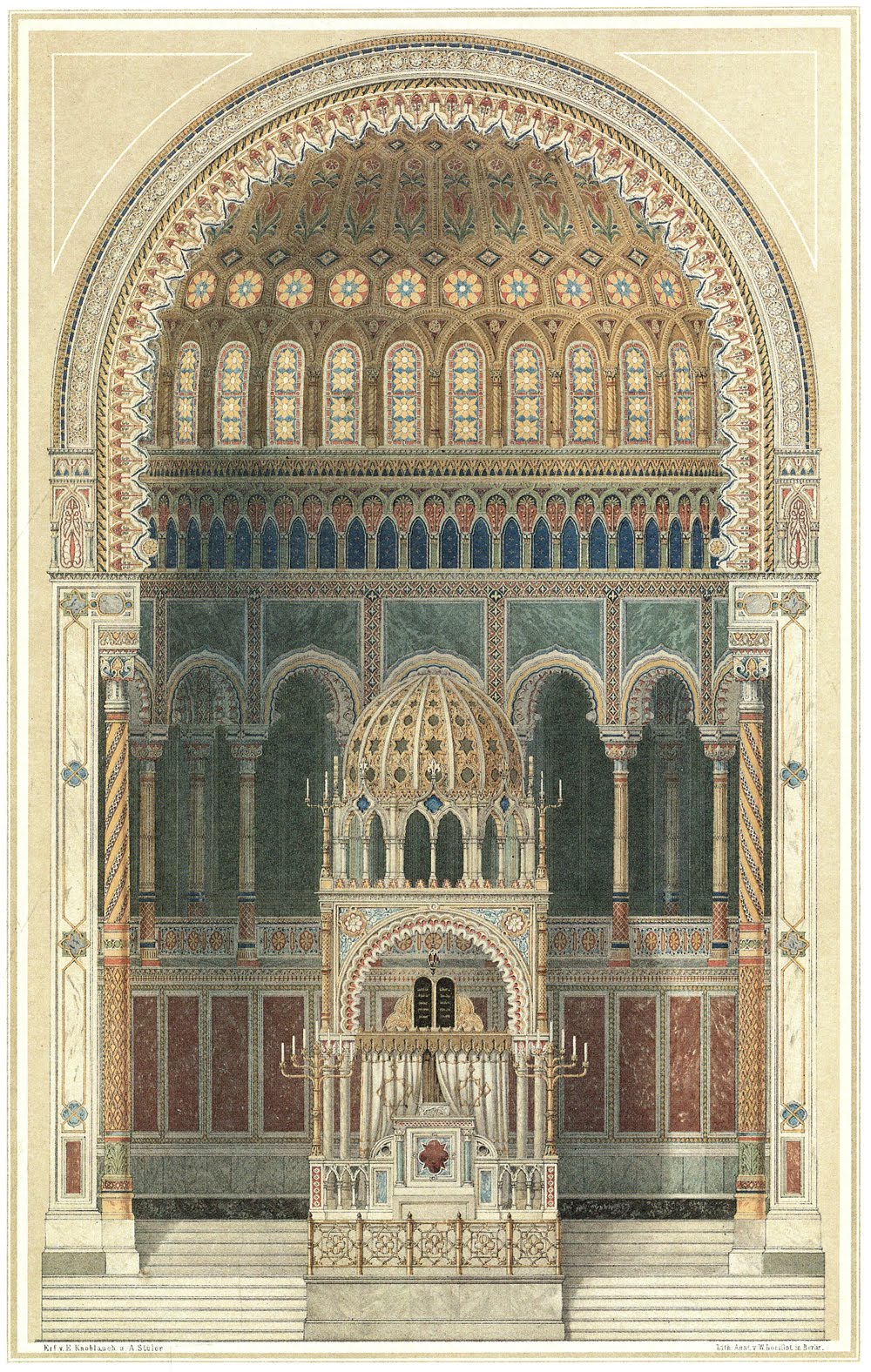
Nowadays, and it is understandable, if anything is known and remembered about synagogues in Germany, it pertains to their destruction on the Kristallnacht of November 9, 1938.  Where Kristallnacht signaled and symbolized the end of Jewish life in Germany, the inauguration of the many new synagogues that were built across the country in the nineteenth century symbolized the optimistic future that Rabbi Aub and the rest of German Jewry saw ahead.  Of course, synagogues symbolize more than a future full of possibilities.  They also tell stories about the way a particular congregation sees itself, the way it wants to be seen, and what its relationship is to Jewish history.  While the neo-Moorish, Neue Synagoge stood out for its size and splendor, it was not the only one of its kind nor is its story simply a part of the history of synagogue architecture.  Rather, it is but one part of a still larger and peculiar story of German-Jewish culture and its profound attraction to all things Sephardic.
The modern history of German Jewry begins in the eighteenth century, for it is then that we first see signs of a new and distinctive sense of self, one predicated on that community’s definitive, sometimes aggressive, separation from Polish Jewry, with whom it had previously formed a pan-Ashkenazic civilization.  The process began with the abandoning of Yiddish and the adoption of German language and culture.  This was followed in the nineteenth century by the advent of new forms of Judaism, such as Reform, Positive-Historical (later called Conservative in the United States), and modern Orthodoxy, the turn to Jewish scholarship, the acquisition of university education, and the emergence of Jews into the middle classes.  All of these innovations intended to or served to change the image and appearance of Jews and Judaism.
One aspect of the great cultural transformation of German Jewry was the special place of honor it accorded medieval Spanish Jewry during its so-called Golden Age.  For the entire German-Jewish elite, the Sephardim were a cultural nobility and over the span of about 120 years, from approximately 1780 to 1900, what first began among community leaders as an appreciation of Sephardic Jewry blossomed into a rhapsodic and full-blown infatuation with the Jews of Sepharad.  In fact, the adulation shown towards Sephardic culture had a deep impact on German-Jewish self-perception, for the celebration of Sephardic Jewry led simultaneously to a self-critique, often a very harsh one, of Ashkenazic culture.  German-Jewish elites portrayed the Jews of Germany and Poland as insular, unattractive and primitive and in response, they felt that the time had come to rectify this and become like they imagined the Jews of Spain to have once been—worldly, alluring, and cosmopolitan.
Beginning in the eighteenth century, with increasing fraternization between upper-class Jews and Christians and exposure to bourgeois tastes and sensibilities, Jews, long considered to be in religious error came to believe that they were also in aesthetic error.  In almost all corporeal and cultural categories, Jews found themselves to be deficient, occasioning among them a crisis of aesthetic confidence.  It was at this point that appearances first began to matter to German Jews, a situation that made them hyper self-conscious and hyper-vigilant, acutely aware of how they sounded, how they looked, and how they carried themselves.  These were among the most important categories that drew them to the Sephardim, who they imagined as dignified, elegant, eloquent, and beautiful.  To be sure, German Jews did not want to mimic Sephardic culture; they only wanted to be German Jews but they did wish to emulate the Jews of Spain and be thought of
in similar terms.  In 1820, a young Prussian-Jewish lawyer named Eduard Gans applied to the government for permission to establish an association dedicated to the study of Jewish history and culture.  In his application Gans invoked the Jews of Spain:
“These [Spanish] Jews, resembling all others both physically and mentally but granted by the Arabs equality with Muslims, proceeded to plumb in concert all the known sciences of the day….And they employed [in their writings] not Hebrew but Arabic.  Indeed those Jews expelled from [Spain] to France, Holland, Italy, and England, to the detriment of Spanish economic life…have never formed the contrast to Christian society which was so striking in the other family of Jews, [the Ashkenazim, who were] kept intentionally apart.  They are marked by less discrepancy in morality, purer speech, greater order in the synagogue, and in fact better taste.” [1]
By using this example, Gans was suggesting that if Jews in his day were granted equality with Germans then Jewish morality, speech, decorum and taste would likewise improve.
The positive impression of Sephardic Jewry was cultivated in a variety of ways, all part of a new and developing German-Jewish culture.  Maskilim or proponents of the Jewish Enlightenment claimed that Sephardic Hebrew was preferable to Ashkenazic pronunciation.  Anthropologists asserted that the Sephardim were superior to Ashkenazim in terms of physical beauty and comportment while authors and poets wrote scores of wildly popular Sephardic-themed works, and historians penned highly romanticized depictions of Sephardic history.  All of this created an image of the medieval Jews of the Iberian Peninsula as an ideal Jewish community, steeped both in Jewish tradition but also fully at home in secular culture.  Jewish historians also believed that what made for Sephardic superiority was their living under tolerant Muslim rule and as such, nineteenth century German-Jewish historians were tireless promoters of the idea that there had been a Muslim-Jewish symbiosis.  As the founding father of Reform Judaism, Abraham Geiger declared, “Judaism had developed its own fullest potential in
closest union with Arab civilization.”
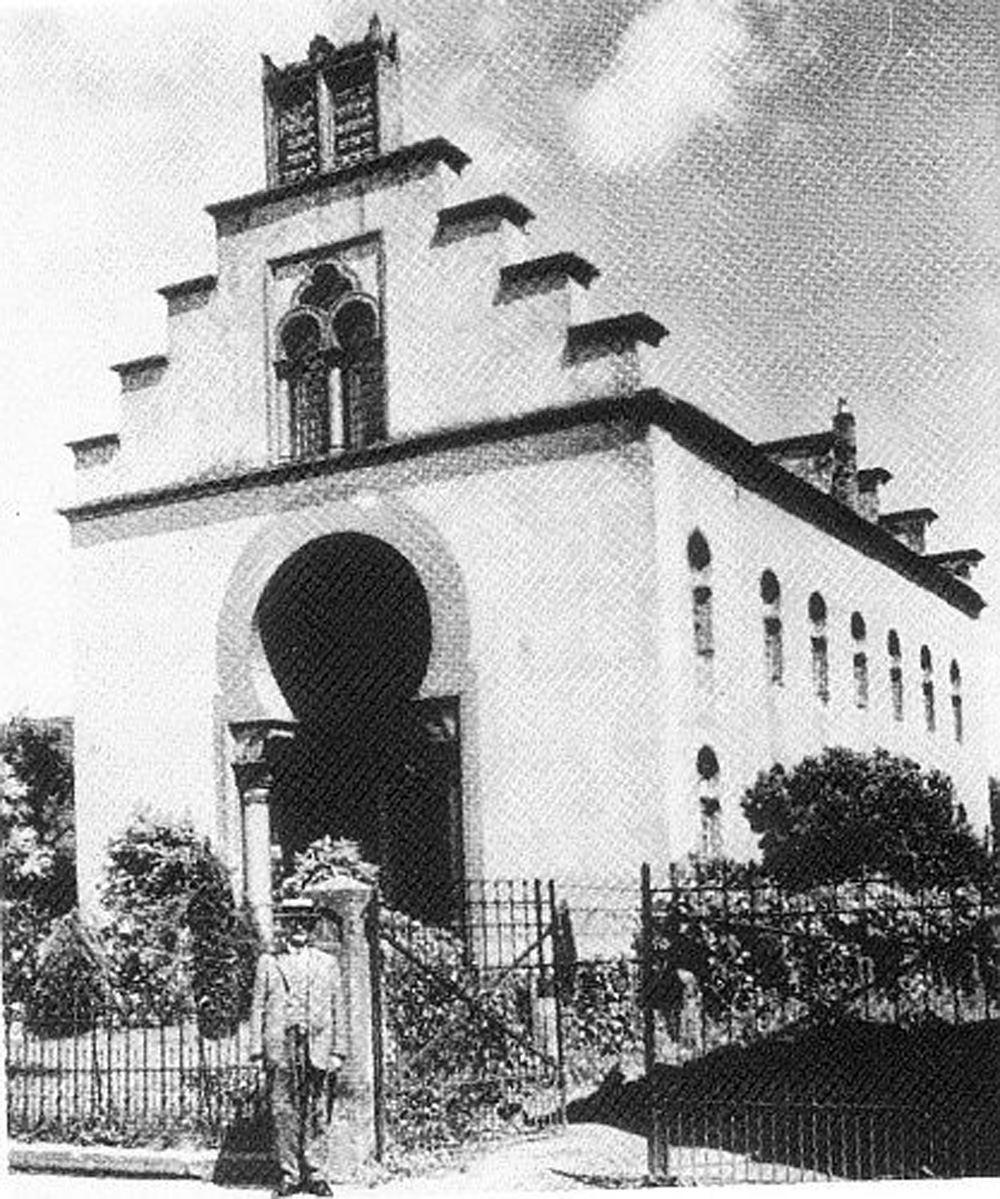
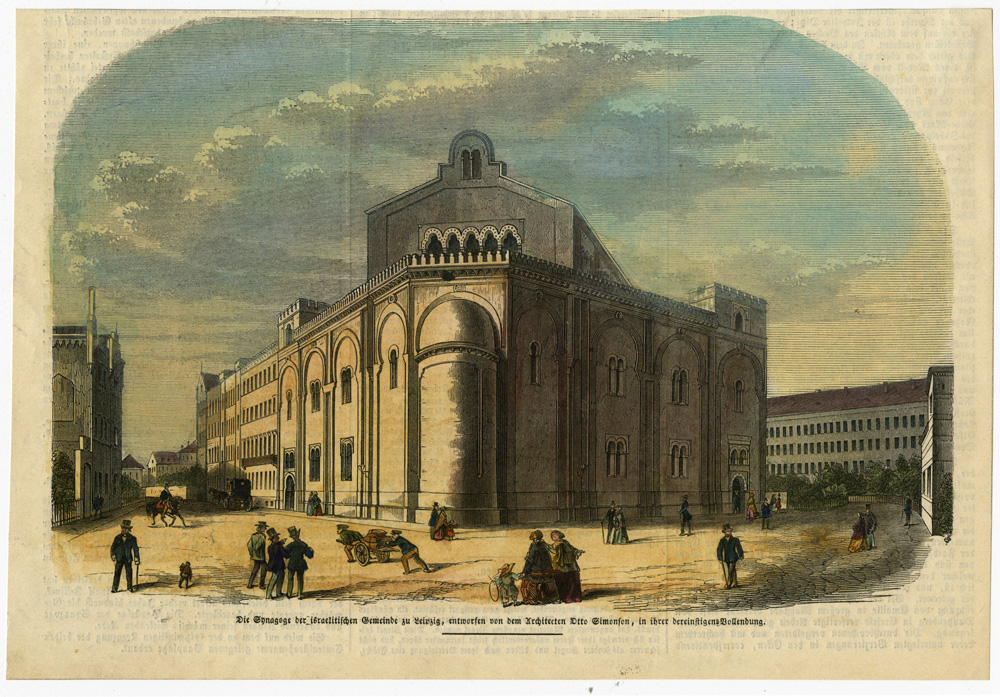
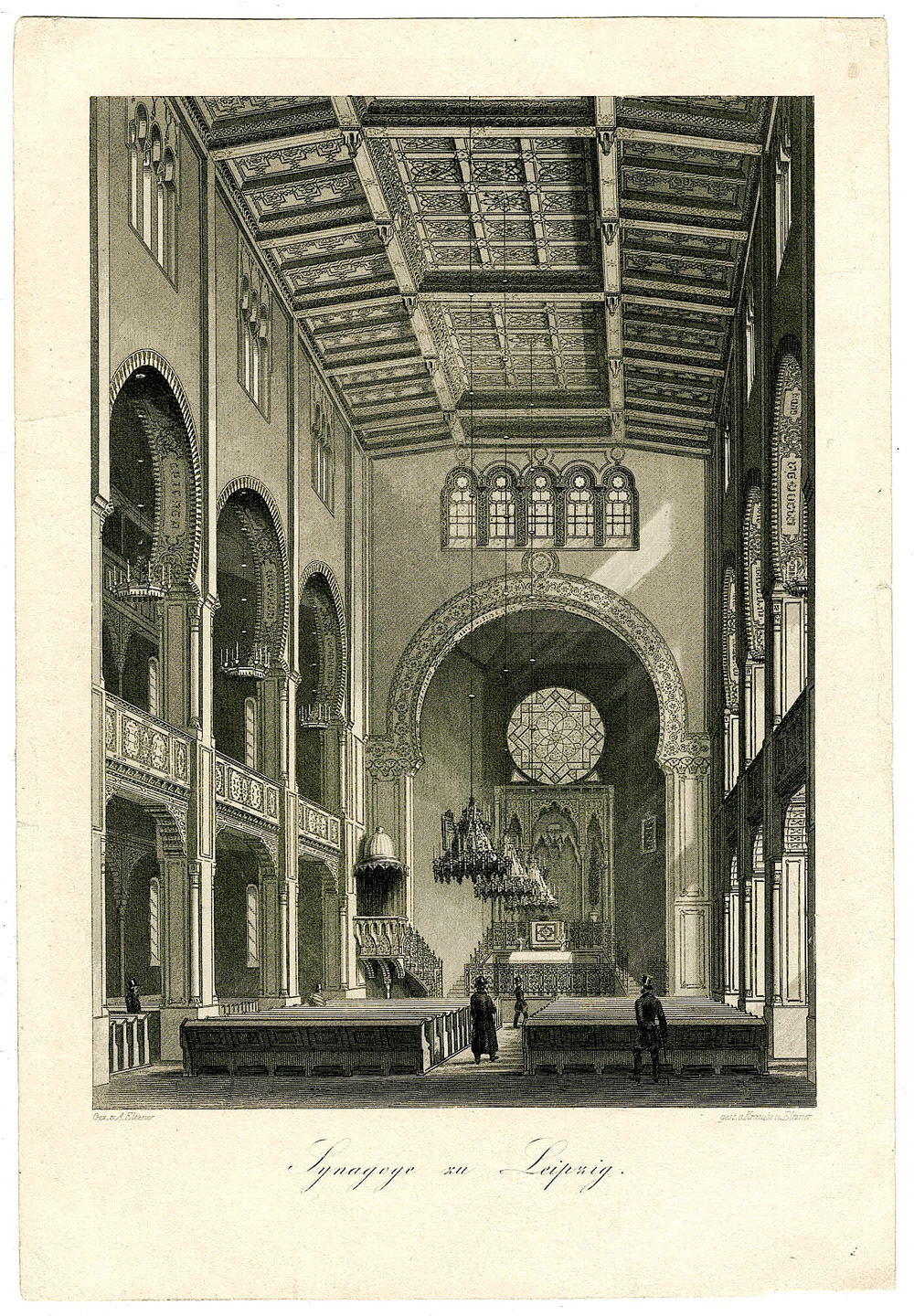
There was, however, one aspect of Sephardicism that stands out from all the rest because it was neither textual nor was it an exhortation to modify behavior; it was architecture.  Between the 1830s and 1860s, the advent of neo-Moorish synagogues, with their towering minarets, giant domes, polychrome exteriors, windows with Islamic-style arches, and stunningly ornate interiors were the most visible, indeed, the most spectacular manifestation of an imagined Sephardic aesthetic and the only one that was created in partnership with non-Jews, in other words, the architects, builders, city planners and councils who approved such structures.
While there are neo-Moorish synagogues all over the world, what makes Germany the most important site for this architectural style is that it was the first place such synagogues were built and secondly, they were the only Orientalized buildings in Germany, a style almost all architects dismissed as suitable only for entertainment and recreational purposes.  Indeed, where Orientalist buildings did exist—Holland, England, and France—most of these were found in parks, gardens, and holiday resorts.  In Germany, however, the only Orientalized buildings were neo-Moorish synagogues and as such, it was accorded the status of a Jewish national style of architecture.
The neo-Moorish style did not simply appear but rather it evolved.  The earliest such synagogues were erected in the provinces, with the first one opening in 1832 in the small town of Ingenheim.  Designed by Friedrich von Gärtner, the Bavarian court architect, the small synagogue had no neo-Islamic decorations on the interior although it did employ an Egyptian theme for the Torah ark and had an aedicule bedecked with a frieze of palm trees, a botanical feature strikingly out of place in this rural Bavarian landscape.  However, from the outside,
the oriental character of the building was unmistakable given the large horseshoe-arched entrance and Islamic style-windows that ran along either side of the synagogue and were modeled on those found on thirteenth and fourteenth century North African and Spanish mosques.
By the middle of the nineteenth century, however, these synagogues were no longer being built, out of consideration for both the high costs and shrinking regional communities, whose inhabitants were leaving rural areas and moving to big cities.  This did not mean the end of neo-Moorish synagogues, however, for they now began to appear in large cities and in ever increasingly spectacular forms.  In Dresden, the exterior of the Neue Synagoge built in 1840 was composed of an eclectic mix of Christian, Byzantine, and Romanesque elements with no neo-Moorish exterior elements.  However, it was the first synagogue to have a neo-Moorish interior, borrowing decorative motifs from the Alhambra palace in Granada.  The ceiling of the central dome was painted a brilliant blue with the sun’s while the walls were sumptuously painted in a dazzling array of colors, depicting floral and geometric designs.  The Eternal Lamp, or ner tamid, that hung in front of the ark was of Moorish design and it is one of history’s puzzling ironies that upon learning of its beauty those two radical antisemites Richard and Cosima Wagner ordered a replica of the beautiful lamp for their house on Lake Lucerne.  They used it for the first time when their son Siegfried was baptized at home in 1870.
 The synagogue in Dresden was designed by one of Germany’s foremost architects, Gottfried Semper, the man who designed the city’s world famous opera house.  His student, Otto Simonson, was one of the very few Jewish architects in Germany in the nineteenth century and his great contribution was to design what was Germany’s first fully neo-Moorish synagogue, both inside and out.  Built in Leipzig in 1855, and also named the Neue Synagoge, its unusual triangular shape (akin to the Flatiron Building in New York) made it immediately recognizable.  At the very point of this gigantic, 2,000 seat synagogue, where the two angles met, there was a massive, semicircular silo on top of which was a highly polished, fluted copper cupola, framed by a horseshoe arch, crowned with a Star of David.
On the synagogue’s interior, it was this silo that was home to the ark that held the Torah scrolls.  The synagogue’s two massive facades were punctuated by four gigantic relief moldings of Islamic arches.  Running along the top of the outer walls were crenellated parapets.  With battlements, towers, and a rampart-like facade, the building took on the appearance of a fortress mosque.  The interior was a blaze of color, with yellow skirting boards forming the base for green walls, which rose to meet a stunning blue ceiling bedecked with stars and a giant sun.  All of this was further illuminated by the bright light that streamed in through the colored rose window.  A monumentally large and highly decorated horseshoe arch framed the whole eastern end of the synagogue, further enhancing the neo-Moorish appearance of the whole structure.  Simonson was one of the few architects to explain why he chose the neo-Moorish style for his synagogue:
“The Temple is built in the Moorish style, which appears to me to be the most
characteristic. Judaism adheres with unshakable reverence to its history; its
laws, its customs and practices, the organization of its ritual; in short, its
entire essence lives in its reminiscences of its motherland, the Orient. It is
those reminiscences that the architect must accommodate should he wish to
impress upon the building a typical [Jewish] stamp.”[2]
From humble rural beginnings, Germany’s neo-Moorish synagogues got increasingly bigger and ever more ornate and none was grander than the Neue Synagoge in Berlin, built between 1859 and 1866.  When it finally received permission to build a new synagogue, the congregation announced an international competition to choose an architect for what it envisioned would be a brightly lit synagogue with seating for 3,200 congregants, upstairs galleries for the women, entrances separated according to sex, sufficient space for a 60-person choir, an apartment for the rabbi, as well as administrative offices and classrooms.  There was also to be a library with space enough for 67,000 volumes.  The renowned Eduard Knoblauch was the architect who won the tender and he had the difficult job of making sure that “the total cost was not to exceed 125,000 taler.”
Sadly, Knoblauch did not live to see his great creation, passing away in 1865.  When the synagogue on the Oranienburger Strasse—the very street on which Knoblauch lived—was inaugurated on September 5, 1866, the guests were seated in the grandest neo-Moorish synagogue ever built.  They were also in the most expensive, costs having ballooned to a staggering 750,000 taler.  The synagogue’s external centerpiece was an onion dome that soared majestically some one hundred and sixty feet into the air.  Wrapped in a blanket of zinc and swaddled in gold ribbing, crowned with a Star of David, the great dome was the brightest and most joyful architectural feature to be found anywhere in Berlin.  It was also the tallest structure in the city. The central portal was flanked by towering minarets that borrowed heavily from North African mosques and from the Giralda, a late twelfth century minaret in Seville while the crenellations were typical of those found on Cairene mosques.
 
The synagogue was as massive as it was ornate, its triple-nave 188 feet long and 126 feet wide while the ceiling soared to a height of 87 feet.  The interior was a dazzling kaleidoscope of color, light, and texture.  With Moorish decorative patterns from the thirteenth and fourteenth centuries, the floors were inlaid with intricate mosaics; the walls were covered in richly colored stucco and then painted with stars and flora, while stalactite features hung from the ceiling where geometric and honeycomb patterns were also widely deployed, including on the elaborate friezes that accented the temple’s interior. A technical breakthrough helped bathe the entire synagogue in a palette of many colors.  The windows were double paned, with the outer layer made of clear glass and the inner windows of stained glass.  An innovative system of gas lamps was installed in between the two panes throughout the synagogue.  While the myriad windows allowed for abundant light to pour into the synagogue, the placement of the gas lamps and the way they illuminated the stained glass helped create what one attendee at the synagogue’s dedication ceremony called a “magical effect.”
Indeed, the synagogue had the air and appearance of an Oriental pleasure palace.  A contemporary newspaper account vividly described the synagogue as “a fairy-tale structure.…In the middle of a plain part of the city we are led into the fantastic wonder of the Alhambra, with graceful columns, sweeping arches, richly colored arabesques, abundant wood carvings, all with the thousandfold magic of the Moorish style.”  The Neue Synagogue’s fame quickly spread and it attracted visitors from near and far.  Among the curious was none other than the English author, Lewis Carroll, a man who knew a thing or two about wonderlands and fairy-tale structures.  Just two years after publishing Alice in Wonderland, on Friday July 19, 1867, he stopped in Berlin on his way to Russia and while there, Carroll, a deeply devout Christian, made two visits to the synagogue.  He noted in his diary that after a full day of sightseeing, “later in the evening we strolled out and looked at the Jewish Synagogue, said to be well worth the inspection.”  His first cursory visit was followed by a much longer second stop the very next day and occasioned this beautiful diary entry:
“We began the day by visiting the Jewish Synagogue, where we found the service going on, and
remained until it was over. The scene was perfectly novel to me, & most
interesting. The building itself is most gorgeous, almost the whole interior
surface being gilt or otherwise decorated—the arches were nearly all
semi-circular, tho’ there were a few instances of the shape sketched here—the
east end was roofed with a circular dome, & contained a small dome on
pillars, under which was a cupboard (concealed by a curtain) which contained
the roll of the Law: in front of that again a small desk facing west—the latter
was only once used. The rest of the building was fitted up with open seats. We
followed the example of the congregation in keeping our hats on. Many men, on
reaching their places, produced white silk shawls out of embroidered bags,
& these they put on square fashion: the effect was most singular—the upper
edge of the shawl had what looked like gold embroidery, but was probably a
phylactery [sic].
These men went up from time to time & read portions of the lessons. What
was read was all in German, but there was a great deal chanted in Hebrew, to
beautiful music: some of the chants have come down from very early times,
perhaps as far back as David. The chief Rabbi chanted a great deal by himself,
without music. The congregation alternately stood & sat down: I did not
notice anyone kneeling.”[3]
For just over six decades the synagogue was home to a proud and confident congregation, one where the world’s first woman rabbi Regina Jonas preached and where in 1930 Albert Einstein conducted the orchestra for a concert performance.  Alone among the synagogues mentioned above, the Neue Synagoge survived the Kristallnacht despite being damaged in that night of violence and desecration.  In November 1943, however, it eventually succumbed, almost completely destroyed when struck by Allied bombers during the Battle of Berlin.  After the war, the synagogue was, by dint of the Cold War, located in what became communist East Germany.  In 1958 the main part of the building was demolished, with only those sections adjacent to the street remaining intact.  After the fall of the wall in 1989, those parts of the building that had survived, which included the severely damaged dome and the beautiful facade, were renovated and the synagogue was reopened in 1995.  However, what once was is no longer.  The main sanctuary does not exist. Today, on the premises there is a museum, an archive, classrooms, the administrative offices of the Jewish community and a small synagogue that is used for regular services.
Why did Jews build in the neo-Moorish style, especially in an era when German Jewry fought tirelessly against an antisemitic image that considered them a foreign, Oriental people?  Indeed, critics of the synagogue claimed that its design only confirmed this.  I think that from the Jewish perspective, the neo-Moorish design linked these congregations to their image of the Sephardim, allowing the congregations to appear dignified and sensitive to the importance of aesthetics and good taste.  However, above all, these mostly Reform temples looked nothing like any synagogues ever built before.  And like Reform Judaism itself, they were utterly new, with no historical precedent and that was their appeal and their purpose.
Though none of the synagogues built in the neo-Moorish style bore any resemblance to synagogues that had existed in medieval Spain they were nonetheless just one element of a much larger cultural project undertaken by German Jews, wherein they sought to honor and emulate Sephardic Jewry as part of a transformative process that would see them form a new kind of Ashkenazic Jewish culture.  Doing so led to a highly romanticized depiction of Sephardic Jewry, one where they were seen as superior to Ashkenazim in nearly every way—a curious, if not troubling, Ashkenazic assertion if there ever was one.  Long after the tragic demise of Spanish Jewry, the rays of its so-called Golden Age continued to shine across the Jewish world but without doubt it was in modern Germany that those rays enjoyed their greatest luminosity.
Notes:
[1] Quoted in Ismar Schorsch, From
Text to Context: The Turn to History in Modern Judaism
(Hanover, NH:
University Press of New England, 1994), 75.
[2] Otto Simonson, Der neue
Tempel in Leipzig
(Berlin: F. Riegel, 1858), 3
[3] Lewis Carroll, The Works of
Lewis Carroll
(London: Hamlyn, 1965), 972-973.


R. Yair Hayyim Bachrach as a Writer of Romance?, A Non-Jewish Song Made Holy, Love (and More) Before and After Marriage, and Memoirs that Maybe Tell Too Much

R. Yair Hayyim Bachrach as a Writer of Romance?, A Non-Jewish Song Made Holy, Love (and More) Before and After Marriage, and Memoirs that Maybe Tell Too Much
Marc B. Shapiro
Continued from here
There is an interesting responsum of R Yair Hayyim Bacharach, Havot Yair, no. 60, that deals with a man and woman who were in love and get married despite the strong opposition of the woman’s father. The story is quite romantic. It describes how during an epidemic in Worms in 1636 the beautiful and intelligent only daughter of one of the rich leaders of the local Jewish community falls ill. There is a man who had fallen in love with her and wants to take care of her in her illness. We are told that this man is tall and handsome, yet he comes from “the other side of the tracks” (i.e., from the lower class). He is able to get the agreement of both the father and daughter that if he takes care of the woman, which would be at great personal risk to himself, and she recovers, that they will marry. The woman indeed recovers but the man himself becomes sick, and the roles are reversed. The woman now takes care of him, which is only fitting since he caught the illness taking care of her. She too has fallen in with him and fortunately he survives, meaning that they are now able to marry. However, the father wishes to go back on his side of the agreement, which obligated him to provide a dowry, and that is the halakhic matter that the responsum focuses on.

Elchanan Reiner has argued that the entire story is a fiction, and what R. Bacharach, one of the most important 17th century halakhic authorities, has done is create a love story in line with the romantic stories that were appearing at this time in general literature. The story can therefore be seen as similar to a parable that is created for use in a sermon.[1]
The story R. Bacharach records is about a woman, indeed an only daughter, from a rich and important family. On the other side you have a poor man with no financial future. These are two people who in traditional Jewish society (and general society as well) normally would never be allowed or even want to come together. Yet because of the unusual circumstances of the epidemic, the man who dreams of the woman he could normally never have, is able to arrange a way to spend time with her and cross the boundary that otherwise would have kept them apart.
In the end we are inspired to see how love conquers all. For the sake of love the woman defies her father and gives up all the wealth that would be hers if she would only listen to her father and reject what her heart is telling her. It is a case of love vs. money, position, and power, and love wins. R. Bacharach mentions that when the father refuses to allow the marriage, the daughter says to him שעל כל פנים תזדקק לו הן בהיתר הן באיסור. What this means is that she threatens her father that if he doesn’t allow her to marry the man she loves, that she will be with him, i.e., sleep with him, anyway. For his part, the father says that he will not give her a dowry, and in the end ולקחה המשרת חנם. In other words, they married, but without any money from her father. They did what virtually no one else in 17th century Jewish society did. They married for love, choosing their own partners, without concern for status or money. According to Reiner, what R. Bacharach has given us in abridged form is nothing less than a Jewish version of Romeo and Juliet or West Side Story.
The late R. Raphael Posen responded to Reiner’s article, rejecting completely the latter’s hypothesis.[2] He acknowledges that the case described in R. Bacharach’s responsum may be theoretical, and notes that there are many such theoretical cases in the responsa literature. As for the romantic elements in the responsum, he states that in responsa one can find much “juicier” stories than the one discussed by Reiner, and there are also cases of lovers’ entanglements from completely different eras. Posen refers in particular to two responsa that appear in the Tashbetz. These responsa predate R. Bacharach by a couple of centuries. They also were written in North Africa, a place that did not have the sort of romantic literature that according to Reiner was the model for R. Bacharach’s responsum.
Reiner has a short and somewhat biting response to Posen.[3] He states that Posen’s article shows the very mentality that created the need for R. Bacharach to “cover up”, as it were, the love story he inserted into his responsa.
לא ניתן היה להעלות על הדעת דוגמא טובה הימנו להציג לקורא את פניה התרבותיים של השכבה החברתית שמפניה היה על חיים יאיר [!] בכרך מוורמס להסתיר לכאורה את סיפורו: שכבה העשויה מתלמידי חכמים בינוניים ובעלי בתים למדנים למחצה, הקוראים את הטקסט באופן חד ממדי, מפרשים אותו פירוש אחד ויחיד, שאינו סוטה מערכי היסוד הבסיסיים ביותר של סביבתם.
Reiner also states that what upset Posen was that Reiner’s portrayal of R. Bacharach diverges from the standard portrayal of “gedolei Torah” in that Reiner assumes that R. Bacharach was aware of the world around him and responded with originality to its intellectual challenges. Reiner obviously did not know Posen, as he assumed that Posen was an unsophisticated haredi ideologue with no appreciation for complexity in great rabbinic figures. The truth is that Posen, who represented the best of the German Orthodox tradition, was the exact opposite of this, as anyone can see by examining his essays in Ha-Ma’yan and elsewhere. As for the substance of the dispute between Reiner and Posen, I would love to hear which side readers come down on.
Regarding love prior to marriage, which we also discussed in the last post, it is noteworthy that there is a non-Jewish song focused on this theme that was turned into a religious song. Here is a Yiddish version of the original song, recorded by R. Yekutiel Yehudah Greenwald. It would have originally been sung in German or Hungarian [4]
וואַלד, וואַלד, ווי גרויס ביסטו
ראָזא, ראָזא, ווי ווייט ביסטו
וואָלט דער וואַלד ניט גרויס געווען
וואָלט דאָך מיין ראָזא נענטער געווען
וואָלט מען מיך פון וואַלד אַרויסגענומען
וואָלטן מיר זיך ביידע צוזאַמענגעקומען
This translates as:
Forest, Forest, how large you are,
Rosa, Rosa, how distant you are,
If the forest was not so large,
My Rosa would be closer,
If I would be taken out of the forest,
We would both come together.
By changing only a few words, R. Isaac Taub, the Kaliver Rebbe (1744-1828) turned this love song into a religious song, the title of which is גלות, גלות.[5]
גלות, גלות, ווי גרויס ביסטו
שכינה, שכינה, ווי ווייט ביסטו
וואָלט דער גלות ניט גרויס געווען
וואָלט דאך די שכינה נענטער געווען
וואָלט מען מיך פון גלות ארויסגענומען
וואָלטן מיר זיך ביידע צוזאַמענגעקומען
All this is well known in the hasidic world. It is so well known that one can only wonder how R. Yaakov Moshe Hillel could attempt to deny what I have just mentioned. In his Va-Yashav ha-Yam,[6] R. Hillel states, “Heaven forbid” to believe that any love songs were ever turned into religious songs by great rabbis:
(וכן מה שמפיצים שמועות כאלו על גדולים אחרים שהיו שומעים מהגוים שירי עגבים ומעתיקים אותם אל הקדושה, להלחין עליהם גם שירות ותשבחות גם קדישים וקדושות) אנא דאמינא ולא מסתפינא דחלילה להאמין כזה על גדולי ישראל שכבר כתבנו לעיל דלדעת כל הפוסקים אסור לשמוע שירי עגבים, ובעצם השמיעה לבד יש איסור, ואיך יתכן שגדולי ישראל יתעסקו בדברים מכוערים כאלו, חלילה להעלות כן על הדעת.
I have often written about how people are sometimes so convinced of something that when they are confronted with an alternative perspective in the writings of authoritative sages or in a report by a trustworthy person, they argue that the text is a forgery or the report is fraudulent, because gadol X never could have said or done such a thing. The situation with R. Hillel is even beyond this. The fact that the Kaliver Rebbe took a love song and turned it into a religious song is something that is known by all pretty much all educated Hungarian Hasidim (and not only Hasidim). It is worth noting that he didn’t just take the tune and add religious words, which is the case with other songs taken from the non-Jews. He actually kept the words, just changing a few of them.[7] Yet R. Hillel refuses to believe any of this. R. Hillel is a Sephardic Jew from India who probably knows close to zero about the history of Hasidism. Yet somehow he feels that he can declare that all the people who know the truth about this matter are not only incorrect, but are also degrading the honor of the Kaliver Rebbe.
Regarding love between husband and wife, I found an interesting passage from R. Levi Yitzhak of Berditchev.[8] He asks, why does the Torah tell us that Isaac loved Rebekkah? He answers that there are two ways a man loves his wife. One is that he loves her because of his physical lusts, “and this means that she is not his wife at all, rather, he [really] loves himself.” The other way of loving ones wife is because she is the “vessel” by which he can fulfill God’s commandments,[9] just like a person loves other mitzvot. “This is what it means that Isaac loved her, because he didn’t think at all about his physical desires, but was only intent on fulfilling God’s commandments.”
ויש אדם שאוהב אשתו ואינו מחמת תאות גוף שימלא תאותו רק מחמת שהיא כלי לקיים על ידה מצות הבורא ית’ שמו כמו שאדם אוהב שאר מצות וזה נקרא אוהב את אשתו וזהו ויאהבה יצחק שלא חשב כלל מחמת תאות הגוף שלו רק כדי לקיים מצות הבורא ית’ שמו ויתעלה זכרו.
R. Daniel Eidensohn has called attention to a similar approach attributed to the Baal Shem Tov, that you should love your wife as you love your tefillin. That is because with each of them you have the opportunity to fulfill mitzvot. See here. I don’t think this sort of interpretation will find much appeal in modern times, as it completely ignores the most obvious, and most important, type of love from husband to wife, which one hopes is present in every marriage. In fact, it is not only in modern times that such an interpretation would not be appealing, as all of the pre-modern sources that speak about loving one’s wife are indeed referring to real love.
R. Levi Yitzhak’s stress on love of one’s wife since she gives one the ability to perform mitzvot (i.e., purely utilitarian) is also at odds with other hasidic sentiments. For example, there is a famous story about a hasidic rebbe who was ill. A Lithuanian rabbi came to visit him late one night. He knocked on the door and when the rebbe answered the door, the rabbi said, “I have come to fulfill the mitzvah of bikur cholim”. The rebbe replied, “It is very late now, and I am tired and not in the mood to be the cheftza for your mitzvah.” This story is told among hasidim as a way to knock the non-hasidim. The lesson is that the Lithuanian rabbi should have come to visit the rebbe because he had the basic human emotion of wanting to show empathy to another who was suffering. Instead, he showed that this was foreign to his way of thinking, and his primary goal was simply to fulfill the mitzvah. And for that, the rebbe was not interested in taking part.
Since we are talking about love, I can’t resist sharing the following story told about R. Jacob Lorberbaum of Lissa. Like all of these types of stories, we can’t say if it actually occurred, but the fact that it is told is itself significant even if in this case I find it hard to believe that the sentiments expressed would be widely shared by any group. The story is found in R. Israel Beckmeister’s Ahavat Yisrael (Tel Aviv, 1976), pp. 49-50.

According to the story, a student once came to R. Lorberbaum and told him that since his wife hadn’t given birth in ten years he wished to divorce her. R. Lorberbaum asked him what his wife says about this, and he replied that she doesn’t want to be divorced as she loves him greatly. He also added that he too loves his wife greatly. R. Lorberbaum told him that he shouldn’t love her so much, and he should return home and God would grant him a child.
The student could not understand what R. Lorberbaum was telling him, since how could he tell a husband not to love his wife so much. When he returned home his wife asked him what R. Lorberbaum said, and he replied sharply that it does not concern her. This led to an argument and he slapped his wife, causing her to faint and leading to a great rift between them. The wife’s parents intervened and they were able to make peace between the couple, and following this the wife became pregnant and had a son.
R. Lorberbaum, who served as sandak, asked his student if he followed what he told him, i.e., not to love his wife so much. The student replied that he did, and that he also slapped her. R. Lorberbaum told him that the slap was too much, but that he should know that the scientists have stated that if a husband and wife are very much alike they cannot have children. Thus, when he heard that his student and his wife loved each other greatly, he understood why they couldn’t have children, and that is why he told the student that he shouldn’t love her so much. In other words, only if there is some distance between them will they be able to have children. (The nonsense that earlier generations believed in never ceases to amaze me. I realize, of course, that future generations might think the same about us.)
Another relevant text is found in R. Hayyim ben Betzalel of Friedberg’s Sefer ha-Hayyim. As part of my Torah in Motion tour of Germany this summer, we are going to Friedberg. The most famous of the rabbis of Friedberg was R. Hayyim ben Betzalel, the brother of the Maharal and a great scholar in his own right. In preparation for the trip I am reading material by and about R. Hayyim, and the following is one of the fascinating things I found.
In his Sefer ha-Hayyim,[10] R. Hayyim notes that the demons want to connect themselves with scholars or even with any men. However, this is difficult since men are on the highest spiritual level, and thus distant from the demons. Therefore, the demons connect themselves to women who are on a lower spiritual level than men, and thus closer to the demons. In other words, at the bottom you have demons, women are above them, and men stand at the top. As R. Hayyim explains, both demons and women share an important characteristic, namely, that they are naturally defective: חסירי היצירה. As proof for this contention about women, he cites Sanhedrin 22b:
אשה גולם היא ואינה כורתת ברית אלא למי שעשאה כלי
“A woman [before marriage] is a shapeless lump, and concludes a covenant only with him who transforms her [into] a [useful] vessel.”
The fact that the Talmud refers to a woman as a “shapeless lump” is proof for R. Hayyim that she is on a lower level than a man, and this basic division is not altered after marriage.
This then leads R. Hayyim to call attention to Exodus 22:17 which states מכשפה לא תחיה, “Thou shalt not suffer a sorceress to live.” He asks, why is only a sorceress mentioned, and not a sorcerer מכשף? He also calls attention to Avot 2:8, מרבה נשים מרבה כשפים, “The more wives, the more witchcraft,” which also makes the connection of sorcery to women. R. Hayyim explains that because of the closeness of women and demons the Torah was concerned that women would seek to “go down” and achieve completeness by connecting themselves with the demonic forces below them. This wasn’t such a worry when it came to men since they were “two levels above” the domain of the demons.
All of this is quite interesting, and R. Hayyim ben Betzalel was very happy with this explanation (which must be causing some readers to pull their hair out.) After offering it he expressed pride in what he wrote:
והנה לא קדמני אדם בפירוש זה והוא ענין נכון אצלי.
So what does this have to do with what I have been discussing in the post? R. Hayyim warns men not to be too connected to women (which includes their wives) since this will mean that they are trying to complete themselves and find perfection by means of someone who is on a lower level than them. I believe this to be in complete opposition to the modern romantic notion that men and women can be soulmates, for one cannot be a soulmate with one whose soul is literally on a lower level.[11]
Since I mentioned love between future husbands and wives, I should also note that there was concern that because young men and women were engaged, that they might initiate a physical relationship before the marriage. This explains the takkanot in Candia (1238) and Corfu (1663) forbidding an engaged man to even enter the house of his future father-in-law (where his fiancée lived).[12] The Corfu takkanah also states that an engaged woman is not permitted to be in the house of her future husband. The Corfu takkanah does make an exception that a month before the wedding the man and woman can be in the homes of their future in-laws. This is because there are wedding plans that need to be taken care of. But the takkanah specifies that the engaged couple must not be left alone.

The Candia takkanah states that if for some reason the man has to enter his future father-in-law’s home, he has to bring two men with him to act as his “guards”. The only exception to this rule is if the young man is studying Torah with his future father-in-law. In that case he can be at the home, since “the study of Torah is such as to weaken the force of the tempter.”

Solomon Buber records a 1776 oath signed by a man in Lvov declaring that he will not enter the house of his future bride under any circumstanced.[13] This was no doubt required by the rabbi. According to the text of the oath, if the man violates his pledge

אהיה נדון כעובר על השבועה בכל מיני עונשין וקנסים עצומים וחרפות ובזיונות בלי שום המלטה בעולם
R. Jonathan Eybeschuetz, in a sermon delivered in Metz in 1744, declared that “from this point on” he would only write a betrothal contract if the man and woman give their solemn agreement not to touch one another until after the wedding.[14]
As is clear from the sermon of R. Eybeschuetz just referred to,[15] many engaged couples were ignoring the law of negiah. Even Mendelssohn did not follow it, as we see from a letter he wrote to his fiancée. “Even the kisses that I stole from your lips were mixed with some bitterness, for the approaching separation made me heavy of heart and incapable of enjoying a pure pleasure.”[16]
In his autobiography, R. Leon Modena records the following about his young fiancée who was on her deathbed. He was 19 years old at the time.
On the day she died, she summoned me and embraced and kissed me. She said, “I know that this is bold behavior, but God knows that during the one year of our engagement we did not touch each other even with our little fingers. Now, at the time of death, the rights of the dying are mine. I was not allowed to become your wife, but what can I do, for thus it is decreed in heaven. May God’s will be done.”[17]
This story reminded me of an incident R. Jacob Emden records in his autobiography, although the details are entirely different. The translation of this lengthy passage is by Jacob J. Schacter in his outstanding dissertation on R. Emden.[18]
A miracle also occurred to me, especially relevant to matters spiritual. (It was) a miracle similar to that of Joseph the righteous and (even) slightly more so. I was a young man, tender in years, in the full strength of my passion. I had been separated from my wife for a long time and greatly desired a woman. A very pretty unmarried young girl who was my cousin happened to meet me there and was alone with me. She brazenly demonstrated great love to me, came close to me and almost kissed me. Even when I was lying in my bed, she came to cover me well on the couch, in a close loving manner. Truthfully, had I hearkened to the advice of my instinct she would not have denied my desire at all. Several times it (indeed) almost happened, as a fire (consumes) the chaff. Frequently there was no one in the house with me but her. They (i.e. the members of her family) were also not accustomed to come for they stayed in the store on the marketplace, occupied with their livelihood all day. Had God not given me great strength, the excellency of dignity and the excellency of power (Gen. 49:3), to overcome my fiery instinct which once almost forced me to do its bidding, (and) were it not for the grace of God which was great upon me, (I would have been unable) to withstand this very powerful temptation, greater than all temptations. I was a man at the prime of my strength and passion. There was a very pleasant beautiful woman before me who demonstrated for me all manner of love and closeness many times. She was related to me, unmarried, a tender child and recently widowed. She may have been ritually pure or would have ritually purified herself had I requested it. If I had wanted to fulfill my passionate desire for her, I was absolutely certain that she would not reveal my secret. I controlled my instinct, conquered my passion and determined to kill it. My heart was hollow and I did not . . . Blessed be the Lord who gives strength to the weary for I was saved from this flaming fire.
Schacter does not translate the next sentence in the memoir in which R. Emden expresses the wish that as a reward for standing firm, he and his descendants until the end of time will be protected from sexual temptation.
Here are the pages from the Warsaw 1896 edition of Megilat Sefer, pp. 82-83.
In 2012 a new edition of Megilat Sefer appeared, edited by R. Avraham Yaakov Bombach. Here is page 106 from this edition.
As you can see, the Bombach edition has omitted the entire story R. Emden tells. While R. Emden thought it was important for people to know about how he overcame his evil inclination, and he therefore recorded it for posterity, Bombach obviously felt that this is “too much information.” Instead of discussing the significance (and strangeness) of R. Emden allowing us entry into his most personal memories, Bombach chooses the other path and censors that which he is uncomfortable with.
On the other hand, in the introduction to the recently published memoir of the Sephardic scholar, R. Joseph Hayyim Abuhbut,[19] the editor calls attention to the very passage I have quoted, and which was censored by Bombach. He notes how much value the reader can derive from this passage in seeing how R. Emden was able to overcome temptation.
מה מאוד מופלאים הם דברי הגאון יעב”ץ זצ”ל . . . כמה תועלת תצמח לקורא כאשר יווכח לראות באיזה נסיונות נתנסה זה האיש המרעיש ארץ, מי מילל ומי פילל.
R. Elijah Rabinowitz-Teomim mentions in his autobiography that he lived in the home of his future father-in-law together with the girl he was engaged to.[20] At that time he was around sixteen years old and she was under fifteen. He mentions that she was in love with him: והיא דבקה אחרי בלבה. As with R. Emden, he makes a point of telling us that although he engaged in much conversation with her, as they had become very close (“like brother and sister”), he never touched her in all the time he lived in her home. Unlike R. Emden who tells us how much he was tempted and that he “greatly desired a woman,” R. Rabinowitz-Teomim tells us that his relationship with the girl was purely platonic, and he never even thought about her in a sexual way. 
בשלהי שנת תרי”ט העתיק אאמו”ר ז”ל משכנו לעיר ראגאלי ועמו יצאו כל ב”ב, ונשארתי לבדי בשילעל בבית המחותן . . . בכל משך היותי בבית המחותן לא הייתי רחוק מהמשודכת והיינו מדברים זע”ז, ובשגם אחרי נסע בית אאמו”ר ז”ל משם ונשארתי בבית אביה, כל היום, והיא דבקה אחרי בלבה, כאשר ראיתי וידעתי גם שמעתי כי יקרתי בעיני’. . . היינו קרובים זה לזה כאח לאחות, לשוחח כנהוג בבני הנעורים, אבל לא עלה לבי על דבר אחר, חלילה, ולא נגעתי בה אפילו באצבע קטנה כל משך שבתי עמהם, כדת שלת תורה.
So we have three memoirs by leading rabbis, all of which mention them with a girl. Both R. Emden and R. Rabinowitz-Teomim feel it is important to inform the reader that they never touched the girl. As we have seen, R. Emden was very proud of how he overcame his evil inclination and that is why he tells the story. I don’t know why R. Rabinowitz-Teomim thought it was important to mention the matter, especially as no one would have assumed that he had any physical contact before marriage.
I found another interesting source in R. Eleazar Kalir’s Havot Yair.[21] R. Kalir, who died in 1801, was the rabbi in Kolín, today in the Czech Republic. He discusses the common phenomenon of engaged couples having physical contact, and he tells us that no rebuke can stop the practice. He also says that the fault for this must be placed mostly upon the parents, since they are happy to see this behavior by the engaged couple and thus make no efforts to stop it.
בעו”ה רבו המספחת זו בישראל שתיכף אחר התקשורת התנאים, החתן הולך אל הכלה ואינו נזהר מח”ו [חיבוק ונישוק], והיא גם היא אסור לו משום נדה שהיא בכרת . . . ובעו”ה הדבר הזה הוא כמנהג הקבוע, ואולי הוא ממנהגות סדום ודור המבול שהשחיתו את דרכם, והיתר זה אינו בא רק כמאמרם, עבר ושנה נעשו לו כהיתר, ובעו”ה אין התוכחה מועלת בזה, שאמר יאמר מה בכך, שאני הולך אל הכלה שלי, שהיא המיועדת לי, על זה סיים הנביא וכלה מחופתה שאינה נקראת כלה אלא לאחר חופתה, ואז רשאי ליחד עמה, ואמרו כלה בלא ברכה אסורה לבעלה כנדה, וק”ו בעודה לא טהרה מטמאת נדתה.
ולא על החתן לבד יש להתלונן אלא ביותר על אבותיהם שרואים דבר זה, ולא די שהם שותקים אלא אף משמחים אלי גיל בראותן מעשים הללו בעיניהן ממש כצאן לטבח יובל . . . והוא מסייע ידי עוברי עבירה, בראותו תולדותיו כיוצא בזה ולא די דאינו מוחה אלא אף מסייע לדבר עבירה, ואדרבה מוטל על האבות להיות מוחים ובפרט מי שסיפק בידו לעשות.
Elsewhere in his book, we see that R. Kalir told his female congregants that on Shabbat morning they should leave the synagogue and go home before the end of services. This was to prevent men and women mixing which would happen if the women were still there when services ended.[22] It is hard to believe that he found much of a receptive audience for this request.
To Be Continued
1. In my last post I mentioned Maxine Jacobson’s new book on R. Leo Jung. Anyone who is interested in purchasing a soft-cover copy of the book for $25 can contact her directly at maxine.jacobson at sympatico.ca.

2. One of the most prolific authors of halakhic works in English is Rabbi Ari Enkin. His most recent book (which is his eighth such publication) is Halichot V’halachot. Anyone who is interested in modern issues and their halakhic ramifications will enjoy this book and his previous volumes. The topics he discusses run the gamut, from Shabbat and holidays, to kashrut, interpersonal issues, and civil and monetary law. As one can see from the numerous references in each essay, Rabbi Enkin has great erudition in the responsa literature, particularly the modern halakhic authorities. He cites these authorities no matter which ideological camp they are found in, and as such should be a model for all. Those who wish to order the book can contact the author at rabbiari at hotmail.com. His website is here.

3. On June 5, 2016, in honor of Yom Yerushalayim, I will be speaking at the Community Synagogue of Monsey, 89 West Maple Avenue. The title of my talk is “R. Shlomo Goren: The Revolutionary Chief Rabbi.” The talk will follow minhah which is at 8:15pm.

[1] See Reiner, מעשה שאירע בק”ק ווירמייש”א ברעש הגדול שנת שצ”ו, Ha-Aretz, Oct. 4, 2006, available here.
[2] See Posen, מגדלים פסיכולוגיסטיים, Ha’aretz, Oct. 17, 2006, available here.
[3] See Reiner, שערי פירושים לא ננעלו, Ha’aretz, Oct. 24, 2006, available here.
[4] Toyznt yor Idish lebn in Ungarn ([New York, 1945]), p. 173.
[5] See ibid.
[6] Vol. 2, no. 7 (p. 145).
[7] See R. Avraham Mordechai Katz, “Be-Inyan Shirat Nigunim ha-Musharim Etzel ha-Goyim,” Minhat ha-Kayitz 8-11 (2006), pp. 73-74, who makes this point and responds to R. Hillel. Regarding using non-Jewish music, Dov Weinstein called my attention to this shiur on the Yeshivat Kise Rahamim website which begins with music from Abba’s song “Dancing Queen.” I can’t imagine that the person who inserted the music has any clue where it comes from.
The Kise Rahamim website is where you can find R. Meir Mazuz’s shiurim, but a number of short videos are not included on the website. For example, this video appeared on Yom ha-Zikaron 2016:


R. Mazuz refers to the day as “kadosh ve-nora” and calls for synagogues to recite the prayer for Israeli soldiers every Shabbat. As he notes, if someone donates ten shekalim you make a blessing for him, so how could you not make a blessing for one who spills his blood for the Jewish people? I understand full well why haredim don’t say the prayer for the State of Israel. Yet I have never understood how haredi society could refuse to recite a mi-sheberakh prayer for the soldiers, the same soldiers who are the only reason why there can be a haredi society in Israel in the first place. Interestingly enough, in all the conversations over the years that I have had with haredim regarding this matter, to my recollection I have never met one who agreed with, or was willing to defend, his community’s avoidance of the prayer. (I am referring to mainstream haredim, not Satmar or other anti-Zionists.)

[8] Kedushat Levi (Warsaw, 1902), p. 15b, s.v. ויביאה יצחק
[9] The text has מצות which could be read as singular or plural.
[10] (Jerusalem, 1993), p. 153 (Sefer Selihah u-Mehilah, ch. 10). See Byron Sherwin, “In the Shadows of Greatness: Rabbi Hayyim Ben Betsalel of Friedberg,” Jewish Social Studies 37 (Winter 1975), pp. 49-50.
[11] Since this post has dealt a good deal with love, let me add one more point about a different sort of love. There is an old question, why when the kohanim bless the people do they say וצונו לברך את עמו ישראל באהבה? Where do we find that the kohanim were told to bless the people “with love”?  A number of different answers have been given, and one famous answer, intended as a joke, is as follows.
Before giving us the text of the priestly blessing , the Torah, Numbers 6:23, states:
דבר אל אהרן ואל בניו לאמור, כה תברכו את בני ישראל אמור להם.
This word, אמור, sounds a lot like the French and Italian words for love, so we see that God is telling the kohanim to love the people.
As mentioned, this is a famous answer. Not so famous is that it was actually stated by R. Leon Modena with reference to Italian. He, of course, also intended it as a joke. See Ziknei Yehudah, no. 127:
ואמרתי על דרך צחות דכתיב כה תברכו אב”י אמו”ר להם אמור בלע”ז היינו באהבה.
[12] See Louis Finkelstein, Jewish Self Government in the Middle Ages (New York, 1964), pp. 271-272, 279, 320-321.
[13] Solomon Buber, Anshei Shem (Cracow, 1895), p. 132.
[14] See Ya’arot Devash (Jerusalem, 1988), vol. 1, p. 62, s.v. ואתם עם ה’. The last three sources I have cited are mentioned by Salo Wittmayer Baron, The Jewish Community (Philadelphia, 1942), vol. 3, p. 206. For other relevant sources, see David Biale, Eros and the Jews (Berkeley, 1997), pp. 70ff.
[15] See Ya’arot Devash, vol. 1, pp. 61, 62
[16] Alexander Altmann, Moses Mendelssohn (Portland, 1998), p. 93.
[17] The Autobiography of a Seventeeth-Century Venetian Rabbi, trans. Mark R. Cohen (Princeton, 1988), p. 91.
[18] “Rabbi Jacob Emden: His Life and Major Works” (unpublished doctoral dissertation, Harvard University, 1988), pp. 55-57.
[19] Meoraot Yosef (Elad, 2014), p. 14 (first pagination).
[20] Seder Eliyahu (Jerusalem, 1983), pp. 22-23.
[21] (Jerusalem, 2004). p. 76.
[22] Ibid., p. 75.


Some Recollections of R. Jehiel Jacob Weinberg, Love Before Marriage, and More

Some Recollections of R. Jehiel Jacob Weinberg, Love Before Marriage, and More
Marc B. Shapiro
1. In my last post I mentioned R. Nosson Zvi Finkel, the Alter of Slobodka, so let me add the following. There is a transcript of a 1965 taped conversation between R. Jehiel Jacob Weinberg and R. Yaakov Herzog.[1] Herzog had come to Montreux to speak to R. Weinberg, and here is a picture from that meeting which appears in Michael Bar-Zohar, Yaacov Herzog: A Biography.

R. Weinberg, who knew R. Finkel very well, stated as follows.

הרב ויינברג: דער אלטער ז”ל (דער סלאבאדקער, זאגט מען דער אלטער), ר’ נטע הירש, ער איז דאך א צדיק.

הרצוג: אבער נישט קיין למדן.

הרב ויינברג: נישט קיין גרויסער למדן. ער האט געקענט לערנען, אבער ער איז נישט געווין קיין גרויסער למדן. אבער ער איז געווען א חכם, א גרויסער.

הרצוג: יא, דער חכם פון סלאבאדקע.

הרב ויינברג: און ער איז געווען א איידעלער מענטש זייער.

Some sections of this conversation appeared in the English Yated Ne’eman, Nov. 5, 1999. Yet as is to be expected, they appeared in a censored form as Yated Ne’eman would never record R. Weinberg’s statement that R. Nosson Zvi Finkel was not a great talmudic scholar. This judgment is not to be regarded as a put-down, as everyone in the Lithuanian yeshiva world knew that R. Nosson Zvi Finkel’s original insights were focused on Mussar, not analytical Talmud study.[2] Needless to say, the Alter always made sure that outstanding talmudic scholars were on the Slobodka faculty.
Speaking of censorship, here is another example. In the Yated Ne’eman article just mentioned, we find the following passage which is a quote from R. Weinberg.
I was intimately acquainted with R. Eizik Sher. . . . His son-in-law, R. Mordechai Shulman, visited me in Berlin and wanted to hear shiurim from me. I told him: This is not your place. Return to Slobodke.[!] Maybe you will some day become the son-in-law of R. Eizik.
This is what R. Weinberg actually said to Herzog:

ויינברג: ער איז ארויפגעקומען צו מיר אין סעמינאר. ער איז געווען אין בערלין, זיך ארומגעדרייט צוויי מאנאטן. געוואלט אריין אין סעמינאר. האב איך אים געזאגט: הערט זיך איין, ר’ מרדכי, ער איז א טיקטינר. דו וועסט נישט ווערן קיינמאל קיין דאקטאר. און אויב דו וועסט זיין א דאקטאר אפילו, וועסטו קיינמאל נישט קריגן קיין רבינער שטעלע אין דייטשלאנד. וואס טויג עס דיר? וועסט נישט מאכן קיין קאריערע. איז גיי אוועק צוריק אין סלאבאדקע. אמאל קען זיין, דו וועס זיך פארליבן אדער זי וועט זיך אין דיר פארליבן, די טאכטער פון ר’ אייזיק’ן, וועסטו ווערן ר’ אייזיק’ס א איידים.

.הרצוג: וכך הווה

 .ויינברג: און איך האב אים דערמאנט דאס. אז איך האב עס אים אמאל פאראויס געזאגט

R. Weinberg tells us that R. Mordechai Shulman, who was from Tiktin and later became Rosh Yeshiva of Slobodka in Bnei Brak, wanted to enroll in the Rabbinical Seminary of Berlin. Yated doesn’t want its readers to know this, so it “translates” the passage as saying that R. Shulman “visited” R. Weinberg and “wanted to hear shiurim” from him. R. Weinberg told him that he would never get a doctorate, and even if he did he would not get a rabbinic position in Germany, so he should return to Slobodka. R. Weinberg adds that when he returns it could be that he “will fall in love” with the daughter of R. Isaac Sher, or she will fall in love with him, and he can then become the son-in-law of R. Sher, the rosh yeshiva of Slobodka. In fact, this is exactly what happened.[3]
The Yated “translation” omits anything about R. Shulman and R. Sher’s daughter “falling in love.” This is because there is no such concept in the haredi world (and in traditional Jewish societies, in both the Ashkenazic and Sephardic worlds, such a notion was hardly found at all). Any love between husband and wife is said to come after marriage, and the biblical support for this concept, repeated in numerous texts (both haredi and pre-haredi[4]), is found in Genesis 24:67: “Isaac brought her into the tent of his mother Sarah, and he married Rebekkah. So she became his wife, and he loved her.” This verse states that Isaac loved Rebekkah, but only after he married her.[5] R. Gamaliel Rabinowitz goes so far as to state that any love that is found before marriage arises from sin, as there is no room for “feelings” before marriage.[6]
האהבה באה רק לאחר הנישואין, כל אהבה שלפני הנישואין מקורה בחטא רח”ל, ענין ה”רגשות” בכלל אין לו מקום לפני הנישואין, וזה דבר פשוט וברור שאין צריך לבארו.
R. Reuven Margaliyot mentions an interesting interpretation in support of this perspective.[7] There are two contradictory biblical verses. Proverbs 18:22 states מצא אשה מצא טוב, while Ecclesiastes 7:26 states ומוצא אני את האשה מר ממות. The contradiction can be explained as follows.
In earlier years parents would arrange marriages for their sons, and the overwhelming majority of the marriages succeeded. This is alluded to by the verse in Proverbs: מצא אשה מצא טוב. Now, however, things are different, and young men find their own brides, “and most of the time there isn’t peace between them after the marriage.” This is alluded to by the verse ומוצא אני את האשה מר ממות . In other words, if I find a wife for myself, most of the time it will turn out to be “more bitter than death.”
I think there might be another text that speaks to this concept, though I have not seen anyone who has made this point. The sixth of the sheva berakhot recited at a wedding states שמח תשמח רעים האהובים. The words רעים האהובים mean “beloved friends” or “beloved companions.” I don’t think one would use the word רעים to describe a man and woman who are “in love.” I believe that the words of the blessing mean a love that is found between two friends, rather than romantic love. 
R. Moses Gruenwald writes as follows:[8]
וענין חתונה א”א אלא בין רעים האהובים דמי שאינם אוהבים זה את זה א”א להם להתחתן.
What he says is that people who do not love each other cannot get married. I believe that he means the sort of “friendship love” I mentioned in the previous paragraph, rather than romantic love. I find his formulation particularly interesting, since R. Gruenwald was a Hungarian rav typically viewed as being on the extreme side of things. Yet here he is saying that there needs to be a sort of love between the bride and groom.
Could this really have been the norm in R. Gruenwald’s Hungarian (non-hasidic) community? Maybe some readers who come (or descend) from this type of community can offer some comments. I have also wondered what hasidim mean when they say רעים האהובים, since the people getting married hardly know each other. A friend from the hasidic world acknowledged that he doesn’t know if these words can be reconciled with the current reality. He also suggested that perhaps the words can be understood like יומת המת in Deuteronomy 17:6. In this verse the word המת does not mean one who is dead, but rather one who will soon be dead. So perhaps האהובים means “the ones who are in the process of becoming אהובים.”
I found another interesting passage that speaks about love of bride and groom. It is attributed to R. Isaac Luria by R. Hayyim Vital. As part of his explanation of a verse in Song of Songs, R. Luria writes:[9] מחמת רוב אהבת חתן לכלה. These words are explained allegorically, but their simple meaning also reflects a reality, one in which there is real love between bride and groom which could only have flowered prior to the wedding.
Returning to the traditionalist value that love only comes after marriage, this is all fine and good, but R. Weinberg specifically spoke of falling in love before marriage, and that this could lead R. Shulman to become R. Sher’s son-in-law. From the Yated “translation” the reader would assume that R. Weinberg was telling him to return to Slobodka and become a big learner, and that this might lead to him becoming R. Sher’s son-in-law.[10]
Regarding love letters, the following appears in R. Nathan Kamenetsky, Making of a Godol, p. 802, and was one of the passages that led to the book being banned:
A reliable source reported that R’ Aaron [Kotler] wrote a letter to his fiancée of which her father, R’ Isser-Zalman Meltzer, disapproved. When it was shown to the Alter, he rejoined, “I did not tell you he was a tzaddiq. I said he had other qualities, but he will yet become so frum that everyone will suffer from him.”
Many who read Making of a Godol assumed that the letter allegedly sent by R. Kotler was a love letter. In order to counter this understanding, in the second edition of Making of a Godol Kamenetsky added: “This author conjectures that the letter concerned an impressive hasbarah he had delivered.” This conjecture doesn’t seem to fit with the Alter’s reply about R. Kotler not being a “tzaddiq” and becoming “frum”. If R. Isser Zalman was upset because he thought that the young R. Kotler was a bit too impressed with himself, then the Alter would presumably have replied differently. The words that he allegedly used, “tzaddiq” and “frum”, have a certain meaning, and it thus is not surprising that the family of R. Kotler was so strongly opposed to the book and viewed this passage as insulting. (Another report has it that R. Kotler had suggested that his fiancée read a certain book and that was what upset R. Isser Zalman.)
In the second edition of Making of a Godol, the last sentence of the passage in question was altered to read, “But his frumkeit will yet become so great that everyone will suffer its brunt.” 
In my review of Making of a Godol, I wrote as follows:
Another problematic element of the book, admittedly found only on occasion, is its use of unnamed sources. This is acceptable in journalism, but not in scholarship. For example, the evidence for one of the most controversial passages in the book, concerning R. Aaron Kotler, his future wife, and his future father-in-law, R. Isser Zalman Meltzer, is “a reliable source” (p. 802). I understand why the source would not want his or her name to be given, but when repeating such a loaded story, which one knows will be controversial and its veracity challenged, the author is obligated to name the source, thus allowing the reader to judge its reliability. After all, if the source is R. Kotler’s daughter, its authenticity is more apparent than if it is another example of what X heard from Y. If the source does not wish to go on the record, it is best for the story to be omitted. (In my own biography of R. Weinberg, I was forced to leave out a number of “juicy” details, precisely for this reason.)[11]
I have previously discussed R. Samuel Archivolti’s book of melitzah letters, Ma’yan Ganim, and how it was misused by R. Baruch Epstein. See here.[12] This book is described in the Encyclopaedia Judaica as follows: “Archivolti’s most important works are . . . Ma’yan Ganim (Venice, 1553), divided into ‘passages’ containing 25 letters in metrical form designed to serve as models for students of this classic literary genre.”[13] It is worth mentioning Ma’yan Ganim now because on pp. 39ff. Archivolti includes two love letters. It appears clear to me that the focus of these letters is an unmarried couple, and first letter begins with the following heading: אגרת חושק לחשוקתה. 

Also of interest is this picture that appears at the beginning of each section of the book. As I learnt from Shimon Steinmetz, urinating putti were a common theme in the art of Archivolti’s day. You can read about it here

While Ma’yan Ganim is a book of melitzah letters, not responsa, R. Archivolti (1515-1611) was indeed a halakhic authority who served as rabbi of Padua. His pesak in the famous Rovigo mikveh controversy appears in Palgei Mayim (Venice, 1608), p. 15a.
 

R. Archivolti is referred to as מ”ד which stands for מרא דאתרא. In Renaissance Italy this title was only used for very important rabbis,[14] unlike today when all communal rabbis are given the title.
Interestingly, I found that a Hebrew manuscript from R. Archivolti’s era includes a love charm. The woman is told to write יריש ליאוש פילוש on her left hand, and this will cause the man she desires to fall in love with her.[15]
R. David Cohen, the Nazir, is an example of one who fell in love before marriage. In fact, his relationship with his future wife, Sarah, is a great love story. They were separated from each other for twelve years. He was in Europe and Eretz Yisrael and she was in Russia and later trapped behind the Iron Curtain. Throughout these long years they remained committed to each other, and the Nazir kept her picture on his desk. As reported by R. Avraham Remer, R. Zvi Yehudah Kook saw fit to mention this last point at the Nazir’s funeral.[16]
אמר עליו: “אור מופלא”, וציין אז שתי נקודות בחייו של רבי דוד: האחת, תחילת הנזירות בעת היותו באוניברסיטה, כדי לשמור על הפיאות והזקן. והשניה, שעל שולחנו הציב תמונת ארוסתו, כדי שחס-ושלום לא יתן עיניו באחרת.
R. Shear Yashuv Cohen tells us that the Nazir and Sarah also exchanged wonderful love letters during this time, letters which have not been made public:[17]
שמורים בארכיון המשפחה מכתבי-האהבה הנפלאים, ואף קטעי-יומן מלא רגש רוטט שנכתבו על ידי אבא מארי זצ”ל בימי הפירוד שנתמשכו הרבה מעבר למתוכנן ולמצופה . . . הכלה הצעירה מונה ימים ושנים, ונשארת בנאמנותה לבחיר לבה. אף הוא שומר לה אמונים ומתנזר מכל אפשרות של ברית או קשר אחר, בקפידה ובנאמנות יסודית.
When Sarah finally made it to Jerusalem, the Nazir was in the midst of a ta’anit dibur. R. Kook summoned R. Zvi Pesah Frank and R. Yeruham Fishel Bernstein so that they could sit as a beit din and void the ta’anit dibur, thus allowing him to speak to his soon-to-be bride.[18]

Regarding falling in love before marriage, R. Jehiel Jacob Weinberg, in his Oct. 12, 1960, letter to Samuel Atlas, states that R. Soloveitchik came to Berlin intending to marry R. Hayyim Heller’s daughter:
השידוך בטל. ס’ התאהב בזו שהיא עתה אשתו.
According to members of the Soloveitchik family, there is no truth to this, and R. Weinberg was simply repeating a rumor. But it is true that the Rav fell in love with his future wife in Berlin. R. Ronnie Ziegler writes as follows here:
The Rav’s most important and fateful encounter in Berlin was that with his wife, Dr. Tonya (Lewit) Soloveitchik (1904-1967). A student at the University of Jena, where she obtained a Ph.D. in education, she was introduced to Rav Soloveitchik by her brother, a fellow student at University of Berlin. Although a scion of the illustrious Soloveitchik family was expected to conclude a match with the daughter of a prominent rabbi or at least a successful businessman, Rav Soloveitchik fell in love with Tonya Lewit and married her in 1931 despite her family’s undistinguished lineage and lack of means.
R. Ziegler continues by describing the deep connection between the Rav and Tonya.
As mentioned in the previous lecture, the Rav’s relationship with his wife was one of the two most significant relationships in his life. He had unlimited esteem for her – his dedication of “The Lonely Man of Faith” reads: “To Tonya: A woman of great courage, sublime dignity, total commitment, and uncompromising truthfulness.” He respected her opinion and heeded her advice, both in practical and in intellectual matters. It was on her advice that he changed the topics of his annual Yahrzeit (memorial) lectures for his father, which attracted thousands of listeners, to matters which non-scholars could relate to (such as prayer, Torah reading, and holidays). [The halakhic portions of some of these lectures are collected in the two volumes of Shiurim Le-zekher Abba Mari z”l.] In a poignant passage in a teshuva lecture delivered after his wife’s death, he recounted how he used to consult her before speaking:
The longing for one who has died and is gone forever is worse than death. The soul is overcome and shattered with fierce longing. . . . Several days ago, I once again sat down to prepare my annual discourse on the subject of repentance. I always used to discuss it with my wife and she would help me to define and crystallize my thoughts. This year, too, I prepared the discourse while consulting her: “Could you please advise me? Should I expand this idea or cut down on that idea? Should I emphasize this point or that one?” I asked, but heard no reply. Perhaps there was a whispered response to my question, but it was swallowed up by the wind whistling through the trees and did not reach me.” (On Repentance [Jerusalem, 1980], p. 280)
Rav Soloveitchik’s wife was his best and perhaps only real friend. His natural proclivity towards loneliness, which we will encounter repeatedly in his writings, was heightened in his philosophy to an ideal, which expresses itself in an invigorating sense of one’s own uniqueness. One can be lonely even, or perhaps especially, when surrounded by friends, colleagues, and family. This is a constructive force which propels a person toward his individual destiny, while also propelling him to seek a depth-connection with God and with his fellow man. Aloneness, as opposed to loneliness, is a disjunctive emotion – it is a sense of lacking companionship, of being abandoned and forlorn. The passage above highlights the Rav’s almost unbearable sense of aloneness following his wife’s death in 1967 after a long struggle with cancer. He is reported to have said, “After my father’s death, I felt like a wall of my house had fallen down. After my wife’s death, I felt like the entire house had collapsed.”
Concerning the matter of falling in love before marriage, it is noteworthy that the great R. Hayyim Joseph David Azulai (the Hida) was in love with the woman who would later be his wife, and whom he knew for a number of years before they were married. Here is what Meir Benayahu has to say about this.[19]
את אשתו השניה, רחל בת משה הלוי מפיסה, הכיר כחמש שנים לפני שנשא אותה ונקשר עמה בקשרי אהבה. החלומות שחלם עליה לפני הנישואין מעידים על יחסו הנכבד לאשה. הוא שאף ל”נשואים רעננים” ובהנשאו לה ראה שהוא מתעטר בכבוד והדר. בנסיעותיו רכש לה מתנות ומסר לה אותם לפני הנישואין. כסף הרבה הוציא עליה למלבושיה ולהנאותיה, ומותה בשנת תקס”ד הקדיר עליו את עולמו.
Benayahu mentions the Hida’s dreams. Here is a passage that the Hida recorded from one of his dreams.[20]
תשרי תקל”ו . . . וראיתי בחלומי שהייתי בא על אשתי [שהיתה כבר נשואה עמי ולא זכרתי מי] ומוציא בתוליה ורואה דם. [קמ]תי והלכתי אצל אמ”ן [אבי מורי נ”ע] ושאלני ברמז והשבתיו ברמז . . . ונתעוררתי. ותכף הבנתי שהוא תשו’ שאלה מיום [ראש השנה?] לטובה. וב”ה שלא אירע לי שום מקרה ח”ו. הוא ית’ ירחם וייטיב אחריתי מראשיתי לאי”ט וש”ח.
Most people will probably feel uncomfortable reading this sort of passage. Yet the performance of the mitzvah the Hida discusses appears very natural to him and nothing to be ashamed of. Perhaps it is only uncomfortable to read because we have become overly puritanical regarding these matters which are also part of Torah. Nevertheless, it does remind me of other “uncomfortable” passages found in R. Jacob Emden’s autobiography.
I found another interesting passage that deals with love between a bride and groom in R. Aaron Fried’s Zekan Aharon (Munkacz, 1904), p. 52a. Here is the passage.
I am quite surprised by the example the author uses. In commenting on the rabbinic derashah connecting the words מורשה and מאורסה,[21] he uses an example that portrays a romantic relationship. He tells of a rich man, apparently newly married, who loved his wife and tried to woo her by telling her how greatly he loved her. “His love for her increased in quantity and quality beyond how other grooms love their brides.”
This type of description would be unusual enough in a rabbinic work. Yet it gets even more unusual when R. Fried continues by telling us that the rich man showered her with hugs and kisses and placed an expensive necklace around her neck as a sign of his love. R. Fried also elaborates on why, despite all these signs of affection, the woman did not reciprocate with any feelings of love. Later he explains that since the Torah is to us like one bound with erusin, that is why we show it love, decorate it with silver and gold, and even kiss it, just like a groom does with his bride! It happens to be a clever derashah, and ends with how if you want the Torah (i.e., God) to love you back, it is not enough to only support the Torah. One must also support the poor Torah scholars, the “relatives” of the Torah.
Is it just me, or is anyone else surprised by this derashah? I can’t imagine using the imagery found here as part of a derashah before a haredi audience in order to inspire them to be generous with their support of Torah scholars. With the mention of hugging and kissing the bride, I don’t even think this would go over well in front of a Modern Orthodox audience. [22]
I am doubly astounded by the fact that the derashah we have just seen was written by an outstanding student of the Hatam Sofer, one who also showed his halakhic expertise by authoring a volume of responsa titled שו”ת מהרא”ף.
I found the derashah so unusual that I was curious to see if anyone cited it. Using Otzar ha-Hokhmah I found two citations. The first is by a Hungarian rabbi, R. Efraim Balati, who authored Hamudei Efrayim (Galanta, 1935). In vol. 1, p. 35, he cites R. Fried’s comment.
Once again, I am surprised that a Hungarian rabbi would include such information in a derashah, even if, in R. Balati’s retelling, he leaves out the words ומחבב אותה בחיבוק ונישוק. Even though he doesn’t mention how the rich man showed his affection with hugs and kisses, he does include the rest of R. Fried’s words, including how we kiss the Torah just like a groom kisses his bride.
The other source I found that cites R. Fried’s passage is R. Barukh Moskovits, Tenuvot Barukh (Jerusalem, 1969), vol. 2, pp. 326-327.
If you examine the passage, you will see that he is quoting from R. Fried’s text, not R. Balati’s version. Yet R. Moskovits also alters R. Fried’s words ומחבב אותה בחיבוק ונישוק. In R. Moskovits’ text this appears as ומחבב אותה מאד. Since R. Moskovits copied R. Fried’s text basically word for word, I don’t understand why at the end of the passage he writes שמעתי. Why doesn’t he tell the reader the source of the passage? 
To be continued
2. The most recent book to appear in my series with Academic Studies Press is Maxine Jacobson, Modern Orthodoxy in American Judaism: The Era of Rabbi Leo Jung. Anyone with an interest in the history of Orthodoxy in America will want to read this book, and I am very happy that I was able to include it, together with other high quality works, in my series, “Studies in Orthodoxy.” Rather than offer my own description of the book, here is an “official” description, which appears on Amazon.
This work presents the issues of Modern Orthodox Judaism in America, from the decades of the twenties to the sixties, by looking at the activities of one of its leaders, Rabbi Dr. Leo Jung, pulpit rabbi, community leader and writer, whose career spanned over sixty years, beginning in the 1920s. Jung is a fulcrum around which many issues are explored. Rabbi Jung’s path crossed with some of the most interesting people of his time. He worked with Chaim Weizmann, the first president of Israel, with Albert Einstein to promote Yeshiva College, with Herman Wouk, American author and Pulitzer Prize winner, and with Pearl Buck, a Nobel Prize laureate and Pulitzer Prize winner.
Modern Orthodoxy went from being a threatened entity on the American scene to a well- recognized and respected force in Judaism. Orthodoxy, at first, was seen as alien to the American environment. Marshall Sklare, perhaps the most influential exponent of this notion, wrote in the 1950s that the history of Orthodoxy in America could be written in terms of a case study of institutional decay. He realized the errors of his ways in the 1970s. This is the story of the renaissance of American Modern Orthodoxy, from the disorganization of the older Orthodoxy to the new spirit of confidence that emerged after World War Two. The phenomenon of Modern Orthodoxy is examined in the context of Orthodox invigoration and change. This book has relevance for further studies in various areas. It is part of the study of religious acculturation, of the conflict between tradition and modernity and of religious reinvigoration in a secular society.
Another noteworthy recent book is Michael J. Harris, Faith Without Fear: Unresolved Issues in Modern Orthodoxy. In my blurb that appears on the back cover, I write: “A proud and sophisticated manifesto of Modern Orthodoxy, one which builds on past thinkers but does not hesitate to chart new ground as well.” Rabbi Harris deals with a number of issues such as the role and status of women, mysticism, academic biblical scholarship, and religious pluralism. He generally comes down on the more “liberal” side of what is known as Modern Orthodoxy. (An exception to this generalization is his chapter on academic biblical scholarship.) Anyone who is interested in the intellectual trends of Modern Orthodoxy will want to read Harris’s book, as it is engaged scholarship at its best.
I would also like to call attention to R. Shimon Szimonowitz’s just published Haggadah shel Pesah: Aleh Zayit.[23] I know that there are a lot of Haggadot out there, but for talmidei hakhamim this is one of the special ones. I say this because of the many learned comments, including full-length essays, that are found in the volume. Of particular interest to me is R. Szimonowitz’s lengthy article on le-shem yihud. It is crucial reading for anyone interested in the dispute over the le-shem yihud formulation, in particular the positions of R. Ezekiel Landau, R. Eleazar Fleckeles, and R. Moses Sofer. Among other noteworthy things found in this Haggadah are an article by R. Chaim Rapoport and the Yiddish version of a few beloved Passover songs.
3. On June 5, 2016, in honor of Yom Yerushalayim, I will be speaking at the Community Synagogue of Monsey, 89 West Maple Avenue. The title of my talk is “R. Shlomo Goren: The Revolutionary Chief Rabbi.” The talk will follow minhah which is at 8:15pm.

[1] Israel State Archives, Yaakov Herzog Collection, 2989-4/פ. R. Yaakov David Herzog was the son of R. Isaac Herzog. He was named after R. Yaakov David Wilovsky, the Ridbaz, from whom R. Isaac Herzog received semikhah. In addition to his public role in government and as a diplomat, Yaakov Herzog was also a rabbinic scholar. In 1945 he published a translation and commentary of Mishnah Berakhot, Peah, and Demai. This translation was actually ready for publication by the end of 1942, before Herzog was even 21 years old (he was born Dec. 11, 1921). See Michael Bar-Zohar, Yaacov Herzog: A Biography (London, 2005), p. 50.
In Iggerot Moshe, Hoshen Mishpat no. 1, R. Moshe Feinstein critiques an article of R. Isaac Herzog that appeared in Ha-Pardes. R. Moshe’s own article originally appeared in installments in Ha-Pardes, Tamuz and Av 5703. Yaakov Herzog defended what his father wrote in Ha-Pardes, Elul 5704, pp. 36-38, and Tishrei 5705, pp. 25-27. He was only 23 years old when he wrote these articles.
After the retirement of R. Israel Brodie, Herzog was offered, and accepted, the position of British Chief Rabbi. The common view is that Herzog’s health problems prevented him taking up the post, but the truth is more complicated. See Bar-Zohar, Yaacov Herzog, ch. 13.
Since I have spoken in prior posts about religious men not wearing kippot, Herzog should be added to the list. Not only did he go bareheaded when representing the State of Israel in the Diaspora (and also in his famous debate with Toynbee), but as you can see from pictures in Bar-Zohar’s book, he also did so in Israel, while at work in various important government positions. Bar Zohar writes, “Even as a very young man, when he was working at the Foreign Ministry and then in the Prime Minister’s office, Yaacov did not wear a skullcap, except when saying blessings or praying.” (Yaacov Herzog, p. 111) Because of the vast changes that have taken place in Israeli society, it is hard for us to appreciate why, in the early decades of the State of Israel, some religious men, even those who were not of German background, felt that government work required removing their kippah.
You can listen to the Herzog-Toynbee debate here.
In a previous post here I referred to Yitzhak Nebenzahl as not wearing a kippah, and I mentioned that this German practice continued into his old age. In 1974 Nebenzahl was a member of the Agranat Commission which investigated the Yom Kippur War. In pictures of him from this time you can see that he was still without a kippah. A couple of people emailed me to say that by the 1980s he had abandoned the galut custom and indeed wore a big black kippah. One of them even sent a picture of him and Nebenzahl together.
In the post referred to in the previous paragraph, I also discussed Aharon Barth, who like Nebenzahl came from Germany and did not wear a kippah while at work. Subsequent to the post I found that Zorach Warhaftig mentions that after the death of Chaim Weizman, Ha-Poel ha-Mizrachi recommended to Ben Gurion that Barth be a candidate for president of the State of Israel. Warhaftig reports that Ben Gurion rejected this since Barth was too religious and thus not an appropriate representative for the average citizen. See Warhaftig, Hamishim Shanah ve-Shanah (Jerusalem, 1998), p. 116.
[2] Shlomo Tikochinski, Lamdanut, Musar ve-Elitizm (Jerusalem, 2016) p. 111 n. 131, cites Israel Zissel Dvortz and Dov Katz who claim that R. Finkel was indeed a “gadol” in talmudic learning, but he hid this knowledge even from those who were close to him. Some will no doubt regard this judgment as motivated by “religious correctness,” especially as R. Weinberg had a particularly close relationship with R. Finkel and was privy to all sorts of private information. See, however, Nathan Kamenetsky, Making of a Godol, pp. 777ff., who cites additional sources testifying to R. Finkel’s talmudic knowledge.
[3] R. Shulman’s early shiurim were not very successful in drawing a following. Ben-Tsiyon Klibansky writes (Ke-Tzur Halamish: Tor ha-Zahav shel ha-Yeshivot ha-Lita’iyot be-Mizrah Eiropah [Jerusalem, 2104], p. 342):
בסלבודקה הורגשה אי-נחת כשמינה בה הרב יצחק אייזיק שר את חתנו מרדכי “טיקטינר” שולמן לר”מ בשנת 1935. בישיבה הוא היה תלמיד ותיק נודע, ולאחר נישואיו ב-1929 הועיד את כל זמנו להתעלות בלימודיו. אולם משהחל להרצות את שיעוריו בישיבה לא מצאו בחוריה הדעתנים לנכון להשתתף בהם, ובשיעורים הראשונים נכחו חניכים יחידים בלבד.
Here is a picture of R. Weinberg and R. Shulman in Montreux. It appears in Joseph Friedenson, Heroine of Rescue (Brooklyn, 1984), p. 230.

[4] R. Samson Raphael Hirsch, in his commentary to Gen. 24:67, writes as follows:
Like the marriage of the first Jewish son [Jacob], Jewish marriages, most Jewish marriages, are contracted, not by passion but by reason and judgment. Parents, relations and friends consider which young people are really suited to each other, bring them together, and then love grows more and more, the more they get to know each other. But most non-Jewish marriages are made by what they call “love”, and one has only to glance at the novels depicting life to notice what a gulf there usually yawns between the “love” before marriage and after, how rapid and insipid everything then seems, how different from all the glamour one had imagined etc. etc. Such “love” is blind, every step into the future brings disappointment. But of Jewish marriage it says: ויקח את רבקה ותהי לו לאשה ויאהבה. There the wedding is not the culmination but the seed, the root of love!
The Malbim is another pre-haredi figure who speaks of love coming after marriage and cites Gen. 24:67. See his commentary to Deut. 24:1 (p. 169b). Yet he differs from others who make the same general point in that he acknowledges that at the beginning (which appears to mean even before marriage) there is indeed a “spark of love,” זיק אהבה. In context, these words might only mean a healthy attraction. The Malbim continues that the essence of love between a man and woman comes only after marriage:
ונמצא שעקר האהבה היתה נגלית רק אחר הנשואין.
R. Hayyim Hirschensohn, whose outlook was as far from a haredi perspective as can be imagined, also points to Gen. 24:67 as providing the proper approach to love and marriage. He even throws in a negative comment about American mores which is not what most would expect to come from him. See Apiryon 3 (1926), p. 29:
ותהי לו לאשה ויאהביה, לא כמנהג אמריקא שהאהבה בא קודם הנשואין ומתה עם הנשואין, אבל יצחק אהב את רבקה אחרי הנשואין.
Reading all of these passages shows us how much has changed both culturally and sociologically. I don’t think there is a parent in the Modern Orthodox world who would support a child’s marriage if the son or daughter was not convinced that he/she loved the future spouse.
I asked a friend if in the haredi world people would ever say that the bride and groom loved each other (i.e., before marriage). He replied:
לא היו אומרים, אבל אצל הישיבתיים זה בסדר גמור – ואולי גם יותר טוב – שיהיה אהבה ביניהם, אבל לא היו מביעים את זה, קוראים לזה chemistry, רוצים שיהיה chemistry ביניהם לפני שסוגרים את השידוך. אצל חסידים זה לא מקובל.
Radak, in his commentary to Gen. 24:67, is not concerned with using the verse to show that love should only come after marriage, and indeed, in his day this was generally not even an option. Yet in discussing the verse he makes a very telling comment, as true today as in his times:
רוב בני אדם אוהבים נשותיהם.
Most men love their wives.” If you read Hirsch’s grand rhetoric you feel carried away with the purity and perfection of Jewish love after marriage. Radak, however, brings you down to the real world, where unfortunately the truth is that not all men really love their wives.

[5] See, however, Gen. 29:18, 20, where it says that Jacob loved Rachel, and this was before he married her. In Gen. 29:30 the verse states: ויאהב גם את רחל מלאה. Most understand this to mean that while Jacob loved Leah, he loved Rachel more. However, according to one interpretation of the Tosafists, Jacob did not love Leah at all. See Tosafot ha-Shalem al Torah, Nevi’im, u-Khetuvim, vol. 3, p. 145:
ויבא גם אל רחל ויאהב גם: ב’ פעמים גם, אין ריבוי אחר ריבוי אלא למעט, מיעט את לאה מן האהבה, שלא אהב אותה כלל, שנאמר “וירא ה’ כי שנואה לאה”.
See also Nahmanides, Commentary to Genesis 29:31: ולכן שנאה יעקב. He also offers an alternative explanation.
[6] Tiv ha-Emunah (5769 ed.), p. 142.                                         
[7] Devarim be-Itam (Tel Aviv, 1959), p. 57.
[8] Arugat ha-Bosem (Huszt, 1913), parashat Emor, p. 52a.
[9] Humash in Perush ha-Arizal (Jerusalem, 1993), Song of Songs 6:5 (p. 295).
[10] There is a story in yeshiva circles that before R. Isaac Hutner went to Berlin, he was supposed to marry R. Sher’s daughter, whose name was Chava Miriam.
R. Weinberg mentions both R. Sher and R. Shulman in his letter to Samuel Atlas, dated Jan. 17, 1950. (The letter is found in the Jewish Theological Seminary Library, Samuel Atlas collection.) The young rosh yeshiva R. Weinberg refers to is R. Chaim Kreiswirth, who was the son-in-law of the martyred R. Abraham Grodzinski. In this letter R. Weinberg frankly explains why he could not accept a position at Hebrew Theological College in Chicago.
וכן הדבר בשיקאגו. הרב המנוח שאול זילבר כתב לי קודם פרוץ המלחמה ואח”כ כמה וכמה מכתבים ובקשני שאבוא אליהם. גם ידידי הרב רגנסבורג כתב לי. ויש לי שם ידיד אוהב ומעריץ גדול, הרב ר’ אפרים עפשטיין, אחד מחבשי הקוראטוריום של בית המדרש לתורה וגם הוא הפציר בי לבוא לאמיריקה. ובכ”ז לא זכרו אותי בשעה שנפנתה משרת “ראש הישיבה” ונתנוה לאחר. אפשר שרצו באדם צעיר ואפשר שיד סלאבודקי באמצע. הראש ישיבה החדש הוא חתנו של ר’ אברהם ווארשאווער הי”ד, מי שהי’ מנהל ישיבת סלאבודקי. שמעתי שהוא דרש שיתנו לו משרה בישיבת סלאבודקי אשר בבני ברק. טען טענת ירושה. אבל ר’ אייזיק שער נ”י וחתנו ר”מ שולמן שהם כוננו את ישיבת סלאבודקי בבני ברק דחוהו ולפיכך הצטרכו למצוא לו מקום חדש . . .
עכ”פ אי אפשר לי עכשיו לחשוב ע”ד קבלת מינוי בביהמ”ד אשר בשיקאגו. הנ”ל הוא ראש הישיבה ולי אי אפשר לעמוד תחת מרותו של אדם צעיר, ואפילו יהי’ גדול שבגדולים. וצריך אתה לדעת, כי לביהמ”ד זה יש אופי של ישיבה ונוהגים בה כל מנהגי ישיבה, בכבודים ובתוארים וכו’ וכו’ וא”כ איך אפשר לי לעמוד במחיצתם והם ינהגו בי מנהג זלזול כנהוג בישיבה למי שאינו “הראש”.
ב”ה יש לי תלמידים שתופסים משרות רבנות בערים גדולות וגם בבמשלה העברית שבא”י יש לי תלמידים. ומשום כבודם בלבד אסור לי להעשות אסקופה בשביל פרנסה.
Regarding broken engagements, here is the front page of Doar ha-Yom, April 28, 1926 (called to my attention by Moshe Dembitzer).

As you can see, there is an ad wishing R. Kook mazal tov on the engagement of his daughter, Basya, to R. Hayyim Walkin, the son of R. Aaron Walkin. R. Hayyim Walkin would later break this engagement and marry the daughter of R. Yaakov Shapiro, who was the Rosh Yeshiva of Volozhin. After R. Shapiro’s death R. Walkin became Rosh Yeshiva (and was later martyred in the Holocaust). See here.           
[11] Edah Journal 3:2 (Elul 5763), p. 8, available here.
[12] Regarding R. Baruch Epstein’s supposed conversations with his aunt, Rayna Basya – conversations that I have argued here were invented by R. Epstein and thus cannot be regarded as having any historical value – see also Eliyana Adler’s fine article, “Reading Rayna Batya: The Rebellious Rebbetzin as Self Reflection,” Nashim 16 (Fall 2008), pp. 130-152. Another completely fictional account is provided by R. Hayyim Haikel Greenberg in Beit Yaakov 8 (Tevet 5720).

Greenberg has R. Hayyim Ozer Grodzinski pull out Ma’yan Ganim from his bookshelf and read from it during a discussion about the Beis Yaakov school system. Had R. Hayyim Ozer actually had this rare book in his library he would have known that it is a book of melitzah letters, not a book of responsa as stated by Greenberg. (R. Epstein was responsible for creating the false notion that Ma’yan Ganim is a book of responsa. As shown in my post referred to in the previous paragraph, R. Epstein never actually saw Ma’yan Ganim, and I can now add, neither did Greenberg.)
[13] Encyclopaedia Judaica, vol. 3, col. 397.
[14] See Robert Bonfil, Rabbis and Jewish Communities in Renaissance Italy, trans. Jonathan Chipman (London and Washington, 1993),  p. 139.
[15] See Max Grunwald, “Kleine Beiträge zur jűdischen Kulturgeschichte,” Mitteilungen zur jűdischen Volkskunde 19 (1906), p. 112. We know of love charms from ancient times as well. Sefer ha-Razim, which was written in either the tannaitic or amoraic period, records a spell that will cause a woman to fall in love with you. See Michael Satlow, Jewish Marriage in Antiquity (Princeton, 2001), p. 130. Mif’alot Elokim is a book of segulot that has been printed many times since first appearing in 1710. Here is the title page of the Lemberg 1858 edition.

In ma’arekhet aleph, s.v. אהבה, it contains a number of segulot to help women get rid of their “love sickness.” Shimon Steinmetz pointed out to me that R. Jacob Zahalon (17th century), Otzar ha-Hayyim (Venice, 1683), p. 58b, also explains איך יתרפא חולי אהבה. Yet unlike the segulot that appear in Mif’alot Elokim, Zahalon actually has some real psychological insight. His advice is to think about the flaws of the person you are infatuated with, to occupy yourself with other things (that way you won’t be focused on the object of your infatuation), and to move to a different city.
The phrase חולי האהבה is used by Maimonides in Mishneh Torah, Hilkhot Teshuvah 10:3 (חולת אהבה appears in Song of Songs 2:5). He states:
What is the love of God that is befitting? It is to love the Eternal with a great and exceeding love so strong that one’s soul shall be knit up with the love of God, and one should be continually enraptured by it, like a love-sick individual, whose mind is at no time free from his passion for a particular woman, the thought of her filling his heart at all times, when sitting down or rising up, when he is eating or drinking.
Although some have described Maimonides as akin to Spock when it comes to emotions, anyone who reads the passage just quoted will see that Maimonides understood very well what being in love is all about.
[16] Gadol Shimushah (Jerusalem, 1994), p. 47. 
[17] Mishnat ha-Nazir (Jerusalem, 2005), pp. 26-27.
[18] See Mishnat ha-Nazir, pp. 27-28.
[19] Rabbi Hayyim Yosef David Azulai (Jerusalem, 1959), vol. 1, p. 161.
[20] Ibid., p. 559. Benayahu informs us that the first passage in brackets is written above the text in the manuscript.
[21] Actually, מאורשה, see Berakhot 57a.

[22] A friend in the haredi world commented as follows: “Why is this different than the imagery used in שיר השירים? Or in the zemer written by the אריז”ל and sung at my Friday night seudah every week: יחבק לה בעלה?” To this I replied that if someone today would write an erotic poem and say that it really represented God’s love for Israel, it would nevertheless be put in herem.
[23] Regarding the words עלה זית (and עלה תאנה), Samuel David Luzzatto points out that in Biblical Hebrew the word עלה is used for singular and plural. This is similar to how the word פרי is singular and plural in biblical Hebrew. Later Hebrew created the words עלים and פירות. That is why people began to write עלי זית, something which upsets the purist Luzzatto. See his letter at the end of R. Abraham Bedersi, Hotem Tokhnit (Amsterdam, 1865).


An Incident of “Pilegesh B’Givah” in 19th Century Germany

AN INCIDENT OF “PILEGESH B’GIVAH” IN 19TH CENTURY GERMANY
by Eli Genauer
I recently purchased an antique Hebrew book for less than the price of a dinner at a moderately priced restaurant. This particular edition is what some would call a “common” — meaning it is the 36th edition (the fourth edition of a revised version) of this book and it was printed in the mid-19th century. Generally, the market does not assign a high price for books like these, but they can be a treasure trove of knowledge and information.
The work is Tikkun Shlomo and is primarily focused on the Shabbos liturgy.  I reproduced the title page:
Many will no doubt recognize the name of the compiler, Shlomo Zalman London (1661-1748) who wrote the book “קהלת שלמה”and that it was reprinted thirty times in the next 200 years.  
Tikkun Shlomo was first published in Amsterdam by Dr. Naftali Hertz HaLevi in 1733.  Dr. Levi published many a storied book, including the first edition of Mesilat Yesharim and the edition of the Shu”t HaTashbetz that is alleged (erroneously) to have been cosigned to flames.  According to Friedberg, when Dr. Levi published the Tikun Shlomo, not much else was being published in Amsterdam due to the effect of the Thirty-Year War.[1]  The Tikkun Shlomo was very popular, going through almost 40 editions by the late 19th century. Heidenheim expanded this work in 1835, and the edition I purchased was the fourth Heidenheim edition (two of the three were published in Roedelheim and the other in Lemberg).  
Things get off to a wonderful start in this book with the Hakdamah which is indicated to come from the third edition. In it, the unnamed editor pays tribute to his mentor Wolf Heidenheim Z”L and maintains that he has followed in his footsteps in all matters because “anyone who follows him will not err”. The editor only refers to himself at the end of the Hakdamah as “HaTzair”, but he leaves us an unmistakable hint as to his identity. Before we get to that, let us see what else he includes in this “Hakdamah”
ויהי מימים,ויקם עוד בּישׂראל פּורץ גדר,וישׁחת דברים נעימים, ויוסף עוד להרוס חומת שׂפת עבר ולדבּר תועה אשר לא כּדת. כּי פּרץ מצפון בא בא, ותפתח הרעה, וידפיס אישׁ אחד את המחזורים ב׳האננאפער׳, ויעבור חק, ויהפוך וישׁנה מדעתו את דברי התפילות ופיוטים, ויעקש ויעקל מאוד כמעט בכל דף ודף, ותהי זמירת ישׂראל בידו מעין משחת ומקור נרפשׁ, אשה יפה וסרת טעם, כּי שנה את טעמה ויתעמר בה וימכרה בּכּסף, וכן לא יעשׂה.
He takes great offense to a certain Machzor printed by “one man”. The Machzor to which he referring to is known as “Ordnung der Oeffentlichen Andacht für die Sabbath und Festtage des Ganzen Jahres, nach dem Gebrauche des Neuen Tempel-Vereins”, otherwise known as “Seder ha-‘Abodah, Minhag Ḳehal Bayit Ḥadash” printed in Hamburg (not Hanover) in 1819. Two editors are listed:  Seckel Isaac Fraenkel and Meyer Israel Bresslau. It was the new prayer book of the Hamburg Reform Temple dedicated in 1818.  To paraphrase what he writes about this effort: “ a great evil has descended from the north, one that has been perpetrated by a man who published Machzorim in the city of Hanover ( Hamburg ). In his hands, the prayers, which are like a beautiful  woman , are now left with no personality. His purpose was to destroy the Hebrew language, the prayers as we know them, and Judaism itself.”


He continues by writing that he has authored a work Zichron Livnei Yisroel ( Altona 1819) in which he lays out his war against these Machzorim.[2] The title incorporates this explanation:
זה ימים יצא בדפוס קונטרס מיוחד לתפילת ערבית ושחרית לשבת, ומעתיקי תפלה הזאת עברו גבול אשר גבלו הראשונים, גרעו והוסיפו כחפץ לבבם … חלילה … לשנות מסדר תפלתינו / … דברי … עקיבא בר”א ברעסלויא, ראב”ד פה ק”ק אלטונא
This was Rabbi Akiva Wertheimer (1778-1835), the Rav of Altona, Germany, today part of the city of Hamburg. He wrote “Zichron Livnei Yisroel” and was the editor of our edition of “Tikun Shlomo”. His opposition to the new Reform prayer service is noted in a book called “Shnos Dor V’Dor” printed in Jerusalem by Artscroll/Mesorah in 2004. It records the following that occurred in 1819 which coincides with the printing of his book “Zichron Livnei Yisroel”:
בשנת תקע״ט, עוד קודם להתמנורנו, בקום המחדשים ״אנשי ההיכל״
הרפורמי דהמבורג לשנות את סדרי התפילה היה הוא הראשון אשר יצא כנגדם והזהיר את כל הקהילות סביבות אלטונא מפניהם.
Continuing in the Hakdamah to Tikun Shlomo, we find that Rav Wertheimer has launched a campaign against the reformers by adding that he has sent this out broadside everywhere to warn others of this assault on tradition. He does this brilliantly by paraphrasing a Pasuk in Tanach ( Shoftim 20:6) which deals with the tragic story of “Pilegesh B’Givah” an incident which almost tore the Jewish people apart.
The Pasuk reads:  וָאֹחֵז בְּפִילַגְשִׁי, וָאֲנַתְּחֶהָ, וָאֲשַׁלְּחֶהָ, בְּכָל-שְׂדֵה נַחֲלַת יִשְׂרָאֵל:  כִּי עָשׂוּ זִמָּה וּנְבָלָה, בְּיִשְׂרָאֵל.
His paraphrase reads:
ואוחז בפּילגשׁו ואנתחה ואשׁלחה בכל גבול ישׂראל, למען יראו זקני עם וקציניו, והסירו גם את המכשלה הזאת מקרבּם
The full text of the broadside was published in Dukes, AW”H leMoshav, Cracow: 1903, 104-05.  Additionally, the National Library of Israel has a copy (perhaps that of Israel Mehlman, see his catalog Ginzei Yisrael, no. 1743).  The broadside is signed, Akiva br”a Bresslau without additional identifiers, i.e. the son of Avigdor Wertheimer.  As Dukes notes, Graetz mistakenly attributed this work to a different Akiva, Akiva Eiger.  But he was not the only one to publish against the Hamburg Temple and its prayer book in Altona that year.  The work, Eleh Divrei ha-Brit, was also published in Altona in 1819 and it contains, among others, the position of the Hatam Sofer.  
The battle was waged by both sides, and Meyer Israel Bresslau, one of the editors of the Hamburg prayer book, that same year responded with Herev Nokmat (available online here).  The other editor, Fraenkel, in the prayerbook includes a defense of the changes[3].  
As with many editors of Siddurim, Rav Wertheimer extols the exactness of his edition, claiming that he has fixed many of the errors that have crept into previous Siddurim. Specifically, he addresses the text of Mishnayos Shabbos which appeared in many Siddurim and which he has carefully edited especially when it comes to the “Nekudos”.
He continues and states that when it comes to words of foreign origin, such as in Greek, Latin or Arabic, he has also made sure that the “Nekudos” are correct reflecting the proper pronunciation in those languages.
Unfortunately this is not a simple task and this example will illustrate the difficulty in doing so.
The laws of what a woman may or may not carry outside on Shabbos are discussed in Shabbos 6:3. Among the items prohibited is something called a “Tzlochis Shel Palyiton”, a flask of “Palyiton.” Jastrow defines this word as “an ointment or oil prepared from the leaves of spikenard”. He adds that its origin is the Latin word “foliatum”. The Latin Lexicon website spells this word foliātum and gives the exact same definition. So how should this Latin word be spelled in Hebrew?
Rav Wertheimer indicates that it should be pronounced something like “Folia’tone”which is pretty close to the Latin word except for there being an “n” sound at the end of the word instead of the “m” sound.
I have a Mishnayos printed in Pisa during the same time period (1797) which makes it look more like “Pal’yi’tone”:
Two very old manuscripts of the Mishneh shed some light on how the word was originally spelled. One of the most famous is known as Codex Kaufmann ( MS Kaufmann A 50) which was written in 10th or 11th century Palestine. There we find the word looking more like “Pil’Ya’Tome”, with an “m” sound at the end:
The Parma manuscript referred to as MS Parma, De Rossi 138 written in 1073 has it the same as Kaufmann.
In recently printed Mishnayos such as from Feldheim, Artscroll, Steinsaltz, and Blackman, the word is spelled “פלייטון” with either a Patach ,Chirik, or “Shva”  under the “Peh”, or “פולייטון”, which looks more like Rav Wertheiner’s rendering.
One thing is clear- it is sometimes very difficult to write a foreign word with Hebrew letters and vowels, and it is also difficult to ascertain which version is “correct”.
Another wonderful aspect to the book that I bought was learning about the man whose name is embossed on the front cover. He is listed as יוסף אשר בן כ״ה (כבוד הרב) משה פאלאק   
We know a bit about Yosef Asher Pollock from some of the other books and manuscripts he owned. The following two citations are from the online catalogue of the Israel National Library:
1. A manuscript written in the 19th century by Chaim ben Yaakov Abolofia.
תקנות קהלת איזמיר. ‬
Los Angeles – University of California 960 bx. 1.9
ותו הספר: “מספרי יוסף אשר פאלאק ז”ל” משנת תרפ”ה. ‬
From this record we know that he had passed away before 1925 and that the manuscript is now in Los Angeles.


2. A manuscript written in the 18th century
(ספר הכונות (חלק שבת ומועדים. 
Amsterdam – Universiteitsbibliotheek MS Rosenthal 567
בראשו תו ספר של הבעלים “יוסף אשר פאלאק
This rare manuscript has been scanned and is available online. The first page looks like this:
From this one we also learn quite a bit more about Yosef Asher Pollock because it contains this bookplate on the inside front cover

We surmise from here that this was not the only book he had that was donated, as someone went to a lot of trouble composing and printing such a heartfelt donation plate. (“ Yosef is not here, nor is Shimon”) The year the bookplate was printed was 5693(1933). There is also a stern warning that since this is a gift, it may never be sold by the recipient.   

The history of the Bibliotheca Rosenthaliana in Amsterdam is also interesting, especially how the collection of Judaica survived the Nazi occupation. The library’s website notes the following:
“The Germans closed the Bibliotheca Rosenthaliana in the summer of 1941 and transported part of the collection to Germany, where it was earmarked for Rosenberg’s ‘Institut zur Erforschung der Judenfrage’.
Happily, these plans were thwarted with the German capitulation. Most of the boxes of books were in storage in Hungen, near Frankfurt am Main, where they were found and shipped back to Amsterdam. But the curator and his assistant together with their families had also been deported-for them there was no return”
Finally, it seems clear to me that my book was also a gift never to be sold. I surmise this from the fact that the name of Yosef Asher Pollack is beautifully embossed on the front cover of the Siddur, making it unnecessary to have an ownership bookplate inside the Siddur.
Nevertheless, on the inside front cover there is a rectangular remnant of a bookplate which has been torn off.  
Coincidentally, its size exactly matches the bookplate of the manuscript donated to the Bibliotheca Rosenthaliana, which contained the admonition of not selling the book. Tearing off this “warning label” enabled the book to be sold, something that most likely happened over time to many books that were donated to libraries.
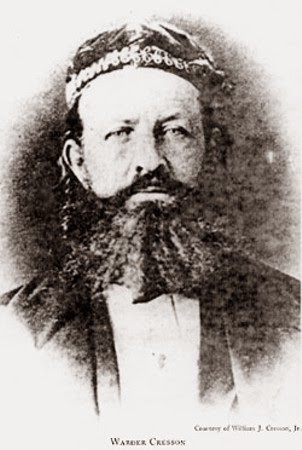
___________________________________________________
[1] Friedberg, History of Hebrew Typography, Antwerp: 1937, 49.  Although Dr. Levi’s production may have slowed, the bases for Freidberg’s assertion that Amsterdam publishing was affected by the Thrity-Year War is uncertain.  During the 18th century, production of Hebrew books in Amsterdam ranges from 82 to a high of 246 per decade.  The 1730s, the period that Tikkun Shlomo was published, is in the mid-range of those two extremes, with 145 books published between  1730-39.
[2] This work is a single sheet broadside and begins with Moda’ah raba . . . Zikhron Le-veni Yisrael.  
[3] For a summary of his arguments, see Petuchowski, Prayerbook Reform in Europe, New York, NY: 1968, 53-54.


Rabbi Jacob Ettlinger and Warder Cresson

Rabbi Jacob Ettlinger and Warder Cresson
by Yirmiya Milevsky
Rabbi Jacob Ettlinger (1798 –1871) was a German rabbi and author, and one of the great leaders of Orthodox Judaism. He was born at Karlsruhe and died in Altona. He studied under Rabbi Abraham Bing in Würzburg, where he also attended the university. Because of his well-known greatness as a Torah scholar, questions were sent to him from across the globe. The following question relates to a story that occurred in Jerusalem.
    According to Jewish Law, there is a list of activities that are prohibited on the Jewish Sabbath. Although resting on the Sabbath is one of the most important commandments for a Jew, the Talmud tells us that a Gentile is actually forbidden from resting on the Sabbath, and must perform one of the “prohibited” actions to be considered a righteous gentile. The following is the question presented to Rabbi Ettlinger with regard to this issue. (Responsa Binyan Tzion 91)
שו”ת בנין ציון סימן צא
ב”ה אלטאנא, יום ו’ כ”ו אייר תר”ט לפ”ק. להרה”ג וכו’ מ”ה אשר לעמיל נ”י הגאב”ד דק”ק גאלין וכעת משכן כבודו בירושלם עיה”ק תוב”ב.
כתב מעכ”ת נ”י וז”ל – ילמדנו רבינו בעובדא דאתא לידן פעה”ק ירושלם ת”ו יום ג’ כ”ג לירח אדר שני שנת תר”ח העבר לפ”ק נימול א”י אחד שבא הנה ממדינת מאראקא לשם גירות בפנינו בד”צ דקהל אשכנזים הי”ו וקיבל עליו המצות כדין וכדתה”ק ובש”ק שלאחריו עדן /עדין/ לא היה נתרפא ממילתו ולא טבל עודנה הגידו לי לאמר מזריזתו במצות איך הוא נזהר בשביתת שבת הגם שהוא עודנה /עודנו/ בכלל חולה שאב”ס =שאין בו סכנה= אינו מניח לגוי להבעיר אש בביתו והשבתי להם לדעתי לא מבעי’ שמותר לו לעשות מלאכה בשבת אלא אפילו מחויב ומוזהר על יום ולילה לא ישבותו וחייב לעשות מלאכה בשבת כ”ז שלא טבל לשם גירות וכה עשו השומעים למשמעתי והלכו אצל הגר והגידו לו בשמי כן בש”ק לאחר תפלת המנחה וכן עשה כי כתב איזה אותיות ויהי ביום המחרת כאשר נשמע הדבר בעה”ק ת”ו פה צווחו עלי חכמי ספרד וחכמי אשכנזים הי”ו על דבר חדש הלזו אשר לא נשמע מעולם אחרי שכבר קבל עליו כל המצות בשעת מילה וכבר נימול ועומד ומצפה בכל יום לטבול לכשיתרפא שיהי’ מותר לו לחלל וכש”כ שיהי’ עליו חיובא ומצוה לחלל ש”ק והמה זוכרים כמה גרים שנימולו פעה”ק ת”ו ולא נשמע כזאת ומנין לי לחדש דבר אשר לא שערום הראשונים והשבתי להם אולי מקום הניחו לי להתגדר בו
    “Here in Jerusalem on Tuesday the twenty third day of the month of Adar Sheni of the year (5)608, a non Jew came from Morocco and was circumcised for the sake of conversion, and accepted all the mitzvoth. On the following Shabbat, he had not fully recovered from the circumcision and thus not entered the Mikvah (ritual bath to finalize the conversion). A rabbi was informed that the convert is very careful in his observance of the Sabbath. However another rabbi claimed that due to the fact that he did not yet enter the Mikvah he must not observe the Sabbath and must perform one of the prohibited acts. It was late in the day and the convert was told what he must do. Consequently he violated the Sabbath by writing a few letters. After the Sabbath when the Rabbis in town heard of the ruling they disagreed claiming that after circumcision he is considered a Jew and must not violate the Sabbath.”
    While reading about this out of the ordinary situation, that produce a vast amount of Halachic literature,[1]  a question may arise in our minds: What brought this Moroccan to Jerusalem and what prevented him from converting in his homeland where a very significant Jewish population and rabbinic court was present?
**********************
Some time ago I came across an article by Frank Fox, entitled  “Quaker, Shaker, Rabbi: Warder Cresson, the Story of a Philadelphia Mystic.” Pennsylvania Magazine of History and Biography 95, no. 2 (April 1971): 147-194  Philadelphia.(Unless otherwise indicated all information and quotes are from the article.)
The narrative follows the unorthodox journey of Cresson. Born  in 1798 and grew up following the habits of the Quaker elders.
    Warder displayed a mind immersed in Scriptures. In 1829, Cresson wrote a condemnation on the “Babylon” of Pennsylvania, attacking wealth and social distinction. “It will certainly be admitted,” he began, “that all the misery and troubles that afflict the human family arise aspiring from …selfishness.” The lack of true religion, he wrote, a faith that ought to be expressed through self-denial and universal love, had brought about tyrannies and caused slavery and bloodshed.
    Cresson became familiar with a Jewish leader in Philadelphia, Rabbi Isaac Leeser, a pioneer of the Jewish pulpit in the United States. Leeser, the minister of Congregation Mikveh Israel since 1829, was using his pulpit to educate and to revive the deteriorating communal and religious organizations.
    Another contemporary, whose views affected Cresson, was Mordecai M. Noah, who addressed Christian and Jewish audiences in New York and Philadelphia in the early 1840s and urged a return to Zion as the only solution to the Jewish problem of persecution. In 1825, he attempted to establish “Ararat”, a city of refuge for the Jewish people on Grand Island in the Niagara River.
    In 1844, Cresson decided to go to Washington and to apply for the position of the first American Consul to Jerusalem. by May 17, was officially notified of his appointment. His appointment was rescinded within a short time. Nevertheless Cresson made his way to Jerusalem.
    After his arrival Cresson wrote critically of the high salaries paid to the missionaries who lived “in the very best houses, bought most splendid Arabian horses and dressed in the most luxurious and stylish manner.” As for their practical work, he wrote that, “To further their imposing and enterprising object they built a church which has cost them more than $150,000; then a hospital and Dispensary, sent physicians from England, set up an institution of Industry and also a college and schools, all to entrap and instruct the poor, dirty, oily, greasy, starving Jews and to tempt and provide them with good livings, fine English clothing, upon the only one condition that they will give their names and use all their influence to support and promote the interest of their Society for introducing and establishing Sawdust instead of Good Old Cheese, amongst the poor Jews in Jerusalem and Palestine.” According to Cresson, the missionaries failed to get a single Jew to apostatize.
   
    In 1847, Cresson began writing, “The Key of David the True Messiah”, in which he began his journey towards Judaism.    Finally, after denying the divinity of Jesus, Cresson was ready for the final step of his spiritual journey. He writes, “I remained in Jerusalem in my former faith until the 28th day of March, 1848,” he wrote, “when I became fully satisfied that I could never obtain Strength and Rest, but by doing as Ruth did, and saying to her Mother-in-Law, or Naomi ‘Entreat me not to leave thee for whither thou goest I will go’… In short, upon the 28th day of March, 1848, I was circumcised, entered the Holy Covenant and became a Jew.”
Cresson- or Michoel Boaz Yisroel ben Avraham- returned to the United States for a few years. Upon his return to Jerusalem in 1852 he married a Sephardic woman named Rachel Moledano. Cresson died in 1865 and was buried on Mount Olives.
Many aspects of his life are quite intriguing and fascinating. However one detail provides the answer for the mystery regarding the “Moroccan” convert in Rabbi Jacob Ettlinger’s response. Cresson identifies the date of his conversion, The 28th of March 1848 – the day Warder Cresson became Michael Boaz Yisrael – corresponds to the 23rd of Adar Sheini in the Jewish year (5)608. In other words, the conversions occurred on the same day! The response indicates that conversions in Jerusalem were pretty unusual,(והמה זוכרים כמה גרים שנימולו פעה”ק ת”ו- And they recall conversions from the past…) making it difficult to believe that there were two conversions on that specific day.  
Consequently, I believe that the non Jew in Rabbi Jacob Ettlinger’s response did not come from Morocco but rather from America. In Hebrew, the spelling of America can be easily mistaken for Morocco (“מאראקא”). Cresson indeed came to Jerusalem “for the sake of conversion”.
************************************
[1]  The question is addressed by several Halachak authorities; See
Divrei Yosef Rabbi Yosef Schwartz 24(First hand knowledge of the incident) : Rabbi Abraham Bornstein; Avnei Nezer, Yoreh Deah 351: Rabbi Yeshua Shimon Chaim Ovadyah; Yismach Levav, Yoreh Deah 33: Aryeh Leib Frumkin in his Toldot Chachmei Yerushalayim mentioned as well the Halachik dispute regarding the Ger from “Morocco.”
http://hebrewbooks.org/pdfpager.aspx?req=36973&st=&pgnum=640