Sixty Years Since Rabbi Dr. Yechiel Yacov Weinberg, the Seridei Eish: A Fire the World Still Needs

Sixty Years Since Rabbi Dr. Yechiel Yacov Weinberg, the Seridei Eish:
A Fire the World Still Needs

By Jacques (Yacov) R. Rothschild

This week marks sixty years since the passing of Rabbi Dr. Yechiel Yacov Weinberg, the Seridei Eish. He left this world on the 4th of Shevat in 1966, well before I was born, yet his presence has never felt distant to me – because it lived, vividly and lovingly, in my mother’s voice. “Shema b’ni musar avicha, v’al titosh Torat imecha” – “Hear, my child, the instruction of your father, and do not forsake the Torah of your mother.” For me, Rav Weinberg’s Torah was transmitted precisely this way: not first through books or institutions, but through a mother who spoke of him with reverence, warmth, and quiet awe.

The following brief sketch cannot do justice to the full arc of his life. Readers seeking a comprehensive biographical and intellectual account may consult Professor Marc B. Shapiro’s authoritative study, Between the Yeshiva World and Modern Orthodoxy: The Life and Works of Rabbi Jehiel Jacob Weinberg, 1884-1966 (London: Littman Library, 1999), as well as subsequent scholarly and popular essays. What follows outlines only the essential contours.

From a young age, Rav Weinberg displayed extraordinary promise. Born in Ciechanowiec in 1884, he rose from an unassuming background to become known as the Illuy of Czechanowic. As a teenager he was already delivering public shiurim, and at seventeen he entered the Slabodka Yeshivah, studying under the Alter, Rav Nosson Tzvi Finkel, and becoming a chavrusa of Rav Naftali Amsterdam, the foremost disciple of Rav Yisrael Salanter. There he absorbed a worldview that would shape him for life: uncompromising halakhic rigor joined to the Mussar movement’s insistence on human dignity, ethical seriousness, and disciplined moral self-formation. He forged close ties with leading figures of the Mussar world. Already then, he embodied a rare synthesis – intellectual rigor, spiritual sensitivity, and moral seriousness.

In the years that followed, Rav Weinberg served as Rav of Pilwischki and spent formative time in Warsaw, moving within the orbit of leading rabbinic, intellectual, and communal figures. In 1936 he published Lifrakim, a collection of essays in Hebrew, German, and Yiddish that already displayed the breadth of his mind: halakhic sensitivity, historical consciousness, literary power, and a refusal to simplify Judaism for ideological convenience. His path then led westward to Germany, where he became Rosh Yeshiva and effectively rector of Rav Esriel Hildesheimer’s Rabbinerseminar in Berlin, shaping a generation of rabbanim who carried Torah with courage, thoughtfulness, and depth, as he was confronted with unprecedented historical and theological upheavals. Unlike many of his contemporaries, he neither viewed engagement with general culture and academic scholarship as a betrayal of Torah nor mistook accommodation for capitulation. His posture was one of disciplined openness, with Torah sovereign yet resilient rather than brittle.

During the war, he served as president of the Agudas HaRabbanim of Warsaw and was also a lecturer at the University of Giessen. Universally recognized as a master of Shas and poskim, his knowledge extended far beyond Torah, encompassing history, philosophy, and Judaic studies.

He survived the destruction of European Jewry, but survival came at a severe cost. Rav Weinberg lost his entire immediate family in the Holocaust. His health was permanently damaged, and the world in which he had lived was gone. When the war ended, he emerged alone. He eventually found refuge in Montreux, Switzerland, carrying with him a loss that did not recede with distance or time. And yet it was there, after all of this, that the most consequential part of his written legacy still lay ahead.

Montreux was a quiet, picturesque town overlooking Lake Geneva and home to Yeshivat Eitz Chaim, a small and demanding institution that drew refugees, scholars, and young men who would later assume positions of leadership. Giants passed through its modest halls, carrying only fragments of the world that had been destroyed, unsure whether those fragments could be assembled into anything lasting. Torah life there was serious and inward, marked by uncertainty and strain. It was not sustained by institutions or prestige, but by individuals who lived with loss as a daily fact and understood responsibility as something that could not be deferred.

It was no accident that Rav Weinberg felt at home in Montreux. The town’s quiet dignity mirrored his own. Removed from ideological battles and institutional power, he could think clearly and write honestly. From this tranquil place, Torah once again flowed outward. Letters and visitors arrived from across the Jewish world: rabbanim, authors, medical researchers, historians, and even leaders of the young State of Israel, including David Ben-Gurion (a meeting my mother attended). Though physically distant from centers of authority, his voice remained indispensable. He was offered the position of Chief Rabbi of Israel, which he declined, choosing instead an obscurity that enabled him to remain faithful both to halakha and to the damaged human reality it was now required to address.

“From Montreux,” writes Professor Marc B. Shapiro, Rav Weinberg “resumed his correspondence with students, friends, and colleagues, writing many hundreds of letters a year, most of which have been lost to posterity.” Yet Montreux also imposed real constraints. Far from the great libraries and scholarly settings that had once sustained his academic work, serious research was difficult. More significantly, the shift from public authority to private existence carried a personal cost. For a man who had stood at the center of a major rabbinic institution, life in a small town brought with it a sense of narrowing that no material stability could fully counterbalance.

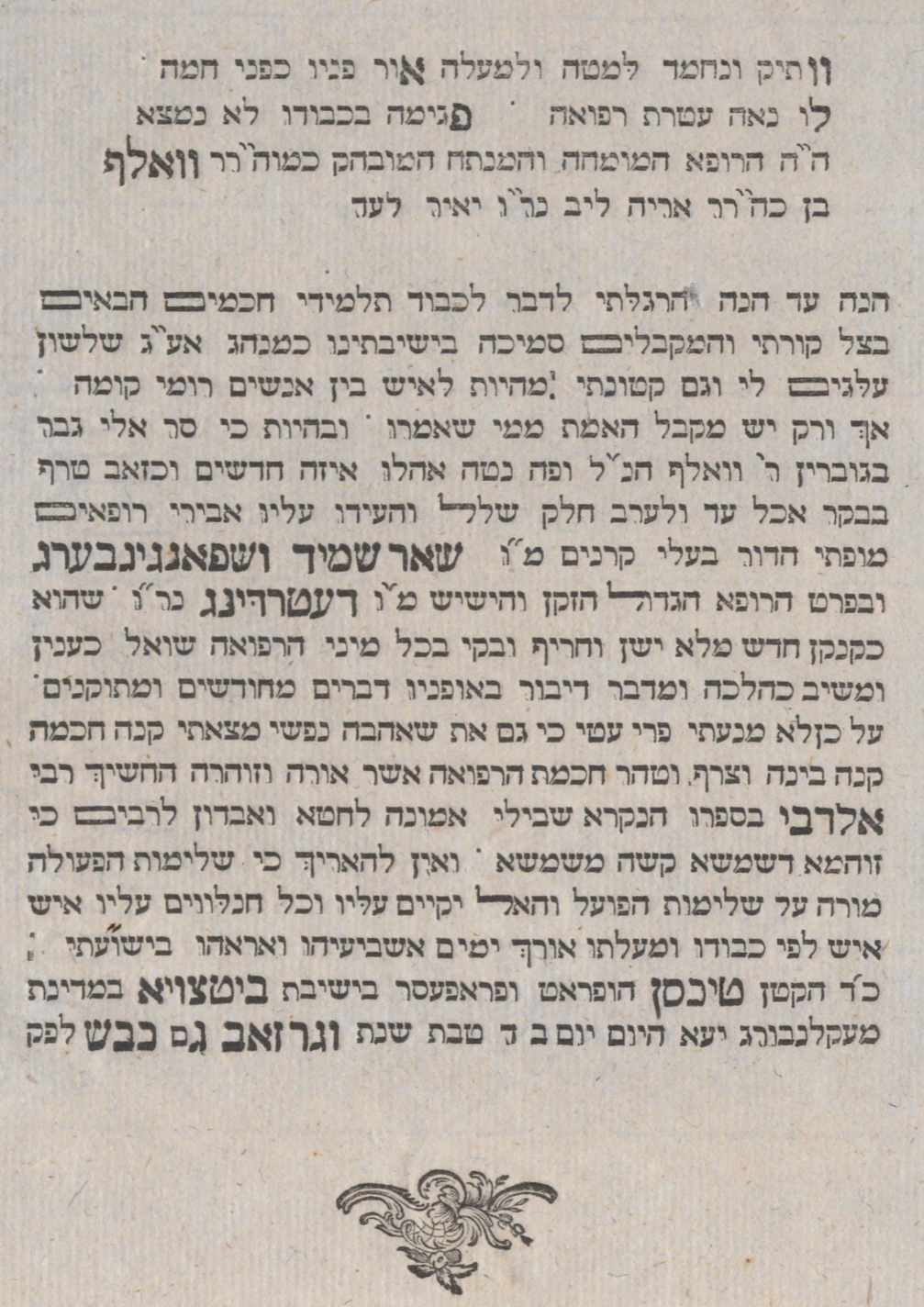
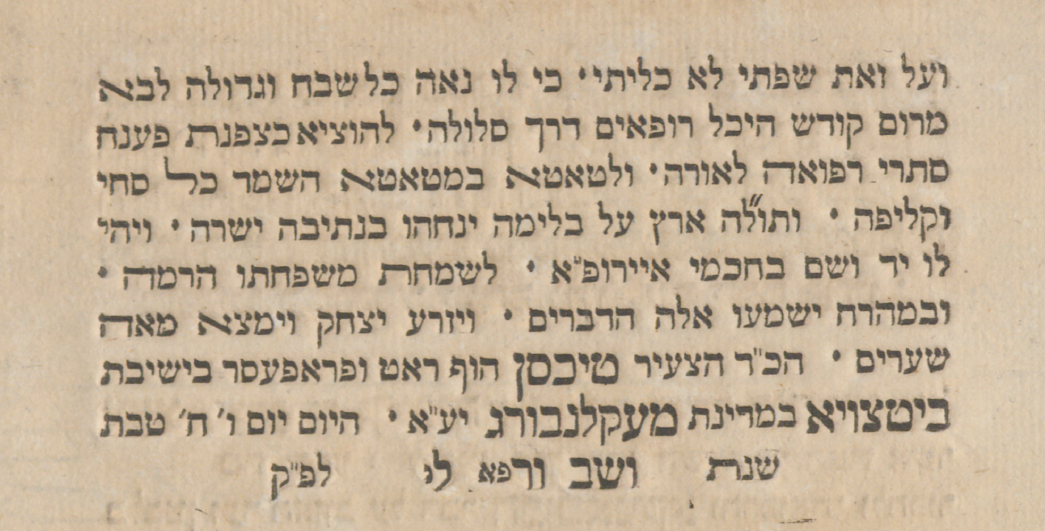
It was in Montreux, despite his broken health, that Rav Weinberg published three volumes of Seridei Eish – in 1961, 1962, and 1966 – with a fourth appearing posthumously. Seridei Eish, “Remnants of Fire,” was both literal and symbolic: much of his Torah had been lost in the Holocaust, yet what remained burned with clarity, depth, and moral courage.

It was also to Montreux that my mother arrived after the war as a young girl. She had lost the overwhelming majority of her family in Nazi Germany, surviving only through her mother’s courage in escaping clandestinely to Italy. Upon entering Italy illegally, her mother was suspected of being a spy, arrested and imprisoned, and the two young girls – my mother and her sister, both under five – were sent to a monastery. By miracle, they were reunited after the war and eventually reached Switzerland, settling in Montreux.

There, while my mother was entertained in school by Charlie Chaplin’s daughter, she also encountered Rav Weinberg, beginning a relationship that would quietly shape her life.

Starting as a teenager, my mother assisted him by typing his correspondence and helping with administrative work. She knew how to type, spoke several languages, and worked at a local Swiss bank. None of these skills was remarkable on its own; in combination, they answered a very specific need. For several years she assisted Rav Weinberg on a daily basis. She typed his responsa as he dictated them, organized and mailed his correspondence, and attended to the practical details that made sustained scholarly work possible. She sat with him for hours as he formulated replies to inquiries arriving from across the Jewish world, one after another, without interruption.

Jews in Montreux and neighboring towns knew she had daily access to Rav Weinberg, so they entrusted her with questions that structured postwar Jewish life. They would leave chickens – with kashrut questions – for her to bring to him. Kosher shechita was forbidden in Switzerland then, as it remains today, and Jews relied on mail-order poultry from France, salting their chickens at home. Observance was fragile, complicated, and deeply human.

These chickens carried more than halakhic questions; they carried hope. For Jews in post-war Europe, having a kosher chicken – literally examined and approved by a Gadol – was a way to sanctify Shabbat, to reclaim dignity and spiritual normalcy after devastation. Rav Weinberg approached each case with extraordinary care, ensuring that his rulings remained halakhically rigorous while never shattering the fragile dreams of Jews striving to observe Shabbat properly. This was not halakha in theory. This was Torah meeting kitchens, trauma, and lives slowly rebuilding.

Despite his circumstances, Rav Weinberg never sought popularity or easy acceptance. Some of his rulings were difficult and, at times, controversial – precisely because his deliberations reached beyond the present moment. He anticipated developments in science, technology, medicine, and society before they became unavoidable crises. Yet throughout, his loyalty to halakha and to Sinai was absolute, insisting that halakha be applied with foresight rather than reaction. For him, innovation did not mean rupture or accommodation. It meant responsibility, assumed fully and without evasion. His Torah moved deliberately, listened deeply, and spoke only after accounting for the full weight of human reality.

The questions that reached him were often complex and carried real consequences for those who asked them. At times Rav Weinberg did not respond immediately. My mother later recalled that he insisted on thinking matters through, and would occasionally ask her to walk with him along the shore of the lake while he worked through the questions before him. Only afterward would he commit his rulings to paper.

His involvement in my family’s life extended beyond advice and correspondence. He personally guided the shidduch of my mother’s older and only sister, and later that of my parents. These actions reflect the same moral world in which he lived and worked – a Torah attentive not only to texts and communal questions, but to the concrete ordering of individual lives from what remained after destruction.

Very recently, I learned something that cast this inheritance in an even deeper light. My sister discovered, quite by chance, a copy of Rav Weinberg’s German book Das Volk der Religion in my parents’ archives. Inside was a handwritten dedication by Rav Weinberg himself, addressed not to my maternal grandmother, whom he knew well from Montreux, but to my paternal grandmother – my mother’s future mother-in-law – Flora Rothschild. The inscription, written in German, is dated 4 Nissan 5709 (April 4, 1949), almost twenty years before my parents would marry, at a time when they were still in their early teens:

“In fond memory and in friendship of your visit to me in Montreux this past 4th of Nissan 1949.

Mrs. Flora Rothschild, the tireless one.

In admiration of our continued mutual cooperation for the fight to preserve Torah, the Jewish people and spirit, and the Land of Israel.

Best wishes and continued success.

Montreux, 4th of Nissan 5709.”

Only now does the deeper resonance of this moment emerge. Long before my mother could have imagined her future – and entirely unbeknownst to her – Rav Weinberg had already met the woman who would one day become her mother-in-law and formed a bond of respect and friendship with her.

Flora Rothschild, my paternal grandmother, was herself a remarkable woman, selflessly involved in the rebuilding of Jewish life after World War II. After surviving the camps, she settled back in Antwerp, having lost her husband, daughter, parents, and siblings to the Nazis. Read against this background, the dedication takes on added weight.

My grandfather, Tzvi Hersh Lerner HY”D – my mother’s father – whose yahrzeit falls on the 2nd of Shevat, was murdered in Sachsenhausen in 1939 after intervening on behalf of a young Jewish boy who had been caught stealing a piece of bread in the camp. His death left my mother without a father and forced my grandmother to flee Berlin with two small children. She moved first into hiding in Italy and, after the war, on to Switzerland, where they eventually settled in Montreux. And yet, even then – long before anyone could have named an outcome – quietly and almost imperceptibly, the threads of the next generation were already being woven.

This discovery opens a vivid window into the deeply human side of Rav Weinberg: his attentiveness to individual lives, his capacity for enduring relationships, and his role as a bridge between shattered pasts and rebuilding futures.

I never met the Seridei Eish, though I have studied his responsa. My mother knew him. She typed those responsa as he dictated them. She walked with him through Montreux. She carried chickens to his door so that he could examine them. Because of that, his presence never belonged to the past for me. It was part of the daily texture of my childhood. His Torah reached me not through institutions or ceremonies, but through work done repeatedly, quietly, and without display. In that way, what survived was not only his Torah, but the way it was lived.

Studying the Seridei Eish is for me a Torat imecha, grounded in my mother’s experience and in her years assisting Rav Weinberg in Montreux. To honor his memory is not only to study his writings, but to reckon with what his absence has cost, and with the kind of Torah leadership his life continues to require.

When Rav Yechiel Yacov Weinberg passed away at the age of eighty-eight, the Jewish world lost not only a great rabbinic scholar, but a model of Torah leadership grounded in judgment, humility, and moral seriousness. He combined intellectual breadth with personal restraint, and independence of thought with unwavering fidelity to halakha. Such a voice is acutely lacking today, especially in moments of internal crisis, when slogans replace deliberation and affiliation eclipses responsibility.

Even in death, Rav Weinberg did not fit neatly into any one world. Having no surviving children, his burial in Jerusalem became the subject of controversy. The two worlds that claimed him were the Chareidi and the Mizrachi. Though Rav Weinberg had requested to be buried beside his friend Rav Yitzhak Isaac Halevi Herzog, Chareidi leaders diverted the funeral to another cemetery, claiming him as their own. The tension itself was revealing: a man too broad for easy categories, too principled to be fully absorbed by any camp.

And perhaps the truest way to honor his memory is not only to study his writings – but to recognize how deeply the world still misses him, and how desperately it still needs leaders formed in his image.

Yehi zichro baruch, and may Rav Yechiel Yacov Weinberg’s purified soul be a melitz yosher for Am Yisrael.


A year in Berlin: The Beginning of Hebrew Printing in Berlin in c. 1699

A Year in Berlin:
The Beginning of Hebrew Printing in Berlin in c. 1699
by Marvin J. Heller

The publishing of Hebrew books in Berlin is a relatively late phenomenon. The article provides a background to early Hebrew printing and then discusses the first Hebrew press in Berlin. It addresses Jewish history in Berlin, explaining why Hebrew printing began there at the end of the seventeenth century, almost two hundred and fifty years after it began elsewhere. Several unique works, rather than the usual communal prayer books and bibles, are described in some detail in the article.

Hebrew printing has a rich and lengthy history. The first Hebrew books were printed close to the mid-fifteenth century, in 1469 and 1472, approximately a decade and a half after Johann Gutenberg printed the first Bible in c. 1455 in Mainz, Germany. Those first Hebrew books, printed in Rome by Obadiah, Menasheh, and Benjamin of Rome, and several who followed, are undated. Their name appears in the colophon of R. Moses ben Nahman’s (Nahmanides, Ramban, 1194–1270) Torah commentary[1] The first dated Hebrew book was Abraham ben Garton ben Isaac’s edition of Rashi’s Torah commentary (Reggio di Calabria, 1475, completed 10 Adar, 5235 = Friday, February 17, 1475). It was followed soon after by Jacob ben Asher’s Arba’ah Turim, printed in Piove di Sacco, Padua province on 28 Tammuz, 5235 (July 3, 1475).[2]

A conservative listing of Hebrew books that can be said with certainty to have been printed prior to 1500 are, according to A. K. Offenberg, 139 titles, which he writes “may yet be too high.”I[3] In an index Offenberg records close to twenty locations in which Hebrew incunabula were printed, in Italy, Spain, and a 1493 Constantinople edition of the Arba’ah Turim.[4] Among the more notable locations in which Hebrew printing occurred in the incunabular period are Mantua, Bologna, Ferrara in Italy, and Guadalajara in Spain.

In contrast to the small number of incunabular imprints, approximately 2,700 titles were printed in the following century, that is, from 1500-1599. To be more precise, 2,672 Hebrew titles (or books with Hebrew letters) were printed, according to Yeshayahu Vinograd, in the sixteenth century. In the seventeenth century the number of Hebrew books published increased to 3,526 entries.[5] The primary centers of Hebrew printing in those centuries were, respectively, Venice and Amsterdam. Parenthetically, the latter’s imprints were sufficiently popular that publishers in other locations frequently wrote with a small font “printed with” and in a large font “Amsterdam,” and again in a small font “letters.” Below, again in a small font, the actual place of printing.[6]

That Hebrew printing began so much later in Berlin than in other centers of printing might seem unlikely, given the subsequent importance of that city’s Jewish community and press. However, it is not surprising in light of the early history of Berlin Jewry, which was difficult, indeed stormy. Expelled in the middle-ages, during the Black Death, Jews were allowed to return in 1354, but not permitted a synagogue. There is no further mention of Jews until the sixteenth century. Subsequently, Jews were expelled and readmitted several times. Gotthard Deutsch and A. Freimann write that “The real history of the Jewish community of Berlin does not begin until the year 1671.” At that time, Jews expelled from Vienna were admitted to Berlin. On Jan. 3, 1676, a decree was issued which stated “die Juden in Berlin in ihren Freyheiten und Privilegien nicht zu turbiren, noch zu kränken, sondern sie vielmehr dabey gebürend zu schützen” (not to disturb or worry the Jews of Berlin in their grants and privileges, but to protect them properly).”[7]

Hebrew printing in Berlin began soon after, that is, in the last decade of the seventeenth century. According to the Jüdisches Museum Berlin, Hebrew printing in Berlin, “which commenced later than in other German cities,” began when Daniel Ernst Jablonski published a Hebrew Bible in 1699.[8] Yeshayahu Vinograd, in the Thesaurus of the Hebrew Book, records eleven works printed from 1690 through 1699, eight in the latter date. He begins with a 1690 quarto format (40) Bible attributed to a Knebell, who Moritz Steinschneider describes in his entry for the 1699 Bible as “Opera et impensis Jo. Henri Knebel . . .” (the works and expenses of Jo. Henri Knebel),” the printer given as Jablonski.

The 1690 Bible entry is followed by two 1698 octavo editions (80: 90 pp., no pagination given for the second edition) of Psalms both in the Bodleian library and then the 1699 imprints.[9] Steinschneider dates the first Psalms as “3–9 Tischri 458 (18-24, Sept. 1697), the second as [ca. 1697-9]. These are followed by an edition of Bereishit (Genesis).[10] Also printed at this time was a siddur (prayer book) and another edition of Psalms. All of these works, as well as the following titles, were printed at the Jablonski press.

Daniel Ernst Jablonski’s (1660-1741) involvement with Hebrew printing is surprising given his background and career. He was the son of Peter Figulus, a minister of Unity of the Brethren (Unitas fratrum) and grandson of Johann Amos Comenius, the last bishop of the Unity. Jablonski served as a preacher at Magdeburg in 1683, and from 1686 to 1691 as head of the Brethren College at Polish Leszno (Lissa), a position filled by his grandfather. In 1691, Jablonski was appointed court preacher at Königsberg by the elector of Brandenburg. In 1693, he was transferred to Berlin as court preacher, and in 1699 he was consecrated a bishop of the Unity of the Brethren, where he worked to bring about a union between the followers of Luther and Calvin. In 1700, Jablonski became a member of the Academy of Sciences (Brandenburgische Societät der Wissenschaften), serving between 1710 and 1731 as director of Philology and Oriental Studies and, from 1733 and 1741, as president of the Academy.[11] He was also the author of several books on Christian theology and philosophy.

In Berlin, Jablonski established a Hebrew printing press. Vinograd very conservatively crediting him with having printed as many as twenty titles. However, a significant multiple of that number of titles were printed in Berlin at that time with no printer’s name assigned to them in the Thesaurus, or, in some instances, attributed to an editor at the press.[12] Concerning Jablonski’s heading a Jewish press in Berlin, it may not seem as improbable as it appears. Jews could not initially obtain licenses to own a printing-press, so that of necessity, the owner had to be a non-Jew, although the managers and workers were usually Jewish. Jablonski employed a number of Jewish workers at his press. The most important was Judah Loeb ben David Neumark (d. 4 Nissan = April 9, 1723) from Hanau, author of Shoresh Yehudah (Frankfort on the Main, 1692), the manager of and an editor at the Jablonski printing-house.[13]

Another of Jablonski’s achievements relates to the printing of the Talmud. He was instrumental in securing approval for Michael Gottschalk, the Frankfurt an der Oder printer, and Johann Christoph Beckman, professor of theology at the University of Frankfurt an der Oder, to publish the Frankfurt an der Oder Talmud (1697-99). Jablonski’s opinion was requested by Friedreich III, Elector of Brandenburg, after Gottschalk and Beckman sought permission to print the Talmud. Jablonski’s measured response was, overall, positive; he found the Talmud to be, with reservations, a work of value, and recommended that Friedreich approve the request to republish that work. Jablonski subsequently printed the first Frankfurt on the Oder/Berlin Talmud together with Gottschalk (1715-22).

We turn now to the more distinct books published at the Jablonski press, that are non-biblical nor prayer books, although the press issued both. Our first title is Azmot Yosef, novellae on tractate Kiddushin by R. Joseph ben Isaac ibn Ezra (c. 1560–1620), attributed in bibliographies to Neimark, as it is his name that appears on the title-page. Perchance, he managed the press and Jablonski was the proforma owner.

Azmot YosefAzmot Yosef was published in folio format (20: 125 ff.) in the year “[Show me a sign of] Your favorאות לטובה ( 459 = 1699) that my enemies may see and be frustrated because you. O Lord, have given me aid and comfort (Psalms 86:17). R. Joseph ben Isaac ibn Ezra (c. 1560–1620) was a scion of the renowned Ibn Ezra family of Spain. Publication of Azmot Yosef is attributed by Vinograd to L. Neimark. Joseph ben Isaac Ibn Ezra was a student of 1R. Samuel de Medina (Maharashdam, 1506-89) and of R. Aaron ben Solomon ben Hasson (16th Cent.). Ibn Ezra subsequently headed the yeshivah of Don David ben Yahya, where he had several eminent students, among them R. Shabbetai Jonah. He later left Salonika for Constantinople, and afterwards served as rabbi in Larissa and Sofia.[14]

The first paragraph of the title-page, a reprint of the first edition, states that it is an explanation of the rules by which the Torah is explicated, and that it is:

a commentary in iyyun and pilpul (deliberation and casuistry) of tractate Kiddushin, from the beginning until the end, on the Talmud, Rashi, Tosafot, Rif, Rambam, Rosh, his son the Ba’al ha-Turim, and others on the laws of kiddushin (betrothal). After the iyyun and pilpul I conclude with the halakhah . . . .

Also, for the benefit of the students [I explain] the rules of [kal ve-homer] (a fortiori inference), dayyo (sufficiency), and other rules: I also delve deeply into the passages of parah ve-rahel in Kol ha-basar and at the end of Kaitzad ha-regel.

The second paragraph, somewhat lengthy, informs that Azmot Yosef was printed previously in Salonica in 1601, further expounds it virtues, and informs that it is being printed for the second time in the praiseworthy city of Berlin and extols Friedreich III.


Azmot Yosef

Courtesy of the Library of Agudas Chassidei Chabad Ohel Yosef Yitzhak

In addition to the peshat (clear meaning of the text) on Kiddushin, Azmot Yosef also addresses Talmudic methodology. Ibn Ezra was also the author of Rosh Yosef, novellae on the Tur, Ḥoshen Mishpat, of which the part on taxes and associated communal issues was published as Massa Melekh (Salonica (1601). Some of his responsa were published in the responsa of R. Shabbetai Jonah, R. Solomon ha-Kohen, and R. Samuel Hayyun.

Azmot Yosef is an important work on Kiddushin and has been reprinted several times. Initially printed in Salonika (1601), as noted above, at the press of Abraham and Joseph BathSheba, this is the second edition; four additional printings of Azmot Yosef are recorded in the Bet Eked Sepharim, the most recent a Warsaw edition (1883).[15]

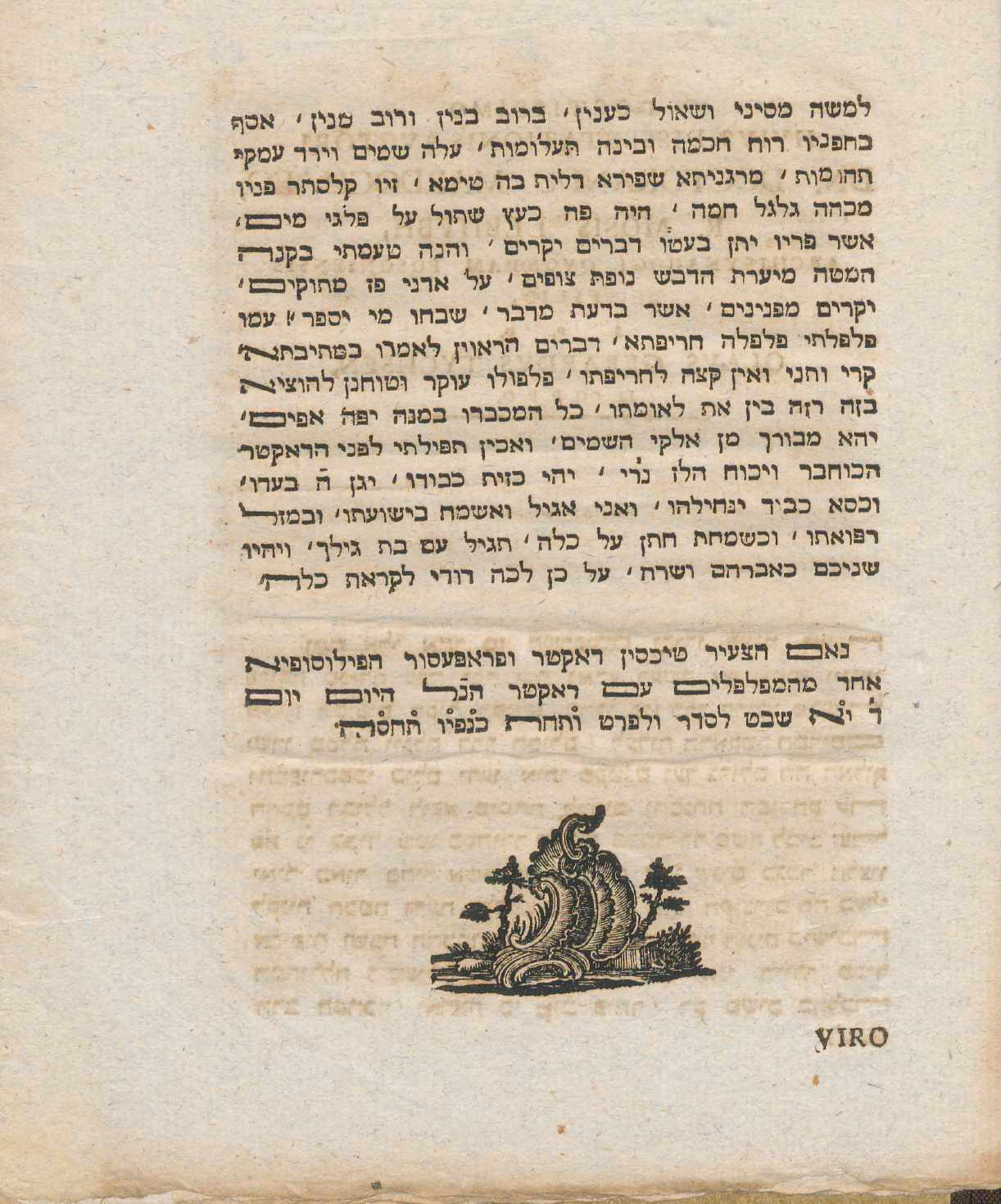
Gefen YehiditOur next work, Gefen Yehidit is a multi-part work, primarily on ethics, by R. Ze’ev Wolf ben Judah Leib of Rosienie. It was published in a small sextodecimo format (160: 59 ff.)

Gefen Yehidit

Courtesy of the National Library of Israel

The title page of Gefen Yehidit has a brief text that states that it is:

A book, small in size but of great quality. It speaks of matters of ethics and reverence in a clear language . . . The author should have merit. He is one of the maskilim (a person of understanding) and in this small book he demonstrates his expertise and sharpness. . .

Included is Sefer Luah ha-Hayyim which speaks of remedies in order that a person should be healthy and strong in order to serve his God continuously.

The title page is dated “a sign for good אות לטובה (459 = 1669)” (Psalms 86:17). Next is the introduction (1b-2a) of R. Judah Leib Hanau,[16] who brought the book to press. In his introduction, Ze’ev Wolf begins with a quote from Midrash Ruth in which Rav Ashi says that this Megillah is not primarily wisdom nor Torah, but to learn from it gemillut hasadim (acts of kindness), so too the work that he is writing. He informs that he has had a difficult life, and frequently quotes from the Zohar.

The text, in a single column in rabbinic letters, is comprised of Gefen Yehidit, a work of mussar (ethics); an accounting (39a-40b), beginning with and based on the memorial prayer El Malei Rahamim, of what befell the Jews of Podhajce (Podgaitsy), Ukraine in 1677 during a Tartar incursion and massacre of the Jews; followed by a dirge (40b-41a); Zemer le-Purim (42a-46b), verse for that festival in both Hebrew and Yiddish, translated word for word into the latter language because that is the language of Ashkenazim; and concluding with Luah ha-Hayyim (47a-59b), a popular medical work.

Gefen Yehidit has been reprinted several times, beginning with a Hanau (1717) edition.

Luah ha-Hayyim – Although included in Gefen Yehidit Luah ha-Hayyim is an independent work. In contrast to the other additional parts of the former title, Luah ha-Hayyim has its own title-page. Written by R. Hayyim ben Benjamin Ze’ev Bochner,[17] (for our ealier discussion regarding Bochner on the SEfohere), a prolific writer, whose works include Orḥot Ḥayyim, a commentary on R. Isaac Tyrnau’s Minhagim (1669, Prague), Mayim Ḥayyim, homilies and comments on Bible and Talmud, and Toẓeot Ḥayyim on grammar. This edition of Luah ha-Hayyim is based on earlier edition printed by Johann Christoph Wagenseil (Altdorf, 1687), also part of a larger work.

Luah ha-Hayyim

Courtesy of the National Library of Israel

The title-page states that it is:

Luah ha-Hayyim

It will be a cure for your body [a tonic for your bones] (Psalms 3:8) etc.” “They are life to him who finds them; healing for his whole body (Psalms 4:22):

Abbreviated rules of conduct for a person in the matter of healing to maintain a healthy body and it is a primary principle in the service of the Lord. In order to benefit the public, we have printed anew R. Hayyim ben Benjamin Ze’ev Bochner of Cracow’s work. It received in the past approbations from leading medical authorities for all these words are true and correct to those who are knowledgeable and meritable.

This is followed by approbations of two doctors from Lublin. An example of the text (51a-52b) is:

a clear white wine , sweet and aromatic, is healthy and caring. If one drinks a measure of wine, it is a balm for the body, for it increases bodily heat and strengthens as a lion. It gladdens the heart and hones the mind. It also helps in the digestion of food. The measure of a reviis as the amount to drink is logical.[18] More than this measure one should cease and desist. However, if one is accustomed to become inebriated from it and drinks more then enough than the head is ill and the heart is pained. One whose nature is warm and thirsts to drink should mix a little water every time. Honey that is clear and of average sweetness and strength is somewhat comparable to the nature of wine in all respects. . . .

A popular work the Thesaurus of the Hebrew Book records twelve editions of Luah ha-Hayyim, but again these are generally not independent publications.[19]

Keter Torah – Keter Kehunah – our final publication, is a Kabbalistic work on Psalms and liturgy by R. Joseph ben Moses (Ashkenazi), darshan of Przemyslany (17th cent.) Printed in quarto format (40: 91, 62-66, [1]; 76 ff.) Keter Torah and Keter Kehunah are, respectively, the second and third parts of Keter Yosef, the first part of which was printed in 1700.[20] Joseph ben Moses, who was a darshan (preacher), served as rabbi and dayyan in Przemyslany.

Each part was printed separately and has its own title page, albeit with the same frame but somewhat varying text. The pillared frame has cherubim at the top and at the bottom of the frame an eagle with a shield, and holding a sword in one talon and a scepter in the other. In its beak is a banner with the date of the respective volume.[21]

The title page of Keter Torah states that it is the second part of Keter Yosef,

A holy workbook, old replete with new, a desirable commentary, where is its like? On Psalms by the author of Zafenat Pa’ne’ah and Haluka de-Rabbanan. He is the great darshan, grandson of the gaon R. Abraham Ashkenazi, descended from Rashi, son-in-law of R. Abraham av bet din in Luntshits, and a branch and descendant of R. Saul Wahl.

It is dated “Now Israel loved Joseph אהב את יוסף וישראל (459 = 1699)” (Genesis 37:3). Keter Torah has an introduction from the author followed by the text, comprised of Psalms in the middle of the page in square vocalized letters with Joseph’s expansive commentary, Keter Yosef, on the sides in rabbinic letters. The text is divided by the days of the week and has the heading Keter Yosef. The title page of Keter Kehunah states that it is part three of Keter Yosef and that

It is the threefold part that “is not quickly broken” (cf. Ecclesiastes 4:12). In it are found at intervals some sharp novellae on Tosafot and gemara. I have entitled it Keter Torah on the order of the avodah (divine service) for the entire year. It is by the great darshan . . .

Keter Kehunah
Courtesy of Hebrewbooks.org

Keter Kehunah is dated “This is the Torah of the burnt offering זאת תורת העולה (459 = 1699)” (Leviticus 6:2). Here, too, the text is comprised of the liturgy of the daily ma’amadot (division of prayers) in the center of the page in square vocalized letters, the commentary Keter Yosef on the sides in rabbinic letters, and the heading Keter Yosef. After the daily ma’amadot are bakashot for the day and bakashot in the manner of Kabbalah. The daily ma’amadot are followed by kabbalistic prayers for special occasions such as selihot for Mondays and Thursdays, fast days, Rosh Hodesh, Shabbat with special Torah readings, Shabbat Teshuvah, Hanukkah, Purim, brit milah, kinnot for Tishah be-Av, and for dreams. There is also a prayer for someone incarcerated from R. Leone (Judah Aryeh) Modena.

This is the sole edition of any of the parts of Keter Yosef. Joseph was also the author of a commentary included in Haggadah Haluka de-Rabbanan (Amsterdam, 1695), a commentary on the Passover Haggadah; Ketonet Passim (Lublin, 1691), discourses on festivals and the Haggadah; and Zafenat Pa’ne’ah he-Hadash (Frankfurt am Oder, 1693-94, above) on diverse subjects.

In conclusion, we have described individual publications that are not part of the customary frequently printed works comprising traditional and necessary parts of Jewish literature, that is, biblical and liturgical books, although, as noted above, such works were also published by the Jablonski press. The subject matter of these other varied books addressed here encompasses Talmudic novellae, ethics, medical recommendations, and a Kabbalistic work.

What is particularly noteworthy is, given the late start of Hebrew publishing in Berlin, that it rapidly became a center of Hebrew printing. The Thesaurus records 457 titles issued by the Berlin press in the following century (1700-1799), a remarkable growth for a new press that had hardly published any books in the previous century and for a community that was initially young and relatively small compared to other Jewish communities. Despite the small number of works published in that early period, at the end of the seventeenth century, the books published not only addressed communal needs, but also included a variety of valuable works expressing the varied intellectual needs and interests of the community. It quickly grew from a small but press that had from its beginning began by serving its community with needed and valuable varied works to a press of significance.

[1] Concerning those first Hebrew imprints see Moses Marx, “On the Date of the Appearance of the First Hebrew Book,” in Alexander Marx Jubilee Volume (New York, 1950), pp. 481-501.
[2]
The above dates are Julian dates. The dates in the Gregorian calendar, adopted in Rome in 1582 in place of the Julian calendar are, for Rashi’s Torah commentary, February 26, 1475. The Gregorian date for the Arba’ah Turim would be July 12, 1475.
[3] A. K. Offenberg, Hebrew Incunabula in Private Collections (Nieuwkoop, 1990), p. xxiii-xxv, 186-94. It should be noted that other authorities cite a higher number of titles for the incunabular period. A significantly lower number is given by Richard Gottheil and Joseph Jacobs in “Incunabula” Jewish Encyclopedia vol. 6 (New York, 1901-06), p. 575 who write that 101 works printed in Hebrew letters can be identified as certainly printed before 1500. In contrast, according to Herrmann M.Z. Meyer / Angel Sáenz-Badillo, write there are “175 (207) editions printed with Hebrew letters ascertained by copies preserved in public collections.” “Incunabula” (Encyclopedia Judaica, vol. 9 (Jerusalem, 2007),vol. 9 pp. 757-58.
[4] The dating of the 1493 Constantinople edition of the Arba’ah Turim has been questioned, many bibliographers consider the correct date to be 1503. Offenberg in a convincing article, substantiates the correct date as 1493 (Offenberg, “The First printed Book Produced at Constantinople (Jacob ben Asher’s Arba’ah Turim, December 13, 1493),” in A Choice of Corals: Facets of Fifteenth-Century Hebrew Printing, pp. 102-32.
[5] Yeshayahu Vinograd, Thesaurus of the Hebrew Book. Part I Indexes. Books and Authors, Bibles, Prayers and Talmud, Subjects and Printers, Chronology and Languages, Honorees and Institutes. Thesaurus of the Hebrew Book (Jerusalem, 1993-95), pp. xxiv-xxvi [Hebrew].
[6] Mozes Heiman Gans describes this practice, writing “so highly-prized were books ‘printed in Amsterdam’ or ‘be-Amsterdam’ that cunning rivals invented the phrase ‘nidfas ke-Amsterdam’, i.e. in the manner of Amsterdam, hoping to deceive the readers by relying on the similarity of the Hebrew k and b.” Mozes Heiman Gans, Memorbook. History of Dutch Jewry from the Renaissance to 1940 with 1100 illustrations and text (Baarn, Netherlands, 1977), p. 140: Also see Marvin J. Heller, “Who can discern his errors? Misdates, Errors, Deceptions, and other Variations in and about Hebrew Books, Intentional and Otherwise: Revisited,” http://seforim.blogspot.com/, Sunday, July 03, 2016, reprinted in Essays on the Making of the Early Hebrew Book (Leiden/Boston, 2021), pp. 507-36.
[7] Gotthard Deutsch, A. Freimann, “Berlin,” Jewish Encyclopedia vol. 3. pp. 69-71.
[8] Jüdisches Museum Berlin: https://www.jmberlin.de/en/collection-hebrew-printing-in-berlin.
[9] Moritz Steinschneider, Catalogus Liborium Hebraeorum in Bibliotheca Bodleiana (CB, Berlin, 1852-60), col. 112 no. 702; Vinograd, Thesaurus of the Hebrew Book. Part II, p. 111.
[10] Steinschneider, nos. 694, 1050, 1028.
[11] https://en.wikipedia.org/wiki/Daniel_Ernst_Jablonski.
[12] Vinograd, Thesaurus of the Hebrew Book. Part I, p. 451.
[13] Ch. B. Friedberg, History of Hebrew Typography of the following Cities in Central Europe: Altona, Augsberg, Berlin, Cologne, Frankfurt M., Frankfurt O., Fürth, Hamberg, Hanau, Heddernheim, Homberg, Ichenhausen, Neuwied, Wandsbeck, and Wilhermsdorf. Offenbach, Prague, Sulzbach, Thannhausen from its beginning in the year 1513 (Antwerp, 1935), pp. 87-88 [Hebrew].
[14] See Ya’akov Shemuel Speigel’s introduction to Ibn Ezra’s responsa for additional biographical information. She’elot u-Teshuvot Rebi Yosef ibn Ezra, ed. Ya’akov Shemuel Speigel (Jerusalem, 1989), 5-30. Speigel specifically discusses Azmot Yosef, its editions and its reception. Id. 21-24.
[15] Ch. B. Friedberg, Bet Eked Sepharim, (Israel, n. d), ayin 1064 [Hebrew]. Eli Genauer updated the Bet Eked entry, which records books from 1474-1950, informing that later editions of Azmot Yosef were published in Jerusalem by Levin-Epstein in 1951, 1958, 1962, 1969, and 1976. There was also a Warsaw 1912 and a New York edition form the 1950’s as well as a Jerusalem 1988 edition, all attesting to the popularity of Azmot Yosef. Genauer quoted a yeshiva student’s joke concerning Azmot Yosef “how do you know that Jews were learning Maseches Kiddushin when they left Mizrayim [Egypt]? Because it says they took the Atzmos Yosef [bones of Joseph’ with them” (Exodus 13:19) and is also included in Kovets Mifarshim ‘al Meskhet Kiddusin, published in 2000 and 2019.
[16] He is the father of the famed grammarian Shlomo Zalmen Hanau. On some of his title pages, he indicates that his father was a sha”tz (cantor).
[17] For our discussion regarding Bochner and his works, see our post on the Seforim Blog, “Hayyim Ben Benjamin Ze’ev Bochner: Kabbalist, Talmudist, and Grammarian.”
[18] A reviis equals 1-½ eggs (see Mishna Berura 271:68) https://oukosher.org/halacha-yomis/what-is-the-volume-of-a-reviis/.
[19] Vinograd, Thesaurus of the Hebrew Book. Part I, p. 67
[20] Regarding the possible Sabbatian elements in this work, see Shnayer Leiman, Sefarim Ha-Hashudim be-Sha’abatot, in Sefer ha-Zikhron le-Reb Moshe Lipschitz, Rafael Rosenbaum, ed., (New York, 1996), p. 887.
[21] Concerning the eagle motif see Marvin J. Heller, “The Eagle Motif on 16th and 17th Century Hebrew Books,” Printing History, NS 17 (Syracuse, 2015), pp. 16-40, reprinted in Essays, pp. 5-29.


Review of Jay R. Berkovitz’s The Pinkas of Metz

Review of Jay R. Berkovitz’s The Pinkas of Metz

By Eliezer Brodt & Dan Rabinowitz

Jay R. Berkovitz, Protocols of Justice: The Pinkas of Metz Rabbinic Court 1771-1789, (2 vol., 222 pp. +1084 pp.), Brill 2014

Jay R. Berkovitz, Law’s Dominion, Jewish Community, Religion and Family in Early Modern Metz,(404 pp.) Brill 2022

A decade ago, Professor Jay Berkovitz, a Professor and Chair of Judaic and Near Eastern Studies at the University of Massachusetts, Amherst, published the Pinkas (record book or register) of the Rabbinic Court in Metz. Jews began living in Metz, a town in Northeast France near the Moselle River, in the 16th century. These records require a reassessment of the Jewish legal process and procedure, especially concerning the secular legal system. In 2022, Berkovitz published a self-standing monograph, Law’s Dominion, to fully describe and explicate the impact of the Pinkas. Both works mark significant advancements in modern Jewish history and the theory of the Jewish legal system. Yet, they have not received the proper attention they deserve in the Hebrew book world. The lack of recognition can partially be attributed to the publisher, the distinguished publishing house of Brill. Brill’s publications are not generally available for sale in local Seforim stores, and many are priced outside the reach of laymen (or even scholars). Nonetheless, both are worth seeking out, and we intend to bring these vital works to the attention of Seforimblog readers and describe their significance.

The Pinkas of the Metz Rabbinic Court covers just 18 years, 1771-1789, yet it is a massive amount of material. Berkovitz’s transcription (albeit with notes) is over one thousand pages. This is truly what one would call a labor of love. Not only did he publish a huge manuscript (over one thousand pages) with valuable indices, but he also mined the work extensively. In 2014, he wrote a volume (222 pp.), in English, dealing with many aspects of the Pinkas (as I will elaborate on below), demonstrating his command of everything possibly imaginable related to this work.

A few years later, in 2022, Berkowitz revisited the Pinkas and published another book, Law’s Dominion, Jewish Community, Religion and Family in Early Modern Metz, updating his previous book with a few more hundred pages.[1]

Berkowitz describes his project as follows:

Though certainly never intended to become a complete history of the Jews of Metz, Protocols of Justice grew to become much larger in size and complexity than originally expected. Despite its expanding into a self-standing monograph, I am very much aware that work on this project is still in its early stages. I present these volumes as an invitation to scholars to continue what has commenced here (p. 25).

Introduction: Pinkasim and their Historic Value

By way of introduction, many people seek out new niches where they can contribute valuable studies about otherwise unknown topics. One such untapped area is the world of Pinkasim. Over the years, numerous kinds of Pinkasim have been published, some in extensive critical editions. But there remains plenty of work in this “field.”

What is a Pinkas?

These records, typically in the form of a notebook or book, transcribe the materials of a particular group, society, or entity. They can be marriage or divorce records, Synagogue protocols, or numerous “Chevrah books.” Even though many have been lost or destroyed, numerous volumes have survived in libraries worldwide. In recent years, some have even ended up in private collections. (After the Holocaust, “Pinkas” is also used to describe a different form of communal books. Survivors from towns in Europe published “memorial books” to document their history and memorialize the murdered Jews. Many of those use Pinkas in the title, for example, Pinkas Zetel, Pinkas Galicia. Although collectively, the genre is referred to as “Yizkor books. New York Public Library collected these, and they are available on its site: Yizkor Book Collection.)

Historians have long recognized the value of Pinkasim generally. When reading the works of various prominent historians before World War Two, they often cite something like this: “In the Pinkasim of the town or city, I found…” One of the more well-known examples of a Pinkas is the Pinkas of the Vilna Gaon Kloyz. This manuscript is currently in New York and has a fascinating story regarding its survival (See David Fishman, The Book Smugglers, 52-55 for more details). R. Shlomo Zalman Hevlin published of the text of this Pinkas in the journal Yeshurun. Shlomo Zalman Hevlin, “The Pinkas of the Gaon’s Kloyz,” Yeshurun 16 (2005), 746-60; “The Kloyz of the Gaon of Vilna Zts”L, Ketayim me-Pinkas ha-Kloyz,” Yeshurun 6 (1999), 678-85.[2]

This Pinkas provides invaluable information regarding ownership of one of the homes where the Vilna Gaon resided. After his death, his children claimed it was part of the estate, while his students argued that it belonged to the community. After some machinations, including changing the board composition that held the property in trust, the court ruled in favor of the children. Some scholars view this property dispute as an attempt to resolve a larger issue of whether Gaon’s children or his students would control his intellectual legacy. After this decision, the children determined which Gaon’s manuscripts would be published rather than the students. (See Dan Rabinowitz, The Lost Library, Brandeis University Press, Massachusetts, 2019, 55-58.)

The Significance of the Bet Din Pinkas.

A subset of Pinkasim are those of Be’tai Din, taking the form of a register of the various disputes and decisions. These, too, are of critical importance. These documents shed light on individuals’ relationships to communal takanot, the power and authority of the Bet Din, and many other areas.

Yet, today, many of the Pinksim no long survive. Sometimes this was deliberate as in the case in the 1600’s of the Frankfurt Bet Din.

כתוב ביש נוחלין… וזה לשונו, קבלה ישנה מאבותי ז”ל שלא להשליך שום חשבון ישן אף על פי שנחשב הכל, כי אולי תבוא עת להוכיח דבר מה מאותו. עד כאן ולדידי הכותב הוה עובדא בזה כמה פעמים שבא לי לאחר ההשלכה לכלל היזק, כי כמעט הייתי מוכרח בכל פסח לשרוף כתבים ופתקאות, לפי שריבויים מפסקי דינים והשלישות וכיוצא ישתרגו עלו על צוארי, שלא היה המועט מחזיק את המרובה. וגם מפני שלא יהיה לי הטורח גדול ביותר בחפשי בחפש מחופש אחר כתב אחד, כאשר גם עתה אחר כל שריפת הכתבים נלאיתי עד כמה שעות בחפשי אחר איזה כתב [יוסף אומץ סי’ שע, עמ’ קח]

Rabbinic scholars eventually recognized the significance of pinkasim.[3] For example, the Nodeh BeYehudah uses one to determine the spelling of names in a get:

הנה אהוביי להיות שאין הגדול מעיד בגדלו על מה שראה בקטנו כ”א דברים ידועים שחשבו רז”ל ולכן אין אני יכול להעיד. אבל אעפ”כ אני אומר לכם נהירנא כד הוינא טליא כבר תשע או כבר עשר ראיתי אצל אא הרב זל פנקסאות של הגליל קראקא וראיתי פנקסאות משנים קדמוניות היו חתומים בו גאוני עולם זקני הגאון רשכב”ה מוהר”ר העשיל זצ”ל ואחריו דודי זקני הגאון המפורסם מוהרר”ל וגם ראיתי חתימת הגאון בעל תוספות י”ט שמה וכמדומה שבכל מקום שנרשם שם השומא חדשה שעשו שמאים באסיפת הגליל היה נכתב פילטץ עם טי”ת, ואף שאין אני יכול להעיד בבירור כי טליא הוינא וגם מלתא דלא רמיא וכו’ אבל תדעו שהפנקסאות הנ”ל דומה אני שהיה אח”כ ביד המאוה”ג מוהר”ר שלמה ז”ל אב”ד דק”ק פינטשוב שהיה סופר הגליל דרשו שם בק”ק הנ”ל ותמצאו אבל עכ”פ המפורסמות א”צ ראיה וזה דבר ידוע ששם העיר בכל מדינת פולין קורין פילטץ עם טי”ת וכן כותבים בכל האגרות והרי הוחזק שם העיר בלשון היהודים עם טי”ת. [נודע ביהודה, קמא, אבן העזר, סי’ פז].

Basically, one man’s junk became another’s treasure.

At first glance, a Pinkas of the Bet Din might appear to be dry material only of interest to specialists and technicians. But in reality, these contain information that can elucidate and enrich larger Jewish history. Nonetheless, little work has been done with the Pinkasim of rabbinical courts. Recently, however, some have begun publishing and analyzing these records to great effect. Edward Fram’s book, A Window on Their World: The Court Diaries of Rabbi Hayyim Gundersheim Frankfurt Am Main 1773-1794 (2012), inaugurated this approach.

A more focused usage of a Bet Din Pinkas is an article by Moaz Kahana. He identified a short and somewhat cryptic entry in the Pinkas of the Bet Din of Prague regarding a fine levied on two people. From that citation Kahana provides a sweeping exposition on Jewish coffee culture in Prague in the 18th century. Among other details, in 1765 (during the period that R. Yehzkel Landau was the Chief Rabbi), there were at least six coffee houses in the Jewish quarter, owned by Jews, open on Shabbos, that Jews frequented and sanctioned by the Rabbinate. (Moaz Kahana, “Shabbos be-Beyes ha-Kaffe shel Kehilah Kedosha Prague,” in Zion, 2013 (78), 5-50).

A few years ago, in the prominent journal Yeshurun (24 (2011), pp. 235-297), R’ Dovid Kamenetzky published material from the Pinkas of Frankfurt from the Haflah.[ Avalaibel here and here] R’ Zalman Nechemiah Goldberg commented to the volume editors that he was so excited to read this material. In the course of this post, we hope to explain what his excitement was about. It is safe to imagine that had he seen this material from the Pinkas of Metz, he would have been beyond excited.

What can we learn from this Pinkas?

This Pinkas of the Bet Din of Metz is of especial importance. Berkowitz cites Anthony Grafton that “…courtroom and the lawyer’s study have turned out to be historical alembics where the methods of social and intellectual historians can be mingled in new forms, producing results of unsuspected richness.” that “In the last quarter-century, especially, the courts have been identified as a dynamic arena of social change and as a valuable source for understanding economic history and the changing function of law in society.” Recognizing this value, many scholars have used medieval Jewish records to elucidate those periods’ history. Yet there is a lacuna when it comes to the early modern era. Consequently, the potential of beit din records remains largely untapped (p.3).[4]

Berkowitz acknowledges that, in part, the lack of use of bet din records is due to the many technical challenges, including “proficiency in Hebrew paleography and expertise in the largely unfamiliar territory of Jewish civil and family law. As a result, we know virtually nothing about the kinds of cases that came before rabbinic courts and even less concerning jurisprudence and dispute resolution methods employed there. This is rather ironic in light of the heightened interest in law shown by historians working on late medieval and early modern Europe.” (p. 3)

As mentioned, Berkowitz did two important things: he transcribed this massive work carefully and studied it as a historian of Halacha; he “mined” this work very carefully.

The transcription alone is not a small feat; we are talking about a volume that, in print form, is almost 1000 pages of Hebrew text! The Pinkas also includes obscure words in French and Yiddish, which Berkowitz also deciphers, provides a useful glossary of foreign terms.

An important feature of Berkowitz’s edition of the Pinkas is the extensive indices based on topics, names, and places.

Berkowitz writes:

The economic data contained in the proceedings of the Metz Beit Din will doubtless prove invaluable in gauging the range and intensity of Jewish commercial activity in the pre-revolutionary era… (p. 30)

Then Berkowitz elaborates on this, listing out what exactly one can learn from this Pinkas:

The Metz court records are also filled with resources for investigating the economic complexities of marriage, family, and kinship relations. A profusion of details concerning the social and economic importance of betrothal agreements, dowries, marital property division, and inheritance arrangements represent a treasure trove of historical data. Particularly fascinating are cases that reveal the degree to which law, family, property, and business interests were tightly interwoven. On occasion, the human story comes into view with unusual poignancy, especially in cases of abandoned wives, young widows, and tales of deprivation… Legal mechanisms that came into play in response to evolving social and economic trends in the eighteenth century produced a measure of equality between husbands and wives that is apparent in quite a number of cases that came before the Beit Din. Accordingly, the picture that emerges… to the work women performed beyond their domestic responsibilities. There is abundant evidence suggesting that wives borrowed and extended loans, occasionally without their husbands’ authorization, to help support their families… (pp. 30-31)

Sources for the Law

What do we Know about the Jewish Community of Metz at the time?

Berkowitz writes:

Metz was the western-most outpost of Yiddish-speaking Ashkenazic Jewry in the early modern era (p. 7) With a population of over 46,000, Metz was the tenth largest city in France. During the seventeenth century the Jewish population in Metz increased dramatically and by the end … it numbered nearly 3000 individuals. Slightly less than seven percent of the city’s total population, it constituted the largest Jewish community in France prior to the Revolution (p.8).

In general, there is also great significance to Metz in the world of Halacha at this time, as Berkowitz writes:[5]

The major halakhic works that were produced in Metz or in nearby communities in the eighteenth century and were significant from a regional standpoint include Yaʾir Ḥayyim Bacharach, Resp. Ḥavvot Yaʾir (Frankfurt, 1699); Jacob Reischer, Resp. Shevut Yaakov, pts. 1–3 (Halle, 1710), pt. 2 (Offenbach, 1719), and (Metz, 1789); Joseph Steinhardt, Resp. Zikhron Yosef (Fürth, 1773)[6]; Gershon Coblentz, Resp. Kiryat Ḥannah (Metz, 1789); and Aaron Worms, Meʾorei Or (Metz, 1790–1793) (p. 25)[7]

Why was this Pinkas written in the first place?

Berkowitz explains:

Precious little is known about the production of the Metz Beit Din records. We cannot state with certainty under whose direction these records were produced, for whom they were intended, and toward what end they were preserved in written form. Nevertheless, there was nothing novel or uncommon about providing litigants with written copies of its rulings. Documents issued by the court were intended to confirm an admission of debt, the withdrawal of a claim, the exoneration of an individual from unsubstantiated accusations, or the severance of a widow from her husband’s estate, to name only several of the more common types of validation provided by the Beit Din. In some instances, the court was asked to issue a maʾaseh beit din (a formal judgment) that confirmed ownership over property or established the legality of a particular transaction. Written rulings of this sort were frequently produced as evidence in cases that continued over the course of months or even years. Although the communal register does not contain an explicit directive concerning the actual preservation of judicial records, article 109 of the 1769 community bylaws stated that “every ruling of the Beit Din must be written and signed… It was stipulated, further, that “it is prohibited for either of the litigants to pay the other even a perutah until they have seen the written and signed judgment. (p. 39)

While there is little doubt about the value of the Pinkasim, especially as they relate to the Jewish legal system, they do not offer a complete record of the judicial process. Despite containing hundreds of legal decisions predicated on Jewish law, the Pinkasim do not provide the underlying rationale of those decisions. The decisions distinguish between those based on Jewish law, internal takanas, and custom. But the specifics of the which sources and rationales are compelling are left unsaid. This, however, is unsurprising as most Bet Din decisions, whether recorded in Pinkasim or other sources, seemingly rely upon Rema’s statement that “there is no need to write the rationales and proofs, we only write for them [i.e., for the litigants] the claims and the ruling.”

Who transcribed the Pinkas?

Precisely what role scribes played in determining the content, form, and language of the cases they recorded is unclear. Variations in handwriting, in addition to the assorted signatures affixed at the ends of collations of cases, reveal that several different court stenographers were commissioned to record the judicial proceedings during the eighteen years chronicled in the Pinkas. The largest number of entries appears to be in the hand of a single scribe, Juspa Katz, whose name is recorded in seven cases that span fifteen years (pp. 43-44).

Elaborating on this, Berkowitz adds:

In each of these instances, the document was approved by the av beit din, by the judges, or in some instances by the presiding syndic (parnas ha-ḥodesh). Overall, the stylized prose used in recording the proceedings, which are punctuated by the inclusion of biblical phrases and technical expressions drawn from talmudic and halakhic literature, suggest that the text of the Pinkas was the product of meticulous preparation by erudite scholars and well-trained scribes.

The function of the Beis Din

Berkowitz describes: “As a communal institution, the Metz Beit Din filled three principal functions. First and foremost, it was a judicial body that represented the primary, though certainly not the exclusive, public venue for the resolution of disputes among residents of the greater Metz community. Litigants regularly came from the towns and villages of the Moselle countryside as well, and in some instances from more distant localities when business dealings brought them into contact with Moselle residents. Second, as in the case of the French lower courts, the Beit Din performed bureaucratic functions that included the confirmation of legal documents and contracts, the execution of wills, and the appointment of guardians. Third, it enjoyed certain institutional powers related to social control and supervision. Although this range of functions may have resembled the merging of judicial, legislative, and executive tasks in early modern French courts, the Beit Din acted more as an arm of the Kahal executive and coordinated itself with the general policy guidelines set forth by the community’s governing body. Furthermore, on a much smaller scale, the centralized authority of the Kahal was more pronounced than that of the state and, as a result, the independence of the rabbinic court could be expected to be more narrowly circumscribed (pp. 65-66).

Who were the Dayanim on this Beis Din?

One of the critical insights of this volume is the identification of the dayanim of the Beis Din. These are generally not recorded elsewhere. Berkowitz identifies:

Rabbis Moses Narol Cohen, Gershon Ashkenazi, Jacob Reischer, Abraham Broda, Joshua Jacob Falk, Jonathan Eibeschütz, Shmuel Hilmann, and Aryeh Loeb Günzberg. Günzberg… best known as a renowned Talmudist and author of the celebrated Shaʾagat Aryeh (p. 14)

The Shagas Aryeh is well-known as a posek, but this identifies in a lesser-known role, Av Beis Din. (See Oriel Touitou, The Methods of Rabbi Pinhas Ha-Levy of Horwitz and Rabbi Aryeh Leib in Talmud Study and Halachic Decisions, (PhD) Bar Ilan University 2012; R. Peretz Risenberg, Yeshurun 30 (2014) pp. 772-824; Eliezer Brodt, Yeshurun 24 (2011), p. 463.

How many cases did this Beis din Deal with?

Berkowitz writes:

Serving as the primary communal forum where legal disputes were adjudicated, the Beit Din typically met two or three times a week and averaged roughly sixty cases per year. In accordance with standard procedure in Jewish law, three judges (dayyanim) heard each case; in virtually every instance the tribunal consisted of the av beit din (Günzberg) together with two adjunct dayyanim. In the course of the eighteen years that are chronicled in the Pinkas, fifteen rabbinic judges rotated on the Beit Din alongside the chief justice. Of these sixteen judges, four sat on the bench for the entire period and several others performed their duties for most of those years (p. 15).

Methods of the Beis Din

They did not just give verdicts. They personally investigated the facts.

Concerning a dispute over the suitability of the living space in which an orphan resided together with his uncle, the Beit Din decided to pay a visit to investigate whether the physical conditions in the home were as required. It also hired a nurse to provide a medical perspective, and two more to corroborate the opinion of the first. After taking these steps the Beit Din was persuaded that the orphan was not mistreated and there were no grounds for legal action against the guardians (p. 70)

What do we know about the “reach of this Beis din”?

Berkowitz writes:

These are strong indications of the stability and continuity that characterized the work of the court during nearly two decades of service to the community. Equally impressive is the long geographical reach of the Metz Beit Din. Litigants came from near and far, from Augny located just 8 kilometers southwest of Metz and as far as Frankfurt, which was a distance of 260 kilometers. To accommodate individuals who were unable to travel to Metz from distant communities in the Moselle, the rabbinic court occasionally made special arrangements… In order to reduce expenses, the local cantor was deputized by the Metz Beit Din to administer the widow’s oath… in the presence of one witness. Altogether, more than one hundred villages throughout the Moselle countryside and beyond are mentioned in the court proceedings. These distances reveal much about the far-flung commercial and financial dealings of Metz residents and the centralization of authority in the Moselle region and in areas of Lorraine (pp. 15-16).

The Metz Beis Din and Secular Law

Berkowitz writes:

Without surrendering its own authority, the Beit Din regularly acknowledged the interdependence of cases brought before the rabbinic judges and those taken to the French civil court system. But on numerous occasions the Beit Din made it clear that it would need to await the judgment of the French court before it could issue its own ruling. In a case concerning the division of living space, it declared that its decision was valid “so long as the gentile courts do not object.” It is striking that even in matters that were presumably of minimal interest to the authorities, the Beit Din was hampered by contingencies of this sort… the Metz Beit Din enjoyed substantial independence from state interference and control. Whether they were considering contractual matters, offenses against the public order, or the civil consequences of strictly religious affairs, municipal and royal courts firmly imposed their jurisdiction and exercised the right to overturn the decisions of the ecclesiastical courts when there was evidence of a procedural irregularity. Moreover, the powers of ecclesiastical courts were limited to canonical penalties. The Beit Din, with the full support of the Kehillah leadership, was granted greater latitude by the state to resolve internal differences on the basis of Jewish legal traditions that extended primarily to civil matters. Nevertheless, neither the Kehillah nor the Beit Din was able to ignore pressures to coordinate with and adapt to general law…. How the Metz Beit Din functioned alongside the French civil courts may be the crucial question, but, as will become apparent, it is exceedingly difficult to answer. Complicating the issue is the fact that recourse to French civil courts appears to have accelerated as the eighteenth century wore on. Individuals who took their disputes to gentile courts, known in rabbinic and halakhic literature as ʿarkhaʾot shel goyim, were consistently denounced by medieval and early modern rabbinic authorities (pp. 107-108)

Berkowitz continues:

The present study addresses a different set of questions: How did jurists within the rabbinic court system respond to the challenges to Jewish law that were posed by non-Jewish legal systems? Is there any evidence that judicial procedure in the Beit Din, or the interpretation of the law itself, was influenced by French law or by the possibility of recourse to French civil courts? How did the phenomenon of legal pluralism influence the methods of adjudication and jurisprudence employed in the Metz rabbinic court? The impact of legal pluralism may be discerned in the court’s adoption and adaptation of legal perspectives and mechanisms from general jurisprudence, both in the realm of procedure and in substantive areas of law such as the division of marital property. Invariably, the Beit Din’s method of adjudication reveals tensions between its role as guardian of communal autonomy and the political demands imposed by legal centralism—tensions between its role as arbiter of Jewish law and agent of the Kahal, on the one hand, and its awareness of the contingent nature of the relationship between Jewish law and general law, on the other (pp. 109-110).[8]

Power of the Jewish courts in Early Modern France:

The proceedings of the Metz Beit Din provide elaborate details concerning Jewish civil autonomy. Under the aegis of the governing authority of the Kehillah, the Beit Din was authorized by the state to resolve differences among members of the community on the basis of Jewish customs and legal traditions. In this respect the Beit Din enjoyed a level of authority that far exceeded that granted to the ecclesiastical courts… Overall, the Metz proceedings contain little evidence, either direct or indirect, of resistance to its juridical authority (p.53)

Related to this, a case in the Pinkas is worth citing. As Berkowitz summarizes:

In Metz, as in other communities, the authority exercised by the Beit Din and the scope of its jurisdiction were a reflection of the latitude extended to it by royal and municipal authorities. Owing to limitations on the power of the Kehillah to enforce judicial rulings, the Beit Din found it necessary on certain occasions to caution recalcitrant litigants that failure to respond to a summons carried severe consequences. In the case of Gershon Coblentz, who refused to appear before the Beit Din to settle a dispute with Yozel Cahen, the Beit Din threatened to serve him with a contempt of court order (pequdat ḥerem) and to employ “other forms of coercion.” How effective these threats could have been without the backing of the state is questionable. Coblentz remained adamant in his “rebellion and refusal, holding up the words of the rabbis to ridicule,” whereupon Yozel proceeded to seek authorization from the Beit Din to bring his claim to the French court. The Beit Din informed Gershon that it had approved the transfer of the case to the civil court, and following their response that they did not object, the rabbinic court authorized Yozel to take hold of the written documentation, in French, so that he could sue in the civil court (p. 54).

Who represented the people for the Beis Din?

In more than a third of the cases that were brought to the Metz Beit Din, litigants were represented by their own attorneys. This is likely to have been a (sic) commonplace in rabbinic courts in other communities as well. The scope of legal representation in rabbinic courts had widened considerably in the sixteenth to the eighteenth centuries (p. 60)

Implications for Jewish History from the Pinkas

Knowledge of French

Berkowitz writes:

Although the foregoing examples suggest that French literacy was more prevalent among Metz Jews than has been generally assumed, there is little doubt that facility in French was far less extensive in the countryside than among the urban elite. Even fifty years after the Revolution there were still Jews in the small towns and villages of Alsace and Lorraine who could not speak French. The records of the Beit Din suggest that although the scribes who had been assigned the task of recording the case summaries were familiar with a wide range of technical French vocabulary pertaining to judicial procedure and financial instruments, their fluency may have been limited to oral proficiency. (pp. 93-94)

In addition to gleaning information regarding the legal and judicial practices, the Pinkas also provide information regarding the day-to-day life of the Jews in Metz and beyond. Some of these lead to the important conclusion that “confirm[s] that even prior to the Revolution, cultural influences transcended social barriers, and this appears to have been true for a larger segment of the Jewish population than is commonly assumed.” (p. 95). Others, however, point to more prosaic elements of the lives of the Jews. Nonetheless, the Pinkas is a primary source for assessing their lifestyle and everyday trials and tribulations, and is essential to paint objective picture of their lives.

Some Interesting cases which show life was rather colorful:

On one occasion, when informed that a woman who was engaged to be married had become pregnant, the Beit Din summoned her and her fiancé in order to ascertain whether he was the father and, assuming he was, to ensure compliance with Jewish law if the couple intended to marry. According to Talmudic law, a man is forbidden to marry a woman who was either pregnant by another man or who is nursing another man’s child until the child is twenty-four months old. In response to a husband’s claim that his wife’s pregnancy was not his doing, the Beit Din proceeded to investigate the matter thoroughly. Based on the wife’s acknowledgment of her extra-marital affair, as well as the testimony of witnesses confirming the utter lack of affection between husband and wife, the Beit Din absolved the husband of all financial responsibility for the child and ordered him to divorce his wife; she, in turn, was required to accept the get, even against her will, on account of her confession. Because marriage and sexuality were matters of vital interest to the public, the Beit Din acted swiftly, in some instances before litigants came forward (pp. 68-69)[9]

Another colorful case discussed by Berkowitz regarded:

Reichle Cahen… approached the Kahal in its meeting room and openly accused Hirtz Oulif of fathering her child; she demanded that he marry her and provide birth expenses and child support. Initially heard by the Kahal, the case caused something of a furor because of the public nature of the young woman’s accusation and owing to her family’s elevated status within the community. The Beit Din was invited to join the Kahal in its effort to stave off the worrisome trend, and the head of the rabbinic court, R. Günzberg, was asked to lead the new initiative. Although ill-health prevented Günzberg’s participation, members of the Beit Din proceeded, together with several syndics, to examine the arguments and testimony presented by Reichle and Hirtz… the Beit Din demanded that Reichle and Hirtz address each other directly, without legal representation. Hirtz proceeded to deny each of Reichle’s claims as utterly false. Aiming “to uphold the bylaws of the community,” the Beit Din responded by imposing the ḥerem on both the young woman and the young man, undoubtedly to convey the message that promiscuous behavior would not be tolerated under any circumstances. But when it came out that there were witnesses willing to testify that the young man was heard boasting of his exploits, the Kahal and the Beit Din altered their approach. They recorded the statements in writing, assembled additional oral testimony attesting to the accuracy of the earlier statements, and subsequently set about to erect “a fence and barrier against the promiscuity of the generation and so that daughters will not act wantonly or be treated as such.” At this point the Beit Din imposed the ban directly on Hirtz until such time as he had appeased Reichle by agreeing either to marry her or present her with monetary compensation. It further required him to deposit 1200 livres with the Kahal until the birth, at which point it would be determined whether Reichle’s paternity claim was plausible. If it was, then the money would be turned over to Reichle; if not, the money would be returned to him. In any event, the Beit Din required him to pay a fine of three hundred lives that would be distributed to the poor…(pp. 147-148)[10]

Seats in Shul

In one instance, the Beit Din authorized a widow to sell two synagogue seats and to collect the total value of her ketubah, even though a lien had been placed on the property of the orphans, earmarking it as a charitable bequest. Selling the seats enabled the widow to remove the lien on her ketubah and tosefta, in accordance with both Jewish and general law. (p. 71)[11]

Looking at the index will show that the Beis Din had to deal with many issues with seats in shul.

Gorel: Lotteries

Numerous cases were resolved via lotteries, as listed in the index. These provide additional materials related to lotteries in Jewish culture. See Yechiel Lash, The Attitudes of Halachic Decisors to the Casting of Lots Within a Decision-Making Process and Their Implications, (Ph.D. Bar Ilan Talmud Department 2012); Shraga Bar-On, Lot Casting, God and Man in Jewish Literature: From the Bible to the Renaissance (heb.), Ramat Gan 2020; Eliezer Brodt, Likutei Eliezer, pp. 56-58; Fram, pp. 47-49.

We learn about the Beis Din’s involvement in helping people experiencing poverty:

… details of charitable giving, including laws regulating confraternities and poor relief, particularly when complications demanded the court’s legal expertise. In nearly a dozen cases, the Beit Din was approached concerning the practice of supplying the itinerant poor with billets, known in Yiddish as pletten. Each Metz householder, in proportion to his wealth, was required by communal law to deposit pletten, inscribed with their names, in a chest. Poor travelers would then draw tickets in order to secure meals and a night’s lodging offered at the homes of community members. Questions ranged from the basis upon which the pletten obligations were to be determined for each resident to how to contend with individuals who refused to share the responsibility… (p. 72)

Another interesting case:

In a parallel dispute concerning the administration of a charitable gift bequeathed by an estate, the Beit Din was asked to decide whether the Kahal had the right to exercise control against the wishes of the heirs. Ẓadok Grumbach objected to the Kahal’s insistence that one of twelve rooms in the beit midrash established with funds donated by his grandfather, Abraham Grumbach, ought to be designated for elementary instructional purposes. His attorney argued that this would violate the will of the deceased and contradict prior judgments of the court. It had been understood that the rooms in the upper level were intended for lomdim (scholars) who had been appointed through the generosity of the benefactor and in whose merit they dedicated their efforts; the noise caused by younger students would arguably create a disturbance for the lomdim. Grumbach therefore sued the Kahal for breach of contract.

The attorney for the Kahal responded that the placement of a teacher and students in the room in question would be preferable to leaving it empty, and that in so doing the Kahal would remain in compliance with previous agreements and legal rulings. As a matter of policy, he argued further on the basis of talmudic law that the seven tovei haʾir (the talmudic term used to refer to the lay communal executive council) had the authority to alter a communal ordinance if the intent was to increase learning and expand Torah instruction. The Beit Din upheld the position of the Kahal, arguing that the placement of a teacher and five students in a room on the first level was consistent with the original intent of the testator. It maintained that it was fair to assume that Abraham would have wished the room to be used for instructional purposes rather than to remain empty and that such use would be in the merit of the soul of the deceased… (pp.76-77)

Sins and daily life:

Berkowitz writes:

As traditional barriers separating Jews and non-Jews began to fall after midcentury, communal leaders responded with new attempts to slow the pace of acculturation. Their efforts, though perhaps not religiously motivated, recognized the dangers implicit in excessive exposure to French culture. Games of leisure and chance had become so popular that any person found engaged in these pastimes without the authorization of the community council could be barred from attending synagogue for three years. Paternity suits and extramarital pregnancies were routinely recorded in the communal register and in the protocols of the Beit Din, and the repeated condemnation of extravagance over the course of the eighteenth century suggests that these trends were on the rise. (p.13)

Card Playing & Gambling

There are numerous sources of this kind in various documents throughout Jewish history. One of the most well-known personal accounts appears in R. Yehudah Areyeh Modena’s autobiography. (See generally, Yitzhak Rivkin, Der kamf kegn azartshpiln bay Yidn, (YIVO, 1940).

In the Pinkas we find:

שאמת הוא שהי׳ עובר חרם ע״י שחוק רק שאין כוונתו כמו עוברי חרמים המשחקי׳ בקובי׳ וקארטין רק שהי׳ משחק שחוק אחר שקורין לאדי אצל חתן אחד ושחוק זה ג״כ חרם וב״ח הנ״ל השיב שאין חוששין ללעז ורבי׳ הי׳ אומרי׳ לו שרגיל בעיני המון עם לשחוק [שחוק 192 ] זה אצל חתנים [עמ’ 514]

Other kind of cases which demonstrate a bit about daily life:

In the same vein, the numerous disputes brought before the Beit Din that pertained to building construction and repairs, water damage, and privacy concerns bring to light otherwise hidden aspects of everyday life in the eighteenth century. In a case that concerned the management of public space, residents of a building were fined by the civil court for failing to keep the rear of the property free of litter; the court instructed them to hire a non-Jewish gardener to keep the property clean in accordance with the requirements of the law.

A dispute regarding the relocation of an outhouse, specifically concerning the claim that the work was not performed correctly, was brought to the police-court and was subsequently resolved to the satisfaction of the residents. In a similar case, the placement of an outhouse adjacent to a separation wall between two properties became a contested matter; in this instance it was the Beit Din that was asked to settle the question of the potential physical harm that might result. Disputes pertaining to construction, plumbing, and shared space reveal that it was quite common for Jews to hire non-Jewish workers and to seek the opinion of non-Jewish experts. Such patterns ought to be viewed as a natural consequence of the dependence of the Jewish community on the larger French population to help meet its ordinary, everyday needs… (p. 96)

Jewish Financing of the Military.

Another interesting tidbit found in the Pinkas described by Berkowitz is typical of other Rich Jews:

A probate inventory detailing the property left by Rabbi David Hertzfeld in 1776 lists among those who owed money to the deceased seven heads of military regiments: Orléans, Poitou, La Couronne, Royal Roussillon, Touraine, Auvergne, and Navarre. Although the total amount still owed was modest—approximately 12,000 livres—the lending network had a long reach and its success no doubt demanded extraordinary efforts in earning and maintaining the trust of this specialized clientele (p. 103).

Commercial enterprises at the time in Metz:

In the Pinkas, we find:

For sources in the Beit Din records on commercial enterprise, see the following: Horse trade… sheep trade… cows… Forage… partnership for forage, straw, and oats… Wax… Brokerage… Gems…Cheese: Vol. 1, pt. 2, 30b, no. 122; in Vol. 2, 46b, no. 149, the sale of cheese beneath a shop prompted the storeowner to complain that the pungent smell was harming his business; he asked the Beit Din for a restraining order on the cheese maker. For partnerships with non-Jews, see Vol. 2, 28b, no. 194 (p.11)…

Material Culture & Contemporary style in Metz

Fabrics, clothing, jewelry and valuable gems, as listed in various types of registers, particularly collateral and probate inventories, provide strong indications of the affinity of Metz Jews with French culture. An impressive variety of fabrics is recorded in the Pinkas; these include drap d’or (cloth woven with gold) and drap d’argent (cloth woven with silver); drap d’Elbeuf (fabric produced in Elbeuf, a town in Normandy specializing in weaving wool); drap de Sicile (a silk fabric produced in Sicily); gros de Tours

And Berkowitz’s list goes on for a while (p. 94)

Berkowitz then adds an essential point to the significance of all this:

The numerous references to luxurious fabrics, ornate clothing, housewares, and precious stones that punctuate cases throughout the Pinkas reveal a strong attraction to contemporary styles. Jewish merchants who imported fine fabrics to Metz from various producers in northern and central France were responsible, at least in part, for the sophisticated taste in the Jewish community, as were pawnbrokers who accumulated and sometimes sold silver and gold tableware received in pledges. These examples confirm that even prior to the Revolution, cultural influences transcended social barriers, and this appears to have been true for a larger segment of the Jewish population than is commonly assumed. The allure of fine fabrics, clothing, dinnerware, and jewelry is recorded in extraordinary detail throughout the Pinkas. Taken together in its totality, the fascination with luxury assists in sketching the portrait of an acculturated minority… (p. 95)

As mentioned, the Pinkas has material related to the related to the Shages Aryeh. It even provides a list of the seforim he owned. (p. 270).

רשימה מהספרים שהמה למשכון ביד פו״מ הקצין כ׳ שמואל לוי מהרבנות של אדמ״ו הגאון אב״ד דקהילתינו מיץ יע״א זצ״ל
ספר רב אלפס ד׳ אמשטרדם פ״ד ליוור
יוד זוהר סמך ליוור
מדרש רבה ד׳ אמשטרדם י״ב ליוור
טורים ד׳ ווילמרשטארף ך״ד ליוור
טורי׳ ד׳ וויניציאה ח״י ליוור
יוד פרי חדש על א״ח י״ב ליוור
רמב״ם ד׳ אמשטרדם עם הלחם משנה סמך ליוור
אשלי רברבי ח״י ליוור
פני יהושע על סדר נשים ד׳ אמשטרדם טית ליוור
מכלל יופי

הספרים אלו כפי הרשימה הנ״ל המה למשכון ביד פו״מ הנ״ל מהרבנות הנ״ל. וכפי מאמרו מגיע לו מן הרבנות הנ״ל סך שלשה מאות שלשים וחמשה ליוור י״ד סוא ו״ד. ונישום המשכון הנ״ל עפ״י בקיאין בעד סך שלשה מאות ליוור. ועפ״י הבירור שנתברר ע״י עדים כשרים שהזוהר ופרי חדש שנתנה הרבנות הנ״ל לפו״מ הנ״ל שייכי׳ לחתנה מו״ה ליב כאשר כבר יצא מפי ב״ד מקדמת שפו״מ הנ״ל מחויב להחזיר לאשת מו״ה ליב הזוהר ופרי חדש

It should not be strange to see the Zohar listed among his books. Although not as well known, he was also an expert in Kabbalah.

Elsewhere we find about his seforim (p. 911):

לפ״פ דמיין ומשם לקיניגשבערג. ומספר הספרים שבתוך ארגזי׳ הנ״ל המה קכ״ה שו״ת שאגת ארי׳ וארבעה מאות ועשרים טורי אבן שחבר המנו׳ זצ״ל. ושני מאות ושמני׳ ספרי רשב״א על נדה שנדפסו פה. נמצא לאחר נכוי מדמי מכירה הנ״ל שעולה שבעה אלפים וששה מאות ותשעים וששה ליוור ד״י סוא כנ״ל את מה שהחזיק מו״ה יצחק

Today it is commonplace for everyone to acquire their own esrog. Yet, historically, it was very difficult and expensive to obtain an esrog. In the Pinkas, we find:

… גם לא באתרוג… וע״ד דמי האתרוג השיב כ׳ מאיר באשר שהי׳ מתיירא שידחו אותו חוצה ולא יתנו לו חלק באתרוג של הקהל הי׳ מוכרח לקנות לו לעצמו אתרוג מיוחד בכן אינו מחויב ליתן כלום לדמי אתרוג של הקהל… ((pp.471-472

In the Pinkas of Cracow, we find the same:

הסופר בפקודתם כל ההכנסות מכל בתי כנסיות ומן כל החברות דפה… גם החשבונות מכל ההוצאות שהוציאו מקופת הצדקה… וכן לקנות אתרוגים לחלקם לכל בתי כנסיות…” [כלילת יופי, ב’ דף סז ע”א]

R’ Dovid Nieto in his Kuzari Hasheni (p.25), writes related to this:

“בחג הסוכות אמר הכתוב ולקחתם… פרי עץ הדר… ואפשר שהכוונה היא על רמון נאה… אבל הם ז”ל פירשו שהוא אתרוג דווקא ופסלו כל מה שאינו אתרוג ממש כפי הסימנים אשר מסרונו אף על פי שיהיה מאותו המין, וזה גורם הוצאה רבה ועגמת נפש גדולה ליושבי ארצות ואקלים הקרים לפי שצריך שיביאו להם אתרוג מארץ הרחוקים לחוג בו את חג הסכות בהוצאה רבה. ולא עלתה תלונותי כי אין ציבור עני, אלא שלפעמים יש להם ההוצאה אבל לא השבח של המצוה כגון כשלא הגיע לידם אלא בתוך ימי החג או אחריו התאמין אדוני המלך שאנשים חכמים ונובנים בדו כל זה מלבם טעם ויסוד אחר אלא להתשרר על הצבור”.

A Possible Alternative Use of the Pinkas: Testing Rabbinical Candidates

As mentioned above, while the Pinkas is an invaluable source of Beis Din decisions, the rationale of those decisions is left unstated.

Fram writes:

Even in communities where such records do exist, such as Metz, whose rabbinic court records have recently been published in a monumental volume by Jay Berkovitz, there are over a thousand rulings but no rationales for judgments. This is not surprising. Ashkenazic tradition did not require rabbinic courts to rationalize their decisions. As Rabbi Moses Isserles expressed it in Shulhan `Arukh, basing himself on an earlier source: “There is no need to write the rationales and proofs, we only write for them [i.e., for the litigants] the claims and the ruling.”

Berkowitz writes:

The Beit Din was guided in its rulings by several types of law of Jewish and general provenance. Jewish law comprised talmudic principles… Traditional Jewish law, based on the Talmud and medieval / early modern codes, is the legal foundation of the Pinkas. However, no texts of the Jewish legal tradition are ever referenced by name in the rabbinic court proceedings, and even oblique references to the views of poseqim or to rabbinic responsa are extremely rare. Nevertheless, the occasional use of a talmudic phrase or of a halakhic argument that presumably guided judges in their decisions offers unmistakable clues as to the sources upon which the Beit Din relied (p. 57)

Earlier Berkowitz writes:

To appreciate the interaction of Metz Jews with French law and society will require a careful examination of the legal discourse that is submerged deeply in the rabbinic court records. That goal is not readily within reach, however, owing to the Beit Din’s routine omission of the sources upon which it relied and because of its failure to indicate the reasoning that informed its decisions. This was standard practice in cases reported by rabbinic courts in almost every locality. In sharp contrast with rabbinic responsa, no effort was made by rabbinic courts to document their engagement of earlier and contemporary sources or to define the technical-legal issues under review… (p.33)

The lack of rationale provides for a creative usage of these Pinkasim for pesak. They can be used as a “Jeopardy-type” test for future Dayanim, and similar to a modern law school exam where one is only presented a fact pattern but is required to elucidate the rationale and law behind those. Examiners could provide the Pinkas ruling and require students to articulate the reasoning. Let them read the case, etc., and the conclusions and try to document, as a test of their knowledge, the possible sources that they would suggest could be the rational for the Dayanim’s pesak.

Indeed, there are historical antecedents to this form of examination. For example, R’ Efrayim Zalman Margolis describes in his youth what his father did with him:

זכורני כשהייתי תינוק שהגיע לעונת הפעוטות לקחני אבי מורי הגאון ז”ל וחינך אותי לשעות… וכשהייתי כבן תשע היו עמי שעשועי… אשמורת הבוקר יעיר לו משנתי ולפניו שניתי כמה סדרים עד שהיו בפי שנונים ושגורים ובידי סדורים והגעתי ליותר מחצי הש”ס בזמן קצר וכמעט לאומרם בע”פ ממני לא יבצר ובכל זמן ועידן עמי היו מתעדן לטייל עמי בהלכות ושמעי לאזני חדושים באגדות ומדרשים… היה עורך דין דאיתא בשאלה בספרי שות ודרש ידרוש מעמי אם אשמע לפתור על אתר… [בית אפרים, על הלכות טריפות הריאה, בסוף הקדמה שניה].


There are also a number of seforim that are composed of riddles to sharpen the student’s mind.

In 1545 R’ Yakov Landau published one in the back of his Sefer HaAgur called Sefer Chazan. R’ Efrayim Heksher published another one called Divrei Chachamim VeChedusim in 1743. Another one worth mentioning is in the excellent work Kerem Shlomo published in 1840. One last one to mention is R’ Yosef Zechariah Stern in Shut Zecher Yosef, Orach Chaim 2, at the end has two pages with an introduction of earlier sources for this. This is part of his much larger work on the subject, which was not published. Most recently, they published R’ Chaim Kanievsky’s Tests that he gave on Shas; the questions are also like riddles [See, for example, Kovetz Eitz Chaim 37 (2022), pp. 393-433]. These riddles are very unique in their approach. Of course, similar to the Metz Pinkas, R. Kanievsky provided little in the way of the underlying rationale his pesakim. (See also Yakov Shmuel Spiegel, “Academies in Italy and the Permission to hold Academia on Shabbos Day: The Responsa of R. Isaac Ben Asher Pacifico,” in Mekhilta, 3, 79-124).

In conclusion, Berkowitz’s work is a tour de force. The transcription, notes, and excurses provide a unique window into the judicial process and have implications beyond the law. While the contents are not a complete record of Metz, it is a sufficiently large data set that provides a wealth of avenues for exploration. All of these volumes are worth reviewing in-depth and, no doubt, will considerably enrich Jewish scholarship on Jewish courts and related subjects.

[1] Berkowitz also devoted numerous articles to this work many of which are available here.
[2] See also R. Dovid Kamentsky Toras Hagra, pp.134-137, 183-199.
[3] See Refael Kroizer, The Literature of “Shemot Gittin”: Formation, Meaning and Implication, M.A. TAU University (2019), pp.6-20.
[4] On Beis Din in Germany in the Middle Ages see: Moshe Frank, KeHilot Ashkenaz Ubatei Dinahen, Tel Aviv 1938: For a General overview of the Topic of Beis din See the Classic work of Louis Finkelstein, Jewish Self Goverment in the Middle Ages, (1964). See R’ Chaim Benish, השיפוט היהודי בראי ההיסטוריה מבית שני ועד ימינו. On Going to Non-Jewish courts see R. Uri Teiger, Kuntres Mishapat Aseh; R’ Chaim Benish, Arkot BeHalacha.
[5] Another collection of Metz rabbinic discussions, including those of the Sha’gas Areyeh was published in 2013. See Sefer Toras Chachmei Metz, (Jerusalem, 2013).
[6] For an excellent collection of material regarding Steinhardt, see Binyamim Hamburger, HaYeshiva ha-Ramah vi-Fyorda: ‘ir Torah vi-derom Germanyah u-Ge’oneha, vol. 2, (Bene Berak, 2010), 127-238).
[7] On this fascinating person, see earlier studies by Berkowitz (here) and Yakov Shmuel Speigel, “`Al ha-Yehus le-Chiburav shel R’ Ahron Vorms,” in Yerushaseinu 3 (2009), 269-309.
[8] See also, pp. 123-134 for Berkowitz’s careful documented discussion.
[9] See also p.119 for another similar such case. See Fram, p. 43 for similar kind of cases.
[10] These kind of “issues” can be found in numerous Teshuvah literature for example see R. Joseph Steinhardt, Zichron Yosef which was published in 1773:

א. נשאל נשאלתי על איש אחד רך בשנים מבלי בנים פה במדינות עלזוס סמוך לנהר רינוס שכבר נודע ונתפרסם שזינתה אשתו עם בחור אחד ואח”כ המירו שניהם ונשאו זה לזו היוכל בעלה הראשון לקחת אשה אחר’ עלי’ בלתי זיכוי גט לאשתו הראשונ’ שהמירה יען כי כבד עליו הדבר לעשותו לזכות לה גט מכמה טעמים ידועים והעיקר מפאת דאגתו כי יהי’ מוכרח לפיזר ולהוציא הון רב אחרי עשותו כן לזכות לה גט: נער אחד שהתקשר לישא נערה אחת שהי’ מצוי ורגיל עמה תמיד שנתעברה היא אמרה ממנו והוא כפר מתחלה ולבסוף הודה האם רשאי רשאי לקחתה תוך ימי ההנקה: [סי’ א]

ב. שאלה נער אחד הי’ רגיל ומצוי תמיד אצל בתולה אחת ולבסוף נעשה קישור תנאים ביניהם ואח”כ בא עליה נער החתן בזנות ונתעברה ממנו וכאשר הגידה לו פסולה הנ”ל שהיא מעוברת הבטיחה כי ח”ו לא יבגוד בה רק ישאנה כדמו”י. אכן אחרי בואו לאחיו ובית אביו סיפר להם איך כי כלתו לפ”ד מעוברת מן איש אחר בלעדו ושהוא לא בא עליה מעולם [סי’ ב]

ג. שאלה נער אחד בשמו ראובן העיד לפני הב”ד על פלונית א”א בפני’ ובפני בעלה איך שביקש’ ממנו לבוא לביתה בליל שלמחרתה הוכנס לברית בן זכר שנולד לאחיו וכן עשה ובבואו לביתה ונתיחד עמה הרגילתו ממש ותובעתו לבוא עלי’ וכן עשה שבא עלי’ אמנם האשה הכחישתו ואמרה מעולם לא נגעת בי ואפי’ באצב’ קטנה. ואח”כ בא הנער שמעון והעיד גם הוא איך שפעם אחת ביקשה ממנו האשה שיבוא לביתה בליל שבועות וישכוב שם ובאשר שבעלה איננו בביתו ורק אצל הח”ק ישכוב עמה והוא שמע אלי’ ובא ושכב עמה והאשה הכחישה גם אותו בפנינו ואמרה מעולם לא נגעת בי ועוד עברו ביניהם שם במעמד הב”ד דברים מכוערים רבים כהנה ויען כי לפ”ד אין נפקותא בהם לענין דינא לא העתקתים… [סי’ ז]

[11] See also Fram p. 47.


Parchments Burning, Letters Soaring, and Books Lost and Found: S.Y. Agnon’s Library Fire 100 Years Later

Parchments Burning, Letters Soaring, and Books Lost and Found: S.Y. Agnon’s Library Fire 100 Years Later

Jeffrey Saks

Rabbi Jeffrey Saks, Director of ATID and its WebYeshiva.org program, is Director of Research at Agnon House in Jerusalem and editor of the journal Tradition. Thanks to Prof. Mordecai Schwartz and Andrew Katz of the JTS Library for their assistance, and to Curt Leviant, whose questions prodded this research. 

All day I see the parchment burning, but its letters are soaring to heaven—and even at night my heart will not rest,” wrote S.Y. Agnon a century ago after the burning of his home in Bad-Homburg, Germany [S.Y. Agnon-S.Z. Schocken (Schocken, 2003), Letter #163]. The chilling image is an allusion to the martyr Rabbi Hanina ben Teradyon, burned by the Romans while wrapped in a Torah scroll (Avodah Zarah 18a), and points to Agnon’s perception of the magnitude of the personal tragedy that had befallen him.

The fire broke out on the night of the 4th of Sivan 5684, between the 4th and 5th of June 1924 (as shown in my recent article in Haaretz, May 31, 2024). Aside from the manuscripts of two nearly-completed books, he lost “four thousand Hebrew volumes, most of which had come down to me from my forebears and some of which I had bought with money set aside for my daily bread,” Shmuel Yosef Agnon reported 42 years later in his famous Nobel Prize banquet speech. The importance of the book as object and writing as pseudo-magical act are central symbols in Agnon’s work. It is therefore not surprising that one of the burning meta-literary questions he raises is how writing, and books as memory agents, can save the past from oblivion. In his A City in Its Fullness (Ir u-Meloah), Agnon recreates his beloved Galician hometown of Buczacz, and the Jewish lives and culture that were lost there are memorialized in its pages. But what of the stories that were forgotten, lost, burned, or misplaced? How do the parchments that are burned obtain metaphysical immortality? These are themes he explored in works such as “The Book That Was Lost,” “Forevermore,” “The Sign,” and the yet untranslated “Lefi ha-Tza’ar ha-Sakhar,” among others.

Agnon’s house in Bad-Homburg, Germany, on June 5, 1924, the morning after the fire (courtesy: Agnon House).

After the fire, Agnon, his wife Esther, and their two small children were left almost destitute, with only the clothes on their backs and a few possessions saved from the blaze. What did survive was the memory of the loss, which left its mark on Agnon’s writing for many years to come.

On the eve of Passover 5728 (April 12, 1968) an essay titled “Old and New” appeared in Haaretz, containing twelve short reminiscences written by Agnon about his childhood in Buczacz. Among other things it relates the adventures of the young bookworm S.Y. Czaczkes, as he was known at birth. For reasons not clear (perhaps due to space limitations in that issue) only a third of what Agnon wrote was published. The remaining chapters sat in his archives, and were publshed posthumously in the journal Molad (October-December 1973), 549-562; the two sections were then later united in his volume of non-fiction, MeAtzmi el Atzmi (Schocken, 1976), 351-378. At one point, Agnon writes about the Yiddish writers and the status of mamaloshen in the town:

Other books were in our humble grandmothers’ possession, such as the laws of salting meat and the laws of women and tkhines [women’s prayers], all written in Yiddish and in Yiddish letters. The book Lev Tov and the Simhat HaNefesh I never saw in our parts; needless to say I never saw the book Menekes Rivkah, which even the greatest of bibliographers have not seen. A defective copy of Menekes Rivkah was among the charred remains of my books after the fire that fell upon my house, and I gave the book to my brother-in-law, Rabbi Alexander Marx z”l, and he gave it to the library of the Jewish Theological Seminary in New York. If the book escaped the fire in my house only to be consumed in the fire that befell the library of the Jewish Theological Seminary in New York I do not know (MeAtzmi el Atzmi, 363-364).

Alexander Marx (1878-1953), brother of Esther (Marx) Agnon, was a graduate of the University of Berlin and the Hildesheimer Rabbinical Seminary in that city. There he was influenced by the great bibliographer Moritz Steinschneider, and was a student (and later son-in-law) of Rabbi David Zvi Hoffmann. In 1903 Marx accepted an invitation to join the faculty of the Jewish Theological Seminary (hereafter, JTS). He served as Professor of Jewish History, and published important books and articles in the field of Jewish bibliography. But his most enduring contribution to the institution was in his capacity as the chief librarian of JTS. When Solomon Schechter offered him the position the collection contained some 5,000 volumes and only 3 manuscripts. Upon his retirement after a half-century, there were over 165,000 volumes and 9,000 manuscripts, including some of the most important and rare ever assembled. When Marx had completed his life’s work, the treasure trove he had amassed was considered among the greatest in the world.

Prof. Alexander Marx (Wikimedia Commons).

On the morning of April 18, 1966, flames broke out in the stately tower of the Seminary library at the corner of Broadway and West 122nd Street. The building was a firetrap. Its narrow staircases, inaccessible entrance, and single stairwell made it difficult for the firefighters to do their work. The library was soon a towering inferno and burned all day until the forces had gained control in the evening. Sadly, many of the books saved from the fire were ruined by water sprayed from the firefighters’ hoses. Jews from all communities of Greater New York came to help dry the wet books by placing layers of paper towels between the pages. The volunteer corps included students from Yeshiva University and other Orthodox yeshivot. In normal times their feet would not have trod the flagship of the Conservative movement, but this was a “time to do the Lord’s work” when Torah was burning.

The fire in the library tower at JTS, April 18, 1966. Magazine of the New York Firefighters Association, vol. 17:2 (www.fire-police-ems.com).

Fortunately, the book Menekes Rivkah, which had been saved from the fire in Germany in 1924, was not among the 7,000 books that ascended to heaven in flames in 1966. The fire did not reach the archive containing the manuscripts or the collection of rare books.

What then is this rare book, Menekes Rivkah, which was twice saved from destruction, on two different continents?

Rivkah, daughter of Rabbi Meir Tiktiner (died in Prague on 25 Nisan 5405 [1605]), was a woman preacher, poet, and writer in Yiddish. To the best of our knowledge, she was the first Jewish woman to write an entire book. Menekes Rivkah was published only after her death, in the original Prague edition (1609) and later in the Krakow edition (1618). The book was probably written in the 1580s or 1590s. Only one copy of each of the original editions is extant today. The Prague edition is in the Friedrich-Alexander University in Erlangen-Nuremberg in Bavaria (a digital scan can be viewed at the library’s website). The only extant copy of the Krakow edition was in the possession of Agnon—although it is unknown where, when, and how he obtained it. A Hebrew analysis and survey of the book was published in the 1990s by the scholar Meir Wunderin his book Ateret Rivkah, with a facsimile of the original (Makhon le-Hantzahat Yahadut Galitziah, 1992), and the book also appeared in an English edition, Meneket Rivkah: A Manual of Wisdom and Piety for Jewish Women, introduction and commentary by Frauke von Rohdon (JPS, 2009).

Grave of Rivkah bat Rav Meir Tiktin; Old Jewish Cemetery, Prague (Wikimedia Commons).

Menekes Rivkah belongs to the genre of moral literature and is addressed to married women, but it is likely to have been read by men as well, especially the unlearned who—along with their wives—were limited to “easier” Yiddish religious books. The sources that Tiktiner cites attest to her familiarity with Midrash, Pirkei Avot, and books of Jewish ethics. Most of Menekes Rivkah focuses on the behavior of the wife toward her husband, on instructions for relations with her parents and with her in-laws, and on the education of her children in piety. The author warns her readers against gossip and slander, and against superstition and witchcraft. In addition, she writes about “the wisdom of the body”: rules of health and diet and also matters concerning the laws of niddah.

The question is: Does this rare book, which was in Agnon’s library, possess some special quality that protected it for centuries and saved it from conflagration not once but twice? The answer seems to be: Yes. In a pleasant visit to the JTS library during a visit to New York (on May 15, 2024) I was privileged to hold it in my own hands. In the JTS Register (Academic Year 1925-26), Marx reported on the arrival of Menekes Rivkah in the Rare Book Collection:

Alexander Marx, JTS Register (Academic Year 1925-26), p. 136. Chief Librarian Alexander Marx’s report for the 1925-26 academic year in which he announces the acquisition of a rare copy of the book Menekes Rivkah, published in 1618, not as stated here.

In the acquisition report pertaining to this important item, Marx did not mention that he had received it from his brother-in-law, S.Y. Agnon, but did note that the book had been received and catalogued in November 1924, a date consistent with the fire in early June of that year, after which Agnon’s family with the remnants of their property had taken refuge in the home of Georg Marx, father of Esther and Alexander, in Koenigsberg. We know that Alexander visited the family in Germany at that time [Esterlein Yakirati (Schocken, 2000), Letters #19 and #21]. But when Agnon wrote in 1968 that “I gave the book to my brother-in-law” he was not being precise. In a letter to Esther dated September 25, 1924, we read:

Say hello to Alexander, shlita. I am very sorry that I did not see him. Tell him that if he does not want the book Menekes Rivkah you can send it here to Mr. Schocken, because he is ready to buy it (Esterlein Yakirati, Letter #21, p. 39).

I presume Marx did not receive the copy of Menekes Rivkah as a gift but bought it from his brother-in-law with the budget at his disposal as librarian of the growing collection in New York. (Had this not been the case, the book would probably be found today on the shelves of the Schocken Institute in Jerusalem.) The omission of Agnon’s name from the New York catalogue also indicates that he did not donate it (as the custom is to list the donors), along with the fact that Marx reported it in the list of “books acquired” rather than in the list of donations.

In a letter to his patron S.Z. Schocken [op. cit., #163] written a few weeks after the disaster, Agnon informed him: “Among the books saved from the fire I found several in Yiddish, and since I do not wish to hoard books that I do not need in particular for my work, I have sent them to you as a gift. Accept them from me willingly, the offering of the poor.” Clearly, Menekes Rivkah was not included in the box of books for disposal, for Agnon knew its worth—its cultural value and its monetary value as a “yasom” or “orphan” (in the argot of book collectors). It seems that Agnon, who lost almost all his possessions in the fire, was forced to sell any remaining item of value. There can be no doubt that he was loath to part with such a rare Jewish volume, and, in a story published two years later, he described how he felt when the flames consumed his worldly possessions:

I was content with a crust of bread. True, I did wear new clothes, but that was because all of my old clothes had burned in the fire. When I came to the synagogue and put on my tefillin, my friends did not look on with disapproval, nor did they bombard me with words. On the contrary, they sympathized with one whose house had burned and who did not have a roof over his head. Pay no mind to his new clothes, his old ones all burned; even his tefillin burned and that’s why he’s wearing new ones. I folded my tallit over my head so as not to hear their comments. When I got to the prayer that tells of God opening His hand and satisfying all living beings, I raised my hands to feel my tefillin. I was reminded of how I used to touch my old tefillin, and I thought to myself that those old ones were like a charm that let me live peacefully, and the new ones were to make sure that no one would envy me. I took a breath and sighed [S.Y. Agnon, “Two Pairs,” in A Book That Was Lost (Toby Press, 2008), 84].

The Menekes Rivkah almost disappeared from the world. Beyond a few isolated mentions over the centuries, it was completely ignored until Professor Chone Shmeruk published the first study of it in 1978. (A historiographical survey of Menekes Rivkah appears in the introduction to the English edition by von Rohdon.) Even in the years since, few have investigated the book and its author, and until now we did not know that the ember twice snatched from the fire had come to us via a long chain through the author and bibliophile S.Y. Agnon.

Menekes Rivkah (Krakow, 1618). Courtesy: Library of Jewish Theological Seminary, SHF 1882:2 RB 5715.

The copy preserved at JTS bears the scars and scorches of its long journey. The book has been restored and rebound (the catalog entry is unclear as to when). When Agnon described it as “a defective copy” he meant that the second chapter (except for the first page) and half of the third chapter were missing (out of the seven chapters of the book). In their place are inserted nine pages of the Mishnah Avot in Yiddish (from a Krakow edition of 1617). The original cover (or at least the cover of the book in 1924) was apparently badly burned. The person who restored the book preserved the page that had been inserted as part of the binding of the original cover. As is well-known, bookbinders would use worn-out pages from other books or manuscripts to glue the endpaper to the cardboard or wooden covers of the binding. Those who recall the film “Footnote” will remember how Professor Grossman (Shkolnik’s rival) discovered a lost version of the Jerusalem Talmud hidden in the binding of a Christian book in the Vatican archives. This time, to our surprise, nestled within the cover of Menekes Rivkah, a Yiddish book, we found a text in Latin, black and charred on the outside and clear and legible on the inside. (The directionality can be discerned from the folding of the page.)

The page hidden within the scorched binding of Menekes Rivkah was taken from a manuscript (date unknown) of the poem “On the Nature of Things” (De Rerum Natura), Book XXII, by the Roman poet Titus Lucretius Carus (99-55 BCE). The long poem, consisting of some 7400 dactylic hexameters, presents a summary of Epicurean philosophy to its readers. In an interesting coincidence, it too was almost lost and forgotten during the Middle Ages, but the admirers of the poem and its author brought it back to the consciousness of Renaissance scholars and it has since influenced great and good (as well as evil) men: Lord Tennyson wrote a poem in its honor and the Marquis de Sade was influenced by it.

Binding paper from Titus Lucretius Carus, “On the Nature of Things” (De Rerum Natura), Book XXII. Left: Outer side; right: inner-facing side. Courtesy: Library of Jewish Theological Seminary, SHF 1882:2 RB 571.

In his 2011 Pulitzer Prize-winning study, The Swerve, Harvard historian of culture and literature Stephen Greenblatt tells the tale of papal emissary and obsessive book hunter Poggio Bracciolini (1380-1459), who located the lone surviving copy of De Rerum Natura in a German monastery. Thanks to his resurfacing of the work’s varied and important ideas, suggests Greenblatt, the fuse of the Renaissance was lit. For this reason Greenblatt’s subtitle is How the World Became Modern.

Lucretius denied, among other things, the position of Heraclitus (c. 500 BCE) that “fire is the source of all that is made.” It is therefore fitting that a page from De Rerum Natura was used to wrap and protect Menekes Rivkah and prove that whether it is the source of all that is made or not, fire at least is not the end of all things. (Although, in all honesty, the particular page found in the JTS archives is discussing the virtues of a good, healthy breakfast.) When Martin Buber informed the philosopher Franz Rosenzweig of the fire in Agnon’s home and of the fate of their joint project on a collection of Hasidic tales (whose letters had soared to heaven), Rosenzweig consoled him:

When I received your letter and read about the misfortune that had struck Agnon, I naturally thought first that something had happened to him or to a member of his family, so that as I read on, I felt a great sense of relief. Certainly books and manuscripts are not simply material goods, but even though they are part of the body, they are still a replaceable limb. Frederick the Great rewrote the History of the Seven Years’ War, which his valet had used for kindling; and Carlyle’s French Revolution was also a second draft—the complete first draft was burned while in the possession of [John Stuart] Mill. No, death alone erases, not fire [The Letters of Martin Buber, edited by Nahum N. Glatzer and Paul Mendes-Flohr (Schocken, 1991), #306].

Today, a century after the burning of Agnon’s library, we can appreciate how the works of three great writers—in Latin, Yiddish, and Hebrew—have not been forgotten and have not been erased despite the oblivion and the flames.

POSTSCRIPT: After this research was prepared and recently published in Hebrew I became aware that Prof. Menahem Schmelzer, at the beginning of his own long tenure as librarian at JTS, had made mention of Agnon’s description of his Menekes Rivkah surviving the 1924 fire and his speculations about its fate in New York. Shmelzer’s report appeared as “The Librarian’s Column” in the bulletin News from the JTS Library 1:2 (Spring 1974). Shmelzer confirms that the JTS copy was the same received from Agnon via Marx, although he makes no mention of whether it was purchased, as I suggest above, or donated. He errs in Rivkah Tiktiner’s date of death, saying it was “the middle of the sixteenth century”; her tombstone, likely unknown a half-century ago when Shmelzer wrote, established the date as 1605. He was also unaware of the existence of the sole Prague edition in Erlangen-Nuremberg, nor had he deciphered the nature of the Latin manuscript page in the binding, but he does draw our attention to an early seventeenth-century discussion of Menekes Rivkah by the Christian Hebraist, Gustav Georg Zeltner. It is appropriate to mention Menahem Schmelzer z”l (1934-2022) in the context of all we’ve written above: He had been two years into his post as chief librarian when the fire erupted in 1966. He spent the next two decades, until retirement, committed to restoring the remnants and rebuilding the collection to its former glory. My thanks to Mr. David Selis for bringing this to my attention and for providing a photo of the brief column by Schmelzer, which can be viewed here.

Rabbi Jeffrey Saks, Director of ATID and its WebYeshiva.org program, is Director of Research at Agnon House in Jerusalem. Thanks to Prof. Mordecai Schwartz and Andrew Katz of the JTS Library for their assistance, and to Curt Leviant, whose questions prodded this research.


Hirschian Humanism After the Holocaust: An Analysis of the Approach of Rabbi Shimon Schwab

Hirschian Humanism After the Holocaust:
An Analysis of the Approach of Rabbi Shimon Schwab
By Rabbi Shmuel Lesher

Rabbi Shmuel Lesher is a Machon Beren Kollel fellow at RIETS / Yeshiva University. Prior to completing his rabbinic ordination at RIETS, Rabbi Lesher studied at the Mirrer Yeshiva in Jerusalem and Yeshiva of Greater Washington in Silver Spring, Maryland. Rabbi Lesher lives in Washington Heights, with his wife Leora and their three children.

This is his first contribution to the Seforim Blog.

In 1959, Rabbi Shimon Schwab[1] made a unique contribution to the way his community and others commemorate the Holocaust. Shortly after he joined the rabbinate of K’hal Adath Jeshurun in Washington Heights, Manhattan, R. Schwab was asked by R. Joseph Breuer[2] to compose a special Tisha B’av kinnah for their kehillah. Although it was originally written for the KAJ community, many other congregations have adopted the custom of reciting it on Tisha B’av.[3] To be sure, there have been others who authored kinnot to commemorate the Holocaust.[4] However, it appears that, especially in America, R. Schwab’s kinnah is perhaps one of the first written by a rabbinic figure to gain widespread popularity.

In addition to his innovative Holocaust kinnah, the events of the Holocaust played a significant role in how R. Schwab interpreted and perpetuated the Torah Im Derekh Eretz philosophy to which he was heir. According to R. Schwab, Torah Im Derekh Eretz was seen by R. Samson Raphael Hirsch as the ideal model. However, openness to secular culture has historically been the minority opinion among gedolei yisrael.[5]

R. Schwab reached this conclusion after re-evaluating his position multiple times throughout his life. In a speech he delivered in 1990,[6] he recalled how the events of Kristallnacht (Nov 9, 1938 – Nov 10, 1938), and later the Holocaust, shook his belief in Torah Im Derekh Eretz to the core. How could R. Hirsch have believed the humanism of Germany would lead to an uplifted and righteous society when the same humanistic society ended up committed genocide without much protest from the “enlightened students of Schiller and Goethe?”[7] R. Hirsch must not have seen German humanistic Bildung[8] as anything more than a time-bound compromise in order to save his community from assimilation.[9] R. Schwab was referring to an essay he wrote in 1934 entitled Heimkehr ins Judentum (Homecoming To Judaism).[10] Here R. Schwab claimed R. Hirsch only intended Torah Im Derekh Eretz as a temporary allowance. This book was the first substantial rejection of Torah Im Derekh Eretz written by someone who grew up in the Hirschian community.[11]

An English version of this essay, prepared by K’hal Adath Jeshurun translator Gertrude Hirschler, appeared in 1978.[12]

Around the same time he published Heimkehr ins Judentum, R. Schwab wrote to a number of Eastern European Torah leaders asking them about the permissibility of incorporating secular studies into a yeshiva curriculum.[13] Dr. Marc B. Shapiro notes that this was yet another sign of the waning popularity of Torah Im Derekh Eretz at the time, even in Germany itself.[14] Apparently, R. Schwab, who had studied in Lithuanian yeshivot, was not convinced of the permissibility of what had been established as normative practice in his own country. Dr. Shapiro’s analysis is correct. However, consider R. Schwab’s query in light of his unequivocal rejection of Torah Im Derekh Eretz in his Heimkehr ins Judentum. Based on the dates of his letters and the responses of his interlocutors, it appears that even as he published Heimkehr ins Judentum, R. Schwab felt the viability of Torah Im Derekh Eretz was still an open question — or at least one still worthy of inquiry.[15]

Later in his life, after re-assessing R. Hirsch writings, R. Schwab came to believe that his earlier view was incorrect. In this later re-evaluation, R. Schwab felt that Hirsch did, in fact, wholeheartedly believe in the significance of humanism for society. After this realization, in 1966, R. Schwab wrote an essay entitled, “Elu ViElu: These and Those,” which showed the validity and necessity of both the “Torah Only” approach of many gedolei yisrael and the Hirschian “Torah Im Derekh Eretz” approach. R. Schwab wrote this 47-page pamphlet in the form of a series of dialogues intended as the “echoes of endless discussions amongst our searching youth.”[16]

On the 48th anniversary of Kristallnacht, in 1986, R. Schwab echoed his previous concern, expressing that in a post-Holocaust world, although he accepted R. Hirsch’s Torah Im Derekh Erech application to science, medicine, and history, he could no longer believe in the power of culture and secular humanism.[17] Although R. Hirsch celebrated Schiller, and all the values of ethics and humanism he represented, this vision was “broken by the shattering of windows and the screaming of frightened children in the night.”[18] “We do not extend Torah Im Derekh Eretz to include philosophy, ethics, morality or humanism…No longer are we going to seek out Schiller to teach us about humanity. It no longer interests us.”[19] He therefore discouraged the study of these disciplines, stating unequivocally:

“The age of Humanism was a passing episode in the annals of history…The lessons of Kristallnacht – don’t believe there is Torah among the goyim (gentiles). Let us not make the same mistake as our ancestors, to believe there is any other ethical culture for us beside the Torah.”[20]

However, as forceful as this statement was, it is unclear if this was in fact R. Schwab’s final position. In his last comments on the matter in 1990, he argued for Torah Im Derekh Eretz as an ideal model.[21] Although he did caution about the dangers of the arts and literature influencing our moral compass, he did not vouch for a complete break with those disciplines.[22] As indicated by the title of his essay, R. Schwab believed, “Elu ViElu divrei Elokim hayim” – These and those are the words of the Living God.[23] Both the “Torah Only” approach of the majority of gedolei yisrael, and the “Torah Im Derekh Eretz” approach are of equal validity and importance for the Jewish community.[24] However, as the Holocaust demonstrated, we should be cautious when approaching secular humanism. Ultimately, there is no other true ethical code that produces an uplifted and righteous society other than the Torah. Although commitment to both disciplines – Torah and humanism – was seen by R. Hirsch as the ultimate goal, it appears that the same cannot be said for R. Schwab.[25]

Although R. Schwab apparently regained some of his conviction in Hirschian humanism, the Holocaust challenge has been posed to the Hirschian position and to religious humanism in general. How can one believe the study of the humanities can guarantee humaneness? R. Aharon Lichtenstein marshals the words of the literary critic George Steiner:

“We now know that a man can read Goethe or Rilke in the evening, that he can play Bach and Schubert, and go to his day’s work in Auschwitz. To say he has read them without understanding or that his ear is gross, is cant. In what way does this knowledge bear on literature and society, on the hope, grown almost axiomatic from the time of Plato to that of Mathew Arnold, that culture is a humanizing force, that the energies of the spirit are transverse to those of conduct?”[26]

R. Lichtenstein notes this is a “terrifying question for believers in the self-sufficiency of secular humanism, [and] a formidable one for advocates of religious humanism.”[27] In response to this challenge, R. Lichtenstein argues as long as the ultimate source of morality is the Torah and our humanism is fettered in religious conviction, religious life can gain much from the study of the humanities.[28]

We cannot know how R. Hirsch himself would respond to this challenge, however, one can certainly hear echoes of Hirschian thought in R. Lichtenstein’s defense of religious humanism.[29] According to the Hirschian authority Dayan Isidor Grunfeld, R. Hirsch argued for a religious humanism anchored by divine revelation. In fact, Grunfeld loosely translated Torah Im Derekh Eretz, the slogan most commonly associated with R. Hirsch, as “God-rooted religious humanism.”[30]

In this view, an irreligious or secular humanism is bound not to elevate man, but rather to debase him. Religious humanism, on the other hand, embraces the intrinsic dignity of man because he was created in the image of God.[31] For R. Hirsch, this principle is fundamental to his view of all of mankind joined in one universal “brotherhood.”[32] By ceasing to regard man as being of a higher and divine origin, secular humanism, paradoxically results in the diminishing of man’s value.[33]

In fact, R. Hirsch in his commentary on the Torah, argues for the intrinsic value of Torah Im Derekh Eretz, or culture, even in the face of the potential negative impact of secular culture:

“Culture starts the work of educating the generations of mankind and the Torah completes it; for the Torah is the most finished education of Man…culture in the service of morality is the first stage of Man’s return to God. For us Jews, Derekh Eretz and Torah are one. The most perfect gentleman and the most perfect Jew, to the Jewish teaching, are identical. But in the general development of mankind culture comes earlier…

But of course, where culture and civilisation are used in the service of sensuality and degeneration only gets all the greater. But still such misuse of culture does not do away with the intrinsic value and blessing of Derekh Eretz.”[34]

Although what can be called “low culture” or “degenerative humanism” corrupts Torah ideals, this does not negate the intrinsic value of “good and true culture.” Indeed, according to R. Hirsch, “Jews rejoice whenever or wherever culture elevates people to a perception of true values and to nurture goodness.”[35]

Perhaps the Hirschian response to the Holocaust challenge is that if we do not believe we are the ultimate arbiters of truth and morality, fundamentally, our value system remains sacrosanct even when it is not recognized by society, namely, even in Nazi Germany. The utter failing of a secular humanistic society does not undermine the value of a God-fettered humanism. Even after the horrors of the Holocaust, Hirschian humanism remains intact. In the words of Jacob Breuer, Torah Im Derekh Eretz is indeed a “Timeless Torah.”[36]

Notes:

Thank you to Dan Rabinowitz and the editors at the Seforim Blog for their assistance. Thank you to my father-in law R. Hanan Balk and Yehuda Geberer who shared some important sources with me. I am indebted to my rebbe and mentor R. Netanel Wiederblank in general, and in particular for his advice and insight into this topic.

[1] R. Schwab served as a rabbinic leader K’hal Adath Jeshurun from his arrival in 1958 until his passing in 1995. For biographical details on R. Schwab, see R. Moses L. Schwab, “Rav Simon Schwab: A Biography,” in Moreshet Tzvi – The Living Hirschian Legacy: Essays on ‘Torah im Derech Eretz’ and the Contemporary Hirschian Kehilla (New York: K’hal Adath Jeshurun, 1988), 45-51. For other essays in this volume, see the Table of Contents:

See also R. Moshe L. Schwab, “Biography of Rav Shimon Schwab,” in Rav Schwab on Prayer (Brooklyn: ArtScroll Mesorah, 2001), ix-xx available here; R. Eliyahu Meir Klugman, “The Ish Ha’Emes: The Man of Impeccable Integrity, Rabbi Shimon Schwab,” The Jewish Observer, vol. 28, no. 5 (Summer 1995): 11-22, available here.
[2] Rabbi Dr. Joseph Breuer, the grandson of R. Samson Raphael Hirsch, was the founding Rav of K’hal Adath Jeshurun in Washington Heights, Manhattan. For biographical details on R. Breuer, see David Kranzler and R. Dovid Landesman, Rav Breuer: His Life and His Legacy (New York: Feldheim, 1998) and Dr. Ernst J. Bodenheimer and R. Nosson Scherman, “Rav Dr. Joseph Breuer zt”l, One Year After His Passing,” The Jewish Observer, vol. 15, no. 6 (May 1981): 3-10, available here.
[3] See R. Avrohom Chaim Feuer and R. Avie Gold, eds., Tefillah L’Moshe: The Complete Tisha B’av Service (Brooklyn: Artscroll Mesorah, 1992), 392-394, who cite the background story to the kinnah from R. Schwab himself. Also see Moshe Schwab, “A Biography of Rav Shimon Schwab,” Rav Schwab on Prayer, xix, who also references the story. For the text of R. Schwab’s Holocaust Kinnah, see here, courtesy of ArtScroll/Mesorah.
[4] For other kinnot composed for the Holocaust, see Mordechai Meir, “Zakhor Na Ha-Bikhiot Bi-Tahom HaGoyot: Kinnot L’zekher HaShoah,” Akadamot, vol. 9 (2000): 77-99 (Hebrew), available here; and Jacob J. Schacter, “Holocaust Commemoration and Tish’a be-Av: The Debate Over ‘Yom ha-Sho’a’,” Tradition: A Journal of Orthodox Jewish Thought, vol. 41, no. 2 (Summer 2008): 164-197, available here, especially 194-195n36-41 for sources on R. Joseph B. Soloveitchik’s position. See also Jacob J. Schacter, “The Rav and the Tisha B’Av Kinot,” in Zev Eleff, ed., Mentor of Generations: Reflections on Rabbi Joseph B. Soloveitchik (Jersey City: Ktav, 2008), 303-314, available here, and earlier in Jacob J. Schacter, “Rabbi Joseph B. Soloveitchik zt”l on the Tisha B’Av Kinos,” Jewish Action, vol. 54, no. 4 (Summer 1994): 11-12, available here.

[5] Anonymous, “A Letter Regarding ‘the Frankfurt Approach’,” ha-Ma’ayan, vol. 6, no. 4 (1966): 4-7 (Hebrew)

A translation of this anonymous essay appears in Shnayer Z. Leiman, “From the Pages of Tradition – R. Shimon Schwab: A Letter Regarding the “Frankfurt’ Approach,” Tradition: A Journal of Orthodox Jewish Thought, vol. 31, no. 3 (Spring 1997): 71-77, available here. Dr. Leiman writes in 77n4 that members of ha-Ma’ayan’s editorial board confirmed his suspicion that the Anonymous author was R. Shimon Schwab.
[6] R. Shimon Schwab, “Torah Im Derech Eretz – A Second View,” in Selected Speeches: A Collection of Addresses and Essays on Hashkafah, Contemporary Issues and Jewish History (New York: C.I.S. Publishers, 1991), 236-252, the transcript of an address delivered at K’hal Adath Jeshurun on February 19, 1990.
[7] Ibid.
[8] Referring to the German tradition of self-formation through acculturation and education attributed to Wilhelm Von Humboldt (1791-1810).
[9] R. Shimon Schwab, “Torah Im Derech Eretz – A Second View,” in Selected Speeches: A Collection of Addresses and Essays on Hashkafah, Contemporary Issues and Jewish History (New York: C.I.S. Publishers, 1991), 239.
[10] R. Shimon Schwab, Heimkehr ins Judentum (Homecoming To Judaism) (Frankfurt: Hermon-Verlag, 1934; German).
[11] Marc B. Shapiro, Between The Yeshiva World and Modern Orthodoxy: The Life and Works of Jehiel Jacob Weinberg 1884-1966 (Portland: Littman Library, 1999), 152. Dr. Shapiro notes that one of the first articles written by the great Jewish historian Jacob Katz was a review of Heimkehr ins Judentum. See Jacob Katz, “Umkher oder Rückkehr – Review of ‘Heimkehr ins Judentum’, by Simon Schwab,” Nahalat Tsevi, vol. 5 (1935): 89-96, available here; and Jacob Katz, With My Own Eyes: The Autobiography of an Historian, trans. Ziporah Brody (Hanover, NH: New England Universities Press, 1995), 96.
[12] R. Shimon Schwab, Heimkehr ins Judentum (Homecoming to Judaism), trans. Gertrude Hirschler (New York, 1978).
[13] See Marc B. Shapiro, Between The Yeshiva World and Modern Orthodoxy: The Life and Works of Jehiel Jacob Weinberg 1884-1966 (Portland: Littman Library, 1999), 152, who notes that a copy of the original letter exists in the Joseph Rozin Archive, Yeshiva University. The four Eastern European rabbis who are known to have responded in writing are R. Elhanan Wasserman, R. Barukh Ber Leibowitz, R. Avraham Yitzhak Bloch, and R. Yosef Rozen. Their replies are printed in Yehuda (Leo) Levi, Shaarei Talmud Torah (Jerusalem: Feldheim, 1981), 296-312 (Hebrew) and R. Bloch’s response was first published in Proceedings of the Association of Orthodox Jewish Scientists, vol. 1 (New York: AOJS, 1966), 107-112, available here. For more on the background of R. Schwab’s letter and the responses he received, see Jacob J. Schacter, “Torah u-Madda Revisited: The Editor’s Introduction,” The Torah u-Madda Journal, vol. 1 (1989): 1-22, available here, especially 15n1-2; Yehuda (Leo) Levi, “Rabbi Samson Raphael Hirsch-Myth and Fact,” Tradition: A Journal of Orthodox Jewish Thought, vol. 31, no. 3 (Spring 1997): 5-22, esp. 11, available here, and Marc B. Shapiro, “Torah im Derekh Erez in the Shadow of Hitler,” The Torah u-Madda Journal, vol. 14 (2006-2007): 84-96, esp. 85-86,95 available here.
[14] See Marc B. Shapiro, Between The Yeshiva World and Modern Orthodoxy: The Life and Works of Jehiel Jacob Weinberg 1884-1966 (Portland: Littman Library, 1999), 152.
[15] There seems to be some discrepancies among those who record the story. Marc B. Shapiro dates the letter to 1933, whereas Jacob J. Schacter says it was 1934. Most surprising, is R. Dr. Norman Lamm’s assertion that the question was posed from America. See R. Norman Lamm, Torah Umadda: The Encounter of Religious Learning and Worldly Knowledge in the Jewish Tradition (Northvale, NJ: Jason Aronson, 1990), 39. Either way, contrary to what Dr. Levi writes that R. Schwab was still a student in a Lithuanian yeshiva when he posed the question, R. Schwab had already left the Mir Yeshiva by 1931. By September of 1933 he had already accepted a rabbinic position in Ichenhausen, Bavaria. See Moshe L. Schwab, “Biography of Rav Shimon Schwab,” Rav Schwab on Prayer, x-xi. It appears more likely that R. Schwab sent his letters as he started making arrangements to open a yeshiva in Bavaria. This is, in fact, how I heard the story from R. Dovid Landesman, R. Breuer’s biographer. See his R. Dovid Landesman, There Are No Basketball Courts In Heaven (McKeesport, PA: Jewish Educational Workshop, 2010), 142-143. Nevertheless, there is reason to believe that Dr. Levi’s record of the story should be the most accurate. In addition to publishing the four responses to R. Schwab, Dr. Levi writes in his Torah Study: A Survey of Classic Sources on Timely Issues (New York: Feldheim, 2002), 363n13, available here, that R. Schwab himself shared R. Yosef Rozen’s response with him personally. It is unlikely that Dr. Levi would not have gotten the context of the letters accurately from R. Schwab. Perhaps one can suggest in Dr. Levi’s defense, that R. Schwab may have posed the question at least twice. Once when he was a yeshiva student in Lithuania and then again in writing later when opening a yeshiva in Bavaria.
[16] It was published by Philipp Feldheim, Inc., and included a brief preface by R. Dr. Joseph Breuer. See also the related essay by R. Joseph Breuer, “Torah im Derech Eretz: A Hora’at Sha’ah?” Mitteilungen, vol. 26 (August – September 1965): 1-2 (German), and then translated into Hebrew as R. Joseph Breuer, “Torah ‘im Derekh Erez. —Hora’at Sha’ah?” ha-Ma’ayan, vol. 6, no. 4 (1966): 1-3 (Hebrew). See also Shnayer Z. Leiman, “Rabbinic Responses to Modernity,” Judaic Studies, no. 5 (Fall 2007): 1-122, available here, especially pp. 57-96 on R. Samson Raphael Hirsch, and esp. 84-85n122 on this article by R. Breuer. It is beyond the scope of this essay to explore this article by R. Schwab.
[17] R. Shimon Schwab, “Kristallnacht: A Historical Perspective,” in Selected Writings: A Collection of Addresses and Essays on Hashkafah, Jewish History and Contemporary Issues (New York: C.I.S, 1988), 81-87. See also R. Shimon Schwab, “Fifty Year After Kristallnacht,” in Selected Speeches: A Collection of Addresses and Essays on Hashkafah, Contemporary Issues and Jewish History (New York: C.I.S. Publishers, 1991), 30-36, the transcript of an address delivered at K’hal Adath Jeshurun on October 30, 1988.
[18] R. Shimon Schwab, “Kristallnacht: A Historical Perspective,” in Selected Writings: A Collection of Addresses and Essays on Hashkafah, Jewish History and Contemporary Issues (New York: C.I.S, 1988), 84-86.

For further on R. Samson Raphael Hirsch and Friedrich von Schiller, see the annotated translation of R. Samson Raphael Hirsch’s address delivered at “the Celebration of the Israelitischen Religionsgesellschaft’s School in Frankfurt am Main on November 9, 1859 on the Eve of the Schiller Festival,” which was first translated to English in Marc B. Shapiro, “Rabbi Samson Raphael Hirsch and Friedrich von Schiller,” Torah u-Madda Journal, vol. 15 (2008-2009): 172-187, available here. Several years later, in 2012, the official publication committee of R. Samson Raphael Hirsch’s writings for the Hirschian community published an English translation of R. Samson Raphael Hirsch, “Address Delivered on the Eve of the Schiller Centenary,” in The Collected Writings of Rabbi Samson Raphael Hirsch, vol. 9: Timeless Hashkafah (New York: Rabbi Dr. Joseph Breuer Foundation, 2012), 137-152, with the translation having been decades earlier by Gertrude Hirschler.
[19] R. Shimon Schwab, “Kristallnacht: A Historical Perspective,” in Selected Writings: A Collection of Addresses and Essays on Hashkafah, Jewish History and Contemporary Issues (New York: C.I.S, 1988), 86.
[20] Ibid. Also see Rav Schwab on Prayer, 54 where R. Schwab noted on November 10th, 1990, on the anniversary of Kristallnacht, that “this nation [Germany] of poets and thinkers’ was, at its core, really nothing but a horde of highly organized wild animals. All their developments in medicine, science, art, music, and philosophy did not make them one iota more human.”
[21] R. Shimon Schwab, “Torah Im Derech Eretz – A Second View,” in Selected Speeches: A Collection of Addresses and Essays on Hashkafah, Contemporary Issues and Jewish History (New York: C.I.S. Publishers, 1991), 236-252. In fact, in his Ma’ayan Beit Ha-Shoevah (Brooklyn: ArtScroll Mesorah, 1994), Parshat Yitro, 194 (Hebrew) he takes a more humanistic approach to explain the very same Midrash he mentioned as the lesson of Kristallnacht – “If a person tells you there is Torah among the nations of the world, do not believe him. However, if a person tells you there is wisdom among the gentiles, believe him (Eicha Rabba 2:13).
[22] R. Shimon Schwab, “Torah Im Derech Eretz – A Second View,” in Selected Speeches: A Collection of Addresses and Essays on Hashkafah, Contemporary Issues and Jewish History (New York: C.I.S. Publishers, 1991), 246.
[23] A reference to Eruvin 13b.
[24] R. Shimon Schwab, These and Those (New York: Feldheim, 1966), 40-42.
[25] For more on the development of R. Schwab’s position vis a vis Torah Im Derekh Eretz as well as his criticisms of Modern Orthodoxy and Torah u-Madda, see Zev Eleff, “American Orthodoxy’s Lukewarm Embrace of the Hirschian Legacy, 1850-1939,” Tradition: A Journal of Orthodox Jewish Thought, vol. 45, no. 3 (Fall 2012): 35-53, available here; and Zev Eleff, “Between Bennett and Amsterdam Avenues: The Complex American Legacy of Samson Raphael Hirsch, 1939-2013,” Tradition: A Journal of Orthodox Jewish Thought, vol. 46, no. 4 (Winter 2013): 8-27, esp. 20-26, available here.
[26] George Steiner, Language and Silence: Essays, 1958-1966 (London: Faber and Faber, 1967), 15-16.
[27] R. Aharon Lichtenstein, “Torah and General Culture: Confluence and Conflict,” in Jacob J. Schacter, ed., Judaism’s Encounter with Other Cultures – Rejection or Integration? (Northvale, NJ: Jason Aronson, Inc, 1997), 217-292, quote at 316.
[28] Ibid., 317.
[29] Ionically, R. Lichtenstein was critical of R. Hirsch’s humanism. He wrote that, “it is precisely the sense of accommodation and concession – at times, even apologetics – that is persistent, if not pervasive. The humanism is genuine and genuinely Jewish; and yet at many points, the sense that we are dealing with an element that has been engrafted is inescapable.” See R. Aharon Lichtenstein, “Legitimization of Modernity: Classical and Contemporary,” in Moshe Z. Sokol, ed., Engaging Modernity: Rabbinic Leaders and the Challenge of the Twentieth Century (Northvale, NJ: Jason Aronson, Inc., 1997), 3-33, quote at 30. See also R. Aharon Lichtenstein, “‘Mah Enosh’: Reflections on the Relation between Judaism and Humanism,” Torah u-Madda Journal, vol. 14 (2005-2006): 1-61, available here, where although he does not quote R. Samson Raphael Hirsch, he does quote from his son in Dr. Mendel Hirsch, Humanism and Judaism, trans. J. Gilbert (London: Beddo Press, 1928), at 51n2. See also Mendel Hirsch, “Humanism and Judaism,” in Jacob Breuer, ed., Fundamentals of Judaism: Selections from the works of Rabbi Samson Raphael Hirsch and outstanding Torah-true thinkers (New York: The Rabbi Samson Raphael Hirsch Society, 1949), 167-179, available here. This critique predates R. Lichtenstein. See Gershom Scholem, “Politik der Mystik, Zu Isaac Breuer’s ‘Neuen Kusari’,” Jüdische Rundschau, vol. 39, no. 57 (17 July 1934): 1-2 (German), available here and cited in Mordechai Breuer, The Torah Im Derekh Eretz of R. S.R. Hirsch (New York: Feldheim, 1970), 61n117, available here.
[30] Dayan Isidor Grunfeld, Introduction to Horeb (London: Soncino, 1962), xciii.
[31] See R. Akiva’s statement in Avot (3:14), “Beloved is man for he was created in the image [of God].”
[32] R. Samson Raphael Hirsch, The Pentateuch, trans. Isaac Levy (London: L. Honig & Sons, 1959), Genesis 5:1.
[33] Dayan Isidor Grunfeld, Judaism Eternal, vol. 1: S.R. Hirsch – The Man and His Mission (London: Soncino, 1956), xx.
[34] R. Samson Raphael Hirsch, The Pentateuch, Genesis 3:11.
[35] Ibid.
[36] See the title of Jacob Breuer, ed., Timeless Torah: An Anthology of the Writings of Rabbi Samson Raphael Hirsch (New York: The Rabbi Samson Raphael Hirsch Society, 1957).


What Became of Tychsen?: The Non-Jewish ‘Rabbi’ and his “Congregation” of Jewish Medical Students

What Became of Tychsen?: The Non-Jewish ‘Rabbi’ and his “Congregation” of Jewish Medical Students

By Dr. Edward Reichman, MD

This essay was inspired by two recent Seforim blog posts, one on Professor Shnayer Leiman’s contributions,[1] and the other on a topic related to R’ Yonasan Eybeshutz.[2]


In November 16, 2006 an article by Dr. Shnayer Leiman appeared in the newly formed Seforim Blog entitled, “Two Cases of Non-Jews with Rabbinic Ordination: One Real and One Imaginary.” The “real” ordination was bestowed upon Olaf Gerhard Tychsen (1734-1815). In 1759, Tychsen received the title of Haver, a lower form of rabbinic ordination, by Moses the son of Rabbi Zvi Hirsch Lifshuetz. Tychsen is perhaps the only known case in Jewish history of a non-Jew receiving such an honor or degree.[3]

Leiman provides a biography of Tychsen. He pursued studies in Hindustani, Ethiopic and Arabic, as well as Hebrew and Yiddish and became an Orientalist of international renown making significant contributions to cuneiform studies and numismatics as well.[4] During his early years he also pursued various missionary activities in the Jewish community, largely unsuccessful by his own account. 

As Leiman notes, in 1752, while a student at the Christian Academy in Altona, Tychsen attended the lectures of R. Yonasan Eybeschutz. Leiman essentially leaves us at the point of Tychsen’s ordination, with brief mention of his subsequent academic career. What became of Tychsen’s “rabbinic” career after he received this singular distinction? Did he apply for a rabbinic position? Did he maintain any connection with the Jewish community? 

In fact, Tychsen did continue to maintain a strong connection to both rabbinic literature and the Jewish community in varying degrees throughout his life. He is perhaps best known for his involvement in the premature burial controversy, which would earn him a place of infamy in Jewish history. Tychsen taught at the university in Butzow, the residence of the Duke of Mecklenberg. During this period there was concern that physicians were misdiagnosing death, and as a result, people were being buried prematurely.[5] On February 19, 1772 Tychsen sent a letter to the Duke of Mecklenberg regarding the Jews’ burial practice, interring after waiting only three hours, where it is known that there can sometimes be misdiagnosis of death. Tychsen detailed the Jewish origins of hastening burial in general, reflecting familiarity with rabbinic literature. He claimed that the need to bury quickly was established in countries with hot climates, where the body would decompose quickly, not applicable to a country like Germany. He also reported cases of people who were supposedly buried alive.[6] On April 30, 1772, Duke Friedrich of Mecklenburg-Schwerin, in response to Tychsen’s letter, issued an order prohibiting the Jews in his realm from immediately burying their dead and requiring that they rather wait for three days after death before interment. This began what would become a worldwide halakhic debate about the halakhic definition of death and the time of burial.[7]

Tychsen was also peripherally involved with one of Jewish history’s greatest seforim collections. Rabbi David Oppenheim amassed an extraordinary collection of books and manuscripts which languished in storage for years after his death.[8] Tychsen visited the collection for three weeks, reporting on its manuscripts to the Italian Christian Hebraist Giovanni Bernardo De Rossi. He attempted to arouse the interest of potential buyers, including Catherine the Great, Empress of Russia, Duke Karl Eugen of Wurtemberg, and Archduke Frederick Francis I of Mecklenberg. His efforts were to no avail and the collection ultimately found its home in Oxford, where it remains to this day.[9]

Here we highlight a little-known, though more substantive, connection of Tychsen with the Jewish community. One year after his ordination, toward the end of 1760, Tychsen was appointed Professor of Oriental Languages at the newly established University of Bützow in Mecklenburg. It is in this capacity that Tychsen exercised a rabbinic role, becoming a university campus rabbi of sorts for a select group of Jews at the university. Though he may not actually have had a “minyan” of students, nonetheless, his impact on this select group was profound and long lasting, akin to that of a rebbe.[10]

The interactions of Tychsen with the Jewish community must be viewed through a particular lens. Tychsen was a devout Lutheran Protestant and trained and engaged in proselytizing activities in his early life. This fact remains at least in the background of all his interactions with the Jewish students at Butzow and has been evaluated elsewhere. Whether his relationships with the Jewish medical students were primarily or partially motivated by his proselytizing tendencies, or whether his proselytizing endeavors had ceased by then, is a matter of historical speculation.[11] This is not the focus of the present essay.[12]

In his capacity as a faculty member of the University of Butzow Tychsen encountered a number of Jewish students attending the university’s medical school. Though an Orientalist and not a physician or scientist, he nonetheless served as a mentor for these students to whom he was drawn by shared interests and possibly proselytizing intentions. Tychen served this role for all the Jewish medical students who attended the University of Butzow during its twenty-nine years of existence. 

The first Jewish student of the Butzow Medical School, and the first with whom Tychsen developed a relationship was Markus Moses. This relationship has been the subject of a number of dedicated essays.[13] Markus Moses was the son of Moshe ben Meir Harif Lemberger (Lvov), Chief Rabbi of Pressburg and head of its yeshiva. Lemberger, as well as his son Markus, were apparently involved in the Emden- Eybeshutz controversy.[14] Markus (Mordechai) was born in Pressburg in 1729, received a traditional Jewish education, and married. Shortly thereafter, his wife and two young children died. In 1758, after the death of his father, Markus began the study of secular subjects. Over the next few years he traveled to Germany and continued study in various cities, including the field of medicine, ultimately ending up in Butzow in 1763. Aron Isak, the leader of the Jewish community, took him under his wing and orchestrated his admission to the recently founded Butzow Medical School,[15] thus waiving the high taxes imposed upon the Jewish community for new town visitors. The faculty were impressed with Moses’ great intelligence and facility with multiple languages and accepted him, with the approval of the Duke and Professor George Detharding, the head of the faculty, with free tuition. Below is a letter in Hebrew from Paul Theodore Carpov, an Orientalist and Christian Hebraist at Butzow, supporting Moses’ acceptance to the medical school at Butzow and advocating for his financial support as well.[16]

As per the letter, Moses brought with him impressive letters of recommendation not only from the great scholars of “his nation,” but also from those of “our nation.” Carpov also notes the Duke’s approval, as well as the financial issues relating to his application. Carpov was clearly taken by the young Jewish student. 

Below is the record of matriculation of Markus Moses in 1764.

Moses clearly had a predisposition for the field of medicine and was soon relied upon by Detharding to see the latter’s private patients.[17]

Tychsen had a working academic relationship with Moses as evidenced by the multiple research papers Moses wrote under his mentorship. It is remarkable that all of the papers were on Jewish topics. I have found a number of cases, though relatively few in number, of Jewish medical students throughout the centuries who wrote their medical school dissertations on a Jewish related topic,[18] but I have never encountered any student who authored so many Jewish related papers as part of their medical training. The topics included the Samaritan Bible, a discussion of the kosher and non-kosher animals based on the work of Rambam, and an essay on the diseases of the old as reflected in Kohelet (chapter 12).[19] Moses’ graduation dissertation, discussed below, was also on a Jewish topic and was supervised by Tychsen.

Disputatio de Pentateucho Ebraeo-Samaritano, 1765[20]

Essay on kosher and non-kosher animals based on Rambam.[21]

The nature of the relationship Tychsen had with Moses, as well as with other Jewish medical students in Butzow, went far beyond the usual Professor-student model. There wrote each other dozens of letters and continued correspondence for years after graduation.[22] In one letter dated March 16, 1765[23] Moses apologizes for not responding promptly to Tychsen’s previous letter. Moses continues that soon he will either write again, or will see Tychsen in person. Moses signs the letter, hamitavek biafar raglekha.

גבר(א) דכולי() בי החכ(ם) הכולל המפורס(ם) שמו נודע בכל השערי(ם) הפרעפעסאר טיקסן

מרוב טרדות היום אין אוכל לתואר בתואר כראוי לגבר(א) כמותו ובאתי בלישנא קלילא אל תשים עלי חטאת שעדיין לא השיבני על כתב ידו הטהור מה שקבלתי ע”י ערל הבוח(ן) לבות יודע שהזמן גרמ(ה) לי רק זאת יהי(ה) לבו בטוח שהשבוע הבע” (?הא עלינו לטובה) או אכתוב לו או בנשיקת פא”פ (פה אל פה) אדבר בו[24] גם יקבל במתנה צורה של ר’ יהונת(ן) זצ”ל יותר אין לחדש כה המתאבק בעפר רגליו מרדכי מפב (?מפרשברג)ג


In the last line, Moses writes that Tychsen will also receive from him a gift of a portrait of Rav Yehonatan zt”l. Moses was obviously aware of the connection between Tychsen and Eybeshutz and believed this would be a meaningful gift. Eybeshutz died in 1764,[25] and his portrait was disseminated shortly thereafter. This is likely the portrait Moses purchased for Tychsen.[26]

As part of the requirements for the completion of a doctorate in medicine at most German universities, the student was required to engage in a public disputation on the topic of their dissertation. [27] The topic of Markus’ disputation was the analysis of a verse in Yehezkel which, according to Moses, reflects an ancient Jewish practice of placing salt of the skin of an infant as a prophylactic against disease. 

Moses engages in an expansive philological and grammatical analysis of the verse then posits that the Jews practiced this procedure and that it protected them from diseases like smallpox. The reason smallpox was prevalent during his time, Moses argues, is because people no longer routinely applied salt to the skin of infants. Moses is the only one of the Jewish medical students at Butzow who wrote his dissertation on a Jewish topic. 

Moses’ disputation was held on January 22, 1766 (11 Shevat, 5526). The event was held in a church, though Tychsen apparently noted that it was primarily a venue for non-ecclesiastic events. This may have been in deference to the halakhic concern about entering a church.[28] A number of Jewish families attended the event. Copies of the dissertation were sent to those invited to the public discourse, and additional copies were provided for the audience on the day of the event. The ceremony began with a Latin oration by the presiding professor, in Moses’ case, Professor Detharding, and was followed by the student’s reading of his dissertation. Upon completion of the reading, designated opponents presented their arguments and criticisms against the substance of the dissertation, with audience members occasionally allowed to participate. This was then followed by the candidate’s rebuttal. Tychsen served as one of the designated opponents for Moses’ disputation. 

On oath was also part of the graduation ceremony, and it typically involved avowing one’s belief in Christianity. Tychsen intervened with the Duke of Mecklenberg on Moses’ behalf to allow him to take his graduation oath invoking the name of the God of Israel as opposed to the Christian deity. He even publicly conversed with Moses in Yiddish at the graduation.[29] 

Below is the approbation of Tychsen appended to the published dissertation of Moses.

Tychsen’s freely inserts throughout allusions to rabbinic literature. He also uses a chronogram for the Hebrew year, typically done in Hebrew publications, and something Tychsen used frequently, as seen in his letters below. 

At the end of the approbation, Tychsen mentions the upcoming (second) wedding of Moses. Below is the handwritten wedding invitation of Moses to Tychsen.[30]

Both the title and signature of the invitation reflect the type of relationship they had. Moses also adds the clever pun of “hazmanah lav milsa,” assuming that Tychsen will appreciate it. 

The other letters appended to Moses’ published dissertation are also of great interest. In addition to Tychsen, another opponent at the disputation contributed a letter. Karl Leopold Carpov,[31] son of the Orientalist and professor at Butzow, Paul Theodore Carpov, who had written Moses’ letter of recommendation for admission (above). The older Carpov had died the previous year. The younger Carpov describes how beloved Markus was to his father, who considered him as another son, and, impressed by his brilliance, spent days and nights studying with him. Karl himself calls Markus his brother. While many focus on Markus’s close relationship with Tychsen, no mention has been made of his relationship with the other Orientalist, Carpov. 

The remaining letters were written by Judah Levi Strelitz,[32] the brother in law of Moses, and Meier (no other name is written), a fellow medical student. 

Moses was not the only Jewish student Tychsen took under his wings. Over the span of decades, throughout the short existence of the Butzow medical school, he endeared himself to a number of Jewish medical students.[33] He taught them, mentored them, and even financially supported them. They in turn sought his personal advice and recommendations, aided him in his intellectual quests, and invited him to their weddings.

Two Jewish medical students who matriculated in 1783 were also close with Tychsen, Isaac Salomonsen and Wulf Levinson. 

Matriculation record from University of Butzow November 24, 1783
Wulf Levinson and Isaacus Salomonsen[34]

Below is Tychsen’s letter to Levinsohn upon his graduation.[35]

Tychsen includes that the Butzow anatomist August Schaarschmidt and Professor Detharding, who had accepted Markus Moses some twenty years earlier, attest to the student’s qualifications.[36]

Below is the letter of Isaac Salomonsen presenting his dissertation to Tychsen.[37]

Below is Tychsen’s letter of approbation for Salomonsen’s dissertation in 1784. He mentions Isaac’s work in botany, which is in some form a continuation of the work of another Butzow medical student Tzadik de Meza, who died at the age of twenty-three.[38]

In another letter,[39] Salomonsen complained bitterly to Tychsen about his classmate Levinson, who had apparently been slandering him. He adds that the great personalities in the history of medicine, Aesculapius, Hygea and Hippocrates would be mourning and turning over in their graves if they knew how Levinson was misrepresenting and dishonoring them and the University of Butzow.

In the letter below dated 1784 from Salomonsen to Tychsen[40] we find a number of the elements common in Tychsen’s relationship with all the Jewish medical students. 

Salomonsen mentions the money he owes Tychsen and explains and apologizes for the delay in repayment. Tychsen routinely loaned money to the Jewish students. Salomonsen then reports that he was unable to obtain the sefer (shu”t Rabbi Moshe Alshikh) and Arabic coins Tychsen had requested. Tychsen was an avid bibliophile and his magnificent and important library was ultimately bequeathed to the University of Rostock, which absorbed the University of Butzow after its demise. It remains there to this day. Tychsen also collected Arabic coins and is considered the founding father of Islamic numismatics.[41] Salomonsen also mentions his acquaintance with a man named Mussafia[42] and his children, and how he enjoys spending time with them. Mussafia praised Tychsen and recalled something he had written on Tychsen’s behalf. He also possessed a work of Tychsen. Tychsen delighted in his name and reputation being spread throughout the Jewish community.

In sum, “Rabbi” Tychsen appears to have put his rabbinic degree to good use, at least from his perspective, cultivating an extremely devoted, loyal, and admiring, not to mention highly educated congregation. On the surface, he would be the envy of any modern rabbi, though much complexity lies beneath. While we did not focus on his proselytizing endeavors in this essay, perhaps this is one reason why Tychsen still remains to this day the only non-Jew to have received a form of rabbinic ordination. While Tychsen’s contributions to academia are vast, his tenure at the University of Butzow and his relationship with the Jewish students there represents one of the most unique, if lesser known, chapters in Jewish medical history. With the opening of the Rostock digital archives treasure trove we will certainly see further exploration of this topic. 

Edward Reichman

שנת וַתֵּעָצַ֖ר הַמַּגֵּפָֽה לפ”ק  

[1] Yitzhak Berger and Chaim Milikowsky, “Shnayer Leiman: In Appreciation,” (September 11, 2020).

[2] Moshe Haberman, “The Twice-Told Tale of R. Yonasan Eybeshutz and the Porger,” (September 15, 2020).

[3] For additional information on the semicha of Tychsen, see On the Main Line Blog, “On Non-Jews with Rabbinic Ordination, Real and Imagined: Some Notes on Dr. Leiman’s Post on Tychsen,” (September 20, 2011), http://onthemainline.blogspot.com/2011/09/on-non-jews-with-rabbinic-ordination.html.

[4] David Wilk, “Markus Moses’ Doctoral Dissertation or Who Remembers Butzow,” Koroth 9:3-4 (1986), 408-426, esp. 413.

[5] For an overview of this chapter in medical history, see Jan Bondeson, Buried Alive (Norton Publishers, 2001).

[6] For the text of the letter, see Siegfried Silberstein, “Mendelssohn und Mecklenburg,” Zeitschrift fur die geschichte der Juden Heft 4 (1930), 275-290, esp. 278-279. For reference to Tychsen as a key player in the issue of delayed burial, see for example, Rabbi Dr. Jacob J. Schacter’s doctoral dissertation, Rabbi Jacob Emden: Life and Major Works (Harvard University, 1988), 669, 723-724.

[7] For a comprehensive review of this historical chapter, see Moshe Samet, “Delaying Burial: The History of the Polemic on the Determination of the Time of Death,” (Hebrew) Asufot 3 (1989/1990), 613-665.

[8] For what follows see the comprehensive review of Oppenheim and his library by Joshua Teplitsky, Prince of the Press (Yale University Press: New Haven, 2019), 198.

[9] See Rebecca Abrams and Cesar Merchan-Hamann, eds., Jewish Treasures from Oxford Libraries (Bodleian Library, University of Oxford, 2020), and review of Paul Shaviv, Seforim Blog (July 14, 2020).

[10] The University of Butzow was an offshoot of the University of Rostock and later recombined with Rostock upon its demise. In addition, in 1817, Rostock University acquired the private library, including the manuscript legacy, of Tychsen, which included his significant Judaica and Hebraica collection. Over the last few years, the University of Rostock has devoted research efforts to explore the history of the Jewish students at the university with particular focus on their relationship with Tychsen. See Gisela Boeck und Hans-Uwe Lammel, eds., Jüdische kulturelle und religiöse Einflüsse auf die Stadt Rostock und ihre Universität (Jewish cultural and religious influences on the city of Rostock and its university) (Rostocker Studien zur Universitätsgeschichte, Band 28: Rostock 2014); Rafael Arnold, et. al., eds., Der Rostocker Gelehrte Oluf Gerhard Tychsen (1734-1815) und seine Internationalen Netzwerke (Wehrhahn Verlag, 2019). In the latter volume, see especially, Malgorzata Anna Maksymiak and Hans-Uwe Lammel, “Die Bützower Jüdischen Doctores Medicinae und der Orientalist O. G. Tychsen,” 115-133. I thank Malgorzata Maksymiak for her assistance and for providing me access to the Tychsen archives.

[11] See Wilk, op. cit. and Maksymiak, op. cit.

[12] Nimrod Zinger notes that the universities under Protestant auspices, in particular those affiliated with the Pietistic Movement, were more inclined to admit Jews, as they were interested in the possibility of converting them. He mentions as examples Yitzhak Isaac Wallich and his close relationship with Professor Hoffman at Halle, and that the student Avraham Hyman was admitted to Geissen with the intervention of the head of faculty, who was a Pietist. See his Ba’al Shem vihaRofeh (Haifa University, 2017), 263. Tychsen would certainly align with this theory.

[13] Bernhard Mandl, “Egy Magyar Zsido Orvos Nemet- Orszagban (1763-1782): Dr. Markus Moses, a Pozsonyi forabbi fia,” Evkőnyv Kiadja Az Izr. Magyar Irodalmi Tarsulat (1913), 145-165; Idem, Med. Dr. Markus Moses, Sohn der Pressburger Oberrabbiners R. Mosche Charif, praktischer Arzt in Deutschland von 1776 bis 1786: eine Lebensskizze (J. Pollak: Vienna, 1928); Wilk, op. cit.

[14] Die Juden und Judengemeinde Bratislava in Vergangen heit und Gegenwart (Brunn, 1932), 17-18, 85, cited in N. M. Gelber, “History of Jewish Physicians in Poland in the Eighteenth Century,” (Hebrew) in Y. Tirosh, ed., Shai LeYeshayahu: Sefer Yovel LeRav Yehoshua Wolfsberg (HaMercaz LeTarbut shel HaPoel HaMizrachi; Tel Aviv, 5716), 347-371, esp. 360.

[15] By this time, Jews were able to attend medical schools in Germany. Other German universities with Jewish graduates included Frankfurt on Oder, Duisberg, Halle, Geisen and Heidelberg. On the Jews in German medical schools, see Louis Lewin, “Die Judischen Studenten an der Universitat Frankfurt an der Oder,” Jahrbuch der Judisch Literarischen Gesellschaft 14 (1921), 217-238; Idem, “Die Judischen Studenten an der Universitat Frankfurt an der Oder,” Jahrbuch der Judisch Literarischen Gesellschaft 15 (1923), 59-96; Idem, “Die Judischen Studenten an der Universitat Frankfurt an der Oder,” Jahrbuch der Judisch Literarischen Gesellschaft 16 (1924), 43-87; Adolf Kober, “Rheinische Judendoktoren, Vornehmlich des 17 und 18 Jahrhunderts,” Festschrift zum 75 Jährigen Bestehen des Jüdisch-Theologischen Seminars Fraenckelscher Stiftung, Volume II, (Breslau: Verlag M. & H. Marcus, 1929), 173-236; Idem, “Judische Studenten und Doktoranden der Universitat Duisberg im 18 Jahrhundert,” Monatsschrift für Geschichte und Wissenschaft des Judentums Jahrg. 75 (N. F. 39), H. 3/4 (March/April 1931), 118-127; Monika Richarz, Der Eintritt der Juden in die akademischen Berufe: Judische Studenten Und Akademiker in Deutschland 1678-1848 (Schriftenreihe Wissenschaftlicher Abhandlungen Des Leo Baeck: Tubingen, 1974); Wolfram Kaiser and Arina Volker, Judaica Medica des 18 und des Fruhen 19 Jahrhunderts in den Bestanden des Halleschen Universitatsarchivs (Wissenschaftliche Beitrage der Martin Luther Universitat Halle-Wittenberg: Halle, 1979); M. Komorowski, Bio-bibliographisches Verzeichnis jüdischer Doktoren im 17. und 18. Jahrhundert (K. G. Saur Verlag: Munchen, 1991); Eberhard Wolff, “Between Jewish and Professional identity: Jewish Physicians in Early 19th Century Germany- The Case of Phoebus Philippson,” Jewish Studies 39 (5759), 23-34. John Efron, Medicine and the German Jews (Yale University Press: New Haven, 2001); Wolfram Kaiser, “L’Enseignement Medical et les Juifs a L’Universite de Halle au XVIII Siecle” in Gad Freudenthal and Samuel Kottek, Melanges d’Histoire de la Medicine Hebraique (Brill: Leiden, 2003), 347-370; ) Petra Schaffrodt, Heidelberg- Juden an der Universitat Heidelberg: Dokumente aus Sieben Jahrhunderten (Ruprecht Karls Universitat Heidelberg Universitatsbibliothek, August, 2012).

Below is a chart from Richarz of Jewish medical students in Germany at this time. The University of Butzow is not on this list.

[16] http://rosdok.uni-rostock.de/mcrviewer/recordIdentifier/rosdok_ppn859752100/iview2/phys_0007.iview2.

[17] For the history of Moses prior to attending Butzow, see Mandl, op. cit., and Wilk, op. cit.

[18] E. Reichman, “The History of the Jewish Medical Student Dissertation: An Evolving Jewish Tradition,” in J. Karp and M. Schaikewitz, eds., Sacred Training: A Halakhic Guidebook for Medical Students and Residents (Ammud Press: New York, 2018), xvii- xxxvii.

[19] While the first two essays are housed in the Rostock Library, I have not found a copy of this essay.

[20] http://opac.lbs-rostock.gbv.de/DB=1/XMLPRS=N/PPN?PPN=720262623.

[21] http://opac.lbs-rostock.gbv.de/DB=1/XMLPRS=N/PPN?PPN=304865346.

[22] For the letters in the archive just between Markus Moses and Tychsen, see here.

[23] http://purl.uni-rostock.de/rosdok/ppn860182010/phys_0027.

[24] This is an expression of endearment. See another example of a letter to Tychsen, from a Yehoshua Lifshutz of Apta, where the same expressions, peh el peh acronym and nishikat pihu, are used. http://rosdok.uni-rostock.de/mcrviewer/recordIdentifier/rosdok_ppn859752100/iview2/phys_0019.iview2.

[25] While we have no record of R. Eybeshutz himself communicating with Tychsen at the University of Butzow Medical School, he did send a letter to the faculty of medicine at another German medical school, the University of Halle. This letter related to the famous “heartless” chicken question initially posed to Hakham Tzvi. For more on this letter, its record in the Halle University archives, and its impact on the Emden Eybeschutz controversy, see E. Reichman, “A Letter from a Torah Sage of the 18th Century to the Medical Faculty of the University of Halle (January, 1763): The Selective Deference of Rabbi Yonatan Eybeschutz to Medical Expertise,”Verapo Yerapei: Journal of Torah and Medicine of the Albert Einstein College of Medicine Synagogue 6 (2015), 89-112.

[26] National Library of Israel, NLI 997003186660405171. See also Richard I. Cohen, “’And Your Eyes Shall See Your Teachers’: The Rabbi as Icon,” (Hebrew) Zion (1993), 407-452, esp. 418. The artist is Elimelech Polta ben Shimshon. I have as yet been unable to identify this physician. His name is not found among the Jewish medical students in German universities mentioned above.

[27] T. Broman, The Transformation of German Academic Medicine 1750-1820 (Cambridge University Press, 1996), 32ff.

[28] See Maksymiak, op. cit.

[29] See Wilk, op.cit., 417.

[30] http://purl.uni-rostock.de/rosdok/ppn859752100/phys_0081.

[31] Carpov trained at the University of Rostock before the formation of the University of Butzow. See his matriculation record, here.

[32] Strelitz, also known as Levin Hirsch Levi, lived in Altstrelitz and authored a treatise on resurrection (http://rosdok.uni-rostock.de/resolve/id/rosdok_document_0000014475) which was translated into German by Tychsen under the title,”Die Auferstehung der Todten aus dem Gesetze Mosis Bewiesen,” (1766) (http://rosdok.uni-rostock.de/resolve/id/rosdok_document_0000014215). Strelitz later became rabbi of Birnbaum, and then the first rabbi of Stockholm and Chief Rabbi of Sweden. The Jewish community of Stockholm had been founded only a few years before his arrival by Aron Isak, the sponsor of Markus Moses, Levi’s brother-in-law, and the shadchan for Moses and Levi’s sister. See Wilk, 419-420.

[33] Markus Moses (1764), Israel Joseph Meyer (1765), Justus Zadig de Meza, Isaac Heinrich Salomonsen (1783),Wolff Levinsohn (1783), Abraham Levin Spira (? Benjamin Levin, 1773), Simon Marcus (1771) and Moses Marcus(1785, son of Markus Moses). All of them-with one exception-received their doctorate in medicine in the twenty-nine years of existence of the University of Bützow.See Maksymiak,op.cit., which also addresses the emotional aspect of the ties of Tychsen with his students.

[34] http://dfg-viewer.de/show?set%5bmets%5d=http%3A%2F%2Frosdok.uni-rostock.de%2Ffile%2Frosdok_document_0000000177%2Frosdok_derivate_0000004407%2Fmatrikel1760ws-1788ws-Buetzow.mets.xml&set%5bimage%5d=54. Note that word “Judeus” appears after both of their names. It was common to identify students as Jews in university archives. For example, starting in the 1500s, Jewish students at the University of Padua were identified as“Hebrei.” There does not appear to have been any anti-Semitic associations with this identifier.

[35] http://rosdok.uni-rostock.de/mcrviewer/recordIdentifier/rosdok_ppn835297578/iview2/phys_0168.iview2. For Levinsohn’s dissertation, see http://rosdok.uni-rostock.de/resolve/id/rosdok_document_0000016729?_search=23e52c72-2882-421d-bfd5-16b218d11ae3&_hit=0. The letter was not published with the dissertation.

[36] Tychsen appears to make disparaging remarks against the work Shevilei Emunah, by Meir Aldabi. This work,written in the fourteenth century, was a primary reference on medicine in rabbinic literature for many centuries.

[37] http://rosdok.uni-rostock.de/mcrviewer/recordIdentifier/rosdok_ppn835297578/iview2/phys_0166.iview2.

[38] The Rostock archives contains a number of letters between Tychsen and de Meza.

[39] http://rosdok.uni-rostock.de/mcrviewer/recordIdentifier/rosdok_ppn835297578/iview2/phys_0176.iview2.

[40] http://rosdok.uni-rostock.de/mcrviewer/recordIdentifier/rosdok_ppn835297578/iview2/phys_0180.iview2.

[41] Rafael Arnold, et. al., eds., Der Rostocker Gelehrte  Oluf Gerhard Tychsen (1734-1815) und seine Internationalen Netzwerke (Wehrhahn Verlag, 2019); Ursula Kampmann, Maike Mebmann, trans., “Oluf Gerhard Tychsen (1734-1815), https://coinsweekly.com/oluf-gerhard-tychsen-1734-1815/(July 18, 2019).

[42] This was perhaps a relative of Binyamin Mussafia, a famous graduate of the University of Padua in 1625, and author of Musaf HaArukh, a commentary of the Sefer HaArukh.