In Praise of Ephemera: A Picture Postcard from Vilna Reveals its Secrets More than One Hundred Years after its Original Publication

In Praise of Ephemera:
A Picture Postcard from Vilna Reveals its Secrets
More than One Hundred Years after its Original Publication*

by Shnayer Leiman

I belong to a small group of inveterate collectors of Jewish ephemera. We collect artifacts that many others consider of little or no significance, such as postage stamps; coins and medallions; old posters, broadsides, and newspaper clippings; outdated New Years cards; wine-stained Passover Haggadot; Jewish ornaments, objects (e.g., Chanukkah dreidels) and artwork of a previous generation; photographs and postcards; and the like. The items we collect – all of Jewish interest – take up much space in our homes; they can also be costly at times. Often, we end up paying much more for an item than it is really worth, especially if it completes a set. Collectors of ephemera suffer from a disease that has no known remedy. The only respite we have from the disease is when we write scholarly essays about what we have collected, for – as I know from experience – it is not possible to write scholarly essays and actively collect ephemera at the same time.

The Picture Postcard.

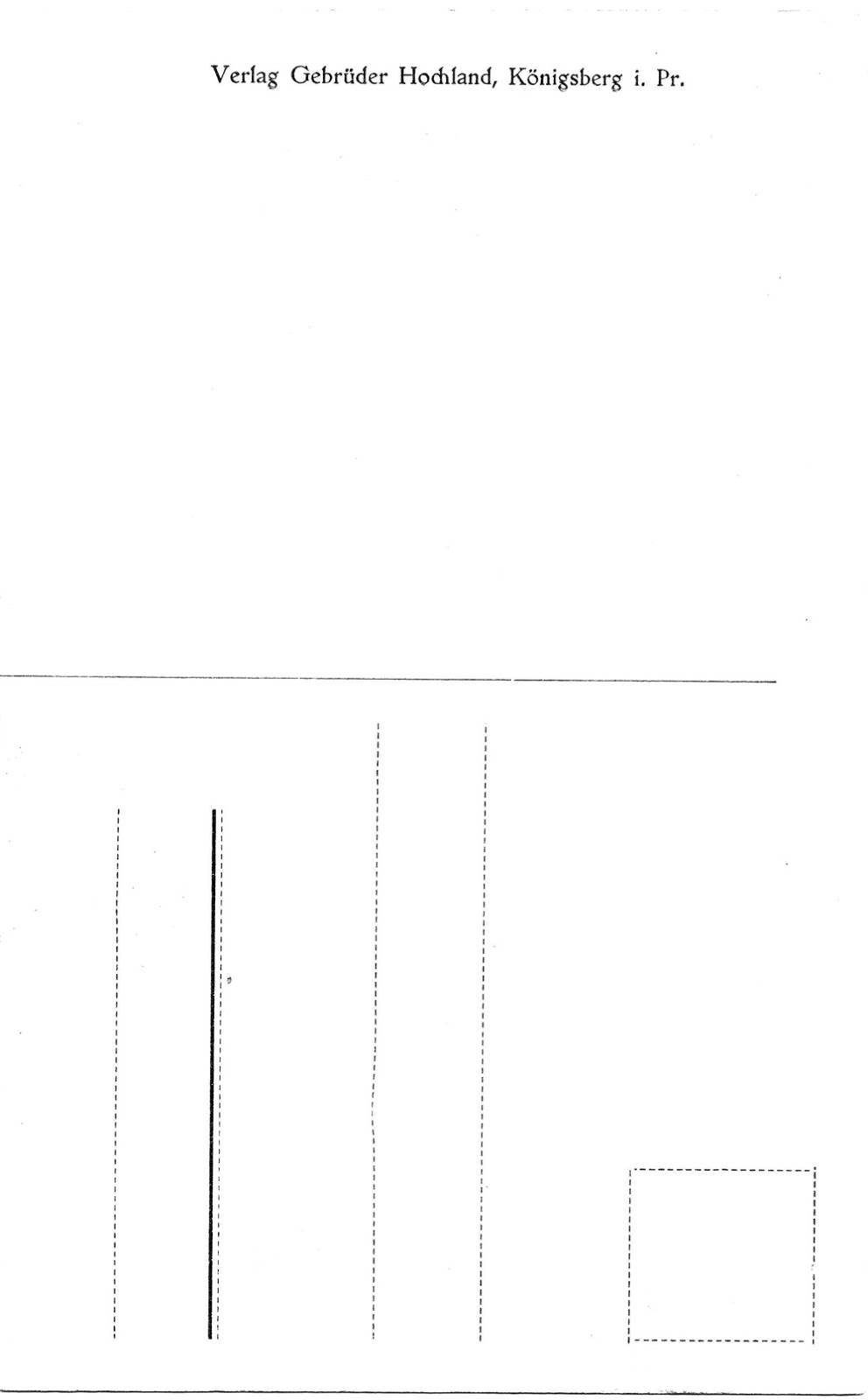
Several years ago, I acquired the following postcard. It measures 5½ inches by 3½ inches, a standard size for its time. It is a mint copy, meaning that no message was penned on its back and it was never mailed. Thus, I cannot date the postcard by a recorded date or postmark on its reverse side (but see below). We present the obverse and the reverse of the postcard for the benefit of the reader:
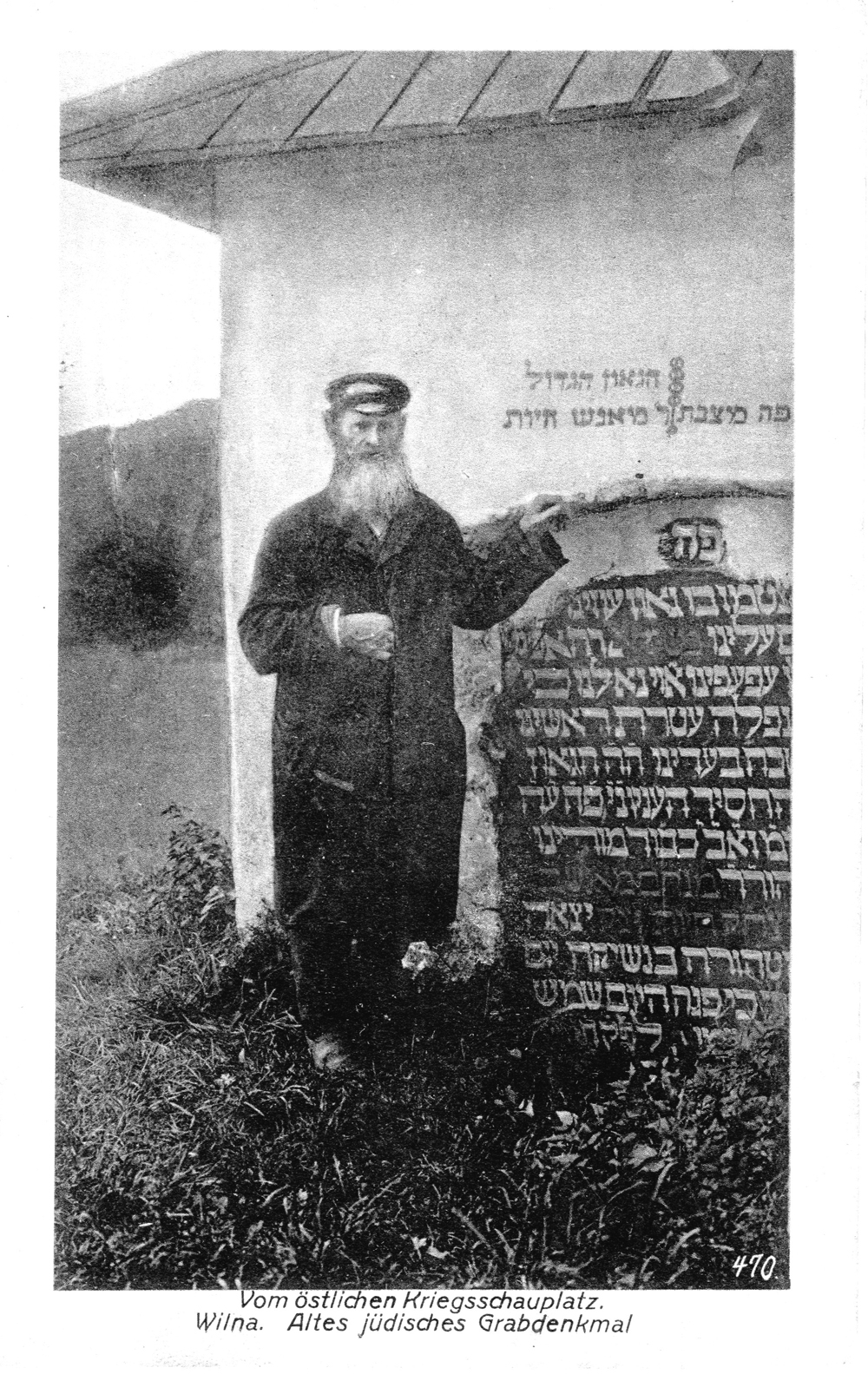
Obverse. The obverse presents a black and white photograph, also standard for its time. It features a tombstone with a Hebrew inscription; a mausoleum behind the tombstone, with a brief Hebrew inscription; and what appears to be a cemetery attendant, with his hand atop the tombstone. Most important, it contains a German heading under the photograph, which reads in translation: “From the Eastern Front of the Theater of War, Wilna, An Old Jewish Tombstone [with Inscription].”

Reverse. The reverse prints the name of the publishing company that produced the postcard: “The Brothers Hochland in Koenigsberg, Prussia.”

Historical Context.

In terms of historical context, the information provided by the postcard (a German heading; Vilna is defined as the eastern front of the theater of war; the postcard was produced in Koenigsberg) can lead to only one conclusion, namely that the postcard was produced on behalf of the German troops that had occupied, and dominated, Vilna during World War I. German troops occupied Vilna on September 18, 1915 and remained in Vilna until the collapse of the Kaiser’s army on the western front, which forced the withdrawal of all German troops in foreign countries at the very end of 1918. Thus, our photograph was taken, and the postcard was produced, during the period just described. Its Sitz im Leben was the need for soldiers to send brief messages back home in an approved format. The ancient sites of the occupied city made for an attractive postcard. (This may have been especially true for Jewish soldiers serving in the German army.)

Due to a wonderful coincidence, a distinguished scholar of Yiddish and a dear colleague, Professor Dovid Katz, recently published a copy of the very same postcard we publish here.[1] Unlike my copy, his copy includes on the reverse side a dated message penned by the German soldier who mailed it, as well as a dated postmark. The message was written on December 3, 1917 and postmarked the next day, on December 4. Thus, we can narrow the timeline somewhat, and suggest that the postcard was almost certainly produced circa 1916 or 1917.

The Old Jewish Cemetery.

The old Jewish cemetery was the first Jewish cemetery established in Vilna. According to Vilna Jewish tradition, it was founded in 1487. Modern scholars, based on extant documentary evidence, date the founding of the cemetery to 1593, but admit that an earlier date cannot be ruled out. The cemetery, still standing today (but denuded of its tombstones), lies just north of the center of the city of Vilna, across the Neris River, in the section of Vilna called Shnipishkes (Yiddish: Shnipishok). It is across the river from, and just opposite, one of Vilna’s most significant landmarks, Castle Hill with its Gediminas Tower. The cemetery was in use from the year it was founded until 1831, when it was officially closed by the municipal authorities. Although burials no longer were possible in the old Jewish cemetery, it became a pilgrimage site, and thousands of Jews visited annually the graves of the righteous heroes and rabbis buried there, especially the graves of the Ger Zedek (Avraham ben Avraham, also known as Graf Potocki, d. 1749), the Gaon of Vilna (R. Eliyahu ben R. Shlomo, d. 1797), and the Hayye Adam (R. Avraham Danzig, d. 1820). Such visits still took place even after World War II.

The cemetery, more or less rectangular in shape, was spread over a narrow portion of a sloped hill, the bottom of the hill almost bordering on the Neris River. The postcard captures the oldest mausoleum and rabbinic grave in the old Jewish cemetery, exactly at the spot where the bottom of the hill almost borders on the Neris River. It was an especially scenic, and historically significant, site in the old Jewish cemetery, and it is no accident that the photographer chose this site for the postcard.

The Tombstone and its Hebrew Inscription.

The tombstone is that of R. Menahem Manes Chajes (1560-1636). He was among the earliest Chief Rabbis of Vilna. Indeed, his grave was the oldest extant dated grave in the Jewish cemetery, when Jewish historians first began to record its epitaphs in the nineteenth century. R. Menahem Manes’ father, R. Yitzchok Chajes (d. 1615), was a prolific author who served as Chief Rabbi of Prague. Like his father, R. Menahem Manes published several rabbinic works in his lifetime, and some of R. Menahem Manes’ unpublished writings are still extant in the Bodleian Library at Oxford University. His epitaph reads:[2]

The Mausoleum and its Hebrew Inscription.

In the old Jewish cemetery, many of the more famous rabbis were buried in mausoleums. All rabbis buried in mausoleums were buried underground. The mausoleum itself served as an honorific place of prayer that a visitor could enter and then pray at the grave of the rabbi of his choice. All tombstones were placed outside the mausoleum, and were affixed to its outside wall, directly opposite the body of the deceased rabbi named on the tombstone (but buried inside the mausoleum). Often, the names of famous rabbis were painted on the outside wall of the mausoleum (much like street signs) identifying who was buried in it. The mausoleums sometimes contained the graves of several famous rabbis. R. Menahem Manes Chajes was buried in the mausoleum that can be seen behind his tombstone. A famous rabbi buried in the same mausoleum was R. Moshe Rivkes (d. 1672), author of באר הגולה on the Shulhan Arukh.[3] The inscription on its wall, and above the tombstone of R. Menahem Manes, reads:

פה מצבת הגאון הגדול ר‘ מאנש חיות

Here is the tombstone of the great Gaon, R. Manes Chajes

The Cemetery Attendant.

What has remained a mystery for more than one hundred years is the identity of the cemetery attendant. We shall attempt to identify him, and to restore him to his proper place in Jewish history.

The reader will wonder how I know that the person in the photograph was a cemetery attendant. Perhaps he was a tourist who just happened to be there on the day the Hochland Brothers Publishing Company arranged for a photograph to be taken for its postcard collection?

Initially, it was simply a hunch, largely due to ephemera, that is, other photos of visitors to the old Jewish cemetery in the interwar period. I have a collection of such photos, and either they feature the tourist (who handed his camera to the tour guide or to the cemetery attendant, and asked that his picture be taken in front of the Vilna Gaon’s tombstone or at the Ger Zedek’s mausoleum), or they feature a cemetery attendant who stands in those places, while the tourist, who knows how to use the camera, takes the photo. The tourists can always be recognized by their garb, which matches nothing worn by anyone else in Vilna. The cemetery attendants, functionaries of a division of the Jewish Kehilla (called Zedakah Gedolah at the time), all wear the same dress, a “Chofetz Chaim” type cap and a long coat, both inevitably dark grey or black. While I am not aware of another old Jewish cemetery photograph featuring the specific cemetery attendant seen in our postcard, his dress is precisely that of all the other cemetery attendants whose photos have been preserved.

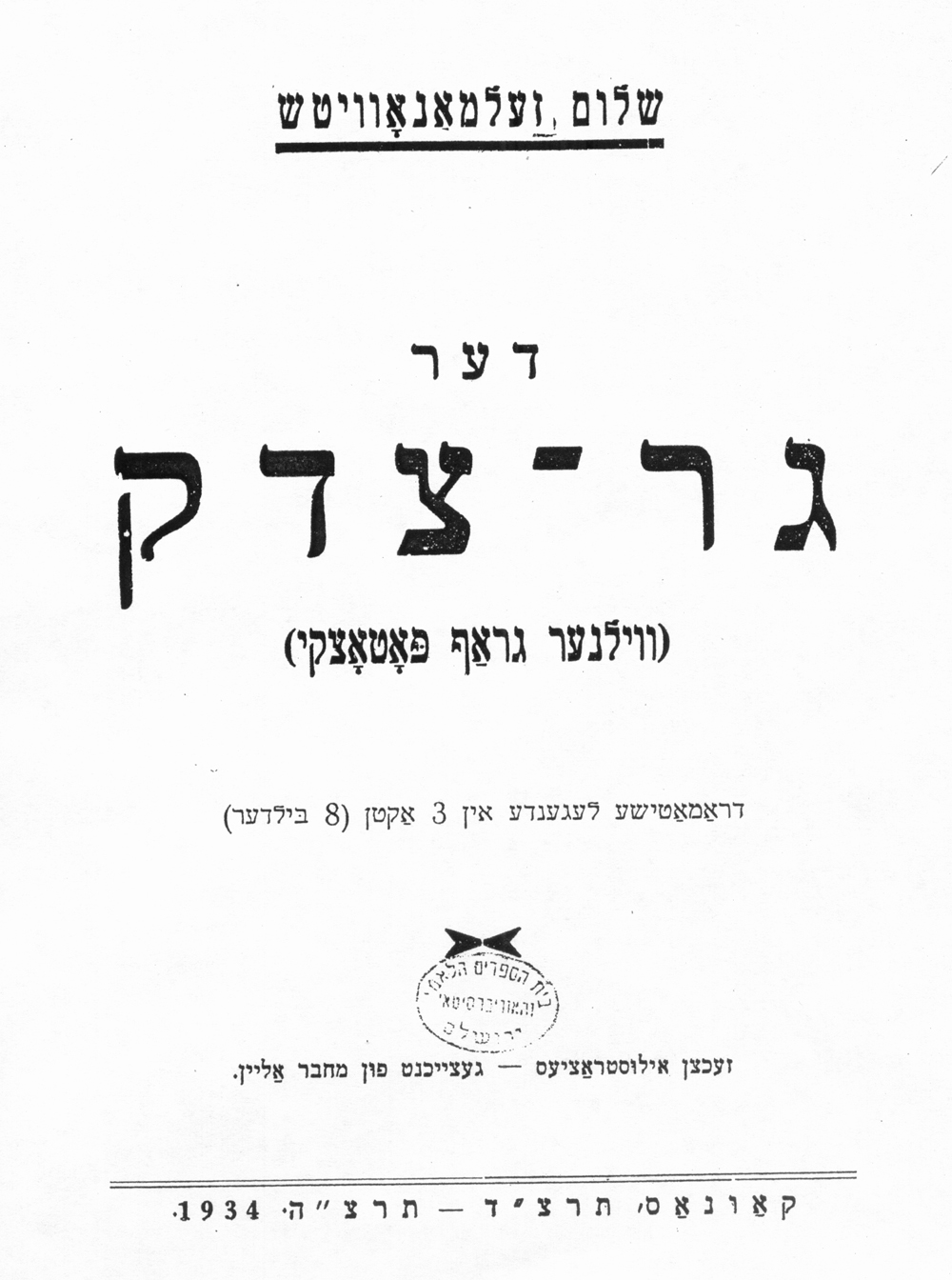
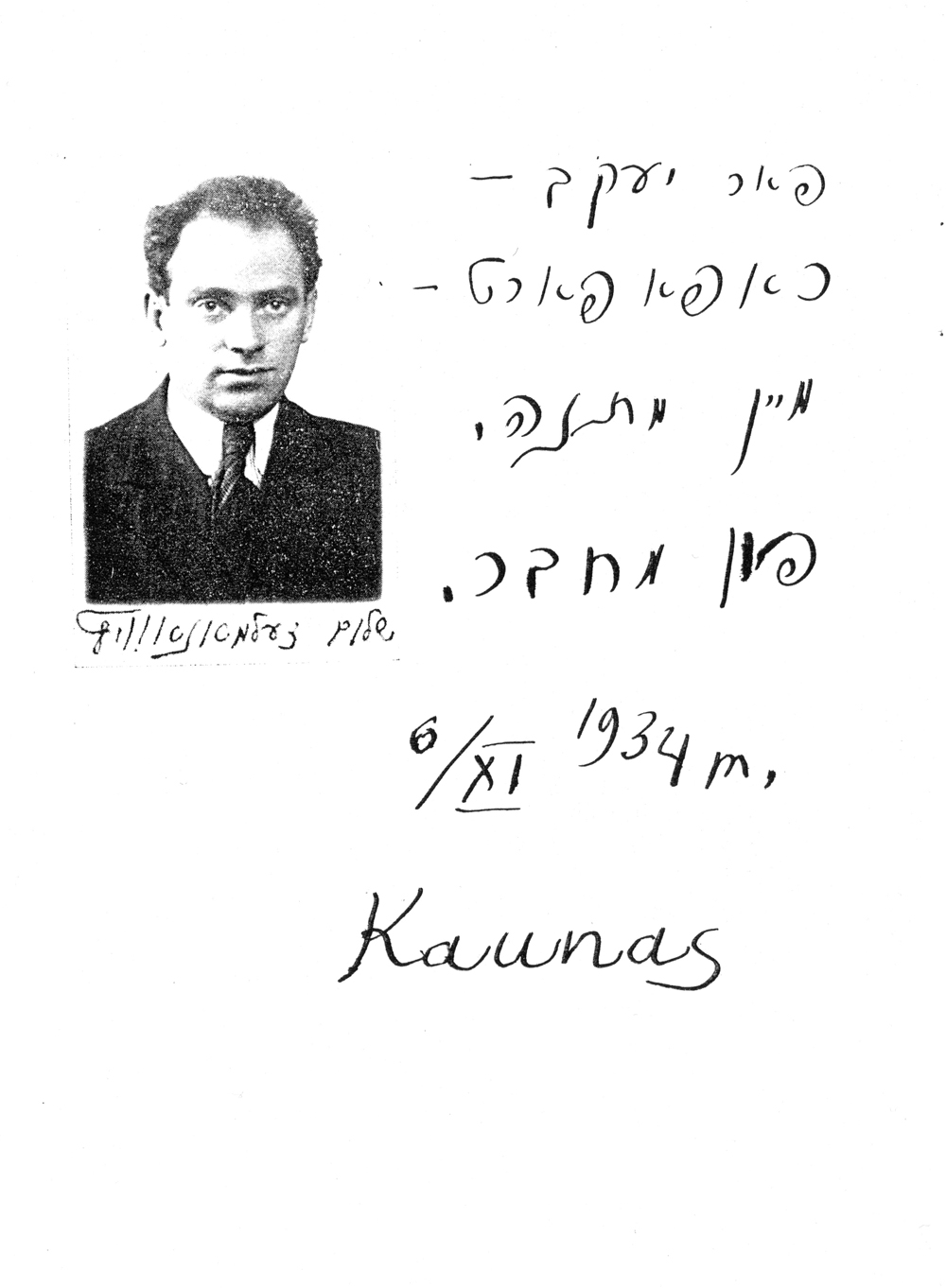
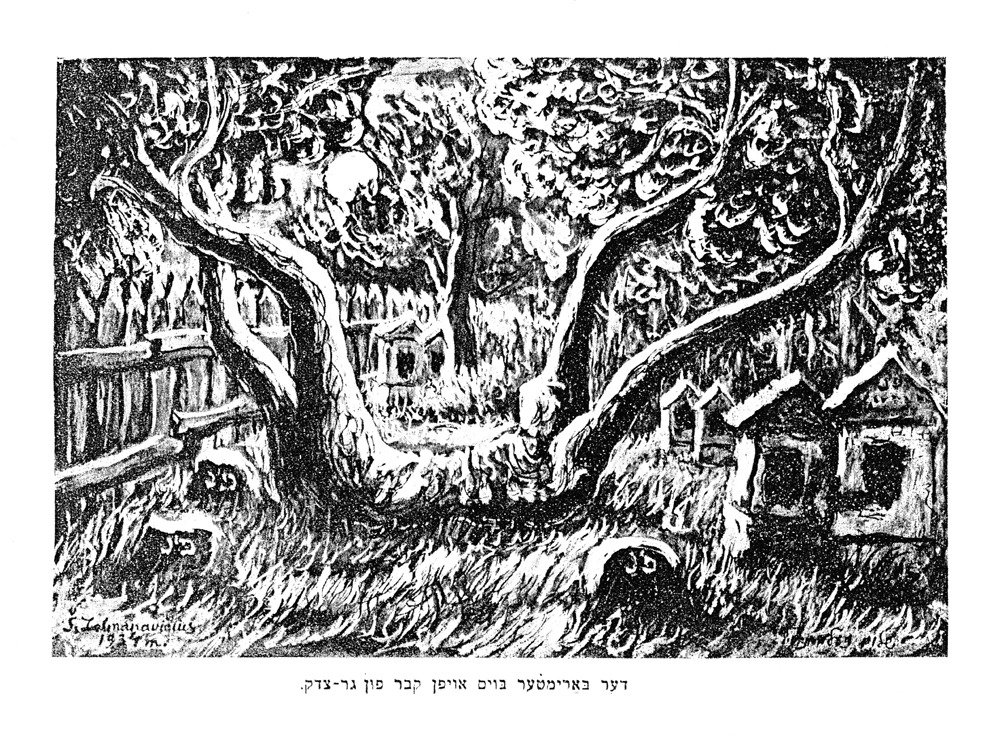
But there is no need for guesswork here. Sholom Zelmanovich, a talented artist and Yiddish playwright, published his דער גרצדקווילנער גראף פאטאצקי  in 1934.[4]

This three-act play commemorates the life and death of the legendary Ger Zedek of Vilna in a new and mystical mode.[5] The volume includes sixteen original drawings by Zelmanovich. Several of the drawings preserve details of Vilna’s old Jewish cemetery with seemingly incredible accuracy. Thus, for example, Zelmanovich depicts the northern entrance gate to the old Jewish cemetery, as well as the nearby Jewish caretaker’s house on the cemetery grounds, even though few photographs are extant that even begin to capture the details of those sites. His depiction of the Ger Zedek’s grave (and the human-like tree that hovered over it) is perfectly located in the south-eastern corner of the old Jewish cemetery, and is surrounded by the wooden fence that existed in that corner prior to 1926. Only someone who spent quality time in Vilna’s old Jewish cemetery could have known exactly where to place the entrance gate, the caretaker’s house, and the Ger Zedek’s grave.
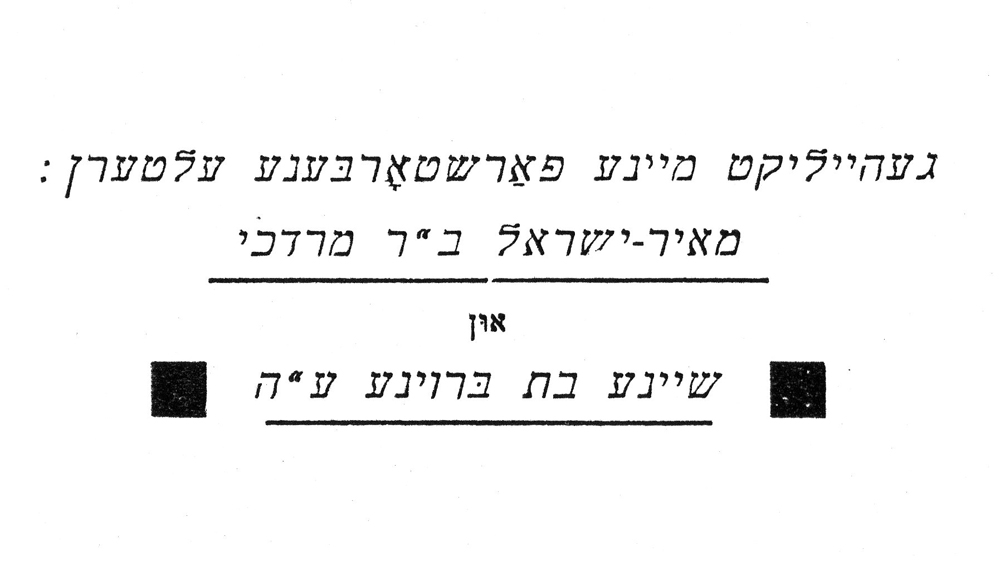
One other matter needs to be noticed. Zelmanovich dedicated the volume in memory of his deceased parents, Meir Yisrael son of Mordechai and Sheyne daughter of Broyne.[6]
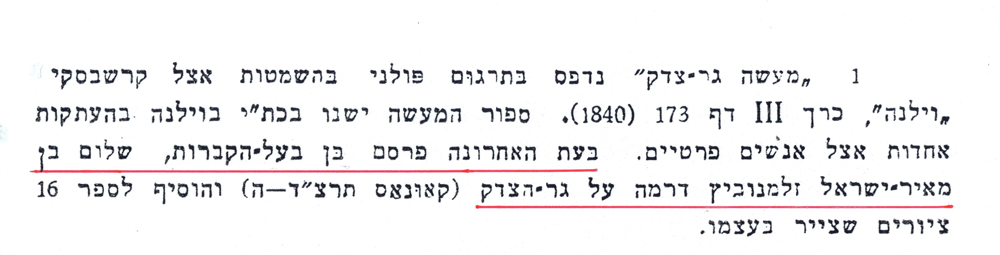
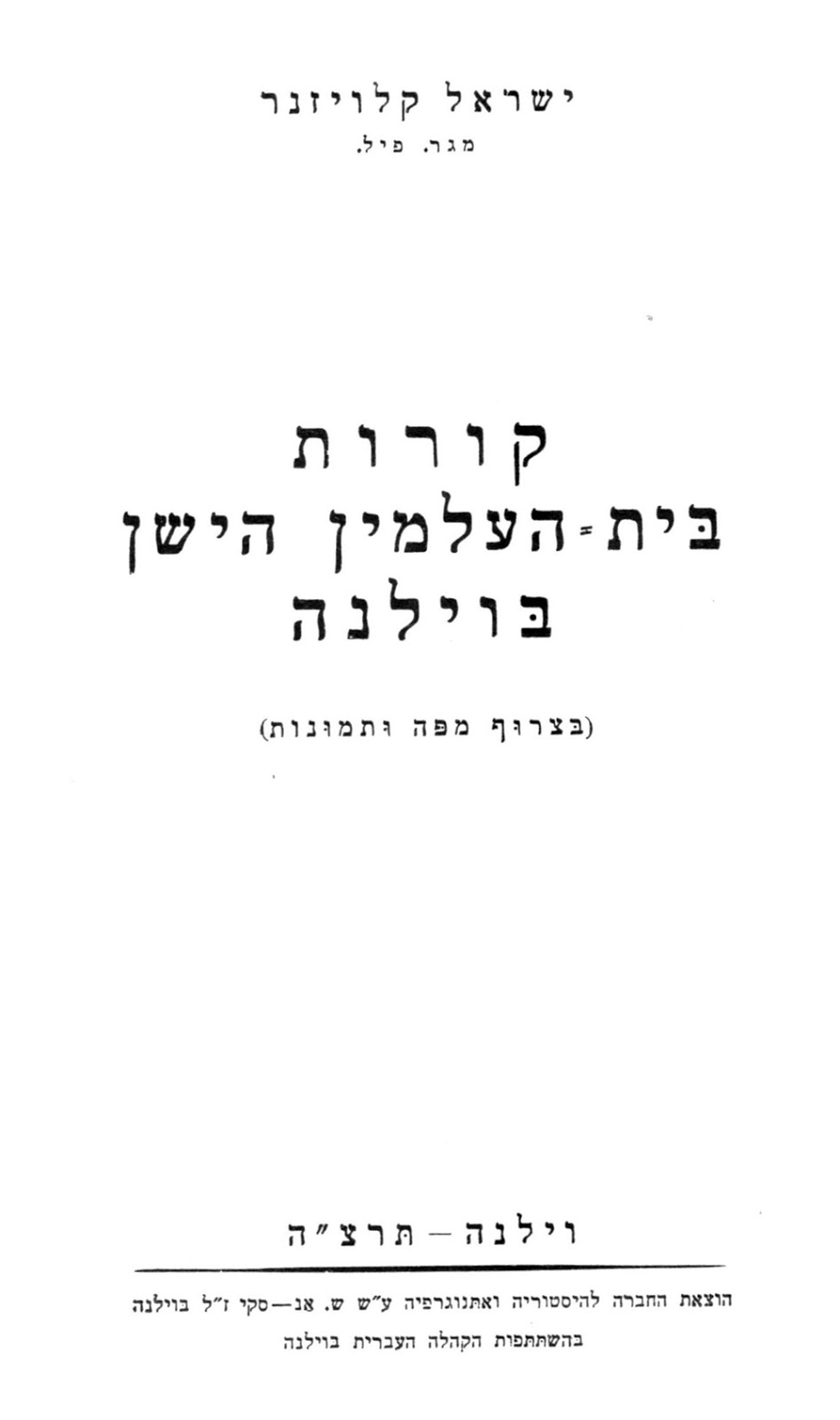
In the summer of 1935, the municipal authorities of Vilna, then under Polish rule, announced their plan to demolish Vilna’s old Jewish cemetery and replace it with a soccer stadium. Vilna – and worldwide – Jewry did not stand idly by. Instead, they engaged in an extensive, and ultimately successful, battle against the municipal authorities. As part of its efforts to win over the municipal authorities, the Vilna Jewish community charged a young Jewish scholar, Israel Klausner,[7] with writing a history of the old Jewish cemetery. It would offer clear documentation and prove beyond doubt that various Polish kings and municipal authorities throughout the centuries had authorized the Jewish community to construct the cemetery and maintain it. The cemetery was legally the property of Vilna’s Jewish community. Klausner’s monograph, entitled קורות בית-העלמין הישן בוילנה (Vilna, 1935), includes a discussion of the Ger Zedek’s grave. In a footnote,[8] Klausner mentions in passing Sholom Zelmanovich’s “recently published drama on the Ger Zedek,” and adds that Zelmanovich was the son of the caretaker of the old Jewish cemetery (Hebrew: בן בעלהקברות ), Meir Yisrael Zelmanovich! The plot thickens.
The full force of the Hebrew term בעלהקברות is not really captured by the English term “caretaker.” There were a variety of cemetery attendants who worked in the old Jewish cemetery in various capacities (such as guiding visitors and leading them to the graves they wished to visit, reciting prayers at the graves, ground-keeping, repairing broken tombstones and re-inking their inscriptions, and guard duty). But one cemetery attendant was in charge of all the other attendants, and as we shall see, he and his family lived in the house on the cemetery grounds. He was called: בעלהקברות, perhaps best rendered as: “Cemetery Keeper” or “Managing Director” of the old Jewish cemetery. We have established that Meir Zelmanovich served in that capacity. But who was he when did he live?

Meir Zelmanovich.

Sadly, almost nothing is known about the life of Meir Zelmanovich. He published no books and wrote no essays. As best I can tell, only one newspaper report mentions his name during his lifetime.[9] The report itself is significant. It records a complaint made by Meir Zelmanovich in 1919 that the Polish legionnaires had desecrated the old Jewish cemetery. But it would be Zelmanovich’s tragic death in 1920 that would perpetuate his memory. Here, we need to provide some historical context. Israel Cohen begins his discussion of the impact of World War I on Vilna, as follows:[10]

Within the small space of eight years, from 1914 to 1922, the Jews of Vilna tasted of the blessings of nine different governments, and suffered from a combination of other evils even more noxious. They became a prey to economic depression, military requisitions, unemployment, famine and disease; thousands of them were subjected to forced labor, imprisonment, plunder and brutal attacks; and physical and material deterioration inevitably engendered a certain degree of social demoralization. All the variegated differences of principle, of religious outlook and sociological doctrine, were now forgotten in the inferno created by the common foe. The long protracted fight for civil and political rights had to yield to the more primitive and desperate struggle for mere existence.

Almost certainly, the greatest concentration of Jewish suffering in this period came in April of 1919, when the Polish legionnaires unleashed a pogrom against Vilna’s Jews. Israel Cohen describes the horrors that followed:[11]

The [Polish] legionnaires[12] defiled and desecrated the [old Jewish] cemetery, smashed the tombstones, and opened the graves (including some of Vilna’s earliest rabbis) in the belief that they would find in them arms and money. Disappointed in their search, the Poles transferred their attentions from the dead to the living and ran amuck in the Jewish quarter. For three days they seized Jews in the streets, dragged them out of their homes, bludgeoned them savagely, and looted their houses and shops. About 80 Jews were shot, mostly in the suburb of Lipuvka, where some were ordered to dig their own graves; others were buried alive, and others were drowned, with their hands tied, in the Vilia [now: Neris] River… All sorts of outrages were committed in those days by the Poles in celebration of their victory. They tied a Jew to a horse and dragged him through the streets for three miles. They took a sadistic delight in cutting off the beards and earlocks of pious Jews. They even arrested, assaulted and humiliated Rabbi Rubinstein and Dr. Shabad. Altogether, thousands of Jews in Vilna, as well as in Lida and Bialystock were imprisoned in various concentration camps where they were ill fed and beaten, and where they suffered from hunger and typhoid. Moreover the total loss due to destruction and pillaging of Jewish people in the pogrom, in Vilna alone, was estimated at about 20 million roubles (about $10,000,000).

Polish rule of Vilna came to an end when the Russians recaptured Vilna on July 14, 1920. Russian rule lasted for six weeks, after which the Russians retreated and left Vilna in the control of the Lithuanians. Lithuanian rule lasted until October 8, 1920, when the Poles once again recaptured Vilna. One can only imagine the fear that gripped the Jewish community in Vilna, when they heard the sounds of the approaching Polish legionnaires. In fact, hundreds (some claim: thousands) of Vilna’s Jews fled on October 8 to Kovno, then part of Independent Lithuania.[13] Indeed, there was what to fear, for the Polish legionnaires were free again to wreak havoc with Jewish lives. And although the severity of the pogrom of 1919 did not repeat itself, the indiscriminate murder, rape, and looting of Jews that took place in Vilna between October 8-10, 1920 was, at least in the eyes of the victims, yet another pogrom.[14] Briefly, eye-witness Yiddish accounts[15] record that at least 6 Jewish men and women were murdered, numerous women were raped, and some 80 Jews were mugged and robbed. No one was brought to justice for committing these crimes! On October 10, 1920 Meir Zelmanovich, Cemetery Keeper of the old Jewish cemetery in Vilna was murdered by the Polish legionnaires. He was 70 years old when he died. The official Jewish record of his death lists his home address as “Derewnicka 3.” This is the address of the house on the grounds of the old Jewish cemetery. It is no wonder that Sholom Zelmanovitch could depict so vividly the northern entrance gate to the cemetery, its nearby caretaker’s house, and the human-like tree hovering over the Ger Zedek’s grave. His childhood playground was the old Jewish cemetery in Vilna.
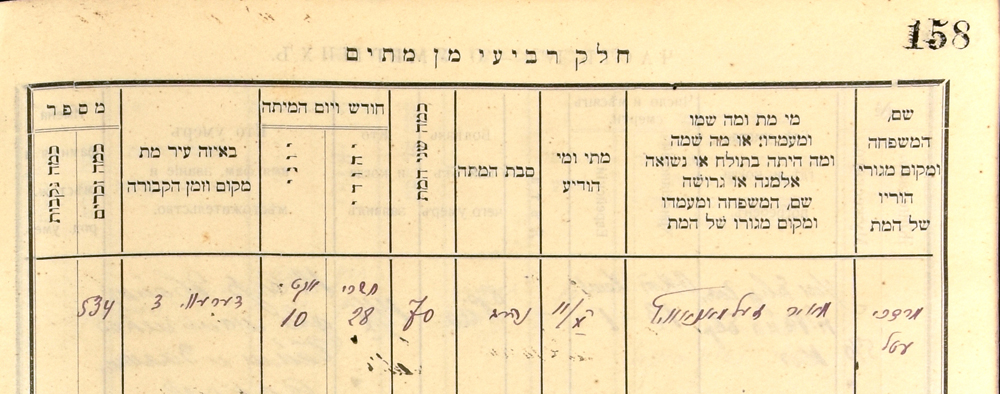
On the picture postcard from 1916-1917, one sees an elderly Jew. One possibility is that it depicts none other than Meir Zelmanovitch, the Cemetery Keeper of the old Jewish cemetery until his death in 1920 at age 70. I suspected that this was the case, but could not prove it until recently — when a small miracle occurred.

Miracles Sometimes Do Occur.

In March of this year, out of the clear blue sky, I was contacted by Laurie Cowan, who introduced herself as a great-granddaughter of Meir Zelmanovich! She basically was interested in any information I could provide about her great-grandfather that she didn’t already know. I was delighted to make her acquaintance, but wondered what led her to me. It turns out that both of us were seeking information about the same person – Meir Zelmanovich – from the Lithuanian State Historical Archives in Vilnius. An alert researcher at the Archives noticed this, and made the “shidduch” between us. I shared with Laurie whatever I knew about her great-grandfather. In turn, I asked her to send me copies of whatever documents she had relating to her great-grandfather. She sent me a scan of the following photograph of her great-grandmother and great-grandfather, Sheyne[16] and Meir Zelmanovich:
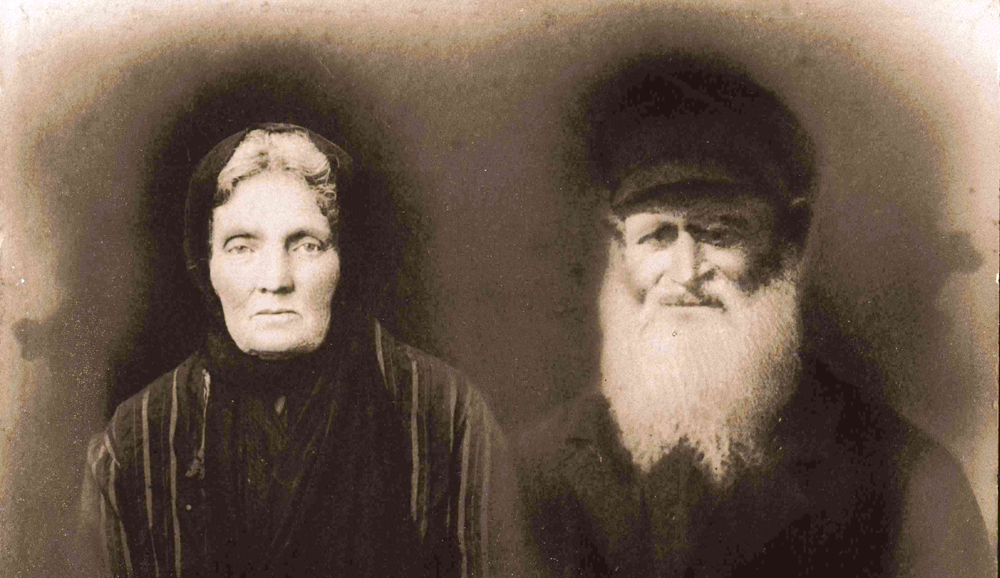
Never has it been so easy to identify an unidentified picture on a one-hundred year old picture postcard! One suspects that the picture postcard company representative, and a photographer, met with the Cemetery Keeper Meir Zelmanovich at the old Jewish cemetery in Shnipishok. He led them to the mausoleum of R. Menahem Manes Chajes, and was asked to pose at the tombstone just outside it. He graciously accepted the invitation. This may well have been the last photo taken of Zelmanovich, and it preserves, together with the photo provided by Laurie Cowan, the likeness of a martyr who fell during the October 1920 mini-pogrom in Vilna.[17]

At least six Jews were murdered between October 8-10 in 1920 in Vilna. They died for one reason only, namely, because they were Jews. Such Jews are regarded as martyrs and their names, at the very least, deserve to be recorded and remembered. Until now, none of the names of the Vilna martyrs of 1920 have been published in any public Jewish record, whether in a contemporary Jewish newspaper, or a Jewish historical essay or book, or an online posting. Having examined the extant records in the Lithuanian State Historical Archives, I have been able to retrieve the 6 names of the Jewish victims who were murdered in Vilna in October of 1920. In each case, the Jewish Kehillah records of Vilna in 1920 state clearly in Hebrew that the cause of death was either נהרג or נהרגה (i.e., murdered). The names are:

1. Shmuel ben Mendel Katz, age 56, died October 9.

2. Etel Natin, age 36, died October 9.

3. Basya Natin, age 32, died October 9.

4. Rokhl Blume Shuster, age 45, died October 9.

5. Meir Zelmanovich, age 70, died October 10.

6. Shlomo Abramovich, age 17, died October 12.[18]

May the memory of these martyrs be forever for a blessing! [19]

NOTES:

עם הספר, the People of the Book the world over, mourn the death of R. Shmuel Ashkenazi in Jerusalem, at the age of 98. He was שר הספר, the consummate master of the Hebrew book. Bibliographer, bibliophile, and book collector, his encyclopedic knowledge of all of Hebrew and Yiddish literature remains unparalleled in our time. His most recent contributions appeared in three massive volumes, replete with some 1,794 pages of immaculate scholarship. He never wasted a word; he wrote with precision and parsimony. Among his many accomplishments, he edited the Kasher Passover Haggadah, one of the most significant scholarly editions of the Passover Haggadah ever published. He was largely responsible for the single most accurate bibliography of Hebrew books ever produced, מפעל הביבליוגרפיה העבריתThe Bibliography of the Hebrew Book 1473-1960. Aside from his scholarly distinction, R. Shmuel Ashkenazi wrote in an elegant Hebrew with its own special charm. Not only did he advance discussion, but he did so in an aesthetically pleasing manner. For those of us who knew him personally, he evinced the same charm in his personal relationships that he did in his writings. He set a standard of excellence that we can only strive to emulate, but never really replicate. יהא זכרו ברוך!

This essay is dedicated to his memory, a token of appreciation for all he has taught me.

[1] Dovid Katz, “World War I Postcard of the Grave of Rabbi Menachem Manes Chayes (1560-1636) in the Old Vilna Jewish Cemetery,” Defending History (11 March 2020), available here) A copy of our postcard can also be seen online at ‘YIVO 1000 Towns’, record ID 10743 (http://yivo1000towns.cjh.org).
[2] For a fuller discussion of R. Menahem Manes Chajes and his epitaph, see S. Leiman, “A Picture and its One Thousand Words: The Old Jewish Cemetery of Vilna Revisited,” The Seforim Blog, January 14, 2016, especially notes 7-11, online here.
[3] Aside from his pivotal commentary on R. Joseph Karo’s Shulhan Arukh, R. Moshe Rivkes was a great-great grandfather of the Vilna Gaon.
[4] Precious little is known about Sholom Zelmanovich (1898-1941). See the brief biographical entry in לעקסיקאן פון דער נייער יידישער ליטעראטור (Martin Press: New York, 1960), vol. 3, column 670, which mistakenly lists him as being born in a town near Kovno, circa 1903. He was born in Vilna in 1898 (JewishGen) and died during one of the first Nazi aktions in the Kovno Ghetto.
[5] In general, see Joseph H. Prouser, Noble Soul: The Life and Legend of the Vilna Ger Tzedek Count Walenty Potocki (Gorgias Press: Piscataway, 2005). Prouser’s excellent monograph is a study of the many literary reworkings of the legends surrounding the Vilna Ger Zedek, with primary focus on 20th century Jewish literary contributions. Strangely, he offers no discussion of Zelmanovich’s contribution.
[6] On the feminine Yiddish name “Broyne,” see Alexander Beider, Dictionary of Ashkenazic Given Names (Avotaynu: Bergenfield, 2001), pp. 484-486.
[7] Klausner (1905-1981) settled in Palestine in 1936 and continued to be a prolific author of studies and books on the history of Vilna’s Jewish community. Aside from several important monographs, like his history of the old Jewish cemetery, he wrote a two-volume history of Jewish Vilna entitled 1939-1881 וילנה ירושלים דליטאדורות האחרונים (Ghetto Fighters’ House: Tel-Aviv, 1983), to which a third volume treating 1495-1881 was added posthumously, based largely on studies previously published by Klausner.
[8] קורות ביתהעלמין הישן בוילנהp. 45, note 1.
[9] See Vytautas Jogela, “The Old Jewish Cemetery in the Nineteenth and Twentieth Centuries,” Lituanus, vol. 61, no. 4 (2015), pp. 81-82.
[10] Israel Cohen, Vilna (Jewish Publication Society: Philadelphia, 1943), pp. 358-359.
[11] Ibid., pp. 378-379.
[12] Cohen regularly spells the word: “legionaries.” For the sake of consistency, I have spelled the word “legionnaires” throughout this essay.
[13] See, e.g., Boaz Wolfson, “מיטלליטע” in פנקס פאר דער געשיכטע פון ווילנע אין די יארן פון מלחמה און אקופאציע (B. Zionson: Vilna, 1922), column 387.
[14] There are probably as many definitions of “pogrom” as there are scholars and politicians. Since it is unclear whether the crimes committed on October 8-10, 1920 were planned and implemented by either a government or a political action committee, and since the duration of the attacks was short and rather swiftly brought under control, historians are reluctant to refer to the events that occurred on October 8-10, 1920 as a pogrom. On the other hand, to label those events a mere “disturbance” does not begin to capture the malevolent intent of the perpetrators directed specifically against Jews, and does not address the intensity of Jewish suffering at the time. For some of the different views regarding the definition of “pogrom,” and how the term has been manipulated by political interests, see Szymon Rudnicki’s forthcoming essay “The Vilna Pogrom of 19-21 April 1919,” to appear in Polin 33 (2020). Professor Rudnicki kindly allowed me to see a pre-publication copy of his lucid and informative essay.
[15] Wolfson, loc. cit. Cf. Jacob Wygodski, אין שטורם (B. Kletzkin: Vilna, 1926), pp. 217-221.
[16] Sheyne Zelmanovich died in Vilna on October 26, 1921, at age 68 (JewishGen). She lived in her home on the old Jewish cemetery grounds until her death. In a personal communication, Laurie Cowan informed me that the Zelmanoviches had 10 children who survived to adulthood. The 6th child, Beirach (popularly called: Berik; and later, Ben), was her grandfather, an older brother of Sholom mentioned above.
[17] The only other extant likeness of Meir Zelmanovich (known to me, and recovered on July 15, 2020) is an undated passport photo (circa 1916) preserved in the Lithuanian State Historical Archives. During the German occupation, all residents of Vilna were required to have – and to carry at all times – a German passport (we would call it: an Identity Card). Meir Zelmanovich’s German passport photo confirms the identity and authenticity of the photos of Zelmanovich published in this essay. All three photos are of one, and the same, person.
[18] One suspects that Abramovich may have been shot or beaten on October 9 and 10, like the others, but did not die from his wounds until the 12th.
[19] This essay could not have been written without the help of Regina Kopilevich, researcher (and tour guide) extraordinaire, who located whatever documents I sought at the Lithuanian State Historical Archives (Lietuvos Valstybes Istorijos Archyvas) in Vilnius. I am indebted to the librarians at the Archives for allowing her and me to examine these and other documents during my visits to Vilnius. Next to Google, JewishGen is a modern Jewish historian’s best friend, and we are grateful to all who contribute to making JewishGen the great historical resource that it is. Matt Jelen’s careful reading of an earlier draft has significantly improved the final version. I alone am responsible for whatever errors appear in this essay.

A nay bintl briv: Personal Reminiscences of Rabbis Baruch ha-Levi Epstein and Aaron Walkin from the Yiddish Republic of Letters

A nay bintl briv:

Personal Reminiscences of Rabbis Baruch ha-Levi Epstein and Aaron Walkin

from the Yiddish Republic of Letters

Shaul Seidler-Feller

Editor’s note: The present post is part two of a two-part essay. Part one can be found here.

Second Letter

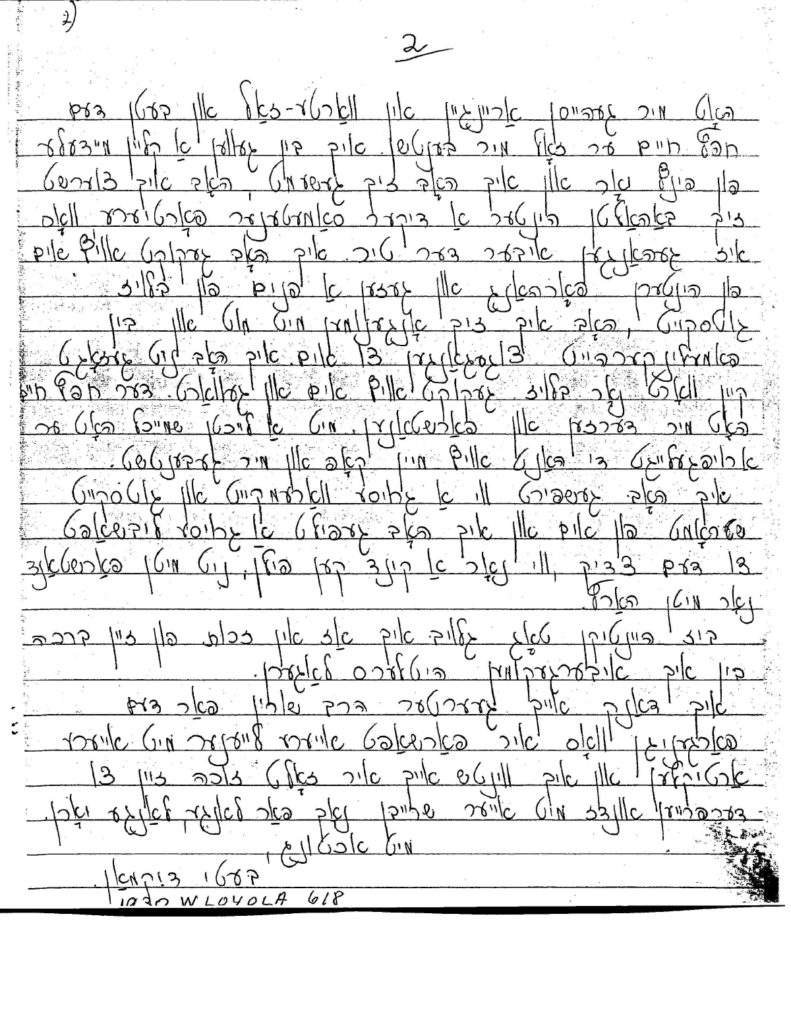
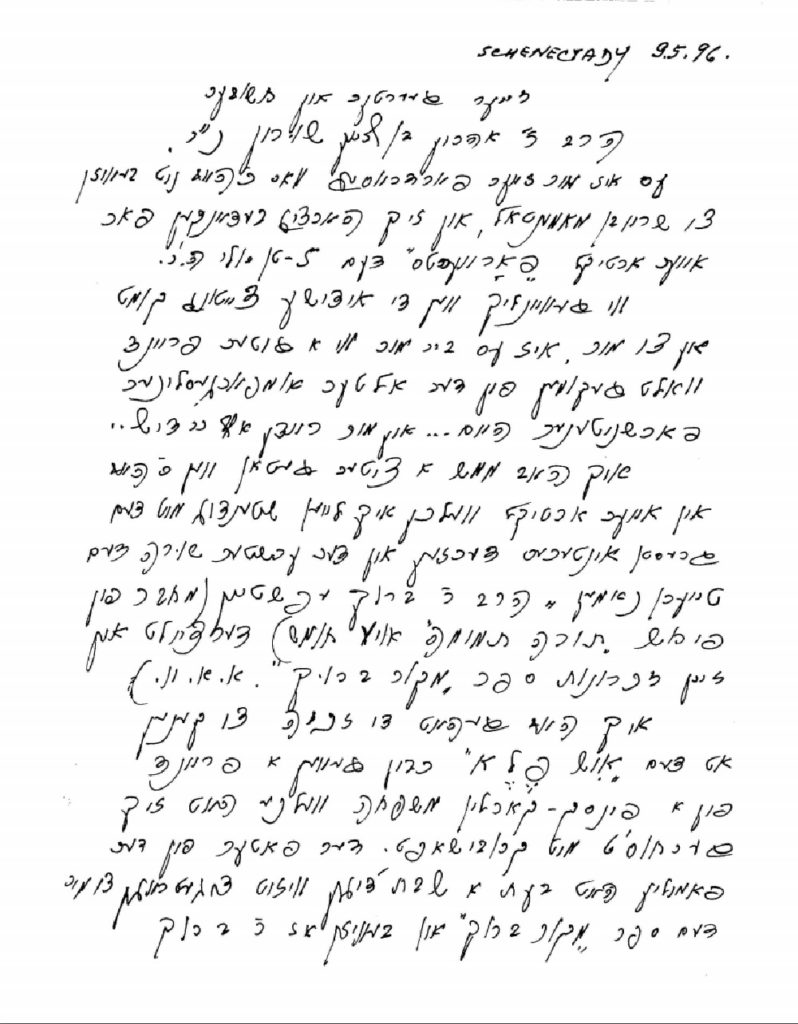
Approximately eight and a half years after his column on the Hafets Hayyim appeared, Rabbi Aaron B. Shurin penned another essay, entitled “The Mistake of the Austrian Emperor” and about the meaning behind the observance of the Three Weeks, which was published 18 Tammuz 5756 (July 5, 1996), a day after they had begun.[1] In the first line, he quoted Rabbi Baruch ha-Levi Epstein (1860–1941/1942) as citing a story about Austrian Emperor Franz Joseph I’s (1830–1916) negative response to a group of Hungarian nationalists who wished to establish a day of mourning for the loss of their independence in 1848, using the Jews’ observance of Tish‘ah be-Av as a model.[2] This prompted Simon Paktor to write in:


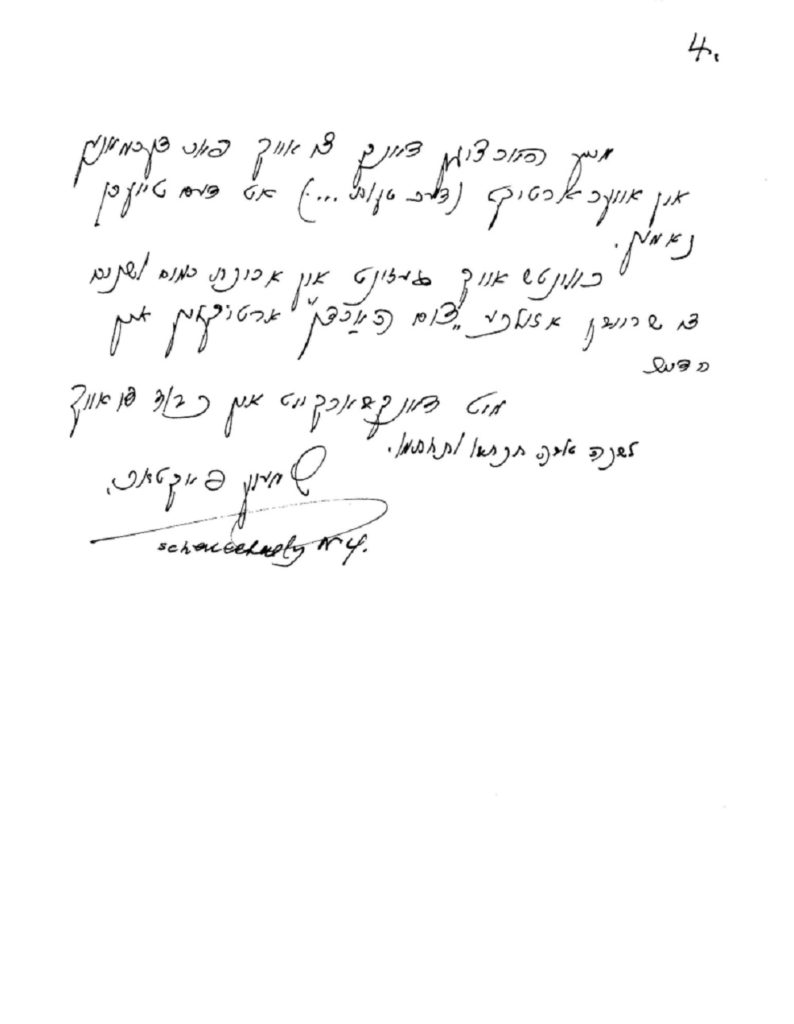
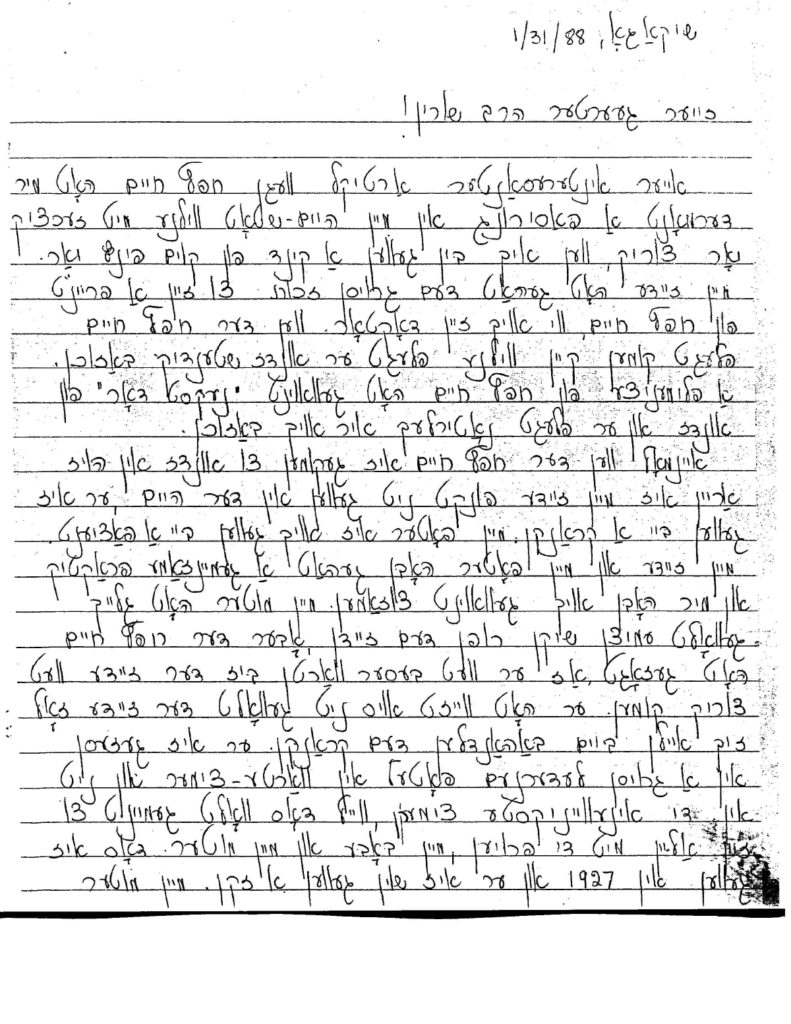
SCHENECTADY 9.5.96.

זייער געערטער און חשובער
.הרב ר״ אהרון בן ציון שוּרין נ״י


עס איז מיר זייער פארדראסיג וואס כ׳האב ניט בעוויזן
צו שרייבן מאמענטאל, און זיך הארציג בעדאנקען פאר
.אייער ארטיקל ״פאָרווערטס״ דעם 5-טן יולי ה.י

ווי געוויינליך ווען די אידישע צייטונג קומט
אן צו מיר, איז עס ביי מיר ווי א גוטער פריינד
וואלט געקומען פון דער אלטער אומפארגעסליכער
..פארשניטענער היים… און מיר ריידן א[וי]ף יידיש

איך האב ממש א ציטער געטאן ווען כ׳האב
אין אייער ארטיקל וועלכן איך לייען שטענדיג מיט דעם
גרעסטן אינטערעס דערזען אין דער ערשטער שוּרה דעם
טייערן נאמען ״הרב ר׳ ברוך עפשטיין (מחבר פון
פירוש ״תורה תמימה״ אויף חומש) דערציילט אין
[3](זיין זכרונות ספר ״מקור ברוּך״ א.א.וו

איך האב געהאט די זכיה צו קענען
אט דעם ״אִיש פֶלֶא״ כבין געווען א פריינד
פון א פינסק-קארלין משפחה וועלכע האט זיך
געיחוס׳ט מיט קרובישאפט. דער פאטער פון דער
פאמיליע האט בעת א שבת׳דיגן וויזיט צוגעטראגן צו מיר
דעם ספר ״מקור ברוך״ און בעוויזן אז ר׳ ברוך

2

ווייזט אן אז אין שׁימל פון ברויט ליגט
דער פאטער אלתר סלוּצקי .PENECiLiN רְפוּאָה ווי
איז געווען א לאַווניק אין שטאט ראַט און די טאכטער האט
געארבעט אין דער יידישער אפטיילונג. אזוי ווי פינסק
האט געהאט א פנקס פון 800 יאר האט זיך זי געהאט די
א מעגליכקייט אויסגעפינען און אנטקעגן קומען ר׳ ברוך עפשטיינס
ביטעס אין די ארכיווע אויסצוזוכן. ער פלעגט זיך שטענדיג
בעדאנקען צו איר דורך שיקן א ״באָמבאניערקע״
דא הייסט עס א באַקס שאקאלאד)… איך)
.מיט טרערן אין די אייגן און מוז א וויילע איבערייסן

.ער האט מיר אויסגעלערנט אן אריטמעטיג פארמוּלע
איך דערמאן זיך ווען כ׳האב שבת נאכן דאוונען אין פינסקער
גרייסער שוּל אראבגעגאנגען צום ברעג פון אונזער
און בעמערקט ר׳ ברוך עפשטיין ז”ל PiNA שיינער טייך
זיצט אויף א באַנק כ׳בין צוגעגאנגען צו עם און געזאגט

״גוט שבת ר׳ ברוּך גום ברוך יהיה״

ער האט געענטפערט ״גם אתם״ און צובייגענדיג צו מיר
געפרעגט ״אפשר האט איר די פאָלקס צייטונג״
(א בונדיסטישע צייטונג וואס איז ארויס אין ווארשע)
(ווען איך האב עס דערציילט א היגן רָב (ניט קיין ראביי
האט ער צו מיר געזאגט יעצט זע איך

3

…אז ער איז געווען ״אם לא למעלה מזה״
איך בין יונג געווען און קיין שכל ניט געהאט און ניט פארשטאנען
צו צוהערן זיך און פאָלגן וואס אונזערע חכמים האבן
געזאגט ״והוי מתאבק בעפר רגליהם״

איך פלעג עם זייער אָפט טרעפן גייענדיג צו
(הרב הגאון ר׳ אהרון וואלקין ז״ל השם יקום דמם
הרב וואלקין האט עם ר׳ ברוך עפשטיין זייער מְקַרֵב
.געווען אין זיין עלנדקייט

איך האב געהאט דעם טרויעריגן זכות זען
אט דעם גאון ר׳ אהרון וו. הארט פארן אימה׳דיגן חורבן ווי
ער איז געזעסן אין א ווינקל פון א סטאָליאריי אַרטיעל
נאכדעם ווי די סאוויעטן האבן עם ארויסגעטריבן פון
זיין בית דין שטוב. געזעסן ארומגערינגלט מיט ספרים
…בליֵיך ווייס ווי שניי. א ״מַראה כהן״

ווייטער האב איך שוין ניט געווּסט כ׳בין געווען אין די
.לאַפּעס פון נ.ק.וו.ד

איך האב זיין ר׳ ברוּך׳ס ספר ״בָרוּך שֶאָמַר״ פירוּש
תפילות ישראל. ר׳ ברוך עפשטיין ז״ל איז געשטארבן
אין געטא אין הונגער, צער א צוּווייטאגדיגער. און מיין האַרץ
..וויינט אין מיר טאג און נאכט

4

מיין הארציגן דאנק צו אייך פאר דערמאנען
אין אייער ארטיקל (דער טעות….) אט דעם טייערן
.נאמען

כווינטש אייך געזונט און אריכת ימים ושנים
צו שרייבן אזעלכע ״צום האַרצן״ ארטיקלען אין
יידיש

מיט דאנקבארקייט און כבוד צו אייך
.לשנה טובה תכתבו ותחתמו
.שמעון פאקטאר
Schenectady NY.

Schenectady 9.5.96

To the highly esteemed and eminent Rabbi Aaron Benzion Shurin, may his light shine,

I am greatly displeased that I did not manage to write immediately to offer my sincere thanks for your column in this year’s July 5th issue of the Forverts.

As is usual when the Yiddish newspaper is delivered, I felt then as if a good friend had arrived from the unforgettable, obliterated old country… and we were having a conversation in Yiddish…

I literally shuddered when I noticed in the first line of your column – which I always read with the greatest interest – the dear name “Rabbi Baruch Epstein (author of the Torah temimah commentary on the Pentateuch) relates in his memoir Mekor barukh,” etc.

I had the good fortune to know that “amazing man.” I was friendly with a family in Pinsk-Karlin that took pride in its kinship with him. The head of the family, during a visit of mine one Sabbath, brought me the book Mekor barukh and showed me that R. Baruch

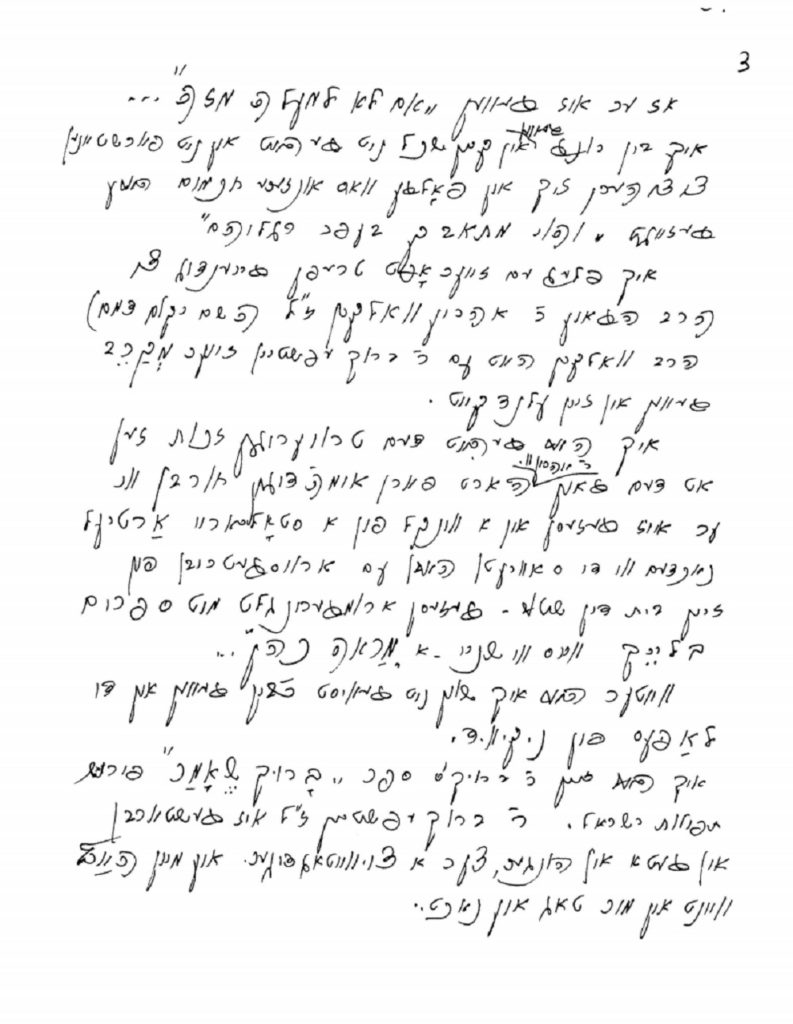
2

points out that medicine akin to penicillin can be found in moldy bread.[4] The father, Alter Slutzky, was an alderman on the city council, and his daughter worked in its Jewish division.[5] Since Pinsk had a communal register going back 800 years,[6] she had the opportunity to learn of and accommodate R. Baruch Epstein’s requests to search in the archive. He would always thank her by sending a bombonierka (here, we would call it a box of chocolates)…[7] I write this with tears in my eyes and must pause for a moment.

He taught me an arithmetic formula. I remember how one Sabbath, after services in the Great Synagogue of Pinsk,[8] I descended to the banks of our beautiful Pina River and caught sight of R. Baruch Epstein, of blessed memory, sitting on a bench.[9] I approached him and said, “Good Sabbath, R. Baruch – may you, too, be blessed [barukh].”[10] He responded, “The same to you”[11] and, leaning over to me, asked, “Maybe you have a copy of the Folkstsaytung?” (a Bundist newspaper published in Warsaw). When I recounted this story to a local rov (not some non-Orthodox rabbi),[12] he said to me, “Now I see

3

that he was ‘if not even higher than that’[13]…”[14] I was young and foolish and did not realize that I should really listen to and follow that which our Sages taught: “And sit in the dust of their feet.”[15]

I would very often meet him on his way to the ga’on Rabbi Aaron Walkin, of blessed memory (may God avenge their blood). R. Walkin drew quite close to R. Baruch Epstein in his loneliness.

I had the tragic fortune to see that ga’on, R. Aaron W., right before the horrific Holocaust, sitting in a corner of a carpentry workers’ cooperative after the Soviets had banished him from his rabbinic courtroom. He sat surrounded by books, his complexion pale white as snow, like leprosy shown to a priest…[16]

I knew nothing more of him; I was caught in the clutches of the NKVD.

I have R. Baruch’s book Barukh she-amar, a commentary on the Jewish prayers.[17] R. Baruch Epstein, of blessed memory, died in the ghetto a distressed man, starving and suffering. And my heart cries within me day and night…

4

My sincere thanks to you for mentioning in your column (“The Mistake…”) that precious name.

I wish you health and many long days and years so that you might continue writing such “heartwarming” columns in Yiddish.

With gratitude and esteem,
May you be inscribed and sealed for a good year,
Simon Paktor
Schenectady, NY

Although the author of our letter offers precious few details about himself in the body of the document, we know from other sources that he was born to Moishe and Gittel Paktor on January 18, 1913 in Pinsk (then part of Russia, now in Belarus).[18] At the time, Pinsk was one of the most Jewish (percentage-wise) of the major cities in Eastern Europe, with a Jewish population in 1914 of 28,063 out of 38,686 total residents (approximately 72.5%).[19] Presumably because Paktor was young and politically active, the NKVD (Soviet secret police) arrested him toward the beginning of World War II, when Pinsk was occupied by the Red Army, and sent him eastward to a Siberian labor camp, thereby inadvertently saving his life.[20] When he was released, he traveled to Munich where he met and married his first wife, Helen (1925–2019), and the two of them, together with their young son David Leon (b. 1949), immigrated to the United States in 1952.[21] Sometime thereafter the couple divorced, and in 1973 Simon moved to Schenectady to serve as the Ritual Director at Congregation Agudat Achim, a Conservative synagogue (located at 2117 Union Street).[22] There, in 1976, he married Anne Smuckler (1914–2014), whose own husband had passed away three years prior,[23] and continued serving the shul faithfully until his retirement in 1993.[24]

Paktor’s letter, like Dickman’s before it, transports us back in time, providing rare firsthand testimony that sheds light on several aspects of interwar Eastern European rabbinic culture. It deals primarily with the figure of R. Epstein, a brilliant Talmudist and polymath who decided not to enter the rabbinate but instead to support his family as a banker, all the while composing important Torah works in a non-professional capacity.[25] Perhaps the most eclectic of these is Sefer mekor barukh (Vilna, 1928), a multivolume compilation of his novellae and studies in various fields of Jewish scholarship, as well as personal reminiscences about members of his family. Paktor’s letter briefly discusses this book but also, en passant, and intriguingly, references Epstein’s research in the Pinsk Jewish communal archive; could he have been working there on his never-published bilingual (Hebrew and Yiddish) treatise on the history of Pinsk, written in the aftermath of World War I?[26]

Also interesting is Epstein’s request for a copy of the daily Folkstsaytung, not only on account of the paper’s strictly secular orientation – indeed, it, like the Forverts, was published on Shabbat and yom tov[27] – but also because halakhah, according to a number of interpretations, generally disapproves of reading printed matter like newspapers on Shabbat[28] (some would say during the week as well[29]). In apparently seeing nothing wrong with this practice, Epstein was following the example of his maternal uncle and eventual brother-in-law, Rabbi Naphtali Zevi Judah Berlin (Netsiv; 1816–1893), last rosh yeshivah of the famous yeshivah in Volozhin (present-day Vałožyn, Belarus), who, by Epstein’s own account, would regularly peruse a newspaper on Shabbat day.[30]

In addition, the letter opens a window onto the relationship between Epstein and Rabbi Aaron Walkin (alternatively spelled Wolkin; 1865–1941/1942).[31] By the period in question, Epstein had suffered a number of tragedies and personal setbacks: his wife Sophia (Sheyne), the daughter of Eleazar Moses ha-Levi Horowitz (Reb Leyzer Pinsker; 1817–1890), former chief rabbi of Pinsk, had passed away due to influenza in 1899 before the age of 40; the Mutual Credit Society, the large private bank at which Epstein had worked as an officer, closed at the beginning of World War I; and three of his four children were no longer in Pinsk.[32] Though his daughter Fania (Feygl) remained in the city,[33] Epstein was lonely and lived in a hotel.[34] Into this void stepped Walkin, who arrived in Pinsk circa 1923,[35] becoming its chief rabbi in 1933[36] and there growing close to Epstein. The two men had much in common: both had studied at the feet of Netsiv in Volozhin, married around the age of 18, endured great misfortune, visited America but decided to return to Europe, and sympathized (at least somewhat) with the Zionist movement.[37] As Paktor testifies, Epstein, who lived (as of 1930) at 89 Dominikańska (present-day Gor’kogo [renamed by the Soviets]) Street,[38] would often visit Walkin at his home at 71 Dominikańska, a claim confirmed by the latter’s son, Rabbi Samuel David (1900–1979),[39] who refers to Epstein on at least one occasion as yedidi ne’eman beitenu (my friend, a confidante of our household).[40]

Finally, the letter touches directly on the last years of Walkin’s and Epstein’s lives. Shortly after Soviet forces entered Pinsk on September 17, 1939, they banned Hebrew language instruction, abolished the traditional Sabbath and Jewish holidays, and converted the Great Synagogue into a theater.[41] We know from Paktor’s letter and other sources that Walkin, who had been imprisoned by the Russians previously,[42] largely escaped persecution at the hands of the Soviets and even managed to continue performing his rabbinic functions, including scholarly writing, in secret.[43] Epstein, by contrast, was evicted from the hotel in which he had been living and was forced to wander, further weakening him in his old age.[44]

With the Nazi advance into Pinsk on July 4, 1941, an already dire situation was made even more terrifying: Jews were wantonly robbed and beaten, forced to wear Stars of David, ordered to provision the German occupiers, forbidden to leave the city, and detained for labor or ransom. About a month later, on August 5–7, the first Aktion took place, in which the Nazis murdered approximately eight thousand Jewish men outside the city. The following May 1, a ghetto meant to concentrate the approximately twenty thousand remaining Jews was established in the poorest and most crowded part of town; this was later almost completely liquidated in the second Aktion of October 29–November 1, 1942.[45]

What became of Walkin and Epstein during this frightful time? Theories about each man’s demise abound. R. Samuel David refers to his father on several occasions with the acronym reserved for martyrs, H[ashem] y[ikkom] d[amo], following his name.[46] Indeed, at least two Pinsk natives have written that R. Aaron perished together with his flock (presumably in one of the two major Aktionen).[47] Others have hazarded guesses dating his passing to around Passover 1941 or to the summer of 1942.[48] Similarly, as surveyed recently in part by Shemaryah Gershuni, hypotheses regarding Epstein’s date of death range from 1940 to 1942 and, regarding the circumstances of his death, from natural to painful to violent.[49]

In his letter, Paktor himself could not say what had happened to Walkin, while with respect to Epstein, he claimed that he had died in the Pinsk ghetto (he, too, adds Hashem yikkom damam after mentioning them).[50] However, so far as I have been able to ascertain, and as already pointed out by Gershuni, the only eyewitness testimony to have come down to us – that of a nurse named Mila/Michla Ratnowska (b. 1916) who, together with her mother Zlata (1890–1962) and four others, survived the Nazi occupation of Pinsk in hiding – records that both men died (at home) due to illness in the winter of 1941–1942.[51] This timing is corroborated, if only implicitly, by the absence of Walkin and Epstein from the list of over eighteen thousand Jews living in the Pinsk ghetto, drawn up by the Germans “sometime in 1942.”[52] Until additional evidence surfaces, it would seem prudent to accept this as the most reliable version of the events leading up to the passing of these great men, about whom we can say (with a bit of poetic license) that they were “beloved and cherished in their lifetimes, and they never parted, even in death” (II Sam. 1:23).

Conclusion

Like the giants about whom they wrote, Shurin, Dickman, and Paktor have all passed on (in 2012, 2011,[53] and 2003, respectively). How fortunate we are, though, that their memories are preserved for us in this nay (new) bintl briv! Through these simple documents – penned in an age (not too long ago) when people still took the time to correspond thoughtfully with journalists after reading and reflecting on their essays – we are able to reconstruct, if only partially, the lives and deeds of some of the most prominent leaders of Eastern European Jewry in a prewar world now lost.


* I would like to thank Yehuda Geberer for respectfully commenting that he felt I had made a mistake in the first part of this essay, in which I had identified the Chaim Lieberman who assisted Shurin in landing a job at the Forverts as “the famed historian and bibliophile” who lived 1892–1991 (and who often spelled his name Haim Liberman in English). While Geberer is almost certainly correct that Shurin was actually helped by the man of the same name (1890–1963) who, according to his entry in the Leksikon fun forverts shrayber zint 1897, 42-43, worked as a teacher of Yiddish literature and Forverts Yiddish literary critic, I was influenced (apparently unduly so) in my (mis)identification by Yisroel Besser who, in his Mishpacha article (p. 30), writes as follows: “He went to meet the person he considers the greatest Orthodox writer of the century, Chaim Lieberman. Lieberman was a bibliophile, researcher, and historian, who suggested that young Shurin leave him some writings to peruse.”

I also wish to thank Yehudah Zirkind for kindly bringing to my attention another Yiddish-language memoir about the Hafets Hayyim, in which the author, a Radin native, tells a number of interesting stories about the great sage and also notes that he passed away “before reaching his ninety-fourth birthday”; see Abrashka-Kives Rogovski, “Der khofets-khayim in radin,” Oksforder yidish 3 (1995): 193-200, at col. 200.

[1] Aaron B. Shurin, “Der toes fun estraykhishn keyzer,” Forverts (July 5, 1996): 9, 20.
[2] See Baruch ha-Levi Epstein, Sefer mekor barukh, pt. 2 (Vilna: Romm, 1928), 515a-b, citing what he heard from Isaac Hirsch Weiss of Vienna (1815–1905). Epstein refers to the ruler as Franz Joseph II, but in point of fact the relevant Austrian emperor at the time was Franz Joseph I (whose official grand title, interestingly, included the style “King of Jerusalem”).
[3] The quotation of the original Yiddish here is not exact but is certainly close enough.
[4] I have so far been unable to locate the passage referred to.
[5] Jacob-Alter Slutzky was a prominent Orthodox lay leader of the Jewish community of Pinsk who was s/elected to serve on the city council at several points during the interwar period when Pinsk was under Polish rule; see Azriel Shohet, The Jews of Pinsk, 1881 to 1941, ed. Mark Jay Mirsky and Moshe Rosman, trans. Faigie Tropper and Moshe Rosman (Stanford: Stanford University Press, 2012), 469-470, 552-556, 559, 580-581. For the original Hebrew, see Wolf Zeev Rabinowitsch (ed.), Pinsk: sefer edut ve-zikkaron li-kehillat pinsk-karlin, vol. 1, pt. 2 (Tel Aviv; Haifa: Irgun Yotse’ei Pinsk-Karlin bi-Medinat Yisra’el, 1977; also available through the New York Public Library Yizkor Book online portal [accessed August 19, 2019]), using the index. See also Slutzky’s mini-bio in Nachman Tamir (Mirski) (ed.), Pinsk: sefer edut ve-zikkaron li-kehillat pinsk-karlin, vol. 2 (Tel Aviv: Irgun Yotse’ei Pinsk-Karlin bi-Medinat Yisra’el, 1966; also available through the New York Public Library Yizkor Book online portal [accessed August 19, 2019]), 538, where it is noted that Slutzky, like Epstein, was a member of Netsiv’s family (see below) and that he had two daughters, Zhenya and Eve. Based on a daf-ed filed by the former’s sister-in-law, Sonia Goberman (accessed August 19, 2019), it appears that Zhenya was the one who worked in the Jewish division. For Epstein’s endorsement of Slutzky during a campaign season, see “Eyn goldene keyt fun maysim toyvim,” Unzer pinsker lebn 3,42 (102) (October 16, 1936): 5.
[6] An old Pinsker tradition has it that the Jewish community was founded some time in the tenth century; see Benzion Hoffman (ed.), Toyznt yor pinsk (New York: Pinsker Branch 210, Workmen’s Circle, 1941), ix-x (notice the book’s title), and Tamir, Pinsk, 249, 252. Some have averred that an exact date for the start of the community cannot be established at present, given the number of times the Great Synagogue, and any historical documents it may have housed, burned down (on which, see n. 8 below); see, e.g., Saul Mendel ha-Levi Rabinowitsch, “Al pinsk-karlin ve-yosheveihen,” in Judah ha-Levi Levick and Dovberush Yeruchamsohn (eds.), Talpiyyot (me’assef-sifruti) (Berdychiv: Joseph Hayyim Zablinsky, 1895), 7-17, at p. 7. In any event, the current mainstream position holds that it began around 1506, the year in which a privilege issued by Fyodor Ivanovich Yaroslavich, Prince of Pinsk, granted local Jews land for a synagogue and cemetery in perpetuity; see Mordechai Nadav, The Jews of Pinsk, 1506 to 1880, ed. Mark Jay Mirsky and Moshe Rosman, trans. Moshe Rosman and Faigie Tropper (Stanford: Stanford University Press, 2008), 13-14.
[7] For a similar story, see Hillel Seidman, “Ha-rav r. barukh epstein – pinsk,” in Isaac Lewin (ed.), Elleh ezkerah: osef toledot kedoshei [5]700-[5]705, vol. 1 (New York: Research Institute of Religious Jewry, Inc., 1956), 142-149, at p. 145; reprinted with some variations in Seidman’s Ishim she-hikkarti: demuyyot me-avar karov be-mizrah eiropah (Jerusalem: Mossad Harav Kook, 1970), 108-116, at p. 111. Relatedly, see the Rosh Hashanah greetings sent to Epstein by the typesetters and printers of the Pinsker vort 2,40 (86) (September 30, 1932): 1, and of ibid. 3,38 (138) (September 20, 1933): 1.
[8] For some of the turbulent history of the Great Synagogue of Pinsk, which fell victim to fires on multiple occasions, see Nadav, The Jews of Pinsk, 1506 to 1880, 463-465; Shohet, The Jews of Pinsk, 1881 to 1941, 217-220, 300-301, 463, 648, 656; and Tamir, Pinsk, 249-252. For photographs of the synagogue, see here and here (accessed August 19, 2019). For a map of Pinsk from 1864 illustrating the location of the Great Synagogue, see Hoffman, Toyznt yor pinsk, 88-89 (in Yiddish), and Nadav, The Jews of Pinsk, 1506 to 1880, 498-499 (in English). For later maps of Jewish Pinsk, see Hoffman, Toyznt yor pinsk, 232-233, and Tamir, Pinskfoldout preceding p. 97.
[9] Epstein generally prayed not in the Great Synagogue but in the Pinsker Kloyz, a beit midrash with a firmly mitnaggedic orientation. Ze’ev Rabinowitsch reports that, “in years past, it was said that the walls of the Pinsker Kloyz do not give out in deference to R. Baruch Epstein…” (“Akhsanye shel toyre,” in Tamir, Pinsk, 264). See also Rabinowitsch, Pinsk, 412.
[10] See Gen. 27:33.
[11] In Yiddish, one appropriate response to a greeting like gut shabes! is gam atem!, using the plural atem even when only one person is being addressed. See Sol Steinmetz, Dictionary of Jewish Usage: A Guide to the Use of Jewish Terms (Lanham, MD: Rowman & Littlefield Publishers, Inc., 2005), 53.
[12] American Yiddish will often distinguish between Orthodox and non-Orthodox (particularly Reform) rabbis by referring to the former as rov/rabonim (singular/plural) and the latter as rabay/rabays (singular/plural). As essentially transliterations from the English, these terms for non-Orthodox rabbis are usually intended somewhat derogatorily in the mouths of frum Yiddish speakers.
[13] Oyb nisht nokh hekher or, as the phrase appears here in Hebrew, Im lo le-ma‘lah mi-zeh, is the title of a short story by the famous Yiddish and Hebrew classicist I.L. Peretz (1852–1915) about a Litvak who refuses to believe that the Nemirover Rebbe (a fictional character probably based on Rabbi Nathan Sternharz of Niemirów [1780–1845]) ascends on High during the annual period of selihot, as his Hasidim claim he does, instead of coming to the synagogue. Determined to find out where the Rebbe disappears to, he hides under the Rebbe’s bed one night and is amazed to discover that the Rebbe wakes early in the morning, dresses as a Polish peasant, and goes out to the forest to chop firewood for poor bedridden Jewish widows. He thereupon decides to join the Rebbe’s Hasidim, and from then on whenever anyone claims that the Rebbe flies up to Heaven to petition on behalf of his flock before Rosh Hashanah, this Litvak-turned-Hasid responds, “If not even higher than that.”

The story was first published in Yiddish in 1900 as “Oyb nisht nokh hekher! A khsidishe ertseylung,” Der yud 2,1 (January 11, 1900): 12-13. The following year, it appeared, in the author’s own Hebrew adaptation, as “Im lo le-ma‘lah mi-zeh,” Ha-dor 1,17 (1901): 207-211; for the Hebrew text, see here (accessed August 19, 2019). For editions using modern Yiddish orthography, see here and here (accessed August 19, 2019). For side-by-side Yiddish with English translation, see “Oyb nisht nokh hekher/And Maybe Even Higher,” in Itche Goldberg and Eli Katz (eds.), Selected Stories: Bilingual Edition, trans. Eli Katz (New York: Zhitlowsky Foundation for Jewish Culture, 1991), 270-281. For extensive discussions of the story’s subversive messages, historical sources, and inspirations, see Menashe Unger, “Mekoyrim fun peretses folkstimlekhe geshikhtn,” Yidishe kultur 7,3-4 (March–April 1945): 54-59, at pp. 56-57; Samuel Niger, Y.l. perets: zayn lebn, zayn firndike perzenlekhkeyt, zayne hebreishe un yidishe shriftn, zayn virkung (Buenos Aires: Confederacion pro Cultura Judia, 1952), 286-289; and Nicham Ross, Margalit temunah ba-hol: y.l. perets u-ma‘asiyyot hasidim (Jerusalem: Magnes Press, 2013), 17-83 (ch. 2).

In our context, the phrase is deployed by Paktor’s rabbinic interlocutor to express his realization that Epstein was even greater than he had originally thought.
[14] Paktor apparently also shared this story about Epstein and the Folkstsaytung with Mark Jay Mirsky; see the latter’s introduction to Shohet, The Jews of Pinsk, 1881 to 1941, xxix-xxx.
[15] mAvot 1:4.
[16] The Hebrew phrase deployed here is mar’eh kohen, a reference to the requirement that those afflicted with biblical tsara‘at must consult with a priest before the healing/atonement process can move forward (see Lev. 13). The expression, as used by Paktor, does double-duty by playing on the title of the well-known piyyut recited on Yom Kippur, which refers to the priest’s (radiant) appearance, not that of the biblical skin disease.
[17] Barukh she-amar was the last book Epstein printed before he passed away. It originally appeared in Pinsk in 1939 (publisher: Drukarnia Wolowełskiego), but, according to Aaron Z. Tarshish, Rabbi barukh ha-levi epstein[,] ba‘al “torah temimah” (Jerusalem: Mossad Harav Kook, 1967), 189, even though the work achieved great popularity within the city, it did not spread beyond. Epstein sent a single copy to the famous Strashun Library in Vilna, which then passed it on to YIVO, and the latter institution transferred it to its headquarters in New York (see the online catalog record for this copy here [accessed August 19, 2019]). This, then, was apparently the only exemplar of the book to survive the war, and when it was discovered at YIVO some time thereafter, it was used to print the photo-offset reproduction published in Tel Aviv in three parts: vol. 1 on the haggadah (1965), vol. 2 on Pirkei avot (1965), and vol. 3 on the siddur itself (1968). (For a slightly different account of Barukh she-amar’s original publication and rediscovery after the war, see Seidman, “Ha-rav r. barukh epstein,” 148. Based on a helpful personal communication from Lyudmila Sholokhova, Director of the YIVO Library, it would appear that Tarshish’s version of the story is the more accurate one.)

I assume that Paktor owned a copy of the Tel Aviv reprint, not the original Pinsk edition.
[18] See the obituary for Rev. Simon Paktor published in the Albany Times Union (March 2–3, 2003), available here (accessed August 19, 2019).

Franz J. Beranek, in his Das Pinsker Jiddisch und seine Stellung im gesamtjiddischen Sprachraum (Berlin: Walter de Gruyter & Co., 1958), discusses certain distinctive features of the dialect of Yiddish spoken in Pinsk. Upon examination of our letter, we find some of the markers of this litvish (Northeastern Yiddish) dialect reflected in such forms as eygn (eyes; see p. 33, §38, 1), greyser (large; see p. 25, §26), arobgegangen (descended; see p. 53, §48, 2a), em (him; see p. 21, §18, 1), etc. (I suspect that his use of the forms idishe [Jewish/Yiddish], reydn [to speak], and fardrosig/hartsig/shtendig/etc. [displeased/sincerely/always/etc.], instead of the expected yidisheredn, and fardrosik/harstik/shtendik/etc., is the result of Paktor following common journalistic orthographic conventions and is not reflective of his actual pronunciation of those words.) (For a recent look at Beranek’s relationship with some of his Yiddish scholarly contemporaries, see Kalman Weiser, “‘One of Hitler’s Professors’: Max Weinreich and Solomon Birnbaum confront Franz Beranek,” Jewish Quarterly Review 108,1 [2018]: 106-124.)
[19] See Mordechai Nadav, “Pinsk,” in Shmuel Spector (ed.), Pinkas ha-kehillot: polin, vol. 5 (Jerusalem: Yad Vashem, 1990), 276-299, at p. 276 (available in English translation here [accessed August 19, 2019]). See also Dov Levin, Tekufah be-sograyim, 1939–1941: temurot be-hayyei ha-yehudim, ba-ezorim she-suppehu li-berit-ha-mo‘atsot bi-tehillat milhemet ha-olam ha-sheniyyah (Jerusalem: Hebrew University of Jerusalem; Tel Aviv: Hakibbutz Hameuchad, 1980), 26, for a chart comparing the populations of cities in eastern Poland in 1931.
[20] See the aforementioned obituary for Paktor published in the Albany Times Union. On NKVD activity in Pinsk during the Soviet occupation, see Pesah Pakacz, “Shilton ha-soviyyetim be-pinsk,” in Tamir, Pinsk, 315-320, at pp. 317-320, and Shohet, The Jews of Pinsk, 1881 to 1941, 639-650. On NKVD activity among occupied Polish Jewry in general, see Yosef Litvak, Pelitim yehudim mi-polin bi-berit ha-mo‘atsot[,] 1939–1946 (Jerusalem: Hebrew University of Jerusalem; Tel Aviv: Ghetto Fighters’ House; Hakibbutz Hameuchad, 1988), 118-156. As noted by Eliyana R. Adler, the similar situation of Baltic Jews exiled to the east by the Soviets demonstrates that had they not suffered that fate, they most likely would have fallen victim to the Nazis when the latter invaded the Soviet Union on June 22, 1941; see her “Exile and Survival: Lithuanian Jewish Deportees in the Soviet Union,” in Michal Ben Ya’akov, Gershon Greenberg, and Sigalit Rosmarin (eds.), Ha-kayits ha-nora ha-hu…: 70 shanah le-hashmadat ha-kehillot ha-yehudiyyot be-arei ha-sadeh be-lita: historiyyah, hagut, re’aliyyah (Jerusalem: Efrata College Publications, 2013), xxvii-xlix, at pp. xlv-xlvi.
[21] See the Holocaust remembrance seminar announcement published in the Clifton Journal (October 30, 2015), p. 36 (available here [accessed August 19, 2019]; make sure to click “View Details”). The Air Passenger Manifest recording the Paktors’ arrival in New York, available to subscribers through the MyHeritage database (accessed June 20, 2019), is dated May 19, 1952; curiously, it lists Simon’s wife’s name as Sabina.
[22] According to Michael C. Duke, “Historian Is CBY Scholar In Residence, Oct. 8–10,” Jewish Herald-Voice (October 7, 2010) (accessed August 19, 2019), Paktor was trained as a rabbi. While I could find no direct corroborating evidence for this claim elsewhere, it is true that he is sometimes referred to in writing with the title “Reverend.” His work at the shul, for which he came to be well loved and respected, included serving as cantor and Torah reader, running the daily minyanim, preparing youth for their bar and bat mitzvahs, and even teaching Yiddish classes; Stephen M. Berk, Year of Crisis, Year of Hope: Russian Jewry and the Pogroms of 1881–1882 (Westport, CN; London: Greenwood Press, 1985), xv, credits Paktor with introducing him to the world of Yiddish scholarship. See also the aforementioned obituary in the Albany Times Union and the above article by Duke. I thank Robert Kasman, Stephen M. Berk, and Mendel Siegel for the information they provided me on Paktor’s life and service to the shul in personal communications.
[23] See the obituary for Anne Paktor published here (accessed August 19, 2019).
[24] Henry Skoburn, The Agudat Achim Chronicle: Commemorating 120 Years[,] 1892–2012 (Schenectady: Congregation Agudat Achim, 2012), 10, 12.
[25] The only book-length biography of Epstein is Tarshish’s (above, n. 17), though, as noted by Eitam Henkin, “Perakim be-toledot ba‘al arukh ha-shulhan: mishpahto ve-tse’etsa’av,” Yeshurun 27 (2012): 879-895, at p. 879, this work is in need of a thorough update that takes a scholarly-critical approach and considers the abundant literature on Epstein and his oeuvre that has appeared over the past fifty-plus years. For a shorter essay on Epstein’s life, see Seidman’s “Ha-rav r. barukh epstein” (above, n. 7). And for a famous photograph of Epstein in his younger years, see Hoffman, Toyznt yor pinsk, 335; reproduced (seemingly with modifications) as the frontispiece of Tarshish’s biography and in Zvi Kaplan, “Hiddushim ba-halakhah shel gedolei pinsk ve-karlin,” in Rabinowitsch, Pinsk, 367-406, at p. 393. (I find it hard to believe that the person in the portrait accompanying the Epstein mini-biography printed in Tamir, Pinsk, 489-491, is actually him but would be happy to be corrected.)
[26] See Baruch ha-Levi Epstein, Sefer mekor barukh, introduction (Vilna: Romm, 1928), 2 n. 1.
[27] The Folkstsaytung (People’s Paper) was the official organ of the General Jewish Workers Union in Poland, also known as the Bund. As such, it espoused a secularist, socialist Weltanschauung and polemicized against Communists, Zionists, and Orthodox Jews, among others. In addition to covering politics and workers’ issues, the paper devoted space to science and technology, sports, culture, and (Jewish and non-Jewish) literature. At its height in 1935, the Folkstsaytung had an approximate circulation of eighteen thousand. See Jacob Shalom Hertz, “‘Folkstsaytung’ 1918–1939,” in David Flinker, Mordechai Tsanin, Shalom Rosenfeld et al. (eds.), Di yidishe prese vos iz geven (Tel Aviv: Veltfarband fun di Yidishe Zhurnalistn, 1975), 151-169, and Boris Kotlerman, “Folks-tsaytung,” trans. I. Michael Aronson, in the digitized YIVO Encyclopedia of Jews in Eastern Europe (accessed August 19, 2019).

According to Seidman, “Ha-rav r. barukh epstein,” 144-145:

[Epstein] had an expansive [intellectual] horizon. He was interested in and familiar with all that was happening in the world. He read Russian and German newspapers. He also visited Vienna and Berlin in the ’20s, meeting with scholars and intellectuals there, and maintained an epistolary correspondence with the towering Jewish figures of the generation. When they visited Pinsk, he would host them. In 1914, Rabbi Hayyim Soloveichik visited Pinsk and stayed with Rabbi Baruch Epstein for Shabbat.

In addition to regularly reading the paper, Epstein also contributed to a number of (rabbinic and general Jewish) periodicals, including HavatseletYagdil torahHa-levanonHa-maggidHa-melits, and Ha-pardes; see Baruch ha-Levi Epstein, Sefer mekor barukh, pt. 3 (Vilna: Romm, 1928), 701b, and Shemaryah Gershuni, “Rabbi barukh epstein – ba‘al ha-torah temimah: beirur nesibbot petirato,” Yeshurun 29 (2013): 885-892, at pp. 886 n. 13, 889 n. 25. He even wrote a weekly column on the parashah for the Pinsker shtime; see Seidman, “Ha-rav r. barukh epstein,” 145, 148-149. While I have not examined issues of the Pinsker shtime, I know that Epstein’s parashah columns in a different local paper, Pinsker vort, were entitled Fun gebentshtn kval (=Mi-makor barukh); see the announcement in the February 20, 1931 edition, p. 1.
[28] For a summary of some of the halakhic literature on the topic and a defense (in most cases) of the widespread contemporary disregard of this prohibition, see Eitam Henkin, “Keri’at divrei defus be-shabbat be-yameineu le-or din shetarei hedyotot,” Melilot 3 (2010): 49-63 (the pagination in the printed version is slightly different from that of what I presume to be the prepublication copy available on Henkin’s website).
[29] Indeed, the Hafets Hayyim was particularly vociferous in his opposition to the practice of many of his contemporaries to regularly read newspapers, not only because of their often-improper content (heresy, scoffing, leshon ha-ra, licentiousness, etc.), but also due to the drain on one’s time involved in their consumption. See, e.g., Israel Meir ha-Kohen, Kunteres zekhor le-miryam (Piotrków: Hanokh Henekh Fallman, 1925), 8b; Aryeh Leib Poupko, Mikhtevei ha-rav hafets hayyim z[ekher] ts[addik] l[i-berakhah]: korot hayyav, derakhav, nimmukav ve-sihotav, 1st ed. (Warsaw: B. Liebeskind, 1937), 96-98 (second pagination; no. 42); ibid., 42-43 (third pagination; par. 82); idem, Mikhtevei ha-rav hafets hayyim z[ekher] ts[addik] l[i-berakhah], ed. S. Artsi, 2 vols. (Bnei Brak: n.p., 1986), 2:157-158. Relatedly, see also idem, Mikhtevei, 1st ed., 27-29 (second pagination; no. 9). It is clear, however, that the Hafets Hayyim was, at times, exposed to periodical literature; for a letter he sent to the Haredi paper Kol ya‘akov, responding to an earlier issue thereof, see idem, Mikhtevei, ed. S. Artsi, 1:297-298 (no. 122).
[30] See Baruch ha-Levi Epstein, Sefer mekor barukh, pt. 4 (Vilna: Romm, 1928), 895b, 897b-898a. Epstein’s report about his uncle’s behavior in this connection has aroused a good deal of controversy, as discussed by, e.g., Eliezer Brodt, “The Netziv, Reading Newspapers on Shabbos & Censorship,” Seforim Blogpt. 1 (March 5, 2014) and pt. 2 (April 29, 2015). Like Brodt, Marc B. Shapiro, “Clarifications of Previous Posts,” Seforim Blog (January 16, 2008) (accessed August 19, 2019), believes that one can rely upon this account. On the general question of the historical accuracy of Sefer mekor barukh, see, e.g., Eitam Henkin, “R. yehi’el mikhl epstein ve-ha-‘tsemah tsedek’ ba-adashat ha-sefer ‘mekor barukh’,” Alonei mamre 123 (Winter 2011): 189-215, and Moshe Maimon, “Od be-inyan ba‘al ha-torah temimah u-sefarav,” Kovets ets hayyim 12,1 (2018): 409-420 (among many others).
[31] Probably the two most authoritative biographies of Walkin to date are that appended to the beginning of the second volume of the New York, 1951 photo-offset edition of his responsa, Sefer she’elot u-teshuvot zekan aharon, composed by his son, Rabbi Samuel David (on whom, see below), and entitled “Toledot maran ha-ga’on ha-mehabber z[ekher] ts[addik] v[e-]k[adosh] l[i-berakhah]”; and Hillel Seidman, “Ha-rav r. aharon walkin – pinsk,” in Lewin, Elleh ezkerah, 64-71; reprinted with some variations in Seidman’s Ishim she-hikkarti, 20-28. Eliezer Katzman used these two sources in compiling much of his own profile of Walkin – “Ne‘imut ha-torah: ha-g[a’on] r[av] aharon walkin z[ekher] ts[addik] v[e-]k[adosh] l[i-berakhah,] a[v] b[eit] d[in] pinsk[,] ba‘al beit aharon, zekan aharon v[e-]ku[llei],” Yeshurun 11 (2002): 891-904; 12 (2003): 727-739 – but added some material not found in either. (It seems that unacknowledged verbatim use was made of Seidman’s and/or Katzman’s work in the Walkin biography printed in Daniel Bitton’s editions of Sefer beit aharon on Bava kamma [Jerusalem: Mekhon ha-Ma’or, 2003] and of Sefer hoshen aharon [Jerusalem: Mekhon ha-Ma’or, 2005].) For additional appreciations of Walkin’s Torah, see Kaplan, “Hiddushim ba-halakhah,” 399-406, an earlier version of which had appeared as “Ba‘al ha-‘battim’,” Ha-tsofeh 10159 (June 24, 1966): 5, 7; and of his religious persona, see the excerpt from Rabbi Joseph B. Soloveitchik’s letter to R. Samuel David, dated 8 Shevat [5]712 (February 4, 1952) and printed at the foot of the introduction to Aaron Walkin, Sefer beit aharon al massekhet gittin, 2nd ed. (New York: S. Walkin, 1955).

For photographs of Walkin, see Anon., “Shlukhim fun agudes yisroel shoyn do,” Yidishes tageblat (December 11, 1913): 8; Anon., “Visiting Rabbis Explain International Jewish Union,” The Pittsburg [sic] Press (January 27, 1914): 3; Anon., “Noted European Rabbis Greeted by Orthodox Jews of Greater Boston,” The Boston Post (February 7, 1914): 16; Kaplan, “Hiddushim ba-halakhah,” 399; Moshe Rosman, “Pinsk,” in the digitized YIVO Encyclopedia of Jews in Eastern Europe (accessed August 19, 2019); Marc B. Shapiro, “A Tale of Two Lost Archives,” Seforim Blog (August 12, 2008) (accessed August 19, 2019); the Jewish Pinsk memorial page here (accessed August 19, 2019) (Walkin is leading the Agudah procession); and David Zaretsky, “Rabbah ha-aharon shel pinsk: le-hofa‘ato me-hadash shel ha-sefer sh[e’elot] u-t[eshuvot] ‘zekan aharon’,” in Zikhram li-berakhah: ge’onei ha-dorot ve-ishei segullah (Israel: n.p., 2015?), 33-39.
[32] See Jacob Goldman’s obituary for Sophia Epstein, entitled “Allon bakhut,” in Ha-tsefirah 26,60 (March 24, 1899): 293. See also the report issued by Aaron Tänzer, “Von Brest-Litowsk nach Pinsk,” Allgemeine Zeitung des Judentums 80,1 (January 7, 1916): 6-10, at p. 9, in which he mentions Epstein’s widowhood and the bank closure. Of Epstein’s four children – Cecilia (Tsile), Meir, Eleazar Moses, and Fania – Tänzer makes specific reference only to the last, suggesting that the other three were no longer in Pinsk by that point. Indeed, we know that Cecilia’s husband Nathan (Nahum) Bakstansky (Bakst) arrived at Ellis Island in 1907 (see his Geni record here [accessed August 19, 2019]); that they and their children Aaron and Jacob were registered voters as of 1924 (see Anon., “List of Registered Voters for the Year 1924: Borough of Brooklyn—Sixteenth Assembly District,” The City Record [October 16, 1924]: 2); and that Cecilia is registered as the copyright holder for the New York, 1928 edition of her father’s Torah temimah (see Anon., Catalogue of Copyright Entries: Part 1, Group 1 […] for the Year 1929 [Washington: United States Government Printing Office, 1930], 1825-1826). In addition, according to family records made available to Henkin, Eleazar Moses had moved to Leningrad (present-day St. Petersburg, Russia) (see the corrections appended to the online version of his aforementioned article, “Perakim be-toledot”). And if Seidman is correct that one of Epstein’s sons wound up working as a physician in New York (see the Ishim she-hikkarti version of his article, p. 110), that may mean Meir, like Cecilia, made it to America as well. (I find the idea that Meir and Fania died in their youth, as reported on Henkin’s website, difficult to believe, considering that Tänzer makes no mention of this in 1916, based on a visit to Pinsk in November 1915; see also next note. But until additional information becomes available, this will be virtually impossible to definitively reject [or accept].) In this connection, see also Maimon, “Od be-inyan,” 418-419, for an interesting interpretation of a passage in Sefer mekor barukh, pt. 4.
[33] Fania was instrumental in founding a Jewish girls’ gymnasium in Pinsk in the fall of 1915, reportedly with her father’s approval. See Tänzer, “Von Brest-Litowsk,” 9, and Shohet, The Jews of Pinsk, 1881 to 1941, 34, 183, 350-351, 596-597; see also Tamir, Pinsk, 510-512. She apparently passed away during World War II, given that she (like her father) is listed among the martyrs of Pinsk in Tamir, Pinsk, 627. (It is unclear to me whether or not the Meir cited there was R. Baruch’s son.)
[34] As of Tänzer’s visit, it seems that Fania attended to the needs of her father’s house (“Von Brest-Litowsk,” 9). Tarshish notes, however, that at a certain point he began living in a local hotel, whose proprietors took care of him honorably and with dedication (Rabbi, 127; though cf. below, n. 38). Seidman adds that he ate his meals at a restaurant in the city while living in the hotel (“Ha-rav r. barukh epstein,” 144). Three hotels, all under Jewish ownership, are named in the “List of Subscribers of the Telephone Network of the Postal and Telegraph Directorate in Wilno in 1939” (select p. 52 from the drop-down menu) (accessed August 19, 2019). I have not been able to ascertain at which of these three Epstein lived.
[35] See Kaplan, “Hiddushim ba-halakhah,” 399; see also Ben-Mem, “Ha-ga’on r. aharon walkin z[ekher] ts[addik] l[i-berakhah],” in Tamir, Pinsk, 499-500, who notes that Walkin eulogized Rabbi Jacob Mazeh of Moscow (1859–1924) within the first year of his arrival in the city. Cf. the introduction to Aaron Walkin, Sefer beit aharon al massekhet bava kamma (Vilna: Shraga Feivel Garber, 1923), which the author signed (seemingly in 1923) while living in the Jewish community of Amtshislav (present-day Mscisłaŭ, Belarus). Cf. also Anon., “Horav r. arn wolkin vegn zayn raykher lebns-fargangenheyt,” Unzer grodner ekspres 2,79 (April 2, 1929): 1, the second part of an interview with Walkin, which claims that he emigrated from Russia in 1922; as well as Aaron B. Shurin, “Tsvey shayles utshuves sforim fun letstn pinsker rov,” Forverts (October 14, 1977): 3, 6, at p. 3, who writes that Walkin came to Pinsk in 1924. (On his way from Russia to Poland, he had an extended stopover in Danzig; see M. Lyubart, “Vegn yidishn lebn in danzig,” Pinsker vort 2,11 [57] [March 11, 1932]: 5.)
[36] See Anon., “Horav walkin oysgeveylt als rov fun pinsker kehile,” Pinsker vort 3,32 (132) (August 11, 1933): 6, and Shohet, The Jews of Pinsk, 1881 to 1941, 571. Cf. Ben-Mem, “Ha-ga’on r. aharon walkin,” 500, who gives the date as [5]688 (1927–1928). (His election to the rabbinate of neighboring Karlin had taken place over a year earlier; see Anon., “Horav walkin als karliner rov,” Pinsker vort 2,6 [52] [February 5, 1932]: 6.)

Relatedly, see Dov Rabin (ed.), Grodnah-Grodne (Jerusalem: Encyclopaedia of the Jewish Diaspora, 1973; also available through the New York Public Library Yizkor Book online portal [accessed August 19, 2019]), col. 352, on the brief period in 1929 when the Jews of Grodno – then part of Poland but now in Belarus – considered appointing Walkin as the chief rabbi of their community (an episode that deserves fuller historiographic exploration); see also Anon., “Kehile-rat geg[n] horav wolkin,” Unzer grodner ekspres 2,88 (April 12, 1929): 15.
[37] For Epstein, see Tarshish, Rabbi, 70-80 (relationship with Netsiv), 84-89 (marriage at approx. 18), 120-126 (visit to America), 134-135, 148-149 (Zionist sympathies) (all based primarily on passages in Sefer mekor barukh); Shohet, The Jews of Pinsk, 1881 to 1941, 536 (Zionist sympathies); and Gershuni, “Rabbi barukh epstein,” 890-892 (visit to America). For Walkin, see his undated introduction to Sefer beit aharon al massekhet bava kamma (visit to America); the postscript to his undated introduction to the commentary Saviv li-yere’av, vol. 1 (Pinsk: Drukarnia Wolowełskiego, 1935), and the wishes of nehamah printed in Dos naye pinsker vort 7,51 (356) (December 3, 1937): 6 (personal misfortune); his son’s “Toledot maran ha-ga’on ha-mehabber” (relationship with Netsiv, marriage at approx. 18, visit to America); and Ben-Mem, “Ha-ga’on r. aharon walkin,” 500, and Rabin, Grodnah-Grodne, col. 352 (Zionist sympathies). Relatedly, Walkin’s son Hayyim married the daughter of Rabbi Abraham Isaac ha-Kohen Kook (1865–1935); see the mazl tov wishes on the occasion of their engagement printed in Do’ar ha-yom 8,182 (April 28, 1926): 1, and in Ha-arets 9,2041 (May 2, 1926): 4.

For a lecture delivered in Yiddish during Walkin’s visit to the United States, undertaken December 1913–February 1914 in order to help establish Agudath Israel in America, see Aaron Walkin, Di printsipen un tsveke fun agudes yisroel: fortrog gehalten fir amerikaner idn (New York: Office of Agudath Israel, n.d.). (During his trip, Walkin visited the Rabbi Isaac Elchanan Theological Seminary at 156 Henry Street; for his comparison of the yeshivah with that of Volozhin [!], see Anon., “Agudes yisroel shlukhim in yeshives rabeynu yitskhok elkhonen,” Der morgen zhurnal [December 24, 1913]: 4. Cf. Anon., “Horav wolkin begaystert fun idishe anshtalten in amerika,” Der morgen zhurnal [January 13, 1914]: 4.)

Tragically, Epstein and Walkin shared another fate: each printed a sefer in 1939 in Pinsk, only one copy of which survived the war and was later used for photo-offset reprinting. On Epstein’s Barukh she-amar, see above, n. 17, and on Walkin’s Sefer beit aharon al massekhet gittin, see his son’s introduction to the 1955 edition.
[38] See the address given for Epstein on the title page of his Sefer tosefet berakhah ha-kolel he‘arot ve-he’arot le-sefer “megillat sefer” al hamesh megillot ha-kodem (Krakow: [Michael Horowicz], 1930) (the same address appears on the title pages of the five parts of Sefer gishmei berakhah that appeared at the same press in the same year). It is unclear to me at what point he moved into the hotel referred to by Tarshish (see above, n. 34), though it seems, based on the aforementioned “List of Subscribers,” that as of 1939 a fellow named Dawid Giler was living at Epstein’s former address on Dominikańska Street.
[39] For several biographical sketches of R. Samuel David, the only child of R. Aaron to survive the war, see Samuel David Walkin, Sefer ramat shemu’el al ha-torah: sefer be-reshit (Jerusalem: Walkin Family, 1982), 11-27; the unpaginated introductions to idem, Sefer shevivei or: likkutim, ed. Samuel David Walkin [the grandson], 2nd ed. (Jerusalem: n.p., 2011); and idem, Sparks of Light: Jewels of Wisdom from the Chofetz Chaim ZT”L (New York: Kol Publishers, 2012), 83-86. For descriptions of R. Samuel David’s efforts on behalf of his fellow Pinskers, see Rabinowitsch, Pinsk, 547, and Tamir, Pinsk, 598-599. Unsurprisingly, given the interconnectedness of Lithuanian rabbinic dynasties, R. Samuel David became close with both the Hafets Hayyim and R. Soloveitchik; for photographs of him with the former, see the plates at the end of Sparks of Light, and with the latter, see Marc B. Shapiro, “Assorted Matters,” Seforim Blog (February 17, 2016) (accessed August 19, 2019).
[40] See Samuel David Walkin, Sefer kitvei abba mari: hiddushim u-be’urim al tanakh u-midrashav, ed. Moishe Joel Walkin (Kew Gardens: Yeshiva Beth Aron, 1989), 345; see also pp. 73, 132, 160, 266, 497, 512. For other instances of R. Samuel David quoting Epstein, often preceded by honorifics, see idem, Sefer ramat shemu’el al ha-torah, 108-109, and idem, Sefer kitvei abba mari: hiddushim u-be’urim al massekhtot ha-shas, u-mo‘adei ha-shanah[,] ve-nosaf aleihem derashot ve-he‘arot be-inyanei de-yoma, ed. Moishe Joel Walkin (Kew Gardens: Yeshiva Beth Aron, 1982), 33, 176, 193, 277, 314. For a reproduction of a letter written by Epstein (on his own letterhead) to R. Samuel David on the occasion of the latter’s appointment to the rabbinate of Lukatsh (present-day Lokachi, Ukraine) in 1935, see Tamir, Pinsk, 490. On the relationship between Epstein and R. Aaron, see also Seidman, “Ha-rav r. barukh epstein,” 144, 149. (Seidman, “Ha-rav r. aharon walkin,” 69, notes that Walkin opened his home and heart “to anyone suffering or in pain.” See also Zaretsky, “Rabbah ha-aharon shel pinsk,” 36. For a similar description of R. Samuel David, see Aaron B. Shurin, “Horav hagoen r. shmul wolkin, vitse prezident fun agudes horabonim, iz nifter gevorn,” Forverts [August 29, 1979]: 1, 8, at p. 1.) Another home Epstein visited was that of Yankev Epstein in Minsk; see Devora Gliksman, A Tale of Two Worlds (Brooklyn: Mesorah Publications, ltd, 2009), 113-114.
[41] Shohet, The Jews of Pinsk, 1881 to 1941, 642, 648; see also Tamir, Pinsk, 319-320.
[42] Walkin himself refers to this, en passant, in the introduction to Sefer beit aharon al massekhet bava kamma, saying that he was jailed bi-shevil alilah, hattat ha-kahal hu (on account of libel; it is the sin of the community). R. Samuel David, in “Toledot maran ha-ga’on ha-mehabber,” explains that his father was one of those fighting to defend Jewish tradition against the edicts of the Bolsheviks and was therefore imprisoned for about half a year. Seidman, “Ha-rav r. aharon walkin,” 67, adds (perhaps by logical deduction) that the Yevsektsiya (Jewish section of the Communist Party) was responsible for informing on him to the authorities.
[43] For examples of Walkin’s wartime rabbinic activities, see Shohet, The Jews of Pinsk, 1881 to 1941, 649; Tamir, Pinsk, 320; and Seidman, “Ha-rav r. aharon walkin,” 69, 71. For his commitment especially to Torah study and creativity in this period, see the excerpt from the last letter R. Samuel David received from him printed in “Toledot maran ha-ga’on ha-mehabber,” as well as the excerpt from a letter by Rabbi Zalman Sorotzkin (1881–1966) reproduced in the introduction to Aaron Walkin, Sefer beit aharon al massekhet kiddushin, ed. Aaron ben Moishe Joel Walkin (Queens: Aaron Walkin, n.d.).
[44] See Tarshish, Rabbi, 127; see also p. 128 on Epstein’s avoidance of the Soviet authorities, even when it meant skipping meals. Zvi Gitelman, “Afterword: Pinsk in Wartime and from 1945 to the Present,” in Shohet, The Jews of Pinsk, 1881 to 1941, 652-659, at p. 653, notes that local leaders organized a committee to aid impoverished clergy, including Epstein, during this period.
[45] For harrowingly detailed accounts of the fate of Pinsk Jewry during the Nazi onslaught, see Nahum Boneh (Mular), “Ha-sho’ah ve-ha-meri,” in Tamir, Pinsk, 325-388 (a Yiddish translation by Leib Morgenthau appears on pp. 389-458 and an English translation by Ellen Stepak appears online here [accessed August 19, 2019]); Nadav, “Pinsk,” 294-298; Tikva Fatal-Knaani, “The Jews of Pinsk, 1939–1943, Through the Prism of New Documentation,” trans. Naftali Greenwood, Yad Vashem Studies 29 (2001): 149-182; Gitelman, “Afterword,” 652-654; and Katharina von Kellenbach, Nahum Boneh, and Ellen Stepak, “Pinsk,” in Martin Dean with Mel Hecker (eds.), The United States Holocaust Memorial Museum Encyclopedia of Camps and Ghettos, 1933–1945, vol. II, pt. B (Bloomington and Indianapolis: Indiana University Press, 2012), 1442-1444. For a map of the Pinsk ghetto, see Tamir, Pinsk, 334 (in Hebrew), and here (in English) (accessed August 19, 2019). For photographs of the memorials set up on the sites of mass murder, see here (accessed August 19, 2019).
[46] See, e.g., R. Samuel David’s introductions to Sefer she’elot u-teshuvot zekan aharon, vol. 2 (the one entitled “Hakdamat ben ha-mehabber maran ha-ga’on z[ekher] ts[addik] l[i-berakhah]”) and to Sefer beit aharon al massekhet gittin; see also the entries on R. Aaron maintained by Yad Vashem (1234) (accessed August 19, 2019). (I am aware that Hy”d is sometimes used even when a person was not literally killed by an enemy but rather died as a[n in]direct result of enemy persecution.) Strangely, Tamir, Pinsk, 636, does not list any members of the Walkin family among the martyrs of Pinsk.
[47] See Tamir, Pinsk, 500, and Zaretsky, “Rabbah ha-aharon shel pinsk,” 33, 37. For a relatively recent study of rabbinic leadership during the Holocaust, see Havi Dreifuss (Ben-Sasson), “‘Ka-tson asher ein lo ro‘eh’? rabbanim u-ma‘amadam ba-sho’ah,” in Asaf Yedidya, Nathan Cohen, and Esther Farbstein (eds.), Zikkaron ba-sefer: korot ha-sho’ah ba-mevoʼot la-sifrut ha-rabbanit (Jerusalem: Rubin Mass, 2008), 143-167.
[48] See Aaron B. Shurin, “Ha-rav aharon walkin: rabbah ha-aharon shel pinsk,” in Keshet gibborim: demuyyot ba-ofek ha-yehudi shel dor aharon, vol. 3 (Jerusalem: Mossad Harav Kook, 2004), 92-97, at p. 92 (ca. Passover 1941), and Seidman, “Ha-rav r. aharon walkin,” 71 (summer 1942).
[49] See Gershuni, “Rabbi barukh epstein,” 887-890. It seems that Tarshish’s version of the events (Rabbi, 128), according to which Epstein died in a Jewish hospital shortly after the Germans’ invasion in July 1941, has gained some traction. See, e.g., N.T. Erline’s epilogue in Baruch ha-Levi Epstein, My Uncle The Netziv, trans. Moshe Dombey, ed. N.T. Erline (Brooklyn: Mesorah Publications, 1988), 223; Prof. Meir Bar-Ilan’s family tree (accessed August 19, 2019); and Pnina Meislish, “Epstein, barukh, ben yehi’el mikhl,” Rabbanim she-nispu ba-sho’ah (accessed August 19, 2019). By contrast, Gitelman, “Afterword,” 728 n. 7, claims that “Epstein died a natural death in Pinsk in 1940,” while Ber Schwartz, Sefer artsot ha-hayyim (Brooklyn: B. Schwartz, 1992), 23, writes that Epstein was killed by the Nazis in 1942. Here again, Samuel David Walkin, Sefer ramat shemu’el al ha-torah, 108, refers to Epstein with the acronym Hy”d, suggesting martyrdom; see also the entries on Epstein maintained by Yad Vashem (123) (accessed August 19, 2019).
[50] Paktor could not have directly witnessed Epstein passing away in the ghetto, as by the time of its establishment he had long been exiled to Siberia by the Soviets. Interestingly, Aaron B. Shurin, in an article published about six years after Paktor sent this letter, also writes that Epstein died in the ghetto (“Ha-rav barukh epstein: mehabber ‘torah temimah’,” in Keshet gibborim, vol. 3, pp. 38-44, at p. 44). He adds (without citing a source) that Epstein was buried in the Karlin Jewish cemetery next to the grave of Rabbi David Friedman of Karlin (1828–1915). Unfortunately, the Karlin cemetery is no longer extant, making it difficult to verify this claim; see here (accessed November 24, 2019).
[51] Ratnowska’s account (committed to writing twenty years after the Holocaust) is cited by Boneh, “Ha-sho’ah ve-ha-meri,” 333. (Pnina Meislish, it should be noted, accepts this timing with respect to Walkin’s passing only; see “Walkin, aharon, ben yosef tsevi,” Rabbanim she-nispu ba-sho’ah [accessed August 19, 2019].) Cf. Rabinowitsch, Pinsk, 399 n. 3, where he quotes slightly conflicting testimony from Ratnowska, according to which Epstein passed away “suddenly” a few weeks before the establishment of the Pinsk ghetto (which sounds more like springtime than winter). In addition, according to her, Epstein was buried in the cemetery in Pinsk, not in the Karlin cemetery as posited by Shurin (see previous note). For Ratnowska’s description of life in hiding during the war, see Boneh, “Ha-sho’ah ve-ha-meri,” 357.

Interestingly, Irina Yelenskaya places both rabbis’ deaths more specifically in January 1942 in her article on Pinsk for the Shtetl Routes project (accessed November 4, 2019), though I do not know on which of her sources she bases this date.
[52] See the description of the Pinsk Ghetto Database available here (accessed August 19, 2019). By contrast, Rachel Walkin (1876–1942?), R. Aaron’s wife, is listed in the Database as living at 35 Polnocna (in German: Nord) Street (the present-day approximate equivalent is Leningradskaya Street). Also listed are Mila Ratnowska and Eve Slutzky (who is presumably to be identified with the daughter of alderman Jacob-Alter bearing the same name).
[53] See the May 2, 2011 funeral announcement published in the Chicago Tribune and currently available here (accessed August 19, 2019).


A nay bintl briv: Personal Reminiscences of Rabbi Israel Meir ha-Kohen from the Yiddish Republic of Letters

A nay bintl briv:

Personal Reminiscences of Rabbi Israel Meir ha-Kohen from the Yiddish Republic of Letters

Shaul Seidler-Feller

Editor’s note: The present post is part one of a two-part essay. Part two can be found here.

Introduction

Beginning on January 20, 1906, Abraham (Abe) Cahan (1860–1951), the legendary founder and longtime editor of the Yiddish-language Forverts newspaper in New York, published a regular agony uncle column famously entitled A bintl briv (A Bundle of Letters; often Romanized A Bintel Brief).[1] Herein he reproduced missives sent to the daily by its largely Eastern European immigrant readership seeking advice on a range of personal issues, followed by his wise, insightful counsel.[2] While today this once-immensely-popular feature may have quietly evanesced into the mists of Yiddish journalistic history,[3] it is my intention here to revive it, if only briefly and in altered form, via transcription, translation, and discussion of two letters penned to the distinguished Forverts columnist Rabbi Aaron B. Shurin.

Shurin, born in Riteve (present-day Rietavas, Lithuania) on the second day of Rosh Hashanah 5673 (September 13, 1912)[4] to his parents Rabbi Moses and Ruth, learned in his youth at the heder and yeshivah of Riteve (the latter founded by his father) and spent the years 1928–1936 at the yeshivot of Ponevezh (present-day Panevėžys, Lithuania) and Telz (present-day Telšiai, Lithuania).[5] In 1936, he joined the rest of his family in the Holy Land, to which it had immigrated the previous year, and soon thereafter he continued his studies at the yeshivot of Hebron (as transplanted to Jerusalem) and Petah Tikva, as well as at the 1938 Summer Seminar in Tel Aviv under Prof. Yehuda Even Shmuel (Kaufman; 1886–1976).[6] The following year (1939), he received yoreh yoreh and yadin yadin semikhot from Rabbis Meir Stolewitz (1870–1949), Isser Zalman Meltzer (1870–1953), Reuven Katz (1880–1963), and Isaac ha-Levi Herzog (1888–1959) and in 1940 moved again, this time to New York, to which his father had relocated circa 1937.[7] At that point, he began studying at Yeshiva College and Columbia University, and in 1941–1942 he simultaneously taught Bible and Hebrew language and literature in YC; he would later go on to occupy a position on the Judaic studies faculty at Stern College for Women for many years (1949–1956 and 1966–2001).[8]

In the years that followed, in addition to teaching at YU, Shurin served as cofounder and vice president of Poalei Agudath Israel (1941–1947), rabbi of two synagogues (Beth Hacknesseth Anshei Slutsk at 34 Pike Street in Manhattan [1941–1945] and Toras Moshe Jewish Center at 4314 Tenth Avenue in Brooklyn [1945–1947]), and principal of a day school (Talmud Torah Hechodosh at 146 Stockton Street in Brooklyn [1949–1953]), among several other leadership positions.[9] However, it is his sixty-two-plus-year career at the Forverts on which I wish to focus here. Already in his youth, as a talmid in Telz and then in Israel, he began writing articles and studies for various Hebrew and Yiddish publications, and when he came to America (to quote him directly), “Anywhere I could write, I did […] I enjoyed it, and I compiled a portfolio of articles on a wide range of subjects. One day, a friend said to me, ‘You should write for the Forward.’ I laughed.”[10] At the time, the Forverts was by far the most widely read Jewish newspaper, with a daily circulation of over 100,000 copies, and was avowedly secular in orientation, even publishing on Shabbat and yom tov (although it was respectful of the religious).[11] Nevertheless, despite these challenges to a young, aspiring Orthodox journalist, Shurin took the idea of working at the Forverts to the famed historian and bibliophile Chaim Lieberman (1892–1991) who, after reading a sample of his work, recommended him to Harry Lang (1888–1970), a managing editor at the paper, and shortly thereafter editor Hillel (Harry) Rogoff (1882–1971) hired him.[12] From 1944 to 1983, Shurin wrote approximately two columns per week; when the Forverts became a weekly in the latter year, he, too, switched to one column per week until his retirement in 2007.[13]

For the most part, Shurin’s Forverts articles focused on religious topics, Jewish education, social-political issues in Israel (particularly those concerning the Orthodox parties), and the lives of great Jewish historical figures.[14] The aforementioned letters written to Shurin were sent in response to two of these columns, separated by eight years. His son David was kind enough to transfer them to Seforim Blog editor Eliezer Brodt (who then e-mailed scans to me) and to give full permission for their publication and translation below.[15]

First Letter

In honor of the sesquicentennial of what some consider the birth year of Rabbi Israel Meir ha-Kohen, the world-renowned Hafets Hayyim,[16] Shurin published an article in the Forverts treating the most important aspects of this great leader’s biography, focusing on his legendarily superlative piety, as well as his literary, educational, and political activities on behalf of European Jewry.[17] Not long thereafter, he received the following letter:


שיקאַגאָ, 1/31/88

!זייער געערטער הרב שורין

אייער אינטערעסאַנטער אַרטיקל וועגן חפץ חיים האָט מיר
דערמאָנט אַ פּאַסירונג אין מיין היים-שטאָט ווילנע מיט זעכציק
.יאָר צוריק, ווען איך בּין געווען אַ קינד פון קוים פינף יאָר
מיין זיידע האָט געהאַט דעם גרויסן זכות צו זיין אַ פריינט
פון חפץ חיים, ווי אויך זיין דאָקטאָר. ווען דער חפץ חיים
.פלעגט קומען קיין ווילנע פלעגט ער אונדז שטענדיק בּאַזוכן
אַ פּלימעניצע פון חפץ חיים האָט געוואוינט ״נעקסט דאָר״ פון
.אונדז און ער פלעגט נאַטירלעך איר אויך בּאַזוכן

איינמאָל ווען דער חפץ חיים איז געקומען צו אונדז אין הויז
אַריין איז מיין זיידע פּונקט ניט געווען אין דער היים, ער איז
.געווען בּיי אַ קראַנקן. מיין פאָטער איז אויך געווען בּיי אַ פּאַציענט
מיין זיידע און מיין פאָטער האָבּן געהאַט אַ געמיינזאַמע פּראַקטיק
און מיר האָבּן אויך געוואוינט צוזאַמען. מיין מוטער האָט גלייך
געוואָלט עמיצן שיקן רופן דעם זיידן, אָבער דער חפץ חיים
האָט געזאָגט, אַז ער וועט בּעסער וואַרטן בּיז דער זיידע וועט
צוריק קומען. ער האָט ווייזט אויס ניט געוואָלט דער זיידע זאָל
זיך איילן בּיים בּאַהאַנדלען דעם קראַנקן. ער איז געזעסן
אין אַ גרויסן לעדערנעם פאָטעל אין וואַרטע-צימער און ניט
אין די אינעווייניקסטע צימערן, ווייל דאָס וואָלט געמיינט צו
זיין אַליין מיט די פרויען, מיין בּאָבּע און מיין מוטער. דאָס איז
געווען אין 1927 און ער איז שוין געווען א זקן. מיין מוטער

2

האָט מיר געהייסן אַריינגיין אין וואַרטע-זאַל און בּעטן דעם
חפץ חיים ער זאָל מיר בּענטשן. איך בּין געווען אַ קליין מיידעלע
פון פינף יאָר און איך האָבּ זיך געשעמט, האָבּ איך צוערשט
זיך בּאַהאַלטן הינטער אַ דיקער סאַמעטענער פּאָרטיערע וואָס
איז געהאַנגען איבּער דער טיר. איך האָבּ געקוקט אויף אים
פון הינטערן פאָרהאַנג און געזען אַ פנים פון בּלויז
גוטסקייט, האָבּ איך זיך אָנגענומען מיט מוט און בּין
פּאמעלינקערהייט צוגעגאַנגען צו אים. איך האָבּ ניט געזאָגט
קיין וואָרט נאָר בּלויז געקוקט אויף אים און געוואַרט. דער חפץ חיים
האָט מיר דערזען און פאַרשטאַנען. מיט אַ לייכטן שמייכל האָט ער
.אַרויפגעלייגט די האַנט אויף מיין קאָפּ און מיר געבּענטשט
איך האָבּ געשפּירט ווי אַ גרויסע וואַרעמקייט און גוטסקייט
שטראָמט פון אים און איך האָבּ געפילט אַ גרויסע ליבּשאַפט
צו דעם צדיק, ווי נאָר אַ קינד קען פילן, ניט מיטן פאַרשטאַנד
.נאָר מיטן האַרץ

בּיז היינטיקן טאָג גלויבּ איך אַז אין זכות פון זיין ברכה
.בּין איך איבּערגעקומען היטלערס לאַגערן

איך דאַנק אייך געערטער הרב שורין פאַר דעם
פאַרגעניגן וואָס איר פאַרשאַפט אייערע לייענער מיט אייערע
אַרטיקלען און איך ווינטש אייך איר זאָלט זוכה זיין צו
.דערפרייען אונדז מיט אייער שרייבּן נאָך פאַר לאנגע, לאַנגע יאָרן

,מיט אכטונג
.בּעטי דיִקמאַן
1930 W LOYOLA 618

Chicago, 1/31/88

To the highly esteemed Rabbi Shurin!

Your interesting article about the Hafets Hayyim reminded me of a story that took place in my hometown of Vilna sixty years ago, when I was a child barely five years of age. My grandfather was very fortunate to be a friend of the Hafets Hayyim, as well as his physician. When the Hafets Hayyim would come to Vilna, he would always visit us. A niece of his lived next door, and he would also, naturally, go to see her.

One time when the Hafets Hayyim came to our house, my grandfather, as luck would have it, was not home; he was tending to someone ill. My father, too, was with a patient. My grandfather and father had a shared practice, and we also all lived together. My mother immediately suggested sending someone to call for my grandfather, but the Hafets Hayyim said that he preferred to wait until my grandfather returned. He evidently did not want my grandfather to rush his treatment of the sick person. He sat down in a large leather armchair in the foyer,[18] not in the innermost rooms, because that would have meant being secluded with the women – my grandmother and mother. This was in 1927, when he was already an elderly man. My mother

2

told me to go to the hallway[19] and ask the Hafets Hayyim to bless me. I was a small, shy girl of five years, so I initially hid behind a thick velvet portiere hanging over the door. But when I peered at him from behind the curtain and saw a face of pure goodness, I mustered up my courage and slowly approached him. I did not say a word; I just looked at him and waited. The Hafets Hayyim caught sight of me and understood. With an easy smile, he lay his hand on my head and blessed me. I sensed a great warmth and goodness streaming forth from him and felt much love for this righteous man, as only a child can – not with the mind but with the heart.

To this day, I believe that it is on account of his blessing that I survived Hitler’s camps.

I thank you, esteemed R. Shurin, for the joy that you bring to your readers with your columns and wish you the good fortune to continue delighting us with your writing for many, many years to come.

Respectfully,
Betty Dickman
1930 W Loyola 618

On April 14, 1997, Donna Puccini interviewed Betty Dickman about her experiences during the Holocaust on behalf of what is today the USC Shoah Foundation’s Institute for Visual History and Education.[20] From that conversation we learn that Dickman was born Isabella Margolin on April 9, 1922 in Vilna – then part of Poland and called Wilno but today known as Vilnius, Lithuania – as the only child of her parents, Mones (1893–1941) and Henya (1894–1943) Margolin. As already noted in the letter, her maternal grandparents, Chaim and Rose Bruk, lived together with them, and both her grandfather and father were physicians, while her grandmother and mother stayed home with their Polish maid.[21] Chaim Bruk was a prominent member of the Vilna Jewish community who sat on the board of directors of the Tiferes Bachurim Society (at 6 Niemiecka [present-day Vokiečių] Street),[22] helped to found the city’s Miszmeres Chojlim charitable hospital (at 5 Kijowska [present-day Kauno] Street),[23]  and served as gabbai of Zalkin’s (formerly Zemel’s) kloyz (at 2 Rudnicka [present-day Rūdninkų] Street),[24] which was located right next door to the family’s apartment building at 4 Rudnicka Street.[25] According to Dickman, when he passed away in 1936 at the age of 70, all the stores lining the streets through which the funeral procession passed were closed, and “there must have been about twenty-five thousand [!] people at that funeral.”

Aside from its value as a firsthand account of the profoundly human, down-to-earth, and kindhearted character of the Hafets Hayyim, this letter also touches on, and complicates our understanding of, at least three aspects of his biography and religious worldview.[26] First and foremost is his attitude toward medicine. The Hafets Hayyim was famous for his pure, unshakable faith in God,[27] relying on Him to heal the sick even when traditional medical interventions had not been attempted.[28] However, a number of incidents recorded by the Hafets Hayyim’s biographers point to a willingness to, and even insistence on the importance of, consult(ation) with physicians about health-related issues.[29] While I have so far not succeeded in corroborating the letter’s claim that Bruk served as the Hafets Hayyim’s personal doctor,[30] it is evident that both certain members of the Hafets Hayyim’s family and he himself had recourse to medical professionals at various stages of their lives[31] – a point that comes through clearly in Dickman’s writing.

Another interesting aspect of this story concerns the Hafets Hayyim’s willingness to bless the young girl. Though many petitioned him to pray on their behalf or offer them a blessing,[32] the Hafets Hayyim often refused on principle to do so, noting that God makes Himself equally available to every Jew, no matter his status in the community, and that He would actually prefer to hear directly from His children than from an intermediary.[33] The fact that he made an exception in this case, while certainly not unheard-of,[34] is nevertheless noteworthy, and it deepens our appreciation of his paternal conduct with this shy little girl.

Finally, attention should be directed toward the Hafets Hayyim’s halakhic stance on yihud. While most posekim assume that secluding oneself with a married woman whose husband is in town (ba‘alah ba-ir) is permissible even ab initio,[35] the letter reports that the Hafets Hayyim would not allow himself to sit together with Mrs. Bruk and Mrs. Margolin even though their husbands were not far away.[36] Interestingly, this humra, which is based on Rashi’s understanding of a passage in the Talmud,[37] seemingly contradicts the Hafets Hayyim’s own ruling on the matter in his Sefer nidhei yisra’el, intended for Jews who had immigrated to America.[38] It would thus appear that we have here an instance in which the Hafets Hayyim’s personal practice reflected a higher degree of stringency regarding halakhah than he required of others.[39]

━━━━━━━━━━━━━━━━━━━━━━━━━━━━━━━━

* I wish at the outset to express my gratitude to Eliezer Brodt for furnishing me with the opportunity to compose this essay and for his patience during its long gestation. Additional thanks go to his fellow editors at the Seforim Blog, particularly the incomparable Menachem Butler, whose bibliographical reach seems unlimited. Finally, I am indebted to my friends Eliyahu Krakowski, Daniel Tabak, and Shlomo Zuckier for their corrections and comments to an earlier draft of this piece that, taken together, improved it considerably.

[1] On the inception of A bintl briv, see Abraham Cahan, Bleter fun mayn leben, vol. 4 (New York: Forward Association, 1928), 471-478. See also “Treasures From the Forverts’ Archive – Chapter #3. A Bintel Brief (1)” (watch at about 1:13) (accessed August 19, 2019). For the historical background behind, and contemporary influences upon, this feature, see Steven Cassedy, “A Bintel brief: The Russian Émigré Intellectual Meets the American Mass Media,” East European Jewish Affairs 34,1 (2004): 104-120.
[2] After two to three years, Cahan tells us, his many other responsibilities at the paper did not allow him to continue answering the letters personally, so that he had to ask other members of his staff to compose the responses (Bleter, 483).
[3] The most recent column, published in a dedicated corner of The Jewish Daily Forward website called The Bintel Brief, is dated May 24, 2010 (accessed August 19, 2019). Anthologies of selected letters in English translation have appeared as Isaac Metzker (ed.), A Bintel Brief: Sixty Years of Letters from the Lower East Side to the Jewish Daily Forward, trans. Diana Shalet Levy with Bella S. Metzker (New York: Ballantine Books, 1971), and Isaac Metzker (ed.), A Bintel Brief: Letters to the Jewish Daily Forward[,] 1950–1980, trans. Bella S. Metzker and Diana Shalet Levy (New York: The Viking Press, 1981). More recently, some of these missives have been adapted into graphic novel form by Liana Finck as A Bintel Brief: Love and Longing in Old New York (New York: Ecco, 2014).
[4] Anon., “About the Author,” in Aaron B. Shurin, Moadim Lesimcha: Insights[,] Explanations and Stories on the Jewish Holidays (Brooklyn: Aaron B. Shurin, 2006), xi-xx, at p. xi. Some sources date his birth to 1913 or even 1914, but these are clearly mistaken given that when he died on 24 Sivan 5772 (June 14, 2012), he was just a few months shy of his one-hundredth birthday. See, e.g., David Tidhar, Entsiklopedyah la-halutsei ha-yishuv u-bonav: demuyyot u-temunot, vol. 10 (Tel Aviv: Sifriyyat Rishonim, 1959), 3474-3475, at p. 3474, translated/adapted somewhat inaccurately and laconically in Alter Levite, Dina Porat, and Roni Stauber (eds.), A Yizkor Book to Riteve: A Jewish Shtetl in Lithuania (Cape Town: The Kaplan-Kushlick Foundation, 2000), 105-106, at p. 105; Elias Schulman, Leksikon fun forverts shrayber zint 1897, ed. Simon Weber (New York: Forward Association, 1987), 90-91, at p. 90; Berl Kagan, Yidishe shtet, shtetlekh un dorfishe yishuvim in lite biz 1918: historish-biografishe skitses (New York: Berl Kagan, 1991), 556-557, at p. 556; and Alex Mindlin, “A Religious Voice in a Secular Forest,” The New York Times (November 28, 2004). I thank Chana Pollack, Archivist at The Jewish Daily Forward, for sending me a copy of the Leksikon for my personal use.

As an aside, and since I know that the Seforim Blog has a special interest in issues surrounding plagiarism, one can find (mild) examples of this phenomenon in the announcement of Shurin’s passing published by Casriel Bauman, “A Legend in His Time: Rabbi Aharon Ben Zion Shurin z”l,” Matzav.com (June 14, 2012) (accessed August 19, 2019) – subsequently reprinted with minor modifications in the Queens Jewish Link 1,12 (June 28, 2012): 89 – which fails to cite both Tidhar’s encyclopedia entry and the New York Times interview as its sources.
[5] Anon., “About the Author,” xi; see also Tidhar, Entsiklopedyah, 3474. For photographs of Shurin (at that point still going by the original family name, Mishuris) and his friends taken in Telz on 3 Adar II 5695 (March 8, 1935), see the following Ebay listings: 12 (accessed August 19, 2019). For a recent photograph of the dilapidated yeshivah building in Telz, taken by Richard Schofield as part of his photo essay Back to Shul (Vilnius: International Centre for Litvak Photography, 2018), see here (accessed August 19, 2019).
[6] Anon., “About the Author,” xi-xii; see also Anon., “Totse’ot ha-behinot be-seminar ha-kayits mi-ta‘am ha-v[a‘ad] ha-l[e’ummi],” Ha-tsofeh 3,318 (January 13, 1939): 1. (Cf. the 1940 United States Census record for Manhattan [accessed June 21, 2019], according to which Aaron, like the rest of his family, was living in “Tel-a-Viv” as of April 1, 1935. This seems unlikely given the date inscribed on the photographs mentioned in the previous note.) According to Tidhar, Entsiklopedyah, 3474, Shurin also attended a gymnasium at night while learning at the Lomzher yeshivah in Petah Tikva.
[7] Anon., “About the Author,” xii; see also Tidhar, Entsiklopedyah, 3474-3475, and the announcement of his move to America in Ha-mashkif 2,244 (January 25, 1940): 4. His younger brother, Rabbi Israel Shurin (1918–2007), followed a very similar educational path. See the biographical sketch published originally in Yated Neeman with contributions from Rabbi Mordechai Kamenetzky and Sharon Katz, entitled “Rav Yisroel Shurin, z”l: A Revered Rav and a Link to a Lithuanian Past” (accessed August 19, 2019).
[8] Anon., “About the Author,” xii. See also Anon., Columbia University in the City of New York: Supplement to the Directory Number, 1945 (New York: New York, 1945), 45; Tidhar, Entsiklopedyah, 3474; the 1967 volume of Stern’s yearbook, Kochaviah, 35 (where he is referred to as “Arthur,” rather than “Aaron,” Shurin); and YU Review: The Magazine of Yeshiva University (Fall 2005): 30. (For the record, the latest Kochaviah yearbook in which I was able to locate Shurin on the faculty pages was the 1997 volume [p. 21]; he did not appear there in the 1998 and 2000 editions, and neither the YU Archives nor Stern’s Hedi Steinberg Library held copies of the 1999 and 2001 volumes at the time I visited them [if indeed those editions were ever actually published]. I thank Shulamith Z. Berger, Curator of Special Collections and Hebraica-Judaica, for allowing me to examine the Archives’ holdings.) As noted by Tidhar and others, Shurin edited the Hebrew section of Eidenu (New York: Students of the Rabbi Isaac Elchanan Theological Seminary, 1942), a volume dedicated to the memory of YU President Rabbi Dr. Bernard Revel (1885–1940).
[9] Anon., “About the Author,” xii; see also Tidhar, Entsiklopedyah, 3474. For some of his other organizational affiliations, see Anon., “About the Author,” xviii. See also lots 169170191198200205210, and 211 from a Kestenbaum & Company auction held on April 7, 2016, which included letters written to Shurin and his father-in-law, Rabbi Moshe Dov-Ber Rivkin (1892–1976), by some of the leading lights of the Jewish world at the time (accessed August 19, 2019). It is interesting to note that Rabbis Eliezer Silver (1882–1968) and Joseph B. Soloveitchik (1903–1993) both apparently read Shurin’s columns in the Forverts.
[10] Quoted in Yisroel Besser, “Defending the Past in the Pages of the Forward: Rabbi Aaron Benzion Shurin’s Six Decades of Journalism,” Mishpacha (May 26, 2010): 26-33, at p. 29. For more on Shurin’s writing outside of the context of his work for the Forverts, including his many rabbinic publications, see Anon., “About the Author,” xiv-xvii, and Tidhar, Entsiklopedyah, 3474-3475.

Relatedly, Israel Mizrahi notes that Shurin’s personal library of approximately two thousand volumes “included many classics as well as obscure works from the last century as well as a very strong showing of newspapers, from the 19th century through the WWII period, with many bound volumes of rare newspapers present.” See “Recent Acquisitions at Mizrahi Bookstore, the libraries of Aaron Ben-Zion Shurin […],” Musings of a Jewish Bookseller (March 29, 2016) (accessed August 19, 2019). One of his books, Eliezer Ben-Yehuda’s Ad eimatai dibberu ivrit? (New York: Kadimah, 1919), comprised lot 3 of Winner’s Auctions’ July 19, 2016 sale (accessed August 19, 2019).
[11] Gennady Estraikh and Zalman Newfield, “Grandfathers against Bar Mitzvahs: Secular Immigrant Jews Confront Religion in 1940s America,” Zutot 9 (2012): 73-84, at p. 74; see also Gennady Estraikh, “A Mid-Twentieth-Century Quest for Jewish Authenticity: The Yiddish Daily Forverts’ Warming to Religion,” in Eliyana R. Adler and Sheila E. Jelen (eds.), Reconstructing the Old Country: American Jewry in the Post-Holocaust Decades (Detroit: Wayne State University Press, 2017), 111-134, at pp. 111-112. On the occasion of the Forverts’ eightieth anniversary, Shurin himself would reflect that “the Forverts has […] been very friendly to the yeshivah world throughout the years that I have been a collaborator on the Forverts editorial staff.” See Aaron B. Shurin, “Idish lebn in amerike,” Forverts (April 24, 1977): B8, B24, at p. B24.

In his interview with The New York Times, Shurin asserts that the Forverts had a quarter million readers at the time he was hired, but Estraikh and Newfield write that that number was accurate for the 1920s, not the 1940s.
[12] Besser, “Defending,” 30, explains the decision to bring an Orthodox rabbi onboard by noting that “times were changing and the Forward management perceived that they had to provide their Orthodox readership – which was immense – with a column geared to their needs, coverage and perspective of the issues that concerned them.” Similarly, Mindlin of the Times writes that “[Shurin’s] hiring reflected the feeling of the founding editor, Abraham Cahan, that the newspaper needed to speak to the religious Jews who flooded the United States in the 30’s and 40’s.” Indeed, according to Estraikh and Newfield, “Grandfathers,” 75 n. 8, based on an article published in the Forverts in February 1956, “[b]y the mid-1950s, secular readers already belonged to the minority of the Forverts audience.” See also Estraikh, “A Mid-Twentieth-Century Quest,” passim, but esp. pp. 121-122, as well as the comments cited by S. Daniel, editor of Ha-tsofeh, in an article translated as “Faithful Servant” in Shurin, Moadim Lesimcha, xxi-xxiv.
[13] Shurin’s first column appeared as A.B. Rutzon, “‘Mizrakhi’ un ‘agudes yisroel’ – vegn vos zey krigen zikh,” Forverts (November 5, 1944): B3 (Tidhar, Entsiklopedyah, 3475, notes that A.B. Rutzon was one of Shurin’s pseudonyms, a reference to his mother’s name, Ruth). The last article of his that I was able to identify was published April 20, 2007; see the table of contents of that issue here (accessed August 19, 2019). See also Anon., “About the Author,” xv.

Interestingly, Schulman, Leksikon, 90-91, writes that Shurin also managed the Fun folk tsu(m) folk (From People to People) readers’ correspondence section of the paper, although I did not find other references to this point. Also interesting, and curious, is the fact that although Shurin’s passing was mourned at the Kave shtibl and in Der moment (accessed August 19, 2019), I could find no article online in either the Forverts or the Forward reporting his death.
[14] See Anon., “About the Author,” xv; Tidhar, Entsiklopedyah, 3475; and Schulman, Leksikon, 90.
[15] I attempted to be faithful to the originals in transcribing these letters, without adjusting or correcting such features as orthography, vocalization, or punctuation.
[16] We know that he was born 11 Shevat, but the exact year is disputed, with varying accounts claiming it was either 5588 (1828), 5589 (1829), 5593 (1833), 5595 (1835), 5598 (1838), or 5599 (1839). For some of the literature on this issue, see Moses M. Yoshor, He-hafets hayyim: hayyav u-po‘olo, vol. 1 (Tel Aviv: Netsah, 1958), 25 with n. 1; Nathan Kamenetsky, Making of a Godol: A Study of Episodes in the Lives of Great Torah Personalities: Improved Edition, vol. 1, pt. 2 (Jerusalem: P.P. Publishers, 2004), 1106-1108 (Notes and Excursuses 5.1 (2) / Excursus B); and [Dan Rabinowitz], “Chofetz Hayyim[:] His Death, the New York Times and Research Tools,” Seforim Blog (October 31, 2006) (accessed August 19, 2019).
[17] Aaron B. Shurin, “Der ‘khofets khayim’, tsu zayn 150 yorikn geboyrn-yor,” Forverts (January 29, 1988): 13, 27. See also Shurin’s earlier, Hebrew-language reflection on the Hafets Hayyim’s life and works: “He-‘hafets hayyim’ – rabban shel yisra’el,” in Keshet gibborim: demuyyot ba-ofek ha-yehudi shel dor aharon, vol. 1 (Jerusalem: Mossad Harav Kook, 1964), 115-121.
[18] The original Yiddish here reads varte-tsimer, lit., “waiting room”; I take this to refer to the foyer of the home.
[19] The original Yiddish here reads varte-zal, lit., “waiting hall”; I take this to refer to the hallway off the foyer.
[20] The Institute website can be found here, and Dickman’s interview can be found either on the Visual History Archive Online site here or on YouTube here (accessed August 19, 2019).
[21] For three slightly different dappei-ed (pages of testimony) filed by Dickman with Yad Vashem about her father, see 12, and 3; for two she filed about her mother, see 1 and 2; and for two she filed about her grandmother Rose, see 1 and 2 (accessed August 19, 2019).
[22] According to Shemaryahu (Shmerele) Szarafan, “Di religyeze vilne,” in Aaron Isaac Grodzenski (ed.), Vilner almanakh (Vilna: Ovnt Kuryer, 1939; repr. Brooklyn: Moriah Offset Co., 1992), cols. 321-332, at col. 324, the Tiferes Bachurim Society was founded in 1902 by the young Rabbi Jechiel ha-Levi Sruelow (1879–1946) to combat the radical, anti-religious forces on the Jewish street by teaching young workers and craftsmen Torah and Talmud at night and on Shabbat and yom tov, when they had free time. Chaim Bruk was one of the people who did much to ensure the society’s financial security; he is pictured, together with Szarafan, Sruelow, and other members of the board of directors, in Leyzer Ran (ed.), Jerusalem of Lithuania: Illustrated and Documented, vol. 1 (New York: Vilno Album Committee, 1974), 261, and here (accessed August 19, 2019). See also Aliza Cohen-Mushlin, Sergey Kravtsov, Vladimir Levin et al. (eds.), “Appendix: Synagogues, Batei Midrash and Kloyzn in Vilnius,” in Synagogues in Lithuania: A Catalogue, vol. 2 (Vilnius: Vilnius Academy of Arts Press, 2012), 281-353, at pp. 303-304 (no. 12), and Yisrael Rozenson, “‘Ba‘avur tse‘irim kemo gam le-ovedim u-le-ozerim ba-hanuyyot’: al ha-mif‘al ha-hinnukhi ‘tif’eret bahurim’ be-vilnah,” Hagut: mehkarim ba-hagut ha-hinnukh ha-yehudi 10 (2014): 15-72, esp. p. 44. The society eventually moved into the former kloyz of the Lubavitcher Hasidim located in the Vilna shulhoyf (synagogue courtyard); see no. 12 in the diagram of the shulhoyf available here (accessed August 19, 2019).
[23] A. Karabtshinski, “Mishmeres-khoylim,” in Grodzenski, Vilner almanakh, cols. 319-320, reports that the society after which the hospital was named was founded by Rabbi Bezalel Altshuler in 1890 as a branch of Vilna’s general charity fund and that the hospital itself was built in 1913. Ran, Jerusalem of Lithuania, 161, by contrast, writes that the hospital building dedication took place in 1912. See also the photograph of the 1910 cornerstone-laying ceremony on that same page (161) in which, according to Dickman’s interview (watch at approx. 2:49:15), Bruk is pictured on the far right wearing a straw hat and holding a cane. For a photograph of the hospital building before the outbreak of World War II, see here (accessed August 19, 2019).
[24] See Cohen-Mushlin et al., “Appendix,” 317-318 (no. 60). For a photograph of Chaim Bruk praying in the kloyz circa 1935, see Dickman’s interview (watch at approx. 2:50:11); he is pictured on the far right in the first row.
[25] For maps of prewar/wartime Jewish Vilna, see Ran, Jerusalem of Lithuania, insert (in Yiddish), and here (in Polish) (accessed August 19, 2019). For a modern map of Vilna with Jewish sites (including ghetto borders) overlaid, see here (make sure to click “Explore on your own”) (accessed August 19, 2019). Most of the addresses mentioned above can be found in the vicinity of the two Vilna ghetto locations. For a photograph of a 3-D model of the Vilna ghettos created illegally by Jewish artists in 1943, see Leyzer Ran and Leybl Koriski (eds.), Bleter vegn vilne: zamlbukh (Łódź: Farband fun Vilner Yidn in Poyln, 1947; also available through the New York Public Library Yizkor Book online portal [accessed August 19, 2019]), after p. 52. Finally, for photographs of wartime and present-day Rudnicka/Rūdninkų Street, see here (accessed August 19, 2019).
[26] A definitive academic study of R. Israel Meir ha-Kohen’s life and legacy remains a scholarly desideratum. Rabbi Eitam Henkin, who, together with his wife Naama, was cruelly murdered in October 2015 by Palestinian terrorists, had made a major bid to fill the void by submitting a doctoral proposal on the topic to Tel Aviv University. Henkin’s mentor, Prof. David Assaf, posted the proposal online shortly after his death, both as a memorial for this up-and-coming scholar, whose life and brilliant career were cut all too short, and for the benefit of future researchers: “Sheloshim le-retsah eitam henkin: tokhnit ha-mehkar al ‘he-hafets hayyim’,” Oneg shabbat (October 30, 2015) (accessed August 19, 2019). The most recent attempt of which I am aware to critically assess, albeit partially, the work of the Hafets Hayyim was penned by Benjamin Brown, “Ha-‘ba‘al bayit’: r. yisra’el me’ir ha-kohen, he-‘hafets hayyim’,” in Benjamin Brown and Nissim Leon (eds.), Ha-‘gdoylim’: ishim she-itsevu et penei ha-yahadut ha-haredit be-yisra’el (Jerusalem: Van Leer Institute; Magnes Press, 2017), 105-151.

The most extensive research on the Hafets Hayyim’s life conducted outside the academic sphere is that by Rabbi Moses M. Yoshor (1896–1978), a student and eventual personal secretary of this great Torah sage. For the history of Yoshor’s various biographical studies of his revered teacher, see his The Chafetz Chaim: The Life and Works of Rabbi Yisrael Meir Kagan of Radin, trans. Charles Wengrov (Brooklyn: Mesorah Publications, 1984), xv-xviii, xxvii-xxviii, as well as the unpaginated translator’s note and note on the author in the frontmatter.
[27] On the Hafets Hayyim as one of the main Lithuanian representatives of a phenomenon Benjamin Brown has termed “the return of ‘pure faith’” within the Jewish tradition, see his “Shuvah shel ‘ha-emunah ha-temimah’: tefisat ha-emunah ha-haredit u-tsemihatah ba-me’ah ha-19,” in Moshe Halbertal, David Kurzweil, and Avi Sagi (eds.), Al ha-emunah: iyyunim be-mussag ha-emunah u-be-toledotav ba-massoret ha-yehudit (Jerusalem: Keter, 2005), 403-443, 669-683, at pp. 433-436, as well as idem, “Ha-‘ba‘al bayit’,” 143-146.
[28] See the account of his son, Rabbi Aryeh Leib Poupko (ca. 1860–1938), in Mikhtevei ha-rav hafets hayyim z[ekher] ts[addik] l[i-berakhah]: korot hayyav, derakhav, nimmukav ve-sihotav, 1st ed. (Warsaw: B. Liebeskind, 1937), 12 (third pagination): “My mother, of blessed memory, told me in my youth that during my upbringing they almost never consulted with doctors. If one of us fell ill, my father advised [my mother] to distribute a pood of bread to the poor, while he ascended to the attic and prayed, and the sickness departed” (par. 26; subsequently quoted in David Falk, Sefer ha-boteah ba-H[ashem] hesed yesovevennu [Jerusalem: n.p., 2010], 92, 250-251). In two other places, Poupko quotes his father as extolling the value of physical suffering in this world as a means of reaching the next world (ibid., 13 [third pagination; pars. 28-29]); see also ibid., 22 (first pagination). Moses M. Yoshor, Saint and Sage (Hafetz Hayim) (New York: Hafetz Hayim Yeshivah Society, 1937), 135, writes that the Hafets Hayyim refused to heed the advice of his physicians when he trekked approximately eighty kilometers from Radin (present-day Radun’, Belarus) to Vilna in early 1932, toward the end of his life, in order to attend a rabbinical conference.
[29] Several sources treat the Hafets Hayyim’s concern for others’ (particularly his students’) physical well-being: Moses M. Yoshor, He-hafets hayyim: hayyav u-po‘olo, vol. 2 (Tel Aviv: Netsah, 1959), 717; ibid., vol. 3 (Tel Aviv: Netsah, 1961), 846-847, 918; and Aryeh Leib Poupko, Mikhtevei ha-rav hafets hayyim z[ekher] ts[addik] l[i-berakhah], ed. S. Artsi, 2 vols. (Bnei Brak: n.p., 1986), 2:107. In addition, in his magnum opus, Mishnah berurah, the Hafets Hayyim discusses situations in which a doctor’s opinion is accorded halakhic significance, e.g., in the determination of whether someone should fast on Yom Kippur (see his comments to Joseph Caro, Shulhan arukhOrah hayyim 618).
[30] Strangely, I could not find mention of either Bruk or his son-in-law Mones Margolin in the essays about Vilna doctors by A.J. Goldschmidt and Zemach Shabad in Ephim H. Jeshurin (ed.), Vilne: a zamelbukh gevidmet der shtot vilne (New York: Wilner Branch 367, Workmen’s Circle, 1935), 377-437, 725-736.
[31] In his youth, while in yeshivah, the Hafets Hayyim suffered from a condition that interfered with his learning and was instructed by his doctors to take a break from his studies for a year, which he did (Poupko, Mikhtevei, 1st ed., 5 [first pagination]). On his consultation with physicians to heal his son Abraham (1869–1891), see ibid., 39 (first pagination); to heal his first wife Frieda (née Epstein), see ibid., 91 (first pagination); and to heal himself, see ibid., 19 (third pagination; par. 46). In the latter connection, see also Yoshor, He-hafets hayyim, 1:66, 3:1058, as well as Dov Katz, Rabbi yisra’el me’ir ha-kohen[,] ba‘al “hafets hayyim”: toledotav, ishiyyuto ve-shittato (Tel Aviv: Avraham Zioni, 1961), 24, 97-98.

Interestingly, Yoshor, He-hafets hayyim, 1:35-36 n. 4, also reports the following ma‘aseh li-setor: Solomon ha-Kohen (1830–1905), a friend of the Hafets Hayyim who grew up in Vilna, became sick between the ages of 13 and 17, and so the doctors instructed him to take a break from learning. He apparently replied that it would be better for him to die from limmud torah than from bittul torah, continued his studies unabated, and was healed. When the Hafets Hayyim would tell this story, he would grow very emotional and repeat his friend’s words several times. Then again, see ibid., 1:343.

As regards Chaim Bruk, a number of sources mention visits by a physician brought in specially from Vilna to treat the Hafets Hayyim, but none of them names him, and it could very well be that different doctors were called upon on different occasions; for instance, we know from Yoshor, He-hafets hayyim, 3:1058, that the Hafets Hayyim would sometimes be treated by Dr. Zemach Shabad (1864–1935). See Poupko, Mikhtevei, 1st ed., 19 (third pagination); Moses M. Yoshor, Dos lebn un shafen fun khofets khayim, 1st ed., vol. 2 (New York: Moses M. Yoshor, 1937), 481; idem, Saint and Sage, 97; and idem, He-hafets hayyim, 2:614, 624.
[32] See Anon., “Saintly ‘Chofetz Chaim’ Dead; Spiritual Head of World Jewry a Legend in Lifetime; over 100,” Jewish Telegraphic Agency (September 15, 1933); (with slight differences:) Anon., “Chofetz Chaim, 105, Is Dead in Poland,” The New York Times (September 16, 1933): 13; and Yoshor, Saint and Sage, 65.
[33] See Poupko, Mikhtevei, 1st ed., 120 (third pagination; par. 34), 75-76 (fourth pagination; par. 4); Yoshor, Saint and Sage, 131, 175; idem, Dos lebn, 403, 525; and Dov Katz, Tenu‘at ha-musar: toledoteha[,] isheha ve-shittoteha, vol. 4 (Tel Aviv: Avraham Zioni, 1967), 88-89.

Given all of this, it is most surprising, in my opinion, to find the following recorded by the Hafets Hayyim’s son: “Once, when he took ill, he sought to walk to the grave of the ga’on Rabbi Elijah in Vilna and to ask him to arouse heavenly mercy on his behalf, in the merit” of the Haggahot ha-gera that he had printed on Torat kohanim, together with his explanations (vols. 12; Piotrków: Mordechai Zederbaum, 1911). See Poupko, Mikhtevei, 1st ed., 43 (third pagination; par. 83).
[34] In fact, numerous sources testify to the Hafets Hayyim deviating at times from this policy. See Yoshor, Saint and Sage, 97, 108, 256; idem, Dos lebn, 363, 574, 610; Poupko, Mikhtevei, ed. S. Artsi, 2:100-101; and especially Anon., Sefer me’ir einei yisra’el, pt. 2, vol. 2 (Bnei Brak: Ma‘arekhet “Me’ir Einei Yisra’el,” 1999), ch. 28 (pp. 815-868), entitled “The Righteous Man Decrees – The Power of the Hafets Hayyim’s Blessings.” Indeed, even after he published a notice in the Vilna-based Dos vort newspaper in 1925 (not 1927, as some have claimed) requesting that people no longer come to him for blessings due to his weakened state, he would nevertheless warmly greet those who disregarded this plea and grant them their wish. For the text of the announcement, see Poupko, Mikhtevei, 1st ed., 77 (second pagination; no. 32). See also Yoshor, Dos lebn, 464-465, and Katz, Rabbi, 107-108.
[35] See, e.g., the comments of Tosafot to bKiddushin 81a, s.v. ba‘alah ba-ir ein hosheshin lah mi-shum yihud; David Ibn Zimra, Sh[e’elot] u-t[eshuvot] ha-radbaz, vol. 3 (Warsaw: Mordechai Kalinberg; Josefov: Solomon Zetser, 1882), 18a-b (no. 919 [no. 481]); and Solomon Luria, Yam shel shelomoh mi-massekhet kiddushin (Szczecin: n.p., 1861), 44a (ch. 4, par. 22). This would seem to be the simple read of Moses Maimonides, Mishneh torah, Hilkhot issurei bi’ah 22:1, and of Joseph Caro, Shulhan arukhEven ha-ezer 22:8, as well.
[36] Of course, the issue of the husbands’ proximity was not the only halakhically relevant factor in this case. For instance, the Hafets Hayyim’s standing in the Jewish world, his location in the apartment relative to where the women were, his elderliness, and the presence of the young Isabella could all have been brought to bear on the question of the permissibility of yihud in this situation. For a summary of some of the discussion, see Eliezer Judah Waldenberg, Sefer she’elot u-teshuvot tsits eli‘ezer, vol. 6 (Jerusalem: Mossad Harav Kook, 1961), 183-190, 228-231 (no. 40, chs. 7-8, 22).
[37] See Rashi to bKiddushin 81a, s.v. ba‘alah ba-ir ein hosheshin lah mi-shum yihud. Several prominent aharonim (following the aforementioned comments of Tosafot ad loc.) interpreted Rashi’s words as prohibiting yihud even when a woman’s husband is in the area. Probably most famously, Rabbi Joel Sirkes (1561–1640) ruled in accordance with this stringent interpretation of Rashi in his Bayit hadash commentary on Jacob ben Asher, Arba‘ah turimEven ha-ezer 22, s.v. ishah she-ba‘alah ba-ir. Interestingly, Waldenberg, by contrast, read Rashi in a lenient light (and cited others who did so as well); see Sefer she’elot u-teshuvot tsits eli‘ezer, 6:176-177 (no. 40, ch. 4).
[38] See Israel Meir ha-Kohen, Sefer nidhei yisra’el (Warsaw: Meir Jehiel Halter and Meir Eisenstadt, 1893), 62 (ch. 24, par. 6), quoting the Shulhan arukh essentially verbatim. I thank my friend, Jonathan Ziring, for this and a number of the above yihud-related references. If I have missed a relevant citation of the Hafets Hayyim’s own work, I would love to know about it; please message me about this or any other issue with this blogpost here.
[39] As a couple of friends rightly pointed out to me, what impelled the Hafets Hayyim to avoid joining the women in “the innermost rooms” of the apartment may not have been specific  halakhic considerations but rather a more general sense of propriety. The interpretation of his behavior as reflecting a reluctance to be “secluded” (aleyn in the original) with the women despite his advanced age relies on the perceptions of someone who was five years old at the time and who may not have appreciated the complexity of the Hafets Hayyim’s thought process.

One historical question raised by the letter for which I have not yet found a satisfying answer concerns the identity of the niece who lived next door to the Bruks and Margolins in Vilna and whom the Hafets Hayyim would regularly visit when he came to town. Some of the basic information on his family tree can be gleaned from Poupko, Mikhtevei, 1st ed., 2-3 (first pagination), who informs us that the Hafets Hayyim had a number of half-siblings. See also Binyamin of Petah Tikva, “He-hafets hayyim u-mishpahto,” Toladot ve-shorashim – atsei mishpahah (January 14, 2011) (accessed August 19, 2019) for a more extensive discussion of the Hafets Hayyim’s relations. More research into the various branches of his family is required.


The Lost Library by Dan Rabinowitz and the “Burial of Souls” by Yehuda Leib Katznelson: Different Expressions of the Same Sentiment

The Lost Library by Dan Rabinowitz and the “Burial of Souls” by Yehuda Leib Katznelson: Different Expressions of the Same Sentiment

By Rabbi Edward Reichman, MD

Having just completed Dan Rabinowitz’s superb book, The Lost Library, about the Strashun Library in Vilna, I am reminded of a remarkable, little-known short story written by a man who lived during the creation of the famous Strashun Library. He, like Rabinowitz, laments the loss of a famous Jewish library, though the literary nature of the lament differs. Rabinowitz has written a magnificent, captivating, thoroughly researched, historical lament. Our author has chosen the short story to metaphorically express his grief over the “loss” of one of world’s greatest Jewish libraries.

Yehuda Leib Katznelson (1846-1917),[1] a physician, poet, writer, and publicist of Hebrew Literature penned a short story in Hebrew entitled “The Burial of Souls.”[2] A summary of the story follows:

Stylistically based on Megillat Esther,[3] it tells the story of a man, Abul Said Ibn Alsalami, who possessed immense material wealth, and had everything one could wish for, save for one exception. As a child he neglected to study or read and his knowledge was sorely lacking. He realized that nothing could compensate for the lost opportunity and that he would never attain intellectual heights. His response to this fact comprises the substance of the story.

Essential to what follows is the notion that that every person is endowed with a soul while on this earth, a soul that departs and ascends to the heavens after death. However, those who amass much knowledge, and with the intent to share their knowledge and benefit others, commit their learning to paper in the form of a book, are granted an additional soul. This soul remains on earth even after the death of the author, and is embedded in the book he has written. This soul remains dormant until someone learns from this book. At that time the soul is reanimated and elevates the heavenly soul as well. In addition a new soul is replicated to dwell within the body of the book’s reader. While those with only a heavenly soul cannot advance their status after death, those with the additional soul can continue to accrue good deeds in perpetuity. For those who cannot author books, another option is available to obtain an additional soul. They can support houses of learning for those who cannot afford to study or hospitals for the poor and needy. The institutions can be called by the donor’s name and an additional soul will inhabit the walls of the building, surfacing when the children are learning or when the sick are being treated. Regretfully, Abul Said was either unaware or dismissive of the alternate track to obtaining a second soul, and had another more sinister plan.

Abul Said summoned his servant, Abdul Safran,[4] who served as his literary advisor and mouthpiece, and inquired if there was a list of all Hebrew books that have ever been written. The servant responded that indeed a man by the name of Azulai had compiled just such a list. The man instructed his servant to obtain a copy of every book on the list and to spare no expense. The servant scrupulously followed Said’s command sending messengers far and wide in search of every book on the list. The inhabitants of the land were all abuzz. What could Abul Said possibly want with all these books? He is no man of letters. Surely he desires to add a soul and build a massive public library for all to learn and study freely. Alas, Abul Said had other plans.

Meanwhile books arrived at the palace from all over the world. As there was insufficient place for the treasures, all the furniture of the palace was removed, and special shelves were built from floor to ceiling to line all the available walls. Each book was bound in special hand-crafted leather and labeled with gold leaf. Upon completion of the library, it was opened to the public for three days. The totality of the literature of the nation of Israel since its inception, all under one roof.

Abu Safran had succeeded in his mission and presented this remarkable library to Abul Said, though the former could not have been prepared for his master’s next request. “If we burn the entire library will this not curtail all Jewish knowledge?” Aghast at such a suggestion, Safran quickly thought to divert his master from such a plan. He succeeded in dissuading Said from his initial request and suggested the burial of the books instead. Abul Said was amenable to the suggestion, but stipulated that the burial should not be in a Jewish cemetery, but rather in cemetery far from the Jewish community where no one would have access. The servant reluctantly carried out the wishes of his master and the site was marked with a sign that read, “Here lies buried the spirit of Israel.”

And so it was, the entire library was unceremoniously buried in a non-Jewish cemetery. On the night after the books were interred, Abul Said was unable to sleep. He was ultimately drawn into the vast hall which just the day before had housed the library. Suddenly an apparition appeared before him. Where the books had once stood were now full size paintings of their authors, cloaked in shrouds. One painting slowly began to approach Abul Said, getting larger and larger as it drew nearer and nearer. “Do you recognize me!?” shouted the man in the painting. Abul Said was silent. “I am Chaim Yosef David Azulai! It is my book that you used as a guide to gather the books that you ultimately buried.” Azulai proceeded to vilify Abul Said for burying all the additional souls of the authors, thus depriving them all of the benefits when their books are learned on earth. The story concludes with Azulai relating Abul Said’s punishment and the latter’s entreaty to repent. While Azulai considered Said’s actions irrevocable, he nonetheless offered him the opportunity to make partial amends by supporting all future publications and restoring the library to its former glory for all to use.

I read this short story some years ago and found it compelling, though only recently did I come to the realization that Katznelson[5] had not conceived of this fictional tale de novo, but rather was likely expressing his lament about a factual historical event through the vehicle of this story.

Rabbi Chaim Yosef David Azulai (1724-1806) had indeed composed a monumental bibliographical work entitled Shem HaGedolim, which listed all extant Hebrew books until his time. In the course of his research for this project, he amassed one the world’s rarest and most comprehensive collections of Hebrew books and manuscripts up to his time. This is doubtless the work to which the servant Abu Safran refers in our story. When Azulai died, the collection was sold in its entirety by Azulai’s son to the Italian businessman Baruch Almanzi.[6] Almanzi’s son Joseph was a passionate bibliophile and poet and meticulously maintained and enhanced the collection, adding much valuable material. The great Judaica scholars of that time, including Zunz, Steinschneider and Luzzato, were welcomed into the Almanzi’s home to avail themselves of the treasures of this collection in pursuit of their research. In fact, Luzzato compiled a catalogue of the collection. When Joseph Almanzi died, however, there were apparently no heirs interested in maintaining the collection, and it was put up for auction. The name of the protagonist in our story, Alsalami, is perhaps derivative or reminiscent of Almanzi. The British Library purchased the manuscripts of the collection,[7] while the books were sold to an Amsterdam bookseller, ultimately finding their way to Temple Emmanuel in New York City, which subsequently donated the collection to Columbia University in 1893. Katznelson laments the “burial” of these precious books in a “non-Jewish cemetery,”[8] essentially precluding access to this library for the Jewish population who could benefit most from its use.[9]

I exhume this essay to both supplement and complement Rabinowitz’s lament of the loss of a great Jewish library. A number of elements of Katznelson’s story are reminiscent of the Strashun Library story – bookshelves from floor to ceiling covering every wall; open to the public with visitors from across the land; representative of the totality of rabbinic literature. Both the Azulia and Strashun collections began as the library of one scholar/bibliophile and were subsequently expanded and opened for broader access. Fortunately, however, the Strashun library books themselves remain accessible at a Jewish institution, though as Rabinowitz emphasizes, they are bereft of their unity as a distinct library and reflection of a remarkable period of intellectual Jewish history.

Perhaps the fate of the Hebrew book parallels the fate of the Jewish people, condemned to wander with only temporary respite. While the digitizing of large swaths of rabbinic literature, both print and manuscript, including parts of the Strashun Library, might partially mitigate our pain, there is no gainsaying the loss of the unity of the historically priceless Strashun collection. Let us hope that we will one day merit a permanent physical residence for the totality of Jewish/rabbinic literature,[10] but meanwhile, let us follow the instruction of Rabbi Azulai in our story and continue publishing books and supporting institutions for public access of Jewish knowledge. Rabinowitz’s remarkable contribution represents a historical continuation and expression of our longing to preserve the heritage of the books of our people, the people of the book.

[1] For a brief biography, see H. A. Savitz, “Judah Loeb Katznelson (1847-1916): Physician to the Soul of His People,” in his Profiles of Erudite Jewish Physicians and Scholars (Spertus College Press: Chicago, 1973), 56-61; On the literary contribution of Katznelson, see M. Waxman, A History of Jewish Literature 4 (Bloch Publishing: New York, 1947), 154-156. For his contribution, as well the contribution of others, to Biblical and Talmudic Medicine, see ibid., 702ff.

[2] For the full text of the story, see https://benyehuda.org/yogli/008.html. Katznelson introduces the story as a tale told to him as a child by his grandfather about events that transpired eighty years earlier. It is unclear to me whether this is factual or simply a literary device.

[3] The story is littered with literary and content allusions to the Megillah, which are literally lost in translation. My objective here is not to provide a full translation, nor to highlight these allusions, but rather to provide a summary of the story as it relates to our essay.

[4] Safran means librarian in Hebrew.

[5] Or perhaps his grandfather.

[6] The date of Rabbi Azulai’s death, and subsequent sale of his library, coincides with the time of the event mentioned in the story’s introduction, eighty years previous.

[7] See W. Wright, “The Almanzi Collection of Hebrew Manuscripts in the British Library,” The Journal of Sacred Literature and Biblical Record 9(1866), 354-365.

[8] The “burial” analogy was invoked regarding the loss of another important Hebraica collection in an article in Der Orient in 1846 cited by Ismar Schorsch, “Catalogues and Critical Scholarship: The Fate of Jewish Collections in 19th-Century Germany,” Tablet (December 28, 2015): “It is now nearly 20 years that a similar treasure, assembled for the same purpose, was shipped out of Germany to a remote corner of the scholarly world, where buried and inaccessible it is of no value to scholarship. … Let us not commit such a travesty a second time. May the new interest in Jewish scholarship that since then has been aroused contribute to fostering an appreciation for this vital task. It is a matter of honor for Germany, and especially for its Jews, that this collection remain here.”

[9] Katznelson’s story could have equally been written about other Jewish libraries, including the exceptional library of Moses Friedland, which Rabinowitz writes was sold in 1892 to the Imperial Library of St. Petersburg, where it lay “buried” and inaccessible to the Jewish readers. See D. Rabinowitz, The Lost Library (Brandeis University Press: 2019), 52-53. The library of Rabbi David Oppenheim was likewise “buried” in 1829 when purchased by the Bodleian Library of the University of Oxford.

[10] The National Jewish Library in Israel is continually bringing this dream closer to fruition. Another great Jewish library, the Valmadonna Trust Library of the late Jack Lunzer a”h, has been integrated into its collection, though a small portion of the collection was sold at auction.


Book Announcement: The Lost Library by Dan Rabinowitz

Book Announcement: The Lost Library by Dan Rabinowitz

By Eliezer Brodt

Its with great pleasure that I announce the recent publication of an important work, that I am certain will be of great interest to readers of the Seforim Blog – The Lost Library by Dan Rabinowitz, founder and editor-in-chief of the Seforim Blog. This book is devoted to the legacy of the personal and expanded public library of Rabbi Mattityahu Strashun.

From the back cover:

The Strashun Library was among the most important Jewish public institutions in Vilna, and indeed in Eastern Europe, prior to its destruction during World War II. Mattityahu Strashun, descended from a long and distinguished line of rabbis, bequeathed his extensive personal library of 5,753 volumes to the Vilna Jewish community on his death in 1885, with instructions that it remain open to all.

In the summer of 1941, the Nazis came to Vilna, plundered the library, and shipped many of its books to Germany for deposition at a future Institute for Research Into the Jewish Question. When the war ended, the recovery effort began. Against all odds, a number of the greatest treasures of the library could be traced. However, owing to its diverse holdings and its many prewar patrons, a custody battle erupted over the remaining holdings. Who should be heir to the Strashun Library?

This book tells the story of the Strashun Library from its creation through the contentious battle for ownership following the war until present day. Pursuant to a settlement in 1958, the remnants of the greatest prewar library in Europe were split between two major institutions: the secular YIVO in the United States and the rabbinic library of Hechal Shlomo in Israel, a compromise that struck at the heart of the library’s original unifying mission.

In 2005 Dan Rabinowitz founded the Seforim Blog and I started corresponding with him almost immediately. One of the people we discussed often was R’ Strashun as both Dan and I were fascinated by him. Dan’s interest extended to the library and what happened to it after R’ Strashun’s death and especially what happened to it after World War Two. Eventually, in November 2015 Dan authored a lengthy post on the Seforim Blog dealing with different aspects of R’ Strashun and his library. This post eventually turned into this full-length book on the subject.

The Lost Library is written in Dan’s extremely clear, lucid and captivating manner as familiar to readers of the Seforim Blog (having read hundreds of his articles and at times not realizing he is the author of them because most do not include his name – in essence, stamm seforim blog post dan rabinowitz, at least the scholarly ones). The book begins with an exciting personal introduction (A PDF is available upon request) giving background to the development of one of Dan’s favorite pastimes collecting books. However, similar to the subject of this book R’ Strashun, Dan’s interest extends to not just owning the book but to developing a personal relationship with the book contents. This becomes evident as one reads The Lost Library, especially the vast number of sources in multiple languages housed in numerous collections and libraries all over the world including his personal library. The Lost Library meticulously documents each of his claims from these extensive sources collected over intense research conducted over a few years.

The book begins with an overview of that ‘ir ve’em be-yisrael, the famous city of Vilna, giving the reader excellent background to the environment and city (including current descriptions as the author visited Vilna while working on this volume). The author discusses what made Vilna famous, sidetracking into very relevant topics such as R’ Mattityahu father, the Rashash and others affiliated with the Vilna Gaon, Vilna’s most famous resident. Dan then turns to deal with the hero of the book, R’ Mattityahu and provides the reader with a comprehensive biography that discusses his unique style of learning and how that influenced his book collecting habits. The next chapter is the opening of the public library after Mattityahu’s death and the impact it had on the community and eastern European Jewry at large. The book then goes onto detailing the library’s life during the Holocaust and especially afterword as different parties claimed ownership when most of it was discovered to have survived.

Marc Shapiro wrote:

Taking us on a journey from nineteenth-century Vilna until almost the present day, Rabinowitz not only documents the vicissitudes of this important institution, but helps us understand the intellectual culture of one of the centers of Judaism in modern times.”—Marc B. Shapiro, Weinberg Chair in Judaic Studies, University of Scranton

And others praised the work as well.

“Rabinowitz has done a brilliant job in his moving and important book…. Through the story of the Strashun Library, he gives us insight into the richness and vibrancy of Jewish life in Vilna. He vividly portrays the restoration of the books of the Strashun Library, a testimony to the indomitable Jewish spirit.”
—Ambassador Stuart E. Eizenstat, chief White House domestic policy adviser to President Carter

“Rabinowitz’s meticulously researched study is an outstanding expression of the wealth of knowledge provided by a thorough exploration of Jewish material culture…In his detailed reconstruction of the Strashun library’s fate after the German invasion, he detects a breathtaking history of loss and mourning, of illegal claims and desires, of appropriation and incorporation that expresses the rupture of the Holocaust and the contested visions of Jewish life after catastrophe.”—Elisabeth Gallas, Leibniz Institute for Jewish History and Culture –Simon Dubnow

This book is of particular personal great interest. The first time I recall hearing something from R’ M. Strashun was when I was in tenth grade. R’ Hershel Schachter had just begun giving a shiur once a week in Flatbush for Balei Battim on Mesechtas Kidushin. I attended a few of them, during one of the shiurim he mentioned R’ M. Strashun’s comments in Bava Basra praising him (I do not recall his exact discussion, but it was about the word Achron). I had been familiar with the Strashun name for a while through R’ Mattityahu father, the Rashash via my father. The Rashash symbolized an emphasis on peshat, from then on I was very curious about R’ Mattityahu. Fast forward a few years when I began learning in the Mir in EY I was talking to a friend somehow it came up about R’ M. and the friend mentioned he loves him and that the great Gaon R’ Yakov Chaim Sofer always quotes him with great respect. He then showed me a sefer of Mattiyahu printed by Mossad Harav Kook (Mivchar Kesavim). The sefer was out of print and hard to find, but the Sitrah Achrah helped me find it a little while later. I immediately began learning through the work. Since then I have found the work many times in used shops and have found these copies, proper owners, to appreciate them. One time while learning the sefer an Israeli chavrusha saw what I was learning and said how you could learn a sefer of a maskil! I argued it was good enough for me that R’ Yitchack Elchanan Spektor who, in his old age, came to Vilna to eulogize R’ Mattityahu. My chavrusha dismissed this anecdote and replied that means nothing! Of course, I could not convince him that there was nothing wrong with him. However, his complaint sparked the exact opposite – and spurred me to research and read more of R’ Mattityahu’s writings which only enhanced my reverence for him. My chavrusha’s position notwithstanding, other very frum Israelis friends expressed their appreciation and fascination with R’ Mattityahu. Most of his writings appeared in newspapers and journals and are not readily available or even known. However, in a few months, I will god willingly print some of them. Eventually, I wrote my first academic article in English about him (available in PDF upon request or from here).

One final point about R’M that particularly resonated with me. R’M did not merely collect seforim he used them, and this is apparent from hundreds of citations throughout his works. A later resident of Vilna, and one too who was indeed very well-read was R’ Chaim Ozer. He did not need an extensive personal library as he had unfettered access to the Strashun Library – indeed was unique in that he was one of the few given borrowing privileges. Here is a book request from R’ Chaim Ozer, addressed to the Strashun Library’s head librarian Chaim Chaikel Lunski. Thanks to R’ Dovid Kamenetsky for making it available:

One of my favorite stories about the library as told by R’ Moshe Shmukler in his fascinating book, Moshe Shmuel ve-Doro, combines the idea of the voracious reader and a comprehensive library:

ר’ חיים עוזר… מלבד בקיאותו הגדולה בתלמוד ובראשונים, הצטיין בבקיאות עצומה בשאלות ותשובות האחרנים… פעם החלטתי לנסותו עד כמה כוחו גדול באחרונים, סרתי לספריה של שטראשון ועברתי על פני הקאטאלוג במקרה נתקבל מבטי על הספר מאמר מרדכי להגאון ר’ מרדכי זאב אוטינגר מלמברג ספר שלא נודע לי עד אז וחשבתיו ליקר המציאות. דפדפתי בספר ומצאתי איזה הערה נפלא על דברי בעל הלכות גדולות המובא ברא”ש סוף פ”ב דיבמות. חשבתי האח, מצאתי את מה שאוותה נפשי. במוצאי שבת באתי לר’ חיים עוזר, כי הערב ההוא היה מוקש ללות אתו בחידוש תורה. בשעת השיחה העילתי כלאחר יד את הקושיא על הבה”ג. ומה השתוממתי לשמוע מפי תיכף, כי זוהי קושיתו של בעל מאמר מרדכי… [ר’ משה שמואל ודורו, עמ’ 176].

The book can be purchased from the publisher here, Amazon or Book Depository.

Here is a portrait of R’ Mattityahu followed by a scene depicting the Strashun Library in Vilna in its heyday:


R. Nathan Nata ben Moses Hannover: The Life and Works of an Illustrious and Tragic Figure

R. Nathan Nata ben Moses Hannover:
The Life and Works of an Illustrious and Tragic Figure
by
Marvin J. Heller[1]
Save me, O God; for the waters have come up to my soul. I sink in deep mire (yeven mezulah), where there is no standing; I have come into deep waters, and the flood sweeps over me. I am weary of my crying; my throat is parched; my eyes fail while I wait for my God. Those who hate me without cause are more than the hairs of my head; those who would destroy me, who are my enemies wrongfully, are mighty. (Psalms 69:2-4).
In 1683, R. Nathan Nata ben Moses Hannover, dayyan in Ungarisch Brod, was murdered while at prayers by a stray bullet fired by raiding Turkish troops. Thus was the untimely death of a multifaceted individual, author of highly valued and varied books, congregational rabbi and dayyan, who recorded the tribulations of late seventeenth century Jewry
Hannover’s birthplace and early background is uncertain. Varied locations and accounts are given for Hannover’s origin and early background. Nepi- Ghirondi suggests that Hannover was from Cracow and, based on references in Yeven Mezulah, that he was a student of the kabbalist R. Hayyim ben Abraham ha-Kohen (Tur Bareket c. 1585-1655). Moritz Steinschneider demurs, writing “Nostrum cum Natan Cracoviensi confundit Ghirondi,” that is, Ghirondi is in error and Hannover is not to be confused with R. Nathan of Cracow. William B. Helmreich writes that “Hannover was born in Ostrog, Volhynia in the early twenties of the seventeenth century.
According to Helmreich, Hannover’s parents left Germany at the end of the previous century when the Jews were expelled from Germany. He suggests that they likely lived in Hanover as it was common practice for Jews to take the name of the community in which they resided. He adds that Ostrog was a center of Torah studies and that after studying with his father, apparently a learned man, who perished in the Chmielnicki massacres, Hannover studied in the Ostrog yeshiva headed by R. Samuel Edels (Maharsha, 1555 – 1631). He is also reported to have learned Kabbalah with R. Samson Ostropoler of Polonnoye (Volhynia) who died on July 22, 1648 at the head of his community in the Chmielnicki massacres.[2]
Hannover married the daughter of R. Abraham of Zaslav, had two daughters, it is not known whether he had other children, and delivered sermons and discourses, often based on kabbalistic works. Hannover’s residence in Zaslav, Volhynia, apparently peaceful and untroubled, came to an end with the Chmielnicki massacres of 1648-49 (tah ve-tat), witnessed and recorded by him in Yeven Mezulah. He subsequently wandered throughout Europe, travelling from southeastern Poland to Germany, Amsterdam, Venice, Livorno (Leghorn), and Moldavia. In Venice, Hannover studied Lurianic Kabbalah with Italian and Safed kabbalists then in Italy. For a time, Hannover served as rabbi in Livorno, before accepting several positions in Eastern Europe, the last as dayyan in Ungarisch Brod, Moravia, where, he was murdered by a stray bullet while at prayers, as noted above.[3]
In explaining these peregrinations, David B. Ruderman writes that the many migrations of Jewish intellectuals at this time “especially the large and conspicuous movements of persecuted or economically deprived Jews, constituted a vital dimension of early modern Jewish culture,” citing Hannover as one of many examples.[4] This article, both historical and bibliographic in nature, will describe the books authored by Hannover and the presses that published them. We begin, however, with a brief background as to the events that preceded and caused Hannover’s itinerant life, and are described in detail in Yeven Mezulah.
I
Jewish life in the sixteenth and first half of the seventeenth century Poland was noticeably better than elsewhere in contemporary Christian Europe, resulting in considerable Jewish immigration to Poland, for example, Hannover’s family relocation from Germany to Poland. This is reflected in the correspondence and responsa of the time. Bernard D. Weinryb quotes from R. Moses Isserles (Rema, 1530-90) and R. Hayyim ben Bezalel (c. 1520–1588) to bring contemporary sources in support of this position. Two examples, the Rema and Hayyim ben Bezalel, respectively write,
In this country [Poland] there is no fierce hatred of us as in Germany. May it so continue until the advent of the Messiah.’ He also says: `You will be better off in this country . . . you have here peace of mind. . . .
It is known that, thank God, His people is in this land not despised and despoiled. Therefore a non-Jew coming to the Jewish street has respect for the public and is afraid to behave like a villain against Jews, while in Germany every Jew is wronged and oppressed the day long. . . .[5]
This is not to say that disabilities were not recognized and anti-Semitism was not present. Salo Wittmayer Baron writes, for example, that Jesuit colleges frequently became the centers of agitation and disturbances directed against the Jews. Jewish pedestrians passing the Jesuit college in Cracow were required to pay 4 groszy, if on horseback 6 groszy, and if passing with horse and buggy 12 groszy.[6] Nevertheless, Jewish life in Poland at the time was still understood to be better than elsewhere. All of this changed in 1648 with the Chmielnicki massacres of 1648–49 (gezerot taḥ ve-tat תחתט), led by Bogdan Chmielnicki (1595–1657) head of a Cossack and peasant uprising against Polish rule in the Ukraine in which the Cossacks and Tartars “acted with savage and unremitting cruelty against the Jews.” Chmielnicki is regarded as “one of the most sinister oppressors of the Jews of all generations.”[7]
The sources vary in their accounts of the number of victims. Among the sources quoted by Israel Zinberg those who perished are estimated by R. Mordecai of Kremsier (Le-Korot ha-Gezerot) at 120,000 and R. Samuel Feivish Feitel (Tit ha-Yaven) at 670,000.[8] In contrast, a contemporary writer, Shaul Stampfer, writes that “The number of Jewish lives lost and communities destroyed was immense. However, the impression of destruction was greater than the destruction itself” suggesting that the true number “appears to be no more than 18,000-20,000 out of a population of about 40,000.”[9]
Jonathon Israel, while noting that the Chmielnicki massacres of 1648 was “a horrific episode which dwarfed every other Jewish tragedy between 1492 and the Nazi Holocaust.” He concludes, in contrast to most other historians of the period, that it “was less a turning-point in the history of Polish Jewry than a brutal but relatively short interruption in its steady growth and expansion.” The traditional position that it was a “decisive turn for the worse” for Polish Jewry is, based on more recent research, to place “events in a misleading light.”[10]
In counterpoint, Simha Assaf quotes R. Shabbetai Sheftel Horowitz, son of R. Isaiah Horowitz (Ha-Shelah ha-Kadosh, c.1565–1630), who writes concerning gezerot taḥ ve-tat that the “third Churban (destruction of the Temple) done in our days in the years taḥ ve-tat . . . truly was comparable to the first and second Churban.” Assaf notes that from that time and on the Jews of Poland left to fill positions in the west, especially in Germany. In Poland communities remained depleted, impoverished, and even intellectually in decline until the nineteenth century.[11]
II
All of this is reflected in Hannover’s itinerant life and, as the chronicler of these events, in his Yeven Mezulah. Nevertheless Hannover’s first published work, Ta’amei Sukkah, is quite different. Based on a sermon delivered in Cracow in 1646 it was published in Amsterdam in 1652 at the press of Samuel bar Moses and Reuben bar Eliakim. In format it is a medium quarto (40: 12 ff.).[12] Samuel bar Moses ha-Levi was, together with Judah [Leib] ben Mordecai ben Mordecai [Gimpel] of Posen, the first Ashkenazi printers in Amsterdam. After their partnership ended in 1651, Samuel ben Moses continued to publish for a brief period in partnership with Reuben ben Eliakim of Mainz. Among their publications is Ta’amei Sukkah.
 
As the title-page makes clear, Ta’amei Sukkah is a discourse on the festival of Sukkot, explaining Talmudic statements by way of esoteric allusions. The title-page states that in the discourse,
are explained all of the hard-to-understand sayings and Talmudic adages, and the accounts in the Zohar related to Sukkot. In it are revealed deep esoterica, explained and made intelligible according to and based on the Talmud, Rashi, and Tosafot and; “set upon sockets of fine gold” (Song of Songs 5:15). . . . to satisfy the soul’s yearning. In it the seeker will find “good judgment and knowledge” (cf. Psalms 119:66), “the honeycomb” and “pleasant words” (Psalms 19:11, Proverbs 15:26, 16:24), for this is a treasured and desirable discourse. . . .
The title page is dated “to life and to peace ולשלום” (412 = 1652″; the colophon dates completion of the work to the month Menahem (Av) Zion and Israel “And this is the Torah וזאת התורה אשר (412 = July/August 1652) which Moses set before the people of Israel” (Deuteronomy 4:44). Hannover’s introduction (1b) follows. He emphasizes his youth and informs that he has written discourses on the entire Torah and festivals, entitled Neta Sha’ashu’im because it contains his name.
Lack of funds have prevented Hannover from publishing the entire work; therefore, at this time he is printing this discourse only, delivered in Cracow in 1646. Hannover’s plaint that due to a lack of funds he has been unable to publish the entire book and at this time is printing one discourse only, really just a pamphlet, that is, Ta’amei Sukkah, is not unique. Indeed, what makes Hannover different from other authors with like difficulties is that in contrast to the other authors, who are printing medium excerpts of their works in hopes of finding a patron to support publication of the larger tome, those authors are today unknown except for their medium works. Hannover, in contrast is relatively well known, if only because of his other published titles.[13]
Hannover entitles this discourse Ta’amei Sukkah because it is on Sukkah and the arba’ah minim; it explains wondrous midrashim and sayings in the Zohar and Talmud relating to Sukkot; and furthermore, the numerical value of Ta’amei טעמי (129) equals his name Nata נטע (129). The text follows, set in two columns in rabbinic type with leaders in square letters. Ta’amei Sukkah is a multi-faceted work with kabbalistic and midrashic content. Within the text are several headings in which Hannover notes that, based on the prior section, he will now explain a Midrash RabbahZohar, or other work, such as the Alshekh. At the end of Ta’amei Sukkah, after the colophon is a tail-piece, the bear pressmark.[14] Ta’amei Sukkah has been reprinted once, in Podgorze (1902).
III
The following year, continuing his peripatetic movements, Hannover was in Venice where he published Yeven Mezulah, his detailed chronicle of the horrific experiences of Polish Jewry during the Chmielnicki massacres of 1648-49 (tah ve-tat) in which, according to contemporary sources, as many as several hundred thousand Jews were murdered and hundreds of communities destroyed.[15] This, the first edition of Yeven Mezulah, is based on first person accounts taken from oral testimony and other contemporary works. It was printed at the Vendramin press in 1653, also in quarto format (40: 24 ff.). Founded in 1630 by Giovanni Vendramin this press, broke the monopoly enjoyed until then by Bragadin. For the first ten years the press operated under the name of its founder, but after his death it became known by the names Commissaria Vendramina and Stamparia Vendramina. The press eventually joined with that of Bragadin and the combined presses continued to operate well into the eighteenth century.[16]
The title is from, “[I sink in] deep mire (yeven mezulah), [where there is no standing; I have come into deep waters, and the flood sweeps over me]” (Psalms 69:3). The title page, which has an architectural frame and is dated “coming ביאת (413 = 1653) of the Messiah,” states that it comes to relate the decrees and wars in the lands of Russia, Lithuania, and Poland. There is an introduction from Hannover, which begins,
I am the man who has seen affliction by the rod of his wrath” (Lamentations 3:1), when the Lord smote His people Israel, His first born. He cast down from Heaven to Earth His glory, the land of Poland, His delight. “Beautiful for situation, the joy of the whole earth” (Psalms 48:3) “The Lord has swallowed all the habitations of Jacob without pity” (Lamentations 2:2) “the lot of his inheritance” (Deuteronomy 3 2:9) “and remembered not his footstool in the day of his anger!” (Lamentations 2:1). All of this was foreseen by King David )may he rest in peace( when he prophesied the joining of the Kadarim (Tartars) and the Greeks to destroy Israel His chosen people in the year זאת (408 = 1648).
Hannover has entitled the work Yeven Mezulah because the events that transpired it are alluded to in Psalms. Also, yeven (yavanim – Greeks) refers to the Ukrainians, who belonged to the Greek Orthodox Church. Hannover writes that he has recorded both major and minor occurrences, all the decrees and persecutions, and their dates, so that families can calculate when their relatives perished. He also describes the customs of Polish Jewry, their religious devotion, based upon the pillars that support the world (ref. Avot 1:2, 18), and notes the high level of Torah scholarship, unmatched elsewhere. Yeven Mezulah has been described as “a complex work that recounts not only the cruel fate of Ukrainian Jewry, but also the socioeconomic and political factors that led up to the rebellion. . . . it is noteworthy that he is able to give details of various political and military developments within the Polish camp.”[17]
The introduction concludes with a request that the book be purchased to enable him to publish Neta Sha’ashu’im, a work that, as noted above, was never published. It then records in detail the tribulations that befell Eastern European Jewry, concluding with a description of the inner life of the Jews, how they lived in accordance with the pillars of Torah, Divine Service, charity, truth, justice, and peace, set forth in AvotYeven Mezulah is organized by community, describing what befell them, excepting an intermediate section on Chmielnicki. Two examples, the first a description of what occurred in 1Nemirow, relating how Chmielnicki and his followers gained entry by the ruse of flying Polish flags and thus passing themselves off as a relief force.
The people of the city were fully aware of this trickery, and nevertheless called to the Jews in the fortress: “Open the gate. This is a Polish army which has come to save you from the hands of your enemies . . . No sooner had the gates been opened than the Cossacks entered with drawn swords, and the townspeople too, armed with spears and scythes, and some only with clubs, and they killed the Jews in large numbers. Women and young girls were ravished, but some of the women and maidens jumped into the moat surrounding the fortress in order that the uncircumcised should not defile them. . . . but the Ukrainians swam after them with their swords and their scythes, and killed them in the water. Some of the enemy shot with their guns into the water, and killed them till the water became red with the blood of the slain. . . . The number of the slain and drowned in the holy community of Nemirow was about six thousand. They perished by all sorts of terrible deaths. . . . May God avenge their blood.
The second example, concerns R. Samson Ostropoler of Polonnoye (Volhynia), and his community,
Among them was a wise and understanding divinely inspired Kabbalist whose name was, Our Teacher and Master Rabbi Samson of the holy community of Ostropole. An angel would appear to him every day to teach him the mysteries of the Torah. . . . He preached frequently in the synagogue and exhorted the people to repent so that the evil would not come to pass. Accordingly all the communities repented sincerely but it did not avail, for the evil decree had already been sealed.
When the enemies and oppressors invaded the city, the above mentioned mystic and three hundred of the most prominent citizens, all dressed in shrouds, with prayer shawls over their heads, entered the synagogue and engaged in fervent prayer. When the enemies arrived they killed all of them upon the sacred ground of the synagogue, may God avenge their blood. Many hundreds who managed to survive were forced to change their faith and many hundreds were taken captive by the Tartars.[18]
A critical view of Yeven Mezulah is expressed by Edward Fram who writes that Hannover, in describing the massacre of Jews in Tulczyn, copied from other works, particularly Zok ha-Ittim, at times paraphrased those works, and “in some instances he took events said to have happened elsewhere and wove them into his own tale of Tulczyn,” without acknowledging his debt, melding them into his own tale of the massacre in Tulczyn. Fram suggests that Hannover did so because Zok ha-Ittim was not compelling enough to emphasize Jewish martyrdom and “place 1648 in the tradition of past tragedies, [therefore] a more resolute image of martyrdom would be necessary.”[19]
Nevertheless, Yeven Mezulah is regarded as the classic and most important work on tah ve-tat and has been frequently reprinted as well as having been translated into Yiddish, French, German, Russian, Polish, and English.
IV
We next, in terms of Hannover’s publications, find him in Prague, where he published Safah Berurah, a popular four language, Hebrew-German-Latin-Italian, glossary for conversation and as a guidebook for travelers. Printed at the renowned press of the Benei Jacob Bak, opened as early as 1605. Safah Berurah is a medium format book (80: [44] ff.). The title is from, “For then I will convert the peoples to a clear language (safah berurah)” (Zephaniah 3:9). The title page states,
Behold, and see” (Lamentations 1:12) this new thing that was not before. The holy tongue (Hebrew), Ashkenaz, Italian, and Latin spread out flawlessly. It is good for women and men, the aged and elderly, adolescents and young, teacher and businessmen and also before the uneducated, who travel through all lands, “And you shall teach them to your children, speaking of them, so that your days may be multiplied” (cf. Deuteronomy 11:19,-21), and in this merit may He send to our Messiah speedily in our day. Amen Selah.
The Lord grant us the merit to come soon to the holy land הקדושה (420 = 1660).
 
The introduction follows, in which Hannover repeats the description of the book from the title-page and adds that it is based on the words in the Torah, the twenty-four books of the Bible, and some words from the six Sedorim (Mishnayot). He follows “after the reapers” (Ruth 2:7), gleaning every strange word in the sheaf: from concordances, Mirkevet ha-Mishneh, and commentaries.[20] Safah Berurah is so entitled because from this straightforward work all four languages will be pure and clear. In the second paragraph, in a mediumer font, Hannover explains the structure of the work, and that the Ashkenaz is not, with rare exception, that of the gentiles but of the Jews (Yiddish), but that the Latin is of the highest order, in order to be able to speak before kings and nobles.
This is followed by a list of the twenty she’arim that make up Safah Berurah, that is, the divisions of the book, which is not alphabetic but by subject. This arrangement was apparently followed because Hannover believed that it would be more convenient for conversation to be able to locate words related by subject. The first two she’arim include terms dealing with the Divine and Torah; the next three with earthly objects; six through nine, fish, birds, animals and humans; continuing with material objects; such as clothing, jewelry, metal, arms, tools, nations, including proper forms of address, business, arithmetic, calendar, and grammar.
The approximately 2,000 words comprising the text follow, in four columns, from right to left, of Hebrew, Ashkenaz, Italian, and Latin, all in square vocalized Hebrew letters. At the end of the book are errata by language and a colophon in which Hannover thanks Gabriel Blanis and Jacob Szebrsziner for their assistance with the Italian and Latin, and notes that it was necessary to reduce the size of the glossary due to conditions in Poland, where there are no buyers.[21]
Safah Berurah has also been republished several times, beginning with an edition prepared by Jacob Koppel ben Wolf that included French at the press of Moses ben Abraham Mendes Coitinho (Amsterdam, 1701), and even an edition with Greek and Turkish (lacking place and date.[22]
Sha’arei Ziyyon, Hannover’s, last published title, is a collection of Lurianic kabbalistic prayers, particularly for Tikkun Hazot (midnight prayers). First printed in Prague in the year “The trees of the Lord have their fill; the cedars of Lebanon, which he has planted ישבעו עצי י’י ארזי לבנון אשר נטע (422= 1662)” (Psalms 104:16), also at the press of Benei Jacob Bak. Sha’arei Ziyyon is a medium work set in octavo format (80: [38] ff.). The title is from “The Lord loves the gates of Zion (sha’arei Ziyyon) more than all the dwellings of Jacob” (Psalms 87:2).
The following text and images are from the Amsterdam 1671 edition, published by Uri Phoebus ben Aaron ha-Levi in quarto in format (40: 54 ff.). Similar but not identical to the earlier Prague printing this edition is dated Rosh Hodesh Sivan 431 (Sunday, May 10, 1671). The title-page has an architectural frame with an eagle at the apex surrounds the text.[23] The text states,
These are the words of Kabbalah according to the scribes and according to the texts, Sefer Etz Hayyim, those who taste it merit life, written by the foremost student of the Godly rav, R. Isaac Luria, that is, R. Hayyim Vital. After him rose up students of his students and wrote this work (Sha’arei Ziyyon) . . .
The author sent his brother R. Mordecai Gumpricht ben Moses with many additional prayers and supplications, as can be seen . . .
The title-page is followed by the approbations reprinted from the first Prague edition, from R. Nahman ben Meir Kohen of Keremenec, R. Samuel ben Meir of Ostrow, and R. Israel ben Aaron Benzion of Satanow. They are followed by Hannover’s introduction, which concludes with a description of the seven sha’arim comprising Sha’arei ZiyyonTikkun Hazot based on R. Hayyim Vital’s Etz ha-HayyimTikkun ha-Nefesh, to be said after Tikkun Hazot with Yedid NefeshTikkun ha-Tefillah according to Kabbalah; Tikkun Kriat ha-TorahTikkun Kriat Shema with the appropriate kavvanotTikkun shel Erev Rosh Hodesh; and Tikkun Malkhut on Rosh Ha-Shanah and Yom ha-Kippurim.
Text is in a single column in rabbinic type, with headers, initial phrases, and some limited text in square letters. The volume concludes with an epilogue dating the conclusion of the work to “half of (15) Kislev, ‘And he shall judge the world תבל (Tuesday, November 17, 1671) in righteousness’ (Psalms 9:9) and compassion.” Printing was supervised by Mordecai Gumpricht ben Moses, Hannover’s brother.[24]
Sha’arei Ziyyon is primarily a compilation of existing prayers assembled into one work. Prayers such as Ribbono shel Olam, recited today prior to the removal of the Torah from the Ark by R. Jeremiah of Wertheim and the Yehi Ratzon after the priestly blessing are taken from Sha’arei Ziyyon. This edition, as stated on the title-page, is much expanded from the first edition (80 38 ff.). It contains additional prayers, piyyutim, and supplications, some of considerable length, among them prayers for someone incarcerated, for those who are ill, and has verse for the dedication of a new Torah scroll in the synagogue.[25]
Gershom Scholem, in describing the influence of Kabbalah on Jewish life writes that one of the areas in which it had the greatest influence was prayer. Among the most influential books in this sphere was Sha’arei Ziyyon in which Lurianic doctrines “of man’s mission on earth, his connections with the power of the upper worlds, the transmigrations of his soul, and his striving to achieve tikkun were woven into prayers that could be appreciated and understood by everyone, or that at least could arouse everyone’s imagination and emotion.”[26]
The popularity of Sha’arei Ziyyon is such that it has been described by Sylvie-Anne Goldberg as “one of the most widely read books in the Jewish world.”[27] Indeed, Sha’arei Ziyyon was reprinted in Prague three times in the seventeenth century (1682, 1688, 1692), and three additional times within a decade, in Dyhernfurth ([1689]), Wilhermsdorf (1690) and Dessau (1698). The Bet Eked Sefarim enumerates fifty-four editions through 1917.[28]
Hannover’s life reflects the times in which he lived, both in the adversity and travail he faced but also in how he overcame them. Just as the Jews of mid-seventeenth century Europe had their lives uprooted but survived to rebuild thriving communities so too Hannover’s accomplishments stand out. Not only did he both live and survive to chronicle the struggles and turmoil of gezerot tah ve-tat in Yeven Metzulah but he also wrote such varied books as Safah Berurah, a lexicography, and Sha’arei Ziyyon, a liturgical work, all three important and much reprinted titles. In addition, Hannover was the author of Neta Sha’ashu’im, noted above; Neṭa Ne’eman, a Kabbalistic work; a discourse on Purim, extant in manuscript, and a commentary on Otiyyot de-Rabbi Akiva, no longer extant. In addition to the printed editions of his books Hannover’s works were sufficiently popular that they were often copied by hand and numerous manuscripts of his works are extant. KTIV, the International Collection of Digitized Hebrew Manuscripts records twenty-six entries under Nathan Hannover, the most popular being by far being Sha’arei Ziyyon.[29]
Despite experiencing suffering and tragedy, Nathan Nata Hannover survived to live a life of meaning and leave us a legacy of value. Yeven Metzulah concludes that the Jews who escaped from the swords of their enemies were treated with kindness in Moravia, Austria, Bohemia, Italy, and especially Germany, given food, drink, lodging, garments, and gifts “each according to his importance,”
May their justice appear before God to shield them and all Israel wherever they are congregated, so that Israel may dwell in peace and tranquility in their habitations. May their merit be counted for us and for our children, that the Lord should hearken to our cries and gather our dispersed from the four corners of the earth, and send us our righteous Messiah, speedily in our day. Amen, Selah..
 
Seforim Blog Editors’ note:
 
For more sources on the significance of the work Sha’arei Ziyyon see Eliezer Brodt’s post on the Seforim Blog here specifically the section headed שערי ציון. Footnote 33 has some more current Hebrew literature on the sefer, and also of interest is the appendix where Brodt has a whole new look at  the relationship between this work and the Magen Avraham.
 
In addition, it’s worth noting that a beautiful new edition of the Sha’arei Ziyyon was printed in 2012 based on the first edition, and the volume includes his Ta’amei Sukkah. The Yeven Mezulah also has also been reprinted a few times in recent years.
[1] I would like to express my appreciation to Eli Genauer for reading the article and his comments. Images are courtesy of the Library of Congress, the Jewish National and University Library, the Valmadonna Trust Library, Ozar ha-Hochmah, and of Virtual Judaica.
[2] Ḥananel Nepi, Mordecai Samuel Ghirondi, Toledot Gedolei Yisrael (Trieste, 1853), p. 270 [Hebrew]; Moritz Steinschneider, Catalogus Liborium Hebraeorum in Bibliotheca Bodleiana (CB, Berlin, 1852-60), col. 2044; and William B. Helmreich, forward to Nathan Nata Hannover, Abyss of Despair (Yeven Metzulah), translator Abraham J. Mesch, (New York, 1950; reprint, New Brunswick, London, 1983), pp. 13-15; Israel Zinberg, A History of Jewish Literature IV (New York, 1975), translated by Bernard Martin, pp. 122-23.
[3] Hersh Goldwurm, ed. The Early Acharonim (Brooklyn, 1989), p. 194; Mordechai Margalioth, ed., Encyclopedia of Great Men in Israel IV (Tel Aviv, 1986), cols. 1181-82 [Hebrew].
[4] David B. Ruderman, Early Modern Jewry: A New Cultural History (Princeton, N. J., 2011), pp. 41, 51.
[5] Bernard D. Weinryb, The Jews of Poland; a Social and Economic History of the Jewish Community in Poland from 1100 to 1800 (Philadelphia, 1972), p. 166.
[6] Salo Wittmayer Baron, A social and religious history of the Jews XVI (Philadelphia, 1976), p. 98.
[7] Shmuel Ettinger, “Chmielnicki (Khmelnitski), Bogdan,” Encyclopaedia Judaica, edited by Michael Berenbaum and Fred Skolnik, vol. 4 (2007), pp. 654-656.
[8] Zinberg, p. 122.
[9] Shaul Stampfer, “What Actually Happened to the Jews of Ukraine in 1648?” Jewish History, 17:2 (2003), pp. 221-222.
[10] Jonathon Israel, European Jewry in the Age of Mercantilism 1550-1750 (London ; Portland, Or, 1998) p. 99.
[11] Simha Assaf, “The Inner Life of Polish Jewry (Prior to the Period of the Haskalah” Be-Ohole Yaʻaḳov: Peraḳim me-hHaye ha-Tarbut shel ha-Yehudim bi-Yeme ha-Benayim (Jerusalem, 1943), p. 80 [Hebrew].
[12] L. Fuks and R. G. Fuks Mansfeld, Hebrew Typography in the Northern Netherlands 1585 – 1815 (Leiden, 1984-87), I p. 197 no. 275.
[13]  Concerning such medium books published as a prospectus see my “Books not Printed, Dreams not Realized,” in Further Studies in the Making of the Early Hebrew Book (Brill, Leiden/Boston, 2013), pp. 285-303.
[14] Concerning the varied usage of the bear pressmark see my “The Bear Motif on Eighteenth Century Hebrew Books” The Papers of the Bibliographical Society of America 102:3 (New York, N. Y., 2008), pp. 341-61, reprinted in Further Studies, pp. 57-76.
[15] Other contemporary works describing the horrors of tah ve-tat are R. Samuel Feivush ben Nathan Feitel’s Tit ha-Yaven (Venice, c. 1650), R. Meir ben Samuel of Shcherbreshin’s Zok ha-Ittim (Cracow, 1650), and R. Jacob ben ha-kodesh (the holy, suggesting that he was among the murdered) Simeon of Tomashov’s Ohel Ya’akov (Venice, 1662). The latter writing ““Light became darkness” (Job 18:6) for me, for they killed my wife and three sons, “and I lived in the land of Nod” (cf. Genesis 4:16) until 1656. In that year arose grievous troubles, old and also new, and I came uponmidat ha-din (strict justice) and “Disaster upon disaster” (Ezekiel 7:26), plunder after plunder, until finally I encountered pestilence, sword, famine, and captivity and every day was worse than before. Also to be noted are selihot commemorating tah ve-tat (1648-19) such as R. Gabriel ben Joshua Heschel Schlussburg’s Petah Teshuvah ([1651], Amsterdam) selihot and lamentation on the Jews massacred in tah ve-tat (written as a commentary on the book of Lamentations and R. Shabbetai ben Meir ha-Kohen (Shah)’s Selihot ve-Kinnot (Megillat Eifah, 1651, Amsterdam).
[16] David Amram, The Makers of Hebrew Books in Italy (Philadelphia, 1909, reprint London, 1963), p. 372; Joshua Bloch, “Venetian Printers of Hebrew Books,” in Hebrew Printing and Bibliography (New York, 1976), p. 86.

[17] Adam Teller, “Hannover, Natan Note,” YIVO Encyclopedia of Jews in Eastern Europe 1 (New Haven & London, 2008), p. 656.

[18] Both translations are from Mesch, pp. 51, 63-64 respectively.
[19] Edward Fram, “Creating a Tale of Martyrdom in Tulczyn, 1648,” Jewish History and Jewish MemoryEssays in Honor of Yosef Hayim Yerushalmi, ed. Elisheva Carlebach, John M. Efron, David N. Myers (Hanover, 1998), pp. 90-91.
[20] Mirkevet ha-Mishneh (Cracow, 1534), by Asher Anshel of Cracow, is a concordance and glossary of the Bible. Published by Samuel, Asher, and Elyakim, sons of Hayyim Halicz, it was the first Yiddish book printed in Poland. Concerning Mirkevet ha-Mishneh see Marvin J. Heller, The Sixteenth Century Hebrew Book: An Abridged Thesaurus I (Brill, Leiden, 2004), pp. 216-17.
[21] Shimeon Brisman, History and Guide to Judaic Dictionaries and Concordances (Hoboken, 2000), pp. 44-46.
[22] Ch. B. Friedberg, Bet Eked Sepharim, (Israel, n.d.), shin 2223 [Hebrew].
[23] “The Eagle Motif on 16th and 17th Century Hebrew Books,” Printing History, NS 17 (Syracuse, 2015), pp. 16-40.
[24] Fuks and R. G. Fuks Mansfeld, II pp. 263-64 no. 32.
[25] A. Z. Idelsohn, Jewish Liturgy and Its Development (1932, reprint New York, 1995), pp. 55, 80, 259.
[26] Gershom Scholem, Kabbalah (NewYork, 1973), p. 193.
[27] Sylvie-Anne Goldberg, Crossing the JabbokIllness and death in Ashkenazi Judaism in Sixteenth through Ninteenth-Century Prague (Berkeley, 1996), p. 88.
[28] Friedberg, Bet Eked Sepharimshin 2148.
[29] I would like to thank Eli Genauer for bringing this to my attention. The address for KTIV is http://web.nli.org.il/sites/nlis/en/manuscript.