Lithuanian Government Announces Construction of a $25,000,000 Convention Center in the Center of Vilna’s Oldest Jewish Cemetery

Lithuanian Government Announces
Construction of a $25,000,000 Convention Center
in the Center of Vilna’s Oldest Jewish Cemetery
by Sid Leiman

According to Russian statistics, Vilna had close to 200,000 inhabitants just prior to World War I, roughly forty percent of whom were Jewish, more than thirty percent were Polish, and about twenty percent were Russian and the rest consisted of small Lithuanian, Byelorussian, German and Tartar minorities.[1]

In 1919, the Paris Peace Conference was convened by the winning parties of World War I. Its purpose was to map the future of postwar Europe. When the status of Vilna came up for discussion, the Lithuanians claimed Vilnius as the rightful historical capital of independent Lithuania; the Poles rejected such claims on the basis of the cultural and linguistic affinities of Wilno to Poland. The Soviet regime, in diplomatic isolation, voiced its opinion that although Vilna had been part of Russia, the Bolsheviks were ready to share it with the oppressed peoples (mostly peasants) of Lithuanian and Byelorussian origins. Nobody asked or wanted to hear what Vilne meant to the Jews.[2]

I. Prologue.

In the summer of 1935, the municipal authorities of Vilna, then under Polish rule, announced that a sports stadium would be constructed on the site of Vilna’s oldest Jewish cemetery.3 At the time, the graves and tombstones of such greats as R. Menahem Mannes Chajes (d. 1636), one of Vilna’s earliest Chief Rabbis; R. Moshe Rivkes (d. 1671), author of Be’er Ha-Golah, a classic commentary on the Shulhan Arukh; R. Shlomo Zalman (d. 1788), younger brother of R. Hayyim of Volozhin and a favorite disciple of the Gaon of Vilna; R. Elijah b. Solomon (d. 1797), the Gaon of Vilna; and R. Abraham Danzig (d. 1820), author of Hayye Adam, a digest of practical Jewish law, stood in all their glory together with several thousand graves of all the Jewish men, women and children who had lived and died in Vilna between the years of 1592 and 1831.[4]

Tombstone Inscription of R. Menahem Mannes Chajes (d. 1636), embedded in the wall at the extreme left, in the Old Jewish Cemetery.
Tomb of R. Shlomo Zalman (d. 1788), younger brother of R. Hayyim of Volozhin, in the Old Jewish Cemetery.
Tomb of R. Elijah b. Solomon (d. 1797), the Gaon of Vilna, top right, in the Old Jewish Cemetery.
Grave and Tombstone Inscription of R. Abraham Danzig (d. 1820), center, in the Old Jewish Cemetery.

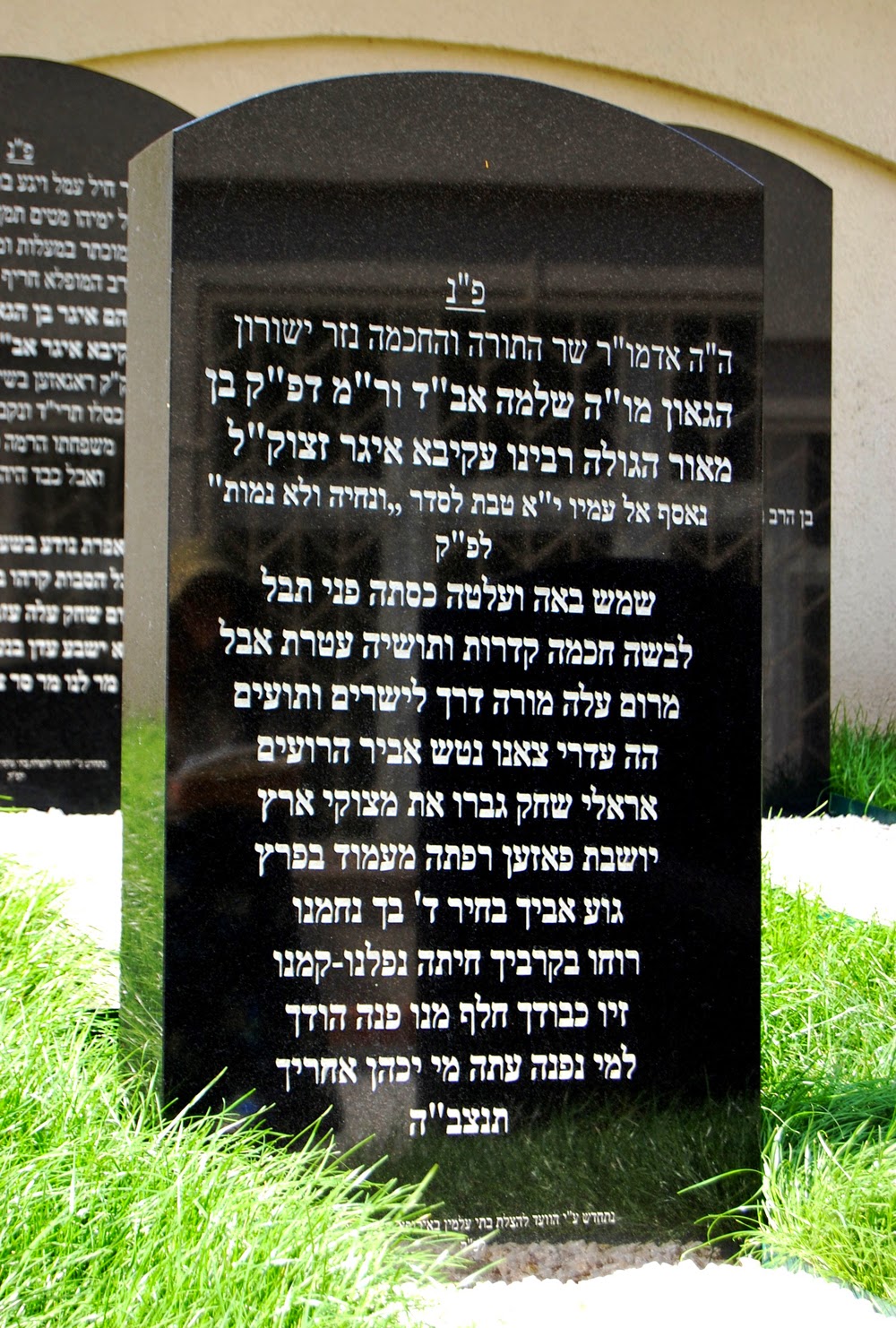
R. Chaim Ozer Grodzenski, spiritual leader of Vilna Jewry, as well as the leading Torah authority of his generation, interceded on behalf of Vilna and worldwide Jewry. He made it clear than no such desecration of a Jewish cemetery would be tolerated by the Jewish community. When the municipal authorities informed him that under the laws that applied at the time any cemetery not in use for one hundred years or more (the old Jewish cemetery was closed in 1831 due to lack of space) could be demolished by government decision, R. Chaim Ozer was adamant and informed the authorities that Jewish law prohibits the desecration of any Jewish cemetery, whether or not presently in use. Moreover, R. Chaim Ozer informed the authorities that the Jewish community would not comply in any way with the immoral demands of the municipal government. An attempt at a compromise was then made by the authorities; they were prepared to allow the section where the famous rabbis were buried to remain standing, so long as the Jewish community would agree to allow the government to demolish the remainder of the cemetery – where ordinary folk, i.e., men, women, and children were buried. R. Chaim Ozer ruled out any such compromise solution and, instead, engaged in a tireless, worldwide lobbying campaign, in an effort to persuade the government officials to rescind their decree.[5]

R. Chaim Ozer Grodzenski (in 1939).

When some rabbis in Palestine – sensing the gravity of the situation – issued a broadside calling for the grave of the Gaon of Vilna to be exhumed so that his remains could be transferred to the Holy Land, R. Chaim Ozer was livid. For, explained R. Chaim Ozer, by acquiescing to the exhumation and transfer of famous rabbis, one in effect consigns the rest of the cemetery to mass destruction. Moreover, it sets a precedent for all governments in Europe – just transfer the famous rabbis out of the Jewish cemetery and the Jews will agree to abandon the remainder of the cemetery.[6] The upshot of R. Chaim Ozer’s wisdom and intransigence was that under his watch,

no sports stadium was constructed on the old Jewish cemetery.[7] R. Chaim Ozer died on August 9 [= 5 Av], 1940.[8] Vilna, and arguably world Jewry, would never again have a leader who so deftly and gracefully combined within himself mastery of Torah, practical wisdom, and an unswerving commitment to the dissemination and protection of Jewish values – with profound and unstinting loyalty to his people, both living and deceased – under any and all circumstances.

II. Statement of Faina Kukliansky, Chairperson of the Lithuanian Jewish Community, Vilnius, August 15, 2015:[9]

Despite a Jerusalem Post story that would suggest otherwise (“Anger Flares Over Lithuanian Sports Palace,” Sam Sokol, 8/11/2015) there is today a remarkable consensus in Vilnius that the site of the former Snipiskes Cemetery and the graves beneath must be protected. On this matter, the government of Lithuania, the Lithuanian Jewish community which I chair, and the Committee for the Preservation of Jewish Cemeteries in Europe (CPJCE), which is Europe’s foremost halachic authority on cemeteries, all agree.

Attention is now focused on the abandoned former Soviet Sports Palace, which partially sits on the cemetery grounds and in its current condition is mostly a gathering place for graffiti artists and alcoholics. The government rightly wants to remove the building and turn it into a center for conferences and cultural events. Because the building itself has been designated an architectural heritage site, no significant structural changes are possible, but the interior will be renovated. The surrounding area will be maintained as a memorial park with inscriptions that describe some of the most famous people who were buried there.

The Lithuanian government and the CPJCE have an agreement dating to 2009, concerning the cemetery site. Even though we are only in a planning stage and still months away from any construction, recent discussions between the two have worked out an understanding for dealing with the renovation of the former Sports Palace. The CPJCE will provide rabbinic oversight and ensure that there are no halachic violations in the course of the work that takes place. The government has further agreed to limit the type of activities that will take place in the renovated center so that they are in keeping with the special nature of the site.

If anything, this should be a cause for celebration and a model for how other governments in our part of the world should deal with similar challenges of respecting and protecting Jewish cemeteries and the mass graves of Holocaust victims.

So what accounts for the “angry voices” in your story and the outrageous claims that a “desecration” is taking place?

No doubt some of those quoted are simply uninformed, and this fuller explanation will assuage their concerns. But sadly there are others who do know better but are using this issue to advance their own personal feuds and grievances. Some of them are rivals to the CPJCE, and while they would never publicly criticize its eminent Chairman, Rabbi Elyakim Schlesinger, they pretend not to know his involvement here. Perhaps even more destructive is the role being played by our community’s former rabbi, Chaim Burstein. His contract was recently terminated – he has spent more days abroad on his personal business than serving our Jews here in Lithuania – and so he is spreading these stories in order to attack me. It pains me to say these things, but your readers should know the truth.

As a proud Litvak who has the honor to chair a small but resilient Jewish community I have been part of many difficult struggles during these past decades as we have pressed the Lithuanian government to return former Jewish property and pressed the Lithuanian people to squarely confront the history of our Holocaust-era past. Those struggles are not over, but we have had much success. How ironic that as we now have Lithuanian leaders who are prepared to see clearly what happened in the past, we have fellow Jews who refuse to see clearly what is happening today.

Faina Kukliansky

III. Response to the Chairperson of the Lithuanian Jewish Community:
           

On August 15, 2015, Faina Kukliansky, Chairperson of the Lithuanian Jewish Community, issued a statement regarding the planned $25,000,000 Convention Center to be constructed by the Lithuanian government, and funded in large part by the European Union’s Structural Funds Program, in the center of Vilnius’ oldest Jewish cemetery – in use from the 16th through the 19th centuries – in the Shnipishkes (Yiddish: Shnipishok) section of Vilnius.

In the opening paragraph of the statement, Faina Kukliansky assures all concerned “that the site of the former Snipiskes cemetery and the graves beneath must be protected.” Her assurance, however, rings hollow, for as one reads on, it becomes apparent that she fully supports the idea of a Convention Center being constructed over the remains of the Jews buried in the cemetery.[10]

Ms. Kukliansky writes about the “abandoned former Soviet Sports Palace, which partially sits on the cemetery grounds.” One gets the impression that perhaps an annex to the Soviet-era Sports Palace, or its outer wall, sits on the cemetery grounds. In fact, the Soviet-era Sports Palace sits squarely in the very center of the old Jewish cemetery.[11]

Soviet-Era Sports Palace in Vilna, as it looks today, in the Old Jewish Cemetery.

Ms. Kukliansky continues: “Because the building [i.e., the Soviet-era Sports Palace] itself has been designated an architectural heritage site, no changes are possible.” Really? It was in the Soviet period that all the tombstones were systematically removed from the cemetery between 1948 and 1955, and it was in the Soviet period that a Sports Palace was constructed over the dead bodies of thousands of Vilnius Jews.[12] Now who was it that designated the Soviet Sports Palace an architectural heritage site? If it was the Soviets, what has this to do with Independent Lithuania? If, however, it was Independent Lithuania that made this designation, then rectification is long overdue. Indeed, the government of Lithuania should recognize the Shnipishkes Jewish cemetery as a heritage site of the Jewish community of Vilnius from the 16th through the 19th centuries. It should certainly not condone and perpetuate the Soviet desecration of a Jewish cemetery. That the EU supports such misuse of funds is nothing short of scandalous. Surely, there is ample room in and around Vilnius for the construction of a Convention Center someplace other than smack in the center of historically, the single most important Jewish cemetery in Lithuania and one of the most important in all of Europe.

Ms. Kukliansky labels those who disagree with her as “simply uninformed” or having a particular axe to grind. She does not entertain the possibility that building a Convention Center over a Jewish cemetery is not everybody’s cup of tea. I’m afraid it is Ms. Kukliansky who seems to be unaware of how many thousands of graves remain on the site, of how often bones have surfaced in recent years on the face of the cemetery,[13] and how despite prior agreements with the Lithuanian authorities, two entire buildings were constructed in recent years on the cemetery grounds.[14] Does she really believe – as she claims – that the construction of a $25,000,000 Convention Center will involve no excavation outside the present perimeters of the Soviet-era Sports Palace? Does she really believe – as she claims – that the type of activities that will take place in the renovated center will be in keeping with the special nature of the site? I wonder who is “simply uninformed.”

Faina Kukliansky writes: “If anything, this should be a cause for celebration and a model for how governments in our part of the world should deal with similar challenges of respecting and protecting Jewish cemeteries and mass graves of Holocaust victims.”

Nations of Eastern Europe take note! If you want to deal with respecting and protecting Jewish cemeteries, learn from the Vilnius experience. First remove and destroy all Jewish tombstones, and afterwards excavate wherever possible and destroy the remains of those who were buried there. Then build a Sports Palace or a Convention Center in the heart of the Jewish cemetery! Make certain that the new structures are designated architectural heritage sites, so that they cannot be dismantled. This should be followed by a celebration of how Jewish cemeteries have been respected and protected in the most proper fashion.

Faina Kukliansky is to be congratulated for assuming the responsibility of leading a “small but resilient Jewish community.” Sadly, she makes no mention of the fact that heartfelt and pained voices have been raised by a number of distinguished members of her small community, voicing strong opposition to the construction of the Convention Center in the Jewish cemetery.[15] But there is another issue here. Faina Kukliansky is much too modest in thinking that the “small and resilient Jewish community” of Vilnius is her only constituency. The Vilnius Jewish cemeteries belong not only to Vilnius and its Jewish community. The spiritual, as well as the genetic, descendants of the thousands of men and women buried in the Shnipishkes and Zaretcha Jewish cemeteries live the world over. They remember their ancestors, study their writings, often live by their teachings, and should have the right to pray at their graves in a cemetery not desecrated by a Convention Center.

Faina Kukliansky would do well to weigh carefully the consequences of the precedent she is setting. By lending her support to the construction of a Convention Center over the old Jewish cemetery, she places in jeopardy every Jewish cemetery in Europe and, perhaps, elsewhere as well. True, she claims that she relies on a rabbinic ruling issued by the CPJCE in London. Distinguished rabbis the world over, however, have raised their voices in unison against the construction of a Convention Center in the old Jewish cemetery, rendering the London opinion – at best – a minority one. These voices include the leading halakhic authorities in Israel16 and the United States,17 and the present heads of the great yeshivot that once graced Lithuania, which due to the Holocaust and Soviet repression had to resettle elsewhere.18 Faina Kukliansky would also do well to remember the voice raised long ago by her pre-World War II predecessor in Vilna, Rabbi Chaim Ozer Grodzenski. He did not allow the Polish government to desecrate the very Jewish cemetery that is about to be desecrated by the Lithuanian government with her approval.

Sid Leiman
Professor Emeritus of Jewish History and Literature
Brooklyn College

September 13, 2015
Erev Rosh Ha-Shanah 5776

Notes:

[1] Laimonas Briedis, Vilnius: City of Strangers (Vilnius, 2009), p. 168.
[2] Briedis, op. cit., p. 195. [The Briedis quotes have been slightly edited by me for the sake of clarity. -SL]
[3] See Yaakov Kosovsky-Shahor, ed., אגרות רחיים עוזר (Bnei Brak, 2000), vol. 1, pp. 400-401. Cf. Dov Eliach, הגאון (Jerusalem, 2002), vol. 3, p. 1142. See also the brief notice in Israel Klausner,
וילנא ירושלים דליטא: דורות האחרונים (Tel-Aviv, 1983), vol. 2, p. 554.
[4] For a concise history of the old Jewish cemetery in Vilna, see Israel Klausner, קורות בית העלמין הישן בוילנה (Vilna, 1935).
[5] In general, see Kosovsky-Shahor, op. cit., vol. 1, pp. 400-405.
[6] Kosovsky-Shahor, op. cit., vol. 1, pp. 402-403.
[7] A soccer field, just north of the old Jewish cemetery, was initiated in 1936 and eventually became Zalgiris Stadium when construction was completed by the Soviets in 1950. See Antanas Papshys, Vilnius: A Guide (Moscow, 1980), p. 127. It is still in use in Vilnius.
[8] For a moving account of his funeral, see Yosef Friedlander, “The Day Vilna Died,” Tradition 37:2 (2003), pp. 88-92.
[9] Faina Kukliansky’s statement was translated from Lithuanian into English and posted on August 15, 2015 on the Lithuanian Jewish Community website here. For the full context of the “Convention Center on the Old Jewish Cemetery” controversy, and for a comprehensive paper trail of statements made by Faina Kukliansky and the various parties involved in the controversy to date, see here. This site exists due to the incredible industry of the indefatigable Professor Dovid Katz of Vilnius, who also has prepared a register of all public voices that have been raised in opposition to the proposed construction of a Convention Center on the old Jewish cemetery, available here.
[10] One suspects that Ms. Kukliansky distinguishes between the land under the former Soviet-era Sport Palace (which, due to the excavations necessary for its construction, presumably led to the disposal of all Jewish remains that had been buried there) and the land surrounding the former Soviet-era Sports Palace (which presumably retains the remains of all those Jews who had been buried there). Thus, she feels comfortable with the construction of a Convention Center over the former Soviet-era Sports Palace. In terms of Jewish law, however, such a distinction is meaningless. Once a Jewish cemetery is consecrated it becomes a hallowed place, much like a synagogue. Like a synagogue, it cannot be used for secular purposes and it may not be desecrated in any way. And like a synagogue, it retains its sanctity whether or not Jews are actually present at any specific time or on a specific day. The Jewish cemetery remains hallowed in its entirety, even if all the remains have been removed from it; how much more so if remains are strewn throughout the cemetery! On the hallowed status of a Jewish cemetery, see, e.g., R. Jacob Moellin (d. 1427), ספר מהריל: מנהגים (Jerusalem, 1989), laws of fasting, p. 270; R. Elijah Shapira, אליהו רבה על ספרי הלבושים, to שלחן ערוך אורח חיים 581:4, note 39; and R. Judah Ashkenazi (d. circa 1742), באר היטב, and R. Samuel Kolin (d. 1806), מחצית השקל, to שלחן ערוך אורח חיים 581:4. In all the passages just cited, every Jewish cemetery is described as a מקום קדוש, i.e. a holy place – which is precisely why Jewish cemeteries are designated as places appropriate for prayer. When a municipal office building, or an apartment house, or a convention center is constructed on a Jewish cemetery, it as an act of desecration. Ms. Kukliansky seems upset about “the outrageous claims that a desecration is taking place.” The claims are hardly outrageous; it is the desecration that is taking place that is outrageous.

That a Jewish cemetery retains its hallowed status even if some or all the remains are removed from it and buried elsewhere is an official ruling of many rabbis, including R. Shlomo Zalman Auerbach (d. 1995), one of the greatest halakhic decisors of modern times. At שות מנחת שלמה (Jerusalem, 1999), vol. 2, responsum 88, p. 338, he rules unequivocally: “A Jewish cemetery, even if should happen that its remains have been exhumed, remains prohibited [for secular use, or for being sold to a second party], and always retains its character as a Jewish cemetery.” Cf. R. Moshe Feinstein,אגרות משה: יורה דעה חלק ג (New York, 1982), responsum 151, pp. 418-419.
[11] This can be seen by examining maps of the Jewish cemetery prepared during the last 200 years, as well as detailed photographs of the Jewish cemetery taken in the last 100 years. Even U.S. intelligence reports released by Wikileaks concede that “the Sports Palace property indisputably rests in the middle of the former cemetery.” See here.
[12] The Soviet-built Sports Palace, used primarily for volleyball and basketball games, was opened in 1971 and remained in use in Independent Lithuania until 2004.
[13] The evidence here is shocking indeed. See, e.g., Binyomin Rabinowitz, “Can Anything Be Done to Save the Remnants of Vilna’s Old Jewish Cemetery,” Dei’ah VeDibur (August 31, 2005), pp. 1-9, available online here.
[14] See, e.g., the Wikipedia entry on “Jewish Cemeteries of Vilnius”: “The Palace of Concerts and Sports (Lithuanian: Koncertų ir sporto rūmai) was built in 1971 right in the middle of the former cemetery. In 2005, apartment and office buildings were built at the site,” here.
[15] See, e.g., Ruta (Reyzke) Bloshtein’s stirring plea to the Lithuanian government online here.
[16] E.g, Rabbi Samuel Auerbach of Jerusalem, son and successor of R. Shlomo Zalman Auerbach.
[17] The list is much too long to be included here. Suffice to mention: Rabbi David Feinstein (head of Mesivta Tiferet Jerusalem), Rabbi Aharon Feldman (head of Ner Israel Rabbinical College), Rabbi Shmuel Kamenetsky (head of Talmudical Yeshiva of Philadelphia), and Rabbi Aaron M. Schechter (head of Mesivta Chaim Berlin).
[18] These include Rabbi Chaim Dov Heller, head of the Telz Yeshiva, formerly in Telshiai, Lithuania; Rabbi Osher Kalmanowitz, head of the Mirrer yeshiva, formerly in Mir, Greater Lithuania (today in Belarus); and Rabbi Aryeh Malkiel Kotler, head of the Beth Medrash Govoha in Lakewood, formerly in Kleck and Sluck, Greater Lithuania (today in Belarus).


Who is Buried in the Vilna Gaon’s Tomb? A Contribution Toward the Identification of the Authentic Grave of the Vilna Gaon

Who is Buried in the Vilna Gaon’s Tomb?
A Contribution Toward the Identification of the Authentic Grave of the Vilna Gaon
by 
Shnayer Leiman
1. Prologue
           This essay attempts to identify the authentic grave of the Vilna Gaon (d. 1797).1 As will become apparent, it surely is not the grave that Jewish pilgrims are shown today when they visit Vilna. We shall attempt to identify his authentic grave by applying the biblical rule: על פי שני עדים יקום דבר “a matter is established by the testimony of two witnesses.” We shall cite two different kinds of witnesses. One witness will represent primarily  תורה שבכתב, i.e., literary evidence. The other witness will represent primarily תורה שבעל פה  , i.e., oral history.
2. Introduction
            Three Jewish cemeteries have served the Vilna Jewish community throughout its long history. The first Jewish cemetery, often called by its Yiddish name der alter feld (Hebrew: בית עולם הישן), was north of the early modern Jewish Ghetto of Vilna, and just north of the Vilia River (today called the Neris) in the town of Shnipishok. It served as the main Jewish cemetery until 1830, when, due to lack of space, it was closed by the municipal authorities. The following photograph, taken in 1912, presents an aerial view of the first Jewish cemetery, looking north from Castle Hill in the old city. One can see the Neris River flowing south of the cemetery; portions of the fence surrounding the cemetery; and the house of the Jewish caretaker of the cemetery near the north-western entrance to the cemetery. (Each of the following images may be enlarged and viewed in higher resolution by clicking on them.)
            Such famous rabbis as R. Moshe Rivkes (d. 1671), author of באר הגולה, and R. Avraham Danzig (d. 1820), author of  חיי אדם, were buried in der alter feld. See the following photograph for the grave of the חיי אדם in the old cemetery.
            The second Jewish cemetery, in use from 1831 until 1941, was east of Vilna proper, on a mountain overlooking the nearby neighborhood called Zaretcha. Here were buried famous Maskilim such as Adam Ha-Kohen Lebensohn (d. 1878), and famous rabbinic scholars such as R. Shmuel Strashun (d. 1872), R. Avraham Avele Pasvaler (d. 1836), R. Shlomo Ha-Kohen  (d. 1906), and R. Hayyim Ozer Grodzenski (d. 1940). With 70,000 graves in place in 1940, the second cemetery ran out of space, and a third Jewish cemetery was acquired and dedicated by the Vilna Jewish community shortly before the outbreak of World War II. It lies north-west of central Vilna, in Saltonishkiu in the Sheshkines region, and is still in use today by the Jewish community in Vilna.
            The Vilna Gaon, who died in 1797, was, of course, buried in the first Jewish cemetery. That cemetery was destroyed in the Stalinist period circa 1950, but just before it was destroyed we are informed by the sources that the Gaon was moved, perhaps temporarily to the second cemetery,2 but certainly to the third cemetery, where he rests today.
            Let us enter the third cemetery and stand before the Ohel ha-Gra.
            It is a modest and narrow Ohel. When one enters the Ohel, one sees seven graves laid out from left to right, with five tombstones embedded in the wall at the heads of the graves.
            The tour guides inform the visitors that the Gaon is buried in the fourth grave from the left. Indeed, directly above his grave, embedded in the wall, is a tombstone that clearly identifies the grave as that of the Gaon. One wonders who else is buried in the Ohel. The narrow confines of the Ohel, and the poor lighting in the Ohel, make it almost impossible to read the tombstones. One American publication identifies the others as R. Shlomo Zalman, the father of the Gra (d. 1758); R. Avraham, the son of the Gra (d. 1809); R. Yehoshua Heschel, Chief Rabbi of Vilna (d. 1749); R. Shmuel b. Avigdor, last Chief Rabbi of Vilna (d.1793); R. Avraham Danzig, author of חיי אדם; and Avraham b. Avraham, the legendary Ger Zedek of Vilna.  Another American publication presents a different list that includes R. Moshe Rivkes, author of the באר הגולה , and Traina, the mother of the Gaon. In Israel, several published lists know for a fact that R. Shmuel Strashun was moved together with the Gaon, and now rests in the new Ohel. All these accounts are imaginary.3
            When one reads the accounts of the reinterment of the Gaon, and of those buried in his Ohel today, it becomes apparent than more than bodies were moved. Wherever possible, the original tombstones were moved together with the dead and then reset at the head of the graves. All one has to do is read the tombstone inscriptions in order to identify who was moved. Reading from left to right, buried in the Ohel ha-Gra are:
1. R. Zvi Hirsch Pesseles (d. 1817). A relative of the Gaon, whose grandfather, R. Eliyah Pesseles (d. 1771), helped finance the Gaon’s study activity.
2. R. Yissachar Baer b. R. Shlomo Zalman (d. 1807). A younger brother of the Gaon, he was a master of rabbinic literature who was also adept in the exact sciences.
3. R. Noah Mindes Lipshutz (d. 1797). Distinguished Kabbalist, he was the author of  פרפראות לחכמה and נפלאות חדשות. He married Minda (hence: Mindes), the daughter of R. Eliyahu Pesseles, mentioned above (grave 1). A close associate of the Gaon during his lifetime, he and the Gaon share a single tombstone in death.
4. The Gaon.
5. Minda Lipshutz (date of death unknown).  She was the daughter of R. Eliyah Pesseles and the wife of  R. Noah Mindes Lipshutz.
6. Devorah Pesseles (date of death unknown). She was the wife of R. Dov Baer Pesseles, a son of R. Eliyahu Pesseles, and the mother of R. Zvi Hirsch Pesseles (grave 1).
            The seventh grave is unmarked, that is, it is without a tombstone. The tour guides will tell you that it contains the ashes of Avraham b. Avraham, the legendary Ger Zedek of Vilna.4
            A pattern emerges. Clearly, the original plot in the Shnipishok cemetery belonged to the Pesseles family, one of the wealthiest and most distinguished in Vilna. The Gaon found his resting place here due to the generosity of his relatives and friends in the Pesseles family. More importantly, when a hard decision had to be made in 1950 or so regarding who should be moved from the old cemetery in Shnipishok, it was not the greatest rabbis who were moved and reinterred. It was neither R. Moshe Rivkes, nor R. Yehoshua Heschel, nor R. Shmuel b. Avigdor, nor R. Avraham Danzig, nor R. Shmuel Strashun. Nor was it the Gaon’s father, mother, or son. It was the Gaon and the persons to his immediate right and left; the Gaon saved not only himself, but also those buried in proximity to him.
3. The Problem
            While the identification seems reasonable, the ordering of the graves is problematic. Anyone familiar with traditional Jewish cemeteries will know that some keep men and women separate, while others are mixed. Clearly, the old Jewish cemetery in Shnipishok was mixed. But even when mixed, husbands and wives tended to be buried next to each other. So too mothers and sons. Yet in the Ohel ha-Gra, R. Zvi Hirsch Pesseles is buried at the extreme left, whereas his mother Devora is buried at the extreme right. Neither is buried next to his or her spouse. Even more puzzling is the fact that the Gaon rests in between Rabbi Noah Mindes Lipshutz and his wife Minda Lipshutz. Now it may be that Rabbi and Mrs. Lipshutz were not on speaking terms, but this was hardly the way to decide where the Gaon should be buried.
 
            The problem assumes prodigious proportions when we examine Israel Klausner’s קורות בית-העולמין הישן בוילנה, published in Vilna in 1935. Klausner visited the Shnipishok Jewish cemetery, recorded some of the tombstone inscriptions of its most famous rabbis and, more importantly, drew a precise map of the location of each grave. It is important to note his orientation, as he drew the map. Klausner stood at the northern entrance to the Jewish cemetery, looking southward toward the Vilia River. See the depiction of the Ohel ha-Gra in Klausner’s map.
            The graves in the Ohel ha-Gra, from left to right, are numbered 20-27. Some of those numbers represent two graves of persons buried immediately next to each other. Klausner, in his narrative, identifies the occupants of graves 20-27 as follows:
20. a)  ר’ שלמה זלמן אבי הגר”א
       b)               ר’ אליהו שתדלן
21. a)                ר’ יהודה ב”ר אליעזר (יסו”ד)
       b) חיה אשת ר’ יהודה ב”ר אליעזר (יסו”ד)
22.          ר’ צבי הירש פעסעלעס
23.               דבורה פעסעלעס
24.             מינדה פעסעלעס ליפשיץ
25. a)         ר’ נח מינדעס ליפשיץ
       b)            הגר”א
26.            ר’ ישכר בער אחי הגר”א
27.        ר’ יהושע העשיל ב”ר שאול
            This, then, is a complete list of all those who were buried in the original Ohel ha-Gra in the old Jewish cemetery. That Klausner has the order perfectly right can be seen from the following photograph.
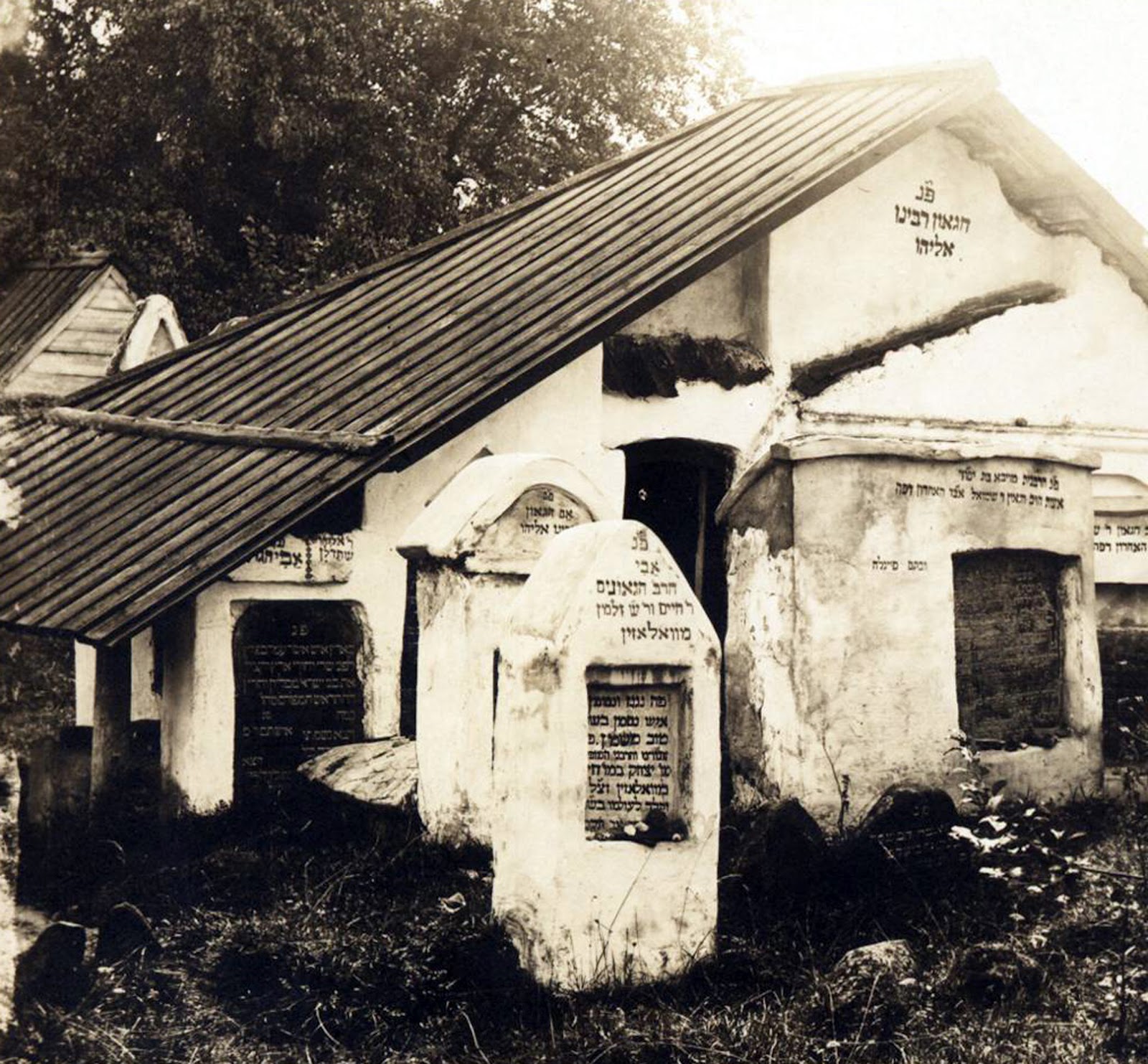
            Notice the inscription פ”נ הגאון רבינו אליהו in the center of the photograph, near the roof-top of the Ohel. Turning to the extreme left of the Ohel, where the roof slopes down almost to the ground, one can see two grave markers above a single tombstone.
            When enlarged, the inscriptions above the tombstone clearly read (from left to right): פ”נ אבי הגר”א and   ר’ אליהו שתדלן, exactly in the order recorded by Klausner (see above, grave number 20).  When we compare Klausner’s list with the present occupants of the Ohel ha-Gra, it becomes clear that those who moved the Gra from the first to the third cemetery, moved the graves numbered 22-26, a total of six persons altogether, from the original Ohel ha-Gra. The seventh grave, unmarked, remains unidentified and could have come from any part of the old cemetery, and not necessarily from the Ohel ha-Gra.
            When we enter the Ohel ha-Gra today, we need to bear in mind that we are entering from the south and looking north. We see the mirror image of what Klausner depicted on his map. Thus the expected order today should be:
            The expected order solves all our problems. On the extreme right, Devorah and her son R. Zvi Hirsch are buried next to each other. In the center, R. Noah and his wife Minda are buried next to each other. And the Gra is second from the left. It is the actual order that creates our problem. Devorah and R. Zvi Hirsch are separated; neither is buried next to his or her spouse. The Gra is buried in between R. Noah Lipshutz and his wife Minda. אין זה אומר אלא דרשני.
            One more piece of evidence needs to be introduced before we attempt to solve the problem. Israel Cohen, British Zionist and world traveler, visited Vilna twice before World War II. Regarding the Shnipishok cemetery, he records the following: Most famous of all is the tomb of the Gaon Elijah, who lies in the company of a few other pietists on a spot covered by a modest mausoleum which is entered by an iron-barred door.
The tombstones, with long eulogistic epitaphs, are not enclosed within the mausoleum, but stand at the back of it, in close juxtaposition and closely protected by a thick growth of shrubs and bushes.
Israel Cohen, Vilna (Philadelphia, 1943), pp. 415-416. Cf. his Travels in Jewry (New York, 1953), pp. 149-150.
4. The Solution
            It seems obvious that those who moved the Gaon to the new Jewish cemetery made one slight adjustment relating to the ordering of the graves. They moved R. Zvi Hirsch from the extreme right to the extreme left. We will never know with certainty why they did so. What was gained, perhaps, is that now all the males were together on the left, and all the females were together on the right. By moving R. Zvi Hirsch to the extreme left, the Gra was now the third grave from the left. But the actual order today appears to have the Gra as the fourth grave from the left, and buried in between R. Noah and his wife Minda.
            We need to remember that in the old Jewish cemetery the tombstones were outside the Ohel ha-Gra, each tombstone opposite the remains of the person it described, with text of the tombstone facing in a northerly direction. Indeed, every tombstone in the old Jewish cemetery was placed opposite the remains of the person it described, with the text of the tombstone facing in a northerly direction.
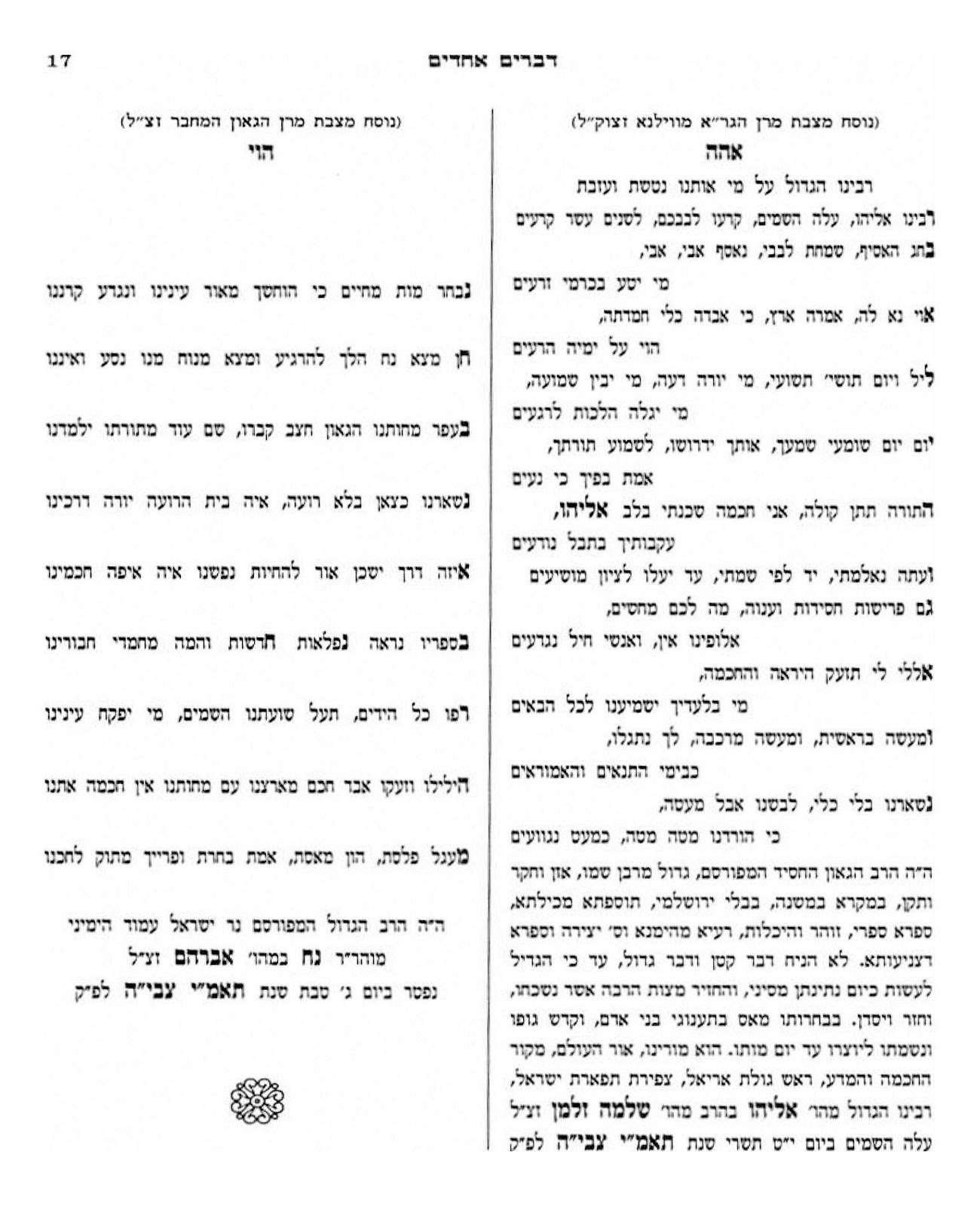
            We also need to remember that the Gra and R. Noah shared one tombstone.5
            The Gra’s epitaph was on the right side of the tombstone; R. Noah’s epitaph was on the left side of the tombstone. This was in perfect order, since inside the Ohel, the Gra was to the left of R. Noah, and R. Noah was to the left of, and next to, his wife Minda. In the new Jewish cemetery, the six graves were laid out exactly as in the old cemetery, with the exception of R. Zvi Hirsch as indicated. But it was decided to place the original tombstones inside the Ohel, at the head of each of the graves. Instead of facing in a northerly direction, with texts that could be read only by standing outside the Ohel, the tombstones, now reversed, faced in a southerly direction, with texts that could be read only when standing inside the Ohel. Doubtless, this was done in order to protect the historic tombstones from exposure to the elements, from deterioration, and from vandalism. Also, the tombstones now immediately identified who was buried in each grave. Unfortunately, when the single tombstone shared by the Gra and R. Noah was reversed and set up inside the Ohel, it automatically (and wrongly) identified the third grave from the left as R. Noah, and the fourth grave from the left as the Gra, and caused a split between R. Noah and his wife. In fact, the Gra is the third grave from the left, and R. Noah is the fourth grave from the left – and R. Noah is properly buried next to his wife Minda. In other words, all Jews who visit the grave of the Gra today, pray, and leave qvitlach, at the wrong grave (i.e., at the grave of R. Noah Mindes Lipshutz).
            The above solution was based upon an examination of the literary evidence, and upon an examination of photographs preserved mostly in books. I call this עד אחד  (one witness), that is, the testimony of תורה שבכתב  (i.e., the literary evidence). But a matter established by only one witness is precarious at best.6 Intuitively I was persuaded by the one witness, but hesitated to put the solution in print until more evidence was forthcoming. Fortunately, a surprise second witness has come forward בבחינת תורה שבעל פה  (i.e., oral history). Rabbi Yitzhak Zilber (d. 2003) was a courageous Jew who lived most of his life under Soviet repression between the years 1917 and 1972, before ultimately settling  in Israel. He published a riveting autobiography in Russian in 2003. It has since been translated into Hebrew and English. In his autobiography, Zilber describes how in 1970, under Communist rule, he visited the Ohel ha-Gra in Vilna. The Jew who took him to the Ohel had participated in the transfer of the Gra from the first Jewish cemetery in Shnipishok to the third Jewish cemetery in Saltonishkiu. As they stood before the Gaon’s grave, the Jew turned to Zilber and said:7
            Remember the following forever: the Gaon’s tombstone is above the
           fourth grave from the left, but the Gaon’s body is in the third grave [from
           the left].
על פי שני עדים יקום דבר!  “A matter is established by the testimony of two witnesses.”
NOTES
1
  This essay should not be confused with an earlier essay of mine with a similar title, “Who is Buried in the Vilna Gaon’s Tomb? A Mysterious Tale with Seven Plots,” Jewish Action, Winter 1998, pp. 36-41. The primary focus of the earlier essay was on the identification of the six persons buried together with the Vilna Gaon in his mausoleum (the Ohel Ha-Gra). The primary focus of this essay is on the identification of the  grave of the Vilna Gaon himself. A version of this essay was read at a conference in honor of Professor Daniel Sperber, held at Bar-Ilan University on June 13, 2011. It is presented here in honor of the Vilna Gaon’s  215th yahrzeit on 19 Tishre, 5773.
2
  The claim that the Vilna Gaon was moved temporarily from the first to the second Jewish cemetery appears, among many other places,
in Y. Alfasi, ed., וילנא ירושלים דליטא חרבה (Tel-Aviv, 1993), p. 9; Y. Epstein, “,דער יידישער בית-עולם אין ווילנע”   ירושלים דליטא, October-November 1996, pp. 5-6; and N.N. Shneidman, Jerusalem of Lithuania (Oakville, Ontario, 1998), p. 161. An examination of eye-witness accounts of the reburial of the Gaon, and of much other evidence, yields the ineluctable conclusion that the Gaon was moved only once, directly from the first to the third Jewish cemetery.
3
  See the references cited in the Jewish Action essay (above, note 1).
4
  So reads the Hebrew sign above the entrance to the Ohel Ha-Gra. But the Ohel Ha-Gra was constructed over a three-year period between 1956 and 1958. I cannot say with certainty when the sign first went up, but logic dictates it did not go up before there was an Ohel. In all the early photographs of the Ohel I have seen, there was no sign at all. It surely wasn’t there during the period of Soviet domination of Lithuania, which means it first when up sometime after 1991. As such, it is hardly evidence for who is buried in the Ohel Ha-Gra. More importantly, one of the participants in the reinterment of the Vilna Gaon testified that he and his colleagues wanted to move the remains of Avraham ben Avraham, the Ger Zedek of Vilna, but could not locate his ashes in the old Jewish cemetery. See R.Yitzchak Zilber, To Remain a Jew (Jerusalem, 2010), pp. 389-390.
5
  For side by side transcriptions of the epitaphs on their tombstone, in clear Hebrew font, see R. Noah Mindes Lipshutz, פרפראות לחכמה (Brooklyn, 1995), p. 17.
6
  I was plagued by the remote possibility that the movers, precisely because the shared tombstone required the Gaon to be to the right of R. Noah, switched the remains of the Gaon and R. Noah, and deliberately buried the Gaon in between Minda and R. Noah. (I considered this a remote possibility, because it is highly unlikely that any rabbi would allow such tampering with who was buried to the immediate left and right of the Gaon. As is well known, R. Hayyim Zvi Shifrin [d. 1952] presided over the reinterment of the Gaon. See R. Yaakov Shifrin, קול יעקב [Jerusalem, 1981], pp. 26-30.) If so, all the tombstones are accurately positioned in the Ohel Ha-Gra, even today. Cf. my deliberations in American Jewish Monitor , October 24, 2003, p. 18.
7
  R. Yitzchak Zilber, op. cit. (above, note 4), p. 389.


?האם אמנם קבר רחל אמנו נמצא בבת לחם

?האם אמנם קבר רחל אמנו נמצא בבת לחם

נכתב ע”י משה צוריאל

Rabbi Moshe Zuriel has published numerous works in virtually all areas of Torah scholarship. The Seforim Blog is grateful that he has chosen to publish his latest essay here.

מפורסם באומה כי קברה של רחל נמצא בבית לחם. יש שם גם מבנה ומצבה המציין כך. וכך כתוב בתורה “ויהי עוד כברת הארץ לבוא אפרתה ותלד רחל ותקש בלדתה וכו’. ותמת רחל ותקבר [נפעל] בדרך אפרתה היא בית לחם. ויצב יעקב מצבה על קבורתה, היא מצבת קבורת רחל עד היום, (בראשית לה, טז-כ). שוב חזרה התורה לבאר את המיקום, בדברי יעקב ליוסף: “ואני בבואי מפדן מתה עלי רחל בארץ כנען בעוד כברת ארץ לבוא אפרתה, ואקברה שם בדרך אפרת היא בית לחם” (בראשית מח, ז). אמנם יש סתירה לכך מדברי שמואל הנביא אל שאול: “בלכתך מעימדי ומצאת שני אנשים עם קבורת רחל בגבול בנימין בצלצח” (שמואל-א י, ב). כידוע, בית לחם היא בחלקת שבט יהודה, ולא שייכת לשבט בנימין? חז”ל היו ערים לסתירה זו, ובארבעה מקומות מצאנו שיישבו הסתירה בדרך דרש [בכל המקומות חזרו על אותו פתרון], כך: בעת שדיבר שמואל עם שאול היו שני האנשים בגבול בנימין בצלצח, והם יוצאים ממקומם כמו ששאול יוצא מהמקום שנמצא בו בעת הדיבור, ויפגוש אותם בקבר רחל שביהודה (תוספתא, סוטה פי”א ה”ט; בראשית רבה פרשה פב, פסקא ט; מדרש שמואל פרק יד; ילקוט שמעוני ח”ב רמז קח-קט). והדוחק מבואר. נוסף על כך, יש סתירה גם בדבר חז”ל. בספרי (פרשת וזאת הברכה, פסקא שנב) “ר’ מאיר אומר בחלקו של בנה מתה” [כלומר בנימין] ועיין שם שהדברים עמומים. נוסף על כך, שלשה מגדולי הראשונים כותבים כי מתה רחל ונקברה בחלקו של בנה בנימין. [א] רלב”ג על התורה (בראשית לה, כ. מהד’ מוסד הרב קוק, עמ’ ריג; וכן בסוף פרשת ויחי, עמ’ רסה) קובע שהיא קבורה בחלק בנימין “לפי שכבר ידע בנבואה שהיה המקום ההוא לבניה”. ומה שהכתוב מעיד “היא מצבת קבורת רחל עד היום”, “עד היום” פרושו עד זמן נתינת התורה (שם, עמ’ ריג). [ב] גם החזקוני (שהיה בדורו של רמב”ן) על בראשית (מח, ז) סבור כי היא קבורה בחלקו של בנימין “כי ידעתי כי אותו גבול יעלה לחלק בניה, וכבודה להיות נקברת בחלק בניה” והוא מצטט מהפסוק בשמואל-א (י, ב) “ומצאת שני אנשים עם קבורת רחל בגבול בנימין”. [ג] בדברי רמב”ן מצאנו שסותר את עצמו. בביאורו לבראשית (מח, ז, מהד’ מוסד הרב קוק, עמ’ רסא) הוא כותב “ואקברה שם בדרך, כלומר בדרך אשר יעברו בה בניה (בעת שגלו מארצם בימי נבוכדנצר) ושם קברתיה לטובתה, כי היא לא מתה בדרך רק ברמה, שהיא עיר בארץ בנימין, ושם נקברה”. אבל רמב”ן סותר את עצמו, כי בביאורו לפרשת וישלח (לה, טז) מוסיף על דבריו שהעתיק דברי רש”י וחלק עליו: “זה כתבתי תחילה, ועכשיו שזכיתי ובאתי אני לירושלם, שבח לאל הטוב והמטיב, ראיתי בעיני שאין מן קבורת רחל לבית לחם אפילו מיל והנה הוכחש הפירוש הזה וכו’ וכו’. וכן ראיתי שאין קבורה ברמה ולא קרוב לה, אבל הרמה אשר לבנימין רחוק ממנה כארבע פרסאות, והרמה אשר בהר אפרים (שמואל-א א, א) רחוק ממנה יותר משני ימים. על כן אני אומר שהכתוב ש’אומר קול ברמה נשמע’ (ירמיה לא, יד) מליצה כדרך משל, לאמר כי היתה רחל צועקת בקול גדול ומספד מר עד שנשמע הקול למרחוק ברמה שהיא בראש ההר לבנה בנימין, כי איננו שם, והיא חרבה מהם לא נאמר בכתוב ‘ברמה רחל מבכה על בניה’, אבל אמר כי שם נשמע הקול. ונראה בעיני כי קברה יעקב בדרך ולא הכניסה לעיר בית לחם יהודה הקרובה שם, לפי שצפה ברוח הקודש שבית לחם אפרתה יהיה ליהודה ולא רצה לקברה רק בגבול בנה בנימין, והדרך אשר המצבה בה קרובה לבית אל בגבול בנימין וכך אמרו בספרי (זאת הברכה לג, יא) בחלקו של בנימין מתה, כדאיתא בפרשת וזאת הברכה”. עכ”ל רמב”ן. ואפשר בקלות לבאר כיצד רמב”ן שינה בדבריו. כי המאמר על בראשית (מח, ז) כתב רמב”ן בהיותו בספרד. וכאשר הגיע לארץ הקודש וראה בעיניו את מצבת קבורת רחל, החליט שהיא קרובה לבית לחם (מיל, כאלפיים פסיעות בלבד) והוסיף קטע לפירושו על התורה, בפרשת וישלח. וכדבריו “זה כתבתי תחילה, ועכשיו שזכיתי ובאתי אני לירושלים”. ונדחק רמב”ן לבאר כי חלקו של בנימין הגיע עד שם. ויש בזה קושי, כי בבית המקדש עצמו, חלקו של בנימין הגיע רק עד המזבח וצפונה. ומן המזבח דרומה הוא שייך לשבט יהודה. ומה שסבור רמב”ן שהגיעה נחלת בנימין עד קרוב למיל של בית לחם, וכמו מובלעת, היא אוקימתא. בדקנו במפה גיאוגרפית, “רמה” של בנימין היא כתשעה ק”מ צפונה לירושלים (דעת מקרא, ירמיה מ, א, עמ’ תצא) ובית לחם היא תשעה קילומטר דרומה לירושלים. ומה שהרמב”ן סבור היה שהמצבה הזו שראה בעיניו היא האמתית אין בזה שום הוכחה. כי דברי התורה “עד היום הזה” פירושו עד עת מתן תורה (כדברי רלב”ג לעיל). אותה מצבה שראה רמב”ן מי שהוא אחר הקים, ואין אנו יודעים אם ראוי לסמוך עליו. קושיא גדולה יש על הסבורים שנבוכדנצר וחייליו העבירו את היהודים הגולים לבבל בדרך בית לחם. הרי בבל היא לצפונה של ירושלים. בית לחם היא דרומה. כיצד יעלה על הדעת שהשובים האכזרים והמנצחים יסכימו להעביר את היהודים שהיו באזיקים ושלשלאות, והולכי רגל, בדרך עקומה עד לדרום, תשעה קילומטר? ומי שיציע שמדובר ביהודים תושבי חברון ובאר שבע, והם בדרכם צפונה עברו את בית לחם, עליו לענות על המקרא. מבואר בירמיה (נב, טו) שהגלה רק מתושבי ירושלים. אבל שאר האוכלוסיה בשבט יהודה בערי השדה השאיר בארץ ישראל, למען יהיו כורמים ויוגבים (שם. ועיין מלכים-ב כה, כב). נראה לומר שהפשטנים (רלב”ג, חזקוני, רמב”ן בהיותו בספרד) ידעו היטב דברי חז”ל בתוספתא, במדרש רבה ומדרש שמואל. והתעלמו מדברי דרש של חז”ל כדי לבאר פשוטו של מקרא. בכל זאת, כיצד נסביר את הפסוק המזהה, המופיע פעמיים בתורה, שיעקב קבר את רחל “ותקבר בדרך אפרתה, היא בית לחם”? אלא המלים “היא בית לחם” אינן מוסבות על מעשה הקבורה, אלא הם תואר של הדרך המובילה לאפרת, אשר בית לחם נמצא סמוך לאפרת. זאת אומרת, ודאי יעקב קבר את רחל בדרך, וסמוך לרמה, שבחלק בנימין, וכדעת ר’ מאיר בספרי. אבל הדרך ההיא מובילה לאפרת, אשר שם באפרת יש בית לחם, ולא שרחל קבורה שם. יעקב היה יכול לכאורה להביא אותה העירה (בית לחם) אבל נמנע מכך מהטעם שכתב רלב”ג (סוף פרשת ויחי, עמ’ ריג) או מהטעם שכתב רמב”ן (בראשית מח, ז, עמ’ רסב). ודאי נכון כי השבאים הוליכו את בני ישראל הגולים ליד קבר רחל, בדרכם לבבל, וכדברי רש”י (על בראשית מח, ז) המביא מדרש חז”ל על כך. אבל זה היה אי-שם מצפון לירושלים, בחלקו של בנימין, ולא ליד בית לחם דרומה לירושלים. רחל נקברה בדרך, ולא בבית לחם. ולכן אין אנו יודעים היום היכן מקום קבורתה של רחל, וכדברי רמב”ן שאין קבר מפורסם ברמה לייחס שם את מקום הקבר שלה. * מה שנוגע למלת “בעוד כברת ארץ לבוא אפרתה” (בראשית מח, ז) אמנם רש”י הביא בשם ר’ משה הדרשן כי מדובר במרחק מיל בלבד. אבל בקונקורדנציה של דר. שלמה מנדלקורן (ח”א עמ’ 530) ייחס מלת “כברת” לאחות-תאומה באשורית וענינה “גדול או הרבה”. ויש לסייע דבריו גם מדברי המקרא בשאר מקומות “ורוח כביר אמרי פיך”, (איוב ח, ב) “כביר מאביך ימים” (שם טו, י) “כשאון מים כבירים” (ישעיה יז, יב) “כזרם מים כבירים” (ישעיה כח, ב) ועוד. ופרשנות ר”מ הדרשן תמוה, שהרי יעקב אבינו בא לסלק תלונת יוסף בנו מעליו, והרי הוא מקשה על עצמו. אם המרחק הוא רק מיל, הליכה של שמונה עשרה דקות, משום מה לא התאמץ עוד קצת? אלא ודאי להיפך, בא להתנצל שהמרחק הוא רב מלהכניס אותה לאפרת.
כעת מצאתי עוד אחד מגדולי המפרשים האחרונים, הרב יעקב צבי מקלנברג (הכתב והקבלה, על בראשית מח, ז) המחלק שיש מקום הנקרא “בית לחם” והוא הנמצא בגבול בנימין, ויש מקום הנקרא “בית לחם יהודה” והוא נמצא בגבול שבט יהודה. ובחמשה מקומות הוא מתואר כך (שופטים יז, ח; פרק יט, פסוקים א, ב, יח ופעמיים באותו הפסוק). אין מלה מיותרת במקרא. משום מה להוסיף מלת “יהודה” אם לא להבחין שאין זאת “בית לחם” שבנחלת בנימין? ונ”ל סיוע לדעתו, כי מצאנו עוד מקומות בשם “בית לחם”, כמו בנחלת זבולון (יהושע יט, טו). ואפשר להביא קצת סיוע לדעת “הכתב והקבלה” מהנאמר בנחמיה (ז, כה-כז) על העולים בין שבי ציון “בני גבעון, אנשי בית לחם ונטופה, אנשי ענתות”. גבעון וענתות היו ערי בנימין (יהושע יח, כה; יהושע כא, יח). ושמא כך היא גם בית לחם המוזכרת? והיא אינה “בית לחם יהודה”. [אמנם “נטופה” היא לשבט יהודה, אבל כיון שהעולים משם היו מתי מספר, סונפו לאנשי בית לחם].


Birkat Ha-Hammah in the Old Jewish Cemetary of Frankfurt

Birkat Ha-Hammah in the Old Jewish Cemetery of Frankfurt
by Shnayer Leiman
On Wednesday, April 5, 1617 (= 29 Adar Sheni, 5377), birkat ha-hammah was recited throughout the Jewish world. Two witnesses – both were present in Frankfurt on that day – left accounts of the ceremony as it was commemorated in Frankfurt.[1] The first witness is R. Yosef Yuzpa Hahn (1570-1637), in his Yosef Ometz[2] (Frankfurt, 1723):[3] לסוף כל מחזור גדול ביום ד’ הראשון בחודש ניסן שבו התקופה נופלת בשנת ראשונה במחזור גדול מקדשין החמה. ומנהג פה שכל הקהל הולכים תיכף אחר בית הכנסת לחצר בית עלמין ואומרים ברוך אתה ה’ אלקינו מלך העולם עושה מעשה בראשית, והשמש מכריז בשחרית בבית הכנסת שילכו כל הקהל לקדש החמה. The second witness is R. Asher b. R. Eliezer Ha-Levi (circa 1598-1660), an Ashkenazic merchant and rabbinic scholar who lived most of his life in Alsace. In his Sefer Zikhronot (Berlin, 1913), he writes:[4] כ”ט ואדר שע”ז בהיותי בק’ ורנקבורט נתחדש החמה כי כן נעשה כל כ”ח שנה מחזור החמה, ולא נעשה כזאת עוד עד ער”ח ניסן ארבע מאות וחמשה, אשרי המחכה ויגיע לימים אלו, והלכו כל הקהל בשעה ג’ על היום על בית הקברות, ויום מעונן היה, ועמדתי בתוכם ואמרנו פה אחד: ברוך עושה מעשה בראשית. The plain sense of the texts is that the blessing was recited just outside the old Jewish cemetery of Frankfurt. R. Yosef Yuzpa Hahn’s “חצר בית עלמין“ is certainly not to be confused with “בבית עלמין.” Similarly, R. Asher b. R. Eliezer Ha-Levi’s “על בית הקברות” means “adjacent to” or “by” and is not to be confused with “בבית הקברות.”[5] Readers of the testimony of these two witnesses were puzzled as to why in Frankfurt birkat ha-hammah was recited adjacent to the Jewish cemetery. No such practice is recorded elsewhere in Jewish literature. The puzzlement was compounded by some later authorities (see below) who understood the witnesses as testifying that in Frankfurt birkat ha-hammah was recited in the Jewish cemetery. This surely demanded explanation! Given the recent proliferation of halakhic anthologies on birkat ha-hammah,[6] we decide to investigate some of them in order to see how this problem was addressed.[7] R. Mordechai Genut, summarizing the previous birkat ha-hammah literature, writes:[8] מנהג פרנקפורט דמיין היה לברך ברכה זו בבית-הקברות. It is difficult, of course, to imagine the Kohanim of Frankfurt marching into the cemetery and reciting birkat ha-hammah![9] One wonders too why the concept of לועג לרש, which does not allow for the public performance of mitzvoth in a cemetery (e.g., wearing of tallit or tefillin or recital of the fixed prayers)[10], seems not to apply to birkat ha-hammah![11] Surprisingly, R. Genut did not address these specific issues, but he did wonder why in Frankfurt they insisted on reciting birkat ha-hammah in the cemetery. In a footnote, he cites several solutions. Here, we shall focus only on the first two (of the three solutions he proffers). The first solution is that Jewish cemeteries provide a conducive setting for repentance. (And one should not perform any mitzvah – and certainly not one that can be performed only once in 28 years – without first engaging in an act of repentance.) Even conceding all the “givens” of R. Genut’s first solution, the fact remains that this practice was unique to Frankfurt. Surely it is strange that no other Jewish community saw the need to recite birkat ha-hammah in the cemetery. The second solution is that the Jewish cemetery in Frankfurt was on elevated ground. Presumably, R. Genut means that the cemetery grounds were more elevated than the ground upon which the Jews actually resided in Frankfurt. But this, in fact, is not true. From the Jewish quarter, one walked downhill in order to reach the cemetery. These solutions are hardly persuasive. More importantly, as the witnesses cited at the start of this essay make abundantly clear, the Jews of Frankfurt recited birkat ha-hammah adjacent to the Jewish cemetery, not in it. R. Genut missed an important reference[12] that makes this very distinction – a comment published by R. Yissakhar Tamar in 1979. We present the full comment here, because – as we shall see –it left an indelible imprint on other recent halakhic anthologies on birkat ha-hammah.[13] ואגב הרני מעיר שמביא [הרב צבי מושקוביץ, ברכת החמה, ירושלים, תשי”ג] בשם ספר יוסף אומץ שמנהג פפד”מ הוא לברך ברכת החמה בבית עלמין, והנה דבר זה זר מאד, ברם יצאה שגיאה מלפניו מתוך חוסר ידיעה, וז”ל היוסף אומץ בסימן שע”ח: לסוף כל מחזור גדול מקדשין החמה, ומנהג פה שכל הקהל הולכים תיכף אחר (יציאת)[14] בית הכנסת לחצר בית העולמין ואומרים וכו’ עכ”ל. ומי שהיה בפפד”מ, ואני הייתי שם בשנת תרפ”א, יודע שביהכנ”ס הישן הוא מלוכד יחד עם בית העולמין, כי לא נתנו להם בזמן הקודם חלקת שדה לבית עלמין אלא דווקא בגיטו וע”י בהכנ”ס, ודרך חלונות ביהכנ”ס רואים את בית העולמין והמצבות. ומי שיודע זה קורא את דברי יוסף אומץ בלי כל הפתעה, רק באופן טבעי כן הוא שבזמן שהקהל מתאסף יחד כשיוצאין מביהכנ”ס יוצאין לחצר בית עלמין, ומברכין שם ברכת החמה. ולא התאספו ברחוב לפני ביהכנ”ס כדי שלא יעוררו ענין ותשומת לב אצל הגוים כשמתאסף קהל גדול, אבל לא שיהיה איזה מנהג שיברכו ברכת החמה דוקא בבית העלמין, שזה דבר מוזר מאד, ור”צ מושקוביץ מתוך חוסר ידיעה זו שגה בזה וגם העתיק “בית עלמין” במקום “חצר בית עלמין”. R. Tamar is to be congratulated for being the first to lay to rest (alas, without success) the claim that the Jews of Frankfurt recited birkat ha-hammah in the Jewish cemetery. Sadly, however, much of his comment is mistaken, and – in fact – would mislead those who came after him. We do not doubt for a moment that he was, as he claims, in Frankfurt in 1921. Nor do we doubt that he saw a synagogue adjacent to the Jewish cemetery, from whose windows one could see the tombstone inscriptions. But this was not the בית כנסת הישן of Frankfurt, as Tamar calls it, nor was it the synagogue that the Jews of Frankfurt prayed in during the 17th century, when R. Joseph Yuzpa Hahn and R. Asher b. R. Eliezer Ha-Levi wrote their accounts of birkat ha-hammah. (Fig. 1) Briefly, when R. Samson Raphael Hirsch succeeded in creating a thriving separatist Orthodox Jewish community in Frankfurt in the 19th century (after the majority of the official Jewish community had joined the Reform movement), it became apparent to the official Jewish community that the best way to counter Hirsch’s success was by finding a place for Orthodoxy within the official Jewish community. The communal authorities agreed in 1878 to appoint an Orthodox rabbi, Rabbi Markus Horovitz (author of שו”ת מטה לוי), aside from the Reform rabbis already in their employ. As a precondition to his appointment, Rabbi Horovitz demanded that a new Orthodox synagogue be built for his community in Frankfurt. It was constructed in 1882 – a magnificent structure – and was known as the Börneplatz Synagogue (figure 1) until its destruction by the Nazis on November 10, 1938.[15] Indeed, it was built adjacent to the Jewish cemetery, and its windows overlooked the tombstones in the cemetery. It displaced the old Jewish hospital, not a synagogue. No other synagogue in the history of Frankfurt was built overlooking the Jewish cemetery. This, then, was the synagogue that R. Tamar saw in 1921. But, of course, it didn’t exist in 1617 and therefore cannot be used to explain the accounts of R. Joseph Yuzpa Hahn and R. Asher b. Eliezer Ha-Levi.[16] Tamar’s confused account misled at least two of the recent halakhic anthologies on birkat ha-hammah, R. Gavriel Zinner, נטעי גבריאל: קידוש החמה וברכתה (Jerusalem, 2009)[17] and R. Yonah Buxbaum, קידוש החמה (Jerusalem, 2009).[18] Both cite Tamar’s account as authoritative, without further comment. In the case of R. Buxbaum (prior to his citation of Tamar), two reasons are suggested for the recitation of birkat ha-hammah adjacent to the Jewish cemetery: it provided greater space for the entire Jewish community to gather and recite the blessing together, and it provided a better view of the sun. At last, a breath of fresh air! We shall devote the remainder of this essay to an analysis of these two suggestions, to see whether or not they are likely explanations of what happened in Frankfurt. An organized Jewish community existed in Frankfurt from as early as 1150. Christian persecution of the Jews in Frankfurt was rampant throughout the medieval period and took a variety of forms. In 1462, it took the form of a decree issued by the Frankfurt Council which forced the Jews to live in a newly created ghetto. It was basically one long street, called the Judengasse, ultimately with four and five story wooden row-houses on both sides of the street (figures 2, 3, and 4).[19] Initially, walls 30 feet high were constructed around the ghetto to keep the Jews out of Christian Frankfurt. The gates that allowed entry in and exit from the ghetto were kept locked at night. Jews could not leave the ghetto on Sundays and Christian holidays (until 1798, when this restriction was rescinded). These were the basic conditions of Jewish life on Frankfurt until the 19th century, when in the aftermath of the French Revolution and Emancipation, the ghetto walls came crumpling down and Jews were permitted to live outside the ghetto.[20] (Fig. 2) (Fig. 3) (Fig. 4) A wonderful account of the Judengasse is preserved in the writings of R. Jacob Joshua Falk (author of פני יהושע), who described what he saw when he moved to Frankfurt in 1742 in order to serve as Chief Rabbi:[21] בבאי לכאן ק”ק פפד”מ עיר הגדולה לאלקים, רבתי עם, רבתי בדעות, ראיתי שערוריה גדולה בין כהני ה’, בהיות הדבר ידוע שאין ליהודים פה כי אם רחבה אחת קטנה, ארוכה כמות שהיא מצפון לדרום ונחלקה לשתי שכונות, אחת מצד מזרח ושכנגדה למולה מצד מערב, ואין הפסק בין הבתים, כל שכונה ושכונה, כי אם במקומות מעט מזעיר. והיה כי ימות מת באחד מבתי השכונה, הוצרכו הכהנים להיות נעים ונדים ולזוז ממקום ולילך משכונה לשכונה שכנגדה. ואם ח”ו גם באותה שכונה ימות המת, אזי לא ימצא מנוח לכף רגלם, ללון לינה אחת ברחוב היהודים כלל, כי אם במקומות מעט מזעיר. Lest anyone assume that the פני יהושע’s description of the Judengasse applies only to the 18th century, and not earlier, a map of Frankfurt – drawn in 1628 – indicates otherwise (see figure 5).[22] The map, contemporary with R. Joseph Juzpa Hahn and R. Asher b. R. Eliezer Ha-Levi, depicts the Judengasse exactly as described by the פני יהושע.
(Fig. 5) One other point needs to be addressed in order for this analysis to continue. What time in the morning did davening begin in Frankfurt, and when did they recite the birkat ha-hammah? Regarding the latter question, the two witnesses cited at the start of the essay seem to contradict each other. R. Joseph Yuzpa Hahn indicates that the blessing was recited immediately after davening, adjacent to the cemetery. R. Asher b. R. Eliezer Ha-Levi indicates that it was recited “in the third hour,” adjacent to the cemetery. In fact, we know that on April 5, 1617, sunrise (more specifically: נץ החמה) in Frankfurt was at 5:53 A.M. and sunset was at 7:03 P.M.[23] If one counted hours from 6:00 A.M., the third hour was between 8:00 and 9:00 A.M. If one counted שעות זמניות, the third hour from sunrise was approximately between 8:05 and 9:11 A.M. We also know exactly what time davening ordinarily began, thanks to Johann Jacob Schudt, who testifies that services began every weekday morning in Frankfurt at 6:00 A.M.[24] Assuming that davening took not more than an hour, according to R. Hahn the blessing was recited shortly after 7:00 A.M. According to R. Ha-Levi it was recited shortly after 8:00 A.M.[25] At that hour, on the Judengasse, due to the row-houses, the sun could not be seen at all! This was because the Judengasse was a crescent shaped street on a North-South axis, more or less perpendicular to the Main River. In order to see the sun – rising in the East and setting in the West – it was necessary to leave the ghetto and walk to the nearest open space, so that the blessing could be properly recited. The nearest open space, just beyond the southern gate of the ghetto, was the Jewish cemetery and its surrounding fields (see figure 6).[26] (Fig. 6) Returning to the two suggestions of R. Buxbaum, the first was that the land adjacent to the cemetery provided greater space for the entire Jewish community to gather and recite the blessing together. Doubtless this is true, but it does not seem likely that this was the key factor for the decision to walk out to the cemetery area. There was one place in the Jewish ghetto where large crowds could gather, if the only concern was ברוב עם הדרת מלך. Weddings in Jewish Frankfurt were performed just outside the doors of the main synagogue[27] precisely because there was sufficient room for all the invited guests to attend the ceremony (see figure 7).[28] In 1617, there were some 454 Jewish families living in Frankfurt.[29] These could easily gather in front of the main synagogue, if necessary in shifts. If they walked to the cemetery area nonetheless, it was because only there could the sun be sighted and the blessing recited. R. Buxbaum’s second suggestion was that the cemetery area provided “a better view” of the sun. We would suggest that it provided the only view of the sun – at an early hour – in Jewish Frankfurt from the 15th through the 19th centuries.
(Fig. 7) It is noteworthy that some 30,000 Jews lived in Frankfurt in 1925, a year in which birkat ha-hammah was recited. There are no reports that Jews went to the cemetery area in order to recite the blessing. It was no longer necessary.

[1] A third witness from Frankfurt, R. Joseph Koshmann, נהג כצאן יוסף (Hanau, 1718; cf. the Tel-Aviv, 1969 edition, p. 145), also discusses birkat ha-hammah. Since he makes no reference to the Jewish cemetery in Frankfurt, the focus of discussion of this essay, his account will not be addressed.[2] The correct name of the sefer is יוסיף אומץ. The printer misread the manuscript copy (still extant at the Bodleian Library in Oxford), and it is by the mistaken title that the book is read and cited. See R. Yissachar Tamar,עלי תמר: ירושלמי סדר זרעים (Tel-Aviv, 1979), vol. 1, p. 294. [3] . §378. Cf. יוסף אומץ (Frankfurt, 1928), p. 80, §378. R. Hahn’s testimony is not necessarily confined to the 1617 recital of the birkat ha-hammah, as he may also have witnessed the 1589 recital when he was 19 years old. [4]. P. 7 of the Hebrew section of M. Ginsburger, ed., Die Memoiren des Ascher Levy (Berlin, 1913). Cf. E. Kallmann, ed., Les Mémoirs d’Ascher Levy de Reichshoffen (Paris, 2003), p. 21, interlinear addition 2. [5] Cf. Psalm 137:1 על נהרות בבל, which can only mean “at the side of; by.” See also Rashi to Gen. 14:6. [6] See, e.g., E. Brodt and Ish Sefer, “A Preliminary Bibliography of the Recent Works on Birkat ha-Chamah,” Tradition Seforim Blog, March 27, 2009; and Akavya Shemesh, “על ספר קידוש החמה לר’ יונה בר”י בוקסבוים,” Tradition Seforim Blog, March 30, 2009. [7] We have examined the following 6 works only: R. J. David Bleich, Bircas HaChammah (Brooklyn, 2009); R. Yonah Buxbaum, קידוש החמה (Shikun Square, 2009); R. Mordechai Genut, ברכת החמה בתקופתה (Bnei Brak, 2009); R. Menachem Mendel Gerlitz, ברכת החמה כהלכתה (Jerusalem, 2009); R. Yehuda Herskowitz,The Sun Cycle (Monsey, 2009); and R. Gavriel Zinner, נטעי גבריאל: הלכות ברכות החמה (Brooklyn, 2009). [8] Genut, p. 290. [9] Had there been any validity to this presumption, it surely would have been adduced by the late R. Mordechai Spielman in his ציון לנפש צבי (Brooklyn, 1976), an anthology of all passages in rabbinic literature that allow a Kohen to enter a cemetery.[10] See שולחן ערוך: יורה דעה §367:2-4 and commentaries. [11] Gerlitz, p. 232 was the only work (of the 6 I consulted) to raise this issue (in a footnote). He resolves it by suggesting that the blessing was actually recited just outside the cemetery. Nonetheless, in the body of his work he writes unequivocally that: יש שנהגו לברך ברכה זו בבית הקברות.[12] So too Gerlitz, pp. 231-232.[13] See above, note 2. [14] For this emendation, see already R. Liepman Philip Prins (d. 1915), פרנס לדורות (Jerusalem, 1999), p. 292. [15] See Rachel Heuberger and Salomon Korn, The Synagogue at Frankfurt’s Börneplatz (Frankfurt, 1996). Figure 1, a photograph of the Börneplatz Synagogue taken in 1887, is drawn from p. 11 of this booklet. [16] Moreover, the Börneplatz Synagogue was outside the Jewish ghetto, whereas during the ghetto period (15th -19th centuries), all the synagogues in Frankfurt were inside the ghetto. [17] Pages 105-106.[18] Pages 160-161.[19] Figure 2 is a 19th century lithograph of the Judengasse (from the Leiman Library). Figure 3 is a photograph of the Judengasse from circa 1860 and is drawn from Georg Heuberger, Ludwig Börne – A Frankfurt Jew Who Fought For Freedom (Frankfurt, 1996), p. 9. Figure 4 is a photograph of the eastern side of the Judengasse, taken circa 1875 after much of the western side was demolished. The main Reform Synagogue, constructed in 1860 at the exact site where the main synagogue of the traditional community once stood, can be seen at the extreme left of the photograph (from the Leiman Library). [20] In general, see A. Freimann and F. Kracauer, Frankfort (Philadelphia, 1929). [21] See R. Mordechai Halberstadt, שו”ת מאמר מרדכי (Brünn, 1790), §56. [22] The map is drawn from Rachel Heuberger and Helga Krohn, Hinaus aus dem Ghetto: Juden in Frankfurt am Main 1800-1950 (Frankfurt, 1988), p. 13. [23] See R. Meir Posen, אור מאיר (London, 1973), p. 330 and table 86. [24] Johann Jacob Schudt, Jüdische Merkwürdigkeiten (Frankfurt, 1714), vol. 2, p. 218. [25] It is possible that in order to recite birkat ha-hammah together as a community specifically during the third hour, davening in Frankfurt on this day began at 7:00 A.M., rather than at 6:00 A.M. Thus, there would be no conflict between the reports of R. Hahn and R. Ha-Levi, both agreeing that the blessing was recited shortly after 8:00 A.M. Interestingly, a לוח published in Frankfurt in 1757 – a year in which birkat ha-hammah was recited – seems to state that the proper time for the recital of the blessing was between 8:00 and 10:00 A.M (if I am reading it correctly). I am indebted to Dan Rabinowitz for bringing the לוח to my attention. [26] Figure 6 is a portion of a map of Frankfurt from 1864. It is drawn from Heuberger and Krohn, op. cit., p. 93. At the upper left of the map is the Judengasse. One can see the newly constructed Reform Synagogue on the eastern side of the Judengasse.. The row-houses lead into the Judenmarkt, east of which is the old Jewish cemetery. Doubtless, it was in and around the Judenmarkt that the Jews gathered to recite birkat ha-hammah between the 15th and 19th centuries. [27] See סדר והנהגה של נשואין (Frankfurt, 1701), pp. 4-5, §4. Cf. יוסף אומץ (Frankfurt, 1928), p. 332.[28] Figure 7 (drawn from Heuberger and Krohn, op. cit., p. 49) depicts the Old Synagogue (on the Judengasse) of Frankfurt, after it was rebuilt in 1711 [and prior to its demolition in 1860] following a fire that destroyed almost all the dwellings in the Jewish ghetto. There appears to be ample space in the foreground for the communal recitation of birkat ha-hammah. [29] See Jewish Encyclopedia, vol. 5, p. 486.


Shnayer Leiman: Notes on Rabbinic Epitaphs I

Notes on Rabbinic Epitaphs: I
by Shnayer Leiman

The newly recovered tombstone of R. Yosef Trani (1568-1639), the Maharit, among the greatest of the early aharonim,[1] is a truly remarkable event. The discoverer, the noted bibliophile and book dealer R. Shlomo Epstein, had searched all the Jewish cemeteries in Istanbul (formerly: Constantinople), but could not locate the Maharit’s grave. On a recent visit to Safed, where he went to pray at the tomb of R, Moshe Alshekh (circa 1520-1593), he noticed nearby a fragmented, barely legible tombstone (see figure 1). As he began to decipher the text, he realized that it was the tombstone of none other than the Maharit. In fact, the Maharit died and was buried in Constantinople, but his sons later transferred his remains to Safed (as he had requested) so that he could be interred near his father, R. Moshe Trani (1500-1580), the Mabit.[2]


There is much to learn from tombstone inscriptions. Often they are the only source of precise information about an ancestor or about a gadol be-yisrael. Sadly, tombstones are often neglected, lost, or destroyed. Despite all the claims otherwise, we do not know where Rashi (d. 1105), Ibn Ezra (d. 1164), R. Eleazar b. Yehudah of Worms, author of Sefer Rokeah (d. circa 1230), or Don Isaac Abarbanel (d. 1508) are buried.[3] Moreover, no one took the trouble to copy their tombstone inscriptions – and they can no longer be recovered. In a much later period, the tombstone of R. Aryeh Leib b. Asher Gunzberg (d. 1785), noted author of the Sha’agat Aryeh, was destroyed.[4] Again, no one took the trouble to copy his tombstone inscription before it was destroyed – and it can no longer be recovered. Similarly, Sarah Schenierer’s (see figure 2)[5] headstone in Plaszow (a suburb of Krakow), erected in 1935 and destroyed by Nazi orders in 1942, was neither photographed nor copied during the seven years it stood undisturbed. When the stone was reset in 2003 (see figure 3), a newly invented text, based in part on eye-witness testimony, had to be prepared for it. We need to learn from these instances that it is crucial that we preserve Jewish cemeteries the world over, to the best of our ability. Moreover, tombstone inscriptions in particular need to be photographed while still legible, and – at least in the case of gedolei yisrael – restored or redone so that visitors can read and be inspired by what was said about those gedolei yisrael. When tombstones are restored, the original text is always preferable to a newly invented text. 

In my travels, I often photograph rabbinic epitaphs, and present some samples in this posting.

I. R. Akiva Eger (d. 1837).

There is no need to rehearse here biographical information about R. Akiva Eger.[6] Sadly, his grave in Poznan (formerly: Posen), which was still standing before World War II (see figure 4),[7] was destroyed by the Nazis. 

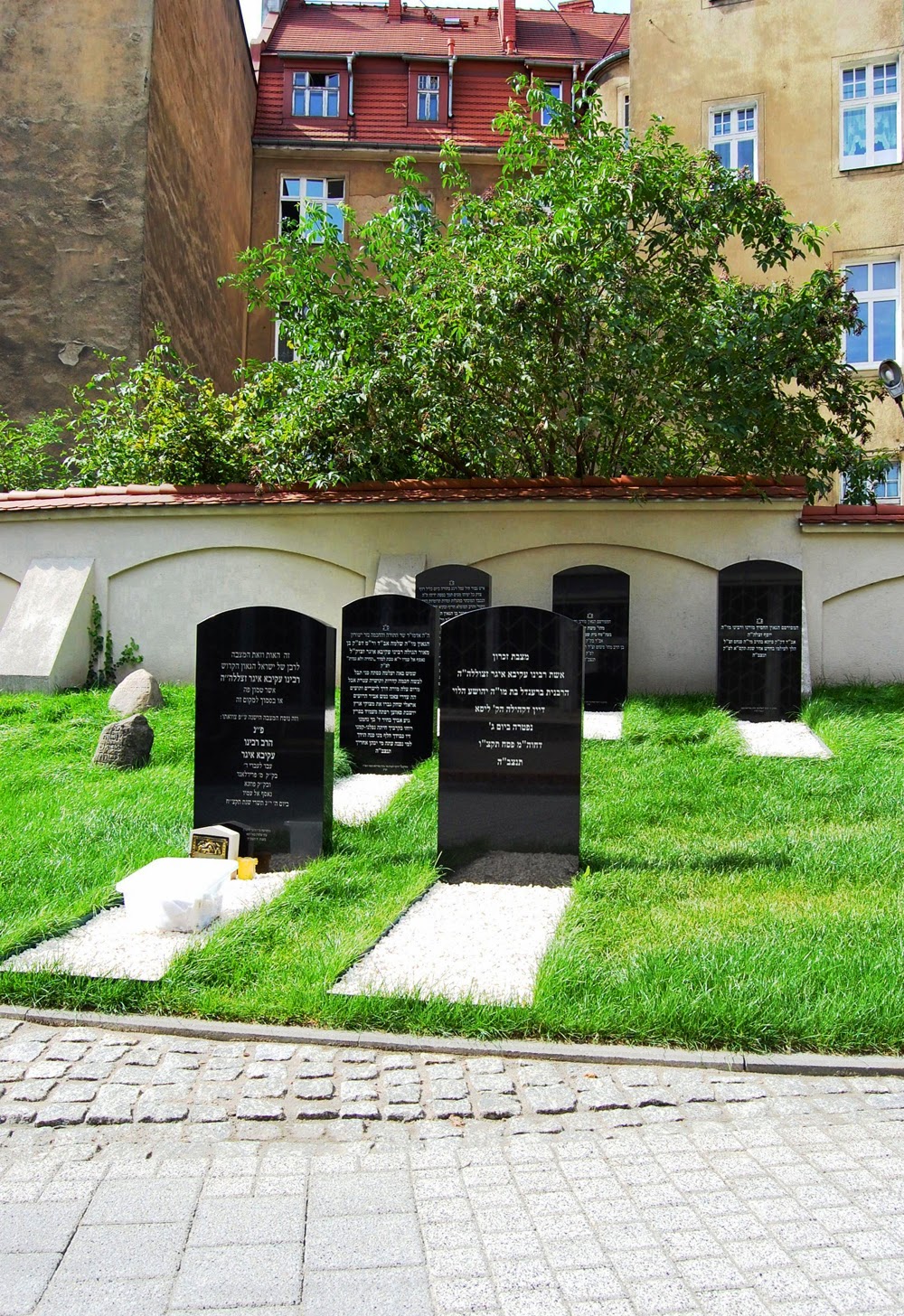
Tombstones from the Jewish cemetery were used to pave roads, and the nineteenth century Jewish cemetery itself – it opened in 1804 – was incorporated into Poznan’s Trade Fair grounds after the war.[8] Ultimately, a housing project and shopping center were built on the grounds of the Jewish cemetery, today at ul. Glogowska corner ul. Sniadeckich. Fortunately, the rabbinic section of the cemetery served as a parking lot (rather than as the foundation of an apartment house), and it was possible to transform the lot into a grassy knoll and to set new tombstones over the old graves (see figure 5). 

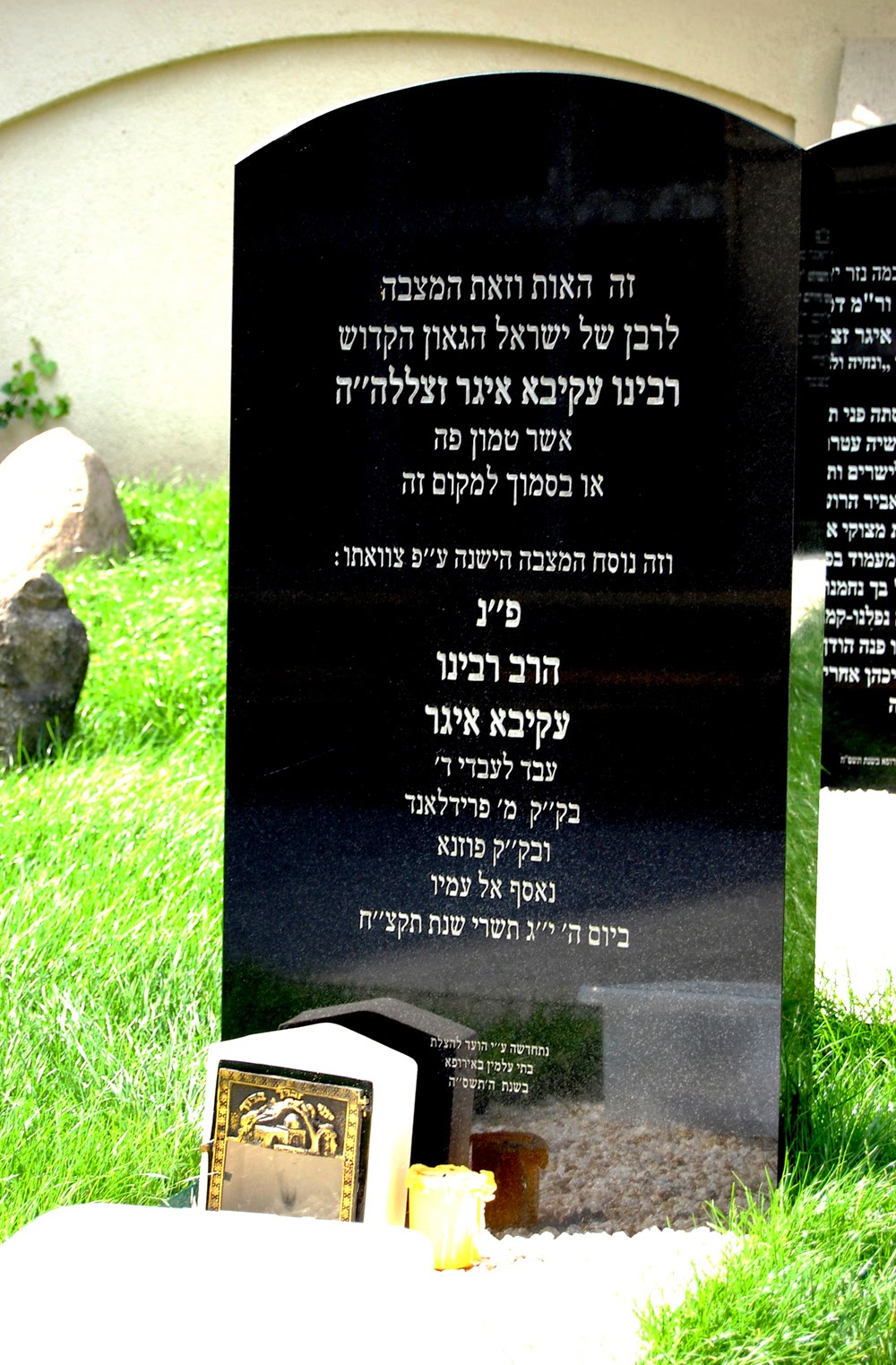
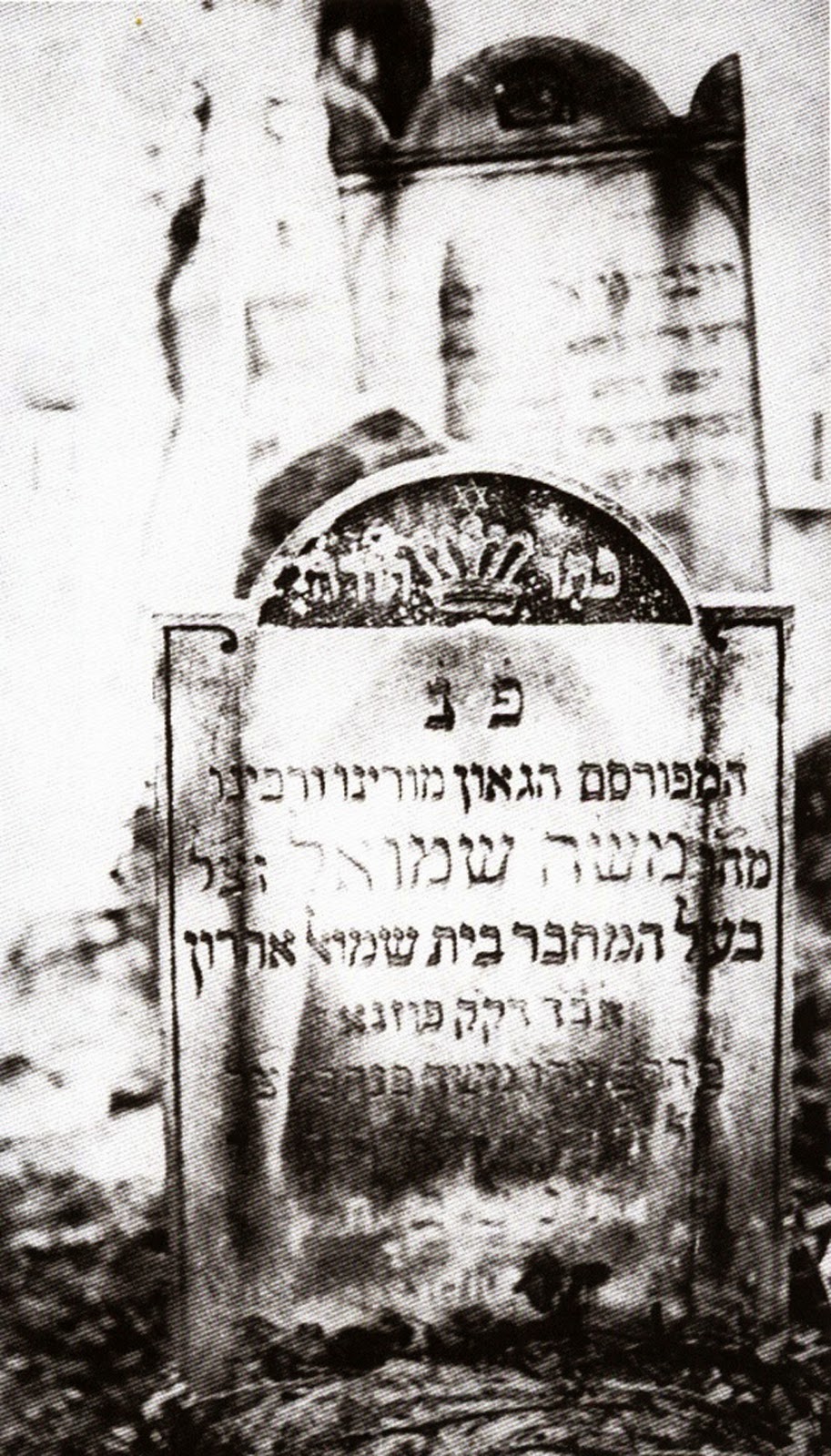
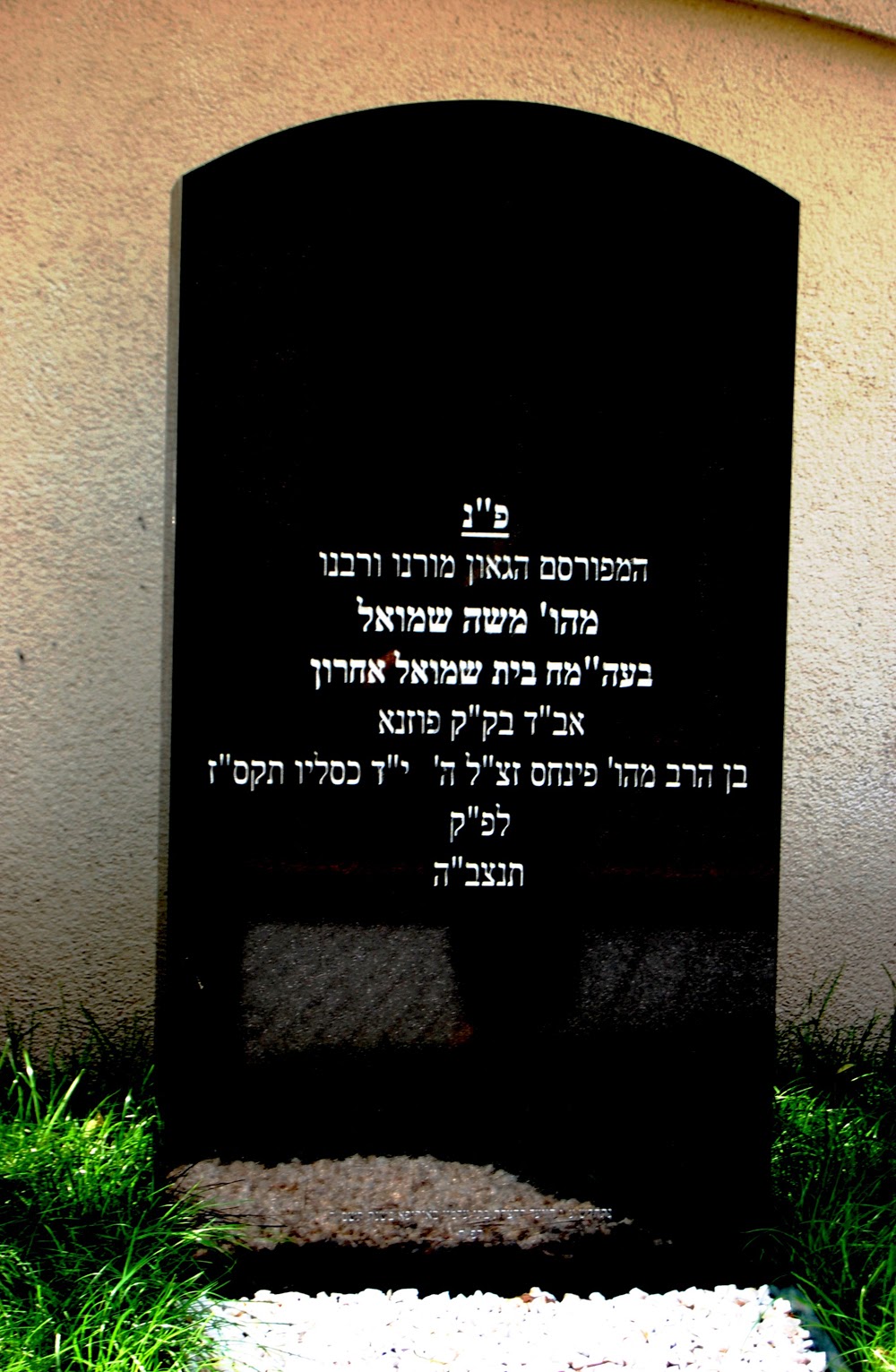
At best, the tombstones are approximately over the gravesites they describe. Even so, it is a great kiddush ha-Shem that this sacred site has been restored. The graves restored include R. Akiva Eger (see figure 6), his second wife Breindel (d. 1836), his son and successor R. Shlomo Eger (d. 1852; see figure 7), and his son R. Avraham Eger (d. 1854). Also restored were the graves of two predecessors of R. Akiva Eger as Chief Rabbi of Posen: R. Yosef b. Pinhas of Posen (son-in-law of R. Yehezkel Landau Prague; see figure 8), d. 1801, and R. Moshe Shmuel, author of בית שמואל אחרון, d. 1806 (see figures 9 and 10 for the original and the restored tombstone inscriptions).[9]

We would be remiss if we didn’t mention that R. Akiva Eger’s likeness is on permanent display in Poznan’s Town Hall (see figure 11). The excerpt in figure 11 is part of a larger mural painted by Julius Knorr (1810-1860) and entitled Marktplatz in Posen. The painting was done during the lifetime of R. Akiva Eger and was first displayed in 1838. R. Akiva Eger can be seen at the bottom right, walking with cane in hand and accompanied by the two other members of his rabbinic court.[10]

II. R. David Hoffmann (d. 1921).

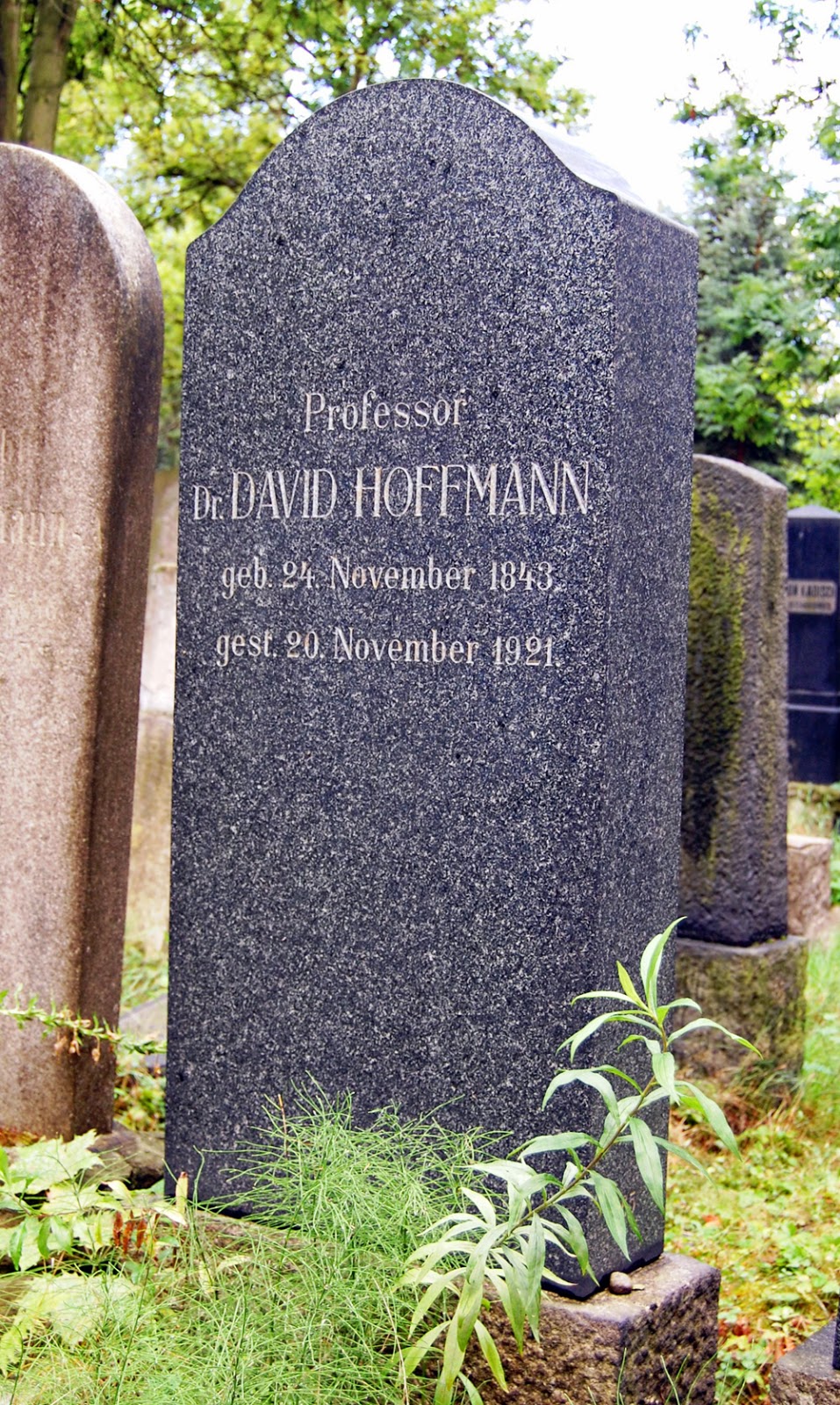
The recent announcement that R. David Hoffmann’s פירוש על ספר שמות (based upon his lecture notes in German) is about to be published by Mosad Harav Kook has brought great joy to biblical and rabbinical scholars alike.[11] Yet another sefer by the Master! It matters not that more than a century has passed since he first taught Exodus at the Hildesheimer Rabbinical Seminary. Of course modern Bible scholarship has changed drastically in the interim. R. David Hoffmann’s commentary will not reflect modern archaelogical advance, will not grapple with the textual readings of the Dead Sea Scrolls, and will not deal with the latest philological discoveries of Semitic linguistics. But those who have read his commentaries on Genesis, Leviticus, and Deuteronomy, and learned from them, will know that regarding R. David Hoffmann “כל מקום שאתה מוצא דבריו עשה אזנך כאפרכסת.”[12] Master of the Oral Law, he of course read the Torah through rabbinic lenses. At the same time, he listened to dissenting voices, weighed all the evidence, and never disparaged others even as he dismissed their arguments. He always judged judiciously and graciously. And even when one disagrees with him, one always gains insight from his comments.

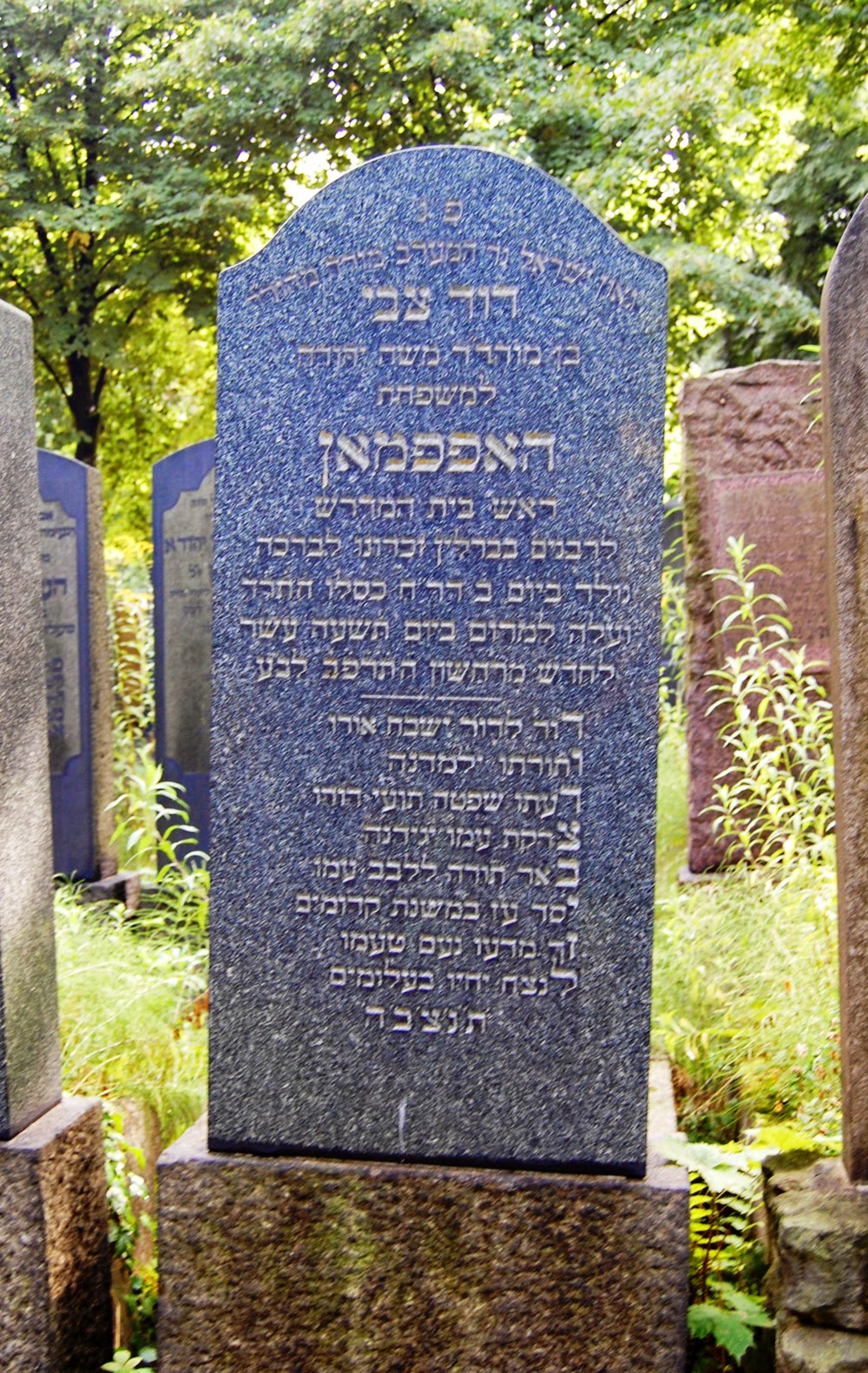
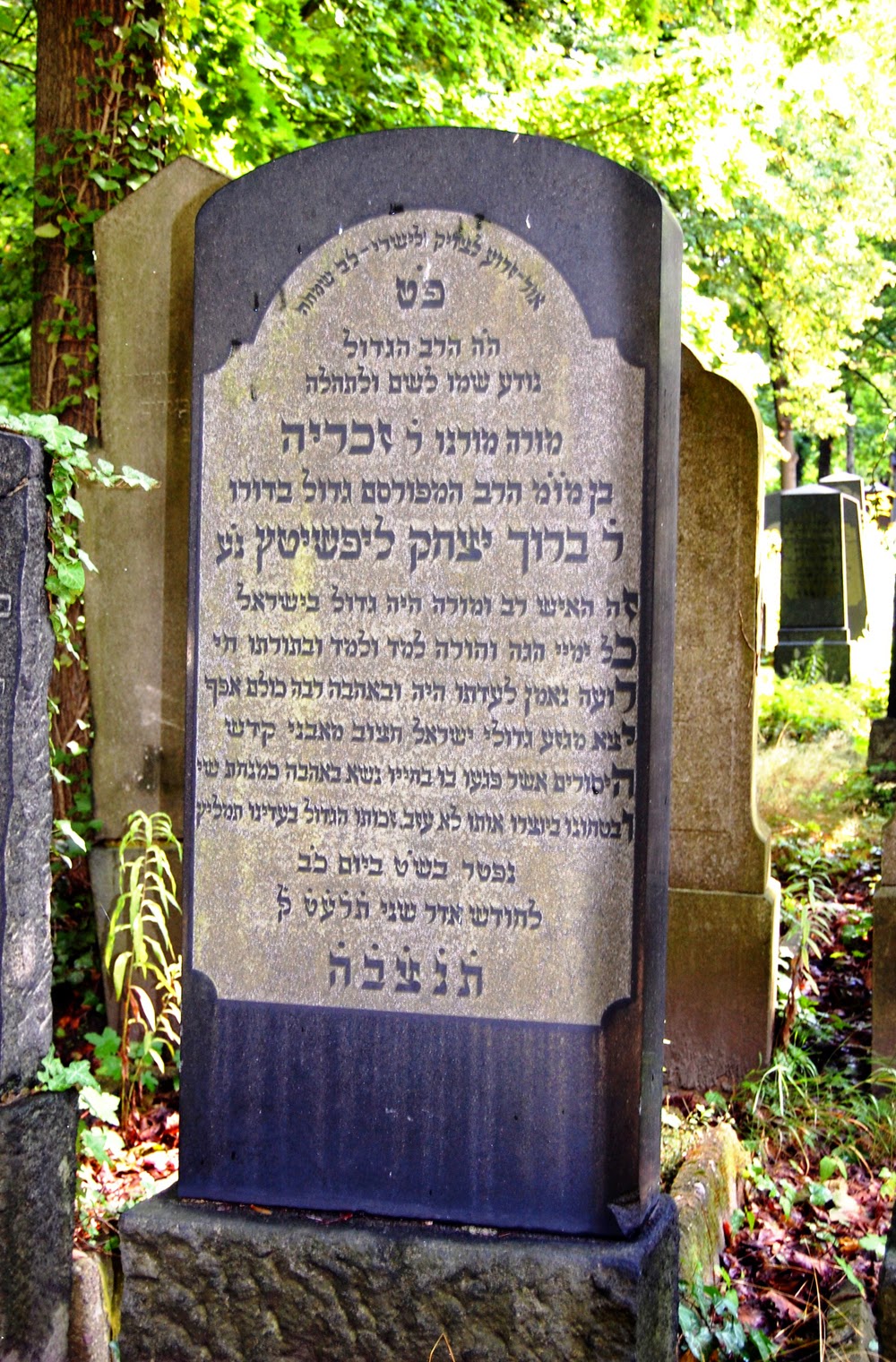
It is sad that this seminal figure, Rector and Rosh Yeshiva, Bible scholar and Posek, Literary Critic of the Mishnah and Restorer of Lost Tannaitic Midrashim, Defender of the Faith and Public Servant, has never been the subject of an intellectual biography worthy of the name.[13] Here we publish, apparently for the first time, his epitaph. R. David Hoffmann is buried in the Adass Jisroel cemetery in the Weissensee section of Berlin.

Obverse (see figure 12):

פ”נ
[גאון ישראל נר המערב מורה מהור”ר [14
דוד צבי
בן מוה”ר ר’ משה יהודה
למשפחת
האפפמאן
ראש בית המדרש
לרבנים בברלין זכרונו לברכה
נולד ביום ב’ דר”ח כסלו התר”ד
ועלה למרום ביום תשעה עשר
לחדש מרחשון ה’ תרפ”ב לב”ע
—————-
דור לדור ישבח אורו
ותורתו ילמדנה
דעתו שפטה תועי דורו
צדקת עמו יגידנה
באר תורה ללבב עמו
יסד עז במשנת קדומים
זך מדעו נעם טעמו
לנצח יחיו בעלומים
תנצב”ה
 

Reverse (see figure 14):

Professor
Dr. DAVID HOFFMANN
geb. 24. November 1843.
gest. 20. November 1921.

[1] According to R. Avraham Yeshayahu Karelitz (d. 1953), “גדול האחרונים הוא המהרי”ט.” See Z. Yabrov, מעשה איש, Bnei Brak, 2001, vol. 4, p. 90.
[2] See E. Zalman, “המהרי”ט קבור בצפת,” Qulmos 65 (2008), pp. 18-21. The photograph in figure 1 is taken from the Zalman essay.
[3] In the case of R. Eleazar b. Yehudah of Worms, he was certainly buried in the Worms Jewish cemetery, standing to this very day. The portion of the cemetery he was buried in was appropriated by the non-Jewish authorities. See R. Juspa Shammes, מעשה נסים, Amsterdam, 1696, p. 20.
[4] See N. Netter, “Les Anciens Cimetieres Israelites de Metz,” REJ 51(1905-6), pp. 280-281. Cf. S. Schwarzfuchs, (תנאי הרבנות של השאגת אריה בק”ק מיץ”,מוריה 15(1986″, pp. 81-90.
[5] The only extant authentic photograph of Sara Schenierer, which scholars in Israel and the United States have kept under wraps for years, was recently published in T. Lesniak, J. M. Malecki, J. Purchla, and A.B. Skotnicki, eds., Swiat przed katastrofa:Zydzi krakowscy w wudziestoleciu miedzywojennym (A World Before a Catastrophe: Krakow’s Jews Between the Wars), Krakow, 2007, p. 128 – and is reproduced here.
[6] See, e.g., Y. Strasser and A. Perl, eds., מאורן של ישראל: רבינו עקיבא איגר, New York, 1990, 2 vols. Cf. J.H. Sinason, The Gaon of Posen: A Portrait of Rabbi Akiva Guens-Eger , Jerusalem, 1991.
[7] Figure 4 is taken from T. Sztyma-Knasiecka, Miedzy tradycja a nowoczesnoscia: Zydi poznanscy w XIX i XX wieku, Poznan, 2006, p. 23.
[8] See Z. Pakula, , The Jews of Poznan, London, 2003, pp. 1-21 and 109. Cf. anonymous, “Jewish Poznan,” Poznan in Your Pocket, July-October 2008, p. 6.
[9] The photograph of the original tombstone inscription is taken from Sztyma-Knasiecka, p. 22.
[10] See Sinason, pp. 100-103; cf. Sztyma-Knasiecka, p. 13.
[11] See A. Wasserteil’s introduction to R. David Hoffmann, (שיעבוד בני ישראל במצרים, המעין 48(2008, number 3, p. 25.
[12] R. David Hoffmann used to apply this Talmudic phrase to the רש”ש, but it surely applies to Hoffmann as well. See his שו”ת מלמד להועיל, Frankfurt, 1932, vol. 3, §71. Cf. R. M. Roth, מבשר עזרא, Jerusalem, 1968, p. 167.
[13] Useful information can be gleaned from the following:
H.J. Bechtoldt, “David Hoffmann,” in his Die jüdische Bibelkritik im 19. Jahrhundert, Stuttgart, 1995, pp. 363-438; D. Ellenson and R. Jacobs, “Scholarship and Faith: David Hoffmann and his Relationship to Wissenschaft des Judentums,” Modern Judaism 8(1988), n.1, pp. 26-70; L. Ginzberg, Students Scholars and Saints, Philadelphia, 1928, pp. 252-262; L. Jung, The Path of a Pioneer, London, 1980, pp. 20-27; J. Marmorstein, “David Hoffmann, Defender of the Faith,” Tradition 8(1966), n.4, pp. 91-101; A. Marx, Essays in Jewish Biography, Philadelphia, 1947, pp. 185-222; Idem, Studies in Jewish History, New York, 1944, pp. 369-376; M. B. Shapiro, “Rabbi David Zevi Hoffmann on Torah and Wissenschaft,” Torah U-Madda Journal 6(1995-6), pp. 129-137; C. Tchernowitz, מסכת זכרונות, New York, 1945, pp. 244-264; and Y. Wolfsberg-Aviad, “David Hoffmann,” in L. Jung, ed., Guardians of Our Heritage, New York, 1958, pp. 363-419 (cf. Wolfsberg-Aviad’s דיוקנאות, Jerusalem, 1962, pp. 57-66). Much more bibliography can be added; the items listed here are intended to get the interested reader started.
[14] For the honorific title מורה מורנו, see figure 13, also from the Adass Jisroel cemetery. Cf. the very interesting responsum in שו”ת מהרש”ם 2:56.


Akiva Leiman: Gravely Mistaken

Gravely Mistaken
by Akiva Leiman

R. Leiman teaches high school at the Yeshiva of Greater Washington in Silver Spring, Maryland. Additionally, he leads trips to sites of Jewish interest in Eastern Europe. This is his first contribution to the Seforim blog.

One hardly need go far to find errors in published materials, but when even moderate research would suffice to unearth correct information lack of such an effort would seem egregious. Jewish burial sites have often been lost: Nazis or indigenous peoples destroyed cemeteries, acid rain ravages stones, burning candles char monuments and, of course, people just simply forget where things are.[1] Misinformation, however, would seem to be the most preventable culprit in this ever-losing battle to maintain vestiges of our heritage.
A few examples should suffice.[2]
1. In Paul Johnson’s A History of the Jews, in the very first paragraph of the actual text, he says,
There in the Cave of Machpelah, are the Tombs of the Patriarchs . . . . Across the inner courtyard is another pair of tombs, of Abraham’s grandson Jacob and his wife Leah. Just outside the building is the tomb of their[3] son Joseph.
In an endnote he references L.H. Vincent and his depiction of the cave which has been reproduced in EJ XI p. 671. There the caption does read: “Tomb of Joseph.” However, the text of the EJ explicates that, “A Muslim tradition maintains that Joseph was buried here… (t)his tradition is probably due to a corruption of the Arabic name for Esau, whose head, according to aggadic sources fell within the cave…” EJ‘s theory for the mistake aside, Johnson must not have read the text of the article (or: ignored it), for though the diagram’s caption tells us that Yosef is buried in the Cave, the text belies this point.[4] Furthermore, see Joshua 24:32 (providing Shechem as Joseph’s burial place),[5] which must, at the very least, be mentioned in any serious discussion of the final resting place for Yosef.[6]
2. In בשבילי ראדין, by M. M. Palato, Machon B’Shvilai HaYeshivot, (2001), p. 25, we are provided a picture and told “that we are being shown the final resting place of R’ Chaim of Volozhin (d. 5581 – 1821), the most esteemed student of the Vilna Gaon, and he is buried next to his mentor.”[7]
But, R’ Chaim is actually interred in Volozhin[8] and his grave is a regular stopping point for those visiting the Byelorussian town. The picture shown is of the old Ohel over the grave of the Vilna Gaon in the since-destroyed Shnipishok cemetery of Vilna. Of course, R’ Chaim’s grave is not pictured at all.[9]

3. Holy Stones: Remnants of Synagogues in Poland, drawings by Joseph Cempla, Dvir, Tel Aviv (1959) is a beautiful group of renderings of pre-war Poland. From the description for plate number 13 we read:
The gravestone of Rabbi Shalom Shachna in the Lublin Cemetery

Rabbi Shalom ben Joseph Shachna[10] (1510-1550[11]) was one of the greatest Talmudists produced by Polish Jewry. He was the pupil of Rabbi Jacob Polak, head of the Lublin Yeshiva, who created the method of “Pilpul”[12] (casuistics)[13] employed in the study of Talmudic literature.

It is correct that R’ Shalom Shachna was a student of R’ Yaakov Polak, but the stone sketched by Cempla is not R. Shalom Shachna. Here is Cempla’s drawing:

And here is a picture of R’ Shalom Shachna’s grave today in the Old Cemetery of Lublin:

The grave today stands without the adornments found in Cempla’s rendering: no pillars, no arch and no artistic flair filling the arch. Also, Cempla seems to indicate ten or twelve lines of etching while the current stone shows at least fifteen; puzzling, if not insurmountable issues.
A bit more research revealed the obvious error. Within twenty feet of R’ Shalom Shachne stands this prominent headstone:

This is the grave of Rabbi Yaakov Yitzchak Horowitz (d. 9 Av 5575 – 1815), the Chozeh of Lublin.[14] It seems almost certain, upon comparing Cempla’s drawing with that of the Chozeh’s headstone is that Cempla drew the Chozeh’s headstone mistaking it for the tomb of R’ Shalom Shachna which lies in its close proximity.

[1] I can recall, as a young man, visiting the old cemetery in Tzfat immediately after havdalah. I encountered a middle-aged Chassidic Jew at that strange time, and inquired after the grave of Rabbi Chaim Vital (d. 5380) the eminent student and chronicler of R’ Yitzchak Luriah – the Ari Hakadosh (d. 5332). He told me to go up the road and after a bit to ask for directions to Damascus…
[2] For another example see אבי מורי, Dr. S.Z. Leiman, in Who is Buried in the Vilna Gaon’s Tomb? Originally published in Jewish Action, Winter (1998), 59(2), and which can be found online at: http://www.ou.org/publications/ja/5759winter/leiman.htm
[3] Sic, he was the son of Rachel not Leah.
[4] See Z. Vilnai, מצבות קודש בארץ ישראל, pp. 167-176, where (p. 170) sightings of the burial place in Shechem date to 320 AD.
[5] ואת עצמות יוסף אשר העלו בני ישראל ממצרים קברו בשכם
[6] For further discussions, see L. Ginzberg, Legends of the Jews, V1, JPS (2003) p. 430 n. 443. Also, Vilnai pp. 141-144. To come full circle, in Acts 7:16 we are told that Jacob was also buried in Shechem!
[7] See note 1 above.
[8] For a nice photo, see Mishpacha, Special Supplement Succos 5767, pp. 24-25.
[9] The caption also tells us that R’ Zalmaleh of Volozhin, the brother of R’ Chaim and most brilliant student of the Vilna Gaon, is in the photo as well. He is neither in Volozhin, next to his brother, nor in the Gaon’s Ohel. See note 1. His grave has sadly been lost.
[10] I would assume that Shachna was his second, not family name; the stone reads:שלום המכונה שכנה, which would seem to be a nickname rather than a surname.
[11] See S. B. Nissenbaum’s Lekorot HaYehudim B’Lublin, p. 19 for the exact wording on his tombstone. He actually died on Friday Rosh Chodesh Kislev 5319, which was in 1558. See A. A. Akavia לוח לששת אלפי שנה p. 485.
[12] Quotes in original
[13] Parenthetic translation in original
[14]Interestingly, in Y. Alfasi החוזה מלובלין p. 107 nt. 9 there is a discussion if the Chozeh is in fact buried near R’ Shalom Shachna. He relies on a pre-war witness. Today one can go and see for himself, ואין לדיין אלא מה שעיניו רואות.