Jews, Baseball, and The Yiddish Press

Jews, Baseball, and The Yiddish Press
By Eddy Portnoy
Dr. Eddy Portnoy is Senior Researcher and Director of Exhibitions at the YIVO Institute for Jewish Research. He is the author of the recently-published (and much acclaimed, and fun) book, Bad Rabbi: And Other Strange but True Stories from the Yiddish Press (Stanford, 2017), available here.
This is his second contribution to the Seforim Blog. His previous essay, “The Yiddish Press as a Historical Source for the Overlooked and Forgotten in the Jewish Community,” was published here.
Jews love baseball! Well, maybe not all Jews. On the one hand, the editors of the Forverts, the largest and most successful Yiddish newspaper in history, enthusiastically commissioned an article at the end of August, 1909 explaining the fundamentals of the game to their audience of Yiddish-speaking immigrants. While they may not have expected their readers to run out and play ball, they did understand that it was of value culturally to understand how the game was played. In short, it was seen as part and parcel of the Americanization process.
And yet, on the other hand, a cartoon that appeared a few years later reveals somewhat of an antipathy to baseball from a different Yiddish precinct. Baseball appears to have been one of those rare matters upon which both Orthodox rabbis and secular Yiddish cartoonists could agree. It is thus with great sympathy that one of the cartoonists working for Der groyser kundes views the difficulty Orthodox rabbis in America had in trying to convince American Jewish boys to attend heder. Der kundes, a very popular and very secular satire publication oriented to Left Labor Zionism, lamented the disinterest the lunkheaded, foul-mouthed, baseball-obsessed Jewish youth. Not that they necessarily supported the acquisition of a traditional Jewish education (even though all their writers had one), but they didn’t like baseball either.
Not unlike Nusakh sfard, baseball won the battle and is now a pastime enjoyed by large numbers of American Jews. Many of them even went back to heder. Left Labor Zionists satire magazines, however, aren’t doing so well anymore.


Der groyser kundes, New York, May 29, 1914
The Forverts, New York, August 27, 1909

“The
Fundamentals of the Base-Ball ‘Game’ Described for Non-Sports
Fans,” The Forverts (27 August 1909): 4, 5, translated by Eddy
Portnoy.

  
Uptown, on 9th Avenue and 155th Street is the famous field known as the “Polo Grounds.” Every afternoon, 20 to 35 thousand people get together there. Entrance costs from 50 cents to a dollar and a half. Thousands of poor boys and older people go without some of their usual needs in order to pay for tickets. Professional teams play baseball there and the tens of thousands of fans who sit in row after row of seats all around the stadium, go nuts with enthusiasm. They jump, they scream, they simply go wild with enthusiasm when one of “their” players does well, or, they are pained or upset when they don’t succeed.
A similar scene takes place every day in another place – in the Washington Heights. And the exact same thing goes on in Brooklyn, in Philadelphia, in Pittsburgh, in Boston, in Baltimore, in St. Louis, in Chicago – in every city in the United States. And the newspapers print the results of these games and describe what happened and tens of millions of people run to read it with gusto. They talk about it and they debate the issues.
And here we’re only talking about the “professional games:” practically every boy, nearly every youth, and not a few middle-aged men play baseball themselves, belong to baseball clubs, and are huge fans. Every college, every school, every town, nearly every “society” and every factory has it’s own baseball “team.”
Millions are made from the professional games. Related to this, there is a special kind of “political” battle between different cities. A good professional player gets eight to ten thousand dollars for one season. Some of them are educated, college-educated people.
To us immigrants, this all seems crazy, however, it’s worthwhile to understand what kind of craziness it is. If an entire people is crazy over something, it’s not too much to ask to try and understand what it means.
We will therefore explain here what baseball is. But, we won’t do it using the professional terminology used by American newspapers use to talk about the sport; we must apologize, because we’re not even able to use this kind of language. We will explain it in plain, “unprofessional” and “unscientific” Yiddish.
So what are the fundamentals of the game?
Two parties participate in the game. Each party is comprised of nine people (such a party is called a “team”). One party takes the field, and the other plays the role of an enemy; the enemy tries to block the first one and the first one tries to defend itself against them; from now on we will call them, “the defense party” and the “enemy party.”
The “defense party” also takes the field and plays. Two of the team players play constantly while the other seven stand on guard at seven different spots. What this guarding entails will be described later. Let us first consider the two active players.
One of them throws the ball to the other, who has to grab it. The first one is called the “pitcher” (thrower) and the second is called the “catcher” (grabber).
Each time, the “catcher” throws the ball back to the “pitcher.” The reader may therefore ask, if so, doesn’t it happen backwards each time – the catcher becomes a pitcher and the pitcher becomes a catcher? Why should each one be called with a specific name – one pitcher and one catcher?
We will soon see that the way in which the catcher throws the ball back is of no import. The main thing during a game is how the pitcher tries to throw the ball to the catcher.
The enemy party, however, seeks to thwart the pitcher.
This occurs in the following way:
One of the team’s nine members stands between the pitcher and the catcher (quite close to the catcher) with a thick stick (“bat”) and, as the ball flies from the pitcher’s hand, tries to hit it back with the stick before the catcher catches it.
This enemy player is called “batter.” The place where he stands is designated by a number of little stars (****).
(The other eight players on the enemy team, in the meantime, do not participate. They each wait to be “next.”)
Imagine now, that the “batter,” meaning the enemy player, finds the flying ball with his stick and flings it. If certain rules, which we will discuss later, aren’t broken, this is what can happen with the ball: if one of the “guards” catches the hit ball while it is still in the air, then the opposition  of the “batter” is completely destroyed and the batter must leave his place; he is excluded (he is “out”). He puts down the “bat” and another member of his party takes his place.
The roles of the seven guards of the defense party are also specific: they must try and catch the hit ball in order to destroy the enemy’s attempt to hinder them and to get rid of the player doing the obstructing. They stand at various positions because one can never know in which direction the ball will fly. They watch the different trajectories in which the ball might fly, so a guard can be there, ready to catch it.
The readers can see the way the seven guards are distributed in our picture.
The entire official field on which the game is played is a four-sided, four-cornered one. This is in the center of our picture (The two round lines which go around it represent the tens of thousands of seats for the audience. That is how it usually is for the big professional games. It actually looks like a giant circus with a roof only for the audience. The field, with all the players, is under the open sky.).
As the readers see in the image, one corner is taken by the “catcher.” The other three corners of the four-cornered figure are stations. Each one is called a “base.” With the catcher facing the pitcher, the first “base” is outward from the direction of his right hand, just opposite him is the second base; and from his left hand is the third base.
A little bag of sand lay on every base. The guards, however, must not stand on the base, but next to it.
We previously mentioned three guards. They are called the first baseman, the second baseman and third baseman. A third guard stands between second and third base. He is called the “short stop;” when a ball is hit, it often goes in that direction and the “short stop” gets a chance to catch it in the air.
But if the ball flies way over the heads of these four “guards,” there are three other guards who stand on the outside field, or the “out field.” One of these is called the “right fielder,” the second, the “center fielder,” and the third, the “left fielder.”
Two of the four sides of the four-sided figure in our picture are marked with dots. When a hit ball flies over one of these two lines, it is called a false ball (foul ball). For it to be a proper ball (a fare ball), it must fly forward, or over the other two lines of the four-cornered figure.
When the batter doesn’t manage to hit the ball with his stick, it is called a “strike.” If he gets three “strikes,” he is “out,” or eliminated. Certain kinds of “foul balls” are considered “strikes,” however, we will not go into these details.
When the batter hits the ball and it is “proper,” and the guard doesn’t catch it, this means that the opposition, in this case, is successful. However, this success can either be greater or smaller. Depending on the level of this success, the following is done: as soon as the batter hits the ball, he throws his “bat” away and starts running; if nothing disturbs him, he runs to first base, from first to second, from second to third, and from third to the place where the catcher stands. This place is called “the home.” If he gets to the “home” spot, it means that the success of the opposition is complete.
This means that he made a whole “run:” and, based on these “runs,” the results of the game are figured out. The party which makes more runs is the winner.
But to make a full run at one time doesn’t happen all the time. In order to do so, the zetz that the batter gives the ball must be especially successful. It happens more often that he makes a quarter run, or a two quarter, or three quarter.
The rule is this: the running batter has no right to go to first base if the guard (the first baseman) holds, at that very moment, the ball in his hand. If the hit ball falls on the ground and one of the guards picks it up, the running batter is not yet eliminated.  He runs. But imagine that some guard throws the ball to the first baseman and that this first baseman catches the ball before the running batter physically arrives at first base: then this runner is eliminated. But if he catches the ball when the runner is already on the base, the runner is “saved” (safe).
If the runner keeps running to second base, the rule is a bit different: the second baseman can eliminate him only if he touches him with the ball; and the same rule works for the third baseman, he has to touch him with the ball in order to get him out. The catcher or pitcher can also get a runner out with a “touch” if he finds himself near the base or the “home” to which he ran.
Each player is the embodiment of agility, with strong, swift muscles and sharp, fast eyes. And the whole game is full of “excitement” for those who are interested in it.


The Yiddish Press as a Historical Source for the Overlooked and Forgotten in the Jewish Community

The Yiddish Press as a Historical Source for the Overlooked and Forgotten in the Jewish Community
by Eddy Portnoy
Eddy Portnoy is Senior Researcher and Director of Exhibitions at the YIVO Institute for Jewish Research. He is the author of the recently-published (and much acclaimed, and fun) book, Bad Rabbi: And Other Strange but True Stories from the Yiddish Press (Stanford, 2017), available here (https://www.amazon.com/Bad-Rabbi-Strange-Stories-Stanford/dp/150360411X).
This is his first contribution to the Seforim Blog.
Sanhedrin 25 has this pretty well-known, somewhat rambling bit about what sorts of people are trustworthy enough to serve as witnesses in court. It’s pretty standard stuff. However, as part of this discussion, we get to learn about some early gambling practices among the Jews. While this topic is invoked mainly to denote the fact that gamblers may not be the most trustworthy folk, some of the details include a bit of haggling over whether people who who send their trained pigeons to steal other people’s pigeons can be considered as shysty as those who simply race pigeons for cash rewards. After a bit of back and forth, it is concluded that everyone involved in pigeon shenanigans are just as sleazy as dice players, who are banned by halakhah from serving as witnesses. The long and the short of it is that the Rabonim simply do not like the gambling.
When I first read Sanhedrin 25, I thought it was terrifically interesting, not because I had some investment in knowing whose testimony is considered worthy, nor because I’d just renovated the pigeon coop on top of my tenement. I was fascinated because it was an instance of the amoraim interfacing with the amkho. I have an abiding interest in the the amkho, those average, everyday Jews that make up the bulk of this freaky nation. These are the people you find on the margins of rabbinic discourse, those upon whom the rabbis meted out their rulings and punishments. Truth be told, I find these people much more interesting than either the rabbis or their fiddling with halakhah. Amazingly, in this discussion, the rabbis throw out some neat details about how pigeon racers would hit trees to make their pigeons go faster and how some people played a dice-like game with something called pispasin, a hardcore Jewish gambling habit that seems to gone the way of the dodo.
Unfortunately, Jewish traditional texts aren’t very amkho-friendly. The average Yosls and Yentas who smuggle their way into works produced by rabbinic elites generally appear because they somehow screwed up, did something the rabbis didn’t approve of and thus wound up being officially approbated, a fact they also often ignored. That fact notwithstanding, the amkho still appears to have retained a high regard for their rabbinic elites, in spite of the fact that they frequently disregarded rulings that interfered with anything they considered even remotely fun.
Take, for example, the body of rabbinic admonitions that trip their way from the gemara through 19th century responsa insisting that Jews refrain from attending theater and circus performances. Did any self-respecting Jew with tickets to whatever the 6th century version of Hamilton was ever say, “um, this isn’t permitted…we’d better not go.” This type of thing goes on for centuries. Sure, there’s a broad core of laws that most Jews stuck to, but, when it comes to matters of amusement or desire, the edges can get pretty fuzzy.
If you jump from the Talmudic period to the early 20th century (yes, I know this is ridiculous), one finds that the dynamic doesn’t change very much. The only real difference is that the rabbinic elite has lost much of its power and influence. Amkho still respects them, but they also still do what they want. One interesting factor is that there is now a forum where news of both the rabbis and the amkho begins to appear on a regular basis. This would be the Yiddish press, the first form of mass media in a Jewish language, a place where international and national news collided with Yiddish literature and criticism, where great essayists railed both in favor and against tradition, where pulp fiction sits alongside great literature, and where, among myriad other things, you can find a near endless supply of data on millions of tog-teglekhe yidn, everyday Jews who populated the urban ghettos of cities like New York and Warsaw. In a nutshell, the Yiddish press is a roiling and angry sea of words filled with astounding stories of all kinds of Jews, religious, secular and many who vacillate perilously between the two, aloft somewhere between modernity and tradition, taking bits of both, throwing it all in a pot and cooking it until it’s well done.
It is not at all uninteresting.
As a kind of wildly disjointed chronicle of Jewish life, Yiddish newspapers are an unparalleled resource on the pitshevkes, the tiny, yet fascinating details of Jewish urban immigrant life. Where else could one find out that Hasidim were a significant component of the Jewish audience at professional wrestling matches in Poland during the 1920s? Or that 50,000 Jewish mothers rioted against the public schools on the Lower East Side in 1906? Where could one discover that petty theft in Warsaw spiked annually just before Passover, when Jews were known to buy new clothes and linens? Is there a place you know of where one could find out that Jewish atheists antagonized religious Jews on Yom Kippur by walking around eating and smoking? Or that gangs of ultra-Orthodox Jews stalked the streets on Shabbos demanding people shut down their businesses? If you want to experience the knot of fury into which Jewish life was bound up, look no further than the Yiddish press.
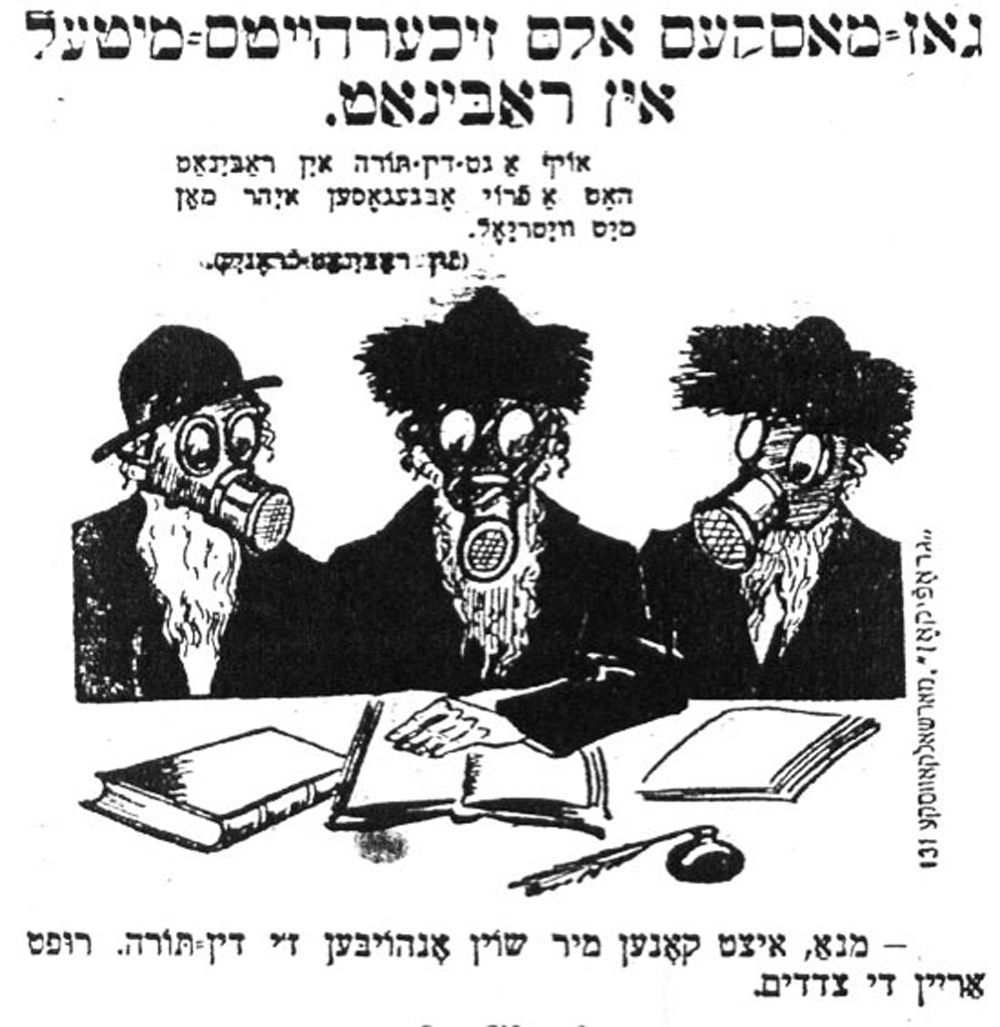
Yiddish newspaper editors always knew where to find the juiciest stories and, for example, frequently sent journalists to cover goings-on in the Warsaw beyz-din. And it wasn’t because there were important cases being seen there, but because there was always some wild scandal blowing up in front of the rabbis that often ended up with litigants heaving chairs at one another. Whether it was some guy who thought it would be okay to marry two women and shuttle between them, or a woman who knocked out her fiancée’s front teeth after he refused to acknowledge that he had knocked her up. Like a Yiddish language Jerry Springer Show, brawls broke out in the rabbinate on a near daily basis during the 1920s and 1930s. The rabbis, of course, were mortified. But they kept at it. And the journalists of the Yiddish press were there to record.
Captions (top, middle, bottom):
“Gas masks as a security measure in the Rabbinate.”
“A woman poured vitriol on her husband in a divorce case” (from the Rabbinate Chronicle)
“Thus can we now begin the case. Call in the two sides.”
It may be that you don’t want to know that there were Jewish criminals, drunks, prostitutes, imbeciles, and myriad other types that comprise the lowest echelons of society. But these small, often inconsequential matters that litter the pre-WWII Yiddish press comprise the details of a culture that has largely disappeared. Moreover, one can find a wealth of information on the amkho, who they were, how they lived, how they thought and spoke. This of course, begs the question: what do we want out of history? Do we only want to know about the rabonim, the manhigim, the writers, the artists, and the businesspeople? Or do we also want to peek into the lives of the average, the boring, the unsuccessful, the dumb, and the mean? Do we want a full picture of the Jewish world that was, or do we only want the success stories?


For my money, I want to know as much as I can about how Jews lived before World War II. Not everyone’s great grandfathers were kley-koydesh. In fact, most weren’t and it’s sheer fantasy to think that most Jews had extensive yeshiva educations. Most Yiddish-speaking Jews were poor, uneducated, and sometimes illiterate. Many of them did dumb things, made bad decisions, and wound up in big trouble. Clearly a shonde, they may not have the yikhes we want, but, also, we don’t get to choose. They may not be the best role models, but they are nonetheless integral to the Jewish story.


Hasidism in America

Hasidism in America

Marc B. Shapiro
There is a tape of R. Joseph B. Soloveitchik in the 1950s saying that there is no real Hasidism in the United States. He says that he saw real Hasidism in Warsaw, and America does not have it. When the Rav made this statement, I think most non-hasidim would have agreed that Hasidism did not have any real future in the United States. The 1950s was a time when the focus was on the melting pot. In such an era, Hasidism would have been as out of place in wider American society as Muslim women walking down the streets of New York City or Los Angeles wearing hijabs. How things have changed!
There are many reasons for the great success of Hasidism in the United States, among them the turn to multiculturalism which has made the public square more welcoming of a variety of lifestyles. The coarsening of the wider culture has also pushed religious people to a more inward direction, and those looking to escape from this culture can easily be drawn towards Hasidism. Also important is that for many young hasidim the wider culture does not have the same draw it once did. And for those who do want to be part of the wider culture, in today’s day and age one can be a hasid and live a much more open life, even if only virtually, then people did a generation or two ago. The rise of the welfare state has also been crucial to hasidic growth, as without the welfare state hasidic communities as we know them would be unsustainable.[1] Finally, there is one other element that has been important to hasidic growth, and also to its fracturing, and that is the leadership that has been able to provide guidance in post-war America.

Samuel Heilman’s engrossing new book discusses this very point, that of leadership. Its title is Who Will Lead Us? The Story of Five Hasidic Dynasties in America, and it is required reading for anyone interested in the contemporary hasidic world.

The dynasties Heilman focuses on are Munkács, Boyan, Bobov, Satmar, and Lubavitch. There is also an introductory chapter on succession in Hasidism which itself is an important issue. I do not know if people in the hasidic world give it much thought, but for non-hasidim the whole matter of succession is somewhat strange, since by what right should a son (sometimes even a very young son) or son-in-law be able to take over religious leadership? Very few outsiders will be impressed with the hasidic concept of “holy seed,” as in the non-hasidic world, at least until recent years, it was understood that one rises to greatness based on one’s own achievements, not based on who one’s father was (though that always helps). It is thus interesting to learn that in the early years of Hasidism the concept of family succession did not exist.[2] Yet as we all know, for many years now succession has been based on lineage and in that way the hasidic court is just like the royal court.[3] (I was struck by Heilman’s use of the term “dowager” to describe the widow of the rebbe. I have never seen the term used in this way but is a good usage.) Of course, there have been times when there were disputes as to who should be the rightful successor, and this always had the potential to lead to a split in a hasidic group, a point we will return to.
Heilman was fortunate that he “was helped immensely by several rebbes who graciously consented to be interviewed and who for long hours and over many months and years opened their lives to me” (p. xv). Some readers might find it strange for a rebbe to be so open with an academic researcher, but it shows that at least some rebbes are interested that academic discussions about them be accurate, and that their perspectives be taken into account.[4]
Heilman’s chapter dealing with Munkács is riveting, and never before has the story been told in print. By “story,” I have in mind the life of R. Baruch (Boruchel) Rabinowitz, the rebbe of Munkács, who did what is almost unheard of, namely, giving up his “rebbeship.” Freed from this role, he was able to become more “modern” and publicly abandon the anti-Zionism so much associated with his father-in-law, R. Hayyim Eleazar Shapira, his predecessor as rebbe of Munkács. While living as a rabbi in Brazil (the “chief rabbi” of São Paulo), he even acceded to his new wife’s wishes to get a dog (which he himself walked). He read widely in secular literature, earned a university degree in philosophy and psychology, and taught philosophy at the University of São Paulo. (p. 51).
While some have seen the Holocaust as changing R. Baruch’s outlook, it appears that this is not entirely the case. As Heilman informs us (p. 44), during the Munkácser Rebbe’s famous 1930 trip to the Land of Israel, in which R. Baruch the future son-in-law accompanied him, R. Baruch snuck out at night to meet secretly with R. Yaakov Moshe Charlop, the leading follower of R. Kook. (Heilman refers to R. Charlop as head of Yeshivat Merkaz ha-Rav, but that would only happen after R. Kook’s death.) This shows that already in his youth he had a much broader perspective than his future father-in-law.
By the time his metamorphosis is complete, it appears that R. Baruch should be categorized as a Religious Zionist – or perhaps even a Modern Orthodox – rabbi. There is a picture in the book of him with Ben Gurion. Unfortunately, Heilman does not identify the other rabbi in the picture – R. Shlomo Goren. Here is another picture of R. Baruch in the Sinai desert after the 1967 war.[5]

Because R. Baruch had given up the role of rebbe, this meant that it was to pass to his son. Yet R. Baruch did not seem too happy about this and appears to have never regarded it as a real option, as he did not raise any of his sons to become a rebbe. Heilman does a wonderful job describing how it came to pass that the young Moshe Leib became the rebbe. The story he tells is also one of great sadness, of a deep human tragedy, as in the end there was a complete break between R. Baruch and three of his children from his first marriage (which includes the current Munkácser Rebbe), even to the extent of R. Baruch forbidding them to attend his funeral or to say Kaddish for him. (You can see R. Baruch’s letter here.)  Is there anything more tragic for a family than this?
While it is often stated that the hasidim rejected R. Baruch because he became a Zionist, the truth is that he rejected them, in that he chose not to continue as the rebbe. The bitter and public break with his children was a real family tragedy, but it is difficult to read the book and not conclude that the fault for this lay in R. Baruch’s unresolved issues – Heilman speaks of “Oedipal overtones” (p. 63) – seen most vividly in R. Baruch’s shocking behavior at R. Moshe Leib’s wedding. The result of all this is that R. Baruch has been completely erased from Munkács history and has no significance to the movement. When a book with his approbation is reprinted, such as R. Joseph Lustig’s Amudei Esh le-Veit Yosef, it is not surprising that the approbation is removed. Here is the title page of the edition with the approbation removed.

Despite the family tragedy, it must be said that R. Baruch’s son and successor, R. Moshe Leib, has been remarkably successful in leading a revival of the dynasty. He has also played a role in wider Jewish affairs, both publicly and behind the scenes, and is a fine example of what a successful rebbe can be.
Let me add a few more points about R. Baruch that are not mentioned in Heilman’s book. One might have assumed that as R. Baruch became more modern he would distance himself from his father-in-law, a man very much identified with extremism. But that did not happen. Until the end of his life he continued to display awe for R. Hayyim Eleazar Shapira. In Binat Nevonim (2012 ed.) pp. 153-154, he defends R. Shapira against the accusation that he was a “ba’al machloket.” What about his well-known attacks against the Religious Zionists and those non-Zionist Orthodox who wished to go on aliyah intending to work the land?[6] R. Baruch explains, very unconvincingly, that R. Shapira reacted the way he did because he hoped that the Messiah would soon arrive and people would then be able to immigrate to the Land of Israel without confronting any irreligiosity. R. Baruch’s own opinion comes a few pages later, p. 157, where he writes that the ingathering of Jews, including non-religious, to the Land of Israel is a fulfillment of biblical prophecy. Only later will God send His Holy Spirit to purify the people from all of its sins, and then He will send the Messiah. Such a perspective is very much at odds with what R. Shapira advocated.
Interestingly, in dealing with the accusation that his father-in-law was a “ba’al machloket,” R. Baruch says nothing about R. Shapira’s battles against the Agudah and its rabbis,[7] or his battles against non-Agudah rabbis and rebbes, in particular the Spinka Rebbe, R. Isaac Eizik Weiss, and the Belzer Rebbe, R. Yissachar Dov Rokeah. In the latter case, R. Shapira’s actions were very extreme, and it was alleged that he even attempted to get the government to expel the Belzer Rebbe from the city.[8] He attacked the Belzer Rebbe personally and referred to his hasidim as חזירי בעלז.[9] His attacks on Belz did not stop even after the Belzer Rebbe’s death, and the Belzer community of Munkács decided to separate from the wider Orthodox community of the city which was controlled by R. Shapira.[10] Since they were not legally allowed to create another Orthodox community, they officially became the Neolog community of Munkács. Although they were as distant from the Neologs as their persecutor, R. Shapira, declaring themselves as Neolog was the only way for them to create their own community which would be recognized by the government.[11]
In Binat Nevonim, pp 173-174, we see very clearly R. Baruch’s Religious Zionist feelings. He reviews the modern growth of the Land of Israel beginning with the early immigrations, and mentions how Jews hoped that this growth was the beginning of the redemption. He even states that the British did not live up to their expected role when they removed a large part of biblical Israel from the Jewish homeland. Could anything be further from the old Munkács approach than the following words from R. Baruch, after summarizing the various nineteenth-century attempts to build up the Land of Israel (p. 174)?
הארץ השוממה מתחילה לנשום ולהחיות מחדש. היא מתחילה להעלות תקווה בלב יושבי הארץ ובלב העם היהודי כולו, שהנה הגיע הזמן של שיבת ציון של חזון הגאולה לעם ישראל ולחזון הגאולה לכל העמים שעם יהודי נשא בקרבו מאז אברהם אבינו דרך הנביאים עד היום הזה.
He recognizes that we have not yet reached the end of the road, but like any Religious Zionist he is confident that the time is coming when the State of Israel will live up to its promise (p. 176):
עם ישראל, זה הנולד לגדולות ולנצורות, לא בדור הזה שהוא כדורו של דוד המלך ייהפך לאור לגויים, לא בדור הזה יהפוך את מדינתו למדינה לדוגמא. אבל יבוא הדור, דור שיהיה דומה לדורו של שלמה, דור שידע מנוחה, דור שלא יצטרך לנהל מלחמות, דור שידע להעמיד את כח החכמה לפני כח הגבורה – והדור הזה יקים את המדינה לדוגמא, מדינה שבה מדע התורה, המוסר, והצדק, והשוויון ישמשו תשתית לחיי האנושות, ואז יבוא משיח צדקנו, נצר דוד מלכנו ומציון תצא תורה ודבר ה’ מירושלים.
In discussing the Holocaust, R. Baruch states that we cannot ask why God was silent and did not hear the cries of the millions of victims (p. 158). He strongly rejects the notion that the Holocaust, which was an unparalleled national suffering, can be explained as due to any particular sins (p. 198). Regarding the Holocaust, it is also important to mention that R. Baruch was very involved in the efforts to save Hungarian Jewry.[12]
Returning to Heilman, the story of Boyan, which he tells with great skill, did not have the conflict and tragic aspects that were described in the chapter on Munkács. Yet here too we find the same theme, namely, a dynasty without an obvious successor. And again, we see that with the right man, and with proper guidance from the hasidic elders, he can grow into the role. As with Munkács, the Boyaner Rebbe has blossomed into a respected rebbe, either overcoming his more modern background (as some would say), or using this background to allow him to better understand the Jewish people as a whole.
For those interested in conflict in religious life, the chapters on Bobov and Satmar, focusing on the split in these movements, provide plenty of that. In fact, even before the dispute over who would be the current Satmar rebbe, conflict was a basic feature of Satmar life already in Europe. Heilman writes, “For Satmar hasidim conflicts served as a form of socialization and identity formation. . . . [T]his relish for conflict, framed as a steadfast ideological purity, would become the essential identity of Satmar Hasidism.” (pp. 163, 164)
In addition to discussing the conflicts over succession, Heilman also provides the necessary background to understand matters. Thus, in the chapter on Bobov, long before we get to the conflict that led to the split in the movement, Heilman reviews the history of Bobov, its fate during the Holocaust, and its rebirth after the war. Heilman does the same in all of the chapters, allowing readers to appreciate the unique aspects of each of the different Hasidic groups. In his chapter on Satmar, here is how Heilman summarizes what defined this group for its rebbe, R. Joel Teitelbaum.
The struggle to remain apart as well as distinctive and to argue that these positions were the only and authentic way of being Jewish not only made Yoelish’s followers feel that they were part of a great cause and the true defenders of Jewry and Judaism but made Satmarism and its inventor a kind of model for what steadfast Orthodox Judaism was meant to be, a vanguard of contra-acculturation and authenticity. Second, he had to make sure that his educational system did not provide his hasidim with the skills that would make leaving the enclave easy. Third, he had to demonize the world outside so that his followers would either be afraid of entering it or be confident that their own ways were infinitely superior. (p. 173)
I would like to add a few final comments and corrections.
I am not sure why Heilman includes a chapter on Chabad. While obviously the story here is not the fight over succession but the fact that there has not been a succession, for those who read Heilman’s and Menachem Friedman’s biography of the Lubavitcher Rebbe, the material in Who Will Lead Us? focusing on R. Menachem Mendel is not new. The first half of the chapter deals with prior Lubavitcher rebbes, not really the focus of the book which deals with the American scene, but helpful to understanding later events.[13]
It seems that spending so much time among the hasidim has led some of their hagiography to rub off on Heilman. How else to explain his statements that R. Baruch knew Maimonides’ Guide of the Perplexed by heart (p. 42) and R. Joel Teitelbaum “was able to review a folio of Talmud at age five” (p. 156)? Both of these men were scholars, and thus the hagiography focuses on their scholarship. I would be interested to know if in the hagiography about current rebbes, and in particular the ones discussed by Heilman, is scholarship even mentioned. Do current hasidim even assume that their rebbes are great Torah scholars?
In the preface, p. xiv, Heilman tells us that he will look at five different successions. In Munkács and Boyan a successor was lacking. In Bobov and Satmar two individuals claimed the throne. In Habad, the “hasidim denied a need for a successor at all, claiming that their rebbe had never really died.” While it is true that the Habad hasidim have no interest in a successor, there is only a very small number who claim that the Rebbe did not die (and thus they do not go to his grave). The mainstream messianist view is that the Rebbe indeed died and will be resurrected as the Messiah.[14] Even those who do not write זצ”ל or זי”ע do not deny that the Rebbe died and was buried. Yet they assume that his soul is still involved in this world and as such they do not want to treat him as someone who has passed from the scene.
P. 58. Heilman writes that the Lubavitcher Rebbe “claimed to have attended the Sorbonne and other European universities.” (p. 58) I do not understand the use of the word “claimed,” as it appears to cast doubt on what the Rebbe said. Yet in Heilman’s book, The Rebbe, he himself mentions that the Rebbe was a registered student at both the University of Berlin and the Sorbonne.
Pp. 85-86. Heilman states that R. Yerucham Gorelick “came from Slutzk, Belarus, and had studied in the famous non-Hasidic yeshiva there.” This is incorrect as R. Gorelick studied in Lomza, Radin, and also in Brisk, but not in Slutzk. In fact, in 1923 (when R. Gorelick was twelve years old) the Slutzk yeshiva moved to Kletzk.
P. 169. In discussing the Kasztner train and the inclusion in it of the Satmar Rebbe, Heilman writes: “Kasztner was persuaded, after someone paid a ‘huge sum,’ to include Yoelish and some of those connected to him among the 1670 in the train.” Why the leading anti-Zionist, R. Joel Teitelbaum, was included on the Kasztner train is a question that has never been convincingly answered. A popular legend is that Kasztner’s mother appeared to him in a dream and requested that he include the Rebbe. Yet even if this explains why the Rebbe was included, there were also other anti-Zionist rabbis who were on the train, which was a microcosm of larger Hungarian Jewish society.[15]
Before reading Heilman’s book, I had never heard that it was only money that enabled the Rebbe to be rescued. The source Heilman provides for this is a Satmar biography of the Rebbe that relied on an item that appeared in the Satmar paper Der Yid. These are precisely the sorts of sources that have to be used very carefully, and in many cases are simply useless if one is trying to find out the truth. At the very least, Heilman should have written that it is “alleged” that someone paid a huge sum, rather than state it as fact. One of the “problems” of the Satmar Rebbe’s biography is that despite being saved by the Zionist Kasztner, there is no evidence of the Rebbe ever having expressed any gratitude towards Kasztner or the Zionists as a whole for saving his life, something that has often troubled people. However, if the only reason the Rebbe was on the train was because of a simple monetary transaction, then he would have no reason to feel grateful to Kasztner or the Zionists. To put it another way, there is good reason for Satmar writers to portray the event this way in order to burnish the reputation of the Rebbe. As such, the unsubstantiated report Heilman relies on here must be treated with a great deal of suspicion.
The hasidic world is obviously of great significance in Orthodoxy. There are so many different hasidic groups that just when I think I know them all, I see an article about another rebbe whom I have never heard of. In fact, some years ago someone produced a “yellow pages” of all the hasidic rebbes. There are 554 listed, and by now no doubt a few more need to be added. Here is the first page.
There are significantly more rebbes now than a hundred years ago. Marcin Wodzinski has written that “there were approximately three hundred tsaddikim active in 1900.”[16]
What I know from friends in the hasidic world is that there are also people who should be regarded as “independent hasidim.” I first heard this expression a few years ago in Budapest where I became friendly with a visiting American hasid. When I asked him which group he was part of, he replied, “independent.”
Here was a man who looked like a hasid, who considered himself a hasid, who valued the hasidic way of life, and yet he did not have a rebbe. Since then I have met other “independent hasidim,” and their story is pretty much the same. They grew up as hasidim and love Hasidut, but they do not find any of the rebbes appealing. Some of them have also seen things that caused them to be disillusioned with the contemporary rebbes. They do not deny the value of a rebbe, and believe that great rebbes existed in the past. It is just that today they do not see such figures.
I would love to see an article dealing with the phenomenon of the independent hasidim. Is this something that can continue in a family over generations, or is it a one generation event, with the children brought up in such a family generally joining a hasidic group or linking up with the yeshiva world? Interestingly, Wodzinski notes the existence of independent hasidim around the time of World War I, and I wonder when they first appeared. In Wodzinski’s words: “During the war and after it, shtiblekh sprang up, gathering the half-rejects and half-deserts from the Hasidic world, shtiblekh unaffiliated with any court.”[17]
The independent hasidim should be distinguished from what Wodzinski has termed “à la carte Hasidism.” This is a phenomenon that also existed in the early twentieth century, and consisted of “young Hasidim who sampled different courts, picking various festivals with different tsaddikim depending on individual taste or indeed on the way different tsaddikim enacted different elements of Hasidic ritual.”[18]
Another point of interest which has not yet been analyzed is the position of the rebbe when he was still a child and teenager. Heilman’s book discusses this with regard to the current Munkácser Rebbe, but when he was young there was not yet an expectation that he would become the rebbe. What about those who knew that they would become rebbe. What type of childhood did they have? Did they have friends like other children, or were they regarded as too special to mix with the masses? And how about when they were teenagers and realized the significance of their fathers, who served as rebbes? It would be fascinating to hear from current rebbes about how they experienced childhood and young adulthood. People often forget that even the most important figures were once young and enjoyed the same sort of fun that all young people do. I actually have a photo of a young Shlomo Halberstam (1907-2000) in his bathing suit having fun in a lake. Heilman discusses in detail his experiences during the war and how after the war he rebuilt the Bobov dynasty, a task that fell to him as his father, R. Ben Zion, was murdered by the Nazis.[19] Yet the photo I just mentioned reminds us that even future rebbes were able to enjoy themselves like everyone else.
* * * * * *
Since this post deals with Hasidism, it is a good place to call attention to an unfortunate example of censorship in the writings of the Hatam Sofer. Here is the title page of volume 2 of the Derashot of the Hatam Sofer, first published by R. Joseph Naphtali Stern in 1929. R. Stern’s edition is based on the Hatam Sofer’s own manuscripts.

Beginning on p. 371a one can find the eulogy for the Hatam Sofer’s teacher, R. Nathan Adler. On p. 373a, in speaking of the great piety of R. Adler, the Hatam Sofer writes: ולא כחסידי הזמן ח”ו.


Now take a look at the Pressburg 1881 edition of Torat Moshe, Va-Yikra, p. 41b. You can see that the words ולא כחסידי הזמן ח”ו do not appear. It is not known if the publisher was responsible for this censorship, as he informs us in the introduction to volume 1 that some of what appears in the book was copied from the Hatam Sofer’s manuscripts and sent to him.

And while on the topic of censorship, here is another example dealing with a leading student of the Hatam Sofer, R. Moses Schick. Here is Derashot Maharam Schick, p. 30b, published in Cluj around 1936.[20]

You can see that he mentions Wessely’s Yein Levanon. Now take a look at the Derashot Maharam Schick published in Jerusalem, 2003.

As you can see, the reference to Yein Levanon has been removed. R. Moses Schick believed that Yein Levanon was a fine book, worthy of being quoted. However, the publisher thought differently. Ironically, the new edition was published by Makhon Maharam Schick. Here is the title page

So we have a publishing institute named after R. Moses Schick, and the people who run it would no doubt insist that they have the greatest respect for R. Schick. Yet this respect does not include respecting the sanctity of what he actually wrote.

R. Moses Schick refers to Wessely’s comment to Avot 1:1. In the new edition of Yein Levanon (Rishon le-Tzion, 2003), p. 44, the editor points out that R. Samson Raphael Hirsch, in his commentary to Avot 1:1, also cites Wessely by name. While this comment appears uncensored in the English translation of Hirsch’s commentary, in the Hebrew translation Wessely’s name has been replaced by “one of the commentators.” The editor adds: “The translators think that they are wiser  and more understanding than R. Samson Raphael Hirsch.”

* * * * * *
In Changing the Immutable, p. 211, I write that R. Hayyim Vital “records” and “mentions” certain negative information about Israel Najara. Yitzy Weinberg commented to me that I neglected to state a very important point, namely, the source of R Vital’s information. Weinberg feels, and others probably do as well, that knowing the source is important, since if R. Vital recorded information that he had personal knowledge of it would have more significance than if it came from another source.

Before coming to this point, I must note from a modern perspective, it is hard not to conclude that R. Vital was overly credulous. He was ready to believe the most far-fetched tales of angels, demons, magic, spirit possession, and exorcisms, and has no reticence in describing personal experiences with some of these things. He himself was even possessed by a powerful evil spirit. Morris M. Faierstein has recently discussed this episode and reaches the following striking conclusion: “Within the universe of Lurianic Kabbalah and the stories found in Vital’s mystical diary, the Book of Visions [Sefer Hezyonot], it can only be Jesus of Nazareth who was the evil spirit that possessed Hayyim Vital.”[21] 

Knowing all this, I do not believe that the information about Najara quoted by R. Vital should be accepted at face value,[22] especially when the charges made (homosexual behavior and sexual relations with a non-Jewish woman) are so serious. I would say this even if the ultimate source of this information was R. Vital himself.[23] 
Nevertheless, I agree that I should have mentioned that the information recorded by R. Vital came from a spirit that had entered a woman (a phenomenon that only after R. Vital’s time came to be known as a dybbuk[24]). Furthermore, in the book I noted: “Because of this, Vital wrote that ‘the hymns that he has composed are themselves good, but whoever speaks to him and whatever leaves his mouth is forbidden, because he always used foul languages and was a drunkard his whole life.’” This too is a statement from the spirit.
Among the information revealed by the spirit was that “between the fast days,” Najara “prepared a meal at that hour at the house of Jacob Monides, put his hat on the ground, sang songs in a loud voice, ate meat, drank wine, and even became drunk.”[25] R. Vital writes that Najara admitted that this incident occurred, meaning that in this case R. Vital wants us to know that the spirit spoke the truth. R. Vital does not record asking Najara about the spirit’s more serious accusations, and he would have told us if he had.[26]
Despite what I have just written, some seem to assume that everything that appears in R. Vital’s Sefer ha-Hezyonot must be attributed to himself, even if he attributes it to a spirit. Thus, Lawrence Fine writes: “In his dream diary, Vital alleges that Israel Najara engaged in homosexual behavior in his drunkenness, and contends, in connection with Damascus, that ‘there is much homosexuality . . . in this land.’”[27] As you can see, Fine does not mention the spirit but states that “Vital alleges.”
Another example is that Israel Zinberg writes that “Vital declares,” and then cites the passage I quoted in my book, which first appeared in Shivhei R. Hayyim Vital.[28] “The hymns that he has composed are themselves good, but whoever speaks to him and whatever leaves his mouth is forbidden, because he always used foul language and was a drunkard his whole life.” Zinberg does not mention the spirit.
Avraham Amazleg writes as follows (emphasis added)[29]:
שם רח”ו גם בפי הרוח דברי גנאי וביקורת על נג’ארה. רח”ו או הרוח אמנם מודים שהפזמונים שהוא חיבר הם טובים, אבל אסור לאומרם או לדבר עם המחבר, כי פיו דובר נבלה, וממילא הוא שיכור כל ימיו.
Almog Behar writes[30]:
המקובל רבי חיים ויטאל, תלמיד האר”י, בן תקופתו, כתב עליו ב”ספר החזיונות” שלו.
I could bring a number of additional examples where the words of the spirit are attributed to R. Vital, but I think readers get the point.
Although in all texts of Shivhei R. Hayyim Vital Najara’s name was deleted – it first appeared in the 1954 edition of R. Vital’s Sefer ha-Hezyonot – it was not too difficult for Zinberg and others to figure out who was being referred to. R. Moses Sofer appears to have also been aware of the passage in Shivhei R. Hayyim Vital, or perhaps there even was an oral tradition about the more serious charges against Najara that only appeared in print in 1954. I say this because when asked by his son why he did not sing Najara’s spiritually moving Y-ah Ribon, the Hatam Sofer replied: “Rather than telling you why I do not sing it, it is better to sing it.” From that point on he sang Y-ah Ribon.[31]
* * * * * *
R. Yechiel Goldhaber is well known as an outstanding scholar, whose many publications are always enlightening.[32] Not many know that he also offers tours of the Old City of Jerusalem. Having had the pleasure of participating in one of his tours, I highly recommend it to all who are interested in the history of Jerusalem (which I believe includes all Seforim Blog readers).
My own Torah in Motion tours to Europe in summer 2018 have also been announced. You can read about them here.

The young scholars R. Yisachar Dov Hoffman and R. Ovadiah Hoffman are known to many Seforim Blog readers. R. Yisachar has authored Avodat Ovadiah which focuses on practices of R. Ovadiah Yosef. R. Ovadiah Hoffman is a Seforim Blog contributor, and both of them have published three volumes of Ha-Mashbir, dedicated to studies on R. Ovadiah Yosef. I think readers will be interested to know about an event they are organizing to commemorate the yahrzeit of R. Ovadiah Yosef. It is to take place on Sunday, October 22, 2017, from 6:25pm-9pm (refreshments available), followed by maariv. It will be an evening of shiurim dealing with contemporary halakhic issues and reflections on the legacy of R. Ovadiah Yosef. It will be held at Beis Midrash Kerem Shlomo, 1880 East 27th Street (between Ave. R and S), in Brooklyn. The scheduled speakers are R. Herschel Schachter, R. Aryeh Ralbag, R. Yitzchok Yisraeli, and R. Betzalel Rudinsky. It promises to be a fascinating evening.

[1] See Heilman, Who Will Lead Us, p. 193, where he mentions that in 1984, under the leadership of R. Moshe Teitelbaum, the Satmar were officially designated by the government as a “disadvantaged minority, which allowed them access to various government benefits.”
[2] R. Hayyim Halberstam, Divrei Hayyim,vol. 2,  Hoshen Mishpat. no. 32, writes against the practice of family succession when it comes to the Rebbe, and contrasts this with the position of town rav where there is such a concept:
ועל דבר ירושת הכבוד הנה במח”ת כ”ת הבוררים הרבנים וכי רבני החסידים שליטתם בתורת משרה כמו רב שבנו קודם הלא ידוע שהקדוש ר”א ואביו הק’ זלה”ה לא היו רבנים ורק מחמת גודל קדושתם ויראתם נשמעו דבריהם לכל הגליל וינהו אחריהם ללמוד תורה ויראה מהם גם נתנו להם נדבות לכבד יראי השם כמותם ירבו בישראל ושאלו עצות כאשר ישאל איש בדבר אלקים כי היו בעלי רוח הקודש ותפלתם ודיבורם בקדושה עשו פרי ומה נעשה אם הבאים אחריהם אין בהם קדושה זו. מה ירשו לשאול עצה דעת אין בהם. אם להתפלל מי יודע העולה למעלה לא ידעתי שום צד ירושה בזה. והנה מצינו למופת כגון הרב הקדוש איש אלקים רשכבה”ג מו”ה דוב בער זלה”ה ממעזריטש השאיר הגדולה לתלמידיו הרב הק’ מברדישטוב ומאור עינים ואור המאיר זלה”ה, וכן רבו הבעש”ט הניח המשרה זו לתלמידיו לא לבנו שהי’ קדוש ה’ וכן רבינו הקדוש בעהמ”ח נועם אלימלך הניח המשרה לתלמידיו לא לבנו הגם שהיו קדושים למאד כידוע לכן אין בזה שום ירושה ורק מעשיו יקרבוהו ומעשיו ירחקוהו.
[3] In R. Zvi Yehudah Kook’s recently published Sihot R. Zvi Yehudah: Emunah, ed. S. Aviner (Jerusalem, 2017), p. 200, Berdyczewski is quoted explaining what led him to abandon traditional Judaism. In short, it was seeing how his learned grandfather had to humble himself before a young rebbe. While Hasidism and attachment to a (worthy) rebbe are wonderful things, one should always remember what R. Kook states in Orot, p. 146, about the possible dangers:

הדבקות בצדיקים, כדי שיתערב כח המציאות שבנשמתם עם הנשמה הבלתי-נשלמת, היא דבר נכבד מאד במהלך התפתחות הנפשות, אבל צריך שמירה גדולה, שאם יטעה בצדיק אחד, וידבק בו דבקות פנימים הויתית, וידבק ג”כ בחסרונותיו, הם יפעלו לפעמים על הדבק במדה גרועה הרבה ממה שהם פועלים על האיש המקורי. אשריהם ישראל שהם דבקים בנשמת האומה, שהיא טוב מוחלט, לשאוב על ידה אור ד’ הטוב

[4] Heilman never mentions a rebbe by name as his source, but on p. 53, in quoting the recollections of an unnamed family member, it is the Munkácser Rebbe who is being quoted. There were only two family members who were present at the event discussed, the Rebbe (R. Moshe Leib) and his brother, Chaim Elazar. Since Chaim Elazar spoke on the record and on numerous occasions is mentioned by name as the source for information, the “unnamed family member” must be the Rebbe himself. The Rebbe must also be the source for the information on pp. 57-58, where Heilman records what R. Baruch told the young Moshe Leib, including his recommendation that Moshe Leib attend university. Heilman also mentions what Moshe Leib told his father: “Today, if someone puts a college diploma on his wall, his rebistve is finished.”
[5] The picture comes from this article. For a bar mitzvah video made by one of R. Baruch’s grandsons, see here.
[6] See Yitzhak Alfasi, Ha-Hasidut ve-Eretz Yisrael (Jerusalem, 2010), pp. 175-176; Menachem Keren-Kratz, “The Politics of Jewish Orthodoxy: The Case of Hungary 1868-1918,” Modern Judaism 36 (October 2016), 8pp. 232-233.
[7] As part of his battle against the Agudah, he also took on Daf Yomi which in his mind was simply ridiculous:

טפשות וצחוק מכאיב
“For how can one learn a page every day when the pages almost always end in the middle of a subject.” Divrei Torah (Brooklyn, 1998), vol. 6, no. 82. Elsewhere he explained that the great danger in joining a Daf Yomi group is that one might be led to adopt the Agudat Israel ideology, “and Heaven forbid to join with them.” Iggerot Shapirin (Brooklyn, 1983), p. 319. He also accused the Agudah of initiating the Daf Yomi in order to have at its disposal ready-made groups that could be used to colonize the Land of Israel. See Sha’ar Yisaschar (Brooklyn, 1992), p. 382.
For other examples of rabbinic opposition to Daf Yomi, due to its association with Agudat Israel, see Tikun Olam (Munkács, 1936), p. 106; Aharon Rosenberg, ed., Mishkenot ha-Ro’im (New York, 1987), vol. 3, pp. 901-902; Nitzotzei Or 3 (Elul, 5758), pp. 33-41. While I do not think that R. Joseph B. Soloveitchik can be called an opponent of Daf Yomi, I was present at a shiur in the summer of 1985 where he expressed his dismay that due to the growing popularity of Daf Yomi, people were no longer studying all six orders of the Mishnah, much of which has no Talmud and is thus not included in the Daf Yomi cycle. (For reasons that are unclear, Middot and Kinnim are the only tractates of Mishnah included in Daf Yomi.)
[8] See Yeshayahu A. Jelinek, The Carpathian Diaspora: The Jews of Subcarpathian Rus’ and Mukavchevo, 1848-1948 (New York, 2007), p. 172; Shmuel ha-Kohen Weingarten, “Pulmus Munkács-Belz,” in Yehudah Erez, ed., Entziklopedyah shel Galuyot: Karpatoros (Jerusalem-Tel Aviv, 1959), p. 230; and my Changing the Immutable (Oxford, 2015), p. 229.
[9] See Weingarten, “Pulmus Munkács-Belz,” p. 230.
[10] Not surprisingly, this dispute led to violence. The topic of violence, which has been a part of certain hasidic courts, is worthy of a study. Let me offer a few relevant sources. There is a report of hasidim murdering a mitnaged. See Mordechai Wilensky, Hasidim u-Mitnagdim (Jerusalem, 1970), vol. 2, p. 178. This report, contained in the early anti-hasidic text Shever Posh’im, includes names and places and was written not long after the event described. Nevertheless, I would not accept the story as historically accurate without confirmation from other sources, which as far as I know has not been found. See also S.’s post here which discusses another alleged murder by hasidim. (I do not believe there is any truth to this story.)
There are, unfortunately, hasidic stories that present violence as an acceptable option to settle disputes. It is safe to assume that such teachings have an impact on some impressionable minds (think New Square). For example, in Sippurei Niflaot mi-Gedolei Yisrael (Tel Aviv, 1969), p. 279, it reports that R. Menahem Mendel of Kotzk thought that R. Shmelke of Nikolsburg made a mistake when he forced his “enlightened” opponents to leave the city. What he should have done, according to the Kotzker, is have them killed.
Some relevant material is found in the book Zikhron Asher (1980) by R. Asher Edelstein. This book is not found on Otzar ha-Chochmah or hebrewbooks.org. I learnt about it from R. Nahum Abraham, Darkhei ha-Ma’amarim (n.p., 2017), section Peti Ya’amin le-Khol Davar, pp. 113-114 (who cites the stories I mention). Here is the title page.
Here is pp. 14-15 where we are told that the Kosover Rebbe tried to drown the follower of another rebbe. Following this it mentions how each of the rebbes discussed would bring punishments upon the followers of the other rebbe.
Here is pp. 31-32 where it records that the Kosover Rebbe was angry that one of his hasidim went to the Belzer Rebbe, and this anger caused the man’s factory to burn down. It also tells a story of violence that took place at the wedding of one of the Ruzhiner Rebbe’s sons. This story ends with the death of the man who during the wedding had stabbed the Kosover Rebbe with a needle. 
Here is pp. 63-64 where it describes how the rebbe R. Yissoschar Berish Eichenstein once removed a fly from his plate on Shabbat, in violation of the halakhah. When this was mentioned to him by R. Menahem Mendel Stern, the rav of Sighet, R. Eichenstein replied that a man had been reincarnated in this fly, and he had to be metaken it. R. Stern replied that he does not seen any tikunim but only regular Shabbat violation. The story ends that R. Eichenstein’s brother cursed R. Stern and R. Stern returned the curse, leading to the brother’s early death and R. Stern not having any “nachas” from his descendants. 
None of the pages I have reproduced are found in the 2004 edition of Zikhron Asher. Here is the title page.
Yitzhak Even, Mahloket Sanz ve-Sadegura (New York, 1916), has a lot to see about violence between the Sanzer and Sadegura hasidim. On p. 68, he tells how some Sanzer hasidim murdered a Sadegura hasid. On pp. 79-80, he discusses the stabbing of a Sanzer hasid and further violence against Sanzer hasidim. He also mentions a report that in response to being attacked, the Sanzers murdered an elderly Sadegura hasid. See also pp. 83, 86-87. I do not know how reliable Even’s information is.
[11] See here. This action led to R. Shapira issuing the following statement in 1929, declaring that the Belz community is to be regarded as no different than the Reform community:
הן כבר הודענו כי אותן שמחזיקים בבית התפלה של הנעאלאגים דפה – דינם כמו שאר הנעאלאגים האוכלים נבילות וטריפות – ופשוט שאין להם נאמנות וחזקת כשרות כלל.
See Weingarten, “Pulmus Munkács-Belz,” col. 230 n. 2. See also ibid., col. 232, that originally the Belzers wished to be recognized as a Status Quo community. Only when the government did not agree to this, did they then request, and receive, government recognition as a Neolog community. Weingarten’s father was the secretary of the Munkács community. See Weingarten, “Ha-Admor Mi- Munkács, Rabbi Hayyim Eleazar Shapira,” Shanah be-Shanah (1980), p. 447. Even though Weingarten was a Zionist, he still had a very good relationship with R. Shapira. See Weingarten, Perurim mi-Shulhanam shel Gedolei Yisrael (Jerusalem, 2004), pp. 17-37.
[12] Regarding this, see Binat Nevonim.
[13] On p. 216, Heilman mentions that already the Tzemach Tzedek sent out shluchim to the wider Jewish world. Apropos of this, I know that some have wondered why Chabad calls its emissaries שלוחים and not  ,שליחי which any Hebrew dictionary will tell you is the plural of שליח. Yet as R. Meir Mazuz points out, in rabbinic Hebrew the plural is indeed שלוחים. Thus, we find in Rosh ha-Shanah 18a: על ששה חדשים השלוחין יוצאים. Also, Maimonides has a section in the Mishneh Torah that is called הלכות שלוחין ושותפין. See R. Mazuz’s note to Hannah Peretz, Patish he-Hazak (Bnei Brak, 2013), vol. 2, p. 384 n. 26, and his recently published Mi-Gedolei ha-Dor, vol. 3, p. 129 n. 2. R. Mazuz thinks that the term שליחים originates in Christian circles, and that it was perhaps because of this that Jews used the term שלוחים. Yet as far as I know there is no evidence that Christians used the term שליחים in the days of the Mishnah. 

I do not believe that the term  שלוחappears in classic rabbinic literature, but we do have it with a suffix. E.g., Mishnah Berakhot 5:5: ששלוחו של אדם כמותו. See Ben Yehudah’s dictionary, s.v. שלוח, שליח. Ben Yehudah, s.v. שלוח, explains the difference between שלוח and שליח as follows:

[שלוח] זה שנשלח, בהבדל מה מן שליח, שתפקידו הקבוע הוא לשמש כנשלח בשליחות.
In s.v. שליח he writes:
ואפשר שבא שליח בעקר כצורה ארמית שליח, שליחא במק’ שלוח בעבר.
[14] The only time I have ever had contact with a Chabad group that apparently denies the Rebbe’s death was in New Delhi. Here is a picture of the sign in front of the Chabad House and the stamp that is found in its siddurim and seforim.


ללא שינוי דגניזה means that the Rebbe’s soul continues to function in his body as there was no death.
[15] R. Jacob Elimelech Panet, the rav of Dej, Hungary, was on Kasztner’s list as one of the rabbis to be saved. However, R. Panet refused to leave the Dej ghetto and was later murdered in Auschwitz. See Shlomo Spitzer, Kehilot Hungaryah (Jerusalem, 2009), p. 111.
[16] “War and Religion; or, How the First World War Changed Hasidism,” Jewish Quarterly Review 106 (Summer 2016), p. 289 n. 20.
[17] Wodzinski, “War and Religion,” p. 305.
[18] Wodzinski, “War and Religion,” p. 299.
[19] In the recently published English translation of R. Pinchas Hirschprung’s Holocaust memoir, The Vale of Tears, trans. Vivian Felsen (Toronto, 2016), pp. 152-153, he discusses the Shabbat he spent with R. Ben Zion in Lemberg shortly after the start of the war. This memoir originally appeared in Yiddish in 1944. Fortunately, it was not translated by ArtScroll or one of the other haredi publishing houses as I am certain they would have deleted some of R. Hirschprung’s wonderfully honest comments. See e.g., p. 222, where he confesses that he thought of suicide. On p. 156, he writes, “I slept well, woke up past noon and recited the morning prayers far too late.” P. 160: “I was envious of this woman’s profound belief in divine providence.” P. 166: “I stealthily took some water from the town ritual bath.” On p. 221, he writes that R. Chaim Ozer Grodzinski told him that he was not worried about Lithuania losing its independence, a view that was soon shown to be incorrect. On pp. 246-247, he writes about how R. Chaim Ozer told him that he and his yeshiva should not take the visas for Curacao that were available, but should remain in Vilna. Had R. Hirschprung and his colleagues listened to R. Chaim Ozer it would have meant their deaths. I do not think that a haredi publication would ever record such an error in Daas Torah. R. Hirschprung also mentions how a hasid who was with him argued that precisely because R. Chaim Ozer, the misnaged, said not to get the visas, that this was a sign from heaven to do the exact opposite.
Regarding R. Hirschprung, in 1985 I was present at a siyum ha-shas where R. Shlomo Goren said that R. Hirschprung was the only person alive who knew the entire Talmud by heart. I found two talmudic notes published by R. Hirschprung when he was only fourteen years old. See Or Torah )Lvov) 1 (1926), p. 18, Beit Va’ad le-Hakhamim )Satmar), Adar 5686 (1926), p. 67. See also ibid., Kislev 5687 (1927), pp. 37-38. When he was sixteen he began to edit the Cracow Torah journal Ohel Torah. Regarding R. Hirschprung’s book Peri Menahem, which was written when he was apparently only thirteen years old, see Gedulat Pinhas (Brooklyn, 1999), p. 14; Yaakov Shmuel Spiegel, Amudim be-Toldot ha-Sefer ha-Ivri: Be-Sha’arei ha-Defus (Jerusalem, 2014), p. 65.
At a future time I can discuss the rabbis who told people to remain in Europe even after World War II had begun. Since in this post I have discussed the Satmar Rebbe, I will only mention that R. Asher Anshil Yehudah Miller reports that during the Holocaust the Rebbe told his followers to remain in Hungary, which in hindsight was clearly a wrong decision. See Miller, Olamo shel Abba (Jerusalem, 1984), p. 309. R. Miller writes:
בשעה שהיהודים עמדו במבוכה ולא ידעו להחליט האם כדאי לברוח, מכיון שלא הכירו את מזימתם ואכזריותם של הגרמנים, עשו הוראותיו של האדמ”ר מסאטמער רושם עצום על כל יהודי חרדי “לא להבהל ולא להמלט, כי קרובה הישועה לבוא”. לדאבונינו לא כך היו פני הדברים – אלפי נפשות של יהודים טובים עם בני משפחותיהם הגיעו למחנות השמדה, למרות שהתגוררו בקרבות הגבול.
[20] There is no publication date on the title page, but the introduction is dated 1936.
[21] See Faierstein, “The Possession of Rabbi Hayyim Vital by Jesus of Nazareth,” Kabbalah 37 (2017), p. 36.
[22] In his introduction to Jewish Mystical Autobiographies (New York, 1999), p. 12, Morris M. Faierstein writes:
A related question is how are we to deal with Vital’s assertions when he cites the dreams and visions of others that were supposedly told to him, or when he recounts various “omens” that foretold his greatness in his childhood or youth. Similarly, when he ascribes certain thoughts or actions to others, should we assume that he is a reliable reporter or that these are his own invention? Data that cannot be verified from external sources, and this includes most of the contents of the Book of Visions, must be treated as Vital’s perception or belief. It would not be helpful to use judgmental terms like fantasy or invention or say that Vital “alleges” this or that. It is obvious that we are dealing with a “visionary” document and it should be approached from that perspective.

Regarding the larger question of how seriously we should take accusations found in written works, especially when we know that the author had negative feelings about the person he was writing about, I saw something relevant in Pawel Maciejko’s new book, Sabbatian Heresy. This is a very helpful book, which includes translations of a number of important texts. In the introduction, p. xxiv, Maciejko writes as follows:

While Sabbatians did not always display a positive or even tolerant attitude toward non-Jews, they never ignored other religions and traditions. They studied them with an intensity that sometimes bordered on obsession (according to contemporary testimony, Rabbi Jonathan Eibeschuetz developed an “uncontrolled urge to read books of the priests”). 

What is the source for the information about R. Eibeschuetz? None other than R. Jacob Emden, who said all sorts of negative things about R. Eibeschuetz. Thus, I do not feel it is appropriate to refer to such a source as “contemporary testimony.” 
[23] Israel Zinberg, who died before the most serious accusations against Najara were published, wrote as follows:

To be sure, Hayyim Vital is not a completely reliable witness. Apparently, he had some personal scores to settle with the poet. Furthermore, the vain and arrogant Vital envied Najara, because Isaac Luria was so enchanted by his verses. Luria used to say that even among the “family on high” Najara’s hymns are received with great enthusiasm, and that his soul is a “spark” of no less a soul than that of King David, the godly poet of the Psalms. (A History of Jewish Literature, trans. B. Martin [Cincinnati and New York, 1975], vol. 5, p. 95)
It is one thing to say that R. Vital believed in all sorts of superstitions, but Zinberg crosses the scholarly line by casting aspersions on R. Vital’s character. See also Meir Benayahu, “Rabbi Yisrael Najara,” Asupot 4 (1990), pp. 234-235, who defends Najara against the attacks on him, in particular by R. Menahem Lonzano. He writes:
ואולי דווקא משום הדרשות לתשובה שהיה ר’ ישראל נאגארה דורש ורבים חסידים וישרים נלקטו אליו בג’ובאר, שכל מעיינם היה בתיקון עצמם וקירוב זמן הגאולה, קינאו בו וטפלו עליו דברים שלא כן?
In his criticism of Najara, R. Lonzano pointed to what he regarded as the totally inappropriate erotic language used by Najara in describing the loving relationship between man and God. See Benayahu, “Rabbi Yisrael Najara,”, pp. 223ff. One example of such erotic language is found in Najara’s poem ידד שנת עיני  (Shirim, ed. Tova Beeri [Tel Aviv, 2015], pp. 126-127):
לו אהיה יונק ואתה אומני
אינק שדי יופיך צמאי אשברה
דוד נעלה חמדת מהללי . . .
לו אהיה אהל ואתה שוכני
נתעלסה אהב בגיל נתאזרה
דוד נעלה חמדת מהללי
לו אהיה לשון ואתה מעני
אשקיט יקוד חשקך בשיר ואזמרה
דוד נעלה חמדת מהללי
Here is my attempt at a translation:
If I were a suckling infant and You my wet nurse
I would suckle at Your beautiful breasts, quenching my thirst
My beloved, exalted and praiseworthy . . .
If I were a tent and You dwelled within
We would revel in love, gird ourselves in joy
My beloved, exalted and praiseworthy
If I were a tongue and You my response
I would calm my flaming desire for You with song
My beloved, exalted and praiseworthy
The first line of the last stanza is difficult. I have followed Prof. Joseph Yahalom’s suggestion. Prof. Tova Beeri in her note to the passage believes that the translation should be, “If I were a tongue and You the enabler of my speech,” based on Prov. 16:1. See also here s.v. פירוש. At this time, let me thank the incomparable Peter Cole for his e-mails to me discussing some of the problems of translations of poetry.
Najara would no doubt defend himself against R. Lonzano’s criticism by stating that he was following in the path of Song of Songs. Cf. Andreas Tietze and Joseph Yahalom, Ottoman Melodies Hebrew Hymns (Budapest, 1995), p. 19.
[24] See Encyclopaedia Judaica, s.v. Dibbuk.
[25] Faierstein, Jewish Mystical Autobiographies, p. 71.
[26] Sefer ha-Hezyonot, p. 34. Benayahu, “Rabbi Yisrael Najara,” p. 231, quotes all the bad things the spirit said about Najara and writes (emphasis added):
הרח”ו ראה בכך אשמה כבדה ולכן סיפר לנאג’ארה על כל אשר נאמר עליו, והוא כותב: “והודה לי שכן היה”.
Yet this is incorrect. As I indicated in the text, R. Vital did not speak with Najara about the more serious accusations.
[27] Physician of the Soul, Healer of the Cosmos: Isaac Luria and His Kabbalistic Fellowship (Stanford, 2003), p. 176.
[28] A History of Jewish Literature, vol. 5, p. 95.
[29] Ha-Moreshet ha-Musikalit shel Kehilot Yisrael, vols. 7-8 (Tel Aviv, 1986), p. 76.
[30] See here.
[31] Minhagei Ba’al Hatam Sofer, ch. 5:14 n. 1; Zemirot le-Shabbat Beit Soferim (London, 2015), p. 57. See also here.
[32] A recent video of a lecture of his on “Mesoros of Esrogim” can be seen here.


Zvi Hirsch Masliansky: Memoirs from the Hebrew Periodical Ha-Doar

Zvi Hirsch Masliansky: 
Memoirs from the 
Hebrew Periodical Ha-Doar 
By Zviah Nardi
Introduction.

Zvi
Hirsch Masliansky, known as “The National Preacher” (1856-l943), was a member of
the Hibbat Zion movement in Russia from the time of its inception in l882, and served
as its itinerant preacher in the early 1890s. After his expulsion from Russia
in 1895, he went to the United States, where he became a leading figure in the
integration of the mass immigration of Eastern European Jews to American life.
 He wrote memoirs of those two
periods of his life in the l920s. Published in Yiddish in 1924, they were followed
by a Hebrew version, for which the author was also responsible, in l929. The
family has recently published an English translation: Memoirs; an account of
my life and travels,
Jerusalem, Ariel, 2009, which has been distributed to
family and friends, as well as to leading libraries.
 In the l930s Masliansky wrote
another memoir, which was published in installments in the Hebrew periodical
Ha-Doar, mostly in vols. 13-14, 1933-5; four segments in vol. 15 and one, which
has been translated into English and incorporated into the English 2009 book,
in vol. 16 (1937).
 The focus of these memoirs is far
more personal then that of the book. Here Masliansky describes his childhood,
his education, the early stages of his career and his marriage. Other segments
focus on various people he knew and loved back in Russia, including some great
Rabbis and important public figures.
 Despite their literary quality
and importance to social history, these memoirs, hidden in the large bound
volumes of Ha-Doar, are even less known to the public than those published in
the book. A number of excerpts from the Ha-Doar memoirs have been translated by
Zviah Nardi (co-translator of the 2009 English book) for the benefit of family
members. To the best of our knowledge, this is their first English version. The
unpublished continuation of these memoirs in Masliansky’s handwriting is in
possession of the family.
 We are most thankful to Eliezer
Brodt of the Seforim blog for putting this partial translation on the web, and
thus making it accessible to all interested in Zvi Hirsch Masliansky and in the
life of the Jews in the Pale of Settlement in the late 19th century.
We are also thankful to Moshe Maimon for bringing us together, and reviewing
the excerpts. We hope to continue the translation of both the published and the
hand written material in the future, and propagate them in the same fashion as
the work continues.
 Finally, I would like to conclude
with a personal note: In 2006, four of our progeintor’s descendants made the
decision to publish his memoirs in an English version:  his grandsons James and Marshall Weinberg of
New York and his great- granddaughters Zviah Nardi and Meira Nardi Bossem of
Jerusalem. As these excerpts of his second memoir from Ha-Doar appear on the
web, only two of us remain. My dear cousin-once-removed James Weinberg, a
businessman and prominent Jewish leader, passed away in October 2013; my dear
sister, Meira, just a year ago (on kaf-gimmel Tamuz). Meira was the first
reader of both memoirs as the work progressed — a wonderful first reader and
advisor.  We would appreciate the
willingness of our readers to join us for a moment of thought about our dear
departed.
 Zviah Nardi, Marshall Weinberg.
 
For further details contact znardi@bezeqint.net.

Excerpts from Masliansky‘s
Second Set of Memoirs,
Ha-Doar, 1933-1935.
Ha-Doar vol. 13, 1933-4,
no. 38, p. 724
Tachlith” – In search for
a purpose in life.
(A Chapter from my Memoirs)
My days as a “Yeshivah Bochur  [student at a religious academy], those
“days” devoid of goal and practical purpose, have come to an end.  I felt a growing aspiration to study at the
modern, government-authorized Teachers’ Seminary in Zhitomir. I walked from
Novogrudok to Pinsk, where I planned to board a ship headed for Kiev on the
river Dnieper, and then walk from Kiev to Zhitomir.
Tachlith, Tachlith
[purpose, purpose] – this word sounded in my ears day and night, as I walked
and as I sat, as I ‘lay down and as I got up’. What will be my purpose in life,
what will become of me? I do not want Rabbi Yosel the Dayan [judge
according to religious law] as a role model, nor do I want Rabbi Eliezer the
preacher or the fanatical ascetic who tore the [modern Hebrew] novel “Ashmat
Shomron
” [by Avraham Mapu] to shreds. This problem gave me no rest and kept
buzzing in my mind like the proverbial mosquito in the head of Titus. I had
dwelled long enough among fanatic savages. I am a grown boy, fifteen years old,
and back in my native town of Slutsk my mother, the elderly widow, is suffering
hunger, and she and my orphaned brother of eleven years, are expecting my help.
And what is my purpose in life? Tachlith! Tahclith!  –  the
cry was echoing inside me at that time as I walked along the road.
I became weaker by the hour, and
when I reached Mir, I felt that I should give my weak body and my swollen feet
a rest; I shall rest and then continue my quest for a purpose.
I was drawn to visit the Yesivah,
I so loved and adored, once more. I found this “molder of the nation’s spirit”
in fine order. Hundreds of students were chanting their gemorrah lessons
in loud voices. I found my cousin Avraham Yitzhak Masliansky[1] son of my
uncle Arieh Leib there (I used to call him ABIM in my letters). Our meeting was
one of loving excitement, as we had not seen each other since I had left
Slutsk. He told me that my younger brother Avraham was in Mir as well, studying
at the Talmud Torah [elementary school.] I was excited and moved to hear
this, and soon hugged and kissed my brother, and yet I said to myself with a
broken heart: “my miserable mother, you have lacked twice – a widow who is now
also bereaved of her children; left behind by both your sons.”
My cousin ABIM and I went to
visit our teacher Rabbi Chaim Leib[2]. He received
me cordially and discussed various issues with me. I did not tell him my
destination, as I did not wish to aggravate him. He suggested I return to the Yeshivah
and promised to provide for all my needs. My heart was indeed inclined to
accept his offer, but my mind reminded me “Tachlith!” I thanked him, he
blessed me, and I left the Yeshivah, with a heart full of longing.
After two days of rest I took my
wandering staff in my hand and put my sack on my back; my relatives escorted me
to the main road where we kissed each other and parted in tears.
– – – – – – – – – – – – – – – –
Ha-Doar, vol. 14, 1934-5,
no.1, pp. 8 – 9.
Pinsk
(a Chapter from “My Life.”)
Two Yeshivah students
seeking a purpose in life are walking along the main road leading from Kapulya
to Pinsk. They walked for six days and ‘in the seventh day’ they arrived in
Pinsk; they came to this foreign city, where they had neither a relative nor ‘a
redeeming kinsman,’ with sore feet but with courageous spirits and high hopes.  The city of Pinsk at the time excelled in its
commerce more than any other city in Lithuania. Along the river Pina, a
tributary of the Dnieper, its ships sailed to Kiev, Kremenchuk, Yekaterinoslav
and Odessa. We immediately noticed the difference between Pinsk and the surrounding
cities. The city was full of life and tumult, being the center of commerce for
grain and lumber shipped to the south of Russia by boats and rafts.  Thousands of peasants bringing their
commodities filled its streets causing this turmoil.
At that time there were a number
of rich families living in Pinsk that were renowned throughout Russia. I am
referring to the Luria, Zeitlin, Eisenberg and Greenberg families, all had
among them learned men skilled in Torah and wisdom [secular studies]. The most
illustrious family were the Lurias, descendants of Rabbi Shlomo Luria (the
MaHaRSHaL) or of the Holy Ari [the mystic Rabbi Yitzhak Luria Ashkenazi.] They
excelled in both looks and character, in their skills and in their communal
work for charitable institutions, hospitals, Talmud Torah schools,
orphanages and homes for the elderly. The head of the family at that time was
the generous lady Haya’le Luria with her sons Moshe and David, and their sons
Aharon and Isar and sons-in- law Moshe Haim Eliasberg and Jonah Simchovitch of
Slutsk, all of them renowned Talmidei Chachamim [famous for their Jewish
knowledge.]
Pinsk is divided into two cities
– Pinsk and Karlin… 
– – – – – – – – – – – – – – – –
Suddenly I received a letter from
Slutsk, informing me that my abandoned, widowed mother and my orphaned brother
are suffering cold and hunger. And so, what was I to do?!
This was an awful quandary and I
was totally hopeless. There were no Yeshivoth in Pinsk, and its
residents were unfamiliar with the practice of “eating by days” [having Yesivah
students eat in a different resident’s home each day], a practice I myself was
sick and tired of. Traveling any longer without documents had become impossible
[as the authorities were kidnapping men and boys for prolonged military service
in the area.] My friend Benyamin bid me goodbye and returned to his native town
of Poltava. Our parting was a heart wrenching sight. Little Jews, almost
children, deserted and alone, hugging and kissing each other, weeping and
sobbing on each other’s necks, separating from one another, devoid of hope to
find their purpose in life…
Absentmindedly I entered a Jewish
inn on the bank of the Pina River. The innkeeper, a man by the name of
Katchinovsky, was educated and respected students of the Torah. He took one
look at me and instantly liked what he saw. The inn served the rural Jews, the
tavern leasers and operators, living in the countryside around Pinsk. One of
the guests, a man of stature, had asked the inn keeper whether he knew of a
young man, a Torah student, who would agree to travel to the village with him
to be a melamed [teacher] for his children. It was summer, the first day
of the month of Tamuz, with three months left for the school year; He
was ready to pay thirty rubles for this period and to raise the salary for the
next year, provided he was satisfied with the man’s performance as instructor
and teacher for his children. The innkeeper turned to me and asked me if I
would agree to go with the man? I agreed.
Two days later the villager Eliezer
Rubinstein took me to his village of Harinich. He was a kind and honest man by
nature, and regarded me as a son from the very first day, treating me in a
loving and friendly manner: it was as though his heart foretold that in two
years time I would be his son-in-law.
The trip from Pinsk to Harinich
lasted for about four hours. On the way he started couching me in his own
manner. He clarified that country life was simpler and healthier than life in
the city. He proved ‘with signs and marvels’ that country people are healthier
physically and of a more honest spirit than city folk. He advised me to get
slightly more accustomed to physical work, to take long walks, gain strength
and ride a horse. ‘He said and acted’[3].
A horse he had bought in Pinsk was running behind the carriage; he put me on
the horse and I rode behind the wagon.
My heart was pounding rapidly for
the first ten minutes – the heart of a Yeshivah student who had never
touched a horse, and was suddenly studying the theoretical Talmudic issue of
‘the rider and leader’[4] in practice.
But I made the effort, straightened my neck, raised my head and rode like a
cossack in the regiment. He was surprised that I sat on the horse and rode
securely, as though accustomed to doing so, and expressed his feeling with the
Jewish proverb: “wer Torah, dort ist chochmeh!” [“Where there is Torah there is
wisdom!”]
As we were traveling I started to
understand what the world famous “Marshes of Pinsk” were. I had searched for
them in Pinsk without success, for Pinsk itself is a fine and dry city – no
swamps to be found in its streets, which stone-pavements are superior to those
of the neighboring towns.  En route,
however, I learnt the nature of the terrifying swamps of Pinsk.
These swamps have gained their
widespread reputation for a good reason. They were large broad and deep,
extending for hundreds of miles… The roads, covered with branches of Birch and
Oak trees, were called “grebliyes’, and woe to the man or horse who took
one slanted step and got their leg into the ‘grebilyeh’ branches.
I rode my horse with the utmost
care and after a number of hours we reached a wonderful and beautiful place in
the wilderness of the swamp – thick forests, green fields, planted gardens,
pastures with sheep and cows grazing. Suddenly I saw a windmill far away, its
large, broad wings spinning fast.
Reb Eliezer Rubinstein turned to
me most happily and said: “Do you see, Hirsch’le, the mill, the house next to
it and all these fields till the distant mountain? – All this is mine. We are
now in our home in the village of Harinich.”
Ha-Doar, vol. l4, 1934-5,
no. 4, pp. 61-62
In the Country
(A Chapter from “my Life”.)
It was evening. The sun was
setting in the west, earth and sky kissed each other in a sea of molted gold;
the mill and the small hills around it were glowing in red. The air was full of
the delicate sounds of bells, the bells of herds returning from pasture. The
farmers’ wives were waiting for the herds, pails in hand, while the dogs, who
had spent the entire day with the flocks, were running and jumping towards
them, barking happily as their work day had ended and the time for rest had
come. Farmers, large and small, men and woman, all dressed in thick cotton
shirts, barefoot and tired, were returning, group by group, from their labor in
the fields to their small low houses covered with straw, there they were met by
their virtually naked toddlers and children, who rushed into the arms of their
mothers they had missed so.
“Good Evening!” called the head
of the family, as he opened the door of his dwelling wide.
The mistress of the house with
her children, who were waiting for their father and for the new teacher,
surrounded me. Six pairs of lovely eyes measured me with their glances from
head to toe.
Mrs. Devorah Rubinstein, a pretty
and graceful woman of about thirty, stood by her husband and looked at me with
a mother’s eye…
“Children!” – the head of the
household turned to his sons and daughters, two boys and three girls, the
oldest among them twelve years old, “say hello to your new teacher, he will
instruct you and you are obliged to obey him and follow his orders.”
The children approached me
respectfully and handed me their little hands, Yetta, the oldest, lowered her
glance as she came to me, as though her heart told her that it would not be
long  – in three years time[5] – before
relationship would far exceed that of teacher and pupil…
I enjoyed my first meal and ate
it with zest. For the first time in my life I felt that I was eating my own
food. I then slept peacefully through the night. The next morning I examined my
pupils and saw that the two boys had studied a bit, but the girls did not even
know the [Hebrew] A-B-C. I started to work and within a number of weeks my
pupils were doing well in their studies.
The rural Jews living near
Harinich heard my praise from Reb Eliezer and came to see me. Some of them
brought their small children who joined my pupils, so that my salary doubled. I
was ever so happy when, for the first time, I sent my poor mother ten rubles.
That was a holy and festive day for me and I shall never forget it.
And yet the question of “tachlith
remained unsolved – what will my life purpose be, what will my future hold? I
am living here, in a remote and deserted village, far from the rapid pace of
life, surrounded by peasants with whom I have no spiritual bond. They regard me
as worthless, an idle person who does not really work for a living, and I –
living here I shall forget everything I have learnt. I am but fifteen years
old, what will my purpose in life be? I will grow and develop in body but when
will I see to my soul and spirit…?
A Jewish tavern leaser in one of
the villages not far from Harinich had a small library. His name was Reb
Yitzhak Rutzky. He was a Torah scholar and knew Hebrew. After we got to know
each other he was pleased with me and opened up his library so I could take
whatever I needed. This encouraged me to continue my studies of the Talmud with
great desire. But a complete Jew does not live by Talmud alone. I felt, that
with all my proficiency in the Holy Writings my knowledge of Hebrew grammar and
medieval literature, which I knew only by name, was lacking. I searched through
the small library and found “The Guide to the Perplexed” and “The Principles”
[by Maimonides], “The Kuzari” [by Yehudah ha-Levi] and “Chovot Ha-Levavot
[ by Behya ibn Pequda]. I fell upon these profound books overzealously and
enjoyed their study. I asked Mr. Rubinstein to bring me three books I wanted
from Pinsk: “Talmud Leshon Ivri” [a grammar of the Hebrew language by Judah Leib Ben Zeev], the
Biblical book of Isaiah, translated into Russian by Yehoshua Steinberg, and “Sefer
Ha-Brith.”
[6] These books
occupied much of my time and I did not go idle.[7]
I studied the “Talmud Leshon
Ivri
” most diligently from beginning to end, including the appendix by the
poet Adam HaCohen Lebensohn, and became quite a grammarian writing notes on the
margins of the book. The book of Isaiah in its Russian translation was
extremely useful: I imitated the first generation of Maskilim [adherents
of modern Jewish learning, Haskalah or Enlightenment] who learnt the
German language from Mendelsohn’s translation and commentary of the Bible [Bi-ur],
till I was able to read Russian with the help of a dictionary and thus read the
great works of Russian literature in the original.
Sefer Ha-Brith“ (“The
Book of the Covenant” which includes tenuous information in all the branches of
science known at its time, carried me off to another world. Later on, however,
I learnt that the author of the book was a Yeshivah student like me, who
had never studied the natural sciences he was interested in, and yet wrote
modestly: “And I shall now confront Master Copernicus.”
And yet, I am grateful to the
author of this book. He was extremely important to me, a rural melamed,
with no school, no guidance. He opened my eyes to see that there are sciences
and important topics in this world that are worth learning.
My employer’s affection towards
me grew daily. He would sit at the table while I taught my students and audit
the lessons most eagerly; he secretly repeated the verses till he knew them by
heart. He especially liked the sayings from the Book of Proverbs about
“jealousy”, “hatred”, “lust”, and “honor”, but his favorite theme was
“idleness”, for he detested the lazy with all his heart, and so he always liked
to recited the 24th chapter of Proverbs out loud: ‘I passed by the
field of a lazy man, by the vineyard of a man lacking sense. It was all
overgrown with thorns; Its surface was covered with chickweed. And its stone
fence in ruins. I observed and took it to heart; I saw it and learned a lesson.
A bit more sleep, a bit more slumber, a bit more hugging yourself in bed, and
poverty will come calling upon you, and want, like a man with a shield.’
When he finished reciting the
original Hebrew he started translating it to Yiddish with the same chant and
intonation I used with the students. He continued to “recite” these verses till
we arrived at his mill, where he took me nearly every day after the lessons. He
taught me how to adjust the wings towards the wind and how to help him
inside.  I especially liked sitting in
the mill during the evening hours, a highly suitable time and place to engage
in thought and to recite the declinations of Hebrew verbs to the rhythm of the
large grinding stones. And so I worked as a teacher by day and as assistant
miller by evening.
Some evenings I would stay long
hours at the mill, keeping the miller company till midnight. He was an elderly
Catholic peasant, very loyal to his faith. He loved me and felt sorry for me,
not being member to his religion. He told me as a fact that the Pope is
immortal and that old age has no power over him. He is like the moon, born
again every single month, and will never die.
The hours I spent with this innocent
old man were amazing and mysterious. The silvery moon, the rustle of the wings
of the mill, the noise of the large grinding stones as the aged man related his
stories, his nonsensical, imaginative stories enveloped in secrets and
mysteries. We pitied one another – he pitied me for my heresy and I him for the
figments of his hallucinating spirit, which he believed in with all his heart.
Ha-Doar, vol. 14,
1934-1935, no. 5, p. 79
A groom living in his
father-in-law’s home
(A chapter from “My Life”)
It was a bright pure spring day –
the third day of the third month of the year 5734 (1874), my birthday – I am
seventeen years old!  I finished teaching
my pupils at noon. The sun stood high in the sky blessing the entire universe
with majestic splendor.  My employer, Reb
Eliezer Rubinstein, stretched out his strong warm hand, kissed me and
congratulated me in honor of my birthday. He then took me by the arm and walked
with me down the narrow path leading to the hay fields he had been leasing from
the Pravoslave priests for more than twenty years. We reached a small lovely
hill; the grown hay gave a pleasant scent; the grass was sparkled with blue and
yellow flowers that seemed like little stars in the green sky beneath us.
We were walking very slowly when suddenly
Mr. Rubinstein halted and started to recite his favorite verses from the Book
of Proverbs: ‘I passed by the field of a lazy man, by the vineyard of a man
lacking sense’ etc.  When he completed
reciting the verses he held me by my right arm and looked at me lovingly for
several minutes, then spoke as a man restraining his emotions.
“You know, Hirsch’le, that I love
you very much, and so my words will come from a pure and loyal heart. You are
seventeen years old today, may you live to a hundred and twenty, it is time for
you to find “tachlith”, to seek a purpose in life. You, with all your
talents, have not been destined from birth to be a melamed. And so I
have a wonderful proposition for you, if God helps me to accomplish it: You
should get engaged to be married to a kind hearted and pretty girl, daughter of
honest and wealthy parents and become betrothed this very day. And next year,
when you will be eighteen years old, you will marry at the very age established
by our sages of blessed memory. If you take my advice I shall congratulate you
on this very day and say ‘Mazal tov’ upon your engagement.”
He then was silent, looked me in
the eye and awaited my answer. His innocent and kindhearted monologue made a
great impression on me. Some minutes later I said: “Reb Eliezer, two sides are
needed for a shiduch [match] and I’m but one. Where is the other side?”
“Quite so, my son!” he answered,
“The other side is standing before you, and I am ready, and my eldest daughter,
Yetta, agrees full heartedly, because she loves you. I shall not sing her
praises in your ears, for I am her father, but I believe that you have eyes to
see and a mind and brain to understand. You can see her beauty and understand
that she shall be a ‘woman of valor’ and a ‘splendid crown’ on her husband’s
head. She is fourteen years old, as lovely as an eighteen year old and as wise
as a twenty year old. What then have you to say as it is the shadchen
[match maker] who is speaking to you.”
“Yes, Reb Eliezer, you mentioned
the word ‘tachlith’. Do you know that it was ‘tachlith’ that
uprooted me, that tore me away from my studies and from city life and brought
here to seek my livelihood?  The question
of ‘tachlith’ is to become even more difficult now: what ‘tachlith’
will we have now if I marry and have a family?”
“Yes, my son,” he answered, “you
are right, but with God’s help I will find a solution to the problem. Open your
eyes and see this entire plain that brings me a yearly profit that could easily
support two families. I have leased all these fields for many years,we will
both live and work together. You will no longer be a ‘melamed’, and I
will build you a little house near mine and you will lack for nothing.”
Absentmindedly I put my small
hand into his large one, and our eyes filled with tears of joy.
Overjoyed, my schadchan
[match maker] and father-in-law returned home with me and with a cry of “Mazal
Tov
” that echoed through the entire house approached his wife, my
mother-in-law, and said: “I congratulate you, Devorah’le.  Mazal Tov, our eldest daughter Yetta’le,
has become a bride today and Hirsch’le is her betrothed for years to come.”
The sound of greeting and kisses
filled the house. Tears of joy streamed from everyone’s eyes, for the entire
family loved me and they all fell on my neck, kissed me and hugged me. The
young couple, the seventeen year old youth and the fourteen year old girl,
hugged each other[8] and cried,
but they did not kiss, ‘for they were ashamed…’[9]
My days as a melamed came
to an end, and the family members treated me as a master of the house from that
day on. One day the door opened suddenly and my little brother appeared. He had
walked from Slutsk to Pinsk to see his older brother who had almost reached his
tachlith.” He brought with him the kisses of my widowed mother and
described her miserable situation. My brother and I were different – he was of
a courageous spirit, hated to complain and was always satisfied, contented with
his lot. He stayed with me for about ten days and then I sent him to our mother
in Slutsk with considerable help, according to what my situation at the time
enabled me.
*
The Days of Awe had come – the
most exciting days of the year for the Jews of the villages. The leaseholders
and innkeepers started the preparations for the journey in the month of Elul.
This journey was to take them to the cities and towns [stetalach] to
pray on Rosh Ha-Shana [the New Year] and Yom Kippur [the Day of
Atonement], that is to say, to hold proper services in a synagogue with a legal
quorum [a minimum of ten adult men]. 
They would take their gentile maids, who were acquainted with all the
Jewish customs, with them.  They were
also equipped with a sufficient number of chicks and white chickens enabling
them to perform the custom of “Kapparot” for the entire family[10]. Traditional
pastries for these days were also prepared…. Indeed, it was a time when even
the fish in the rivers were terrified. In addition the country people would
take small sacks of ‘the choice products of the land’, the crops of the earth and
of the fruit of the trees, various types of beans and grits, oats and spelt, as
gifts for the home owners in the towns, who were to be their hosts for the
holidays.[11]
The town closest to our village
was Navliyah, which numbered about forty Jewish families. There were a few
affluent families, but most were impoverished and beggars; they waited all year
for the gifts their rural brethren would bring them for the Days of Awe. All
the rural Jews, the leaseholders and innkeepers, from the neighboring villages…with
their children and maids, their chicken and roosters, their sacks and
belongings would gather in the village of Womit on the shore of the pond, where
small boats awaited to lead them to the river that flowed to a spot near our
destination – the town of Navliyah.
The boats rowed on the lake, full
to capacity with young and old, men and woman, happy healthy youngsters, pretty
and shy maidens in full bloom. Christian maids, watching over the children,
were seated on sacks full of grain, foodstuffs and chicken coops carrying
roosters and chickens, future victims of “Kapparot” to atone for the
passengers’ sins. The boats sailed heavily on the pond towards the town to
celebrate the Days of Awe there.
Ha-Doar, 1934-5, no. 7, p
123
My First Sermon
As in the gathering of the exiles
the convoy of pilgrims descended from their boats to Navliyah, and the small
town was suddenly filled with a multitude of people. All the leaseholders and
innkeepers also brought their children’s teachers. Most of them were old and
feeble, men who had spent themselves as teachers [melamdim] in the
cities; their strength gone, they resorted to teaching in the villages where
they hoped to find a remedy for their ailments, sickness of the heart or
weakness of sight. Most of them were ignoramuses, all they knew was to read the
prayer book and hold the whip in hand to flog the “naughty” children, who
indulged in pure childhood mischief, refusing to listen to the teachers whom
they did not understand.
I went to see the local Rabbi, a young
man recently arrived from the Volozhin Yeshivah [religious academy]
equipped with an authorization. He understood Hebrew. When I came to the
synagogue he honored me, seated me at his side and introduced me to the leader
of the community who gave me the honor of delivering the sermon before the
prayer of “Kol Nidrei” [at the outset of the Yom Kippur Eve
prayers.]
For the first time in my life I
was to stand by the Holy Ark, wrapped in a Talith [prayer shawl] and
preach to an audience.  True, I had already
tried to conduct a study of the Pentateuch with Abarbanel’s commentary in
public, and to explain a chapter of the prophets to my friends at the Mir Yeshivah,
but I never dreamt of preaching in a synagogue before Kol Nidrei. How
could anyone imagine that this sermon would be the first of thousands I would
deliver in my lifetime? While at the time my mind was occupied with the issues
concerning the mill and the harvesting of my father-in-law’s hay in the heart
of the famous marshes of Pinsk…
I gathered my courage and
ascended towards the Holy Ark. I felt my blood burning like a divine flame in
the heat of the large wax candles that lit the small synagogue. I remember that
a few minutes into the sermon the entire crowd was sobbing with me and terrible
shrieks were heard from the women’s gallery. I spoke for close to an hour about
the situation of our brethren in dark Russia, about our murky sources of
livelihood – the war between Turkey and Russia broke out that year [sic],[12] and I quoted
the verse: ‘The snorting of their horses was heard from Dan’ [Jeremiah 8,16),
and interpreted it in homiletically: the war had started from the river
“Donau”, Esau [Christendom] is fighting with his father-in-law Ishmael
[Islam].  I concluded with a prayer:
“Lord of the Universe, remove the goat [=Se’ir = the land of Esau, Edom] and
his father-in-law, ’for liberators shall march up to Zion!’”[13]
There was a drunken and evil man
in the audience, known as “Benjamin the Factor”. His livelihood was to supply
“Pan Lapitzki”, who was single all his life, with girls, farmers’ daughters,
and he served as the Pan’s [Polish landlord] matchmaker every single day. My
sermon about our “murky sources of livelihood” must have insulted him, and
immediately after the prayer of “Kol Nidrei”, he went to the Christian
priest and informed on me, reporting that I had cursed the government, the
Christian faith and first and foremost the Russian Czar…
Imagine the fear that seized the
Rabbi and the leader of the community when, on the next day, the town policeman
burst into the synagogue during the prayers and led the three of us to the
government official. He brought us into the official’s bureau, where we found
the priest and the informer, waiting for the three of us.
“Tell me, young Jew, what did you
speak about in the synagogue yesterday? For if what I was told is true, I shall
arrest you and send you to the district capital in chains.”
   
I answered him calmly: “Yes, Sir,
I spoke yesterday to a large audience, and they can all testify that what I
shall tell you is true. I talked about interest, saying it is a great sin, and
that my Jewish brethren should stop taking interest. They should work and
engage in various sustaining livelihoods. I spoke about the ‘factors’ that
disgrace their people. I hope that this sermon brings me the thanks and praise
of the government, rather than arrest and being led off in chains.”
The official looked at the
priest, gave me his hand and asked the three of us to forgive him for
interrupting our prayers on this holy day. The snitch left the bureau ‘his head
covered in mourning.’[14]
This event, that took place
during my first sermon, was ominous of my future fate – to be ready always to
confront the government officials, high and low, from without and our informers
and enemies from within, until I was exiled from the country, much to my
happiness and to the happiness of my family.
The last winter before my wedding
was also the last of my days as a melamed. I thought I had reached my
goal and found my tachlith (my purpose in life). From time to time I
sent money to support my widowed mother and orphaned brother. My brother was
happy for me. But deep down in my subconscious I felt I was not meant to be a
country man; that the meaning of my life was not to be found in the mill and
the fields, that my rightful place was in the city, and that my work should be
of a spiritual nature. I continued my study of the Talmud, persevered in
learning Hebrew grammar, and in reading our modern literature, and Russian
literature as well. 
On the third day of the month of
Adar 5635 [March 10th, l875], I celebrated my wedding with the child bride,
Yetta Rubinstein, who was fifteen years old, while I was eighteen. The reader
nowadays may regard this marriage of young children, who know nothing of life,
appalling, a legacy of the middle ages. Yet he who reacts so knows nothing and
understands nothing of the pleasure of fathers as they look at forty- two
beautiful and fresh images of boys and girls, their descendants, grandchildren
and great grandchildren of the third and forth generations. He will not feel
what our predecessors felt, namely, that timely marriage leads to a beautiful
life, a life of morality and health, that leaves an eternal legacy for many
generations to come.
*
I am no longer a single man. God
has entrusted me with the responsibility for my family’s livelihood. I girded
my loins in leather and rose early in the morning to assist my father-in-law
with his work. I tried to engage in commerce as well, and was full of hope to soon
become my father-in-law’s partner in his fields and in the rest of his
endeavors as he had promised me.
One morning, as we were all
sitting at the table for breakfast, joyous, happy and eating heartily, the door
opened suddenly and the district policeman appeared bearing a government
document for Eliezer Rubinstein. It proclaimed that all his rights in the
fields and gardens belonging to Christian churches were ‘annulled and made
void’ from that day on, since the government had issued a new law prohibiting
Jews from buying or leasing landed property from Christians. The policeman
handed him the document and ordered him to sign it. My father-in-law was
terribly upset, his face became pale and he signed the order with a trembling
hand.
The policeman left and all of us
remained mute and dumbfound – staring at each other with horrific astonishment…
Tachlith” – practical
purpose and livelihood – had evaporated in thin air. The oil had spilled from
the pitcher, and what was to be done with an empty pitcher now?
My kind and generous
father-in-law made the utmost effort to gather his courage so as to console and
encourage us.  He said that this evil
decree affected the public at large, it was directed against all the Jewish leasers
and tavern operators, and a general disaster is, as the proverb says, half a
consolation. But what is there to be done with the other half, for which there
is no consolation at all?
For a year I tried my best to
become a “wheeler dealer”, but I was not destined for commerce. I could not
adjust myself to petty trade and to the deceitful cheating talk it always
involved.
At that time my child-wife gave
birth to our eldest son – Chaim who was named for my father. The question of
our “tachlith” – our practical purpose in life – became even more acute.
Ha-Doar, vol. 14, 1934-5,
no. 9, p.158
Thanks to a Poem.
(A chapter from “My Life.”)
In time of trouble one never
knows ‘from where will… help come.’ In the midst of despair help suddenly comes
and restores you.
In my pitiful state I was saved
by one of the poems I had written while teaching in the country, though I had
never been a poet.  My library consisted
of three books at the time: [the Hebrew grammar book] “Talmud Leshon
Ha-Ivri”, “Sefer Ha-Brith”
[on basic sciences] and the Russian translation
of the Book of Isaiah. These three books supplied my spiritual nourishment.
Thank to the first I became a grammarian, the second introduced me to “The
Seven Wisdoms,” and the through the third I came to understand Russian, as did
the Maskilim in the early days of the Haskalah [the early
adherents of modern Jewish learning, Haskalah or Enlightenment] who
studied German with the aid of Mendelssohn’s[15]
translation of the Bible.
The poem mentioned was one of six
stanzas, which I wrote on the title page of Steinberg’s Russian translation [of
Isaiah]. In the first three stanzas I praised and lauded Steinberg for his
translation, and in the last three I cautioned him, saying he was not of the
same stature as Ben Menachem [Mendelssohn]. I had no idea whether there was any
poetry in that poem, but it did have some sensible ideas. I wrote it, left it
in the book, and forgot about it.
One day, one of my rural pupils
wished to enroll in the Hebrew School in town to complete his education. He
traveled to Pinsk, where the government-appointed Rabbi, Avraham Chaim
Rosenberg, had established a Hebrew School. The boy and his father reported to
the principal of the school; the youngster happened to be holding Steinberg’s
translation in his hand, for I had given it to him as a gift for his Bar
Mitzvah
. Rabbi Rosenberg took the book in his hand and when he opened it
saw the poem on the title page. He immediately asked the boy’s father:
“Could you tell me who wrote this
poem?”
“ Yes, Rabbi, the poet was my
son’s teacher for three years.”
“Could I perhaps see him today?”
“He is in Pinsk now, at the
Katchinovsky Inn. He came to sell his merchandise, for he left teaching and is
trading in fish and hides, though with little success. If you wish to see him,
send for him and he shall come here,” answered the boy’s father.
That day as I was eating my lunch
at the inn, a man came forth and asked: “Is the son-in-law of Eliezer
Rubinstein from the village of Harinich here?” The innkeeper pointed to me, and
the man turned to me and said: “I have been sent by the Rabbi of the
congregation; he wishes you come with me to see him.”
All the people present were very
surprised: “What does the government-appointed Rabbi have to do with this young
villager?” for I was dressed in rural clothes.
I followed the man to the Rabbi
and found him in his school. For the first time in my life I saw a modern
school – a hall, large and broad, rows of benches with their desks. In the
center of the hall was a wooden black board. The teacher stood next to it,
chalk in hand, writing Hebrew words. He would call one of the pupils by name
and instruct him to read the words, add the proper vowels and explain them to
him. When the pupil erred he ordered him to return to his place and called upon
another pupil. The order and regime pleased me.
Rabbi Rosenberg handed his work
to another teacher and took me to his office. He was a tall man with a large
and handsome head, big black eyes and a round black beard. He looked at me,
observing my rural attire, the leather loincloth on my waist, and a slight
smile crossed his lips. He gave me his hand and asked that I sit next to him.
On the desk I saw Yehoshua
Steinberg’s translation. The book was open with my poem on the title page. I
was surprised – how did this book get here? The entire scene seemed like a
dream to me. He understood my confusion and did not keep me waiting. He then
asked me smilingly: “Is your name Zvi Hirsch Masliansky?”
“It is, Sir.”
“Did you write this poem?” he
asked again pointing at the title page.
“Obviously, my signature is on
it.”
“Kindly read it to me, young
man.”
I read the poem out loud,
emphasizing a certain place in a way that clarified my intention he had not
formerly understood.
He looked at my strange clothes
again, and addressed me affectionately: “And what are you doing? Where do you
live? What are your plans for the future?” I answered all his questions, from
the first to the last.
He got up, held me by the lapel,
and said: “Listen to me, young man, and take my advice. You are not destined
for country life, wheeling and dealing among the peasants. You should settle in
the city among your fellow Jews who will understand and cherish your talents,
and with time you will develop and become one of the great men of your nation.  I advise you to become a Hebrew teacher.
Divide the day into hours, and spend each hour teaching in a different home.
But be aware of the melamdim and their Hadarim [traditional
teachers and schools] for they are in a very bad state. Teaching by the hours
will give you a status and provide you with a livelihood.”
He continued talking as he walked
me to the hall of the school, and said to me: “I shall be the first and give
you an hour or two of teaching in my school for the same salary I pay all the
other teachers.”
I looked at him with both
gratitude and amazement. “I do thank you, Sir, for your generous spirit, taking
interest in the fate of a desperate and lonely person like me. I am ready to do
anything you instruct me, but I don’t know if I can fulfill your wish as far as
teaching goes. This is the first time I have had the merit of seeing a modern
school. Till now all I saw were the old fashioned Hadarim devoid of any
order and regime.”
“This ‘lack’ can ‘be made good.’
I will spend a few days with you and instruct you in the modern methods of
teaching,” was his relaxed answer.
That very moment he brought me to
the best class in the school. The room was full of pupils and the great teacher
Feitelsohn stood next to the black board explaining the difference between the
definite particle and the interrogative particle in both meaning and vowels.
The teacher too looked at my clothes with surprise. The principal introduced me
to the teacher and asked him to allow me to take over for half an hour.
The teacher handed me the chalk;
On the black board I wrote several sentences that included the two articles
without vowels. The pupils added the vowels and seemed satisfied with my work.
The Rabbi then told me to ask the
pupils a grammatical question about verbs. I did as he wished, asked them about
the passive tense, and explained the answer to them. Rosenberg and Feigelsohn[16] approved of
my answer.
“And now, young man, return to
your home,” the Rabbi said as he bid me goodbye, “Cast off ‘the filthy
clothes…and… be clothed in [priestly] robes… and I will permit you to move
about among these attendants.’” [Zachariah 3; 4,7]
Ha-Doar, vol. 14, 1934-5,
no. 11, p. 194
Teacher and Preacher
(A Chapter from “My Life.”)
I succeeded in my first trial,
and immediately after the test was appointed as teacher in the school run by
the government-appointed Rabbi, Rabbi A. Rosenberg, in Pinsk.
With little delay I took my small
family, my sixteen-year-old wife and my half-year-old eldest child Chaim, and
brought them with me to Pinsk. I shouldered my burden – the burden of a Hebrew
teacher. I divided the day to twelve periods and spent each hour in a different
house with a different pupil.
I became known in the town thanks
to my teaching and when I would teach a chapter of the prophets [in the school]
with the windows open, men and woman, young and old, would gather in the yard
to listen. A few weeks later the wealthy families of Pinsk and Karlin, the
families of Luria, Zeitlin, Greenberg and Eisenberg invited me to teach their
children.[17]
And so I was burdened with work
every day from eight o’clock in the morning till eleven o’clock at night. I got
to see my only son only on Saturdays and Holidays. My kind father-in-law was
very disappointed that I could not spend any time talking to him when he came
to visit, for I was terribly busy.
With all that I devoted a few
hours a week to study science with Rabbi Rosenberg, the principal of the
school. Later in his life he wrote the ten-volume book “Otzar Ha-Shemot.”
I was not satisfied with teaching
the young. I felt I had sufficient talent to propagate my teaching and views
among adults as well. Much to my joy I became acquainted with the Rabbi of
Pinsk, the great and renowned Rabbi Elazer Moshe Ish Horovitz, one of the
greatest luminaries of his generation, a man of clear and broadminded ideas
about life in general and Jewish life in particular. The fanatic ultra-Orthodox
and the pious Hasidim were displeased with him and regarded him with suspicion.
But his vast knowledge of the Talmud and his righteous deeds protected him, and
they could do him no harm. At that time he came out publicly against various
customs [preceding the Day of Atonement] like “Kaparoth” and “Tashlich.”
He was especially irritated with a prayer [recited prior to blowing the Shofar
– ram’s horn – on the Days of Awe], which was full of weird named angels, and
ordered it to be eliminated from the prayer service in all the synagogues…
I became acquainted with this
wonderful Rabbi, and was considered as a member of his household and family. He
was a wonderful mathematician and excellent grammarian[18].
He spent many hours with me discussing Hebrew grammar and clarifying difficult
passages in the Bible using the methods of the modern commentators.
It was to him that I divulged my
desire to speak to [adult] audiences and he fulfilled it instantly. He sent for
the Gabai [synagogue director] of the Heckelman Schul and ordered
the synagogue to be opened every Friday night. I started delivering lectures on
the Psalms that very week for a large audience that filled the house
completely.
I recall these sacred evenings
with joy and glee, for they laid the foundation for my sixty-year-long carrier
as a preacher, addressing the people of Israel from the pulpit. I gave these
lectures for three years, performing this sacred duty for a hundred and fifty
evenings and reached chapter 50 of the Psalms. The audience was so enthusiastic
that a new institution was formed: “Masliansky’s Tehilim Sagen” [The
Masliansky Reciting of Psalms].
But there were some benighted
fanatics who started to persecute me, seeking evidence to support various
religious suspicions and allegations. Tudros the enthusiastic Hasid swore
solemnly that he had seen me carrying a handkerchief in my pocket on the
Sabbath and Moshe Itzel the bum watched me as I prayed and swore that I did not
rise for the prayer “Va-Yevarech David” [and David Blessed] and did not
spit during the prayer of Aleinu… But all this was to no avail – they
could not disgrace my name or humiliate me in the eyes of the people, who were
always ready to protect me in the face of any trouble, may it not befall us.
Once in my speech I reached the
verse in Psalm 31 [verse 7]: ‘I detest those who rely on empty folly, but I
trust in the Lord.’ I then poured my wrath on the superstitions, amulets,
incantations, demons and notes placed in graves addressed to the living and the
dead.
This speech affected all the
Hasidim, especially the “confedrazim”, those who have no Rabbi and
belong to all the courts. Their fanaticism is ‘unfathomable’ and their wrath is
as a ‘spider’s venom.’ They incited groups of little Hasidim, naughty and
mischievous, who ran after me in the streets ‘crying after me as a mob’ in
strange voices: “wil Gut ist einer, und weiterer keiner” [God is one and
there is none beside Him] – the words [of the famous Passover song] with which
I ended my speech. My adult persecutors sent a committee to the rich Hasidim
whose children I taught, telling them to banish me from their homes, but they
were unable to accomplish that, because the great Rabbi Ish Horowitz, learning
of their escapades, summoned the chief persecutor, Rabbi “Tudros the Hasid” and
reprimanded him and his friends. He ordered them to stop persecuting me, for he
knew me well and found no fault in me. The persecutors were frightened and left
me alone.
*****
[1] Grandfather of Joseph Masliansky.
[2] R. Chaim Leib Tikitinsky (1823-1899), Rabbi of Mir and head of its legendary yeshiva. (M.M.)
[3] Reference to the daily prayer service: ברוך אומר ועושה .(M.M.)
[4] Reference to T.B. Bava Metzia 8b. (M.M.)
[5] Earlier he was referring to his engagement when he said “it was as though his heart foretold that in two years time I would be his son-in-law”; the current statement factors in a year-long engagement after which he married his wife. (M.M.)
[6] “The Book of the Covenant“, an early 19th century attempt to harmonize natural sciences with Jewish religion and especially mysticism by Rabbi Pinchas Eliahu of Vilna, popular in ultra-Orthodox circles till this day.
[7] These three books indicate three ways contemporary Jews would follow in the quest for Haskalah, for broader horizons, beyond the confines of Yeshivah: Systematic study of Hebrew (especially Biblical Hebrew) and grammatically correct usage, leading to proper understanding of the Bible (as against the disorderly treatment of the language in the Rabbinical Responsa of the time); the study of a foreign language to gain access to European Culture (German in early Haskalah, and later, in Russia, Russian as well); the study of natural sciences.
[8] This behavior is quite liberal, as the prohibition against touching still applies even to engaged couples in ultra-Orthodox circles till this day.
[9] Reference to Gen. 2:25. (M.M.)
[10] According to this custom a person’s sins are supposedly transferred to a chicken, which is circled around his or her head. The chicken is later ritually slaughtered and the meat donated to charity.  Nowadays this controversial ceremony is often substituted by a monetary donation, yet it is still performed in (mostly Ashkenazi) ultra-Orthodox circles
[11] The roots of the sociological structure described here are to be found in the Polish rule over these areas that lasted till the end of the 18th century. The Polish nobility owned vast tracts of land, comprised of rural areas and towns. To manage their rural estates they would hire managers (mostly Jews) who would pay a yearly advance for the operation of the estate or parts of it (such as a mill, an inn with a tavern). The leasers would charge the peasants for the services of the estate and keep the profit at the end of the year. The leaser (called ‘Yeshuvnik’ in Yiddish) and his family were often the only Jews for miles around. Hence the need to hire teachers for their children (as Masliansky was hired by the Rubinstein family) and to gather together for the High Holidays (The Days of Awe). The Russian authorities disapproved of this structure and during the 19th century tried, time and again, to have the Jews expelled from the villages. This effort culminated in the notorious “May Laws” of 1882; This expulsion and resulting lose of livelihood was one of main causes for the emigration to the United States and other countries, as were the actual pogroms that took place sporadically, mostly in southern Ukraine, following the murder of Czar Alexander II by revolutionaries in March 1881.
[12] The unrest in the Balkans started in the mid 1870s, but massive Russian intervention on behalf of the Slavic nations and a full scale war between Russia and Turkey did not occur till 1877. The events described here, on the other hand, relate to autumn l874, when Masliansky, born in l856, was eighteen years old. His wedding with Yetta Rubinstein took place in spring l875. When he wrote the memoirs he must have remembered quoting this biblical phrase and explaining it as referring to the tension between Russia and Turkey in the Balkans. This probably led him to assume that the war had already broken out at the time.
[13] The complete verse in Obadiah verse 21 reads: “For liberators shall march up on Mount Zion to wreak judgment on Mount Esau; and dominion shall be the Lord’s.”  (JPS translation, l978) Masliansky was confident that his audience knew the end of the verse well and could understand his intention.
[14] A description of Haman in the book of Esther, 6,12.
[15] Moses Mendelssohn (1729-1789), German Jewish philosopher, considered as founder of the movement of Jewish Enlightenment (Haskalah.)
[16]Unclear if it is Feigelsohn or Feitelsohn. (M.M.)
[17] The Hebrew writer, Yehuda Karni, then a child in Pinsk, gives a vivid description of the excitement   and admiration the new teacher arose in the city, see (in Hebrew):  N. Tamir-Mirsky, ed., Pinsk, a book of witness and memory of the Pinsk-Karlin community, vol. 2, Tel Aviv, Pinsk Organization in Israel, l966. We thank Prof. Zvi Gitelman of The University of Michigan for this information.
[18] Cf. the biographical elegy on him penned by his son in law, R. Boruch Halevi Epstein, נחל דמעה. (M.M.)


The 1908 Student Strike at Rabbi Isaac Elchanan Theological Seminary: A Newly Discovered Document

The 1908 Student Strike at Rabbi Isaac Elchanan Theological
Seminary: A Newly Discovered Document
By Eli Genauer

I would like to thank Dr Zev Eleff for his invaluable assistance in helping me frame this article. I would also like to thank Sharon Horowitz of the Library of Congress for providing research assistance.

The Rabbi Isaac Elchanan Theological Seminary (RIETS), present day Yeshiva University, was officially founded on March 20, 1897. RIETS was the first unequivocally Orthodox Jewish seminary on American soil.  Initially, its mission was entirely religious, limited “to promote the study of the Talmud and to assist in educating and preparing students of the Hebrew faith for the Hebrew Orthodox Ministry.”[1] RIETS’ first years were difficult ones.  It did not move into a building of its own until 1904.[2] Additionally, RIETS faced difficulty meeting its financial obligations.  including a student stipend. As a result, in 1906, RIET’s was beset by a major student strike. Among the student’s demands was that RIETS expand its mission beyond religious education and they demanded that they be instructed in secular subjects, including learning English.[3] While that strike was settled, another student strike and a lockout occurred over similar issues in May 1908. The strike was ended when changes were promised by the board of directors.  Yet, that settlement proved fleeting.
By August 1908, the students were striking again. The students’ strike received notice from the national press, when on August 19th,
the New York Times reported:[4]
the Talmuds are lying idle on the shelves of the Rabbi Isaac
Elchanan Theological Seminary at 156 Henry Street, and the drone of the voices
of the students as they walked back and forth reading aloud from the Hebrew
text is heard no more. For the last few weeks the students have not received
the $3.50 a week which they are paid while they are learning to become Rabbis.
Consequently, they have gone out on strike. Boruch Shapiro, Louis Mahler and
Samuel Broida, the leaders of the demonstration, stationed themselves at the
door of the school yesterday and effectively blockaded the entrance of all the
smaller boys. Nathan Lamport of the Lamport Manufacturing Supply Company, at
278 Canal Street, president of the school, and David Abramowitz of 47 Forsyth
Street, the Secretary, do not know what to do.[5]
On August 20th, citing financial reasons, the board locked out the students and
closed the school.[6] As a result of the closure of the school by the board of directors, some of the students and some Rabbinic leaders tried to form a new school called Yeshiva le-’Rabbanim which was designed to address some of the deficiencies of RIETS.[7]
Although the closure of the RIETS has been documented, the August 1908 student strike that led to the closure is not reflected in any published histories discussing the unilateral closing of the school and lockout of the students by the board ofdirectors on August 20th.[8]
One of the difficulties in piecing together exactly what happened during that August 1908 strike, lockout and its immediate aftermath is the dearth of contemporary records. This lacuna is in part attributable to a general lack of documntation of REITS’ early years.  And, “there are no records extant of the Seminary from its inception in 1897 to its merger with Yeshivat Etz Chaim in 1915. Only the Certificate of Incorporation, scattered newspaper accounts, one or two contemporary citations, and passing references in the memoir literature of the time remain as silent witnesses to the great vision and determination of a few men who…created the first Orthodox rabbinical seminary in America.”[9] As an example, in reporting on the August 1908 closure of the school by the board of directors and its aftermath, one scholar quotes mainly from newspaper accounts of the day.[10] There was an important memoir of that period written by Hayim Reuben Rabinowitz, who was an 18 year old student at the time, but Rabinowitz published his account 60 years later.[11]
Recently, however, a contemporaneous account of the events of 1908 has come to light.  This account was discovered as a result of construction at Congregation Bikur Cholim Machzikay Hadath in Seattle, Washington, when workers came upon a box of papers labeled, “Rabbi B. Shapiro Papers, 1920s-1960’s.” Rabbi Boruch Shapiro (1883-1970) was born in Szmorgon, Lithuania and was recognized as a Talmudic genius (Iluy) at an early age.[12] He was a student of, and received ordination from, Rabbi Meir Simcha of Dvinsk, (Or Sameakh), one of the outstanding rabbinic leaders of his time.[13] While in Dvinsk, R. Shapiro also received ordination from Rabbi Joseph Rozin, known as the “Rogatchover Gaon”.[14]  R. Shapiro immigrated to America in the early 1900’s and visited Seattle in 1913 on a fundraising trip. His visit became permanent when he ended up marrying a local woman, Hinda Gershonowitz and remained in Seattle until his passing in 1970. Rabbi Shapiro is perhaps best remembered as the Rav of Congregation Machzikay Hadath in Seattle, a position he held for forty years.
Before arriving in Seattle and shortly after arriving in America, Rabbi Shapiro studied at RIETS. Because he already possessed rabbinic ordination, he was considered in a special class of students, receiving a higher weekly stipend than most others who studied there. [15] He was sent by the school to give lectures at a synagogue in Brooklyn during the Sukkot holiday of 1905 as an example of the quality of students that were studying in the yeshiva.[16]
The box of papers discovered contains Rabbi Shapiro’s account of the events surrounding the student strike in August 1908, and the subsequent founding of the Yeshiva Le’Rabbanim. The account was written on October 7th, 1908 and covers the period from August 20 until that time. Because Rabbi Shapiro was one of the three student leaders of the strike, his account is particularly relevant to filling in the picture of the details of the August 1908 RIETS student strike.[17] Rabbi Shapiro’s writings, it should be noted, reflect that he and his fellow students had been involved in a struggle with, in his view, a dysfunctional and stubborn board of directors for over two years.[18]
Rabbi Shapiro records that:
On Thursday night, 24 Av 5668(20 August 1908), the Rabbi Isaac
Elchanan Yeshiva was closed in a very unseemly fashion. Mr. [Jonathan] Shepp,
the treasurer of the Yeshiva called the police several times to evict the
yeshiva students from the building in which they learned.[19]
But despite all his efforts, the police declined to do harm to the students.
They remained there despite his displeasure until midnight and at that time
they left for their residences.”[20]
After the students of the Yeshiva had concluded that there was no
hope to improve both the physical and spiritual conditions of the Yeshiva due
to the obduracy of the leaders whose concern was only for themselves, the
students decided to separate from the above named Yeshiva and move to “Adas Bnei
Yisroel” at 213 East Broadway, which welcomed them with open arms.[21] On
28Av (25 August-1908), the students of the Yeshiva moved their place of Torah
study to the above mentioned address in the company of well-known rabbis, such
as Rabbi [Shalom Elchanan] Jaffee[22],
Rabbi [Chaim Sholom] Shoher[23],Rabbi
[Aaron] Gordon [24],
and others, who had gathered there to guide them. After much discussion, it was
decided that the yeshiva students would study temporarily in Adas Bnei Yisroel,
and that they would acquire a charter. So that the leaders of Yeshiva Rabbeinu
Yitzchak Elchanan would not collect money in their name, they decided that this
yeshiva would be called “Yeshiva L’Rabanim”. Similarly, they decided to send
out boxes to collect members and to try to establish this yeshiva on a proper
foundation.
From 28 Av 5668 until 12 Tishrei 5669, three meetings of well-known
rabbis and prominent lay leaders were held. At the second meeting, an interim
leadership team for Yeshiva L’Rabanim was chosen: Rabbi Jaffe, chairman; Rabbi
Shoher vice chairman and treasurer; Rabbi [Joseph Judah Leib] Sossnitz,
administrator;[25]
Rabbi Dr. Rabinowitz from Brooklyn, administrator; Rabbi [Judah Leib] Lazeroff,
administrator,[26]
and others. The job of developing a “program” both in religious and secular
studies for this yeshiva was also assigned to the above leaders.
Even before the closure of the Yeshiva Rabbi Isaac Elchanan, the
physical situation of the students was very bad because for seven weeks prior
to the closure, all they received was a half a kilogram of bread per week.
However, the situation since they left the Yeshiva until now was much worse,
and the poverty and embarrassment they suffered is difficult to describe. Many
of them could have found other means of support, but because of their love of
Torah, they accepted their lot and did not abandon Torah study with which they
had been engaged their entire lives.
Many Rabbis, in writing, speech and action, promised to help. From
all the promises very little materialized, aside from Rabbi Lazaroff, who had
spoken up a few times in his synagogue on behalf of the Yeshiva. He assembled a
worthy number of members from whom he collected funds. The prominent Mr.
[Abraham J.] Goldstein and his brother-in-law, Mr. [P.] Feinberg from Jersey
City came to the assistance of the Yeshiva in the beginning. [27]With
the help of other prominent members of their congregation who worked alongside
their honored Rabbi [Shlomo David] Posner, that synagogue supported the yeshiva
a bit.[28]
To describe in detail all the problems faced by this new endeavor
and the stumbling blocks that were placed in front of this new Yeshiva from the
beginning until now would amount to an entire book. The task was difficult and
the conflict with the administration of the Yeshiva Rabbi Isaac Elchanan
weighed heavily on us. Many did not want to support the students of the Yeshiva
since they saw that the “Morgen Journal” had “sold out” to those above
mentioned administrators to do their bidding. They also felt that the “Tageblatt”
was leaning in the direction of those administrators, and not on the side of
the Yeshiva L’Rabanim. Many rabbis knew and admitted that the yeshiva students
were right, but kept silent due to fear. So much so, even those who had joined
the new Yeshiva were not really able to help it.
The primary laborers on behalf of the new Yeshiva were the students
themselves and especially a student council that was chosen from among them to
lead the struggle. The five members of this council were Mr. A.[vraham]
Shapira, Mr.[Ben Zion] Perl, Mr. [Chaim Yechezkel] Mosesohn, Mr. [H.S.] Linfeld
and Mr. B.[aruch] Shapira who was the leader.[29]
The politics were so intense that oftentimes those in the Yeshiva did not
confide in their fellow students for fear that they were supporting the other
side. The council worked diligently with the three main activists, Rabbi B.
Shapira, Rabbi A. Shapira, and Rabbi Perl who were most instrumental.  They abandoned all their other pursuits such
as attending “Preparatory School,” working day and night to battle with the
administration of Yeshiva Rabbeinu Isaac Elchanan.  Nothing was too difficult for them or beneath
their dignity. Their physical situation was worse than the conditions of other
students, as they had no other means of sustenance and they also received a
more meager stipend compared to what they had been entitled to. They suffered
immensely during this time. They knew that they were making great sacrifices
and losing precious time. Nevertheless, they did not consider their own
personal situations so that they could help establish this new Yeshiva on a
proper foundation. There were times that matters grew so bad that many of the
yeshiva students echoed the complaints of the Jews in the desert: they wanted
to return to their previous Yeshiva, but thanks to many of the yeshiva students
and the student council, especially Rabbi B. Shapira, these complaints were set
aside and it allowed the Yeshiva to attain the status it claims today. The
result of what has been done so far is small compared to what needs to be
completed. Nevertheless, laying the foundation, which was the most difficult to
accomplish, has been done. More effort is required to establish this Yeshiva on
a firm foundation and to transform it into an excellent school that will train
great rabbis in Torah, wisdom, fear of Heaven; who will work within the spirit
of ancient Israel and the spirit of this new generation; and who will unite
both old and young, thereby bring blessing to our people, our Torah and our
holy faith.”
In the end, Yeshiva Le-Rabbanim did not exist for very long because it never had substantial financial backing and support from the general community.[30] The attempt to form an alternative yeshiva apparently did not deter some of the student dissidents to return to RIETS. In 1917, in a RIETS publication, Rabbi Baruch Shapiro and his brother Rabbi Abraham Shapiro along with Rabbi Ben Zion Perl are listed among those ordained by RIETS now serving as rabbis in America.[31] Even more curious, the strike leader Rabbi Baruch Shapiro went on a fundraising tour in 1917 to raise money for the Rabbinical College of America, one of whose components was RIETS.[32]
The strike’s impact, however, on one of the most important future leaders of RIETS and Yeshiva University was profound.  Chaim Rabinowitz wrote “The strikes stimulated the mind of a young Rabbi who had recently arrived in America. This young Rav was Rabbi Dov Revel.” Rabinowitz cites a letter that Dr. Revel wrote to Rabbi Zvi Masliansky in the spring of 1908, where he grieves about the turmoil in RIETS that Rabbi Masliansky had told him about and hopes for better days for the Yeshiva. Rabinowitz concludes “the dream of Rabbi Revel came to fruition in 1915 when he became the Rosh Hayeshiva…and instituted great changes in the order of studies.”[33]
Here is a sample page of the document:


[1]
“Rabbi Isaac Elchanan Theological Seminary Association Certificate of
Incorporation,” March 20, 1897, (quoted in Gilbert Klaperman, “Yeshiva
University:  Seventy-Five Years in
Retrospect,” American Jewish Historical Quarterly 54,1 (September,
1964), 6). William Helmreich, however, states that teaching “the language of
the land” and Talmud was articulated in the RIETS charter, and, as such, “the
first such mention of combining secular and religious studies in one
institution.”  William B. Helmreich, “Old
Wine in New Bottles:  Advanced Yeshivot
in the United States,” American Jewish History, 69, 2 (December 1979),
235.  But, the 1897 certificate does not
mention “language of the land,” and Helmreich’s assertion is without
citation.
[2]
Gilbert Klaperman, The Story of Yeshiva University: The First Jewish
University in America
(New York: Macmillan, 1969) 71-72.
[3]Alexander
Dushkin, Jewish Education in New York City (New York: Bureau of Jewish
Education, 1918), 77-78.
[4]
“Boys Go On Strike,” New York Times, August 19, 1908.
[5] The Times
report may have been the result of the RIETS’ students, who, to gain
sympathy to their cause alerted it to the unrest. See Klaperman, Story,
95
[6] The
most complete report on the student unrest from 1906-1908 can be found in Klaperman,
Story, 94-112.
According
to Rabbi Klaperman, the closure and lockout on August 20th was
reported by the Jewish Morning Journal on Friday August 21st,
1908 and the Judisches Tageblatt on Sunday August 23, 1908. Idem.
217n8.
[7] Gurock,
Men and Women, 40; Rabinowitz, “60 Shana,” 553; and Klaperman, Story,
118.
[8] There
are three discussions regarding the closure of RIETS on Thursday, August 20th,
1908
See Klaperman, Story, 111-12. There is no mention of a
strike immediately preceding the board’s action. Rabbi Klaperman does not cite
the Times article in any of his footnotes. Additionally, in footnote 21,
p.218, he writes that there was no clear picture of presidential succession of
RIETS between February 1906 and fall of 1908, despite an indication in the NY
Times article that Nathan Lamport was the president of the school in August of
1908.
The
second is Hayim R Rabinowitz’s recollections that appeared in Hadoar in
1968. Hayim R. Rabinowitz, “60 Shana le-Shvitot be-Yeshivat Rabbeinu Yitzchok Elchanan,”
Hadoar, June 14, 1968, 552-554. In 1908, Rabinowitz was an
eighteen-year-old student at RIETS, and writes at length regarding the
situation leading up to the closing of the school on August 20th,
with the resultant lockout of the students from the building at 156 Henry
Street, but does not mention that the students had been on strike immediately
preceding this event. Although Rabinowitz was a contemporaneous observer, his
reminiscences were only published sixty years after the events in question.
The third discussion is by Jeffrey Gurock.  Jeffrey Gurock, The Men and Women of
Yeshiva: Higher Education, Orthodoxy, and America Judaism
(New York:  Columbia University Press, 1988) 39-40. Citing
Rabinowitz, p.553, he writes “Frustrated, feeling that a double cross was in
the making, RIETS students were once again talking strike in the late spring
and early summer of 1908.” Gurock, however, does not mention that a strike and
blockade of the building took place in August as indicated by the headline of
the New York Times and in the subsequent article.
[9] Klaperman,
Story, 48.
[10] Idem, 217-19.
[11]
Rabinowitz, “60 Shana,” 552-554, quoted extensively in Gurock, Men and Women,39-41.
[12] The
Jewish American Family Magazine and Gazette (Amerikaner Familian Magazin un
Gazetten)
, vol. XXXIX, no. 47, September 19, 1941, 2.
[13]
Rabbi Meir Simcha was the author of “Ohr Sameach”, an important commentary on
Maimonides’ “Mishna Torah”, and of “Meshech Chochmah”, a commentary on the
Torah. Rabbi Meier Simcha wrote of Rabbi Boruch Shapiro “he has the ability to
formulate outstanding novella acceptable to all”. The Jewish American Family,
2.
[14]
Prior to coming to America, Rabbi Shapiro obtained letters of support from two
other leading rabbinic figures in eastern Europe, Rabbi David Hirsch Eisenstein
and Rabbi Shlomo Vilner. The Jewish American,2. Rabbi Vilner wrote that
he never gives ordination to one so young, but in the case of Rabbi Shapiro, he
was willing to make an exception.
[15]
Rabinowitz, “60 Shana,” 553.  Rabinowitz
also refers to Rabbi Shapiro as a “Gadol B’Torah”
[16] Klaperman,
Story, 62.
[17] The
New York Times article identifies him as one of the three student strike
leaders. See also, Rabinowitz, p.553 As early as 1906, R. Shapiro held a
leadership role.   He was among the four
students chosen to represent the students’ views before RIETS’ board of directors.  Rabinowitz, “60 Shana,” 553; The Jewish American,
2, which states that Rabbi Shapiro was chosen as a representative by the
students in dealing with the board.
[18] Regarding
the student’s relationship with the board of directors, Klaperman describes an interaction
between the students and the directors as follows: “The student’s
dissatisfaction and the obduracy of the directors brought about continuous
agitation in the school and highlighted the confusion of aims in the
curriculum” Klaperman, Story, 86.
[19] Klaperman,
Story,99 writes that in 1906, Jonathan Shepp was elected as the new
treasurer, and that Jonathan Shepp was part of the finance committee appointed
on August 31, 1908 to assist in reopening the school after it was closed on
August 20. Klaperman, Story, 99, 113.
[20] Gurock
indicates that the treasurer threatened to call the police, but that in fact
the police were never called.  Gurock, Men
and Women
, 40 (citing Rabinowitz, “60 Shana,” 553).
[21]
Regarding the address of the building to which the students moved, Rabbi
Shapiro was physically at this new address so it is reasonable to assume that
he recorded it correctly. Additionally, on June 3, 2015, there was an auction
of documents associated with the newly founded Yeshiva La-Rabbanim (Kedem
Auction No.8, Lot 301). One of the documents evidences a stamp which says 213
East Broadway. Rabbi Klaperman lists the address
as 123 East Broadway.  Klaperman, Story,
116, 219n38.
[22] Rabbi
Shalom Elchanan Jaffe (1858-1923) was an important early American Orthodox
Rabbi. He received Semicha from both Rabbi Naftali Zvi Yehuda Berlin and Rabbi
Yitzchak Elchanan Spektor. He arrived in America in 1890 and served as a Rav in
St Louis and in Brooklyn before becoming the Rabbi in 1901 of the prestigious
Beth Midrash Hagadol synagogue on the Lower East Side of New York. He was one
of the most influential of Rabbis at the time, especially when it came to the
supervision of kosher meat. Jaffe’s motivations for his involvement with this breakaway
school, may have less to do with issues than his personality.  According to Klaperman, Jaffe was not one
wedded to the idea of secular education, one of the central demands of the
students. “On the other hand, Rabbi Jaffe was the stormy petrel on the rabbinic
scene, known as an impetuous non conformist who rushed in without fear when his
mind was made up.” Klaperman, Story, 117.
[23] Rabbi
Chaim Sholom Shochar (Rabbi H.S. Shoher) came to Boston in 1882 to be the Rabbi
of Bais Avraham synagogue and subsequently served as the Rabbi of Hadrath
Israel and Mishkan Tefillah among other synagogues in Boston. In 1905, he moved
to New York City to become the Rabbi of the prestigious Shaare Zedek synagogue
located at 38-40 Henry Street. In 1910, he is listed as living at 215 East
Broadway, next door to the location of Yeshiva Le-Rabbanim. He authored a
pro-Zionist book Shalom Yerushalyim in 1909 and passed away in 1918.
[24] Rabbi
Aaron Gordon (1845- 1922) known as the Miadziol (Myadel) Iluy, emigrated to
America in 1890 and was the chief Rabbi of Rochester, New York until 1900 when
he moved to New York City. He was one of the founders of the Agudath Harabanim
and served as head of a Bet Din on the lower east side. He served as the Rabbi
of Congregation Talmud Torah Tiphereth Jerusalem at 147 East Broadway. He was a
prolific writer, authoring many books on Halacha, among them Even Meir
(Pietrokov 1909), Teshuvat Meleat Even (Pietrokov 1912), Minchat Aharon
(Jerusalem, 1920) and Sha’arei Da’at (Jerusalem, 1921).
[25]
Rabbi Joseph Judah Leib Sossnitz (1837-1910) was born in Birzhi, district of
Kovno. He has been described as a Talmudic scholar, mathematician and
scientific author. He settled in New York in 1891 and in 1893, founded a Talmud
Torah on 104th street in Manhattan. In 1899, he was appointed a
lecturer in Jewish ethics at the Educational Alliance at 197 East Broadway.
[26]
Rabbi Judah Leib Lazarov (1875-1939), studied inTelz, Mir, Volozhin and Radin
before immigrating to America in 1898.He was hired as a preacher at Beth
Midrash Hayei Adam at 89 Henry Street in 1903 and succeeded Rabbi S.E. Jaffee
as Rabbi of Beth Midrash Hagadol in 1910. He authored a multi volume work Divrei
Yehudah
(New York, 1906-1910).
Except for Rabbi Dr Rabinowitz who was from Brooklyn, all the above
named rabbinic leaders were from the Lower East Side near both Rabbi Isaac
Elchanan Yeshiva on Henry Street and Yeshiva La’Rabanim on east Broadway. They
most likely would have been aware of the struggles of the students with the
board of the Yeshiva and had possibly allowed them to speak in their synagogues
during the May strike. See Klaperman, Story, 104. It is also possible
they were consulted by the students on an ongoing basis even before they tried
to start a new school.
[27] Abraham
J. Goldstein emigrated to America in 1884 and immediately settled in Jersey
City. One book, Distinguished Jews of America, (New York, 1917), describes
him as “a strict Orthodox Jew in every sense”, “one of the richest and most
prominent citizens of Jersey City”, and “a member of almost every Jewish
organization in Jersey City”. He owned a grocery wholesale business, was
president of the Erie Building and Loan Association, and was one of the largest
real estate owners in Jersey City.
[28] Rabbi
Shlomo David Posner (Rabbi S.D Posner) was a Rabbi in Jersey City, New Jersey,
for many decades. He signed his letters “Rav V’Av Beit Din” of Jersey
City.  He authored a book of homilies Eshed
Hanahar
(New York, 1932). In the introduction, he writes candidly about
being a Rabbi in America over many years. He was involved on a national level
in many Rabbinic organizations and he helped raise money for the Jewish
community in Palestine
[29] It
is interesting to note that Rabbi Shapiro refers to this group as Mr. but later,
refers to three of the group as Rabbi. The two Shapiro brothers and Ben Zion
Perl are referred to by Rabinowitz as having Rabbinic ordination already at
that time. Rabinowitz, “60 Shana,” 553.
The four referred to by Rabbi Shapiro aside from himself are:
(1) Rabbi Abraham Shapiro was the brother of Rabbi Boruch Shapiro.
Like his brother, Abraham already possessed Semicha from Eastern Europe at this
time. He later served as a Rabbi in Canton, Ohio and in Utica, New York. He was
considered to be a prominent Musmach of RIETS in later years.
(2) Rabbi Ben Zion Pearl served as a Rabbi in Harlem. He was the
director of the Uptown Talmud Torah Association which had 2,400 students in
1919. In 1925, he was involved in raising money for the building fund of Rabbi
Isaac Elchanan Yeshiva. He passed away in 1929.
(3) Rabbi Chaim Yechezkel Moseson came
from Lodz Poland, learned in the Yeshiva in Lomza Poland and received Smicha
from Rabbi Yechial Michal Epstein, author of the Oruch Hashulchon. He was the
principal of Yeshiva Torah Vadath, Mesivta Tiferes Yerushlayim, and other
Yeshivot. He wrote many articles for Dos Yiddishe Licht, a newspaper
financed by Cantor Yossele Rosenblatt.
(4) Harry Sebee Linfield
(1889-1978), was a rabbi and statistician. His Jewish Statistical Bureau
conducted research on Jews in America and published numerous reports and other
publications on their findings, specifically the Statistics of Jews. He was born in
Lithuania and came to the United States in 1905. He was awarded a PhD by the
University of Chicago in Semitic language in 1916, and the following year was
ordained a rabbi by the Hebrew Union College in Cincinnati
[30] Klaperman,
Story, 118.
[31] Idem.
262
[32] The
Reform Advocate
, December 29, 1917, p.501
[33]
Rabinowitz, “60 Shana,” 553-554.


The American Yekkes

The American Yekkes[1]
By Yisrael Kashkin
As I march around town grasping my Hirsch Siddur, I sometimes am asked, “Are you a Yekke?” to which I answer, “I am an American Yekke.”[2]  This statement draws puzzled looks as if I had said that I were an Algonquin Italian. “America is a Germanic country and my family has lived here for a century,” I say, attempting to explain but provoking usually even more puzzlement. For those who want to hear more, I present my case. 
Consider the country’s language. English is technically a Western Germanic tongue. It started when Germanic tribes settled in Britain in the fifth century, displacing Common Brittonic, a native Celtic language, and Latin, which had been introduced by the Romans. The English that was formed then was called Old English. As Wikipedia describes it, “Old English developed from a set of Anglo-Frisian or North Sea Germanic dialects originally spoken along the coasts of Frisia, Lower Saxony, Jutland and Southern Sweden by Germanic tribes traditionally known as the Angles, Saxons, and Jutes. As the Anglo-Saxons became dominant in England, their language replaced the languages of Roman Britain…”[3] Frisia is a coastal region along the Southeastern corner of the North Sea which today sits mostly in the Netherlands. 
The Frisian languages are the closest to English. Wikipedia explains: 

The Frisian languages are a closely related group of Germanic languages, spoken by about 500,000 Frisian people, who live on the southern fringes of the North Sea in the Netherlands, Germany and Denmark. The Frisian dialects are the closest living languages to English, after Scots.[4]

The language of Scots mentioned here is also a Frisian tongue brought by the Germanic immigrants and not Scottish Gaelic, a Celtic language that people generally associate with Scotland.[5] 
Old English was followed by Middle English which started in the 11th century after the Norman Conquest and continued unto the late 15th century. While Modern English contains vocabulary from several languages, the second most prominent being French which arrived with the Normans, the basic vocabulary and grammar of English is Germanic. Of the 100 most commonly used English words, 97% are Germanic; of the 1000 most commonly used English words, 57% are Germanic.[6]
Look at this example. Here’s one way to say, “Hello, my name is Harold” in several languages, the first four being Germanic. 
Dutch: Hallo mijn naam is Harold. 
German: Halo mein numen ist Harold. 
Swedish: Hej, mitt namn är Harold 
English: Hello, my name is Harold. 
French: Je m’appelle Harold. 
Italian: Ciao, mi chiamo Harold. 
Latin: Salve nomen meum HOROLD. 
Russian: привет меня зовут Гарольд. 
Chinese: 你好,我的名字是哈羅德 
See what I mean? 
As mentioned, those Germanic tribes went by the names Angles, Saxons, and Jutes. While most people associate the term Anglo-Saxon with the American aristocracy and the British, the term actually finds its origins in those Germanic settlers of Britain as does the name of the language called English, which derives from the Angles specifically. The Encyclopedia Britannica sums it up as follows: 

Anglo-Saxon, term used historically to describe any member of the Germanic peoples who, from the 5th century ce to the time of the Norman Conquest (1066), inhabited and ruled territories that are today part of England. According to the Venerable Bede, the Anglo-Saxons were the descendants of three different Germanic peoples—the Angles, Saxons, and Jutes—who originally migrated from northern Germany to the island of Britain in the 5th century at the invitation of Vortigern, king of the Britons, to defend his kingdom against Pictish and Irish invaders.[7] 

The Venerable Bede was an 8th century English monk and historian whose book The Ecclesiastical History of the English People earned him the title “The Father of English History.” The name Bede is actually Anglo-Saxon, ie. Germanic, being built on the root bēodan or to bid or command.[8]  Thus, the father of English history has a Germanic Anglo-Saxon name. 
It is possible that a high percentage of the inhabitants of 5th century Britain were not only influenced by the Germanic invaders but were actually comprised largely of those Germanic invaders and their descendants. We see this in the spread of the Frisian-Germanic language throughout Britain. In “Empires of the World, A Language History of the World,” Nicholas Ostler traces the decline of Latin during the collapse of the Roman Empire against invading armies. Slavic languages took hold in Eastern Europe but Germanic-Frisian held sway in Britain. 

Perhaps something similar happened at the opposite end of the Roman dominions, for Britain too lost its Latin in the face of invasions in this period. It also lost its British. This event of language replacement, which is also the origin of the English language, was unparalleled in its age – the one and only time that Germanic conquerors were able to hold on to their own language.[9] 

Ostler cites a theory by researcher David Keys that the ravages of the bubonic plague facilitated the spread of the Frisian Germanic dialect as it wiped out a high percentage of the Britons who, unlike the Saxons, maintained trade routes with the Roman Empire, from which the plague entered the island. A Germanic language took hold because a large percentage of the populace was actually Germanic. 
Genetic studies support the theory. One study at the University College of London tracked a chromosome that is found in nearly all Danish and North German men to about half of British men.[10] It is not found in Welsh men of Western England where the Angles and Saxons did not invade. 
While anthropologists debate the percentages of the British populace that trace to the AngloSaxons, the sociological discussion is more relevant to the thesis. The Germanic Anglo-Saxons ruled the British Isles for centuries, and rulers tend to dictate cultural norms. The Wikipedia entry on the Britons sums up their demise with the pithy words: “After the arrival of the Anglo-Saxons the population was either subsumed into Anglo-Saxon culture, becoming “English”; retreated; or persisted in the Celtic fringe areas of Wales, Cornwall and southern Scotland, with some emigrating to Brittany.”[11] The point here is that the nationality called English is built on Anglo-Saxon or old Germanic culture. 
And again, pithily, Wikipedia sums up the entire cultural transformation of Britain under the Germanic invasion: 

The Anglo-Saxon settlement of Britain is the term traditionally used to describe the process by which the coastal lowlands of Britain developed from a Romano-British to a Germanic culture following the withdrawal of Roman troops from the island in the early 5th century. The traditional view of the process has assumed the large-scale migration of several Germanic peoples, later collectively referred to as Anglo-Saxons, from the western coasts of Europe prior to the establishment of the Anglo-Saxon kingdoms that came to dominate most of what is now England and lowland Scotland.[12] 

A connection between the aristocracies of Germany proper and England has endured to modern times. British Kings George I and II were born in Germany, spoke German, and belonged to the House of Hanover.13 Queen Victoria’s mother was born in Germany, and Prince Albert, the husband of Queen Victoria, also was born in Germany. Their son King Edward VII, was an uncle of Kaiser Wilhem II, the last German Emperor and King of Prussia. Mary, the Queen consort of King George V, was a princess of Teck, a German aristocratic line. The present British monarch, Queen Elizabeth II, inherited the throne from Edward VII’s grandson George VI. Thus, she too is part German as are the princes Charles and William, the current heirs to the throne. 
It should be no surprise that the British and other Germanic peoples have much in common. One sees it in their orderliness, rationalist mindset, industriousness, and emotional reserve. Similar too is the Anglo aristocracy that set up the USA, laid down its primary culture, and arguably continues to run the place or did so through the 1950s. The educated American reader certainly needs no overview of the British roots of the USA which started as a British colony. The connection is so strong that the term WASP or White Anglo-Saxon Protestant is generally used by Americans to designate a type of American even though, as I have shown, it traces back to the Germanic English and their German ancestors. While the USA is composed today of many ethnic groups, it is governed mostly in an AngloGermanic style, ie. rule-based and organized. 
So there’s the Germanic-English connection and its role in the founding of America. What about the American people? There we have an even more recent linkage via 19th century immigration. German Americans, some forty-nine million strong, are the largest ancestral group in the country.[14] By contrast, Irish Americans number thirty-five million and Italian Americans seventeen million. The 2010 census reports the top five as follows:
1      German      49,206,934      17.1% 
2      African      45,284,752      14.6% 
3      Irish      35,523,082       11.6%
4      Mexican      31,789,483      10.9% 
5      English      26,923,091      9.0% 
Incredibly, there are nearly twice as many Americans of German ancestry as English.[15] In 1990, fiftyeight million Americans reported German ancestry, constituting 23% of the entire country.[16] Between 1850 and 1970, German was the second most widely spoken language in the United States, after English.[17]
Germans immigrated in the greatest concentrations to the Midwest where the state legislatures of several of the North-Central states promoted their immigration with funding and support.[18] The area between Cincinnati, Milwaukee, and St. Louis was known as the German triangle.[19] By 1900, more than 40% of the major cities of Cleveland, Milwaukee, and Cincinnati were German American.[20] However, they landed also in large numbers in New York and Pennsylvania and went all the way to the West Coast. In 1790, a third of the residents of Pennsylvania were German immigrants.[21] The following map shows plurality ancestry, ie the largest groups of national origins, in each state in 2010: 
Plurality ancestry in each state.[22]
More states have a plurality ancestry of German than any other nationality, three times the number of the next highest group.[23] Moreover, significant German immigration started in the 1670s and continued in large numbers throughout the 19th century, whereas most of the other ancestral groups of significant numbers arrived much later into a more established culture into which they strove mostly to conform.[24] Africans, whose numbers come closest to the Germans, also arrived early but were not in a position to shape the national culture.[25] 
Now, the word German and any word that contains it such as Germanic are problematic for many Jews, particularly those who were most directly affected by the Holocaust. This is understandable. However, as we have shown, the term Germanic is not limited to Germany proper. Germanic languages are spoken in such places as Holland, Norway, Sweden, and Denmark, culturally similar countries from a global perspective, and sources of immigration to the USA, particularly the Midwest. All are considered Germanic peoples.[26] Switzerland and Belgium too are largely Germanic. While technically, English and German belong to the West German family of languages along with Dutch and Afrikaans, North Germanic languages include Norwegian, Danish, Swedish, Icelandic, and Faroese, which is spoken in the islands off the coast of Norway.[27] The adjective Germanic describes not just the culture of Germany but that of Northern Europe including large parts of Holland, Scandinavia, England, Switzerland, Luxembourg, and Iceland. The Danes who are famous for protecting Jews during World War II are Germanic, as were the Dutch business associates of Otto Frank, Anne Frank’s father, who assisted her family as they hid in the attic, as was the Swede Raoul Wallenberg, who, by the way, studied in the American Middle West, at the University of Michigan, before he risked (and likely lost) his life saving Jews during the Holocaust. 
Accordingly, England, Germany, and the United States are not culturally identical. The Germanic Anglo-Saxons merged with the Britons and Pics of the British Isles. The British colonialists cohabited the New World with French settlers, Native Americans, Africans, Dutch, Irish, and an idiosyncratic group of Germans who came to the New World in search of religious freedom. As the USA formed and evolved millions of immigrants from all over the planet joined them. Germans are more intense than the other two groups. The British have the best sense of humor. Americans are the least formal of the three. Additionally, Americans are the least class conscious, have by far the best record regarding treatment of the Jews and religious freedom in general, and lack the ethic of blind obedience to authority that once characterized the Germans and enabled the Holocaust. In fact, the phrase “question authority” originated in the USA during the sixties movement and is arguably traceable to American sensibilities in general. Nobody knows what the future holds, but as I write, America, though Germanic, is not Germany, even as it picked up many traits from German immigrants. The same applies to England. But all three societies start to look quite similar when you compare them to Italy, Greece, Ukraine, Turkey, India, China, Nigeria, or the Arab countries. 
Even though my great-grandparents, who I never met, lived their lives in shtetls in the Ukraine, I am more Western and Germanic in style than Eastern European. Many Jewish Americans of Eastern European extraction can claim the same since peak immigration occurred at the turn of the last century. In those days, immigrants were encouraged to Americanize. The situation might be somewhat different for the people who attended yeshivos in New York City and lived in enclaves there, but for those who lived “out of town”, moved to the suburbs, or attended public school, the culture could be quite distinct from that of Eastern Europe. In American public schools until very recently, literature classes consisted of British and American authors and history classes British and American leaders, the latter being of Anglo descent. 
Granted, America has many sub-cultures, some not Anglo at all. You can visit neighborhoods in Metropolitan New York City such as Spanish Harlem and Chinatown in Manhattan or Little India in Jersey City and experience the difference. However, many Jewish Americans were raised in the suburbs, and their culture was defined by the public education system which took its cues from the universities which themselves are Anglo-Saxon in style, at least they used to be. Consider the archetypal professor in a tweed jacket with elbow patches ‒ the British gentleman. So, too, are most corporations Anglo-Germanic in style with their command and control organizational structure. 
The German influence is seen from coast to coast. Some people argue that the whole notion of a public education, funded and administered by the government, comes from the Germans.[28] Elsewhere, schooling was a private matter. This may be one reason that the Midwest developed such strong public schools, as German American writer Kurt Vonnegut often noted[29], and such strong state universities. In the Northeast, private colleges are more prominent. The concept of kindergarten comes from Germany.[30] The concept of the research university, used by many of America’s most prominent institutions, comes from Germany, as does the practice of faculty following their interests and students choosing their courses – the model used in most colleges today.[31] The old British model called for a rigid curriculum. The prizing of home ownership, which is a strong American value, was common among German immigrants. In the words of La Vern J. Rippley, “There was a low rate of tenancy among early German immigrants, who purchased homes as early as possible. German Americans have traditionally placed a high value upon home ownership and prefer those made of brick.”[32] Not surprisingly, home ownership is highest in the Midwest.[33] And let us not fail to mention hamburgers with pickles and frankfurters with sauerkraut, German imports, named for German cities but as American as the flag. Few Americans have 4th of July picnics or any picnics without them. 
Even socially, America resembles Germany. I recall as a youth visiting Europe and noting the contrasting styles of the people in various societies, particularly in comparison to Americans. As I entered each new country, I felt as if I were meeting entire new breeds of people. For example, the English were more classy (more than me) and sticklers about social propriety. They had complex rules about social interactions that I had never heard before, when to call, when not to call, how long a visit should be, what topics to discuss and not to discuss. The French were more cultured and had rules about food, dining, and clothing, rules that I had never heard before. I was impressed by aspects of both groups but felt like an outsider. However, with the Germans I seemed to know the rules and to care about them as well. The smooth running of society was a central concern. Our very practical goals for education seemed similar. They were ambitious and interested in engineering, commerce, politics, and history. The gaps between their style and mine were the narrowest − even physical mannerisms and social cues seem to be the same. For example, while the British, French, and Germans all displayed senses of humor, the Germans tended to take serious topics more seriously and refrain from joking about them.[34] I felt much of the time that I was with Americans, which is not something I felt with any other group. 
Blogger Dana Blankenhorn makes a similar observation: 

Here is something you weren’t told in school.  

America is a Germanic country.  

Our food is German. Our dress is German. Our distances, both personal and urban, are German. Our sense of beauty is German, not French. Our bread and sweets are German. Our loud laughter is German. America has people of French and Spanish and Polish and English and Irish and a hundred other descents, but the Germans set the mood, and the mood remains the same.[35] 

On the darker side, some argue that the notion of compulsory peacetime military service and general militarism come from the Germanic kingdom of Prussia and lead to the World Wars.[36] As James Gerard, the US ambassador to Germany during World War I noted, “Prussia, which has imposed its will, as well as its methods of thought and life on all the rest of Germany, is undoubtedly, a military nation.”[37] Mirabeau the French orator said, “War is the national industry of Prussia” and Napoleon said that Prussia “was hatched from a cannon ball.”[38] The USA, with a larger military budget than the next fifteen nations combined and five times the budget of the second biggest spender, seems to have inherited much of this militaristic sensibility.[39] The USA, despite having oceans for natural boundaries, has military personnel in over one hundred countries, far exceeding the global military presence of any other country.[40] 
With all of this said, we can return to the term that I have set out to explain: American-Yekke. What is a Yekke? Is he or she a descendant of Yepeth, Gomer, Ashkenaz, and the Germanic tribes that migrated from Asia Minor to Central Europe, warring with and pushing out the Roman legions?[41] No, he or she is a descendant of Shem, Abraham, and Sarah who practiced Judaism in the countries built by those Germanic peoples, extracting some of their better qualities. An American-Yekke is a Jew who lives not in European Germanic countries such as Germany, Austria, Switzerland, or Holland but in Germanic America. 
Just this week, I received a phone call from a long, lost elder cousin. He was born in Cuba in the 1930s after my great-uncle immigrated there from a shtetl in the Ukraine. One brother gained entrance to the United States and the other to Cuba where he stayed until the communist takeover, immigrating eventually to Miami, Florida. My cousin was raised in Cuba and absorbed some of the best features of the Latin personality. He is easygoing and super-friendly, almost musical in his speaking manner. Certainly, I observed myriad universal Jewish qualities in my cousin and traces of Eastern Europe as you’ll find in me. But you can hardly call him an Eastern European even though his father, a wonderful man, was very much an old world yid from the shtetl. In talking to my cousin after a break of four decades, I could see how much we are shaped by the societies in which we are reared even as we retain Jewish identity and practice as he has. I have made similar observations of South African Jews whose parents are from Lithuania, British Jews whose parents are from Poland, and French Jews whose parents are from North Africa. We absorb much from the societies in which we live. I once had a Shabbos meal with a Haredi family in Paris. They served traditional Eastern European type food – chicken and kugel – but in tiny portions on large plates, in the manner of French cuisine.[42] After only one generation in France the influence was visible. 
So what are the repercussions of this? They are that some American Jews will be attracted to German Orthodoxy as it developed to suit the needs and reflect the sensibilities of pious Jews in Germanic lands. Each of the different camps of Orthodoxy work from the same literature, principles and laws. They are substantively the same, differing only in the margins, in style, via the parts of the Torah that they emphasize. 
I have observed a curious phenomenon. Many Russian Jewish baalei teshuvah thrive in the Eastern European portion of the Haredi world, looking completely at home there. They embrace the isolation from and lack of identification with the general society that characterizes much of that world. After all, they don’t even want you to call them Russian. “I am a Jew from Russia, not a Russian Jew,” they’ll say. Now, how many American Jews don’t want to be called American? Even those who make aliyah often still refer to themselves as American. Same with the British, Canadians, Australians, Swiss, and other Westerners. One can see in these recent immigrants from Russia how Eastern European Jewry in the 19th century put less emphasis on concepts like ‘light unto the nations’ and ‘tikun olam.’ This can happen when an entire nation is cast into an apartheid situation like the Pale of Settlement and mistreated there. 
By contrast, many American baalei teshuvah were attracted to Torah because of those ideas. One of the pillars of education in the USA is civics. Public school education in the United States of the 1920’s centered on the teaching of citizenship and civic service.[43] Scores of American youth envision for themselves careers in the public service. This is very American. Certainly before the 1970s it was.[44] It was German too.[45] Civic duty and national loyalty ‒ those were important parts of the culture in Germany. Certain nefarious people manipulated that value for wicked purposes as we know. One sees those values addressed in a constructive way in the writings of numerous German rabbis. In the words of Rav Joseph Breuer of Frankfurt, Germany: 

“And promote the welfare of the city to which I have exiled you; pray for it to God, for with its welfare, you too, will fare well” (Yirmeyahu 29:7). Because the Prophet has given this message to our people, banished from its homeland by the Will of God, each Jew, wandering through the world and faithful to the Torah, is obliged to keep faith towards the country which gives him refuge and a home.[46]

This idea being rooted in the Prophets is not alien to any Orthodox Jewish group but is emphasized in the German Jewish community. Rabbi Leo Jung, who attended the Hildesheimer Seminary in Berlin, wrote, “Judaism is a national religion in that it is the religion which God has given to Israel. According to the Torah, He has chosen us as His peculiar people, ‘to be a kingdom of priests and a holy nation.’ But Judaism is also universal, for that very choice implies that, as a priest to his congregation, the whole nation should be an example unto the gentile world of a life lived with God – upright, just, and kind. Our rabbis tell us that Judaism is the way of salvation for the Jew, but the righteous men of other religions will also partake of eternal salvation.”[47] 
Interestingly, I know one young woman who was born in the Ukraine but raised from a very young age in the United States. She even speaks fluent Russian but having been raised and educated in a Germanic country, the USA, she is attracted to the German Jewish approach on these matters. I know another that moved to the USA as an adult and she views both her native country Russia and her new host society the USA from the perspective of an outsider, with palpable suspicion and an often amusing derision. 
Of course, there are limits within German Orthodoxy to identification with one’s host country. If German Jews are anything, it is self-disciplined and they know where to draw the line. As Mordechai Breuer noted, “S.R. Hirsch was not alone in his aversion to Prussiandom and manifestations of German flag-waving. There were observant Jews in all parts of Germany who consciously distanced themselves from such display, either because they tended toward the old piety, where their ‘Jewishness’ did not leave room for German national consciousness, or because they shared an overriding affection for the local urban or rural surroundings.”[48] The idea within German Orthodoxy is to act with gratitude and loyalty towards one’s host country and to serve as a light when possible. But it is a host country; it is not our country. The very identification of it as a host puts us on the outside. 
Also appealing to the American sensibility is the order and decorum of the German Jewish approach. The first time that I walked into K’hal Adath Jeshurun the main synagogue of the German Orthodox community in Washington Heights, New York City, I was dazzled by the tidiness and order of the place. Their bank of light switches is numbered and color coded. It was a thing of beauty. The tefillah schedule is accurate and displayed outside the front door. The siddurim are grouped by type as they sit neatly on the shelves.[49] I cannot tell you how many times I have tidied up the sefarim in shuls around the world only to find them a mess again days later. In KAJ, I felt at home. I felt like I was back in the Midwest. 
The sense of discipline and order is found as well in the German approach to minhagim. The German Jewish loyalty to every detail of minhag avoseinu is well known and has served to safeguard authentic practice. In the words of Lakewood Mashigiach Matisyahu Salomon: 

As we know, over the years it became common to poke fun at the customs of the ‘Yekkes’, until someone proceeded to show the world that it is specifically the Yekkes who continue the ancient traditions, and that their customs originated during the time of the Geonim and Rishonim.[50]

Maintenance of the many details of minhagim right down to the nusach of fine points of the Siddur and piyutim requires a special kind of commitment and attitude. The Yekke beis ha-kenneses puts this all on display with its unique atmosphere of decorum, seriousness, and refined sentiment. 
One sees a similar sort of decorum in many American institutions from government to military to education much as one does in other Germanic countries. However, this does not mean that the German Jewish approach is to imitate the German gentiles. As Rav Joseph Breuer pointed out, “Extensive chapters in the Shulchan Aruch stress the vital importance of cleanliness, order, and dignity in the Synagogue. Thus, these aspects in themselves have little to do with a specific ‘German Jewishness.’”[51] According to Rabbi Avigdor Miller, the idea of order and punctuality as Jewish virtues traces back to the great generation of Har Sinai as depicted in the Chumash: 

But before Moshe, the Am Yisroel were so good that even Bilaam, al corchei had to praise them. Now it states, Vayisa Bilaam es einav. Bilaam lifted up his eyes. Now he wasn’t looking for good things in the Am Yisroel. You have to know that. If Bilaam could have found faults, he would have pounced on it like a fly pounces on a speck on the rotten apple. He was looking for faults. Vayar es Yisroel shochain l’shvatim. He saw Yisroel dwelling according to their shevatim. Now this I’ll say in passing although it’s not our subject. He saw that they were orderly. That they didn’t mix. Everything was done with a seder. Now that’s off the subject. Someday I’ll talk about the importance of the orderliness of the ancient Jewish people. The ancient Jewish people were punctual in time. It’s a mistake when you say Jewish time. It’s a big lashon hara. There’s a zman krias Shema and that’s the time. You got to be punctual. No fooling around with that time. And other things in Halacha. Oh no, Jewish time is the most punctual, precise time. They were baalei seder.[52]

While some people view German Jewish punctuality as a quaint idiosyncrasy, we see that it represents the preservation of ancient practice that predates the German golus by thousands of years. What is happening is that the environment of the host country allows for better enactment of important parts of halacha. This doesn’t mean that the gentile hosts are encouraging halachic excellence but it just so happens that their style works in our favor on occasion. 
The incentive apparatus for observance is another distinguishing trait of German Orthodoxy – at least the Hirschian portion of it – that works better for many Americans. One finds in some parts of the frum world an intense focus on divine wrath. It may work successfully for many people. However, it is not productive for some, particularly when administered in large doses. I know of people who literally suffered nervous breakdowns from the continuous feeling of failure and terror. Moreover, the “terror of Heaven” approach does not go well with the American sensibility of optimism, responsibility, selfrespect, and healthy ambition as primary motivations in life. 
Fittingly, we do not see a persistent terror-based approach in the writings of Rav Hirsch, not a continuous emphasis on it. One finds openly threatening talk towards people who take advantage of the innocent and the helpless (Horeb 353 for example), and certainly, Rav Hirsch often discussed divine judgment (Siddur, Pirkei Avos, 3:1; Horeb, chapter 8; Collected Writings, Vol. I, p. 216; Vol. II, p. 398, and Vol. IX, p. 123 are a few examples), warning us of the “stern justice in the hereafter weighing all in an unerring balance” (Judaism Eternal , Vol. 1, “Adar”). He even translated passages from the medieval work Sefer Chasidim, which, while presenting love of and obedience to God as the primary 9 motivations for its stringent call to piety (Sefer Chasidim 62, 63), reference palpable concern over divine reward and punishment as well. For example, “Whatever you may have done to give your neighbor even a moment’s grief will be subject to punishment by Divine judgment, for it is written (Ecclesiastes 11,9;12,14) that God will call you to account for all this, even for secret things.” (Sefer Chasidim 44 in Collected Writings, Vol. VIII, pp. 160-1). However, overall Rav Hirsch’s approach was multi-faceted, utilizing love and awe of God, self-respect, fear of Divine retribution, and yearing for Divine reward. He did not resort to fire and brimstone at every turn. In the words of the gaon R’ Yechiel Yaakov Weinberg:

Rav Hirsch reestablished the principle of the fulfillment of religious duties with a spirit of joy and love, that is, from a satisfaction of the natural yearning of the Jewish soul for authentic religious expression. Mitzvos, as understood by Rav Hirsch, are the conduit of the Divine blessing in this world, the cord which binds man’s soul to his Creator, and which binds his fundamental spiritual nature with his physical presence. Rav Hirsch constantly appealed for the living of a religious life enriched by spiritual vitality, not by fear of Divine retribution in this life and the next.[53]

According to Rav Weinberg, an excessive reliance on fear of punishment as motivation for religious observance was an unfortunate byproduct of antisemitism. In his article “The Torah of Life, As Understood by Rav S. R. Hirsch,” he said the following in a discussion of medieval European Jewry, which presumably included medieval Germany, and the effects of persecution, pogroms, banning of Jews from trades, and expulsions. 

Judaism no longer drew direct sustenance from life; it no longer was synonymous with the abundant power which dwells in the Jewish soil. Rather, it began to be viewed as being nourished by fear -‒ of death and of awesome punishments in the world to come. It is true that belief in reward and punishment is a fundamental of Judaism, and indeed, no religion worthy of the name can dispense with a concept which logically follows from the idea of an omniscient and omnipresent Supreme Being, as clearly elucidated by Saadia HaGaon in his Emunot V’deiot. However, the use of this belief as a central pillar or religious feeling and the sole motivating force for the fulfillment of one’s duty served only to cast a pall over religious sensibility and weakened any spiritual vitality, as decried by the Chassidic masters.[54]

One can become so accustomed to the punishment-only approach to Judaism that he or she may be surprised to find that there can be another. In Rav Hirsch one finds another. In drawing from the Torah to motivate German Jews of the modern era, he served Americans too. 
While gentile German immigration to the Americas started early by American historical standards, it transpired deep into European history, two centuries after the close of the Middle Ages. The Napoleonic Wars, which affected meaningful Jewish emancipation in Europe, particularly Germany, were a major impetus for immigration as they caused severe disruption in the Germany economy.[55] During the same period, France under Napoleon granted Jews full rights as citizens and this included the Jews living in the Rhine Valley, which had been annexed by France.[56] Thus, the German immigrants who formed so much of American culture were not the same people who had so intensely persecuted the Jews in Medieval times. They were for the most part 19th century contemporaries of Rav Hirsch. Thus, it makes sense that the approach to religious motivation and divine reward that Rav Hirsch formulated for Jews in 19th century German society would be meaningful to Jews who are raised in an American society that was shaped to a major extent by immigrants from 19th century Germany. 
As Rav Weinberg points out, Rav Hirsch accomplished this by returning to a traditional Jewish outlook. He did not invent something new. Says Rav Weinberg, “Nor were these ideas unique to him – they were as old as the founding Sages, who called this attitude הרוממות אהבת הרוממות יראת : awe and love of the Almighty’s elevated nature, and the greatness in man which it implies.” Rav Hirsch brought us back to where we stood before persecution “cast a pall over religious sensibility.” Since the multi-faceted approach is rooted basic Talmudic thought, Rav Hirsch was not the only one to turn to it. As Rav Weinberg noted, the Chassidic masters of Eastern Europe also pursued this approach, as did others. The same applies to many of the distinguishing traits of German Orthodoxy. They are not necessarily exclusive to German Jews. As mentioned, the differing styles of the various derachim often come down to a matter of emphasis. When I sing the praises of German Orthodoxy, I do not intend to slight other groups or discount the worth of their approaches, nor do I always intend to contrast them with the vast and magnificent world of Eastern European Judaism. Even when I do contrast West and East, I am pointing out only differences in style. Each has its merits and shortcomings. 
And of course the two groups are cousins. Ashkenazi Jews in general can count a long stay in Germany as part of their golus story. After the destruction of the Second Temple, the Romans took many Jews as slaves across the Mediterranean to Rome proper, which in our times is called Italy. Sometime after earning their freedom and building communities in Italy, they migrated to France and elsewhere in Southern Europe and then to Germany where the language of Yiddish, a German dialect was formed. After several hundred years persecutions drove them East to Poland and Russia. The vast majority of Ashkenazi Jews have German Jewish ancestry which is why they are called Ashkenazi, a term used since Medieval times for Jews living in the Rhine Valley in Germany. 
Another area of overlap between Germany and America is recognition of the value of secular studies. According to Professors Mordechai Breuer[57] and Marc Shapiro[58], openness to quality secular learning was nothing unusual in Germany. As Professor Mordechai Breuer wrote, “Among German Jewry, there had always been rabbis who had recognized the need for Jews to acquire some general culture and who saw no offense against tradition in this.” This makes sense given that there was much quality material.[59] The same applies in the United States, which, until recently, displayed in many quarters a distinct concern for morality and faith and a knack for memorializing them in literature and law. Accordingly, Torah observance need not stand in opposition to the best of “secular” knowledge. It is the next step above it. They are not always opposites. A person need not toss aside his secular education if that education was of a proper kind. This is an important idea for Americans as the USA is intensely focused on higher education. In the most recent Quacquarelli Symonds World University Rankings, 13 of the 25 top ranked universities are located in the USA[60] and in the London Times rankings 17 of the top 25 are in the USA.[61] Rav Hirsch stresses of course that “the knowledge of the Torah and the understanding we derive from it is to be our principle concern and…must be the yardstick by which we measure all the results obtained by other spheres of learning.” (R’ Hirsch on Vayikra 18:5)[62] 
Steven M. Lowenstein’s Frankfurt on the Hudson, which is a history of the German Jewish community of Washington Heights in Manhattan, discusses other Germanic qualities such as thrift.[63] Germanic peoples are known for it. Along with thrift comes savings. The book talks about immigrants who espoused the philosophy of “saving for a rainy day” even deep into their elder years when that rainy day had come.[64] Accordingly, the contemporary trend of forgoing job training for the young and living with no financial plan is quite alarming to many culturally Germanic Americans.[65]
Being practical-minded comes into play here too. As Russian immigrants encountered German immigrants at the turn of the last century, each formulated generalizations about the others. Polish born Educator Israel Friedlander summed them up as follows: 

The German Jews were deliberate, reserved, practical and sticklers for formalities, with a marked ability for organization; the Russian Jews were quick-tempered, emotional, theorizing, haters of formalities with a decided bent towards individualism (Israel Friedlander “The Present Crisis of American Jewry,” 1915)[66]

Sociological generalizations are considered not “politically correct” these days, but we all know that they often contain grains of truth. German Jews (and Germans) do tend to be concerned with the practical. Rav Hirsch uses the words “practical” and “practice” more than a dozen times in the eighteenth letter of his book Nineteen Letters. So, too, are the British and the Americans inclined towards the practical. 
The leaning towards practicality can play a role in an entire religious philosophy. In the Nineteen Letters, Rav Hirsch, apparently basing himself on the Kuzari, challenges a notion that developed in parts of Medieval Spanish Jewry that the goal of man was philosophic perfection for which mitzvos were a handmaiden, rather than the reverse. In Rav Hirsch’s view this approach was the result of an attempt to reconcile Judaism with Greek thought. Aristotle had said, “The highest individual perfection is speculative wisdom, the excellence of that purely intellectual part called reason.” (Comp. Aristotle, Ethics, I, 6.) Professor Harry Wolfson described this encounter with Greek thought as follows: 

Like Philo, the philosophers of the Middle Ages aimed at reconciling Jewish religion with Greek philosophy, by recasting the substance of the former in the form of the latter. The principles upon which they worked were (i) that the practical religious organization of Jewish life must be preserved, but (ii) that they must be justified and defended in accordance with the principles of Greek philosophy. Thus Hellenic theory was to bolster Hebraic dogma, and Greek speculation became the basis for Jewish conduct. The carrying out of this programme, therefore, unlike that of Pauline Christianity, involved neither change in the practice of the religion, nor abrogation of the Law. There was simply a shifting of emphasis from the practical to the speculative element of religion. Philo and the mediaeval philosophers continued to worship God in the Jewish fashion, but their conception of God became de-Judaized. They continued to commend the observation of the Law, but this observation lost caste and became less worthy than the “theoretic life.” Practice and theory fell apart logically; instead there arose an artificial parallelism of theoretic with practical obligations.[67]

This outlook was influential on kelal Yisrael, in Rav Hirsch’s view negatively so as it lead to a devaluation of mitzvos. It seems to me that parts of Jewry in general more enthusiastically embraced “the speculative element of religion.” By contrast, as Israel Friedlander described it, the Germans were “practical.” The term in this sense conveys the meaning of something that one puts into practice. Not surprisingly, Rav Hirsch repeatedly stressed the importance of putting study into practice. He wrote, “You must study for practical life — that is the fundamental principle of the law. With attentive mind and with receptive heart you must study in order to practice. You must aim at learning from the law a way of life, which is its true teaching; only then can you learn it properly, only then will it disclose to you its inmost meaning.” (Horeb 75, 493) And he wrote, “Knowledge of the Law alone is not enough to gain Paradise in world to come; if that Paradise is to be won and the earth is also to be transformed into a Paradise, this Law must be not only known but also observed. And there remains a very wide gap between the knowledge of the Law in theory and its observance in practice.”[68] And once again, let us remark that German Jewry is not unique in this value, ie., it is not the only group that emphasizes the putting of learning into practice.[69] However, it is one of the most fervent. 
As Rav Shimon Schwab tells us, Rav Hirsch did not create his derech out of thin air. He got it mostly from his rebbes (who were German Jews) who got it from their rebbes: “But Rav Hirsch also had behind him a solid mesorah from gadolim who showed him the way. From the time of Chazal through the period of the Geonim; the Rambam, the Chachmei Sepharad through the Talmidei Hagra all the way down to his own Rebbe the Oruch L’ner and his disciples. Rav Hirsch had his mesorah.” (Selected Speeches, p. 243).[70]
Aside from the Germanic trait of pragmatism, Friedlander mentioned also emotional reserve, deliberation in action, and formality. Lowenstein elaborates: 

Among the many formal values that were highly praised were dignity, discipline, punctuality, structure, and order. Spontaneity was less prized than stability. Many German Jews expressed disapproval of the loud wailing at eastern European funerals as undignified; at their own funerals, weeping was restrained and silent.[71] 

Conduct at funerals was not the only issue. The book goes on to describe actual confrontations at Simchas Torah celebrations where the old-timers from Germany struggled with attempts by the youth to bring Eastern European style boisterous dancing into KAJ and other German Orthodox synagogues in Washington Heights. As it stands now in the 21st century, shtick and exuberant dancing at weddings and other gatherings seems, well, Jewish. In actuality, it is Eastern European Jewish, probably Russian Jewish for the most part (along with numerous Sephardic groups). German Jews conducted themselves differently. 
None of this is intended to equate German Jews with German gentiles nor American Jews with American gentiles. I am saying only that we are influenced by our host societies, sometimes in negative ways, sometimes in neutral ways, and sometimes in positive ways. For example, many of us feel quite Jewish when we refer to horseradish as כרײן. But this word, like most in Yiddish, does not have a Hebrew etymology: 

The Southern German term Kren is a loan from a Slavonic tongue, where cognates of Kren are widespread (Czech křen, Sorbian krěn, Russian khren [хрен], Ukrainian khrin [хрін] and Polish chrzan) and ultimately of unknown origin. Some other non-Slavonic European languages have also borrowed that name, e. g., French cran, Italian cren, Yiddish khreyn [כרײן] , Romanian hrean and Greek chreno [χρένο].[72]

That would be a purely neutral influence. Then there are some that are mixed. Take for example the philosophy of Kant. Many Orthodox Jews have studied it and claim to have grown from it. Yet, Rabbi Joseph B. Soloveitchik noted the following problem with Kant: 

…the religious person is given not only a duty to follow the halakha but also a value and vision. The person performing the duty seeks to realize this ideal or vision. Kant felt that the duty of consciousness expresses only a “must” without a value. He demanded a routine form of compliance, an “ought” without aiming at a value. As a soldier carries out his duty to the commanding officer, one may appreciate his service or just obey through discipline and orders. Kant’s ethics are a “formal ethics”, the goal is not important. For us it would be impossible to behave this way. An intelligent person must find comfort, warmth, and a sense of fulfillment in the law. We deal with ethical values, not ethical formalisms. A sense of pleasure must be gained by fulfilling a norm. The ethical act must have an end and purpose. We must become holy.[73] 

So a German Jew is not a German, even this very distinguished German. Nevertheless, German Jews often possess certain sensibilities that may work best with German Orthodoxy. And so it goes for many American Jews. 
Rav Shraga Feivel Mendlowitz, ever sagacious, told his students, “I cannot understand how it is possible for an American yeshiva student to be Jewish without The Nineteen Letters.”[74] The Nineteen Letters, Rav Hirsch’s first published book, explained Torah Judaism to the Western world, particularly to German Jewish youth. Coming from Eastern Europe, Rav Shraga Feivel could see how Americans would take to its approach, would need its approach. 
Many observant Jews struggle to find a derech. Some leap from Haredism to Modern Orthodoxy in search of a home. They may like the seriousness of Haredism but are uncomfortable with the striving for complete isolation from general society. They may like the appreciation of secular studies in Modern Orthodoxy but deem the filtering process inadequate. They may like the Modern Orthodox inclusion of Nach in the educational curriculum but cannot wrap their minds around the image of teenage boys and girls studying it in the same classroom.[75] 
Round and round it goes. However, German Orthodoxy, particularly as practiced via Torah Im Derech Eretz, contains elements of both. It is an approach to Torah observant Judaism which, unfortunately, one does not see substantially in action nowadays. One has to seek it out. For many it may resolve much confusion vis à vis derech when the others, all noble paths if done in sincerity, remain an uncomfortable fit. 
It is not an easy road. As Rav Shimon Schwab noted, “Torah Im Derech Eretz is not a kulah but a chumrah.” (Not a leniency but a stringency.)[76] In other words, the goal of Torah Im Derech Eretz to bring holiness to all aspects of one’s life, including the ‘secular’ parts, even while engaging general society, is formidable. Perhaps it is handled best by the German Jewish character, with its discipline on all sides, its sense of balance and proportion, its pragmatism, and its concern for piety, propriety, politeness, and community. 
Now, German Orthodoxy is not necessarily equivalent to Torah Im Derech Eretz. Many German Jews dating back to Rav Hirsch’s day and through today, demonstrate a different approach to German Orthodoxy even as they carry many of the traits that produced Torah Im Derech Eretz. For example, many people in Eretz Yisroel who maintain minhag Ashkenaz do not involve themselves with secular studies. And many German Jews have taken on other derachim entirely. This article, which may seem to merge German Jewry and Torah Im Derech Eretz, is not intended to parse out and categorize all the subtle differences between them. Its purpose is to say that America is largely a Germanic country and the different strains of German Jewry may be appealing to Americans and to Jews from other Germanic countries. I would expect that Torah Im Derech Eretz would hold the broadest appeal. 
One may legitimately question whether contemporary American culture is still concerned with piety, propriety, politeness, and community. The same can be asked of contemporary Germany. What person who has laid his eyes on television or the NY Daily News could answer confidently in the affirmative? One wonders if any society in modern history, other than Germany in the 1930s, has changed as much as has the USA and the West in general over the last half-century. It’s truly night and day, just an astonishing collapse in values. 
Rav Hirsch warned us about the mutability of ‘Hellenic culture,” ie. culture that draws from the blessing of Noah’s son Japheth to ennoble human kind through the pursuit of knowledge, beauty, and symmetry in contrast to the fear, ignorance, and violence of idolatrous, pre-Hellenic societies. Rav Hirsch’s lengthy discussion of this complex topic can be found in the chapter “Hellenism, Judaism, and Rome” in the book Judaism Eternal. He tells us as follows: 

The Hellenic culture only stimulates the intellect, only creates the thirst for knowledge and truth, but is not capable in itself of assuring knowledge and producing truth. The mind indulges in surmises and conjectures, forms fanciful and hypothetical assumptions in order to solve the enigmas with which man is confronted both by the world outside and within himself and the solution of which his yearning soul passionately seeks. And as long as Hellenism assumes that the human mind alone-which, as reason, is created to “perceive” only the truthsimultaneously creates, reveals and dispenses truth, so long does the misty wisdom of the Hellenic spirit arrive at results which swing from one extreme to the other in everrecurring cycles, as has been evident in the history of human thought seeking wisdom for nearly 2,500 years in the Hellenic spirit.[77] 

Once upon a time, the USA, upon whose currency is emblazoned the creed “In God we trust,” was largely a faith-based society as was Germany. Arguably, those days are gone despite some superficial activity that is merely reminiscent of the past. At minimum, the departure from religion correlates with the collapse. It is more likely the primary cause as it left us vulnerable to the wild “swings” of Hellenistic based culture. As Rav Hirsch said, “Hellenic culture contains only one single fraction of that truth which some day will bring salvation to mankind. It is only a small preparation for that happiness which will some day flourish on earth through Shem’s “tents wherein God dwells”; and as long as it is not wedded to that Hebraic spirit, as long as it prides itself on being sublime and exclusive, it falls into error and illusion, degeneration and servitude.”[78] 
My maternal grandmother was from Uman in the Ukraine ‒ yes the actual Uman made famous by the Chassidic leader Rebbe Nachman. She returned to a Germanic land on the other side of our millennial family history. I would argue that my upbringing was more Germanic than that of many second generation German Jews from Washington Heights as that community started merging with the rich Eastern European yeshivish culture four decades ago. The America of my youth was much more distinctly Germanic for the most part. It should be no surprise that German Orthodoxy is the closest thing to it. I have met numerous others like me and am confident that there are many more out there, many more American Yekkes.
________________________________________________________
[1] Yekke is a colloquialism for German Jew. The term possibly originates in the German word Jacke (with the J pronounced as a Y) which means jacket as German Jews tended to wear shorter coats (jackets) than Eastern Europeans. Another theory posits that it stems from the Western European pronunciation of the name Jacob as Yekkef. (“Yekke,” Wikipedia) There are other explanations for the term. My apologies to those in the German Jewish community who are not fans of it. The usage here obviously is with affection and esteem as you shall see. 
[2] The Hirsch Siddur (Nanuet, New York: Feldheim, 2013) contains the commentary of R’ Samson Raphael Hirsch (1808-1888) of Frankfurt, Germany. 
[3] “Old English,” Wikipedia. 
[4] “Frisian languages,” Wikipedia. 
[5] “Scots Language,” Wikipedia: “Scots is the Germanic language variety spoken in Lowland Scotland and parts of Ulster (where the local dialect is known as Ulster Scots). It is sometimes called Lowland Scots to distinguish it from Scottish Gaelic, the Celtic language which was historically restricted to most of the Highlands, the Hebrides and Galloway after the 1500s. The language developed during the Middle English period as a distinct entity.” 
[6] Nation, I.S.P. (2001). Learning Vocabulary in Another Language. Cambridge University Press. p. 477 in “English Language,” Wikipedia. 
[7] “Anglo-Saxons,” Encyclopedia Britannica. 
[8] “Bede,” Wikipedia. 
[9] Nicholas Ostler, “Empires of the World, A Language History of the World,” (Harper Collins: New York, 2005), p. 312. 
[10] “Are the English really Germans or Spaniards?,” The Telegraph, 
[11] “The Britons,” Wikipedia. 
[12] “Anglo-Saxon invasion of Britain,” Wikipedia. 
[13] “Hanover,” English Monarchs . 
[14] 2000 US Census in Wikipedia, 
[15] “Race and ethnicity in the United States,” Wikipedia.org
[16] “The Germans in America,” Library of Congress (link).
[17] La Vern J. Rippley, “German Americans,” . The first recorded usage of the name “America” as the name of the New World is found on the 1507 map Universalis Cosmographica by German Cartographers Martin Waldseemuller and Matthias Ringmann. “Martin Waldseemuller,” Wikipedia.org. 
[18] “Waves of German Immigrants,” Energy of a Nation 
[19] “1890,” “The Germans in America,” Library of Congress (link). 
[20] “German Americans,” Wikipedia. 
[21] “Germans in America,” Library of Congress (link). 
[22] “Race and ethnicity in the United States, “ Wikipedia. 
[23] Ibid., Applysense – Map from Blank USA by Lokal Profil. Information and colors from USMapCommonAncestry2000.PNG by Porsche997SBS, who sourced the info from Census-2000-Data-Top-USAncestries-by-County.svg, copy permission granted. 
[24] “German American,” Wikipedia,. 
[25] “Sentiment among German Americans was largely anti-slavery, especially among Forty-Eighters.” “German American,” Wikipedia from Wittke, Carl (1952), Refugees of Revolution, Philadelphia: University of Pennsylvania press. 
[26] “Germanic Peoples,” Wikipedia. 
[27] “Germanic Languages,” Wikipedia. 
[28] “Henry Philip Tappan,” Wikipedia 
[29] In particular, see his last book “Man Without A Country.” 
[30] “The History of Kindergarten from Germany to the United States,” Christina More Muelle, Florida International University . Freidrich Froebel started the first kindergarten in Germany and German immigrants George Schurz and his wife Margaretha Meyer, a student of Froebel, transplanted it to the USA in 1855. 
[31] Steven Muller, “After Three Hundred Years: A Keynote Address in 1983,” “America and the Germans, An Assessment of a Three-Hundred Year History,” Edited by Frank Trommler and Joseph McVeigh (Philadelphia: The University of Pennsylvania Press, 1983), p. xxvi-xxviii. 
[32] La Vern J. Rippley, “German Americans,” . 
[33] “Homeownership in the United States,” Wikipedia. Interestingly, home ownership in 21st century Germany is relatively low by European standards. Amelie Constant, Rowan Roberts, Klaus Zimmerman “Ethnic Identity and Immigrant Homeownership.” September 2007, IZA DP No. 3050. [34] A similar observation is made in John Ardagh, “German and the Germans,” (Penguin: New York, 1991), p. 4. 
[35] Dana Blankenhorn 
[36] Irving Gordon, “World History Review Text,” (New York: Amsco Publications, 1988), p. 206. See also B. Ann Tlusty, “The Martial Ethic in Early Modern Germany: Civic Duty and the Right of Arms,” (New York: Palgrave Macmillan, 2011). The publisher’s book summary notes as follows: “For German townsmen, life during the sixteenth and seventeenth centuries was characterized by a culture of arms. Because the urban citizenry, made up of armed households, represented the armed power of the state, men were socialized to the martial ethic from all sides. This book shows how civic institutions, peer pressure, and the courts all combined to create and repeatedly confirm masculine identity with blades and guns. Who had the right to bear arms, who was required to do so, who was forbidden or discouraged from using weapons: all these questions were central both to questions of political participation and to social and gender identity. As a result, there were few German households that were not stocked with weapons and few men who walked town streets without a side arm within easy reach. Laws aimed at preventing or containing violence could only be effective if they functioned in accordance with this framework.” 
[37] James W. Gerard, “My Four Years in Germany.” (New York: George H. Doran Company, 1917), p. 75. 
[38] James W. Gerard, “My Four Years in Germany.” (New York: George H. Doran Company, 1917), p. 76. 
[39] CIA World Factbook, CIA.gov in GlobalFirepower.com (link) “Military budget of the United States,” Wikipedia. 
[40] “Ron Paul says U.S. has military personnel in 130 nations and 900 overseas bases,” Politifact.com here
[41] Binyamin Shlomo Hamburger, “The Migration of Torah Tradition from the Land of Israel to Ashkenazic Lands,” This explanation of the origin and migration of Germanic peoples to the Rhine Valley differs from that of many academic historians who argue that the Germanic tribes originated in Scandinavia. See Wikipedia, “Germanic Peoples.” 
[42] “French lessons: East petite, take your time,” Karen Collins R.D., NBCNews.com 
[43] Robert Reich, “The Next American Frontier” (New York: Penguin Books, 1983) pp. 55-56. See also Diana Owen, “Citizenship Identity and Civic Education in the United States,” Paper presented at Conference on Civic Education and Politics in Democracies, Center for Civic Education and the Bundeszentrale fur Politische Bildung, San Diego, September 26, 2004 (link). 
[44] See James Wilson, John DiIulio, Jr., Meena Bose “American Government, Essentials Edition,” (Boston: Centage Learning: 2015), p.83. They cite a study that shows Americans display higher rates of faith in their public institutions, belief in the imperative of civic duty, and sense that a citizen can affect government policies than people in several other countries. 
45 Joseph Breuer, “Our Way,” Rav Breuer His Life and Legacy (Nanuet, NY: Feldheim, 1998). EDiplomat.com, “Germany” writes “Germans value order, privacy and punctuality. They are thrifty, hard working and industrious. Germans respect perfectionism in all areas of business and private life. In Germany, there is a sense of community and social conscience and strong desire for belonging.” 
[46] Joseph Breuer, A Unique Perspective, “Our Duty towards America,” (New York: Feldheim, 2010) p. 310. Joseph Breuer (1882-1980). 
[47] Leo Jung, Between Man and Man (New York: Jewish Education Press, 1976) p. 150. Leo Jung (1892-1987). 
[48] Mordechai Breuer, Modernity Within Tradition (New York: Columbia University Press, 1992) p. 304. 
[49] R’ Joseph Breuer wrote, “Physically, the Kehilla’s German-Jewish character is immediately visible in the Synagogue. Extensive chapters in the Shulchan Aruch stress the vital importance of cleanliness, order, and dignity in the Synagogue. Thus, these aspects in themselves have little to do with a specific “German Jewishness.” “Our Way,” Rav Breuer His Life and Legacy, (Nanuet, NY: Feldheim, 1998). In other words, the cleanliness of the German Orthodox synagogue is rooted in the halakha. It is not merely a reflection of German traits. However, German Jews excel in observing the halachos on this matter. 
[50] Binyomin Shlomo Hamburger, Shorshei Minhag Ashkenaz, (Bnei Brak: Machon Moreshes Ashkenaz, 2010), p. 9. 
[51] “Our Way,” Rav Breuer His Life and Legacy, (Nanuet, NY: Feldheim, 1998). 
[52] Avigdor Miller, “True Modesty,” tape 412, 42:27. Rabbi Miller was born in Baltimore, studied at Slabodka Yeshiva in Lithuania in the early 1930s, and lived most of his life in Brooklyn, NY. He once remarked, “I have plenty to say about the German kehillah. I love the German kehillah. As a boy I davened every Shabbos in a German shul. I can sit four hours in the afternoon, Shabbos afternoon, in a German shul.” Loving His People 2, #528 1:06. 
[53] Yechiel Yaakov Weinberg, “The Torah of Life, As Understood by Rav S. R. Hirsch,” The World of Hirschian Teachings, ed. Elliott Bondi, (Nanuet, New York: Feldheim, 2008) pp. 102-3. 
[54] Yechiel Yaakov Weinberg, “The Torah of Life, As Understood by Rav S. R. Hirsch,” The World of Hirschian Teachings, ed. Elliott Bondi, (Nanuet, New York: Feldheim, 2008) pp. 102-3. 
[55] “Waves of German Immigrants,” Energy of a Nation . The beginnings of tolerance date from the Peace of Westphalia in 1648, a treaty granting tolerance to Christian minorities; although Vienna banned Jews in 1670 and Worms in 1689. “German Jewish History in Modern Times,” Leo Baeck Institute (link). 
[56] “German Jewish History in Modern Times,” Leo Baeck Institute, p. 13 . Prussia granted Jews the status of “native residents and Prussian citizens” in 1812. 
[57] Mordechai Breuer, Modernity Within Tradition (Columbia University Press: New York, 1992), p. 73. See also Marc Shapiro, “Great Figures in Rabbinic Judaism”, Classes on Samson Raphael Hirsch, www.TorahInMotion.org. See also Shnayer Leiman, Judaism’s Encounter with Other Cultures, ed. J.J. Schacter (Northvale, NJ: Aronson, 1997) “Rabbinic Openness to General Culture in the Early Modern Period in Western and Central Europe,” Sections on Isaac Bernays and Jacob Ettlinger. 
[58] Marc Shapiro, “Great Figures in Rabbinic Judaism”, Classes on Samson Raphael Hirsch, www.TorahInMotion.org. See also Shnayer Leiman, Judaism’s Encounter with Other Cultures, ed. J.J. Schacter (Northvale, NJ: Aronson, 1997) “Rabbinic Openness to General Culture in the Early Modern Period in Western and Central Europe,” Sections on Isaac Bernays and Jacob Ettlinger. 
[59] Consider this quotation from German-born Friedrich Frobel, the founder of the first kindergarten, “Education consists in leading man, as a thinking intelligent being, growing into self-consciousness, to a pure and unsullied, conscious and free representation of the inner law of Divine unity and in teaching him ways and means thereto.” “The History of Kindergarten from Germany to the United States,” Christina More Muelle, Florida International University . 
[60] Quacquarelli Symonds World University Rankings, 2014. 
[61] Times Higher Education World University Rankings 2014-2015 . 
[62] Samson Raphael Hirsch, The Pentateuch, Leviticus 18:5, translated by Isaac Levy (Gateshead: Judaica Press, 1989) 
[63] The Wikipedia article “Prussian Virtues” lists the following: austerity, bravery, courage. discipline, frankness, godliness, humility, incorruptibility, industriousness, loyalty, obedience, punctuality, reliability, restraint, self-denial, self-effacement, sense of duty, sense of justice, sense of order, sincerity, subordination, and toughness. Interestingly, Wikipedia does not have an article on Russian virtues but does have one on the “Russian Soul.” Certainly, Prussians have soul and Russians virtue. Both terms concern human ideals, but approach it in a different manner. 
[64] Steven M. Lowenstein, Frankfurt on the Hudson (Detroit, MI: Wayne State University Press, 1989). 
[65] kwintessential.co.uk, “German Society and Culture.” writes “In many respects, Germans can be considered the masters of planning. This is a culture that prizes forward thinking and knowing what they will be doing at a specific time on a specific day. Careful planning, in one’s business and personal life, provides a sense of security. Rules and regulations allow people to know what is expected and plan their life accordingly. Once the proper way to perform a task is discovered, there is no need to think of doing it any other way. “ See also“German Cultural Values” at . 
[66] Israel Friedlander “The Present Crisis of American Jewry,” 1915 in Steven M. Lowenstein, Frankfurt on the Hudson (Detroit, MI: Wayne State University Press, 1989). Friedlander (1876-1920) was a founder of the Young Israel movement. 
[67] Harry Wolfson, “Maimonides and Halevi: A Study in Typical Jewish Attitudes Towards Greek Philosophy in the Middle Ages” in Michael Makovi, “The Kuzari as Contrasted With Rabbi S. R. Hirsch’s Conception of Tiqun Olam – The Place of Universalism and Morality in Judaism.” . 
[68] Collected Writings, Vol. II, p. 398. 
[69] See for example the Ramban’s famous letter to his son. 
[70] Shimon Schwab, Selected Speeches (Lakewood: CIS, 1991) p. 243. 
[71] Steven M. Lowenstein, Frankfurt on the Hudson (Detroit, MI: Wayne State University Press, 1989), ebook, Loc 2480. 
[72] Gernot Katzer’s Spice Pages, “Horseradish (Armoracia rusticana G. M. Sch.) “, (link). 
[73] Joseph B. Soloveitchik, Mesorat HaRav Siddur (Jerusalem: Koren, 2011) p. 112-3. 
[74] Klugman, p. 66. 
[75] They may also jump to and from Chassidism, enjoying the emphasis on community and song. And we find this too in German Orthodoxy, particularly in Frankfurt and Washington Heights with its implementation of the complete kehilla and the choir. In Washington Heights, NY, Rav Joseph Breuer built a totally self-sufficient community with a huge synogogue, day school, kollel, beis din, mikva, kashrus organization, senior center, and chevra kiddushah. The feeling of community and togetherness is palpable there on Benett Ave. as is the dignity and good manners of its community members in a manner reminiscent of the musar movement. 
[76] Cited by R’ Yisroel Mantel, KAJ, “60th Anniversary Gathering.” . 
[77] Samson Raphael Hirsch, “Hellenism, Judaism, and Rome,” Judaism Eternal, Vol. 2 (London: Judaica Press, 1972) p. 191. 
[78] This is all most relevant for choosing educational strategies for the young people of today. I argue that Hirsch’s Torah Im Derech Eretz is still needed if only because it is not possible to hide from a wireless society and its equally invasive government. The Czars actually granted Jewish communities in Russia a fair amount of autonomy in comparison to ours. However, the exact form of Torah Im Derech Eretz for the 21st century likely needs to differ somewhat from that which may suit the people of my generation even as the basic principles as outlined by Rav Hirsch still apply. I recognize sadly that the America that many of us knew is largely but a memory. However, for some the memory is strong enough to inform their religious outlook.