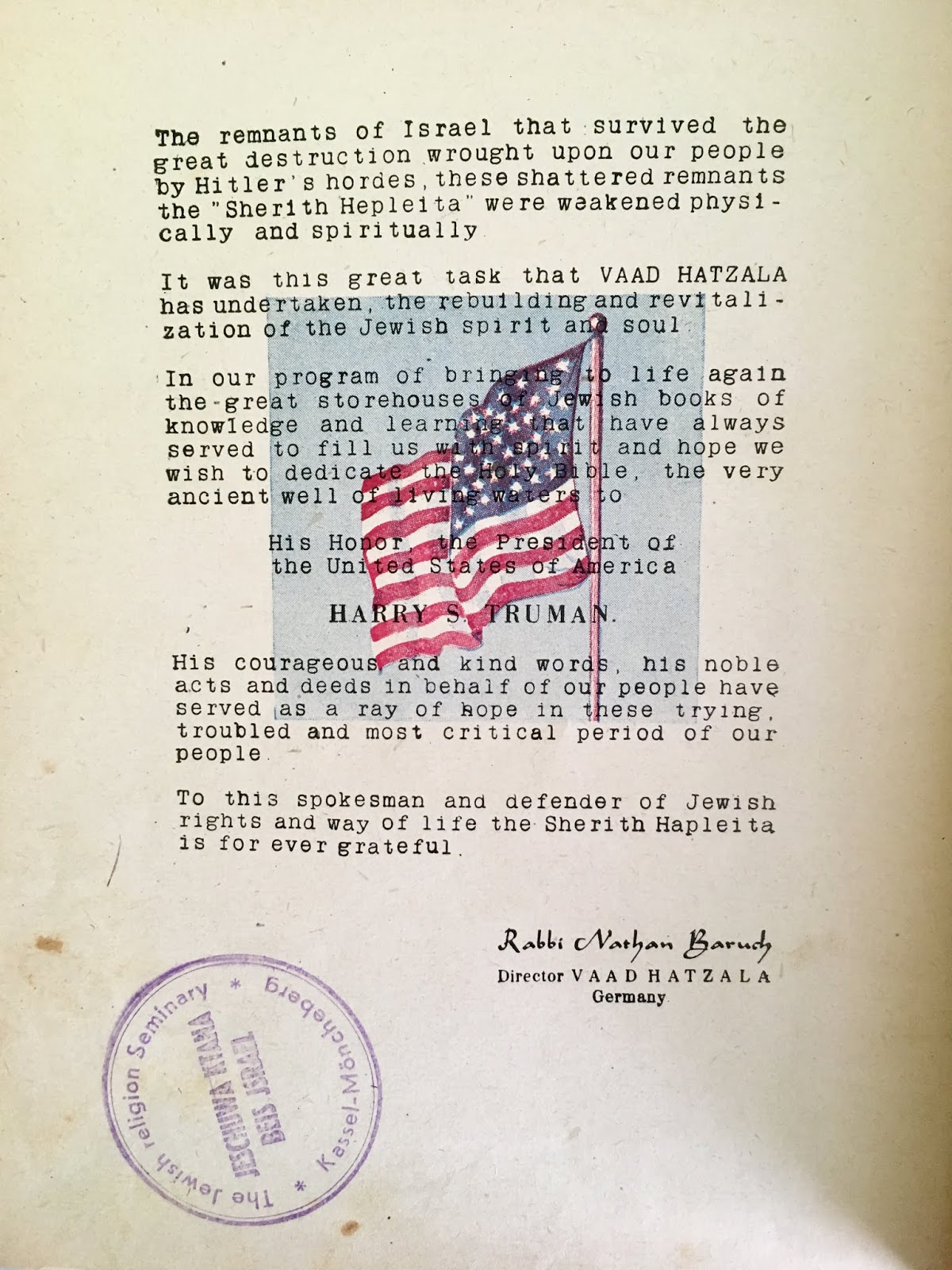
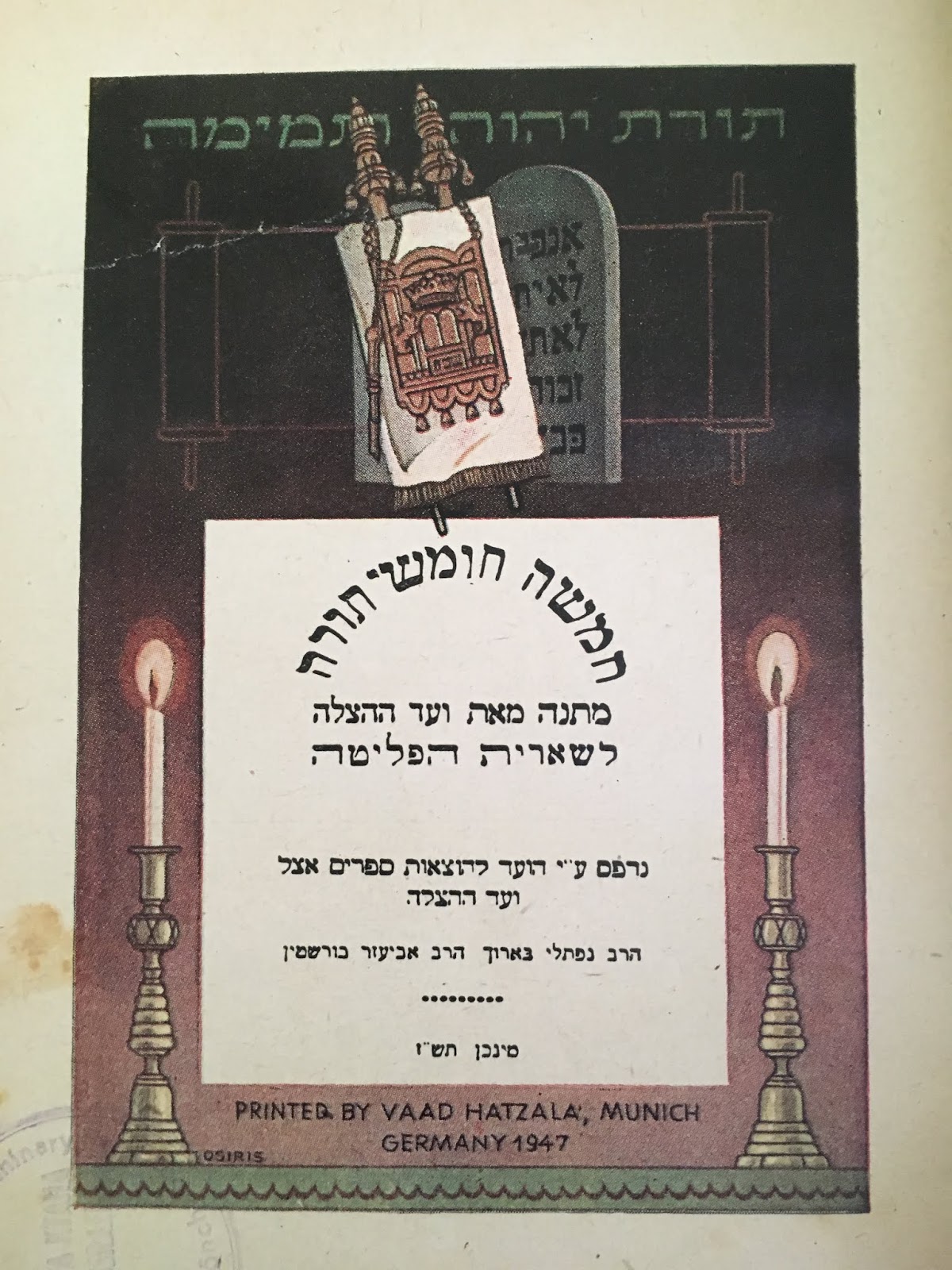
Appreciations of Gedolei Yisroel

Appreciations of Gedolei Yisroel

By Avraham Willner

From conversation with Harav Shmaryahu Shulman zt’l. Rav in Jersey City and Norwich Ct. Member of the Agudas Harabbonim. Author of Be’er Sarim, Ohr Layesharim and more.

In previous posts, I focused on anecdotes, thoughts and quotes I heard Rav Shulman repeat on occasion from the vast array of Gedolei Yisroel with whom he was privileged to share a close relationship. Presented here are a collection of Rav Shulman’s appreciations and admirations of various Gedolei Yisroel that emerged from the countless conversations I have had with Rav Shulman over the course of nearly two decades.

Note: in my previous post. Rav Shulman’s memories of Rav Ahron Kotler, there was a technical error in formatting the Hebrew text for an English platform resulting in some of the footnotes disarranging of several lines. To avoid this from reoccurring, all footnotes were inserted into the text, proceeded and followed by the{ } symbols.

הערכות וזכרונות מור הרב שמרישולמאן זצל על גדולי ישראל

‘חלק א

א] כשיצא לאור ספרו הראשון באר שרים על סוגיות הש”ס בשנת תשי”א, שלח הספר כתשורה לכמה רבנים וראשי ישיבות וביניהם הרב יצחק הוטנר זצ”ל ששלח לו בחזרה מכתב עם קצת הערות על הספר וצי’ק על סך חמישים דולר! שהיה סכום עצום אז. ואמר לי מו”ר שבכלל לא היה לו קשר עם רב הוטנר מקודם, וברור לו שצי’ק ששלח היה רק מטובת ליבו שברצונו לחזק בן תורה אמריקאי צעיר שכותב חידושים בש”ס דבר נדיר ביותר אז

ב] לפני שהדפיס ספרו באר שרים היה מרצה כמה מחידושיו לפני הרב משה פיינשטיין זצ”ל ואם הסכים לדבריו אז היה מכניס אותם לדפוס. ואמר לי שהספר לא היה על מסכת אחת רק איסוף של חידושיו על הש”ס, וכל פעם שנכנס להרב משה להציע לו חידושיו היה על ענינים אחרים ומסכתות אחרות, ועם כל זה כל פעם שדיבר עם הרב משה היה לו שליטה חזקה על הסוגיא על אתר בלי אפילו להביט בגמ’ לרענן עצמו לא היה צריך, ואמר מו”ר שהיה נראה לו כאילו כעת עוסק הרב משה באותה סוגיא. פעם אחד הציע לו חידוש ארוך ומיד כשסיים דבריו, אמר לו הרב משה שכבר כתוב כן בשער המלך, ואמר לי מו”ר מיד כשחזר הביתה מחק אותו סימן שאין ברצונו לכתוב דבר שכבר נמצא באחרונים, ולכתוב בסוף שוב ראיתי בשער המלך לא ניחא ליה לכן רק מחק אותו סימן

{היה למו”ר קשר חזק עם הרב משה זצ”ל, ומלבד שהיה מרבה לספר אודות גאונתו שהיה להפליא, שמעתי הרבה פעמים ממנו אודות מידות הנעימות שהיה להרב משה. פעם סיפרתי למו”ר סיפור ששמעתי על הרב משה איך שלא הקפיד על אחד שזלזל בכבודו וכו’ והגיב מו”ר שהרב משה לא רק לא הקפיד, הרב משה בכלל לא ידע מה זה המילים מקפיד וקפדות וכו’ והיה מספר לי שהוא ראה כמה פעמים שבאמצע שיעור כללי נכנס אחד לאסוף כסף, והרב משה היה מפסיק אפילו באמצע משפט, לתת צדקה ולומר קצת דברי ברכה ועידוד והיה חוזר מיד להמילה שהפסיק בה והיה ממשיך שיעורו, והוסיף מו”ר שרק אצל הרב משה היה דבר כזה, אף ישיבה אחרת לא יתנה לאסוף כסף באמצע שיעור.}

ג] אמר לי בזה”ל “שהגן עדן שלי כאן בעולם הזה היה כשהייתי רב בדזערסי סיטי מעבר לנהר מישיבת תפארת ירושלים והייתי נוסע שם תמיד ודיברתי עם הרב משה ועם אחיינו הרב מיכל פיינשטיין זצ”ל ביחד”. ואמר לי שהרב משה מאוד אהב את הרב מיכל והיה קשה עליו פרידתו כשעלה ארצה, והיו נמצאים ביחד הרבה ודיברו בכל אורך ורוחב של סוגיות הש”ס, והוסיף מו”ר שהוא זוכר שלא רק בהישיבה ישבו יחד, גם ברחובות העיר זוכר אותם מטיילים ביחד. ואמר לי מו”ר שהרב מיכל היה בקי גדול בטהרות (מלבד שאר גדלותו בתורה) והיה מוסר שיעור לבעלי בתים בבית כנסת אחת שבאייסט סייד במשניות טהרות

ד] אמר לי מו”ר שאף שכל הלומדות של העולם הישיבות נכללות בספרי הדברות משה, מ”מ לא היה הרב משה מדבר או כותב בסגנון הישיבתי היינו הביטויים שמדברים בישיבות, רק היה מדבר בפשטות,ונתן לי דוגמא – שהרב משה היה אומר שעל אדם לעשות כך וכך ולא היה אומר שהוא “דין בגברא” וכדומה. ואמר לי מו”ר כשהוא זכה לדבר עם הרב משה והרב מיכל ביחד, כשהרב משה היה אומר חידוש בלומדות והיה אומר אותו בפשטות היה הרב מיכל מתערב עם חיוך ואומר למו”ר “שהוא (הרב משה) מתכוון לומר שזה דין בגברא או דין בחפצה” ושאר ביטויים ישיבתיות

ה] ועד כמה עמוקים הם ספרי הדברות משה יש ללמוד ממה שראיתי אצל מו”ר שהיה בעל כשרון עצום וראיתי אותו כמה פעמים לומד בספרים שונים דף אחר דף במהירות רבה ובתפיסה מהירה, ועכ”ז אמר לי מו”ר כשיצא לאור ספר דברות משה על מסכת בבא קמא רצה ללמוד ממנו סימן אחד בשלמותו להבין איך מתורץ כל הקושיות שהקשה הרב משה בתחילת הסימן וכו’ אמר לי שלקח לו שבועיים שלמים ללמוד כל הסימן כדבעי!

ו] מו”ר לא היה ניחא ליה מדיבורים אודות השוואת בין גדולי ישראל ולשפוט מי גדול ממי וכדומה [אני אמרתי לו פעם מה ששמעתי ממו”ר הרב שמואל בירנביום זצ”ל ראש ישיבת מיר ברוקלין שאמר “האיש הכי גדול שהכרתי בחיי היה רבי משה פיינשטיין זצ”ל”{ ושוב רואים גדלותו של הרב משה פיינשטיין זצ”ל, שהרי הרב שמואל היה חניך הישיבות באירופא קודם המלחמה} ושאלתי למו”ר מי היה אדם הכי גדול שהוא הכיר בחייו, וענה לי “אני לא עונה מאחר שלא ניחא לי בדברים כאלו”] ואף על פי כן שמעתי ממנו שהתבטא פעם “המתמיד הכי גדול שראיתי בחיי היה הרב חיים פנחס שיינברג זצ”ל” והסביר זאת משום שהוא זוכר שראה אותו כמה פעמים בתחנת אוטובוס מחכה להאוטובוס להגיע והיה שקוע בלימודו, וסיפר לי שפעם ראה אותו נשען על עמוד ליד התחנה שקוע בלימודו “כאילו הוא נמצא בבית מדרש”

{הוא דבר שהפתיע אותי שלא ניחא לו להביע דעתו מי גדול ממי, אני ראיתי אצל כמה מזקני יוצאי ליטא, וחניכי ישיבות הליטאית של פעם שכולם דיברו פתוח מי גדול ממי וכו’. ובאמת נושא הזה צריך מאמר בפני עצמו איך השתנו הדבר, שהיום שמתי לב שבעולם הישיבות לדון ולשפוט בין גדולי ישראל ובפרט על גדולי ישראל מדורות הקודמות, הוא דבר שלא קיים, הם ראוים הנושא כבזיון התורה וכאבק לשון הרע וכדומה. ואני זכיתי בציעורתי ללמוד בישיבת מיר ברוקלין כשקיים אז השרידים ממיר פולין, והמקצת ששמעתי מהם וביתר מה ששמעתי מתלמידיהם שלמדו אצלהם לזמן ארוך ובפרט ממו”ר ר”מ בישיבת מיר שהיה התלמיד מובהק של הגר”ש בירנבוים זצ”ל, ברור שהנושא הזה היה שיחה רגילה אצליהם, והגר”ש בירנבוים היה מלא וגדוש בדעות מי גדול ממי וכן גם שאר יוצאי מיר פולין לא הסתיר דעותיהם על מי גדול ממי. ואני שמעתי גם מהרב נטע גרינבלט שליט”א שלא רק אמר דעתו על מי גדול ממי אלא שהיה מצטט רבותיו שדיברו פתוח בענין זה ואכמ”ל. (וזכיתי להיות אצל מו”ר, כשבא הרב נטע לביקור חולים אצלו ודיברו מעל שעה ותוך דבריהם, סיפר הרב נטע למו”ר, כשהיה בחור בישיבת תפארת ירושלים היה רב אחד שניסה לשכנע אותו לעזוב תפארת ירושלים כדי שילך ללמוד אצל הרב אהרן קוטלר בלייקוואד, ואותו רב אמר לו שכל הבחורים המצוינים לומדים אצל הרב אהרן. יום אחד כשלחץ עליו אותו רב יותר מדי, הרב נטע אמר לו “ומי אמר לך שרב אהרן יותר גדול מהרב משה?!” והרב נטע תיאר איך שאותו רב הסתכל עליו כאילו הוא (הרב נטע) יצא מדעתו, ואותו רב התרחק ממנו ולא דיבר איתו עוד מילה. (שהיה כל כך פשוט לאותו רב שהרב אהרן יותר גדול). והרב נטע ביקש ממו”ר להביע את דעתו בנושא מי היה יותר גדול הרב אהרן או הרב משה, ומו”ר התחמק מלהשיב, והרב נטע אז אמר ” אין דער וועלט איז אנגענומען אז הרב משה איז געווען גרעסער” (מקובל בעולם שהרב משה היה יותר גדול). וגם על זה לא הגיב מו”ר כלום שלא היה רצונו כלל להתערב בנושא.}

ז] ואף שלא ניחא לדבר בעניני רמה בגדולי ישראל וכדומה, כשהרגיש פגיעה בכבוד התורה היה מביע את דעתו ללא התלבטויות, אני פעם אמרתי לו שראיתי בספר שכתב דברי גנאי על הרב אברהם אהרן יודעלאוויץ זצ”ל רב הכולל לאגה”ק בניו יארק ומחבר שו”ת בית אב ה’ כרכים ועוד הרבה ספרים, התרגז מו”ר ואמר “וואו קומט אים צו הרב יודעלאוויץ” (כלומר שהוא בכלל לא מגיע למדרגתו) ואמר שלהרב יודעלאוויץ היה לו תלמידים יותר גדול מהרב ההוא {ותוך כדי דיבור ‘תיקן’ את עצמו, שהרב יודעלעוויץ לא היה לו תלמידים “אילו היו לו תלמידים בוודאי היו הם גדולים ממנו”} ושמעתי ממנו כמה פעמים שהתלונן שלא העריכו את הרב יודעלאוויץ כדבעי עקב פסקו המפורסם בענין שליחות בחליצה, והעולם לא יודעים שהוא לא היה “סתם רב” אלא שהיה גאון עצום ופוסק בד’ חלקי שלחן ערוך וכו’. וסיפר לי כשהגיע הרב שניאור קוטלר זצ”ל לחופי ארצות הברית, הלך מיד לבקר אצלו ולקבל את פניו, ודיבר איתו במשך זמן ארוך ותוך הדברים התגלגלה השיחה אודות הרב יודעלאוויץ, והרב שניאור אמר לו שחבל שפסקו בענין חליצה “השחיר” דמותו של הרב יודעלאוויץ בעיני העם ולא ידעו על גדלותו.

ט] ועל הרב שניאור קוטלר זצ”ל עצמו, אמר לי מו”ר שהעולם לא העריכו אותו כמו שצריך והיה גאון גדול ובקי בש”ס, ואמר לי באותה פגישה כשקיבל את פניו מיד בבאו לארצות הברית דיבר איתו על כמה סוגיות שונות בש”ס והרב שניאור “ידע הכל”, (“ער האט געקענט איבעראל”, כלשונו) ואמר לי שהסיבה שלא העריכו אותו כמו צריך היה משום שהיה בנו של הרב אהרן קוטלר ומאחר שלא היה במדריגת אביו ביטלו אותו שהוא “לא אביו” אבל לא הבינו שהוא גאון גדול בפני עצמו אף שהוא לא אביו. ודימה אותו להרב צבי רבינאוויץ זצ”ל בנו של הרב יצחק אלחנן ספקטור זצ”ל, שגם הוא לא קיבל את הכבוד המגיע לו עקב שהיה בנו של הרב יצחק אלחנן ולא היה במדרגתו של אביו, ופעם אחת הוסיף מו”ר דאם הוא לא היה בנו של רי”א היו מחשיבים אותו כגאון וגדול, ורק משום שהוא לא אביו לא כיבדו אותו כראוי.

י] באותו פגישה עם הרב שניאור, שאל אותו מו”ר שהוא שמע הרבה בארצה”ב אודות שיעורו של הגרי”ז מבריסק בירושלים, ושאל את הרב שניאור “במה כחו גדול” ומה מיוחד בשיעוריו. וענה הרב שניאור לא כדרך רמי”ם אחרים שמקשים קושיות חזקות היה הגרי”ז, הוא לא הקשה שום דבר, רק קרא את דברי הגמ’ רש”י ותוס’ ומסביר אותם בביאורים קצרים, ועם אותם ביאורים קצרים לא נשאר שום קושיות שמקשים אחרים בספריהם וכו’.

יא] ומדי דברי לעיל אודות הרב יודעלאוויץ, פעם אמרתי למו”ר מה שראיתי בספר עולת שמואל מהרב שמואל בסקין זצ”ל (עמוד 247) שמספר כשאחד מן המזומנים לחתונה, שהיה הגאון ר’ אהרן יודעלעוויץ זצ”ל מכובד לסדר קידושין בשם, ביקר את הרב הנ”ל בזה ששמע ממנו את דרשתו שדרש להזוג זה כמה פעמים שהיה עמו בחתונות אחרות, השיב הרב יודעלאוויץ, ומה הפלא? האם רופא חולים כותב פתק רפואה שונה לכל חולה וחולה, אם כל החולים סובלים מאותה מחלה עצמה?!. וסיפרתי הנ”ל למו”ר שידעתי שהוא יהנה מה”הומור הליטאי”, והגיב שזה מזכיר לו מהרב גדליה סילברסטון זצ”ל הרב דוואשינגטאן הבירה ובעל מחבר ספרים רבים בדרוש ועל הש”ס, שביום כיפור לפני נעילה נשא אותה דרשה שנשא השנה שעברה לפני נעילה, וכשנשאל על כך השיב, אז מה? וכי זה לא אותו מחזור כל שנה! (כלומר שמתפללים אותה נוסח התפילה מדי שנה בשנה).

{ מו”ר לא הכיר אותו אישי, בזמן שמו”ר עבר לוואשינגטון הרב גדליה כבר עלה ארצה, אולם מו”ר שמע הרבה אודותיו מתושבי וואשינגטון שהתפללו אצלו.}

יב] אני שמעתי ממקור מוסמך (מהרב אבא ברונשפיגל שליט”א ה’ ישלח לו רפו”ש) שפעם יצא הרב שמואל וואלק זצ”ל ר”מ בישיבת רי”א ובעמ”ס שערי טהר מחדר שיעורו תוך שהוא אומר לתלמידיו שהוא הולך לבחון הרב יוסף דוב הלוי סולובייציק זצ”ל ראש ישיבת רי”א, לדעת אם הוא “יודע טהרות” וכשחזר לחדר שיעורו אמר לתלמידיו “ער קען טהרות טאקע” (הוא באמת יודע טהרות). ואני שאלתי את מו”ר אם הוא שמע סיפור כזה ומה דעתו עליו, וענה לי שהוא גם כן שמע סיפור הנ”ל מתלמיד ישיבת רי”א שהיה גר בשכונתו בקווינס. ודיברנו קצת על הסיפור ואז אמר לי מו”ר שכל זה דברים מיותרים שהרב יאשע בער לא זקוק להסכמת הרב וואלק, ולא היה צריך שהוא יחזיק ממנו! (כלומר שהרב יאשע בער הוא יותר גדול מהרב וואלק).

{וכדי לדעת כמה גדול הרב יוסף דוב היה, כדאי לדעת עד כמה גדול היה הרב שמואל וואלק, מלבד שהיה למדן מובהק ומחדש בכל התורה כולה וכתב חידושים עמוקים על כל הש”ס, ראוי לציין כשנפטר הרב חיים שטיין זצ”ל ראש ישבת טלז בקליוולאנד, כתבו עליו באחד העיתונים החרדיים שבבחרותו כיבדו אותו הישיבה בטלז לשבת ב”מזרח” יחד עם רבני השיבה! וסיפר לי חותן אחי ר’ ראובן גרשון שליט”א (ראש כולל בקליוולאנד ובעל מחבר ספרים רבים ומו”ל כמה מספרי רבו הרב גיפטר זצ”ל) כשקרא הנ”ל אמר שכל ימיו גדל בין כותלי ישיבת טלז וידע היטב הנהגתם וכו’ ודבר זה כל כך אינו בהתאם לרוח ישיבת טלז, ואמר למרות גדלותו של הרב חיים אי אפשר להאמין למה שכתבו עליו, לכן הלך לשאול היחיד שנשאר בחיים מטלז ליטא, הרב בארון זצ”ל שהיה גר אז בקליוולאנד. ושאל אותו האם זה נכון שהרב חיים ישב במזרח בטלז, וענה שלא היה דברים מעולם והישיבה לא היתה נותנת לאף מבחורי הישיבה לשבת במזרח ואפילו תוך ד’ אמות של המזרח לא היתה נותנת! ושוב הוסיף שאם היתה כן נותנות לבחור לשבת במזרח אז שמואל וואלק יהיה הבחור! ע”כ מה ששמעתי מר’ גרשון. צא וראה גדלותו של הרב יוסף דוב שיותר גדול מכל הנ”ל. }

{וכידוע הרב וואלק היה בקי גדול בטהרות, וגם מחדש גדול בטהרות, ורוב מחלקיו הראשונים של ספרו שערי טהר הם בענינים עמוקים בטהרות. הרב ברונשפיגל אמר לי אז שהרב וואלק היה גאון בכל התורה כולה אבל היה לו אהבה מיוחדת לקדשים וטהרות, ובשיעוריו על המסכתות הישיבתיות היה רגיל להביא משלים ודוגמאות מקדשים וטהרות, וסיפר לי כשלמד בבא בתרא אצלו זוכר שהביא כראיה לחידושו בתוס’ בבא בתרא מדברים עמוקים מקדשים והיה מאוד קשה להבין הכל שלא היה להבחורים הרבה רקע בקדשים וטהרות.}

ובאופן כללי, רגיל היה מו”ר להגן על כבודו של הגרי”ד הלוי ומאוד אכפת לו שהיו אלו שזלזלו בכבודו, וכמה פעמים שמעתי ממנו אודות אלו שפגעו בכבודו של הגרי”ד “הם לא יכולים להבין אפילו השיחת חולין שלו, ומדברים נגדו?!.

יג] היה אומר על הרב הענקין זצ”ל, “שהיה איש אחד שעשה עבודת ארבע אנשים” ותיאר לי איך היה נראה משרדו של הרב הענקין שמו”ר היה אצלו הרבה. הרב הענקין היה מדבר בטלפון להתרים כסף לעזרת תורה, ולידו היה עומד נציג מאגודת הרבנים עם גט בידו שבא לשאול אותו אודות כתיבה איזה שם וכדומה, ומיד שסיים הטלפון היה פוסק השאלה ואז נכנסו אנשים ונשים עם שאלות על עופות ומראות נדה וכדומה ומיד כשגומר איתם היה חוזר לטלפון להתרים עוד וכו’. ומו”ר היה נתפעל איך איש אחד היה מסוגל לעשות כל אלו הדברים יחד ולא היה מחלק חלק מתפקידו לאחרים.


Gelatin, Abraham Goldstein, R. Moses Isserles, and More, Part 2

 Gelatin, Abraham Goldstein, R. Moses Isserles, and More

Marc B. Shapiro

Continued from here

Among the matters I discussed in the previous post were gelatin and consumption of the human body as part of a medical cure. Believe it or not, consumption of human parts not in the context of medicine is mentioned in a short responsum of R. Joseph Kafih. R. Kafih was asked if it permissible to drink various non-Jewish milk products and also gelatin produced from non-kosher animals. He is strict when it comes to milk—and apparently unaware of the widespread rabbinic approval in the United States for regular milk—but lenient regarding gelatin.[1] Incredibly, he assumes that some gelatin comes from human bones, and he believes that it is halakhically preferable to consume this instead of gelatin from animals (although the latter is kosher as well).

Here is an image of the letter sent to R. Kafih and his reply, followed by a transcription of the relevant sections.

האם מותר לאכול כיום:

חלב עכוםאבקת חלב עכוםחמאת עכוםגלטין המיוצר מנבלות וטרפות (במיוחד במוצרים המיובאים מחול בהשגחת הרבנות הראשית)?

חלב גוים נאסר במניןואין להתירואמנם רבני אמעריקא התירו אבקת חלב בשעתווהרבנות כאן סמכה על כך בזמנואך אין להתיר חלב גוי על סמך התר זהחמאת גוים מותרת כמש הרמבם מפני שכבר הלכו צחצוחי חלב שבה. ”ג”לטין‟ לדעתי אין להחמיר בובפרט העשוי מעצמות אדםכי בשר האדם עצמו בעשה להרמבםולאחרים אפלו מצות ”פרוש‟ אין בווכל שכן עצמותיו.

In the comments to the last post, two people referred to the responsa of R. Nahum Zvi Kornmehl as a source regarding gelatin. In the first part of R. Kornmehl’s Tiferet Tzvi, vol. 1, there is a long discussion about gelatin, and it is here that R. Aharon Kotler’s responsum on the topic first appeared. R. Kotler’s letter and other letters found in the sefer also deal with a “kosher gelatin” that was produced by Barton’s candy. R. Kornmehl was the mashgiach of Barton’s so it makes sense that he would be involved in this halakhic issue. What many people might not realize is that R. Kornmehl’s brother-in-law was Stephen Klein, the owner of Barton’s. (Everyone over 50 can certainly remember Barton’s, especially on Passover. Many children, myself included, went house to house taking Barton’s Passover orders. Depending on how much you sold, there were all sorts of great prizes.)

While it was obviously perfectly acceptable for R. Kornmehl to involve himself in the halakhic research regarding Barton’s gelatin, would any of our rabbis today accept a situation where the mashgiach of a factory is a close relative of the owner? I think they would say that this defeats the entire purpose of a mashgiach, whose job is to ensure that kashrut standards are at the highest level, and he is therefore not supposed to have any close personal connections with the owner.

Here is a picture of R. Kornmehl at the Barton’s factory, from Rabbi A. Leib Scheinbaum, The World that Was America 1900-1945 (Brooklyn, 2004), p. 415.

Returning to Abraham Goldstein, one can imagine what he would have said had he been told about R. Moses Isserles’ responsum, no. 54. Here R. Isserles states that there is no halakhic problem consuming olive oil that was stored in containers in which they used pig lard to smooth the surface. (He later notes that there is even stronger support for this ruling if there is only a suspicion, but no certainty, that they used lard on a particular barrel). This ruling by R. Isserles is the exact sort of thing that today we would be told is absolutely forbidden, and Goldstein certainly would have attacked any hashgachah that followed the Rama in this matter.

Interestingly, R. Hanokh Henoch Meyer of Sassov could not accept that the Rama would allow us to eat something that might have pork residue, and he therefore adopted the old approach when confronted with “problematic” texts, namely, asserting that this responsum was not written by R. Isserles. Rather, some student must have been responsible for it, as it is impossible for R. Meyer to believe that R. Isserles would write something that in his mind is so obviously incorrect.[2] R. Judah Leib Landau, in his well-known work Yad Yehudah, Yoreh Deah 103:20 (Perush ha-Arokh), also has his doubts that R. Isserles could have written the responsum:

ובאמת הדבר הוא לפלא מאוד אם יצאו כלל דברים אלו מפי קדשו של הרמא זל

This is the exact approach that was adopted by some in explaining another responsum of R. Isserles, where he justified those in his day who drank non-Jewish wine.[3] There is also another difficult and controversial responsum of R. Moses Isserles—see the discussion on the Seforim Blog here—and in this case R. Yitzhak Hutner also denies that the responsum was written by R. Isserles.[4]

R. Isserles’ opinion in responsum no. 54 is based on the fact that any pork residue would be less than 60, and also that the pork taste is to be regarded as something detrimental to the dish (noten ta’am lifgam). This is indeed a difficult point to understand, as why should pork be noten ta’am lifgam? You can look around and see that lots of people enjoy it. R. Shimon Grunfeld goes so far as to say that it was only because of R. Isserles’ great holiness, which caused him to view pork with such disgust, that he could make the error of seeing pork as noten ta’am lifgam.[5]

עוד דבר אחד חידוש פלא שכתב ששומן חזיר הוא פוגם בכל דבר כמו נבלה מוסרחת עיין שםוהיא תמיה גדולה שהרי אנו רואין כל העכום וכל השרים אוכלים אותו והוא עולה על שלחן מלכיםהן אמת שנפש איש ישראל קצה באכילת חזיר אבל הוא רק משום איסורי של תוהק שאסרה אותו ולכן כל איש ישראל כשרואה חזיר הוא מואס אותו אבל בשביל זה לא חשוב נטלפג דנטלפג היינו שמצד עצם הדבר הוא פוגם . . . ופשוט דאין לסמוך בזה על התשו‘ הנלובודאי שומן חזיר אוסר עד ס‘ או יותר כפי הרגשת הטעםוהרמא זל ברוב קדושתו מחמת איסור התורה על בשר חזיר הי‘ קצה ממנו ככ עד שפלטה קולמסו לכתוב שאינו אוסר משום שהוא פוגם

In his discussion about how pork is noten ta’am lifgam, R. Isserles also says something which I found strange. He writes:

דשאני חזיר דדבר מאוס הוא ביותר מכל שרצים שבעולםעד שאמרו לא יאמר אדם אי אפשי בבשר חזיר וכו‘ ולא אמרו שאר שרציםשמ דזה גרע טפי

R. Isserles cites a passage from Sifra, Kedoshim 9:10, which is quoted in Rashi, Leviticus 20:26, that one should not say that he is repulsed by pork, and that is why he doesn’t eat it, but rather he doesn’t eat it because of the Torah’s command. (Rashi’s version is different than what is found in our versions of the Sifra, and also what is quoted by R. Isserles, but the point is the same.) R. Isserles sees it as significant that of all the non-kosher foods that could have been cited, it is pork that is used as an example, which he believes shows that it is the most repulsive of the non-kosher foods.

The reason I find R. Isserles’ point strange is that R. Isserles’ understanding is the exact opposite of how the passages in Sifra and Rashi are usually understood. The common way of understanding, and I don’t know of anyone who has a different approach, is that you should not say that you are disgusted by pork, and that is why you are not eating it. On the contrary, there is nothing wrong with pork and it is undoubtedly quite tasty. However, we do not eat it because God commanded us not to. This reading appears explicitly in both the Sifra and Rashi, Here is what Rashi states:

רבי אלעזר בן עזריה אומר מנין שלא יאמר אדם נפשי קצה בבשר חזיראי אפשי ללבוש כלאיםאבל יאמר אפשיומה אעשה ואבי שבשמים גזר עלי

This is very different than R. Isserles’ understanding that the rabbinic teaching reinforces the point that we should have a natural aversion to pork, even though the reason for abstaining from it is due to God’s command.

After mentioning how we don’t eat pork, the passage continues in Rashi (and this is also how it is quoted in the Rambam, Shemonah Perakim, ch. 6, but not in our version of the Sifra) that the same lesson is applied to the wearing of sha’atnez. We shouldn’t say that we have no desire to wear it, but on the contrary, we should feel that it would be nice to wear it but we cannot because of the divine command. The Sifra also adds the same point about sexual relations, that we do not avoid it because we are repulsed. Rather, we would enjoy this but abstain because of the divine command. Since the passage cites both pork, sha’atnez, and forbidden sexual relations to teach the same lesson, and there is no natural aversion to sha’atnez and sexual relations, it is clear that just as we might wish to wear sha’atnez and have forbidden relations but avoid them because of the mitzvah, so too one should assume that eating pork would be enjoyable. However, we avoid it because of the mitzvah.

The Rambam elaborates on this point in Shemonah Perakim, ch. 6, and he specifically cites the rabbinic passage we have been discussing. He goes so far as to say “that a man needs to let his soul remain attracted to them [pork, sexual relations, etc.] and not place any obstacle before them other than the Law.” What this means in practice is next time you see lobster in the supermarket, don’t be repulsed by it and think it is disgusting. The Rambam, following the Sages, is telling us that we should say “wow, that looks good. I would really enjoy eating it but the Torah says I can’t.” Easier said than done, I realize, but that is what the Sages and the Rambam have told us.

Returning to R. Moses Isserles, the Taz, Yoreh Deah 108:4, quotes another ruling of his that today would not be regarded as acceptable. R. Isserles testifies that the practice was to buy certain food items cooked by non-Jews in their non-kosher pots (Torat ha-Hatat 35:1):[6]

המנהג להקל לקנות מן הגוים דברים המבושלים בכליהם שאין בהם משום בישול גוים (הוא) [הואילוסתם כליהם אינן בני יומןואעפ דנותן טעם לפגם אסור לכתחלהמכל מקום לא חשבינן הקנייה לכתחלהלכן נוהגים היתר פה קראקא לקנות האגוזים של מים שמבשלים הגויםאו שאר דברים

Regarding other leniencies of R. Isserles, R. Zerach Eidlitz[7] is quoted as saying that it would have been OK for R. Isserles to have omitted all the humrot he records if he also omitted two particular kulot: non-glatt meat (Yoreh Deah 39:13) and that it is permitted to eat worms found in cheese (Yoreh Deah 84:16):

נוהגים בתולעים של גבינה לאכלן אעפ שקופצין הנה והנה על הגבינה אבל אם פירשו לגמרי אוסרין אותן

Returning to Goldstein, he would have been outraged by other halakhic leniencies mentioned by outstanding poskim, but again, he approached matters using logic and intuitive feelings, while the halakhic rules do not always fall into line with this. For example, R. David Ibn Zimra, She’elot u-Teshuvot ha-Radbaz, no. 1032, defends eating meat together with sugar that was cooked with milk. He states that this is permissible because the milk is batel. R. Hayyim Vital testifies that R. Isaac Luria would himself eat such sugar with meat.[8] Not only would Goldstein have protested against this leniency, but to my knowledge there is no kashrut agency today that would give a hashgachah to a meat product that includes sugar cooked with milk.

Another famous responsum which Goldstein would not have been able to accept—and I know that many Orthodox Jews today also would not be able to accept it—is Noda bi-Yehudah, Yoreh Deah, tinyana,[9] no. 56. Here R. Yehezkel Landau permits a drink produced by non-Jews that included a small amount of non-kosher meat (assuming the meat is 1/60 or less). The meat did not add a taste, and R. Landau ruled that it was batel, meaning that the drink was kosher. I could go on with other such examples but I think you get the point, which is that when it comes to kashrut, great halakhic authorities have come to conclusions that are far from what the average Orthodox Jew would regard as acceptable.

The phenomenon of the masses sometimes having stricter views than the rabbis is an old story. In fact, I once spoke to R. Aharon Felder about kitniyot. At the time, R. Felder was the halakhic authority for the KOF-K. As is well known, kitniyot is batel be-rov (see e.g., Mishnah Berurah 453:9), so I asked him why the KOF-K does not put a hashgachah on products with corn syrup since it is batel. He replied: “The people don’t want it.” In other words, the people will not accept that something with kitniyot can be kosher for Passover, even if it is batel be-rov.[10]

R. Felder also told me that if he was asked he would tell people that there is no problem eating a product with kitniyot if it is batel be-rov. According to this approach, one is permitted to drink regular Coke on Passover, and this is indeed the pesak of R. Yitzhak Abadi. (The other issue that comes up with regular Coke is whether kitniyot derivatives are forbidden on Passover.) I realize that if you extrapolate the “halakhot” of kitniyot from Yoreh Deah halakhic principles about when bitul can be applied, there are sources that would be strict in dealing with kitniyot (as the kitniyot is put in as part of production, rather than accidentally falling in). But what is interesting, I think, is that pretty much all the rabbis I have asked about this have replied in the same way. Rather than explain why we don’t follow the principle that kitniyot is batel be-rov, they have stated simply that when it comes to Passover we are extra strict. (R. Hershel Schachter is an exception, and he told me that kitniyot intentionally put in the product is not to be regarded as batel.)

This issue was raised by R. Alfred Cohen a number of years ago:

With this in mind, we should take another look at the furor which in the past few years has arisen concerning chocolate and candy manufactured in Israel under the supervision of the Rabbinate. Many candies contain corn syrup as the sweetener: Should this be considered a problem for Ashkenazic Jews? Based on the principle that if kitniyot are less than half of the total the food may be eaten, many people see no reason why such candy should be avoided.[11]

Returning to the gelatin issue, we saw in the previous post that R. Yehuda Gershuni was one of the rabbis who gave the hashgachah on Jello. This is noteworthy, as in 1952 he wrote a lengthy article in support of the position of his father-in-law, R. Eliezer Silver, that gelatin is forbidden.[12] Either he later changed his mind or perhaps he never really thought gelatin was forbidden, but it was only out of respect for his father-in-law that wrote his lengthy article. It seems that only after his father-in-law died in 1968 did R. Gershuni publicly express his lenient opinion about gelatin. In addition to his hashgachah on Jello, R. Gershuni also gave the hashgachah to Hormel gelatin.[13]

Incidentally, I found another example where R. Gershuni significantly changed his position. In Ha-Pardes, June and August, 1957, R. Gershuni discusses Yom ha-Atzmaut. Surprisingly, knowing how Zionist he was, in these articles he is not very positive about Yom ha-Atzmaut. He even says that according to Nahmanides establishing this holiday is a violation of bal tosif. As for saying Hallel on Yom ha-Atzmaut, R. Gershuni brings a variety of sources according to which this is improper. Yet in 1961 he published an article with the exact opposite perspective, in which he writes of the great significance of Yom ha-Atzmaut and that Hallel should be recited on this day.[14]

Those who wish to see a video of R. Gershuni can view it here. As far as I can tell, this is the only video of him available online. It is from the 1990 Yom Yerushalayim celebration at Merkaz ha-Rav. You can also see R. Shlomo Fisher in attendance.

In addition to gelatin, my previous post dealt with some of the history of hashgachot in America in the 1930s. In those days, no one could have imagined all the different hashgachot we currently have, as well as the various products that are under kosher supervision. In previous posts here I already mentioned how you can now get toilet bowl cleaner with a hashgachah. Here is an American hashgachah.

And for those who live in Israel, here is one with an Israeli hashgachah (thanks to Stanley Emerson for the picture).

I also noted how in Israel you can buy lettuce with no less than six different hashgachot. See here. But it gets even better, as Shimon Steinmetz sent me this image which shows that you can now get romaine lettuce with seven different hashgachot. Do I hear eight . . . ?

Yet I don’t think Israel has what we have, namely, ant and roach killer under hashgachah. (It is pareve.)

(For those who are wondering, the date on upper right of the OU letters is the date that you view the document, not when the contract was signed.)

You can even get enzyme replacement injections under OU supervision. See here.

According to the OU, when they are “approached by companies whose products would not inherently need a hechsher, the OU tells them that certification is not necessary. But some companies request kosher certification because that will make Orthodox Jews more likely to buy them.”[15]

Interestingly, since today we take it for granted that all sorts of unnecessary hashgachot are found on various non-food items, in previous years this was seen in a very different light. In 1896 the New York newspaper Ha-Ivri, in an attack on the rabbinical board headed by R. Bernard Drachman, noted how the board had given hashgachot to salt, soap for washing clothes, and stove polish.[16] This scandalous charge was denied by R. Drachman, who noted that these hashgachot were given by a private individual, not his organization. R. Drachman writes as follows, and look how he describes the unnecessary hashgachot:[17]

ההכשרים המוזרים והמעוררים שחוק אשר רמזת עליהם לא מעשי הועד המה כי אם מעשי ידי איש יחיד

While we are on the subject of hashgachot, I think readers will find it of interest that the OU did not accept all the products certified by R. Soloveitchik in Boston, as his hashgachah did not always meet OU standards which had been established by R. Alexander Rosenberg. R. Berel Wein, who succeeded R. Rosenberg as rabbinic administrator of OU Kashrut, reports that he was constantly criticized for this as people thought it very disrespectful to the Rav that the OU did not accept his hashgachah in all matters. R. Wein, however, explains as follow:

In all my meetings with the Rav. I never discussed this sensitive matter with him. However, he once said to me, “As the rabbi of Boston, it is my duty to grant kashrut certification to products that are kosher, even if they don’t necessarily reach the highest standards of kashrut. I know you have to operate under a different set of rules. Don’t be troubled that the OU doesn’t use certain products I certify. I’m not troubled by it.” I never revealed that conversation to the Kashrut Committee, nor did I change OU policy.[18]

However, my question would be, how is the role of OU kashrut different than what the Rav was trying to do? Isn’t the goal of the OU also to ensure kashrut for all types of Jews? How is the role of a communal rabbi in giving a hashgachah for his community different than that of the OU, which is a nonprofit organization that exists to serve the larger Jewish community?

Since part 1 of this post discussed the OK hashgachah, it should be noted that at one time there were actually two hashgachot identified with the OK symbol. Here is an early OK symbol used by R. Harold Sharfman’s Kosher Overseers Association of America. (A different looking OK symbol was actually first used by his father, R. Hyman Sharfman, in 1927.)[19]

It later developed into what was called the Half-Moon K, surrounded by a circle.

This led to a lawsuit by the OK in the 1990s, with the result that the Half Moon K had to appear without the circle.[20] (I don’t know why, as we have seen on other occasions as well, a dispute between Orthodox rabbis was decided in a secular court instead of in a beit din.) After Rabbi Sharfman’s death, the Half-Moon K was taken over by the OU and its symbol was retired.

Sharfman authored a few interesting works focusing on American Jewish history. He also wrote the book, Global Guide to Kosher Foods and Restaurants (Malibu, 1990), from which the above pictures of the OK symbol were taken. The book’s title is not going to interest many, although the subtitle is more intriguing: “An Illustrated History of Kashruth in 20th Century United States.” This is a very rare book and I recently was able to acquire a copy. I was surprised to find that it is really a fascinating work with some great pictures. Because it is so rare I have made a PDF of the book which you can see here.

When it comes to kashrut supervision in the United States, Roger Horowitz mentions an interesting point that in the 1950s there were rabbis who opposed supermarkets selling kosher meat as they claimed that it was forbidden for the meat to be sold on Shabbat.[21] The real reason for the opposition was presumably to protect the kosher butchers from competition, but the argument was not framed in this fashion. I think most will be surprised by such a stringent approach. After all, we don’t want Sabbath violators to also consume non-kosher meat, so why prevent them from buying kosher if they are in the supermarket on Saturday? Yet when asked by R. Yitzhak Zilberstein, R. Elyashiv ruled that if people are going on a trip on Shabbat, and want to order kosher food from a caterer for the trip, that the caterer should not provide them with the food even though this means they will eat non-kosher.[22]

Another surprising development in the kashrut world is that the OU has recently refused to give a hashgachah to a vegetarian product called Impossible Pork. See the Yeshiva World article here, and see also the Wall Street Journal article here. As the Yeshiva World reports, “[Rabbi Menachem] Genack clarified that although [the] OU certifies items related to pork such as Trader Joe’s ‘spicy porkless plant-based snack rinds,’ the agency decided that certifying a product called ‘pork’ was a red line they aren’t willing to cross right now.” 

In the Wall Street Journal article Rabbi Genack is quoted as follows: “The decision was based on the emotional reaction some kosher eaters have had to kosher-certified pork-related products in the past that also had no actual pork in them.” So now company kashrut decisions are based on people’s emotional reactions? Sounds crazy to me. The article continues: “Rabbi Genack of OU Kosher says he suspects that doubters might one day come around and allow faux pork to be certified as kosher.” I don’t understand this at all. Since when does the OU have to get approval from “doubters” to put a hashgachah on a product? Furthermore, I must note, there are already OU certified products that have the name “bacon” in them and are said to taste like the real thing. This includes Bacos (see here), Bacon Flavored Bits (see here), and even a product called Bacon Bits Milk Chocolate (see here). And of course, the Talmud, Hullin 109b, talks about the shibuta fish whose brain tastes like pork.[23]

Since we have been speaking about kashrut in America, let me make one final point about this. Many people are under the impression that it was Jewish emigration to America that led people to give up kashrut, I must therefore call attention to a fascinating article by Asaf Kaniel that shows that in the years 1937-1939 only one third of the Jews of Warsaw bought kosher meat. Granted, this was a very difficult period for the Jews of Warsaw, and had economic circumstances been different I have no doubt that most of these people would have been buying kosher. However, from the large number who abandoned kashrut, we can get a sense as to how tenuous their attachment to this mitzvah was, as it is always the case that during difficult times the ones who are not so attached to something are the first to give it up.[24] (Kaniel also has another valuable article that shows the growth of irreligiosity in Vilna in the early twentieth century.[25])

I know people will be shocked by hearing this, about Warsaw of all places. So let me note that in a 1937 interview given when he was in the United States, R. Elhanan Wasserman stated that religious life in Poland was worse than in America.[26]

2. In my last post I cited something from R. Shmaryahu Shulman who unfortunately recently passed away. In 1951 R. Shulman published his Be’er Sarim which contains hiddushim on the Talmud.

In R. Yitzhak Ruderman’s approbation he states that this is the first book of hiddushim on Shas published by an American-born author. Is this true? I am not aware of anything earlier. As far as I know, the first traditional rabbinic sefer (not hiddushim on Shas) published by an American-born author is R. Eliezer Zvi Revel’s Otzar ha-Sotah (New York, 1941).

R. Eliezer Zvi was the son of R. Bernard Revel.

Is there an even earlier sefer published by an American-born author? There is another sefer that I am aware of, but as it is not an original sefer, I gave Revel the honors. The other sefer was published by R. Bernard Drachman, who was born in New York in 1861. In 1907 he published an edition of Divrei ha-Rivot by R. Zerahiah ha-Levi and R. Abraham ben David, together with his commentary.

Who was the first American-born author to publish a book in Hebrew? This would appear to be Reuven Grossman (1905-1974; he later took the last name Avinoam). Born in Chicago, Grossman spoke Hebrew as his first language. His first book, Mi-Pi Olel (New York, 1915), containing essays, poetry, and the beginnings of a commentary on the Torah, appeared when he was ten years old. As far as I know, this makes him the youngest published Jewish author in history. One of the essays in the book was earlier published in a newspaper when Grossman was only eight years old. (I wonder how much help he had from his father who was a Hebraist.) You can find Mi-Pi Olel here.

The book contains a picture of the young author .

His next book, Ibim (New York, 1918), appeared when Grossman was thirteen years old. You can find it here.

Ibim also includes a picture of Grossman.

You can learn more about Grossman here and here, and in Yosef Goldman, Hebrew Printing in America (Brooklyn, 2006), p. 325.

3. In my last post, I gave a link to my Torah in Motion classes on Saul Lieberman. I also did a 53-part series on the sefer I published, Iggerot Malkhei Rabbanan. You can see it here. My four-part series on the escape of the Mir Yeshiva can be viewed here. My class on Torah study on Christmas eve is here; my class on kitniyot is here; my discussion of the Hazon Ish and R. Zvi Yehuda is here.

4. I can’t end the post without calling attention to an important new publication by Seforim Blog contributor, R. Bezalel Naor. Navigating Worlds is a collection of Naor’s essays that appeared from 2006-2020, including those that appeared on the Seforim Blog. As is to be expected, there are essays on R. Kook, further solidifying Naor’s standing as the leading expositor of R. Kook’s thought in English. There are also essays on a wide range of other topics including Maimonides, Kabbalah, and Hasidism, as well as discussions of passages in the Torah and Talmud, and book reviews.

In addition to the broad themes discussed, Navigating Worlds is full of individual items of historical and bibliographical interest. To mention just one of the many things I learned from the book, on p. 554 Naor cites a report from R. Uri Moinester in the name of R. Joseph Alexander, that R. Hayyim Soloveitchik told the latter that it had taken him two years to study Maimonides’ Guide.[27] This source should be added to what I mentioned in a previous post  here about R. Hayyim’s study of the Guide.[28]

* * * * * *

[1] In reply to a question from Tamir Ratzon, R. Kafih said that one should only eat a product with gelatin if there was no non-gelatin alternative. See Teshuvot ha-Rav Yosef Kafih le-Talmido Tamir Ratzon, ed. Itamar Cohen (Kiryat Ono, 2019) p. 306. This reply is more stringent than R. Kafih’s letter published in this post.
[2] Yad Hanokh, no. 23.
[3] See my Changing the Immutable, pp. 80ff., 95.
[4] See Sefer ha-Zikaron le-Maran Ba’al “Pahad Yitzhak, p. 334.
[5] She’elot u-Teshuvot Maharshag, vol. 1, Yoreh Deah, no. 68. This source and the two prior sources I mentioned, Yad Hanokh and Yad Yehudah, are noted by R. Yaakov Hayyim Sofer, Zikhron Moshe, vol. 3, no. 38.
[6] See R. Hayyim Oberlander’s article in Or Yisrael 56 (Tamuz 5769), pp. 58-59.
[7] See Literaturblatt des Orients, August 12, 1848 (no. 33), p. 525.
[8] Sha’ar ha-Mitzvot, parashat Mishpatim (end).
[9] In this context, where it means “second,” the word תנינא is pronounced tinyana. See Daniel 7:5 where the word appears. In the Talmud, the word appears as תניינא so the pronunciation is obvious. Onkelos, Gen. 1:8, has תנין, and all the editions I checked vocalize it correctly as tinyan. Yet if you google “Orah Hayyim Tanina” or “Yoreh Deah Tanina” you will find lots of examples where the word תנינא is written as “tanina”. Yet this is an error as tanina is a completely different word and means serpent or sea monster.
[10] I heard a shiur from R. Asher Weiss, and in explaining why things became so strict with kitniyot, he quoted R. Shlomo Zalman Auerbach who once gave a heter that the people did not want to accept. R. Auerbach joked that it was a kula she-ein ha-tzibbur yakhol la’amod bah. In speaking about the standards of the Triangle K hashgachah, Timothy D. Lytton quotes one kashrut professional as follows: “It’s permissible under Jewish law, but it’s a standard that many people are not willing to accept.” Kosher: Private Regulation in the Age of Industrial Food (Cambridge, MA, 2013), p. 83. In speaking of how the Jewish masses will not listen to the greatest rabbis if they tell them to stop observing even a small custom, R. Reuven Katz refers to the German expression that the rabbi is a rabbi, but the regular Jew is a chief rabbi (Oberrabbiner, lit. “above the rabbi”). “Der Rabbiner ist ein Rabbiner, aber der Jude ist ein Oberrabbiner.” Dudaei Reuven, vol. 1, p. 32a, and see also R. Katz’s letter published in R. Avraham Yudelevitz, Hiddushei Beit Av (New York-Jerusalem, 2012), pp. 18-19.
[11] “Kitniyot,” Journal of Halacha and Contemporary Society 6 (Fall 1983), p. 71.
[12] See his article in Kerem, Tishrei 5713, pp. 9ff.
[13] In my prior post I published a responsum on gelatin by R. David Telsner. As Menachem pointed out in his comment to the post, this responsum (with some changes at the end) was mistakenly included in R. Gershuni’s Hokhmat Gershon, pp. 405ff., as if it were written by R. Gershuni. As the editor notes in the preface, because of R. Gershuni’s ill health he was not able to review the book before publication, and this explains how the Telsner responsum could end up in the book (a phenomenon we also know from other books of responsa).
[14] “She’elat Yom ha-Atzmaut,” in R. Shimon Federbush, ed., Torah u-Melukhah (Jerusalem, 1961), pp. 180-192.
[15] Kenneth Lasson, Sacred Cows, Holy Wars (Durham, 2017), pp. 135-136. Lasson also writes (p. 113): “The OU requires that at a minimum all of its mashgichim have Orthodox ordination (semicha) from a recognized rabbinic individual or institution and pray only in Orthodox synagogues.” Yet I know of people in out of the way places who have checked on factories for the OU and they are not rabbis.
[16] See Ha-Ivri, Sep. 11, 1896, p. 1; Harold Gastwirt, Fraud, Corruption and Holiness (Port Washington, N.Y., 1974), pp. 82-83. I once had a rebbetzin insist to me that laundry detergent requires a hashgachah as we put tablecloths in the wash.
[17] Ha-Ivri, Oct. 23, 1896, p. 1.
[18] Wein, Teach Them Dilgently (New Milford, CT, 2014), pp. 97-98. R. Wein also mentions that R. Moshe Feinstein sometimes favored the immigrant rabbis who offered private hashgachot—which was an important source of income for them—over the OU’s more “practical and progressive directions in kashrut” (p. 99).

In earlier years, there were Agudas ha-Rabbonim rabbis who criticized the OU’s hashgachah because there were many synagogues in the OU that did not have mehitzot. These rabbis claimed that you cannot trust an organization that allows non-mehitzah shuls to be part of it. In the 1930s the Agudas ha-Rabbonim rejected the kashrut reliability of the OU after it agreed to work with representatives of the Conservative movement in establishing reliable kashrut in America. See Gastwirt, Fraud, Corruption, and Holiness, pp. 166-167. As for Agudas ha-Rabbonim rabbis, there were those who gave hashgachot—this was how they made a living— but they personally did not eat from all the food under their hashgachah. (Growing up there was a rabbi in my town who told my father not to buy from a certain butcher, even though this butcher was under his hashgachah. The rabbi’s attitude was that the butcher was good enough for non-Orthodox Jews, but Orthodox Jews should not shop there, as he was not able to visit the store as much as he would have liked.) R. Nachum Eliezer Rabinovitch, Siah Nahum, p. 171, completely rejects such an approach.

ברור שאם הרב אינו אוכל מן המאכלים שהוא אמור להשגיח עליהםדבר זה יגרום לזלזול וחילול השם חו

[19] See Harold Sharfman, Global Guide to Kosher Foods and Restaurants (Malibu, 1990), p. 68.
[20] For the lawsuit, see here. Another example of the OK involved in controversy was when it put in a bid to control the proposed “dot-kosher” suffix for Web addresses. The OU, Star K, CRC, and KOF-K opposed the OK’s bid, with the OU stating: “We think that if the term kosher, which has important meaning in the Jewish religion, is commercialized, it will do a disservice to how religion in general should be treated and will harm the kosher public specifically.” See here, and Lasson, Sacred Cows, Holy Wars, pp. 146-147.
[21] Kosher USA (New York, 2016), pp. 190-191.
[22] Zilberstein, Avnei Esh, pp. 892-893.
[23] See here for Ari Zivotofsky and Zohar Amar’s attempt to identify this fish.
[24] Kaniel, “Bein Hilonim Mesorati’im ve-Ortodoksim: Shemirat Mitzvot bi-Re’i ha-Hitmodedut im Gezerat ha-Kashrut,” Gal Ed 22 (2010), pp. 75-106.
[25] “Al Milhamah u-Shemirat ha-Mitzvot: Vilna 1914-1922,” Gal Ed 24 (2015), pp. 37-74. Regarding Kashrut in Vilna, Kaniel notes that due to the difficult economic circumstances, there were occasions when the rabbis permitted butchers to sell non-kosher meat to non-Jews, as long as they were careful to keep the kosher meat separate from that which was non-kosher. See ibid., p. 61.
[26] See R. Wasserman’s Morgen Zhurnal interview included in Mi-Pihem shel Rabbotenu (Bnei Brak, 2008), p. 345.
[27] Moinster, Karnei Re’em (New York, 1951), p. 104 n. 1.
[28] Another source that should be added is Shulamith Soloveitchik Meiselman, The Soloveitchik Heritage: A Daughter’s Memoir (Hoboken, 1995), pp. 109-110, where in addition to discussing R. Hayyim’s interest in the Guide, she also mentions that he had R. Moses Soloveitchik promise never to read this work. “Even years later, when his children were attending the university and the book was part of the family library, Father never touched it. Father always kept a promise” (p. 110).


Gelatin, Supposed Retractions, and Abraham Goldstein, Part 1

Gelatin, Supposed Retractions, and Abraham Goldstein, Part 1

Marc B. Shapiro

In my last post I quoted something from Mesorat Moshe and wondered whether R. Moshe Feinstein could have actually said that which is attributed to him. While the Mesorat Moshe series is quite valuable, whenever one deals with “table talk” there is always going to be the issue of how much authority do you give to such reports, especially compared with written texts of R. Moshe. Here is an example of what I am talking about.

In the new Mesorat Moshe, vol. 4, p. 191-192, R. Moshe Feinstein is asked why gelatin is forbidden, and he replies that it is because gelatin tastes good. Unfortunately, R. Moshe was given false information, as gelatin has no taste whatsoever. If this was all we had, then I think we could assume that R. Moshe should not be regarded as strict in this matter (since the strict ruling was based on an error). Yet in R. Moshe’s responsum forbidding gelatin, Iggerot Moshe, Yoreh Deah 2, no. 23, there is no mention of gelatin having a taste, so clearly this was not an important consideration for him in coming to a stringent decision. In other words, one whose only source of information in this matter comes from Mesorat Moshe will be misled. (In Iggerot Moshe, Yoreh Deah 2, no. 27, we see that R. Moshe did not know if gelatin has a taste.)

The gelatin issue has long been an interest of mine, both the halakhic and also the sociological angles. Those interested in how the gelatin controversy played out in the United States should examine Roger Horowitz’s wonderful book, Kosher USA. Chapter 3 is titled “The Great Jell-O Controversy”. The hashgachah on Jell-O was first given by Rabbis Samuel Baskin and Shimon Winograd. They later removed the hashgachah after being pressured by R. Eliezer Silver and other members of Agudas ha-Rabbonim. See R. Baskin and R. Winograd’s public statement here.

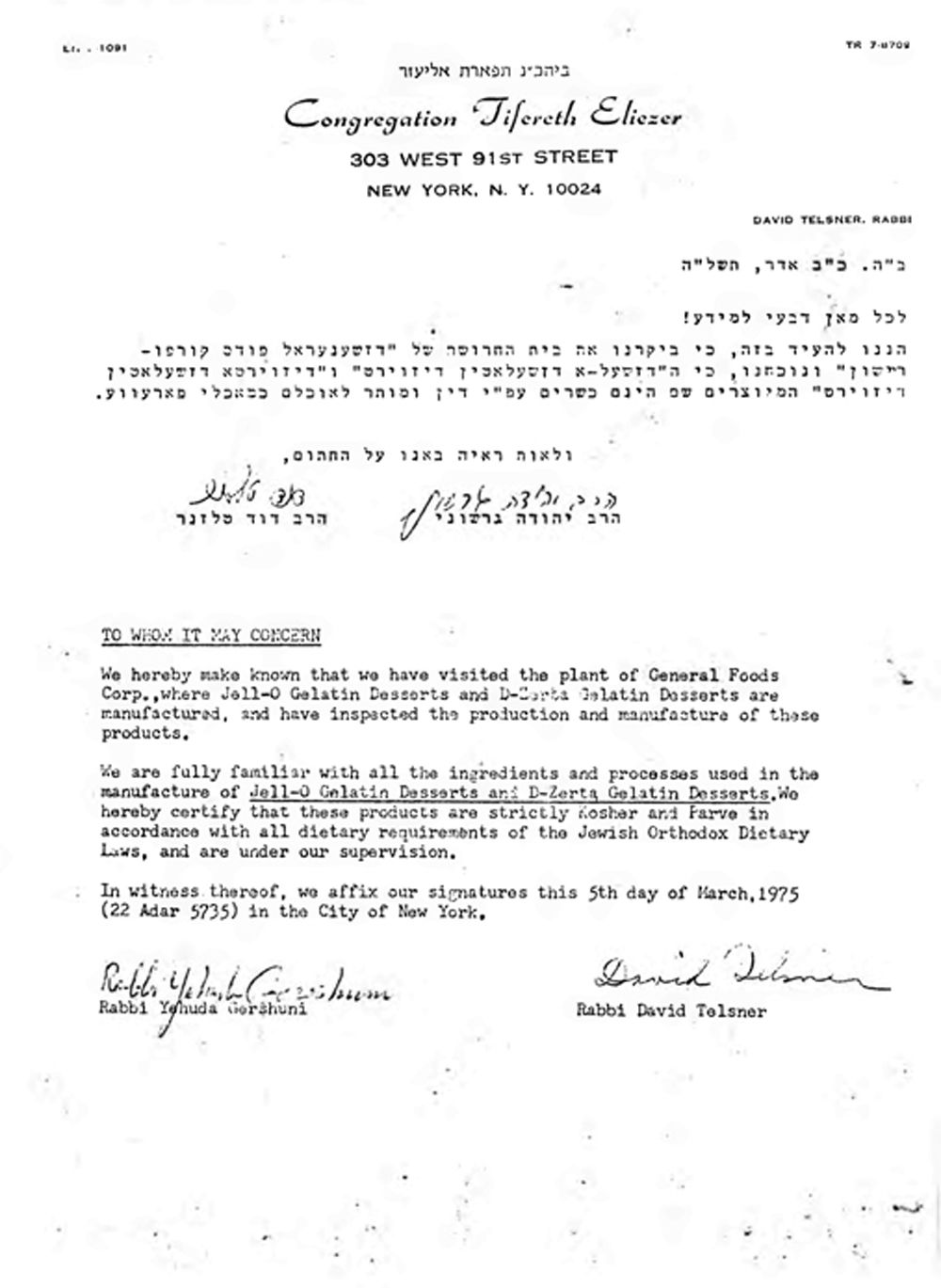
By the 1960s R. David Telsner was giving the hashgachah, and he was later joined by R. Yehuda Gershuni. (Incidentally, R. Telsner was the one who translated R. Soloveitchik’s Hamesh Derashot into Hebrew.) Here is a letter from 1975 in which these rabbis affirm that Jell-O is kosher.

Here is R. Telsner’s responsum permitting gelatin. This was printed by R. Telsner and distributed to those who wanted to know the basis for his permission. As far as I know, this responsum never appeared in any publication and it is not found on the internet.

When it comes to gelatin, there were great rabbis on both sides of the issue, and those who permitted it were able to point to the lenient position of R. Hayyim Ozer Grodzenski. Even among those rabbis who were lenient, there were disputes as to whether all gelatin is OK, including from pigskins, or only gelatin made from bones or hides of kosher animals. Not so well known is the report that R. Kook permitted gelatin.[1] Also of note is that in 1952 R. Simhah Elberg testified to the wide acceptance of gelatin in the Orthodox community:[2]

שכבר נתפשט היתר והותר ע”י גדולי וגאוני ארץ

R. Noah Sheinkopf has prepared the following list of poskim who permitted bovine gelatin. (I have not checked the sources.)

1) Rabbi Dovid Tzvi Hoffmann, Melamed L’Hoil, Y.D., #24 and #35 (By Inference)

2) Rabbi Mordechai Leib Winkler, Levushei Mordechai, Yoreh Deah Tineyna, #60

3) Rabbi Yehuda Leib Tzirelson, Lev Yehuda #39

4) Rabbi Ze’ev Bidnovitz, Divrei Ze’ev, vol. 18. #12

5) Rabbi Y.L. Graubart, Chavalim Baneimim, vol. 4. #23; (See also HaPardes, Aug. 1942, p. 19)

6) Rabbi Shmuel Pardes, Avnei Shmuel, Berurei Halacha, #19

7) Rabbi Yosef Konvitz, Divrei Yosef, vol. 1, p. 172

8) Rabbi Hayyim Ozer Grodzenski, Achiezer, vol. 3, #33, sec. 5; see also Avnei Shmuel, pp. 10-11

9) Rabbi Simcha Zelig Regeur (Brisker Dayan), printed in Kovetz Moriah, issue 400-402, p. 76-77

10) Rabbi Yitzchak Burstein, Mataamei Yitzchak, vol. 2, chap. 24-25

11) Rabbi Yosef Eliyahu Henkin, HaPardes, July 1952; Edus L’Yisrael, p. 177

12) Rabbi Yehuda Leib Seltzer, HaPardes, July 1952; Vezos L’Yehuda, O.C. #26

13) Rabbi Simcha Elberg, HaPardes, July 1952; HaPardes, October 1952 

14) Rabbi Nissen Telushkin (Chabad), Taharas HaMayim, vol. 1, chap. 54

15) Rabbi Nachum Weidenfeld, Chazon Nachum, #61

16) Rabbi Tzvi Pesach Frank, Har Tzvi, Y.D., #83

17) Rabbi Yechezkel Abramskyintroduction to Tzitz Eliezer, vol. 4; Chazon Yechezkel, Zevachim, Sh“ut #6

18) Rabbi Eliezer Waldenberg, introduction to Tzitz Eliezer, vol. 4; Tzitz Eliezer, vol. 20, #33

19) Rabbi Koppel Kahana, Teshuva B’Inyan Gelatin, 1966 (By Inference)

20) Rabbi Moshe Nosson Nota Lemberger, Ateres Moshe, vol. 1, Y.D., # 42-43

21) Rabbi Yitzchak Glickman, Kol Torah, Shana 13, Choveret 4

22) Rabbi Yosef Shalom Elyashiv, Kovetz Teshuvos, #73, sec. 3 (In terms of practical halakhah, for R. Elyashiv the crucial point is if some taste remains, but as long as it is rendered completely tasteless, then he identifies with the R. Hayyim Ozer Grodzenski’s lenient decision.)

23) Rabbi Ovadya Yosef, Yabia Omer, vol. 8, Y.D., #11

24) Rabbi Ben Tzion Abba Shaul, Ohr L’Tzion, vol. 5, #32, sec. 6 (By Inference)

25) Rabbi Shlomo Amar, Shema Shlomo, vol. 5, Y.D., #12

26) Rabbi Yechezkel Roth, Emek HaTeshuva, vol. 3, #67 (By Inference)

27) Rabbi Yisroel Yaakov Fisher, Even Yisroel, vol. 8, #56

28) Rabbi Yirmiyahu Menachem Kohen, V’Heirim Kohen, vol. 2, Y.D., #31; vol. 4, Y.D., #40

29) Rabbi Moshe Levi, Tefilla L“MosheY.D., #4

30) Rabbi Almog Levi, Avnay Levi, Y.D., #1

31) Rabbi Yitzchak Mekayis and Rabbi Yaakov Mekayis, Ohr HaHalacha, Kuntres #3

32) Rabbi Amit Chadad, Pri Eitz Chaim, p. 529

33) Rabbi Moshe Dan Sheinkopf, a Vice President of the Agudas HaRabbonim, who certified Kojel until the late 1970s.

To this list from R. Sheinkopf, we can add R. Yaakov Ariel, Be-Oholah shel Torah, vol. 5, pp. 76-77, R. Eliezer Melamed, Peninei Halakhah: Likutim 3, pp. 352-353, R. Shlomo Aviner (see here) and R. Yitzhak Abadi (as seen on learn.oheltorah.com and prior to this on the old site, kashrut.org). R. Abadi’s view is particularly interesting as his teacher, R. Aharon Kotler, was one of the major forces behind the general rejection of gelatin in the United States. It is also noteworthy that for a short time in the 1950s the OU also approved of gelatin.[3] R. Avraham Vilner, in an earlier post at the Seforim Blog here, provides evidence that the Hazon Ish felt that one could rely on R. Hayyim Ozer Grodzenski’s heter for gelatin.

כשאמרתי למו”ר [הרב שמריה שולמאן] שראיתי הרבה חולקים על פסקו של רבי חיים עוזר בענין הג’אלאטין, וגם אלו שבדרך כלל לא היו פוסקים נגדו כמו הרב אליעזר סיבלר, בזה פסקו אחרית ממנו, אמר לי שהראש ישיבה הרב רודערמאן זצ”ל אמר לו, שהחזון איש אמר שעל כל פסקי רבי חיים עוזר אפשר לסמוך בלי שום פקפוק, חוץ ממה שהתיר לשמש במוך היכא שהסיבה לשימוש במוך הוא מצד האיש, שבזה א”א לסמוך

Ironically, it was Conservative Rabbi Louis Ginzberg who was mahmir, writing with great certainty:

I am convinced that no rabbinical scholar who is in a position to comprehend a problem in chemistry would ever permit the use of gelatin. . . . The late Rabbi Chaim Ozer Grodzinski was well known to me personally; as a matter of fact, his wife was a close relation to me, and I would certainly attach great weight to any decision by him on Jewish Law, but not in a case for which some knowledge of chemistry or physiology is necessary.[4]

On the other hand, Conservative Rabbi Isaac Klein, who was one of only three people to receive private semikhah from Ginzberg—the other two being Louis Finkelstein and Boaz Cohen—permitted gelatin.[5]

Returning to Mesorat Moshe and the problems with oral reports, I saw something relevant in R. Yehuda Spitz’s comprehensive new book, Food: A Halachic Analysis. The matter under discussion is whether one can use the same dishwasher for meat and milk utensils. R. Moshe has a number of responsa where he says that this is permissible as long as you have separate dish racks. His first responsum on the topic appears in Iggerot Moshe, Orah Hayyim 1, no. 104, and is from early 1957. It is the second part of one of his famous responsa on bat mitzvah, and was sent to R. Baruch Aharon Poupka of Pittsburgh. (For some reason, the heading of the responsum only mentions bat mitzvah, not the dishwasher question). R. Moshe’s answer is short and to the point:

ובדבר הכלי החדשה [!] לרחץ את הכלים שנקרא בשם “דיש וואשער” אם יכולין לרחוץ שם כלי בשר וכלי חלב זה אחר זה. הנה צריך שמה שבתוכו שהוא על מה שמניחין הכלים, שיהיה לכלי בשר אחרים ולכלי חלב אחרים, ועצם הדיש וואשער שמשימין בתוכו הדבר שמניחין עליו הכלים שהוא רק הדפנות שסביבותם יכולין להשתמש בו לשניהם בזה אחר זה

This is a very simple reply, and it is not possible to misunderstand what R. Moshe is saying. R. Moshe later sent two other responsa where he explains his reason for requiring separate dish racks (Iggerot Moshe, Yoreh Deah 2, nos. 28, 29). In the latter responsum, he mentions that different water should be used for the milk and meat washings. (In the earliest dishwashers you could use the same water more than once.) He states that he did not mention this point in the original responsum because in any event those who have a dishwasher change the water between cycles. He specifically tells us that he is referring to householders, not that anyone would have any doubt about this.

ובפרט שזמן גדול בהרבה שעות יש לכל בעהב מרחיצת כלי חלב עד רחיצת כלי בשר ולא ישאירו שם המים סרוחין זמן כזה

In this responsum, R. Moshe also recommends running an empty rinse cycle between milk and meat dishes. R. Moshe repeats his basic position in a couple of other responsa,[6] and a simple internet source will reveal that lots of people have discussed R. Moshe’s view and there is no room for misunderstanding.

R. Spitz, Food: A Halachic Analysis, p. 70, quotes someone who spoke to R. Moshe about his “dishwasher leniency.” According to this person, R. Moshe explained that everyone misunderstood what he wrote, and his view that one can use the same dishwasher with separate racks was only stated regardingcommercial dishwashers. However, when it comes to the home, one cannot use the same dishwasher, even with separate racks. Based on this report, R. Spitz writes, “If so, there is ample reason to be stringent, certainly lechatchilla, regarding using the same dishwasher for both milk and meat dishes.”

I have to say that testimony such as this has absolutely no halakhic significance. There is indeed reason to be stringent, based on the views of other poskim (and most people do not seem to follow R. Moshe’s heter of two dish racks). However, if all we had was this report, it would not lead us to ignore R. Moshe’s explicit position in his responsa.

We have many examples of such statements, where a posek supposedly said something privately that completely contradicts what he said in print. In such cases, one cannot rely on these supposed retractions or statements of clarification, except in very rare cases where the author makes his opinion widely known or the person reporting the retraction is a universally recognized Torah scholar[7] (although even in the latter case we cannot always rely on the scholar reporting the supposed retraction).[8] I have no way of knowing what the man R. Spitz quotes was told by R. Moshe. It could be that he completely misunderstood what R. Moshe said. It could also be that R. Moshe had a reason for telling this person what he did, as perhaps R. Moshe thought that this man should hold to a higher level. But it is simply incorrect to suggest that R. Moshe was not referring to a home dishwasher when all can see that he certainly was. R. Spitz himself, p. 71 n. 23, recognizes that R. Moshe was referring to home dishwashers. He also cites R. Baruch Moskowitz, Ve-Dibarta Bam, vol. 2, no. 244, that R. Dovid Feinstein also explained his father’s position as referring to home dishwashers. You can also listen to R. Shmuel Fuerst, a leading student of R. Moshe, explain the matter here.

Quite apart from my point just mentioned, that reports of private conversations that contradict a posek’s written opinion do not have halakhic significance, I must again stress the larger problem raised by books like Mesorat Moshe which is how much significance we should give to works that report oral teachings of great rabbis. Since we have so many examples of contradictory reports and incorrect statements in such texts, I think it is obvious that even such a wonderful work as Mesorat Moshe has to be used carefully, and in no way can it be seen as rising to the level of authority of what R. Moshe himself wrote.

Returning to the gelatin issue, Horowitz tells the story of Abraham Goldstein (1861-1944), who really should be given the title of originator of industrial hashgachot in the United States. Here is his picture.[9]

It was Goldstein who was behind the OU’s kosher certification program and who established the agreements with the early companies. He was also the OU’s “chemical expert,” yet as Horowitz notes, he has been completely erased from the OU’s institutional memory.[10]

In 1935 he broke with the OU and founded the OK Laboratories. This would be sold in 1969 to Rabbi Berel Levy, and would then become a universally recognized hashgachah. However, this was not the case when Goldstein was in charge, and it is when Goldstein founded the OK that the controversial period of his life begins. This was because Goldstein, who was not a rabbi and had no expertise in Jewish law, set out to determine what was kosher and what was not. He made it clear that in determining what was kosher, chemists (such as himself) were a more reliable source than rabbis, as the latter did not understand food technology and were mistakenly giving approval to non-kosher food items. Goldstein had a very simple approach to the matter: If a product had any non-kosher element in it, it was treif and forbidden to be eaten. The notions of bitul or that the non-kosher food had so changed its form were not considerations he paid any attention to.[11] He also did not rely on rabbis whom he felt were not careful in such matters. Thus, he refused to accept the hashgachot issued on Coke by R. Samuel Pardes, editor of Ha-Pardes, and later by R. Tuvia Geffen.[12]

As Horowitz notes, R. Geffen was not happy with R. Pardes’ hashgachah on Coke because the drink included 0.09 percent glycerin from a non-kosher source. This is a very tiny amount—less than 1 in 1000—which according to halakhah is batel, and thus of no halakhic significance. Yet there are some fundamental questions involved here. One is if the tiny amount of non-kosher is put in as part of production, rather than accidentally falling in, do we still say that it is batel? Most authorities assume yes, so from this angle R. Pardes would have been on firm ground to declare the drink kosher. However, there is another issue, and that is can you officially give a hashgachah to an item relying on bitul, especially when the company will then be advertising the product as kosher? This can certainly be seen as distasteful and perhaps even bringing us to a situation of ein mevatelin issur lekhathilah (as the kashrut organization is now involved with the company).

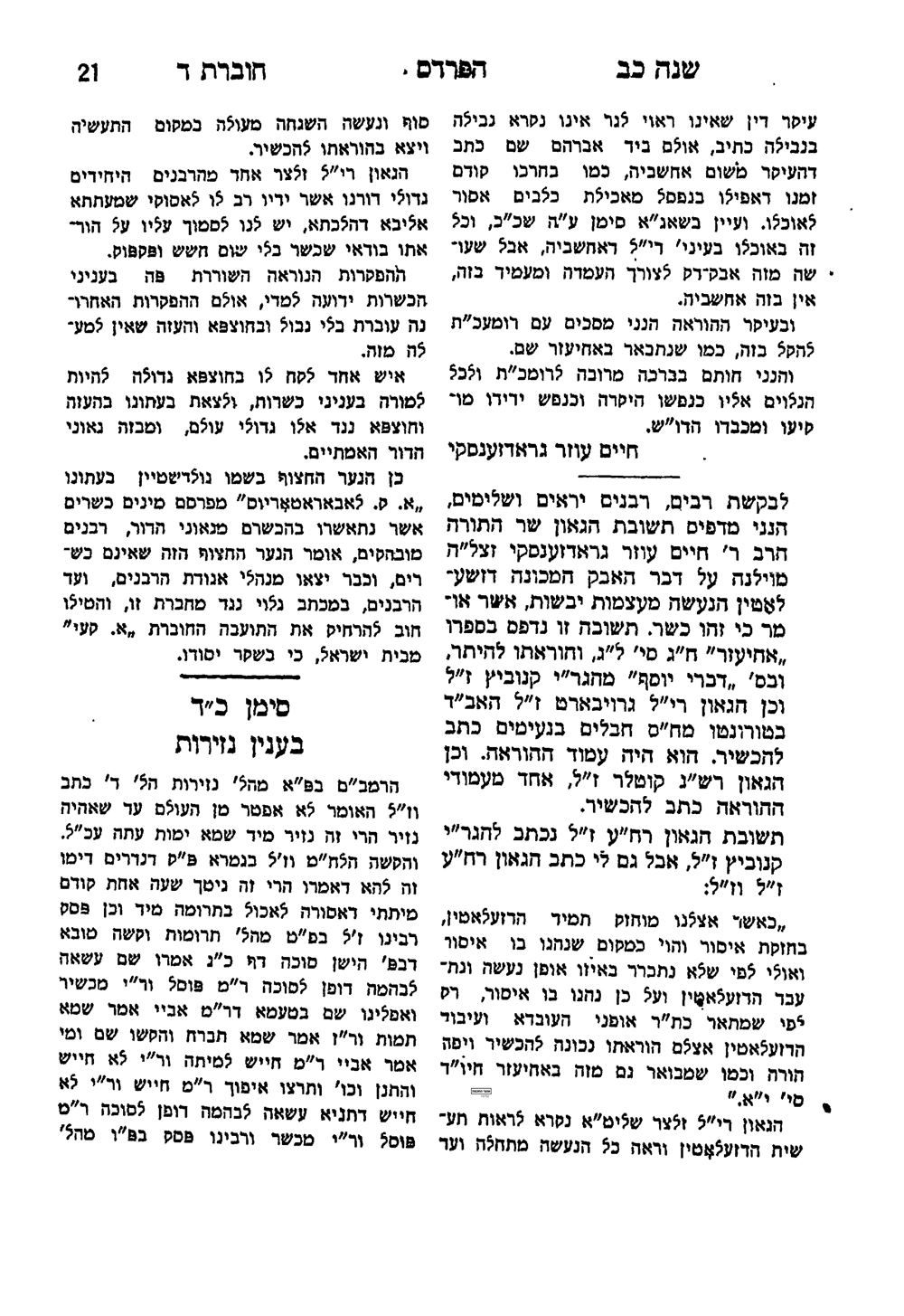
R. Geffen believed that Coke should not be given a hashgachah as long as the non-kosher glycerin was not replaced with a kosher alternative. In fact, as far as I can see, R. Pardes himself never argued that it is acceptable to rely on bitul in issuing a hashgachah, since he flatly declared—mistakenly it turns out—that there were no non-kosher ingredients in Coke (that is, he was not saying that the non-kosher ingredients were of no halakhic significance).[13]

Goldstein had nothing but contempt for the way the old-time rabbis went about issuing hashgachot, and R. Pardes’ hashgachah on Coke was just another illustration of this. In speaking of R. Pardes, Goldstein wrote that “such men undermine the very foundation of our religion” and “there is no room for such scoundrels in decent company.” To reiterate, this was not a dispute between two rabbis but rather a layperson with no yeshiva training declaring that a learned rabbi did not understand the basic laws of kashrut. As far as the rabbis were concerned, the chutzpah here was unbelievable, and this was doubled by the fact that Goldstein’s Kosher Food Guide, which included all sorts of important information about kosher food together with Goldstein’s attacks on various rabbis, had a circulation of 150,000.[14] Significantly, Goldstein refused the OU’s demand that his publication be reviewed by rabbinic scholars.[15] Goldstein believed that when it came to modern food technology, he should be the one telling the rabbis what was kosher, not the reverse.

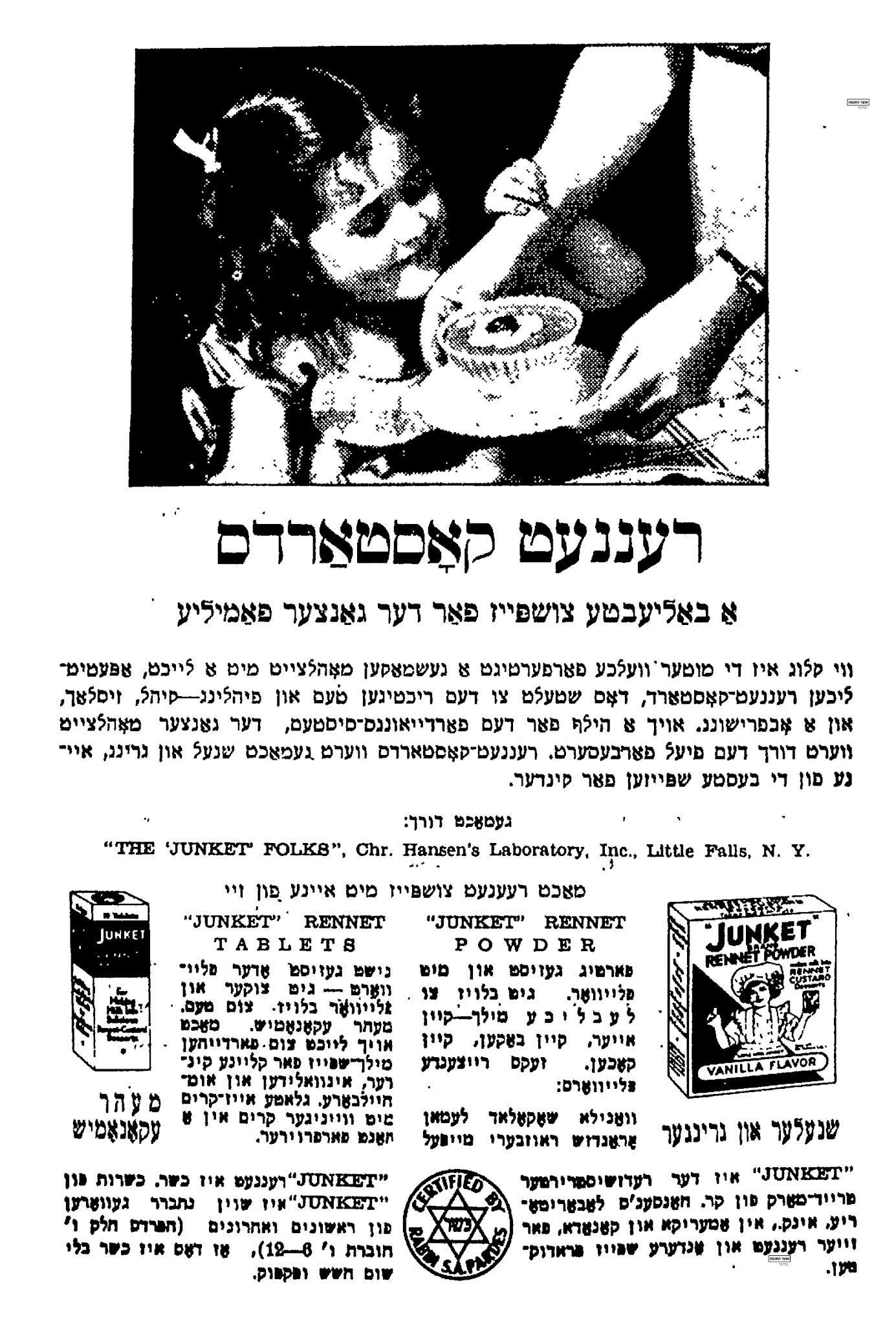
As Horowitz describes, Goldstein ratcheted up his attacks on R. Pardes after the latter gave a hashgachah to Junket, a product that was used to make a custardlike desert but which contained rennet that came from calves that were not ritually slaughtered. R. Pardes also received the backing of the OU for both his Junket hashgachah and his hashgachah on gelatin. (In 1952, after R. Eliezer Silver’s expressed a stringent opinion regarding gelatin, the OU removed its endorsement.[16])

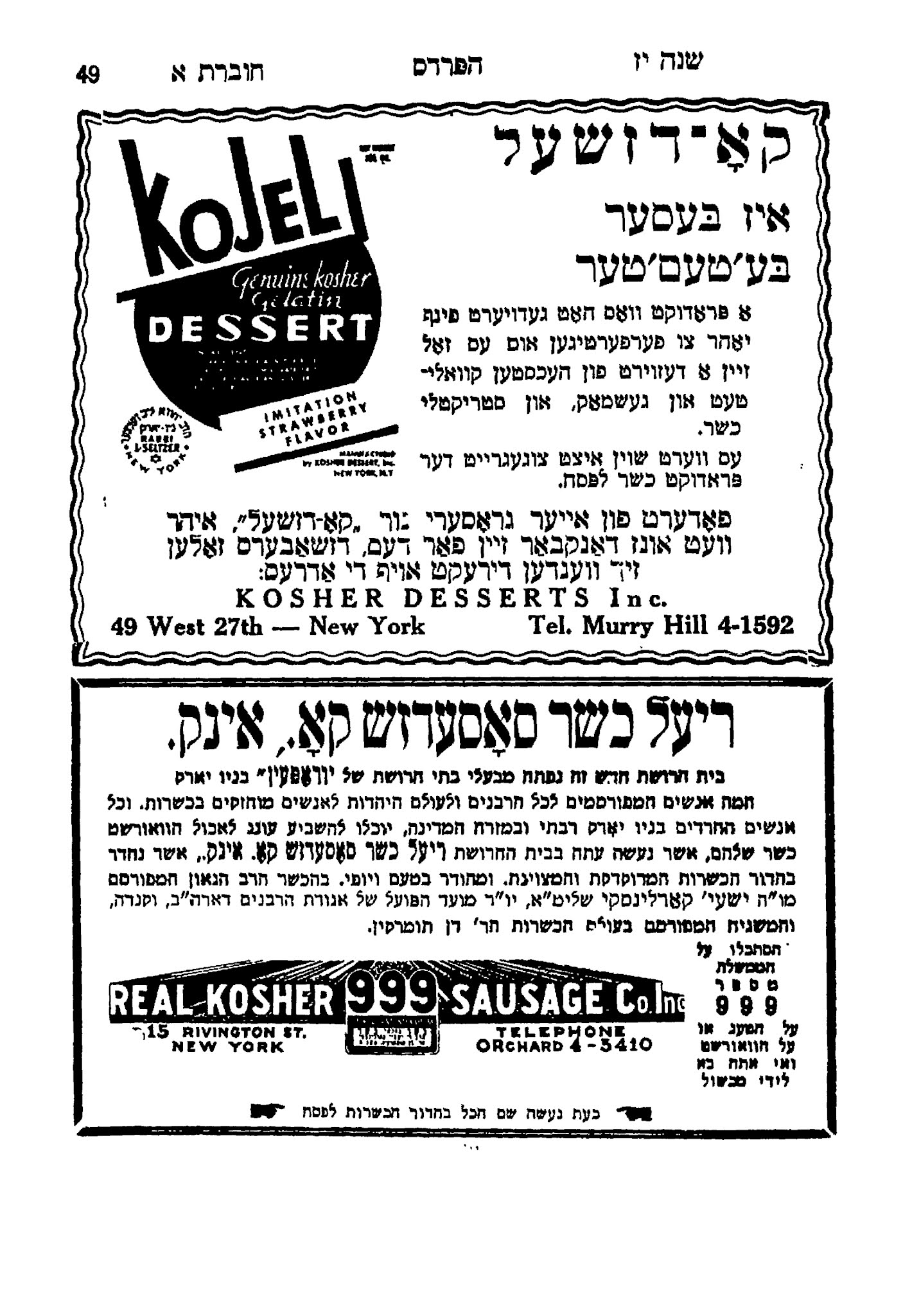
Here is an ad from Ha-Pardes, April 1938, for Junket, with R. Pardes’ hashgachah.

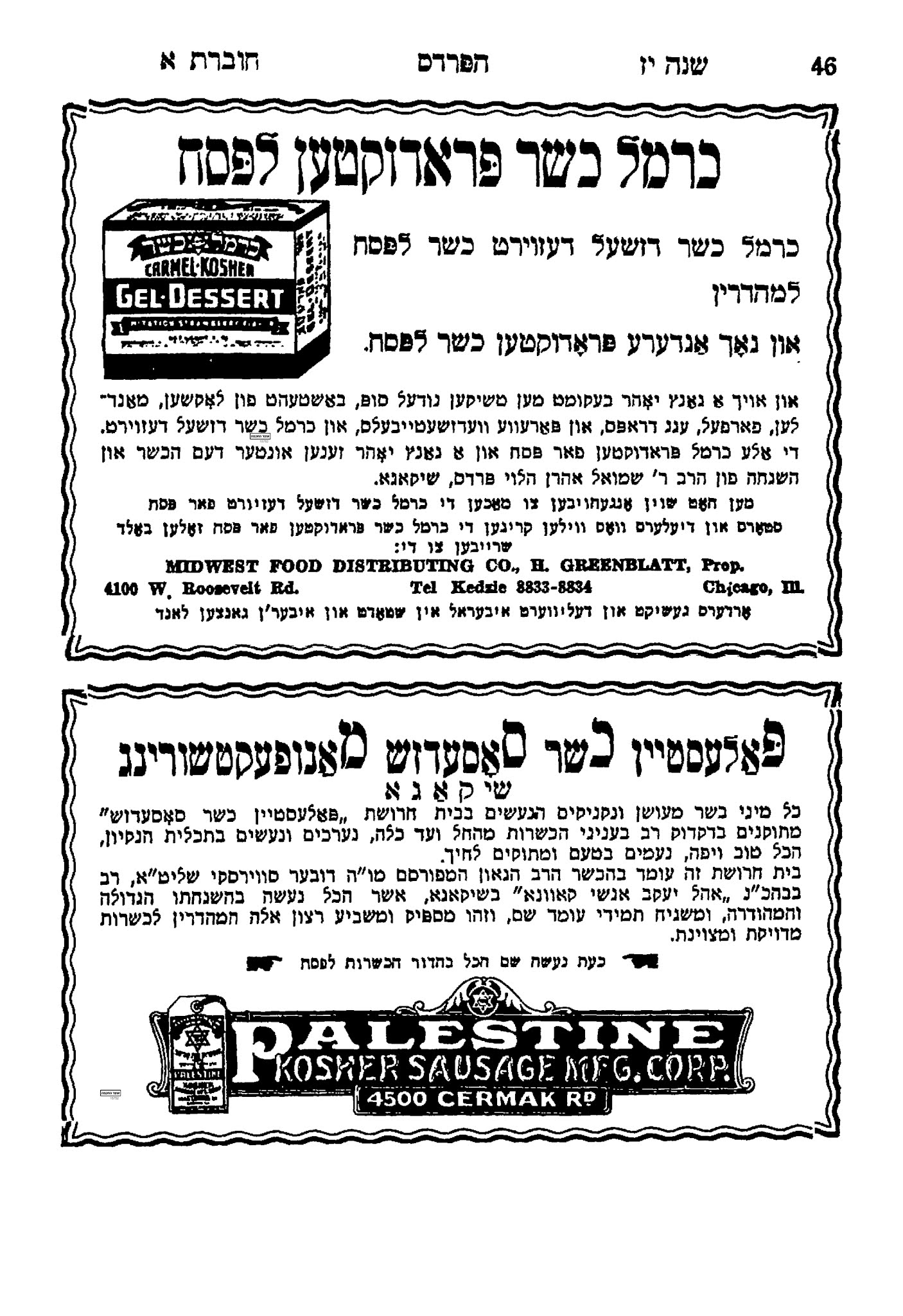
Here is an ad from Ha-Pardes, April 1943, for Carmel gelatin, with R. Pardes’ hashgachah.

Here is an ad from Ha-Pardes, April 1943, for Kojel gelatin, with R. Judah Leib Seltzer’s hashgachah.

In Goldstein’s opinion, the fact that the OU would support R. Pardes when it came to Junket—he was no longer alive when the OU approved of gelatin—only showed how low his former organization had fallen and how little it understood of food technology. For Goldstein, it was not only a sign of ignorance on the part of R. Pardes and the OU, as he also wondered if there was financial corruption involved. Addressing R. Pardes, Goldstein asked, “How much money has been paid for this false Hekhsher.” Turning to the OU, he asked if any them “participated in the division of this money.”[17] When it came to the issue of gelatin—which had great rabbis on both sides of the issue—Goldstein expressed his ire over Jello-O advertisements in the Jewish press, stating that these advertisements “are not only deplorable from a Jewish religious standpoint,” but were “an outrageous attempt to smuggle an absolutely trefa article into Jewish homes.”[18] He later repeated his warning regarding other brands of gelatin: “Neither Carmel, Emes, or Kojel gelatines can be used in Orthodox homes. They are trefa gelatines, despite the Rabbinical Heckshers.”[19] So here we have a layperson declaring that a product endorsed by leading American rabbis was “absolutely trefa.”

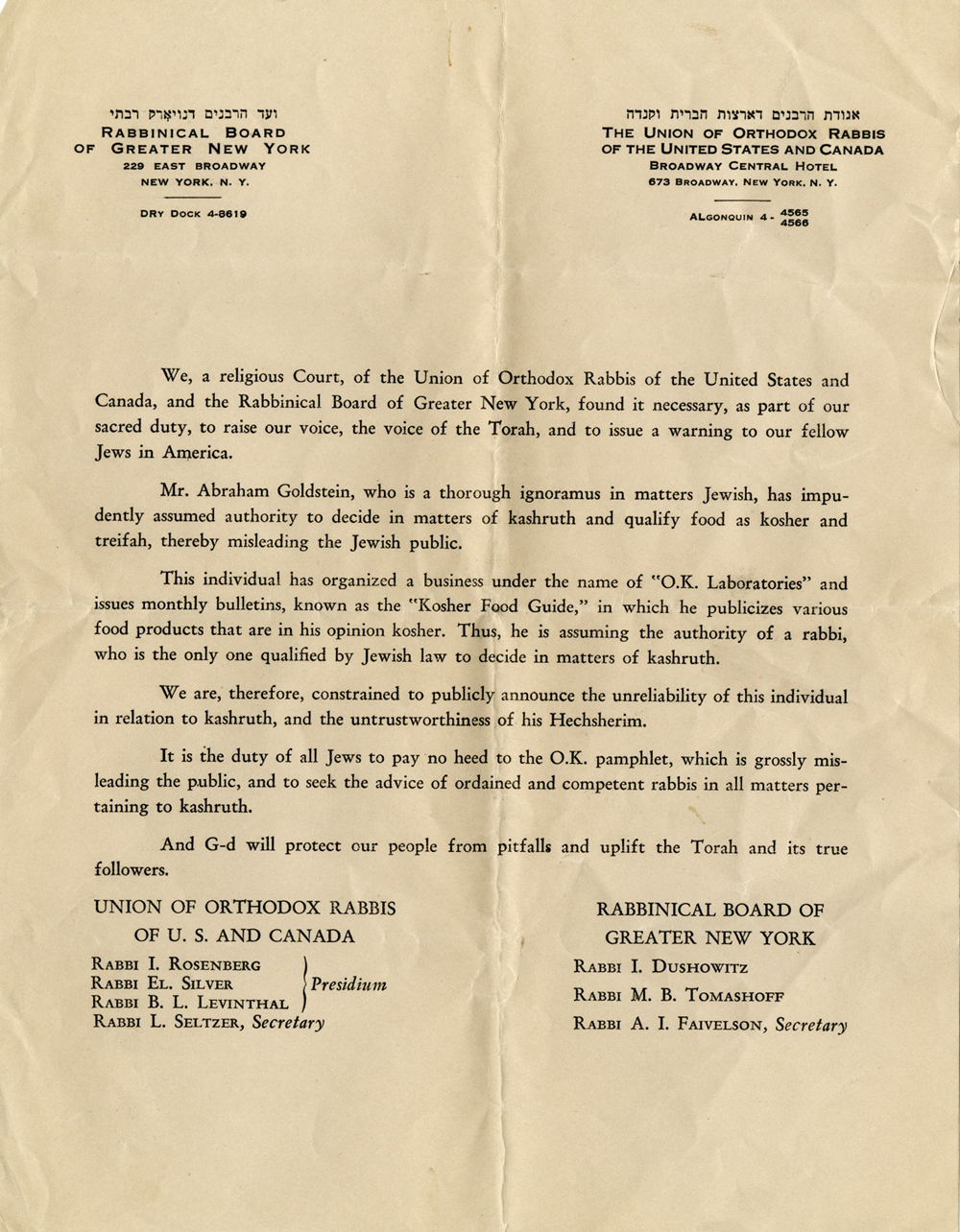
It was one thing for a rabbi who opposed the kashrut of gelatin to say such a thing, but to have a halakhically unlearned layperson setting himself up as the arbiter of what is, and is not, kosher was too much for the rabbinic leadership in the United States. Now it was no longer a question about the kashrut of Junket and gelatin—both of which R. Eliezer Silver himself would later reject—but respect due to talmidei hakhamim. As far as the rabbis were concerned, it simply was unacceptable for a layperson to establish himself as an authority when it came to kashrut. The most that he could do was supply information to the rabbis so they could make the proper halakhic decisions, but to publicly challenge the rabbis about their scientific facts and halakhic interpretations went over the line, and it was time for the rabbis to put Goldstein in his place. Here is the public statement issued by Agudas ha-Rabbonim and the Rabbinical Board of Greater N.Y.[20]

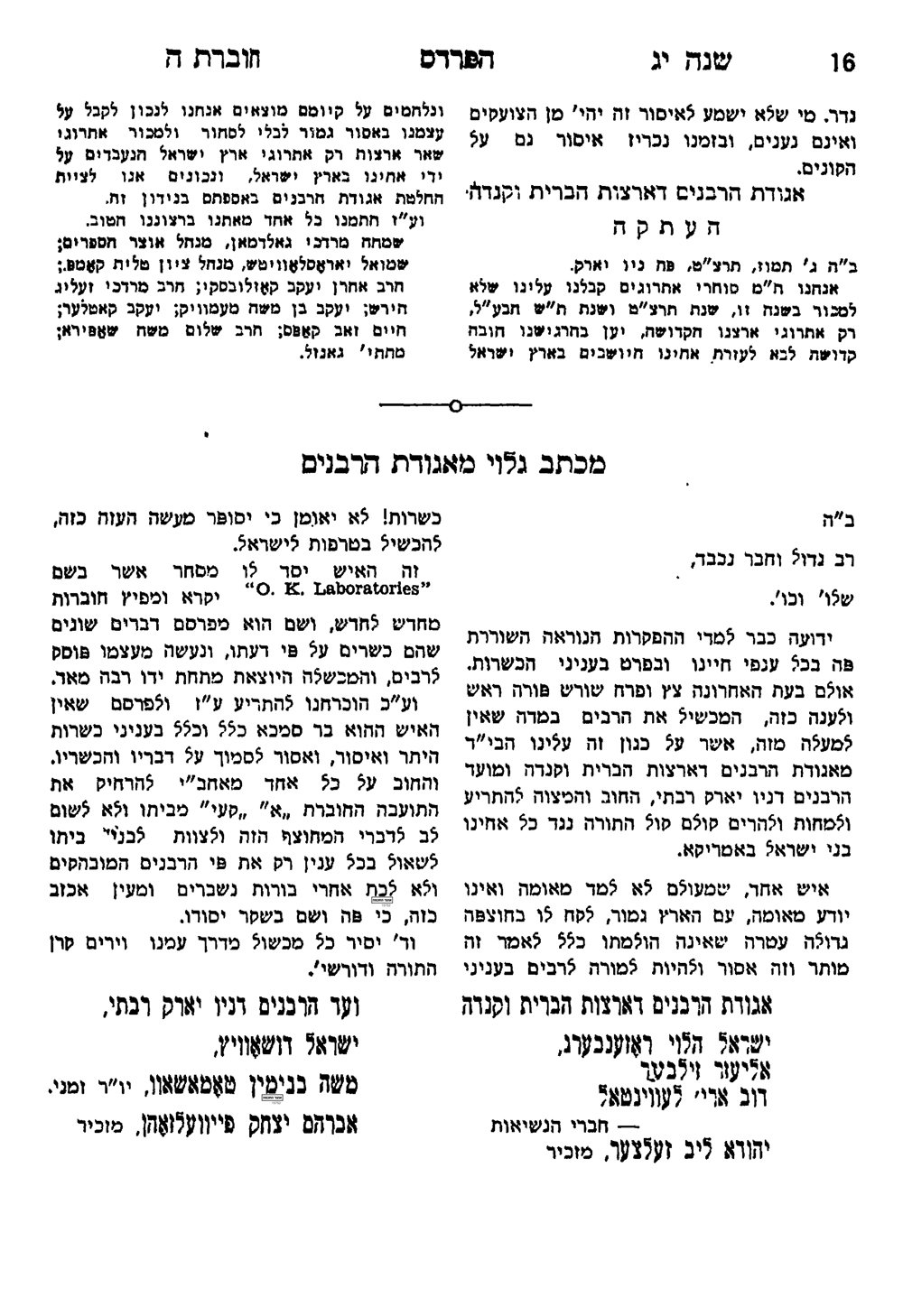
This is the English translation of the following Hebrew proclamation that appeared in Ha-Pardes, August 1939, p. 16.[21]

Almost ten years later it was Goldstein’s son, George, who was running the OK after the death of his father. He too was causing problems for R. Pardes. In Ha-Pardes, January 1948, p. 21, R. Pardes attacked the younger Goldstein, referring to him as הנער החצוף.

Despite the virtual herem on Abraham Goldstein, I agree with Horowitz[22] that at least to some extent Goldstein was posthumously vindicated. While the notion that a layperson could challenge learned rabbis in halakhic matters was never countenanced (and this is presumably the reason why Goldstein is completely absent from the OU’s institutional memory), Goldstein’s other point, that knowledge of chemistry and food technology is vital for kosher supervisors, has been accepted by all the mainstream hashgachot. Furthermore, despite the opposition of the rabbis to Goldstein’s OK, it remained a popular hashgachah with a wide following. In fact, until the mid-1950s, the OK supervised more products than the OU.[23]

One can only imagine Goldstein’s reaction had he heard of a pesak of the famed R. Ishmael ha-Kohen of Modena (1723-1811) in his Zera Emet, vol. 2, no. 48. The question is as follows:

נשאלתי מהו ליתן רפואה לחולה שאין בו סכנה חתיכות עגולים קטנים שקורין בוקונ”י בלע”ז מרוקחים בהרבה מינים ובכללם יש ג”כ עצם גולגלות אדם שרוף וכתות

R. Ishmael was asked about using a medicine for someone who was sick but not in serious danger. The issue was that the medicine contained pieces of a ground up human skull. This is what has been called “powdered skull,” and was a common medicine in the eighteenth century.[24] R. Ishmael permits one to consume this “medicine”.

A few centuries earlier, R. David Ibn Zimra was also asked about medicine that was made from flesh of non-Jewish dead bodies (מומ”יא — mummies).[25] R. Ibn Zimra focuses his responsum on the issue of benefiting from a dead body, since when it comes to eating the flesh, he sees no problem at all in this, as its form has been entirely changed:

איסור אכילה לא הוצרכת לשאול דודאי מותר באכילה שהרי נשתנה צורתו וחזר להיות עפר בעלמא וכ”ש ע”י סמים שהרי המומי”א היא בשר החנוטין שחונטין אותם בכמה מיני סמים כדי להעמיד צורתו וגופו וחזר להיות כעין זפת ואין בו איסור אכילה

For those interested in learning more about the subject of “corpse medicine”—which included much more than the skull—and if your stomach can handle it, I recommend Richard Sugg, Mummies, Cannibals and Vampires: The History of Corpse Medicine from the Renaissance to the Victorians (London and New York, 2016). What passed for medical cures in pre-modern times is shocking, and often downright disgusting.

As late as 1907, the Adeni Rabbi Samuel Yeshuah[26] discusses sick people who consume “mummy medicine,” what he refers to as

 רפואת ההבל שנתפשט בין העם . . . באמת המומיא הזו לא יועיל ולא יציל והיה כלא היה

I assume many readers will be shocked to learn that great poskim permitted what I have just described. Today, of course, it would turn our stomachs to even think about consuming part of a corpse, much like Goldstein was outraged that anyone could think that it is permissible to consume something from a non-kosher animal, even from a pig no less. Yet this revulsion does not arise from halakhah. Speaking personally, I can’t imagine that anyone I know would eat a piece of meat from a pile if he knew that a non-kosher piece had fallen into the group of kosher pieces, despite what the halakhah says; all the more so if a piece of pork fell into a kosher dish even if it was nullified by 60. Again, our revulsion has its origin in feelings that have little to do with pure halakhah. In fact, some authorities feel that to be strict in such cases is akin to heresy, as it is in practice (but not in theory) a denial of the halakhic principle of bitul.[27]

If I could have spoken to Goldstein, I would have tried to explain to him that the halakhic system does not work in accord with what has been called “da’at baalei batim,” and those who forbid gelatin also acknowledge that not everything from a non-kosher animal is forbidden. The gelatin dispute concerns the role of gelatin in the finished food product, not with the existence of non-kosher per se. Thus, even one who is strict in the matter of gelatin would not start screaming if he saw his son standing in right field chewing on his non-shechted leather baseball mitt.

To be continued

*************

My Torah in Motion trips are starting again. I am leading a group to Morocco in January, and there is a full line-up for next summer. You can see details here.

*************

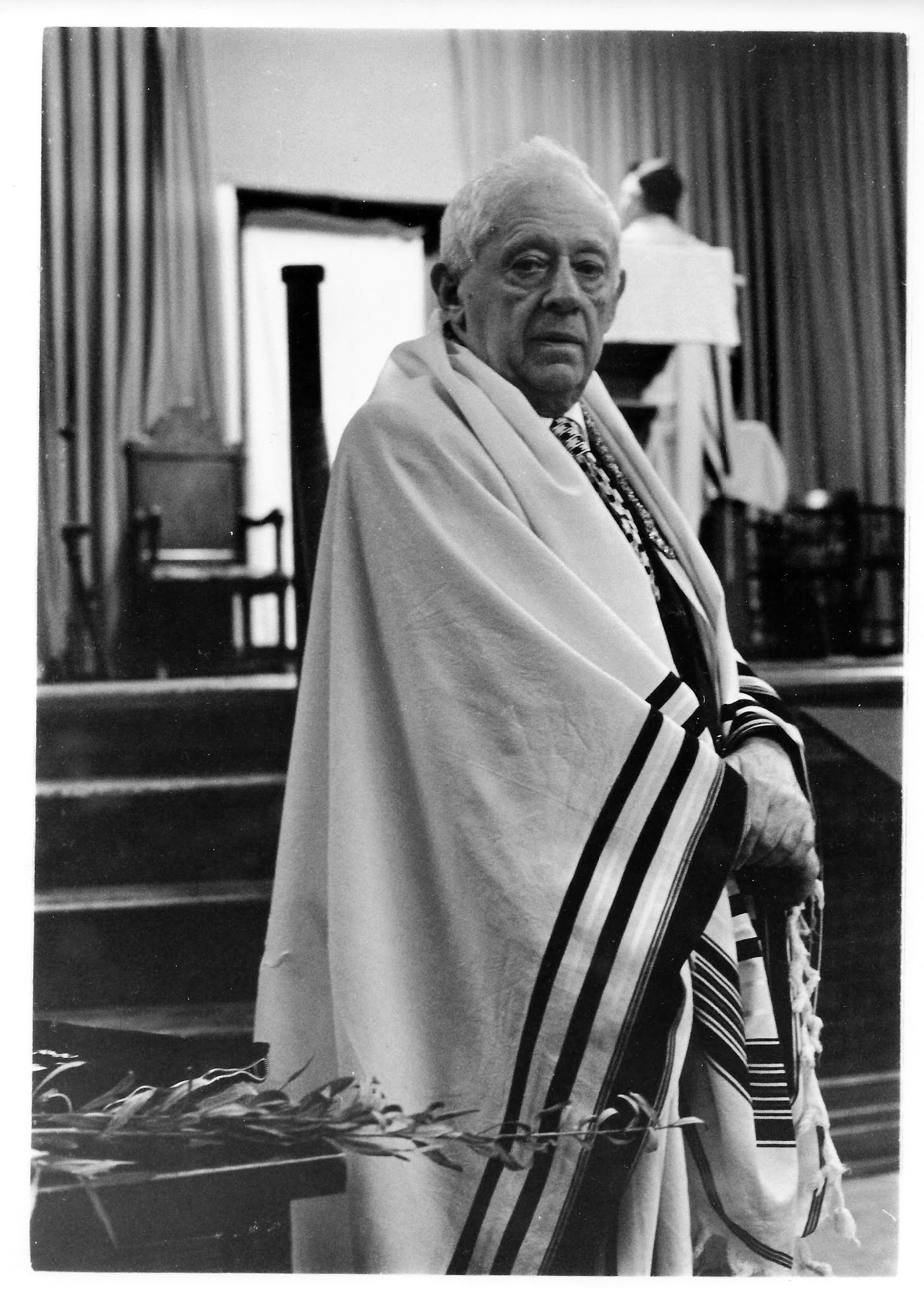
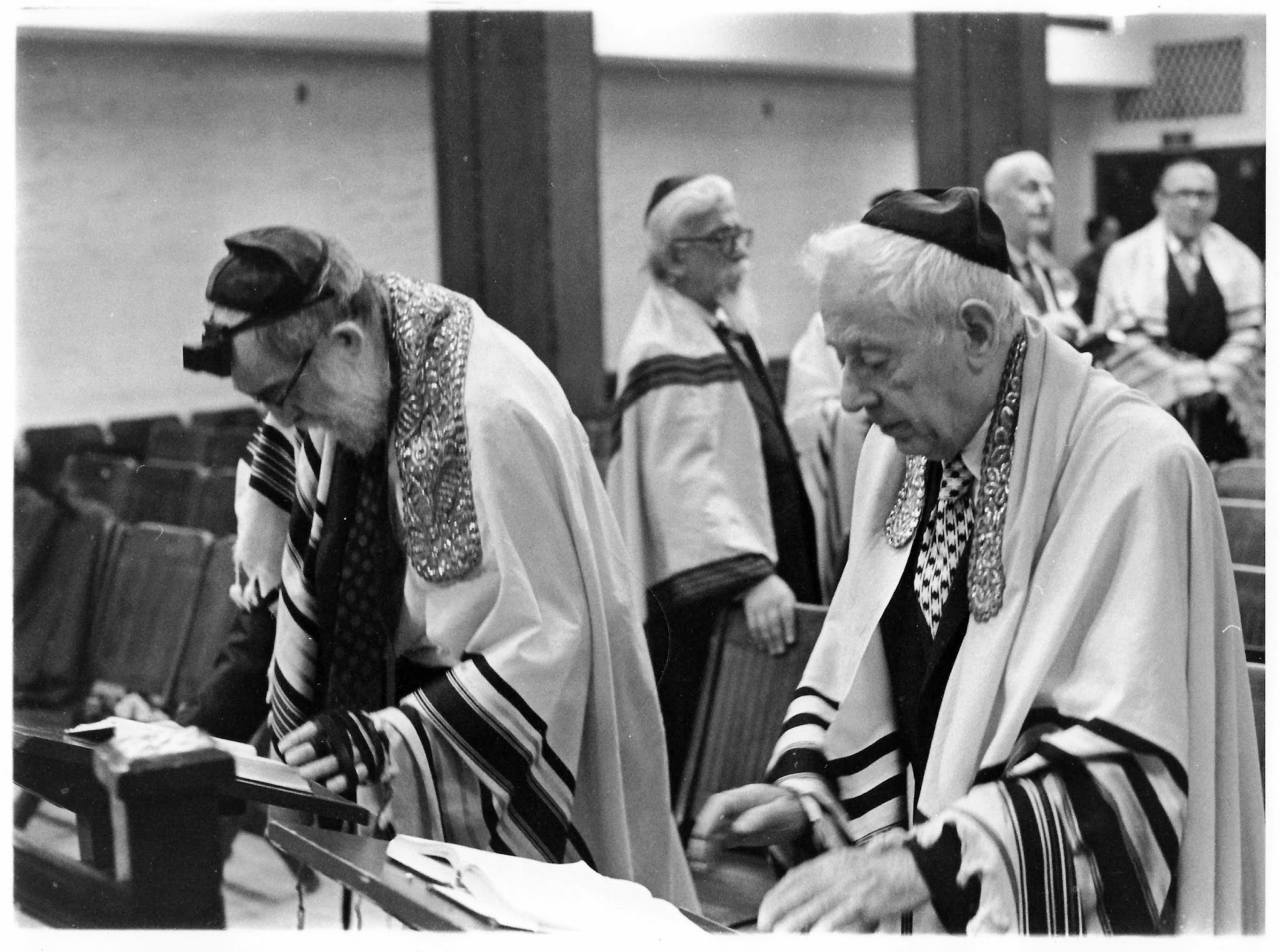
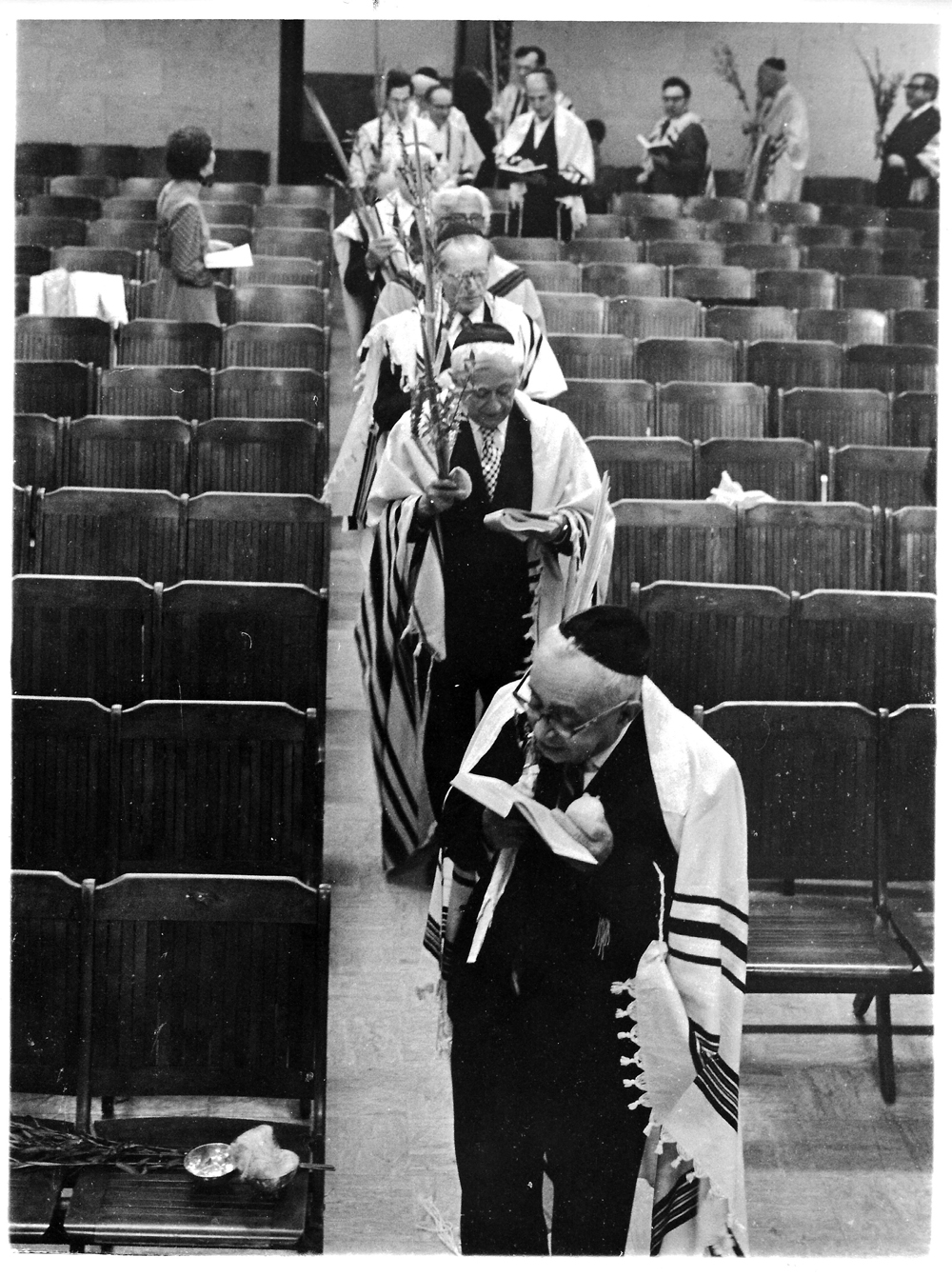
I am currently doing a series of classes for Torah in Motion on R. Saul Lieberman. You can see them here on YouTube. Here are some pictures that were taken at the Jewish Theological Seminary minyan in Unterberg Auditorium on Hoshana Rabba 1971. (At this minyan there was separate seating but no mechitzah.) The pictures were taken by Joel Mandelbaum, son of R. Bernard Mandelbaum who held many positions at the Seminary, including serving as president from 1966-1973 under Chancellor Louis Finkelstein.

Here is Lieberman.

Here is Lieberman and Louis Finkelstein. Abraham Joshua Heschel is standing between them and Bernard Mandelbaum is on the far right.

In front of Lieberman, leading the procession, is Moshe Zucker. Behind Lieberman is Simon Greenberg.

*************

[1] See Ha-Pardes, August 1942, p. 19. It also states here that R. Shlomo Natan Kotler permitted gelatin.

[2] Ha-Pardes, October 1952, p. 31.

[3] See Horowitz, Kosher USA (New York, 2016), pp. 59-60.

[4] The Responsa of Professor Louis Ginzberg, ed. David Golinkin (New York and Jerusalem, 1996), p. 152.

[5] Responsa and Halakhic Studies (n.p., 1975), ch. 7.

[6] Iggerot Moshe, Yoreh Deah 3, nos. 10, 11.

[7] For example, the Shulhan Arukh, Yoreh Deah 201:75, famously forbids heated mikvaot. (R. Karo cites the stringent view as יש מי שאוסר and he does not offer a lenient alternative). However, R. Eliezer ben Arha of Hebron (died 1691) reported that R. Karo abandoned this stringency and permitted the heating of a mikveh.

ואפילו בזמן הרב מוהרי”ק זלה”ה עשה מעשה נגד מה שפסק שחשש וכתב סברת האוסר, כי רבים מבני עליה הם המתירין, ועלייהו קא סמכינן

See She’elot u-Teshuvot Rabbenu Eliezer ben Arha (Jerusalem, 1978), no. 18, and see note 1 for the impact of this reported change in R. Karo’s position.

Another interesting phenomenon, which I will not discuss in this post, is when a posek refuses to put a leniency into writing. How authoritative is this posek’s oral ruling? A classic example of this is R. Moshe Feinstein’s opinion about turning off the flame of a gas stove on Yom Tov. In Iggerot Moshe, Orah Hayyim I, no. 128, R. Moshe writes that he doesn’t wish to put his opinion in writing, but it is known that he permitted this.

[8] See e.g., here where I discuss the false claim that R. Ezekiel Landau retracted his view that sturgeon is kosher. For the claim that R. Joseph Hayyim retracted his permission to ride a bicycle on Shabbat where there is an eruv (Rav Pealim, vol. 1, Orah Hayyim, no. 25), see R. Ovadiah Hadaya, Yaskil Avdi, vol. 3, Orah Hayim, no. 12:5:4, vol. 5, Orah Hayyim, no. 40. For a rejection of this claim, see R. Ovadiah Yosef, Yabia Omer, vol. 9, Orah Hayyim, no. 108:189. See also here where R. Doniel Neustadt writes: “Several sources report that the Chafetz Chayim eventually changed his ruling and exempted cooked fruits served for dessert from a blessing; see Orchos Rabbeinu 66 and Vezos ha-Berachah, pg. 78. Others dispute that the Chafetz Chayim changed his ruling.” The forger Chaim Bloch, Ha-Maor, Dec. 1951, p. 7, who was himself opposed to the gelatin heter, claims to have discussed the matter with R. Hayyim Ozer Grodzenski. Not surprisingly, Bloch records that R. Grodzenski told him that he never actually gave a ruling on the question of gelatin. Rather, he was only stating that his opinion inclined in this direction. For a rejection of Bloch’s false testimony, see R. Samuel Baskin and R. Shimon Winograd in Ha-Maor, Aug. 1952, pp. 7-8. Here is some of what they write:

אם הגאון רח”ע באמת חזר מתשובתו ומהיתרו על תוצרת הנ”ל, איך לא הודיע זאת ברבים, כדי שלא יכשלו ח”ו ויסמכו על פסקו ותשובתו בשו”ת אחיעזר, ויעשו מעשה לכתחילה בדבר שלא נתן הגאון הנ”ל היתר מוחלט, ועוד אם הגאון רח”ע ז”ל דיבר עם הרב ח”ב בשנת תרצ”ה כאשר כותב בהירחון “המאור”, איך כתב הרב הגאון רח”ע ז”ל להרב הגאון ר’ יוסף קאנוויץ ז”ל בחודש אייר שנת תרצ”ו שנה או יותר לאחר שיחתו עם הרב ח”ב, שמסכים עמו על היתרו בדבר הכשר הז’לטין

[9] The picture is found here and comes from the Ezra and Monica Friedman collection.

[10] Kosher USA, p. 26.

[11] See Spitz, Food: A Halachic Analysis, p. 459: “Dr. Goldstein . . . publicly maintained that any food item whose origins lie in a non-kosher source may not be considered kosher, no matter how “changed” it may currently appear.”

[12] Horowitz, Kosher USA, pp. 33ff.

[13] See Adam Mintz, “Is Coca-Cola Kosher?” in Rafael Medoff, ed., Rav Chesed: Essays in Honor of Rabbi Dr. Haskel Lookstein (Jersey City, 2009), vol. 2, p. 80; Horowitz, Kosher USA, p. 36.

[14] Horowitz, Kosher USA, pp. 29, 37.

[15] Horowitz, Kosher USA, p. 41.

[16] Horowitz, Kosher USA, p. 64.

[17] Horowitz, Kosher USA, pp. 38, 41.

[18] Horowitz, Kosher USA, p. 50.

[19] Horowitz, Kosher USA, pp. 54-55. Kojel is no longer is made with problematic gelatin and is currently under the OU hashgachah.

[20] Document provided courtesy of the Israel Rosenberg Archive, The Library of the Jewish Theological Seminary, New York, NY, ARC 98, Box 6, Folder 23.

[21] This proclamation was reprinted in Ha-Pardes, October 1939, p. 29. For other attacks on Goldstein see Ha-Pardes, August 1942, p. 17; Ha-Mesilah, Adar 5702, p. 20, sections ב, ה.

[22] Horowitz, Kosher USA, p. 42.

[23] See here.

[24] See here.

[25] She’elot u-Teshuvot ha-Radbaz, vol. 3, no. 548.

[26] Nahalat Yosef (Jerusalem, 1907), pp. 15a-b.

[27] For one discussion, see here.


An Unpublished 1966 Memorandum from Rabbi Aryeh Kaplan Answers Questions on Jewish Theology

An Unpublished 1966 Memorandum
from Rabbi Aryeh Kaplan Answers Questions on Jewish Theology

Marc B. Shapiro and Menachem Butler

Professor Marc B. Shapiro holds the Harry and Jeanette Weinberg Chair in Judaic Studies at the University of Scranton, and is the author of many books on Jewish history and theology. He is a frequent contributor at the Seforim blog.

Mr. Menachem Butler is Program Fellow for Jewish Legal Studies at The Julis-Rabinowitz Program on Jewish and Israeli Law at Harvard Law School. He is an Editor at Tablet Magazine and a Co-Editor at the Seforim Blog.

Over the last ten years Professor Alan Brill has written a series of blogposts, as well as a recent scholarly article on the perennially interesting, yet historically mysterious, rabbinic theologian, Rabbi Aryeh Kaplan (1934-1983).[1] It was from these posts that many have learned about what Kaplan was doing before he burst onto the wider Jewish literary scene in the early 1970s through his writings and public lectures. He passed away in 1983 at the age of 48.[2]

Rabbi Aryeh (Leonard M.) Kaplan was born in the Bronx in 1934, and studied at Mesivta Torah Vodaath in New York, and at the Mirrer Yeshiva in New York and in Jerusalem. In 1953, 20-year-old Aryeh Kaplan joined the group of students assembled by Rabbi Simcha Wasserman under the guidance of Rabbi Shmuel Kamenetsky to establish a yeshiva in Los Angeles,[3] and three years later in 1956 received his rabbinic ordination (Yoreh Yoreh, Yadin Yadin) from Rabbi Eliezer Yehuda Finkel of the Mirrer Yeshiva of Jerusalem, and from the Chief Rabbinate of the State of Israel. After receiving his ordination, Aryeh Kaplan began his undergraduate studies and, in 1961, earned a B.A. in physics from the University of Louisville, and two years later, an M.S. degree in Physics from the University of Maryland, in 1963. While studying towards his undergraduate degree, Aryeh Kaplan taught elementary school at the pluralistic Eliahu Academy in Louisville, and corresponded with Rabbi Moshe Feinstein about some of the challenges that he encountered.[4] He then worked for four years as a Nuclear Physicist at the National Bureau of Statistics in Washington DC.

In February 1965, Rabbi Kaplan and his wife and their two small children moved to Mason City, Iowa, where he was invited to serve as a pulpit rabbi at Adas Israel Synagogue, a non-Orthodox congregation with forty member families. It would be his first pulpit. He remained at that pulpit until July 1966. During his time in Mason City, Rabbi Kaplan and his wife were very active in all aspects of their synagogue activities. Rabbi Kaplan led services and delivered a sermon each week at the Friday Night Service at Adas Israel Synagogue, hosted a Talmud Torah and taught about Jewish tradition to the youth in the community. He was a member of the National Conference on Christians and Jews, and regularly hosted visiting religious groups to the synagogue and participated in interfaith meetings and on panels alongside religious leaders of other faiths. In all of his delivered remarks, Rabbi Kaplan would type out each sermon prior to its delivery and maintain copies of these addresses within his personal archives; to date, these sermons have not yet been published.

It was during Rabbi Kaplan’s time in Mason City that he authored a fascinating eleven-page-typescript memorandum, dated February 22, 1966, that, thanks to the research discovery of Menachem Butler, we are privileged to share with the readers of The Seforim Blog in the Appendix to this essay.[5]

Kaplan was responding to questions sent out by the B’nai B’rith Adult Jewish Education bureau in Washington DC on matters of basic Jewish theology.[6] We see from the letter that like many other rabbis who were serving in frontier communities, Kaplan maintained a camaraderie with those among the non-Jewish clergy. He was even a member of the “Ministerial Association,” and together with his wife was “founder and chairman of the local chapter of Ministerial Wives.” As one who often hosted non-Jewish groups at the synagogue, Kaplan was well equipped to place Jewish concepts and practices within a context that would make sense for Christians, and this is clearly seen in how he formulates his answers in the letter.

Although Rabbi Aryeh Kaplan’s memorandum is self-explanatory, there are a few points of theological interest that are worth calling attention to:

1. Right at the beginning, Kaplan notes that Jews have no official dogmas, and that in many cases Jewish opinions vary widely.

2. Kaplan states unequivocally that Maimonides does not believe in a literal resurrection. In support of this statement he cites Guide 2:27. If all we had were the Commentary on the Mishnah and the Guide, it would make sense to assume that when Maimonides refers to the Resurrection of the Dead that he intends immortality, not literal resurrection. Even the Mishneh Torah can be read this way, and Rabad, in his note on Hilkhot Teshuvah 8:2, criticizes Maimonides in this regard: “The words of this man appear to me to be similar to one who says that there is no resurrection for bodies, but only for souls.” Furthermore, in Hilkhot Teshuvah 3:6, in speaking of the heretics who have no share in the World to Come, Maimonides writes: והכופרים בתחית המתים וביאת הגואל, “Those who deny the Resurrection and the coming of the [messianic] redeemer.” Throughout his works Maimonides is clear that the ultimate reward is the spiritual World to Come. So how could he not mention among the heretics those who deny the World to Come, and only mention those who deny the Resurrection? It appeared obvious to many that when Maimonides wrote “resurrection of the dead” what he really meant is the spiritual “World to Come.”

As noted, if the works mentioned in the previous paragraph were all we had, then one would have good reason to conclude that for Maimonides resurrection of the dead means nothing other than the World to Come. Yet it is precisely because people came to this interpretation that Maimonides wrote his famous Letter on Resurrection in which he states emphatically that he indeed believes in a literal resurrection of the dead, after which the dead will die again and enjoy the spiritual World to Come. It is true that some have not been convinced by the Letter on Resurrection and see it as an apologetic letter that does not give us Maimonides’ true view, but such an approach means that one is accepting a significant level of esotericism in interpreting Maimonides, as we are not now concerned with a passage here or there but with an entire letter that one must assume was only written for the masses. Since Kaplan ignores what Maimonides says in his Letter on Resurrection, I think we must conclude that, at least when he wrote this letter, he did not regard it as reflecting Maimonides’ authentic view.[7] In Kaplan’s later works, there is no hint of such an approach to Maimonides.[8]

3. In discussing Jesus, Kaplan writes: “In this light, we can even regard the miracles ascribed to Jesus to be true, without undermining our own faith, since his message was not to the Jews at all.”[9]

APPENDIX:

Rabbi Aryeh Kaplan: Response to “Questions Christians Ask Jews” (1966)

[INSERT IMAGES 1-13]

Notes:

[1] See Alan Brill, “Aryeh Kaplan’s Quest for the Lost Jewish Traditions of Science, Psychology and Prophecy,” in Brian Ogren, ed., Kabbalah in America: Ancient Lore in the New World (Leiden: Brill, 2020), 211-232, available here. See also Tzvi Langermann, “‘Sefer Yesira,’ the Story of a Text in Search of Commentary,” Tablet Magazine (18 October 2017), available here.

[2] A complete biographical portrait of Rabbi Aryeh Kaplan remains a scholarly desideratum.

For appreciations of his writings, see “Rabbi Aryeh Kaplan: A Tribute,” in The Aryeh Kaplan Reader: The Gift He Left Behind (Brooklyn: Mesorah Publications, 1983), 13-17; Pinchas Stolper, “Rabbi Aryeh Kaplan z”l: An Appreciation,” Ten Da’at, vol. 1, no. 2 (Spring 1987): 8-9; Baruch Rabinowitz, “Annotated Bibliography of the Writings of Aryeh Kaplan, Part 1,” Ten Da’at, vol. 1, no. 2 (Spring 1987): 9-10; Baruch Rabinowitz, “Annotated Bibliography of the Writings of Aryeh Kaplan, Part 2,” Ten Da’at, vol. 2, no. 1 (Fall 1987): 21-22; and Pinchas Stolper, “Preface,” in Aryeh Kaplan, Immortality, Resurrection, and the Age of the Universe: A Kabbalistic View (Hoboken, NJ: Ktav Publishing House, 1993), ix-xi, among other writings.

[3] See Nosson Scherman, “Rabbi Mendel Weinbach zt”l and The Malbim,” in A Memorial Tribute to Rabbi Mendel Weinbach, zt”l (Jerusalem: Ohr Sameyach, 2014), 13-14, available here; as well as Nissan Wolpin, “The Yeshiva Comes to Melrose,” The Jewish Horizon (March 1954): 16-17.

[4] See responsum by Rabbi Moshe Feinstein as published in Shu”t Iggerot Moshe, Orah Hayyim, vol. 1 (New York: Noble Book Press, 1959), 159 (no. 98), dated 13 July 1955.

Discovery of additional correspondences between Rabbi Moshe Feinstein and Rabbi Aryeh Kaplan during those years would be of great scholarly interest and of immense historical value.

[5] Menachem Butler is also preparing for publication the typescript text of a sermon (“If This Springs From G*D…”) that Rabbi Kaplan delivered the previous month in January 1966, and where he reveals details about a conversation that he had with Dr. Robert Oppenheimer, director of the Los Alamos Project and father of the Atom Bomb.

[6] Menachem Butler writes two interesting details that, though beyond the narrow scope of this essay, are nonetheless of historical worthiness to consider when reading this memorandum:

Rabbi Aryeh Kaplan’s memorandum of February 1966 was written several months *prior* to the famous symposium of “The State of Jewish Belief:” hosted by Commentary in August 1966, and republished shortly-thereafter under the different title The Condition of Jewish Belief: A Symposium Compiled by the Editors of Commentary Magazine (New York: Macmillan, 1966), and reprinted more than two decades later in The Condition of Jewish Belief (Northvale, NJ: Jason Aronson, Inc., 1988). One wonders how Rabbi Aryeh Kaplan might have responded to the five questions sent by Commentary to 38 rabbis and scholars from around North America.

Returning to questions submitted by B’nai B’rith, it should be noted that the 21 questions were composed by Rabbi Morris Adler on behalf of the B’nai B’rith Adult Jewish Education bureau, a commission that he chaired from 1963-1966, and that he was murdered several weeks after the memorandum was submitted by Rabbi Aryeh Kaplan. It is for this reason that I believe that these responses had not been published.

The circumstances of Rabbi Adler’s assassination are that a gunman shot him multiple times during Shabbat morning services in front of hundreds of his congregants at his synagogue in Michigan. Rabbi Adler passed away from his wounds sustained in the attack nearly a month later. For a brief bibliographical portrait, see Pamela S. Nadell, Conservative Judaism in America: A Biographical Dictionary and Sourcebook (New York: Greenwood Press, 1988), 31-32; and for a full book-length account of the episode, see T.V. LoCicero, Murder in the Synagogue (Englewood Cliffs, N.J.: Prentice Hall, 1970), as well as his followup volume in T.V. LoCicero, Squelched: The Suppression of Murder in the Synagogue (New York: TLC Media, 2012), available to be ordered here.

[7] For brief discussion, see Isaiah Sonne, “A Scrutiny of the Charges of Forgery against Maimonides’ ‘Letter on Resurrection’,” Proceedings of the American Academy for Jewish Research, vol. 21 (1952): 101-117; see also Jacob I. Dienstag, “Maimonides’ ‘Treatise on Resurrection’ – A Bibliography of Editions, Translations, and Studies, Revised Edition,” in Jacob I. Dienstag, ed., Eschatology in Maimonidean Thought: Messianism, Resurrection, and the World to Come (New York: Ktav, 1983), 226-241, available here.

[8] See Aryeh Kaplan, Maimonides’ Principles: Fundamentals of Jewish Faith (New York: National Conference of Synagogue Youth, 1984), Aryeh Kaplan, Immortality, Resurrection, and the Age of the Universe: A Kabbalistic View (Hoboken, NJ: Ktav Publishing House, 1993), among other publications.

[9] The notion that in the past non-Jews have performed miracles much like the Jewish prophets needs further analysis, which Marc B. Shapiro will attempt in his forthcoming book on Rav Kook. As well, in Toledot Yeshu Jesus is described as performing miracles, but this is explained by Jesus having made use of God’s holy name.


An Appreciation of HaRav Gedalia Dov Schwartz, zt”l

An Appreciation of HaRav Gedalia Dov Schwartz, zt”l

By Rabbi Akiva Males

On Thursday, the 24th of Kislev, 5781 (December 10, 2020), Jews around the world prepared to use their Shamash candles to light their Chanukah Menorahs. On that same day, leading rabbinic representatives of Chicago’s strong and diverse Orthodox community delivered moving eulogies for a world-renowned Torah scholar: Rav Gedalia Dov Schwartz, zt”l. For 95 years, Rav Schwartz served as a powerful living Shamash, using his vast Halachic knowledge to illuminate Chicago — and communities around the world.

Several of the speakers remarked that in addition to all of his responsibilities heading the Beis Din of the Chicago Rabbinical Council (CRC), Rav Schwartz readily made himself available to answer the Halachic questions of rabbis across the USA. As a Shul rabbi who regularly reached out to Rav Schwartz, I can confirm that detail as being absolutely true. However, in all honesty, Rav Schwartz shared so much more than answers to the Halachic questions he was presented with.

Having served for decades as a Shul rabbi himself, Rav Schwartz readily understood the context of the Halachic questions he was presented with. He also knew the challenges, pressures, and anxieties that rabbis ‘out in the field’ often experience. In addition to providing clear answers to the queries of puplit rabbis, Rav Schwartz was an overflowing spring of wisdom, guidance, and practical rabbinic advice.

Why would a Shul rabbi out in Harrisburg, PA (where I served from 2007-2016) join a rabbinical association based in Chicago, IL? While membership in the CRC benefits a rabbi for numerous reasons, for the most part, I joined the CRC because of Rav Schwartz. As a young rabbi in my first pulpit position, I quickly realized how much I needed someone to turn to for Halachic and rabbinic guidance. On what seemed like a near-daily basis, I found myself facing numerous scenarios I had never imagined encountering — and certainly did not learn about in Yeshiva. After reaching out to Rav Schwartz on a few occasions, I quickly felt embraced and supported — and a long-distance relationship was born.

After Rav Schwartz’s funeral, I felt drawn to look over the notes I took of many of our conversations. Packed away in a box, I found a six-inch-thick file containing some of the incredibly diverse Halachic questions that came up — and that I had discussed with different Poskim — during my years in Harrisburg. Reading through those pages brought back a flood of memories and emotions. Using Post-It notes, I began flagging the pages that involved Rav Schwartz. When I was finished, I was shocked by the number of times (and the vast spectrum of issues about which) he had generously shared his time, Halachic knowledge, and direction with me.

Since so many of the matters we discussed were of a sensitive nature, I cannot share the details of those questions — as that would not be fair to the parties involved. However, here is a small sampling of some of the questions I asked Rav Schwartz about:

  • A Shul member is extremely allergic to bee stings. The community’s Eruv will be down for a few weeks for major repairs. Can this fellow go out on Shabbos carrying his EpiPen — or must he stay home and indoors the entire Shabbos?
  • One of the Shul members has an expensive African parrot that will only eat the Chometz crackers that it is used to. What should this parrot’s owner do with it over Pesach?
  • The apartment building in which a Shul member lives installed motion sensitive lights in the halls and stairwells. Is there a Halachically acceptable way for her to leave her apartment on Shabbos?
  • A Jewish-owned chain of stores asked me to be their agent to sell their Chometz before Pesach. However, they will be open and doing business as usual over Yom Tov. Does such a sale of Chometz accomplish anything?
  • A photographer working for the local newspaper took some beautiful pictures of our community while we were reciting Tashlich on the first day of Rosh Hashanah. The pictures appeared in the next day’s paper. Can we purchase those pictures from the paper for our own use?
  • I received a letter from a Pennsylvania State prison inmate claiming to be Jewish. With his newfound free time, he has been exploring his Judaism. He recently learned that although he received a medical circumcision as an infant, in order to meet the Halachic requirements of Bris Milah, he requires a Hatafas Dam. He wants me to advocate for him to be allowed to have this procedure done while serving his time behind bars. Is this a case I should take up?
  • An out-of-town Jewish college student has unfortunately been exploring her interest in Christianity. She reached out to a family in our Shul asking if she could stay with them in order to attend a Messianic conference that will take place in our locale. Could the family agree to host her — with the hope that they will be able to dissuade her from pursuing her attraction to another religion?
  • How far must a Ger Tzedek go to prevent the cremation of his / her non-Jewish parent?

In looking through that file, I was struck by how many of the questions I posed to Rav Schwartz had to do with: A) the myriad of complex issues that result from intermarriage, B) the delicate balance that needs to be found in dealing with the local Jewish Federation and non-Orthodox congregations (and their leaderships) when it comes to matters of communal concern, C) enabling the local Jewish day school to thrive and continue providing a Torah education to as many Jewish children as it can, and D) helping Jewish converts in every way possible.

As stated above, when I called Rav Schwartz, I was looking for more than just his clear answers to the Halachic questions that I had for him. I also craved his sound advice, reassurance, and sometimes, his support. On one page of my notes, I read how I had sought his guidance in a particular thorny issue. He listened to all that had taken place, shared with me what he thought I had done right, what I could have done better, how I might still be able to iron out a wrinkle I had created, and finally, some excellent ideas for dealing with similar situations that might arise in the future.

On another page of my notes, I read how he fully agreed with a position I had taken in a complicated matter. I was set to discuss what had happened with the Shul’s leadership, and had reached out to Rav Schwartz to learn what he thought. He told me he agreed with me 100%, and that if I experienced any pushback, I could let the Shul’s Board know that he absolutely stood behind me. Fortunately, this was not necessary – as, thankfully, the Shul’s Board supported me. Nonetheless, knowing that Rav Schwartz was in my corner, and willing to back me up, gave me the reassurance I greatly needed at that time.
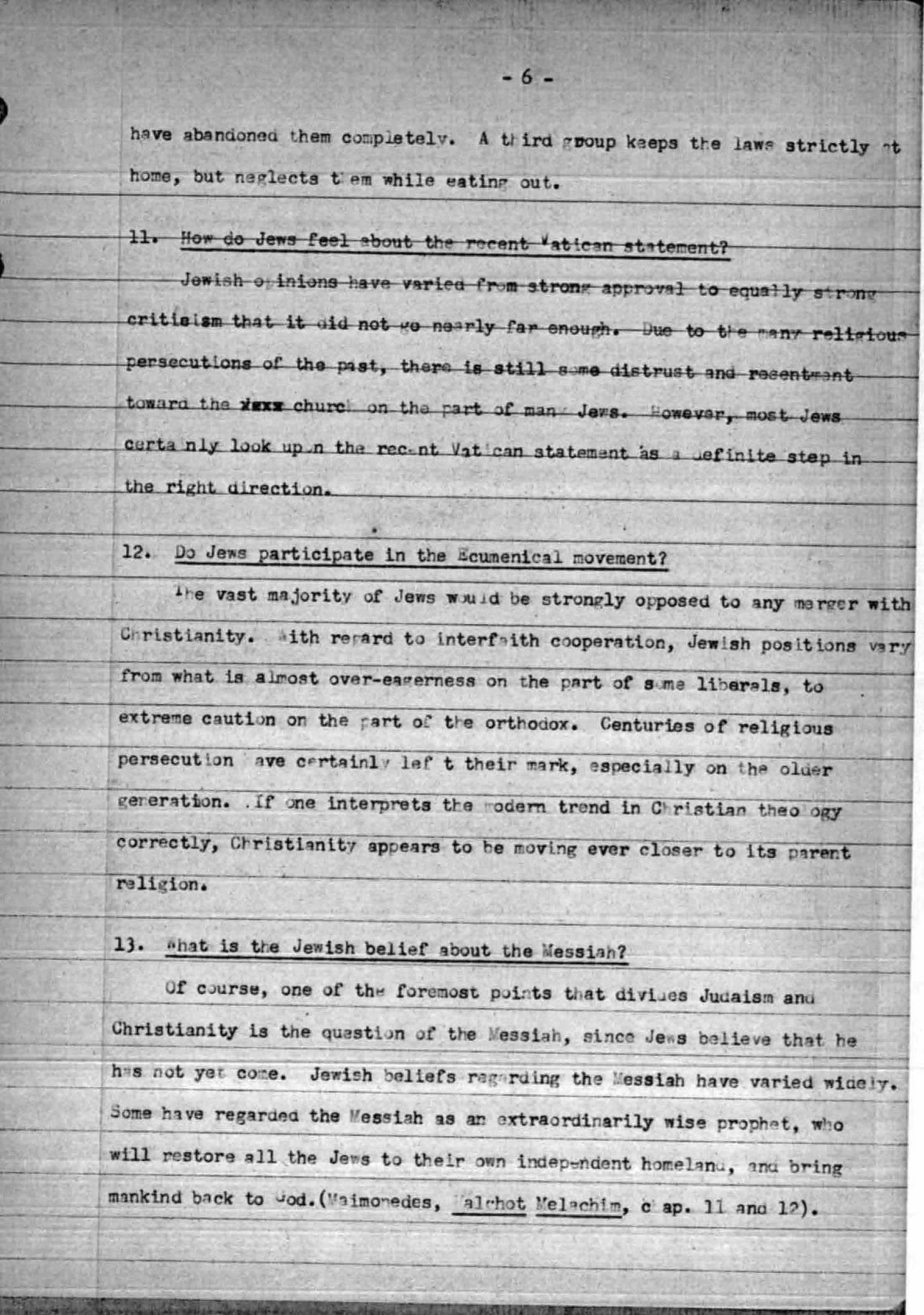
As I looked through my files, the following five stories jumped out at me:

  1. While Rav Schwartz clearly had a phenomenal mastery and memory of all Torah-related subjects, he was also keenly aware of the world around him. His attention to detail — and his recall of those details — was often quite surprising. As an example: I once turned to him with an important Halachic question from an Israeli family who had joined our community for a year so the husband (a high-ranking IDF officer) could attend the U.S. Army War College in nearby Carlisle, PA. After answering the question, Rav Schwartz commented, “I wonder if that college is located on the campus of the boarding school that Jim Thorpe attended.” (Thorpe was a famous Native-American athlete who passed away in 1953 — and indeed, the U.S. Army War College is located on the grounds of the former ‘Carlisle Indian Industrial School’.)
  2. Often, after answering a question, Rav Schwartz would let me know that he could relate to what I was experiencing by sharing a story from his own rabbinic career. He once told me about how decades earlier, while serving as a young pulpit rabbi in Providence, RI he turned down the local Jewish Federation leader’s invitation to deliver an invocation at a gala dinner they were holding to honor one of the most prominent Jews in town (who was intermarried). The guest speaker was going to be the famous Rabbi Abba Hillel Silver (Reform), and the food being served at the dinner was in no way Kosher. Rav Schwartz told me how shocked the Federation head was upon hearing his refusal to deliver a blessing at a dinner that was so at odds with Halacha.
  3. Rav Schwartz once mentioned that Orthodox rabbis will make the greatest impression on the broader non-Orthodox Jewish community through their Chesed and Menshlichkeit — and not via their scholarship. He recalled how once while visiting Cincinnati, OH he leafed through a year book published by the local Jewish Federation. In one year’s edition, there was a small blurb on the great Rav Eliezer Silver, zt”l. (He noted that during the time of Rabbi Silver, Cincinnati’s Jewish Federation did not have the warmest feelings towards Orthodoxy.) In that small write-up they sang Rabbi Silver’s praises. What was it about Rav Eliezer Silver’s many accomplishments that had caught their notice? It was not his Torah brilliance. Instead, the Ohio River had flooded and parts of Cincinnati were devastated. In the middle of all the chaos, Rabbi Silver was spotted in a boat bringing food and aid to others. It was Rav Eliezer Silver’s selfless Chesed that had made a lasting impact on those who were not aligned with him.
  4. In 2011, my wife Layala faced a great health challenge, spent several months in hospitals, and underwent life-saving surgery. Thank G-d, she recovered, and we will always be grateful to everyone who helped us get through that extremely trying time. Over the course of those months (and the months that followed), I reached out to Rav Schwartz with many personal and Shul-related Halachic questions. Inevitably, the first words out of Rav Schwartz’s mouth were, “How’s Laya Adinah bas Chaya Esther?” My wife’s Hebrew name — as well as my mother-in-law’s — was on the tip of his tongue. Not only was Rav Schwartz thinking of my wife throughout that challenging time, but he was letting me know that he was Davening for her as well. I cannot begin to describe how much that meant (and continues to mean) to Layala and me.
  5. I once turned to Rav Schwartz for guidance with an extremely sensitive situation involving a Jewish man who had married a non-Jewish woman. In the course of conversation, Rav Schwartz taught me an important lesson I will never forget. In asking my question, I had initially used the word ‘Shiksah’ in referring to the the gentile spouse. Rav Schwartz stopped me and said that such language is not refined, and is not appropriate for anyone — especially a rabbi — to use. He went on to explain that the term ‘Shiksah’ has a derogatory connotation, and that is why it never appears in any rabbinic responsa literature. Instead, non-disparaging terms like ‘Nochris’ or ‘Goya’ are always used. Rav Schwartz told me that moving forward, I should use those terms as well. I sincerely thanked him for sharing his advice, and have made a conscious effort to remove ‘Shiksah’ from my vocabulary ever since. (Each year, I make a point of sharing this lesson with my high school students as well.)

Unfortunately, the notes of my conversations with Rav Schwartz end in May 2016. That was when the CRC membership received an email informing us that sadly, our beloved Av Beis Din, Posek, teacher, and role model had suffered a debilitating stroke while leading a Daf Yomi Shiur. In the years that followed, I would regularly mail Rav Schwartz cards and hand-written notes. However, that fateful stroke put an end to the phone conversations which I had valued so greatly. (During a quick trip to Chicago in November of 2016, I was able to visit Rav Schwartz at his home. Though my visit was short, I found much meaning in it. I truly envy all the CRC members living in Chicago who were able to regularly visit Rav Schwartz over the past four years.)

Looking back, there are so many matters I would have loved to discuss with Rav Schwartz since the last time I reached him by phone at his CRC office in 2016. Sadly, that was not meant to be.

In reflecting on the interactions I feel privileged to have had with Rav Schwartz I realize something unique about him. Whenever I spoke with him, I gained more than just additional Torah knowledge and the guidance he so generously offered. I always departed (or hung up the phone) feeling I was a better person than I had been before our conversation began. In his very humble — yet noble — manner, Rav Schwartz had a way of elevating and bringing out the best in others. Interacting with Rav Schwartz was an uplifting opportunity for self growth — one that I and so many others wish we could experience again.

_________________________

Rabbi Akiva Males is privileged to serve Young Israel of Memphis as its rabbi, and also teach Torah at the Margolin Hebrew Academy — Finestone Yeshiva of the South. He can be reached at rabbi@yiom.org


Happy July 4th

From a Hebrew Bible printed by the Vaad Hatzalah, Munich, 1947, for the use of Displaced Persons (DPs),  the”Sherith Hepleita,” with a dedication to President Harry S. Truman