New Book on Rabbinic Authority
A new sefer came out titled Ohron shel Chachomim. This work purports to collect the various laws and philosophy one should have for the Rabbis. The first section is just the basic law applicable to a talmid chacham, standing, not addressing by first name etc. In this section there is also a brief discussion about the “laws” of emunat chachmim. We are treated however to such laws as “not only is one obligated to follow the chachamim but also their children and their secretaries (mishamsheham) one should not question.” Or this one: “When a person goes to a tzadik and discusses his problems but doesn’t understand what the tzadik responds [I assume it was unintelligible] or it appears the just ignores his request – don’t let this blessing be small in your eyes. Rather believe God will send your salvation.” For many of these laws, the citations are to either aggadic passages in the Talmud or to Midrashim.
The second section discussion yeridat haDorot the lowering of the generations. This begins by telling the reader the concept of yeridat haDorot is not in relation to the tzadik rather it is to the generation. That is, the tzadik is of course as great as in previous generation rather it us that are unable to appreciate this. But then you may ask, it continues, why then do we hear of the great miracles these tzadikim did in previous generations, why not now? Of course, it is due to us – we have created a situation where the tzadikim can’t work their miracles today.
The author then treats us to a discourse on whether the achronim can argue on the rishonim. He explains that this is prohibited. In a footnote he deals with the many achronim that seem to disagree with this. However, he writes these off by noting they are like rishonim. Of course, this then poses another problem (or not) for him as if they are truly like the rishonim then it follows that their peers couldn’t argue on them as they are obviously greater. He just says that this doesn’t appear to be the case and this is allowed. He extends this prohibition against arguing against earlier ones and says this is applicable to the pronouncements of the Shulhan Arukh and the Rama. He appears to be unaware that R. Hayim Volhzin says the Gra said this is not the case and that ever Rav should just do what they see fit irrelevant of the opinion of the Shulkah Orakh and the Rama. Additionally, he doesn’t seem to be aware that R. Moshe Feinstein said the same thing. Or perhaps it is just a case of selective memory.
The next couple of chapters are devoted to the law of a Talmid Chacham today as well as the role of a Rebbi for Chassidim. The chapters include information on “Just Looking at the Rebbi Allows One To Gain In Torah and Avodah,” “The Belief in The Tzadik” as well as lesser topics such as “The Trip to the Rebbi,” “The miracles of the Rebbi” etc.
All in all, this book presents a rather interesting view into what some consider the laws and customs governing the interaction with the Rabbinic class.
I got the book at Biegeleisen in Brooklyn.
I See Dead People
Mary Roach in her excellent book “Stiff: The Curious Lives of Human Cadavers” discusses some of the facinating facts relating to dead bodies. However, she does not discuss some of the more interesting Jewish incidents of dead bodies.
The first is the fairly well known story of R. Yehuda Aszod (1794-1866). R. Aszod’s grandson wrote a biography of his grandfather. Portions of this biography are included in R. Aszod’s commentary on the Torah, Divre Mahri.
“My grandfather never allowed for a picture or portrait of himself [based upon halachik reasons, for more on these reasons see G. Oberlander’s article in the latest Hechal haBeshet]. However, many of his students wanted his picture to remember their teacher. Therefore some of his students decided amongst themselves that after R. Aszod will die they will dress him in his Shabbat clothes, place him on his chair and this is how they obtained his photograph which is found in many people’s homes. However, those that participated in this bad befell them. It was not longer before the participants all died.” 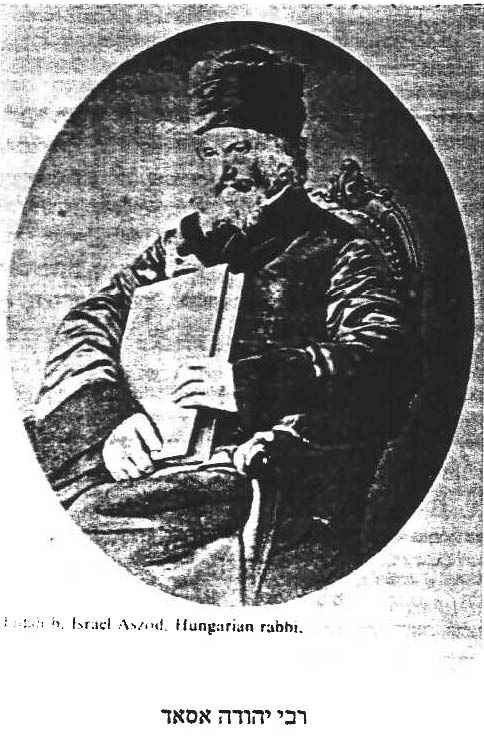 This event even engendered a discussion whether such a practice is permitted. R. Zev Tzvi Klien in his teshuvot Kehana Mesaya Kehana (no. 12) discusses this practice and concludes although not recommended it is not prohibited.
While this story does appear in R. Aszod’s commentary on the torah (p. 32) it is only is the older editions, the most recent the entire story including the relevant footnote was removed.
Additionally, there is a picture of R. Aryeh Leib ben Asher Gunzberg (Sha’agat Areyeh) which it appears he is dead. However, the legend underneath the picture reads “This is the picture of the Sha’agat Areyeh at the time he is dying.” I assume this “disclaimer” was placed there to mitigate any criticism of the kind the picture of R. Aszod is subject to. One can see this picture in the book R. Y.M. Stern, Gedoli HaDorot Jerusalem 1996, vol. 1.
There is another case, although not with a dead Rabbi, but with a Jewish question regarding the dead. In University College in London the noted philosopher Jermey Bentham had an interesting request in his will. As it appears on Wikipedia,
A further reason for Jeremy Bentham’s fame within UCL is due to the fact that his body is on display to the public. Jeremy Bentham specified in his will that he wanted his body to be preserved as a lasting memorial, and this instruction was duly carried out. This ‘Auto-Icon’ has become famous. Unfortunately, when it came to preserving his head, the process went disastrously wrong and left the head badly disfigured. A wax head was made to replace it, but for many years the real head sat between his legs. However, this head was frequently stolen and subjected to many student pranks, with students from rival King’s College London often the culprits. The head is said to have at one time been found in a luggage locker at Aberdeen station, and to have been used as a football by students in the Quad. These events led to the head being removed from display and placed instead in the College vaults, where it remains to this day.
Other rumours surrounding the Auto-Icon are that the box containing his remains is wheeled into senior college meetings, and that he is then listed in minutes as ‘present but not voting’. He is also said to have a vote on the council, but only when the vote is split, and that he always votes in favour of the motion.
When the Upper Refectory was refurbished in2003, the room became renamed the Jeremy Bentham Room (sometimes abbreviated JBR) in tribute to the man.
The London Bet Din for a few years put out phamphelts where they would discuss a in depth topics of interest. One of those titled “B’Inyan Ohel ha-Met” Dayan Grosnas no. 14, 1965, discusses whether a Kohen can go through the lobby, or today the JBR where Bentham’s body is. They actually state in the begining, which is not mentioned in the Wikipedia article that the head is kept in a special box, which although not on public display, if one asks it will be shown to you. Obviously, the same question of whether one could photograph it as was raised in the case of R. Aszod would apply as well.
You can see Bentham’s body here.

Attack on Rabbinic Judaism and Historical Orthopraxy
What is perhaps one of the more intreging sefarim ever published. Behinat HaKabbalah is two books in one. The first, Kol Shakal (the voice of a fool), is a scathing attack on Rabbinic Judaism. Basically, anything not found explictly in the Torah is claimed as false. For example, the requirment of mikva is deemed wrong as the verse only requires one to “wash one’s body.” This first portion takes up the majority of the book. The second half, Sa’agas Areyeh, (roar of the lion) is a defense of Rabbinic Judaism. However, the defense in some sense proves the first half as it is so sparse leaving the reader to posit that the author of Sha’agas Areyeh actually agreed with the author of Kol Shakal. Some even go so far to claim the author really wrote both works in an extremly sly attempt to gain wider readership. That is, they created a work which externally would be viewed as a defense of Rabbinic Judaism i.e. Sha’agas Areyeh, only to be able to slip in the most more persausive Kol Shakal.
Typically, the second portion is attributed to R. Yehuda Areyeh of Modena. (Mar Gavriel has an excellent post on him here). If that is so, some then argue he was a closet heritic or perhaps in today’s vernacular- Orthoprax. That is, although R. Modena sat on the Venice Bet Din, wrote numerous traditional sefarim, and even authored on the selichot that is said on Yom Kippur Katan, in his heart he really did not believe in any of it. This, of course, is rather shocking.
In truth, the authorship of both of these works is somewhat up in the air. As mentioned, some attribute it to R. Modena, however, this is not certian. The reason being, this work was not published until 1852 and Modena died in 1648. The work was first published by Isaac Shmuel Reggio (YaSHar) a rather interesting character in his own right. [As an aside, Reggio was far from what many would consider “traditionally orthodox” he permitted shaving on Hol HaMoad which got him into trouble. (His father wrote a pamphelet against him on that issue). However, this year someone from Monsey reprinted his commentary on the Torah, apparently Reggio’s biography was unknown to the sponser of the printing.] Reggio claimed to have published this from a manuscript in Modena’s own hand. He has an extensive introduction as well as notes thourhout.
Others have questioned Reggio’s assertion that it emenates from Modena. One has even pointed to Saul Berlin the author of the noted forgery Besamim Rosh as the author of this. However, that has been discredited.
In the end, whom ever the author maybe this work still stands as one the most interesting and entertaining attacks on Rabbinic Judaism.
There is much in this area and the interested reader can consult Reggio’s introduction; T. Fishman, Or Hadash al Zemano shel Sefer Kol Shakal v’al Mekom Hibburo, in Tarbiz 59 (1990) 171-190; Fishman’s book length treatment in “Shaking the Pillars of Exile‘Voice of a Fool,’ an Early Modern Jewish Critique of Rabbinic Culture;” E. Rivkin, Leon da Modena and the Kol sakhal; B. Kahlar, Shagas Areyeh al Kol Shakal in Mehkarim v’Inyuim (Tel Aviv, 1954) 357-378.
Collection of Articles on Sabbatianism Online
The book The Sabbatian Movement and Its Aftermath: Messianism, Sabbatianism and Frankism, edited by Rachel Elior, is available online, in its entirety, for free (see here).
The book includes articles by Elisheva Carlebach, “The Sabbatian Posture of German Jewry,” Jacob J. Schacter, “Motivations for Radical Anti-Sabbatiansim: The Case of Hakham Zevi Ashkenazi,” as well as an excellent article in Hebrew by Moshe Fogal “Sabbatianism of the book Hemdat Yamim: A New Exploration.”
Book on Yeshivot
Shaul Stampfer has republished a revised and expanded edition of his HaYeshiva haLita’ot b’Hitavato. The book which is devoted to three yeshivot, Volozhin, Slobodka, and Telz, as well as the Kovno kollel. The book tracks the Volozhin yeshiva from its inception to its closure and the Slobodka and Telz yeshivot until the turn of the twenteenth century.

This book was originally Stampfer’s dissertation, Shlosh Yeshivot Litayot b’Meah haTisha Asarah (1981) and was published in book format in 1995. This edition includes numerous updates as well as much new information, especially regarding the closure of Volozhin. Stampfer now argues, based upon new Russian governmental documents, which he includes Hebrew translation of, that the Yeshiva was closed due to the its own internal upheaval. This internal strife was caused by R. Naftali Tzvi Yehuda Berlin (Netziv) attempting to install his son as Rosh haYeshiva. At Telz a similar fight broke out also regarding succession, as well as in Volozhin itself, on two separate occasion. However, the last fight caused such a rapid decline in the internal going ons of the Yeshiva, the government had it shut. The closure did not have to do with the haskala, the Russian government wanting to meddle into Jewish education or any of the other reasons offered. Instead, as has been borne out throughout Jewish history, the Jews brought it upon themselves. For example, the burning of the Talmud in France after the controversy regarding Rambam’s writings as well as the banning of the Talmud in the 16th century were caused or at least the catalyst was internal fighting amongst the Jews.
The book also debunks other theories regarding the opening of Volozhin. Some claim the R. Hayyim Volozhin ask R. Eliyahu of Vilna (Gra) and received his blessing to open the what was the first Yeshiva. Stampfer, however, questions this and notes that in the initial Kol Koreh R. Hayyim Volozhin makes no mention of this, something that would have bolstered his fundraising efforts. Second, Stampfer also proves that the opening of Volozhin was not in response to the Hassidic movement.
Aside from the above, the book is full of first hand accounts of the Yeshivot. These include, Volozhin started praying in the morning at 9 am and the prayers only ran 15-20 minutes. Stampfer qualifies this by noting haNetz haHama in Vilna (just north west of Volozhin) during the winter is 9:17 and also notes the 15-20 minutes is probably slightly exaggerated. Telz yeshiva was the first to institute grade levels in a yeshiva. Also, according to Simcha Assaf’s account, R. Lazer Gorden encouraged him to learn Russian and had his son teach Assaf in his own home. Stampfer includes much about the influence of Zionism and the haskalah on the yeshivot. All you ever wanted to know about all the infighting in the Yeshivot. The first to move to establish a kollel was R. Yitzhak Ya’akov Reines, who was highly controversial with the establishment of his yeshiva in Lida – arguably a precursor to Yeshiva University. These are only a tiny portion of the terrrific nuggets that can be found in this book.
I purchased this book at Beigeleisen in Boro Park (718-436-1165)