1

Hatikvah, Shir HaMa’alot, & Censorship
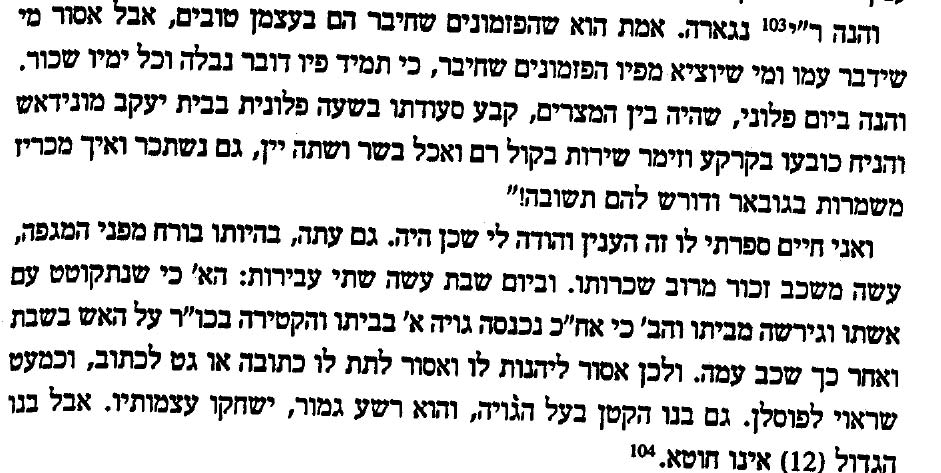
There is a rather interesting teshuva which appears in R. Avrohom Weinfeld’s Lev Avrohom. In it he discusses whether one can recite Shir HaMa’alot to the tune of Hatikvah.


He first explains that this question involves the question of whether a tune from an impure source is appropriate to use. He begins by discussing the two well-known teshuvot (the Teshuvot haBakh and the Krach shel Romi) dealing with using non-Jewish tunes for Jewish songs.

However, without getting into all of his halakhic discusion, I would like to focus on his final proof that using a tune or the like for an impure source is inappropriate. He finishes with a quote from the book Shivchei Rav Hayyim Vital. This quote demonstrates, for him, that it does matter what the source of something is. The quote is as follows:

אמת הוא שהפזמונים שחיבר הם בעצמם טובים, אבל הוא בעצמו אסור לדבר עמו, ומי שמוציא מפיו הפזמונים שחיבר רע לו. כי תמיד פיו דובר נבלה וכל ימיו שיכור While it is true that the songs he composed are themselves good, he [the composer] it is not permitted to speak with him, and whomever sings the songs he [the composer] wrote, it is bad. Because [the composer] is always speaking profanities and spends his days drunk.

Thus, according to R. Weinfeld, this shows that R. Hayyim held it is very important to know who the source is and if that source is bad, one should not use it even if it is a nice song. In fact, R. Hayyim continues (although this does not appear in the Lev Avrohom) with other rather serious allegations against this person. However, this proof is premised on the fact that we accept this. That is, if we were to figure out who this person was and we in fact do sing his songs, obviously we would not follow R. Hayyim’s understanding.


Now, as is apparent, in the Shivchei this person is anonymous. But all is not lost. The Shivchei is in fact an abriged version of a longer work. That work, Sefer Hezyonot the Book of Visions, is in fact published.

The Sefer Hezyonot was first published in 1954 by Mossad HaRav Kook. Admittedly, this book contains rather shocking material and was therefore claimed that it was not in fact from R. Hayyim. R. Reuvan Margolios, among others, protested outside of Mossad HaRav Kook after this was published. Needless to say Mossad HaRav Kook never republished this. Now in truth it seems the manuscript which was used to print this book was actually from R. Hayyim’s own hand. And therefore this book has actually been republished recently in three different editions.

The first was in 1999 in an English edition “Jewish Mystical Autobiographies, Book of Visions.” The second was in 2002 by a Yeshiva in Jerusalem and was edited and includes a commentary by R. Nesonel Monsor. However, as we shall see, this was not a complete edition. And then finally, this year Mochon Yad Ben Tzvi put out a critical edition of this book.

So to return to our question, who was this unnamed composer, one just needs to open a Sefer Hezyonot to find out. There the very same passage as was in the Shivchei appears, however, it includes the name of the person. That person is the composer R. Yisrael Nagara. R. Yisrael was not unknown, in fact he authored a very well-known zemer which is sung universally, kah rebon ‘olam.

Now that we know who this is, we now see that it would appear we do not hold like R. Hayyim, in that we sing this song, even though R. Hayyim declared it was improper to do so. Thus, R. Weinfeld’s proof is no longer a proof, but if R. Hayyim is correct in his claims of drunkeness etc. it actually demonstrates that we do not care that the source may be impure as it was.

But, as we alluded to before, not every edition of Sefer Hazyonot contains the name. The Jerusalem edition in the place of the name has an ellipse. Now one can say perhaps the manuscript they used had that. That is wrong. There is only one manuscript in existance today and that manscript contains the name. Therefore, it seems the Jerusalem edition was censored. One can see on the side themselves the passages in question. The page which has the legend on the top Sefer Hezyonot/Darkehi Hayyim is the Jerusalem edition while the other Hebrew one is the Ben Zvi and I have supplied the English as well.

Sources: Teshuvot Lev Avrohom no. 134 (if one is interested in a rather nuanced view of R. Weinfeld on the State of Israel one should also see nos. 139-141); Faierstein, “Jewish Mystical Autobiographies” introduction; Catalog of Gershon Scholem in Kabbalah no. 4331


Errors in New Kuntras HaTeshuvot

As some have already noted, there is a completely new edition of Boaz Cohen’s Kuntras HaTeshuvot. This edition edited by Shmuel Glick totally reworks Cohen’s work. Supposedly this new work benefited from many subsequent bibliographies as well as the Institute for Jewish Bibliography.

While this is an vast improvement in my quick read (I only received it today) I was amazed at what this lacked and in my mind errors.

The first is for the entry for the Besamim Rosh the famed possible forgery attributed to R. Asher b. Yecheil. In their entry they first note that examined the Krakow 1881 edition. Now aside from not looking at the first edition which is not hard to come by there is a greater error here. Specifically, they do not note that this edition is missing two teshuvot. So while they provide a bibliography listing articles discussing the Besamim Rosh they fail to mention the most important thing that if one gets the wrong edition they will not have the full text. Even though they comment there are 392 teshuvot they did not bother to count or to even read the articles they cite (which note this absence). This are not minor teshuvot either, in fact, the one on suicide which this edition leaves out is perhaps the most well-known and cited one from the entire volume.

The next error is in regards to the Hatam Sofer. Again they have a long entry about the various editions and then list the various editions. But here they totally missed out on the first edition of this work. The first time teshuvot from the Hatam Sofer appeared was not as a separate work but as part of another work. In Prague 1826 edition of the Ri Megash from pages 31b until 42a there is Kuntras Hiddushi Torah v’Gam She’alot v’Teshuvot m’admu HaRav HaGaon . . . R. Moshe Sofer. In fact, on the title pages it even notes that this includes teshuvot from Hatam Sofer. This is listed in the Bibliography of the Hebrew Book and a simple computer search would have revealed this information.

Additionally, the sources which are provided are rather uneven. Again, this is only from my limited viewing of it and I may revise but if one looks at the entry for Eleh Divrei HaBrit which deals with, among other things, the controversy regarding placing an organ in shul. In that entry they provide Haberman’s article on the topic but not Binayahu’s article or Samet’s which both appeared in Asuphot vol. 1 and 5 respectively. In fact, the book Ohr Nogeh which is Liberman’s book on the topic does not have an entry. While perhaps they considered this part of the work Nogeah HaTzedek there doesn’t seem to be a reason to do so. Also, they do not include the book Tzror Hayyim which was published a year after Eleh and is devote to the very same topics in their list of books and articles discussing the organ. This is so eventhough the first teshuva discussed the organ exclusively.


Buring the Hametz and the Goan Book

To the left are pictures what are supposed to be the Klausenberger Rebbe burning the book HaGaon (discussed here previously) with the Hametz. Additionally the final picture is him saying the Yehi Ratzon from the Ateresh Yehoshua when burning books of heresy. If you click on the images you can see them enlarged. Here is the full text of the Yehi Ratzon

יהי רצון מלפניך ה’ אלוקי ואלוקי אבותי, כשם שאנכי באתי לבער את ספרי החיצונים והמשכילים אלה, כן יסור את הצפוני מזרע ישראל, וביותר מן הבחורי חמד אשר ההשכלה מצאה קן בלבם ובמוחם והיצר מבלבל מחשבותם. בעל הרחמים ירחם עליהם ונטע בקרבם אמונת הבורא ואמונת הצדיקים כדכ(תיב), ויאמינו בה’ ובמשה עבדו ועתה בזמן ביעור חמץ אשר היא עת מוכשר על זה לגרש ולבער את השאור שבעיסה הטמ(ו)ן בקרבנו, יעלה תפילה זו לרצון לפני אדון כל, אמן כן יהי’ רצון

“עטרת ישועה על חמישה חומשי תורה”, ח”ב, קראקא, תרפ”ה דף פז, ב’ סי’ א


Talk on the Valmadonna Trust Library

JACK LUNZER, Custodian
THE VALMADONNA TRUST LIBRARY
Opening remarks by Arthur Kiron, University of Pennsylvania.

The Valmadonna Trust Library, located in London, is the world’s foremost private collection of rare Hebraica and the most comprehensive collection of early books printed in Italy.

THURSDAY, APRIL 27 at 7:00 pm

Center for Jewish History – 15 West 16 Street – New York City
For more information see here


Old Haggadot for Free

Many of the haggadot that we have mentioned previously as well as many other interesting ones are available for free in there entirety at the JNUL’s site here. All you need is a printer (just make sure to switch to landscape printing for the double paged ones) and you too can have a copy of 1482 haggadah, 1526 Prague haggdah (first fully illustrated haggadah), Venice Ladino haggadah, 1833 English translation, or the 1844 haggadah printed in Calcutta, India to name but a few.


Haggadah, First Hebrew Map, and Forgery

One of the most beautifully done haggadot is that of the Amsterdam, 1695. This haggadah for the first time used copperplate instead of woodcuts to produce the illustrations. Consequently, the illustrations are sharper and more intricate. The illustrator, Avrohom bar Ya’akov mimispchto shel Avrohom avenu, as is apparent from his name, was a convert. Before converting he was a preacher.

His edition of the haggadah was special not only for the copperplate and the illustrations, but for a specific illustration, one of the earliest Hebrew maps of Israel (the map on top, you can click to see a zoomable view). This haggadah included a fold out map (it was rather large) of the travels of the Jews through the desert and into Israel. Many (Yerushalmi and Yaari) incorrectly assert this was actually the first Hebrew map, however, as we will see in a moment that is wrong. But this map and the haggadah was rather popular and was reprinted four times in a little over one hundred years. [It was reprinted this year, however, the reprint is terrible. It seems they photocopied it and then had a three-year-old add color. The map is included in this reprint, not a fold out page, but as the end papers of the binding.]

The map itself has north on the right and east on the right as was common for maps of that time a compass is supplied in the bottom middle of the map. The legend on the top reads “This will allow every person to see the route of the forty year journey . . . ” And in keeping with previous Jewish books there is a nude in the lower right hand corner perhaps representing an Egyptian(?).

This was not the first Hebrew map of Israel. Instead, that milestone goes to a book with its own interesting history. The Biurim on Rashi was published in 1593 in Venice and attributed to R. Nathan Shapiro. This work includes two illustrations. The first is of the menorah (reprinted many times to this day) and the second is a map of Israel. This is the first Hebrew map. However, although on the title page this book is supposedly written by R. Shapiro, this was not the case. Instead, R. Shapiro’s son published his fathers comments on Rashi in 1697 in a work titled Imrei Shefer. In the introduction he explains why there are two books from his father both on the same topic.

ואתם קדושי עליון אל תתמהו על החפץ שזה שתנים ימים יצא בדפוס איזה ביאורים הנקראים על שם הגאון אדוני אבי ז”ל, כי המציאוהו אנשים, אנשי בלי עול מלכות שמים, חיבור אשר מצאו, ומי יודע המחבר אם נער כתבו ורצו לתלותו באילן גדול אדני אבי ז”ל, חלילה לפה קדוש להוציא מפיו דברים אשר אין בהם ממש, כי הכל תוהו ובוהו ומזויף מתוכו, כלו עלו קמשונים כסו פניו חרולים. וכאשר הגיעו הספרים ההם בגלילות אלו הכרוז בהסכמת כל רבני ורשאי המדינות שלא ומכרו ויהיו בבל יראה ובבבל ימצא בכל ארצות אלו. ואשר קנו מהם יחזר להם המעות ולא ימצא בביתך עולה

[“Do not wonder why I am publishing what was published just two years ago, the Biurim, in my father’s name. As wicked people, people who found a book, a book which may have been written by a child. However, they wanted to use my father’s good name to publish their work. But, my father would never say such stupidities which appear in that book, their book is worthless and a forgery. When this was discovered all the Rabbis agreed that this book [Biurim] should be under a ban, no one should be allowed to keep it. Whomever purchased it should have their money returned, they should not allow a stumbling block into their home.”]

So this book was actually a forgery and not really from R. Shapiro however, it still did provide the first map, albeit a crude one. In the Imrei Shefer there is no map.

His son was not the only one to question the authenticity of the Biurim. R. Yissachar Bear Ellenburg in his Be’er Sheva and in his Tzedah L’Derekh states unequivocally that R. Shapiro did not write the Biurim.

Sources: A. Yaari Maps of Israel in the Haggadah, Machanyim, 55 (1971) 152-159; (for more on converts in printing see Yaari, Mehker Sefer, 245-55); Introduction Imrei Sefer, Lublin 1697 (on differences in the printings of the Imrei Shefer see Yudolov, Areshet, 6 (1981) 102 no. 7); Biurim, Venice 1693; R. E. Katzman, “Rabbi Nathan Nata Shapiro – Ha-Megaleh Amukot” in Yeshurun 13 (Elul 2002) 677-700; Introduction [R. E. Katzman]Seder Birkat HaMazon im pirush shel R. Noson Shapiro, 2000 Renaissance Hebraica, 1-10; Yeushalmi, Haggadah and History, plate 69.